EP3056524A1 - Ethylene/1-hexene or ethylene/1-butene copolymer having outstanding working properties and environmental stress cracking resistance - Google Patents
Ethylene/1-hexene or ethylene/1-butene copolymer having outstanding working properties and environmental stress cracking resistance Download PDFInfo
- Publication number
- EP3056524A1 EP3056524A1 EP15850164.3A EP15850164A EP3056524A1 EP 3056524 A1 EP3056524 A1 EP 3056524A1 EP 15850164 A EP15850164 A EP 15850164A EP 3056524 A1 EP3056524 A1 EP 3056524A1
- Authority
- EP
- European Patent Office
- Prior art keywords
- ethylene
- chemical formula
- aryl
- alkyl
- substituted
- Prior art date
- Legal status (The legal status is an assumption and is not a legal conclusion. Google has not performed a legal analysis and makes no representation as to the accuracy of the status listed.)
- Granted
Links
- 0 Cc(c(*)c1*)c(*)c(C=C)c1N(*)C(C1=C(*)C(*)=C(*)CC(*)=*1C)C#C Chemical compound Cc(c(*)c1*)c(*)c(C=C)c1N(*)C(C1=C(*)C(*)=C(*)CC(*)=*1C)C#C 0.000 description 6
- PAXFCZSWPJRMCS-UHFFFAOYSA-N C[Si+](C)(C)C[n]1c(C(C=C(C2)O)=C)c2c2c1CC1C=CC=CC21 Chemical compound C[Si+](C)(C)C[n]1c(C(C=C(C2)O)=C)c2c2c1CC1C=CC=CC21 PAXFCZSWPJRMCS-UHFFFAOYSA-N 0.000 description 1
- CBLVQUHWHUYSIA-UHFFFAOYSA-N C[SiH-](C)(C)C[n]1c(cccc2)c2c-2c1Cc1c-2cccc1 Chemical compound C[SiH-](C)(C)C[n]1c(cccc2)c2c-2c1Cc1c-2cccc1 CBLVQUHWHUYSIA-UHFFFAOYSA-N 0.000 description 1
- STFBDJXCSRQRBH-UHFFFAOYSA-N C[Si](C)(C)C[n]1c(-c2ccccc2C2)c2c2ccccc12 Chemical compound C[Si](C)(C)C[n]1c(-c2ccccc2C2)c2c2ccccc12 STFBDJXCSRQRBH-UHFFFAOYSA-N 0.000 description 1
- OUPQVLHYGSWFPE-UHFFFAOYSA-N Cc1ccc2[n](C[Si](C)(C)C)c(Cc3c-4cccc3)c-4c2c1 Chemical compound Cc1ccc2[n](C[Si](C)(C)C)c(Cc3c-4cccc3)c-4c2c1 OUPQVLHYGSWFPE-UHFFFAOYSA-N 0.000 description 1
Images

Classifications
-
- C—CHEMISTRY; METALLURGY
- C08—ORGANIC MACROMOLECULAR COMPOUNDS; THEIR PREPARATION OR CHEMICAL WORKING-UP; COMPOSITIONS BASED THEREON
- C08F—MACROMOLECULAR COMPOUNDS OBTAINED BY REACTIONS ONLY INVOLVING CARBON-TO-CARBON UNSATURATED BONDS
- C08F210/00—Copolymers of unsaturated aliphatic hydrocarbons having only one carbon-to-carbon double bond
- C08F210/02—Ethene
-
- C—CHEMISTRY; METALLURGY
- C08—ORGANIC MACROMOLECULAR COMPOUNDS; THEIR PREPARATION OR CHEMICAL WORKING-UP; COMPOSITIONS BASED THEREON
- C08F—MACROMOLECULAR COMPOUNDS OBTAINED BY REACTIONS ONLY INVOLVING CARBON-TO-CARBON UNSATURATED BONDS
- C08F210/00—Copolymers of unsaturated aliphatic hydrocarbons having only one carbon-to-carbon double bond
- C08F210/16—Copolymers of ethene with alpha-alkenes, e.g. EP rubbers
-
- C—CHEMISTRY; METALLURGY
- C08—ORGANIC MACROMOLECULAR COMPOUNDS; THEIR PREPARATION OR CHEMICAL WORKING-UP; COMPOSITIONS BASED THEREON
- C08F—MACROMOLECULAR COMPOUNDS OBTAINED BY REACTIONS ONLY INVOLVING CARBON-TO-CARBON UNSATURATED BONDS
- C08F4/00—Polymerisation catalysts
- C08F4/42—Metals; Metal hydrides; Metallo-organic compounds; Use thereof as catalyst precursors
- C08F4/44—Metals; Metal hydrides; Metallo-organic compounds; Use thereof as catalyst precursors selected from light metals, zinc, cadmium, mercury, copper, silver, gold, boron, gallium, indium, thallium, rare earths or actinides
- C08F4/60—Metals; Metal hydrides; Metallo-organic compounds; Use thereof as catalyst precursors selected from light metals, zinc, cadmium, mercury, copper, silver, gold, boron, gallium, indium, thallium, rare earths or actinides together with refractory metals, iron group metals, platinum group metals, manganese, rhenium technetium or compounds thereof
- C08F4/62—Refractory metals or compounds thereof
- C08F4/64—Titanium, zirconium, hafnium or compounds thereof
-
- C—CHEMISTRY; METALLURGY
- C08—ORGANIC MACROMOLECULAR COMPOUNDS; THEIR PREPARATION OR CHEMICAL WORKING-UP; COMPOSITIONS BASED THEREON
- C08F—MACROMOLECULAR COMPOUNDS OBTAINED BY REACTIONS ONLY INVOLVING CARBON-TO-CARBON UNSATURATED BONDS
- C08F4/00—Polymerisation catalysts
- C08F4/42—Metals; Metal hydrides; Metallo-organic compounds; Use thereof as catalyst precursors
- C08F4/44—Metals; Metal hydrides; Metallo-organic compounds; Use thereof as catalyst precursors selected from light metals, zinc, cadmium, mercury, copper, silver, gold, boron, gallium, indium, thallium, rare earths or actinides
- C08F4/60—Metals; Metal hydrides; Metallo-organic compounds; Use thereof as catalyst precursors selected from light metals, zinc, cadmium, mercury, copper, silver, gold, boron, gallium, indium, thallium, rare earths or actinides together with refractory metals, iron group metals, platinum group metals, manganese, rhenium technetium or compounds thereof
- C08F4/62—Refractory metals or compounds thereof
- C08F4/64—Titanium, zirconium, hafnium or compounds thereof
- C08F4/659—Component covered by group C08F4/64 containing a transition metal-carbon bond
- C08F4/6592—Component covered by group C08F4/64 containing a transition metal-carbon bond containing at least one cyclopentadienyl ring, condensed or not, e.g. an indenyl or a fluorenyl ring
-
- C—CHEMISTRY; METALLURGY
- C08—ORGANIC MACROMOLECULAR COMPOUNDS; THEIR PREPARATION OR CHEMICAL WORKING-UP; COMPOSITIONS BASED THEREON
- C08F—MACROMOLECULAR COMPOUNDS OBTAINED BY REACTIONS ONLY INVOLVING CARBON-TO-CARBON UNSATURATED BONDS
- C08F2420/00—Metallocene catalysts
- C08F2420/02—Cp or analog bridged to a non-Cp X anionic donor
-
- C—CHEMISTRY; METALLURGY
- C08—ORGANIC MACROMOLECULAR COMPOUNDS; THEIR PREPARATION OR CHEMICAL WORKING-UP; COMPOSITIONS BASED THEREON
- C08F—MACROMOLECULAR COMPOUNDS OBTAINED BY REACTIONS ONLY INVOLVING CARBON-TO-CARBON UNSATURATED BONDS
- C08F2420/00—Metallocene catalysts
- C08F2420/06—Cp analog where at least one of the carbon atoms of the non-coordinating part of the condensed ring is replaced by a heteroatom
-
- C—CHEMISTRY; METALLURGY
- C08—ORGANIC MACROMOLECULAR COMPOUNDS; THEIR PREPARATION OR CHEMICAL WORKING-UP; COMPOSITIONS BASED THEREON
- C08F—MACROMOLECULAR COMPOUNDS OBTAINED BY REACTIONS ONLY INVOLVING CARBON-TO-CARBON UNSATURATED BONDS
- C08F2420/00—Metallocene catalysts
- C08F2420/10—Heteroatom-substituted bridge, i.e. Cp or analog where the bridge linking the two Cps or analogs is substituted by at least one group that contains a heteroatom
-
- C—CHEMISTRY; METALLURGY
- C08—ORGANIC MACROMOLECULAR COMPOUNDS; THEIR PREPARATION OR CHEMICAL WORKING-UP; COMPOSITIONS BASED THEREON
- C08F—MACROMOLECULAR COMPOUNDS OBTAINED BY REACTIONS ONLY INVOLVING CARBON-TO-CARBON UNSATURATED BONDS
- C08F2500/00—Characteristics or properties of obtained polyolefins; Use thereof
- C08F2500/04—Broad molecular weight distribution, i.e. Mw/Mn > 6
-
- C—CHEMISTRY; METALLURGY
- C08—ORGANIC MACROMOLECULAR COMPOUNDS; THEIR PREPARATION OR CHEMICAL WORKING-UP; COMPOSITIONS BASED THEREON
- C08F—MACROMOLECULAR COMPOUNDS OBTAINED BY REACTIONS ONLY INVOLVING CARBON-TO-CARBON UNSATURATED BONDS
- C08F2500/00—Characteristics or properties of obtained polyolefins; Use thereof
- C08F2500/05—Bimodal or multimodal molecular weight distribution
-
- C—CHEMISTRY; METALLURGY
- C08—ORGANIC MACROMOLECULAR COMPOUNDS; THEIR PREPARATION OR CHEMICAL WORKING-UP; COMPOSITIONS BASED THEREON
- C08F—MACROMOLECULAR COMPOUNDS OBTAINED BY REACTIONS ONLY INVOLVING CARBON-TO-CARBON UNSATURATED BONDS
- C08F2500/00—Characteristics or properties of obtained polyolefins; Use thereof
- C08F2500/12—Melt flow index or melt flow ratio
-
- C—CHEMISTRY; METALLURGY
- C08—ORGANIC MACROMOLECULAR COMPOUNDS; THEIR PREPARATION OR CHEMICAL WORKING-UP; COMPOSITIONS BASED THEREON
- C08F—MACROMOLECULAR COMPOUNDS OBTAINED BY REACTIONS ONLY INVOLVING CARBON-TO-CARBON UNSATURATED BONDS
- C08F2500/00—Characteristics or properties of obtained polyolefins; Use thereof
- C08F2500/13—Environmental stress cracking resistance
-
- C—CHEMISTRY; METALLURGY
- C08—ORGANIC MACROMOLECULAR COMPOUNDS; THEIR PREPARATION OR CHEMICAL WORKING-UP; COMPOSITIONS BASED THEREON
- C08F—MACROMOLECULAR COMPOUNDS OBTAINED BY REACTIONS ONLY INVOLVING CARBON-TO-CARBON UNSATURATED BONDS
- C08F2500/00—Characteristics or properties of obtained polyolefins; Use thereof
- C08F2500/18—Bulk density
-
- C—CHEMISTRY; METALLURGY
- C08—ORGANIC MACROMOLECULAR COMPOUNDS; THEIR PREPARATION OR CHEMICAL WORKING-UP; COMPOSITIONS BASED THEREON
- C08F—MACROMOLECULAR COMPOUNDS OBTAINED BY REACTIONS ONLY INVOLVING CARBON-TO-CARBON UNSATURATED BONDS
- C08F4/00—Polymerisation catalysts
- C08F4/42—Metals; Metal hydrides; Metallo-organic compounds; Use thereof as catalyst precursors
- C08F4/44—Metals; Metal hydrides; Metallo-organic compounds; Use thereof as catalyst precursors selected from light metals, zinc, cadmium, mercury, copper, silver, gold, boron, gallium, indium, thallium, rare earths or actinides
- C08F4/60—Metals; Metal hydrides; Metallo-organic compounds; Use thereof as catalyst precursors selected from light metals, zinc, cadmium, mercury, copper, silver, gold, boron, gallium, indium, thallium, rare earths or actinides together with refractory metals, iron group metals, platinum group metals, manganese, rhenium technetium or compounds thereof
- C08F4/62—Refractory metals or compounds thereof
- C08F4/64—Titanium, zirconium, hafnium or compounds thereof
- C08F4/659—Component covered by group C08F4/64 containing a transition metal-carbon bond
- C08F4/6592—Component covered by group C08F4/64 containing a transition metal-carbon bond containing at least one cyclopentadienyl ring, condensed or not, e.g. an indenyl or a fluorenyl ring
- C08F4/65922—Component covered by group C08F4/64 containing a transition metal-carbon bond containing at least one cyclopentadienyl ring, condensed or not, e.g. an indenyl or a fluorenyl ring containing at least two cyclopentadienyl rings, fused or not
- C08F4/65925—Component covered by group C08F4/64 containing a transition metal-carbon bond containing at least one cyclopentadienyl ring, condensed or not, e.g. an indenyl or a fluorenyl ring containing at least two cyclopentadienyl rings, fused or not two cyclopentadienyl rings being mutually non-bridged
-
- C—CHEMISTRY; METALLURGY
- C08—ORGANIC MACROMOLECULAR COMPOUNDS; THEIR PREPARATION OR CHEMICAL WORKING-UP; COMPOSITIONS BASED THEREON
- C08F—MACROMOLECULAR COMPOUNDS OBTAINED BY REACTIONS ONLY INVOLVING CARBON-TO-CARBON UNSATURATED BONDS
- C08F4/00—Polymerisation catalysts
- C08F4/42—Metals; Metal hydrides; Metallo-organic compounds; Use thereof as catalyst precursors
- C08F4/44—Metals; Metal hydrides; Metallo-organic compounds; Use thereof as catalyst precursors selected from light metals, zinc, cadmium, mercury, copper, silver, gold, boron, gallium, indium, thallium, rare earths or actinides
- C08F4/60—Metals; Metal hydrides; Metallo-organic compounds; Use thereof as catalyst precursors selected from light metals, zinc, cadmium, mercury, copper, silver, gold, boron, gallium, indium, thallium, rare earths or actinides together with refractory metals, iron group metals, platinum group metals, manganese, rhenium technetium or compounds thereof
- C08F4/62—Refractory metals or compounds thereof
- C08F4/64—Titanium, zirconium, hafnium or compounds thereof
- C08F4/659—Component covered by group C08F4/64 containing a transition metal-carbon bond
- C08F4/6592—Component covered by group C08F4/64 containing a transition metal-carbon bond containing at least one cyclopentadienyl ring, condensed or not, e.g. an indenyl or a fluorenyl ring
- C08F4/65922—Component covered by group C08F4/64 containing a transition metal-carbon bond containing at least one cyclopentadienyl ring, condensed or not, e.g. an indenyl or a fluorenyl ring containing at least two cyclopentadienyl rings, fused or not
- C08F4/65927—Component covered by group C08F4/64 containing a transition metal-carbon bond containing at least one cyclopentadienyl ring, condensed or not, e.g. an indenyl or a fluorenyl ring containing at least two cyclopentadienyl rings, fused or not two cyclopentadienyl rings being mutually bridged
-
- C—CHEMISTRY; METALLURGY
- C08—ORGANIC MACROMOLECULAR COMPOUNDS; THEIR PREPARATION OR CHEMICAL WORKING-UP; COMPOSITIONS BASED THEREON
- C08L—COMPOSITIONS OF MACROMOLECULAR COMPOUNDS
- C08L2203/00—Applications
- C08L2203/18—Applications used for pipes
-
- C—CHEMISTRY; METALLURGY
- C08—ORGANIC MACROMOLECULAR COMPOUNDS; THEIR PREPARATION OR CHEMICAL WORKING-UP; COMPOSITIONS BASED THEREON
- C08L—COMPOSITIONS OF MACROMOLECULAR COMPOUNDS
- C08L23/00—Compositions of homopolymers or copolymers of unsaturated aliphatic hydrocarbons having only one carbon-to-carbon double bond; Compositions of derivatives of such polymers
- C08L23/02—Compositions of homopolymers or copolymers of unsaturated aliphatic hydrocarbons having only one carbon-to-carbon double bond; Compositions of derivatives of such polymers not modified by chemical after-treatment
- C08L23/16—Ethylene-propylene or ethylene-propylene-diene copolymers
-
- F—MECHANICAL ENGINEERING; LIGHTING; HEATING; WEAPONS; BLASTING
- F16—ENGINEERING ELEMENTS AND UNITS; GENERAL MEASURES FOR PRODUCING AND MAINTAINING EFFECTIVE FUNCTIONING OF MACHINES OR INSTALLATIONS; THERMAL INSULATION IN GENERAL
- F16L—PIPES; JOINTS OR FITTINGS FOR PIPES; SUPPORTS FOR PIPES, CABLES OR PROTECTIVE TUBING; MEANS FOR THERMAL INSULATION IN GENERAL
- F16L9/00—Rigid pipes
- F16L9/12—Rigid pipes of plastics with or without reinforcement
Definitions
- the present invention relates to an ethylene/1-hexene or ethylene/1-butene copolymer having excellent processibility and environmental stress crack resistance.
- Olefin polymerization catalyst system is classified into Zeigler-Natta and metallocene catalyst systems, and these high activity catalyst systems have been developed according to each characteristic.
- a Zeigler-Natta catalyst has been widely applied for the existing commercial processes since it was invented in 1950's, since it is a multi site catalyst having a plurality of active sites, the molecular weight distribution of the prepared polymer is wide, and the composition distribution of comonomers is not uniform, and thus, it has a limitation in securing desired properties.
- a metallocene catalyst consists of a main catalyst including a transition metal compound as a main component and a cocatalyst of an organic metal compound including aluminum as a main component, and such a catalyst is a homogeneous complex catalyst and a single site catalyst, and thus, a polymer having narrow molecular weight distribution and uniform composition distribution of comonomers is obtained due to the properties of a single site, and the stereoregularity, copolymerization properties, molecular weight, crystallization degree and the like may be changed by modifying the ligand structure of the catalyst and changing polymerization conditions.
- US Patent No. 5,914,289 describes a method of controlling the molecular weight and the molecular weight distribution of polymer using a metallocene catalyst supported in each carrier, however, a large amount of the catalyst is used for preparing the supported catalyst and the preparation takes long time, and the metallocene catalyst used should be respectively supported in a carrier, which is cumbersome.
- Korean Patent Application No. 2003-12308 discloses a method of controlling molecular weight distribution by supporting a dinuclear metallocene catalyst and a mononuclear metallocene catalyst in a carrier together with an activator and polymerizing while changing the combination of the catalysts in a reactor.
- this method has a limit in simultaneous realization of the properties of each catalyst, and has a disadvantage in that metallocene catalyst parts are separated in the carrier component of the finished catalyst to induce fouling of a reactor.
- linear low density polyethylene is prepared by copolymerizing ethylene and alpha olefin at low pressure using a polymerization catalyst, and has narrow molecular weight distribution and short chain branches of a specific length without long chain branches.
- a linear low density polyethylene film has high breaking strength and elongation, excellent tear strength, falling weight impact strength and the like, together with general properties of polyethylene, and thus, the use is increasing in a stretch film, an overlap film and the like, to which the existing low density polyethylene or high density polyethylene are difficult to apply.
- US Patent No. 4,935,474 describes a method of preparing polyethylene having wide molecular weight distribution using two or more kinds of metallocene compounds.
- US Patent No 6,828,394 discloses a method of preparing polyethylene having excellent processibility and particularly suitable for a film, using compounds having good comonomer bonding property and compounds lacking in comonomer bonding property in a mixture.
- US Patent No. 6,841,631 , and US Patent No. 6,894,128 state that polyethylene having bimodal or multi-modal molecular weight distribution is prepared with a metallocene catalyst using at least two kinds of metal compounds, and it can be applied for film, blow molding, a pipe and the like.
- the processibility of these products are improved, distribution state according to molecular weight is not uniform in the unit particle, and the extrusion appearance is rough and the properties are not stable even under relatively good extrusion conditions.
- an object of the present invention to provide an ethylene/1-hexene or ethylene/1-butene copolymer having excellent processibility and environmental stress crack resistance.
- the present invention provides an ethylene/1-hexene or ethylene/1-butene copolymer satisfying the following requirements:
- the ethylene/1-hexene copolymer according to the present invention has a density (g/cm 3 ) of 0.930 to 0.950, MFR 2.16 (g/10 min, measured at 190°C by ASTM 1238) of 0.1 to 5, and melt flow rate ratio (MFR 21.6 /MFR 2.16 , measured at 190°C by ASTM 1238) of 10 to 200.
- the weight average molecular weight (Mw, g/mol) of the ethylene/1-hexene copolymer is 10,000 to 400,000. More preferably, the weight average molecular weight is not less than 50,000, not less than 60,000, not less than 70,000, not less than 80,000, not less than 90,000, not less than 100,000, not less than 110,000, or not less than 120,000, and not more than 350,000, not more than 300,000, not more than 250,000, not more than 200,000, or not more than 150,000.
- the molecular weight distribution (Mw/Mn, PDI) of the ethylene/1-hexene copolymer is 2 to 30. Due to the wide molecular weight distribution, the ethylene/1-hexene copolymer may exhibit excellent processibility. More preferably, the molecular weight distribution is not less than 3, and not more than 25, not more than 20, not more than 15, not more than 14, not more than 13, not more than 12, not more than 11, or not more than 10.
- the ethylene/1-hexene copolymer of the present invention has high molecular weight and wide molecular weight distribution, and has excellent properties and processibility.
- the ethylene/1-hexene copolymer of the present invention has wider molecular weight distribution and melt flow rate ratio (MFRR) compared to the existing ethylene/1-hexene copolymer, and thus, has remarkably improved flowability and may exhibit more excellent processibility.
- MFRR melt flow rate ratio
- the ethylene/1-hexene copolymer has melt flow rat ratio (MFRR, MFR 21.6 /MFR 2.16 ) of 10 to 200.
- melt flow rate ratio is not less than 15, not less than 20, not less than 25, or not less than 30, and not more than 190, not more than 180, not more than 170, not more than 160, not more than 150, not more than 140, not more than 130, or not more than 120.
- the MFR 2.16 (melt flow index measured at 190°C under 2.16 kg load according to ASTM D1238) of the ethylene/1-hexene copolymer is 0.1 to 5 g/10 min, more preferably 0.1 to 3 g/10 min.
- the density of the ethylene/1-hexene copolymer is 0.930 to 0.950 g/cm 3 , preferably 0.935 to 0.950 g/cm 3 .
- the ethylene/1-hexene copolymer has environmental stress crack resistance (ESCR), measured by full notch creep test (FNCT) at 4.0 MPa and 80°C according to ISO 16770, of 400 hours to 20,000 hours. More preferably, the environmental stress crack resistance is not less than 600 hours, not less than 800 hours, not less than 1,000 hours, not less than 1,200 hours, not less than 1,400 hours, not less than 1,600 hours, not less than 1,800 hours, or not less than 2,000 hours.
- ESCR environmental stress crack resistance
- FNCT full notch creep test
- the upper limit is not substantially limited, but for example, it may be not more than 8,760 hours, not more than 8,000 hours, not more than 7,000 hours, not more than 6,000 hours, not more than 5,000 hours, not more than 4,000 hours, or not more than 3,000 hours.
- the content of the 1-hexene comonomers may be about 0.5 to about 10 wt%, preferably about 1 to about 5 wt%, but is not limited thereto.
- the ethylene/1-butene copolymer according to the present invention has a density(g/cm 3 ) of 0.930 to 0.950, MFR 5 (g/10 min, measured at 190°C by ASTM 1238) of 0.1 to 5, and melt flow rate ratio (MFR 21.6 /MFR 5 , measured at 190°C by ASTM 1238) of 10 to 200.
- the weight average molecular weight (Mw, g/mol) of the ethylene/1-butene copolymer is 10,000 to 400,000. More preferably, the weight average molecular weight is not less than 50,000, not less than 100,000, not less than 150,000, not less than 200,000, not less than 210,000, not less than 220,000, or not less than 230,000, and not more than 350,000, not more than 300,000, not more than 290,000, not more than 280,000, not more than 270,000, not more than 260,000, or not more than 250,000.
- the molecular weight distribution (Mw/Mn, PDI) of the ethylene/1-butene copolymer is 2 to 30. Due to the wide molecular weight distribution, the ethylene/1-butene copolymer may exhibit excellent processibility. More preferably, the molecular weight distribution is not less than 5, not less than 7, not less than 10, not less than 15, not less than 16, not less than 17, not less than 18, or not less than 19, and not more than 28, not more than 27, not more than 26, not more than 25, not more than 24, not more than 23, or not more than 12.
- the ethylene/1-butene copolymer of the present invention has high molecular weight and wide molecular weight distribution, and has excellent properties and processibility.
- the ethylene/1-butene copolymer of the present invention has wider molecular weight distribution and melt flow rate ratio (MFRR) compared to the existing ethylene/1-butene copolymer, and thus, has remarkably improved flowability and may exhibit more excellent processibility.
- MFRR melt flow rate ratio
- the ethylene/1-butene copolymer has melt flow rat ratio (MFRR, MFR 21.6 /MFR 5 ) of 10 to 200.
- melt flow rate ratio is not less than 15, not less than 20, not less than 25, or not less than 30, and not more than 180, not more than 150, not more than 100, not more than 50, not more than 40, not more than 35, not more than 34, or not more than 33.
- the MFR 5 (melt flow index measured at 190°C under 5 kg load according to ASTM D1238) of the ethylene/1-butene copolymer is 0.1 to 5 g/10 min, more preferably 0.1 to 3 g/10 min.
- the density of the ethylene/1-butene copolymer is 0.930 to 0.950 g/cm 3 , preferably 0.935 to 0.950 g/cm 3 .
- the ethylene/1-butene copolymer has environmental stress crack resistance (ESCR), measured by full notch creep test (FNCT) at 4.0 MPa and 80°C according to ISO 16770, of 400 hours to 20,000 hours. More preferably, the environmental stress crack resistance is not less than 600 hours, not less than 800 hours, not less than 1,000 hours, not less than 1,200 hours, not less than 1,400 hours, not less than 1,600 hours, not less than 1,800 hours, or not less than 2,000 hours.
- ESCR environmental stress crack resistance
- FNCT full notch creep test
- the upper limit is not substantially limited, but for example, it may be not more than 8,760 hours, not more than 8,000 hours, not more than 7,000 hours, not more than 6,000 hours, not more than 5,000 hours, not more than 4,000 hours, or not more than 3,000 hours.
- the content of the 1-butene comonomers may be about 0.5 to about 10 wt%, preferably about 1 to about 5 wt%, but is not limited thereto.
- the ethylene/1-hexene or ethylene/1-butene copolymer may be prepared using a metallocene catalyst.
- the metallocene catalyst that can be used may be a mixture of at least one first metallocene compound represented by the following Chemical Formula 1; and at least one second metallocene compound selected from the compounds represented by the following Chemical Formulae 3 to 5. in the Chemical Formula 1,
- the C 1-20 alkyl may include linear or branched alkyl, specifically, methyl, ethyl, propyl, isopropyl, n-butyl, tert-butyl, pentyl, hexyl, heptyl, octyl and the like, but is not limier thereto.
- the C 2-20 alkenyl may include linear or branched alkenyl, and specifically, allyl, ethenyl, propenyl, butenyl, pentenyl and the like, but is not limiter thereto.
- the C 6-20 aryl may include monocyclic or condensed cyclic aryl, and specifically, phenyl, biphenyl, naphthyl, phenantrenyl, fluorenyl and the like, but is not limited thereto.
- the C 5-20 heteroaryl may include monocyclic or condensed cyclic heteroaryl, and specifically, carbozolyl, pyridyl, quinoline, isoquinoline, thiophenyl, furanyl, imidazole, oxazolyl, thiazolyl, triazine, tetrahydropyranyl, tetrahydrofuranyl and the like, but is not limited thereto.
- the C 1-20 alkoxy may include methoxy, ethoxy, phenyloxy, cyclohexyloxy, and the like, but is not limited thereto.
- the Group 4 transition metal may include titanium, zirconium hafnium and the like, but is not limited thereto.
- R 1 to R 17 and R 1 ' to R 9 ' of the Chemical Formulae 2a, 2b and 2c are each independently hydrogen, methyl, ethyl, propyl, isopropyl, n-butyl, tert-butyl, pentyl, hexyl, heptyl, octyl, phenyl, halogen, trimethylsilyl, triethylsilyl, tripropylsilyl, tributylsilyl, triisopropylsilyl, trimethylsilylmethyl, methoxy, or ethoxy, but are not limited thereto.
- L of the Chemical Formula 1 is C 4-8 linear or branched alkylene, but is not limited thereto.
- the alkylene group may be unsubstituted or substituted with C 1-20 alkyl, C 2-20 alkenyl, or C 6-20 aryl.
- a of the Chemical Formula 1 is hydrogen, methyl, ethyl, propyl, isopropyl, n-butyl, tert-butyl, methoxymethyl, tert-butoxymethyl, 1-ethoxyethyl, 1-methyl-1-methoxyethyl, tetrahydropyranyl, or tetrahydrofuranyl, but is not limited thereto.
- B of the Chemical Formula 1 is silicon, but is not limited thereto.
- the first metallocene compound of the Chemical Formula 1 forms a structure wherein an indeno indole derivative and/or a fluorene derivative are crosslinked by a bridge, and has a lone electron pair capable of acting as Lewis acid in the ligand structure, and thus, is supported on the Lewis acidic surface of a carrier, thus exhibiting high polymerization activity even when supported.
- indeno indole group and/or fluorenyl group As it includes electron-rich indeno indole group and/or fluorenyl group, it has high activity, and due to appropriate steric hindrance and the electronic effect of the ligand, it has low hydrogen reactivity, and maintains high activity even when hydrogen exists. Further, as the nitrogen atom of the indeno indole derivative stabilizes beta-hydrogen of growing polymer chain by hydrogen bond, beta-hydrogen elimination may be inhibited, and thus, ultra high molecular weight olefin polymer may be polymerized. According to one embodiment of the invention, specific examples of the compound represented by the Chemical Formula 2a may include compounds represented by the following structural formulae, but are not limited thereto.
- specific examples of the compound represented by the Chemical Formula 2b may include compounds represented by the following structural formulae, but are not limited thereto.
- specific examples of the compound represented by the Chemical Formula 2c may include compounds represented by the following structural formulae, but are not limited thereto.
- specific examples of the first metallocene compound represented by the Chemical Formula 1 may include compounds represented by the following structural formulae, but are not limited thereto.
- the first metallocene compound of the Chemical Formula 1 has excellent activity and can polymerize high molecular weight ethylene/1-hexene or ethylene/1-butene copolymer. Particularly, since it exhibits high polymerization activity even when supported in a carrier, it enables preparation of ultra high molecular weight ethylene/1-hexene or ethylene/1-butene copolymer.
- the first metallocene compound of the Chemical Formula 1 of the present invention exhibits low hydrogen reactivity, and thus, ultra high molecular weight ethylene/1-hexene or ethylene/1-butene copolymer may be polymerized with still high activity.
- ethylene/1-hexene or ethylene/1-butene copolymer satisfying high molecular weight properties may be prepared without lowering of activity, and thus, ethylene/1-hexene or ethylene/1-butene copolymer including high molecular weight ethylene/1-hexene or ethylene/1-butene copolymer and yet having wide molecular weight distribution may be easily prepared.
- the first metallocene compound of the Chemical Formula 1 may be obtained by connecting an indenoindole derivative and/or a fluorene derivative by a bridge compound to prepare a ligand compound, and then, introducing a metal precursor compound to conduct metallation.
- the preparation method of the first metallocene compound will be concretely explained in examples described below.
- the compound represented by the Chemical Formula 3 may be, for example, a compound represented by one of the following structural formulae, but is not limited thereto.
- the compound represented by the Chemical Formula 4 may be, for example, a compound represented by one of the following structural formulae, but is not limited thereto.
- the compound represented by the Chemical Formula 5 may be, for example, a compound represented by one of the following structural formulae, but is not limited thereto.
- the metallocene catalyst used in the present invention may be those wherein at least one first metallocene compound represented by the Chemical Formula 1, and at least one second metallocene compound selected from the Chemical Formulae 3 to 5 are supported in a carrier together with a cocatalyst compound.
- the supported metallocene catalyst may induce the production of LCB (Long Chain Branch) in the prepared ethylene/1-hexene or ethylene/1-butene copolymer.
- LCB Long Chain Branch
- organic metal compounds including Group 13 metal may be used without specific limitations as long as it may be used when polymerizing olefin in the presence of a common metallocene catalyst.
- the cocatalyst compound may comprise at least one of an aluminum-containing first cocatalyst of the following Chemical Formula 6, and a borate-based second cocatalyst of the following Chemical Formula 7.
- the molecular weight distribution of the finally prepared polyolefin may become more uniform, and polymerization activity may be improved.
- the first cocatalyst of the Chemical Formula 6 may be an alkyaluminoxane compound including repeat units bonded in a linear, circular or network shape, and specific examples thereof may include methylaluminoxane (MAO), ethylaluminoxane, isobutylaluminoxane, or butylaluminoxane, and the like.
- MAO methylaluminoxane
- ethylaluminoxane ethylaluminoxane
- isobutylaluminoxane isobutylaluminoxane
- butylaluminoxane and the like.
- the second cocatalyst of the Chemical Formula 7 may be a borate-based compound in the form of trisubstituted ammonium salt, dialkyl ammonium salt, or trisubstituted phosphonium salt.
- the second cocatalyst may include borate-based compounds in the form of tri-substituted ammonium salts, such as trimethylammonium tetraphenylborate, methyldioctadecylammonium tetraphenylborate, triethylammonium tetraphenylborate, tripropylammonium tetraphenylborate, tri(n-butyl)ammonium tetraphenylborate, methyltetradecyclooctadecylammonium tetraphenylborate, N,N-dimethylanilinium tetraphenylborate, N,N-diethylanilinium tetraphenylborate, N,N-dimethyl(2,4,6-trimethylanilinium)tetraphenylborate, trimethylammonium tetrakis(pentafluorophenyl)borate,
- the weight ratio of total transition metal included in the first metallocene compound represented by the Chemical Formula 1, or the second metallocene compound represented by the Chemical Formulae 3 to 5 to the carrier may be 1:10 to 1:1,000.
- the carrier and the metallocene compound are included in the above weight ratio, the optimum shape may be exhibited.
- the weight ratio of the cocatalyst compound to the carrier may be 1:1 to 1:100.
- those containing hydroxyl groups on the surface may be used, and preferably, dried and surface moisture-removed carriers having highly reactive hydroxyl groups and siloxane groups may be used.
- silica, silica-alumina and silica-magnesia and the like dried at high temperature may be used, and they may commonly contain oxide, carbonate, sulfate, and nitrate such as Na 2 O, K 2 CO 3 , BaSO 4 , and Mg(NO 3 ) 2 , and the like.
- the drying temperature of the carrier may be preferably 200 to 800°C, more preferably 300 to 600°C, and most preferably 300 to 400°C. If the drying temperature of the carrier is less than 200°C, due to excessive moisture, surface moisture may react with the cocatalyst, and if it is greater than 800°C, pores on the carrier surface may be combined to reduce the surface area, and a lot of hydroxyl groups may be lost on the surface and only siloxane groups may remain, thus decreasing the reaction sites with the cocatalyst, which is not preferable.
- the amount of the hydroxyl groups on the carrier surface may be preferably 0.1 to 10 mmol/g, more preferably 0.5 to 5 mmol/g.
- the amount of the hydroxyl groups on the carrier surface may be controlled by the preparation method and conditions of carrier, or drying conditions, for example, temperature, time, vacuum or spray drying and the like.
- the reaction sites with the cocatalyst may be little, and if it is greater than 10 mmol/g, there is a possibility of being derived from moisture other than hydroxyl groups on the carrier particle surface, which is not preferable.
- the ethylene/1-hexene or ethylene/1-butene copolymer according to the present invention may be prepared by polymerizing ethylene, and 1-hexene or 1-butene in the presence of the above explained supported metallocene catalyst.
- the polymerization reaction may be progressed by copolymerizing ethylene and 1-hexene or 1-butene using one continuous slurry polymerization reactor, loop slurry reactor, gas phase reactor or solution reactor.
- the polymerization temperature may be about 25 to about 500°C, preferably about 25 to about 200°C, more preferably about 50 to about 150°C.
- the polymerization pressure may be about 1 to about 100 Kgf/cm 2 , preferably about 1 to about 50 Kgf/cm 2 , more preferably about 5 to about 30 Kgf/cm 2 .
- the supported metallocene catalyst may be dissolved or diluted in aliphatic hydrocarbon solvents having a carbon number of 5 to 12, for example, pentane, hexane, heptanes, nonane, decane and isomers thereof, aromatic hydrocarbon solvents such as toluene, benzene, chlorine-substituted hydrocarbon solvents such as dichloromethane, chlorobenzene, and the like, and introduced. It is preferable that the solvent used is treated with a small amount of alkyl aluminum, thereby removing a small amount of water or air and the like, acting as a catalytic poison, and a cocatalyst may be further used.
- the ethylene/1-hexene or ethylene/1-butene copolymer according to the present invention is prepared by copolymerizing ethylene and 1-hexene or 1-butene monomers, using the catalyst of Chemical Formulae 3 to 5 that mainly polymerize low molecular weight polymer chain, and the catalyst of the Chemical Formula 1 that mainly polymerizes high molecular weight polymer chain. Due to the interaction of the two or more kinds of catalysts, polymer generally having wide molecular weight distribution, and including higher content of polymer chains of which Log M is in the range of 5.5 ⁇ 6.0 may be obtained.
- the ethylene/1-hexene or ethylene/1-butene copolymer may exhibit molecular weight distribution curves as shown in Figs. 1 and 2 , for example, and may exhibit excellent processibility due to wide molecular weight distribution, and excellent FNCT property due to the high content of polymer chains of which Log M is in the range of 5.5 ⁇ 6.0. Since the ethylene/1-hexene or ethylene/1-butene copolymer according to the present invention satisfies the above properties, it has excellent processibility and formability and excellent environmental stress crack resistance, and may be preferably applied for a high inner pressure heating pipe, a mining pipe or a large diameter pipe, and the like.
- the ethylene/1-hexene or ethylene/1-butene copolymer according to the present invention has high molecular weight and wide molecular weight distribution, and excellent stress crack resistance, and thus, may be applied for a high inner pressure heating pipe, a mining pipe or a large diameter pipe, and the like.
- t-Butyl-O-(CH 2 ) 6 -Cl was prepared using 6-chlorohexanol by the method suggested in the document( Tetrahedron Lett. 2951 (1988 )), and NaCp was reacted therewith to obtain t-Butyl-O-(CH 2 ) 6 -C 5 H 5 (yield 60%, b.p. 80°C / 0.1 mmHg).
- t-Butyl-O-(CH 2 ) 6 -C 5 H 5 was dissolved in THF at -78°C, n-BuLi was slowly added thereto, the temperature was raised to room temperature, and the solution was reacted for 8 hours.
- the synthesized lithium salt solution was slowly added to a suspension of ZrCl 4 (THF) 2 (1.70 g, 4.50 mmol)/THF(30 mL) at -78°C, and the solution was further reacted for 6 hours.
- Precipitation 3 Preparation of [(tBu-O-(CH 2 ) 6 )(CH 3 )Si(C 5 (CH 3 ) 4 )(tBu-N)TiCl 2]
- 6-t-butoxyhexane was confirmed through 1H-NMR. From the 6-t-butoxyhexane, it could be seen that a Gringanrd reaction progressed well. Thus, 6-t-butoxyhexyl magnesium chloride was synthesized.
- the solution was stirred for 12 hours while slowly raising the temperature of the reactor to room temperature, and then, the reactor was cooled to 0°C again, and 2 equivalents of t-BuNH 2 was added. While slowly raising the temperature of the reactor to room temperature, the solution was stirred for 12 hours. After reaction for 12 hours, THF was removed, 4 L of hexane was added, and salts were removed through Labdori to obtain a filtered solution. The filtered solution was added to the reactor again, and then, hexane was removed at 70°C to obtain a yellow solution. It was confirmed through 1 H-NMR that the obtained yellow solution is methyl(6-t-butoxyhexyl)(tetramethylCpH)t-butylaminosilane).
- Supported catalysts were prepared by the same methods as Comparative Examples 1-1 and 1-2, except that 314 mL of the metallocene compound of Preparation Example 3/toluene solution was introduced.
- the temperature of the reactor was lowered to 40°C again, and then, 144 g of 7.5 wt% catalyst of Preparation Example 2/toluene solution was introduced into the reactor, and the solution was stirred at 200 rpm for 1 hour.
- 240 g of 8.8 wt% catalyst of Preparation Example 1/toluene solution was introduced into the reactor, and the solution was stirred at 200 rpm for 1 hour.
- the catalyst of Preparation Example 3 (18 g) was dissolved in toluene and introduced into the reactor, and the solution was stirred at 200 rpm for 2 hours.
- 70 g of a cocatalyst(anilinium tetrakis(pentafluorophenyl)borate) was diluted in toluene and introduced into the reactor, and the solution was stirred at 200 rpm for 15 hours or more.
- the temperature of the reactor was lowered to room temperature, and then, the stirring was discontinued, the solution was settled for 30 minutes, and the reaction solution was decanted.
- the toluene slurry was transferred to a filter dryer and filtered. 3.0 kg of toluene was introduced and the solution was stirred for 10 minutes, and then, stirring was discontinued and the solution was filtered.
- the toluene slurry was transferred to a filter dryer and filtered. 3.0 kg of toluene was introduced and the solution was stirred for 10 minutes, and then, stirring was discontinued and the solution was filtered. 3.0 kg of hexane was introduced into the reactor, and the solution was stirred for 10 minutes, and then, stirring was discontinued and the solution was filtered. By drying at 50°C for 4 hours under reduced pressure, a 500 g-SiO 2 supported catalyst was prepared.
- Each hybrid supported metallocene catalyst prepared in Examples 1-1 to 1-3 and Comparative Examples 1-1 and 1-2 was introduced into an isobutene slurry loop process continuous polymerization reactor (reactor volume 140 L, reactant flow rate 7 m/s) to prepare olefin polymer.
- reactor volume 140 L reactant flow rate 7 m/s
- reaction pressure was maintained at 40 bar and the polymerization temperature was maintained at 90°C.
Landscapes
- Chemical & Material Sciences (AREA)
- Health & Medical Sciences (AREA)
- Chemical Kinetics & Catalysis (AREA)
- Medicinal Chemistry (AREA)
- Polymers & Plastics (AREA)
- Organic Chemistry (AREA)
- Engineering & Computer Science (AREA)
- Materials Engineering (AREA)
- Crystallography & Structural Chemistry (AREA)
- Addition Polymer Or Copolymer, Post-Treatments, Or Chemical Modifications (AREA)
- Transition And Organic Metals Composition Catalysts For Addition Polymerization (AREA)
Abstract
Description
- This application claims the benefit of
Korean Patent Application No. 10-2014-0137867 filed on October 13, 2014 Korean Patent Application No. 10-2014-0137868 filed on October 13, 2014 Korean Patent Application No. 10-2015-0142491 filed on October 13, 2015 - The present invention relates to an ethylene/1-hexene or ethylene/1-butene copolymer having excellent processibility and environmental stress crack resistance.
- Olefin polymerization catalyst system is classified into Zeigler-Natta and metallocene catalyst systems, and these high activity catalyst systems have been developed according to each characteristic. Although a Zeigler-Natta catalyst has been widely applied for the existing commercial processes since it was invented in 1950's, since it is a multi site catalyst having a plurality of active sites, the molecular weight distribution of the prepared polymer is wide, and the composition distribution of comonomers is not uniform, and thus, it has a limitation in securing desired properties.
- Meanwhile, a metallocene catalyst consists of a main catalyst including a transition metal compound as a main component and a cocatalyst of an organic metal compound including aluminum as a main component, and such a catalyst is a homogeneous complex catalyst and a single site catalyst, and thus, a polymer having narrow molecular weight distribution and uniform composition distribution of comonomers is obtained due to the properties of a single site, and the stereoregularity, copolymerization properties, molecular weight, crystallization degree and the like may be changed by modifying the ligand structure of the catalyst and changing polymerization conditions.
-
US Patent No. 5,914,289 describes a method of controlling the molecular weight and the molecular weight distribution of polymer using a metallocene catalyst supported in each carrier, however, a large amount of the catalyst is used for preparing the supported catalyst and the preparation takes long time, and the metallocene catalyst used should be respectively supported in a carrier, which is cumbersome. -
Korean Patent Application No. 2003-12308 - Thus, in order to solve the above disadvantages, there is a continued demand for a method for preparing olefin polymer having desired properties by conveniently preparing a hybrid supported metallocene catalyst having excellent activity.
- Meanwhile, linear low density polyethylene is prepared by copolymerizing ethylene and alpha olefin at low pressure using a polymerization catalyst, and has narrow molecular weight distribution and short chain branches of a specific length without long chain branches. A linear low density polyethylene film has high breaking strength and elongation, excellent tear strength, falling weight impact strength and the like, together with general properties of polyethylene, and thus, the use is increasing in a stretch film, an overlap film and the like, to which the existing low density polyethylene or high density polyethylene are difficult to apply.
- However, most linear low density polyethylenes using 1-butene or 1-hexene as comonomers are prepared in a single gas phase reactor or a single loop slurry reactor, and although the productivity is higher compared to the process using 1-octene comonomers, the properties of such products are significantly inferior to those using 1-octene comonomer due to the limitations of catalyst technology and process technology, and the molecular weight distribution is narrow and processibility is poor. There have been many efforts to improve these problems.
-
US Patent No. 4,935,474 describes a method of preparing polyethylene having wide molecular weight distribution using two or more kinds of metallocene compounds.US Patent No 6,828,394 discloses a method of preparing polyethylene having excellent processibility and particularly suitable for a film, using compounds having good comonomer bonding property and compounds lacking in comonomer bonding property in a mixture. Further,US Patent No. 6,841,631 , andUS Patent No. 6,894,128 state that polyethylene having bimodal or multi-modal molecular weight distribution is prepared with a metallocene catalyst using at least two kinds of metal compounds, and it can be applied for film, blow molding, a pipe and the like. However, although the processibility of these products are improved, distribution state according to molecular weight is not uniform in the unit particle, and the extrusion appearance is rough and the properties are not stable even under relatively good extrusion conditions. - Under these circumstances, there is a continued demand for the preparation of more excellent products balanced between properties and processibility, and particularly, improvement in environmental stress crack resistance is further required.
- In order to overcome the problems of the prior art, it is an object of the present invention to provide an ethylene/1-hexene or ethylene/1-butene copolymer having excellent processibility and environmental stress crack resistance.
- In order to achieve the object, the present invention provides an ethylene/1-hexene or ethylene/1-butene copolymer satisfying the following requirements:
- An ethylene/1-hexene or ethylene/1-butene copolymer having
- weight average molecular weight (g/mol) of 10,000 to 400,000,
- molecular weight distribution (Mw/Mn, PDI) of 2 to 30, and
- environmental stress crack resistance (ESCR) of 400 hours to 20,000 hours, as measured by full notch creep test (FNCT) according to ISO 16770 at 4.0 MPa and 80°C.
- Hereinafter, the present invention will be explained in detail.
- Preferably, the ethylene/1-hexene copolymer according to the present invention has a density (g/cm3) of 0.930 to 0.950, MFR2.16 (g/10 min, measured at 190°C by ASTM 1238) of 0.1 to 5, and melt flow rate ratio (MFR21.6/MFR2.16, measured at 190°C by ASTM 1238) of 10 to 200.
- Further, preferably, the weight average molecular weight (Mw, g/mol) of the ethylene/1-hexene copolymer is 10,000 to 400,000. More preferably, the weight average molecular weight is not less than 50,000, not less than 60,000, not less than 70,000, not less than 80,000, not less than 90,000, not less than 100,000, not less than 110,000, or not less than 120,000, and not more than 350,000, not more than 300,000, not more than 250,000, not more than 200,000, or not more than 150,000.
- Further, preferably, the molecular weight distribution (Mw/Mn, PDI) of the ethylene/1-hexene copolymer is 2 to 30. Due to the wide molecular weight distribution, the ethylene/1-hexene copolymer may exhibit excellent processibility. More preferably, the molecular weight distribution is not less than 3, and not more than 25, not more than 20, not more than 15, not more than 14, not more than 13, not more than 12, not more than 11, or not more than 10.
- The ethylene/1-hexene copolymer of the present invention has high molecular weight and wide molecular weight distribution, and has excellent properties and processibility.
- Further, the ethylene/1-hexene copolymer of the present invention has wider molecular weight distribution and melt flow rate ratio (MFRR) compared to the existing ethylene/1-hexene copolymer, and thus, has remarkably improved flowability and may exhibit more excellent processibility.
- Preferably, the ethylene/1-hexene copolymer has melt flow rat ratio (MFRR, MFR21.6/MFR2.16) of 10 to 200. By having melt flow rate ratio of the above range, flowability may be appropriately controlled under each load, thus simultaneously improving processibility and mechanical properties. More preferably, the melt flow rate ratio is not less than 15, not less than 20, not less than 25, or not less than 30, and not more than 190, not more than 180, not more than 170, not more than 160, not more than 150, not more than 140, not more than 130, or not more than 120.
- Further, preferably, the MFR2.16 (melt flow index measured at 190°C under 2.16 kg load according to ASTM D1238) of the ethylene/1-hexene copolymer is 0.1 to 5 g/10 min, more preferably 0.1 to 3 g/10 min.
- Further, preferably, the density of the ethylene/1-hexene copolymer is 0.930 to 0.950 g/cm3, preferably 0.935 to 0.950 g/cm3.
- Further, preferably, the ethylene/1-hexene copolymer has environmental stress crack resistance (ESCR), measured by full notch creep test (FNCT) at 4.0 MPa and 80°C according to ISO 16770, of 400 hours to 20,000 hours. More preferably, the environmental stress crack resistance is not less than 600 hours, not less than 800 hours, not less than 1,000 hours, not less than 1,200 hours, not less than 1,400 hours, not less than 1,600 hours, not less than 1,800 hours, or not less than 2,000 hours. Further, as the value of the environmental stress crack resistance is large, properties is more excellent, and thus, the upper limit is not substantially limited, but for example, it may be not more than 8,760 hours, not more than 8,000 hours, not more than 7,000 hours, not more than 6,000 hours, not more than 5,000 hours, not more than 4,000 hours, or not more than 3,000 hours.
- In the ethylene/1-hexene copolymer, the content of the 1-hexene comonomers may be about 0.5 to about 10 wt%, preferably about 1 to about 5 wt%, but is not limited thereto.
- Preferably, the ethylene/1-butene copolymer according to the present invention has a density(g/cm3) of 0.930 to 0.950, MFR5 (g/10 min, measured at 190°C by ASTM 1238) of 0.1 to 5, and melt flow rate ratio (MFR21.6/MFR5, measured at 190°C by ASTM 1238) of 10 to 200.
- Further, preferably, the weight average molecular weight (Mw, g/mol) of the ethylene/1-butene copolymer is 10,000 to 400,000. More preferably, the weight average molecular weight is not less than 50,000, not less than 100,000, not less than 150,000, not less than 200,000, not less than 210,000, not less than 220,000, or not less than 230,000, and not more than 350,000, not more than 300,000, not more than 290,000, not more than 280,000, not more than 270,000, not more than 260,000, or not more than 250,000.
- Further, preferably, the molecular weight distribution (Mw/Mn, PDI) of the ethylene/1-butene copolymer is 2 to 30. Due to the wide molecular weight distribution, the ethylene/1-butene copolymer may exhibit excellent processibility. More preferably, the molecular weight distribution is not less than 5, not less than 7, not less than 10, not less than 15, not less than 16, not less than 17, not less than 18, or not less than 19, and not more than 28, not more than 27, not more than 26, not more than 25, not more than 24, not more than 23, or not more than 12.
- The ethylene/1-butene copolymer of the present invention has high molecular weight and wide molecular weight distribution, and has excellent properties and processibility.
- Further, the ethylene/1-butene copolymer of the present invention has wider molecular weight distribution and melt flow rate ratio (MFRR) compared to the existing ethylene/1-butene copolymer, and thus, has remarkably improved flowability and may exhibit more excellent processibility.
- Preferably, the ethylene/1-butene copolymer has melt flow rat ratio (MFRR, MFR21.6/MFR5) of 10 to 200. By having melt flow rate ratio of the above range, flowability may be appropriately controlled under each load, thus simultaneously improving processibility and mechanical properties. More preferably, the melt flow rate ratio is not less than 15, not less than 20, not less than 25, or not less than 30, and not more than 180, not more than 150, not more than 100, not more than 50, not more than 40, not more than 35, not more than 34, or not more than 33.
- Further, preferably, the MFR5 (melt flow index measured at 190°C under 5 kg load according to ASTM D1238) of the ethylene/1-butene copolymer is 0.1 to 5 g/10 min, more preferably 0.1 to 3 g/10 min.
- Further, preferably, the density of the ethylene/1-butene copolymer is 0.930 to 0.950 g/cm3, preferably 0.935 to 0.950 g/cm3.
- Further, preferably, the ethylene/1-butene copolymer has environmental stress crack resistance (ESCR), measured by full notch creep test (FNCT) at 4.0 MPa and 80°C according to ISO 16770, of 400 hours to 20,000 hours. More preferably, the environmental stress crack resistance is not less than 600 hours, not less than 800 hours, not less than 1,000 hours, not less than 1,200 hours, not less than 1,400 hours, not less than 1,600 hours, not less than 1,800 hours, or not less than 2,000 hours. Further, as the value of the environmental stress crack resistance is large, properties is more excellent, and thus, the upper limit is not substantially limited, but for example, it may be not more than 8,760 hours, not more than 8,000 hours, not more than 7,000 hours, not more than 6,000 hours, not more than 5,000 hours, not more than 4,000 hours, or not more than 3,000 hours.
- In the ethylene/1-butene copolymer, the content of the 1-butene comonomers may be about 0.5 to about 10 wt%, preferably about 1 to about 5 wt%, but is not limited thereto.
- The ethylene/1-hexene or ethylene/1-butene copolymer may be prepared using a metallocene catalyst. The metallocene catalyst that can be used may be a mixture of at least one first metallocene compound represented by the following Chemical Formula 1; and at least one second metallocene compound selected from the compounds represented by the following
Chemical Formulae 3 to 5.
- A is hydrogen, halogen, C1-20 alkyl, C2-20 alkenyl, C6-20 aryl, C7-20 alkylaryl, C7-20 arylalkyl, C1-20 alkoxy, C2-20 alkoxyalkyl, C3-20 heterocycloalkyl, or C5-20 heteroaryl;
- D is -O-, -S-, -N(R)- or -Si(R)(R')-, wherein R and R' are identical to or different from each other, and are each independently hydrogen, halogen, C1-20 alkyl, C2-20 alkenyl, or C6-20 aryl;
- L is C1-10 linear or branched alkylene;
- B is carbon, silicon or germanium;
- Q is hydrogen, halogen, C1-20 alkyl, C2-20 alkenyl, C6-20 aryl, C7-20 alkylaryl, or C7-20 arylalkyl;
- M is Group 4 transition metal;
- X1 and X2 are identical to or different from each other, and are each independently halogen, C1-20 alkyl, C2-20 alkenyl, C6-20 aryl, nitro, amido, C1-20 alkylsilyl, C1-20 alkoxy, or C1-20 sulfonate;
- C1 and C2 are identical to or different from each other, and are each independently represented by one of the following Chemical Formula 2a, Chemical Formula 2b or Chemical Formula 2c, provided that both C1 and C2 are not Chemical Formula 2c;
- R1 to R17 and R1' to R9' are identical to or different from each other, and are each independently hydrogen, halogen, C1-20 alkyl, C2-20 alkenyl, C1-20 alkylsilyl, C1-20 silylalkyl, C1-20 alkoxysilyl, C1-20 alkoxy, C6-20 aryl, C7-20 alkylaryl, or C7-20 arylalkyl, and two or more neighboring groups of R10 to R17 may be connected to each other to form a substituted or unsubstituted aliphatic or aromatic ring;
[Chemical Formula 3] (Cp1Ra)n(Cp2Rb)M1Z1 3-n
in theChemical Formula 3, - M1 is Group 4 transition metal;
- Cp1 and Cp2 are identical to or different from each other, and are each independently one selected from the group consisting of cyclopentadienyl, indenyl, 4,5,6,7-tetrahydro-1-indenyl, and fluorenyl radicals, which may be substituted with hydrocarbon having a carbon number of 1 to 20;
- Ra and Rb are identical to or different from each other, and are each independently hydrogen, C1-20 alkyl, C1-10 alkoxy, C2-20 alkoxyalkyl, C6-20 aryl, C6-10 aryloxy, C2-20 alkenyl, C7-40 alkylaryl, C7-40 arylalkyl, C8-40 arylalkenyl, or C2-10 alkynyl;
- Z1 is a halogen atom, C1-20 alkyl, C2-10 alkenyl, C7-40 alkylaryl, C7-40 arylalkyl, C6-20 aryl, substituted or unsubstituted C1-20 alkylidene, or substituted or unsubstituted amino, C2-20 alkylalkoxy, or C7-40 arylalkoxy;
- n is 1 or 0;
[Chemical Formula 4] (Cp3Rc)mB1(Cp4Rd)M2Z2 3-m
in the Chemical Formula 4, - M2 is Group 4 transition metal;
- Cp3 and Cp4 are identical to or different from each other, and are each independently one selected from the group consisting of cyclopentadienyl, indenyl, 4,5,6,7-tetrahydro-1-indenyl and fluorenyl radicals, which may be substituted with hydrocarbon having a carbon number of 1 to 20;
- Rc and Rd are identical to or different from each other, and are each independently hydrogen, C1-20 alkyl, C1-10 alkoxy, C2-20 alkoxyalkyl, C6-20 aryl, C6-10 aryloxy, C2-20 alkenyl, C7-40 alkylaryl, C7-40 arylalkyl, C8-40 arylalkenyl, or C2-10 alkynyl;
- Z2 is a halogen atom, C1-20 alkyl, C2-10 alkenyl, C7-40 alkylaryl, C7-40 arylalkyl, C6-20 aryl, substituted or unsubstituted C1-20 alkylidene, or substituted or unsubstituted amino, C2-20 alkylalkoxy, or C7-40 arylalkoxy;
- B1 is one or more of carbon, germanium, silicon, phosphorus or nitrogen-containing radicals, or a combination thereof, which crosslinks a Cp3Rc ring with a Cp4Rd ring, or crosslinks one Cp4Rd ring to M2;
- m is 1 or 0;
[Chemical Formula 5] (Cp5Re)B2(J)M3Z3 2
in theChemical Formula 5, - M3 is Group 4 transition metal;
- Cp5 is one selected from the group consisting of cyclopentadienyl, indenyl, 4,5,6,7-tetrahydro-1-indenyl and fluorenyl radicals, which may be substituted with hydrocarbon having a carbon number of 1 to 20;
- Re is hydrogen, C1-20 alkyl, C1-10 alkoxy, C2-20 alkoxyalkyl, C6-20 aryl, C6-10 aryloxy, C2-20 alkenyl, C7-40 alkylaryl, C7-40 arylalkyl, C8-40 arylalkenyl, or C2-10 alkynyl;
- Z3 is a halogen atom, C1-20 alkyl, C2-10 alkenyl, C7-40 alkylaryl, C7-40 arylalkyl, C6-20 aryl, substituted or unsubstituted C1-20 alkylidene, substituted or unsubstituted amino, C2-20 alkylalkoxy, or C7-40 arylalkoxy;
- B2 is one or more of carbon, germanium, silicon, phosphorus or nitrogen-containing radicals or a combination thereof, which crosslinks a CP5Re ring with J; and
- J is one selected from the group consisting of NRf, O, PRf and S, wherein Rf is C1-20 alkyl, aryl, substituted alkyl, or substituted aryl.
- Hereinafter, the substituents of the
Chemical Formulae - The C1-20 alkyl may include linear or branched alkyl, specifically, methyl, ethyl, propyl, isopropyl, n-butyl, tert-butyl, pentyl, hexyl, heptyl, octyl and the like, but is not limier thereto.
- The C2-20 alkenyl may include linear or branched alkenyl, and specifically, allyl, ethenyl, propenyl, butenyl, pentenyl and the like, but is not limiter thereto.
- The C6-20 aryl may include monocyclic or condensed cyclic aryl, and specifically, phenyl, biphenyl, naphthyl, phenantrenyl, fluorenyl and the like, but is not limited thereto.
- The C5-20 heteroaryl may include monocyclic or condensed cyclic heteroaryl, and specifically, carbozolyl, pyridyl, quinoline, isoquinoline, thiophenyl, furanyl, imidazole, oxazolyl, thiazolyl, triazine, tetrahydropyranyl, tetrahydrofuranyl and the like, but is not limited thereto.
- The C1-20 alkoxy may include methoxy, ethoxy, phenyloxy, cyclohexyloxy, and the like, but is not limited thereto.
- The Group 4 transition metal may include titanium, zirconium hafnium and the like, but is not limited thereto.
- It is more preferable that R1 to R17 and R1' to R9' of the Chemical Formulae 2a, 2b and 2c are each independently hydrogen, methyl, ethyl, propyl, isopropyl, n-butyl, tert-butyl, pentyl, hexyl, heptyl, octyl, phenyl, halogen, trimethylsilyl, triethylsilyl, tripropylsilyl, tributylsilyl, triisopropylsilyl, trimethylsilylmethyl, methoxy, or ethoxy, but are not limited thereto.
- It more preferable that L of the Chemical Formula 1 is C4-8 linear or branched alkylene, but is not limited thereto. Further, the alkylene group may be unsubstituted or substituted with C1-20 alkyl, C2-20 alkenyl, or C6-20 aryl.
- Further, it is preferable that A of the Chemical Formula 1 is hydrogen, methyl, ethyl, propyl, isopropyl, n-butyl, tert-butyl, methoxymethyl, tert-butoxymethyl, 1-ethoxyethyl, 1-methyl-1-methoxyethyl, tetrahydropyranyl, or tetrahydrofuranyl, but is not limited thereto.
- Further, it is preferable that B of the Chemical Formula 1 is silicon, but is not limited thereto.
- The first metallocene compound of the Chemical Formula 1 forms a structure wherein an indeno indole derivative and/or a fluorene derivative are crosslinked by a bridge, and has a lone electron pair capable of acting as Lewis acid in the ligand structure, and thus, is supported on the Lewis acidic surface of a carrier, thus exhibiting high polymerization activity even when supported.
- Further, as it includes electron-rich indeno indole group and/or fluorenyl group, it has high activity, and due to appropriate steric hindrance and the electronic effect of the ligand, it has low hydrogen reactivity, and maintains high activity even when hydrogen exists. Further, as the nitrogen atom of the indeno indole derivative stabilizes beta-hydrogen of growing polymer chain by hydrogen bond, beta-hydrogen elimination may be inhibited, and thus, ultra high molecular weight olefin polymer may be polymerized. According to one embodiment of the invention, specific examples of the compound represented by the Chemical Formula 2a may include compounds represented by the following structural formulae, but are not limited thereto.


- According to one embodiment of the invention, specific examples of the compound represented by the Chemical Formula 2b may include compounds represented by the following structural formulae, but are not limited thereto.


- According to one embodiment of the invention, specific examples of the compound represented by the Chemical Formula 2c may include compounds represented by the following structural formulae, but are not limited thereto.


- According to one embodiment of the invention, specific examples of the first metallocene compound represented by the Chemical Formula 1 may include compounds represented by the following structural formulae, but are not limited thereto.


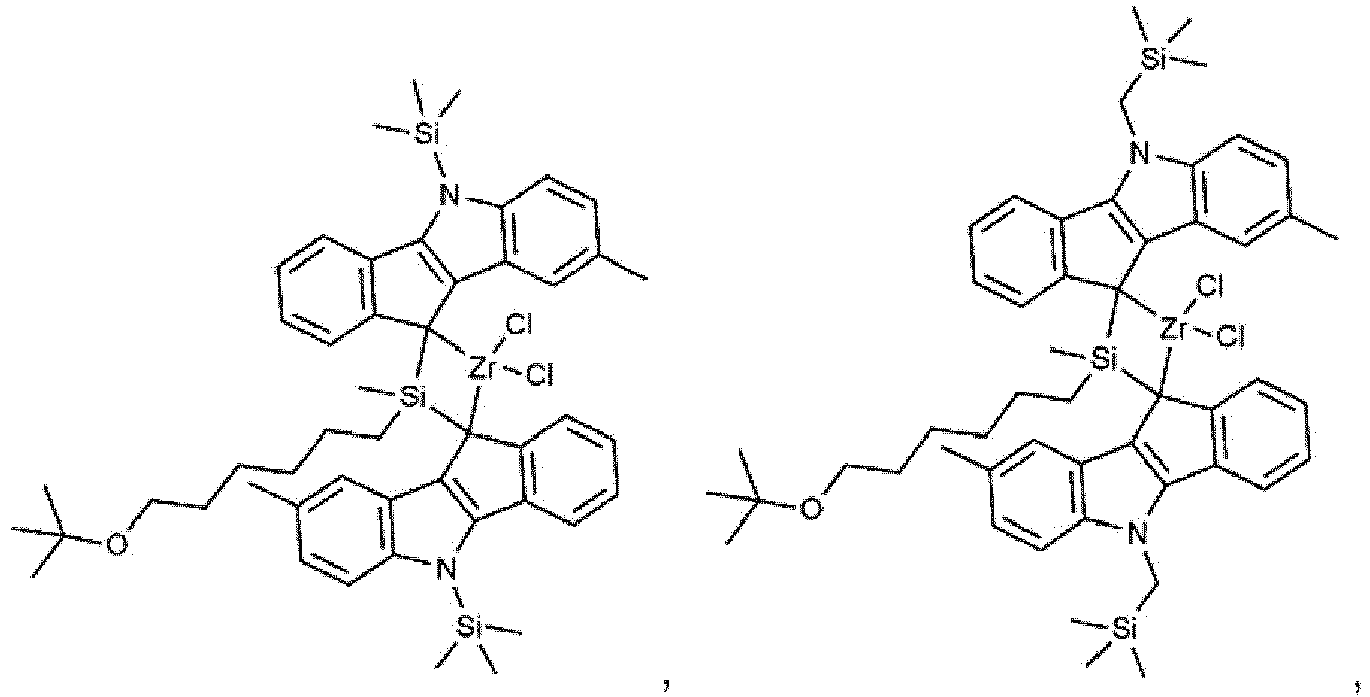

- The first metallocene compound of the Chemical Formula 1 has excellent activity and can polymerize high molecular weight ethylene/1-hexene or ethylene/1-butene copolymer. Particularly, since it exhibits high polymerization activity even when supported in a carrier, it enables preparation of ultra high molecular weight ethylene/1-hexene or ethylene/1-butene copolymer.
- Further, even in case a polymerization reaction is progressed with hydrogen so as to prepare ethylene/1-hexene or ethylene/1-butene copolymer having high molecular weight and simultaneously wide molecular weight distribution, the first metallocene compound of the Chemical Formula 1 of the present invention exhibits low hydrogen reactivity, and thus, ultra high molecular weight ethylene/1-hexene or ethylene/1-butene copolymer may be polymerized with still high activity. Thus, even if used in a mixture with catalysts having other properties, ethylene/1-hexene or ethylene/1-butene copolymer satisfying high molecular weight properties may be prepared without lowering of activity, and thus, ethylene/1-hexene or ethylene/1-butene copolymer including high molecular weight ethylene/1-hexene or ethylene/1-butene copolymer and yet having wide molecular weight distribution may be easily prepared.
- The first metallocene compound of the Chemical Formula 1 may be obtained by connecting an indenoindole derivative and/or a fluorene derivative by a bridge compound to prepare a ligand compound, and then, introducing a metal precursor compound to conduct metallation. The preparation method of the first metallocene compound will be concretely explained in examples described below.
- The compound represented by the
Chemical Formula 3 may be, for example, a compound represented by one of the following structural formulae, but is not limited thereto.


- In the Chemical Formula 4, in case m is 1, it means a bridge compound structure wherein a Cp3Rc ring and a Cp4Rd ring or a Cp4Rd ring and M2 are crosslinked by B1, and in case m is 0, it means a non-crosslinked compound structure.
- The compound represented by the Chemical Formula 4 may be, for example, a compound represented by one of the following structural formulae, but is not limited thereto.


- The compound represented by the
Chemical Formula 5 may be, for example, a compound represented by one of the following structural formulae, but is not limited thereto.


- The metallocene catalyst used in the present invention may be those wherein at least one first metallocene compound represented by the Chemical Formula 1, and at least one second metallocene compound selected from the
Chemical Formulae 3 to 5 are supported in a carrier together with a cocatalyst compound. - Further, the supported metallocene catalyst may induce the production of LCB (Long Chain Branch) in the prepared ethylene/1-hexene or ethylene/1-butene copolymer.
- In the supported metallocene catalyst according to the present invention, as the cocatalyst that is supported together with a carrier so as to activate the metallocene compound, organic metal compounds including Group 13 metal may be used without specific limitations as long as it may be used when polymerizing olefin in the presence of a common metallocene catalyst.
- Specifically, the cocatalyst compound may comprise at least one of an aluminum-containing first cocatalyst of the following Chemical Formula 6, and a borate-based second cocatalyst of the following
Chemical Formula 7.
[Chemical Formula 6] -[Al(R18)-O-]k-
in the Chemical Formula 6, - R18's are each independently halogen, or a C1-20 hydrocarbyl group unsubstituted or substituted with halogen, and
- k is an integer of 2 or more,
[Chemical Formula 7] T+[BG4]-
in theChemical Formula 7, - T+ is polyatomic ion having a valence of +1,
- B is boron in +3 oxidation state, and
- G's are each independently selected from the group consisting of hydride, dialkylamido, halide, alkoxide, aryloxide, hydrocarbyl, halocarbyl and halo-substituted hydrocarbyl, and G has 20 or less carbon, provided that G is halide in one or less position.
- Due to the use of the first and second cocatalysts, the molecular weight distribution of the finally prepared polyolefin may become more uniform, and polymerization activity may be improved.
- The first cocatalyst of the Chemical Formula 6 may be an alkyaluminoxane compound including repeat units bonded in a linear, circular or network shape, and specific examples thereof may include methylaluminoxane (MAO), ethylaluminoxane, isobutylaluminoxane, or butylaluminoxane, and the like.
- Further, the second cocatalyst of the
Chemical Formula 7 may be a borate-based compound in the form of trisubstituted ammonium salt, dialkyl ammonium salt, or trisubstituted phosphonium salt. - Specific examples of the second cocatalyst may include borate-based compounds in the form of tri-substituted ammonium salts, such as trimethylammonium tetraphenylborate, methyldioctadecylammonium tetraphenylborate, triethylammonium tetraphenylborate, tripropylammonium tetraphenylborate, tri(n-butyl)ammonium tetraphenylborate, methyltetradecyclooctadecylammonium tetraphenylborate, N,N-dimethylanilinium tetraphenylborate, N,N-diethylanilinium tetraphenylborate, N,N-dimethyl(2,4,6-trimethylanilinium)tetraphenylborate, trimethylammonium tetrakis(pentafluorophenyl)borate, methylditetradecylammonium tetrakis(pentaphenyl)borate, methyldioctadecylammonium tetrakis(pentafluorophenyl)borate, triethylammonium tetrakis(pentafluorophenyl)borate, tripropylammonium tetrakis(pentafluorophenyl)borate, tri(n-butyl)ammonium tetrakis(pentafluorophenyl)borate, tri(sec-butyl)ammonium tetrakis(pentafluorophenyl)borate, N,N-dimethylanilinium tetrakis(pentafluorophenyl)borate, N,N-diethylanilinium tetrakis(pentafluorophenyl)borate, N,N-dimethyl(2,4,6-trimethylanilinium)tetrakis(pentafluoraphenyl)borate, trimethylammonium tetrakis(2,3,4,6-tetrafluorophenyl)borate, triethylammonium tetrakis(2,3,4,6-tetrafluorophenyl)borate, tripropylammonium tetrakis(2,3,4,6-tetrafluorophenyl)borate, tri(n-butyl)ammonium tetrakis(2,3,4,6-tetrafluorophenyl)borate, dimethyl(t-butyl)ammonium tetrakis(2,3,4,6-tetrafluorophenyl)borate, N,N-dimethylanilinium tetrakis(2,3,4,6-tetrafluorophenyl)borate, N,N-diethylanilinium tetrakis(2,3,4,6-tetrafluorophenyl)borate and N,N-dimethyl-(2,4,6-trimethylanilinium)tetrakis-(2,3,4,6-tetrafluorophenyl)borate; borate-based compounds in the form of dialkyl ammonium salts, such as dioctadecylammonium tetrakis(pentafluorophenyl)borate, ditetradecylammonium tetrakis(pentafluorophenyl)borate and dicyclohexylammonium tetrakis(pentafluorophenyl)borate; and borate-based compounds such as trisubstituted phosphonium salts, such as triphenylphosphonium tetrakis(pentafluorophenyl)borate, methyldioctadecylphosphonium tetrakis(pentafluorophenyl)borate and tri(2,6-dimethylphenyl)phosphonium tetrakis(pentafluorophenyl)borate.
- In the supported metallocene catalyst according to the present invention, the weight ratio of total transition metal included in the first metallocene compound represented by the Chemical Formula 1, or the second metallocene compound represented by the
Chemical Formulae 3 to 5 to the carrier may be 1:10 to 1:1,000. When the carrier and the metallocene compound are included in the above weight ratio, the optimum shape may be exhibited. Further, the weight ratio of the cocatalyst compound to the carrier may be 1:1 to 1:100. - In the supported metallocene catalyst according to the present invention, as the carrier, those containing hydroxyl groups on the surface may be used, and preferably, dried and surface moisture-removed carriers having highly reactive hydroxyl groups and siloxane groups may be used.
- For example, silica, silica-alumina and silica-magnesia and the like dried at high temperature may be used, and they may commonly contain oxide, carbonate, sulfate, and nitrate such as Na2O, K2CO3, BaSO4, and Mg(NO3)2, and the like.
- The drying temperature of the carrier may be preferably 200 to 800°C, more preferably 300 to 600°C, and most preferably 300 to 400°C. If the drying temperature of the carrier is less than 200°C, due to excessive moisture, surface moisture may react with the cocatalyst, and if it is greater than 800°C, pores on the carrier surface may be combined to reduce the surface area, and a lot of hydroxyl groups may be lost on the surface and only siloxane groups may remain, thus decreasing the reaction sites with the cocatalyst, which is not preferable.
- The amount of the hydroxyl groups on the carrier surface may be preferably 0.1 to 10 mmol/g, more preferably 0.5 to 5 mmol/g. The amount of the hydroxyl groups on the carrier surface may be controlled by the preparation method and conditions of carrier, or drying conditions, for example, temperature, time, vacuum or spray drying and the like.
- If the amount of the hydroxyl groups are less than 0.1 mmol/g, the reaction sites with the cocatalyst may be little, and if it is greater than 10 mmol/g, there is a possibility of being derived from moisture other than hydroxyl groups on the carrier particle surface, which is not preferable.
- Meanwhile, the ethylene/1-hexene or ethylene/1-butene copolymer according to the present invention may be prepared by polymerizing ethylene, and 1-hexene or 1-butene in the presence of the above explained supported metallocene catalyst.
- The polymerization reaction may be progressed by copolymerizing ethylene and 1-hexene or 1-butene using one continuous slurry polymerization reactor, loop slurry reactor, gas phase reactor or solution reactor.
- Further, the polymerization temperature may be about 25 to about 500°C, preferably about 25 to about 200°C, more preferably about 50 to about 150°C. Further, the polymerization pressure may be about 1 to about 100 Kgf/cm2, preferably about 1 to about 50 Kgf/cm2, more preferably about 5 to about 30 Kgf/cm2.
- The supported metallocene catalyst may be dissolved or diluted in aliphatic hydrocarbon solvents having a carbon number of 5 to 12, for example, pentane, hexane, heptanes, nonane, decane and isomers thereof, aromatic hydrocarbon solvents such as toluene, benzene, chlorine-substituted hydrocarbon solvents such as dichloromethane, chlorobenzene, and the like, and introduced. It is preferable that the solvent used is treated with a small amount of alkyl aluminum, thereby removing a small amount of water or air and the like, acting as a catalytic poison, and a cocatalyst may be further used.
- The ethylene/1-hexene or ethylene/1-butene copolymer according to the present invention is prepared by copolymerizing ethylene and 1-hexene or 1-butene monomers, using the catalyst of
Chemical Formulae 3 to 5 that mainly polymerize low molecular weight polymer chain, and the catalyst of the Chemical Formula 1 that mainly polymerizes high molecular weight polymer chain. Due to the interaction of the two or more kinds of catalysts, polymer generally having wide molecular weight distribution, and including higher content of polymer chains of which Log M is in the range of 5.5~6.0 may be obtained. - As the result, the ethylene/1-hexene or ethylene/1-butene copolymer may exhibit molecular weight distribution curves as shown in
Figs. 1 and 2 , for example, and may exhibit excellent processibility due to wide molecular weight distribution, and excellent FNCT property due to the high content of polymer chains of which Log M is in the range of 5.5∼6.0. Since the ethylene/1-hexene or ethylene/1-butene copolymer according to the present invention satisfies the above properties, it has excellent processibility and formability and excellent environmental stress crack resistance, and may be preferably applied for a high inner pressure heating pipe, a mining pipe or a large diameter pipe, and the like. - The ethylene/1-hexene or ethylene/1-butene copolymer according to the present invention has high molecular weight and wide molecular weight distribution, and excellent stress crack resistance, and thus, may be applied for a high inner pressure heating pipe, a mining pipe or a large diameter pipe, and the like.
-
-
Fig. 1 shows the GPC curve of the polymers prepared in Comparative Examples and Examples of the present invention. -
Fig. 2 shows the GPC curve of the polymers prepared in Comparative Examples and Examples of the present invention. - Hereinafter, preferable examples are presented to aid in understanding of the invention. However, these examples are provided only to aid in understanding of the invention, and the scope of the invention is not limited thereto.
-

- 2 g of fluorene was dissolved in 5 mL MTBE, 100 mL hexane, and 5.5 mL of a 2.5 M n-BuLi solution in hexane was added dropwise thereto in a dry ice/acetone bath, and the solution was stirred at room temperature overnight. 3.6 g of (6-(tert-butoxy)hexyl)dichloro(methyl)silane was dissolved in 50 mL of hexane, and the fluorene-Li slurry was transferred thereto under a dry ice/acetone bath for 30 minutes, and the solution was stirred at room temperature overnight. Simultaneously, 5,8-dimethyl-5,10-dihydroindeno[1,2-b]indole (12 mmol, 2.8 g) was also dissolved in 60 mL of THF, and 5.5 mL of a 2.5 M n-BuLi solution in hexane was added dropwise thereto in a dry ice/acetone bath, and the solution was stirred at room temperature overnight. The reaction solution of fluorene and (6-(tert-butoxy)hexyl)dichloro(methyl)silane was NMR sampled to confirm the completion of the reaction, and then, the 5,8-dimethyl-5,10-dihydroindeno[1,2-b]indole-Li solution was transferred thereto under a dry ice/acetone bath. The solution was stirred at room temperature overnight. After the reaction, the solution was extracted with ether/water and remaining moisture of the organic layer was removed with MgSO4 to obtain a ligand compound (Mw 597.90, 12 mmol), and it was confirmed by 1 H-NMR that two isomers were produced.
- 1H NMR (500 MHz, d6-benzene): -0.30 ~ -0.18 (3H, d), 0.40 (2H, m), 0.65 ∼ 1.45 (8H, m), 1.12 (9H, d), 2.36 ∼ 2.40 (3H, d), 3.17 (2H, m), 3.41 ∼ 3.43 (3H, d), 4.17 ∼ 4.21 (1 H, d), 4.34 ∼ 4.38 (1 H, d), 6.90 ∼ 7.80 (15H, m)
- 7.2 g (12 mmol) of the ligand compound synthesized in 1-1 was dissolved in 50 mL of diethylether, and 11.5 mL of a 2.5 M n-BuLi solution in hexane was added dropwise thereto in a dry ice/acetone bath, and the solution was stirred at room temperature overnight. The solution was vacuum dried to obtain brown sticky oil. It was dissolved in toluene to obtain a slurry. ZrCl4(THF)2 was prepared and 50 mL of toluene was added to prepare a slurry. The 50 mL toluene slurry of ZrCl4(THF)2 was transferred under a dry ice/acetone bath. After stirring at room temperature overnight, it turned to violet color. The reaction solution was filtered to remove LiCl. The filtrate was vacuum dried to remove toluene, and then, hexane was introduced and sonication was conducted for 1 hour. The slurry was filtered to obtain filtered solid of 6 g of dark violet metallocene compound (Mw 758.02, 7.92 mmol, yield 66 mol%). Two isomers were observed in 1 H-NMR.
- 1H NMR (500 MHz, CDCl3): 1.19 (9H, d), 1.71 (3H, d), 1.50 ∼ 1.70(4H, m), 1.79(2H, m), 1.98 ∼ 2.19(4H, m), 2.58(3H, s), 3.38 (2H, m), 3.91 (3H, d), 6.66 ∼ 7.88 (15H, m)
- t-Butyl-O-(CH2)6-Cl was prepared using 6-chlorohexanol by the method suggested in the document(Tetrahedron Lett. 2951 (1988)), and NaCp was reacted therewith to obtain t-Butyl-O-(CH2)6-C5H5 (yield 60%, b.p. 80°C / 0.1 mmHg).
- Further, t-Butyl-O-(CH2)6-C5H5 was dissolved in THF at -78°C, n-BuLi was slowly added thereto, the temperature was raised to room temperature, and the solution was reacted for 8 hours. The synthesized lithium salt solution was slowly added to a suspension of ZrCl4(THF)2(1.70 g, 4.50 mmol)/THF(30 mL) at -78°C, and the solution was further reacted for 6 hours.
- All volatile materials were vacuum dried, and a hexane solvent was added to the obtained oily liquid substance to filter. The filtered solution was vacuum dried, and then, hexane was added to induce precipitation at low temperature (-20°C). The obtained precipitate was filtered at low temperature to obtain a white solid compound [tBu-O-(CH2)6-C5H4]2ZrCl2] (yield 92%).
- 1H NMR (300 MHz, CDCl3): 6.28 (t, J = 2.6 Hz, 2H), 6.19 (t, J = 2.6 Hz, 2H), 3.31 (t, 6.6 Hz, 2H), 2.62 (t, J = 8 Hz), 1.7 - 1.3 (m, 8H), 1.17 (s, 9H)
- 13C NMR (CDCl3): 135.09, 116.66, 112.28, 72.42, 61.52, 30.66, 30.61, 30.14, 29.18, 27.58, 26.00
- 50 g of Mg(s) was introduced into a 10 L reactor at room temperature, and then, THF 300 mL was added thereto. About 0.5 g of I2 was added, and then, the temperature of the reactor was maintained at 50°C. After the temperature of the reactor was stabilized, 250 g of 6-t-butoxyhexyl chloride was added to the reactor at a speed of 5 mL/ min using a feeding pump. It was observed that as 6-t-butoxyhexyl chloride was added, the temperature of the reactor increased by about 4 to 5°C. While continuously adding 6-t-butoxyhexyl chloride, the solution was stirred for 12 hours. After reaction for 12 hours, a black reaction solution was obtained. 2 mL of the produced black solution was taken, water was added thereto to obtain an organic layer, and 6-t-butoxyhexane was confirmed through 1H-NMR. From the 6-t-butoxyhexane, it could be seen that a Gringanrd reaction progressed well. Thus, 6-t-butoxyhexyl magnesium chloride was synthesized.
- 500 g of MeSiCl3 and 1 L of THF were added to a reactor, and the reactor was cooled to -20°C. 560 g of the synthesized 6-t-butoxyhexyl magnesium chloride was added to the reactor at a speed of 5 mL/min using a feeding pump. After the feeding of a Grignard reagent was completed, the solution was stirred for 12 hours while slowly raising the temperature of the reactor to room temperature. After reaction for 12 hours, it was confirmed that white MgCl2 salts were produced. 4 L of hexane was added and salts were removed through Labdori to obtain a filtered solution. The filtered solution was added to the reactor, and then, hexane was removed at 70°C to obtain light yellow liquid. It was confirmed through 1H-NMR that the obtained liquid is desired compound methyl(6-t-butoxyhexyl)dichlorosilane.
- 1H-NMR (CDCl3): 3.3 (t, 2H), 1.5 (m, 3H), 1.3 (m, 5H), 1.2 (s, 9H), 1.1 (m, 2H), 0.7 (s, 3H)
- 1.2 mol(150 g) of tetramethylcyclopentadiene and 2.4 L of THF were added to the reactor, and then, the reactor was cooled to -20°C. 480 mL of n-BuLi was added to the reactor at a speed of 5 mL/min using a feeding pump. After n-BuLi was added, the solution was stirred for 12 hours while slowly raising the temperature of the reactor. After reaction for 12 hours, an equivalent of methyl(6-t-butoxyhexyl)dichlorosilane (326 g, 350 mL) was rapidly added to the reactor. The solution was stirred for 12 hours while slowly raising the temperature of the reactor to room temperature, and then, the reactor was cooled to 0°C again, and 2 equivalents of t-BuNH2 was added. While slowly raising the temperature of the reactor to room temperature, the solution was stirred for 12 hours. After reaction for 12 hours, THF was removed, 4 L of hexane was added, and salts were removed through Labdori to obtain a filtered solution. The filtered solution was added to the reactor again, and then, hexane was removed at 70°C to obtain a yellow solution. It was confirmed through 1 H-NMR that the obtained yellow solution is methyl(6-t-butoxyhexyl)(tetramethylCpH)t-butylaminosilane).
- To the dilithium salt of ligand of -78°C synthesized from n-BuLi and ligand dimethyl(tetramethylCpH)t-butylaminosilane in a THF solution, TiCl3(THF)3(10 mmol) was rapidly added. The reaction solution was stirred for 12 hours while slowly raising the temperature from -78°C to room temperature. After stirring for 12 hours, an equivalent of PbCl2(10 mmol) was added to the reaction solution at room temperature, and the solution was stirred for 12 hours. After stirring for 12 hours, a bluish black solution was obtained. THF was removed in the produced reaction solution, and then, hexane was added to filter the product. After removing hexane in the obtained filtered solution, it was confirmed through 1H-NMR that desired methyl(6-t-butoxyhexyl)silyl(η5-tetramethylCp)(t-butylamido)]TiCl2 of tBu-O-(CH2)6)(CH3)Si(C5(CH3)4)(tBu-N)TiCl2 was obtained.
- 1H-NMR (CDCl3): 3.3 (s, 4H), 2.2 (s, 6H), 2.1 (s, 6H), 1.8 ∼ 0.8 (m), 1.4 (s, 9H), 1.2(s, 9H), 0.7 (s, 3H)
- Into a 20L sus high pressure reactor, 5.0 kg of a toluene solution was introduced and the temperature of the reactor was maintained at 40°C. 1,000 g of silica dehydrated by adding vacuum at 600°C for 12 hours (manufactured by Grace Davison Company, SYLOPOL 948) was introduced into the reactor, the silica was sufficiently dispersed, and then, 80 g of the metallocene compound of the Preparation Example 2 was dissolved in toluene and introduced, and the solution was stirred at 200 rpm for 2 hours and reacted. Thereafter, the stirring was discontinued, and the solution was settled for 30 minutes, and then, the reaction solution was decanted.
- 2.5 kg of toluene was introduced into the reactor, 9.4 kg of a 10 wt% methylaluminoxane(MAO)/toluene solution was introduced, and then, the solution was stirred at 40°C, 200 rpm for 12 hours. After the reaction, stirring was discontinued, and the solution was settled for 30 minutes, and then, the reaction solution was decanted. 3.0 kg of toluene was introduced, and the solution was stirred for 10 minutes, and then, stirring was discontinued, the solution was settled for 30 minutes, and the toluene solution was decanted.
- 3.0 kg of toluene was introduced into the reactor, 236 mL of 29.2 wt% metallocene compound of Preparation Example 3/toluene solution was introduced, and the solution was stirred at 40°C, 200 rpm for 2 hours and reacted. The temperature of the reactor was lowered to room temperature, and then, stirring was discontinued, the solution was settled for 30 minutes, and the reaction solution was decanted.
- 2.0 kg of toluene was introduced in the reactor, and the solution was stirred for 10 minutes, and then, stirring was discontinued, the solution was settled for 30 minutes, and the reaction solution was decanted.
- 3.0 kg of hexane was introduced into the reactor, the hexane slurry was transferred to a filter dryer, and the hexane solution was filtered. By drying at 40°C for 4 hours under reduced pressure, 910 g-SiO2 hybrid supported catalyst was prepared.
- Supported catalysts were prepared by the same methods as Comparative Examples 1-1 and 1-2, except that 314 mL of the metallocene compound of Preparation Example 3/toluene solution was introduced.
- Into a 20L sus high pressure reactor, 6.0 kg of a toluene solution was introduced and the temperature of the reactor was maintained at 40°C. 1,000 g of silica dehydrated by adding vacuum at 600°C for 12 hours (manufactured by Grace Davison Company, SYLOPOL 948) was introduced into the reactor, the silica was sufficiently dispersed, and then, 80 g of the metallocene compound of the Preparation Example 2 was dissolved in toluene and introduced, and the solution was stirred at 40°C for 2 hours and reacted. Thereafter, the stirring was discontinued, and the solution was settled for 30 minutes, and then, the reaction solution was decanted.
- 2.5 kg of toluene was introduced into the reactor, 9.4 kg of a 10 wt% methylaluminoxane(MAO)/toluene solution was introduced, and then, the solution was stirred at 40°C, 200 rpm for 12 hours. After the reaction, stirring was discontinued, and the solution was settled for 30 minutes, and then, the reaction solution was decanted. 3.0 kg of toluene was introduced, and the solution was stirred for 10 minutes, and then, stirring was discontinued, the solution was settled for 30 minutes, and the toluene solution was decanted.
- 3.0 kg of toluene was introduced into the reactor, 314 mL of the 29.2 wt% metallocene compound of Preparation Example 3/toluene solution was introduced, and the solution was stirred at 40°C, 200 rpm for 2 hours and reacted.
- 80 g of the metallocene compound of Preparation Example 1 and 1,000 mL of toluene were put in a flask to prepare a solution, and sonication was conducted for 30 minutes. The prepared metallocene compound of Preparation Example 1/toluene solution was introduced into the reactor, and the solution was stirred at 40°C, 200 rpm for 2 hours and reacted. The temperature of the reactor was lowered to room temperature, and then, stirring was discontinued, the solution was settled for 30 minutes, and the reaction solution was decanted.
- 2.0 kg of toluene was introduced in the reactor, and the solution was stirred for 10 minutes, and then, stirring was discontinued, the solution was settled for 30 minutes, and the reaction solution was decanted.
- 3.0 kg of hexane was introduced into the reactor, the hexane slurry was transferred to a filter dryer, and the hexane solution was filtered. By drying at 40°C for 4 hours under reduced pressure, 890 g-SiO2 hybrid supported catalyst was prepared.
- Into a 20L sus high pressure reactor, 3.0 kg of a toluene solution was introduced and the temperature of the reactor was maintained at 40°C. 500 g of silica (Grace Davison, SP2212) was introduced into the reactor, the silica was sufficiently dispersed, and then, 3.00 kg of a 10 wt% methylaluminoxane(MAO)/toluene solution was introduced, the temperature was raised to 80°C, and the solution was stirred at 200 rpm for 15 hours or more. The temperature of the reactor was lowered to 40°C again, and then, 144 g of 7.5 wt% catalyst of Preparation Example 2/toluene solution was introduced into the reactor, and the solution was stirred at 200 rpm for 1 hour. 240 g of 8.8 wt% catalyst of Preparation Example 1/toluene solution was introduced into the reactor, and the solution was stirred at 200 rpm for 1 hour. The catalyst of Preparation Example 3 (18 g) was dissolved in toluene and introduced into the reactor, and the solution was stirred at 200 rpm for 2 hours. 70 g of a cocatalyst(anilinium tetrakis(pentafluorophenyl)borate) was diluted in toluene and introduced into the reactor, and the solution was stirred at 200 rpm for 15 hours or more. The temperature of the reactor was lowered to room temperature, and then, the stirring was discontinued, the solution was settled for 30 minutes, and the reaction solution was decanted. The toluene slurry was transferred to a filter dryer and filtered. 3.0 kg of toluene was introduced and the solution was stirred for 10 minutes, and then, stirring was discontinued and the solution was filtered. 3.0 kg of hexane was introduced into the reactor, and the solution was stirred for 10 minutes, and then, stirring was discontinued and the solution was filtered. By drying at 50°C for 4 hours under reduced pressure, a 500 g-SiO2 supported catalyst was prepared.
- Into a 20L sus high pressure reactor, 3.0 kg of a toluene solution was introduced and the temperature of the reactor was maintained at 40°C. 500 g of silica (Grace Davison, SP2212) was introduced into the reactor, the silica was sufficiently dispersed, and then, 2.78 kg of 10 wt% methylaluminoxae(MAO)/toluene solution was introduced, the temperature was raised to 80°C, and the solution was stirred at 200 rpm for 15 hours. The temperature of the reactor was lowered to 40°C again, and then, 300 g of 7.5 wt% catalyst of Preparation Example 2/toluene solution was introduced into the reactor, and the solution was stirred at 200 rpm for 1 hour. 250 g of 8.8 wt% catalyst of Preparation Example 1/toluene solution was introduced into the reactor, and the solution was stirred at 200 rpm for 1 hour. The catalyst of Preparation Example 3 (20 g) was dissolved in toluene and introduced into the reactor, and the solution was stirred at 200 rpm for 2 hours. 70 g of a cocatalyst(anilinium tetrakis(pentafluorophenyl)borate) was diluted in toluene and introduced into the reactor, and the solution was stirred at 200 rpm for 15 hours or more. The temperature of the reactor was lowered to room temperature, and then, the stirring was discontinued, the solution was settled for 30 minutes, and the reaction solution was decanted. The toluene slurry was transferred to a filter dryer and filtered. 3.0 kg of toluene was introduced and the solution was stirred for 10 minutes, and then, stirring was discontinued and the solution was filtered. 3.0 kg of hexane was introduced into the reactor, and the solution was stirred for 10 minutes, and then, stirring was discontinued and the solution was filtered. By drying at 50°C for 4 hours under reduced pressure, a 500 g-SiO2 supported catalyst was prepared.
- Each hybrid supported metallocene catalyst prepared in Examples 1-1 to 1-3 and Comparative Examples 1-1 and 1-2 was introduced into an isobutene slurry loop process continuous polymerization reactor (reactor volume 140 L, reactant flow rate 7 m/s) to prepare olefin polymer. As comonomer, 1-hexene was used, and the reaction pressure was maintained at 40 bar and the polymerization temperature was maintained at 90°C.
- The polymerization conditions using each hybrid supported metallocene catalyst of Examples 1-1 to 1-3 and Comparative Examples 1-1 and 1-2 are summarized in the following Table 1.
[Table 1] Catalyst used Comparative Example 1-1 Comparative Example 1-2 Example 1-1 Example 1-2 Example 1-3 Ethylene supply amount (kg/hr) 29.7 30.0 31.2 31.1 33.0 1-hexene input (wt%) 2.1 2.2 2.5 2.5 2.9 Hydrogen input (ppm) 53 53 55 56 177 Catalytic activity (kgPE/kg cat./hr) 3.9 3.8 3.9 4.0 3.9 - With each hybrid supported metallocene catalyst prepared in Examples 2-1 to 2-3 and Comparative Example 2-1, two hexane slurry stirred tank process polymerization reactors were bimodally operated to prepare olefin polymer. As comonomer, 1-butene was used.
- The polymerization conditions using each hybrid supported metallocene catalyst of Examples 2-1 to 2-3 and Comparative Example 2-1 are summarized in the following Table 2.
[Table 2] Catalyst used Comparative Example 2-1 Example 2-1 Example 2-2 Example 2-3 R1 ethylene supply amount (kg/hr) 7.0 7.0 7.0 7.0 R1 pressure (kg/cm2) 7.1 7.5 7.2 7.9 R1 temperature (°C) 83.0 84.4 85.0 84.0 R1 hydrogen input (g/hr) 3.00 3.10 2.44 1.70 R2 ethylene supply amount (kg/hr) 6.0 6.0 6.0 6.0 R2 pressure (kg/cm2) 4.9 4.7 4.8 4.8 R2 temperature (°C) 75.1 75.2 73.0 75.0 R2 1-butene input (g/hr) 20.0 18.0 18.0 18.0 Catalytic activity (kg PE/g SiO2) 2.6 6.1 7.8 6.4 - The properties of the polymers prepared in Examples and Comparative Examples were assessed by the following method.
- 1) density: ASTM 1505
- 2) melt flow rate (MFR, 2.16 kg/21.6 kg): measurement temperature 190°C, ASTM 1238
- 3) MFRR (MFR21.6/MFR2.16): the ratio of MFR21.6 melt index (MI, 21.6kg load) divided by MFR2.16(Ml, 2.16kg load).
- 4) Mn, Mw, PDI, GPC curves: The sample was pretreated by dissolving in 1,2,4-trichlorobenzene containing 0.0125% BHT using PL-SP260 at 160°C for 10 hours, and number average molecular weight and weight average molecular weight were measured at measurement temperature of 160°C using PL-GPC220. The molecular weight distribution was expressed as the ratio of weight average molecular weight and number average molecular weight.
- 5) FNCT (Full Notch Creep Test): measured according to ISO 16770, as conducted until now and described in a document [M.Fleissner in Kunststoffe 77 (1987), pp. 45 et seq.]. At 10% concentration of IGEPAL CO-630 (Etoxilated Nonylphenol, Branched), a stress crack accelerating medium using tension of 4.0 MPa at 80°C, due to the shortening of stress initiation time by notch (1.5 mm/safety razor blade), damage time was shortened. The test specimens were manufactured by sawing three test specimens of width 10 mm, height 10 mm, length 100 mm from compression-moulded sheet of 10 mm thickness. In a notch device specifically prepared for this purpose, a center notch was provided to the sample using safety razor blade. The notch depth is 1.5 mm. The time taken until the specimen was cut was measured.
- The results are shown in the following Tables 3 and 4. Further, the GPC curves of each polymer are shown in
Figs. 1 and 2 .[Table 3] Unit Comparative Example 1-1 Comparative Example 1-2 Example 1-1 Example 1-2 Example 1-3 Density g/cm3 0.941 0.941 0.941 0.941 0.941 MFR2.16 g/10 min 0.63 0.56 0.55 0.56 0.41 HLMI - 20.7 18.9 17.4 18.2 49.1 MFRR21.6/2.16 - 33 34 32 33 120 Mn - 40,000 36,300 36,100 31,600 14,200 Mw - 150,000 137,000 145,000 132,000 128,000 MWD - 3.74 3.77 4.02 4.18 9.05 FNCT hr 300 400 2,000 2,000 3,000 GPC curve Fig. 1 [Table 4] Unit Comparative Example 2-1 Example 2-1 Example 2-2 Example 2-3 Density g/cm3 0.9432 0.9448 0.9457 0.9443 MFR5 g/10 min a.31 . 0.23 0.17 0.24 HLMI - 10.1 7.5 5.3 7.1 MFRR21.6/5 - 33 33 31 29 Mn - 12,500 11,100 12,800 11,600 Mw - 219,000 239,000 245,000 242,000 MWD - 17.52 21.54 19.18 20.85 FNCT hr 380 3,000 650 2,000 GPC curve Fig. 2 - First, it was confirmed that the contents of polymer parts (log M=5~6) of Examples increased compared to each Comparative Example, as shown in
Fig. 1 and Fig. 2 . Particularly, it was confirmed that in case GPC curves are similar, even slight change in the contents of polymer parts (log M=5~6) has large influence on FNCT (Table 3 and Table 4).


Claims (13)
- An ethylene/1-hexene or ethylene/1-butene copolymer having
weight average molecular weight(g/mol) of 10,000 to 400,000,
molecular weight distribution (Mw/Mn, PDI) of 2 to 30, and
environmental stress crack resistance (ESCR) of 400 hours to 20,000 hours, as measured by full notch creep test (FNCT) according to ISO 16770 at 4.0 MPa and 80°C. - The copolymer according to claim 1,
wherein the environmental stress crack resistance (ESCR) measured by full notch creep test (FNCT) according to ISO 16770 at 4.0 MPa and 80°C is 600 hours to 8,760 hours. - The copolymer according to claim 1,
wherein the ethylene/1-hexene copolymer has a density (g/cm3) of 0.930 to 0.950, MFR2.16 (g/10 min, measured at 190°C by ASTM 1238) of 0.1 to 5, and melt flow rate ratio (MFR21.6/MFR2.16, measured at 190°C by ASTM 1238) of 10 to 200. - The copolymer according to claim 3,
wherein the weight average molecular weight is 50,000 to 350,000 g/mol. - The copolymer according to claim 3,
wherein the molecular weight distribution is 3 to 25. - The copolymer according to claim 3,
wherein MFR2.16 is 0.1 to 3 g/10 min. - The copolymer according to claim 3,
wherein the melt flow rate ratio is 15 to 180. - The copolymer according to claim 1,
wherein the ethylenel1-butene copolymer has density (g/cm3) of 0.930 to 0.950, MFR5(g/10 min, measured at 190°C by ASTM 1238) of 0.1 to 5, and melt flow rate ratio (MFR21.6/MFR5, measured at 190°C by ASTM 1238) of 10 to 200. - The copolymer according to claim 8,
wherein the weight average molecular weight is 50,000 to 350,000 g/mol. - The copolymer according to claim 8,
wherein the molecular weight distribution is 7 to 28. - The copolymer according to claim 8,
wherein the MFR5 is 0.1 to 3. - The copolymer according to claim 8,
wherein the melt flow rate ratio is 15 to 180. - The copolymer according to claim 1,
wherein the ethylene/1-hexene or ethylene/1-butene copolymer is prepared by polymerizing ethylene and 1-hexene or 1-butene, in the presence of at least one first metallocene compound represented by the following Chemical Formula 1; and at least one second metallocene compound selected from the compounds represented by the following Chemical Formulae 3 to 5: A is hydrogen, halogen, C1-20 alkyl, C2-20 alkenyl, C6-20 aryl, C7-20 alkylaryl, C7-20 arylalkyl, C1-20 alkoxy, C2-20 alkoxyalkyl, C3-20 heterocycloalkyl, or C5-20 heteroaryl;D is -O-, -S-, -N(R)- or -Si(R)(R')-, wherein R and R' are identical to or different from each other, and are each independently hydrogen, halogen, C1-20 alkyl, C2-20 alkenyl, or C6-20 aryl;L is C1-10 linear or branched alkylene;B is carbon, silicon or germanium;Q is hydrogen, halogen, C1-20 alkyl, C2-20 alkenyl, C6-20 aryl, C7-20 alkylaryl, or C7-20 arylalkyl;M is Group 4 transition metal;X1 and X2 are identical to or different from each other, and are each independently halogen, C1-20 alkyl, C2-20 alkenyl, C6-20 aryl, nitro, amido, C1-20 alkylsilyl, C1-20 alkoxy, or C1-20 sulfonate;C1 and C2 are identical to or different from each other, and are each independently represented by one of the following Chemical Formula 2a, Chemical Formula 2b or Chemical Formula 2c, provided that both C1 and C2 are not Chemical Formula 2c;


 R1 to R17 and R1' to R9' are identical to or different from each other, and are each independently hydrogen, halogen, 61-20 alkyl, C2-20 alkenyl, C1-20 alkylsilyl, C1-20 silylalkyl, C1-20 alkoxysilyl, C1-20 alkoxy, C6-20 aryl, C7-20 alkylaryl, or C7-20 arylalkyl, and two or more neighboring groups of R10 to R17 may be connected to each other to form a substituted or unsubstituted aliphatic or aromatic ring;
[Chemical Formula 3] (Cp1Ra)n(Cp2Rb)M1Z1 3-n
in the Chemical Formula 3,M1 is Group 4 transition metal;Cp1 and Cp2 are identical to or different from each other, and are each independently one selected from the group consisting of cyclopentadienyl, indenyl, 4,5,6,7-tetrahydro-1-indenyl, and fluorenyl radicals, which may be substituted with hydrocarbon having a carbon number of 1 to 20;Ra and Rb are identical to or different from each other, and are each independently hydrogen, C1-20 alkyl, C1-10 alkoxy, C2-20 alkoxyalkyl, C6-20 aryl, C6-10 aryloxy, C2-20 alkenyl, C7-40 alkylaryl, C7-40 arylalkyl, C8-40 arylalkenyl, or C2-10 alkynyl;Z1 is a halogen atom, C1-20 alkyl, C2-10 alkenyl, C7-40 alkylaryl, C7-40 arylalkyl, C6-20 aryl, substituted or unsubstituted C1-20 alkylidene, or substituted or unsubstituted amino, C2-20 alkylalkoxy, or C7-40 arylalkoxy;n is 1 or 0;
[Chemical Formula 4] (Cp3Rc)mB1(Cp4Rd)M2Z2 3-m
in the Chemical Formula 4,M2 is Group 4 transition metal;Cp3 and Cp4 are identical to or different from each other, and are each independently one selected from the group consisting of cyclopentadienyl, indenyl, 4,5,6,7-tetrahydro-1-indenyl and fluorenyl radicals, which may be substituted with hydrocarbon having a carbon number of 1 to 20;Rc and Rd are identical to or different from each other, and are each independently hydrogen, C1-20 alkyl, C1-10 alkoxy, C2-20 alkoxyalkyl, C6-20 aryl, C6-10 aryloxy, C2-20 alkenyl, C7-40 alkylaryl, C7-40 arylalkyl, C8-40 arylalkenyl, or C2-10 alkynyl;Z2 is a halogen atom, C1-20 alkyl, C2-10 alkenyl, C7-40 alkylaryl, C7-40 arylalkyl, C6-20 aryl, substituted or unsubstituted C1-20 alkylidene, or substituted or unsubstituted amino, C2-20 alkylalkoxy, or C7-40 arylalkoxy;B1 is one or more of carbon, germanium, silicon, phosphorus or nitrogen-containing radical, or a combination thereof, which crosslinks a Cp3Rc ring with a Cp4Rd ring, or crosslinks one Cp4Rd ring to M2-,m is 1 or 0;
[Chemical Formula 5] (Cp5Re)B2(J)M3Z3 2
in the Chemical Formula 5,M3 is Group 4 transition metal;Cp5 is one selected from the group consisting of cyclopentadienyl, indenyl, 4,5,6,7-tetrahydro-1-indenyl and fluorenyl radicals, which may be substituted with hydrocarbon having a carbon number of 1 to 20;Re is hydrogen, C1-20 alkyl, C1-10 alkoxy, C2-20 alkoxyalkyl, C6-20 aryl, C6-10 aryloxy, C2-20 alkenyl, C7-40 alkylaryl, C7-40 arylalkyl, C8-40 arylalkenyl, or C2-10 alkynyl;Z3 is a halogen atom, C1-20 alkyl, C2-10 alkenyl, C7-40 alkylaryl, C7-40 arylalkyl, C6-20 aryl, substituted or unsubstituted 61-20 alkylidene, substituted or unsubstituted amino, C2-20 alkylalkoxy, or C7-40 arylalkoxy;B2 is one or more of carbon, germanium, silicon, phosphorus or nitrogen-containing radicals or a combination thereof, which crosslinks a Cp5Re ring with J; andJ is one selected from the group consisting of NRf, O, PRf and S, wherein Rf is C1-20 alkyl, aryl, substituted alkyl, or substituted aryl.
Applications Claiming Priority (3)
| Application Number | Priority Date | Filing Date | Title |
|---|---|---|---|
| KR20140137868 | 2014-10-13 | ||
| KR20140137867 | 2014-10-13 | ||
| PCT/KR2015/010788 WO2016060445A1 (en) | 2014-10-13 | 2015-10-13 | Ethylene/1-hexene or ethylene/1-butene copolymer having outstanding working properties and environmental stress cracking resistance |
Publications (3)
| Publication Number | Publication Date |
|---|---|
| EP3056524A1 true EP3056524A1 (en) | 2016-08-17 |
| EP3056524A4 EP3056524A4 (en) | 2017-07-19 |
| EP3056524B1 EP3056524B1 (en) | 2021-09-22 |
Family
ID=55917998
Family Applications (1)
| Application Number | Title | Priority Date | Filing Date |
|---|---|---|---|
| EP15850164.3A Active EP3056524B1 (en) | 2014-10-13 | 2015-10-13 | Ethylene/1-butene copolymer having excellent processibility and environmental stress cracking resistance |
Country Status (6)
| Country | Link |
|---|---|
| US (1) | US9732172B2 (en) |
| EP (1) | EP3056524B1 (en) |
| JP (1) | JP6487924B2 (en) |
| KR (1) | KR101726820B1 (en) |
| CN (1) | CN105814101B (en) |
| RU (1) | RU2640045C1 (en) |
Cited By (5)
| Publication number | Priority date | Publication date | Assignee | Title |
|---|---|---|---|---|
| EP3070108A4 (en) * | 2014-12-08 | 2017-07-26 | LG Chem, Ltd. | Ethylene/alpha-olefin copolymer having excellent processability |
| EP3168243A4 (en) * | 2014-09-05 | 2018-01-03 | LG Chem, Ltd. | Olefin-based polymer with excellent processability |
| EP3480221A4 (en) * | 2016-11-08 | 2019-07-17 | LG Chem, Ltd. | ETHYLENE / ALPHA-OLEFIN COPOLYMER |
| EP3712182A4 (en) * | 2017-12-21 | 2021-01-06 | Lg Chem, Ltd. | ETHYLENE / 1-BUTENE COPOLYMER WITH EXCELLENT PROCESSABILITY |
| RU2782607C2 (en) * | 2017-12-21 | 2022-10-31 | ЭлДжи КЕМ, ЛТД. | Ethylene/1-butene copolymer with excellent recyclability |
Families Citing this family (22)
| Publication number | Priority date | Publication date | Assignee | Title |
|---|---|---|---|---|
| KR102174389B1 (en) * | 2016-10-13 | 2020-11-04 | 주식회사 엘지화학 | Ethylene/alpha-olefin copolymer having excellent environmental stress crack resistance |
| KR102228534B1 (en) * | 2016-10-27 | 2021-03-15 | 주식회사 엘지화학 | Ethylene/alpha-olefin copolymer having an excellent environmental stress crack resistance |
| KR102090812B1 (en) * | 2016-11-15 | 2020-03-18 | 주식회사 엘지화학 | Ethylene/alpha-olefin copolymer having excellent processibility |
| EP3415540B1 (en) * | 2016-11-15 | 2022-09-14 | LG Chem, Ltd. | Ethylene/alpha-olefin copolymer having excellent environmental stress crack resistance |
| KR102072697B1 (en) | 2016-12-09 | 2020-02-03 | 주식회사 엘지화학 | Ethylene/1-hexene copolymer having excellent processibility and physical property |
| KR102215630B1 (en) * | 2016-12-13 | 2021-02-10 | 주식회사 엘지화학 | Hybride supported metallocene catalysts |
| KR102234944B1 (en) * | 2016-12-13 | 2021-03-31 | 주식회사 엘지화학 | Olefin copolymer |
| KR102229002B1 (en) * | 2016-12-14 | 2021-03-16 | 주식회사 엘지화학 | Ethylene/alpha-olefin copolymer having excellent processibility and environmental stress crack resistance |
| KR102211603B1 (en) * | 2017-02-28 | 2021-02-02 | 주식회사 엘지화학 | Catalyst composition for polymerizing olefin copolymer and preparation method of olefin copolymer |
| WO2019125065A1 (en) * | 2017-12-21 | 2019-06-27 | 주식회사 엘지화학 | Ethylene/1-butene copolymer having excellent processability |
| CN112752771B (en) * | 2018-08-29 | 2023-05-23 | 尤尼威蒂恩技术有限责任公司 | Bimodal polyethylene copolymers and films thereof |
| CN113195559B (en) * | 2018-12-20 | 2024-01-19 | Sabic环球技术有限责任公司 | High temperature resistant piping containing ethylene-based polymers |
| CN113348321B (en) | 2019-02-20 | 2022-12-06 | 株式会社Lg化学 | Crosslinked polyethylene pipe having excellent physical properties |
| EP3909988B1 (en) | 2019-02-20 | 2025-12-03 | LG Chem, Ltd. | Polyethylene having high degree of crosslinking and cross-linked polyethylene pipe comprising same |
| KR102178361B1 (en) * | 2019-02-20 | 2020-11-12 | 주식회사 엘지화학 | Polyethylene with high degree of crosslinking and Crosslinked polyethylene pipe comprising the same |
| KR102178360B1 (en) * | 2019-02-20 | 2020-11-12 | 주식회사 엘지화학 | Polyethylene with high pressure resistance and Crosslinked polyethylene pipe comprising the same |
| KR102526767B1 (en) * | 2019-09-30 | 2023-04-27 | 주식회사 엘지화학 | ethylene/1-hexene copolymer having excellent long term property and processibility |
| WO2021251766A1 (en) * | 2020-06-10 | 2021-12-16 | 주식회사 엘지화학 | Polyethylene and its chlorinated polyethylene |
| CA3187544A1 (en) * | 2020-08-05 | 2022-02-10 | Mohamed Esseghir | Thermoplastic compositions comprising bimodal polyethylene and articles manufactured therefrom |
| JP7362192B2 (en) * | 2020-09-29 | 2023-10-17 | エルジー・ケム・リミテッド | Ethylene/1-hexene copolymer with excellent workability and processability |
| WO2022071738A1 (en) | 2020-09-29 | 2022-04-07 | 주식회사 엘지화학 | Polyethylene and method for preparing same |
| WO2022177348A1 (en) * | 2021-02-19 | 2022-08-25 | 주식회사 엘지화학 | Polyethylene for making fiber and preparation method therefor |
Family Cites Families (64)
| Publication number | Priority date | Publication date | Assignee | Title |
|---|---|---|---|---|
| US4935474A (en) | 1983-06-06 | 1990-06-19 | Exxon Research & Engineering Company | Process and catalyst for producing polyethylene having a broad molecular weight distribution |
| US7153909B2 (en) * | 1994-11-17 | 2006-12-26 | Dow Global Technologies Inc. | High density ethylene homopolymers and blend compositions |
| FI101546B (en) | 1994-12-16 | 1998-07-15 | Borealis Polymers Oy | Polyeteenikompositio |
| US5914289A (en) | 1996-02-19 | 1999-06-22 | Fina Research, S.A. | Supported metallocene-alumoxane catalysts for the preparation of polyethylene having a broad monomodal molecular weight distribution |
| GB9712663D0 (en) * | 1997-06-16 | 1997-08-20 | Borealis As | Process |
| JP4540755B2 (en) | 1997-11-12 | 2010-09-08 | バセル テクノロジー カンパニー ベスローテン フェンノートシャップ | Catalysts for metallocene and olefin polymerization |
| SE9803501D0 (en) * | 1998-10-14 | 1998-10-14 | Borealis Polymers Oy | Polymer composition for pipes |
| SE9804407D0 (en) * | 1998-12-18 | 1998-12-18 | Borealis Polymers Oy | A multimodal polymer composition |
| US6274684B1 (en) | 1999-10-22 | 2001-08-14 | Univation Technologies, Llc | Catalyst composition, method of polymerization, and polymer therefrom |
| US7829646B2 (en) | 2000-08-18 | 2010-11-09 | Chevron Phillips Chemical Company Lp | Olefin polymers, method of making, and use thereof |
| EP1201713A1 (en) * | 2000-10-27 | 2002-05-02 | ATOFINA Research | Polyethylene pipe resins and production thereof |
| EP1231238A1 (en) * | 2001-02-08 | 2002-08-14 | Borealis Technology Oy | Multimodal polyethylene resin composition for fibre supporting elements for fibre optic cables |
| JP4020862B2 (en) | 2001-07-19 | 2007-12-12 | ユニベーション・テクノロジーズ・エルエルシー | Mixed metallocene catalyst system containing comonomer minor incorporation catalyst and comonomer major incorporation catalyst |
| EP1287969A1 (en) * | 2001-08-24 | 2003-03-05 | Atofina Research S.A. | Injection blow moulded metallocene polyethylene container |
| US6756455B2 (en) | 2002-05-31 | 2004-06-29 | Equistar Chemicals, Lp | High-temperature solution process for polyolefin manufacture |
| KR20050024287A (en) | 2002-05-31 | 2005-03-10 | 에퀴스타 케미칼즈, 엘피 | High-temperature olefin polymerisation process in solution |
| KR20040076965A (en) | 2003-02-27 | 2004-09-04 | 호남석유화학 주식회사 | A supported multinuclear metallocene catalysts for olefin polymerization and a process for preparing the same |
| ATE347569T1 (en) * | 2003-08-20 | 2006-12-15 | Basell Poliolefine Srl | METHOD AND DEVICE FOR POLYMERIZING ETHYLENE |
| US7529410B2 (en) * | 2004-01-07 | 2009-05-05 | Microsoft Corporation | Local localization using fast image match |
| DE602004004065T2 (en) * | 2004-03-12 | 2007-05-10 | Borealis Technology Oy | LLDPE pressure tube |
| EP1584852B1 (en) * | 2004-04-03 | 2011-10-19 | Borealis Technology Oy | A pressureless polymer pipe |
| KR100646249B1 (en) * | 2004-04-08 | 2006-11-23 | 주식회사 엘지화학 | Polyethylene for water supply pipe with excellent processability and pressure resistance characteristics using hybrid supported metallocene catalyst and its manufacturing method |
| PT1655334E (en) * | 2004-11-03 | 2007-03-30 | Borealis Tech Oy | Multimodal polyethylene composition with improved homogeneity |
| ES2276211T3 (en) * | 2004-11-03 | 2007-06-16 | Borealis Technology Oy | COMPOSITION OF POLYMERS FOR INJECTION MOLDING. |
| KR100753477B1 (en) * | 2005-01-31 | 2007-08-31 | 주식회사 엘지화학 | Mixed supported metallocene catalyst, preparation method thereof, polyolefin manufactured using same and preparation method thereof |
| KR100753478B1 (en) * | 2005-02-15 | 2007-08-31 | 주식회사 엘지화학 | Hybrid supported metallocene catalyst and method for producing polyethylene copolymer using same |
| US7189675B2 (en) | 2005-03-07 | 2007-03-13 | Equistar Chemicals, Lp | Olefin polymerization catalyst on plasma-contacted support |
| PL1712574T3 (en) * | 2005-04-12 | 2008-08-29 | Borealis Tech Oy | Polyethylene film with improved processability and mechanical properties |
| PT1719788E (en) * | 2005-05-06 | 2008-10-28 | Borealis Tech Oy | Polyethylene resin with narrow particle size distribution |
| ES2357363T3 (en) | 2005-05-10 | 2011-04-25 | Ineos Europe Limited | NEW COPOLYMERS. |
| DE602005011421D1 (en) * | 2005-06-30 | 2009-01-15 | Borealis Tech Oy | Plating layer for power or communication cables |
| ATE427329T1 (en) * | 2005-06-30 | 2009-04-15 | Borealis Tech Oy | POLYETHYLENE COMPOSITION WITH IMPROVED PROCESSABILITY |
| JP2007218324A (en) * | 2006-02-15 | 2007-08-30 | Mitsui Chemicals Inc | Polyethylene pipe |
| EP1927626B1 (en) * | 2006-12-01 | 2009-10-28 | Borealis Technology Oy | Multimodal polyethylene resin for pipe made by a single-site catalyst |
| DE602008001250D1 (en) | 2007-02-01 | 2010-06-24 | Basell Polyolefine Gmbh | ONMODE COPOLYMER OF ETHYLENE FOR INJECTION MOLDING AND METHOD FOR THE PRODUCTION THEREOF |
| ES2334267T5 (en) | 2007-04-25 | 2013-06-03 | Borealis Technology Oy | Tube comprising a polyethylene resistant to the development of extra slow cracks |
| WO2008136621A1 (en) | 2007-05-02 | 2008-11-13 | Lg Chem, Ltd. | Polyolefin and preparation method thereof |
| US7723451B2 (en) | 2007-09-04 | 2010-05-25 | Equistar Chemicals, Lp | Olefin polymerization process |
| US7781549B2 (en) | 2007-09-04 | 2010-08-24 | Equistar Chemicals, Lp | Olefin polymerization process |
| US7655740B2 (en) | 2007-09-04 | 2010-02-02 | Equistar Chemicals, Lp | Olefin polymerization process |
| EP2130863A1 (en) * | 2008-06-02 | 2009-12-09 | Borealis AG | High density polymer compositions, a method for their preparation and pressure-resistant pipes made therefrom |
| DK2367863T3 (en) | 2008-12-04 | 2013-01-07 | Saudi Basic Ind Corp | Polyethylene for the production of medium bulk cargo containers |
| CN102421808B (en) | 2009-05-07 | 2015-04-08 | Lg化学株式会社 | Olefin polymer and fiber including same |
| KR101154507B1 (en) | 2009-07-31 | 2012-06-13 | 주식회사 엘지화학 | Metallocene compounds, catalyst composition comprising the same, and method for preparation of olefin-based polymer using the same |
| KR101299650B1 (en) * | 2009-08-10 | 2013-08-23 | 주식회사 엘지화학 | Polyolefin with multi-modal molecular weight distributions and preparation method thereof |
| CN102686616A (en) | 2009-11-06 | 2012-09-19 | Lg化学株式会社 | Mixed metallocene catalyst composition and method of making polyolefins using same |
| KR101366215B1 (en) | 2010-09-16 | 2014-02-21 | 주식회사 엘지화학 | Preparation method of poly-olefin |
| EP2501729B1 (en) | 2009-11-20 | 2015-08-26 | Basell Polyolefine GmbH | Novel trimodal polyethylene for use in blow moulding |
| JP2011144157A (en) | 2009-12-18 | 2011-07-28 | Japan Polypropylene Corp | Metallocene compound and polymerization method of olefin |
| JP5688320B2 (en) | 2010-04-06 | 2015-03-25 | 日本ポリエチレン株式会社 | Polyethylene resin molding material for container lid |
| EP2407506A1 (en) | 2010-07-13 | 2012-01-18 | Borealis AG | Pipes made from a polyethylene copolymer with slow crack growth |
| CN103492431B (en) | 2011-03-30 | 2016-08-10 | 日本聚乙烯株式会社 | Ethylene-based polymer, the manufacture method of ethylene-based polymer and the manufacture method of catalyst for polymerization and the hollow plastic molded article comprising ethylene-based polymer and application thereof |
| GB2498936A (en) | 2012-01-31 | 2013-08-07 | Norner Innovation As | Polyethylene with multi-modal molecular weight distribution |
| JP2013227545A (en) * | 2012-03-28 | 2013-11-07 | Japan Polyethylene Corp | Polyethylene for pipe and joint, and molded product thereof |
| ES2657137T5 (en) * | 2012-03-28 | 2025-02-12 | Borealis Ag | Multimodal polymer |
| KR101437509B1 (en) | 2012-12-03 | 2014-09-03 | 대림산업 주식회사 | Catalyst composition for preparing multimodal polyolefin resin having superior moldability and mechanical properties and polymerization method using the same |
| ES2538590T3 (en) * | 2012-12-19 | 2015-06-22 | Borealis Ag | Polyethylene blend with enhanced ESCR |
| JP2014189615A (en) * | 2013-03-27 | 2014-10-06 | Japan Polyethylene Corp | Polyethylene for pipe and joint, and its molded body |
| KR101623485B1 (en) | 2013-08-01 | 2016-05-23 | 주식회사 엘지화학 | Metallocene compound, catalyst composition comprising the same, and method for preparation of olefin-based polymer using the same |
| KR101650092B1 (en) | 2013-08-01 | 2016-08-22 | 주식회사 엘지화학 | Metallocene compound, catalyst composition comprising the same, and method for preparation of olefin-based polymer using the same |
| ES2710671T3 (en) * | 2014-04-23 | 2019-04-26 | Total Res & Technology Feluy | Tube comprising a polyethylene resin catalyzed by metallocene |
| WO2016036204A1 (en) | 2014-09-05 | 2016-03-10 | 주식회사 엘지화학 | Olefin-based polymer with excellent processability |
| KR101617870B1 (en) | 2014-09-05 | 2016-05-03 | 주식회사 엘지화학 | Olefin based polymer having excellent processibility |
| KR101747401B1 (en) * | 2014-12-08 | 2017-06-14 | 주식회사 엘지화학 | Ethylene/alpha-olefin copolymer having excellent processibility |
-
2015
- 2015-10-13 RU RU2016125864A patent/RU2640045C1/en active
- 2015-10-13 CN CN201580002923.3A patent/CN105814101B/en active Active
- 2015-10-13 JP JP2016541701A patent/JP6487924B2/en active Active
- 2015-10-13 US US15/035,099 patent/US9732172B2/en active Active
- 2015-10-13 KR KR1020150142491A patent/KR101726820B1/en active Active
- 2015-10-13 EP EP15850164.3A patent/EP3056524B1/en active Active
Cited By (8)
| Publication number | Priority date | Publication date | Assignee | Title |
|---|---|---|---|---|
| EP3168243A4 (en) * | 2014-09-05 | 2018-01-03 | LG Chem, Ltd. | Olefin-based polymer with excellent processability |
| US10344102B2 (en) | 2014-09-05 | 2019-07-09 | Lg Chem, Ltd. | Olefin-based polymer with excellent processability |
| EP3070108A4 (en) * | 2014-12-08 | 2017-07-26 | LG Chem, Ltd. | Ethylene/alpha-olefin copolymer having excellent processability |
| EP3480221A4 (en) * | 2016-11-08 | 2019-07-17 | LG Chem, Ltd. | ETHYLENE / ALPHA-OLEFIN COPOLYMER |
| US10858465B2 (en) | 2016-11-08 | 2020-12-08 | Lg Chem, Ltd. | Ethylene/alpha-olefin copolymer |
| EP3712182A4 (en) * | 2017-12-21 | 2021-01-06 | Lg Chem, Ltd. | ETHYLENE / 1-BUTENE COPOLYMER WITH EXCELLENT PROCESSABILITY |
| US11472949B2 (en) | 2017-12-21 | 2022-10-18 | Lg Chem, Ltd. | Ethylene/1-butene copolymer having excellent processability |
| RU2782607C2 (en) * | 2017-12-21 | 2022-10-31 | ЭлДжи КЕМ, ЛТД. | Ethylene/1-butene copolymer with excellent recyclability |
Also Published As
| Publication number | Publication date |
|---|---|
| KR20160043516A (en) | 2016-04-21 |
| CN105814101A (en) | 2016-07-27 |
| EP3056524A4 (en) | 2017-07-19 |
| RU2640045C1 (en) | 2017-12-26 |
| US20160280822A1 (en) | 2016-09-29 |
| KR101726820B1 (en) | 2017-04-13 |
| CN105814101B (en) | 2018-03-02 |
| JP6487924B2 (en) | 2019-03-20 |
| US9732172B2 (en) | 2017-08-15 |
| JP2017530201A (en) | 2017-10-12 |
| EP3056524B1 (en) | 2021-09-22 |
Similar Documents
| Publication | Publication Date | Title |
|---|---|---|
| EP3056524B1 (en) | Ethylene/1-butene copolymer having excellent processibility and environmental stress cracking resistance | |
| EP3168243B1 (en) | Olefin-based polymer with excellent processability | |
| EP3130616B1 (en) | Polyolefin having excellent environmental stress crack resistance | |
| US9926395B2 (en) | Hybrid supported metallocene catalyst | |
| EP3106474B1 (en) | Method of preparing a polyolefin | |
| US10323110B2 (en) | Ethylene/alpha-olefin copolymer having excellent processability | |
| US9902789B2 (en) | Method for preparing hybrid supported metallocene catalyst | |
| US10669363B2 (en) | Catalyst composition for synthesizing olefin copolymer and method for preparing olefin copolymer | |
| KR101691628B1 (en) | Method for preparing polyolfin and polyolefin prepared therefrom | |
| US11472949B2 (en) | Ethylene/1-butene copolymer having excellent processability | |
| EP3225638B1 (en) | Ethylene/ -olefin copolymer having excellent processability and surface characteristics | |
| EP3476870B1 (en) | Method for preparing an olefin polymer | |
| WO2016060445A1 (en) | Ethylene/1-hexene or ethylene/1-butene copolymer having outstanding working properties and environmental stress cracking resistance |
Legal Events
| Date | Code | Title | Description |
|---|---|---|---|
| PUAI | Public reference made under article 153(3) epc to a published international application that has entered the european phase |
Free format text: ORIGINAL CODE: 0009012 |
|
| 17P | Request for examination filed |
Effective date: 20160502 |
|
| AK | Designated contracting states |
Kind code of ref document: A1 Designated state(s): AL AT BE BG CH CY CZ DE DK EE ES FI FR GB GR HR HU IE IS IT LI LT LU LV MC MK MT NL NO PL PT RO RS SE SI SK SM TR |
|
| AX | Request for extension of the european patent |
Extension state: BA ME |
|
| A4 | Supplementary search report drawn up and despatched |
Effective date: 20170621 |
|
| RIC1 | Information provided on ipc code assigned before grant |
Ipc: C08F 4/6592 20060101ALI20170614BHEP Ipc: C08L 23/16 20060101ALI20170614BHEP Ipc: C08F 210/16 20060101AFI20170614BHEP Ipc: C08F 4/64 20060101ALI20170614BHEP Ipc: C08L 23/08 20060101ALI20170614BHEP |
|
| DAV | Request for validation of the european patent (deleted) | ||
| DAX | Request for extension of the european patent (deleted) | ||
| STAA | Information on the status of an ep patent application or granted ep patent |
Free format text: STATUS: EXAMINATION IS IN PROGRESS |
|
| 17Q | First examination report despatched |
Effective date: 20180302 |
|
| GRAP | Despatch of communication of intention to grant a patent |
Free format text: ORIGINAL CODE: EPIDOSNIGR1 |
|
| STAA | Information on the status of an ep patent application or granted ep patent |
Free format text: STATUS: GRANT OF PATENT IS INTENDED |
|
| GRAJ | Information related to disapproval of communication of intention to grant by the applicant or resumption of examination proceedings by the epo deleted |
Free format text: ORIGINAL CODE: EPIDOSDIGR1 |
|
| GRAP | Despatch of communication of intention to grant a patent |
Free format text: ORIGINAL CODE: EPIDOSNIGR1 |
|
| GRAJ | Information related to disapproval of communication of intention to grant by the applicant or resumption of examination proceedings by the epo deleted |
Free format text: ORIGINAL CODE: EPIDOSDIGR1 |
|
| GRAP | Despatch of communication of intention to grant a patent |
Free format text: ORIGINAL CODE: EPIDOSNIGR1 |
|
| GRAJ | Information related to disapproval of communication of intention to grant by the applicant or resumption of examination proceedings by the epo deleted |
Free format text: ORIGINAL CODE: EPIDOSDIGR1 |
|
| GRAP | Despatch of communication of intention to grant a patent |
Free format text: ORIGINAL CODE: EPIDOSNIGR1 |
|
| GRAJ | Information related to disapproval of communication of intention to grant by the applicant or resumption of examination proceedings by the epo deleted |
Free format text: ORIGINAL CODE: EPIDOSDIGR1 |
|
| STAA | Information on the status of an ep patent application or granted ep patent |
Free format text: STATUS: EXAMINATION IS IN PROGRESS |
|
| INTG | Intention to grant announced |
Effective date: 20210311 |
|
| INTG | Intention to grant announced |
Effective date: 20210319 |
|
| INTG | Intention to grant announced |
Effective date: 20210319 |
|
| INTG | Intention to grant announced |
Effective date: 20210329 |
|
| GRAP | Despatch of communication of intention to grant a patent |
Free format text: ORIGINAL CODE: EPIDOSNIGR1 |
|
| INTG | Intention to grant announced |
Effective date: 20210329 |
|
| STAA | Information on the status of an ep patent application or granted ep patent |
Free format text: STATUS: GRANT OF PATENT IS INTENDED |
|
| INTC | Intention to grant announced (deleted) | ||
| INTG | Intention to grant announced |
Effective date: 20210506 |
|
| GRAS | Grant fee paid |
Free format text: ORIGINAL CODE: EPIDOSNIGR3 |
|
| GRAA | (expected) grant |
Free format text: ORIGINAL CODE: 0009210 |
|
| STAA | Information on the status of an ep patent application or granted ep patent |
Free format text: STATUS: THE PATENT HAS BEEN GRANTED |
|
| AK | Designated contracting states |
Kind code of ref document: B1 Designated state(s): AL AT BE BG CH CY CZ DE DK EE ES FI FR GB GR HR HU IE IS IT LI LT LU LV MC MK MT NL NO PL PT RO RS SE SI SK SM TR |
|
| REG | Reference to a national code |
Ref country code: GB Ref legal event code: FG4D |
|
| REG | Reference to a national code |
Ref country code: DE Ref legal event code: R096 Ref document number: 602015073581 Country of ref document: DE |
|
| REG | Reference to a national code |
Ref country code: IE Ref legal event code: FG4D |
|
| REG | Reference to a national code |
Ref country code: CH Ref legal event code: EP Ref country code: AT Ref legal event code: REF Ref document number: 1432301 Country of ref document: AT Kind code of ref document: T Effective date: 20211015 |
|
| REG | Reference to a national code |
Ref country code: LT Ref legal event code: MG9D |
|
| REG | Reference to a national code |
Ref country code: NL Ref legal event code: MP Effective date: 20210922 |
|
| PG25 | Lapsed in a contracting state [announced via postgrant information from national office to epo] |
Ref country code: SE Free format text: LAPSE BECAUSE OF FAILURE TO SUBMIT A TRANSLATION OF THE DESCRIPTION OR TO PAY THE FEE WITHIN THE PRESCRIBED TIME-LIMIT Effective date: 20210922 Ref country code: RS Free format text: LAPSE BECAUSE OF FAILURE TO SUBMIT A TRANSLATION OF THE DESCRIPTION OR TO PAY THE FEE WITHIN THE PRESCRIBED TIME-LIMIT Effective date: 20210922 Ref country code: HR Free format text: LAPSE BECAUSE OF FAILURE TO SUBMIT A TRANSLATION OF THE DESCRIPTION OR TO PAY THE FEE WITHIN THE PRESCRIBED TIME-LIMIT Effective date: 20210922 Ref country code: BG Free format text: LAPSE BECAUSE OF FAILURE TO SUBMIT A TRANSLATION OF THE DESCRIPTION OR TO PAY THE FEE WITHIN THE PRESCRIBED TIME-LIMIT Effective date: 20211222 Ref country code: LT Free format text: LAPSE BECAUSE OF FAILURE TO SUBMIT A TRANSLATION OF THE DESCRIPTION OR TO PAY THE FEE WITHIN THE PRESCRIBED TIME-LIMIT Effective date: 20210922 Ref country code: NO Free format text: LAPSE BECAUSE OF FAILURE TO SUBMIT A TRANSLATION OF THE DESCRIPTION OR TO PAY THE FEE WITHIN THE PRESCRIBED TIME-LIMIT Effective date: 20211222 Ref country code: FI Free format text: LAPSE BECAUSE OF FAILURE TO SUBMIT A TRANSLATION OF THE DESCRIPTION OR TO PAY THE FEE WITHIN THE PRESCRIBED TIME-LIMIT Effective date: 20210922 |
|
| REG | Reference to a national code |
Ref country code: AT Ref legal event code: MK05 Ref document number: 1432301 Country of ref document: AT Kind code of ref document: T Effective date: 20210922 |
|
| PG25 | Lapsed in a contracting state [announced via postgrant information from national office to epo] |
Ref country code: LV Free format text: LAPSE BECAUSE OF FAILURE TO SUBMIT A TRANSLATION OF THE DESCRIPTION OR TO PAY THE FEE WITHIN THE PRESCRIBED TIME-LIMIT Effective date: 20210922 Ref country code: GR Free format text: LAPSE BECAUSE OF FAILURE TO SUBMIT A TRANSLATION OF THE DESCRIPTION OR TO PAY THE FEE WITHIN THE PRESCRIBED TIME-LIMIT Effective date: 20211223 |
|
| PG25 | Lapsed in a contracting state [announced via postgrant information from national office to epo] |
Ref country code: AT Free format text: LAPSE BECAUSE OF FAILURE TO SUBMIT A TRANSLATION OF THE DESCRIPTION OR TO PAY THE FEE WITHIN THE PRESCRIBED TIME-LIMIT Effective date: 20210922 |
|
| REG | Reference to a national code |
Ref country code: CH Ref legal event code: PL |
|
| PG25 | Lapsed in a contracting state [announced via postgrant information from national office to epo] |
Ref country code: IS Free format text: LAPSE BECAUSE OF FAILURE TO SUBMIT A TRANSLATION OF THE DESCRIPTION OR TO PAY THE FEE WITHIN THE PRESCRIBED TIME-LIMIT Effective date: 20220122 Ref country code: SK Free format text: LAPSE BECAUSE OF FAILURE TO SUBMIT A TRANSLATION OF THE DESCRIPTION OR TO PAY THE FEE WITHIN THE PRESCRIBED TIME-LIMIT Effective date: 20210922 Ref country code: RO Free format text: LAPSE BECAUSE OF FAILURE TO SUBMIT A TRANSLATION OF THE DESCRIPTION OR TO PAY THE FEE WITHIN THE PRESCRIBED TIME-LIMIT Effective date: 20210922 Ref country code: PT Free format text: LAPSE BECAUSE OF FAILURE TO SUBMIT A TRANSLATION OF THE DESCRIPTION OR TO PAY THE FEE WITHIN THE PRESCRIBED TIME-LIMIT Effective date: 20220124 Ref country code: PL Free format text: LAPSE BECAUSE OF FAILURE TO SUBMIT A TRANSLATION OF THE DESCRIPTION OR TO PAY THE FEE WITHIN THE PRESCRIBED TIME-LIMIT Effective date: 20210922 Ref country code: NL Free format text: LAPSE BECAUSE OF FAILURE TO SUBMIT A TRANSLATION OF THE DESCRIPTION OR TO PAY THE FEE WITHIN THE PRESCRIBED TIME-LIMIT Effective date: 20210922 Ref country code: ES Free format text: LAPSE BECAUSE OF FAILURE TO SUBMIT A TRANSLATION OF THE DESCRIPTION OR TO PAY THE FEE WITHIN THE PRESCRIBED TIME-LIMIT Effective date: 20210922 Ref country code: EE Free format text: LAPSE BECAUSE OF FAILURE TO SUBMIT A TRANSLATION OF THE DESCRIPTION OR TO PAY THE FEE WITHIN THE PRESCRIBED TIME-LIMIT Effective date: 20210922 Ref country code: CZ Free format text: LAPSE BECAUSE OF FAILURE TO SUBMIT A TRANSLATION OF THE DESCRIPTION OR TO PAY THE FEE WITHIN THE PRESCRIBED TIME-LIMIT Effective date: 20210922 Ref country code: AL Free format text: LAPSE BECAUSE OF FAILURE TO SUBMIT A TRANSLATION OF THE DESCRIPTION OR TO PAY THE FEE WITHIN THE PRESCRIBED TIME-LIMIT Effective date: 20210922 |
|
| REG | Reference to a national code |
Ref country code: DE Ref legal event code: R026 Ref document number: 602015073581 Country of ref document: DE |
|
| REG | Reference to a national code |
Ref country code: BE Ref legal event code: MM Effective date: 20211031 |
|
| PLBI | Opposition filed |
Free format text: ORIGINAL CODE: 0009260 |
|
| PG25 | Lapsed in a contracting state [announced via postgrant information from national office to epo] |
Ref country code: MC Free format text: LAPSE BECAUSE OF FAILURE TO SUBMIT A TRANSLATION OF THE DESCRIPTION OR TO PAY THE FEE WITHIN THE PRESCRIBED TIME-LIMIT Effective date: 20210922 |
|
| PLAX | Notice of opposition and request to file observation + time limit sent |
Free format text: ORIGINAL CODE: EPIDOSNOBS2 |
|
| 26 | Opposition filed |
Opponent name: BOREALIS AG Effective date: 20220621 |
|
| PG25 | Lapsed in a contracting state [announced via postgrant information from national office to epo] |
Ref country code: LU Free format text: LAPSE BECAUSE OF NON-PAYMENT OF DUE FEES Effective date: 20211013 Ref country code: DK Free format text: LAPSE BECAUSE OF FAILURE TO SUBMIT A TRANSLATION OF THE DESCRIPTION OR TO PAY THE FEE WITHIN THE PRESCRIBED TIME-LIMIT Effective date: 20210922 Ref country code: BE Free format text: LAPSE BECAUSE OF NON-PAYMENT OF DUE FEES Effective date: 20211031 |
|
| PG25 | Lapsed in a contracting state [announced via postgrant information from national office to epo] |
Ref country code: LI Free format text: LAPSE BECAUSE OF NON-PAYMENT OF DUE FEES Effective date: 20211031 Ref country code: CH Free format text: LAPSE BECAUSE OF NON-PAYMENT OF DUE FEES Effective date: 20211031 |
|
| PG25 | Lapsed in a contracting state [announced via postgrant information from national office to epo] |
Ref country code: IE Free format text: LAPSE BECAUSE OF NON-PAYMENT OF DUE FEES Effective date: 20211013 |
|
| PLBB | Reply of patent proprietor to notice(s) of opposition received |
Free format text: ORIGINAL CODE: EPIDOSNOBS3 |
|
| PG25 | Lapsed in a contracting state [announced via postgrant information from national office to epo] |
Ref country code: SI Free format text: LAPSE BECAUSE OF FAILURE TO SUBMIT A TRANSLATION OF THE DESCRIPTION OR TO PAY THE FEE WITHIN THE PRESCRIBED TIME-LIMIT Effective date: 20210922 |
|
| PG25 | Lapsed in a contracting state [announced via postgrant information from national office to epo] |
Ref country code: IT Free format text: LAPSE BECAUSE OF FAILURE TO SUBMIT A TRANSLATION OF THE DESCRIPTION OR TO PAY THE FEE WITHIN THE PRESCRIBED TIME-LIMIT Effective date: 20210922 |
|
| PLAB | Opposition data, opponent's data or that of the opponent's representative modified |
Free format text: ORIGINAL CODE: 0009299OPPO |
|
| PG25 | Lapsed in a contracting state [announced via postgrant information from national office to epo] |
Ref country code: HU Free format text: LAPSE BECAUSE OF FAILURE TO SUBMIT A TRANSLATION OF THE DESCRIPTION OR TO PAY THE FEE WITHIN THE PRESCRIBED TIME-LIMIT; INVALID AB INITIO Effective date: 20151013 |
|
| R26 | Opposition filed (corrected) |
Opponent name: BOREALIS AG Effective date: 20220621 |
|
| P01 | Opt-out of the competence of the unified patent court (upc) registered |
Effective date: 20230523 |
|
| PG25 | Lapsed in a contracting state [announced via postgrant information from national office to epo] |
Ref country code: CY Free format text: LAPSE BECAUSE OF FAILURE TO SUBMIT A TRANSLATION OF THE DESCRIPTION OR TO PAY THE FEE WITHIN THE PRESCRIBED TIME-LIMIT Effective date: 20210922 |
|
| PG25 | Lapsed in a contracting state [announced via postgrant information from national office to epo] |
Ref country code: SM Free format text: LAPSE BECAUSE OF FAILURE TO SUBMIT A TRANSLATION OF THE DESCRIPTION OR TO PAY THE FEE WITHIN THE PRESCRIBED TIME-LIMIT Effective date: 20210922 |
|
| PG25 | Lapsed in a contracting state [announced via postgrant information from national office to epo] |
Ref country code: MK Free format text: LAPSE BECAUSE OF FAILURE TO SUBMIT A TRANSLATION OF THE DESCRIPTION OR TO PAY THE FEE WITHIN THE PRESCRIBED TIME-LIMIT Effective date: 20210922 |
|
| PLCK | Communication despatched that opposition was rejected |
Free format text: ORIGINAL CODE: EPIDOSNREJ1 |
|
| PG25 | Lapsed in a contracting state [announced via postgrant information from national office to epo] |
Ref country code: TR Free format text: LAPSE BECAUSE OF FAILURE TO SUBMIT A TRANSLATION OF THE DESCRIPTION OR TO PAY THE FEE WITHIN THE PRESCRIBED TIME-LIMIT Effective date: 20210922 |
|
| APBP | Date of receipt of notice of appeal recorded |
Free format text: ORIGINAL CODE: EPIDOSNNOA2O |
|
| APAH | Appeal reference modified |
Free format text: ORIGINAL CODE: EPIDOSCREFNO |
|
| REG | Reference to a national code |
Ref country code: DE Ref legal event code: R100 Ref document number: 602015073581 Country of ref document: DE |
|
| APBU | Appeal procedure closed |
Free format text: ORIGINAL CODE: EPIDOSNNOA9O |
|
| PLBN | Opposition rejected |
Free format text: ORIGINAL CODE: 0009273 |
|
| STAA | Information on the status of an ep patent application or granted ep patent |
Free format text: STATUS: OPPOSITION REJECTED |
|
| PG25 | Lapsed in a contracting state [announced via postgrant information from national office to epo] |
Ref country code: MT Free format text: LAPSE BECAUSE OF FAILURE TO SUBMIT A TRANSLATION OF THE DESCRIPTION OR TO PAY THE FEE WITHIN THE PRESCRIBED TIME-LIMIT Effective date: 20210922 |
|
| 27O | Opposition rejected |
Effective date: 20240903 |
|
| PGFP | Annual fee paid to national office [announced via postgrant information from national office to epo] |
Ref country code: GB Payment date: 20250922 Year of fee payment: 11 |
|
| PGFP | Annual fee paid to national office [announced via postgrant information from national office to epo] |
Ref country code: FR Payment date: 20250925 Year of fee payment: 11 |
|
| PGFP | Annual fee paid to national office [announced via postgrant information from national office to epo] |
Ref country code: DE Payment date: 20250922 Year of fee payment: 11 |