EP3055312B1 - Novel ligand for detection of chromium (iii) and a process for the preparation thereof - Google Patents
Novel ligand for detection of chromium (iii) and a process for the preparation thereof Download PDFInfo
- Publication number
- EP3055312B1 EP3055312B1 EP14805683.1A EP14805683A EP3055312B1 EP 3055312 B1 EP3055312 B1 EP 3055312B1 EP 14805683 A EP14805683 A EP 14805683A EP 3055312 B1 EP3055312 B1 EP 3055312B1
- Authority
- EP
- European Patent Office
- Prior art keywords
- solution
- iii
- ligand
- formula
- group
- Prior art date
- Legal status (The legal status is an assumption and is not a legal conclusion. Google has not performed a legal analysis and makes no representation as to the accuracy of the status listed.)
- Not-in-force
Links
- BFGKITSFLPAWGI-UHFFFAOYSA-N chromium(3+) Chemical compound [Cr+3] BFGKITSFLPAWGI-UHFFFAOYSA-N 0.000 title claims description 71
- 239000003446 ligand Substances 0.000 title claims description 63
- 238000000034 method Methods 0.000 title claims description 38
- 238000001514 detection method Methods 0.000 title claims description 24
- 230000008569 process Effects 0.000 title claims description 21
- 238000002360 preparation method Methods 0.000 title claims description 7
- 239000000243 solution Substances 0.000 claims description 58
- WEVYAHXRMPXWCK-UHFFFAOYSA-N Acetonitrile Chemical group CC#N WEVYAHXRMPXWCK-UHFFFAOYSA-N 0.000 claims description 55
- 239000011651 chromium Substances 0.000 claims description 35
- 229920002113 octoxynol Polymers 0.000 claims description 29
- XLYOFNOQVPJJNP-UHFFFAOYSA-N water Substances O XLYOFNOQVPJJNP-UHFFFAOYSA-N 0.000 claims description 27
- LFQSCWFLJHTTHZ-UHFFFAOYSA-N Ethanol Chemical compound CCO LFQSCWFLJHTTHZ-UHFFFAOYSA-N 0.000 claims description 24
- OKKJLVBELUTLKV-UHFFFAOYSA-N Methanol Chemical compound OC OKKJLVBELUTLKV-UHFFFAOYSA-N 0.000 claims description 24
- LENZDBCJOHFCAS-UHFFFAOYSA-N tris Chemical compound OCC(N)(CO)CO LENZDBCJOHFCAS-UHFFFAOYSA-N 0.000 claims description 24
- 239000012736 aqueous medium Substances 0.000 claims description 23
- 239000007983 Tris buffer Substances 0.000 claims description 22
- -1 amino ethylene rhodamine derivative Chemical class 0.000 claims description 22
- ZMANZCXQSJIPKH-UHFFFAOYSA-N Triethylamine Chemical compound CCN(CC)CC ZMANZCXQSJIPKH-UHFFFAOYSA-N 0.000 claims description 21
- HEDRZPFGACZZDS-UHFFFAOYSA-N Chloroform Chemical compound ClC(Cl)Cl HEDRZPFGACZZDS-UHFFFAOYSA-N 0.000 claims description 18
- 125000002837 carbocyclic group Chemical group 0.000 claims description 16
- 239000011550 stock solution Substances 0.000 claims description 15
- PYWVYCXTNDRMGF-UHFFFAOYSA-N rhodamine B Chemical class [Cl-].C=12C=CC(=[N+](CC)CC)C=C2OC2=CC(N(CC)CC)=CC=C2C=1C1=CC=CC=C1C(O)=O PYWVYCXTNDRMGF-UHFFFAOYSA-N 0.000 claims description 13
- 239000000872 buffer Substances 0.000 claims description 12
- 229910052751 metal Inorganic materials 0.000 claims description 12
- 239000002184 metal Substances 0.000 claims description 12
- 238000010992 reflux Methods 0.000 claims description 11
- 239000002904 solvent Substances 0.000 claims description 10
- CYNYIHKIEHGYOZ-UHFFFAOYSA-N 1-bromopropane Chemical compound CCCBr CYNYIHKIEHGYOZ-UHFFFAOYSA-N 0.000 claims description 9
- IAZDPXIOMUYVGZ-UHFFFAOYSA-N Dimethylsulphoxide Chemical compound CS(C)=O IAZDPXIOMUYVGZ-UHFFFAOYSA-N 0.000 claims description 9
- BHELZAPQIKSEDF-UHFFFAOYSA-N allyl bromide Chemical compound BrCC=C BHELZAPQIKSEDF-UHFFFAOYSA-N 0.000 claims description 9
- 150000001875 compounds Chemical class 0.000 claims description 9
- 125000004169 (C1-C6) alkyl group Chemical group 0.000 claims description 8
- 239000000203 mixture Substances 0.000 claims description 8
- 239000003960 organic solvent Substances 0.000 claims description 8
- 229920006395 saturated elastomer Polymers 0.000 claims description 8
- CPELXLSAUQHCOX-UHFFFAOYSA-M Bromide Chemical compound [Br-] CPELXLSAUQHCOX-UHFFFAOYSA-M 0.000 claims description 6
- PIICEJLVQHRZGT-UHFFFAOYSA-N Ethylenediamine Chemical compound NCCN PIICEJLVQHRZGT-UHFFFAOYSA-N 0.000 claims description 6
- KFZMGEQAYNKOFK-UHFFFAOYSA-N Isopropanol Chemical compound CC(C)O KFZMGEQAYNKOFK-UHFFFAOYSA-N 0.000 claims description 6
- ZMXDDKWLCZADIW-UHFFFAOYSA-N N,N-Dimethylformamide Chemical compound CN(C)C=O ZMXDDKWLCZADIW-UHFFFAOYSA-N 0.000 claims description 6
- LRHPLDYGYMQRHN-UHFFFAOYSA-N N-Butanol Chemical compound CCCCO LRHPLDYGYMQRHN-UHFFFAOYSA-N 0.000 claims description 6
- WYURNTSHIVDZCO-UHFFFAOYSA-N Tetrahydrofuran Chemical compound C1CCOC1 WYURNTSHIVDZCO-UHFFFAOYSA-N 0.000 claims description 6
- BDERNNFJNOPAEC-UHFFFAOYSA-N propan-1-ol Chemical compound CCCO BDERNNFJNOPAEC-UHFFFAOYSA-N 0.000 claims description 6
- 238000001228 spectrum Methods 0.000 claims description 6
- 125000003118 aryl group Chemical group 0.000 claims description 5
- 125000001295 dansyl group Chemical group [H]C1=C([H])C(N(C([H])([H])[H])C([H])([H])[H])=C2C([H])=C([H])C([H])=C(C2=C1[H])S(*)(=O)=O 0.000 claims description 5
- 125000002496 methyl group Chemical group [H]C([H])([H])* 0.000 claims description 5
- 229940086542 triethylamine Drugs 0.000 claims description 5
- ODWNBAWYDSWOAF-UHFFFAOYSA-N 2,4,4-trimethylpentan-2-yloxybenzene Chemical compound CC(C)(C)CC(C)(C)OC1=CC=CC=C1 ODWNBAWYDSWOAF-UHFFFAOYSA-N 0.000 claims description 3
- VYZAMTAEIAYCRO-UHFFFAOYSA-N Chromium Chemical compound [Cr] VYZAMTAEIAYCRO-UHFFFAOYSA-N 0.000 claims description 3
- 239000002202 Polyethylene glycol Substances 0.000 claims description 3
- 150000001347 alkyl bromides Chemical class 0.000 claims description 3
- 229910052804 chromium Inorganic materials 0.000 claims description 3
- 238000002156 mixing Methods 0.000 claims description 3
- 239000003495 polar organic solvent Substances 0.000 claims description 3
- 229920001223 polyethylene glycol Polymers 0.000 claims description 3
- 239000007788 liquid Substances 0.000 claims description 2
- FAPWRFPIFSIZLT-UHFFFAOYSA-M Sodium chloride Chemical compound [Na+].[Cl-] FAPWRFPIFSIZLT-UHFFFAOYSA-M 0.000 description 18
- 239000002609 medium Substances 0.000 description 18
- 229940043267 rhodamine b Drugs 0.000 description 14
- 229910001914 chlorine tetroxide Inorganic materials 0.000 description 12
- VLTRZXGMWDSKGL-UHFFFAOYSA-M perchlorate Chemical compound [O-]Cl(=O)(=O)=O VLTRZXGMWDSKGL-UHFFFAOYSA-M 0.000 description 12
- 239000000523 sample Substances 0.000 description 11
- 238000004448 titration Methods 0.000 description 11
- 230000015572 biosynthetic process Effects 0.000 description 10
- 239000011780 sodium chloride Substances 0.000 description 9
- QKNYBSVHEMOAJP-UHFFFAOYSA-N 2-amino-2-(hydroxymethyl)propane-1,3-diol;hydron;chloride Chemical compound Cl.OCC(N)(CO)CO QKNYBSVHEMOAJP-UHFFFAOYSA-N 0.000 description 8
- HEDRZPFGACZZDS-MICDWDOJSA-N Trichloro(2H)methane Chemical compound [2H]C(Cl)(Cl)Cl HEDRZPFGACZZDS-MICDWDOJSA-N 0.000 description 8
- 238000010521 absorption reaction Methods 0.000 description 8
- 239000007864 aqueous solution Substances 0.000 description 8
- 229910021645 metal ion Inorganic materials 0.000 description 8
- 239000003153 chemical reaction reagent Substances 0.000 description 7
- 238000000295 emission spectrum Methods 0.000 description 7
- XEKOWRVHYACXOJ-UHFFFAOYSA-N Ethyl acetate Chemical compound CCOC(C)=O XEKOWRVHYACXOJ-UHFFFAOYSA-N 0.000 description 6
- 238000004458 analytical method Methods 0.000 description 6
- VLKZOEOYAKHREP-UHFFFAOYSA-N n-Hexane Chemical compound CCCCCC VLKZOEOYAKHREP-UHFFFAOYSA-N 0.000 description 6
- 230000003595 spectral effect Effects 0.000 description 6
- YMWUJEATGCHHMB-UHFFFAOYSA-N Dichloromethane Chemical compound ClCCl YMWUJEATGCHHMB-UHFFFAOYSA-N 0.000 description 5
- 230000008859 change Effects 0.000 description 5
- 238000000111 isothermal titration calorimetry Methods 0.000 description 5
- 238000001644 13C nuclear magnetic resonance spectroscopy Methods 0.000 description 4
- 238000001157 Fourier transform infrared spectrum Methods 0.000 description 4
- VYPSYNLAJGMNEJ-UHFFFAOYSA-N Silicium dioxide Chemical compound O=[Si]=O VYPSYNLAJGMNEJ-UHFFFAOYSA-N 0.000 description 4
- 239000000741 silica gel Substances 0.000 description 4
- 229910002027 silica gel Inorganic materials 0.000 description 4
- 238000003786 synthesis reaction Methods 0.000 description 4
- 239000008399 tap water Substances 0.000 description 4
- 235000020679 tap water Nutrition 0.000 description 4
- CZDYPVPMEAXLPK-UHFFFAOYSA-N tetramethylsilane Chemical compound C[Si](C)(C)C CZDYPVPMEAXLPK-UHFFFAOYSA-N 0.000 description 4
- 238000005160 1H NMR spectroscopy Methods 0.000 description 3
- HEMHJVSKTPXQMS-UHFFFAOYSA-M Sodium hydroxide Chemical compound [OH-].[Na+] HEMHJVSKTPXQMS-UHFFFAOYSA-M 0.000 description 3
- 239000007853 buffer solution Substances 0.000 description 3
- JOPOVCBBYLSVDA-UHFFFAOYSA-N chromium(6+) Chemical compound [Cr+6] JOPOVCBBYLSVDA-UHFFFAOYSA-N 0.000 description 3
- 238000004440 column chromatography Methods 0.000 description 3
- 230000000694 effects Effects 0.000 description 3
- 238000002330 electrospray ionisation mass spectrometry Methods 0.000 description 3
- 230000005284 excitation Effects 0.000 description 3
- 238000004128 high performance liquid chromatography Methods 0.000 description 3
- 238000003384 imaging method Methods 0.000 description 3
- 238000004020 luminiscence type Methods 0.000 description 3
- 239000002736 nonionic surfactant Substances 0.000 description 3
- 238000006862 quantum yield reaction Methods 0.000 description 3
- 238000007614 solvation Methods 0.000 description 3
- 230000005526 G1 to G0 transition Effects 0.000 description 2
- 239000007832 Na2SO4 Substances 0.000 description 2
- PMZURENOXWZQFD-UHFFFAOYSA-L Sodium Sulfate Chemical compound [Na+].[Na+].[O-]S([O-])(=O)=O PMZURENOXWZQFD-UHFFFAOYSA-L 0.000 description 2
- 239000013504 Triton X-100 Substances 0.000 description 2
- 229920004890 Triton X-100 Polymers 0.000 description 2
- 230000002411 adverse Effects 0.000 description 2
- 239000003513 alkali Substances 0.000 description 2
- 229910052784 alkaline earth metal Inorganic materials 0.000 description 2
- 150000001342 alkaline earth metals Chemical class 0.000 description 2
- 150000001336 alkenes Chemical class 0.000 description 2
- 239000012062 aqueous buffer Substances 0.000 description 2
- 210000004027 cell Anatomy 0.000 description 2
- ZCDOYSPFYFSLEW-UHFFFAOYSA-N chromate(2-) Chemical compound [O-][Cr]([O-])(=O)=O ZCDOYSPFYFSLEW-UHFFFAOYSA-N 0.000 description 2
- 229910001430 chromium ion Inorganic materials 0.000 description 2
- 238000002265 electronic spectrum Methods 0.000 description 2
- 238000002474 experimental method Methods 0.000 description 2
- 238000000605 extraction Methods 0.000 description 2
- 239000012847 fine chemical Substances 0.000 description 2
- 239000012530 fluid Substances 0.000 description 2
- 230000003834 intracellular effect Effects 0.000 description 2
- 239000012528 membrane Substances 0.000 description 2
- 150000002739 metals Chemical class 0.000 description 2
- 238000012544 monitoring process Methods 0.000 description 2
- 150000002823 nitrates Chemical class 0.000 description 2
- 239000012299 nitrogen atmosphere Substances 0.000 description 2
- 239000012044 organic layer Substances 0.000 description 2
- VLTRZXGMWDSKGL-UHFFFAOYSA-N perchloric acid Chemical class OCl(=O)(=O)=O VLTRZXGMWDSKGL-UHFFFAOYSA-N 0.000 description 2
- 238000000425 proton nuclear magnetic resonance spectrum Methods 0.000 description 2
- 239000011541 reaction mixture Substances 0.000 description 2
- 150000003839 salts Chemical class 0.000 description 2
- 229910052938 sodium sulfate Inorganic materials 0.000 description 2
- 230000007928 solubilization Effects 0.000 description 2
- 238000005063 solubilization Methods 0.000 description 2
- 238000004611 spectroscopical analysis Methods 0.000 description 2
- 239000007858 starting material Substances 0.000 description 2
- 238000003756 stirring Methods 0.000 description 2
- 239000004094 surface-active agent Substances 0.000 description 2
- 230000009897 systematic effect Effects 0.000 description 2
- 238000004809 thin layer chromatography Methods 0.000 description 2
- 229910052723 transition metal Inorganic materials 0.000 description 2
- 150000003624 transition metals Chemical class 0.000 description 2
- NLMDJJTUQPXZFG-UHFFFAOYSA-N 1,4,10,13-tetraoxa-7,16-diazacyclooctadecane Chemical compound C1COCCOCCNCCOCCOCCN1 NLMDJJTUQPXZFG-UHFFFAOYSA-N 0.000 description 1
- NBQXYAJLUDQSNV-UHFFFAOYSA-N 1-[(4-methylphenyl)methyl]-5-oxopyrrolidine-3-carboxylic acid Chemical compound C1=CC(C)=CC=C1CN1C(=O)CC(C(O)=O)C1 NBQXYAJLUDQSNV-UHFFFAOYSA-N 0.000 description 1
- 238000005033 Fourier transform infrared spectroscopy Methods 0.000 description 1
- 238000005481 NMR spectroscopy Methods 0.000 description 1
- 102100027340 Slit homolog 2 protein Human genes 0.000 description 1
- 101710133576 Slit homolog 2 protein Proteins 0.000 description 1
- 238000002835 absorbance Methods 0.000 description 1
- 238000000862 absorption spectrum Methods 0.000 description 1
- 229910052788 barium Inorganic materials 0.000 description 1
- 230000004888 barrier function Effects 0.000 description 1
- PSIBWKDABMPMJN-UHFFFAOYSA-L cadmium(2+);diperchlorate Chemical compound [Cd+2].[O-]Cl(=O)(=O)=O.[O-]Cl(=O)(=O)=O PSIBWKDABMPMJN-UHFFFAOYSA-L 0.000 description 1
- 229910052792 caesium Inorganic materials 0.000 description 1
- 229910001490 caesium perchlorate Inorganic materials 0.000 description 1
- 229910052791 calcium Inorganic materials 0.000 description 1
- 125000004432 carbon atom Chemical group C* 0.000 description 1
- 238000001460 carbon-13 nuclear magnetic resonance spectrum Methods 0.000 description 1
- 150000001768 cations Chemical class 0.000 description 1
- 210000000170 cell membrane Anatomy 0.000 description 1
- 210000003850 cellular structure Anatomy 0.000 description 1
- 230000004700 cellular uptake Effects 0.000 description 1
- 238000002512 chemotherapy Methods 0.000 description 1
- 229910052802 copper Inorganic materials 0.000 description 1
- 239000012043 crude product Substances 0.000 description 1
- 238000010586 diagram Methods 0.000 description 1
- 238000001035 drying Methods 0.000 description 1
- 239000011263 electroactive material Substances 0.000 description 1
- 238000000921 elemental analysis Methods 0.000 description 1
- 239000003480 eluent Substances 0.000 description 1
- 238000004992 fast atom bombardment mass spectroscopy Methods 0.000 description 1
- 230000002349 favourable effect Effects 0.000 description 1
- KTWOOEGAPBSYNW-UHFFFAOYSA-N ferrocene Chemical compound [Fe+2].C=1C=C[CH-]C=1.C=1C=C[CH-]C=1 KTWOOEGAPBSYNW-UHFFFAOYSA-N 0.000 description 1
- 238000001917 fluorescence detection Methods 0.000 description 1
- 238000002866 fluorescence resonance energy transfer Methods 0.000 description 1
- 230000002209 hydrophobic effect Effects 0.000 description 1
- 239000012216 imaging agent Substances 0.000 description 1
- 239000004615 ingredient Substances 0.000 description 1
- 238000002347 injection Methods 0.000 description 1
- 239000007924 injection Substances 0.000 description 1
- 150000002500 ions Chemical class 0.000 description 1
- 229910052742 iron Inorganic materials 0.000 description 1
- 229910021644 lanthanide ion Inorganic materials 0.000 description 1
- 229910052747 lanthanoid Inorganic materials 0.000 description 1
- 239000010410 layer Substances 0.000 description 1
- 229910052745 lead Inorganic materials 0.000 description 1
- 229910052744 lithium Inorganic materials 0.000 description 1
- 229910001486 lithium perchlorate Inorganic materials 0.000 description 1
- MHCFAGZWMAWTNR-UHFFFAOYSA-M lithium perchlorate Chemical compound [Li+].[O-]Cl(=O)(=O)=O MHCFAGZWMAWTNR-UHFFFAOYSA-M 0.000 description 1
- 229910052749 magnesium Inorganic materials 0.000 description 1
- 238000001819 mass spectrum Methods 0.000 description 1
- 239000000463 material Substances 0.000 description 1
- 239000011159 matrix material Substances 0.000 description 1
- 238000005259 measurement Methods 0.000 description 1
- 229910052753 mercury Inorganic materials 0.000 description 1
- GBMDVOWEEQVZKZ-UHFFFAOYSA-N methanol;hydrate Chemical compound O.OC GBMDVOWEEQVZKZ-UHFFFAOYSA-N 0.000 description 1
- 239000003068 molecular probe Substances 0.000 description 1
- 229910052759 nickel Inorganic materials 0.000 description 1
- 125000004433 nitrogen atom Chemical group N* 0.000 description 1
- 230000003647 oxidation Effects 0.000 description 1
- 238000007254 oxidation reaction Methods 0.000 description 1
- 125000004430 oxygen atom Chemical group O* 0.000 description 1
- 230000005298 paramagnetic effect Effects 0.000 description 1
- 239000008188 pellet Substances 0.000 description 1
- 230000004962 physiological condition Effects 0.000 description 1
- 229920000915 polyvinyl chloride Polymers 0.000 description 1
- 239000004800 polyvinyl chloride Substances 0.000 description 1
- 229910052700 potassium Inorganic materials 0.000 description 1
- 229910001487 potassium perchlorate Inorganic materials 0.000 description 1
- 238000001556 precipitation Methods 0.000 description 1
- 238000000746 purification Methods 0.000 description 1
- 238000010791 quenching Methods 0.000 description 1
- 239000012429 reaction media Substances 0.000 description 1
- 238000011084 recovery Methods 0.000 description 1
- 230000004044 response Effects 0.000 description 1
- 238000000926 separation method Methods 0.000 description 1
- 229910052708 sodium Inorganic materials 0.000 description 1
- 229910001488 sodium perchlorate Inorganic materials 0.000 description 1
- BAZAXWOYCMUHIX-UHFFFAOYSA-M sodium perchlorate Chemical compound [Na+].[O-]Cl(=O)(=O)=O BAZAXWOYCMUHIX-UHFFFAOYSA-M 0.000 description 1
- 239000007787 solid Substances 0.000 description 1
- 230000003381 solubilizing effect Effects 0.000 description 1
- 238000011895 specific detection Methods 0.000 description 1
- 238000012306 spectroscopic technique Methods 0.000 description 1
- 238000010561 standard procedure Methods 0.000 description 1
- 229910052712 strontium Inorganic materials 0.000 description 1
- 238000002371 ultraviolet--visible spectrum Methods 0.000 description 1
- 238000001392 ultraviolet--visible--near infrared spectroscopy Methods 0.000 description 1
- 125000000391 vinyl group Chemical group [H]C([*])=C([H])[H] 0.000 description 1
- 239000002351 wastewater Substances 0.000 description 1
- 238000010626 work up procedure Methods 0.000 description 1
- 229910052725 zinc Inorganic materials 0.000 description 1
Images



Classifications
-
- C—CHEMISTRY; METALLURGY
- C07—ORGANIC CHEMISTRY
- C07D—HETEROCYCLIC COMPOUNDS
- C07D491/00—Heterocyclic compounds containing in the condensed ring system both one or more rings having oxygen atoms as the only ring hetero atoms and one or more rings having nitrogen atoms as the only ring hetero atoms, not provided for by groups C07D451/00 - C07D459/00, C07D463/00, C07D477/00 or C07D489/00
- C07D491/02—Heterocyclic compounds containing in the condensed ring system both one or more rings having oxygen atoms as the only ring hetero atoms and one or more rings having nitrogen atoms as the only ring hetero atoms, not provided for by groups C07D451/00 - C07D459/00, C07D463/00, C07D477/00 or C07D489/00 in which the condensed system contains two hetero rings
- C07D491/10—Spiro-condensed systems
- C07D491/107—Spiro-condensed systems with only one oxygen atom as ring hetero atom in the oxygen-containing ring
-
- C—CHEMISTRY; METALLURGY
- C09—DYES; PAINTS; POLISHES; NATURAL RESINS; ADHESIVES; COMPOSITIONS NOT OTHERWISE PROVIDED FOR; APPLICATIONS OF MATERIALS NOT OTHERWISE PROVIDED FOR
- C09B—ORGANIC DYES OR CLOSELY-RELATED COMPOUNDS FOR PRODUCING DYES, e.g. PIGMENTS; MORDANTS; LAKES
- C09B11/00—Diaryl- or thriarylmethane dyes
- C09B11/04—Diaryl- or thriarylmethane dyes derived from triarylmethanes, i.e. central C-atom is substituted by amino, cyano, alkyl
- C09B11/10—Amino derivatives of triarylmethanes
- C09B11/24—Phthaleins containing amino groups ; Phthalanes; Fluoranes; Phthalides; Rhodamine dyes; Phthaleins having heterocyclic aryl rings; Lactone or lactame forms of triarylmethane dyes
-
- C—CHEMISTRY; METALLURGY
- C09—DYES; PAINTS; POLISHES; NATURAL RESINS; ADHESIVES; COMPOSITIONS NOT OTHERWISE PROVIDED FOR; APPLICATIONS OF MATERIALS NOT OTHERWISE PROVIDED FOR
- C09B—ORGANIC DYES OR CLOSELY-RELATED COMPOUNDS FOR PRODUCING DYES, e.g. PIGMENTS; MORDANTS; LAKES
- C09B11/00—Diaryl- or thriarylmethane dyes
- C09B11/04—Diaryl- or thriarylmethane dyes derived from triarylmethanes, i.e. central C-atom is substituted by amino, cyano, alkyl
- C09B11/26—Triarylmethane dyes in which at least one of the aromatic nuclei is heterocyclic
-
- G—PHYSICS
- G01—MEASURING; TESTING
- G01N—INVESTIGATING OR ANALYSING MATERIALS BY DETERMINING THEIR CHEMICAL OR PHYSICAL PROPERTIES
- G01N21/00—Investigating or analysing materials by the use of optical means, i.e. using sub-millimetre waves, infrared, visible or ultraviolet light
- G01N21/62—Systems in which the material investigated is excited whereby it emits light or causes a change in wavelength of the incident light
- G01N21/63—Systems in which the material investigated is excited whereby it emits light or causes a change in wavelength of the incident light optically excited
- G01N21/64—Fluorescence; Phosphorescence
- G01N21/6428—Measuring fluorescence of fluorescent products of reactions or of fluorochrome labelled reactive substances, e.g. measuring quenching effects, using measuring "optrodes"
-
- G—PHYSICS
- G01—MEASURING; TESTING
- G01N—INVESTIGATING OR ANALYSING MATERIALS BY DETERMINING THEIR CHEMICAL OR PHYSICAL PROPERTIES
- G01N21/00—Investigating or analysing materials by the use of optical means, i.e. using sub-millimetre waves, infrared, visible or ultraviolet light
- G01N21/62—Systems in which the material investigated is excited whereby it emits light or causes a change in wavelength of the incident light
- G01N21/63—Systems in which the material investigated is excited whereby it emits light or causes a change in wavelength of the incident light optically excited
- G01N21/64—Fluorescence; Phosphorescence
- G01N21/6428—Measuring fluorescence of fluorescent products of reactions or of fluorochrome labelled reactive substances, e.g. measuring quenching effects, using measuring "optrodes"
- G01N21/643—Measuring fluorescence of fluorescent products of reactions or of fluorochrome labelled reactive substances, e.g. measuring quenching effects, using measuring "optrodes" non-biological material
-
- G—PHYSICS
- G01—MEASURING; TESTING
- G01N—INVESTIGATING OR ANALYSING MATERIALS BY DETERMINING THEIR CHEMICAL OR PHYSICAL PROPERTIES
- G01N33/00—Investigating or analysing materials by specific methods not covered by groups G01N1/00 - G01N31/00
- G01N33/48—Biological material, e.g. blood, urine; Haemocytometers
- G01N33/50—Chemical analysis of biological material, e.g. blood, urine; Testing involving biospecific ligand binding methods; Immunological testing
- G01N33/52—Use of compounds or compositions for colorimetric, spectrophotometric or fluorometric investigation, e.g. use of reagent paper and including single- and multilayer analytical elements
-
- G—PHYSICS
- G01—MEASURING; TESTING
- G01N—INVESTIGATING OR ANALYSING MATERIALS BY DETERMINING THEIR CHEMICAL OR PHYSICAL PROPERTIES
- G01N33/00—Investigating or analysing materials by specific methods not covered by groups G01N1/00 - G01N31/00
- G01N33/48—Biological material, e.g. blood, urine; Haemocytometers
- G01N33/50—Chemical analysis of biological material, e.g. blood, urine; Testing involving biospecific ligand binding methods; Immunological testing
- G01N33/58—Chemical analysis of biological material, e.g. blood, urine; Testing involving biospecific ligand binding methods; Immunological testing involving labelled substances
- G01N33/582—Chemical analysis of biological material, e.g. blood, urine; Testing involving biospecific ligand binding methods; Immunological testing involving labelled substances with fluorescent label
-
- G—PHYSICS
- G01—MEASURING; TESTING
- G01N—INVESTIGATING OR ANALYSING MATERIALS BY DETERMINING THEIR CHEMICAL OR PHYSICAL PROPERTIES
- G01N33/00—Investigating or analysing materials by specific methods not covered by groups G01N1/00 - G01N31/00
- G01N33/48—Biological material, e.g. blood, urine; Haemocytometers
- G01N33/50—Chemical analysis of biological material, e.g. blood, urine; Testing involving biospecific ligand binding methods; Immunological testing
- G01N33/84—Chemical analysis of biological material, e.g. blood, urine; Testing involving biospecific ligand binding methods; Immunological testing involving inorganic compounds or pH
-
- G—PHYSICS
- G01—MEASURING; TESTING
- G01N—INVESTIGATING OR ANALYSING MATERIALS BY DETERMINING THEIR CHEMICAL OR PHYSICAL PROPERTIES
- G01N21/00—Investigating or analysing materials by the use of optical means, i.e. using sub-millimetre waves, infrared, visible or ultraviolet light
- G01N21/62—Systems in which the material investigated is excited whereby it emits light or causes a change in wavelength of the incident light
- G01N21/63—Systems in which the material investigated is excited whereby it emits light or causes a change in wavelength of the incident light optically excited
- G01N21/64—Fluorescence; Phosphorescence
- G01N21/6428—Measuring fluorescence of fluorescent products of reactions or of fluorochrome labelled reactive substances, e.g. measuring quenching effects, using measuring "optrodes"
- G01N2021/6439—Measuring fluorescence of fluorescent products of reactions or of fluorochrome labelled reactive substances, e.g. measuring quenching effects, using measuring "optrodes" with indicators, stains, dyes, tags, labels, marks
Definitions
- the invention discloses a novel ligand (L x ) of Formula-I with high selectivity to Cr (III) and a process for the preparation thereof. Particularly, the invention further discloses a method of determining Cr (III) in fluids, where the ligand should have solubility in aqueous medium with the aid of non-ionic surfactant.
- Receptor 1 There are only few examples of receptors available in the literature, which binds exclusively to Cr (III) in an ensemble of several other competing metal ions.
- the Receptor 1 was reported by Li et.al, Chem. commun, 2008, 3387 . It is a FRET based chemo sensor for detection of Cr(III) in ethanol/water (2/1, v/v) medium and it can be used as an imaging agent in HeLa cell.
- Receptors 3 Anal. Methods, 2012, 3163 ; receptor is effective in acetonitrile/water (9/1, v/v)) and 4 ( Anal. Methods, 2012, 2254 ; receptor is effective in methanol/water (9/1, v/v)) were developed by D. Das and his co-workers and both reagents showed high selectivity towards Cr(III) in predominantly organic medium.
- Receptor 5 is a BODIPY based Cr(III) sensors synthesised by D. Wang et al. (Tetrahedron Letters, 2010, 51, 2545 ). It can detect Cr(III) selectively in acetonitrile with binding stoichiometry of 2:2.
- Hassan SS et al. in Analytical Sciences (Impact Factor: 1.57). 07/2005; 21(6):673-8 discloses use of a rhodamine-B chromate ion-associate complex as an electroactive material in a poly(vinyl chloride) membrane plasticized with o-nitrophenyloctyl ether as a solvent mediator. It is to be noted that the oxidation state for Chromium in chromate is (VI). They reported a Potentiometric Rhodamine B based Membrane Sensor for selective determination of Chromium ions [Cr(VI) & Cr(III)] in waste water. Firstly it can't detect Cr(III) directly.
- L 1 it can selectively detect only Cr(III) in pure aqueous medium. It does not have any interferences of Cr(VI) at all. It is a fluoromertic as well as colorimetric sensor for Cr(III) detection. It can be used for monitoring intra cellular imaging of Cr(III). Fluorescence detection methods are more sensitive and simpler compare to other analytical methods.
- Main objective of the present invention is to provide a novel ligand that could selectively detects Cr (III) in aqueous medium as well as in physiological pH (7.2).
- Another objective of the invention is to develop a methodology for solubilizing the reagent in pure aqueous medium in presence of non-ionic surfactant like Titron X 100.
- the present invention provides novel ligands of Formula I(Lx) for detection of Chromium in pure aqueous medium
- the water miscible solvent is selected from acetonitrile, Methanol, DMSO, Ethanol, THF, DMF and mixtures thereof.
- kits for selective detection of Cr (III) using novel ligands of Formula-I comprising
- the expression 'Novel Ligand (Lx)' or 'novel reagent' or 'receptor' 'colorimetric' as well as 'fluorescent chemosensor' are used interchangeably throughout the specification and the same may be appreciated as such by the person skilled in the art.
- the present invention discloses a novel ligand for selective detection of Cr (III) in aqueous medium.
- the novel ligand (L x ) of Formula I is as disclosed herein:
- the invention provides the library of compounds of Formula-I.
- the novel ligand (Lx) of Formula-I encompasses the compounds selected from the group consisting of;
- the invention provides a process of preparation of novel ligands of Formula I(Lx) comprising steps of:
- the organic solvent is polar organic solvent selected from the group consisting of methanol, isopropanol, n-propanol, ethanol, water, butanol and mixtures thereof.
- the alliphatic bromide (A-Br) is preferably alkene or alkyl bromide such as, allyl bromide, propyl bromide, 1-bromopropane, 3-bromoprop-1-ene.
- the said process is time saving due to fewer steps and industrially feasible.
- the invention provides a process of preparation of novel ligands (L 1 ) and (L 2 ) comprising steps of:
- the Intermediate compound L was synthesized following a literature procedure, ( A. Org. Lett. 2008, 10, 3013-3016 ). Methodologies that were adopted for synthesis of the receptor L 1 and the model compound L 2 are presented in the scheme 2. Desired compound L 1 and L 2 were isolated in pure form after necessary workup and were thoroughly characterized by various analytical/spectroscopic techniques.
- the invention discloses a process for solubilisation of ligand L 1 in an aqueous medium employing non ionic surfactant, preferably Polyethylene glycol tert -octylphenyl ether (Triton X 100).
- non ionic surfactant preferably Polyethylene glycol tert -octylphenyl ether (Triton X 100).
- Triton X 100 Polyethylene glycol tert -octylphenyl ether
- the alkali, alkaline earth metals and transition metals are selected from, but not limited to Li, Na, K, Cs, Mg, Ca, Ba, Sr, Zn, Co, Cu, Ni, Fe, Pb, Hg and such like.
- the invention discloses the process of selective detection of Cr (III) by a process of fluorimetry comprising:
- the water miscible solvent is selected from acetonitrile, Methanol, DMSO, Ethanol, THF, DMF and mixtures thereof.
- a stock solution of the receptor /ligand L 1 was prepared in acetonitrile medium with concentration ranges from 6.0 to 8.0 x 10 -4 M, preferably (6.9 x 10 -4 M);and the final concentration of metal salts is in the range of 1.0 to 2.0 x 10 -4 M, preferably 1.62 x 10 -4 M.
- the UV-vis spectrum for the ligand L 1 may be carried out from for the range 250-800 nm and a ⁇ max of 562 nm is observed.
- kits for selective detection of Cr (III) comprises:
- the invention provides a method of separation Cr (III) selectively from a sample comprising other metals, or other ingredients employing the ligand of Formula I described herein. It is possible to extract Cr (III) from aqueous solution when the concentration of Cr (III) either equal to or higher than 8.0 x 10 -4 M.
- dichloromethane CH 2 Cl 2
- Rhodamine B Ethylenediamine, 3-bromoprop-1-ene, 1-bromopropane, all metal perchlorate salts (e.g LiClO 4 , NaClO 4 , KClO 4 , CsClO 4 , Mg(ClO 4 ) 2 . Ca(ClCO 4 )2, Ba(ClO 4 ) 2 , Sr(ClO 4 ) 2 , Cu(ClO 4 ) 2 .
- all metal perchlorate salts e.g LiClO 4 , NaClO 4 , KClO 4 , CsClO 4 , Mg(ClO 4 ) 2 .
- Zn(ClO 4 ) 2 , Co(ClO 4 ) 2 , Ni(ClO 4 ) 2 , Cr(ClO 4 ) 3 , Fe(ClO 4 ) 2 , Cd(ClO 4 ) 2 , Hg(ClO 4 ) 2 , and Pb(ClO 4 ) 2 ) and lanthanide ions as nitrate salts were obtained from Sigma-Aldrich and were used as received.
- Et 3 N, Triton X-100, Tris Buffer, NaCl was procured from S.D. fine chemicals, India and was used as received.
- Solvents such as acetonitrile, chloroform were also purchased from S.D.
- Receptor L 1 To check the selectivity of Receptor L 1 towards various metal ions like Li + , Na + , K + , Cs + , Mg 2+ , Ca 2+ , Ba 2+ , Sr 2+ , Zn 2+ , Co 3+ , Cu 2+ , Ni 2+ , Fe 2+ , Pb 2+ , Hg 2+ change in electronic as well as emission spectra were examined in 0.32 mM Triton X 100 in tris (5 mM, 25mM NaCl) buffer medium at PH 7.2.
- the binding affinity towards Cr 3+ is also evaluated from linear fit B-H plot for 1:1 stoichiometry and is found to be 2.83x 10 3 M -1 .
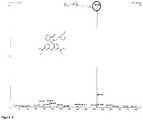
- the 1:1 binding stoichiometry is further confirmed from Jobs plot and presence of signal for m/z at at 616.87 (Calc 616.75) in FAB-MS analysis of a mixture of L 1 (1.59 x 10⁻⁵ M) and (9.5 x 10 -5 M) Cr(ClO 4 ) 3 for [L 1 + Cr 3+ ].
- a stock solution of the receptor L 1 (6.9 x 10 -4 M) was prepared in acetonitrile medium and 57 ⁇ L of this stock solution was added to 2.5 ml of 0.4 mM TX100 in Tris-HCl aqueous buffer medium having solution pH 7.2 to make the effective ligand concentration of 1.59 x 10 -5 M. The solution was used for all the photophysical studies. Cr 3+ stock solution (4.75 x 10 -3 M) was prepared in pure aqueous medium and was used for all studies.
- ⁇ f ⁇ f ' I sample / I std A std / A sample ⁇ 2 sample / ⁇ 2 std
- I sample and I std are the integrated emission intensities
- a sample and A std are the absorbances at the excitation wavelength
- ⁇ sample and ⁇ std are the respective refractive indices.
- the geometry of the compounds of Formula-I with chromium ion was examined by using known theories.
- the optimized geometry shows that the Cr 3+ ion is coordinated with two nitrogen atoms, one oxygen atom, two olefinic ⁇ -bonds and a water molecule.
- Thermodynamic parameters were obtained from ITC studies ( ⁇ G (-(8.48 ⁇ 0.02) kcal mol -1 ), ⁇ H ((-20.8 ⁇ 0.4) kcal mol -1 ) and ⁇ S (-41.4 ⁇ 0.05) cal mol -1 ) (all symbols are used according to standard terminology).
- the higher - ⁇ H value revealed that binding was exclusively driven by enthalpy change; while small but negative entropy of binding supported the formation of the adduct Cr 3+ .L 1 .
- Amino ethyl rhodamine B is prepared according to literature ( J.-H. Soh, K. M. K. Swamy, S. K. Kim, S. Kim, S.-H. Lee, J. Yoon, Tetrahedron Lett., 2007, 48, 5966 ).
- Rhodamine B (1.0 g, 2.26 mmol) is dissolved in 30 mL of ethanol. It is then heated to 70°C with constant starring. Then ethylene diamine (3 mL) is added to the reaction medium. It is then allowed to reflux at 75°C for 12 hour. The solvent is removed under vacuum and is dissolved in diluted HCl. Then to this resulting solution, NaOH solution was added in a drop-wise manner until precipitation is complete. The resulting solution mixture is then filtered, washed with water and is further dried to achieve the desired compound, amino ethyl rhodamine derivative as light red colour solid.
- probe L1 was applied to detect Cr3+ in tap water. No Cr3+ was obtained in tap water samples. Water samples were collected and pH was adjusted to 7.2 using Tris buffer(10mM, 25mM NaCl), spiked with known (10 ⁇ M and 20 ⁇ M) concentration of Cr3+ and emission spectra was recorded. The result was summarised in Table 1. Table 1: Determination of Cr 3+ in tap water. Sample No. Cr 3+ added ( ⁇ M) Cr 3+ found ( ⁇ M) Recovery (%) 1 10 9.81 98.1 2 20 19.67 98.3
Landscapes
- Health & Medical Sciences (AREA)
- Chemical & Material Sciences (AREA)
- Life Sciences & Earth Sciences (AREA)
- Immunology (AREA)
- Engineering & Computer Science (AREA)
- Hematology (AREA)
- Molecular Biology (AREA)
- Physics & Mathematics (AREA)
- Organic Chemistry (AREA)
- Biomedical Technology (AREA)
- Urology & Nephrology (AREA)
- Analytical Chemistry (AREA)
- Pathology (AREA)
- General Physics & Mathematics (AREA)
- General Health & Medical Sciences (AREA)
- Biochemistry (AREA)
- Food Science & Technology (AREA)
- Medicinal Chemistry (AREA)
- Cell Biology (AREA)
- Biotechnology (AREA)
- Microbiology (AREA)
- Chemical Kinetics & Catalysis (AREA)
- Optics & Photonics (AREA)
- Nuclear Medicine, Radiotherapy & Molecular Imaging (AREA)
- Inorganic Chemistry (AREA)
- Investigating Or Analysing Materials By The Use Of Chemical Reactions (AREA)
- Inorganic Compounds Of Heavy Metals (AREA)
Description
- The invention discloses a novel ligand (Lx) of Formula-I with high selectivity to Cr (III) and a process for the preparation thereof. Particularly, the invention further discloses a method of determining Cr (III) in fluids, where the ligand should have solubility in aqueous medium with the aid of non-ionic surfactant.

- Due to its high paramagnetic behavior it is challenging for chemists to develop fluorogenic receptors specific for Cr (III) detection with Fluorescence on response, as it is well known to quench the luminescence of a fluorophore. Further, due to the high solvation enthalpy of Cr (III)-ion in aqueous medium, it is also difficult to find an appropriate receptor for Cr(III -ion that works in pure aqueous medium.
- There are only few examples of receptors available in the literature, which binds exclusively to Cr (III) in an ensemble of several other competing metal ions. The
Receptor 1 was reported by Li et.al, Chem. commun, 2008, 3387. It is a FRET based chemo sensor for detection of Cr(III) in ethanol/water (2/1, v/v) medium and it can be used as an imaging agent in HeLa cell.
- Li et at also reported another Ferrocene Based Receptor 2 (Org. lett, 2008, 2557) for selective detection of Cr(III) in ethanol/water (1/1, v/v) with an association constant of 7.5 x 10³M-1. Receptors 3 (Anal. Methods, 2012, 3163; receptor is effective in acetonitrile/water (9/1, v/v)) and 4 (Anal. Methods, 2012, 2254; receptor is effective in methanol/water (9/1, v/v)) were developed by D. Das and his co-workers and both reagents showed high selectivity towards Cr(III) in predominantly organic medium. Receptor 5 is a BODIPY based Cr(III) sensors synthesised by D. Wang et al. (Tetrahedron Letters, 2010, 51, 2545). It can detect Cr(III) selectively in acetonitrile with binding stoichiometry of 2:2.

- Further Hassan SS, et al. in Analytical Sciences (Impact Factor: 1.57). 07/2005; 21(6):673-8 discloses use of a rhodamine-B chromate ion-associate complex as an electroactive material in a poly(vinyl chloride) membrane plasticized with o-nitrophenyloctyl ether as a solvent mediator. It is to be noted that the oxidation state for Chromium in chromate is (VI). They reported a Potentiometric Rhodamine B based Membrane Sensor for selective determination of Chromium ions [Cr(VI) & Cr(III)] in waste water. Firstly it can't detect Cr(III) directly. To detect Cr(III) they have adopted an indirect methodology in which Cr(III) was first oxidised to Cr(VI) by adding H2O2, that can be sensed by the reported sensor. Another important thing , this types of sensors cannot be applied for bio imaging application to monitor intra cellular Cr(III) activity.
- In the present invention L1 it can selectively detect only Cr(III) in pure aqueous medium. It does not have any interferences of Cr(VI) at all. It is a fluoromertic as well as colorimetric sensor for Cr(III) detection. It can be used for monitoring intra cellular imaging of Cr(III). Fluorescence detection methods are more sensitive and simpler compare to other analytical methods.
- Highly sensitive and selective fluorescence chemosensor for Cr3+ based on rhodamine B and a 4,13-diaza-18-crown 6-ether conjugate" is disclosed by Duliang Liu, in RSC Adv., 26 Nov 2013,4, 2563-2567, where detection of Cr3+ was possible only in predominantlty non aqueous environment (3:2, MeOH-H2O (v/v).
- There are only three previous reports that describe the use of reagents for the detection of Cr(III) in pure aqueous solution; (Mao, J et al. Org. Lett., 2007, 9, 4567-4570 and Mao, J et al. Anal. Bioanal. Chem., 2010, 396, 1197) one of them describes the interference by Fe3+. The most recent report reveals that a rhodamine derivative within a polymeric matrix could be utilized for specific detection of Cr (III) in pure aqueous medium and the hydrophobic micro-environment generated around the binding core of the receptor induces a favourable influence for the detection of Cr(III) (Macromol. Ropid Commun. 2014, 35, 323) However, the possibility of using these three molecular probes as an imaging reagent for studying the cellular uptake of Cr(III) is not explored and discussed.
- While the receptors disclosed herein have the capability to detect Cr (III) in pure aqueous medium and in physiological condition. All other above examples suffer from a major drawback that they have this capability of detecting Cr (III) only in mixed aqueous organic solvents medium.
Detection of Cr (III) in pure aqueous solution is a very basic and vital need in the art, so that Cr(III) may be monitored for its presence and activity in cellular structure. There is also a need to detect Cr (III) in physiological fluids. - Main objective of the present invention is to provide a novel ligand that could selectively detects Cr (III) in aqueous medium as well as in physiological pH (7.2).
- Another objective of the invention is to develop a methodology for solubilizing the reagent in pure aqueous medium in presence of non-ionic surfactant like Titron X 100.
- Accordingly, the present invention provides novel ligands of Formula I(Lx) for detection of Chromium in pure aqueous medium

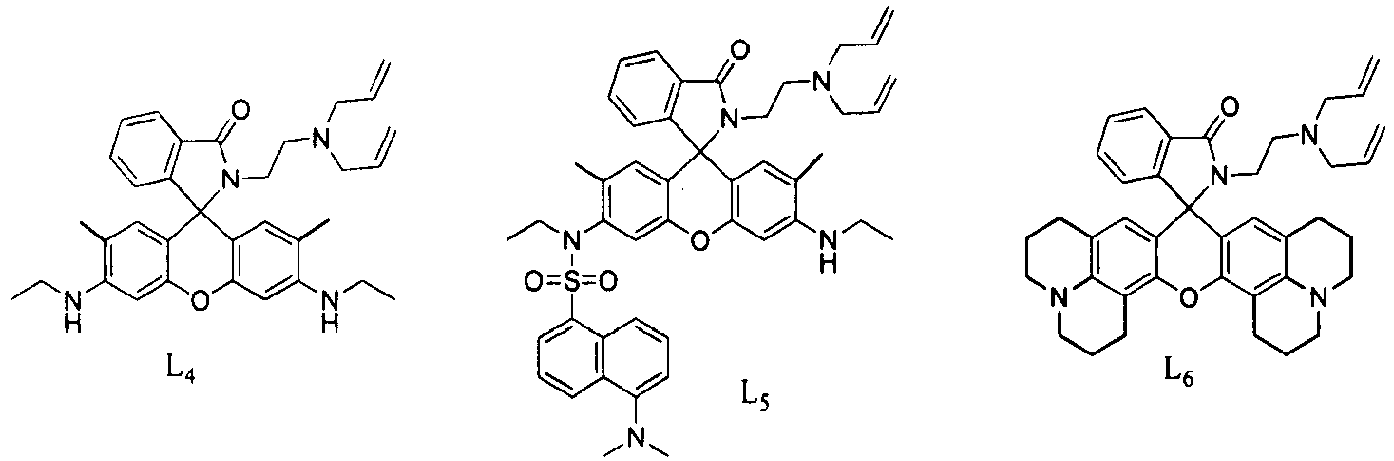
- wherein R1 and R2 are same or different and individually selected from the group consisting of H, linear or branched (C1-C6) alkyl, aryl or dansyl; R3 is same selected from group H, methyl; R4 is selected from H, (C1-C6) alkyl;
- where, R1 may form saturated or unsaturated carbocyclic (C4-C6) ring with R3 and similarly R2 may form saturated or unsaturated carbocyclic (C4-C6) ring with R4; and(...... ) line is optionally represents single bond.
- In an embodiment of the present invention a process of preparation of ligands of Formula I(Lx), wherein the said process comprising the steps of:
- a. refluxing ethylene diamine and rhodamine B derivatives (II) in organic solvent, to obtain the corresponding amino ethylene rhodamine derivative (III) and;
- b. refluxing the amino ethylene rhodamine derivative of step (a) in the presence of (A- Br) alliphatic bromide, triethyl amine and dry CHCl3 under inert conditions to obtain Ligand (Lx) of Formula-I.

- wherein R1 and R2 are same or different and individually selected from the group consisting of H, linear or branched (C1-C6) alkyl, aryl or dansyl; R3 is same selected from group H, methyl;
- wherein, R1 may form saturated or unsaturated carbocyclic (C4-C6) ring with R3.
- Still In another embodiment of the present invention a process for selective detection of Cr (III) using ligands of Formula-1, in aqueous medium as well as in physiological liquid of pH (7.2) comprising steps of:
- a. preparing a solution of tris(hydroxymethyl)aminomethane buffer (Tris buffer )and Polyethylene glycol tert-octylphenyl ether (Triton X 100) at pH 7.2;
- b. preparing a stock solution of ligands of Formula-I in a water miscible solvent in concentration ranges from 6.0 to 8.0 x 10⁻⁴ M;
- c. mixing solution of step (b) with the solution of step (a) to solubilize ligand of formula I;
- d. preparing Chromium (III) metal stock solution using water;
- e. adding metal solution gradually to the solution of step (c) and;
- f. recording spectrum in a UV or fluorescence spectrometer.
- Still In another embodiment of the present invention the water miscible solvent is selected from acetonitrile, Methanol, DMSO, Ethanol, THF, DMF and mixtures thereof.
- Still In another embodiment of the present invention a kit for selective detection of Cr (III) using novel ligands of Formula-I, comprising
- a) Ligand L1 stock solution (6.9 x 10⁻⁴ M) in acetonitrile;
- b) 0.32
mM Triton X 100 in Tris buffer solution at pH 7.2; - c) Aqueous Cr(III) solution (3.28 x 10⁻³M);
- d) Final ligand solution (1.59 x 10⁻⁵ M) in 0.32
mM Triton X 100 in Tris buffer having solution pH of 7.2. -
-
Figure 1 depicts 1H NMR Spectra of ligand L1 -
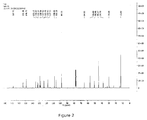
Figure 2 depicts 13C NMR of L1 -
Figure 3 depicts Mass Spectrum of L1 -
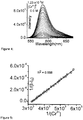
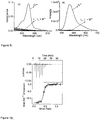
Figure 4 depicts Emission titration of L1 with aqueous Cr (III) solution in 0.4 mM Triton X in Tris PH 7.2. B-H plot. Binding constant (K) = 2.83 x 10³M-1. -
Figure 5 : Benesi-Hildebrand (B-H) plots of emission spectral titration. All studies were performed in aq. solution of 0.4 mM Triton X-100 and Tris buffer (5 mM, 25 mM NaCl; pH 7.2). -
Figure 6 : depicts Bar diagram showing emission change at λ = 582 nm upon addition of various metal ions (1.0 x 10⁻⁴M) to 15.6 µM of L1 in 0.23mM Triton X 100 in Tris Buffer PH 7.2. -
Figure 7 depicts UV Titration of Ligand L1 (1.59 x 10⁻⁵ M) upon addition of aqueous Cr (III) solution in (0.4)mM Triton X 100 in Tris buffer having solution pH 7.2 -
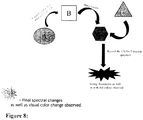
Figure 8 : depicts Flow Chart for detection procedure from a kit -
Figure 9 :depicts Changes in (A) absorption and (B) emission spectra (λExt of 530 nm) of the receptor L1 (1.59 x10⁻⁵ M) in absence and presence of different metal ions (Mn+: 1.62 x 10⁻⁴M: Li+, Na+, K+, Cs+, Ca2+, Mg2+, Sr2+, Ba2+, Cr3+, Fe2+, Co3+, Ni2+, Cu2+, Zn2t, Hg2+, Cd2+ and Pb2+); All studies were performed in aq. solution of 0.4 mM TX100 and Tris buffer (5 mM, 25 mM NaCl; pH 7.2). -
Figure 10 depicts Isothermal Titration Calorimetry (ITC) titration profile for the binding of Cr3+ to receptor L1 at 25°C in acetonitrile; Top plot: raw data for the sequential 2 µl injection of Cr3+ (1.2 x 10⁻³ M) into solution of L1 (2.0 x 10⁻⁴ M) and bottom plot of the heat evolved (kcal per mole) of Cr3+ added. -
Fig. 11 : Plot of (I-I0) vs. [Cr3+], where I0 and I are emission intensities at 583nm of receptor L1 in the absence and presence of known [Cr3+] as well in tap water spiked with a known amount of Cr3+. - The invention will now be described in detail in connection with certain preferred and optional embodiments, so that various aspects thereof may be more fully understood and appreciated.
- For the purpose of this invention, the expression 'Novel Ligand (Lx)' or 'novel reagent' or 'receptor' 'colorimetric' as well as 'fluorescent chemosensor' are used interchangeably throughout the specification and the same may be appreciated as such by the person skilled in the art.
The present invention discloses a novel ligand for selective detection of Cr (III) in aqueous medium. The novel ligand (Lx) of Formula I is as disclosed herein:
- wherein R1 and R2 are same or different and individually selected from the group consisting of H, linear or branched (C1-C6) alkyl, aryl or dansyl; R3 is same selected from group H, methyl; R4 is selected from H, (C1-C6) alkyl;
- where, R1 may form saturated or unsaturated carbocyclic (C4-C6) ring with R3 and similarly R2 may form saturated or unsaturated carbocyclic (C4-C6) ring with R4; and (...... ) line is optionally represents single bond.
- In another preferred embodiment, the invention provides the library of compounds of Formula-I. The novel ligand (Lx) of Formula-I encompasses the compounds selected from the group consisting of;

- The invention provides a process of preparation of novel ligands of Formula I(Lx) comprising steps of:
- a. refluxing ethylene diamine and rhodamine B derivatives (II) in an organic solvent, to obtain the corresponding amino ethylene rhodamine derivative (III) and;
- b. refluxing the amino ethylene rhodamine derivative of step (a) in the presence of (A-Br) alliphatic bromide, triethyl amine and dry CHCl3 under inert conditions to obtain Ligand Lx of Formula-I in good yield. (cf scheme 1)
- According to the process, the organic solvent is polar organic solvent selected from the group consisting of methanol, isopropanol, n-propanol, ethanol, water, butanol and mixtures thereof.
The alliphatic bromide (A-Br) is preferably alkene or alkyl bromide such as, allyl bromide, propyl bromide, 1-bromopropane, 3-bromoprop-1-ene.
The said process is time saving due to fewer steps and industrially feasible. The invention provides a process of preparation of novel ligands (L1) and (L2) comprising steps of: - a. refluxing ethylene diamine and rhodamine B in methanol to obtain the corresponding amino ethylene rhodamine derivative (L); and
- b. refluxing the amino ethylene rhodamine derivative of step (a) in the presence of allyl bromide, triethyl amine and dry CHCl3 under inert conditions to obtain novel Ligand L1; or
- c. refluxing the amino ethylene rhodamine derivative of step (a) in the presence of propyl bromide, triethyl amine and dry CHCl3 under inert conditions to obtain novel Ligand L2. (refer scheme 2)

- According to the process, the Intermediate compound L was synthesized following a literature procedure, (A. Org. Lett. 2008, 10, 3013-3016). Methodologies that were adopted for synthesis of the receptor L1 and the model compound L2 are presented in the scheme 2. Desired compound L1 and L2 were isolated in pure form after necessary workup and were thoroughly characterized by various analytical/spectroscopic techniques.
- The invention discloses a process for solubilisation of ligand L1 in an aqueous medium employing non ionic surfactant, preferably Polyethylene glycol tert-octylphenyl ether (Triton X 100).
With reference toFigure 5 &Figure 7 , Ligand L1, dissolved in pure aqueous medium with the aid ofTriton X 100, is selective/specific for Cr (III) and excludes similar metals selected from alkali, alkaline earth metals and all common transition metals.
In another preferred embodiment, the alkali, alkaline earth metals and transition metals are selected from, but not limited to Li, Na, K, Cs, Mg, Ca, Ba, Sr, Zn, Co, Cu, Ni, Fe, Pb, Hg and such like. - In another embodiment, the invention discloses the process of selective detection of Cr (III) by a process of fluorimetry comprising:
- a. preparing a solution of Tris (tris(hydroxymethyl)aminomethane buffer )buffer and
Triton X 100 at pH 7.2; - b. preparing a stock solution Ligand L1 in a water miscible solvent; add required volume of Ligand stock solution to make desired Ligand L1 concentration;
- c. mixing Ligand L1 solution of step (b) with the solution of step (a);
- d. preparing metal stock solution using water;
- e. adding metal solution gradually to the solution of step (c) and;
- f. recording spectrum in a UV or fluorescence spectrometer.
- According to the process the water miscible solvent is selected from acetonitrile, Methanol, DMSO, Ethanol, THF, DMF and mixtures thereof.
According to the process a stock solution of the receptor /ligand L1 was prepared in acetonitrile medium with concentration ranges from 6.0 to 8.0 x 10⁻⁴ M, preferably (6.9 x 10⁻⁴ M);and the final concentration of metal salts is in the range of 1.0 to 2.0 x 10⁻⁴ M, preferably 1.62 x 10⁻⁴ M.
The UV-vis spectrum for the ligand L1 may be carried out from for the range 250-800 nm and a λmax of 562 nm is observed. The luminescence studies were carried out using an excitation wavelength of 530 nm and emission spectrum was monitored from 540 to 800 nm, with slit width of 2/2 nm; while a spectrum with λmax of 583 nm is observed.
The invention provides a kit for selective detection of Cr (III) is disclosed. a kit for selective detection of Cr (III) comprises: - a) Ligand L1 stock solution in acetonitrile.
- b) 0.32
mM Triton X 100 in Tris buffer solution at pH 7.2. - c) Aqueous Cr (III) solution (3.28 x 10⁻³M).
- d) Final ligand solution (1.59 x 10⁻⁵ M) in (0.4)
mM Triton X 100 in Tris buffer having solution pH of 7.2. - It describes the method of detection of CR(III) in an aqueous medium
Further the invention provides a method of separation Cr (III) selectively from a sample comprising other metals, or other ingredients employing the ligand of Formula I described herein. It is possible to extract Cr (III) from aqueous solution when the concentration of Cr (III) either equal to or higher than 8.0 x 10⁻⁴M. For extraction studies, dichloromethane (CH2Cl2) was used as the water immiscible organic solvent for extraction of Cr (III) from aqueous layer in the form of L1 .Cr3+. - Rhodamine B, Ethylenediamine, 3-bromoprop-1-ene, 1-bromopropane, all metal perchlorate salts (e.g LiClO4, NaClO4, KClO4, CsClO4, Mg(ClO4)2. Ca(ClCO4)2, Ba(ClO4)2, Sr(ClO4)2, Cu(ClO4)2. Zn(ClO4)2, Co(ClO4)2, Ni(ClO4)2, Cr(ClO4)3, Fe(ClO4)2, Cd(ClO4)2, Hg(ClO4)2, and Pb(ClO4)2) and lanthanide ions as nitrate salts were obtained from Sigma-Aldrich and were used as received. Et3N, Triton X-100, Tris Buffer, NaCl was procured from S.D. fine chemicals, India and was used as received. Solvents such as acetonitrile, chloroform were also purchased from S.D. Fine Chemicals, India and were used without further purification unless mentioned otherwise. Silica gel 100-200 mesh was used for column chromatography. Analytical thin layer chromatography was performed using silica Gel GF 254. HPLC grade water (Merck, India) was used for experiments and all spectral studies. Aminoethylene rhodamine B (L) was synthesized following a standard procedure (Org. Lett. 2008, 10, 3013-3016)
- 5.0 mM Tris-HCl aq. buffer solution was used for maintaining solution pH, unless mentioned otherwise. ESI-MS measurements were performed using a Micromass QTof- Micro instrument. FT-IR spectra were recorded as KBr pellets using a Perkin Elmer Spectra GX 2000 spectrometer. 1H and 13C NMR spectra were recorded on
Bruker 500 MHz FT NMR (model: Avance-DPX 500). Electronic spectra were recorded with aVarian Cary 500 Scan UV-Vis-NIR Spectrophotometer, Isothermal Titration Calorimetry studies were performed in Microcal iTC200, while emission spectra were recorded using either Edinburgh Instrument Xe-900 Spectrofluorometer or PTI. For all spectroscopic studies in aqueous buffer medium as well as for studies with plant/algal cells, L1 self-assembled inside the miceller structure of TX100 was used, unless mentioned otherwise. - To check the selectivity of Receptor L1 towards various metal ions like Li+, Na+, K+, Cs+, Mg2+, Ca2+, Ba2+, Sr2+, Zn2+, Co3+, Cu2+, Ni2+, Fe2+, Pb2+, Hg2+ change in electronic as well as emission spectra were examined in 0.32
mM Triton X 100 in tris (5 mM, 25mM NaCl) buffer medium at PH 7.2. - Absorption and emission spectra of receptor L1 in 0.32
mM Triton X 100 in Tris buffer (5 mM , 25 mM NaCl) pH 7.2 medium shows no absorption band at 562 nm and very weak emission band at 583 nm on excitation at 562 nm. This solution of L1 appears colourless and all these clearly suggest that L1 in this solution is present exclusively in spirolactam form. This is also confirmed from the 13C NMR studies, which shows a characteristic signal at 64.85 ppm for the tertiary C-atom. However only in presence of Cr3+, a strong absorption band at 562 nm and intense emission band at 583 nm (for λext = 530 nm) are observed. These changes are also associated with simultaneous visually detectable change in solution colour from colourless to pink red. For other metal ions, no such changes are observed. - For calculating the binding affinity of ligand L1 (1.59 x 10⁻⁵ M) towards Cr3+ in aqueous solution, systematic absorption and emission spectral titration is performed in 0.32
mM Triton X 100 in tris buffer (5 mM, 25 mM NaCl) medium at PH 7.2. The association constant (Kabs) of 2.4 x 10³ M-1 for the L-1.Cr3+ formation is evaluated from the absorption titration and B-H plot data (Figure 3 ). A good linear fit data supported the 1:1 binding stoichiometry. For emission titration, a significant increase in emission intensity at 583 nm is observed with an increase in concentration of Cr3+ in aqueous medium. The binding affinity towards Cr3+ is also evaluated from linear fit B-H plot for 1:1 stoichiometry and is found to be 2.83x 10³ M-1. The 1:1 binding stoichiometry is further confirmed from Jobs plot and presence of signal for m/z at at 616.87 (Calc 616.75) in FAB-MS analysis of a mixture of L1 (1.59 x 10⁻⁵ M) and (9.5 x 10⁻⁵ M) Cr(ClO4)3 for [L1 + Cr3+]. - To understand the role of
Triton X 100 surfactant in the sensing of Cr3+, the emission intensity of receptor L1 (1.59 X 10⁻⁵ M) in presence of aqueous Cr3+ (5 mole eqv.) solution was plotted against different concentration ofTriton X 100. The figure shows that sensing efficiency of the reagent described above is maximum when [Triton X] = 0.4 mM. This is also a good agreement with the data obtained from photo physical study shown in table below. Thus the surfactant concentration is adjusted to achieve maximum sensing efficiency of receptor L1.Table: Effect of Triton X 100 on binding affinity of L1 to Cr3+ in aqueous medium.[Titron X 100] (mM) Binding Constant (M-1) Quantum yield in water w.r.t. Rhodamine B Uv-Vis Spectroscopic Method Fluorescence Spectroscopic Method 0.23 1.96 x 10³ 2.0 x 10³ 0.185 0.32 2.4 x 10³ 2.83 x 10³ 0.211 0.4 3.2 x 10³ 3.25 x 10³ 0.22 UV-Vis and Fluorescence studies: - A solution of the perchlorate salts of the respective ion (Li+, Na+, K+, Cs+, Ca2+, Mg2+, Ba2+, Sr2+, Fe2+, Ni2+, Co2+, Cu2+, Mn2+, Cd2+, Pb2+, Ba2+, Zn2+, Sr2+, Hg2+ and Cr3+) and nitrate salts of lanthanides ions (Tb3+, Ho3+, Ce3+, Sm3+, Rb+, Pr3+, Eu3+, Gd3+, Nd3+, Dy3+, Tm3+, Er3+, Yb3+) in pure aqueous medium were used for all studies. The effective final concentrations of all metal salts were maintained at 1.62 x 10⁻⁴ M.
- A stock solution of the receptor L1 (6.9 x 10⁻⁴ M) was prepared in acetonitrile medium and 57 µL of this stock solution was added to 2.5 ml of 0.4 mM TX100 in Tris-HCl aqueous buffer medium having solution pH 7.2 to make the effective ligand concentration of 1.59 x 10⁻⁵ M. The solution was used for all the photophysical studies. Cr3+ stock solution (4.75 x 10⁻³ M) was prepared in pure aqueous medium and was used for all studies. Emission titrations were also performed as a function of [TX100] (0.1 mM, 0.23 mM, 0.32 mM, 0.4 mM, 0.6 mM) in Tris-HCl buffer medium of pH 7.2 by monitoring the increase in emission intensity (using λExt = 530 nm, λMon = 583 nm and slit width 2/2 nm) on binding of L1 to Cr3+ for optimizing the maximum enhancement of the emission intensity. The relative fluorescence quantum yields (φf) were estimated using
equation 1 for different concentration of TX100 (0.1 mM, 0.23 mM, 0.32 mM, 0.4 mM, 0.6 mM) in Tris-HCl buffer medium (having solution pH of 7.2) and by using the Rhodamine B (φf = 0.3 in aqueous medium at RT) as a reference.
- The geometry of the compounds of Formula-I with chromium ion was examined by using known theories.The optimized geometry shows that the Cr3+ ion is coordinated with two nitrogen atoms, one oxygen atom, two olefinic π-bonds and a water molecule.
- According to the invention,
Figure 11 shows that among all the metal cations, only in the presence of Cr(III), respective absorption and emission (with λExt = 530 nm) spectral bands at 562 nm and 583 nm were observed. - Formation of Cr3+.L1 was also confirmed from the result "Formation of Cr3+.L1 was also confirmed from the result of FAB MS study. Signal at m/z value of 616.87(Calc 616.75) for Cr3+.L1". Affinity of L1 towards Cr(III) and the associated binding constant for the formation of Cr3+.L1 in aq. buffer medium (pH = 7.2) was evaluated from the data obtained from B-H plots of the systematic absorption (Ka Abs = 3.2 ± 0.2). 103 M-1) as well as emission (Ka Ems = (3.3 ± 0.2).103 M-1) spectral titrations.
- To envisage the adverse role of high solvation enthalpy of Cr(III) in aqueous medium, similar Uv-vis and emission titrations were carried out in acetonitrile medium using ([Cr(III)]= (0 -1.93 x 10⁻⁴)M; and [L1]=(1.59 x 10⁻⁵ M) in CH3CN) and the evaluated formation constant for Cr3+.L1 in acetonitrile was (Ka Abs = (1.1 ± 0.03).106 M-1, Ka Ems = (1.0 ± 0.02).106 M-1 using λExt: 530 nm and λmon: 583 nm for emission titration). The binding affinity of L1 towards Cr3+ was evaluated as Ka ITC = (1.6 ± 0.02).106 M-1 in acetonitrile medium at 25°C using ITC experiments. Comparison of the binding constants evaluated in pure aq. buffer medium and in acetonitrile clearly revealed the energy barrier imposed due to the unfavourable solvation of Cr3+ in aqueous medium and thus adversely affecting the affinity of L1 towards Cr3+. Thermodynamic parameters were obtained from ITC studies (ΔG (-(8.48 ± 0.02) kcal mol-1), ΔH ((-20.8 ± 0.4) kcal mol-1) and ΔS (-41.4 ± 0.05) cal mol-1) (all symbols are used according to standard terminology). The higher -ΔH value revealed that binding was exclusively driven by enthalpy change; while small but negative entropy of binding supported the formation of the adduct Cr3+.L1.
- FTIR spectra recorded for L1 and Cr3+.L1, also revealed a distinct shift from 1617 cm-1 to 1587 cm-1 (ΔV = 30 cm-1) for C=C stretching frequency. Blue shift in absorption of vinyl group in the FTIR spectrum on coordination to metal ion is reported earlier. This also supports the involvement of olefins in coordination to Cr(III)-centre and possible mode of binding of L1 to Cr(III) is shown in Scheme 1C. No such shifts were observed either in 1H NMR or in FTIR spectra of L1 in presence of certain other metal ions and these metal ions were chosen based on their ability to bind to the model reagent L2.
- The following examples are given by way of illustration of the working of the invention in actual practice and therefore should not be construed to limit the scope of the present invention.
- Amino ethyl rhodamine B is prepared according to literature (J.-H. Soh, K. M. K. Swamy, S. K. Kim, S. Kim, S.-H. Lee, J. Yoon, Tetrahedron Lett., 2007, 48, 5966).
- Rhodamine B (1.0 g, 2.26 mmol) is dissolved in 30 mL of ethanol. It is then heated to 70°C with constant starring. Then ethylene diamine (3 mL) is added to the reaction medium. It is then allowed to reflux at 75°C for 12 hour. The solvent is removed under vacuum and is dissolved in diluted HCl. Then to this resulting solution, NaOH solution was added in a drop-wise manner until precipitation is complete. The resulting solution mixture is then filtered, washed with water and is further dried to achieve the desired compound, amino ethyl rhodamine derivative as light red colour solid.
- Amino ethyl rhodamine B (400 mg, 0.826 mmol) was dissolved in 20 mL dry chloroform. To this Et3N (3 mL) was added and the resulting solution is kept under N2 atmosphere for 20 minutes. Then Allyl bromide (530 µL, 5.9 mmol) was added into starring solution. It was kept under reflux condition at temp 65°C with constant stirring for 12 h until all the starting materials are consumed. Then 10 mL of water was added to it. The organic Layer is collected and dried over anhydrous Na2SO4 before concentration. It was finally purified by column chromatography using silica gel as stationary phase and 10% ethyl acetate in hexane as eluent or mobile phase to isolate L1 in pure form with 50% yield. 1H NMR (500 MHz, CDCl3, SiMe4, J (Hz), δ ppm) : 7.80 (d, J= 4.6), 7.35 - 7.30 (m), 6.99 (d, J= 4.4), 6.35 6.27 (m), 6.16 (d, J= 8.8), 5.56 (td, J= 16.5, 6.5), 4.96 - 4.88 (m), 3.24 (dd, J= 13.7, 6.8), 3.18 - 3.09 (m), 2.85 (d, J= 6.2), 2.21 - 2.13 (m), 1.07 (t, J= 6.8). 13C NMR (500 MHz, CDCl3, SiMe4, δ ppm): 167.70, 153.38, 148.70, 135.13, 132.22, 131.54, 128.98, 127.97, 123.78, 122.63, 117.53, 108.03, 105.58, 97.73, 64.85, 56.60, 50.46, 44.37, 37.75, 29.69, 12.60. ESI-MS (+ ve mode, m/z): 565.93 (M + H+), Calc. for C36H44N4O2 is 564.76.
- Amino ethyl rhodamine B (200 mg, 0.41 mmol) was dissolved in 15 mL dry chloroform. To this Et3N (500 µL) was added and the resulting solution was stirred for 20 minutes under N2 atmosphere. Then 1-bromopropane (120 µL, 1.35 mmol) was added and the resulting reaction mixture was refluxed at temp for 24h until all the starting materials were consumed (Checked by TLC at different time interval). After this reaction mixture was allowed to attain the room temperature, 10 mL of water was added. The organic layer, after drying over anhydrous Na2SO4, was collected and followed by the removal of chloroform under vacuum to yield the crude product. Column chromatography was performed using silica gel as stationary phase and 10% ethyl acetate in hexane as mobile phase for isolating L2 in pure form with 40% yield. 1H NMR (500 MHz, CDCl3, SiMe4, J (Hz), δ ppm): δ 7.81 (dd, 1H, J = 5.9, 2.6 , H18), 7.37 (dd, 2H, J = 5.6, 3.0, H16, H17), 7.05 - 7.00 (m, 1H, H15), 6.35 (s, 1H, H12), 6.33 (s, 1H, H2), 6.31 (d, 2H, J = 2.5, H5, H9), 6.19 (dd, 2H, J = 8.9, 2.6, H4, H10), 3.26 (q, 8H, J = 7.0, H29, H31, H33, H35), 3.09 (d, 2H, J = 5.8, H21, 2.15 (s, 6H, H22, H23, H26), 1.18 (d, 4H, J = 6.7, H24, H27), 1.09 (t, 12H, J = 7.0, H30, H32, H36, H34), 0.68 (t, 6H, J =6.8, H25, H28).13C NMR (125 MHz, CDCl3, SiMe4, δ ppm): 167.75, 153.77, 148.72, 148.25, 132.25, 129.18, 127.78, 123.93, 122.59, 108.48, 105.63, 97.94, 64.95, 56.78, 50.96, 44.34, 37.79, 37.47, 20.27, 12.54, 11.82. IR (KBr): vmax/cm-1 = 1680. ESI-MS (+ve mode, m/z): 569.29 (M + H+), Calc. for C36H44N4O2 is 568.79. Elemental Analysis: Calculated (C 76.02, H 8.51, N 9.85); Experimentally obtained (C 76.20, H 8.50, N 9.88).
- Method of preparation of Ligand (L) and solubilization of L1 in water using Triton X 100:
- Final Ligand (L1) concentration = 1.59 x 10⁻⁵ M
- Concentration of Cr3+ in aqueous solution = 10-4 M
- 1. Make 10 mL of 7.092 x 10⁻⁴M stock solution of ligand L1 in pure HPLC grade acetonitrile (Dissolve 4 mg of ligand L1 in 10 mL HPLC grade acetonitrile).
- 2. Make a solution of 0.32
mM Triton X 100 in Tris-HCl Buffer (5 mM , 25 mM NaCl, pH 7.2) i.e medium. It is better to make 50 mL Tris-HCl Buffer solution (5 mM tris Buffer, 25 mM NaCl) and adjust the PH to 7.2. Then add 9.34 µL (10mg) ofTriton X 100 to 50 mL of Tris-HCl Buffer (pH 7.2) solution and stir the solution gently for 10 minutes just to homogenies (avoid vigorous shaking). - 3. Take exactly 56 µL of ligand stocks solution and add to 2.5 mL of solvent solution (i.e. 0.32
mM Triton X 100 in Tris-HCl buffer solution of pH 7.2) to make 1.59 x 10⁻⁵ M of ligand (L1) solution for studies.
- Molecular weight of the Ligand = 564
- Molecular weight of the
Triton X 100 = 625 - Density of
Triton X 100 = 1.07 g/L - Molecular weight of the Tris buffer = 121.14
- 3.28 x 10⁻³ M Cr(III) solution in water is prepared and then it is gradually added to a solution of the ligand L1, where effective ligand concentration is 1.59 x 10⁻⁵ M in a Tris buffer with solution pH of 7.2 having 0.32
mM Triton X 100. Uv-vis and luminescence spectra are recorded in absence and presence of [Cr(III)]. In emission spectra a 200 fold increase in spectral intensity at 583 nm (λext = 530 nm and slit 2/2) is observed, while a simultaneous change in solution colour is observed from colourless to pink red (please refer toFigures 4 and6 ). - To cheeked the applicability of the methods in real sample analysis , probe L1 was applied to detect Cr3+ in tap water. No Cr3+ was obtained in tap water samples. Water samples were collected and pH was adjusted to 7.2 using Tris buffer(10mM, 25mM NaCl), spiked with known (10µM and 20µM) concentration of Cr3+ and emission spectra was recorded. The result was summarised in Table 1.
Table 1: Determination of Cr3+ in tap water. Sample No. Cr3+ added (µM) Cr3+ found (µM) Recovery (%) 1 10 9.81 98.1 2 20 19.67 98.3 -
- 1. With this ligand (L1), Cr(III) can be detected from pure aqueous solutions at physiological pH.
- 2.The ligand can also be used as a colorimetric as well as fluorescent chemosensor for the detection of Cr(III) in aqueous solutions.
- 3. The use of
Triton X 100 to create micro-micellar environment that makes the ligand soluble in water or tri buffer medium having pH 7.2 cell membrane permeable in addition to maximizing the sensing efficiency.


Still In another embodiment of the present invention the alliphatic bromide (A-Br) is alkene bromide selected from the group consisting of allyl bromide, 3-bromoprop-1-ene or alkyl bromide selected from the group consisting of propyl bromide, 1-bromopropane.

Claims (8)
- Novel ligands of Formula I (Lx) for detection of Chromium in pure aqueous medium.
 wherein R1 and R2 are same or different and individually selected from the group consisting of H, linear or branched (C1-C6) alkyl, aryl or dansyl; R3 is same selected from group H, methyl; R4 is selected from H, (C1-C6) alkyl;where, R1 may form saturated or unsaturated carbocyclic (C4-C6) ring with R3 and similarly R2 may form saturated or unsaturated carbocyclic (C4-C6) ring with R4; and(...... ) line is optionally represents single bond.
 - The ligand of formula-I, encompasses the compounds selected from the group consisting of;


- A process of preparation of ligands of Formula I(Lx) according to claim 1, wherein the said process comprising the steps of:a. refluxing ethylene diamine and rhodamine B derivatives (II) in organic solvent, to obtain the corresponding amino ethylene rhodamine derivative (III) and;b. refluxing the amino ethylene rhodamine derivative of step (a) in the presence of (A- Br) alliphatic bromide, triethyl amine and dry CHCl3 under inert conditions to obtain Ligand (Lx) of Formula-I.
 wherein R1 and R2 are same or different and individually selected from the group consisting of H, linear or branched (C1-C6) alkyl, aryl or dansyl; R3 is same selected from group H, methyl;wherein, R1 may form saturated or unsaturated carbocyclic (C4-C6) ring with R3.
 - The process according to claim, 3, wherein the organic solvent is polar organic solvent selected from the group consisting of methanol, isopropanol, n-propanol, ethanol, water, butanol and mixtures thereof.
- The process according to claim 3, wherein the alliphatic bromide (A-Br) is alkene bromide selected from the group consisting of allyl bromide, 3-bromoprop-1-ene or alkyl bromide selected from the group consisting of propyl bromide, 1-bromopropane.
- A process for selective detection of Cr (III) using ligands of Formula-I according to claim 1, in aqueous medium as well as in physiological liquid of pH (7.2) comprising steps of:a. preparing a solution of tris(hydroxymethyl)aminomethane buffer (Tris buffer) and Polyethylene glycol tert-octylphenyl ether (Triton X 100) at pH 7.2;b. preparing a stock solution of ligands of Formula-I in a water miscible solvent in concentration ranges from 6.0 to 8.0 x 10⁻⁴M;c. mixing solution of step (b) with the solution of step (a) to solubilize ligand of formula I;d. preparing Chromium (III) metal stock solution using water;e. adding metal solution gradually to the solution of step (c) and;f. recording spectrum in a UV or fluorescence spectrometer.
- The process for selective detection of Cr (III) according to claim 6, wherein the water miscible solvent is selected from acetonitrile, Methanol, DMSO, Ethanol, THF, DMF and mixtures thereof.
- A kit for selective detection of Cr (III) using novel ligands of Formula-I according to claim 1, comprisinga) Ligand L1 stock solution (6.9 x 10⁻⁴M) in acetonitrile;b) 0.32 mM Triton X 100 in Tris buffer solution at pH 7.2;c) Aqueous Cr(III) solution (3.28 x 10⁻³M);d) Final ligand solution (1.59 x 10⁻⁵ M) in 0.32 mM Triton X 100 in Tris buffer having solution pH of 7.2.
Applications Claiming Priority (2)
| Application Number | Priority Date | Filing Date | Title |
|---|---|---|---|
| PCT/IN2014/000646 WO2015052731A1 (en) | 2013-10-08 | 2014-10-08 | Novel ligand for detection of chromium (iii) and a process for the preparation thereof |
| IN2991DE2013 IN2013DE02991A (en) | 2013-10-08 | 2014-10-08 |
Publications (2)
| Publication Number | Publication Date |
|---|---|
| EP3055312A1 EP3055312A1 (en) | 2016-08-17 |
| EP3055312B1 true EP3055312B1 (en) | 2017-12-13 |
Family
ID=52000911
Family Applications (1)
| Application Number | Title | Priority Date | Filing Date |
|---|---|---|---|
| EP14805683.1A Not-in-force EP3055312B1 (en) | 2013-10-08 | 2014-10-08 | Novel ligand for detection of chromium (iii) and a process for the preparation thereof |
Country Status (4)
| Country | Link |
|---|---|
| US (1) | US9823232B2 (en) |
| EP (1) | EP3055312B1 (en) |
| IN (1) | IN2013DE02991A (en) |
| WO (1) | WO2015052731A1 (en) |
Families Citing this family (2)
| Publication number | Priority date | Publication date | Assignee | Title |
|---|---|---|---|---|
| US11685741B2 (en) | 2017-02-14 | 2023-06-27 | University Of Massachusetts | Fluorescent probes |
| CN114573623B (en) * | 2022-03-12 | 2023-12-22 | 陕西科技大学 | Preparation method and application of BODIPY derivative |
-
2014
- 2014-10-08 IN IN2991DE2013 patent/IN2013DE02991A/en unknown
- 2014-10-08 US US15/028,272 patent/US9823232B2/en not_active Expired - Fee Related
- 2014-10-08 WO PCT/IN2014/000646 patent/WO2015052731A1/en not_active Ceased
- 2014-10-08 EP EP14805683.1A patent/EP3055312B1/en not_active Not-in-force
Also Published As
| Publication number | Publication date |
|---|---|
| IN2013DE02991A (en) | 2015-04-10 |
| US20160252488A1 (en) | 2016-09-01 |
| EP3055312A1 (en) | 2016-08-17 |
| WO2015052731A1 (en) | 2015-04-16 |
| US9823232B2 (en) | 2017-11-21 |
Similar Documents
| Publication | Publication Date | Title |
|---|---|---|
| Ge et al. | Detection of Hg2+ by a FRET ratiometric fluorescent probe based on a novel pyrido [1, 2-a] benzimidazole-rhodamine system | |
| Lee et al. | A new naphthalimide derivative as a selective fluorescent and colorimetric sensor for fluoride, cyanide and CO2 | |
| Miao et al. | A novel calix [4] arene fluorescent receptor for selective recognition of acetate anion | |
| Jeong et al. | Rhodamine-chloronicotinaldehyde-based “OFF–ON” chemosensor for the colorimetric and fluorescent determination of Al3+ ions | |
| Dong et al. | A series of highly sensitive and selective fluorescent and colorimetric “off-on” chemosensors for Cu (II) based on rhodamine derivatives | |
| Huo et al. | A rhodamine-based dual chemosensor for the visual detection of copper and the ratiometric fluorescent detection of vanadium | |
| Du et al. | A turn-on fluorescent probe based on Si-rhodamine for sensitive and selective detection of phosgene in solution and in the gas phase | |
| Ali et al. | Tetrasubstituted imidazole core containing ESIPT fluorescent chemodosimeter for selective detection of cyanide in different medium | |
| Xie et al. | A rhodamine–dansyl conjugate as a FRET based sensor for Fe3+ in the red spectral region | |
| Kwon et al. | Naphthoimidazolium based ratiometric fluorescent probes for F− and CN−, and anion-activated CO2 sensing | |
| Elmas et al. | Selective and sensitive fluorescent and colorimetric chemosensor for detection of CO32-anions in aqueous solution and living cells | |
| Cheng et al. | Intramolecular fluorescence resonance energy transfer in a novel PDI–BODIPY dendritic structure: Synthesis, Hg2+ sensor and living cell imaging | |
| Kim et al. | New fluorescent and colorimetric chemosensors based on the rhodamine and boronic acid groups for the detection of Hg2+ | |
| Arici | Multifunctional luminescent coordination polymers based on tricarboxylic acid for the detection of 2, 4-dinitrophenol and iron (III) and aluminum (III) ions | |
| Hranjec et al. | Synthesis, crystal structure and spectroscopic study of novel benzimidazoles and benzimidazo [1, 2-a] quinolines as potential chemosensors for different cations | |
| Kandemir et al. | Novel fluorescent coumarin-thiazole based sensors for selective determination of cyanide in aqueous media | |
| Nemati et al. | Highly selective colorimetric and fluorescent chemosensor for fluoride based on fluorenone armed calix [4] arene | |
| Tachapermpon et al. | Near-infrared aza-BODIPY fluorescent probe for selective Cu 2+ detection and its potential in living cell imaging | |
| Liu et al. | Near-infrared emission of dibenzoxanthenium and its application in the design of nitric oxide probes | |
| Jeong et al. | Discriminative sensing of sulfide and azide ions in solution by a nitrobenzoxadiazole-dansyl dyad by simply tuning the water content | |
| Wang et al. | Mercaptomethylphenyl-modified tetraphenylethene as a multifunctional luminophor: stimuli-responsive luminescence color switching and AIE-active chemdosimeter for sulfur mustard simulants | |
| Lv et al. | The turn-off fluorescent sensors based on thioether-linked bisbenzamide for Fe3+ and Hg2+ | |
| Singh et al. | Benzothiazole based multi-analyte sensor for selective sensing of Zn 2+ and Cd 2+ and subsequent sensing of inorganic phosphates (Pi) in mixed aqueous medium | |
| Thirupathi et al. | Ratiometric fluorescence chemosensor based on tyrosine derivatives for monitoring mercury ions in aqueous solutions | |
| Zhang et al. | Phenazine-based colorimetric and fluorescent sensor for the selective detection of cyanides based on supramolecular self-assembly in aqueous solution |
Legal Events
| Date | Code | Title | Description |
|---|---|---|---|
| PUAI | Public reference made under article 153(3) epc to a published international application that has entered the european phase |
Free format text: ORIGINAL CODE: 0009012 |
|
| 17P | Request for examination filed |
Effective date: 20160408 |
|
| AK | Designated contracting states |
Kind code of ref document: A1 Designated state(s): AL AT BE BG CH CY CZ DE DK EE ES FI FR GB GR HR HU IE IS IT LI LT LU LV MC MK MT NL NO PL PT RO RS SE SI SK SM TR |
|
| AX | Request for extension of the european patent |
Extension state: BA ME |
|
| DAX | Request for extension of the european patent (deleted) | ||
| GRAP | Despatch of communication of intention to grant a patent |
Free format text: ORIGINAL CODE: EPIDOSNIGR1 |
|
| STAA | Information on the status of an ep patent application or granted ep patent |
Free format text: STATUS: GRANT OF PATENT IS INTENDED |
|
| INTG | Intention to grant announced |
Effective date: 20170601 |
|
| GRAS | Grant fee paid |
Free format text: ORIGINAL CODE: EPIDOSNIGR3 |
|
| GRAJ | Information related to disapproval of communication of intention to grant by the applicant or resumption of examination proceedings by the epo deleted |
Free format text: ORIGINAL CODE: EPIDOSDIGR1 |
|
| GRAL | Information related to payment of fee for publishing/printing deleted |
Free format text: ORIGINAL CODE: EPIDOSDIGR3 |
|
| STAA | Information on the status of an ep patent application or granted ep patent |
Free format text: STATUS: REQUEST FOR EXAMINATION WAS MADE |
|
| GRAR | Information related to intention to grant a patent recorded |
Free format text: ORIGINAL CODE: EPIDOSNIGR71 |
|
| STAA | Information on the status of an ep patent application or granted ep patent |
Free format text: STATUS: GRANT OF PATENT IS INTENDED |
|
| INTC | Intention to grant announced (deleted) | ||
| GRAA | (expected) grant |
Free format text: ORIGINAL CODE: 0009210 |
|
| STAA | Information on the status of an ep patent application or granted ep patent |
Free format text: STATUS: THE PATENT HAS BEEN GRANTED |
|
| INTG | Intention to grant announced |
Effective date: 20171031 |
|
| REG | Reference to a national code |
Ref country code: GB Ref legal event code: FG4D |
|
| REG | Reference to a national code |
Ref country code: AT Ref legal event code: REF Ref document number: 954246 Country of ref document: AT Kind code of ref document: T Effective date: 20171215 Ref country code: CH Ref legal event code: EP |
|
| REG | Reference to a national code |
Ref country code: IE Ref legal event code: FG4D |
|
| REG | Reference to a national code |
Ref country code: DE Ref legal event code: R096 Ref document number: 602014018584 Country of ref document: DE |
|
| REG | Reference to a national code |
Ref country code: NL Ref legal event code: MP Effective date: 20171213 |
|
| REG | Reference to a national code |
Ref country code: LT Ref legal event code: MG4D |
|
| PG25 | Lapsed in a contracting state [announced via postgrant information from national office to epo] |
Ref country code: LT Free format text: LAPSE BECAUSE OF FAILURE TO SUBMIT A TRANSLATION OF THE DESCRIPTION OR TO PAY THE FEE WITHIN THE PRESCRIBED TIME-LIMIT Effective date: 20171213 Ref country code: FI Free format text: LAPSE BECAUSE OF FAILURE TO SUBMIT A TRANSLATION OF THE DESCRIPTION OR TO PAY THE FEE WITHIN THE PRESCRIBED TIME-LIMIT Effective date: 20171213 Ref country code: SE Free format text: LAPSE BECAUSE OF FAILURE TO SUBMIT A TRANSLATION OF THE DESCRIPTION OR TO PAY THE FEE WITHIN THE PRESCRIBED TIME-LIMIT Effective date: 20171213 Ref country code: NO Free format text: LAPSE BECAUSE OF FAILURE TO SUBMIT A TRANSLATION OF THE DESCRIPTION OR TO PAY THE FEE WITHIN THE PRESCRIBED TIME-LIMIT Effective date: 20180313 |
|
| REG | Reference to a national code |
Ref country code: AT Ref legal event code: MK05 Ref document number: 954246 Country of ref document: AT Kind code of ref document: T Effective date: 20171213 |
|
| PG25 | Lapsed in a contracting state [announced via postgrant information from national office to epo] |
Ref country code: BG Free format text: LAPSE BECAUSE OF FAILURE TO SUBMIT A TRANSLATION OF THE DESCRIPTION OR TO PAY THE FEE WITHIN THE PRESCRIBED TIME-LIMIT Effective date: 20180313 Ref country code: GR Free format text: LAPSE BECAUSE OF FAILURE TO SUBMIT A TRANSLATION OF THE DESCRIPTION OR TO PAY THE FEE WITHIN THE PRESCRIBED TIME-LIMIT Effective date: 20180314 Ref country code: RS Free format text: LAPSE BECAUSE OF FAILURE TO SUBMIT A TRANSLATION OF THE DESCRIPTION OR TO PAY THE FEE WITHIN THE PRESCRIBED TIME-LIMIT Effective date: 20171213 Ref country code: HR Free format text: LAPSE BECAUSE OF FAILURE TO SUBMIT A TRANSLATION OF THE DESCRIPTION OR TO PAY THE FEE WITHIN THE PRESCRIBED TIME-LIMIT Effective date: 20171213 Ref country code: LV Free format text: LAPSE BECAUSE OF FAILURE TO SUBMIT A TRANSLATION OF THE DESCRIPTION OR TO PAY THE FEE WITHIN THE PRESCRIBED TIME-LIMIT Effective date: 20171213 |
|
| PG25 | Lapsed in a contracting state [announced via postgrant information from national office to epo] |
Ref country code: NL Free format text: LAPSE BECAUSE OF FAILURE TO SUBMIT A TRANSLATION OF THE DESCRIPTION OR TO PAY THE FEE WITHIN THE PRESCRIBED TIME-LIMIT Effective date: 20171213 |
|
| PG25 | Lapsed in a contracting state [announced via postgrant information from national office to epo] |
Ref country code: CZ Free format text: LAPSE BECAUSE OF FAILURE TO SUBMIT A TRANSLATION OF THE DESCRIPTION OR TO PAY THE FEE WITHIN THE PRESCRIBED TIME-LIMIT Effective date: 20171213 Ref country code: ES Free format text: LAPSE BECAUSE OF FAILURE TO SUBMIT A TRANSLATION OF THE DESCRIPTION OR TO PAY THE FEE WITHIN THE PRESCRIBED TIME-LIMIT Effective date: 20171213 Ref country code: SK Free format text: LAPSE BECAUSE OF FAILURE TO SUBMIT A TRANSLATION OF THE DESCRIPTION OR TO PAY THE FEE WITHIN THE PRESCRIBED TIME-LIMIT Effective date: 20171213 Ref country code: CY Free format text: LAPSE BECAUSE OF FAILURE TO SUBMIT A TRANSLATION OF THE DESCRIPTION OR TO PAY THE FEE WITHIN THE PRESCRIBED TIME-LIMIT Effective date: 20171213 Ref country code: EE Free format text: LAPSE BECAUSE OF FAILURE TO SUBMIT A TRANSLATION OF THE DESCRIPTION OR TO PAY THE FEE WITHIN THE PRESCRIBED TIME-LIMIT Effective date: 20171213 |
|
| PG25 | Lapsed in a contracting state [announced via postgrant information from national office to epo] |
Ref country code: RO Free format text: LAPSE BECAUSE OF FAILURE TO SUBMIT A TRANSLATION OF THE DESCRIPTION OR TO PAY THE FEE WITHIN THE PRESCRIBED TIME-LIMIT Effective date: 20171213 Ref country code: PL Free format text: LAPSE BECAUSE OF FAILURE TO SUBMIT A TRANSLATION OF THE DESCRIPTION OR TO PAY THE FEE WITHIN THE PRESCRIBED TIME-LIMIT Effective date: 20171213 Ref country code: IS Free format text: LAPSE BECAUSE OF FAILURE TO SUBMIT A TRANSLATION OF THE DESCRIPTION OR TO PAY THE FEE WITHIN THE PRESCRIBED TIME-LIMIT Effective date: 20180413 Ref country code: SM Free format text: LAPSE BECAUSE OF FAILURE TO SUBMIT A TRANSLATION OF THE DESCRIPTION OR TO PAY THE FEE WITHIN THE PRESCRIBED TIME-LIMIT Effective date: 20171213 Ref country code: IT Free format text: LAPSE BECAUSE OF FAILURE TO SUBMIT A TRANSLATION OF THE DESCRIPTION OR TO PAY THE FEE WITHIN THE PRESCRIBED TIME-LIMIT Effective date: 20171213 Ref country code: AT Free format text: LAPSE BECAUSE OF FAILURE TO SUBMIT A TRANSLATION OF THE DESCRIPTION OR TO PAY THE FEE WITHIN THE PRESCRIBED TIME-LIMIT Effective date: 20171213 |
|
| REG | Reference to a national code |
Ref country code: DE Ref legal event code: R097 Ref document number: 602014018584 Country of ref document: DE |
|
| PLBE | No opposition filed within time limit |
Free format text: ORIGINAL CODE: 0009261 |
|
| STAA | Information on the status of an ep patent application or granted ep patent |
Free format text: STATUS: NO OPPOSITION FILED WITHIN TIME LIMIT |
|
| REG | Reference to a national code |
Ref country code: FR Ref legal event code: PLFP Year of fee payment: 5 |
|
| 26N | No opposition filed |
Effective date: 20180914 |
|
| PG25 | Lapsed in a contracting state [announced via postgrant information from national office to epo] |
Ref country code: DK Free format text: LAPSE BECAUSE OF FAILURE TO SUBMIT A TRANSLATION OF THE DESCRIPTION OR TO PAY THE FEE WITHIN THE PRESCRIBED TIME-LIMIT Effective date: 20171213 |
|
| PG25 | Lapsed in a contracting state [announced via postgrant information from national office to epo] |
Ref country code: SI Free format text: LAPSE BECAUSE OF FAILURE TO SUBMIT A TRANSLATION OF THE DESCRIPTION OR TO PAY THE FEE WITHIN THE PRESCRIBED TIME-LIMIT Effective date: 20171213 |
|
| REG | Reference to a national code |
Ref country code: CH Ref legal event code: PL |
|
| GBPC | Gb: european patent ceased through non-payment of renewal fee |
Effective date: 20181008 |
|
| REG | Reference to a national code |
Ref country code: BE Ref legal event code: MM Effective date: 20181031 |
|
| PG25 | Lapsed in a contracting state [announced via postgrant information from national office to epo] |
Ref country code: LU Free format text: LAPSE BECAUSE OF NON-PAYMENT OF DUE FEES Effective date: 20181008 Ref country code: MC Free format text: LAPSE BECAUSE OF FAILURE TO SUBMIT A TRANSLATION OF THE DESCRIPTION OR TO PAY THE FEE WITHIN THE PRESCRIBED TIME-LIMIT Effective date: 20171213 |
|
| REG | Reference to a national code |
Ref country code: IE Ref legal event code: MM4A |
|
| PG25 | Lapsed in a contracting state [announced via postgrant information from national office to epo] |
Ref country code: BE Free format text: LAPSE BECAUSE OF NON-PAYMENT OF DUE FEES Effective date: 20181031 Ref country code: CH Free format text: LAPSE BECAUSE OF NON-PAYMENT OF DUE FEES Effective date: 20181031 Ref country code: LI Free format text: LAPSE BECAUSE OF NON-PAYMENT OF DUE FEES Effective date: 20181031 |
|
| PG25 | Lapsed in a contracting state [announced via postgrant information from national office to epo] |
Ref country code: IE Free format text: LAPSE BECAUSE OF NON-PAYMENT OF DUE FEES Effective date: 20181008 Ref country code: GB Free format text: LAPSE BECAUSE OF NON-PAYMENT OF DUE FEES Effective date: 20181008 |
|
| PG25 | Lapsed in a contracting state [announced via postgrant information from national office to epo] |
Ref country code: MT Free format text: LAPSE BECAUSE OF NON-PAYMENT OF DUE FEES Effective date: 20181008 |
|
| PG25 | Lapsed in a contracting state [announced via postgrant information from national office to epo] |
Ref country code: TR Free format text: LAPSE BECAUSE OF FAILURE TO SUBMIT A TRANSLATION OF THE DESCRIPTION OR TO PAY THE FEE WITHIN THE PRESCRIBED TIME-LIMIT Effective date: 20171213 |
|
| PG25 | Lapsed in a contracting state [announced via postgrant information from national office to epo] |
Ref country code: PT Free format text: LAPSE BECAUSE OF FAILURE TO SUBMIT A TRANSLATION OF THE DESCRIPTION OR TO PAY THE FEE WITHIN THE PRESCRIBED TIME-LIMIT Effective date: 20171213 |
|
| PG25 | Lapsed in a contracting state [announced via postgrant information from national office to epo] |
Ref country code: HU Free format text: LAPSE BECAUSE OF FAILURE TO SUBMIT A TRANSLATION OF THE DESCRIPTION OR TO PAY THE FEE WITHIN THE PRESCRIBED TIME-LIMIT; INVALID AB INITIO Effective date: 20141008 Ref country code: MK Free format text: LAPSE BECAUSE OF NON-PAYMENT OF DUE FEES Effective date: 20171213 |
|
| PG25 | Lapsed in a contracting state [announced via postgrant information from national office to epo] |
Ref country code: AL Free format text: LAPSE BECAUSE OF FAILURE TO SUBMIT A TRANSLATION OF THE DESCRIPTION OR TO PAY THE FEE WITHIN THE PRESCRIBED TIME-LIMIT Effective date: 20171213 |
|
| PGFP | Annual fee paid to national office [announced via postgrant information from national office to epo] |
Ref country code: DE Payment date: 20211025 Year of fee payment: 8 |
|
| PGFP | Annual fee paid to national office [announced via postgrant information from national office to epo] |
Ref country code: FR Payment date: 20211025 Year of fee payment: 8 |
|
| REG | Reference to a national code |
Ref country code: DE Ref legal event code: R119 Ref document number: 602014018584 Country of ref document: DE |
|
| PG25 | Lapsed in a contracting state [announced via postgrant information from national office to epo] |
Ref country code: FR Free format text: LAPSE BECAUSE OF NON-PAYMENT OF DUE FEES Effective date: 20221031 Ref country code: DE Free format text: LAPSE BECAUSE OF NON-PAYMENT OF DUE FEES Effective date: 20230503 |