EP3055299B1 - Pyrimidine hydroxy amide compounds as histone deacetylase inhibitors - Google Patents
Pyrimidine hydroxy amide compounds as histone deacetylase inhibitors Download PDFInfo
- Publication number
- EP3055299B1 EP3055299B1 EP14852720.3A EP14852720A EP3055299B1 EP 3055299 B1 EP3055299 B1 EP 3055299B1 EP 14852720 A EP14852720 A EP 14852720A EP 3055299 B1 EP3055299 B1 EP 3055299B1
- Authority
- EP
- European Patent Office
- Prior art keywords
- compound
- cancer
- alkyl
- mmol
- aryl
- Prior art date
- Legal status (The legal status is an assumption and is not a legal conclusion. Google has not performed a legal analysis and makes no representation as to the accuracy of the status listed.)
- Active
Links
- LKFIPXNKRXDAMY-UHFFFAOYSA-N CCOC(c1cnc(NC2(CCNCC2)c2ccccc2)nc1)=O Chemical compound CCOC(c1cnc(NC2(CCNCC2)c2ccccc2)nc1)=O LKFIPXNKRXDAMY-UHFFFAOYSA-N 0.000 description 3
- AQAFOMARFMGXDU-UHFFFAOYSA-N ONC(c1cnc(NC(CC2)(CCN2C(Nc2cc(F)ccc2)=O)c2ccccc2)nc1)=O Chemical compound ONC(c1cnc(NC(CC2)(CCN2C(Nc2cc(F)ccc2)=O)c2ccccc2)nc1)=O AQAFOMARFMGXDU-UHFFFAOYSA-N 0.000 description 3
- 0 CC(C)C1(CCN(*)CC1)Nc(nc1)ncc1C(OC=C)=O Chemical compound CC(C)C1(CCN(*)CC1)Nc(nc1)ncc1C(OC=C)=O 0.000 description 2
- SBWUVKIBQLVQCK-DRWVHBEJSA-N C/C=C(\C=C/C(C(F)(F)F)=C)/S(N(CC1)CCC1(c1ccccc1)Nc(nc1)ncc1C(NO)=O)(=O)=O Chemical compound C/C=C(\C=C/C(C(F)(F)F)=C)/S(N(CC1)CCC1(c1ccccc1)Nc(nc1)ncc1C(NO)=O)(=O)=O SBWUVKIBQLVQCK-DRWVHBEJSA-N 0.000 description 1
- NQRYJNQNLNOLGT-UHFFFAOYSA-N C1CCNCC1 Chemical compound C1CCNCC1 NQRYJNQNLNOLGT-UHFFFAOYSA-N 0.000 description 1
- JCOWQSCARVXIJP-UHFFFAOYSA-N CC(C)C(CC1)(CCN1OC(c1ccccc1)=O)Nc(nc1)ncc1C(NO)=O Chemical compound CC(C)C(CC1)(CCN1OC(c1ccccc1)=O)Nc(nc1)ncc1C(NO)=O JCOWQSCARVXIJP-UHFFFAOYSA-N 0.000 description 1
- HCZOKOXLJJOELS-UHFFFAOYSA-N CC1(C=NC(NC(CC2)(CCN2C(Nc2ccccc2)=S)c2ccccc2)=NC1)C(NO)=O Chemical compound CC1(C=NC(NC(CC2)(CCN2C(Nc2ccccc2)=S)c2ccccc2)=NC1)C(NO)=O HCZOKOXLJJOELS-UHFFFAOYSA-N 0.000 description 1
- DIACIUFYRXCNTC-UHFFFAOYSA-N CCOC(c1cnc(NC(CC2)(CCN2C(Nc2cc(F)ccc2)=O)c2ccccc2)nc1)=O Chemical compound CCOC(c1cnc(NC(CC2)(CCN2C(Nc2cc(F)ccc2)=O)c2ccccc2)nc1)=O DIACIUFYRXCNTC-UHFFFAOYSA-N 0.000 description 1
- AMIQKSGOKDCCGE-UHFFFAOYSA-N CCOC(c1cnc(NC2(CCNCC2)C(C)C)nc1)=O Chemical compound CCOC(c1cnc(NC2(CCNCC2)C(C)C)nc1)=O AMIQKSGOKDCCGE-UHFFFAOYSA-N 0.000 description 1
- ZXFHCTJLWIBNPQ-UHFFFAOYSA-N CN(C(N(CC1)CCC1(c1ccccc1)Nc(nc1)ncc1C(NO)=O)=O)c1ccccc1 Chemical compound CN(C(N(CC1)CCC1(c1ccccc1)Nc(nc1)ncc1C(NO)=O)=O)c1ccccc1 ZXFHCTJLWIBNPQ-UHFFFAOYSA-N 0.000 description 1
- LFKIEMRCUDLUJN-UHFFFAOYSA-N COc(cc1)ccc1NC(N(CC1)CCC1(c1ccccc1)Nc(nc1)ncc1C(NO)=O)=O Chemical compound COc(cc1)ccc1NC(N(CC1)CCC1(c1ccccc1)Nc(nc1)ncc1C(NO)=O)=O LFKIEMRCUDLUJN-UHFFFAOYSA-N 0.000 description 1
- QPBLZOUYURAUJO-UHFFFAOYSA-N Cc1ccccc1S(N(CC1)CCC1(c1ccccc1)Nc(nc1)ncc1C(NO)=O)(=O)=O Chemical compound Cc1ccccc1S(N(CC1)CCC1(c1ccccc1)Nc(nc1)ncc1C(NO)=O)(=O)=O QPBLZOUYURAUJO-UHFFFAOYSA-N 0.000 description 1
- MAZMAGUQRONJRM-UHFFFAOYSA-N OCN(CC1)CCC1(c1ccccc1)Nc(nc1)ncc1C(NO)=O Chemical compound OCN(CC1)CCC1(c1ccccc1)Nc(nc1)ncc1C(NO)=O MAZMAGUQRONJRM-UHFFFAOYSA-N 0.000 description 1
- NCRUHWNWGNEZJF-UHFFFAOYSA-N ONC(c1cnc(NC(CC2)(CCN2C(Cc2ccccc2)=O)c2ccccc2)nc1)=O Chemical compound ONC(c1cnc(NC(CC2)(CCN2C(Cc2ccccc2)=O)c2ccccc2)nc1)=O NCRUHWNWGNEZJF-UHFFFAOYSA-N 0.000 description 1
- TYLUVDVYTNYCKJ-UHFFFAOYSA-N ONC(c1cnc(NC(CC2)(CCN2S(c2cccc(F)c2)(=O)=O)c2ccccc2)nc1)=O Chemical compound ONC(c1cnc(NC(CC2)(CCN2S(c2cccc(F)c2)(=O)=O)c2ccccc2)nc1)=O TYLUVDVYTNYCKJ-UHFFFAOYSA-N 0.000 description 1
- GJGGYIQXDOFWCX-UHFFFAOYSA-N ONC(c1cnc(NC(CC2)(CCN2c2ccccc2)c2ccccc2)nc1)=O Chemical compound ONC(c1cnc(NC(CC2)(CCN2c2ccccc2)c2ccccc2)nc1)=O GJGGYIQXDOFWCX-UHFFFAOYSA-N 0.000 description 1
- YSPGBJRPVIZZKX-UHFFFAOYSA-N ONC(c1cnc(NCc2ccccc2)nc1)=O Chemical compound ONC(c1cnc(NCc2ccccc2)nc1)=O YSPGBJRPVIZZKX-UHFFFAOYSA-N 0.000 description 1
Images


Classifications
-
- A—HUMAN NECESSITIES
- A61—MEDICAL OR VETERINARY SCIENCE; HYGIENE
- A61K—PREPARATIONS FOR MEDICAL, DENTAL OR TOILETRY PURPOSES
- A61K31/00—Medicinal preparations containing organic active ingredients
- A61K31/33—Heterocyclic compounds
- A61K31/395—Heterocyclic compounds having nitrogen as a ring hetero atom, e.g. guanethidine or rifamycins
- A61K31/495—Heterocyclic compounds having nitrogen as a ring hetero atom, e.g. guanethidine or rifamycins having six-membered rings with two or more nitrogen atoms as the only ring heteroatoms, e.g. piperazine or tetrazines
- A61K31/505—Pyrimidines; Hydrogenated pyrimidines, e.g. trimethoprim
- A61K31/506—Pyrimidines; Hydrogenated pyrimidines, e.g. trimethoprim not condensed and containing further heterocyclic rings
-
- A—HUMAN NECESSITIES
- A61—MEDICAL OR VETERINARY SCIENCE; HYGIENE
- A61K—PREPARATIONS FOR MEDICAL, DENTAL OR TOILETRY PURPOSES
- A61K31/00—Medicinal preparations containing organic active ingredients
- A61K31/33—Heterocyclic compounds
- A61K31/395—Heterocyclic compounds having nitrogen as a ring hetero atom, e.g. guanethidine or rifamycins
- A61K31/495—Heterocyclic compounds having nitrogen as a ring hetero atom, e.g. guanethidine or rifamycins having six-membered rings with two or more nitrogen atoms as the only ring heteroatoms, e.g. piperazine or tetrazines
- A61K31/505—Pyrimidines; Hydrogenated pyrimidines, e.g. trimethoprim
-
- A—HUMAN NECESSITIES
- A61—MEDICAL OR VETERINARY SCIENCE; HYGIENE
- A61K—PREPARATIONS FOR MEDICAL, DENTAL OR TOILETRY PURPOSES
- A61K31/00—Medicinal preparations containing organic active ingredients
- A61K31/33—Heterocyclic compounds
- A61K31/395—Heterocyclic compounds having nitrogen as a ring hetero atom, e.g. guanethidine or rifamycins
- A61K31/535—Heterocyclic compounds having nitrogen as a ring hetero atom, e.g. guanethidine or rifamycins having six-membered rings with at least one nitrogen and one oxygen as the ring hetero atoms, e.g. 1,2-oxazines
- A61K31/5375—1,4-Oxazines, e.g. morpholine
- A61K31/5377—1,4-Oxazines, e.g. morpholine not condensed and containing further heterocyclic rings, e.g. timolol
-
- A—HUMAN NECESSITIES
- A61—MEDICAL OR VETERINARY SCIENCE; HYGIENE
- A61K—PREPARATIONS FOR MEDICAL, DENTAL OR TOILETRY PURPOSES
- A61K45/00—Medicinal preparations containing active ingredients not provided for in groups A61K31/00 - A61K41/00
- A61K45/06—Mixtures of active ingredients without chemical characterisation, e.g. antiphlogistics and cardiaca
-
- A—HUMAN NECESSITIES
- A61—MEDICAL OR VETERINARY SCIENCE; HYGIENE
- A61P—SPECIFIC THERAPEUTIC ACTIVITY OF CHEMICAL COMPOUNDS OR MEDICINAL PREPARATIONS
- A61P35/00—Antineoplastic agents
-
- C—CHEMISTRY; METALLURGY
- C07—ORGANIC CHEMISTRY
- C07D—HETEROCYCLIC COMPOUNDS
- C07D239/00—Heterocyclic compounds containing 1,3-diazine or hydrogenated 1,3-diazine rings
- C07D239/02—Heterocyclic compounds containing 1,3-diazine or hydrogenated 1,3-diazine rings not condensed with other rings
- C07D239/24—Heterocyclic compounds containing 1,3-diazine or hydrogenated 1,3-diazine rings not condensed with other rings having three or more double bonds between ring members or between ring members and non-ring members
- C07D239/28—Heterocyclic compounds containing 1,3-diazine or hydrogenated 1,3-diazine rings not condensed with other rings having three or more double bonds between ring members or between ring members and non-ring members with hetero atoms or with carbon atoms having three bonds to hetero atoms with at the most one bond to halogen, directly attached to ring carbon atoms
- C07D239/32—One oxygen, sulfur or nitrogen atom
- C07D239/42—One nitrogen atom
-
- C—CHEMISTRY; METALLURGY
- C07—ORGANIC CHEMISTRY
- C07D—HETEROCYCLIC COMPOUNDS
- C07D401/00—Heterocyclic compounds containing two or more hetero rings, having nitrogen atoms as the only ring hetero atoms, at least one ring being a six-membered ring with only one nitrogen atom
- C07D401/02—Heterocyclic compounds containing two or more hetero rings, having nitrogen atoms as the only ring hetero atoms, at least one ring being a six-membered ring with only one nitrogen atom containing two hetero rings
- C07D401/12—Heterocyclic compounds containing two or more hetero rings, having nitrogen atoms as the only ring hetero atoms, at least one ring being a six-membered ring with only one nitrogen atom containing two hetero rings linked by a chain containing hetero atoms as chain links
-
- C—CHEMISTRY; METALLURGY
- C07—ORGANIC CHEMISTRY
- C07D—HETEROCYCLIC COMPOUNDS
- C07D401/00—Heterocyclic compounds containing two or more hetero rings, having nitrogen atoms as the only ring hetero atoms, at least one ring being a six-membered ring with only one nitrogen atom
- C07D401/14—Heterocyclic compounds containing two or more hetero rings, having nitrogen atoms as the only ring hetero atoms, at least one ring being a six-membered ring with only one nitrogen atom containing three or more hetero rings
-
- C—CHEMISTRY; METALLURGY
- C07—ORGANIC CHEMISTRY
- C07D—HETEROCYCLIC COMPOUNDS
- C07D417/00—Heterocyclic compounds containing two or more hetero rings, at least one ring having nitrogen and sulfur atoms as the only ring hetero atoms, not provided for by group C07D415/00
- C07D417/02—Heterocyclic compounds containing two or more hetero rings, at least one ring having nitrogen and sulfur atoms as the only ring hetero atoms, not provided for by group C07D415/00 containing two hetero rings
- C07D417/12—Heterocyclic compounds containing two or more hetero rings, at least one ring having nitrogen and sulfur atoms as the only ring hetero atoms, not provided for by group C07D415/00 containing two hetero rings linked by a chain containing hetero atoms as chain links
Definitions
- HDAC histone deacetylase
- HDACs participate in cellular pathways that control cell shape and differentiation, and an HDAC inhibitor has been shown to be effective in treating an otherwise recalcitrant cancer ( Warrell et al. J. Natl. Cancer Inst. 1998, 90, 1621-1625 ).
- Class I HDACs include HDAC1, HDAC2, HDAC3, and HDAC8, and are referred to as "classical" HDACs, which implies a catalytic pocket with a Zn 2+ ion at its base.
- US 2012/121502 discloses pyrimidine hydroxy amide compounds, and the use of such compounds in the inhibition of HDAC6 and in the treatment of various diseases, disorders or conditions related to HDAC6.
- HDAC inhibitors particularly ones that are potent and/or selective inhibitors of particular classes of HDACs and individual HDACs.
- HDAC1, HDAC2 and/or HDAC6 expression are compounds, pharmaceutical compositions comprising such compounds, and methods of using such compounds to treat or prevent diseases or disorders associated with HDAC activity, particularly diseases or disorders that involve any type of HDAC1, HDAC2, and/or HDAC6 expression.
- Diseases that involve HDAC1, HDAC2 and/or HDAC6 expression include, but are not limited to, various types of cancer, neurodegenerative diseases, and hemoglobinopathies, such as sickle-cell anemia and beta-thalassemia.
- a compound of Formula I or a pharmaceutically acceptable salt thereof.
- a compound of Formula II or a pharmaceutically acceptable salt thereof.
- a pharmaceutical composition comprising a compound of Formula I, Formula II, Formula III, or any of the compounds presented in Table 1, or pharmaceutically acceptable salts thereof, together with a pharmaceutically acceptable carrier.
- a method of inhibiting the activity of HDAC1, HDAC2, and/or HDAC6 in a subject comprising administering to the subject a compound of Formula I, Formula II, Formula III, or any of the compounds presented in Table 1, or a pharmaceutically acceptable salt thereof.
- a method of selectively inhibiting the activity of each of HDAC1, HDAC2, and/or HDAC6 over other HDACs in a subject comprising administering to the subject a compound of Formula I, Formula II, Formula III, or any of the compounds presented in Table 1, or a pharmaceutically acceptable salt thereof.
- the compound has a selectivity for each of HDAC1, HDAC2, and/or HDAC6 that is 5 to 1000 fold greater than for other HDACs.
- the compound has a selectivity for each of HDAC1, HDAC2, and/or HDAC6 when tested in a HDAC enzyme assay, of about 5 to 1000 fold greater than for other HDACs.
- a method of treating a disease mediated by one or more HDACs in a subject comprising administering to the subject in need thereof a compound of Formula I, Formula II, Formula III, or any of the compounds presented in Table 1, or pharmaceutically acceptable salts thereof.
- the disease is mediated by HDAC1 and/or HDAC2.
- the disease is mediated by HDAC6.
- the disease is mediated by HDAC1 and/or HDAC2 and/or HDAC6.
- a method of treating a disease in a subject comprising administering to the subject a compound of Formula I, Formula II, Formula III, or any of the compounds presented in Table 1, or a pharmaceutically acceptable salt thereof.
- the disease is a hemoglobinopathy.
- the disease is sickle-cell disease.
- the disease is beta-thalassemia.
- the disease is a neurodegenerative disease.
- the neurodegenerative disease can be selected from a group consisting of Alzheimer's disease, frontotemporal lobe dementia, progressive supranuclear palsy, corticobasal dementia, Parkinson's disease, Huntington's disease, amytrophic lateral sclerosis, Charcot-Marie-Tooth disease and peripheral neuropathy.
- the disease is a cancer or a proliferation disease.
- the cancer can be selected from a group consisting of lung cancer, colon and rectal cancer, breast cancer, prostate cancer, liver cancer, pancreatic cancer, brain cancer, kidney cancer, ovarian cancer, stomach cancer, skin cancer, bone cancer, gastric cancer, breast cancer, glioma, gliobastoma, neuroblastoma, hepatocellular carcinoma, papillary renal carcinoma, head and neck squamous cell carcinoma, leukemia, lymphomas, myelomas, retinoblastoma, cervical cancer, melanoma and/or skin cancer, bladder cancer, uterine cancer, testicular cancer, esophageal cancer, and solid tumors.
- the cancer is lung cancer, colon cancer, breast cancer, neuroblastoma, leukemia, or lymphomas.
- the cancer is non-small cell lung cancer (NSCLC) or small cell lung cancer.
- NSCLC non-small cell lung cancer
- the cancer is a hematologic cancer.
- the hematologic cancer is a leukemia or lymphoma.
- the lymphoma can be Hodgkin's or Non Hodgkin's lymphoma.
- HDAC1, HDAC2, and/or HDAC6 selective inhibitor can be any compound selected from the group consisting of a compound of Formula I, Formula II, Formula III, any of the compounds presented in Table 1, Compound X, and Compound Y.
- Compound X and Compound Y are comparatives.
- HDAC1, HDAC2, and/or HDAC6 selective inhibitor can be any compound selected from the group consisting of a compound of Formula I, Formula II, Formula III, any of the compounds presented in Table 1, Compound X, and Compound Y.
- Compound X and Compound Y are comparatives.
- HDAC1, HDAC2, and/or HDAC6 selective inhibitor can be any compound selected from the group consisting of a compound of Formula I, Formula II, Formula III, any of the compounds presented in Table 1, Compound X, and Compound Y.
- Compound X and Compound Y are comparatives.
- HDAC1, HDAC2, and/or HDAC6 selective inhibitor can be any compound selected from the group consisting of a compound of Formula I, Formula II, Formula III, any of the compounds presented in Table 1, Compound X, and Compound Y.
- Compound X and Compound Y are comparatives.
- HDAC1, HDAC2, and/or HDAC6 selective inhibitor can be any compound selected from the group consisting of a compound of Formula I, Formula II, Formula III, any of the compounds presented in Table 1, Compound X, and Compound Y.
- Compound X and Compound Y are comparatives.
- HDAC1, HDAC2, and/or HDAC6 selective inhibitor can be any compound selected from the group consisting of a compound of Formula I, Formula II, Formula III, any of the compounds presented in Table 1, Compound X, and Compound Y.
- Compound X and Compound Y are comparatives.
- HDAC1, HDAC2, and/or HDAC6 selective inhibitor can be any compound selected from the group consisting of a compound of Formula I, Formula II, Formula III, any of the compounds presented in Table 1, Compound X, and Compound Y.
- Compound X and Compound Y are comparatives.
- Provided in some embodiments are methods for treating neuroblastoma in a subject comprising administering to the subject a therapeutically effective amount of Compound 001, Compound X, or Compound Y.
- Compound X and Compound Y are comparatives.
- the subject to be treated is a human.
- the instant application is directed, generally, to compounds, pharmaceutical compositions comprising such compounds, and methods of using such compounds to treat or prevent diseases or disorders associated with HDAC activity, particularly diseases or disorders that involve any type of HDAC1, HDAC2, or HDAC6 expression.
- diseases include, but are not limited to, cancer, neurodegenerative disease, sickle-cell anemia, and beta-thalassemia.
- HDAC1 and HDAC2 have been shown to derepress fetal globin.
- Fetal hemoglobin (HbF) derepression, or induction, is an established therapeutic strategy in sickle cell disease, and could also be effective in treating beta-thalassemia.
- Hydroxyurea is currently the only drug with proven efficacy in sickle cell disease (SCD). This therapy is cytotoxic, poorly tolerated, and only reduces the frequency and severity of sickle cell crises in a subset of patients.
- SCD sickle cell disease
- This therapy is cytotoxic, poorly tolerated, and only reduces the frequency and severity of sickle cell crises in a subset of patients.
- Fetal ( ⁇ ) globin expression is silenced in adults partly through the action of a complex containing BCL11A and HDACs 1 and 2.
- HDAC1 or HDAC2 results in the derepression of ⁇ globin in adult bone marrow derived erythroid cells ( Bradner, Proc Natl Acad Sci 2010 ). While a variety of non-specific HDAC inhibitors have been used successfully to induce HbF, further clinical development has been limited by their variable efficacy and concerns over off target side-effects observed in small clinical trials. Therefore, development of selective and potent HDAC1 and HDAC2 inhibitors leading to HbF reactivation represents a refined and more targeted therapeutic approach for the treatment of SCD and beta-thalassemia.
- HDAC2 expression and activity are elevated in neurodegenerative diseases (Guan, 2009; Morris, 2013). Increasing the expression of HDAC2 impairs cognitive function in mice. Inhibition of HDAC2 by gene disruption restores cognitive function in mouse models of Alzheimer's disease (Guan, 2009; Morris, 2013; Graff, 2014). In addition, the activity of HDAC6 is implicated in neurodegenerative diseases (Xiong, 2013; Simoes-Peres, 2013; Kim, 2012). Combined inhibition of HDAC2 and HDAC6 could have a more profound effect on the development of neurodegenerative diseases than inhibition of either enzyme alone.
- HDAC1 expression is particularly common in advanced cancers of the gastrointestinal system, such as, for example, pancreatic, colorectal, and liver (hepatocellular) carcinomas, as well as in prostate and breast cancer.
- HDAC2 and HDAC3 expression are also associated with advanced stage disease and poor prognosis in gastric, prostate and colorectal cancers.
- HDAC2 is also over expressed in cervical cancer.
- Clinical trials for the treatment of patients with advanced solid tumors, lymphomas, and leukemias utilizing class I selective HDAC inhibitors such as MS275, depsipeptide, and MGCD0103 have been published ( O. Witt et al., Cancer Letters, 2009, 277, 8-21 and H-J. Kim and S.-C.
- HDACs have also been found to repress HIV-1 (Human Immunodeficiency Virus) transcription through deacetylation events, particularly in latently infected resting CD4+ T cells.
- HIV-1 Human Immunodeficiency Virus
- HDAC inhibitors can induce the transcriptional activation of the HIV-1 promoter, or re-activate latent HIV-1 from the patient viral reservoir. It is generally accepted that the use of HDAC inhibitors in the treatment of HIV infection can be valuable in purging the latently infected reservoirs in patients, particularly patients undergoing Highly Active Antiretroviral Therapy (HAAT).
- HAAT Highly Active Antiretroviral Therapy
- HDAC1 IC 50 values ranging from 1 to 2000 nM and HDAC2 IC 50 values ranging from 10 to 3000 nM, demonstrating approximately 2- to 100-fold selectivity over HDAC3, respectively.
- HDAC6 IC 50 values ranging from 1 to 20 nM, demonstrating approximately 5- to 1000-fold selectivity than for other HDACs.
- C x - y The number of carbon atoms in an alkyl substituent can be indicated by the prefix "C x - y ,” where x is the minimum and y is the maximum number of carbon atoms in the substituent.
- a C x chain means an alkyl chain containing x carbon atoms.
- alkyl refers to saturated, straight- or branched-chain hydrocarbon moieties containing, in certain embodiments, between one and six, or one and eight carbon atoms, respectively.
- Examples of C 1 - 6 -alkyl moieties include, but are not limited to, methyl, ethyl, propyl, isopropyl, n -butyl, tert -butyl, neopentyl, n-hexyl moieties; and examples of C 1 - 8 -alkyl moieties include, but are not limited to, methyl, ethyl, propyl, isopropyl, n -butyl, tert -butyl, neopentyl, n-hexyl, heptyl, and octyl moieties.
- alkenyl denotes a monovalent group derived from a hydrocarbon moiety containing, in certain embodiments, from two to six, or two to eight carbon atoms having at least one carbon-carbon double bond. The double bond may or may not be the point of attachment to another group.
- Alkenyl groups include, but are not limited to, for example, ethenyl, propenyl, butenyl, 1-methyl-2-buten-1-yl, heptenyl, octenyl and the like.
- alkynyl denotes a monovalent group derived from a hydrocarbon moiety containing, in certain embodiments, from two to six, or two to eight carbon atoms having at least one carbon-carbon triple bond.
- the alkynyl group may or may not be the point of attachment to another group.
- Representative alkynyl groups include, but are not limited to, for example, ethynyl, 1-propynyl, 1-butynyl, heptynyl, octynyl and the like.
- alkoxy refers to an -O-alkyl moiety.
- aryl refers to a mono- or poly-cyclic carbocyclic ring system having one or more aromatic rings, fused or non-fused, including, but not limited to, phenyl, naphthyl, tetrahydronaphthyl, indanyl, idenyl, and the like.
- aryl groups have 6 carbon atoms.
- aryl groups have from six to ten carbon atoms.
- aryl groups have from six to sixteen carbon atoms.
- cycloalkyl denotes a monovalent group derived from a monocyclic or polycyclic saturated or partially unsaturated carbocyclic ring compound.
- Examples of C 3 - 8 -cycloalkyl include, but are not limited to, cyclopropyl, cyclobutyl, cyclopentyl, cyclohexyl, cyclopentyl and cyclooctyl; and examples of C 3 - 12 -cycloalkyl include, but are not limited to, cyclopropyl, cyclobutyl, cyclopentyl, cyclohexyl, bicyclo[2.2.1]heptyl, and bicyclo[2.2.2]octyl.
- monovalent groups derived from a monocyclic or polycyclic carbocyclic ring compound having at least one carbon-carbon double bond by the removal of a single hydrogen atom include, but are not limited to, cyclopropenyl, cyclobutenyl, cyclopentenyl, cyclohexenyl, cycloheptenyl, cyclooctenyl, and the like.
- heteroaryl refers to a mono- or poly-cyclic (e.g., bi-, or tri-cyclic or more) fused or non-fused moiety or ring system having at least one aromatic ring, where one or more of the ring-forming atoms is a heteroatom such as oxygen, sulfur, or nitrogen.
- the heteroaryl group has from one to six carbon atoms, and in further embodiments from one to fifteen carbon atoms.
- the heteroaryl group contains five to sixteen ring atoms of which one ring atom is selected from oxygen, sulfur, and nitrogen; zero, one, two, or three ring atoms are additional heteroatoms independently selected from oxygen, sulfur, and nitrogen; and the remaining ring atoms are carbon.
- Heteroaryl includes, but is not limited to, pyridinyl, pyrazinyl, pyrimidinyl, pyrrolyl, pyrazolyl, imidazolyl, thiazolyl, oxazolyl, isooxazolyl, thiazolyl, thiadiazolyl, oxadiazolyl, thiophenyl, furanyl, indolyl, quinolinyl, isoquinolinyl, benzimidazolyl, benzooxazolyl, quinoxalinyl, acridinyl, and the like.
- heterocycloalkyl refers to a non-aromatic 3-, 4-, 5-, 6- or 7-membered ring or a bi- or tri-cyclic group fused of non-fused system, where (i) each ring contains between one and three heteroatoms independently selected from oxygen, sulfur, and nitrogen, (ii) each 5-membered ring has 0 to 1 double bonds and each 6-membered ring has 0 to 2 double bonds, (iii) the nitrogen and sulfur heteroatoms may optionally be oxidized, (iv) the nitrogen heteroatom may optionally be quaternized, and (iv) any of the above rings may be fused to a benzene ring.
- heterocycloalkyl groups include, but are not limited to, [1,3]dioxolane, pyrrolidinyl, pyrazolinyl, pyrazolidinyl, imidazolinyl, imidazolidinyl, piperidinyl, piperazinyl, oxazolidinyl, isoxazolidinyl, morpholinyl, thiazolidinyl, isothiazolidinyl, and tetrahydrofuryl.
- any of the aryls, substituted aryls, heteroaryls and substituted heteroaryls described herein, can be any aromatic group.
- halo and halogen refer to an atom selected from fluorine, chlorine, bromine, and iodine.
- haloalkyl refers to alkl radicals wherein any one or more of the alkyl carbon atoms is substituted with halo as defined above.
- Haloalkyl also embraces monohaloalkyl, dihaloalkyl, and polyhaloalkyl radicals. Examples of haloalkyl include, but are not limited to, fluoromethyl, difluoromethyl, trifluoromethyl, chloromethyl, dichloromethyl, trichloromethyl, and pentafluoroethyl.
- HDAC histone deacetylases
- HDAC1 histone deacetylases
- HDAC2 histone deacetylases
- HDAC3 histone deacetylases
- HDAC4 histone deacetylases
- HDAC5 histone deacetylases
- HDAC6 histone deacetylases
- HDAC9 histone deacetylases
- HDAC10 histone deacetylases
- Class III HDACs which are also known as the sirtuins are related to the Sir2 gene and include SIRT1-7.
- Class IV HDACs which contains only HDAC11, has features of both Class I and II HDACs.
- HDAC refers to any one or more of the 18 known histone deacetylases, unless otherwise specified.
- inhibitor is synonymous with the term antagonist.
- isolated refers to material that is substantially or essentially free from components that normally accompany it as found in its native state. Purity and homogeneity are typically determined using analytical chemistry techniques such as polyacrylamide gel electrophoresis or high performance liquid chromatography. Particularly, in embodiments the compound is at least 85% pure, more preferably at least 90% pure, more preferably at least 95% pure, and most preferably at least 99% pure.
- pharmaceutically acceptable salt refers to those salts of the compounds formed by the process of the present invention which are, within the scope of sound medical judgment, suitable for use in contact with the tissues of humans and lower animals without undue toxicity, irritation, allergic response and the like, and are commensurate with a reasonable benefit/risk ratio. Additionally, “pharmaceutically acceptable salts” refers to derivatives of the disclosed compounds wherein the parent compound is modified by converting an existing acid or base moiety to its salt form. Examples of pharmaceutically acceptable salts include, but are not limited to, mineral or organic acid salts of basic residues such as amines; alkali or organic salts of acidic residues such as carboxylic acids; and the like.
- the pharmaceutically acceptable salts of the present invention include the conventional non-toxic salts of the parent compound formed, for example, from non-toxic inorganic or organic acids.
- the pharmaceutically acceptable salts of the present invention can be synthesized from the parent compound which contains a basic or acidic moiety by conventional chemical methods. Generally, such salts can be prepared by reacting the free acid or base forms of these compounds with a stoichiometric amount of the appropriate base or acid in water or in an organic solvent, or in a mixture of the two; generally, nonaqueous media like ether, ethyl acetate, ethanol, isopropanol, or acetonitrile are preferred.
- stable refers to compounds which possess stability sufficient to allow manufacture and which maintains the integrity of the compound for a sufficient period of time to be useful for the purposes detailed herein (e.g., therapeutic or prophylactic administration to a subject).
- subject refers to a mammal.
- a subject therefore refers to, for example, dogs, cats, horses, cows, pigs, guinea pigs, and the like.
- the subject is a human.
- the subject may be referred to herein as a patient.
- treat refers to a method of alleviating or abating a disease and/or its attendant symptoms.
- the invention provides a compound of Formula I: or a pharmaceutically acceptable salt thereof, wherein,
- R x is selected from the group consisting of C 1-6 -alkyl, C 1-6 -alkoxy, halo, -OH, - C(O)R 1 , -CO 2 R 1 , and -C(O)N(R 1 ) 2 ;
- R y is selected from the group consisting of H, C 1-6 -alkyl, C 1-6 -alkoxy, halo, -OH, -C(O)R 1 , -CO 2 R 1 , and -C(O)N(R 1 ) 2 ;
- R z is selected from the group consisting of C 1-6 -alkyl, C 1-6 -alkenyl, C 1-6 -alkynyl, C 3-8 -cycloalkyl, C 3-7 -heterocycloalkyl, aryl, and heteroaryl, each of which may be optionally substituted by C 1-6 -alkyl
- R x is independently selected from the group consisting of -C(O)R 1 , -CO 2 R 1 , and -C(O)N(R 1 ) 2 ; and R z is selected from the group consisting of C 1-6 -alkyl, C 3-8 -cycloalkyl, C 3-7 -heterocycloalkyl, aryl, and heteroaryl.
- R z is C 1-6 -alkyl or aryl. In preferred embodiments of the compounds of Formula I or II, R z is isopropyl or phenyl. In another embodiment of the compounds of Formula I or II, R z is methyl.
- R x is -C(O)N(R 1 ) 2 or - C(O)NHR 1 . In yet another embodiment of the compounds of Formula I or II, R x is -C(O)R 1 or -CO 2 R 1 . In yet another embodiment of the compounds of Formula I or II, R x is - C(S)N(R 1 ) 2 , -C(S)NHR 1 , or S(O) 2 R 1 .
- At least one of R 1 is selected from the group consisting of C 1-6 -alkyl, aryl, C 1-6 -alkyl-aryl and C 1-6 -alkyl-heteroaryl, wherein aryl, C 1-6 -alkyl-aryl and C 1-6 -alkyl-heteroaryl may be optionally substituted by one or more groups selected from C 1-6 -alkyl, C 1-6 -alkoxy, -OH, halo, and haloalkyl.
- R 1 is -CH 3 , -CH 2 CH 3 , phenyl, -CH 2 -phenyl, or -CH 2 -indolyl, wherein phenyl, -CH 2 -phenyl, or -CH 2 -indolyl may be optionally substituted by one or more groups selected from C 1-6 -alkyl and halo.
- At least one of R 1 is, independently for each occurrence, selected from the group consisting of C 1-6 -alkyl, aryl, and C 1-6 -alkyl-aryl. In a further embodiment, at least one of R 1 may be -CH 3 , -CH 2 CH 3 , -CH 2 -phenyl, or phenyl.
- At least one of R 1 is phenyl, wherein phenyl is optionally substituted by one or more groups selected from C 1-6 -alkyl, C 1-6 -alkoxy, halo, and haloalkyl.
- at least one of R 1 is phenyl, wherein phenyl is optionally substituted by one or more groups selected from CH 3 , -OCH 3 , fluoro, chloro, and CF 3 .
- R y is H.
- R x is -C(O)R 1 ; and R 1 is C 1-6 -alkyl, C 1-6 -alkyl-aryl or C 1-6 -alkyl-heteroaryl, wherein C 1-6 -alkyl-aryl or C 1-6 -alkyl-heteroaryl may be optionally substituted by one or more groups selected from C 1-6 -alkyl, C 1-6 -alkoxy, -OH, halo, and haloalkyl.
- R 1 is CH 2 -phenyl or CH 2 -indolyl, wherein CH 2 -phenyl or CH 2 -indolyl may be optionally substituted by one or more groups selected from C 1-6 -alkyl and halo.
- R x is -C(O)NHR 1 , - C(S)NHR 1 , or S(O) 2 R 1 ; and R 1 is, independently for each occurrence, selected from the group consisting of C 1-6 -alkyl, C 3-8 -cycloalkyl, C 3-7 -heterocycloalkyl, aryl, heteroaryl, C 1-6 -alkyl-cycloalkyl, C 1-6 -alkyl-heterocycloalkyl, C 1-6 -alkyl-aryl, and C 1-6 -alkyl-heteroaryl, wherein C 3-8 -cycloalkyl, C 3-7 -heterocycloalkyl, aryl, and heteroaryl may be optionally substituted by one or more groups selected from C 1-6 -alkyl, C 1-6 -alkoxy, -OH, halo, and haloalkyl.
- At least one of R 1 is selected from the group consisting of C 1-6 -alkyl, aryl, heteroaryl, C 1-6 -alkyl-aryl, and C 1-6 -alkyl-heteroaryl, wherein aryl may be optionally substituted by one or more groups selected from C 1-6 -alkyl, C 1-6 -alkoxy, -OH, halo, and haloalkyl.
- At least one of R 1 is aryl, wherein aryl is optionally substituted by one or more groups selected from C 1-6 -alkyl, C 1-6 -alkoxy, halo, and haloalkyl.
- At least one of R 1 is phenyl, wherein phenyl is optionally substituted by one or more groups selected from CH 3 , - OCH 3 , fluoro, chloro, and CF 3 .
- R x is -C(O)R 1 ; and R 1 is C 1-6 -alkyl, C 1-6 -alkyl-aryl or C 1-6 -alkyl-heteroaryl, wherein C 1-6 -alkyl-aryl or C 1-6 -alkyl-heteroaryl may be optionally substituted by one or more groups selected from C 1-6 -alkyl, C 1-6 -alkoxy, -OH, halo, and haloalkyl.
- R 1 is CH 2 -phenyl or CH 2 -indole, wherein CH 2 -phenyl or CH 2 -indole may be optionally substituted by one or more groups selected from C 1-6 -alkyl or halo.
- Representative compounds of Formulas I, II, and III include, but are not limited to the following compounds of Table 1: Table 1 ID Structure IC 50 , nM HDAC1 HDAC2 HDAC3 HDAC6 001 38 34 1010 1.9 002 1010 983 1642 2.6 003 346 254 840 1.6 004 275 321 1003 2.9 005 1828 2387 8180 5.9 006 697 809 3781 4 007 119 121 879 5.1 008 21 24 546 1.5 009 356 380 1785 2.1 010 18 27 824 1.7 011 110 177 2164 14 012 266 377 1624 2.2 013 50 74 1081 2.5 014 33 43 1072 2.0 015 34 46 693 2.0 016 170 207 987 1.7 017 5.9 5.2 111 2.4 018 551 644 2485 5.1 019 854 987 3190 5.0 020 372 423 1983 4.5 021 570 642 2513 4.5 022 704 782
- the compounds of the instant invention have one or more of the following properties: the compound is capable of inhibiting at least one histone deacetylase (HDAC); the compound is capable of inhibiting HDAC1, HDAC2, and/or HDAC6; the compound selectively inhibits HDAC1, HDAC2 and/or HDAC6 over other HDACs.
- HDAC histone deacetylase
- Another object of the present invention is the use of a compound as described herein (e.g., of any formulae herein) in the manufacture of a medicament for use in the treatment of a disorder or disease herein.
- Another object of the present invention is the use of a compound as described herein (e.g., of any formulae herein) for use in the treatment of a disorder or disease herein.
- the invention provides a method of synthesizing a compound of Formula I, Formula II, or any of the compounds presented in Table 1.
- the synthesis of the compounds of the invention can be found in the Examples below.
- Another embodiment is a method of making a compound of any of the formulae herein using any one, or combination of, reactions delineated herein.
- the method can include the use of one or more intermediates or chemical reagents delineated herein.
- Another aspect is an isotopically labeled compound of any of the formulae delineated herein.
- Such compounds have one or more isotope atoms which may or may not be radioactive (e.g ., 3 H, 2 H, 14 C, 13 C, 35 S, 32 P, 125 I, and 131 I) introduced into the compound.
- isotope atoms which may or may not be radioactive (e.g ., 3 H, 2 H, 14 C, 13 C, 35 S, 32 P, 125 I, and 131 I) introduced into the compound.
- Such compounds are useful for drug metabolism studies and diagnostics, as well as therapeutic applications.
- a compound of the invention can be prepared as a pharmaceutically acceptable acid addition salt by reacting the free base form of the compound with a pharmaceutically acceptable inorganic or organic acid.
- a pharmaceutically acceptable base addition salt of a compound of the invention can be prepared by reacting the free acid form of the compound with a pharmaceutically acceptable inorganic or organic base.
- salt forms of the compounds of the invention can be prepared using salts of the starting materials or intermediates.
- the free acid or free base forms of the compounds of the invention can be prepared from the corresponding base addition salt or acid addition salt from, respectively.
- a compound of the invention in an acid addition salt form can be converted to the corresponding free base by treating with a suitable base (e.g ., ammonium hydroxide solution, sodium hydroxide, and the like).
- a compound of the invention in a base addition salt form can be converted to the corresponding free acid by treating with a suitable acid (e.g., hydrochloric acid, etc.).
- Protected derivatives of the compounds of the invention can be made by means known to those of ordinary skill in the art. A detailed description of techniques applicable to the creation of protecting groups and their removal can be found in T. W. Greene, "Protecting Groups in Organic Chemistry,” 3rd edition, John Wiley and Sons, Inc., 1999 , and subsequent editions thereof.
- Hydrates of compounds of the present invention can be conveniently prepared, or formed during the process of the invention, as solvates (e.g ., hydrates). Hydrates of compounds of the present invention can be conveniently prepared by recrystallization from an aqueous/organic solvent mixture, using organic solvents such as dioxan, tetrahydrofuran or methanol.
- some of the compounds of this invention have one or more double bonds, or one or more asymmetric centers.
- Such compounds can occur as racemates, racemic mixtures, single enantiomers, individual diastereomers, diastereomeric mixtures, and cis- or trans- or E - or Z - double isomeric forms, and other stereoisomeric forms that may be defined, in terms of absolute stereochemistry, as (R)- or (S)- , or as (D)- or (L)- for amino acids. All such isomeric forms of these compounds are expressly included in the present invention.
- Optical isomers may be prepared from their respective optically active precursors by the procedures described above, or by resolving the racemic mixtures.
- the resolution can be carried out in the presence of a resolving agent, by chromatography or by repeated crystallization or by some combination of these techniques which are known to those skilled in the art. Further details regarding resolutions can be found in Jacques, et al., "Enantiomers, Racemates, and Resolutions" (John Wiley & Sons, 1981 ).
- the compounds of this invention may also be represented in multiple tautomeric forms, in such instances, the invention expressly includes all tautomeric forms of the compounds described herein. When the compounds described herein contain olefinic double bonds or other centers of geometric asymmetry, and unless specified otherwise, it is intended that the compounds include both E and Z geometric isomers. Likewise, all tautomeric forms are also intended to be included.
- any carbon-carbon double bond appearing herein is selected for convenience only and is not intended to designate a particular configuration unless the text so states; thus a carbon-carbon double bond depicted arbitrarily herein as trans may be cis, trans, or a mixture of the two in any proportion. All such isomeric forms of such compounds are expressly included in the present invention. All crystal forms of the compounds described herein are expressly included in the present invention.
- the synthesized compounds can be separated from a reaction mixture and further purified by a method such as column chromatography, high pressure liquid chromatography, or recrystallization.
- a method such as column chromatography, high pressure liquid chromatography, or recrystallization.
- further methods of synthesizing the compounds of the formulae herein will be evident to those of ordinary skill in the art.
- the various synthetic steps may be performed in an alternate sequence or order to give the desired compounds.
- the solvents, temperatures, reaction durations, etc. delineated herein are for purposes of illustration only and one of ordinary skill in the art will recognize that variation of the reaction conditions can produce the desired compounds of the present invention.
- Synthetic chemistry transformations and protecting group methodologies useful in synthesizing the compounds described herein are known in the art and include, for example, those such as described in R. Larock, Comprehensive Organic Transformations, VCH Publishers (1989 ); T.W. Greene and P.G.M. Wuts, Protective Groups in Organic Synthesis, 2d. Ed., John Wiley and Sons (1991 ); L. Fieser and M. Fieser, Fieser and Fieser's Reagents for Organic Synthesis, John Wiley and Sons (1994 ); and L. Paquette, ed., Encyclopedia of Reagents for Organic Synthesis, John Wiley and Sons (1995 ), and subsequent editions thereof.
- the compounds of the invention are defined herein by their chemical structures and/or chemical names. Where a compound is referred to by both a chemical structure and a chemical name, and the chemical structure and chemical name conflict, the chemical structure is determinative of the compound's identity.
- the invention also provides for a pharmaceutical composition
- a pharmaceutical composition comprising a compound of instant invention, or a pharmaceutically acceptable salt thereof, together with a pharmaceutically acceptable carrier.
- the invention provides a pharmaceutical composition
- a pharmaceutical composition comprising any of the compounds of the instant invention (Formula I, Formula II, Formula III, or any of the compounds presented in Table 1) or pharmaceutically acceptable salts thereof, together with a pharmaceutically acceptable carrier.
- compositions of the present invention comprise a therapeutically effective amount of a compound of the present invention formulated together with one or more pharmaceutically acceptable carriers.
- pharmaceutically acceptable carrier means a non-toxic, inert solid, semi-solid or liquid filler, diluent, encapsulating material or formulation auxiliary of any type.
- the pharmaceutical compositions of this invention can be administered to humans and other animals orally, rectally, parenterally, intracisternally, intravaginally, intraperitoneally, topically (as by powders, ointments, or drops), buccally, or as an oral or nasal spray.
- Compounds of the invention can be administered as pharmaceutical compositions by any conventional route, in particular enterally, for example, orally, e.g., in the form of tablets or capsules, or parenterally, e.g., in the form of injectable solutions or suspensions, topically, e.g., in the form of lotions, gels, ointments or creams, or in a nasal or suppository form.
- Pharmaceutical compositions comprising a compound of the present invention in free form or in a pharmaceutically acceptable salt form in association with at least one pharmaceutically acceptable carrier or diluent can be manufactured in a conventional manner by mixing, granulating or coating methods.
- oral compositions can be tablets or gelatin capsules comprising the active ingredient together with a) diluents, e.g., lactose, dextrose, sucrose, mannitol, sorbitol, cellulose and/or glycine; b) lubricants, e.g ., silica, talcum, stearic acid, its magnesium or calcium salt and/or polyethyleneglycol; for tablets also c) binders, e.g., magnesium aluminum silicate, starch paste, gelatin, tragacanth, methylcellulose, sodium carboxymethylcellulose and or polyvinylpyrrolidone; if desired d) disintegrants, e.g., starches, agar, alginic acid or its sodium salt, or effervescent mixtures; and/or e) absorbents, colorants, flavors and sweeteners.
- diluents e.g., lactose, dextrose, sucrose
- compositions can be aqueous isotonic solutions or suspensions, and suppositories can be prepared from fatty emulsions or suspensions.
- the compositions may be sterilized and/or contain adjuvants, such as preserving, stabilizing, wetting or emulsifying agents, solution promoters, salts for regulating the osmotic pressure and/or buffers. In addition, they may also contain other therapeutically valuable substances.
- Suitable formulations for transdermal applications include an effective amount of a compound of the present invention with a carrier.
- a carrier can include absorbable pharmacologically acceptable solvents to assist passage through the skin of the host.
- transdermal devices are in the form of a bandage comprising a backing member, a reservoir containing the compound optionally with carriers, optionally a rate controlling barrier to deliver the compound to the skin of the host at a controlled and predetermined rate over a prolonged period of time, and means to secure the device to the skin.
- Matrix transdermal formulations may also be used.
- Suitable formulations for topical application, e.g., to the skin and eyes, are preferably aqueous solutions, ointments, creams or gels well-known in the art. Such may contain solubilizers, stabilizers, tonicity enhancing agents, buffers and preservatives.
- the active compounds can also be in micro-encapsulated form with one or more excipients as noted above.
- the solid dosage forms of tablets, dragees, capsules, pills, and granules can be prepared with coatings and shells such as enteric coatings, release controlling coatings and other coatings well known in the pharmaceutical formulating art.
- the active compound may be admixed with at least one inert diluent such as sucrose, lactose or starch.
- Such dosage forms may also comprise, as is normal practice, additional substances other than inert diluents, e.g., tableting lubricants and other tableting aids such a magnesium stearate and microcrystalline cellulose.
- the dosage forms may also comprise buffering agents.
- disorders are treated or prevented in a subject, such as a human or other animal, by administering to the subject a therapeutically effective amount of a compound of the invention, in such amounts and for such time as is necessary to achieve the desired result.
- a therapeutically effective amount of a compound of the invention means a sufficient amount of the compound so as to decrease the symptoms of a disorder in a subject.
- a therapeutically effective amount of a compound of this invention will be at a reasonable benefit/risk ratio applicable to any medical treatment.
- compounds of the invention will be administered in therapeutically effective amounts via any of the usual and acceptable modes known in the art, either singly or in combination with one or more therapeutic agents.
- a therapeutically effective amount may vary widely depending on the severity of the disease, the age and relative health of the subject, the potency of the compound used and other factors. In general, satisfactory results are indicated to be obtained systemically at daily dosages of from about 0.03 to 2.5 mg/kg per body weight (0.05 to 4.5 mg/m 2 ).
- An indicated daily dosage in the larger mammal, e.g. humans is in the range from about 0.5 mg to about 100 mg, conveniently administered, e.g. in divided doses up to four times a day or in retard form.
- Suitable unit dosage forms for oral administration comprise from ca. 1 to 50 mg active ingredient.
- a therapeutic amount or dose of the compounds of the present invention may range from about 0.1 mg/kg to about 500 mg/kg (about 0.18 mg/m 2 to about 900 mg/m 2 ), alternatively from about 1 to about 50 mg/kg (about 1.8 to about 90 mg/m 2 ).
- treatment regimens according to the present invention comprise administration to a patient in need of such treatment from about 10 mg to about 1000 mg of the compound(s) of this invention per day in single or multiple doses. Therapeutic amounts or doses will also vary depending on route of administration, as well as the possibility of co-usage with other agents.
- a maintenance dose of a compound, composition or combination of this invention may be administered, if necessary. Subsequently, the dosage or frequency of administration, or both, may be reduced, as a function of the symptoms, to a level at which the improved condition is retained when the symptoms have been alleviated to the desired level, treatment should cease.
- the subject may, however, require intermittent treatment on a long-term basis upon any recurrence of disease symptoms.
- the total daily usage of the compounds and compositions of the present invention will be decided by the attending physician within the scope of sound medical judgment.
- the specific inhibitory dose for any particular patient will depend upon a variety of factors including the disorder being treated and the severity of the disorder; the activity of the specific compound employed; the specific composition employed; the age, body weight, general health, sex and diet of the patient; the time of administration, route of administration, and rate of excretion of the specific compound employed; the duration of the treatment; drugs used in combination or coincidental with the specific compound employed; and like factors well known in the medical arts.
- the invention provides a method of selectively inhibiting the activity of each of HDAC1, HDAC2, and/or HDAC6 over other HDACs in a subject, comprising administering a compound of Formula I, Formula II, Formula III, or any of the compounds presented in Table 1, or pharmaceutically acceptable salts thereof.
- the compound has a selectivity for each of HDAC1, HDAC2 and HDAC6 of about 2 to 1000 fold greater than for other HDACs. In another embodiment, the compound has a selectivity for each of HDAC1, HDAC2, and or HDAC6 when tested in a HDAC enzyme assay of about 2 to 1000 fold greater than for other HDACs.
- the invention provides a method of treating a disease mediated by an HDAC, specifically HDAC1, HDAC2, or HDAC6 in a subject comprising administering to the subject a compound of Formula I, Formula II, Formula III, or any of the compounds presented in Table 1, and pharmaceutically acceptable salts thereof.
- the invention provides a method of treating a disease mediated by one or more HDACs in a subject comprising administering to the subject in need thereof a compound of Formula I, Formula II, Formula III, or any of the compounds presented in Table 1, or pharmaceutically acceptable salts thereof.
- HDAC1 and HDAC2 are sufficient to derepress fetal globin.
- these compounds In cultured human CD34+ bone marrow cells undergoing erythroid differentiation, these compounds induced a dose dependent increase in fetal hemoglobin expression, with a 2-fold induction observed at 1 ⁇ M and 5-fold induction observed at 10 ⁇ M. Cytotoxicity of these compounds was minimal, showing IC 50 values ranging from 1 to 5 ⁇ M.
- the selective HDAC1 and HDAC2 inhibitors of the present invention have favorable pharmacokinetic profiles.
- the compounds are capable of derepressing fetal globin through HDAC inhibition.
- the compounds are able to treat sickle-cell disease or beta-thalessemia. Further, the compounds are able to treat a subject suffering from or susceptible to a hemoglobinopathy.
- Inhibition of HDAC can induce the expression of genes associated with synapse formation and memory in cultured neurons.
- inhibition of HDAC2 by gene disruption can lead to the formation of new synapses and increase cognitive performance in mice.
- Inhibition of HDAC6 by selective molecules can reverse the effects of neurodegenerative transgenes in mice, including amyloid precursor protein and presenelin 1.
- the selective inhibitors of HDAC1, HDAC2 and HDAC6 of the present invention would be capable of enhancing synapse formation and reversing the effects of amyloid protein, thus lessening the symptoms of neurodegenerative diseases such as Alzheimer's disease by two complimentary mechanisms.
- the invention provides a method of activating latent HIV in a subject comprising administering to the subject a compound of Formula I, Formula II, Formula III, or any of the compounds presented in Table 1.
- the same compounds can be used treat HIV infections.
- the compounds can be used in combination with one or more anti-retroviral agents for the treatment of HIV infections.
- the HIV infection is HIV-1.
- Anti-retroviral agents that can be used in combination with the HDAC inhibitors of the instant invention include nucleoside reverse transcriptase inhibitors, non-nucleoside reverse transcriptase inhibitors, protease inhibitors, virus uptake/adsorption inhibitors, virus receptor antagonists, viral fusion inhibitors, viral integrase inhibitors, entry inhibitor, co-receptor antagonist, cyclin dependent kinase inhibitor, and transcription inhibitors or other anti-retroviral agents used in treatment of HIV infection.
- Preferred anti-retroviral agents include efavirenz, indinavir sulfate, and raltegravir potassium
- the present invention provides compounds useful for the treatment of various diseases.
- the compounds of the present invention are useful as inhibitors of histone deacetylases (HDACs) and thus are useful as anti-cancer agents, and thus may be useful in the treatment of cancer, by effecting tumor cell death or inhibiting the growth of tumor cells.
- HDACs histone deacetylases
- the compounds of the invention are capable of inducing apoptosis in cancer cells thereby able to treat a disease such as a cancer or proliferation disease.
- the cancer is lung cancer, colon and rectal cancer, breast cancer, prostate cancer, liver cancer, pancreatic cancer, brain cancer, kidney cancer, ovarian cancer, stomach cancer, skin cancer, bone cancer, gastric cancer, breast cancer, glioma, gliobastoma, neuroblastom, hepatocellular carcinoma, papillary renal carcinoma, head and neck squamous cell carcinoma, leukemia, lymphomas, myelomas, retinoblastoma, cervical cancer, melanoma and/or skin cancer, bladder cancer, uterine cancer, testicular cancer, esophageal cancer, and solid tumors.
- the cancer is lung cancer, colon cancer, breast cancer, neuroblastoma, leukemia, or lymphomas.
- the cancer is non-small cell lung cancer (NSCLC) or small cell lung cancer.
- the cancer is a hematologic cancer, such as a leukemia or a lymphoma.
- the lymphoma is Hodgkins lymphoma or Non Hodgkin's lymphoma.
- the inventive compounds are effective anticancer agents, which are active against leukemia cells and thus are useful for the treatment of leukemias, e.g., myeloid, lymphocytic, myelocytic and lymphoblastic leukemias.
- the present invention provides for a method of treating a subject suffering from or susceptible to Hodgkins lymphoma or Non Hodgkin's lymphoma comprising administering to a subject in need thereof a therapeutically effective amount of a compound of the instant invention to thereby treat the subject suffering from or susceptible to Hodgkins lymphoma or Non Hodgkin's lymphoma.
- the invention provides a method of treating cancer in a subject further comprising co-administering one or more of a chemotherapeutic agent, radiation agent, hormonal agent, biological agent or an anti-inflammatory agent to the subject.
- a chemotherapeutic agent is azacitidine, decitabine, clofarabine, erlotinib, bortezomib, carfilzomib, ixazomib, tamoxifen, trastuzumab, raloxifene, doxorubicin, lenalidomide, pomalidomide, fluorouracil/5-fu, pamidronate disodium, anastrozole, exemestane, cyclophosphamide, epirubicin, letrozole, toremifene, fulvestrant, fluoxymesterone, methotrexate, megastrol acetate, docetaxel, paclitaxel, testolactone, azir
- the chemotherapeutic agent is an aromatase inhibitor.
- the biological agent is rituximab, ipilimumab, bevacizumab, cetuximab, panitumumab, trastuzumab, or other monoclonal antibodies used for the treatment of cancer.
- Methods delineated herein include those wherein the subject is identified as in need of a particular stated treatment. Identifying a subject in need of such treatment can be in the judgment of a subject or a health care professional and can be subjective ( e.g. opinion) or objective ( e.g . measurable by a test or diagnostic method).
- the compounds of the invention are selective inhibitors of HDAC1, HDAC2, and/or HDAC6 and, as such, are useful in the treatment of disorders modulated by these histone deacetylases (HDACs).
- HDACs histone deacetylases
- compounds of the invention may be useful in the treatment of cancer (e.g., lung cancer, colon cancer, breast cancer, neuroblastoma, leukemia, or lymphomas, etc.).
- tumor cells are killed, or their growth is inhibited by contacting said tumor cells with an inventive compound or composition, as described herein.
- methods for the treatment of cancer comprising administering a therapeutically effective amount of an inventive compound (i.e., of any of the formulae herein), as described herein, to a subject in need thereof.
- the subject is identified as in need of such treatment.
- a method for the treatment of cancer comprising administering a therapeutically effective amount of an inventive compound, or a pharmaceutical composition comprising an inventive compound to a subject in need thereof, in such amounts and for such time as is necessary to achieve the desired result.
- a "therapeutically effective amount" of the inventive compound or pharmaceutical composition is that amount effective for killing or inhibiting the growth of tumor cells.
- the compounds and compositions, according to the method of the present invention may be administered using any amount and any route of administration effective for killing or inhibiting the growth of tumor cells.
- amount effective to kill or inhibit the growth of tumor cells refers to a sufficient amount of agent to kill or inhibit the growth of tumor cells. The exact amount required will vary from subject to subject, depending on the species, age, and general condition of the subject, the severity of the infection, the particular anticancer agent, its mode of administration, and the like.
- the method involves the administration of a therapeutically effective amount of the compound or a pharmaceutically acceptable derivative thereof to a subject (including, but not limited to a human or animal) in need of it.
- a subject including, but not limited to a human or animal
- the inventive compounds as useful for the treatment of cancer and other proliferative disorders including, but not limited to lung cancer (e.g .
- non-small cell lung cancer colon and rectal cancer
- leukemia e.g., CML, AML, CLL, ALL
- lymphomas non-Hodgkin's and Hodgkin's
- myelomas myelomas
- HDAC1, HDAC2, and/or HDAC6 selective inhibitor can be any compound selected from the group consisting of a compound of Formula I, Formula II, Formula III, any of the compounds presented in Table 1, Compound X, and Compound Y.
- Compound X and Compound Y are comparatives.
- HDAC1, HDAC2, and/or HDAC6 selective inhibitor can be any compound selected from the group consisting of a compound of Formula I, Formula II, Formula III, any of the compounds presented in Table 1, Compound X, and Compound Y.
- HDAC1, HDAC2, and/or HDAC6 selective inhibitor can be any compound selected from the group consisting of a compound of Formula I, Formula II, Formula III, any of the compounds presented in Table 1, Compound X, and Compound Y.
- HDAC1, HDAC2, and/or HDAC6 selective inhibitor can be any compound selected from the group consisting of a compound of Formula I, Formula II, Formula III, any of the compounds presented in Table 1, Compound X, and Compound Y.
- HDAC1, HDAC2, and/or HDAC6 selective inhibitor can be any compound selected from the group consisting of a compound of Formula I, Formula II, Formula III, any of the compounds presented in Table 1, Compound X, and Compound Y.
- HDAC1, HDAC2, and/or HDAC6 selective inhibitor can be any compound selected from the group consisting of a compound of Formula I, Formula II, Formula III, any of the compounds presented in Table 1, Compound X, and Compound Y.
- HDAC1, HDAC2, and/or HDAC6 selective inhibitor can be any compound selected from the group consisting of a compound of Formula I, Formula II, Formula III, any of the compounds presented in Table 1, Compound X, and Compound Y.
- Provided in some embodiments are methods for treating neuroblastoma in a subject comprising administering to the subject a therapeutically effective amount of Compound 001, Compound X, or Compound Y.
- the invention provides a method of treatment of any of the disorders described herein, wherein the subject is a human.
- the present invention further provides a method for preventing or treating any of the diseases or disorders described above in a subject in need of such treatment, which method comprises administering to said subject a therapeutically effective amount of a compound of the invention or a pharmaceutically acceptable salt thereof.
- a therapeutically effective amount of a compound of the invention or a pharmaceutically acceptable salt thereof for any of the above uses, the required dosage will vary depending on the mode of administration, the particular condition to be treated and the effect desired.
- Compounds for testing were diluted in DMSO to 50 fold the final concentration and a ten point three fold dilution series was made.
- the compounds were diluted in assay buffer (50 mM HEPES, pH 7.4, 100 mM KCl, 0.001% Tween-20, 0.05% BSA, 20 ⁇ M TCEP) to 6 fold their final concentration.
- the HDAC enzymes purchased from BPS Biosciences
- the tripeptide substrate and trypsin at 0.05 ⁇ M final concentration were diluted in assay buffer at 6 fold their final concentration.
- the final enzyme concentrations used in these assays were 3.3 ng/ml (HDAC1), 0.2 ng/ml (HDAC2), 0.08 ng/ml (HDAC3) and 2 ng/ml (HDAC6).
- the final substrate concentrations used were 16 ⁇ M (HDAC1), 10 ⁇ M (HDAC2), 17 ⁇ M (HDAC3) and 14 ⁇ M (HDAC6).
- a prior compound, Compound A is a class I HDAC inhibitor with IC 50 values of 5, 5, and 8 nM against HDAC1, 2, and 3, respectively (i.e., it is a non-selective HDAC inhibitor).
- Compound 001 is 30-fold selective for HDAC1 and 2, with IC 50 values of 38, 34, and 1010 nM against HDAC1, 2, and 3, respectively.
- Treatment of cells for 4 days with Compound A (1 ⁇ M) resulted in a 20-fold decrease in cells viability, while treatment with Compound 001 (1 ⁇ M) resulted in a minimal reduction in viability (1.2-fold) and a 2-fold increase in the percentage of HbG relative to other beta-like globin transcripts (see Figure 1 ).
- This result suggests that pharmacological inhibition of HDAC3 is cytotoxic and is consistent with the therapeutic rationale for the design of selective inhibitors of HDAC1 and 2.
- Example 34 Evaluation of test compounds on human erythroid, myeloid and megakaryocyte hematopoietic progenitor proliferation in media formulations containing various cytokines
- Clonogenic progenitors of human megakaryocyte lineage were assessed in a semi-solid collagen based matrix containing rhIL-3 (10 ng/mL), rhIL-6 (10 ng/mL) and rhTpo (50 ng/mL).
- the cultures were transferred from the 35 mm dishes to labeled glass slides, were fixed (methanol/acetone) and then stained using an anti-human CD41 antibody and an alkaline phosphate detection system according to manufactures' instructions.
- the colonies were assessed and scored by trained personnel and divided into the following categories based on size; CFU-Mk (3-20), CFU-Mk (21-49) and CFU-Mk ( ⁇ 50).
- H929 human myeloma cells were seeded in 96-well plates and grown in the presence of increasing levels of Compound 001 for a period up to 7 days. Cellular viability was assessed using Aqueous One MTS reagent at Days 0 (immediately after seeding), 3, 5, and 7.
- Figure 3A shows dose-response curves for Compound 001 at Day 0, Day 3, Day 5, and Day 7, with the half-maximal dose (IC 50 ) at each day indicated by a dashed line.
- Figure 3B shows the relative growth of H929 cells over time in the absence of drug as well as in the presence of increasing doses of Compound 001. The dashed line indicates the level of viability at Day 0, thus doses over 3uM resulted in a net decrease in the viability of H929 cells.
- Table 2 shows the IC 50 (nM) of comparative Compound X for HDACs 1, 2, and 3.
- Table 2 Compo und HDAC1 HDAC2 HDAC 3 Compo und X 6 36 445
- Example 37 HDAC1/2/6 Selective Inhibitor Blocks Neuroblastoma Migration
- the protocol for the migration assay was as follows. The compounds were prepared in DMSO at 400?stock of the final required concentrations. See Table 3. Table 3 Compound Final conc. ( ⁇ M) Cpds 400* Conc. ( ⁇ M) Compound 001 0.5 200 Gefitinib 1 400 EGF 20 8 200 ⁇ l of warm basal RPMI1640 medium was added to the interior of the inserts, allowed to rehydrate for 2 hours in a humidified tissue culture incubator at 37°C, 5% CO 2 atmosphere. During rehydration, the cells were harvested with trypsin, washed 3 times, and then resuspended with pre-warmed basal RPMI1640 medium containing 500,000 cells/ml or 250,000 cells/ml.
- the compounds were diluted to 20?with basal RPMI1640 medium. 25 ⁇ l of 20 ⁇ compound was added to the 500 ⁇ l cell suspension to make the final cell suspension with compound. 100 ⁇ l of 20?compound was added to 1,900 ⁇ l RPMI1640 medium with 10%FBS to get the final medium, and 500 ⁇ l of the final medium was added to the well a new 24-well plate. After rehydration, the medium was removed from the inserts, and then 100 ⁇ l final cell suspension was added to the chambers. The chambers were transferred to the wells containing final medium. 100 ⁇ l/well of final cell suspension (diluted with final medium to 1/2 density) was added to a 96-well plate (triplicate).
- the non-invading cells were removed from the upper surface of the membrane with cotton swabs.
- Cells on the lower surface of the membrane were fixed with 4% paraformaldehyde for 15 minutes at room temperature, and then stained with crystal violet for 30 minutes. After staining, the inserts were washed in PBS several times to ensure that there was no crystal violet on the membrane, except the cells.
- the number of migrated cells were counted under a microscope in five fields at 100?magnification. The viable cells were seeded in the 96 well plate with the same treatment as in the migration assay were measured using CTG (Cell Titer Glow).
- Example 38 HDAC1/2 Selective Inhibitors Induce Neuroblastoma Maturation
- Adherent cells were plated into 12- or 24-well plates at 10 6 cells/well and allowed to adhere for 2-4 hours. Compounds were dispensed in DMSO at the indicated concentrations using an automated liquid handling system (Tecan D300) and incubated for the indicated times at 37°C with 5% CO 2 . Cells were harvested and RNA extracted using the Qiagen RNeasy Mini Kit according to manufacture protocols. The RNA was quantified and relative expression levels were assessed using the Applied Biosystems TaqMan RNA-to-Ct Kit according to manufacture protocols using the indicated TaqMan probes.
- the protocol for the maturation experiments was as follows. The day before the experiment, the cells were fed in the flask by doubling the media. The cells were then harvested by adding non-enzymatic cell dissociation media and incubating at 37°C for 15 minutes. The cells were transferred to a 50 ml tube and pipet to create a single-cell suspension. The cells were washed with PBS buffer. The cells were then resuspended in complete media at 5x10 5 cells per ml. Next, 2 ml of cells were transferred to 24- or 12-well plates. The treatment compounds were then dispensed into each well using the D300 liquid handler. The cells were then incubated for the indicated time at 37°C.
- the cells were harvested by scraping the cells and transferring to a 2 ml tube. The cells were spun to form a pellet. Next, RNA was extracted using the Qiagen RNeasy Mini kit according to manufacture protocols. The RNA concentration was recorded. The relative RNA levels were assessed using the Applied Biosystems TaqMan RNA-to-Ct kit according to manufacture protocols using the indicated Taqman probes.
- BE(2)-C neuroblastoma cells were treated for 4 days with comparative Compound X at 0.5 ⁇ M ( Figure 5A ), 1 ⁇ M ( Figure 5B ), and 3 ⁇ M ( Figure 5C ).
- Each of the experiments measured the fold change of various genes associated with maturation, such as TGM2, KCTD13, EGR1, JARID2, MAFF, p21, DUSP6, DDAH2, CRABP2, SLC29A1, KCTD12, ASCL1, and GATA3.
- Figure 5D shows the results of a positive control experiment in which BE(2)-C cells were treated for 4 days with 1 ⁇ M ATRA (all trans retinoic acid).
- Figure 5E shows the results of a negative control experiment in which BE(2)-C cells were treated with 1 ⁇ M of a HDAC6 selective inhibitor.
- the results of these experiments show that comparative Compound X, a HDAC1/2 selective inhibitor, alters genes associated with maturation. The strongest effects were seen at 3 ⁇ M of compound.
- BE(2)-C neuroblastoma cells were treated for 72 hours with 1 ⁇ M ATRA (all trans retinoic acid) ( Figure 7A ), a HDAC6 selective inhibitor ( Figure 7B ), comparative Compound X ( Figure 7C ), and another HDAC6 selective inhibitor ( Figure 7D ).
- ATRA all trans retinoic acid
- Figure 7A a HDAC6 selective inhibitor
- Figure 7B comparative Compound X
- Figure 7D another HDAC6 selective inhibitor
- Each of the experiments measured the fold change of various genes associated with maturation, such as HOXD4, ADD3, p21, DDAH2, IGBFP5, PPIF, GATA3, CHGA, and ASCL1.
- Table 5 shows the IC 50 s in nM of the various compounds.
- the fold change of genes associated with maturation were assessed.
- BE(2)-C neuroblastoma cells were treated for 2 days with 3 ⁇ M Compound 001 ( Figure 8A ).
- SH-SY5Y neuroblastoma cells were treated for 2 days with 3 ⁇ M Compound 001 ( Figure 8B ).
- BE(2)-C neuroblastoma cells were treated for 2 days with 3 ⁇ M comparative Compound X ( Figure 8C ).
- Each of the experiments measured the fold change of various genes associated with maturation, such as p21, CRABP2, JARID2, KCTD13, TGM2, ASCL1, and GATA3. The results of these experiments show that Compound 001, a HDAC1/2/6 selective inhibitor, induces gene expression changes that are consistent with maturation.
- BE(2)-C neuroblastoma cells were treated for 48 hours with Compound 001 at 0.5 ⁇ M ( Figure 9A ), 2 ⁇ M ( Figure 9B ), and 4 ⁇ M ( Figure 9C ).
- Figure 9D shows the results of a positive control experiment in which BE(2)-C cells were treated for 48 hours with 1 ⁇ M ATRA (all trans retinoic acid).
- Each of the experiments measured the fold change of various genes associated with maturation, such as VGF, TGM2, SYT11, RBP1, MAFF, JARID2, PTK2, HOXD4, EGR1, DUSP6, DDAH2, CRABP2, ADD3, SLC29A1, PPIF, KCTD12, IGFBP5, GATA3, CHGA, and ASCL1.
- the results of these experiments show that Compound 001 induces gene expression changes consistent with maturation at 4 ⁇ M, but not at 2 ⁇ M or less.
- HDAC2glo assay data suggest maximal HDAC2 inhibition was reached at 3-4 ⁇ M.
- a set of experiments shows that a HDAC3 selective inhibitor fails to modulate genes associated with maturation.
- BE(2)-C neuroblastoma cells were treated for 4 days with a HDAC3 selective inhibitor at 1 ⁇ M ( Figure 10A ), 0.5 ⁇ M ( Figure 10B ), and 3 ⁇ M ( Figure 10C ).
- Each of the experiments measured the fold change of various genes associated with maturation, such as EGR1, CRABP2, DUSP6, p21, DDAH2, ASCL1, GATA3, IGFBP5, KCTD12, and SLC29A1.
- Figure 10D shows the results of a positive control experiment in which BE(2)-C neuroblastoma cells were treated for 4 days with 1 ⁇ M ATRA (all trans retinoic acid).
- Figure 10E shows the results of a negative control experiment in which BE(2)-C neuroblastoma cells were treated for 4 days with 1 ⁇ M of a HDAC6 selective inhibitor.
- the results of these experiments show that a HDAC3 selective inhibitor did not alter gene expression in a manner consistent with neuroblastoma maturation.
- the dose response was modest, if present at all.
- a set of experiments shows that a HDAC6 selective inhibitor fails to modulate genes associated with maturation.
- BE(2)-C neuroblastoma cells were treated for 48 hours with HDAC6 selective inhibitor at 0.5 ⁇ M ( Figure 11A ), 2 ⁇ M ( Figure 11B ), and 4 ⁇ M ( Figure 11C ).
- Figure 11D shows the results of a positive control experiment in which BE(2)-C neuroblastoma cells were treated for 48 hours with 1 ⁇ M ATRA (all trans retinoic acid).
- Each of the experiments measured the fold change of various genes associated with maturation, such as VGF, TGM2, SYT11, RBP1, MAFF, JARID2, PTK2, HOXD4, EGR1, DUSP6, DDAH2, CRABP2, ADD3, SLC29A1, PPIF, KCTD12, IGFBP5, GATA3, CHGA, and ASCL1.
- the results of these experiments show that a HDAC6 selective inhibitor failed to robustly induce gene changes consistent with maturation, even at 4 ⁇ M of exposure. These results are consistent with a previous experiment where maturation was not evident after 1 ⁇ M of treatment.
- Example 39 HDAC1/2 Inhibition Induces Increased Sub-Gl Cell Populations at a Concentration Where Maturation is Occurring
- Adherent cells were plated into 12-well plates at 10 6 cells/well and allowed to adhere for 2-4 hours. Compounds were dispensed in DMSO at the indicated concentrations using an automated liquid handling system (Tecan D300) and incubated for the indicated times at 37°C with 5% CO 2 . Cells were harvested with enzyme-free cell disassociation solution and washed with buffered saline. Cells were fixed overnight with 100% ethanol. Cell cycle was assessed by flow cytometry using the Molecular Probes FxCycle PI/RNase Staining Solution kit according to manufacture protocols.
- the protocol for the cell cycle experiments was as follows. The day before the experiment, the cells were fed in the flask by doubling the media. Then, the cells were harvested by adding non-enzymatic cell dissociation media and incubating at 37°C for 15 minutes. Next, the cells were transferred to a 50 ml tube and pipet to create a single-cell suspension. The cells were then washed with PBS buffer. Then, the cells were resuspended in complete media at 5x10 5 cells per ml. Next, 2 ml of cells were transferred to 12-well plates. Then, the treatment compounds were dispensed into each well using the D300 liquid handler. The cells were incubated for the indicated time at 37°C.
- the cells were harvested by adding 500 ⁇ l enzyme free cell dissociation solution and incubating at 37°C for 15 minutes. Next, the cells were spun into a pellet and then washed with PBS. Then, 500 ⁇ l 100% EtOH was added and incubated at 4°C overnight. Then, the cells were washed 3x with PBS. The cells were then resuspended in 500 ml FxCycle PI/RNase solution, and incubated for 2-4 hours at room temperature. Finally, the cells were assayed by flow cytometry.
- Comparative example 40 HDAC Inhibition Decreases Neuroblastoma Viability and Survival
- SK-N-BE(2) or SH-SY5Y neuroblastoma cells were treated with varying concentrations of either Compound X or Compound Y. Viability and the Caspase 3/7 Signal were measured at 48 hours. The percentage of the population of the cells at various stages of the cell cycle were measured at 96 hours. See Figures 13A-D and Figures 14A-D . The results of these experiments show that low levels of apoptosis and cell death were detected at 48 hours after HDACi, the time when gene expression changes associated with differentiation were observed. An increase in the sub-G1 population became evident at 96 hours after treatment, indicating cell death at later times.
- SK-N-BE(2) or SH-SY5Y neuroblastoma cells were treated with varying concentrations of either Compound X or Y, and/or ATRA (all trans retinoic acid).
- the differentiation index was measured. See Figures 15A-D .
- the results of these experiments show that both Compound X and Compound Y induced an increase in the differentiation index, and the effect was markedly enhanced when an HDACi was combined with retinoic acid.
- SK-N-BE(2) or SH-SY5Y neuroblastoma cells were treated with varying concentrations of either Compound X or Y, and/or ATRA (all trans retinoic acid). The differentiation index was measured. As a control, SK-N-BE(2) or SH-SY5Y neuroblastoma cells were treated with varying concentrations of ATRA. See Figures 16A-C . The results of these experiments show that ATRA differentiation was sub-optimal at 0.25 ⁇ M, and both Compound X and Compound Y potentiated 0.25 ⁇ M ATRA.
- Comparative example 43 HDAC Inhibition Induce Cell Cycle Arrest in Neuroblastoma Cells
- SK-N-BE(2) neuroblastoma cells were treated with varying concentrations of either Compound X or Y, and/or ATRA (all trans retinoic acid). The percentage of the population of the cells at various stages of the cell cycle were measured after 4 days. In addition, the fold change of p21was also calculated. See Figures 17A-D . Both Compound X and Compound Y induced cell cycle arrest, with Compound Y being the more potent agent. The HDACi/ATRA combination effects were modest, with little difference compared to single agents.
- Comparative example 44 HDAC Inhibition Induce Cell Cycle Arrest in Neuroblastoma Cells
- SH-SY5Y neuroblastoma cells were treated with varying concentrations of either Compound X or Y, and/or ATRA (all trans retinoic acid). The percentage of the population of the cells at various stages of the cell cycle were measured after 4 days. In addition, the fold change of p21was also calculated. See Figures 18A-D . Both Compound X and Compound Y induced cell cycle arrest, with Compound Y being the more potent agent. The HDACi/ATRA combination effects were modest, with little difference compared to single agents.
Landscapes
- Chemical & Material Sciences (AREA)
- Organic Chemistry (AREA)
- Health & Medical Sciences (AREA)
- Animal Behavior & Ethology (AREA)
- Medicinal Chemistry (AREA)
- Pharmacology & Pharmacy (AREA)
- Life Sciences & Earth Sciences (AREA)
- General Health & Medical Sciences (AREA)
- Public Health (AREA)
- Veterinary Medicine (AREA)
- Epidemiology (AREA)
- Nuclear Medicine, Radiotherapy & Molecular Imaging (AREA)
- General Chemical & Material Sciences (AREA)
- Chemical Kinetics & Catalysis (AREA)
- Pharmaceuticals Containing Other Organic And Inorganic Compounds (AREA)
Description
- This application claims priority to
U.S. Provisional Application Serial Nos. 61/889,295, filed October 10, 2013 61/944,754, filed February 26, 2014 61/979,694, filed April 15, 2014 - A biological target of recent interest is histone deacetylase (HDAC) (see, for example, a discussion of the use of inhibitors of histone deacetylases for the treatment of cancer: Marks et al. Nature Reviews Cancer 2001, 7, 194; Johnstone et al. Nature Reviews Drug Discovery 2002, 287). Post-translational modification of proteins through acetylation and deacetylation of lysine residues plays a critical role in regulating their cellular functions. HDACs are zinc hydrolases that modulate gene expression through deacetylation of the N-acetyl-lysine residues of histone proteins and other transcriptional regulators (Hassig et al. Curr. Opin. Chem. Biol. 1997, 1, 300-308). HDACs participate in cellular pathways that control cell shape and differentiation, and an HDAC inhibitor has been shown to be effective in treating an otherwise recalcitrant cancer (Warrell et al. J. Natl. Cancer Inst. 1998, 90, 1621-1625).
- At this time, eleven human HDACs, which use Zn as a cofactor, have been identified (Taunton et al. Science 1996, 272, 408-411; Yang et al. J. Biol. Chem. 1997, 272, 28001-28007. Grozinger et al. Proc. Natl. Acad. Sci. U.S.A. 1999, 96, 4868-4873; Kao et al. Genes Dev. 2000, 14, 55-66. Hu et al. J. Biol. Chem. 2000, 275, 15254-15264; Zhou et al. Proc. Natl. Acad. Sci U.S.A. 2001, 98, 10572-10577; Venter et al. Science 2001, 291, 1304-1351) and these members fall into three classes (class I, II, and IV) based on sequence homology to their yeast orthologues (O. Witt et al. Cancer Letters, 2009, 277, 8-21). Class I HDACs include HDAC1, HDAC2, HDAC3, and HDAC8, and are referred to as "classical" HDACs, which implies a catalytic pocket with a Zn2+ ion at its base.
-
US 2012/121502 discloses pyrimidine hydroxy amide compounds, and the use of such compounds in the inhibition of HDAC6 and in the treatment of various diseases, disorders or conditions related to HDAC6. - There remains a need for preparing structurally diverse HDAC inhibitors, particularly ones that are potent and/or selective inhibitors of particular classes of HDACs and individual HDACs.
- Provided herein are compounds, pharmaceutical compositions comprising such compounds, and methods of using such compounds to treat or prevent diseases or disorders associated with HDAC activity, particularly diseases or disorders that involve any type of HDAC1, HDAC2, and/or HDAC6 expression. Diseases that involve HDAC1, HDAC2 and/or HDAC6 expression include, but are not limited to, various types of cancer, neurodegenerative diseases, and hemoglobinopathies, such as sickle-cell anemia and beta-thalassemia.
- Thus, in one aspect, provided herein is a compound of Formula I:

- In a particular embodiment of the invention, provided herein is a compound of Formula II:

- In a particular embodiment of the invention, provided herein is a compound of Formula III:

- In another aspect, provided herein is a pharmaceutical composition comprising a compound of Formula I, Formula II, Formula III, or any of the compounds presented in Table 1, or pharmaceutically acceptable salts thereof, together with a pharmaceutically acceptable carrier.
- In another aspect, provided herein is a method of inhibiting the activity of HDAC1, HDAC2, and/or HDAC6 in a subject comprising administering to the subject a compound of Formula I, Formula II, Formula III, or any of the compounds presented in Table 1, or a pharmaceutically acceptable salt thereof.
- In another aspect, provided herein is a method of selectively inhibiting the activity of each of HDAC1, HDAC2, and/or HDAC6 over other HDACs in a subject comprising administering to the subject a compound of Formula I, Formula II, Formula III, or any of the compounds presented in Table 1, or a pharmaceutically acceptable salt thereof. In some embodiments, the compound has a selectivity for each of HDAC1, HDAC2, and/or HDAC6 that is 5 to 1000 fold greater than for other HDACs. In other embodiments, the compound has a selectivity for each of HDAC1, HDAC2, and/or HDAC6 when tested in a HDAC enzyme assay, of about 5 to 1000 fold greater than for other HDACs.
- In another aspect, provided herein is a method of treating a disease mediated by one or more HDACs in a subject comprising administering to the subject in need thereof a compound of Formula I, Formula II, Formula III, or any of the compounds presented in Table 1, or pharmaceutically acceptable salts thereof. In some embodiments, the disease is mediated by HDAC1 and/or HDAC2. In other embodiments, the disease is mediated by HDAC6. In other embodiments, the disease is mediated by HDAC1 and/or HDAC2 and/or HDAC6.
- In another aspect, provided herein is a method of treating a disease in a subject comprising administering to the subject a compound of Formula I, Formula II, Formula III, or any of the compounds presented in Table 1, or a pharmaceutically acceptable salt thereof. In an embodiment, the disease is a hemoglobinopathy. In another embodiment, the disease is sickle-cell disease. In yet another embodiment, the disease is beta-thalassemia.
- In a further embodiment, the disease is a neurodegenerative disease. The neurodegenerative disease can be selected from a group consisting of Alzheimer's disease, frontotemporal lobe dementia, progressive supranuclear palsy, corticobasal dementia, Parkinson's disease, Huntington's disease, amytrophic lateral sclerosis, Charcot-Marie-Tooth disease and peripheral neuropathy.
- In a further embodiment, the disease is a cancer or a proliferation disease. The cancer can be selected from a group consisting of lung cancer, colon and rectal cancer, breast cancer, prostate cancer, liver cancer, pancreatic cancer, brain cancer, kidney cancer, ovarian cancer, stomach cancer, skin cancer, bone cancer, gastric cancer, breast cancer, glioma, gliobastoma, neuroblastoma, hepatocellular carcinoma, papillary renal carcinoma, head and neck squamous cell carcinoma, leukemia, lymphomas, myelomas, retinoblastoma, cervical cancer, melanoma and/or skin cancer, bladder cancer, uterine cancer, testicular cancer, esophageal cancer, and solid tumors. In another embodiment, the cancer is lung cancer, colon cancer, breast cancer, neuroblastoma, leukemia, or lymphomas. In still another embodiment, the cancer is non-small cell lung cancer (NSCLC) or small cell lung cancer. In another embodiment, the cancer is a hematologic cancer. In a further embodiment, the hematologic cancer is a leukemia or lymphoma. The lymphoma can be Hodgkin's or Non Hodgkin's lymphoma.
- Provided in some embodiments are methods for inhibiting migration of a neuroblastoma cell comprising administering to the cell a therapeutically effective amount of a HDAC1, HDAC2, and/or HDAC6 selective inhibitor or a pharmaceutically acceptable salt thereof. The HDAC1, HDAC2, and/or HDAC6 selective inhibitor can be any compound selected from the group consisting of a compound of Formula I, Formula II, Formula III, any of the compounds presented in Table 1, Compound X, and Compound Y. Compound X and Compound Y are comparatives.
- Provided in some embodiments are methods for inducing maturation of a neuroblastoma cell comprising administering to the cell a therapeutically effective amount of a HDAC1, HDAC2, and/or HDAC6 selective inhibitor or a pharmaceutically acceptable salt thereof. The HDAC1, HDAC2, and/or HDAC6 selective inhibitor can be any compound selected from the group consisting of a compound of Formula I, Formula II, Formula III, any of the compounds presented in Table 1, Compound X, and Compound Y. Compound X and Compound Y are comparatives.
- Provided in some embodiments are methods for altering cell cycle progression of a neuroblastoma cell comprising administering to the cell a therapeutically effective amount of a HDAC1, HDAC2, and/or HDAC6 selective inhibitor or a pharmaceutically acceptable salt thereof. The HDAC1, HDAC2, and/or HDAC6 selective inhibitor can be any compound selected from the group consisting of a compound of Formula I, Formula II, Formula III, any of the compounds presented in Table 1, Compound X, and Compound Y. Compound X and Compound Y are comparatives.
- Provided in some embodiments are methods for decreasing viability and survival of a neuroblastoma cell comprising administering to the cell a therapeutically effective amount of a HDAC1, HDAC2, and/or HDAC6 selective inhibitor or a pharmaceutically acceptable salt thereof. The HDAC1, HDAC2, and/or HDAC6 selective inhibitor can be any compound selected from the group consisting of a compound of Formula I, Formula II, Formula III, any of the compounds presented in Table 1, Compound X, and Compound Y. Compound X and Compound Y are comparatives.
- Provided in some embodiments are methods for inducing differentiation of a neuroblastoma cell comprising administering to the cell a therapeutically effective amount of a HDAC1, HDAC2, and/or HDAC6 selective inhibitor or a pharmaceutically acceptable salt thereof. The HDAC1, HDAC2, and/or HDAC6 selective inhibitor can be any compound selected from the group consisting of a compound of Formula I, Formula II, Formula III, any of the compounds presented in Table 1, Compound X, and Compound Y. Compound X and Compound Y are comparatives.
- Provided in some embodiments are methods for enhancing low-concentration ATRA treament of a neuroblastoma cell comprising administering to the cell a therapeutically effective amount of a HDAC1, HDAC2, and/or HDAC6 selective inhibitor or a pharmaceutically acceptable salt thereof. The HDAC1, HDAC2, and/or HDAC6 selective inhibitor can be any compound selected from the group consisting of a compound of Formula I, Formula II, Formula III, any of the compounds presented in Table 1, Compound X, and Compound Y. Compound X and Compound Y are comparatives.
- Provided in some embodiments are methods for inducing cell cycle arrest of a neuroblastoma cell comprising administering to the cell a therapeutically effective amount of a HDAC1, HDAC2, and/or HDAC6 selective inhibitor or a pharmaceutically acceptable salt thereof. The HDAC1, HDAC2, and/or HDAC6 selective inhibitor can be any compound selected from the group consisting of a compound of Formula I, Formula II, Formula III, any of the compounds presented in Table 1, Compound X, and Compound Y. Compound X and Compound Y are comparatives.
- Provided in some embodiments are methods for treating neuroblastoma in a subject comprising administering to the subject a therapeutically effective amount of
Compound 001, Compound X, or Compound Y. Compound X and Compound Y are comparatives. - In a further embodiment of the methods of treatment described herein, the subject to be treated is a human.
- Other objects, features, and advantages will become apparent from the following detailed description. The detailed description and specific examples are given for illustration only because various changes and modifications within the spirit and scope of the invention will become apparent to those skilled in the art from this detailed description. Further, the examples demonstrate the principle of the invention.
-
-
Figure 1 is a graph showing fetal globin induction (% HbG mRNA) upon administeringCompound 001 at 1, 5, and 10 µM. -
Figures 2A -F:Compound 001 and MS-275 (Entinostat) were tested for their effects on human erythroid, myeloid and megakaryocyte hematopoietic progenitor proliferation in media formulations containing various cytokines. Left panels show the concentration of 50% inhibition of colony growth (IC50) for each compound. Right panels show the number absolute number of colonies per plate in each assay were plotted for solvent control (DMSO) or indicated compounds at 1 µM. -
Figure 3A shows dose-response curves forCompound 001 atDay 0,Day 3,Day 5, and Day 7, with the half-maximal dose (IC50) at each day indicated by a dashed line. -
Figure 3B shows the relative growth of H929 cells over time in the absence of drug as well as in the presence of increasing doses ofCompound 001. The dashed line indicates the level of viability atDay 0, thus doses over 3uM resulted in a net decrease in the viability of H929 cells. -
Figure 4 is a set of graphs that show the results of migration assays in neuroblastoma cells.Figure 4A is a graph that shows normalized migration data (OD 570) of SK-N-SH neuroblastoma cells, normalized to CTG data.Figure 4B is a graph that shows normalized migration data (cell count) for SK-N-SH neuroblastoma cells, normalized to CTG data.Figure 4C is a graph that shows SK-N-SH neuroblastoma cells (CTG normalized to DMSO).Compound 001 was given at various concentrations. Gefitinib is an EGFR inhibitor. EGF was used to stimulate cancer cell migration. -
Figure 5 is a set of graphs that show the fold change of genes associated with maturation in BE(2)-C neuroblastoma cells upon treatment for 4 days with comparative Compound X at 0.5µM (Figure 5A ), 1 µM (Figure 5B ), and3 µM (Figure 5C). Figure 5D shows the results of a positive control experiment in which BE(2)-C neuroblastoma cells were treated for 4 days with 1 µM ATRA (all trans retinoic acid).Figure 5E shows the results of a negative control experiment in which BE(2)-C neuroblastoma cells were treated for 4 days with 1 µM of a HDAC6 selective inhibitor. -
Figure 6 is a set of graphs that show the fold change of genes associated with maturation in SH-SY5Y neuroblastoma cells upon treatment for 72 hours with 1 µM of ATRA (all trans retinoic acid) (Figure 6A ), a HDAC6 selective inhibitor (Figure 6B ), comparative Compound X (Figure 6C ), and another HDAC6 selective inhibitor (Figure 6D ). -
Figure 7 is a set of graphs that show the fold change of genes associated with maturation in BE(2)-C neuroblastoma cells upon treatment for 72 hours with 1 µM of ATRA (all trans retinoic acid) (Figure 7A ), a HDAC6 selective inhibitor (Figure 7B ), comparative Compound X (Figure 7C ), and another HDAC6 selective inhibitor (Figure 7D ). -
Figure 8 is a set of graphs that show the fold change of genes associated with maturation.Figure 8A is a graph that shows the fold change of genes associated with maturation in BE(2)-C neuroblastoma cells upon treatment for 2 days with 3µM Compound 001.Figure 8B is a graph that shows the fold change of genes associated with maturation in SH-SY5Y neuroblastoma cells upon treatment for 2 days with 3µM Compound 001.Figure 8C is a graph that shows the fold change of genes associated with maturation in BE(2)-C neuroblastoma cells upon treatment for 2 days with 3 µM comparative Compound X. -
Figure 9 is a set of graphs that show the fold change of genes associated with maturation in BE(2)-C neuroblastoma cells upon treatment for 48 hours withCompound 001 at 0.5 µM (Figure 9A ), 2 µM (Figure 9B ), and4 µM (Figure 9C ).Figure 9D is a graph that shows the results of a positive control experiment in which BE(2)-C neuroblastoma cells were treated for 48 hours with 1 µM ATRA (all trans retinoic acid). -
Figure 10 is a set of graphs that show the fold change of genes associated with maturation in BE(2)-C neuroblastoma cells upon treatment for 4 days with a HDAC3 selective inhibitor at 1 µM (Figure 10A ), 0.5 µM (Figure 10B ), and3 µM (Figure 10C). Figure 10D shows the results of a positive control experiment in which BE(2)-C neuroblastoma cells were treated for 4 days with 1 µM ATRA (all trans retinoic acid).Figure 10E shows the results of a negative control experiment in which BE(2)-C neuroblastoma cells were treated for 4 days with 1 µM of a HDAC6 selective inhibitor. -
Figure 11 is a set of graphs that show the fold change of genes associated with maturation in BE(2)-C neuroblastoma cells upon treatment for 48 hours with a HDAC6 selective inhibitor at 0.5 µM (Figure 11A ), 2 µM (Figure 11B ), and4 µM (Figure 11C ).Figure 11D shows the results of a positive control experiment in which BE(2)-C neuroblastoma cells were treated for 48 hours with 1 µM ATRA (all trans retinoic acid). -
Figure 12 is a set of graphs that show that selective HDAC inhibitors alter cell cycle progression in neuroblastoma cells.Figure 12A is a graph that shows the treatment of SH-SY5Y neuroblastoma cells for 72 hours with 0, 0.5, 2, and 5 µM of a HDAC6 selective inhibitor.Figure 12B is a graph that shows the treatment of SH-SY5Y neuroblastoma cells for 72 hours with 0, 0.5, 2, and 5 µM comparative Compound X.Figure 12C is a graph that shows the treatment of SH-SY5Y neuroblastoma cells for 72 hours with 0, 0.5, 2, and 5µM Compound 001.Figure 12D is a graph that shows the treatment of SH-SY5Y neuroblastoma cells for 72 hours with 0 and 1 µM ATRA (all trans retinoic acid). -
Figure 13 is a set of graphs that show that selective HDAC inhibitors decrease neuroblastoma viability and survival.Figure 13A is a graph that shows the treatment of SK-N-BE(2) neuroblastoma cells with varying concentrations of comparative Compound Y. Viability and theCaspase 3/7 Signal were measured at 48 hours.Figure 13B is a graph that shows the treatment of SK-N-BE(2) neuroblastoma cells with varying concentrations of comparative Compound X. Viability and theCaspase 3/7 Signal were measured at 48 hours.Figure 13C is a graph that shows the treatment of SH-SY5Y neuroblastoma cells with varying concentrations of comparative Compound Y. Viability and theCaspase 3/7 Signal were measured at 48 hours.Figure 13D is a graph that shows the treatment of SH-SY5Y neuroblastoma cells with varying concentrations of comparative Compound X. Viability and theCaspase 3/7 Signal were measured at 48 hours. -
Figure 14 is a set of graphs that show that selective HDAC inhibitors decrease neuroblastoma viability and survival.Figure 14A is a graph that shows the percentage of the population of SK-N-BE2 neuroblastoma cells at various stages of the cell cycle 96 hours after treatment with varying concentrations of comparative Compound Y.Figure 14B is a graph that shows the percentage of the population of SK-N-BE2 neuroblastoma cells at various stages of the cell cycle 96 hours after treatment with varying concentrations of comparative Compound X.Figure 14C is a graph that shows the percentage of the population of SH-SY5Y neuroblastoma cells at various stages of the cell cycle 96 hours after treatment with varying concentrations of comparative Compound Y.Figure 14D is a graph that shows the percentage of the population of SH-SY5Y neuroblastoma cells at various stages of the cell cycle 96 hours after treatment with varying concentrations of comparative Compound X. -
Figure 15 is a set of graphs that show that selective HDAC inhibitors drive neuroblastoma cells to differentiate.Figure 15A is a graph that shows the differentiation index for SK-N-BE2 cells that were treated with varying concentrations of comparative Compound X and/or ATRA.Figure 15B is a graph that shows the differentiation index for SH-SY5Y cells that were treated with varying concentrations of comparative Compound X and/or ATRA.Figure 15C is a graph that shows the differentiation index for SK-N-BE2 cells that were treated with varying concentrations of comparative Compound Y and/or ATRA.Figure 15D is a graph that shows the differentiation index for SH-SY5Y cells that were treated with varying concentrations of comparative Compound Y and/or ATRA. -
Figure 16 is a set of graphs that show that selective HDAC inhibitors enhance low-concentration ATRA.Figure 16A is a graph that shows the differentiation index for SK-N-BE(2) and SH-SY5Y neuroblastoma cells that were treated with varying concentrations of ATRA.Figure 16B is a graph that shows the differentiation index for SK-N-BE(2) neuroblastoma cells that were treated with varying concentrations of comparative Compound Y and/or ATRA.Figure 16C is a graph that shows the differentiation index for SK-N-BE(2) neuroblastoma cells that were treated with varying concentrations of comparative Compound X and/or ATRA. -
Figure 17 is a set of graphs that show that selective HDAC inhibitors induce cell cycle arrest in neuroblastoma cells.Figure 17A is a graph that shows the percentage of the population of SK-N-BE(2) neuroblastoma cells at various stages of thecell cycle 4 days after treatment with varying concentrations of comparative Compound Y and/or ATRA.Figure 17B is a graph that shows the percentage of the population of SK-N-BE(2) neuroblastoma cells at various stages of thecell cycle 4 days after treatment with varying concentrations of comparative Compound X and/or ATRA.Figure 17C is a graph that shows the fold change of p21 in SK-N-BE(2)cells 4 days after treatment with varying concentrations of comparative Compound Y and/or ATRA.Figure 17D is a graph that shows the fold change of p21 in SK-N-BE(2)cells 4 days after treatment with varying concentrations of comparative Compound X and/or ATRA. -
Figure 18 is a set of graphs that show that selective HDAC inhibitors induce cell cycle arrest in neuroblastoma cells.Figure 18A is a graph that shows the percentage of the population of SH-SY5Y neuroblastoma cells at various stages of thecell cycle 4 days after treatment with varying concentrations of comparative Compound Y and/or ATRA.Figure 18B is a graph that shows the percentage of the population of SH-SY5Y neuroblastoma cells at various stages of thecell cycle 4 days after treatment with varying concentrations of comparative Compound X and/or ATRA.Figure 18C is a graph that shows the fold change of p21 in SH-SY5Y cells 4 days after treatment with varying concentrations of comparative Compound Y and/or ATRA.Figure 18D is a graph that shows the fold change of p21 in SH-SY5Y cells 4 days after treatment with varying concentrations of comparative Compound X and/or ATRA. - The instant application is directed, generally, to compounds, pharmaceutical compositions comprising such compounds, and methods of using such compounds to treat or prevent diseases or disorders associated with HDAC activity, particularly diseases or disorders that involve any type of HDAC1, HDAC2, or HDAC6 expression. Such diseases include, but are not limited to, cancer, neurodegenerative disease, sickle-cell anemia, and beta-thalassemia.
- Inhibition of HDAC1 and HDAC2 has been shown to derepress fetal globin. Fetal hemoglobin (HbF) derepression, or induction, is an established therapeutic strategy in sickle cell disease, and could also be effective in treating beta-thalassemia. Hydroxyurea is currently the only drug with proven efficacy in sickle cell disease (SCD). This therapy is cytotoxic, poorly tolerated, and only reduces the frequency and severity of sickle cell crises in a subset of patients. There are no approved drugs for the treatment of beta-thalassemia. Fetal (γ) globin expression is silenced in adults partly through the action of a complex containing BCL11A and
HDACs - It has also been shown that HDAC2 expression and activity are elevated in neurodegenerative diseases (Guan, 2009; Morris, 2013). Increasing the expression of HDAC2 impairs cognitive function in mice. Inhibition of HDAC2 by gene disruption restores cognitive function in mouse models of Alzheimer's disease (Guan, 2009; Morris, 2013; Graff, 2014). In addition, the activity of HDAC6 is implicated in neurodegenerative diseases (Xiong, 2013; Simoes-Peres, 2013; Kim, 2012). Combined inhibition of HDAC2 and HDAC6 could have a more profound effect on the development of neurodegenerative diseases than inhibition of either enzyme alone.
- It has also been shown that deregulated HDAC1 expression is particularly common in advanced cancers of the gastrointestinal system, such as, for example, pancreatic, colorectal, and liver (hepatocellular) carcinomas, as well as in prostate and breast cancer. HDAC2 and HDAC3 expression are also associated with advanced stage disease and poor prognosis in gastric, prostate and colorectal cancers. HDAC2 is also over expressed in cervical cancer. Clinical trials for the treatment of patients with advanced solid tumors, lymphomas, and leukemias utilizing class I selective HDAC inhibitors such as MS275, depsipeptide, and MGCD0103 have been published (O. Witt et al., Cancer Letters, 2009, 277, 8-21 and H-J. Kim and S.-C. Bae, Am. J. Transl. Res. 2011; 3(2): 166-179). HDACs have also been found to repress HIV-1 (Human Immunodeficiency Virus) transcription through deacetylation events, particularly in latently infected resting CD4+ T cells.
- As such, it is known that HDAC inhibitors can induce the transcriptional activation of the HIV-1 promoter, or re-activate latent HIV-1 from the patient viral reservoir. It is generally accepted that the use of HDAC inhibitors in the treatment of HIV infection can be valuable in purging the latently infected reservoirs in patients, particularly patients undergoing Highly Active Antiretroviral Therapy (HAAT).
- The compounds described herein have HDAC1 IC50 values ranging from 1 to 2000 nM and HDAC2 IC50 values ranging from 10 to 3000 nM, demonstrating approximately 2- to 100-fold selectivity over HDAC3, respectively.
- The compounds described herein have HDAC6 IC50 values ranging from 1 to 20 nM, demonstrating approximately 5- to 1000-fold selectivity than for other HDACs.
- Listed below are definitions of various terms used to describe this invention. These definitions apply to the terms as they are used throughout this specification and claims, unless otherwise limited in specific instances, either individually or as part of a larger group.
- The number of carbon atoms in an alkyl substituent can be indicated by the prefix "Cx-y," where x is the minimum and y is the maximum number of carbon atoms in the substituent. Likewise, a Cx chain means an alkyl chain containing x carbon atoms.
- The term "about" generally indicates a possible variation of no more than 10%, 5%, or 1% of a value. For example, "about 25 mg/kg" will generally indicate, in its broadest sense, a value of 22.5-27.5 mg/kg, i.e., 25 ?2.5 mg/kg.
- The term "alkyl" refers to saturated, straight- or branched-chain hydrocarbon moieties containing, in certain embodiments, between one and six, or one and eight carbon atoms, respectively. Examples of C1-6-alkyl moieties include, but are not limited to, methyl, ethyl, propyl, isopropyl, n-butyl, tert-butyl, neopentyl, n-hexyl moieties; and examples of C1-8-alkyl moieties include, but are not limited to, methyl, ethyl, propyl, isopropyl, n-butyl, tert-butyl, neopentyl, n-hexyl, heptyl, and octyl moieties.
- The term "alkenyl" denotes a monovalent group derived from a hydrocarbon moiety containing, in certain embodiments, from two to six, or two to eight carbon atoms having at least one carbon-carbon double bond. The double bond may or may not be the point of attachment to another group. Alkenyl groups include, but are not limited to, for example, ethenyl, propenyl, butenyl, 1-methyl-2-buten-1-yl, heptenyl, octenyl and the like.
- The term "alkynyl" denotes a monovalent group derived from a hydrocarbon moiety containing, in certain embodiments, from two to six, or two to eight carbon atoms having at least one carbon-carbon triple bond. The alkynyl group may or may not be the point of attachment to another group. Representative alkynyl groups include, but are not limited to, for example, ethynyl, 1-propynyl, 1-butynyl, heptynyl, octynyl and the like.
- The term "alkoxy" refers to an -O-alkyl moiety.
- The term "aryl" refers to a mono- or poly-cyclic carbocyclic ring system having one or more aromatic rings, fused or non-fused, including, but not limited to, phenyl, naphthyl, tetrahydronaphthyl, indanyl, idenyl, and the like. In some embodiments, aryl groups have 6 carbon atoms. In some embodiments, aryl groups have from six to ten carbon atoms. In some embodiments, aryl groups have from six to sixteen carbon atoms.
- The term "cycloalkyl" denotes a monovalent group derived from a monocyclic or polycyclic saturated or partially unsaturated carbocyclic ring compound. Examples of C3-8-cycloalkyl include, but are not limited to, cyclopropyl, cyclobutyl, cyclopentyl, cyclohexyl, cyclopentyl and cyclooctyl; and examples of C3-12-cycloalkyl include, but are not limited to, cyclopropyl, cyclobutyl, cyclopentyl, cyclohexyl, bicyclo[2.2.1]heptyl, and bicyclo[2.2.2]octyl. Also contemplated are monovalent groups derived from a monocyclic or polycyclic carbocyclic ring compound having at least one carbon-carbon double bond by the removal of a single hydrogen atom. Examples of such groups include, but are not limited to, cyclopropenyl, cyclobutenyl, cyclopentenyl, cyclohexenyl, cycloheptenyl, cyclooctenyl, and the like.
- The term "heteroaryl" refers to a mono- or poly-cyclic (e.g., bi-, or tri-cyclic or more) fused or non-fused moiety or ring system having at least one aromatic ring, where one or more of the ring-forming atoms is a heteroatom such as oxygen, sulfur, or nitrogen. In some embodiments, the heteroaryl group has from one to six carbon atoms, and in further embodiments from one to fifteen carbon atoms. In some embodiments, the heteroaryl group contains five to sixteen ring atoms of which one ring atom is selected from oxygen, sulfur, and nitrogen; zero, one, two, or three ring atoms are additional heteroatoms independently selected from oxygen, sulfur, and nitrogen; and the remaining ring atoms are carbon. Heteroaryl includes, but is not limited to, pyridinyl, pyrazinyl, pyrimidinyl, pyrrolyl, pyrazolyl, imidazolyl, thiazolyl, oxazolyl, isooxazolyl, thiazolyl, thiadiazolyl, oxadiazolyl, thiophenyl, furanyl, indolyl, quinolinyl, isoquinolinyl, benzimidazolyl, benzooxazolyl, quinoxalinyl, acridinyl, and the like.
- The term "heterocycloalkyl" refers to a non-aromatic 3-, 4-, 5-, 6- or 7-membered ring or a bi- or tri-cyclic group fused of non-fused system, where (i) each ring contains between one and three heteroatoms independently selected from oxygen, sulfur, and nitrogen, (ii) each 5-membered ring has 0 to 1 double bonds and each 6-membered ring has 0 to 2 double bonds, (iii) the nitrogen and sulfur heteroatoms may optionally be oxidized, (iv) the nitrogen heteroatom may optionally be quaternized, and (iv) any of the above rings may be fused to a benzene ring. Representative heterocycloalkyl groups include, but are not limited to, [1,3]dioxolane, pyrrolidinyl, pyrazolinyl, pyrazolidinyl, imidazolinyl, imidazolidinyl, piperidinyl, piperazinyl, oxazolidinyl, isoxazolidinyl, morpholinyl, thiazolidinyl, isothiazolidinyl, and tetrahydrofuryl.
- In accordance with the invention, any of the aryls, substituted aryls, heteroaryls and substituted heteroaryls described herein, can be any aromatic group.
- The terms "halo" and "halogen" refer to an atom selected from fluorine, chlorine, bromine, and iodine.
- The term "haloalkyl" refers to alkl radicals wherein any one or more of the alkyl carbon atoms is substituted with halo as defined above. Haloalkyl also embraces monohaloalkyl, dihaloalkyl, and polyhaloalkyl radicals. Examples of haloalkyl include, but are not limited to, fluoromethyl, difluoromethyl, trifluoromethyl, chloromethyl, dichloromethyl, trichloromethyl, and pentafluoroethyl.
- The term "HDAC" refers to histone deacetylases, which are enzymes that remove the acetyl groups from the lysine residues in core histones, thus leading to the formation of a condensed and transcriptionally silenced chromatin. There are currently 18 known histone deacetylases, which are classified into four groups. Class I HDACs, which include HDAC1, HDAC2, HDAC3, and HDAC8, are related to the yeast RPD3 gene. Class II HDACs, which include HDAC4, HDAC5, HDAC6, HDAC7, HDAC9, and HDAC10, are related to the yeast Hda1 gene. Class III HDACs, which are also known as the sirtuins are related to the Sir2 gene and include SIRT1-7. Class IV HDACs, which contains only HDAC11, has features of both Class I and II HDACs. The term "HDAC" refers to any one or more of the 18 known histone deacetylases, unless otherwise specified.
- The term "inhibitor" is synonymous with the term antagonist.
- The terms "isolated," "purified," or "biologically pure" refer to material that is substantially or essentially free from components that normally accompany it as found in its native state. Purity and homogeneity are typically determined using analytical chemistry techniques such as polyacrylamide gel electrophoresis or high performance liquid chromatography. Particularly, in embodiments the compound is at least 85% pure, more preferably at least 90% pure, more preferably at least 95% pure, and most preferably at least 99% pure.
- The term "pharmaceutically acceptable salt" refers to those salts of the compounds formed by the process of the present invention which are, within the scope of sound medical judgment, suitable for use in contact with the tissues of humans and lower animals without undue toxicity, irritation, allergic response and the like, and are commensurate with a reasonable benefit/risk ratio. Additionally, "pharmaceutically acceptable salts" refers to derivatives of the disclosed compounds wherein the parent compound is modified by converting an existing acid or base moiety to its salt form. Examples of pharmaceutically acceptable salts include, but are not limited to, mineral or organic acid salts of basic residues such as amines; alkali or organic salts of acidic residues such as carboxylic acids; and the like. The pharmaceutically acceptable salts of the present invention include the conventional non-toxic salts of the parent compound formed, for example, from non-toxic inorganic or organic acids. The pharmaceutically acceptable salts of the present invention can be synthesized from the parent compound which contains a basic or acidic moiety by conventional chemical methods. Generally, such salts can be prepared by reacting the free acid or base forms of these compounds with a stoichiometric amount of the appropriate base or acid in water or in an organic solvent, or in a mixture of the two; generally, nonaqueous media like ether, ethyl acetate, ethanol, isopropanol, or acetonitrile are preferred. Lists of suitable salts are found in Remington's Pharmaceutical Sciences, 17th ed., Mack Publishing Company, Easton, Pa., 1985, p. 1418 and Journal of Pharmaceutical Science, 66, 2 (1977), each of which is incorporated herein by reference in its entirety.
- Combinations of substituents and variables envisioned by this invention are only those that result in the formation of stable compounds. The term "stable" refers to compounds which possess stability sufficient to allow manufacture and which maintains the integrity of the compound for a sufficient period of time to be useful for the purposes detailed herein (e.g., therapeutic or prophylactic administration to a subject).
- The term "subject" refers to a mammal. A subject therefore refers to, for example, dogs, cats, horses, cows, pigs, guinea pigs, and the like. Preferably the subject is a human. When the subject is a human, the subject may be referred to herein as a patient.
- The terms "treat", "treating" and "treatment" refer to a method of alleviating or abating a disease and/or its attendant symptoms.
- In one aspect, the invention provides a compound of Formula I:

wherein, - Rx is selected from the group consisting of C1-6-alkyl, C1-6-alkoxy, halo, -OH,-C(O)R1, -CO2R1, -C(O)N(R1)2, aryl, -C(S)N(R1)2, and S(O)2R1, wherein aryl may be optionally substituted by one or more groups selected from C1-6-alkyl, C1-6-alkoxy, -OH, halo, and haloalkyl;
- Ry is selected from the group consisting of H, C1-6-alkyl, C1-6-alkoxy, halo, -OH, -C(O)R1, -CO2R1, and -C(O)N(R1)2;
- Rz is selected from the group consisting of C1-6-alkyl, C1-6-alkenyl, C1-6-alkynyl, C3-8-cycloalkyl, C3-7-heterocycloalkyl, aryl, and heteroaryl, each of which may be optionally substituted by C1-6-alkyl, C1-6-alkoxy, halo, or -OH; and
- each R1 is, independently for each occurrence, selected from the group consisting of H, C1-6-alkyl, C3-8-cycloalkyl, C3-7-heterocycloalkyl, aryl, heteroaryl, C1-6-alkyl-cycloalkyl, C1-6-alkyl-heterocycloalkyl, C1-6-alkyl-aryl, and C1-6-alkyl-heteroaryl, wherein C3-8-cycloalkyl, C3-7-heterocycloalkyl, aryl, heteroaryl, C1-6-alkyl-cycloalkyl, C1-6-alkyl-heterocycloalkyl, C1-6-alkyl-aryl, and C1-6-alkyl-heteroaryl may be optionally substituted by one or more groups selected from C1-6-alkyl, C1-6-alkoxy, -OH, halo, and haloalkyl.
- In an embodiment of the compound of Formula I or a pharmaceutically acceptable salt thereof,
Rx is selected from the group consisting of C1-6-alkyl, C1-6-alkoxy, halo, -OH, - C(O)R1, -CO2R1, and -C(O)N(R1)2;
Ry is selected from the group consisting of H, C1-6-alkyl, C1-6-alkoxy, halo, -OH, -C(O)R1, -CO2R1, and -C(O)N(R1)2;
Rz is selected from the group consisting of C1-6-alkyl, C1-6-alkenyl, C1-6-alkynyl, C3-8-cycloalkyl, C3-7-heterocycloalkyl, aryl, and heteroaryl, each of which may be optionally substituted by C1-6-alkyl, C1-6-alkoxy, halo, or -OH; and
each R1 is, independently for each occurrence, selected from the group consisting of H, C1-6-alkyl, C3-8-cycloalkyl, C3-7-heterocycloalkyl, aryl, heteroaryl, C1-6-alkyl-cycloalkyl, C1-6-alkyl-heterocycloalkyl, C1-6-alkyl-aryl, and C1-6-alkyl-heteroaryl. - In one embodiment of the compound of Formula I, provided herein is a compound of Formula II:

wherein, - Rx is independently selected from the group consisting of aryl, -C(O)R1, -CO2R1, -C(O)N(R1)2, -C(S)N(R1)2, and S(O)2R1;
- Ry is selected from the group consisting of H, C1-6-alkyl, and halo; and
- Rz is selected from the group consisting of C1-6-alkyl, C3-8-cycloalkyl, C3-7-heterocycloalkyl, aryl, and heteroaryl.
- In one embodiment of the compound of Formula II, or a pharmaceutically acceptable salt thereof, Rx is independently selected from the group consisting of -C(O)R1, -CO2R1, and -C(O)N(R1)2; and Rz is selected from the group consisting of C1-6-alkyl, C3-8-cycloalkyl, C3-7-heterocycloalkyl, aryl, and heteroaryl.
- In an embodiment of the compounds of Formula I or II, Rz is C1-6-alkyl or aryl. In preferred embodiments of the compounds of Formula I or II, Rz is isopropyl or phenyl. In another embodiment of the compounds of Formula I or II, Rz is methyl.
- In another embodiment of the compounds of Formula I or II, Rx is -C(O)N(R1)2 or - C(O)NHR1. In yet another embodiment of the compounds of Formula I or II, Rx is -C(O)R1 or -CO2R1. In yet another embodiment of the compounds of Formula I or II, Rx is - C(S)N(R1)2, -C(S)NHR1, or S(O)2R1.
- In an embodiment of the compounds of Formula I or II, at least one of R1 is selected from the group consisting of C1-6-alkyl, aryl, C1-6-alkyl-aryl and C1-6-alkyl-heteroaryl, wherein aryl, C1-6-alkyl-aryl and C1-6-alkyl-heteroaryl may be optionally substituted by one or more groups selected from C1-6-alkyl, C1-6-alkoxy, -OH, halo, and haloalkyl. In a further embodiment, R1 is -CH3, -CH2CH3, phenyl, -CH2-phenyl, or -CH2-indolyl, wherein phenyl, -CH2-phenyl, or -CH2-indolyl may be optionally substituted by one or more groups selected from C1-6-alkyl and halo.
- In another embodiment of the compounds of Formula I or II, at least one of R1 is, independently for each occurrence, selected from the group consisting of C1-6-alkyl, aryl, and C1-6-alkyl-aryl. In a further embodiment, at least one of R1 may be -CH3, -CH2CH3, -CH2-phenyl, or phenyl.
- In another embodiment of the compounds of Formulas I or II, at least one of R1 is phenyl, wherein phenyl is optionally substituted by one or more groups selected from C1-6-alkyl, C1-6-alkoxy, halo, and haloalkyl. In preferred embodiments, at least one of R1 is phenyl, wherein phenyl is optionally substituted by one or more groups selected from CH3, -OCH3, fluoro, chloro, and CF3.
- In yet another preferred embodiment of the compounds of Formula I or II, Ry is H.
- In another embodiment of the compounds of Formula I or II, Rx is -C(O)R1; and
R1 is C1-6-alkyl, C1-6-alkyl-aryl or C1-6-alkyl-heteroaryl, wherein C1-6-alkyl-aryl or C1-6-alkyl-heteroaryl may be optionally substituted by one or more groups selected from C1-6-alkyl, C1-6-alkoxy, -OH, halo, and haloalkyl. In a preferred embodiment, R1 is CH2-phenyl or CH2-indolyl, wherein CH2-phenyl or CH2-indolyl may be optionally substituted by one or more groups selected from C1-6-alkyl and halo. - In another embodiment of the compound of Formula I, provided herein is a compound of Formula III:

wherein, - Rx is selected from the group consisting of aryl, -C(O)R1, -CO2R1, -C(O)N(R1)2,-C(S)N(R1)2, and S(O)2R1, wherein aryl may be optionally substituted by one or more groups selected from C1-6-alkyl, C1-6-alkoxy, -OH, halo, and haloalkyl; and
- each R1 is, independently for each occurrence, selected from the group consisting of H, C1-6-alkyl, C3-8-cycloalkyl, C3-7-heterocycloalkyl, aryl, heteroaryl, C1-6-alkyl-cycloalkyl, C1-6-alkyl-heterocycloalkyl, C1-6-alkyl-aryl, and C1-6-alkyl-heteroaryl, wherein C1-6-alkyl, C3-8-cycloalkyl, C3-7-heterocycloalkyl, aryl, heteroaryl, C1-6-alkyl-cycloalkyl, C1-6-alkyl-heterocycloalkyl, C1-6-alkyl-aryl, and C1-6-alkyl-heteroaryl may be optionally substituted by one or more groups selected from C1-6-alkyl, C1-6-alkoxy, halo, and haloalkyl.
- In an embodiment of the compounds of Formula III, Rx is -C(O)NHR1, - C(S)NHR1, or S(O)2R1; and
R1 is, independently for each occurrence, selected from the group consisting of C1-6-alkyl, C3-8-cycloalkyl, C3-7-heterocycloalkyl, aryl, heteroaryl, C1-6-alkyl-cycloalkyl, C1-6-alkyl-heterocycloalkyl, C1-6-alkyl-aryl, and C1-6-alkyl-heteroaryl, wherein C3-8-cycloalkyl, C3-7-heterocycloalkyl, aryl, and heteroaryl may be optionally substituted by one or more groups selected from C1-6-alkyl, C1-6-alkoxy, -OH, halo, and haloalkyl. - In another embodiment of the compounds of Formula III, at least one of R1 is selected from the group consisting of C1-6-alkyl, aryl, heteroaryl, C1-6-alkyl-aryl, and C1-6-alkyl-heteroaryl, wherein aryl may be optionally substituted by one or more groups selected from C1-6-alkyl, C1-6-alkoxy, -OH, halo, and haloalkyl.
- In another embodiment of the compounds of Formula III, at least one of R1 is aryl, wherein aryl is optionally substituted by one or more groups selected from C1-6-alkyl, C1-6-alkoxy, halo, and haloalkyl.
- In a preferred embodiment of the compounds of Formula III, at least one of R1 is phenyl, wherein phenyl is optionally substituted by one or more groups selected from CH3, - OCH3, fluoro, chloro, and CF3.
- In another embodiment of the compounds of Formula III, Rx is -C(O)R1; and
R1 is C1-6-alkyl, C1-6-alkyl-aryl or C1-6-alkyl-heteroaryl, wherein C1-6-alkyl-aryl or C1-6-alkyl-heteroaryl may be optionally substituted by one or more groups selected from C1-6-alkyl, C1-6-alkoxy, -OH, halo, and haloalkyl. In a preferred embodiment, R1 is CH2-phenyl or CH2-indole, wherein CH2-phenyl or CH2-indole may be optionally substituted by one or more groups selected from C1-6-alkyl or halo. - Representative compounds of Formulas I, II, and III include, but are not limited to the following compounds of Table 1:
Table 1 ID Structure IC50, nM HDAC1 HDAC2 HDAC3 HDAC6 001 
38 34 1010 1.9 002 
1010 983 1642 2.6 003 
346 254 840 1.6 004 
275 321 1003 2.9 005 
1828 2387 8180 5.9 006 
697 809 3781 4 007 
119 121 879 5.1 008 
21 24 546 1.5 009 
356 380 1785 2.1 010 
18 27 824 1.7 011 
110 177 2164 14 012 
266 377 1624 2.2 013 
50 74 1081 2.5 014 
33 43 1072 2.0 015 
34 46 693 2.0 016 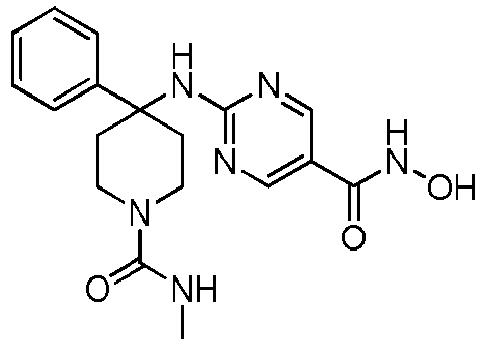
170 207 987 1.7 017 
5.9 5.2 111 2.4 018 
551 644 2485 5.1 019 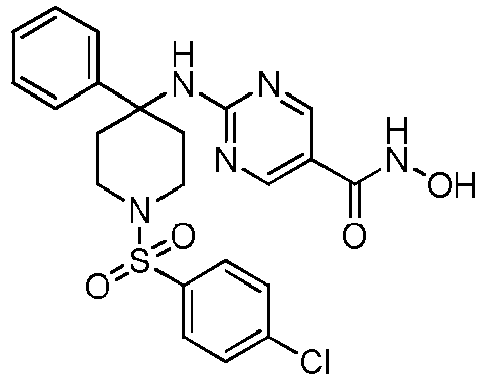
854 987 3190 5.0 020 
372 423 1983 4.5 021 
570 642 2513 4.5 022 
704 782 2703 7.3 023 
844 829 3545 4.6 024 
22 22 761 3.7 025 
20 18 84 13 026 
206 173 1100 5.0 027 
130 103 422 12 028 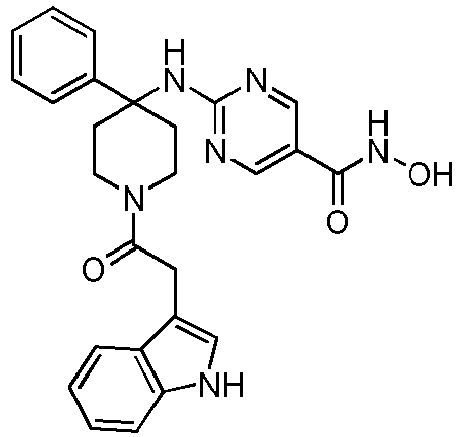
3 2 24 2.8 029 
102 93 914 11 030 
23 22 114 12 031 
10 9 42 5 - In preferred embodiments, the compounds of the instant invention have one or more of the following properties: the compound is capable of inhibiting at least one histone deacetylase (HDAC); the compound is capable of inhibiting HDAC1, HDAC2, and/or HDAC6; the compound selectively inhibits HDAC1, HDAC2 and/or HDAC6 over other HDACs.
- Another object of the present invention is the use of a compound as described herein (e.g., of any formulae herein) in the manufacture of a medicament for use in the treatment of a disorder or disease herein. Another object of the present invention is the use of a compound as described herein (e.g., of any formulae herein) for use in the treatment of a disorder or disease herein.
- In another aspect, the invention provides a method of synthesizing a compound of Formula I, Formula II, or any of the compounds presented in Table 1. The synthesis of the compounds of the invention can be found in the Examples below.
- Another embodiment is a method of making a compound of any of the formulae herein using any one, or combination of, reactions delineated herein. The method can include the use of one or more intermediates or chemical reagents delineated herein.
- Another aspect is an isotopically labeled compound of any of the formulae delineated herein. Such compounds have one or more isotope atoms which may or may not be radioactive (e.g., 3H, 2H, 14C, 13C, 35S, 32P, 125I, and 131I) introduced into the compound. Such compounds are useful for drug metabolism studies and diagnostics, as well as therapeutic applications.
- A compound of the invention can be prepared as a pharmaceutically acceptable acid addition salt by reacting the free base form of the compound with a pharmaceutically acceptable inorganic or organic acid. Alternatively, a pharmaceutically acceptable base addition salt of a compound of the invention can be prepared by reacting the free acid form of the compound with a pharmaceutically acceptable inorganic or organic base.
- Alternatively, the salt forms of the compounds of the invention can be prepared using salts of the starting materials or intermediates.
- The free acid or free base forms of the compounds of the invention can be prepared from the corresponding base addition salt or acid addition salt from, respectively. For example a compound of the invention in an acid addition salt form can be converted to the corresponding free base by treating with a suitable base (e.g., ammonium hydroxide solution, sodium hydroxide, and the like). A compound of the invention in a base addition salt form can be converted to the corresponding free acid by treating with a suitable acid (e.g., hydrochloric acid, etc.).
- Protected derivatives of the compounds of the invention can be made by means known to those of ordinary skill in the art. A detailed description of techniques applicable to the creation of protecting groups and their removal can be found in T. W. Greene, "Protecting Groups in Organic Chemistry," 3rd edition, John Wiley and Sons, Inc., 1999, and subsequent editions thereof.
- Compounds of the present invention can be conveniently prepared, or formed during the process of the invention, as solvates (e.g., hydrates). Hydrates of compounds of the present invention can be conveniently prepared by recrystallization from an aqueous/organic solvent mixture, using organic solvents such as dioxan, tetrahydrofuran or methanol.
- In addition, some of the compounds of this invention have one or more double bonds, or one or more asymmetric centers. Such compounds can occur as racemates, racemic mixtures, single enantiomers, individual diastereomers, diastereomeric mixtures, and cis- or trans- or E- or Z- double isomeric forms, and other stereoisomeric forms that may be defined, in terms of absolute stereochemistry, as (R)- or (S)- , or as (D)- or (L)- for amino acids. All such isomeric forms of these compounds are expressly included in the present invention. Optical isomers may be prepared from their respective optically active precursors by the procedures described above, or by resolving the racemic mixtures. The resolution can be carried out in the presence of a resolving agent, by chromatography or by repeated crystallization or by some combination of these techniques which are known to those skilled in the art. Further details regarding resolutions can be found in Jacques, et al., "Enantiomers, Racemates, and Resolutions" (John Wiley & Sons, 1981). The compounds of this invention may also be represented in multiple tautomeric forms, in such instances, the invention expressly includes all tautomeric forms of the compounds described herein. When the compounds described herein contain olefinic double bonds or other centers of geometric asymmetry, and unless specified otherwise, it is intended that the compounds include both E and Z geometric isomers. Likewise, all tautomeric forms are also intended to be included. The configuration of any carbon-carbon double bond appearing herein is selected for convenience only and is not intended to designate a particular configuration unless the text so states; thus a carbon-carbon double bond depicted arbitrarily herein as trans may be cis, trans, or a mixture of the two in any proportion. All such isomeric forms of such compounds are expressly included in the present invention. All crystal forms of the compounds described herein are expressly included in the present invention.
- The synthesized compounds can be separated from a reaction mixture and further purified by a method such as column chromatography, high pressure liquid chromatography, or recrystallization. As can be appreciated by the skilled artisan, further methods of synthesizing the compounds of the formulae herein will be evident to those of ordinary skill in the art. Additionally, the various synthetic steps may be performed in an alternate sequence or order to give the desired compounds. In addition, the solvents, temperatures, reaction durations, etc. delineated herein are for purposes of illustration only and one of ordinary skill in the art will recognize that variation of the reaction conditions can produce the desired compounds of the present invention. Synthetic chemistry transformations and protecting group methodologies (protection and deprotection) useful in synthesizing the compounds described herein are known in the art and include, for example, those such as described in R. Larock, Comprehensive Organic Transformations, VCH Publishers (1989); T.W. Greene and P.G.M. Wuts, Protective Groups in Organic Synthesis, 2d. Ed., John Wiley and Sons (1991); L. Fieser and M. Fieser, Fieser and Fieser's Reagents for Organic Synthesis, John Wiley and Sons (1994); and L. Paquette, ed., Encyclopedia of Reagents for Organic Synthesis, John Wiley and Sons (1995), and subsequent editions thereof.
- The compounds of the invention are defined herein by their chemical structures and/or chemical names. Where a compound is referred to by both a chemical structure and a chemical name, and the chemical structure and chemical name conflict, the chemical structure is determinative of the compound's identity.
- The recitation of a listing of chemical groups in any definition of a variable herein includes definitions of that variable as any single group or combination of listed groups. The recitation of an embodiment for a variable herein includes that embodiment as any single embodiment or in combination with any other embodiments or portions thereof.
- The invention also provides for a pharmaceutical composition comprising a compound of instant invention, or a pharmaceutically acceptable salt thereof, together with a pharmaceutically acceptable carrier.
- In another aspect, the invention provides a pharmaceutical composition comprising any of the compounds of the instant invention (Formula I, Formula II, Formula III, or any of the compounds presented in Table 1) or pharmaceutically acceptable salts thereof, together with a pharmaceutically acceptable carrier.
- The pharmaceutical compositions of the present invention comprise a therapeutically effective amount of a compound of the present invention formulated together with one or more pharmaceutically acceptable carriers. The term "pharmaceutically acceptable carrier" means a non-toxic, inert solid, semi-solid or liquid filler, diluent, encapsulating material or formulation auxiliary of any type. The pharmaceutical compositions of this invention can be administered to humans and other animals orally, rectally, parenterally, intracisternally, intravaginally, intraperitoneally, topically (as by powders, ointments, or drops), buccally, or as an oral or nasal spray.
- Compounds of the invention can be administered as pharmaceutical compositions by any conventional route, in particular enterally, for example, orally, e.g., in the form of tablets or capsules, or parenterally, e.g., in the form of injectable solutions or suspensions, topically, e.g., in the form of lotions, gels, ointments or creams, or in a nasal or suppository form. Pharmaceutical compositions comprising a compound of the present invention in free form or in a pharmaceutically acceptable salt form in association with at least one pharmaceutically acceptable carrier or diluent can be manufactured in a conventional manner by mixing, granulating or coating methods. For example, oral compositions can be tablets or gelatin capsules comprising the active ingredient together with a) diluents, e.g., lactose, dextrose, sucrose, mannitol, sorbitol, cellulose and/or glycine; b) lubricants, e.g., silica, talcum, stearic acid, its magnesium or calcium salt and/or polyethyleneglycol; for tablets also c) binders, e.g., magnesium aluminum silicate, starch paste, gelatin, tragacanth, methylcellulose, sodium carboxymethylcellulose and or polyvinylpyrrolidone; if desired d) disintegrants, e.g., starches, agar, alginic acid or its sodium salt, or effervescent mixtures; and/or e) absorbents, colorants, flavors and sweeteners. Injectable compositions can be aqueous isotonic solutions or suspensions, and suppositories can be prepared from fatty emulsions or suspensions. The compositions may be sterilized and/or contain adjuvants, such as preserving, stabilizing, wetting or emulsifying agents, solution promoters, salts for regulating the osmotic pressure and/or buffers. In addition, they may also contain other therapeutically valuable substances. Suitable formulations for transdermal applications include an effective amount of a compound of the present invention with a carrier. A carrier can include absorbable pharmacologically acceptable solvents to assist passage through the skin of the host. For example, transdermal devices are in the form of a bandage comprising a backing member, a reservoir containing the compound optionally with carriers, optionally a rate controlling barrier to deliver the compound to the skin of the host at a controlled and predetermined rate over a prolonged period of time, and means to secure the device to the skin. Matrix transdermal formulations may also be used. Suitable formulations for topical application, e.g., to the skin and eyes, are preferably aqueous solutions, ointments, creams or gels well-known in the art. Such may contain solubilizers, stabilizers, tonicity enhancing agents, buffers and preservatives.
- The active compounds can also be in micro-encapsulated form with one or more excipients as noted above. The solid dosage forms of tablets, dragees, capsules, pills, and granules can be prepared with coatings and shells such as enteric coatings, release controlling coatings and other coatings well known in the pharmaceutical formulating art. In such solid dosage forms the active compound may be admixed with at least one inert diluent such as sucrose, lactose or starch. Such dosage forms may also comprise, as is normal practice, additional substances other than inert diluents, e.g., tableting lubricants and other tableting aids such a magnesium stearate and microcrystalline cellulose. In the case of capsules, tablets and pills, the dosage forms may also comprise buffering agents.
- According to the methods of treatment of the present invention, disorders are treated or prevented in a subject, such as a human or other animal, by administering to the subject a therapeutically effective amount of a compound of the invention, in such amounts and for such time as is necessary to achieve the desired result. The term "therapeutically effective amount" of a compound of the invention means a sufficient amount of the compound so as to decrease the symptoms of a disorder in a subject. As is well understood in the medical arts, a therapeutically effective amount of a compound of this invention will be at a reasonable benefit/risk ratio applicable to any medical treatment.
- In general, compounds of the invention will be administered in therapeutically effective amounts via any of the usual and acceptable modes known in the art, either singly or in combination with one or more therapeutic agents. A therapeutically effective amount may vary widely depending on the severity of the disease, the age and relative health of the subject, the potency of the compound used and other factors. In general, satisfactory results are indicated to be obtained systemically at daily dosages of from about 0.03 to 2.5 mg/kg per body weight (0.05 to 4.5 mg/m2). An indicated daily dosage in the larger mammal, e.g. humans, is in the range from about 0.5 mg to about 100 mg, conveniently administered, e.g. in divided doses up to four times a day or in retard form. Suitable unit dosage forms for oral administration comprise from ca. 1 to 50 mg active ingredient.
- In certain embodiments, a therapeutic amount or dose of the compounds of the present invention may range from about 0.1 mg/kg to about 500 mg/kg (about 0.18 mg/m2 to about 900 mg/m2), alternatively from about 1 to about 50 mg/kg (about 1.8 to about 90 mg/m2). In general, treatment regimens according to the present invention comprise administration to a patient in need of such treatment from about 10 mg to about 1000 mg of the compound(s) of this invention per day in single or multiple doses. Therapeutic amounts or doses will also vary depending on route of administration, as well as the possibility of co-usage with other agents.
- Upon improvement of a subject's condition, a maintenance dose of a compound, composition or combination of this invention may be administered, if necessary. Subsequently, the dosage or frequency of administration, or both, may be reduced, as a function of the symptoms, to a level at which the improved condition is retained when the symptoms have been alleviated to the desired level, treatment should cease. The subject may, however, require intermittent treatment on a long-term basis upon any recurrence of disease symptoms.
- It will be understood, however, that the total daily usage of the compounds and compositions of the present invention will be decided by the attending physician within the scope of sound medical judgment. The specific inhibitory dose for any particular patient will depend upon a variety of factors including the disorder being treated and the severity of the disorder; the activity of the specific compound employed; the specific composition employed; the age, body weight, general health, sex and diet of the patient; the time of administration, route of administration, and rate of excretion of the specific compound employed; the duration of the treatment; drugs used in combination or coincidental with the specific compound employed; and like factors well known in the medical arts.
- In one aspect, the invention provides a method of selectively inhibiting the activity of each of HDAC1, HDAC2, and/or HDAC6 over other HDACs in a subject, comprising administering a compound of Formula I, Formula II, Formula III, or any of the compounds presented in Table 1, or pharmaceutically acceptable salts thereof.
- In one embodiment, the compound has a selectivity for each of HDAC1, HDAC2 and HDAC6 of about 2 to 1000 fold greater than for other HDACs. In another embodiment, the compound has a selectivity for each of HDAC1, HDAC2, and or HDAC6 when tested in a HDAC enzyme assay of about 2 to 1000 fold greater than for other HDACs.
- In another aspect, the invention provides a method of treating a disease mediated by an HDAC, specifically HDAC1, HDAC2, or HDAC6 in a subject comprising administering to the subject a compound of Formula I, Formula II, Formula III, or any of the compounds presented in Table 1, and pharmaceutically acceptable salts thereof.
- In another aspect, the invention provides a method of treating a disease mediated by one or more HDACs in a subject comprising administering to the subject in need thereof a compound of Formula I, Formula II, Formula III, or any of the compounds presented in Table 1, or pharmaceutically acceptable salts thereof.
- Inhibition of HDAC1 and HDAC2 is sufficient to derepress fetal globin. In cultured human CD34+ bone marrow cells undergoing erythroid differentiation, these compounds induced a dose dependent increase in fetal hemoglobin expression, with a 2-fold induction observed at 1 µM and 5-fold induction observed at 10 µM. Cytotoxicity of these compounds was minimal, showing IC50 values ranging from 1 to 5 µM. The selective HDAC1 and HDAC2 inhibitors of the present invention have favorable pharmacokinetic profiles. Thus, the compounds are capable of derepressing fetal globin through HDAC inhibition. In a preferred embodiment, the compounds are able to treat sickle-cell disease or beta-thalessemia. Further, the compounds are able to treat a subject suffering from or susceptible to a hemoglobinopathy.
- Inhibition of HDAC, including inhibition of HDAC1 and HDAC2 by selective compounds, can induce the expression of genes associated with synapse formation and memory in cultured neurons. In addition, inhibition of HDAC2 by gene disruption can lead to the formation of new synapses and increase cognitive performance in mice. Inhibition of HDAC6 by selective molecules can reverse the effects of neurodegenerative transgenes in mice, including amyloid precursor protein and
presenelin 1. The selective inhibitors of HDAC1, HDAC2 and HDAC6 of the present invention would be capable of enhancing synapse formation and reversing the effects of amyloid protein, thus lessening the symptoms of neurodegenerative diseases such as Alzheimer's disease by two complimentary mechanisms. - In another aspect, the invention provides a method of activating latent HIV in a subject comprising administering to the subject a compound of Formula I, Formula II, Formula III, or any of the compounds presented in Table 1. The same compounds can be used treat HIV infections. In another embodiment, the compounds can be used in combination with one or more anti-retroviral agents for the treatment of HIV infections. In an embodiment, the HIV infection is HIV-1.
- Anti-retroviral agents that can be used in combination with the HDAC inhibitors of the instant invention include nucleoside reverse transcriptase inhibitors, non-nucleoside reverse transcriptase inhibitors, protease inhibitors, virus uptake/adsorption inhibitors, virus receptor antagonists, viral fusion inhibitors, viral integrase inhibitors, entry inhibitor, co-receptor antagonist, cyclin dependent kinase inhibitor, and transcription inhibitors or other anti-retroviral agents used in treatment of HIV infection. Preferred anti-retroviral agents include efavirenz, indinavir sulfate, and raltegravir potassium
- As discussed above, the present invention provides compounds useful for the treatment of various diseases. In certain embodiments, the compounds of the present invention are useful as inhibitors of histone deacetylases (HDACs) and thus are useful as anti-cancer agents, and thus may be useful in the treatment of cancer, by effecting tumor cell death or inhibiting the growth of tumor cells. The compounds of the invention are capable of inducing apoptosis in cancer cells thereby able to treat a disease such as a cancer or proliferation disease.
- In certain embodiments, the cancer is lung cancer, colon and rectal cancer, breast cancer, prostate cancer, liver cancer, pancreatic cancer, brain cancer, kidney cancer, ovarian cancer, stomach cancer, skin cancer, bone cancer, gastric cancer, breast cancer, glioma, gliobastoma, neuroblastom, hepatocellular carcinoma, papillary renal carcinoma, head and neck squamous cell carcinoma, leukemia, lymphomas, myelomas, retinoblastoma, cervical cancer, melanoma and/or skin cancer, bladder cancer, uterine cancer, testicular cancer, esophageal cancer, and solid tumors. In some embodiments, the cancer is lung cancer, colon cancer, breast cancer, neuroblastoma, leukemia, or lymphomas. In a further embodiment, the cancer is non-small cell lung cancer (NSCLC) or small cell lung cancer.
- In further embodiments, the cancer is a hematologic cancer, such as a leukemia or a lymphoma. In a certain embodiment, the lymphoma is Hodgkins lymphoma or Non Hodgkin's lymphoma. In certain embodiments, the inventive compounds are effective anticancer agents, which are active against leukemia cells and thus are useful for the treatment of leukemias, e.g., myeloid, lymphocytic, myelocytic and lymphoblastic leukemias.
- In another aspect, the present invention provides for a method of treating a subject suffering from or susceptible to Hodgkins lymphoma or Non Hodgkin's lymphoma comprising administering to a subject in need thereof a therapeutically effective amount of a compound of the instant invention to thereby treat the subject suffering from or susceptible to Hodgkins lymphoma or Non Hodgkin's lymphoma.
- In various embodiments, the invention provides a method of treating cancer in a subject further comprising co-administering one or more of a chemotherapeutic agent, radiation agent, hormonal agent, biological agent or an anti-inflammatory agent to the subject. In some embodiments the chemotherapeutic agent is azacitidine, decitabine, clofarabine, erlotinib, bortezomib, carfilzomib, ixazomib, tamoxifen, trastuzumab, raloxifene, doxorubicin, lenalidomide, pomalidomide, fluorouracil/5-fu, pamidronate disodium, anastrozole, exemestane, cyclophosphamide, epirubicin, letrozole, toremifene, fulvestrant, fluoxymesterone, methotrexate, megastrol acetate, docetaxel, paclitaxel, testolactone, aziridine, vinblastine, capecitabine, goselerin acetate, zoledronic acid, taxol, vinblastine, or vincristine.
- In another embodiment, the chemotherapeutic agent is an aromatase inhibitor.
- In an embodiment, the biological agent is rituximab, ipilimumab, bevacizumab, cetuximab, panitumumab, trastuzumab, or other monoclonal antibodies used for the treatment of cancer.
- Methods delineated herein include those wherein the subject is identified as in need of a particular stated treatment. Identifying a subject in need of such treatment can be in the judgment of a subject or a health care professional and can be subjective (e.g. opinion) or objective (e.g. measurable by a test or diagnostic method).
- Also, as discussed above, the compounds of the invention are selective inhibitors of HDAC1, HDAC2, and/or HDAC6 and, as such, are useful in the treatment of disorders modulated by these histone deacetylases (HDACs). For example, compounds of the invention may be useful in the treatment of cancer (e.g., lung cancer, colon cancer, breast cancer, neuroblastoma, leukemia, or lymphomas, etc.). Accordingly, in yet another aspect, according to the methods of treatment of the present invention, tumor cells are killed, or their growth is inhibited by contacting said tumor cells with an inventive compound or composition, as described herein.
- Thus, in another aspect of the invention, methods for the treatment of cancer are provided comprising administering a therapeutically effective amount of an inventive compound (i.e., of any of the formulae herein), as described herein, to a subject in need thereof. In certain embodiments, the subject is identified as in need of such treatment. In certain embodiments, a method for the treatment of cancer is provided comprising administering a therapeutically effective amount of an inventive compound, or a pharmaceutical composition comprising an inventive compound to a subject in need thereof, in such amounts and for such time as is necessary to achieve the desired result. In certain embodiments of the present invention a "therapeutically effective amount" of the inventive compound or pharmaceutical composition is that amount effective for killing or inhibiting the growth of tumor cells. The compounds and compositions, according to the method of the present invention, may be administered using any amount and any route of administration effective for killing or inhibiting the growth of tumor cells. Thus, the expression "amount effective to kill or inhibit the growth of tumor cells," as used herein, refers to a sufficient amount of agent to kill or inhibit the growth of tumor cells. The exact amount required will vary from subject to subject, depending on the species, age, and general condition of the subject, the severity of the infection, the particular anticancer agent, its mode of administration, and the like.
- In certain embodiments, the method involves the administration of a therapeutically effective amount of the compound or a pharmaceutically acceptable derivative thereof to a subject (including, but not limited to a human or animal) in need of it. In certain embodiments, the inventive compounds as useful for the treatment of cancer and other proliferative disorders including, but not limited to lung cancer (e.g. non-small cell lung cancer), colon and rectal cancer, breast cancer, prostate cancer, liver cancer, pancreatic cancer, brain cancer, kidney cancer, ovarian cancer, stomach cancer, skin cancer, bone cancer, gastric cancer, breast cancer, glioma, gliobastoma, neuroblastoma, hepatocellular carcinoma, papillary renal carcinoma, head and neck squamous cell carcinoma, leukemia (e.g., CML, AML, CLL, ALL), lymphomas (non-Hodgkin's and Hodgkin's), myelomas, retinoblastoma, cervical cancer, melanoma and/or skin cancer, bladder cancer, uterine cancer, testicular cancer, esophageal cancer, and solid tumors.
- Provided in some embodiments are methods for inhibiting migration of a neuroblastoma cell comprising administering to the cell a therapeutically effective amount of a HDAC1, HDAC2, and/or HDAC6 selective inhibitor or a pharmaceutically acceptable salt thereof. The HDAC1, HDAC2, and/or HDAC6 selective inhibitor can be any compound selected from the group consisting of a compound of Formula I, Formula II, Formula III, any of the compounds presented in Table 1, Compound X, and Compound Y. Compound X and Compound Y are comparatives.
- Provided in some embodiments are methods for inducing maturation of a neuroblastoma cell comprising administering to the cell a therapeutically effective amount of a HDAC1, HDAC2, and/or HDAC6 selective inhibitor or a pharmaceutically acceptable salt thereof. The HDAC1, HDAC2, and/or HDAC6 selective inhibitor can be any compound selected from the group consisting of a compound of Formula I, Formula II, Formula III, any of the compounds presented in Table 1, Compound X, and Compound Y.
- Provided in some embodiments are methods for altering cell cycle progression of a neuroblastoma cell comprising administering to the cell a therapeutically effective amount of a HDAC1, HDAC2, and/or HDAC6 selective inhibitor or a pharmaceutically acceptable salt thereof. The HDAC1, HDAC2, and/or HDAC6 selective inhibitor can be any compound selected from the group consisting of a compound of Formula I, Formula II, Formula III, any of the compounds presented in Table 1, Compound X, and Compound Y.
- Provided in some embodiments are methods for decreasing viability and survival of a neuroblastoma cell comprising administering to the cell a therapeutically effective amount of a HDAC1, HDAC2, and/or HDAC6 selective inhibitor or a pharmaceutically acceptable salt thereof. The HDAC1, HDAC2, and/or HDAC6 selective inhibitor can be any compound selected from the group consisting of a compound of Formula I, Formula II, Formula III, any of the compounds presented in Table 1, Compound X, and Compound Y.
- Provided in some embodiments are methods for inducing differentiation of a neuroblastoma cell comprising administering to the cell a therapeutically effective amount of a HDAC1, HDAC2, and/or HDAC6 selective inhibitor or a pharmaceutically acceptable salt thereof. The HDAC1, HDAC2, and/or HDAC6 selective inhibitor can be any compound selected from the group consisting of a compound of Formula I, Formula II, Formula III, any of the compounds presented in Table 1, Compound X, and Compound Y.
- Provided in some embodiments are methods for enhancing low-concentration ATRA treament of a neuroblastoma cell comprising administering to the cell a therapeutically effective amount of a HDAC1, HDAC2, and/or HDAC6 selective inhibitor or a pharmaceutically acceptable salt thereof. The HDAC1, HDAC2, and/or HDAC6 selective inhibitor can be any compound selected from the group consisting of a compound of Formula I, Formula II, Formula III, any of the compounds presented in Table 1, Compound X, and Compound Y.
- Provided in some embodiments are methods for inducing cell cycle arrest of a neuroblastoma cell comprising administering to the cell a therapeutically effective amount of a HDAC1, HDAC2, and/or HDAC6 selective inhibitor or a pharmaceutically acceptable salt thereof. The HDAC1, HDAC2, and/or HDAC6 selective inhibitor can be any compound selected from the group consisting of a compound of Formula I, Formula II, Formula III, any of the compounds presented in Table 1, Compound X, and Compound Y.
- Provided in some embodiments are methods for treating neuroblastoma in a subject comprising administering to the subject a therapeutically effective amount of
Compound 001, Compound X, or Compound Y. - In certain embodiments, the invention provides a method of treatment of any of the disorders described herein, wherein the subject is a human.
- In accordance with the foregoing, the present invention further provides a method for preventing or treating any of the diseases or disorders described above in a subject in need of such treatment, which method comprises administering to said subject a therapeutically effective amount of a compound of the invention or a pharmaceutically acceptable salt thereof. For any of the above uses, the required dosage will vary depending on the mode of administration, the particular condition to be treated and the effect desired.
- Examples have been set forth below for the purpose of illustration and to describe certain specific embodiments of the invention. However, the scope of the claims is not to be in any way limited by the examples set forth herein. Various changes and modifications to the disclosed embodiments will be apparent to those skilled in the art and such changes and modifications including, without limitation, those relating to the chemical structures, subtitutents, derivatives, formulations and/or methods of the invention may be made without departing from the spirit of the invention and the scope of the appended claims. Definitions of the variables in the structures in the schemes herein are commensurate with those of corresponding positions in the formulae presented herein.
-

- Step 1: To a solution of 1 (10.4 g, 56.5 mmol) and TEA (11.4 g, 113 mmol) in DCM (60 mL) was added dropwise CbzCl (10 g, 56.5 mmol) over 30 mins at 0°c. Then the mixture was stirred at room temperature (r.t.) for 6 hrs. H2O(50 ml) was added, the organic layer was washed with aqueous NaCl, dried by anhydrous Na2SO4, concentrated in vacuo and the residue was purified by silica gel chromatography (PE/EA = 20:1) to afford
compound 2 as a white solid (11.6 g, yield: 70%). - Step 2: To a flask containing compound 3 (1.52 g, 13.1 mmol) and compound 2 (3 g, 10.9 mol) in DMF (25 ml) was added NaH (1.09 g, 27.2 mmol) at 0°C. It was stirred at 60°C for 3 hrs. H2O was added, the resulting mixture was extracted with ethyl acetate (EA). The combined EA layers were concentrated in vacuo and the residue was purified by silica gel chromatography (PE/EA = 2:1) to afford
compound 4 as a yellow solid (1.9 g, yield: 54%). - Step 3: To a mixture of compound 4 (1.89 g, 5.91 mmol) in DMSO (15 mL) was added K2CO3 (2.4 g, 17.7 mmol), the mixture was stirred at 60°C. Then to the
reaction 30% H2O2 (17 ml, 177 mmol) was added dropwise. After the reaction was complete, H2O was added, and the reaction mixture was filtered. The resulting white solid was dried to affordcompound 5 1.99 g, yield: 70%). - Step 4: A mixture of compound 5 (6.2g, 18.3 mmol), NaClO (11 ml, 25.6 mol), and 3N NaOH (17 mL, 51.3 mmol) in t-BuOH (40 mL) was stirred at 0°C to r.t. overnight. The mixture was concentrated, extracted with EA (30 mL?), washed with aqueous NaCl, dried by Na2SO4, and concentrated to afford compound 6 (4.5 g, yield: 80%).
- Step 5: To a solution of compound 6 (2.0 g, 6.45 mmol) in Dioxane (18 mL) was added ethyl 2-chloropyrimidine-5-carboxylate (1.08 g, 5.80 mmol), N,N-Diisopropylethylamine (DIPEA) (1.7 g, 12.9 mmol) at 105°C. The reaction was stirred overnight. The reaction mixture was concentrated in vacuo, and the residue was purified by silica gel chromatography (PE/EA = 6:1) to give compound 7 (1.5 g, yield: 51%).
- Step 6: HBr/AcOH (6.0 mL) was added to a flask containing compound 7 (3.0 g, 6.52 mmol) at r.t. for 3 hrs. Then 12 ml Et2O was added, the reaction mixture filtered, the solid was dried to give compound 8 (1.85 g, yield: 70%) as a yellow solid.
- Step 7: To a solution of compound 8 (100 mg, 0.31 mmol) in DCM (4 mL) was added Ac2O (47 mg, 0.46 mmol), and Et3N (0.5 ml) at r.t.. The reaction was stirred for 2 hrs and the reaction mixture was concentrated in vacuo to give compound 9 (120g, yield: 100%).
- Step 8: To a solution of compound 9 (20 mg, 0.33 mmol) in MeOH (2 mL) and DCM (1 ml) at 0°C was added NH2OH (0.4 ml) and stirred for 10 mins. Then NaOH/MeOH (0.8 ml) was added and the reaction was stirred for 2 hrs. The mixture was concentrated, adjusted to a pH=5 using 2N HCl, extracted with EA (10 ml) and purified by Pre-HPLC to afford 2-((1-acetyl-4-phenylpiperidin-4-yl)amino)-N-hydroxypyrimidine-5-carboxamide (18 mg, 16%). 1H NMR (500 MHz, DMSO): δ 10.95 (s, 1H), 8.98 (s, 1H), 8.62 (s, 1H), 8.33 (s, 1H), 8.23 (s, 1H), 7.38 (d, J = 7.6 Hz, 2H), 7.27 (t, J = 7.7 Hz, 2H), 7.16 (t, J = 7.3 Hz, 1H), 4.28 (d, J = 13.2 Hz, 1H), 3.72 (d, J = 13.6 Hz, 1H), 3.39 - 3.28 (m, 1H), 2.85 (t, J = 12.3 Hz, 1H), 2.61 (t, J = 12.5 Hz, 2H), 2.01 (s, 3H), 1.97 - 1.86 (m, 1H), 1.77 (t, J = 11.0 Hz, 1H). LCMS: m/z = 356 (M+H)+
-

- To a solution of compound 7 (460 mg, 1.0 mmol) in MeOH (10 mL) and DCM (3 ml) at 0°C was added NH2OH (1.0 ml) and stirred for 10 mins. NaOH/MeOH (2.0 ml) was added and the reaction was stirred for 2 hrs. The mixture was concentrated, adjusted to pH=5 using 2N HCl, extracted with EA (10 ml), washed with aqueous NaCl, dried by Na2SO4, and concentrated to afford benzyl 4-((5-(hydroxycarbamoyl)pyrimidin-2-yl)amino)-4-phenylpiperidine-1-carboxylate (400 mg, 89%). 1H NMR (500 MHz, DMSO) δ 10.94 (s, 1H), 8.97 (s, 1H), 8.61 (s, 1H), 8.34 (s, 1H), 8.21 (s, 1H), 7.40 - 7.35 (m, 6H), 7.32 (dt, J = 9.1, 4.5 Hz, 1H), 7.26 (t, J = 7.7 Hz, 2H), 7.15 (t, J = 7.3 Hz, 1H), 5.08 (s, 2H), 3.92 (d, J = 13.1 Hz, 2H), 3.15 (m, 2H), 2.60 (s, 2H), 1.87 (dd, J = 12.8, 9.1 Hz, 2H). LCMS: m/z = 448 (M+H)+
-

- Step 1: To a solution of compound 8 (85 mg, 0.26 mmol) in THF (4 mL) was added isocyanatobenzene (46 mg, 0.39 mmol), DIPEA (0.2 ml) at r.t. The reaction was stirred for 2 hrs. and subsequently concentrated in vacuo to give compound 9 (80 g, yield: 69%).
- Step 2: To a solution of compound 9 (80 mg, 0.18 mmol) in MeOH (3 mL) and DCM (1 ml) at 0°C was added NH2OH (0.2 ml). The reaction was stirred for 10 mins, at which time NaOH/MeOH (0.4 ml) was added. The reaction was stirred for 2 hrs. The resulting reaction mixture was concentrated, adjusted to PH=5 using 2N HCl, extracted with EA (10 ml), and purified by Pre-HPLC to afford N-hydroxy-2-((4-phenyl-1-(phenylcarbamoyl)piperidin-4-yl)amino)pyrimidine-5-carboxamide (14 mg, 17%). 1H NMR (500 MHz, DMSO) δ 10.83 (s, 1H), 8.96 (s, 1H), 8.60 (s, 1H), 8.49 (s, 2H), 8.37 (s, 1H), 8.20 (s, 1H), 7.47-7.46 (d, J = 7.6 Hz, 2H), 7.41-7.39 (d, J= 7.4 Hz, 2H), 7.29-7.26 (t, J = 7.7 Hz, 2H), 7.23-7.20 (m, J = 7.7 Hz, 2H), 7.18-7.15 (t, J = 7.3 Hz, 1H), 6.92 (t, J = 7.3 Hz, 1H), 4.03 (d, J = 13.2 Hz, 2H), 3.13 (t, J = 12.1 Hz, 2H), 2.64 (d, J = 13.0 Hz, 2H), 1.90 (t, J = 11.0 Hz, 2H). LCMS: m/z = 433 (M+H)+
-

- Step 1: To a solution of compound 8 (106 mg, 1.0 mmol), ethyl chloroformate (400 mg, 1.0 mmol) in 5 ml THF was added DIPEA (252 mg, 2.0 mmol). The mixture was stirred at r.t. for 4 hrs. LCMS monitored the reaction to completion. Upon completion, the reaction mixture was concentrated and the residue was purified by flash chromatography with PE/EA from 6:1 to 5:1 to give the target compound, compound 9 (320 mg, 82%).
- Step 2: To a solution of compound 9 (300 mg, 0.8 mmol) in 5 ml CH3OH/CH2Cl2 was added NH2OH (0.8 ml) dropwise at 0°C. The reaction was then stirred for 10 min. at 0°C. NaOH/CH3OH was added into the solution slowly and the reaction continued stirring at 0°C for 2 hrs. After the pH of the solution was adjusted to 6 by using conc. HCl, the target compound was precipitated from the solution as a white solid, washed by the mixing solvent of EA and PE to give ethyl 4-((5-(hydroxycarbamoyl)pyrimidin-2-yl)amino)-4-phenylpiperidine-1-carboxylate as a white solid (200 mg, 65%). 1H NMR (500 MHz, DMSO) δ 10.93 (s, 1H), 8.95 (s, 1H), 8.60 (s, 1H), 8.34 (s, 1H), 8.17 (s, 1H), 7.38 (d, J = 7.7 Hz, 2H), 7.26 (t, J = 7.7 Hz, 2H), 7.15 (t, J = 7.2 Hz, 1H), 4.07 - 4.00 (m, 2H), 3.88 (d, J = 11.1 Hz, 2H), 3.11 (s, 2H), 2.60 (d, J = 12.6 Hz, 2H), 1.86 (td, J = 13.1, 4.3 Hz, 2H), 1.20 - 1.17 (m, 3 nH). LCMS: m/z = 386 (M+H)+
-

- Step 1: To a solution of compound 1 (3 g, 14.28 mmol) in a 3-neck-flask flushed with N2 was added lithium bis(trimethylsilyl)amide (LiHDMS) (1M, 21.4 ml) at -78°C. The reaction was stirred for 3h at which time 2-iodopropane (3.6 g, 21.43 mmol) was added slowly. The reaction solution was stirred at -78°C, and then warmed to r.t. overnight. The mixture was quenched with H2O (2 ml), concentrated, dissolved in EA (200 ml), and washed with water (100 ml?) and saturated NaCl (aq, 100 ml). The organic layer was concentrated to afford
compound 2 as a brown solid (4 g, 100%). - Step 2: To a solution of compound 2 (1 g, 3.97 mmol) in DMSO (30 ml) was added K2CO3 (1.6 g, 11.9 mmol) stirred at 60°C. Over a period of 2 hrs, H2O2 (30% aq., 5 ml) was added dropwise. TLC was used to monitor completion of the reaction. EA (100 ml) was added to the reaction mixture and subsequently washed with water (50 ml?) and saturated NaCl (aq,50 ml). The combined organic solutions were dried with anhydrous Na2SO4. The solvent was removed in vacuo to obtain
compound 3 as a white solid (1 g, 90%). - Step 3: To a solution of compound 3 (2.7 g, 10 mmol) in acetonitrile (AN) (50 ml) was added KOH (4N, aq., 50 ml) and 1,3-dibromo-5,5-dimethylhydantoin (DBDMH) (2.81 g, 5 mmol) at 0°C. The reaction was stirred at r.t. overnight. The mixture was concentrated and IN HCl was added to adjust the pH to ~6. The resulting mixture was extracted with EA (50 ml). The aqueous phase was then adjusted to pH∼ 9 by addition of KOH, and was subsequently extracted with EA (50 ml?). The EA phase was dried with anhydrous Na2SO4 and the solvent was concentrated to obtain
compound 4 as a colorless liquid (1 g, 40%). - Step 4: A solution of compound 4 (500 mg, 2.06 mmol) and ethyl 2-chloropyrimidine-5-carboxylate (384 mg, 2.06 mmol) in N-methyl-2-pyrrolidone (NMP) (10 ml) flushed with N2 was stirred at 140°C for 1 hour. EA (100 ml) was added to the reaction and resulting mixture was washed with water (50 ml?) and saturated NaCl (aq, 50 ml). The resulting organic solution was concentrated and purified by silica gel chromatography column (PE/EA=5/1) to obtain
compound 5 as a white solid (120mg 15%). - Step 5: To a solution of compound 5 (200 mg, 0.51 mmol) in DCM (5 ml) was added TFA (2 ml). The reaction was stirred at r.t. for 30 min. The mixture was concentrated to obtain
compound 6 as a brown liquid (200 mg, 90%). - Step 6: To a solution of compound 6 (200 mg, 0.709 mmol) in DCM was added Et3N (214 mg, 2.13 mmol) and acetyl chloride (56 mg, 0.709 mmol) at 0°C. The reaction stirred for 1 hour at which time the reaction mixture was concentrated to obtain the compound 7 as a brown liquid (220 mg, 95%)
- Step 7: To a solution of 7 (220 mg) in MeOH (2 ml) was added NH2OH (50% aq, 2 ml) and NaOH (saturated in
MeOH 2 ml) at 0°C. The reaction stirred for 1 hour. The reaction mixture was then adjusted to a pH of ~7 with 4N HCl (aq.), concentrated in vacuo, and purified by Pre-HPLC to obtaincompound 8 as a white solid (68 mg, 35%). 1H NMR (500 MHz, DMSO): δ 10.97 (s, 1H), 8.57 (s, 2H), 7.44 (s, 1H), 4.28 - 4.20 (m, 1H), 3.69 - 3.58 (m, 1H), 3.21 - 3.06 (m, 1H), 2.66 - 2.57 (m, 1H), 2.57 - 2.53 (m, 1H), 2.42 - 2.24 (m, 2H), 1.97 (s, 3H), 1.57 - 1.45 (m, 1H), 1.41 - 1.28 (m, 1H), 0.82 (d, J= 6.9 Hz, 6H). LCMS: m/z = 322 (M+H)+ -

- Step 1: To a solution of compound 6 (200 mg, 0.709 mmol) in DCM was added Et3N (214 mg, 2.13 mmol) and ethyl carbonochloridate (77 mg, 0.709 mmol) at 0°C for 1 hour. The reaction mixture was concentrated to obtain compound 9 as a brown liquid (250 mg, 95%).
- Step 2: To a solution of compound 9 (250 mg) in MeOH (2 ml) was added NH2OH (50% aq., 2 ml) and NaOH (saturated in MeOH, 2 ml) at 0°C. The mixture was stirred for 1 hour after which the reaction solution was adjusted to a pH of ∼7 with 4N HCl (aq.), concentrated, and purified by Pre-HPLC to obtain ethyl 4-((5-(hydroxycarbamoyl)pyrimidin-2-yl)amino)-4-isopropylpiperidine-1-carboxylate as a white solid (67 mg, 30%). 1H NMR (500 MHz, DMSO): δ 10.95 (m, 1H), 8.97 (m, 1H), 8.57 (s, 2H), 7.40 (s, 1H), 4.01 (d, J = 7.1 Hz, 2H), 3.89 - 3.73 (m, 2H), 3.53 - 3.23 (m, 2H), 3.02 - 2.78 (m, 2H), 2.60 - 2.52 (m, 1H), 2.40 - 2.26 (m, 2H), 1.44 (d, J = 4.4 Hz, 2H), 1.16 (t, J = 7.1 Hz, 3H), 0.82 (d, J = 6.9 Hz, 6H). LCMS: m/z = 352 (M+H)+
-

- Step 1: To a solution of compound 6 (200 mg, 0.709 mmol) in DCM was added Et3N (214 mg, 2.13 mmol) and benzyl carbonochloridate (181 mg, 1.06 mmol) at 0°C for 2 hrs. The mixture was concentrated to obtain compound 11 as a brown liquid (300 mg, 95%).
- Step 2: To a solution of compound 11 (300 mg) in MeOH (2 ml) was added NH2OH (50% aq, 2 ml) and NaOH (saturated in MeOH, 2 ml) at 0°C. The mixture stirred for 1 hour after which the reaction solution was adjusted to a pH of ∼7 with 4N HCl (aq.), concentrated, and purified by Pre-HPLC to obtain benzyl 4-((5-(hydroxycarbamoyl)pyrimidin-2-yl)amino)-4-isopropylpiperidine-1-carboxylate as a white solid (78.1 mg, 28%). 1H NMR (500 MHz, DMSO) δ10.99 (m, 1H), 8.57 (m, 2H), 7.53 - 7.26 (m, 6H), 5.06 (s, 2H), 3.94 - 3.72 (m, 2H), 3.07 - 2.77 (m, 2H), 2.61 - 2.53 (m, 1H), 2.42 - 2.24 (m, 2H), 1.59 - 1.29 (m, 2H), 0.81 (d, J = 6.8 Hz, 6H). LCMS: m/z = 414 (M+H)+.
-

- Step 1: To a solution of compound 1 (10 g, 56.5 mmol) in DCM (50 mL) was added TEA (11.4 g, 113 mmol), followed by CbzCl (10.4 g, 56.5 mmol) while the system was in a water bath. The mixture was stirred for 3 hrs at r.t. Water (50 ml) was added to the reaction mixture and extracted with EA (150 ml?). The organic phase was washed with saturated salt and dried over Na2SO4. Concentration and purification by silica gel column with EA/PE = 1/20 yielded compound 2 (3 g, 18%) as an oil.
- Step 2: To a solution of compound 2 (100 g, 0.36mol) and benzyl cyanide (59 g, 0.43 mol) in DMF (400 ml) was added NaH (37 g, 0.94 mol) at 0°C. After increasing the temperature to 60°C, the mixture was stirred at 60°C overnight. TLC was used to monitor the reaction to completion. After cooling, water was added into the mixture resulting in a green solid. The target compound was purified by flash chromatography with PE/EA from 30:1 to 2:1 to yield compound 3 (38 g, 79%) as a white solid.
- Step 3: To a solution of compound 3 (38 g, 112 mmol) in 300 ml DMSO was added 30% H2O2 (190 ml, 2248 mmol) slowly at 0°C followed by stirring for 30 mins. Then the temperature was slowly increased to 40°C and stirred for an additional 30 mins. After increasing the temperature to 60°C, the mixture was stirred at 60°C overnight. TLC was used to monitor the reaction to completion. After cooling, water was added into the mixture to give a white solid, which was isolated by filtration (38 g, ∼95%).
- Step 4: To a solution of compound 4 (38 g, 106 mmol) in 400 ml BuOH was slowly added NaClO (64.2 ml, 149 mmol) followed by 3N NaOH (99 ml, 298 mmol) at 0°C. Then the mixture was stirred at r.t. overnight. TLC was used to monitor the reaction to completion. The mixture was concentrated and extracted with EtOAc. The organic layer was separated, washed and dried. Then the mixture was dissolved in Et2O, and the pH was adjusted to 2 using HCl/Dioxane. The precipitate was collected, yielding the target compound 5 (38
g 100%). - Step 5: To a solution of compound 5 (9.6 g, 26 mmol), 2-Cl-pyrimidine(4.9 g, 26 mmol) in 150
ml 1,4-Dioxane was added DIPEA (7.7 g, 60 mmol). The mixture was stirred at 110°C overnight. LCMS was used to monitor the reaction to completion. Water (50 ml) was added and the mixture was extracted with EtOAc. The combined organic extracts were washed and dried. The target compound 6 (11 g, 90%) was purified by flash chromatography with PE/EA from 30:1 to 2:1. - Step 6: To a solution of compound 6 (1 g, 2.17mmol) in MeOH (15 mL) was added Pd/C (0.1 g, 10% wq) under N2. The reaction was stirred under an H2 atmosphere overnight, after which it was filtered through celite and washed with MeOH. Concentration yielded compound 7 (690 mg, 98%) as a light yellow solid.
- Step 7: To a mixture of compound 7 (81 mg, 0.2 mmol) and 1-isocyanato-4-methoxybenzene (21 mg, 0.2 mmol) in THF (4 ml) was added DIPEA (46 mg, 0.36 mmol). The reaction was stirred for 1h. at r.t., concentrated, and purified by gel chromatography (DCM:MeOH=10:1) to afford 8 (80 mg, 84%) as a white solid.
- Step 8: To a solution of compound 8 (80 mg, 0.16 mmol) in MeOH (3 mL) and DCM (1 ml) at 0°C was added NH2OH (0.2 ml) followed by stirring for 10 min. Then NaOH/MeOH (0.4 ml) was added and the reaction was stirred for 2 h. The reaction was concentrated and the pH was adjusted to 5, after which it was extracted with EA (10 ml). Purification by Pre-HPLC afforded the desired product, Compound 008 (15 mg, 21%). 1H NMR (500 MHz, DMSO) δ 8.60 (s, 1H), 8.32 (s, 2H), 8.19 (s, 1H), 7.40 (d, J = 7.5 Hz, 2H), 7.34 (d, J = 9.0 Hz, 2H), 7.27 (t, J = 7.7 Hz, 2H), 7.16 (t, J = 7.3 Hz, 1H), 6.81 (d, J = 9.0 Hz, 2H), 4.00 (d, J = 13.4 Hz, 2H), 3.70 (s, 3H), 3.11 (t, J = 12.2 Hz, 2H), 2.63 (d, J = 12.3 Hz, 2H), 1.89 (t, J = 11.1 Hz, 2H). LCMS: m/z = 463 (M+H)+.
-

- Step 1: A mixture of compound 1 (200 mg, 0.49 mmol), bromobenzene (77 mg, 0.49 mmol), Pd2(dba)3 (20 mg, 0.02 mmol), Xantphos (12 mg, 0.02mmol) and Cs2CO3 (480 mg, 1.47 mmol) in toluene (8 ml) was stirred at 95°C overnight under N2. After completion, the reaction was filtered and concentrated, and purified by gel chromatography (PE: EA=1:1) to afford compound 2 (60 mg, 20%) as a white solid.
- Step 2: To a solution of compound 2 (60 mg, 0.15 mmol) in MeOH (3 ml) and DCM (1 ml) at 0°C was added NH2OH (0.1 ml) followed by stirring for 10 mins. NaOH/MeOH (0.2 ml) was then added and stirred for 2 hrs. The reaction mixture was concentrated, adjusted to a pH of 5, and extracted with EA (10 ml). Purification by Prep-HPLC afforded the desired product, Compound 009 (18 mg, 32%). 1HNMR (500 MHz, DMSO) δ 10.77 (s, 1H), 8.96 (s, 1H), 8.47 (d, J = 118.1 Hz, 2H), 8.14 (s, 1H), 7.43 (d, J = 7.5 Hz, 2H), 7.28 (t, J = 7.7 Hz, 2H), 7.22 - 7.14 (m, 3H), 6.96 (d, J = 8.1 Hz, 2H), 6.74 (t, J = 7.2 Hz, 1H), 3.58 (d, J = 12.2 Hz, 2H), 2.98 (t, J = 11.6 Hz, 2H), 2.72 (d, J = 12.4 Hz, 2H), 2.09 (dd, J = 12.4, 9.3 Hz, 2H). LCMS: m/z = 390 (M+H)+.
-

- Step 1: To a mixture of compound 1 (50 mg, 0.15 mmol) and 1-fluoro-2-isocyanatobenzene (21 mg, 0.15 mmol) in THF(4 ml) was added DIPEA(39 mg,0.30 mmol) at r.t. followed by stirring for 1 hour. The reaction mixture was concentrated and purified by gel chromatography (PE:EA=1:1) to afford compound 2 (60 mg, 86%) as a white solid.
- Step 2: A procedure analogous to step 2 in Example 9 yielded Compound 010 (12 mg, 44%). 1H NMR (500 MHz, DMSO) δ 10.84 (s, 1H), 8.94 (s, 1H), 8.32 (d, J = 59.2 Hz, 3H), 8.18 (s, 1H), 7.47 - 7.35 (m, 3H), 7.28 (t, J = 7.7 Hz, 2H), 7.17 (dd, J = 13.9, 6.5 Hz, 2H), 7.10 (dd, J = 6.7, 2.9 Hz, 2H), 3.98 (d, J = 13.0 Hz, 2H), 3.15 (t, J = 12.3 Hz, 2H), 2.64 (d, J = 12.4 Hz, 2H), 1.92 (t, J = 10.9 Hz, 2H). LCMS: m/z = 451 (M+H)+.
-

- Step 1: To a mixture of compound 1 (60 mg, 0.18 mmol) and 1,2-dichloro-4-isocyanatobenzene (34 mg, 0.18 mmol) in THF(4 ml) was added DIPEA (46 mg,0.36 mmol) at r.t. followed by stirring for 1 hour. The reaction mixture was concentrated and purified by gel chromatography (PE:EA=1:1) to afford compound 2 (60 mg, 70%) as a white solid.
- Step 2: A procedure analogous to step 2 in Example 9 yielded Compound 011(39 mg, 65%). 1H NMR (500 MHz, DMSO) δ 10.93 (s, 1H), 8.98 (s, 1H), 8.78 (s, 1H), 8.62 (s, 1H), 8.35 (s, 1H), 8.24 (s, 1H), 7.87 (s, 1H), 7.47 (s, 2H), 7.40 (d, J = 7.6 Hz, 2H), 7.27 (t, J = 7.7 Hz, 2H), 7.21 - 7.12 (m, 1H), 4.02 (d, J = 12.9 Hz, 2H), 3.15 (t, J = 12.4 Hz, 2H), 2.65 (d, J = 12.5 Hz, 2H), 1.91 (t, J = 10.8 Hz, 2H). LCMS: m/z = 502 (M+H)+.
-

- Step 1: To a mixture of compound 1 (40 mg, 0.12 mmol) and methyl(phenyl)carbamic chloride (21 mg, 0.12 mmol) in THF(4 ml) was added DIPEA (31 mg,0.24 mmol) at r.t. The reaction was stirred for 1 hr., concentrated, and purified by gel chromatography (PE:EA=1:1) to afford compound 2 (50 mg, 91%) as a white solid.
- Step 2: A procedure analogous to step 2 in Example 9 yielded Compound 012 (21 mg, 47%). 1H NMR (500 MHz, DMSO) δ 8.57 (s, 1H), 8.28 (s, 1H), 8.08 (s, 1H), 7.35 (t, J = 7.9 Hz, 2H), 7.29 (d, J = 7.5 Hz, 2H), 7.24 (t, J = 7.7 Hz, 2H), 7.14 (d, J = 7.6 Hz, 3H), 7.08 (d, J = 7.4 Hz, 1H), 3.61 (d, J = 13.4 Hz, 2H), 3.09 (s, 3H), 2.90 (t, J = 12.3 Hz, 2H), 2.44 (d, J = 12.7 Hz, 2H), 1.69 (t, J = 10.9 Hz, 2H). LCMS: m/z = 447 (M+H)+.
-

- Step 1: A mixture of compound 1 (60 mg, 0.18 mmol) and 1-fluoro-3-isocyanatobenzene (25 mg, 0.18 mmol) in THF (4 ml) was added DIPEA (46 mg, 0.36 mmol) at r.t. The reaction as stirred for 1 hr, concentrated, and purified by gel chromatography (PE:EA=1:1) to afford compound 2 (60 mg, 71%) as a white solid.
- Step 2: A procedure analogous to step 2 in Example 9 yielded Compound 013 (40 mg, 68%). 1H NMR (500 MHz, DMSO) δ 10.91 (s, 1H), 9.01 (s, 1H), 8.70 (s, 1H), 8.63 (s, 1H), 8.36 (s, 1H), 8.24 (s, 1H), 7.46 (d, J = 12.3 Hz, 1H), 7.40 (d, J = 7.6 Hz, 2H), 7.25 (dt, J = 20.3, 7.8 Hz, 4H), 7.16 (t, J = 7.3 Hz, 1H), 6.72 (t, J = 7.6 Hz, 1H), 4.03 (d, J = 13.4 Hz, 2H), 3.14 (t, J = 12.2 Hz, 2H), 2.65 (d, J = 12.7 Hz, 2H), 1.91 (t, J = 10.9 Hz, 2H). LCMS: m/z = 451 (M+H)+.
-

- Step 1: To a mixture of compound 1 (70 mg, 0.18 mmol) and 1-fluoro-4-isocyanatobenzene (25 mg, 0.18 mmol) in THF (4 ml) was added DIPEA(46 mg, 0.36 mmol) at r.t. The reaction was stirred for 1 hr, concentrated, and purified by gel chromatography (DCM: MeOH= 10:1) to afford compound 2 (720 mg, 85%) as a white solid.
- Step 2: A procedure analogous to step 2 in Example 9 yielded Compound 014 (25 mg, 37%). 1H NMR (500 MHz, DMSO) δ 10.76 (s, 1H), 8.94 (s, 1H), 8.70 - 8.07 (m, 4H), 7.51 - 7.43 (m, 2H), 7.40 (d, J = 7.5 Hz, 2H), 7.27 (t, J = 7.7 Hz, 2H), 7.16 (t, J = 7.3 Hz, 1H), 7.06 (t, J = 8.9 Hz, 2H), 4.02 (d, J = 13.2 Hz, 2H), 3.13 (t, J = 12.3 Hz, 2H), 2.64 (d, J = 12.8 Hz, 2H), 1.90 (dd, J = 12.6, 9.3 Hz, 2H). LCMS: m/z = 451 (M+H)+.
-

- Step 1: A mixture of 1 (60 mg, 0.18 mmol) and 1-isocyanato-4-methylbenzene (25 mg, 0.18 mmol) in THF (4 ml) was added DIPEA (46 mg,0.36 mmol) at r.t stirred for 1hour, concentrated, purified by gel chromatography (DCM:MeOH=10:1) to afford 2 (70 mg, 85%) as white solid.
- Step 2: A procedure analogous to step 2 in Example 9 yielded Compound 015 (19 mg, 29%). 1H NMR (500 MHz, DMSO) δ 8.38 (dd, J = 107.5, 101.2 Hz, 4H), 7.31 (dd, J = 48.2, 18.7 Hz, 6H), 7.16 (s, 1H), 7.01 (s, 2H), 4.00 (s, 2H), 3.11 (s, 2H), 2.62 (s, 2H), 2.21 (d, J = 7.4 Hz, 3H), 1.89 (s, 2H). LCMS: m/z = 447 (M+H)+.
-

- Step 1: To a mixture of compound 1 (81 mg, 0.2 mmol) and methylcarbamic chloride (19 mg, 0.2 mmol) in THF(4 ml) was added DIPEA (46 mg,0.36 mmol) at r.t. followed by stirring for 1 hr. The reaction was concentrated and purified by gel chromatography (DCM:MeOH=10:1) to afford compound 2 (50 mg, 61%) as a white solid.
- Step 2: A procedure analogous to step 2 in Example 9 yielded Compound 016 (22 mg, 46%).1H NMR (500 MHz, DMSO) δ 10.71 (s, 1H), 8.95 (s, 1H), 8.59 (s, 1H), 8.34 (s, 1H), 8.12 (s, 1H), 7.37 (d, J = 7.6 Hz, 2H), 7.26 (t, J = 7.7 Hz, 2H), 7.15 (t, J = 7.3 Hz, 1H), 6.40 (d, J = 4.4 Hz, 1H), 3.80 (d, J = 13.1 Hz, 2H), 2.98 (t, J = 12.2 Hz, 2H), 2.60 - 2.53 (m, 5H), 1.80 (dd, J = 12.6, 9.1 Hz, 2H). LCMS: m/z = 371 (M+H)+.
-

- Step 1: A procedure analogous to step 2 in Example 9 afforded compound 2 (40 mg, 58%).
- Step 2: To a mixture of compound 2 (40 mg, 0.13 mmol) and isothiocyanatobenzene (17 mg, 0.13 mmol) in THF(2 ml) was added DIPEA (34 mg,0.26 mmol) at r.t. followed by stirring for 20 mins. The reaction mixture was concentrated and purified by Pre-HPLC to afford Compound 017 (13 mg, 22%) as a white solid. 1H NMR (500 MHz, DMSO) δ 9.29 (s, 1H), 8.68 - 8.23 (m, 3H), 7.41 (d, J = 7.6 Hz, 2H), 7.29 (t, J = 5.1 Hz, 6H), 7.18 (t, J = 7.2 Hz, 1H), 7.11 - 7.02 (m, 1H), 4.64 (d, J = 11.3 Hz, 2H), 3.39 (d, J = 12.0 Hz, 2H), 2.69 (d, J = 13.0 Hz, 2H), 2.01 (t, J = 11.2 Hz, 2H). LCMS: m/z = 449 (M+H)+.
-

- Step 1: To a solution of compound 1 (55 mg, 0.14 mmol), 3-fluorobenzene sulfochloride (27 mg, 0.14 mmol) in 5 ml THF was added DIPEA (44 mg, 0.34 mmol). The mixture was stirred at r.t. for 2h. LCMS was used to monitor the reaction to completion. The target compound (30 mg, 46%) was purified by flash chromatography with PE/EA (3:1).
- Step 2: To a solution of compound 2 (30 mg, 0.06 mmol) in 5 ml CH3OH/CH2Cl2 was slowly added NH2OH (2 ml) at 0°C followed by stirring for 10 mins. Then NaOH/CH3OH was slowly added to the solution and stirred for 3 h. After removing the solvent from the solution, the pH was adjusted to 6 by 2N HCl. The target compound, Compound 018, (13 mg, 46%) was purified by pre-HPLC. 1H NMR (500 MHz, DMSO) δ 8.91 (s, 1H), 8.47 (s, 1H), 8.29 (s, 1H), 7.75 - 7.68 (m, 1H), 7.66 - 7.55 (m, 3H), 7.32 (d, J = 7.7 Hz, 2H), 7.25 (t, J = 7.7 Hz, 2H), 7.15 (t, J = 7.3 Hz, 1H), 3.61 (d, J = 11.3 Hz, 2H), 2.63 (t, J = 12.2 Hz, 4H), 2.00 (s, 2H). LCMS: m/z = 472 (M+H)+.
-

- Step 1: To a solution of compound 1 (70 mg, 0.17 mmol) and 4-chlorobenzene sulfochloride (36 mg, 0.17 mmol) in 5 ml THF was added DIPEA (44 mg, 0.34 mmol). The mixture was stirred at r.t. for 2h. LCMS was used to monitor the reaction to completion. The target,
compound 2, (56 mg, 65%) was purified by flash chromatography with PE/EA (3:1). - Step 2: A procedure analogous to step 2 in Example 18 yielded Compound 019. 1H NMR (500 MHz, DMSO) δ 8.40 (t, J = 60.5 Hz, 2H), 8.02 (s, 1H), 7.79 (d, J = 8.5 Hz, 2H), 7.73 (d, J = 8.5 Hz, 2H), 7.32 (d, J = 7.6 Hz, 2H), 7.24 (d, J = 7.7 Hz, 2H), 7.15 (t, J = 7.1 Hz, 1H), 3.59 (d, J = 11.3 Hz, 2H), 2.62 (dd, J = 25.8, 13.9 Hz, 4H), 1.99 (s, 2H). LCMS: m/z = 488 (M+H)+.
-

- Step 1: To a solution of compound 1 (55 mg, 0.14 mmol) and 2-methylbenzene sulfochloride (26 mg, 0.14 mmol) in 5 ml THF was added DIPEA (44 mg, 0.34mmol). The mixture was stirred at r.t. for 2h. LCMS was used to monitor the reaction to completion. The target compound (40 mg, 62.5%) was purified by flash chromatography with PE/EA (3:1).
- Step 2: A procedure analogous to step 2 in Example 18 yielded Compound 020. 1H NMR (500 MHz, DMSO) δ 8.96 (s, 1H), 8.47 (s, 1H), 8.31 (s, 1H), 8.08 (s, 1H), 7.82 (d, J = 8.1 Hz, 1H), 7.58 (t, J = 7.0 Hz, 1H), 7.44 (dd, J = 20.0, 7.7 Hz, 2H), 7.34 (d, J = 7.6 Hz, 2H), 7.26 (t, J = 7.7 Hz, 2H), 7.15 (t, J = 7.2 Hz, 1H), 3.53 (d, J = 12.1 Hz, 2H), 2.89 (t, J = 12.0 Hz, 2H), 2.67 (s, 2H), 2.59 (s, 3H), 1.96 (s, 2H). LCMS: m/z = 468 (M+H)+.
-

- Step 1: To a solution of compound 1 (55 mg, 0.14 mmol) and 4-methylbenzene sulfochloride (26 mg, 0.14 mmol) in 5 ml THF was added DIPEA (44 mg, 0.34mmol). The mixture was stirred at r.t for 2h. LCMS was used to monitor the reaction to completion. The target compound (48 mg, 75%) was purified by flash chromatography with PE/EA (3:1).
- Step 2: A procedure analogous to step 2 in Example 18 yielded Compound 021. 1H NMR (500 MHz, DMSO) δ 10.85 (s, 1H), 8.97 (s, 1H), 8.51 (s, 1H), 8.28 (s, 1H), 7.65 (d, J = 8.1 Hz, 2H), 7.45 (d, J = 8.1 Hz, 2H), 7.32 (d, J = 7.7 Hz, 2H), 7.24 (t, J = 7.6 Hz, 2H), 7.14 (t, J = 7.1 Hz, 1H), 3.56 (d, J = 11.7 Hz, 2H), 2.66 (s, 2H), 2.56 (t, J = 11.9 Hz, 2H), 2.41 (s, 3H), 2.00 (d, J = 10.5 Hz, 2H). LCMS: m/z = 468 (M+H)+.
-

- Step 1: To a mixture of compound 1 (55 mg, 0.13 mmol) and 4-(trifluoromethyl)benzene-1-sulfonyl chloride (33 mg, 0.13 mmol) in THF (4 ml) was added DIPEA (31 mg,0.24 mmol) at r.t. followed by stirring for 20 min. The reaction mixture was concentrated and purified by gel chromatography (PE:EA=2:1) to afford compound 2 (55 mg, 79%) as a yellow solid.
- Step 2: To a solution of compound 2 (60 mg, 0.1 mmol) in MeOH (3 mL) and DCM (1 ml) at 0°C was added NH2OH (0.1 ml) followed by stirring for 10 min. Then NaOH/MeOH (0.2 ml) was added and the reaction stirred for 2 hrs after which it was concentrated. The pH was adjusted to 5 and extracted with EA (10 ml). Purification by Pre-HPLC afforded Compound 022 (20 mg, 38%). 1H NMR (500 MHz, DMSO) δ 10.94 (s, 1H), 8.57 (t, J = 163.9 Hz, 3H), 8.03 (q, J = 8.4 Hz, 5H), 7.30 (d, J = 7.7 Hz, 2H), 7.24 (t, J = 7.7 Hz, 2H), 7.15 (t, J = 7.2 Hz, 1H), 3.64 (d, J = 12.1 Hz, 2H), 2.65 (t, J = 11.3 Hz, 4H), 2.01 (d, J = 11.1 Hz, 2H). LCMS: m/z = 522 (M+H)+.
-

- Step 1: To a solution of compound 1 (80 mg, 0.25 mmol) and benzene sulfochloride (44 mg, 0.25 mmol) in 5 ml THF was added DIPEA (80 mg, 0.63 mmol). The mixture was stirred at r.t. for 3 h. LCMS was used to monitor the reaction to completion. The target compound (60 mg, 51%) was purified by flash chromagraphy with PE/EA (2:1).
- Step 2: A procedure analogous to step 2 in Example18 yielded Compound 023. 1H NMR (400 MHz, DMSO) δ 10.88 (s, 1H), 8.96 (s, 1H), 8.50 (s, 1H), 8.28 (s, 1H), 8.01 (s, 1H), 7.82 - 7.75 (m, 2H), 7.73 (t, J = 7.3 Hz, 1H), 7.65 (t, J = 7.4 Hz, 2H), 7.32 (d, J = 7.6 Hz, 2H), 7.24 (t, J = 7.7 Hz, 2H), 7.14 (t, J = 7.2 Hz, 1H), 3.59 (d, J = 11.7 Hz, 2H), 2.67 (d, J = 12.8 Hz, 2H), 2.58 (t, J = 11.9 Hz, 2H), 1.99 (t, J = 11.1 Hz, 2H). LCMS: m/z = 454 (M+H)+.
-

- Step 1: To a mixture of compound 1 (60 mg, 0.18 mmol) and 1,3-difluoro-2-isocyanatobenzene (28 mg, 0.18 mmol) in THF(4 ml) was added DIPEA (46 mg,0.36 mmol) at r.t. followed by stirring for 20 mins. The reaction was concentrated and purified by gel chromatography (PE:EA=2:1) to afford comound 2 (70 mg, 81%) as a yellow solid.
- Step 2: A procedure analogous to step 2 in Example 9 yielded Compound 024 (28 mg, 43%). 1H NMR (500 MHz, DMSO) δ 10.94 (s, 1H), 8.97 (s, 1H), 8.62 (s, 1H), 8.35 (s, 1H), 8.24 (d, J = 12.1 Hz, 2H), 7.40 (d, J = 7.5 Hz, 2H), 7.32 - 7.22 (m, 3H), 7.17 (t, J = 7.3 Hz, 1H), 7.10 (t, J = 8.0 Hz, 2H), 3.97 (d, J = 13.5 Hz, 2H), 3.16 (t, J = 12.4 Hz, 2H), 2.64 (d, J = 12.6 Hz, 2H), 1.92 (t, J = 10.9 Hz, 2H). LCMS: m/z = 469 (M+H)+.
-

- Step 1: To a solution of compound 7 (200 mg, 0.50 mmol) and 3-methyl-2-phenylbutanoic acid (90 mg, 0.50 mmol) in 5 ml DMF was added HOAT (68 mg, 0.50 mmol), EDCI (78 mg, 050 mmol) and DIPEA (129 mg, 1 mmol). The mixture was stirred at 60°C overnight and LCMS was used to monitor the reaction to completion. The racemic compound 8 (200 mg, 83%) was purified by filtration through silica gel after extraction by EA. Chiral-HPLC afforded R and S targets separately.
- Step 2: To a solution of each of the compounds from the above step (40 mg, 0.08 mmol) in 5 ml CH3OH/CH2Cl2 was added NH2OH (0.1 ml) slowly at 0°C followed by stirring for 10 min. NaOH/CH3OH (0.3 ml) was added into the solution slowly and stirred for 2 h. After removing the solvent from the solution, the pH was adjusted to 6 by 2N HCl. The target compound was purified by pre-HPLC to afford Compound 025 (R) (26 mg, 26%). 1H NMR (500 MHz, DMSO) δ 10.93 (s, 1H), 8.60 (s, 1H), 8.31 (s, 1H), 8.18 (d, J = 6.4 Hz, 1H), 7.39 - 7.25 (m, 6H), 7.25 - 7.13 (m, 2H), 7.09 (d, J = 7.2 Hz, 1H), 7.02 (d, J = 7.6 Hz, 1H), 4.33 (d, J = 12.6 Hz, 1H), 4.21 - 3.91 (m, 1H), 3.64 (dd, J = 22.1, 9.9 Hz, 1H), 3.38 -2.83 (m, 1H), 2.64 (s, 1H), 2.26 (s, 2H), 1.82 (d, J = 43.9 Hz, 1H), 1.44 (s, 1H), 1.05 (t, J = 7.0 Hz, 1H), 0.96 (dd, J = 12.5, 6.4 Hz, 3H), 0.73 (s, 1H), 0.61 (t, J = 7.3 Hz, 3H). LCMS: m/z = 474 (M+H)+. Compound 026 (S): (27 mg, 27%). 1H NMR (500 MHz, DMSO) δ 10.94 (s, 1H), 8.97 (s, 1H), 8.60 (s, 1H), 8.30 (s, 1H), 8.18 (d, J = 6.5 Hz, 1H), 7.39 -7.25 (m, 6H), 7.19 (dt, J = 14.9, 8.7 Hz, 2H), 7.08 (t, J = 7.2 Hz, 1H), 7.02 (d, J = 7.5 Hz, 1H), 4.33 (d, J = 13.6 Hz, 1H),4.14-3.97(m, 1H), 3.64 (dd, J = 21.8, 10.0 Hz, 1H), 3.02-2.86(m, 1H),2.63 (d, J = 11.8 Hz, 1H), 2.24 (d, J = 12.9 Hz, 2H), 1.91-1.70 (m, 1H), 1.44 (s, 1H), 0.96 (dd, J = 12.6, 6.4 Hz, 3H), 0.73 (s, 1H), 0.61 (t, J = 7.4 Hz, 3H). LCMS: m/z = 474 (M+H)+.
-

- Step 1: Lithium bis(trimethylsilyl)amide (1.0 M solution in THF, 240 mL, 240 mmol) was slowly added to a round-bottomed flask with compound 1 (25 g, 120 mmol) at -76°C under N2. The reaction was stirred for 4h at -76°C. Then iodomethane (15 ml, 240 mmol) was added into the system. The reaction mixture was stirred at -76°C for 30 min and then warmed to room temperature overnight. The resulting mixture was quenched with 150 ml saturated aqueous NH4Cl, diluted with water, and extracted with EtOAc. The organic layers were washed with water and brine then dried over sodium sulfate, filtered and concentrated to afford the target compound 2 (25g, 93%) as a white solid.
- Step 2: K2CO3 (31 g, 223 mmol) was added to the solution of the compound 2 (25g, 111 mmol) in DMSO (120 mL). Then H2O2 (100 mL) was slowly added to the reaction dropwise at 60°C. The reaction was stirred overnight at 60°C. After completion, cold water was added and the mixture was extracted with EA. The organic layers were washed with water and brine, and dried over sodium sulfate, filtered and concentrated to afford the target,
compound 3, (26 g, 96%) as a white solid. - Step 3: Compound 3 (26g, 107 mmol) was dissolved with CH3CN (200 mL) and 2N KOH (100 mL). Then 1,3-dibromo-5,5-dimethylimidazolidine-2,4-dione(15g, 54 mmol) was added to the reaction and stirred overnight. Then the reaction pH was adjusted to 5 with 2N HCl and extracted with EA to remove the impurity. The aqueous phase was adjusted to a pH of 10. The precipitate was collected to afford the desired product as a white solid (16 g, 69%).
- Step 4: The solution of compound 4 (2g, 9.34 mmol), ethyl 2-chloropyrimidine-5-carboxylate (2.6g, 14.02mmol) and DIPEA (5.3 g, 28.03 mmol) in 1,4-dioxane (25 mL) was heated at 95°C overnight. Concentration and purification by a silica gel column with EA/PE = 1/5 afforded compound 5 (1.8 g, 53%) as a light yellow solid.
- Step 5: To a solution of compound 5 (150 mg, 0.41 mmol) in DCM (3 ml) was added TFA (3 ml) at r.t. The reaction was stirred for 30 min. andtThe resulting mixture was concentrated to afford
compound 6 without further purification (108 mg, 100%). - Step 6: To a solution of compound 6 (108 mg, 0.41 mmol) and (R)-2-phenylpropanoic acid (61.5 mg, 0.41 mmol) in 5 ml DCM was added 2 ml TEA. The mixture was stirred at r.t. for 2h and LCMS was used to monitor the reaction to completion. The target compound 7 (100 mg, 62%) was purified by filteration through silica gel.
- Step 7: To a solution of compound 7 (100 mg, 0.25 mmol) in 5 ml CH3OH/CH2Cl2 was slowly added NH2OH (1 ml) at 0°C followed by stirring for 10 min. NaOH/CH3OH (2 ml) was added into the solution slowly then stirred for 2 h. After removing the solvent from the solution, the pH was adjusted to 6 by 2N HCl. The target compound, Compound 027 (62 mg, 62%) was purified by Pre-HPLC to yield a white solid. 1H NMR (500 MHz, DMSO) δ 11.04 (s, 1H), 8.58 (d, J = 10.3 Hz, 2H), 7.48 -7.41 (m, 1H), 7.36 - 7.16 (m, 5H), 4.10 (dq, J = 20.4, 6.8 Hz, 1H), 3.96 (dd, J = 47.4, 13.4 Hz, 1H), 3.57 (dd, J = 37.9, 13.8 Hz, 1H), 3.22 (t, J = 11.3 Hz, 0.5H), 3.05 - 2.86 (m, 1.5H), 2.27 (t, J = 15.7 Hz, 1H), 2.02 (t, J = 14.7 Hz, 1H), 1.46 (ddd, J = 28.7, 17.1, 7.1 Hz, 1H), 1.37 (s, 1H), 1.30 - 1.20 (m, 3H),1.18(s, 0.5H), 1.17 (s, 1H), 0.56 (t, J = 10.4 Hz, 0.5H). LCMS: m/z = 384 (M+H)+.
-

- Step 1: To a solution of compound 7 (100 mg, 0.25 mmol) and 2-(1H-indol-3-yl)acetic acid (44 mg, 0.25 mmol) in 5 ml DMF was added HOAT (68 mg, 0.50 mmol), EDCI (78 mg, 050 mmol) and DIPEA (129 mg, 1 mmol). The mixture was stirred at 60°C for overnight. LCMS was used to monitor the reaction to completion. The target compound 8 (90 mg, 75%) as a yellow solid was obtained by filtration through silica gel after extraction by EA.
- Step 2: To a solution of compound 8 (90 mg, 0.19 mmol) in 5 ml CH3OH/CH2Cl2 was added NH2OH (0.2 ml) slowly at 0°C, then stirred for 10 min, NaOH/CH3OH (0.5mL) was added into the solution slowly then stirred for 2 hrs, After removing the solvent from the solution, the PH was adjusted to 6 by 2N HCl. The target compound, Compound 028 (9 mg, 10%) was purified by Pre-HPLC to yield a white solid. 1H NMR (500 MHz, DMSO) δ 10.92 (d, J = 11.9 Hz, 2H), 8.60 (s, 1H), 8.31 (s, 1H), 8.16 (s, 1H), 7.59 (d, J = 7.9 Hz, 1H), 7.34 (d, J = 8.1 Hz, 1H), 7.20 (dd, J = 18.3, 10.7 Hz, 3H), 7.10 (dd, J = 14.2, 7.4 Hz, 4H), 6.98 (t, J = 7.4 Hz, 1H), 4.33 (d, J = 13.1 Hz, 1H), 3.94 - 3.86 (m, 1H), 3.84 (s, 1H), 3.78 (s, 1H), 3.23 (t, J = 12.3 Hz, 1H), 2.84 (t, J = 12.3 Hz, 1H), 2.36 (s, 1H), 1.66 (s, 1H), 1.40 (s, 1H). ). LCMS: m/z = 471 (M+II)+.
-

- Step 1: To a solution of 2-phenylacetic acid (250 mg, 1.84 mmol) in THF (3 mL) was added LHDMS (4 mL, 4 mmol) at 0°C under N2. The reaction was stirred for 15 min, then 1-iodo-2-methylpropane(0.23 mL, 2.02 mmol) was added into the solution and stirred at r.t. overnight. After completion, water was added and the mixture was extracted with EA. The target compound 2 (335 mg, 95%) was obtained as a white solid following purification by a silica gel column.
- Step 2: To a solution of compound 2 (188mg, 0.98mmol) and ethyl 2-(4-phenylpiperidin-4-ylamino)pyrimi-dine-5-carboxylate (400 mg, 0.98 mmol) in 5 ml DMF was added HOAT (267 mg, 1.96 mmol), EDCI (304 mg, 1.96 mmol) and DIPEA (507 mg, 3.93 mmol). The mixture was stirred at 60°C overnight. LCMS was used to monitor the reaction to completion. The target compound 3 (220 mg, 75%) was purified by silica gel column with EA/PE = 1/2.
Compound 3 was isolated from Chiral-HPLC to afford compound R- (90 mg, 41%) and compound S- (90 mg, 41%). - Step 3: To a solution of compounds from the above step (90 mg, 0.18 mmol) in 5 ml CH3OH/CH2Cl2 was slowly added NH2OH (0.2 ml) at 0°C, followed by stirring for 10 min. NaOH/CH3OH (0.4 ml) was slowly added to the solution and then stirred for 2 h. After removing the solvent, the pH was adjusted to 6 by 2N HCl. The target compound was purified by Pre-HPLC: Compound 29 (S) (60 mg, 68%). 1H NMR (500 MHz, DMSO) δ 10.91 (s, 1H), 8.96 (s, 1H), 8.55 (s, 1H), 8.31 (s, 1H), 8.14 (d, J = 18.9 Hz, 1H), 7.44 - 7.23 (m, 6H), 7.13 (ddd, J = 30.2, 19.8, 8.3 Hz, 2H), 7.01 - 6.95 (m, 2H), 4.34 (s, 1H), 4.11 - 3.91 (m, 2H), 2.84 (ddd, J = 47.4, 25.9, 12.5 Hz, 1H), 2.72 - 2.56 (m, 1H), 2.50 (s, 1H), 2.23 (d, J = 11.3 Hz, 0.5H), 1.90 - 1.79 (m, 2H), 1.75 -1.30 (m, 2.5H), 0.94 - 0.74 (m, 6H), 0.72 (s, 1H). LCMS: m/z = 488 (M+H)+. Compound 030 (R) (60 mg, 68%): 1HNMR NMR (500 MHz, DMSO) δ 10.96 (s, 1H), 8.98 (s, 1H), 8.61 (s, 1H), 8.31 (s, 1H), 8.18 (d, J = 19.3 Hz, 1H), 7.43 -7.00 (m, 10H), 4.35 (d, J = 12.0 Hz, 1H), 4.15 - 3.99 (m, 1H), 3.95 (d, J = 13.1 Hz, 0.5H), 3.29 (d, J = 12.5 Hz, 0.5H), 2.90 (dt, J = 24.4, 12.5 Hz, 1H), 2.59 (dd, J = 30.5, 16.2 Hz, 1H), 2.23 (d, J = 12.9 Hz, 0.5H), 1.94 - 1.74 (m, 1.5H), 1.54 -1.31 (m, 2.5H), 0.95 - 0.79 (m, 6H), 0.72 (t, J = 11.1 Hz, 0.5H). LCMS: m/z = 488 (M+H)+.
-

- Step 1: To a solution of compound 7 (100 mg, 0.25 mmol) and 2-(1H-indol-2-yl)acetic acid (44 mg, 0.25 mmol) in 5 ml DMF was added HOAT (68 mg, 0.50 mmol), EDCI (78 mg, 0.50 mmol) and DIPEA (129 mg, 1 mmol). The mixture was stirred at 60°C overnight, LCMS monitored the reaction to completion. The target compound 8 (80 mg, 766%) was obtained as a yellow solid following extraction with EA and filtration through silica gel.
- Step 2: To a solution of compound 8 (80 mg, 0.17 mmol) in 5 ml CH3OH/CH2Cl2 was slowly added NH20H (0.2 ml) at 0°C followed by stirring for 10 min. NaOH/CH3OH (0.4 ml) was added to the solution slowly and stirred for 2 h. After removing the solvent from the solution, the PH was adjusted to 6 by 2N HCl. Purified by Pre-HPLC yielded the target compound, Compound 031, (9 mg, 10%) was as a white solid. 1H NMR (500 MHz, DMSO) δ 10.94 (s, 2H), 8.61 (s, 1H), 8.32 (s, 1H), 8.24 (s, 1H), 7.42 (d, J = 7.7 Hz, 1H), 7.31 (d, J = 7.3 Hz, 3H), 7.24 (t, J = 7.7 Hz, 2H), 7.14 (t, J = 7.2 Hz, 1H), 7.00 (t, J = 7.1 Hz, 1H), 6.92 (t, J = 7.2 Hz, 1H), 6.20 (s, 1H), 4.34 (d, J = 13.4 Hz, 1H), 3.92 (d, J = 16.1 Hz, 2H), 3.34 (t, J = 12.0 Hz, 1H), 2.91 (t, J = 12.6 Hz, 1H), 2.64 (s, 1H), 1.88 - 1.70 (m, 2H). LCMS: m/z = 471 (M+H)+.
- Compounds for testing were diluted in DMSO to 50 fold the final concentration and a ten point three fold dilution series was made. The compounds were diluted in assay buffer (50 mM HEPES, pH 7.4, 100 mM KCl, 0.001% Tween-20, 0.05% BSA, 20 µM TCEP) to 6 fold their final concentration. The HDAC enzymes (purchased from BPS Biosciences) were diluted to 1.5 fold their final concentration in assay buffer. The tripeptide substrate and trypsin at 0.05 µM final concentration were diluted in assay buffer at 6 fold their final concentration. The final enzyme concentrations used in these assays were 3.3 ng/ml (HDAC1), 0.2 ng/ml (HDAC2), 0.08 ng/ml (HDAC3) and 2 ng/ml (HDAC6). The final substrate concentrations used were 16 µM (HDAC1), 10 µM (HDAC2), 17 µM (HDAC3) and 14 µM (HDAC6).
- Five µl of compounds and 20 µl of enzyme were added to wells of a black, opaque 384 well plate in duplicate. Enzyme and compound were incubated together at room temperature for 10 minutes. Five µl of substrate was added to each well, the plate was shaken for 60 seconds and placed into a
Victor 2 microtiter plate reader. The development of fluorescence was monitored for 60 min and the linear rate of the reaction was calculated. The IC50 was determined using Graph Pad Prism by a four parameter curve fit. The IC50 values obtained for several of the compounds of this invention are found in Table 1. - In this example, the effects of selective inhibitors of HDAC1, 2, or 3, on cytoxicity, erythroid differentiation, and HbG induction in cultured human CD34+ bone marrow cells was investigated.
- A prior compound, Compound A, is a class I HDAC inhibitor with IC50 values of 5, 5, and 8 nM against HDAC1, 2, and 3, respectively (i.e., it is a non-selective HDAC inhibitor).
Compound 001 is 30-fold selective for HDAC1 and 2, with IC50 values of 38, 34, and 1010 nM against HDAC1, 2, and 3, respectively. Treatment of cells for 4 days with Compound A (1 µM) resulted in a 20-fold decrease in cells viability, while treatment with Compound 001 (1 µM) resulted in a minimal reduction in viability (1.2-fold) and a 2-fold increase in the percentage of HbG relative to other beta-like globin transcripts (seeFigure 1 ). This result suggests that pharmacological inhibition of HDAC3 is cytotoxic and is consistent with the therapeutic rationale for the design of selective inhibitors of HDAC1 and 2. - This study evaluated the potential effect of test compounds on human erythroid, myeloid and megakaryocyte hematopoietic progenitor proliferation in media formulations containing various cytokines. Normal human bone marrow light density cells derived from a normal bone marrow donor (Lonza, Maryland) were used for these studies. Clonogenic progenitors of human erythroid (CFU-E, BFU-E) and granulocyte-monocyte (CFU-GM) lineages were assessed in a semi-solid methylcellulose-based media formulation containing rhIL-3 (10 ng/mL), rhGM-SCF (10 ng/mL), rhSCF (50 ng/mL) and Epo (3 U/mL). Clonogenic progenitors of human megakaryocyte lineage were assessed in a semi-solid collagen based matrix containing rhIL-3 (10 ng/mL), rhIL-6 (10 ng/mL) and rhTpo (50 ng/mL).
- Compounds were added to the medium to give the final desired concentrations. Solvent control cultures (containing no compound but 0.1% DMSO) as well as standard controls (containing no compound and no DMSO) were also initiated for both media formulations. Human myeloid and erythroid progenitor assays were initiated at 2.5 x 10⁴ cells per culture and human megakaryocyte progenitor assays were initiated with 1 x 10⁵ cells per culture. Following 14-16 days in culture, myeloid and erythroid colonies were assessed microscopically and scored by trained personnel. The colonies were divided into the following categories, based on size and morphology; CFU-E, BFU-E, and CFU-GM. For the human megakaryocyte assay, the cultures were transferred from the 35 mm dishes to labeled glass slides, were fixed (methanol/acetone) and then stained using an anti-human CD41 antibody and an alkaline phosphate detection system according to manufactures' instructions. The colonies were assessed and scored by trained personnel and divided into the following categories based on size; CFU-Mk (3-20), CFU-Mk (21-49) and CFU-Mk (≥ 50).
- The mean ?1 standard deviation of three replicate cultures was calculated for progenitors in both media formulations. To calculate the concentration of 50% inhibition of colony growth (IC50) for each compound, a dose response curve was generated plotting the log of the compound concentration versus the percentage of control colony growth using Origin?8. A sigmoidal curve was then fit to the graph and from this curve the inhibitory concentration (µM) was then calculated using the Boltzman equation
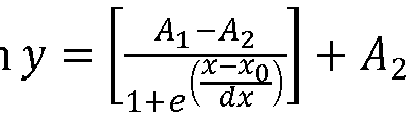
Figures 2A-F . - This example demonstrates that Compound-001, an HDAC1,2-selective compound, has significantly less cytotoxicity against erythroid, myeloid and megakaryocytes than does MS-275, an HDAC1,2,3-selective compound. These results suggest that selective inhibition of HDAC1 and 2 using Compound-001 may result in significantly less in vivo cytotoxicity in the hematopoietic compartment than pan-HDAC inhibitors.
- H929 human myeloma cells were seeded in 96-well plates and grown in the presence of increasing levels of
Compound 001 for a period up to 7 days. Cellular viability was assessed using Aqueous One MTS reagent at Days 0 (immediately after seeding), 3, 5, and 7.Figure 3A shows dose-response curves forCompound 001 atDay 0,Day 3,Day 5, and Day 7, with the half-maximal dose (IC50) at each day indicated by a dashed line.Figure 3B shows the relative growth of H929 cells over time in the absence of drug as well as in the presence of increasing doses ofCompound 001. The dashed line indicates the level of viability atDay 0, thus doses over 3uM resulted in a net decrease in the viability of H929 cells. -


-
- Step 1: To a solution of
compound 1 in DCE was added POBr3 and imidazole. The reaction was stirred at 80°C overnight. Water and DCM were added to the reaction, and the organic layer was separated, washed with brine, and dried under reduced pressure to givecompound 2. - Step 2: To a solution of
compound 2 in DMSO was added compound a and KOH. The resulting reaction mixture was stirred at 45°C for 4 h, quenched with H2O, and extracted with EA. The combined organic layers were purified by gel chromatography to yield the desired product,compound 3. - Step 3: A mixture of
compound 3, cyclopropyl boronic acid, Pd(OAc)2, tricyclohexylphosphine, and K3PO4 in toluene and water was stirred at 100°C under N2 atmosphere overnight. The mixture was cooled, filtered, and concentrated to obtain a residue, which was purified by Prep-TLC to getcompound 4. - Step 4: A mixture of
compound 4 and NaOH in EtOH and THF was stirred at 60 °C for 5 h. The mixture was concentrated to obtain a residue, to which was added aq. sat. citric acid and extracted with EA. The organic layers were separated, dried, filtered and concentrated to obtaincompound 5. - Step 5: A mixture of
compound 5, tert-butyl 2-amino-4-(thiophen-2-yl)phenylcarbamate, HOAT, EDCI, and DIPEA in DMF was stirred at 55°C for overnight. Water was added to the mixture, and extracted with EA. The organic layers were separated, dried, filtered, and concentrated to get a residue, which was purified by Prep-TLC to affordcompound 6. - Step 6: To a solution of
compound 6 in DCM was added TFA and stirred at r.t. for 1 h. The mixture was concentrated to obtain a residue, which was purified by Prep-HPLC to afford compound 7. 1H NMR (500 MHz, DMSO) δ 9.63 (s, 1H), 8.16 (s, 1H), 7.79 - 7.73 (m, 1H), 7.51 (d, J = 2.1 Hz, 2H), 7.36 (d, J = 5.1 Hz, 1H), 7.29 (dd, J = 8.3, 2.1 Hz, 1H), 7.25 (d, J = 3.5 Hz, 1H), 7.05 (dd, J = 5.0, 3.6 Hz, 1H), 6.82 (d, J = 8.3 Hz, 1H), 6.24 (s, 1H), 5.12 (s, 2H), 4.43 (s, 2H), 3.57 (s, 5H), 2.77 - 2.58 (m, 2H), 2.09 (s, 1H), 1.02 (d, J = 8.0 Hz, 2H), 0.76 (d, J = 4.4 Hz, 2H).LCMS: m/z = 487.2 (M+H)+. - Table 2 below shows the IC50 (nM) of comparative Compound X for
HDACs Table 2 Compo und HDAC1 HDAC2 HDAC 3 Compo und X 6 36 445 - Many cultured cancer cells are able to migrate across a membrane and this activity indicates the metastatic potential of the cancer cells. The migration of neuroblastoma cell line SK-N-SH was compared in the presence or absence of
Compound 001, a HDAC1/2/6 inhibitor. The cancer cells were seeded and grown on a membrane surface, and the cell numbers on the other side of the membrane were counted under a microscope after 12 hours. A decreased number of migrated cells by the HDAC1/2/6 inhibitor suggests a migration suppression activity of HDAC1/2/6 inhibitor. In the study, an HDAC inhibitor was added to the cells either 2 hours before or when the migration was measured. The effect of HDAC1/2/6 inhibitor on Epidermal Growth Factor (EGF) stimulated cancer cell migration using 40 ng/ml of EGF in the assay was investigated. - The protocol for the migration assay was as follows. The compounds were prepared in DMSO at 400?stock of the final required concentrations. See Table 3.
Table 3 Compound Final conc. (µM) Cpds 400* Conc. (µM) Compound 0010.5 200 Gefitinib 1 400 EGF 20 8 - The results of these experiments are shown in
Figure 4 . - The following is a quick summary of the HDAC nueroblastoma maturation experiments. Adherent cells were plated into 12- or 24-well plates at 106 cells/well and allowed to adhere for 2-4 hours. Compounds were dispensed in DMSO at the indicated concentrations using an automated liquid handling system (Tecan D300) and incubated for the indicated times at 37°C with 5% CO2. Cells were harvested and RNA extracted using the Qiagen RNeasy Mini Kit according to manufacture protocols. The RNA was quantified and relative expression levels were assessed using the Applied Biosystems TaqMan RNA-to-Ct Kit according to manufacture protocols using the indicated TaqMan probes.
- The protocol for the maturation experiments was as follows. The day before the experiment, the cells were fed in the flask by doubling the media. The cells were then harvested by adding non-enzymatic cell dissociation media and incubating at 37°C for 15 minutes. The cells were transferred to a 50 ml tube and pipet to create a single-cell suspension. The cells were washed with PBS buffer. The cells were then resuspended in complete media at 5x10⁵ cells per ml. Next, 2 ml of cells were transferred to 24- or 12-well plates. The treatment compounds were then dispensed into each well using the D300 liquid handler. The cells were then incubated for the indicated time at 37°C. The cells were harvested by scraping the cells and transferring to a 2 ml tube. The cells were spun to form a pellet. Next, RNA was extracted using the Qiagen RNeasy Mini kit according to manufacture protocols. The RNA concentration was recorded. The relative RNA levels were assessed using the Applied Biosystems TaqMan RNA-to-Ct kit according to manufacture protocols using the indicated Taqman probes.
- In one set of experiments, BE(2)-C neuroblastoma cells were treated for 4 days with comparative Compound X at 0.5µM (
Figure 5A ), 1 µM (Figure 5B ), and3 µM (Figure 5C ). Each of the experiments measured the fold change of various genes associated with maturation, such as TGM2, KCTD13, EGR1, JARID2, MAFF, p21, DUSP6, DDAH2, CRABP2, SLC29A1, KCTD12, ASCL1, and GATA3.Figure 5D shows the results of a positive control experiment in which BE(2)-C cells were treated for 4 days with 1 µM ATRA (all trans retinoic acid).Figure 5E shows the results of a negative control experiment in which BE(2)-C cells were treated with 1 µM of a HDAC6 selective inhibitor. The results of these experiments show that comparative Compound X, a HDAC1/2 selective inhibitor, alters genes associated with maturation. The strongest effects were seen at 3 µM of compound. - In another set of experiments, SH-SY5Y neuroblastoma cells were treated for 72 hours with 1 µM ATRA (all trans retinoic acid) (
Figure 6A ), a HDAC6 selective inhibitor (Figure 6B ), comparative Compound X (Figure 6C ), and another HDAC6 selective inhibitor (Figure 6D ). Each of the experiments measured the fold change of various genes associated with maturation, such as HOXD4, ADD3, p21, DDAH2, IGBFP5, PPIF, GATA3, CHGA, and ASCL1. Table 4 below shows the IC50s in nM of the various compounds.Table 4 HDAC1 HDAC2 HDAC3 HDAC6 HDAC6i 2123 2570 11223 7 another HDAC6i 33 54 61 5 Compound X 6 36 445 - - In yet another set of experiments, BE(2)-C neuroblastoma cells were treated for 72 hours with 1 µM ATRA (all trans retinoic acid) (
Figure 7A ), a HDAC6 selective inhibitor (Figure 7B ), comparative Compound X (Figure 7C ), and another HDAC6 selective inhibitor (Figure 7D ). Each of the experiments measured the fold change of various genes associated with maturation, such as HOXD4, ADD3, p21, DDAH2, IGBFP5, PPIF, GATA3, CHGA, and ASCL1. Table 5 below shows the IC50s in nM of the various compounds.Table 5 HDAC1 HDAC2 HDAC3 HDAC6 HDAC6i 2123 2570 11223 7 another HDAC6i 33 54 61 5 Compound X 6 36 445 - - In another set of experiments, the fold change of genes associated with maturation were assessed. In one experiment, BE(2)-C neuroblastoma cells were treated for 2 days with 3 µM Compound 001 (
Figure 8A ). In a second experiment, SH-SY5Y neuroblastoma cells were treated for 2 days with 3 µM Compound 001 (Figure 8B ). In a third experiment, BE(2)-C neuroblastoma cells were treated for 2 days with 3 µM comparative Compound X (Figure 8C ). Each of the experiments measured the fold change of various genes associated with maturation, such as p21, CRABP2, JARID2, KCTD13, TGM2, ASCL1, and GATA3. The results of these experiments show thatCompound 001, a HDAC1/2/6 selective inhibitor, induces gene expression changes that are consistent with maturation. - In a set of experiments, BE(2)-C neuroblastoma cells were treated for 48 hours with
Compound 001 at 0.5µM (Figure 9A ), 2 µM (Figure 9B ), and4 µM (Figure 9C ).Figure 9D shows the results of a positive control experiment in which BE(2)-C cells were treated for 48 hours with 1 µM ATRA (all trans retinoic acid). Each of the experiments measured the fold change of various genes associated with maturation, such as VGF, TGM2, SYT11, RBP1, MAFF, JARID2, PTK2, HOXD4, EGR1, DUSP6, DDAH2, CRABP2, ADD3, SLC29A1, PPIF, KCTD12, IGFBP5, GATA3, CHGA, and ASCL1. The results of these experiments show thatCompound 001 induces gene expression changes consistent with maturation at 4 µM, but not at 2 µM or less. HDAC2glo assay data suggest maximal HDAC2 inhibition was reached at 3-4 µM. - A set of experiments shows that a HDAC3 selective inhibitor fails to modulate genes associated with maturation. BE(2)-C neuroblastoma cells were treated for 4 days with a HDAC3 selective inhibitor at 1 µM (
Figure 10A ), 0.5 µM (Figure 10B ), and3 µM (Figure 10C ). Each of the experiments measured the fold change of various genes associated with maturation, such as EGR1, CRABP2, DUSP6, p21, DDAH2, ASCL1, GATA3, IGFBP5, KCTD12, and SLC29A1.Figure 10D shows the results of a positive control experiment in which BE(2)-C neuroblastoma cells were treated for 4 days with 1 µM ATRA (all trans retinoic acid).Figure 10E shows the results of a negative control experiment in which BE(2)-C neuroblastoma cells were treated for 4 days with 1 µM of a HDAC6 selective inhibitor. The results of these experiments show that a HDAC3 selective inhibitor did not alter gene expression in a manner consistent with neuroblastoma maturation. In addition, the dose response was modest, if present at all. - A set of experiments shows that a HDAC6 selective inhibitor fails to modulate genes associated with maturation. BE(2)-C neuroblastoma cells were treated for 48 hours with HDAC6 selective inhibitor at 0.5 µM (
Figure 11A ), 2 µM (Figure 11B ), and4 µM (Figure 11C ).Figure 11D shows the results of a positive control experiment in which BE(2)-C neuroblastoma cells were treated for 48 hours with 1 µM ATRA (all trans retinoic acid). Each of the experiments measured the fold change of various genes associated with maturation, such as VGF, TGM2, SYT11, RBP1, MAFF, JARID2, PTK2, HOXD4, EGR1, DUSP6, DDAH2, CRABP2, ADD3, SLC29A1, PPIF, KCTD12, IGFBP5, GATA3, CHGA, and ASCL1. The results of these experiments show that a HDAC6 selective inhibitor failed to robustly induce gene changes consistent with maturation, even at 4 µM of exposure. These results are consistent with a previous experiment where maturation was not evident after 1 µM of treatment. - The following is a quick summary of the neuroblastoma cell cycle experiments. Adherent cells were plated into 12-well plates at 106 cells/well and allowed to adhere for 2-4 hours. Compounds were dispensed in DMSO at the indicated concentrations using an automated liquid handling system (Tecan D300) and incubated for the indicated times at 37°C with 5% CO2. Cells were harvested with enzyme-free cell disassociation solution and washed with buffered saline. Cells were fixed overnight with 100% ethanol. Cell cycle was assessed by flow cytometry using the Molecular Probes FxCycle PI/RNase Staining Solution kit according to manufacture protocols.
- The protocol for the cell cycle experiments was as follows. The day before the experiment, the cells were fed in the flask by doubling the media. Then, the cells were harvested by adding non-enzymatic cell dissociation media and incubating at 37°C for 15 minutes. Next, the cells were transferred to a 50 ml tube and pipet to create a single-cell suspension. The cells were then washed with PBS buffer. Then, the cells were resuspended in complete media at 5x10⁵ cells per ml. Next, 2 ml of cells were transferred to 12-well plates. Then, the treatment compounds were dispensed into each well using the D300 liquid handler. The cells were incubated for the indicated time at 37°C. Then, the cells were harvested by adding 500 µl enzyme free cell dissociation solution and incubating at 37°C for 15 minutes. Next, the cells were spun into a pellet and then washed with PBS. Then, 500
µl 100% EtOH was added and incubated at 4°C overnight. Then, the cells were washed 3x with PBS. The cells were then resuspended in 500 ml FxCycle PI/RNase solution, and incubated for 2-4 hours at room temperature. Finally, the cells were assayed by flow cytometry. - This set of experiments shows that selective HDAC inhibition alters cell cycle progression in neuroblastoma cells. In a first experiment, SH-SY5Y neuroblastoma cells were treated for 72 hours with 0, 0.5, 2, and 5 µM of a HDAC6 selective inhibitor (
Figure 12A ). In a second experiment, SH-SY5Y neuroblastoma cells were treated for 72 hours with 0, 0.5, 2, and 5 µM comparative Compound X (Figure 12B ). In a third experiment, SH-SY5Y neuroblastoma cells were treated for 72 hours with 0, 0.5, 2, and 5 µM Compound 001 (Figure 12C ). In a control experiment, SH-SY5Y neuroblastoma cells were treated for 72 hours with 0 and 1 µM ATRA (all trans retinoic acid) (Figure 12D ). Each of the experiments looked at the percent of the cell population in the G2 phase, S phase, G1 phase, and Sub G1 phase. The results of this experiment show thatCompound 001 induced a reduction in G1/G2 and increase in sub-Gl at concentrations where maturation was observed. Also, Compound X induced similar cell cycle changes in all treatment groups, even at low doses associated with sub-optimal maturation. In addition, a HDAC6 selective inhibitor induced a dose-dependent decrease in G1/G2 with a corresponding increase in sub-Gl. Finally, ATRA had little impact on cell cycle at concentrations associated with robust maturation at this time point. - SK-N-BE(2) or SH-SY5Y neuroblastoma cells were treated with varying concentrations of either Compound X or Compound Y. Viability and the
Caspase 3/7 Signal were measured at 48 hours. The percentage of the population of the cells at various stages of the cell cycle were measured at 96 hours. SeeFigures 13A-D andFigures 14A-D . The results of these experiments show that low levels of apoptosis and cell death were detected at 48 hours after HDACi, the time when gene expression changes associated with differentiation were observed. An increase in the sub-G1 population became evident at 96 hours after treatment, indicating cell death at later times. - SK-N-BE(2) or SH-SY5Y neuroblastoma cells were treated with varying concentrations of either Compound X or Y, and/or ATRA (all trans retinoic acid). The differentiation index was measured. See
Figures 15A-D . The results of these experiments show that both Compound X and Compound Y induced an increase in the differentiation index, and the effect was markedly enhanced when an HDACi was combined with retinoic acid. - SK-N-BE(2) or SH-SY5Y neuroblastoma cells were treated with varying concentrations of either Compound X or Y, and/or ATRA (all trans retinoic acid). The differentiation index was measured. As a control, SK-N-BE(2) or SH-SY5Y neuroblastoma cells were treated with varying concentrations of ATRA. See
Figures 16A-C . The results of these experiments show that ATRA differentiation was sub-optimal at 0.25 µM, and both Compound X and Compound Y potentiated 0.25 µM ATRA. - SK-N-BE(2) neuroblastoma cells were treated with varying concentrations of either Compound X or Y, and/or ATRA (all trans retinoic acid). The percentage of the population of the cells at various stages of the cell cycle were measured after 4 days. In addition, the fold change of p21was also calculated. See
Figures 17A-D . Both Compound X and Compound Y induced cell cycle arrest, with Compound Y being the more potent agent. The HDACi/ATRA combination effects were modest, with little difference compared to single agents. - SH-SY5Y neuroblastoma cells were treated with varying concentrations of either Compound X or Y, and/or ATRA (all trans retinoic acid). The percentage of the population of the cells at various stages of the cell cycle were measured after 4 days. In addition, the fold change of p21was also calculated. See
Figures 18A-D . Both Compound X and Compound Y induced cell cycle arrest, with Compound Y being the more potent agent. The HDACi/ATRA combination effects were modest, with little difference compared to single agents. -


- Synthesis of Intermediate 2: A mixture of aniline (3.7 g, 40 mmol), compound 1 (7.5 g, 40 mmol), and K2CO3 (11 g, 80 mmol) in DMF (100 ml) was degassed and stirred at 120 ? C under N2 overnight. The reaction mixture was cooled to r.t. and diluted with EtOAc (200 ml), then washed with saturated brine (200 ml ?3). The organic layers were separated and dried over Na2SO4, evaporated to dryness and purified by silica gel chromatography (petroleum ethers/EtOAc = 10/1) to give the desired product as a white solid (6.2 g, 64 %).
- Synthesis of Intermediate 3: A mixture of compound 2 (6.2 g, 25 mmol), iodobenzene (6.12 g, 30 mmol), CuI (955 mg, 5.0 mmol), Cs2CO3 (16.3 g, 50 mmol) in TEOS (200 ml) was degassed and purged with nitrogen. The resulting mixture was stirred at 140 ?C for 14 hrs. After cooling to r.t., the residue was diluted with EtOAc (200 ml). 95% EtOH (200 ml) and NH4F-H2O on silica gel [50g, pre-prepared by the addition of NH4F (100g) in water (1500 ml) to silica gel (500g, 100-200 mesh)] was added, and the resulting mixture was kept at r.t. for 2 hrs. The solidified materials were filtered and washed with EtOAc. The filtrate was evaporated to dryness and the residue was purified by silica gel chromatography (petroleum ethers/EtOAc = 10/1) to give a yellow solid (3 g, 38%).
- Synthesis of Intermediate 4: 2N NaOH (200 ml) was added to a solution of compound 3 (3.0 g, 9.4 mmol) in EtOH (200 ml). The mixture was stirred at 60°C for 30min. After evaporation of the solvent, the solution was neutralized with 2N HCl to give a white precipitate. The suspension was extracted with EtOAc (2 ?200 ml), and the organic layers were separated, washed with water (2 ?100 ml), brine (2 ?100 ml), and dried over Na2SO4. Removal of the solvent gave a brown solid (2.5 g, 92 %).
- Synthesis of Intermediate 6: A mixture of compound 4 (2.5 g, 8.58 mmol), compound 5 (2.52 g, 12.87 mmol), HATU (3.91 g, 10.30 mmol), and DIPEA (4.43 g, 34.32 mmol) was stirred at r.t. overnight. After the reaction mixture was filtered, the filtrate was evaporated to dryness and the residue was purified by silica gel chromatography (petroleum ethers/EtOAc = 2/1) to give a brown solid (2 g, 54 %).
- Synthesis of 2-(diphenylamino)-N-(7-(hydroxyamino)-7-oxoheptyl)pyrimidine-5-carboxamide (Compound A): A mixture of the compound 6 (2.0 g, 4.6 mmol), sodium hydroxide (2N, 20 mL) in MeOH (50 ml) and DCM (25 ml) was stirred at 0?C for 10 min. Hydroxylamine (50%) (10 ml) was cooled to 0?C and added to the mixture. The resulting mixture was stirred at r.t. for 20 min. After removal of the solvent, the mixture was neutralized with 1M HCl to give a white precipitate. The crude product was filtered and purified by pre-HPLC to give a white solid (950 mg, 48%).
-


- Synthesis of Intermediate 2: See synthesis of intermediate 2 in Example 45.
- Synthesis of Intermediate 3: A mixture of compound 2 (69.2 g, 1 equiv.), 1-chloro-2-iodobenzene (135.7 g, 2 equiv.), Li2CO3 (42.04 g, 2 equiv.), K2CO3 (39.32 g, 1 equiv.), Cu (1 equiv. 45 µm) in DMSO (690 ml) was degassed and purged with nitrogen. The resulting mixture was stirred at 140?C. Work-up of the reaction gave
compound 3 at 93 % yield. - Synthesis of Intermediate 4: See synthesis of intermediate 4 in Example 45.
- Synthesis of Intermediate 6: See synthesis of intermediate 6 in Example 45.
- Synthesis of 2-((2-chlorophenyl)(phenyl)amino)-N-(7-(hydroxyamino)-7-oxoheptyl)pyrimidine-5-carboxamide (Compound B): See synthesis of Compound A in Example 45.
- Unless otherwise defined, all technical and scientific terms used herein are accorded the meaning commonly known to one with ordinary skill in the art.
- Those skilled in the art will recognize, or be able to ascertain using no more than routine experimentation, many equivalents of the specific embodiments of the invention described herein. Such equivalents are intended to be encompassed by the following claims.
Claims (15)
- A compound of Formula I:

wherein,Rx is selected from the group consisting of C1-6-alkyl, C1-6-alkoxy, halo, -OH -C(O)R1, -CO2R1, -C(O)N(R1)2, aryl, -C(S)N(R1)2, and -S(O)2R1, wherein aryl may be optionally substituted by one or more groups selected from C1-6-alkyl, C1-6-alkoxy, -OH, halo, and haloalkyl;Ry is selected from the group consisting of H, C1-6-alkyl, C1-6-alkoxy, halo, - OH, -C(O)R1, -CO2R1, and -C(O)N(R1)2;Rz is selected from the group consisting of C1-6-alkyl, C1-6-alkenyl, C1-6-alkynyl, C3-8-cycloalkyl, C3-7-heterocycloalkyl, aryl, and heteroaryl, each of which may be optionally substituted by C1-6-alkyl, C1-6-alkoxy, halo, or -OH; andeach R1 is, independently for each occurrence, selected from the group consisting of H, C1-6-alkyl, C3-8-cycloalkyl, C3-7-heterocycloalkyl, aryl, heteroaryl, C1-6-alkyl-cycloalkyl, C1-6-alkyl-heterocycloalkyl, C1-6-alkyl-aryl, and C1-6-alkyl-heteroaryl, wherein C3-8-cycloalkyl, C3-7-heterocycloalkyl, aryl, heteroaryl, C1-6-alkylcycloalkyl, C1-6-alkyl-heterocycloalkyl, C1-6-alkyl-aryl, and C1-6-alkyl-heteroaryl may be optionally substituted by one or more groups selected from C1-6-alkyl, C1-6-alkoxy, -OH, halo, and haloalkyl. - The compound of claim 1, having the structure of Formula II:

wherein,Rx is independently selected from the group consisting of aryl, -C(O)R1, - CO2R1, -C(O)N(R1)1, -C(S)N(R1)2, and -S(O)2R1;Ry is selected from the group consisting of H, C1-6-alkyl, and halo; andRz is selected from the group consisting of C1-6-alkyl, C3-8-cycloalkyl, C3-7-heterocycloalkyl, aryl, and heteroaryl. - The compound of any one of claims 1-2, wherein Rz is C1-6-alkyl or aryl, optionally wherein Rz is isopropyl, methyl, or phenyl.
- The compound of any of claims 1-3, wherein Rx is -C(O)NHR1,-C(O)R1, -CO2R1,-C(S)NHR1 or S(O)2R1.
- The compound of any one of claims 1-4, wherein:(a) at least one of R1 is selected from the group consisting of C1-6-alkyl, aryl, C1-6-alkylaryl and C1-6-alkyl-heteroaryl, wherein aryl, C1-6-alkyl-aryl and C1-6-alkyl-heteroaryl may be optionally substituted by one or more groups selected from C1-6-alkyl, C1-6-alkoxy, -OH, halo, and haloalkyl;(b) at least one of R1 is -CH3, -CH2CH3, phenyl, -CH2-phenyl, or -CH2-indolyl, wherein phenyl, -CH2-phenyl, or -CH2-indolyl may be optionally substituted by one or more groups selected from C1-6-alkyl or halo; or(c) at least one of R1 is phenyl, and wherein phenyl is optionally substituted by one or more groups selected from C1-6-alkyl, C1-6-alkoxy, halo, and haloalkyl.
- The compound of claim any one of claims 1-5, wherein Ry is H.
- The compound of any one of claims 1-6, selected from the following:
001 
002 
003 
004 
005 
006 
007 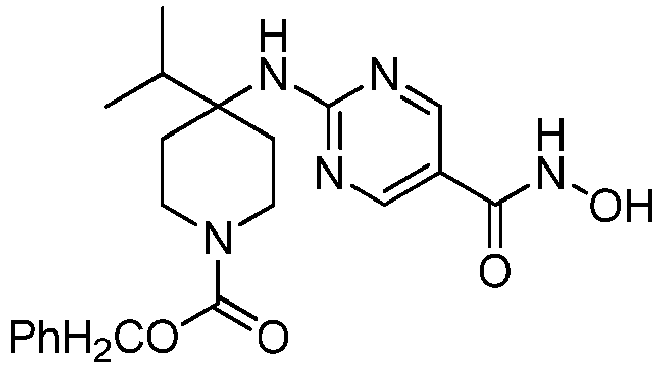
008 
009 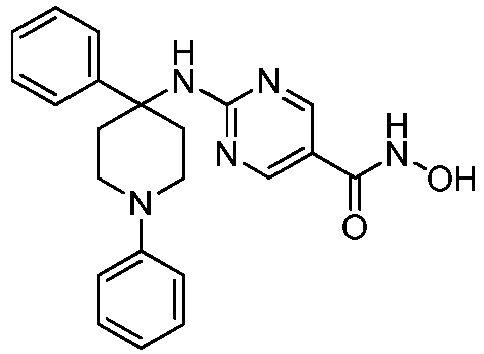
010 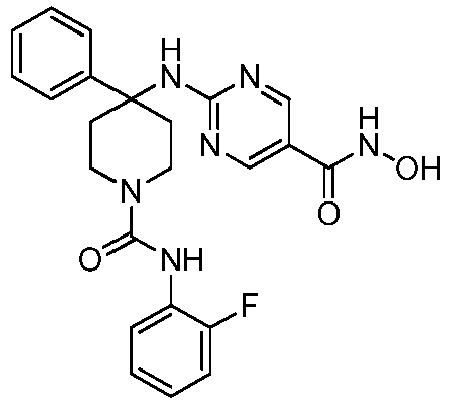
011 
012 
013 
014 
015 
016 
017 
018 
019 
020 
021 
022 
023 
024 
025 
026 
027 
028 
029 
030 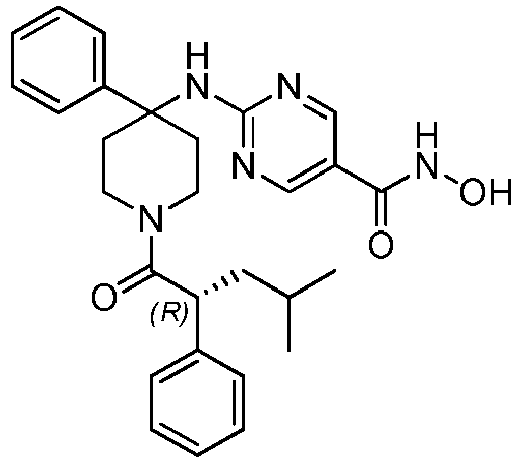
031 
- A pharmaceutical composition comprising a compound of any one of claims 1-7, or a pharmaceutically acceptable salt thereof, together with a pharmaceutically acceptable carrier.
- A compound of any one of claims 1-7 or a pharmaceutically acceptable salt thereof for use in inhibiting the activity of HDAC1, HDAC2, and HDAC6 in a subject in need thereof, optionally for use in selectively inhibiting the activity of HDAC1, HDAC2, and HDAC6 over other HDACs in the subject in need thereof, optionally wherein the compound of any one of claims 1-7 has a selectivity for HDAC1, HDAC2, and HDAC6 when tested in a HDAC enzyme assay of about 2 to 1000 fold greater than for other HDACs.
- A compound of any one of claims 1-7, or a pharmaceutically acceptable salt thereof, or the pharmaceutical composition of claim 8, for use in treating a disease mediated by one or more HDACs in a subject in need thereof, optionally wherein the HDACs are HDAC1 and HDAC2, or wherein the HDAC is HDAC6.
- The compound or composition for use of claim 10, wherein the disease is:(a) a hemoglobinopathy;(b) sickle-cell disease;(c) beta-thalassemia;(d) a neurodegenerative disease, optionally wherein the neurodegenerative disease is selected from the group consisting of Alzheimer's disease, frontotemporal lobe dementia, progressive supranuclear palsy, corticobasal dementia, Parkinson's disease, Huntington's disease, amytrophic lateral sclerosis, Charcot-Marie-Tooth disease and peripheral neuropathy; or(e) a cancer or a proliferation disease, optionally wherein the cancer is selected from the group consisting of lung cancer, colon and rectal cancer, breast cancer, prostate cancer, liver cancer, pancreatic cancer, brain cancer, kidney cancer, ovarian cancer, stomach cancer, skin cancer, bone cancer, gastric cancer, breast cancer, glioma, gliobastoma, neuroblastoma, hepatocellular carcinoma, papillary renal carcinoma, head and neck squamous cell carcinoma, leukemia, lymphomas, myelomas, retinoblastoma, cervical cancer, melanoma and/or skin cancer, bladder cancer, uterine cancer, testicular cancer, esophageal cancer, and solid tumors, for example wherein the cancer is lung cancer, colon cancer, breast cancer, leukemia, a lymphoma, neuroblastoma or non-small cell lung cancer (NSCLC).
- A compound of any one of claims 1-7, or the pharmaceutical composition of claim 8, for use in treating a subject suffering from or susceptible to Hodgkin's lymphoma.
- The compound or composition for use of any one of claims 9-12, wherein the subject is a human.
- An HDAC1, HDAC2, and/or HDAC6 selective inhibitor selected from the group consisting of a compound of any of claims 1 to 7, or a pharmaceutically acceptable salt thereof, for use in inhibiting migration of a neuroblastoma cell, inducing maturation of a neuroblastoma cell, altering cell cycle progression of a neuroblastoma cell, decreasing viability and survival of a neuroblastoma cell, inducing differentiation of a neuroblastoma cell, enhancing low-concentration ATRA treatment of a neuroblastoma cell or inducing cell cycle arrest of a neuroblastoma cell.
- A compound for use in treating neuroblastoma in a subject wherein the compound is Compound 001:

Applications Claiming Priority (4)
| Application Number | Priority Date | Filing Date | Title |
|---|---|---|---|
| US201361889295P | 2013-10-10 | 2013-10-10 | |
| US201461944754P | 2014-02-26 | 2014-02-26 | |
| US201461979694P | 2014-04-15 | 2014-04-15 | |
| PCT/US2014/059863 WO2015054474A1 (en) | 2013-10-10 | 2014-10-09 | Pyrimidine hydroxy amide compounds as histone deacetylase inhibitors |
Publications (3)
| Publication Number | Publication Date |
|---|---|
| EP3055299A1 EP3055299A1 (en) | 2016-08-17 |
| EP3055299A4 EP3055299A4 (en) | 2017-05-31 |
| EP3055299B1 true EP3055299B1 (en) | 2021-01-06 |
Family
ID=52810190
Family Applications (1)
| Application Number | Title | Priority Date | Filing Date |
|---|---|---|---|
| EP14852720.3A Active EP3055299B1 (en) | 2013-10-10 | 2014-10-09 | Pyrimidine hydroxy amide compounds as histone deacetylase inhibitors |
Country Status (4)
| Country | Link |
|---|---|
| US (2) | US9278963B2 (en) |
| EP (1) | EP3055299B1 (en) |
| ES (1) | ES2862126T3 (en) |
| WO (1) | WO2015054474A1 (en) |
Families Citing this family (26)
| Publication number | Priority date | Publication date | Assignee | Title |
|---|---|---|---|---|
| NZ601655A (en) | 2010-01-22 | 2014-10-31 | Acetylon Pharmaceuticals Inc | Reverse amide compounds as protein deacetylase inhibitors and methods of use thereof |
| PL2640709T3 (en) | 2010-11-16 | 2016-10-31 | Pyrimidine hydroxy amide compounds as protein deacetylase inhibitors and methods of use thereof | |
| EP2839037B1 (en) | 2012-04-19 | 2018-12-26 | Acetylon Pharmaceuticals, Inc. | Biomarkers to identify patients that will respond to treatment and treating such patients |
| US9145412B2 (en) | 2012-11-02 | 2015-09-29 | Acetylon Pharmaceuticals, Inc. | Selective HDAC1 and HDAC2 inhibitors |
| WO2015054099A1 (en) * | 2013-10-08 | 2015-04-16 | Acetylon Pharmaceuticals, Inc. | Combinations of histone deacetylase inhibitors and either her2 inhibitors or pi3k inhibitors |
| ES2862126T3 (en) | 2013-10-10 | 2021-10-07 | Acetylon Pharmaceuticals Inc | Pyrimidine-hydroxyamide compounds as histone deacetylase inhibitors |
| US10660890B2 (en) | 2013-10-24 | 2020-05-26 | National Institutes Of Health (Nih), U.S. Dept. Of Health And Human Services (Dhhs), U.S. Government Nih Division Of Extramural Inventions And Technology Resources (Deitr) | Treatment of polycystic diseases with an HDAC6 inhibitor |
| ES2806258T3 (en) | 2013-12-03 | 2021-02-17 | Acetylon Pharmaceuticals Inc | Combinations of histone deacetylase inhibitors and immunomodulatory drugs |
| US9464073B2 (en) | 2014-02-26 | 2016-10-11 | Acetylon Pharmaceuticals, Inc. | Pyrimidine hydroxy amide compounds as HDAC6 selective inhibitors |
| SG11201700094TA (en) | 2014-07-07 | 2017-02-27 | Acetylon Pharmaceuticals Inc | Treatment of leukemia with histone deacetylase inhibitors |
| US20160137630A1 (en) * | 2014-10-08 | 2016-05-19 | Acetylon Pharmaceuticals, Inc. | Induction of gata2 by hdac1 and hdac2 inhibitors |
| US9937174B2 (en) | 2014-12-05 | 2018-04-10 | University of Modena and Reggio Emilia | Combinations of histone deacetylase inhibitors and bendamustine |
| BR112017012504A2 (en) * | 2014-12-12 | 2018-01-09 | Acetylon Pharmaceuticals, Inc. | piperidine derivatives as hdac1 / 2 inhibitors |
| WO2016126721A1 (en) | 2015-02-02 | 2016-08-11 | Forma Therapeutics, Inc. | 3-aryl-bicyclic [4,5,0] hydroxamic acids as hdac inhibitors |
| WO2016126726A1 (en) | 2015-02-02 | 2016-08-11 | Forma Therapeutics, Inc. | Bicyclic [4,6,0] hydroxamic acids as hdac6 inhibitors |
| WO2016168647A1 (en) * | 2015-04-17 | 2016-10-20 | Acetylon Pharmaceuticals Inc. | Treatment of neuroblastoma with histone deacetylase inhibotrs |
| CN106187999A (en) * | 2015-05-04 | 2016-12-07 | 复旦大学 | Substituted piperidines and its production and use |
| TW201718516A (en) | 2015-06-08 | 2017-06-01 | 艾斯特隆製藥公司 | Crystalline forms of a histone deacetylase inhibitor |
| CN107922352B (en) | 2015-06-08 | 2021-08-06 | 埃斯泰隆制药公司 | Methods of preparing protein deacetylase inhibitors |
| KR20180101404A (en) * | 2015-12-17 | 2018-09-12 | 메사추세츠 인스티튜트 오브 테크놀로지 | Compositions of polyhydroxylated benzophenone and methods of treating neurodegenerative disorders |
| WO2017184774A1 (en) | 2016-04-19 | 2017-10-26 | Acetylon Pharmaceuticals, Inc. | Hdac inhibitors, alone or in combination with btk inhibitors, for treating chronic lymphocytic leukemia |
| US11298354B2 (en) * | 2016-06-09 | 2022-04-12 | Dana-Farber Cancer Institute, Inc. | Methods of use and pharmaceutical combinations of HDAC inhibitors with BET inhibitors |
| EP3472131B1 (en) | 2016-06-17 | 2020-02-19 | Forma Therapeutics, Inc. | 2-spiro-5- and 6-hydroxamic acid indanes as hdac inhibitors |
| ES2929032T3 (en) | 2016-08-08 | 2022-11-24 | Acetylon Pharmaceuticals Inc | Pharmaceutical combinations of histone deacetylase 6 inhibitors and CD20 inhibitory antibodies and uses thereof |
| WO2018098168A1 (en) | 2016-11-23 | 2018-05-31 | Acetylon Pharmaceuticals, Inc. | Pharmaceutical combinations comprising a histone deacetylase inhibitor and a programmed death-ligand 1 (pd-l1) inhibitor and methods of use thereof |
| BR112021026334A2 (en) | 2019-06-27 | 2022-05-10 | Medstar Health | HDac6-activated macrophages, compositions, and uses thereof |
Family Cites Families (51)
| Publication number | Priority date | Publication date | Assignee | Title |
|---|---|---|---|---|
| US3549633A (en) | 1968-11-20 | 1970-12-22 | Merck & Co Inc | Process for preparation of 1-h-imidazo (4,5-b)pyrazin-2-ones |
| US6777217B1 (en) | 1996-03-26 | 2004-08-17 | President And Fellows Of Harvard College | Histone deacetylases, and uses related thereto |
| US20030129724A1 (en) | 2000-03-03 | 2003-07-10 | Grozinger Christina M. | Class II human histone deacetylases, and uses related thereto |
| US7244853B2 (en) | 2001-05-09 | 2007-07-17 | President And Fellows Of Harvard College | Dioxanes and uses thereof |
| CN1582277A (en) | 2001-11-01 | 2005-02-16 | 詹森药业有限公司 | Amide derivatives as glycogen synthase kinase 3-beta inhibitors |
| ES2306880T3 (en) | 2002-03-13 | 2008-11-16 | Janssen Pharmaceutica Nv | DERIVATIVES OF SULFONYLAMINE AS NEW INHIBITORS OF HISTONE DEACETILASE. |
| AU2003218737B2 (en) * | 2002-03-13 | 2008-04-10 | Janssen Pharmaceutica N.V. | Inhibitors of histone deacetylase |
| TWI319387B (en) | 2002-04-05 | 2010-01-11 | Astrazeneca Ab | Benzamide derivatives |
| US7154002B1 (en) | 2002-10-08 | 2006-12-26 | Takeda San Diego, Inc. | Histone deacetylase inhibitors |
| MY141521A (en) | 2002-12-12 | 2010-05-14 | Hoffmann La Roche | 5-substituted-six-membered heteroaromatic glucokinase activators |
| US7244751B2 (en) | 2003-02-14 | 2007-07-17 | Shenzhen Chipscreen Biosciences Ltd. | Histone deacetylase inhibitors of novel benzamide derivatives with potent differentiation and anti-proliferation activity |
| KR20050122210A (en) | 2003-03-17 | 2005-12-28 | 다케다 샌디에고, 인코포레이티드 | Histone deacetylase inhibitors |
| HRP20070057T3 (en) | 2003-07-24 | 2007-07-31 | Basf Aktiengesellschaft | 2-SUBSTITUTED PYRIMIDINES |
| KR101127201B1 (en) | 2003-09-22 | 2012-04-12 | 에스*바이오 피티이 리미티드 | Benzimidazole derivatives: preparation and pharmaceutical applications |
| CA2539117A1 (en) | 2003-09-24 | 2005-04-07 | Methylgene Inc. | Inhibitors of histone deacetylase |
| EP1745022B1 (en) | 2004-04-05 | 2014-08-13 | Aton Pharma, Inc. | Histone deacetylase inhibitor prodrugs |
| US8999289B2 (en) | 2005-03-22 | 2015-04-07 | President And Fellows Of Harvard College | Treatment of protein degradation disorders |
| GB0510204D0 (en) | 2005-05-19 | 2005-06-22 | Chroma Therapeutics Ltd | Enzyme inhibitors |
| EP1940805A4 (en) | 2005-08-26 | 2009-11-11 | Methylgene Inc | Benzodiazepine and benzopiperazine analog inhibitors of histone deacetylase |
| WO2007052383A1 (en) | 2005-11-01 | 2007-05-10 | Sumitomo Chemical Company, Limited | Process for producing 6,6-dimethyl-3-oxabicyclo[3.1.0]hexan-2-one |
| RU2008135979A (en) | 2006-02-07 | 2010-03-20 | Астеллас Фарма Инк. (Jp) | HYDROXYACRYLAMIDE COMPOUNDS |
| US8222423B2 (en) | 2006-02-14 | 2012-07-17 | Dana-Farber Cancer Institute, Inc. | Bifunctional histone deacetylase inhibitors |
| AU2007248656B2 (en) | 2006-05-03 | 2013-04-04 | Dana-Farber Cancer Institute, Inc. | Histone deacetylase and tubulin deacetylase inhibitors |
| EP2049483A2 (en) | 2006-10-28 | 2009-04-22 | Methylgene, Inc. | Inhibitors of histone deacetylase |
| JP5043120B2 (en) * | 2006-10-30 | 2012-10-10 | クロマ セラピューティクス リミテッド | Hydroxamates as inhibitors of histone deacetylase |
| US8518979B2 (en) | 2007-02-21 | 2013-08-27 | Yissum Research Development Company Of The Hebrew University Of Jerusalem Ltd. | Alpha-halo- and alpha-alkyl-cyclopropylcarboxy compounds and uses thereof |
| WO2009137503A1 (en) | 2008-05-05 | 2009-11-12 | Envivo Pharmaceuticals, Inc. | Hdac inhibitors and uses thereof |
| US20110288070A1 (en) | 2008-05-05 | 2011-11-24 | ROGERS Kathryn | Methods for treating cognitive disorders using inhibitors of histone deacetylase |
| NZ602832A (en) | 2008-07-14 | 2014-04-30 | Gilead Sciences Inc | Fused heterocyclic hdac inhibitor compounds |
| US8440716B2 (en) | 2008-07-23 | 2013-05-14 | President And Fellows Of Harvard College | Deacetylase inhibitors and uses thereof |
| EP2385832B1 (en) | 2009-01-08 | 2015-07-15 | Curis, Inc. | Phosphoinositide 3-kinase inhibitors with a zinc binding moiety |
| US8431538B2 (en) | 2009-07-22 | 2013-04-30 | The Board Of Trustees Of The University Of Illinois | HDAC inhibitors and therapeutic methods of using same |
| US8716344B2 (en) | 2009-08-11 | 2014-05-06 | President And Fellows Of Harvard College | Class- and isoform-specific HDAC inhibitors and uses thereof |
| US20130040998A1 (en) | 2010-01-08 | 2013-02-14 | Dana-Farber Cancer Institute, Inc. | Fluorinated hdac inhibitors and uses thereof |
| NZ601655A (en) | 2010-01-22 | 2014-10-31 | Acetylon Pharmaceuticals Inc | Reverse amide compounds as protein deacetylase inhibitors and methods of use thereof |
| WO2012018499A2 (en) * | 2010-08-05 | 2012-02-09 | Acetylon Pharmaceuticals | Specific regulation of cytokine levels by hdac6 inhibitors |
| PL2640709T3 (en) * | 2010-11-16 | 2016-10-31 | Pyrimidine hydroxy amide compounds as protein deacetylase inhibitors and methods of use thereof | |
| US8404738B2 (en) | 2011-01-21 | 2013-03-26 | Hoffmann-La Roche Inc. | 4-amino-N-hydroxy-benzamides for the treatment of cancer |
| EP2524918A1 (en) | 2011-05-19 | 2012-11-21 | Centro Nacional de Investigaciones Oncológicas (CNIO) | Imidazopyrazines derivates as kinase inhibitors |
| EP2839037B1 (en) | 2012-04-19 | 2018-12-26 | Acetylon Pharmaceuticals, Inc. | Biomarkers to identify patients that will respond to treatment and treating such patients |
| US9145412B2 (en) * | 2012-11-02 | 2015-09-29 | Acetylon Pharmaceuticals, Inc. | Selective HDAC1 and HDAC2 inhibitors |
| WO2014121062A1 (en) | 2013-02-01 | 2014-08-07 | Acetylon Pharmaceuticals, Inc. | Selective hdac3 inhibitors |
| US9139583B2 (en) | 2013-02-01 | 2015-09-22 | Acetylon Pharmaceuticals, Inc. | Selective HDAC3 inhibitors |
| EP3004141A4 (en) * | 2013-06-03 | 2017-05-31 | Acetylon Pharmaceuticals, Inc. | Histone deacetylase ( hdac) biomarkers in multiple myeloma |
| WO2015054099A1 (en) * | 2013-10-08 | 2015-04-16 | Acetylon Pharmaceuticals, Inc. | Combinations of histone deacetylase inhibitors and either her2 inhibitors or pi3k inhibitors |
| ES2862126T3 (en) | 2013-10-10 | 2021-10-07 | Acetylon Pharmaceuticals Inc | Pyrimidine-hydroxyamide compounds as histone deacetylase inhibitors |
| US20150105383A1 (en) * | 2013-10-10 | 2015-04-16 | Acetylon Pharmaceuticals, Inc. | HDAC Inhibitors, Alone Or In Combination With PI3K Inhibitors, For Treating Non-Hodgkin's Lymphoma |
| JP2016536354A (en) * | 2013-10-10 | 2016-11-24 | アセチロン ファーマシューティカルズ インコーポレイテッドAcetylon Pharmaceuticals,Inc. | HDAC inhibitors alone or in combination with BTK inhibitors for the treatment of non-Hodgkin lymphoma |
| KR20160060143A (en) * | 2013-10-11 | 2016-05-27 | 에이스틸론 파마수티컬스 인코포레이티드 | Combinations of histone deactylase inhibitors and immunomodulatory drugs |
| ES2806258T3 (en) * | 2013-12-03 | 2021-02-17 | Acetylon Pharmaceuticals Inc | Combinations of histone deacetylase inhibitors and immunomodulatory drugs |
| WO2015095632A1 (en) * | 2013-12-20 | 2015-06-25 | Acetylon Pharmaceuticals, Inc. | Histone deacetylase 6 (hdac6) biomarkers in multiple myeloma |
-
2014
- 2014-10-09 ES ES14852720T patent/ES2862126T3/en active Active
- 2014-10-09 US US14/510,711 patent/US9278963B2/en active Active
- 2014-10-09 EP EP14852720.3A patent/EP3055299B1/en active Active
- 2014-10-09 WO PCT/US2014/059863 patent/WO2015054474A1/en not_active Ceased
-
2016
- 2016-01-20 US US15/001,847 patent/US20160279128A1/en not_active Abandoned
Non-Patent Citations (1)
| Title |
|---|
| None * |
Also Published As
| Publication number | Publication date |
|---|---|
| EP3055299A4 (en) | 2017-05-31 |
| US9278963B2 (en) | 2016-03-08 |
| EP3055299A1 (en) | 2016-08-17 |
| WO2015054474A1 (en) | 2015-04-16 |
| US20150105384A1 (en) | 2015-04-16 |
| US20160279128A1 (en) | 2016-09-29 |
| ES2862126T3 (en) | 2021-10-07 |
Similar Documents
| Publication | Publication Date | Title |
|---|---|---|
| US9278963B2 (en) | Pyrimidine hydroxy amide compounds as histone deacetylase inhibitors | |
| US9957259B2 (en) | Selective HDAC1 and HDAC2 inhibitors | |
| US11702389B2 (en) | Piperidine derivatives as HDAC1/2 inhibitors | |
| US10125131B2 (en) | Selective HDAC3 inhibitors | |
| US9139583B2 (en) | Selective HDAC3 inhibitors | |
| US20160137630A1 (en) | Induction of gata2 by hdac1 and hdac2 inhibitors | |
| JP2015533173A (en) | Pyrimidine hydroxyamide compounds as protein deacetylase inhibitors and methods of use thereof | |
| US20170240535A1 (en) | Hdac1/2 inhibitors for the treatment of neurodegenerative and/or cognitive disorders | |
| HK1214818B (en) | Selective hdac3 inhibitors |
Legal Events
| Date | Code | Title | Description |
|---|---|---|---|
| PUAI | Public reference made under article 153(3) epc to a published international application that has entered the european phase |
Free format text: ORIGINAL CODE: 0009012 |
|
| 17P | Request for examination filed |
Effective date: 20160503 |
|
| AK | Designated contracting states |
Kind code of ref document: A1 Designated state(s): AL AT BE BG CH CY CZ DE DK EE ES FI FR GB GR HR HU IE IS IT LI LT LU LV MC MK MT NL NO PL PT RO RS SE SI SK SM TR |
|
| AX | Request for extension of the european patent |
Extension state: BA ME |
|
| DAX | Request for extension of the european patent (deleted) | ||
| A4 | Supplementary search report drawn up and despatched |
Effective date: 20170504 |
|
| RIC1 | Information provided on ipc code assigned before grant |
Ipc: A61K 45/06 20060101ALI20170427BHEP Ipc: C07D 401/14 20060101ALI20170427BHEP Ipc: C07D 417/12 20060101ALI20170427BHEP Ipc: A61K 31/506 20060101ALI20170427BHEP Ipc: A61P 35/00 20060101ALI20170427BHEP Ipc: A61K 31/505 20060101ALI20170427BHEP Ipc: A61K 31/5377 20060101ALI20170427BHEP Ipc: C07D 239/42 20060101ALI20170427BHEP Ipc: C07D 409/14 20060101ALI20170427BHEP Ipc: C07D 401/12 20060101AFI20170427BHEP |
|
| REG | Reference to a national code |
Ref country code: HK Ref legal event code: DE Ref document number: 1226723 Country of ref document: HK |
|
| STAA | Information on the status of an ep patent application or granted ep patent |
Free format text: STATUS: EXAMINATION IS IN PROGRESS |
|
| 17Q | First examination report despatched |
Effective date: 20200309 |
|
| GRAP | Despatch of communication of intention to grant a patent |
Free format text: ORIGINAL CODE: EPIDOSNIGR1 |
|
| STAA | Information on the status of an ep patent application or granted ep patent |
Free format text: STATUS: GRANT OF PATENT IS INTENDED |
|
| INTG | Intention to grant announced |
Effective date: 20200814 |
|
| GRAS | Grant fee paid |
Free format text: ORIGINAL CODE: EPIDOSNIGR3 |
|
| GRAA | (expected) grant |
Free format text: ORIGINAL CODE: 0009210 |
|
| STAA | Information on the status of an ep patent application or granted ep patent |
Free format text: STATUS: THE PATENT HAS BEEN GRANTED |
|
| AK | Designated contracting states |
Kind code of ref document: B1 Designated state(s): AL AT BE BG CH CY CZ DE DK EE ES FI FR GB GR HR HU IE IS IT LI LT LU LV MC MK MT NL NO PL PT RO RS SE SI SK SM TR |
|
| REG | Reference to a national code |
Ref country code: GB Ref legal event code: FG4D |
|
| REG | Reference to a national code |
Ref country code: AT Ref legal event code: REF Ref document number: 1352239 Country of ref document: AT Kind code of ref document: T Effective date: 20210115 Ref country code: CH Ref legal event code: EP |
|
| REG | Reference to a national code |
Ref country code: DE Ref legal event code: R096 Ref document number: 602014074075 Country of ref document: DE |
|
| REG | Reference to a national code |
Ref country code: IE Ref legal event code: FG4D |
|
| REG | Reference to a national code |
Ref country code: NL Ref legal event code: MP Effective date: 20210106 |
|
| REG | Reference to a national code |
Ref country code: AT Ref legal event code: MK05 Ref document number: 1352239 Country of ref document: AT Kind code of ref document: T Effective date: 20210106 |
|
| REG | Reference to a national code |
Ref country code: LT Ref legal event code: MG9D |
|
| PG25 | Lapsed in a contracting state [announced via postgrant information from national office to epo] |
Ref country code: FI Free format text: LAPSE BECAUSE OF FAILURE TO SUBMIT A TRANSLATION OF THE DESCRIPTION OR TO PAY THE FEE WITHIN THE PRESCRIBED TIME-LIMIT Effective date: 20210106 Ref country code: GR Free format text: LAPSE BECAUSE OF FAILURE TO SUBMIT A TRANSLATION OF THE DESCRIPTION OR TO PAY THE FEE WITHIN THE PRESCRIBED TIME-LIMIT Effective date: 20210407 Ref country code: HR Free format text: LAPSE BECAUSE OF FAILURE TO SUBMIT A TRANSLATION OF THE DESCRIPTION OR TO PAY THE FEE WITHIN THE PRESCRIBED TIME-LIMIT Effective date: 20210106 Ref country code: PT Free format text: LAPSE BECAUSE OF FAILURE TO SUBMIT A TRANSLATION OF THE DESCRIPTION OR TO PAY THE FEE WITHIN THE PRESCRIBED TIME-LIMIT Effective date: 20210506 Ref country code: LT Free format text: LAPSE BECAUSE OF FAILURE TO SUBMIT A TRANSLATION OF THE DESCRIPTION OR TO PAY THE FEE WITHIN THE PRESCRIBED TIME-LIMIT Effective date: 20210106 Ref country code: NO Free format text: LAPSE BECAUSE OF FAILURE TO SUBMIT A TRANSLATION OF THE DESCRIPTION OR TO PAY THE FEE WITHIN THE PRESCRIBED TIME-LIMIT Effective date: 20210406 Ref country code: NL Free format text: LAPSE BECAUSE OF FAILURE TO SUBMIT A TRANSLATION OF THE DESCRIPTION OR TO PAY THE FEE WITHIN THE PRESCRIBED TIME-LIMIT Effective date: 20210106 Ref country code: BG Free format text: LAPSE BECAUSE OF FAILURE TO SUBMIT A TRANSLATION OF THE DESCRIPTION OR TO PAY THE FEE WITHIN THE PRESCRIBED TIME-LIMIT Effective date: 20210406 |
|
| PG25 | Lapsed in a contracting state [announced via postgrant information from national office to epo] |
Ref country code: PL Free format text: LAPSE BECAUSE OF FAILURE TO SUBMIT A TRANSLATION OF THE DESCRIPTION OR TO PAY THE FEE WITHIN THE PRESCRIBED TIME-LIMIT Effective date: 20210106 Ref country code: RS Free format text: LAPSE BECAUSE OF FAILURE TO SUBMIT A TRANSLATION OF THE DESCRIPTION OR TO PAY THE FEE WITHIN THE PRESCRIBED TIME-LIMIT Effective date: 20210106 Ref country code: LV Free format text: LAPSE BECAUSE OF FAILURE TO SUBMIT A TRANSLATION OF THE DESCRIPTION OR TO PAY THE FEE WITHIN THE PRESCRIBED TIME-LIMIT Effective date: 20210106 Ref country code: AT Free format text: LAPSE BECAUSE OF FAILURE TO SUBMIT A TRANSLATION OF THE DESCRIPTION OR TO PAY THE FEE WITHIN THE PRESCRIBED TIME-LIMIT Effective date: 20210106 Ref country code: SE Free format text: LAPSE BECAUSE OF FAILURE TO SUBMIT A TRANSLATION OF THE DESCRIPTION OR TO PAY THE FEE WITHIN THE PRESCRIBED TIME-LIMIT Effective date: 20210106 |
|
| PG25 | Lapsed in a contracting state [announced via postgrant information from national office to epo] |
Ref country code: IS Free format text: LAPSE BECAUSE OF FAILURE TO SUBMIT A TRANSLATION OF THE DESCRIPTION OR TO PAY THE FEE WITHIN THE PRESCRIBED TIME-LIMIT Effective date: 20210506 |
|
| REG | Reference to a national code |
Ref country code: DE Ref legal event code: R097 Ref document number: 602014074075 Country of ref document: DE Ref country code: ES Ref legal event code: FG2A Ref document number: 2862126 Country of ref document: ES Kind code of ref document: T3 Effective date: 20211007 |
|
| PG25 | Lapsed in a contracting state [announced via postgrant information from national office to epo] |
Ref country code: SM Free format text: LAPSE BECAUSE OF FAILURE TO SUBMIT A TRANSLATION OF THE DESCRIPTION OR TO PAY THE FEE WITHIN THE PRESCRIBED TIME-LIMIT Effective date: 20210106 Ref country code: CZ Free format text: LAPSE BECAUSE OF FAILURE TO SUBMIT A TRANSLATION OF THE DESCRIPTION OR TO PAY THE FEE WITHIN THE PRESCRIBED TIME-LIMIT Effective date: 20210106 Ref country code: EE Free format text: LAPSE BECAUSE OF FAILURE TO SUBMIT A TRANSLATION OF THE DESCRIPTION OR TO PAY THE FEE WITHIN THE PRESCRIBED TIME-LIMIT Effective date: 20210106 |
|
| PLBE | No opposition filed within time limit |
Free format text: ORIGINAL CODE: 0009261 |
|
| STAA | Information on the status of an ep patent application or granted ep patent |
Free format text: STATUS: NO OPPOSITION FILED WITHIN TIME LIMIT |
|
| PG25 | Lapsed in a contracting state [announced via postgrant information from national office to epo] |
Ref country code: DK Free format text: LAPSE BECAUSE OF FAILURE TO SUBMIT A TRANSLATION OF THE DESCRIPTION OR TO PAY THE FEE WITHIN THE PRESCRIBED TIME-LIMIT Effective date: 20210106 Ref country code: SK Free format text: LAPSE BECAUSE OF FAILURE TO SUBMIT A TRANSLATION OF THE DESCRIPTION OR TO PAY THE FEE WITHIN THE PRESCRIBED TIME-LIMIT Effective date: 20210106 Ref country code: RO Free format text: LAPSE BECAUSE OF FAILURE TO SUBMIT A TRANSLATION OF THE DESCRIPTION OR TO PAY THE FEE WITHIN THE PRESCRIBED TIME-LIMIT Effective date: 20210106 |
|
| 26N | No opposition filed |
Effective date: 20211007 |
|
| PG25 | Lapsed in a contracting state [announced via postgrant information from national office to epo] |
Ref country code: AL Free format text: LAPSE BECAUSE OF FAILURE TO SUBMIT A TRANSLATION OF THE DESCRIPTION OR TO PAY THE FEE WITHIN THE PRESCRIBED TIME-LIMIT Effective date: 20210106 |
|
| PG25 | Lapsed in a contracting state [announced via postgrant information from national office to epo] |
Ref country code: SI Free format text: LAPSE BECAUSE OF FAILURE TO SUBMIT A TRANSLATION OF THE DESCRIPTION OR TO PAY THE FEE WITHIN THE PRESCRIBED TIME-LIMIT Effective date: 20210106 |
|
| REG | Reference to a national code |
Ref country code: CH Ref legal event code: PL |
|
| PG25 | Lapsed in a contracting state [announced via postgrant information from national office to epo] |
Ref country code: IS Free format text: LAPSE BECAUSE OF FAILURE TO SUBMIT A TRANSLATION OF THE DESCRIPTION OR TO PAY THE FEE WITHIN THE PRESCRIBED TIME-LIMIT Effective date: 20210506 |
|
| REG | Reference to a national code |
Ref country code: BE Ref legal event code: MM Effective date: 20211031 |
|
| PG25 | Lapsed in a contracting state [announced via postgrant information from national office to epo] |
Ref country code: MC Free format text: LAPSE BECAUSE OF FAILURE TO SUBMIT A TRANSLATION OF THE DESCRIPTION OR TO PAY THE FEE WITHIN THE PRESCRIBED TIME-LIMIT Effective date: 20210106 |
|
| PG25 | Lapsed in a contracting state [announced via postgrant information from national office to epo] |
Ref country code: LU Free format text: LAPSE BECAUSE OF NON-PAYMENT OF DUE FEES Effective date: 20211009 Ref country code: BE Free format text: LAPSE BECAUSE OF NON-PAYMENT OF DUE FEES Effective date: 20211031 |
|
| PG25 | Lapsed in a contracting state [announced via postgrant information from national office to epo] |
Ref country code: LI Free format text: LAPSE BECAUSE OF NON-PAYMENT OF DUE FEES Effective date: 20211031 Ref country code: CH Free format text: LAPSE BECAUSE OF NON-PAYMENT OF DUE FEES Effective date: 20211031 |
|
| PG25 | Lapsed in a contracting state [announced via postgrant information from national office to epo] |
Ref country code: IE Free format text: LAPSE BECAUSE OF NON-PAYMENT OF DUE FEES Effective date: 20211009 |
|
| REG | Reference to a national code |
Ref country code: HK Ref legal event code: WD Ref document number: 1226723 Country of ref document: HK |
|
| PG25 | Lapsed in a contracting state [announced via postgrant information from national office to epo] |
Ref country code: HU Free format text: LAPSE BECAUSE OF FAILURE TO SUBMIT A TRANSLATION OF THE DESCRIPTION OR TO PAY THE FEE WITHIN THE PRESCRIBED TIME-LIMIT; INVALID AB INITIO Effective date: 20141009 |
|
| P01 | Opt-out of the competence of the unified patent court (upc) registered |
Effective date: 20230517 |
|
| PG25 | Lapsed in a contracting state [announced via postgrant information from national office to epo] |
Ref country code: CY Free format text: LAPSE BECAUSE OF FAILURE TO SUBMIT A TRANSLATION OF THE DESCRIPTION OR TO PAY THE FEE WITHIN THE PRESCRIBED TIME-LIMIT Effective date: 20210106 |
|
| PG25 | Lapsed in a contracting state [announced via postgrant information from national office to epo] |
Ref country code: MK Free format text: LAPSE BECAUSE OF FAILURE TO SUBMIT A TRANSLATION OF THE DESCRIPTION OR TO PAY THE FEE WITHIN THE PRESCRIBED TIME-LIMIT Effective date: 20210106 |
|
| PG25 | Lapsed in a contracting state [announced via postgrant information from national office to epo] |
Ref country code: MT Free format text: LAPSE BECAUSE OF FAILURE TO SUBMIT A TRANSLATION OF THE DESCRIPTION OR TO PAY THE FEE WITHIN THE PRESCRIBED TIME-LIMIT Effective date: 20210106 |
|
| PGFP | Annual fee paid to national office [announced via postgrant information from national office to epo] |
Ref country code: GB Payment date: 20240829 Year of fee payment: 11 |
|
| PGFP | Annual fee paid to national office [announced via postgrant information from national office to epo] |
Ref country code: FR Payment date: 20240909 Year of fee payment: 11 |
|
| PGFP | Annual fee paid to national office [announced via postgrant information from national office to epo] |
Ref country code: IT Payment date: 20240910 Year of fee payment: 11 |
|
| PGFP | Annual fee paid to national office [announced via postgrant information from national office to epo] |
Ref country code: DE Payment date: 20240904 Year of fee payment: 11 |
|
| PGFP | Annual fee paid to national office [announced via postgrant information from national office to epo] |
Ref country code: ES Payment date: 20241104 Year of fee payment: 11 |
|
| PG25 | Lapsed in a contracting state [announced via postgrant information from national office to epo] |
Ref country code: TR Free format text: LAPSE BECAUSE OF FAILURE TO SUBMIT A TRANSLATION OF THE DESCRIPTION OR TO PAY THE FEE WITHIN THE PRESCRIBED TIME-LIMIT Effective date: 20210106 |