EP3054283A1 - Method for detecting target substance - Google Patents
Method for detecting target substance Download PDFInfo
- Publication number
- EP3054283A1 EP3054283A1 EP14850582.9A EP14850582A EP3054283A1 EP 3054283 A1 EP3054283 A1 EP 3054283A1 EP 14850582 A EP14850582 A EP 14850582A EP 3054283 A1 EP3054283 A1 EP 3054283A1
- Authority
- EP
- European Patent Office
- Prior art keywords
- target substance
- detecting
- particles
- test liquid
- phase
- Prior art date
- Legal status (The legal status is an assumption and is not a legal conclusion. Google has not performed a legal analysis and makes no representation as to the accuracy of the status listed.)
- Granted
Links
- 239000013076 target substance Substances 0.000 title claims abstract description 73
- 238000000034 method Methods 0.000 title claims abstract description 57
- 239000002245 particle Substances 0.000 claims abstract description 110
- 239000000463 material Substances 0.000 claims abstract description 55
- 239000007788 liquid Substances 0.000 claims abstract description 40
- 229920000208 temperature-responsive polymer Polymers 0.000 claims abstract description 33
- 238000012360 testing method Methods 0.000 claims abstract description 33
- 238000002372 labelling Methods 0.000 claims abstract description 32
- 239000011246 composite particle Substances 0.000 claims abstract description 28
- 239000000696 magnetic material Substances 0.000 claims abstract description 26
- 238000010438 heat treatment Methods 0.000 claims abstract description 25
- 230000005284 excitation Effects 0.000 claims abstract description 20
- 230000002776 aggregation Effects 0.000 claims abstract description 18
- 238000004220 aggregation Methods 0.000 claims abstract description 18
- 239000012491 analyte Substances 0.000 claims abstract description 12
- 230000001678 irradiating effect Effects 0.000 claims abstract description 4
- VYPSYNLAJGMNEJ-UHFFFAOYSA-N Silicium dioxide Chemical compound O=[Si]=O VYPSYNLAJGMNEJ-UHFFFAOYSA-N 0.000 claims description 35
- 239000002270 dispersing agent Substances 0.000 claims description 24
- 239000011557 critical solution Substances 0.000 claims description 20
- 239000012780 transparent material Substances 0.000 claims description 18
- 239000000377 silicon dioxide Substances 0.000 claims description 14
- 229910000831 Steel Inorganic materials 0.000 claims description 6
- 238000011161 development Methods 0.000 claims description 6
- 239000010959 steel Substances 0.000 claims description 6
- 239000004793 Polystyrene Substances 0.000 claims description 5
- 229920002223 polystyrene Polymers 0.000 claims description 5
- SZVJSHCCFOBDDC-UHFFFAOYSA-N iron(II,III) oxide Inorganic materials O=[Fe]O[Fe]O[Fe]=O SZVJSHCCFOBDDC-UHFFFAOYSA-N 0.000 claims description 4
- 229910000480 nickel oxide Inorganic materials 0.000 claims description 4
- GNRSAWUEBMWBQH-UHFFFAOYSA-N oxonickel Chemical compound [Ni]=O GNRSAWUEBMWBQH-UHFFFAOYSA-N 0.000 claims description 4
- 229910000859 α-Fe Inorganic materials 0.000 claims description 4
- 229910000975 Carbon steel Inorganic materials 0.000 claims description 3
- 239000010962 carbon steel Substances 0.000 claims description 3
- 239000010941 cobalt Substances 0.000 claims description 3
- 229910017052 cobalt Inorganic materials 0.000 claims description 3
- GUTLYIVDDKVIGB-UHFFFAOYSA-N cobalt atom Chemical compound [Co] GUTLYIVDDKVIGB-UHFFFAOYSA-N 0.000 claims description 3
- QRXDDLFGCDQOTA-UHFFFAOYSA-N cobalt(2+) iron(2+) oxygen(2-) Chemical compound [O-2].[Fe+2].[Co+2].[O-2] QRXDDLFGCDQOTA-UHFFFAOYSA-N 0.000 claims description 3
- 229910052595 hematite Inorganic materials 0.000 claims description 3
- 239000011019 hematite Substances 0.000 claims description 3
- LIKBJVNGSGBSGK-UHFFFAOYSA-N iron(3+);oxygen(2-) Chemical compound [O-2].[O-2].[O-2].[Fe+3].[Fe+3] LIKBJVNGSGBSGK-UHFFFAOYSA-N 0.000 claims description 3
- AJCDFVKYMIUXCR-UHFFFAOYSA-N oxobarium;oxo(oxoferriooxy)iron Chemical compound [Ba]=O.O=[Fe]O[Fe]=O.O=[Fe]O[Fe]=O.O=[Fe]O[Fe]=O.O=[Fe]O[Fe]=O.O=[Fe]O[Fe]=O.O=[Fe]O[Fe]=O AJCDFVKYMIUXCR-UHFFFAOYSA-N 0.000 claims description 3
- 229910052761 rare earth metal Inorganic materials 0.000 claims description 3
- 150000002910 rare earth metals Chemical class 0.000 claims description 3
- WFKWXMTUELFFGS-UHFFFAOYSA-N tungsten Chemical compound [W] WFKWXMTUELFFGS-UHFFFAOYSA-N 0.000 claims description 3
- 229910052721 tungsten Inorganic materials 0.000 claims description 3
- 239000010937 tungsten Substances 0.000 claims description 3
- 239000000126 substance Substances 0.000 description 48
- 239000007850 fluorescent dye Substances 0.000 description 32
- 229920000642 polymer Polymers 0.000 description 32
- 238000001215 fluorescent labelling Methods 0.000 description 23
- 238000001514 detection method Methods 0.000 description 20
- -1 diethoxy methyl group Chemical group 0.000 description 15
- 239000006249 magnetic particle Substances 0.000 description 15
- 239000006185 dispersion Substances 0.000 description 14
- 239000000178 monomer Substances 0.000 description 13
- 239000000427 antigen Substances 0.000 description 11
- 102000036639 antigens Human genes 0.000 description 11
- 108091007433 antigens Proteins 0.000 description 11
- 230000008859 change Effects 0.000 description 11
- 125000000524 functional group Chemical group 0.000 description 11
- WHBHBVVOGNECLV-OBQKJFGGSA-N 11-deoxycortisol Chemical compound O=C1CC[C@]2(C)[C@H]3CC[C@](C)([C@@](CC4)(O)C(=O)CO)[C@@H]4[C@@H]3CCC2=C1 WHBHBVVOGNECLV-OBQKJFGGSA-N 0.000 description 10
- 229920001577 copolymer Polymers 0.000 description 10
- 108020004707 nucleic acids Proteins 0.000 description 10
- 102000039446 nucleic acids Human genes 0.000 description 10
- 150000007523 nucleic acids Chemical class 0.000 description 10
- 150000005846 sugar alcohols Polymers 0.000 description 10
- 230000035945 sensitivity Effects 0.000 description 9
- 125000003396 thiol group Chemical group [H]S* 0.000 description 8
- WYTZZXDRDKSJID-UHFFFAOYSA-N (3-aminopropyl)triethoxysilane Chemical compound CCO[Si](OCC)(OCC)CCCN WYTZZXDRDKSJID-UHFFFAOYSA-N 0.000 description 7
- 230000000694 effects Effects 0.000 description 7
- 239000004816 latex Substances 0.000 description 7
- 229920000126 latex Polymers 0.000 description 7
- YBJHBAHKTGYVGT-ZKWXMUAHSA-N (+)-Biotin Chemical compound N1C(=O)N[C@@H]2[C@H](CCCCC(=O)O)SC[C@@H]21 YBJHBAHKTGYVGT-ZKWXMUAHSA-N 0.000 description 6
- 229920003171 Poly (ethylene oxide) Polymers 0.000 description 6
- 229920000447 polyanionic polymer Polymers 0.000 description 6
- 239000006087 Silane Coupling Agent Substances 0.000 description 5
- 125000003277 amino group Chemical group 0.000 description 5
- 150000002148 esters Chemical class 0.000 description 5
- 239000010419 fine particle Substances 0.000 description 5
- 125000005439 maleimidyl group Chemical group C1(C=CC(N1*)=O)=O 0.000 description 5
- BOTDANWDWHJENH-UHFFFAOYSA-N Tetraethyl orthosilicate Chemical compound CCO[Si](OCC)(OCC)OCC BOTDANWDWHJENH-UHFFFAOYSA-N 0.000 description 4
- 150000001875 compounds Chemical class 0.000 description 4
- 230000018109 developmental process Effects 0.000 description 4
- 238000002296 dynamic light scattering Methods 0.000 description 4
- 238000005516 engineering process Methods 0.000 description 4
- 125000003700 epoxy group Chemical group 0.000 description 4
- 230000005389 magnetism Effects 0.000 description 4
- QNILTEGFHQSKFF-UHFFFAOYSA-N n-propan-2-ylprop-2-enamide Chemical compound CC(C)NC(=O)C=C QNILTEGFHQSKFF-UHFFFAOYSA-N 0.000 description 4
- 239000011164 primary particle Substances 0.000 description 4
- 239000000047 product Substances 0.000 description 4
- 235000018102 proteins Nutrition 0.000 description 4
- 102000004169 proteins and genes Human genes 0.000 description 4
- 108090000623 proteins and genes Proteins 0.000 description 4
- 238000002834 transmittance Methods 0.000 description 4
- UUEWCQRISZBELL-UHFFFAOYSA-N 3-trimethoxysilylpropane-1-thiol Chemical compound CO[Si](OC)(OC)CCCS UUEWCQRISZBELL-UHFFFAOYSA-N 0.000 description 3
- NIXOWILDQLNWCW-UHFFFAOYSA-M Acrylate Chemical compound [O-]C(=O)C=C NIXOWILDQLNWCW-UHFFFAOYSA-M 0.000 description 3
- 108060003951 Immunoglobulin Proteins 0.000 description 3
- 102000011923 Thyrotropin Human genes 0.000 description 3
- 108010061174 Thyrotropin Proteins 0.000 description 3
- 238000002835 absorbance Methods 0.000 description 3
- NIXOWILDQLNWCW-UHFFFAOYSA-N acrylic acid group Chemical group C(C=C)(=O)O NIXOWILDQLNWCW-UHFFFAOYSA-N 0.000 description 3
- 239000011324 bead Substances 0.000 description 3
- 229960002685 biotin Drugs 0.000 description 3
- 235000020958 biotin Nutrition 0.000 description 3
- 239000011616 biotin Substances 0.000 description 3
- 150000001732 carboxylic acid derivatives Chemical class 0.000 description 3
- 238000006243 chemical reaction Methods 0.000 description 3
- 239000003153 chemical reaction reagent Substances 0.000 description 3
- 230000003247 decreasing effect Effects 0.000 description 3
- 238000003745 diagnosis Methods 0.000 description 3
- 102000018358 immunoglobulin Human genes 0.000 description 3
- 230000006872 improvement Effects 0.000 description 3
- 239000003446 ligand Substances 0.000 description 3
- 238000006116 polymerization reaction Methods 0.000 description 3
- 102000004196 processed proteins & peptides Human genes 0.000 description 3
- 108090000765 processed proteins & peptides Proteins 0.000 description 3
- 238000011160 research Methods 0.000 description 3
- 238000000926 separation method Methods 0.000 description 3
- 108091032973 (ribonucleotides)n+m Proteins 0.000 description 2
- XLPJNCYCZORXHG-UHFFFAOYSA-N 1-morpholin-4-ylprop-2-en-1-one Chemical compound C=CC(=O)N1CCOCC1 XLPJNCYCZORXHG-UHFFFAOYSA-N 0.000 description 2
- RESPXSHDJQUNTN-UHFFFAOYSA-N 1-piperidin-1-ylprop-2-en-1-one Chemical compound C=CC(=O)N1CCCCC1 RESPXSHDJQUNTN-UHFFFAOYSA-N 0.000 description 2
- WLPAQAXAZQUXBG-UHFFFAOYSA-N 1-pyrrolidin-1-ylprop-2-en-1-one Chemical compound C=CC(=O)N1CCCC1 WLPAQAXAZQUXBG-UHFFFAOYSA-N 0.000 description 2
- AKVUWTYSNLGBJY-UHFFFAOYSA-N 2-methyl-1-morpholin-4-ylprop-2-en-1-one Chemical compound CC(=C)C(=O)N1CCOCC1 AKVUWTYSNLGBJY-UHFFFAOYSA-N 0.000 description 2
- RASDUGQQSMMINZ-UHFFFAOYSA-N 2-methyl-1-piperidin-1-ylprop-2-en-1-one Chemical compound CC(=C)C(=O)N1CCCCC1 RASDUGQQSMMINZ-UHFFFAOYSA-N 0.000 description 2
- LVCMKNCJDCTPIB-UHFFFAOYSA-N 2-methyl-1-pyrrolidin-1-ylprop-2-en-1-one Chemical compound CC(=C)C(=O)N1CCCC1 LVCMKNCJDCTPIB-UHFFFAOYSA-N 0.000 description 2
- YQIGLEFUZMIVHU-UHFFFAOYSA-N 2-methyl-n-propan-2-ylprop-2-enamide Chemical compound CC(C)NC(=O)C(C)=C YQIGLEFUZMIVHU-UHFFFAOYSA-N 0.000 description 2
- CCIDRBFZPRURMU-UHFFFAOYSA-N 2-methyl-n-propylprop-2-enamide Chemical compound CCCNC(=O)C(C)=C CCIDRBFZPRURMU-UHFFFAOYSA-N 0.000 description 2
- 102100023635 Alpha-fetoprotein Human genes 0.000 description 2
- 108090001008 Avidin Proteins 0.000 description 2
- 230000005653 Brownian motion process Effects 0.000 description 2
- 108010074051 C-Reactive Protein Proteins 0.000 description 2
- 102100032752 C-reactive protein Human genes 0.000 description 2
- 102000011022 Chorionic Gonadotropin Human genes 0.000 description 2
- 108010062540 Chorionic Gonadotropin Proteins 0.000 description 2
- 108020004414 DNA Proteins 0.000 description 2
- 102000004190 Enzymes Human genes 0.000 description 2
- 108090000790 Enzymes Proteins 0.000 description 2
- 102000005720 Glutathione transferase Human genes 0.000 description 2
- 108010070675 Glutathione transferase Proteins 0.000 description 2
- CERQOIWHTDAKMF-UHFFFAOYSA-M Methacrylate Chemical compound CC(=C)C([O-])=O CERQOIWHTDAKMF-UHFFFAOYSA-M 0.000 description 2
- CERQOIWHTDAKMF-UHFFFAOYSA-N Methacrylic acid Chemical compound CC(=C)C(O)=O CERQOIWHTDAKMF-UHFFFAOYSA-N 0.000 description 2
- 102000004576 Placental Lactogen Human genes 0.000 description 2
- 108010003044 Placental Lactogen Proteins 0.000 description 2
- 239000000381 Placental Lactogen Substances 0.000 description 2
- 239000004372 Polyvinyl alcohol Substances 0.000 description 2
- 229920002125 Sokalan® Polymers 0.000 description 2
- 150000003926 acrylamides Chemical class 0.000 description 2
- 150000001252 acrylic acid derivatives Chemical class 0.000 description 2
- 150000001408 amides Chemical class 0.000 description 2
- 230000008901 benefit Effects 0.000 description 2
- 238000005537 brownian motion Methods 0.000 description 2
- 125000003178 carboxy group Chemical group [H]OC(*)=O 0.000 description 2
- 239000012295 chemical reaction liquid Substances 0.000 description 2
- 239000000084 colloidal system Substances 0.000 description 2
- KPUWHANPEXNPJT-UHFFFAOYSA-N disiloxane Chemical class [SiH3]O[SiH3] KPUWHANPEXNPJT-UHFFFAOYSA-N 0.000 description 2
- 238000009826 distribution Methods 0.000 description 2
- 239000000975 dye Substances 0.000 description 2
- RWSXRVCMGQZWBV-WDSKDSINSA-N glutathione Chemical compound OC(=O)[C@@H](N)CCC(=O)N[C@@H](CS)C(=O)NCC(O)=O RWSXRVCMGQZWBV-WDSKDSINSA-N 0.000 description 2
- 150000004676 glycans Chemical class 0.000 description 2
- 230000005484 gravity Effects 0.000 description 2
- 239000005556 hormone Substances 0.000 description 2
- 229940088597 hormone Drugs 0.000 description 2
- 229940084986 human chorionic gonadotropin Drugs 0.000 description 2
- 125000002887 hydroxy group Chemical group [H]O* 0.000 description 2
- NOESYZHRGYRDHS-UHFFFAOYSA-N insulin Chemical compound N1C(=O)C(NC(=O)C(CCC(N)=O)NC(=O)C(CCC(O)=O)NC(=O)C(C(C)C)NC(=O)C(NC(=O)CN)C(C)CC)CSSCC(C(NC(CO)C(=O)NC(CC(C)C)C(=O)NC(CC=2C=CC(O)=CC=2)C(=O)NC(CCC(N)=O)C(=O)NC(CC(C)C)C(=O)NC(CCC(O)=O)C(=O)NC(CC(N)=O)C(=O)NC(CC=2C=CC(O)=CC=2)C(=O)NC(CSSCC(NC(=O)C(C(C)C)NC(=O)C(CC(C)C)NC(=O)C(CC=2C=CC(O)=CC=2)NC(=O)C(CC(C)C)NC(=O)C(C)NC(=O)C(CCC(O)=O)NC(=O)C(C(C)C)NC(=O)C(CC(C)C)NC(=O)C(CC=2NC=NC=2)NC(=O)C(CO)NC(=O)CNC2=O)C(=O)NCC(=O)NC(CCC(O)=O)C(=O)NC(CCCNC(N)=N)C(=O)NCC(=O)NC(CC=3C=CC=CC=3)C(=O)NC(CC=3C=CC=CC=3)C(=O)NC(CC=3C=CC(O)=CC=3)C(=O)NC(C(C)O)C(=O)N3C(CCC3)C(=O)NC(CCCCN)C(=O)NC(C)C(O)=O)C(=O)NC(CC(N)=O)C(O)=O)=O)NC(=O)C(C(C)CC)NC(=O)C(CO)NC(=O)C(C(C)O)NC(=O)C1CSSCC2NC(=O)C(CC(C)C)NC(=O)C(NC(=O)C(CCC(N)=O)NC(=O)C(CC(N)=O)NC(=O)C(NC(=O)C(N)CC=1C=CC=CC=1)C(C)C)CC1=CN=CN1 NOESYZHRGYRDHS-UHFFFAOYSA-N 0.000 description 2
- 238000004519 manufacturing process Methods 0.000 description 2
- 238000005259 measurement Methods 0.000 description 2
- 125000005395 methacrylic acid group Chemical group 0.000 description 2
- VNRDAMBPFDPXSM-UHFFFAOYSA-N n'-[2-(3-triethoxysilylpropylamino)ethyl]ethane-1,2-diamine Chemical compound CCO[Si](OCC)(OCC)CCCNCCNCCN VNRDAMBPFDPXSM-UHFFFAOYSA-N 0.000 description 2
- QRWZCJXEAOZAAW-UHFFFAOYSA-N n,n,2-trimethylprop-2-enamide Chemical compound CN(C)C(=O)C(C)=C QRWZCJXEAOZAAW-UHFFFAOYSA-N 0.000 description 2
- 229940088644 n,n-dimethylacrylamide Drugs 0.000 description 2
- YLGYACDQVQQZSW-UHFFFAOYSA-N n,n-dimethylprop-2-enamide Chemical compound CN(C)C(=O)C=C YLGYACDQVQQZSW-UHFFFAOYSA-N 0.000 description 2
- ZIWDVJPPVMGJGR-UHFFFAOYSA-N n-ethyl-2-methylprop-2-enamide Chemical compound CCNC(=O)C(C)=C ZIWDVJPPVMGJGR-UHFFFAOYSA-N 0.000 description 2
- SWPMNMYLORDLJE-UHFFFAOYSA-N n-ethylprop-2-enamide Chemical compound CCNC(=O)C=C SWPMNMYLORDLJE-UHFFFAOYSA-N 0.000 description 2
- WDFKEEALECCKTJ-UHFFFAOYSA-N n-propylprop-2-enamide Chemical compound CCCNC(=O)C=C WDFKEEALECCKTJ-UHFFFAOYSA-N 0.000 description 2
- XFHJDMUEHUHAJW-UHFFFAOYSA-N n-tert-butylprop-2-enamide Chemical compound CC(C)(C)NC(=O)C=C XFHJDMUEHUHAJW-UHFFFAOYSA-N 0.000 description 2
- 125000005375 organosiloxane group Chemical group 0.000 description 2
- 239000004584 polyacrylic acid Substances 0.000 description 2
- 229920001184 polypeptide Polymers 0.000 description 2
- 229920001282 polysaccharide Polymers 0.000 description 2
- 239000005017 polysaccharide Substances 0.000 description 2
- 229920002451 polyvinyl alcohol Polymers 0.000 description 2
- 238000011002 quantification Methods 0.000 description 2
- 239000002994 raw material Substances 0.000 description 2
- 230000009467 reduction Effects 0.000 description 2
- 239000011163 secondary particle Substances 0.000 description 2
- 229910000077 silane Inorganic materials 0.000 description 2
- 150000004756 silanes Chemical class 0.000 description 2
- 239000002904 solvent Substances 0.000 description 2
- 238000001179 sorption measurement Methods 0.000 description 2
- 125000001424 substituent group Chemical group 0.000 description 2
- 238000000108 ultra-filtration Methods 0.000 description 2
- 230000000007 visual effect Effects 0.000 description 2
- XLYOFNOQVPJJNP-UHFFFAOYSA-N water Substances O XLYOFNOQVPJJNP-UHFFFAOYSA-N 0.000 description 2
- VLARLSIGSPVYHX-UHFFFAOYSA-N (2,5-dioxopyrrolidin-1-yl) 6-(2,5-dioxopyrrol-1-yl)hexanoate Chemical compound O=C1CCC(=O)N1OC(=O)CCCCCN1C(=O)C=CC1=O VLARLSIGSPVYHX-UHFFFAOYSA-N 0.000 description 1
- KIUKXJAPPMFGSW-DNGZLQJQSA-N (2S,3S,4S,5R,6R)-6-[(2S,3R,4R,5S,6R)-3-Acetamido-2-[(2S,3S,4R,5R,6R)-6-[(2R,3R,4R,5S,6R)-3-acetamido-2,5-dihydroxy-6-(hydroxymethyl)oxan-4-yl]oxy-2-carboxy-4,5-dihydroxyoxan-3-yl]oxy-5-hydroxy-6-(hydroxymethyl)oxan-4-yl]oxy-3,4,5-trihydroxyoxane-2-carboxylic acid Chemical compound CC(=O)N[C@H]1[C@H](O)O[C@H](CO)[C@@H](O)[C@@H]1O[C@H]1[C@H](O)[C@@H](O)[C@H](O[C@H]2[C@@H]([C@@H](O[C@H]3[C@@H]([C@@H](O)[C@H](O)[C@H](O3)C(O)=O)O)[C@H](O)[C@@H](CO)O2)NC(C)=O)[C@@H](C(O)=O)O1 KIUKXJAPPMFGSW-DNGZLQJQSA-N 0.000 description 1
- BSWJMFFRNVUDIQ-BYPYZUCNSA-N (2s)-2-(prop-2-enoylamino)butanediamide Chemical compound NC(=O)C[C@@H](C(N)=O)NC(=O)C=C BSWJMFFRNVUDIQ-BYPYZUCNSA-N 0.000 description 1
- JIIOMXONXYEIDM-YFKPBYRVSA-N (2s)-2-amino-n-prop-2-enoylpentanediamide Chemical compound NC(=O)CC[C@H](N)C(=O)NC(=O)C=C JIIOMXONXYEIDM-YFKPBYRVSA-N 0.000 description 1
- 102000040650 (ribonucleotides)n+m Human genes 0.000 description 1
- FFJCNSLCJOQHKM-CLFAGFIQSA-N (z)-1-[(z)-octadec-9-enoxy]octadec-9-ene Chemical compound CCCCCCCC\C=C/CCCCCCCCOCCCCCCCC\C=C/CCCCCCCC FFJCNSLCJOQHKM-CLFAGFIQSA-N 0.000 description 1
- URBHUGQFAFSSRQ-UHFFFAOYSA-N 1-prop-2-enoylpiperidine-3-carboxamide Chemical compound NC(=O)C1CCCN(C(=O)C=C)C1 URBHUGQFAFSSRQ-UHFFFAOYSA-N 0.000 description 1
- XFKSLINPMJIYFX-UHFFFAOYSA-N 1-sulfanylpyrrole-2,5-dione Chemical compound SN1C(=O)C=CC1=O XFKSLINPMJIYFX-UHFFFAOYSA-N 0.000 description 1
- SMZOUWXMTYCWNB-UHFFFAOYSA-N 2-(2-methoxy-5-methylphenyl)ethanamine Chemical compound COC1=CC=C(C)C=C1CCN SMZOUWXMTYCWNB-UHFFFAOYSA-N 0.000 description 1
- LPSFJOYQZGJDFZ-UHFFFAOYSA-N 2-methylidene-3-oxobutanamide Chemical compound CC(=O)C(=C)C(N)=O LPSFJOYQZGJDFZ-UHFFFAOYSA-N 0.000 description 1
- JQXYBDVZAUEPDL-UHFFFAOYSA-N 2-methylidene-5-phenylpent-4-enoic acid Chemical compound OC(=O)C(=C)CC=CC1=CC=CC=C1 JQXYBDVZAUEPDL-UHFFFAOYSA-N 0.000 description 1
- AGBXYHCHUYARJY-UHFFFAOYSA-N 2-phenylethenesulfonic acid Chemical compound OS(=O)(=O)C=CC1=CC=CC=C1 AGBXYHCHUYARJY-UHFFFAOYSA-N 0.000 description 1
- DCQBZYNUSLHVJC-UHFFFAOYSA-N 3-triethoxysilylpropane-1-thiol Chemical compound CCO[Si](OCC)(OCC)CCCS DCQBZYNUSLHVJC-UHFFFAOYSA-N 0.000 description 1
- HKMVWLQFAYGKSI-UHFFFAOYSA-N 3-triethoxysilylpropyl thiocyanate Chemical compound CCO[Si](OCC)(OCC)CCCSC#N HKMVWLQFAYGKSI-UHFFFAOYSA-N 0.000 description 1
- SJECZPVISLOESU-UHFFFAOYSA-N 3-trimethoxysilylpropan-1-amine Chemical compound CO[Si](OC)(OC)CCCN SJECZPVISLOESU-UHFFFAOYSA-N 0.000 description 1
- IVBZNGISIGLAAT-UHFFFAOYSA-N 5-(2-oxobut-3-enyl)-1H-pyrimidine-2,4-dione Chemical compound C(=O)(C=C)CC=1C(NC(NC=1)=O)=O IVBZNGISIGLAAT-UHFFFAOYSA-N 0.000 description 1
- HRPVXLWXLXDGHG-UHFFFAOYSA-N Acrylamide Chemical compound NC(=O)C=C HRPVXLWXLXDGHG-UHFFFAOYSA-N 0.000 description 1
- 241000894006 Bacteria Species 0.000 description 1
- 229920002134 Carboxymethyl cellulose Polymers 0.000 description 1
- 108010022366 Carcinoembryonic Antigen Proteins 0.000 description 1
- 102100025475 Carcinoembryonic antigen-related cell adhesion molecule 5 Human genes 0.000 description 1
- 208000035473 Communicable disease Diseases 0.000 description 1
- 241000219112 Cucumis Species 0.000 description 1
- 235000015510 Cucumis melo subsp melo Nutrition 0.000 description 1
- FBPFZTCFMRRESA-FSIIMWSLSA-N D-Glucitol Natural products OC[C@H](O)[C@H](O)[C@@H](O)[C@H](O)CO FBPFZTCFMRRESA-FSIIMWSLSA-N 0.000 description 1
- FBPFZTCFMRRESA-KVTDHHQDSA-N D-Mannitol Chemical compound OC[C@@H](O)[C@@H](O)[C@H](O)[C@H](O)CO FBPFZTCFMRRESA-KVTDHHQDSA-N 0.000 description 1
- FBPFZTCFMRRESA-JGWLITMVSA-N D-glucitol Chemical compound OC[C@H](O)[C@@H](O)[C@H](O)[C@H](O)CO FBPFZTCFMRRESA-JGWLITMVSA-N 0.000 description 1
- 229920002307 Dextran Polymers 0.000 description 1
- 239000004593 Epoxy Substances 0.000 description 1
- 102000009123 Fibrin Human genes 0.000 description 1
- 108010073385 Fibrin Proteins 0.000 description 1
- BWGVNKXGVNDBDI-UHFFFAOYSA-N Fibrin monomer Chemical compound CNC(=O)CNC(=O)CN BWGVNKXGVNDBDI-UHFFFAOYSA-N 0.000 description 1
- WHUUTDBJXJRKMK-UHFFFAOYSA-N Glutamic acid Natural products OC(=O)C(N)CCC(O)=O WHUUTDBJXJRKMK-UHFFFAOYSA-N 0.000 description 1
- HTTJABKRGRZYRN-UHFFFAOYSA-N Heparin Chemical compound OC1C(NC(=O)C)C(O)OC(COS(O)(=O)=O)C1OC1C(OS(O)(=O)=O)C(O)C(OC2C(C(OS(O)(=O)=O)C(OC3C(C(O)C(O)C(O3)C(O)=O)OS(O)(=O)=O)C(CO)O2)NS(O)(=O)=O)C(C(O)=O)O1 HTTJABKRGRZYRN-UHFFFAOYSA-N 0.000 description 1
- 102000008100 Human Serum Albumin Human genes 0.000 description 1
- 108091006905 Human Serum Albumin Proteins 0.000 description 1
- 241000725303 Human immunodeficiency virus Species 0.000 description 1
- 229920002153 Hydroxypropyl cellulose Polymers 0.000 description 1
- 102000004877 Insulin Human genes 0.000 description 1
- 108090001061 Insulin Proteins 0.000 description 1
- CKLJMWTZIZZHCS-REOHCLBHSA-N L-aspartic acid Chemical compound OC(=O)[C@@H](N)CC(O)=O CKLJMWTZIZZHCS-REOHCLBHSA-N 0.000 description 1
- WHUUTDBJXJRKMK-VKHMYHEASA-N L-glutamic acid Chemical compound OC(=O)[C@@H](N)CCC(O)=O WHUUTDBJXJRKMK-VKHMYHEASA-N 0.000 description 1
- 229930195725 Mannitol Natural products 0.000 description 1
- 102100030856 Myoglobin Human genes 0.000 description 1
- 108010062374 Myoglobin Proteins 0.000 description 1
- 229920002845 Poly(methacrylic acid) Polymers 0.000 description 1
- 229920002873 Polyethylenimine Polymers 0.000 description 1
- 108010039918 Polylysine Proteins 0.000 description 1
- 229920001214 Polysorbate 60 Polymers 0.000 description 1
- 206010036790 Productive cough Diseases 0.000 description 1
- 108010090804 Streptavidin Proteins 0.000 description 1
- 101710120037 Toxin CcdB Proteins 0.000 description 1
- 241000700605 Viruses Species 0.000 description 1
- LWZFANDGMFTDAV-BURFUSLBSA-N [(2r)-2-[(2r,3r,4s)-3,4-dihydroxyoxolan-2-yl]-2-hydroxyethyl] dodecanoate Chemical compound CCCCCCCCCCCC(=O)OC[C@@H](O)[C@H]1OC[C@H](O)[C@H]1O LWZFANDGMFTDAV-BURFUSLBSA-N 0.000 description 1
- FJJCIZWZNKZHII-UHFFFAOYSA-N [4,6-bis(cyanoamino)-1,3,5-triazin-2-yl]cyanamide Chemical compound N#CNC1=NC(NC#N)=NC(NC#N)=N1 FJJCIZWZNKZHII-UHFFFAOYSA-N 0.000 description 1
- 230000001133 acceleration Effects 0.000 description 1
- 238000009825 accumulation Methods 0.000 description 1
- 239000002253 acid Substances 0.000 description 1
- 230000009471 action Effects 0.000 description 1
- 238000001042 affinity chromatography Methods 0.000 description 1
- 230000004931 aggregating effect Effects 0.000 description 1
- 125000003172 aldehyde group Chemical group 0.000 description 1
- 150000003973 alkyl amines Chemical class 0.000 description 1
- 150000005215 alkyl ethers Chemical class 0.000 description 1
- 239000013566 allergen Substances 0.000 description 1
- 108010026331 alpha-Fetoproteins Proteins 0.000 description 1
- 235000001014 amino acid Nutrition 0.000 description 1
- 150000001413 amino acids Chemical class 0.000 description 1
- 150000001450 anions Chemical group 0.000 description 1
- 238000000149 argon plasma sintering Methods 0.000 description 1
- 235000003704 aspartic acid Nutrition 0.000 description 1
- 238000005311 autocorrelation function Methods 0.000 description 1
- OQFSQFPPLPISGP-UHFFFAOYSA-N beta-carboxyaspartic acid Natural products OC(=O)C(N)C(C(O)=O)C(O)=O OQFSQFPPLPISGP-UHFFFAOYSA-N 0.000 description 1
- 230000001588 bifunctional effect Effects 0.000 description 1
- 230000005540 biological transmission Effects 0.000 description 1
- 229920001400 block copolymer Polymers 0.000 description 1
- 210000001124 body fluid Anatomy 0.000 description 1
- 239000010839 body fluid Substances 0.000 description 1
- 239000007853 buffer solution Substances 0.000 description 1
- 239000001768 carboxy methyl cellulose Substances 0.000 description 1
- 235000010948 carboxy methyl cellulose Nutrition 0.000 description 1
- 239000008112 carboxymethyl-cellulose Substances 0.000 description 1
- 229940105329 carboxymethylcellulose Drugs 0.000 description 1
- 150000001768 cations Chemical group 0.000 description 1
- 239000003795 chemical substances by application Substances 0.000 description 1
- SQNNHEYXAJPPKH-UHFFFAOYSA-N chloroethene;prop-2-enoic acid Chemical compound ClC=C.OC(=O)C=C SQNNHEYXAJPPKH-UHFFFAOYSA-N 0.000 description 1
- 238000003759 clinical diagnosis Methods 0.000 description 1
- 239000005515 coenzyme Substances 0.000 description 1
- 239000003086 colorant Substances 0.000 description 1
- 230000008878 coupling Effects 0.000 description 1
- 238000010168 coupling process Methods 0.000 description 1
- 238000005859 coupling reaction Methods 0.000 description 1
- 125000004093 cyano group Chemical group *C#N 0.000 description 1
- 238000000354 decomposition reaction Methods 0.000 description 1
- 238000013461 design Methods 0.000 description 1
- 238000007865 diluting Methods 0.000 description 1
- 238000010790 dilution Methods 0.000 description 1
- 239000012895 dilution Substances 0.000 description 1
- JRBPAEWTRLWTQC-UHFFFAOYSA-N dodecylamine Chemical compound CCCCCCCCCCCCN JRBPAEWTRLWTQC-UHFFFAOYSA-N 0.000 description 1
- CYKDLUMZOVATFT-UHFFFAOYSA-N ethenyl acetate;prop-2-enoic acid Chemical compound OC(=O)C=C.CC(=O)OC=C CYKDLUMZOVATFT-UHFFFAOYSA-N 0.000 description 1
- RTZKZFJDLAIYFH-UHFFFAOYSA-N ether Substances CCOCC RTZKZFJDLAIYFH-UHFFFAOYSA-N 0.000 description 1
- 230000001747 exhibiting effect Effects 0.000 description 1
- 238000002474 experimental method Methods 0.000 description 1
- 210000003608 fece Anatomy 0.000 description 1
- 229950003499 fibrin Drugs 0.000 description 1
- 239000012634 fragment Substances 0.000 description 1
- 230000006870 function Effects 0.000 description 1
- 235000013922 glutamic acid Nutrition 0.000 description 1
- 239000004220 glutamic acid Substances 0.000 description 1
- 229960003180 glutathione Drugs 0.000 description 1
- VOZRXNHHFUQHIL-UHFFFAOYSA-N glycidyl methacrylate Chemical compound CC(=C)C(=O)OCC1CO1 VOZRXNHHFUQHIL-UHFFFAOYSA-N 0.000 description 1
- 238000010559 graft polymerization reaction Methods 0.000 description 1
- 229910052736 halogen Inorganic materials 0.000 description 1
- 150000002367 halogens Chemical class 0.000 description 1
- 230000012447 hatching Effects 0.000 description 1
- 229920000669 heparin Polymers 0.000 description 1
- 229960002897 heparin Drugs 0.000 description 1
- 208000006454 hepatitis Diseases 0.000 description 1
- 231100000283 hepatitis Toxicity 0.000 description 1
- 229940106780 human fibrinogen Drugs 0.000 description 1
- 229940096329 human immunoglobulin a Drugs 0.000 description 1
- 229940098197 human immunoglobulin g Drugs 0.000 description 1
- 229940094342 human immunoglobulin m Drugs 0.000 description 1
- 229920002674 hyaluronan Polymers 0.000 description 1
- 229960003160 hyaluronic acid Drugs 0.000 description 1
- 239000001863 hydroxypropyl cellulose Substances 0.000 description 1
- 235000010977 hydroxypropyl cellulose Nutrition 0.000 description 1
- 230000001900 immune effect Effects 0.000 description 1
- 238000010348 incorporation Methods 0.000 description 1
- 208000015181 infectious disease Diseases 0.000 description 1
- 238000007689 inspection Methods 0.000 description 1
- 229940125396 insulin Drugs 0.000 description 1
- 150000002500 ions Chemical class 0.000 description 1
- IQPQWNKOIGAROB-UHFFFAOYSA-N isocyanate group Chemical group [N-]=C=O IQPQWNKOIGAROB-UHFFFAOYSA-N 0.000 description 1
- ZBKFYXZXZJPWNQ-UHFFFAOYSA-N isothiocyanate group Chemical group [N-]=C=S ZBKFYXZXZJPWNQ-UHFFFAOYSA-N 0.000 description 1
- 150000002605 large molecules Chemical class 0.000 description 1
- 239000010410 layer Substances 0.000 description 1
- 239000002122 magnetic nanoparticle Substances 0.000 description 1
- 238000007885 magnetic separation Methods 0.000 description 1
- 239000000594 mannitol Substances 0.000 description 1
- 235000010355 mannitol Nutrition 0.000 description 1
- 239000012528 membrane Substances 0.000 description 1
- QSHDDOUJBYECFT-UHFFFAOYSA-N mercury Chemical compound [Hg] QSHDDOUJBYECFT-UHFFFAOYSA-N 0.000 description 1
- 229910052753 mercury Inorganic materials 0.000 description 1
- 229920003145 methacrylic acid copolymer Polymers 0.000 description 1
- 229940117841 methacrylic acid copolymer Drugs 0.000 description 1
- 238000004452 microanalysis Methods 0.000 description 1
- 239000000203 mixture Substances 0.000 description 1
- 230000004048 modification Effects 0.000 description 1
- 238000012986 modification Methods 0.000 description 1
- MQWFLKHKWJMCEN-UHFFFAOYSA-N n'-[3-[dimethoxy(methyl)silyl]propyl]ethane-1,2-diamine Chemical compound CO[Si](C)(OC)CCCNCCN MQWFLKHKWJMCEN-UHFFFAOYSA-N 0.000 description 1
- KBNKOJQIEZDCJH-UHFFFAOYSA-N n-(2-amino-2-oxoethyl)-n-methylprop-2-enamide Chemical compound NC(=O)CN(C)C(=O)C=C KBNKOJQIEZDCJH-UHFFFAOYSA-N 0.000 description 1
- GVGGWUXGMRTNIK-UHFFFAOYSA-N n-(2-amino-2-oxoethyl)prop-2-enamide Chemical compound NC(=O)CNC(=O)C=C GVGGWUXGMRTNIK-UHFFFAOYSA-N 0.000 description 1
- 239000002858 neurotransmitter agent Substances 0.000 description 1
- ZHCAAFJSYLFLPX-UHFFFAOYSA-N nitrocyclohexatriene Chemical group [O-][N+](=O)C1=CC=C=C[CH]1 ZHCAAFJSYLFLPX-UHFFFAOYSA-N 0.000 description 1
- 229920002114 octoxynol-9 Polymers 0.000 description 1
- 150000004713 phosphodiesters Chemical group 0.000 description 1
- 229920000724 poly(L-arginine) polymer Polymers 0.000 description 1
- 229920002432 poly(vinyl methyl ether) polymer Polymers 0.000 description 1
- 108010011110 polyarginine Proteins 0.000 description 1
- 238000006068 polycondensation reaction Methods 0.000 description 1
- 229920000656 polylysine Polymers 0.000 description 1
- 230000000379 polymerizing effect Effects 0.000 description 1
- 108010055896 polyornithine Proteins 0.000 description 1
- 229920002714 polyornithine Polymers 0.000 description 1
- 229920000259 polyoxyethylene lauryl ether Polymers 0.000 description 1
- 229920002503 polyoxyethylene-polyoxypropylene Polymers 0.000 description 1
- 229920000136 polysorbate Polymers 0.000 description 1
- 239000002244 precipitate Substances 0.000 description 1
- 125000002924 primary amino group Chemical group [H]N([H])* 0.000 description 1
- 238000012545 processing Methods 0.000 description 1
- 102000005962 receptors Human genes 0.000 description 1
- 108020003175 receptors Proteins 0.000 description 1
- 102000037983 regulatory factors Human genes 0.000 description 1
- 108091008025 regulatory factors Proteins 0.000 description 1
- 230000004044 response Effects 0.000 description 1
- 238000007142 ring opening reaction Methods 0.000 description 1
- 150000003839 salts Chemical class 0.000 description 1
- 238000003980 solgel method Methods 0.000 description 1
- 239000000243 solution Substances 0.000 description 1
- 229950006451 sorbitan laurate Drugs 0.000 description 1
- 235000011067 sorbitan monolaureate Nutrition 0.000 description 1
- 239000000600 sorbitol Substances 0.000 description 1
- 239000012798 spherical particle Substances 0.000 description 1
- 210000003802 sputum Anatomy 0.000 description 1
- 208000024794 sputum Diseases 0.000 description 1
- 239000000758 substrate Substances 0.000 description 1
- 235000000346 sugar Nutrition 0.000 description 1
- 150000008163 sugars Chemical class 0.000 description 1
- 239000006228 supernatant Substances 0.000 description 1
- 239000002344 surface layer Substances 0.000 description 1
- 229920001059 synthetic polymer Polymers 0.000 description 1
- 150000003573 thiols Chemical class 0.000 description 1
- 230000007704 transition Effects 0.000 description 1
- FRGPKMWIYVTFIQ-UHFFFAOYSA-N triethoxy(3-isocyanatopropyl)silane Chemical compound CCO[Si](OCC)(OCC)CCCN=C=O FRGPKMWIYVTFIQ-UHFFFAOYSA-N 0.000 description 1
- JXUKBNICSRJFAP-UHFFFAOYSA-N triethoxy-[3-(oxiran-2-ylmethoxy)propyl]silane Chemical compound CCO[Si](OCC)(OCC)CCCOCC1CO1 JXUKBNICSRJFAP-UHFFFAOYSA-N 0.000 description 1
- 210000002700 urine Anatomy 0.000 description 1
- 238000005406 washing Methods 0.000 description 1
- 229910052724 xenon Inorganic materials 0.000 description 1
- FHNFHKCVQCLJFQ-UHFFFAOYSA-N xenon atom Chemical compound [Xe] FHNFHKCVQCLJFQ-UHFFFAOYSA-N 0.000 description 1
Images
Classifications
-
- G—PHYSICS
- G01—MEASURING; TESTING
- G01N—INVESTIGATING OR ANALYSING MATERIALS BY DETERMINING THEIR CHEMICAL OR PHYSICAL PROPERTIES
- G01N33/00—Investigating or analysing materials by specific methods not covered by groups G01N1/00 - G01N31/00
- G01N33/48—Biological material, e.g. blood, urine; Haemocytometers
- G01N33/50—Chemical analysis of biological material, e.g. blood, urine; Testing involving biospecific ligand binding methods; Immunological testing
- G01N33/53—Immunoassay; Biospecific binding assay; Materials therefor
- G01N33/543—Immunoassay; Biospecific binding assay; Materials therefor with an insoluble carrier for immobilising immunochemicals
- G01N33/54313—Immunoassay; Biospecific binding assay; Materials therefor with an insoluble carrier for immobilising immunochemicals the carrier being characterised by its particulate form
- G01N33/54326—Magnetic particles
- G01N33/54333—Modification of conditions of immunological binding reaction, e.g. use of more than one type of particle, use of chemical agents to improve binding, choice of incubation time or application of magnetic field during binding reaction
-
- G—PHYSICS
- G01—MEASURING; TESTING
- G01N—INVESTIGATING OR ANALYSING MATERIALS BY DETERMINING THEIR CHEMICAL OR PHYSICAL PROPERTIES
- G01N21/00—Investigating or analysing materials by the use of optical means, i.e. using sub-millimetre waves, infrared, visible or ultraviolet light
- G01N21/62—Systems in which the material investigated is excited whereby it emits light or causes a change in wavelength of the incident light
- G01N21/63—Systems in which the material investigated is excited whereby it emits light or causes a change in wavelength of the incident light optically excited
- G01N21/64—Fluorescence; Phosphorescence
- G01N21/6428—Measuring fluorescence of fluorescent products of reactions or of fluorochrome labelled reactive substances, e.g. measuring quenching effects, using measuring "optrodes"
-
- G—PHYSICS
- G01—MEASURING; TESTING
- G01N—INVESTIGATING OR ANALYSING MATERIALS BY DETERMINING THEIR CHEMICAL OR PHYSICAL PROPERTIES
- G01N33/00—Investigating or analysing materials by specific methods not covered by groups G01N1/00 - G01N31/00
- G01N33/48—Biological material, e.g. blood, urine; Haemocytometers
- G01N33/50—Chemical analysis of biological material, e.g. blood, urine; Testing involving biospecific ligand binding methods; Immunological testing
- G01N33/53—Immunoassay; Biospecific binding assay; Materials therefor
- G01N33/543—Immunoassay; Biospecific binding assay; Materials therefor with an insoluble carrier for immobilising immunochemicals
- G01N33/54313—Immunoassay; Biospecific binding assay; Materials therefor with an insoluble carrier for immobilising immunochemicals the carrier being characterised by its particulate form
- G01N33/54326—Magnetic particles
-
- G—PHYSICS
- G01—MEASURING; TESTING
- G01N—INVESTIGATING OR ANALYSING MATERIALS BY DETERMINING THEIR CHEMICAL OR PHYSICAL PROPERTIES
- G01N33/00—Investigating or analysing materials by specific methods not covered by groups G01N1/00 - G01N31/00
- G01N33/48—Biological material, e.g. blood, urine; Haemocytometers
- G01N33/50—Chemical analysis of biological material, e.g. blood, urine; Testing involving biospecific ligand binding methods; Immunological testing
- G01N33/53—Immunoassay; Biospecific binding assay; Materials therefor
- G01N33/543—Immunoassay; Biospecific binding assay; Materials therefor with an insoluble carrier for immobilising immunochemicals
- G01N33/54313—Immunoassay; Biospecific binding assay; Materials therefor with an insoluble carrier for immobilising immunochemicals the carrier being characterised by its particulate form
- G01N33/54346—Nanoparticles
-
- G—PHYSICS
- G01—MEASURING; TESTING
- G01N—INVESTIGATING OR ANALYSING MATERIALS BY DETERMINING THEIR CHEMICAL OR PHYSICAL PROPERTIES
- G01N33/00—Investigating or analysing materials by specific methods not covered by groups G01N1/00 - G01N31/00
- G01N33/48—Biological material, e.g. blood, urine; Haemocytometers
- G01N33/50—Chemical analysis of biological material, e.g. blood, urine; Testing involving biospecific ligand binding methods; Immunological testing
- G01N33/53—Immunoassay; Biospecific binding assay; Materials therefor
- G01N33/543—Immunoassay; Biospecific binding assay; Materials therefor with an insoluble carrier for immobilising immunochemicals
- G01N33/551—Immunoassay; Biospecific binding assay; Materials therefor with an insoluble carrier for immobilising immunochemicals the carrier being inorganic
- G01N33/552—Glass or silica
-
- G—PHYSICS
- G01—MEASURING; TESTING
- G01N—INVESTIGATING OR ANALYSING MATERIALS BY DETERMINING THEIR CHEMICAL OR PHYSICAL PROPERTIES
- G01N33/00—Investigating or analysing materials by specific methods not covered by groups G01N1/00 - G01N31/00
- G01N33/48—Biological material, e.g. blood, urine; Haemocytometers
- G01N33/50—Chemical analysis of biological material, e.g. blood, urine; Testing involving biospecific ligand binding methods; Immunological testing
- G01N33/58—Chemical analysis of biological material, e.g. blood, urine; Testing involving biospecific ligand binding methods; Immunological testing involving labelled substances
- G01N33/582—Chemical analysis of biological material, e.g. blood, urine; Testing involving biospecific ligand binding methods; Immunological testing involving labelled substances with fluorescent label
-
- G—PHYSICS
- G01—MEASURING; TESTING
- G01N—INVESTIGATING OR ANALYSING MATERIALS BY DETERMINING THEIR CHEMICAL OR PHYSICAL PROPERTIES
- G01N21/00—Investigating or analysing materials by the use of optical means, i.e. using sub-millimetre waves, infrared, visible or ultraviolet light
- G01N21/62—Systems in which the material investigated is excited whereby it emits light or causes a change in wavelength of the incident light
- G01N21/63—Systems in which the material investigated is excited whereby it emits light or causes a change in wavelength of the incident light optically excited
- G01N21/64—Fluorescence; Phosphorescence
- G01N21/6428—Measuring fluorescence of fluorescent products of reactions or of fluorochrome labelled reactive substances, e.g. measuring quenching effects, using measuring "optrodes"
- G01N2021/6439—Measuring fluorescence of fluorescent products of reactions or of fluorochrome labelled reactive substances, e.g. measuring quenching effects, using measuring "optrodes" with indicators, stains, dyes, tags, labels, marks
Definitions
- the present invention relates to a method of detecting a target substance.
- Fine particles on which various kinds of biological substances are immobilized have been widely utilized in medical diagnosis, a biotechnology research field and the like. Fine particles that are formed of a variety of materials and have various particle diameters, forms and functions have been studied and proposed therein. Among them, there exists a technology in which magnetic particles are utilized. Specific examples include a technology in which magnetic particles on which an antibody is immobilized are used to perform affinity column chromatography. At this time, in latex beads, an antigen is purified by repeating centrifugal separation and washing operation. Therefore, a large amount of solvent is required. On the other hand, when the magnetic particles are used, the complicated operation as described above is not required because particles can be easily separated by means of a magnet.
- the magnetic particles have an advantage of capability of rapidly and simply purifying the antigen. Moreover, the magnetic particles are also adapted to automation using a machine because such centrifugal separation and application of the large amount of solvent become unnecessary. For the above reason, immunological magnetic particles have been frequently utilized as a carrier in immunodiagnosis (sandwich method) in recent years.
- a surface area thereof is preferably increased.
- further reduction of a particle diameter is effective.
- the particle diameter of the magnetic particles falls in a nanometer order, the magnetism of the particles is significantly weakened. Further, magnetic separation by means of the magnet becomes significantly difficult under the influence of Brownian motion in water.
- proposals have been made on arts of using particles in which a thermoresponsive polymer is immobilized on a surface layer of magnetic nanoparticles having a particle diameter of several tens of nanometers (see Patent Literatures 1 and 2).
- a target substance is detected depending on a change of colors (into transparency) of magnetic materials by aggregating thermoresponsive magnetic particles by heating therein. Specifically, absorbance of a reaction liquid over time is monitored by heating the liquid after a reaction with the target substance, and existence of the target substance (analyte) is judged by the absorbance being gradually decreased.
- thermoresponsive magnetic particles It is certain that detection sensitivity thereof is considered to be improved by the above-mentioned thermoresponsive magnetic particles to compensate for the low magnetism caused by micronized particles.
- a further improvement in the detection sensitivity is desired in order to realize a further microanalysis or securely prevent a false negative or a false positive in medical diagnosis.
- the present invention is contemplated for providing a method of detecting a target substance in which high detection sensitivity can be realized in detection of the target substance utilizing thermoresponsive magnetic particles.
- Having on the surface of particle means existence in the form of directly contacting with the surface and also existence outward of the surface through a different material.
- the method of detecting a target substance of the present invention realizes high detection sensitivity in detection of a target substance by utilizing thermoresponsive magnetic particles.
- a method of detecting a target substance of the present invention is applied by incorporating specific labeling particles mentioned later into a test liquid containing an analyte, heating the test liquid and then irradiating the test liquid with excitation light, and depending on a state of fluorescence emission of the labeling particles to be emitted at the time.
- specific labeling particles mentioned later into a test liquid containing an analyte, heating the test liquid and then irradiating the test liquid with excitation light, and depending on a state of fluorescence emission of the labeling particles to be emitted at the time.
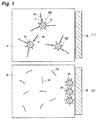
- Fig. 1 is an explanatory drawing showing an example of a method of detecting a target substance according to the present invention.
- fluorescent labeling particles 20, dispersants 30, and analytes containing target substances S are mixed.
- presence or absence of dispersion of the thermoresponsive polymers is judged under conditions in which the thermoresponsive polymers are aggregated.
- the analytes are irradiated with the excitation light, and the dispersion is detected by the fluorescence emission.
- Fig. 1 (1) shows a case where the target substances S exist.
- a linked structure 100 through the target substance S is formed, and dispersed without being aggregated in an analyte liquid.
- any dispersant 30 and any fluorescent labeling particle 20 are not linked, and each of the fluorescent labeling particles 20 exists independently within a system.
- the fluorescent labeling particles 20 are aggregated.
- a magnet M is installed on a right side plane of a reaction vessel B.
- the fluorescent labeling particles 20 that are aggregated and strongly magnetized are attracted by magnetic force of this magnet, and gathered in the vicinity of the magnet M.
- the state of Fig. 1 (1) in which the particles 20 exist in the form of the linked structures 100 having high dispersibility aggregation of the fluorescent labeling particles 20 is not promoted, and the magnetism thereof is limited in a small state. Accordingly, even when the magnet M is placed laterally to the vessel B, the particles 20 are not attracted thereto, and a dispersion state is maintained.
- the reaction liquid (vessel B) in which existence or non-existence of the target substances S is distinguished in the state of Fig. 1 described above is irradiated with the excitation light.
- Fig.1 (1) in the state in which the target substances S is contained fluorescence is limited to the emission from each of the fluorescent labeling particles 20, and is not intensified significantly, although somewhat emission is found in the liquid as a whole.
- Fig. 1 (2) in which no target substance S is contained when the liquid is irradiated with the excitation light, the fluorescent labeling particles 20 that are heated, and attracted in the vicinity of the magnet and in the aggregated state emit the fluorescence.
- the fluorescence results in the fluorescence emission of the fluorescent labeling particles 20 in the aggregated state and concentrated in a part, and the fluorescence can be detected in a significantly marked state.
- non-existence of the target substance is identified by development of the fluorescence emission of the labeling particles that are locally gathered in the above-described test liquid.
- existence of the target substance is identified by no development of the fluorescence emission of the above-described gathered particles.
- Aggregation of the particles and accumulation thereof in the vicinity of the magnet are a phenomenon that occurs in conventional thermoresponsive magnetic particles in which the fluorescent material phase 2 is not used, according to which an orange-colored concentrated portion is observed, for example.
- the dispersion liquid in which no aggregation is caused is also slightly orange-colored, and when an amount of the target substance is small or the like, the color is not developed as a significantly distinct difference in several cases.
- the difference can be detected by the fluorescence, and therefore a marked change of the fluorescence emission can be detected.
- the difference can be improved by as much as 10 times to several hundred times in comparison with a conventional means. According to this effect, diagnosis that has been difficult by means of hitherto inspection equipment in a biochemistry field, for example in an infectious disease field can be achieved.
- the present invention shall not be limited and construed by exemplification of this improvement effect.
- the fluorescent material phase 2 that constitutes the fluorescent labeling particle 20 is formed of silica (continuous phase) 2a containing a fluorescent dye (dispersion layer) 2b.
- silica raw material ordinarily has smaller specific gravity in comparison with a magnetic material, and becomes easily floatable in a medium of the analyte liquid, such as water. The effect is also produced, and a change of the dispersion and aggregation states becomes sharp, further leading to an improvement in the detection sensitivity.
- the above-described excitation light source preferably emits the excitation light in the following wavelength region.
- the excitation light source include a mercury lamp, a halogen lamp, and a xenon lamp.
- excitation light illuminated from a laser diode or light emitting diode is particularly preferably used.
- the detection system is preferably equipped with a filter for selectively transmitting light of specific wavelength from the excitation light source.
- the detection system preferably contains a photomultiplier tube or CCD detector capable of receiving the fluorescence. Accordingly, fluorescence with visually undeterminable intensity or wavelength can be detected, and further quantification of target substances can be made as its fluorescence intensity can be measured, enabling detection and quantification with high sensitivity.
- the wavelength of the excitation light is preferably 300 nm or more, more preferably 400 nm or more, and particularly preferably 500 nm or more.
- the upper limit thereof is preferably 700 nm or less, more preferably 600 nm or less, and particularly preferably 550 nm or less.
- the fluorescence in the following range can be efficiently generated by adjusting the wavelength to the excitation light in this range, and such a case is preferable.
- the wavelength of the fluorescence is preferably 350 nm or more, more preferably 450 nm or more, and particularly preferably 530 nm or more.
- the upper limit thereof is preferably 800 nm or less, more preferably 750 nm or less, and particularly preferably 580 nm or less. Detection by visual observation or with a generally used detector is facilitated by adjusting the wavelength in this range, and such a case is preferable.
- the test liquid containing the analyte is not particularly limited, but the liquid obtained by diluting the analyte with a buffer solution such as PBS is preferably used.
- a dilution factor is different depending on the analytes, the analyte can be diluted by 2 to 100 times, and used, for example.
- an acid or a base for treatment may be appropriately incorporated into the test liquid.
- a concentration of a test substance in the test liquid is not particularly limited, the method of the present invention in which the detection sensitivity is high can be applied to the test liquid containing the test substance in 1 pg/mL or more, for example, and further preferably 1 ng/mL or more.
- An upper limit is not particularly provided, but is practically 1 mg/mL or less. More specifically, the upper limit can be set up by experiment for every item to be detected.
- a concentration of the dispersant is not particularly limited, but is more preferably 0.01% by mass or more, and further preferably 0.1 % by mass or more.
- An upper limit is not particularly provided, but is practically 5% by mass or less.
- a concentration of the labeling particles is not particularly limited, but is more preferably 0.01% by mass or more, and further preferably 0.1 % by mass or more.
- An upper limit is not particular provided, but is practically 5% by mass or less.
- a test temperature is not particularly limited, but the test is practically conducted at 25°C or higher and 45°C or lower.
- the labeling particles related to the present embodiment preferably have properties of being aggregated immediately after heating.
- the target substance can be detected by utilizing the above properties.
- response by heat needs time in several cases.
- measurement is preferably started after starting the above-described heating, and then a change of fluorescence intensity over time is preferably followed.
- High reproducibility and high sensitivity can be obtained by evaluating aggregation characteristics by using a differential between minimized fluorescence intensity at the time point of elapse of 600 seconds or more, and maximum fluorescence intensity obtained after starting the heating.
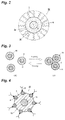
- Fig. 2 is a side view schematically showing a thermoresponsive fluorescent particle 10 constituting a labeling particle as related to the present invention.
- a composite particle 11 has a form in which a transparent material phase (fluorescent silica phase) 2 forming a shell coats a surface of a magnetic material phase (magnetic material particle) 1 forming a core.
- thermoresponsive polymers 3 are arranged on a surface of the composite particle 11.
- a core/shell-type composite particle is illustrated, but the present invention is not limited thereto.
- the phases may be in a form into a sea-island form or in a state in which the phases are indefinitely mixed.
- the aspect of the sea-island form the aspect is preferable in which the magnetic material phase constitutes an island portion, and the fluorescent material phase constitutes a sea portion.
- Specific examples of a similar aspect include a core-distributed particle inside which a number of cores formed by the above-described magnetic material phases exist.
- thermoresponsive polymers 3 are shown in the aspect in which the polymers 3 are radially extended from the surface of the composite particle 2 outward for convenience of illustration, but the present invention shall not be limited and construed by this aspect. Aspects related to adsorption of the polymer onto the surface are diversified, and generally indefinite.
- the polymers may have complicatedly entangled structure, or may be immobilized on the surface of the composite particle in the aspect of the particle form in which each molecule or several molecules are shrunk.
- the polymers are preferably in the state in which the excitation light at least partially reaches the composite particle, and the fluorescence emitted therefrom may reach the outside.
- the phases of this thermoresponsive polymers are simplified by hatching and shown.
- Fig. 3 is a side view schematically showing a change between aggregation and dispersion of thermoresponsive fluorescence particles 10 by heating.
- Fig. 3 (1) on a left-hand side in the figure shows a state before heating, in which the thermoresponsive fluorescence particles 10 are dispersed with each other in the system.
- the particles 10 transition to an aggregated state by heating as in Fig. 3 (2) on a right-hand side.
- the reason why the change between aggregation and dispersibility is caused by heating as described above is not always clear. To describe the reason including presumption, it is considered that the polymers are shrunk by heating and approachable distances of adjacent composite particles become shorter, and therefore the aggregation is promoted.
- an example is shown in which the aggregation is promoted upon exceeding the critical solution temperature (CST) by heating, and dispersion is promoted below the critical solution temperature, but may be in a reverse manner. That is, an aspect may be formed in which the dispersion is promoted upon exceeding the critical solution temperature (CST), and the aggregation is promoted below the critical solution temperature.
- CST critical solution temperature
- Fig. 4 is a side view schematically showing one embodiment of a fluorescent labeling particle of the present invention.
- linking materials 4 are provided on a surface of the composite particle 11, and binding substances 5 are immobilized therein.
- the linking materials 4 are shown as when the linking materials 4 are arranged in an outside of the thermoresponsive polymer 3 (polymer leading end), which is only for convenience of illustration, and is not necessary to be in such an arrangement state.
- the thermoresponsive polymers 3 rather exist in an indefinite manner, and only need to arbitrarily exist in an entangled state or an adsorbed state therein, or the like.
- the linking material may be introduced into the leading end of the thermoresponsive polymer as described above.
- the binding substances 5 may be introduced into the thermoresponsive polymer 3 without using the linking materials 4.
- specific examples include fluorescent labeling particles in which no binding substance is used.
- the binding substance 5 is referred to as a particle-side binding substance 5 in distinction from a dispersant-side binding substance 6 as mentioned later in several cases.
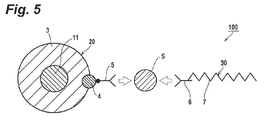
- Fig. 5 is an explanatory view showing an example in which a fluorescent labeling particle 20 of the present invention forms a linked structure together with a target substance S.
- the particle-side binding substance 5 introduced into the fluorescent labeling particle has the properties of binding with the target substance S.
- a dispersant 30 is introduced into the system.
- the dispersant 30 is composed of a dispersant base 7 and a dispersant-side binding substance 6.
- This dispersant-side binding substance 6 also has the properties of binding with the target substance S. Accordingly, when the fluorescent labeling particle 20, the target substance S and the dispersant 30 coexist in the system, structure (linked structure 100) is formed in which the fluorescent labeling particle 20 and the dispersant 30 are linked through the target substance S.
- Fig. 5 shows only one linking material 4 and one binding substance 5, but is simplified and preferably a large number thereof are provided typically as shown in Fig. 4 .
- the target substance S can be detected by utilizing the properties of binding of the dispersant 30 and the fluorescent labeling particles 20 with the target substance S, and the linked structure 100 as shown in Fig. 5 , which is as shown in Fig. 1 described above.
- the magnetic material that can be used in the present invention is not particularly limited, but is preferably in a particle form. Specifically, the material has an average particle diameter of preferably 0.5 nm or more and less than 1,000 nm, and particularly preferably 3 nm or more and less than 200 nm. Specific examples of the magnetic materials (raw materials) include fine particles of magnetite, nickel oxide, ferrite, cobalt iron oxide, barium ferrite, carbon steel, tungsten steel, KS steel, a rare earth cobalt magnet and hematite.
- the phase containing the fluorescent material is preferably constituted of a continuous phase 2a formed of the transparent material and a dispersed phase 2b formed of the fluorescent material.
- the transparent material preferably contains silica or polystyrene.
- a method of forming the fluorescent silica phase as the above-described fluorescent material phase is not particularly limited, and the phase obtained by an arbitrary production method may be applied. Examples of the method include a sol-gel method described in Journal of Colloid and Interface Science, vol. 159, p. 150-157 (1993 ). In the present invention, a method of producing colloid silica particles containing fluorescent dye compounds as described in WO 2007/074722 A1 also serves as reference.
- the silica phase containing a fluorescent dye can be prepared by reacting a fluorescent dye with a silane coupling agent and performing polycondensation of a product obtained through a covalent bond, ionic bond, or other chemical bonds or by adsorption with one or more of silane compounds to form a siloxane bond. Accordingly, the silica phase consisting of the organosiloxane component and the siloxane component that are bound to each other via siloxane bond are obtained.
- production can be made by reacting a fluorescent dye having or provided with an active group such as an N-hydroxysuccinimide (NHS) ester group, a maleimide group, an isocyanate group, an isothiocyanate group, an aldehyde group, a paranitrophenyl group, a diethoxy methyl group, an epoxy group, and a cyano group with a silane coupling agent having a substituent which reacts with those active groups (e.g., an amino group, a hydroxy group, and a thiol group), and condensing and polymerizing the product obtained by forming a siloxane bond after forming a covalent bond with one or more types of silane compounds.
- an active group such as an N-hydroxysuccinimide (NHS) ester group, a maleimide group, an isocyanate group, an isothiocyanate group, an aldehyde group, a paranitrophenyl group, a diethoxy
- the following example relates to a case in which APS and tetraethoxy silane (TEOS) are used as a silane coupling agent and a silane compound, respectively.
- APS and tetraethoxy silane (TEOS) are used as a silane coupling agent and a silane compound, respectively.
- the functional compound having or provided with an active group may include NHS ester group-containing fluorescence dye compounds such as 5- (and -6)-carboxytetramethylrhodamine-NHS ester (trade name, manufactured by emp Biotech GmbH), DY550-NHS ester or DY630-NHS ester represented as follows (each trade name, manufactured by Dyomics GmbH).
- NHS ester group-containing fluorescence dye compounds such as 5- (and -6)-carboxytetramethylrhodamine-NHS ester (trade name, manufactured by emp Biotech GmbH), DY550-NHS ester or DY630-NHS ester represented as follows (each trade name, manufactured by Dyomics GmbH).
- substituent-containing silane-coupling agent examples include an amino group-containing silane-coupling agent such as ⁇ -aminopropyltriethoxysilane (APS), 3-[2-(2-aminoethylamino)ethylamino]-propyltriethoxysilane, N-2-(aminoethyl)-3-aminopropylmethyldimethoxysilane, and 3-aminopropyltrimethoxysilane.
- APS is preferable.
- the silane compound to be condensed and polymerized is not particularly limited, and examples thereof include TEOS, ⁇ -mercaptopropyltrimethoxysilane (MPS), ⁇ -mercaptopropyltriethoxysilane, ⁇ -aminopropyltriethoxysilane (APS), 3-thiocyanatopropyltriethoxysilane, 3-glycidyloxypropyltriethoxysilane, 3-isocyanatopropyltriethoxysilane, and 3-[2-(2-aminoethylamino)ethylamino]propyl-triethoxysilane.
- MPS ⁇ -mercaptopropyltrimethoxysilane
- APS ⁇ -aminopropyltriethoxysilane
- 3-thiocyanatopropyltriethoxysilane 3-glycidyloxypropyltriethoxysilane
- TEOS is preferable from the point of view of forming the siloxane component to be contained in the silica particles, and besides MPS and APS are preferable from the point of view of forming the organosiloxane component to be contained in the silica particles.
- spherical or almost spherical magnetic material/silica composite particles can be produced by using the above-described materials and providing the above-described magnetic particles into a reaction system so as to form a core.
- the almost spherical particles mean particles having a major axis/minor axis ratio of 2 or less.
- silica particles having a desirable average particle diameter it is possible to remove particles having an excessively large particle diameter or an excessively small particle diameter by ultrafiltration by using an ultrafiltration membrane such as YM-10 or YM-100 (each trade name, manufactured by Millipore Corporation) or by recovering only a supernatant or precipitates after performing centrifugal separation with suitable acceleration of gravity.
- the average particle diameter of the fluorescent composite particle is not specifically limited, but preferably 1 nm or more, and more preferably 20 nm or more.
- the upper limit thereof is preferably less than 1 ⁇ m, and more preferably 500 nm or less.
- the average particle diameter is an average diameter of the circle (average circle-equivalent diameter) obtained by measuring the total projected area of 100 pieces of randomly-selected labeling reagent silica particles for example in an image obtained under transmission electron microscope (TEM) or scanning electron microscope (SEM) using an image processing equipment, dividing the total area with the number of the labeling reagent silica particles (100 pieces), and determining the circle having an area equivalent to that.
- TEM transmission electron microscope
- SEM scanning electron microscope
- the "average particle diameter” indicates an average particle diameter of particles consisting of only primary particles, which is different from the "particle size according to a dynamic light scattering method” described below having a concept including secondary particles formed by aggregation of primary particles.
- the particle size according to the dynamic light scattering method is measured by the dynamic light scattering method, and it is a concept including secondary particles formed by aggregation of primary particles as well as primary particles, different from average particle diameter. This particle size is an indicator for evaluating dispersion stability of the complex particles described above.
- Examples of a device for measuring the particle size according to the dynamic light scattering method include Zetasizer Nano (trade name, manufactured by Malvern Instruments Ltd.). According to the method, fluctuation in light scattering intensity over time that is caused by light scatterers such as fine particles is measured, the speed of the light scatterers in Brownian motion is calculated based on an autocorrelation function, and the particle size distribution of the light scatterers is determined based on the results.
- Zetasizer Nano trade name, manufactured by Malvern Instruments Ltd.
- the fluorescent silica particles preferably have monodispersion as a granular substance.
- the variation coefficient, so-called CV value, of the particle size distribution is not specifically limited, but preferably 10% or less, and more preferably 8% or less.
- a latex phase may be used as the continuous phase of the fluorescent material phase in the composite particles.
- the material for constituting the latex phase include synthetic polymer particles consisting of polystyrene, styrene-sulfonic acid (salt) copolymer, styrene-methacrylic acid copolymer, acrylonitrile-butadiene-sulfonic acid copolymer, vinyl chloride-acrylic acid ester copolymer, or vinyl acetate-acrylic acid ester copolymer.
- JP-A-2000-178309 means unexamined published Japanese patent application
- JP-A-10-48215 JP-A-8-269207 , JP-A-6-306108 , or the like
- Immobilization of a fluorescent substance (labeling substance) for those kinds of particles can be suitably performed according to a common method.
- JP-T-2005-534907 means published searched patent publication
- JP-A-2010-156642 means published searched patent publication
- JP-A-2010-156640 or the like.
- An amount of the fluorescent material (fluorescent dye) in the phase of the fluorescent material is not particularly limited in the present invention, but is preferably 0.05 part by mass or more, and more preferably 0.10 part by mass or more when the amount of the transparent material (continuous phase) is taken as 100 parts by mass.
- An upper limit is preferably 1.0 part by mass or less, and more preferably 0.50 part by mass or less.
- a ratio of the phase of the magnetic material to the phase of the fluorescent material may also be appropriately adjusted.
- the fluorescence particles are preferably gathered due to action of the phase of the magnetic material in a predetermined portion for detection.
- the fluorescent material preferably exists in the transparent material at a specific proportion to allow effective measurement of fluorescence. Accordingly, the ratio of the phase of the transparent material to the phase of the fluorescent material, and the ratio of the phase of the magnetic material to the phase of the transparent material are preferably designed so as to satisfy the above-described purposes.
- the ratio of the phase of the magnetic material to the phase of the fluorescent material can be determined from the ratio of the phase of the transparent material to the phase of the fluorescent material, and the ratio of the phase of the magnetic material to the phase of the transparent material.
- the thermoresponsive polymer preferably causes no structural change, even if the polymer is bounded with a molecule having an electric charge.
- a polymer having the critical solution temperature hereinafter, also referred to as CST
- This critical solution temperature (CST) means a temperature serving as a border at which characteristics or morphologies of the polymer are changed.
- the thermoresponsive polymer may be a polymer exhibiting a lower critical solution temperature (LCST) or an upper critical solution temperature (UCST).
- LCST lower critical solution temperature
- UST upper critical solution temperature
- specific examples include a polymer that causes aggregation when the liquid temperature is increased, and redispersion when the temperature is decreased.
- thermoresponsive polymer when the thermoresponsive polymer exhibits the upper critical solution temperature (UCST), specific examples include a polymer that causes aggregation when the liquid temperature is decreased, and redispersion when the temperature is increased.
- the critical solution temperature (CST) is preferably 10°C or higher, and more preferably 30°C or higher.
- An upper limit is preferably 100°C or lower, and more preferably 50°C or lower.
- the lower critical solution temperature and the upper critical solution temperature can be determined as described below, for example.
- a sample is placed in a cell of an absorptiometer and heated at a rate of 1°C/min. During heating, a change of transmittance at 550 nm is recorded.
- the transmittance when the polymer is melted in a transparent state is taken as 100% and the transmittance when the polymer is completely aggregated is taken as 0%.
- a temperature at which the transmittance becomes 50% is determined as LCST.
- polymers having the lower critical solution temperature include polymers composed of N-substituted (meth)acrylamide derivatives such as N-n-propylacrylamide, N-isopropylacrylamide, N-ethylacrylamide, N,N-dimethylacrylamide, N-acryloylpyrrolidine, N-acryloylpiperidine, N-acryloylmorpholine, N-n-propylmethacrylamide, N-isopropylmethacrylamide, N-ethylmethacrylamide, N,N-dimethylmethacrylamide, N-methacryloylpyrrolidine, N-methacryloylpiperidine and N-methacryloylmorpholine; polyoxyethylene alkylamine derivatives such as hydroxypropylcellulose, a polyvinyl alcohol partially acetylated product, polyvinyl methyl ether, a (polyoxyethylene-polyoxypropylene) block copolymer and polyoxyethylene lau
- a polymer thereof or a copolymer formed of at least two kinds of monomers thereof can also be used.
- a copolymer of N-isopropylacrylamide and N-t-butyl acrylamide can also be used.
- any other copolymerizable monomer may be copolymerized with this polymer in the range in which the resultant copolymer has the lower critical solution temperature.
- the polymer having the upper critical solution temperature a polymer formed of at least one kind of monomer selected from the group consisting of acroylglycinamide, acroylnipecotamide, acryloylasparaginamide, acryloyl glutaminamide and the like can be used. Moreover, the polymer may be a copolymer formed of at least two kinds of these monomers.
- any other copolymerizable monomer such as acrylamide, acetylacrylamide, biothionol acrylate, N-bithionyl-N'-methacroyltrimethylene amide, acroylsarcosine amide, methacrylicsarcosine amide and acroylmethyluracil may be copolymerized in the range in which the resultant copolymer has the upper critical solution temperature.
- thermoresponsive polymer a polymer described in Japanese Patent No. 4518767 , for example can be preferably used.
- thermoresponsive polymer can be immobilized thereonto through polyhydric alcohol or a polyhydric alcohol derivative.
- This thermoresponsive polymer may be immobilized thereonto by being subjected to graft polymerization with the polyhydric alcohol or the polyhydric alcohol derivative immobilized on the surface of the composite particle, or by binding a functional group in a terminal or a side chain of the polymer with a functional group of the polyhydric alcohol or the polyhydric alcohol derivative.
- An average particle diameter of the composite particle on which the thermoresponsive polymer is immobilized becomes larger by a portion of the thermoresponsive polymer in comparison with the above-described composite particle, but a preferred range thereof is substantially similar to the range specified as the composite particle.
- the polyhydric alcohol preferably has at least two hydroxy groups in a constitutional unit. Specific examples include dextran, polyvinyl alcohol, mannitol and sorbitol. Moreover, a compound that has an epoxy group and forms a polyhydric alcohol structure after ring opening, such as a glycidyl methacrylate polymer, can also be used.
- polyhydric alcohol derivative polyhydric alcohol into which a reactive functional group or polymerizable group, such as carboxyl, amino, epoxy, thiol, methacrylic or acrylic is introduced by modification can be used.
- the linking material is an arbitrary material, and is preferably selected and used appropriately when such a material is necessary for introduction of the binding substance.
- a kind thereof is not particularly limited, but a material that can be incorporated into the thermoresponsive polymer and has the properties of binding with the binding substance is preferable.
- specific examples include biotin, avidin, streptoavidin, a primary antibody and a secondary antibody.
- thermoresponsive polymer As a method of incorporating the linking material into the thermoresponsive polymer, the description in WO 01/09141 or Japanese Patent No. 4518767 can serve as reference. Specifically, biotin or the like is bound with a polymerizable functional group such as a methacrylic group and an acrylic group into an addition-polymerizable monomer, and the monomer is copolymerized with any other monomer to perform incorporation.
- a polymerizable functional group such as a methacrylic group and an acrylic group into an addition-polymerizable monomer
- such a method can be utilized, in which a monomer having a functional group such as carboxylic acid, an amino group or an epoxy group is copolymerized with any other monomer during polymerization of a polymer to bind an antibody-affinity substance (for example, melon gel, protein A, protein G) with the polymer through this functional group according to an ordinary method.
- a monomer having a functional group such as carboxylic acid, an amino group or an epoxy group may be copolymerized with any other monomer during polymerization of a polymer to directly bind an antibody (binding substance) against an antigen of a detection object with these functional groups according to an ordinary method.
- binding substance can be omitted.
- the particle-side binding substance is an arbitrary material, and only needs to be appropriately selected when necessary according to a kind of target substance.
- a biomolecule (binding substance) to be combined or absorbed on the surface of the composite particle there includes antigens, antibodies, DNAs, RNAs, sugars, polysaccharides, ligands, receptors, proteins, peptides and the like.
- the term "ligand” means a substance capable of specifically binding to a protein, and examples thereof include substrates capable of binding to enzyme, coenzymes, regulatory factors, hormones, neurotransmitters, and the like.
- the ligands include low-molecular weight molecules or ions as well as high-molecular weight substances.
- the antibody used herein may be any type of immunoglobulin molecules, or immunoglobulin molecule fragments having an antigen binding site, such as Fab. Moreover, the antibody may be a monoclonal antibody or a polyclonal antibody, but is preferably two kinds of monoclonal antibodies having different antigen recognition sites.
- a technique for binding the binding substance with the linking substance is not particularly limited, and binding can be performed by an ordinary method in this kind of technologies.
- Table A Labeling particle Magnetic material Magnetite, Nickel oxide, Ferrite or the like Fluorescent material (dye) 5- (and -6)-carboxytetramethylrhodamine-NHS ester DY550-NHS ester and the like Transparent material Silica, Latex (polystyrene) Linking material Streptavidin Binding substance Biotin-introduced antibody Target substance TSH antigen Dispersant Dispersant base Polyacrylic acid Dispersant-side binding substance Antibody
- the dispersant base is a hydrophilic high molecular weight compound, for example, and is preferably a polyanion or a polycation.
- the polyanion means a substance having a plurality of anion groups
- the polycation means a substance having a plurality of cation groups.
- Specific examples of the polyanion include nucleic acid such as DNA and RNA. These nucleic acids have properties of the polyanion due to existence of plural pieces of phosphodiester groups along a skeleton of the nucleic acid.
- the polyanion includes polypeptide containing a large number of carboxylic acid functional groups (polypeptide composed of amino acid such as glutamic acid and aspartic acid), polyacrylic acid, polymethacrylic acid, a polymer containing, as a polymerization component, acrylic acid and methacrylic acid, and a polysaccharide such as carboxymethylcellulose, hyaluronic acid and heparin.
- specific examples of the polycation include polylysine, polyarginine, polyornithine, polyalkylamine, polyethyleneimine and polypropylethyleneimine.
- the number of functional groups in the polyanion (carboxyl group) or the polycation (amino group) is preferably 25 or more.
- the dispersant-side binding substance only needs to be appropriately selected when necessary according to the kind of target substance.
- a kind thereof is preferably selected in taking into account introduction into the dispersant base.
- Specific examples are identical with the substances exemplified as the above-described particle-side binding substance.
- the method of binding the binding substance with the dispersant base is not particularly limited, and specific examples include a method in which mutual affinity substances (for example, avidin and biotin, glutathione and glutathione S transferase) are bound to both to indirectly bind the dispersant base and the binding substance through these substances.
- mutual affinity substances for example, avidin and biotin, glutathione and glutathione S transferase
- both may be bound through a functional group.
- a functional group for example, both can be bound according to maleimide-thiol coupling in the method of Ghosh, et al ( Ghosh et al: Bioconjugate Chem., 1, 71-76, 1990 ).
- Specific examples include two methods described below.
- a maleimide group is introduced into an antibody by allowing 6-maleimide hexanoic acid succinimide ester (for example, "EMCS (trade name)" (manufactured by Dojindo Laboratories)) to react with the antibody.
- 6-maleimide hexanoic acid succinimide ester for example, "EMCS (trade name)" (manufactured by Dojindo Laboratories)
- a mercapto group is introduced first into a 5' terminus of nucleic acid in a manner similar to the first method, and a maleimide group is further introduced into a 5' terminus of nucleic acid by allowing N,N-1,2-phenylenedimaleimide being a homo bifunctional reagent to react with this mercapto group. Meanwhile, a mercapto group is introduced into an antigen. Next, two kinds of these substances are bound through the mercapto group and the maleimide group.
- nucleic Acids Research for example, methods described in Nucleic Acids Research, Vol. 15, p. 5275 (1987 ), and Nucleic Acids Research, Vol. 16, p. 3671 (1988 ) are known. These technologies can be applied to binding of the antibody with the nucleic acid.
- a substance used in clinical diagnosis is exemplified, and specific examples include, as contained in body fluid, urine, sputum, feces and the like, human immunoglobulin G, human immunoglobulin M, human immunoglobulin A, human immunoglobulin E, human albumin, human fibrinogen (fibrin and a decomposition product thereof), ⁇ -fetoprotein (AFP), C-reactive protein (CRP), myoglobin, a carcinoembryonic antigen, a hepatitis virus antigen, human chorionic gonadotropin (hCG), human placental lactogen (HPL), an HIV virus antigen, allergen, bacteriotoxin, a bacteria antigen, an enzyme, hormone (for example, human thyroid stimulating hormone (TSH), insulin and the like) and a medical agent.
- human immunoglobulin G human immunoglobulin M
- human immunoglobulin A human immunoglobulin E
- human albumin human fibrinogen (fibrin and a
- the labeling particles were particles in which magnetic particles were coated with silica particles as shown in Table A, and an average particle diameter thereof was about 200 nm.
- the particles were incorporated into a test liquid containing analytes, and the resultant material was heated at about 50°C for 15 minutes. Then, the resultant material was irradiated with excitation light (550 nm), and a target substance contained in the above-described analytes was detected depending on a state of light emission (580 nm) of the above-described labeling particles.
Landscapes
- Health & Medical Sciences (AREA)
- Life Sciences & Earth Sciences (AREA)
- Immunology (AREA)
- Engineering & Computer Science (AREA)
- Chemical & Material Sciences (AREA)
- Urology & Nephrology (AREA)
- Biomedical Technology (AREA)
- Hematology (AREA)
- Molecular Biology (AREA)
- Physics & Mathematics (AREA)
- General Physics & Mathematics (AREA)
- Pathology (AREA)
- General Health & Medical Sciences (AREA)
- Biochemistry (AREA)
- Analytical Chemistry (AREA)
- Cell Biology (AREA)
- Medicinal Chemistry (AREA)
- Food Science & Technology (AREA)
- Biotechnology (AREA)
- Microbiology (AREA)
- Chemical Kinetics & Catalysis (AREA)
- Optics & Photonics (AREA)
- Nuclear Medicine, Radiotherapy & Molecular Imaging (AREA)
- Nanotechnology (AREA)
- Inorganic Chemistry (AREA)
- Investigating, Analyzing Materials By Fluorescence Or Luminescence (AREA)
- Investigating Or Analysing Materials By The Use Of Chemical Reactions (AREA)
Abstract
incorporating labeling particles into a test liquid containing an analyte;
heating the test liquid;
irradiating the test liquid with excitation light, and
detecting the target substance contained in the test liquid depending on a state of light emission of the labeling particles;
wherein an aggregation state of the labeling particles is changed by the heating step; and
wherein the labeling particles have a thermoresponsive polymer on a surface of a composite particle containing a magnetic material and a fluorescent material, and further have a biomolecule having properties of binding with the target substance. [Selected Drawing]
Description
- The present invention relates to a method of detecting a target substance.
- Fine particles on which various kinds of biological substances are immobilized have been widely utilized in medical diagnosis, a biotechnology research field and the like. Fine particles that are formed of a variety of materials and have various particle diameters, forms and functions have been studied and proposed therein. Among them, there exists a technology in which magnetic particles are utilized. Specific examples include a technology in which magnetic particles on which an antibody is immobilized are used to perform affinity column chromatography. At this time, in latex beads, an antigen is purified by repeating centrifugal separation and washing operation. Therefore, a large amount of solvent is required. On the other hand, when the magnetic particles are used, the complicated operation as described above is not required because particles can be easily separated by means of a magnet. That is, in comparison with the latex beads having no magnetism, the magnetic particles have an advantage of capability of rapidly and simply purifying the antigen. Moreover, the magnetic particles are also adapted to automation using a machine because such centrifugal separation and application of the large amount of solvent become unnecessary. For the above reason, immunological magnetic particles have been frequently utilized as a carrier in immunodiagnosis (sandwich method) in recent years.
- In order to improve molecular recognition properties of the magnetic particles, a surface area thereof is preferably increased. In this regard, in order to further increase the surface area per unit volume for magnetic beads, further reduction of a particle diameter is effective. On the other hand, if the particle diameter of the magnetic particles falls in a nanometer order, the magnetism of the particles is significantly weakened. Further, magnetic separation by means of the magnet becomes significantly difficult under the influence of Brownian motion in water. In order to solve this problem, proposals have been made on arts of using particles in which a thermoresponsive polymer is immobilized on a surface layer of magnetic nanoparticles having a particle diameter of several tens of nanometers (see
Patent Literatures 1 and 2). A target substance is detected depending on a change of colors (into transparency) of magnetic materials by aggregating thermoresponsive magnetic particles by heating therein. Specifically, absorbance of a reaction liquid over time is monitored by heating the liquid after a reaction with the target substance, and existence of the target substance (analyte) is judged by the absorbance being gradually decreased. -
- Patent Literature 1:
WO 2008/001868 pamphlet - Patent Literature 2:
Japanese Patent No. 4518767 - It is certain that detection sensitivity thereof is considered to be improved by the above-mentioned thermoresponsive magnetic particles to compensate for the low magnetism caused by micronized particles. However, a further improvement in the detection sensitivity is desired in order to realize a further microanalysis or securely prevent a false negative or a false positive in medical diagnosis.
- Therefore, the present invention is contemplated for providing a method of detecting a target substance in which high detection sensitivity can be realized in detection of the target substance utilizing thermoresponsive magnetic particles.
- The problems are solved by the following means.
- [1] A method of detecting a target substance, comprising the steps of:
- incorporating labeling particles into a test liquid comprising an analyte; heating the test liquid;
- irradiating the test liquid with excitation light, and
- detecting the target substance included in the test liquid depending on a state of light emission of the labeling particles;
wherein the labeling particles have a thermoresponsive polymer on a surface of a composite particle comprising a magnetic material and a fluorescent material, and further have a biomolecule having properties of binding with the target substance. - [2] The method of detecting a target substance as described in the above item [1], wherein non-existence of the target substance is identified by development of fluorescence emission of the labeling particles that are locally gathered in the test liquid after the heating step, and existence of the target substance is identified by no development of the fluorescence emission of the gathered labeling particles.
- [3] The method of detecting a target substance as described in the above item [1] or [2], wherein a dispersant is introduced into the test liquid.
- [4] The method of detecting a target substance as described in any one of the above items [1] to [3], wherein a wavelength of the excitation light is 300 to 700 nm and a wavelength of the fluorescence is 350 to 800 nm.
- [5] The method of detecting a target substance as described in any one of the above items [1] to [4],
wherein the composite particle comprises a phase having the magnetic material and a phase having the fluorescent material, and
wherein the phase having the fluorescent material is constituted of a continuous phase formed of a transparent material and a dispersed phase formed of the fluorescent material. - [6] The method of detecting a target substance as described in any one of the above items [1] to [5], wherein the test liquid is heated so as to span a critical solution temperature (CST) of the thermoresponsive polymer in the range of 10°C to 100°C.
- [7] The method of detecting a target substance as described in any one of the above items [1] to [6], wherein magnetic force is provided for the test liquid and the labeling particles in an aggregated state are gathered in a portion provided with the magnetic force.
- [8] The method of detecting a target substance as described in any one of the above items [1] to [7], wherein an average particle diameter of the composite particle is less than 1 µm.
- [9] The method of detecting a target substance as described in any one of the above items [5] to [8], wherein the transparent material comprises silica or polystyrene.
- [10] The method of detecting a target substance as described in any one of the above items [1] to [9], wherein the magnetic material is magnetite, nickel oxide, ferrite, cobalt iron oxide, barium ferrite, carbon steel, tungsten steel, KS steel, a rare earth cobalt magnet or hematite.
- "Having on the surface of particle" means existence in the form of directly contacting with the surface and also existence outward of the surface through a different material.
- The method of detecting a target substance of the present invention realizes high detection sensitivity in detection of a target substance by utilizing thermoresponsive magnetic particles.
- Other and further features and advantages of the invention will appear more fully from the following description, appropriately referring to the accompanying drawings.
-
- {
Fig. 1 }
Fig. 1 is an explanatory drawing showing an example of a method of detecting a target substance according to the present invention. - {
Fig. 2 }
Fig. 2 is a side view schematically showing a thermoresponsive fluorescent particle constituting a labeling particle. - {
Fig. 3 }
Fig. 3 is a side view schematically showing a change between aggregation and dispersion of thermoresponsive fluorescence particles by heating. - {
Fig. 4 }
Fig. 4 is a side view schematically showing one embodiment of a fluorescent labeling particle. - {
Fig. 5 }
Fig. 5 is an explanatory view showing a state in which a fluorescent labeling particle forms a linked structure together with a target substance and a dispersant. - A method of detecting a target substance of the present invention is applied by incorporating specific labeling particles mentioned later into a test liquid containing an analyte, heating the test liquid and then irradiating the test liquid with excitation light, and depending on a state of fluorescence emission of the labeling particles to be emitted at the time. In the following, the present invention is described in detail centering on preferred embodiments thereof.
-
Fig. 1 is an explanatory drawing showing an example of a method of detecting a target substance according to the present invention. In the detection method of the present embodiment,fluorescent labeling particles 20,dispersants 30, and analytes containing target substances S are mixed. Subsequently, presence or absence of dispersion of the thermoresponsive polymers is judged under conditions in which the thermoresponsive polymers are aggregated. At this time, the analytes are irradiated with the excitation light, and the dispersion is detected by the fluorescence emission. -
Fig. 1 (1) shows a case where the target substances S exist. At this time, as shown inFig. 5 to be mentioned later, a linkedstructure 100 through the target substance S is formed, and dispersed without being aggregated in an analyte liquid. On the other hand, in a case where no target substance S exists (Fig. 1 (2)), anydispersant 30 and anyfluorescent labeling particle 20 are not linked, and each of thefluorescent labeling particles 20 exists independently within a system. At this time, when the liquid is heated and the liquid temperature is adjusted to a critical solution temperature (CST) or higher, thefluorescent labeling particles 20 are aggregated. In the present embodiment, a magnet M is installed on a right side plane of a reaction vessel B. Thefluorescent labeling particles 20 that are aggregated and strongly magnetized are attracted by magnetic force of this magnet, and gathered in the vicinity of the magnet M. On the other hand, when the state ofFig. 1 (1) in which theparticles 20 exist in the form of the linkedstructures 100 having high dispersibility, aggregation of thefluorescent labeling particles 20 is not promoted, and the magnetism thereof is limited in a small state. Accordingly, even when the magnet M is placed laterally to the vessel B, theparticles 20 are not attracted thereto, and a dispersion state is maintained. - In the present embodiment, the reaction liquid (vessel B) in which existence or non-existence of the target substances S is distinguished in the state of
Fig. 1 described above is irradiated with the excitation light. Then, inFig.1 (1) in the state in which the target substances S is contained, fluorescence is limited to the emission from each of thefluorescent labeling particles 20, and is not intensified significantly, although somewhat emission is found in the liquid as a whole. On the other hand, inFig. 1 (2) in which no target substance S is contained, when the liquid is irradiated with the excitation light, thefluorescent labeling particles 20 that are heated, and attracted in the vicinity of the magnet and in the aggregated state emit the fluorescence. The fluorescence results in the fluorescence emission of thefluorescent labeling particles 20 in the aggregated state and concentrated in a part, and the fluorescence can be detected in a significantly marked state. - That is, in the present embodiment, non-existence of the target substance is identified by development of the fluorescence emission of the labeling particles that are locally gathered in the above-described test liquid. To the contrary, existence of the target substance is identified by no development of the fluorescence emission of the above-described gathered particles.
- Aggregation of the particles and accumulation thereof in the vicinity of the magnet are a phenomenon that occurs in conventional thermoresponsive magnetic particles in which the
fluorescent material phase 2 is not used, according to which an orange-colored concentrated portion is observed, for example. However, the dispersion liquid in which no aggregation is caused is also slightly orange-colored, and when an amount of the target substance is small or the like, the color is not developed as a significantly distinct difference in several cases. In contrast, according to the present invention, the difference can be detected by the fluorescence, and therefore a marked change of the fluorescence emission can be detected. When the change is expressed by a difference in detection sensitivity (difference in absorbance or fluorescence intensity caused by existence or non-existence of the target substance), according to a preferred embodiment of the present invention, the difference can be improved by as much as 10 times to several hundred times in comparison with a conventional means. According to this effect, diagnosis that has been difficult by means of hitherto inspection equipment in a biochemistry field, for example in an infectious disease field can be achieved. However, the present invention shall not be limited and construed by exemplification of this improvement effect. - Further, in the present embodiment, the
fluorescent material phase 2 that constitutes thefluorescent labeling particle 20 is formed of silica (continuous phase) 2a containing a fluorescent dye (dispersion layer) 2b. A detail thereof is mentioned later, but a silica raw material ordinarily has smaller specific gravity in comparison with a magnetic material, and becomes easily floatable in a medium of the analyte liquid, such as water. The effect is also produced, and a change of the dispersion and aggregation states becomes sharp, further leading to an improvement in the detection sensitivity. - In the present embodiment, presence or absence of dispersion (
Figs. 1 (1), 1 (2)) is judged by irradiation with the excitation light and detection of the fluorescence excited by the irradiation. From a viewpoint of detecting the fluorescence visually or with a general-purpose sensor, the above-described excitation light source preferably emits the excitation light in the following wavelength region. Examples of the excitation light source include a mercury lamp, a halogen lamp, and a xenon lamp. In the present invention, excitation light illuminated from a laser diode or light emitting diode is particularly preferably used. The detection system is preferably equipped with a filter for selectively transmitting light of specific wavelength from the excitation light source. Further, from the viewpoint of detecting only the fluorescence by visual observation or the like, it is more preferably equipped with a filter which is capable of removing the excitation light and transmitting only the fluorescence. In particular, the detection system preferably contains a photomultiplier tube or CCD detector capable of receiving the fluorescence. Accordingly, fluorescence with visually undeterminable intensity or wavelength can be detected, and further quantification of target substances can be made as its fluorescence intensity can be measured, enabling detection and quantification with high sensitivity. - The wavelength of the excitation light is preferably 300 nm or more, more preferably 400 nm or more, and particularly preferably 500 nm or more. The upper limit thereof is preferably 700 nm or less, more preferably 600 nm or less, and particularly preferably 550 nm or less. The fluorescence in the following range can be efficiently generated by adjusting the wavelength to the excitation light in this range, and such a case is preferable.
- The wavelength of the fluorescence is preferably 350 nm or more, more preferably 450 nm or more, and particularly preferably 530 nm or more. The upper limit thereof is preferably 800 nm or less, more preferably 750 nm or less, and particularly preferably 580 nm or less. Detection by visual observation or with a generally used detector is facilitated by adjusting the wavelength in this range, and such a case is preferable.
- In the following, the above-described fluorescent labeling particles that produce the excellent effects are described in more detail. In illustrated aspects, each material is schematically or exaggeratedly shown for ease of understanding, and the present invention shall not be limited and construed by the aspects shown in these figures.
- In the detection method of the present invention, the test liquid containing the analyte is not particularly limited, but the liquid obtained by diluting the analyte with a buffer solution such as PBS is preferably used. Although a dilution factor is different depending on the analytes, the analyte can be diluted by 2 to 100 times, and used, for example. In addition thereto, an acid or a base for treatment may be appropriately incorporated into the test liquid. Although a concentration of a test substance in the test liquid is not particularly limited, the method of the present invention in which the detection sensitivity is high can be applied to the test liquid containing the test substance in 1 pg/mL or more, for example, and further preferably 1 ng/mL or more. An upper limit is not particularly provided, but is practically 1 mg/mL or less. More specifically, the upper limit can be set up by experiment for every item to be detected.
- A concentration of the dispersant is not particularly limited, but is more preferably 0.01% by mass or more, and further preferably 0.1 % by mass or more. An upper limit is not particularly provided, but is practically 5% by mass or less. A concentration of the labeling particles is not particularly limited, but is more preferably 0.01% by mass or more, and further preferably 0.1 % by mass or more. An upper limit is not particular provided, but is practically 5% by mass or less.
- A test temperature is not particularly limited, but the test is practically conducted at 25°C or higher and 45°C or lower.
- The labeling particles related to the present embodiment preferably have properties of being aggregated immediately after heating. The target substance can be detected by utilizing the above properties. However, depending on a kind of the thermoresponsive polymer or a manner of providing the polymer onto the composite particles, response by heat needs time in several cases.
- In taking into account such a matter also, with regard to detection of the fluorescence, measurement is preferably started after starting the above-described heating, and then a change of fluorescence intensity over time is preferably followed. High reproducibility and high sensitivity can be obtained by evaluating aggregation characteristics by using a differential between minimized fluorescence intensity at the time point of elapse of 600 seconds or more, and maximum fluorescence intensity obtained after starting the heating.
-
Fig. 2 is a side view schematically showing a thermoresponsivefluorescent particle 10 constituting a labeling particle as related to the present invention. In the present embodiment, acomposite particle 11 has a form in which a transparent material phase (fluorescent silica phase) 2 forming a shell coats a surface of a magnetic material phase (magnetic material particle) 1 forming a core. Then,thermoresponsive polymers 3 are arranged on a surface of thecomposite particle 11. In the present embodiment, a core/shell-type composite particle is illustrated, but the present invention is not limited thereto. For example, the phases may be in a form into a sea-island form or in a state in which the phases are indefinitely mixed. However, even at this time, at least a part of thefluorescent material phase 2 is preferably exposed on the surface of the composite particle, and a greater part of the particle surface is more preferably constituted of the fluorescent material phase so that the fluorescence can be detected from outside. Accordingly, as the aspect of the sea-island form, the aspect is preferable in which the magnetic material phase constitutes an island portion, and the fluorescent material phase constitutes a sea portion. Specific examples of a similar aspect include a core-distributed particle inside which a number of cores formed by the above-described magnetic material phases exist. - The
thermoresponsive polymers 3 are shown in the aspect in which thepolymers 3 are radially extended from the surface of thecomposite particle 2 outward for convenience of illustration, but the present invention shall not be limited and construed by this aspect. Aspects related to adsorption of the polymer onto the surface are diversified, and generally indefinite. The polymers may have complicatedly entangled structure, or may be immobilized on the surface of the composite particle in the aspect of the particle form in which each molecule or several molecules are shrunk. However, the polymers are preferably in the state in which the excitation light at least partially reaches the composite particle, and the fluorescence emitted therefrom may reach the outside. In and afterFig. 3 , the phases of this thermoresponsive polymers are simplified by hatching and shown. -
Fig. 3 is a side view schematically showing a change between aggregation and dispersion ofthermoresponsive fluorescence particles 10 by heating.Fig. 3 (1) on a left-hand side in the figure shows a state before heating, in which thethermoresponsive fluorescence particles 10 are dispersed with each other in the system. In contrast, theparticles 10 transition to an aggregated state by heating as inFig. 3 (2) on a right-hand side. The reason why the change between aggregation and dispersibility is caused by heating as described above is not always clear. To describe the reason including presumption, it is considered that the polymers are shrunk by heating and approachable distances of adjacent composite particles become shorter, and therefore the aggregation is promoted. In the present embodiment, an example is shown in which the aggregation is promoted upon exceeding the critical solution temperature (CST) by heating, and dispersion is promoted below the critical solution temperature, but may be in a reverse manner. That is, an aspect may be formed in which the dispersion is promoted upon exceeding the critical solution temperature (CST), and the aggregation is promoted below the critical solution temperature. -
Fig. 4 is a side view schematically showing one embodiment of a fluorescent labeling particle of the present invention. In the present embodiment, an example is shown in which linkingmaterials 4 are provided on a surface of thecomposite particle 11, and bindingsubstances 5 are immobilized therein. In an illustrated aspect, although the linkingmaterials 4 are shown as when the linkingmaterials 4 are arranged in an outside of the thermoresponsive polymer 3 (polymer leading end), which is only for convenience of illustration, and is not necessary to be in such an arrangement state. In actual fluorescent labeling particles, thethermoresponsive polymers 3 rather exist in an indefinite manner, and only need to arbitrarily exist in an entangled state or an adsorbed state therein, or the like. Conversely, when a material having a satisfactory molecular design is applied, the linking material may be introduced into the leading end of the thermoresponsive polymer as described above. As a modified aspect, the bindingsubstances 5 may be introduced into thethermoresponsive polymer 3 without using the linkingmaterials 4. Further, when the thermoresponsive polymer has properties of binding with the target substance, or the like, specific examples include fluorescent labeling particles in which no binding substance is used. - Herein, the binding
substance 5 is referred to as a particle-side binding substance 5 in distinction from a dispersant-side binding substance 6 as mentioned later in several cases. -
Fig. 5 is an explanatory view showing an example in which afluorescent labeling particle 20 of the present invention forms a linked structure together with a target substance S. The particle-side binding substance 5 introduced into the fluorescent labeling particle has the properties of binding with the target substance S. On the other hand, in the present embodiment, adispersant 30 is introduced into the system. Thedispersant 30 is composed of adispersant base 7 and a dispersant-side binding substance 6. This dispersant-side binding substance 6 also has the properties of binding with the target substance S. Accordingly, when thefluorescent labeling particle 20, the target substance S and thedispersant 30 coexist in the system, structure (linked structure 100) is formed in which thefluorescent labeling particle 20 and thedispersant 30 are linked through the target substance S. This linkedstructure 100 exhibits dispersibility in the system due to an effect of thedispersant 30 to prevent thefluorescent labeling particle 20 from being aggregated. Herein,Fig. 5 shows only one linkingmaterial 4 and one bindingsubstance 5, but is simplified and preferably a large number thereof are provided typically as shown inFig. 4 . - The target substance S can be detected by utilizing the properties of binding of the
dispersant 30 and thefluorescent labeling particles 20 with the target substance S, and the linkedstructure 100 as shown inFig. 5 , which is as shown inFig. 1 described above. - The magnetic material that can be used in the present invention is not particularly limited, but is preferably in a particle form. Specifically, the material has an average particle diameter of preferably 0.5 nm or more and less than 1,000 nm, and particularly preferably 3 nm or more and less than 200 nm. Specific examples of the magnetic materials (raw materials) include fine particles of magnetite, nickel oxide, ferrite, cobalt iron oxide, barium ferrite, carbon steel, tungsten steel, KS steel, a rare earth cobalt magnet and hematite.
- In the present invention, the phase containing the fluorescent material is preferably constituted of a
continuous phase 2a formed of the transparent material and a dispersedphase 2b formed of the fluorescent material. In this case, the transparent material preferably contains silica or polystyrene. - A method of forming the fluorescent silica phase as the above-described fluorescent material phase is not particularly limited, and the phase obtained by an arbitrary production method may be applied. Examples of the method include a sol-gel method described in Journal of Colloid and Interface Science, vol. 159, p. 150-157 (1993). In the present invention, a method of producing colloid silica particles containing fluorescent dye compounds as described in
WO 2007/074722 A1 also serves as reference. - Specifically, an example in which a fluorescent dye as a fluorescent material is used is described. The silica phase containing a fluorescent dye can be prepared by reacting a fluorescent dye with a silane coupling agent and performing polycondensation of a product obtained through a covalent bond, ionic bond, or other chemical bonds or by adsorption with one or more of silane compounds to form a siloxane bond. Accordingly, the silica phase consisting of the organosiloxane component and the siloxane component that are bound to each other via siloxane bond are obtained. As one example, production can be made by reacting a fluorescent dye having or provided with an active group such as an N-hydroxysuccinimide (NHS) ester group, a maleimide group, an isocyanate group, an isothiocyanate group, an aldehyde group, a paranitrophenyl group, a diethoxy methyl group, an epoxy group, and a cyano group with a silane coupling agent having a substituent which reacts with those active groups (e.g., an amino group, a hydroxy group, and a thiol group), and condensing and polymerizing the product obtained by forming a siloxane bond after forming a covalent bond with one or more types of silane compounds.
- The following example relates to a case in which APS and tetraethoxy silane (TEOS) are used as a silane coupling agent and a silane compound, respectively.
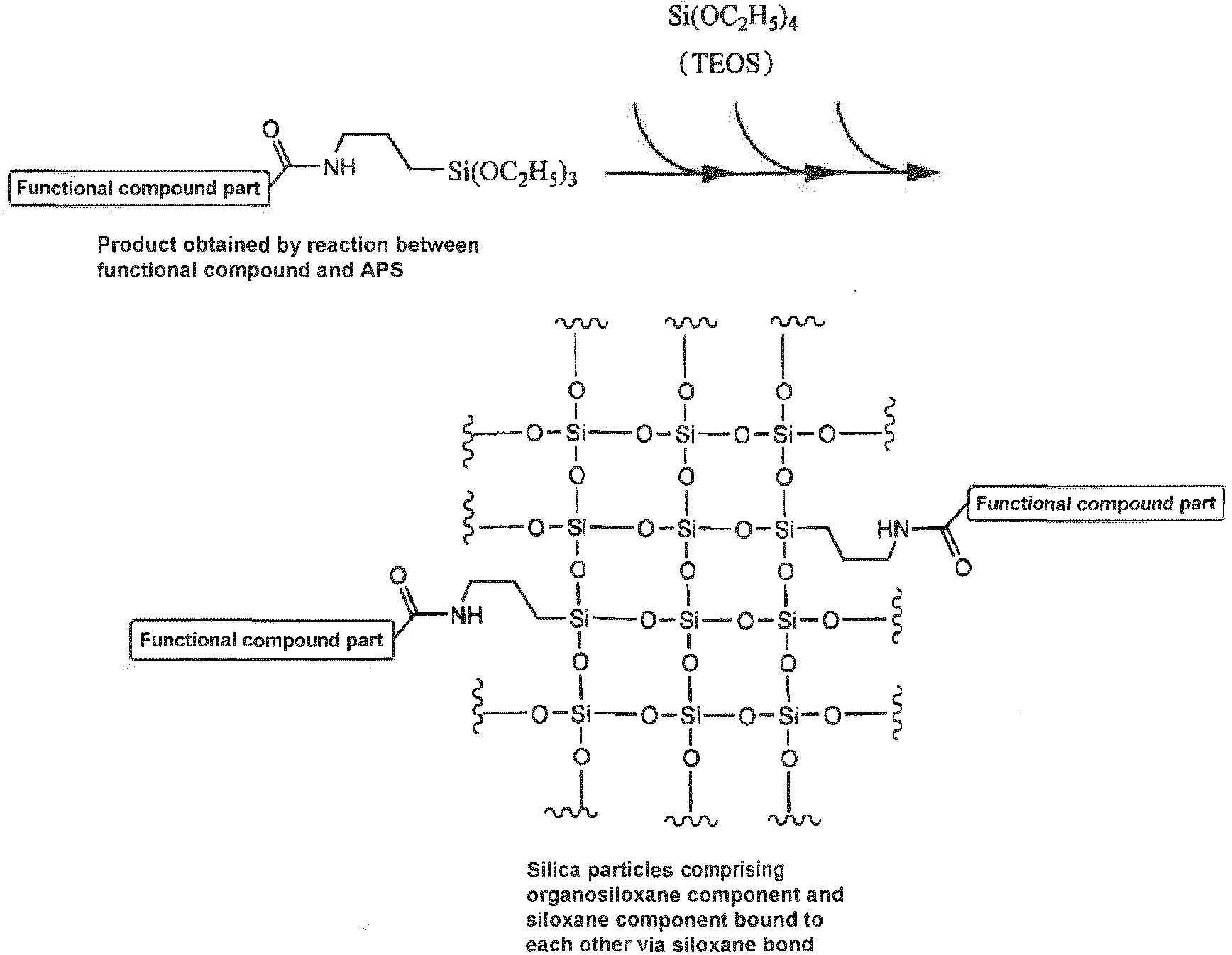
- Specific examples of the functional compound having or provided with an active group may include NHS ester group-containing fluorescence dye compounds such as 5- (and -6)-carboxytetramethylrhodamine-NHS ester (trade name, manufactured by emp Biotech GmbH), DY550-NHS ester or DY630-NHS ester represented as follows (each trade name, manufactured by Dyomics GmbH).

- Examples of the substituent-containing silane-coupling agent include an amino group-containing silane-coupling agent such as γ-aminopropyltriethoxysilane (APS), 3-[2-(2-aminoethylamino)ethylamino]-propyltriethoxysilane, N-2-(aminoethyl)-3-aminopropylmethyldimethoxysilane, and 3-aminopropyltrimethoxysilane. Among them, APS is preferable.
- The silane compound to be condensed and polymerized is not particularly limited, and examples thereof include TEOS, γ-mercaptopropyltrimethoxysilane (MPS), γ-mercaptopropyltriethoxysilane, γ-aminopropyltriethoxysilane (APS), 3-thiocyanatopropyltriethoxysilane, 3-glycidyloxypropyltriethoxysilane, 3-isocyanatopropyltriethoxysilane, and 3-[2-(2-aminoethylamino)ethylamino]propyl-triethoxysilane. Among them, TEOS is preferable from the point of view of forming the siloxane component to be contained in the silica particles, and besides MPS and APS are preferable from the point of view of forming the organosiloxane component to be contained in the silica particles.
- For example, spherical or almost spherical magnetic material/silica composite particles can be produced by using the above-described materials and providing the above-described magnetic particles into a reaction system so as to form a core. Meanwhile, the almost spherical particles mean particles having a major axis/minor axis ratio of 2 or less. For obtaining silica particles having a desirable average particle diameter, it is possible to remove particles having an excessively large particle diameter or an excessively small particle diameter by ultrafiltration by using an ultrafiltration membrane such as YM-10 or YM-100 (each trade name, manufactured by Millipore Corporation) or by recovering only a supernatant or precipitates after performing centrifugal separation with suitable acceleration of gravity.
- The average particle diameter of the fluorescent composite particle is not specifically limited, but preferably 1 nm or more, and more preferably 20 nm or more. The upper limit thereof is preferably less than 1 µm, and more preferably 500 nm or less.
- In the present invention, the average particle diameter is an average diameter of the circle (average circle-equivalent diameter) obtained by measuring the total projected area of 100 pieces of randomly-selected labeling reagent silica particles for example in an image obtained under transmission electron microscope (TEM) or scanning electron microscope (SEM) using an image processing equipment, dividing the total area with the number of the labeling reagent silica particles (100 pieces), and determining the circle having an area equivalent to that.
- Further, the "average particle diameter" indicates an average particle diameter of particles consisting of only primary particles, which is different from the "particle size according to a dynamic light scattering method" described below having a concept including secondary particles formed by aggregation of primary particles.
- As described herein, the "particle size according to the dynamic light scattering method" is measured by the dynamic light scattering method, and it is a concept including secondary particles formed by aggregation of primary particles as well as primary particles, different from average particle diameter. This particle size is an indicator for evaluating dispersion stability of the complex particles described above.
- Examples of a device for measuring the particle size according to the dynamic light scattering method include Zetasizer Nano (trade name, manufactured by Malvern Instruments Ltd.). According to the method, fluctuation in light scattering intensity over time that is caused by light scatterers such as fine particles is measured, the speed of the light scatterers in Brownian motion is calculated based on an autocorrelation function, and the particle size distribution of the light scatterers is determined based on the results.
- The fluorescent silica particles preferably have monodispersion as a granular substance. The variation coefficient, so-called CV value, of the particle size distribution is not specifically limited, but preferably 10% or less, and more preferably 8% or less.
- In the present invention, it is preferable to use the above-described silica fine particles because the effect thereof is significant, but in addition thereto or in place thereof, a latex phase may be used as the continuous phase of the fluorescent material phase in the composite particles. Examples of the material for constituting the latex phase include synthetic polymer particles consisting of polystyrene, styrene-sulfonic acid (salt) copolymer, styrene-methacrylic acid copolymer, acrylonitrile-butadiene-sulfonic acid copolymer, vinyl chloride-acrylic acid ester copolymer, or vinyl acetate-acrylic acid ester copolymer. Further, as for the method of introducing a dye into the latex phase, methods disclosed in
JP-A-2000-178309 JP-A-10-48215 JP-A-8-269207 JP-A-6-306108 Japanese JP-T-2005-534907 JP-A-2010-156642 JP-A-2010-156640 - An amount of the fluorescent material (fluorescent dye) in the phase of the fluorescent material is not particularly limited in the present invention, but is preferably 0.05 part by mass or more, and more preferably 0.10 part by mass or more when the amount of the transparent material (continuous phase) is taken as 100 parts by mass. An upper limit is preferably 1.0 part by mass or less, and more preferably 0.50 part by mass or less. A ratio of the phase of the magnetic material to the phase of the fluorescent material may also be appropriately adjusted.
- At the ratio of the phase of the magnetic material to the phase of the transparent material, the fluorescence particles are preferably gathered due to action of the phase of the magnetic material in a predetermined portion for detection. On the other hand, in the phase of the transparent material, the fluorescent material preferably exists in the transparent material at a specific proportion to allow effective measurement of fluorescence. Accordingly, the ratio of the phase of the transparent material to the phase of the fluorescent material, and the ratio of the phase of the magnetic material to the phase of the transparent material are preferably designed so as to satisfy the above-described purposes.
- Moreover, the ratio of the phase of the magnetic material to the phase of the fluorescent material can be determined from the ratio of the phase of the transparent material to the phase of the fluorescent material, and the ratio of the phase of the magnetic material to the phase of the transparent material.
- The thermoresponsive polymer preferably causes no structural change, even if the polymer is bounded with a molecule having an electric charge. As the thermoresponsive polymer, a polymer having the critical solution temperature (hereinafter, also referred to as CST) is preferable. This critical solution temperature (CST) means a temperature serving as a border at which characteristics or morphologies of the polymer are changed. The thermoresponsive polymer may be a polymer exhibiting a lower critical solution temperature (LCST) or an upper critical solution temperature (UCST). When the thermoresponsive polymer exhibits the lower critical solution temperature (LCST), specific examples include a polymer that causes aggregation when the liquid temperature is increased, and redispersion when the temperature is decreased. Conversely, when the thermoresponsive polymer exhibits the upper critical solution temperature (UCST), specific examples include a polymer that causes aggregation when the liquid temperature is decreased, and redispersion when the temperature is increased. The critical solution temperature (CST) is preferably 10°C or higher, and more preferably 30°C or higher. An upper limit is preferably 100°C or lower, and more preferably 50°C or lower.
- Herein, the lower critical solution temperature and the upper critical solution temperature can be determined as described below, for example. First, a sample is placed in a cell of an absorptiometer and heated at a rate of 1°C/min. During heating, a change of transmittance at 550 nm is recorded. Here, the transmittance when the polymer is melted in a transparent state is taken as 100% and the transmittance when the polymer is completely aggregated is taken as 0%. Then, a temperature at which the transmittance becomes 50% is determined as LCST.
- Specific examples of the polymer having the lower critical solution temperature include polymers composed of N-substituted (meth)acrylamide derivatives such as N-n-propylacrylamide, N-isopropylacrylamide, N-ethylacrylamide, N,N-dimethylacrylamide, N-acryloylpyrrolidine, N-acryloylpiperidine, N-acryloylmorpholine, N-n-propylmethacrylamide, N-isopropylmethacrylamide, N-ethylmethacrylamide, N,N-dimethylmethacrylamide, N-methacryloylpyrrolidine, N-methacryloylpiperidine and N-methacryloylmorpholine; polyoxyethylene alkylamine derivatives such as hydroxypropylcellulose, a polyvinyl alcohol partially acetylated product, polyvinyl methyl ether, a (polyoxyethylene-polyoxypropylene) block copolymer and polyoxyethylene lauryl amine; polyoxyethylene sorbitan ester derivatives such as polyoxyethylene sorbitan laurate; (polyoxyethylene alkylphenyl ether)(meth)acrylates such as (polyoxyethylene nonylphenyl ether) acrylate and (polyoxyethylene octylphenyl ether)methacrylate; and polyoxyethylene (meth)acrylic acid ester derivatives of (polyoxyethylene alkyl ether)(meth)acrylates, such as (polyoxyethylene lauryl ether)acrylate and (polyoxyethylene oleyl ether)methacrylate. Further, a polymer thereof or a copolymer formed of at least two kinds of monomers thereof can also be used. Moreover, a copolymer of N-isopropylacrylamide and N-t-butyl acrylamide can also be used. When the polymer containing the (meth)acrylamide derivative is used, any other copolymerizable monomer may be copolymerized with this polymer in the range in which the resultant copolymer has the lower critical solution temperature.
- Among them, a polymer composed of at least one kind of monomers selected from the group consisting of N-n-propylacrylamide, N-isopropylacrylamide, N-ethylacrylamide, N,N-dimethylacrylamide, N-acryloylpyrrolidine, N-acryloylpiperidine, N-acryloylmorpholine, N-n-propylmethacrylamide, N-isopropylmethacrylamide, N-ethylmethacrylamide, N,N-dimethylmethacrylamide, N-methacryloylpyrrolidine, N-methacryloylpiperidine and N-methacryloylmorpholine, or a copolymer of N-isopropylacrylamide and N-t-butylacrylamide can be preferably used.
- As the polymer having the upper critical solution temperature, a polymer formed of at least one kind of monomer selected from the group consisting of acroylglycinamide, acroylnipecotamide, acryloylasparaginamide, acryloyl glutaminamide and the like can be used. Moreover, the polymer may be a copolymer formed of at least two kinds of these monomers. With these polymers, any other copolymerizable monomer such as acrylamide, acetylacrylamide, biothionol acrylate, N-bithionyl-N'-methacroyltrimethylene amide, acroylsarcosine amide, methacrylicsarcosine amide and acroylmethyluracil may be copolymerized in the range in which the resultant copolymer has the upper critical solution temperature.
- As the thermoresponsive polymer, a polymer described in
Japanese Patent No. 4518767 - The thermoresponsive polymer can be immobilized thereonto through polyhydric alcohol or a polyhydric alcohol derivative. This thermoresponsive polymer may be immobilized thereonto by being subjected to graft polymerization with the polyhydric alcohol or the polyhydric alcohol derivative immobilized on the surface of the composite particle, or by binding a functional group in a terminal or a side chain of the polymer with a functional group of the polyhydric alcohol or the polyhydric alcohol derivative. An average particle diameter of the composite particle on which the thermoresponsive polymer is immobilized (thermoresponsive fluorescent particle) becomes larger by a portion of the thermoresponsive polymer in comparison with the above-described composite particle, but a preferred range thereof is substantially similar to the range specified as the composite particle.
- The polyhydric alcohol preferably has at least two hydroxy groups in a constitutional unit. Specific examples include dextran, polyvinyl alcohol, mannitol and sorbitol. Moreover, a compound that has an epoxy group and forms a polyhydric alcohol structure after ring opening, such as a glycidyl methacrylate polymer, can also be used. As the polyhydric alcohol derivative, polyhydric alcohol into which a reactive functional group or polymerizable group, such as carboxyl, amino, epoxy, thiol, methacrylic or acrylic is introduced by modification can be used.
- The linking material is an arbitrary material, and is preferably selected and used appropriately when such a material is necessary for introduction of the binding substance. A kind thereof is not particularly limited, but a material that can be incorporated into the thermoresponsive polymer and has the properties of binding with the binding substance is preferable. In taking into account use of a biological substance in the binding substance, specific examples include biotin, avidin, streptoavidin, a primary antibody and a secondary antibody.
- As a method of incorporating the linking material into the thermoresponsive polymer, the description in
WO 01/09141 Japanese Patent No. 4518767 - The particle-side binding substance is an arbitrary material, and only needs to be appropriately selected when necessary according to a kind of target substance. As a biomolecule (binding substance) to be combined or absorbed on the surface of the composite particle, there includes antigens, antibodies, DNAs, RNAs, sugars, polysaccharides, ligands, receptors, proteins, peptides and the like. Here, the term "ligand" means a substance capable of specifically binding to a protein, and examples thereof include substrates capable of binding to enzyme, coenzymes, regulatory factors, hormones, neurotransmitters, and the like. Thus, the ligands include low-molecular weight molecules or ions as well as high-molecular weight substances. The antibody used herein may be any type of immunoglobulin molecules, or immunoglobulin molecule fragments having an antigen binding site, such as Fab. Moreover, the antibody may be a monoclonal antibody or a polyclonal antibody, but is preferably two kinds of monoclonal antibodies having different antigen recognition sites. A technique for binding the binding substance with the linking substance is not particularly limited, and binding can be performed by an ordinary method in this kind of technologies.
- Preferred materials are shown in Table A below in conformity with an example shown in
Fig. 5 .Table A Labeling particle Magnetic material Magnetite, Nickel oxide, Ferrite or the like Fluorescent material (dye) 5- (and -6)-carboxytetramethylrhodamine-NHS ester DY550-NHS ester and the like Transparent material Silica, Latex (polystyrene) Linking material Streptavidin Binding substance Biotin-introduced antibody Target substance TSH antigen Dispersant Dispersant base Polyacrylic acid Dispersant-side binding substance Antibody - The dispersant base is a hydrophilic high molecular weight compound, for example, and is preferably a polyanion or a polycation. The polyanion means a substance having a plurality of anion groups, and the polycation means a substance having a plurality of cation groups. Specific examples of the polyanion include nucleic acid such as DNA and RNA. These nucleic acids have properties of the polyanion due to existence of plural pieces of phosphodiester groups along a skeleton of the nucleic acid. Moreover, the polyanion includes polypeptide containing a large number of carboxylic acid functional groups (polypeptide composed of amino acid such as glutamic acid and aspartic acid), polyacrylic acid, polymethacrylic acid, a polymer containing, as a polymerization component, acrylic acid and methacrylic acid, and a polysaccharide such as carboxymethylcellulose, hyaluronic acid and heparin. On the other hand, specific examples of the polycation include polylysine, polyarginine, polyornithine, polyalkylamine, polyethyleneimine and polypropylethyleneimine. In addition, the number of functional groups in the polyanion (carboxyl group) or the polycation (amino group) is preferably 25 or more.
- The dispersant-side binding substance only needs to be appropriately selected when necessary according to the kind of target substance. A kind thereof is preferably selected in taking into account introduction into the dispersant base. Specific examples are identical with the substances exemplified as the above-described particle-side binding substance.
- The method of binding the binding substance with the dispersant base is not particularly limited, and specific examples include a method in which mutual affinity substances (for example, avidin and biotin, glutathione and glutathione S transferase) are bound to both to indirectly bind the dispersant base and the binding substance through these substances. When both are directly bound, both may be bound through a functional group. When such a functional group is used, for example, both can be bound according to maleimide-thiol coupling in the method of Ghosh, et al (Ghosh et al: Bioconjugate Chem., 1, 71-76, 1990). Specific examples include two methods described below. In a first method thereof, while a mercapto group (alias, a sulfhydryl group) is introduced first into a 5' terminus of nucleic acid, a maleimide group is introduced into an antibody by allowing 6-maleimide hexanoic acid succinimide ester (for example, "EMCS (trade name)" (manufactured by Dojindo Laboratories)) to react with the antibody. Next, two kinds of these substances are bound through the mercapto group and the maleimide group. In a second method, a mercapto group is introduced first into a 5' terminus of nucleic acid in a manner similar to the first method, and a maleimide group is further introduced into a 5' terminus of nucleic acid by allowing N,N-1,2-phenylenedimaleimide being a homo bifunctional reagent to react with this mercapto group. Meanwhile, a mercapto group is introduced into an antigen. Next, two kinds of these substances are bound through the mercapto group and the maleimide group.
- In addition thereto, as a method of introducing nucleic acid into protein, for example, methods described in Nucleic Acids Research, Vol. 15, p. 5275 (1987), and Nucleic Acids Research, Vol. 16, p. 3671 (1988) are known. These technologies can be applied to binding of the antibody with the nucleic acid.
- As the target substance, a substance used in clinical diagnosis is exemplified, and specific examples include, as contained in body fluid, urine, sputum, feces and the like, human immunoglobulin G, human immunoglobulin M, human immunoglobulin A, human immunoglobulin E, human albumin, human fibrinogen (fibrin and a decomposition product thereof), α-fetoprotein (AFP), C-reactive protein (CRP), myoglobin, a carcinoembryonic antigen, a hepatitis virus antigen, human chorionic gonadotropin (hCG), human placental lactogen (HPL), an HIV virus antigen, allergen, bacteriotoxin, a bacteria antigen, an enzyme, hormone (for example, human thyroid stimulating hormone (TSH), insulin and the like) and a medical agent.
- The present invention will be described in more detail based on Examples given below, but the invention is not limited to that.
- A system shown in
Fig. 5 was reproduced using materials shown in Table A. The labeling particles were particles in which magnetic particles were coated with silica particles as shown in Table A, and an average particle diameter thereof was about 200 nm. The particles were incorporated into a test liquid containing analytes, and the resultant material was heated at about 50°C for 15 minutes. Then, the resultant material was irradiated with excitation light (550 nm), and a target substance contained in the above-described analytes was detected depending on a state of light emission (580 nm) of the above-described labeling particles. At this time, it was confirmed that, under existence of the analyte, dispersion was maintained because a dispersant was bound with magnetic fluorescent thermoresponsive particles through the target substance, resulting in causing no change in fluorescence intensity in comparison with the intensity before heating. To the contrary, under non-existence of the analyte, the magnetic fluorescent thermoresponsive particles were aggregated by heating and then precipitated, resulting in causing reduction of the fluorescence intensity in composition with the intensity before heating. - Having described our invention as related to the present embodiments, it is our intention that the invention not be limited by any of the details of the description, unless otherwise specified, but rather be construed broadly within its spirit and scope as set out in the accompanying claims.
- This application claims priority on Patent Application No.
2013-207387 filed in Japan on October 2, 2013 -
- 1
- Magnetic material phase (magnetic material particle, core)
- 2
- Transparent material phase (fluorescent silica phase, shell)
- 2a
- Transparent material (continuous phase)
- 2b
- Fluorescent material (fluorescent dye, dispersion phase)
- 3
- Thermoresponsive polymer (thermoresponsive polymer phase)
- 4
- Linking material
- 5
- Particle-side binding substance
- 6
- Dispersant-side binding substance
- 7
- Dispersant base
- 10
- Thermoresponsive fluorescence particle
- 11
- Composite particle
- 20
- Fluorescent labeling particle (magnetic fluorescent thermoresponsive particle)
- 30
- Dispersant
- 100
- Linked structure
- S
- Target substance
- M
- Magnet
Claims (10)
- A method of detecting a target substance, comprising the steps of:incorporating labeling particles into a test liquid comprising an analyte;heating the test liquid;irradiating the test liquid with excitation light, anddetecting the target substance included in the test liquid depending on a state of light emission of the labeling particles;wherein an aggregation state of the labeling particles is changed by the heating step; and
wherein the labeling particles have a thermoresponsive polymer on a surface of a composite particle comprising a magnetic material and a fluorescent material,
and further have a biomolecule having properties of binding with the target substance. - The method of detecting a target substance according to Claim 1,
wherein non-existence of the target substance is identified by development of fluorescence emission of the labeling particles that are locally gathered in the test liquid after the heating step, and existence of the target substance is identified by no development of the fluorescence emission of the gathered labeling particles. - The method of detecting a target substance according to Claim 1 or 2,
wherein a dispersant is introduced into the test liquid. - The method of detecting a target substance according to any one of Claims 1 to 3, wherein a wavelength of the excitation light is 300 to 700 nm and a wavelength of the fluorescence is 350 to 800 nm.
- The method of detecting a target substance according to any one of Claims 1 to 4,
wherein the composite particle comprises a phase having the magnetic material and a phase having the fluorescent material, and
wherein the phase having the fluorescent material is constituted of a continuous phase formed of a transparent material and a dispersed phase formed of the fluorescent material. - The method of detecting a target substance according to any one of Claims 1 to 5, wherein the test liquid is heated so as to span a critical solution temperature (CST) of the thermoresponsive polymer in the range of 10°C to 100°C.
- The method of detecting a target substance according to any one of Claims 1 to 6, wherein magnetic force is provided for the test liquid and the labeling particles in an aggregated state are gathered in a portion provided with the magnetic force.
- The method of detecting a target substance according to any one of Claims 1 to 7, wherein an average particle diameter of the composite particle is less than 1 µm.
- The method of detecting a target substance according to any one of Claims 5 to 8, wherein the transparent material comprises silica or polystyrene.
- The method of detecting a target substance according to any one of Claims 1 to 9, wherein the magnetic material is magnetite, nickel oxide, ferrite, cobalt iron oxide, barium ferrite, carbon steel, tungsten steel, KS steel, a rare earth cobalt magnet or hematite.
Applications Claiming Priority (2)
| Application Number | Priority Date | Filing Date | Title |
|---|---|---|---|
| JP2013207387A JP6080163B2 (en) | 2013-10-02 | 2013-10-02 | Target substance detection method |
| PCT/JP2014/076258 WO2015050150A1 (en) | 2013-10-02 | 2014-10-01 | Method for detecting target substance |
Publications (3)
| Publication Number | Publication Date |
|---|---|
| EP3054283A1 true EP3054283A1 (en) | 2016-08-10 |
| EP3054283A4 EP3054283A4 (en) | 2017-04-19 |
| EP3054283B1 EP3054283B1 (en) | 2018-12-05 |
Family
ID=52778738
Family Applications (1)
| Application Number | Title | Priority Date | Filing Date |
|---|---|---|---|
| EP14850582.9A Not-in-force EP3054283B1 (en) | 2013-10-02 | 2014-10-01 | Method for detecting target substance |
Country Status (5)
| Country | Link |
|---|---|
| US (1) | US10203326B2 (en) |
| EP (1) | EP3054283B1 (en) |
| JP (1) | JP6080163B2 (en) |
| CN (1) | CN105556289B (en) |
| WO (1) | WO2015050150A1 (en) |
Families Citing this family (8)
| Publication number | Priority date | Publication date | Assignee | Title |
|---|---|---|---|---|
| JP6080164B2 (en) * | 2013-10-02 | 2017-02-15 | 古河電気工業株式会社 | Fluorescently labeled particles |
| JP6769360B2 (en) * | 2017-03-17 | 2020-10-14 | コニカミノルタ株式会社 | Multi-step fluorescent staining method using phosphor-accumulated particle composite and phosphor-accumulated particle composite |
| CN107561268B (en) * | 2017-08-21 | 2019-11-08 | 基蛋生物科技股份有限公司 | A chemiluminescence immunoassay based on smart nanoluminescent particle labeling amplification and its application |
| CN109425598A (en) * | 2017-09-05 | 2019-03-05 | 中国人民解放军军事医学科学院微生物流行病研究所 | A kind of capillary micro-fluid self-driven micro-fluidic chip and the preparation method and application thereof |
| CN112007620B (en) * | 2019-05-30 | 2023-08-01 | 苏州海狸生物医学工程有限公司 | Preparation method of streptavidin magnetic microsphere |
| CN114113575B (en) * | 2020-08-28 | 2023-06-02 | 菲鹏生物股份有限公司 | Labeling compound and preparation method and application thereof |
| KR102708303B1 (en) * | 2022-09-06 | 2024-09-23 | 주식회사 진광기술 | Double screw for hollow core slab |
| CN121866470A (en) * | 2023-08-29 | 2026-04-14 | 学校法人早稻田大学 | Method for simultaneously detecting biomolecules by using temperature-responsive fluorescent particles |
Family Cites Families (20)
| Publication number | Priority date | Publication date | Assignee | Title |
|---|---|---|---|---|
| JP3391839B2 (en) | 1993-04-27 | 2003-03-31 | 積水化学工業株式会社 | Method for producing colored latex particles |
| JP3555296B2 (en) | 1995-01-31 | 2004-08-18 | 大日本インキ化学工業株式会社 | Method for producing colored resin particles |
| JPH1048215A (en) | 1996-07-31 | 1998-02-20 | Sekisui Chem Co Ltd | Colored particles |
| JP2000178309A (en) | 1998-12-16 | 2000-06-27 | Y M Shii:Kk | Colored polymer particle and its production |
| US7052917B1 (en) | 1999-07-29 | 2006-05-30 | National Institute Of Advanced Industrial Science And Technology | Polymerizable biotin derivatives, biotin polymer, and polymer responsive to avidin stimulation |
| US20040018577A1 (en) | 2002-07-29 | 2004-01-29 | Emerson Campbell John Lewis | Multiple hybrid immunoassay |
| US20040101822A1 (en) | 2002-11-26 | 2004-05-27 | Ulrich Wiesner | Fluorescent silica-based nanoparticles |
| JP4518767B2 (en) * | 2003-09-09 | 2010-08-04 | チッソ株式会社 | Stimulus-responsive polymer-immobilized magnetic fine particles and adsorbent using the same |
| US20060263908A1 (en) * | 2004-03-08 | 2006-11-23 | Fuji Photo Film Co., Ltd. | Fluorescent complex, a fluorescent particle and a fluorescence detection method |
| JP4727336B2 (en) * | 2004-08-03 | 2011-07-20 | 富士フイルム株式会社 | Fluorescence complex and fluorescence detection method |
| JP5400297B2 (en) | 2005-12-27 | 2014-01-29 | 古河電気工業株式会社 | Fluorescent nanosilica particles, nanofluorescent material, biochip using the same, and assay method thereof |
| JP5276980B2 (en) | 2006-06-30 | 2013-08-28 | Jnc株式会社 | Detection target, quantitative kit, and detection, quantitative method |
| US20080241964A1 (en) * | 2007-03-27 | 2008-10-02 | Canon Kabushiki Kaisha | Material for improving sensitivity of magnetic sensor and method thereof |
| JP4360652B2 (en) * | 2007-06-08 | 2009-11-11 | 古河電気工業株式会社 | Labeled silica nanoparticles for immunochromatography reagent, immunochromatography reagent, test strip for immunochromatography using the same, and fluorescence detection system for immunochromatography |
| US8105493B2 (en) * | 2007-06-29 | 2012-01-31 | Jnc Corporation | Aggregation and dispersion methods of magnetic particles, separation and detection methods using the same and detection kit |
| JP5326443B2 (en) * | 2008-09-05 | 2013-10-30 | Jnc株式会社 | Temperature-responsive magnetic fine particles that can be freeze-dried |
| JP5162439B2 (en) | 2008-12-30 | 2013-03-13 | 株式会社テクノメデイカ | Immunochromatographic sensor |
| JP2010156640A (en) | 2008-12-30 | 2010-07-15 | Techno Medica Co Ltd | Immunochromatosensor |
| US9518921B2 (en) * | 2011-12-28 | 2016-12-13 | The Hong Kong University Of Science And Technology | Silica nanoparticles with aggregation induced emission characteristics as fluorescent bioprobe for intracellular imaging and protein carrier |
| JP6080164B2 (en) * | 2013-10-02 | 2017-02-15 | 古河電気工業株式会社 | Fluorescently labeled particles |
-
2013
- 2013-10-02 JP JP2013207387A patent/JP6080163B2/en not_active Expired - Fee Related
-
2014
- 2014-10-01 EP EP14850582.9A patent/EP3054283B1/en not_active Not-in-force
- 2014-10-01 WO PCT/JP2014/076258 patent/WO2015050150A1/en not_active Ceased
- 2014-10-01 CN CN201480050961.1A patent/CN105556289B/en not_active Expired - Fee Related
-
2016
- 2016-04-01 US US15/088,742 patent/US10203326B2/en not_active Expired - Fee Related
Also Published As
| Publication number | Publication date |
|---|---|
| CN105556289A (en) | 2016-05-04 |
| JP6080163B2 (en) | 2017-02-15 |
| WO2015050150A1 (en) | 2015-04-09 |
| EP3054283A4 (en) | 2017-04-19 |
| US10203326B2 (en) | 2019-02-12 |
| JP2015072165A (en) | 2015-04-16 |
| CN105556289B (en) | 2019-06-14 |
| EP3054283B1 (en) | 2018-12-05 |
| US20160291003A1 (en) | 2016-10-06 |
Similar Documents
| Publication | Publication Date | Title |
|---|---|---|
| EP3054283B1 (en) | Method for detecting target substance | |
| US20190170758A1 (en) | Method of detection with a fluorescent labeling particle | |
| US8105493B2 (en) | Aggregation and dispersion methods of magnetic particles, separation and detection methods using the same and detection kit | |
| JP4716337B2 (en) | Cell detection / sorting system by flow cytometry, and detection / sorting method | |
| JP5329658B2 (en) | Detection method and quantification method of detection target | |
| JP5193228B2 (en) | Detection method and quantification method of detection target | |
| EP2960651B1 (en) | Bioanalysis device and biomolecule analyser | |
| EP2320437A1 (en) | Temperature-responsive magnetic fine grains capable of freeze drying | |
| JP5184554B2 (en) | Detection method and quantification method of detection target | |
| CN117716228A (en) | Method for detecting and measuring a target substance based on polarization anisotropy measurement and particles for use in the method | |
| JP5416039B2 (en) | Labeling reagent silica nanoparticles | |
| CN117999308A (en) | Polarized light emitting particles for specimen inspection | |
| US20200200742A1 (en) | Method of detecting specimen substance using multiphase polymer fine particles | |
| JP2026053299A (en) | Method for detecting target substance and test kit for target substance | |
| JP6282819B2 (en) | Kit and method for detecting or quantifying a detection target | |
| CN117054350A (en) | Analytical method, test kit and test reagent comprising a measurement based on polarization anisotropy | |
| CN118318006A (en) | Sample inspection particles |
Legal Events
| Date | Code | Title | Description |
|---|---|---|---|
| PUAI | Public reference made under article 153(3) epc to a published international application that has entered the european phase |
Free format text: ORIGINAL CODE: 0009012 |
|
| 17P | Request for examination filed |
Effective date: 20160421 |
|
| AK | Designated contracting states |
Kind code of ref document: A1 Designated state(s): AL AT BE BG CH CY CZ DE DK EE ES FI FR GB GR HR HU IE IS IT LI LT LU LV MC MK MT NL NO PL PT RO RS SE SI SK SM TR |
|
| AX | Request for extension of the european patent |
Extension state: BA ME |
|
| DAX | Request for extension of the european patent (deleted) | ||
| A4 | Supplementary search report drawn up and despatched |
Effective date: 20170320 |
|
| RIC1 | Information provided on ipc code assigned before grant |
Ipc: G01N 33/58 20060101ALI20170314BHEP Ipc: G01N 33/543 20060101ALI20170314BHEP Ipc: G01N 33/553 20060101ALI20170314BHEP Ipc: G01N 21/64 20060101AFI20170314BHEP Ipc: G01N 33/552 20060101ALI20170314BHEP |
|
| STAA | Information on the status of an ep patent application or granted ep patent |
Free format text: STATUS: EXAMINATION IS IN PROGRESS |
|
| 17Q | First examination report despatched |
Effective date: 20171103 |
|
| REG | Reference to a national code |
Ref country code: DE Ref legal event code: R079 Ref document number: 602014037586 Country of ref document: DE Free format text: PREVIOUS MAIN CLASS: G01N0021640000 Ipc: G01N0033543000 |
|
| GRAP | Despatch of communication of intention to grant a patent |
Free format text: ORIGINAL CODE: EPIDOSNIGR1 |
|
| STAA | Information on the status of an ep patent application or granted ep patent |
Free format text: STATUS: GRANT OF PATENT IS INTENDED |
|
| RIC1 | Information provided on ipc code assigned before grant |
Ipc: G01N 33/552 20060101ALI20180613BHEP Ipc: G01N 33/58 20060101ALI20180613BHEP Ipc: G01N 33/553 20060101ALI20180613BHEP Ipc: G01N 33/543 20060101AFI20180613BHEP |
|
| INTG | Intention to grant announced |
Effective date: 20180702 |
|
| GRAS | Grant fee paid |
Free format text: ORIGINAL CODE: EPIDOSNIGR3 |
|
| GRAA | (expected) grant |
Free format text: ORIGINAL CODE: 0009210 |
|
| STAA | Information on the status of an ep patent application or granted ep patent |
Free format text: STATUS: THE PATENT HAS BEEN GRANTED |
|
| AK | Designated contracting states |
Kind code of ref document: B1 Designated state(s): AL AT BE BG CH CY CZ DE DK EE ES FI FR GB GR HR HU IE IS IT LI LT LU LV MC MK MT NL NO PL PT RO RS SE SI SK SM TR |
|
| REG | Reference to a national code |
Ref country code: GB Ref legal event code: FG4D |
|
| REG | Reference to a national code |
Ref country code: CH Ref legal event code: EP |
|
| REG | Reference to a national code |
Ref country code: AT Ref legal event code: REF Ref document number: 1073705 Country of ref document: AT Kind code of ref document: T Effective date: 20181215 |
|
| REG | Reference to a national code |
Ref country code: IE Ref legal event code: FG4D |
|
| REG | Reference to a national code |
Ref country code: DE Ref legal event code: R096 Ref document number: 602014037586 Country of ref document: DE |
|
| REG | Reference to a national code |
Ref country code: NL Ref legal event code: MP Effective date: 20181205 |
|
| REG | Reference to a national code |
Ref country code: AT Ref legal event code: MK05 Ref document number: 1073705 Country of ref document: AT Kind code of ref document: T Effective date: 20181205 |
|
| REG | Reference to a national code |
Ref country code: LT Ref legal event code: MG4D |
|
| PG25 | Lapsed in a contracting state [announced via postgrant information from national office to epo] |
Ref country code: ES Free format text: LAPSE BECAUSE OF FAILURE TO SUBMIT A TRANSLATION OF THE DESCRIPTION OR TO PAY THE FEE WITHIN THE PRESCRIBED TIME-LIMIT Effective date: 20181205 Ref country code: AT Free format text: LAPSE BECAUSE OF FAILURE TO SUBMIT A TRANSLATION OF THE DESCRIPTION OR TO PAY THE FEE WITHIN THE PRESCRIBED TIME-LIMIT Effective date: 20181205 Ref country code: BG Free format text: LAPSE BECAUSE OF FAILURE TO SUBMIT A TRANSLATION OF THE DESCRIPTION OR TO PAY THE FEE WITHIN THE PRESCRIBED TIME-LIMIT Effective date: 20190305 Ref country code: FI Free format text: LAPSE BECAUSE OF FAILURE TO SUBMIT A TRANSLATION OF THE DESCRIPTION OR TO PAY THE FEE WITHIN THE PRESCRIBED TIME-LIMIT Effective date: 20181205 Ref country code: LT Free format text: LAPSE BECAUSE OF FAILURE TO SUBMIT A TRANSLATION OF THE DESCRIPTION OR TO PAY THE FEE WITHIN THE PRESCRIBED TIME-LIMIT Effective date: 20181205 Ref country code: NO Free format text: LAPSE BECAUSE OF FAILURE TO SUBMIT A TRANSLATION OF THE DESCRIPTION OR TO PAY THE FEE WITHIN THE PRESCRIBED TIME-LIMIT Effective date: 20190305 Ref country code: LV Free format text: LAPSE BECAUSE OF FAILURE TO SUBMIT A TRANSLATION OF THE DESCRIPTION OR TO PAY THE FEE WITHIN THE PRESCRIBED TIME-LIMIT Effective date: 20181205 Ref country code: HR Free format text: LAPSE BECAUSE OF FAILURE TO SUBMIT A TRANSLATION OF THE DESCRIPTION OR TO PAY THE FEE WITHIN THE PRESCRIBED TIME-LIMIT Effective date: 20181205 |
|
| PG25 | Lapsed in a contracting state [announced via postgrant information from national office to epo] |
Ref country code: RS Free format text: LAPSE BECAUSE OF FAILURE TO SUBMIT A TRANSLATION OF THE DESCRIPTION OR TO PAY THE FEE WITHIN THE PRESCRIBED TIME-LIMIT Effective date: 20181205 Ref country code: SE Free format text: LAPSE BECAUSE OF FAILURE TO SUBMIT A TRANSLATION OF THE DESCRIPTION OR TO PAY THE FEE WITHIN THE PRESCRIBED TIME-LIMIT Effective date: 20181205 Ref country code: AL Free format text: LAPSE BECAUSE OF FAILURE TO SUBMIT A TRANSLATION OF THE DESCRIPTION OR TO PAY THE FEE WITHIN THE PRESCRIBED TIME-LIMIT Effective date: 20181205 Ref country code: GR Free format text: LAPSE BECAUSE OF FAILURE TO SUBMIT A TRANSLATION OF THE DESCRIPTION OR TO PAY THE FEE WITHIN THE PRESCRIBED TIME-LIMIT Effective date: 20190306 |
|
| PG25 | Lapsed in a contracting state [announced via postgrant information from national office to epo] |
Ref country code: NL Free format text: LAPSE BECAUSE OF FAILURE TO SUBMIT A TRANSLATION OF THE DESCRIPTION OR TO PAY THE FEE WITHIN THE PRESCRIBED TIME-LIMIT Effective date: 20181205 |
|
| PG25 | Lapsed in a contracting state [announced via postgrant information from national office to epo] |
Ref country code: PT Free format text: LAPSE BECAUSE OF FAILURE TO SUBMIT A TRANSLATION OF THE DESCRIPTION OR TO PAY THE FEE WITHIN THE PRESCRIBED TIME-LIMIT Effective date: 20190405 Ref country code: CZ Free format text: LAPSE BECAUSE OF FAILURE TO SUBMIT A TRANSLATION OF THE DESCRIPTION OR TO PAY THE FEE WITHIN THE PRESCRIBED TIME-LIMIT Effective date: 20181205 Ref country code: PL Free format text: LAPSE BECAUSE OF FAILURE TO SUBMIT A TRANSLATION OF THE DESCRIPTION OR TO PAY THE FEE WITHIN THE PRESCRIBED TIME-LIMIT Effective date: 20181205 Ref country code: IT Free format text: LAPSE BECAUSE OF FAILURE TO SUBMIT A TRANSLATION OF THE DESCRIPTION OR TO PAY THE FEE WITHIN THE PRESCRIBED TIME-LIMIT Effective date: 20181205 |
|
| PG25 | Lapsed in a contracting state [announced via postgrant information from national office to epo] |
Ref country code: SK Free format text: LAPSE BECAUSE OF FAILURE TO SUBMIT A TRANSLATION OF THE DESCRIPTION OR TO PAY THE FEE WITHIN THE PRESCRIBED TIME-LIMIT Effective date: 20181205 Ref country code: IS Free format text: LAPSE BECAUSE OF FAILURE TO SUBMIT A TRANSLATION OF THE DESCRIPTION OR TO PAY THE FEE WITHIN THE PRESCRIBED TIME-LIMIT Effective date: 20190405 Ref country code: RO Free format text: LAPSE BECAUSE OF FAILURE TO SUBMIT A TRANSLATION OF THE DESCRIPTION OR TO PAY THE FEE WITHIN THE PRESCRIBED TIME-LIMIT Effective date: 20181205 Ref country code: SM Free format text: LAPSE BECAUSE OF FAILURE TO SUBMIT A TRANSLATION OF THE DESCRIPTION OR TO PAY THE FEE WITHIN THE PRESCRIBED TIME-LIMIT Effective date: 20181205 Ref country code: EE Free format text: LAPSE BECAUSE OF FAILURE TO SUBMIT A TRANSLATION OF THE DESCRIPTION OR TO PAY THE FEE WITHIN THE PRESCRIBED TIME-LIMIT Effective date: 20181205 |
|
| REG | Reference to a national code |
Ref country code: DE Ref legal event code: R097 Ref document number: 602014037586 Country of ref document: DE |
|
| PLBE | No opposition filed within time limit |
Free format text: ORIGINAL CODE: 0009261 |
|
| STAA | Information on the status of an ep patent application or granted ep patent |
Free format text: STATUS: NO OPPOSITION FILED WITHIN TIME LIMIT |
|
| PG25 | Lapsed in a contracting state [announced via postgrant information from national office to epo] |
Ref country code: DK Free format text: LAPSE BECAUSE OF FAILURE TO SUBMIT A TRANSLATION OF THE DESCRIPTION OR TO PAY THE FEE WITHIN THE PRESCRIBED TIME-LIMIT Effective date: 20181205 Ref country code: SI Free format text: LAPSE BECAUSE OF FAILURE TO SUBMIT A TRANSLATION OF THE DESCRIPTION OR TO PAY THE FEE WITHIN THE PRESCRIBED TIME-LIMIT Effective date: 20181205 |
|
| 26N | No opposition filed |
Effective date: 20190906 |
|
| PG25 | Lapsed in a contracting state [announced via postgrant information from national office to epo] |
Ref country code: TR Free format text: LAPSE BECAUSE OF FAILURE TO SUBMIT A TRANSLATION OF THE DESCRIPTION OR TO PAY THE FEE WITHIN THE PRESCRIBED TIME-LIMIT Effective date: 20181205 |
|
| PG25 | Lapsed in a contracting state [announced via postgrant information from national office to epo] |
Ref country code: MC Free format text: LAPSE BECAUSE OF FAILURE TO SUBMIT A TRANSLATION OF THE DESCRIPTION OR TO PAY THE FEE WITHIN THE PRESCRIBED TIME-LIMIT Effective date: 20181205 |
|
| REG | Reference to a national code |
Ref country code: CH Ref legal event code: PL |
|
| PG25 | Lapsed in a contracting state [announced via postgrant information from national office to epo] |
Ref country code: CH Free format text: LAPSE BECAUSE OF NON-PAYMENT OF DUE FEES Effective date: 20191031 Ref country code: LI Free format text: LAPSE BECAUSE OF NON-PAYMENT OF DUE FEES Effective date: 20191031 Ref country code: LU Free format text: LAPSE BECAUSE OF NON-PAYMENT OF DUE FEES Effective date: 20191001 |
|
| REG | Reference to a national code |
Ref country code: BE Ref legal event code: MM Effective date: 20191031 |
|
| PG25 | Lapsed in a contracting state [announced via postgrant information from national office to epo] |
Ref country code: BE Free format text: LAPSE BECAUSE OF NON-PAYMENT OF DUE FEES Effective date: 20191031 |
|
| PG25 | Lapsed in a contracting state [announced via postgrant information from national office to epo] |
Ref country code: IE Free format text: LAPSE BECAUSE OF NON-PAYMENT OF DUE FEES Effective date: 20191001 |
|
| PG25 | Lapsed in a contracting state [announced via postgrant information from national office to epo] |
Ref country code: CY Free format text: LAPSE BECAUSE OF FAILURE TO SUBMIT A TRANSLATION OF THE DESCRIPTION OR TO PAY THE FEE WITHIN THE PRESCRIBED TIME-LIMIT Effective date: 20181205 |
|
| PG25 | Lapsed in a contracting state [announced via postgrant information from national office to epo] |
Ref country code: MT Free format text: LAPSE BECAUSE OF FAILURE TO SUBMIT A TRANSLATION OF THE DESCRIPTION OR TO PAY THE FEE WITHIN THE PRESCRIBED TIME-LIMIT Effective date: 20181205 Ref country code: HU Free format text: LAPSE BECAUSE OF FAILURE TO SUBMIT A TRANSLATION OF THE DESCRIPTION OR TO PAY THE FEE WITHIN THE PRESCRIBED TIME-LIMIT; INVALID AB INITIO Effective date: 20141001 |
|
| PGFP | Annual fee paid to national office [announced via postgrant information from national office to epo] |
Ref country code: FR Payment date: 20210913 Year of fee payment: 8 |
|
| PGFP | Annual fee paid to national office [announced via postgrant information from national office to epo] |
Ref country code: GB Payment date: 20210901 Year of fee payment: 8 |
|
| PGFP | Annual fee paid to national office [announced via postgrant information from national office to epo] |
Ref country code: DE Payment date: 20210831 Year of fee payment: 8 |
|
| PG25 | Lapsed in a contracting state [announced via postgrant information from national office to epo] |
Ref country code: MK Free format text: LAPSE BECAUSE OF FAILURE TO SUBMIT A TRANSLATION OF THE DESCRIPTION OR TO PAY THE FEE WITHIN THE PRESCRIBED TIME-LIMIT Effective date: 20181205 |
|
| REG | Reference to a national code |
Ref country code: DE Ref legal event code: R119 Ref document number: 602014037586 Country of ref document: DE |
|
| GBPC | Gb: european patent ceased through non-payment of renewal fee |
Effective date: 20221001 |
|
| PG25 | Lapsed in a contracting state [announced via postgrant information from national office to epo] |
Ref country code: FR Free format text: LAPSE BECAUSE OF NON-PAYMENT OF DUE FEES Effective date: 20221031 Ref country code: DE Free format text: LAPSE BECAUSE OF NON-PAYMENT OF DUE FEES Effective date: 20230503 |
|
| PG25 | Lapsed in a contracting state [announced via postgrant information from national office to epo] |
Ref country code: GB Free format text: LAPSE BECAUSE OF NON-PAYMENT OF DUE FEES Effective date: 20221001 |