EP3053773A1 - System, method and apparatus for remote opportunity charging - Google Patents
System, method and apparatus for remote opportunity charging Download PDFInfo
- Publication number
- EP3053773A1 EP3053773A1 EP15194773.6A EP15194773A EP3053773A1 EP 3053773 A1 EP3053773 A1 EP 3053773A1 EP 15194773 A EP15194773 A EP 15194773A EP 3053773 A1 EP3053773 A1 EP 3053773A1
- Authority
- EP
- European Patent Office
- Prior art keywords
- energy storage
- vehicle
- storage device
- charging device
- opportunity charging
- Prior art date
- Legal status (The legal status is an assumption and is not a legal conclusion. Google has not performed a legal analysis and makes no representation as to the accuracy of the status listed.)
- Withdrawn
Links
- 238000000034 method Methods 0.000 title claims description 22
- 238000004146 energy storage Methods 0.000 claims abstract description 197
- 238000012546 transfer Methods 0.000 claims abstract description 17
- 238000004891 communication Methods 0.000 claims description 58
- 230000000153 supplemental effect Effects 0.000 claims description 12
- 230000005611 electricity Effects 0.000 claims description 5
- 238000005065 mining Methods 0.000 description 8
- 239000000463 material Substances 0.000 description 6
- 238000010586 diagram Methods 0.000 description 5
- 238000005516 engineering process Methods 0.000 description 3
- 230000008878 coupling Effects 0.000 description 2
- 238000010168 coupling process Methods 0.000 description 2
- 238000005859 coupling reaction Methods 0.000 description 2
- 238000000605 extraction Methods 0.000 description 2
- 230000001939 inductive effect Effects 0.000 description 2
- 230000013011 mating Effects 0.000 description 2
- 230000008569 process Effects 0.000 description 2
- 230000001172 regenerating effect Effects 0.000 description 2
- 239000013589 supplement Substances 0.000 description 2
- 238000004804 winding Methods 0.000 description 2
- 230000002411 adverse Effects 0.000 description 1
- 230000005540 biological transmission Effects 0.000 description 1
- 238000013461 design Methods 0.000 description 1
- 230000007717 exclusion Effects 0.000 description 1
- 230000014759 maintenance of location Effects 0.000 description 1
- 230000007246 mechanism Effects 0.000 description 1
- 238000012986 modification Methods 0.000 description 1
- 230000004048 modification Effects 0.000 description 1
- 238000012544 monitoring process Methods 0.000 description 1
- 230000000737 periodic effect Effects 0.000 description 1
Images


Classifications
-
- B—PERFORMING OPERATIONS; TRANSPORTING
- B60—VEHICLES IN GENERAL
- B60L—PROPULSION OF ELECTRICALLY-PROPELLED VEHICLES; SUPPLYING ELECTRIC POWER FOR AUXILIARY EQUIPMENT OF ELECTRICALLY-PROPELLED VEHICLES; ELECTRODYNAMIC BRAKE SYSTEMS FOR VEHICLES IN GENERAL; MAGNETIC SUSPENSION OR LEVITATION FOR VEHICLES; MONITORING OPERATING VARIABLES OF ELECTRICALLY-PROPELLED VEHICLES; ELECTRIC SAFETY DEVICES FOR ELECTRICALLY-PROPELLED VEHICLES
- B60L53/00—Methods of charging batteries, specially adapted for electric vehicles; Charging stations or on-board charging equipment therefor; Exchange of energy storage elements in electric vehicles
-
- B—PERFORMING OPERATIONS; TRANSPORTING
- B60—VEHICLES IN GENERAL
- B60L—PROPULSION OF ELECTRICALLY-PROPELLED VEHICLES; SUPPLYING ELECTRIC POWER FOR AUXILIARY EQUIPMENT OF ELECTRICALLY-PROPELLED VEHICLES; ELECTRODYNAMIC BRAKE SYSTEMS FOR VEHICLES IN GENERAL; MAGNETIC SUSPENSION OR LEVITATION FOR VEHICLES; MONITORING OPERATING VARIABLES OF ELECTRICALLY-PROPELLED VEHICLES; ELECTRIC SAFETY DEVICES FOR ELECTRICALLY-PROPELLED VEHICLES
- B60L58/00—Methods or circuit arrangements for monitoring or controlling batteries or fuel cells, specially adapted for electric vehicles
- B60L58/10—Methods or circuit arrangements for monitoring or controlling batteries or fuel cells, specially adapted for electric vehicles for monitoring or controlling batteries
- B60L58/12—Methods or circuit arrangements for monitoring or controlling batteries or fuel cells, specially adapted for electric vehicles for monitoring or controlling batteries responding to state of charge [SoC]
-
- B—PERFORMING OPERATIONS; TRANSPORTING
- B60—VEHICLES IN GENERAL
- B60L—PROPULSION OF ELECTRICALLY-PROPELLED VEHICLES; SUPPLYING ELECTRIC POWER FOR AUXILIARY EQUIPMENT OF ELECTRICALLY-PROPELLED VEHICLES; ELECTRODYNAMIC BRAKE SYSTEMS FOR VEHICLES IN GENERAL; MAGNETIC SUSPENSION OR LEVITATION FOR VEHICLES; MONITORING OPERATING VARIABLES OF ELECTRICALLY-PROPELLED VEHICLES; ELECTRIC SAFETY DEVICES FOR ELECTRICALLY-PROPELLED VEHICLES
- B60L58/00—Methods or circuit arrangements for monitoring or controlling batteries or fuel cells, specially adapted for electric vehicles
- B60L58/10—Methods or circuit arrangements for monitoring or controlling batteries or fuel cells, specially adapted for electric vehicles for monitoring or controlling batteries
- B60L58/18—Methods or circuit arrangements for monitoring or controlling batteries or fuel cells, specially adapted for electric vehicles for monitoring or controlling batteries of two or more battery modules
- B60L58/20—Methods or circuit arrangements for monitoring or controlling batteries or fuel cells, specially adapted for electric vehicles for monitoring or controlling batteries of two or more battery modules having different nominal voltages
-
- B—PERFORMING OPERATIONS; TRANSPORTING
- B60—VEHICLES IN GENERAL
- B60L—PROPULSION OF ELECTRICALLY-PROPELLED VEHICLES; SUPPLYING ELECTRIC POWER FOR AUXILIARY EQUIPMENT OF ELECTRICALLY-PROPELLED VEHICLES; ELECTRODYNAMIC BRAKE SYSTEMS FOR VEHICLES IN GENERAL; MAGNETIC SUSPENSION OR LEVITATION FOR VEHICLES; MONITORING OPERATING VARIABLES OF ELECTRICALLY-PROPELLED VEHICLES; ELECTRIC SAFETY DEVICES FOR ELECTRICALLY-PROPELLED VEHICLES
- B60L2200/00—Type of vehicles
- B60L2200/28—Trailers
-
- B—PERFORMING OPERATIONS; TRANSPORTING
- B60—VEHICLES IN GENERAL
- B60L—PROPULSION OF ELECTRICALLY-PROPELLED VEHICLES; SUPPLYING ELECTRIC POWER FOR AUXILIARY EQUIPMENT OF ELECTRICALLY-PROPELLED VEHICLES; ELECTRODYNAMIC BRAKE SYSTEMS FOR VEHICLES IN GENERAL; MAGNETIC SUSPENSION OR LEVITATION FOR VEHICLES; MONITORING OPERATING VARIABLES OF ELECTRICALLY-PROPELLED VEHICLES; ELECTRIC SAFETY DEVICES FOR ELECTRICALLY-PROPELLED VEHICLES
- B60L2200/00—Type of vehicles
- B60L2200/40—Working vehicles
-
- B—PERFORMING OPERATIONS; TRANSPORTING
- B60—VEHICLES IN GENERAL
- B60Y—INDEXING SCHEME RELATING TO ASPECTS CROSS-CUTTING VEHICLE TECHNOLOGY
- B60Y2200/00—Type of vehicle
- B60Y2200/40—Special vehicles
- B60Y2200/41—Construction vehicles, e.g. graders, excavators
- B60Y2200/415—Wheel loaders
-
- Y—GENERAL TAGGING OF NEW TECHNOLOGICAL DEVELOPMENTS; GENERAL TAGGING OF CROSS-SECTIONAL TECHNOLOGIES SPANNING OVER SEVERAL SECTIONS OF THE IPC; TECHNICAL SUBJECTS COVERED BY FORMER USPC CROSS-REFERENCE ART COLLECTIONS [XRACs] AND DIGESTS
- Y02—TECHNOLOGIES OR APPLICATIONS FOR MITIGATION OR ADAPTATION AGAINST CLIMATE CHANGE
- Y02T—CLIMATE CHANGE MITIGATION TECHNOLOGIES RELATED TO TRANSPORTATION
- Y02T10/00—Road transport of goods or passengers
- Y02T10/60—Other road transportation technologies with climate change mitigation effect
- Y02T10/70—Energy storage systems for electromobility, e.g. batteries
-
- Y—GENERAL TAGGING OF NEW TECHNOLOGICAL DEVELOPMENTS; GENERAL TAGGING OF CROSS-SECTIONAL TECHNOLOGIES SPANNING OVER SEVERAL SECTIONS OF THE IPC; TECHNICAL SUBJECTS COVERED BY FORMER USPC CROSS-REFERENCE ART COLLECTIONS [XRACs] AND DIGESTS
- Y02—TECHNOLOGIES OR APPLICATIONS FOR MITIGATION OR ADAPTATION AGAINST CLIMATE CHANGE
- Y02T—CLIMATE CHANGE MITIGATION TECHNOLOGIES RELATED TO TRANSPORTATION
- Y02T10/00—Road transport of goods or passengers
- Y02T10/60—Other road transportation technologies with climate change mitigation effect
- Y02T10/7072—Electromobility specific charging systems or methods for batteries, ultracapacitors, supercapacitors or double-layer capacitors
-
- Y—GENERAL TAGGING OF NEW TECHNOLOGICAL DEVELOPMENTS; GENERAL TAGGING OF CROSS-SECTIONAL TECHNOLOGIES SPANNING OVER SEVERAL SECTIONS OF THE IPC; TECHNICAL SUBJECTS COVERED BY FORMER USPC CROSS-REFERENCE ART COLLECTIONS [XRACs] AND DIGESTS
- Y02—TECHNOLOGIES OR APPLICATIONS FOR MITIGATION OR ADAPTATION AGAINST CLIMATE CHANGE
- Y02T—CLIMATE CHANGE MITIGATION TECHNOLOGIES RELATED TO TRANSPORTATION
- Y02T90/00—Enabling technologies or technologies with a potential or indirect contribution to GHG emissions mitigation
- Y02T90/10—Technologies relating to charging of electric vehicles
- Y02T90/14—Plug-in electric vehicles
-
- Y—GENERAL TAGGING OF NEW TECHNOLOGICAL DEVELOPMENTS; GENERAL TAGGING OF CROSS-SECTIONAL TECHNOLOGIES SPANNING OVER SEVERAL SECTIONS OF THE IPC; TECHNICAL SUBJECTS COVERED BY FORMER USPC CROSS-REFERENCE ART COLLECTIONS [XRACs] AND DIGESTS
- Y02—TECHNOLOGIES OR APPLICATIONS FOR MITIGATION OR ADAPTATION AGAINST CLIMATE CHANGE
- Y02T—CLIMATE CHANGE MITIGATION TECHNOLOGIES RELATED TO TRANSPORTATION
- Y02T90/00—Enabling technologies or technologies with a potential or indirect contribution to GHG emissions mitigation
- Y02T90/10—Technologies relating to charging of electric vehicles
- Y02T90/16—Information or communication technologies improving the operation of electric vehicles
- Y02T90/167—Systems integrating technologies related to power network operation and communication or information technologies for supporting the interoperability of electric or hybrid vehicles, i.e. smartgrids as interface for battery charging of electric vehicles [EV] or hybrid vehicles [HEV]
-
- Y—GENERAL TAGGING OF NEW TECHNOLOGICAL DEVELOPMENTS; GENERAL TAGGING OF CROSS-SECTIONAL TECHNOLOGIES SPANNING OVER SEVERAL SECTIONS OF THE IPC; TECHNICAL SUBJECTS COVERED BY FORMER USPC CROSS-REFERENCE ART COLLECTIONS [XRACs] AND DIGESTS
- Y04—INFORMATION OR COMMUNICATION TECHNOLOGIES HAVING AN IMPACT ON OTHER TECHNOLOGY AREAS
- Y04S—SYSTEMS INTEGRATING TECHNOLOGIES RELATED TO POWER NETWORK OPERATION, COMMUNICATION OR INFORMATION TECHNOLOGIES FOR IMPROVING THE ELECTRICAL POWER GENERATION, TRANSMISSION, DISTRIBUTION, MANAGEMENT OR USAGE, i.e. SMART GRIDS
- Y04S30/00—Systems supporting specific end-user applications in the sector of transportation
- Y04S30/10—Systems supporting the interoperability of electric or hybrid vehicles
- Y04S30/12—Remote or cooperative charging
Definitions
- Embodiments of the invention relate generally to vehicles. Other embodiments relate to a system, method and apparatus for the remote opportunity charging of vehicles.
- electric hauling vehicles are utilized to move material from a loading or extraction point, where the material is extracted from the wall of the mine, to an unloading or tipping point, where the material is unloaded for removal from the mine via extraction shafts.
- These electric hauling vehicles may be powered by one or more on-board batteries that must be periodically recharged or swapped out for fresh batteries.
- hauling vehicles operating within the mine are typically required to be driven to a special charging station located off of the normal haul route where the vehicle may be connected to the charging station for recharging or a fresh battery installed.
- removing the vehicles from the normal haul route for charging reduces productivity due to the extra time required for travel to and from charging station.
- the vehicle is not powered and cannot be moved; it is essentially taken out of service for a period of time, reducing productivity.
- the power electronics of the charging station must be rated to supply the maximum charge power which may increase charging station cost, size, weight, and/or limit the level of charge power. Accordingly, existing battery charging stations are often designed for specific batteries and therefore may not have the flexibility to charge a range of batteries and energy storage units utilized in mining operations.
- An embodiment of the present invention relates to a system.
- the system includes a vehicle having primary energy storage device for providing the vehicle with a supply of electrical power, a remote opportunity charging device configured to be removably connected to the vehicle and configured to selectively charge the primary energy storage device of the vehicle during vehicle operation, and an interface between the vehicle and the remote opportunity charging device.
- the interface is configured to enable the transfer of electrical power from the remote opportunity charging device to the vehicle.
- an apparatus includes a housing, a control unit within the housing and configured to establish a communication link with a vehicle, and an auxiliary energy storage device within the housing.
- the auxiliary energy storage device is configured to selectively transfer electrical power to a primary energy storage device on-board the vehicle during operation of the vehicle to charge the primary energy storage device.
- the apparatus is configured for removable attachment to the vehicle.
- a method includes the steps of removably connecting a remote opportunity charging device to a vehicle, establishing a communication link between the remote opportunity charging device and the vehicle, and selectively transferring electrical power from an auxiliary energy storage device of the remote opportunity charging device to a primary energy storage device on-board the vehicle.
- electrical contact means that the referenced elements are directly or indirectly connected such that an electrical current may flow from one to the other.
- the connection may include a direct conductive connection (i.e., without an intervening capacitive, inductive or active element), an inductive connection, a capacitive connection, and/or any other suitable electrical connection. Intervening components may be present.
- selective coupled means that a component may be coupled to another component in one mode of operation, and decoupled with the another component in another mode of operation.
- removably connected means the ability to disconnect one component from another component.
- interface refers to an area or component(s) where two systems or devices meet and interact such that the two systems are electrically coupled to one another.
- controller a process or computer component adapted to control another component or system to achieve certain desired goals and objectives.
- the system 10 includes an electric vehicle, depicted therein as electric mining scoop 12, and a remote opportunity charging device 14 removably connected to the electric vehicle 12 via an interface 16.
- the remote opportunity charging device 14 is removable from the vehicle 12 and is configured for selective electrical coupling to a charging station so that the remote opportunity charging device 14 may be recharged, as discussed in detail below.
- remote opportunity charging device refers to a device that transfers electrical energy to another device to which it is connected without itself receiving a supply of electrical power during the transfer (e.g., during transfer of electrical energy to the another device, the remote opportunity charging device does not receive electrical power from a utility electrical grid, off-board generator, or the like).
- the vehicle 12 may include an electric propulsion system of the type generally known in the art that utilizes traction motors to propel the vehicle.
- the electric propulsion system may include an on-board energy storage unit, such as a primary propulsion battery 24 and/or ultracapacitor, that stores electrical energy. Electrical energy from the battery 24 is fed to an inverter 26 where direct current (DC) is converted to alternating current (AC). The alternating current is then fed to multi-phase (typically 3-phase) AC traction motors 28 that drive the wheels or axle 30 of the vehicle 12.
- “primary energy storage device” or “primary propulsion battery” means an energy storage unit that supplies electrical energy to the vehicle to be used for propulsion for moving the vehicle.
- the remote opportunity charging device 14 includes a housing containing an auxiliary energy storage device, such as an auxiliary battery 32, configured to supply electrical power to the vehicle 12, as discussed hereinafter, and an opportunity charging device communication and control unit 34 configured to communicate with a corresponding communication unit 36 on-board the vehicle 12.
- the communication unit 36 of the vehicle is electrically connected to vehicle controller 38, which functions to control the flow of electrical power to traction motor(s) 28 of the vehicle 12, as discussed in detail hereinafter.
- auxiliary energy storage device means an energy storage unit that is configured to provide supplemental power to the vehicle or to the primary energy storage device.
- supplemental power means power other than the power provided by a primary energy storage device.
- the interface 16 between the vehicle 12 and the remote opportunity charging device 14 may be provided by a plurality of spring-loaded slide contacts 40 present on the rear of the vehicle 12.
- the contacts 40 establish an electrical connection between the charging device communication and control unit 34 and the communication unit 36 of the vehicle 12 so as to facilitate communication between the opportunity charging device 14 and the vehicle 12.
- This communication link allows for a "handshake" to occur between the opportunity charging device 14 and the vehicle 12 when they are physically connected and, in particular, allows for the exchange of information relating to battery parameters between the remote opportunity charging device and the vehicle 12.
- the battery parameters may include battery type, battery chemistry, battery charge profile, state of charge and the like. As will be readily appreciated, this information may then be utilized by the communication and control unit 34 of the remote opportunity charging device 14 and/or the controller 38 of the vehicle to ensure that power from the battery 32 is provided to the vehicle 12 in a safe manner.
- communication link may refer to any connection, wire, port, device, and/or signal and/or any transmission, exchange, repeating, and/or other flow of information or data that is processed by an entity, and/or that is shared or exchanged between two or more people, devices, and/or other entities.
- the contacts 40 In addition to establishing a communication link between the vehicle 12 and the remote opportunity charging device 14, the contacts 40 also establish an electrical connection between the auxiliary battery 32 of the opportunity charging device 14 and the battery 24 on-board the vehicle 12, as illustrated, which facilitates the flow of electrical power from the auxiliary battery 32 to the primary propulsion battery 24 of the vehicle 12 to recharge the same.
- the nominal voltage of the auxiliary battery 32 is within a threshold voltage of the primary propulsion battery 24 on-board the vehicle 12.
- "nominal voltage” means the rated or named value, stating the available, input, or output voltage of the an energy storage device.
- a power resistor 42 and associated switches may be utilized to limit the in-rush current during an initial energizing routine when the opportunity charging device 14 is first connected to the vehicle 12.
- the power resistor 42 may also be a vehicle dynamic brake resistor, which may be utilized in connection with a pulse-width-modulation chopper 44.
- the primary battery 24 of the vehicle has a capacity within the range of approximately 5kWh to approximately 50kWh and the auxiliary battery 32 of the remote opportunity charging device 14 has a capacity within the range of approximately 2.5kWh to approximately 25kWh.
- the capacity of the primary battery 24 is approximately 10kWh and the capacity of the auxiliary battery 32 of the remote opportunity charging device is approximately 5kWh.
- the primary propulsion battery 24 on-board the vehicle 12 provides power to the traction motors 28 to propel the vehicle 12, and to other systems and devices that require power (e.g., a hydraulic system for operating various implements), as needed.
- the capacity of the battery 24 to provide electrical energy for vehicle operations is not unlimited; the primary propulsion battery 24 must be recharged periodically in order to continue operations. It is often undesirable, however, to remove the vehicle 12 from its operations in order to charge the battery 24, as this results in a loss of productivity. For example, it may be particularly undesirable to remove a vehicle from its haul route and to drive the vehicle to a charging station at a remote location for recharging or battery swap.
- the system 10 of the present invention obviates the need to take an electric vehicle out of service for periodic charging or battery swap.
- another vehicle may be utilized to transport the remote opportunity charging device 14 of the present invention to the location of the vehicle 12, and to removably connect the charging device 14 to the vehicle 12.
- the charging device 14 is attached to the rear of the vehicle 12 via the spring-loaded sliding electrical contacts 40 to establish the interface 16.
- the remote opportunity charging device 14 may be removably attached to an external surface (e.g., rear end surface) of the vehicle 12.
- the interface 16 includes a vehicle portion on the external surface thereof and a mating device portion, such that the device can be removably attached to the external surface of the vehicle.
- removable attachment of the device 14 to the vehicle is facilitated by the inclusion of a retention mechanism for securing the housing of the device 14 to the vehicle 12.
- a 'handshake' or a communications link is established between the charging device communication and control unit 34 and the communication unit 36 of the vehicle 12, information is passed over the communication link identifying the battery parameters (i.e., battery type, chemistry, charge profile, state of charge etc.) of the primary propulsion battery 24 on-board the vehicle 12 and identifying the battery parameters of the auxiliary battery 32 of the remote opportunity charging device 14.
- the controller 38 of the vehicle 12 is configured to then control the flow of electrical energy from the auxiliary battery 32 of the opportunity charging device 14 to the primary propulsion battery 24 of the vehicle 12 to recharge the same and/or to provide supplemental power for electrically-driven auxiliary devices of the vehicle.
- auxiliary device means an electrically driven device of the vehicle other than devices and components utilized for propulsion.”
- the auxiliary battery 32 may be utilized to provide supplemental power to a hydraulic system of the vehicle, which may be utilized to operate various hydraulic implements, or to monitoring and display systems of the vehicle.
- the communication link between the remote opportunity charging device 14 and the vehicle 12 allows for a mix of battery technologies to be utilized, thereby providing for a flexible design that may optimize energy storage for a given route or application.
- the battery technology and chemistry of the primary propulsion battery 24 be the same as the battery technology and chemistry of the auxiliary battery 32 in the remote opportunity charging device 14.
- the respective control units of the vehicle 12 and the remote opportunity charging device 14 are capable of determining the parameters of the batteries within the system, and tailoring the flow of electricity from the remote opportunity charging device 14 to the vehicle 12 in dependence upon the specific need for the electricity and/or make-up of the primary propulsion battery 24 on-board the vehicle 12.
- the remote opportunity charging device 14 is therefore configured to selectively recharge the primary propulsion battery 24 during normal operation of the vehicle (and without pausing operation), as well as to provide supplemental electrical energy and power during operation, as needed.
- the remote opportunity charging device 14 may be utilized to provide supplemental power over certain missions that may require additional electrical energy to complete a required task or maneuver.
- the ability to supplement power provided by the primary propulsion battery 24 and to recharge the battery 24 during normal operation i.e., without taking the vehicle out of service
- FIG. 3 a circuit diagram illustrating the internal components of a system for remote opportunity charging 100 according to another embodiment of the present invention is shown.
- the system is generally similar to the system 10 described above in connection with FIG. 2 , where like reference numerals designate like parts.
- one or more one bi-directional DC-DC boost converters 46 are used to control the flow of power from the auxiliary battery 32 of the remote opportunity charging device 14 to the primary propulsion battery 24 of the electric vehicle traction drive in either charging or driving mode.
- an optional dynamic brake resistor 42 and associated chopper 44 may be used in the propulsion system as an optional dynamic brake system to limit DC link voltage during significant regenerative braking events, however the power resistor 42 is not needed to limit inrush current as in the embodiment of FIG. 2 .
- system 10 therefore, has an improved capability to capture and store regenerative energy pulses, thus reducing the energy cost to recharge the on-board energy storage unit 24.
- While the remote opportunity charging device 14 illustrated in FIG. 3 is shown as utilizing a battery 32 to provide electrical power to recharge the battery 24 on-board the vehicle 12, in an embodiment, other energy storage devices may be utilized.
- battery 32 may be replaced by a high specific power ultracapacitor.
- one or more bi-directional DC-DC boost converters 46 are used to interface the ultracapacitor (DC charge source) of the remote opportunity charging device 14 with the electric propulsion drive system of the vehicle 12 and the primary propulsion battery 24 thereof.
- the battery 32 or ultracapacitor of the remote opportunity charging device 14 after it is utilized to recharge and/or supplement the primary propulsion battery 24 of a vehicle 12, may be disconnected from the vehicle and electrically coupled with a charging station so that the battery 32 or ultracapacitor may be recharged and the remote opportunity charging device 14 may be reused.
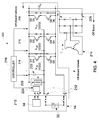
- FIG. 4 illustrates a charging station 200 for recharging the remote opportunity charging device 14. Similar to the vehicle interface 16 as described above, coupling of the remote opportunity charging device 14 to the charging station 200 to form an interface 210 is provided through spring loaded sliding electrical contacts 212 provided on the charging station 200, similar to the mating contacts 40 on electric vehicle 12 as described in FIGS. 2 and 3 .
- High power rapid charging of the auxiliary energy storage source (battery 32 or ultracapacitor) of the remote opportunity charging device 14 is provided by a high impedance transformer 214 (shown as 3-phase, but other number of phases, i.e. 6, could also be utilized) with 3-phase diode rectification.
- a 12-pulse rectifier may be utilized.
- rapid charging during the second portion of the charge is limited by the high impedance transformer 214.
- the final portion of the charge requires critical voltage level and is controlled by one or more bi-directional DC-DC converters 216 and a controller 218.
- initial inrush current may limited by an optional power resistor 220.
- the charging station 200 may also include a bypass contactor 222 to increase current capability.
- the bypass contactor 222 allows the current to be higher than the bi-directional converter capability.
- Power may be supplied to the charging station 200 by electrical cables 224 from a distribution transformer (not shown) that forms a part of the mine power distribution network.
- the high-impedance transformer 214 allows for the use of a flexible cable between the distribution transformer and the charging station 200 even with additional inductance resulting from long cables.
- the flexible cable 224 may be a multi-phase (e.g., three phase) AC cable between the distribution transformer (not shown) and the primary winding of the high impedance transformer 214 (the secondary winding is illustrated in FIG. 4 ) within the charging station 200.
- This allows the charging station 200 to be portable and to be quickly and easily moved to almost any location within a mine, and the additional inductance of the AC cable will not adversely affect charging.
- the charging station 200 may also include a communication unit 226 electrically connected to the controller 218 and which is configured to establish a communication link with the remote opportunity charging device 14 via the electrical contacts 212.
- a communication unit 226 electrically connected to the controller 218 and which is configured to establish a communication link with the remote opportunity charging device 14 via the electrical contacts 212.
- the charging station 200 of the present invention does not require that the charging station to be designed for a specific battery.
- the charging station 200 is capable of recognizing the type of energy storage unit connected to the station 200 and creating and executing a tailored charge routine specific to the energy storage unit to be recharged.
- the charging station 200 has the flexibility to charge either batteries (having various chemistries) and/or ultracapacitor energy storage units. As the power electronics of the charging station is not required to be rated to supply the maximum charge power, charging station size, cost and weight may be substantially reduced.
- the charging station 200 is a low cost, portable charging station capable of performing a rapid charge of the auxiliary energy storage unit housed in the remote opportunity charging device, which may also be utilized to provide opportunity charging of a vehicle when a vehicle is parked or being loaded.
- the remote opportunity charging device 14 of the present invention once charged by charging station 200, may be removably attached, mounted and electrically coupled to a material transport vehicle's on-board energy storage unit when additional power or energy is required to complete a mission, or when the primary on-board energy storage unit needs to be recharged.
- the remote opportunity charging device 14 is able to provide supplemental power to meet peak power demands and/or perform a partial recharge of the primary energy storage unit of a vehicle while the vehicle is operating at relatively low power levels.
- productivity is increased by eliminating the need to return to a designated charging location prior to the end of a normal shift or maneuver for charging or for a swap of the primary propulsion energy storage unit.
- the remote opportunity charging device of the present invention is described herein in connection with a mining scoop, the remote opportunity charging device may be utilized with any type of transport vehicle or machinery having at least one of electric propulsion and electrically driven auxiliaries.
- the remote opportunity charging device described herein may be utilized for providing auxiliary power in mining and utility applications and to conveyors, drills, haulers and crushers.
- An embodiment of the present invention relates to a system.
- the system includes a vehicle having primary energy storage device for providing the vehicle with a supply of electrical power, a remote opportunity charging device configured to be removably connected to vehicle and configured to selectively charge the primary energy storage device of the vehicle during vehicle operation, and an interface between the vehicle and the remote opportunity charging device.
- the interface is configured to enable the transfer of electrical power from the remote opportunity charging device to the vehicle.
- the interface is configured to provide a communication link between the remote opportunity charging device and the vehicle and is configured to allow the communication of energy storage device parameters between the vehicle and the remote opportunity charging device.
- the remote opportunity charging device includes an auxiliary energy storage device for charging the primary energy storage device of the vehicle.
- the energy storage device parameters include at least one of an energy storage device type, chemistry, charge profile and state of charge for at least one of the primary energy storage device and the auxiliary energy storage device.
- the system may include a controller configured to control the flow of electricity to the vehicle in dependence upon the energy storage device parameters for the auxiliary energy storage device and the primary energy storage device.
- the auxiliary energy storage device is a battery. In an embodiment, the auxiliary energy storage device is an ultracapacitor.
- the remote opportunity charging device may be configured to provide supplemental power to an auxiliary device of the vehicle.
- the interface is a plurality of spring-loaded, sliding electrical contacts.
- the system includes at least one bi-directional DC-DC boost converter that is configured to control the flow of electrical power from the auxiliary energy storage device to the primary energy storage device.
- a nominal voltage of the auxiliary energy storage device is within a threshold voltage of the primary energy storage device.
- the remote opportunity charging device includes a housing and an auxiliary energy storage device in the housing for charging the primary energy storage device of the vehicle, wherein the remote opportunity charging device is configured to move along with the vehicle during vehicle operation and to charge the primary energy storage device of the vehicle without the remote opportunity charging device being tethered to off-board the vehicle.
- the interface is configured to provide a communication link between the remote opportunity charging device and the vehicle and is configured for the communication of energy storage device parameters between the vehicle and the remote opportunity charging device, the energy storage device parameters relating to at least one of the auxiliary energy storage device or the primary energy storage device.
- the system may also comprise a controller configured to control the charging of the primary energy storage device by the remote opportunity charging device in dependence upon the energy storage device parameters.
- an apparatus includes a housing, a control unit within the housing and configured to establish a communication link with a vehicle, and an auxiliary energy storage device within the housing.
- the auxiliary energy storage device is configured to selectively transfer electrical power to a primary energy storage device on-board the vehicle during operation of the vehicle to charge the primary energy storage device.
- the apparatus is configured for removable attachment to the vehicle.
- the apparatus is configured to interface with the vehicle for the transfer of the electrical power though an array of spring-loaded, sliding electrical contacts.
- the communication link is established through at least one of the spring-loaded, sliding electrical contacts of the array of electrical contacts and is configured to allow the communication of energy storage device parameters between the vehicle and the apparatus.
- the energy storage device parameters may include at least one of an energy storage device type, chemistry, charge profile and state of charge for at least one of the primary energy storage device and the auxiliary energy storage device.
- the auxiliary energy storage device may be a battery. In an embodiment, the auxiliary energy storage device may be an ultracapacitor.
- the auxiliary energy storage device is configured to provide supplemental power to an auxiliary device of the vehicle.
- a nominal voltage of the auxiliary energy storage device is within a threshold voltage of the primary energy storage device of the vehicle.
- a method includes the steps of removably connecting a remote opportunity charging device to a vehicle, establishing a communication link between the remote opportunity charging device and the vehicle, and selectively transferring electrical power from an auxiliary energy storage device of the remote opportunity charging device to a primary energy storage device on-board the vehicle.
- the method also includes the step of, over the communication link, communicating at least one parameter of the auxiliary energy storage device to the vehicle, the at least one parameter including at least one of a type, chemistry, charge profile, or a state of charge of the auxiliary energy storage device.
- the at least one parameter includes at least one of a type, chemistry, charge profile and state of charge of the auxiliary energy storage device.
- the electrical power is transferred from the auxiliary energy storage device to the primary energy storage device in dependence upon the at least one parameter.
- the auxiliary energy storage device may be a battery. In an embodiment, the auxiliary energy storage device may be an ultracapacitor.
- the method may also include the step of selectively transferring the electrical power from the auxiliary energy storage device of the remote opportunity charging device to an auxiliary device of the vehicle.
- the step of removably connecting the remote opportunity charging device includes establishing an electrical connection between the auxiliary energy storage device and the primary energy storage device.
- the electrical connection is provided by a plurality of spring-loaded, sliding electrical contacts.
- a charging station for a remote opportunity charging device includes an interface for releasably receiving the remote opportunity charging device and for establishing an electrical connection between the charging station and the remote opportunity charging device, a communication unit configured to establish a communications link with the remote opportunity charging device, and a controller configured to control the distribution of electrical energy to the remote opportunity charging device in dependence upon to at least one charge parameter of the remote opportunity charging device.
- the remote opportunity charging device includes an energy storage unit.
- the energy storage unit may be a battery.
- the energy storage unit may be an ultracapacitor.
- the at least one charge parameter includes at least one of a device type, chemistry, charge profile and state of charge of the energy storage unit.
- the interface may be provided by a plurality of spring-loaded, sliding electrical contacts.
- the charging station may include a high impedance transformer with a 3-phase diode rectifier configured to provide a high power, rapid charge of the energy storage unit of the remote opportunity charging device.
- the charging station includes at least one DC-DC converter configured to control voltage during charging.
- a system comprises a vehicle (e.g., electric vehicle) having a primary energy storage device for providing the vehicle with a supply of electrical power, a remote opportunity charging device configured to be removably connected to vehicle and to selectively charge the primary energy storage device of the vehicle during vehicle operation, and an interface between the vehicle and the remote opportunity charging device.
- the interface is configured to enable the transfer of electrical power from the remote opportunity charging device to the vehicle.
- the remote opportunity charging device includes a housing and an auxiliary energy storage device in the housing for charging the primary energy storage device of the vehicle.
- the remote opportunity charging device is configured to move along with the vehicle during vehicle operation and to charge the primary energy storage device of the vehicle without the remote opportunity charging device being tethered to off-board the vehicle (e.g., when the remote opportunity charging device is attached to the vehicle, there are no physical electrical connections between the remote opportunity charging device and any items/devices off-board the vehicle).
- the interface is configured to provide a communication link between the remote opportunity charging device and the vehicle, the communication link being configured for the communication of energy storage device parameters between the vehicle and the remote opportunity charging device.
- the energy storage device parameters relate to at least one of the auxiliary energy storage device or the primary energy storage device.
- the system further comprises a controller (e.g., part of the vehicle, part of the charging device, or part of the interface) configured to control the charging of the primary energy storage device by the remote opportunity charging device in dependence upon the energy storage device parameters.
- an apparatus e.g., remote opportunity charging device
- a housing e.g., a control unit within the housing, and an auxiliary energy storage device within the housing.
- the apparatus is configured for removable attachment to a vehicle having a primary energy storage device onboard the vehicle.
- the control unit is configured to establish a communication link with the vehicle.
- the control unit is also configured to control the auxiliary energy storage device to selectively transfer electrical power to the primary energy storage device onboard the vehicle during operation of the vehicle, to charge the primary energy storage device.
- the apparatus is configured so that the power transfer (from the auxiliary energy storage device of the apparatus to the primary energy storage device of the vehicle) occurs when the apparatus is attached to the vehicle and without tethering of the apparatus to anything off-board the vehicle.
- the apparatus is further configured to be removably attached to a charging station off-board the vehicle, with the charging station being configured to charge the auxiliary energy storage device of the apparatus.
- the apparatus when the apparatus is charged, it may be decoupled from the charging station, attached to the vehicle, the vehicle moves or otherwise operates without encumbrance of any physical connection between the apparatus and off-board the vehicle, and power is transferred from the auxiliary energy storage device to the primary energy storage device of the vehicle.
Landscapes
- Engineering & Computer Science (AREA)
- Power Engineering (AREA)
- Transportation (AREA)
- Mechanical Engineering (AREA)
- Life Sciences & Earth Sciences (AREA)
- Sustainable Development (AREA)
- Sustainable Energy (AREA)
- Charge And Discharge Circuits For Batteries Or The Like (AREA)
- Electric Propulsion And Braking For Vehicles (AREA)
Abstract
Description
- Embodiments of the invention relate generally to vehicles. Other embodiments relate to a system, method and apparatus for the remote opportunity charging of vehicles.
- In the underground mining industry, electric hauling vehicles are utilized to move material from a loading or extraction point, where the material is extracted from the wall of the mine, to an unloading or tipping point, where the material is unloaded for removal from the mine via extraction shafts. These electric hauling vehicles may be powered by one or more on-board batteries that must be periodically recharged or swapped out for fresh batteries.
- When battery recharging/swapping is necessary, hauling vehicles operating within the mine are typically required to be driven to a special charging station located off of the normal haul route where the vehicle may be connected to the charging station for recharging or a fresh battery installed. As will be readily appreciated, however, removing the vehicles from the normal haul route for charging reduces productivity due to the extra time required for travel to and from charging station. In addition, during the battery charging/swapping process, the vehicle is not powered and cannot be moved; it is essentially taken out of service for a period of time, reducing productivity.
- Moreover, with existing charging stations, the power electronics of the charging station must be rated to supply the maximum charge power which may increase charging station cost, size, weight, and/or limit the level of charge power. Accordingly, existing battery charging stations are often designed for specific batteries and therefore may not have the flexibility to charge a range of batteries and energy storage units utilized in mining operations.
- In view of the above, there is a need for a system and method for recharging the batteries of electric vehicles that substantially reduces or obviates the need to remove such vehicles from service for recharging.
- An embodiment of the present invention relates to a system. The system includes a vehicle having primary energy storage device for providing the vehicle with a supply of electrical power, a remote opportunity charging device configured to be removably connected to the vehicle and configured to selectively charge the primary energy storage device of the vehicle during vehicle operation, and an interface between the vehicle and the remote opportunity charging device. The interface is configured to enable the transfer of electrical power from the remote opportunity charging device to the vehicle.
- According to another embodiment of the present invention, an apparatus is provided. The apparatus includes a housing, a control unit within the housing and configured to establish a communication link with a vehicle, and an auxiliary energy storage device within the housing. The auxiliary energy storage device is configured to selectively transfer electrical power to a primary energy storage device on-board the vehicle during operation of the vehicle to charge the primary energy storage device. The apparatus is configured for removable attachment to the vehicle.
- According to another embodiment of the present invention, a method is provided. The method includes the steps of removably connecting a remote opportunity charging device to a vehicle, establishing a communication link between the remote opportunity charging device and the vehicle, and selectively transferring electrical power from an auxiliary energy storage device of the remote opportunity charging device to a primary energy storage device on-board the vehicle.
- The present invention will be better understood from reading the following description of non-limiting embodiments, with reference to the attached drawings, wherein below:
-
FIG. 1 is a schematic view of a system for the remote opportunity charging of a vehicle, according to an embodiment of the present invention. -
FIG. 2 is circuit diagram of the system ofFIG. 1 , according to an embodiment of the present invention. -
FIG. 3 is a circuit diagram of a system for the remote opportunity charging of a vehicle, according to another embodiment of the present invention. -
FIG. 4 is a circuit diagram for a charging station for recharging a remote opportunity charging device, according to an embodiment of the present invention. - Reference will be made below in detail to exemplary embodiments of the invention, examples of which are illustrated in the accompanying drawings. Wherever possible, the same reference numerals used throughout the drawings refer to the same or like parts. Although exemplary embodiments of the present invention are described with respect to mining machinery and equipment and, in particular, to mine hauling vehicles, embodiments of the invention may also be applicable for use with electric vehicles and machinery generally. In particular, while the remote opportunity charging device of the present invention is described herein in connection with a mining scoop, the remote opportunity charging device may be utilized with any type of transport vehicle or machinery having at least one of electric propulsion and electrically driven auxiliaries.
- As used herein, "electrical contact," "electrical communication" and "electrically coupled" means that the referenced elements are directly or indirectly connected such that an electrical current may flow from one to the other. The connection may include a direct conductive connection (i.e., without an intervening capacitive, inductive or active element), an inductive connection, a capacitive connection, and/or any other suitable electrical connection. Intervening components may be present. As used herein, "selectively coupled" means that a component may be coupled to another component in one mode of operation, and decoupled with the another component in another mode of operation. As used herein, "removably connected," "removably connected" and "removably attached" means the ability to disconnect one component from another component. As used herein, "interface" refers to an area or component(s) where two systems or devices meet and interact such that the two systems are electrically coupled to one another. As used herein, "controller" a process or computer component adapted to control another component or system to achieve certain desired goals and objectives.
- With reference to
FIG. 1 , asystem 10 for the remote opportunity charging of a vehicle is illustrated. Thesystem 10 includes an electric vehicle, depicted therein aselectric mining scoop 12, and a remoteopportunity charging device 14 removably connected to theelectric vehicle 12 via aninterface 16. In an embodiment, the remoteopportunity charging device 14 is removable from thevehicle 12 and is configured for selective electrical coupling to a charging station so that the remoteopportunity charging device 14 may be recharged, as discussed in detail below. As used herein, "remote opportunity charging device" refers to a device that transfers electrical energy to another device to which it is connected without itself receiving a supply of electrical power during the transfer (e.g., during transfer of electrical energy to the another device, the remote opportunity charging device does not receive electrical power from a utility electrical grid, off-board generator, or the like). - Referring now to
FIG. 2 , a circuit diagram illustrating the internal components of the system for remote opportunity charging 10 (includingvehicle 12, the remoteopportunity charging device 14 and interface 16) is shown. In an embodiment, thevehicle 12 may include an electric propulsion system of the type generally known in the art that utilizes traction motors to propel the vehicle. In particular, as illustrated inFIG. 2 , the electric propulsion system may include an on-board energy storage unit, such as aprimary propulsion battery 24 and/or ultracapacitor, that stores electrical energy. Electrical energy from thebattery 24 is fed to aninverter 26 where direct current (DC) is converted to alternating current (AC). The alternating current is then fed to multi-phase (typically 3-phase)AC traction motors 28 that drive the wheels oraxle 30 of thevehicle 12. As used herein, "primary energy storage device" or "primary propulsion battery" means an energy storage unit that supplies electrical energy to the vehicle to be used for propulsion for moving the vehicle. - As illustrated in
FIG. 2 , the remoteopportunity charging device 14 includes a housing containing an auxiliary energy storage device, such as anauxiliary battery 32, configured to supply electrical power to thevehicle 12, as discussed hereinafter, and an opportunity charging device communication andcontrol unit 34 configured to communicate with acorresponding communication unit 36 on-board thevehicle 12. Thecommunication unit 36 of the vehicle is electrically connected tovehicle controller 38, which functions to control the flow of electrical power to traction motor(s) 28 of thevehicle 12, as discussed in detail hereinafter. As used herein, "auxiliary energy storage device" means an energy storage unit that is configured to provide supplemental power to the vehicle or to the primary energy storage device. As used herein, "supplemental power" means power other than the power provided by a primary energy storage device. - As further shown in
FIG. 2 , in an embodiment, theinterface 16 between thevehicle 12 and the remoteopportunity charging device 14 may be provided by a plurality of spring-loadedslide contacts 40 present on the rear of thevehicle 12. When the remoteopportunity charging device 14 is connected to thevehicle 12, thecontacts 40 establish an electrical connection between the charging device communication andcontrol unit 34 and thecommunication unit 36 of thevehicle 12 so as to facilitate communication between theopportunity charging device 14 and thevehicle 12. - This communication link allows for a "handshake" to occur between the
opportunity charging device 14 and thevehicle 12 when they are physically connected and, in particular, allows for the exchange of information relating to battery parameters between the remote opportunity charging device and thevehicle 12. In an embodiment, the battery parameters may include battery type, battery chemistry, battery charge profile, state of charge and the like. As will be readily appreciated, this information may then be utilized by the communication andcontrol unit 34 of the remoteopportunity charging device 14 and/or thecontroller 38 of the vehicle to ensure that power from thebattery 32 is provided to thevehicle 12 in a safe manner. As used herein, the phrase "communication link" may refer to any connection, wire, port, device, and/or signal and/or any transmission, exchange, repeating, and/or other flow of information or data that is processed by an entity, and/or that is shared or exchanged between two or more people, devices, and/or other entities. - In addition to establishing a communication link between the
vehicle 12 and the remoteopportunity charging device 14, thecontacts 40 also establish an electrical connection between theauxiliary battery 32 of theopportunity charging device 14 and thebattery 24 on-board thevehicle 12, as illustrated, which facilitates the flow of electrical power from theauxiliary battery 32 to theprimary propulsion battery 24 of thevehicle 12 to recharge the same. - In an embodiment, the nominal voltage of the
auxiliary battery 32 is within a threshold voltage of theprimary propulsion battery 24 on-board thevehicle 12. In an embodiment, "nominal voltage" means the rated or named value, stating the available, input, or output voltage of the an energy storage device. Apower resistor 42 and associated switches (contactors or electronic) may be utilized to limit the in-rush current during an initial energizing routine when theopportunity charging device 14 is first connected to thevehicle 12. In an embodiment, thepower resistor 42 may also be a vehicle dynamic brake resistor, which may be utilized in connection with a pulse-width-modulation chopper 44. - In embodiments of the present invention, the
primary battery 24 of the vehicle has a capacity within the range of approximately 5kWh to approximately 50kWh and theauxiliary battery 32 of the remoteopportunity charging device 14 has a capacity within the range of approximately 2.5kWh to approximately 25kWh. In an embodiment, the capacity of theprimary battery 24 is approximately 10kWh and the capacity of theauxiliary battery 32 of the remote opportunity charging device is approximately 5kWh. - In use, as the
vehicle 12 is operated within a mine, theprimary propulsion battery 24 on-board thevehicle 12 provides power to thetraction motors 28 to propel thevehicle 12, and to other systems and devices that require power (e.g., a hydraulic system for operating various implements), as needed. The capacity of thebattery 24 to provide electrical energy for vehicle operations, however, is not unlimited; theprimary propulsion battery 24 must be recharged periodically in order to continue operations. It is often undesirable, however, to remove thevehicle 12 from its operations in order to charge thebattery 24, as this results in a loss of productivity. For example, it may be particularly undesirable to remove a vehicle from its haul route and to drive the vehicle to a charging station at a remote location for recharging or battery swap. - The
system 10 of the present invention obviates the need to take an electric vehicle out of service for periodic charging or battery swap. In particular, another vehicle may be utilized to transport the remoteopportunity charging device 14 of the present invention to the location of thevehicle 12, and to removably connect the chargingdevice 14 to thevehicle 12. In an embodiment, the chargingdevice 14 is attached to the rear of thevehicle 12 via the spring-loaded slidingelectrical contacts 40 to establish theinterface 16. In particular, the remoteopportunity charging device 14 may be removably attached to an external surface (e.g., rear end surface) of thevehicle 12. In an embodiment, theinterface 16 includes a vehicle portion on the external surface thereof and a mating device portion, such that the device can be removably attached to the external surface of the vehicle. In an embodiment, removable attachment of thedevice 14 to the vehicle is facilitated by the inclusion of a retention mechanism for securing the housing of thedevice 14 to thevehicle 12. - Once a 'handshake' or a communications link is established between the charging device communication and
control unit 34 and thecommunication unit 36 of thevehicle 12, information is passed over the communication link identifying the battery parameters (i.e., battery type, chemistry, charge profile, state of charge etc.) of theprimary propulsion battery 24 on-board thevehicle 12 and identifying the battery parameters of theauxiliary battery 32 of the remoteopportunity charging device 14. Thecontroller 38 of thevehicle 12 is configured to then control the flow of electrical energy from theauxiliary battery 32 of theopportunity charging device 14 to theprimary propulsion battery 24 of thevehicle 12 to recharge the same and/or to provide supplemental power for electrically-driven auxiliary devices of the vehicle. As used herein, "auxiliary device" means an electrically driven device of the vehicle other than devices and components utilized for propulsion." For example, theauxiliary battery 32 may be utilized to provide supplemental power to a hydraulic system of the vehicle, which may be utilized to operate various hydraulic implements, or to monitoring and display systems of the vehicle. - As will be readily appreciated, the communication link between the remote
opportunity charging device 14 and thevehicle 12 allows for a mix of battery technologies to be utilized, thereby providing for a flexible design that may optimize energy storage for a given route or application. For example, it is not necessary that the battery technology and chemistry of theprimary propulsion battery 24 be the same as the battery technology and chemistry of theauxiliary battery 32 in the remoteopportunity charging device 14. This is because the respective control units of thevehicle 12 and the remoteopportunity charging device 14 are capable of determining the parameters of the batteries within the system, and tailoring the flow of electricity from the remoteopportunity charging device 14 to thevehicle 12 in dependence upon the specific need for the electricity and/or make-up of theprimary propulsion battery 24 on-board thevehicle 12. - The remote
opportunity charging device 14 is therefore configured to selectively recharge theprimary propulsion battery 24 during normal operation of the vehicle (and without pausing operation), as well as to provide supplemental electrical energy and power during operation, as needed. In particular, the remoteopportunity charging device 14 may be utilized to provide supplemental power over certain missions that may require additional electrical energy to complete a required task or maneuver. As will be readily appreciated, the ability to supplement power provided by theprimary propulsion battery 24 and to recharge thebattery 24 during normal operation (i.e., without taking the vehicle out of service) allows theprimary battery 24 to be downsized, i.e., it allows the use of aprimary battery 24 that is of a reduced size, weight and cost as compared to those currently used in electric mining vehicles. - Turning now to
FIG. 3 , a circuit diagram illustrating the internal components of a system for remote opportunity charging 100 according to another embodiment of the present invention is shown. As shown therein, the system is generally similar to thesystem 10 described above in connection withFIG. 2 , where like reference numerals designate like parts. In this configuration, however, one or more one bi-directional DC-DC boost converters 46 are used to control the flow of power from theauxiliary battery 32 of the remoteopportunity charging device 14 to theprimary propulsion battery 24 of the electric vehicle traction drive in either charging or driving mode. As with the embodiment ofFIG. 2 , an optionaldynamic brake resistor 42 and associatedchopper 44 may be used in the propulsion system as an optional dynamic brake system to limit DC link voltage during significant regenerative braking events, however thepower resistor 42 is not needed to limit inrush current as in the embodiment ofFIG. 2 . In an embodiment,system 10, therefore, has an improved capability to capture and store regenerative energy pulses, thus reducing the energy cost to recharge the on-boardenergy storage unit 24. - While the remote
opportunity charging device 14 illustrated inFIG. 3 is shown as utilizing abattery 32 to provide electrical power to recharge thebattery 24 on-board thevehicle 12, in an embodiment, other energy storage devices may be utilized. In particular, in an embodiment,battery 32 may be replaced by a high specific power ultracapacitor. In such embodiment, one or more bi-directional DC-DC boost converters 46 are used to interface the ultracapacitor (DC charge source) of the remoteopportunity charging device 14 with the electric propulsion drive system of thevehicle 12 and theprimary propulsion battery 24 thereof. - As alluded to above, the
battery 32 or ultracapacitor of the remoteopportunity charging device 14, after it is utilized to recharge and/or supplement theprimary propulsion battery 24 of avehicle 12, may be disconnected from the vehicle and electrically coupled with a charging station so that thebattery 32 or ultracapacitor may be recharged and the remoteopportunity charging device 14 may be reused.FIG. 4 illustrates a chargingstation 200 for recharging the remoteopportunity charging device 14. Similar to thevehicle interface 16 as described above, coupling of the remoteopportunity charging device 14 to the chargingstation 200 to form aninterface 210 is provided through spring loaded slidingelectrical contacts 212 provided on the chargingstation 200, similar to themating contacts 40 onelectric vehicle 12 as described inFIGS. 2 and3 . High power rapid charging of the auxiliary energy storage source (battery 32 or ultracapacitor) of the remoteopportunity charging device 14 is provided by a high impedance transformer 214 (shown as 3-phase, but other number of phases, i.e. 6, could also be utilized) with 3-phase diode rectification. In an embodiment, a 12-pulse rectifier may be utilized. In an embodiment, rapid charging during the second portion of the charge is limited by thehigh impedance transformer 214. The final portion of the charge requires critical voltage level and is controlled by one or more bi-directional DC-DC converters 216 and acontroller 218. - In an embodiment, initial inrush current may limited by an
optional power resistor 220. As also illustrated therein, the chargingstation 200 may also include abypass contactor 222 to increase current capability. In particular, thebypass contactor 222 allows the current to be higher than the bi-directional converter capability. In operation, when the battery voltage reaches a maximum, thecontactor 222 opens and current is controlled by thebi-directional converters 216. Power may be supplied to the chargingstation 200 byelectrical cables 224 from a distribution transformer (not shown) that forms a part of the mine power distribution network. As will be readily appreciated, the high-impedance transformer 214 allows for the use of a flexible cable between the distribution transformer and the chargingstation 200 even with additional inductance resulting from long cables. - As shown therein, the
flexible cable 224 may be a multi-phase (e.g., three phase) AC cable between the distribution transformer (not shown) and the primary winding of the high impedance transformer 214 (the secondary winding is illustrated inFIG. 4 ) within the chargingstation 200. This allows the chargingstation 200 to be portable and to be quickly and easily moved to almost any location within a mine, and the additional inductance of the AC cable will not adversely affect charging. - As with the
vehicle 12, the chargingstation 200 may also include acommunication unit 226 electrically connected to thecontroller 218 and which is configured to establish a communication link with the remoteopportunity charging device 14 via theelectrical contacts 212. Once the communications link is established between the communications andcontrol unit 34 of the chargingdevice 14 andcommunications unit 226 of the chargingstation 200, information relating to the type of energy storage unit present in the chargingdevice 34 may be communicated to the chargingstation 200. In particular, information relating to battery type (e.g. battery or ultracapacitor), chemistry, charge profile, state of charge, etc.) may be communicated to thecontroller 218 of the chargingstation 218. Thecontroller 218 may then charge the energy storage unit within the chargingdevice 14 according to its particular charge profile in a safe, efficient and rapid manner. - As will be readily appreciated, therefore, the charging
station 200 of the present invention does not require that the charging station to be designed for a specific battery. Indeed, the chargingstation 200 is capable of recognizing the type of energy storage unit connected to thestation 200 and creating and executing a tailored charge routine specific to the energy storage unit to be recharged. In this respect, the chargingstation 200 has the flexibility to charge either batteries (having various chemistries) and/or ultracapacitor energy storage units. As the power electronics of the charging station is not required to be rated to supply the maximum charge power, charging station size, cost and weight may be substantially reduced. - Indeed, the charging
station 200 is a low cost, portable charging station capable of performing a rapid charge of the auxiliary energy storage unit housed in the remote opportunity charging device, which may also be utilized to provide opportunity charging of a vehicle when a vehicle is parked or being loaded. - As discussed above, the remote
opportunity charging device 14 of the present invention, once charged by chargingstation 200, may be removably attached, mounted and electrically coupled to a material transport vehicle's on-board energy storage unit when additional power or energy is required to complete a mission, or when the primary on-board energy storage unit needs to be recharged. In particular, the remoteopportunity charging device 14 is able to provide supplemental power to meet peak power demands and/or perform a partial recharge of the primary energy storage unit of a vehicle while the vehicle is operating at relatively low power levels. - Moreover, by utilizing the remote opportunity charging device of the present invention, productivity is increased by eliminating the need to return to a designated charging location prior to the end of a normal shift or maneuver for charging or for a swap of the primary propulsion energy storage unit.
- While the remote opportunity charging device of the present invention is described herein in connection with a mining scoop, the remote opportunity charging device may be utilized with any type of transport vehicle or machinery having at least one of electric propulsion and electrically driven auxiliaries. For example, it is envisioned that the remote opportunity charging device described herein may be utilized for providing auxiliary power in mining and utility applications and to conveyors, drills, haulers and crushers.
- An embodiment of the present invention relates to a system. The system includes a vehicle having primary energy storage device for providing the vehicle with a supply of electrical power, a remote opportunity charging device configured to be removably connected to vehicle and configured to selectively charge the primary energy storage device of the vehicle during vehicle operation, and an interface between the vehicle and the remote opportunity charging device. The interface is configured to enable the transfer of electrical power from the remote opportunity charging device to the vehicle.
- In an embodiment, the interface is configured to provide a communication link between the remote opportunity charging device and the vehicle and is configured to allow the communication of energy storage device parameters between the vehicle and the remote opportunity charging device.
- In an embodiment, the remote opportunity charging device includes an auxiliary energy storage device for charging the primary energy storage device of the vehicle. In an embodiment, the energy storage device parameters include at least one of an energy storage device type, chemistry, charge profile and state of charge for at least one of the primary energy storage device and the auxiliary energy storage device.
- In an embodiment, the system may include a controller configured to control the flow of electricity to the vehicle in dependence upon the energy storage device parameters for the auxiliary energy storage device and the primary energy storage device.
- In an embodiment, the auxiliary energy storage device is a battery. In an embodiment, the auxiliary energy storage device is an ultracapacitor.
- In an embodiment, the remote opportunity charging device may be configured to provide supplemental power to an auxiliary device of the vehicle.
- In an embodiment, the interface is a plurality of spring-loaded, sliding electrical contacts.
- In an embodiment, the system includes at least one bi-directional DC-DC boost converter that is configured to control the flow of electrical power from the auxiliary energy storage device to the primary energy storage device.
- In an embodiment, a nominal voltage of the auxiliary energy storage device is within a threshold voltage of the primary energy storage device.
- In an embodiment, the remote opportunity charging device includes a housing and an auxiliary energy storage device in the housing for charging the primary energy storage device of the vehicle, wherein the remote opportunity charging device is configured to move along with the vehicle during vehicle operation and to charge the primary energy storage device of the vehicle without the remote opportunity charging device being tethered to off-board the vehicle. The interface is configured to provide a communication link between the remote opportunity charging device and the vehicle and is configured for the communication of energy storage device parameters between the vehicle and the remote opportunity charging device, the energy storage device parameters relating to at least one of the auxiliary energy storage device or the primary energy storage device. The system may also comprise a controller configured to control the charging of the primary energy storage device by the remote opportunity charging device in dependence upon the energy storage device parameters.
- According to another embodiment of the present invention, an apparatus is provided. The apparatus includes a housing, a control unit within the housing and configured to establish a communication link with a vehicle, and an auxiliary energy storage device within the housing. The auxiliary energy storage device is configured to selectively transfer electrical power to a primary energy storage device on-board the vehicle during operation of the vehicle to charge the primary energy storage device. The apparatus is configured for removable attachment to the vehicle.
- In an embodiment, the apparatus is configured to interface with the vehicle for the transfer of the electrical power though an array of spring-loaded, sliding electrical contacts..
- In an embodiment, the communication link is established through at least one of the spring-loaded, sliding electrical contacts of the array of electrical contacts and is configured to allow the communication of energy storage device parameters between the vehicle and the apparatus.
- In an embodiment, the energy storage device parameters may include at least one of an energy storage device type, chemistry, charge profile and state of charge for at least one of the primary energy storage device and the auxiliary energy storage device.
- In an embodiment, the auxiliary energy storage device may be a battery. In an embodiment, the auxiliary energy storage device may be an ultracapacitor.
- In an embodiment, the auxiliary energy storage device is configured to provide supplemental power to an auxiliary device of the vehicle.
- In an embodiment, a nominal voltage of the auxiliary energy storage device is within a threshold voltage of the primary energy storage device of the vehicle.
- According to another embodiment of the present invention, a method is provided. The method includes the steps of removably connecting a remote opportunity charging device to a vehicle, establishing a communication link between the remote opportunity charging device and the vehicle, and selectively transferring electrical power from an auxiliary energy storage device of the remote opportunity charging device to a primary energy storage device on-board the vehicle.
- In an embodiment, the method also includes the step of, over the communication link, communicating at least one parameter of the auxiliary energy storage device to the vehicle, the at least one parameter including at least one of a type, chemistry, charge profile, or a state of charge of the auxiliary energy storage device.
- In an embodiment, the at least one parameter includes at least one of a type, chemistry, charge profile and state of charge of the auxiliary energy storage device.
- In an embodiment, the electrical power is transferred from the auxiliary energy storage device to the primary energy storage device in dependence upon the at least one parameter.
- In an embodiment, the auxiliary energy storage device may be a battery. In an embodiment, the auxiliary energy storage device may be an ultracapacitor.
- In an embodiment, the method may also include the step of selectively transferring the electrical power from the auxiliary energy storage device of the remote opportunity charging device to an auxiliary device of the vehicle.
- In an embodiment, the step of removably connecting the remote opportunity charging device includes establishing an electrical connection between the auxiliary energy storage device and the primary energy storage device.
- In an embodiment, the electrical connection is provided by a plurality of spring-loaded, sliding electrical contacts.
- According to yet another embodiment, a charging station for a remote opportunity charging device is provided. The charging station includes an interface for releasably receiving the remote opportunity charging device and for establishing an electrical connection between the charging station and the remote opportunity charging device, a communication unit configured to establish a communications link with the remote opportunity charging device, and a controller configured to control the distribution of electrical energy to the remote opportunity charging device in dependence upon to at least one charge parameter of the remote opportunity charging device. In an embodiment, the remote opportunity charging device includes an energy storage unit. In an embodiment, the energy storage unit may be a battery. In an embodiment, the energy storage unit may be an ultracapacitor. In an embodiment, the at least one charge parameter includes at least one of a device type, chemistry, charge profile and state of charge of the energy storage unit. The interface may be provided by a plurality of spring-loaded, sliding electrical contacts. The charging station may include a high impedance transformer with a 3-phase diode rectifier configured to provide a high power, rapid charge of the energy storage unit of the remote opportunity charging device. In an embodiment, the charging station includes at least one DC-DC converter configured to control voltage during charging.
- In an embodiment, a system comprises a vehicle (e.g., electric vehicle) having a primary energy storage device for providing the vehicle with a supply of electrical power, a remote opportunity charging device configured to be removably connected to vehicle and to selectively charge the primary energy storage device of the vehicle during vehicle operation, and an interface between the vehicle and the remote opportunity charging device. The interface is configured to enable the transfer of electrical power from the remote opportunity charging device to the vehicle. The remote opportunity charging device includes a housing and an auxiliary energy storage device in the housing for charging the primary energy storage device of the vehicle. The remote opportunity charging device is configured to move along with the vehicle during vehicle operation and to charge the primary energy storage device of the vehicle without the remote opportunity charging device being tethered to off-board the vehicle (e.g., when the remote opportunity charging device is attached to the vehicle, there are no physical electrical connections between the remote opportunity charging device and any items/devices off-board the vehicle). The interface is configured to provide a communication link between the remote opportunity charging device and the vehicle, the communication link being configured for the communication of energy storage device parameters between the vehicle and the remote opportunity charging device. The energy storage device parameters relate to at least one of the auxiliary energy storage device or the primary energy storage device. The system further comprises a controller (e.g., part of the vehicle, part of the charging device, or part of the interface) configured to control the charging of the primary energy storage device by the remote opportunity charging device in dependence upon the energy storage device parameters.
- In an embodiment, an apparatus (e.g., remote opportunity charging device) includes a housing, a control unit within the housing, and an auxiliary energy storage device within the housing. The apparatus is configured for removable attachment to a vehicle having a primary energy storage device onboard the vehicle. The control unit is configured to establish a communication link with the vehicle. The control unit is also configured to control the auxiliary energy storage device to selectively transfer electrical power to the primary energy storage device onboard the vehicle during operation of the vehicle, to charge the primary energy storage device. The apparatus is configured so that the power transfer (from the auxiliary energy storage device of the apparatus to the primary energy storage device of the vehicle) occurs when the apparatus is attached to the vehicle and without tethering of the apparatus to anything off-board the vehicle. The apparatus is further configured to be removably attached to a charging station off-board the vehicle, with the charging station being configured to charge the auxiliary energy storage device of the apparatus. Thus, when the apparatus is charged, it may be decoupled from the charging station, attached to the vehicle, the vehicle moves or otherwise operates without encumbrance of any physical connection between the apparatus and off-board the vehicle, and power is transferred from the auxiliary energy storage device to the primary energy storage device of the vehicle.
- It is to be understood that the above description is intended to be illustrative, and not restrictive. For example, the above-described embodiments (and/or aspects thereof) may be used in combination with each other. In addition, many modifications may be made to adapt a particular situation or material to the teachings of the invention without departing from its scope. While the dimensions and types of materials described herein are intended to define the parameters of the invention, they are by no means limiting and are exemplary embodiments. Many other embodiments will be apparent to those of skill in the art upon reviewing the above description. The terms "including" and "in which" are used as the plain-English equivalents of the respective terms "comprising" and "wherein." Moreover, the terms "first," "second," "third," "upper," "lower," "bottom," "top," etc. are used merely as labels, and are not intended to impose numerical or positional requirements on their objects.
- This written description uses examples to disclose several embodiments of the invention, including the best mode, and also to enable one of ordinary skill in the art to practice the embodiments of invention, including making and using any devices or systems and performing any incorporated methods.
- As used herein, an element or step recited in the singular and proceeded with the word "a" or "an" should be understood as not excluding plural of the elements or steps, unless such exclusion is explicitly stated. Furthermore, references to "one embodiment" of the present invention are not intended to be interpreted as excluding the existence of additional embodiments that also incorporate the recited features. Moreover, unless explicitly stated to the contrary, embodiments "comprising," "including," or "having" an element or a plurality of elements having a particular property may include additional such elements not having that property.
- Since certain changes may be made in the embodiments described herein without departing from the spirit and scope of the invention herein involved, it is intended that all of the subject matter of the above description or shown in the accompanying drawings shall be interpreted merely as examples illustrating the inventive concept herein and shall not be construed as limiting the invention.
- Various aspects and embodiments of the present invention as defined in the following numbered clauses:
- 1. A system, comprising:
- a vehicle having a primary energy storage device for providing the vehicle with a supply of electrical power;
- a remote opportunity charging device configured to be removably connected to the vehicle and to selectively charge the primary energy storage device of the vehicle during vehicle operation; and
- an interface between the vehicle and the remote opportunity charging device, the interface being configured to enable the transfer of electrical power from the remote opportunity charging device to the vehicle.
- 2. The system of clause 1, wherein:
- the interface is configured to provide a communication link between the remote opportunity charging device and the vehicle, the communication link being configured to allow the communication of energy storage device parameters between the vehicle and the remote opportunity charging device.
- 3. The system of clause 1 or clause 2, wherein:
- the remote opportunity charging device includes an auxiliary energy storage device for charging the primary energy storage device of the vehicle; and
- wherein the energy storage device parameters include at least one of an energy storage device type, chemistry, charge profile, or state of charge for at least one of the primary energy storage device or the auxiliary energy storage device.
- 4. The system of any preceding clause, further comprising:
- a controller configured to control the flow of electricity to the vehicle in dependence upon the energy storage device parameters for the auxiliary energy storage device and the primary energy storage device.
- 5. The system of any preceding clause, further comprising:
- at least one bi-directional DC-DC boost converter that is configured to control the flow of electrical power from the auxiliary energy storage device to the primary energy storage device.
- 6. The system of any preceding clause, wherein:
- a nominal voltage of the auxiliary energy storage device is within a threshold voltage of the primary energy storage device.
- 7. The system of any preceding clause, wherein:
- the remote opportunity charging device is configured to provide supplemental power to an auxiliary device of the vehicle.
- 8. The system of any preceding clause, wherein:
- the interface comprises a plurality of spring-loaded, sliding electrical contacts.
- 9. The system of any preceding clause, wherein:
- the remote opportunity charging device includes a housing and an auxiliary energy storage device in the housing for charging the primary energy storage device of the vehicle, wherein the remote opportunity charging device is configured to move along with the vehicle during vehicle operation and to charge the primary energy storage device of the vehicle without the remote opportunity charging device being tethered to off-board the vehicle;
- the interface is configured to provide a communication link between the remote opportunity charging device and the vehicle, the communication link being configured for the communication of energy storage device parameters between the vehicle and the remote opportunity charging device, the energy storage device parameters relating to at least one of the auxiliary energy storage device or the primary energy storage device; and
- the system further comprises a controller configured to control the charging of the primary energy storage device by the remote opportunity charging device in dependence upon the energy storage device parameters.
- 10. An apparatus, comprising:
- a housing;
- a control unit within the housing, the control unit being configured to establish a communication link with a vehicle; and
- an auxiliary energy storage device within the housing, the auxiliary energy storage device being configured to selectively transfer electrical power to a primary energy storage device on-board the vehicle during operation of the vehicle to charge the primary energy storage device;
- wherein the apparatus is configured for removable attachment to the vehicle.
- 11. The apparatus of any preceding clause, wherein:
- the apparatus is configured to interface with the vehicle for the transfer of the electrical power though an array of spring-loaded, sliding electrical contacts.
- 12. The apparatus of any preceding clause, wherein:
- the communication link is established through at least one of the spring-loaded, sliding electrical contacts of the array of electrical contacts and is configured to allow the communication of energy storage device parameters between the vehicle and the apparatus.
- 13. The apparatus of any preceding clause, wherein:
- the energy storage device parameters include at least one of an energy storage device type, chemistry, charge profile, or state of charge for at least one of the primary energy storage device or the auxiliary energy storage device.
- 14. The apparatus of any preceding clause, wherein:
- the auxiliary energy storage device is configured to provide supplemental power to an auxiliary device of the vehicle.
- 15. The apparatus of any preceding clause, wherein:
- a nominal voltage of the auxiliary energy storage device is within a threshold voltage of the primary energy storage device of the vehicle.
- 16. A method, comprising the steps of:
- removably connecting a remote opportunity charging device to a vehicle;
- establishing a communication link between the remote opportunity charging device and the vehicle; and
- selectively transferring electrical power from an auxiliary energy storage device of the remote opportunity charging device to a primary energy storage device on-board the vehicle.
- 17. The method according to any preceding clause, further comprising the step of:
- over the communication link, communicating at least one parameter of the auxiliary energy storage device to the vehicle, the at least one parameter including at least one of a type, chemistry, charge profile, or a state of charge of the auxiliary energy storage device.
- 18. The method according to any preceding clause, wherein:
- the electrical power is transferred from the auxiliary energy storage device to the primary energy storage device in dependence upon the at least one parameter.
- 19. The method according to any preceding clause, further comprising the step of:
- selectively transferring the electrical power from the auxiliary energy storage device of the remote opportunity charging device to an auxiliary device of the vehicle.
- 20. The method according to any preceding clause, wherein:
- the step of removably connecting the remote opportunity charging device includes establishing an electrical connection between the auxiliary energy storage device and the primary energy storage device, wherein the electrical connection is provided by a plurality of spring-loaded, sliding electrical contacts.
Claims (15)
- A system (10), comprising:a vehicle (12) having a primary energy storage device (24) for providing the vehicle (12) with a supply of electrical power;a remote opportunity charging device (14) configured to be removably connected to the vehicle (12) and to selectively charge the primary energy storage device (24) of the vehicle (12) during vehicle operation; andan interface (16) between the vehicle (12) and the remote opportunity charging device (14), the interface (16) being configured to enable the transfer of electrical power from the remote opportunity charging device (14) to the vehicle (12).
- The system (10) of claim 1, wherein:the interface (16) is configured to provide a communication link between the remote opportunity charging device (14) and the vehicle (12), the communication link being configured to allow the communication of energy storage device parameters between the vehicle (12) and the remote opportunity charging device (14).
- The system (10) of claim 1 or claim 2, wherein:the remote opportunity charging device (14) includes an auxiliary energy storage device (32) for charging the primary energy storage device (24) of the vehicle (12); andwherein the energy storage device parameters include at least one of an energy storage device type, chemistry, charge profile, or state of charge for at least one of the primary energy storage device (24) or the auxiliary energy storage device (32).
- The system (10) of any preceding claim, further comprising:a controller (38) configured to control the flow of electricity to the vehicle (12) in dependence upon the energy storage device parameters for the auxiliary energy storage device (32) and the primary energy storage device (24).
- The system (10) of any preceding claim, further comprising:at least one bi-directional DC-DC boost converter (46) that is configured to control the flow of electrical power from the auxiliary energy storage device (32) to the primary energy storage device (24).
- The system (10) of any preceding claim, wherein:a nominal voltage of the auxiliary energy storage device (32) is within a threshold voltage of the primary energy storage device (24).
- The system (10) of any preceding claim, wherein:the remote opportunity charging device (14) is configured to provide supplemental power to an auxiliary device of the vehicle (12).
- The system (10) of any preceding claim, wherein:the interface (16) comprises a plurality of spring-loaded, sliding electrical contacts (40).
- The system (10) of any preceding claim, wherein:the remote opportunity charging device (14) includes a housing and an auxiliary energy storage device (32) in the housing for charging the primary energy storage device (24) of the vehicle (12), wherein the remote opportunity charging device (14) is configured to move along with the vehicle (12) during vehicle operation and to charge the primary energy storage device (24) of the vehicle (12) without the remote opportunity charging device (14) being tethered to off-board the vehicle (12);the interface (16) is configured to provide a communication link between the remote opportunity charging device (14) and the vehicle (12), the communication link being configured for the communication of energy storage device parameters between the vehicle (12) and the remote opportunity charging device (14), the energy storage device parameters relating to at least one of the auxiliary energy storage device (32) or the primary energy storage device (24); andthe system (10) further comprises a controller (38) configured to control the charging of the primary energy storage device (24) by the remote opportunity charging device (14) in dependence upon the energy storage device parameters.
- An apparatus, comprising:a housing;a control unit within the housing, the control unit being configured to establish a communication link with a vehicle; andan auxiliary energy storage device within the housing, the auxiliary energy storage device being configured to selectively transfer electrical power to a primary energy storage device on-board the vehicle during operation of the vehicle to charge the primary energy storage device;wherein the apparatus is configured for removable attachment to the vehicle.
- A method, comprising the steps of:removably connecting a remote opportunity charging device (14) to a vehicle (12);establishing a communication link between the remote opportunity charging device (14) and the vehicle (12); andselectively transferring electrical power from an auxiliary energy storage device (32) of the remote opportunity charging device (14) to a primary energy storage device (24) on-board the vehicle (12).
- The method according to claim 11, further comprising the step of:over the communication link, communicating at least one parameter of the auxiliary energy storage device (32) to the vehicle (12), the at least one parameter including at least one of a type, chemistry, charge profile, or a state of charge of the auxiliary energy storage device (32).
- The method according to claim 11 or claim 12, wherein:the electrical power is transferred from the auxiliary energy storage device (32) to the primary energy storage device (24) in dependence upon the at least one parameter.
- The method according to any of claims 11 to 13, further comprising the step of:selectively transferring the electrical power from the auxiliary energy storage device (32) of the remote opportunity charging device (14) to an auxiliary device of the vehicle (12).
- The method according to any of claims 11 to 14, wherein:the step of removably connecting the remote opportunity charging device (14) includes establishing an electrical connection between the auxiliary energy storage device (32) and the primary energy storage device (24), wherein the electrical connection is provided by a plurality of spring-loaded, sliding electrical contacts (40).
Applications Claiming Priority (1)
| Application Number | Priority Date | Filing Date | Title |
|---|---|---|---|
| US14/541,529 US20160137076A1 (en) | 2014-11-14 | 2014-11-14 | System, method and apparatus for remote opportunity charging |
Publications (1)
| Publication Number | Publication Date |
|---|---|
| EP3053773A1 true EP3053773A1 (en) | 2016-08-10 |
Family
ID=54608323
Family Applications (1)
| Application Number | Title | Priority Date | Filing Date |
|---|---|---|---|
| EP15194773.6A Withdrawn EP3053773A1 (en) | 2014-11-14 | 2015-11-16 | System, method and apparatus for remote opportunity charging |
Country Status (2)
| Country | Link |
|---|---|
| US (1) | US20160137076A1 (en) |
| EP (1) | EP3053773A1 (en) |
Families Citing this family (7)
| Publication number | Priority date | Publication date | Assignee | Title |
|---|---|---|---|---|
| US11027624B2 (en) * | 2017-09-15 | 2021-06-08 | Proterra Inc. | Electric vehicle charging by adjusting charger current based on battery chemistry |
| DE102017130474A1 (en) * | 2017-12-19 | 2019-06-19 | Dr. Ing. H.C. F. Porsche Aktiengesellschaft | Transformer device for a charging station for the electrical charging of vehicles with at least two charging points |
| US12252864B2 (en) | 2018-04-06 | 2025-03-18 | Volvo Construction Equipment Ab | Working machine, a work attachment and a combination thereof |
| DE102019112706A1 (en) * | 2019-05-15 | 2020-11-19 | Bayerische Motoren Werke Aktiengesellschaft | Method and device for supplying energy to an electrical consumer of a vehicle |
| CN110826841B (en) * | 2019-08-31 | 2025-03-25 | 华南理工大学 | A charging station planning method considering user charging experience and distribution network operation risks |
| DE102020104736A1 (en) * | 2020-02-24 | 2021-08-26 | Audi Aktiengesellschaft | Motor vehicle comprising a charging device |
| US20250296475A1 (en) * | 2024-03-22 | 2025-09-25 | Caterpillar Inc. | Voltage regulation of secondary power source for battery swap electric machines |
Citations (7)
| Publication number | Priority date | Publication date | Assignee | Title |
|---|---|---|---|---|
| JPH04334906A (en) * | 1991-05-08 | 1992-11-24 | Honda Motor Co Ltd | Electric vehicle with auxiliary power source |
| US6390215B1 (en) * | 1998-05-29 | 2002-05-21 | Honda Giken Kogyo Kabushiki Kaisha | Electric vehicle |
| US20070051542A1 (en) * | 2005-08-18 | 2007-03-08 | Wilks Paul L | Trailer with Integral Axle-Mounted Generator and Battery Charger |
| US20110114398A1 (en) * | 2009-11-17 | 2011-05-19 | Bianco James S | Battery Power System for Plug In Hybrid Tractor Trailers |
| WO2012154990A2 (en) * | 2011-05-10 | 2012-11-15 | Johnsen Stephen G | Mobile variable power system and method |
| US20130257145A1 (en) * | 2012-03-30 | 2013-10-03 | Elwha Llc | Method and apparatus for supplying auxiliary electrical power to an electric or hybrid vehicle |
| JP2013247854A (en) * | 2012-10-12 | 2013-12-09 | Hyogo Benda Kogyo Kk | Battery system, battery device, information processing apparatus and battery control method |
Family Cites Families (6)
| Publication number | Priority date | Publication date | Assignee | Title |
|---|---|---|---|---|
| US5373195A (en) * | 1992-12-23 | 1994-12-13 | General Electric Company | Technique for decoupling the energy storage system voltage from the DC link voltage in AC electric drive systems |
| EP1977483A4 (en) * | 2006-01-27 | 2011-11-16 | David Robert Goetz | Releasable plug connector system |
| US8004242B1 (en) * | 2009-03-13 | 2011-08-23 | PH Ingenuities, LLC | System and method for managing distribution of vehicle power in a multiple battery system |
| US8890475B1 (en) * | 2010-09-28 | 2014-11-18 | Gilbert Scott Becker | Automobile charging and communications station |
| US10217160B2 (en) * | 2012-04-22 | 2019-02-26 | Emerging Automotive, Llc | Methods and systems for processing charge availability and route paths for obtaining charge for electric vehicles |
| US9123035B2 (en) * | 2011-04-22 | 2015-09-01 | Angel A. Penilla | Electric vehicle (EV) range extending charge systems, distributed networks of charge kiosks, and charge locating mobile apps |
-
2014
- 2014-11-14 US US14/541,529 patent/US20160137076A1/en not_active Abandoned
-
2015
- 2015-11-16 EP EP15194773.6A patent/EP3053773A1/en not_active Withdrawn
Patent Citations (7)
| Publication number | Priority date | Publication date | Assignee | Title |
|---|---|---|---|---|
| JPH04334906A (en) * | 1991-05-08 | 1992-11-24 | Honda Motor Co Ltd | Electric vehicle with auxiliary power source |
| US6390215B1 (en) * | 1998-05-29 | 2002-05-21 | Honda Giken Kogyo Kabushiki Kaisha | Electric vehicle |
| US20070051542A1 (en) * | 2005-08-18 | 2007-03-08 | Wilks Paul L | Trailer with Integral Axle-Mounted Generator and Battery Charger |
| US20110114398A1 (en) * | 2009-11-17 | 2011-05-19 | Bianco James S | Battery Power System for Plug In Hybrid Tractor Trailers |
| WO2012154990A2 (en) * | 2011-05-10 | 2012-11-15 | Johnsen Stephen G | Mobile variable power system and method |
| US20130257145A1 (en) * | 2012-03-30 | 2013-10-03 | Elwha Llc | Method and apparatus for supplying auxiliary electrical power to an electric or hybrid vehicle |
| JP2013247854A (en) * | 2012-10-12 | 2013-12-09 | Hyogo Benda Kogyo Kk | Battery system, battery device, information processing apparatus and battery control method |
Also Published As
| Publication number | Publication date |
|---|---|
| US20160137076A1 (en) | 2016-05-19 |
Similar Documents
| Publication | Publication Date | Title |
|---|---|---|
| EP3053773A1 (en) | System, method and apparatus for remote opportunity charging | |
| DK3066739T3 (en) | PROCEDURE FOR CHARGING FROM AN ELECTRIC VEHICLE TO AN ELECTRIC VEHICLE | |
| US11165349B2 (en) | Backward compatible battery DC charger and methods using an on-board charger | |
| EP2413452B1 (en) | Bidirectional polyphase multimode converter including boost and buck-boost modes | |
| CN112537216B (en) | Dual voltage charging stations and methods | |
| US10150373B2 (en) | Compact charging device for electric vehicle | |
| US9787112B2 (en) | Inter-protocol charging adapter | |
| US11433775B1 (en) | Aircraft charging unit | |
| US10464428B2 (en) | Battery-backed DC fast charging system | |
| CN115023876B (en) | Portable rescue power bank | |
| EP2354075A1 (en) | Power feeding device and rubber tired gantry crane including the same | |
| CN107206887A (en) | Electric or hybrid vehicle with the multiple driver elements being arranged in multiple independent sectors of vehicle | |
| CN113195288A (en) | Power transmission system for vehicle | |
| CN101459342A (en) | Battery charging apparatus | |
| EP2566008A2 (en) | Battery charging system and train | |
| CN205970886U (en) | A battery charging outfit for electrically driven (operated) vehicle | |
| CN110576763B (en) | Mobile discharge device for an energy store | |
| US20200139834A1 (en) | Battery-backed dc fast charging system | |
| US20220219556A1 (en) | Charging System for DC Charging of the Traction Battery of an Electrically Powered Motor Vehicle | |
| CN114867628A (en) | Method for operating an electric vehicle and electric vehicle | |
| US11667213B2 (en) | Electromobility system for a vehicle | |
| US12054061B2 (en) | Electric propulsion system for a vehicle | |
| CN205523731U (en) | System for be used for long -range chance to charge | |
| CN103270662B (en) | Power supply device, crane, and power supply method | |
| CN113291169A (en) | Motor vehicle with charging system |
Legal Events
| Date | Code | Title | Description |
|---|---|---|---|
| PUAI | Public reference made under article 153(3) epc to a published international application that has entered the european phase |
Free format text: ORIGINAL CODE: 0009012 |
|
| AK | Designated contracting states |
Kind code of ref document: A1 Designated state(s): AL AT BE BG CH CY CZ DE DK EE ES FI FR GB GR HR HU IE IS IT LI LT LU LV MC MK MT NL NO PL PT RO RS SE SI SK SM TR |
|
| AX | Request for extension of the european patent |
Extension state: BA ME |
|
| 17P | Request for examination filed |
Effective date: 20170210 |
|
| RBV | Designated contracting states (corrected) |
Designated state(s): AL AT BE BG CH CY CZ DE DK EE ES FI FR GB GR HR HU IE IS IT LI LT LU LV MC MK MT NL NO PL PT RO RS SE SI SK SM TR |
|
| STAA | Information on the status of an ep patent application or granted ep patent |
Free format text: STATUS: THE APPLICATION IS DEEMED TO BE WITHDRAWN |
|
| 18D | Application deemed to be withdrawn |
Effective date: 20190601 |