EP3052513B1 - Industrial process for the synthesis of ulipristal acetate and its 4'-acetyl analogue - Google Patents
Industrial process for the synthesis of ulipristal acetate and its 4'-acetyl analogue Download PDFInfo
- Publication number
- EP3052513B1 EP3052513B1 EP14790731.5A EP14790731A EP3052513B1 EP 3052513 B1 EP3052513 B1 EP 3052513B1 EP 14790731 A EP14790731 A EP 14790731A EP 3052513 B1 EP3052513 B1 EP 3052513B1
- Authority
- EP
- European Patent Office
- Prior art keywords
- formula
- temperature
- meaning
- compound
- acid
- Prior art date
- Legal status (The legal status is an assumption and is not a legal conclusion. Google has not performed a legal analysis and makes no representation as to the accuracy of the status listed.)
- Active
Links
- 0 C[C@](C[C@@]1c2ccc(*)cc2)([C@](CC2)[C@@](CC3)C1=C(CC1)C3=CC1=O)[C@]2(C(C)=O)OC(C)=O Chemical compound C[C@](C[C@@]1c2ccc(*)cc2)([C@](CC2)[C@@](CC3)C1=C(CC1)C3=CC1=O)[C@]2(C(C)=O)OC(C)=O 0.000 description 2
Classifications
-
- C—CHEMISTRY; METALLURGY
- C07—ORGANIC CHEMISTRY
- C07J—STEROIDS
- C07J21/00—Normal steroids containing carbon, hydrogen, halogen or oxygen having an oxygen-containing hetero ring spiro-condensed with the cyclopenta(a)hydrophenanthrene skeleton
-
- C—CHEMISTRY; METALLURGY
- C07—ORGANIC CHEMISTRY
- C07J—STEROIDS
- C07J41/00—Normal steroids containing one or more nitrogen atoms not belonging to a hetero ring
- C07J41/0033—Normal steroids containing one or more nitrogen atoms not belonging to a hetero ring not covered by C07J41/0005
- C07J41/0077—Normal steroids containing one or more nitrogen atoms not belonging to a hetero ring not covered by C07J41/0005 substituted in position 11-beta by a carbon atom, further substituted by a group comprising at least one further carbon atom
- C07J41/0083—Normal steroids containing one or more nitrogen atoms not belonging to a hetero ring not covered by C07J41/0005 substituted in position 11-beta by a carbon atom, further substituted by a group comprising at least one further carbon atom substituted in position 11-beta by an optionally substituted phenyl group not further condensed with other rings
-
- A—HUMAN NECESSITIES
- A61—MEDICAL OR VETERINARY SCIENCE; HYGIENE
- A61P—SPECIFIC THERAPEUTIC ACTIVITY OF CHEMICAL COMPOUNDS OR MEDICINAL PREPARATIONS
- A61P5/00—Drugs for disorders of the endocrine system
- A61P5/24—Drugs for disorders of the endocrine system of the sex hormones
- A61P5/30—Oestrogens
-
- C—CHEMISTRY; METALLURGY
- C07—ORGANIC CHEMISTRY
- C07J—STEROIDS
- C07J21/00—Normal steroids containing carbon, hydrogen, halogen or oxygen having an oxygen-containing hetero ring spiro-condensed with the cyclopenta(a)hydrophenanthrene skeleton
- C07J21/005—Ketals
- C07J21/006—Ketals at position 3
-
- C—CHEMISTRY; METALLURGY
- C07—ORGANIC CHEMISTRY
- C07J—STEROIDS
- C07J51/00—Normal steroids with unmodified cyclopenta(a)hydrophenanthrene skeleton not provided for in groups C07J1/00 - C07J43/00
-
- C—CHEMISTRY; METALLURGY
- C07—ORGANIC CHEMISTRY
- C07J—STEROIDS
- C07J7/00—Normal steroids containing carbon, hydrogen, halogen or oxygen substituted in position 17 beta by a chain of two carbon atoms
- C07J7/0005—Normal steroids containing carbon, hydrogen, halogen or oxygen substituted in position 17 beta by a chain of two carbon atoms not substituted in position 21
- C07J7/001—Normal steroids containing carbon, hydrogen, halogen or oxygen substituted in position 17 beta by a chain of two carbon atoms not substituted in position 21 substituted in position 20 by a keto group
- C07J7/004—Normal steroids containing carbon, hydrogen, halogen or oxygen substituted in position 17 beta by a chain of two carbon atoms not substituted in position 21 substituted in position 20 by a keto group substituted in position 17 alfa
- C07J7/0045—Normal steroids containing carbon, hydrogen, halogen or oxygen substituted in position 17 beta by a chain of two carbon atoms not substituted in position 21 substituted in position 20 by a keto group substituted in position 17 alfa not substituted in position 16
-
- C—CHEMISTRY; METALLURGY
- C07—ORGANIC CHEMISTRY
- C07J—STEROIDS
- C07J75/00—Processes for the preparation of steroids in general
-
- C—CHEMISTRY; METALLURGY
- C07—ORGANIC CHEMISTRY
- C07B—GENERAL METHODS OF ORGANIC CHEMISTRY; APPARATUS THEREFOR
- C07B2200/00—Indexing scheme relating to specific properties of organic compounds
- C07B2200/07—Optical isomers
Definitions
- the steroid compounds obtained according to the process of the present invention are progesterone derivatives.
- Progesterone plays an important role in preparing the body for conception and maintaining pregnancy, besides it has effects on a number of tissues of the reproductive system.
- Selective progesterone receptor modulators can have both agonistic and antagonistic action via binding to progesterone receptor. They have different use within gynaecology.
- Antiprogestins i.e. any substance that blocks the action of progesterone, can play a role in the pharmacological regulation of fertility and treatment of different diseases or pathological conditions, such as breast cancer and endometriosis. Antiprogestins were first used for contraception and emergency contraception, and besides of these for the treatment of other gynaecological diseases (for example uterine myoma).
- the present invention relates to a new process for the synthesis of progesterone derivatives of formula (I) (wherein the meaning of R is dimethylamino or acetyl group) starting from the compound of formula (II) (wherein the meaning of R is dimethylamino or 2-methyl-1,3-dioxolan-2-yl group).
- the compound of formula (I) (wherein the meaning of R is dimethylamino group) is a drug substance having sterane skeleton known as CDB-2914 ulipristal acetate. Ulipristal acetate is a selective progesterone receptor modulator (SPRM), it plays a role in governing those biological processes which are involved in the change of the progesterone level of the body.
- SPRM selective progesterone receptor modulator
- the first industrial scale synthesis was described in the patent application No WO96/30390 .
- the starting material of the synthesis is 17 ⁇ -hydroxy-17 ⁇ -cyanohydrine prepared from 3,3-ethylenedioxy-norandrosta-5(10),9(11)-dien-17-one, which was converted into 17 ⁇ -cyano-3,3-ethylenedioxy-17 ⁇ -(chloromethyl-dimethylsilyl)-estra-5(10),9(11)-diene with dimethyl (chloromethyl) chlorosilane in the presence of 4-(N,N-dimethylamino)pyridine.
- the obtained compound was transformed into a mixture of 17-hydroxy-19-norpregna-4,9-dien-3,20-dione and 5(10),9(11)-diene by intramolecular addition in the presence of lithium di-tert-butylbiphenyl followed by treatment with hydrochloric acid.
- This crude mixture was reacted with ethylene glycol and trimethyl orthoformate using p-toluenesulfonic acid as catalyst to yield 3,3,20,20-bis(ethylenedioxy)-17-hydroxy-19-norpregna-5(10),9(11)-diene.
- the 5(10) double bond was epoxidated with 30% hydrogen peroxide in the presence of hexafluoroacetone and disodium-phosphate.
- the patent application No WO2009/001148 describes a modified process for the synthesis of the intermediates of ulipristal as compared to the previous ones.
- the starting material of the process was 3,3-[1,2-ethanediyl-bis-(oxy)]-estr-5(10),9(11)-dien-17-one, the 5(10) double bond of which was first epoxidated with hydrogen peroxide, then hydrogen cyanide, obtained from potassium cyanide and glacial acetic acid in situ, was added to the oxo group in position 17.
- telapriston 11 ⁇ -[4-(N,N-dimethylamino)-phenyl]-17-hydroxy-21-methoxy-19-norpregna-4,9-dien-3,20-dione, which is an analogue of ulipristal.
- the starting material of the process described in the patent application No CN102516345 was also 3,3-[1,2-ethanediyl-bis-(oxy)]-estr-5(10),9(11)-dien-17-one. This keton was reacted with sodium cyanide in methanol in the presence of glacial acetic acid, then the hydroxyl group of the obtained cyanohydrine was protected in the presence of p-toluenesulfonic acid. In the next step the cyanide group was methylated with methyllithium or methyl Grignard reagent in an ether-type solvent, then the 3-oxo-17 ⁇ -acetyl derivative was obtained on treatment with strong acid.
- the key step of the synthesis route, the epoxidation reaction was carried out in relatively late phase of the process, in the fifth step.
- both 5 ⁇ ,10 ⁇ - and 5 ⁇ ,10 ⁇ derivatives were formed, which were used in the next Grignard reaction without separation.
- the keto group of the side-chain had to be protected in order to avoid potential side-reactions, therefor the process had two more steps, the ketal formation and the deprotection, this way it was a seven-step reaction sequence.
- the reaction of the cyanohydrine steroid compound, protected as silyl ether, with methyllithium was an example in the patent application, this reaction was carried out at 0-10°C. According to our experiments several by-products were formed in the reaction at this relatively high temperature, therefor this method is not suitable for the alkylation of the cyanohydrine protected as silyl ether.
- the acetyl derivative of formula (I) (wherein the meaning of R is acetyl) is a potential drug substance called REP-4510, the synthesis of which was first described in the patent application No WO01/74840 .
- the starting material was 3,3,20,20-bis(ethylenedioxy)-17-hydroxy-19-norpregna-5(10),9(11)-diene, which was epoxidated, then reacted with the Grignard reagent formed from the ketal of 4-bromo-acetophenon (Teutsch reaction) to furnish 3,20-bis-ethylenedioxy-5,17-dihydroxy-11 ⁇ -[4-(2-methyl-1,3-dioxolan-2-yl)phenyl]-19-nor-5 ⁇ -pregn-9-ene, from which after removal of the protective groups in a sulfuric acid containing medium, and reaction with the mixed anhydride formed from acetic anhydride and triflu
- WO9945022A1 and WO2013063859 disclose a process for production of ulipristal acetate, however in these processes the 17beta- CN group is converted into the preganane-20-one side chain before the 11 beta- phenyl group is introduced. In both documents, when the 11beta -phenyl group is subsequently introduced, the compound already has the C20-ketone group and it must be protected.
- the starting material of formula (II) is obtained according to the process described in the patent application No WO2009/001148 starting from 3,3-[1,2-ethanediyl-bis-(oxy)]-estr-5(10),9(11)-dien-17-one.
- the diethoxymethane solution of methyllithium is added to the solution of the carbonitrile of formula (II) below -45°C, then the tetramethyl ethylenediamine is added. Then the reaction mixture is stirred at a temperature between -45 - (-40)°C for 3 hours. The reaction is quenched with the addition of water, while the temperature of the reaction mixture is allowed to rise to +20°C. After stirring the phases were separated, the organic phase is concentrated at reduced pressure, and the residue is stirred with methanol and IN sulfuric acid at 40°C. After basification the precipitated material is filtered off and recrystallized from a mixture of ethanol and water.
- the hydroxyl group in position 17 of the obtained diketon of formula (IV) is acetylated with acetic anhydride in dichloromethane in the presence of 70% perchloric acid at a temperature between -78 - 0°C, then the obtained final product of formula (I) is recrystallized from methanol.
- the hydroxyl group in position 5 of the carbonitrile of formula (II) is preferably silylated with chloromethyl silane in the presence of imidazole in dichloromethane at room temperature, then the diethoxymethane solution of methyllithium is added to the solution of the obtained carbonitrile of formula (III) below -40°C, then the tetramethyl ethylenediamine is added. Then the reaction mixture is stirred at a temperature between -40 - (-35)°C for 3 hours. The reaction is quenched with the addition of water, while the temperature of the reaction mixture is allowed to rise to +20°C. After stirring the phases were separated, the organic phase is concentrated at reduced pressure, and the residue is stirred with methanol and IN sulfuric acid at 40°C. After basification the precipitated material is filtered off and recrystallized from a mixture of ethanol and water.
- the hydroxyl group in position 17 of the obtained diketon of formula (IV) is acetylated with acetic anhydride in dichloromethane in the presence of 70% perchloric acid at a temperature between -78 - 0°C, then the obtained final product of formula (I) is recrystallized from methanol.
- the reaction mixture was stirred at a temperature between -45 - (-40)°C for 3 hours, then 70 ml of water was added dropwise very carefully to the reaction mixture while the temperature was allowed to rise to +20°C. After stirring for 5 min the phases were separated, the organic phase was washed with 20 ml of water, then it was concentrated at reduced pressure. 80 ml of methanol and 110 ml of IN sulfuric acid solution were added to the residue and the homogeneous solution was stirred at 40°C for 3 hours. This acidic solution was poured into a solution of 5.8 g of sodium carbonate in 720 ml of water, then the precipitated material was filtered off and washed with water until neutral pH.
- the reaction mixture was stirred at a temperature between -45 - (-35)°C for 3 hours, then 210 ml of water was added dropwise very carefully to the reaction mixture while the temperature was allowed to rise to +20°C. After stirring for 5 min the phases were separated, the organic phase was washed with 50 ml of water, then it was concentrated at reduced pressure. 220 ml of methanol and 300 ml of IN sulfuric acid solution were added to the residue and the homogeneous solution was stirred at 40°C for 3 hours. This acidic solution was poured into a solution of 16 g of sodium carbonate in 2 1 of water, then the precipitated material was filtered off and washed with water until neutral pH.
- the reaction mixture was stirred at a temperature between-45 - (-40)°C for 5 hours, then 70 ml of water was added dropwise very carefully to the reaction mixture while the temperature was allowed to rise to +20°C. After stirring for 5 min the phases were separated, the organic phase was washed with 20 ml of water, then it was concentrated at reduced pressure. 150 ml of tetrahydrofuran and 50 ml of 10% hydrochloric acid solution were added to the residue and the mixture was stirred for 1 hour, then 100 ml of dichloromethane was added and the mixture was cooled to 10°C. It was neutralized with 14 ml of 25% ammonia solution and after 5 min stirring the phases were separated.
- the reaction mixture was stirred at a temperature between -25 - (-20)°C for 30 min, then it was poured into a cooled (0 - (-5)°C) mixture of 64 ml of 25% aqueous ammonia and 100 ml of water.
- the obtained mixture was diluted with 70 ml of dichloromethane and stirred at 20-25°C for 30 min.
- the phases were separated, the organic phase was washed with 2x50 ml of water, dried over anhydrous sodium sulfate, filtered and concentrated in vacuum. The residue was recrystallized form methanol to yield 11.2 g (85%) of title compound.
- the reaction mixture was stirred at a temperature between -25 - (-20)°C for 30 min, then it was poured into a cooled (0 - (-5)°C) mixture of 30 ml of 25% aqueous ammonia and 50 ml of water.
- the obtained mixture was diluted with 50 ml of dichloromethane and stirred at 20-25°C for 30 min.
- the phases were separated, the organic phase was washed with 2x50 ml of water, dried over anhydrous sodium sulfate, filtered and concentrated in vacuum. The residue was recrystallized form methanol to yield 4.56 g (83%) of title compound.
Landscapes
- Organic Chemistry (AREA)
- Chemical & Material Sciences (AREA)
- Health & Medical Sciences (AREA)
- General Health & Medical Sciences (AREA)
- Pharmacology & Pharmacy (AREA)
- Animal Behavior & Ethology (AREA)
- Chemical Kinetics & Catalysis (AREA)
- General Chemical & Material Sciences (AREA)
- Medicinal Chemistry (AREA)
- Nuclear Medicine, Radiotherapy & Molecular Imaging (AREA)
- Engineering & Computer Science (AREA)
- Life Sciences & Earth Sciences (AREA)
- Diabetes (AREA)
- Endocrinology (AREA)
- Bioinformatics & Cheminformatics (AREA)
- Public Health (AREA)
- Veterinary Medicine (AREA)
- Steroid Compounds (AREA)
- Saccharide Compounds (AREA)
- Pharmaceuticals Containing Other Organic And Inorganic Compounds (AREA)
- Peptides Or Proteins (AREA)
Description
- The steroid compounds obtained according to the process of the present invention are progesterone derivatives.
- Progesterone plays an important role in preparing the body for conception and maintaining pregnancy, besides it has effects on a number of tissues of the reproductive system. Selective progesterone receptor modulators can have both agonistic and antagonistic action via binding to progesterone receptor. They have different use within gynaecology. Antiprogestins, i.e. any substance that blocks the action of progesterone, can play a role in the pharmacological regulation of fertility and treatment of different diseases or pathological conditions, such as breast cancer and endometriosis. Antiprogestins were first used for contraception and emergency contraception, and besides of these for the treatment of other gynaecological diseases (for example uterine myoma).
- The present invention relates to a new process for the synthesis of progesterone derivatives of formula (I) (wherein the meaning of R is dimethylamino or acetyl group)


- The compound of formula (I) (wherein the meaning of R is dimethylamino group) is a drug substance having sterane skeleton known as CDB-2914 ulipristal acetate. Ulipristal acetate is a selective progesterone receptor modulator (SPRM), it plays a role in governing those biological processes which are involved in the change of the progesterone level of the body.
- Different processes have been elaborated for the synthesis of the compound of formula (I) (wherein the meaning of R is dimethylamino group), CDB-2914 (ulipristal acetate). The first synthesis was described in the
US patent No 4,954,490 , in which the starting material was 3-methoxy-19-norpregna-1,3,5(10),17(20)-tetraene. The 17(20) double bond was oxidized with osmium tetroxide to yield 17α,20α-diol, then the latter was transformed into 3-methoxy-19-norpregna-2,5(10)-dien-17α,20α-diol by Birch reduction. Thereafter the 4,9-diene structure was formed with pyridinium tribromide to furnish 17α,20α-dihydroxy-19-norpregna-4,9-dien-3-one, which was oxidized with dimethyl sulfoxide in the presence of oxalyl chloride to yield 17α-hydroxy-19-norpregna-4,9-dien-3,20-dione. Then 3,3,20,20-bis(ethylenedioxy)-19-nor-pregna-5(10),9(11)-dien-17α-ol was formed with ketalization, which was epoxidated with m-chloroperbenzoic acid to furnish 5α,10α-epoxy-3,3,20,20-bis(ethylenedioxy)-19-norpregn-9(11)-en-17α-ol. Thereafter 3,3,20,20-bis(ethylenedioxy)-5α,17α-dihydroxy-11β-[4-(N,N-dimethylamino)-phenyl]-19-norpregn-9-en was obtained in a Grignard reaction with 4-(N,N-dimethylaminophenyl)magnesium bromide using CuCl as catalyst, which was acylated with a mixture of acetic anhydride and phosphoric acid to yield the compound of formula (I). The overall yield of this 10-step synthesis is 0.62%, therefore it is not suitable for an industrial scale synthesis of the drug substance. - The first industrial scale synthesis was described in the patent application No
WO96/30390 - The process published in Steroids 65 (2000), 395-400 is practically identical with the one described above.
- The patent application No
WO2009/001148 describes a modified process for the synthesis of the intermediates of ulipristal as compared to the previous ones. The starting material of the process was 3,3-[1,2-ethanediyl-bis-(oxy)]-estr-5(10),9(11)-dien-17-one, the 5(10) double bond of which was first epoxidated with hydrogen peroxide, then hydrogen cyanide, obtained from potassium cyanide and glacial acetic acid in situ, was added to the oxo group in position 17. The hydroxyl group in position 17 of the obtained cyanohydrine was silylated with trimethyl chlorosilane and the so formed product was reacted with 4-(N,N-dimethylaminophenyl)magnesium bromide in the presence of CuCl (Teutsch reaction). The hydroxyl group in position 5 of the so formed 11β-[4-(N,N-dimethylamino)-phenyl]-3,3-[1,2-ethanediyl-bis-(oxy)]-5-hydroxy-17α-[trimethyl-silyl-(oxy)]-5α-estr-9-en-17β-carbonitrile was silylated with trimethyl chlorosilane to yield 11β-[4-(N,N-dimethylamino)-phenyl]-3,3-[1,2-ethanediyl-bis-(oxy)]-5,17α-bis[trimethyl-silyl-(oxy)]-5α-estr-9-en-17β-carbonitrile. - In the further part of the patent application No
WO2009/001148 the intermediate obtained according to the method described above was used for the synthesis of telapriston (11β-[4-(N,N-dimethylamino)-phenyl]-17-hydroxy-21-methoxy-19-norpregna-4,9-dien-3,20-dione), which is an analogue of ulipristal. - The starting material of the process described in the patent application No
CN102516345 was also 3,3-[1,2-ethanediyl-bis-(oxy)]-estr-5(10),9(11)-dien-17-one. This keton was reacted with sodium cyanide in methanol in the presence of glacial acetic acid, then the hydroxyl group of the obtained cyanohydrine was protected in the presence of p-toluenesulfonic acid. In the next step the cyanide group was methylated with methyllithium or methyl Grignard reagent in an ether-type solvent, then the 3-oxo-17β-acetyl derivative was obtained on treatment with strong acid. After protection of the oxo groups as ketals the double bond in position 5,10 was oxidized to epoxide, then the aromatic side-chain was introduced into position 11 with 4-(N,N-dimethylaminophenyl)magnesium bromide reagent. Both removal of the ketal-type protective groups and elimination of the hydroxyl group in position 5 were carried out in one step upon acidic treatment. - The key step of the synthesis route, the epoxidation reaction was carried out in relatively late phase of the process, in the fifth step. During the addition both 5α,10α- and 5β,10β derivatives were formed, which were used in the next Grignard reaction without separation. As the formation of the side-chain in position 17 was carried out in the third step the keto group of the side-chain had to be protected in order to avoid potential side-reactions, therefor the process had two more steps, the ketal formation and the deprotection, this way it was a seven-step reaction sequence. The reaction of the cyanohydrine steroid compound, protected as silyl ether, with methyllithium was an example in the patent application, this reaction was carried out at 0-10°C. According to our experiments several by-products were formed in the reaction at this relatively high temperature, therefor this method is not suitable for the alkylation of the cyanohydrine protected as silyl ether.
- A further process for the synthesis of CDB-2914 was described in the patent application No
WO2007/144674 . The final product was obtained in eight steps starting from 3,3-ethylenedioxy-norandrosta-5(10),9(11)-dien-17-one. A further modification of the process is described in the Chinese patent application NoCN102477060 , wherein the order of the formation of side-chains in positions 11 and 17 was changed. - The acetyl derivative of formula (I) (wherein the meaning of R is acetyl) is a potential drug substance called REP-4510, the synthesis of which was first described in the patent application No
WO01/74840 WO96/30390 WO9945022A1 WO2013063859 disclose a process for production of ulipristal acetate, however in these processes the 17beta- CN group is converted into the preganane-20-one side chain before the 11 beta- phenyl group is introduced. In both documents, when the 11beta -phenyl group is subsequently introduced, the compound already has the C20-ketone group and it must be protected. - Taking into consideration the above facts, there continues to be a need for elaboration of an industrial process for the synthesis of the final product of formula (I), which is more economical and more environment friendly than the known ones.
- Surprisingly it was found that the following process fulfils the above requirements:
- a) - the compound of formula (II) (wherein the meaning of R is dimethylamino or 2-methyl-1,3-dioxolan-2-yl group)

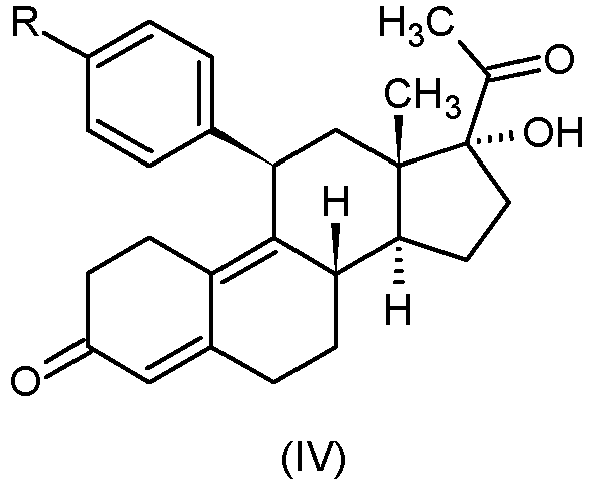
The excess of methyllithium is preferably 5-15 mol equivalent, the used tetraalkyl ethylenediamine is preferably tetramethyl ethylenediamine. The ratio of tetraalkyl ethylenediamine/methyllithium is preferably 0.5:1 - 5:1. The solvents preferably used are diethyl ether, tetrahydrofuran, methyltetrahydrofuran, methyl tert-butyl ether, diisopropyl ether, diethoxymethane, dimethoxymethane, more preferably tetrahydrofuran, dimethoxy- and diethoxymethane. The temperature of the reaction is preferably between -50- (-30)°C. In the reaction of the imine obtained as intermediate the applied mineral or strong organic acid can preferably be hydrochloric acid, sulfuric acid, potassium hydrogensulfate, sodium hydrogensulfate, p-toluenesulfonic acid or perchloric acid, more preferably sulfuric acid. The transformation of the imine is carried out in a solvent miscible with water, for example alcohol or ether miscible with water, preferably methanol, ethanol or tetrahydrofuran. The temperature of the reaction is preferably between 20 - 50°C, then- the hydroxyl group in position 17 of the obtained compound of formula (IV) (wherein the meaning of R is as described for formula (I))

- the hydroxyl group in position 17 of the obtained compound of formula (IV) (wherein the meaning of R is as described for formula (I))
- b) - the hydroxyl group in position 5 of the compound of formula (II) (wherein the meaning of R is dimethylamino or 2-methyl-1,3-dioxolan-2-yl group)

- the obtained compound of formula (III) (wherein the meaning of R is as described for formula (II))

- the hydroxyl group in position 17 of the obtained compound of formula (IV) (wherein the meaning of R is as described for formula (I))

- the obtained compound of formula (III) (wherein the meaning of R is as described for formula (II))
- The starting material of formula (II) is obtained according to the process described in the patent application No
WO2009/001148 starting from 3,3-[1,2-ethanediyl-bis-(oxy)]-estr-5(10),9(11)-dien-17-one. - Preferably first the diethoxymethane solution of methyllithium is added to the solution of the carbonitrile of formula (II) below -45°C, then the tetramethyl ethylenediamine is added. Then the reaction mixture is stirred at a temperature between -45 - (-40)°C for 3 hours. The reaction is quenched with the addition of water, while the temperature of the reaction mixture is allowed to rise to +20°C. After stirring the phases were separated, the organic phase is concentrated at reduced pressure, and the residue is stirred with methanol and IN sulfuric acid at 40°C. After basification the precipitated material is filtered off and recrystallized from a mixture of ethanol and water.
- The hydroxyl group in position 17 of the obtained diketon of formula (IV) is acetylated with acetic anhydride in dichloromethane in the presence of 70% perchloric acid at a temperature between -78 - 0°C, then the obtained final product of formula (I) is recrystallized from methanol.
- In a further embodiment of the present invention the hydroxyl group in position 5 of the carbonitrile of formula (II) is preferably silylated with chloromethyl silane in the presence of imidazole in dichloromethane at room temperature, then the diethoxymethane solution of methyllithium is added to the solution of the obtained carbonitrile of formula (III) below -40°C, then the tetramethyl ethylenediamine is added. Then the reaction mixture is stirred at a temperature between -40 - (-35)°C for 3 hours. The reaction is quenched with the addition of water, while the temperature of the reaction mixture is allowed to rise to +20°C. After stirring the phases were separated, the organic phase is concentrated at reduced pressure, and the residue is stirred with methanol and IN sulfuric acid at 40°C. After basification the precipitated material is filtered off and recrystallized from a mixture of ethanol and water.
- The hydroxyl group in position 17 of the obtained diketon of formula (IV) is acetylated with acetic anhydride in dichloromethane in the presence of 70% perchloric acid at a temperature between -78 - 0°C, then the obtained final product of formula (I) is recrystallized from methanol.
- Advantages of the process of the invention:
- a) the use of tetraalkyl ethylenediamine is beneficial as the reaction can be carried out at lower temperature and side reactions can be eliminated;
- b) the formation of the keto group of the side-chain in position 17 is carried out in the last step of the reaction sequence, therefor the protection and deprotection steps are unnecessary;
- c) according to the process of this invention the final product of formula (I) is obtained in less steps, four or five steps, as compared to the previous processes starting from 3,3-[1,2-ethanediyl-bis-(oxy)]-estr-5(10),9(11)-dien-17-one.
- 8.0 g (14.5 mM) of 11β-[4-(N,N-dimethylamino)-phenyl]-3,3-ethylenedioxy-5α-hydroxy-17α-[(trimethylsilyl)oxy]-5α-estr-9-en-17β-carbonitrile was dissolved in 130 ml of tetrahydrofuran and the solution was cooled to -50°C. First 60 ml (180 mM) of methyllithium 3.0 M solution in diethoxymethane, then 27 ml (180 mM) of tetramethyl ethylenediamine were added dropwise at such a rate to keep the reaction temperature below -45°C. The reaction mixture was stirred at a temperature between -45 - (-40)°C for 3 hours, then 70 ml of water was added dropwise very carefully to the reaction mixture while the temperature was allowed to rise to +20°C. After stirring for 5 min the phases were separated, the organic phase was washed with 20 ml of water, then it was concentrated at reduced pressure. 80 ml of methanol and 110 ml of IN sulfuric acid solution were added to the residue and the homogeneous solution was stirred at 40°C for 3 hours. This acidic solution was poured into a solution of 5.8 g of sodium carbonate in 720 ml of water, then the precipitated material was filtered off and washed with water until neutral pH. The obtained 5.2 g of crude product was recrystallized from a mixture of ethanol and water to yield 4.4 g (70%) of the title compound.
Melting point: 188-190°C
1H NMR (500 MHz, CDCl3) δ: 6.95-7.01 (m, 2H), 6.58-6.70 (m, 2H), 5.76 (s, 1H), 4.36 (m, 1H), 3.12 (s, 1H), 2.91 (s, 6H), 2.71-2.78 (m, 1H), 2.64 (m, 1H), 2.59 (dd, J=8.3, 4.4 Hz, 2H), 2.47-2.54 (m, 1H), 2.29-2.46 (m, 4H), 2.26 (s, 3H), 1.97-2.07 (m, 3H), 1.84-1.95 (m, 1H), 1.69-1.80 (m, 1H), 1.60-1.69 (m, 1H), 1.47-1.58 (m, 1H), 1.42 (qd, J=12.0, 6.1 Hz, 1H), 0.46 (s, 3H) ppm
13C NMR (125 MHz, CDCl3) δ: 211.7, 199.7, 156.8, 148.5, 146.1, 131.9, 129.1, 127.4, 122.7, 112.7, 89.6, 49.9, 48.7, 40.6, 39.3, 38.1, 36.9, 35.9, 33.2, 31.0, 28.0, 27.9, 25.8, 24.3, 16.9 ppm - 25.0 g (40.1 mM) of 11β-[4-(N,N-dimethylamino)-phenyl]-3,3-ethylenedioxy-5,17α-bis[(trimethylsilyl)oxy]-5α-estr-9-en-17β-carbonitrile was dissolved in 500 ml of dimethoxymethane and the solution was cooled to -50°C. First 66.7 ml (200 mM) of methyllithium 3.0 M solution in diethoxymethane, then 30 ml (200 mM) of tetramethyl ethylenediamine were added dropwise at such a rate to keep the reaction temperature below -40°C. The reaction mixture was stirred at a temperature between -45 - (-35)°C for 3 hours, then 210 ml of water was added dropwise very carefully to the reaction mixture while the temperature was allowed to rise to +20°C. After stirring for 5 min the phases were separated, the organic phase was washed with 50 ml of water, then it was concentrated at reduced pressure. 220 ml of methanol and 300 ml of IN sulfuric acid solution were added to the residue and the homogeneous solution was stirred at 40°C for 3 hours. This acidic solution was poured into a solution of 16 g of sodium carbonate in 2 1 of water, then the precipitated material was filtered off and washed with water until neutral pH. The obtained 14.7 g of crude product was recrystallized from a mixture of ethanol and water to yield 12.3 g (70.7%) of the title compound.
Melting point: 188-190°C
1H NMR (500 MHz, CDCl3) δ: 6.95-7.01 (m, 2H), 6.58-6.70 (m, 2H), 5.76 (s, 1H), 4.36 (m, 1H), 3.12 (s, 1H), 2.91 (s, 6H), 2.71-2.78 (m, 1H), 2.64 (m, 1H), 2.59 (dd, J=8.3, 4.4 Hz, 2H), 2.47-2.54 (m, 1H), 2.29-2.46 (m, 4H), 2.26 (s, 3H), 1.97-2.07 (m, 3H), 1.84-1.95 (m, 1H), 1.69-1.80 (m, 1H), 1.60-1.69 (m, 1H), 1.47-1.58 (m, 1H), 1.42 (qd, J=12.0, 6.1 Hz, 1H), 0.46 (s, 3H) ppm
13C NMR (125 MHz, CDCl3) δ: 211.7, 199.7, 156.8, 148.5, 146.1, 131.9, 129.1, 127.4, 122.7, 112.7, 89.6, 49.9, 48.7, 40.6, 39.3, 38.1, 36.9, 35.9, 33.2, 31.0, 28.0, 27.9, 25.8, 24.3, 16.9 ppm - 25.0 g (41.68 mM) of 3,3-ethylenedioxy-11β-[4-(2-methyl-1,3-dioxolan-2-yl)-phenyl]-5-hydroxy-17α-[(trimethylsilyl)oxy]-5α-estr-9-en-17β-carbonitrile (Example 25 of
WO2001/74840
Melting point: 134-135°C
1H NMR (800 MHz, CDCl3) δ: 7.34 (m, 2H), 7.16 (m, 2H), 4.33 (m, 1H), 3.99-4.05 (m, 2H), 3.96 (m, 1H), 3.88-3.94 (m, 1H), 3.83-3.88 (m, 1H), 3.77-3.83 (m, 2H), 3.73-3.77 (m, 1H), 2.37-2.46 (m, 1H), 2.24-2.35 (m, 3H), 2.21 (dd, J=14.4, 2.6 Hz, 1H), 2.12-2.18 (m, 1H), 2.04 (m, 1H), 2.08 (dd J=14.4, 0.9 Hz, 1H) 1.97 (ddd, J=14.8, 9.1, 5.5 Hz, 1H), 1.75-1.88 (m, 2H), 1.65-1.73 (m, 4H), 1.64 (s, 3H), 1.47-1.57 (m, 1H), 1.34 (m, 1H), 1.20 (td, J=12.8, 4.0 Hz, 1H), 0.48 (s, 3H), 0.26 (s, 9H), 0.18 (s, 9H) ppm
13C NMR (200 MHz, CDCl3) δ: 145.9, 140.3, 136.2, 132.6, 126.9, 125.1, 120.9, 108.8, 108.4, 78.8, 73.5, 64.5, 64.5, 64.4, 63.4, 50.1, 49.0, 47.2, 38.9, 38.6, 38.6, 38.5, 35.6, 34.9, 27.4, 24.6, 24.5, 23.5, 17.0, 2.6, 1.1 ppm - 10.0 g (15.0 mM) of 3,3-ethylenedioxy-11β-[4-(2-methyl-1,3-dioxolan-2-yl)-phenyl]-5,17α-bis[(trimethylsilyl)oxy]-5α-estr-9-en-17β-carbonitrile was dissolved in 150 ml of dimethoxymethane and the solution was cooled to -50°C. First 50 ml (150 mM) of methyllithium 3.0 M solution in diethoxymethane, then 22.5 ml (150 mM) of tetramethyl ethylenediamine were added dropwise at such a rate to keep the reaction temperature below -45°C. The reaction mixture was stirred at a temperature between-45 - (-40)°C for 5 hours, then 70 ml of water was added dropwise very carefully to the reaction mixture while the temperature was allowed to rise to +20°C. After stirring for 5 min the phases were separated, the organic phase was washed with 20 ml of water, then it was concentrated at reduced pressure. 150 ml of tetrahydrofuran and 50 ml of 10% hydrochloric acid solution were added to the residue and the mixture was stirred for 1 hour, then 100 ml of dichloromethane was added and the mixture was cooled to 10°C. It was neutralized with 14 ml of 25% ammonia solution and after 5 min stirring the phases were separated. The organic phase was washed with water until neutral pH, dried over anhydrous sodium sulfate and concentrated. The residue was recrystallized from a acetone to yield 5.13 g (79.0%) of the title compound.
1H NMR (500 MHz, CDCl3) δ: 7.80-7.93 (m, 2H), 7.20-7.30 (m, 2H), 5.79 (s, 1H), 4.48 (m, 1H), 3.22 (br. s., 1H), 2.72 (dt, J=15.2, 5.5 Hz, 1H), 2.59-2.67 (m, 3H), 2.57 (s, 3H), 2.52 (dd, J=13.3, 7.9 Hz, 2H), 2.39-2.47 (m, 1H), 2.30-2.38 (m, 1H), 2.20-2.30 (m, 4H), 1.99-2.14 (m, 4H), 1.88-1.98 (m, 1H), 1.76-1.88 (m, 1H), 1.66 (ddd, J=15.1, 9.4, 6.1 Hz, 1H), 1.55 (dq, J=12.8, 9.0 Hz, 1H), 1.34-1.49 (m, 1H), 0.40 (s, 3H) ppm
13C NMR (125 MHz, CDCl3) δ: 211.5, 199.2, 197.5, 156.1, 150.5, 144.1, 135.0, 129.9, 128.7, 127.1, 123.3, 89.4, 49.6, 48.6, 40.4, 38.2, 36.7, 36.2, 33.2, 31.0, 28.0, 27.8, 26.5, 25.8, 24.2, 16.8 ppm - 12.0 g (27.7 mM) of 11β-[4-(N,N-dimethylamino)-phenyl]-17-hydroxy-19-norpregna-4,9-dien-3,20-dione was dissolved in 72 ml of dichloromethane and 38 ml (402 mM) of acetic anhydride was added. The reaction mixture was cooled to -25 - (-20)°C and 5.2 ml (60.6 mM) of 70% perchloric acid was added dropwise over a period of 15-20 min. The reaction mixture was stirred at a temperature between -25 - (-20)°C for 30 min, then it was poured into a cooled (0 - (-5)°C) mixture of 64 ml of 25% aqueous ammonia and 100 ml of water. The obtained mixture was diluted with 70 ml of dichloromethane and stirred at 20-25°C for 30 min. The phases were separated, the organic phase was washed with 2x50 ml of water, dried over anhydrous sodium sulfate, filtered and concentrated in vacuum. The residue was recrystallized form methanol to yield 11.2 g (85%) of title compound.
Melting point: 184-186°C
1H NMR (CDCl3, 500 MHz) δ: 6.95-7.01 (m, 2H), 6.61-6.69 (m, 2H), 5.78 (s, 1H), 4.39 (d, J=7.3 Hz, 1H), 2.91 (s, 6H), 2.84-2.90 (m, 1H), 2.78 (ddd, J=15.0, 5.6, 5.3 Hz, 1H), 2.56-2.63 (m, 3H), 2.48-2.56 (m, 1H), 2.42-2.48 (m, 1H), 2.30-2.41 (m, 2H), 2.20 (d, J=13.2 Hz, 1H), 2.13 (s, 3H), 2.10 (s, 3H), 2.05 (dq, J=12.7, 4.4 Hz, 1H), 1.92-2.02 (m, 1H), 1.74-1.88 (m, 2H), 1.46-1.57 (m, 1H), 1.32-1.42 (m, 1H), 0.36 (s, 3H) ppm
13C NMR (CDCl3, 125 MHz) δ: 203.8, 199.5, 170.6, 156.5, 145.6, 129.3, 127.3, 122.9, 112.8, 96.2, 50.9, 47.0, 40.6, 39.3, 38.3, 36.8, 36.7, 31.0, 30.2, 27.8, 26.8, 25.8, 24.2, 21.2, 15.6 ppm - 5.0 g (11.6 mM) of 11β-(4-acetylphenyl)-17-hydroxy-19-norpregna-4,9-dien-3,20-dion was dissolved in 50 ml of dichloromethane and 17 ml (180 mM) of acetic anhydride was added. The reaction mixture was cooled to -25 -(-20)°C and 2.3 ml (38.2 mM) of 70% perchloric acid was added dropwise over a period of 15-20 min. The reaction mixture was stirred at a temperature between -25 - (-20)°C for 30 min, then it was poured into a cooled (0 - (-5)°C) mixture of 30 ml of 25% aqueous ammonia and 50 ml of water. The obtained mixture was diluted with 50 ml of dichloromethane and stirred at 20-25°C for 30 min. The phases were separated, the organic phase was washed with 2x50 ml of water, dried over anhydrous sodium sulfate, filtered and concentrated in vacuum. The residue was recrystallized form methanol to yield 4.56 g (83%) of title compound.
Melting point: 249-252°C
1H NMR (CDCl3, 500 MHz) δ: 7.84-7.90 (m, 2H), 7.24-7.28 (m, 2H), 5.81 (s, 1H), 4.50 (d, J=7.6 Hz, 1H), 2.81-2.93 (m, 1H), 2.67-2.79 (m, 2H), 2.63 (dd, J=8.1, 3.4 Hz, 2H), 2.57 (s, 3H), 2.41-2.55 (m, 2H), 2.32-2.41 (m, 1H), 2.20-2.32 (m, 2H), 2.14 (s, 3H), 2.08-2.12 (m, 1H), 2.05-2.09 (m, 1H), 1.99 (td, J=12.3, 6.6 Hz, 1H), 1.76-1.91 (m, 2H), 1.47-1.62 (m, 1H), 1.29-1.45 (m, 1H), 0.30 (s, 3H) ppm
13C NMR (CDCl3, 125 Mhz) δ: 203.6, 199.0, 197.4, 170.4, 155.8, 150.1, 143.4, 135.1, 130.1, 128.8, 127.0, 123.5, 95.7, 50.6, 47.0, 40.4, 38.4, 37.0, 36.7, 31.0, 30.3, 27.8, 27.0, 26.5, 25.8, 24.1, 21.2, 15.6 ppm
Claims (10)
- Process for the synthesis of compound of formula (I)
 a)- the compound of formula (II) (wherein the meaning of R is dimethylamino or 2-methyl-1,3-dioxolan-2-yl group)
 - the hydroxyl group in position 17 of the obtained compound of formula (IV), wherein the meaning of R is as described for formula (I),
 b)- the hydroxyl group in position 5 of the compound of formula (II) (wherein the meaning of R is dimethylamino or 2-methyl-1,3-dioxolan-2-yl group)
 - the obtained compound of formula (III), wherein the meaning of R is as described for formula (II),
 - the hydroxyl group in position 17 of the obtained compound of formula (IV), wherein the meaning of R is as described for formula (I),
- The process a) or b) according to claim 1, characterized by using an excess of 5-15 mol equivalent of methyllithium in step 1 of process a) or step 2 of process b).
- The process according to any one of claims 1-2, characterized by using tetramethyl ethylenediamine as tetraalkyl ethylenediamine in step 1 of process a) or step 2 of process b).
- The process according to any one of claims 1-3, characterized by that the ratio of tetraalkyl ethylenediamine/methyllithium is 0.5:1 - 5:1 in step 1 of process a) or step 2 of process b).
- The process according to any one of claims 1-4, characterized by using diethyl ether, tetrahydrofuran, methyltetrahydrofuran, methyl tert-butyl ether, diisopropyl ether, diethoxymethane, dimethoxymethane, preferably tetrahydrofuran, dimethoxy- and diethoxymethane as solvent in step 1 of process a) or step 2 of process b).
- The process according to any one of claims 1-5, characterized by keeping the temperature of the reaction in step 1 of process a) or step 2 of process b) between -50 - (-30)°C.
- The process according to any one of claims 1-6, characterized by reacting the protected imine intermediate obtained in step 1 of process a) or step 2 of process b) with mineral or strong organic acid, for example hydrochloric acid, sulfuric acid, potassium hydrogensulfate, sodium hydrogensulfate, p-toluenesulfonic acid, perchloric acid, preferably sulfuric acid.
- The process according to any one of claims 1-7, characterized by carrying out the transformation of the protected imine intermediate obtained in step 1 of process a) or step 2 of process b) in a solvent miscible with water, for example alcohol or ether miscible with water, preferably methanol, ethanol or tetrahydrofuran.
- The process according to any one of claims 1-8, characterized by carrying out the transformation of the protected imine intermediate obtained in step 1 of process a) or step 2 of process b) at a temperature between 0°C and the boiling point of the used organic solvent, preferably between 20-50°C.
- The compound of formula (III), wherein the meaning of R is 2-methyl-1,3-dioxolan-2-yl group:

Priority Applications (6)
| Application Number | Priority Date | Filing Date | Title |
|---|---|---|---|
| HRP20190414TT HRP20190414T1 (en) | 2013-10-01 | 2014-10-01 | INDUSTRIAL PROCEDURE FOR THE SYNTHESIS OF ULIPRISTAL ACETATE AND ITS 4'ACETYL ANALOG |
| SI201431081T SI3052513T1 (en) | 2013-10-01 | 2014-10-01 | Industrial process for the synthesis of ulipristal acetate and its 4'-acetyl analogue |
| MEP-2019-56A ME03337B (en) | 2013-10-01 | 2014-10-01 | INDUSTRIAL PROCESS FOR THE SYNTHESIS OF ULIPRISTAL ACETATE AND ITS 4'-ACETYL ANALOGUE |
| SM20190125T SMT201900125T1 (en) | 2013-10-01 | 2014-10-01 | Industrial process for the synthesis of ulipristal acetate and its 4'-acetyl analogue |
| PL14790731T PL3052513T3 (en) | 2013-10-01 | 2014-10-01 | Industrial process for the synthesis of ulipristal acetate and its 4'-acetyl analogue |
| RS20190130A RS58252B1 (en) | 2013-10-01 | 2014-10-01 | Industrial process for the synthesis of ulipristal acetate and its 4'-acetyl analogue |
Applications Claiming Priority (2)
| Application Number | Priority Date | Filing Date | Title |
|---|---|---|---|
| HU1300566A HU230319B1 (en) | 2013-10-01 | 2013-10-01 | Industrial process for the production of steroid active substances |
| PCT/IB2014/064979 WO2015049637A1 (en) | 2013-10-01 | 2014-10-01 | Industrial process for the synthesis of ulipristal acetate and its 4'-acetyl analogue |
Publications (2)
| Publication Number | Publication Date |
|---|---|
| EP3052513A1 EP3052513A1 (en) | 2016-08-10 |
| EP3052513B1 true EP3052513B1 (en) | 2018-12-05 |
Family
ID=89991273
Family Applications (1)
| Application Number | Title | Priority Date | Filing Date |
|---|---|---|---|
| EP14790731.5A Active EP3052513B1 (en) | 2013-10-01 | 2014-10-01 | Industrial process for the synthesis of ulipristal acetate and its 4'-acetyl analogue |
Country Status (32)
| Country | Link |
|---|---|
| US (1) | US9676814B2 (en) |
| EP (1) | EP3052513B1 (en) |
| JP (1) | JP6796366B2 (en) |
| KR (1) | KR20160062046A (en) |
| CN (1) | CN105593236B (en) |
| AR (1) | AR097878A1 (en) |
| AU (1) | AU2014330860B2 (en) |
| BR (1) | BR112016006979B1 (en) |
| CA (1) | CA2924553C (en) |
| CY (1) | CY1121286T1 (en) |
| DK (1) | DK3052513T3 (en) |
| EA (1) | EA030905B1 (en) |
| ES (1) | ES2713325T3 (en) |
| GE (1) | GEP20186827B (en) |
| HR (1) | HRP20190414T1 (en) |
| HU (2) | HU230319B1 (en) |
| IL (1) | IL244501A0 (en) |
| LT (1) | LT3052513T (en) |
| ME (1) | ME03337B (en) |
| MX (1) | MX355222B (en) |
| MY (1) | MY176613A (en) |
| PL (1) | PL3052513T3 (en) |
| PT (1) | PT3052513T (en) |
| RS (1) | RS58252B1 (en) |
| SG (1) | SG11201601683SA (en) |
| SI (1) | SI3052513T1 (en) |
| SM (1) | SMT201900125T1 (en) |
| TR (1) | TR201901381T4 (en) |
| UA (1) | UA118269C2 (en) |
| UY (1) | UY35766A (en) |
| WO (1) | WO2015049637A1 (en) |
| ZA (1) | ZA201601589B (en) |
Families Citing this family (4)
| Publication number | Priority date | Publication date | Assignee | Title |
|---|---|---|---|---|
| HU230381B1 (en) * | 2014-02-17 | 2016-03-29 | Richter Gedeon Nyrt | Process for producing steroid intermediate |
| CN105237607B (en) * | 2015-10-29 | 2018-10-02 | 国家卫生计生委科学技术研究所 | Uliprista acetate crystalline substance K-type substance and preparation method and its composition and purposes |
| CN112578037A (en) * | 2020-11-12 | 2021-03-30 | 湖南新合新生物医药有限公司 | Method for detecting content of hexaketal in ulipristal acetate intermediate I |
| CN112461957B (en) * | 2020-11-12 | 2022-02-22 | 湖南新合新生物医药有限公司 | Method for detecting impurity content in ulipristal acetate intermediate II |
Family Cites Families (11)
| Publication number | Priority date | Publication date | Assignee | Title |
|---|---|---|---|---|
| US4954490A (en) * | 1988-06-23 | 1990-09-04 | Research Triangle Institute | 11 β-substituted progesterone analogs |
| US5929262A (en) * | 1995-03-30 | 1999-07-27 | The United States Of America As Represented By The Department Of Health And Human Services | Method for preparing 17α-acetoxy-11β-(4-N, N-dimethylaminophyl)-19-Norpregna-4,9-diene-3, 20-dione, intermediates useful in the method, and methods for the preparation of such intermediates |
| DE69702450T2 (en) * | 1996-05-01 | 2001-03-08 | The Government Of The United States Of America As Represented By The Secretary Of National Institute Of Health, Office Of Technology Transfer | 21-SUBSTITUTED PROGESTERONE DERIVATIVES AS ANTIGESTAGEN |
| US6020328A (en) * | 1998-03-06 | 2000-02-01 | Research Triangle Institute | 20-keto-11β-arylsteroids and their derivatives having agonist or antagonist hormonal properties |
| DK1265911T3 (en) | 2000-03-17 | 2008-09-29 | Us Gov Health & Human Serv | 17-alpha-substituted-11-beta-substituted-4-aryl and 21-substituted 19-norpregnedienedione as antiprogestational agents |
| AU2004217988C1 (en) * | 2003-02-28 | 2010-06-03 | Southwest Foundation For Biomedical Research | Method for preparing 17 alpha-acetoxy-11beta-(4-N,N-dimethylaminophenyl)-19-norpregna-4,9-diene-3,20-dione, intermediates thereof, and methods for the preparation of such intermediates |
| HU227112B1 (en) | 2006-06-14 | 2010-07-28 | Richter Gedeon Nyrt | Industrial process for the synthesis of 17alpha-acetoxy-11betha-[4-(n,n-dimethyl-amino)-phenyl]-19-norpregna-4,9-diene-3,20-dione and the new intermediates of the process |
| HU228636B1 (en) * | 2007-06-27 | 2013-04-29 | Richter Gedeon Nyrt | Industrial method for the synthesis of 17-acetoxy-11betha-4[-(dimethylamino)-phenyl]-21-methoxy-19-norpregna-4,9-dien-3,20-dione and the key intermediates of the process |
| CN102477060B (en) * | 2010-11-22 | 2014-08-13 | 华润紫竹药业有限公司 | Novel steroid compound, and preparation method and application thereof |
| CN102516345B (en) * | 2011-11-01 | 2014-11-26 | 上海优拓医药科技有限公司 | Preparation method of ulipristal acetate and key intermediate thereof |
| CN103601785A (en) | 2013-11-25 | 2014-02-26 | 四川大学 | Novel synthesis method of Ulipristal acetate |
-
2013
- 2013-10-01 HU HU1300566A patent/HU230319B1/en not_active IP Right Cessation
-
2014
- 2014-10-01 MX MX2016004263A patent/MX355222B/en active IP Right Grant
- 2014-10-01 CN CN201480054468.7A patent/CN105593236B/en active Active
- 2014-10-01 AR ARP140103652A patent/AR097878A1/en not_active Application Discontinuation
- 2014-10-01 SM SM20190125T patent/SMT201900125T1/en unknown
- 2014-10-01 SI SI201431081T patent/SI3052513T1/en unknown
- 2014-10-01 CA CA2924553A patent/CA2924553C/en active Active
- 2014-10-01 PT PT14790731T patent/PT3052513T/en unknown
- 2014-10-01 EP EP14790731.5A patent/EP3052513B1/en active Active
- 2014-10-01 BR BR112016006979-0A patent/BR112016006979B1/en not_active IP Right Cessation
- 2014-10-01 SG SG11201601683SA patent/SG11201601683SA/en unknown
- 2014-10-01 PL PL14790731T patent/PL3052513T3/en unknown
- 2014-10-01 WO PCT/IB2014/064979 patent/WO2015049637A1/en not_active Ceased
- 2014-10-01 AU AU2014330860A patent/AU2014330860B2/en active Active
- 2014-10-01 KR KR1020167009887A patent/KR20160062046A/en not_active Ceased
- 2014-10-01 DK DK14790731.5T patent/DK3052513T3/en active
- 2014-10-01 UY UY0001035766A patent/UY35766A/en not_active Application Discontinuation
- 2014-10-01 JP JP2016519337A patent/JP6796366B2/en active Active
- 2014-10-01 US US15/024,822 patent/US9676814B2/en active Active
- 2014-10-01 EA EA201690467A patent/EA030905B1/en unknown
- 2014-10-01 LT LTEP14790731.5T patent/LT3052513T/en unknown
- 2014-10-01 HU HUE14790731A patent/HUE043002T2/en unknown
- 2014-10-01 ME MEP-2019-56A patent/ME03337B/en unknown
- 2014-10-01 UA UAA201604876A patent/UA118269C2/en unknown
- 2014-10-01 HR HRP20190414TT patent/HRP20190414T1/en unknown
- 2014-10-01 TR TR2019/01381T patent/TR201901381T4/en unknown
- 2014-10-01 RS RS20190130A patent/RS58252B1/en unknown
- 2014-10-01 MY MYPI2016700818A patent/MY176613A/en unknown
- 2014-10-01 GE GEAP201714130A patent/GEP20186827B/en unknown
- 2014-10-01 ES ES14790731T patent/ES2713325T3/en active Active
-
2016
- 2016-03-07 ZA ZA2016/01589A patent/ZA201601589B/en unknown
- 2016-03-08 IL IL244501A patent/IL244501A0/en active IP Right Grant
-
2019
- 2019-02-27 CY CY20191100243T patent/CY1121286T1/en unknown
Non-Patent Citations (1)
| Title |
|---|
| None * |
Also Published As
Similar Documents
| Publication | Publication Date | Title |
|---|---|---|
| AU2007258955B2 (en) | Industrial process for the synthesis of 17alpha-acetoxy-11beta-[4-(N,N-dimethyl-amino)- phenyl]-19-norpregna-4,9-diene-3,20-dione and new intermediates of the process | |
| US20120214987A1 (en) | Methods and compounds for preparing 3alpha-oxygen substituted steroids | |
| CA2846573A1 (en) | Progesterone antagonists | |
| US9676814B2 (en) | Industrial process for the synthesis of ulipristal acetate and its 4′-acetyl analogue | |
| KR20100131018A (en) | New intermediates for preparing eplerenone | |
| EP1242444B1 (en) | Process for preparing 17alpha-acetoxy-11beta- 4-n,n-(dimethylamino)phenyl]-21-methoxy-19-norpregna-4,9-diene-3,20-dione, intermediates useful in the process, and processes for preparing such intermediates | |
| WO2010118023A1 (en) | Methods for the preparation of drospirenone | |
| JPS5959700A (en) | 11beta-aryl-17alpha-alkynyl-17beta-hydroxy-4,9(10)estradin-3-one derivative, manufacture and antigestagenic pharmaceuti-cal medicine | |
| US5162312A (en) | 11β-substituted 16α, 17α-methylene-estra-4,9-dien-3-ones | |
| HK1223105B (en) | Industrial process for the synthesis of ulipristal acetate and its 4'-acetyl analogue | |
| NZ717638B2 (en) | Industrial process for the synthesis of ulipristal acetate and its 4'-acetyl analogue | |
| EP1339734B1 (en) | Method for the production of 4-(17alpha substituted 3-oxoestra-4,9-dien-11beta-yl)benzaldehyd-(1e or 1z)-oximes | |
| JP2004534796A (en) | Method for producing estrogen derivative | |
| JP2004513178A (en) | 4- (17α-methyl-substituted 3-oxoestradi-4,9-dien-11β-yl) benzaldehyde- (1E or 1Z) -oxime | |
| EP3083655B1 (en) | A process for the production of 19-norpregn-4-en-3,20-dione-17.alpha.-ol (gestonorone) and intermediates therefor. | |
| EP3107925B1 (en) | Process for the production of 21-methoxy-11-beta-phenyl-19-nor-pregna-4,9-diene-3,20-dione derivatives |
Legal Events
| Date | Code | Title | Description |
|---|---|---|---|
| PUAI | Public reference made under article 153(3) epc to a published international application that has entered the european phase |
Free format text: ORIGINAL CODE: 0009012 |
|
| 17P | Request for examination filed |
Effective date: 20160407 |
|
| AK | Designated contracting states |
Kind code of ref document: A1 Designated state(s): AL AT BE BG CH CY CZ DE DK EE ES FI FR GB GR HR HU IE IS IT LI LT LU LV MC MK MT NL NO PL PT RO RS SE SI SK SM TR |
|
| AX | Request for extension of the european patent |
Extension state: BA ME |
|
| REG | Reference to a national code |
Ref country code: HK Ref legal event code: DE Ref document number: 1223105 Country of ref document: HK |
|
| STAA | Information on the status of an ep patent application or granted ep patent |
Free format text: STATUS: EXAMINATION IS IN PROGRESS |
|
| 17Q | First examination report despatched |
Effective date: 20171214 |
|
| GRAP | Despatch of communication of intention to grant a patent |
Free format text: ORIGINAL CODE: EPIDOSNIGR1 |
|
| STAA | Information on the status of an ep patent application or granted ep patent |
Free format text: STATUS: GRANT OF PATENT IS INTENDED |
|
| INTG | Intention to grant announced |
Effective date: 20180615 |
|
| GRAS | Grant fee paid |
Free format text: ORIGINAL CODE: EPIDOSNIGR3 |
|
| RAP1 | Party data changed (applicant data changed or rights of an application transferred) |
Owner name: RICHTER GEDEON NYRT. |
|
| GRAA | (expected) grant |
Free format text: ORIGINAL CODE: 0009210 |
|
| STAA | Information on the status of an ep patent application or granted ep patent |
Free format text: STATUS: THE PATENT HAS BEEN GRANTED |
|
| AK | Designated contracting states |
Kind code of ref document: B1 Designated state(s): AL AT BE BG CH CY CZ DE DK EE ES FI FR GB GR HR HU IE IS IT LI LT LU LV MC MK MT NL NO PL PT RO RS SE SI SK SM TR |
|
| AX | Request for extension of the european patent |
Extension state: BA ME |
|
| REG | Reference to a national code |
Ref country code: GB Ref legal event code: FG4D |
|
| REG | Reference to a national code |
Ref country code: CH Ref legal event code: EP |
|
| REG | Reference to a national code |
Ref country code: AT Ref legal event code: REF Ref document number: 1072907 Country of ref document: AT Kind code of ref document: T Effective date: 20181215 |
|
| REG | Reference to a national code |
Ref country code: IE Ref legal event code: FG4D |
|
| REG | Reference to a national code |
Ref country code: DE Ref legal event code: R096 Ref document number: 602014037500 Country of ref document: DE |
|
| REG | Reference to a national code |
Ref country code: RO Ref legal event code: EPE |
|
| REG | Reference to a national code |
Ref country code: PT Ref legal event code: SC4A Ref document number: 3052513 Country of ref document: PT Date of ref document: 20190301 Kind code of ref document: T Free format text: AVAILABILITY OF NATIONAL TRANSLATION Effective date: 20190222 |
|
| REG | Reference to a national code |
Ref country code: HR Ref legal event code: TUEP Ref document number: P20190414 Country of ref document: HR |
|
| REG | Reference to a national code |
Ref country code: NL Ref legal event code: FP |
|
| REG | Reference to a national code |
Ref country code: DK Ref legal event code: T3 Effective date: 20190318 |
|
| REG | Reference to a national code |
Ref country code: SE Ref legal event code: TRGR |
|
| REG | Reference to a national code |
Ref country code: EE Ref legal event code: FG4A Ref document number: E016972 Country of ref document: EE Effective date: 20190213 |
|
| REG | Reference to a national code |
Ref country code: HR Ref legal event code: T1PR Ref document number: P20190414 Country of ref document: HR |
|
| REG | Reference to a national code |
Ref country code: NO Ref legal event code: T2 Effective date: 20181205 |
|
| REG | Reference to a national code |
Ref country code: ES Ref legal event code: FG2A Ref document number: 2713325 Country of ref document: ES Kind code of ref document: T3 Effective date: 20190521 |
|
| REG | Reference to a national code |
Ref country code: SK Ref legal event code: T3 Ref document number: E 30288 Country of ref document: SK |
|
| REG | Reference to a national code |
Ref country code: GR Ref legal event code: EP Ref document number: 20190400486 Country of ref document: GR Effective date: 20190509 |
|
| REG | Reference to a national code |
Ref country code: HU Ref legal event code: AG4A Ref document number: E043002 Country of ref document: HU |
|
| REG | Reference to a national code |
Ref country code: DE Ref legal event code: R097 Ref document number: 602014037500 Country of ref document: DE |
|
| REG | Reference to a national code |
Ref country code: HR Ref legal event code: ODRP Ref document number: P20190414 Country of ref document: HR Payment date: 20190919 Year of fee payment: 6 |
|
| PLBE | No opposition filed within time limit |
Free format text: ORIGINAL CODE: 0009261 |
|
| STAA | Information on the status of an ep patent application or granted ep patent |
Free format text: STATUS: NO OPPOSITION FILED WITHIN TIME LIMIT |
|
| 26N | No opposition filed |
Effective date: 20190906 |
|
| REG | Reference to a national code |
Ref country code: HR Ref legal event code: ODRP Ref document number: P20190414 Country of ref document: HR Payment date: 20200921 Year of fee payment: 7 |
|
| REG | Reference to a national code |
Ref country code: HR Ref legal event code: ODRP Ref document number: P20190414 Country of ref document: HR Payment date: 20210924 Year of fee payment: 8 |
|
| REG | Reference to a national code |
Ref country code: AT Ref legal event code: UEP Ref document number: 1072907 Country of ref document: AT Kind code of ref document: T Effective date: 20181205 |
|
| REG | Reference to a national code |
Ref country code: HR Ref legal event code: ODRP Ref document number: P20190414 Country of ref document: HR Payment date: 20220923 Year of fee payment: 9 |
|
| P01 | Opt-out of the competence of the unified patent court (upc) registered |
Effective date: 20230608 |
|
| REG | Reference to a national code |
Ref country code: HR Ref legal event code: ODRP Ref document number: P20190414 Country of ref document: HR Payment date: 20230922 Year of fee payment: 10 |
|
| REG | Reference to a national code |
Ref country code: HR Ref legal event code: ODRP Ref document number: P20190414 Country of ref document: HR Payment date: 20240920 Year of fee payment: 11 |
|
| PGFP | Annual fee paid to national office [announced via postgrant information from national office to epo] |
Ref country code: SM Payment date: 20250926 Year of fee payment: 12 |
|
| PGFP | Annual fee paid to national office [announced via postgrant information from national office to epo] |
Ref country code: PT Payment date: 20250918 Year of fee payment: 12 |
|
| REG | Reference to a national code |
Ref country code: HR Ref legal event code: ODRP Ref document number: P20190414 Country of ref document: HR Payment date: 20250918 Year of fee payment: 12 |
|
| PGFP | Annual fee paid to national office [announced via postgrant information from national office to epo] |
Ref country code: PL Payment date: 20250923 Year of fee payment: 12 Ref country code: TR Payment date: 20250923 Year of fee payment: 12 |
|
| PGFP | Annual fee paid to national office [announced via postgrant information from national office to epo] |
Ref country code: HR Payment date: 20250918 Year of fee payment: 12 |
|
| PGFP | Annual fee paid to national office [announced via postgrant information from national office to epo] |
Ref country code: MT Payment date: 20250922 Year of fee payment: 12 |
|
| PGFP | Annual fee paid to national office [announced via postgrant information from national office to epo] |
Ref country code: RS Payment date: 20250918 Year of fee payment: 12 Ref country code: CZ Payment date: 20250925 Year of fee payment: 12 |
|
| PGFP | Annual fee paid to national office [announced via postgrant information from national office to epo] |
Ref country code: RO Payment date: 20250922 Year of fee payment: 12 |
|
| PGFP | Annual fee paid to national office [announced via postgrant information from national office to epo] |
Ref country code: SK Payment date: 20250923 Year of fee payment: 12 |
|
| PGFP | Annual fee paid to national office [announced via postgrant information from national office to epo] |
Ref country code: SI Payment date: 20250918 Year of fee payment: 12 |
|
| REG | Reference to a national code |
Ref country code: CH Ref legal event code: U11 Free format text: ST27 STATUS EVENT CODE: U-0-0-U10-U11 (AS PROVIDED BY THE NATIONAL OFFICE) Effective date: 20251101 |
|
| PGFP | Annual fee paid to national office [announced via postgrant information from national office to epo] |
Ref country code: MK Payment date: 20250922 Year of fee payment: 12 |
|
| PGFP | Annual fee paid to national office [announced via postgrant information from national office to epo] |
Ref country code: HU Payment date: 20250929 Year of fee payment: 12 |
|
| PGFP | Annual fee paid to national office [announced via postgrant information from national office to epo] |
Ref country code: LU Payment date: 20251022 Year of fee payment: 12 Ref country code: NL Payment date: 20251021 Year of fee payment: 12 |
|
| PGFP | Annual fee paid to national office [announced via postgrant information from national office to epo] |
Ref country code: IS Payment date: 20251013 Year of fee payment: 12 Ref country code: DE Payment date: 20251021 Year of fee payment: 12 |
|
| PGFP | Annual fee paid to national office [announced via postgrant information from national office to epo] |
Ref country code: GB Payment date: 20251022 Year of fee payment: 12 Ref country code: LT Payment date: 20250929 Year of fee payment: 12 |
|
| PGFP | Annual fee paid to national office [announced via postgrant information from national office to epo] |
Ref country code: NO Payment date: 20251024 Year of fee payment: 12 Ref country code: MC Payment date: 20251023 Year of fee payment: 12 |
|
| PGFP | Annual fee paid to national office [announced via postgrant information from national office to epo] |
Ref country code: AT Payment date: 20251022 Year of fee payment: 12 |
|
| PGFP | Annual fee paid to national office [announced via postgrant information from national office to epo] |
Ref country code: FI Payment date: 20251028 Year of fee payment: 12 Ref country code: DK Payment date: 20251027 Year of fee payment: 12 Ref country code: IT Payment date: 20251024 Year of fee payment: 12 |
|
| PGFP | Annual fee paid to national office [announced via postgrant information from national office to epo] |
Ref country code: FR Payment date: 20251030 Year of fee payment: 12 |
|
| PGFP | Annual fee paid to national office [announced via postgrant information from national office to epo] |
Ref country code: BE Payment date: 20251021 Year of fee payment: 12 Ref country code: GR Payment date: 20251022 Year of fee payment: 12 Ref country code: AL Payment date: 20251001 Year of fee payment: 12 |
|
| PGFP | Annual fee paid to national office [announced via postgrant information from national office to epo] |
Ref country code: SE Payment date: 20251021 Year of fee payment: 12 Ref country code: CH Payment date: 20251101 Year of fee payment: 12 |
|
| PGFP | Annual fee paid to national office [announced via postgrant information from national office to epo] |
Ref country code: IE Payment date: 20251024 Year of fee payment: 12 Ref country code: CY Payment date: 20250912 Year of fee payment: 12 |
|
| PGFP | Annual fee paid to national office [announced via postgrant information from national office to epo] |
Ref country code: LV Payment date: 20251015 Year of fee payment: 12 |
|
| PGFP | Annual fee paid to national office [announced via postgrant information from national office to epo] |
Ref country code: BG Payment date: 20251023 Year of fee payment: 12 |
|
| PGFP | Annual fee paid to national office [announced via postgrant information from national office to epo] |
Ref country code: EE Payment date: 20251106 Year of fee payment: 12 |
|
| PGFP | Annual fee paid to national office [announced via postgrant information from national office to epo] |
Ref country code: ES Payment date: 20251210 Year of fee payment: 12 |