EP3045899A1 - Method for evaluating abrasion resistance of polymeric material - Google Patents
Method for evaluating abrasion resistance of polymeric material Download PDFInfo
- Publication number
- EP3045899A1 EP3045899A1 EP16158330.7A EP16158330A EP3045899A1 EP 3045899 A1 EP3045899 A1 EP 3045899A1 EP 16158330 A EP16158330 A EP 16158330A EP 3045899 A1 EP3045899 A1 EP 3045899A1
- Authority
- EP
- European Patent Office
- Prior art keywords
- measurement
- polymeric material
- scattering
- rays
- neutrons
- Prior art date
- Legal status (The legal status is an assumption and is not a legal conclusion. Google has not performed a legal analysis and makes no representation as to the accuracy of the status listed.)
- Granted
Links
Images

Classifications
-
- G—PHYSICS
- G01—MEASURING; TESTING
- G01N—INVESTIGATING OR ANALYSING MATERIALS BY DETERMINING THEIR CHEMICAL OR PHYSICAL PROPERTIES
- G01N23/00—Investigating or analysing materials by the use of wave or particle radiation, e.g. X-rays or neutrons, not covered by groups G01N3/00 – G01N17/00, G01N21/00 or G01N22/00
- G01N23/20—Investigating or analysing materials by the use of wave or particle radiation, e.g. X-rays or neutrons, not covered by groups G01N3/00 – G01N17/00, G01N21/00 or G01N22/00 by using diffraction of the radiation by the materials, e.g. for investigating crystal structure; by using scattering of the radiation by the materials, e.g. for investigating non-crystalline materials; by using reflection of the radiation by the materials
- G01N23/201—Investigating or analysing materials by the use of wave or particle radiation, e.g. X-rays or neutrons, not covered by groups G01N3/00 – G01N17/00, G01N21/00 or G01N22/00 by using diffraction of the radiation by the materials, e.g. for investigating crystal structure; by using scattering of the radiation by the materials, e.g. for investigating non-crystalline materials; by using reflection of the radiation by the materials by measuring small-angle scattering
-
- G—PHYSICS
- G01—MEASURING; TESTING
- G01N—INVESTIGATING OR ANALYSING MATERIALS BY DETERMINING THEIR CHEMICAL OR PHYSICAL PROPERTIES
- G01N23/00—Investigating or analysing materials by the use of wave or particle radiation, e.g. X-rays or neutrons, not covered by groups G01N3/00 – G01N17/00, G01N21/00 or G01N22/00
- G01N23/20—Investigating or analysing materials by the use of wave or particle radiation, e.g. X-rays or neutrons, not covered by groups G01N3/00 – G01N17/00, G01N21/00 or G01N22/00 by using diffraction of the radiation by the materials, e.g. for investigating crystal structure; by using scattering of the radiation by the materials, e.g. for investigating non-crystalline materials; by using reflection of the radiation by the materials
- G01N23/207—Diffractometry using detectors, e.g. using a probe in a central position and one or more displaceable detectors in circumferential positions
- G01N23/2073—Diffractometry using detectors, e.g. using a probe in a central position and one or more displaceable detectors in circumferential positions using neutron detectors
-
- G—PHYSICS
- G01—MEASURING; TESTING
- G01N—INVESTIGATING OR ANALYSING MATERIALS BY DETERMINING THEIR CHEMICAL OR PHYSICAL PROPERTIES
- G01N2223/00—Investigating materials by wave or particle radiation
- G01N2223/10—Different kinds of radiation or particles
- G01N2223/1006—Different kinds of radiation or particles different radiations, e.g. X and alpha
-
- G—PHYSICS
- G01—MEASURING; TESTING
- G01N—INVESTIGATING OR ANALYSING MATERIALS BY DETERMINING THEIR CHEMICAL OR PHYSICAL PROPERTIES
- G01N2223/00—Investigating materials by wave or particle radiation
- G01N2223/10—Different kinds of radiation or particles
- G01N2223/101—Different kinds of radiation or particles electromagnetic radiation
- G01N2223/1016—X-ray
-
- G—PHYSICS
- G01—MEASURING; TESTING
- G01N—INVESTIGATING OR ANALYSING MATERIALS BY DETERMINING THEIR CHEMICAL OR PHYSICAL PROPERTIES
- G01N2223/00—Investigating materials by wave or particle radiation
- G01N2223/10—Different kinds of radiation or particles
- G01N2223/106—Different kinds of radiation or particles neutrons
-
- G—PHYSICS
- G01—MEASURING; TESTING
- G01N—INVESTIGATING OR ANALYSING MATERIALS BY DETERMINING THEIR CHEMICAL OR PHYSICAL PROPERTIES
- G01N2223/00—Investigating materials by wave or particle radiation
- G01N2223/60—Specific applications or type of materials
- G01N2223/623—Specific applications or type of materials plastics
Definitions
- the present invention relates to methods for evaluating energy loss, chipping resistance, and abrasion resistance of a polymeric material.
- Energy loss, chipping resistance, and abrasion resistance of polymeric materials such as rubber materials are important physical quantities that can affect various properties of products formed from these materials.
- the energy loss is closely related to fuel economy and grip performance, while the chipping resistance and abrasion resistance are closely related to the life of the tires.
- a road test is commonly performed in which the incidence of chipping of a tire tread portion or the groove depth is measured after driving a predetermined distance.
- a road test is commonly performed in which the incidence of chipping of a tire tread portion or the groove depth is measured after driving a predetermined distance.
- a Lambourn abrasion test and DIN abrasion test are known as the method for evaluating abrasion resistance in a short period of time and at low cost.
- these methods cause great errors, and their measurement accuracy is insufficient although some degree of correlation is found between results of these tests and road test results.
- Another problem is that in the case where differences between samples are small, such differences cannot be evaluated with good reproducibility (see Non patent Literature 1).
- Patent Literature 1 JP-A 2009-46088
- Non patent Literature 1 Nippon Gomu Kyokaishi (the Journal of SRIJ) (vol. 69, No. 11, p. 739, 1996 )
- the present invention aims to solve the above problems and provide a method for evaluating energy loss in a polymeric material, wherein the method provides sufficient evaluation of the difference in performance between samples with excellent measurement accuracy.
- the present invention also aims to solve the above problems and provide a method for evaluating chipping resistance of a polymeric material, wherein the method provides evaluation in a short period of time and at low cost with excellent measurement accuracy. Further, the present invention aims to solve the above problems and provide a method for evaluating abrasion resistance of a polymeric material, wherein the method provides sufficient evaluation of the difference in performance between samples with excellent measurement accuracy.
- a first aspect of the present invention relates to a method for evaluating energy loss in a polymeric material, the method including irradiating the polymeric material with X-rays or neutrons to perform X-ray scattering measurement or neutron scattering measurement.
- the X-ray scattering measurement is small-angle X-ray scattering measurement
- the neutron scattering measurement is small-angle neutron scattering measurement
- the polymeric material is preferably a rubber material formed from at least one conjugated diene compound.
- the rubber material is preferably a rubber material for tires.
- a second aspect of the present invention relates to a method for evaluating chipping resistance of a polymeric material, the method including irradiating the polymeric material with X-rays or neutrons to perform X-ray scattering measurement or neutron scattering measurement.
- the X-ray scattering measurement is small-angle X-ray scattering measurement
- the neutron scattering measurement is small-angle neutron scattering measurement
- the polymeric material is preferably a rubber material formed from at least one conjugated diene compound.
- the rubber material is preferably a rubber material for tires.
- measurement is preferably performed using the X-rays or neutrons under a condition where q defined by equation 2-1 is in a range of not more than 10 nm -1 .
- q 4 ⁇ sin ⁇ / 2 ⁇ ( ⁇ : scattering angle; ⁇ : wavelength of X-rays or neutrons).
- a third aspect of the present invention relates to a method for evaluating abrasion resistance of a polymeric material, the method including irradiating the polymeric material with X-rays or neutrons to perform X-ray scattering measurement or neutron scattering measurement.
- the X-ray scattering measurement is small-angle X-ray scattering measurement
- the neutron scattering measurement is small-angle neutron scattering measurement
- the polymeric material is preferably a rubber material formed from at least one conjugated diene compound.
- the rubber material is preferably a rubber material for tires.
- the method for evaluating abrasion resistance of a polymeric material according to the third aspect of the present invention is preferably a method wherein the abrasion resistance is evaluated based on a number N c per unit volume of scatterers having a correlation length ⁇ c in a range of 1 nm to 100 ⁇ m determined by curve fitting equations 3-2 to 3-6 to a scattering intensity curve I (q) obtained by the X-ray scattering measurement or neutron scattering measurement:
- the first aspect of the present invention provides a method for evaluating energy loss in a polymeric material, the method including irradiating the polymeric material with X-rays or neutrons to perform X-ray scattering measurement or neutron scattering measurement. Accordingly, measurement errors can be reduced and thus the energy loss can be evaluated with high measurement accuracy. Additionally, the method of the first aspect enables highly accurate evaluation of the difference in energy loss between samples whose difference in performance cannot be evaluated with good reproducibility by dynamic viscoelasticity measurement or the like.
- the second aspect of the present invention provides a method for evaluating chipping resistance of a polymeric material, the method including irradiating the polymeric material with X-rays or neutrons to perform X-ray scattering measurement or neutron scattering measurement. Accordingly, measurement errors can be reduced and thus the chipping resistance can be evaluated with high measurement accuracy. Additionally, the method of the second aspect enables the chipping resistance to be evaluated easily in a short period of time and at low cost.
- the third aspect of the present invention provides a method for evaluating abrasion resistance of a polymeric material, the method including irradiating the polymeric material with X-rays or neutrons to perform X-ray scattering measurement or neutron scattering measurement. Accordingly, measurement errors can be reduced and thus the abrasion resistance can be evaluated with high measurement accuracy. Additionally, the method of the third aspect enables highly accurate evaluation of the difference in abrasion resistance between samples whose difference in performance cannot be evaluated with good reproducibility by a Lambourn abrasion test, DIN abrasion test or the like.
- Fig. 1 shows an example of scattering intensity curves of samples of Examples 1-4, 2-4, and 3-4 obtained by SAXS measurement.
- the first aspect of the present invention provides a method for evaluating energy loss in a polymeric material, the method including irradiating the polymeric material with X-rays or neutrons to perform X-ray scattering measurement or neutron scattering measurement.
- a polymeric material such as a rubber material containing a filler such as carbon black or silica can be subjected to small-angle X-ray scattering measurement or small-angle neutron scattering measurement to determine the radius of gyration (Rg) of a cluster of 1 nm to 100 ⁇ m formed by aggregation of the filler in the material. Since the Rg is highly correlated with the energy loss (i.e., the smaller the Rg, the less the energy loss), and the number N of scatterers having the Rg is also highly correlated with the energy loss (i.e., the lower the N, the less the energy loss), the energy loss in the polymeric material can be evaluated by the measurement.
- the energy loss in a rubber material containing a filler is generally considered to be highly affected by dispersibility of the filler in the material as well as by the polymer component; however, the evaluation methods that use R g or N are to measure dispersibility of filler to evaluate the energy loss, and thus the energy loss in a polymer is not directly evaluated.
- the energy loss in a filler-free rubber material may be unable to be evaluated with high accuracy.
- the respective energy losses may not be evaluated with high accuracy.
- the method of the first aspect of the present invention has been completed based on the finding that when small-angle X-ray scattering measurement or small-angle neutron scattering measurement is performed to calculate a correlation length ⁇ in the range of 0.1 nm to 100 ⁇ m, which is presumed to correspond to the distance between crosslinking points in a polymer, and correlation lengths ⁇ b and ⁇ c in the range of 0.1 nm to 100 ⁇ m, which are presumed to correspond to the size of a heterogeneous network structure in a polymer, the correlation lengths ⁇ is highly correlated with the energy loss, i.e. , the smaller the ⁇ , the less the energy loss, even in the case of filler-free polymeric materials. Accordingly, the energy loss in any polymeric material can be evaluated with high accuracy through X-ray or neutron scattering measurement, regardless of the presence or absence of filler.
- the reason for the correlation between the correlation lengths ⁇ and the energy loss is not entirely clear, it is presumed that the energy loss decreases with a decrease in the distance between crosslinking points in a polymer in which the distance between crosslinking points is 0.1 nm to 100 ⁇ m, because the shorter the distance between crosslinking points, the better the distribution of the crosslinking points, which means that a force is then uniformly applied to the entire rubber material without causing stress concentration.
- small-angle X-ray scattering (SAXS (scattering angle: typically, not more than 10 degrees)) measurement in which a polymeric material is irradiated with X-rays to measure the scattering intensity can be suitably employed as the X-ray scattering measurement for evaluating energy loss in a polymeric material.
- SAXS scattering angle: typically, not more than 10 degrees
- structural information of a substance can be obtained by measuring X-rays scattered at small scattering angles among the scattered X-rays resulting from the irradiation of the substance with X-rays. In this way, ordered structures of few nanometers, such as microphase-separated structures, of polymeric materials can be analyzed.
- the X-rays emitted from a synchrotron preferably have a brilliance of at least 10 10 (photons/s/mrad 2 /mm 2 /0 . 1%bw).
- the "bw" refers to the band width of X-rays emitted from a synchrotron.
- Examples of such synchrotrons include BL03XU and BL20XU, which are beamlines at the large-scale synchrotron radiation facility SPring-8 of the Japan Synchrotron Radiation Research Institute.
- the brilliance (photons/s/mrad 2 /mm 2 /0.1%bw) of the X-rays is preferably 10 10 or more, and more preferably 10 12 or more.
- the intensity of the X-rays is preferably within a range that does not cause radiation damage.
- the number of photons (photons/s) in the X-rays is preferably 10 7 or more, and more preferably 10 9 or more.
- the intensity of the X-rays is preferably within a range that does not cause radiation damage.
- small-angle neutron scattering SANS (scattering angle: typically, not more than 10 degrees)
- the neutron scattering measurement for evaluating energy loss in a polymeric material.
- structural information of a substance can be obtained by measuring neutrons scattered at small scattering angles among the scattered neutrons resulting from the irradiation of the substance with neutrons. In this way, ordered structures of few nanometers, such as microphase-separated structures, of polymeric materials can be analyzed.
- a deuteration technique for example, a polymeric material is swollen in a deuterated solvent, and the polymeric material in equilibrium in the deuterated solvent is then irradiated with neutrons to measure the scattering intensity.
- the neutron beam used for neutron scattering measurement such as SANS may be obtained from, for example, SANS-J, which is a beamline at JRR-3 of the Japan Atomic Energy Agency, an independent administrative agency.
- the flux density of the neutrons is preferably 10 3 or more, and more preferably 10 4 or more, for obtaining a neutron scattering profile with a high S/N ratio as is the case of the SAXS measurement.
- the upper limit is not particularly limited, the neutron flux density is preferably within a range that does not cause radiation damage.
- the X-ray or neutron scattering measurement is preferably performed using the X-rays or neutrons under a condition where q defined by equation 1-1 is in the range of not more than 10 nm -1 , for the need to measure finer molecular structures of the polymeric material.
- This q range (nm -1 ) is preferred because a greater numerical value provides finer pieces of information.
- the X-rays scattered in the SAXS measurement are detected by an X-ray detector, and an image is then generated by an image processor or the like using X-ray detection data from the X-ray detector.
- X-ray detectors examples include two-dimensional detectors (e.g., X-ray film, nuclear emulsion plate, X-ray pickup tube, X-ray fluorescent amplifier tube, X-ray image intensifier, X-rayimaging plate, CCD X-ray detector, amorphous X-ray detectors, etc.) and line sensors (one-dimensional detectors).
- the X-ray detector may be appropriately selected according to the type and conditions of a polymeric material to be analyzed.
- Any ordinary image processor that can generate X-ray scattering images based on X-ray detection data from the X-ray detector can be appropriately used.
- the SANS measurement can also be performed based on the same principle as in the SAXS measurement.
- the scattered neutrons are detected by a neutron detector, and an image is then generated by an image processor or the like using neutron detection data from the neutron detector.
- an image processor or the like using neutron detection data from the neutron detector.
- any known two-dimensional detector or one-dimensional detector can be used as the neutron detector, and any known image processor that can generate neutron scattering images can be used. These devices may be appropriately selected.
- the polymeric material in the first aspect of the present invention is not particularly limited and may be any conventionally known polymeric material.
- Examples include rubber materials formed from at least one conjugated diene compound, and composite materials in which the rubber materials are combined with at least one resin.
- the conjugated diene compound is not particularly limited. Examples thereof include known compounds such as isoprene and butadiene.
- Examples of such rubber materials include polymers containing double bonds, such as natural rubber (NR), isoprene rubber (IR), butadiene rubber (BR), styrene butadiene rubber (SBR), acrylonitrile butadiene rubber (NBR), chloroprene rubber (CR), butyl rubber (IIR), halogenated butyl rubber (X-IIR), and styrene isoprene butadiene rubber (SIBR).
- the polymeric materials such as rubber materials and composite materials mentioned above may contain at least one modifying group such as a hydroxyl or amino group.
- the resin is not particularly limited. Examples thereof include resins widely used in the rubber industry, such as C5 aliphatic petroleum resins, cyclopentadiene petroleum resins, and other petroleum resins.
- Suitable examples of polymeric materials include rubber materials and composite materials, which contain at least one metal-coordinating functional group in their molecular structure.
- any metal-coordinating functional group can be used and examples thereof include functional groups containing a metal-coordinating atom such as oxygen, nitrogen, or sulfur.
- Specific examples include a dithiocarbamic acid group, phosphoric acid group, carboxylic acid group, carbamic acid group, dithioic acid group, aminophosphoric acid group, and thiol group.
- the polymeric material may contain only one or two or more types of functional groups mentioned above.
- metals that coordinate to the functional group(s) include Fe, Cu, Ag, Co, Mn, Ni, Ti, V, Zn, Mo, W, Os, Mg, Ca, Sr, Ba, Al, and Si.
- M 1 metal-coordinating functional group
- each -COOM 1 binds to each other by coordinate bonds, resulting in overlapping of many -COOM 1 groups and thereby forming clusters of aggregated metal atoms.
- the amount of the metal atom (M 1 ) is preferably 0.01 to 200 parts by mass per 100 parts by mass of the polymer component of the polymeric material.
- Suitable examples of polymeric materials also include rubber materials and composite materials, which containfillers.
- examples of fillers include carbon black and silica; and fillers represented by mM 2 ⁇ xSiO y ⁇ zH 2 O (wherein M 2 represents at least one metal selected from the group consisting of aluminum, calcium, magnesium, titanium, and zirconium; or an oxide, hydroxide, hydrate, or carbonate of the metal; m represents a number of 1 to 5; x represents a number of 0 to 10; y represents a number of 2 to 5; and z represents a number of 0 to 10).
- fillers represented by mM 2 ⁇ xSiO y ⁇ zH 2 O include aluminum hydroxide (Al(OH) 3 ), alumina (Al 2 O 3 , Al 2 O 3 ⁇ 3H 2 O (hydrate)), clay (Al 2 O 3 ⁇ 2SiO 2 ), kaolin (Al 2 O 3 ⁇ 2SiO 2 ⁇ 2H 2 O), pyrophyllite (Al 2 O 3 ⁇ 4SiO 2 ⁇ H 2 O), bentonite (Al 2 O 3 ⁇ 4SiO 2 ⁇ 2H 2 O), aluminium silicate (Al 2 SiO 5 , Al 4 (SiO 2 ) 3 ⁇ 5H 2 O, and the like), calcium aluminium silicate (Al 2 O 3 ⁇ CaO ⁇ 2SiO 2 ), calcium hydroxide (Ca(OH) 2 ), calcium oxide (CaO), calcium silicate (Ca 2 SiO 4 ), magnesium calcium silicate (CaMgSiO 4
- the rubber materials and composite materials may contain other additives generally used in the field of rubber industry (e.g. silane coupling agents, zinc oxides, stearic acid, various antioxidants, oils, waxes, vulcanizing agents, vulcanization accelerators, and crosslinking agents). These rubber materials and composite materials can be prepared by a known kneading method and the like. Examples of these rubber materials and composite materials include those used as rubber materials for tires.
- a scattering intensity curve of a polymeric material obtained by SAXS measurement or SANS measurement can be analyzed, for example, by the following method to thereby determine the correlation length ⁇ in the range of 1 nm to 100 ⁇ m (the distance between crosslinking points in the polymer).
- a scattering intensity curve I (q) obtained by SAXS measurement or SANS measurement as shown in Fig. 1 is curve fitted with equations 1-2 and 1-3, and fitting parameters are then determined by least squares.
- I q A 1 + q 2 ⁇ 2 + B 1 + q 2 ⁇ b 2 2 + C 1 + q 2 ⁇ c 2 2 ⁇ ⁇ ⁇ b ⁇ ⁇ c
- the correlation lengths ⁇ in the range of 1 nm to 100 ⁇ m is presumed to correspond to the distance between crosslinking points in a polymer, and the correlation lengths ⁇ b and ⁇ c are presumed to correspond to the size of a heterogeneous network structure in a polymer.
- the correlation length ⁇ is highly correlated with the energy loss, i.e., the smaller the ⁇ , the less the energy loss.
- the ⁇ is considered to have a great influence on the energy loss.
- the energy loss in any polymeric material can be evaluated, regardless of the presence or absence of filler, by performing X-ray scattering measurement such as SAXS or neutron scattering measurement such as SANS and then determining ⁇ by curve fitting with equations 1-2 and 1-3.
- the energy loss in the polymer itself can be taken into consideration by the first aspect of the present invention, particularly, the evaluation method that uses the correlation length ⁇ . Accordingly, the energy loss not only in rubber materials containing filler but also in filler-free rubber materials and the like can be evaluated with high accuracy. Additionally, the first aspect enables highly accurate evaluation of the difference in energy loss between samples whose difference in performance cannot be evaluated with good reproducibility by dynamic viscoelasticity measurement or the like.
- the second aspect of the present invention provides a method for evaluating chipping resistance of a polymeric material, the method including irradiating the polymeric material with X-rays or neutrons to perform X-ray scattering measurement or neutron scattering measurement.
- the method of the second aspect of the present invention has been completed based on the finding that when small-angle X-ray scattering measurement or small-angle neutron scattering measurement is performed on a polymeric material such as a rubber material to calculate a correlation lengths ⁇ in the range of 0.1 nm to 100 ⁇ m, which is presumed to correspond to the distance between crosslinking points in a polymer, and correlation lengths ⁇ b and ⁇ c in the range of 0.1 nm to 100 ⁇ m, which are presumed to correspond to the size of a heterogeneous network structure in a polymer, the correlation length ⁇ c is highly correlated with the chipping resistance, i.e., the smaller the ⁇ c , the better the chipping resistance. Accordingly, the chipping resistance of a polymeric material can be easily evaluated with high accuracy through X-ray or neutron scattering measurement.
- the chipping resistance improves with a decrease in the size of a heterogeneous network structure in a polymer because chipping starts from a heterogeneous network structure of 0.1 nm to 100 ⁇ m in a polymer, which means that the smaller the heterogeneous structure in the polymer, the less likely chipping starts therefrom.
- small-angle X-ray scattering (scattering angle: typically, not more than 10 degrees)) measurement in which a polymeric material is irradiated with X-rays to measure the scattering intensity
- SAXS scattering angle: typically, not more than 10 degrees
- structural information of a substance can be obtained by measuring X-rays scattered at small scattering angles among the scattered X-rays resulting from the irradiation of the substance with X-rays. In this way, ordered structures of few nanometers, such as microphase-separated structures, of polymeric materials can be analyzed.
- the X-rays emitted from a synchrotron preferably have a brilliance of at least 10 10 (photons/s/mrad 2 /mm 2 /0.1%bw).
- the "bw" refers to the band width of X-rays emitted from a synchrotron.
- Examples of such synchrotrons include BL03XU and BL20XU, which are beamlines at the large-scale synchrotron radiation facility SPring-8 of the Japan Synchrotron Radiation Research Institute.
- the brilliance of the X-rays and the number of photons in the X-rays are preferably the same as those in the first aspect of the present invention.
- small-angle neutron scattering SANS (scattering angle: typically, not more than 10 degrees)
- the neutron scattering measurement for evaluating chipping resistance of a polymeric material.
- structural information of a substance can be obtained by measuring neutrons scattered at small scattering angles among the scattered neutrons resulting from the irradiation of the substance with neutrons. In this way, ordered structures of few nanometers, such as microphase-separated structures, of polymeric materials can be analyzed.
- the SANS measurement known methods that use magnetic structures or deuteration techniques can be used, as is the case with the first aspect of the present invention. Also, the flux density of the neutrons may be the same as in the first aspect.
- the X-ray or neutron scattering measurement is preferably performed using the X-rays or neutrons under a condition where q defined by equation 2-1 is in the range of not more than 10 nm -1 , for the need to measure finer molecular structures of the polymeric material.
- This q range (nm -1 ) is preferred because a greater numerical value provides finer pieces of information.
- the X-rays scattered in the SAXS measurement and the neutrons scattered in the SANS measurement can be measured by the same principle as in the first aspect of the present invention.
- the polymeric material is not particularly limited. Examples thereof include those mentioned in the first aspect of the present invention.
- the amount of the metal atom (M 1 ) and the amount of the filler are also preferably in the same ranges as described above.
- the polymeric material may also contain other additives as described in the first aspect of the present invention.
- the polymeric material can be prepared by the same method, and it may be a rubber material for tires or the like.
- a scattering intensity curve of a polymeric material obtained by SAXS measurement or SANS measurement can be analyzed, for example, by the following method to thereby determine the correlation length ⁇ c in the range of 1 nm to 100 ⁇ m (the size of a heterogeneous network structure in the polymer).
- a scattering intensity curve I (q) obtained by SAXS measurement or SANS measurement as shown in Fig. 1 is curve fitted with equations 2-2 and 2-3, and fitting parameters are then determined by least squares.
- I q A 1 + q 2 ⁇ 2 + B 1 + q 2 ⁇ b 2 2 + C 1 + q 2 ⁇ c 2 2 ⁇ ⁇ ⁇ b ⁇ ⁇ c
- the correlation lengths ⁇ in the range of 1 nm to 100 ⁇ m is presumed to correspond to the distance between crosslinking points in a polymer
- the correlation lengths ⁇ b and ⁇ c are presumed to correspond to the size of a heterogeneous network structure in a polymer.
- the correlation length ⁇ e is highly correlated with the chipping resistance, i.e., the smaller the ⁇ c , the better the chipping resistance.
- the ⁇ c is considered to have a great influence on the chipping resistance.
- the chipping resistance of a polymeric material can be evaluated by performing X-ray scattering measurement such as SAXS or neutron scattering measurement such as SANS and then determining ⁇ e by curve fitting with equations 2-2 and 2-3.
- the heterogeneity of the crosslinked structure of the polymer can be taken into consideration by the second aspect of the present invention, particularly, the evaluation method that uses the correlation length ⁇ c . Accordingly, the chipping resistance of rubber materials and the like can be evaluated with high accuracy. Additionally, the second aspect enables the chipping resistance to be easily evaluated without building a tire and carrying out a road test. Thus, efficient development is enabled.
- the third aspect of the present invention provides a method for evaluating abrasion resistance of a polymeric material, the method including irradiating the polymeric material with X-rays or neutrons to perform X-ray scattering measurement or neutron scattering measurement.
- the method of the third aspect of the present invention has been completed based on the finding that when small-angle X-ray scattering measurement or small-angle neutron scattering measurement is performed on a polymeric material such as a rubber material to calculate a correlation length ⁇ in the range of 0.1 nm to 100 ⁇ m, which is presumed to correspond to the distance between crosslinking points in a polymer, and correlation lengths ⁇ b and ⁇ c in the range of 0.1 nm to 100 ⁇ m, which are presumed to correspond to the size of a heterogeneous network structure in a polymer, the abrasion resistance is highly correlated with a number N c of scatterers (heterogeneous network structures) having the correlation length ⁇ c per unit volume, i.e., the higher the N c , the better the abrasion resistance. Accordingly, the abrasion resistance of a polymeric material can be evaluated with high accuracy through X-ray or neutron scattering measurement.
- the abrasion resistance improves with an increase in the number of heterogeneous network structures having the correlation length ⁇ c in the range of 0.1 nm to 100 ⁇ m because the heterogeneous network structures play a role of suppressing crack growth, which means that the greater the number of heterogeneous network structures, the more suppressed the crack growth.
- small-angle X-ray scattering (SAXS (scattering angle: typically, not more than 10 degrees)) measurement in which a polymeric material is irradiated with X-rays to measure the scattering intensity can be suitably employed as the X-ray scattering measurement for evaluating abrasion resistance of a polymeric material.
- SAXS scattering angle: typically, not more than 10 degrees
- structural information of a substance can be obtained by measuring X-rays scattered at small scattering angles among the scattered X-rays resulting from the irradiation of the substance with X-rays. In this way, ordered structures of few nanometers, such as microphase-separated structures, of polymeric materials can be analyzed.
- the X-rays emitted from a synchrotron preferably have a brilliance of at least 10 10 (photons/s/mrad 2 /mm 2 /0.1%bw).
- the "bw" refers to the band width of X-rays emitted from a synchrotron.
- Examples of such synchrotrons include BL03XU and BL20XU, which are beamlines at the large-scale synchrotron radiation facility SPring-8 of the Japan Synchrotron Radiation Research Institute.
- the brilliance of the X-rays and the number of photons in the X-rays are preferably the same as those in the first aspect of the present invention.
- small-angle neutron scattering SANS (scattering angle: typically, not more than 10 degrees)
- the neutron scattering measurement for evaluating abrasion resistance of a polymeric material.
- structural information of a substance can be obtained by measuring neutrons scattered at small scattering angles among the scattered neutrons resulting from the irradiation of the substance with neutrons. In this way, ordered structures of few nanometers, such as microphase-separated structures, of polymeric materials can be analyzed.
- the X-ray or neutron scattering measurement is preferably performed using the X-rays or neutrons under a condition where q defined by equation 3-1 is in the range of not more than 10 nm -1 , for the need to measure finer molecular structures of the polymeric material.
- This q range (nm -1 ) is preferred because a greater numerical value provides finer pieces of information.
- the X-rays scattered in the SAXS measurement and the neutrons scattered in the SANS measurement can be measured by the same principle as in the first aspect of the present invention.
- the polymeric material is not particularly limited. Examples thereof include those mentioned in the first aspect of the present invention.
- the amount of the metal atom (M 1 ) and the amount of the filler are also preferably in the same ranges as described above.
- the polymeric material may also contain other additives as described in the first aspect of the present invention.
- the polymeric material can be prepared by the same method as in the first aspect, and it may be a rubber material for tires or the like.
- a scattering intensity curve of a polymeric material obtained by SAXS measurement or SANS measurement is analyzed, for example, by the following method to thereby determine the number N c of scatterers (heterogeneous network structures) having the correlation length ⁇ c in the range of 1 nm to 100 ⁇ m per unit volume.
- a scattering intensity curve I (q) obtained by SAXS measurement or SANS measurement as shown in Fig. 1 is curve fitted with equations 3-2 to 3-6, and fitting parameters are then determined by least squares.
- B 4 ⁇ N b ⁇ 2 ⁇ b 2
- C 4 ⁇ N c ⁇ 2 ⁇ c 2
- the correlation length ⁇ in the range of 1 nm to 100 ⁇ m is presumed to correspond to the distance between crosslinking points in a polymer
- the correlation lengths ⁇ b and ⁇ e are presumed to correspond to the size of a heterogeneous network structure in a polymer.
- the number N c of scatterers (heterogeneous network structures) having the correlation length ⁇ c per unit volume is highly correlated with the abrasion resistance, i.e., the higher the N c , the better the abrasion resistance.
- N c is considered to have a great influence on the abrasion resistance.
- the abrasion resistance of a polymeric material can be evaluated by performing X-ray scattering measurement such as SAXS or neutron scattering measurement such as SANS and then determining N c by curve fitting with equations 3-2 to 3-6.
- the heterogeneity of the crosslinked structure of the polymer can be taken into consideration by the third aspect of the present invention, particularly, the evaluation method that uses the number N c of scatterers (heterogeneous network structures) having the correlation length ⁇ c in the range of 1 nm to 100 ⁇ m per unit volume. Accordingly, the abrasion resistance of rubber materials and the like can be evaluated with high accuracy. Additionally, the third aspect enables highly accurate evaluation of the difference in abrasion resistance between samples whose difference in performance cannot be evaluated with good reproducibility by a Lambourn abrasion test, DIN abrasion test or the like.
- a sufficiently nitrogen-purged vessel (100-mL) was charged with 50 mL of cyclohexane, 4.1 mL of pyrrolidine, and 8.9 mL of divinylbenzene. Further, 0.7 mL of 1.6 M n-butyllithium in hexane was added to the vessel at 0°C, and the mixture was stirred. After one hour, isopropanol was added thereto to terminate the reaction. The reaction mixture was extracted and purified to thereby obtain monomer (1).
- a sufficiently nitrogen-purged, pressure-resistant vessel (1000-mL) was charged with 600 mL of cyclohexane, 12.6 mL of styrene, 71.0 mL of butadiene, 0.06 g of monomer (1), and 0.11 mL of tetramethylethylenediamine. Further, 0.2 mL of 1.6 M n-butyllithium in hexane was added to the vessel at 40°C, and the mixture was stirred. After three hours, 0.5 mL of the modifier was added to the mixture, and the resulting mixture was stirred. After one hour, 3 mL of isopropanol was added thereto to terminate the polymerization. After addition of 1 g of 2,6-di-tert-butyl-p-cresol to the reaction solution, the reaction solution was reprecipitated with methanol and dried with heat to thereby obtain polymer (1).
- Polymer (2) was obtained by the same method used to obtain polymer (1), except that the amount of monomer (1) was 0.17 g.
- Polymer (3) was obtained by the same method used to obtain polymer (1), except that the amount of monomer (1) was 0.29 g.
- the energy loss, chipping resistance, and abrasion resistance of the obtained molded products were evaluated by the following test methods: SAXS measurement method, dynamic viscoelasticity measurement method, Lambourn abrasion test, and road test. The results are given in the tables.
- a plate-like sample (molded product) having a thickness of about 1 mm was swollen to equilibrium in deuterated toluene, and attached to a sample holder. The sample was then irradiated with neutrons at room temperature. Absolute scattering intensity curves obtained by measuring the sample at distances of 2.5 m, 10 m, and 10 m with a focusing lens from the detector were combined by least squares. These three curves were combined in the following manner: the scattering intensity curve obtained by measuring the sample at a distance of 2.5 m from the detector was fixed, and the scattering intensity curves obtained by measuring the sample at a distance of 10 m with and without a focusing lens from the detector were shifted.
- the thus obtained scattering intensity curve I (q) was curve fitted with equations 1-2 and 1-3, and a fitting parameter (correlation length in the range of 1 nm to 100 ⁇ m (distance between crosslinking points in the polymer)) was then determined by least squares.
- the obtained value of correlation lengths ⁇ was expressed as an index, with the value determined in Example 1-1 as 100. A higher index value indicates less energy loss.
- SANS SANS device in SANS-J, which is a beamline at JRR-3 of the Japan Atomic Energy Agency, an independent administrative agency.
- Two-dimensional detector 3 He 2d detector and two-dimensional photomultiplier tube + ZnS/ 6 LiF detector
- a spectrometer available from Ueshima Seisakusho Co. , Ltd. was used to measure the tan ⁇ at a dynamic strain amplitude of 1%, a frequency of 10 Hz, and a temperature of 60°C.
- the reciprocal of the determined tan ⁇ was expressed as an index, with the value of Comparative Example 1-1 as 100. A higher index value indicates less energy loss.
- Test tires including tire components formed from the compositions of Examples 1-1 to 1-6 and Comparative Examples 1-1 to 1-6 were run with a rim of 15 ⁇ 6JJ at an internal pressure of 230 kPa, a load of 3.43 kN, and a speed of 80 km/h in a rolling resistance tester to measure the rolling resistance.
- the rolling resistance was expressed as an index, with the value of Comparative Example 1-1 as 100. A higher index value indicates better rolling performance of the tire and less energy loss.
- the scattering intensity curve I (q) obtained by the SANS measurement method was curve fitted with equations 2-2 and 2-3, and a fitting parameter ⁇ c (correlation length in the range of 1 nm to 100 ⁇ m (size of a heterogeneous network structure in the polymer)) was then determined by least squares.
- the obtained value of correlation length ⁇ c was expressed as an index, with the value determined in Example 2-1 as 100. A lower index value indicates higher chipping resistance.
- Test tires (tire size: 195/65R15) including tire tread portions formed from the compositions of Comparative Examples 2-1 to 2-6 were each mounted on a Japanese FF (front-engine, front-wheel drive) car, and the number of chipped spots in the tire tread portion of each tire after driving 8000 km was counted. The determined number was expressed as an index, with the value of Comparative Example 1-1 as 100. A lower index value indicates higher chipping resistance.
- the scattering intensity curve I(q) obtained by the SANS measurement method was curve fitted with equations 3-2 to 3-6, and a fitting parameter ⁇ e (correlation length in the range of 1 nm to 100 ⁇ m (size of a heterogeneous network structure in the polymer)) was then determined by least squares. Further, the number N c of scatterers having the correlation length ⁇ e per unit volume was determined based on the obtained value of correlation length ⁇ c . The determined value of N c was expressed as an index, with the value of Example 3-1 as 100. A higher index value indicates higher abrasion resistance.
- a Lambourn abrasion tester was used to measure the amount of abrasion at room temperature, a load of 1.0 kgf, and a slip ratio of 30%.
- the reciprocal of the determined amount of abrasion was expressed as an index, with the value of Comparative Example 3-1 as 100. A higher index value indicates higher abrasion resistance.
- Test tires (tire size: 195/65R15) including tire tread portions formed from the compositions of Examples 3-1 to 3-6 and Comparative Examples 3-1 to 3-6 were each mounted on a Japanese FF (front-engine, front-wheel drive) car, and the groove depth in the tire tread portion of each tire after driving 8000 km was then measured. Based on the measured groove depth, the running distance corresponding to a 1 mm reduction in the groove depth of the tire was calculated, and then expressed as an index using the following equation, with the result of Comparative Example 3-1 as 100. A higher index value indicates better abrasion resistance.
- the examples in which SANS measurement was used demonstrated that the abrasion resistance can be evaluated by determining the number N c of scatterers having the correlation length ⁇ c per unit volume by curve fitting with equations 3-2 to 3-6.
- the SANS measurement method provides highly accurate measurement of a small difference in abrasion resistance between samples, which is difficult to evaluate by a Lambourn abrasion test. It is also clear that the abrasion resistance can be successfully evaluated regardless of the presence or absence of carbon black.
Landscapes
- Chemical & Material Sciences (AREA)
- Physics & Mathematics (AREA)
- Analytical Chemistry (AREA)
- Crystallography & Structural Chemistry (AREA)
- Health & Medical Sciences (AREA)
- Life Sciences & Earth Sciences (AREA)
- Biochemistry (AREA)
- General Health & Medical Sciences (AREA)
- General Physics & Mathematics (AREA)
- Immunology (AREA)
- Pathology (AREA)
- Spectroscopy & Molecular Physics (AREA)
- Analysing Materials By The Use Of Radiation (AREA)
- Processes Of Treating Macromolecular Substances (AREA)
- Compositions Of Macromolecular Compounds (AREA)
Abstract
Description
- The present invention relates to methods for evaluating energy loss, chipping resistance, and abrasion resistance of a polymeric material.
- Energy loss, chipping resistance, and abrasion resistance of polymeric materials such as rubber materials are important physical quantities that can affect various properties of products formed from these materials. For example, in the case of tires as rubber products, the energy loss is closely related to fuel economy and grip performance, while the chipping resistance and abrasion resistance are closely related to the life of the tires.
- As a method for evaluating energy loss in a polymeric material, a technique of measuring the loss tangent (tan δ) by dynamic viscoelasticity measurement is widely used (see Patent Literature 1). However, this technique causes great errors, and its measurement accuracy is insufficient. Another problem is that in the case where differences between samples are small, such differences cannot be evaluated with good reproducibility.
- As a method for evaluating chipping resistance or abrasion resistance of a tire, for example, a road test is commonly performed in which the incidence of chipping of a tire tread portion or the groove depth is measured after driving a predetermined distance. However, since such a method requires building of a tire and long-distance driving, there is a demand for an efficient evaluation method that provides measurement in a short period of time and at low cost. Yet, such an efficient method for evaluating chipping resistance is generally unknown.
- Further, a Lambourn abrasion test and DIN abrasion test are known as the method for evaluating abrasion resistance in a short period of time and at low cost. However, these methods cause great errors, and their measurement accuracy is insufficient although some degree of correlation is found between results of these tests and road test results. Another problem is that in the case where differences between samples are small, such differences cannot be evaluated with good reproducibility (see Non patent Literature 1).
- Patent Literature 1:
JP-A 2009-46088 - Non patent Literature 1: Nippon Gomu Kyokaishi (the Journal of SRIJ) (vol. 69, No. 11, p. 739, 1996)
- The present invention aims to solve the above problems and provide a method for evaluating energy loss in a polymeric material, wherein the method provides sufficient evaluation of the difference in performance between samples with excellent measurement accuracy. The present invention also aims to solve the above problems and provide a method for evaluating chipping resistance of a polymeric material, wherein the method provides evaluation in a short period of time and at low cost with excellent measurement accuracy. Further, the present invention aims to solve the above problems and provide a method for evaluating abrasion resistance of a polymeric material, wherein the method provides sufficient evaluation of the difference in performance between samples with excellent measurement accuracy.
- A first aspect of the present invention relates to a method for evaluating energy loss in a polymeric material, the method including irradiating the polymeric material with X-rays or neutrons to perform X-ray scattering measurement or neutron scattering measurement.
- In the first aspect of the present invention, preferably, the X-ray scattering measurement is small-angle X-ray scattering measurement, and the neutron scattering measurement is small-angle neutron scattering measurement.
- In the first aspect of the present invention, the polymeric material is preferably a rubber material formed from at least one conjugated diene compound. Here, the rubber material is preferably a rubber material for tires.
- In the method for evaluating energy loss in a polymeric material according to the first aspect of the present invention, measurement is preferably performed using the X-rays or neutrons under a condition where q defined by equation 1-1 is in a range of not more than 10 nm-1:

- The method for evaluating energy loss in a polymeric material according to the first aspect of the present invention is preferably a method wherein the energy loss is evaluated based on a correlation lengths ξ in a range of 1 nm to 100 µm determined by curve fitting equations 1-2 and 1-3 to a scattering intensity curve I(q) obtained by the X-ray scattering measurement or neutron scattering measurement:


- (A, B, C, ξ, Ξb , Ξc : fitting parameters)
- (q: as defined above).
- A second aspect of the present invention relates to a method for evaluating chipping resistance of a polymeric material, the method including irradiating the polymeric material with X-rays or neutrons to perform X-ray scattering measurement or neutron scattering measurement.
- In the second aspect of the present invention, preferably, the X-ray scattering measurement is small-angle X-ray scattering measurement, and the neutron scattering measurement is small-angle neutron scattering measurement.
- In the second aspect of the present invention, the polymeric material is preferably a rubber material formed from at least one conjugated diene compound. Here, the rubber material is preferably a rubber material for tires.
- In the method for evaluating chipping resistance of a polymeric material according to the second aspect of the present invention, measurement is preferably performed using the X-rays or neutrons under a condition where q defined by equation 2-1 is in a range of not more than 10 nm-1.

- The method for evaluating chipping resistance of a polymeric material according to the second aspect of the present invention is preferably a method wherein the chipping resistance is evaluated based on a correlation length Ξc in a range of 1 nm to 100 µm determined by curve fitting equations 2-2 and 2-3 to a scattering intensity curve I(q) obtained by the X-ray scattering measurement or neutron scattering measurement:


- (A, B, C, ξ, Ξb , Ξc :fitting parameters)
- (q: as defined above).
- A third aspect of the present invention relates to a method for evaluating abrasion resistance of a polymeric material, the method including irradiating the polymeric material with X-rays or neutrons to perform X-ray scattering measurement or neutron scattering measurement.
- In the third aspect of the present invention, preferably, the X-ray scattering measurement is small-angle X-ray scattering measurement, and the neutron scattering measurement is small-angle neutron scattering measurement.
- In the third aspect of the present invention, the polymeric material is preferably a rubber material formed from at least one conjugated diene compound. Here, the rubber material is preferably a rubber material for tires.
- In the method for evaluating abrasion resistance of a polymeric material according to the third aspect of the present invention, measurement is preferably performed using the X-rays or neutrons under a condition where q defined by equation 3-1 is in a range of not more than 10 nm-1:

- The method for evaluating abrasion resistance of a polymeric material according to the third aspect of the present invention is preferably a method wherein the abrasion resistance is evaluated based on a number Nc per unit volume of scatterers having a correlation length Ξc in a range of 1 nm to 100 µm determined by curve fitting equations 3-2 to 3-6 to a scattering intensity curve I(q) obtained by the X-ray scattering measurement or neutron scattering measurement:


- (A, B, C, ξ, Ξb , Ξc :fitting parameters)
- (q: as defined above)
- (Na: number of scatterers having correlation length ξ per unit volume (N/cm3))
- (Nb: number of scatterers having correlation length Ξb per unit volume (N/cm3))
- (Nc: number of scatterers having correlation length Ξc per unit volume (N/cm3))
- (σ: electron density difference (electron·cm-3) between scatterer and surrounding matrix material, or scattering length density difference (cm-2) between scatterer and surrounding deuterated solvent).
- The first aspect of the present invention provides a method for evaluating energy loss in a polymeric material, the method including irradiating the polymeric material with X-rays or neutrons to perform X-ray scattering measurement or neutron scattering measurement. Accordingly, measurement errors can be reduced and thus the energy loss can be evaluated with high measurement accuracy. Additionally, the method of the first aspect enables highly accurate evaluation of the difference in energy loss between samples whose difference in performance cannot be evaluated with good reproducibility by dynamic viscoelasticity measurement or the like.
- The second aspect of the present invention provides a method for evaluating chipping resistance of a polymeric material, the method including irradiating the polymeric material with X-rays or neutrons to perform X-ray scattering measurement or neutron scattering measurement. Accordingly, measurement errors can be reduced and thus the chipping resistance can be evaluated with high measurement accuracy. Additionally, the method of the second aspect enables the chipping resistance to be evaluated easily in a short period of time and at low cost.
- The third aspect of the present invention provides a method for evaluating abrasion resistance of a polymeric material, the method including irradiating the polymeric material with X-rays or neutrons to perform X-ray scattering measurement or neutron scattering measurement. Accordingly, measurement errors can be reduced and thus the abrasion resistance can be evaluated with high measurement accuracy. Additionally, the method of the third aspect enables highly accurate evaluation of the difference in abrasion resistance between samples whose difference in performance cannot be evaluated with good reproducibility by a Lambourn abrasion test, DIN abrasion test or the like.
-
Fig. 1 shows an example of scattering intensity curves of samples of Examples 1-4, 2-4, and 3-4 obtained by SAXS measurement. - The first aspect of the present invention provides a method for evaluating energy loss in a polymeric material, the method including irradiating the polymeric material with X-rays or neutrons to perform X-ray scattering measurement or neutron scattering measurement.
- A polymeric material such as a rubber material containing a filler such as carbon black or silica can be subjected to small-angle X-ray scattering measurement or small-angle neutron scattering measurement to determine the radius of gyration (Rg) of a cluster of 1 nm to 100 µm formed by aggregation of the filler in the material. Since the Rg is highly correlated with the energy loss (i.e., the smaller the Rg, the less the energy loss), and the number N of scatterers having the Rg is also highly correlated with the energy loss (i.e., the lower the N, the less the energy loss), the energy loss in the polymeric material can be evaluated by the measurement.
- In this regard, the energy loss in a rubber material containing a filler is generally considered to be highly affected by dispersibility of the filler in the material as well as by the polymer component; however, the evaluation methods that use Rg or N are to measure dispersibility of filler to evaluate the energy loss, and thus the energy loss in a polymer is not directly evaluated. Hence, the energy loss in a filler-free rubber material may be unable to be evaluated with high accuracy. For example, in the case of evaluation of rubber materials containing fillers of similar dispersibility, the respective energy losses may not be evaluated with high accuracy.
- In this context, the method of the first aspect of the present invention has been completed based on the finding that when small-angle X-ray scattering measurement or small-angle neutron scattering measurement is performed to calculate a correlation length ξ in the range of 0.1 nm to 100 µm, which is presumed to correspond to the distance between crosslinking points in a polymer, and correlation lengths Ξb and Ξc in the range of 0.1 nm to 100 µm, which are presumed to correspond to the size of a heterogeneous network structure in a polymer, the correlation lengths ξ is highly correlated with the energy loss, i.e. , the smaller the ξ, the less the energy loss, even in the case of filler-free polymeric materials. Accordingly, the energy loss in any polymeric material can be evaluated with high accuracy through X-ray or neutron scattering measurement, regardless of the presence or absence of filler.
- Here, although the reason for the correlation between the correlation lengths ξ and the energy loss is not entirely clear, it is presumed that the energy loss decreases with a decrease in the distance between crosslinking points in a polymer in which the distance between crosslinking points is 0.1 nm to 100 µm, because the shorter the distance between crosslinking points, the better the distribution of the crosslinking points, which means that a force is then uniformly applied to the entire rubber material without causing stress concentration.
- In the first aspect of the present invention, small-angle X-ray scattering (SAXS (scattering angle: typically, not more than 10 degrees)) measurement in which a polymeric material is irradiated with X-rays to measure the scattering intensity can be suitably employed as the X-ray scattering measurement for evaluating energy loss in a polymeric material. In the small-angle X-ray scattering, structural information of a substance can be obtained by measuring X-rays scattered at small scattering angles among the scattered X-rays resulting from the irradiation of the substance with X-rays. In this way, ordered structures of few nanometers, such as microphase-separated structures, of polymeric materials can be analyzed.
- In order to obtain detailed molecular structural information from the SAXS measurement, it is preferred that an X-ray scattering profile with a high S/N ratio be measurable. For this reason, the X-rays emitted from a synchrotron preferably have a brilliance of at least 1010 (photons/s/mrad2/mm2/0 . 1%bw). The "bw" refers to the band width of X-rays emitted from a synchrotron. Examples of such synchrotrons include BL03XU and BL20XU, which are beamlines at the large-scale synchrotron radiation facility SPring-8 of the Japan Synchrotron Radiation Research Institute.
- The brilliance (photons/s/mrad2/mm2/0.1%bw) of the X-rays is preferably 1010 or more, and more preferably 1012 or more. Although the upper limit is not particularly limited, the intensity of the X-rays is preferably within a range that does not cause radiation damage.
- Also, the number of photons (photons/s) in the X-rays is preferably 107 or more, and more preferably 109 or more. Although the upper limit is not particularly limited, the intensity of the X-rays is preferably within a range that does not cause radiation damage.
- Additionally, in the first aspect of the present invention, small-angle neutron scattering (SANS (scattering angle: typically, not more than 10 degrees)) measurement in which a polymeric material is irradiated with neutrons to measure the scattering intensity can be suitably employed as the neutron scattering measurement for evaluating energy loss in a polymeric material. In the small-angle neutron scattering, structural information of a substance can be obtained by measuring neutrons scattered at small scattering angles among the scattered neutrons resulting from the irradiation of the substance with neutrons. In this way, ordered structures of few nanometers, such as microphase-separated structures, of polymeric materials can be analyzed.
- For the SANS measurement, known methods that use magnetic structures or deuteration techniques can be used. In the case where a deuteration technique is used, for example, a polymeric material is swollen in a deuterated solvent, and the polymeric material in equilibrium in the deuterated solvent is then irradiated with neutrons to measure the scattering intensity. Here, examples of deuterated solvents used to swell the polymeric material include heavy water, deuterated hexane, deuterated toluene, deuterated chloroform, deuterated methanol, deuterated DMSO ((D3C)2S=O), deuterated tetrahydrofuran, deuterated acetonitrile, deuterated dichloromethane, deuterated benzene, and deuterated N,N-dimethylformamide.
- The neutron beam used for neutron scattering measurement such as SANS may be obtained from, for example, SANS-J, which is a beamline at JRR-3 of the Japan Atomic Energy Agency, an independent administrative agency.
- The flux density of the neutrons (neutrons/cm2/s) is preferably 103 or more, and more preferably 104 or more, for obtaining a neutron scattering profile with a high S/N ratio as is the case of the SAXS measurement. Although the upper limit is not particularly limited, the neutron flux density is preferably within a range that does not cause radiation damage.
- The X-ray or neutron scattering measurement is preferably performed using the X-rays or neutrons under a condition where q defined by equation 1-1 is in the range of not more than 10 nm-1, for the need to measure finer molecular structures of the polymeric material. This q range (nm-1) is preferred because a greater numerical value provides finer pieces of information. Thus, q is more preferably in the range of not more than 20 nm-1:

- The X-rays scattered in the SAXS measurement are detected by an X-ray detector, and an image is then generated by an image processor or the like using X-ray detection data from the X-ray detector.
- Examples of X-ray detectors include two-dimensional detectors (e.g., X-ray film, nuclear emulsion plate, X-ray pickup tube, X-ray fluorescent amplifier tube, X-ray image intensifier, X-rayimaging plate, CCD X-ray detector, amorphous X-ray detectors, etc.) and line sensors (one-dimensional detectors). The X-ray detector may be appropriately selected according to the type and conditions of a polymeric material to be analyzed.
- Any ordinary image processor that can generate X-ray scattering images based on X-ray detection data from the X-ray detector can be appropriately used.
- The SANS measurement can also be performed based on the same principle as in the SAXS measurement. The scattered neutrons are detected by a neutron detector, and an image is then generated by an image processor or the like using neutron detection data from the neutron detector. Here, as is the case described above, any known two-dimensional detector or one-dimensional detector can be used as the neutron detector, and any known image processor that can generate neutron scattering images can be used. These devices may be appropriately selected.
- The polymeric material in the first aspect of the present invention is not particularly limited and may be any conventionally known polymeric material. Examples include rubber materials formed from at least one conjugated diene compound, and composite materials in which the rubber materials are combined with at least one resin. The conjugated diene compound is not particularly limited. Examples thereof include known compounds such as isoprene and butadiene.
- Examples of such rubber materials include polymers containing double bonds, such as natural rubber (NR), isoprene rubber (IR), butadiene rubber (BR), styrene butadiene rubber (SBR), acrylonitrile butadiene rubber (NBR), chloroprene rubber (CR), butyl rubber (IIR), halogenated butyl rubber (X-IIR), and styrene isoprene butadiene rubber (SIBR). The polymeric materials such as rubber materials and composite materials mentioned above may contain at least one modifying group such as a hydroxyl or amino group.
- The resin is not particularly limited. Examples thereof include resins widely used in the rubber industry, such as C5 aliphatic petroleum resins, cyclopentadiene petroleum resins, and other petroleum resins.
- Suitable examples of polymeric materials include rubber materials and composite materials, which contain at least one metal-coordinating functional group in their molecular structure. Here, any metal-coordinating functional group can be used and examples thereof include functional groups containing a metal-coordinating atom such as oxygen, nitrogen, or sulfur. Specific examples include a dithiocarbamic acid group, phosphoric acid group, carboxylic acid group, carbamic acid group, dithioic acid group, aminophosphoric acid group, and thiol group. The polymeric material may contain only one or two or more types of functional groups mentioned above.
- Examples of metals that coordinate to the functional group(s) include Fe, Cu, Ag, Co, Mn, Ni, Ti, V, Zn, Mo, W, Os, Mg, Ca, Sr, Ba, Al, and Si. For example, in the case of a polymeric material that includes a compound containing such a metal atom (M1) and also contains a metal-coordinating functional group (such as -COO), each -COOM1 binds to each other by coordinate bonds, resulting in overlapping of many -COOM1 groups and thereby forming clusters of aggregated metal atoms. The amount of the metal atom (M1) is preferably 0.01 to 200 parts by mass per 100 parts by mass of the polymer component of the polymeric material.
- Suitable examples of polymeric materials also include rubber materials and composite materials, which containfillers. Here, examples of fillers include carbon black and silica; and fillers represented by mM2·xSiOy·zH2O (wherein M2 represents at least one metal selected from the group consisting of aluminum, calcium, magnesium, titanium, and zirconium; or an oxide, hydroxide, hydrate, or carbonate of the metal; m represents a number of 1 to 5; x represents a number of 0 to 10; y represents a number of 2 to 5; and z represents a number of 0 to 10).
- Specific examples of fillers represented by mM2·xSiOy·zH2O include aluminum hydroxide (Al(OH)3), alumina (Al2O3, Al2O3·3H2O (hydrate)), clay (Al2O3·2SiO2), kaolin (Al2O3·2SiO2·2H2O), pyrophyllite (Al2O3·4SiO2·H2O), bentonite (Al2O3·4SiO2·2H2O), aluminium silicate (Al2SiO5, Al4 (SiO2)3·5H2O, and the like), calcium aluminium silicate (Al2O3·CaO·2SiO2), calcium hydroxide (Ca(OH)2), calcium oxide (CaO), calcium silicate (Ca2SiO4), magnesium calcium silicate (CaMgSiO4), magnesium hydroxide (Mg(OH)2), magnesium oxide (MgO), talc (MgO·4SiO2·H2O), attapulgite (5MgO·8SiO2·9H2O), aluminum magnesium oxide (MgO·Al2O3), titanium while (TiO2), and titanium black (TinO2n-1). Aggregated filler clusters can be formed in polymeric materials containing such fillers. The amount of the filler is preferably 10 to 200 parts by mass per 100 parts by mass of the polymer component of the polymeric material.
- The rubber materials and composite materials may contain other additives generally used in the field of rubber industry (e.g. silane coupling agents, zinc oxides, stearic acid, various antioxidants, oils, waxes, vulcanizing agents, vulcanization accelerators, and crosslinking agents). These rubber materials and composite materials can be prepared by a known kneading method and the like. Examples of these rubber materials and composite materials include those used as rubber materials for tires.
- Next is a specific explanation of a method for analyzing a scattering intensity curve obtained by the X-ray scattering measurement or neutron scattering measurement of a polymeric material.
- A scattering intensity curve of a polymeric material obtained by SAXS measurement or SANS measurement can be analyzed, for example, by the following method to thereby determine the correlation length ξ in the range of 1 nm to 100 µm (the distance between crosslinking points in the polymer).
- A scattering intensity curve I(q) obtained by SAXS measurement or SANS measurement as shown in
Fig. 1 is curve fitted with equations 1-2 and 1-3, and fitting parameters are then determined by least squares.

- (A, B, C, ξ, Ξb , Ξc : fitting)
- (q: as defined above)
- Among the obtained fitting parameters, the correlation lengths ξ in the range of 1 nm to 100 µm is presumed to correspond to the distance between crosslinking points in a polymer, and the correlation lengths Ξb and Ξc are presumed to correspond to the size of a heterogeneous network structure in a polymer. As described above, the correlation length ξ is highly correlated with the energy loss, i.e., the smaller the ξ, the less the energy loss. Thus, the ξ is considered to have a great influence on the energy loss. Accordingly, the energy loss in any polymeric material can be evaluated, regardless of the presence or absence of filler, by performing X-ray scattering measurement such as SAXS or neutron scattering measurement such as SANS and then determining ξ by curve fitting with equations 1-2 and 1-3.
- The energy loss in the polymer itself can be taken into consideration by the first aspect of the present invention, particularly, the evaluation method that uses the correlation length ξ. Accordingly, the energy loss not only in rubber materials containing filler but also in filler-free rubber materials and the like can be evaluated with high accuracy. Additionally, the first aspect enables highly accurate evaluation of the difference in energy loss between samples whose difference in performance cannot be evaluated with good reproducibility by dynamic viscoelasticity measurement or the like.
- Next, the second aspect of the present invention provides a method for evaluating chipping resistance of a polymeric material, the method including irradiating the polymeric material with X-rays or neutrons to perform X-ray scattering measurement or neutron scattering measurement.
- The method of the second aspect of the present invention has been completed based on the finding that when small-angle X-ray scattering measurement or small-angle neutron scattering measurement is performed on a polymeric material such as a rubber material to calculate a correlation lengths ξ in the range of 0.1 nm to 100 µm, which is presumed to correspond to the distance between crosslinking points in a polymer, and correlation lengths Ξb and Ξc in the range of 0.1 nm to 100 µm, which are presumed to correspond to the size of a heterogeneous network structure in a polymer, the correlation length Ξc is highly correlated with the chipping resistance, i.e., the smaller the Ξc, the better the chipping resistance. Accordingly, the chipping resistance of a polymeric material can be easily evaluated with high accuracy through X-ray or neutron scattering measurement.
- Here, although the reason for the correlation between the correlation length Ξc and the chipping resistance is not entirely clear, it is presumed that the chipping resistance improves with a decrease in the size of a heterogeneous network structure in a polymer because chipping starts from a heterogeneous network structure of 0.1 nm to 100 µm in a polymer, which means that the smaller the heterogeneous structure in the polymer, the less likely chipping starts therefrom.
- In the second aspect of the present invention, small-angle X-ray scattering (SAXS (scattering angle: typically, not more than 10 degrees)) measurement in which a polymeric material is irradiated with X-rays to measure the scattering intensity can be suitably employed as the X-ray scattering measurement for evaluating chipping resistance of a polymeric material. In the small-angle X-ray scattering, structural information of a substance can be obtained by measuring X-rays scattered at small scattering angles among the scattered X-rays resulting from the irradiation of the substance with X-rays. In this way, ordered structures of few nanometers, such as microphase-separated structures, of polymeric materials can be analyzed.
- In order to obtain detailed molecular structural information from the SAXS measurement, it is preferred that an X-ray scattering profile with a high S/N ratio be measurable. For this reason, the X-rays emitted from a synchrotron preferably have a brilliance of at least 1010 (photons/s/mrad2/mm2/0.1%bw). The "bw" refers to the band width of X-rays emitted from a synchrotron. Examples of such synchrotrons include BL03XU and BL20XU, which are beamlines at the large-scale synchrotron radiation facility SPring-8 of the Japan Synchrotron Radiation Research Institute.
- In the second aspect of the present invention, the brilliance of the X-rays and the number of photons in the X-rays are preferably the same as those in the first aspect of the present invention.
- Additionally, in the second aspect of the present invention, small-angle neutron scattering (SANS (scattering angle: typically, not more than 10 degrees)) measurement in which a polymeric material is irradiated with neutrons to measure the scattering intensity can be suitably employed as the neutron scattering measurement for evaluating chipping resistance of a polymeric material. In the small-angle neutron scattering, structural information of a substance can be obtained by measuring neutrons scattered at small scattering angles among the scattered neutrons resulting from the irradiation of the substance with neutrons. In this way, ordered structures of few nanometers, such as microphase-separated structures, of polymeric materials can be analyzed.
- For the SANS measurement, known methods that use magnetic structures or deuteration techniques can be used, as is the case with the first aspect of the present invention. Also, the flux density of the neutrons may be the same as in the first aspect.
- The X-ray or neutron scattering measurement is preferably performed using the X-rays or neutrons under a condition where q defined by equation 2-1 is in the range of not more than 10 nm-1, for the need to measure finer molecular structures of the polymeric material. This q range (nm-1) is preferred because a greater numerical value provides finer pieces of information. Thus, q is more preferably in the range of not more than 20 nm-1:

- The X-rays scattered in the SAXS measurement and the neutrons scattered in the SANS measurement can be measured by the same principle as in the first aspect of the present invention.
- In the second aspect of the present invention, the polymeric material is not particularly limited. Examples thereof include those mentioned in the first aspect of the present invention. The amount of the metal atom (M1) and the amount of the filler are also preferably in the same ranges as described above.
- The polymeric material may also contain other additives as described in the first aspect of the present invention. Moreover, the polymeric material can be prepared by the same method, and it may be a rubber material for tires or the like.
- Next is a specific explanation of a method for analyzing a scattering intensity curve obtained by the X-ray scattering measurement or neutron scattering measurement of a polymeric material.
- A scattering intensity curve of a polymeric material obtained by SAXS measurement or SANS measurement can be analyzed, for example, by the following method to thereby determine the correlation length Ξc in the range of 1 nm to 100 µm (the size of a heterogeneous network structure in the polymer).
- A scattering intensity curve I(q) obtained by SAXS measurement or SANS measurement as shown in
Fig. 1 is curve fitted with equations 2-2 and 2-3, and fitting parameters are then determined by least squares.

- (A, B, C, ξ, Ξb , Ξc : fitting
- (q: as defined above)
- Among the obtained fitting parameters, the correlation lengths ξ in the range of 1 nm to 100 µm is presumed to correspond to the distance between crosslinking points in a polymer, and the correlation lengths Ξb and Ξc are presumed to correspond to the size of a heterogeneous network structure in a polymer. As described above, the correlation length Ξe is highly correlated with the chipping resistance, i.e., the smaller the Ξc, the better the chipping resistance. Thus, the Ξc is considered to have a great influence on the chipping resistance. Accordingly, the chipping resistance of a polymeric material can be evaluated by performing X-ray scattering measurement such as SAXS or neutron scattering measurement such as SANS and then determining Ξe by curve fitting with equations 2-2 and 2-3.
- The heterogeneity of the crosslinked structure of the polymer can be taken into consideration by the second aspect of the present invention, particularly, the evaluation method that uses the correlation length Ξc. Accordingly, the chipping resistance of rubber materials and the like can be evaluated with high accuracy. Additionally, the second aspect enables the chipping resistance to be easily evaluated without building a tire and carrying out a road test. Thus, efficient development is enabled.
- Next, the third aspect of the present invention provides a method for evaluating abrasion resistance of a polymeric material, the method including irradiating the polymeric material with X-rays or neutrons to perform X-ray scattering measurement or neutron scattering measurement.
- The method of the third aspect of the present invention has been completed based on the finding that when small-angle X-ray scattering measurement or small-angle neutron scattering measurement is performed on a polymeric material such as a rubber material to calculate a correlation length ξ in the range of 0.1 nm to 100 µm, which is presumed to correspond to the distance between crosslinking points in a polymer, and correlation lengths Ξb and Ξc in the range of 0.1 nm to 100 µm, which are presumed to correspond to the size of a heterogeneous network structure in a polymer, the abrasion resistance is highly correlated with a number Nc of scatterers (heterogeneous network structures) having the correlation length Ξc per unit volume, i.e., the higher the Nc, the better the abrasion resistance. Accordingly, the abrasion resistance of a polymeric material can be evaluated with high accuracy through X-ray or neutron scattering measurement.
- Here, although the reason for the correlation between the number Nc and the abrasion resistance is not entirely clear, it is presumed that the abrasion resistance improves with an increase in the number of heterogeneous network structures having the correlation length Ξc in the range of 0.1 nm to 100 µm because the heterogeneous network structures play a role of suppressing crack growth, which means that the greater the number of heterogeneous network structures, the more suppressed the crack growth.
- In the third aspect of the present invention, small-angle X-ray scattering (SAXS (scattering angle: typically, not more than 10 degrees)) measurement in which a polymeric material is irradiated with X-rays to measure the scattering intensity can be suitably employed as the X-ray scattering measurement for evaluating abrasion resistance of a polymeric material. In the small-angle X-ray scattering, structural information of a substance can be obtained by measuring X-rays scattered at small scattering angles among the scattered X-rays resulting from the irradiation of the substance with X-rays. In this way, ordered structures of few nanometers, such as microphase-separated structures, of polymeric materials can be analyzed.
- In order to obtain detailed molecular structural information from the SAXS measurement, it is preferred that an X-ray scattering profile with a high S/N ratio be measurable. For this reason, the X-rays emitted from a synchrotron preferably have a brilliance of at least 1010 (photons/s/mrad2/mm2/0.1%bw). The "bw" refers to the band width of X-rays emitted from a synchrotron. Examples of such synchrotrons include BL03XU and BL20XU, which are beamlines at the large-scale synchrotron radiation facility SPring-8 of the Japan Synchrotron Radiation Research Institute.
- In the third aspect of the present invention, the brilliance of the X-rays and the number of photons in the X-rays are preferably the same as those in the first aspect of the present invention.
- Also in the third aspect of the present invention, small-angle neutron scattering (SANS (scattering angle: typically, not more than 10 degrees)) measurement in which a polymeric material is irradiated with neutrons to measure the scattering intensity can be suitably employed as the neutron scattering measurement for evaluating abrasion resistance of a polymeric material. In the small-angle neutron scattering, structural information of a substance can be obtained by measuring neutrons scattered at small scattering angles among the scattered neutrons resulting from the irradiation of the substance with neutrons. In this way, ordered structures of few nanometers, such as microphase-separated structures, of polymeric materials can be analyzed.
- For the SANS measurement, known methods that use magnetic structures or deuteration techniques can be used, as in the case with the first aspect of the present invention. Also, the flux density of the neutrons may be the same as in the first aspect.
- The X-ray or neutron scattering measurement is preferably performed using the X-rays or neutrons under a condition where q defined by equation 3-1 is in the range of not more than 10 nm-1, for the need to measure finer molecular structures of the polymeric material. This q range (nm-1) is preferred because a greater numerical value provides finer pieces of information. Thus, q is more preferably in the range of not more than 20 nm-1:

- The X-rays scattered in the SAXS measurement and the neutrons scattered in the SANS measurement can be measured by the same principle as in the first aspect of the present invention.
- In the third aspect of the present invention, the polymeric material is not particularly limited. Examples thereof include those mentioned in the first aspect of the present invention. The amount of the metal atom (M1) and the amount of the filler are also preferably in the same ranges as described above.
- The polymeric material may also contain other additives as described in the first aspect of the present invention. Moreover, the polymeric material can be prepared by the same method as in the first aspect, and it may be a rubber material for tires or the like.
- Next is a specific explanation of a method for analyzing a scattering intensity curve obtained by the X-ray scattering measurement or neutron scattering measurement of a polymeric material.
- A scattering intensity curve of a polymeric material obtained by SAXS measurement or SANS measurement is analyzed, for example, by the following method to thereby determine the number Nc of scatterers (heterogeneous network structures) having the correlation length Ξc in the range of 1 nm to 100 µm per unit volume.
- A scattering intensity curve I(q) obtained by SAXS measurement or SANS measurement as shown in
Fig. 1 is curve fitted with equations 3-2 to 3-6, and fitting parameters are then determined by least squares.

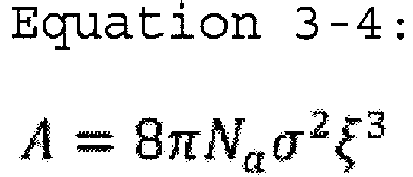


- (A, B, C, ξ, Ξb , Ξc :fitting parameters)
- (q: as defined above)
- (Na: number of scatterers having correlation length ξ per unit volume (N/cm3))
- (Nb: number of scatterers having correlation length Ξb per unit volume (N/cm3))
- (Nc: number of scatterers having correlation length Ξc per unit volume (N/cm3))
- (σ: electron density difference (electron˙cm-3) between scatterer and surrounding matrix material, or scattering length density difference (cm-2) between scatterer and surrounding deuterated solvent)
- Among the obtained fitting parameters, the correlation length ξ in the range of 1 nm to 100 µm is presumed to correspond to the distance between crosslinking points in a polymer, and the correlation lengths Ξb and Ξe are presumed to correspond to the size of a heterogeneous network structure in a polymer. As described above, the number Nc of scatterers (heterogeneous network structures) having the correlation length Ξc per unit volume is highly correlated with the abrasion resistance, i.e., the higher the Nc, the better the abrasion resistance. Thus, Nc is considered to have a great influence on the abrasion resistance. Accordingly, the abrasion resistance of a polymeric material can be evaluated by performing X-ray scattering measurement such as SAXS or neutron scattering measurement such as SANS and then determining Nc by curve fitting with equations 3-2 to 3-6.
- The heterogeneity of the crosslinked structure of the polymer can be taken into consideration by the third aspect of the present invention, particularly, the evaluation method that uses the number Nc of scatterers (heterogeneous network structures) having the correlation length Ξc in the range of 1 nm to 100 µm per unit volume. Accordingly, the abrasion resistance of rubber materials and the like can be evaluated with high accuracy. Additionally, the third aspect enables highly accurate evaluation of the difference in abrasion resistance between samples whose difference in performance cannot be evaluated with good reproducibility by a Lambourn abrasion test, DIN abrasion test or the like.
- The present invention is now more specifically described with reference to examples but is not limited thereto.
- The chemical agents used in Examples and Comparative Examples are listed below.
-
- Cyclohexane: available from Kanto Chemical Co., Inc.
- Pyrrolidine: available from Kanto Chemical Co., Inc.
- Divinylbenzene: available from Sigma-Aldrich Japan K.K.
- 1.6 M n-butyllithium in hexane: available from Kanto Chemical Co., Inc.
- Isopropanol: available from Kanto Chemical Co., Inc. Styrene: available from Kanto Chemical Co., Inc.
- Butadiene: available from Takachiho Chemical Industrial Co., Ltd.
- Tetramethylethylenediamine: available from Kanto Chemical Co., Inc.
- Modifier: 3-(N,N-dimethylaminopropyl)trimethoxysilane available from AZmax. Co.
- NR: RSS#3
- Carbon black: N220 available from Cabot Corporation
- Aromatic oil: Diana Process AH-24 available from Idemitsu Kosan Co., Ltd.
- Stearic acid: stearic acid available from NOF Corporation Zinc oxide: Ginrei R available from Toho Zinc Co., Ltd.
- Antioxidant: Nocrac 6C (N-(1,3-dimethylbutyl)-N'-phenyl-p-phenylenediamine) available from Ouchi Shinko Chemical Industrial Co., Ltd.
- Wax: Sunnoc Wax available from Ouchi Shinko Chemical Industrial Co., Ltd.
- Sulfur: powdered sulfur available from Tsurumi Chemical Industry Co., Ltd.
- Vulcanization accelerator (1): Nocceler CZ available from Ouchi Shinko Chemical Industrial Co., Ltd.
- Vulcanization accelerator (2) : Nocceler D available from Ouchi Shinko Chemical Industrial Co., Ltd.
- A sufficiently nitrogen-purged vessel (100-mL) was charged with 50 mL of cyclohexane, 4.1 mL of pyrrolidine, and 8.9 mL of divinylbenzene. Further, 0.7 mL of 1.6 M n-butyllithium in hexane was added to the vessel at 0°C, and the mixture was stirred. After one hour, isopropanol was added thereto to terminate the reaction. The reaction mixture was extracted and purified to thereby obtain monomer (1).
- A sufficiently nitrogen-purged, pressure-resistant vessel (1000-mL) was charged with 600 mL of cyclohexane, 12.6 mL of styrene, 71.0 mL of butadiene, 0.06 g of monomer (1), and 0.11 mL of tetramethylethylenediamine. Further, 0.2 mL of 1.6 M n-butyllithium in hexane was added to the vessel at 40°C, and the mixture was stirred. After three hours, 0.5 mL of the modifier was added to the mixture, and the resulting mixture was stirred. After one hour, 3 mL of isopropanol was added thereto to terminate the polymerization. After addition of 1 g of 2,6-di-tert-butyl-p-cresol to the reaction solution, the reaction solution was reprecipitated with methanol and dried with heat to thereby obtain polymer (1).
- Polymer (2) was obtained by the same method used to obtain polymer (1), except that the amount of monomer (1) was 0.17 g.
- Polymer (3) was obtained by the same method used to obtain polymer (1), except that the amount of monomer (1) was 0.29 g.
- According to each composition shown in Tables 1 to 3, ingredients were kneaded in a Banbury mixer and a roll mixer, and the mixture was then press-molded at 170°C for 20 minutes into a molded product.
- The energy loss, chipping resistance, and abrasion resistance of the obtained molded products were evaluated by the following test methods: SAXS measurement method, dynamic viscoelasticity measurement method, Lambourn abrasion test, and road test. The results are given in the tables.
- A plate-like sample (molded product) having a thickness of about 1 mm was swollen to equilibrium in deuterated toluene, and attached to a sample holder. The sample was then irradiated with neutrons at room temperature. Absolute scattering intensity curves obtained by measuring the sample at distances of 2.5 m, 10 m, and 10 m with a focusing lens from the detector were combined by least squares. These three curves were combined in the following manner: the scattering intensity curve obtained by measuring the sample at a distance of 2.5 m from the detector was fixed, and the scattering intensity curves obtained by measuring the sample at a distance of 10 m with and without a focusing lens from the detector were shifted. The thus obtained scattering intensity curve I(q) was curve fitted with equations 1-2 and 1-3, and a fitting parameter (correlation length in the range of 1 nm to 100 µm (distance between crosslinking points in the polymer)) was then determined by least squares. The obtained value of correlation lengths ξ was expressed as an index, with the value determined in Example 1-1 as 100. A higher index value indicates less energy loss.
- SANS: SANS device in SANS-J, which is a beamline at JRR-3 of the Japan Atomic Energy Agency, an independent administrative agency.
-
- Neutron wavelength: 6.5 Å
- Flux density of neutrons: 9.9 × 10⁷ neutrons/cm2/s
- Distance from sample to detector: 2.5 m and 10 m (in order to obtain information at smaller angles, the sample was measured at a distance of 10 m from the detector, using a focusing lens.)
- Two-dimensional detector (3He 2d detector and two-dimensional photomultiplier tube + ZnS/6LiF detector)
- A spectrometer available from Ueshima Seisakusho Co. , Ltd. was used to measure the tan δ at a dynamic strain amplitude of 1%, a frequency of 10 Hz, and a temperature of 60°C. The reciprocal of the determined tan δ was expressed as an index, with the value of Comparative Example 1-1 as 100. A higher index value indicates less energy loss.
- Test tires including tire components formed from the compositions of Examples 1-1 to 1-6 and Comparative Examples 1-1 to 1-6 were run with a rim of 15 × 6JJ at an internal pressure of 230 kPa, a load of 3.43 kN, and a speed of 80 km/h in a rolling resistance tester to measure the rolling resistance. The rolling resistance was expressed as an index, with the value of Comparative Example 1-1 as 100. A higher index value indicates better rolling performance of the tire and less energy loss.
[Table 1] Examples Comparative Examples 1-1 1-2 1-3 1-4 1-5 1-6 1-1 1-2 1-3 1-4 1-5 1-6 NR 30 30 30 30 30 30 30 30 30 30 30 30 Polymer (1) 70 - - 70 - - 70 - - 70 - - Polymer (2) - 70 - - 70 - - 70 - - 70 - Polymer (3) - - 70 - - 70 - - 70 - - 70 Carbon black 50 50 50 - - - 50 50 50 - - - Composition (part(s) by mass) Aromatic oil 20 20 20 20 20 20 20 20 20 20 20 20 Stearic acid 2 2 2 2 2 2 2 2 2 2 2 2 Zinc oxide 3 3 3 3 3 3 3 3 3 3 3 3 Antioxidant 1 1 1 1 1 1 1 1 1 1 1 1 Wax 1 1 1 1 1 1 1 1 1 1 1 1 Sulfur 1.5 1.5 1.5 1.5 1.5 1.5 1.5 1.5 1.5 1.5 1.5 1.5 Vulcanization accelerator (1) 1 1 1 1 1 1 1 1 1 1 1 1 Vulcanization accelerator (2) 0.5 0.5 0.5 0.5 0.5 0.5 0.5 0.5 0.5 0.5 0.5 0.5 Energy loss index Small-angle scattering measurement method (ξ) 100 129 194 81 88 95 - - - - - - Dynamic viscoelasticity measurement method - - - - - - 100 100 101 75 75 76 Tire rolling performance 100 108 124 62 66 74 100 108 124 62 66 74 - According to Table 1, the examples in which SANS measurement was used demonstrated that the energy loss can be evaluated by determining the correlation lengths ξ by curve fitting with equations 1-2 and 1-3. In particular, in comparison with the comparative examples, it is clear that the SANS measurement method provides highly accurate measurement of a small difference in energy loss between samples, which is difficult to evaluate by the dynamic viscoelasticity measurement method. Further, it is clear from the results of the carbon black-free compositions of Examples 1-4 to 1-6 that the energy loss in filler-free compositions can also be successfully evaluated by measuring the correlation lengths ξ
- The scattering intensity curve I(q) obtained by the SANS measurement method was curve fitted with equations 2-2 and 2-3, and a fitting parameter Ξc (correlation length in the range of 1 nm to 100 µm (size of a heterogeneous network structure in the polymer)) was then determined by least squares. The obtained value of correlation length Ξc was expressed as an index, with the value determined in Example 2-1 as 100. A lower index value indicates higher chipping resistance.
- Test tires (tire size: 195/65R15) including tire tread portions formed from the compositions of Comparative Examples 2-1 to 2-6 were each mounted on a Japanese FF (front-engine, front-wheel drive) car, and the number of chipped spots in the tire tread portion of each tire after driving 8000 km was counted. The determined number was expressed as an index, with the value of Comparative Example 1-1 as 100. A lower index value indicates higher chipping resistance.
[Table 2] Examples Comparative Examples 2-1 2-2 2-3 2-4 2-5 2-6 2-1 2-2 2-3 2-4 2-5 2-6 NR 30 30 30 30 30 30 30 30 30 30 30 30 Polymer (1) 70 - - 70 - - 70 - - 70 - - Polymer (2) - 70 - - 70 - - 70 - - 70 - Polymer (3) - - 70 - - 70 - - 70 - - 70 Carbon black 50 50 50 - - - 50 50 50 - - - Composition (part(s) by mass) Aromatic oil 20 20 20 20 20 20 20 20 20 20 20 20 Stearic acid 2 2 2 2 2 2 2 2 2 2 2 2 Zinc oxide 3 3 3 3 3 3 3 3 3 3 3 3 Antioxidant 1 1 1 1 1 1 1 1 1 1 1 1 Wax 1 1 1 1 1 1 1 1 1 1 1 1 Sulfur 1.5 1.5 1.5 1.5 1.5 1.5 1.5 1.5 1.5 1.5 1.5 1.5 Vulcanization accelerator (1) 1 1 1 1 1 1 1 1 1 1 1 1 Vulcanization accelerator (2) 0.5 0.5 0.5 0.5 0.5 0.5 0.5 0.5 0.5 0.5 0.5 0.5 Chipping resistance index Small-angle scattering measurement method (Ξc) 100 91 83 62 51 44 - - - - - - Chipping test on the road - - - - - - 100 96 90 77 70 63 - According to Table 2, the examples in which SANS measurement was used demonstrated that the chipping resistance can be evaluated by determining the correlation length Ξc by curve fitting with equations 2-2 and 2-3. The measurement results of the examples were also highly correlated with the road test results of the comparative examples. This clearly shows that the SANS measurement method provides highly accurate evaluation. It is also clear that the chipping resistance can be successfully evaluated regardless of the presence or absence of carbon black.
- The scattering intensity curve I(q) obtained by the SANS measurement method was curve fitted with equations 3-2 to 3-6, and a fitting parameter Ξe (correlation length in the range of 1 nm to 100 µm (size of a heterogeneous network structure in the polymer)) was then determined by least squares. Further, the number Nc of scatterers having the correlation length Ξe per unit volume was determined based on the obtained value of correlation length Ξc. The determined value of Nc was expressed as an index, with the value of Example 3-1 as 100. A higher index value indicates higher abrasion resistance.
- A Lambourn abrasion tester was used to measure the amount of abrasion at room temperature, a load of 1.0 kgf, and a slip ratio of 30%. The reciprocal of the determined amount of abrasion was expressed as an index, with the value of Comparative Example 3-1 as 100. A higher index value indicates higher abrasion resistance.
- Test tires (tire size: 195/65R15) including tire tread portions formed from the compositions of Examples 3-1 to 3-6 and Comparative Examples 3-1 to 3-6 were each mounted on a Japanese FF (front-engine, front-wheel drive) car, and the groove depth in the tire tread portion of each tire after driving 8000 km was then measured. Based on the measured groove depth, the running distance corresponding to a 1 mm reduction in the groove depth of the tire was calculated, and then expressed as an index using the following equation, with the result of Comparative Example 3-1 as 100. A higher index value indicates better abrasion resistance.

Examples Comparative Examples 3-1 3-2 3-3 3-4 3-5 3-6 3-1 3-2 3-3 3-4 3-5 3-6 NR 30 30 30 30 30 30 30 30 30 30 30 30 Polymer (1) 70 - - 70 - - 70 - - 70 - - Polymer (2) - 70 - - 70 - - 70 - - 70 - Polymer (3) - - 70 - - 70 - - 70 - - 70 Carbon black 50 50 50 - - - 50 50 50 - - - Composition (part(s) by mass) Aromatic oil 20 20 20 20 20 20 20 20 20 20 20 20 Stearic acid 2 2 2 2 2 2 2 2 2 2 2 2 Zinc oxide 3 3 3 3 3 3 3 3 3 3 3 3 Antioxidant 1 1 1 1 1 1 1 1 1 1 1 1 Wax 1 1 1 1 1 1 1 1 1 1 1 1 Sulfur 1.5 1.5 1.5 1.5 1.5 1.5 1.5 1.5 1.5 1.5 1.5 1.5 Vulcanization accelerator (1) 1 1 1 1 1 1 1 1 1 1 1 1 Vulcanization accelerator (2) 0.5 0.5 0.5 0.5 0.5 0.5 0.5 0.5 0.5 0.5 0.5 0.5 Abrasion resistance index Small-angle scattering measurement method (Nc) 100 128 155 178 186 199 - - - - - Lambourn abrasion test - - - - - - 100 100 101 122 123 123 Abrasion resistance test on the road 100 110 116 146 158 177 100 110 116 146 158 177 - According to Table 3, the examples in which SANS measurement was used demonstrated that the abrasion resistance can be evaluated by determining the number Nc of scatterers having the correlation length Ξc per unit volume by curve fitting with equations 3-2 to 3-6. In particular, in comparison with the comparative examples, it is clear that the SANS measurement method provides highly accurate measurement of a small difference in abrasion resistance between samples, which is difficult to evaluate by a Lambourn abrasion test. It is also clear that the abrasion resistance can be successfully evaluated regardless of the presence or absence of carbon black.
Claims (3)
- A method for evaluating abrasion resistance of a polymeric material, comprising:irradiating the polymeric material with X-rays or neutrons to perform X-ray scattering measurement or neutron scattering measurement, wherein the abrasion resistance is evaluated based on a number Nc per unit volume of scatterers having a correlation length Ξc in a range of 0.1 nm to 100 µm determined by curve fitting equations 3-2 to 3-6 to a scattering intensity curve I(q) obtained by the X-ray scattering measurement or neutron scattering measurement:


 (A, B, C, ξ, Ξb , Ξc :fitting(Na: number of scatterers having correlation length ξ per unit volume (N/cm3))(Nb: number of scatterers having correlation length Ξb per unit volume (N/cm3))(Nc: number of scatterers having correlation length Ξc per unit volume (N/cm3))(σ: electron density difference (electron·cm-3) between scatterer and surrounding matrix material, or scattering length density difference (cm-2) between scatterer and surrounding deuterated solvent),wherein measurement is performed using the X-rays or neutrons under a condition where q defined by equation 3-1 is in a range of not more than 10 nm-1:
- The method according to claim 1,
wherein the X-ray scattering measurement is small-angle X-ray scattering measurement, and the neutron scattering measurement is small-angle neutron scattering measurement. - The method according to claim 1 or 2,
wherein the polymeric material is a rubber material, preferably for tires, formed from at least one conjugated diene compound.
Applications Claiming Priority (2)
| Application Number | Priority Date | Filing Date | Title |
|---|---|---|---|
| JP2012255589A JP5658219B2 (en) | 2012-11-21 | 2012-11-21 | Method for evaluating energy loss, chipping resistance and wear resistance of polymer materials |
| EP13191725.4A EP2735865B1 (en) | 2012-11-21 | 2013-11-06 | Method for evaluating energy loss in a polymeric material |
Related Parent Applications (2)
| Application Number | Title | Priority Date | Filing Date |
|---|---|---|---|
| EP13191725.4A Division EP2735865B1 (en) | 2012-11-21 | 2013-11-06 | Method for evaluating energy loss in a polymeric material |
| EP13191725.4A Division-Into EP2735865B1 (en) | 2012-11-21 | 2013-11-06 | Method for evaluating energy loss in a polymeric material |
Publications (2)
| Publication Number | Publication Date |
|---|---|
| EP3045899A1 true EP3045899A1 (en) | 2016-07-20 |
| EP3045899B1 EP3045899B1 (en) | 2017-06-07 |
Family
ID=49517418
Family Applications (3)
| Application Number | Title | Priority Date | Filing Date |
|---|---|---|---|
| EP13191725.4A Active EP2735865B1 (en) | 2012-11-21 | 2013-11-06 | Method for evaluating energy loss in a polymeric material |
| EP16158330.7A Active EP3045899B1 (en) | 2012-11-21 | 2013-11-06 | Method for evaluating abrasion resistance of polymeric material |
| EP16158328.1A Active EP3045898B1 (en) | 2012-11-21 | 2013-11-06 | Method for evaluating chipping resistance of polymeric material |
Family Applications Before (1)
| Application Number | Title | Priority Date | Filing Date |
|---|---|---|---|
| EP13191725.4A Active EP2735865B1 (en) | 2012-11-21 | 2013-11-06 | Method for evaluating energy loss in a polymeric material |
Family Applications After (1)
| Application Number | Title | Priority Date | Filing Date |
|---|---|---|---|
| EP16158328.1A Active EP3045898B1 (en) | 2012-11-21 | 2013-11-06 | Method for evaluating chipping resistance of polymeric material |
Country Status (4)
| Country | Link |
|---|---|
| US (1) | US9291581B2 (en) |
| EP (3) | EP2735865B1 (en) |
| JP (1) | JP5658219B2 (en) |
| CN (1) | CN103837556B (en) |
Families Citing this family (18)
| Publication number | Priority date | Publication date | Assignee | Title |
|---|---|---|---|---|
| JP6460730B2 (en) * | 2014-11-05 | 2019-01-30 | 住友ゴム工業株式会社 | Vulcanized rubber composition for tire and pneumatic tire |
| JP6408906B2 (en) * | 2014-12-26 | 2018-10-17 | 住友ゴム工業株式会社 | Method for evaluating energy loss and anti-wear performance of polymeric materials |
| JP6367758B2 (en) * | 2015-05-27 | 2018-08-01 | 住友ゴム工業株式会社 | Method for evaluating cross-link density of cross-linked rubber |
| JP6633849B2 (en) * | 2015-07-07 | 2020-01-22 | 三井化学株式会社 | Method for evaluating crosslinked network structure of crosslinked product |
| EP3348427B1 (en) | 2015-10-27 | 2020-07-08 | Sumitomo Rubber Industries, Ltd. | Pneumatic tire and crosslinked rubber composition |
| EP3348424B1 (en) | 2015-10-27 | 2020-07-08 | Sumitomo Rubber Industries, Ltd. | Pneumatic tire and crosslinked rubber composition |
| JP6859602B2 (en) * | 2016-04-07 | 2021-04-14 | 住友ゴム工業株式会社 | Evaluation method of scattering intensity |
| JP6838294B2 (en) * | 2016-06-09 | 2021-03-03 | 住友ゴム工業株式会社 | Rubber composition and its manufacturing method |
| JP6838292B2 (en) * | 2016-06-09 | 2021-03-03 | 住友ゴム工業株式会社 | A method for evaluating a rubber composition, a method for producing the same, and a wear resistance of the rubber composition. |
| JP6838293B2 (en) * | 2016-06-09 | 2021-03-03 | 住友ゴム工業株式会社 | Rubber composition and its manufacturing method |
| JP6915242B2 (en) * | 2016-08-17 | 2021-08-04 | 住友ゴム工業株式会社 | Rubber composition and its manufacturing method |
| WO2018101266A1 (en) | 2016-11-30 | 2018-06-07 | 住友ゴム工業株式会社 | Rubber composition for tire and tire |
| JP7069564B2 (en) | 2017-04-25 | 2022-05-18 | 住友ゴム工業株式会社 | Rubber composition for tires, manufacturing method of rubber composition for tires and tires |
| JP7450323B2 (en) * | 2017-08-30 | 2024-03-15 | 住友ゴム工業株式会社 | Rubber composition and its manufacturing method |
| CN109116004B (en) * | 2018-08-29 | 2021-07-16 | 江苏通用科技股份有限公司 | Method for quantitatively representing dynamic energy loss density of vulcanized rubber by adopting RPA (resilient reactive powder) |
| CN111307844B (en) * | 2020-04-03 | 2022-09-23 | 中国工程物理研究院核物理与化学研究所 | Rubber structure determination method based on small-angle neutron scattering |
| JP7800185B2 (en) * | 2021-03-04 | 2026-01-16 | 住友ゴム工業株式会社 | tire |
| JP2024080383A (en) | 2022-12-02 | 2024-06-13 | 住友ゴム工業株式会社 | How to assess sulfur concentration |
Citations (1)
| Publication number | Priority date | Publication date | Assignee | Title |
|---|---|---|---|---|
| JP2009046088A (en) | 2007-08-22 | 2009-03-05 | Sumitomo Rubber Ind Ltd | Evaluation method of tire grip characteristics |
Family Cites Families (7)
| Publication number | Priority date | Publication date | Assignee | Title |
|---|---|---|---|---|
| JP3953754B2 (en) * | 2001-06-27 | 2007-08-08 | 株式会社リガク | Non-uniform density sample analysis method and apparatus and system thereof |
| JP3958666B2 (en) * | 2002-10-11 | 2007-08-15 | Sriスポーツ株式会社 | Method for calculating energy loss in viscoelastic material, and method for evaluating energy loss of golf ball using the method |
| FR2903494B1 (en) * | 2006-07-07 | 2008-09-26 | Centre Nat Rech Scient | DEVICE AND METHOD FOR CHARACTERIZING SURFACES. PARTICULARLY CRYSTALLINE, USING A BEAM OF NEUTRAL ATOMS OR MOLECULES |
| JP4278108B2 (en) * | 2006-07-07 | 2009-06-10 | 株式会社リガク | Ultra-small angle X-ray scattering measurement device |
| JP2010181342A (en) * | 2009-02-06 | 2010-08-19 | Bridgestone Corp | Device and method for estimating deformation behavior of rubber material |
| CN105699407B (en) * | 2011-11-01 | 2018-07-13 | 住友橡胶工业株式会社 | The method for evaluating the hardness and energy loss of high molecular material |
| JP2013248287A (en) * | 2012-06-01 | 2013-12-12 | Dunlop Sports Co Ltd | Rubber composition and golf ball |
-
2012
- 2012-11-21 JP JP2012255589A patent/JP5658219B2/en active Active
-
2013
- 2013-09-12 CN CN201310414907.8A patent/CN103837556B/en active Active
- 2013-11-04 US US14/071,149 patent/US9291581B2/en not_active Expired - Fee Related
- 2013-11-06 EP EP13191725.4A patent/EP2735865B1/en active Active
- 2013-11-06 EP EP16158330.7A patent/EP3045899B1/en active Active
- 2013-11-06 EP EP16158328.1A patent/EP3045898B1/en active Active
Patent Citations (1)
| Publication number | Priority date | Publication date | Assignee | Title |
|---|---|---|---|---|
| JP2009046088A (en) | 2007-08-22 | 2009-03-05 | Sumitomo Rubber Ind Ltd | Evaluation method of tire grip characteristics |
Non-Patent Citations (4)
| Title |
|---|
| CHUNPENG SHAN ET AL: "Preparation, characterization, and application of NR/SBR/Organoclay nanocomposites in the tire industry", JOURNAL OF APPLIED POLYMER SCIENCE, vol. 119, no. 2, 15 January 2011 (2011-01-15), pages 1185 - 1194, XP055111428, ISSN: 0021-8995, DOI: 10.1002/app.32773 * |
| LEI WANG ET AL: "Effect of epoxidized natural rubber on the properties of rectorite/carbon black/natural rubber nanocomposites", JOURNAL OF APPLIED POLYMER SCIENCE, vol. 128, no. 4, 15 May 2013 (2013-05-15), pages 2578 - 2584, XP055111307, ISSN: 0021-8995, DOI: 10.1002/app.38574 * |
| NIPPON; GOMU; KYOKAISHI, THE JOURNAL OF SRIJ, vol. 69, no. 11, 1996, pages 739 |
| SONNENSCHEIN M F ET AL: "Comparison of adipate and succinate polyesters in thermoplastic polyurethanes", POLYMER, ELSEVIER SCIENCE PUBLISHERS B.V, GB, vol. 51, no. 16, 22 July 2010 (2010-07-22), pages 3685 - 3692, XP027142511, ISSN: 0032-3861, [retrieved on 20100612] * |
Also Published As
| Publication number | Publication date |
|---|---|
| US9291581B2 (en) | 2016-03-22 |
| JP2014102210A (en) | 2014-06-05 |
| EP3045898B1 (en) | 2017-05-17 |
| CN103837556A (en) | 2014-06-04 |
| EP3045899B1 (en) | 2017-06-07 |
| US20140140483A1 (en) | 2014-05-22 |
| EP3045898A1 (en) | 2016-07-20 |
| EP2735865A1 (en) | 2014-05-28 |
| EP2735865B1 (en) | 2016-08-24 |
| CN103837556B (en) | 2018-02-16 |
| JP5658219B2 (en) | 2015-01-21 |
Similar Documents
| Publication | Publication Date | Title |
|---|---|---|
| EP3045898B1 (en) | Method for evaluating chipping resistance of polymeric material | |
| EP3029454B1 (en) | Method for evaluating hardness of polymer material | |
| JP6408906B2 (en) | Method for evaluating energy loss and anti-wear performance of polymeric materials | |
| KR102244343B1 (en) | Method of evaluating neutron scattering length density | |
| EP3549978B1 (en) | Rubber composition for tire and tire | |
| US10794893B2 (en) | Method for estimating abrasion resistance and fracture resistance | |
| JP6613637B2 (en) | Method for evaluating response characteristics of internal structure of polymer materials | |
| EP4249901B1 (en) | Method for estimating abrasion resistance | |
| EP4502598A2 (en) | Method for evaluating abrasion resistance of a rubber composition and rubber composition | |
| EP3450493B1 (en) | Rubber composition, production method therefor, and method for evaluating wear resistance of rubber composition |
Legal Events
| Date | Code | Title | Description |
|---|---|---|---|
| PUAI | Public reference made under article 153(3) epc to a published international application that has entered the european phase |
Free format text: ORIGINAL CODE: 0009012 |
|
| AC | Divisional application: reference to earlier application |
Ref document number: 2735865 Country of ref document: EP Kind code of ref document: P |
|
| AK | Designated contracting states |
Kind code of ref document: A1 Designated state(s): AL AT BE BG CH CY CZ DE DK EE ES FI FR GB GR HR HU IE IS IT LI LT LU LV MC MK MT NL NO PL PT RO RS SE SI SK SM TR |
|
| STAA | Information on the status of an ep patent application or granted ep patent |
Free format text: STATUS: REQUEST FOR EXAMINATION WAS MADE |
|
| 17P | Request for examination filed |
Effective date: 20161124 |
|
| RBV | Designated contracting states (corrected) |
Designated state(s): AL AT BE BG CH CY CZ DE DK EE ES FI FR GB GR HR HU IE IS IT LI LT LU LV MC MK MT NL NO PL PT RO RS SE SI SK SM TR |
|
| RIN1 | Information on inventor provided before grant (corrected) |
Inventor name: MASUI, TOMOMI Inventor name: MASHITA, RYO Inventor name: KISHIMOTO, HIROYUKI |
|
| GRAP | Despatch of communication of intention to grant a patent |
Free format text: ORIGINAL CODE: EPIDOSNIGR1 |
|
| STAA | Information on the status of an ep patent application or granted ep patent |
Free format text: STATUS: GRANT OF PATENT IS INTENDED |
|
| RIC1 | Information provided on ipc code assigned before grant |
Ipc: G01N 23/201 20060101AFI20170120BHEP Ipc: G01N 23/202 20060101ALI20170120BHEP |
|
| INTG | Intention to grant announced |
Effective date: 20170216 |
|
| GRAS | Grant fee paid |
Free format text: ORIGINAL CODE: EPIDOSNIGR3 |
|
| AC | Divisional application: reference to earlier application |
Ref document number: 2735865 Country of ref document: EP Kind code of ref document: P |
|
| AK | Designated contracting states |
Kind code of ref document: B1 Designated state(s): AL AT BE BG CH CY CZ DE DK EE ES FI FR GB GR HR HU IE IS IT LI LT LU LV MC MK MT NL NO PL PT RO RS SE SI SK SM TR |
|
| REG | Reference to a national code |
Ref country code: GB Ref legal event code: FG4D |
|
| GRAA | (expected) grant |
Free format text: ORIGINAL CODE: 0009210 |
|
| REG | Reference to a national code |
Ref country code: CH Ref legal event code: EP Ref country code: AT Ref legal event code: REF Ref document number: 899607 Country of ref document: AT Kind code of ref document: T Effective date: 20170615 |
|
| STAA | Information on the status of an ep patent application or granted ep patent |
Free format text: STATUS: THE PATENT HAS BEEN GRANTED |
|
| REG | Reference to a national code |
Ref country code: IE Ref legal event code: FG4D |
|
| REG | Reference to a national code |
Ref country code: DE Ref legal event code: R096 Ref document number: 602013022134 Country of ref document: DE |
|
| REG | Reference to a national code |
Ref country code: NL Ref legal event code: MP Effective date: 20170607 |
|
| REG | Reference to a national code |
Ref country code: LT Ref legal event code: MG4D |
|
| PG25 | Lapsed in a contracting state [announced via postgrant information from national office to epo] |
Ref country code: LT Free format text: LAPSE BECAUSE OF FAILURE TO SUBMIT A TRANSLATION OF THE DESCRIPTION OR TO PAY THE FEE WITHIN THE PRESCRIBED TIME-LIMIT Effective date: 20170607 Ref country code: FI Free format text: LAPSE BECAUSE OF FAILURE TO SUBMIT A TRANSLATION OF THE DESCRIPTION OR TO PAY THE FEE WITHIN THE PRESCRIBED TIME-LIMIT Effective date: 20170607 Ref country code: HR Free format text: LAPSE BECAUSE OF FAILURE TO SUBMIT A TRANSLATION OF THE DESCRIPTION OR TO PAY THE FEE WITHIN THE PRESCRIBED TIME-LIMIT Effective date: 20170607 Ref country code: NO Free format text: LAPSE BECAUSE OF FAILURE TO SUBMIT A TRANSLATION OF THE DESCRIPTION OR TO PAY THE FEE WITHIN THE PRESCRIBED TIME-LIMIT Effective date: 20170907 Ref country code: ES Free format text: LAPSE BECAUSE OF FAILURE TO SUBMIT A TRANSLATION OF THE DESCRIPTION OR TO PAY THE FEE WITHIN THE PRESCRIBED TIME-LIMIT Effective date: 20170607 Ref country code: GR Free format text: LAPSE BECAUSE OF FAILURE TO SUBMIT A TRANSLATION OF THE DESCRIPTION OR TO PAY THE FEE WITHIN THE PRESCRIBED TIME-LIMIT Effective date: 20170908 |
|
| REG | Reference to a national code |
Ref country code: AT Ref legal event code: MK05 Ref document number: 899607 Country of ref document: AT Kind code of ref document: T Effective date: 20170607 |
|
| REG | Reference to a national code |
Ref country code: FR Ref legal event code: PLFP Year of fee payment: 5 |
|
| PG25 | Lapsed in a contracting state [announced via postgrant information from national office to epo] |
Ref country code: SE Free format text: LAPSE BECAUSE OF FAILURE TO SUBMIT A TRANSLATION OF THE DESCRIPTION OR TO PAY THE FEE WITHIN THE PRESCRIBED TIME-LIMIT Effective date: 20170607 Ref country code: NL Free format text: LAPSE BECAUSE OF FAILURE TO SUBMIT A TRANSLATION OF THE DESCRIPTION OR TO PAY THE FEE WITHIN THE PRESCRIBED TIME-LIMIT Effective date: 20170607 Ref country code: BG Free format text: LAPSE BECAUSE OF FAILURE TO SUBMIT A TRANSLATION OF THE DESCRIPTION OR TO PAY THE FEE WITHIN THE PRESCRIBED TIME-LIMIT Effective date: 20170907 Ref country code: RS Free format text: LAPSE BECAUSE OF FAILURE TO SUBMIT A TRANSLATION OF THE DESCRIPTION OR TO PAY THE FEE WITHIN THE PRESCRIBED TIME-LIMIT Effective date: 20170607 Ref country code: LV Free format text: LAPSE BECAUSE OF FAILURE TO SUBMIT A TRANSLATION OF THE DESCRIPTION OR TO PAY THE FEE WITHIN THE PRESCRIBED TIME-LIMIT Effective date: 20170607 |
|
| PG25 | Lapsed in a contracting state [announced via postgrant information from national office to epo] |
Ref country code: SK Free format text: LAPSE BECAUSE OF FAILURE TO SUBMIT A TRANSLATION OF THE DESCRIPTION OR TO PAY THE FEE WITHIN THE PRESCRIBED TIME-LIMIT Effective date: 20170607 Ref country code: EE Free format text: LAPSE BECAUSE OF FAILURE TO SUBMIT A TRANSLATION OF THE DESCRIPTION OR TO PAY THE FEE WITHIN THE PRESCRIBED TIME-LIMIT Effective date: 20170607 Ref country code: AT Free format text: LAPSE BECAUSE OF FAILURE TO SUBMIT A TRANSLATION OF THE DESCRIPTION OR TO PAY THE FEE WITHIN THE PRESCRIBED TIME-LIMIT Effective date: 20170607 Ref country code: RO Free format text: LAPSE BECAUSE OF FAILURE TO SUBMIT A TRANSLATION OF THE DESCRIPTION OR TO PAY THE FEE WITHIN THE PRESCRIBED TIME-LIMIT Effective date: 20170607 Ref country code: CZ Free format text: LAPSE BECAUSE OF FAILURE TO SUBMIT A TRANSLATION OF THE DESCRIPTION OR TO PAY THE FEE WITHIN THE PRESCRIBED TIME-LIMIT Effective date: 20170607 |
|
| PG25 | Lapsed in a contracting state [announced via postgrant information from national office to epo] |
Ref country code: SM Free format text: LAPSE BECAUSE OF FAILURE TO SUBMIT A TRANSLATION OF THE DESCRIPTION OR TO PAY THE FEE WITHIN THE PRESCRIBED TIME-LIMIT Effective date: 20170607 Ref country code: IS Free format text: LAPSE BECAUSE OF FAILURE TO SUBMIT A TRANSLATION OF THE DESCRIPTION OR TO PAY THE FEE WITHIN THE PRESCRIBED TIME-LIMIT Effective date: 20171007 Ref country code: IT Free format text: LAPSE BECAUSE OF FAILURE TO SUBMIT A TRANSLATION OF THE DESCRIPTION OR TO PAY THE FEE WITHIN THE PRESCRIBED TIME-LIMIT Effective date: 20170607 Ref country code: PL Free format text: LAPSE BECAUSE OF FAILURE TO SUBMIT A TRANSLATION OF THE DESCRIPTION OR TO PAY THE FEE WITHIN THE PRESCRIBED TIME-LIMIT Effective date: 20170607 |
|
| REG | Reference to a national code |
Ref country code: DE Ref legal event code: R097 Ref document number: 602013022134 Country of ref document: DE |
|
| PLBE | No opposition filed within time limit |
Free format text: ORIGINAL CODE: 0009261 |
|
| STAA | Information on the status of an ep patent application or granted ep patent |
Free format text: STATUS: NO OPPOSITION FILED WITHIN TIME LIMIT |
|
| PG25 | Lapsed in a contracting state [announced via postgrant information from national office to epo] |
Ref country code: DK Free format text: LAPSE BECAUSE OF FAILURE TO SUBMIT A TRANSLATION OF THE DESCRIPTION OR TO PAY THE FEE WITHIN THE PRESCRIBED TIME-LIMIT Effective date: 20170607 |
|
| 26N | No opposition filed |
Effective date: 20180308 |
|
| PG25 | Lapsed in a contracting state [announced via postgrant information from national office to epo] |
Ref country code: MC Free format text: LAPSE BECAUSE OF FAILURE TO SUBMIT A TRANSLATION OF THE DESCRIPTION OR TO PAY THE FEE WITHIN THE PRESCRIBED TIME-LIMIT Effective date: 20170607 |
|
| GBPC | Gb: european patent ceased through non-payment of renewal fee |
Effective date: 20171106 |
|
| PG25 | Lapsed in a contracting state [announced via postgrant information from national office to epo] |
Ref country code: CH Free format text: LAPSE BECAUSE OF NON-PAYMENT OF DUE FEES Effective date: 20171130 Ref country code: LI Free format text: LAPSE BECAUSE OF NON-PAYMENT OF DUE FEES Effective date: 20171130 |
|
| PG25 | Lapsed in a contracting state [announced via postgrant information from national office to epo] |
Ref country code: LU Free format text: LAPSE BECAUSE OF NON-PAYMENT OF DUE FEES Effective date: 20171106 |
|
| REG | Reference to a national code |
Ref country code: BE Ref legal event code: MM Effective date: 20171130 |
|
| REG | Reference to a national code |
Ref country code: IE Ref legal event code: MM4A |
|
| PG25 | Lapsed in a contracting state [announced via postgrant information from national office to epo] |
Ref country code: MT Free format text: LAPSE BECAUSE OF NON-PAYMENT OF DUE FEES Effective date: 20171106 |
|
| REG | Reference to a national code |
Ref country code: FR Ref legal event code: PLFP Year of fee payment: 6 |
|
| PG25 | Lapsed in a contracting state [announced via postgrant information from national office to epo] |
Ref country code: IE Free format text: LAPSE BECAUSE OF NON-PAYMENT OF DUE FEES Effective date: 20171106 |
|
| PG25 | Lapsed in a contracting state [announced via postgrant information from national office to epo] |
Ref country code: BE Free format text: LAPSE BECAUSE OF NON-PAYMENT OF DUE FEES Effective date: 20171130 Ref country code: GB Free format text: LAPSE BECAUSE OF NON-PAYMENT OF DUE FEES Effective date: 20171106 |
|
| PGFP | Annual fee paid to national office [announced via postgrant information from national office to epo] |
Ref country code: FR Payment date: 20181011 Year of fee payment: 6 |
|
| PG25 | Lapsed in a contracting state [announced via postgrant information from national office to epo] |
Ref country code: HU Free format text: LAPSE BECAUSE OF FAILURE TO SUBMIT A TRANSLATION OF THE DESCRIPTION OR TO PAY THE FEE WITHIN THE PRESCRIBED TIME-LIMIT; INVALID AB INITIO Effective date: 20131106 |
|
| PG25 | Lapsed in a contracting state [announced via postgrant information from national office to epo] |
Ref country code: SI Free format text: LAPSE BECAUSE OF FAILURE TO SUBMIT A TRANSLATION OF THE DESCRIPTION OR TO PAY THE FEE WITHIN THE PRESCRIBED TIME-LIMIT Effective date: 20170607 |
|
| PG25 | Lapsed in a contracting state [announced via postgrant information from national office to epo] |
Ref country code: CY Free format text: LAPSE BECAUSE OF FAILURE TO SUBMIT A TRANSLATION OF THE DESCRIPTION OR TO PAY THE FEE WITHIN THE PRESCRIBED TIME-LIMIT Effective date: 20170607 |
|
| PG25 | Lapsed in a contracting state [announced via postgrant information from national office to epo] |
Ref country code: MK Free format text: LAPSE BECAUSE OF FAILURE TO SUBMIT A TRANSLATION OF THE DESCRIPTION OR TO PAY THE FEE WITHIN THE PRESCRIBED TIME-LIMIT Effective date: 20170607 |
|
| PG25 | Lapsed in a contracting state [announced via postgrant information from national office to epo] |
Ref country code: TR Free format text: LAPSE BECAUSE OF FAILURE TO SUBMIT A TRANSLATION OF THE DESCRIPTION OR TO PAY THE FEE WITHIN THE PRESCRIBED TIME-LIMIT Effective date: 20170607 |
|
| PG25 | Lapsed in a contracting state [announced via postgrant information from national office to epo] |
Ref country code: PT Free format text: LAPSE BECAUSE OF FAILURE TO SUBMIT A TRANSLATION OF THE DESCRIPTION OR TO PAY THE FEE WITHIN THE PRESCRIBED TIME-LIMIT Effective date: 20170607 |
|
| PG25 | Lapsed in a contracting state [announced via postgrant information from national office to epo] |
Ref country code: AL Free format text: LAPSE BECAUSE OF FAILURE TO SUBMIT A TRANSLATION OF THE DESCRIPTION OR TO PAY THE FEE WITHIN THE PRESCRIBED TIME-LIMIT Effective date: 20170607 |
|
| PG25 | Lapsed in a contracting state [announced via postgrant information from national office to epo] |
Ref country code: FR Free format text: LAPSE BECAUSE OF NON-PAYMENT OF DUE FEES Effective date: 20191130 |
|
| P01 | Opt-out of the competence of the unified patent court (upc) registered |
Free format text: CASE NUMBER: UPC_APP_110500/2023 Effective date: 20230510 |
|
| PGFP | Annual fee paid to national office [announced via postgrant information from national office to epo] |
Ref country code: DE Payment date: 20250930 Year of fee payment: 13 |