EP3045462A1 - 3-aryl-2-phosphoryl substituted 1-indanones and the method for their preparation - Google Patents
3-aryl-2-phosphoryl substituted 1-indanones and the method for their preparation Download PDFInfo
- Publication number
- EP3045462A1 EP3045462A1 EP14460079.8A EP14460079A EP3045462A1 EP 3045462 A1 EP3045462 A1 EP 3045462A1 EP 14460079 A EP14460079 A EP 14460079A EP 3045462 A1 EP3045462 A1 EP 3045462A1
- Authority
- EP
- European Patent Office
- Prior art keywords
- substituted
- group
- unsubstituted
- general formula
- arii
- Prior art date
- Legal status (The legal status is an assumption and is not a legal conclusion. Google has not performed a legal analysis and makes no representation as to the accuracy of the status listed.)
- Granted
Links
- 0 *C1=CC(C(C(CCCCC2)C2C2=O)C22P(*)(*)=*2)=CC=CCC=C1 Chemical compound *C1=CC(C(C(CCCCC2)C2C2=O)C22P(*)(*)=*2)=CC=CCC=C1 0.000 description 1
- ZCMUSVRSBPLLRF-UHFFFAOYSA-N COP(C(C(c(c1c2)cc3c2OCO3)c(cc2)ccc2Br)(C1=O)F)(OC)=O Chemical compound COP(C(C(c(c1c2)cc3c2OCO3)c(cc2)ccc2Br)(C1=O)F)(OC)=O ZCMUSVRSBPLLRF-UHFFFAOYSA-N 0.000 description 1
- UQXPZPLGDCYHDF-UHFFFAOYSA-N COP(C(C(c(c1c2)cc3c2OCO3)c2ccccc2)(C1=O)F)(OC)=O Chemical compound COP(C(C(c(c1c2)cc3c2OCO3)c2ccccc2)(C1=O)F)(OC)=O UQXPZPLGDCYHDF-UHFFFAOYSA-N 0.000 description 1
- QFYGXFWJINVYOK-TWMPVWRBSA-N C[C@]1(C=CC(C(C(C(c2c3)=O)(F)P(OC)(OC)=O)c2cc2c3OCO2)=CC1)C(OC)=O Chemical compound C[C@]1(C=CC(C(C(C(c2c3)=O)(F)P(OC)(OC)=O)c2cc2c3OCO2)=CC1)C(OC)=O QFYGXFWJINVYOK-TWMPVWRBSA-N 0.000 description 1
Classifications
-
- C—CHEMISTRY; METALLURGY
- C07—ORGANIC CHEMISTRY
- C07F—ACYCLIC, CARBOCYCLIC OR HETEROCYCLIC COMPOUNDS CONTAINING ELEMENTS OTHER THAN CARBON, HYDROGEN, HALOGEN, OXYGEN, NITROGEN, SULFUR, SELENIUM OR TELLURIUM
- C07F9/00—Compounds containing elements of Groups 5 or 15 of the Periodic Table
- C07F9/02—Phosphorus compounds
- C07F9/547—Heterocyclic compounds, e.g. containing phosphorus as a ring hetero atom
- C07F9/655—Heterocyclic compounds, e.g. containing phosphorus as a ring hetero atom having oxygen atoms, with or without sulfur, selenium, or tellurium atoms, as the only ring hetero atoms
- C07F9/65515—Heterocyclic compounds, e.g. containing phosphorus as a ring hetero atom having oxygen atoms, with or without sulfur, selenium, or tellurium atoms, as the only ring hetero atoms the oxygen atom being part of a five-membered ring
- C07F9/65517—Heterocyclic compounds, e.g. containing phosphorus as a ring hetero atom having oxygen atoms, with or without sulfur, selenium, or tellurium atoms, as the only ring hetero atoms the oxygen atom being part of a five-membered ring condensed with carbocyclic rings or carbocyclic ring systems
-
- C—CHEMISTRY; METALLURGY
- C07—ORGANIC CHEMISTRY
- C07F—ACYCLIC, CARBOCYCLIC OR HETEROCYCLIC COMPOUNDS CONTAINING ELEMENTS OTHER THAN CARBON, HYDROGEN, HALOGEN, OXYGEN, NITROGEN, SULFUR, SELENIUM OR TELLURIUM
- C07F9/00—Compounds containing elements of Groups 5 or 15 of the Periodic Table
- C07F9/02—Phosphorus compounds
- C07F9/547—Heterocyclic compounds, e.g. containing phosphorus as a ring hetero atom
- C07F9/6558—Heterocyclic compounds, e.g. containing phosphorus as a ring hetero atom containing at least two different or differently substituted hetero rings neither condensed among themselves nor condensed with a common carbocyclic ring or ring system
- C07F9/65586—Heterocyclic compounds, e.g. containing phosphorus as a ring hetero atom containing at least two different or differently substituted hetero rings neither condensed among themselves nor condensed with a common carbocyclic ring or ring system at least one of the hetero rings does not contain nitrogen as ring hetero atom
Definitions
- the present invention relates to 3-aryl-2-phosphoryl substituted 1-indanones and the method of their synthesis.
- 1-Indanones derivatives are represented by the general formula 1 in which:
- 1-Indanones have found wide application in medicine, agrochemistry and in the synthesis of natural products. They are widely used as antibacterial agents, insecticides, pesticides, herbicides, anti-hepatitis C, drugs used to treat Alzheimer and lowering blood pressure and pharmaceuticals used in anticancer therapies.
- In the literature there are numerous examples of methods of synthesis of 1-indanones from various substrates, but the 3-aryl-2-phosphoryl substituted 1-indanones are unknown and therefore have not previously been described in the literature in any way.
- a highly stereoselective, one-step synthesis of trans-2,3-disubstituted derivatives of 1-indanones containing in position 2, such moieties as: methyl, n-butyl, phenyl, hydrogen atom and/or in position 3 - phenyl, triethoxymethylphenyl, tert-butyl and isopropyl has also been described, by reacting phenyl alkynes and the appropriate aldehydes in the presence of antimony pentafluoride in ethanol. 2
- Irradiation of terminal, aromatic ⁇ , ⁇ -epoxy ketones by UV lamp (450W) leads in the tandem reaction of photochemical epoxy - rearrangement and 1,5-bi-radical cyclization to formation of 1-indanones, monosubstituted in position 2 by methyl or ethyl group, or disubstituted by two methyl groups, while retaining in position 3 hydroxyl and aryl group. 4
- the subject of the present invention are 3-aryl-2-phosphoryl substituted derivatives of 1-indanones represented by the general formula 1 , in which:
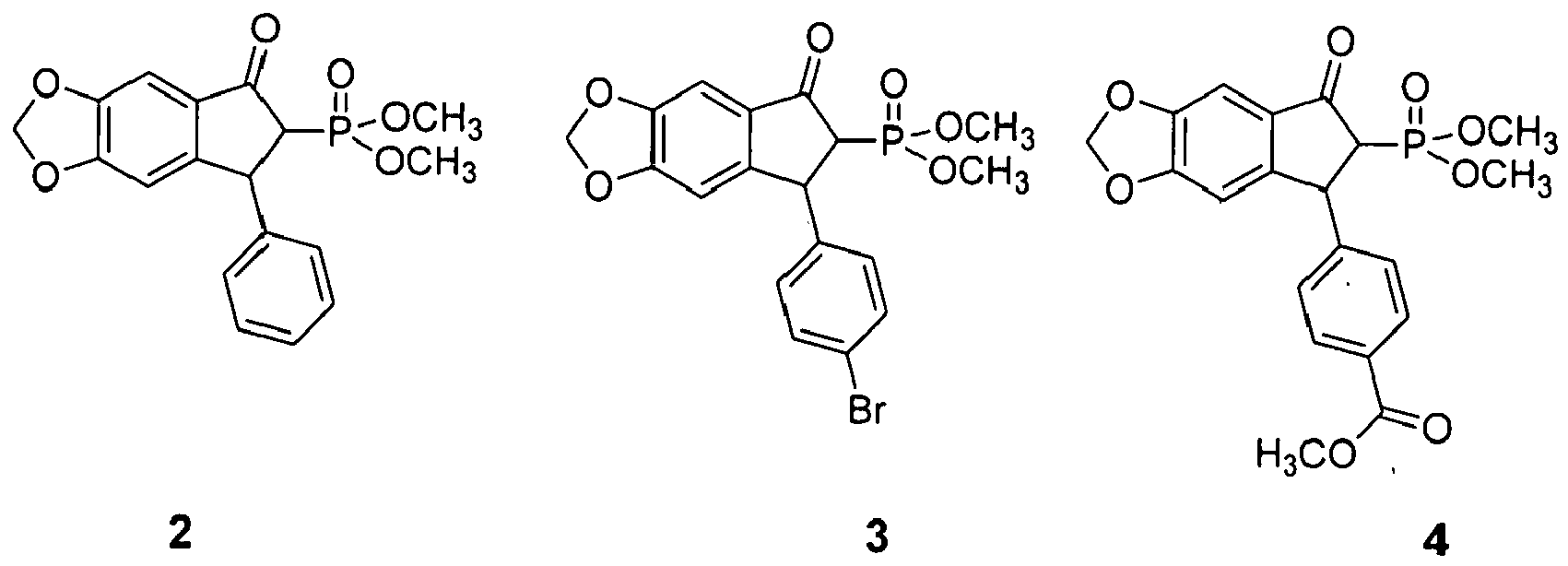
- Hydrocarbons according to the invention preferably are shown in formulas 2, 3 or 4:
- a method for preparation of 3-aryl-2-phosphoryl substituted 1-indanones of the general formula 1, represented by formulas 2, 3 or 4, according to the invention, consists in the fact that the reaction of cyclization of the phosphonic esters of the general formula 5 is carried out, wherein R 1 , R 2 , ArI and ArII are as defined above and R 3 is a hydrogen atom, as shown in Scheme I, in the presence of a Lewis acid, under mild conditions, in an organic solvent, in a single reaction vessel, without isolation of intermediate products, for preparation of compounds of the formula 1, especially of compounds represented by the formulas 2, 3 or 4.
- a Lewis acid preferably FeCl 3 and AlCl 3
- organic solvent preferably toluene or methylene chloride
- NFSI N-fluorobenzenesulfonimide
- a method for preparation of 3-aryl-2-phosphoryl substituted 1-indanones of general formula 1, wherein ArI and ArII are as defined above, R 3 is hydrogen atom, R 1 and R 2 are the same or different and represent hydrogen atom H or a metal atom, especially sodium or potassium, according to the invention consists in the fact that the appropriate phosphonic esters are subjected to a hydrolysis reaction under mild conditions, in an alkaline environment, in an organic solvent, without purification, in quantitative yields.
- alkali preferably sodium or potassium hydroxide
- a method for preparation of 3-aryl-2-phosphoryl substituted 1-indanones of general formula 1, wherein R 1 , R 2 , R 3 , ArI are as defined above, and ArII is biaryl containing aromatic or heteroaromatic rings according to the invention consists in the fact that a compound of general formula 23 is subjected to a coupling reaction, wherein R 3 , ArI are as defined above, and R 1 , R 2 represent, methoxy groups, ArII represents an biaryl group ArIII - ArIV containing aromatic rings, substituted or unsubstituted, selected from the group consisting of benzene, naphthalene, pyrene, or six-membered heteroaromatic rings, substituted or unsubstituted, selected from the group consisting of pyridine, pyrimidine; or heteroaromatic rings, five-membered, substituted or unsubstituted, selected from the group consisting of thiophene, pyrrole or furan, under mild
- a catalyst: palladium acetate (Pd(OAc) 2 ) and triphenylphosphine (PPh 3 ) as ligand in the presence of aqueous sodium carbonate solution (Na 2 CO 3 ), in an organic solvent, preferably n-propanol to afford biaryl derivatives 24, where
- an organic solvent preferably water and ethanol
- 1-indanone 3 was added (0.10 g, 0.23 mmol) and stirred at 0°C for one hour followed by addition of (N-fluorobenzenesulfonimide) NFSI (0.07g, 0.23 mmol), allowed to warm to room temperature and stirred overnight. The mixture was then washed three times with water; the organic layer was dried over MgSO 4 and evaporated. The product was purified by column chromatography over silica gel. In this manner, fluorinated 1-indanones of the formulas 6-8 were obtained.
Landscapes
- Chemical & Material Sciences (AREA)
- Organic Chemistry (AREA)
- Health & Medical Sciences (AREA)
- Life Sciences & Earth Sciences (AREA)
- Biochemistry (AREA)
- General Health & Medical Sciences (AREA)
- Molecular Biology (AREA)
- Plural Heterocyclic Compounds (AREA)
- Pyrrole Compounds (AREA)
Abstract
Description
- The present invention relates to 3-aryl-2-phosphoryl substituted 1-indanones and the method of their synthesis. 1-Indanones derivatives are represented by the general formula 1

- R1 and R2 - are the same or different and represent hydrogen atoms, metal, preferably sodium or potassium, or an alkyl group containing 1-10 carbon atoms
- R3 - is hydrogen or a halogen atom
- ArI and ArII - are the same or different and represent an aromatic ring, or ArII represents biaryl, containing aromatic rings, substituted or unsubstituted, selected from the group consisting of benzene, naphthalene, pyrene, or six-membered heteroaromatic rings, substituted or unsubstituted, selected from the group consisting of pyridine, pyrimidine, or heteroaromatic rings, five-membered, substituted or unsubstituted, selected from the group consisting of thiophene, pyrrole or furan.
- 1-Indanones have found wide application in medicine, agrochemistry and in the synthesis of natural products. They are widely used as antibacterial agents, insecticides, pesticides, herbicides, anti-hepatitis C, drugs used to treat Alzheimer and lowering blood pressure and pharmaceuticals used in anticancer therapies. In the literature there are numerous examples of methods of synthesis of 1-indanones from various substrates, but the 3-aryl-2-phosphoryl substituted 1-indanones are unknown and therefore have not previously been described in the literature in any way.
- Wide range of applications of 1-indanones had an impact on-elaboration of many methods for their synthesis, using different substrates and reagents.
- Reaction of o-bromobenzaldehyde with alkynes in the presence of palladium acetate, leads in high yields to derivatives of 1-indenol which on further heating undergo izomerization to the appropriate 1-indanones substituted in position 2 with alkyl groups containing from 3 to 10 carbon atoms, and in position 3 with phenyl, propyl or methyl group.1
- A highly stereoselective, one-step synthesis of trans-2,3-disubstituted derivatives of 1-indanones containing in position 2, such moieties as: methyl, n-butyl, phenyl, hydrogen atom and/or in position 3 - phenyl, triethoxymethylphenyl, tert-butyl and isopropyl has also been described, by reacting phenyl alkynes and the appropriate aldehydes in the presence of antimony pentafluoride in ethanol.2
- The intramolecular Friedel-Crafts alkylation of epoxy derivatives of chalcones catalyzed by indium chloride has been used for the synthesis of 2-hydroxy-3-aryl-1-indanones in very good yields.3
- Irradiation of terminal, aromatic γ,δ-epoxy ketones by UV lamp (450W) leads in the tandem reaction of photochemical epoxy - rearrangement and 1,5-bi-radical cyclization to formation of 1-indanones, monosubstituted in position 2 by methyl or ethyl group, or disubstituted by two methyl groups, while retaining in position 3 hydroxyl and aryl group.4 The best efficiency, up to 84%, gave substrates containing electron withdrawing substituents being in the para position of the aryl group.
- The stereoselective, catalyzed by complex Cu(II), tandem transformation of α,β-unsaturated ketones, including cyclization and electrophilic fluorination, leads to the corresponding derivatives of 1-indanones, substituted in the α position relative to the carbonyl group by fluorine and a methoxycarbonyl or ethoxycarbonyl group, while in the β position relative to the carbonyl group, to the corresponding derivatives of 1-indanones, substituted by 2,4,6-trimethoxyphenyl, 3-methoxyphenyl, 4-methoxyphenyl, 6-methoxyphenyl, 4-chlorophenyl, 4-nitrophenyl, 4-methylphenyl, isopropyl and phenyl. 5
- Efficient and fast synthesis of 1-indanones has also been developed by Lawrence et al6, wherein from chalcones in the presence of trifluoroacetic acid and microwaves were obtained 1-indanones derivatives containing aryl groups in the position 3, such as: 4-methoxyphenyl, 4,5-dimethoxy and 3,4,5-trimethoxyphenyl, 3-hydroxy-4-methoxyphenyl, 4-chlorophenyl, 3-bromo-4-methoxyphenyl, 3,4-dichlorophenyl, benzo[d][1,3]dioxol-5-yl, 4-bromophenyl, 2,6-dichlorophenyl, 2,4-dichlorophenyl, phenyl, 3-nitro-4-methoxyphenyl, 3-fluoro-4-methoxyphenyl.
- In 2010, Frontier and Eisenberg7 described the use of electrophilic iridium Ir(III) complexes, which catalyze the Nazarov cyclization of α,β-γ,δ-aryl enones, allowing to obtain aromatic and heteroaromatic derivatives of 1-indanones.
- The subject of the present invention are 3-aryl-2-phosphoryl substituted derivatives of 1-indanones represented by the general formula 1 ,

- R1 and R2 - are the same or different and represent hydrogen atoms, metal, preferably sodium or potassium, or an alkyl group containing 1-10 carbon atoms
- R3 - is hydrogen or a halogen atom
- ArI and ArII - are the same or different and represent aromatic rings, or ArII represents biaryl, containing aromatic rings, substituted or unsubstituted, selected from the group consisting of benzene, naphthalene, pyrene, or six-membered heteroaromatic rings, substituted or unsubstituted, selected from the group consisting of pyridine, pyrimidine, or heteroaromatic rings, five-membered, substituted or unsubstituted, selected from the group consisting of thiophene, pyrrole or furan.
- Hydrocarbons according to the invention preferably are shown in formulas 2, 3 or 4:

- A method for preparation of 3-aryl-2-phosphoryl substituted 1-indanones of the general formula 1, represented by formulas 2, 3 or 4, according to the invention, consists in the fact that the reaction of cyclization of the phosphonic esters of the general formula 5 is carried out,

- In the present invention, preferably, the compound of the general formula 5 with methoxy groups (R1=R 2=Me) is cyclized in the presence of a Lewis acid, preferably FeCl3 and AlCl3, in an organic solvent, preferably toluene or methylene chloride, to obtain compounds of the formula 1 in good yields, in a single reaction step.
- A method for preparation of 3-aryl-2-phosphoryl substituted 1-indanones of the general formula 1, wherein R1 , R2 , ArI and ArII are as defined above and R3 is halogen, especially fluorine,


- In the present invention, preferably, the compound of formula 9 with methoxy groups (R1=R 2=Me) is subjected to deprotonation in the position α to the carbonyl group with sodium hydride NaH, and is subjected to fluorination in the presence of N-fluorobenzenesulfonimide (NFSI), in an organic solvent, preferably tetrahydrofuran, to obtain fluorinated derivatives 10, wherein R1, R2 , ArI and ArII are as defined above, in good yields, in a single reaction step.
- A method for preparation of 3-aryl-2-phosphoryl substituted 1-indanones of general formula 1, wherein ArI and ArII are as defined above, R3 is hydrogen atom, R1 and R2 are the same or different and represent hydrogen atom H or a metal atom, especially sodium or potassium, according to the invention consists in the fact that the appropriate phosphonic esters are subjected to a hydrolysis reaction under mild conditions, in an alkaline environment, in an organic solvent, without purification, in quantitative yields.
- A method for preparation of 3-aryl-2-phosphoryl substituted 1-indanones of general formula 1, wherein ArI and ArII are as defined above, according to the invention consists in the fact that a compound of general formula 18, wherein R1=R 2=Me, and R3 is as defined above, is subjected to a reaction in the presence of trimethylsilyl bromide TMSBr, in an organic solvent, preferably a mixture of methylene chloride and methanol, then a transformation of the resulting acid of general formula 19 into a mono or disalt of general formula 20 is carried out, by alkali, preferably sodium or potassium hydroxide, in quantitative yields, as shown in Scheme III.

- According to the invention, preferably compounds represented by formulas 11 to 17 are prepared.


- A method for preparation of 3-aryl-2-phosphoryl substituted 1-indanones of general formula 1, wherein R1, R2 , R3, ArI are as defined above, and ArII is biaryl containing aromatic or heteroaromatic rings


- In the present invention, preferably, the compound of the formula 23 with methoxy groups (R1=R 2=Me), is subjected to the Suzuki-Miyaura coupling reaction using a catalyst: palladium acetate (Pd(OAc)2) and triphenylphosphine (PPh3) as ligand in the presence of aqueous sodium carbonate solution (Na2CO3), in an organic solvent, preferably n-propanol to afford biaryl derivatives 24, wherein R1 , R2 , R3, ArI are as defined above and ArII represents biaryl containing two aromatic or heteroaromatic rings, in good yields, in a single reaction step.
- A method for preparation of 3-aryl-2-phosphoryl substituted 1-indanones of general formula 1, wherein R1 , R2 , R3, ArI are as defined above, and the ArII represents an aromatic ring substituted or unsubstituted, selected from the group consisting of benzene, naphthalene, pyrene, or six-membered heteroaromatic ring, substituted or unsubstituted, selected from the group consisting of pyridine, pyrimidine, or a heteroaromatic ring, five-membered, substituted or unsubstituted, selected from the group consisting of thiophene, pyrrole or furan


- In the present invention, preferably, the compound of the formula 25 (R1=R 2=ONa,OK.; R=Na,K), is subjected to the exchange of sodium cations by N-methyl-N-methylthiomethyleneimidazolium cations in an organic solvent, preferably water and ethanol, to produce the compounds of general formula 27, wherein R3, ArI, ArIII are as defined above and ArIII represent an aromatic ring substituted or unsubstituted, selected from the group consisting of benzene, naphthalene, pyrene, or six-membered heteroaromatic ring, substituted or unsubstituted, selected from the group consisting of pyridine, pyrimidine, or a heteroaromatic ring, a five-membered, substituted or unsubstituted, selected from the group consisting of thiophene, pyrrole or furan, in quantitative yields, in one step reaction.
- The method of the invention has the following advantages:
- (a) The process for preparation of 1-indanones is a simple, one-step process carried out in the presence of Lewis acids.
- (b) In the present invention reaction is carried out at the reflux temperature of the solvent or at room temperature.
- (c) The method according to the invention gives compounds in quantitative and good yields. Purification of the obtained compounds is carried out by column chromatography over silica gel, salts and phosphonic acids do not require purification.
- (d) The method according to the invention gives compounds of type 1, which contain an 1-indanone moiety, aromatic or heteroaromatic rings in position 3, phosphonate moiety in the form of an ester, acid, mono or disalt in position 2 and/or hydrogen and fluorine atom in position 2.
- The following are examples of the invention.
- To a solution of the appropriate compound of general formula 5 (0.05 g, 0.114 mmol) in methylene chloride, anhydrous ferric chloride FeCl3 (0.08 g, 0.228 mmol) was added. The mixture was heated for 4 hours at reflux. The mixture was then washed three times with water, the organic layer was dried over MgSO4 and evaporated. The product was purified by column chromatography over silica gel. The compounds of formulas 2 and 4 were obtained.
- To a solution of the appropriate compound of general formula 5 (0.38 g, 1.15 mmol) in toluene (100 mL), anhydrous aluminum chloride AlCl3 (0.31 g, 2.30 mmol) was added. The mixture was stirred for 20 hours at room temperature. The mixture was then washed three times with water; the organic layer was dried over MgSO4 and evaporated. The product was purified by column chromatography on silica gel. The compound of formula 3 was obtained.
- To a suspension of NaH in THF, 1-indanone 3 was added (0.10 g, 0.23 mmol) and stirred at 0°C for one hour followed by addition of (N-fluorobenzenesulfonimide) NFSI (0.07g, 0.23 mmol), allowed to warm to room temperature and stirred overnight. The mixture was then washed three times with water; the organic layer was dried over MgSO4 and evaporated. The product was purified by column chromatography over silica gel. In this manner, fluorinated 1-indanones of the formulas 6-8 were obtained.
- To a solution of the appropriate 1-indanone 2-4 (0.30 g, 0.69 mmol) in methylene chloride, trimethylbromosilane (TMSBr) (1.06 g, 6.90 mmol) was added and the resulting mixture was heated at reflux for 4 hours. Then methanol was added in a ratio of 1:3 to the methylene chloride used and heated for an additional hour. The reaction mixture was evaporated using evaporator and oil pump in order to remove residues of TMSBr. The pure products 11-13 were obtained in quantitative yields. The compounds 11-13 were then stirred for two hours at room temperature with an equimolar or two-fold amount of NaOH or KOH in water and THF, in a 1:1 ratio. After evaporation of the solvents, the products 14 and 15 were obtained in quantitative yield. Salts 16 and 17 were obtained via hydrolysis of esters 21 and 22 to the appropriate phosphonic acids without isolation.
- To a solution of the appropriate 1-indanone 3 (0.33 g, 0.87 mmol), a catalyst Pd(OAc)2 in an amount of 5% (0.01 g, 0.04 mmol), triphenylphosphine (0.23 g, 0.87 mmol), 2-pyrimidylboronic acid (0.14 g, 1.13 mmol), Na2CO3 (0.14 g, 1.30 mmol) dissolved in 0.65 mL of water and 150 mL n-PrOH were added, and was further heated at reflux for 5 hours. Then the reaction mixture was poured into 100 mL of water, washed two times with diethyl ether. The combined organic layers were washed with brine and then again with water (100 mL), dried over MgSO4, evaporated and purified by column chromatography using ethyl acetate: petroleum ether (40/60) as an eluent. The pure products 21 and 22 were obtained.
- To the appropriate salt 15 (R, R1, R2 =Na, K) (0.04 g, 0.045 mmol) was added the ionic liquid 26 (0.048 g, 0.136 mmol) dissolved in 5 mL of ethanol, followed by dropwise addition of 5 mL of water. The mixture was stirred for 2 hours. After removal of the solvents, the product 27 was obtained in quantitative yield.
- The course of individual reactions is shown in Schemes I, II and III.
- Following the above procedures, there were afforded compounds, whose spectroscopic data are summarized in Table 1.
Table 1 Compound 1HNMR[ppm] 200MHz,CDCl3 13CNMR[ppm] 50MHz,CDCl3 MS(Cl, El or FAB): m/z(%) 2 3.22 (dd, J3 HH=3.38 Hz, J2 pH=26.05 Hz, 1H, HCP), 3.75 i 3.80 (2xd, 13 HH=8.00 Hz, J3 PH=10.30 i 10.60 Hz, 3H, 2×OCH3), 4.78 (dd, J3 HH=3.35 Hz, J3 PH=12.40 Hz, 1H, HCHCP), 6.06 (s, 2H, OCH2O), 6.59 (s, 1H, ArH) 7.04-7.33 (m, 6H, ArH) 46.71 (s, OCH3), 53.91 (d, 1JPC=106,5 Hz CHP), 53.43 (d, CHP, 2JPC=44,85 Hz), 102.43 (s, OCH2O), 105.4 i 105.8 (s, 2×CH), 127.5 (s, Ar) 127.65 (s, Ar) 128.16 (s, Ar) 130.9 (s, OCC), 142.2 (s, CCHCHP), 149.1 (s, CCHPh), 154.16 i 155.04 (2xs, OCH2OC×2), 196.5 (s, C=O) MS-Cl: 361 (100, M+· + 1) 3 3.15 (dd, J3 HH=3.50 Hz, J2 PH=25.80 Hz, 1H, HCP), 3.75 i 3.79 (2xd, J3 PH=11.10 i 11.20 Hz, 6H, 2×OCH3), 4.74 (dd, J3 HH=3.00 Hz, J3 PH=15.60 Hz, 1H, HCHCP), 6.06 (s, 2H, OCH2O), 6.55 (s, 1H, ArH) 6.97 (s, 1H, ArH), 7.01 (s, 1H, ArH), 7.13 (s, 1H, ArH) 7.40 (s, 1H, ArH), 7.44 (s, 1H, ArH), 29.68 (s, CHCHP), 46.11 (s, CHP), 52.93 (s, OCH3), 56.56 (s, OCH3) 102.37 (s, OCH2O), 102.67 (s, CHCCC=O), 105,65 (s, CHCC=O), 129.40 (s, CHCHCBr×2) 132.15 (s, CHCBr×2) 141.21 (s, CC=O), 149.23 (s, CCC=O) 153.43 (s, OCH2OC), 155.15 (s, COCH2O), 195.97 (s, C=O) MS-Cl:440(36,M+· (80Br)), 438 (36, M+· (79Br), 330 (100, M+·-P(O)(OCH3)2), (80Br)), 328 (100, M+·-P(O)(OCH3)2) (79Br)) 4 3.22 (dd, J3 HH=3.50 Hz, J2 PH=25.70 Hz, 1H, HCP), 3.73 i 3.81 (2×d, J3 HH=6.50 Hz, J3 PH=9.60 i 9.60 Hz, 3H, 2×OCH3), 3.88 (s, 3H, OCH3), 4.83 (dd, J3 HH=3.60 Hz, J3 PH=15.70 Hz, 1H, HCHCP), 6.06 (s, 2H, OCH2O), 6.54 (s, 1H, ArH), 7.14 (s, 1H, ArH), 7.16 (s, 1H, ArH), 7.21 (s, 1H, ArH) 7.94 (s, 1H, ArH), 7.98 (s, 1H, ArH) 23.81 (s, CHPh), 46.54 (s, C(O)OCH3), 52.17 (s, CHP), 53.38 (d, POCH3), 56.03 (d, POCH3), 102.44 (s, OCH2O), 102.68 (s, CHCCC(O)), 105.65 (s, CHCC(O) 127.75 (s, o-CH z Ar) 129.43 (s, CC(O)), 130.31 (s, m-CH z Ar2), 147.25 (s, CCC(O)) 149.27 (s, COCH2O), 153.30 (s, C1 z Ar2) 155.16 (s, OCH2OC) 166.58 (s, C(O)OCH3) 195.87 (s, C=O) 419 (100, M+· + 1) 6 3.23 (d, J3 PH=10.9 Hz, 3H, P(O)OCH3), 3.74 (d, J3 PH=10.7 Hz, 3H, P(O)OCH3), 4.64-4.83 (dd, J3 PH=13.5 Hz, J3 FH=24.9 Hz, 1H, CHCF), 6.11 (s, 2H, OCH2O) 6.72 (s, 1H, ArH) 7.20 (s, 1H, ArH), 7.35-7.45 (5H, ArH) 52.20 (s, CHCF), 54.50 (d, P(O)OCH3), 99.90 (s, OCH2O), 102.70 (s, CHCCC(O)), 105.82 (s, CHCC(O)), 128.33 (s, o-CH z Ar), 129.44 (s, p-CH z Ar), 129.81 (s, m-CH z Ar), 130.69 (s, CF), 136.45 (s, C1 z Ar), 182.15 (s, COCH2O), 184.20 (s, OCH2OC), 200.40 (s, C(O)). MS-Cl: 379 (100, M+· +1), 358 (22, M+· - HF) 7 3.30 (d, J3 PH=10.6 Hz, 3H, P(O)OCH3), 3.72 (d, J3 PH=11.1 Hz, 3H, P(O)OCH3), 4.57-4.76 (dd, J3 PH=11.6 Hz, J3 FH=25.3 Hz, 1H, CHCF), 6.09 (s, 2H, OCH2O) 6.63 (s, 1H, ArH) 7.15-7.52 (5H, ArH) 53.28 (s, CHCF), 54.86 (d, P(O)OCH3), 100.67 (s, OCH2O), 102.88 (s, CHCCC(O)), 105.52 (s, CHCC(O)), 122.30 (s, o-CH z Ar), 127.35 (s, p-C z Ar), 127.46 (s, m-CH z Ar), 131.34 (s, CF), 133.29 (s, C1 z Ar), 149.47 (s, COCCH2O), 155.75 (s, OCH2OC), 192.75 (s, C(O)). MS-Cl: 458 (24,M+.+1,(80Br)), 456 (24, M+· +1, (79Br)), 438 (88, M+· -F, (80Br)), 436 (86, M+· -F, (79Br)), 348 (M+·-P(O)(OCH3)2, (80Br)), 346 (100, M+· - P(O)(OCH3)2, (79Br)), 8 3.23 (d, J3 PH=11.1 Hz, 3H, P(O)OCH3), 3.71 (d, J3 PH=10.6 Hz, 3H, P(O)OCH3), 3.90 (s, 3H, pOCH3), 4.66-4.86 (dd, J3 PH=13.1 Hz, J3 FH=25.3 Hz, 1H, CHCF), 6.10 (s, 2H, OCH2O) 6.63 (s, 1H, ArH) 7.18 (s, 1H, ArH), 7.48 (d, J3 HH=8.6 Hz, 2H, ArH), 8.05 (d, J3 HH=8.6 Hz, 2H, ArH) 52.15 (s, CHCF), 54.54 (d, P(O)OCH3), 99.80 (s, OCH2O), 100.87 (s, CHCCC(O)), 105.62 (s, CHCC(O)), 128.66 (s, o-CH z Ar), 129.41 (s, CC(O)OCH3), 129.94 (s, m-CH z Ar), 140.64 (s, CF), 148.81 (s, C1 z Ar), 149.53 (s, COCH2O), 155.76 (s, OCH2OC), 166.65 (s, C(O)OCH3), 192.83 (s, C(O)). MS-El: 436 (M+·), 416 (100, M+· - HF), 326 (80, M+· - H;-P(O)(OCH3)2) 11 3.68 (bs, 1H, CHCHP), 4.84 (bs, 1H, CHP), 6.06 (bs, 2H, OCH2O), 6.57 (s, 1H, ArH) 7.20 (bs, 6H, ArH), 9.94 (bs, 2H, OH) 196.76 45.76 (s, CHPh), 56.50 (s, CHP), 100.37 (s, OCH2O), 101.9 (s, CHCCC(O)) 104.83 (s, CCHCC(O)), 125.99 (s, p-C z Ph) 126.60 (s, o-C z Ph) 127.89 (s, m-C z Ph), 129.85 (s, CCHCC(O)), 142.52 (s, CHCCC(O)), 147.74 (s, CCHCHP) 152.95 (s, CCHCC(O)), 153.37 (s, CCHCCC(O)) 196.76 (s, C=O) MS-Cl: 333 (7, M+· + 1), 253 (100) 12 3.29 (d, 1H, J2 PH=25.8 Hz, CHP,), 4.71 (d, J3 PH=15.2, 1H, CHCHP), 6.01 (s, 2H, OCH2O), 6.50 (s, 1H, ArH) 6.88-7.26 (5H, ArH), 9.36 (bs, 2H, OH) 44.81 (s, CHCHP), 45.79 (s, CHP), 101.12 (s, OCH2O), 101.94 (s, CHCCC=O), 104.64 (s, CHCC=O), 120.00 (s, CHCHCBr×2) 128.44 (s, CHCBr×2) 129.20 (s, CBr) 130.70 (s, C1 z Ar) 139.45 (s, CCC(O)), 140.41 (s, CC(O)) 147.92 (s, OCH2OC), 153.50 (s, COCH2O), 154.54 (s, C=O) MS-Cl: 332 (100, M+· - P(O)(OCH3)2, (80Br)), 330 (100, M+· - P(O)(OCH3)2, (79Br)), 13 3.24 (dd, J3 PH=25.8 Hz, J3 HH=1.5 Hz, 1H, CHCHP), 3.82 (s, 3H, P(O)OCH3), 4.82 (dd, J3 HH=2.1 Hz, J2 PH=15.2 Hz, 1H, CHCP), 6.00 (s, 2H, OCH2O), 6.49 (s, 1H, ArH) 6.90 (s, 1H, ArH), 7.12 (s, 1H, ArH), 7.16 (s, 1H, ArH), 7.82 (s, 1H, ArH) 7.85 (s, 1H, ArH), 8.20 (s, 2H, OH) 30.92 (s, CHPh) 46.33 (s, OCH3), 52.26 (s, CHP), 102.36 (s, OCH2O), 103.21 (s, CHCCC(O)), 105.87 (s, CHCC(O) 127.95 (s, o-CH z Ar) 129.03 (s, CC(O)), 130.21 (s, m-CH z Ar2), 146.78 (s, CCC(O)) 149.23 (s, COCH2O), 155.00 (C1 z Ar2) 155.81 (s, OCH2OC) 166.78 (s, C(O)OCH3) 207.34 (s, C=O) MS-Cl: 391 (3, M+· + 1), 311 (100, M+· - P(O)(OH)2) 14 (R2= Na) 1.83 (s, 1H, CHCHP), 2.98 (d, 1H, J2 PH=23.6 Hz, CHP), 5.99 (d, 2H, J2 HH=7.6 Hz, OCH2O), 6.68 (s, 1H, ArH) 7.05-7.53 (m, 6H, ArH), 47.48 (s, CHPh) 52.50 (s, CHP), 100.28 (s, OCH2O), 101.26 (s, CHCCC(O)), 104.50 (s, CHCC(O) 125.52 (s, p-CH z Ar2) 126.28 (s, m-CH z Ar2), 127.62 (s, o-CH z Ar2), 145.20 (C1 z Ar2) 147.06 (s, COCH2O), 153.40 (s, OCH2OC) 155.50 (s, C=O) MS (FAB - VE-LMR): 368 (8), 276 (24), 184 (67), 183 (100); MS (FAB + VE + LMR): 139 (12), 133 (33), 117 (100) 15 (R=R2= Na) 2.92 (dd, J2 PH=23.3 Hz, J3 HH=1.5 Hz, 1H, CHP), 4.63-4.69 (dd, (sygnal od D2O) 1H, CHCP), 5.93 (d, J2 HH=9.1 Hz, 2H, OCH2O), 6.60 (s, 1H, ArH) 6.97 (s, 1H, ArH) 7.08 (d, J3 HH=8.1 Hz, 2H, ArH), 7.63 (d, J3 HH=8.1 Hz, 2H, ArH), 48.52 (s, OCH3), 101.54 (s, OCH2O), 102.52, 105.79, 127.34 (s, o-CH z Ar), 129.28 (m-CH z Ar), 130.93 (s, p-C z Ar), 134.45 (s, C1 z Ar), 147.64 , 148.40, 154.65, 156.09, 166.95, 175.38 (s, C(O)OCH3) 206.42 (s, C=O) MS (FAB - VE-LMR): 398 (25), 255 (35), 184 (100); MS (FAB + VE + LMR): 212 (18), 173 (17), 139 (36), 118(100) 21 3.13-3.32 (2×dd, J2 PH=25.8 Hz, J3 HH=3.6 Hz, 1H, CHP), 3.69-3.84 (m, 3H, P(O)OCH3), 3.77 (2xdd, J3 PH=11.2 Hz, J3 HH=3.6 Hz, 1H, CHCHP), 6.03 (d, 2H, OCH2O) 6.59 (d, 1H, ArH) 7.07-7.68 (m, 10H, ArH) 29.71 (s, CHPh), 46.37 i 46.70 (s, CHP), 52.95 i 53.96 (d, OCH3), 54.90 i 57.59 (d, OCH3) 102.28 i 102.32 (s, OCH2O), 102.59 (s, CHCHCC(O)), 105.81 i 105.84 (s, CHCC(O)), 127.02 (s, m-CH z Ar1), 127.42 i 127.65 (s, ArC), 128.46 (s, CC(O)), 128.70 (s, ArC), 128.80 i 129.02 (s, CCC(O)), 131.99 (s, ArC) 132.10 ( s, CHCHP), 132.16 (s, ArC), 132.19 (s, ArC), 140.47 (s, COCH2O), 149.14 (s, OCH2OC)), 189.68 (s, C(O)) MS-El: 436.2 (34, M+·), 326.1 (100, M+· - H; - P(O)(OCH3)2) 22 3.19 (dd, J2 PH=26.3 Hz, J3 HH=3.5 Hz, 1H, CHP), 3.74 (d, J3 PH=11.1 Hz, 3H, P(O)OCH3), 3.77 (d, J3 PH=10.6 Hz, 3H, P(O)OCH3), 4.80 (dd, J3 PH=15.7 Hz, J3 HH=3.6 Hz, 1H, CHCHP), 6.03 (s, 2H, OCH2O) 6.57 (s, 1H, ArH) 7.10 (s, 1H, ArH), 7.26 (s, 1H, ArH), 7.46 (s, 1H, ArH), 7.50 (s, 1ArH) 8.86 (s, 2H, CCHN), 9.13 (s, 1H, NCHN) 29.11 (s, CHPh), 46.11 CHP), 53.23 (d, OCH3), 55.90 (d, OCH3) 102.12 (s, OCH2O), 102.52 (s, CHCHCC(O)), 105.48 (s, CHCC(O)), 127.40 (s, m-CH z Ar1), 128.60 (s, o-CH z Ar1), 130.71 (s, CC(O)), 133.24 (s, CCHN), 133.46 (s, CCC(O)), 143.06 (s, CHCHP), 149.03 (s, COCH2O), 154.56 (s, CCHN), 154.97 (s, OCH2OC)), 157.29 (s, NCHN), 195.73 (s, C(O)) MS-El: 438 (30, M+·), 328.1 (100, M+· - H; - P(O)(OCH3)2) 27 1.98 (s, 9H, SMe), 3.30-3.46 (m, 1H, CHP(O)), 4.51-4.75 (sygnal od D2O, 1H, CHCHP), 5.10 (s, 6H, NCH2), 5.95 (d, J2 HH=5.10 Hz, 2H, OCH2O), 6.61 (s, 1H, ArH) 7.00-7.79 (m, 10H, 4HArH i 6HCH=CHimidazol), 8.76 (s, 3H, NCHN) MS (FAB - VE - LMR): 425.1 (100), 404.2 (58), 339.3 (64), 325.3 (84), 311.3(42) MS (FAB + VE + LMR): 144.0 (100), 143 (45), -
- 1. V. Gevorgyan, L. G. Quan, Y. Yamamoto, Tetrahedron Lett. 1999, 4089-4092
- 2. A. Saito, M. Umakoshi, N. Yagyu, Y. Hanzawa, Org. Lett., 2008, 10, 1783-1785
- 3. N. Ahmed, B. V. Babu, H. Kumar, Synthesis, 2011, 15, 2471-2477
- 4. [45] Y. Shao, C. Yang, W. Gui, Y. Liu, W. Xia, Chem. Commun., 2012, 48, 3560-3562
- 5. J. Nie, H.-W. Zhu, H.-F. Cui, M.-Q. Hua, J.-A. Ma, Org. Lett., 2007, 9, 3053-305
- 6. N. J. Lawrence, E. S. M. Armitage, B. Greedy, D. Cook, S. Ducki, A. T. McGown, Tetrahedron Lett., 2006, 47, 1637-1640
- 7. T. Vaidya, A. C. Atesin, I. R. Herrick, A. J. Frontier, R. Eisenberg, Angew. Chem. 2010, 122, 3435-3438
Claims (11)
- 3-Aryl-2-phosphoryl substituted 1-indanones of the general formula 1
 R1 and R2 - are the same or different and represent hydrogen atoms, metal, preferably sodium or potassium,R3 - is hydrogen or a halogen atomArI and ArII - are the same or different and represent an aromatic ring or ArII represents biaryl containing aromatic rings substituted or unsubstituted, selected from the group consisting of benzene, naphthalene, pyrene, or six-membered heteroaromatic rings, substituted or unsubstituted, selected from the group consisting of pyridine, pyrimidine, or heteroaromatic rings, five-membered, substituted or unsubstituted, selected from the group consisting of thiophene, pyrrole or furan.
 - 1-Indanones according to claim. 1, characterized in that they are represented by the formulas:


- 1-Indanones according to claim. 1, characterized in that they are represented by formula 10, wherein R 1 and R 2 - are the same or different and represent hydrogen atoms, metal, preferably sodium or potassium, or an alkyl group containing 1-10 carbon atoms, R3 - represents a halogen atom, especially a fluorine, and ArI and ArII have the above mentioned meanings.

- 1-Indanones according to claim. 1, characterized in that they are represented by the formulas 6 to 8:

- 1-Indanone represented by the general formula 27

- A process for preparation of 3-aryl-2-phosphoryl substituted 1-indanones of the general formula 1,


- A method according to claim. 6, characterized in that the compound of general formula 5 with methoxy groups (R1=R 2=Me) is cyclized in the presence of a Lewis acid, preferably FeCl3 and AlCl3, in an organic solvent, preferably toluene or methylene chloride, to obtain compounds of formula 1 in good yields, in a single reaction step.
- A method according to claim. 6, characterized in that the 3-aryl-2-phosphoryl substituted 1-indanones of general formula 1, wherein R1 , R2 , ArI and ArII are as defined above, and R3 is halogen, especially fluorine, are prepared by fluorination reaction with a compound of general formula 10, wherein R 1, R2 , ArI and ArII are as defined above, and R3 =H, in a position α, under mild conditions, in an organic solvent, in a single reaction vessel, without isolation of the intermediate products, for the preparation of a compound of general formula 11, wherein R1 , R2 , ArI and ArII are as defined above, and R3=F,


- A method according to claim. 6, characterized in that, in order to obtain 3-aryl-2-phosphoryl substituted 1-indanones of general formula 1, wherein ArI, ArII and R3 are as defined above and R1 and R2 are the same or different and represent hydrogen atoms or a metal atom, preferably sodium or potassium, a compound of general formula 18, wherein R1=R 2=Me, and R3 is as defined above, is subjected to a hydrolysis reaction in the presence of trimethylsilyl bromide TMSBr, in an organic solvent, preferably a mixture of methylene chloride and methanol, then using alkali, preferably sodium or potassium hydroxide, the transformation of the resulting acid of general formula 19 into a mono or disalt of general formula 20 is carried out,


- A method according to claim. 6, characterized in that the 3-aryl-2-phosphoryl substituted 1-indanones of the general formula 1, wherein R1 , R2 , Arl are as defined above, and the ArII represents biaryl containing aromatic rings, is obtained by coupling a compound of general formula 23, wherein R1 , R2 , ArI are as defined above, and ArIII, ArIV are aromatic rings, substituted or unsubstituted, selected from the group consisting of benzene, naphthalene, pyrene, or six-membered heteroaromatic rings, substituted or unsubstituted, selected from the group consisting of pyridine, pyrimidine; or heteroaromatic rings, five-membered, substituted or unsubstituted, selected from the group consisting of thiophene, pyrrole or furan, under mild conditions, in an organic solvent, in a single reaction vessel, without isolation of the intermediate products, for the preparation of a compound of general formula 24, wherein R1, R2 , ArI, ArIII and ArIV are as defined above.


- A process for preparing 3-aryl-2-phosphoryl substituted 1-indanones characterized in that the compound of formula 25, wherein R1 , R2 , R3, ArI are as defined above, and ArIII is an aromatic ring substituted or unsubstituted, selected from the group consisting of benzene, naphthalene, pyrene, or six-membered heteroaromatic ring, substituted or unsubstituted, selected from the group consisting of pyridine, pyrimidine, or a heteroaromatic ring, five-membered, substituted or unsubstituted, selected from the group consisting of thiophene, pyrrole or furan, are obtained under mild conditions, in an inorganic solvent, in a single reaction vessel, without isolation of the intermediate products, for the preparation of compounds of general formula 27, wherein R1 , R2 , ArI are as defined above and ArIII is an aromatic ring substituted or unsubstituted, selected from the group consisting of benzene, naphthalene, pyrene, or six-membered heteroaromatic ring, substituted or unsubstituted, selected from the group consisting of pyridine, pyrimidine, or a heteroaromatic ring, five-membered, substituted or unsubstituted, selected from the group consisting of thiophene, pyrrole or furan.

Priority Applications (1)
| Application Number | Priority Date | Filing Date | Title |
|---|---|---|---|
| EP14460079.8A EP3045462B1 (en) | 2014-10-31 | 2014-10-31 | 3-aryl-2-phosphoryl substituted 1-indanones and the method for their preparation |
Applications Claiming Priority (1)
| Application Number | Priority Date | Filing Date | Title |
|---|---|---|---|
| EP14460079.8A EP3045462B1 (en) | 2014-10-31 | 2014-10-31 | 3-aryl-2-phosphoryl substituted 1-indanones and the method for their preparation |
Publications (2)
| Publication Number | Publication Date |
|---|---|
| EP3045462A1 true EP3045462A1 (en) | 2016-07-20 |
| EP3045462B1 EP3045462B1 (en) | 2020-03-25 |
Family
ID=51945822
Family Applications (1)
| Application Number | Title | Priority Date | Filing Date |
|---|---|---|---|
| EP14460079.8A Active EP3045462B1 (en) | 2014-10-31 | 2014-10-31 | 3-aryl-2-phosphoryl substituted 1-indanones and the method for their preparation |
Country Status (1)
| Country | Link |
|---|---|
| EP (1) | EP3045462B1 (en) |
-
2014
- 2014-10-31 EP EP14460079.8A patent/EP3045462B1/en active Active
Non-Patent Citations (10)
| Title |
|---|
| A. SAITO; M. UMAKOSHI; N. YAGYU; Y. HANZAWA, ORG. LETT., vol. 10, 2008, pages 1783 - 1785 |
| HAMASHIMA, YOSHITAKA ET AL: "Highly enantioselective fluorination reactions of .beta.-ketoesters and .beta.-ketophosphonates catalyzed by chiral palladium complexes", TETRAHEDRON, vol. 62, no. 30, 2006, pages 7168 - 7179, XP002742789, ISSN: 0040-4020, DOI: 10.1016/J.TET.2005.12.070 * |
| J. NIE; H.-W. ZHU; H.-F. CUI; M.-Q. HUA; J.-A. MA, ORG. LETT., vol. 9, 2007, pages 3053 - 305 |
| LAWRENCE, N. J. ET AL., TETRAHEDRON LETTERS, vol. 47, 2006 - 2006, pages 1637 - 1640, XP025003671 * |
| N. AHMED; B. V. BABU; H. KUMAR, SYNTHESIS, vol. 15, 2011, pages 2471 - 2477 |
| N. J. LAWRENCE; E. S. M. ARMITAGE; B. GREEDY; D. COOK; S. DUCKI; A. T. MCGOWN, TETRAHEDRON LETT., vol. 47, 2006, pages 1637 - 1640 |
| T. VAIDYA; A. C. ATESIN; R. HERRICK; A. J. FRONTIER; R. EISENBERG, ANGEW. CHEM., vol. 122, 2010, pages 3435 - 3438 |
| V. GEVORGYAN; L. G. QUAN; Y. YAMAMOTO, TETRAHEDRON LETT., 1999, pages 4089 - 4092 |
| VAIDYA, TULAZA ET AL: "A Highly Reactive Dicationic Iridium(III) Catalyst for the Polarized Nazarov Cyclization Reaction", ANGEWANDTE CHEMIE, INTERNATIONAL EDITION, vol. 49, no. 19, 2010, pages 3363 - 3366, XP002742703, ISSN: 1433-7851, DOI: 10.1002/ANIE.201000100 * |
| Y. SHAO; C. YANG; W. GUI; Y. LIU; W. XIA, CHEM. COMMUN., vol. 48, 2012, pages 3560 - 3562 |
Also Published As
| Publication number | Publication date |
|---|---|
| EP3045462B1 (en) | 2020-03-25 |
Similar Documents
| Publication | Publication Date | Title |
|---|---|---|
| CN110105305B (en) | Transition metal catalyzed C-H activation/cyclization synthesis 1,2-benzothiazine derivative green synthesis method | |
| CN103313964A (en) | Intermediate compounds and methods for the preparation of fingolimod | |
| Fedorov et al. | Influence of the steric hindrance of the aryl group of pentavalent triarylbismuth derivatives in ligand coupling reactions | |
| WO2021195751A1 (en) | Catalytic cannabigerol processes and precursors | |
| JP5583009B2 (en) | Process for palladium-catalyzed coupling of terminal alkynes and aryl tosylates | |
| Yamamoto et al. | Palladium-catalyzed arylation of aldehydes with bromo-substituted 1, 3-diaryl-imidazoline carbene ligand | |
| CN108059591B (en) | A catalytic asymmetric synthesis method of a chiral α-fluoro-β-ethynyl ketone compound | |
| US20220144868A1 (en) | Chiral n-heterocyclic phosphorodiamidic acids (nhpas) and derivatives as novel bronsted acid catalysts | |
| EP3045462B1 (en) | 3-aryl-2-phosphoryl substituted 1-indanones and the method for their preparation | |
| EP1756027B1 (en) | Process for producing indenol esters or ethers | |
| JPS5949207B2 (en) | Diene manufacturing method | |
| CN111732508B (en) | Synthesis method of spiro compound | |
| WO2019016115A1 (en) | Process for the preparation of substituted aryl ketones | |
| PL223918B1 (en) | 3-Aryl-2-phosphoryl substituted indanones and a method for their preparation | |
| CN106854125B (en) | A method for preparing α-fluoro-β-ethynyl ketone compound containing two chiral centers | |
| CN115260103B (en) | Preparation method of 4,5-dihalogen-1- (difluoromethyl) -1H-imidazole | |
| CN110117245A (en) | A kind of synthetic method of JAK inhibitor intermediate | |
| JP2002308818A (en) | Michael-Adduct manufacturing method and new adduct | |
| JP4509327B2 (en) | Process for producing N, N-disubstituted-4-aminocrotonic acid ester | |
| CN110015946B (en) | Preparation method of 1, 5-diaryl-4-pentene-1-alcohol compound | |
| CN110003147B (en) | Preparation method of polysubstituted 3-benzylidene tetrahydrofuran compound | |
| JP4709490B2 (en) | Method for producing pyrazolyl alkyne and intermediate in the process | |
| CN106831363A (en) | The alkenes compounds of 1,1 dibromo 1 synthesize the method for interior alkynes with halo benzene derivative | |
| EP3492449B1 (en) | Process for the preparation of dihalobenzophenones, new chemicals useful for its implementation and methods for preparing said chemicals | |
| CN118388396A (en) | Preparation method of alpha-dehydropiperidine compound |
Legal Events
| Date | Code | Title | Description |
|---|---|---|---|
| PUAI | Public reference made under article 153(3) epc to a published international application that has entered the european phase |
Free format text: ORIGINAL CODE: 0009012 |
|
| 17P | Request for examination filed |
Effective date: 20141209 |
|
| AK | Designated contracting states |
Kind code of ref document: A1 Designated state(s): AL AT BE BG CH CY CZ DE DK EE ES FI FR GB GR HR HU IE IS IT LI LT LU LV MC MK MT NL NO PL PT RO RS SE SI SK SM TR |
|
| AX | Request for extension of the european patent |
Extension state: BA ME |
|
| STAA | Information on the status of an ep patent application or granted ep patent |
Free format text: STATUS: EXAMINATION IS IN PROGRESS |
|
| RBV | Designated contracting states (corrected) |
Designated state(s): AL AT BE BG CH CY CZ DE DK EE ES FI FR GB GR HR HU IE IS IT LI LT LU LV MC MK MT NL NO PL PT RO RS SE SI SK SM TR |
|
| GRAP | Despatch of communication of intention to grant a patent |
Free format text: ORIGINAL CODE: EPIDOSNIGR1 |
|
| STAA | Information on the status of an ep patent application or granted ep patent |
Free format text: STATUS: GRANT OF PATENT IS INTENDED |
|
| INTG | Intention to grant announced |
Effective date: 20171005 |
|
| GRAS | Grant fee paid |
Free format text: ORIGINAL CODE: EPIDOSNIGR3 |
|
| GRAA | (expected) grant |
Free format text: ORIGINAL CODE: 0009210 |
|
| STAA | Information on the status of an ep patent application or granted ep patent |
Free format text: STATUS: THE PATENT HAS BEEN GRANTED |
|
| AK | Designated contracting states |
Kind code of ref document: B1 Designated state(s): AL AT BE BG CH CY CZ DE DK EE ES FI FR GB GR HR HU IE IS IT LI LT LU LV MC MK MT NL NO PL PT RO RS SE SI SK SM TR |
|
| REG | Reference to a national code |
Ref country code: GB Ref legal event code: FG4D |
|
| REG | Reference to a national code |
Ref country code: DE Ref legal event code: R096 Ref document number: 602014062780 Country of ref document: DE |
|
| REG | Reference to a national code |
Ref country code: AT Ref legal event code: REF Ref document number: 1248422 Country of ref document: AT Kind code of ref document: T Effective date: 20200415 Ref country code: IE Ref legal event code: FG4D |
|
| PG25 | Lapsed in a contracting state [announced via postgrant information from national office to epo] |
Ref country code: FI Free format text: LAPSE BECAUSE OF FAILURE TO SUBMIT A TRANSLATION OF THE DESCRIPTION OR TO PAY THE FEE WITHIN THE PRESCRIBED TIME-LIMIT Effective date: 20200325 Ref country code: NO Free format text: LAPSE BECAUSE OF FAILURE TO SUBMIT A TRANSLATION OF THE DESCRIPTION OR TO PAY THE FEE WITHIN THE PRESCRIBED TIME-LIMIT Effective date: 20200625 Ref country code: RS Free format text: LAPSE BECAUSE OF FAILURE TO SUBMIT A TRANSLATION OF THE DESCRIPTION OR TO PAY THE FEE WITHIN THE PRESCRIBED TIME-LIMIT Effective date: 20200325 |
|
| PG25 | Lapsed in a contracting state [announced via postgrant information from national office to epo] |
Ref country code: BG Free format text: LAPSE BECAUSE OF FAILURE TO SUBMIT A TRANSLATION OF THE DESCRIPTION OR TO PAY THE FEE WITHIN THE PRESCRIBED TIME-LIMIT Effective date: 20200625 Ref country code: GR Free format text: LAPSE BECAUSE OF FAILURE TO SUBMIT A TRANSLATION OF THE DESCRIPTION OR TO PAY THE FEE WITHIN THE PRESCRIBED TIME-LIMIT Effective date: 20200626 Ref country code: LV Free format text: LAPSE BECAUSE OF FAILURE TO SUBMIT A TRANSLATION OF THE DESCRIPTION OR TO PAY THE FEE WITHIN THE PRESCRIBED TIME-LIMIT Effective date: 20200325 Ref country code: SE Free format text: LAPSE BECAUSE OF FAILURE TO SUBMIT A TRANSLATION OF THE DESCRIPTION OR TO PAY THE FEE WITHIN THE PRESCRIBED TIME-LIMIT Effective date: 20200325 Ref country code: HR Free format text: LAPSE BECAUSE OF FAILURE TO SUBMIT A TRANSLATION OF THE DESCRIPTION OR TO PAY THE FEE WITHIN THE PRESCRIBED TIME-LIMIT Effective date: 20200325 |
|
| REG | Reference to a national code |
Ref country code: NL Ref legal event code: MP Effective date: 20200325 |
|
| REG | Reference to a national code |
Ref country code: LT Ref legal event code: MG4D |
|
| PG25 | Lapsed in a contracting state [announced via postgrant information from national office to epo] |
Ref country code: NL Free format text: LAPSE BECAUSE OF FAILURE TO SUBMIT A TRANSLATION OF THE DESCRIPTION OR TO PAY THE FEE WITHIN THE PRESCRIBED TIME-LIMIT Effective date: 20200325 |
|
| PG25 | Lapsed in a contracting state [announced via postgrant information from national office to epo] |
Ref country code: EE Free format text: LAPSE BECAUSE OF FAILURE TO SUBMIT A TRANSLATION OF THE DESCRIPTION OR TO PAY THE FEE WITHIN THE PRESCRIBED TIME-LIMIT Effective date: 20200325 Ref country code: PT Free format text: LAPSE BECAUSE OF FAILURE TO SUBMIT A TRANSLATION OF THE DESCRIPTION OR TO PAY THE FEE WITHIN THE PRESCRIBED TIME-LIMIT Effective date: 20200818 Ref country code: RO Free format text: LAPSE BECAUSE OF FAILURE TO SUBMIT A TRANSLATION OF THE DESCRIPTION OR TO PAY THE FEE WITHIN THE PRESCRIBED TIME-LIMIT Effective date: 20200325 Ref country code: LT Free format text: LAPSE BECAUSE OF FAILURE TO SUBMIT A TRANSLATION OF THE DESCRIPTION OR TO PAY THE FEE WITHIN THE PRESCRIBED TIME-LIMIT Effective date: 20200325 Ref country code: CZ Free format text: LAPSE BECAUSE OF FAILURE TO SUBMIT A TRANSLATION OF THE DESCRIPTION OR TO PAY THE FEE WITHIN THE PRESCRIBED TIME-LIMIT Effective date: 20200325 Ref country code: IS Free format text: LAPSE BECAUSE OF FAILURE TO SUBMIT A TRANSLATION OF THE DESCRIPTION OR TO PAY THE FEE WITHIN THE PRESCRIBED TIME-LIMIT Effective date: 20200725 Ref country code: SK Free format text: LAPSE BECAUSE OF FAILURE TO SUBMIT A TRANSLATION OF THE DESCRIPTION OR TO PAY THE FEE WITHIN THE PRESCRIBED TIME-LIMIT Effective date: 20200325 Ref country code: SM Free format text: LAPSE BECAUSE OF FAILURE TO SUBMIT A TRANSLATION OF THE DESCRIPTION OR TO PAY THE FEE WITHIN THE PRESCRIBED TIME-LIMIT Effective date: 20200325 |
|
| REG | Reference to a national code |
Ref country code: AT Ref legal event code: MK05 Ref document number: 1248422 Country of ref document: AT Kind code of ref document: T Effective date: 20200325 |
|
| REG | Reference to a national code |
Ref country code: DE Ref legal event code: R097 Ref document number: 602014062780 Country of ref document: DE |
|
| PG25 | Lapsed in a contracting state [announced via postgrant information from national office to epo] |
Ref country code: DK Free format text: LAPSE BECAUSE OF FAILURE TO SUBMIT A TRANSLATION OF THE DESCRIPTION OR TO PAY THE FEE WITHIN THE PRESCRIBED TIME-LIMIT Effective date: 20200325 Ref country code: IT Free format text: LAPSE BECAUSE OF FAILURE TO SUBMIT A TRANSLATION OF THE DESCRIPTION OR TO PAY THE FEE WITHIN THE PRESCRIBED TIME-LIMIT Effective date: 20200325 Ref country code: ES Free format text: LAPSE BECAUSE OF FAILURE TO SUBMIT A TRANSLATION OF THE DESCRIPTION OR TO PAY THE FEE WITHIN THE PRESCRIBED TIME-LIMIT Effective date: 20200325 Ref country code: AT Free format text: LAPSE BECAUSE OF FAILURE TO SUBMIT A TRANSLATION OF THE DESCRIPTION OR TO PAY THE FEE WITHIN THE PRESCRIBED TIME-LIMIT Effective date: 20200325 |
|
| PLBE | No opposition filed within time limit |
Free format text: ORIGINAL CODE: 0009261 |
|
| STAA | Information on the status of an ep patent application or granted ep patent |
Free format text: STATUS: NO OPPOSITION FILED WITHIN TIME LIMIT |
|
| PG25 | Lapsed in a contracting state [announced via postgrant information from national office to epo] |
Ref country code: PL Free format text: LAPSE BECAUSE OF FAILURE TO SUBMIT A TRANSLATION OF THE DESCRIPTION OR TO PAY THE FEE WITHIN THE PRESCRIBED TIME-LIMIT Effective date: 20200325 |
|
| 26N | No opposition filed |
Effective date: 20210112 |
|
| PG25 | Lapsed in a contracting state [announced via postgrant information from national office to epo] |
Ref country code: SI Free format text: LAPSE BECAUSE OF FAILURE TO SUBMIT A TRANSLATION OF THE DESCRIPTION OR TO PAY THE FEE WITHIN THE PRESCRIBED TIME-LIMIT Effective date: 20200325 |
|
| REG | Reference to a national code |
Ref country code: CH Ref legal event code: PL |
|
| GBPC | Gb: european patent ceased through non-payment of renewal fee |
Effective date: 20201031 |
|
| PG25 | Lapsed in a contracting state [announced via postgrant information from national office to epo] |
Ref country code: MC Free format text: LAPSE BECAUSE OF FAILURE TO SUBMIT A TRANSLATION OF THE DESCRIPTION OR TO PAY THE FEE WITHIN THE PRESCRIBED TIME-LIMIT Effective date: 20200325 Ref country code: LU Free format text: LAPSE BECAUSE OF NON-PAYMENT OF DUE FEES Effective date: 20201031 |
|
| REG | Reference to a national code |
Ref country code: BE Ref legal event code: MM Effective date: 20201031 |
|
| PG25 | Lapsed in a contracting state [announced via postgrant information from national office to epo] |
Ref country code: FR Free format text: LAPSE BECAUSE OF NON-PAYMENT OF DUE FEES Effective date: 20201031 |
|
| PG25 | Lapsed in a contracting state [announced via postgrant information from national office to epo] |
Ref country code: LI Free format text: LAPSE BECAUSE OF NON-PAYMENT OF DUE FEES Effective date: 20201031 Ref country code: GB Free format text: LAPSE BECAUSE OF NON-PAYMENT OF DUE FEES Effective date: 20201031 Ref country code: CH Free format text: LAPSE BECAUSE OF NON-PAYMENT OF DUE FEES Effective date: 20201031 Ref country code: BE Free format text: LAPSE BECAUSE OF NON-PAYMENT OF DUE FEES Effective date: 20201031 |
|
| PG25 | Lapsed in a contracting state [announced via postgrant information from national office to epo] |
Ref country code: IE Free format text: LAPSE BECAUSE OF NON-PAYMENT OF DUE FEES Effective date: 20201031 |
|
| PGFP | Annual fee paid to national office [announced via postgrant information from national office to epo] |
Ref country code: DE Payment date: 20210914 Year of fee payment: 8 |
|
| PG25 | Lapsed in a contracting state [announced via postgrant information from national office to epo] |
Ref country code: TR Free format text: LAPSE BECAUSE OF FAILURE TO SUBMIT A TRANSLATION OF THE DESCRIPTION OR TO PAY THE FEE WITHIN THE PRESCRIBED TIME-LIMIT Effective date: 20200325 Ref country code: MT Free format text: LAPSE BECAUSE OF FAILURE TO SUBMIT A TRANSLATION OF THE DESCRIPTION OR TO PAY THE FEE WITHIN THE PRESCRIBED TIME-LIMIT Effective date: 20200325 Ref country code: CY Free format text: LAPSE BECAUSE OF FAILURE TO SUBMIT A TRANSLATION OF THE DESCRIPTION OR TO PAY THE FEE WITHIN THE PRESCRIBED TIME-LIMIT Effective date: 20200325 |
|
| PG25 | Lapsed in a contracting state [announced via postgrant information from national office to epo] |
Ref country code: MK Free format text: LAPSE BECAUSE OF FAILURE TO SUBMIT A TRANSLATION OF THE DESCRIPTION OR TO PAY THE FEE WITHIN THE PRESCRIBED TIME-LIMIT Effective date: 20200325 Ref country code: AL Free format text: LAPSE BECAUSE OF FAILURE TO SUBMIT A TRANSLATION OF THE DESCRIPTION OR TO PAY THE FEE WITHIN THE PRESCRIBED TIME-LIMIT Effective date: 20200325 |
|
| REG | Reference to a national code |
Ref country code: DE Ref legal event code: R119 Ref document number: 602014062780 Country of ref document: DE |
|
| PG25 | Lapsed in a contracting state [announced via postgrant information from national office to epo] |
Ref country code: DE Free format text: LAPSE BECAUSE OF NON-PAYMENT OF DUE FEES Effective date: 20230503 |