EP3045037A1 - Excrement-treating material and method for manufacturing same - Google Patents
Excrement-treating material and method for manufacturing same Download PDFInfo
- Publication number
- EP3045037A1 EP3045037A1 EP14864194.7A EP14864194A EP3045037A1 EP 3045037 A1 EP3045037 A1 EP 3045037A1 EP 14864194 A EP14864194 A EP 14864194A EP 3045037 A1 EP3045037 A1 EP 3045037A1
- Authority
- EP
- European Patent Office
- Prior art keywords
- core part
- pieces
- surface layer
- color
- compression
- Prior art date
- Legal status (The legal status is an assumption and is not a legal conclusion. Google has not performed a legal analysis and makes no representation as to the accuracy of the status listed.)
- Granted
Links
Images


Classifications
-
- A—HUMAN NECESSITIES
- A01—AGRICULTURE; FORESTRY; ANIMAL HUSBANDRY; HUNTING; TRAPPING; FISHING
- A01K—ANIMAL HUSBANDRY; AVICULTURE; APICULTURE; PISCICULTURE; FISHING; REARING OR BREEDING ANIMALS, NOT OTHERWISE PROVIDED FOR; NEW BREEDS OF ANIMALS
- A01K1/00—Housing animals; Equipment therefor
- A01K1/015—Floor coverings, e.g. bedding-down sheets ; Stable floors
- A01K1/0152—Litter
- A01K1/0154—Litter comprising inorganic material
-
- A—HUMAN NECESSITIES
- A01—AGRICULTURE; FORESTRY; ANIMAL HUSBANDRY; HUNTING; TRAPPING; FISHING
- A01K—ANIMAL HUSBANDRY; AVICULTURE; APICULTURE; PISCICULTURE; FISHING; REARING OR BREEDING ANIMALS, NOT OTHERWISE PROVIDED FOR; NEW BREEDS OF ANIMALS
- A01K1/00—Housing animals; Equipment therefor
- A01K1/015—Floor coverings, e.g. bedding-down sheets ; Stable floors
- A01K1/0152—Litter
-
- A—HUMAN NECESSITIES
- A01—AGRICULTURE; FORESTRY; ANIMAL HUSBANDRY; HUNTING; TRAPPING; FISHING
- A01K—ANIMAL HUSBANDRY; AVICULTURE; APICULTURE; PISCICULTURE; FISHING; REARING OR BREEDING ANIMALS, NOT OTHERWISE PROVIDED FOR; NEW BREEDS OF ANIMALS
- A01K1/00—Housing animals; Equipment therefor
- A01K1/015—Floor coverings, e.g. bedding-down sheets ; Stable floors
- A01K1/0152—Litter
- A01K1/0155—Litter comprising organic material
-
- B—PERFORMING OPERATIONS; TRANSPORTING
- B29—WORKING OF PLASTICS; WORKING OF SUBSTANCES IN A PLASTIC STATE IN GENERAL
- B29C—SHAPING OR JOINING OF PLASTICS; SHAPING OF MATERIAL IN A PLASTIC STATE, NOT OTHERWISE PROVIDED FOR; AFTER-TREATMENT OF THE SHAPED PRODUCTS, e.g. REPAIRING
- B29C65/00—Joining or sealing of preformed parts, e.g. welding of plastics materials; Apparatus therefor
- B29C65/002—Joining methods not otherwise provided for
Definitions
- the present invention relates to an excrement-treating material formed of a compression-granulated water-absorbing granule body and having a composite layer structure of a core part and a surface layer, and a method for manufacturing the material.
- Patent Literature 1 discloses an excrement-treating material, which is premised on an excrement-treating material formed of a composite layer structure of a water-absorbing core part and a water-absorbing surface layer covering the surface of the core part, wherein the surface of the core part is colored, and the core part is covered with the surface layer having a color brighter than the color by which the surface of the core part is colored (including colors that are said to be colorless such as white), and when the excrement-treating material absorbs urine excreted from a cat, a dog or the like, the color on the surface of the core part is exposed through the surface layer that has got wet, whereby the excrement-treating material contributes to discrimination between before use and after use.
- the excrement-treating material is such that the color of the colored outer surface of the core part is exposed through the surface layer upon absorption of urine from a cat, a dog or the like, the used part (the part on which urine has been excreted) and the unused part (the part on which urine has not been excreted) of the excrement-treating material can be easily discriminated by visual observation of the color by a user.
- Patent Literature 1 Japanese Patent No. 2534031
- the inventors did many trials and errors aiming at responding the user's desire to check health conditions by the original color of an excrement, while utilizing the advantage of the excrement-treating material of the above-mentioned Patent Literature 1 that before use and after use can be easily discriminated by confirming the color on the colored surface of the core part, and finally developed the present invention.
- the excrement-treating material according to the present invention is premised on an excrement-treating material formed of a water-absorbing core part and a surface layer covering the core part, which exposes the color of the core part upon absorption of excreted urine, and has the following structure.
- the above-mentioned core part has a structure such that the core part is formed by wet-kneading and compression-granulating a compounding material containing a paper powder and organic or inorganic fine pieces as major materials, dents or/and protrusions are formed on the surface of the core part by deformation by the kneading or compression of the fine pieces or peeling-off of the fine pieces from the paper powder upon release of compression, the surface of the core part is discontinuously colored by utilizing these dents or/and the protrusions, the discontinuously-colored surface of the core part is covered with the surface layer, and the color of the colored parts of the surface of the core part can be exposed through the surface layer during absorption of excreted urine, whereas the non-colored part of the surface of the core part is stained the color of the excreted urine, and the color of the excreted urine can be exposed through the surface layer, and thus discrimination of before use and after use and checking of health conditions can be conducted simultaneously and properly.
- the dents or/and the protrusions are positively formed on the surface of the core part, paper pieces or plastic film pieces or superposed pieces of these pieces as the fine pieces.
- a method for manufacturing an excrement-treating material according to the present invention is a method for manufacturing an excrement-treating material including a water-absorbing core part, and a surface layer covering the core part, which exposes the color of the core part upon absorption of excreted urine, and the method includes the following constitutions of A to D:
- the dents or/and the protrusions are suitably formed on the surface of the core part by using paper pieces or plastic film pieces or superposed pieces of these pieces as the fine pieces.
- the dents or/and the protrusions are surely formed by using extrusion-granulation as the compression-granulating, presetting the diameter of each granulation holes to 2.5 mm to 6 mm, and using fine pieces each having a short direction width of 3 mm to 10 mm as the fine pieces.
- the excrement-treating material upon absorption of excreted urine, can contribute to discrimination between before use and after use by exposing the color of the colored part of the surface of the core part through the surface layer, and can simultaneously contribute to checking of health conditions by staining the non-colored parts on the surface of the core part the color of the excreted urine and exposing the color of the excreted urine through the surface layer.
- the excrement-treating material according to the present invention is premised on an excrement-treating material formed of a water-absorbing core part 1 and a surface layer 2 covering the core part 1, on which the color of the core part 1 is exposed upon absorption of excreted urine.
- the structure of the excrement-treating material according to the present invention will be mentioned in detail.
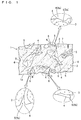
- the core part 1 is formed by wet-kneading and compression-granulating a compounding material containing a paper powder 3 and organic or inorganic fine pieces 4 as major materials, and has a structure such that dents 5 or/and protrusions 6 are formed on the surface 1 a of the core part 1 by deformation of the fine pieces 4 during the kneading or compression, or peeling-off of the fine pieces 4 from the paper powder 3 upon release of compression, i.e., departing of a part of the paper powder 3 that has been integrated with the fine pieces 4 upon the compression, from the fine pieces 4.
- 5a in the drawing represents dents that have been formed by the deformation of the fine pieces 4, and 6a in the drawing shows protrusions that have been formed by the deformation of the fine pieces 4. Furthermore, 5b in the drawing shows cracked dents that have been formed by the peeling-off of the fine pieces 4 from the paper powder 3 upon release of the compression, and 6b in the drawing shows scaly protrusions that have been formed by the rolling back of the fine pieces 4 present on the surface 1 a of the core part 1 during the compression-granulating, and the subsequent peeling-off of the fine pieces 4 from the paper powder 3.
- paper pieces or plastic film pieces or superposed pieces of these are preferably used as the fine pieces 4. That is, paper pieces or plastic film pieces or superposed pieces of these are used singly or in combination as the fine pieces 4.
- the plastic film pieces and the superposed pieces of the paper pieces and the plastic film pieces for example, cut pieces of waste materials from paper diapers, sanitary products and the like are used.
- dents 5 and protrusions 6 are imparted to the surface 1 a of the core part 1.
- the paper powder 3 is easily peeled off upon release of compression, and thus the cracked dents 5b are easily formed.
- the paper powder 3 and the fine pieces 4, which are the major materials of the compounding material for the core part 1, are incorporated by a ratio of 10 to 30 : 70 to 90 by weight ratio, and a water-absorbing material such as water-absorbing polymers, an inorganic filler material such as bentonite, an adhesive material such as starch or CMC, and the like are suitably added thereto. If the ratio of the paper powder 3 is more than this range, then desired dents and protrusions are difficult to be formed, whereas if the ratio of the fine piece 4 is much, then many dents and protrusions are uselessly formed. In addition, as mentioned below, fine pieces that have been cut so as to have a short direction width of from 3 mm to 10 mm are used as the fine pieces 4.
- the excrement-treating material according to the present invention has a structure such that the core part surface 1a is discontinuously colored by utilizing the dents 5 or/and the protrusions 6, that is, colored parts 8 and non-colored parts 9 are formed on the surface 1 a.
- the colored parts 8 are mainly formed on the protrusions 6 and the planar part 7, and the non-colored parts 9 are mainly formed on the dents 5 by the coloring process mentioned below.
- the colored parts 8 includes both of the case when the colored parts 8 are formed by the impregnation of a coating or a liquid color material such as a pigment from the surface 1 a into the inner part, and the case when the colored parts 8 are formed by the solidification of the liquid color material on the surface 1a.
- the color used for the coloring is not specifically limited, the color is set to be darker than the color of the surface layer 2 so as to be exposed through the surface layer 2 that has been wet.
- the color used for the coloring can be blue, green, yellow, red or the like, but blue or green is desirable with considering for the visibility of the non-colored parts that are stained the color of excreted urine as mentioned below.
- the compounding material for the surface layer 2 enters into the dents 5 and forms the surface layer 2 that suitably covers the core part 1.
- a water-absorbing polymer is incorporated together with organic fibers such as a paper powder or paper pieces.
- the organic fibers such as a paper powder or paper pieces as the compounding material for the surface layer are preferably prepared from virgin pulp (including pulp sludge), which has a high whiteness. This is because the color is set brighter than the color of the colored parts 8 on the surface 1 a of the core part and the color of excreted urine to thereby surely expose the color of the colored parts 8 and the color of excreted urine during the absorption of the excreted urine.
- the color of the colored parts 8 on the surface 1 a of the core part can be exposed through the surface layer 2 upon absorbing excreted urine, whereas the non-colored parts 9 of the surface 1 a of the core part are stained the color of the excreted urine, and thus the color of the excreted urine can be exposed through the surface layer 2, and discrimination of before use and after use and checking of health conditions can be conducted simultaneously and properly.
- the components of the color material and the like do not intervene in the non-colored parts 9, and the non-colored parts 9 smoothly absorb the excreted urine that has passed through the surface layer 2 and are stained the color of the excreted urine.
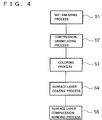
- the method for manufacturing an excrement-treating material includes: processes of wet-kneading and compression-granulating a compounding material containing the paper powder 3 and the fine pieces 4 as major materials (a wet-kneading process S1 and a compression-granulating process S2); a process of discontinuously coloring the surface 1 a of the granulated core part 1 (a coloring process S3); a process of coating the discontinuously-colored core part 1 with the surface layer 2 (a surface layer coating process S4); and a process of compression-bonding the surface layer 2 to the surface 1 a of the core part 1 (a surface layer compression bonding process S5).
- the compounding material for the core part 1 is kneaded while the water content is adjusted by adjusting the amount of added water and the amount of the injection of the compounding material.
- the fine piece 4 in the compounding material is preliminarily deformed.
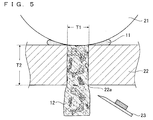
- the kneaded product 11 of the compounding material for the core part 1 which has undergone the wet-kneading process is compression-granulated in a known extrusion type compression granulator to thereby give a granulated product 12.
- the kneaded product 11 is press-fit into a granulation hole 22a that has been formed in a die 22, by means of a pressurization roller 21, to thereby give the granulated product 12.
- the fine pieces 4 are deformed.
- the diameter T1 of the granulation hole 22a is preset to from 2.5 mm to 6 mm, fine pieces each having a short direction width of from 3 mm to 10 mm are used as the fine pieces 4 to promote the deformation of the fine pieces 4 during the compression, whereby the dents or/and the protrusions mentioned below are surely formed.
- the length T2 of the granulation hole 22a is desirably from 30 mm to 40 mm, and is suitably adjusted depending on the residence time and press-fitting state of the kneaded product 11 mentioned below in the granulation hole 22a.
- the above-mentioned granulated product 12 is swollen by the release of the compression at the outer end of the granulation hole 22a, and broken by a breaking blade 23 to give the core part 1.
- the fine pieces 4 peel off from the paper powder 3, and cracked dents 5b or/and scaly protrusions 6b are formed on the surface 1 a of the core part 1. Furthermore, dents 5a or/and protrusions 6a are formed on the surface 1 a of the core part 1 by the deformed fine pieces 4. That is, as shown in Fig. 1 , the dents 5 or/and the protrusions 6 are positively formed on the surface 1a of the core part in this process.
- the water content rate of the kneaded product 11 is adjusted to from 10 to 35% by weight to promote the peeling-off of the fine pieces 4 from the paper powder 3, and promote the formation of the dents 5 or/and the protrusions 6.
- the adequate ranges of the diameter T1 of the granulation hole 22a, the short direction width of the fine pieces 4 and the water content rate of the kneaded product 11 in forming the dents 5 and the protrusions 6 on the surface of the core part 1 in this process, and the embodiment for forming the dents 5 and the protrusions 6 can further be adjusted by the pressure for pressing the pressurization roller 21, the rotation number of the pressurization roller, and the injection amount of the kneaded product 11.
- the pressure for pressing the pressurization roller 21, the rotation number of the pressurization roller, and the injection amount of the kneaded product 11 (raw material) are as follows.
- the pressure for pressing and rotation number of the pressurization roller 21, and the injection amount of the kneaded product 11 determine the amount of the press-fitting of the kneaded product 11 into the granulation hole 22a per one rotation of the pressurization roller 21, and thus contribute to the formation of the dents 5 and the protrusions 6 on the core part 1, specifically formation of the scaly protrusions 6b. That is, by determining the amount of the kneaded product 11 that is intermittently press-fit into the granulation hole 22a by means of the pressurization roller 21, the residence time and press-fitting state of the kneaded product 11 in the granulation hole 22a are determined, whereby the scaly protrusions 6b are formed.
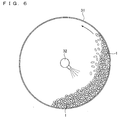
- the core part 1 is injected into a known shower drum 31, and a liquid color material is sprayed by means of a shower 32 while suspending the core part 1.
- the surface 1 a of the core part 1 is discontinuously colored by utilizing the dents 5 or/and the protrusions 6 formed as above.
- the non-colored parts 9 are mainly formed on the dents 5, and the colored parts 8 are mainly formed on the protrusions 6.
- the colored parts 8 are mainly formed on the planar part 7 other than the dents 5 and the protrusions 6.
- the ratio of the amount of the spraying of the liquid color material with respect to the weight of the core part 1 in this coloring process is such that the liquid color material is sprayed by from 40 ml to 80 ml with respect to 0.3 kg to 0.5 kg of the core part 1 (the core part 1 having a volume of about 1 L). The ratio is adjusted within the above-mentioned ratio in line with the increase or decrease of the core part 1, which is treated in this process.
- the core part 1 whose surface 1 a has been discontinuously colored as mentioned above is injected into a known coating drum together with a compounding material for the surface layer 2 to thereby coat the surface 1 a of the core part 1 with the surface layer 2.
- the surface layer 2 that is coating the core part 1 is compression-bonded.
- the core part 1 (excrement-treating material 1') coated with the surface layer 2 is injected into a compression bonding apparatus 41 that finely oscillates up and down, and is transferred with providing repetitive oscillation up and down.
- the compression bonding apparatus 41 for example, an apparatus having a bottomed-cylindrical oscillating body 42 and a helical path 43 that follows the inner circumferential surface of the oscillating body 42 can be used.
- the helical path 43 in the oscillating body 42 is also oscillated.
- the core part 1 coated with the surface layer 2, which has been injected into the upper end of the helical path 43 gradually transfers in the downward direction while the core part 1 oscillates up and down by the above-mentioned oscillation in the vertical and horizontal directions, and finally transfers in the horizontal direction while the core part 1 further oscillates up and down on a bottom plate 42a of the oscillating body 42.
- the core part 1 that is present on the bottom plate 42a can be collected along the inner circumferential surface of the oscillating body 42. Therefore, if the core part 1 is oscillated while the core part 1 is collected along the inner circumferential surface of the oscillating body 42 by this way, then the core part 1 is homogeneously mixed at an internal corner formed by the inner circumferential surface and the bottom plate 42a irrespective of the size and weight.
- the surface of the surface layer 2 is evenly hit on the helical path 43 or the bottom plate 42a, whereby the surface layer 2 is compression-bonded to the surface 1a of the core part.
- the compression bonding apparatus 41 is an optional format depending on operation to dispose a cyclic plate with cutaway part(s) of a single stage or multiple stages instead of the helical path 43, and to allow the core part 1 to sequentially fall through the cutaway part(s) while applying oscillation on the cyclic plate, to finally provide oscillation on the bottom plate 42a.
- the compression bonding of the surface layers may also be by using, for example, a conveyor having an oscillation-generating part.
- the compounding material for the surface layer 2 enters into the dents 5 to form the surface layer 2 that is suitably covering the core part 1, whereby an excrement-treating material having a composite layer structure can be manufactured.
- the compounding material for the surface layer 2 which has entered into the dents 5 plays a role as an anchor that prevents the peeling off of the surface layer 2, and in the case when the compounding material receives excreted urine, the compounding material plays a role of a conduit tube to thereby quickly stain the non-colored parts 9 the color of the excreted urine. It is specifically important to prevent the peeling off of the surface layer 2 in the excrement-treating material according to the present invention, which does not expose the color of the colored parts 8 of the core part 1 before use but exposes the color of the colored parts 8 only after use.
- the present invention is premised on the concept of the conventional art in which the color of the surface layer 2 is set brighter than the color of the core part 1 to give a difference to the degrees of brightness, to thereby enables the exposure of the color of the core part 1 through the surface layer 2 upon absorption of excreted urine, and discloses the concept that the colored parts 8 and the non-colored parts 9 are positively formed on the surface 1 a of the core part 1 so that the color of the former can be exposed through the surface layer 2 during absorption of the excreted urine absorb and the latter is simultaneously stain the color of the excreted urine color so that the color of the excreted urine color can be exposed through the surface layer 2.
- the excrement-treating material can contribute to discrimination of before use and after use by exposing the color of the colored parts 8 of the surface 1a of the core part through the surface layer 2 upon absorption of excreted urine, and since the non-colored parts 9 on the surface 1a of the core part is stained the color of the excreted urine, the excrement-treating material can simultaneously contribute to checking of health conditions by exposing the color of the excreted urine through the surface layer 2.
Landscapes
- Life Sciences & Earth Sciences (AREA)
- Environmental Sciences (AREA)
- Zoology (AREA)
- Animal Husbandry (AREA)
- Biodiversity & Conservation Biology (AREA)
- Chemical & Material Sciences (AREA)
- Inorganic Chemistry (AREA)
- Engineering & Computer Science (AREA)
- Mechanical Engineering (AREA)
- Housing For Livestock And Birds (AREA)
- Laminated Bodies (AREA)
Abstract
Description
- The present invention relates to an excrement-treating material formed of a compression-granulated water-absorbing granule body and having a composite layer structure of a core part and a surface layer, and a method for manufacturing the material.
- The following
Patent Literature 1 discloses an excrement-treating material, which is premised on an excrement-treating material formed of a composite layer structure of a water-absorbing core part and a water-absorbing surface layer covering the surface of the core part, wherein the surface of the core part is colored, and the core part is covered with the surface layer having a color brighter than the color by which the surface of the core part is colored (including colors that are said to be colorless such as white), and when the excrement-treating material absorbs urine excreted from a cat, a dog or the like, the color on the surface of the core part is exposed through the surface layer that has got wet, whereby the excrement-treating material contributes to discrimination between before use and after use. - That is, since the above-mentioned excrement-treating material is such that the color of the colored outer surface of the core part is exposed through the surface layer upon absorption of urine from a cat, a dog or the like, the used part (the part on which urine has been excreted) and the unused part (the part on which urine has not been excreted) of the excrement-treating material can be easily discriminated by visual observation of the color by a user.
- Patent Literature 1: Japanese Patent No.
2534031 - In the excrement-treating material of the above-mentioned
Patent Literature 1, as already mentioned above, since before use and after use can be easily discriminated by visually observing the color on the colored surface of the core part, unpleasant feeling is not provided to a user by the original color of the excrement from a cat, a dog or the like. - On the other hand, in the cases when the presence or absence of a urinary tract disease of a cat, a dog or the like is confirmed, and the like, a user desires to check health conditions by confirming the original color of excrement (specifically excreted urine).
- The inventors did many trials and errors aiming at responding the user's desire to check health conditions by the original color of an excrement, while utilizing the advantage of the excrement-treating material of the above-mentioned
Patent Literature 1 that before use and after use can be easily discriminated by confirming the color on the colored surface of the core part, and finally developed the present invention. - In summary, the excrement-treating material according to the present invention is premised on an excrement-treating material formed of a water-absorbing core part and a surface layer covering the core part, which exposes the color of the core part upon absorption of excreted urine, and has the following structure.
- Specifically, the above-mentioned core part has a structure such that the core part is formed by wet-kneading and compression-granulating a compounding material containing a paper powder and organic or inorganic fine pieces as major materials, dents or/and protrusions are formed on the surface of the core part by deformation by the kneading or compression of the fine pieces or peeling-off of the fine pieces from the paper powder upon release of compression, the surface of the core part is discontinuously colored by utilizing these dents or/and the protrusions, the discontinuously-colored surface of the core part is covered with the surface layer, and the color of the colored parts of the surface of the core part can be exposed through the surface layer during absorption of excreted urine, whereas the non-colored part of the surface of the core part is stained the color of the excreted urine, and the color of the excreted urine can be exposed through the surface layer, and thus discrimination of before use and after use and checking of health conditions can be conducted simultaneously and properly.
- Preferably, by using the dents or/and the protrusions are positively formed on the surface of the core part, paper pieces or plastic film pieces or superposed pieces of these pieces as the fine pieces.
- In addition, a method for manufacturing an excrement-treating material according to the present invention is a method for manufacturing an excrement-treating material including a water-absorbing core part, and a surface layer covering the core part, which exposes the color of the core part upon absorption of excreted urine, and the method includes the following constitutions of A to D:
- A: wet-kneading and compression-granulating a compounding material containing a paper powder and organic or inorganic fine pieces as major materials, and forming dents or/and protrusions on the surface of the core part by deformation by the kneading or compression of the fine pieces or peeling-off of the fine pieces from the paper powder upon release of compression;
- B: discontinuously coloring the surface of the granulated core part by utilizing the dents or/and the protrusions;
- C: covering the discontinuously-colored surface of the core part with the surface layer; and
- D: compression-bonding the surface layer to the surface of the core part.
- Preferably, the dents or/and the protrusions are suitably formed on the surface of the core part by using paper pieces or plastic film pieces or superposed pieces of these pieces as the fine pieces.
- More preferably, the dents or/and the protrusions are surely formed by using extrusion-granulation as the compression-granulating, presetting the diameter of each granulation holes to 2.5 mm to 6 mm, and using fine pieces each having a short direction width of 3 mm to 10 mm as the fine pieces.
- According to the excrement-treating material according to the present invention, upon absorption of excreted urine, the excrement-treating material can contribute to discrimination between before use and after use by exposing the color of the colored part of the surface of the core part through the surface layer, and can simultaneously contribute to checking of health conditions by staining the non-colored parts on the surface of the core part the color of the excreted urine and exposing the color of the excreted urine through the surface layer.
-
-
Fig. 1 is a cross-sectional drawing of a core part of an excrement-treating material according to the present invention. -
Fig. 2 is a cross-sectional drawing showing the state in which a surface of the core part has been colored. -
Fig. 3 is a cross-sectional drawing showing the state on which the surface of the colored core part is covered with a surface layer. -
Fig. 4 is a flow chart schematically showing processes for a manufacture of the excrement-treating material. -
Fig. 5 is an explanatory drawing schematically showing a compression-granulating process. -
Fig. 6 is an explanatory drawing schematically showing a coloring process. -
Figs. 7(A) and 7(B) are explanatory drawings schematically showing a surface layer compression bonding process, whereinFig. 7(A) is a plane view of a compression bonding apparatus, andFig. 7(B) is a perspective view schematically showing an internal structure of the compression bonding apparatus with partial cutaway. - The best mode of the present invention will be explained below based on
Figs. 1 to 7(B) . - As shown in
Figs. 1 to 3 , the excrement-treating material according to the present invention is premised on an excrement-treating material formed of a water-absorbingcore part 1 and asurface layer 2 covering thecore part 1, on which the color of thecore part 1 is exposed upon absorption of excreted urine. Based on the respective drawings inFigs. 1 to 3 , the structure of the excrement-treating material according to the present invention will be mentioned in detail. - As shown in
Fig. 1 , thecore part 1 is formed by wet-kneading and compression-granulating a compounding material containing apaper powder 3 and organic orinorganic fine pieces 4 as major materials, and has a structure such thatdents 5 or/andprotrusions 6 are formed on thesurface 1 a of thecore part 1 by deformation of thefine pieces 4 during the kneading or compression, or peeling-off of thefine pieces 4 from thepaper powder 3 upon release of compression, i.e., departing of a part of thepaper powder 3 that has been integrated with thefine pieces 4 upon the compression, from thefine pieces 4. - 5a in the drawing represents dents that have been formed by the deformation of the
fine pieces fine pieces 4. Furthermore, 5b in the drawing shows cracked dents that have been formed by the peeling-off of thefine pieces 4 from thepaper powder 3 upon release of the compression, and 6b in the drawing shows scaly protrusions that have been formed by the rolling back of thefine pieces 4 present on thesurface 1 a of thecore part 1 during the compression-granulating, and the subsequent peeling-off of thefine pieces 4 from thepaper powder 3. - In addition, paper pieces or plastic film pieces or superposed pieces of these are preferably used as the
fine pieces 4. That is, paper pieces or plastic film pieces or superposed pieces of these are used singly or in combination as thefine pieces 4. As the plastic film pieces and the superposed pieces of the paper pieces and the plastic film pieces, for example, cut pieces of waste materials from paper diapers, sanitary products and the like are used. By incorporating thefine pieces 4, as mentioned above,dents 5 andprotrusions 6 are imparted to thesurface 1 a of thecore part 1. - Specifically, in the case when the plastic film pieces or the superposed pieces of the paper pieces and plastic film pieces are used as the
fine pieces 4, thepaper powder 3 is easily peeled off upon release of compression, and thus the crackeddents 5b are easily formed. - The
paper powder 3 and thefine pieces 4, which are the major materials of the compounding material for thecore part 1, are incorporated by a ratio of 10 to 30 : 70 to 90 by weight ratio, and a water-absorbing material such as water-absorbing polymers, an inorganic filler material such as bentonite, an adhesive material such as starch or CMC, and the like are suitably added thereto. If the ratio of thepaper powder 3 is more than this range, then desired dents and protrusions are difficult to be formed, whereas if the ratio of thefine piece 4 is much, then many dents and protrusions are uselessly formed. In addition, as mentioned below, fine pieces that have been cut so as to have a short direction width of from 3 mm to 10 mm are used as thefine pieces 4. - Furthermore, as shown in
Fig. 2 , the excrement-treating material according to the present invention has a structure such that thecore part surface 1a is discontinuously colored by utilizing thedents 5 or/and theprotrusions 6, that is, coloredparts 8 andnon-colored parts 9 are formed on thesurface 1 a. - As shown in the same
Fig. 2 , thecolored parts 8 are mainly formed on theprotrusions 6 and theplanar part 7, and thenon-colored parts 9 are mainly formed on thedents 5 by the coloring process mentioned below. In addition, thecolored parts 8 includes both of the case when thecolored parts 8 are formed by the impregnation of a coating or a liquid color material such as a pigment from thesurface 1 a into the inner part, and the case when thecolored parts 8 are formed by the solidification of the liquid color material on thesurface 1a. - Although the color used for the coloring is not specifically limited, the color is set to be darker than the color of the
surface layer 2 so as to be exposed through thesurface layer 2 that has been wet. For example, in the case when the color of thesurface layer 2 is white, the color used for the coloring can be blue, green, yellow, red or the like, but blue or green is desirable with considering for the visibility of the non-colored parts that are stained the color of excreted urine as mentioned below. - Furthermore, as shown in
Fig. 3 , in the excrement-treating material according to the present invention, under the state that thecore part 1 is covered with thesurface layer 2 to thereby form a composite layer structure, the compounding material for thesurface layer 2 enters into thedents 5 and forms thesurface layer 2 that suitably covers thecore part 1. - As the compounding material for the
surface layer 2, a water-absorbing polymer is incorporated together with organic fibers such as a paper powder or paper pieces. The organic fibers such as a paper powder or paper pieces as the compounding material for the surface layer are preferably prepared from virgin pulp (including pulp sludge), which has a high whiteness. This is because the color is set brighter than the color of thecolored parts 8 on thesurface 1 a of the core part and the color of excreted urine to thereby surely expose the color of thecolored parts 8 and the color of excreted urine during the absorption of the excreted urine. - In the excrement-treating material according to the present invention 1' having the above-mentioned structure, the color of the
colored parts 8 on thesurface 1 a of the core part can be exposed through thesurface layer 2 upon absorbing excreted urine, whereas thenon-colored parts 9 of thesurface 1 a of the core part are stained the color of the excreted urine, and thus the color of the excreted urine can be exposed through thesurface layer 2, and discrimination of before use and after use and checking of health conditions can be conducted simultaneously and properly. The components of the color material and the like do not intervene in thenon-colored parts 9, and thenon-colored parts 9 smoothly absorb the excreted urine that has passed through thesurface layer 2 and are stained the color of the excreted urine. - Secondly, the method for manufacturing an excrement-treating material according to the present invention will be explained in detail.
- As shown in
Fig. 4 , the method for manufacturing an excrement-treating material according to the present invention includes: processes of wet-kneading and compression-granulating a compounding material containing thepaper powder 3 and thefine pieces 4 as major materials (a wet-kneading process S1 and a compression-granulating process S2); a process of discontinuously coloring thesurface 1 a of the granulated core part 1 (a coloring process S3); a process of coating the discontinuously-colored core part 1 with the surface layer 2 (a surface layer coating process S4); and a process of compression-bonding thesurface layer 2 to thesurface 1 a of the core part 1 (a surface layer compression bonding process S5). - Firstly, in the wet-kneading process, the compounding material for the
core part 1 is kneaded while the water content is adjusted by adjusting the amount of added water and the amount of the injection of the compounding material. By this kneading, thefine piece 4 in the compounding material is preliminarily deformed. - Then, as shown in
Fig. 5 , the kneadedproduct 11 of the compounding material for thecore part 1 which has undergone the wet-kneading process is compression-granulated in a known extrusion type compression granulator to thereby give agranulated product 12. - Specifically, the kneaded
product 11 is press-fit into agranulation hole 22a that has been formed in adie 22, by means of apressurization roller 21, to thereby give thegranulated product 12. During this compression, thefine pieces 4 are deformed. Furthermore, the diameter T1 of thegranulation hole 22a is preset to from 2.5 mm to 6 mm, fine pieces each having a short direction width of from 3 mm to 10 mm are used as thefine pieces 4 to promote the deformation of thefine pieces 4 during the compression, whereby the dents or/and the protrusions mentioned below are surely formed. The length T2 of thegranulation hole 22a is desirably from 30 mm to 40 mm, and is suitably adjusted depending on the residence time and press-fitting state of the kneadedproduct 11 mentioned below in thegranulation hole 22a. - The above-mentioned
granulated product 12 is swollen by the release of the compression at the outer end of thegranulation hole 22a, and broken by abreaking blade 23 to give thecore part 1. - During the release of the compression, the
fine pieces 4 peel off from thepaper powder 3, and crackeddents 5b or/andscaly protrusions 6b are formed on thesurface 1 a of thecore part 1. Furthermore, dents 5a or/andprotrusions 6a are formed on thesurface 1 a of thecore part 1 by the deformedfine pieces 4. That is, as shown inFig. 1 , thedents 5 or/and theprotrusions 6 are positively formed on thesurface 1a of the core part in this process. - In this process, the water content rate of the kneaded
product 11 is adjusted to from 10 to 35% by weight to promote the peeling-off of thefine pieces 4 from thepaper powder 3, and promote the formation of thedents 5 or/and theprotrusions 6. - In addition, as mentioned above, the adequate ranges of the diameter T1 of the
granulation hole 22a, the short direction width of thefine pieces 4 and the water content rate of the kneadedproduct 11 in forming thedents 5 and theprotrusions 6 on the surface of thecore part 1 in this process, and the embodiment for forming thedents 5 and theprotrusions 6 can further be adjusted by the pressure for pressing thepressurization roller 21, the rotation number of the pressurization roller, and the injection amount of the kneadedproduct 11. The pressure for pressing thepressurization roller 21, the rotation number of the pressurization roller, and the injection amount of the kneaded product 11 (raw material) are as follows. - The pressure for pressing the
pressurization roller 21 ... from 15 to 20 MPS (from 150 to 200 kg/cm2) - The rotation number of the
pressurization roller 21 ... from 100 to 140 rpm - The injection amount of the kneaded
product 11 ... from 800 to 1,500 kg - The pressure for pressing and rotation number of the
pressurization roller 21, and the injection amount of the kneadedproduct 11 determine the amount of the press-fitting of the kneadedproduct 11 into thegranulation hole 22a per one rotation of thepressurization roller 21, and thus contribute to the formation of thedents 5 and theprotrusions 6 on thecore part 1, specifically formation of thescaly protrusions 6b. That is, by determining the amount of the kneadedproduct 11 that is intermittently press-fit into thegranulation hole 22a by means of thepressurization roller 21, the residence time and press-fitting state of the kneadedproduct 11 in thegranulation hole 22a are determined, whereby thescaly protrusions 6b are formed. - Subsequently, as shown in
Fig. 6 , thecore part 1 is injected into a knownshower drum 31, and a liquid color material is sprayed by means of ashower 32 while suspending thecore part 1. - At this time, as shown in
Fig. 2 , thesurface 1 a of thecore part 1 is discontinuously colored by utilizing thedents 5 or/and theprotrusions 6 formed as above. Specifically, thenon-colored parts 9 are mainly formed on thedents 5, and thecolored parts 8 are mainly formed on theprotrusions 6. Thecolored parts 8 are mainly formed on theplanar part 7 other than thedents 5 and theprotrusions 6. - It is desirable that the ratio of the amount of the spraying of the liquid color material with respect to the weight of the
core part 1 in this coloring process is such that the liquid color material is sprayed by from 40 ml to 80 ml with respect to 0.3 kg to 0.5 kg of the core part 1 (thecore part 1 having a volume of about 1 L). The ratio is adjusted within the above-mentioned ratio in line with the increase or decrease of thecore part 1, which is treated in this process. - Subsequently, the
core part 1 whosesurface 1 a has been discontinuously colored as mentioned above is injected into a known coating drum together with a compounding material for thesurface layer 2 to thereby coat thesurface 1 a of thecore part 1 with thesurface layer 2. - Subsequently, the
surface layer 2 that is coating thecore part 1 is compression-bonded. Specifically, as shown inFigs. 7(A) and 7(B) , the core part 1 (excrement-treating material 1') coated with thesurface layer 2 is injected into acompression bonding apparatus 41 that finely oscillates up and down, and is transferred with providing repetitive oscillation up and down. - As shown in
Figs. 7(A) and 7(B) , as thecompression bonding apparatus 41, for example, an apparatus having a bottomed-cylindricaloscillating body 42 and ahelical path 43 that follows the inner circumferential surface of theoscillating body 42 can be used. - By the oscillation in the vertical and horizontal directions provided to the
oscillating body 42, thehelical path 43 in theoscillating body 42 is also oscillated. As shown inFigs. 7(A) and 7(B) , thecore part 1 coated with thesurface layer 2, which has been injected into the upper end of thehelical path 43, gradually transfers in the downward direction while thecore part 1 oscillates up and down by the above-mentioned oscillation in the vertical and horizontal directions, and finally transfers in the horizontal direction while thecore part 1 further oscillates up and down on abottom plate 42a of theoscillating body 42. Furthermore, as shown inFigs. 7(A) and 7(B) , for example, if the above-mentionedbottom plate 42a is formed into a low-height conical form, then thecore part 1 that is present on thebottom plate 42a can be collected along the inner circumferential surface of theoscillating body 42. Therefore, if thecore part 1 is oscillated while thecore part 1 is collected along the inner circumferential surface of theoscillating body 42 by this way, then thecore part 1 is homogeneously mixed at an internal corner formed by the inner circumferential surface and thebottom plate 42a irrespective of the size and weight. Furthermore, for example, it is also possible to transfer thecore part 1 along the inner circumferential surface (internal corner) of theoscillating body 42 also on thehelical path 43 by the width, direction, timing and the like of the oscillation provided to theoscillating body 42. - As mentioned above, by transferring the
core part 1 coated with thesurface layer 2 by while oscillating thecore part 1 up and down, the surface of thesurface layer 2 is evenly hit on thehelical path 43 or thebottom plate 42a, whereby thesurface layer 2 is compression-bonded to thesurface 1a of the core part. - In addition, as another example of the
compression bonding apparatus 41 explained above, it is an optional format depending on operation to dispose a cyclic plate with cutaway part(s) of a single stage or multiple stages instead of thehelical path 43, and to allow thecore part 1 to sequentially fall through the cutaway part(s) while applying oscillation on the cyclic plate, to finally provide oscillation on thebottom plate 42a. Alternatively, the compression bonding of the surface layers may also be by using, for example, a conveyor having an oscillation-generating part. - As shown in
Fig. 3 , by the surface layer compression bonding process, the compounding material for thesurface layer 2 enters into thedents 5 to form thesurface layer 2 that is suitably covering thecore part 1, whereby an excrement-treating material having a composite layer structure can be manufactured. Specifically, the compounding material for thesurface layer 2 which has entered into thedents 5 plays a role as an anchor that prevents the peeling off of thesurface layer 2, and in the case when the compounding material receives excreted urine, the compounding material plays a role of a conduit tube to thereby quickly stain thenon-colored parts 9 the color of the excreted urine. It is specifically important to prevent the peeling off of thesurface layer 2 in the excrement-treating material according to the present invention, which does not expose the color of thecolored parts 8 of thecore part 1 before use but exposes the color of thecolored parts 8 only after use. - The present invention is premised on the concept of the conventional art in which the color of the
surface layer 2 is set brighter than the color of thecore part 1 to give a difference to the degrees of brightness, to thereby enables the exposure of the color of thecore part 1 through thesurface layer 2 upon absorption of excreted urine, and discloses the concept that thecolored parts 8 and thenon-colored parts 9 are positively formed on thesurface 1 a of thecore part 1 so that the color of the former can be exposed through thesurface layer 2 during absorption of the excreted urine absorb and the latter is simultaneously stain the color of the excreted urine color so that the color of the excreted urine color can be exposed through thesurface layer 2. - According to the excrement-treating material according to the present invention, the excrement-treating material can contribute to discrimination of before use and after use by exposing the color of the
colored parts 8 of thesurface 1a of the core part through thesurface layer 2 upon absorption of excreted urine, and since thenon-colored parts 9 on thesurface 1a of the core part is stained the color of the excreted urine, the excrement-treating material can simultaneously contribute to checking of health conditions by exposing the color of the excreted urine through thesurface layer 2. -
- 1 ... core part, 1 a ... surface, 1' ... excrement-treating material, 2 ... surface layer, 3 ... paper powder, 4 ... fine piece, 5 ... dent, 5a ... dent formed by deformation of fine piece, 5b ... cracked dent, 6 ... protrusion, 6a ... protrusion formed by deformation of fine piece, 6b ... scaly protrusion, 7 ... planar part, 8 ... colored part, 9 ... non-colored part, 11 ... kneaded product of compounding material of core part, 12 ... compression-granulated product, 21 ... pressurization roller, 22 ... die, 22a ... granulation hole, 23 ... breaking blade, 31 ... shower drum, 32 ... shower, 41 ... compression bonding apparatus, 42 ... oscillating body, 42a ... bottom plate, 43 ... helical path, S1 ... wet-kneading process, S2 ... compression-granulating process, S3 ... coloring process, S4 ... surface layer coating process, S5 ... surface layer compression bonding process, T1 ... diameter of granulation hole, T2 ... length of granulation hole.
Claims (5)
- An excrement-treating material, comprising:a water-absorbing core part; anda surface layer covering the core part, which exposes the color of the core part upon absorption of excreted urine,wherein the core part is formed by wet-kneading and compression-granulating a compounding material containing a paper powder and organic or inorganic fine pieces as major materials, dents or/and protrusions are formed on the surface of the core part by deformation by the kneading or compression of the fine pieces or peeling-off of the fine pieces from the paper powder upon release of compression, the surface of the core part is discontinuously colored by utilizing the dents or/and the protrusions, the discontinuously-colored surface of the core part is covered with the surface layer, and the color of a colored part of the surface of the core part is exposed through the surface layer during absorption of excreted urine, whereas the non-colored part of the surface of the core part is stained the color of the excreted urine, and the color of the excreted urine is exposed through the surface layer.
- The excrement-treating material according to claim 1, wherein the fine pieces are paper pieces or plastic film pieces, or superposed pieces of these pieces.
- A method for manufacturing an excrement-treating material comprising a water-absorbing core part, and a surface layer covering the core part, which exposes the color of the core part upon absorption of excreted urine, the method comprising the following constitutions of A to D:A: wet-kneading and compression-granulating a compounding material containing a paper powder and organic or inorganic fine pieces as major materials, and forming dents or/and protrusions on the surface of the core part by deformation by the kneading or compression of the fine pieces or peeling-off of the fine pieces from the paper powder upon release of compression;B: discontinuously coloring the surface of the granulated core part by utilizing the dents or/and the protrusions;C: covering the discontinuously-colored surface of the core part with the surface layer; andD: compression-bonding the surface layer to the surface of the core part.
- The method for manufacturing an excrement-treating material according to claim 3, wherein the fine pieces are in the state of paper pieces or plastic film pieces, or superposed pieces of these pieces.
- The method for manufacturing an excrement-treating material according to claim 3 or 4, wherein the compression-granulating is extrusion-granulation, the diameter of each granulation holes is from 2.5 mm to 6 mm, and the fine pieces each has a short direction width of from 3 mm to 10 mm.
Applications Claiming Priority (2)
| Application Number | Priority Date | Filing Date | Title |
|---|---|---|---|
| JP2013242207A JP5718437B1 (en) | 2013-11-22 | 2013-11-22 | Excrement treatment material and manufacturing method thereof |
| PCT/JP2014/080461 WO2015076246A1 (en) | 2013-11-22 | 2014-11-18 | Excrement-treating material and method for manufacturing same |
Publications (3)
| Publication Number | Publication Date |
|---|---|
| EP3045037A1 true EP3045037A1 (en) | 2016-07-20 |
| EP3045037A4 EP3045037A4 (en) | 2016-10-12 |
| EP3045037B1 EP3045037B1 (en) | 2018-10-10 |
Family
ID=53179508
Family Applications (1)
| Application Number | Title | Priority Date | Filing Date |
|---|---|---|---|
| EP14864194.7A Active EP3045037B1 (en) | 2013-11-22 | 2014-11-18 | Excrement-treating material and method for manufacturing same |
Country Status (5)
| Country | Link |
|---|---|
| US (1) | US10362763B2 (en) |
| EP (1) | EP3045037B1 (en) |
| JP (1) | JP5718437B1 (en) |
| CN (1) | CN105744826B (en) |
| WO (1) | WO2015076246A1 (en) |
Families Citing this family (1)
| Publication number | Priority date | Publication date | Assignee | Title |
|---|---|---|---|---|
| CA164069S (en) * | 2015-08-26 | 2016-03-15 | 7905122 Canada Inc | Particle for animal litter |
Family Cites Families (10)
| Publication number | Priority date | Publication date | Assignee | Title |
|---|---|---|---|---|
| JPH0827942B2 (en) * | 1987-11-30 | 1996-03-21 | コニカ株式会社 | Method of manufacturing magnetic recording medium |
| JP2534031B2 (en) | 1994-12-29 | 1996-09-11 | ペパーレット株式会社 | Urine waste treatment material |
| JP3723516B2 (en) * | 2002-03-20 | 2005-12-07 | ペパーレット株式会社 | Granular animal urine treatment material |
| CN1185927C (en) * | 2002-04-20 | 2005-01-26 | 卢正利 | Making process, product and stoving equipment for pet paper ball cushion |
| JP3786201B2 (en) * | 2002-10-28 | 2006-06-14 | ペパーレット株式会社 | Production of granulation for animal excrement absorption |
| JP2004321332A (en) * | 2003-04-22 | 2004-11-18 | Kohjin Co Ltd | Material having deodorizing function and method for producing the same |
| JP3768203B2 (en) * | 2003-05-19 | 2006-04-19 | 昇太郎 望月 | Animal excrement disposal materials |
| JP2012055241A (en) * | 2010-09-09 | 2012-03-22 | Daio Paper Corp | Granular piece for pet toilet |
| WO2012057825A1 (en) * | 2010-10-27 | 2012-05-03 | Nestec S.A. | Malodor control compositions |
| JP5746660B2 (en) * | 2012-04-16 | 2015-07-08 | 株式会社大貴 | Water absorption treatment material |
-
2013
- 2013-11-22 JP JP2013242207A patent/JP5718437B1/en active Active
-
2014
- 2014-11-18 EP EP14864194.7A patent/EP3045037B1/en active Active
- 2014-11-18 US US15/032,630 patent/US10362763B2/en active Active
- 2014-11-18 WO PCT/JP2014/080461 patent/WO2015076246A1/en not_active Ceased
- 2014-11-18 CN CN201480063472.XA patent/CN105744826B/en active Active
Also Published As
| Publication number | Publication date |
|---|---|
| WO2015076246A1 (en) | 2015-05-28 |
| JP2015100293A (en) | 2015-06-04 |
| US10362763B2 (en) | 2019-07-30 |
| EP3045037B1 (en) | 2018-10-10 |
| CN105744826B (en) | 2019-05-17 |
| EP3045037A4 (en) | 2016-10-12 |
| JP5718437B1 (en) | 2015-05-13 |
| US20160249582A1 (en) | 2016-09-01 |
| CN105744826A (en) | 2016-07-06 |
Similar Documents
| Publication | Publication Date | Title |
|---|---|---|
| CN100551233C (en) | Animal is handled material with the drainage urine of granular pattern | |
| US11304401B2 (en) | Water absorption treatment material and method for manufacturing the same | |
| JP4644270B2 (en) | Excrement disposal material for pets | |
| EP3045038A1 (en) | Excrement treatment material and method for producing same | |
| EP3045037B1 (en) | Excrement-treating material and method for manufacturing same | |
| JP2009044992A (en) | Urination treating material for animal | |
| CN107426981A (en) | Water-absorbing material and its manufacture method | |
| JP2012055241A (en) | Granular piece for pet toilet | |
| JP2019004834A (en) | Water absorption treatment material and method for producing the same | |
| US9854786B2 (en) | Production method for animal excrement treatment material and production device therefore | |
| US20220225591A1 (en) | Excrement treatment material and method for manufacturing the same | |
| US20200077618A1 (en) | Water absorption treatment material and method for manufacturing the same | |
| US10130069B2 (en) | Production method for animal excrement treatment material and production device therefor | |
| US20240381834A1 (en) | Excrement treatment material and method for manufacturing the same | |
| DE60022507D1 (en) | Single dose mold for delayed release with a latex coating and method for its production | |
| JP4798737B2 (en) | Urinal drain pan | |
| EP4349165A1 (en) | Excrement treatment material and method for producing same | |
| CN107249311B (en) | Water-absorbing material and method for producing same | |
| WO2024057809A1 (en) | Excrement treatment material and production method for same | |
| CN120789010A (en) | Bulk composition containing medicine balls and preparation method and application thereof | |
| JP2025015016A (en) | Excreta-treating material and method for producing the same | |
| HK1241654B (en) | Water absorption treatment material and a manufacturing method thereof | |
| JP2024138682A (en) | Excrement treatment material and its manufacturing method | |
| JP2020174554A (en) | Water absorption treatment material and method for manufacturing the same | |
| JP2021114914A (en) | Excrement treatment material and its manufacturing method |
Legal Events
| Date | Code | Title | Description |
|---|---|---|---|
| PUAI | Public reference made under article 153(3) epc to a published international application that has entered the european phase |
Free format text: ORIGINAL CODE: 0009012 |
|
| 17P | Request for examination filed |
Effective date: 20160412 |
|
| AK | Designated contracting states |
Kind code of ref document: A1 Designated state(s): AL AT BE BG CH CY CZ DE DK EE ES FI FR GB GR HR HU IE IS IT LI LT LU LV MC MK MT NL NO PL PT RO RS SE SI SK SM TR |
|
| AX | Request for extension of the european patent |
Extension state: BA ME |
|
| A4 | Supplementary search report drawn up and despatched |
Effective date: 20160909 |
|
| RIC1 | Information provided on ipc code assigned before grant |
Ipc: A01K 1/015 20060101AFI20160905BHEP |
|
| DAX | Request for extension of the european patent (deleted) | ||
| GRAP | Despatch of communication of intention to grant a patent |
Free format text: ORIGINAL CODE: EPIDOSNIGR1 |
|
| INTG | Intention to grant announced |
Effective date: 20180227 |
|
| GRAJ | Information related to disapproval of communication of intention to grant by the applicant or resumption of examination proceedings by the epo deleted |
Free format text: ORIGINAL CODE: EPIDOSDIGR1 |
|
| GRAP | Despatch of communication of intention to grant a patent |
Free format text: ORIGINAL CODE: EPIDOSNIGR1 |
|
| INTC | Intention to grant announced (deleted) | ||
| INTG | Intention to grant announced |
Effective date: 20180524 |
|
| GRAS | Grant fee paid |
Free format text: ORIGINAL CODE: EPIDOSNIGR3 |
|
| GRAA | (expected) grant |
Free format text: ORIGINAL CODE: 0009210 |
|
| AK | Designated contracting states |
Kind code of ref document: B1 Designated state(s): AL AT BE BG CH CY CZ DE DK EE ES FI FR GB GR HR HU IE IS IT LI LT LU LV MC MK MT NL NO PL PT RO RS SE SI SK SM TR |
|
| REG | Reference to a national code |
Ref country code: GB Ref legal event code: FG4D |
|
| REG | Reference to a national code |
Ref country code: CH Ref legal event code: EP Ref country code: AT Ref legal event code: REF Ref document number: 1050147 Country of ref document: AT Kind code of ref document: T Effective date: 20181015 |
|
| REG | Reference to a national code |
Ref country code: IE Ref legal event code: FG4D |
|
| REG | Reference to a national code |
Ref country code: DE Ref legal event code: R096 Ref document number: 602014034055 Country of ref document: DE |
|
| REG | Reference to a national code |
Ref country code: NL Ref legal event code: MP Effective date: 20181010 |
|
| REG | Reference to a national code |
Ref country code: LT Ref legal event code: MG4D |
|
| REG | Reference to a national code |
Ref country code: AT Ref legal event code: MK05 Ref document number: 1050147 Country of ref document: AT Kind code of ref document: T Effective date: 20181010 |
|
| PG25 | Lapsed in a contracting state [announced via postgrant information from national office to epo] |
Ref country code: NL Free format text: LAPSE BECAUSE OF FAILURE TO SUBMIT A TRANSLATION OF THE DESCRIPTION OR TO PAY THE FEE WITHIN THE PRESCRIBED TIME-LIMIT Effective date: 20181010 |
|
| PG25 | Lapsed in a contracting state [announced via postgrant information from national office to epo] |
Ref country code: AT Free format text: LAPSE BECAUSE OF FAILURE TO SUBMIT A TRANSLATION OF THE DESCRIPTION OR TO PAY THE FEE WITHIN THE PRESCRIBED TIME-LIMIT Effective date: 20181010 Ref country code: HR Free format text: LAPSE BECAUSE OF FAILURE TO SUBMIT A TRANSLATION OF THE DESCRIPTION OR TO PAY THE FEE WITHIN THE PRESCRIBED TIME-LIMIT Effective date: 20181010 Ref country code: LV Free format text: LAPSE BECAUSE OF FAILURE TO SUBMIT A TRANSLATION OF THE DESCRIPTION OR TO PAY THE FEE WITHIN THE PRESCRIBED TIME-LIMIT Effective date: 20181010 Ref country code: NO Free format text: LAPSE BECAUSE OF FAILURE TO SUBMIT A TRANSLATION OF THE DESCRIPTION OR TO PAY THE FEE WITHIN THE PRESCRIBED TIME-LIMIT Effective date: 20190110 Ref country code: BG Free format text: LAPSE BECAUSE OF FAILURE TO SUBMIT A TRANSLATION OF THE DESCRIPTION OR TO PAY THE FEE WITHIN THE PRESCRIBED TIME-LIMIT Effective date: 20190110 Ref country code: LT Free format text: LAPSE BECAUSE OF FAILURE TO SUBMIT A TRANSLATION OF THE DESCRIPTION OR TO PAY THE FEE WITHIN THE PRESCRIBED TIME-LIMIT Effective date: 20181010 Ref country code: ES Free format text: LAPSE BECAUSE OF FAILURE TO SUBMIT A TRANSLATION OF THE DESCRIPTION OR TO PAY THE FEE WITHIN THE PRESCRIBED TIME-LIMIT Effective date: 20181010 Ref country code: PL Free format text: LAPSE BECAUSE OF FAILURE TO SUBMIT A TRANSLATION OF THE DESCRIPTION OR TO PAY THE FEE WITHIN THE PRESCRIBED TIME-LIMIT Effective date: 20181010 Ref country code: IS Free format text: LAPSE BECAUSE OF FAILURE TO SUBMIT A TRANSLATION OF THE DESCRIPTION OR TO PAY THE FEE WITHIN THE PRESCRIBED TIME-LIMIT Effective date: 20190210 Ref country code: FI Free format text: LAPSE BECAUSE OF FAILURE TO SUBMIT A TRANSLATION OF THE DESCRIPTION OR TO PAY THE FEE WITHIN THE PRESCRIBED TIME-LIMIT Effective date: 20181010 |
|
| PG25 | Lapsed in a contracting state [announced via postgrant information from national office to epo] |
Ref country code: GR Free format text: LAPSE BECAUSE OF FAILURE TO SUBMIT A TRANSLATION OF THE DESCRIPTION OR TO PAY THE FEE WITHIN THE PRESCRIBED TIME-LIMIT Effective date: 20190111 Ref country code: SE Free format text: LAPSE BECAUSE OF FAILURE TO SUBMIT A TRANSLATION OF THE DESCRIPTION OR TO PAY THE FEE WITHIN THE PRESCRIBED TIME-LIMIT Effective date: 20181010 Ref country code: RS Free format text: LAPSE BECAUSE OF FAILURE TO SUBMIT A TRANSLATION OF THE DESCRIPTION OR TO PAY THE FEE WITHIN THE PRESCRIBED TIME-LIMIT Effective date: 20181010 Ref country code: AL Free format text: LAPSE BECAUSE OF FAILURE TO SUBMIT A TRANSLATION OF THE DESCRIPTION OR TO PAY THE FEE WITHIN THE PRESCRIBED TIME-LIMIT Effective date: 20181010 Ref country code: PT Free format text: LAPSE BECAUSE OF FAILURE TO SUBMIT A TRANSLATION OF THE DESCRIPTION OR TO PAY THE FEE WITHIN THE PRESCRIBED TIME-LIMIT Effective date: 20190210 |
|
| REG | Reference to a national code |
Ref country code: CH Ref legal event code: PL |
|
| REG | Reference to a national code |
Ref country code: DE Ref legal event code: R097 Ref document number: 602014034055 Country of ref document: DE |
|
| PG25 | Lapsed in a contracting state [announced via postgrant information from national office to epo] |
Ref country code: DK Free format text: LAPSE BECAUSE OF FAILURE TO SUBMIT A TRANSLATION OF THE DESCRIPTION OR TO PAY THE FEE WITHIN THE PRESCRIBED TIME-LIMIT Effective date: 20181010 Ref country code: IT Free format text: LAPSE BECAUSE OF FAILURE TO SUBMIT A TRANSLATION OF THE DESCRIPTION OR TO PAY THE FEE WITHIN THE PRESCRIBED TIME-LIMIT Effective date: 20181010 Ref country code: LU Free format text: LAPSE BECAUSE OF NON-PAYMENT OF DUE FEES Effective date: 20181118 Ref country code: CZ Free format text: LAPSE BECAUSE OF FAILURE TO SUBMIT A TRANSLATION OF THE DESCRIPTION OR TO PAY THE FEE WITHIN THE PRESCRIBED TIME-LIMIT Effective date: 20181010 |
|
| PLBE | No opposition filed within time limit |
Free format text: ORIGINAL CODE: 0009261 |
|
| STAA | Information on the status of an ep patent application or granted ep patent |
Free format text: STATUS: NO OPPOSITION FILED WITHIN TIME LIMIT |
|
| REG | Reference to a national code |
Ref country code: BE Ref legal event code: MM Effective date: 20181130 |
|
| REG | Reference to a national code |
Ref country code: IE Ref legal event code: MM4A |
|
| PG25 | Lapsed in a contracting state [announced via postgrant information from national office to epo] |
Ref country code: RO Free format text: LAPSE BECAUSE OF FAILURE TO SUBMIT A TRANSLATION OF THE DESCRIPTION OR TO PAY THE FEE WITHIN THE PRESCRIBED TIME-LIMIT Effective date: 20181010 Ref country code: SK Free format text: LAPSE BECAUSE OF FAILURE TO SUBMIT A TRANSLATION OF THE DESCRIPTION OR TO PAY THE FEE WITHIN THE PRESCRIBED TIME-LIMIT Effective date: 20181010 Ref country code: MC Free format text: LAPSE BECAUSE OF FAILURE TO SUBMIT A TRANSLATION OF THE DESCRIPTION OR TO PAY THE FEE WITHIN THE PRESCRIBED TIME-LIMIT Effective date: 20181010 Ref country code: CH Free format text: LAPSE BECAUSE OF NON-PAYMENT OF DUE FEES Effective date: 20181130 Ref country code: EE Free format text: LAPSE BECAUSE OF FAILURE TO SUBMIT A TRANSLATION OF THE DESCRIPTION OR TO PAY THE FEE WITHIN THE PRESCRIBED TIME-LIMIT Effective date: 20181010 Ref country code: LI Free format text: LAPSE BECAUSE OF NON-PAYMENT OF DUE FEES Effective date: 20181130 Ref country code: SM Free format text: LAPSE BECAUSE OF FAILURE TO SUBMIT A TRANSLATION OF THE DESCRIPTION OR TO PAY THE FEE WITHIN THE PRESCRIBED TIME-LIMIT Effective date: 20181010 |
|
| 26N | No opposition filed |
Effective date: 20190711 |
|
| PG25 | Lapsed in a contracting state [announced via postgrant information from national office to epo] |
Ref country code: SI Free format text: LAPSE BECAUSE OF FAILURE TO SUBMIT A TRANSLATION OF THE DESCRIPTION OR TO PAY THE FEE WITHIN THE PRESCRIBED TIME-LIMIT Effective date: 20181010 Ref country code: IE Free format text: LAPSE BECAUSE OF NON-PAYMENT OF DUE FEES Effective date: 20181118 |
|
| PG25 | Lapsed in a contracting state [announced via postgrant information from national office to epo] |
Ref country code: BE Free format text: LAPSE BECAUSE OF NON-PAYMENT OF DUE FEES Effective date: 20181130 |
|
| PG25 | Lapsed in a contracting state [announced via postgrant information from national office to epo] |
Ref country code: MT Free format text: LAPSE BECAUSE OF NON-PAYMENT OF DUE FEES Effective date: 20181118 |
|
| PG25 | Lapsed in a contracting state [announced via postgrant information from national office to epo] |
Ref country code: TR Free format text: LAPSE BECAUSE OF FAILURE TO SUBMIT A TRANSLATION OF THE DESCRIPTION OR TO PAY THE FEE WITHIN THE PRESCRIBED TIME-LIMIT Effective date: 20181010 |
|
| PG25 | Lapsed in a contracting state [announced via postgrant information from national office to epo] |
Ref country code: CY Free format text: LAPSE BECAUSE OF FAILURE TO SUBMIT A TRANSLATION OF THE DESCRIPTION OR TO PAY THE FEE WITHIN THE PRESCRIBED TIME-LIMIT Effective date: 20181010 Ref country code: HU Free format text: LAPSE BECAUSE OF FAILURE TO SUBMIT A TRANSLATION OF THE DESCRIPTION OR TO PAY THE FEE WITHIN THE PRESCRIBED TIME-LIMIT; INVALID AB INITIO Effective date: 20141118 Ref country code: MK Free format text: LAPSE BECAUSE OF NON-PAYMENT OF DUE FEES Effective date: 20181010 |
|
| PGFP | Annual fee paid to national office [announced via postgrant information from national office to epo] |
Ref country code: GB Payment date: 20241120 Year of fee payment: 11 |
|
| PGFP | Annual fee paid to national office [announced via postgrant information from national office to epo] |
Ref country code: FR Payment date: 20241128 Year of fee payment: 11 |
|
| PGFP | Annual fee paid to national office [announced via postgrant information from national office to epo] |
Ref country code: DE Payment date: 20250127 Year of fee payment: 11 |
|
| REG | Reference to a national code |
Ref country code: DE Ref legal event code: R119 Ref document number: 602014034055 Country of ref document: DE |