EP3044216B1 - Novel and specific inhibitors of cytochrome p450 26 retinoic acid hydroxylase - Google Patents
Novel and specific inhibitors of cytochrome p450 26 retinoic acid hydroxylase Download PDFInfo
- Publication number
- EP3044216B1 EP3044216B1 EP14761747.6A EP14761747A EP3044216B1 EP 3044216 B1 EP3044216 B1 EP 3044216B1 EP 14761747 A EP14761747 A EP 14761747A EP 3044216 B1 EP3044216 B1 EP 3044216B1
- Authority
- EP
- European Patent Office
- Prior art keywords
- phenyl
- methyl
- methoxyphenyl
- adamantan
- tetramethyl
- Prior art date
- Legal status (The legal status is an assumption and is not a legal conclusion. Google has not performed a legal analysis and makes no representation as to the accuracy of the status listed.)
- Active
Links
- 0 *c(cc1)c(*)cc1I Chemical compound *c(cc1)c(*)cc1I 0.000 description 11
- PUHUPYSPOWTHKV-UHFFFAOYSA-N CC(C)(C)c1cc(C2(c3ccc(CCC(OC)=O)cc3)OCCO2)ccc1OC Chemical compound CC(C)(C)c1cc(C2(c3ccc(CCC(OC)=O)cc3)OCCO2)ccc1OC PUHUPYSPOWTHKV-UHFFFAOYSA-N 0.000 description 2
- JUCKDFDGPQPRAZ-UHFFFAOYSA-N CCOC(CCc(cc1)ccc1Sc1cc(C(C)(C)CCC2(C)C)c2cc1)=O Chemical compound CCOC(CCc(cc1)ccc1Sc1cc(C(C)(C)CCC2(C)C)c2cc1)=O JUCKDFDGPQPRAZ-UHFFFAOYSA-N 0.000 description 2
- YURGCRLFNARSMV-HTQIHHBCSA-N C=Nc(cc(C(CCC1(N)N[I]=C)(N)N=N)c1c1)c1/C(/c(cc1)ccc1C(O)=O)=N/C=N Chemical compound C=Nc(cc(C(CCC1(N)N[I]=C)(N)N=N)c1c1)c1/C(/c(cc1)ccc1C(O)=O)=N/C=N YURGCRLFNARSMV-HTQIHHBCSA-N 0.000 description 1
- VOYVTHRXQSYBBY-SDNWHVSQSA-N CC(C)(C)OC(Nc1ccc(/C=C/C(OCc2ccccc2)=O)cc1)=O Chemical compound CC(C)(C)OC(Nc1ccc(/C=C/C(OCc2ccccc2)=O)cc1)=O VOYVTHRXQSYBBY-SDNWHVSQSA-N 0.000 description 1
- BXUQNJRZEZIHRY-UHFFFAOYSA-N CC(C)(C)c(cc(cc1)C(c(cc2)ccc2I)=O)c1OC Chemical compound CC(C)(C)c(cc(cc1)C(c(cc2)ccc2I)=O)c1OC BXUQNJRZEZIHRY-UHFFFAOYSA-N 0.000 description 1
- UQFWLCPQLMYQJB-LFIBNONCSA-N CC(C)(C)c(cc1)cc(C(c2ccc(/C=C/C(OCc3ccccc3)=O)cc2)=O)c1O Chemical compound CC(C)(C)c(cc1)cc(C(c2ccc(/C=C/C(OCc3ccccc3)=O)cc2)=O)c1O UQFWLCPQLMYQJB-LFIBNONCSA-N 0.000 description 1
- BBPNYRCNVVIMBI-UHFFFAOYSA-N CC(C)(C)c(cc1)cc(C(c2ccc(CCC(O)=O)cc2)=O)c1OC Chemical compound CC(C)(C)c(cc1)cc(C(c2ccc(CCC(O)=O)cc2)=O)c1OC BBPNYRCNVVIMBI-UHFFFAOYSA-N 0.000 description 1
- SDXFWMRWGXYRPN-KPKJPENVSA-N CC(C)(C)c1cc(C(c2ccc(/C=C/C(O)=O)cc2)=O)ccc1OC Chemical compound CC(C)(C)c1cc(C(c2ccc(/C=C/C(O)=O)cc2)=O)ccc1OC SDXFWMRWGXYRPN-KPKJPENVSA-N 0.000 description 1
- PKAJOZPFRKJVTL-MDWZMJQESA-N CC(C)(C)c1cc(C(c2ccc(/C=C/C(OC)=O)cc2)=O)ccc1OC Chemical compound CC(C)(C)c1cc(C(c2ccc(/C=C/C(OC)=O)cc2)=O)ccc1OC PKAJOZPFRKJVTL-MDWZMJQESA-N 0.000 description 1
- QFJVPNOGUYZLNC-SFQUDFHCSA-N CC(C)(C)c1cc(C(c2ccc(/C=C/C(OCc3ccccc3)=O)cc2)=O)ccc1OC Chemical compound CC(C)(C)c1cc(C(c2ccc(/C=C/C(OCc3ccccc3)=O)cc2)=O)ccc1OC QFJVPNOGUYZLNC-SFQUDFHCSA-N 0.000 description 1
- OYAXIWNFXZQWGY-MDWZMJQESA-N CC(C)(C)c1cc(C2(c3ccc(/C=C/C(OC)=O)cc3)OCCO2)ccc1OC Chemical compound CC(C)(C)c1cc(C2(c3ccc(/C=C/C(OC)=O)cc3)OCCO2)ccc1OC OYAXIWNFXZQWGY-MDWZMJQESA-N 0.000 description 1
- BULFKUOSMHKRSA-UHFFFAOYSA-N CC(C)(C)c1cc(C2(c3ccc(CCC(O)=O)cc3)OCCO2)ccc1OC Chemical compound CC(C)(C)c1cc(C2(c3ccc(CCC(O)=O)cc3)OCCO2)ccc1OC BULFKUOSMHKRSA-UHFFFAOYSA-N 0.000 description 1
- HOKRGLHYZSOYEV-UHFFFAOYSA-N CC(C)(C)c1cc(Cc2ccc(CCC(O)=O)cc2)ccc1OC Chemical compound CC(C)(C)c1cc(Cc2ccc(CCC(O)=O)cc2)ccc1OC HOKRGLHYZSOYEV-UHFFFAOYSA-N 0.000 description 1
- KKSJTCFCBMZBTB-UHFFFAOYSA-N CC(C)(CCC(C)(C)c1c2)c1ccc2S(c1ccc(CC(O)=O)cc1)(=O)=O Chemical compound CC(C)(CCC(C)(C)c1c2)c1ccc2S(c1ccc(CC(O)=O)cc1)(=O)=O KKSJTCFCBMZBTB-UHFFFAOYSA-N 0.000 description 1
- WCHWNJSOINAPDZ-UHFFFAOYSA-N CC(C)(CCC(C)(C)c1c2)c1ccc2S(c1ccc(CCC(O)=O)cc1)(=O)=O Chemical compound CC(C)(CCC(C)(C)c1c2)c1ccc2S(c1ccc(CCC(O)=O)cc1)(=O)=O WCHWNJSOINAPDZ-UHFFFAOYSA-N 0.000 description 1
- LYYSQVHKYHHSFD-UHFFFAOYSA-N CC(C)(CCC(C)(C)c1c2)c1ccc2S(c1cccc(CC(O)=O)c1)(=O)=O Chemical compound CC(C)(CCC(C)(C)c1c2)c1ccc2S(c1cccc(CC(O)=O)c1)(=O)=O LYYSQVHKYHHSFD-UHFFFAOYSA-N 0.000 description 1
- BTDWGEWFAMYFFS-UHFFFAOYSA-N CC(C)(CCC(C)(C)c1c2)c1ccc2Sc1ccc(CC(O)=O)cc1 Chemical compound CC(C)(CCC(C)(C)c1c2)c1ccc2Sc1ccc(CC(O)=O)cc1 BTDWGEWFAMYFFS-UHFFFAOYSA-N 0.000 description 1
- CCQKWSZYTOCEIB-UHFFFAOYSA-N CC(C)(CCC1(C)C)c2c1cccc2 Chemical compound CC(C)(CCC1(C)C)c2c1cccc2 CCQKWSZYTOCEIB-UHFFFAOYSA-N 0.000 description 1
- QUWKBQYWQPTSLI-MDWZMJQESA-N CC1(C)c2ccc(C3(c4ccc(/C=C/C(OC)=O)cc4)OCCO3)cc2C(C)(C)CC1 Chemical compound CC1(C)c2ccc(C3(c4ccc(/C=C/C(OC)=O)cc4)OCCO3)cc2C(C)(C)CC1 QUWKBQYWQPTSLI-MDWZMJQESA-N 0.000 description 1
- HOUMKQOYHWVXDO-UHFFFAOYSA-N CC1(C)c2ccc(C3(c4ccc(CCC(O)=O)cc4)SCCS3)cc2C(C)(C)CC1 Chemical compound CC1(C)c2ccc(C3(c4ccc(CCC(O)=O)cc4)SCCS3)cc2C(C)(C)CC1 HOUMKQOYHWVXDO-UHFFFAOYSA-N 0.000 description 1
- PGUGBXGNXMREEH-UHFFFAOYSA-N CC1(C)c2ccc(C3(c4ccc(CCC(OC)=O)cc4)OCCO3)cc2C(C)(C)CC1 Chemical compound CC1(C)c2ccc(C3(c4ccc(CCC(OC)=O)cc4)OCCO3)cc2C(C)(C)CC1 PGUGBXGNXMREEH-UHFFFAOYSA-N 0.000 description 1
- LSEVJUQNMUCFKW-UHFFFAOYSA-N CC1COC(C)(C)OC1 Chemical compound CC1COC(C)(C)OC1 LSEVJUQNMUCFKW-UHFFFAOYSA-N 0.000 description 1
- KFCOYPMFTVUOIE-UHFFFAOYSA-N CC1CSC(C)(C)SC1 Chemical compound CC1CSC(C)(C)SC1 KFCOYPMFTVUOIE-UHFFFAOYSA-N 0.000 description 1
- BZONGOPYEUQWIT-WJDWOHSUSA-N CCC(C)(C)Sc1ccc(C(C)(C)C)c(C(C)(C)/C(/C)=C\C)c1 Chemical compound CCC(C)(C)Sc1ccc(C(C)(C)C)c(C(C)(C)/C(/C)=C\C)c1 BZONGOPYEUQWIT-WJDWOHSUSA-N 0.000 description 1
- DYBQLTNTSDBVFX-UHFFFAOYSA-N CCCCOC(Cc(cc1)ccc1S(c(cc1)cc(C2(CC(C3)C4)CC4CC3C2)c1OC)(=O)=O)=O Chemical compound CCCCOC(Cc(cc1)ccc1S(c(cc1)cc(C2(CC(C3)C4)CC4CC3C2)c1OC)(=O)=O)=O DYBQLTNTSDBVFX-UHFFFAOYSA-N 0.000 description 1
- KEKHREBNMROIAD-UHFFFAOYSA-N CCOC(CCc(cc1)ccc1-c(cc1C2(CC(C3)C4)CC4CC3C2)ccc1OC)=O Chemical compound CCOC(CCc(cc1)ccc1-c(cc1C2(CC(C3)C4)CC4CC3C2)ccc1OC)=O KEKHREBNMROIAD-UHFFFAOYSA-N 0.000 description 1
- KFBWPKFWQAYKNI-UHFFFAOYSA-N CCOC(CCc(cc1)ccc1S(c1ccc(C(C)(C)CCC2(C)C)c2c1)(=O)=O)=O Chemical compound CCOC(CCc(cc1)ccc1S(c1ccc(C(C)(C)CCC2(C)C)c2c1)(=O)=O)=O KFBWPKFWQAYKNI-UHFFFAOYSA-N 0.000 description 1
- XXNHTTCCCJLNTJ-RUDMXATFSA-N COC(/C=C/c(cc1)ccc1C(c(cc(C1(CC(C2)C3)CC3CC2C1)cc1)c1O)=O)=O Chemical compound COC(/C=C/c(cc1)ccc1C(c(cc(C1(CC(C2)C3)CC3CC2C1)cc1)c1O)=O)=O XXNHTTCCCJLNTJ-RUDMXATFSA-N 0.000 description 1
- NOWSAWAYPQPKCF-UHFFFAOYSA-N COC(CCc1ccc(C2(c(cc(C3(CC(C4)C5)CC5CC4C3)cc3)c3OC)SCCS2)cc1)=O Chemical compound COC(CCc1ccc(C2(c(cc(C3(CC(C4)C5)CC5CC4C3)cc3)c3OC)SCCS2)cc1)=O NOWSAWAYPQPKCF-UHFFFAOYSA-N 0.000 description 1
- UOEGYRBEXHGZQR-UHFFFAOYSA-N COC(Cc(cc1)ccc1Sc(cc1)cc(C2(CC(C3)C4)CC4CC3C2)c1OC)=O Chemical compound COC(Cc(cc1)ccc1Sc(cc1)cc(C2(CC(C3)C4)CC4CC3C2)c1OC)=O UOEGYRBEXHGZQR-UHFFFAOYSA-N 0.000 description 1
- UAURDVPLWMUCDU-UHFFFAOYSA-N COC(Cc1cccc(S(c(cc2)cc(C3(CC(C4)C5)CC5CC4C3)c2OC)(=O)=O)c1)=O Chemical compound COC(Cc1cccc(S(c(cc2)cc(C3(CC(C4)C5)CC5CC4C3)c2OC)(=O)=O)c1)=O UAURDVPLWMUCDU-UHFFFAOYSA-N 0.000 description 1
- QQIWLNRTVVRBNS-UHFFFAOYSA-N COc(cc1)c(C2(CC(C3)C4)CC4CC3C2)cc1Sc1ccc(CC(O)=O)cc1 Chemical compound COc(cc1)c(C2(CC(C3)C4)CC4CC3C2)cc1Sc1ccc(CC(O)=O)cc1 QQIWLNRTVVRBNS-UHFFFAOYSA-N 0.000 description 1
- USRKIASFVMKVLF-UHFFFAOYSA-N OC(CCc(cc1)ccc1-c(cc1)cc(C2(CC(C3)C4)CC4CC3C2)c1O)=O Chemical compound OC(CCc(cc1)ccc1-c(cc1)cc(C2(CC(C3)C4)CC4CC3C2)c1O)=O USRKIASFVMKVLF-UHFFFAOYSA-N 0.000 description 1
- OJPQHBRIPRZOEO-UHFFFAOYSA-N OC(CCc1ccc(Cc(cc(C2(CC(C3)C4)CC4CC3C2)cc2)c2O)cc1)=O Chemical compound OC(CCc1ccc(Cc(cc(C2(CC(C3)C4)CC4CC3C2)cc2)c2O)cc1)=O OJPQHBRIPRZOEO-UHFFFAOYSA-N 0.000 description 1
- KCGPWDKMBRJYAH-UHFFFAOYSA-N Oc1ccc(C2(CC(C3)C4)CC4CC3C2)cc1C(c(cc1)ccc1I)=O Chemical compound Oc1ccc(C2(CC(C3)C4)CC4CC3C2)cc1C(c(cc1)ccc1I)=O KCGPWDKMBRJYAH-UHFFFAOYSA-N 0.000 description 1
Images


Classifications
-
- C—CHEMISTRY; METALLURGY
- C07—ORGANIC CHEMISTRY
- C07D—HETEROCYCLIC COMPOUNDS
- C07D317/00—Heterocyclic compounds containing five-membered rings having two oxygen atoms as the only ring hetero atoms
- C07D317/08—Heterocyclic compounds containing five-membered rings having two oxygen atoms as the only ring hetero atoms having the hetero atoms in positions 1 and 3
- C07D317/10—Heterocyclic compounds containing five-membered rings having two oxygen atoms as the only ring hetero atoms having the hetero atoms in positions 1 and 3 not condensed with other rings
- C07D317/14—Heterocyclic compounds containing five-membered rings having two oxygen atoms as the only ring hetero atoms having the hetero atoms in positions 1 and 3 not condensed with other rings with substituted hydrocarbon radicals attached to ring carbon atoms
- C07D317/30—Radicals substituted by carbon atoms having three bonds to hetero atoms with at the most one bond to halogen, e.g. ester or nitrile radicals
-
- C—CHEMISTRY; METALLURGY
- C07—ORGANIC CHEMISTRY
- C07C—ACYCLIC OR CARBOCYCLIC COMPOUNDS
- C07C229/00—Compounds containing amino and carboxyl groups bound to the same carbon skeleton
- C07C229/40—Compounds containing amino and carboxyl groups bound to the same carbon skeleton having amino groups bound to carbon atoms of at least one six-membered aromatic ring and carboxyl groups bound to acyclic carbon atoms of the same carbon skeleton
- C07C229/42—Compounds containing amino and carboxyl groups bound to the same carbon skeleton having amino groups bound to carbon atoms of at least one six-membered aromatic ring and carboxyl groups bound to acyclic carbon atoms of the same carbon skeleton with carboxyl groups linked to the six-membered aromatic ring, or to the condensed ring system containing that ring, by saturated carbon chains
-
- C—CHEMISTRY; METALLURGY
- C07—ORGANIC CHEMISTRY
- C07C—ACYCLIC OR CARBOCYCLIC COMPOUNDS
- C07C229/00—Compounds containing amino and carboxyl groups bound to the same carbon skeleton
- C07C229/40—Compounds containing amino and carboxyl groups bound to the same carbon skeleton having amino groups bound to carbon atoms of at least one six-membered aromatic ring and carboxyl groups bound to acyclic carbon atoms of the same carbon skeleton
- C07C229/44—Compounds containing amino and carboxyl groups bound to the same carbon skeleton having amino groups bound to carbon atoms of at least one six-membered aromatic ring and carboxyl groups bound to acyclic carbon atoms of the same carbon skeleton with carboxyl groups linked to the six-membered aromatic ring, or to the condensed ring system containing that ring, by unsaturated carbon chains
-
- C—CHEMISTRY; METALLURGY
- C07—ORGANIC CHEMISTRY
- C07C—ACYCLIC OR CARBOCYCLIC COMPOUNDS
- C07C317/00—Sulfones; Sulfoxides
- C07C317/44—Sulfones; Sulfoxides having sulfone or sulfoxide groups and carboxyl groups bound to the same carbon skeleton
-
- C—CHEMISTRY; METALLURGY
- C07—ORGANIC CHEMISTRY
- C07C—ACYCLIC OR CARBOCYCLIC COMPOUNDS
- C07C323/00—Thiols, sulfides, hydropolysulfides or polysulfides substituted by halogen, oxygen or nitrogen atoms, or by sulfur atoms not being part of thio groups
- C07C323/50—Thiols, sulfides, hydropolysulfides or polysulfides substituted by halogen, oxygen or nitrogen atoms, or by sulfur atoms not being part of thio groups containing thio groups and carboxyl groups bound to the same carbon skeleton
- C07C323/62—Thiols, sulfides, hydropolysulfides or polysulfides substituted by halogen, oxygen or nitrogen atoms, or by sulfur atoms not being part of thio groups containing thio groups and carboxyl groups bound to the same carbon skeleton having the sulfur atom of at least one of the thio groups bound to a carbon atom of a six-membered aromatic ring of the carbon skeleton
-
- C—CHEMISTRY; METALLURGY
- C07—ORGANIC CHEMISTRY
- C07C—ACYCLIC OR CARBOCYCLIC COMPOUNDS
- C07C323/00—Thiols, sulfides, hydropolysulfides or polysulfides substituted by halogen, oxygen or nitrogen atoms, or by sulfur atoms not being part of thio groups
- C07C323/64—Thiols, sulfides, hydropolysulfides or polysulfides substituted by halogen, oxygen or nitrogen atoms, or by sulfur atoms not being part of thio groups containing thio groups and sulfur atoms, not being part of thio groups, bound to the same carbon skeleton
- C07C323/65—Thiols, sulfides, hydropolysulfides or polysulfides substituted by halogen, oxygen or nitrogen atoms, or by sulfur atoms not being part of thio groups containing thio groups and sulfur atoms, not being part of thio groups, bound to the same carbon skeleton containing sulfur atoms of sulfone or sulfoxide groups bound to the carbon skeleton
-
- C—CHEMISTRY; METALLURGY
- C07—ORGANIC CHEMISTRY
- C07C—ACYCLIC OR CARBOCYCLIC COMPOUNDS
- C07C57/00—Unsaturated compounds having carboxyl groups bound to acyclic carbon atoms
- C07C57/46—Unsaturated compounds having carboxyl groups bound to acyclic carbon atoms containing six-membered aromatic rings and other rings, e.g. cyclohexylphenylacetic acid
- C07C57/50—Unsaturated compounds having carboxyl groups bound to acyclic carbon atoms containing six-membered aromatic rings and other rings, e.g. cyclohexylphenylacetic acid containing condensed ring systems
-
- C—CHEMISTRY; METALLURGY
- C07—ORGANIC CHEMISTRY
- C07C—ACYCLIC OR CARBOCYCLIC COMPOUNDS
- C07C59/00—Compounds having carboxyl groups bound to acyclic carbon atoms and containing any of the groups OH, O—metal, —CHO, keto, ether, groups, groups, or groups
- C07C59/40—Unsaturated compounds
- C07C59/42—Unsaturated compounds containing hydroxy or O-metal groups
- C07C59/54—Unsaturated compounds containing hydroxy or O-metal groups containing six-membered aromatic rings and other rings
-
- C—CHEMISTRY; METALLURGY
- C07—ORGANIC CHEMISTRY
- C07C—ACYCLIC OR CARBOCYCLIC COMPOUNDS
- C07C59/00—Compounds having carboxyl groups bound to acyclic carbon atoms and containing any of the groups OH, O—metal, —CHO, keto, ether, groups, groups, or groups
- C07C59/40—Unsaturated compounds
- C07C59/58—Unsaturated compounds containing ether groups, groups, groups, or groups
- C07C59/72—Unsaturated compounds containing ether groups, groups, groups, or groups containing six-membered aromatic rings and other rings
-
- C—CHEMISTRY; METALLURGY
- C07—ORGANIC CHEMISTRY
- C07C—ACYCLIC OR CARBOCYCLIC COMPOUNDS
- C07C59/00—Compounds having carboxyl groups bound to acyclic carbon atoms and containing any of the groups OH, O—metal, —CHO, keto, ether, groups, groups, or groups
- C07C59/40—Unsaturated compounds
- C07C59/76—Unsaturated compounds containing keto groups
- C07C59/86—Unsaturated compounds containing keto groups containing six-membered aromatic rings and other rings
-
- C—CHEMISTRY; METALLURGY
- C07—ORGANIC CHEMISTRY
- C07C—ACYCLIC OR CARBOCYCLIC COMPOUNDS
- C07C69/00—Esters of carboxylic acids; Esters of carbonic or haloformic acids
- C07C69/612—Esters of carboxylic acids having a carboxyl group bound to an acyclic carbon atom and having a six-membered aromatic ring in the acid moiety
- C07C69/616—Esters of carboxylic acids having a carboxyl group bound to an acyclic carbon atom and having a six-membered aromatic ring in the acid moiety polycyclic
-
- C—CHEMISTRY; METALLURGY
- C07—ORGANIC CHEMISTRY
- C07C—ACYCLIC OR CARBOCYCLIC COMPOUNDS
- C07C69/00—Esters of carboxylic acids; Esters of carbonic or haloformic acids
- C07C69/66—Esters of carboxylic acids having esterified carboxylic groups bound to acyclic carbon atoms and having any of the groups OH, O—metal, —CHO, keto, ether, acyloxy, groups, groups, or in the acid moiety
- C07C69/73—Esters of carboxylic acids having esterified carboxylic groups bound to acyclic carbon atoms and having any of the groups OH, O—metal, —CHO, keto, ether, acyloxy, groups, groups, or in the acid moiety of unsaturated acids
-
- C—CHEMISTRY; METALLURGY
- C07—ORGANIC CHEMISTRY
- C07C—ACYCLIC OR CARBOCYCLIC COMPOUNDS
- C07C69/00—Esters of carboxylic acids; Esters of carbonic or haloformic acids
- C07C69/66—Esters of carboxylic acids having esterified carboxylic groups bound to acyclic carbon atoms and having any of the groups OH, O—metal, —CHO, keto, ether, acyloxy, groups, groups, or in the acid moiety
- C07C69/73—Esters of carboxylic acids having esterified carboxylic groups bound to acyclic carbon atoms and having any of the groups OH, O—metal, —CHO, keto, ether, acyloxy, groups, groups, or in the acid moiety of unsaturated acids
- C07C69/734—Ethers
-
- C—CHEMISTRY; METALLURGY
- C07—ORGANIC CHEMISTRY
- C07C—ACYCLIC OR CARBOCYCLIC COMPOUNDS
- C07C69/00—Esters of carboxylic acids; Esters of carbonic or haloformic acids
- C07C69/66—Esters of carboxylic acids having esterified carboxylic groups bound to acyclic carbon atoms and having any of the groups OH, O—metal, —CHO, keto, ether, acyloxy, groups, groups, or in the acid moiety
- C07C69/73—Esters of carboxylic acids having esterified carboxylic groups bound to acyclic carbon atoms and having any of the groups OH, O—metal, —CHO, keto, ether, acyloxy, groups, groups, or in the acid moiety of unsaturated acids
- C07C69/738—Esters of keto-carboxylic acids or aldehydo-carboxylic acids
-
- C—CHEMISTRY; METALLURGY
- C07—ORGANIC CHEMISTRY
- C07D—HETEROCYCLIC COMPOUNDS
- C07D339/00—Heterocyclic compounds containing rings having two sulfur atoms as the only ring hetero atoms
- C07D339/02—Five-membered rings
- C07D339/06—Five-membered rings having the hetero atoms in positions 1 and 3, e.g. cyclic dithiocarbonates
-
- C—CHEMISTRY; METALLURGY
- C07—ORGANIC CHEMISTRY
- C07C—ACYCLIC OR CARBOCYCLIC COMPOUNDS
- C07C2602/00—Systems containing two condensed rings
- C07C2602/02—Systems containing two condensed rings the rings having only two atoms in common
- C07C2602/04—One of the condensed rings being a six-membered aromatic ring
- C07C2602/10—One of the condensed rings being a six-membered aromatic ring the other ring being six-membered, e.g. tetraline
-
- C—CHEMISTRY; METALLURGY
- C07—ORGANIC CHEMISTRY
- C07C—ACYCLIC OR CARBOCYCLIC COMPOUNDS
- C07C2602/00—Systems containing two condensed rings
- C07C2602/02—Systems containing two condensed rings the rings having only two atoms in common
- C07C2602/14—All rings being cycloaliphatic
- C07C2602/26—All rings being cycloaliphatic the ring system containing ten carbon atoms
- C07C2602/28—Hydrogenated naphthalenes
-
- C—CHEMISTRY; METALLURGY
- C07—ORGANIC CHEMISTRY
- C07C—ACYCLIC OR CARBOCYCLIC COMPOUNDS
- C07C2603/00—Systems containing at least three condensed rings
- C07C2603/56—Ring systems containing bridged rings
- C07C2603/58—Ring systems containing bridged rings containing three rings
- C07C2603/70—Ring systems containing bridged rings containing three rings containing only six-membered rings
- C07C2603/74—Adamantanes
Definitions
- the present disclosure is generally directed to CYP26 inhibitory compounds, pharmaceutical compositions comprising the same, and these compounds and pharmaceutical compositions for use in treating diseases that are ameliorated by the inhibition of CYP26 mediated retinoic acid metabolism.
- Retinoic acid the active metabolite of vitamin A
- RA Retinoic acid
- RA isomers are also used as drugs to treat various cancers and dermatological diseases.
- the therapeutic uses of RA isomers are limited due to side effects such as teratogenicity and resistance to treatment, emerging mainly from autoinduction of RA metabolism.
- RAMBAs RA metabolism blocking agents
- These inhibitors generally target the cytochrome P450 (CYP) enzymes because RA clearance is predominantly mediated by P450s. Since the initial identification of inhibitors of RA metabolism, CYP26 enzymes have been characterized as the main enzymes responsible for RA clearance.
- the CYP26A1 and CYP26B1 enzymes appear to be the predominant all-trans- retinoic acid ( at RA) hydroxylases in humans, both in the liver and in extrahepatic tissues.
- at RA all-trans-retinoic acid
- differential expression of CYP26A1 changes the cells susceptibility to apoptosis, presumably via different metabolic capacity of the cells.
- inhibition of P450 mediated at RA metabolism makes the cells more susceptible to proapoptotic effects of at RA.
- therapy resistance and relapse has been attributed to CYP26 induction and increased at RA elimination in cancer cells.
- Whether any of the known CYP26A1 inhibitors also inhibit CYP26B1 is currently unknown and the pharmacological effects of selective CYP26A1 versus CYP26B1 inhibition have not been characterized.
- Gomaa et al. (Bioorganic & Medicinal Chemistry, Pergamon, GB, Vol. 20(14), May 30, 2012, pages 4201-4207 ) relates to synthesis and inhibitory activity of 3-(1H-imidazol- and triazol-1-yl)-2,2-dimethyl-3-(4-(phenylamino)phenyl)propyl derivatives in a MCF-7 CYP26A1 microsomal assay.
- the disclosed compounds are described to be used for the treatment of hyperproliferative diseases such as dermatological conditions and cancer. Gomaa et al. do not teach the compounds of the present invention.
- CYP26 inhibitors The basic principle of development of CYP26 inhibitors is that endogenous RA concentrations will be increased in the presence of a CYP26 inhibitor, thus, potentiating the activity of endogenous RA in cell-type specific manner. This will reduce side effects compared to administration of RA and allow for more targeted therapy.
- inhibitors of RA metabolism have been effective in treatment of acne and psoriasis and other dermatological conditions as well as in some cancers, such as acute promyelocytic leukemia (APL). But, no CYP26 inhibitor has yet been approved for clinical use.
- the present disclosure provides new and effective inhibitors of CYP26.
- the present invention provides according to a first aspect the compounds of claim 1.
- the present invention provides pharmaceutical compositions comprising one or more of compounds of the present invention and a pharmaceutically acceptable carrier, diluent, or excipient.
- Also disclosed but nor forming part of the present invention are methods for treating diseases that are ameliorated by the inhibition of CYP26 mediated retinoic acid metabolism comprising providing to a patient in need of such treatment a therapeutically effective amount of either (a) one or more of compounds of formula (I), or (b) a pharmaceutical composition comprising one or more of compounds of formula (I) and a pharmaceutically acceptable excipient, carrier, or diluent.
- Also disclosed but nor forming part of the present invention are methods for treating diseases that are ameliorated by the inhibition of CYP26 mediated retinoic acid metabolism comprising providing to a patient in need of such treatment a therapeutically effective amount of either (a) one or more of compounds of formula (II), or (b) a pharmaceutical composition comprising one or more of compounds of formula (II) and a pharmaceutically acceptable excipient, carrier, or diluent, wherein formula (II) is: or a pharmaceutically acceptable salt thereof, wherein A represents aryl optionally substituted with one, two, three, or four groups that are each independently halogen, cyano, nitro, C 1-6 alkyl, C 1-6 haloalkyl, -NH 2 , -NH(C 1 -C 6 alkyl), -N(C 1 -C 6 alkyl) 2 , -OH, C 1 -C 6 alkoxy, and C 1 -C 6 haloalkoxy; X is a bond,
- the present invention provides a therapeutically effective amount of a compound of the present invention or of a pharmaceutical composition of the invention for use in the treatment of diseases that are ameliorated by the inhibition of CYP26 mediated retinoic acid metabolism, such as cancer, such as (but not limited to) acute promyelocytic leukaemia, neuroblastoma, basal cell and squamous cell carcinomas, prostate cancer, lung cancer, and breast cancer; neurodegenerative diseases, such as (but not limited to) Alzheimer's disease, Parkinson's disease and stroke; and dermatological disorders, such as (but not limited to) acne, psoriasis, and ichthyosis.
- cancer such as (but not limited to) acute promyelocytic leukaemia, neuroblastoma, basal cell and squamous cell carcinomas, prostate cancer, lung cancer, and breast cancer
- neurodegenerative diseases such as (but not limited to) Alzheimer's disease, Parkinson's disease and stroke
- dermatological disorders such as (but not limited to)
- the compounds of formula (I) or (II) are disclosed to be capable of selective inhibition of CYP26A1 over CYP26B1.
- the compounds described herein can be configured by the person of ordinary skill in the art to meet the desired need.
- the disclosed compounds provide improvements in treatment of diseases that are ameliorated by the inhibition of CYP26 mediated retinoic acid metabolism.
- the compounds of the disclosure are effective against disorders, including cancers, such as (but not limited to) acute promyelocytic leukaemia, neuroblastoma, basal cell and squamous cell carcinomas, lung, prostate cancer, and breast cancer; neurodegenerative diseases, such as (but not limited to) Alzheimer's disease, Parkinson's disease and stroke; and dermatological disorders, such as (but not limited to) acne, psoriasis, and ichthyosis.
- cancers such as (but not limited to) acute promyelocytic leukaemia, neuroblastoma, basal cell and squamous cell carcinomas, lung, prostate cancer, and breast cancer
- neurodegenerative diseases such as (but not limited to) Alzheimer's disease, Parkinson's disease and stroke
- the compounds of the disclosure may have the advantage of avoiding side effects usually caused by retinoids, such as skin irritation, teratogenesis, and/or hypervitaminosis-A.
- the compounds of the disclosure may be capable of selective inhibition of CYP26A1 over CYP26B1.
- the compounds of the disclosure are capable of inhibiting the activity of CYP26, and consequently acting as an RA metabolism blocking agents. Inhibition of CYP26 may be either in vivo and/or in vitro. Accordingly, disclosed are methods for treating diseases that are ameliorated by the inhibition of CYP26 mediated retinoic acid metabolism comprising providing to a patient in need of such treatment a therapeutically effective amount of either a compound of the disclosure, or a pharmaceutical composition comprising one or more of compounds of the disclosure.
- the diseases ameliorated by the inhibition of CYP26 mediated retinoic acid metabolism are cancer, such as (but not limited to) acute promyelocytic leukaemia, neuroblastoma, basal cell and squamous cell carcinomas, prostate cancer, lung cancer, and breast cancer; neurodegenerative diseases, such as (but not limited to) Alzheimer's disease, Parkinson's disease and stroke; and dermatological disorders, such as (but not limited to) acne, psoriasis, and ichthyosis.
- cancer such as (but not limited to) acute promyelocytic leukaemia, neuroblastoma, basal cell and squamous cell carcinomas, prostate cancer, lung cancer, and breast cancer
- neurodegenerative diseases such as (but not limited to) Alzheimer's disease, Parkinson's disease and stroke
- dermatological disorders such as (but not limited to) acne, psoriasis, and ichthyosis.
- Also disclosed methods for treating diseases that are ameliorated by administration of retinoic acid comprising providing to a patient in need of such treatment a therapeutically effective amount of either a compound of the disclosure in combination with retinoic acid, or a pharmaceutical composition comprising one or more of compounds of the disclosure in combination with retinoic acid.
- the term "subject”, “individual,” or “patient,” used interchangeably, refers to any animal, including mammals, such as mice, rats, other rodents, rabbits, dogs, cats, birds, swine, horses, livestock (e.g., pigs, sheep, goats, cattle), primates or humans.
- the patient is a human.
- a subject “in need thereof” refers to a subject that has the disorder or disease to be treated or is predisposed to or otherwise at risk of developing the disease or disorder.
- treatment and "treating” means:
- the phrase "therapeutically effective amount” refers to the amount of active compound or pharmaceutical agent that elicits the biological or medicinal response that is being sought in a tissue, system, animal, individual or human by a researcher, veterinarian, medical doctor or other clinician, which includes one or more of the following: (1) preventing the disease; for example, preventing a disease, condition or disorder in an individual who may be predisposed to the disease, condition or disorder but does not yet experience or display the pathology or symptomatology of the disease; (2) inhibiting the disease; for example, inhibiting a disease, condition or disorder in an individual who is experiencing or displaying the pathology or symptomatology of the disease, condition or disorder; and (3) ameliorating the disease; for example, ameliorating a disease, condition or disorder in an individual who is experiencing or displaying the pathology or symptomatology of the disease, condition or disorder ( i.e ., reversing the pathology and/or symptomatology) such as decreasing the severity of disease.
- preventing the disease for example, preventing a disease, condition or disorder
- compositions described herein generally comprise a combination of one or more of compounds described herein and a pharmaceutically acceptable carrier, diluent, or excipient.
- Such compositions are substantially free of non-pharmaceutically acceptable components, i.e ., contain amounts of non-pharmaceutically acceptable components lower than permitted by US regulatory requirements at the time of filing this application.
- the composition further optionally comprises an additional pharmaceutically acceptable carrier, diluent, or excipient.
- the pharmaceutical compositions described herein can be solid pharmaceutical compositions (e.g., tablet, capsules, etc.).
- compositions can be prepared in a manner well known in the pharmaceutical art, and can be administered by a variety of routes, depending upon whether local or systemic treatment is desired and upon the area to be treated. Administration may be topical (including ophthalmic and to mucous membranes including intranasal, vaginal and rectal delivery), pulmonary (e.g., by inhalation or insufflation of powders or aerosols, including by nebulizer; intratracheal, intranasal, epidermal and transdermal), ocular, oral or parenteral.
- topical including ophthalmic and to mucous membranes including intranasal, vaginal and rectal delivery
- pulmonary e.g., by inhalation or insufflation of powders or aerosols, including by nebulizer; intratracheal, intranasal, epidermal and transdermal
- ocular oral or parenteral.
- Methods for ocular delivery can include topical administration (eye drops), subconjunctival, periocular or intravitreal injection or introduction by balloon catheter or ophthalmic inserts surgically placed in the conjunctival sac.
- Parenteral administration includes intravenous, intraarterial, subcutaneous, intraperitoneal or intramuscular injection or infusion; or intracranial, e.g., intrathecal or intraventricular, administration.
- Parenteral administration can be in the form of a single bolus dose, or may be, for example, by a continuous perfusion pump.
- Pharmaceutical compositions and formulations for topical administration may include transdermal patches, ointments, lotions, creams, gels, drops, suppositories, sprays, liquids and powders. Conventional pharmaceutical carriers, aqueous, powder or oily bases, thickeners and the like may be necessary or desirable.
- compositions can contain, as the active ingredient, one or more of the compounds described herein above in combination with one or more pharmaceutically acceptable carriers.
- the active ingredient is typically mixed with an excipient, diluted by an excipient or enclosed within such a carrier in the form of, for example, a capsule, sachet, paper, or other container.
- the excipient serves as a diluent, it can be a solid, semi-solid, or liquid material, which acts as a vehicle, carrier or medium for the active ingredient.
- compositions can be in the form of tablets, pills, powders, lozenges, sachets, cachets, elixirs, suspensions, emulsions, solutions, syrups, aerosols (as a solid or in a liquid medium), ointments containing, for example, up to 10% by weight of the active compound, soft and hard gelatin capsules, suppositories, sterile injectable solutions, and sterile packaged powders.
- the active compound can be milled to provide the appropriate particle size prior to combining with the other ingredients. If the active compound is substantially insoluble, it can be milled to a particle size of less than 200 mesh. If the active compound is substantially water soluble, the particle size can be adjusted by milling to provide a substantially uniform distribution in the formulation, e.g. about 40 mesh.
- excipients include lactose, dextrose, sucrose, sorbitol, mannitol, starches, gum acacia, calcium phosphate, alginates, tragacanth, gelatin, calcium silicate, microcrystalline cellulose, polyvinylpyrrolidone, cellulose, water, syrup, and methyl cellulose.
- the formulations can additionally include: lubricating agents such as talc, magnesium stearate, and mineral oil; wetting agents; emulsifying and suspending agents; preserving agents such as methyl- and propylhydroxy-benzoates; sweetening agents; and flavoring agents.
- the compositions described herein can be formulated so as to provide quick, sustained or delayed release of the active ingredient after administration to the patient by employing procedures known in the art.
- compositions can be formulated in a unit dosage form, each dosage containing from about 5 to about 100 mg, more usually about 10 to about 30 mg, of the active ingredient.
- unit dosage forms refers to physically discrete units suitable as unitary dosages for human subjects and other mammals, each unit containing a predetermined quantity of active material calculated to produce the desired therapeutic effect, in association with a suitable pharmaceutical excipient.
- the active compound can be effective over a wide dosage range and is generally administered in a pharmaceutically effective amount. It will be understood, however, that the amount of the compound actually administered will usually be determined by a physician, according to the relevant circumstances, including the condition to be treated, the chosen route of administration, the actual compound administered, the age, weight, and response of the individual patient, the severity of the patient's symptoms, and the like.
- the principal active ingredient is mixed with a pharmaceutical excipient to form a solid preformulation composition containing a homogeneous mixture of a compound described herein.
- a solid preformulation composition containing a homogeneous mixture of a compound described herein.
- the active ingredient is typically dispersed evenly throughout the composition so that the composition can be readily subdivided into equally effective unit dosage forms such as tablets, pills and capsules.
- This solid preformulation is then subdivided into unit dosage forms of the type described above containing from, for example, 0.1 to about 500 mg of the active ingredient of a compound described herein.
- the tablets or pills can be coated or otherwise compounded to provide a dosage form affording the advantage of prolonged action.
- the tablet or pill can comprise an inner dosage and an outer dosage component, the latter being in the form of an envelope over the former.
- the two components can be separated by an enteric layer which serves to resist disintegration in the stomach and permit the inner component to pass intact into the duodenum or to be delayed in release.
- enteric layers or coatings such materials including a number of polymeric acids and mixtures of polymeric acids with such materials as shellac, cetyl alcohol, and cellulose acetate.
- liquid forms in which the compounds and compositions can be incorporated for administration orally or by injection include aqueous solutions, suitably flavored syrups, aqueous or oil suspensions, and flavored emulsions with edible oils such as cottonseed oil, sesame oil, coconut oil, or peanut oil, as well as elixirs and similar pharmaceutical vehicles.
- compositions for inhalation or insufflation include solutions and suspensions in pharmaceutically acceptable, aqueous or organic solvents, or mixtures thereof, and powders.
- the liquid or solid compositions may contain suitable pharmaceutically acceptable excipients as described supra.
- the compositions can be administered by the oral or nasal respiratory route for local or systemic effect.
- Compositions in can be nebulized by use of inert gases. Nebulized solutions may be breathed directly from the nebulizing device or the nebulizing device can be attached to a face masks tent, or intermittent positive pressure breathing machine. Solution, suspension, or powder compositions can be administered orally or nasally from devices which deliver the formulation in an appropriate manner.
- compositions can be administered to a patient already suffering from a disease in an amount sufficient to cure or at least partially arrest the symptoms of the disease and its complications. Effective doses will depend on the disease condition being treated as well as by the judgment of the attending clinician depending upon factors such as the severity of the disease, the age, weight and general condition of the patient, and the like.
- compositions administered to a patient can be in the form of pharmaceutical compositions described above. These compositions can be sterilized by conventional sterilization techniques, or may be sterile filtered. Aqueous solutions can be packaged for use as is, or lyophilized, the lyophilized preparation being combined with a sterile aqueous carrier prior to administration.
- the pH of the compound preparations typically will be between 3 and 11, more preferably from 5 to 9 and most preferably from 7 to 8. It will be understood that use of certain of the foregoing excipients, carriers, or stabilizers will result in the formation of pharmaceutical salts.
- the therapeutic dosage of the compounds can vary according to, for example, the particular use for which the treatment is made, the manner of administration of the compound, the health and condition of the patient, and the judgment of the prescribing physician.
- the proportion or concentration of a compound described herein in a pharmaceutical composition can vary depending upon a number of factors including dosage, chemical characteristics (e.g., hydrophobicity), and the route of administration.
- the compounds described herein can be provided in an aqueous physiological buffer solution containing about 0.1 to about 10% w/v of the compound for parenteral administration.
- Some typical dose ranges are from about 1 ⁇ g/kg to about 1 g/kg of body weight per day.
- the dose range can be from about 0.01 mg/kg to about 100 mg/kg of body weight per day.
- the dosage is likely to depend on such variables as the type and extent of progression of the disease or disorder, the overall health status of the particular patient, the relative biological efficacy of the compound selected, formulation of the excipient, and its route of administration. Effective doses can be extrapolated from dose-response curves derived from in vitro or animal model test systems.
- the compounds described herein can also be formulated in combination with one or more additional active ingredients which can include any pharmaceutical agent such as antiviral agents, vaccines, antibodies, immune enhancers, immune suppressants, anti-inflammatory agents and the like.
- alkenyl as used herein, means a straight or branched chain hydrocarbon containing from 2 to 10 carbons, unless otherwise specified, and containing at least one carbon-carbon double bond.
- alkenyl include, but are not limited to, ethenyl, 2-propenyl, 2-methyl-2-propenyl, 3-butenyl, 4-pentenyl, 5-hexenyl, 2-heptenyl, 2-methyl-1-heptenyl, 3-decenyl, and 3,7-dimethylocta-2,6-dienyl.
- alkyl as used herein, means a straight or branched chain hydrocarbon containing from 1 to 10 carbon atoms, unless otherwise specified.
- Representative examples of alkyl include, but are not limited to, methyl, ethyl, n-propyl, iso-propyl, n-butyl, sec-butyl, isobutyl, tert-butyl, n-pentyl, isopentyl, neopentyl, n-hexyl, 3-methylhexyl, 2,2-dimethylpentyl, 2,3-dimethylpentyl, n-heptyl, n-octyl, n-nonyl, and n-decyl.
- an “alkyl” group is a linking group between two other moieties, then it may also be a straight or branched chain; examples include, but are not limited to -CH 2 -, -CH 2 CH 2 -, -CH 2 CH 2 CHC(CH 3 )-, -CH 2 CH(CH 2 CH 3 )CH 2 -.
- alkynyl as used herein, means a straight or branched chain hydrocarbon group containing from 2 to 10 carbon atoms and containing at least one carbon-carbon triple bond.
- Representative examples of alkynyl include, but are not limited, to acetylenyl, 1-propynyl, 2-propynyl, 3-butynyl, 2-pentynyl, and 1-butynyl.
- aryl means a phenyl (i.e., monocyclic aryl), a bicyclic ring system containing at least one phenyl ring or an aromatic bicyclic ring containing only carbon atoms in the aromatic bicyclic ring system or a multicyclic aryl ring system, provided that the bicyclic or multicyclic aryl ring system does not contain a heteroaryl ring when fully aromatic.
- the bicyclic aryl can be azulenyl, naphthyl, or a phenyl fused to a monocyclic cycloalkyl, a monocyclic cycloalkenyl, or a monocyclic heterocyclyl.
- the bicyclic aryl is attached to the parent molecular moiety through any carbon atom contained within the phenyl portion of the bicyclic system, or any carbon atom with the napthyl or azulenyl ring.
- the fused monocyclic cycloalkyl or monocyclic heterocyclyl portions of the bicyclic aryl are optionally substituted with one or two oxo and/or thia groups.
- bicyclic aryls include, but are not limited to, azulenyl, naphthyl, dihydroinden-1-yl, dihydroinden-2-yl, dihydroinden-3-yl, dihydroinden-4-yl, 2,3-dihydroindol-4-yl, 2,3-dihydroindol-5-yl, 2,3-dihydroindol-6-yl, 2,3-dihydroindol-7-yl, inden-1-yl, inden-2-yl, inden-3-yl, inden-4-yl, dihydronaphthalen-2-yl, dihydronaphthalen-3-yl, dihydronaphthalen-4-yl, dihydronaphthalen-1-yl, 5,6,7,8-tetrahydronaphthalen-1-yl, 5,6,7,8-tetrahydronaphthalen-2-yl, 2,3-dihydrobenz
- the bicyclic aryl is (i) naphthyl or (ii) a phenyl ring fused to either a 5 or 6 membered monocyclic cycloalkyl, a 5 or 6 membered monocyclic cycloalkenyl, or a 5 or 6 membered monocyclic heterocyclyl, wherein the fused cycloalkyl, cycloalkenyl, and heterocyclyl groups are optionally substituted with one or two groups which are independently oxo or thia.
- Multicyclic aryl groups are a phenyl ring (base ring) fused to either (i) one ring system selected from the group consisting of a bicyclic aryl, a bicyclic cycloalkyl, a bicyclic cycloalkenyl, and a bicyclic heterocyclyl; or (ii) two other ring systems independently selected from the group consisting of a phenyl, a bicyclic aryl, a monocyclic or bicyclic cycloalkyl, a monocyclic or bicyclic cycloalkenyl, and a monocyclic or bicyclic heterocyclyl, provided that when the base ring is fused to a bicyclic cycloalkyl, bicyclic cycloalkenyl, or bicyclic heterocyclyl, then the base ring is fused to the base ring of the a bicyclic cycloalkyl, bicyclic cycloalkenyl, or bicyclic heterocycly
- multicyclic aryl is attached to the parent molecular moiety through any carbon atom contained within the base ring.
- multicyclic aryl groups are a phenyl ring (base ring) fused to either (i) one ring system selected from the group consisting of a bicyclic aryl, a bicyclic cycloalkyl, a bicyclic cycloalkenyl, and a bicyclic heterocyclyl; or (ii) two other ring systems independently selected from the group consisting of a phenyl, a monocyclic cycloalkyl, a monocyclic cycloalkenyl, and a monocyclic heterocyclyl, provided that when the base ring is fused to a bicyclic cycloalkyl, bicyclic cycloalkenyl, or bicyclic heterocyclyl, then the base ring is fused to the base ring of the a bicyclic cycloalkyl, bicyclic cycloalkyl
- arylalkyl and “-alkylaryl” as used herein means an aryl group, as defined herein, appended to the parent molecular moiety through an alkyl group, as defined herein.
- Representative examples of arylalkyl include, but are not limited to, benzyl, 2-phenylethyl, 3-phenylpropyl, and 2-naphth-2-ylethyl.
- cyano and "nitrile” as used herein, mean a -CN group.
- cycloalkyl as used herein, means a monocyclic, bicyclic, or a multicyclic cycloalkyl ring system.
- Monocyclic ring systems are cyclic hydrocarbon groups containing from 3 to 8 carbon atoms, where such groups can be saturated or unsaturated, but not aromatic. In certain cases, cycloalkyl groups are fully saturated. Examples of monocyclic cycloalkyls include cyclopropyl, cyclobutyl, cyclopentyl, cyclopentenyl, cyclohexyl, cyclohexenyl, cycloheptyl, and cyclooctyl.
- Bicyclic cycloalkyl ring systems are bridged monocyclic rings or fused bicyclic rings.
- Bridged monocyclic rings contain a monocyclic cycloalkyl ring where two non-adjacent carbon atoms of the monocyclic ring are linked by an alkylene bridge of between one and three additional carbon atoms (i.e., a bridging group of the form -(CH 2 ) w -, where w is 1, 2, or 3).
- bicyclic ring systems include, but are not limited to, bicyclo[3.1.1]heptane, bicyclo[2.2.1]heptane, bicyclo[2.2.2]octane, bicyclo[3.2.2]nonane, bicyclo[3.3.1]nonane, and bicyclo[4.2.1]nonane.
- Fused bicyclic cycloalkyl ring systems contain a monocyclic cycloalkyl ring fused to either a phenyl, a monocyclic cycloalkyl, a monocyclic cycloalkenyl, a monocyclic heterocyclyl, or a monocyclic heteroaryl.
- the bridged or fused bicyclic cycloalkyl is attached to the parent molecular moiety through any carbon atom contained within the monocyclic cycloalkyl ring.
- Cycloalkyl groups are optionally substituted with one or two groups which are independently oxo or thia.
- the fused bicyclic cycloalkyl is a 5 or 6 membered monocyclic cycloalkyl ring fused to either a phenyl ring, a 5 or 6 membered monocyclic cycloalkyl, a 5 or 6 membered monocyclic cycloalkenyl, a 5 or 6 membered monocyclic heterocyclyl, or a 5 or 6 membered monocyclic heteroaryl, wherein the fused bicyclic cycloalkyl is optionally substituted by one or two groups which are independently oxo or thia.
- Multicyclic cycloalkyl ring systems are a monocyclic cycloalkyl ring (base ring) fused to either (i) one ring system selected from the group consisting of a bicyclic aryl, a bicyclic heteroaryl, a bicyclic cycloalkyl, a bicyclic cycloalkenyl, and a bicyclic heterocyclyl; or (ii) two other rings systems independently selected from the group consisting of a phenyl, a bicyclic aryl, a monocyclic or bicyclic heteroaryl, a monocyclic or bicyclic cycloalkyl, a monocyclic or bicyclic cycloalkenyl, and a monocyclic or bicyclic heterocyclyl.
- multicyclic cycloalkyl is attached to the parent molecular moiety through any carbon atom contained within the base ring.
- multicyclic cycloalkyl ring systems are a monocyclic cycloalkyl ring (base ring) fused to either (i) one ring system selected from the group consisting of a bicyclic aryl, a bicyclic heteroaryl, a bicyclic cycloalkyl, a bicyclic cycloalkenyl, and a bicyclic heterocyclyl; or (ii) two other rings systems independently selected from the group consisting of a phenyl, a monocyclic heteroaryl, a monocyclic cycloalkyl, a monocyclic cycloalkenyl, and a monocyclic heterocyclyl.
- Examples of multicyclic cycloalkyl groups include, but are not limited to tetradecahydrophenanthrenyl, perhydrophenothiazin-1-yl, and per
- Cycloalkenyl refers to a monocyclic, bicyclic, or a multicyclic cycloalkenyl ring system.
- Monocyclic ring systems are cyclic hydrocarbon groups containing from 3 to 8 carbon atoms, where such groups are unsaturated (i.e., containing at least one annular carbon-carbon double bond), but not aromatic. Examples of monocyclic ring systems include cyclopentenyl and cyclohexenyl.
- Bicyclic cycloalkenyl rings are bridged monocyclic rings or a fused bicyclic rings.
- Bridged monocyclic rings contain a monocyclic cycloalkenyl ring where two non-adjacent carbon atoms of the monocyclic ring are linked by an alkylene bridge of between one and three additional carbon atoms (i.e., a bridging group of the form - (CH 2 ) w -, where w is 1, 2, or 3).
- alkylene bridge of between one and three additional carbon atoms
- bicyclic cycloalkenyls include, but are not limited to, norbornenyl and bicyclo[2.2.2]oct-2-enyl.
- Fused bicyclic cycloalkenyl ring systems contain a monocyclic cycloalkenyl ring fused to either a phenyl, a monocyclic cycloalkyl, a monocyclic cycloalkenyl, a monocyclic heterocyclyl, or a monocyclic heteroaryl.
- the bridged or fused bicyclic cycloalkenyl is attached to the parent molecular moiety through any carbon atom contained within the monocyclic cycloalkenyl ring.
- Cycloalkenyl groups are optionally substituted with one or two groups which are independently oxo or thia.
- Multicyclic cycloalkenyl rings contain a monocyclic cycloalkenyl ring (base ring) fused to either (i) one ring system selected from the group consisting of a bicyclic aryl, a bicyclic heteroaryl, a bicyclic cycloalkyl, a bicyclic cycloalkenyl, and a bicyclic heterocyclyl; or (ii) two rings systems independently selected from the group consisting of a phenyl, a bicyclic aryl, a monocyclic or bicyclic heteroaryl, a monocyclic or bicyclic cycloalkyl, a monocyclic or bicyclic cycloalkenyl, and a monocyclic or bicyclic heterocyclyl.
- Multicyclic cycloalkenyl is attached to the parent molecular moiety through any carbon atom contained within the base ring.
- Multicyclic cycloalkenyl rings may contain a monocyclic cycloalkenyl ring (base ring) fused to either (i) one ring system selected from the group consisting of a bicyclic aryl, a bicyclic heteroaryl, a bicyclic cycloalkyl, a bicyclic cycloalkenyl, and a bicyclic heterocyclyl; or (ii) two rings systems independently selected from the group consisting of a phenyl, a monocyclic heteroaryl, a monocyclic cycloalkyl, a monocyclic cycloalkenyl, and a monocyclic heterocyclyl.
- halo or halogen as used herein, means -Cl, -Br, -I or -F.
- haloalkyl as used herein, means at least one halogen, as defined herein, appended to the parent molecular moiety through an alkyl group, as defined herein.
- Representative examples of haloalkyl include, but are not limited to, chloromethyl, 2-fluoroethyl, trifluoromethyl, pentafluoroethyl, and 2-chloro-3-fluoropentyl.
- heteroaryl means a monocyclic, bicyclic, or a multicyclic heteroaryl ring system.
- the monocyclic heteroaryl can be a 5 or 6 membered ring.
- the 5 membered ring consists of two double bonds and one, two, three or four nitrogen atoms and optionally one oxygen or sulfur atom.
- the 6 membered ring consists of three double bonds and one, two, three or four nitrogen atoms.
- the 5 or 6 membered heteroaryl is connected to the parent molecular moiety through any carbon atom or any nitrogen atom contained within the heteroaryl.
- monocyclic heteroaryl include, but are not limited to, furyl, imidazolyl, isoxazolyl, isothiazolyl, oxadiazolyl, oxazolyl, pyridinyl, pyridazinyl, pyrimidinyl, pyrazinyl, pyrazolyl, pyrrolyl, tetrazolyl, thiadiazolyl, thiazolyl, thienyl, triazolyl, and triazinyl.
- the bicyclic heteroaryl consists of a monocyclic heteroaryl fused to a phenyl, a monocyclic cycloalkyl, a monocyclic cycloalkenyl, a monocyclic heterocyclyl, or a monocyclic heteroaryl.
- the fused cycloalkyl or heterocyclyl portion of the bicyclic heteroaryl group is optionally substituted with one or two groups which are independently oxo or thia.
- the bicyclic heteroaryl contains a fused cycloalkyl, cycloalkenyl, or heterocyclyl ring
- the bicyclic heteroaryl group is connected to the parent molecular moiety through any carbon or nitrogen atom contained within the monocyclic heteroaryl portion of the bicyclic ring system.
- the bicyclic heteroaryl is a monocyclic heteroaryl fused to a phenyl ring or a monocyclic heteroaryl, then the bicyclic heteroaryl group is connected to the parent molecular moiety through any carbon atom or nitrogen atom within the bicyclic ring system.
- bicyclic heteroaryl include, but are not limited to, benzimidazolyl, benzofuranyl, benzothienyl, benzoxadiazolyl, benzoxathiadiazolyl, benzothiazolyl, cinnolinyl, 5,6-dihydroquinolin-2-yl, 5,6-dihydroisoquinolin-1-yl, furopyridinyl, indazolyl, indolyl, isoquinolinyl, naphthyridinyl, quinolinyl, purinyl, 5,6,7,8-tetrahydroquinolin-2-yl, 5,6,7,8-tetrahydroquinolin-3-yl, 5,6,7,8-tetrahydroquinolin-4-yl, 5,6,7,8-tetrahydroisoquinolin-1-yl, thienopyridinyl, 4,5,6,7-tetrahydrobenzo[c]
- the fused bicyclic heteroaryl is a 5 or 6 membered monocyclic heteroaryl ring fused to either a phenyl ring, a 5 or 6 membered monocyclic cycloalkyl, a 5 or 6 membered monocyclic cycloalkenyl, a 5 or 6 membered monocyclic heterocyclyl, or a 5 or 6 membered monocyclic heteroaryl, wherein the fused cycloalkyl, cycloalkenyl, and heterocyclyl groups are optionally substituted with one or two groups which are independently oxo or thia.
- the multicyclic heteroaryl group is a monocyclic heteroaryl ring (base ring) fused to either (i) one ring system selected from the group consisting of a bicyclic aryl, a bicyclic heteroaryl, a bicyclic heterocyclyl, a bicyclic cycloalkenyl, and a bicyclic cycloalkyl; or (ii) two ring systems selected from the group consisting of a phenyl, a bicyclic aryl, a monocyclic or bicyclic heteroaryl, a monocyclic or bicyclic heterocyclyl, a monocyclic or bicyclic cycloalkenyl, and a monocyclic or bicyclic cycloalkyl.
- multicyclic heteroaryl group is connected to the parent molecular moiety through any carbon atom or nitrogen atom contained within the base ring.
- multicyclic heteroaryl groups are a monocyclic heteroaryl ring (base ring) fused to either (i) one ring system selected from the group consisting of a bicyclic aryl, a bicyclic heteroaryl, a bicyclic heterocyclyl, a bicyclic cycloalkenyl, and a bicyclic cycloalkyl; or (ii) two ring systems selected from the group consisting of a phenyl, a monocyclic heteroaryl, a monocyclic heterocyclyl, a monocyclic cycloalkenyl, and a monocyclic cycloalkyl.
- multicyclic heteroaryls include, but are not limited to 5H-[1,2,4]triazino[5,6-b]indol-5-yl, 2,3,4,9-tetrahydro-1H-carbazol-9-yl, 9H-pyrido[3,4-b]indol-9-yl, 9H-carbazol-9-yl, and acridin-9-yl.
- heteroarylalkyl and "-alkylheteroaryl” as used herein, means a heteroaryl, as defined herein, appended to the parent molecular moiety through an alkyl group, as defined herein.
- Representative examples of heteroarylalkyl include, but are not limited to, fur-3-ylmethyl, 1H-imidazol-2-ylmethyl, 1H-imidazol-4-ylmethyl, 1-(pyridin-4-yl)ethyl, pyridin-3-ylmethyl, pyridin-4-ylmethyl, pyrimidin-5-ylmethyl, 2-(pyrimidin-2-yl)propyl, thien-2-ylmethyl, and thien-3-ylmethyl.
- heterocyclyl as used herein, means a monocyclic, bicyclic, or multicyclic heterocycle.
- the monocyclic heterocycle is a 3, 4, 5, 6 or 7 membered ring containing at least one heteroatom independently selected from the group consisting of O, N, and S where the ring is saturated or unsaturated, but not aromatic.
- the 3 or 4 membered ring contains 1 heteroatom selected from the group consisting of O, N and S.
- the 5 membered ring can contain zero or one double bond and one, two or three heteroatoms selected from the group consisting of O, N and S.
- the 6 or 7 membered ring contains zero, one or two double bonds and one, two or three heteroatoms selected from the group consisting of O, N and S.
- the monocyclic heterocycle is connected to the parent molecular moiety through any carbon atom or any nitrogen atom contained within the monocyclic heterocycle.
- Representative examples of monocyclic heterocycle include, but are not limited to, azetidinyl, azepanyl, aziridinyl, diazepanyl, 1,3-dioxanyl, 1,3-dioxolanyl, 1,3-dithiolanyl, 1,3-dithianyl, imidazolinyl, imidazolidinyl, isothiazolinyl, isothiazolidinyl, isoxazolinyl, isoxazolidinyl, morpholinyl, oxadiazolinyl, oxadiazolidinyl, oxazolinyl, oxazolidinyl, piperazinyl, piperidinyl, pyranyl, pyrazolinyl, pyrazolidinyl, pyr
- the bicyclic heterocycle is a monocyclic heterocycle fused to either a phenyl, a monocyclic cycloalkyl, a monocyclic cycloalkenyl, a monocyclic heterocycle, or a monocyclic heteroaryl.
- the bicyclic heterocycle is connected to the parent molecular moiety through any carbon atom or any nitrogen atom contained within the monocyclic heterocycle portion of the bicyclic ring system.
- bicyclic heterocyclyls include, but are not limited to, 2,3-dihydrobenzofuran-2-yl, 2,3-dihydrobenzofuran-3-yl, indolin-1-yl, indolin-2-yl, indolin-3-yl, 2,3-dihydrobenzothien-2-yl, decahydroquinolinyl, decahydroisoquinolinyl, octahydro-1H-indolyl, and octahydrobenzofuranyl.
- Heterocyclyl groups are optionally substituted with one or two groups which are independently oxo or thia.
- the bicyclic heterocyclyl is a 5 or 6 membered monocyclic heterocyclyl ring fused to phenyl ring, a 5 or 6 membered monocyclic cycloalkyl, a 5 or 6 membered monocyclic cycloalkenyl, a 5 or 6 membered monocyclic heterocyclyl, or a 5 or 6 membered monocyclic heteroaryl, wherein the bicyclic heterocyclyl is optionally substituted by one or two groups which are independently oxo or thia.
- Multicyclic heterocyclyl ring systems are a monocyclic heterocyclyl ring (base ring) fused to either (i) one ring system selected from the group consisting of a bicyclic aryl, a bicyclic heteroaryl, a bicyclic cycloalkyl, a bicyclic cycloalkenyl, and a bicyclic heterocyclyl; or (ii) two other rings systems independently selected from the group consisting of a phenyl, a bicyclic aryl, a monocyclic or bicyclic heteroaryl, a monocyclic or bicyclic cycloalkyl, a monocyclic or bicyclic cycloalkenyl, and a monocyclic or bicyclic heterocyclyl.
- multicyclic heterocyclyl is attached to the parent molecular moiety through any carbon atom or nitrogen atom contained within the base ring.
- multicyclic heterocyclyl ring systems are a monocyclic heterocyclyl ring (base ring) fused to either (i) one ring system selected from the group consisting of a bicyclic aryl, a bicyclic heteroaryl, a bicyclic cycloalkyl, a bicyclic cycloalkenyl, and a bicyclic heterocyclyl; or (ii) two other rings systems independently selected from the group consisting of a phenyl, a monocyclic heteroaryl, a monocyclic cycloalkyl, a monocyclic cycloalkenyl, and a monocyclic heterocyclyl.
- multicyclic heterocyclyl groups include, but are not limited to 10H-phenothiazin-10-yl, 9,10-dihydroacridin-9-yl, 9,10-dihydroacridin-10-yl, 10H-phenoxazin-10-yl, 10,11-dihydro-5H-dibenzo[b,f]azepin-5-yl, 1,2,3,4-tetrahydropyrido[4,3-g]isoquinolin-2-yl, 12H-benzo[b]phenoxazin-12-yl, and dodecahydro-1H-carbazol-9-yl.
- nitro as used herein, means a -NO 2 group.
- saturated means the referenced chemical structure does not contain any multiple carbon-carbon bonds.
- a saturated cycloalkyl group as defined herein includes cyclohexyl, cyclopropyl, and the like.
- unsaturated means the referenced chemical structure contains at least one multiple carbon-carbon bond, but is not aromatic.
- a unsaturated cycloalkyl group as defined herein includes cyclohexenyl, cyclopentenyl, cyclohexadienyl, and the like.
- pharmaceutically acceptable salt refers to both pharmaceutically acceptable acid and base addition salts and solvates.
- Such pharmaceutically acceptable salts include salts of acids such as hydrochloric, phosphoric, hydrobromic, sulfuric, sulfinic, formic, toluenesulfonic, methanesulfonic, nitric, benzoic, citric, tartaric, maleic, hydroiodic, alkanoic such as acetic, HOOC-(CH 2 ) n -COOH where n is 0-4, and the like.
- Nontoxic pharmaceutical base addition salts include salts of bases such as sodium, potassium, calcium, ammonium, and the like. Those skilled in the art will recognize a wide variety of nontoxic pharmaceutically acceptable addition salts.
- the polymer beads were removed by filtration, and the mixture was concentrated to dryness before purification by flash chromatography using the following gradient system, (cyclohexane/dichloromethane): (20/80) to (0/100) afforded a colorless oil (120 mg, 14%) as a mixture of methyl 2-(4- ⁇ [3-(adamantan-1-yl)-4-methoxyphenyl]sulfanyl ⁇ phenyl)acetate and butyl 2-(4- ⁇ [3-(adamantan-1-yl)-4-methoxyphenyl]sulfanyl ⁇ phenyl)acetate (12%).
- Example 4 Methyl 2-(3-[[3-(adanwntan-1-yl)-4-methoxyphenyllsuo'anyllphenyl)-acetate.
- Methyl 2-(3-sulfanylphenyl)acetate was prepared according to example 1(b) starting from 1.16 g of 2-(3-sulfanylphenyl)acetic acid. A colorless oil was obtained (1,2 g, 95%).
- Methyl 2-(3- ⁇ [3-(adamantan-1-yl)-4-methoxyphenyl]sulfanyl ⁇ phenyl)acetate was prepared according to example 1(c) starting from 180 mg of methyl 2-(3-sulfanylphenyl)acetate.
- a colorless oil (205 mg, 50%) was obtained as a mixture of methyl 2-(3- ⁇ [3-(adamantan-1-yl)-4-methoxyphenyl]sulfanyl ⁇ phenyl)acetate and butyl 2-(3- ⁇ [3-(adamantan-1-yl)-4-methoxyphenyl]sulfanyl ⁇ phenyl)acetate (25%).
- 6-iodo-1,1,4,4-tetramethyl-1,2,3,4-tetrahydronaphthalene was prepared according to Christie, Victoria B. et al (Organic & Biomolecular Chemistry, 6(19), 3497-3507; 2008 ).
- Methyl 2- ⁇ 4-[(5,5,8,8-tetramethyl-5,6,7,8-tetrahydronaphthalen-2-yl)sulfanyl]phenyl ⁇ acetate was prepared according to example 1(c) starting from 305 mg of 6-iodo-1,1,4,4-tetramethyl-1,2,3,4-tetrahydronaphthalene.
- a colorless oil was obtained (225 mg, 60%) as a mixture of methyl 2- ⁇ 4-[(5,5,8,8-tetramethyl-5,6,7,8-tetrahydronaphthalen-2-yl)sulfanyl]phenyl ⁇ acetate and butyl 2- ⁇ 4-[(5,5,8,8-tetramethyl-5,6,7,8-tetrahydronaphthalen-2-yl)sulfanyl]phenyl ⁇ acetate (25%).
- Methyl 2- ⁇ 3-[(5,5,8,8-tetramethyl-5,6,7,8-tetrahydronaphthalen-2-yl)sulfanyl]phenyl ⁇ acetate was prepared according to example 1(c) starting from 305 mg of 6-iodo-1,1,4,4-tetramethyl-1,2,3,4-tetrahydronaphthalene.
- a colorless oil (210 mg, 55%) was obtained as a mixture of methyl 2- ⁇ 3-[(5,5,8,8-tetramethyl-5,6,7,8-tetrahydronaphthalen-2-yl)sulfanyl]phenyl ⁇ and butyl 2- ⁇ 3-[(5,5,8,8-tetramethyl-5,6,7,8-tetrahydronaphthalen-2-yl)sulfanyl]phenyl ⁇ (25%).
- Butyl 2- ⁇ 3-[(5,5,8,8-tetramethyl-5,6,7,8-tetrahydronaphthalen-2-yl)sulfanyl]phenyl ⁇ acetate was obtained in example 10.
- a white powder was obtained (80 mg, 70%) as a mixture of methyl 2-(4- ⁇ [3-(adamantan-1-yl)-4-methoxybenzene]sulfonyl ⁇ phenyl)acetate and butyl 2-(4- ⁇ [3-(adamantan-l-yl)-4-methoxybenzene]sulfonyl ⁇ phenyl)acetate (10%).
- Butyl 2-(4- ⁇ [3-(adamantan-1-yl)-4-methoxybenzene]sulfonyl ⁇ phenyl)acetate was obtained from example 13.
- Methyl 2-(3- ⁇ [3-(adamantan-1-yl)-4-methoxybenzene]sulfonyl ⁇ phenyl)acetate was prepared according to example 13 using 90 mg of mixture obtained in example 4(b). A thick oil was obtained (50 mg, 50%) as a mixture of methyl 2-(3- ⁇ [3-(adamantan-1-yl)-4-methoxybenzene]sulfonyl ⁇ phenyl)acetate and the butyl 2-(3- ⁇ [3-(adamantan-1-yl)-4-methoxybenzene]sulfonyl ⁇ phenyl)acetate (25%).
- Butyl 2-(3- ⁇ [3-(adamantan-1-yl)-4-methoxybenzene]sulfonyl ⁇ phenyl)acetate was obtained from example 16.
- Methyl 2-[4-(5,5,8,8-tetramethyl-5,6,7,8-tetrahydronaphthalene-2-sulfonyl)phenyl] acetate was prepared according to example 13 using 105 mg of the mixture obtained in example 7(b). An off-white solid was obtained (61 mg, 54%) as a mixture of methyl 2-[4-(5,5,8,8-tetramethyl-5,6,7,8-tetrahydronaphthalene-2-sulfonyl)phenyl] acetate and butyl 2-[4-(5,5,8,8-tetramethyl-5,6,7,8-tetrahydronaphthalene-2-sulfonyl)phenyl] acetate (5%).
- Example 22 Methyl 2-[3-(5,5,8,8-tetramethyl-5,6,7,8-tetrahydronaphthalene-2-sulfonyl) phenyl] acetate
- Methyl 2-[3-(5,5,8,8-tetramethyl-5,6,7,8-tetrahydronaphthalene-2-sulfonyl)phenyl] acetate was prepared according to example 13 using 90 mg of the mixture obtained in example 10. A thick oil was obtained (50 mg, 51%).
- Example 33 2(E)-3- ⁇ 4-[3-(adamantan-l-yl)-4-methoxyphenyl]phenyl ⁇ prop-2-enoic acid.
- Title compound was prepared according to example 31 starting from 70 mg of 2(E)-3- ⁇ 4-[3-(adamantan-1-yl)-4-methoxyphenyl]phenyl ⁇ prop-2-enoic acid. The residue was purified on a HP-Sil 25g Biotage SNAP cartridge and eluted with EtOAc:heptane using a gradient (0-25%) at a flow rate of 20 mL/min to provide a yellow solid (41 mg, 61%).
- Amino benzyl alcohol 2.5 g, 20.3 mmol
- Example 36 (2E)-3-(4- ⁇ [3-(adamantan-1-yl)-4-methoxyphenyl]amino ⁇ phenyl)prop-2-enoic acid.
- (2E)-3-(4- ⁇ [3-(adamantan-1-yl)-4-hydroxyphenyl]amino ⁇ phenyl)prop-2-enoic acid was prepared according to example 31 starting from 32 mg of (2E)-3-(4- ⁇ [3-(adamantan-1-yl)-4-methoxyphenyl]amino ⁇ phenyl)prop-2-enoic acid.
- the residue was purified on a HP-Sil 25g Biotage SNAP cartridge and eluted with EtOAc:cyclohexane using a gradient (0-25%) at a flow rate of 20 mL/min to provide a yellow solid (25 mg, 80%).
- mp decomposes at 152°C.
- Example 39 3-(4- ⁇ [3-(adamantan-1-yl)-4-hydroxyphenyl]amino ⁇ phenyl)propanoic acid.
- Example 40 Benzyl (2E)-3- ⁇ 4-[(3-tert-butyl-4-methoxyphenyl)amino]phenyl ⁇ prop-2-enoate.
- 3-tert-butyl-4-methoxyphenyl)boronic acid was prepared according to example 32(b), starting from 500 mg of 4-bromo-2-tert-butyl-1-methoxybenzene.
- 3- ⁇ 4-[(3-tert-butyl-4-methoxyphenyl)amino]phenyl ⁇ propanoic acid was prepared according to example 38, starting from 2245 mg of benzyl (2E)-3- ⁇ 4-[(3-tert-butyl-4-methoxyphenyl)amino]phenyl ⁇ prop-2-enoate.
- a black sticky oil was obtained (73 mg, 38%).
- Example 42 Methyl (2E)-3- ⁇ 4-[2-(5,5,8,8-tetramethyl-5,6,7,8-tetrahydronaphthalen-2-yl)-1,3-dioxolan-2-yl]phenyl ⁇ prop-2-enoate.
- Example 43 Methyl 3- ⁇ 4-[2-(5,5,8,8-tetramethyl-5,6,7,8-tetrahydronaphthalen-2-yl)-1,3-dioxolan-2-yl]phenyl ⁇ propanoate.
- Example 45 Methyl 3-[4-(5,5,8,84etramethyl-5,6,7,8-tetrahydronaphthalene-2-carbonyl) phenyl] propanoate.
- Example 47 Methyl (2E)-3- ⁇ 4-[(5,5,8,8-tetramethyl-5,6,7,8-tetrahydronaphthalen-2-yl) carbonyl]phenyl ⁇ prop-2-enoate.
- Example 48 Methyl (2E)-3-[4-[2-(5,5,8,8-tetramethyl-5,6,7,8-tetrahydronaphthalen-2-yl)-1,3-dithiolan-2-yl]phenyl ⁇ prop-2-enoate.
- (2E)-3- ⁇ 4-[2-(5,5,8,8-tetramethyl-5,6,7,8-tetrahydronaphthalen-2-yl)-1,3-dithiolan-2-yl]phenyl ⁇ prop-2-enoic acid was prepared according to example 3 starting from 85 mg of methyl (2E)-3- ⁇ 4-[2-(5,5,8,8-tetramethyl-5,6,7,8-tetrahydronaphthalen-2-yl)-1,3-dithiolan-2-yl]phenyl ⁇ prop-2-enoate.
- Example 50 (2E)-3- ⁇ 4-[(5,5,8,8-tetramethyl-5,6,7,8-tetrahydronaphthalen-2-yl) carbonyl]phenyl ⁇ prop-2-enoic acid.
- Example 51 Methyl 3- ⁇ 4-[2-(5,5,8,8-tetramethyl-5,6,7,8-tetrahydronaphthalen-2-yl)-1,3-dithiolan-2-yl]phenyl ⁇ propanoate.
- Methyl 3- ⁇ 4-[2-(5,5,8,8-tetramethyl-5,6,7,8-tetrahydronaphthalen-2-yl)-1,3-dithiolan-2-yl]phenyl ⁇ propanoate was prepared according to example 48 , starting from 30 mg of methyl 3-[4-(5,5,8,8-tetramethyl-5,6,7,8-tetrahydronaphthalene-2-carbonyl) phenyl] propanoate to provide a colorless oil (25 mg, 69%).
- Example 52 3- ⁇ 4-[2-(5,5,8,8-tetramethyl-5,6,7,8-tetrahydronaphthalen-2-yl)-1,3-dithiolan-2-yl]phenyl ⁇ propanoic acid.
- Example 53 Methyl 3- ⁇ 4-[(5,5,8,8-tetramethyl-5,6,7,8-tetrahydronaphthalen-2-yl)methyl] pheny ⁇ propanoate.
- Methyl 3- ⁇ 4-[(5,5,8,8-tetramethyl-5,6,7,8-tetrahydronaphthalen-2-yl)methyl] phenyl ⁇ -propanoate was prepared according to example 38 , starting from 515 mg of methyl (2E)-3- ⁇ 4-[(5,5,8,8-tetramethyl-5,6,7,8-tetrahydronaphthalen-2-yl) carbonyl]phenyl ⁇ prop-2-enoate.
- the crude was purified on a 50 g Biotage cartridge using an EtOAc:cyclohexane gradient (0-10%) to provide a colorless oil (479 mg, 93%).
- Example 54 3- ⁇ 4-[(5,5,8,8-tetramethyl-5,6,7,8-tetrahydronaphthalen-2-yl)methyl]phenyl ⁇ propanoic acid.
- Example 55 Benzyl (2E)-3- ⁇ 4-[(3-tert-butyl-4-methoxyphenyl)carbonyl]phenyl ⁇ prop-2-enoate.
- Ethyl (2E)-3- ⁇ 4-[(3-tert-butyl-4-methoxyphenyl)carbonyl]phenyl ⁇ prop-2-enoate was prepared according example 42(c) , starting from 355 mg of (3-tert-butyl-4-methoxyphenyl)(4-iodophenyl) methanone. Purification of the crude by silica gel chromatography using the following gradient system, (cyclohexane/dichloromethane): (20/80) to (0/100), afforded title compound as a colorless oil (330 mg, 85%).
- Example 56 3- ⁇ 4-[(3-tert-butyl-4-methoxyphenyl)methyl]phenyl ⁇ propanoic acid.
- Example 57 Methyl (2E)-3- ⁇ 4-[(3-tert-butyl-4-methoxyphenyl)carbonyl]phenyl ⁇ prop-2-enoate.
- Example 59 Methyl (2E)-3-[4-[2-(3-tert-butyl-4-methoxyphenyl)-1,3-dioxolan-2-yl]phenyl ⁇ prop-2-enoate.
- Methyl 3- ⁇ 4-[2-(3-tert-butyl-4-methoxyphenyl)-1,3-dioxolan-2-yl]phenyl ⁇ propanoate was prepared according to example 38 , starting from 250 mg of methyl (2E)-3- ⁇ 4-[2-(3-tert-butyl-4-methoxyphenyl)-1,3-dioxolan-2-yl]phenyl ⁇ prop-2-enoate.
- Example 61 3- ⁇ 4-[2-(3-tert-butyl-4-methoxyphenyl)-1,3-dioxolan-2-yl]phenyl ⁇ propanoic acid.
- (3E)-4- ⁇ 4-[(5-tert-butyl-2-methoxyphenyl)carbonyl]phenyl ⁇ but-3-en-2-one was prepared according to example 42(c) starting from 530 mg of (5-tert-butyl-2-methoxyphenyl)(4-iodophenyl)methanone. Purification of the crude by silica gel chromatography using the following gradient system, (cyclohexane/ethyl acetate): (95/5) to (60/40), afforded the title compound as a colorless oil (771 mg, 71%).
- Example 63 3- ⁇ 4-[(5-tert-butyl-2-methoxyphenyl)methyl]phenyl ⁇ propanoic acid.
- Example 64 Benzyl (2E)-3-[4-(5-tert-butyl-2-hydroxybenzoyl)phenyl]prop-2-enoate.
- Example 65 3- ⁇ 4-[(5-tert-butyl-2-hydroxyphenyl)methyl]phenyl ⁇ propanoic acid.
- Example 66 Benzyl (2E)-3- ⁇ 4-[2-(5-tert-butyl-2-methoxyphenyl)-1,3-dioxolan-2-yl]phenyl ⁇ prop-2-enoate.
- 3- ⁇ 4-[2-(5-tert-butyl-2-methoxyphenyl)-1,3-dioxolan-2-yl]phenyl ⁇ propanoic acid was prepared according to example 38 starting from 166 mg of (3E)-4- ⁇ 4-[2-(5-tert-butyl-2-methoxyphenyl)-1,3-dioxolan-2-yl]phenyl ⁇ but-3-en-2-one.
- Example 68 3- ⁇ 4-[(5-tert-butyl-2-methoxyphenyl)carbonyl]phenyl ⁇ propanoic acid.
- 3- ⁇ 4-[(5-tert-butyl-2-methoxyphenyl)carbonyl]phenyl ⁇ propanoic acid was prepared according to example 3 , starting from 30 mg of methyl 3- ⁇ 4-[(5-tert-butyl-2-methoxyphenyl) carbonyl]phenyl ⁇ propanoate. A yellow oil was obtained (28 mg, 98%).
- Example 69 methyl (2E)-3- ⁇ 4-[5-(adamantan-1-yl)-2-methoxybenzoyl]phenyl ⁇ prop-2-enoate.
- Example 70 Methyl (2E)-3-(4- ⁇ 2-[5-(adamantan-1-yl)-2-methoxyphenyl]-1,3-dioxolan-2-yl ⁇ phenyl)prop-2-enoate.
- Example 71 (2E)-3-(4- ⁇ 2-[5-(adamantan-1-yl)-2-methoxyphenyl]-1,3-dioxolan-2-yl ⁇ phenyl)prop-2-enoic acid.
- Example 72 3-(4- ⁇ 2-[5-(adamantan-1-yl)-2-methoxyphenyl]-1,3-dioxolan-2-yl ⁇ phenyl)propanoic acid.
- Example 71 was hydrogenated according to the general procedure for the formation of example 38 to provide a white solid 93 mg (86%) after chromatography; m. p. 173-175°C.
- Example 73 Methyl 3-(4- ⁇ 2-[5-(adamantan-1-yl)-2-methoxyphenyl]-1,3-dioxolan-2-yl ⁇ phenyl)propanoate.
- Example 74 Methyl 3- ⁇ 4-[5-(adamantan-1-yl)-2-methoxybenzoyl]phenyl ⁇ propanoate.
- Example 75 Methyl 3-(4- ⁇ 2-[5-(adamantan-1-yl)-2-methoxyphenyl]-1,3-dithiolan-2-yl ⁇ phenyl)propanoate.
- Example 76 3-(4- ⁇ 2-[5-(adamantan-1-yl)-2-methoxyphenyl]-1,3-dithiolan-2-yl ⁇ phenyl)propanoic acid.
- Example 75 was hydrolyzed according to example 3 to yield a white solid, 49 mg (55%).
- Example 78 Methyl 3-(4- ⁇ [5-(adamantan-1-yl)-2-hydroxyphenyl]methyl)phenyl)-propanoate.
- Example 77 was hydrogenated using the same procedure as for the formation of example 38 to provide 90 mg (82%) of a white solid.
- M. p. 102-103°C; R f 0.25 (10% EtOAc : cyclohexane).
- Example 79 3-(4- ⁇ [5-(adamantan-1-yl)-2-hydroxyphenyl]methyl)phenyl)propanoic acid.
- Example 78 was hydrolyzed following the same procedure as for the preparation of example 3 to obtain a yellow oil, 80 mg (89%).
- R f 0.40 (50% EtOAc;cyclohexane).
- 4-OH-9- cis -RA was purchased from Toronto Research Chemicals Inc. (North York, ON, Canada). All solvents used were HPLC grade or higher and were purchased from EMD Chemicals (Gibbstown, NJ), Mallinckrodt Baker, Inc. (Phillipsburg, NJ), or Thermo Fisher Scientific (Waltham, MA).
- Compound 1 was obtained in 73% yield by reacting 2-Bromo-1-(5,5,8,8-tetramethyl-5,6,7,8-tetrahydronaphthalen-2-yl)ethan-1-one with Methyl-4-hydroxybenzoate in the presence of K 2 CO 3 in Methyl ethyl ketone under microwave conditions.
- Compound B was obtained after saponification of the methyl ester of compound A using sodium hydroxide. Reaction of B with hydroxylaminehydrochloride in MeOH under reflux yielded 2 isomers of the corresponding oximes, E-( E ) and Z-( F ).
- the Z-isomer was further hydrolyzed under basic conditions to provide the desired product D .
- Reduction of compound A using sodium borohydride followed by saponification yielded compound C .
- Tazarotene was hydrolyzed by reflux in K 2 CO 3 /MeOH to yield the corresponding acid in excellent yield.
- CYP26A1 and CYP26B1 were expressed in Sf9 cells and used as microsomal fractions supplemented with rat P450 reductase expressed in Escherichia coli as described previously. Incubations were performed with 5 pmol of P450 (CYP26A1 or CYP26B1) and 10 pmol of P450 reductase. The purified rat reductase was added to CYP26A1 or CYP26B1 microsomes, and allowed to incorporate into the membrane for 10 min at room temperature.
- each incubation sample was then brought to 1 ml by adding 100 mM potassium phosphate (KPi) buffer, pH 7.4, 9- cis -RA, and, when appropriate, inhibitor or solvent.
- KPi potassium phosphate
- Compounds were dissolved in methanol or dimethyl sulfoxide, and final solvent amounts in the incubations were kept at 1%.
- the samples were preincubated for 5 min at 37°C before the reaction was initiated with NADPH (final concentration 1 mM). Incubation times were 1 minute and 5 minutes for CYP26A1 and CYP26B1 incubations respectively.
- 9- cis -RA was incubated with CYP26B1.
- the formation of 9- cis -4-OH-RA by CYP26B1 was measured by HPLC as described previously for CYP26A1. Product formation was linear from 1 minute to 8 minutes.
- the K m and V max of 9- cis -RA hydroxylation by CYP26B1 was determined by incubating 8 different concentrations of 9- cis -RA between 50 nM and 1000 nM with CYP26B1.
- CYP2C8 paclitaxel, 4 ⁇ M
- CYP2C9 diclofenac, 5 ⁇ M
- CYP3A4 midazolam, 0.5 ⁇ M
- Incubations contained 0.1 mg/mL human liver microsomes, 3 mM MgCl2, probe substrate and various concentrations of inhibitor (12-point IC 50 curve) in 100 mM potassium phosphate buffer (pH 7.4). Concentrations of organic solvents were kept to ⁇ 1% (v/v).
- Generic MS parameters included the curtain gas (10 arbitrary units), CAD gas (medium), ionspray voltage (4500 V), source temperature (450 °C) and ion source gas 1 and gas 2 (40 arbitrary units, each). Interface heaters were kept on for all analytes. Probe substrate mass transitions were identical to previously published methods. Briefly, the LC-MS/MS system utilized was comprised of an Applied Biosystems 4000 Q-Trap equipped with an electrospray ionization source (Applied Biosystems, Foster City, CA).
- the MS/MS system was coupled to two LC-20AD pumps with an in-line CBM-20A controller and DGU-20A 5 solvent degasser (Shimadzu, Columbia, MD) and a LEAP CTC HTS PAL autosampler equipped with a dual-solvent self-washing system (CTC Analytics, Carrboro, NC).
- An injection volume of 20 ⁇ L was used for all analyses.
- Standard curves and mass spectrometry data were fit using Analyst (version 1.4; Applied Biosystems, Foster City, CA). Analysis of IC 50 data was performed as described above for CYP26 inhibition assays.
- the amino acid sequence of human CYP26B1 was obtained from the NCBI protein server (UniProtKB/Swiss-Prot Accession Number: Q9NR63) and used to construct a three-dimensional homology model of CYP26B 1 using Prime (Schrodinger LLC, New York).
- the crystal structure of cyanobacterial CYP120A1 with at RA bound in the active site (pdb 2VE3) was used as the template for model based on sequence similarity between the two proteins (34% sequence identity; 54% positive sequence coverage).
- Protein structure alignment between the newly constructed homology model and a crystal structure of CYP3A4 with ketoconazole bound (pdb 2V0M) was used to position the heme prosthetic group within the active site of CYP26B1.
- the heme iron was ligated to Cys441 of CYP26B1 and the entire protein structure subject to energy minimization using the OPLS_2005 force field constraints within the MacroModel module (Schrodinger LLC, New York). Glide (Schrodinger LLC, New York) was then used to define a 14 ⁇ 14 ⁇ 14 ⁇ receptor grid centered approximately 2 ⁇ above the heme iron. Ramachandran plots and visual inspection were used to assess the structural plausibility of the homology model. Glide was also used to dock ligands within the defined active site of the CYP26B1 homology model using the ligand docking algorithm such that the center of each ligand was located within the defined grid. Prior to docking, ligands were preparedusing the OPLS_2005 force field constraints within LigPrep (Schrodinger LLC, New York). Final docking poses were evaluated using GlideScore and eModel parameters.
- the similar retention time suggests that the metabolite formed is 9- cis -4-OH-RA.
- the K m and V max for 9- cis -4-OH-RA formation by CYP26B1 were of 555 nM and 3.6 pmol/min/pmol P450, respectively resulting in an intrinsic clearance of 6.5 ⁇ L/min ( Figure 1B ). Based on the K m value, all potential inhibitors of CYP26B1 were evaluated at a substrate concentration of 100 nM (concentration ⁇ K m to increase sensitivity and decrease the dependence of IC 50 values on inhibition mechanism).
- 9- cis -RA was used as the probe substrate for inhibition screening instead of at RA since it has a 50-fold greater K m than at RA for CYP26B1 (555 nM versus 19 nM), allowing incubations under linear, steady-state conditions. In addition, only a single metabolite is formed from 9- cis -RA by CYP26B 1 and no subsequent sequential metabolism was observed.
- CYP26A1 and CYP26B1 The inhibition of CYP26A1 and CYP26B1 by known azole inhibitors of at RA metabolism (liarozole, ketoconazole, Talarozole and R116010) was tested using recombinant CYP26A1 and CYP26B1 insect cell microsomes.
- the IC 50 values are summarized in Table 1 and Figure 2 . Table 1.
- IC 50 values for CYP Panel with Azole inhibitors Structure CYP26A1 IC 50 nM 95%CI CYP26B 1 IC 50 nM 95%CI CYP26A1/ CYP26B 1 CYP2C8 IC 50 nM CYP2C9 IC 50 nM CYP3A4 IC 50 nM 1900 1500-2300 18 13- 27 106 480 1,630 10,000 660 370- 1.2 140 34 - 560 5 1,560 2,570 ⁇ 20 5.1 a,b 3.4-6.8 0.46 a 0.069-0.85 11 220 680 470 4.3 a,b 2.8-5.8 3.1 a 2.5-3.7 1 1,760 5,760 120 a K s determined using Equation, Equation 2, b data from Thatcher, et al. Mol Pharmacol 2011, 80 (2), 228-39 .
- All four azole inhibitors also inhibited at least one drug metabolizing P450 potently (Table 1), but no correlation was observed between inhibitory potency of either CYP26 enzyme and inhibition of specific drug metabolizing P450s.
- R116010 and ketoconazole were potent CYP3A4 inhibitors and weak (IC 50 >1 ⁇ M) inhibitors of CYP2C9 and CYP2C8.
- Talarozole inhibited all three drug metabolizing P450 enzymes with nanomolar affinity.
- liarozole In addition to inhibiting CYP26s, liarozole also inhibits other cytochromes involved in the biosynthetic pathways of testicular, ovarian and adrenal steroids ( Berth-Jones J, et al. Treatment of psoriasis with oral liarozole: a dose-ranging study. British Journal of Dermatology. 2000;143(6):1170-6 ; Bruynseels J, et al. R 75251, a new inhibitor of steroid biosynthesis. The Prostate.
- RAR agonists were tested for CYP26A1 and CYP26B1 inhibition due to their similarity with at RA in polarity, size, charge and 3D space.
- Six new structural analogs of the tested RAR agonists were also synthesized to further evaluate the structural requirements of selective and potent CYP26A1 and CYP26B1 inhibition and possible hydrogen bonding interactions within CYP26A1 and CYP26B1 active site.
- the IC 50 values are summarized in Table 2 and Figures 3 and 4 . Table 2.
Landscapes
- Chemical & Material Sciences (AREA)
- Organic Chemistry (AREA)
- Pharmaceuticals Containing Other Organic And Inorganic Compounds (AREA)
- Pyridine Compounds (AREA)
Description
- The present disclosure is generally directed to CYP26 inhibitory compounds, pharmaceutical compositions comprising the same, and these compounds and pharmaceutical compositions for use in treating diseases that are ameliorated by the inhibition of CYP26 mediated retinoic acid metabolism.
- Retinoic acid (RA), the active metabolite of vitamin A, is an important endogenous signaling molecule regulating cell cycle and maintenance of epithelia. RA isomers are also used as drugs to treat various cancers and dermatological diseases. However, the therapeutic uses of RA isomers are limited due to side effects such as teratogenicity and resistance to treatment, emerging mainly from autoinduction of RA metabolism. To improve the therapeutic usefulness of retinoids, RA metabolism blocking agents (RAMBAs) have been developed. These inhibitors generally target the cytochrome P450 (CYP) enzymes because RA clearance is predominantly mediated by P450s. Since the initial identification of inhibitors of RA metabolism, CYP26 enzymes have been characterized as the main enzymes responsible for RA clearance.
- The CYP26A1 and CYP26B1 enzymes appear to be the predominant all-trans-retinoic acid (atRA) hydroxylases in humans, both in the liver and in extrahepatic tissues. In cell culture, differential expression of CYP26A1 changes the cells susceptibility to apoptosis, presumably via different metabolic capacity of the cells. Similarly, inhibition of P450 mediated atRA metabolism makes the cells more susceptible to proapoptotic effects of atRA. In acute promyelocytic leukemia patients receiving atRA therapy, therapy resistance and relapse has been attributed to CYP26 induction and increased atRA elimination in cancer cells. Whether any of the known CYP26A1 inhibitors also inhibit CYP26B1 is currently unknown and the pharmacological effects of selective CYP26A1 versus CYP26B1 inhibition have not been characterized.
- Gomaa et al. (Bioorganic & Medicinal Chemistry, Pergamon, GB, Vol. 20(14), May 30, 2012, pages 4201-4207) relates to synthesis and inhibitory activity of 3-(1H-imidazol- and triazol-1-yl)-2,2-dimethyl-3-(4-(phenylamino)phenyl)propyl derivatives in a MCF-7 CYP26A1 microsomal assay. The disclosed compounds are described to be used for the treatment of hyperproliferative diseases such as dermatological conditions and cancer. Gomaa et al. do not teach the compounds of the present invention.
- The basic principle of development of CYP26 inhibitors is that endogenous RA concentrations will be increased in the presence of a CYP26 inhibitor, thus, potentiating the activity of endogenous RA in cell-type specific manner. This will reduce side effects compared to administration of RA and allow for more targeted therapy. In clinical trials, inhibitors of RA metabolism have been effective in treatment of acne and psoriasis and other dermatological conditions as well as in some cancers, such as acute promyelocytic leukemia (APL). But, no CYP26 inhibitor has yet been approved for clinical use. The present disclosure provides new and effective inhibitors of CYP26.
- Disclosed are compounds of formula (I):

- A represents aryl optionally substituted with one, two, three, or four groups that are each independently halogen, cyano, nitro, C1-6 alkyl, C1-6 haloalkyl, -NH2, -NH(C1-C6 alkyl), -N(C1-C6 alkyl)2, -OH, C1-C6 alkoxy, and C1-C6 haloalkoxy;
- X is a bond, -CH2-, -CHR5-, -C=CHR4-, -NR4-, -N=O-R4-, -O-, -S-, -SO-, -SO2-, -C(O)-, or -C(NR4)-, or X is of formula

- each n is independently 1, 2, or 3;
- each R4 is independently hydrogen or C1-6 alkyl;
- R5 is independently hydrogen, C1-6 alkyl, or -OR6, where R6 is selected from the group consisting of hydrogen, C1-6 alkyl, C2-6 alkenyl, C2-6 alkynyl, C3-12 cycloalkyl, heterocyclyl, aryl, arylC1-6 alkyl, heteroaryl, or heteroarylC1-6 alkyl;
- Y is C1-6 alkylene, C2-6 alkenylene, or C2-6 alkylylene moiety;
- R1 is C1-6 alkyl, C2-6 alkenyl, C1-6 haloalkyl, C3-12 cycloalkyl, heterocyclyl, aryl, arylC1-6 alkyl, heteroaryl, or heteroarylC1-6 alkyl, wherein the alkyl, aryl, arylalkyl, heteroaryl, and heteroarylalkyl are optionally substituted with one, two, three, or four groups that are each independently halogen, cyano, nitro, C1-6 alkyl, C1-6 haloalkyl, -OR7, -SR7, -N(R7)2, -C(O)R7, -C(O)OR7, -C(O)N(R7)2, -S(O)2R7, -OC(O)R7, -OC(O )OR7, -OC(O)N(k7)2, -N(k7)C(O)k7,-N(k7)C(O)Ok7, or -N(k7)C(O)N(R7)2, wherein each R7 is independently hydrogen or C1-6 alkyl;
- R2 is hydrogen, halogen, C1-6 alkyl, or -OR8, where R8 is selected from the group consisting of hydrogen, C1-6 alkyl, C2-6 alkenyl, C2-6 alkynyl, C3-12 cycloalkyl, heterocyclyl, aryl, arylC1-6 alkyl, heteroaryl, or heteroarylC1-6 alkyl, wherein the alkyl, aryl, arylalkyl, heteroaryl, and heteroarylalkyl are optionally substituted with one, two, three, or four groups that are each independently halogen, cyano, nitro, C1-6 alkyl, C1-6 haloalkyl, -OR7, -SR7, -N(R7)2, -C(O)R7, -C(O)OR7, -C(O)N(R7)2, -S(O)2R7, -OC(O)R7, -OC(O)Ok7, -OC(O)N(k7)2, -N(R7)C(O)R7, -N(R7)C(O)OR7, or -N(k7)C(O)N(R7)2, wherein each R7 is independently hydrogen or C1-6 alkyl;
- or R1 and R2 together with the atoms to which they are attached form a C3-12 cycloalkyl, heterocyclyl, aryl, or heteroaryl, each optionally substituted with one, two, three, or four groups that are each independently halogen, cyano, nitro, C1-6 alkyl, C1-6 haloalkyl, -OR7, -SR7, -N(R7)2, -C(O)R7, -C(O)OR7, -C(O)N(R7)2, -S(O)2R7, -OC(O)R7, -OC(O)Ok7, -OC(O)N(k7)2, -N(R7)C(O)R7, -N(R7)C(O)OR7, or -N(R7)C(O)N(R7)2; and
- R3 is hydrogen, C1-6 alkyl, C1-6 haloalkyl, -OR, -SR, or -NR2, and each R is independently hydrogen, C1-6 alkyl, C2-6 alkenyl, C1-6 haloalkyl, C3-12 cycloalkyl, heterocyclyl, aryl, arylC1-6 alkyl, heteroaryl, or heteroarylC1-6 alkyl, wherein the alkyl, aryl, arylalkyl, heteroaryl, and heteroarylalkyl are optionally substituted with one, two, three, or four groups that are each independently halogen, cyano, nitro, C1-6 alkyl, C1-6 haloalkyl, -OR0, -SR0, -N(R0)2, -C(O)R0, -C(O)OR0, -C(O)N(R0)2, -S(O)2R0, -OC(O)R0, -OC(O)OR0, -OC(O)N(R0)2, -N(R)C(O)R0, -N(R0)C(O)OR0, or -N(R0)C(O)N(R0)2, wherein each R0 is independently hydrogen or C1-6 alkyl.
- Specifically, the present invention provides according to a first aspect the compounds of
claim 1. - In another aspect, the present invention provides pharmaceutical compositions comprising one or more of compounds of the present invention and a pharmaceutically acceptable carrier, diluent, or excipient.
- Also disclosed but nor forming part of the present invention are methods for treating diseases that are ameliorated by the inhibition of CYP26 mediated retinoic acid metabolism comprising providing to a patient in need of such treatment a therapeutically effective amount of either (a) one or more of compounds of formula (I), or (b) a pharmaceutical composition comprising one or more of compounds of formula (I) and a pharmaceutically acceptable excipient, carrier, or diluent.
- Also disclosed but nor forming part of the present invention are methods for treating diseases that are ameliorated by the inhibition of CYP26 mediated retinoic acid metabolism comprising providing to a patient in need of such treatment a therapeutically effective amount of either (a) one or more of compounds of formula (II), or (b) a pharmaceutical composition comprising one or more of compounds of formula (II) and a pharmaceutically acceptable excipient, carrier, or diluent, wherein formula (II) is:

- -C(S)-, -C(CH2)-, -C(NR4)-, -C(O)CH2O-, -CH(OR4)CH2O-, -C(NR4)CH2O-, or
- -CH(N(R4)2)CH2O-, or X is of formula

- each n is independently 1, 2, or 3;
- each R4 is independently hydrogen or C1-6 alkyl;
- R5 is independently hydrogen, C1-6 alkyl, or -OR6, where R6 is selected from the group consisting of hydrogen, C1-6 alkyl, C2-6 alkenyl, C2-6 alkynyl, C3-12 cycloalkyl, heterocyclyl, aryl, arylC1-6 alkyl, heteroaryl, or heteroarylC1-6 alkyl;
- Y is C1-6 alkylene, C2-6 alkenylene, or C2-6 alkylylene moiety;
- R1 is C1-6 alkyl, C2-6 alkenyl, C1-6 haloalkyl, C3-12 cycloalkyl, heterocyclyl, aryl, arylC1-6 alkyl, heteroaryl, or heteroarylC1-6 alkyl, wherein the alkyl, aryl, arylalkyl, heteroaryl, and heteroarylalkyl are optionally substituted with one, two, three, or four groups that are each independently halogen, cyano, nitro, alkyl, haloalkyl, -OR7, -SR7, -N(R7)2, -C(O)R7, -C(O)OR7, -C(O)N(R7)2, -S(O)2R7, -OC(O)R7, -OC(O )OR7, -OC(O)N(k7)2, -N(R7)C(O)R7,-N(R7)C(O)OR7, or -N(k7)C(O)N(R7)2, wherein each R7 is independently hydrogen or C1-6 alkyl;
- R2 is hydrogen, halogen, C1-6 alkyl, or -OR8, where R8 is selected from the group consisting of hydrogen, C1-6 alkyl, C2-6 alkenyl, C2-6 alkynyl, C3-12 cycloalkyl, heterocyclyl, aryl, arylC1-6 alkyl, heteroaryl, or heteroarylC1-6 alkyl, wherein the alkyl, aryl, arylalkyl, heteroaryl, and heteroarylalkyl are optionally substituted with one, two, three, or four groups that are each independently halogen, cyano, nitro, C1-6 alkyl, C1-6 haloalkyl, -OR7, -SR7, -N(R7)2, -C(O)R7, -C(O)OR7, -C(O)N(R7)2, -S(O)2R7, -OC(O)R7, -OC(O )OR7, -OC(O)N(k7)2, -N(R7)C(O)R7, -N(R7)C(O)OR7, or -N(k7)C(O)N(R7)2, wherein each R7 is independently hydrogen or C1-6 alkyl;
- or R1 and R2 together with the atoms to which they are attached form a C3-12 cycloalkyl, heterocyclyl, aryl, or heteroaryl, each optionally substituted with one, two, three, or four groups that are each independently halogen, cyano, nitro, C1-6 alkyl, C1-6 haloalkyl, -OR7, -SR7, -N(R7)2, -C(O)R7, -C(O)OR7, -C(O)N(k7)2, -S(O)2R7, -OC(O) R7, -OC(O)Ok7, -OC(O)N(k7)2, -N(R7)C(O)R7, -N(R7)C(O)OR7, or -N(R7)-C(O)N(k7)2; and
- R3 is hydrogen, C1-6 alkyl, C1-6 haloalkyl, -OR, -SR, or -NR2, and each R is independently hydrogen, C1-6 alkyl, C2-6 alkenyl, C1-6 haloalkyl, C3-12 cycloalkyl, heterocyclyl, aryl, arylC1-6 alkyl, heteroaryl, or heteroarylC1-6 alkyl, wherein the alkyl, aryl, arylalkyl, heteroaryl, and heteroarylalkyl are optionally substituted with one, two, three, or four groups that are each independently halogen, cyano, nitro, alkyl, haloalkyl, -OR", -SR0, -N(R0)2, -C(O)R0, -C(O)OR0, -C(O)N(R0)2, -S(O)2R0, -OC(O)R0, -OC(O)OR0, -OC(O)N(R0)2, -N(R0)C(O)R0, -N(R0)C(O)OR0, or-N(R0)C(O)N(R0)2, wherein each R0 is independently hydrogen or C1-6 alkyl.
- According to a further aspect, the present invention provides a therapeutically effective amount of a compound of the present invention or of a pharmaceutical composition of the invention for use in the treatment of diseases that are ameliorated by the inhibition of CYP26 mediated retinoic acid metabolism, such as cancer, such as (but not limited to) acute promyelocytic leukaemia, neuroblastoma, basal cell and squamous cell carcinomas, prostate cancer, lung cancer, and breast cancer; neurodegenerative diseases, such as (but not limited to) Alzheimer's disease, Parkinson's disease and stroke; and dermatological disorders, such as (but not limited to) acne, psoriasis, and ichthyosis.
- The compounds of formula (I) or (II) are disclosed to be capable of selective inhibition of CYP26A1 over CYP26B1.
-
-
Figure 1 shows characterization of 9cis-RA as a substrate of CYP26B1. UV chromatograms of 9cisRA incubated with CYP26B1 in the presence and absence of NADPH are shown in panel A. Panel B shows the determination of the Michaelis Menten kinetic constants for 9-cis-40H-RA formation from 9-cis-RA by CYP26B1. -
Figure 2 illustrates azole IC50's and Kd's with CYP26B1. -
Figure 3 illustrates tazarotenic acid and tazarotene IC50's with A1 and B1 ester versus acid for 2 and 5 and 1 and 4 with 26B1. -
Figure 4 shows the activity of NOH-containing compounds. - The following description provides specific details for a thorough understanding of, and enabling description for, embodiments of the disclosure. However, one skilled in the art will understand that the disclosure may be practiced without these details. In other instances, well-known structures and functions have not been shown or described in detail to avoid unnecessarily obscuring the description of the embodiments of the disclosure.
- In view of the present disclosure, the compounds described herein can be configured by the person of ordinary skill in the art to meet the desired need. In general, the disclosed compounds provide improvements in treatment of diseases that are ameliorated by the inhibition of CYP26 mediated retinoic acid metabolism. For example, the compounds of the disclosure are effective against disorders, including cancers, such as (but not limited to) acute promyelocytic leukaemia, neuroblastoma, basal cell and squamous cell carcinomas, lung, prostate cancer, and breast cancer; neurodegenerative diseases, such as (but not limited to) Alzheimer's disease, Parkinson's disease and stroke; and dermatological disorders, such as (but not limited to) acne, psoriasis, and ichthyosis. Furthermore, the compounds of the disclosure may have the advantage of avoiding side effects usually caused by retinoids, such as skin irritation, teratogenesis, and/or hypervitaminosis-A. Finally, the compounds of the disclosure may be capable of selective inhibition of CYP26A1 over CYP26B1.
- The compounds of the disclosure are capable of inhibiting the activity of CYP26, and consequently acting as an RA metabolism blocking agents. Inhibition of CYP26 may be either in vivo and/or in vitro. Accordingly, disclosed are methods for treating diseases that are ameliorated by the inhibition of CYP26 mediated retinoic acid metabolism comprising providing to a patient in need of such treatment a therapeutically effective amount of either a compound of the disclosure, or a pharmaceutical composition comprising one or more of compounds of the disclosure. The diseases ameliorated by the inhibition of CYP26 mediated retinoic acid metabolism are cancer, such as (but not limited to) acute promyelocytic leukaemia, neuroblastoma, basal cell and squamous cell carcinomas, prostate cancer, lung cancer, and breast cancer; neurodegenerative diseases, such as (but not limited to) Alzheimer's disease, Parkinson's disease and stroke; and dermatological disorders, such as (but not limited to) acne, psoriasis, and ichthyosis.
- Also disclosed are methods for selectively inhibiting CYP26A1 over CYP26B1, comprising providing to a patient a therapeutically effective amount of either a compound of the disclosure, or a pharmaceutical composition comprising one or more of compounds of the disclosure.
- Also disclosed methods for treating diseases that are ameliorated by administration of retinoic acid comprising providing to a patient in need of such treatment a therapeutically effective amount of either a compound of the disclosure in combination with retinoic acid, or a pharmaceutical composition comprising one or more of compounds of the disclosure in combination with retinoic acid.
- As used herein, the term "subject", "individual," or "patient," used interchangeably, refers to any animal, including mammals, such as mice, rats, other rodents, rabbits, dogs, cats, birds, swine, horses, livestock (e.g., pigs, sheep, goats, cattle), primates or humans. In one specific example, the patient is a human.
- As used here, a subject "in need thereof" refers to a subject that has the disorder or disease to be treated or is predisposed to or otherwise at risk of developing the disease or disorder.
- As used here, the terms "treatment" and "treating" means:
- (i) inhibiting the progression the disease;
- (ii) prophylactic use for example, preventing or limiting development of a disease, condition or disorder in an individual who may be predisposed or otherwise at risk to the disease, condition or disorder but does not yet experience or display the pathology or symptomatology of the disease;
- (iii) inhibiting the disease; for example, inhibiting a disease, condition or disorder in an individual who is experiencing or displaying the pathology or symptomatology of the disease, condition or disorder;
- (iv) ameliorating the referenced disease state, for example, ameliorating a disease, condition or disorder in an individual who is experiencing or displaying the pathology or symptomatology of the disease, condition or disorder (i.e., reversing or improving the pathology and/or symptomatology) such as decreasing the severity of disease; or
- (v) eliciting the referenced biological effect.
- As used herein, the phrase "therapeutically effective amount" refers to the amount of active compound or pharmaceutical agent that elicits the biological or medicinal response that is being sought in a tissue, system, animal, individual or human by a researcher, veterinarian, medical doctor or other clinician, which includes one or more of the following: (1) preventing the disease; for example, preventing a disease, condition or disorder in an individual who may be predisposed to the disease, condition or disorder but does not yet experience or display the pathology or symptomatology of the disease; (2) inhibiting the disease; for example, inhibiting a disease, condition or disorder in an individual who is experiencing or displaying the pathology or symptomatology of the disease, condition or disorder; and (3) ameliorating the disease; for example, ameliorating a disease, condition or disorder in an individual who is experiencing or displaying the pathology or symptomatology of the disease, condition or disorder (i.e., reversing the pathology and/or symptomatology) such as decreasing the severity of disease.
- The pharmaceutical compositions described herein generally comprise a combination of one or more of compounds described herein and a pharmaceutically acceptable carrier, diluent, or excipient. Such compositions are substantially free of non-pharmaceutically acceptable components, i.e., contain amounts of non-pharmaceutically acceptable components lower than permitted by US regulatory requirements at the time of filing this application. In some applications of this aspect, if the compound is dissolved or suspended in water, the composition further optionally comprises an additional pharmaceutically acceptable carrier, diluent, or excipient. The pharmaceutical compositions described herein can be solid pharmaceutical compositions (e.g., tablet, capsules, etc.).
- These compositions can be prepared in a manner well known in the pharmaceutical art, and can be administered by a variety of routes, depending upon whether local or systemic treatment is desired and upon the area to be treated. Administration may be topical (including ophthalmic and to mucous membranes including intranasal, vaginal and rectal delivery), pulmonary (e.g., by inhalation or insufflation of powders or aerosols, including by nebulizer; intratracheal, intranasal, epidermal and transdermal), ocular, oral or parenteral. Methods for ocular delivery can include topical administration (eye drops), subconjunctival, periocular or intravitreal injection or introduction by balloon catheter or ophthalmic inserts surgically placed in the conjunctival sac. Parenteral administration includes intravenous, intraarterial, subcutaneous, intraperitoneal or intramuscular injection or infusion; or intracranial, e.g., intrathecal or intraventricular, administration. Parenteral administration can be in the form of a single bolus dose, or may be, for example, by a continuous perfusion pump. Pharmaceutical compositions and formulations for topical administration may include transdermal patches, ointments, lotions, creams, gels, drops, suppositories, sprays, liquids and powders. Conventional pharmaceutical carriers, aqueous, powder or oily bases, thickeners and the like may be necessary or desirable.
- Also, pharmaceutical compositions can contain, as the active ingredient, one or more of the compounds described herein above in combination with one or more pharmaceutically acceptable carriers. In making the compositions described herein, the active ingredient is typically mixed with an excipient, diluted by an excipient or enclosed within such a carrier in the form of, for example, a capsule, sachet, paper, or other container. When the excipient serves as a diluent, it can be a solid, semi-solid, or liquid material, which acts as a vehicle, carrier or medium for the active ingredient. Thus, the compositions can be in the form of tablets, pills, powders, lozenges, sachets, cachets, elixirs, suspensions, emulsions, solutions, syrups, aerosols (as a solid or in a liquid medium), ointments containing, for example, up to 10% by weight of the active compound, soft and hard gelatin capsules, suppositories, sterile injectable solutions, and sterile packaged powders.
- In preparing a formulation, the active compound can be milled to provide the appropriate particle size prior to combining with the other ingredients. If the active compound is substantially insoluble, it can be milled to a particle size of less than 200 mesh. If the active compound is substantially water soluble, the particle size can be adjusted by milling to provide a substantially uniform distribution in the formulation, e.g. about 40 mesh.
- Some examples of suitable excipients include lactose, dextrose, sucrose, sorbitol, mannitol, starches, gum acacia, calcium phosphate, alginates, tragacanth, gelatin, calcium silicate, microcrystalline cellulose, polyvinylpyrrolidone, cellulose, water, syrup, and methyl cellulose. The formulations can additionally include: lubricating agents such as talc, magnesium stearate, and mineral oil; wetting agents; emulsifying and suspending agents; preserving agents such as methyl- and propylhydroxy-benzoates; sweetening agents; and flavoring agents. The compositions described herein can be formulated so as to provide quick, sustained or delayed release of the active ingredient after administration to the patient by employing procedures known in the art.
- The compositions can be formulated in a unit dosage form, each dosage containing from about 5 to about 100 mg, more usually about 10 to about 30 mg, of the active ingredient. The term "unit dosage forms" refers to physically discrete units suitable as unitary dosages for human subjects and other mammals, each unit containing a predetermined quantity of active material calculated to produce the desired therapeutic effect, in association with a suitable pharmaceutical excipient.
- The active compound can be effective over a wide dosage range and is generally administered in a pharmaceutically effective amount. It will be understood, however, that the amount of the compound actually administered will usually be determined by a physician, according to the relevant circumstances, including the condition to be treated, the chosen route of administration, the actual compound administered, the age, weight, and response of the individual patient, the severity of the patient's symptoms, and the like.
- For preparing solid compositions such as tablets, the principal active ingredient is mixed with a pharmaceutical excipient to form a solid preformulation composition containing a homogeneous mixture of a compound described herein. When referring to these preformulation compositions as homogeneous, the active ingredient is typically dispersed evenly throughout the composition so that the composition can be readily subdivided into equally effective unit dosage forms such as tablets, pills and capsules. This solid preformulation is then subdivided into unit dosage forms of the type described above containing from, for example, 0.1 to about 500 mg of the active ingredient of a compound described herein.
- The tablets or pills can be coated or otherwise compounded to provide a dosage form affording the advantage of prolonged action. For example, the tablet or pill can comprise an inner dosage and an outer dosage component, the latter being in the form of an envelope over the former. The two components can be separated by an enteric layer which serves to resist disintegration in the stomach and permit the inner component to pass intact into the duodenum or to be delayed in release. A variety of materials can be used for such enteric layers or coatings, such materials including a number of polymeric acids and mixtures of polymeric acids with such materials as shellac, cetyl alcohol, and cellulose acetate.
- The liquid forms in which the compounds and compositions can be incorporated for administration orally or by injection include aqueous solutions, suitably flavored syrups, aqueous or oil suspensions, and flavored emulsions with edible oils such as cottonseed oil, sesame oil, coconut oil, or peanut oil, as well as elixirs and similar pharmaceutical vehicles.
- Compositions for inhalation or insufflation include solutions and suspensions in pharmaceutically acceptable, aqueous or organic solvents, or mixtures thereof, and powders. The liquid or solid compositions may contain suitable pharmaceutically acceptable excipients as described supra. The compositions can be administered by the oral or nasal respiratory route for local or systemic effect. Compositions in can be nebulized by use of inert gases. Nebulized solutions may be breathed directly from the nebulizing device or the nebulizing device can be attached to a face masks tent, or intermittent positive pressure breathing machine. Solution, suspension, or powder compositions can be administered orally or nasally from devices which deliver the formulation in an appropriate manner.
- The amount of compound or composition administered to a patient will vary depending upon what is being administered, the purpose of the administration, such as prophylaxis or therapy, the state of the patient, the manner of administration, and the like. In therapeutic applications, compositions can be administered to a patient already suffering from a disease in an amount sufficient to cure or at least partially arrest the symptoms of the disease and its complications. Effective doses will depend on the disease condition being treated as well as by the judgment of the attending clinician depending upon factors such as the severity of the disease, the age, weight and general condition of the patient, and the like.
- The compositions administered to a patient can be in the form of pharmaceutical compositions described above. These compositions can be sterilized by conventional sterilization techniques, or may be sterile filtered. Aqueous solutions can be packaged for use as is, or lyophilized, the lyophilized preparation being combined with a sterile aqueous carrier prior to administration. The pH of the compound preparations typically will be between 3 and 11, more preferably from 5 to 9 and most preferably from 7 to 8. It will be understood that use of certain of the foregoing excipients, carriers, or stabilizers will result in the formation of pharmaceutical salts.
- The therapeutic dosage of the compounds can vary according to, for example, the particular use for which the treatment is made, the manner of administration of the compound, the health and condition of the patient, and the judgment of the prescribing physician. The proportion or concentration of a compound described herein in a pharmaceutical composition can vary depending upon a number of factors including dosage, chemical characteristics (e.g., hydrophobicity), and the route of administration. For example, the compounds described herein can be provided in an aqueous physiological buffer solution containing about 0.1 to about 10% w/v of the compound for parenteral administration. Some typical dose ranges are from about 1 µg/kg to about 1 g/kg of body weight per day. The dose range can be from about 0.01 mg/kg to about 100 mg/kg of body weight per day. The dosage is likely to depend on such variables as the type and extent of progression of the disease or disorder, the overall health status of the particular patient, the relative biological efficacy of the compound selected, formulation of the excipient, and its route of administration. Effective doses can be extrapolated from dose-response curves derived from in vitro or animal model test systems.
- The compounds described herein can also be formulated in combination with one or more additional active ingredients which can include any pharmaceutical agent such as antiviral agents, vaccines, antibodies, immune enhancers, immune suppressants, anti-inflammatory agents and the like.
- Unless the context clearly requires otherwise, throughout the description and the claims, the words 'comprise', 'comprising', and the like are to be construed in an inclusive sense as opposed to an exclusive or exhaustive sense; that is to say, in the sense of "including, but not limited to". Words using the singular or plural number also include the plural or singular number, respectively. Additionally, the words "herein," "above" and "below" and words of similar import, when used in this application, shall refer to this application as a whole and not to any particular portions of this application.
- Terms used herein may be preceded and/or followed by a single dash, "-", or a double dash, "=", to indicate the bond order of the bond between the named substituent and its parent moiety; a single dash indicates a single bond and a double dash indicates a double bond. In the absence of a single or double dash it is understood that a single bond is formed between the substituent and its parent moiety; further, substituents are intended to be read "left to right" unless a dash indicates otherwise. For example, C1-C6alkoxycarbonyloxy and -OC(O)C1-C6alkyl indicate the same functionality; similarly arylalkyl and -alkylaryl indicate the same functionality.
- The term "alkenyl" as used herein, means a straight or branched chain hydrocarbon containing from 2 to 10 carbons, unless otherwise specified, and containing at least one carbon-carbon double bond. Representative examples of alkenyl include, but are not limited to, ethenyl, 2-propenyl, 2-methyl-2-propenyl, 3-butenyl, 4-pentenyl, 5-hexenyl, 2-heptenyl, 2-methyl-1-heptenyl, 3-decenyl, and 3,7-dimethylocta-2,6-dienyl.
- The term "alkyl" as used herein, means a straight or branched chain hydrocarbon containing from 1 to 10 carbon atoms, unless otherwise specified. Representative examples of alkyl include, but are not limited to, methyl, ethyl, n-propyl, iso-propyl, n-butyl, sec-butyl, isobutyl, tert-butyl, n-pentyl, isopentyl, neopentyl, n-hexyl, 3-methylhexyl, 2,2-dimethylpentyl, 2,3-dimethylpentyl, n-heptyl, n-octyl, n-nonyl, and n-decyl. When an "alkyl" group is a linking group between two other moieties, then it may also be a straight or branched chain; examples include, but are not limited to -CH2-, -CH2CH2-, -CH2CH2CHC(CH3)-, -CH2CH(CH2CH3)CH2-.
- The term "alkynyl" as used herein, means a straight or branched chain hydrocarbon group containing from 2 to 10 carbon atoms and containing at least one carbon-carbon triple bond. Representative examples of alkynyl include, but are not limited, to acetylenyl, 1-propynyl, 2-propynyl, 3-butynyl, 2-pentynyl, and 1-butynyl.
- The term "aryl," as used herein, means a phenyl (i.e., monocyclic aryl), a bicyclic ring system containing at least one phenyl ring or an aromatic bicyclic ring containing only carbon atoms in the aromatic bicyclic ring system or a multicyclic aryl ring system, provided that the bicyclic or multicyclic aryl ring system does not contain a heteroaryl ring when fully aromatic. The bicyclic aryl can be azulenyl, naphthyl, or a phenyl fused to a monocyclic cycloalkyl, a monocyclic cycloalkenyl, or a monocyclic heterocyclyl. The bicyclic aryl is attached to the parent molecular moiety through any carbon atom contained within the phenyl portion of the bicyclic system, or any carbon atom with the napthyl or azulenyl ring. The fused monocyclic cycloalkyl or monocyclic heterocyclyl portions of the bicyclic aryl are optionally substituted with one or two oxo and/or thia groups. Representative examples of the bicyclic aryls include, but are not limited to, azulenyl, naphthyl, dihydroinden-1-yl, dihydroinden-2-yl, dihydroinden-3-yl, dihydroinden-4-yl, 2,3-dihydroindol-4-yl, 2,3-dihydroindol-5-yl, 2,3-dihydroindol-6-yl, 2,3-dihydroindol-7-yl, inden-1-yl, inden-2-yl, inden-3-yl, inden-4-yl, dihydronaphthalen-2-yl, dihydronaphthalen-3-yl, dihydronaphthalen-4-yl, dihydronaphthalen-1-yl, 5,6,7,8-tetrahydronaphthalen-1-yl, 5,6,7,8-tetrahydronaphthalen-2-yl, 2,3-dihydrobenzofuran-4-yl, 2,3-dihydrobenzofuran-5-yl, 2,3-dihydrobenzofuran-6-yl, 2,3-dihydrobenzofuran-7-yl, benzo[d][1,3]dioxol-4-yl, benzo[d][1,3]dioxol-5-yl, 2H-chromen-2-on-5-yl, 2H-chromen-2-on-6-yl, 2H-chromen-2-on-7-yl, 2H-chromen-2-on-8-yl, isoindoline-1,3-dion-4-yl, isoindoline-1,3-dion-5-yl, inden-1-on-4-yl, inden-1-on-5-yl, inden-1-on-6-yl, inden-1-on-7-yl, 2,3-dihydrobenzo[b][1,4]dioxan-5-yl, 2,3-dihydrobenzo[b][1,4]dioxan-6-yl, 2H-benzo[b][1,4]oxazin3(4H)-on-5-yl, 2H-benzo[b][1,4]oxazin3(4H)-on-6-yl, 2H-benzo[b][1,4]oxazin3(4H)-on-7-yl, 2H-benzo[b][1,4]oxazin3(4H)-on-8-yl, benzo[d]oxazin-2(3H)-on-5-yl, benzo[d]oxazin-2(3H)-on-6-yl, benzo[d]oxazin-2(3H)-on-7-yl, benzo[d]oxazin-2(3H)-on-8-yl, quinazolin-4(3H)-on-5-yl, quinazolin-4(3H)-on-6-yl, quinazolin-4(3H)-on-7-yl, quinazolin-4(3H)-on-8-yl, quinoxalin-2(1H)-on-5-yl, quinoxalin-2(1H)-on-6-yl, quinoxalin-2(1H)-on-7-yl, quinoxalin-2(1H)-on-8-yl, benzo[d]thiazol-2(3H)-on-4-yl, benzo[d]thiazol-2(3H)-on-5-yl, benzo[d]thiazol-2(3H)-on-6-yl, and, benzo[d]thiazol-2(3H)-on-7-yl. In certain cases, the bicyclic aryl is (i) naphthyl or (ii) a phenyl ring fused to either a 5 or 6 membered monocyclic cycloalkyl, a 5 or 6 membered monocyclic cycloalkenyl, or a 5 or 6 membered monocyclic heterocyclyl, wherein the fused cycloalkyl, cycloalkenyl, and heterocyclyl groups are optionally substituted with one or two groups which are independently oxo or thia. Multicyclic aryl groups are a phenyl ring (base ring) fused to either (i) one ring system selected from the group consisting of a bicyclic aryl, a bicyclic cycloalkyl, a bicyclic cycloalkenyl, and a bicyclic heterocyclyl; or (ii) two other ring systems independently selected from the group consisting of a phenyl, a bicyclic aryl, a monocyclic or bicyclic cycloalkyl, a monocyclic or bicyclic cycloalkenyl, and a monocyclic or bicyclic heterocyclyl, provided that when the base ring is fused to a bicyclic cycloalkyl, bicyclic cycloalkenyl, or bicyclic heterocyclyl, then the base ring is fused to the base ring of the a bicyclic cycloalkyl, bicyclic cycloalkenyl, or bicyclic heterocyclyl. The multicyclic aryl is attached to the parent molecular moiety through any carbon atom contained within the base ring. In certain cases, multicyclic aryl groups are a phenyl ring (base ring) fused to either (i) one ring system selected from the group consisting of a bicyclic aryl, a bicyclic cycloalkyl, a bicyclic cycloalkenyl, and a bicyclic heterocyclyl; or (ii) two other ring systems independently selected from the group consisting of a phenyl, a monocyclic cycloalkyl, a monocyclic cycloalkenyl, and a monocyclic heterocyclyl, provided that when the base ring is fused to a bicyclic cycloalkyl, bicyclic cycloalkenyl, or bicyclic heterocyclyl, then the base ring is fused to the base ring of the a bicyclic cycloalkyl, bicyclic cycloalkenyl, or bicyclic heterocyclyl. Examples of multicyclic aryl groups include but are not limited to anthracen-9-yl and phenanthren-9-yl.
- The term "arylalkyl" and "-alkylaryl" as used herein, means an aryl group, as defined herein, appended to the parent molecular moiety through an alkyl group, as defined herein. Representative examples of arylalkyl include, but are not limited to, benzyl, 2-phenylethyl, 3-phenylpropyl, and 2-naphth-2-ylethyl.
- The terms "cyano" and "nitrile" as used herein, mean a -CN group.
- The term "cycloalkyl" as used herein, means a monocyclic, bicyclic, or a multicyclic cycloalkyl ring system. Monocyclic ring systems are cyclic hydrocarbon groups containing from 3 to 8 carbon atoms, where such groups can be saturated or unsaturated, but not aromatic. In certain cases, cycloalkyl groups are fully saturated. Examples of monocyclic cycloalkyls include cyclopropyl, cyclobutyl, cyclopentyl, cyclopentenyl, cyclohexyl, cyclohexenyl, cycloheptyl, and cyclooctyl. Bicyclic cycloalkyl ring systems are bridged monocyclic rings or fused bicyclic rings. Bridged monocyclic rings contain a monocyclic cycloalkyl ring where two non-adjacent carbon atoms of the monocyclic ring are linked by an alkylene bridge of between one and three additional carbon atoms (i.e., a bridging group of the form -(CH2)w-, where w is 1, 2, or 3). Representative examples of bicyclic ring systems include, but are not limited to, bicyclo[3.1.1]heptane, bicyclo[2.2.1]heptane, bicyclo[2.2.2]octane, bicyclo[3.2.2]nonane, bicyclo[3.3.1]nonane, and bicyclo[4.2.1]nonane. Fused bicyclic cycloalkyl ring systems contain a monocyclic cycloalkyl ring fused to either a phenyl, a monocyclic cycloalkyl, a monocyclic cycloalkenyl, a monocyclic heterocyclyl, or a monocyclic heteroaryl. The bridged or fused bicyclic cycloalkyl is attached to the parent molecular moiety through any carbon atom contained within the monocyclic cycloalkyl ring. Cycloalkyl groups are optionally substituted with one or two groups which are independently oxo or thia. In certain cases, the fused bicyclic cycloalkyl is a 5 or 6 membered monocyclic cycloalkyl ring fused to either a phenyl ring, a 5 or 6 membered monocyclic cycloalkyl, a 5 or 6 membered monocyclic cycloalkenyl, a 5 or 6 membered monocyclic heterocyclyl, or a 5 or 6 membered monocyclic heteroaryl, wherein the fused bicyclic cycloalkyl is optionally substituted by one or two groups which are independently oxo or thia. Multicyclic cycloalkyl ring systems are a monocyclic cycloalkyl ring (base ring) fused to either (i) one ring system selected from the group consisting of a bicyclic aryl, a bicyclic heteroaryl, a bicyclic cycloalkyl, a bicyclic cycloalkenyl, and a bicyclic heterocyclyl; or (ii) two other rings systems independently selected from the group consisting of a phenyl, a bicyclic aryl, a monocyclic or bicyclic heteroaryl, a monocyclic or bicyclic cycloalkyl, a monocyclic or bicyclic cycloalkenyl, and a monocyclic or bicyclic heterocyclyl. The multicyclic cycloalkyl is attached to the parent molecular moiety through any carbon atom contained within the base ring. In certain cases, multicyclic cycloalkyl ring systems are a monocyclic cycloalkyl ring (base ring) fused to either (i) one ring system selected from the group consisting of a bicyclic aryl, a bicyclic heteroaryl, a bicyclic cycloalkyl, a bicyclic cycloalkenyl, and a bicyclic heterocyclyl; or (ii) two other rings systems independently selected from the group consisting of a phenyl, a monocyclic heteroaryl, a monocyclic cycloalkyl, a monocyclic cycloalkenyl, and a monocyclic heterocyclyl. Examples of multicyclic cycloalkyl groups include, but are not limited to tetradecahydrophenanthrenyl, perhydrophenothiazin-1-yl, and perhydrophenoxazin-1-yl.
- "Cycloalkenyl" as used herein refers to a monocyclic, bicyclic, or a multicyclic cycloalkenyl ring system. Monocyclic ring systems are cyclic hydrocarbon groups containing from 3 to 8 carbon atoms, where such groups are unsaturated (i.e., containing at least one annular carbon-carbon double bond), but not aromatic. Examples of monocyclic ring systems include cyclopentenyl and cyclohexenyl. Bicyclic cycloalkenyl rings are bridged monocyclic rings or a fused bicyclic rings. Bridged monocyclic rings contain a monocyclic cycloalkenyl ring where two non-adjacent carbon atoms of the monocyclic ring are linked by an alkylene bridge of between one and three additional carbon atoms (i.e., a bridging group of the form - (CH2)w-, where w is 1, 2, or 3). Representative examples of bicyclic cycloalkenyls include, but are not limited to, norbornenyl and bicyclo[2.2.2]oct-2-enyl. Fused bicyclic cycloalkenyl ring systems contain a monocyclic cycloalkenyl ring fused to either a phenyl, a monocyclic cycloalkyl, a monocyclic cycloalkenyl, a monocyclic heterocyclyl, or a monocyclic heteroaryl. The bridged or fused bicyclic cycloalkenyl is attached to the parent molecular moiety through any carbon atom contained within the monocyclic cycloalkenyl ring. Cycloalkenyl groups are optionally substituted with one or two groups which are independently oxo or thia. Multicyclic cycloalkenyl rings contain a monocyclic cycloalkenyl ring (base ring) fused to either (i) one ring system selected from the group consisting of a bicyclic aryl, a bicyclic heteroaryl, a bicyclic cycloalkyl, a bicyclic cycloalkenyl, and a bicyclic heterocyclyl; or (ii) two rings systems independently selected from the group consisting of a phenyl, a bicyclic aryl, a monocyclic or bicyclic heteroaryl, a monocyclic or bicyclic cycloalkyl, a monocyclic or bicyclic cycloalkenyl, and a monocyclic or bicyclic heterocyclyl. The multicyclic cycloalkenyl is attached to the parent molecular moiety through any carbon atom contained within the base ring. Multicyclic cycloalkenyl rings may contain a monocyclic cycloalkenyl ring (base ring) fused to either (i) one ring system selected from the group consisting of a bicyclic aryl, a bicyclic heteroaryl, a bicyclic cycloalkyl, a bicyclic cycloalkenyl, and a bicyclic heterocyclyl; or (ii) two rings systems independently selected from the group consisting of a phenyl, a monocyclic heteroaryl, a monocyclic cycloalkyl, a monocyclic cycloalkenyl, and a monocyclic heterocyclyl.
- The term "halo" or "halogen" as used herein, means -Cl, -Br, -I or -F.
- The term "haloalkyl" as used herein, means at least one halogen, as defined herein, appended to the parent molecular moiety through an alkyl group, as defined herein. Representative examples of haloalkyl include, but are not limited to, chloromethyl, 2-fluoroethyl, trifluoromethyl, pentafluoroethyl, and 2-chloro-3-fluoropentyl.
- The term "heteroaryl," as used herein, means a monocyclic, bicyclic, or a multicyclic heteroaryl ring system. The monocyclic heteroaryl can be a 5 or 6 membered ring. The 5 membered ring consists of two double bonds and one, two, three or four nitrogen atoms and optionally one oxygen or sulfur atom. The 6 membered ring consists of three double bonds and one, two, three or four nitrogen atoms. The 5 or 6 membered heteroaryl is connected to the parent molecular moiety through any carbon atom or any nitrogen atom contained within the heteroaryl. Representative examples of monocyclic heteroaryl include, but are not limited to, furyl, imidazolyl, isoxazolyl, isothiazolyl, oxadiazolyl, oxazolyl, pyridinyl, pyridazinyl, pyrimidinyl, pyrazinyl, pyrazolyl, pyrrolyl, tetrazolyl, thiadiazolyl, thiazolyl, thienyl, triazolyl, and triazinyl. The bicyclic heteroaryl consists of a monocyclic heteroaryl fused to a phenyl, a monocyclic cycloalkyl, a monocyclic cycloalkenyl, a monocyclic heterocyclyl, or a monocyclic heteroaryl. The fused cycloalkyl or heterocyclyl portion of the bicyclic heteroaryl group is optionally substituted with one or two groups which are independently oxo or thia. When the bicyclic heteroaryl contains a fused cycloalkyl, cycloalkenyl, or heterocyclyl ring, then the bicyclic heteroaryl group is connected to the parent molecular moiety through any carbon or nitrogen atom contained within the monocyclic heteroaryl portion of the bicyclic ring system. When the bicyclic heteroaryl is a monocyclic heteroaryl fused to a phenyl ring or a monocyclic heteroaryl, then the bicyclic heteroaryl group is connected to the parent molecular moiety through any carbon atom or nitrogen atom within the bicyclic ring system. Representative examples of bicyclic heteroaryl include, but are not limited to, benzimidazolyl, benzofuranyl, benzothienyl, benzoxadiazolyl, benzoxathiadiazolyl, benzothiazolyl, cinnolinyl, 5,6-dihydroquinolin-2-yl, 5,6-dihydroisoquinolin-1-yl, furopyridinyl, indazolyl, indolyl, isoquinolinyl, naphthyridinyl, quinolinyl, purinyl, 5,6,7,8-tetrahydroquinolin-2-yl, 5,6,7,8-tetrahydroquinolin-3-yl, 5,6,7,8-tetrahydroquinolin-4-yl, 5,6,7,8-tetrahydroisoquinolin-1-yl, thienopyridinyl, 4,5,6,7-tetrahydrobenzo[c][1,2,5]oxadiazolyl, and 6,7-dihydrobenzo[c][1,2,5]oxadiazol-4(5H)-onyl. In certain cases, the fused bicyclic heteroaryl is a 5 or 6 membered monocyclic heteroaryl ring fused to either a phenyl ring, a 5 or 6 membered monocyclic cycloalkyl, a 5 or 6 membered monocyclic cycloalkenyl, a 5 or 6 membered monocyclic heterocyclyl, or a 5 or 6 membered monocyclic heteroaryl, wherein the fused cycloalkyl, cycloalkenyl, and heterocyclyl groups are optionally substituted with one or two groups which are independently oxo or thia. The multicyclic heteroaryl group is a monocyclic heteroaryl ring (base ring) fused to either (i) one ring system selected from the group consisting of a bicyclic aryl, a bicyclic heteroaryl, a bicyclic heterocyclyl, a bicyclic cycloalkenyl, and a bicyclic cycloalkyl; or (ii) two ring systems selected from the group consisting of a phenyl, a bicyclic aryl, a monocyclic or bicyclic heteroaryl, a monocyclic or bicyclic heterocyclyl, a monocyclic or bicyclic cycloalkenyl, and a monocyclic or bicyclic cycloalkyl. The multicyclic heteroaryl group is connected to the parent molecular moiety through any carbon atom or nitrogen atom contained within the base ring. In certain cases, multicyclic heteroaryl groups are a monocyclic heteroaryl ring (base ring) fused to either (i) one ring system selected from the group consisting of a bicyclic aryl, a bicyclic heteroaryl, a bicyclic heterocyclyl, a bicyclic cycloalkenyl, and a bicyclic cycloalkyl; or (ii) two ring systems selected from the group consisting of a phenyl, a monocyclic heteroaryl, a monocyclic heterocyclyl, a monocyclic cycloalkenyl, and a monocyclic cycloalkyl. Examples of multicyclic heteroaryls include, but are not limited to 5H-[1,2,4]triazino[5,6-b]indol-5-yl, 2,3,4,9-tetrahydro-1H-carbazol-9-yl, 9H-pyrido[3,4-b]indol-9-yl, 9H-carbazol-9-yl, and acridin-9-yl.
- The term "heteroarylalkyl" and "-alkylheteroaryl" as used herein, means a heteroaryl, as defined herein, appended to the parent molecular moiety through an alkyl group, as defined herein. Representative examples of heteroarylalkyl include, but are not limited to, fur-3-ylmethyl, 1H-imidazol-2-ylmethyl, 1H-imidazol-4-ylmethyl, 1-(pyridin-4-yl)ethyl, pyridin-3-ylmethyl, pyridin-4-ylmethyl, pyrimidin-5-ylmethyl, 2-(pyrimidin-2-yl)propyl, thien-2-ylmethyl, and thien-3-ylmethyl.
- The term "heterocyclyl" as used herein, means a monocyclic, bicyclic, or multicyclic heterocycle. The monocyclic heterocycle is a 3, 4, 5, 6 or 7 membered ring containing at least one heteroatom independently selected from the group consisting of O, N, and S where the ring is saturated or unsaturated, but not aromatic. The 3 or 4 membered ring contains 1 heteroatom selected from the group consisting of O, N and S. The 5 membered ring can contain zero or one double bond and one, two or three heteroatoms selected from the group consisting of O, N and S. The 6 or 7 membered ring contains zero, one or two double bonds and one, two or three heteroatoms selected from the group consisting of O, N and S. The monocyclic heterocycle is connected to the parent molecular moiety through any carbon atom or any nitrogen atom contained within the monocyclic heterocycle. Representative examples of monocyclic heterocycle include, but are not limited to, azetidinyl, azepanyl, aziridinyl, diazepanyl, 1,3-dioxanyl, 1,3-dioxolanyl, 1,3-dithiolanyl, 1,3-dithianyl, imidazolinyl, imidazolidinyl, isothiazolinyl, isothiazolidinyl, isoxazolinyl, isoxazolidinyl, morpholinyl, oxadiazolinyl, oxadiazolidinyl, oxazolinyl, oxazolidinyl, piperazinyl, piperidinyl, pyranyl, pyrazolinyl, pyrazolidinyl, pyrrolinyl, pyrrolidinyl, tetrahydrofuranyl, tetrahydrothienyl, thiadiazolinyl, thiadiazolidinyl, thiazolinyl, thiazolidinyl, thiomorpholinyl,1,1-dioxidothiomorpholinyl (thiomorpholine sulfone), thiopyranyl, and trithianyl. The bicyclic heterocycle is a monocyclic heterocycle fused to either a phenyl, a monocyclic cycloalkyl, a monocyclic cycloalkenyl, a monocyclic heterocycle, or a monocyclic heteroaryl. The bicyclic heterocycle is connected to the parent molecular moiety through any carbon atom or any nitrogen atom contained within the monocyclic heterocycle portion of the bicyclic ring system. Representative examples of bicyclic heterocyclyls include, but are not limited to, 2,3-dihydrobenzofuran-2-yl, 2,3-dihydrobenzofuran-3-yl, indolin-1-yl, indolin-2-yl, indolin-3-yl, 2,3-dihydrobenzothien-2-yl, decahydroquinolinyl, decahydroisoquinolinyl, octahydro-1H-indolyl, and octahydrobenzofuranyl. Heterocyclyl groups are optionally substituted with one or two groups which are independently oxo or thia. In certain cases, the bicyclic heterocyclyl is a 5 or 6 membered monocyclic heterocyclyl ring fused to phenyl ring, a 5 or 6 membered monocyclic cycloalkyl, a 5 or 6 membered monocyclic cycloalkenyl, a 5 or 6 membered monocyclic heterocyclyl, or a 5 or 6 membered monocyclic heteroaryl, wherein the bicyclic heterocyclyl is optionally substituted by one or two groups which are independently oxo or thia. Multicyclic heterocyclyl ring systems are a monocyclic heterocyclyl ring (base ring) fused to either (i) one ring system selected from the group consisting of a bicyclic aryl, a bicyclic heteroaryl, a bicyclic cycloalkyl, a bicyclic cycloalkenyl, and a bicyclic heterocyclyl; or (ii) two other rings systems independently selected from the group consisting of a phenyl, a bicyclic aryl, a monocyclic or bicyclic heteroaryl, a monocyclic or bicyclic cycloalkyl, a monocyclic or bicyclic cycloalkenyl, and a monocyclic or bicyclic heterocyclyl. The multicyclic heterocyclyl is attached to the parent molecular moiety through any carbon atom or nitrogen atom contained within the base ring. In certain cases, multicyclic heterocyclyl ring systems are a monocyclic heterocyclyl ring (base ring) fused to either (i) one ring system selected from the group consisting of a bicyclic aryl, a bicyclic heteroaryl, a bicyclic cycloalkyl, a bicyclic cycloalkenyl, and a bicyclic heterocyclyl; or (ii) two other rings systems independently selected from the group consisting of a phenyl, a monocyclic heteroaryl, a monocyclic cycloalkyl, a monocyclic cycloalkenyl, and a monocyclic heterocyclyl. Examples of multicyclic heterocyclyl groups include, but are not limited to 10H-phenothiazin-10-yl, 9,10-dihydroacridin-9-yl, 9,10-dihydroacridin-10-yl, 10H-phenoxazin-10-yl, 10,11-dihydro-5H-dibenzo[b,f]azepin-5-yl, 1,2,3,4-tetrahydropyrido[4,3-g]isoquinolin-2-yl, 12H-benzo[b]phenoxazin-12-yl, and dodecahydro-1H-carbazol-9-yl.
- The term "nitro" as used herein, means a -NO2 group.
- The term "oxo" as used herein means a =O group.
- The term "saturated" as used herein means the referenced chemical structure does not contain any multiple carbon-carbon bonds. For example, a saturated cycloalkyl group as defined herein includes cyclohexyl, cyclopropyl, and the like.
- The term "thia" as used herein means a =S group.
- The term "unsaturated" as used herein means the referenced chemical structure contains at least one multiple carbon-carbon bond, but is not aromatic. For example, a unsaturated cycloalkyl group as defined herein includes cyclohexenyl, cyclopentenyl, cyclohexadienyl, and the like.
- As used herein, the phrase "pharmaceutically acceptable salt" refers to both pharmaceutically acceptable acid and base addition salts and solvates. Such pharmaceutically acceptable salts include salts of acids such as hydrochloric, phosphoric, hydrobromic, sulfuric, sulfinic, formic, toluenesulfonic, methanesulfonic, nitric, benzoic, citric, tartaric, maleic, hydroiodic, alkanoic such as acetic, HOOC-(CH2)n-COOH where n is 0-4, and the like. Nontoxic pharmaceutical base addition salts include salts of bases such as sodium, potassium, calcium, ammonium, and the like. Those skilled in the art will recognize a wide variety of nontoxic pharmaceutically acceptable addition salts.
- Unless otherwise stated, all chemicals were purchased from commercial suppliers and used without further purification. Inhibitors were synthesized through several different routes, as represented in Schemes 1-8.

- i) 3- or 4-mercaptophenylacetic acid methyl ester, borohydride, polymer supported, (bpy)2NiBr2, dioxane, ButOH, 130-145°C, 3h00 to 5h00 ; ii) LiOH 1N, THF, H2O, r.t. 12h ; iii) oxone, H2O, MeOH, 0°C to r.t., 12h.
- 1-(5-iodo-2-methoxyphenyl)adamantane was prepared according to modified procedures of
Kalvinsh et al. (WO2008086942A2 ) andSarshar (WO2005108338A1 ). Briefly, sulfuric acid (1 mmol) was slowly added to a solution of 1-adamantanol (1 mmol) and 4-iodoanisole (1.5 mmol) in dichloromethane (20 mL). The mixture was stirred during 48 hours and then poured in water (50 mL). A solution of saturated sodium bicarbonate was added until pH=8. The organic layer was extracted with dichloromethane (3×100 mL) and washed with a 10% sodium sulfite aqueous solution (3×50 mL). After evaporation of volatile, the organic crude was purified by chromatography (cyclohexane/dichloromethane): (95/5) to (75/25) to afford a white powder (65%). mp= 135°C. 1HNMR (400 MHz, CHLOROFORM-d) δ ppm 1.75 (s, 6 H), 2.04 (s, 10 H), 3.79 (s, 3 H), 6.62 (d, J=9.16 Hz, 1 H), 7.40 - 7.50 (m, 2 H). -

- To a solution of 2-(4-sulfanylphenyl)acetic acid (980 mg, 5.8 mmol) in methanol (20 mL), was added conc. sulfuric acid (0.03 mL). The solution was stirred to reflux for 3 hours and then at r.t. overnight. After evaporation of the volatiles, conc. NaHCO3 was added until pH= 8 and the solution was extracted with ethyl acetate (3×50 mL). The organic layers were combined, dried over CaSO4 and evaporated. The crude was purified by column chromatography using the following gradient system, (cyclohexane/ethyl acetate):(93/7) to (60/40), to afford a colorless oil (920 mg, 88%). 1H NMR (400 MHz, CHLOROFORM-d) δ ppm 3.43 (s, 1 H), 3.56 (s, 2 H), 3.68 (s, 3 H), 7.14 (d, J=8.16 Hz, 2 H), 7.23 (d, J=8.16 Hz, 2 H).
-

- To a mixture of methyl 2-(4-sulfanylphenyl)acetate (130 mg, 0.71 mmol,1 eq.) and 2-(1-adamantyl)-4-iodoanisole (262 mg, 0.71 mmol, 1 eq.) in dioxane (5 mL) and butanol (5 mL), were added the borohydride, polymer supported (650 mg, 2.5 - 5 mmol/g, 3 eq.) and (bpy)2NiBr2 (70 mg, 0.2 eq.). The mixture was heated to 145°C under an atmosphere of nitrogen. The polymer beads were removed by filtration, and the mixture was concentrated to dryness before purification by flash chromatography using the following gradient system, (cyclohexane/dichloromethane): (20/80) to (0/100) afforded a colorless oil (120 mg, 14%) as a mixture of methyl 2-(4-{[3-(adamantan-1-yl)-4-methoxyphenyl]sulfanyl}phenyl)acetate and butyl 2-(4-{[3-(adamantan-1-yl)-4-methoxyphenyl]sulfanyl}phenyl)acetate (12%). 1H NMR (400 MHz, CHLOROFORM-d) δ ppm 1.75 (s, 6 H), 2.06 (s, 9 H), 3.56 (s, 2 H), 3.68 (s, 3 H), 3.84 (s, 3 H), 6.85 (d, J=8.41 Hz, 1 H), 7.05 - 7.18 (m, 4 H), 7.28 (d, J=8.41 Hz, 1 H), 7.35 (br. s., 1 H).
-

-

- To a solution of the mixture of methyl 2-(4-{[3-(adamantan-1-yl)-4-methoxyphenyl]sulfanyl}phenyl) acetate and butyl 2-(4-{[3-(adamantan-1-yl)-4-methoxyphenyl]sulfanyl}phenyl) (60 mg, 0.118 mmol) in THF (6 mL), was added 440 µL of a 1N solution of lithium hydroxide in water. The reaction was stirred at room temperature overnight. After acidification with 1N HCl until pH=1, the crude was extracted with DCM. The organic layers were combined, dried over Ca2SO4 and concentrated to afford a white solid, without any further purification (57 mg, 99%). mp= 132-134°C. 1H NMR (400 MHz, CHLOROFORM-d) δ ppm 1.75 (s, 6 H), 2.06 (s, 9 H), 3.58 (s, 2 H), 3.84 (s, 3 H), 6.85 (d, J=8.41 Hz, 1 H), 7.05 - 7.18 (m, 4 H), 7.29 (dd, J=8.41, 1.88 Hz, 1 H), 7.35 (d, J=1.88 Hz, 1 H). HRMS (TOF MS ES-) for C25H2703S- (M-H)- calcd. 407.1681, found 407.1695.
-

- Methyl 2-(3-sulfanylphenyl)acetate was prepared according to example 1(b) starting from 1.16 g of 2-(3-sulfanylphenyl)acetic acid. A colorless oil was obtained (1,2 g, 95%). 1HNMR (400 MHz, CHLOROFORM-d) δ ppm 3.45 (s, 1 H), 3.56 (s, 2 H), 3.69 (s, 3 H), 7.06 (d, J=5.77 Hz, 1 H), 7.15-7.22 (m, 3 H).
-

- Methyl 2-(3-{[3-(adamantan-1-yl)-4-methoxyphenyl]sulfanyl}phenyl)acetate was prepared according to example 1(c) starting from 180 mg of methyl 2-(3-sulfanylphenyl)acetate. A colorless oil (205 mg, 50%) was obtained as a mixture of methyl 2-(3-{[3-(adamantan-1-yl)-4-methoxyphenyl]sulfanyl}phenyl)acetate and butyl 2-(3-{[3-(adamantan-1-yl)-4-methoxyphenyl]sulfanyl}phenyl)acetate (25%). 1H NMR (400 MHz, CHLOROFORM-d) δ ppm 1.76 (s, 6 H), 2.06 (s, 9 H), 3.55 (s, 2 H), 3.67 (s, 3 H), 3.85 (s, 3 H), 6.86 (d, J=8.28 Hz, 1 H), 6.98 - 7.07 (m, 2 H), 7.09 (s, 1 H), 7.14 - 7.22 (m, 1 H), 7.30 (d, J=8.41 Hz, 1 H), 7.35 (s, 1 H).
-

- Butyl 2-(3-{[3-(adamantan-1-yl)-4-methoxyphenyl]sulfanyl}phenyl)acetate was obtained in example 4. 1H NMR (400 MHz, CHLOROFORM-d) δ ppm 0.91 (t, J=7.09 Hz, 3 H), 1.29 - 1.38 (m, 2H), 1.55 - 1.62 (m, 2H), 1.76 (s, 6H), 2.06 (s, 9H), 3.55 (s, 2H), 3.85 (s, 3 H), 4.07 (t, J=6.71 Hz, 2 H), 6.86 (d, J=8.28 Hz, 1 H), 6.98 - 7.07 (m, 2 H), 7.09 (s, 1 H), 7.14 - 7.22 (m, 1 H), 7.30 (d, J=8.41 Hz, 1 H), 7.35 (s, 1 H).
-

- 2-(3-{[3-(adamantan-1-yl)-4-methoxyphenyl]sulfanyl}phenyl)acetic acid was prepared according to example 3 using 50 mg of of the mixture of methyl 2-(3-{[3-(adamantan-1-yl)-4-methoxyphenyl]sulfanyl}phenyl)acetate and butyl 2-(3-{[3-(adamantan-1-yl)-4-methoxyphenyl]sulfanyl}phenyl)acetate. A white solid was obtained (45 mg, 94%). mp= 134°C. 1HNMR (400 MHz, CHLOROFORM-d) δ ppm 1.75 (s, 6 H) 1.96 - 2.02 - 2.10 (m, 9 H), 3.56 (s, 2 H), 3.84 (m, 3 H), 6.85 (d, J=8.41 Hz, 1 H), 6.98 - 7.07 (m, 2 H) 7.09 (s, 1 H) 7.15 - 7.22 (m, 1 H) 7.29 (dd, J=8.41, 2.26 Hz, 1 H) 7.35 (d, J=2.26 Hz, 1 H). HRMS (TOF MS ES-) for C25H27O3S- (M-H)- calcd. 407.1681, found 407.1706.
-

- 6-iodo-1,1,4,4-tetramethyl-1,2,3,4-tetrahydronaphthalene was prepared according to Christie, Victoria B. et al (Organic & Biomolecular Chemistry, 6(19), 3497-3507; 2008).
-

- Methyl 2-{ 4-[(5,5,8,8-tetramethyl-5,6,7,8-tetrahydronaphthalen-2-yl)sulfanyl]phenyl}acetate was prepared according to example 1(c) starting from 305 mg of 6-iodo-1,1,4,4-tetramethyl-1,2,3,4-tetrahydronaphthalene. A colorless oil was obtained (225 mg, 60%) as a mixture of methyl 2-{4-[(5,5,8,8-tetramethyl-5,6,7,8-tetrahydronaphthalen-2-yl)sulfanyl]phenyl}acetate and butyl 2-{4-[(5,5,8,8-tetramethyl-5,6,7,8-tetrahydronaphthalen-2-yl)sulfanyl]phenyl} acetate (25%). 1H NMR (400 MHz, CHLOROFORM-d) δ ppm 1.26 (s, 6 H), 1.24 (s, 6 H), 1.67 (s, 4 H), 3.59 (s, 2 H), 3.69 (s, 3 H), 7.09 (dd, J=8.28, 1.51 Hz, 1 H), 7.16 - 7.21 (m, 2 H), 7.22 - 7.25 (m, 3 H), 7.35 (d, J=1.88 Hz, 1 H).
-

- Butyl 2-{4-[(5,5,8,8-tetramethyl-5,6,7,8-tetrahydronaphthalen-2-yl)sulfanyl]phenyl}acetate was obtained in example 7(b). 1HNMR (400 MHz, CHLOROFORM-d) δ ppm 0.92 (t, J=7.09 Hz, 3 H),1.26 (s, 6 H), 1.24 (s, 6 H), 1.36 - 1.42 (m, 2 H), 1.56 - 1.63 (m, 2 H), 1.67 (s, 4 H), 3.69 (s, 3 H), 4.08 (t, J=6.71 Hz, 2 H), 7.09 (dd, J=8.28, 1.51 Hz, 1 H), 7.16 - 7.21 (m, 2 H), 7.22 - 7.25 (m, 3 H)), 7.35 (d, J=1.88 Hz, 1 H).
-
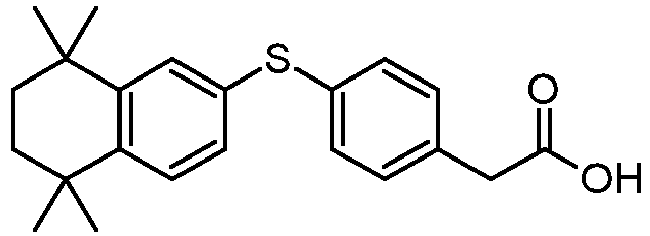
- 2-{4-[(5,5,8,8-tetramethyl-5,6,7,8-tetrahydronaphthalen-2-yl)sulfanyl]phenyl}acetic acid was prepared according to example 3 using 50 mg of (b) methyl 2-{4-[(5,5,8,8-tetramethyl-5,6,7,8-tetrahydronaphthalen-2-yl)sulfanyl] phenyl}acetate. A white solid was obtained (43 mg, 99%). mp=87°C. 1HNMR (400 MHz, CHLOROFORM-d) δ ppm 1.24(s, 6 H) 1.27 (s, 6 H) 1.67 (s, 4 H) 3.60 (s, 2 H) 7.07 - 7.12 (m, 1 H) 7.15 - 7.25 (m, 5 H) 7.33 - 7.37 (m, 1H). HRMS (TOF MS ES-) for [(C22H26O2S)2-1]- (M-H)- calcd. 707.3229, found 707.3204.
-

- Methyl 2-{3-[(5,5,8,8-tetramethyl-5,6,7,8-tetrahydronaphthalen-2-yl)sulfanyl]phenyl} acetate was prepared according to example 1(c) starting from 305 mg of 6-iodo-1,1,4,4-tetramethyl-1,2,3,4-tetrahydronaphthalene. A colorless oil (210 mg, 55%) was obtained as a mixture of methyl 2-{3-[(5,5,8,8-tetramethyl-5,6,7,8-tetrahydronaphthalen-2-yl)sulfanyl]phenyl}and butyl 2-{3-[(5,5,8,8-tetramethyl-5,6,7,8-tetrahydronaphthalen-2-yl)sulfanyl]phenyl} (25%). 1HNMR (400 MHz, CHLOROFORM-d) δ ppm 1.27 (s, 6 H), 1.24 (s, 6 H), 1.68 (s, 4 H), 3.57 (s, 2 H), 3.67 (s, 3 H), 7.07 - 7.14 (m, 2 H), 7.14 - 7.18 (m, 1 H), 7.23 (m, 3 H), 7.34 (d, J=1.88 Hz, 1 H).
-

- Butyl 2-{3-[(5,5,8,8-tetramethyl-5,6,7,8-tetrahydronaphthalen-2-yl)sulfanyl]phenyl}acetate was obtained in example 10. 1H NMR (400 MHz, CHLOROFORM-d) δ ppm 0.94 (t, J=7.09 Hz, 3 H), 1.27 (s, 6 H), 1.24 (s, 6 H), 1.32 - 1.41 (m, 2 H), 1.52 - 1.59 (m, 2 H), 1.68 (s, 4 H), 3.57 (s, 2 H), 4.07 (t, J=6.71 Hz, 2 H), 7.07 - 7.14 (m, 2 H), 7.14 - 7.18 (m, 1H), 7.23 (m, 3 H), 7.34 (d, J=1.88 Hz, 1 H).
-

- 2-{3-[(5,5,8,8-tetramethyl-5,6,7,8-tetrahydronaphthalen-2-yl)sulfanyl]phenyl}acetic acid was prepared according to example 3 using 50 mg of the mixture of methyl 2-{3-[(5,5,8,8-tetramethyl-5,6,7,8-tetrahydronaphthalen-2-yl)sulfanyl]phenyl} acetate and butyl 2-{3-[(5,5,8,8-tetramethyl-5,6,7,8-tetrahydronaphthalen-2-yl)sulfanyl]phenyl}acetate. A colorless oil was obtained (43 mg, 99%). 1H NMR (400 MHz, CHLOROFORM-d) δ ppm 1.22 (s, 6H), 1.27 (s, 6 H), 1.67 (s, 4 H), 3.58 (s, 2 H), 7.07 - 7.13 (m, 2H) ,7.14 - 7.19 (m, 1 H), 7.19 - 7.24 (m, 3H) ,7.34 (d, J=1.88 Hz, 1 H). HRMS (TOF MS ES-) for C22H25O2S- (M-H)- calcd. 353.1575, found 407.1591.
-

- To a solution of mixture obtained in example 1(c) (110 mg, 0.26 mmol, 1 eq.) in THF (7 mL), was added a solution of oxone (475 mg, 0.775 mmol, 3 eq.) in water (4 mL). The reaction was stirred overnight at room temperature. Water (10 mL) was added and the mixture was extracted with dichloromethane (3×50mL). After drying over Ca2SO4 and evaporation, the crude was purified by flash chromatography (cyclohexane/dichloromethane): (80/20) to (0/100). A white powder was obtained (80 mg, 70%) as a mixture of methyl 2-(4-{[3-(adamantan-1-yl)-4-methoxybenzene]sulfonyl}phenyl)acetate and butyl 2-(4-{[3-(adamantan-l-yl)-4-methoxybenzene]sulfonyl}phenyl)acetate (10%). 1H NMR (400 MHz, CHLOROFORM-d) δ ppm 1.76 (s, 6 H), 2.05 (s, 9 H), 3.67 (s, 2 H), 3.69 (s, 3 H), 3.87 (s, 3 H), 6.91 (d, J=9.16 Hz, 1 H), 7.40 (d, J=8.16 Hz, 2 H), 7.73 - 7.80 (m, 2 H), 7.88 (d, J=8.28 Hz, 2 H).
-

- Butyl 2-(4-{[3-(adamantan-1-yl)-4-methoxybenzene]sulfonyl}phenyl)acetate was obtained from example 13. 1H NMR (400 MHz, CHLOROFORM-d) δ ppm 0.89 (t, J=7.09 Hz, 3 H), 1.28 - 1.37 (m, 2 H), 1.51 - 1.60 (m, 2 H), 1.76 (s, 6 H), 2.05 (s, 9 H), 3.67 (s, 2 H), 3.87 (s, 3 H), 4.09 (t, J=6.59 Hz, 2 H), 6.91 (d, J=9.16 Hz, 1 H), 7.40 (d, J=8.16 Hz, 2 H), 7.73 - 7.80 (m, 2 H), 7.88 (d, J=8.28 Hz, 2 H).
-

- 2-(4-{[3-(adamantan-1-yl)-4-methoxybenzene]sulfonyl}phenyl)acetic acid was prepared according to example 3 using 50 mg of methyl 2-(4-{[3-(adamantan-1-yl)-4-methoxybenzene]sulfonyl}phenyl)acetate. A white solid is obtained (35 mg, 73%). mp= 212°C. 1H NMR (400 MHz, CHLOROFORM-d) δ ppm 1.76 (s, 6 H), 2.05 (m, 10 H), 3.70 (s, 2 H), 3.87 (s, 3 H), 6.90 (d, J=9.29 Hz, 1 H), 7.39 (m, J=8.28 Hz, 2 H), 7.70 - 7.81 (m, 2 H), 7.88 (m, J=8.28 Hz, 2 H). HRMS (TOF MS ES-) for C22H2502S- (M-H)- calcd. 353.1575, found 407.1591. HRMS (TOF MS ES-) for [(C25H2805S)2-1]- (M-H)- calcd. 879.3237, found 879.3265.
-

- Methyl 2-(3-{[3-(adamantan-1-yl)-4-methoxybenzene]sulfonyl}phenyl)acetate was prepared according to example 13 using 90 mg of mixture obtained in example 4(b). A thick oil was obtained (50 mg, 50%) as a mixture of methyl 2-(3-{[3-(adamantan-1-yl)-4-methoxybenzene]sulfonyl}phenyl)acetate and the butyl 2-(3-{[3-(adamantan-1-yl)-4-methoxybenzene]sulfonyl}phenyl)acetate (25%). 1H NMR (400 MHz, CHLOROFORM-d) δ ppm 1.76 (s, 6 H), 2.05 (s, 9 H), 3.68 (s, 2 H), 3.69 (s, 3 H), 3.87 (s, 3 H), 6.88 - 6.94 (m, 1 H), 7.42 - 7.49 (m, 2 H), 7.74 - 7.79 (m, 2 H), 7.82 (dt, J=6.59, 2.04 Hz, 1 H), 7.85 (br.s, 1H).
-

- Butyl 2-(3-{[3-(adamantan-1-yl)-4-methoxybenzene]sulfonyl}phenyl)acetate was obtained from example 16. 1H NMR (400 MHz, CHLOROFORM-d) δ ppm 0.90 (t, J=7.09 Hz, 3 H), 1.26 - 1.38 (m, 2 H), 1.55 - 1.62 (m, 2 H), 1.76 (s, 6 H), 2.05 (s, 9 H), 3.68 (s, 2 H), 3.87 (s, 3 H), 4.09 (t, J=6.71 Hz, 2 H), 6.88 - 6.94 (m, 1 H), 7.42 - 7.49 (m, 2 H), 7.74 - 7.79 (m, 2 H), 7.82 (dt, J=6.59, 2.04 Hz, 1 H), 7.85 (br.s, 1H).
-

- 2-(3-{[3-(adamantan-1-yl)-4-methoxybenzene]sulfonyl}phenyl)acetic acid was prepared according to example 3 using 50 mg of the mixture of methyl 2-(3-{[3-(adamantan-1-yl)-4-methoxybenzene]sulfonyl}phenyl)acetate and butyl 2-(3-{[3-(adamantan-1-yl)-4-methoxybenzene]sulfonyl}phenyl)acetate. A white solid is obtained (45 mg, 95%). mp= 174°C. 1H NMR (400 MHz, CHLOROFORM-d) δ ppm 1.75 (s, 6 H), 2.04 (s, 9 H), 3.71 (s, 2 H), 3.86 (s, 3 H), 6.91 (d, J=9.29 Hz, 1 H), 7.46 (m, 2 H), 7.71 - 7.79 (m, 2 H), 7.79 - 7.90 (m, 2 H). HRMS (TOF MS ES-) for C25H27O5S- (M-H)- calcd. 439.1579, found 439.1600.
-

- Methyl 2-[4-(5,5,8,8-tetramethyl-5,6,7,8-tetrahydronaphthalene-2-sulfonyl)phenyl] acetate was prepared according to example 13 using 105 mg of the mixture obtained in example 7(b). An off-white solid was obtained (61 mg, 54%) as a mixture of methyl 2-[4-(5,5,8,8-tetramethyl-5,6,7,8-tetrahydronaphthalene-2-sulfonyl)phenyl] acetate and butyl 2-[4-(5,5,8,8-tetramethyl-5,6,7,8-tetrahydronaphthalene-2-sulfonyl)phenyl] acetate (5%). 1H NMR (400 MHz, CHLOROFORM-d) δ ppm 1.29 (s, 6 H), 1.26 (s, 6 H), 1.68 (s, 4 H), 3.67 (s, 2H), 3.69 (s, 3 H), 7.40 (m, 3 H), 7.58 (dd, J=8.41, 2.01 Hz, 1 H), 7.86 - 7.93 (m, 3 H).
-

- Butyl 2-[4-(5,5,8,8-tetramethyl-5,6,7,8-tetrahydronaphthalene-2-sulfonyl)phenyl]acetate was obtained in example 19. 1H NMR (400 MHz, CHLOROFORM-d) δ ppm 0.88 (t, J=7.09 Hz, 3 H), 1.29 (s, 6 H), 1.26 (s, 6 H), 1.37 - 1.43 (m, 2 H), 1.56 - 1.63 (m, 2 H), 1.68 (s, 4 H), 3.67 (s, 2H), 4.09 (t, J=6.71 Hz, 2 H), 7.40 (m, 3 H), 7.58 (dd, J=8.41, 2.01 Hz, 1 H), 7.86 - 7.93 (m, 3 H).
-

- 2-[4-(5,5,8,8-tetramethyl-5,6,7,8-tetrahydronaphthalene-2-sulfonyl)phenyl]acetic acid was prepared according to example 3 using 45 mg of the mixture of methyl 2-[4-(5,5,8,8-tetramethyl-5,6,7,8-tetrahydronaphthalene-2-sulfonyl)phenyl] acetate and butyl 2-[4-(5,5,8,8-tetramethyl-5,6,7,8-tetrahydronaphthalene-2-sulfonyl)phenyl] acetate. A white solid is obtained (31 mg, 72%). mp= 214°C. 1HNMR (400 MHz, CHLOROFORM-d) δ ppm 1.29 (s, 6 H), 1.25 (s, 6 H), 1.68 (s, 4 H), 3.70 (s, 2 H), 7.40 (m, 3 H), 7.58 (dd, J=8.41, 2.01 Hz, 1 H), 7.87 - 7.93 (m, 3 H). HRMS (TOF MS ES-) for [(C22H26O4S)2-1]- (M-H)- calcd. 771.3025, found 771.3063.
-

-

- 2-[3-(5,5,8,8-tetramethyl-5,6,7,8-tetrahydronaphthalene-2-sulfonyl)phenyl]acetic acid was prepared according to example 3 using 45 mg of methyl 2-[3-(5,5,8,8-tetramethyl-5,6,7,8-tetrahydronaphthalene-2-sulfonyl)phenyl] acetate. A white solid is obtained (41 mg, 95%). mp= 75°C. 1HNMR (400 MHz, CHLOROFORM-d) δ ppm 1.25 (s, 6 H), 1.27 (s, 6 H), 1.67 (s, 4 H), 3.72 (s, 2 H), 7.39 (d, J=8.41 Hz, 1 H), 7.43 - 7.52 (m, 2 H), 7.56 - 7.63 (m, 1H), 7.84 (d, J=6.27 Hz, 1 H), 7.89 (s, 2 H). HRMS (TOF MS ES-) for C22H25O4S- (M-H)- calcd. 385.1474, found 385.1494.

- i) 1) Chlorosulfonic acid, 0°C to r.t., 3h, 2) Zn, EtOH, conc. HCl, reflux 45 min, r.t. overnight ; ii) ethyl 3-(4-bromophenyl)propanoate, PdCl2(dppf), Zn, THF, reflux, 24h; iii) oxone, H2O, MeOH, 0°C to r.t., 12h ; iv) LiOH 1N, THF, H2O, r.t. 12h.
-

- 5, 5,8,8-Tetramethyl-5, 6, 7,8-tetrahydro-naphthalene-2-disulfide was prepared according to a procedure described by
Boiteau et al. (WO2014016507A1 ). mp= 83-85°C. 1H NMR (400 MHz, CHLOROFORM-d) δ ppm 1.24 (s, 6 H), 1.21 (s, 6 H,) 1.65 (s, 4 H), 7.23 (d, J=8.28 Hz, 1 H), 7.28 (dd, J=8.28, 1.88 Hz, 1 H), 7.41 (d, J=1.88 Hz, 1 H). -

- Ethyl 3-{4-[(5,5,8,8-tetramethyl-5,6,7,8-tetrahydronaphthalen-2-yl)sulfanyl]phenyl} propanoate was prepared according to the method described by Fukuzawa et al. (Synlett 2006, 13, 2145-47). 5, 5,8,8-Tetramethyl-5, 6, 7,8-tetrahydro-naphthalene-2-disulfide (100 mg, 0.228 mmol, 0.5eq.), PdCl2(dppf) (17 mg, 0.023 mmol, 0.05 eq.), and zinc (36 mg, 0.547 mmol, 1.2 eq.) were placed in a flask and then a solution of ethyl 3-(4-bromophenyl) propanoate (115 mg, 0.456 mmol, 1 eq.) in THF (3 mL) was added. The mixture was refluxed for 24 h and diluted with Et2O (30 mL) after cooling. The precipitate was removed by filtration and the filtrate was washed with brine and dried over Ca2SO4. After concentration of the organic layer, the crude was concentrated and grossly purified by chromatography over silica gel (cyclohexane/dichloromethane): (95/5) to (55/45). A mixture of the title compound and ethyl 3-(4-bromophenyl) propanoate (30%) was obtained (125 mg). It was used in the next step without any further purification.
-

- Ethyl 3-[4-(5,5,8,8-tetramethyl-5,6,7,8-tetrahydronaphthalene-2-sulfonyl)phenyl]propanoate was prepared according to example 13 using 125 mg of mixture obtained in example 24 (b). A white solid was obtained (82 mg, 87%). mp= 105-106°C . 1H NMR (400 MHz, CHLOROFORM-d) δ ppm 1.19 (t, J=7.11 Hz, 3 H), 1.28 (s, 6 H), 1.25 (s, 6 H), 1.68 (s, 4 H), 2.62 (t, J=7.53 Hz, 2 H), 2.99 (t, J=7.53 Hz, 2 H), 4.10 (q, J=7.11 Hz, 2 H), 7.33 (m, J=8.16 Hz, 2 H), 7.39 (d, J=8.41 Hz, 1 H), 7.58 (dd, J=8.41, 1.51 Hz, 1 H), 7.85 (m, J=8.16 Hz, 2 H), 7.88 - 7.92 (m, 1 H).
-

- 3-[4-(5,5,8,8-tetramethyl-5,6,7,8-tetrahydronaphthalene-2-sulfonyl)phenyl]propanoic acid was prepared according to example 3 starting from 66 mg of ethyl 3-[4-(5,5,8,8-tetramethyl-5,6,7,8-tetrahydronaphthalene-2-sulfonyl)phenyl]propanoate. A white solid is obtained (53 mg, 85%). mp= 211°C. 1H NMR (400 MHz, METHANOL-d 4) δ ppm 1.30 (s, 6H), 1.32 (s, 6H), 1.75 (s, 4 H), 2.65 (t, J=7.59 Hz, 2 H), 3.01 (t, J=7.59 Hz, 2 H), 7.48 (m, J=8.41 Hz, 2 H), 7.56 (d, J=8.41 Hz, 1 H), 7.65 (dd, J=8.41, 2.01 Hz, 1 H), 7.87 (m, J=8.41 Hz, 2 H), 7.90 (d, J=2.01 Hz, 1 H). HRMS (TOF MS ES-) for C23H27O4S- (M-H)- calcd. 399.1630, found 399.1658.

- i) 4-(2-ethoxycarbonyl)phenylboronic acid,K2CO3, Pd(PPh3)4, toluene, EtOH, H2O, reflux, 3h30 ; ii) LiOH 1N, THF, H2O, r.t. 12h.
-

-

- 3-[4-(5,5,8,8-tetramethyl-5,6,7,8-tetrahydronaphthalen-2-yl)phenyl]propanoic acid was prepared according to example 3 starting from 60 mg of ethyl 3-[4-(5,5,8,8-tetramethyl-5,6,7,8-tetrahydronaphthalen-2-yl)phenyl]propanoate. A white solid is obtained (50 mg, 88%). mp= 196°C. 1H NMR (400 MHz, CHLOROFORM-d) δ ppm 1.32 (s, 6H), 1.33 (s, 6 H) 1.65 - 1.77 (m, 4 H), 2.73 (t, J=6.90 Hz, 2 H), 3.01 (t, J=6.90 Hz, 2 H), 7.26 - 7.30 (m, 2 H), 7.30 - 7.40 (m, 2 H), 7.46 - 7.54 (m, 3 H). HRMS (TOF MS ES-) for C23H27O2- (M-H)- calcd. 335.2011, found 335.2010.

- i) 4-(2-ethoxycarbonyl)phenylboronic acid,K2CO3, Pd(PPh3)4, toluene, EtOH, H2O, reflux, overnight; ii) LiOH 1N, THF, H2O, r.t. 12h. iv) BBr3, DCM, -78°C, 30 minutes, 0°C, 2h.
-
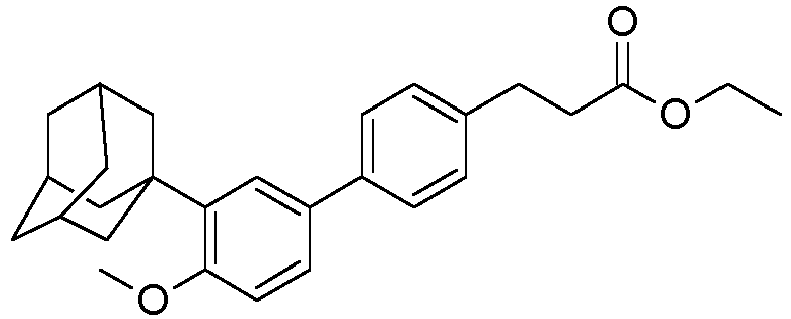
- Ethyl 3-{4-[3-(adamantan-1-yl)-4-methoxyphenyl]phenyl}propanoate was prepared according to example 27 starting from 600 mg of 2-adamantyl-4-iodoanisole. A white solid was obtained (275 mg, 40%). mp= 124°C. 1H NMR (400 MHz, CHLOROFORM-d) δ ppm 1.25 (t, J=7.03 Hz, 3 H), 1.78 (s, 6 H), 2.08 (s, 3 H), 2.14 (s, 6 H), 2.65 (t, J=7.78 Hz, 2 H), 2.98 (t, J=7.78 Hz, 2 H), 3.86 (s, 3 H), 4.14 (q, J=7.03 Hz, 2 H), 6.93 (d, J=8.30 Hz, 1 H), 7.20 - 7.28 (m, 2 H), 7.38 (d, J=8.30 Hz, 1 H), 7.43 (s, 1 H), 7.48 (d, J=7.78 Hz, 2 H).
-

- 3-{4-[3-(adamantan-1-yl)-4-methoxyphenyl]phenyl }propanoic acid was prepared according to example 3 starting from 275 mg of ethyl 3-{4-[3-(adamantan-1-yl)-4-methoxyphenyl]phenyl}propanoate. A white solid is obtained (200 mg, 75%). mp= 252-253°C. 1HNMR (400 MHz, CHLOROFORM-d) δ ppm 1.78 (s, 6 H), 2.08 (s, 3 H), 2.14 (s, 6 H), 2.72 (t, J=7.76 Hz, 2 H), 3.00 (t, J=7.76 Hz, 2 H), 3.87 (s, 3 H), 6.93 (d, J=8.41 Hz, 1 H), 7.24 (s, 2 H), 7.38 (dd, J=8.28, 2.13 Hz, 1 H), 7.43 (d, J=2.13 Hz, 1 H), 7.49 (d, J=8.41 Hz, 2 H). HRMS (TOF MS ES+) for C26H31O3 + (MH+) calcd. 391.2273, found 391.2291.
-

- 3-{4-[3-(adamantan-1-yl)-4-methoxyphenyl]phenyl}propanoic acid (270 mg, 0.7 mmol, 1 eq.) was suspended in dichloromethane (10 mL) and a 1M solution of BBr3 in dichloromethane (2.8 mL) was slowly added at -78°C. The mixture was stirred at -78°C for 30 minutes and then slowly warmed up to 0°C and kept at this temperature for 2 hours. Water was added (10 mL) at 0°C and the mixture was extracted with dichloromethane (3×50 mL). The resulting organic layers were dried over brine and Ca2SO4 and then concentrated to afford a brown solid without any further purification. mp= 212-215°C. 1H NMR (400 MHz, METHANOL-d 4) δ ppm 1.85 (br. s., 6 H) 2.09 (br. s., 3 H) 2.24 (br. s., 6 H) 2.65 (br. s., 2 H) 2.95 (br. s., 2 H) 6.79 (d, J=7.78 Hz, 1 H) 7.15 - 7.31 (m, 3 H) 7.37 (br. s., 1 H) 7.41 - 7.55 (m, 2 H). HRMS (TOF MS ES+) for C25H29O3+ (MH+) calcd. 377.2117, found 377.2107.
- To a stirred solution of the bromobenzaldehyde (1.0 g, 5.4 mmol) in CH2Cl2 (20 mL) was added benzyl-2-(triphenylphosphoranylidene)acetate slowly and stirred for 10 minutes at rt. Then refluxed for 2 hours at 50°C and allowed to cool to r.t. The solution was concentrated under reduced pressure and purified on Biotage to yield a white solid, 1.32 g (77%). mp= 97-99°C; 1HNMR (400 MHz, CDCl3) δ 7.65 (d, J= 16.0 Hz, 1H), 7.51 (d, J= 8.5 Hz, 2H), 7.44 - 7.32 (m, 7H), 6.47 (d, J= 16.0 Hz, 1H), 5.25 (s, 2H).
-

- To a solution of 1-(5-iodo-2-methoxyphenyl)adamantane or 1-(5-bromo-2-methoxyphenyl)adamantane (2.0 g, 6.22 mmol) in dried THF (15 mL) at -78°C was slowly added nBuLi of 2.5 M solution in hexane (3.0 mL) over 10 minutes. The solution was stirred for 1 hr and B(Oi-Pr)3 (5.75 mL, 25 mmol) was added by a syringe at -78°C. The solution was stirred for 1 hr at -78°C and then allowed to warm to rt overnight. The reaction was cooled to 0°C followed by the sequential addition of water (1.5 mL) and 2 N HCl (1.5 mL). After 5 minutes, an additional 27 mL (2N HCl) was added and stirred for 10 minutes. The mixture was extracted with 3x20 mL EtOAc and the combined organic layers were concentrated to a thick oil. Crystallization with heptanes yielded the title compound as a yellow powder, 1.533 g (86%); M. p. 261-263°C; Rf= 0.55 (60% EtOAc: heptanes). 1HNMR (500 MHz, cdcl3) δ 8.15 (d, J= 1.5 Hz, 1H), 8.05 (dd, J= 8.1, 1.5 Hz, 1H), 7.00 (d, J= 8.2 Hz, 1H), 3.91 (s, 3H), 2.26 - 2.06 (m, 9H), 1.82 (s, 6H).
-

- In a 50 mL three-necked flask, equipped with a stirrer, a reflux condenser and a gas inlet adapter was introduced 6.41 mg (0.5 mol%) of tris(dibenzylydeneacetone)dipalladium(0) Pd2(dba)3 and dissolved in 5 mL of tetrahydrofuran. Then 5.75 mg (1 mol%) of Sphos was added and the solution stirred for 30 min under a slight stream of argon. To the reaction mixture 400 mg (1.4 mmol) 3-(1-adamantyl)-4-methoxyphenylboronic acid and 444 mg (1.4 mmol) of (E)-Benzyl 3-(4-bromophenyl)acrylate were added and stirred until all components were dissolved. A solution of 2 mL of 0.28 M of sodium carbonate was then added. The mixture was vigorously stirred for 4 h with boiling at 80°C under a slight stream of argon. The two layers were separated and organic layer dried under MgSO4, filtered and concentrated under reduced pressure. Then it was purified on a HP-Sil 25g Biotage SNAP cartridge and eluted with EtOAc:heptane using a gradient (0-10%) at a flow rate of 20 mL/min to provide a white solid (498 mg, 74%). mp= 152-154°C; 1HNMR (400 MHz, CDCl3) δ 7.76 (d, J= 16.0 Hz, 1H), 7.62 - 7.53 (m, 4H), 7.48 (d, J= 2.2 Hz, 1H), 7.46 - 7.31 (m, 6H), 6.95 (d, J= 8.5 Hz, 1H), 6.50 (d, J= 16.0 Hz, 1H), 5.26 (s, 2H), 3.88 (s, 3H), 2.14 (s, 6H), 2.08 (s, 3H), 1.78 (s, 6H).
-

- A suspension of the ester benzyl (2E)-3-{4-[3-(adamantan-1-yl)-4-methoxyphenyl]phenyl}prop-2-enoate (100 mg, 0.21 mmol) in 1.0 mL of MeOH:H2O (9:1) was treated with 25 mg (0.45 mmol) of KOH and 0.1 mL THF. The reaction mixture was stirred for 5-6 h at 70-75°C, cooled to room temperature and quenched with water (5.0 mL).The mixture was extracted with Et2O (10 mL) and the aqueous layer was acidified to pH 2 with 1N HCl and extracted with ethyl acetate (3x15 mL). The combined organic phases were dried and evaporated. The residue was crystallized from ethyl acetate-hexane to give 80 mg (99%) of the acid as white crystals. mp= 327-328°C; 1HNMR (400 MHz, DMSO) δ 12.38 (s, 1H), 7.73 (d, J= 8.3 Hz, 2H), 7.65 (d, J= 8.4 Hz, 2H), 7.61 (d, J = 16.2 Hz, 1H), 7.53 (dd, J= 8.5, 2.1 Hz, 1H), 7.43 (d, J= 2.2 Hz, 1H), 7.07 (d, J= 8.6 Hz, 1H), 6.54 (d, J= 16.0 Hz, 1H), 3.84 (s, 3H), 2.10 (s, 6H), 2.05 (s, 3H), 1.74 (s, 6H). HRMS (TOF MS ES+) for C26H29O3 + (MH+) calcd. 389.2134, found 389.2117.
-

- Title compound was prepared according to example 31 starting from 70 mg of 2(E)-3-{4-[3-(adamantan-1-yl)-4-methoxyphenyl]phenyl}prop-2-enoic acid. The residue was purified on a HP-Sil 25g Biotage SNAP cartridge and eluted with EtOAc:heptane using a gradient (0-25%) at a flow rate of 20 mL/min to provide a yellow solid (41 mg, 61%). mp= 273-275°C; 1H NMR (400 MHz, DMSO) δ 9.62 (s, 1H), 7.68 (d, J= 8.1 Hz, 2H), 7.60 (d, J= 8.2 Hz, 2H), 7.56 (d, J= 16.0 Hz, 1H), 7.36 (d, J= 7.9 Hz, 2H), 6.87 (d, J= 7.9 Hz, 1H), 6.53 (d, J= 15.9 Hz, 1H), 2.13 (s, 6H), 2.05 (s, 3H), 1.74 (s, 6H). HRMS (TOF MS ES+) for C25H27O3 + (MH+) calcd. 375.1960, found 375.1921.
-

- A 100-mL, three-necked, round-bottomed flask, was equipped with a magnetic stirring bar, a reflux condenser, and a pressure-equalizing dropping funnel that was connected to a nitrogen flow line and charged with a solution of 97% di-tert-butyl dicarbonate (4.04 g, 18.5 mmol) in tetrahydrofuran (30 mL). Amino benzyl alcohol (2.5 g, 20.3 mmol) was placed in the flask and suspended in tetrahydrofuran (65 mL) and 99% triethylamine (3.1 mL, 22 mmol). The resulting white suspension was cooled with an ice-water bath and the solution of di-tert-butyl dicarbonate was added dropwise over a period of 30 minutes. After 10 min of additional stirring, the ice-water bath was removed and the suspension was stirred overnight at room temperature, then warmed at 50°C for a further 3 hours. The solvent was removed under reduced pressure and the residue partitioned between EtOAc (50 mL) and saturated aqueous bicarbonate solution (50 mL). The aqueous phase was extracted with three 50-mL portions of EtOAc. The combined organic phases were dried with anhydrous MgSO4 and concentrated under reduced pressure to give 3.72 g (83% yield) of the product as a brown oil that was used without further purification. 1H NMR (as rotamers) (400 MHz, CDCl3) δ 9.26 (s, 1H), 8.64 (s, 1H), 7.39 (4H), 7.20 (4H), 5.75 (s, 1H), 5.05 (2H), 4.49 - 4.35 (m, 4H), 1.47 (s, 9H), 1.40 (s, 1H).
-

- To a stirring solution of suspended pyridinium chlorochromate (3.84 g, 17.81 mmol) in 100 ml of anhydrous CH2Cl2 was added tert-butyl N-[4-(hydroxymethyl)phenyl]carbamate (2.65 g, 11.87 mmol) in 10 mL CH2Cl2 in one protion. After 1.5 hrs, TLC showed full consumption of the starting material. Then filtered with a pad of celite and the resulting dark brown solution was rotary evaporated under reduced pressure. The residue was purified on a Biotage SNAP cartridge (100 g) using an EtOAc:cyclohexane gradient (0-20%) to yield a yellowish-white solid. Recrystallized from EtOAc/cyclohexane, 2.26 g (86%). M. p. 140-142°C; 1H NMR (400 MHz, CDCl3) δ 9.89 (s, 1H), 7.82 (d, J= 8.6 Hz, 2H), 7.56 (d, J= 8.6 Hz, 2H), 6.99 (s, 1H), 1.53 (s, 9H).
-

- To a stirred solution of aldehyde tert-butyl N-(4-formylphenyl)carbamate (1.16 g, 5.24 mmol) in CH2Cl2 (20 mL) was added benzyl-2-(triphenylphosphoranylidene)acetate slowly and stirred for 10 minutes at r.t. Then refluxed for 2 hours at 50°C and allowed to cool to rt. The solution was concentrated under reduced pressure and purified on Biotage to yield a white solid, 1.80 g (99%). M. p. 93-95°C. 1HNMR (400 MHz, CDCl3) δ 7.67 (d, J= 16.0 Hz, 1H), 7.49 - 7.30 (9H), 6.65 (s, 1H), 6.39 (d, J= 16.0 Hz, 1H), 5.24 (s, 2H), 1.52 (s, 9H).
-

- To a stirring solution of benzyl (2E)-3-(4-{[(tert-butoxy)carbonyl]amino}phenyl)prop-2-enoate in CH2Cl2 at 0°C were added TFA and allowed to warm to r.t. over 2 hours. TLC showed the reaction was complete. It was then quenched by addition of 30 mL saturated NaHCO3 solution and extracted 3x30 mL CH2Cl2. The combined organic phases was dried over MgSO4 and concentrated under reduced pressure. The residue was purified on Biotage on a 50 g Biotage SNAP cartridge using 30% EtOAc:cyclohexane gradient to yield a yellow solid, 1.043 g (85%). M. p. 112-114°C. 1HNMR (400 MHz, CDCl3) δ 7.64 (d, J= 15.9 Hz, 1H), 7.43 - 7.29 (7H), 6.63 (d, J= 8.5 Hz, 2H), 6.28 (d, J= 15.9 Hz, 1H), 5.23 (s, 2H), 3.93 (s, 2H).
-

- To a 20 mL scintilation vial equipped with a magnetic stir bar was added the 3-(1-adamantyl)-4-methoxyphenylboronic acid (600 mg, 2.1 mmol), benzyl (2E)-3-(4-aminophenyl)prop-2-enoate (531 mg, 2.1 mmol), anhydrous cupric acetate (384 mg, 2.1 mmol), 750 mg of activated 4Å molecular sieves, pyridine (3.3 mL of 0.67M in CH2Cl2), and 15 mL CH2Cl2. The reaction was stirred at room temperature in the loosely capped vial for 2 days. The reaction was complete as shown by TLC analysis of an aliquot. The reaction was filtered through Celite, washed with methanol and purified on a Biotage SNAP cartridge and eluted with EtOAc:cyclohexane using a gradient (0-15%) to provide a brown solid (661 mg, 64%). M. p. 133-135°C; Rf= 0.38 (15% EtOAc:cyclohexane). 1HNMR (400 MHz, CDCl3) δ 7.65 (d, J = 15.9 Hz, 1H), 7.46 - 7.29 (7H), 7.00 (dd, J = 12.8, 2.5 Hz, 2H), 6.85 - 6.78 (m, 3H), 6.29 (d, J = 15.9 Hz, 1H), 5.77 (s, 1H), 5.23 (s, 2H), 3.83 (s, 3H), 2.06 (s, 9H), 1.76 (s, 6H). 13C NMR (101 MHz, CDCl3) δ 167.51, 155.54, 147.90, 145.33, 139.84, 136.40, 133.42, 129.92, 128.52, 128.17, 128.08, 126.75, 126.42, 124.82, 121.72, 120.45, 120.40, 114.27, 113.09, 112.43, 111.67, 66.00, 55.33, 40.52, 37.13, 37.06, 37.03, 29.10, 29.02. HRMS (TOF MS ES+) for C33H36NO3+ (MH+) calcd. 494.2695, found 494.2682.
-

- (2E)-3-(4-{[3-(adamantan-1-yl)-4-methoxyphenyl]amino}phenyl)prop-2-enoic acid was prepared according to example 33 staring from 130 mg of benzyl (2E)-3-(4-{[3-(adamantan-1-yl)-4-methoxyphenyl]amino}phenyl)prop-2-enoate. The residue was purified on Biotage to give 69 mg (66%) of the acid. mp= 197-200°C.1H NMR (400 MHz, DMSO) δ 12.03 (s, 1H), 8.32 (s, 1H), 7.47 (d, J= 8.3 Hz, 2H), 7.45 (d, J= 15.9 Hz, 1H), 6.99 (dd, J= 8.6, 2.4 Hz, 1H), 6.94 (dd, J= 9.3, 5.6 Hz, 2H), 6.88 (d, J= 8.6 Hz, 2H), 6.21 (d, J= 15.8 Hz, 1H), 3.77 (s, 3H), 2.02 (s, 9H), 1.72 (s, 6H). HRMS (TOF MS ES+) for C26H30NO3 + (MH+) calcd. 404.2226, found 404.2191.
-
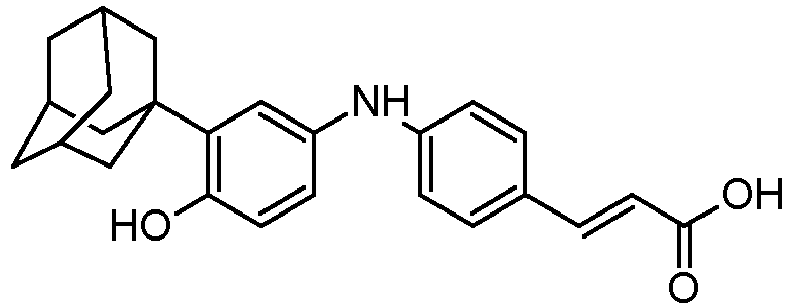
- (2E)-3-(4-{[3-(adamantan-1-yl)-4-hydroxyphenyl]amino}phenyl)prop-2-enoic acid was prepared according to example 31 starting from 32 mg of (2E)-3-(4-{[3-(adamantan-1-yl)-4-methoxyphenyl]amino}phenyl)prop-2-enoic acid. The residue was purified on a HP-Sil 25g Biotage SNAP cartridge and eluted with EtOAc:cyclohexane using a gradient (0-25%) at a flow rate of 20 mL/min to provide a yellow solid (25 mg, 80%). mp= decomposes at 152°C. 1H NMR (400 MHz, DMSO) δ 12.01 (s, 1H), 9.05 (s, 1H), 8.17 (s, 1H), 7.50 - 7.39 (m, 3H), 6.86 (dd, J= 9.8, 2.2 Hz, 2H), 6.82 (d, J= 8.7 Hz, 3H), 6.73 (d, J= 8.3 Hz, 1H), 6.19 (d, J = 15.9 Hz, 1H), 2.06 (s, 6H), 2.02 (s, 3H), 1.72 (s, 6H). HRMS (TOF MS ES+) for C25H28NO3 + (MH+) calcd. 390.2069, found 390.2045.
-

- Benzyl (2E)-3-(4-{[3-(adamantan-1-yl)-4-methoxyphenyl]amino}phenyl)prop-2-enoate (660 mg, 1.33 mmol) was placed in a hydrogenation apparatus equipped with a magnetic stir bar and 50 mL ethanol/EtOAc added. Pd/C (300 mg) in a small amount of MeOH (3 mL) was added and stirring commenced. Hydrogen gas was introduced at a pressure of 20 psi and reacted at rt for 5 hrs. TLC showed full conversion. The black solution was filtered using a celite pad and concentrated under reduced pressure. Further purification on Biotage yielded a brown solid, 200 mg (30%). mp= 164-166°C. 1H NMR (400 MHz, CDCl3) δ 8.39 (s, 1H), 7.05 (d, J = 8.1 Hz, 2H), 6.95 (m, 2H), 6.85 (d, J= 7.4 Hz, 2H), 6.80 (d, J= 8.5 Hz, 1H), 3.81 (s, 3H), 2.87 (d, J= 7.0 Hz, 2H), 2.65 (t, J= 7.7 Hz, 2H), 2.07 (s, 9H), 1.76 (s, 6H). HRMS (TOF MS ES+) for C26H32NO3 + (MH+) calcd. 406.2382, found 406.2410.
-

- 3-(4-{[3-(adamantan-1-yl)-4-hydroxyphenyl]amino}phenyl)propanoic acid was prepared according to example example 31 starting from 80 mg of 3-(4-{[3-(adamantan-1-yl)-4-methoxyphenyl]amino}phenyl)propanoic acid. The residue was purified on Biotage to provide a dark green solid (58 mg, 75%). mp= 94-96°C. 1H NMR (400 MHz, DMSO) δ 12.05 (s, 1H), 8.83 (s, 1H), 6.98 (d, J= 8.4 Hz, 2H), 6.81 (d, J= 2.5 Hz, 1H), 6.77 (d, J= 8.4 Hz, 2H), 6.74 (dd, J= 8.3, 2.5 Hz, 1H), 6.65 (d, J= 8.4 Hz, 1H), 2.68 (t, J= 7.6 Hz, 2H), 2.45 (t, J= 7.6 Hz, 2H), 2.05 (s, 6H), 2.01 (s, 3H), 1.71 (s, 6H). HRMS (TOF MS ES+) for C25H30NO3 + (MH+) calcd. 392.2226, found 392.2246.
-

-

- 4-bromo-2-tert-butyl-1-methoxybenzene was prepared according to example 55(a), starting from 610 mg of 4-bromo-2-tert-butylphenol. A light orange oil is obtained (500 mg, 78%).1H NMR (400 MHz, CHLOROFORM-d) δ ppm 1.34 (m, 9 H,), 3.81 (m, 3 H), 6.73 (d, J=8.66 Hz, 1 H), 7.23 - 7.29 (m, 1 H), 7.35 (d, J=2.38 Hz, 1 H).
-

- 3-tert-butyl-4-methoxyphenyl)boronic acid was prepared according to example 32(b), starting from 500 mg of 4-bromo-2-tert-butyl-1-methoxybenzene. The crude sticky oil obtained, was used in in the following step without any purification.
-

- Benzyl (2E)-3-{4-[(3-tert-butyl-4-methoxyphenyl)amino]phenyl}prop-2-enoate was obtained according to example 35(e), starting from 100 mg of 3-tert-butyl-4-methoxyphenyl)boronic acid. a\After purification by column chromatography using the following gradient system, (cyclohexane/ethyl acetate): (97/3) to (60/40), to yield the title compound as colorless oil (60 mg, 60%). 1H NMR (400 MHz, CHLOROFORM-d) δ ppm 1.34 (m, 9 H), 3.84 (s, 3 H), 5.23 (s, 2 H), 5.77 (s, 1 H), 6.29 (d, J=15.87 Hz, 1 H), 6.83 (t, J=8.22 Hz, 3 H), 6.95 - 7.11 (m, 2 H), 7.29 - 7.47 (m, 7 H), 7.65 (d, J=15.87 Hz, 1 H).
-

- 3-{4-[(3-tert-butyl-4-methoxyphenyl)amino]phenyl}propanoic acidwas prepared according to example 38, starting from 2245 mg of benzyl (2E)-3-{4-[(3-tert-butyl-4-methoxyphenyl)amino]phenyl}prop-2-enoate. A black sticky oil was obtained (73 mg, 38%). 1H NMR (400 MHz, CHLOROFORM-d) δ ppm 1.36 (s, 9 H), 2.65 (t, J=7.75 Hz, 2 H), 2.88 (t, J=7.75 Hz, 2 H), 3.82 (s, 3 H), 5.30 (s, 1 H), 6.76 - 6.90 (m, 3 H), 6.96 (dd, J=8.53, 2.64 Hz, 1 H), 6.99 - 7.12 (m, 3 H). HRMS (TOF MS ES-) for C20H24NO3- (M-H)- calcd. 326.1756, found 326.1740.
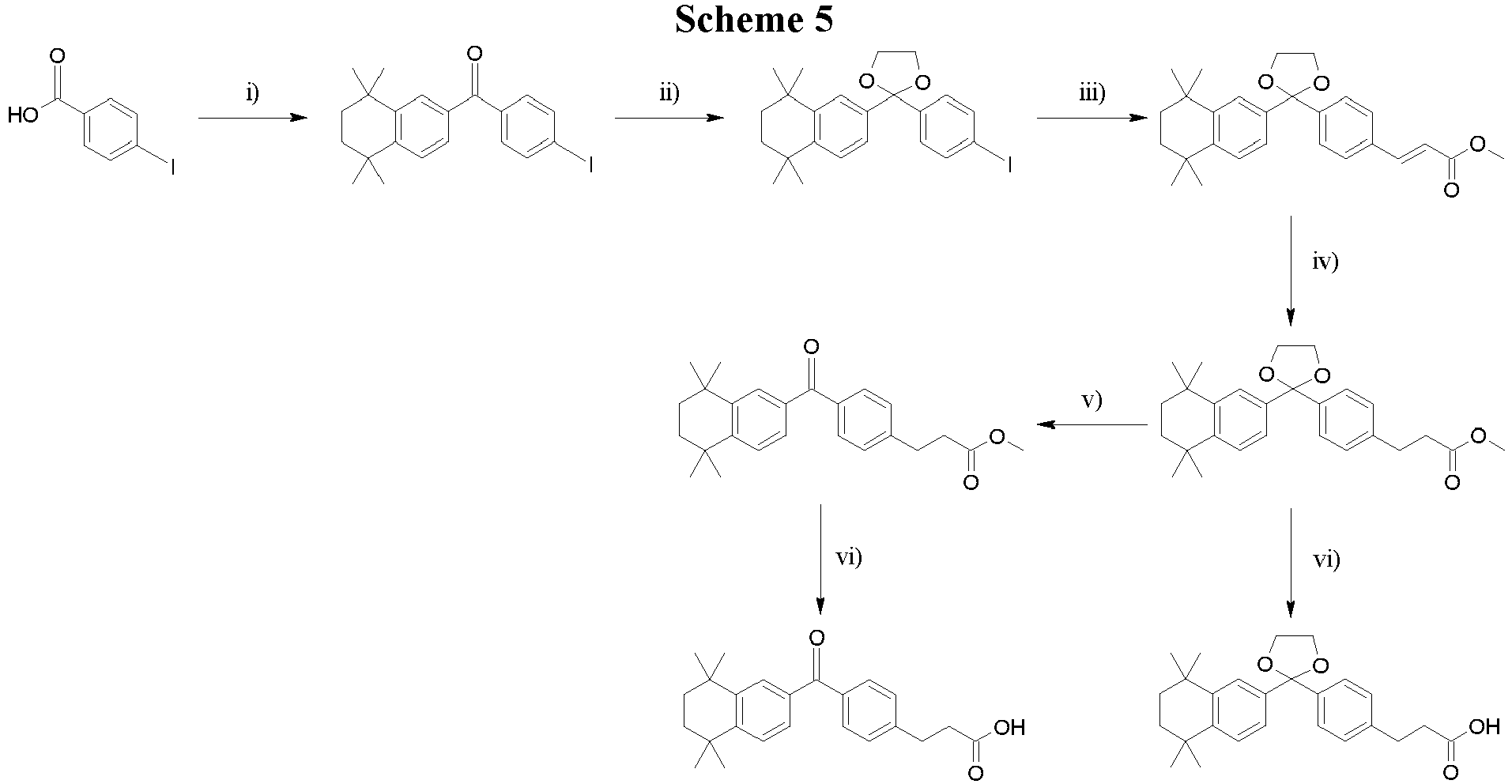
- i) 1) SOCl2, DMF, DCE, reflux, 1h; 2) 1,1,4,4-tetramethyl-1,2,3,4-tetrahydronaphthalene, AlCl3, r.t., 2h ; ii) ethylene glycol, pTsOH, toluene, reflux ; overnight ; iii) methyl acrylate, Pd(OAc)2, NEt3, DMF, 1000C, 3h ; iv) H2, Pd/C, EtOH, EtOAc, MeOH, 20 psi, overnight; v) I2, acetone, MS 4Å, reflux, 14h ; vi) LiOH 1N, THF, r.t. overnight.
-

- Compound was prepared according to the procedure described by Boehm et al. (J. Med. Chem. 1994, 37, 2930-2941) starting from 4 g of 4-iodobenzoic acid (16.1 mmol). After work-up, the crude product was purified by column chromatography using the following gradient system, (cyclohexane/dichloromethane): (80/20) to (0/100), to yield the title compound as a light orange solid, 2.8 g (50%). mp= 75-76°C. 1H NMR (400 MHz, CHLOROFORM-d) δ 1.31 (2s, 12H), 1.72 (s, 4H), 7.40 (d, J = 8.16 Hz, 1H), 7.45 - 7.60 (m, 3H), 7.75 (d, J = 1.63 Hz, 1H), 7.84 (d, J = 8.28 Hz, 2H).
-

- (4-iodophenyl)(5,5,8,8-tetramethyl-5,6,7,8-tetrahydronaphthalen-2-yl)methanone (2 g, 4.78 mmol) was treated with ethylene glycol (20 mL) and a catalytic amount of pTsOH (200 mg) in toluene (120 mL) at 145°C overnight using a Dean Stark trap. After cooling to r.t., the mixture was washed with saturated aqueous NaHCO3, brine, dried over Ca2SO4 and concentrated under reduced pressure. The residue was purified by column chromatography using the following gradient system, (cyclohexane/dichloromethane): (80/20) to (0/100), to yield the title compound as a white solid (1.1 g, 50%) and the starting material (1 g). The reaction was repeated by sequences with the unreacted ketone until fully converted. mp= 116-117°C. 1H NMR (400 MHz, CHLOROFORM-d) δ 1.24 (2s, 12H), 1.65 (s, 4H), 3.85 - 4.15 (m, 4H), 7.14 (dd, J = 1.76, 8.16 Hz, 1H), 7.22 (d, J = 8.16 Hz, 1H), 7.28 (s, 1H), 7.38 - 7.46 (m, 1H), 7.65 (d, J = 8.53 Hz, 3H).
-

- To a stirred solution of 2-(4-iodophenyl)-2-(5,5,8,8-tetramethyl-5,6,7,8-tetrahydronaphthalen-2-yl)-1,3-dioxolane (1.02 g, 2.2 mmol, 1 eq.) and Et3N (920 µL, 6.6 mmol, 3 eq.) were added methyl acrylate (300 µL, 3.3 mmol, 1.5 eq.) and palladium (II) acetate (15 mg, 0.1 eq.). The resulting mixture was heated at 100°C for 3 hours. The reaction mixture was allowed to cool to r.t., concentrated under reduced pressure and purified by column chromatography using the following gradient system, (cyclohexane/dichloromethane): (80/20) to (0/100), to yield the title compound as a white solid, 0.75 g (80%). mp= 168-170°C. 1H NMR (400 MHz, CHLOROFORM-d) δ 1.24 (2s, 12H), 1.65 (s, 4H), 3.80 (s, 3H), 3.96 - 4.14 (m, 4H), 6.42 (d, J = 15.94 Hz, 1H), 7.13 - 7.20 (m, 1H), 7.23 (d, J = 8.16 Hz, 1H), 7.40 - 7.60 (m, 5H), 7.67 (d, J = 15.94 Hz, 1H).
-

- A solution of methyl (2E)-3-{4-[2-(5,5,8,8-tetramethyl-5,6,7,8-tetrahydronaphthalen-2-yl)-1,3-dioxolan-2-yl]phenyl}prop-2-enoate (750 mg, 1.78 mmol) in 60 mL of (EtOH/EtOAc:(9/1) was placed in a hydrogenation apparatus equipped with a magnetic stir bar. Pd/C (410 mg) in a small amount of MeOH (2 mL) was added. Hydrogen gas was introduced at a pressure of 20 psi and reacted at r.t. overnight. The black solution was filtered using a celite pad and concentrated under reduced pressure. Further purification by chromatography yielded the title compound as a white solid, 520 mg (70%). mp 120-122°C. 1H NMR (400 MHz, CHLOROFORM-d) δ 1.24 (2s, 12H), 1.65 (s, 4H), 2.61 (t, J = 7.84 Hz, 2H), 2.93 (t, J = 7.84 Hz, 2H), 3.66 (s, 3H), 3.93 - 4.13 (m, 4H), 7.10 - 7.19 (m, 3H), 7.19 - 7.24 (m, 3H), 7.38 - 7.49 (m, 3H).
-

- 3-{4-[2-(5,5,8,8-tetramethyl-5,6,7,8-tetrahydronaphthalen-2-yl)-1,3-dioxolan-2-yl] phenyl} propanoic acid was prepared according to example 3 starting from 250 mg of methyl 3-{4-[2-(5,5,8,8-tetramethyl-5,6,7,8-tetrahydronaphthalen-2-yl)-1,3-dioxolan-2-yl]phenyl} propanoate (example 43). The title compound was obtained as a white solid (220 mg, 91%). mp= 2190-2200C. 1H NMR (400 MHz, CHLOROFORM-d) δ ppm 1.23 (s, 6H), 1.24 (s, 6 H), 1.65 (s, 4 H), 2.66 (t, J=7.78 Hz, 2 H), 2.94 (t, J=7.84 Hz, 2 H), 3.97 - 4.09 (m, 4 H), 7.17 (m, 3 H), 7.19 - 7.24 (d, J=8.28 Hz 1 H), 7.44 (m, 3 H). HRMS (ESI+) [M+H]+for C25H33O4 +(NM+) 419.0836, calc. 419.0866.
-

- A mixture of methyl 3-{4-[2-(5,5,8,8-tetramethyl-5,6,7,8-tetrahydronaphthalen-2-yl)-1,3-dioxolan-2-yl]phenyl}propanoate (265 mg, 0.63 mmol, 1 eq.), iodine (160 mg, 0.63 mmol, 1 eq.) and 4Å molecular sieves (250 mg) in acetone (6 mL) was stirred for 8 hours under reflux according to a modified method of Sun et al. (J. Org. Chem. 2004, 69, 8932-8934.). After work-up and purification by column chromatography using the following gradient system, (cyclohexane/dichloromethane):(80/20) to (20/80), the title compound was obtained as a colorless oil (150 mg, 63%). 1H NMR (400 MHz, CHLOROFORM-d) δ ppm 1.30 (s, 6H), 1.31 (s, 6 H), 1.72 (s, 4 H), 2.69 (t, J=7.72 Hz, 2 H), 3.04 (t, J=7.78 Hz, 2 H), 3.69 (s, 3 H), 7.31 (d, J=7.91 Hz, 2 H), 7.39 (d, J=8.16 Hz, 1 H), 7.53 (d, J=8.16 Hz, 1 H), 7.71 - 7.80 (m, 3 H).
-

- 3-[4-(5,5,8,8-tetramethyl-5,6,7,8-tetrahydronaphthalene-2-carbonyl)phenyl]propanoic acid was prepared according to example 3 using 50 mg of corresponding ester (example 45). A white solid is obtained (220 mg, 91%). mp= 153°-155°C. 1H NMR (400 MHz, CHLOROFORM-d) δ 1.31 (2s, 12H), 1.72 (s, 6H), 2.75 (t, J = 7.72 Hz, 2H), 3.05 (t, J = 7.72 Hz, 2H), 7.32 (d, J = 8.16 Hz, 2H), 7.39 (d, J = 8.28 Hz, 1H), 7.53 (dd, J = 1.82, 8.22 Hz, 1H), 7.70 - 7.83 (m, 3H). HRMS (ESI+) [M+H]+ for C23H29O3 +(MH+) 419.0836, calc. 419.0866.
-

- Methyl (2E)-3-{4-[(5,5,8,8-tetramethyl-5,6,7,8-tetrahydronaphthalen-2-yl)carbonyl]phenyl}-prop-2-enoate was prepared according to example 42(c) starting from 1.65 g of (4-iodophenyl)(5,5,8,8-tetramethyl-5,6,7,8-tetrahydronaphthalen-2-yl)methanone. The crude was purified on Biotage to yield a yellow solid, 1.22 g (82%). mp= 138-140°C. 1H NMR (400 MHz, CDCl3) δ 7.82 (d, J = 8.3 Hz, 2H), 7.79 (d, J = 1.8 Hz, 1H), 7.75 (d, J = 16.1 Hz, 1H), 7.63 (d, J = 8.3 Hz, 2H), 7.54 (dd, J = 8.2, 1.9 Hz, 1H), 7.41 (d, J = 8.2 Hz, 1H), 6.55 (d, J = 16.0 Hz, 1H), 3.83 (s, 3H), 1.72 (s, 4H), 1.32 (s, 6H), 1.30 (s, 6H).
-
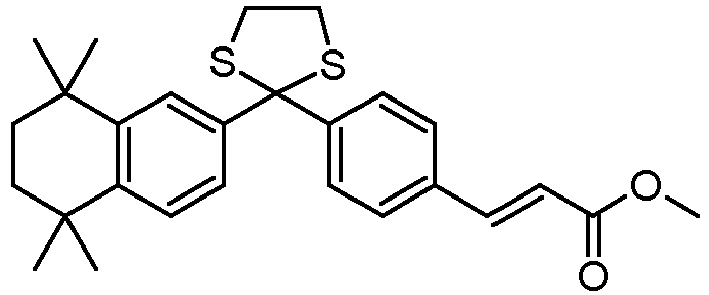
- To a solution of methyl (2E)-3-{4-[(5,5,8,8-tetramethyl-5,6,7,8-tetrahydronaphthalen-2-yl)carbonyl]phenyl}prop-2-enoate (0.35 g, 0.93 mmol) example 47, in CH2Cl2 (20 mL) at 0°C under Ar was added a solution of ethanedithiol (117 mL, 1.40 mmol, 1.5 eq.) in CH2Cl2 (0.5 mL) followed by BF3•Et20 (177 µL, 1.40 mmol, ). The resulting mixture was stirred at 0°C for 1 h and then warmed to room temperature overnight. The reaction was quenched by pouring the mixture into saturated Na2CO3, and the mixture was extracted (CH2Cl2). The combined organic layers were dried (MgSO4) and concentrated to afford a colorless oil (380 mg (91%). 1H NMR (400 MHz, CDCl3) δ 7.67 (d, J = 16.2 Hz, 1H), 7.66 (d, J = 8.4 Hz, 2H), 7.50 (d, J = 2.0 Hz, 1H), 7.44 (d, J = 8.4 Hz, 2H), 7.22 (dd, J = 8.4, 2.1 Hz, 1H), 7.18 (d, J = 8.3 Hz, 1H), 6.42 (d, J = 16.0 Hz, 1H), 3.80 (s, 3H), 3.50 - 3.40 (m, 2H), 3.42 - 3.32 (m, 2H), 1.66 (s, 4H), 1.25 (s, 6H), 1.21 (s, 6H).
-

- (2E)-3-{4-[2-(5,5,8,8-tetramethyl-5,6,7,8-tetrahydronaphthalen-2-yl)-1,3-dithiolan-2-yl]phenyl}prop-2-enoic acid was prepared according to example 3 starting from 85 mg of methyl (2E)-3-{4-[2-(5,5,8,8-tetramethyl-5,6,7,8-tetrahydronaphthalen-2-yl)-1,3-dithiolan-2-yl]phenyl}prop-2-enoate. Title compound was obtained as a white solid, 81 mg (97%). mp= 234-236°C. 1H NMR (400 MHz, CDCl3) δ 7.77 (d, J = 15.9 Hz, 1H), 7.68 (d, J = 8.4 Hz, 2H), 7.50 (d, J = 2.0 Hz, 1H), 7.47 (d, J = 8.4 Hz, 2H), 7.22 (dd, J = 8.4, 2.1 Hz, 1H), 7.18 (d, J = 8.3 Hz, 1H), 6.43 (d, J = 16.0 Hz, 1H), 3.46 (ddd, J = 12.3, 9.4, 7.4 Hz, 2H), 3.42 - 3.34 (m, 2H), 1.66 (s, 4H), 1.25 (s, 6H), 1.21 (s, 6H). HRMS (TOF MS ES+) for C26H31O2S2 +(MH+) calcd. 439.1765, found 439.1765.
-

- (2E)-3-{4-[(5,5,8,8-tetramethyl-5,6,7,8-tetrahydronaphthalen-2-yl)carbonyl]phenyl}prop-2-enoic acid was prepared according to example 3, starting from 310 mg of methyl (2E)-3-{4-[(5,5,8,8-tetramethyl-5,6,7,8-tetrahydronaphthalen-2-yl)carbonyl]phenyl}prop-2-enoate. The crude was purified on Biotage to provide a white solid (278 mg, 93%). mp=. 220-221°C. 1H NMR (400 MHz, CDCl3) δ 7.85 (d, J = 16.8 Hz, 1H), 7.84 (d, J = 8.0 Hz, 1H), 7.80 (d, J = 1.8 Hz, 1H), 7.66 (d, J = 8.2 Hz, 2H), 7.54 (dd, J = 8.2, 1.8 Hz, 1H), 7.41 (d, J = 8.2 Hz, 1H), 6.57 (d, J = 16.0 Hz, 1H), 1.73 (s, 4H), 1.32 (s, 6H), 1.30 (s, 6H).
-

- Methyl 3-{4-[2-(5,5,8,8-tetramethyl-5,6,7,8-tetrahydronaphthalen-2-yl)-1,3-dithiolan-2-yl]phenyl}propanoate was prepared according to example 48, starting from 30 mg of methyl 3-[4-(5,5,8,8-tetramethyl-5,6,7,8-tetrahydronaphthalene-2-carbonyl) phenyl] propanoate to provide a colorless oil (25 mg, 69%). 1H NMR (400 MHz, CDCl3) δ 7.54 (d, J = 8.4 Hz, 2H), 7.52 (d, J = 2.1 Hz, 1H), 7.22 (dd, J = 8.4, 2.2 Hz, 1H), 7.16 (d, J = 8.4 Hz, 1H), 7.11 (d, J = 8.3 Hz, 2H), 3.67 (s, 3H), 3.48 - 3.29 (m, 4H), 2.93 (t, J = 7.9 Hz, 2H), 2.62 (t, J = 7.9 Hz, 2H), 1.65 (s, 4H), 1.24 (s, 6H), 1.21 (s, 6H).
-

- 3-{4-[2-(5,5,8,8-tetramethyl-5,6,7,8-tetrahydronaphthalen-2-yl)-1,3-dithiolan-2-yl]phenyl} propanoic acid was prepared according to example 3, starting from 25 mg of Methyl 3-{4-[2-(5,5,8,8-tetramethyl-5,6,7,8-tetrahydronaphthalen-2-yl)-1,3-dithiolan-2-yl]phenyl} propanoate, The residue was purified on Biotage to give title compound as a yellow solid (15 mg, 63%). mp= 165-167°C. 1H NMR (400 MHz, CDCl3) δ 7.55 (d, J = 8.3 Hz, 2H), 7.52 (d, J = 2.1 Hz, 1H), 7.22 (dd, J = 8.4, 2.2 Hz, 1H), 7.16 (d, J = 8.4 Hz, 1H), 7.12 (d, J = 7.4 Hz, 2H), 3.49 - 3.32 (m, 4H), 2.94 (t, J = 7.8 Hz, 2H), 2.67 (t, J = 7.8 Hz, 2H), 1.65 (s, 4H), 1.25 (d, J = 1.7 Hz, 6H), 1.21 (s, 6H). HRMS (TOF MS ES+) for C26H33O2S2 + (MH+) calcd. 441.1922, found 441.1918.
-

- Methyl 3-{4-[(5,5,8,8-tetramethyl-5,6,7,8-tetrahydronaphthalen-2-yl)methyl] phenyl}-propanoate was prepared according to example 38, starting from 515 mg of methyl (2E)-3-{4-[(5,5,8,8-tetramethyl-5,6,7,8-tetrahydronaphthalen-2-yl) carbonyl]phenyl}prop-2-enoate. The crude was purified on a 50 g Biotage cartridge using an EtOAc:cyclohexane gradient (0-10%) to provide a colorless oil (479 mg, 93%). 1H NMR (400 MHz, CDCl3) δ 7.19 (d, J = 8.1 Hz, 1H), 7.15 - 7.08 (Aroamtic, 5H), 6.90 (dd, J = 8.1, 1.9 Hz, 1H), 3.89 (s, 2H), 3.65 (s, 3H), 2.91 (t, J = 7.9 Hz, 2H), 2.61 (t, J = 7.9 Hz, 2H), 1.66 (s, 4H), 1.25 (s, 12H).
-

- 3-{4-[(5,5,8,8-tetramethyl-5,6,7,8-tetrahydronaphthalen-2-yl)methyl]phenyl} propanoic acid was prepared according to example 3, starting from 422 mg of methyl 3-{4-[(5,5,8,8-tetramethyl-5,6,7,8-tetrahydronaphthalen-2-yl)methyl] phenyl}propanoate. The crude was purified on a Biotage SNAP cartridge and eluted with 5% MeOH : CH2Cl2 to provide a white solid (301 mg, 77%). 1H NMR (400 MHz, CDCl3) δ 7.20 (d, J = 8.1 Hz, 1H), 7.12 (5H), 6.90 (dd, J = 8.1, 1.8 Hz, 1H), 3.89 (s, 2H), 2.92 (t, J = 7.8 Hz, 2H), 2.66 (t, J = 7.8 Hz, 2H), 1.66 (s, 4H), 1.25 (s, 12H). mp= 142-143°C. HRMS (TOF MS ES+) for C24H31O2 + (MH+) calcd. 351.2324, found 351.2321.

- i) 1) NaH, DMF, 2) CH3I ; ii) 4-iodobenzyl chloride, AlCl3, DCM.
- i) methyl or benzyl acrylate, Pd(OAc)2, NEt3, DMF, 1000C, 3h ; ii) H2, Pd/C, EtOH, EtOAc, MeOH, 20 psi, overnight; iii) ethylene glycol, pTsOH, toluene, reflux ; overnight; iv) LiOH 1N, THF, r.t. overnight.
-

- To a suspension of sodium hydroxide (60% in oil, 0.46 g, 1.1 eq.) in DMF (5 mL), was slowly added a solution of 2-tertbutylphenol (1.53 g, 10 mmol, 1 eq.) in DMF (5 mL). The mixture was stirred 1 hour until the solution became clear. Iodomethane (0.68 mL, 1.1 eq.) was the added, and the solution stirred for a further 2 hours. The mixture was poured into water, and extracted with Et2O. The organic layers were combined, dried with brine and Ca2SO4, and concentrated to afford the title compound as a colorless oil (1.40 g, 80%). No further purification was needed. 1H NMR (400 MHz, CHLOROFORM-d) δ ppm 1.37 (s, 9 H), 3.82 (s, 3 H), 6.83 - 6.93 (m, 2 H), 7.13 - 7.23 (m, 1 H), 7.28 (dd, J=7.65, 1.38 Hz, 1 H).
-

-

- 4-tert-butyl-2-[(4-iodophenyl)carbonyl]phenol was obtained in example 55(b).Yellow solid (1.05 g, 30%). mp= 101-103°C. 1H NMR (400 MHz, CHLOROFORM-d) δ ppm 1.25 (s, 9 H), 7.02 (d, J=8.78 Hz, 1 H), 7.42 (m, J=8.41 Hz, 2 H), 7.52 (d, J=2.28 Hz, 1 H), 7.58 (dd, J=8.78, 2.28 Hz, 1 H), 7.88 (m, J=8.41 Hz, 2 H), 11.70 (s, 1 H).
-

- Ethyl (2E)-3-{4-[(3-tert-butyl-4-methoxyphenyl)carbonyl]phenyl}prop-2-enoate was prepared according example 42(c), starting from 355 mg of (3-tert-butyl-4-methoxyphenyl)(4-iodophenyl) methanone. Purification of the crude by silica gel chromatography using the following gradient system, (cyclohexane/dichloromethane): (20/80) to (0/100), afforded title compound as a colorless oil (330 mg, 85%). 1H NMR (400 MHz, CHLOROFORM-d) δ ppm 1.39 (s, 9 H), 3.93 (s, 3 H), 5.27 (s, 2 H), 6.59 (d, J=16.06 Hz, 1 H), 6.91 (d, J=8.53 Hz, 1 H), 7.31 - 7.47 (m, 5 H), 7.56 - 7.69 (m, 3 H), 7.72 - 7.83 (m, 3 H), 7.86 (d, J=2.01 Hz, 1 H).
-

- 3-{4-[(3-tert-butyl-4-methoxyphenyl)methyl]phenyl}propanoic acid was prepared according to example 38 starting from 330 mg of ethyl (2E)-3-{4-[(3-tert-butyl-4-methoxyphenyl)carbonyl]phenyl}prop-2-enoate. Purification of the crude by silica gel chromatography using the following gradient system, (dichloromethane/methanol): (98/2) to (80/20), afforded the title compound as a light yellow solid (152 mg, 50%). mp= 47-48 °C. 1H NMR (400 MHz, CHLOROFORM-d) δ ppm 1.35 (s, 9 H), 2.66 (t, J=7.75 Hz, 2 H), 2.92 (t, J=7.75 Hz, 2 H), 3.80 (s, 3 H), 3.88 (s, 2 H), 6.78 (d, J=8.28 Hz, 1 H), 6.94 (d, J=8.16 Hz, 1 H), 7.12 (s, 5 H). HRMS (TOF MS ES-) for C21H25O3- (M-H)- calcd. 325.1804, found 325.1801.
-

- Methyl (2E)-3-{4-[(3-tert-butyl-4-methoxyphenyl)carbonyl]phenyl}prop-2-enoate was prepared according example 42(c), starting from 600 mg of (3-tert-butyl-4-methoxyphenyl)(4-iodophenyl) methanone. Purification of the crude by silica gel chromatography using the following gradient system, (cyclohexane/dichloromethane): (20/80) to (0/100), afforded title compound as a white solid (410 mg, 76%). mp= 128-129°C. 1H NMR (400 MHz, CHLOROFORM-d) δ ppm 1.39 (s, 9 H), 3.83 (s, 3 H), 3.93 (s, 3 H), 6.54 (d, J=16.06 Hz, 1 H), 6.91 (d, J=8.53 Hz, 1 H), 7.57 - 7.69 (m, 3 H), 7.71 - 7.81 (m, 3 H), 7.87 (d, J=2.01 Hz, 1 H).
-

- (2E)-3-{4-[(3-tert-butyl-4-methoxyphenyl)carbonyl]phenyl}prop-2-enoic acid was prepared according to example 3 using 30 mg of methyl (2E)-3-{4-[(3-tert-butyl-4-methoxyphenyl)carbonyl]phenyl}prop-2-enoate. A white solid is obtained (28 mg, 90%). mp= 237-238°C. 1H NMR (400 MHz, DMSO-d 6) δ ppm 1.38 (s, 9 H), 3.94 (s, 3 H), 6.69 (d, J=15.94 Hz, 1 H), 7.16 (d, J=8.66 Hz, 1 H), 7.58 - 7.82 (m, 5 H), 7.88 (d, J=8.16 Hz, 2 H), 12.59 (s, 1 H). HRMS (TOF MS ES-) for C21H21O4- (M-H)- calcd. 337.1440, found 337.1436.
-
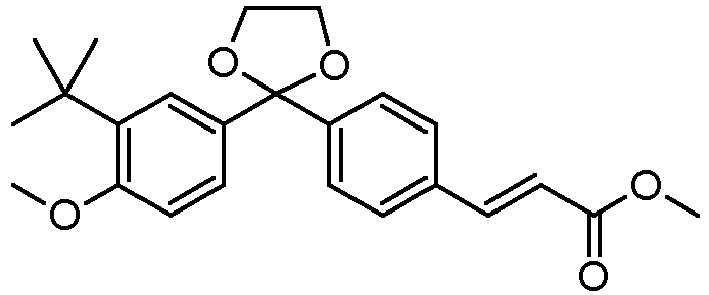
- Methyl (2E)-3-{4-[2-(3-tert-butyl-4-methoxyphenyl)-1,3-dioxolan-2-yl]phenyl}prop-2-enoate was prepared according example 42(b), starting from 660 mg methyl (2E)-3-{4-[(3-tert-butyl-4-methoxyphenyl)carbonyl]phenyl}prop-2-enoate. Purification of the crude by silica gel chromatography using the following gradient system, (cyclohexane/ethyl acetate): (93/7) to (65/35), afforded the title compound as a white solid (490 mg, 65%). mp= 132-133°C. 1H NMR (400 MHz, CHLOROFORM-d) δ ppm 1.34 (s, 9 H), 3.74 - 3.84 (m, 6 H), 3.95 - 4.14 (m, 4 H), 6.42 (d, J=16.00 Hz, 1 H), 6.79 (d, J=8.53 Hz, 1 H), 7.20 - 7.25 (m, 1 H), 7.39 - 7.44 (m, 1 H), 7.45 - 7.58 (m, 4 H), 7.68 (d, J=16.00 Hz, 1 H).
-

- Methyl 3-{4-[2-(3-tert-butyl-4-methoxyphenyl)-1,3-dioxolan-2-yl]phenyl}propanoate was prepared according to example 38, starting from 250 mg of methyl (2E)-3-{4-[2-(3-tert-butyl-4-methoxyphenyl)-1,3-dioxolan-2-yl]phenyl}prop-2-enoate. Purification of the crude by silica gel chromatography using the following gradient system, (cyclohexane/ethyl acetate): (93/7) to (60/40), afforded the title compound as a colorless oil (210 mg, 84%). 1H NMR (400 MHz, CHLOROFORM-d) δ ppm 1.34 (s, 9 H), 2.61 (t, J=7.91 Hz, 2 H), 2.87 (t, J=7.91 Hz, 2 H), 3.66 (s, 3 H), 3.80 (s, 3 H), 6.78 (d, J=8.44 Hz, 1 H), 7.15 (d, J=8.03 Hz, 2 H), 7.23 (dd, J=8.44, 2.20 Hz, 1 H), 7.36 - 7.47 (m, 3 H).
-

- 3-{4-[2-(3-tert-butyl-4-methoxyphenyl)-1,3-dioxolan-2-yl]phenyl}propanoic acid was prepared according to example 3 starting from 158 mg of methyl 3-{4-[2-(3-tert-butyl-4-methoxyphenyl)-1,3-dioxolan-2-yl]phenyl} propanoate. A white solid is obtained (148 mg, 97%). mp= 121 °C. 1H NMR (400 MHz, CHLOROFORM-d) δ ppm 1.34 (s, 9 H), 2.66 (t, J=7.78 Hz, 2 H), 2.94 (t, J=7.78 Hz, 2 H), 3.80 (s, 3 H), 3.94 - 4.13 (m, 4 H), 6.79 (d, J=8.44 Hz, 1 H), 7.17 (d, J=7.91 Hz, 2 H), 7.23 (dd, J=8.44, 1.69 Hz, 1 H), 7.38 - 7.47 (m, 3 H). HRMS (TOF MS ES-) for C23H27O5- (M-H)- calcd. 383.1858, found 383.1864.

- i) 1) NaH, DMF, 2) CH3I ; ii) benzyl acrylate, Pd(OAc)2, NEt3, DMF, 1000C, 3h ; iii) H2, Pd/C, EtOH, EtOAc, MeOH, 20 psi, overnight; iv) ethylene glycol, pTsOH, toluene, reflux ; v) EDC, DMAP, MeOH, DCM, 3 h, r.t. ; vi) I2, acetone, MS 4Å, reflux, 14h ; vii) LiOH 1N, THF,r.t. overnight.
-

- (5-tert-butyl-2-methoxyphenyl)(4-iodophenyl)methanone was prepared according to example 55(a) starting with 510 mg of 4-tert-butyl-2-[(4-iodophenyl)carbonyl]phenol. Purification of the crude by silica gel chromatography using the following gradient system, (cyclohexane/dichloromethane): (88/12) to (0/100), afforded the title compound as a colorless oil (515 mg, 97%). 1H NMR (400 MHz, CHLOROFORM-d) δ ppm 1.31 (s, 9 H), 3.69 (s, 3 H), 6.91 (d, J=8.78 Hz, 1 H), 7.37 (d, J=2.38 Hz, 1 H), 7.46 - 7.55 (m, 3 H), 7.79 (d, J=8.41 Hz, 2 H).
-

- (3E)-4-{4-[(5-tert-butyl-2-methoxyphenyl)carbonyl]phenyl}but-3-en-2-one was prepared according to example 42(c) starting from 530 mg of (5-tert-butyl-2-methoxyphenyl)(4-iodophenyl)methanone. Purification of the crude by silica gel chromatography using the following gradient system, (cyclohexane/ethyl acetate): (95/5) to (60/40), afforded the title compound as a colorless oil (771 mg, 71%). 1H NMR (400 MHz, CHLOROFORM-d) δ ppm 1.31 (s, 9 H), 3.68 (s, 3 H), 6.57 (d, J=16.06 Hz, 1 H), 6.92 (d, J=8.75 Hz, 1 H), 7.31 - 7.46 (m, 6 H), 7.50 (dd, J=8.75, 2.57 Hz, 1 H), 7.57 (m, J=8.28 Hz, 2 H), 7.75 (d, J=16.06 Hz, 1 H), 7.82 (m, J=8.28 Hz, 2 H).
-

- 3-{4-[(5-tert-butyl-2-methoxyphenyl)methyl]phenyl}propanoic acid was prepared according to example 38 using 235 mg of (3E)-4-{4-[(5-tert-butyl-2-ethoxyphenyl)carbonyl]phenyl} but-3-en-2-one. A white solid is obtained (120 mg, 67%). mp= 97-98 0C. 1H NMR (400 MHz, CHLOROFORM-d) δ ppm 1.20 - 1.36 (m, 9 H), 2.65 (t, J=7.78 Hz, 2 H), 2.91 (t, J=7.78 Hz, 2 H), 3.77 (s, 3 H), 3.93 (s, 2 H), 6.79 (d, J=8.50 Hz, 1 H), 7.05 - 7.18 (m, 5 H), 7.20 (dd, J=8.50, 2.45 Hz, 1 H). HRMS (TOF MS ES-) for C21H25O3- (M-H)- calcd. 325.1804, found 325.1794.
-

- (3E)-4-{4-[(5-tert-butyl-2-hydroxyphenyl)carbonyl]phenyl}but-3-en-2-one was prepared according to example 42(c) starting from 515 mg of 4-tert-butyl-2-[(4-iodophenyl)carbonyl] phenol. Purification of the crude by silica gel chromatography using the following gradient system, (cyclohexane/dichloromethane): (80/20) to (0/100), afforded the title compound as a yellow solid (445 mg, 88%). mp= 111 0C. 1H NMR (400 MHz, CHLOROFORM-d) δ ppm 1.25 (s, 9 H), 5.28 (s, 2 H), 6.61 (d, J=16.06 Hz, 1 H), 7.03 (d, J=8.72 Hz, 1 H), 7.32 - 7.46 (m, 5 H), 7.54 (d, J=2.26 Hz, 1 H), 7.58 (dd, J=8.72, 2.38 Hz, 1 H), 7.63 - 7.75 (m, 5 H), 7.79 (d, J=16.06 Hz, 1 H), 11.75 (s, 1 H).
-

- 3-{4-[(5-tert-butyl-2-hydroxyphenyl)methyl]phenyl }propanoic acid was prepared according to example 38 starting from 143 mg of benzyl (2E)-3-[4-(5-tert-butyl-2-hydroxybenzoyl)phenyl]prop-2-enoate. Purification of the crude by silica gel chromatography using the following gradient system, (dichloromethane/methanol): (98/2) to (80/20), afforded the title compound as a white solid (77 mg, 72%). mp= 98-99°C. 1H NMR (400 MHz, CHLOROFORM-d) δ ppm 1.28 (s, 9 H), 2.65 (t, J=7.78 Hz, 2 H), 2.92 (t, J=7.78 Hz, 2 H), 3.96 (s, 2 H), 6.71 (d, J=9.03 Hz, 1 H), 7.04 - 7.22 (m, 6 H).
-

- (3E)-4-{4-[2-(5-tert-butyl-2-methoxyphenyl)-1,3-dioxolan-2-yl]phenyl}but-3-en-2-one was prepared according to example 42(b), starting from 350 mg of (b) Benzyl 3-[4-(5-tert-butyl-2-methoxybenzoyl)phenyl]propanoate. Purification of the crude by silica gel chromatography using the following gradient system, (cyclohexane/ethyl acetate): (95/5) to (70/30), afforded the title compound as a white solid (230 mg, 60%). mp= 100-101 0C. 1H NMR (400 MHz, CHLOROFORM-d) δ ppm 1.34 (s, 9 H), 3.54 (s, 3 H), 4.09 (s, 4 H), 5.24 (s, 2 H) ,6.45 (d, J=16.06 Hz, 1 H), 6.77 (d, J=8.53 Hz, 1 H), 7.28 - 7.53 (m, 10 H), 7.70 (d, J=16.06 Hz, 1 H), 7.79 (d, J=2.26 Hz, 1 H).
-

- 3-{4-[2-(5-tert-butyl-2-methoxyphenyl)-1,3-dioxolan-2-yl]phenyl}propanoic acid was prepared according to example 38 starting from 166 mg of (3E)-4-{4-[2-(5-tert-butyl-2-methoxyphenyl)-1,3-dioxolan-2-yl]phenyl}but-3-en-2-one. 3-{4-[2-(5-tert-butyl-2-methoxyphenyl)-1,3-dioxolan-2-yl]phenyl}propanoic acid was obtained as a mixture with 3-{4-[(5-tert-butyl-2-methoxyphenyl)methyl]phenyl}propanoic acid (25%). It was used in the following reaction without any further purification.
- To solution of the previous carboxylic acids mixture (175 mg, 0.46 mmol regarding the highest MW, 1 eq.) in DCM (4mL), were added methanol (100, 1.12 mmol, 6.8 eq.) and EDC.Cl (105 mg, 0.55 mmol, 1.2 mmol). After strirring 3 hours, the mixture was diluted in DCM (50 mL) and washed with aqueous sat.NaHCO3 (2×30 mL) and water (2×30 mL). The organic layer was dried over Ca2SO4 and concentrated. Purification of the crude by silica gel chromatography using the following gradient system, (cyclohexane/ethyl acetate): (93/7) to (40/60), afforded methyl 3-{4-[2-(5-tert-butyl-2-methoxyphenyl)-1,3-dioxolan-2-yl]phenyl}propanoate as a mixture with methyl 3-{4-[(5-tert-butyl-2-methoxyphenyl)methyl]phenyl}propanoate. It was used in the following step without any further purification.
- Title compound was obtained according to example 3, starting from 64 mg of the previously obtained mixture. Purification of the crude by silica gel chromatography using the following gradient system, (cyclohexane/ethyl acetate): (100/0) to (60/40), afforded the title compound as a brown oil (32 mg). 1H NMR (400 MHz, CHLOROFORM-d) δ ppm 1.30 (s, 9 H), 2.66 (t, J=7.78 Hz, 2 H), 3.01 (t, J=7.68 Hz, 2 H), 3.70 (s, 3 H), 3.67 (s, 3 H), 6.92 (d, J=8.72 Hz, 1 H), 7.26 (d, J=8.09 Hz, 2 H) 7.34 (d, J=2.30 Hz, 1 H) 7.47 (dd, J=8.72, 2.30 Hz, 1 H) 7.76 (d, J=8.09 Hz, 2 H). HRMS (TOF MS ES-) for C20H23O3- (M-H)- calcd. 311.1647, found 311.1658.
-

- 3-{4-[(5-tert-butyl-2-methoxyphenyl)carbonyl]phenyl}propanoic acid was prepared according to example 3, starting from 30 mg of methyl 3-{4-[(5-tert-butyl-2-methoxyphenyl) carbonyl]phenyl}propanoate. A yellow oil was obtained (28 mg, 98%). 1H NMR (400 MHz, CHLOROFORM-d) δ ppm 1.25 - 1.38 (m, 9 H), 2.71 (t, J=7.72 Hz, 2 H), 3.02 (t, J=7.72 Hz, 2 H), 3.70 (s, 3 H), 6.92 (d, J=8.785 Hz, 1 H), 7.23 - 7.30 (m, 2 H), 7.35 (d, J=2.42 Hz, 1 H), 7.47 (dd, J=8.75, 2.42 Hz, 1 H), 7.77 (d, J=8.16 Hz, 2 H). HRMS (TOF MS ES-) for C21H2304- (M-H)- calcd. 339.1596, found 339.1611.
- Phenol (1.88 g, 0.02 mol) and 3.04 g (0.02 mol) of 1-adamantanol were dissolved in 10 mL of dichloromethane. To the resulting solution was slowly added 1.1 mL (0.02 mol) of concentrated sulfuric acid (98%). The mixture was stirred overnight at room temperature, poured into water, neutralized with sodium bicarbonate, extracted with EtOAc, dried over MgSO4, and evaporated. Recrystallization from cyclohexane provided 2.5 g (55%) of a white solid; M. p. 181-182 °C. 1H NMR (400 MHz, DMSO) δ 9.08 (s, 1H), 7.12 (d, J = 8.6 Hz, 2H), 6.67 (d, J = 8.6 Hz, 2H), 2.02 (s, 3H), 1.80 (s, 3H), 1.79 (s, 3H), 1.70 (s, 6H).13C NMR (101 MHz, DMSO) δ 154.93, 141.27, 125.37, 114.67, 42.91, 36.22, 34.91, 28.35. HRMS (TOF MS ES-) for C16H19O- (M-H-) calcd. 227.1436, found 227.1433.
- To a suspension of sodium hydride (60% in oil, 0.46 g, 10 mmol) in 10 mL of DMF was slowly added, while maintaining the temperature at 20°C, 2.28 g (10 mmol) of 69 (a). The mixture was stirred for 1 h at room temperature at which point CH3I (0.68 mL, 11 mmol) was added. The mixture was then stirred for 2 h at 20°C, poured into water, and extracted with Et2O. After standard work-up followed by chromatography (cyclohexane), 1.426 g (59%) of 29 as a white solid was obtained. M. p. 76-77°C; Rf= 0.34 (5% EtOAc:cyclohexane). 1H NMR (400 MHz, CDCl3) δ 7.28 (d, J = 8.9 Hz, 1H), 6.86 (d, J = 8.9 Hz, 1H), 3.79 (s, 3H), 2.08 (s, 3H), 1.89 (s, 3H), 1.88 (s, 3H), 1.81 - 1.69 (m, 6H). 13C NMR (101 MHz, CDCl3) δ 157.32, 143.70, 125.76, 113.38, 55.19, 43.38, 36.79, 35.53, 28.99.
-

- Compound was prepared according to the procedure described by Boehm et al. (J. Med. Chem. 1994, 37, 2930-2941) from example 69 (b). After work-up, the crude product was purified by chromatography to yield 69 (c) as a yellow oil, 1.50 g (28%). Rf= 0.60 (5% EtOAc:cyclohexane). 1H NMR (400 MHz, CDCl3) δ 7.78 (d, J = 8.4 Hz, 2H), 7.52 (d, J = 8.4 Hz, 2H), 7.46 (dd, J = 8.7, 2.4 Hz, 1H), 7.35 (d, J = 2.4 Hz, 1H), 6.93 (d, J = 8.7 Hz, 1H), 3.69 (s, 3H), 2.08 (s, 3H), 1.89 (s, 6H), 1.75 (q, J = 12.1 Hz, 6H). 13C NMR (101 MHz, CDCl3) δ 196.26, 155.35, 143.94, 137.57, 131.35, 128.86, 127.72, 126.51, 111.30, 100.84, 55.77, 43.36, 36.79, 35.80, 29.01. HRMS (TOF MS ES+) for C24H26IO2+ (MH+) calcd. 473.0978, found 473.0981.
-

- To a stirred solution of example 69 (c) (1.24 g, 2.63 mmol) and Et3N (1098 uL, 7.89 mmol) was added 357 uL (3.94 mmol) of methyl acrylate. Palladium (II) acetate (12 mg) and (2-Tol)3P (64 mg) was added and heated at 100°C for 3 hrs. The reaction mixture was allowed to cool to rt, concentrated under reduced pressure and purified by chromatography to yield a yellow solid, 0.59 g (52%). M. p. 135.5-137°C; Rf= 0.40 (15% EtOAc : cyclohexane). 1H NMR (400 MHz, CDCl3) δ 7.82 (d, J = 8.2 Hz, 2H), 7.72 (d, J = 16.0 Hz, 1H), 7.57 (d, J = 8.2 Hz, 2H), 7.47 (dd, J = 8.7, 2.4 Hz, 1H), 7.36 (d, J = 2.3 Hz, 1H), 6.94 (d, J = 8.7 Hz, 1H), 6.52 (d, J = 16.0 Hz, 1H), 3.82 (s, 3H), 3.69 (s, 3H), 2.09 (s, 3H), 1.90 (s, 6H), 1.77 (s, 3H), 1.74 (s, 3H). 13C NMR (101 MHz, CDCl3) δ 196.27, 167.17, 155.42, 143.99, 143.81, 139.40, 138.43, 130.45, 128.84, 128.06, 127.93, 126.54, 120.15, 111.35, 55.81, 52.00, 43.40, 36.83, 35.85, 29.05. HRMS (TOF MS ES+) for C28H31O4+ (MH+) calcd. 431.2222, found 431.2227.
-

- Example 69 (200 mg, 0.46 mmol) was treated with ethylene glycol (2 mL) and a catalytic amount of pTsOH (20 mg) in toluene (10 mL) at 145°C overnight using a Dean Stark trap according to a modified procedure of Dawson et al. 8 After cooling to rt, it was washed with saturated NaHCO3(aq.), brine, dried over MgSO4 and concentrated under reduced pressure. The residue was purified using Biotage to yield a white solid, 112 mg (64%, 40 mg of starting material recovered). M.p. 163-165°C; Rf= 0.34(15% EtOAc:cyclohexane). 1H NMR (400 MHz, CDC13) δ 7.77 (d, J = 2.5 Hz, 1H), 7.67 (d, J = 16.0 Hz, 1H), 7.49 (d, J = 8.3 Hz, 2H), 7.44 (d, J = 8.4 Hz, 2H), 7.28 (d, J = 8.5, 2.5 Hz, 1H), 6.79 (d, J = 8.6 Hz, 1H), 6.40 (d, J = 16.0 Hz, 1H), 4.09 (s, 4H), 3.79 (s, 3H), 3.55 (s, 3H), 2.11 (s, 3H), 1.94 (s, 3H), 1.93 (s, 3H), 1.78 (s, 6H). 13C NMR (101 MHz, CDCl3) δ 167.65, 154.99, 145.17, 144.88, 143.45, 133.70, 129.04, 127.58, 126.82, 126.21, 123.25, 117.69, 112.28, 108.96, 65.28, 56.05, 51.80, 43.58, 36.96, 35.88, 29.18. HRMS (TOF MS ES+) for C30H35O5+ (MH+) calcd. 475.2484, found 475.2484.
-

- To a solution of the example 70 (140 mg, 0.29 mmol) in anhydrous THF (5 mL) was added aqueous LiOH (1.0 mL, 1.0 N) dropwise. The reaction mixture was stirred at 75°C for 3 hrs. The reaction was then cooled (0 °C), acidified to pH 2 with 1.0 N HCl, and extracted with EtOAc (3 × 15 mL). The combined organic phases were dried (anhydrous Na2SO4) and concentrated in vacuo to afford a thick colorless oil. The resultant oil was purified on a 30 g Biotage ZIP cartridge and eluted with 0-60% EtOAc:cyclo-hexane+ 0.1% HOAc gradient to provide a white solid (129 mg, 96%). M.p. 238-240°C; Rf=0.40 (60% EtOAc:cyclo-hexane+ 0.1% HOAc). 1H NMR (400 MHz, CDCl3) δ 7.78 (d, J = 2.5 Hz, 1H), 7.76 (d, J = 16.2 Hz, 1H), 7.51 (d, J = 8.3 Hz, 2H), 7.47 (d, J = 8.4 Hz, 2H), 7.28 (dd, J = 8.6, 2.5 Hz, 1H), 6.79 (d, J = 8.6 Hz, 1H), 6.41 (d, J = 15.9 Hz, 1H), 4.10 (s, 4H), 3.55 (s, 3H), 2.11 (s, 3H), 1.94 (s, 3H), 1.94 (s, 3H), 1.78 (s, 6H). 13C NMR (101 MHz, CDCl3) δ 171.86, 154.97, 147.06, 145.66, 143.46, 133.36, 128.97, 127.88, 126.90, 126.26, 123.24, 117.02, 112.27, 108.93, 65.29, 56.03, 43.58, 36.96, 35.89, 29.18. HRMS (TOF MS ES+) for C29H35O5+ (MH+) calcd. 463.2484, found 463.2484.
-

- Example 71 was hydrogenated according to the general procedure for the formation of example 38 to provide a white solid 93 mg (86%) after chromatography; m. p. 173-175°C. 1H NMR (400 MHz, CDCl3) δ 7.76 (d, J = 2.5 Hz, 1H), 7.39 (d, J = 8.2 Hz, 2H), 7.26 (d, J = 8.5, 2.5 Hz, 1H), 7.11 (d, J = 8.2 Hz, 2H), 6.79 (d, J = 8.6 Hz, 1H), 4.08 (ddd, J = 6.3, 3.4, 1.9 Hz, 4H), 3.54 (s, 3H), 2.92 (t, J = 7.8 Hz, 2H), 2.64 (t, J = 7.8 Hz, 2H), 2.10 (s, 3H), 1.93 (s, 3H), 1.93 (s, 3H), 1.78 (s, 6H). 13C NMR (101 MHz, CDCl3) δ 178.29, 155.12, 143.33, 140.85, 139.49, 129.51, 127.60, 126.46, 125.94, 123.37, 112.40, 109.26, 65.17, 56.12, 43.57, 36.97, 35.86, 35.56, 30.46, 29.18. HRMS (TOF MS ES+) for C29H35O5+ (MH+) calcd. 463.2484, found 463.2484.
-

- Example 73 was prepared from example 70 by hydrogenation under Pd-C catalysis using the general procedure (example 38) to provide a white solid, 260 mg (85%). M. p. 112-113°C; Rf= 0.45 (15% EtOAc : cyclohexane). 1H NMR (400 MHz, CDCl3) δ 7.76 (d, J= 2.5 Hz, 1H), 7.38 (d, J = 8.2 Hz, 2H), 7.26 (dd, J = 8.5, 2.6 Hz, 1H), 7.10 (d, J = 8.2 Hz, 2H), 6.79 (d, J = 8.6 Hz, 1H), 4.17 - 3.99 (m, 4H), 3.65 (s, 3H), 3.55 (s, 3H), 2.91 (t, J = 7.9 Hz, 2H), 2.59 (t, J = 7.9 Hz, 2H), 2.10 (s, 3H), 1.93 (s, 3H), 1.93 (s, 3H), 1.86 - 1.69 (m, 6H). 13C NMR (101 MHz, CDCl3) δ 173.51, 155.12, 143.32, 140.71, 139.83, 129.52, 127.60, 126.40, 125.92, 123.37, 112.38, 109.27, 65.16, 56.13, 51.71, 43.56, 36.96, 35.85, 35.81, 30.78, 29.17. HRMS (TOF MS ES+) for C30H37O5 + (MH+) calcd. 477.2641, found 477.2643.
-

- A mixture of example 73 (146 mg, 0.31 mmol) and iodine (100 mg, 0.39 mmol) in acetone (6 mL, reagent ACS, 0.2% H2O) was stirred for 3 hrs under reflux according to the reported method for example 45. After work-up and purification on a Biotage 45 g ZIP cartridge using 0-15% EtOAc:cyclohexane gradient, a brown oil (120 mg, 91%) was obtained; Rf= 0.40 (15% EtOAc:cyclohexane). 1H NMR (400 MHz, CDCl3) δ 7.76 (d, J = 8.2 Hz, 2H), 7.44 (dd, J = 8.7, 2.4 Hz, 1H), 7.32 (d, J = 2.4 Hz, 1H), 7.26 (d, J = 8.0 Hz,2H), 6.93 (d, J = 8.7 Hz, 1H), 3.70 (s, 3H), 3.67 (s, 3H), 3.01 (t, J = 7.7 Hz, 2H), 2.66 (t, J = 7.7 Hz, 2H), 2.08 (s, 3H), 1.89 (s, 3H), 1.88 (s, 3H), 1.75 (q, J = 12.1 Hz, 6H). 13C NMR (101 MHz, CDCl3) δ 196.63, 173.15, 155.24, 146.03, 143.77, 136.33, 130.46, 128.55, 128.30, 128.25, 126.26, 111.30, 55.87, 51.85, 43.39, 36.84, 35.81, 35.29, 31.07, 29.05. HRMS (TOF MS ES+) for C28H33O4 +(MH+) calcd. 433.2379, found 433.2381.
-

- Prepared according to the reported procedure for example 48. To a solution of the keto ester (117 mg, 0.27 mmol) in CH2Cl2 (5 mL) at rt under argon was added a solution of the (CH2SH)2 (35 µL, 0.41 mmol) followed by BF3•Et20 (52 µL, 0.41 mmol). The resulting mixture was stirred at rt overnight. The reaction was quenched by pouring the mixture into saturated NaHCO3, and the mixture was extracted with 20 mL CH2C12. The combined organic layers were dried (MgSO4) and concentrated to afford a solid. Flash chromatography (15% CH2Cl2:cyclohexane) yielded a yellow solid, 106 mg (77%). M. p. 127-128°C; Rf= 0.50 (15% EtOAc : cyclohexane). 1H NMR (400 MHz, CDCl3) δ 8.11 (d, J = 2.3 Hz, 1H), 7.39 (d, J = 8.2 Hz, 2H), 7.25 (dd, J = 8.3, 2.4 Hz, 1H), 7.02 (d, J = 8.1 Hz, 2H), 6.79 (d, J = 8.5 Hz, 1H), 3.65 (s, 3H), 3.50 (s, 3H), 3.44 (dt, J = 10.0, 7.5 Hz, 2H), 3.31 (dt, J = 11.8, 7.2 Hz, 2H), 2.89 (t, J = 7.9 Hz, 2H), 2.58 (t, J = 7.9 Hz, 2H), 2.12 (s, 3H), 1.96 (s, 3H), 1.96 (s, 3H), 1.79 (s, 6H). 13C NMR (101 MHz, CDCl3) δ 173.55, 154.68, 143.39, 143.34, 138.73, 133.36, 127.59, 127.03, 125.03, 123.78, 112.49, 74.73, 55.88, 51.71, 43.64, 40.41, 36.98, 36.05, 35.71, 30.61, 29.20. HRMS (TOF MS ES+) for C30H37O3S2 +(MH+) calcd. 509.2184, found 509.2184.
-

- Example 75 was hydrolyzed according to example 3 to yield a white solid, 49 mg (55%). 1H NMR (400 MHz, CDCl3) δ 8.11 (d, J = 2.4 Hz, 1H), 7.40 (d, J = 8.2 Hz, 2H), 7.25 (dd, J = 8.3, 2.4 Hz, 1H), 7.03 (d, J = 8.2 Hz, 2H), 6.79 (d, J = 8.5 Hz, 1H), 3.50 (s, 3H), 3.48 - 3.39 (m, 2H), 3.36 - 3.26 (m, 2H), 2.90 (t, J = 7.8 Hz, 2H), 2.63 (t, J = 7.8 Hz, 2H), 2.12 (s, 3H), 1.96 (s, 3H), 1.96 (s, 3H), 1.85 - 1.71 (m, 6H). 13C NMR (101 MHz, CDCl3) δ 178.06, 154.68, 143.54, 143.34, 138.38, 133.35, 127.59, 127.08, 125.05, 123.77, 112.50, 74.71, 55.89, 43.65, 40.42, 36.98, 36.05, 35.40, 30.27, 29.20. HRMS (TOF MS ES+) for C29H35O3S2 +(MH+) calcd. 495.2028, found 495.2030.
-

- The compound was obtained following the procedure used for Example 48 using example 69 (c). After work-up, the crude product was purified by chromatography and recrystallized from EtOAc to yield example 77 (a) as a yellow solid, 1.09 g (21%). M. p. 186-187°C; Rf= 0.50 (5% EtOAc:cyclohexane). 1H NMR (400 MHz, CDCl3) δ 11.72 (s, 1H), 7.89 (d, J = 8.4 Hz, 2H), 7.57 (dd, J = 8.8, 2.4 Hz, 1H), 7.47 (d, J = 2.4 Hz, 1H), 7.43 (d, J = 8.4 Hz, 2H), 7.03 (d, J = 8.8 Hz, 1H), 2.08 (s, 3H), 1.80 (s, 3H), 1.80 (s, 3H), 1.76 (s, 3H), 1.72 (s, 3H). 13C NMR (101 MHz, CDCl3) δ 200.72, 161.24, 142.04, 137.76, 137.59, 134.05, 130.93, 129.17, 118.37, 118.24, 99.50, 43.25, 36.69, 35.68, 28.92. HRMS (TOF MS ES+) for C23H24IO2 + (MH+) calcd. 459.0821, found 459.0818.
-

- Prepared according to the procedure of 42 (c) to yield a yellow solid after purification by chromatography, 0.85 g (94%). M. p. 158-160°C; Rf= 0.45 (15% EtOAc : cyclohexane). 1H NMR (400 MHz, CDCl3) δ 11.78 (s, 1H), 7.77 (d, J = 16.1 Hz, 1H), 7.73 (d, J = 8.3 Hz, 2H), 7.68 (d, J = 8.3 Hz, 2H), 7.58 (dd, J = 8.8, 2.4 Hz, 1H), 7.49 (d, J = 2.4 Hz, 1H), 7.04 (d, J = 8.8 Hz, 1H), 6.58 (d, J = 16.0 Hz, 1H), 3.84 (s, 3H), 2.07 (s, 3H), 1.80 (s, 3H), 1.80 (s, 3H), 1.76 (d, J = 13.4 Hz, 3H), 1.69 (d, J = 12.0 Hz, 3H). 13C NMR (101 MHz, CDCl3) δ 200.79, 167.10, 161.28, 143.54, 142.00, 139.54, 137.84, 134.01, 130.02, 129.30, 128.03, 120.34, 118.54, 118.21, 52.05, 43.25, 36.70, 35.68, 28.93. HRMS (TOF MS ES+) for C27H29O4 + (MH+) calcd. 417.2066, found 417.2068.
-
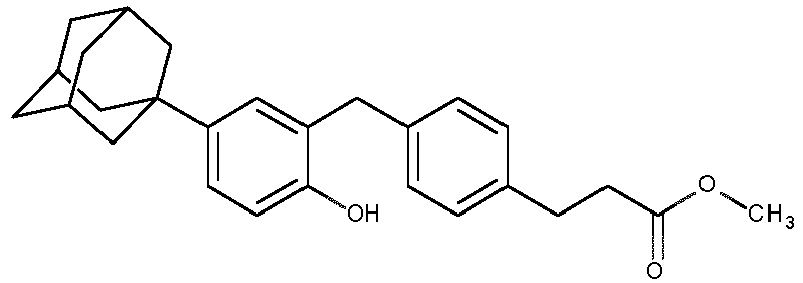
- Example 77 was hydrogenated using the same procedure as for the formation of example 38 to provide 90 mg (82%) of a white solid. M. p. 102-103°C; Rf= 0.25 (10% EtOAc : cyclohexane). 1H NMR (400 MHz, CDCl3) δ 7.19 - 7.01 (m, 6H), 6.73 (d, J = 8.0 Hz, 1H), 4.53 (s, 1H), 3.96 (s, 2H), 3.66 (s, 3H), 2.91 (t, J = 7.8 Hz, 2H), 2.60 (t, J = 7.8 Hz, 2H), 2.07 (s, 3H), 1.87 (s, 6H), 1.75 (q, J = 12.3 Hz, 6H). 13C NMR (101 MHz, CDCl3) δ 173.56, 151.66, 144.26, 138.57, 138.17, 128.81, 128.67, 127.75, 126.23, 124.33, 115.51, 51.76, 43.56, 36.96, 36.72, 35.85, 35.71, 30.68, 29.16. HRMS (TOF MS ES+) for C27H33O3 + (MH+) calcd. 405.2430, found 405.2430.
-

- Example 78 was hydrolyzed following the same procedure as for the preparation of example 3 to obtain a yellow oil, 80 mg (89%). Rf = 0.40 (50% EtOAc;cyclohexane). 1H NMR (400 MHz, CDCl3) δ 7.13 (Aromatic, 6H), 6.73 (d, J = 8.1 Hz, 1H), 3.96 (s, 2H), 2.92 (t, J = 7.7 Hz, 2H), 2.65 (t, J = 7.7 Hz, 2H), 2.07 (s, 3H), 1.87 (s, 3H), 1.87 (s, 3H), 1.75 (q, J = 12.3 Hz, 7H). 13C NMR (101 MHz, CDCl3) δ 178.18, 151.63, 144.28, 138.32, 138.21, 128.86, 128.66, 127.77, 126.21, 124.34, 115.51, 43.56, 36.95, 36.71, 35.71, 30.34, 29.15. HRMS (TOF MS ES+) for C52H61O6 + (2MH+) calcd. 781.4468, found 781.4467.
- 9-cis-RA, acitretin, 4-[(5,6,7,8-tetrahydro-5,5,8,8- tetramethyl-2-naphthalenyl)carboxamido]benzoic acid (AM 580) and NADPH were purchased from Sigma-Aldrich (St. Louis, MO). (R)-N-[4-[2-ethyl-1-(1H-1,2,4-triazol-1-yl)butyl]phenyl]-2-benzo-thiazolamine (R115866, talarozole) and R116010 were gifts from Johnson & Johnson (Beerse, Belgium). 4-[(E)-2-(5,6,7,8-Tetrahydro-5,5,8,8-tetramethyl-2-naphthalenyl)-1-propenyl]benzoic acid (TTNPB), 6-[2-(3,4-Dihydro-4,4-dimethyl-2H-1-benzothiopyran-6-yl)ethynyl]-3-pyridinecarboxylic acid ethyl ester (Tazarotene), 4-[2-(5,6,7,8-Tetrahydro-5,5,8,8-tetramethyl-2-naphthalenyl)ethynyl)-benzoic acid (EC23), 4-[[(2,3-Dihydro-1,1,3,3-tetramethyl-2-oxo-1H-inden-5-yl)carbonyl]amino]benzoic acid (BMS753), 3-Fluoro-4-[[2-hydroxy-2-(5,5,8,8-tetramethyl-5,6,7,8,-tetrahydro-2-naphthalenyl)acetyl]amino]-benzoic acid (BMS961), and 4-[[(5,6,7,8-Tetrahydro-5,5,8,8-tetramethyl-2-naphthalenyl)amino]-carbonyl]benzoic acid (AM80) and liarozole were purchased from Tocris Bioscience (Ellisville, MO). 4-OH-9-cis-RA was purchased from Toronto Research Chemicals Inc. (North York, ON, Canada). All solvents used were HPLC grade or higher and were purchased from EMD Chemicals (Gibbstown, NJ), Mallinckrodt Baker, Inc. (Phillipsburg, NJ), or Thermo Fisher Scientific (Waltham, MA).
-
Compound 1 was obtained in 73% yield by reacting 2-Bromo-1-(5,5,8,8-tetramethyl-5,6,7,8-tetrahydronaphthalen-2-yl)ethan-1-one with Methyl-4-hydroxybenzoate in the presence of K2CO3 in Methyl ethyl ketone under microwave conditions. Compound B was obtained after saponification of the methyl ester of compound A using sodium hydroxide. Reaction of B with hydroxylaminehydrochloride in MeOH under reflux yielded 2 isomers of the corresponding oximes, E-(E) and Z-(F). Compounds E and F yielded crystals of suitable quality for X-ray diffraction by slow evaporation of ethyl acetate/heptane solutions. These crystals were used to confirm the structures using X-ray data collected at 90 K, with Cu Kα radiation (λ=1.54178 Å) on a Bruker Kappa Apex-II diffractometer. Crystals of E are triclinic, space group P-1 with Z=2, R=0.036. Crystals of F are monoclinic, space group P21/c with Z=4, R=0.065. There is a conformational disorder of the six-membered ring carrying the four methyl groups. The Z-isomer was further hydrolyzed under basic conditions to provide the desired product D. Reduction of compound A using sodium borohydride followed by saponification yielded compound C. Tazarotene was hydrolyzed by reflux in K2CO3/MeOH to yield the corresponding acid in excellent yield. - CYP26A1 and CYP26B1 were expressed in Sf9 cells and used as microsomal fractions supplemented with rat P450 reductase expressed in Escherichia coli as described previously. Incubations were performed with 5 pmol of P450 (CYP26A1 or CYP26B1) and 10 pmol of P450 reductase. The purified rat reductase was added to CYP26A1 or CYP26B1 microsomes, and allowed to incorporate into the membrane for 10 min at room temperature. The final volume of each incubation sample was then brought to 1 ml by adding 100 mM potassium phosphate (KPi) buffer, pH 7.4, 9-cis-RA, and, when appropriate, inhibitor or solvent. Compounds were dissolved in methanol or dimethyl sulfoxide, and final solvent amounts in the incubations were kept at 1%. The samples were preincubated for 5 min at 37°C before the reaction was initiated with NADPH (
final concentration 1 mM). Incubation times were 1 minute and 5 minutes for CYP26A1 and CYP26B1 incubations respectively. - To determine whether the RA isomer 9-cis-RA is a substrate of CYP26B1, 9-cis-RA was incubated with CYP26B1. The formation of 9-cis-4-OH-RA by CYP26B1 was measured by HPLC as described previously for CYP26A1. Product formation was linear from 1 minute to 8 minutes. The Km and Vmax of 9-cis-RA hydroxylation by CYP26B1 was determined by incubating 8 different concentrations of 9-cis-RA between 50 nM and 1000 nM with CYP26B1. Five minutes after reactions were initiated with NADPH the reactions were quenched with 5 ml of ethyl acetate, acitretin was added as an internal standard, samples extracted, evaporated to dryness, reconstituted in methanol and analyzed by HPLC as described previously. A standard curve of 9-cis-4-OH-RA was used to quantify product formation by analysis of the peak area of the primary metabolite on an HPLC. The Michaelis-Menten equation was fit to the data using GraphPad Prism (GraphPad Software Inc., San Diego, CA), and the Km and Vmax values were obtained from this fit. 9-cis-RA was then used at 100 nM concentration as the substrate for subsequent assays of inhibitor potency.
- Eighteen compounds were tested as potential inhibitors of CYP26A1 and CYP26B1. The formation of 9-cis-4-OH-RA metabolite was monitored and the percent activity remaining in the presence of the inhibitor in comparison to the solvent only control was quantified. For IC50 determination, 6-8 concentrations of the inhibitor spanning below and above the predicted IC50 were tested, and each concentration was analyzed in triplicate. The IC50 values were determined by nonlinear regression using GraphPad Prism, according to equation 1:


- Compounds were assessed for inhibition (IC50, n=2) of CYP2C8, CYP2C9 and CYP3A4 in pooled human liver microsomes using selective probe substrates at their previously determined Km values (CYP2C8: paclitaxel, 4 µM; CYP2C9: diclofenac, 5 µM; CYP3A4: midazolam, 0.5 µM). Incubations contained 0.1 mg/mL human liver microsomes, 3 mM MgCl2, probe substrate and various concentrations of inhibitor (12-point IC50 curve) in 100 mM potassium phosphate buffer (pH 7.4). Concentrations of organic solvents were kept to < 1% (v/v). All incubations were pre-incubated at 37°C for 5 minutes prior to addition of 1 mM NADPH (final concentration). Incubations were stopped after 5 (CYP3A4) or 15 minutes (CYP2C8 and CYP2C9) with one volume (v/v) of ice-cold acetonitrile containing 0.1 µM tolbutamide as an internal standard. All samples were vortexed and centrifuged prior to LC-MS/MS analysis.
- Detection of 6-hydroxypaclitaxel, 4-hydroxydiclofenac or 1'-hydroxymidazolam was achieved using a Gemini C18 2.0 × 30 mm 5 µm column (Phenomenex, Torrance, CA). Gradient elution (flow rate = 500 µL/min) was carried out using a mobile phase system consisting of (A) 5 mM ammonium formate with 0.1% formic acid and (B) acetonitrile with 0.1% formic acid. HPLC flow was diverted from the MS/MS system for the first 20 seconds to remove any non-volatile salts. Generic MS parameters included the curtain gas (10 arbitrary units), CAD gas (medium), ionspray voltage (4500 V), source temperature (450 °C) and
ion source gas 1 and gas 2 (40 arbitrary units, each). Interface heaters were kept on for all analytes. Probe substrate mass transitions were identical to previously published methods. Briefly, the LC-MS/MS system utilized was comprised of an Applied Biosystems 4000 Q-Trap equipped with an electrospray ionization source (Applied Biosystems, Foster City, CA). The MS/MS system was coupled to two LC-20AD pumps with an in-line CBM-20A controller and DGU-20A5 solvent degasser (Shimadzu, Columbia, MD) and a LEAP CTC HTS PAL autosampler equipped with a dual-solvent self-washing system (CTC Analytics, Carrboro, NC). An injection volume of 20 µL was used for all analyses. Standard curves and mass spectrometry data were fit using Analyst (version 1.4; Applied Biosystems, Foster City, CA). Analysis of IC50 data was performed as described above for CYP26 inhibition assays. - The amino acid sequence of human CYP26B1 was obtained from the NCBI protein server (UniProtKB/Swiss-Prot Accession Number: Q9NR63) and used to construct a three-dimensional homology model of
CYP26B 1 using Prime (Schrodinger LLC, New York). The crystal structure of cyanobacterial CYP120A1 with atRA bound in the active site (pdb 2VE3) was used as the template for model based on sequence similarity between the two proteins (34% sequence identity; 54% positive sequence coverage). Protein structure alignment between the newly constructed homology model and a crystal structure of CYP3A4 with ketoconazole bound (pdb 2V0M) was used to position the heme prosthetic group within the active site of CYP26B1. The heme iron was ligated to Cys441 of CYP26B1 and the entire protein structure subject to energy minimization using the OPLS_2005 force field constraints within the MacroModel module (Schrodinger LLC, New York). Glide (Schrodinger LLC, New York) was then used to define a 14 × 14 × 14 Å receptor grid centered approximately 2 Å above the heme iron. Ramachandran plots and visual inspection were used to assess the structural plausibility of the homology model. Glide was also used to dock ligands within the defined active site of the CYP26B1 homology model using the ligand docking algorithm such that the center of each ligand was located within the defined grid. Prior to docking, ligands were preparedusing the OPLS_2005 force field constraints within LigPrep (Schrodinger LLC, New York). Final docking poses were evaluated using GlideScore and eModel parameters. - To determine the inhibition of CYP26A1, a method was previously developed using recombinant CYP26A1 microsomes and 9-cis-RA as a substrate. To allow characterization of inhibition of CYP26B1, 9-cis-RA turnover by recombinant CYP26B1 was tested. 9-cis-RA was shown to be a substrate of CYP26B1 and metabolite formation was NADPH dependent (
Figure 1A ). A single metabolite was detected from 9-cis-RA and the retention time of this metabolite was compared to synthetic 9-cis-4-OH-RA (Figure 1A ). The similar retention time suggests that the metabolite formed is 9-cis-4-OH-RA. The Km and Vmax for 9-cis-4-OH-RA formation by CYP26B1 were of 555 nM and 3.6 pmol/min/pmol P450, respectively resulting in an intrinsic clearance of 6.5 µL/min (Figure 1B ). Based on the Km value, all potential inhibitors of CYP26B1 were evaluated at a substrate concentration of 100 nM (concentration <<Km to increase sensitivity and decrease the dependence of IC50 values on inhibition mechanism). 9-cis-RA was used as the probe substrate for inhibition screening instead of atRA since it has a 50-fold greater Km than atRA for CYP26B1 (555 nM versus 19 nM), allowing incubations under linear, steady-state conditions. In addition, only a single metabolite is formed from 9-cis-RA byCYP26B 1 and no subsequent sequential metabolism was observed. - The inhibition of CYP26A1 and CYP26B1 by known azole inhibitors of atRA metabolism (liarozole, ketoconazole, Talarozole and R116010) was tested using recombinant CYP26A1 and CYP26B1 insect cell microsomes. The IC50 values are summarized in Table 1 and
Figure 2 .Table 1. IC50 values for CYP Panel with Azole inhibitors Structure CYP26A1 IC50 nM 95 %CI CYP26B 1 IC50 nM 95%CI CYP26A1/ CYP26B 1CYP2C8 IC50 nM CYP2C9 IC50 nM CYP3A4 IC50 nM 
1900 1500-2300 18 13- 27 106 480 1,630 10,000 
660 370- 1.2 140 34 - 560 5 1,560 2,570 <20 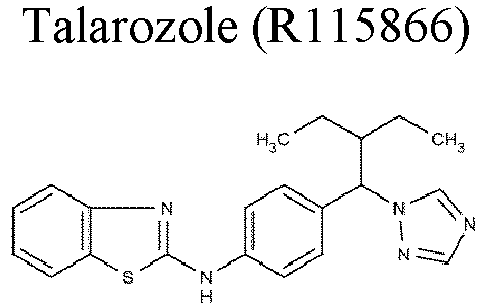
5.1a,b 3.4-6.8 0.46a 0.069-0.85 11 220 680 470 
4.3a,b 2.8-5.8 3.1a 2.5-3.7 1 1,760 5,760 120 aKs determined using Equation, Equation 2, bdata from Thatcher, et al. Mol Pharmacol 2011, 80 (2), 228-39. - All four azole inhibitors also inhibited at least one drug metabolizing P450 potently (Table 1), but no correlation was observed between inhibitory potency of either CYP26 enzyme and inhibition of specific drug metabolizing P450s. Liarozole inhibited CYP2C8 potently and was a weak inhibitor of CYP2C9 and CYP3A4. R116010 and ketoconazole were potent CYP3A4 inhibitors and weak (IC50 >1µM) inhibitors of CYP2C9 and CYP2C8. Talarozole inhibited all three drug metabolizing P450 enzymes with nanomolar affinity.
- In addition to inhibiting CYP26s, liarozole also inhibits other cytochromes involved in the biosynthetic pathways of testicular, ovarian and adrenal steroids (Berth-Jones J, et al. Treatment of psoriasis with oral liarozole: a dose-ranging study. British Journal of Dermatology. 2000;143(6):1170-6; Bruynseels J, et al. R 75251, a new inhibitor of steroid biosynthesis. The Prostate. 1990;16(4):345-57.) The results of a recent study do not support the assumption that pituitary compensation will compensate for the decrease on steroid biosynthesis induced by azole-containing RAMBA (Woerdeman; J, et al. In Young Men, a Moderate Inhibition of Testosterone Synthesis Capacity is Only Partly Compensated by Increased Activity of the Pituitary and the Hypothalamus. Clin Endocrinol. 2010;72(3):76-80.)
- A series of commercially available RAR agonists were tested for CYP26A1 and CYP26B1 inhibition due to their similarity with atRA in polarity, size, charge and 3D space. Six new structural analogs of the tested RAR agonists were also synthesized to further evaluate the structural requirements of selective and potent CYP26A1 and CYP26B1 inhibition and possible hydrogen bonding interactions within CYP26A1 and CYP26B1 active site. The IC50 values are summarized in Table 2 and
Figures 3 and4 .Table 2. IC50values for RAR agonists containing a carboxylic acid with CYP26A1 and CYP26B1 Structure CYP26A1 IC50 µM CYP26B1 IC50 µM CYP26A1/ CYP26B1 
12 8.1 - 18 6.6 2.3-19 1.8 
5.6 3.0 -10 2.2 1.4-3.2 2.5 
3.7a 1.4-9.8 3.4 2.2-5.2 1.1 
4.0 2.5-6.3 0.93 0.61-1.4 4 
2.8 1.7-4.8 1.4 0.77-2.6 2 
3.5 2.2-5.6 1.4 0.40-4.8 3 
18 4.4-76 28 21-37 0.6 
14 9.6-20 31 15-63 0.5 Tazarotenic acid (DDBEP) 6.1 3.2-12 0.13 0.090-0.19 47 

8.3 4.0-17 0.94 0.44-2.0 9 Tazarotene NDa 2.3b 1.0-5.3 NA 

NDc 2.1d 1.0-4.9 
12 6.3-22 1.5 0.96-2.2 8 
8.5 4.8-15 1.1 0.70-1.8 7 a Maximum 15% inhibition observed at 100 µM bOnly partial inhibition obtained, maximum inhibition was 54% cMaximum 15% inhibition observed at 100 µM dOnly partial inhibition obtained, maximum inhibition was 51% - The data shown here suggests that synthetic retinoids can bind to CYP26A1 and
CYP26B 1 but have variable potency as CYP26 inhibitors. - Compounds of the disclosure were tested as potential inhibitors of CYP26A1 and CYP26B1. The conditions for IC50 experiments along with the methods of data analysis are the same as described in Example 80. The results are shown in Tables 3, 4, and 5.
Table 3. Inhibitors for CYP26A1 selective inhibition Inhibitor CYP26A1 CYP26B1 
12.3 4.0 
3.3 14.2 
0.061 1.03 Table 4. Acidic compounds designed to target CYP26A1 selective inhibition Inhibitor CYP26A1 CYP26B1 Inhibitor CYP26A1 CYP26B1 
>25 >25 
1.63 0.53 
7.78 12.6 
0.109 1.03 
1.28 1.09 
0.061 1.03 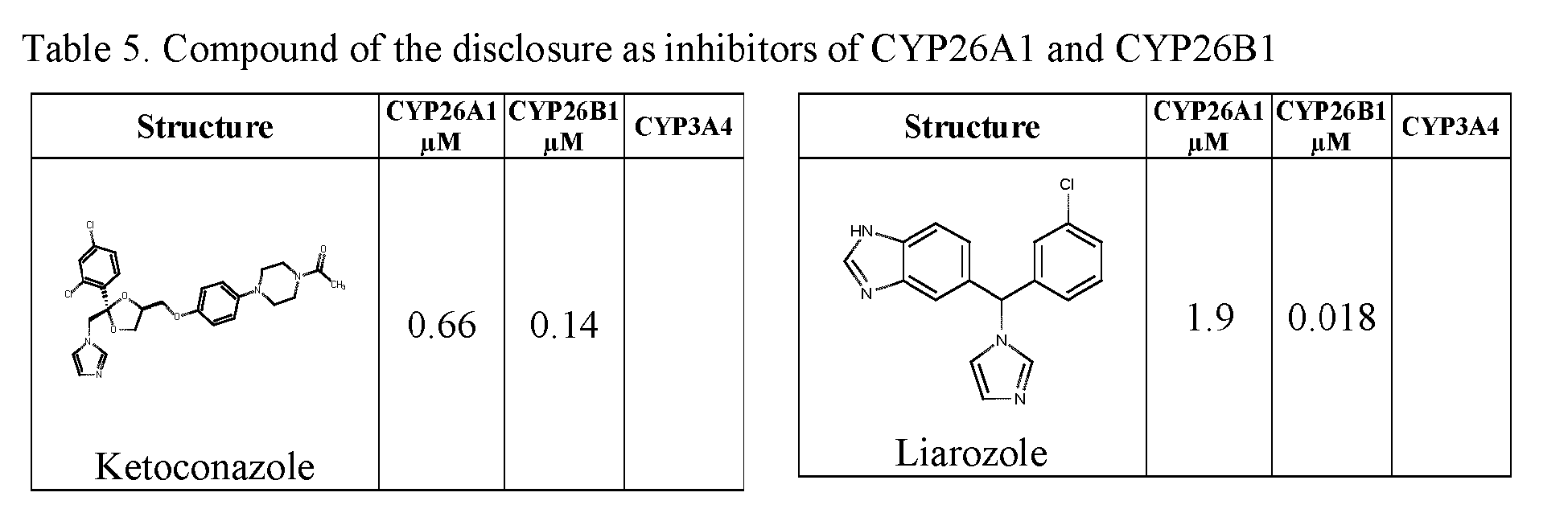
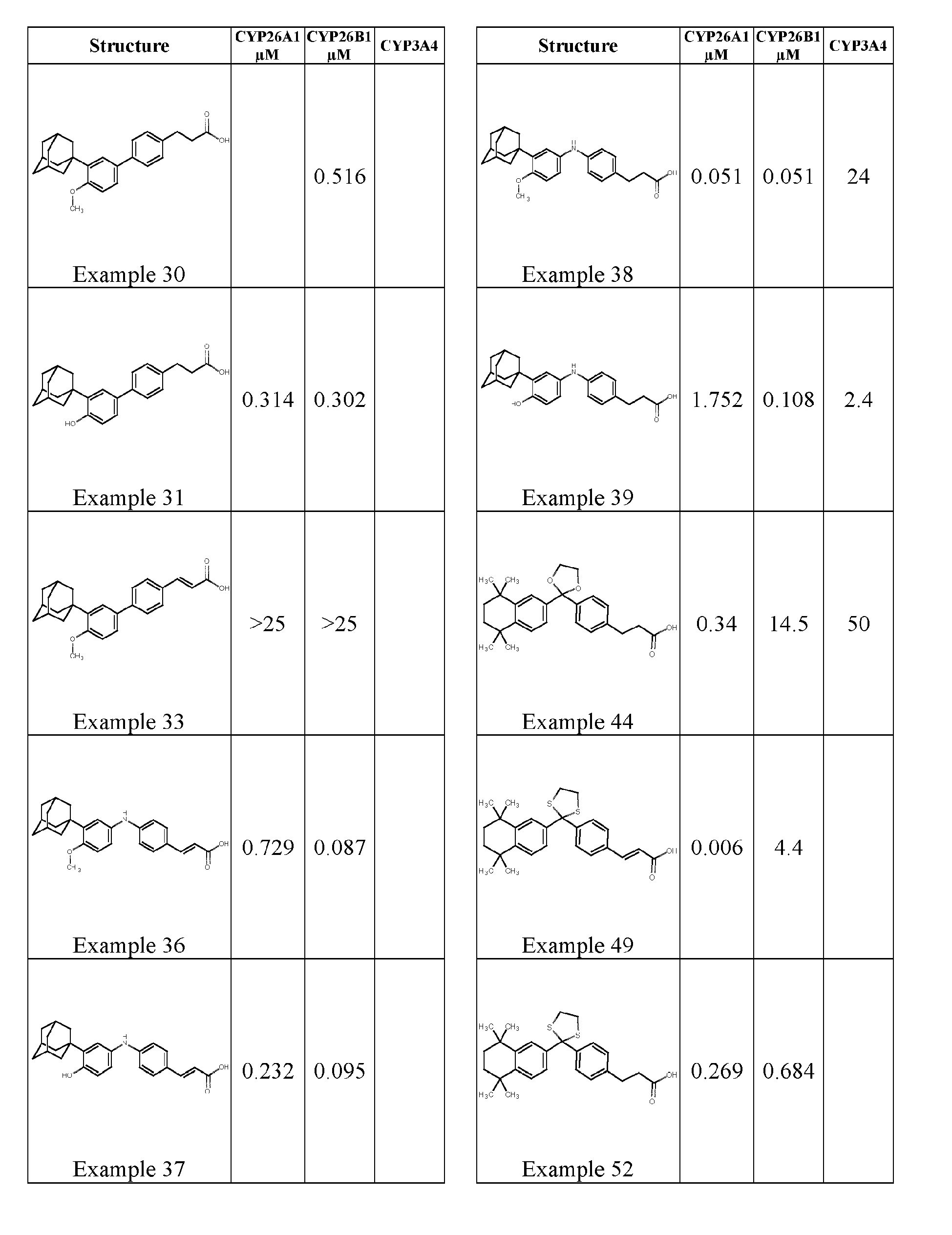

- The earliest compounds designed to inhibit the metabolism of atRA, ketoconazole, liarozole and talarozole, all were shown to increase the concentration of atRA in vivo in animal models, which agrees with the microsomal inhibition of atRA metabolism that was found in both our recombinantly expressed protein prepared as microsomes, as well as previous reports containing microsomal extracts that had been made from cell lines induced to express CYP26A1. In many of the experiments that have taken place to induce apoptosis or inhibit metabolism with small molecules, the consideration for the presence of both enyzmes, CYP26A1 and CYP26B1, is not taken into consideration. There are also many tissues that have been profiled for protein content and found to have equal amounts of either isozyme. The repetition of two enzymes that have very similar functions is an interesting phenomenon and selective inhibition of either enzyme will help to characterize whether there are any differences in function between the two proteins, or whether they are redundant in function in an adult.

Claims (5)
- A compound selected from the group consisting of:Methyl 2-(4-{[3-(adamantan-1-yl)-4-methoxyphenyl]sulianyl}phenyl)acetate;Butyl 2-(4-{[3-(adamantan-1-yl)-4-methoxyphenyl]sulfanyl}phenyl)acetate;2-(4-{[3-(adamantan-1-yl)-4-methoxyphenyl]sulfanyl}phenyl)acetic acid;Methyl 2-(3-{[3-(adamantan-1-yl)-4-methoxyphenyl]sulianyl}phenyl)acetate;Butyl 2-(3-{[3-(adamantan-1-yl)-4-methoxyphenyl]sulfanyl}phenyl)acetate;2-(3-{[3-(Adamantan-1-yl)-4-methoxyphenyl]sulfanyl}phenyl)acetic acid;Methyl 2-{4-[(5,5,8,8-tetramethyl-5,6,7,8-tetrahydronaphthalen-2-yl)sulfanyl] phenyl}acetate;Butyl 2-{4-[(5,5,8,8-tetramethyl-5,6,7,8-tetrahydronaphthalen-2-yl)sulfanyl] phenyl}acetate;2-{4-[(5,5,8,8-tetramethyl-5,6,7,8-tetrahydronaphthalen-2-yl)sulfanyl] phenyl}acetic acid;Methyl 2-{3-[(5,5,8,8-tetramethyl-5,6,7,8-tetrahydronaphthalen-2-yl)sulfanyl] phenyl} acetate;Butyl 2-{3-[(5,5,8,8-tetramethyl-5,6,7,8-tetrahydronaphthalen-2-yl)sulfanyl] phenyl}acetate;2-{3-[(5,5,8,8-tetramethyl-5,6,7,8-tetrahydronaphthalen-2-yl)sulfanyl]phenyl} acetic acid;Methyl 2-(4-{[3-(adamantan-1-yl)-4-methoxybenzene]sulfonyl}phenyl)acetate;Butyl 2-(4-{[3-(adamantan-1-yl)-4-methoxybenzene]sulfonyl}phenyl)acetate;2-(4-{[3-(adamantan-1-yl)-4-methoxybenzene]sulfonyl}phenyl)acetic acid;Methyl 2-(3-{[3-(adamantan-1-yl)-4-methoxybenzene]sulfonyl}phenyl)acetate;Butyl 2-(3-{[3-(adamantan-1-yl)-4-methoxybenzene]sulfonyl} phenyl)acetate;2-(3-{[3-(adamantan-1-yl)-4-methoxybenzene]sulfonyl}phenyl)acetic acid;Methyl 2-[4-(5,5,8,8-tetramethyl-5,6,7,8-tetrahydronaphthalene-2-sulfonyl) phenyl]acetate;Butyl 2-[4-(5,5,8,8-tetramethyl-5,6,7,8-tetrahydronaphthalene-2-sulfonyl) phenyl]acetate;2-[4-(5,5,8,8-tetramethyl-5,6,7,8-tetrahydronaphthalene-2-sulfonyl)phenyl]acetic acid;Methyl 2-[3-(5,5,8,8-tetramethyl-5,6,7,8-tetrahydronaphthalene-2-sulfonyl) phenyl] acetate;2-[3-(5,5,8,8-tetramethyl-5,6,7,8-tetrahydronaphthalene-2-sulfonyl)phenyl]acetic acid;Ethyl 3-{4-[(5,5,8,8-tetramethyl-5,6,7,8-tetrahydronaphthalen-2-yl)sulfanyl] phenyl} propanoate;Ethyl 3-[4-(5,5,8,8-tetramethyl-5,6,7,8-tetrahydronaphthalene-2-sulfonyl)phenyl] propanoate;3-[4-(5,5,8,8-tetramethyl-5,6,7,8-tetrahydronaphthalene-2-sulfonyl)phenyl] propanoic acid;Ethyl 3-[4-(5,5,8,8-tetramethyl-5,6,7,8-tetrahydronaphthalen-2-yl)phenyl] propanoate;3-[4-(5,5,8,8-tetramethyl-5,6,7,8-tetrahydronaphthalen-2-yl)phenyl]propanoic acid;Ethyl 3-{4-[3-(adamantan-1-yl)-4-methoxyphenyl]phenyl}propanoate;3-{4-[3-(adamantan-1-yl)-4-methoxyphenyl]phenyl}propanoic acid;3-{4-[3-(adamantan-1-yl)-4-hydroxyphenyl]phenyl}propanoic acid;Benzyl (2E)-3-{4-[3-(adamantan-1-yl)-4-methoxyphenyl]phenyl}prop-2-enoate;2(E)-3-{4-[3-(adamantan-1-yl)-4-methoxyphenyl]phenyl}prop-2-enoic acid;(2E)-3-{4-[3-(adamantan-1-yl)-4-hydroxyphenyl]phenyl}prop-2-enoic acid;Benzyl (2E)-3-(4-{[3-(adamantan-1-yl)-4-methoxyphenyl]amino}phenyl)prop-2-enoate;(2E)-3-(4-{[3-(adamantan-1-yl)-4-methoxyphenyl]amino}phenyl)prop-2-enoic acid;(2E)-3-(4-{[3-(adamantan-1-yl)-4-hydroxyphenyl]amino}phenyl)prop-2-enoic acid;3-(4-{[3-(adamantan-1-yl)-4-methoxyphenyl]amino}phenyl)propanoic acid;3-(4-{[3-(adamantan-1-yl)-4-hydroxyphenyl]amino}phenyl)propanoic acid;Benzyl (2E)-3-{4-[(3-tert-butyl-4-methoxyphenyl)amino]phenyl}prop-2-enoate;3-{4-[(3-tert-butyl-4-methoxyphenyl)amino]phenyl}propanoic acid;Methyl (2E)-3-{4-[2-(5,5,8,8-tetramethyl-5,6,7,8-tetrahydronaphthalen-2-yl)-1,3-dioxolan-2-yl]phenyl}prop-2-enoate;3-{4-[2-(5,5,8,8-tetramethyl-5,6,7,8-tetrahydronaphthalen-2-yl)-1,3-dioxolan-2-yl] phenyl} propanoic acid;Methyl 3-[4-(5,5,8,8-tetramethyl-5,6,7,8-tetrahydronaphthalene-2-carbonyl) phenyl] propanoate;3-[4-(5,5,8,8-tetramethyl-5,6,7,8-tetrahydronaphthalene-2-carbonyl)phenyl] propanoic acid;Methyl (2E)-3-{4-[(5,5,8,8-tetramethyl-5,6,7,8-tetrahydronaphthalen-2-yl) carbonyl]phenyl}prop-2-enoate;Methyl (2E)-3-{4-[2-(5,5,8,8-tetramethyl-5,6,7,8-tetrahydronaphthalen-2-yl)-1,3-dithiolan-2-yl]phenyl} prop-2-enoate;(2E)-3-{4-[2-(5,5,8,8-tetramethyl-5,6,7,8-tetrahydronaphthalen-2-yl)-1,3-dithiolan-2-yl]phenyl}prop-2-enoic acid;(2E)-3-{4-[(5,5,8,8-tetramethyl-5,6,7,8-tetrahydronaphthalen-2-yl) carbonyl]phenyl}prop-2-enoic acid;Methyl 3-{4-[2-(5,5,8,8-tetramethyl-5,6,7,8-tetrahydronaphthalen-2-yl)-1,3-dithiolan-2-yl]phenyl}propanoate;3-{4-[2-(5,5,8,8-tetramethyl-5,6,7,8-tetrahydronaphthalen-2-yl)-1,3-dithiolan-2-yl]phenyl}propanoic acid;Methyl 3-{4-[(5,5,8,8-tetramethyl-5,6,7,8-tetrahydronaphthalen-2-yl)methyl] phenyl} propanoate;3-{4-[(5,5,8,8-tetramethyl-5,6,7,8-tetrahydronaphthalen-2-yl)methyl]phenyl} propanoic acid;Benzyl (2E)-3 - {4-[(3 -tert-butyl-4-methoxyphenyl)carbonyl] phenyl} prop-2-enoate;3- {4-[(3 -tert-butyl-4-methoxyphenyl)methyl]phenyl} propanoic acid;Methyl (2E)-3-{4-[(3-tert-butyl-4-methoxyphenyl)carbonyl]phenyl}prop-2-enoate;(2E)-3-{4-[(3-tert-butyl-4-methoxyphenyl)carbonyl]phenyl}prop-2-enoic acid;Methyl (2E)-3-{4-[2-(3-tert-butyl-4-methoxyphenyl)-1,3-dioxolan-2-yl]phenyl}prop-2-enoate;Methyl 3-{4-[2-(3-tert-butyl-4-methoxyphenyl)-1,3-dioxolan-2-yl]phenyl} propanoate;3-{4-[2-(3-tert-butyl-4-methoxyphenyl)-1,3-dioxolan-2-yl]phenyl}propanoic acid;Benzyl 3-[4-(5-tert-butyl-2-methoxybenzoyl)phenyl]propanoate;3 - {4-[(5 -tert-butyl-2-methoxyphenyl)methyl]phenyl} propanoic acid;Benzyl (2E)-3-[4-(5-tert-butyl-2-hydroxybenzoyl)phenyl]prop-2-enoate;3 - {4-[(5 -tert-butyl-2-hydroxyphenyl)methyl]phenyl} propanoic acid;Benzyl (2E)-3-{4-[2-(5-tert-butyl-2-methoxyphenyl)-1,3-dioxolan-2-yl]phenyl}prop-2-enoate;Methyl 3-{4-[(5-tert-butyl-2-methoxyphenyl)carbonyl]phenyl}propanoate;3-{4-[(5-tert-butyl-2-methoxyphenyl)carbonyl]phenyl}propanoic acid;methyl (2E)-3-{4-[5-(adamantan-1-yl)-2-methoxybenzoyl]phenyl}prop-2-enoate;Methyl (2E)-3-(4-{2-[5-(adamantan-1-yl)-2-methoxyphenyl]-1,3-dioxolan-2-yl}phenyl)prop-2-enoate;(2E)-3-(4-{2-[5-(adamantan-1-yl)-2-methoxyphenyl]-1,3-dioxolan-2-yl}phenyl)prop-2-enoic acid;3-(4-{2-[5-(adamantan-1-yl)-2-methoxyphenyl]-1,3-dioxolan-2-yl}phenyl)propanoic acid;Methyl 3-(4-{2-[5-(adamantan-1-yl)-2-methoxyphenyl]-1,3-dioxolan-2-yl}phenyl)propanoate;Methyl 3-{4-[5-(adamantan-1-yl)-2-methoxybenzoyl]phenyl}propanoate;Methyl 3-(4-{2-[5-(adamantan-1-yl)-2-methoxyphenyl]-1,3-dithiolan-2-yl}phenyl)propanoate;3-(4-{2-[5-(adamantan-1-yl)-2-methoxyphenyl]-1,3-dithiolan-2-yl}phenyl)propanoic acid;Methyl (2E)-3-{4-[5-(adamantan-1-yl)-2-hydroxybenzoyl]phenyl}prop-2-enoate;Methyl 3-(4-{[5-(adamantan-1-yl)-2-hydroxyphenyl]methyl}phenyl)propanoate;3-(4-{[5-(adamantan-1-yl)-2-hydroxyphenyl]methyl}phenyl)propanoic acid; or pharmaceutically acceptable salts thereof.
- A pharmaceutical composition comprising one or more of compounds according to claim 1 and a pharmaceutically acceptable carrier, diluent, or excipient.
- A therapeutically effective amount of either a compound according to claim 1 or a pharmaceutical composition of claim 2 for use in the treatment of diseases that are ameliorated by the inhibition of CYP26 mediated retinoic acid metabolism.
- The therapeutically effective amount of the compound or the pharmaceutical composition for use according to claim 3, wherein the disease is selected from the group consisting of cancer, neurodegenerative disease, and a dermatological disorder.
- The therapeutically effective amount of the compound or the pharmaceutical composition for use according to claim 3, wherein the disease is Alzheimer's disease, Parkinson's or stroke.
Priority Applications (1)
| Application Number | Priority Date | Filing Date | Title |
|---|---|---|---|
| EP22157722.4A EP4083029A1 (en) | 2013-08-20 | 2014-08-20 | Novel and specific inhibitors of cytochrome p450 26 retinoic acid hydroxylase |
Applications Claiming Priority (2)
| Application Number | Priority Date | Filing Date | Title |
|---|---|---|---|
| US201361867892P | 2013-08-20 | 2013-08-20 | |
| PCT/US2014/051962 WO2015026990A2 (en) | 2013-08-20 | 2014-08-20 | Novel and specific inhibitors of cytochrome p450 26 retinoic acid hydrolase |
Related Child Applications (1)
| Application Number | Title | Priority Date | Filing Date |
|---|---|---|---|
| EP22157722.4A Division EP4083029A1 (en) | 2013-08-20 | 2014-08-20 | Novel and specific inhibitors of cytochrome p450 26 retinoic acid hydroxylase |
Publications (2)
| Publication Number | Publication Date |
|---|---|
| EP3044216A2 EP3044216A2 (en) | 2016-07-20 |
| EP3044216B1 true EP3044216B1 (en) | 2022-02-23 |
Family
ID=51494514
Family Applications (2)
| Application Number | Title | Priority Date | Filing Date |
|---|---|---|---|
| EP14761747.6A Active EP3044216B1 (en) | 2013-08-20 | 2014-08-20 | Novel and specific inhibitors of cytochrome p450 26 retinoic acid hydroxylase |
| EP22157722.4A Withdrawn EP4083029A1 (en) | 2013-08-20 | 2014-08-20 | Novel and specific inhibitors of cytochrome p450 26 retinoic acid hydroxylase |
Family Applications After (1)
| Application Number | Title | Priority Date | Filing Date |
|---|---|---|---|
| EP22157722.4A Withdrawn EP4083029A1 (en) | 2013-08-20 | 2014-08-20 | Novel and specific inhibitors of cytochrome p450 26 retinoic acid hydroxylase |
Country Status (4)
| Country | Link |
|---|---|
| US (1) | US9963439B2 (en) |
| EP (2) | EP3044216B1 (en) |
| ES (1) | ES2909884T3 (en) |
| WO (1) | WO2015026990A2 (en) |
Families Citing this family (2)
| Publication number | Priority date | Publication date | Assignee | Title |
|---|---|---|---|---|
| EP3301085A1 (en) | 2016-09-29 | 2018-04-04 | Biogem S.Ca.R.L. | Retinoid derivatives with antitumor activity |
| JP2022525186A (en) | 2019-03-15 | 2022-05-11 | ザ ジェネラル ホスピタル コーポレイション | TEAD Transcription Factor New Small Molecule Inhibitor |
Citations (4)
| Publication number | Priority date | Publication date | Assignee | Title |
|---|---|---|---|---|
| US6355680B1 (en) * | 1996-02-20 | 2002-03-12 | Exocell, Inc. | Albumin-binding compounds that prevent nonenzymatic glycation and that may be used for treatment of glycation-related pathologies |
| US20040214888A1 (en) * | 2001-06-04 | 2004-10-28 | Fumiyoshi Matsuura | Carboxylic acid derivative and medicine comprising salt or ester of the same |
| WO2006086609A2 (en) * | 2005-02-10 | 2006-08-17 | Axys Pharmaceuticals, Inc. | Inhibitors of tryptase |
| WO2009037707A2 (en) * | 2007-09-20 | 2009-03-26 | Ramot At Tel Aviv University Ltd. | N-phenyl anthranilic acid derivatives and uses thereof |
Family Cites Families (37)
| Publication number | Priority date | Publication date | Assignee | Title |
|---|---|---|---|---|
| ZA765075B (en) * | 1975-09-25 | 1977-08-31 | American Cyanamid Co | Hypolipemic compounds and method of treatment |
| IL80270A0 (en) | 1985-10-11 | 1987-01-30 | Cird | Naphthalene derivatives,their preparation and pharmaceutical compositions containing them |
| CA1285951C (en) | 1985-10-28 | 1991-07-09 | Raj N. Misra | Naphthalenyl- and quinolinyl-amino substituted phenols |
| LU86351A1 (en) | 1986-03-12 | 1987-11-11 | Oreal | BENZOPYRANNYL AND BENZOTHIOPYRANNYL BENZOIC COMPOUNDS, PROCESS FOR THEIR PREPARATION AND THEIR USE IN COSMETICS AND HUMAN AND VETERINARY MEDICINE |
| LU86387A1 (en) | 1986-04-04 | 1987-12-07 | Oreal | AROMATIC COMPOUNDS, THEIR PREPARATION PROCESS AND THEIR USE IN HUMAN AND VETERINARY MEDICINE AND IN COSMETICS |
| FR2601670B1 (en) | 1986-07-17 | 1988-10-07 | Cird | NOVEL AROMATIC BICYCLIC DERIVATIVES, THEIR PREPARATION PROCESS AND THEIR USE IN HUMAN AND VETERINARY MEDICINE AND IN COSMETICS |
| JPH0610174B2 (en) * | 1986-09-29 | 1994-02-09 | 株式会社大塚製薬工場 | Aminophenol derivative |
| DE3903988A1 (en) | 1989-02-10 | 1990-08-30 | Basf Ag | OXIDIZED DIPHENYLHETEROALKANES, THEIR PREPARATION AND USE |
| FR2663850B1 (en) | 1990-07-02 | 1994-01-14 | Gird Galderma | PHARMACEUTICAL OR COSMETIC COMPOSITION CONTAINING A RETINOUIDE AND A STEROL IN COMBINATION. |
| FR2729664A1 (en) * | 1995-01-20 | 1996-07-26 | Cird Galderma | BICYCLIC-AROMATIC COMPOUNDS WITH HIGH BIOLOGICAL ACTIVITY PHARMACEUTICAL AND COSMETIC COMPOSITIONS IN CONTAINING AND USES |
| JP3550813B2 (en) * | 1995-07-21 | 2004-08-04 | 富士ゼロックス株式会社 | Method for producing amine compound |
| EP0928200B1 (en) | 1996-08-28 | 2003-04-09 | Institut National De La Sante Et De La Recherche Medicale (Inserm) | Therapeutic combinations of rar antagonists and rxr agonists |
| FR2755965B1 (en) * | 1996-11-19 | 1998-12-18 | Cird Galderma | BIAROMATIC COMPOUNDS, PHARMACEUTICAL AND COSMETIC COMPOSITIONS CONTAINING THEM AND USES |
| US6353128B1 (en) * | 1996-12-03 | 2002-03-05 | Eli Lilly And Company | Phenyl acetamides as sPLA2 inhibitors |
| US6258822B1 (en) * | 1997-08-06 | 2001-07-10 | Abbott Laboratories | Urokinase inhibitors |
| JO2178B1 (en) | 1999-10-19 | 2003-04-23 | اف . هوفمان لاروش ايه جي | Treatment of invasive diseases, using selected anti-PAR materials |
| FR2802808B1 (en) | 1999-12-22 | 2002-08-09 | Oreal | USE OF AROMATIC POLYCYCLIC COMPOUNDS AS ACTIVATORS OF PPAR-TYPE RECEPTORS IN A COSMETIC OR PHARMACEUTICAL COMPOSITION |
| FR2802809B1 (en) * | 1999-12-22 | 2002-08-16 | Galderma Res & Dev | USE OF AROMATIC POLYCYCLIC COMPOUNDS AS ACTIVATORS OF PPAR-TYPE RECEPTORS IN A COSMETIC OR PHARMACEUTICAL COMPOSITION |
| AU2001234089B2 (en) * | 2000-02-15 | 2005-08-11 | Teijin Limited | Cancer remedy comprising anthranilic acid derivative as active ingredient |
| US6291677B1 (en) | 2000-08-29 | 2001-09-18 | Allergan Sales, Inc. | Compounds having activity as inhibitors of cytochrome P450RAI |
| JP4571497B2 (en) * | 2002-09-19 | 2010-10-27 | 杏林製薬株式会社 | Amino alcohol derivatives and their addition salts and immunosuppressants |
| JP2005020400A (en) | 2003-06-26 | 2005-01-20 | Hitachi Communication Technologies Ltd | Wireless base station, wireless communication system, wireless base station communication control method, and wireless communication network construction method |
| US7560589B2 (en) | 2003-07-28 | 2009-07-14 | Smithkline Beecham Corporation | Cycloalkylidene compounds as modulators of estrogen receptor |
| WO2005108338A1 (en) | 2004-05-03 | 2005-11-17 | Auspex Pharmaceuticals | Novel therapeutic agents for the treatment of cancer, metabolic diseases and skin disorders |
| CA2589633A1 (en) | 2004-12-03 | 2006-06-08 | Nu-Tein Co., Inc. | Method for treating skin disorders with xanthophylls |
| JP2010503615A (en) | 2006-08-29 | 2010-02-04 | レインナーベート リミテッド | Retinoid compounds and their use |
| US20100330200A1 (en) * | 2006-12-22 | 2010-12-30 | Sigma-Tau Industrie Farmaceutiche Riunite S.P.A. | Combination of a retinoid and a platinum anticancer agent |
| LV13736B (en) | 2006-12-28 | 2008-09-20 | Vjaceslavs Tribulovics | Method for manufacturing 6-[3-(1-adamantyl)-4-methoxyphenyl]-2-naphtoic acid |
| JPWO2011055843A1 (en) * | 2009-11-09 | 2013-03-28 | 国立大学法人 岡山大学 | Retinoid compounds |
| WO2012125724A1 (en) | 2011-03-14 | 2012-09-20 | Beth Israel Deaconess Medical Center | Methods and compositions for the treatment of proliferative disorders |
| JP2014527083A (en) * | 2011-09-15 | 2014-10-09 | アリゾナ ボード オブ リージェンツ, ア ボディー コーポレイト オブ ザ ステート オブ アリゾナ, アクティング フォー アンド オン ビハーフ オブ アリゾナ ステート ユニバーシティー | Therapeutic compounds |
| CN102503857B (en) | 2011-11-02 | 2014-11-12 | 沈阳药科大学 | Bexarotene hydroximic acid as well as preparation method and application thereof |
| WO2013071282A1 (en) | 2011-11-13 | 2013-05-16 | Blanchette Rockefeller Neurosciences Institute | Pkc activators and combinations thereof |
| JP5831211B2 (en) * | 2011-12-22 | 2015-12-09 | 富士ゼロックス株式会社 | Image carrier for image forming apparatus, process cartridge, and image forming apparatus |
| EP2612665A1 (en) | 2012-01-09 | 2013-07-10 | Almirall S.A. | Topical pharmaceutical compositions comprising bexarotene and a corticosteroide |
| EA201400806A1 (en) | 2012-01-09 | 2015-02-27 | Альмираль, С.А. | PHARMACEUTICAL COMPOSITIONS FOR LOCAL APPLICATION CONTAINING BEXAROTEN AND CORTICOSTEROIDS |
| FR2993562B1 (en) | 2012-07-23 | 2014-08-22 | Galderma Res & Dev | NOVEL CYP26A1 SELECTIVE INHIBITOR COMPOUNDS USEFUL IN THE TREATMENT OF PATHOLOGIES. |
-
2014
- 2014-08-20 EP EP14761747.6A patent/EP3044216B1/en active Active
- 2014-08-20 US US14/912,479 patent/US9963439B2/en not_active Expired - Fee Related
- 2014-08-20 EP EP22157722.4A patent/EP4083029A1/en not_active Withdrawn
- 2014-08-20 ES ES14761747T patent/ES2909884T3/en active Active
- 2014-08-20 WO PCT/US2014/051962 patent/WO2015026990A2/en not_active Ceased
Patent Citations (4)
| Publication number | Priority date | Publication date | Assignee | Title |
|---|---|---|---|---|
| US6355680B1 (en) * | 1996-02-20 | 2002-03-12 | Exocell, Inc. | Albumin-binding compounds that prevent nonenzymatic glycation and that may be used for treatment of glycation-related pathologies |
| US20040214888A1 (en) * | 2001-06-04 | 2004-10-28 | Fumiyoshi Matsuura | Carboxylic acid derivative and medicine comprising salt or ester of the same |
| WO2006086609A2 (en) * | 2005-02-10 | 2006-08-17 | Axys Pharmaceuticals, Inc. | Inhibitors of tryptase |
| WO2009037707A2 (en) * | 2007-09-20 | 2009-03-26 | Ramot At Tel Aviv University Ltd. | N-phenyl anthranilic acid derivatives and uses thereof |
Non-Patent Citations (5)
| Title |
|---|
| BRANCACCIO G ET AL: "2-(Arylmethyl)arylacetic Acids as Potential Antiinflammatory Agents", JOURNAL OF MEDICINAL CHEMISTRY, AMERICAN CHEMICAL SOCIETY, US, vol. 24, 1 January 1981 (1981-01-01), pages 998 - 1000, XP002236682, ISSN: 0022-2623, DOI: 10.1021/JM00140A016 * |
| ELBAN ET AL: "Synthesis and biological evaluation of cepharadiones A and B and related dioxoaporphines", BIOORGANIC & MEDICINAL CHEMISTRY : A TETRAHEDRON PUBLICATION FOR THE RAPID DISSEMINATION OF FULL ORIGINAL RESEARCH PAPERS AND CRITICAL REVIEWS ON BIOMOLECULAR CHEMISTRY, MEDICINAL CHEMISTRY AND RELATED DISCIPLINES, ELSEVIER, NL, vol. 15, no. 18, 25 July 2007 (2007-07-25), pages 6119 - 6125, XP022169158, ISSN: 0968-0896, DOI: 10.1016/J.BMC.2007.06.035 * |
| MINGYU YANG ET AL: "Direct Lactonization of 2-Arylacetic Acids through Pd(II)-Catalyzed C-H Activation/C-O Formation", ORGANIC LETTERS, vol. 15, no. 3, 15 January 2013 (2013-01-15), pages 690 - 693, XP055692898, ISSN: 1523-7060, DOI: 10.1021/ol303569b * |
| MIROSLAV PROTIVA ET AL: "POTENTIAL PSYCHOTROPIC AND ANTHISTAMINE AGENTS: 1-AND 3-ALKYL-9-(3-DIMETHYLAMINOPROPYLIDENE)- THIOXANTHENES AND 3-ALKYL-ll-PIPERAZINO- 10,II-DIllYDRODIBENZO[b,f]THIEPINS*", COLLECTION CZECHOSLOVAK CHEM. COMM., 1 January 1982 (1982-01-01), pages 3134 - 3147, XP055692949, Retrieved from the Internet <URL:http://cccc.uochb.cas.cz/47/11/3134/> [retrieved on 20200508], DOI: 10.1135/cccc19823134 * |
| ZHANG Y ET AL: "Activity of Nitrogen-Containing and Non-Nitrogen-Containing Bisphosphonates on Tumor Cell Lines", JOURNAL OF MEDICINAL CHEMISTRY, AMERICAN CHEMICAL SOCIETY, US, vol. 49, no. 19, 21 September 2006 (2006-09-21), pages 5804 - 5814, XP008122775, ISSN: 0022-2623, [retrieved on 20060824], DOI: 10.1021/JM060280E * |
Also Published As
| Publication number | Publication date |
|---|---|
| EP4083029A1 (en) | 2022-11-02 |
| WO2015026990A8 (en) | 2015-11-12 |
| US20160200703A1 (en) | 2016-07-14 |
| US9963439B2 (en) | 2018-05-08 |
| WO2015026990A3 (en) | 2015-05-07 |
| ES2909884T3 (en) | 2022-05-10 |
| EP3044216A2 (en) | 2016-07-20 |
| WO2015026990A2 (en) | 2015-02-26 |
Similar Documents
| Publication | Publication Date | Title |
|---|---|---|
| EP1519915B1 (en) | Tricyclic steroid hormone nuclear receptor modulators | |
| Robertson et al. | Dihydropyridazinone cardiotonics: synthesis and inotropic activity of 5'-(1, 4, 5, 6-tetrahydro-6-oxo-3-pyridazinyl)-spiro [cycloalkane-1, 3'-[3H] indol]-2'(1'H)-ones | |
| Negoro et al. | Identification of fused-ring alkanoic acids with improved pharmacokinetic profiles that act as G protein-coupled receptor 40/free fatty acid receptor 1 agonists | |
| CN118290357A (en) | Heterocyclic compounds useful for treating diseases | |
| US8076344B2 (en) | Inhibitors of diacylglycerol O-acyltransferase type 1 enzyme | |
| Ottanà et al. | New 4-[(5-arylidene-2-arylimino-4-oxo-3-thiazolidinyl) methyl] benzoic acids active as protein tyrosine phosphatase inhibitors endowed with insulinomimetic effect on mouse C2C12 skeletal muscle cells | |
| WO2000019994A9 (en) | Estrogen receptor ligands | |
| Mayhoub et al. | Optimization of the aromatase inhibitory activities of pyridylthiazole analogues of resveratrol | |
| CN115836050B (en) | Sulfonylurea derivative and medical application thereof | |
| WO2005037812A1 (en) | Furan derivatives as ep4 receptor antagonists | |
| Sasse et al. | New histamine H3-receptor ligands of the proxifan series: imoproxifan and other selective antagonists with high oral in vivo potency | |
| EP1697350B1 (en) | Tricyclic steroid hormone nuclear receptor modulators | |
| EP4083029A1 (en) | Novel and specific inhibitors of cytochrome p450 26 retinoic acid hydroxylase | |
| CN108484598A (en) | Indoxazine derivatives and their application in medicine | |
| US20140296249A1 (en) | 4-phenylpiperazine derivatives with functionalized linkers as dopamine d3 receptor selective ligands and methods of use | |
| EP3571183B1 (en) | 3-(phenyl)-2-(aminomethyl)-1-phenyl-2-propen-1-one derivatives as inhibitors of the n-terminal domain of the androgen receptor for treating prostate cancer | |
| EP0144853B1 (en) | Semicarbazide derivatives, processes for preparation thereof and pharmaceutical composition comprising the same | |
| WO2009153566A1 (en) | Cyp26 inhibitors | |
| JP6199406B2 (en) | Novel compounds as diacylglycerol acyltransferase inhibitors | |
| FR2556720A1 (en) | DERIVATIVES OF AMIDINE AND TONICARDIACS CONTAINING THEM | |
| RS57071B1 (en) | Fluorophenyl pyrazol compounds | |
| US10377695B2 (en) | Metabotropic glutamate receptor positive allosteric modulators (PAMS) and uses thereof | |
| Li et al. | Structure-based design of free fatty acid receptor 1 agonists bearing non-biphenyl scaffold | |
| EP4448484A1 (en) | Tetraline, phenylcyclobutane, and phenylcyclopentane analogs as rxfp1 agonists | |
| Iqbal et al. | Synthesis, characterization, and hypoglycemic activity of 3-(arylsulfonyl) spiroimidazolidine-2, 4-diones |
Legal Events
| Date | Code | Title | Description |
|---|---|---|---|
| PUAI | Public reference made under article 153(3) epc to a published international application that has entered the european phase |
Free format text: ORIGINAL CODE: 0009012 |
|
| 17P | Request for examination filed |
Effective date: 20160318 |
|
| AK | Designated contracting states |
Kind code of ref document: A2 Designated state(s): AL AT BE BG CH CY CZ DE DK EE ES FI FR GB GR HR HU IE IS IT LI LT LU LV MC MK MT NL NO PL PT RO RS SE SI SK SM TR |
|
| AX | Request for extension of the european patent |
Extension state: BA ME |
|
| DAX | Request for extension of the european patent (deleted) | ||
| STAA | Information on the status of an ep patent application or granted ep patent |
Free format text: STATUS: EXAMINATION IS IN PROGRESS |
|
| 17Q | First examination report despatched |
Effective date: 20181108 |
|
| GRAP | Despatch of communication of intention to grant a patent |
Free format text: ORIGINAL CODE: EPIDOSNIGR1 |
|
| STAA | Information on the status of an ep patent application or granted ep patent |
Free format text: STATUS: GRANT OF PATENT IS INTENDED |
|
| INTG | Intention to grant announced |
Effective date: 20210416 |
|
| GRAJ | Information related to disapproval of communication of intention to grant by the applicant or resumption of examination proceedings by the epo deleted |
Free format text: ORIGINAL CODE: EPIDOSDIGR1 |
|
| STAA | Information on the status of an ep patent application or granted ep patent |
Free format text: STATUS: EXAMINATION IS IN PROGRESS |
|
| INTC | Intention to grant announced (deleted) | ||
| GRAP | Despatch of communication of intention to grant a patent |
Free format text: ORIGINAL CODE: EPIDOSNIGR1 |
|
| STAA | Information on the status of an ep patent application or granted ep patent |
Free format text: STATUS: GRANT OF PATENT IS INTENDED |
|
| INTG | Intention to grant announced |
Effective date: 20211001 |
|
| GRAS | Grant fee paid |
Free format text: ORIGINAL CODE: EPIDOSNIGR3 |
|
| GRAA | (expected) grant |
Free format text: ORIGINAL CODE: 0009210 |
|
| STAA | Information on the status of an ep patent application or granted ep patent |
Free format text: STATUS: THE PATENT HAS BEEN GRANTED |
|
| AK | Designated contracting states |
Kind code of ref document: B1 Designated state(s): AL AT BE BG CH CY CZ DE DK EE ES FI FR GB GR HR HU IE IS IT LI LT LU LV MC MK MT NL NO PL PT RO RS SE SI SK SM TR |
|
| REG | Reference to a national code |
Ref country code: GB Ref legal event code: FG4D |
|
| REG | Reference to a national code |
Ref country code: CH Ref legal event code: EP |
|
| REG | Reference to a national code |
Ref country code: AT Ref legal event code: REF Ref document number: 1470372 Country of ref document: AT Kind code of ref document: T Effective date: 20220315 |
|
| REG | Reference to a national code |
Ref country code: IE Ref legal event code: FG4D |
|
| REG | Reference to a national code |
Ref country code: DE Ref legal event code: R096 Ref document number: 602014082581 Country of ref document: DE |
|
| REG | Reference to a national code |
Ref country code: NL Ref legal event code: FP |
|
| REG | Reference to a national code |
Ref country code: ES Ref legal event code: FG2A Ref document number: 2909884 Country of ref document: ES Kind code of ref document: T3 Effective date: 20220510 |
|
| REG | Reference to a national code |
Ref country code: LT Ref legal event code: MG9D |
|
| REG | Reference to a national code |
Ref country code: AT Ref legal event code: MK05 Ref document number: 1470372 Country of ref document: AT Kind code of ref document: T Effective date: 20220223 |
|
| PG25 | Lapsed in a contracting state [announced via postgrant information from national office to epo] |
Ref country code: SE Free format text: LAPSE BECAUSE OF FAILURE TO SUBMIT A TRANSLATION OF THE DESCRIPTION OR TO PAY THE FEE WITHIN THE PRESCRIBED TIME-LIMIT Effective date: 20220223 Ref country code: RS Free format text: LAPSE BECAUSE OF FAILURE TO SUBMIT A TRANSLATION OF THE DESCRIPTION OR TO PAY THE FEE WITHIN THE PRESCRIBED TIME-LIMIT Effective date: 20220223 Ref country code: PT Free format text: LAPSE BECAUSE OF FAILURE TO SUBMIT A TRANSLATION OF THE DESCRIPTION OR TO PAY THE FEE WITHIN THE PRESCRIBED TIME-LIMIT Effective date: 20220623 Ref country code: NO Free format text: LAPSE BECAUSE OF FAILURE TO SUBMIT A TRANSLATION OF THE DESCRIPTION OR TO PAY THE FEE WITHIN THE PRESCRIBED TIME-LIMIT Effective date: 20220523 Ref country code: LT Free format text: LAPSE BECAUSE OF FAILURE TO SUBMIT A TRANSLATION OF THE DESCRIPTION OR TO PAY THE FEE WITHIN THE PRESCRIBED TIME-LIMIT Effective date: 20220223 Ref country code: HR Free format text: LAPSE BECAUSE OF FAILURE TO SUBMIT A TRANSLATION OF THE DESCRIPTION OR TO PAY THE FEE WITHIN THE PRESCRIBED TIME-LIMIT Effective date: 20220223 Ref country code: BG Free format text: LAPSE BECAUSE OF FAILURE TO SUBMIT A TRANSLATION OF THE DESCRIPTION OR TO PAY THE FEE WITHIN THE PRESCRIBED TIME-LIMIT Effective date: 20220523 |
|
| PG25 | Lapsed in a contracting state [announced via postgrant information from national office to epo] |
Ref country code: PL Free format text: LAPSE BECAUSE OF FAILURE TO SUBMIT A TRANSLATION OF THE DESCRIPTION OR TO PAY THE FEE WITHIN THE PRESCRIBED TIME-LIMIT Effective date: 20220223 Ref country code: LV Free format text: LAPSE BECAUSE OF FAILURE TO SUBMIT A TRANSLATION OF THE DESCRIPTION OR TO PAY THE FEE WITHIN THE PRESCRIBED TIME-LIMIT Effective date: 20220223 Ref country code: GR Free format text: LAPSE BECAUSE OF FAILURE TO SUBMIT A TRANSLATION OF THE DESCRIPTION OR TO PAY THE FEE WITHIN THE PRESCRIBED TIME-LIMIT Effective date: 20220524 Ref country code: FI Free format text: LAPSE BECAUSE OF FAILURE TO SUBMIT A TRANSLATION OF THE DESCRIPTION OR TO PAY THE FEE WITHIN THE PRESCRIBED TIME-LIMIT Effective date: 20220223 Ref country code: AT Free format text: LAPSE BECAUSE OF FAILURE TO SUBMIT A TRANSLATION OF THE DESCRIPTION OR TO PAY THE FEE WITHIN THE PRESCRIBED TIME-LIMIT Effective date: 20220223 |
|
| PG25 | Lapsed in a contracting state [announced via postgrant information from national office to epo] |
Ref country code: IS Free format text: LAPSE BECAUSE OF FAILURE TO SUBMIT A TRANSLATION OF THE DESCRIPTION OR TO PAY THE FEE WITHIN THE PRESCRIBED TIME-LIMIT Effective date: 20220623 |
|
| PGFP | Annual fee paid to national office [announced via postgrant information from national office to epo] |
Ref country code: NL Payment date: 20220721 Year of fee payment: 9 |
|
| PG25 | Lapsed in a contracting state [announced via postgrant information from national office to epo] |
Ref country code: SM Free format text: LAPSE BECAUSE OF FAILURE TO SUBMIT A TRANSLATION OF THE DESCRIPTION OR TO PAY THE FEE WITHIN THE PRESCRIBED TIME-LIMIT Effective date: 20220223 Ref country code: SK Free format text: LAPSE BECAUSE OF FAILURE TO SUBMIT A TRANSLATION OF THE DESCRIPTION OR TO PAY THE FEE WITHIN THE PRESCRIBED TIME-LIMIT Effective date: 20220223 Ref country code: RO Free format text: LAPSE BECAUSE OF FAILURE TO SUBMIT A TRANSLATION OF THE DESCRIPTION OR TO PAY THE FEE WITHIN THE PRESCRIBED TIME-LIMIT Effective date: 20220223 Ref country code: EE Free format text: LAPSE BECAUSE OF FAILURE TO SUBMIT A TRANSLATION OF THE DESCRIPTION OR TO PAY THE FEE WITHIN THE PRESCRIBED TIME-LIMIT Effective date: 20220223 Ref country code: DK Free format text: LAPSE BECAUSE OF FAILURE TO SUBMIT A TRANSLATION OF THE DESCRIPTION OR TO PAY THE FEE WITHIN THE PRESCRIBED TIME-LIMIT Effective date: 20220223 Ref country code: CZ Free format text: LAPSE BECAUSE OF FAILURE TO SUBMIT A TRANSLATION OF THE DESCRIPTION OR TO PAY THE FEE WITHIN THE PRESCRIBED TIME-LIMIT Effective date: 20220223 |
|
| PGFP | Annual fee paid to national office [announced via postgrant information from national office to epo] |
Ref country code: TR Payment date: 20220726 Year of fee payment: 9 Ref country code: IT Payment date: 20220720 Year of fee payment: 9 Ref country code: IE Payment date: 20220721 Year of fee payment: 9 Ref country code: GB Payment date: 20220721 Year of fee payment: 9 Ref country code: ES Payment date: 20220901 Year of fee payment: 9 Ref country code: DE Payment date: 20220720 Year of fee payment: 9 |
|
| REG | Reference to a national code |
Ref country code: DE Ref legal event code: R097 Ref document number: 602014082581 Country of ref document: DE |
|
| PG25 | Lapsed in a contracting state [announced via postgrant information from national office to epo] |
Ref country code: AL Free format text: LAPSE BECAUSE OF FAILURE TO SUBMIT A TRANSLATION OF THE DESCRIPTION OR TO PAY THE FEE WITHIN THE PRESCRIBED TIME-LIMIT Effective date: 20220223 |
|
| PGFP | Annual fee paid to national office [announced via postgrant information from national office to epo] |
Ref country code: FR Payment date: 20220721 Year of fee payment: 9 Ref country code: BE Payment date: 20220720 Year of fee payment: 9 |
|
| PGFP | Annual fee paid to national office [announced via postgrant information from national office to epo] |
Ref country code: CH Payment date: 20220901 Year of fee payment: 9 |
|
| PLBE | No opposition filed within time limit |
Free format text: ORIGINAL CODE: 0009261 |
|
| STAA | Information on the status of an ep patent application or granted ep patent |
Free format text: STATUS: NO OPPOSITION FILED WITHIN TIME LIMIT |
|
| 26N | No opposition filed |
Effective date: 20221124 |
|
| PG25 | Lapsed in a contracting state [announced via postgrant information from national office to epo] |
Ref country code: SI Free format text: LAPSE BECAUSE OF FAILURE TO SUBMIT A TRANSLATION OF THE DESCRIPTION OR TO PAY THE FEE WITHIN THE PRESCRIBED TIME-LIMIT Effective date: 20220223 |
|
| PG25 | Lapsed in a contracting state [announced via postgrant information from national office to epo] |
Ref country code: MC Free format text: LAPSE BECAUSE OF FAILURE TO SUBMIT A TRANSLATION OF THE DESCRIPTION OR TO PAY THE FEE WITHIN THE PRESCRIBED TIME-LIMIT Effective date: 20220223 |
|
| PG25 | Lapsed in a contracting state [announced via postgrant information from national office to epo] |
Ref country code: LU Free format text: LAPSE BECAUSE OF NON-PAYMENT OF DUE FEES Effective date: 20220820 |
|
| REG | Reference to a national code |
Ref country code: DE Ref legal event code: R119 Ref document number: 602014082581 Country of ref document: DE |
|
| REG | Reference to a national code |
Ref country code: CH Ref legal event code: PL |
|
| PG25 | Lapsed in a contracting state [announced via postgrant information from national office to epo] |
Ref country code: HU Free format text: LAPSE BECAUSE OF FAILURE TO SUBMIT A TRANSLATION OF THE DESCRIPTION OR TO PAY THE FEE WITHIN THE PRESCRIBED TIME-LIMIT; INVALID AB INITIO Effective date: 20140820 |
|
| REG | Reference to a national code |
Ref country code: NL Ref legal event code: MM Effective date: 20230901 |
|
| GBPC | Gb: european patent ceased through non-payment of renewal fee |
Effective date: 20230820 |
|
| PG25 | Lapsed in a contracting state [announced via postgrant information from national office to epo] |
Ref country code: CY Free format text: LAPSE BECAUSE OF FAILURE TO SUBMIT A TRANSLATION OF THE DESCRIPTION OR TO PAY THE FEE WITHIN THE PRESCRIBED TIME-LIMIT Effective date: 20220223 Ref country code: CH Free format text: LAPSE BECAUSE OF NON-PAYMENT OF DUE FEES Effective date: 20230831 |
|
| REG | Reference to a national code |
Ref country code: BE Ref legal event code: MM Effective date: 20230831 |
|
| PG25 | Lapsed in a contracting state [announced via postgrant information from national office to epo] |
Ref country code: NL Free format text: LAPSE BECAUSE OF NON-PAYMENT OF DUE FEES Effective date: 20230901 |
|
| REG | Reference to a national code |
Ref country code: IE Ref legal event code: MM4A |
|
| PG25 | Lapsed in a contracting state [announced via postgrant information from national office to epo] |
Ref country code: NL Free format text: LAPSE BECAUSE OF NON-PAYMENT OF DUE FEES Effective date: 20230901 Ref country code: MK Free format text: LAPSE BECAUSE OF FAILURE TO SUBMIT A TRANSLATION OF THE DESCRIPTION OR TO PAY THE FEE WITHIN THE PRESCRIBED TIME-LIMIT Effective date: 20220223 |
|
| PG25 | Lapsed in a contracting state [announced via postgrant information from national office to epo] |
Ref country code: IE Free format text: LAPSE BECAUSE OF NON-PAYMENT OF DUE FEES Effective date: 20230820 |
|
| PG25 | Lapsed in a contracting state [announced via postgrant information from national office to epo] |
Ref country code: GB Free format text: LAPSE BECAUSE OF NON-PAYMENT OF DUE FEES Effective date: 20230820 |
|
| PG25 | Lapsed in a contracting state [announced via postgrant information from national office to epo] |
Ref country code: IT Free format text: LAPSE BECAUSE OF NON-PAYMENT OF DUE FEES Effective date: 20230820 Ref country code: IE Free format text: LAPSE BECAUSE OF NON-PAYMENT OF DUE FEES Effective date: 20230820 Ref country code: GB Free format text: LAPSE BECAUSE OF NON-PAYMENT OF DUE FEES Effective date: 20230820 Ref country code: FR Free format text: LAPSE BECAUSE OF NON-PAYMENT OF DUE FEES Effective date: 20230831 Ref country code: DE Free format text: LAPSE BECAUSE OF NON-PAYMENT OF DUE FEES Effective date: 20240301 |
|
| PG25 | Lapsed in a contracting state [announced via postgrant information from national office to epo] |
Ref country code: BE Free format text: LAPSE BECAUSE OF NON-PAYMENT OF DUE FEES Effective date: 20230831 |
|
| PG25 | Lapsed in a contracting state [announced via postgrant information from national office to epo] |
Ref country code: MT Free format text: LAPSE BECAUSE OF FAILURE TO SUBMIT A TRANSLATION OF THE DESCRIPTION OR TO PAY THE FEE WITHIN THE PRESCRIBED TIME-LIMIT Effective date: 20220223 |
|
| REG | Reference to a national code |
Ref country code: ES Ref legal event code: FD2A Effective date: 20241003 |
|
| PG25 | Lapsed in a contracting state [announced via postgrant information from national office to epo] |
Ref country code: ES Free format text: LAPSE BECAUSE OF NON-PAYMENT OF DUE FEES Effective date: 20230821 |
|
| PG25 | Lapsed in a contracting state [announced via postgrant information from national office to epo] |
Ref country code: ES Free format text: LAPSE BECAUSE OF NON-PAYMENT OF DUE FEES Effective date: 20230821 |
|
| PG25 | Lapsed in a contracting state [announced via postgrant information from national office to epo] |
Ref country code: TR Free format text: LAPSE BECAUSE OF NON-PAYMENT OF DUE FEES Effective date: 20230820 |