EP3042902A1 - Method for producing endo-9-azabicyclo[3.3.1]nonane-3-ol derivative - Google Patents
Method for producing endo-9-azabicyclo[3.3.1]nonane-3-ol derivative Download PDFInfo
- Publication number
- EP3042902A1 EP3042902A1 EP14841494.9A EP14841494A EP3042902A1 EP 3042902 A1 EP3042902 A1 EP 3042902A1 EP 14841494 A EP14841494 A EP 14841494A EP 3042902 A1 EP3042902 A1 EP 3042902A1
- Authority
- EP
- European Patent Office
- Prior art keywords
- group
- unsubstituted
- substituted
- groups
- methanamine
- Prior art date
- Legal status (The legal status is an assumption and is not a legal conclusion. Google has not performed a legal analysis and makes no representation as to the accuracy of the status listed.)
- Granted
Links
Classifications
-
- C—CHEMISTRY; METALLURGY
- C07—ORGANIC CHEMISTRY
- C07D—HETEROCYCLIC COMPOUNDS
- C07D471/00—Heterocyclic compounds containing nitrogen atoms as the only ring hetero atoms in the condensed system, at least one ring being a six-membered ring with one nitrogen atom, not provided for by groups C07D451/00 - C07D463/00
- C07D471/02—Heterocyclic compounds containing nitrogen atoms as the only ring hetero atoms in the condensed system, at least one ring being a six-membered ring with one nitrogen atom, not provided for by groups C07D451/00 - C07D463/00 in which the condensed system contains two hetero rings
- C07D471/08—Bridged systems
-
- B—PERFORMING OPERATIONS; TRANSPORTING
- B01—PHYSICAL OR CHEMICAL PROCESSES OR APPARATUS IN GENERAL
- B01J—CHEMICAL OR PHYSICAL PROCESSES, e.g. CATALYSIS OR COLLOID CHEMISTRY; THEIR RELEVANT APPARATUS
- B01J31/00—Catalysts comprising hydrides, coordination complexes or organic compounds
- B01J31/16—Catalysts comprising hydrides, coordination complexes or organic compounds containing coordination complexes
- B01J31/18—Catalysts comprising hydrides, coordination complexes or organic compounds containing coordination complexes containing nitrogen, phosphorus, arsenic or antimony as complexing atoms, e.g. in pyridine ligands, or in resonance therewith, e.g. in isocyanide ligands C=N-R or as complexed central atoms
- B01J31/1805—Catalysts comprising hydrides, coordination complexes or organic compounds containing coordination complexes containing nitrogen, phosphorus, arsenic or antimony as complexing atoms, e.g. in pyridine ligands, or in resonance therewith, e.g. in isocyanide ligands C=N-R or as complexed central atoms the ligands containing nitrogen
-
- B—PERFORMING OPERATIONS; TRANSPORTING
- B01—PHYSICAL OR CHEMICAL PROCESSES OR APPARATUS IN GENERAL
- B01J—CHEMICAL OR PHYSICAL PROCESSES, e.g. CATALYSIS OR COLLOID CHEMISTRY; THEIR RELEVANT APPARATUS
- B01J31/00—Catalysts comprising hydrides, coordination complexes or organic compounds
- B01J31/16—Catalysts comprising hydrides, coordination complexes or organic compounds containing coordination complexes
- B01J31/18—Catalysts comprising hydrides, coordination complexes or organic compounds containing coordination complexes containing nitrogen, phosphorus, arsenic or antimony as complexing atoms, e.g. in pyridine ligands, or in resonance therewith, e.g. in isocyanide ligands C=N-R or as complexed central atoms
- B01J31/1805—Catalysts comprising hydrides, coordination complexes or organic compounds containing coordination complexes containing nitrogen, phosphorus, arsenic or antimony as complexing atoms, e.g. in pyridine ligands, or in resonance therewith, e.g. in isocyanide ligands C=N-R or as complexed central atoms the ligands containing nitrogen
- B01J31/181—Cyclic ligands, including e.g. non-condensed polycyclic ligands, comprising at least one complexing nitrogen atom as ring member, e.g. pyridine
- B01J31/1815—Cyclic ligands, including e.g. non-condensed polycyclic ligands, comprising at least one complexing nitrogen atom as ring member, e.g. pyridine with more than one complexing nitrogen atom, e.g. bipyridyl, 2-aminopyridine
-
- B—PERFORMING OPERATIONS; TRANSPORTING
- B01—PHYSICAL OR CHEMICAL PROCESSES OR APPARATUS IN GENERAL
- B01J—CHEMICAL OR PHYSICAL PROCESSES, e.g. CATALYSIS OR COLLOID CHEMISTRY; THEIR RELEVANT APPARATUS
- B01J31/00—Catalysts comprising hydrides, coordination complexes or organic compounds
- B01J31/16—Catalysts comprising hydrides, coordination complexes or organic compounds containing coordination complexes
- B01J31/18—Catalysts comprising hydrides, coordination complexes or organic compounds containing coordination complexes containing nitrogen, phosphorus, arsenic or antimony as complexing atoms, e.g. in pyridine ligands, or in resonance therewith, e.g. in isocyanide ligands C=N-R or as complexed central atoms
- B01J31/189—Catalysts comprising hydrides, coordination complexes or organic compounds containing coordination complexes containing nitrogen, phosphorus, arsenic or antimony as complexing atoms, e.g. in pyridine ligands, or in resonance therewith, e.g. in isocyanide ligands C=N-R or as complexed central atoms containing both nitrogen and phosphorus as complexing atoms, including e.g. phosphino moieties, in one at least bidentate or bridging ligand
-
- B—PERFORMING OPERATIONS; TRANSPORTING
- B01—PHYSICAL OR CHEMICAL PROCESSES OR APPARATUS IN GENERAL
- B01J—CHEMICAL OR PHYSICAL PROCESSES, e.g. CATALYSIS OR COLLOID CHEMISTRY; THEIR RELEVANT APPARATUS
- B01J31/00—Catalysts comprising hydrides, coordination complexes or organic compounds
- B01J31/16—Catalysts comprising hydrides, coordination complexes or organic compounds containing coordination complexes
- B01J31/24—Phosphines, i.e. phosphorus bonded to only carbon atoms, or to both carbon and hydrogen atoms, including e.g. sp2-hybridised phosphorus compounds such as phosphabenzene, phosphole or anionic phospholide ligands
-
- B—PERFORMING OPERATIONS; TRANSPORTING
- B01—PHYSICAL OR CHEMICAL PROCESSES OR APPARATUS IN GENERAL
- B01J—CHEMICAL OR PHYSICAL PROCESSES, e.g. CATALYSIS OR COLLOID CHEMISTRY; THEIR RELEVANT APPARATUS
- B01J31/00—Catalysts comprising hydrides, coordination complexes or organic compounds
- B01J31/16—Catalysts comprising hydrides, coordination complexes or organic compounds containing coordination complexes
- B01J31/24—Phosphines, i.e. phosphorus bonded to only carbon atoms, or to both carbon and hydrogen atoms, including e.g. sp2-hybridised phosphorus compounds such as phosphabenzene, phosphole or anionic phospholide ligands
- B01J31/2404—Cyclic ligands, including e.g. non-condensed polycyclic ligands, the phosphine-P atom being a ring member or a substituent on the ring
- B01J31/2409—Cyclic ligands, including e.g. non-condensed polycyclic ligands, the phosphine-P atom being a ring member or a substituent on the ring with more than one complexing phosphine-P atom
-
- B—PERFORMING OPERATIONS; TRANSPORTING
- B01—PHYSICAL OR CHEMICAL PROCESSES OR APPARATUS IN GENERAL
- B01J—CHEMICAL OR PHYSICAL PROCESSES, e.g. CATALYSIS OR COLLOID CHEMISTRY; THEIR RELEVANT APPARATUS
- B01J31/00—Catalysts comprising hydrides, coordination complexes or organic compounds
- B01J31/16—Catalysts comprising hydrides, coordination complexes or organic compounds containing coordination complexes
- B01J31/24—Phosphines, i.e. phosphorus bonded to only carbon atoms, or to both carbon and hydrogen atoms, including e.g. sp2-hybridised phosphorus compounds such as phosphabenzene, phosphole or anionic phospholide ligands
- B01J31/2404—Cyclic ligands, including e.g. non-condensed polycyclic ligands, the phosphine-P atom being a ring member or a substituent on the ring
- B01J31/2442—Cyclic ligands, including e.g. non-condensed polycyclic ligands, the phosphine-P atom being a ring member or a substituent on the ring comprising condensed ring systems
- B01J31/2447—Cyclic ligands, including e.g. non-condensed polycyclic ligands, the phosphine-P atom being a ring member or a substituent on the ring comprising condensed ring systems and phosphine-P atoms as substituents on a ring of the condensed system or on a further attached ring
-
- C—CHEMISTRY; METALLURGY
- C07—ORGANIC CHEMISTRY
- C07B—GENERAL METHODS OF ORGANIC CHEMISTRY; APPARATUS THEREFOR
- C07B53/00—Asymmetric syntheses
-
- C—CHEMISTRY; METALLURGY
- C07—ORGANIC CHEMISTRY
- C07D—HETEROCYCLIC COMPOUNDS
- C07D451/00—Heterocyclic compounds containing 8-azabicyclo [3.2.1] octane, 9-azabicyclo [3.3.1] nonane, or 3-oxa-9-azatricyclo [3.3.1.0<2,4>] nonane ring systems, e.g. tropane or granatane alkaloids, scopolamine; Cyclic acetals thereof
- C07D451/14—Heterocyclic compounds containing 8-azabicyclo [3.2.1] octane, 9-azabicyclo [3.3.1] nonane, or 3-oxa-9-azatricyclo [3.3.1.0<2,4>] nonane ring systems, e.g. tropane or granatane alkaloids, scopolamine; Cyclic acetals thereof containing 9-azabicyclo [3.3.1] nonane ring systems, e.g. granatane, 2-aza-adamantane; Cyclic acetals thereof
-
- B—PERFORMING OPERATIONS; TRANSPORTING
- B01—PHYSICAL OR CHEMICAL PROCESSES OR APPARATUS IN GENERAL
- B01J—CHEMICAL OR PHYSICAL PROCESSES, e.g. CATALYSIS OR COLLOID CHEMISTRY; THEIR RELEVANT APPARATUS
- B01J2231/00—Catalytic reactions performed with catalysts classified in B01J31/00
- B01J2231/60—Reduction reactions, e.g. hydrogenation
- B01J2231/64—Reductions in general of organic substrates, e.g. hydride reductions or hydrogenations
- B01J2231/641—Hydrogenation of organic substrates, i.e. H2 or H-transfer hydrogenations, e.g. Fischer-Tropsch processes
- B01J2231/643—Hydrogenation of organic substrates, i.e. H2 or H-transfer hydrogenations, e.g. Fischer-Tropsch processes of R2C=O or R2C=NR (R= C, H)
-
- B—PERFORMING OPERATIONS; TRANSPORTING
- B01—PHYSICAL OR CHEMICAL PROCESSES OR APPARATUS IN GENERAL
- B01J—CHEMICAL OR PHYSICAL PROCESSES, e.g. CATALYSIS OR COLLOID CHEMISTRY; THEIR RELEVANT APPARATUS
- B01J2531/00—Additional information regarding catalytic systems classified in B01J31/00
- B01J2531/80—Complexes comprising metals of Group VIII as the central metal
- B01J2531/82—Metals of the platinum group
- B01J2531/821—Ruthenium
-
- C—CHEMISTRY; METALLURGY
- C07—ORGANIC CHEMISTRY
- C07C—ACYCLIC OR CARBOCYCLIC COMPOUNDS
- C07C29/00—Preparation of compounds having hydroxy or O-metal groups bound to a carbon atom not belonging to a six-membered aromatic ring
- C07C29/132—Preparation of compounds having hydroxy or O-metal groups bound to a carbon atom not belonging to a six-membered aromatic ring by reduction of an oxygen containing functional group
- C07C29/136—Preparation of compounds having hydroxy or O-metal groups bound to a carbon atom not belonging to a six-membered aromatic ring by reduction of an oxygen containing functional group of >C=O containing groups, e.g. —COOH
- C07C29/143—Preparation of compounds having hydroxy or O-metal groups bound to a carbon atom not belonging to a six-membered aromatic ring by reduction of an oxygen containing functional group of >C=O containing groups, e.g. —COOH of ketones
- C07C29/145—Preparation of compounds having hydroxy or O-metal groups bound to a carbon atom not belonging to a six-membered aromatic ring by reduction of an oxygen containing functional group of >C=O containing groups, e.g. —COOH of ketones with hydrogen or hydrogen-containing gases
Definitions
- the present invention relates to a method for producing an endo-9-azabicyclo[3.3.1]nonan-3-ol derivative.
- Patent Document 1 An endo-9-azabicyclo[3.3.1]nonan-3-ol derivative is a useful compound applicable as an agrochemical or medicinal intermediate (Patent Document 1).
- Patent Document 1 discloses that endo-9-benzyl-9-azabicyclo[3.3.1]nonan-3-ol is synthesized by reducing 9-benzyl-9-azabicyclo[3.3.1]nonan-3-one in a methanol solvent with sodium borohydride.
- a ruthenium catalyst there is no report disclosing study to reduce an azabicyclo nonane compound in the presence of a ruthenium catalyst.
- Patent Document 1 Japanese Translation of PCT International Application Publication No. 2009-510026
- An object of the present invention is to provide a method for conducting a reaction in which a 9-azabicyclo[3.3.1]nonan-3-one derivative is reduced to obtain the correspondent endo-9-azabicyclo[3.3.1]nonan-3-ol derivative at a low cost by a simplified process.
- the present invention includes the following aspects.
- the present invention relates to a method for producing an endo-9-azabicyclo[3.3.1]nonan-3-ol derivative by reacting a 9-azabicyclo[3.3.1]nonan-3-one derivative with a hydrogen in the presence of a catalyst composed of a ruthenium complex.
- unsubstituted means a group consisting of a mother nucleus. In the case where only a name of a group consisting of a mother nucleus is indicated without describing "substituted", the group means an "unsubstituted” group unless mentioned otherwise.
- substituted means that any of hydrogen atoms in a group forming a mother nucleus is substituted with a group having a structure similar to or different from that of the mother nucleus. Accordingly, a “substituent” is another group bonded to a group forming a mother nucleus.
- the number of substituents may be one, or two or more. The two or more substituents may be the same or different from each other.
- C1 to 6 means that the number of carbon atoms in a group forming a mother nucleus is 1 to 6.
- the number of carbon atoms does not include the number of carbon atoms present in substituents.
- a butyl having an ethoxy group as a substituent is classified into a C2 alkoxy C4 alkyl group.
- the "substituent” is not particularly limited, provided that the substituent is chemically acceptable and exhibits effects of the present invention.
- Examples of a group that can be the “substituent” include: halogeno groups such as a fluoro group, a chloro group, a bromo group, and an iodine group; C1 to 8 alkyl groups such as a methyl group, an ethyl group, a n-propyl group, an i-propyl group, a n-butyl group, a s-butyl group, an i-butyl group, a t-butyl group, a n-pentyl group, and a n-hexyl; C3 to 6 cycloalkyl groups such as a cyclopropyl group, a cyclobutyl group, a cyclopentyl group, and a cyclohexyl group; C2 to 6 alkenyl
- the "substituent” may further have another "substituent".
- a butyl group serving as a substituent may have an ethoxy group as another substituent, that is, the substituent may be an ethoxybutyl group.
- a 9-azabicyclo[3.3.1]nonan-3-one derivative used as a reaction raw material in the present invention is a compound represented by the following formula (I).
- R represents a hydrogen atom, an unsubstituted or substituted alkyl group, an unsubstituted or substituted aralkyl group, or an unsubstituted or substituted alkoxycarbonyl group.
- a hydrogen atom, a C1 to 6 alkyl group, a C7 to 11 aralkyl group, a C1 to 6 alkoxycarbonyl group, or the like is preferred, a hydrogen atom, a methyl group, a benzyl group, a t-butoxycarbonyl group, or the like is more preferred, and a hydrogen atom or a benzyl group is even more preferred.
- the 9-azabicyclo[3.3.1]nonan-3-one derivative, serving as a reaction raw material may be one purified by various methods. Examples of the purification methods include a recrystallization method, an alkali washing method, and a column method.
- a ruthenium complex available in the present invention is not particularly limited, provided that the ruthenium complex serves as a catalyst during hydrogenation reaction.
- the ruthenium complex preferably used in the present invention is a compound represented by the following formula: Ru(X)(Y)(Px) n (L) or Ru(X)(Y)(PN) 2 .
- X and Y each independently represents an anionic ligand.
- X and Y may be the same or different from each other.
- X and Y may be bonded together to form an at least bidentate anionic ligand.
- anionic ligand examples include: CF 3 SO 3 - , BF 4 - , PF 6 , C10 4 - ; halogeno groups such as a fluoro group, a chloro group, a bromo group, and an iodine group; a hydride group; a hydroxyl group; unsubstituted or substituted diketonate groups such as an acetylacetonate; unsubstituted or substituted cyclopentadienyl groups; unsubstituted or substituted alkenyl groups such as a vinyl group, a 1- propenyl group, a 2-propenyl group, a 1-butenyl group, a 2-butenyl group, a 3-butenyl group, a 1-methyl-2-propenyl group, a 2-methyl-2-propenyl group, a 1-pentenyl group, a 2-pentenyl group, a 3-pentenyl group, a 4-penten
- unsubstituted or substituted alkoxy groups such as a methoxy group, an ethoxy group, a n-propoxy group, an i-propoxy group, a n-butoxy group, a s-butoxy group, an i-butoxy group, and a t-butoxy group; unsubstituted or substituted aryloxy groups such as a phenoxy group, and a 1-naphthoxy group; unsubstituted or substituted alkoxycarbonyl groups such as a methoxy carbonyl group, an ethoxy carbonyl group, a n-propoxy carbonyl group, an i-propoxy carbonyl group, a n-butoxy carbonyl group, and a t-butoxy carbonyl group; unsubstituted or substituted carboxyl groups such as a carboxyl group, a methoxy carbonyl group, and an ethoxy carbonyl group; unsubstituted or substitute
- Px represents a phosphine ligand.
- n 1 or 2.
- the phosphine ligand is not particularly limited, provided that the phosphine ligand makes it possible to stably form a ruthenium complex.
- Examples of Px include monodentate phosphine ligands represented by formula (P1) and bidentate phosphine ligands represented by formula (P2).
- R A , R B , and R C each independently represents an unsubstituted or substituted C1 to 20 alkyl group such as a methyl group, an ethyl group, a n-propyl group, an isopropyl group, a n-butyl group, a sec-butyl group, an isobutyl group, a t-butyl group, a pentyl group, a hexyl group, a heptyl group, a nonyl group, or a dodecyl group; an unsubstituted or substituted phenyl group; an unsubstituted or substituted C3 to 8 cycloalkyl group such as a cyclopropyl group, a cyclopentyl group, a cyclohexyl group, or a cyclooctyl group; or an unsubstituted or substituted C7 to 20 aralkyl group such as a
- R A , R B , and R C may be bonded together to form an unsubstituted or substituted hetero ring.
- R A , R B , and R C preferably represent unsubstituted or substituted phenyl groups.
- Examples of the monodentate phosphine ligand represented by formula (P1) that is preferably used in the present invention include tertiary phosphines such as trimethylphosphine, triethylphosphine, tributylphosphine, triphenylphosphine, tricyclohexylphosphine, tri(p-tolyl)phosphine, diphenylmethylphosphine, dimethylphenylphosphine, diisopropylmethylphosphine, 1-[2-(diphenylphosphino)ferrocenyl]ethylmethyl ether, and 2-(diphenylphosphino)-2'-methoxy-1,1'-binaphthyl.
- tertiary phosphines such as trimethylphosphine, triethylphosphine, tributylphosphine, triphenylphosphine, tricyclohexylphos
- phosphine ligand in which R A , R B , and R C represent groups different from each other such as ethylmethylbutylphosphine, ethylmethylphenylphosphine, isopropylethylmethylphosphine, or cyclohexyl(O-anisyl)methylphosphine, may be used.
- R D , R E , R F , and R° each independently represents an unsubstituted or substituted C1 to 20 alkyl group such as a methyl group, an ethyl group, a n-propyl group, an isopropyl group, a n-butyl group, a sec-butyl group, a t-butyl group, a pentyl group or an isomer thereof, a hexyl group or an isomer thereof, a heptyl group or an isomer thereof, a nonyl group or an isomer thereof, or a dodecyl group or an isomer thereof; an unsubstituted or substituted phenyl group; or an unsubstituted or substituted C3 to 8 cycloalkyl group such as a cyclopropyl group, a cyclopentyl group, or a cyclohexyl group.
- R D and R E may be bonded together to form an unsubstituted or substituted hetero ring.
- R D , R E , R F , and R G preferably represent unsubstituted or substituted phenyl groups.
- W represents an unsubstituted or substituted C1 to 5 alkylene group such as a methylene group, an ethylene group, a propylene group, a trimethylene group, or a tetramethylene group; an unsubstituted or substituted C3 to 6 cycloalkylene group such as a cyclopropylene group, a cyclobutylene group, a cyclopentylene group, or a cyclohexylene group; an unsubstituted or substituted arylene group such as a phenylene group, a naphthylene group, a 1,r-biphenyl-2,2'-diyl group, a 1,1'-binaphthyl-2,2'-diyl group, or a 1,1'-binaphthyl-7,7'-diyl group; an unsubstituted or substituted C2 to 20 alkenediyl group such as an ethened
- W preferably represents an unsubstituted or substituted C1 to 5 alkylene group or an unsubstituted or substituted arylene group (preferably a 1,1'-biphenyl-2,2'-diyl group, or a 1,1'-binaphthyl-2,2'-diyl group).
- Examples of the bidentate phosphine ligand represented by formula (P2) include bisdiphenylphosphino methane, bisdiphenylphosphino ethane, bisdiphenylphosphino propane, bisdiphenylphosphino butane, bisdimethylphosphino ethane, bisdimethylphosphino propane, 1,1'-bis(diphenylphosphino)ferrocene, and 2,2'-bis(diphenylphosphino)-1,1'-biphenyl.
- bisdiphenylphosphino butane or 2,2'-bis(diphenylphosphino)-1,1'-biphenyl is preferable.
- BINAP 2, 2'-bis-(diphenylphosphino)-1, 1'-binaphthyl
- BINAP derivatives in which a naphthyl ring of BINAP has a substituent such as an alkyl group or an aryl group
- BINAP derivatives having a fluorine substituent BINAP derivatives in which two benzene rings on a phosphorus atom have 1 to 5 substituents such as an alkyl group or an alkoxy group, respectively.
- Specific examples thereof include 2, 2'-bis-(di-p-tolylphosphino)-1, 1'-binaphthyl (Tol-BINAP), 2, 2'-bis[bis(3, 5-dimethylphenyl)phosphino]-1, 1'-binaphthyl (Xylyl-BINAP), 1-[1',2-bis(diphenylphosphino)ferrocenyl]ethyldiamine, 2, 2'-bis-(dicyclohexylphosphino)-6, 6'-dimethyl-1, 1'-biphenyl, 2, 3-bis-(diphenylphosphino) butane, 1-cyclohexyl-1, 2-bis-(diphenylphosphino)ethane, 1-subsituted-3, 4-bis-(diphenylphosphino)pyrrolidine, 2, 3-O-isopropylidene-2, 3-dihydroxy-1,4-bis-(diphenyl
- PX phosphine ligands
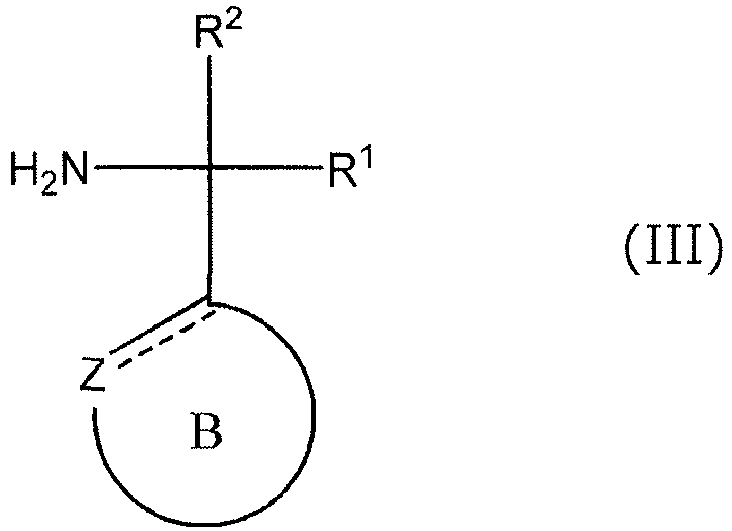
- L represents a ligand represented by the following formula (III) or a diamine ligand.
- R 1 and R 2 each independently represents a hydrogen atom, an unsubstituted or substituted alkyl group, an unsubstituted or substituted aryl group, or an unsubstituted or substituted aralkyl group.
- Ring B represents an unsubstituted or substituted hetero ring, a double line portion composed of a continuous line and a dotted line represents a single bond or a double bond, and Z represents a coordinating atom selected from the group consisting of N, P, O, and S.
- Examples of an alkyl group include a methyl group, an ethyl group, a n-propyl group, a n-butyl group, a n-pentyl group, a n-hexyl group, an i-propyl group, an i-butyl group, a s-butyl group, a t-butyl group, an i-pentyl group, a neopentyl group, a 2-methylbutyl group, a 2, 2-dimethylpropyl group, and an i-hexyl group.
- Examples of a substituted alkyl group include: C3 to 8 cycloalkyl C1 to 6 alkyl groups such as a cyclopropylmethyl group, a 2-cyclopropylethyl group, a cyclopentylmethyl group, a 2-cyclohexylethyl group, and a 2-cyclooctylethyl group; haloalkyl groups such as a fluoromethyl group, a chloromethyl group, a bromomethyl group, a difluoromethyl group, a dichloromethyl group, a dibromomethyl group, a trifluoromethyl group, a trichloromethyl group, a tribromomethyl group, a 2, 2, 2-trifluoroethyl group, a 2, 2, 2-trichloroethyl group, a pentafluoroethyl group, a 4-fluorobutyl group, a 4-chlorobutyl group, a 3, 3, 3-
- an aryl group examples include a phenyl group, a naphthyl group, an azulenyl group, an indenyl group, an indanyl group, and a tetralinyl group.
- a substituent on an aryl group include halogeno groups such as a fluoro group, a chloro group, a bromo group, and an iodine group; alkyl groups such as a methyl group, an ethyl group, a n-propyl group, an i-propyl group, a n-butyl group, a s-butyl group, an i-butyl group, a t-butyl group, a n-pentyl group, and a n-hexyl group; a hydroxyl group; alkoxy groups such as a methoxy group, an ethoxy group, and a n-propyl group; and a
- Examples of an aralkyl group include a benzyl group, and a phenethyl group.
- a substituent on an aralkyl group include halogeno groups such as a fluoro group, a chloro group, a bromo group, and an iodine group; alkyl groups such as a methyl group, an ethyl group, a n-propyl group, an i-propyl group, a n-butyl group, a s-butyl group, an i-butyl group, a t-butyl group, a n-pentyl group, and a n-hexyl group; a hydroxyl group; alkoxy groups such as a methoxy group, an ethoxy group, and a n-propyl group; and a cyano group.
- R 1 and R 2 preferably represent a hydrogen atom or an unsubstituted or substituted C1 to 6 alkyl group.
- Ring B represents an unsubstituted or substituted hetero ring.
- the ring B has the coordinating atom Z on an atom adjacent to a bonding portion thereon.
- the coordinating atom Z represents N, P, O, or S.
- Examples of an unsubstituted or substituted hetero ring group include unsubstituted or substituted 5-membered heteroaryl groups, unsubstituted or substituted 6-membered heteroaryl groups, unsubstituted or substituted condensed ring heteroaryl groups, unsubstituted or substituted saturated / unsaturated hetero 5-membered ring groups, and unsubstituted or substituted saturated / unsaturated hetero 6-memebered ring groups.
- Examples of the "unsubstituted or substituted 5-membered heteroaryl groups” include: pyrrolyl groups such as a pyrrol-2-yl group; furyl groups such as a furan-2-yl group; thienyl groups such as a thiophen-2-yl group; imidazolyl groups such as an imidazol-2-yl group, an imidazol-5-yl group, a 1-methylimidazol-2-yl group, and a 1-methylimidazol-4-yl group; pyrazolyl groups such as a pyrazol-3-yl group, and a pyrazol-5-yl group; oxazolyl groups such as an oxazol-2-yl group, an oxazol-4-yl group, and an oxazol-5-yl group; isoxazolyl groups such as an isoxazol-3-yl group, and an isoxazol-5-yl group; thiazoly
- Examples of the "unsubstituted or substituted 6-membered heteroaryl group” include: pyridyl groups such as a pyridine-2-yl group; pyrazinyl groups such as a pyrazin-2-yl group, and a 5-methylpyrazin-2-yl group; pyrimidinyl groups such as a pyrimidin-2-yl group, and a pyrimidin-4-yl group, pyridazinyl groups such as a pyridazin-3-yl group, and triazinyl groups such as a 1, 3, 5-triazin-2-yl group.
- Examples of the "unsubstituted or substituted condensed ring heteroaryl group” include: an indol-2-yl group; a benzofuran-2-yl group, a benzothiophen-2-yl group, benzimidazol-2-yl group, a 1-methyl-benzimidazol-2-yl group, a benzoxazol-2-yl group, a benzthiazol-2-yl group, and a quinolin-2-yl group.
- Examples of the "unsubstituted or substituted saturated / unsaturated hetero 5-membered ring group” include a pyrrolidin-2-yl group, a tetrahydrofuran-2-yl group, and an oxazolin-2-yl group.
- Examples of the "unsubstituted or substituted saturated / unsaturated hetero 6-membered ring group” include a piperidin-2-yl group, a piperazin-2-yl group, and a morpholin-2-yl group.
- the ring B preferably represents an unsubstituted or substituted 5-membered heteroaryl group, an unsubstituted or substituted 6-membered heteroaryl group, or an unsubstituted or substituted condensed ring heteroaryl group, and more preferably represents a thiazolyl group, a pyridyl group, a pyrazinyl group, a pyrimidinyl group, a benzimidazolyl group, or a benzoxazolyl group, that may be substituted with a C1 to 6 alkyl group.
- the ligand represented by formula (III) that is preferably used in the present invention is pyridin-2-yl methanamine (see formula (L1)), (1-methyl-1H-benzimidazol-2-yl)methanamine (see formula (L2)), (5-methylpyrazin-2-yl) methanamine (see formula (L3)), benzoxazol-2-yl methanamine (see formula (L4)), pyrimidin-2-yl methanamine (see formula (L5)), or thiazol-2-yl methanamine (see formula (L6)), or (pyrazin-2-yl)methanamine (see formula (L7)).
- the diamine ligand is a compound having two amino groups in a molecule thereof.
- a diamine ligand represented by formula (VI) is preferably used in the present invention.
- R 5 to R 12 each independently represents a hydrogen atom, an unsubstituted or substituted alkyl group, an unsubstituted or substituted aryl group, or an unsubstituted or substituted aralkyl group, and two of R 5 to R 12 may be bonded together to form a ring.
- Examples of an alkyl group, a substituted alkyl group, an aryl group, a substituted aryl group, an aralkyl group, and a substituted aralkyl group include the same ones mentioned for R 1 and R 2 in formula (III).
- R 5 to R 12 each independently represents a hydrogen atom, or a C1 to 6 alkyl group.
- D represents a single bond, an unsubstituted or substituted alkylene group, an unsubstituted or substituted cycloalkylene group, an unsubstituted or substituted arylene group, or an unsubstituted or substituted divalent hetero ring group.
- Examples of an unsubstituted or substituted alkylene group include an ethylene group, a propylene group, a trimethylene group, a tetramethylene group, a pentamethylene group, and a hexamethylene group.
- Examples of an unsubstituted or substituted cycloalkylene group include cycloalkylene groups such as a cyclopropylene group, a cyclobutylene group, a cyclopentylene group, a cyclohexylene group, and a bicycloheptenediyl group.
- Examples of an unsubstituted or substituted divalent hetero ring group include unsubstituted or substituted (preferably C1 to 6 alkyl-substituted or C1 to 6 alkoxy-substituted) dioxolanyl groups such as a 2, 2-dimethyl-1 3- dioxolan-4, 5-diyl group, and a 5, 6-dimethoxy-5, 6-dimethyl-1, 4-dioxolan-2, 3-diyl group.
- D preferably represents a single bond, or an unsubstituted or substituted divalent hetero ring group, and more preferably represents a single bond, or an unsubstituted or substituted (preferably C1 to 6 alkyl-substituted) dioxolanyl group.
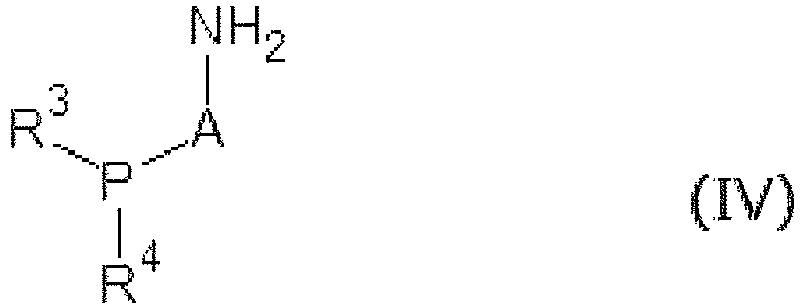
- PN represents a ligand represented by the following formula (IV).
- R 3 and R 4 each independently represents an unsubstituted or substituted alkyl group, an unsubstituted or substituted aryl group, or an unsubstituted or substituted aralkyl group.
- A represents an unsubstituted or substituted C1 to 4 alkylene group.
- Examples of an unsubstituted or substituted alkyl group, an unsubstituted or substituted aryl group, or an unsubstituted or substituted aralkyl group for R 3 and R 4 include the same ones mentioned for R 1 and R 2 .
- R 3 and R 4 preferably represent an unsubstituted or substituted alkyl group, or an unsubstituted or substituted aryl group, and more preferably represent a C1 to 6 alkyl group, or a phenyl group.
- Examples of an alkylene group include C1 to 4 alkylene groups such as a methylene group, an ethylene group, a propylene group, a trimethylene group, and a tetramethylene group.
- Preferable examples of a substituent on an alkylene group include: halogeno groups such as a fluoro group, a chloro group, a bromo group, and an iodine group; a hydroxyl group, and a cyano group.
- the ruthenium complex preferably used in the present invention is a ligand represented by the following formula (V).
- the ruthenium complex used in the present invention may be prepared by reacting an elemental ruthenium or a ruthenium complex with a desired ligand.
- the central ruthenium element may be non-valent, monovalent, divalent, trivalent, or higher-valent. It is preferable in the present invention that the divalent ruthenium halide complex be reacted with a desired ligand.
- 0.001 to 10 parts by mole, more preferably 0.01 to 1 parts by mole, of a ruthenium complex be present relative to 100 parts by mole of a 9-azabicyclo[3.3.1]nonan-3-one derivative.
- the amount of the ruthenium complex is an excessively low amount, catalyst effects are small, and the reactivity and the selectivity become low.
- the production cost becomes high.
- a base may be present in the production method according to the present invention.
- a base be present therein.
- the base include: alkali metal hydroxides such as a potassium hydroxide, and a sodium hydroxide; organic bases such as a potassium t- butoxide, a sodium ethoxide, a sodium acetate, and an amine (preferably alkali metal alkoxide); and basic ionic exchange resins. It is preferable that an amount of the base used be 0.002 to 20 parts by mole, more preferably 0.02 to 10 parts by mole, relative to 100 parts by mole of a 9-azabicyclo[3.3.1]nonan-3-one derivative.
- a hydrogen gas is generally used as a hydrogen.
- Known substances that can provide hydrogen may also be used.
- the substances that can provide hydrogen include: ones containing a metal such as iron or aluminum, as the main component thtereof, and ones containing a metal hydride compound such as a magnesium hydride or a calcium hydride, as the main component thereof.
- the hydrogen pressure (gauge pressure) during reduction reaction is not particularly limited, the hydrogen pressure is preferably atmospheric pressure to 100 atm.
- the temperature during reduction reaction is not particularly limited, the temperature is preferably 0 to 100°C.
- the reduction reaction may be conducted in the absence of solvent or in a solvent.
- the solvent is not particularly limited, provided that the solvent is inactive in reduction reaction.
- the solvent examples include: alcohols such as a methanol, an ethanol, an i-propanol, a n-butanol, a t-butanol, and a cyclohexanol; aromatic series such as a toluene, and a xylene; an N, N-dimethylacetamide, a chloroform, a dichloromethane, a tetrahydrofuran, a 1, 2-dimethoxy ethane, and a cyclopentylmethyl ether. It is preferable that an amount of the solvent used be 10 to 10000 parts by mole, more preferably 50 to 2000 parts by mole, relative to 100 parts by mole of a 9-azabicyclo[3.3.1]nonan-3-one derivative.
- alcohols such as a methanol, an ethanol, an i-propanol, a n-butanol, a t-butanol, and a cyclo
- a 9-azabicyclo[3.3.1]nonan-3-ol derivative which is a reaction product obtained according to the present invention, is a compound represented by the following formula (II).
- R represents a hydrogen atom, an unsubstituted or substituted alkyl group, an unsubstituted or substituted aralkyl group, or unsubstituted or substituted alkoxycarbonyl group.
- a hydrogen atom, a C1 to 6 alkyl group, a C7 to 11 aralkyl group, or a C1 to 6 alkoxycarbonyl group is preferable, a hydrogen atom, a methyl group, a benzyl group, or a t-butoxycarbonyl group is more preferable, and a hydrogen atom,or a benzyl group is even more preferable.
- the 9-azabicyclo[3.3.1]nonan-3-ol derivative includes two kinds of isomers composed of an exo isomer and an endo isomer due to the difference of configuration of a hydroxyl group. An endo isomer tends to be selectively obtained by the method according to the present invention.
- the reaction product obtained by the production method according to the present invention may be purified by a known method.
- OBB 9-benzyl-9-azabicyclo[3.3.1]nonan-3-one
- a solution composed of a solvent shown in Tables 1 and 2 a catalyst composed of a ruthenium complex, and 20 mM of potassium t-butoxide.
- the temperature of the solution was kept at 25°C, a hydrogen gas at 10 atm (gauge pressure) was injected into the solution, and the reduction reaction was conducted to obtain an endo-9-benzyl-9-azabicyclo[3.3.1]nonan-3-ol (hereinafter, maybe abbreviated as endo-HOBB).
- endo-HOBB endo-9-benzyl-9-azabicyclo[3.3.1]nonan-3-ol
- Target product Raw materials 37 cis-RuCl 2 [dppb][Me-bima] 200 ethanol 1 3 2 98 98 : 2 38 cis-RuCl 2 [dppb][Me-bima] 200 ethanol 1 3 99 1 99.1 : 0.9 39 cis-RuCl 2 [dppb][Me-bima] 200 IPA 1 3 99 1 78 : 22 40 cis-RuCl 2 [dppb][Me-bima] 200 n-bntannl 1 3 99 1 99 : 1 41 cis-RuCl 2 [dppb][Me-bima] 200 toluene 1 3 96 4 50 : 50 42 cis-RuCl 2 [dppb][W-bima] 5000 n-butan
- Catalyst Subsrate/ Ru catalyst Solvent Substrate concentration (M) Reactoin time (hour) Yield (% by area) endo:exo ratio
- Target product 44 cis-RuCl 2 (dppb)(ammp) 1000 ethanol 1 3 99 96.5 : 3.5
- 45 cis-RuCl 2 [dppb][Me-bima] 1000 n-butanol 1 3 99 >99 : 1
- OBB 229 mg of OBB was dissolved in a solution composed of an ethanol solvent, a RuCl 2 (dppb)(ampz) catalyst, and 20 mM of potassium t-butoxide.
- the catalyst was used so that the substrate / catalyst ratio became 1000.
- the term "ampz” means (pyrazin-2-yl)methanamine (see formula (L7)).
- the temperature of the solution was kept at 30°C, a hydrogen gas at 10 atm. (gauge pressure) was injected into the solution, and the reduction reaction was conducted for 3 hours. 94.5% of HOBB was yielded, and 5.5% of the raw materials were remained. The exo / endo ratio in the resultants were 1.8 / 98.2.
- An endo-9-azabicyclo[3.3.1]nonan-3-ol derivative useful as a production intermediate for agrochemical agents such as miticides or medicines, is selectively provided at a low cost by reacting a 9-azabicyclo[3.3.1]nonan-3-one derivative with a hydrogen in the presence of a catalyst composed of a ruthenium complex.
Landscapes
- Chemical & Material Sciences (AREA)
- Organic Chemistry (AREA)
- Inorganic Chemistry (AREA)
- Engineering & Computer Science (AREA)
- Materials Engineering (AREA)
- Chemical Kinetics & Catalysis (AREA)
- Organic Low-Molecular-Weight Compounds And Preparation Thereof (AREA)
- Catalysts (AREA)
- Nitrogen Condensed Heterocyclic Rings (AREA)
- Low-Molecular Organic Synthesis Reactions Using Catalysts (AREA)
- Pyridine Compounds (AREA)
- Plural Heterocyclic Compounds (AREA)
Abstract
Description
- The present invention relates to a method for producing an endo-9-azabicyclo[3.3.1]nonan-3-ol derivative.
- The present invention claims priority on the basis of Japanese Patent Application No.
2013-185712 - An endo-9-azabicyclo[3.3.1]nonan-3-ol derivative is a useful compound applicable as an agrochemical or medicinal intermediate (Patent Document 1). Patent Document 1 discloses that endo-9-benzyl-9-azabicyclo[3.3.1]nonan-3-ol is synthesized by reducing 9-benzyl-9-azabicyclo[3.3.1]nonan-3-one in a methanol solvent with sodium borohydride. However, there is no report disclosing study to reduce an azabicyclo nonane compound in the presence of a ruthenium catalyst.
- Patent Document 1: Japanese Translation of PCT International Application Publication No.
2009-510026 - An object of the present invention is to provide a method for conducting a reaction in which a 9-azabicyclo[3.3.1]nonan-3-one derivative is reduced to obtain the correspondent endo-9-azabicyclo[3.3.1]nonan-3-ol derivative at a low cost by a simplified process.
- The present invention includes the following aspects.
- (1) A method for producing a compound represented by the following formula (II), including reacting a compound represented by the following formula (I) with a hydrogen in the presence of a catalyst composed of a ruthenium complex.


In the formulae (I) and (II), R represents a hydrogen atom, an unsubstituted or substituted alkyl group, an unsubstituted or substituted aralkyl group, or an unsubstituted or substituted alkoxycarbonyl group. - (2) The method as described in (1), wherein the ruthenium complex is a compound represented by the following formula: Ru(X)(Y)(Px)n(L) or Ru(X)(Y)(PN)2.
In the formulae, X and Y each independently represents an anionic ligand.
Px represents a phosphine ligand. n represents 1 or 2.
L represents a ligand represented by the following formula (III) or a diamine ligand.
PN represents a ligand represented by the following formula (IV).

In the formula (III), R1 and R2 each independently represents a hydrogen atom, an unsubstituted or substituted alkyl group, an unsubstituted or substituted aryl group, or an unsubstituted or substituted aralkyl group. The ring B represents an unsubstituted or substituted hetero ring, and a double line portion composed of a continuous line and a dotted line represents a single bond or a double bond, and Z represents a coordinating atom selected from the group consisting of N, P, O, and S.
In the formula (IV), R3 and R4 each independently represents an unsubstituted or substituted alkyl group an unsubstituted or substituted aryl group, or an unsubstituted or substituted aralkyl group. A represents an unsubstituted or substituted C1 to 4 alkylene group. - (3) The method as described in (2), wherein the ruthenium complex is a compound represented by the following formula: Ru(X)(Y)(Px)n(L), and L represents pyridin-2-yl methanamine, (1 -methyl-1H-benzimidazol-2-yl)methanamine, (5-methylpyrazin-2-yl) methanamine, benzoxazol-2-yl methanamine, pyrimidin-2-yl methanamine, thiazol-2-yl methanamine, or (pyrazin-2-yl)methanamine.
- (4) The method as described in (2), wherein the ruthenium complex is a compound represented by the following fonnula: Ru(X)(Y)(Px)n(L), and L represents a diamine ligand represented by the following formula (VI).

In the formula (VI), R5 to R12 each independently represents a hydrogen atom, an unsubstituted or substituted alkyl group, an unsubstituted or substituted aryl group, or an unsubstituted or substituted aralkyl group, two of R5 to R12 may be bonded to form a ring, and D represents a single bond, an unsubstituted or substituted alkylene group, an unsubstituted or substituted cycloalkylene group, an unsubstituted or substituted arylene group, or an unsubstituted or substituted divalent hetero ring group. - (5) The method as described in (2), wherein the ruthenium complex is a compound represented by the following formula: Ru(X)(Y)(PN)2, and PN represents a ligand represented by the following formula (V).

- (6) The method as described in any one of (1) to (5), wherein, in the formulae (I) and (II), R represents an unsubstituted or substituted aralkyl group, and the unsubstituted or substituted aralkyl group is a benzyl group.
- In the case where a reaction in which a 9-azabicyclo[3.3.1]nonan-3-one derivative is reduced to an endo-9-azabicyclo[3.3.1]nonan-3-ol derivative is conducted in the presence of a catalyst composed of a ruthenium complex in accordance with the method of the present invention, almost no waste product is generated, extraction of a water-soluble compound is not needed, and the reaction can be conducted at a lower cost in a simplified process compared to a reaction using a boron-based reductant.
- The present invention relates to a method for producing an endo-9-azabicyclo[3.3.1]nonan-3-ol derivative by reacting a 9-azabicyclo[3.3.1]nonan-3-one derivative with a hydrogen in the presence of a catalyst composed of a ruthenium complex.
- First, meanings of the terms "unsubstituted" and "substituted" in the present specification will be explained.
- The term "unsubstituted" means a group consisting of a mother nucleus. In the case where only a name of a group consisting of a mother nucleus is indicated without describing "substituted", the group means an "unsubstituted" group unless mentioned otherwise.
- On the other hand, the term "substituted" means that any of hydrogen atoms in a group forming a mother nucleus is substituted with a group having a structure similar to or different from that of the mother nucleus. Accordingly, a "substituent" is another group bonded to a group forming a mother nucleus. The number of substituents may be one, or two or more. The two or more substituents may be the same or different from each other.
- The term "C1 to 6", for example, means that the number of carbon atoms in a group forming a mother nucleus is 1 to 6. The number of carbon atoms does not include the number of carbon atoms present in substituents. For example, a butyl having an ethoxy group as a substituent is classified into a C2 alkoxy C4 alkyl group.
- The "substituent" is not particularly limited, provided that the substituent is chemically acceptable and exhibits effects of the present invention. Examples of a group that can be the "substituent" include: halogeno groups such as a fluoro group, a chloro group, a bromo group, and an iodine group; C1 to 8 alkyl groups such as a methyl group, an ethyl group, a n-propyl group, an i-propyl group, a n-butyl group, a s-butyl group, an i-butyl group, a t-butyl group, a n-pentyl group, and a n-hexyl; C3 to 6 cycloalkyl groups such as a cyclopropyl group, a cyclobutyl group, a cyclopentyl group, and a cyclohexyl group; C2 to 6 alkenyl groups such as a vinyl group, a 1-propenyl group, a 2-propenyl group, a 1-butenyl group, a 2-butenyl group, a 3-butenyl group, a 1-methyl-2-propenyl group, a 2-methyl-2-propenyl group, a 1-pentenyl group, a 2-pentenyl group, a 3-pentenyl group, a 4-pentenyl group, a 1-methyl-2-butenyl group, a 2-methyl-2-butenyl group, a 1-hexenyl group, a 2-hexenyl group, a 3-hexenyl group, a 4-hexenyl group, and a 5-hexenyl; C3 to 6 cycloalkenyl groups such as a 2-cyclopropenyl group, a 2-cyclopentenyl group, and 3-cyclohexenyl; C2 to 6 alkynyl groups such as an ethynyl group, a 1-propynyl group, a 2-propynyl group, a 1-butynyl group, a 2-butynyl group, a 3-butynyl group, a 1-methyl-2-propynyl group, a 2-methyl-3-butynyl group, a 1-pentynyl group, a 2-pentynyl group, a 3-pentynyl group, a 4-pentynyl group, a 1-methyl-2-butynyl group, a 2-methyl-2-pentynyl group, a 1-hexynyl group, and a 1,1-dimethyl-2-butynyl group;
C1 to 6 alkoxy groups such as a methoxy group, an ethoxy group, a n-propoxy group, an i-propoxy group, a n-butoxy group, a s-butoxy group, an i-butoxy group, and a t-butoxy group; C2 to 6 alkenyloxy groups such as a vinyloxy group, an allyloxy group, a propenyloxy group, and a butenyloxy group; C2 to 6 alkynyloxy groups such as an ethynyloxy group, and a propargyloxy group; C6 to 10 aryl groups such as a phenyl group, and a naphthyl group; C6 to 10 aryloxy groups such as a phenoxy group, and a 1-naphthoxy group; C7 to 11 aralkyl groups such as a benzyl group, and a phenethyl group; C7 to 11 aralkyloxy groups such as a benzyloxy group, and a phenethyloxy group; C1 to 7 acyl groups such as a formyl group, an acetyl group, a propionyl group, a benzoyl group, and a cyclohexylcarbonyl group; C1 to 7 acyloxy groups such as a formyloxy group, an acetyloxy group, a propionyloxy group, a benzoyloxy group, and a cyclohexyl carbonyloxy group; C1 to 6 alkoxycarbonyl groups such as a methoxy carbonyl group, an ethoxycarbonyl group, a n-propoxycarbonyl group, an i-propoxycarbonyl group, a n-butoxycarbonyl group, and a t-butoxycarbonyl group: a carboxyl group;
a hydroxyl group; an oxo group; C1 to 6 haloalkyl groups such as a chloromethyl group, a chloroethyl group, a trifluoromethyl group, a 1,2-dichloro-n-propyl group, a 1-fluoro-n-butyl group, and a perfluoro-n-pentyl group; C2 to 6 haloalkenyl groups such as a 2-chloro-1-propenyl group, and a 2-fluoro-1-butenyl group; C2 to 6 haloalkynyl groups such as a 4,4-dichloro-1-butynyl group, a 4-fluoro-1-pentynyl group, and a 5-bromo-2-pentynyl group; C1 to 6 haloalkoxy groups such as a 2-chloro-n-propoxy group, and a 2,3-dichlorobutoxy group; C2 to 6 haloalkenyloxy groups such as a 2-chloropropenyloxy group, and a 3-bromobutenyloxy group; C6 to 10 haloaryl groups such as a 4-chlorophenyl group, a 4-fluorophenyl group, and a 2,4-dichlorophenyl group; C6 to 10 haloaryloxy groups such as a 4-fluorophenyloxy group, and a 4-chloro-1-naphthoxy group; C1 to 7 haloacyl groups such as a chloroacetyl group, a trifluoroacetyl group, a trichloroacetyl group, and a 4-chlorobenzoyl group; a cyano group; an isocyano group; a nitro group; an isocyanato group; a cyanate group; an azide group;
a mercapto group; an isothiocyanato group; a thiocyanato group; C1 to 6 alkylthio groups such as a methylthio group, an ethylthio group, a n-propylthio group, an i-propylthio group, a n-butylthio group, an i-butylthio group, a s-butylthio group, and a t-butylthio group; C2 to 6 alkenylthio groups such as a vinylthio group, and an allylthio group; C2 to 6 alkynylthio groups such as an ethynylthio group, and a propargylthio group; C6 o 10 arylthio groups such as a phenylthio group, and a naphthylthio group; heteroarylthio groups such as a thiazolylthio group, and a pyridylthio group; C7 to 11 I aralkylthio groups such as a benzylthio group, and a phenethylthio group; (C1 to 6 alkylthio)carbonyl groups such as a (methylthio)carbonyl group, an (ethylthio)carbonyl group, a (n-propylthio)carbonyl group, an (i-propylthio)carbonyl group, a (n-butylthio)carbonyl group, an (i-butylthio)carbonyl group, a (s-butylthio)carbonyl group, and a (t-butylthio)carbonyl group;
C1 to 6 alkylsulfinyl groups such as a methylsulfinyl group, an ethylsulfinyl group, and a t-butylsulfinyl group; C2 to 6 alkenylsulfinyl groups such as an allylsulfinyl group; C2 to 6 alkynylsulfinyl groups such as a propargylsulfinyl group; C6 to 10 arylsulfinyl group such as a phenylsulfinyl group; heteroarylsulfinyl groups such as a thiazolylsulfinyl group, and a pyridylsulfinyl group; C7 to 11 aralkylsulfinyl groups such as a benzylsulfinyl group, and a phenethylsulfinyl group; C1 to 6 alkylsulfonyl groups such as a methylsulfonyl group, an ethylsulfonyl group, and a t-butylsulfonyl group; C2 to 6 alkenylsulfonyl groups such as an allylsulfonyl group; C2 to 6 alkynylsulfonyl groups such as a propargylsulfonyl group; C6 to 10 arylsulfonyl groups such as a phenylsulfonyl group; heteroarylsulfonyl groups such as a thiazolylsulfonyl group, and a pyridylsulfonyl group; C7 to 11 aralkylsulfonyl groups such as a benzylsulfonyl group, and a phenethylsulfonyl group;
6-membered heteroaryl groups such as a pyridyl group, a pyrazinyl group, a pyrimidinyl group, a pyridazinyl group, and a triazinyl group; saturated hetero ring groups such as an aziridinyl group, an epoxy group, a pyrrolidinyl group, a tetrahydrofuranyl group, a piperidyl group, a piperazinyl group, and a morpholinyl group; tri C1 to 6 alkylsilyl groups such as a trimethylsilyl group, a triethylsilyl group, and a t-butyldimethylsilyl group; and a triphenylsilyl group. - The "substituent" may further have another "substituent". For example, a butyl group serving as a substituent may have an ethoxy group as another substituent, that is, the substituent may be an ethoxybutyl group.
- A 9-azabicyclo[3.3.1]nonan-3-one derivative used as a reaction raw material in the present invention is a compound represented by the following formula (I). In the formula (I), R represents a hydrogen atom, an unsubstituted or substituted alkyl group, an unsubstituted or substituted aralkyl group, or an unsubstituted or substituted alkoxycarbonyl group. Among these, a hydrogen atom, a C1 to 6 alkyl group, a C7 to 11 aralkyl group, a C1 to 6 alkoxycarbonyl group, or the like is preferred, a hydrogen atom, a methyl group, a benzyl group, a t-butoxycarbonyl group, or the like is more preferred, and a hydrogen atom or a benzyl group is even more preferred. The 9-azabicyclo[3.3.1]nonan-3-one derivative, serving as a reaction raw material, may be one purified by various methods. Examples of the purification methods include a recrystallization method, an alkali washing method, and a column method.

- A ruthenium complex available in the present invention is not particularly limited, provided that the ruthenium complex serves as a catalyst during hydrogenation reaction. The ruthenium complex preferably used in the present invention is a compound represented by the following formula: Ru(X)(Y)(Px)n(L) or Ru(X)(Y)(PN)2.
- In the formulae, X and Y each independently represents an anionic ligand. X and Y may be the same or different from each other. X and Y may be bonded together to form an at least bidentate anionic ligand.
- Examples of the anionic ligand include: CF3SO3 -, BF4 -, PF6 , C104 -; halogeno groups such as a fluoro group, a chloro group, a bromo group, and an iodine group; a hydride group; a hydroxyl group; unsubstituted or substituted diketonate groups such as an acetylacetonate; unsubstituted or substituted cyclopentadienyl groups; unsubstituted or substituted alkenyl groups such as a vinyl group, a 1- propenyl group, a 2-propenyl group, a 1-butenyl group, a 2-butenyl group, a 3-butenyl group, a 1-methyl-2-propenyl group, a 2-methyl-2-propenyl group, a 1-pentenyl group, a 2-pentenyl group, a 3-pentenyl group, a 4-pentenyl group, a 1-methyl-2-butenyl group, a 2-methyl-2-butenyl group, a 1-hexenyl group, a 2-hexenyl group, a 3-hexenyl group, a 4-hexenyl group, and a 5-hexenyl group; unsubstituted or substituted alkyl groups such as a methyl group, an ethyl group, a n-propyl group, an i-propyl group, a n-butyl group, a s-butyl group, an i-butyl group, a t-butyl group, a n-pentyl group, and a n-hexyl group; unsubstituted or substituted aryl groups such as a phenyl group, and a naphthyl group;
- unsubstituted or substituted alkoxy groups such as a methoxy group, an ethoxy group, a n-propoxy group, an i-propoxy group, a n-butoxy group, a s-butoxy group, an i-butoxy group, and a t-butoxy group; unsubstituted or substituted aryloxy groups such as a phenoxy group, and a 1-naphthoxy group; unsubstituted or substituted alkoxycarbonyl groups such as a methoxy carbonyl group, an ethoxy carbonyl group, a n-propoxy carbonyl group, an i-propoxy carbonyl group, a n-butoxy carbonyl group, and a t-butoxy carbonyl group; unsubstituted or substituted carboxyl groups such as a carboxyl group, a methoxy carbonyl group, and an ethoxy carbonyl group; unsubstituted or substituted alkylsulfonate group such as a methylsulfonate group, an ethylsulfonate group, and a t-butylsulfonate group; unsubstituted or substituted arylsulfonate groups such as a phenylsulfonate group; unsubstituted or substituted alkylthio groups such as a methylthio group, an ethylthio group, a n-propylthio group, an i-propylthio group, a n-butylthio group, an i-butylthio group, a s-butylthio group, and a t-butylthio group; unsubstituted or substituted alkenylthio groups such as a vinylthio group, and an allylthio group; unsubstituted or substituted arylthio groups such as a phenylthio group, and a naphthylthio group; unsubstituted or substituted alkylsulfonyl groups such as a methylsulfonyl group, an ethylsulfonyl group, and a t-butylsulfonyl group; and unsubstituted or substituted alkylsulfinyl groups such as a methylsulfinyl group, an ethylsulfinyl group, and a t-butylsulfinyl group. Among these, halogeno groups are preferred.
- Px represents a phosphine ligand. n represents 1 or 2. The phosphine ligand is not particularly limited, provided that the phosphine ligand makes it possible to stably form a ruthenium complex. Examples of Px include monodentate phosphine ligands represented by formula (P1) and bidentate phosphine ligands represented by formula (P2).


- In formula (P1 ), RA, RB, and RC each independently represents an unsubstituted or substituted C1 to 20 alkyl group such as a methyl group, an ethyl group, a n-propyl group, an isopropyl group, a n-butyl group, a sec-butyl group, an isobutyl group, a t-butyl group, a pentyl group, a hexyl group, a heptyl group, a nonyl group, or a dodecyl group; an unsubstituted or substituted phenyl group; an unsubstituted or substituted C3 to 8 cycloalkyl group such as a cyclopropyl group, a cyclopentyl group, a cyclohexyl group, or a cyclooctyl group; or an unsubstituted or substituted C7 to 20 aralkyl group such as a benzyl group, an α-methylbenzyl group, or an α, α-dimethylbenzyl group. Two of RA, RB, and RC may be bonded together to form an unsubstituted or substituted hetero ring. Among these, RA, RB, and RC preferably represent unsubstituted or substituted phenyl groups.
- Examples of the monodentate phosphine ligand represented by formula (P1) that is preferably used in the present invention include tertiary phosphines such as trimethylphosphine, triethylphosphine, tributylphosphine, triphenylphosphine, tricyclohexylphosphine, tri(p-tolyl)phosphine, diphenylmethylphosphine, dimethylphenylphosphine, diisopropylmethylphosphine, 1-[2-(diphenylphosphino)ferrocenyl]ethylmethyl ether, and 2-(diphenylphosphino)-2'-methoxy-1,1'-binaphthyl. In addition, a phosphine ligand in which RA, RB, and RC represent groups different from each other such as ethylmethylbutylphosphine, ethylmethylphenylphosphine, isopropylethylmethylphosphine, or cyclohexyl(O-anisyl)methylphosphine, may be used.
- In formula (P2), RD, RE, RF, and R° each independently represents an unsubstituted or substituted C1 to 20 alkyl group such as a methyl group, an ethyl group, a n-propyl group, an isopropyl group, a n-butyl group, a sec-butyl group, a t-butyl group, a pentyl group or an isomer thereof, a hexyl group or an isomer thereof, a heptyl group or an isomer thereof, a nonyl group or an isomer thereof, or a dodecyl group or an isomer thereof; an unsubstituted or substituted phenyl group; or an unsubstituted or substituted C3 to 8 cycloalkyl group such as a cyclopropyl group, a cyclopentyl group, or a cyclohexyl group. RD and RE, and/or, RF and RG, may be bonded together to form an unsubstituted or substituted hetero ring. Among these, RD, RE, RF, and RG preferably represent unsubstituted or substituted phenyl groups.
- W represents an unsubstituted or substituted C1 to 5 alkylene group such as a methylene group, an ethylene group, a propylene group, a trimethylene group, or a tetramethylene group; an unsubstituted or substituted C3 to 6 cycloalkylene group such as a cyclopropylene group, a cyclobutylene group, a cyclopentylene group, or a cyclohexylene group; an unsubstituted or substituted arylene group such as a phenylene group, a naphthylene group, a 1,r-biphenyl-2,2'-diyl group, a 1,1'-binaphthyl-2,2'-diyl group, or a 1,1'-binaphthyl-7,7'-diyl group; an unsubstituted or substituted C2 to 20 alkenediyl group such as an ethenediyl group, a propenediyl group, an isopropenediyl group, or a butenediyl group; or an unsubstituted or substituted C2 to 20 alkynediyl group such as an ethynediyl group, or a propynediyl group. Among these, W preferably represents an unsubstituted or substituted C1 to 5 alkylene group or an unsubstituted or substituted arylene group (preferably a 1,1'-biphenyl-2,2'-diyl group, or a 1,1'-binaphthyl-2,2'-diyl group).
- Examples of the bidentate phosphine ligand represented by formula (P2) include bisdiphenylphosphino methane, bisdiphenylphosphino ethane, bisdiphenylphosphino propane, bisdiphenylphosphino butane, bisdimethylphosphino ethane, bisdimethylphosphino propane, 1,1'-bis(diphenylphosphino)ferrocene, and 2,2'-bis(diphenylphosphino)-1,1'-biphenyl. Among these, bisdiphenylphosphino butane or 2,2'-bis(diphenylphosphino)-1,1'-biphenyl is preferable.
- Additional examples of the preferable bidentate phosphine ligand in the present invention include asymmetric ligands such as 2, 2'-bis-(diphenylphosphino)-1, 1'-binaphthyl (hereinafter, referred to as BINAP), BINAP derivatives in which a naphthyl ring of BINAP has a substituent such as an alkyl group or an aryl group, BINAP derivatives having a fluorine substituent, and BINAP derivatives in which two benzene rings on a phosphorus atom have 1 to 5 substituents such as an alkyl group or an alkoxy group, respectively. Specific examples thereof include 2, 2'-bis-(di-p-tolylphosphino)-1, 1'-binaphthyl (Tol-BINAP), 2, 2'-bis[bis(3, 5-dimethylphenyl)phosphino]-1, 1'-binaphthyl (Xylyl-BINAP), 1-[1',2-bis(diphenylphosphino)ferrocenyl]ethyldiamine, 2, 2'-bis-(dicyclohexylphosphino)-6, 6'-dimethyl-1, 1'-biphenyl, 2, 3-bis-(diphenylphosphino) butane, 1-cyclohexyl-1, 2-bis-(diphenylphosphino)ethane, 1-subsituted-3, 4-bis-(diphenylphosphino)pyrrolidine, 2, 3-O-isopropylidene-2, 3-dihydroxy-1,4-bis-(diphenylphosphino)butane, 1, 2-bis[(O-methoxyphenyl)phenyl phosphino]ethane, substituted-1,2-bis(phospholano)benzene, 5, 6-bis-(diphenylphosphino)-2-norbornene, N, N'-bis-(diphenylphosphino)-N, N'-bis(1-phenylethyl)ethylenediamine, 1, 2-bis-(diphenylphosphino)propane, 2, 4-bis-(diphenylphosphino)pentane, [(5, 6), (5', 6')-bis(methylenedioxy)biphenyl-2, 2'-diyl]bis(diphenylphosphine), 1, 2-bis(t-butylmethylphosphino)ethane, and 2, 4-bis-(diphenylphosphino)pentane.
- Many phosphine ligands (PX) are known and may be prepared and obtained by known methods. In addition, commercially available ones may be directly used, or may be used after purification, as needed. In the ruthenium complex preferably used in the present invention, Px is a bidentate phosphine ligand.
- L represents a ligand represented by the following formula (III) or a diamine ligand.
- In formula (III), R1 and R2 each independently represents a hydrogen atom, an unsubstituted or substituted alkyl group, an unsubstituted or substituted aryl group, or an unsubstituted or substituted aralkyl group. Ring B represents an unsubstituted or substituted hetero ring, a double line portion composed of a continuous line and a dotted line represents a single bond or a double bond, and Z represents a coordinating atom selected from the group consisting of N, P, O, and S.
- Examples of an alkyl group include a methyl group, an ethyl group, a n-propyl group, a n-butyl group, a n-pentyl group, a n-hexyl group, an i-propyl group, an i-butyl group, a s-butyl group, a t-butyl group, an i-pentyl group, a neopentyl group, a 2-methylbutyl group, a 2, 2-dimethylpropyl group, and an i-hexyl group.
- Examples of a substituted alkyl group include: C3 to 8 cycloalkyl C1 to 6 alkyl groups such as a cyclopropylmethyl group, a 2-cyclopropylethyl group, a cyclopentylmethyl group, a 2-cyclohexylethyl group, and a 2-cyclooctylethyl group; haloalkyl groups such as a fluoromethyl group, a chloromethyl group, a bromomethyl group, a difluoromethyl group, a dichloromethyl group, a dibromomethyl group, a trifluoromethyl group, a trichloromethyl group, a tribromomethyl group, a 2, 2, 2-trifluoroethyl group, a 2, 2, 2-trichloroethyl group, a pentafluoroethyl group, a 4-fluorobutyl group, a 4-chlorobutyl group, a 3, 3, 3-trifluoropropyl group, a 2, 2, 2-trifluoro-1-trifluoromethylethyl group, a perfluorohexyl group, a perchlorohexyl group, and a 2, 4, 6-trichlorohexyl group; and alkoxyalkyl groups such as a methoxymethyl group, an ethoxymethyl group, a methoxyethyl group, an ethoxyethyl group, a methoxy-n-propyl group, an ethoxymethyl group, an ethoxyethyl group, a n-propoxymethyl group, an i-propoxyethyl group, a s-butoxymethyl group, and a t-butoxyethyl group.
- Examples of an aryl group include a phenyl group, a naphthyl group, an azulenyl group, an indenyl group, an indanyl group, and a tetralinyl group. Preferable examples of a substituent on an aryl group include halogeno groups such as a fluoro group, a chloro group, a bromo group, and an iodine group; alkyl groups such as a methyl group, an ethyl group, a n-propyl group, an i-propyl group, a n-butyl group, a s-butyl group, an i-butyl group, a t-butyl group, a n-pentyl group, and a n-hexyl group; a hydroxyl group; alkoxy groups such as a methoxy group, an ethoxy group, and a n-propyl group; and a cyano group.
- Examples of an aralkyl group include a benzyl group, and a phenethyl group. Preferable examples of a substituent on an aralkyl group include halogeno groups such as a fluoro group, a chloro group, a bromo group, and an iodine group; alkyl groups such as a methyl group, an ethyl group, a n-propyl group, an i-propyl group, a n-butyl group, a s-butyl group, an i-butyl group, a t-butyl group, a n-pentyl group, and a n-hexyl group; a hydroxyl group; alkoxy groups such as a methoxy group, an ethoxy group, and a n-propyl group; and a cyano group.
- Among these, R1 and R2 preferably represent a hydrogen atom or an unsubstituted or substituted C1 to 6 alkyl group.
- Ring B represents an unsubstituted or substituted hetero ring. The ring B has the coordinating atom Z on an atom adjacent to a bonding portion thereon. The coordinating atom Z represents N, P, O, or S.
- Examples of an unsubstituted or substituted hetero ring group include unsubstituted or substituted 5-membered heteroaryl groups, unsubstituted or substituted 6-membered heteroaryl groups, unsubstituted or substituted condensed ring heteroaryl groups, unsubstituted or substituted saturated / unsaturated hetero 5-membered ring groups, and unsubstituted or substituted saturated / unsaturated hetero 6-memebered ring groups.
- Examples of the "unsubstituted or substituted 5-membered heteroaryl groups" include: pyrrolyl groups such as a pyrrol-2-yl group; furyl groups such as a furan-2-yl group; thienyl groups such as a thiophen-2-yl group; imidazolyl groups such as an imidazol-2-yl group, an imidazol-5-yl group, a 1-methylimidazol-2-yl group, and a 1-methylimidazol-4-yl group; pyrazolyl groups such as a pyrazol-3-yl group, and a pyrazol-5-yl group; oxazolyl groups such as an oxazol-2-yl group, an oxazol-4-yl group, and an oxazol-5-yl group; isoxazolyl groups such as an isoxazol-3-yl group, and an isoxazol-5-yl group; thiazolyl groups such as a thiazol-2-yl group; isothiazolyl groups such as an isothiazol-3-yl group, and an isothiazol-5-yl group; triazolyl groups such as a 1, 2, 3-triazol-4-yl groups, a 1-methyl-1, 2, 3-triazol-4-yl group, a 1, 2, 4-triazol-3-yl group, and a 2, 3-dimethyl-1, 2, 4-triazol-5-yl group; oxadiazolyl groups such as a 1, 2, 3-oxadiazol-4-yl group, a 1, 2, 3-oxadiazol-5-yl group, and a 1, 3, 4-oxadiazol-2-yl group; thiadiazolyl groups such as a 1, 2, 4-thiadiazol-3-yl group, a 1, 2, 4-thiadiazol-5-yl group, and a 1, 3, 4-thiadiazol-2-yl group; tetrazolyl groups such as a tetrazol-5-yl group.
- Examples of the "unsubstituted or substituted 6-membered heteroaryl group" include: pyridyl groups such as a pyridine-2-yl group; pyrazinyl groups such as a pyrazin-2-yl group, and a 5-methylpyrazin-2-yl group; pyrimidinyl groups such as a pyrimidin-2-yl group, and a pyrimidin-4-yl group, pyridazinyl groups such as a pyridazin-3-yl group, and triazinyl groups such as a 1, 3, 5-triazin-2-yl group.
- Examples of the "unsubstituted or substituted condensed ring heteroaryl group" include: an indol-2-yl group; a benzofuran-2-yl group, a benzothiophen-2-yl group, benzimidazol-2-yl group, a 1-methyl-benzimidazol-2-yl group, a benzoxazol-2-yl group, a benzthiazol-2-yl group, and a quinolin-2-yl group.
- Examples of the "unsubstituted or substituted saturated / unsaturated hetero 5-membered ring group" include a pyrrolidin-2-yl group, a tetrahydrofuran-2-yl group, and an oxazolin-2-yl group.
- Examples of the "unsubstituted or substituted saturated / unsaturated hetero 6-membered ring group" include a piperidin-2-yl group, a piperazin-2-yl group, and a morpholin-2-yl group.
- Among these, the ring B preferably represents an unsubstituted or substituted 5-membered heteroaryl group, an unsubstituted or substituted 6-membered heteroaryl group, or an unsubstituted or substituted condensed ring heteroaryl group, and more preferably represents a thiazolyl group, a pyridyl group, a pyrazinyl group, a pyrimidinyl group, a benzimidazolyl group, or a benzoxazolyl group, that may be substituted with a C1 to 6 alkyl group.
- The ligand represented by formula (III) that is preferably used in the present invention is pyridin-2-yl methanamine (see formula (L1)), (1-methyl-1H-benzimidazol-2-yl)methanamine (see formula (L2)), (5-methylpyrazin-2-yl) methanamine (see formula (L3)), benzoxazol-2-yl methanamine (see formula (L4)), pyrimidin-2-yl methanamine (see formula (L5)), or thiazol-2-yl methanamine (see formula (L6)), or (pyrazin-2-yl)methanamine (see formula (L7)).


- The diamine ligand is a compound having two amino groups in a molecule thereof. A diamine ligand represented by formula (VI) is preferably used in the present invention.

- In the formula, R5 to R12 each independently represents a hydrogen atom, an unsubstituted or substituted alkyl group, an unsubstituted or substituted aryl group, or an unsubstituted or substituted aralkyl group, and two of R5 to R12 may be bonded together to form a ring.
- Examples of an alkyl group, a substituted alkyl group, an aryl group, a substituted aryl group, an aralkyl group, and a substituted aralkyl group include the same ones mentioned for R1 and R2 in formula (III).
- Among these, it is preferable that R5 to R12 each independently represents a hydrogen atom, or a C1 to 6 alkyl group.
- D represents a single bond, an unsubstituted or substituted alkylene group, an unsubstituted or substituted cycloalkylene group, an unsubstituted or substituted arylene group, or an unsubstituted or substituted divalent hetero ring group.
- Examples of an unsubstituted or substituted alkylene group include an ethylene group, a propylene group, a trimethylene group, a tetramethylene group, a pentamethylene group, and a hexamethylene group.
- Examples of an unsubstituted or substituted cycloalkylene group include cycloalkylene groups such as a cyclopropylene group, a cyclobutylene group, a cyclopentylene group, a cyclohexylene group, and a bicycloheptenediyl group.
- Examples of an unsubstituted or substituted divalent hetero ring group include unsubstituted or substituted (preferably C1 to 6 alkyl-substituted or C1 to 6 alkoxy-substituted) dioxolanyl groups such as a 2, 2-dimethyl-1 3- dioxolan-4, 5-diyl group, and a 5, 6-dimethoxy-5, 6-dimethyl-1, 4-dioxolan-2, 3-diyl group.
- Among these, D preferably represents a single bond, or an unsubstituted or substituted divalent hetero ring group, and more preferably represents a single bond, or an unsubstituted or substituted (preferably C1 to 6 alkyl-substituted) dioxolanyl group.
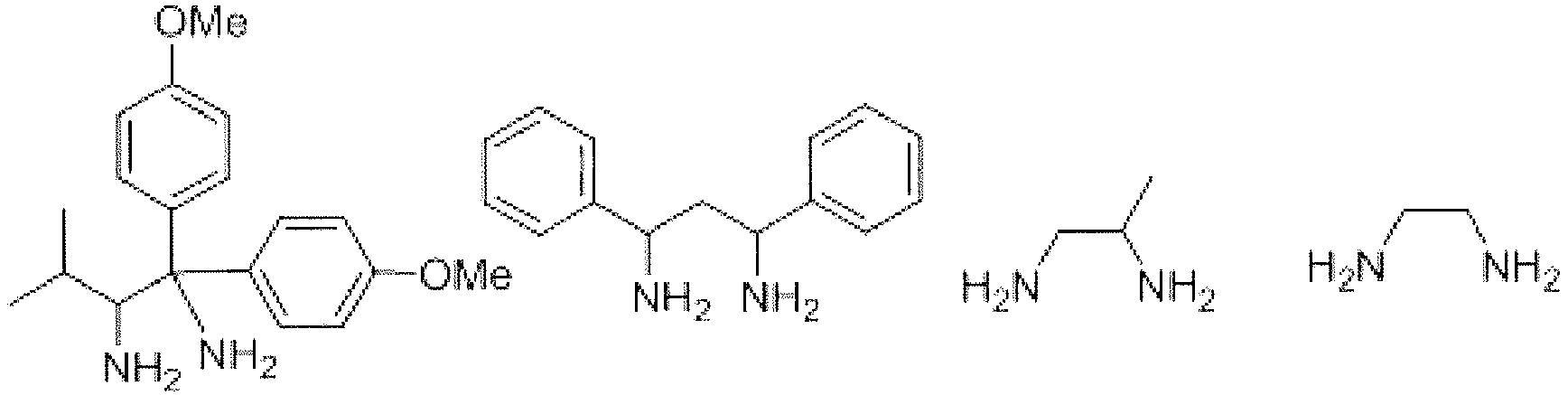
- Specific examples of the diamine ligand preferably used in the present invention will be shown below.




- PN represents a ligand represented by the following formula (IV).
- In the formula (IV), R3 and R4 each independently represents an unsubstituted or substituted alkyl group, an unsubstituted or substituted aryl group, or an unsubstituted or substituted aralkyl group. A represents an unsubstituted or substituted C1 to 4 alkylene group.
- Examples of an unsubstituted or substituted alkyl group, an unsubstituted or substituted aryl group, or an unsubstituted or substituted aralkyl group for R3 and R4 include the same ones mentioned for R1 and R2.
- Among these, R3 and R4 preferably represent an unsubstituted or substituted alkyl group, or an unsubstituted or substituted aryl group, and more preferably represent a C1 to 6 alkyl group, or a phenyl group.
- Examples of an alkylene group include C1 to 4 alkylene groups such as a methylene group, an ethylene group, a propylene group, a trimethylene group, and a tetramethylene group. Preferable examples of a substituent on an alkylene group include: halogeno groups such as a fluoro group, a chloro group, a bromo group, and an iodine group; a hydroxyl group, and a cyano group.
- The ruthenium complex preferably used in the present invention is a ligand represented by the following formula (V).

- The ruthenium complex used in the present invention may be prepared by reacting an elemental ruthenium or a ruthenium complex with a desired ligand. The central ruthenium element may be non-valent, monovalent, divalent, trivalent, or higher-valent. It is preferable in the present invention that the divalent ruthenium halide complex be reacted with a desired ligand.
- It is preferable in the production method according to the present invention that 0.001 to 10 parts by mole, more preferably 0.01 to 1 parts by mole, of a ruthenium complex be present relative to 100 parts by mole of a 9-azabicyclo[3.3.1]nonan-3-one derivative. In the case where the amount of the ruthenium complex is an excessively low amount, catalyst effects are small, and the reactivity and the selectivity become low. In contrast, in the case where the ruthenium complex is used in an amount more than needed, the production cost becomes high.
- A base may be present in the production method according to the present invention. In the case where a ruthenium complex in which a hydride is not coordinated is used as a catalyst, it is preferable that a base be present therein. Examples of the base include: alkali metal hydroxides such as a potassium hydroxide, and a sodium hydroxide; organic bases such as a potassium t- butoxide, a sodium ethoxide, a sodium acetate, and an amine (preferably alkali metal alkoxide); and basic ionic exchange resins. It is preferable that an amount of the base used be 0.002 to 20 parts by mole, more preferably 0.02 to 10 parts by mole, relative to 100 parts by mole of a 9-azabicyclo[3.3.1]nonan-3-one derivative.
- A hydrogen gas is generally used as a hydrogen. Known substances that can provide hydrogen may also be used. Examples of the substances that can provide hydrogen include: ones containing a metal such as iron or aluminum, as the main component thtereof, and ones containing a metal hydride compound such as a magnesium hydride or a calcium hydride, as the main component thereof.
- Although the hydrogen pressure (gauge pressure) during reduction reaction is not particularly limited, the hydrogen pressure is preferably atmospheric pressure to 100 atm. Although the temperature during reduction reaction is not particularly limited, the temperature is preferably 0 to 100°C. The reduction reaction may be conducted in the absence of solvent or in a solvent. The solvent is not particularly limited, provided that the solvent is inactive in reduction reaction. Examples of the solvent include: alcohols such as a methanol, an ethanol, an i-propanol, a n-butanol, a t-butanol, and a cyclohexanol; aromatic series such as a toluene, and a xylene; an N, N-dimethylacetamide, a chloroform, a dichloromethane, a tetrahydrofuran, a 1, 2-dimethoxy ethane, and a cyclopentylmethyl ether. It is preferable that an amount of the solvent used be 10 to 10000 parts by mole, more preferably 50 to 2000 parts by mole, relative to 100 parts by mole of a 9-azabicyclo[3.3.1]nonan-3-one derivative.
- A 9-azabicyclo[3.3.1]nonan-3-ol derivative, which is a reaction product obtained according to the present invention, is a compound represented by the following formula (II). In formula (II), R represents a hydrogen atom, an unsubstituted or substituted alkyl group, an unsubstituted or substituted aralkyl group, or unsubstituted or substituted alkoxycarbonyl group. Among these, a hydrogen atom, a C1 to 6 alkyl group, a C7 to 11 aralkyl group, or a C1 to 6 alkoxycarbonyl group is preferable, a hydrogen atom, a methyl group, a benzyl group, or a t-butoxycarbonyl group is more preferable, and a hydrogen atom,or a benzyl group is even more preferable. The 9-azabicyclo[3.3.1]nonan-3-ol derivative includes two kinds of isomers composed of an exo isomer and an endo isomer due to the difference of configuration of a hydroxyl group. An endo isomer tends to be selectively obtained by the method according to the present invention. The reaction product obtained by the production method according to the present invention may be purified by a known method.

- Next, the present invention will be described in more detail based on a series of examples. However, the present invention is in no way limited by these examples.
- 229 mg of a 9-benzyl-9-azabicyclo[3.3.1]nonan-3-one (hereinafter, may be abbreviated as OBB) was dissolved in a solution composed of a solvent shown in Tables 1 and 2, a catalyst composed of a ruthenium complex, and 20 mM of potassium t-butoxide. The temperature of the solution was kept at 25°C, a hydrogen gas at 10 atm (gauge pressure) was injected into the solution, and the reduction reaction was conducted to obtain an endo-9-benzyl-9-azabicyclo[3.3.1]nonan-3-ol (hereinafter, maybe abbreviated as endo-HOBB). The results are shown in Tables 1 and 2.
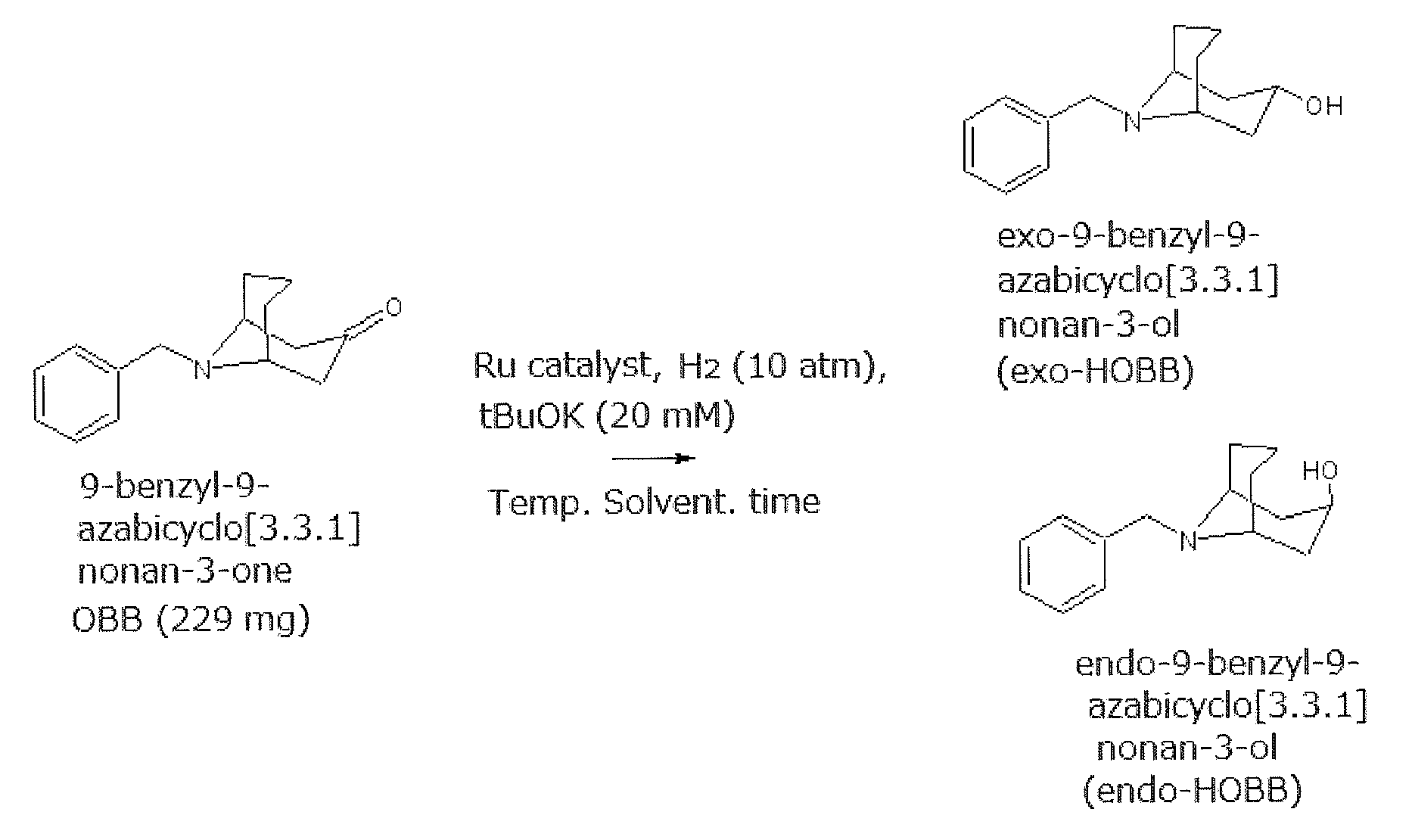
Table 1 No. Ru catalyst Subsrate/ Ru catalyst Solvent Subsrate concentration (M) Reactoin time (hour) Yield (% by area) endo:exo ratio Target product Raw materials 1 RuCl2(PPh3)2(en) 200 IPA 1 16 94 4 98 : 2 2 RuCl2(PPh3)2(en) 200 IPA/ toluene (1:1) 1 16 84 13 98 : 2 3 RuCl2(PPh3)2(en) 200 IPA/ DMA (1:1) 1 16 81 16 98 : 2 4 RuCl2(biphep)(en) 200 IPA 1 16 2 97 98 : 2 5 RuCl2(PPh3)2(dmen) 200 IPA 1 16 12 87 91 : 9 6 RuCl2)2(PPh3)2(en) 200 IPA/ t-BuOH (3:1) 1 64 93 5 98 : 2 7* RuCl2(PPh3)2(en) 200 IPA 1 16 88 11 96 : 4 8 trans-RuCl2(PPh3)2(pica) 200 IPA 1 64 98 1 95:5 9 cis-RuCl2(PPh3)2(pica) 200 IPA 1 64 98 1 89 : 11 10 Rucy™ 200 IPA 0.5 2 96 4 99.8 : 0.2 11 Rucy™ 1000 IPA 0.5 16 89 11 99.4 : 0.6 12 Rucy™ 1000 IPA/ toluene (1:1) 1 16 66 34 98.9 :1.1 13 Rucy™ 1000 IPA/ methanol (1:1) 1 16 99 16 99.4 : 0-6 Table 2 No. Ru catalyst Subsrate/ Ru catalyst Solvent Subsrate concentration (M) Reation time (hour) Yield (% by area) endo:exo ratio Target product Raw materials 14 RuCl2[(S)-binap][(R)-iphan] 200 IPA 1 64 99.6 0 99 : 1 15 RuCl2[biphep][(S)-ipban] 200 IPA 1 16 99 1 98 : 2 16 RuCI2[(S)-binap][(R)-dmapen] 200 IPA 1 16 88 12 95 : 5 17 RuCl2(Ph2PCH2CH2NH2)2 200 IPA 1 3 99 1 96 : 4 18 RuCl2(tBu2PCH2CH2NH2)2 200 IPA 1 3 5 95 63 :37 19 RuCl2(Ph2PCH2CH2CH2NH2)2 200 IPA 1 3 93 7 98 : 2 20 RuCl2[biphep][pica] 200 IPA 1 3 99 1 98 : 2 21 RuCl2[biphep][aep] 200 IPA 1 3 99 1 96 :4 22 trans-RuCl2[b[phep][ammp] 200 IPA 1 3 99 1 99 : 1 23 RuCl2[dppb][ampm] 200 IPA 1 3 99 1 98 : 2 24 RuCl2(dppb)(ambo) 200 IPA 1 3 58 42 96 : 4 25 RuCl2(dppb)(amtz) 200 IPA 1 3 99 1 85 : 15 - * The reaction in No. 7 was conducted while keeping the temperature at 50°C. Abbreviated terms used in the tables are shown below.
- PPh3: triphenylphosphine
- en: ethylenediamine
- IPA: isopropanol
- DMA: N, N-dimethylacetamide
- biphep: 2, 2'-bis-(diphenylphosphino)-1, 1'-biphenyl
- dmem: N, N-dimethylethylenediamine
- pica: α-picolylamine (see formula (L1))
- Rucy™: complex represented by formula (c) (manufactured by Takasago International Corporation)
-
- binap: 2, 2'-bis-(diphenylphosphino)-1, 1'-binaphthyl
- (R)-iphan: (2R, 3R, 4R, 5R)-3, 4-O-isopropylidenehexane-2,5-diamine
- (S)-ipban: (2S, 3S)-2, 3-O-isopropylidenebutane-1, 4-diamine
- dmapen: 2-dimethylamino-1-phenylethylamine
- aep: 2-(pyridin-2-yl)ethylamine
- ammp: (5-methylpyrazin-2-yl) methanamine (see formula (L3)
- ampm: pyrimidin-2-yl methanamine (see formula (L5))
- ambo: benzoxazol-2-yl methanamine (see formula (L4))
- amtz: thiazol-2-yl methanamine (see formula (L6))
- dppb: 1,4-bis(diphenylphosphino)butane
- A reduction reaction of a 9-benzyl-9-azabicyclo[3.3.1]nonan-3-one was conducted using RuCl2(Ph2PCH2CH2NH2)2 (manufactured by KANATA Ltd.) under the conditions shown in Table 3. The results are shown in Table 3.


Table 3 No. Catalyst Hydrogen pressure (atm) Subsrate/ Ru catalyst Solvent Subsrate concentration (M) Reation time (hour) ) Yield (% by area) endo:exo ratio Target product Raw material 26 RuCh(Ph2PCH2CH2NH2)2 10 1000 IPA 1 16 98 2 968 : 3.2 27 RuCl2(Ph2PCH2CH2NH2)2 50 2000 IPA 1 17 99.6 0.4 97.9 : 2.1 28 RuCl2(Ph2PCH2CH2NH2)2 50 5000 IPA 1 18 99.7 0.3 98.4 : 1.6 - A reduction reaction of OBB was conducted using RuCl2[(S)-binap] [(R)-iphan] under conditions in which the substrate / ruthenium catalyst ratio (S/C) was 1000, and the hydrogen pressure was 50 atm., at room temperature, for 16 hours. The reaction was almost completed, the yield was 99.7 %, and the selectivity of endo:exo = 99.3:0.7 was obtained.

- A reduction reaction of a 9-benzyl-9-azabicyclo[3.3.1]nonan-3-one was conducted under the conditions shown in Table 4. The results are shown in Table 4.

Table 4 No. Catalyst Substrate/ Ru catalyst Solvent Subsrate concentration (M) Reation time (hour) Yield (% by area) endo:exo ratio Target product Raw materials 29 trans-RuCl2[dppb][ammp] 200 IPA 1 3 93 7 70 : 30 30 trans-RuCl2[dppb][ammp] 200 methanol 1 3 99 1 98 : 2 31 trans-RuCl2[dppb][ammp] 200 n-butanol 1 3 99 1 97 : 3 32 trans-RuCl2[dppb][ammp] 1000 n-butanol 1 3 76 24 98 : 2 33 trans-RuCl2[dppb][ammp] 1000 ethanol 1 3 97 3 98.6 : 1.4 34 trans-RuCl2[dppb][ammp] 5000 ethanol 1 19 99 1 98.5 : 1.5 35 cis-RuCl2[dppbl[ammp] 1000 ethanol 1 3 99 1 98.6 : 1.4 36 cis-RuCl2[dppb][ammp] 10000 ethanol 1 19 98 2 98.5 : 1.5 - Abbreviated terms used in the table are shown below.
- ammp: (5-methylpyrazin-2-yl) methanamine (see formula (L3))
- dppb: 1, 4-bis(diphenylphosphino)butane
- A reduction reaction of a 9-benzyl-9-azabicyclo[3.3.1]nonan-3-one was conducted using a cis-RuCl2[dppb][Me-bima] under the conditions shown in Table 5. The results are shown in Table 5.
Table 5 No. Catalyst Subsrate/ Ru catalyst Solvent Subsrate concentration (M) Reation time (hour) Yield (% by area) endo:exo ratio Target product Raw materials 37 cis-RuCl2[dppb][Me-bima] 200 ethanol 1 3 2 98 98 : 2 38 cis-RuCl2[dppb][Me-bima] 200 ethanol 1 3 99 1 99.1 : 0.9 39 cis-RuCl2[dppb][Me-bima] 200 IPA 1 3 99 1 78 : 22 40 cis-RuCl2[dppb][Me-bima] 200 n-bntannl 1 3 99 1 99 : 1 41 cis-RuCl2[dppb][Me-bima] 200 toluene 1 3 96 4 50 : 50 42 cis-RuCl2[dppb][W-bima] 5000 n-butanol 1 19 99 1 99 : 1 43 cis-RuCl2[dppb][Me-bima] 10000 n-butanol 1 19 96 4 99 : 1 - Abbreviated terms used in the table are shown below.
- Me-bima: (1-methyl-1H-benzimidazol-2-yl)methanamine (see formula (L2))
- dppb: 1,4-bis(diphenylphosphino)butane
- A reduction reaction of a 9-azabicyclo[3.3.1]nonan-3-one was conducted using a cis-RuCl2(dppb)(ammp) or a cis-RuCl2(Me-bima) under the conditions shown in Table 6. The results are shown in Table 6.

Table 6 No. Catalyst Subsrate/ Ru catalyst Solvent Substrate concentration (M) Reactoin time (hour) Yield (% by area) endo:exo ratio Target product 44 cis-RuCl2(dppb)(ammp) 1000 ethanol 1 3 99 96.5 : 3.5 45 cis-RuCl2[dppb][Me-bima] 1000 n-butanol 1 3 99 >99 : 1 46 cis-RuCl2[dppb][Me-bima] 5000 n-butanol 1 17 99 >99 : 1 47 cis-RuCl2[dppb][Me-bima] 10000 n-butanol 1 17 99 >99 : 1 - Abbreviated terms used in the table are shown below.
- ammp: 2-aminomethyl-5-methylpyrazine (see formula (L3))
- Me-bima: (1-methyl-1H-benzimidazol-2-yl)methanamine (see formula (L2))
- dppb: 1, 4-bis(diphenylphosphino)butane
- 229 mg of OBB was dissolved in a solution composed of an ethanol solvent, a RuCl2(dppb)(ampz) catalyst, and 20 mM of potassium t-butoxide. The catalyst was used so that the substrate / catalyst ratio became 1000. The term "ampz" means (pyrazin-2-yl)methanamine (see formula (L7)).
- The temperature of the solution was kept at 30°C, a hydrogen gas at 10 atm. (gauge pressure) was injected into the solution, and the reduction reaction was conducted for 3 hours. 94.5% of HOBB was yielded, and 5.5% of the raw materials were remained. The exo / endo ratio in the resultants were 1.8 / 98.2.
- An endo-9-azabicyclo[3.3.1]nonan-3-ol derivative, useful as a production intermediate for agrochemical agents such as miticides or medicines, is selectively provided at a low cost by reacting a 9-azabicyclo[3.3.1]nonan-3-one derivative with a hydrogen in the presence of a catalyst composed of a ruthenium complex.
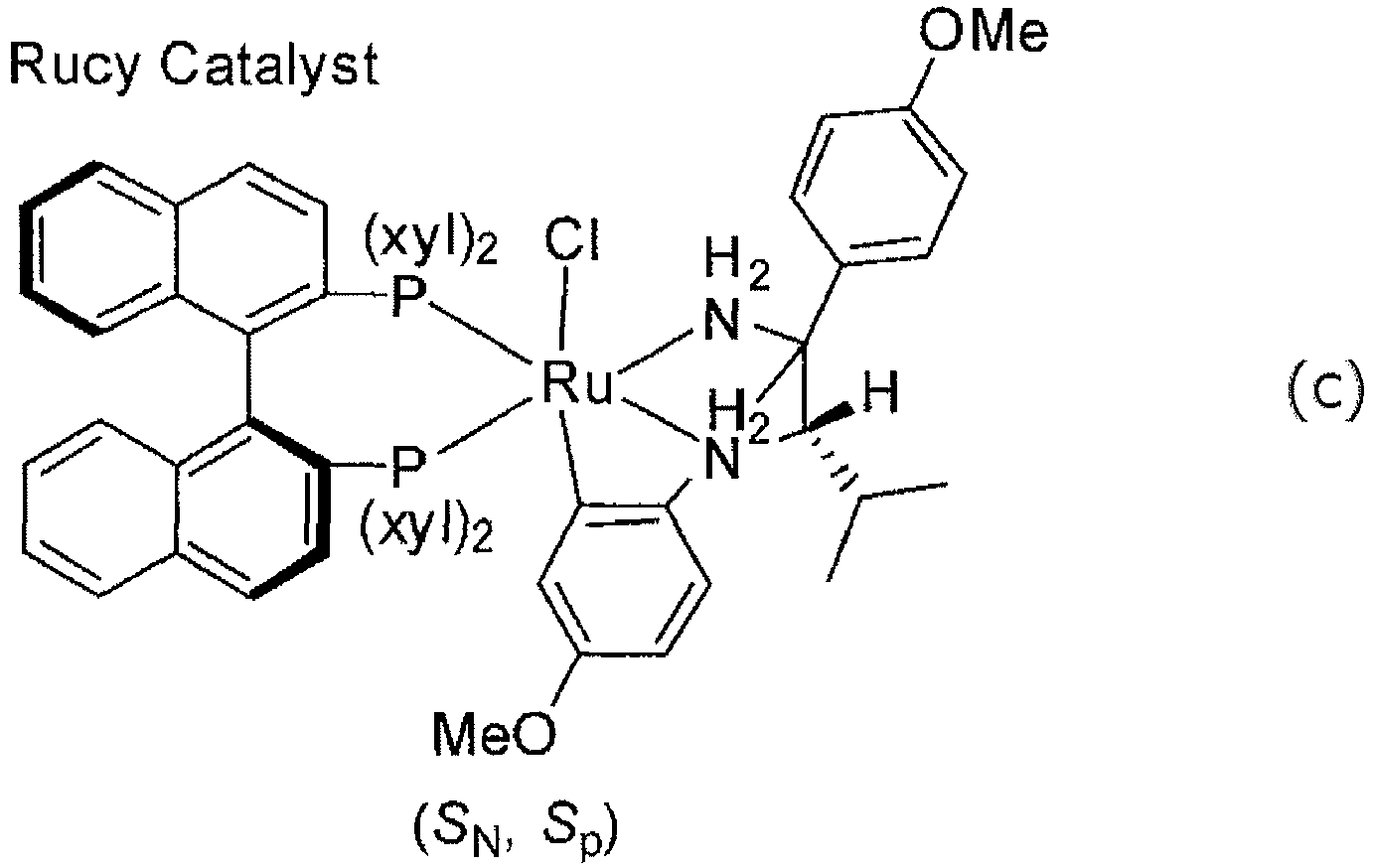
Claims (6)
- A method for producing a compound represented by formula (II), comprising reacting a compound represented by formula (I) with a hydrogen in a presence of a catalyst consisting of a ruthenium complex:


- The method according to Claim 1, wherein the ruthenium complex is a compound represented by the following formula: Ru(X)(Y)(Px)n(L) or Ru(X)(Y)(PN)2,
in the formulae, X and Y each independently represents an anionic ligand,
Px represents a phosphine ligand, n represents 1 or 2,
L represents a ligand represented by the following formula (III) or a diamine ligand, and
PN represents a ligand represented by the following formula (IV):
 in the formulae, R1 and R2 each independently represents a hydrogen atom, an unsubstituted or substituted alkyl group, an unsubstituted or substituted aryl group, or an unsubstituted or substituted aralkyl group,a ring B represents an unsubstituted or substituted hetero ring,a double line portion consisting of a continuous line and a dotted line represents a single bond or a double bond,Z represents a coordinating atom selected from the group consisting of N, P, O, and S,R3 and R4 each independently represents an unsubstituted or substituted alkyl group, an unsubstituted or substituted aryl group, or an unsubstituted or substituted aralkyl group, andA represents an unsubstituted or substituted C1 to 4 alkylene group.
 - The method according to Claim 2, wherein the ruthenium complex is a compound represented by the formula: Ru(X)(Y)(Px)n(L), and L represents a pyridin-2-yl methanamine, a (1-methyl-1H-benzimidazol-2-yl)methanamine, a (5-methylpyrazin-2-yl) methanamine, a benzoxazol-2-yl methanamine, a pyrimidin-2-yl methanamine, a thiazol-2-yl methanamine, or a (pyrazin-2-yl)methanamine.
- The method according to Claim 2, wherein the ruthenium complex is a compound represented by the formula: Ru(X)(Y)(Px)n(L), and L represents a diamine ligand represented by the following formula (VI);

- The method according to Claim 2, wherein the ruthenium complex is a compound represented by the formula: Ru(X)(Y)(PN)2, and PN represents a ligand represented by the following formula (V):

- The method according to any one of Claims 1 to 5, wherein, in the formulae (I) and (II), R represents an unsubstituted or substituted aralkyl group, and the unsubstituted or substituted aralkyl group is a benzyl group.
Applications Claiming Priority (2)
| Application Number | Priority Date | Filing Date | Title |
|---|---|---|---|
| JP2013185712 | 2013-09-06 | ||
| PCT/JP2014/071434 WO2015033753A1 (en) | 2013-09-06 | 2014-08-14 | Method for producing endo-9-azabicyclo[3.3.1]nonane-3-ol derivative |
Publications (3)
| Publication Number | Publication Date |
|---|---|
| EP3042902A1 true EP3042902A1 (en) | 2016-07-13 |
| EP3042902A4 EP3042902A4 (en) | 2017-01-18 |
| EP3042902B1 EP3042902B1 (en) | 2018-10-10 |
Family
ID=52628233
Family Applications (1)
| Application Number | Title | Priority Date | Filing Date |
|---|---|---|---|
| EP14841494.9A Active EP3042902B1 (en) | 2013-09-06 | 2014-08-14 | Method for producing endo-9-azabicyclo[3.3.1]nonan-3-ol derivative |
Country Status (9)
| Country | Link |
|---|---|
| US (1) | US9896451B2 (en) |
| EP (1) | EP3042902B1 (en) |
| JP (1) | JP6197203B2 (en) |
| KR (1) | KR101846751B1 (en) |
| CN (2) | CN105492442A (en) |
| AU (1) | AU2014316384B2 (en) |
| IL (1) | IL243764B (en) |
| RU (1) | RU2639150C2 (en) |
| WO (1) | WO2015033753A1 (en) |
Families Citing this family (2)
| Publication number | Priority date | Publication date | Assignee | Title |
|---|---|---|---|---|
| CN112675920B (en) * | 2020-12-24 | 2022-12-20 | 南方科技大学 | A class of monochiral center catalysts and methods for preparing and catalytically synthesizing chiral alcohol compounds and chiral α-allyl alcohols |
| CN117069956B (en) * | 2023-08-22 | 2025-04-08 | 南京科技职业学院 | Chiral phosphine nickel (II) complex with one-dimensional supermolecular structure, and preparation method and application thereof |
Family Cites Families (12)
| Publication number | Priority date | Publication date | Assignee | Title |
|---|---|---|---|---|
| EP1057819A4 (en) | 1998-02-19 | 2003-02-05 | Eisai Co Ltd | Phthalazine derivatives and remedies for erectile dysfunction |
| TW200502222A (en) | 2003-04-02 | 2005-01-16 | Novartis Ag | Use of 10-hydroxy-10,11-dihydrocarbamazepine derivatives for the treatment of affective disorders |
| ITPD20040115A1 (en) | 2004-05-04 | 2004-08-04 | Univ Degli Studi Udine | RUTHENIUM COMPLEXES WITH 2- (AMINOMETHYL) PYRIDINS AND PHOSPHINS, THEIR PREPARATION AND USE AS CATALYSTS |
| EP1868964B1 (en) | 2005-04-05 | 2016-11-23 | Firmenich Sa | Hydrogenation of esters with ru/bidentate ligands complexes |
| GB0515690D0 (en) | 2005-07-29 | 2005-09-07 | Portela & Ca Sa | Asymmetric catalytic reduction |
| TW200745101A (en) | 2005-09-30 | 2007-12-16 | Organon Nv | 9-Azabicyclo[3.3.1]nonane derivatives |
| EP2173695A4 (en) | 2007-07-06 | 2012-05-30 | Kanata Chemical Technologies Inc | Method for the preparation of cis-4-tert-butylcyclohexanol |
| CN101796050B (en) | 2007-09-06 | 2015-08-12 | 日本曹达株式会社 | The manufacture method of optical activity 3-quinuclidinol derivatives |
| EP2242754A1 (en) | 2008-02-05 | 2010-10-27 | NeuroSearch A/S | Novel 9-aza-bicyclo[3.3.1]non-3-yloxy chromen-2-one derivatives and their use as monoamine neurotransmitter re-uptake inhibitors |
| EP2415741A4 (en) | 2009-03-31 | 2015-03-18 | Sumitomo Chemical Co | PROCESS FOR PRODUCING ALCOHOL COMPOUND |
| US9255049B2 (en) | 2011-04-06 | 2016-02-09 | Takasago International Corporation | Ruthenium complex and method for preparing optically active alcohol compounds using the same as a catalyst |
| WO2013010275A1 (en) | 2011-07-18 | 2013-01-24 | The Governors Of The University Of Alberta | Catalysts and processes for the hydrogenation of amides |
-
2014
- 2014-08-14 EP EP14841494.9A patent/EP3042902B1/en active Active
- 2014-08-14 CN CN201480046919.2A patent/CN105492442A/en active Pending
- 2014-08-14 AU AU2014316384A patent/AU2014316384B2/en active Active
- 2014-08-14 CN CN201910066486.1A patent/CN109912586A/en active Pending
- 2014-08-14 RU RU2016106368A patent/RU2639150C2/en active
- 2014-08-14 JP JP2015535403A patent/JP6197203B2/en active Active
- 2014-08-14 US US14/913,736 patent/US9896451B2/en active Active
- 2014-08-14 KR KR1020167002503A patent/KR101846751B1/en active Active
- 2014-08-14 WO PCT/JP2014/071434 patent/WO2015033753A1/en not_active Ceased
-
2016
- 2016-01-25 IL IL243764A patent/IL243764B/en active IP Right Grant
Non-Patent Citations (1)
| Title |
|---|
| See references of WO2015033753A1 * |
Also Published As
| Publication number | Publication date |
|---|---|
| KR20160025025A (en) | 2016-03-07 |
| JPWO2015033753A1 (en) | 2017-03-02 |
| WO2015033753A1 (en) | 2015-03-12 |
| IL243764B (en) | 2018-10-31 |
| EP3042902A4 (en) | 2017-01-18 |
| RU2016106368A (en) | 2017-10-11 |
| CN105492442A (en) | 2016-04-13 |
| EP3042902B1 (en) | 2018-10-10 |
| JP6197203B2 (en) | 2017-09-20 |
| US9896451B2 (en) | 2018-02-20 |
| KR101846751B1 (en) | 2018-04-06 |
| CN109912586A (en) | 2019-06-21 |
| RU2639150C2 (en) | 2017-12-20 |
| AU2014316384B2 (en) | 2016-11-17 |
| AU2014316384A1 (en) | 2016-02-18 |
| IL243764A0 (en) | 2016-04-21 |
| US20160200726A1 (en) | 2016-07-14 |
Similar Documents
| Publication | Publication Date | Title |
|---|---|---|
| Vock et al. | Synthesis, characterization, and in vitro evaluation of novel ruthenium (II) η6-arene imidazole complexes | |
| US8980875B2 (en) | Platinum-N-heterocyclic carbene derivatives, preparation thereof and therapeutic use thereof | |
| EP3174858B1 (en) | Process for preparing pyrazoles | |
| Thangavel et al. | Synthesis, characterization, antiproliferative and molecular docking study of new half sandwich Ir (III), Rh (III) and Ru (II) complexes | |
| CN108727295B (en) | 2- (3-aminophenyl) -benzothiazole derivative and preparation method and application thereof | |
| US9896451B2 (en) | Method for producing endo-9-azabicyclo[3.3.1]nonan-3-ol derivative | |
| US9255049B2 (en) | Ruthenium complex and method for preparing optically active alcohol compounds using the same as a catalyst | |
| US8207379B2 (en) | Ruthenium compound and method for producing optically active aminoalcohol compound | |
| Pérez-Ramos et al. | Coordination of azol (in) ium dithiocarboxylate ligands to Au (iii): unexpected formation of a novel family of cyclometallated Au (iii) complexes, DFT calculations and catalytic studies | |
| KR101834228B1 (en) | Indolo-1,2-Benzothiazine derivatives and its preparation method | |
| WO2017025987A1 (en) | Process for the preparation of brexpiprazole | |
| KR101614887B1 (en) | Method for preparation of amide and imide from alcohol and nitrogen Containing Compound | |
| US9822071B2 (en) | Anticancer miliusane lactams | |
| JP6388803B2 (en) | Ruthenium complex | |
| US9695141B2 (en) | Anticancer miliusane derivatives | |
| CN105037428B (en) | A kind of preparation method of coumarin-3-phosphonate derivative | |
| US20100292465A1 (en) | Catalysts containing n-heterocyclic carbenes for enantioselective synthesis | |
| US6001872A (en) | Water soluble transplatinum complexes with anti-cancer activity and method of using same | |
| WO2009095712A2 (en) | Chemical compounds | |
| Tian et al. | Synthesis and anticancer activity of diam (m) ine platinum (II) complexes with 3-oxo-cyclobutane-1, 1-dicarboxylate as the leaving group | |
| CN107043364B (en) | Oxacalix[4]arene derivatives and their applications | |
| US12358905B2 (en) | Methods for making thiazolypyrazole carboxylic acids and intermediates therefor | |
| Kumar et al. | Synthesis and Anti Cancer Activity of Pyrido [2, 3-c] Pyridazine Derivatives | |
| US20130190510A1 (en) | Neutral Tricoordinate Organoboron Derivatives Isoelectronic with Amines and Phosphines | |
| Mikata et al. | Copper (II) and zinc (II) complexes with C-glycoside-pendant dipicolylamine (DPA)-amino acid conjugates |
Legal Events
| Date | Code | Title | Description |
|---|---|---|---|
| PUAI | Public reference made under article 153(3) epc to a published international application that has entered the european phase |
Free format text: ORIGINAL CODE: 0009012 |
|
| 17P | Request for examination filed |
Effective date: 20160201 |
|
| AK | Designated contracting states |
Kind code of ref document: A1 Designated state(s): AL AT BE BG CH CY CZ DE DK EE ES FI FR GB GR HR HU IE IS IT LI LT LU LV MC MK MT NL NO PL PT RO RS SE SI SK SM TR |
|
| AX | Request for extension of the european patent |
Extension state: BA ME |
|
| DAX | Request for extension of the european patent (deleted) | ||
| A4 | Supplementary search report drawn up and despatched |
Effective date: 20161221 |
|
| RIC1 | Information provided on ipc code assigned before grant |
Ipc: C07D 451/14 20060101AFI20161215BHEP Ipc: B01J 31/24 20060101ALI20161215BHEP Ipc: B01J 31/18 20060101ALI20161215BHEP Ipc: C07B 53/00 20060101ALI20161215BHEP Ipc: C07B 61/00 20060101ALI20161215BHEP |
|
| STAA | Information on the status of an ep patent application or granted ep patent |
Free format text: STATUS: EXAMINATION IS IN PROGRESS |
|
| 17Q | First examination report despatched |
Effective date: 20171019 |
|
| REG | Reference to a national code |
Ref country code: DE Ref legal event code: R079 Ref document number: 602014034025 Country of ref document: DE Free format text: PREVIOUS MAIN CLASS: C07D0451140000 Ipc: B01J0031240000 |
|
| RIC1 | Information provided on ipc code assigned before grant |
Ipc: B01J 31/18 20060101ALI20180109BHEP Ipc: C07B 53/00 20060101ALI20180109BHEP Ipc: B01J 31/24 20060101AFI20180109BHEP Ipc: C07D 471/08 20060101ALI20180109BHEP Ipc: C07B 61/00 20060101ALI20180109BHEP Ipc: C07D 451/14 20060101ALI20180109BHEP |
|
| GRAP | Despatch of communication of intention to grant a patent |
Free format text: ORIGINAL CODE: EPIDOSNIGR1 |
|
| STAA | Information on the status of an ep patent application or granted ep patent |
Free format text: STATUS: GRANT OF PATENT IS INTENDED |
|
| INTG | Intention to grant announced |
Effective date: 20180306 |
|
| GRAS | Grant fee paid |
Free format text: ORIGINAL CODE: EPIDOSNIGR3 |
|
| RIN1 | Information on inventor provided before grant (corrected) |
Inventor name: OOOKA, HIROHITO Inventor name: INOUE, TSUTOMU Inventor name: AKASHI, MASAYA |
|
| GRAA | (expected) grant |
Free format text: ORIGINAL CODE: 0009210 |
|
| STAA | Information on the status of an ep patent application or granted ep patent |
Free format text: STATUS: THE PATENT HAS BEEN GRANTED |
|
| AK | Designated contracting states |
Kind code of ref document: B1 Designated state(s): AL AT BE BG CH CY CZ DE DK EE ES FI FR GB GR HR HU IE IS IT LI LT LU LV MC MK MT NL NO PL PT RO RS SE SI SK SM TR |
|
| REG | Reference to a national code |
Ref country code: GB Ref legal event code: FG4D |
|
| REG | Reference to a national code |
Ref country code: CH Ref legal event code: EP Ref country code: AT Ref legal event code: REF Ref document number: 1050602 Country of ref document: AT Kind code of ref document: T Effective date: 20181015 |
|
| REG | Reference to a national code |
Ref country code: IE Ref legal event code: FG4D Ref country code: DE Ref legal event code: R096 Ref document number: 602014034025 Country of ref document: DE |
|
| REG | Reference to a national code |
Ref country code: CH Ref legal event code: NV Representative=s name: VALIPAT S.A. GEVERS SA, CH |
|
| REG | Reference to a national code |
Ref country code: NL Ref legal event code: MP Effective date: 20181010 |
|
| REG | Reference to a national code |
Ref country code: LT Ref legal event code: MG4D |
|
| REG | Reference to a national code |
Ref country code: AT Ref legal event code: MK05 Ref document number: 1050602 Country of ref document: AT Kind code of ref document: T Effective date: 20181010 |
|
| PG25 | Lapsed in a contracting state [announced via postgrant information from national office to epo] |
Ref country code: NL Free format text: LAPSE BECAUSE OF FAILURE TO SUBMIT A TRANSLATION OF THE DESCRIPTION OR TO PAY THE FEE WITHIN THE PRESCRIBED TIME-LIMIT Effective date: 20181010 |
|
| REG | Reference to a national code |
Ref country code: CH Ref legal event code: PCAR Free format text: NEW ADDRESS: RUE DES NOYERS 11, 2000 NEUCHATEL (CH) |
|
| PG25 | Lapsed in a contracting state [announced via postgrant information from national office to epo] |
Ref country code: PL Free format text: LAPSE BECAUSE OF FAILURE TO SUBMIT A TRANSLATION OF THE DESCRIPTION OR TO PAY THE FEE WITHIN THE PRESCRIBED TIME-LIMIT Effective date: 20181010 Ref country code: LT Free format text: LAPSE BECAUSE OF FAILURE TO SUBMIT A TRANSLATION OF THE DESCRIPTION OR TO PAY THE FEE WITHIN THE PRESCRIBED TIME-LIMIT Effective date: 20181010 Ref country code: NO Free format text: LAPSE BECAUSE OF FAILURE TO SUBMIT A TRANSLATION OF THE DESCRIPTION OR TO PAY THE FEE WITHIN THE PRESCRIBED TIME-LIMIT Effective date: 20190110 Ref country code: AT Free format text: LAPSE BECAUSE OF FAILURE TO SUBMIT A TRANSLATION OF THE DESCRIPTION OR TO PAY THE FEE WITHIN THE PRESCRIBED TIME-LIMIT Effective date: 20181010 Ref country code: BG Free format text: LAPSE BECAUSE OF FAILURE TO SUBMIT A TRANSLATION OF THE DESCRIPTION OR TO PAY THE FEE WITHIN THE PRESCRIBED TIME-LIMIT Effective date: 20190110 Ref country code: HR Free format text: LAPSE BECAUSE OF FAILURE TO SUBMIT A TRANSLATION OF THE DESCRIPTION OR TO PAY THE FEE WITHIN THE PRESCRIBED TIME-LIMIT Effective date: 20181010 Ref country code: FI Free format text: LAPSE BECAUSE OF FAILURE TO SUBMIT A TRANSLATION OF THE DESCRIPTION OR TO PAY THE FEE WITHIN THE PRESCRIBED TIME-LIMIT Effective date: 20181010 Ref country code: IS Free format text: LAPSE BECAUSE OF FAILURE TO SUBMIT A TRANSLATION OF THE DESCRIPTION OR TO PAY THE FEE WITHIN THE PRESCRIBED TIME-LIMIT Effective date: 20190210 Ref country code: ES Free format text: LAPSE BECAUSE OF FAILURE TO SUBMIT A TRANSLATION OF THE DESCRIPTION OR TO PAY THE FEE WITHIN THE PRESCRIBED TIME-LIMIT Effective date: 20181010 |
|
| PG25 | Lapsed in a contracting state [announced via postgrant information from national office to epo] |
Ref country code: GR Free format text: LAPSE BECAUSE OF FAILURE TO SUBMIT A TRANSLATION OF THE DESCRIPTION OR TO PAY THE FEE WITHIN THE PRESCRIBED TIME-LIMIT Effective date: 20190111 Ref country code: PT Free format text: LAPSE BECAUSE OF FAILURE TO SUBMIT A TRANSLATION OF THE DESCRIPTION OR TO PAY THE FEE WITHIN THE PRESCRIBED TIME-LIMIT Effective date: 20190210 Ref country code: RS Free format text: LAPSE BECAUSE OF FAILURE TO SUBMIT A TRANSLATION OF THE DESCRIPTION OR TO PAY THE FEE WITHIN THE PRESCRIBED TIME-LIMIT Effective date: 20181010 Ref country code: SE Free format text: LAPSE BECAUSE OF FAILURE TO SUBMIT A TRANSLATION OF THE DESCRIPTION OR TO PAY THE FEE WITHIN THE PRESCRIBED TIME-LIMIT Effective date: 20181010 Ref country code: AL Free format text: LAPSE BECAUSE OF FAILURE TO SUBMIT A TRANSLATION OF THE DESCRIPTION OR TO PAY THE FEE WITHIN THE PRESCRIBED TIME-LIMIT Effective date: 20181010 |
|
| REG | Reference to a national code |
Ref country code: DE Ref legal event code: R097 Ref document number: 602014034025 Country of ref document: DE |
|
| PG25 | Lapsed in a contracting state [announced via postgrant information from national office to epo] |
Ref country code: DK Free format text: LAPSE BECAUSE OF FAILURE TO SUBMIT A TRANSLATION OF THE DESCRIPTION OR TO PAY THE FEE WITHIN THE PRESCRIBED TIME-LIMIT Effective date: 20181010 Ref country code: IT Free format text: LAPSE BECAUSE OF FAILURE TO SUBMIT A TRANSLATION OF THE DESCRIPTION OR TO PAY THE FEE WITHIN THE PRESCRIBED TIME-LIMIT Effective date: 20181010 |
|
| PLBE | No opposition filed within time limit |
Free format text: ORIGINAL CODE: 0009261 |
|
| STAA | Information on the status of an ep patent application or granted ep patent |
Free format text: STATUS: NO OPPOSITION FILED WITHIN TIME LIMIT |
|
| PG25 | Lapsed in a contracting state [announced via postgrant information from national office to epo] |
Ref country code: SK Free format text: LAPSE BECAUSE OF FAILURE TO SUBMIT A TRANSLATION OF THE DESCRIPTION OR TO PAY THE FEE WITHIN THE PRESCRIBED TIME-LIMIT Effective date: 20181010 Ref country code: SM Free format text: LAPSE BECAUSE OF FAILURE TO SUBMIT A TRANSLATION OF THE DESCRIPTION OR TO PAY THE FEE WITHIN THE PRESCRIBED TIME-LIMIT Effective date: 20181010 Ref country code: EE Free format text: LAPSE BECAUSE OF FAILURE TO SUBMIT A TRANSLATION OF THE DESCRIPTION OR TO PAY THE FEE WITHIN THE PRESCRIBED TIME-LIMIT Effective date: 20181010 Ref country code: RO Free format text: LAPSE BECAUSE OF FAILURE TO SUBMIT A TRANSLATION OF THE DESCRIPTION OR TO PAY THE FEE WITHIN THE PRESCRIBED TIME-LIMIT Effective date: 20181010 |
|
| 26N | No opposition filed |
Effective date: 20190711 |
|
| PG25 | Lapsed in a contracting state [announced via postgrant information from national office to epo] |
Ref country code: SI Free format text: LAPSE BECAUSE OF FAILURE TO SUBMIT A TRANSLATION OF THE DESCRIPTION OR TO PAY THE FEE WITHIN THE PRESCRIBED TIME-LIMIT Effective date: 20181010 |
|
| PG25 | Lapsed in a contracting state [announced via postgrant information from national office to epo] |
Ref country code: TR Free format text: LAPSE BECAUSE OF FAILURE TO SUBMIT A TRANSLATION OF THE DESCRIPTION OR TO PAY THE FEE WITHIN THE PRESCRIBED TIME-LIMIT Effective date: 20181010 |
|
| PG25 | Lapsed in a contracting state [announced via postgrant information from national office to epo] |
Ref country code: LU Free format text: LAPSE BECAUSE OF NON-PAYMENT OF DUE FEES Effective date: 20190814 Ref country code: MC Free format text: LAPSE BECAUSE OF FAILURE TO SUBMIT A TRANSLATION OF THE DESCRIPTION OR TO PAY THE FEE WITHIN THE PRESCRIBED TIME-LIMIT Effective date: 20181010 |
|
| REG | Reference to a national code |
Ref country code: BE Ref legal event code: MM Effective date: 20190831 |
|
| PG25 | Lapsed in a contracting state [announced via postgrant information from national office to epo] |
Ref country code: IE Free format text: LAPSE BECAUSE OF NON-PAYMENT OF DUE FEES Effective date: 20190814 |
|
| PG25 | Lapsed in a contracting state [announced via postgrant information from national office to epo] |
Ref country code: BE Free format text: LAPSE BECAUSE OF NON-PAYMENT OF DUE FEES Effective date: 20190831 |
|
| PG25 | Lapsed in a contracting state [announced via postgrant information from national office to epo] |
Ref country code: CY Free format text: LAPSE BECAUSE OF FAILURE TO SUBMIT A TRANSLATION OF THE DESCRIPTION OR TO PAY THE FEE WITHIN THE PRESCRIBED TIME-LIMIT Effective date: 20181010 |
|
| PG25 | Lapsed in a contracting state [announced via postgrant information from national office to epo] |
Ref country code: MT Free format text: LAPSE BECAUSE OF FAILURE TO SUBMIT A TRANSLATION OF THE DESCRIPTION OR TO PAY THE FEE WITHIN THE PRESCRIBED TIME-LIMIT Effective date: 20181010 Ref country code: HU Free format text: LAPSE BECAUSE OF FAILURE TO SUBMIT A TRANSLATION OF THE DESCRIPTION OR TO PAY THE FEE WITHIN THE PRESCRIBED TIME-LIMIT; INVALID AB INITIO Effective date: 20140814 |
|
| PG25 | Lapsed in a contracting state [announced via postgrant information from national office to epo] |
Ref country code: MK Free format text: LAPSE BECAUSE OF FAILURE TO SUBMIT A TRANSLATION OF THE DESCRIPTION OR TO PAY THE FEE WITHIN THE PRESCRIBED TIME-LIMIT Effective date: 20181010 |
|
| P01 | Opt-out of the competence of the unified patent court (upc) registered |
Effective date: 20230510 |
|
| PGFP | Annual fee paid to national office [announced via postgrant information from national office to epo] |
Ref country code: DE Payment date: 20250820 Year of fee payment: 12 |
|
| PGFP | Annual fee paid to national office [announced via postgrant information from national office to epo] |
Ref country code: GB Payment date: 20250820 Year of fee payment: 12 |
|
| PGFP | Annual fee paid to national office [announced via postgrant information from national office to epo] |
Ref country code: FR Payment date: 20250829 Year of fee payment: 12 |
|
| PGFP | Annual fee paid to national office [announced via postgrant information from national office to epo] |
Ref country code: CH Payment date: 20250901 Year of fee payment: 12 |
|
| PGFP | Annual fee paid to national office [announced via postgrant information from national office to epo] |
Ref country code: CZ Payment date: 20250806 Year of fee payment: 12 |
|
| PGFP | Annual fee paid to national office [announced via postgrant information from national office to epo] |
Ref country code: LV Payment date: 20250818 Year of fee payment: 12 |