EP3041308A1 - Method and apparatus for assigning radio resources and controlling transmission parameters on a random access channel - Google Patents
Method and apparatus for assigning radio resources and controlling transmission parameters on a random access channel Download PDFInfo
- Publication number
- EP3041308A1 EP3041308A1 EP15197962.2A EP15197962A EP3041308A1 EP 3041308 A1 EP3041308 A1 EP 3041308A1 EP 15197962 A EP15197962 A EP 15197962A EP 3041308 A1 EP3041308 A1 EP 3041308A1
- Authority
- EP
- European Patent Office
- Prior art keywords
- wtru
- prach
- preamble
- enhanced uplink
- random access
- Prior art date
- Legal status (The legal status is an assumption and is not a legal conclusion. Google has not performed a legal analysis and makes no representation as to the accuracy of the status listed.)
- Withdrawn
Links
Images


Classifications
-
- H—ELECTRICITY
- H04—ELECTRIC COMMUNICATION TECHNIQUE
- H04W—WIRELESS COMMUNICATION NETWORKS
- H04W52/00—Power management, e.g. Transmission Power Control [TPC] or power classes
- H04W52/04—Transmission power control [TPC]
- H04W52/06—TPC algorithms
- H04W52/16—Deriving transmission power values from another channel
-
- H—ELECTRICITY
- H04—ELECTRIC COMMUNICATION TECHNIQUE
- H04W—WIRELESS COMMUNICATION NETWORKS
- H04W74/00—Wireless channel access
- H04W74/08—Non-scheduled access, e.g. ALOHA
- H04W74/0833—Random access procedures, e.g. with 4-step access
- H04W74/0838—Random access procedures, e.g. with 4-step access using contention-free random access [CFRA]
-
- H—ELECTRICITY
- H04—ELECTRIC COMMUNICATION TECHNIQUE
- H04W—WIRELESS COMMUNICATION NETWORKS
- H04W72/00—Local resource management
- H04W72/04—Wireless resource allocation
-
- H—ELECTRICITY
- H04—ELECTRIC COMMUNICATION TECHNIQUE
- H04W—WIRELESS COMMUNICATION NETWORKS
- H04W72/00—Local resource management
- H04W72/04—Wireless resource allocation
- H04W72/044—Wireless resource allocation based on the type of the allocated resource
- H04W72/0446—Resources in time domain, e.g. slots or frames
-
- H—ELECTRICITY
- H04—ELECTRIC COMMUNICATION TECHNIQUE
- H04W—WIRELESS COMMUNICATION NETWORKS
- H04W72/00—Local resource management
- H04W72/04—Wireless resource allocation
- H04W72/044—Wireless resource allocation based on the type of the allocated resource
- H04W72/0466—Wireless resource allocation based on the type of the allocated resource the resource being a scrambling code
-
- H—ELECTRICITY
- H04—ELECTRIC COMMUNICATION TECHNIQUE
- H04W—WIRELESS COMMUNICATION NETWORKS
- H04W74/00—Wireless channel access
- H04W74/08—Non-scheduled access, e.g. ALOHA
-
- H—ELECTRICITY
- H04—ELECTRIC COMMUNICATION TECHNIQUE
- H04W—WIRELESS COMMUNICATION NETWORKS
- H04W74/00—Wireless channel access
- H04W74/08—Non-scheduled access, e.g. ALOHA
- H04W74/0866—Non-scheduled access, e.g. ALOHA using a dedicated channel for access
- H04W74/0891—Non-scheduled access, e.g. ALOHA using a dedicated channel for access for synchronized access
-
- H—ELECTRICITY
- H04—ELECTRIC COMMUNICATION TECHNIQUE
- H04W—WIRELESS COMMUNICATION NETWORKS
- H04W28/00—Network traffic management; Network resource management
- H04W28/16—Central resource management; Negotiation of resources or communication parameters, e.g. negotiating bandwidth or QoS [Quality of Service]
- H04W28/18—Negotiating wireless communication parameters
-
- H—ELECTRICITY
- H04—ELECTRIC COMMUNICATION TECHNIQUE
- H04W—WIRELESS COMMUNICATION NETWORKS
- H04W52/00—Power management, e.g. Transmission Power Control [TPC] or power classes
- H04W52/04—Transmission power control [TPC]
- H04W52/18—TPC being performed according to specific parameters
- H04W52/26—TPC being performed according to specific parameters using transmission rate or quality of service QoS [Quality of Service]
- H04W52/267—TPC being performed according to specific parameters using transmission rate or quality of service QoS [Quality of Service] taking into account the information rate
-
- H—ELECTRICITY
- H04—ELECTRIC COMMUNICATION TECHNIQUE
- H04W—WIRELESS COMMUNICATION NETWORKS
- H04W52/00—Power management, e.g. Transmission Power Control [TPC] or power classes
- H04W52/04—Transmission power control [TPC]
- H04W52/30—Transmission power control [TPC] using constraints in the total amount of available transmission power
- H04W52/32—TPC of broadcast or control channels
- H04W52/322—Power control of broadcast channels
-
- H—ELECTRICITY
- H04—ELECTRIC COMMUNICATION TECHNIQUE
- H04W—WIRELESS COMMUNICATION NETWORKS
- H04W52/00—Power management, e.g. Transmission Power Control [TPC] or power classes
- H04W52/04—Transmission power control [TPC]
- H04W52/30—Transmission power control [TPC] using constraints in the total amount of available transmission power
- H04W52/36—Transmission power control [TPC] using constraints in the total amount of available transmission power with a discrete range or set of values, e.g. step size, ramping or offsets
- H04W52/367—Power values between minimum and maximum limits, e.g. dynamic range
-
- H—ELECTRICITY
- H04—ELECTRIC COMMUNICATION TECHNIQUE
- H04W—WIRELESS COMMUNICATION NETWORKS
- H04W74/00—Wireless channel access
- H04W74/08—Non-scheduled access, e.g. ALOHA
- H04W74/0833—Random access procedures, e.g. with 4-step access
-
- Y—GENERAL TAGGING OF NEW TECHNOLOGICAL DEVELOPMENTS; GENERAL TAGGING OF CROSS-SECTIONAL TECHNOLOGIES SPANNING OVER SEVERAL SECTIONS OF THE IPC; TECHNICAL SUBJECTS COVERED BY FORMER USPC CROSS-REFERENCE ART COLLECTIONS [XRACs] AND DIGESTS
- Y02—TECHNOLOGIES OR APPLICATIONS FOR MITIGATION OR ADAPTATION AGAINST CLIMATE CHANGE
- Y02D—CLIMATE CHANGE MITIGATION TECHNOLOGIES IN INFORMATION AND COMMUNICATION TECHNOLOGIES [ICT], I.E. INFORMATION AND COMMUNICATION TECHNOLOGIES AIMING AT THE REDUCTION OF THEIR OWN ENERGY USE
- Y02D30/00—Reducing energy consumption in communication networks
- Y02D30/70—Reducing energy consumption in communication networks in wireless communication networks
Definitions
- the present invention is related to wireless communications.
- the Random Access Channel is an uplink (UL) transport channel that is used for transfer of data and/or control information in the absence of a dedicated radio link.
- the RACH is mapped to the physical random access channel (PRACH).
- a wireless transmit-receive unit is based on a slotted-Aloha approach, with acquisition indication received from a radio access network (RAN).
- the WTRU must first acquire the channel by transmitting a preamble, which comprises a signature sequence that is randomly selected among a set of predetermined sequences.
- the transmit power of the initial preamble is determined by open loop power control, with parameters determined and broadcast by the RAN.
- the WTRU then waits for an acquisition indication from a Node B, which is signaled in the Downlink (DL) on the Acquisition Indicator Channel (AICH).
- AICH Acquisition Indicator Channel
- the Node B detects the PRACH preamble associated with RACH attempt, it echoes on the AICH an identical signature sequence to indicate to the WTRU to transmit over PRACH.
- the WTRU increases its transmission power by a predetermined amount and retransmits the preamble in the next available transmission slot. The process is repeated until the AICH is detected by the WTRU, or until a maximum number of preamble transmissions is reached. If a negative acknowledgement is received or the maximum number of transmissions is reached, RACH access has failed and a backoff procedure is performed at the medium access (MAC) layer.
- MAC medium access
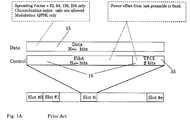
- the WTRU transmits the PRACH frame, which consists of a control part 10 and data part 15 as shown in Figure 1A .
- the preamble and AICH procedure provide a way to for the WTRU to reserve the RACH as well as determine the right power for transmission.
- the power of the control part 10 is set with a fixed offset from the power of the last transmitted preamble.
- the transmission power of the data part 15 is set using a gain factor with respect to the control part, which is determined in the same way as other UL dedicated physical channels.
- the gain factor depends on the spreading factor that is used for the data part.
- Spreading factors 256, 128, 64 and 32 are allowed for the PRACH data part.
- the AICH consists of a sequence of consecutive access slots 20.
- Each access slot consists of two parts, an Acquisition-Indicator (AI) part 25 and a part 30 of duration 1024 chips with no transmission.
- the part of the slot with no transmission 30 is reserved for possible future use.
- the spreading factor (SF) used for channelization of the AICH is 256.
- the transmission rate for RACH/PRACH is limited (single code with spreading factor 32) in existing 3GPP systems.
- One reason for the limitation is to avoid excessive UL interference caused by WTRUs when transmitting high rate bursts over RACH/PRACH.
- WTRU gains RACH access it must independently select the transport format for transmission.
- a method and apparatus for assigning radio resources and controlling parameters for transmission over a contention-based channel that is used by a WRTU to transfer data and/or control information in an uplink to a radio access network (RAN).
- RAN radio access network
- a method and apparatus are disclosed for increasing the rate of data transmission over the channel while limiting any resulting increase of noise.
- a wireless transmit/receive unit includes but is not limited to a user equipment, mobile station, fixed or mobile subscriber unit, pager, or any other type of device capable of operating in a wireless environment.
- a base station includes but is not limited to a Node-B, site controller, access point or any other type of interfacing device in a wireless environment.
- Figure 1B shows a proposed frame format for a physical random access channel (PRACH).
- Figure 1B indicates several methods, not to be considered exhaustive, which may be used individually or in any combination to increase the transmission rate of PRACH frames.
- a first method includes decreasing a spreading factor (SF) used on the data part 17.
- a second method includes increasing the number of channelization codes used for the data part 17.
- a third method includes increasing the order of modulations (e.g. using 8-PSK, 16-QAM, 64-QAM) and variable coding rates (i.e. MSC) for the data part 17.
- the control part of the PRACH frame 12 may be modified to support the higher data rates.
- An increase in the transmission power of the control part is proposed to improve the reliability of the pilot field when high data rates are used.
- Such an increase in achievable rates of RACH/PRACH may result in a significant increase in the number of transport formats (i.e. slot formats) that need to be supported on the Data portion of the PRACH.
- the slot format for the Control part 10 of the existing PRACH only provides two bits in the transport format combination index (TFCI) field 35. This currently limits to four the number of transport formats that can be supported on the Data portion of the PRACH.
- TFCI transport format combination index
- a new slot format is proposed for the control part 12 of the PRACH, shown in Figure 1B .
- this newly defined slot format containing more than two bits in the TFCI field 37, will need to coexist with the former slot format which only provided for two bits in the TFCI field 35.
- the PRACH and an Enhanced-PRACH brings a challenge for a base station to properly decode a PRACH since the base station currently has no means by which it can learn which PRACH type a particular WTRU uses for the control part 10 and data part 15 of its PRACH transmission.
- This backward compatibility issue can be addressed by performing a segregation of the radio resources used by the PRACH in two groups.
- One group is reserved for the PRACH transmissions using the old PRACH format and another group is reserved for the Enhanced PRACH transmissions using the new PRACH format.
- This segregation can be ensured by the RAN through dedicated radio resource channel (RRC) signaling or broadcast RRC signaling.
- RRC radio resource channel
- a first example, illustrated in Figure 5 is segregation in the time slots available for PRACH transmissions.
- the RAN could reserve a certain number of slots for PRACH transmission using a given PRACH format while reserving another set of slots for PRACH transmission using another PRACH slot format.
- Figure 5 illustrates one particular example of segmentation by access slot; other examples are possible.
- a second example is segregation of the scrambling codes used for PRACH transmissions.
- the RAN could reserve a certain number of scrambling codes for PRACH transmission using a given PRACH format (e.g. traditional PRACH) while reserving another set of scrambling codes for PRACH transmission using another PRACH format (e.g. Enhanced PRACH).
- the assignment of scrambling codes may be signaled by higher layers and by RRC broadcast signaling.
- a third example is segregation of signature sequences used in the PRACH preamble.
- the RAN could reserve a certain number of signature sequences for PRACH transmission using a given PRACH format (e.g. traditional PRACH) while reserving another set of signature sequences for PRACH transmission using another PRACH format (e.g. Enhanced PRACH).
- An example of how signature sequences can be segregated is shown in the Table 1, where P0 to P8 are reserved for PRACH and P9 to P15 are reserved for Enhanced PRACH. Note that this is just one realization of segregation by signature sequence; others are possible.
- the RAN may be configured to control the interference generated by the WTRUs. Specifically, the RAN may indicate to the WTRU, prior to WTRU transmission of the PRACH frame, the maximum transmission rate and/or power that can be used for transmitting the PRACH frame. Alternatively, a grant may be pre-configured (e.g. through RRC broadcast signaling) to allow the WTRU to start transmission and, optionally, the grant may be readjusted by the UTRA Network (UTRAN) while the WTRU is transmitting over the Enhanced RACH.
- UTRAN UTRA Network
- the information signaled from the RAN to the WTRU may effectively limit the system impact caused by the PRACH frame, while allowing the WTRU to select the highest transport block size and maximize the efficiency of the RACH access.
- a grant-type signaling mechanism is disclosed, where the RAN indicates to the WTRU the maximum amount of UL resources that can be consumed for transmission of the PRACH frame.
- the following non-exhaustive list of example metrics and parameters is proposed, the metrics to be used individually or in any combination to determine what UL resources should be granted for enhanced PRACH transmission.
- a first example is maximum power ratio, which indicates the maximum power ratio between the enhanced PRACH data part 17 and the control part 12, or the maximum power ratio between the enhanced PRACH data part 17 and the preamble power.
- the maximum power ratio is one possible measure of the transmission power of the WTRU.
- Controlling the power of the WTRU is one way of controlling noise rise or interference caused by the WTRU in the UL. This power control may be performed by the base station.
- a second example of a metric for determining what UL resources should be granted for enhanced PRACH transmission is maximum transmission power, which indicates the maximum total power that the WTRU can use for transmission of the PRACH frame with enhanced data part 17 and control part 12.
- the maximum total power can be determined as an absolute value (e.g. 20 dBm), or as a relative power with respect to the preamble power.
- controlling the power of the WTRU effectively controls the noise rise or interference that is caused by the WTRU in the UL. This power control may be performed by the base station.
- a third example of a metric is maximum RACH transport block size. Determination of this quantity allows the UTRAN to control interference that is generated by the WTRU by controlling the amount of time that the RACH is used.
- a fourth example of a metric is transmission time interval (TTI) size.
- a fifth example of a metric is a maximum amount of time (e.g. number of TTI) the WTRU can transmit.
- the value of the grant may be mapped to an index, where the mapping is known by the WTRU and RAN.
- the mapping may be broadcast by the RAN over BCCH/BCH, configured through higher layer signaling or pre-configured in WTRU devices.
- the control information is conveyed to the WTRU using an existing AICH or similar channel.
- the RAN takes advantage of an acquisition indication that is sent between the preamble and the PRACH frame to indicate to the WTRU the maximum transmission rate.
- a proposed structure of an AICH is shown in Figure 3 .
- the first part 50 of the AICH access slot may have the same meaning as in the existing AICH, whereas the last part 40 which was previously the reserved part 30 contains the control information.
- the number of chips in the above examples may be retained: the first part, or AI part, 50 of the AICH may contain 4096 chips and the second part 40 may contain 1024 chips.
- a sequence of 8 real-valued signals can be transmitted over the 1024 chips.
- a predefined sequence of symbols, e.g. signature sequence, can be defined for each of the control information levels.
- the mapping between symbol sequence and control information index should be known at the RAN and the WTRU; this mapping may be broadcast by the RAN, configured through higher layer signaling or pre-configured.
- the last 1024 chips 40 of the AICH slot can be interpreted as a new bit field (e.g. 4 bits) which contains the index of the control information, where channel coding may be used to increase decoding reliability of the bit field.
- a new bit field e.g. 4 bits
- control grant may be conveying using any of: existing enhanced access gate channel (E-AGCH) and enhanced reverse gate channel (E-RGCH) to indicate "grant" for PRACH frames; the forward access channel (FACH) transport channel or similar channel; and the broadcast control channel (BCCH) logical channel, which is mapped to the broadcast channel (BCH) transport channel.
- E-AGCH enhanced access gate channel
- E-RGCH enhanced reverse gate channel
- BCCH broadcast control channel
- the control information is broadcast throughout the cell and may be either common to all WTRUs using the PRACH, or signaled individually to WTRUs using RACH/PRACH.
- one may use other new or existing physical layer signaling and/or L2 control channel to convey the control grant.
- the RAN may make a decision as to the WTRU maximum transmission rate and/or power for each WTRU that has successfully acquired the RACH through the preamble mechanism. This decision may be made autonomously or be directed by the WTRU.
- the RAN could make this decision independently for each WTRU that has successfully acquired the channel.
- An example of a metric for this is a limit on the UL interference.
- a WTRU may be assigned a higher rate/power but may not need it. The extra assignment to this WTRU would be lost, as no other WTRU could use it.
- the RAN tries to assign the capacity among the WTRUs based on limiting UL interference, while at the same time maximizing the probability that this extra capacity will be used.
- the RAN may require an indication as to the WTRU buffer occupancy. A higher occupancy would imply a higher probability of using the extra capacity.
- the WTRU need only provide a coarse indication of buffer occupancy (e.g. low, medium, high, very high). This information could be signaled during the RACH preamble in several alternative ways. As one example, a trailer may be appended to the preamble message with the buffer occupancy indication. Alternatively, the information may be coded in the preamble signature sequences; that is, reserving a set of signature sequences for each of the buffer occupancy levels.
- Figure 4 is a functional block diagram 300 of a portion of a representative wireless communication system with a WTRU 210 and a Node-B, or base station 220.
- the WTRU 210 and base station 220 are in two-way communication with each other, and are both configured to perform a method such as one of the embodiments described above for increasing a data transmission rate over a random access channel.
- the WTRU 210 includes a processor 215, a receiver 216, a transmitter 217, and an antenna 218.
- the processor 215 is configured to perform a method such as one of the embodiments described above for increasing a data transmission rate over a random access channel.
- the receiver 216 and the transmitter 217 are in communication with the processor 215.
- the antenna 218 is in communication with both the receiver 216 and the transmitter 217 to facilitate the transmission and reception of wireless data.
- the Node-B 220 includes a processor 225, a receiver 226, a transmitter 227, and an antenna 228.
- the processor 225 is configured to perform a method such as one of the embodiments described above for increasing a data transmission rate over a random access channel.
- the receiver 226 and the transmitter 227 are in communication with the processor 225.
- the antenna 228 is in communication with both the receiver 226 and the transmitter 227 to facilitate the transmission and reception of wireless data.
- embodiments may be implemented in a base station, wireless network controller, at the data link layer or the network layer, in the form of software or hardware in a WCDMA FDD or long term evolution (LTE).
- LTE long term evolution
- ROM read only memory
- RAM random access memory
- register cache memory
- semiconductor memory devices magnetic media such as internal hard disks and removable disks, magneto-optical media, and optical media such as CD-ROM disks, and digital versatile disks (DVDs).
- Suitable processors include, by way of example, a general purpose processor, a special purpose processor, a conventional processor, a digital signal processor (DSP), a plurality of microprocessors, one or more microprocessors in association with a DSP core, a controller, a microcontroller, Application Specific Integrated Circuits (ASICs), Field Programmable Gate Arrays (FPGAs) circuits, any other type of integrated circuit (IC), and/or a state machine.
- DSP digital signal processor
- ASICs Application Specific Integrated Circuits
- FPGAs Field Programmable Gate Arrays
- a processor in association with software may be used to implement a radio frequency transceiver for use in a wireless transmit receive unit (WTRU), user equipment (UE), terminal, base station, radio network controller (RNC), or any host computer.
- the WTRU may be used in conjunction with modules, implemented in hardware and/or software, such as a camera, a video camera module, a videophone, a speakerphone, a vibration device, a speaker, a microphone, a television transceiver, a hands free headset, a keyboard, a Bluetooth® module, a frequency modulated (FM) radio unit, a liquid crystal display (LCD) display unit, an organic light-emitting diode (OLED) display unit, a digital music player, a media player, a video game player module, an Internet browser, and/or any wireless local area network (WLAN) module.
- modules implemented in hardware and/or software, such as a camera, a video camera module, a videophone, a speakerphone, a vibration device, a speaker,
Landscapes
- Engineering & Computer Science (AREA)
- Computer Networks & Wireless Communication (AREA)
- Signal Processing (AREA)
- Quality & Reliability (AREA)
- Mobile Radio Communication Systems (AREA)
Abstract
Description
- The present invention is related to wireless communications.
- In 3GPP UMTS (Third Generation Partnership Project Universal Mobile Telecommunication System) wireless systems, the Random Access Channel (RACH) is an uplink (UL) transport channel that is used for transfer of data and/or control information in the absence of a dedicated radio link. The RACH is mapped to the physical random access channel (PRACH).
- Access to the RACH by a wireless transmit-receive unit (WTRU) is based on a slotted-Aloha approach, with acquisition indication received from a radio access network (RAN). The WTRU must first acquire the channel by transmitting a preamble, which comprises a signature sequence that is randomly selected among a set of predetermined sequences. The transmit power of the initial preamble is determined by open loop power control, with parameters determined and broadcast by the RAN.
- The WTRU then waits for an acquisition indication from a Node B, which is signaled in the Downlink (DL) on the Acquisition Indicator Channel (AICH). When the Node B detects the PRACH preamble associated with RACH attempt, it echoes on the AICH an identical signature sequence to indicate to the WTRU to transmit over PRACH.
- In the case where no AICH is detected, the WTRU increases its transmission power by a predetermined amount and retransmits the preamble in the next available transmission slot. The process is repeated until the AICH is detected by the WTRU, or until a maximum number of preamble transmissions is reached. If a negative acknowledgement is received or the maximum number of transmissions is reached, RACH access has failed and a backoff procedure is performed at the medium access (MAC) layer.
- In the case where a positive AICH is transmitted by the Node B, the WTRU transmits the PRACH frame, which consists of a
control part 10 anddata part 15 as shown inFigure 1A . - The preamble and AICH procedure provide a way to for the WTRU to reserve the RACH as well as determine the right power for transmission. The power of the
control part 10 is set with a fixed offset from the power of the last transmitted preamble. The transmission power of thedata part 15 is set using a gain factor with respect to the control part, which is determined in the same way as other UL dedicated physical channels. The gain factor depends on the spreading factor that is used for the data part.Spreading factors 256, 128, 64 and 32 are allowed for the PRACH data part. - Referring to
Figure 2 , the AICH consists of a sequence ofconsecutive access slots 20. Each access slot consists of two parts, an Acquisition-Indicator (AI)part 25 and apart 30 of duration 1024 chips with no transmission. The part of the slot with notransmission 30 is reserved for possible future use. The spreading factor (SF) used for channelization of the AICH is 256. - The transmission rate for RACH/PRACH is limited (single code with spreading factor 32) in existing 3GPP systems. One reason for the limitation is to avoid excessive UL interference caused by WTRUs when transmitting high rate bursts over RACH/PRACH. When a WTRU gains RACH access, it must independently select the transport format for transmission. There is no way for the RAN to dynamically control the transmission rate of WTRUs over RACH/PRACH.
- Disclosed is a method and apparatus for assigning radio resources and controlling parameters for transmission over a contention-based channel that is used by a WRTU to transfer data and/or control information in an uplink to a radio access network (RAN). In one embodiment, a method and apparatus are disclosed for increasing the rate of data transmission over the channel while limiting any resulting increase of noise.
-
-
Figure 1A shows an existing frame format for a physical random access channel (PRACH). -
Figure 1B shows a frame format for a physical random access channel (PRACH) according to the present disclosure. -
Figure 2 shows a frame structure for an existing acquisition indicator channel (AICH). -
Figure 3 shows a structure for an AICH according to the present disclosure. -
Figure 4 is a functional block diagram of a portion of a representative wireless communication system with a WTRU and a Node-B. -
Figure 5 shows a method for distinguishing among different PRACH types according to the present disclosure. - Hereafter, a wireless transmit/receive unit (WTRU) includes but is not limited to a user equipment, mobile station, fixed or mobile subscriber unit, pager, or any other type of device capable of operating in a wireless environment. When referred to hereafter, a base station includes but is not limited to a Node-B, site controller, access point or any other type of interfacing device in a wireless environment.
-
Figure 1B shows a proposed frame format for a physical random access channel (PRACH).Figure 1B indicates several methods, not to be considered exhaustive, which may be used individually or in any combination to increase the transmission rate of PRACH frames. A first method includes decreasing a spreading factor (SF) used on thedata part 17. A second method includes increasing the number of channelization codes used for thedata part 17. A third method includes increasing the order of modulations (e.g. using 8-PSK, 16-QAM, 64-QAM) and variable coding rates (i.e. MSC) for thedata part 17. Optionally, the control part of thePRACH frame 12 may be modified to support the higher data rates. An increase in the transmission power of the control part is proposed to improve the reliability of the pilot field when high data rates are used. Specifically, the power offset between the last preamble and the PRACH control part (Pp-m = Pmessage-control - Ppreamble) may be transmission rate dependant, rather than having a single value. - Such an increase in achievable rates of RACH/PRACH may result in a significant increase in the number of transport formats (i.e. slot formats) that need to be supported on the Data portion of the PRACH. The slot format for the
Control part 10 of the existing PRACH only provides two bits in the transport format combination index (TFCI)field 35. This currently limits to four the number of transport formats that can be supported on the Data portion of the PRACH. To circumvent this limitation, a new slot format is proposed for thecontrol part 12 of the PRACH, shown inFigure 1B . This new slot format may provide more than two bits in theTFCI field 37. For example, having 8 bits in theTFCI field 35 would allow for up to 28= 256 different slot formats on theData portion 17 of the PRACH. - For backward compatibility this newly defined slot format, containing more than two bits in the
TFCI field 37, will need to coexist with the former slot format which only provided for two bits in theTFCI field 35. Having two different PRACH types coexist, the PRACH and an Enhanced-PRACH, brings a challenge for a base station to properly decode a PRACH since the base station currently has no means by which it can learn which PRACH type a particular WTRU uses for thecontrol part 10 anddata part 15 of its PRACH transmission. - This backward compatibility issue can be addressed by performing a segregation of the radio resources used by the PRACH in two groups. One group is reserved for the PRACH transmissions using the old PRACH format and another group is reserved for the Enhanced PRACH transmissions using the new PRACH format. This segregation can be ensured by the RAN through dedicated radio resource channel (RRC) signaling or broadcast RRC signaling. Three examples, not to be considered exhaustive or limiting, follow.
- A first example, illustrated in
Figure 5 , is segregation in the time slots available for PRACH transmissions. The RAN could reserve a certain number of slots for PRACH transmission using a given PRACH format while reserving another set of slots for PRACH transmission using another PRACH slot format.Figure 5 illustrates one particular example of segmentation by access slot; other examples are possible. - A second example is segregation of the scrambling codes used for PRACH transmissions. The RAN could reserve a certain number of scrambling codes for PRACH transmission using a given PRACH format (e.g. traditional PRACH) while reserving another set of scrambling codes for PRACH transmission using another PRACH format (e.g. Enhanced PRACH). The assignment of scrambling codes may be signaled by higher layers and by RRC broadcast signaling.
- A third example is segregation of signature sequences used in the PRACH preamble. The RAN could reserve a certain number of signature sequences for PRACH transmission using a given PRACH format (e.g. traditional PRACH) while reserving another set of signature sequences for PRACH transmission using another PRACH format (e.g. Enhanced PRACH). An example of how signature sequences can be segregated is shown in the Table 1, where P0 to P8 are reserved for PRACH and P9 to P15 are reserved for Enhanced PRACH. Note that this is just one realization of segregation by signature sequence; others are possible.
Table 1 PRACH Type Preamble signature Value of n 0 1 2 3 4 5 6 7 8 9 10 11 12 13 14 15 P0(n) 1 1 1 1 1 1 1 1 1 1 1 1 1 1 1 1 P1(n) 1 -1 1 -1 1 -1 1 -1 1 -1 1 -1 1 -1 1 -1 P2(n) 1 1 -1 -1 1 1 -1 -1 1 1 -1 -1 1 1 -1 -1 P3(n) 1 -1 -1 1 1 -1 -1 1 1 -1 -1 1 1 -1 -1 1 PRACH P4(n) 1 1 1 1 -1 -1 -1 -1 1 1 1 1 -1 -1 -1 -1 P5(n) 1 -1 1 -1 -1 1 -1 1 1 -1 1 -1 -1 1 -1 1 P6(n) 1 1 -1 -1 -1 -1 1 1 1 1 -1 -1 -1 -1 1 1 P7(n) 1 -1 -1 1 -1 1 1 -1 1 -1 -1 1 -1 1 1 -1 P8(n) 1 1 1 1 1 1 1 1 -1 -1 -1 -1 -1 -1 -1 -1 P9(n) 1 -1 1 -1 1 -1 1 -1 -1 1 -1 1 -1 1 -1 1 P10(n) 1 1 -1 -1 1 1 -1 -1 -1 -1 1 1 -1 -1 1 1 Enhanced PRACH P11(n) 1 -1 -1 1 1 -1 -1 1 -1 1 1 -1 -1 1 1 -1 P12(n) 1 1 1 1 -1 -1 -1 -1 -1 -1 -1 -1 1 1 1 1 P13(n) 1 -1 1 -1 -1 1 -1 1 -1 1 -1 1 1 -1 1 -1 P14(n) 1 1 -1 -1 -1 -1 1 1 -1 -1 1 1 1 1 -1 -1 P15(n) 1 -1 -1 1 -1 1 1 -1 -1 1 1 -1 1 -1 -1 1 - Increasing the data rate according to the disclosed method may increase the amount of noise generated. In order to avoid excessive noise rise caused by high data rate RACH/PRACH bursts, the RAN may be configured to control the interference generated by the WTRUs. Specifically, the RAN may indicate to the WTRU, prior to WTRU transmission of the PRACH frame, the maximum transmission rate and/or power that can be used for transmitting the PRACH frame. Alternatively, a grant may be pre-configured (e.g. through RRC broadcast signaling) to allow the WTRU to start transmission and, optionally, the grant may be readjusted by the UTRA Network (UTRAN) while the WTRU is transmitting over the Enhanced RACH.
- The information signaled from the RAN to the WTRU may effectively limit the system impact caused by the PRACH frame, while allowing the WTRU to select the highest transport block size and maximize the efficiency of the RACH access. A grant-type signaling mechanism is disclosed, where the RAN indicates to the WTRU the maximum amount of UL resources that can be consumed for transmission of the PRACH frame. The following non-exhaustive list of example metrics and parameters is proposed, the metrics to be used individually or in any combination to determine what UL resources should be granted for enhanced PRACH transmission.
- A first example is maximum power ratio, which indicates the maximum power ratio between the enhanced
PRACH data part 17 and thecontrol part 12, or the maximum power ratio between the enhancedPRACH data part 17 and the preamble power. The maximum power ratio is one possible measure of the transmission power of the WTRU. Controlling the power of the WTRU is one way of controlling noise rise or interference caused by the WTRU in the UL. This power control may be performed by the base station. - A second example of a metric for determining what UL resources should be granted for enhanced PRACH transmission is maximum transmission power, which indicates the maximum total power that the WTRU can use for transmission of the PRACH frame with
enhanced data part 17 and controlpart 12. The maximum total power can be determined as an absolute value (e.g. 20 dBm), or as a relative power with respect to the preamble power. As with the previous example, controlling the power of the WTRU effectively controls the noise rise or interference that is caused by the WTRU in the UL. This power control may be performed by the base station. - A third example of a metric is maximum RACH transport block size. Determination of this quantity allows the UTRAN to control interference that is generated by the WTRU by controlling the amount of time that the RACH is used.
- A fourth example of a metric is transmission time interval (TTI) size.
- A fifth example of a metric is a maximum amount of time (e.g. number of TTI) the WTRU can transmit.
- The value of the grant may be mapped to an index, where the mapping is known by the WTRU and RAN. The mapping may be broadcast by the RAN over BCCH/BCH, configured through higher layer signaling or pre-configured in WTRU devices.
- Various mechanisms are proposed in the following, to allow the RAN to convey the information described above. These mechanisms can be used individually or in any combination.
- In one embodiment, shown in
Figure 3 , the control information is conveyed to the WTRU using an existing AICH or similar channel. Specifically, the RAN takes advantage of an acquisition indication that is sent between the preamble and the PRACH frame to indicate to the WTRU the maximum transmission rate. A proposed structure of an AICH is shown inFigure 3 . Thefirst part 50 of the AICH access slot may have the same meaning as in the existing AICH, whereas thelast part 40 which was previously thereserved part 30 contains the control information. - In one example embodiment, the number of chips in the above examples may be retained: the first part, or AI part, 50 of the AICH may contain 4096 chips and the
second part 40 may contain 1024 chips. Using a SF256 channelization code, a sequence of 8 real-valued signals can be transmitted over the 1024 chips. A predefined sequence of symbols, e.g. signature sequence, can be defined for each of the control information levels. The mapping between symbol sequence and control information index should be known at the RAN and the WTRU; this mapping may be broadcast by the RAN, configured through higher layer signaling or pre-configured. - Alternatively, the last 1024
chips 40 of the AICH slot can be interpreted as a new bit field (e.g. 4 bits) which contains the index of the control information, where channel coding may be used to increase decoding reliability of the bit field. - Alternatively, the control grant may be conveying using any of: existing enhanced access gate channel (E-AGCH) and enhanced reverse gate channel (E-RGCH) to indicate "grant" for PRACH frames; the forward access channel (FACH) transport channel or similar channel; and the broadcast control channel (BCCH) logical channel, which is mapped to the broadcast channel (BCH) transport channel. In this case, the control information is broadcast throughout the cell and may be either common to all WTRUs using the PRACH, or signaled individually to WTRUs using RACH/PRACH. In addition one may use other new or existing physical layer signaling and/or L2 control channel to convey the control grant.
- The RAN may make a decision as to the WTRU maximum transmission rate and/or power for each WTRU that has successfully acquired the RACH through the preamble mechanism. This decision may be made autonomously or be directed by the WTRU.
- The RAN could make this decision independently for each WTRU that has successfully acquired the channel. An example of a metric for this is a limit on the UL interference. Although effective when a single WTRU has acquired the RACH channel, it may lead to inefficiencies when more than one WTRU transmits on the RACH. In the latter case, a WTRU may be assigned a higher rate/power but may not need it. The extra assignment to this WTRU would be lost, as no other WTRU could use it.
- In this approach, the RAN tries to assign the capacity among the WTRUs based on limiting UL interference, while at the same time maximizing the probability that this extra capacity will be used. In order to achieve this, the RAN may require an indication as to the WTRU buffer occupancy. A higher occupancy would imply a higher probability of using the extra capacity. The WTRU need only provide a coarse indication of buffer occupancy (e.g. low, medium, high, very high). This information could be signaled during the RACH preamble in several alternative ways. As one example, a trailer may be appended to the preamble message with the buffer occupancy indication. Alternatively, the information may be coded in the preamble signature sequences; that is, reserving a set of signature sequences for each of the buffer occupancy levels.
-
Figure 4 is a functional block diagram 300 of a portion of a representative wireless communication system with aWTRU 210 and a Node-B, orbase station 220. TheWTRU 210 andbase station 220 are in two-way communication with each other, and are both configured to perform a method such as one of the embodiments described above for increasing a data transmission rate over a random access channel. - In addition to the components that may be found in a typical WTRU, the
WTRU 210 includes aprocessor 215, areceiver 216, atransmitter 217, and anantenna 218. Theprocessor 215 is configured to perform a method such as one of the embodiments described above for increasing a data transmission rate over a random access channel. Thereceiver 216 and thetransmitter 217 are in communication with theprocessor 215. Theantenna 218 is in communication with both thereceiver 216 and thetransmitter 217 to facilitate the transmission and reception of wireless data. - In addition to the components that may be found in a typical Node-B, the Node-
B 220 includes aprocessor 225, areceiver 226, atransmitter 227, and anantenna 228. Theprocessor 225 is configured to perform a method such as one of the embodiments described above for increasing a data transmission rate over a random access channel. Thereceiver 226 and thetransmitter 227 are in communication with theprocessor 225. Theantenna 228 is in communication with both thereceiver 226 and thetransmitter 227 to facilitate the transmission and reception of wireless data. - By way of example, embodiments may be implemented in a base station, wireless network controller, at the data link layer or the network layer, in the form of software or hardware in a WCDMA FDD or long term evolution (LTE).
-
- 1. A method for assigning radio resources and controlling transmission parameters over a random access channel (RACH) in a wireless communications network.
- 2. The method as in
embodiment 1, wherein the transmission parameters comprise a data transmission rate. - 3. The method as in
embodiment 2, wherein the transmission rate is increased by performing at least one of the group consisting of:- reducing the spreading factor for at least one channelization code used in the data part; and
- increasing the order of modulation used in the data part.
- 4. The method as in any preceding embodiment comprising:
- defining an access channel configured for transmission of an access channel frame having a plurality of slots, each slot further comprising a data part and a control part, the control part further comprising a transport format combination index (TFCI) field;
- defining an acquisition indicator channel (AICH) configured for transmission of an AICH frame comprising a plurality of access slots; each access slot comprising a reserved part; and
- increasing the transmission rate of said access channel frame by performing at least one of the group consisting of: using more than one spreading factor for channelization codes used in the data part; varying a number of channelization codes used in the data part; varying an order of modulation in the data part; varying coding rates in the data part; and, varying transmission power of the control part.
- 5. The method as in any preceding embodiment, comprising the steps of:
- defining an access channel configured for transmission of an access channel frame having a plurality of slots, each slot further comprising a data part and a control part, the control part further comprising a transport format combination index (TFCI) field;
- defining an acquisition indicator channel (AICH) configured for transmission of an AICH frame comprising a plurality of access slots; each access slot comprising a reserved part; and
- increasing the transmission rate of said access channel frame by performing at least one of the group consisting of: using more than one spreading factor for channelization codes used in the data part; varying a number of channelization codes used in the data part; varying an order of modulation in the data part; varying coding rates in the data part; and, varying transmission power of the control part.
- 6. The method as in any preceding embodiment, comprising
- defining an enhanced physical random access channel (PRACH) configured for transmission of a PRACH frame comprising a plurality of PRACH slots, each PRACH slot further comprising a data part and a control part, the control part further comprising a transport format combination index (TFCI) field;
- defining an acquisition indicator channel (AICH) configured for transmission of an AICH frame comprising a plurality of access slots; each access slot comprising a reserved part; and
- performing at least one of the group consisting of: using more than one spreading factor for channelization codes used in the data part; varying a number of channelization codes used in the data part; varying an order of modulation in the data part; varying coding rates in the data part; and, varying transmission power of the control part.
- 7. The method as in any preceding embodiment, comprising increasing the data transmission rate over the RACH.
- 8. The method as in any preceding embodiment, wherein increasing the transmission rate comprises performing at least one of:
- reducing the spreading factor for one or more channelization codes used in the data part; and
- increasing the order of modulation used in the data part.
- 9. The method as in any preceding embodiment, wherein the network includes a wireless transmit receive unit (WTRU) and a radio access network (RAN).
- 10. A method as in any preceding embodiment, wherein the random access channel comprises a physical random access channel (PRACH).
- 11. The method as in any preceding embodiment further comprising dynamically controlling the data rate for transmission over the RACH or PRACH.
- 12. A method as in any preceding embodiment further comprising modifying the PRACH to support higher data rates.
- 13. A method as in any preceding embodiment comprising modifying a data part of a PRACH channel frame slot.
- 14. A method as in any one of the preceding embodiments including using more than one spreading factor for channelization codes.
- 15. A method as in any preceding embodiment including varying a number of channelization codes.
- 16. A method as in any preceding embodiment including varying a modulation order.
- 17. A method as in any preceding embodiment including use of variable coding rates.
- 18. A method as in any preceding embodiment further comprising: varying the transmission power of a control part of a channel frame slot.
- 19. A method as in any preceding embodiment using a power offset from a last preamble of the PRACH control part.
- 20. A method as in embodiment 19, wherein the power offset is transmission-rate dependant.
- 21. A method as in any preceding embodiment further comprising defining a new slot format for a control part of the PRACH.
- 22. A method as in embodiment 21, in which the new format includes having more than two bits in a transport format combination index field (TFCI).
- 23. A method as in any preceding embodiment wherein any new PRACH slot format is made compatible with existing slot formats.
- 24. A method as in embodiment 23 wherein making a new slot format compatible comprises segregating the radio resources used by the PRACH into groups based on PRACH slot format.
- 25. The method of embodiment 24 wherein the segregation is performed by the RAN.
- 26. The method of any one of embodiments 24-25 wherein segregating the radio resources includes the RAN reserving a certain number of slots for PRACH transmission using a given PRACH slot format while reserving another set of slots for PRACH transmission using another PRACH slot format.
- 27. A method of any one of embodiments 24-25, wherein segregating the radio resources includes reserving a certain number of scrambling codes for PRACH transmission using a given PRACH slot format while reserving another set of scrambling codes for PRACH transmission using another PRACH slot format.
- 28. A method of any one of embodiment 24-25, wherein segregating the radio resources includes reserving a certain number of signature sequences in a PRACH Preamble for PRACH transmissions using a given PRACH slot format while reserving another set of signature sequences for PRACH transmission using another PRACH slot format.
- 29. A method as in any preceding embodiment wherein RAN is configured to control interference generated by the WTRUs.
- 30. A method as in any preceding embodiment wherein the RAN indicates to the WTRU a maximum transmission rate that can be used by the WTRU before it transmits the PRACH frame.
- 31. A method as in any preceding embodiment wherein the RAN indicates to the WTRU a maximum transmission power that can be used by the WTRU before it transmits the PRACH frame.
- 32. A method as in any preceding embodiment further comprising: the RAN indicating to the WTRU a maximum amount of uplink (UL) resources for transmission of the PRACH frame using a grant metric.
- 33. The method of embodiment 27 wherein the grant metric includes a maximum power ratio indication which indicates the maximum power ratio between the PRACH frame slot data part and the frame slot control part.
- 34. The method of embodiment 28 wherein the grant metric includes a maximum power ratio indication which indicates the maximum power ratio between the PRACH frame slot data part and the preamble power.
- 35. A method of any one of embodiments 32-34 wherein the grant metric includes the maximum transmission power.
- 36. A method as in any one of embodiments 32-35 wherein the grant metric includes a maximum RACH transport block size.
- 37. A method as in any one of embodiments 32-36 wherein the grant metric includes the transmission time interval (TTI) size.
- 38. A method as in any one of embodiments 32-37 wherein the grant metric includes the maximum amount of time the WTRU can transmit.
- 39. A method as in any one of embodiments 32-38 wherein the grant metric is mapped to an index known by the WTRU and the RAN.
- 40. A method as in embodiment 39 wherein the mapping is broadcast by the RAN.
- 41. A method as in any preceding embodiment wherein assigning of radio resources and controlling parameters for transmission includes conveying information to the WTRU using an acquisition indicator channel (AICH) access slot.
- 42. The method of embodiment 41, wherein the (AICH) access slot is sent between the preamble and the PRACH frame.
- 43. The method of embodiment 41 or 42 wherein the AICH access slot is used to indicate to the WTRU the maximum transmission rate.
- 44. The method of any one of embodiments 41-43 wherein the AICH includes chips that contain control information.
- 45. The method of embodiment 44, wherein at least 1024 chips contain control information.
- 46. The method of embodiment 44 or 45, further comprising using SF 256 channelization code and transmitting a sequence of 8 real-valued signals over the 1024 chips.
- 47. The method of embodiment 45 or 46 wherein the control information chips are interpreted as a new bit field which contains an index of the control information where channel coding can be used to increase decoding reliability of the bit field.
- 48. The method of any one of embodiments 32-47 wherein a control grant is conveyed using an enhanced absolute grant channel (E-AGCH) and Enhanced Relative Grant Channel (E-RGCH) to indicate grant for PRACH frames.
- 49. The method of any one of embodiments 32-47 wherein a control grant is conveyed using a forward access channel (FACH) transport channel.
- 50. A method of any one of embodiments 32-47 wherein a control grant is conveyed using a broadcast control channel (BCCH) logical channel which is mapped to the broadcast channel.
- 51. A method of any one of embodiments 32-50 wherein an existing physical layer signaling is used to control the grant.
- 52. A method of any preceding embodiment further comprising the RAN determining the maximum transmission rate for each WTRU that has successfully acquired the RACH.
- 53. The method of any preceding embodiment further comprising the RAN determining the maximum transmission power for each WTRU that has successfully acquired the RACH.
- 54. The method of embodiment 52 or 53 wherein the determination of the maximum transmission rate for each WTRU is directed by the WTRU.
- 55. The method of any one of embodiments 53 or 54 wherein the determination of the maximum transmission power for each WTRU is directed by the WTRU.
- 56. The method of any one of embodiments 52-55 wherein the determination of the maximum transmission rate for each WTRU is made independently based on limiting uplink interference and maximizing the probability that extra capacity will be used.
- 57. The method of embodiment 52 wherein the determination of the maximum transmission power for each WTRU is made independently based on limiting uplink interference and maximizing the probability that extra capacity will be used.
- 58. The method of any one of embodiments 52-57 wherein the WTRU provides a buffer occupancy to the RAN.
- 59. The method of embodiment 58 wherein the WTRU provides the buffer occupancy during the RACH preamble by appending the trailer to the preamble message with the buffer occupancy indication.
- 60. The method of embodiment 58 wherein the WTRU provides the buffer occupancy during the RACH preamble by coding the information in the preamble signature sequences.
- 61. A WTRU configured to perform the method of any one of the preceding embodiments.
- 62. A RAN configured to perform the method of any one of embodiments 1-60.
- 63. A Node B configured to perform the method of any one of embodiments 1-60.
- 64. Software configured to perform the method of any one of embodiments 1-60.
- 65. Hardware for use in a wireless communication system, configured to perform the method of any one of embodiments 1-60.
- 66. A computer-readable medium containing software configured to perform the method of any one of embodiments 1-60.
- 67. A method for assigning radio resources and controlling transmission parameters over a random access channel in wireless communications, comprising the steps of:
- defining an enhanced physical random access channel (PRACH) configured for transmission of a PRACH frame comprising a plurality of PRACH slots, each PRACH slot further comprising a data part and a control part, the control part further comprising a transport format combination index (TFCI) field;
- defining an acquisition indicator channel (AICH) configured for transmission of an AICH frame comprising a plurality of access slots; each access slot comprising a reserved part; and
- performing at least one of the group consisting of: using more than one spreading factor for channelization codes used in the data part; varying a number of channelization codes used in the data part; varying an order of modulation in the data part; varying coding rates in the data part; and, varying transmission power of the control part.
- 68. The method of embodiment 67, wherein the controlled parameters comprise a transmission rate, the transmission rate being increased by performing at least one of the group consisting of:
- reducing the spreading factor for at least one channelization code used in the data part; and
- increasing the order of modulation used in the data part.
- 69. The method of embodiment 67, wherein varying the transmission power of the control part is based on a data transmission rate.
- 70. The method of embodiment 67, further comprising the step of varying a slot format in the control part to increase a number of bits in the TFCI field.
- 71. The method of embodiment 70, wherein at least two different slot formats on the data part are used simultaneously.
- 72. The method of embodiment 71, wherein the different slot formats are distinguished by segregating radio resources used by the PRACH into groups, each group being reserved for transmission using one of the slot formats.
- 73. The method of embodiment 72, wherein the segregation is done by one of:
- segregation in time slots available for PRACH transmission;
- segregation of scrambling codes used for PRACH transmissions; and
- segregation of signature sequences used in a PRACH preamble.
- 74. The method of embodiment 68. further comprising the step of indicating at least one of:
- a maximum transmission rate that can be used for transmitting the PRACH frame; and
- a maximum power that can be used for transmitting the PRACH frame.
- 75. The method of embodiment 74, comprising indicating at least one of:
- a maximum ratio of the PRACH data part power to the control part power;
- a maximum ratio of the PRACH data part power to a power of a preamble;
- an absolute maximum total power for transmission of the PRACH frame;
- a maximum power for transmission of the PRACH frame relative to the power of a preamble ;
- a maximum random access channel (RACH) transport block size;
- a transmission time interval (TTI) size; and
- a maximum amount of transmission time as a maximum number of TTIs.
- 76. The method of embodiment 67, wherein the assigning of radio resources and controlling parameters for transmission are indicated using at least one of:
- the reserved part of the AICH;
- an existing enhanced access gate channel (E-AGCH);
- an enhanced reverse gate channel (E-RGCH);
- a forward access channel (FACH); and
- a broadcast control channel (BCCH).
- 77. The method of embodiment74, further comprising maximizing a probability that available communication capacity will be used by indicating a buffer occupancy during a RACH preamble; the buffer occupancy being indicated by at least one of:
- appending a trailer to a preamble message; and
- coding in preamble signature sequences.
- 78. A wireless transmit-receive unit (WTRU) comprising:
- a receiver;
- a transmitter; and
- a processor in communication with the receiver and the transmitter;
- the processor configured for the transmission of data and control information over a random access channel (RACH) mapped to an enhanced physical random access channel (PRACH), the PRACH configured for transmission of a PRACH frame comprising a plurality of PRACH slots, each PRACH slot further comprising a data part and a control part, the control part further comprising a transport format combination index (TFCI) field,
- the processor further configured for reception of an acquisition indicator channel (AICH) configured for transmission of an AICH frame comprising a plurality of access slots, each access slot comprising an acquisition indicator (AI) part and a reserved part,
- the processor further configured for assigning radio resources and controlling transmission parameters by performing at least one of the group consisting of: using more than one spreading factor for channelization codes used in the data part; varying a number of channelization codes used in the data part; varying an order of modulation in the data part; varying coding rates in the data part; and, varying transmission power of the control part.
- 79. The WTRU of
embodiment 7 8, wherein the controlled parameters comprise a transmission rate and processor is configured for increasing the transmission rate by performing at least one of the group consisting of:- reducing the spreading factor for one or more channelization codes used in the data part; and
- increasing the order of modulation used in the data part.
- 80. The WTRU of embodiment 78, wherein the processor is further configured to vary the transmission power of the control part based on a data transmission rate.
- 81. The WTRU of embodiment 78, wherein the processor is further configured for transmitting a PRACH with an arbitrary number of bits in the TFCI field.
- 82. The WTRU of embodiment 81, wherein the processor is further configured to signal which of the possible slot formats the WTRU is using.
- 83. The WTRU of embodiment 82, wherein the processor is further configured to signal which slot format the WTRU is using by one of:
- segregation in time slots available for PRACH transmission;
- segregation of scrambling codes used for PRACH transmissions; and
- segregation of signature sequences used in a PRACH preamble.
- 84. The WTRU of embodiment 80, wherein the processor is further configured to receive at least one of:
- a maximum transmission rate that can be used for transmitting the PRACH frame; and
- a maximum power that can be used for transmitting the PRACH frame.
- 85. The WTRU of embodiment 84, wherein the processor is further configured to receive the maximum transmission rate or maximum power when indicated as at least one of:
- a maximum ratio of the PRACH data part power to the control part power;
- a maximum ratio of the PRACH data part power to a power of a preamble;
- an absolute maximum total power for transmission of the PRACH frame;
- a maximum power for transmission of the PRACH frame relative to the power of a preamble ;
- a maximum random access channel (RACH) transport block size;
- a transmission time interval (TTI) size; and
- a maximum amount of transmission time as a maximum number of TTIs.
- 86. The WTRU of
embodiment 7 8, wherein the processor is further configured to receive information on the assigning of radio resources and the controlling of parameters for transmission contained in at least one of:- the reserved part of the AICH;
- an existing enhanced access gate channel (E-AGCH);
- an enhanced reverse gate channel (E-RGCH);
- a forward access channel (FACH); and
- a broadcast control channel (BCCH);
- 87. The WTRU of
embodiment 7 8, wherein the processor is further configured to indicate a buffer occupancy of the WTRU. - 88. The WTRU of embodiment 87, wherein the processor is further configured to indicate the buffer occupancy during transmission of a RACH preamble by at least one of:
- appending a trailer to a preamble message; and
- coding in preamble signature sequences.
- 89. A wireless base station comprising:
- a receiver;
- a transmitter; and
- a processor in communication with the receiver and the transmitter;
- the processor configured for the reception of data and control information transmitted over a random access channel (RACH) mapped to an enhanced physical random access channel (PRACH), the PRACH configured for transmission of a PRACH frame comprising a plurality of PRACH slots, each PRACH slot further comprising a data part and a control part, the control part including a transport format combination index (TFCI) field,
- the processor further configured for transmission of an acquisition indicator channel (AICH) configured for transmission of an AICH frame comprising a plurality of access slots, each access slot comprising an acquisition indicator (AI) part and a reserved part,
- the processor further configured for assigning radio resources and controlling transmission parameters by performance of at least one of the group consisting of: using more than one spreading factor for channelization codes used in the data part; varying a number of channelization codes used in the data part; varying an order of modulation in the data part; varying coding rates in the data part; and, varying transmission power of the control part.
- 90. The base station of embodiment 89, wherein the controlled parameters comprise a transmission rate and the processor is configured for increasing the transmission rate by performing at least one of the group consisting of:
- reducing the spreading factor for at least one channelization code used in the data part; and
- increasing the order of modulation used in the data part.
- 91. A method for assigning radio resources and controlling transmission parameters over a random access channel in wireless communications, comprising the steps of:
- defining an access channel configured for transmission of an access channel frame having a plurality of slots, each slot further comprising a data part and a control part, the control part further comprising a transport format combination index (TFCI) field;
- defining an acquisition indicator channel (AICH) configured for transmission of an AICH frame comprising a plurality of access slots; each access slot comprising a reserved part; and
- increasing the transmission rate of said access channel frame by performing at least one of the group consisting of: using more than one spreading factor for channelization codes used in the data part; varying a number of channelization codes used in the data part; varying an order of modulation in the data part; varying coding rates in the data part; and, varying transmission power of the control part.
- Although features and elements are described above in particular combinations, each feature or element can be used alone without the other features and elements or in various combinations with or without other features and elements. The methods or flow charts provided herein may be implemented in a computer program, software, or firmware tangibly embodied in a computer-readable storage medium for execution by a general purpose computer or a processor. Examples of computer-readable storage mediums include a read only memory (ROM), a random access memory (RAM), a register, cache memory, semiconductor memory devices, magnetic media such as internal hard disks and removable disks, magneto-optical media, and optical media such as CD-ROM disks, and digital versatile disks (DVDs).
- Suitable processors include, by way of example, a general purpose processor, a special purpose processor, a conventional processor, a digital signal processor (DSP), a plurality of microprocessors, one or more microprocessors in association with a DSP core, a controller, a microcontroller, Application Specific Integrated Circuits (ASICs), Field Programmable Gate Arrays (FPGAs) circuits, any other type of integrated circuit (IC), and/or a state machine.
- A processor in association with software may be used to implement a radio frequency transceiver for use in a wireless transmit receive unit (WTRU), user equipment (UE), terminal, base station, radio network controller (RNC), or any host computer. The WTRU may be used in conjunction with modules, implemented in hardware and/or software, such as a camera, a video camera module, a videophone, a speakerphone, a vibration device, a speaker, a microphone, a television transceiver, a hands free headset, a keyboard, a Bluetooth® module, a frequency modulated (FM) radio unit, a liquid crystal display (LCD) display unit, an organic light-emitting diode (OLED) display unit, a digital music player, a media player, a video game player module, an Internet browser, and/or any wireless local area network (WLAN) module.
Claims (15)
- A method for a wireless transmit and receive unit, WTRU, to establish access to a channel using random access procedure, the method comprising:receiving an indication of a first set of available signatures for a random access channel, RACH;receiving an indication of a second set of available signatures for enhanced uplink transmissions;randomly selecting, at the WTRU, a signature from the second set of available signatures for establishing random access to an enhanced uplink; andsending a preamble using the selected signature.
- The method of claim 1, further comprising:receiving an indication of a first preamble scrambling code reserved for the random access channel, RACH; andreceiving an indication of a second scrambling code reserved for the enhanced uplink transmissions, wherein the preamble is transmitted using the second scrambling code when establishing access to the enhanced uplink.
- A wireless transmit and receive unit, WTRU, comprising:a processor configured for:receiving an indication of a first set of available signatures for a random access channel, RACH;receiving an indication of a second set of available signatures for enhanced uplink transmissions;randomly selecting a signature from the second set of available signatures for establishing random access to an enhanced uplink; andsending a preamble using the selected signature.
- The WTRU of claim 3, wherein the processor is further configured for:receiving an indication of a first preamble scrambling code reserved for the random access channel, RACH; andreceiving an indication of a second scrambling code reserved for the enhanced uplink transmissions, wherein the preamble is transmitted using the second scrambling code when establishing access to the enhanced uplink.
- A method comprising:sending a first set of available signatures reserved for random access channel, RACH, and a second set of available signatures reserved for enhanced uplink transmissions;receiving a preamble from a wireless transmit and receive unit, WTRU; anddetermining whether the WTRU is requesting enhanced uplink transmission resources based on whether the received preamble comprises a signature in the second set of available signatures.
- The method of claim 5, further comprising:upon determining that the WTRU is requesting enhanced uplink transmission resources, allocating resources for the WTRU to transmit in an enhanced uplink.
- The method of claim 5, wherein it is determined that the WTRU is requesting enhanced uplink transmission resources when the received preamble comprises a signature in the second set of available signatures.
- The method of claim 5, wherein it is determined that the WTRU is not requesting uplink transmission resources when the received preamble comprises a signature in the first set of available signatures.
- The method of claim 5, further comprising:sending a first set preamble scrambling codes reserved for RACH and a second set of scrambling codes reserved for an enhanced uplink.
- The method of claim 5, wherein the preamble is received via a preamble scrambling code in the second set of scrambling codes when WTRU is requesting enhanced uplink transmission resources.
- A network entity comprising:a processor configured to:send a first set of available signatures reserved for random access channel, RACH, and a second set of available signatures reserved for enhanced uplink transmissions;receive a preamble from a wireless transmit and receive unit, WTRU; anddetermine whether the WTRU is requesting enhanced uplink transmission resources based on whether the received preamble comprises a signature in the second set of available signatures.
- The network entity of claim 11, wherein the processor is further configured to:upon determining that the WTRU is requesting enhanced uplink transmission resources, allocate resources for the WTRU to transmit in an enhanced uplink.
- The network entity of claim 11, wherein it is determined that the WTRU is requesting enhanced uplink transmission resources when the received preamble comprises a signature in the second set of available signatures.
- The network entity of claim 11, wherein it is determined that the WTRU is not requesting uplink transmission resources when the received preamble comprises a signature in the first set of available signatures.
- The network entity of claim 11, wherein the processor is further configured to:send a first set of preamble scrambling codes reserved for RACH and a second set of scrambling codes reserved for an enhanced uplink.
Applications Claiming Priority (3)
| Application Number | Priority Date | Filing Date | Title |
|---|---|---|---|
| US86327606P | 2006-10-27 | 2006-10-27 | |
| EP07852970A EP2095662A2 (en) | 2006-10-27 | 2007-10-27 | Method and apparatus for assigning radio resources and controlling transmission parameters on a random access channel |
| EP11153279.2A EP2326134B1 (en) | 2006-10-27 | 2007-10-27 | Method and apparatus for controlling transmission parameters on a random access channel |
Related Parent Applications (2)
| Application Number | Title | Priority Date | Filing Date |
|---|---|---|---|
| EP07852970A Division EP2095662A2 (en) | 2006-10-27 | 2007-10-27 | Method and apparatus for assigning radio resources and controlling transmission parameters on a random access channel |
| EP11153279.2A Division EP2326134B1 (en) | 2006-10-27 | 2007-10-27 | Method and apparatus for controlling transmission parameters on a random access channel |
Publications (1)
| Publication Number | Publication Date |
|---|---|
| EP3041308A1 true EP3041308A1 (en) | 2016-07-06 |
Family
ID=39319704
Family Applications (3)
| Application Number | Title | Priority Date | Filing Date |
|---|---|---|---|
| EP07852970A Withdrawn EP2095662A2 (en) | 2006-10-27 | 2007-10-27 | Method and apparatus for assigning radio resources and controlling transmission parameters on a random access channel |
| EP15197962.2A Withdrawn EP3041308A1 (en) | 2006-10-27 | 2007-10-27 | Method and apparatus for assigning radio resources and controlling transmission parameters on a random access channel |
| EP11153279.2A Active EP2326134B1 (en) | 2006-10-27 | 2007-10-27 | Method and apparatus for controlling transmission parameters on a random access channel |
Family Applications Before (1)
| Application Number | Title | Priority Date | Filing Date |
|---|---|---|---|
| EP07852970A Withdrawn EP2095662A2 (en) | 2006-10-27 | 2007-10-27 | Method and apparatus for assigning radio resources and controlling transmission parameters on a random access channel |
Family Applications After (1)
| Application Number | Title | Priority Date | Filing Date |
|---|---|---|---|
| EP11153279.2A Active EP2326134B1 (en) | 2006-10-27 | 2007-10-27 | Method and apparatus for controlling transmission parameters on a random access channel |
Country Status (14)
| Country | Link |
|---|---|
| US (4) | US8014359B2 (en) |
| EP (3) | EP2095662A2 (en) |
| JP (3) | JP5097780B2 (en) |
| KR (4) | KR101172569B1 (en) |
| CN (2) | CN101529964B (en) |
| AU (1) | AU2007318080B2 (en) |
| BR (1) | BRPI0716348A2 (en) |
| CA (2) | CA2783160A1 (en) |
| IL (1) | IL198292A (en) |
| MX (1) | MX2009004413A (en) |
| MY (1) | MY147746A (en) |
| RU (1) | RU2432707C2 (en) |
| TW (3) | TWI375419B (en) |
| WO (1) | WO2008057270A2 (en) |
Cited By (1)
| Publication number | Priority date | Publication date | Assignee | Title |
|---|---|---|---|---|
| CN110463322A (en) * | 2017-04-05 | 2019-11-15 | 高通股份有限公司 | Channel reservation for multi-user scheduling |
Families Citing this family (57)
| Publication number | Priority date | Publication date | Assignee | Title |
|---|---|---|---|---|
| US7580388B2 (en) * | 2004-06-01 | 2009-08-25 | Lg Electronics Inc. | Method and apparatus for providing enhanced messages on common control channel in wireless communication system |
| TWI388151B (en) * | 2005-08-10 | 2013-03-01 | Koninkl Philips Electronics Nv | A method of operating a communication device and system, a communication device and a system including the communication device |
| GB2445336B (en) | 2005-11-04 | 2010-12-08 | Nec Corp | Wireless communication system and method of controlling a transmission power |
| US8369800B2 (en) * | 2006-09-15 | 2013-02-05 | Qualcomm Incorporated | Methods and apparatus related to power control and/or interference management in a mixed wireless communications system |
| US8634869B2 (en) * | 2006-09-15 | 2014-01-21 | Qualcomm Incorporated | Methods and apparatus related to multi-mode wireless communications device supporting both wide area network signaling and peer to peer signaling |
| US8452317B2 (en) * | 2006-09-15 | 2013-05-28 | Qualcomm Incorporated | Methods and apparatus related to power control and/or interference management in a mixed wireless communications system supporting WAN signaling and peer to peer signaling |
| US8929281B2 (en) | 2006-09-15 | 2015-01-06 | Qualcomm Incorporated | Methods and apparatus related to peer to peer device |
| WO2008038124A2 (en) * | 2006-09-29 | 2008-04-03 | Nokia Corporation | Apparatus, method and computer program providing usage of e dch as rach shared channel |
| US8014359B2 (en) * | 2006-10-27 | 2011-09-06 | Interdigital Technology Corporation | Method and apparatus for assigning radio resources and controlling transmission parameters on a random access channel |
| US8989082B2 (en) * | 2006-10-30 | 2015-03-24 | Nokia Corporation | Apparatus, methods, computer program products and systems providing RACH parameters in a broadcast channel for a random access procedure |
| US8897276B2 (en) * | 2007-01-25 | 2014-11-25 | Nokia Corporation | Collision detection for random access procedure |
| US7970427B2 (en) * | 2007-03-20 | 2011-06-28 | Skyworks Solutions, Inc. | System and method for dynamically improving call connection |
| EP2154903B1 (en) * | 2007-06-06 | 2015-05-13 | Sharp Kabushiki Kaisha | Mobile communication system, base station device, and mobile station device |
| US8036166B2 (en) * | 2007-06-18 | 2011-10-11 | Nokia Corporation | Signaling of implicit ACK/NACK resources |
| US8427971B2 (en) * | 2007-06-19 | 2013-04-23 | Lg Electronics Inc. | Enhancement of LTE random access procedure |
| US8879512B2 (en) * | 2007-08-09 | 2014-11-04 | Sharp Kabushiki Kaisha | Mobile station device, base station device, communication system, communication method, and program |
| MY150961A (en) | 2007-09-28 | 2014-03-31 | Interdigital Patent Holdings | Method and apparatus for high-speed transmission on rach |
| KR101335793B1 (en) * | 2007-10-25 | 2013-12-12 | 노키아 코포레이션 | Method for fast transmission type selection in wcdma umts |
| US8437295B2 (en) * | 2007-10-30 | 2013-05-07 | Telefonaktiebolaget Lm Ericsson (Publ) | Fast random access for an enhanced uplink dedicated channel |
| US8638734B2 (en) * | 2007-10-31 | 2014-01-28 | Koninklijke Philips N.V. | Method for signaling random access channels |
| MY156496A (en) * | 2007-11-01 | 2016-02-26 | Koninkl Philips Electronics Nv | Indicating e-dch resources for e-rach |
| US8825050B2 (en) * | 2008-01-24 | 2014-09-02 | Lg Electronics Inc. | Random access channel preamble detection |
| JP5081706B2 (en) * | 2008-02-25 | 2012-11-28 | 株式会社エヌ・ティ・ティ・ドコモ | Mobile communication method, mobile communication system, and radio base station |
| EP2292067B1 (en) * | 2008-06-12 | 2016-06-08 | Telefonaktiebolaget LM Ericsson (publ) | Random access mode control method and entity |
| KR101209017B1 (en) * | 2008-07-14 | 2012-12-11 | 브로드콤 코포레이션 | Method and system for bluetooth 802.11 alternate mac/phy(amp) transmit power control(tpc) |
| US8902826B2 (en) * | 2008-09-29 | 2014-12-02 | Qualcomm Incorporated | Physical random access channel resource selection |
| KR101549022B1 (en) * | 2008-11-03 | 2015-09-01 | 엘지전자 주식회사 | In a wireless communication system supporting uplink and downlink multicarrier, a random access method to a base station of a user equipment |
| US8406781B2 (en) * | 2009-02-02 | 2013-03-26 | Lg Electronics Inc. | Determination of user equipment antenna capability |
| WO2010087570A1 (en) | 2009-02-02 | 2010-08-05 | Lg Electronics Inc. | Random access channel resource allocation |
| ES2614610T3 (en) * | 2010-04-01 | 2017-06-01 | Alcatel Lucent | Carrier aggregation optimized for handover |
| KR20140098166A (en) | 2011-08-11 | 2014-08-07 | 인터디지탈 패튼 홀딩스, 인크 | Fallback to r99 prach |
| KR101867314B1 (en) | 2011-11-15 | 2018-06-15 | 주식회사 골드피크이노베이션즈 | Apparatus and method of controlling uplink transmission power in multiple component carrier system |
| US10231247B2 (en) * | 2012-09-26 | 2019-03-12 | Futurewei Technologies, Inc. | System and method for random access in heterogeneous communications systems |
| TWI637603B (en) * | 2012-10-05 | 2018-10-01 | 內數位專利控股公司 | Method and apparatus for enhanced machine type communication (MTC) devices |
| US9271310B2 (en) * | 2013-04-01 | 2016-02-23 | Qualcomm Incorporated | Method and apparatus for a smart random access procedure in a telecommunication network |
| EP2819319A1 (en) | 2013-06-24 | 2014-12-31 | Alcatel Lucent | Fairness-enhancing frame structure |
| WO2015021315A1 (en) * | 2013-08-08 | 2015-02-12 | Intel IP Corporation | Coverage extension level for coverage limited device |
| US9681354B2 (en) | 2013-08-08 | 2017-06-13 | Intel IP Corporation | Signaling radio bearer optimizations and other techniques for supporting small data transmissions |
| US9326122B2 (en) | 2013-08-08 | 2016-04-26 | Intel IP Corporation | User equipment and method for packet based device-to-device (D2D) discovery in an LTE network |
| US9564958B2 (en) | 2013-08-08 | 2017-02-07 | Intel IP Corporation | Power saving mode optimizations and related procedures |
| US9499995B2 (en) | 2013-08-08 | 2016-11-22 | Intel IP Corporation | Coverage extension level for coverage limited device |
| WO2015020736A1 (en) | 2013-08-08 | 2015-02-12 | Intel IP Corporation | Method, apparatus and system for electrical downtilt adjustment in a multiple input multiple output system |
| WO2015137779A1 (en) | 2014-03-14 | 2015-09-17 | Samsung Electronics Co., Ltd. | Method and apparatus for encoding and decoding packet |
| KR102054043B1 (en) | 2014-06-27 | 2020-01-22 | 주식회사 윌러스표준기술연구소 | Wireless communication method for simultaneous data transmission, and wireless communication terminal using same |
| US11343680B2 (en) * | 2014-09-29 | 2022-05-24 | Qualcomm Incorporated | Techniques for accessing a cell using an unlicensed radio frequency spectrum band |
| US10201016B2 (en) * | 2015-02-18 | 2019-02-05 | Qualcomm Incorporated | Techniques for cell access using an unlicensed radio frequency spectrum band |
| JP2018510562A (en) * | 2015-02-27 | 2018-04-12 | 華為技術有限公司Huawei Technologies Co.,Ltd. | Random access method, user equipment, and base station |
| US10135562B2 (en) | 2015-05-28 | 2018-11-20 | Huawei Technologies Co., Ltd. | Apparatus and method for link adaptation in uplink grant-less random access |
| CN107925670B (en) * | 2015-11-27 | 2020-06-16 | 华为技术有限公司 | A channel adjustment method, corresponding device and system |
| JP6878578B2 (en) * | 2016-06-28 | 2021-05-26 | ハートフロー, インコーポレイテッド | Systems and methods for anonymizing health data and modifying and editing health data across geographic areas for analysis |
| CN113993207A (en) | 2016-09-30 | 2022-01-28 | 瑞典爱立信有限公司 | Method and apparatus for broadcast signaling reception |
| CN113395779A (en) * | 2017-03-24 | 2021-09-14 | 中兴通讯股份有限公司 | Processing method and device for beam recovery |
| CN109219109A (en) * | 2017-07-06 | 2019-01-15 | 索尼公司 | Wireless communications method and wireless telecom equipment |
| EP3718369B1 (en) | 2017-11-27 | 2022-10-19 | IDAC Holdings, Inc. | Initial access and channel access in new radio/new radio-unlicensed (nr/nr-u) |
| KR102010670B1 (en) * | 2017-12-14 | 2019-08-13 | 순천향대학교 산학협력단 | A dual channel medium access control method and apparatus considering traffic characteristics in a low power wide area network |
| CN113615300B (en) * | 2019-03-27 | 2025-02-07 | 瑞典爱立信有限公司 | Method, terminal device and base station for random access process |
| CN114698087B (en) * | 2020-12-31 | 2024-10-29 | 维沃移动通信有限公司 | RA-RNTI processing method, device, terminal and readable storage medium |
Citations (1)
| Publication number | Priority date | Publication date | Assignee | Title |
|---|---|---|---|---|
| WO2001093462A1 (en) * | 2000-06-02 | 2001-12-06 | Samsung Electronics Co., Ltd. | Method for selecting rach in a cdma mobile communication system |
Family Cites Families (60)
| Publication number | Priority date | Publication date | Assignee | Title |
|---|---|---|---|---|
| US6643275B1 (en) * | 1998-05-15 | 2003-11-04 | Telefonaktiebolaget Lm Ericsson (Publ) | Random access in a mobile telecommunications system |
| FI106901B (en) * | 1999-02-23 | 2001-04-30 | Nokia Mobile Phones Ltd | Method and apparatus for controlling transmission of data packets in a cellular system |
| DE19911712A1 (en) | 1999-03-16 | 2000-10-05 | Siemens Ag | Transmission method with variable data rate in a RACH channel of a radio communication system |
| RU2236752C2 (en) | 1999-07-06 | 2004-09-20 | Самсунг Электроникс Ко., Лтд | Device and method for coding/decoding transport format pattern indicator in mobile cdma communication system |
| DE60033327T2 (en) * | 1999-07-07 | 2007-06-06 | Samsung Electronics Co., Ltd., Suwon | Device and method for channel allocation for a common packet channel in a mobile WCDMA communication system |
| CN1147204C (en) | 1999-08-03 | 2004-04-21 | 皇家菲利浦电子有限公司 | Method and system for allocating random access channel in radio communication system |
| KR100407942B1 (en) | 1999-11-19 | 2003-12-01 | 엘지전자 주식회사 | method for improving transmission performance of Transport Format Combination Indicato in a mobile communication system |
| CA2392886C (en) * | 1999-11-29 | 2008-01-22 | Samsung Electronics Co., Ltd. | Apparatus and method for assigning a common packet channel in a cdma communication system |
| EP1313332B1 (en) * | 2000-02-17 | 2006-03-22 | Samsung Electronics Co., Ltd. | Methods for assigning a common packet channel in a CDMA communication system |
| DE60028179T2 (en) | 2000-03-14 | 2007-03-15 | Lucent Technologies Inc. | Driving and mobile network to minimize the RACH transmission power |
| US6778835B2 (en) * | 2000-03-18 | 2004-08-17 | Lg Electronics Inc. | Method for allocating physical channel of mobile communication system and communication method using the same |
| US6493331B1 (en) * | 2000-03-30 | 2002-12-10 | Qualcomm Incorporated | Method and apparatus for controlling transmissions of a communications systems |
| CN1172463C (en) * | 2000-06-12 | 2004-10-20 | 三星电子株式会社 | Method for allocating uplink random access channel in code division multiple access mobile communication system |
| KR20020030367A (en) * | 2000-10-17 | 2002-04-25 | 오길록 | Random Access Transmission and Procedure for Mobile Satellite Communication Systems |
| EP1251708A1 (en) * | 2001-04-18 | 2002-10-23 | Siemens Information and Communication Networks S.p.A. | Method for reducing the radio channel access delay in a wireless communication system |
| DE60108177T2 (en) | 2001-06-27 | 2005-12-08 | Nokia Corp. | METHOD FOR ADAPTIVELY ADJUSTING THE TRANSMIT PARAMETERS FOR AN UPGRADE PROCEDURE OF A RANDOM ACCESS CHANNEL IN A WIRELESS COMMUNICATION SYSTEM |
| TWI259731B (en) | 2002-09-26 | 2006-08-01 | Interdigital Tech Corp | Method for providing fast feedback information for random access channel in a wireless communication system |
| EP1547419B1 (en) * | 2002-09-27 | 2007-06-13 | Telefonaktiebolaget LM Ericsson (publ) | Requesting and controlling access in a wireless communications network |
| US7729316B2 (en) * | 2002-09-30 | 2010-06-01 | Intel Corporation | Receiving signals on a channel used for traffic and access in a communications system |
| US6882857B2 (en) * | 2002-11-26 | 2005-04-19 | Qualcomm, Incorporated | Method and apparatus for efficient processing of data for transmission in a communication system |
| US7197314B2 (en) * | 2002-12-05 | 2007-03-27 | Nokia Corporation | Communication system |
| SE0301400D0 (en) | 2003-05-12 | 2003-05-12 | Ericsson Telefon Ab L M | A method in a telecommunication system |
| KR100651405B1 (en) * | 2003-07-24 | 2006-11-29 | 삼성전자주식회사 | Apparatus and method for transmission/reception of control information mbms mobile communication |
| AU2005234517B2 (en) | 2004-04-19 | 2009-10-22 | Zte Corporation | Trunking and push-to-talk mechanisms for WCDMA wireless communications |
| US20050237932A1 (en) * | 2004-04-23 | 2005-10-27 | Jung-Tao Liu | Method and system for rate-controlled mode wireless communications |
| US7580388B2 (en) * | 2004-06-01 | 2009-08-25 | Lg Electronics Inc. | Method and apparatus for providing enhanced messages on common control channel in wireless communication system |
| KR100606049B1 (en) * | 2004-08-27 | 2006-07-28 | 삼성전자주식회사 | Random access method in multi-cell OPDMA network |
| KR101137327B1 (en) * | 2005-05-06 | 2012-04-19 | 엘지전자 주식회사 | Method of transmitting control information for uplink channel scheduling and method of scheduling uplink channel |
| CN1674479B (en) * | 2005-05-09 | 2010-07-07 | 北京北方烽火科技有限公司 | A method for hierarchically distributed uplink scrambling code allocation in wideband code division multiple access system |
| US8005481B2 (en) * | 2005-05-26 | 2011-08-23 | Telefonaktiebolaget Lm Ericsson (Publ) | Uplink scheduling in a mobile telecommunication network |
| US20070064665A1 (en) * | 2005-08-23 | 2007-03-22 | Interdigital Technology Corporation | Method and apparatus for accessing an uplink random access channel in a single carrier frequency division multiple access system |
| CN101300756B (en) * | 2005-11-04 | 2016-01-20 | Lg电子株式会社 | For the Stochastic accessing defining method of frequency division multiplexing access system |
| GB2445336B (en) * | 2005-11-04 | 2010-12-08 | Nec Corp | Wireless communication system and method of controlling a transmission power |
| EP1972079A4 (en) * | 2005-12-23 | 2015-07-08 | Lg Electronics Inc | Method and procedures for unsynchronized, synchronized and synchronization stand by communications in e-utra systems |
| US20070173260A1 (en) * | 2006-01-23 | 2007-07-26 | Love Robert T | Wireless communication network scheduling |
| EP3169130B1 (en) * | 2006-02-03 | 2020-03-25 | Guangdong Oppo Mobile Telecommunications Corp., Ltd. | Uplink resource allocation in a mobile communication system |
| EP2262341B1 (en) * | 2006-03-07 | 2016-11-02 | Panasonic Corporation | Overhead reduction of uplink control signaling in a mobile communication system |
| US20070211671A1 (en) * | 2006-03-09 | 2007-09-13 | Interdigital Technology Corporation | Method and apparatus for a flexible preamble and efficient transmission thereof |
| TW200737800A (en) * | 2006-03-29 | 2007-10-01 | Innovative Sonic Ltd | Method and apparatus for handling uplink transmission start in wireless communications system |
| US8014359B2 (en) * | 2006-10-27 | 2011-09-06 | Interdigital Technology Corporation | Method and apparatus for assigning radio resources and controlling transmission parameters on a random access channel |
| US8989082B2 (en) * | 2006-10-30 | 2015-03-24 | Nokia Corporation | Apparatus, methods, computer program products and systems providing RACH parameters in a broadcast channel for a random access procedure |
| US7940721B2 (en) * | 2006-12-22 | 2011-05-10 | Alcatel-Lucent Usa Inc. | Power overload control method useful with enhanced dedicated channel traffic |
| US20090086698A1 (en) * | 2007-09-27 | 2009-04-02 | Interdigital Patent Holdings, Inc. | Method and apparatus for managing a collision in common e-dch transmissions |
| MY150961A (en) * | 2007-09-28 | 2014-03-31 | Interdigital Patent Holdings | Method and apparatus for high-speed transmission on rach |
| CN110087317B (en) * | 2007-09-28 | 2021-01-05 | 无线创新信号信任公司 | WTRU, method performed by WTRU, method performed by base station, and apparatus |
| TWM351564U (en) * | 2007-09-28 | 2009-02-21 | Interdigital Patent Holdings | Apparatus for selecting a radio link control protocol data unit size |
| US8867455B2 (en) * | 2007-10-01 | 2014-10-21 | Qualcomm Incorporated | Enhanced uplink for inactive state in a wireless communication system |
| US8437295B2 (en) * | 2007-10-30 | 2013-05-07 | Telefonaktiebolaget Lm Ericsson (Publ) | Fast random access for an enhanced uplink dedicated channel |
| JP5327055B2 (en) * | 2007-12-28 | 2013-10-30 | 日本電気株式会社 | Communication system, response notification method and apparatus |
| TWM355515U (en) * | 2007-12-31 | 2009-04-21 | Interdigital Patent Holdings | Apparatus for radio link synchronization and power control in CELL_FACH and idle mode |
| KR20140084341A (en) * | 2008-01-04 | 2014-07-04 | 인터디지탈 패튼 홀딩스, 인크 | Method and apparatus for performing wtru state transitions in hspa |
| US8149773B2 (en) * | 2008-01-04 | 2012-04-03 | Qualcomm Incorporated | Resource allocation for enhanced uplink using an acquisition indicator channel |
| US8081606B2 (en) * | 2008-01-31 | 2011-12-20 | Research In Motion Limited | Method and apparatus for allocation of an uplink resource |
| EP2086263B1 (en) * | 2008-02-01 | 2017-07-12 | Lg Electronics Inc. | Method for controlling uplink load in cell_fach state |
| CN101940026B (en) * | 2008-02-06 | 2014-05-07 | 爱立信电话股份有限公司 | Network controlled throughput for enhanced uplink fach |
| US7983215B2 (en) * | 2008-04-17 | 2011-07-19 | Infineon Technologies Ag | Communication device, method for transmitting an uplink transmission control message, method for receiving an uplink transmission control message |
| US8780816B2 (en) * | 2008-08-12 | 2014-07-15 | Qualcomm Incorporated | Handling uplink grant in random access response |
| US8320267B2 (en) * | 2009-06-23 | 2012-11-27 | Motorola Mobility Llc | Reference signal sounding for uplink pilot time slot in wireless communication system |
| EP2524564B1 (en) * | 2010-01-12 | 2019-07-17 | Samsung Electronics Co., Ltd. | Apparatus and method for accessing random access channel in a wireless communication system |
| GB2487267B (en) * | 2011-11-07 | 2013-02-27 | Renesas Mobile Corp | Methods and apparatuses for configuring communications resources |
-
2007
- 2007-10-25 US US11/924,493 patent/US8014359B2/en active Active
- 2007-10-26 TW TW096140404A patent/TWI375419B/en active
- 2007-10-26 TW TW097112077A patent/TWI493980B/en active
- 2007-10-26 TW TW104112778A patent/TW201536091A/en unknown
- 2007-10-27 CA CA2783160A patent/CA2783160A1/en not_active Abandoned
- 2007-10-27 CN CN2007800394656A patent/CN101529964B/en not_active Expired - Fee Related
- 2007-10-27 EP EP07852970A patent/EP2095662A2/en not_active Withdrawn
- 2007-10-27 RU RU2009120009/09A patent/RU2432707C2/en active
- 2007-10-27 KR KR1020097010356A patent/KR101172569B1/en active Active
- 2007-10-27 KR KR1020097011685A patent/KR101381896B1/en not_active Expired - Fee Related
- 2007-10-27 BR BRPI0716348-7A2A patent/BRPI0716348A2/en not_active IP Right Cessation
- 2007-10-27 EP EP15197962.2A patent/EP3041308A1/en not_active Withdrawn
- 2007-10-27 WO PCT/US2007/022690 patent/WO2008057270A2/en not_active Ceased
- 2007-10-27 KR KR1020147002634A patent/KR101598728B1/en active Active
- 2007-10-27 CA CA2667346A patent/CA2667346C/en active Active
- 2007-10-27 CN CN201110153298.6A patent/CN102223699B/en not_active Expired - Fee Related
- 2007-10-27 JP JP2009534669A patent/JP5097780B2/en active Active
- 2007-10-27 MY MYPI20091620A patent/MY147746A/en unknown
- 2007-10-27 EP EP11153279.2A patent/EP2326134B1/en active Active
- 2007-10-27 MX MX2009004413A patent/MX2009004413A/en active IP Right Grant
- 2007-10-27 KR KR1020127028122A patent/KR101559620B1/en active Active
- 2007-10-27 AU AU2007318080A patent/AU2007318080B2/en active Active
-
2009
- 2009-04-22 IL IL198292A patent/IL198292A/en active IP Right Grant
-
2011
- 2011-06-08 US US13/155,514 patent/US8718020B2/en active Active
-
2012
- 2012-02-08 JP JP2012025154A patent/JP5746066B2/en not_active Expired - Fee Related
-
2014
- 2014-03-24 US US14/222,823 patent/US9167602B2/en active Active
- 2014-12-19 JP JP2014257624A patent/JP5989753B2/en active Active
-
2015
- 2015-09-17 US US14/856,780 patent/US20160014817A1/en not_active Abandoned
Patent Citations (1)
| Publication number | Priority date | Publication date | Assignee | Title |
|---|---|---|---|---|
| WO2001093462A1 (en) * | 2000-06-02 | 2001-12-06 | Samsung Electronics Co., Ltd. | Method for selecting rach in a cdma mobile communication system |
Non-Patent Citations (4)
| Title |
|---|
| "3rd Generation Partnership Project; Technical Specification Group Radio Access Network; Physical layer procedures (TDD) (Release 7)", 3GPP STANDARD; 3GPP TS 25.224, 3RD GENERATION PARTNERSHIP PROJECT (3GPP), MOBILE COMPETENCE CENTRE ; 650, ROUTE DES LUCIOLES ; F-06921 SOPHIA-ANTIPOLIS CEDEX ; FRANCE, no. V7.1.0, 1 September 2006 (2006-09-01), pages 1 - 61, XP050367141 * |
| "Universal Mobile Telecommunications System (UMTS); Physical layer procedures (FDD) (3GPP TS 25.214 version 6.10.0 Release 6); ETSI TS 125 214", ETSI STANDARDS, LIS, SOPHIA ANTIPOLIS CEDEX, FRANCE, vol. 3-R1, no. V6.10.0, 1 September 2006 (2006-09-01), XP014035551, ISSN: 0000-0001 * |
| CATT ET AL: "Random access for 1.28Mcps TDD Enhanced Uplink", 3GPP DRAFT; R1-062336, 3RD GENERATION PARTNERSHIP PROJECT (3GPP), MOBILE COMPETENCE CENTRE ; 650, ROUTE DES LUCIOLES ; F-06921 SOPHIA-ANTIPOLIS CEDEX ; FRANCE, vol. RAN WG1, no. Tallinn; 20060823, 23 August 2006 (2006-08-23), XP050102856 * |
| PHILIPS: "Signalling for Random Access for LTE", 3GPP DRAFT; R2-060430, 3RD GENERATION PARTNERSHIP PROJECT (3GPP), MOBILE COMPETENCE CENTRE ; 650, ROUTE DES LUCIOLES ; F-06921 SOPHIA-ANTIPOLIS CEDEX ; FRANCE, vol. RAN WG2, no. Denver, USA; 20060209, 9 February 2006 (2006-02-09), XP050130417 * |
Cited By (2)
| Publication number | Priority date | Publication date | Assignee | Title |
|---|---|---|---|---|
| CN110463322A (en) * | 2017-04-05 | 2019-11-15 | 高通股份有限公司 | Channel reservation for multi-user scheduling |
| CN110463322B (en) * | 2017-04-05 | 2023-05-12 | 高通股份有限公司 | Channel reservation for multi-user scheduling |
Also Published As
Similar Documents
| Publication | Publication Date | Title |
|---|---|---|
| AU2007318080B2 (en) | Method and apparatus for controlling transmission parameters on a random access channel | |
| KR101537832B1 (en) | Method and apparatus to allocate radio resources for transmitting a message part in an enhanced rach | |
| HK1133356B (en) | Method and apparatus for assigning radio resources and controlling transmission paratmeters on a random access channel | |
| HK1162828B (en) | Method and apparatus for transmitting data using enhanced random access channel procedure |
Legal Events
| Date | Code | Title | Description |
|---|---|---|---|
| PUAI | Public reference made under article 153(3) epc to a published international application that has entered the european phase |
Free format text: ORIGINAL CODE: 0009012 |
|
| 17P | Request for examination filed |
Effective date: 20151204 |
|
| AC | Divisional application: reference to earlier application |
Ref document number: 2326134 Country of ref document: EP Kind code of ref document: P Ref document number: 2095662 Country of ref document: EP Kind code of ref document: P |
|
| AK | Designated contracting states |
Kind code of ref document: A1 Designated state(s): AT BE BG CH CY CZ DE DK EE ES FI FR GB GR HU IE IS IT LI LT LU LV MC MT NL PL PT RO SE SI SK TR |
|
| STAA | Information on the status of an ep patent application or granted ep patent |
Free format text: STATUS: EXAMINATION IS IN PROGRESS |
|
| 17Q | First examination report despatched |
Effective date: 20170626 |
|
| STAA | Information on the status of an ep patent application or granted ep patent |
Free format text: STATUS: THE APPLICATION IS DEEMED TO BE WITHDRAWN |
|
| 18D | Application deemed to be withdrawn |
Effective date: 20171107 |