EP3041236A1 - A method of encoding video with film grain - Google Patents
A method of encoding video with film grain Download PDFInfo
- Publication number
- EP3041236A1 EP3041236A1 EP15200232.5A EP15200232A EP3041236A1 EP 3041236 A1 EP3041236 A1 EP 3041236A1 EP 15200232 A EP15200232 A EP 15200232A EP 3041236 A1 EP3041236 A1 EP 3041236A1
- Authority
- EP
- European Patent Office
- Prior art keywords
- frames
- video
- film grain
- score
- encoder
- Prior art date
- Legal status (The legal status is an assumption and is not a legal conclusion. Google has not performed a legal analysis and makes no representation as to the accuracy of the status listed.)
- Granted
Links
- 238000000034 method Methods 0.000 title claims description 8
- 230000002123 temporal effect Effects 0.000 claims abstract description 32
- 230000033001 locomotion Effects 0.000 claims abstract description 14
- 230000006835 compression Effects 0.000 abstract description 3
- 238000007906 compression Methods 0.000 abstract description 3
- 238000013459 approach Methods 0.000 abstract 1
- 238000007781 pre-processing Methods 0.000 description 4
- 241000600039 Chromis punctipinnis Species 0.000 description 2
- 238000010009 beating Methods 0.000 description 2
- 238000010586 diagram Methods 0.000 description 2
- 230000000694 effects Effects 0.000 description 2
- 238000005259 measurement Methods 0.000 description 2
- 238000012731 temporal analysis Methods 0.000 description 2
- 238000013500 data storage Methods 0.000 description 1
- 230000003111 delayed effect Effects 0.000 description 1
- 230000008030 elimination Effects 0.000 description 1
- 238000003379 elimination reaction Methods 0.000 description 1
- 238000012986 modification Methods 0.000 description 1
- 230000004048 modification Effects 0.000 description 1
- 238000005457 optimization Methods 0.000 description 1
- 238000011084 recovery Methods 0.000 description 1
- 230000003252 repetitive effect Effects 0.000 description 1
Images



Classifications
-
- H—ELECTRICITY
- H04—ELECTRIC COMMUNICATION TECHNIQUE
- H04N—PICTORIAL COMMUNICATION, e.g. TELEVISION
- H04N19/00—Methods or arrangements for coding, decoding, compressing or decompressing digital video signals
- H04N19/10—Methods or arrangements for coding, decoding, compressing or decompressing digital video signals using adaptive coding
- H04N19/169—Methods or arrangements for coding, decoding, compressing or decompressing digital video signals using adaptive coding characterised by the coding unit, i.e. the structural portion or semantic portion of the video signal being the object or the subject of the adaptive coding
- H04N19/184—Methods or arrangements for coding, decoding, compressing or decompressing digital video signals using adaptive coding characterised by the coding unit, i.e. the structural portion or semantic portion of the video signal being the object or the subject of the adaptive coding the unit being bits, e.g. of the compressed video stream
-
- H—ELECTRICITY
- H04—ELECTRIC COMMUNICATION TECHNIQUE
- H04N—PICTORIAL COMMUNICATION, e.g. TELEVISION
- H04N19/00—Methods or arrangements for coding, decoding, compressing or decompressing digital video signals
- H04N19/50—Methods or arrangements for coding, decoding, compressing or decompressing digital video signals using predictive coding
- H04N19/503—Methods or arrangements for coding, decoding, compressing or decompressing digital video signals using predictive coding involving temporal prediction
- H04N19/51—Motion estimation or motion compensation
-
- H—ELECTRICITY
- H04—ELECTRIC COMMUNICATION TECHNIQUE
- H04N—PICTORIAL COMMUNICATION, e.g. TELEVISION
- H04N19/00—Methods or arrangements for coding, decoding, compressing or decompressing digital video signals
- H04N19/10—Methods or arrangements for coding, decoding, compressing or decompressing digital video signals using adaptive coding
- H04N19/102—Methods or arrangements for coding, decoding, compressing or decompressing digital video signals using adaptive coding characterised by the element, parameter or selection affected or controlled by the adaptive coding
- H04N19/115—Selection of the code volume for a coding unit prior to coding
-
- H—ELECTRICITY
- H04—ELECTRIC COMMUNICATION TECHNIQUE
- H04N—PICTORIAL COMMUNICATION, e.g. TELEVISION
- H04N19/00—Methods or arrangements for coding, decoding, compressing or decompressing digital video signals
- H04N19/10—Methods or arrangements for coding, decoding, compressing or decompressing digital video signals using adaptive coding
- H04N19/102—Methods or arrangements for coding, decoding, compressing or decompressing digital video signals using adaptive coding characterised by the element, parameter or selection affected or controlled by the adaptive coding
- H04N19/117—Filters, e.g. for pre-processing or post-processing
-
- H—ELECTRICITY
- H04—ELECTRIC COMMUNICATION TECHNIQUE
- H04N—PICTORIAL COMMUNICATION, e.g. TELEVISION
- H04N19/00—Methods or arrangements for coding, decoding, compressing or decompressing digital video signals
- H04N19/10—Methods or arrangements for coding, decoding, compressing or decompressing digital video signals using adaptive coding
- H04N19/102—Methods or arrangements for coding, decoding, compressing or decompressing digital video signals using adaptive coding characterised by the element, parameter or selection affected or controlled by the adaptive coding
- H04N19/119—Adaptive subdivision aspects, e.g. subdivision of a picture into rectangular or non-rectangular coding blocks
-
- H—ELECTRICITY
- H04—ELECTRIC COMMUNICATION TECHNIQUE
- H04N—PICTORIAL COMMUNICATION, e.g. TELEVISION
- H04N19/00—Methods or arrangements for coding, decoding, compressing or decompressing digital video signals
- H04N19/10—Methods or arrangements for coding, decoding, compressing or decompressing digital video signals using adaptive coding
- H04N19/102—Methods or arrangements for coding, decoding, compressing or decompressing digital video signals using adaptive coding characterised by the element, parameter or selection affected or controlled by the adaptive coding
- H04N19/124—Quantisation
-
- H—ELECTRICITY
- H04—ELECTRIC COMMUNICATION TECHNIQUE
- H04N—PICTORIAL COMMUNICATION, e.g. TELEVISION
- H04N19/00—Methods or arrangements for coding, decoding, compressing or decompressing digital video signals
- H04N19/10—Methods or arrangements for coding, decoding, compressing or decompressing digital video signals using adaptive coding
- H04N19/134—Methods or arrangements for coding, decoding, compressing or decompressing digital video signals using adaptive coding characterised by the element, parameter or criterion affecting or controlling the adaptive coding
- H04N19/136—Incoming video signal characteristics or properties
-
- H—ELECTRICITY
- H04—ELECTRIC COMMUNICATION TECHNIQUE
- H04N—PICTORIAL COMMUNICATION, e.g. TELEVISION
- H04N19/00—Methods or arrangements for coding, decoding, compressing or decompressing digital video signals
- H04N19/10—Methods or arrangements for coding, decoding, compressing or decompressing digital video signals using adaptive coding
- H04N19/134—Methods or arrangements for coding, decoding, compressing or decompressing digital video signals using adaptive coding characterised by the element, parameter or criterion affecting or controlling the adaptive coding
- H04N19/136—Incoming video signal characteristics or properties
- H04N19/137—Motion inside a coding unit, e.g. average field, frame or block difference
-
- H—ELECTRICITY
- H04—ELECTRIC COMMUNICATION TECHNIQUE
- H04N—PICTORIAL COMMUNICATION, e.g. TELEVISION
- H04N19/00—Methods or arrangements for coding, decoding, compressing or decompressing digital video signals
- H04N19/10—Methods or arrangements for coding, decoding, compressing or decompressing digital video signals using adaptive coding
- H04N19/169—Methods or arrangements for coding, decoding, compressing or decompressing digital video signals using adaptive coding characterised by the coding unit, i.e. the structural portion or semantic portion of the video signal being the object or the subject of the adaptive coding
- H04N19/179—Methods or arrangements for coding, decoding, compressing or decompressing digital video signals using adaptive coding characterised by the coding unit, i.e. the structural portion or semantic portion of the video signal being the object or the subject of the adaptive coding the unit being a scene or a shot
-
- H—ELECTRICITY
- H04—ELECTRIC COMMUNICATION TECHNIQUE
- H04N—PICTORIAL COMMUNICATION, e.g. TELEVISION
- H04N19/00—Methods or arrangements for coding, decoding, compressing or decompressing digital video signals
- H04N19/50—Methods or arrangements for coding, decoding, compressing or decompressing digital video signals using predictive coding
- H04N19/593—Methods or arrangements for coding, decoding, compressing or decompressing digital video signals using predictive coding involving spatial prediction techniques
-
- H—ELECTRICITY
- H04—ELECTRIC COMMUNICATION TECHNIQUE
- H04N—PICTORIAL COMMUNICATION, e.g. TELEVISION
- H04N19/00—Methods or arrangements for coding, decoding, compressing or decompressing digital video signals
- H04N19/70—Methods or arrangements for coding, decoding, compressing or decompressing digital video signals characterised by syntax aspects related to video coding, e.g. related to compression standards
-
- H—ELECTRICITY
- H04—ELECTRIC COMMUNICATION TECHNIQUE
- H04N—PICTORIAL COMMUNICATION, e.g. TELEVISION
- H04N19/00—Methods or arrangements for coding, decoding, compressing or decompressing digital video signals
- H04N19/85—Methods or arrangements for coding, decoding, compressing or decompressing digital video signals using pre-processing or post-processing specially adapted for video compression
-
- H—ELECTRICITY
- H04—ELECTRIC COMMUNICATION TECHNIQUE
- H04N—PICTORIAL COMMUNICATION, e.g. TELEVISION
- H04N19/00—Methods or arrangements for coding, decoding, compressing or decompressing digital video signals
- H04N19/85—Methods or arrangements for coding, decoding, compressing or decompressing digital video signals using pre-processing or post-processing specially adapted for video compression
- H04N19/86—Methods or arrangements for coding, decoding, compressing or decompressing digital video signals using pre-processing or post-processing specially adapted for video compression involving reduction of coding artifacts, e.g. of blockiness
-
- H—ELECTRICITY
- H04—ELECTRIC COMMUNICATION TECHNIQUE
- H04N—PICTORIAL COMMUNICATION, e.g. TELEVISION
- H04N5/00—Details of television systems
- H04N5/14—Picture signal circuitry for video frequency region
- H04N5/144—Movement detection
Definitions
- the present invention relates to a process for improving video quality when encoding video with film grain. More particularly, the present invention relates to a solution to improving video quality when film grain is present on a level similar to the "Red Lady" noise problem.
- Film grain is hard to compress in an encoder. It requires more bits to encode than many other kinds of content for any level of video quality. Film grain may be thought of as a particular kind of spatial temporal noise. As such, film grain has low temporal predictability from one frame to any other frame of video. Thus, the encoding process is limited in its ability to leverage inter-frame estimation to achieve significant compression efficiency.
- FIG. 1 A frame of the "Red Lady” video is illustrated with Fig. 1 .
- the "red lady” video shows that a lady walking alongside a soccer field with a grassy background.
- the scene itself is simple, but the entire video is filled with film grain.
- Film grain is like random noise. It requires a lot of bits to encode and is not temporally predictable, which makes high film grain video, in particular the "Red Lady” video, very difficult to encode.
- a common practice to encode video with film grain is to encode a good quality I frame as a reference frame as a prediction frame for subsequent predictive frames (P or B frames).
- P or B frames predictive frames
- the I frame and P and B frames all contain film grain this does not predict well, and many bits are needed to encode unpredicted high frequency components. If too many bits are allocated to the I frame, later P and B frames may be allocated fewer bits than they need, and their quality suffers.
- the good quality I frame thus, may not help with the subsequent P and B frames.
- the difference between two consecutive frames is mostly noise. Encoding a good quality I frame for these costs too many bits and leaves fewer bits for predictive frames. Moreover, the high quality I frame, even with additional bits allocated, is not a good reference frame because the noisy temporal differences cannot be motion predicted well. With the I frame as a reference, the film grains in the predictive frames would be poorly encoded, and create a quality disparity between I and predictive frames, as illustrated in Fig. 3 . Thus allocating more bits to the I frame creates a "Dirty Window" for future film grain elimination in P and B frames.
- Embodiments of the present invention provide a system that enables improved video quality and compression efficiency during encoding by detecting video segments having film grain approaching the "Red Lady” problem and then optimizing the bit allocation between intra- and inter-predicted pictures using bit allocation variation between I, P and B type frames.
- embodiments of the present invention encode smaller I frames and allocate more bits on P and B frames. Since allocating more bits to the I frame when the "Red Lady” film grain problem occurs does not enable better prediction for encoding in the P and B frames, additional bits to the I frame are not necessary. Thus, allocating extra bits allocated to the P and B frames and not using the extra bits in the I frame enables reduction of frame grain when the "Red Lady” like film grain problem occurs, and the "Dirty Window" I frame issue will no longer be a consideration.
- a temporal analysis of motion-prediction data available is provided.
- measurements of plotted frame-by-frame temporal differences (ME scores) of the received videos are determined.
- ME scores plotted frame-by-frame temporal differences
- two key indicators are identified: (1) The average temporal difference in frames with an intermediate motion level (i.e., greater than ME score of 20), is higher than frames of non-noisy video with intermediate motion; and (2) The fluctuation of the temporal differences between frames in a group is very small, unlike the non-noise video with natural motions which have higher motion differences without the noise.
- These two indicators are set to identify when a special bit allocation ratio between the I, P and B frames should be applied so that there will tend to be less difference between frame types for film-grain content.
- the system uses a preprocessing filter that analyzes video frames prior to the encoder.
- the preprocessing filter computes the temporal difference score and stores it in a queue of data provided with the frames to the encoder.
- the encoder analyzes the temporal difference scores. If it is detected that the average of all temporal differences is higher than a threshold and the variance of them are smaller than a threshold, it means the video contains significant film grain or noise. Based on the level of film grain or noise detected, the encoder allocates bits to I, P and B frames dynamically.
- a clip can be identified as a "Red Lady” like clip, good quality can be achieved by encoding smaller I frames and allocating more bits on P and B frames.
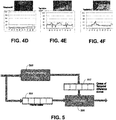
- Figs. 4A-4F show the measured and plotted frame-by-frame temporal differences (ME scores) of various video clips.
- the X axis is a frame index and the Y axis shows a scaled ME score ranging from 0 to 100.
- Figs. 4A-4C illustrate the ME score levels for video with noise and limited or no motion.
- the Red Lady video has a constant noise level ME score of just over 20.
- the "Sweep" video noise levels of Fig. 4B are very high with an ME noise level of near 100.
- the "Zone Plate” noise with no motion and a set noise level has an ME score of just over 20 and can be used as a reference for ME levels. Note that in the "Blacksmith" frame of Fig. 4D , a normal video that does not need special treatment during encoding using embodiments of the present invention that the temporal average noise difference is far below an ME level of 20 found with the "Red Lady” video of Fig. 4C .
- the "Sprinkler Lady” of Fig. 4E meets both the two key factors of (1) an ME score over 20 and (2) the fluctuation of the temporal differences is small even taking into account motion.
- the final video of "Basketball” in Fig. 4F has a relatively high ME score, but it is less than 20, and the motion in the video accounts for ME levels that on average may push the total ME score over 20.
- the video of Fig. 4F does not require embodiments of the present invention to be used during encoding.
- Fig. 5 is a diagram of one embodiment of components for implementing embodiments of the present invention in an encoding system.
- the preprocessing filter 500 computes the temporal difference score and stores it in the queue 502.
- the encoding in encoder 506 will be delayed by the frame buffer 504 until temporal difference scores of N frames are collected in the queue 502.
- the encoder 506 analyzes the temporal difference scores of N frames. If it is detected that the average of all temporal differences is higher than a threshold and the variance of them are smaller than a threshold, it means the video contains significant film grain or noise. Based on the level of film grain or noise detected, the encoder 506 allocates bits to I, P and B dynamically according to embodiments of the present invention described herein. Generally, if the level of film grain or noise is high, the encoder allocates more bits to P and B frames than for other content.
- Fig. 6 is a flow chart illustrating steps for implementing encoding when high film grain is detected according to embodiments of the present invention.
- the video clips are received, such as the "Red Lady” clip illustrated in Fig. 4C .
- the temporal difference score or ME score, is determined for the video frames and the result for each frame stored in a queue to provide to the encoder.
- a determination is made to decide if film grain noise is high enough to constitute "Red Lady" type film grain that requires application of embodiments of the present invention. For the step 602 determination, if the average of a group of temporal differences is higher than a threshold and the variance is smaller than a threshold, the film grain noise is indicated to be significant for the frames of the video clip.
- step 603 the determination is reviewed. If film grain noise for the clip is determined to be significant, then the program proceeds to step 604. If the film grain noise is determined to be insignificant, the program proceeds to step 605. In step 604 when high film grain noise is detected encoding is performed by allocating enough bits so that the I frame at the beginning has little additional bits and the P and B frames have additional bits for encoding. In step 605 when film grain noise is not detected as high, a normal bit allocation is performed by the encoder.
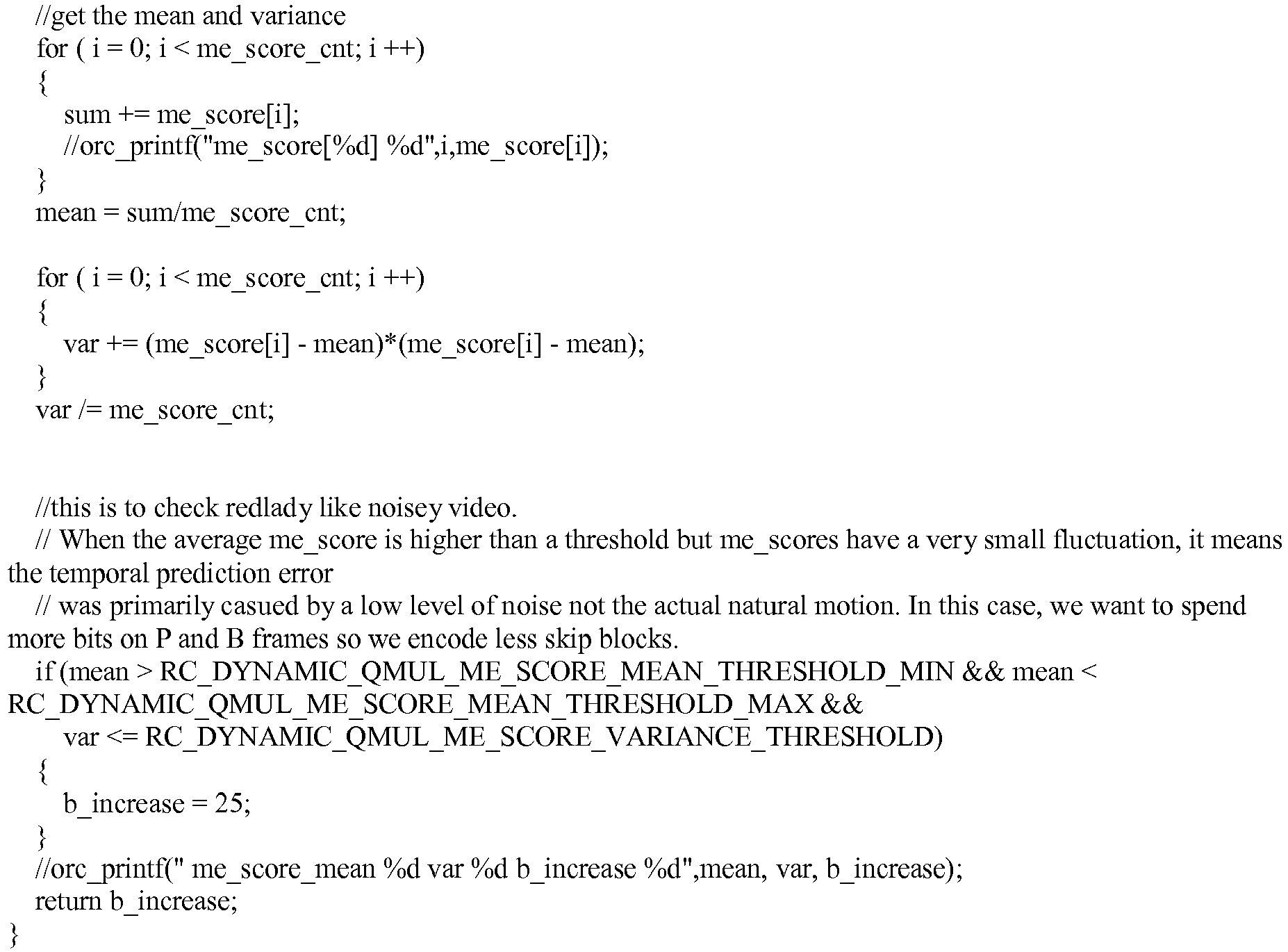
- Appendix A shows an example of coding in "C" to implement the algorithm illustrated by Fig. 6 .
- each component can include a processor and memory to enable operation.
- the memory of each device stores code that is executable by the processor to enable the processor to perform the processes described herein. Further the memory can be used to provide data storage with the data accessible by the processor to store or retrieve when performing operations.
Landscapes
- Engineering & Computer Science (AREA)
- Multimedia (AREA)
- Signal Processing (AREA)
- Compression Or Coding Systems Of Tv Signals (AREA)
- Color Television Systems (AREA)
Abstract
Description
- This Application claims priority under 35 U.S.C. §119(e) from earlier filed United States Provisional Application Serial No.
62/099,672 filed on January 5, 2015 14/962,814 filed on December 8, 2015 - The present invention relates to a process for improving video quality when encoding video with film grain. More particularly, the present invention relates to a solution to improving video quality when film grain is present on a level similar to the "Red Lady" noise problem.
- Film grain is hard to compress in an encoder. It requires more bits to encode than many other kinds of content for any level of video quality. Film grain may be thought of as a particular kind of spatial temporal noise. As such, film grain has low temporal predictability from one frame to any other frame of video. Thus, the encoding process is limited in its ability to leverage inter-frame estimation to achieve significant compression efficiency.
- In some encoders, not enough bits are allocated to inter-predicted pictures. The result can be significant video quality artifacts such as I-frame beating and intermittent repetitive loss and recovery of spatial texture. Even encoders that can allocate significant bits might not be able to eliminate substantial noise, such as when noise is as high as in the "Red Lady" video frames.
- A frame of the "Red Lady" video is illustrated with
Fig. 1 . The "red lady" video shows that a lady walking alongside a soccer field with a grassy background. The scene itself is simple, but the entire video is filled with film grain. - Film grain is like random noise. It requires a lot of bits to encode and is not temporally predictable, which makes high film grain video, in particular the "Red Lady" video, very difficult to encode.
- A common practice to encode video with film grain is to encode a good quality I frame as a reference frame as a prediction frame for subsequent predictive frames (P or B frames). However, since the I frame and P and B frames all contain film grain this does not predict well, and many bits are needed to encode unpredicted high frequency components. If too many bits are allocated to the I frame, later P and B frames may be allocated fewer bits than they need, and their quality suffers. The good quality I frame, thus, may not help with the subsequent P and B frames.
- In the Red Lady Video, the random noise level is very high. Thus, in the Red Lady Video, a beating effect will be seen, due to the quality of the pictures varying too much between frame types. Allocating more bits to the I frame does not help with reducing film grain in subsequent P and B frames in a typical encoder.
- As shown in
Fig. 2 , the difference between two consecutive frames is mostly noise. Encoding a good quality I frame for these costs too many bits and leaves fewer bits for predictive frames. Moreover, the high quality I frame, even with additional bits allocated, is not a good reference frame because the noisy temporal differences cannot be motion predicted well. With the I frame as a reference, the film grains in the predictive frames would be poorly encoded, and create a quality disparity between I and predictive frames, as illustrated inFig. 3 . Thus allocating more bits to the I frame creates a "Dirty Window" for future film grain elimination in P and B frames. - Accordingly, it is desirable to provide better solutions for eliminating film grain comparable to the "Red Lady" video, and to avoid creating "Dirty Window" I frames.
- Embodiments of the present invention provide a system that enables improved video quality and compression efficiency during encoding by detecting video segments having film grain approaching the "Red Lady" problem and then optimizing the bit allocation between intra- and inter-predicted pictures using bit allocation variation between I, P and B type frames.
- To optimize the bit allocation when a video clip is identified as a "Red Lady" like clip, embodiments of the present invention encode smaller I frames and allocate more bits on P and B frames. Since allocating more bits to the I frame when the "Red Lady" film grain problem occurs does not enable better prediction for encoding in the P and B frames, additional bits to the I frame are not necessary. Thus, allocating extra bits allocated to the P and B frames and not using the extra bits in the I frame enables reduction of frame grain when the "Red Lady" like film grain problem occurs, and the "Dirty Window" I frame issue will no longer be a consideration.
- To identify the film grain level to determine when the optimization of bit allocation away from I frames to P and B frames should occur, a temporal analysis of motion-prediction data available is provided. For the temporal analysis, measurements of plotted frame-by-frame temporal differences (ME scores) of the received videos are determined. From the ME scores, two key indicators are identified: (1) The average temporal difference in frames with an intermediate motion level (i.e., greater than ME score of 20), is higher than frames of non-noisy video with intermediate motion; and (2) The fluctuation of the temporal differences between frames in a group is very small, unlike the non-noise video with natural motions which have higher motion differences without the noise. These two indicators are set to identify when a special bit allocation ratio between the I, P and B frames should be applied so that there will tend to be less difference between frame types for film-grain content.
- The system according to embodiments of the present invention uses a preprocessing filter that analyzes video frames prior to the encoder. The preprocessing filter computes the temporal difference score and stores it in a queue of data provided with the frames to the encoder. The encoder analyzes the temporal difference scores. If it is detected that the average of all temporal differences is higher than a threshold and the variance of them are smaller than a threshold, it means the video contains significant film grain or noise. Based on the level of film grain or noise detected, the encoder allocates bits to I, P and B frames dynamically.
- Further details of the present invention are explained with the help of the attached drawings in which:
-
Fig. 1 shows a frame from the "Red Lady" video; -
Fig. 2 illustrates that for the "Red Lady" video frames, the difference between two consecutive frames is mostly noise; -
Fig. 3 illustrates that with an I frame as a reference, the film grains in the predictive frames would be poorly encoded, and create a quality disparity between I and predictive frames; -
Figs. 4A-4F show the measured and plotted frame-by-frame temporal differences (ME scores) of various video clips; -
Fig. 5 is a diagram of components for implementing embodiments of the present invention in an encoding system; and -
Fig. 6 is a flow chart illustrating steps for implementing encoding with film grain according to embodiments of the present invention. - For embodiments of the present invention, if a clip can be identified as a "Red Lady" like clip, good quality can be achieved by encoding smaller I frames and allocating more bits on P and B frames.
- To help understand how a determination of when a clip is a "Red Lady" type clip, several different clips of data are analyzed.
Figs. 4A-4F show the measured and plotted frame-by-frame temporal differences (ME scores) of various video clips. InFigs. 4A-4F , the X axis is a frame index and the Y axis shows a scaled ME score ranging from 0 to 100. - From the measurements in
Figs. 4A-4F , two key indicators of noisy video are found: (1) The average temporal difference is at an intermediate level (greater than ME score of 20), and the ME score is higher than the one of non-noisy video with intermediate motion; and (2) The fluctuation of the temporal differences is very small, not like the non-noise video with natural motions. These two indicators are, thus, used to identify "Red Lady" like video frames from any streaming video. -
Figs. 4A-4C illustrate the ME score levels for video with noise and limited or no motion. InFig. 4C , the Red Lady video has a constant noise level ME score of just over 20. The "Sweep" video noise levels ofFig. 4B are very high with an ME noise level of near 100. The "Zone Plate" noise with no motion and a set noise level has an ME score of just over 20 and can be used as a reference for ME levels. Note that in the "Blacksmith" frame ofFig. 4D , a normal video that does not need special treatment during encoding using embodiments of the present invention that the temporal average noise difference is far below an ME level of 20 found with the "Red Lady" video ofFig. 4C . - Unlike the "Blacksmith" of
Fig. 4D , the "Sprinkler Lady" ofFig. 4E meets both the two key factors of (1) an ME score over 20 and (2) the fluctuation of the temporal differences is small even taking into account motion. The final video of "Basketball" inFig. 4F has a relatively high ME score, but it is less than 20, and the motion in the video accounts for ME levels that on average may push the total ME score over 20. However with the criteria of (1) an average temporal difference with a ME score greater than 20 and (2) the fluctuation of the temporal differences very small, the video ofFig. 4F does not require embodiments of the present invention to be used during encoding. -
Fig. 5 is a diagram of one embodiment of components for implementing embodiments of the present invention in an encoding system. InFig. 5 , thepreprocessing filter 500 computes the temporal difference score and stores it in thequeue 502. The encoding inencoder 506 will be delayed by theframe buffer 504 until temporal difference scores of N frames are collected in thequeue 502. Theencoder 506 analyzes the temporal difference scores of N frames. If it is detected that the average of all temporal differences is higher than a threshold and the variance of them are smaller than a threshold, it means the video contains significant film grain or noise. Based on the level of film grain or noise detected, theencoder 506 allocates bits to I, P and B dynamically according to embodiments of the present invention described herein. Generally, if the level of film grain or noise is high, the encoder allocates more bits to P and B frames than for other content. -
Fig. 6 is a flow chart illustrating steps for implementing encoding when high film grain is detected according to embodiments of the present invention. First, instep 600 the video clips are received, such as the "Red Lady" clip illustrated inFig. 4C . Next, instep 601, the temporal difference score, or ME score, is determined for the video frames and the result for each frame stored in a queue to provide to the encoder. Next, in step 602 a determination is made to decide if film grain noise is high enough to constitute "Red Lady" type film grain that requires application of embodiments of the present invention. For thestep 602 determination, if the average of a group of temporal differences is higher than a threshold and the variance is smaller than a threshold, the film grain noise is indicated to be significant for the frames of the video clip. - Once the determination is made in 602, next in
step 603 the determination is reviewed. If film grain noise for the clip is determined to be significant, then the program proceeds to step 604. If the film grain noise is determined to be insignificant, the program proceeds to step 605. Instep 604 when high film grain noise is detected encoding is performed by allocating enough bits so that the I frame at the beginning has little additional bits and the P and B frames have additional bits for encoding. Instep 605 when film grain noise is not detected as high, a normal bit allocation is performed by the encoder. - The results of applying the algorithm shown in
Fig. 6 will reduce the "dirty window" effect. The algorithm also makes some high texture clips, such as "sprinkler" ofFig. 4E , look sharper. The algorithm does not change the quality of other non-noisy clips that do not rise to the detected level of the "Red Lady" video. - For reference, Appendix A below shows an example of coding in "C" to implement the algorithm illustrated by
Fig. 6 . - For components shown, like the
pre-processing filter 500 and theencoder 506, each component according to embodiments of the present invention can include a processor and memory to enable operation. The memory of each device stores code that is executable by the processor to enable the processor to perform the processes described herein. Further the memory can be used to provide data storage with the data accessible by the processor to store or retrieve when performing operations. - Although the present invention has been described above with particularity, this was merely to teach one of ordinary skill in the art how to make and use the invention. Many additional modifications will fall within the scope of the invention as that scope is defined by the following claims.

Claims (8)
- A method for encoding video comprising:obtaining video frames provided to an encoder;obtaining motion estimation (ME) data for the video frames;calculating a ME score for the video frames;comparing the ME score with a threshold;calculating the value of a metric from a temporal variability of the ME score;comparing the temporal variability metric with a predetermined value; andproviding a high film grain indication signal to the encoder indicating a particular segment of the video frames contains high film grain when the ME score exceeds a threshold and the ME score temporal variability metric is below a predetermined level.
- The method of claim 1, wherein when the high film grain signal is provided, the encoder allocates less bits to I frames and more bits to P and B type frames than to other frames of the video.
- The method of claim 1, wherein when the high film grain indication is not provided, the encoder allocates more bits to the I frame than when the high film grain indication is provided.
- The method of claim 1, wherein the ME score threshold is greater than 20.
- An apparatus to encode video frames, the apparatus comprising:an encoder having a first input for receiving video frames to be processed and a second input for receiving parameter data to enable the encoder to allocate bits for frames for encoding;a frame buffer having an input receiving the video frames and an output providing the first input to the encoder;a preprocessor for receiving the video frames and having an output providing the second input to the controller;a preprocessor memory connected to the processor for storing code that is executable by the preprocessor to determine the parameter data to enable the encoder to allocate bits, the code causing the preprocessor to perform the following steps;obtaining motion estimation (ME) data for the video frames;calculating a ME score for the video frames;comparing the ME score with a threshold;calculating the value of a metric from a temporal variability of the ME score;comparing the temporal variability metric with a predetermined value; andproviding a high film grain indication signal to the encoder indicating a particular segment contains high film grain when the ME score exceeds a threshold and the ME score temporal variability metric is below a predetermined level.
- The apparatus of claim 5, wherein when the high film grain signal is provided, the encoder allocates less bits to I frames and more bits to P and B type frames than to other frames of the video.
- The apparatus of claim 5, wherein when the high film grain indication is not provided, the encoder allocates more bits to the I frame than when the high film grain indication is provided.
- The apparatus of claim 5, wherein the ME score threshold is greater than 20.
Applications Claiming Priority (2)
| Application Number | Priority Date | Filing Date | Title |
|---|---|---|---|
| US201562099672P | 2015-01-05 | 2015-01-05 | |
| US14/962,814 US11451798B2 (en) | 2015-01-05 | 2015-12-08 | Method of encoding video with film grain |
Publications (2)
| Publication Number | Publication Date |
|---|---|
| EP3041236A1 true EP3041236A1 (en) | 2016-07-06 |
| EP3041236B1 EP3041236B1 (en) | 2021-02-17 |
Family
ID=55070691
Family Applications (1)
| Application Number | Title | Priority Date | Filing Date |
|---|---|---|---|
| EP15200232.5A Not-in-force EP3041236B1 (en) | 2015-01-05 | 2015-12-15 | A method of encoding video with film grain |
Country Status (7)
| Country | Link |
|---|---|
| US (2) | US11451798B2 (en) |
| EP (1) | EP3041236B1 (en) |
| BR (1) | BR112017014421B1 (en) |
| CA (1) | CA2972989C (en) |
| GB (1) | GB2533858B (en) |
| MX (1) | MX368521B (en) |
| WO (1) | WO2016111799A1 (en) |
Cited By (3)
| Publication number | Priority date | Publication date | Assignee | Title |
|---|---|---|---|---|
| FR3073999A1 (en) * | 2017-11-23 | 2019-05-24 | Ateme | INTELLIGENT COMPRESSION OF VIDEO CONTENTS SEEDS |
| CN115278265A (en) * | 2022-06-23 | 2022-11-01 | 安谋科技(中国)有限公司 | Parameter processing method, device, medium and electronic equipment |
| WO2023028401A1 (en) * | 2021-08-23 | 2023-03-02 | Netflix, Inc. | Efficient encoding of film grain noise |
Families Citing this family (4)
| Publication number | Priority date | Publication date | Assignee | Title |
|---|---|---|---|---|
| US10454987B2 (en) | 2016-10-28 | 2019-10-22 | Google Llc | Bitrate optimization for multi-representation encoding using playback statistics |
| US11930222B1 (en) * | 2021-03-30 | 2024-03-12 | Amazon Technologies, Inc. | Encoding video for film grain synthesis |
| EP4080882A1 (en) * | 2021-04-19 | 2022-10-26 | Comcast Cable Communications LLC | Methods, systems, and apparatuses for adaptive processing of video content with film grain |
| US11622123B1 (en) * | 2021-09-02 | 2023-04-04 | Amazon Technologies, Inc. | Film grain preservation |
Citations (2)
| Publication number | Priority date | Publication date | Assignee | Title |
|---|---|---|---|---|
| WO2003077549A1 (en) * | 2002-03-13 | 2003-09-18 | Imax Corporation | Systems and methods for digitally re-mastering or otherwise modifying motion pictures or other image sequences data |
| US20080152296A1 (en) * | 2006-12-21 | 2008-06-26 | Byung Tae Oh | Methods and Systems for Processing Film Grain Noise |
Family Cites Families (7)
| Publication number | Priority date | Publication date | Assignee | Title |
|---|---|---|---|---|
| US7801215B2 (en) * | 2001-07-24 | 2010-09-21 | Sasken Communication Technologies Limited | Motion estimation technique for digital video encoding applications |
| US7653129B2 (en) * | 2004-12-28 | 2010-01-26 | General Instrument Corporation | Method and apparatus for providing intra coding frame bit budget |
| US7924922B2 (en) | 2005-03-07 | 2011-04-12 | Hewlett-Packard Development Company, L.P. | Color registration in a digital video |
| US8243804B2 (en) | 2005-12-01 | 2012-08-14 | Lsi Corporation | Hierarchical motion estimation for images with varying horizontal and/or vertical dimensions |
| EP2048888A1 (en) | 2007-10-12 | 2009-04-15 | Thomson Licensing | Method and decoder for decoding an image frame of an image frame sequence |
| US20140112386A1 (en) * | 2012-10-22 | 2014-04-24 | General Instrument Corporation | Algorithms for determining bitrate for a statistical multiplexing system to account for signal complexity including film mode and gop structural changes |
| US9813706B1 (en) * | 2013-12-02 | 2017-11-07 | Google Inc. | Video content analysis and/or processing using encoding logs |
-
2015
- 2015-12-08 US US14/962,814 patent/US11451798B2/en active Active
- 2015-12-09 MX MX2017008847A patent/MX368521B/en active IP Right Grant
- 2015-12-09 BR BR112017014421-2A patent/BR112017014421B1/en not_active IP Right Cessation
- 2015-12-09 CA CA2972989A patent/CA2972989C/en active Active
- 2015-12-09 WO PCT/US2015/064703 patent/WO2016111799A1/en not_active Ceased
- 2015-12-15 EP EP15200232.5A patent/EP3041236B1/en not_active Not-in-force
- 2015-12-15 GB GB1522138.5A patent/GB2533858B/en not_active Expired - Fee Related
-
2022
- 2022-08-17 US US17/889,645 patent/US20220394279A1/en not_active Abandoned
Patent Citations (2)
| Publication number | Priority date | Publication date | Assignee | Title |
|---|---|---|---|---|
| WO2003077549A1 (en) * | 2002-03-13 | 2003-09-18 | Imax Corporation | Systems and methods for digitally re-mastering or otherwise modifying motion pictures or other image sequences data |
| US20080152296A1 (en) * | 2006-12-21 | 2008-06-26 | Byung Tae Oh | Methods and Systems for Processing Film Grain Noise |
Non-Patent Citations (1)
| Title |
|---|
| PETER SCHALLAUER ET AL: "Rapid and Reliable Detection of Film Grain Noise", IMAGE PROCESSING, 2006 IEEE INTERNATIONAL CONFERENCE ON, 1 January 2006 (2006-01-01), Pi, pages 413 - 416, XP055252534, ISBN: 978-1-4244-0480-3, DOI: 10.1109/ICIP.2006.312481 * |
Cited By (5)
| Publication number | Priority date | Publication date | Assignee | Title |
|---|---|---|---|---|
| FR3073999A1 (en) * | 2017-11-23 | 2019-05-24 | Ateme | INTELLIGENT COMPRESSION OF VIDEO CONTENTS SEEDS |
| EP3490255A1 (en) * | 2017-11-23 | 2019-05-29 | Ateme | Intelligent compression of grainy video content |
| US10911785B2 (en) | 2017-11-23 | 2021-02-02 | Ateme | Intelligent compression of grainy video content |
| WO2023028401A1 (en) * | 2021-08-23 | 2023-03-02 | Netflix, Inc. | Efficient encoding of film grain noise |
| CN115278265A (en) * | 2022-06-23 | 2022-11-01 | 安谋科技(中国)有限公司 | Parameter processing method, device, medium and electronic equipment |
Also Published As
| Publication number | Publication date |
|---|---|
| MX2017008847A (en) | 2017-10-24 |
| WO2016111799A1 (en) | 2016-07-14 |
| BR112017014421A8 (en) | 2023-02-07 |
| CA2972989C (en) | 2019-11-12 |
| GB2533858A (en) | 2016-07-06 |
| CA2972989A1 (en) | 2016-07-14 |
| US20220394279A1 (en) | 2022-12-08 |
| BR112017014421A2 (en) | 2018-04-10 |
| US20160198165A1 (en) | 2016-07-07 |
| BR112017014421B1 (en) | 2023-05-09 |
| US11451798B2 (en) | 2022-09-20 |
| GB2533858B (en) | 2017-08-16 |
| EP3041236B1 (en) | 2021-02-17 |
| MX368521B (en) | 2019-10-07 |
| GB201522138D0 (en) | 2016-01-27 |
Similar Documents
| Publication | Publication Date | Title |
|---|---|---|
| CA2972989C (en) | A method of encoding video with film grain | |
| US9706203B2 (en) | Low latency video encoder | |
| CN111988611B (en) | Quantization offset information determining method, image encoding device and electronic equipment | |
| JP7145204B2 (en) | Systems and methods for adaptive quality rendering of inductive encoders | |
| US20140376624A1 (en) | Scene change detection using sum of variance and estimated picture encoding cost | |
| US9066101B2 (en) | Image processing apparatus and image processing method | |
| CN106572352B (en) | A kind of key frame sign control method and device | |
| US10897619B2 (en) | Complexity control of video codec | |
| US10129565B2 (en) | Method for processing high dynamic range video in order to improve perceived visual quality of encoded content | |
| US20190312585A1 (en) | Data processing apparatuses, methods, computer programs and computer-readable media | |
| EP2963928A1 (en) | Apparatus and method for encoding and decoding based on region | |
| US12439065B2 (en) | Hybrid inter-frame coding using an autoregressive model | |
| US20150208072A1 (en) | Adaptive video compression based on motion | |
| US20140226724A1 (en) | System and Method for the Dynamic Reduction of the Entropy of a Signal Upstream to a Data Compression Device | |
| WO2016004721A1 (en) | Bit rate control method and apparatus, and computer storage medium | |
| JP5119740B2 (en) | VIDEO SIGNAL PROCESSING DEVICE, VIDEO SIGNAL PROCESSING METHOD, VIDEO SIGNAL PROCESSING METHOD PROGRAM, AND RECORDING MEDIUM CONTAINING VIDEO SIGNAL PROCESSING METHOD PROGRAM | |
| GB2545447B (en) | A method to encode video with close multiple scene changes | |
| US20160044340A1 (en) | Method and System for Real-Time Video Encoding Using Pre-Analysis Based Preliminary Mode Decision | |
| US8923391B2 (en) | Encoding apparatus, control method for encoding apparatus and program | |
| US20200084449A1 (en) | Adaptively encoding video frames based on complexity | |
| KR102049644B1 (en) | Hierarchical Noise Reduction Method for Efficient Coding of Video with Noise | |
| Merlos et al. | Feature Compression for Machines with Range-Based Channel Truncation and Frame Packing | |
| US20170061216A1 (en) | Event sensing method and system using dct coefficient in surveillance camera | |
| HK40024991A (en) | Systems and methods for encoder-guided adaptive-quality rendering |
Legal Events
| Date | Code | Title | Description |
|---|---|---|---|
| PUAI | Public reference made under article 153(3) epc to a published international application that has entered the european phase |
Free format text: ORIGINAL CODE: 0009012 |
|
| AK | Designated contracting states |
Kind code of ref document: A1 Designated state(s): AL AT BE BG CH CY CZ DE DK EE ES FI FR GB GR HR HU IE IS IT LI LT LU LV MC MK MT NL NO PL PT RO RS SE SI SK SM TR |
|
| AX | Request for extension of the european patent |
Extension state: BA ME |
|
| STAA | Information on the status of an ep patent application or granted ep patent |
Free format text: STATUS: REQUEST FOR EXAMINATION WAS MADE |
|
| 17P | Request for examination filed |
Effective date: 20170109 |
|
| RBV | Designated contracting states (corrected) |
Designated state(s): AL AT BE BG CH CY CZ DE DK EE ES FI FR GB GR HR HU IE IS IT LI LT LU LV MC MK MT NL NO PL PT RO RS SE SI SK SM TR |
|
| RAP1 | Party data changed (applicant data changed or rights of an application transferred) |
Owner name: ARRIS ENTERPRISES LLC |
|
| STAA | Information on the status of an ep patent application or granted ep patent |
Free format text: STATUS: EXAMINATION IS IN PROGRESS |
|
| 17Q | First examination report despatched |
Effective date: 20180713 |
|
| GRAP | Despatch of communication of intention to grant a patent |
Free format text: ORIGINAL CODE: EPIDOSNIGR1 |
|
| STAA | Information on the status of an ep patent application or granted ep patent |
Free format text: STATUS: GRANT OF PATENT IS INTENDED |
|
| INTG | Intention to grant announced |
Effective date: 20200827 |
|
| GRAS | Grant fee paid |
Free format text: ORIGINAL CODE: EPIDOSNIGR3 |
|
| GRAA | (expected) grant |
Free format text: ORIGINAL CODE: 0009210 |
|
| STAA | Information on the status of an ep patent application or granted ep patent |
Free format text: STATUS: THE PATENT HAS BEEN GRANTED |
|
| AK | Designated contracting states |
Kind code of ref document: B1 Designated state(s): AL AT BE BG CH CY CZ DE DK EE ES FI FR GB GR HR HU IE IS IT LI LT LU LV MC MK MT NL NO PL PT RO RS SE SI SK SM TR |
|
| REG | Reference to a national code |
Ref country code: GB Ref legal event code: FG4D |
|
| REG | Reference to a national code |
Ref country code: CH Ref legal event code: EP |
|
| REG | Reference to a national code |
Ref country code: DE Ref legal event code: R096 Ref document number: 602015065530 Country of ref document: DE |
|
| REG | Reference to a national code |
Ref country code: AT Ref legal event code: REF Ref document number: 1363075 Country of ref document: AT Kind code of ref document: T Effective date: 20210315 |
|
| REG | Reference to a national code |
Ref country code: IE Ref legal event code: FG4D |
|
| REG | Reference to a national code |
Ref country code: LT Ref legal event code: MG9D |
|
| REG | Reference to a national code |
Ref country code: NL Ref legal event code: MP Effective date: 20210217 |
|
| PG25 | Lapsed in a contracting state [announced via postgrant information from national office to epo] |
Ref country code: PT Free format text: LAPSE BECAUSE OF FAILURE TO SUBMIT A TRANSLATION OF THE DESCRIPTION OR TO PAY THE FEE WITHIN THE PRESCRIBED TIME-LIMIT Effective date: 20210617 Ref country code: LT Free format text: LAPSE BECAUSE OF FAILURE TO SUBMIT A TRANSLATION OF THE DESCRIPTION OR TO PAY THE FEE WITHIN THE PRESCRIBED TIME-LIMIT Effective date: 20210217 Ref country code: FI Free format text: LAPSE BECAUSE OF FAILURE TO SUBMIT A TRANSLATION OF THE DESCRIPTION OR TO PAY THE FEE WITHIN THE PRESCRIBED TIME-LIMIT Effective date: 20210217 Ref country code: GR Free format text: LAPSE BECAUSE OF FAILURE TO SUBMIT A TRANSLATION OF THE DESCRIPTION OR TO PAY THE FEE WITHIN THE PRESCRIBED TIME-LIMIT Effective date: 20210518 Ref country code: HR Free format text: LAPSE BECAUSE OF FAILURE TO SUBMIT A TRANSLATION OF THE DESCRIPTION OR TO PAY THE FEE WITHIN THE PRESCRIBED TIME-LIMIT Effective date: 20210217 Ref country code: BG Free format text: LAPSE BECAUSE OF FAILURE TO SUBMIT A TRANSLATION OF THE DESCRIPTION OR TO PAY THE FEE WITHIN THE PRESCRIBED TIME-LIMIT Effective date: 20210517 Ref country code: NO Free format text: LAPSE BECAUSE OF FAILURE TO SUBMIT A TRANSLATION OF THE DESCRIPTION OR TO PAY THE FEE WITHIN THE PRESCRIBED TIME-LIMIT Effective date: 20210517 |
|
| REG | Reference to a national code |
Ref country code: AT Ref legal event code: MK05 Ref document number: 1363075 Country of ref document: AT Kind code of ref document: T Effective date: 20210217 |
|
| PG25 | Lapsed in a contracting state [announced via postgrant information from national office to epo] |
Ref country code: SE Free format text: LAPSE BECAUSE OF FAILURE TO SUBMIT A TRANSLATION OF THE DESCRIPTION OR TO PAY THE FEE WITHIN THE PRESCRIBED TIME-LIMIT Effective date: 20210217 Ref country code: LV Free format text: LAPSE BECAUSE OF FAILURE TO SUBMIT A TRANSLATION OF THE DESCRIPTION OR TO PAY THE FEE WITHIN THE PRESCRIBED TIME-LIMIT Effective date: 20210217 Ref country code: NL Free format text: LAPSE BECAUSE OF FAILURE TO SUBMIT A TRANSLATION OF THE DESCRIPTION OR TO PAY THE FEE WITHIN THE PRESCRIBED TIME-LIMIT Effective date: 20210217 Ref country code: PL Free format text: LAPSE BECAUSE OF FAILURE TO SUBMIT A TRANSLATION OF THE DESCRIPTION OR TO PAY THE FEE WITHIN THE PRESCRIBED TIME-LIMIT Effective date: 20210217 Ref country code: RS Free format text: LAPSE BECAUSE OF FAILURE TO SUBMIT A TRANSLATION OF THE DESCRIPTION OR TO PAY THE FEE WITHIN THE PRESCRIBED TIME-LIMIT Effective date: 20210217 |
|
| PG25 | Lapsed in a contracting state [announced via postgrant information from national office to epo] |
Ref country code: IS Free format text: LAPSE BECAUSE OF FAILURE TO SUBMIT A TRANSLATION OF THE DESCRIPTION OR TO PAY THE FEE WITHIN THE PRESCRIBED TIME-LIMIT Effective date: 20210617 |
|
| PG25 | Lapsed in a contracting state [announced via postgrant information from national office to epo] |
Ref country code: SM Free format text: LAPSE BECAUSE OF FAILURE TO SUBMIT A TRANSLATION OF THE DESCRIPTION OR TO PAY THE FEE WITHIN THE PRESCRIBED TIME-LIMIT Effective date: 20210217 Ref country code: AT Free format text: LAPSE BECAUSE OF FAILURE TO SUBMIT A TRANSLATION OF THE DESCRIPTION OR TO PAY THE FEE WITHIN THE PRESCRIBED TIME-LIMIT Effective date: 20210217 Ref country code: CZ Free format text: LAPSE BECAUSE OF FAILURE TO SUBMIT A TRANSLATION OF THE DESCRIPTION OR TO PAY THE FEE WITHIN THE PRESCRIBED TIME-LIMIT Effective date: 20210217 Ref country code: EE Free format text: LAPSE BECAUSE OF FAILURE TO SUBMIT A TRANSLATION OF THE DESCRIPTION OR TO PAY THE FEE WITHIN THE PRESCRIBED TIME-LIMIT Effective date: 20210217 |
|
| REG | Reference to a national code |
Ref country code: DE Ref legal event code: R097 Ref document number: 602015065530 Country of ref document: DE |
|
| PG25 | Lapsed in a contracting state [announced via postgrant information from national office to epo] |
Ref country code: SK Free format text: LAPSE BECAUSE OF FAILURE TO SUBMIT A TRANSLATION OF THE DESCRIPTION OR TO PAY THE FEE WITHIN THE PRESCRIBED TIME-LIMIT Effective date: 20210217 Ref country code: RO Free format text: LAPSE BECAUSE OF FAILURE TO SUBMIT A TRANSLATION OF THE DESCRIPTION OR TO PAY THE FEE WITHIN THE PRESCRIBED TIME-LIMIT Effective date: 20210217 Ref country code: ES Free format text: LAPSE BECAUSE OF FAILURE TO SUBMIT A TRANSLATION OF THE DESCRIPTION OR TO PAY THE FEE WITHIN THE PRESCRIBED TIME-LIMIT Effective date: 20210217 Ref country code: DK Free format text: LAPSE BECAUSE OF FAILURE TO SUBMIT A TRANSLATION OF THE DESCRIPTION OR TO PAY THE FEE WITHIN THE PRESCRIBED TIME-LIMIT Effective date: 20210217 |
|
| PLBE | No opposition filed within time limit |
Free format text: ORIGINAL CODE: 0009261 |
|
| STAA | Information on the status of an ep patent application or granted ep patent |
Free format text: STATUS: NO OPPOSITION FILED WITHIN TIME LIMIT |
|
| 26N | No opposition filed |
Effective date: 20211118 |
|
| PG25 | Lapsed in a contracting state [announced via postgrant information from national office to epo] |
Ref country code: AL Free format text: LAPSE BECAUSE OF FAILURE TO SUBMIT A TRANSLATION OF THE DESCRIPTION OR TO PAY THE FEE WITHIN THE PRESCRIBED TIME-LIMIT Effective date: 20210217 |
|
| PG25 | Lapsed in a contracting state [announced via postgrant information from national office to epo] |
Ref country code: SI Free format text: LAPSE BECAUSE OF FAILURE TO SUBMIT A TRANSLATION OF THE DESCRIPTION OR TO PAY THE FEE WITHIN THE PRESCRIBED TIME-LIMIT Effective date: 20210217 |
|
| PG25 | Lapsed in a contracting state [announced via postgrant information from national office to epo] |
Ref country code: IT Free format text: LAPSE BECAUSE OF FAILURE TO SUBMIT A TRANSLATION OF THE DESCRIPTION OR TO PAY THE FEE WITHIN THE PRESCRIBED TIME-LIMIT Effective date: 20210217 |
|
| PG25 | Lapsed in a contracting state [announced via postgrant information from national office to epo] |
Ref country code: IS Free format text: LAPSE BECAUSE OF FAILURE TO SUBMIT A TRANSLATION OF THE DESCRIPTION OR TO PAY THE FEE WITHIN THE PRESCRIBED TIME-LIMIT Effective date: 20210617 |
|
| REG | Reference to a national code |
Ref country code: DE Ref legal event code: R119 Ref document number: 602015065530 Country of ref document: DE |
|
| PG25 | Lapsed in a contracting state [announced via postgrant information from national office to epo] |
Ref country code: MC Free format text: LAPSE BECAUSE OF FAILURE TO SUBMIT A TRANSLATION OF THE DESCRIPTION OR TO PAY THE FEE WITHIN THE PRESCRIBED TIME-LIMIT Effective date: 20210217 |
|
| REG | Reference to a national code |
Ref country code: CH Ref legal event code: PL |
|
| GBPC | Gb: european patent ceased through non-payment of renewal fee |
Effective date: 20211215 |
|
| REG | Reference to a national code |
Ref country code: BE Ref legal event code: MM Effective date: 20211231 |
|
| PG25 | Lapsed in a contracting state [announced via postgrant information from national office to epo] |
Ref country code: LU Free format text: LAPSE BECAUSE OF NON-PAYMENT OF DUE FEES Effective date: 20211215 Ref country code: IE Free format text: LAPSE BECAUSE OF NON-PAYMENT OF DUE FEES Effective date: 20211215 Ref country code: GB Free format text: LAPSE BECAUSE OF NON-PAYMENT OF DUE FEES Effective date: 20211215 Ref country code: DE Free format text: LAPSE BECAUSE OF NON-PAYMENT OF DUE FEES Effective date: 20220701 |
|
| PG25 | Lapsed in a contracting state [announced via postgrant information from national office to epo] |
Ref country code: FR Free format text: LAPSE BECAUSE OF NON-PAYMENT OF DUE FEES Effective date: 20211231 Ref country code: BE Free format text: LAPSE BECAUSE OF NON-PAYMENT OF DUE FEES Effective date: 20211231 |
|
| PG25 | Lapsed in a contracting state [announced via postgrant information from national office to epo] |
Ref country code: LI Free format text: LAPSE BECAUSE OF NON-PAYMENT OF DUE FEES Effective date: 20211231 Ref country code: CH Free format text: LAPSE BECAUSE OF NON-PAYMENT OF DUE FEES Effective date: 20211231 |
|
| PG25 | Lapsed in a contracting state [announced via postgrant information from national office to epo] |
Ref country code: HU Free format text: LAPSE BECAUSE OF FAILURE TO SUBMIT A TRANSLATION OF THE DESCRIPTION OR TO PAY THE FEE WITHIN THE PRESCRIBED TIME-LIMIT; INVALID AB INITIO Effective date: 20151215 |
|
| PG25 | Lapsed in a contracting state [announced via postgrant information from national office to epo] |
Ref country code: CY Free format text: LAPSE BECAUSE OF FAILURE TO SUBMIT A TRANSLATION OF THE DESCRIPTION OR TO PAY THE FEE WITHIN THE PRESCRIBED TIME-LIMIT Effective date: 20210217 |
|
| PG25 | Lapsed in a contracting state [announced via postgrant information from national office to epo] |
Ref country code: MK Free format text: LAPSE BECAUSE OF FAILURE TO SUBMIT A TRANSLATION OF THE DESCRIPTION OR TO PAY THE FEE WITHIN THE PRESCRIBED TIME-LIMIT Effective date: 20210217 |
|
| PG25 | Lapsed in a contracting state [announced via postgrant information from national office to epo] |
Ref country code: TR Free format text: LAPSE BECAUSE OF FAILURE TO SUBMIT A TRANSLATION OF THE DESCRIPTION OR TO PAY THE FEE WITHIN THE PRESCRIBED TIME-LIMIT Effective date: 20210217 |
|
| PG25 | Lapsed in a contracting state [announced via postgrant information from national office to epo] |
Ref country code: MT Free format text: LAPSE BECAUSE OF FAILURE TO SUBMIT A TRANSLATION OF THE DESCRIPTION OR TO PAY THE FEE WITHIN THE PRESCRIBED TIME-LIMIT Effective date: 20210217 |