EP3040520A1 - Turbine engine shaft break detection - Google Patents
Turbine engine shaft break detection Download PDFInfo
- Publication number
- EP3040520A1 EP3040520A1 EP15193047.6A EP15193047A EP3040520A1 EP 3040520 A1 EP3040520 A1 EP 3040520A1 EP 15193047 A EP15193047 A EP 15193047A EP 3040520 A1 EP3040520 A1 EP 3040520A1
- Authority
- EP
- European Patent Office
- Prior art keywords
- turbine
- torque
- shaft
- twist
- engine
- Prior art date
- Legal status (The legal status is an assumption and is not a legal conclusion. Google has not performed a legal analysis and makes no representation as to the accuracy of the status listed.)
- Granted
Links
Images





Classifications
-
- F—MECHANICAL ENGINEERING; LIGHTING; HEATING; WEAPONS; BLASTING
- F01—MACHINES OR ENGINES IN GENERAL; ENGINE PLANTS IN GENERAL; STEAM ENGINES
- F01D—NON-POSITIVE DISPLACEMENT MACHINES OR ENGINES, e.g. STEAM TURBINES
- F01D21/00—Shutting-down of machines or engines, e.g. in emergency; Regulating, controlling, or safety means not otherwise provided for
- F01D21/02—Shutting-down responsive to overspeed
-
- F—MECHANICAL ENGINEERING; LIGHTING; HEATING; WEAPONS; BLASTING
- F01—MACHINES OR ENGINES IN GENERAL; ENGINE PLANTS IN GENERAL; STEAM ENGINES
- F01D—NON-POSITIVE DISPLACEMENT MACHINES OR ENGINES, e.g. STEAM TURBINES
- F01D21/00—Shutting-down of machines or engines, e.g. in emergency; Regulating, controlling, or safety means not otherwise provided for
- F01D21/04—Shutting-down of machines or engines, e.g. in emergency; Regulating, controlling, or safety means not otherwise provided for responsive to undesired position of rotor relative to stator or to breaking-off of a part of the rotor, e.g. indicating such position
-
- F—MECHANICAL ENGINEERING; LIGHTING; HEATING; WEAPONS; BLASTING
- F01—MACHINES OR ENGINES IN GENERAL; ENGINE PLANTS IN GENERAL; STEAM ENGINES
- F01D—NON-POSITIVE DISPLACEMENT MACHINES OR ENGINES, e.g. STEAM TURBINES
- F01D21/00—Shutting-down of machines or engines, e.g. in emergency; Regulating, controlling, or safety means not otherwise provided for
- F01D21/003—Arrangements for testing or measuring
-
- F—MECHANICAL ENGINEERING; LIGHTING; HEATING; WEAPONS; BLASTING
- F01—MACHINES OR ENGINES IN GENERAL; ENGINE PLANTS IN GENERAL; STEAM ENGINES
- F01D—NON-POSITIVE DISPLACEMENT MACHINES OR ENGINES, e.g. STEAM TURBINES
- F01D21/00—Shutting-down of machines or engines, e.g. in emergency; Regulating, controlling, or safety means not otherwise provided for
- F01D21/04—Shutting-down of machines or engines, e.g. in emergency; Regulating, controlling, or safety means not otherwise provided for responsive to undesired position of rotor relative to stator or to breaking-off of a part of the rotor, e.g. indicating such position
- F01D21/045—Shutting-down of machines or engines, e.g. in emergency; Regulating, controlling, or safety means not otherwise provided for responsive to undesired position of rotor relative to stator or to breaking-off of a part of the rotor, e.g. indicating such position special arrangements in stators or in rotors dealing with breaking-off of part of rotor
-
- F—MECHANICAL ENGINEERING; LIGHTING; HEATING; WEAPONS; BLASTING
- F01—MACHINES OR ENGINES IN GENERAL; ENGINE PLANTS IN GENERAL; STEAM ENGINES
- F01D—NON-POSITIVE DISPLACEMENT MACHINES OR ENGINES, e.g. STEAM TURBINES
- F01D5/00—Blades; Blade-carrying members; Heating, heat-insulating, cooling or antivibration means on the blades or the members
- F01D5/02—Blade-carrying members, e.g. rotors
-
- F—MECHANICAL ENGINEERING; LIGHTING; HEATING; WEAPONS; BLASTING
- F02—COMBUSTION ENGINES; HOT-GAS OR COMBUSTION-PRODUCT ENGINE PLANTS
- F02C—GAS-TURBINE PLANTS; AIR INTAKES FOR JET-PROPULSION PLANTS; CONTROLLING FUEL SUPPLY IN AIR-BREATHING JET-PROPULSION PLANTS
- F02C9/00—Controlling gas-turbine plants; Controlling fuel supply in air- breathing jet-propulsion plants
- F02C9/26—Control of fuel supply
- F02C9/46—Emergency fuel control
-
- G—PHYSICS
- G01—MEASURING; TESTING
- G01M—TESTING STATIC OR DYNAMIC BALANCE OF MACHINES OR STRUCTURES; TESTING OF STRUCTURES OR APPARATUS, NOT OTHERWISE PROVIDED FOR
- G01M15/00—Testing of engines
- G01M15/14—Testing gas-turbine engines or jet-propulsion engines
-
- F—MECHANICAL ENGINEERING; LIGHTING; HEATING; WEAPONS; BLASTING
- F05—INDEXING SCHEMES RELATING TO ENGINES OR PUMPS IN VARIOUS SUBCLASSES OF CLASSES F01-F04
- F05D—INDEXING SCHEME FOR ASPECTS RELATING TO NON-POSITIVE-DISPLACEMENT MACHINES OR ENGINES, GAS-TURBINES OR JET-PROPULSION PLANTS
- F05D2220/00—Application
- F05D2220/30—Application in turbines
-
- F—MECHANICAL ENGINEERING; LIGHTING; HEATING; WEAPONS; BLASTING
- F05—INDEXING SCHEMES RELATING TO ENGINES OR PUMPS IN VARIOUS SUBCLASSES OF CLASSES F01-F04
- F05D—INDEXING SCHEME FOR ASPECTS RELATING TO NON-POSITIVE-DISPLACEMENT MACHINES OR ENGINES, GAS-TURBINES OR JET-PROPULSION PLANTS
- F05D2240/00—Components
- F05D2240/60—Shafts
-
- F—MECHANICAL ENGINEERING; LIGHTING; HEATING; WEAPONS; BLASTING
- F05—INDEXING SCHEMES RELATING TO ENGINES OR PUMPS IN VARIOUS SUBCLASSES OF CLASSES F01-F04
- F05D—INDEXING SCHEME FOR ASPECTS RELATING TO NON-POSITIVE-DISPLACEMENT MACHINES OR ENGINES, GAS-TURBINES OR JET-PROPULSION PLANTS
- F05D2260/00—Function
- F05D2260/80—Diagnostics
-
- F—MECHANICAL ENGINEERING; LIGHTING; HEATING; WEAPONS; BLASTING
- F05—INDEXING SCHEMES RELATING TO ENGINES OR PUMPS IN VARIOUS SUBCLASSES OF CLASSES F01-F04
- F05D—INDEXING SCHEME FOR ASPECTS RELATING TO NON-POSITIVE-DISPLACEMENT MACHINES OR ENGINES, GAS-TURBINES OR JET-PROPULSION PLANTS
- F05D2260/00—Function
- F05D2260/83—Testing, e.g. methods, components or tools therefor
Definitions
- the present invention relates to a method and a system for detecting a shaft break in a turbine engine.
- LPT low pressure turbine
- terminal speed the maximum turbine speed (terminal speed) that can occur after failure of the low pressure (LP) shaft connecting the LPT and the LP torque-receiving unit (typically an LP compressor or a fan).
- Functionality can be built into the engine control system to detect shaft breakage and take accommodation actions (e.g. shut-off fuel flow to the engine) to reduce the turbine terminal speed.
- rotational frequency sensors can be provided at each end of the shaft, e.g. as described in US 6494046 . There may be eight such sensors in total, with four measuring compressor speed and four measuring turbine speed for a dual-channel redundant control system.
- the processed signals can determine a measure of twist within the shaft. When the twist exceeds a threshold (for example 25°), accommodation actions are triggered.
- Figure 1 shows plots for the same engine spool of: modelled physical (actual) shaft twist against time, and shaft twist against time as determined by a turbine overspeed (TOS) shaft break detection system which conservatively over-estimates the amount of twist.
- TOS turbine overspeed
- TOS detection systems may be susceptible to "false positive" spurious detections following engine events such as surge and ice ingestion.
- Figure 2 shows a plot of shaft twist against time according to a TOS detection system interpretation of the signals from four sets of frequency sensors, the plot encompassing an ice shedding manoeuvre starting at about time -0.25 s. The detected twist peaks at about 11°, which is a substantial proportion of the 25° threshold.
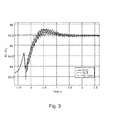
- Figure 3 shows plots, for the same engine spool and the same ice shedding manoeuvre, of: demanded LP shaft speed (NL Dem), actual LPT speed (NLT), actual LP compressor speed (NLC), the speed in each case being expressed as a percentage of maximum shaft speed.
- NL Dem demanded LP shaft speed
- NLT actual LPT speed
- NLC actual LP compressor speed
- FIG. 4 shows plots, for a simplified synthesis of the same engine spool and the same ice shedding manoeuvre, of: modelled physical (actual) shaft twist against time, and shaft twist against time as determined by the TOS detection system.
- the actual shaft twist during the event is probably less than 2°.
- a turbine engine spool can be simulated as two masses coupled by a relatively flexible shaft.
- the shaft speed varies approximately sinusoidally at a resonant frequency.
- the resonant frequency can be determined by simple mechanics from the inertias of the two masses and the shaft stiffness.
- the resonant frequency of the LP shaft may be around 14Hz. Events such as that illustrated in Figures 2 and 3 allow the resonant frequency to be checked.
- the position of the fan and/or the turbine at a given time can be determined from such a simulation for any resonance amplitude and frequency.
- spurious trip threats cause first order torsional resonance of the LP system. For half of the resonance period these events have a signature that is difficult to distinguish from that of a breakage event. Due to the requirement for rapid shaft break detection, a resonance of relatively modest amplitude can cause spurious detection of breakage. To eliminate the risk of spurious detection using known approaches would require a confirmation period greater than half of the resonance period.
- rotational speeds are expressed either in terms of a percentage of a maximum normal rotational speed rating for the respective shaft, or in angular degrees per second. Consistent with these, rotational accelerations may be expressed with units of %s -1 or with units of deg.s -2 .
- the present invention provides a method of detecting a shaft break in a turbine engine, the shaft connecting a torque-exerting turbine of the engine to a torque-receiving unit of the engine, the method including:
- the pre-condition is based on the recognition that on shaft break, and in contrast to some instances of shaft resonance, the turbine rotational speed becomes significantly greater than that of the torque-receiving unit.
- the pre-condition may be most effective at the onset of resonance, because at this time the speed difference between the turbine and the torque-receiving unit is generally a long way from the high values that are characteristic of a shaft failure.
- the threshold speed value may be at least 0.1%, 0.5%, 1% or 2% greater than the simultaneous torque-receiving unit rotational speed determined from the measurements.
- the pre-condition may further include determining from the measurements that the turbine acceleration is increasing simultaneously while the torque-receiving unit acceleration is decreasing. More particularly, upon shaft failure there are generally distinct, near simultaneous, discontinuities in both torque-receiving unit and turbine acceleration signals, with the turbine acceleration increasing and the torque-receiving unit acceleration decreasing. In contrast, for resonance discontinuities are typically not simultaneous and are both in the same sense.
- the method may further include:
- the inhibition procedure is based on the recognition that shaft resonance produces cycles of decreasing and increasing turbine acceleration, while on shaft break the turbine initially simply accelerates. Thus advantageously, by implementing the inhibition procedure, further instances of spurious shaft break detection can be prevented.
- the present invention provides a method of detecting a shaft break in a turbine engine, the shaft connecting a torque-exerting turbine of the engine to a torque-receiving unit of the engine, the method including:
- the threshold acceleration value can be set as a function of engine speed or power.
- the threshold acceleration value may be a constant value of e.g. -5%s -1 , -10%s -1 , -20%s -1 or -30%s -1 .
- the threshold acceleration value is for the threshold acceleration value to be equal to the simultaneous acceleration of the torque-receiving unit as determined from the measurements optionally minus an acceleration offset value.
- the acceleration offset value can be zero, or if non-zero it can be 1%s -1 , 2%s -1 , 5%s -1 or 10%s -1 .
- the predetermined duration may be about half of the first order torsional resonance period of the engine spool formed by the torque-receiving unit, shaft and turbine. In this way the timed inhibit can be enforced only on the determination of shaft twist when deceleration of the turbine is detected.
- the torque-receiving unit can be a fan or a compressor.
- the turbine engine can be a gas turbine engine.
- it can be an aero engine, with the shaft connecting a fan or low pressure compressor to a low pressure turbine.
- the method of the first or second aspect may further include performing the repeated measurements of the rotational frequency of the torque-receiving unit and the rotational frequency of the turbine.
- the present invention provides a system for detecting a shaft break in a turbine engine, the shaft connecting a torque-exerting turbine of the engine to a torque-receiving unit of the engine, the system having a processor unit for performing the method of the first or second aspect.
- the processor unit can be part of an engine electronic controller.
- the system may further have sensors for performing the repeated measurements of the rotational frequency of the torque-receiving unit and the rotational frequency of the turbine.
- the present invention provides a turbine engine fitted with the system of the third aspect.
- the present invention provides a computer program comprising code which, when run on a computer, causes the computer to perform the method of the first or second aspect.
- the present invention provides a computer readable medium storing a computer program comprising code which, when run on a computer, causes the computer to perform the method of the first or second aspect.
- embodiments may be described as a process which is depicted as a flowchart, a flow diagram, a data flow diagram, a structure diagram, or a block diagram. Although a flowchart may describe the operations as a sequential process, many of the operations can be performed in parallel or concurrently. In addition, the order of the operations may be re-arranged.
- a process is terminated when its operations are completed, but could have additional steps not included in the figure.
- a process may correspond to a method, a function, a procedure, a subroutine, a subprogram, etc. When a process corresponds to a function, its termination corresponds to a return of the function to the calling function or the main function.
- computer readable medium may represent one or more devices for storing data, including read only memory (ROM), random access memory (RAM), magnetic RAM, core memory, magnetic disk storage media, optical storage media, flash memory devices and/or other machine readable media for storing information.
- ROM read only memory
- RAM random access memory
- magnetic RAM magnetic RAM
- core memory magnetic disk storage media
- optical storage media flash memory devices and/or other machine readable media for storing information.
- computer-readable medium includes, but is not limited to portable or fixed storage devices, optical storage devices, wireless channels and various other media capable of storing, containing or carrying instruction(s) and/or data.
- embodiments may be implemented by hardware, software, firmware, middleware, microcode, hardware description languages, or any combination thereof.
- the program code or code segments to perform the necessary tasks may be stored in a machine readable medium such as storage medium.
- a processor(s) may perform the necessary tasks.
- a code segment may represent a procedure, a function, a subprogram, a program, a routine, a subroutine, a module, a software package, a class, or any combination of instructions, data structures, or program statements.
- a code segment may be coupled to another code segment or a hardware circuit by passing and/or receiving information, data, arguments, parameters, or memory contents. Information, arguments, parameters, data, etc. may be passed, forwarded, or transmitted via any suitable means including memory sharing, message passing, token passing, network transmission, etc.
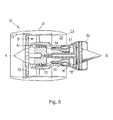
- a ducted fan gas turbine engine incorporating the invention is generally indicated at 10 and has a principal and rotational axis X-X.
- the engine comprises, in axial flow series, an air intake 11, a propulsive fan 12, an intermediate pressure compressor 13, a high pressure compressor 14, combustion equipment 15, a high pressure turbine 16, an intermediate pressure turbine 17, a low pressure turbine 18 and a core engine exhaust nozzle 19.
- a nacelle 21 generally surrounds the engine 10 and defines the intake 11, a bypass duct 22 and a bypass exhaust nozzle 23.
- air entering the intake 11 is accelerated by the fan 12 to produce two air flows: a first air flow A into the intermediate pressure compressor 13 and a second air flow B which passes through the bypass duct 22 to provide propulsive thrust.
- the intermediate pressure compressor 13 compresses the air flow A directed into it before delivering that air to the high pressure compressor 14 where further compression takes place.
- the compressed air exhausted from the high pressure compressor 14 is directed into the combustion equipment 15 where it is mixed with fuel and the mixture combusted.
- the resultant hot combustion products then expand through, and thereby drive the high, intermediate and low pressure turbines 16, 17, 18 before being exhausted through the nozzle 19 to provide additional propulsive thrust.
- the high, intermediate and low pressure turbines respectively drive the high and intermediate pressure compressors 14, 13 and the fan 12 by suitable interconnecting shafts.
- the engine has rotational frequency sensors for measuring the fan speed and the low pressure turbine speed. For example, there may be four fan speed sensors and four turbine speed sensors for a dual-channel redundant control system.
- a computer system in the form of an engine electronic controller has a processor unit which receives the sensor measurements and implements a shaft break detection system described below.
- the detection system uses the measurements to determine a measure of twist within the shaft connecting the fan 12 and the low pressure turbine 18. When the twist exceeds a threshold, accommodation actions are triggered, such as shutting off fuel supply to the engine.
- Figure 6 shows an overview of the processing within the system.
- a first strategy is to set a pre-condition that must be met before the underlying detection algorithm can register a shaft failure.
- a second strategy is to inhibit signalling of a shaft break for a predetermined duration after the onset of a resonance condition. Preferably both strategies are adopted.
- the pre-condition strategy is that, based on the speed measurements, the turbine speed must be higher than the simultaneous fan speed by a threshold speed value, which can be e.g. 1%, 1.5% or 2% of the fan speed.
- the basic pre-condition may be unable to prevent spurious detection. Although protection can be enhanced by increasing the threshold speed value, this increases the minimum detection time.
- a developed version of the pre-condition thus differentiates between potential shaft failure and potential resonance at the onset of an event. More particularly, upon shaft failure there are distinct, near simultaneous, discontinuities in both fan and turbine acceleration signals, with the turbine acceleration increasing and the fan acceleration decreasing. For resonance, on the other hand, discontinuities are not simultaneous and are both in the same sense (generally decelerating).
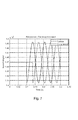
- Figure 7 shows, for example, modelled fan and turbine speeds for a resonance induced by an impact on the fan (without damping)
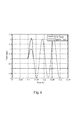
- Figure 8 shows modelled compressor and turbine speeds for a resonance induced by surge (without damping).
- the developed version of the pre-condition requires that, as well as the turbine speed being higher than the fan speed by a threshold speed value, a simultaneous pattern of increasing turbine acceleration and decreasing compressor acceleration must be detected.
- the inhibition strategy involves: determining from the measurements the acceleration of the turbine, and detecting periods when the turbine acceleration falls below a threshold acceleration value.
- the underlying detection algorithm which determines the amount of shaft twist, compares the amount of twist with a threshold twist value, and signals a shaft break is then inhibited by the system for a predetermined duration following the end of such a period.
- the threshold acceleration value can be set as a function of engine speed or power.
- Figure 9 shows, for example, the inhibition strategy applied to the data of Figure 4 .
- determination of twist accumulation is inhibited for a duration of, for example, 50 ms, such deceleration being a characteristic of resonance that does not occur following shaft failure.
- this results in the TOS shaft break detection system being inhibited from signalling a shaft break after the turbine deceleration which commences at about 0.135 s.
- the timed inhibit is only enforced on the determination of shaft twist when deceleration of the turbine is detected.
- the inhibit duration can be based upon the resonant frequency, which is a basic property of the engine's mechanical design (and is relatively invariant with respect to production variability and in-service degradation).
- the inhibit duration can be about half of the first order torsional resonance period of the engine spool formed by the fan, shaft and turbine.
- Turbine deceleration during a resonance event is the sum of the deceleration associated with the resonance and any underlying engine acceleration or deceleration. Consequently for resonance during rapid engine acceleration the magnitude of the turbine deceleration during resonance is reduced. Accordingly, the threshold acceleration value which the turbine acceleration must fall below in order to inhibit signalling of a shaft break can be made equal to the simultaneous acceleration of the fan (as determined from the fan speed measurements) minus an optional acceleration offset value. In this way, the threshold continuously compensates for underlying engine acceleration or deceleration. During resonance the difference between the relative turbine and fan accelerations periodically goes significantly negative, even during rapid underlying engine acceleration, whilst during shaft failure the difference is permanently significantly positive.
- the acceleration offset value, if applied, can be quite low, for example, about 1%s -1 , 2%s -1 , 5%s -1 or 10%s -1 .
- the threshold acceleration value which the turbine acceleration must fall below in order to inhibit signalling of a shaft break should preferably be set below the maximum deceleration seen during normal operation. This helps to avoid delaying detection of shaft failure if the engine was decelerating (normally) at the instance the shaft failed.
- the threshold acceleration value can be a constant value of about -5%s -1 , -10%s -1 , -20%s -1 or -30%s -1 .
- the threshold may be around -30%s -1 for a large 3-shaft gas turbine engine, the maximum normal turbine deceleration in such engines being around -22%s -1 .
- the inhibition strategy does not provide protection against spurious shaft break detection until the first turbine (relative) deceleration. Therefore, dependent upon how resonance is initiated, there may be a period where the pre-condition strategy alone is relied upon for protection.
- the pre-condition and inhibition strategies preferably deployed in combination, provide improved protection against known spurious trip threats, thereby allowing configuration parameters for the underlying shaft break detection to be adjusted to give a more rapid detection. In turn this can ultimately enable a saving in engine weight by permitting a lighter turbine. For example, tests on a large 3-shaft turbofan engine have shown an approximately 33% reduction in shaft break detection time for worst case conditions, allowing a significant reduction in low pressure turbine weight.
Landscapes
- Engineering & Computer Science (AREA)
- Mechanical Engineering (AREA)
- General Engineering & Computer Science (AREA)
- Chemical & Material Sciences (AREA)
- Combustion & Propulsion (AREA)
- Physics & Mathematics (AREA)
- General Physics & Mathematics (AREA)
- Control Of Turbines (AREA)
Abstract
Description
- The present invention relates to a method and a system for detecting a shaft break in a turbine engine.
- The strength and weight of an aero gas turbine engine low pressure turbine (LPT) system is governed by the maximum turbine speed (terminal speed) that can occur after failure of the low pressure (LP) shaft connecting the LPT and the LP torque-receiving unit (typically an LP compressor or a fan). Functionality can be built into the engine control system to detect shaft breakage and take accommodation actions (e.g. shut-off fuel flow to the engine) to reduce the turbine terminal speed.
- For example, rotational frequency sensors can be provided at each end of the shaft, e.g. as described in
US 6494046 . There may be eight such sensors in total, with four measuring compressor speed and four measuring turbine speed for a dual-channel redundant control system. The processed signals can determine a measure of twist within the shaft. When the twist exceeds a threshold (for example 25°), accommodation actions are triggered. -
Figure 1 shows plots for the same engine spool of: modelled physical (actual) shaft twist against time, and shaft twist against time as determined by a turbine overspeed (TOS) shaft break detection system which conservatively over-estimates the amount of twist. To deliver an 18 ms detection time (corresponding to 25° on the TOS twist plot), the TOS detection system needs to trip when the actual twist in the shaft is only around 7°. The plateau at 30° on the TOS twist plot is simply the upper limit of the detection system. - TOS detection systems may be susceptible to "false positive" spurious detections following engine events such as surge and ice ingestion. For example,
Figure 2 shows a plot of shaft twist against time according to a TOS detection system interpretation of the signals from four sets of frequency sensors, the plot encompassing an ice shedding manoeuvre starting at about time -0.25 s. The detected twist peaks at about 11°, which is a substantial proportion of the 25° threshold.Figure 3 shows plots, for the same engine spool and the same ice shedding manoeuvre, of: demanded LP shaft speed (NL Dem), actual LPT speed (NLT), actual LP compressor speed (NLC), the speed in each case being expressed as a percentage of maximum shaft speed. The ice shedding manoeuvre causes the spool to resonate, thereby superimposing oscillatory patterns on NLT and NLC as the shaft speed increases from a lower level to the higher demanded level.Figure 4 shows plots, for a simplified synthesis of the same engine spool and the same ice shedding manoeuvre, of: modelled physical (actual) shaft twist against time, and shaft twist against time as determined by the TOS detection system. The actual shaft twist during the event is probably less than 2°. - A turbine engine spool can be simulated as two masses coupled by a relatively flexible shaft. When an excitation is applied to the shaft the shaft speed varies approximately sinusoidally at a resonant frequency. The resonant frequency can be determined by simple mechanics from the inertias of the two masses and the shaft stiffness. For a typical large 3-shaft engine, the resonant frequency of the LP shaft may be around 14Hz. Events such as that illustrated in
Figures 2 and3 allow the resonant frequency to be checked. The position of the fan and/or the turbine at a given time can be determined from such a simulation for any resonance amplitude and frequency. - Thus known spurious trip threats cause first order torsional resonance of the LP system. For half of the resonance period these events have a signature that is difficult to distinguish from that of a breakage event. Due to the requirement for rapid shaft break detection, a resonance of relatively modest amplitude can cause spurious detection of breakage. To eliminate the risk of spurious detection using known approaches would require a confirmation period greater than half of the resonance period.
- Accordingly, there is a need to provide fast and reliable detection of shaft breakage via a detection system that does not respond to spurious trip threats. One approach for reducing the likelihood of spurious detections would be to allow a longer period of time in which to detect shaft breaks. However, this would lead to an undesirable increase in engine weight.
- In the following, as is conventional for turbine engines, rotational speeds are expressed either in terms of a percentage of a maximum normal rotational speed rating for the respective shaft, or in angular degrees per second. Consistent with these, rotational accelerations may be expressed with units of %s-1 or with units of deg.s-2.
- In a first aspect, the present invention provides a method of detecting a shaft break in a turbine engine, the shaft connecting a torque-exerting turbine of the engine to a torque-receiving unit of the engine, the method including:
- receiving repeated measurements of the rotational frequency of the torque-receiving unit and the rotational frequency measurements of the turbine;
- determining from the measurements an amount of shaft twist between the turbine and the torque-receiving unit;
- comparing the amount of twist with a threshold twist value; and
- signalling a shaft break when the amount of twist exceeds the threshold twist value and a pre-condition is met;
- wherein the pre-condition includes determining from the measurements that the turbine rotational speed is greater than the simultaneous torque-receiving unit rotational speed by a threshold speed value.
- Advantageously, by implementing the pre-condition, instances of spurious shaft break detection can be prevented. In particular, the pre-condition is based on the recognition that on shaft break, and in contrast to some instances of shaft resonance, the turbine rotational speed becomes significantly greater than that of the torque-receiving unit. The pre-condition may be most effective at the onset of resonance, because at this time the speed difference between the turbine and the torque-receiving unit is generally a long way from the high values that are characteristic of a shaft failure.
- For example, the threshold speed value may be at least 0.1%, 0.5%, 1% or 2% greater than the simultaneous torque-receiving unit rotational speed determined from the measurements.
- The pre-condition may further include determining from the measurements that the turbine acceleration is increasing simultaneously while the torque-receiving unit acceleration is decreasing. More particularly, upon shaft failure there are generally distinct, near simultaneous, discontinuities in both torque-receiving unit and turbine acceleration signals, with the turbine acceleration increasing and the torque-receiving unit acceleration decreasing. In contrast, for resonance discontinuities are typically not simultaneous and are both in the same sense.
- The method may further include:
- determining from the measurements the acceleration of the turbine;
- detecting periods when the turbine acceleration falls below a threshold acceleration value; and
- inhibiting, for a predetermined duration following the end of such a period, the determination of an amount of shaft twist, the comparison with a threshold twist value, and the signalling of a shaft break.
- The inhibition procedure is based on the recognition that shaft resonance produces cycles of decreasing and increasing turbine acceleration, while on shaft break the turbine initially simply accelerates. Thus advantageously, by implementing the inhibition procedure, further instances of spurious shaft break detection can be prevented.
- Indeed, in a second aspect, the present invention provides a method of detecting a shaft break in a turbine engine, the shaft connecting a torque-exerting turbine of the engine to a torque-receiving unit of the engine, the method including:
- receiving repeated measurements of the rotational frequency of the torque-receiving unit and the rotational frequency measurements of the turbine;
- determining from the measurements an amount of shaft twist between the turbine and the torque-receiving unit;
- comparing the amount of twist with a threshold twist value;
- determining from the measurements the acceleration of the turbine;
- detecting periods when the turbine acceleration falls below a threshold acceleration value; and
- signalling a shaft break when the amount of twist exceeds the threshold twist value, except that the determination of an amount of shaft twist, the comparison with a threshold twist value, and the signalling of a shaft break is inhibited for a predetermined duration following the end of such a period.
- The threshold acceleration value can be set as a function of engine speed or power.
- For example, the threshold acceleration value may be a constant value of e.g. -5%s-1, -10%s-1, -20%s-1 or -30%s-1.
- However, another possibility, which takes into account any underlying engine acceleration or deceleration, is for the threshold acceleration value to be equal to the simultaneous acceleration of the torque-receiving unit as determined from the measurements optionally minus an acceleration offset value. For example, the acceleration offset value can be zero, or if non-zero it can be 1%s-1, 2%s-1, 5%s-1 or 10%s-1.
- For around a half of a resonance cycle (ignoring any underlying engine acceleration or deceleration) the turbine is decelerating. Thus to protect the portion of the resonance cycle where the turbine is accelerating, the predetermined duration may be about half of the first order torsional resonance period of the engine spool formed by the torque-receiving unit, shaft and turbine. In this way the timed inhibit can be enforced only on the determination of shaft twist when deceleration of the turbine is detected.
- Further optional features of the invention will now be set out. These are applicable singly or in any combination with any aspect of the invention.
- In the method of the first or second aspect, the torque-receiving unit can be a fan or a compressor. Moreover, the turbine engine can be a gas turbine engine. For example, it can be an aero engine, with the shaft connecting a fan or low pressure compressor to a low pressure turbine. The method of the first or second aspect may further include performing the repeated measurements of the rotational frequency of the torque-receiving unit and the rotational frequency of the turbine.
- In a third aspect, the present invention provides a system for detecting a shaft break in a turbine engine, the shaft connecting a torque-exerting turbine of the engine to a torque-receiving unit of the engine, the system having a processor unit for performing the method of the first or second aspect.
- For example, the processor unit can be part of an engine electronic controller.
- The system may further have sensors for performing the repeated measurements of the rotational frequency of the torque-receiving unit and the rotational frequency of the turbine.
- In a fourth aspect, the present invention provides a turbine engine fitted with the system of the third aspect.
- In a fifth aspect, the present invention provides a computer program comprising code which, when run on a computer, causes the computer to perform the method of the first or second aspect.
- In a sixth aspect, the present invention provides a computer readable medium storing a computer program comprising code which, when run on a computer, causes the computer to perform the method of the first or second aspect.
- Embodiments of the invention will now be described by way of example with reference to the accompanying drawings in which:
-
Figure 1 shows plots for the same engine spool of: modelled physical (actual) shaft twist against time, and shaft twist against time as determined by a turbine overspeed (TOS) shaft break detection system which conservatively over-estimates the amount of twist; -
Figure 2 shows a plot of shaft twist against time according to a TOS detection system interpretation of the signals from four sets of frequency sensors, the plot encompassing an ice shedding manoeuvre starting at about time -0.25 s; -
Figure 3 shows plots, for the same engine spool and the same ice shedding manoeuvre as -
Figure 2 , of: demanded LP shaft speed (NL Dem), actual LPT speed (NLT), actual LP compressor speed (NLC), the speed in each case being expressed as a percentage of maximum shaft speed; -
Figure 4 shows plots, for a simplified synthesis of the same engine spool and the same ice shedding manoeuvre asFigure 2 , of: modelled physical (actual) shaft twist against time, and shaft twist against time as determined by the TOS detection system; -
Figure 5 shows a longitudinal cross-section through a ducted fan gas turbine engine; -
Figure 6 shows an overview of the processing within a shaft break detection system; -
Figure 7 shows modelled fan and turbine speeds for a resonance induced by an impact on the fan; -
Figure 8 shows modelled compressor and turbine speeds for a resonance induced by surge; and -
Figure 9 shows a shaft break detection inhibition strategy applied to the data ofFigure 4 . - Specific details are given in the following description to provide a thorough understanding of the embodiments. However, it will be understood by one of ordinary skill in the art that embodiments maybe practiced without these specific details. For example, well-known circuits, processes, algorithms, structures, and techniques may be shown without unnecessary detail in order to avoid obscuring the embodiments.
- Also, it is noted that embodiments may be described as a process which is depicted as a flowchart, a flow diagram, a data flow diagram, a structure diagram, or a block diagram. Although a flowchart may describe the operations as a sequential process, many of the operations can be performed in parallel or concurrently. In addition, the order of the operations may be re-arranged. A process is terminated when its operations are completed, but could have additional steps not included in the figure. A process may correspond to a method, a function, a procedure, a subroutine, a subprogram, etc. When a process corresponds to a function, its termination corresponds to a return of the function to the calling function or the main function.
- As disclosed herein, the term "computer readable medium" may represent one or more devices for storing data, including read only memory (ROM), random access memory (RAM), magnetic RAM, core memory, magnetic disk storage media, optical storage media, flash memory devices and/or other machine readable media for storing information. The term "computer-readable medium" includes, but is not limited to portable or fixed storage devices, optical storage devices, wireless channels and various other media capable of storing, containing or carrying instruction(s) and/or data.
- Furthermore, embodiments may be implemented by hardware, software, firmware, middleware, microcode, hardware description languages, or any combination thereof. When implemented in software, firmware, middleware or microcode, the program code or code segments to perform the necessary tasks may be stored in a machine readable medium such as storage medium. A processor(s) may perform the necessary tasks. A code segment may represent a procedure, a function, a subprogram, a program, a routine, a subroutine, a module, a software package, a class, or any combination of instructions, data structures, or program statements. A code segment may be coupled to another code segment or a hardware circuit by passing and/or receiving information, data, arguments, parameters, or memory contents. Information, arguments, parameters, data, etc. may be passed, forwarded, or transmitted via any suitable means including memory sharing, message passing, token passing, network transmission, etc.
- With reference to
Figure 5 , a ducted fan gas turbine engine incorporating the invention is generally indicated at 10 and has a principal and rotational axis X-X. The engine comprises, in axial flow series, anair intake 11, apropulsive fan 12, anintermediate pressure compressor 13, ahigh pressure compressor 14,combustion equipment 15, ahigh pressure turbine 16, anintermediate pressure turbine 17, alow pressure turbine 18 and a coreengine exhaust nozzle 19. Anacelle 21 generally surrounds theengine 10 and defines theintake 11, abypass duct 22 and abypass exhaust nozzle 23. - During operation, air entering the
intake 11 is accelerated by thefan 12 to produce two air flows: a first air flow A into theintermediate pressure compressor 13 and a second air flow B which passes through thebypass duct 22 to provide propulsive thrust. Theintermediate pressure compressor 13 compresses the air flow A directed into it before delivering that air to thehigh pressure compressor 14 where further compression takes place. - The compressed air exhausted from the
high pressure compressor 14 is directed into thecombustion equipment 15 where it is mixed with fuel and the mixture combusted. The resultant hot combustion products then expand through, and thereby drive the high, intermediate andlow pressure turbines nozzle 19 to provide additional propulsive thrust. The high, intermediate and low pressure turbines respectively drive the high andintermediate pressure compressors fan 12 by suitable interconnecting shafts. - The engine has rotational frequency sensors for measuring the fan speed and the low pressure turbine speed. For example, there may be four fan speed sensors and four turbine speed sensors for a dual-channel redundant control system. A computer system in the form of an engine electronic controller has a processor unit which receives the sensor measurements and implements a shaft break detection system described below.
- The detection system uses the measurements to determine a measure of twist within the shaft connecting the
fan 12 and thelow pressure turbine 18. When the twist exceeds a threshold, accommodation actions are triggered, such as shutting off fuel supply to the engine. - However, the system also implements one or more strategies to prevent spurious detection.
Figure 6 shows an overview of the processing within the system. A first strategy is to set a pre-condition that must be met before the underlying detection algorithm can register a shaft failure. A second strategy is to inhibit signalling of a shaft break for a predetermined duration after the onset of a resonance condition. Preferably both strategies are adopted. - In more detail, the pre-condition strategy is that, based on the speed measurements, the turbine speed must be higher than the simultaneous fan speed by a threshold speed value, which can be e.g. 1%, 1.5% or 2% of the fan speed.
- For a typical shaft failure the pre-condition will take only about 3 ms to be met. This strategy alone improves robustness throughout periods of resonance, but it is most effective at the onset of resonance, because at this time the speed difference between the turbine and the torque-receiving unit is generally a long way from the high values that are characteristic of a shaft failure.
- For resonances that are initiated by fan impact, particularly if the impact is extreme, the basic pre-condition may be unable to prevent spurious detection. Although protection can be enhanced by increasing the threshold speed value, this increases the minimum detection time. A developed version of the pre-condition thus differentiates between potential shaft failure and potential resonance at the onset of an event. More particularly, upon shaft failure there are distinct, near simultaneous, discontinuities in both fan and turbine acceleration signals, with the turbine acceleration increasing and the fan acceleration decreasing. For resonance, on the other hand, discontinuities are not simultaneous and are both in the same sense (generally decelerating).
Figure 7 shows, for example, modelled fan and turbine speeds for a resonance induced by an impact on the fan (without damping), andFigure 8 shows modelled compressor and turbine speeds for a resonance induced by surge (without damping). - Independently differentiating the fan and turbine accelerations allows these discontinuities to be detected. Accordingly, the developed version of the pre-condition requires that, as well as the turbine speed being higher than the fan speed by a threshold speed value, a simultaneous pattern of increasing turbine acceleration and decreasing compressor acceleration must be detected.
- Turning to the inhibition strategy, this involves: determining from the measurements the acceleration of the turbine, and detecting periods when the turbine acceleration falls below a threshold acceleration value. The underlying detection algorithm which determines the amount of shaft twist, compares the amount of twist with a threshold twist value, and signals a shaft break is then inhibited by the system for a predetermined duration following the end of such a period. The threshold acceleration value can be set as a function of engine speed or power.
-
Figure 9 shows, for example, the inhibition strategy applied to the data ofFigure 4 . In this case, when an initial rapid deceleration of the turbine is detected, determination of twist accumulation is inhibited for a duration of, for example, 50 ms, such deceleration being a characteristic of resonance that does not occur following shaft failure. In combination with the first (pre-condition) strategy, this results in the TOS shaft break detection system being inhibited from signalling a shaft break after the turbine deceleration which commences at about 0.135 s. - For around a half of the resonance cycle (ignoring any underlying engine acceleration or deceleration) the turbine is decelerating. Thus to protect the portion of the resonance cycle where the turbine is accelerating, the timed inhibit is only enforced on the determination of shaft twist when deceleration of the turbine is detected. The inhibit duration can be based upon the resonant frequency, which is a basic property of the engine's mechanical design (and is relatively invariant with respect to production variability and in-service degradation). For example, the inhibit duration can be about half of the first order torsional resonance period of the engine spool formed by the fan, shaft and turbine.
- Turbine deceleration during a resonance event is the sum of the deceleration associated with the resonance and any underlying engine acceleration or deceleration. Consequently for resonance during rapid engine acceleration the magnitude of the turbine deceleration during resonance is reduced. Accordingly, the threshold acceleration value which the turbine acceleration must fall below in order to inhibit signalling of a shaft break can be made equal to the simultaneous acceleration of the fan (as determined from the fan speed measurements) minus an optional acceleration offset value. In this way, the threshold continuously compensates for underlying engine acceleration or deceleration. During resonance the difference between the relative turbine and fan accelerations periodically goes significantly negative, even during rapid underlying engine acceleration, whilst during shaft failure the difference is permanently significantly positive. The acceleration offset value, if applied, can be quite low, for example, about 1%s-1, 2%s-1, 5%s-1 or 10%s-1.
- If the trigger condition for inhibition is simply deceleration of the turbine (i.e. taking no account of underlying engine acceleration), the threshold acceleration value which the turbine acceleration must fall below in order to inhibit signalling of a shaft break should preferably be set below the maximum deceleration seen during normal operation. This helps to avoid delaying detection of shaft failure if the engine was decelerating (normally) at the instance the shaft failed. For example, the threshold acceleration value can be a constant value of about -5%s-1, -10%s-1, -20%s-1 or -30%s-1. In particular, the threshold may be around -30%s-1 for a large 3-shaft gas turbine engine, the maximum normal turbine deceleration in such engines being around -22%s-1.
- The inhibition strategy does not provide protection against spurious shaft break detection until the first turbine (relative) deceleration. Therefore, dependent upon how resonance is initiated, there may be a period where the pre-condition strategy alone is relied upon for protection.
- The pre-condition and inhibition strategies, preferably deployed in combination, provide improved protection against known spurious trip threats, thereby allowing configuration parameters for the underlying shaft break detection to be adjusted to give a more rapid detection. In turn this can ultimately enable a saving in engine weight by permitting a lighter turbine. For example, tests on a large 3-shaft turbofan engine have shown an approximately 33% reduction in shaft break detection time for worst case conditions, allowing a significant reduction in low pressure turbine weight.
- While the invention has been described in conjunction with the exemplary embodiments described above, many equivalent modifications and variations will be apparent to those skilled in the art when given this disclosure. Accordingly, the exemplary embodiments of the invention set forth above are considered to be illustrative and not limiting.
Claims (15)
- A method of detecting a shaft break in a turbine engine, the shaft connecting a torque-exerting turbine of the engine to a torque-receiving unit of the engine, the method including:receiving repeated measurements of the rotational frequency of the torque-receiving unit and the rotational frequency measurements of the turbine;determining from the measurements an amount of shaft twist between the turbine and the torque-receiving unit;comparing the amount of twist with a threshold twist value; andsignalling a shaft break when the amount of twist exceeds the threshold twist value and a pre-condition is met;wherein the pre-condition includes determining from the measurements that the turbine rotational speed is greater than the simultaneous torque-receiving unit rotational speed by a threshold speed value.
- A method according to claim 1, wherein the threshold speed value is at least 0.1% greater than the simultaneous torque-receiving unit rotational speed determined from the measurements.
- A method according to claim 1 or 2, wherein the pre-condition further includes determining from the measurements that the turbine acceleration is increasing simultaneously while the torque-receiving unit acceleration is decreasing.
- A method according to any one of the previous claims, further including:determining from the measurements the acceleration of the turbine;detecting periods when the turbine acceleration falls below a threshold acceleration value; andinhibiting, for a predetermined duration following the end of such a period, the determination of an amount of shaft twist, the comparison with a threshold twist value, and the signalling of a shaft break.
- A method of detecting a shaft break in a turbine engine, the shaft connecting a torque-exerting turbine of the engine to a torque-receiving unit of the engine, the method including:receiving repeated measurements of the rotational frequency of the torque-receiving unit and the rotational frequency measurements of the turbine;determining from the measurements an amount of shaft twist between the turbine and the torque-receiving unit;comparing the amount of twist with a threshold twist value;determining from the measurements the acceleration of the turbine;detecting periods when the turbine acceleration falls below a threshold acceleration value; andsignalling a shaft break when the amount of twist exceeds the threshold twist value, except that the determination of an amount of shaft twist, the comparison with a threshold twist value, and the signalling of a shaft break is inhibited for a predetermined duration following the end of such a period.
- A method according to claim 4 or 5, wherein the threshold acceleration value is equal to the simultaneous acceleration of the torque-receiving unit as determined from the measurements optionally minus an acceleration offset value.
- A method according to claim 6, wherein the acceleration offset value is 1%s-1.
- A method according to any one of claims 4 to 7, wherein the predetermined duration is about half of the first order torsional resonance period of the engine spool formed by the torque-receiving unit, shaft and turbine.
- A method according to any one of the previous claims, wherein the turbine engine is a gas turbine engine.
- A method according to any one of the previous claims, further including performing the repeated measurements of the rotational frequency of the torque-receiving unit and the rotational frequency of the turbine.
- A system for detecting a shaft break in a turbine engine, the shaft connecting a torque-exerting turbine of the engine to a torque-receiving unit of the engine, the system having a processor unit for performing the method of any one of claims 1 to 9.
- A system according to claim 11, further having sensors for performing the repeated measurements of the rotational frequency of the torque-receiving unit and the rotational frequency of the turbine.
- A turbine engine fitted with the system of claim 11 or 12.
- A computer program comprising code which, when run on a computer, causes the computer to perform the method of any one of claims 1 to 9.
- A computer readable medium storing a computer program comprising code which, when run on a computer, causes the computer to perform the method of any one of claims 1 to 9.
Applications Claiming Priority (1)
| Application Number | Priority Date | Filing Date | Title |
|---|---|---|---|
| GB201500065 | 2015-01-05 |
Publications (2)
| Publication Number | Publication Date |
|---|---|
| EP3040520A1 true EP3040520A1 (en) | 2016-07-06 |
| EP3040520B1 EP3040520B1 (en) | 2019-07-03 |
Family
ID=54707517
Family Applications (1)
| Application Number | Title | Priority Date | Filing Date |
|---|---|---|---|
| EP15193047.6A Active EP3040520B1 (en) | 2015-01-05 | 2015-11-04 | Turbine engine shaft break detection |
Country Status (2)
| Country | Link |
|---|---|
| US (1) | US10465554B2 (en) |
| EP (1) | EP3040520B1 (en) |
Cited By (6)
| Publication number | Priority date | Publication date | Assignee | Title |
|---|---|---|---|---|
| EP3670876A1 (en) * | 2018-12-21 | 2020-06-24 | Pratt & Whitney Canada Corp. | System and method for operating a gas turbine engine coupled to an aircraft propeller |
| EP3798425A1 (en) * | 2019-09-30 | 2021-03-31 | Rolls-Royce plc | Gas turbine engine |
| GB2593715A (en) * | 2020-03-31 | 2021-10-06 | Rolls Royce Deutschland & Co Kg | In-flight monitoring of aero engine health |
| EP3904660A1 (en) * | 2020-04-29 | 2021-11-03 | Pratt & Whitney Canada Corp. | System and method for detecting a shaft event on a gas turbine engine |
| CN114486242A (en) * | 2021-11-29 | 2022-05-13 | 中国航发沈阳发动机研究所 | Aeroengine transmission system load spectrum and transmission efficiency measuring system |
| CN120179964A (en) * | 2025-05-19 | 2025-06-20 | 中国航发湖南动力机械研究所 | Method and system for determining over-speed oil cut-off speed, electronic equipment, and storage medium |
Families Citing this family (14)
| Publication number | Priority date | Publication date | Assignee | Title |
|---|---|---|---|---|
| US10228305B2 (en) | 2016-01-18 | 2019-03-12 | Pratt & Whitney Canada Corp. | Shaft shear detection through shaft oscillation |
| US10228304B2 (en) | 2016-01-18 | 2019-03-12 | Pratt & Whitney Canada Corp. | Shaft shear detection through shaft oscillation |
| US20190292936A1 (en) * | 2018-03-26 | 2019-09-26 | Pratt & Whitney Canada Corp. | Method and system for detecting shear of a rotating shaft |
| US11168621B2 (en) * | 2019-03-05 | 2021-11-09 | Pratt & Whitney Canada Corp. | Method and system for operating an engine in a multi-engine aircraft |
| US11352900B2 (en) * | 2019-05-14 | 2022-06-07 | Pratt & Whitney Canada Corp. | Method and system for operating a rotorcraft engine |
| CN110588718B (en) * | 2019-08-28 | 2021-12-17 | 中国铁道科学研究院集团有限公司 | Motor train unit motor broken shaft monitoring method and device |
| GB202001602D0 (en) | 2020-02-06 | 2020-03-25 | Rolls Royce Plc | Detecting damage to a gas turbine engine |
| GB2593689A (en) * | 2020-03-30 | 2021-10-06 | Rolls Royce Plc | Gas turbine engine |
| CN114608833B (en) * | 2020-11-23 | 2024-02-02 | 中国航发商用航空发动机有限责任公司 | Turbofan engine low-pressure shaft fracture detection method and system and turbofan engine |
| US20220243668A1 (en) * | 2021-02-01 | 2022-08-04 | Pratt & Whitney Canada Corp. | Fault detection of a fuel control unit |
| US11761385B2 (en) | 2021-07-12 | 2023-09-19 | Pratt & Whitney Canada Corp. | Turbine engine shaft shear detection |
| US11965424B2 (en) | 2022-06-21 | 2024-04-23 | General Electric Company | Electronic overspeed protection system and method |
| US12448925B2 (en) | 2023-09-08 | 2025-10-21 | General Electric Company | System and method for detecting and reducing torque in a turbine engine |
| US20250101877A1 (en) * | 2023-09-25 | 2025-03-27 | Pratt & Whitney Canada Corp. | System and method for identifying rubbing conditions for engine rotational equipment |
Citations (4)
| Publication number | Priority date | Publication date | Assignee | Title |
|---|---|---|---|---|
| US5234315A (en) * | 1991-03-19 | 1993-08-10 | Hitachi, Ltd. | Apparatus for preventing a turbine from exceeding revolution speed |
| US5293774A (en) * | 1991-06-04 | 1994-03-15 | Lucas Industries Public Limited Company | Shaft breakage detection apparatus |
| US6494046B1 (en) * | 1998-12-14 | 2002-12-17 | Rolls-Royce Deutschland Ltd & Co Kg | Method and apparatus for recognition of a shaft rupture in a turbo-engine |
| EP2599969A2 (en) * | 2011-11-29 | 2013-06-05 | Rolls-Royce plc | Method of detecting shaft break and system |
Family Cites Families (6)
| Publication number | Priority date | Publication date | Assignee | Title |
|---|---|---|---|---|
| GB2111639A (en) * | 1981-12-16 | 1983-07-06 | Rolls Royce | Shaft assembly for a gas turbine engine |
| US4454754A (en) | 1982-05-26 | 1984-06-19 | Chandler Evans, Inc. | Engine failure detector |
| GB2123568A (en) | 1982-07-07 | 1984-02-01 | Rolls Royce | Measuring torque on gas- turbine engine shafts |
| DE102009016106A1 (en) | 2009-02-20 | 2010-08-26 | Rolls-Royce Deutschland Ltd & Co Kg | Method for determining rotational speed of e.g. low pressure shaft of aircraft engine, involves producing rotational speed signals for rotary shaft by magnetic coding of shaft and recognizing and evaluating signals by two signal sensors |
| GB2488805A (en) * | 2011-03-09 | 2012-09-12 | Rolls Royce Plc | Shaft break detection |
| GB201121639D0 (en) | 2011-12-16 | 2012-01-25 | Rolls Royce Plc | Shaft break detection |
-
2015
- 2015-11-04 EP EP15193047.6A patent/EP3040520B1/en active Active
- 2015-11-18 US US14/944,619 patent/US10465554B2/en active Active
Patent Citations (4)
| Publication number | Priority date | Publication date | Assignee | Title |
|---|---|---|---|---|
| US5234315A (en) * | 1991-03-19 | 1993-08-10 | Hitachi, Ltd. | Apparatus for preventing a turbine from exceeding revolution speed |
| US5293774A (en) * | 1991-06-04 | 1994-03-15 | Lucas Industries Public Limited Company | Shaft breakage detection apparatus |
| US6494046B1 (en) * | 1998-12-14 | 2002-12-17 | Rolls-Royce Deutschland Ltd & Co Kg | Method and apparatus for recognition of a shaft rupture in a turbo-engine |
| EP2599969A2 (en) * | 2011-11-29 | 2013-06-05 | Rolls-Royce plc | Method of detecting shaft break and system |
Cited By (11)
| Publication number | Priority date | Publication date | Assignee | Title |
|---|---|---|---|---|
| EP3670876A1 (en) * | 2018-12-21 | 2020-06-24 | Pratt & Whitney Canada Corp. | System and method for operating a gas turbine engine coupled to an aircraft propeller |
| CN111348220A (en) * | 2018-12-21 | 2020-06-30 | 普拉特 - 惠特尼加拿大公司 | System and method for operating a gas turbine engine coupled to an aircraft propeller |
| EP3798425A1 (en) * | 2019-09-30 | 2021-03-31 | Rolls-Royce plc | Gas turbine engine |
| US11898456B2 (en) | 2019-09-30 | 2024-02-13 | Rolls-Royce Plc | Gas turbine engine |
| GB2593715A (en) * | 2020-03-31 | 2021-10-06 | Rolls Royce Deutschland & Co Kg | In-flight monitoring of aero engine health |
| US11739656B2 (en) | 2020-03-31 | 2023-08-29 | Rolls-Royce Deutschland Ltd & Co Kg | In-flight monitoring of aero engine health |
| EP3904660A1 (en) * | 2020-04-29 | 2021-11-03 | Pratt & Whitney Canada Corp. | System and method for detecting a shaft event on a gas turbine engine |
| US11499446B2 (en) | 2020-04-29 | 2022-11-15 | Pratt & Whitney Canada Corp. | System and method for detecting a shaft event on an engine |
| CN114486242A (en) * | 2021-11-29 | 2022-05-13 | 中国航发沈阳发动机研究所 | Aeroengine transmission system load spectrum and transmission efficiency measuring system |
| CN114486242B (en) * | 2021-11-29 | 2024-04-09 | 中国航发沈阳发动机研究所 | Load spectrum and transmission efficiency measurement system of transmission system of aero-engine |
| CN120179964A (en) * | 2025-05-19 | 2025-06-20 | 中国航发湖南动力机械研究所 | Method and system for determining over-speed oil cut-off speed, electronic equipment, and storage medium |
Also Published As
| Publication number | Publication date |
|---|---|
| EP3040520B1 (en) | 2019-07-03 |
| US20160194977A1 (en) | 2016-07-07 |
| US10465554B2 (en) | 2019-11-05 |
Similar Documents
| Publication | Publication Date | Title |
|---|---|---|
| EP3040520B1 (en) | Turbine engine shaft break detection | |
| US4622808A (en) | Surge/stall cessation detection system | |
| US11067479B2 (en) | Shaft shear detection through shaft oscillation | |
| CA2831094C (en) | System for detecting shaft shear event | |
| US10228305B2 (en) | Shaft shear detection through shaft oscillation | |
| EP3862555B1 (en) | Detecting damage to a gas turbine engine | |
| EP2589782B1 (en) | Aircraft jet engine system for optimizing power usage from damaged fan blades and corresponding method | |
| Kozakiewicz et al. | Unstable operation of the turbine aircraft engine | |
| EP2960477B1 (en) | Load control method during engine misfire and load control system during same misfire | |
| US11629613B2 (en) | Gas turbine engine shaft break mitigation | |
| Leinhos et al. | Experiments in active stall control of a twin-spool turbofan engine | |
| CN105224713B (en) | A kind of derated design method of aero-engine intershaft bearing | |
| EP3690195B1 (en) | Gas turbine engine shaft break mitigation | |
| US9897029B2 (en) | Control apparatus for internal combustion engine | |
| JP2014190325A5 (en) | ||
| CN112943458B (en) | Engine flameout detection method and device, engine system and storage medium | |
| EP0670425B1 (en) | Method of surge detection | |
| EP3290652B1 (en) | Real time aerodamping measurement of turbomachine | |
| CN114608833B (en) | Turbofan engine low-pressure shaft fracture detection method and system and turbofan engine | |
| US20180171803A1 (en) | Method for manufacturing a turbomachine fan having a reduced noise level at multiple rotational frequencies of said turbomachine | |
| EP1666732A2 (en) | Method of engine surge discrimination | |
| Moreno et al. | Aerodynamic loading considerations of three-shaft engine compression system during surge | |
| Gao et al. | Engine vibration certification | |
| CN113008567B (en) | Method and device for detecting breakage of high-pressure shaft of engine and engine system |
Legal Events
| Date | Code | Title | Description |
|---|---|---|---|
| PUAI | Public reference made under article 153(3) epc to a published international application that has entered the european phase |
Free format text: ORIGINAL CODE: 0009012 |
|
| AK | Designated contracting states |
Kind code of ref document: A1 Designated state(s): AL AT BE BG CH CY CZ DE DK EE ES FI FR GB GR HR HU IE IS IT LI LT LU LV MC MK MT NL NO PL PT RO RS SE SI SK SM TR |
|
| AX | Request for extension of the european patent |
Extension state: BA ME |
|
| 17P | Request for examination filed |
Effective date: 20160718 |
|
| RBV | Designated contracting states (corrected) |
Designated state(s): AL AT BE BG CH CY CZ DE DK EE ES FI FR GB GR HR HU IE IS IT LI LT LU LV MC MK MT NL NO PL PT RO RS SE SI SK SM TR |
|
| RAP1 | Party data changed (applicant data changed or rights of an application transferred) |
Owner name: ROLLS-ROYCE PLC |
|
| STAA | Information on the status of an ep patent application or granted ep patent |
Free format text: STATUS: EXAMINATION IS IN PROGRESS |
|
| 17Q | First examination report despatched |
Effective date: 20180504 |
|
| GRAP | Despatch of communication of intention to grant a patent |
Free format text: ORIGINAL CODE: EPIDOSNIGR1 |
|
| STAA | Information on the status of an ep patent application or granted ep patent |
Free format text: STATUS: GRANT OF PATENT IS INTENDED |
|
| INTG | Intention to grant announced |
Effective date: 20190207 |
|
| GRAS | Grant fee paid |
Free format text: ORIGINAL CODE: EPIDOSNIGR3 |
|
| GRAA | (expected) grant |
Free format text: ORIGINAL CODE: 0009210 |
|
| STAA | Information on the status of an ep patent application or granted ep patent |
Free format text: STATUS: THE PATENT HAS BEEN GRANTED |
|
| AK | Designated contracting states |
Kind code of ref document: B1 Designated state(s): AL AT BE BG CH CY CZ DE DK EE ES FI FR GB GR HR HU IE IS IT LI LT LU LV MC MK MT NL NO PL PT RO RS SE SI SK SM TR |
|
| REG | Reference to a national code |
Ref country code: GB Ref legal event code: FG4D |
|
| REG | Reference to a national code |
Ref country code: CH Ref legal event code: EP Ref country code: AT Ref legal event code: REF Ref document number: 1151246 Country of ref document: AT Kind code of ref document: T Effective date: 20190715 |
|
| REG | Reference to a national code |
Ref country code: DE Ref legal event code: R096 Ref document number: 602015033037 Country of ref document: DE |
|
| REG | Reference to a national code |
Ref country code: IE Ref legal event code: FG4D |
|
| REG | Reference to a national code |
Ref country code: NL Ref legal event code: MP Effective date: 20190703 |
|
| REG | Reference to a national code |
Ref country code: LT Ref legal event code: MG4D |
|
| REG | Reference to a national code |
Ref country code: AT Ref legal event code: MK05 Ref document number: 1151246 Country of ref document: AT Kind code of ref document: T Effective date: 20190703 |
|
| PG25 | Lapsed in a contracting state [announced via postgrant information from national office to epo] |
Ref country code: HR Free format text: LAPSE BECAUSE OF FAILURE TO SUBMIT A TRANSLATION OF THE DESCRIPTION OR TO PAY THE FEE WITHIN THE PRESCRIBED TIME-LIMIT Effective date: 20190703 Ref country code: LT Free format text: LAPSE BECAUSE OF FAILURE TO SUBMIT A TRANSLATION OF THE DESCRIPTION OR TO PAY THE FEE WITHIN THE PRESCRIBED TIME-LIMIT Effective date: 20190703 Ref country code: AT Free format text: LAPSE BECAUSE OF FAILURE TO SUBMIT A TRANSLATION OF THE DESCRIPTION OR TO PAY THE FEE WITHIN THE PRESCRIBED TIME-LIMIT Effective date: 20190703 Ref country code: NO Free format text: LAPSE BECAUSE OF FAILURE TO SUBMIT A TRANSLATION OF THE DESCRIPTION OR TO PAY THE FEE WITHIN THE PRESCRIBED TIME-LIMIT Effective date: 20191003 Ref country code: FI Free format text: LAPSE BECAUSE OF FAILURE TO SUBMIT A TRANSLATION OF THE DESCRIPTION OR TO PAY THE FEE WITHIN THE PRESCRIBED TIME-LIMIT Effective date: 20190703 Ref country code: SE Free format text: LAPSE BECAUSE OF FAILURE TO SUBMIT A TRANSLATION OF THE DESCRIPTION OR TO PAY THE FEE WITHIN THE PRESCRIBED TIME-LIMIT Effective date: 20190703 Ref country code: CZ Free format text: LAPSE BECAUSE OF FAILURE TO SUBMIT A TRANSLATION OF THE DESCRIPTION OR TO PAY THE FEE WITHIN THE PRESCRIBED TIME-LIMIT Effective date: 20190703 Ref country code: BG Free format text: LAPSE BECAUSE OF FAILURE TO SUBMIT A TRANSLATION OF THE DESCRIPTION OR TO PAY THE FEE WITHIN THE PRESCRIBED TIME-LIMIT Effective date: 20191003 Ref country code: NL Free format text: LAPSE BECAUSE OF FAILURE TO SUBMIT A TRANSLATION OF THE DESCRIPTION OR TO PAY THE FEE WITHIN THE PRESCRIBED TIME-LIMIT Effective date: 20190703 Ref country code: PT Free format text: LAPSE BECAUSE OF FAILURE TO SUBMIT A TRANSLATION OF THE DESCRIPTION OR TO PAY THE FEE WITHIN THE PRESCRIBED TIME-LIMIT Effective date: 20191104 |
|
| RAP2 | Party data changed (patent owner data changed or rights of a patent transferred) |
Owner name: ROLLS-ROYCE PLC |
|
| PG25 | Lapsed in a contracting state [announced via postgrant information from national office to epo] |
Ref country code: IS Free format text: LAPSE BECAUSE OF FAILURE TO SUBMIT A TRANSLATION OF THE DESCRIPTION OR TO PAY THE FEE WITHIN THE PRESCRIBED TIME-LIMIT Effective date: 20191103 Ref country code: RS Free format text: LAPSE BECAUSE OF FAILURE TO SUBMIT A TRANSLATION OF THE DESCRIPTION OR TO PAY THE FEE WITHIN THE PRESCRIBED TIME-LIMIT Effective date: 20190703 Ref country code: LV Free format text: LAPSE BECAUSE OF FAILURE TO SUBMIT A TRANSLATION OF THE DESCRIPTION OR TO PAY THE FEE WITHIN THE PRESCRIBED TIME-LIMIT Effective date: 20190703 Ref country code: GR Free format text: LAPSE BECAUSE OF FAILURE TO SUBMIT A TRANSLATION OF THE DESCRIPTION OR TO PAY THE FEE WITHIN THE PRESCRIBED TIME-LIMIT Effective date: 20191004 Ref country code: ES Free format text: LAPSE BECAUSE OF FAILURE TO SUBMIT A TRANSLATION OF THE DESCRIPTION OR TO PAY THE FEE WITHIN THE PRESCRIBED TIME-LIMIT Effective date: 20190703 Ref country code: AL Free format text: LAPSE BECAUSE OF FAILURE TO SUBMIT A TRANSLATION OF THE DESCRIPTION OR TO PAY THE FEE WITHIN THE PRESCRIBED TIME-LIMIT Effective date: 20190703 |
|
| PG25 | Lapsed in a contracting state [announced via postgrant information from national office to epo] |
Ref country code: TR Free format text: LAPSE BECAUSE OF FAILURE TO SUBMIT A TRANSLATION OF THE DESCRIPTION OR TO PAY THE FEE WITHIN THE PRESCRIBED TIME-LIMIT Effective date: 20190703 |
|
| PG25 | Lapsed in a contracting state [announced via postgrant information from national office to epo] |
Ref country code: PL Free format text: LAPSE BECAUSE OF FAILURE TO SUBMIT A TRANSLATION OF THE DESCRIPTION OR TO PAY THE FEE WITHIN THE PRESCRIBED TIME-LIMIT Effective date: 20190703 Ref country code: IT Free format text: LAPSE BECAUSE OF FAILURE TO SUBMIT A TRANSLATION OF THE DESCRIPTION OR TO PAY THE FEE WITHIN THE PRESCRIBED TIME-LIMIT Effective date: 20190703 Ref country code: RO Free format text: LAPSE BECAUSE OF FAILURE TO SUBMIT A TRANSLATION OF THE DESCRIPTION OR TO PAY THE FEE WITHIN THE PRESCRIBED TIME-LIMIT Effective date: 20190703 Ref country code: EE Free format text: LAPSE BECAUSE OF FAILURE TO SUBMIT A TRANSLATION OF THE DESCRIPTION OR TO PAY THE FEE WITHIN THE PRESCRIBED TIME-LIMIT Effective date: 20190703 Ref country code: DK Free format text: LAPSE BECAUSE OF FAILURE TO SUBMIT A TRANSLATION OF THE DESCRIPTION OR TO PAY THE FEE WITHIN THE PRESCRIBED TIME-LIMIT Effective date: 20190703 |
|
| PG25 | Lapsed in a contracting state [announced via postgrant information from national office to epo] |
Ref country code: IS Free format text: LAPSE BECAUSE OF FAILURE TO SUBMIT A TRANSLATION OF THE DESCRIPTION OR TO PAY THE FEE WITHIN THE PRESCRIBED TIME-LIMIT Effective date: 20200224 Ref country code: SM Free format text: LAPSE BECAUSE OF FAILURE TO SUBMIT A TRANSLATION OF THE DESCRIPTION OR TO PAY THE FEE WITHIN THE PRESCRIBED TIME-LIMIT Effective date: 20190703 Ref country code: SK Free format text: LAPSE BECAUSE OF FAILURE TO SUBMIT A TRANSLATION OF THE DESCRIPTION OR TO PAY THE FEE WITHIN THE PRESCRIBED TIME-LIMIT Effective date: 20190703 |
|
| REG | Reference to a national code |
Ref country code: DE Ref legal event code: R097 Ref document number: 602015033037 Country of ref document: DE |
|
| REG | Reference to a national code |
Ref country code: CH Ref legal event code: PL |
|
| PLBE | No opposition filed within time limit |
Free format text: ORIGINAL CODE: 0009261 |
|
| STAA | Information on the status of an ep patent application or granted ep patent |
Free format text: STATUS: NO OPPOSITION FILED WITHIN TIME LIMIT |
|
| PG2D | Information on lapse in contracting state deleted |
Ref country code: IS |
|
| PG25 | Lapsed in a contracting state [announced via postgrant information from national office to epo] |
Ref country code: LU Free format text: LAPSE BECAUSE OF NON-PAYMENT OF DUE FEES Effective date: 20191104 Ref country code: CH Free format text: LAPSE BECAUSE OF NON-PAYMENT OF DUE FEES Effective date: 20191130 Ref country code: MC Free format text: LAPSE BECAUSE OF FAILURE TO SUBMIT A TRANSLATION OF THE DESCRIPTION OR TO PAY THE FEE WITHIN THE PRESCRIBED TIME-LIMIT Effective date: 20190703 Ref country code: LI Free format text: LAPSE BECAUSE OF NON-PAYMENT OF DUE FEES Effective date: 20191130 |
|
| 26N | No opposition filed |
Effective date: 20200603 |
|
| REG | Reference to a national code |
Ref country code: BE Ref legal event code: MM Effective date: 20191130 |
|
| PG25 | Lapsed in a contracting state [announced via postgrant information from national office to epo] |
Ref country code: SI Free format text: LAPSE BECAUSE OF FAILURE TO SUBMIT A TRANSLATION OF THE DESCRIPTION OR TO PAY THE FEE WITHIN THE PRESCRIBED TIME-LIMIT Effective date: 20190703 |
|
| PG25 | Lapsed in a contracting state [announced via postgrant information from national office to epo] |
Ref country code: IE Free format text: LAPSE BECAUSE OF NON-PAYMENT OF DUE FEES Effective date: 20191104 |
|
| PG25 | Lapsed in a contracting state [announced via postgrant information from national office to epo] |
Ref country code: BE Free format text: LAPSE BECAUSE OF NON-PAYMENT OF DUE FEES Effective date: 20191130 |
|
| PG25 | Lapsed in a contracting state [announced via postgrant information from national office to epo] |
Ref country code: CY Free format text: LAPSE BECAUSE OF FAILURE TO SUBMIT A TRANSLATION OF THE DESCRIPTION OR TO PAY THE FEE WITHIN THE PRESCRIBED TIME-LIMIT Effective date: 20190703 |
|
| PG25 | Lapsed in a contracting state [announced via postgrant information from national office to epo] |
Ref country code: HU Free format text: LAPSE BECAUSE OF FAILURE TO SUBMIT A TRANSLATION OF THE DESCRIPTION OR TO PAY THE FEE WITHIN THE PRESCRIBED TIME-LIMIT; INVALID AB INITIO Effective date: 20151104 Ref country code: MT Free format text: LAPSE BECAUSE OF FAILURE TO SUBMIT A TRANSLATION OF THE DESCRIPTION OR TO PAY THE FEE WITHIN THE PRESCRIBED TIME-LIMIT Effective date: 20190703 |
|
| PG25 | Lapsed in a contracting state [announced via postgrant information from national office to epo] |
Ref country code: MK Free format text: LAPSE BECAUSE OF FAILURE TO SUBMIT A TRANSLATION OF THE DESCRIPTION OR TO PAY THE FEE WITHIN THE PRESCRIBED TIME-LIMIT Effective date: 20190703 |
|
| P01 | Opt-out of the competence of the unified patent court (upc) registered |
Effective date: 20230528 |
|
| PGFP | Annual fee paid to national office [announced via postgrant information from national office to epo] |
Ref country code: DE Payment date: 20251126 Year of fee payment: 11 |
|
| PGFP | Annual fee paid to national office [announced via postgrant information from national office to epo] |
Ref country code: GB Payment date: 20251125 Year of fee payment: 11 |
|
| PGFP | Annual fee paid to national office [announced via postgrant information from national office to epo] |
Ref country code: FR Payment date: 20251124 Year of fee payment: 11 |