EP3039020B1 - Ido inhibitors - Google Patents
Ido inhibitors Download PDFInfo
- Publication number
- EP3039020B1 EP3039020B1 EP14766038.5A EP14766038A EP3039020B1 EP 3039020 B1 EP3039020 B1 EP 3039020B1 EP 14766038 A EP14766038 A EP 14766038A EP 3039020 B1 EP3039020 B1 EP 3039020B1
- Authority
- EP
- European Patent Office
- Prior art keywords
- optionally substituted
- alkyl
- biphenyl
- tetrazol
- mmol
- Prior art date
- Legal status (The legal status is an assumption and is not a legal conclusion. Google has not performed a legal analysis and makes no representation as to the accuracy of the status listed.)
- Not-in-force
Links
- 239000003112 inhibitor Substances 0.000 title description 28
- 150000001875 compounds Chemical class 0.000 claims description 325
- 238000000034 method Methods 0.000 claims description 184
- IJGRMHOSHXDMSA-UHFFFAOYSA-N nitrogen Substances N#N IJGRMHOSHXDMSA-UHFFFAOYSA-N 0.000 claims description 101
- 125000004169 (C1-C6) alkyl group Chemical group 0.000 claims description 78
- 150000003839 salts Chemical class 0.000 claims description 68
- 108020004201 indoleamine 2,3-dioxygenase Proteins 0.000 claims description 66
- 102000006639 indoleamine 2,3-dioxygenase Human genes 0.000 claims description 66
- 229910052757 nitrogen Inorganic materials 0.000 claims description 62
- 238000011282 treatment Methods 0.000 claims description 38
- 239000008194 pharmaceutical composition Substances 0.000 claims description 33
- 125000000623 heterocyclic group Chemical group 0.000 claims description 31
- 125000002950 monocyclic group Chemical group 0.000 claims description 30
- 125000006552 (C3-C8) cycloalkyl group Chemical group 0.000 claims description 26
- 125000005843 halogen group Chemical group 0.000 claims description 26
- 125000001424 substituent group Chemical group 0.000 claims description 25
- 125000001997 phenyl group Chemical group [H]C1=C([H])C([H])=C(*)C([H])=C1[H] 0.000 claims description 23
- 125000004191 (C1-C6) alkoxy group Chemical group 0.000 claims description 21
- 206010028980 Neoplasm Diseases 0.000 claims description 19
- 239000003937 drug carrier Substances 0.000 claims description 17
- 125000003118 aryl group Chemical group 0.000 claims description 15
- 125000002496 methyl group Chemical group [H]C([H])([H])* 0.000 claims description 15
- 125000003107 substituted aryl group Chemical group 0.000 claims description 15
- 125000000882 C2-C6 alkenyl group Chemical group 0.000 claims description 14
- 201000011510 cancer Diseases 0.000 claims description 13
- 125000003601 C2-C6 alkynyl group Chemical group 0.000 claims description 12
- 208000036142 Viral infection Diseases 0.000 claims description 12
- 125000002619 bicyclic group Chemical group 0.000 claims description 12
- 125000003178 carboxy group Chemical group [H]OC(*)=O 0.000 claims description 12
- 229910052736 halogen Inorganic materials 0.000 claims description 12
- 125000002023 trifluoromethyl group Chemical group FC(F)(F)* 0.000 claims description 12
- 230000009385 viral infection Effects 0.000 claims description 12
- 208000023275 Autoimmune disease Diseases 0.000 claims description 11
- 229940127089 cytotoxic agent Drugs 0.000 claims description 10
- 150000002367 halogens Chemical class 0.000 claims description 10
- 125000002618 bicyclic heterocycle group Chemical group 0.000 claims description 9
- 201000001441 melanoma Diseases 0.000 claims description 9
- 125000000081 (C5-C8) cycloalkenyl group Chemical group 0.000 claims description 8
- 239000003443 antiviral agent Substances 0.000 claims description 8
- 230000002401 inhibitory effect Effects 0.000 claims description 8
- 239000002246 antineoplastic agent Substances 0.000 claims description 7
- QJGQUHMNIGDVPM-UHFFFAOYSA-N nitrogen group Chemical group [N] QJGQUHMNIGDVPM-UHFFFAOYSA-N 0.000 claims description 7
- QUPDWYMUPZLYJZ-UHFFFAOYSA-N ethyl Chemical compound C[CH2] QUPDWYMUPZLYJZ-UHFFFAOYSA-N 0.000 claims description 6
- 210000000056 organ Anatomy 0.000 claims description 6
- 238000002560 therapeutic procedure Methods 0.000 claims description 6
- 125000004423 acyloxy group Chemical group 0.000 claims description 5
- 125000004104 aryloxy group Chemical group 0.000 claims description 5
- 229910052731 fluorine Inorganic materials 0.000 claims description 5
- 125000006340 pentafluoro ethyl group Chemical group FC(F)(F)C(F)(F)* 0.000 claims description 5
- 102000004127 Cytokines Human genes 0.000 claims description 4
- 108090000695 Cytokines Proteins 0.000 claims description 4
- 125000002877 alkyl aryl group Chemical group 0.000 claims description 4
- 239000003085 diluting agent Substances 0.000 claims description 4
- 125000003170 phenylsulfonyl group Chemical group C1(=CC=CC=C1)S(=O)(=O)* 0.000 claims description 4
- 229960005486 vaccine Drugs 0.000 claims description 4
- 125000004206 2,2,2-trifluoroethyl group Chemical group [H]C([H])(*)C(F)(F)F 0.000 claims description 3
- 206010006187 Breast cancer Diseases 0.000 claims description 3
- 208000026310 Breast neoplasm Diseases 0.000 claims description 3
- 206010052779 Transplant rejections Diseases 0.000 claims description 3
- 230000000259 anti-tumor effect Effects 0.000 claims description 3
- 125000004391 aryl sulfonyl group Chemical group 0.000 claims description 3
- 125000001589 carboacyl group Chemical group 0.000 claims description 3
- 208000029742 colonic neoplasm Diseases 0.000 claims description 3
- 230000005855 radiation Effects 0.000 claims description 3
- 125000000008 (C1-C10) alkyl group Chemical group 0.000 claims description 2
- 125000004916 (C1-C6) alkylcarbonyl group Chemical group 0.000 claims description 2
- 125000005865 C2-C10alkynyl group Chemical group 0.000 claims description 2
- 206010008342 Cervix carcinoma Diseases 0.000 claims description 2
- 101001037256 Homo sapiens Indoleamine 2,3-dioxygenase 1 Proteins 0.000 claims description 2
- 206010033128 Ovarian cancer Diseases 0.000 claims description 2
- 206010061535 Ovarian neoplasm Diseases 0.000 claims description 2
- 206010061902 Pancreatic neoplasm Diseases 0.000 claims description 2
- 206010060862 Prostate cancer Diseases 0.000 claims description 2
- 208000000236 Prostatic Neoplasms Diseases 0.000 claims description 2
- 206010038389 Renal cancer Diseases 0.000 claims description 2
- 125000004171 alkoxy aryl group Chemical group 0.000 claims description 2
- 125000005036 alkoxyphenyl group Chemical group 0.000 claims description 2
- 125000005037 alkyl phenyl group Chemical group 0.000 claims description 2
- 125000005025 alkynylaryl group Chemical group 0.000 claims description 2
- 125000004367 cycloalkylaryl group Chemical group 0.000 claims description 2
- 229960003444 immunosuppressant agent Drugs 0.000 claims description 2
- 239000003018 immunosuppressive agent Substances 0.000 claims description 2
- 208000020816 lung neoplasm Diseases 0.000 claims description 2
- GRVDJDISBSALJP-UHFFFAOYSA-N methyloxidanyl Chemical compound [O]C GRVDJDISBSALJP-UHFFFAOYSA-N 0.000 claims description 2
- 208000008443 pancreatic carcinoma Diseases 0.000 claims description 2
- 125000004299 tetrazol-5-yl group Chemical group [H]N1N=NC(*)=N1 0.000 claims description 2
- 125000000876 trifluoromethoxy group Chemical group FC(F)(F)O* 0.000 claims description 2
- 229940121358 tyrosine kinase inhibitor Drugs 0.000 claims description 2
- 239000005483 tyrosine kinase inhibitor Substances 0.000 claims description 2
- 229960004854 viral vaccine Drugs 0.000 claims description 2
- 125000002887 hydroxy group Chemical group [H]O* 0.000 claims 2
- 208000008839 Kidney Neoplasms Diseases 0.000 claims 1
- 206010058467 Lung neoplasm malignant Diseases 0.000 claims 1
- 206010025323 Lymphomas Diseases 0.000 claims 1
- 208000006105 Uterine Cervical Neoplasms Diseases 0.000 claims 1
- 238000003556 assay Methods 0.000 claims 1
- 201000010881 cervical cancer Diseases 0.000 claims 1
- 201000010536 head and neck cancer Diseases 0.000 claims 1
- 208000014829 head and neck neoplasm Diseases 0.000 claims 1
- 230000001861 immunosuppressant effect Effects 0.000 claims 1
- 201000010982 kidney cancer Diseases 0.000 claims 1
- 208000032839 leukemia Diseases 0.000 claims 1
- 201000005202 lung cancer Diseases 0.000 claims 1
- 208000015486 malignant pancreatic neoplasm Diseases 0.000 claims 1
- 201000002528 pancreatic cancer Diseases 0.000 claims 1
- 150000004917 tyrosine kinase inhibitor derivatives Chemical class 0.000 claims 1
- 238000006243 chemical reaction Methods 0.000 description 253
- 238000004128 high performance liquid chromatography Methods 0.000 description 196
- XEKOWRVHYACXOJ-UHFFFAOYSA-N Ethyl acetate Chemical compound CCOC(C)=O XEKOWRVHYACXOJ-UHFFFAOYSA-N 0.000 description 175
- YMWUJEATGCHHMB-UHFFFAOYSA-N Dichloromethane Chemical compound ClCCl YMWUJEATGCHHMB-UHFFFAOYSA-N 0.000 description 133
- 239000000243 solution Substances 0.000 description 131
- 239000000203 mixture Substances 0.000 description 121
- XLYOFNOQVPJJNP-UHFFFAOYSA-N water Substances O XLYOFNOQVPJJNP-UHFFFAOYSA-N 0.000 description 118
- SECXISVLQFMRJM-UHFFFAOYSA-N N-Methylpyrrolidone Chemical compound CN1CCCC1=O SECXISVLQFMRJM-UHFFFAOYSA-N 0.000 description 114
- VLKZOEOYAKHREP-UHFFFAOYSA-N hexane Substances CCCCCC VLKZOEOYAKHREP-UHFFFAOYSA-N 0.000 description 110
- WYURNTSHIVDZCO-UHFFFAOYSA-N Tetrahydrofuran Chemical compound C1CCOC1 WYURNTSHIVDZCO-UHFFFAOYSA-N 0.000 description 107
- WEVYAHXRMPXWCK-UHFFFAOYSA-N Acetonitrile Chemical compound CC#N WEVYAHXRMPXWCK-UHFFFAOYSA-N 0.000 description 105
- -1 without limitation Substances 0.000 description 97
- IAZDPXIOMUYVGZ-WFGJKAKNSA-N Dimethyl sulfoxide Chemical compound [2H]C([2H])([2H])S(=O)C([2H])([2H])[2H] IAZDPXIOMUYVGZ-WFGJKAKNSA-N 0.000 description 86
- ZMXDDKWLCZADIW-UHFFFAOYSA-N N,N-Dimethylformamide Chemical compound CN(C)C=O ZMXDDKWLCZADIW-UHFFFAOYSA-N 0.000 description 82
- 238000005160 1H NMR spectroscopy Methods 0.000 description 73
- 235000019439 ethyl acetate Nutrition 0.000 description 64
- 239000000047 product Substances 0.000 description 63
- GPHQITDGPRGDHZ-UHFFFAOYSA-N CN(C1CCCCC1)c1ccc(cc1NC(=O)Nc1ccc(cc1)C(F)(F)F)-c1ccccc1-c1nnn[nH]1 Chemical compound CN(C1CCCCC1)c1ccc(cc1NC(=O)Nc1ccc(cc1)C(F)(F)F)-c1ccccc1-c1nnn[nH]1 GPHQITDGPRGDHZ-UHFFFAOYSA-N 0.000 description 62
- OKKJLVBELUTLKV-UHFFFAOYSA-N Methanol Chemical class OC OKKJLVBELUTLKV-UHFFFAOYSA-N 0.000 description 59
- 239000000543 intermediate Substances 0.000 description 59
- 239000007787 solid Substances 0.000 description 56
- 239000002904 solvent Substances 0.000 description 56
- RTZKZFJDLAIYFH-UHFFFAOYSA-N Diethyl ether Chemical compound CCOCC RTZKZFJDLAIYFH-UHFFFAOYSA-N 0.000 description 55
- ZMANZCXQSJIPKH-UHFFFAOYSA-N Triethylamine Chemical compound CCN(CC)CC ZMANZCXQSJIPKH-UHFFFAOYSA-N 0.000 description 55
- VYPSYNLAJGMNEJ-UHFFFAOYSA-N Silicium dioxide Chemical compound O=[Si]=O VYPSYNLAJGMNEJ-UHFFFAOYSA-N 0.000 description 53
- 239000011541 reaction mixture Substances 0.000 description 53
- LFQSCWFLJHTTHZ-UHFFFAOYSA-N Ethanol Chemical compound CCO LFQSCWFLJHTTHZ-UHFFFAOYSA-N 0.000 description 50
- 239000012071 phase Substances 0.000 description 46
- QTBSBXVTEAMEQO-UHFFFAOYSA-N Acetic acid Chemical compound CC(O)=O QTBSBXVTEAMEQO-UHFFFAOYSA-N 0.000 description 42
- VEXZGXHMUGYJMC-UHFFFAOYSA-N Hydrochloric acid Chemical compound Cl VEXZGXHMUGYJMC-UHFFFAOYSA-N 0.000 description 42
- DTQVDTLACAAQTR-UHFFFAOYSA-N trifluoroacetic acid Substances OC(=O)C(F)(F)F DTQVDTLACAAQTR-UHFFFAOYSA-N 0.000 description 41
- XKRFYHLGVUSROY-UHFFFAOYSA-N Argon Chemical compound [Ar] XKRFYHLGVUSROY-UHFFFAOYSA-N 0.000 description 40
- JGFZNNIVVJXRND-UHFFFAOYSA-N N,N-Diisopropylethylamine (DIPEA) Chemical compound CCN(C(C)C)C(C)C JGFZNNIVVJXRND-UHFFFAOYSA-N 0.000 description 39
- 239000000741 silica gel Substances 0.000 description 38
- 229910002027 silica gel Inorganic materials 0.000 description 38
- 208000037265 diseases, disorders, signs and symptoms Diseases 0.000 description 34
- 238000003786 synthesis reaction Methods 0.000 description 33
- 239000003814 drug Substances 0.000 description 32
- BWHMMNNQKKPAPP-UHFFFAOYSA-L potassium carbonate Chemical compound [K+].[K+].[O-]C([O-])=O BWHMMNNQKKPAPP-UHFFFAOYSA-L 0.000 description 32
- 230000015572 biosynthetic process Effects 0.000 description 31
- YXFVVABEGXRONW-UHFFFAOYSA-N Toluene Chemical compound CC1=CC=CC=C1 YXFVVABEGXRONW-UHFFFAOYSA-N 0.000 description 30
- HEDRZPFGACZZDS-MICDWDOJSA-N Trichloro(2H)methane Chemical compound [2H]C(Cl)(Cl)Cl HEDRZPFGACZZDS-MICDWDOJSA-N 0.000 description 30
- 239000012267 brine Substances 0.000 description 30
- NFHFRUOZVGFOOS-UHFFFAOYSA-N palladium;triphenylphosphane Chemical compound [Pd].C1=CC=CC=C1P(C=1C=CC=CC=1)C1=CC=CC=C1.C1=CC=CC=C1P(C=1C=CC=CC=1)C1=CC=CC=C1.C1=CC=CC=C1P(C=1C=CC=CC=1)C1=CC=CC=C1.C1=CC=CC=C1P(C=1C=CC=CC=1)C1=CC=CC=C1 NFHFRUOZVGFOOS-UHFFFAOYSA-N 0.000 description 30
- HPALAKNZSZLMCH-UHFFFAOYSA-M sodium;chloride;hydrate Chemical compound O.[Na+].[Cl-] HPALAKNZSZLMCH-UHFFFAOYSA-M 0.000 description 30
- 239000003921 oil Substances 0.000 description 29
- 235000019198 oils Nutrition 0.000 description 29
- 238000002360 preparation method Methods 0.000 description 29
- XSQUKJJJFZCRTK-UHFFFAOYSA-N Urea Chemical compound NC(N)=O XSQUKJJJFZCRTK-UHFFFAOYSA-N 0.000 description 28
- PMZURENOXWZQFD-UHFFFAOYSA-L Sodium Sulfate Chemical compound [Na+].[Na+].[O-]S([O-])(=O)=O PMZURENOXWZQFD-UHFFFAOYSA-L 0.000 description 27
- 239000002245 particle Substances 0.000 description 27
- NLXLAEXVIDQMFP-UHFFFAOYSA-N Ammonia chloride Chemical compound [NH4+].[Cl-] NLXLAEXVIDQMFP-UHFFFAOYSA-N 0.000 description 25
- 229910052739 hydrogen Inorganic materials 0.000 description 25
- CJNMMPAEIYFQIJ-UHFFFAOYSA-N 1-[2-[bis(2-methylpropyl)amino]-5-[2-(2h-tetrazol-5-yl)phenyl]phenyl]-3-(4-methylphenyl)urea Chemical compound CC(C)CN(CC(C)C)C1=CC=C(C=2C(=CC=CC=2)C2=NNN=N2)C=C1NC(=O)NC1=CC=C(C)C=C1 CJNMMPAEIYFQIJ-UHFFFAOYSA-N 0.000 description 24
- 239000012043 crude product Substances 0.000 description 24
- 201000010099 disease Diseases 0.000 description 23
- 239000012044 organic layer Substances 0.000 description 23
- 229910052938 sodium sulfate Inorganic materials 0.000 description 23
- 239000003643 water by type Substances 0.000 description 23
- USFZMSVCRYTOJT-UHFFFAOYSA-N Ammonium acetate Chemical compound N.CC(O)=O USFZMSVCRYTOJT-UHFFFAOYSA-N 0.000 description 22
- 239000002585 base Substances 0.000 description 22
- 239000000284 extract Substances 0.000 description 21
- 238000000746 purification Methods 0.000 description 21
- RYHBNJHYFVUHQT-UHFFFAOYSA-N 1,4-Dioxane Chemical compound C1COCCO1 RYHBNJHYFVUHQT-UHFFFAOYSA-N 0.000 description 20
- PAYRUJLWNCNPSJ-UHFFFAOYSA-N Aniline Chemical compound NC1=CC=CC=C1 PAYRUJLWNCNPSJ-UHFFFAOYSA-N 0.000 description 20
- IAZDPXIOMUYVGZ-UHFFFAOYSA-N Dimethylsulphoxide Chemical compound CS(C)=O IAZDPXIOMUYVGZ-UHFFFAOYSA-N 0.000 description 20
- 229910004373 HOAc Inorganic materials 0.000 description 20
- 229910052786 argon Inorganic materials 0.000 description 20
- 230000000694 effects Effects 0.000 description 20
- 238000010828 elution Methods 0.000 description 19
- 238000001704 evaporation Methods 0.000 description 19
- 230000008020 evaporation Effects 0.000 description 19
- 238000004895 liquid chromatography mass spectrometry Methods 0.000 description 19
- 239000000706 filtrate Substances 0.000 description 18
- 150000003840 hydrochlorides Chemical class 0.000 description 18
- 229940124597 therapeutic agent Drugs 0.000 description 18
- KZPYGQFFRCFCPP-UHFFFAOYSA-N 1,1'-bis(diphenylphosphino)ferrocene Chemical compound [Fe+2].C1=CC=C[C-]1P(C=1C=CC=CC=1)C1=CC=CC=C1.C1=CC=C[C-]1P(C=1C=CC=CC=1)C1=CC=CC=C1 KZPYGQFFRCFCPP-UHFFFAOYSA-N 0.000 description 17
- 239000000463 material Substances 0.000 description 17
- PIBWKRNGBLPSSY-UHFFFAOYSA-L palladium(II) chloride Chemical compound Cl[Pd]Cl PIBWKRNGBLPSSY-UHFFFAOYSA-L 0.000 description 17
- 235000011152 sodium sulphate Nutrition 0.000 description 17
- 239000007858 starting material Substances 0.000 description 17
- 239000005695 Ammonium acetate Substances 0.000 description 16
- HEDRZPFGACZZDS-UHFFFAOYSA-N Chloroform Chemical compound ClC(Cl)Cl HEDRZPFGACZZDS-UHFFFAOYSA-N 0.000 description 16
- UIIMBOGNXHQVGW-UHFFFAOYSA-M Sodium bicarbonate Chemical compound [Na+].OC([O-])=O UIIMBOGNXHQVGW-UHFFFAOYSA-M 0.000 description 16
- GVRXWYFECKHTSJ-UHFFFAOYSA-N [2-(2h-tetrazol-5-yl)phenyl]boronic acid Chemical compound OB(O)C1=CC=CC=C1C1=NNN=N1 GVRXWYFECKHTSJ-UHFFFAOYSA-N 0.000 description 16
- 150000001412 amines Chemical class 0.000 description 16
- 229940043376 ammonium acetate Drugs 0.000 description 16
- 235000019257 ammonium acetate Nutrition 0.000 description 16
- 239000003795 chemical substances by application Substances 0.000 description 16
- 238000005859 coupling reaction Methods 0.000 description 16
- 150000002148 esters Chemical class 0.000 description 16
- 239000010410 layer Substances 0.000 description 16
- GBMDVOWEEQVZKZ-UHFFFAOYSA-N methanol;hydrate Chemical compound O.OC GBMDVOWEEQVZKZ-UHFFFAOYSA-N 0.000 description 16
- 229910000027 potassium carbonate Inorganic materials 0.000 description 16
- 229910002666 PdCl2 Inorganic materials 0.000 description 15
- 125000000217 alkyl group Chemical group 0.000 description 15
- 125000004432 carbon atom Chemical group C* 0.000 description 15
- ZUOUZKKEUPVFJK-UHFFFAOYSA-N diphenyl Chemical compound C1=CC=CC=C1C1=CC=CC=C1 ZUOUZKKEUPVFJK-UHFFFAOYSA-N 0.000 description 15
- SCVFZCLFOSHCOH-UHFFFAOYSA-M potassium acetate Chemical compound [K+].CC([O-])=O SCVFZCLFOSHCOH-UHFFFAOYSA-M 0.000 description 15
- LWIHDJKSTIGBAC-UHFFFAOYSA-K tripotassium phosphate Chemical compound [K+].[K+].[K+].[O-]P([O-])([O-])=O LWIHDJKSTIGBAC-UHFFFAOYSA-K 0.000 description 15
- UQEANKGXXSENNF-UHFFFAOYSA-N 4-bromo-1-fluoro-2-nitrobenzene Chemical compound [O-][N+](=O)C1=CC(Br)=CC=C1F UQEANKGXXSENNF-UHFFFAOYSA-N 0.000 description 14
- UPQFAVKSMJMZEB-UHFFFAOYSA-N CC(C)CN(CC(C)C)c1ccc(cc1N)B1OCC(C)(C)CO1 Chemical compound CC(C)CN(CC(C)C)c1ccc(cc1N)B1OCC(C)(C)CO1 UPQFAVKSMJMZEB-UHFFFAOYSA-N 0.000 description 14
- HCHKCACWOHOZIP-UHFFFAOYSA-N Zinc Chemical compound [Zn] HCHKCACWOHOZIP-UHFFFAOYSA-N 0.000 description 14
- 239000004202 carbamide Substances 0.000 description 14
- 210000004027 cell Anatomy 0.000 description 14
- 238000003818 flash chromatography Methods 0.000 description 14
- CDBYLPFSWZWCQE-UHFFFAOYSA-L sodium carbonate Substances [Na+].[Na+].[O-]C([O-])=O CDBYLPFSWZWCQE-UHFFFAOYSA-L 0.000 description 14
- 239000000725 suspension Substances 0.000 description 14
- YLQBMQCUIZJEEH-UHFFFAOYSA-N tetrahydrofuran Natural products C=1C=COC=1 YLQBMQCUIZJEEH-UHFFFAOYSA-N 0.000 description 14
- 229910052725 zinc Inorganic materials 0.000 description 14
- 239000011701 zinc Substances 0.000 description 14
- MGYGFNQQGAQEON-UHFFFAOYSA-N 4-tolyl isocyanate Chemical compound CC1=CC=C(N=C=O)C=C1 MGYGFNQQGAQEON-UHFFFAOYSA-N 0.000 description 13
- ILYSAKHOYBPSPC-UHFFFAOYSA-N 2-phenylbenzoic acid Chemical compound OC(=O)C1=CC=CC=C1C1=CC=CC=C1 ILYSAKHOYBPSPC-UHFFFAOYSA-N 0.000 description 12
- 241001024304 Mino Species 0.000 description 12
- 235000019270 ammonium chloride Nutrition 0.000 description 12
- 238000010168 coupling process Methods 0.000 description 12
- 239000012074 organic phase Substances 0.000 description 12
- RZXMPPFPUUCRFN-UHFFFAOYSA-N p-toluidine Chemical compound CC1=CC=C(N)C=C1 RZXMPPFPUUCRFN-UHFFFAOYSA-N 0.000 description 12
- 239000000843 powder Substances 0.000 description 12
- 239000012453 solvate Substances 0.000 description 12
- 238000003756 stirring Methods 0.000 description 12
- 238000004809 thin layer chromatography Methods 0.000 description 12
- OKKJLVBELUTLKV-MZCSYVLQSA-N Deuterated methanol Chemical compound [2H]OC([2H])([2H])[2H] OKKJLVBELUTLKV-MZCSYVLQSA-N 0.000 description 11
- 239000002253 acid Substances 0.000 description 11
- 229910052799 carbon Inorganic materials 0.000 description 11
- 238000004587 chromatography analysis Methods 0.000 description 11
- 230000008878 coupling Effects 0.000 description 11
- 208000035475 disorder Diseases 0.000 description 11
- 239000012948 isocyanate Substances 0.000 description 11
- 150000002513 isocyanates Chemical class 0.000 description 11
- HKIWSNQLOOLXOH-UHFFFAOYSA-N methanol;2,2,2-trifluoroacetic acid;hydrate Chemical compound O.OC.OC(=O)C(F)(F)F HKIWSNQLOOLXOH-UHFFFAOYSA-N 0.000 description 11
- 239000000651 prodrug Substances 0.000 description 11
- 229940002612 prodrug Drugs 0.000 description 11
- 230000009466 transformation Effects 0.000 description 11
- OSMLMMRXRIGREO-UHFFFAOYSA-N 2-borono-4-fluorobenzoic acid Chemical compound OB(O)C1=CC(F)=CC=C1C(O)=O OSMLMMRXRIGREO-UHFFFAOYSA-N 0.000 description 10
- AEWGMJSKOGTUAC-UHFFFAOYSA-N CN(C1CCCC1)c1ccc(cc1NC(=O)Nc1ccc(C)cc1)-c1ccccc1-c1nnn[nH]1 Chemical compound CN(C1CCCC1)c1ccc(cc1NC(=O)Nc1ccc(C)cc1)-c1ccccc1-c1nnn[nH]1 AEWGMJSKOGTUAC-UHFFFAOYSA-N 0.000 description 10
- 102000004190 Enzymes Human genes 0.000 description 10
- 108090000790 Enzymes Proteins 0.000 description 10
- 241000282414 Homo sapiens Species 0.000 description 10
- CSNNHWWHGAXBCP-UHFFFAOYSA-L Magnesium sulfate Chemical compound [Mg+2].[O-][S+2]([O-])([O-])[O-] CSNNHWWHGAXBCP-UHFFFAOYSA-L 0.000 description 10
- 239000002552 dosage form Substances 0.000 description 10
- 229940079593 drug Drugs 0.000 description 10
- 229940088598 enzyme Drugs 0.000 description 10
- KDLHZDBZIXYQEI-UHFFFAOYSA-N palladium Substances [Pd] KDLHZDBZIXYQEI-UHFFFAOYSA-N 0.000 description 10
- NXLNNXIXOYSCMB-UHFFFAOYSA-N (4-nitrophenyl) carbonochloridate Chemical compound [O-][N+](=O)C1=CC=C(OC(Cl)=O)C=C1 NXLNNXIXOYSCMB-UHFFFAOYSA-N 0.000 description 9
- JDVQCQRCBXWEEM-UHFFFAOYSA-N 1-(4-bromo-2-nitrophenyl)-3,4-dihydro-2h-quinoline Chemical compound [O-][N+](=O)C1=CC(Br)=CC=C1N1C2=CC=CC=C2CCC1 JDVQCQRCBXWEEM-UHFFFAOYSA-N 0.000 description 9
- KALFOVPLZHMDEC-UHFFFAOYSA-N 4-bromo-n,n-bis(2-methylpropyl)-2-nitroaniline Chemical compound CC(C)CN(CC(C)C)C1=CC=C(Br)C=C1[N+]([O-])=O KALFOVPLZHMDEC-UHFFFAOYSA-N 0.000 description 9
- GRBMNEJVOXJKKU-UHFFFAOYSA-N CC(C)CN(CC(C)C)c1ccc(cc1N)-c1ccccc1-c1nnn[nH]1 Chemical compound CC(C)CN(CC(C)C)c1ccc(cc1N)-c1ccccc1-c1nnn[nH]1 GRBMNEJVOXJKKU-UHFFFAOYSA-N 0.000 description 9
- 235000019502 Orange oil Nutrition 0.000 description 9
- 150000001448 anilines Chemical class 0.000 description 9
- 125000004429 atom Chemical group 0.000 description 9
- 238000010438 heat treatment Methods 0.000 description 9
- 125000004433 nitrogen atom Chemical group N* 0.000 description 9
- 239000010502 orange oil Substances 0.000 description 9
- 229910052717 sulfur Inorganic materials 0.000 description 9
- NGNBDVOYPDDBFK-UHFFFAOYSA-N 2-[2,4-di(pentan-2-yl)phenoxy]acetyl chloride Chemical compound CCCC(C)C1=CC=C(OCC(Cl)=O)C(C(C)CCC)=C1 NGNBDVOYPDDBFK-UHFFFAOYSA-N 0.000 description 8
- KWNPRVWFJOSGMZ-UHFFFAOYSA-N 2-boronobenzoic acid Chemical compound OB(O)C1=CC=CC=C1C(O)=O KWNPRVWFJOSGMZ-UHFFFAOYSA-N 0.000 description 8
- 241000937413 Axia Species 0.000 description 8
- KXDHJXZQYSOELW-UHFFFAOYSA-M Carbamate Chemical compound NC([O-])=O KXDHJXZQYSOELW-UHFFFAOYSA-M 0.000 description 8
- KFZMGEQAYNKOFK-UHFFFAOYSA-N Isopropanol Chemical compound CC(C)O KFZMGEQAYNKOFK-UHFFFAOYSA-N 0.000 description 8
- QIVBCDIJIAJPQS-VIFPVBQESA-N L-tryptophane Chemical compound C1=CC=C2C(C[C@H](N)C(O)=O)=CNC2=C1 QIVBCDIJIAJPQS-VIFPVBQESA-N 0.000 description 8
- WMFOQBRAJBCJND-UHFFFAOYSA-M Lithium hydroxide Chemical compound [Li+].[OH-] WMFOQBRAJBCJND-UHFFFAOYSA-M 0.000 description 8
- JRNVZBWKYDBUCA-UHFFFAOYSA-N N-chlorosuccinimide Chemical compound ClN1C(=O)CCC1=O JRNVZBWKYDBUCA-UHFFFAOYSA-N 0.000 description 8
- QIVBCDIJIAJPQS-UHFFFAOYSA-N Tryptophan Natural products C1=CC=C2C(CC(N)C(O)=O)=CNC2=C1 QIVBCDIJIAJPQS-UHFFFAOYSA-N 0.000 description 8
- 235000010290 biphenyl Nutrition 0.000 description 8
- 150000001735 carboxylic acids Chemical group 0.000 description 8
- 239000003054 catalyst Substances 0.000 description 8
- 238000001023 centrifugal evaporation Methods 0.000 description 8
- 125000000753 cycloalkyl group Chemical group 0.000 description 8
- 125000001072 heteroaryl group Chemical group 0.000 description 8
- 125000005842 heteroatom Chemical group 0.000 description 8
- 230000009467 reduction Effects 0.000 description 8
- 238000006722 reduction reaction Methods 0.000 description 8
- 230000002829 reductive effect Effects 0.000 description 8
- 229910000029 sodium carbonate Inorganic materials 0.000 description 8
- PNXSLOVUUQOSGE-UHFFFAOYSA-N 1-(4-bromo-2-nitrophenyl)-3-phenylpyrrolidine Chemical compound [O-][N+](=O)C1=CC(Br)=CC=C1N1CC(C=2C=CC=CC=2)CC1 PNXSLOVUUQOSGE-UHFFFAOYSA-N 0.000 description 7
- YNNNEAPZYYXBFK-UHFFFAOYSA-N 4-bromo-1-n,1-n-bis(2-methylpropyl)benzene-1,2-diamine Chemical compound CC(C)CN(CC(C)C)C1=CC=C(Br)C=C1N YNNNEAPZYYXBFK-UHFFFAOYSA-N 0.000 description 7
- 201000009030 Carcinoma Diseases 0.000 description 7
- NBIIXXVUZAFLBC-UHFFFAOYSA-N Phosphoric acid Chemical compound OP(O)(O)=O NBIIXXVUZAFLBC-UHFFFAOYSA-N 0.000 description 7
- DKGAVHZHDRPRBM-UHFFFAOYSA-N Tert-Butanol Chemical compound CC(C)(C)O DKGAVHZHDRPRBM-UHFFFAOYSA-N 0.000 description 7
- 239000004480 active ingredient Substances 0.000 description 7
- 125000003545 alkoxy group Chemical group 0.000 description 7
- 239000004305 biphenyl Substances 0.000 description 7
- ZADPBFCGQRWHPN-UHFFFAOYSA-N boronic acid Chemical compound OBO ZADPBFCGQRWHPN-UHFFFAOYSA-N 0.000 description 7
- 230000002255 enzymatic effect Effects 0.000 description 7
- 229940127084 other anti-cancer agent Drugs 0.000 description 7
- 229910052760 oxygen Inorganic materials 0.000 description 7
- 235000011056 potassium acetate Nutrition 0.000 description 7
- 238000004007 reversed phase HPLC Methods 0.000 description 7
- 229910000030 sodium bicarbonate Inorganic materials 0.000 description 7
- 235000017557 sodium bicarbonate Nutrition 0.000 description 7
- BQKCQIJIXYSAFZ-UHFFFAOYSA-N 1-[2-[bis(2-methylpropyl)amino]-5-bromophenyl]-3-(4-methylphenyl)urea Chemical compound CC(C)CN(CC(C)C)C1=CC=C(Br)C=C1NC(=O)NC1=CC=C(C)C=C1 BQKCQIJIXYSAFZ-UHFFFAOYSA-N 0.000 description 6
- MDNDJMCSXOXBFZ-UHFFFAOYSA-N 2-(5,5-dimethyl-1,3,2-dioxaborinan-2-yl)-5,5-dimethyl-1,3,2-dioxaborinane Chemical compound O1CC(C)(C)COB1B1OCC(C)(C)CO1 MDNDJMCSXOXBFZ-UHFFFAOYSA-N 0.000 description 6
- BMTZEAOGFDXDAD-UHFFFAOYSA-M 4-(4,6-dimethoxy-1,3,5-triazin-2-yl)-4-methylmorpholin-4-ium;chloride Chemical compound [Cl-].COC1=NC(OC)=NC([N+]2(C)CCOCC2)=N1 BMTZEAOGFDXDAD-UHFFFAOYSA-M 0.000 description 6
- GLSDYSIFMXLYAH-UHFFFAOYSA-N CC(C)CN(CC(C)C)c1ccc(cc1N)-c1ccccc1-c1nnn(n1)C(c1ccccc1)(c1ccccc1)c1ccccc1 Chemical compound CC(C)CN(CC(C)C)c1ccc(cc1N)-c1ccccc1-c1nnn(n1)C(c1ccccc1)(c1ccccc1)c1ccccc1 GLSDYSIFMXLYAH-UHFFFAOYSA-N 0.000 description 6
- ISRBHSMSGQCXFH-UHFFFAOYSA-N CC(C)CN(CC(C)C)c1ccc(cc1N)-c1ccccc1C#N Chemical compound CC(C)CN(CC(C)C)c1ccc(cc1N)-c1ccccc1C#N ISRBHSMSGQCXFH-UHFFFAOYSA-N 0.000 description 6
- 241000124008 Mammalia Species 0.000 description 6
- 241001465754 Metazoa Species 0.000 description 6
- AFBPFSWMIHJQDM-UHFFFAOYSA-N N-methyl-N-phenylamine Natural products CNC1=CC=CC=C1 AFBPFSWMIHJQDM-UHFFFAOYSA-N 0.000 description 6
- 239000007832 Na2SO4 Substances 0.000 description 6
- KEAYESYHFKHZAL-UHFFFAOYSA-N Sodium Chemical compound [Na] KEAYESYHFKHZAL-UHFFFAOYSA-N 0.000 description 6
- 229960000583 acetic acid Drugs 0.000 description 6
- PBCJIPOGFJYBJE-UHFFFAOYSA-N acetonitrile;hydrate Chemical compound O.CC#N PBCJIPOGFJYBJE-UHFFFAOYSA-N 0.000 description 6
- 238000004440 column chromatography Methods 0.000 description 6
- 239000013058 crude material Substances 0.000 description 6
- 238000001514 detection method Methods 0.000 description 6
- 239000011521 glass Substances 0.000 description 6
- 125000001188 haloalkyl group Chemical group 0.000 description 6
- 230000008569 process Effects 0.000 description 6
- 150000003335 secondary amines Chemical class 0.000 description 6
- 239000012312 sodium hydride Substances 0.000 description 6
- 229910000104 sodium hydride Inorganic materials 0.000 description 6
- 230000001225 therapeutic effect Effects 0.000 description 6
- PQDJYEQOELDLCP-UHFFFAOYSA-N trimethylsilane Chemical compound C[SiH](C)C PQDJYEQOELDLCP-UHFFFAOYSA-N 0.000 description 6
- 150000003672 ureas Chemical class 0.000 description 6
- 239000003039 volatile agent Substances 0.000 description 6
- FDKXTQMXEQVLRF-ZHACJKMWSA-N (E)-dacarbazine Chemical compound CN(C)\N=N\c1[nH]cnc1C(N)=O FDKXTQMXEQVLRF-ZHACJKMWSA-N 0.000 description 5
- NJBCRXCAPCODGX-UHFFFAOYSA-N 2-methyl-n-(2-methylpropyl)propan-1-amine Chemical compound CC(C)CNCC(C)C NJBCRXCAPCODGX-UHFFFAOYSA-N 0.000 description 5
- PPTYPOAZLOAWEV-UHFFFAOYSA-N 4-bromo-2-nitro-n-(3,3,3-trifluoropropyl)aniline Chemical compound [O-][N+](=O)C1=CC(Br)=CC=C1NCCC(F)(F)F PPTYPOAZLOAWEV-UHFFFAOYSA-N 0.000 description 5
- GVAOKCVVMHGQEJ-UHFFFAOYSA-N 4-bromo-n-cyclopentyl-n-methyl-2-nitroaniline Chemical compound C=1C=C(Br)C=C([N+]([O-])=O)C=1N(C)C1CCCC1 GVAOKCVVMHGQEJ-UHFFFAOYSA-N 0.000 description 5
- WFDIJRYMOXRFFG-UHFFFAOYSA-N Acetic anhydride Chemical compound CC(=O)OC(C)=O WFDIJRYMOXRFFG-UHFFFAOYSA-N 0.000 description 5
- IVCLWTCNQXGXBP-UHFFFAOYSA-N CC(C)CN(CC(C)C)c1ccc(Br)c(F)c1NC(=O)Nc1ccc(C)cc1 Chemical compound CC(C)CN(CC(C)C)c1ccc(Br)c(F)c1NC(=O)Nc1ccc(C)cc1 IVCLWTCNQXGXBP-UHFFFAOYSA-N 0.000 description 5
- MNVJQNPMBIVYLO-UHFFFAOYSA-N CN(C1CCCCC1)c1ccc(cc1N)-c1ccccc1-c1nnn[nH]1 Chemical compound CN(C1CCCCC1)c1ccc(cc1N)-c1ccccc1-c1nnn[nH]1 MNVJQNPMBIVYLO-UHFFFAOYSA-N 0.000 description 5
- OLXPXNITEVMYPO-UHFFFAOYSA-N Nc1cc(Br)ccc1N(CCC(F)(F)F)Cc1ccccc1 Chemical compound Nc1cc(Br)ccc1N(CCC(F)(F)F)Cc1ccccc1 OLXPXNITEVMYPO-UHFFFAOYSA-N 0.000 description 5
- 239000013543 active substance Substances 0.000 description 5
- 125000003710 aryl alkyl group Chemical group 0.000 description 5
- 125000001797 benzyl group Chemical group [H]C1=C([H])C([H])=C(C([H])=C1[H])C([H])([H])* 0.000 description 5
- 125000000484 butyl group Chemical group [H]C([*])([H])C([H])([H])C([H])([H])C([H])([H])[H] 0.000 description 5
- 239000012230 colorless oil Substances 0.000 description 5
- 125000006575 electron-withdrawing group Chemical group 0.000 description 5
- 125000004435 hydrogen atom Chemical group [H]* 0.000 description 5
- 238000001727 in vivo Methods 0.000 description 5
- 229910052943 magnesium sulfate Inorganic materials 0.000 description 5
- MZRVEZGGRBJDDB-UHFFFAOYSA-N n-Butyllithium Substances [Li]CCCC MZRVEZGGRBJDDB-UHFFFAOYSA-N 0.000 description 5
- 125000000449 nitro group Chemical group [O-][N+](*)=O 0.000 description 5
- 229910000160 potassium phosphate Inorganic materials 0.000 description 5
- 235000011009 potassium phosphates Nutrition 0.000 description 5
- 238000011321 prophylaxis Methods 0.000 description 5
- 239000000126 substance Substances 0.000 description 5
- DYHSDKLCOJIUFX-UHFFFAOYSA-N tert-butoxycarbonyl anhydride Chemical compound CC(C)(C)OC(=O)OC(=O)OC(C)(C)C DYHSDKLCOJIUFX-UHFFFAOYSA-N 0.000 description 5
- 210000001519 tissue Anatomy 0.000 description 5
- WSLDOOZREJYCGB-UHFFFAOYSA-N 1,2-Dichloroethane Chemical compound ClCCCl WSLDOOZREJYCGB-UHFFFAOYSA-N 0.000 description 4
- KDGYTMWRIFXGEW-UHFFFAOYSA-N 1-(4-bromo-2-nitrophenyl)-3,5-dimethylpiperidine Chemical compound C1C(C)CC(C)CN1C1=CC=C(Br)C=C1[N+]([O-])=O KDGYTMWRIFXGEW-UHFFFAOYSA-N 0.000 description 4
- JKUFNCOGTYYDTI-UHFFFAOYSA-N 1-[2-[bis(2-methylpropyl)amino]-5-(5,5-dimethyl-1,3,2-dioxaborinan-2-yl)phenyl]-3-(4-methylphenyl)urea Chemical compound CC(C)CN(CC(C)C)c1ccc(cc1NC(=O)Nc1ccc(C)cc1)B1OCC(C)(C)CO1 JKUFNCOGTYYDTI-UHFFFAOYSA-N 0.000 description 4
- KDSNLYIMUZNERS-UHFFFAOYSA-N 2-methylpropanamine Chemical compound CC(C)CN KDSNLYIMUZNERS-UHFFFAOYSA-N 0.000 description 4
- MKLZBXSYRONCOO-UHFFFAOYSA-N 3-fluoro-n,n-bis(2-methylpropyl)-2-nitroaniline Chemical compound CC(C)CN(CC(C)C)C1=CC=CC(F)=C1[N+]([O-])=O MKLZBXSYRONCOO-UHFFFAOYSA-N 0.000 description 4
- OHVNFFRIBDYFMT-UHFFFAOYSA-N 5-bromo-2-(3,5-dimethylpiperidin-1-yl)aniline Chemical compound C1C(C)CC(C)CN1C1=CC=C(Br)C=C1N OHVNFFRIBDYFMT-UHFFFAOYSA-N 0.000 description 4
- HDQRDQDHJUKDDQ-UHFFFAOYSA-N CC(=C)CN(C1CCCCC1)c1ccc(Br)cc1[N+]([O-])=O Chemical compound CC(=C)CN(C1CCCCC1)c1ccc(Br)cc1[N+]([O-])=O HDQRDQDHJUKDDQ-UHFFFAOYSA-N 0.000 description 4
- NRPSVPUWPYHRMA-UHFFFAOYSA-N CC(C)CN(C1CCC(F)(F)CC1)c1cc(F)c(Br)cc1N Chemical compound CC(C)CN(C1CCC(F)(F)CC1)c1cc(F)c(Br)cc1N NRPSVPUWPYHRMA-UHFFFAOYSA-N 0.000 description 4
- CVJKWDWQTRNNBT-UHFFFAOYSA-N CC(C)CN(CC(C)C)c1c(F)cc(Br)cc1NC(=O)Nc1ccc(C)cc1 Chemical compound CC(C)CN(CC(C)C)c1c(F)cc(Br)cc1NC(=O)Nc1ccc(C)cc1 CVJKWDWQTRNNBT-UHFFFAOYSA-N 0.000 description 4
- CCJBPYOORZMQSF-UHFFFAOYSA-N CC(C)CN(CC(C)C)c1c(N)cc(Br)cc1F Chemical compound CC(C)CN(CC(C)C)c1c(N)cc(Br)cc1F CCJBPYOORZMQSF-UHFFFAOYSA-N 0.000 description 4
- WPLBHTSZZKUMTM-UHFFFAOYSA-N CC(C)CN(CC(C)C)c1ccc(Br)c(F)c1[N+]([O-])=O Chemical compound CC(C)CN(CC(C)C)c1ccc(Br)c(F)c1[N+]([O-])=O WPLBHTSZZKUMTM-UHFFFAOYSA-N 0.000 description 4
- XPFFUNVBAJVOJY-UHFFFAOYSA-N CC(C)CN(CC(C)C)c1ccc(cc1N)-c1ccccc1NS(=O)(=O)C(F)(F)F Chemical compound CC(C)CN(CC(C)C)c1ccc(cc1N)-c1ccccc1NS(=O)(=O)C(F)(F)F XPFFUNVBAJVOJY-UHFFFAOYSA-N 0.000 description 4
- HVKIAEJWVGGJHO-UHFFFAOYSA-N CC(C)CN(CC(C)C)c1ccc(cc1NC(=O)Nc1ncccn1)-c1ccccc1-c1nnn[nH]1 Chemical compound CC(C)CN(CC(C)C)c1ccc(cc1NC(=O)Nc1ncccn1)-c1ccccc1-c1nnn[nH]1 HVKIAEJWVGGJHO-UHFFFAOYSA-N 0.000 description 4
- YKPNLULANDQGSI-UHFFFAOYSA-N CC(C)CNC(=O)C(C)CC(F)(F)F Chemical compound CC(C)CNC(=O)C(C)CC(F)(F)F YKPNLULANDQGSI-UHFFFAOYSA-N 0.000 description 4
- RVYRUOJCYBWOIC-UHFFFAOYSA-N CC(C)CNc1c(N)cc(Br)cc1C(C=C)c1ccccc1 Chemical compound CC(C)CNc1c(N)cc(Br)cc1C(C=C)c1ccccc1 RVYRUOJCYBWOIC-UHFFFAOYSA-N 0.000 description 4
- IATZRYFDMZENCM-UHFFFAOYSA-N CC1CC(C)CN(C1)c1ccc(cc1N)-c1ccccc1-c1nnn(n1)C(c1ccccc1)(c1ccccc1)c1ccccc1 Chemical compound CC1CC(C)CN(C1)c1ccc(cc1N)-c1ccccc1-c1nnn(n1)C(c1ccccc1)(c1ccccc1)c1ccccc1 IATZRYFDMZENCM-UHFFFAOYSA-N 0.000 description 4
- NNGREGSIPCFFPG-UHFFFAOYSA-N CC1CC(C)CN(C1)c1ccc(cc1N)B1OCC(C)(C)CO1 Chemical compound CC1CC(C)CN(C1)c1ccc(cc1N)B1OCC(C)(C)CO1 NNGREGSIPCFFPG-UHFFFAOYSA-N 0.000 description 4
- UVUIQMWLSJFWMH-UHFFFAOYSA-N CN(C1CCCC1)c1ccc(cc1N)-c1ccccc1-c1nnn[nH]1 Chemical compound CN(C1CCCC1)c1ccc(cc1N)-c1ccccc1-c1nnn[nH]1 UVUIQMWLSJFWMH-UHFFFAOYSA-N 0.000 description 4
- GVCOHQUOZHBWSF-UHFFFAOYSA-N CN(C1CCCC1)c1ccc(cc1[N+]([O-])=O)-c1ccccc1-c1nnn[nH]1 Chemical compound CN(C1CCCC1)c1ccc(cc1[N+]([O-])=O)-c1ccccc1-c1nnn[nH]1 GVCOHQUOZHBWSF-UHFFFAOYSA-N 0.000 description 4
- CWSJQRWEFJNTRM-UHFFFAOYSA-N COC(=O)c1ccc(F)cc1-c1cc(N)c(cc1F)N(CC(C)C)C1CCC(F)(F)CC1 Chemical compound COC(=O)c1ccc(F)cc1-c1cc(N)c(cc1F)N(CC(C)C)C1CCC(F)(F)CC1 CWSJQRWEFJNTRM-UHFFFAOYSA-N 0.000 description 4
- DLGOEMSEDOSKAD-UHFFFAOYSA-N Carmustine Chemical compound ClCCNC(=O)N(N=O)CCCl DLGOEMSEDOSKAD-UHFFFAOYSA-N 0.000 description 4
- LDUUEKKWAPBESD-UHFFFAOYSA-N Cc1ccc(NC(=O)Nc2cc(Br)ccc2N(CCC(F)(F)F)Cc2ccccc2)cc1 Chemical compound Cc1ccc(NC(=O)Nc2cc(Br)ccc2N(CCC(F)(F)F)Cc2ccccc2)cc1 LDUUEKKWAPBESD-UHFFFAOYSA-N 0.000 description 4
- HWPLNPNFLKPYMT-UHFFFAOYSA-N FC(F)(F)S(=O)(=O)Nc1ccccc1Br Chemical compound FC(F)(F)S(=O)(=O)Nc1ccccc1Br HWPLNPNFLKPYMT-UHFFFAOYSA-N 0.000 description 4
- YVSMAPXIODUOBX-UHFFFAOYSA-N Fc1cc(NC(=O)Nc2cc(Br)ccc2N(CCc2ccccc2)CCC(F)(F)F)ccc1C1CC1 Chemical compound Fc1cc(NC(=O)Nc2cc(Br)ccc2N(CCc2ccccc2)CCC(F)(F)F)ccc1C1CC1 YVSMAPXIODUOBX-UHFFFAOYSA-N 0.000 description 4
- DGAQECJNVWCQMB-PUAWFVPOSA-M Ilexoside XXIX Chemical compound C[C@@H]1CC[C@@]2(CC[C@@]3(C(=CC[C@H]4[C@]3(CC[C@@H]5[C@@]4(CC[C@@H](C5(C)C)OS(=O)(=O)[O-])C)C)[C@@H]2[C@]1(C)O)C)C(=O)O[C@H]6[C@@H]([C@H]([C@@H]([C@H](O6)CO)O)O)O.[Na+] DGAQECJNVWCQMB-PUAWFVPOSA-M 0.000 description 4
- 206010062016 Immunosuppression Diseases 0.000 description 4
- PCLIMKBDDGJMGD-UHFFFAOYSA-N N-bromosuccinimide Chemical compound BrN1C(=O)CCC1=O PCLIMKBDDGJMGD-UHFFFAOYSA-N 0.000 description 4
- JUJWROOIHBZHMG-UHFFFAOYSA-N Pyridine Chemical compound C1=CC=NC=C1 JUJWROOIHBZHMG-UHFFFAOYSA-N 0.000 description 4
- 108060008682 Tumor Necrosis Factor Proteins 0.000 description 4
- SPWNLQNCIPLFLP-UHFFFAOYSA-N [O-][N+](=O)c1cc(Br)ccc1N(CCC(F)(F)F)Cc1ccccc1 Chemical compound [O-][N+](=O)c1cc(Br)ccc1N(CCC(F)(F)F)Cc1ccccc1 SPWNLQNCIPLFLP-UHFFFAOYSA-N 0.000 description 4
- 230000002378 acidificating effect Effects 0.000 description 4
- 125000001931 aliphatic group Chemical group 0.000 description 4
- 125000003342 alkenyl group Chemical group 0.000 description 4
- 238000005804 alkylation reaction Methods 0.000 description 4
- 150000001408 amides Chemical class 0.000 description 4
- 239000000872 buffer Substances 0.000 description 4
- 150000004657 carbamic acid derivatives Chemical class 0.000 description 4
- 125000000609 carbazolyl group Chemical group C1(=CC=CC=2C3=CC=CC=C3NC12)* 0.000 description 4
- 150000001721 carbon Chemical group 0.000 description 4
- 239000003153 chemical reaction reagent Substances 0.000 description 4
- 239000003638 chemical reducing agent Substances 0.000 description 4
- DQLATGHUWYMOKM-UHFFFAOYSA-L cisplatin Chemical compound N[Pt](N)(Cl)Cl DQLATGHUWYMOKM-UHFFFAOYSA-L 0.000 description 4
- 229960004316 cisplatin Drugs 0.000 description 4
- 238000007796 conventional method Methods 0.000 description 4
- 238000001816 cooling Methods 0.000 description 4
- 125000004122 cyclic group Chemical group 0.000 description 4
- 125000000392 cycloalkenyl group Chemical group 0.000 description 4
- NXQGGXCHGDYOHB-UHFFFAOYSA-L cyclopenta-1,4-dien-1-yl(diphenyl)phosphane;dichloropalladium;iron(2+) Chemical compound [Fe+2].Cl[Pd]Cl.[CH-]1C=CC(P(C=2C=CC=CC=2)C=2C=CC=CC=2)=C1.[CH-]1C=CC(P(C=2C=CC=CC=2)C=2C=CC=CC=2)=C1 NXQGGXCHGDYOHB-UHFFFAOYSA-L 0.000 description 4
- CSJLBAMHHLJAAS-UHFFFAOYSA-N diethylaminosulfur trifluoride Chemical compound CCN(CC)S(F)(F)F CSJLBAMHHLJAAS-UHFFFAOYSA-N 0.000 description 4
- 238000001914 filtration Methods 0.000 description 4
- 238000009472 formulation Methods 0.000 description 4
- 125000004438 haloalkoxy group Chemical group 0.000 description 4
- 239000008240 homogeneous mixture Substances 0.000 description 4
- 230000001506 immunosuppresive effect Effects 0.000 description 4
- 125000001041 indolyl group Chemical group 0.000 description 4
- 125000000959 isobutyl group Chemical group [H]C([H])([H])C([H])(C([H])([H])[H])C([H])([H])* 0.000 description 4
- 229940043355 kinase inhibitor Drugs 0.000 description 4
- 239000007788 liquid Substances 0.000 description 4
- 239000012280 lithium aluminium hydride Substances 0.000 description 4
- RVMVLLXHYRJPOK-UHFFFAOYSA-N methyl 4-fluoro-2-(4,4,5,5-tetramethyl-1,3,2-dioxaborolan-2-yl)benzoate Chemical compound COC(=O)C1=CC=C(F)C=C1B1OC(C)(C)C(C)(C)O1 RVMVLLXHYRJPOK-UHFFFAOYSA-N 0.000 description 4
- 150000007522 mineralic acids Chemical class 0.000 description 4
- NPFIXJIFUHTLRP-UHFFFAOYSA-N n-cyclohexyl-2-methylpropanamide Chemical compound CC(C)C(=O)NC1CCCCC1 NPFIXJIFUHTLRP-UHFFFAOYSA-N 0.000 description 4
- VBEGHXKAFSLLGE-UHFFFAOYSA-N n-phenylnitramide Chemical class [O-][N+](=O)NC1=CC=CC=C1 VBEGHXKAFSLLGE-UHFFFAOYSA-N 0.000 description 4
- NQDJXKOVJZTUJA-UHFFFAOYSA-N nevirapine Chemical compound C12=NC=CC=C2C(=O)NC=2C(C)=CC=NC=2N1C1CC1 NQDJXKOVJZTUJA-UHFFFAOYSA-N 0.000 description 4
- 239000012299 nitrogen atmosphere Substances 0.000 description 4
- 125000004430 oxygen atom Chemical group O* 0.000 description 4
- 230000036961 partial effect Effects 0.000 description 4
- 239000003757 phosphotransferase inhibitor Substances 0.000 description 4
- 125000001436 propyl group Chemical group [H]C([*])([H])C([H])([H])C([H])([H])[H] 0.000 description 4
- 125000000714 pyrimidinyl group Chemical group 0.000 description 4
- 229920006395 saturated elastomer Polymers 0.000 description 4
- 238000010898 silica gel chromatography Methods 0.000 description 4
- 125000004434 sulfur atom Chemical group 0.000 description 4
- 125000000999 tert-butyl group Chemical group [H]C([H])([H])C(*)(C([H])([H])[H])C([H])([H])[H] 0.000 description 4
- XBXCNNQPRYLIDE-UHFFFAOYSA-N tert-butylcarbamic acid Chemical compound CC(C)(C)NC(O)=O XBXCNNQPRYLIDE-UHFFFAOYSA-N 0.000 description 4
- 125000001544 thienyl group Chemical group 0.000 description 4
- 238000000844 transformation Methods 0.000 description 4
- 102000003390 tumor necrosis factor Human genes 0.000 description 4
- 238000004704 ultra performance liquid chromatography Methods 0.000 description 4
- 125000004178 (C1-C4) alkyl group Chemical group 0.000 description 3
- OOUUWURPSUSDTD-UHFFFAOYSA-N 1-bromo-2,4-difluoro-5-nitrobenzene Chemical compound [O-][N+](=O)C1=CC(Br)=C(F)C=C1F OOUUWURPSUSDTD-UHFFFAOYSA-N 0.000 description 3
- VZNCSZQPNIEEMN-UHFFFAOYSA-N 1-fluoro-2-isocyanatobenzene Chemical compound FC1=CC=CC=C1N=C=O VZNCSZQPNIEEMN-UHFFFAOYSA-N 0.000 description 3
- 125000004778 2,2-difluoroethyl group Chemical group [H]C([H])(*)C([H])(F)F 0.000 description 3
- OISVCGZHLKNMSJ-UHFFFAOYSA-N 2,6-dimethylpyridine Chemical compound CC1=CC=CC(C)=N1 OISVCGZHLKNMSJ-UHFFFAOYSA-N 0.000 description 3
- AFMPMSCZPVNPEM-UHFFFAOYSA-N 2-bromobenzonitrile Chemical compound BrC1=CC=CC=C1C#N AFMPMSCZPVNPEM-UHFFFAOYSA-N 0.000 description 3
- DGMOBVGABMBZSB-UHFFFAOYSA-N 2-methylpropanoyl chloride Chemical compound CC(C)C(Cl)=O DGMOBVGABMBZSB-UHFFFAOYSA-N 0.000 description 3
- WLYLKNBRNHAUTO-UHFFFAOYSA-N 4-(5,5-dimethyl-1,3,2-dioxaborinan-2-yl)-n,n-bis(2-methylpropyl)-2-nitroaniline Chemical compound C1=C([N+]([O-])=O)C(N(CC(C)C)CC(C)C)=CC=C1B1OCC(C)(C)CO1 WLYLKNBRNHAUTO-UHFFFAOYSA-N 0.000 description 3
- WPLBKUNOSWDAJJ-UHFFFAOYSA-N 4-bromo-2-nitro-1-(3-phenylprop-2-enoxy)benzene Chemical compound [O-][N+](=O)C1=CC(Br)=CC=C1OCC=CC1=CC=CC=C1 WPLBKUNOSWDAJJ-UHFFFAOYSA-N 0.000 description 3
- OAASJOBHOMARTB-UHFFFAOYSA-N 5-(2-bromophenyl)-2-trityltetrazole Chemical compound BrC1=CC=CC=C1C1=NN(C(C=2C=CC=CC=2)(C=2C=CC=CC=2)C=2C=CC=CC=2)N=N1 OAASJOBHOMARTB-UHFFFAOYSA-N 0.000 description 3
- CPELXLSAUQHCOX-UHFFFAOYSA-M Bromide Chemical compound [Br-] CPELXLSAUQHCOX-UHFFFAOYSA-M 0.000 description 3
- LXGKQTRBMUWRRI-UHFFFAOYSA-N CC(=O)CN(C1CCCCC1)c1ccc(Br)cc1[N+]([O-])=O Chemical compound CC(=O)CN(C1CCCCC1)c1ccc(Br)cc1[N+]([O-])=O LXGKQTRBMUWRRI-UHFFFAOYSA-N 0.000 description 3
- SHBICHRNNXUBCR-UHFFFAOYSA-N CC(C)(C)OC(=O)N(CC(F)F)CC1CC1 Chemical compound CC(C)(C)OC(=O)N(CC(F)F)CC1CC1 SHBICHRNNXUBCR-UHFFFAOYSA-N 0.000 description 3
- OANUTDKWFTUGOV-UHFFFAOYSA-N CC(C)CN(C1CCCCC1)c1cc(F)c(cc1NC(=O)Nc1ccc(C)cc1)-c1cc(F)ccc1-c1nnn[nH]1 Chemical compound CC(C)CN(C1CCCCC1)c1cc(F)c(cc1NC(=O)Nc1ccc(C)cc1)-c1cc(F)ccc1-c1nnn[nH]1 OANUTDKWFTUGOV-UHFFFAOYSA-N 0.000 description 3
- MWZWXJKVYIRKTQ-UHFFFAOYSA-N CC(C)CN(CC(C)C)c1c(F)cc(cc1NC(=O)Nc1ccc(C)cc1)-c1ccccc1-c1nnn[nH]1 Chemical compound CC(C)CN(CC(C)C)c1c(F)cc(cc1NC(=O)Nc1ccc(C)cc1)-c1ccccc1-c1nnn[nH]1 MWZWXJKVYIRKTQ-UHFFFAOYSA-N 0.000 description 3
- XYAAVNMUJZFSLG-UHFFFAOYSA-N CC(C)CN(CC(C)C)c1ccc(Br)c(F)c1N Chemical compound CC(C)CN(CC(C)C)c1ccc(Br)c(F)c1N XYAAVNMUJZFSLG-UHFFFAOYSA-N 0.000 description 3
- VUDKVTITFOEMCW-UHFFFAOYSA-N CC(C)CN(CC(C)C)c1ccc(cc1N)-c1ccc(Cl)cc1C(O)=O Chemical compound CC(C)CN(CC(C)C)c1ccc(cc1N)-c1ccc(Cl)cc1C(O)=O VUDKVTITFOEMCW-UHFFFAOYSA-N 0.000 description 3
- BROPVTHZXHWPHN-UHFFFAOYSA-N CC(C)CN(CC(C)C)c1ccc(cc1NC(=O)Nc1ccc(Br)cc1F)-c1ccccc1-c1nnn[nH]1 Chemical compound CC(C)CN(CC(C)C)c1ccc(cc1NC(=O)Nc1ccc(Br)cc1F)-c1ccccc1-c1nnn[nH]1 BROPVTHZXHWPHN-UHFFFAOYSA-N 0.000 description 3
- RIYFQHJPCFTFIE-UHFFFAOYSA-N CC(C)CN(CC(C)C)c1ccc(cc1NC(=O)Nc1ccc(C)cc1)-c1ccccc1C(O)=O Chemical compound CC(C)CN(CC(C)C)c1ccc(cc1NC(=O)Nc1ccc(C)cc1)-c1ccccc1C(O)=O RIYFQHJPCFTFIE-UHFFFAOYSA-N 0.000 description 3
- ZSRGSCRWQASAIX-UHFFFAOYSA-N CC(C)CN(CC(C)C)c1ccc(cc1NC(=O)Nc1ccc(C)cc1)-c1ccccc1NS(=O)(=O)C(F)(F)F Chemical compound CC(C)CN(CC(C)C)c1ccc(cc1NC(=O)Nc1ccc(C)cc1)-c1ccccc1NS(=O)(=O)C(F)(F)F ZSRGSCRWQASAIX-UHFFFAOYSA-N 0.000 description 3
- RBLFVPCIIJGGKI-UHFFFAOYSA-N CC(C)CN(CC(C)C)c1ccc(cc1NC(=O)Nc1ccc(C)cc1)-c1cscc1C(O)=O Chemical compound CC(C)CN(CC(C)C)c1ccc(cc1NC(=O)Nc1ccc(C)cc1)-c1cscc1C(O)=O RBLFVPCIIJGGKI-UHFFFAOYSA-N 0.000 description 3
- NWLAGCAITXEERA-UHFFFAOYSA-N CC(C)CN(CC(C)C)c1ccc(cc1NC(=O)Nc1ccc(OC(F)(F)F)cc1)-c1cccc(C)c1C(O)=O Chemical compound CC(C)CN(CC(C)C)c1ccc(cc1NC(=O)Nc1ccc(OC(F)(F)F)cc1)-c1cccc(C)c1C(O)=O NWLAGCAITXEERA-UHFFFAOYSA-N 0.000 description 3
- ORSUCPYAFSFJMN-UHFFFAOYSA-N CC(C)CN(CC(C)C)c1ccc(cc1NC(=O)Nc1ncccn1)-c1ccccc1-c1nnn(n1)C(c1ccccc1)(c1ccccc1)c1ccccc1 Chemical compound CC(C)CN(CC(C)C)c1ccc(cc1NC(=O)Nc1ncccn1)-c1ccccc1-c1nnn(n1)C(c1ccccc1)(c1ccccc1)c1ccccc1 ORSUCPYAFSFJMN-UHFFFAOYSA-N 0.000 description 3
- MDIVRTGVSOQTIX-UHFFFAOYSA-N CC(C)CN(CC(C)C)c1ccc(cc1NC(=O)Oc1ccc(cc1)[N+]([O-])=O)-c1ccccc1-c1nnn(n1)C(c1ccccc1)(c1ccccc1)c1ccccc1 Chemical compound CC(C)CN(CC(C)C)c1ccc(cc1NC(=O)Oc1ccc(cc1)[N+]([O-])=O)-c1ccccc1-c1nnn(n1)C(c1ccccc1)(c1ccccc1)c1ccccc1 MDIVRTGVSOQTIX-UHFFFAOYSA-N 0.000 description 3
- QEACMNZCUGBOCR-UHFFFAOYSA-N CC(C)CN(CC(C)C)c1ccc(cc1[N+]([O-])=O)-c1cccc(C)c1C(O)=O Chemical compound CC(C)CN(CC(C)C)c1ccc(cc1[N+]([O-])=O)-c1cccc(C)c1C(O)=O QEACMNZCUGBOCR-UHFFFAOYSA-N 0.000 description 3
- XLXDSWIZYDZJDL-UHFFFAOYSA-N CC(C)CN(Cc1ccccc1)c1ccc(cc1N)-c1ccccc1-c1nnn(n1)C(c1ccccc1)(c1ccccc1)c1ccccc1 Chemical compound CC(C)CN(Cc1ccccc1)c1ccc(cc1N)-c1ccccc1-c1nnn(n1)C(c1ccccc1)(c1ccccc1)c1ccccc1 XLXDSWIZYDZJDL-UHFFFAOYSA-N 0.000 description 3
- UORJPCRRJQIDKG-UHFFFAOYSA-N CC(C)CNCC(C)CC(F)(F)F Chemical compound CC(C)CNCC(C)CC(F)(F)F UORJPCRRJQIDKG-UHFFFAOYSA-N 0.000 description 3
- XDGIKXXCUKHROQ-UHFFFAOYSA-N CC(C)CNc1c(cc(Br)cc1[N+]([O-])=O)C(C=C)c1ccccc1 Chemical compound CC(C)CNc1c(cc(Br)cc1[N+]([O-])=O)C(C=C)c1ccccc1 XDGIKXXCUKHROQ-UHFFFAOYSA-N 0.000 description 3
- UIYOLPVMKABKMP-UHFFFAOYSA-N CC(F)(F)CN(C1CCCCC1)c1ccc(Br)cc1[N+]([O-])=O Chemical compound CC(F)(F)CN(C1CCCCC1)c1ccc(Br)cc1[N+]([O-])=O UIYOLPVMKABKMP-UHFFFAOYSA-N 0.000 description 3
- OKTJSMMVPCPJKN-UHFFFAOYSA-N Carbon Chemical compound [C] OKTJSMMVPCPJKN-UHFFFAOYSA-N 0.000 description 3
- KCQFEGUQGIQCFT-UHFFFAOYSA-N Cc1ccc(NC(=O)Nc2cc(Br)ccc2N(CC(C)(F)F)C2CCCCC2)cc1 Chemical compound Cc1ccc(NC(=O)Nc2cc(Br)ccc2N(CC(C)(F)F)C2CCCCC2)cc1 KCQFEGUQGIQCFT-UHFFFAOYSA-N 0.000 description 3
- ZHJTWJBHVKATPX-UHFFFAOYSA-N Cc1cccc(-c2ccc(F)c(c2)[N+]([O-])=O)c1C(O)=O Chemical compound Cc1cccc(-c2ccc(F)c(c2)[N+]([O-])=O)c1C(O)=O ZHJTWJBHVKATPX-UHFFFAOYSA-N 0.000 description 3
- 238000006969 Curtius rearrangement reaction Methods 0.000 description 3
- ROSDSFDQCJNGOL-UHFFFAOYSA-N Dimethylamine Chemical compound CNC ROSDSFDQCJNGOL-UHFFFAOYSA-N 0.000 description 3
- BDVPDRJERAFWCB-UHFFFAOYSA-N FC(F)(F)CC(=O)NCc1ccc(Cl)cc1Cl Chemical compound FC(F)(F)CC(=O)NCc1ccc(Cl)cc1Cl BDVPDRJERAFWCB-UHFFFAOYSA-N 0.000 description 3
- XAGFQZGBYDECLE-UHFFFAOYSA-N FC(F)(F)CCN(CCc1ccccc1)c1ccc(Br)cc1NC(=O)Nc1ccccc1C(F)(F)F Chemical compound FC(F)(F)CCN(CCc1ccccc1)c1ccc(Br)cc1NC(=O)Nc1ccccc1C(F)(F)F XAGFQZGBYDECLE-UHFFFAOYSA-N 0.000 description 3
- CITWRONHPGMOMO-UHFFFAOYSA-N FC(F)(F)CCN(CCc1ccccc1)c1ccc(cc1NC(=O)Nc1ccccc1C(F)(F)F)-c1ccccc1-c1nnn[nH]1 Chemical compound FC(F)(F)CCN(CCc1ccccc1)c1ccc(cc1NC(=O)Nc1ccccc1C(F)(F)F)-c1ccccc1-c1nnn[nH]1 CITWRONHPGMOMO-UHFFFAOYSA-N 0.000 description 3
- 241000711549 Hepacivirus C Species 0.000 description 3
- UFHFLCQGNIYNRP-UHFFFAOYSA-N Hydrogen Chemical compound [H][H] UFHFLCQGNIYNRP-UHFFFAOYSA-N 0.000 description 3
- 102000000588 Interleukin-2 Human genes 0.000 description 3
- 108010002350 Interleukin-2 Proteins 0.000 description 3
- BZLVMXJERCGZMT-UHFFFAOYSA-N Methyl tert-butyl ether Chemical compound COC(C)(C)C BZLVMXJERCGZMT-UHFFFAOYSA-N 0.000 description 3
- SJRJJKPEHAURKC-UHFFFAOYSA-N N-Methylmorpholine Chemical compound CN1CCOCC1 SJRJJKPEHAURKC-UHFFFAOYSA-N 0.000 description 3
- 238000005481 NMR spectroscopy Methods 0.000 description 3
- NOZARZYDSRPJDN-UHFFFAOYSA-N Nc1cc(ccc1N(CCC(F)(F)F)Cc1ccc(F)cc1C(F)(F)F)-c1ccccc1-c1nnn[nH]1 Chemical compound Nc1cc(ccc1N(CCC(F)(F)F)Cc1ccc(F)cc1C(F)(F)F)-c1ccccc1-c1nnn[nH]1 NOZARZYDSRPJDN-UHFFFAOYSA-N 0.000 description 3
- CUNYOSJEHMMCFF-UHFFFAOYSA-N OC(=O)c1ccccc1-c1ccc(F)c(c1)[N+]([O-])=O Chemical compound OC(=O)c1ccccc1-c1ccc(F)c(c1)[N+]([O-])=O CUNYOSJEHMMCFF-UHFFFAOYSA-N 0.000 description 3
- QZBPXTNLCVIULI-UHFFFAOYSA-N Oc1c(cc(Br)cc1[N+]([O-])=O)C(C=C)c1ccccc1 Chemical compound Oc1c(cc(Br)cc1[N+]([O-])=O)C(C=C)c1ccccc1 QZBPXTNLCVIULI-UHFFFAOYSA-N 0.000 description 3
- UIIMBOGNXHQVGW-DEQYMQKBSA-M Sodium bicarbonate-14C Chemical compound [Na+].O[14C]([O-])=O UIIMBOGNXHQVGW-DEQYMQKBSA-M 0.000 description 3
- HEMHJVSKTPXQMS-UHFFFAOYSA-M Sodium hydroxide Chemical compound [OH-].[Na+] HEMHJVSKTPXQMS-UHFFFAOYSA-M 0.000 description 3
- NINIDFKCEFEMDL-UHFFFAOYSA-N Sulfur Chemical group [S] NINIDFKCEFEMDL-UHFFFAOYSA-N 0.000 description 3
- FOHCMVFPWBOVLL-UHFFFAOYSA-N [O-][N+](=O)c1cc(Br)cc(C(C=C)c2ccccc2)c1OCC=C Chemical compound [O-][N+](=O)c1cc(Br)cc(C(C=C)c2ccccc2)c1OCC=C FOHCMVFPWBOVLL-UHFFFAOYSA-N 0.000 description 3
- YULYRRUIYKDVOH-UHFFFAOYSA-N [O-][N+](=O)c1cc(Br)ccc1N(CCC(F)(F)F)Cc1ccc(Cl)cc1Cl Chemical compound [O-][N+](=O)c1cc(Br)ccc1N(CCC(F)(F)F)Cc1ccc(Cl)cc1Cl YULYRRUIYKDVOH-UHFFFAOYSA-N 0.000 description 3
- ZZMQQNPNAXEYMA-UHFFFAOYSA-N [O-][N+](=O)c1cc(Br)ccc1N(CCC(F)(F)F)Cc1ccc(F)cc1C(F)(F)F Chemical compound [O-][N+](=O)c1cc(Br)ccc1N(CCC(F)(F)F)Cc1ccc(F)cc1C(F)(F)F ZZMQQNPNAXEYMA-UHFFFAOYSA-N 0.000 description 3
- JZUJRPHWOYCLNA-UHFFFAOYSA-N [O-][N+](=O)c1cc(ccc1N1CCCc2ccccc12)-c1ccccc1-c1nnn[nH]1 Chemical compound [O-][N+](=O)c1cc(ccc1N1CCCc2ccccc12)-c1ccccc1-c1nnn[nH]1 JZUJRPHWOYCLNA-UHFFFAOYSA-N 0.000 description 3
- HLZQAFWAPXKJIZ-UHFFFAOYSA-N [O-][N+](=O)c1ccc(OC(=O)Nc2cc(ccc2N2CCCc3ccccc23)-c2ccccc2-c2nnn[nH]2)cc1 Chemical compound [O-][N+](=O)c1ccc(OC(=O)Nc2cc(ccc2N2CCCc3ccccc23)-c2ccccc2-c2nnn[nH]2)cc1 HLZQAFWAPXKJIZ-UHFFFAOYSA-N 0.000 description 3
- 230000029936 alkylation Effects 0.000 description 3
- 125000000304 alkynyl group Chemical group 0.000 description 3
- 125000006242 amine protecting group Chemical group 0.000 description 3
- 239000007864 aqueous solution Substances 0.000 description 3
- 230000008901 benefit Effects 0.000 description 3
- 125000003785 benzimidazolyl group Chemical group N1=C(NC2=C1C=CC=C2)* 0.000 description 3
- 239000002775 capsule Substances 0.000 description 3
- 230000015556 catabolic process Effects 0.000 description 3
- 230000000973 chemotherapeutic effect Effects 0.000 description 3
- 230000001684 chronic effect Effects 0.000 description 3
- 238000002648 combination therapy Methods 0.000 description 3
- 238000006731 degradation reaction Methods 0.000 description 3
- 238000006642 detritylation reaction Methods 0.000 description 3
- 238000004108 freeze drying Methods 0.000 description 3
- 230000006870 function Effects 0.000 description 3
- 125000002541 furyl group Chemical group 0.000 description 3
- PCHJSUWPFVWCPO-UHFFFAOYSA-N gold Chemical group [Au] PCHJSUWPFVWCPO-UHFFFAOYSA-N 0.000 description 3
- 229940093915 gynecological organic acid Drugs 0.000 description 3
- 239000001257 hydrogen Substances 0.000 description 3
- 230000007062 hydrolysis Effects 0.000 description 3
- 238000006460 hydrolysis reaction Methods 0.000 description 3
- 125000004356 hydroxy functional group Chemical group O* 0.000 description 3
- 125000002883 imidazolyl group Chemical group 0.000 description 3
- 238000000338 in vitro Methods 0.000 description 3
- 125000003387 indolinyl group Chemical group N1(CCC2=CC=CC=C12)* 0.000 description 3
- 208000015181 infectious disease Diseases 0.000 description 3
- 239000004615 ingredient Substances 0.000 description 3
- 230000010354 integration Effects 0.000 description 3
- 238000001990 intravenous administration Methods 0.000 description 3
- 235000019341 magnesium sulphate Nutrition 0.000 description 3
- 238000004519 manufacturing process Methods 0.000 description 3
- 230000001404 mediated effect Effects 0.000 description 3
- DILRJUIACXKSQE-UHFFFAOYSA-N n',n'-dimethylethane-1,2-diamine Chemical compound CN(C)CCN DILRJUIACXKSQE-UHFFFAOYSA-N 0.000 description 3
- ARHUUPGCYHESJV-UHFFFAOYSA-N n-(2-methylpropyl)cyclohexanamine Chemical compound CC(C)CNC1CCCCC1 ARHUUPGCYHESJV-UHFFFAOYSA-N 0.000 description 3
- FJBMSXSYHFZMCC-UHFFFAOYSA-N n-(cyclopropylmethyl)-2,2-difluoroethanamine Chemical compound FC(F)CNCC1CC1 FJBMSXSYHFZMCC-UHFFFAOYSA-N 0.000 description 3
- FVZXAJWXPAUEKM-UHFFFAOYSA-N n-[(2,4-dichlorophenyl)methyl]-3,3,3-trifluoropropan-1-amine Chemical compound FC(F)(F)CCNCC1=CC=C(Cl)C=C1Cl FVZXAJWXPAUEKM-UHFFFAOYSA-N 0.000 description 3
- 231100000252 nontoxic Toxicity 0.000 description 3
- 230000003000 nontoxic effect Effects 0.000 description 3
- 150000007524 organic acids Chemical class 0.000 description 3
- 235000005985 organic acids Nutrition 0.000 description 3
- 239000003960 organic solvent Substances 0.000 description 3
- YJVFFLUZDVXJQI-UHFFFAOYSA-L palladium(ii) acetate Chemical compound [Pd+2].CC([O-])=O.CC([O-])=O YJVFFLUZDVXJQI-UHFFFAOYSA-L 0.000 description 3
- 239000003208 petroleum Substances 0.000 description 3
- 239000000546 pharmaceutical excipient Substances 0.000 description 3
- BASFCYQUMIYNBI-UHFFFAOYSA-N platinum Chemical compound [Pt] BASFCYQUMIYNBI-UHFFFAOYSA-N 0.000 description 3
- 239000002244 precipitate Substances 0.000 description 3
- 230000002062 proliferating effect Effects 0.000 description 3
- 125000006239 protecting group Chemical group 0.000 description 3
- 238000010926 purge Methods 0.000 description 3
- 125000004076 pyridyl group Chemical group 0.000 description 3
- 206010039073 rheumatoid arthritis Diseases 0.000 description 3
- 230000019491 signal transduction Effects 0.000 description 3
- 239000000377 silicon dioxide Substances 0.000 description 3
- 239000002002 slurry Substances 0.000 description 3
- 239000011734 sodium Substances 0.000 description 3
- 238000001228 spectrum Methods 0.000 description 3
- VQTOBQFJNNYMPX-UHFFFAOYSA-N tert-butyl n-(2,2-difluoroethyl)carbamate Chemical compound CC(C)(C)OC(=O)NCC(F)F VQTOBQFJNNYMPX-UHFFFAOYSA-N 0.000 description 3
- 150000003512 tertiary amines Chemical class 0.000 description 3
- 125000000335 thiazolyl group Chemical group 0.000 description 3
- JKVRTUCVPZTEQZ-UHFFFAOYSA-N tributyltin azide Chemical compound CCCC[Sn](CCCC)(CCCC)N=[N+]=[N-] JKVRTUCVPZTEQZ-UHFFFAOYSA-N 0.000 description 3
- WJKHJLXJJJATHN-UHFFFAOYSA-N triflic anhydride Chemical compound FC(F)(F)S(=O)(=O)OS(=O)(=O)C(F)(F)F WJKHJLXJJJATHN-UHFFFAOYSA-N 0.000 description 3
- NIDRYBLTWYFCFV-FMTVUPSXSA-N (+)-calanolide A Chemical compound C1=CC(C)(C)OC2=C1C(O[C@H](C)[C@@H](C)[C@@H]1O)=C1C1=C2C(CCC)=CC(=O)O1 NIDRYBLTWYFCFV-FMTVUPSXSA-N 0.000 description 2
- 125000003088 (fluoren-9-ylmethoxy)carbonyl group Chemical group 0.000 description 2
- LBUJPTNKIBCYBY-UHFFFAOYSA-N 1,2,3,4-tetrahydroquinoline Chemical compound C1=CC=C2CCCNC2=C1 LBUJPTNKIBCYBY-UHFFFAOYSA-N 0.000 description 2
- 125000004514 1,2,4-thiadiazolyl group Chemical group 0.000 description 2
- IXIJRPBFPLESEI-UHFFFAOYSA-N 1,2-difluoro-3-nitrobenzene Chemical compound [O-][N+](=O)C1=CC=CC(F)=C1F IXIJRPBFPLESEI-UHFFFAOYSA-N 0.000 description 2
- KQNBRMUBPRGXSL-UHFFFAOYSA-N 1-(bromomethyl)-4-chlorobenzene Chemical compound ClC1=CC=C(CBr)C=C1 KQNBRMUBPRGXSL-UHFFFAOYSA-N 0.000 description 2
- XWNITNSHTNCTMJ-UHFFFAOYSA-N 1-[2-[bis(2-methylpropyl)amino]-5-[2-(2H-tetrazol-5-yl)phenyl]phenyl]-3-(3-chloro-5-fluorophenyl)urea Chemical compound ClC=1C=C(C=C(C=1)F)NC(=O)NC=1C=C(C=CC=1N(CC(C)C)CC(C)C)C1=C(C=CC=C1)C1=NN=NN1 XWNITNSHTNCTMJ-UHFFFAOYSA-N 0.000 description 2
- WPWHSFAFEBZWBB-UHFFFAOYSA-N 1-butyl radical Chemical compound [CH2]CCC WPWHSFAFEBZWBB-UHFFFAOYSA-N 0.000 description 2
- 125000005955 1H-indazolyl group Chemical group 0.000 description 2
- OVRWUZYZECPJOB-UHFFFAOYSA-N 2,2-difluoroethanamine Chemical compound NCC(F)F OVRWUZYZECPJOB-UHFFFAOYSA-N 0.000 description 2
- GWFOVSGRNGAGDL-FSDSQADBSA-N 2-amino-9-[(1r,2r,3s)-2,3-bis(hydroxymethyl)cyclobutyl]-3h-purin-6-one Chemical compound C1=2NC(N)=NC(=O)C=2N=CN1[C@@H]1C[C@H](CO)[C@H]1CO GWFOVSGRNGAGDL-FSDSQADBSA-N 0.000 description 2
- GXUMDKKEXDQAIW-UHFFFAOYSA-N 2-fluoro-5-isocyanatobenzonitrile Chemical compound FC1=CC=C(N=C=O)C=C1C#N GXUMDKKEXDQAIW-UHFFFAOYSA-N 0.000 description 2
- RFONJRMUUALMBA-UHFFFAOYSA-N 2-methanidylpropane Chemical compound CC(C)[CH2-] RFONJRMUUALMBA-UHFFFAOYSA-N 0.000 description 2
- 125000000094 2-phenylethyl group Chemical group [H]C1=C([H])C([H])=C(C([H])=C1[H])C([H])([H])C([H])([H])* 0.000 description 2
- LHXWLTAJAXFVOQ-UHFFFAOYSA-N 3,3,3-trifluoro-n-[[4-fluoro-2-(trifluoromethyl)phenyl]methyl]propan-1-amine Chemical compound FC1=CC=C(CNCCC(F)(F)F)C(C(F)(F)F)=C1 LHXWLTAJAXFVOQ-UHFFFAOYSA-N 0.000 description 2
- KSNKQSPJFRQSEI-UHFFFAOYSA-N 3,3,3-trifluoropropanoic acid Chemical compound OC(=O)CC(F)(F)F KSNKQSPJFRQSEI-UHFFFAOYSA-N 0.000 description 2
- QNVFRFIHWJMIKK-UHFFFAOYSA-N 4,4,4-trifluoro-N-(2-methylprop-2-enyl)butan-1-amine Chemical compound CC(=C)CNCCCC(F)(F)F QNVFRFIHWJMIKK-UHFFFAOYSA-N 0.000 description 2
- XYWIPYBIIRTJMM-IBGZPJMESA-N 4-[[(2S)-2-[4-[5-chloro-2-[4-(trifluoromethyl)triazol-1-yl]phenyl]-5-methoxy-2-oxopyridin-1-yl]butanoyl]amino]-2-fluorobenzamide Chemical compound CC[C@H](N1C=C(OC)C(=CC1=O)C1=C(C=CC(Cl)=C1)N1C=C(N=N1)C(F)(F)F)C(=O)NC1=CC(F)=C(C=C1)C(N)=O XYWIPYBIIRTJMM-IBGZPJMESA-N 0.000 description 2
- GETFCHBWBHFHBW-UHFFFAOYSA-N 4-bromo-n-cyclohexyl-2-nitroaniline Chemical compound [O-][N+](=O)C1=CC(Br)=CC=C1NC1CCCCC1 GETFCHBWBHFHBW-UHFFFAOYSA-N 0.000 description 2
- QLSSSUQOMHAUMK-UHFFFAOYSA-N 4-bromo-n-cyclohexyl-5-fluoro-n-(2-methylpropyl)-2-nitroaniline Chemical compound C=1C(F)=C(Br)C=C([N+]([O-])=O)C=1N(CC(C)C)C1CCCCC1 QLSSSUQOMHAUMK-UHFFFAOYSA-N 0.000 description 2
- JVVRCYWZTJLJSG-UHFFFAOYSA-N 4-dimethylaminophenol Chemical compound CN(C)C1=CC=C(O)C=C1 JVVRCYWZTJLJSG-UHFFFAOYSA-N 0.000 description 2
- 229960000549 4-dimethylaminophenol Drugs 0.000 description 2
- VHYFNPMBLIVWCW-UHFFFAOYSA-N 4-dimethylaminopyridine Substances CN(C)C1=CC=NC=C1 VHYFNPMBLIVWCW-UHFFFAOYSA-N 0.000 description 2
- FKPXGNGUVSHWQQ-UHFFFAOYSA-N 5-methyl-1,2-oxazol-3-amine Chemical compound CC1=CC(N)=NO1 FKPXGNGUVSHWQQ-UHFFFAOYSA-N 0.000 description 2
- 208000030507 AIDS Diseases 0.000 description 2
- 208000014697 Acute lymphocytic leukaemia Diseases 0.000 description 2
- 208000024827 Alzheimer disease Diseases 0.000 description 2
- QGZKDVFQNNGYKY-UHFFFAOYSA-N Ammonia Chemical compound N QGZKDVFQNNGYKY-UHFFFAOYSA-N 0.000 description 2
- 208000031212 Autoimmune polyendocrinopathy Diseases 0.000 description 2
- 102100036465 Autoimmune regulator Human genes 0.000 description 2
- 208000010839 B-cell chronic lymphocytic leukemia Diseases 0.000 description 2
- 208000032791 BCR-ABL1 positive chronic myelogenous leukemia Diseases 0.000 description 2
- MQPZXYWTZYCGGY-UHFFFAOYSA-N BrC1=CC(=C(N(CCC(F)(F)F)CC2=CC=C(C=C2)Cl)C=C1)[N+](=O)[O-] Chemical compound BrC1=CC(=C(N(CCC(F)(F)F)CC2=CC=C(C=C2)Cl)C=C1)[N+](=O)[O-] MQPZXYWTZYCGGY-UHFFFAOYSA-N 0.000 description 2
- 208000003174 Brain Neoplasms Diseases 0.000 description 2
- COVZYZSDYWQREU-UHFFFAOYSA-N Busulfan Chemical compound CS(=O)(=O)OCCCCOS(C)(=O)=O COVZYZSDYWQREU-UHFFFAOYSA-N 0.000 description 2
- MOLZUUXEYMKOGN-UHFFFAOYSA-N C(C1=CC=CC=C1)N(C1=C(C=C(C=C1)C1=C(C=CC=C1)C1=NN=NN1)NC(=O)NC1=CC=C(C=C1)C)CC(C)C Chemical compound C(C1=CC=CC=C1)N(C1=C(C=C(C=C1)C1=C(C=CC=C1)C1=NN=NN1)NC(=O)NC1=CC=C(C=C1)C)CC(C)C MOLZUUXEYMKOGN-UHFFFAOYSA-N 0.000 description 2
- 125000004648 C2-C8 alkenyl group Chemical group 0.000 description 2
- HHGOFDHOZGMROA-UHFFFAOYSA-N CC(C)C(=O)NC1CCC(F)(F)CC1 Chemical compound CC(C)C(=O)NC1CCC(F)(F)CC1 HHGOFDHOZGMROA-UHFFFAOYSA-N 0.000 description 2
- MPQONWZQCLOGIT-UHFFFAOYSA-N CC(C)CN(C1CCC(F)(F)CC1)c1cc(F)c(Br)cc1[N+]([O-])=O Chemical compound CC(C)CN(C1CCC(F)(F)CC1)c1cc(F)c(Br)cc1[N+]([O-])=O MPQONWZQCLOGIT-UHFFFAOYSA-N 0.000 description 2
- OBVBOYDSCBEAPX-UHFFFAOYSA-N CC(C)CN(C1CCC(F)(F)CC1)c1cc(F)c(cc1NC(=O)Nc1cc(C)on1)-c1cc(F)ccc1C(O)=O Chemical compound CC(C)CN(C1CCC(F)(F)CC1)c1cc(F)c(cc1NC(=O)Nc1cc(C)on1)-c1cc(F)ccc1C(O)=O OBVBOYDSCBEAPX-UHFFFAOYSA-N 0.000 description 2
- ULVVMLWVNYBFPR-UHFFFAOYSA-N CC(C)CN(C1CCC(F)(F)CC1)c1cc(F)c(cc1NC(=O)Nc1ccc(C)cc1)-c1cc(F)ccc1C(O)=O Chemical compound CC(C)CN(C1CCC(F)(F)CC1)c1cc(F)c(cc1NC(=O)Nc1ccc(C)cc1)-c1cc(F)ccc1C(O)=O ULVVMLWVNYBFPR-UHFFFAOYSA-N 0.000 description 2
- PKJPMPYDBSXGJQ-UHFFFAOYSA-N CC(C)CN(C1CCCCC1)c1cc(F)c(Br)cc1N Chemical compound CC(C)CN(C1CCCCC1)c1cc(F)c(Br)cc1N PKJPMPYDBSXGJQ-UHFFFAOYSA-N 0.000 description 2
- BEKKHHPUVHFAMT-UHFFFAOYSA-N CC(C)CN(C1CCCCC1)c1cc(F)c(cc1NC(=O)Nc1ccc(C)cc1)-c1cc(F)ccc1C#N Chemical compound CC(C)CN(C1CCCCC1)c1cc(F)c(cc1NC(=O)Nc1ccc(C)cc1)-c1cc(F)ccc1C#N BEKKHHPUVHFAMT-UHFFFAOYSA-N 0.000 description 2
- GLIIFVRFXRTAQM-UHFFFAOYSA-N CC(C)CN(C1CCCCC1)c1cc(F)c(cc1NC(=O)Nc1ccc(C)nn1)-c1cc(F)ccc1C(O)=O Chemical compound CC(C)CN(C1CCCCC1)c1cc(F)c(cc1NC(=O)Nc1ccc(C)nn1)-c1cc(F)ccc1C(O)=O GLIIFVRFXRTAQM-UHFFFAOYSA-N 0.000 description 2
- NLEKQBRJPHTOHP-UHFFFAOYSA-N CC(C)CN(C1CCCCC1)c1ccc(cc1NC(=O)Nc1cc(Br)c(C)c(Br)c1)-c1cc(F)ccc1C(O)=O Chemical compound CC(C)CN(C1CCCCC1)c1ccc(cc1NC(=O)Nc1cc(Br)c(C)c(Br)c1)-c1cc(F)ccc1C(O)=O NLEKQBRJPHTOHP-UHFFFAOYSA-N 0.000 description 2
- APOVGVMMRUVJNM-UHFFFAOYSA-N CC(C)CN(CC#C)c1ccc(cc1NC(=O)Nc1ccc(C)cc1)-c1cc(F)ccc1C(O)=O Chemical compound CC(C)CN(CC#C)c1ccc(cc1NC(=O)Nc1ccc(C)cc1)-c1cc(F)ccc1C(O)=O APOVGVMMRUVJNM-UHFFFAOYSA-N 0.000 description 2
- NYUQONWNGVNBLE-UHFFFAOYSA-N CC(C)CN(CC(C)C)c1c(Cl)cc(Br)cc1[N+]([O-])=O Chemical compound CC(C)CN(CC(C)C)c1c(Cl)cc(Br)cc1[N+]([O-])=O NYUQONWNGVNBLE-UHFFFAOYSA-N 0.000 description 2
- RTEBOUJAWKFFFU-UHFFFAOYSA-N CC(C)CN(CC(C)C)c1c(F)cc(Br)cc1C(O)=O Chemical compound CC(C)CN(CC(C)C)c1c(F)cc(Br)cc1C(O)=O RTEBOUJAWKFFFU-UHFFFAOYSA-N 0.000 description 2
- YIQOTMCBMPOQIY-UHFFFAOYSA-N CC(C)CN(CC(C)C)c1ccc(c(F)c1NC(=O)Nc1ccc(C)cc1)-c1ccccc1-c1nnn[nH]1 Chemical compound CC(C)CN(CC(C)C)c1ccc(c(F)c1NC(=O)Nc1ccc(C)cc1)-c1ccccc1-c1nnn[nH]1 YIQOTMCBMPOQIY-UHFFFAOYSA-N 0.000 description 2
- JQSWMXIRHVETIY-UHFFFAOYSA-N CC(C)CN(CC(C)C)c1ccc(cc1N)-c1cccc(C)c1C(O)=O Chemical compound CC(C)CN(CC(C)C)c1ccc(cc1N)-c1cccc(C)c1C(O)=O JQSWMXIRHVETIY-UHFFFAOYSA-N 0.000 description 2
- WZCPVRVIQQFWGD-UHFFFAOYSA-N CC(C)CN(CC(C)C)c1ccc(cc1N)-c1ccccc1-c1nnnn1C(c1ccccc1)(c1ccccc1)c1ccccc1 Chemical compound CC(C)CN(CC(C)C)c1ccc(cc1N)-c1ccccc1-c1nnnn1C(c1ccccc1)(c1ccccc1)c1ccccc1 WZCPVRVIQQFWGD-UHFFFAOYSA-N 0.000 description 2
- FETHGDKHICHEEY-UHFFFAOYSA-N CC(C)CN(CC(C)C)c1ccc(cc1NC(=O)NC(C)(C)CC(C)(C)C)-c1ccccc1-c1nnn[nH]1 Chemical compound CC(C)CN(CC(C)C)c1ccc(cc1NC(=O)NC(C)(C)CC(C)(C)C)-c1ccccc1-c1nnn[nH]1 FETHGDKHICHEEY-UHFFFAOYSA-N 0.000 description 2
- HIVIXBQINYFQKW-UHFFFAOYSA-N CC(C)CN(CC(C)C)c1ccc(cc1NC(=O)Nc1ccc(C)cc1)-c1ccccc1C(=O)NS(C)(=O)=O Chemical compound CC(C)CN(CC(C)C)c1ccc(cc1NC(=O)Nc1ccc(C)cc1)-c1ccccc1C(=O)NS(C)(=O)=O HIVIXBQINYFQKW-UHFFFAOYSA-N 0.000 description 2
- ZEFJEJODUXDJGY-UHFFFAOYSA-N CC(C)CN(CC(C)C)c1ccc(cc1NC(=O)Nc1ccc(nc1)C#N)-c1ccc(Cl)cc1C(O)=O Chemical compound CC(C)CN(CC(C)C)c1ccc(cc1NC(=O)Nc1ccc(nc1)C#N)-c1ccc(Cl)cc1C(O)=O ZEFJEJODUXDJGY-UHFFFAOYSA-N 0.000 description 2
- VNMIZTVRTMDBBK-UHFFFAOYSA-N CC(C)CN(CC(C)C)c1ccc(cc1NC(=O)Nc1ccccn1)-c1ccccc1-c1nnn[nH]1 Chemical compound CC(C)CN(CC(C)C)c1ccc(cc1NC(=O)Nc1ccccn1)-c1ccccc1-c1nnn[nH]1 VNMIZTVRTMDBBK-UHFFFAOYSA-N 0.000 description 2
- NJLLOMDAXVICLR-UHFFFAOYSA-N CC(C)CN(CC(C)C)c1ccc(cc1NC(=O)Nc1cnc(C)cn1)-c1ccccc1-c1nn[nH]n1 Chemical compound CC(C)CN(CC(C)C)c1ccc(cc1NC(=O)Nc1cnc(C)cn1)-c1ccccc1-c1nn[nH]n1 NJLLOMDAXVICLR-UHFFFAOYSA-N 0.000 description 2
- GREVZRGQQYMPND-UHFFFAOYSA-N CC(C)CN(CC(C)C)c1ccc(cc1NC(=O)Nc1nccs1)-c1ccccc1-c1nnn[nH]1 Chemical compound CC(C)CN(CC(C)C)c1ccc(cc1NC(=O)Nc1nccs1)-c1ccccc1-c1nnn[nH]1 GREVZRGQQYMPND-UHFFFAOYSA-N 0.000 description 2
- NOLRHOXDBKZFSN-UHFFFAOYSA-N CC(C)CN(CC(C)CC(F)(F)F)c1ccc(Br)cc1[N+]([O-])=O Chemical compound CC(C)CN(CC(C)CC(F)(F)F)c1ccc(Br)cc1[N+]([O-])=O NOLRHOXDBKZFSN-UHFFFAOYSA-N 0.000 description 2
- VKLIHFFBKSPPDF-UHFFFAOYSA-N CC(C)CN(CC(C)CC(F)(F)F)c1ccc(cc1NC(=O)Nc1ccc(C)cc1)-c1ccccc1-c1nnn[nH]1 Chemical compound CC(C)CN(CC(C)CC(F)(F)F)c1ccc(cc1NC(=O)Nc1ccc(C)cc1)-c1ccccc1-c1nnn[nH]1 VKLIHFFBKSPPDF-UHFFFAOYSA-N 0.000 description 2
- MWSSJIUYORKQQN-UHFFFAOYSA-N CC(C)CNC1CCC(F)(F)CC1 Chemical compound CC(C)CNC1CCC(F)(F)CC1 MWSSJIUYORKQQN-UHFFFAOYSA-N 0.000 description 2
- CPOAJPBWAZDTGY-UHFFFAOYSA-N CC(C)CNc1c(NC(=O)Nc2ccc(C)cc2)cc(cc1C(C=C)c1ccccc1)-c1ccccc1-c1nnn[nH]1 Chemical compound CC(C)CNc1c(NC(=O)Nc2ccc(C)cc2)cc(cc1C(C=C)c1ccccc1)-c1ccccc1-c1nnn[nH]1 CPOAJPBWAZDTGY-UHFFFAOYSA-N 0.000 description 2
- ONYBRNIYEZVVBP-UHFFFAOYSA-N CC(C)CNc1c(NC(=O)Nc2ccccc2F)cc(cc1C(C=C)c1ccccc1)-c1ccccc1-c1nnn[nH]1 Chemical compound CC(C)CNc1c(NC(=O)Nc2ccccc2F)cc(cc1C(C=C)c1ccccc1)-c1ccccc1-c1nnn[nH]1 ONYBRNIYEZVVBP-UHFFFAOYSA-N 0.000 description 2
- AKXFTBAAHWRBFT-UHFFFAOYSA-N CN(C1CCCCC1)c1ncc(cc1NC(=O)Nc1ccccc1F)-c1ccccc1-c1nnn[nH]1 Chemical compound CN(C1CCCCC1)c1ncc(cc1NC(=O)Nc1ccccc1F)-c1ccccc1-c1nnn[nH]1 AKXFTBAAHWRBFT-UHFFFAOYSA-N 0.000 description 2
- LEXAKDJVZJHJNA-UHFFFAOYSA-N COC(=O)c1cc(Cl)ccc1-c1ccc(N(CC(C)C)CC(C)C)c(N)c1 Chemical compound COC(=O)c1cc(Cl)ccc1-c1ccc(N(CC(C)C)CC(C)C)c(N)c1 LEXAKDJVZJHJNA-UHFFFAOYSA-N 0.000 description 2
- COWINGMNDCGSSB-UHFFFAOYSA-N COC(=O)c1ccc(F)cc1-c1cc(NC(=O)Nc2ccc(C)cc2)c(cc1F)N(CC(C)C)C1CCC(F)(F)CC1 Chemical compound COC(=O)c1ccc(F)cc1-c1cc(NC(=O)Nc2ccc(C)cc2)c(cc1F)N(CC(C)C)C1CCC(F)(F)CC1 COWINGMNDCGSSB-UHFFFAOYSA-N 0.000 description 2
- 239000004215 Carbon black (E152) Substances 0.000 description 2
- 208000002177 Cataract Diseases 0.000 description 2
- FJCNRXWHTMJTQW-UHFFFAOYSA-N Cc1c(Br)cc(cc1Br)N=C=O Chemical compound Cc1c(Br)cc(cc1Br)N=C=O FJCNRXWHTMJTQW-UHFFFAOYSA-N 0.000 description 2
- LHHFBCNCNKBKQO-UHFFFAOYSA-N Cc1cc(NC(=O)Nc2cc(ccc2N(C2CC2)C2CC2)-c2ccccc2-c2nnn[nH]2)no1 Chemical compound Cc1cc(NC(=O)Nc2cc(ccc2N(C2CC2)C2CC2)-c2ccccc2-c2nnn[nH]2)no1 LHHFBCNCNKBKQO-UHFFFAOYSA-N 0.000 description 2
- RZLQQFLKUVOEGM-UHFFFAOYSA-N Cc1ccc(NC(=O)Nc2cc(ccc2N(CC(C)(F)F)C2CCCCC2)-c2ccccc2-c2nnn[nH]2)cc1 Chemical compound Cc1ccc(NC(=O)Nc2cc(ccc2N(CC(C)(F)F)C2CCCCC2)-c2ccccc2-c2nnn[nH]2)cc1 RZLQQFLKUVOEGM-UHFFFAOYSA-N 0.000 description 2
- VRVGUKYYEJIPLD-UHFFFAOYSA-N Cc1ccc(NC(=O)Nc2cc(ccc2N(CC(F)F)Cc2ccccc2)-c2ccccc2C(O)=O)cc1 Chemical compound Cc1ccc(NC(=O)Nc2cc(ccc2N(CC(F)F)Cc2ccccc2)-c2ccccc2C(O)=O)cc1 VRVGUKYYEJIPLD-UHFFFAOYSA-N 0.000 description 2
- FFFSZUMZLFPCIQ-UHFFFAOYSA-N Cc1ccc(NC(=O)Nc2cc(ccc2N(CCC(F)(F)F)Cc2ccc(Cl)cc2)-c2ccccc2C(O)=O)cc1 Chemical compound Cc1ccc(NC(=O)Nc2cc(ccc2N(CCC(F)(F)F)Cc2ccc(Cl)cc2)-c2ccccc2C(O)=O)cc1 FFFSZUMZLFPCIQ-UHFFFAOYSA-N 0.000 description 2
- VJDBCQQXVBADAQ-UHFFFAOYSA-N Cc1ccc(NC(=O)Nc2cc(ccc2N(CCC(F)(F)F)Cc2ccc(Cl)cc2Cl)-c2ccccc2-c2nnn[nH]2)cc1 Chemical compound Cc1ccc(NC(=O)Nc2cc(ccc2N(CCC(F)(F)F)Cc2ccc(Cl)cc2Cl)-c2ccccc2-c2nnn[nH]2)cc1 VJDBCQQXVBADAQ-UHFFFAOYSA-N 0.000 description 2
- JIHLDMPUGIOXAU-UHFFFAOYSA-N Cc1ccc(NC(=O)Nc2cc(ccc2N(CCC(F)(F)F)Cc2ccc(F)cc2C(F)(F)F)-c2ccccc2-c2nnn[nH]2)cc1 Chemical compound Cc1ccc(NC(=O)Nc2cc(ccc2N(CCC(F)(F)F)Cc2ccc(F)cc2C(F)(F)F)-c2ccccc2-c2nnn[nH]2)cc1 JIHLDMPUGIOXAU-UHFFFAOYSA-N 0.000 description 2
- VOORQHYGLLCPPK-UHFFFAOYSA-N Cc1ccc(NC(=O)Nc2cc(ccc2N(CCC(F)(F)F)Cc2cccc(Cl)c2)-c2ccccc2C(O)=O)cc1 Chemical compound Cc1ccc(NC(=O)Nc2cc(ccc2N(CCC(F)(F)F)Cc2cccc(Cl)c2)-c2ccccc2C(O)=O)cc1 VOORQHYGLLCPPK-UHFFFAOYSA-N 0.000 description 2
- SZGNEHZWKRKTAF-UHFFFAOYSA-N Cc1ccc(NC(=O)Nc2cc(ccc2N(CCC(F)(F)F)Cc2ccccc2)-c2cc(F)ccc2C(O)=O)cc1 Chemical compound Cc1ccc(NC(=O)Nc2cc(ccc2N(CCC(F)(F)F)Cc2ccccc2)-c2cc(F)ccc2C(O)=O)cc1 SZGNEHZWKRKTAF-UHFFFAOYSA-N 0.000 description 2
- WRFXNEITUHONQX-UHFFFAOYSA-N Cc1ccc(NC(=O)Nc2cc(ccc2N(CCC(F)(F)F)Cc2ccccc2)-c2ccccc2C(O)=O)cc1 Chemical compound Cc1ccc(NC(=O)Nc2cc(ccc2N(CCC(F)(F)F)Cc2ccccc2)-c2ccccc2C(O)=O)cc1 WRFXNEITUHONQX-UHFFFAOYSA-N 0.000 description 2
- AYAZKPXJIHSURF-UHFFFAOYSA-N Cc1ccc(NC(=O)Nc2cc(ccc2N(CCC(F)(F)F)Cc2ccccc2Cl)-c2ccccc2C(O)=O)cc1 Chemical compound Cc1ccc(NC(=O)Nc2cc(ccc2N(CCC(F)(F)F)Cc2ccccc2Cl)-c2ccccc2C(O)=O)cc1 AYAZKPXJIHSURF-UHFFFAOYSA-N 0.000 description 2
- TVZWNVMQBUAVMN-UHFFFAOYSA-N Cc1ccc(NC(=O)Nc2cc(ccc2N2CCCc3ccccc23)-c2cc(F)ccc2C(O)=O)cc1 Chemical compound Cc1ccc(NC(=O)Nc2cc(ccc2N2CCCc3ccccc23)-c2cc(F)ccc2C(O)=O)cc1 TVZWNVMQBUAVMN-UHFFFAOYSA-N 0.000 description 2
- YBQWDTPTDJLCBA-UHFFFAOYSA-N Cc1ccc(NC(=O)Nc2cc(ccc2N2CCCc3ccccc23)-c2ccccc2-c2nnn[nH]2)cc1 Chemical compound Cc1ccc(NC(=O)Nc2cc(ccc2N2CCCc3ccccc23)-c2ccccc2-c2nnn[nH]2)cc1 YBQWDTPTDJLCBA-UHFFFAOYSA-N 0.000 description 2
- 208000010833 Chronic myeloid leukaemia Diseases 0.000 description 2
- BIAMQYHEUHCYIV-UHFFFAOYSA-N ClC=1C(=C(C=C(C1)C1=C(C=CC=C1)C1=NN=NN1)NC(=O)NC1=CC=C(C=C1)C)N(CC(C)C)CC(C)C Chemical compound ClC=1C(=C(C=C(C1)C1=C(C=CC=C1)C1=NN=NN1)NC(=O)NC1=CC=C(C=C1)C)N(CC(C)C)CC(C)C BIAMQYHEUHCYIV-UHFFFAOYSA-N 0.000 description 2
- 206010009944 Colon cancer Diseases 0.000 description 2
- CMSMOCZEIVJLDB-UHFFFAOYSA-N Cyclophosphamide Chemical compound ClCCN(CCCl)P1(=O)NCCCO1 CMSMOCZEIVJLDB-UHFFFAOYSA-N 0.000 description 2
- UHDGCWIWMRVCDJ-CCXZUQQUSA-N Cytarabine Chemical compound O=C1N=C(N)C=CN1[C@H]1[C@@H](O)[C@H](O)[C@@H](CO)O1 UHDGCWIWMRVCDJ-CCXZUQQUSA-N 0.000 description 2
- 241000701022 Cytomegalovirus Species 0.000 description 2
- AOJJSUZBOXZQNB-TZSSRYMLSA-N Doxorubicin Chemical compound O([C@H]1C[C@@](O)(CC=2C(O)=C3C(=O)C=4C=CC=C(C=4C(=O)C3=C(O)C=21)OC)C(=O)CO)[C@H]1C[C@H](N)[C@H](O)[C@H](C)O1 AOJJSUZBOXZQNB-TZSSRYMLSA-N 0.000 description 2
- WLXIEHARJQLCFS-UHFFFAOYSA-N Fc1ccc(CNC(=O)CC(F)(F)F)c(c1)C(F)(F)F Chemical compound Fc1ccc(CNC(=O)CC(F)(F)F)c(c1)C(F)(F)F WLXIEHARJQLCFS-UHFFFAOYSA-N 0.000 description 2
- 241000282412 Homo Species 0.000 description 2
- 101000928549 Homo sapiens Autoimmune regulator Proteins 0.000 description 2
- 101001037261 Homo sapiens Indoleamine 2,3-dioxygenase 2 Proteins 0.000 description 2
- 241000701044 Human gammaherpesvirus 4 Species 0.000 description 2
- 241000725303 Human immunodeficiency virus Species 0.000 description 2
- 241000701806 Human papillomavirus Species 0.000 description 2
- OAKJQQAXSVQMHS-UHFFFAOYSA-N Hydrazine Chemical compound NN OAKJQQAXSVQMHS-UHFFFAOYSA-N 0.000 description 2
- CPELXLSAUQHCOX-UHFFFAOYSA-N Hydrogen bromide Chemical compound Br CPELXLSAUQHCOX-UHFFFAOYSA-N 0.000 description 2
- 102100040062 Indoleamine 2,3-dioxygenase 2 Human genes 0.000 description 2
- 208000031671 Large B-Cell Diffuse Lymphoma Diseases 0.000 description 2
- 208000031422 Lymphocytic Chronic B-Cell Leukemia Diseases 0.000 description 2
- FYYHWMGAXLPEAU-UHFFFAOYSA-N Magnesium Chemical compound [Mg] FYYHWMGAXLPEAU-UHFFFAOYSA-N 0.000 description 2
- 208000033761 Myelogenous Chronic BCR-ABL Positive Leukemia Diseases 0.000 description 2
- NWIBSHFKIJFRCO-WUDYKRTCSA-N Mytomycin Chemical compound C1N2C(C(C(C)=C(N)C3=O)=O)=C3[C@@H](COC(N)=O)[C@@]2(OC)[C@@H]2[C@H]1N2 NWIBSHFKIJFRCO-WUDYKRTCSA-N 0.000 description 2
- IMNFDUFMRHMDMM-UHFFFAOYSA-N N-Heptane Chemical compound CCCCCCC IMNFDUFMRHMDMM-UHFFFAOYSA-N 0.000 description 2
- 150000001204 N-oxides Chemical class 0.000 description 2
- NREHQSNUUJFSSM-UHFFFAOYSA-N N1(CCCC2=CC=CC=C12)C1=C(C=C(C=C1)C1=C(C=CC=C1)C1=NN=NN1)N Chemical compound N1(CCCC2=CC=CC=C12)C1=C(C=C(C=C1)C1=C(C=CC=C1)C1=NN=NN1)N NREHQSNUUJFSSM-UHFFFAOYSA-N 0.000 description 2
- YGOFBMVDYJSRHU-UHFFFAOYSA-N Nc1cc(Br)ccc1N(C1CC1)C1CC1 Chemical compound Nc1cc(Br)ccc1N(C1CC1)C1CC1 YGOFBMVDYJSRHU-UHFFFAOYSA-N 0.000 description 2
- JWYSJAJEHORHTR-UHFFFAOYSA-N Nc1cc(Br)ccc1N(CCC(F)(F)F)Cc1ccc(Cl)cc1Cl Chemical compound Nc1cc(Br)ccc1N(CCC(F)(F)F)Cc1ccc(Cl)cc1Cl JWYSJAJEHORHTR-UHFFFAOYSA-N 0.000 description 2
- CNIQKIUQKQMMDG-UHFFFAOYSA-N Nc1cc(Br)ccc1N(CCc1ccccc1)CCC(F)(F)F Chemical compound Nc1cc(Br)ccc1N(CCc1ccccc1)CCC(F)(F)F CNIQKIUQKQMMDG-UHFFFAOYSA-N 0.000 description 2
- XOUKBDVRQXIEBX-UHFFFAOYSA-N Nc1cc(ccc1N(C1CC1)C1CC1)-c1ccccc1-c1nnn[nH]1 Chemical compound Nc1cc(ccc1N(C1CC1)C1CC1)-c1ccccc1-c1nnn[nH]1 XOUKBDVRQXIEBX-UHFFFAOYSA-N 0.000 description 2
- 229940122313 Nucleoside reverse transcriptase inhibitor Drugs 0.000 description 2
- NSGKNKMFLQSKSS-UHFFFAOYSA-N OC(=O)c1ccc(F)cc1-c1ccc(N2CCCc3ccccc23)c(c1)[N+]([O-])=O Chemical compound OC(=O)c1ccc(F)cc1-c1ccc(N2CCCc3ccccc23)c(c1)[N+]([O-])=O NSGKNKMFLQSKSS-UHFFFAOYSA-N 0.000 description 2
- YGYAWVDWMABLBF-UHFFFAOYSA-N Phosgene Chemical compound ClC(Cl)=O YGYAWVDWMABLBF-UHFFFAOYSA-N 0.000 description 2
- 241000700584 Simplexvirus Species 0.000 description 2
- 239000005864 Sulphur Substances 0.000 description 2
- NKANXQFJJICGDU-QPLCGJKRSA-N Tamoxifen Chemical compound C=1C=CC=CC=1C(/CC)=C(C=1C=CC(OCCN(C)C)=CC=1)/C1=CC=CC=C1 NKANXQFJJICGDU-QPLCGJKRSA-N 0.000 description 2
- BPEGJWRSRHCHSN-UHFFFAOYSA-N Temozolomide Chemical compound O=C1N(C)N=NC2=C(C(N)=O)N=CN21 BPEGJWRSRHCHSN-UHFFFAOYSA-N 0.000 description 2
- JXLYSJRDGCGARV-WWYNWVTFSA-N Vinblastine Natural products O=C(O[C@H]1[C@](O)(C(=O)OC)[C@@H]2N(C)c3c(cc(c(OC)c3)[C@]3(C(=O)OC)c4[nH]c5c(c4CCN4C[C@](O)(CC)C[C@H](C3)C4)cccc5)[C@@]32[C@H]2[C@@]1(CC)C=CCN2CC3)C JXLYSJRDGCGARV-WWYNWVTFSA-N 0.000 description 2
- 241000700605 Viruses Species 0.000 description 2
- WREGKURFCTUGRC-POYBYMJQSA-N Zalcitabine Chemical compound O=C1N=C(N)C=CN1[C@@H]1O[C@H](CO)CC1 WREGKURFCTUGRC-POYBYMJQSA-N 0.000 description 2
- OXGPVOUQCNOMFB-FCLBBQIASA-N [2H]C([2H])(C(C)C)N(C1CCCCC1)c1ccc(cc1NC(=O)Nc1ccc(C)cc1)-c1ccccc1-c1nnn[nH]1 Chemical compound [2H]C([2H])(C(C)C)N(C1CCCCC1)c1ccc(cc1NC(=O)Nc1ccc(C)cc1)-c1ccccc1-c1nnn[nH]1 OXGPVOUQCNOMFB-FCLBBQIASA-N 0.000 description 2
- ZMFKSKHBRNAKCT-FKUWIZNHSA-N [2H]C([2H])(C(C)C)N(C1CCCCC1)c1ccc(cc1NC(=O)Nc1ccccc1F)-c1ccccc1-c1nnn[nH]1 Chemical compound [2H]C([2H])(C(C)C)N(C1CCCCC1)c1ccc(cc1NC(=O)Nc1ccccc1F)-c1ccccc1-c1nnn[nH]1 ZMFKSKHBRNAKCT-FKUWIZNHSA-N 0.000 description 2
- BKHVJKGZRPGCFX-UHFFFAOYSA-N [O-][N+](=O)c1cc(Br)ccc1N(C1CC1)C1CC1 Chemical compound [O-][N+](=O)c1cc(Br)ccc1N(C1CC1)C1CC1 BKHVJKGZRPGCFX-UHFFFAOYSA-N 0.000 description 2
- KYFFBROJVHGVPU-UHFFFAOYSA-N [O-][N+](=O)c1cc(ccc1N1CCCc2ccccc12)-c1ccccc1C#N Chemical compound [O-][N+](=O)c1cc(ccc1N1CCCc2ccccc12)-c1ccccc1C#N KYFFBROJVHGVPU-UHFFFAOYSA-N 0.000 description 2
- SORGEQQSQGNZFI-UHFFFAOYSA-N [azido(phenoxy)phosphoryl]oxybenzene Chemical compound C=1C=CC=CC=1OP(=O)(N=[N+]=[N-])OC1=CC=CC=C1 SORGEQQSQGNZFI-UHFFFAOYSA-N 0.000 description 2
- 229960004748 abacavir Drugs 0.000 description 2
- 230000002159 abnormal effect Effects 0.000 description 2
- 238000010521 absorption reaction Methods 0.000 description 2
- RJURFGZVJUQBHK-UHFFFAOYSA-N actinomycin D Natural products CC1OC(=O)C(C(C)C)N(C)C(=O)CN(C)C(=O)C2CCCN2C(=O)C(C(C)C)NC(=O)C1NC(=O)C1=C(N)C(=O)C(C)=C2OC(C(C)=CC=C3C(=O)NC4C(=O)NC(C(N5CCCC5C(=O)N(C)CC(=O)N(C)C(C(C)C)C(=O)OC4C)=O)C(C)C)=C3N=C21 RJURFGZVJUQBHK-UHFFFAOYSA-N 0.000 description 2
- 125000002252 acyl group Chemical group 0.000 description 2
- 239000000654 additive Substances 0.000 description 2
- WOZSCQDILHKSGG-UHFFFAOYSA-N adefovir depivoxil Chemical compound N1=CN=C2N(CCOCP(=O)(OCOC(=O)C(C)(C)C)OCOC(=O)C(C)(C)C)C=NC2=C1N WOZSCQDILHKSGG-UHFFFAOYSA-N 0.000 description 2
- 239000002671 adjuvant Substances 0.000 description 2
- 150000001299 aldehydes Chemical class 0.000 description 2
- 150000008044 alkali metal hydroxides Chemical class 0.000 description 2
- 125000005236 alkanoylamino group Chemical group 0.000 description 2
- 125000004414 alkyl thio group Chemical group 0.000 description 2
- 229940100198 alkylating agent Drugs 0.000 description 2
- 239000002168 alkylating agent Substances 0.000 description 2
- 208000026935 allergic disease Diseases 0.000 description 2
- HSFWRNGVRCDJHI-UHFFFAOYSA-N alpha-acetylene Natural products C#C HSFWRNGVRCDJHI-UHFFFAOYSA-N 0.000 description 2
- 125000003277 amino group Chemical group 0.000 description 2
- YMARZQAQMVYCKC-OEMFJLHTSA-N amprenavir Chemical compound C([C@@H]([C@H](O)CN(CC(C)C)S(=O)(=O)C=1C=CC(N)=CC=1)NC(=O)O[C@@H]1COCC1)C1=CC=CC=C1 YMARZQAQMVYCKC-OEMFJLHTSA-N 0.000 description 2
- 239000003242 anti bacterial agent Substances 0.000 description 2
- 125000001769 aryl amino group Chemical group 0.000 description 2
- 150000001543 aryl boronic acids Chemical class 0.000 description 2
- 230000001363 autoimmune Effects 0.000 description 2
- 201000009771 autoimmune polyendocrine syndrome type 1 Diseases 0.000 description 2
- 230000009286 beneficial effect Effects 0.000 description 2
- 125000005605 benzo group Chemical group 0.000 description 2
- 125000001164 benzothiazolyl group Chemical group S1C(=NC2=C1C=CC=C2)* 0.000 description 2
- 125000004196 benzothienyl group Chemical group S1C(=CC2=C1C=CC=C2)* 0.000 description 2
- AGEZXYOZHKGVCM-UHFFFAOYSA-N benzyl bromide Chemical compound BrCC1=CC=CC=C1 AGEZXYOZHKGVCM-UHFFFAOYSA-N 0.000 description 2
- PUJDIJCNWFYVJX-UHFFFAOYSA-N benzyl carbamate Chemical compound NC(=O)OCC1=CC=CC=C1 PUJDIJCNWFYVJX-UHFFFAOYSA-N 0.000 description 2
- 125000001584 benzyloxycarbonyl group Chemical group C(=O)(OCC1=CC=CC=C1)* 0.000 description 2
- 210000004369 blood Anatomy 0.000 description 2
- 239000008280 blood Substances 0.000 description 2
- 238000009835 boiling Methods 0.000 description 2
- ILAHWRKJUDSMFH-UHFFFAOYSA-N boron tribromide Chemical compound BrB(Br)Br ILAHWRKJUDSMFH-UHFFFAOYSA-N 0.000 description 2
- WFAFCTWNIJXVKK-UHFFFAOYSA-N bromourea Chemical compound NC(=O)NBr WFAFCTWNIJXVKK-UHFFFAOYSA-N 0.000 description 2
- FJDQFPXHSGXQBY-UHFFFAOYSA-L caesium carbonate Chemical compound [Cs+].[Cs+].[O-]C([O-])=O FJDQFPXHSGXQBY-UHFFFAOYSA-L 0.000 description 2
- 229910000024 caesium carbonate Inorganic materials 0.000 description 2
- 125000001951 carbamoylamino group Chemical group C(N)(=O)N* 0.000 description 2
- 150000003857 carboxamides Chemical class 0.000 description 2
- 150000001732 carboxylic acid derivatives Chemical class 0.000 description 2
- 229960005243 carmustine Drugs 0.000 description 2
- 230000003197 catalytic effect Effects 0.000 description 2
- 238000004113 cell culture Methods 0.000 description 2
- 239000007795 chemical reaction product Substances 0.000 description 2
- 238000002512 chemotherapy Methods 0.000 description 2
- 229940044683 chemotherapy drug Drugs 0.000 description 2
- 229910052801 chlorine Inorganic materials 0.000 description 2
- 125000003016 chromanyl group Chemical group O1C(CCC2=CC=CC=C12)* 0.000 description 2
- 208000032852 chronic lymphocytic leukemia Diseases 0.000 description 2
- 239000012141 concentrate Substances 0.000 description 2
- 235000008504 concentrate Nutrition 0.000 description 2
- JHIVVAPYMSGYDF-UHFFFAOYSA-N cyclohexanone Chemical compound O=C1CCCCC1 JHIVVAPYMSGYDF-UHFFFAOYSA-N 0.000 description 2
- PAFZNILMFXTMIY-UHFFFAOYSA-N cyclohexylamine Chemical compound NC1CCCCC1 PAFZNILMFXTMIY-UHFFFAOYSA-N 0.000 description 2
- 239000002254 cytotoxic agent Substances 0.000 description 2
- 231100000599 cytotoxic agent Toxicity 0.000 description 2
- 229960003901 dacarbazine Drugs 0.000 description 2
- 230000001419 dependent effect Effects 0.000 description 2
- 238000013461 design Methods 0.000 description 2
- 206010012818 diffuse large B-cell lymphoma Diseases 0.000 description 2
- 229940042399 direct acting antivirals protease inhibitors Drugs 0.000 description 2
- XPOQHMRABVBWPR-ZDUSSCGKSA-N efavirenz Chemical compound C([C@]1(C2=CC(Cl)=CC=C2NC(=O)O1)C(F)(F)F)#CC1CC1 XPOQHMRABVBWPR-ZDUSSCGKSA-N 0.000 description 2
- 239000003480 eluent Substances 0.000 description 2
- MLILORUFDVLTSP-UHFFFAOYSA-N emivirine Chemical compound O=C1NC(=O)N(COCC)C(CC=2C=CC=CC=2)=C1C(C)C MLILORUFDVLTSP-UHFFFAOYSA-N 0.000 description 2
- OAYLNYINCPYISS-UHFFFAOYSA-N ethyl acetate;hexane Chemical class CCCCCC.CCOC(C)=O OAYLNYINCPYISS-UHFFFAOYSA-N 0.000 description 2
- 125000001495 ethyl group Chemical group [H]C([H])([H])C([H])([H])* 0.000 description 2
- 125000002534 ethynyl group Chemical group [H]C#C* 0.000 description 2
- 239000000945 filler Substances 0.000 description 2
- 125000001153 fluoro group Chemical group F* 0.000 description 2
- 239000006260 foam Substances 0.000 description 2
- 125000000524 functional group Chemical group 0.000 description 2
- 230000014509 gene expression Effects 0.000 description 2
- 150000004820 halides Chemical class 0.000 description 2
- 230000036541 health Effects 0.000 description 2
- 229930195733 hydrocarbon Natural products 0.000 description 2
- 150000004679 hydroxides Chemical class 0.000 description 2
- YLMAHDNUQAMNNX-UHFFFAOYSA-N imatinib methanesulfonate Chemical compound CS(O)(=O)=O.C1CN(C)CCN1CC1=CC=C(C(=O)NC=2C=C(NC=3N=C(C=CN=3)C=3C=NC=CC=3)C(C)=CC=2)C=C1 YLMAHDNUQAMNNX-UHFFFAOYSA-N 0.000 description 2
- 210000000987 immune system Anatomy 0.000 description 2
- 230000000899 immune system response Effects 0.000 description 2
- 125000003392 indanyl group Chemical group C1(CCC2=CC=CC=C12)* 0.000 description 2
- CBVCZFGXHXORBI-PXQQMZJSSA-N indinavir Chemical compound C([C@H](N(CC1)C[C@@H](O)C[C@@H](CC=2C=CC=CC=2)C(=O)N[C@H]2C3=CC=CC=C3C[C@H]2O)C(=O)NC(C)(C)C)N1CC1=CC=CN=C1 CBVCZFGXHXORBI-PXQQMZJSSA-N 0.000 description 2
- 238000001802 infusion Methods 0.000 description 2
- 238000002347 injection Methods 0.000 description 2
- 239000007924 injection Substances 0.000 description 2
- 238000007918 intramuscular administration Methods 0.000 description 2
- 238000010253 intravenous injection Methods 0.000 description 2
- 229910052740 iodine Inorganic materials 0.000 description 2
- 230000002427 irreversible effect Effects 0.000 description 2
- 230000007794 irritation Effects 0.000 description 2
- 125000000904 isoindolyl group Chemical group C=1(NC=C2C=CC=CC12)* 0.000 description 2
- 238000002955 isolation Methods 0.000 description 2
- 125000001449 isopropyl group Chemical group [H]C([H])([H])C([H])(*)C([H])([H])[H] 0.000 description 2
- 125000002183 isoquinolinyl group Chemical group C1(=NC=CC2=CC=CC=C12)* 0.000 description 2
- 125000001786 isothiazolyl group Chemical group 0.000 description 2
- 125000000842 isoxazolyl group Chemical group 0.000 description 2
- 150000002576 ketones Chemical class 0.000 description 2
- JTEGQNOMFQHVDC-NKWVEPMBSA-N lamivudine Chemical compound O=C1N=C(N)C=CN1[C@H]1O[C@@H](CO)SC1 JTEGQNOMFQHVDC-NKWVEPMBSA-N 0.000 description 2
- 230000000670 limiting effect Effects 0.000 description 2
- KBEMFSMODRNJHE-JFWOZONXSA-N lodenosine Chemical compound C1=NC=2C(N)=NC=NC=2N1[C@@H]1O[C@H](CO)C[C@@H]1F KBEMFSMODRNJHE-JFWOZONXSA-N 0.000 description 2
- 239000000314 lubricant Substances 0.000 description 2
- 239000011777 magnesium Substances 0.000 description 2
- 229910052749 magnesium Inorganic materials 0.000 description 2
- HQKMJHAJHXVSDF-UHFFFAOYSA-L magnesium stearate Chemical compound [Mg+2].CCCCCCCCCCCCCCCCCC([O-])=O.CCCCCCCCCCCCCCCCCC([O-])=O HQKMJHAJHXVSDF-UHFFFAOYSA-L 0.000 description 2
- 201000004792 malaria Diseases 0.000 description 2
- 238000001819 mass spectrum Methods 0.000 description 2
- SGDBTWWWUNNDEQ-LBPRGKRZSA-N melphalan Chemical compound OC(=O)[C@@H](N)CC1=CC=C(N(CCCl)CCCl)C=C1 SGDBTWWWUNNDEQ-LBPRGKRZSA-N 0.000 description 2
- 229960001924 melphalan Drugs 0.000 description 2
- 239000012528 membrane Substances 0.000 description 2
- GLVAUDGFNGKCSF-UHFFFAOYSA-N mercaptopurine Chemical compound S=C1NC=NC2=C1NC=N2 GLVAUDGFNGKCSF-UHFFFAOYSA-N 0.000 description 2
- 230000004060 metabolic process Effects 0.000 description 2
- HNQIVZYLYMDVSB-UHFFFAOYSA-N methanesulfonimidic acid Chemical compound CS(N)(=O)=O HNQIVZYLYMDVSB-UHFFFAOYSA-N 0.000 description 2
- GTCAXTIRRLKXRU-UHFFFAOYSA-N methyl carbamate Chemical compound COC(N)=O GTCAXTIRRLKXRU-UHFFFAOYSA-N 0.000 description 2
- 125000002757 morpholinyl group Chemical group 0.000 description 2
- 239000012452 mother liquor Substances 0.000 description 2
- 201000006417 multiple sclerosis Diseases 0.000 description 2
- RKKZZZYPHIPSTM-UHFFFAOYSA-N n-(2,2-difluoroethyl)cyclohexanamine Chemical compound FC(F)CNC1CCCCC1 RKKZZZYPHIPSTM-UHFFFAOYSA-N 0.000 description 2
- DOWVMJFBDGWVML-UHFFFAOYSA-N n-cyclohexyl-n-methyl-4-(1-oxidopyridin-1-ium-3-yl)imidazole-1-carboxamide Chemical compound C1=NC(C=2C=[N+]([O-])C=CC=2)=CN1C(=O)N(C)C1CCCCC1 DOWVMJFBDGWVML-UHFFFAOYSA-N 0.000 description 2
- 150000002825 nitriles Chemical class 0.000 description 2
- 239000012457 nonaqueous media Substances 0.000 description 2
- 230000002018 overexpression Effects 0.000 description 2
- 125000002971 oxazolyl group Chemical group 0.000 description 2
- 239000001301 oxygen Substances 0.000 description 2
- ZRSNZINYAWTAHE-UHFFFAOYSA-N p-methoxybenzaldehyde Chemical compound COC1=CC=C(C=O)C=C1 ZRSNZINYAWTAHE-UHFFFAOYSA-N 0.000 description 2
- FPVKHBSQESCIEP-JQCXWYLXSA-N pentostatin Chemical compound C1[C@H](O)[C@@H](CO)O[C@H]1N1C(N=CNC[C@H]2O)=C2N=C1 FPVKHBSQESCIEP-JQCXWYLXSA-N 0.000 description 2
- 239000000137 peptide hydrolase inhibitor Substances 0.000 description 2
- 239000008177 pharmaceutical agent Substances 0.000 description 2
- 150000002989 phenols Chemical class 0.000 description 2
- XHXFXVLFKHQFAL-UHFFFAOYSA-N phosphoryl trichloride Chemical compound ClP(Cl)(Cl)=O XHXFXVLFKHQFAL-UHFFFAOYSA-N 0.000 description 2
- 125000004592 phthalazinyl group Chemical group C1(=NN=CC2=CC=CC=C12)* 0.000 description 2
- 125000001557 phthalyl group Chemical group C(=O)(O)C1=C(C(=O)*)C=CC=C1 0.000 description 2
- 125000004193 piperazinyl group Chemical group 0.000 description 2
- 125000003386 piperidinyl group Chemical group 0.000 description 2
- 229910052697 platinum Inorganic materials 0.000 description 2
- 125000003367 polycyclic group Chemical group 0.000 description 2
- 238000002953 preparative HPLC Methods 0.000 description 2
- 230000002265 prevention Effects 0.000 description 2
- 150000003141 primary amines Chemical class 0.000 description 2
- 102000004196 processed proteins & peptides Human genes 0.000 description 2
- 108090000765 processed proteins & peptides Proteins 0.000 description 2
- 239000003528 protein farnesyltransferase inhibitor Substances 0.000 description 2
- 125000000561 purinyl group Chemical group N1=C(N=C2N=CNC2=C1)* 0.000 description 2
- 125000003373 pyrazinyl group Chemical group 0.000 description 2
- 125000003226 pyrazolyl group Chemical group 0.000 description 2
- 125000002098 pyridazinyl group Chemical group 0.000 description 2
- UMJSCPRVCHMLSP-UHFFFAOYSA-N pyridine Natural products COC1=CC=CN=C1 UMJSCPRVCHMLSP-UHFFFAOYSA-N 0.000 description 2
- 125000000719 pyrrolidinyl group Chemical group 0.000 description 2
- 125000002294 quinazolinyl group Chemical group N1=C(N=CC2=CC=CC=C12)* 0.000 description 2
- 125000002943 quinolinyl group Chemical group N1=C(C=CC2=CC=CC=C12)* 0.000 description 2
- 238000006268 reductive amination reaction Methods 0.000 description 2
- 238000010992 reflux Methods 0.000 description 2
- 239000011369 resultant mixture Substances 0.000 description 2
- 230000002441 reversible effect Effects 0.000 description 2
- 125000006413 ring segment Chemical group 0.000 description 2
- NCDNCNXCDXHOMX-XGKFQTDJSA-N ritonavir Chemical compound N([C@@H](C(C)C)C(=O)N[C@H](C[C@H](O)[C@H](CC=1C=CC=CC=1)NC(=O)OCC=1SC=NC=1)CC=1C=CC=CC=1)C(=O)N(C)CC1=CSC(C(C)C)=N1 NCDNCNXCDXHOMX-XGKFQTDJSA-N 0.000 description 2
- 229960000311 ritonavir Drugs 0.000 description 2
- 239000003419 rna directed dna polymerase inhibitor Substances 0.000 description 2
- QWAXKHKRTORLEM-UGJKXSETSA-N saquinavir Chemical compound C([C@@H]([C@H](O)CN1C[C@H]2CCCC[C@H]2C[C@H]1C(=O)NC(C)(C)C)NC(=O)[C@H](CC(N)=O)NC(=O)C=1N=C2C=CC=CC2=CC=1)C1=CC=CC=C1 QWAXKHKRTORLEM-UGJKXSETSA-N 0.000 description 2
- 238000000926 separation method Methods 0.000 description 2
- QZAYGJVTTNCVMB-UHFFFAOYSA-N serotonin Chemical compound C1=C(O)C=C2C(CCN)=CNC2=C1 QZAYGJVTTNCVMB-UHFFFAOYSA-N 0.000 description 2
- 229910052708 sodium Inorganic materials 0.000 description 2
- 239000012279 sodium borohydride Substances 0.000 description 2
- 229910000033 sodium borohydride Inorganic materials 0.000 description 2
- BEOOHQFXGBMRKU-UHFFFAOYSA-N sodium cyanoborohydride Chemical compound [Na+].[B-]C#N BEOOHQFXGBMRKU-UHFFFAOYSA-N 0.000 description 2
- JQWHASGSAFIOCM-UHFFFAOYSA-M sodium periodate Chemical compound [Na+].[O-]I(=O)(=O)=O JQWHASGSAFIOCM-UHFFFAOYSA-M 0.000 description 2
- 239000012321 sodium triacetoxyborohydride Substances 0.000 description 2
- 238000007920 subcutaneous administration Methods 0.000 description 2
- 229940124530 sulfonamide Drugs 0.000 description 2
- 125000005420 sulfonamido group Chemical group S(=O)(=O)(N*)* 0.000 description 2
- 208000024891 symptom Diseases 0.000 description 2
- 239000006188 syrup Substances 0.000 description 2
- 235000020357 syrup Nutrition 0.000 description 2
- 201000000596 systemic lupus erythematosus Diseases 0.000 description 2
- RCINICONZNJXQF-MZXODVADSA-N taxol Chemical compound O([C@@H]1[C@@]2(C[C@@H](C(C)=C(C2(C)C)[C@H](C([C@]2(C)[C@@H](O)C[C@H]3OC[C@]3([C@H]21)OC(C)=O)=O)OC(=O)C)OC(=O)[C@H](O)[C@@H](NC(=O)C=1C=CC=CC=1)C=1C=CC=CC=1)O)C(=O)C1=CC=CC=C1 RCINICONZNJXQF-MZXODVADSA-N 0.000 description 2
- 229960004964 temozolomide Drugs 0.000 description 2
- NRUKOCRGYNPUPR-QBPJDGROSA-N teniposide Chemical compound COC1=C(O)C(OC)=CC([C@@H]2C3=CC=4OCOC=4C=C3[C@@H](O[C@H]3[C@@H]([C@@H](O)[C@@H]4O[C@@H](OC[C@H]4O3)C=3SC=CC=3)O)[C@@H]3[C@@H]2C(OC3)=O)=C1 NRUKOCRGYNPUPR-QBPJDGROSA-N 0.000 description 2
- BEUUJDAEPJZWHM-COROXYKFSA-N tert-butyl n-[(2s,3s,5r)-3-hydroxy-6-[[(2s)-1-(2-methoxyethylamino)-3-methyl-1-oxobutan-2-yl]amino]-6-oxo-1-phenyl-5-[(2,3,4-trimethoxyphenyl)methyl]hexan-2-yl]carbamate Chemical compound C([C@@H]([C@@H](O)C[C@H](C(=O)N[C@H](C(=O)NCCOC)C(C)C)CC=1C(=C(OC)C(OC)=CC=1)OC)NC(=O)OC(C)(C)C)C1=CC=CC=C1 BEUUJDAEPJZWHM-COROXYKFSA-N 0.000 description 2
- CZDYPVPMEAXLPK-UHFFFAOYSA-N tetramethylsilane Chemical compound C[Si](C)(C)C CZDYPVPMEAXLPK-UHFFFAOYSA-N 0.000 description 2
- 125000003831 tetrazolyl group Chemical group 0.000 description 2
- 150000003573 thiols Chemical class 0.000 description 2
- WYWHKKSPHMUBEB-UHFFFAOYSA-N tioguanine Chemical compound N1C(N)=NC(=S)C2=C1N=CN2 WYWHKKSPHMUBEB-UHFFFAOYSA-N 0.000 description 2
- 231100000419 toxicity Toxicity 0.000 description 2
- 230000001988 toxicity Effects 0.000 description 2
- 238000012546 transfer Methods 0.000 description 2
- 125000004306 triazinyl group Chemical group 0.000 description 2
- 125000002221 trityl group Chemical group [H]C1=C([H])C([H])=C([H])C([H])=C1C([*])(C1=C(C(=C(C(=C1[H])[H])[H])[H])[H])C1=C([H])C([H])=C([H])C([H])=C1[H] 0.000 description 2
- 208000019206 urinary tract infection Diseases 0.000 description 2
- 239000003981 vehicle Substances 0.000 description 2
- 229960003048 vinblastine Drugs 0.000 description 2
- JXLYSJRDGCGARV-XQKSVPLYSA-N vincaleukoblastine Chemical compound C([C@@H](C[C@]1(C(=O)OC)C=2C(=CC3=C([C@]45[C@H]([C@@]([C@H](OC(C)=O)[C@]6(CC)C=CCN([C@H]56)CC4)(O)C(=O)OC)N3C)C=2)OC)C[C@@](C2)(O)CC)N2CCC2=C1NC1=CC=CC=C21 JXLYSJRDGCGARV-XQKSVPLYSA-N 0.000 description 2
- 229960002555 zidovudine Drugs 0.000 description 2
- HBOMLICNUCNMMY-XLPZGREQSA-N zidovudine Chemical compound O=C1NC(=O)C(C)=CN1[C@@H]1O[C@H](CO)[C@@H](N=[N+]=[N-])C1 HBOMLICNUCNMMY-XLPZGREQSA-N 0.000 description 2
- XFQNWPYGEGCIMF-HCUGAJCMSA-N (1e,4e)-1,5-diphenylpenta-1,4-dien-3-one;palladium Chemical compound [Pd].[Pd].[Pd].[Pd].C=1C=CC=CC=1\C=C\C(=O)\C=C\C1=CC=CC=C1.C=1C=CC=CC=1\C=C\C(=O)\C=C\C1=CC=CC=C1.C=1C=CC=CC=1\C=C\C(=O)\C=C\C1=CC=CC=C1.C=1C=CC=CC=1\C=C\C(=O)\C=C\C1=CC=CC=C1.C=1C=CC=CC=1\C=C\C(=O)\C=C\C1=CC=CC=C1.C=1C=CC=CC=1\C=C\C(=O)\C=C\C1=CC=CC=C1 XFQNWPYGEGCIMF-HCUGAJCMSA-N 0.000 description 1
- SOCAXRLFGRNEPK-IFZYUDKTSA-N (1r,3s,5r)-2-n-[1-carbamoyl-5-(cyanomethoxy)indol-3-yl]-3-n-[(3-chloro-2-fluorophenyl)methyl]-2-azabicyclo[3.1.0]hexane-2,3-dicarboxamide Chemical compound O=C([C@@H]1C[C@H]2C[C@H]2N1C(=O)NC1=CN(C2=CC=C(OCC#N)C=C21)C(=O)N)NCC1=CC=CC(Cl)=C1F SOCAXRLFGRNEPK-IFZYUDKTSA-N 0.000 description 1
- SJUKJZSTBBSGHF-UHFFFAOYSA-N (2,4-dichlorophenyl)methanamine Chemical compound NCC1=CC=C(Cl)C=C1Cl SJUKJZSTBBSGHF-UHFFFAOYSA-N 0.000 description 1
- QYJPFTAKVBDDPD-UHFFFAOYSA-N (4,4-difluorocyclohexyl)azanium;chloride Chemical compound Cl.NC1CCC(F)(F)CC1 QYJPFTAKVBDDPD-UHFFFAOYSA-N 0.000 description 1
- HINZVVDZPLARRP-YSVIXOAZSA-N (4r,5s,6s,7r)-1,3-bis[(3-aminophenyl)methyl]-4,7-dibenzyl-5,6-dihydroxy-1,3-diazepan-2-one;methanesulfonic acid Chemical compound CS(O)(=O)=O.CS(O)(=O)=O.NC1=CC=CC(CN2C(N(CC=3C=C(N)C=CC=3)[C@H](CC=3C=CC=CC=3)[C@H](O)[C@@H](O)[C@H]2CC=2C=CC=CC=2)=O)=C1 HINZVVDZPLARRP-YSVIXOAZSA-N 0.000 description 1
- 125000004737 (C1-C6) haloalkoxy group Chemical group 0.000 description 1
- 125000005913 (C3-C6) cycloalkyl group Chemical group 0.000 description 1
- OOCCDEMITAIZTP-QPJJXVBHSA-N (E)-cinnamyl alcohol Chemical compound OC\C=C\C1=CC=CC=C1 OOCCDEMITAIZTP-QPJJXVBHSA-N 0.000 description 1
- DIOHEXPTUTVCNX-UHFFFAOYSA-N 1,1,1-trifluoro-n-phenyl-n-(trifluoromethylsulfonyl)methanesulfonamide Chemical compound FC(F)(F)S(=O)(=O)N(S(=O)(=O)C(F)(F)F)C1=CC=CC=C1 DIOHEXPTUTVCNX-UHFFFAOYSA-N 0.000 description 1
- SCYULBFZEHDVBN-UHFFFAOYSA-N 1,1-Dichloroethane Chemical compound CC(Cl)Cl SCYULBFZEHDVBN-UHFFFAOYSA-N 0.000 description 1
- 125000004605 1,2,3,4-tetrahydroisoquinolinyl group Chemical group C1(NCCC2=CC=CC=C12)* 0.000 description 1
- 125000004607 1,2,3,4-tetrahydroquinolinyl group Chemical group N1(CCCC2=CC=CC=C12)* 0.000 description 1
- 125000004502 1,2,3-oxadiazolyl group Chemical group 0.000 description 1
- 125000004511 1,2,3-thiadiazolyl group Chemical group 0.000 description 1
- 125000001399 1,2,3-triazolyl group Chemical group N1N=NC(=C1)* 0.000 description 1
- 125000004504 1,2,4-oxadiazolyl group Chemical group 0.000 description 1
- 125000001376 1,2,4-triazolyl group Chemical group N1N=C(N=C1)* 0.000 description 1
- 125000004506 1,2,5-oxadiazolyl group Chemical group 0.000 description 1
- 125000004517 1,2,5-thiadiazolyl group Chemical group 0.000 description 1
- AUYBSFAHQLKXSW-UHFFFAOYSA-N 1,2-dichloroethane;3-(ethyliminomethylideneamino)-n,n-dimethylpropan-1-amine;hydrochloride Chemical compound Cl.ClCCCl.CCN=C=NCCCN(C)C AUYBSFAHQLKXSW-UHFFFAOYSA-N 0.000 description 1
- 125000001781 1,3,4-oxadiazolyl group Chemical group 0.000 description 1
- 125000004520 1,3,4-thiadiazolyl group Chemical group 0.000 description 1
- YQRQLDYRHQGYBC-UHFFFAOYSA-N 1,3-dibromourea Chemical compound BrNC(NBr)=O YQRQLDYRHQGYBC-UHFFFAOYSA-N 0.000 description 1
- SSNCMIDZGFCTST-UHFFFAOYSA-N 1,3-difluoro-2-nitrobenzene Chemical compound [O-][N+](=O)C1=C(F)C=CC=C1F SSNCMIDZGFCTST-UHFFFAOYSA-N 0.000 description 1
- ZXSQEZNORDWBGZ-UHFFFAOYSA-N 1,3-dihydropyrrolo[2,3-b]pyridin-2-one Chemical compound C1=CN=C2NC(=O)CC2=C1 ZXSQEZNORDWBGZ-UHFFFAOYSA-N 0.000 description 1
- RAIPHJJURHTUIC-UHFFFAOYSA-N 1,3-thiazol-2-amine Chemical compound NC1=NC=CS1 RAIPHJJURHTUIC-UHFFFAOYSA-N 0.000 description 1
- YZVFSQQHQPPKNX-UHFFFAOYSA-N 1,3-thiazole-5-carboxylic acid Chemical compound OC(=O)C1=CN=CS1 YZVFSQQHQPPKNX-UHFFFAOYSA-N 0.000 description 1
- RNHDAKUGFHSZEV-UHFFFAOYSA-N 1,4-dioxane;hydrate Chemical compound O.C1COCCO1 RNHDAKUGFHSZEV-UHFFFAOYSA-N 0.000 description 1
- FSQNHMPEKNVUEE-UHFFFAOYSA-N 1-(1,3-benzothiazol-6-yl)-3-[2-[bis(2-methylpropyl)amino]-5-[2-(2H-tetrazol-5-yl)phenyl]phenyl]urea Chemical compound S1C=NC2=C1C=C(C=C2)NC(=O)NC=1C=C(C=CC=1N(CC(C)C)CC(C)C)C1=C(C=CC=C1)C1=NN=NN1 FSQNHMPEKNVUEE-UHFFFAOYSA-N 0.000 description 1
- NLJRBPLKXHNHMY-UHFFFAOYSA-N 1-(1-benzothiophen-5-yl)-3-[2-[bis(2-methylpropyl)amino]-5-[2-(2H-tetrazol-5-yl)phenyl]phenyl]urea Chemical compound S1C2=C(C=C1)C=C(C=C2)NC(=O)NC=1C=C(C=CC=1N(CC(C)C)CC(C)C)C1=C(C=CC=C1)C1=NN=NN1 NLJRBPLKXHNHMY-UHFFFAOYSA-N 0.000 description 1
- IBMWPDKKCPMOFV-UHFFFAOYSA-N 1-(2,4-difluorophenyl)-3-[2-[(4-fluorophenyl)methyl-(3,3,3-trifluoropropyl)amino]-5-[2-(2H-tetrazol-5-yl)phenyl]phenyl]urea Chemical compound FC1=C(C=CC(=C1)F)NC(=O)NC=1C=C(C=CC=1N(CCC(F)(F)F)CC1=CC=C(C=C1)F)C1=C(C=CC=C1)C1=NN=NN1 IBMWPDKKCPMOFV-UHFFFAOYSA-N 0.000 description 1
- YXBWYHKGUVFGQC-UHFFFAOYSA-N 1-(2,4-difluorophenyl)-3-[2-[2-methylpropyl(propan-2-yl)amino]-5-[2-(2H-tetrazol-5-yl)phenyl]phenyl]urea Chemical compound FC1=C(C=CC(=C1)F)NC(=O)NC=1C=C(C=CC=1N(C(C)C)CC(C)C)C1=C(C=CC=C1)C1=NN=NN1 YXBWYHKGUVFGQC-UHFFFAOYSA-N 0.000 description 1
- LMMGKKVZOREAPF-UHFFFAOYSA-N 1-(2,4-difluorophenyl)-3-[2-[2-phenylethyl(3,3,3-trifluoropropyl)amino]-5-[2-(2H-tetrazol-5-yl)phenyl]phenyl]urea Chemical compound FC1=C(C=CC(=C1)F)NC(=O)NC=1C=C(C=CC=1N(CCC(F)(F)F)CCC1=CC=CC=C1)C1=C(C=CC=C1)C1=NN=NN1 LMMGKKVZOREAPF-UHFFFAOYSA-N 0.000 description 1
- YDNHPICJNOYCTB-UHFFFAOYSA-N 1-(2,4-difluorophenyl)-3-[2-[[4-fluoro-2-(trifluoromethyl)phenyl]methyl-(3,3,3-trifluoropropyl)amino]-5-[2-(2H-tetrazol-5-yl)phenyl]phenyl]urea Chemical compound FC1=C(C=CC(=C1)F)NC(=O)NC=1C=C(C=CC=1N(CCC(F)(F)F)CC1=C(C=C(C=C1)F)C(F)(F)F)C1=C(C=CC=C1)C1=NN=NN1 YDNHPICJNOYCTB-UHFFFAOYSA-N 0.000 description 1
- YIBCMWJCRUJNFA-UHFFFAOYSA-N 1-(2,4-difluorophenyl)-3-[2-[pyridin-2-ylmethyl(3,3,3-trifluoropropyl)amino]-5-[2-(2H-tetrazol-5-yl)phenyl]phenyl]urea Chemical compound FC1=C(C=CC(=C1)F)NC(=O)NC=1C=C(C=CC=1N(CCC(F)(F)F)CC1=NC=CC=C1)C1=C(C=CC=C1)C1=NN=NN1 YIBCMWJCRUJNFA-UHFFFAOYSA-N 0.000 description 1
- SCPAYIIJDMJJLL-UHFFFAOYSA-N 1-(2,4-difluorophenyl)-3-[5-[2-(2H-tetrazol-5-yl)phenyl]-2-[[4-(trifluoromethyl)phenyl]methyl-(3,3,3-trifluoropropyl)amino]phenyl]urea Chemical compound N1N=NN=C1C1=C(C=CC=C1)C1=CC(=C(C=C1)N(CCC(F)(F)F)CC1=CC=C(C=C1)C(F)(F)F)NC(=O)NC1=C(C=C(C=C1)F)F SCPAYIIJDMJJLL-UHFFFAOYSA-N 0.000 description 1
- MBECMUOAAXRWMA-UHFFFAOYSA-N 1-(2-chlorophenyl)-3-[2-[cyclohexyl(methyl)amino]-5-[2-(2H-tetrazol-5-yl)phenyl]phenyl]urea Chemical compound ClC1=C(C=CC=C1)NC(=O)NC=1C=C(C=CC=1N(C)C1CCCCC1)C1=C(C=CC=C1)C1=NN=NN1 MBECMUOAAXRWMA-UHFFFAOYSA-N 0.000 description 1
- RQNGMGKYZCZGPP-UHFFFAOYSA-N 1-(2-fluorophenyl)-3-[2-[2-methylpropyl(propan-2-yl)amino]-5-[2-(2H-tetrazol-5-yl)phenyl]phenyl]urea Chemical compound FC1=C(C=CC=C1)NC(=O)NC=1C=C(C=CC=1N(C(C)C)CC(C)C)C1=C(C=CC=C1)C1=NN=NN1 RQNGMGKYZCZGPP-UHFFFAOYSA-N 0.000 description 1
- HZLPZPJGPLUOJS-UHFFFAOYSA-N 1-(2-fluorophenyl)-3-[2-[2-methylpropyl-(4,4,4-trifluoro-3-methylbutyl)amino]-5-[2-(2H-tetrazol-5-yl)phenyl]phenyl]urea Chemical compound FC1=C(C=CC=C1)NC(=O)NC=1C=C(C=CC=1N(CCC(C(F)(F)F)C)CC(C)C)C1=C(C=CC=C1)C1=NN=NN1 HZLPZPJGPLUOJS-UHFFFAOYSA-N 0.000 description 1
- GLLZUFDRGBOKBZ-UHFFFAOYSA-N 1-(3-azidophenyl)-3-[2-[bis(2-methylpropyl)amino]-5-[2-(2H-tetrazol-5-yl)phenyl]phenyl]urea Chemical compound N(=[N+]=[N-])C=1C=C(C=CC=1)NC(=O)NC=1C=C(C=CC=1N(CC(C)C)CC(C)C)C1=C(C=CC=C1)C1=NN=NN1 GLLZUFDRGBOKBZ-UHFFFAOYSA-N 0.000 description 1
- KOLYCUFGMNXRKZ-UHFFFAOYSA-N 1-(4-azidophenyl)-3-[2-[bis(2-methylpropyl)amino]-5-[2-(2H-tetrazol-5-yl)phenyl]phenyl]urea Chemical compound N(=[N+]=[N-])C1=CC=C(C=C1)NC(=O)NC=1C=C(C=CC=1N(CC(C)C)CC(C)C)C1=C(C=CC=C1)C1=NN=NN1 KOLYCUFGMNXRKZ-UHFFFAOYSA-N 0.000 description 1
- MXGBFFIPUVEIHT-UHFFFAOYSA-N 1-(4-cyclopropyl-3-fluorophenyl)-3-[2-[(2,4-dichlorophenyl)methyl-(3,3,3-trifluoropropyl)amino]-5-[2-(2H-tetrazol-5-yl)phenyl]phenyl]urea Chemical compound C1(CC1)C1=C(C=C(C=C1)NC(=O)NC=1C=C(C=CC=1N(CCC(F)(F)F)CC1=C(C=C(C=C1)Cl)Cl)C1=C(C=CC=C1)C1=NN=NN1)F MXGBFFIPUVEIHT-UHFFFAOYSA-N 0.000 description 1
- IBSFEBOWXIJEQG-UHFFFAOYSA-N 1-(4-cyclopropyl-3-fluorophenyl)-3-[2-[[4-fluoro-2-(trifluoromethyl)phenyl]methyl-(3,3,3-trifluoropropyl)amino]-5-[2-(2H-tetrazol-5-yl)phenyl]phenyl]urea Chemical compound C1(CC1)C1=C(C=C(C=C1)NC(=O)NC=1C=C(C=CC=1N(CCC(F)(F)F)CC1=C(C=C(C=C1)F)C(F)(F)F)C1=C(C=CC=C1)C1=NN=NN1)F IBSFEBOWXIJEQG-UHFFFAOYSA-N 0.000 description 1
- QMMNCJMFGAZOPW-UHFFFAOYSA-N 1-(4-cyclopropyl-3-fluorophenyl)-3-[2-[pyridin-2-ylmethyl(3,3,3-trifluoropropyl)amino]-5-[2-(2H-tetrazol-5-yl)phenyl]phenyl]urea Chemical compound C1(CC1)C1=C(C=C(C=C1)NC(=O)NC=1C=C(C=CC=1N(CCC(F)(F)F)CC1=NC=CC=C1)C1=C(C=CC=C1)C1=NN=NN1)F QMMNCJMFGAZOPW-UHFFFAOYSA-N 0.000 description 1
- LPCQCFSBTQEVFH-UHFFFAOYSA-N 1-(4-cyclopropyl-3-fluorophenyl)-3-[5-[2-(2H-tetrazol-5-yl)phenyl]-2-[[4-(trifluoromethoxy)phenyl]methyl-(3,3,3-trifluoropropyl)amino]phenyl]urea Chemical compound N1N=NN=C1C1=C(C=CC=C1)C1=CC(=C(C=C1)N(CCC(F)(F)F)CC1=CC=C(C=C1)OC(F)(F)F)NC(=O)NC1=CC(=C(C=C1)C1CC1)F LPCQCFSBTQEVFH-UHFFFAOYSA-N 0.000 description 1
- RDTXMJDKMAFYCR-UHFFFAOYSA-N 1-(4-cyclopropylphenyl)-3-[2-(3,3-difluoropyrrolidin-1-yl)-5-[2-(2H-tetrazol-5-yl)phenyl]phenyl]urea Chemical compound C1(CC1)C1=CC=C(C=C1)NC(=O)NC=1C=C(C=CC=1N1CC(CC1)(F)F)C1=C(C=CC=C1)C1=NN=NN1 RDTXMJDKMAFYCR-UHFFFAOYSA-N 0.000 description 1
- NAUGDLGUKSUVBO-UHFFFAOYSA-N 1-(4-cyclopropylphenyl)-3-[2-[(4-fluorophenyl)methyl-(3,3,3-trifluoropropyl)amino]-5-[2-(2H-tetrazol-5-yl)phenyl]phenyl]urea Chemical compound C1(CC1)C1=CC=C(C=C1)NC(=O)NC=1C=C(C=CC=1N(CCC(F)(F)F)CC1=CC=C(C=C1)F)C1=C(C=CC=C1)C1=NN=NN1 NAUGDLGUKSUVBO-UHFFFAOYSA-N 0.000 description 1
- GHCRNBKVDUBPOX-UHFFFAOYSA-N 1-(4-cyclopropylphenyl)-3-[2-[2-phenylethyl(3,3,3-trifluoropropyl)amino]-5-[2-(2H-tetrazol-5-yl)phenyl]phenyl]urea Chemical compound C1(CC1)C1=CC=C(C=C1)NC(=O)NC=1C=C(C=CC=1N(CCC(F)(F)F)CCC1=CC=CC=C1)C1=C(C=CC=C1)C1=NN=NN1 GHCRNBKVDUBPOX-UHFFFAOYSA-N 0.000 description 1
- WVFWASGIINBGCH-UHFFFAOYSA-N 1-(4-cyclopropylphenyl)-3-[2-[[4-fluoro-2-(trifluoromethyl)phenyl]methyl-(3,3,3-trifluoropropyl)amino]-5-[2-(2H-tetrazol-5-yl)phenyl]phenyl]urea Chemical compound C1(CC1)C1=CC=C(C=C1)NC(=O)NC=1C=C(C=CC=1N(CCC(F)(F)F)CC1=C(C=C(C=C1)F)C(F)(F)F)C1=C(C=CC=C1)C1=NN=NN1 WVFWASGIINBGCH-UHFFFAOYSA-N 0.000 description 1
- QXJCFBSMAWEHIU-UHFFFAOYSA-N 1-(4-cyclopropylphenyl)-3-[2-[pyridin-2-ylmethyl(3,3,3-trifluoropropyl)amino]-5-[2-(2H-tetrazol-5-yl)phenyl]phenyl]urea Chemical compound C1(CC1)C1=CC=C(C=C1)NC(=O)NC=1C=C(C=CC=1N(CCC(F)(F)F)CC1=NC=CC=C1)C1=C(C=CC=C1)C1=NN=NN1 QXJCFBSMAWEHIU-UHFFFAOYSA-N 0.000 description 1
- CSTRTWMZSKVEMH-UHFFFAOYSA-N 1-(4-cyclopropylphenyl)-3-[5-[2-(2H-tetrazol-5-yl)phenyl]-2-[[4-(trifluoromethoxy)phenyl]methyl-(3,3,3-trifluoropropyl)amino]phenyl]urea Chemical compound N1N=NN=C1C1=C(C=CC=C1)C1=CC(=C(C=C1)N(CCC(F)(F)F)CC1=CC=C(C=C1)OC(F)(F)F)NC(=O)NC1=CC=C(C=C1)C1CC1 CSTRTWMZSKVEMH-UHFFFAOYSA-N 0.000 description 1
- BFMHUCOXTPXZOD-UHFFFAOYSA-N 1-(4-methylphenyl)-3-[2-[2-methylpropyl(3,3,3-trifluoropropyl)amino]-5-[2-(2H-tetrazol-5-yl)phenyl]phenyl]urea Chemical compound C(C(C)C)N(C1=C(C=C(C=C1)C1=C(C=CC=C1)C1=NN=NN1)NC(=O)NC1=CC=C(C=C1)C)CCC(F)(F)F BFMHUCOXTPXZOD-UHFFFAOYSA-N 0.000 description 1
- GFEUGSDVCXCUIU-UHFFFAOYSA-N 1-(4-methylphenyl)-3-[2-[2-methylpropyl(propan-2-yl)amino]-5-[2-(2H-tetrazol-5-yl)phenyl]phenyl]urea Chemical compound C(C(C)C)N(C1=C(C=C(C=C1)C1=C(C=CC=C1)C1=NN=NN1)NC(=O)NC1=CC=C(C=C1)C)C(C)C GFEUGSDVCXCUIU-UHFFFAOYSA-N 0.000 description 1
- POOZUTNHXVSUHS-UHFFFAOYSA-N 1-(4-methylphenyl)-3-[2-[2-methylpropyl-(4,4,4-trifluoro-3-methylbutyl)amino]-5-[2-(2H-tetrazol-5-yl)phenyl]phenyl]urea Chemical compound C(C(C)C)N(C1=C(C=C(C=C1)C1=C(C=CC=C1)C1=NN=NN1)NC(=O)NC1=CC=C(C=C1)C)CCC(C(F)(F)F)C POOZUTNHXVSUHS-UHFFFAOYSA-N 0.000 description 1
- YHGCZELLCDPZLV-UHFFFAOYSA-N 1-(4-methylphenyl)-3-[2-[2-methylpropyl-[4-(trifluoromethyl)cyclohexyl]amino]-5-[2-(2H-tetrazol-5-yl)phenyl]phenyl]urea Chemical compound C(C(C)C)N(C1=C(C=C(C=C1)C1=C(C=CC=C1)C1=NN=NN1)NC(=O)NC1=CC=C(C=C1)C)C1CCC(CC1)C(F)(F)F YHGCZELLCDPZLV-UHFFFAOYSA-N 0.000 description 1
- PUXASPBRNSOIGR-UHFFFAOYSA-N 1-(4-methylphenyl)-3-[2-[2-phenylethyl(3,3,3-trifluoropropyl)amino]-5-[2-(2H-tetrazol-5-yl)phenyl]phenyl]urea Chemical compound C(CC1=CC=CC=C1)N(C1=C(C=C(C=C1)C1=C(C=CC=C1)C1=NN=NN1)NC(=O)NC1=CC=C(C=C1)C)CCC(F)(F)F PUXASPBRNSOIGR-UHFFFAOYSA-N 0.000 description 1
- ZBBKUFMLKWFYDD-UHFFFAOYSA-N 1-(4-methylphenyl)-3-[5-[2-(2H-tetrazol-5-yl)phenyl]-2-[[4-(trifluoromethoxy)phenyl]methyl-(3,3,3-trifluoropropyl)amino]phenyl]urea Chemical compound N1N=NN=C1C1=C(C=CC=C1)C1=CC(=C(C=C1)N(CCC(F)(F)F)CC1=CC=C(C=C1)OC(F)(F)F)NC(=O)NC1=CC=C(C=C1)C ZBBKUFMLKWFYDD-UHFFFAOYSA-N 0.000 description 1
- IBHGCWOMZSEXKS-UHFFFAOYSA-N 1-(4-methylphenyl)-3-[5-[2-(2H-tetrazol-5-yl)phenyl]-2-[[4-(trifluoromethyl)phenyl]methyl-(3,3,3-trifluoropropyl)amino]phenyl]urea Chemical compound N1N=NN=C1C1=C(C=CC=C1)C1=CC(=C(C=C1)N(CCC(F)(F)F)CC1=CC=C(C=C1)C(F)(F)F)NC(=O)NC1=CC=C(C=C1)C IBHGCWOMZSEXKS-UHFFFAOYSA-N 0.000 description 1
- PURSZYWBIQIANP-UHFFFAOYSA-N 1-(bromomethyl)-2-chlorobenzene Chemical compound ClC1=CC=CC=C1CBr PURSZYWBIQIANP-UHFFFAOYSA-N 0.000 description 1
- LZIYAIRGDHSVED-UHFFFAOYSA-N 1-(bromomethyl)-3-chlorobenzene Chemical compound ClC1=CC=CC(CBr)=C1 LZIYAIRGDHSVED-UHFFFAOYSA-N 0.000 description 1
- PVOAHINGSUIXLS-UHFFFAOYSA-N 1-Methylpiperazine Chemical compound CN1CCNCC1 PVOAHINGSUIXLS-UHFFFAOYSA-N 0.000 description 1
- RLENAJGXEAGVCS-UHFFFAOYSA-N 1-[2-(2-ethylpiperidin-1-yl)-5-[2-(2H-tetrazol-5-yl)phenyl]phenyl]-3-(2-fluorophenyl)urea Chemical compound C(C)C1N(CCCC1)C1=C(C=C(C=C1)C1=C(C=CC=C1)C1=NN=NN1)NC(=O)NC1=C(C=CC=C1)F RLENAJGXEAGVCS-UHFFFAOYSA-N 0.000 description 1
- JMEWEYVGGYFEOZ-UHFFFAOYSA-N 1-[2-(2-ethylpiperidin-1-yl)-5-[2-(2H-tetrazol-5-yl)phenyl]phenyl]-3-(4-methylphenyl)urea Chemical compound C(C)C1N(CCCC1)C1=C(C=C(C=C1)C1=C(C=CC=C1)C1=NN=NN1)NC(=O)NC1=CC=C(C=C1)C JMEWEYVGGYFEOZ-UHFFFAOYSA-N 0.000 description 1
- INUHBFGSSNOPRV-UHFFFAOYSA-N 1-[2-(2-tert-butyl-N-methylanilino)-5-[2-(2H-tetrazol-5-yl)phenyl]phenyl]-3-(2-fluorophenyl)urea Chemical compound C(C)(C)(C)C1=C(C=CC=C1)N(C1=C(C=C(C=C1)C1=C(C=CC=C1)C1=NN=NN1)NC(=O)NC1=C(C=CC=C1)F)C INUHBFGSSNOPRV-UHFFFAOYSA-N 0.000 description 1
- UIAPKRKVMZHMBB-UHFFFAOYSA-N 1-[2-(2-tert-butyl-N-methylanilino)-5-[2-(2H-tetrazol-5-yl)phenyl]phenyl]-3-(4-methylphenyl)urea Chemical compound C(C)(C)(C)C1=C(C=CC=C1)N(C1=C(C=C(C=C1)C1=C(C=CC=C1)C1=NN=NN1)NC(=O)NC1=CC=C(C=C1)C)C UIAPKRKVMZHMBB-UHFFFAOYSA-N 0.000 description 1
- AASQQIXTVRXABQ-UHFFFAOYSA-N 1-[2-(2-tert-butylanilino)-5-[2-(2H-tetrazol-5-yl)phenyl]phenyl]-3-(4-methylphenyl)urea Chemical compound C(C)(C)(C)C1=C(C=CC=C1)NC1=C(C=C(C=C1)C1=C(C=CC=C1)C1=NN=NN1)NC(=O)NC1=CC=C(C=C1)C AASQQIXTVRXABQ-UHFFFAOYSA-N 0.000 description 1
- ODDCVZYTNKHRAS-UHFFFAOYSA-N 1-[2-(3,3-difluoropyrrolidin-1-yl)-5-[2-(2H-tetrazol-5-yl)phenyl]phenyl]-3-(4-methylphenyl)urea Chemical compound FC1(CN(CC1)C1=C(C=C(C=C1)C1=C(C=CC=C1)C1=NN=NN1)NC(=O)NC1=CC=C(C=C1)C)F ODDCVZYTNKHRAS-UHFFFAOYSA-N 0.000 description 1
- PDFVSZPHXFTLIQ-UHFFFAOYSA-N 1-[2-(3,3-difluoropyrrolidin-1-yl)-5-[2-(2H-tetrazol-5-yl)phenyl]phenyl]-3-[4-(trifluoromethoxy)phenyl]urea Chemical compound FC1(CN(CC1)C1=C(C=C(C=C1)C1=C(C=CC=C1)C1=NN=NN1)NC(=O)NC1=CC=C(C=C1)OC(F)(F)F)F PDFVSZPHXFTLIQ-UHFFFAOYSA-N 0.000 description 1
- NOFIDGNUXHONAR-UHFFFAOYSA-N 1-[2-(5-benzyl-2,5-diazabicyclo[2.2.1]heptan-2-yl)-5-[2-(2H-tetrazol-5-yl)phenyl]phenyl]-3-(4-cyclopropylphenyl)urea Chemical compound C(C1=CC=CC=C1)N1C2CN(C(C1)C2)C1=C(C=C(C=C1)C1=C(C=CC=C1)C=1N=NNN=1)NC(=O)NC1=CC=C(C=C1)C1CC1 NOFIDGNUXHONAR-UHFFFAOYSA-N 0.000 description 1
- JNHXCQXEPHIZOR-UHFFFAOYSA-N 1-[2-(5-benzyl-2,5-diazabicyclo[2.2.1]heptan-2-yl)-5-[2-(2H-tetrazol-5-yl)phenyl]phenyl]-3-(4-methylphenyl)urea Chemical compound C(C1=CC=CC=C1)N1C2CN(C(C1)C2)C1=C(C=C(C=C1)C1=C(C=CC=C1)C1=NN=NN1)NC(=O)NC1=CC=C(C=C1)C JNHXCQXEPHIZOR-UHFFFAOYSA-N 0.000 description 1
- IPYALSIAYKVEMK-UHFFFAOYSA-N 1-[2-(5-benzyl-2,5-diazabicyclo[2.2.1]heptan-2-yl)-5-[2-(2H-tetrazol-5-yl)phenyl]phenyl]-3-[4-(trifluoromethoxy)phenyl]urea Chemical compound C(C1=CC=CC=C1)N1C2CN(C(C1)C2)C1=C(C=C(C=C1)C1=C(C=CC=C1)C1=NN=NN1)NC(=O)NC1=CC=C(C=C1)OC(F)(F)F IPYALSIAYKVEMK-UHFFFAOYSA-N 0.000 description 1
- LJNUTGCCQKHECM-UHFFFAOYSA-N 1-[2-(cyclohexylamino)-5-[2-(2H-tetrazol-5-yl)phenyl]phenyl]-3-(4-methylphenyl)urea Chemical compound C1(CCCCC1)NC1=C(C=C(C=C1)C1=C(C=CC=C1)C1=NN=NN1)NC(=O)NC1=CC=C(C=C1)C LJNUTGCCQKHECM-UHFFFAOYSA-N 0.000 description 1
- SYGWTBMRZNOSGP-UHFFFAOYSA-N 1-[2-(dibutylamino)-5-[2-(2H-tetrazol-5-yl)phenyl]phenyl]-3-(4-methylphenyl)urea Chemical compound C(CCC)N(C1=C(C=C(C=C1)C1=C(C=CC=C1)C1=NN=NN1)NC(=O)NC1=CC=C(C=C1)C)CCCC SYGWTBMRZNOSGP-UHFFFAOYSA-N 0.000 description 1
- NPPFDSCQOYWJEQ-UHFFFAOYSA-N 1-[2-[(2,4-dichlorophenyl)methyl-(3,3,3-trifluoropropyl)amino]-5-[2-(2H-tetrazol-5-yl)phenyl]phenyl]-3-(2,4-difluorophenyl)urea Chemical compound ClC1=C(CN(C2=C(C=C(C=C2)C2=C(C=CC=C2)C2=NN=NN2)NC(=O)NC2=C(C=C(C=C2)F)F)CCC(F)(F)F)C=CC(=C1)Cl NPPFDSCQOYWJEQ-UHFFFAOYSA-N 0.000 description 1
- RRFZABIRSNKFMD-UHFFFAOYSA-N 1-[2-[(2,4-dichlorophenyl)methyl-(3,3,3-trifluoropropyl)amino]-5-[2-(2H-tetrazol-5-yl)phenyl]phenyl]-3-[2-(trifluoromethyl)phenyl]urea Chemical compound ClC1=C(CN(C2=C(C=C(C=C2)C2=C(C=CC=C2)C2=NN=NN2)NC(=O)NC2=C(C=CC=C2)C(F)(F)F)CCC(F)(F)F)C=CC(=C1)Cl RRFZABIRSNKFMD-UHFFFAOYSA-N 0.000 description 1
- FOEYPOGJFBJIJU-UHFFFAOYSA-N 1-[2-[(2,4-dichlorophenyl)methyl-(3,3,3-trifluoropropyl)amino]-5-[2-(2H-tetrazol-5-yl)phenyl]phenyl]-3-[4-(trifluoromethoxy)phenyl]urea Chemical compound ClC1=C(CN(C2=C(C=C(C=C2)C2=C(C=CC=C2)C2=NN=NN2)NC(=O)NC2=CC=C(C=C2)OC(F)(F)F)CCC(F)(F)F)C=CC(=C1)Cl FOEYPOGJFBJIJU-UHFFFAOYSA-N 0.000 description 1
- MOEGWTLYAJKTAK-UHFFFAOYSA-N 1-[2-[(4,4-difluorocyclohexyl)-methylamino]-5-[2-(2H-tetrazol-5-yl)phenyl]phenyl]-3-(4-methylphenyl)urea Chemical compound FC1(CCC(CC1)N(C1=C(C=C(C=C1)C1=C(C=CC=C1)C1=NN=NN1)NC(=O)NC1=CC=C(C=C1)C)C)F MOEGWTLYAJKTAK-UHFFFAOYSA-N 0.000 description 1
- GPOLWGBEJAGJSS-UHFFFAOYSA-N 1-[2-[(4-chlorophenyl)methyl-(2-methoxyethyl)amino]-5-[2-(2H-tetrazol-5-yl)phenyl]phenyl]-3-(4-methylphenyl)urea Chemical compound ClC1=CC=C(CN(C2=C(C=C(C=C2)C2=C(C=CC=C2)C2=NN=NN2)NC(=O)NC2=CC=C(C=C2)C)CCOC)C=C1 GPOLWGBEJAGJSS-UHFFFAOYSA-N 0.000 description 1
- ZYLGKPLAKUIVCW-UHFFFAOYSA-N 1-[2-[(4-chlorophenyl)methyl-(4,4,4-trifluorobutyl)amino]-5-[2-(2H-tetrazol-5-yl)phenyl]phenyl]-3-(2,4-difluorophenyl)urea Chemical compound ClC1=CC=C(CN(C2=C(C=C(C=C2)C2=C(C=CC=C2)C2=NN=NN2)NC(=O)NC2=C(C=C(C=C2)F)F)CCCC(F)(F)F)C=C1 ZYLGKPLAKUIVCW-UHFFFAOYSA-N 0.000 description 1
- LEMIAEHDTWSTPC-UHFFFAOYSA-N 1-[2-[(4-chlorophenyl)methyl-(4,4,4-trifluorobutyl)amino]-5-[2-(2H-tetrazol-5-yl)phenyl]phenyl]-3-(4-cyclopropylphenyl)urea Chemical compound ClC1=CC=C(CN(C2=C(C=C(C=C2)C2=C(C=CC=C2)C2=NN=NN2)NC(=O)NC2=CC=C(C=C2)C2CC2)CCCC(F)(F)F)C=C1 LEMIAEHDTWSTPC-UHFFFAOYSA-N 0.000 description 1
- JCQLUFRLRWGIHE-UHFFFAOYSA-N 1-[2-[(4-chlorophenyl)methyl-(4,4,4-trifluorobutyl)amino]-5-[2-(2H-tetrazol-5-yl)phenyl]phenyl]-3-(4-methylphenyl)urea Chemical compound ClC1=CC=C(CN(C2=C(C=C(C=C2)C2=C(C=CC=C2)C2=NN=NN2)NC(=O)NC2=CC=C(C=C2)C)CCCC(F)(F)F)C=C1 JCQLUFRLRWGIHE-UHFFFAOYSA-N 0.000 description 1
- VPRAAWJVCGLKFK-UHFFFAOYSA-N 1-[2-[(4-chlorophenyl)methyl-(4,4,4-trifluorobutyl)amino]-5-[2-(2H-tetrazol-5-yl)phenyl]phenyl]-3-[2-(trifluoromethyl)phenyl]urea Chemical compound ClC1=CC=C(CN(C2=C(C=C(C=C2)C2=C(C=CC=C2)C2=NN=NN2)NC(=O)NC2=C(C=CC=C2)C(F)(F)F)CCCC(F)(F)F)C=C1 VPRAAWJVCGLKFK-UHFFFAOYSA-N 0.000 description 1
- PZBYLURLHHOOQB-UHFFFAOYSA-N 1-[2-[(4-chlorophenyl)methyl-(4,4,4-trifluorobutyl)amino]-5-[2-(2H-tetrazol-5-yl)phenyl]phenyl]-3-[4-(trifluoromethoxy)phenyl]urea Chemical compound ClC1=CC=C(CN(C2=C(C=C(C=C2)C2=C(C=CC=C2)C2=NN=NN2)NC(=O)NC2=CC=C(C=C2)OC(F)(F)F)CCCC(F)(F)F)C=C1 PZBYLURLHHOOQB-UHFFFAOYSA-N 0.000 description 1
- LZAPZLSLUCTDTI-UHFFFAOYSA-N 1-[2-[(4-fluorophenyl)methyl-(3,3,3-trifluoropropyl)amino]-5-[2-(2H-tetrazol-5-yl)phenyl]phenyl]-3-(4-methylphenyl)urea Chemical compound FC1=CC=C(CN(C2=C(C=C(C=C2)C2=C(C=CC=C2)C2=NN=NN2)NC(=O)NC2=CC=C(C=C2)C)CCC(F)(F)F)C=C1 LZAPZLSLUCTDTI-UHFFFAOYSA-N 0.000 description 1
- ZPBRGDGRXNMDFR-UHFFFAOYSA-N 1-[2-[(4-fluorophenyl)methyl-(3,3,3-trifluoropropyl)amino]-5-[2-(2H-tetrazol-5-yl)phenyl]phenyl]-3-[2-(trifluoromethyl)phenyl]urea Chemical compound FC1=CC=C(CN(C2=C(C=C(C=C2)C2=C(C=CC=C2)C2=NN=NN2)NC(=O)NC2=C(C=CC=C2)C(F)(F)F)CCC(F)(F)F)C=C1 ZPBRGDGRXNMDFR-UHFFFAOYSA-N 0.000 description 1
- FNQHNCCZEVXTHB-UHFFFAOYSA-N 1-[2-[(4-fluorophenyl)methyl-(3,3,3-trifluoropropyl)amino]-5-[2-(2H-tetrazol-5-yl)phenyl]phenyl]-3-[4-(trifluoromethoxy)phenyl]urea Chemical compound FC1=CC=C(CN(C2=C(C=C(C=C2)C2=C(C=CC=C2)C2=NN=NN2)NC(=O)NC2=CC=C(C=C2)OC(F)(F)F)CCC(F)(F)F)C=C1 FNQHNCCZEVXTHB-UHFFFAOYSA-N 0.000 description 1
- PJHLFLBOXPZUHE-IDISGSTGSA-N 1-[2-[(4aS,8aS)-3,4,4a,5,6,7,8,8a-octahydro-2H-quinolin-1-yl]-5-[2-(2H-tetrazol-5-yl)phenyl]phenyl]-3-(4-methylphenyl)urea Chemical compound N1(CCC[C@@H]2CCCC[C@H]12)C1=C(C=C(C=C1)C1=C(C=CC=C1)C1=NN=NN1)NC(=O)NC1=CC=C(C=C1)C PJHLFLBOXPZUHE-IDISGSTGSA-N 0.000 description 1
- XAGLGWNAWCPJMB-UHFFFAOYSA-N 1-[2-[2,2-dimethoxyethyl(methyl)amino]-5-[2-(2H-tetrazol-5-yl)phenyl]phenyl]-3-(4-methylphenyl)urea Chemical compound COC(CN(C1=C(C=C(C=C1)C1=C(C=CC=C1)C1=NN=NN1)NC(=O)NC1=CC=C(C=C1)C)C)OC XAGLGWNAWCPJMB-UHFFFAOYSA-N 0.000 description 1
- PFZNJRBUCAMCRC-UHFFFAOYSA-N 1-[2-[2,2-dimethylpropyl(ethyl)amino]-5-[2-(2H-tetrazol-5-yl)phenyl]phenyl]-3-(2-fluorophenyl)urea Chemical compound C(C)N(C1=C(C=C(C=C1)C1=C(C=CC=C1)C1=NN=NN1)NC(=O)NC1=C(C=CC=C1)F)CC(C)(C)C PFZNJRBUCAMCRC-UHFFFAOYSA-N 0.000 description 1
- QJSVZPMAYRGADT-UHFFFAOYSA-N 1-[2-[2,2-dimethylpropyl(ethyl)amino]-5-[2-(2H-tetrazol-5-yl)phenyl]phenyl]-3-(4-methylphenyl)urea Chemical compound C(C)N(C1=C(C=C(C=C1)C1=C(C=CC=C1)C1=NN=NN1)NC(=O)NC1=CC=C(C=C1)C)CC(C)(C)C QJSVZPMAYRGADT-UHFFFAOYSA-N 0.000 description 1
- IEGSTSPEYFOZAS-UHFFFAOYSA-N 1-[2-[2-cyclopropylethyl(2-methylpropyl)amino]-5-[2-(2H-tetrazol-5-yl)phenyl]phenyl]-3-(2-fluorophenyl)urea Chemical compound C1(CC1)CCN(C1=C(C=C(C=C1)C1=C(C=CC=C1)C1=NN=NN1)NC(=O)NC1=C(C=CC=C1)F)CC(C)C IEGSTSPEYFOZAS-UHFFFAOYSA-N 0.000 description 1
- ZENSIUSXSADSGI-UHFFFAOYSA-N 1-[2-[2-cyclopropylethyl(2-methylpropyl)amino]-5-[2-(2H-tetrazol-5-yl)phenyl]phenyl]-3-(4-methylphenyl)urea Chemical compound C1(CC1)CCN(C1=C(C=C(C=C1)C1=C(C=CC=C1)C1=NN=NN1)NC(=O)NC1=CC=C(C=C1)C)CC(C)C ZENSIUSXSADSGI-UHFFFAOYSA-N 0.000 description 1
- DYUAPMUPFPICPZ-UHFFFAOYSA-N 1-[2-[2-phenylethyl(3,3,3-trifluoropropyl)amino]-5-[2-(2H-tetrazol-5-yl)phenyl]phenyl]-3-[4-(trifluoromethoxy)phenyl]urea Chemical compound C(CC1=CC=CC=C1)N(C1=C(C=C(C=C1)C1=C(C=CC=C1)C1=NN=NN1)NC(=O)NC1=CC=C(C=C1)OC(F)(F)F)CCC(F)(F)F DYUAPMUPFPICPZ-UHFFFAOYSA-N 0.000 description 1
- GNMRLVPHVSTAMV-UHFFFAOYSA-N 1-[2-[[4-fluoro-2-(trifluoromethyl)phenyl]methyl-(3,3,3-trifluoropropyl)amino]-5-[2-(2H-tetrazol-5-yl)phenyl]phenyl]-3-[4-(trifluoromethoxy)phenyl]urea Chemical compound FC1=CC(=C(CN(C2=C(C=C(C=C2)C2=C(C=CC=C2)C2=NN=NN2)NC(=O)NC2=CC=C(C=C2)OC(F)(F)F)CCC(F)(F)F)C=C1)C(F)(F)F GNMRLVPHVSTAMV-UHFFFAOYSA-N 0.000 description 1
- XOCVDCNBOOHOSG-UHFFFAOYSA-N 1-[2-[benzyl(propyl)amino]-5-[2-(2H-tetrazol-5-yl)phenyl]phenyl]-3-(4-methylphenyl)urea Chemical compound C(C1=CC=CC=C1)N(C1=C(C=C(C=C1)C1=C(C=CC=C1)C1=NN=NN1)NC(=O)NC1=CC=C(C=C1)C)CCC XOCVDCNBOOHOSG-UHFFFAOYSA-N 0.000 description 1
- BRBHBKOKFUPINZ-UHFFFAOYSA-N 1-[2-[bis(2-methoxyethyl)amino]-5-[2-(2H-tetrazol-5-yl)phenyl]phenyl]-3-(4-methylphenyl)urea Chemical compound COCCN(C1=C(C=C(C=C1)C1=C(C=CC=C1)C1=NN=NN1)NC(=O)NC1=CC=C(C=C1)C)CCOC BRBHBKOKFUPINZ-UHFFFAOYSA-N 0.000 description 1
- VIXJTXOPCCJUBF-UHFFFAOYSA-N 1-[2-[bis(2-methylpropyl)amino]-5-[2-(2-cyano-2-methylsulfonylacetyl)phenyl]phenyl]-3-(4-methylphenyl)urea Chemical compound C(#N)C(C(=O)C1=C(C=CC=C1)C1=CC(=C(C=C1)N(CC(C)C)CC(C)C)NC(=O)NC1=CC=C(C=C1)C)S(=O)(=O)C VIXJTXOPCCJUBF-UHFFFAOYSA-N 0.000 description 1
- QOZKGUUVVCHEBA-UHFFFAOYSA-N 1-[2-[bis(2-methylpropyl)amino]-5-[2-(2H-tetrazol-5-yl)phenyl]phenyl]-3-(1,3,4-thiadiazol-2-yl)urea Chemical compound C(C(C)C)N(C1=C(C=C(C=C1)C1=C(C=CC=C1)C1=NN=NN1)NC(=O)NC=1SC=NN=1)CC(C)C QOZKGUUVVCHEBA-UHFFFAOYSA-N 0.000 description 1
- GKIITMXRLLGMRA-UHFFFAOYSA-N 1-[2-[bis(2-methylpropyl)amino]-5-[2-(2H-tetrazol-5-yl)phenyl]phenyl]-3-(2,2-dimethylpropyl)urea Chemical compound C(C(C)C)N(C1=C(C=C(C=C1)C1=C(C=CC=C1)C1=NN=NN1)NC(=O)NCC(C)(C)C)CC(C)C GKIITMXRLLGMRA-UHFFFAOYSA-N 0.000 description 1
- NPWIWLJLPAINCG-UHFFFAOYSA-N 1-[2-[bis(2-methylpropyl)amino]-5-[2-(2H-tetrazol-5-yl)phenyl]phenyl]-3-(2,3-difluorophenyl)urea Chemical compound FC1=C(C=CC=C1F)NC(=O)NC=1C=C(C=CC=1N(CC(C)C)CC(C)C)C1=C(C=CC=C1)C1=NN=NN1 NPWIWLJLPAINCG-UHFFFAOYSA-N 0.000 description 1
- SRISOFQTGGFIJC-UHFFFAOYSA-N 1-[2-[bis(2-methylpropyl)amino]-5-[2-(2H-tetrazol-5-yl)phenyl]phenyl]-3-(2,3-dihydro-1H-inden-4-yl)urea Chemical compound C1CCC2=C(C=CC=C12)NC(=O)NC=1C=C(C=CC=1N(CC(C)C)CC(C)C)C1=C(C=CC=C1)C1=NN=NN1 SRISOFQTGGFIJC-UHFFFAOYSA-N 0.000 description 1
- ONNONOXMJOWVSP-UHFFFAOYSA-N 1-[2-[bis(2-methylpropyl)amino]-5-[2-(2H-tetrazol-5-yl)phenyl]phenyl]-3-(2,4-difluorophenyl)urea Chemical compound FC1=C(C=CC(=C1)F)NC(=O)NC=1C=C(C=CC=1N(CC(C)C)CC(C)C)C1=C(C=CC=C1)C1=NN=NN1 ONNONOXMJOWVSP-UHFFFAOYSA-N 0.000 description 1
- GKWMZDDTBRGLFB-UHFFFAOYSA-N 1-[2-[bis(2-methylpropyl)amino]-5-[2-(2H-tetrazol-5-yl)phenyl]phenyl]-3-(2,6-difluorophenyl)urea Chemical compound FC1=C(C(=CC=C1)F)NC(=O)NC=1C=C(C=CC=1N(CC(C)C)CC(C)C)C1=C(C=CC=C1)C=1N=NNN=1 GKWMZDDTBRGLFB-UHFFFAOYSA-N 0.000 description 1
- CSGOSHQDGQIXRA-UHFFFAOYSA-N 1-[2-[bis(2-methylpropyl)amino]-5-[2-(2H-tetrazol-5-yl)phenyl]phenyl]-3-(2-cyclopropylphenyl)urea Chemical compound C1(CC1)C1=C(C=CC=C1)NC(=O)NC=1C=C(C=CC=1N(CC(C)C)CC(C)C)C1=C(C=CC=C1)C1=NN=NN1 CSGOSHQDGQIXRA-UHFFFAOYSA-N 0.000 description 1
- XUNAOFQZXWFUGY-UHFFFAOYSA-N 1-[2-[bis(2-methylpropyl)amino]-5-[2-(2H-tetrazol-5-yl)phenyl]phenyl]-3-(2-ethynylphenyl)urea Chemical compound C(C(C)C)N(C1=C(C=C(C=C1)C1=C(C=CC=C1)C1=NN=NN1)NC(=O)NC1=C(C=CC=C1)C#C)CC(C)C XUNAOFQZXWFUGY-UHFFFAOYSA-N 0.000 description 1
- RDCPXGLBIIFQKJ-UHFFFAOYSA-N 1-[2-[bis(2-methylpropyl)amino]-5-[2-(2H-tetrazol-5-yl)phenyl]phenyl]-3-(2-fluoro-4-methylphenyl)urea Chemical compound C(C(C)C)N(C1=C(C=C(C=C1)C1=C(C=CC=C1)C1=NN=NN1)NC(=O)NC1=C(C=C(C=C1)C)F)CC(C)C RDCPXGLBIIFQKJ-UHFFFAOYSA-N 0.000 description 1
- SNYIYUKOANMXMU-UHFFFAOYSA-N 1-[2-[bis(2-methylpropyl)amino]-5-[2-(2H-tetrazol-5-yl)phenyl]phenyl]-3-(2-fluoro-4-methylsulfonylphenyl)urea Chemical compound C(C(C)C)N(C1=C(C=C(C=C1)C1=C(C=CC=C1)C1=NN=NN1)NC(=O)NC1=C(C=C(C=C1)S(=O)(=O)C)F)CC(C)C SNYIYUKOANMXMU-UHFFFAOYSA-N 0.000 description 1
- CTFOKDZGNDGRPG-UHFFFAOYSA-N 1-[2-[bis(2-methylpropyl)amino]-5-[2-(2H-tetrazol-5-yl)phenyl]phenyl]-3-(2-methoxyphenyl)urea Chemical compound C(C(C)C)N(C1=C(C=C(C=C1)C1=C(C=CC=C1)C1=NN=NN1)NC(=O)NC1=C(C=CC=C1)OC)CC(C)C CTFOKDZGNDGRPG-UHFFFAOYSA-N 0.000 description 1
- UUKUIIMUBFYGFT-UHFFFAOYSA-N 1-[2-[bis(2-methylpropyl)amino]-5-[2-(2H-tetrazol-5-yl)phenyl]phenyl]-3-(2-methylpropyl)urea Chemical compound C(C(C)C)N(C1=C(C=C(C=C1)C1=C(C=CC=C1)C1=NN=NN1)NC(=O)NCC(C)C)CC(C)C UUKUIIMUBFYGFT-UHFFFAOYSA-N 0.000 description 1
- ZXARMFSEZCBQFI-UHFFFAOYSA-N 1-[2-[bis(2-methylpropyl)amino]-5-[2-(2H-tetrazol-5-yl)phenyl]phenyl]-3-(2-piperidin-1-ylphenyl)urea Chemical compound C(C(C)C)N(C1=C(C=C(C=C1)C1=C(C=CC=C1)C1=NN=NN1)NC(=O)NC1=C(C=CC=C1)N1CCCCC1)CC(C)C ZXARMFSEZCBQFI-UHFFFAOYSA-N 0.000 description 1
- CUOCUVYBQWDSJM-UHFFFAOYSA-N 1-[2-[bis(2-methylpropyl)amino]-5-[2-(2H-tetrazol-5-yl)phenyl]phenyl]-3-(3-bromo-4-fluorophenyl)urea Chemical compound BrC=1C=C(C=CC=1F)NC(=O)NC=1C=C(C=CC=1N(CC(C)C)CC(C)C)C1=C(C=CC=C1)C1=NN=NN1 CUOCUVYBQWDSJM-UHFFFAOYSA-N 0.000 description 1
- RQKCUVOLHCXULH-UHFFFAOYSA-N 1-[2-[bis(2-methylpropyl)amino]-5-[2-(2H-tetrazol-5-yl)phenyl]phenyl]-3-(3-chloro-4-fluorophenyl)urea Chemical compound ClC=1C=C(C=CC=1F)NC(=O)NC=1C=C(C=CC=1N(CC(C)C)CC(C)C)C1=C(C=CC=C1)C1=NN=NN1 RQKCUVOLHCXULH-UHFFFAOYSA-N 0.000 description 1
- XCGHMWSRPVIJIO-UHFFFAOYSA-N 1-[2-[bis(2-methylpropyl)amino]-5-[2-(2H-tetrazol-5-yl)phenyl]phenyl]-3-(3-ethynylphenyl)urea Chemical compound C(C(C)C)N(C1=C(C=C(C=C1)C1=C(C=CC=C1)C1=NN=NN1)NC(=O)NC1=CC(=CC=C1)C#C)CC(C)C XCGHMWSRPVIJIO-UHFFFAOYSA-N 0.000 description 1
- LQELLYGSNIZPKB-UHFFFAOYSA-N 1-[2-[bis(2-methylpropyl)amino]-5-[2-(2H-tetrazol-5-yl)phenyl]phenyl]-3-(3-fluoro-2-hydroxyphenyl)urea Chemical compound C(C(C)C)N(C1=C(C=C(C=C1)C1=C(C=CC=C1)C1=NN=NN1)NC(=O)NC1=C(C(=CC=C1)F)O)CC(C)C LQELLYGSNIZPKB-UHFFFAOYSA-N 0.000 description 1
- KGGXZVODHFQRAT-UHFFFAOYSA-N 1-[2-[bis(2-methylpropyl)amino]-5-[2-(2H-tetrazol-5-yl)phenyl]phenyl]-3-(3-fluoro-4-methylphenyl)urea Chemical compound C(C(C)C)N(C1=C(C=C(C=C1)C1=C(C=CC=C1)C1=NN=NN1)NC(=O)NC1=CC(=C(C=C1)C)F)CC(C)C KGGXZVODHFQRAT-UHFFFAOYSA-N 0.000 description 1
- DTNSBLVAXBYBJP-UHFFFAOYSA-N 1-[2-[bis(2-methylpropyl)amino]-5-[2-(2H-tetrazol-5-yl)phenyl]phenyl]-3-(3-imidazol-1-ylphenyl)urea Chemical compound N1(C=NC=C1)C=1C=C(C=CC=1)NC(=O)NC=1C=C(C=CC=1N(CC(C)C)CC(C)C)C1=C(C=CC=C1)C1=NN=NN1 DTNSBLVAXBYBJP-UHFFFAOYSA-N 0.000 description 1
- KBFZJGWTSCVTDB-UHFFFAOYSA-N 1-[2-[bis(2-methylpropyl)amino]-5-[2-(2H-tetrazol-5-yl)phenyl]phenyl]-3-(3-prop-2-ynoxyphenyl)urea Chemical compound C(C(C)C)N(C1=C(C=C(C=C1)C1=C(C=CC=C1)C1=NN=NN1)NC(=O)NC1=CC(=CC=C1)OCC#C)CC(C)C KBFZJGWTSCVTDB-UHFFFAOYSA-N 0.000 description 1
- CGJGIXJSOWDZIG-UHFFFAOYSA-N 1-[2-[bis(2-methylpropyl)amino]-5-[2-(2H-tetrazol-5-yl)phenyl]phenyl]-3-(4-chloro-2,6-difluorophenyl)urea Chemical compound ClC1=CC(=C(C(=C1)F)NC(=O)NC=1C=C(C=CC=1N(CC(C)C)CC(C)C)C1=C(C=CC=C1)C1=NN=NN1)F CGJGIXJSOWDZIG-UHFFFAOYSA-N 0.000 description 1
- ZBQPZRDORMGHPU-UHFFFAOYSA-N 1-[2-[bis(2-methylpropyl)amino]-5-[2-(2H-tetrazol-5-yl)phenyl]phenyl]-3-(4-cyano-3-methoxyphenyl)urea Chemical compound C(#N)C1=C(C=C(C=C1)NC(=O)NC=1C=C(C=CC=1N(CC(C)C)CC(C)C)C1=C(C=CC=C1)C1=NN=NN1)OC ZBQPZRDORMGHPU-UHFFFAOYSA-N 0.000 description 1
- ZRLFBAIXMZOOPJ-UHFFFAOYSA-N 1-[2-[bis(2-methylpropyl)amino]-5-[2-(2H-tetrazol-5-yl)phenyl]phenyl]-3-(4-ethynylphenyl)urea Chemical compound C(C(C)C)N(C1=C(C=C(C=C1)C1=C(C=CC=C1)C1=NN=NN1)NC(=O)NC1=CC=C(C=C1)C#C)CC(C)C ZRLFBAIXMZOOPJ-UHFFFAOYSA-N 0.000 description 1
- LLHPWDKFYINHMJ-UHFFFAOYSA-N 1-[2-[bis(2-methylpropyl)amino]-5-[2-(2H-tetrazol-5-yl)phenyl]phenyl]-3-(4-fluoro-2-propan-2-yloxyphenyl)urea Chemical compound C(C(C)C)N(C1=C(C=C(C=C1)C1=C(C=CC=C1)C1=NN=NN1)NC(=O)NC1=C(C=C(C=C1)F)OC(C)C)CC(C)C LLHPWDKFYINHMJ-UHFFFAOYSA-N 0.000 description 1
- SRYMTOIMIUBCHI-UHFFFAOYSA-N 1-[2-[bis(2-methylpropyl)amino]-5-[2-(2H-tetrazol-5-yl)phenyl]phenyl]-3-(4-fluoro-3-methoxyphenyl)urea Chemical compound C(C(C)C)N(C1=C(C=C(C=C1)C1=C(C=CC=C1)C1=NN=NN1)NC(=O)NC1=CC(=C(C=C1)F)OC)CC(C)C SRYMTOIMIUBCHI-UHFFFAOYSA-N 0.000 description 1
- WHFVTAMTJUBSGK-UHFFFAOYSA-N 1-[2-[bis(2-methylpropyl)amino]-5-[2-(2H-tetrazol-5-yl)phenyl]phenyl]-3-(4-fluoro-3-methylsulfonylphenyl)urea Chemical compound C(C(C)C)N(C1=C(C=C(C=C1)C1=C(C=CC=C1)C1=NN=NN1)NC(=O)NC1=CC(=C(C=C1)F)S(=O)(=O)C)CC(C)C WHFVTAMTJUBSGK-UHFFFAOYSA-N 0.000 description 1
- SXAPMEAAUNHMDZ-UHFFFAOYSA-N 1-[2-[bis(2-methylpropyl)amino]-5-[2-(2H-tetrazol-5-yl)phenyl]phenyl]-3-(4-prop-2-ynoxyphenyl)urea Chemical compound C(C(C)C)N(C1=C(C=C(C=C1)C1=C(C=CC=C1)C1=NN=NN1)NC(=O)NC1=CC=C(C=C1)OCC#C)CC(C)C SXAPMEAAUNHMDZ-UHFFFAOYSA-N 0.000 description 1
- GGDJGMWEZYEQOJ-UHFFFAOYSA-N 1-[2-[bis(2-methylpropyl)amino]-5-[2-(2H-tetrazol-5-yl)phenyl]phenyl]-3-(cyclohexylmethyl)urea Chemical compound C1(CCCCC1)CNC(=O)NC=1C=C(C=CC=1N(CC(C)C)CC(C)C)C1=C(C=CC=C1)C1=NN=NN1 GGDJGMWEZYEQOJ-UHFFFAOYSA-N 0.000 description 1
- XDEDBLXUEZPUIO-UHFFFAOYSA-N 1-[2-[bis(2-methylpropyl)amino]-5-[2-(2H-tetrazol-5-yl)phenyl]phenyl]-3-(cyclopropylmethyl)urea Chemical compound C1(CC1)CNC(=O)NC=1C=C(C=CC=1N(CC(C)C)CC(C)C)C1=C(C=CC=C1)C1=NN=NN1 XDEDBLXUEZPUIO-UHFFFAOYSA-N 0.000 description 1
- JXMMUCIXYDYQRD-UHFFFAOYSA-N 1-[2-[bis(2-methylpropyl)amino]-5-[2-(2H-tetrazol-5-yl)phenyl]phenyl]-3-[1-(4-fluorophenyl)-2-methylpropan-2-yl]urea Chemical compound C(C(C)C)N(C1=C(C=C(C=C1)C1=C(C=CC=C1)C=1N=NNN=1)NC(=O)NC(CC1=CC=C(C=C1)F)(C)C)CC(C)C JXMMUCIXYDYQRD-UHFFFAOYSA-N 0.000 description 1
- ICXYKJINIPHKQF-UHFFFAOYSA-N 1-[2-[bis(2-methylpropyl)amino]-5-[2-(2H-tetrazol-5-yl)phenyl]phenyl]-3-[2-(1,2,4-triazol-1-yl)phenyl]urea Chemical compound N1(N=CN=C1)C1=C(C=CC=C1)NC(=O)NC=1C=C(C=CC=1N(CC(C)C)CC(C)C)C1=C(C=CC=C1)C1=NN=NN1 ICXYKJINIPHKQF-UHFFFAOYSA-N 0.000 description 1
- QPKDPCNXFFMQND-UHFFFAOYSA-N 1-[2-[bis(2-methylpropyl)amino]-5-[2-(2H-tetrazol-5-yl)phenyl]phenyl]-3-[2-(difluoromethoxy)phenyl]urea Chemical compound FC(OC1=C(C=CC=C1)NC(=O)NC=1C=C(C=CC=1N(CC(C)C)CC(C)C)C1=C(C=CC=C1)C1=NN=NN1)F QPKDPCNXFFMQND-UHFFFAOYSA-N 0.000 description 1
- FKYSLXMUOZUAFT-UHFFFAOYSA-N 1-[2-[bis(2-methylpropyl)amino]-5-[2-(2H-tetrazol-5-yl)phenyl]phenyl]-3-[3-(1,3-oxazol-5-yl)phenyl]urea Chemical compound C(C(C)C)N(C1=C(C=C(C=C1)C1=C(C=CC=C1)C1=NN=NN1)NC(=O)NC1=CC(=CC=C1)C1=CN=CO1)CC(C)C FKYSLXMUOZUAFT-UHFFFAOYSA-N 0.000 description 1
- VQTFYDATUYZAPZ-UHFFFAOYSA-N 1-[2-[bis(2-methylpropyl)amino]-5-[2-(2H-tetrazol-5-yl)phenyl]phenyl]-3-[3-(dimethylamino)phenyl]urea Chemical compound C(C(C)C)N(C1=C(C=C(C=C1)C1=C(C=CC=C1)C1=NN=NN1)NC(=O)NC1=CC(=CC=C1)N(C)C)CC(C)C VQTFYDATUYZAPZ-UHFFFAOYSA-N 0.000 description 1
- HCYMCVPMBPNUMX-UHFFFAOYSA-N 1-[2-[bis(2-methylpropyl)amino]-5-[2-(2H-tetrazol-5-yl)phenyl]phenyl]-3-[3-(trifluoromethoxy)phenyl]urea Chemical compound C(C(C)C)N(C1=C(C=C(C=C1)C1=C(C=CC=C1)C1=NN=NN1)NC(=O)NC1=CC(=CC=C1)OC(F)(F)F)CC(C)C HCYMCVPMBPNUMX-UHFFFAOYSA-N 0.000 description 1
- LYBSSPWQXGKVKZ-UHFFFAOYSA-N 1-[2-[bis(2-methylpropyl)amino]-5-[2-(2H-tetrazol-5-yl)phenyl]phenyl]-3-[4-(1,3-oxazol-5-yl)phenyl]urea Chemical compound C(C(C)C)N(C1=C(C=C(C=C1)C1=C(C=CC=C1)C1=NN=NN1)NC(=O)NC1=CC=C(C=C1)C1=CN=CO1)CC(C)C LYBSSPWQXGKVKZ-UHFFFAOYSA-N 0.000 description 1
- DFLIYWUIGSUFBK-UHFFFAOYSA-N 1-[2-[bis(2-methylpropyl)amino]-5-[2-(2H-tetrazol-5-yl)phenyl]phenyl]-3-[4-fluoro-3-(trifluoromethyl)phenyl]urea Chemical compound C(C(C)C)N(C1=C(C=C(C=C1)C1=C(C=CC=C1)C1=NN=NN1)NC(=O)NC1=CC(=C(C=C1)F)C(F)(F)F)CC(C)C DFLIYWUIGSUFBK-UHFFFAOYSA-N 0.000 description 1
- RJQMALRLUIVRBL-UHFFFAOYSA-N 1-[2-[bis(2-methylpropyl)amino]-5-[2-(2H-tetrazol-5-yl)phenyl]phenyl]-3-cyclohexylurea Chemical compound C1(CCCCC1)NC(=O)NC=1C=C(C=CC=1N(CC(C)C)CC(C)C)C1=C(C=CC=C1)C1=NN=NN1 RJQMALRLUIVRBL-UHFFFAOYSA-N 0.000 description 1
- HZQNJHTYFMYSHY-UHFFFAOYSA-N 1-[2-[bis(2-methylpropyl)amino]-5-[2-(2H-tetrazol-5-yl)phenyl]phenyl]-3-cyclopropylurea Chemical compound C1(CC1)NC(=O)NC=1C=C(C=CC=1N(CC(C)C)CC(C)C)C1=C(C=CC=C1)C1=NN=NN1 HZQNJHTYFMYSHY-UHFFFAOYSA-N 0.000 description 1
- UFFNIADJGCVVKG-UHFFFAOYSA-N 1-[2-[bis(2-methylpropyl)amino]-5-[2-(2H-tetrazol-5-yl)phenyl]phenyl]-3-isoquinolin-5-ylurea Chemical compound C(C(C)C)N(C1=C(C=C(C=C1)C1=C(C=CC=C1)C1=NN=NN1)NC(=O)NC1=C2C=CN=CC2=CC=C1)CC(C)C UFFNIADJGCVVKG-UHFFFAOYSA-N 0.000 description 1
- VURSEWKZGLBQLZ-UHFFFAOYSA-N 1-[2-[bis(2-methylpropyl)amino]-5-[2-(2H-tetrazol-5-yl)phenyl]phenyl]-3-propan-2-ylurea Chemical compound C(C(C)C)N(C1=C(C=C(C=C1)C1=C(C=CC=C1)C1=NN=NN1)NC(=O)NC(C)C)CC(C)C VURSEWKZGLBQLZ-UHFFFAOYSA-N 0.000 description 1
- JELLLXCWYVATRO-UHFFFAOYSA-N 1-[2-[bis(2-methylpropyl)amino]-5-[4-methoxy-2-(2H-tetrazol-5-yl)phenyl]phenyl]-3-(4-methylphenyl)urea Chemical compound C(C(C)C)N(C1=C(C=C(C=C1)C1=C(C=C(C=C1)OC)C1=NN=NN1)NC(=O)NC1=CC=C(C=C1)C)CC(C)C JELLLXCWYVATRO-UHFFFAOYSA-N 0.000 description 1
- QZVZROGUKNRZIL-UHFFFAOYSA-N 1-[2-[bis(cyclopropylmethyl)amino]-5-[2-(2H-tetrazol-5-yl)phenyl]phenyl]-3-(4-methylphenyl)urea Chemical compound C1(CC1)CN(C1=C(C=C(C=C1)C1=C(C=CC=C1)C1=NN=NN1)NC(=O)NC1=CC=C(C=C1)C)CC1CC1 QZVZROGUKNRZIL-UHFFFAOYSA-N 0.000 description 1
- UDRRTHNNEAQJAG-UHFFFAOYSA-N 1-[2-[cyclobutyl(2-methylpropyl)amino]-5-[2-(2H-tetrazol-5-yl)phenyl]phenyl]-3-(4-methylphenyl)urea Chemical compound C1(CCC1)N(C1=C(C=C(C=C1)C1=C(C=CC=C1)C1=NN=NN1)NC(=O)NC1=CC=C(C=C1)C)CC(C)C UDRRTHNNEAQJAG-UHFFFAOYSA-N 0.000 description 1
- YKZLYHBTBAULTC-UHFFFAOYSA-N 1-[2-[cyclobutylmethyl(2-methylpropyl)amino]-5-[2-(2H-tetrazol-5-yl)phenyl]phenyl]-3-(4-methylphenyl)urea Chemical compound C1(CCC1)CN(C1=C(C=C(C=C1)C1=C(C=CC=C1)C1=NN=NN1)NC(=O)NC1=CC=C(C=C1)C)CC(C)C YKZLYHBTBAULTC-UHFFFAOYSA-N 0.000 description 1
- MDMWXJAIJWKLJO-UHFFFAOYSA-N 1-[2-[cycloheptyl(methyl)amino]-5-[2-(2H-tetrazol-5-yl)phenyl]phenyl]-3-(4-methylphenyl)urea Chemical compound C1(CCCCCC1)N(C1=C(C=C(C=C1)C1=C(C=CC=C1)C1=NN=NN1)NC(=O)NC1=CC=C(C=C1)C)C MDMWXJAIJWKLJO-UHFFFAOYSA-N 0.000 description 1
- JTKZCVTXTBQTRU-UHFFFAOYSA-N 1-[2-[cyclohexyl(2,2-difluoroethyl)amino]-5-[2-(2H-tetrazol-5-yl)phenyl]phenyl]-3-(4-methylphenyl)urea Chemical compound C1(CCCCC1)N(C1=C(C=C(C=C1)C1=C(C=CC=C1)C1=NN=NN1)NC(=O)NC1=CC=C(C=C1)C)CC(F)F JTKZCVTXTBQTRU-UHFFFAOYSA-N 0.000 description 1
- MICZHNIRNUNVHC-UHFFFAOYSA-N 1-[2-[cyclohexyl(2-methylpropyl)amino]-4-fluoro-5-[2-(2H-tetrazol-5-yl)phenyl]phenyl]-3-(4-methylphenyl)urea Chemical compound C1(CCCCC1)N(C1=C(C=C(C(=C1)F)C1=C(C=CC=C1)C1=NN=NN1)NC(=O)NC1=CC=C(C=C1)C)CC(C)C MICZHNIRNUNVHC-UHFFFAOYSA-N 0.000 description 1
- MAIDOXDVNKDITH-UHFFFAOYSA-N 1-[2-[cyclohexyl(3,3,3-trifluoropropyl)amino]-5-[2-(2H-tetrazol-5-yl)phenyl]phenyl]-3-(4-methylphenyl)urea Chemical compound C1(CCCCC1)N(C1=C(C=C(C=C1)C1=C(C=CC=C1)C1=NN=NN1)NC(=O)NC1=CC=C(C=C1)C)CCC(F)(F)F MAIDOXDVNKDITH-UHFFFAOYSA-N 0.000 description 1
- HCNVQBXTJAKMPU-UHFFFAOYSA-N 1-[2-[cyclohexyl(cyclopropylmethyl)amino]-5-[2-(2H-tetrazol-5-yl)phenyl]phenyl]-3-(4-methylphenyl)urea Chemical compound C1(CCCCC1)N(C1=C(C=C(C=C1)C1=C(C=CC=C1)C1=NN=NN1)NC(=O)NC1=CC=C(C=C1)C)CC1CC1 HCNVQBXTJAKMPU-UHFFFAOYSA-N 0.000 description 1
- MGAMKYXOZNRIID-UHFFFAOYSA-N 1-[2-[cyclohexyl(ethyl)amino]-5-[2-(2H-tetrazol-5-yl)phenyl]phenyl]-3-(2-fluorophenyl)urea Chemical compound C1(CCCCC1)N(C1=C(C=C(C=C1)C1=C(C=CC=C1)C1=NN=NN1)NC(=O)NC1=C(C=CC=C1)F)CC MGAMKYXOZNRIID-UHFFFAOYSA-N 0.000 description 1
- IYBDEMQTIPKCOT-UHFFFAOYSA-N 1-[2-[cyclohexyl(ethyl)amino]-5-[2-(2H-tetrazol-5-yl)phenyl]phenyl]-3-(4-methylphenyl)urea Chemical compound C1(CCCCC1)N(C1=C(C=C(C=C1)C1=C(C=CC=C1)C1=NN=NN1)NC(=O)NC1=CC=C(C=C1)C)CC IYBDEMQTIPKCOT-UHFFFAOYSA-N 0.000 description 1
- XFMOMSJUMDHMIN-UHFFFAOYSA-N 1-[2-[cyclohexyl(methyl)amino]-4-fluoro-5-[2-(2H-tetrazol-5-yl)phenyl]phenyl]-3-(4-methylphenyl)urea Chemical compound C1(CCCCC1)N(C1=C(C=C(C(=C1)F)C1=C(C=CC=C1)C1=NN=NN1)NC(=O)NC1=CC=C(C=C1)C)C XFMOMSJUMDHMIN-UHFFFAOYSA-N 0.000 description 1
- SZJKAEBDNKTRDZ-UHFFFAOYSA-N 1-[2-[cyclohexyl(methyl)amino]-5-[2-(2H-tetrazol-5-yl)phenyl]phenyl]-3-(2-fluorophenyl)urea Chemical compound C1(CCCCC1)N(C1=C(C=C(C=C1)C1=C(C=CC=C1)C1=NN=NN1)NC(=O)NC1=C(C=CC=C1)F)C SZJKAEBDNKTRDZ-UHFFFAOYSA-N 0.000 description 1
- YCPKWUGJUMCDEU-UHFFFAOYSA-N 1-[2-[cyclohexyl(methyl)amino]-5-[2-(2H-tetrazol-5-yl)phenyl]phenyl]-3-(3-methylphenyl)urea Chemical compound C1(CCCCC1)N(C1=C(C=C(C=C1)C1=C(C=CC=C1)C1=NN=NN1)NC(=O)NC=1C=C(C=CC=1)C)C YCPKWUGJUMCDEU-UHFFFAOYSA-N 0.000 description 1
- CIQUIRBROPCYHD-UHFFFAOYSA-N 1-[2-[cyclohexyl(methyl)amino]-5-[2-(2H-tetrazol-5-yl)phenyl]phenyl]-3-(4-methylphenyl)urea Chemical compound C1(CCCCC1)N(C1=C(C=C(C=C1)C1=C(C=CC=C1)C1=NN=NN1)NC(=O)NC1=CC=C(C=C1)C)C CIQUIRBROPCYHD-UHFFFAOYSA-N 0.000 description 1
- SSGPWAXSKZXIBO-UHFFFAOYSA-N 1-[2-[cyclohexyl(propyl)amino]-5-[2-(2H-tetrazol-5-yl)phenyl]phenyl]-3-(4-methylphenyl)urea Chemical compound C1(CCCCC1)N(C1=C(C=C(C=C1)C1=C(C=CC=C1)C1=NN=NN1)NC(=O)NC1=CC=C(C=C1)C)CCC SSGPWAXSKZXIBO-UHFFFAOYSA-N 0.000 description 1
- AYTOCRAUCCYILY-UHFFFAOYSA-N 1-[2-[cyclohexyl-(4,4,4-trifluoro-3-methylbutyl)amino]-5-[2-(2H-tetrazol-5-yl)phenyl]phenyl]-3-(4-methylphenyl)urea Chemical compound C1(CCCCC1)N(C1=C(C=C(C=C1)C1=C(C=CC=C1)C1=NN=NN1)NC(=O)NC1=CC=C(C=C1)C)CCC(C(F)(F)F)C AYTOCRAUCCYILY-UHFFFAOYSA-N 0.000 description 1
- NHWAKEMQZYNXLM-UHFFFAOYSA-N 1-[2-[cyclopentyl(2-methylpropyl)amino]-5-[2-(2H-tetrazol-5-yl)phenyl]phenyl]-3-(2-fluorophenyl)urea Chemical compound C1(CCCC1)N(C1=C(C=C(C=C1)C1=C(C=CC=C1)C1=NN=NN1)NC(=O)NC1=C(C=CC=C1)F)CC(C)C NHWAKEMQZYNXLM-UHFFFAOYSA-N 0.000 description 1
- NMVDWHCVSXPFGX-UHFFFAOYSA-N 1-[2-[cyclopentyl(2-methylpropyl)amino]-5-[2-(2H-tetrazol-5-yl)phenyl]phenyl]-3-(4-methylphenyl)urea Chemical compound C1(CCCC1)N(C1=C(C=C(C=C1)C1=C(C=CC=C1)C1=NN=NN1)NC(=O)NC1=CC=C(C=C1)C)CC(C)C NMVDWHCVSXPFGX-UHFFFAOYSA-N 0.000 description 1
- XVIQYJOORQRLEQ-UHFFFAOYSA-N 1-[2-[cyclopentyl(ethyl)amino]-5-[2-(2H-tetrazol-5-yl)phenyl]phenyl]-3-(4-methylphenyl)urea Chemical compound C1(CCCC1)N(C1=C(C=C(C=C1)C1=C(C=CC=C1)C1=NN=NN1)NC(=O)NC1=CC=C(C=C1)C)CC XVIQYJOORQRLEQ-UHFFFAOYSA-N 0.000 description 1
- LSTAFQLSRFJUTO-UHFFFAOYSA-N 1-[2-[cyclopentyl(propyl)amino]-5-[2-(2H-tetrazol-5-yl)phenyl]phenyl]-3-(2-fluorophenyl)urea Chemical compound C1(CCCC1)N(C1=C(C=C(C=C1)C1=C(C=CC=C1)C1=NN=NN1)NC(=O)NC1=C(C=CC=C1)F)CCC LSTAFQLSRFJUTO-UHFFFAOYSA-N 0.000 description 1
- ZJVCJFSGXBSWLS-UHFFFAOYSA-N 1-[2-[cyclopentyl(propyl)amino]-5-[2-(2H-tetrazol-5-yl)phenyl]phenyl]-3-(4-methylphenyl)urea Chemical compound C1(CCCC1)N(C1=C(C=C(C=C1)C1=C(C=CC=C1)C1=NN=NN1)NC(=O)NC1=CC=C(C=C1)C)CCC ZJVCJFSGXBSWLS-UHFFFAOYSA-N 0.000 description 1
- CAAKLSMYOJMYEU-UHFFFAOYSA-N 1-[2-[cyclopropylmethyl(2,2-difluoroethyl)amino]-4-fluoro-5-[2-(2H-tetrazol-5-yl)phenyl]phenyl]-3-(4-methylphenyl)urea Chemical compound C1(CC1)CN(C1=C(C=C(C(=C1)F)C1=C(C=CC=C1)C1=NN=NN1)NC(=O)NC1=CC=C(C=C1)C)CC(F)F CAAKLSMYOJMYEU-UHFFFAOYSA-N 0.000 description 1
- DCTGEHKZTIOEKL-UHFFFAOYSA-N 1-[2-[ethyl(2-methoxyethyl)amino]-5-[2-(2H-tetrazol-5-yl)phenyl]phenyl]-3-(4-methylphenyl)urea Chemical compound C(C)N(C1=C(C=C(C=C1)C1=C(C=CC=C1)C1=NN=NN1)NC(=O)NC1=CC=C(C=C1)C)CCOC DCTGEHKZTIOEKL-UHFFFAOYSA-N 0.000 description 1
- GFIKQAHHPRQJFI-UHFFFAOYSA-N 1-[2-[methyl(2-methylpropyl)amino]-5-[2-(2H-tetrazol-5-yl)phenyl]phenyl]-3-(4-methylphenyl)urea Chemical compound C(C(C)C)N(C1=C(C=C(C=C1)C1=C(C=CC=C1)C1=NN=NN1)NC(=O)NC1=CC=C(C=C1)C)C GFIKQAHHPRQJFI-UHFFFAOYSA-N 0.000 description 1
- ANDGVKXBHLEEKT-UHFFFAOYSA-N 1-[2-[methyl(oxan-4-yl)amino]-5-[2-(2H-tetrazol-5-yl)phenyl]phenyl]-3-(4-methylphenyl)urea Chemical compound CN(C1=C(C=C(C=C1)C1=C(C=CC=C1)C1=NN=NN1)NC(=O)NC1=CC=C(C=C1)C)C1CCOCC1 ANDGVKXBHLEEKT-UHFFFAOYSA-N 0.000 description 1
- SVJQARIWSKWHSF-UHFFFAOYSA-N 1-[2-[pyridin-2-ylmethyl(3,3,3-trifluoropropyl)amino]-5-[2-(2H-tetrazol-5-yl)phenyl]phenyl]-3-[2-(trifluoromethyl)phenyl]urea Chemical compound N1=C(C=CC=C1)CN(C1=C(C=C(C=C1)C1=C(C=CC=C1)C1=NN=NN1)NC(=O)NC1=C(C=CC=C1)C(F)(F)F)CCC(F)(F)F SVJQARIWSKWHSF-UHFFFAOYSA-N 0.000 description 1
- PAVKCQRABOEPOR-UHFFFAOYSA-N 1-[2-[pyridin-2-ylmethyl(3,3,3-trifluoropropyl)amino]-5-[2-(2H-tetrazol-5-yl)phenyl]phenyl]-3-[4-(trifluoromethoxy)phenyl]urea Chemical compound N1=C(C=CC=C1)CN(C1=C(C=C(C=C1)C1=C(C=CC=C1)C1=NN=NN1)NC(=O)NC1=CC=C(C=C1)OC(F)(F)F)CCC(F)(F)F PAVKCQRABOEPOR-UHFFFAOYSA-N 0.000 description 1
- XQDDPKVYJRHQGQ-UHFFFAOYSA-N 1-[2-fluoro-4-(trifluoromethyl)phenyl]-3-[2-[[4-fluoro-2-(trifluoromethyl)phenyl]methyl-(3,3,3-trifluoropropyl)amino]-5-[2-(2H-tetrazol-5-yl)phenyl]phenyl]urea Chemical compound FC1=CC(=C(CN(C2=C(C=C(C=C2)C2=C(C=CC=C2)C2=NN=NN2)NC(=O)NC2=C(C=C(C=C2)C(F)(F)F)F)CCC(F)(F)F)C=C1)C(F)(F)F XQDDPKVYJRHQGQ-UHFFFAOYSA-N 0.000 description 1
- OZUGPWHAESWVIW-UHFFFAOYSA-N 1-[2-fluoro-4-(trifluoromethyl)phenyl]-3-[2-[pyridin-2-ylmethyl(3,3,3-trifluoropropyl)amino]-5-[2-(2H-tetrazol-5-yl)phenyl]phenyl]urea Chemical compound FC1=C(C=CC(=C1)C(F)(F)F)NC(=O)NC=1C=C(C=CC=1N(CCC(F)(F)F)CC1=NC=CC=C1)C1=C(C=CC=C1)C1=NN=NN1 OZUGPWHAESWVIW-UHFFFAOYSA-N 0.000 description 1
- BSZQJQQSCRDINW-UHFFFAOYSA-N 1-[2-fluoro-4-(trifluoromethyl)phenyl]-3-[5-[2-(2H-tetrazol-5-yl)phenyl]-2-[[4-(trifluoromethoxy)phenyl]methyl-(3,3,3-trifluoropropyl)amino]phenyl]urea Chemical compound N1N=NN=C1C1=C(C=CC=C1)C1=CC(=C(C=C1)N(CCC(F)(F)F)CC1=CC=C(C=C1)OC(F)(F)F)NC(=O)NC1=C(C=C(C=C1)C(F)(F)F)F BSZQJQQSCRDINW-UHFFFAOYSA-N 0.000 description 1
- RZKKHWCFMROSPB-UHFFFAOYSA-N 1-[5-[2-(2H-tetrazol-5-yl)phenyl]-2-[[4-(trifluoromethoxy)phenyl]methyl-(3,3,3-trifluoropropyl)amino]phenyl]-3-[2-(trifluoromethyl)phenyl]urea Chemical compound N1N=NN=C1C1=C(C=CC=C1)C1=CC(=C(C=C1)N(CCC(F)(F)F)CC1=CC=C(C=C1)OC(F)(F)F)NC(=O)NC1=C(C=CC=C1)C(F)(F)F RZKKHWCFMROSPB-UHFFFAOYSA-N 0.000 description 1
- STJUDHBFGQKIDV-UHFFFAOYSA-N 1-[5-[2-(2H-tetrazol-5-yl)phenyl]-2-[[4-(trifluoromethyl)phenyl]methyl-(3,3,3-trifluoropropyl)amino]phenyl]-3-[2-(trifluoromethyl)phenyl]urea Chemical compound N1N=NN=C1C1=C(C=CC=C1)C1=CC(=C(C=C1)N(CCC(F)(F)F)CC1=CC=C(C=C1)C(F)(F)F)NC(=O)NC1=C(C=CC=C1)C(F)(F)F STJUDHBFGQKIDV-UHFFFAOYSA-N 0.000 description 1
- BPFJOIIUNINRQX-UHFFFAOYSA-N 1-[5-[2-(2H-tetrazol-5-yl)phenyl]-2-[[4-(trifluoromethyl)phenyl]methyl-(3,3,3-trifluoropropyl)amino]phenyl]-3-[4-(trifluoromethoxy)phenyl]urea Chemical compound N1N=NN=C1C1=C(C=CC=C1)C1=CC(=C(C=C1)N(CCC(F)(F)F)CC1=CC=C(C=C1)C(F)(F)F)NC(=O)NC1=CC=C(C=C1)OC(F)(F)F BPFJOIIUNINRQX-UHFFFAOYSA-N 0.000 description 1
- UGSDPBSAOYPDPD-BPPAMHLBSA-N 1-[5-bromo-2-[cyclohexyl-(1,1-dideuterio-2-methylpropyl)amino]phenyl]-3-(4-methylphenyl)urea Chemical compound [2H]C([2H])(C(C)C)N(C1CCCCC1)c1ccc(Br)cc1NC(=O)Nc1ccc(C)cc1 UGSDPBSAOYPDPD-BPPAMHLBSA-N 0.000 description 1
- 102100025573 1-alkyl-2-acetylglycerophosphocholine esterase Human genes 0.000 description 1
- 125000004972 1-butynyl group Chemical group [H]C([H])([H])C([H])([H])C#C* 0.000 description 1
- PWKNBLFSJAVFAB-UHFFFAOYSA-N 1-fluoro-2-nitrobenzene Chemical compound [O-][N+](=O)C1=CC=CC=C1F PWKNBLFSJAVFAB-UHFFFAOYSA-N 0.000 description 1
- GZWGTVZRRFPVAS-UHFFFAOYSA-N 1-isocyanato-2-(trifluoromethyl)benzene Chemical compound FC(F)(F)C1=CC=CC=C1N=C=O GZWGTVZRRFPVAS-UHFFFAOYSA-N 0.000 description 1
- LGPKFIGMLPDYEA-UHFFFAOYSA-N 1-isocyanato-4-(trifluoromethoxy)benzene Chemical compound FC(F)(F)OC1=CC=C(N=C=O)C=C1 LGPKFIGMLPDYEA-UHFFFAOYSA-N 0.000 description 1
- QZTWVDCKDWZCLV-UHFFFAOYSA-N 1-isocyanato-4-(trifluoromethyl)benzene Chemical compound FC(F)(F)C1=CC=C(N=C=O)C=C1 QZTWVDCKDWZCLV-UHFFFAOYSA-N 0.000 description 1
- 125000006432 1-methyl cyclopropyl group Chemical group [H]C([H])([H])C1(*)C([H])([H])C1([H])[H] 0.000 description 1
- 125000001637 1-naphthyl group Chemical group [H]C1=C([H])C([H])=C2C(*)=C([H])C([H])=C([H])C2=C1[H] 0.000 description 1
- VSNHCAURESNICA-NJFSPNSNSA-N 1-oxidanylurea Chemical compound N[14C](=O)NO VSNHCAURESNICA-NJFSPNSNSA-N 0.000 description 1
- 125000000530 1-propynyl group Chemical group [H]C([H])([H])C#C* 0.000 description 1
- 238000004293 19F NMR spectroscopy Methods 0.000 description 1
- ASOMNDIOOKDVDC-UHFFFAOYSA-N 1h-indol-2-yl-[4-[3-(propan-2-ylamino)pyridin-2-yl]piperazin-1-yl]methanone Chemical compound CC(C)NC1=CC=CN=C1N1CCN(C(=O)C=2NC3=CC=CC=C3C=2)CC1 ASOMNDIOOKDVDC-UHFFFAOYSA-N 0.000 description 1
- 125000000453 2,2,2-trichloroethyl group Chemical group [H]C([H])(*)C(Cl)(Cl)Cl 0.000 description 1
- QIJIUJYANDSEKG-UHFFFAOYSA-N 2,4,4-trimethylpentan-2-amine Chemical compound CC(C)(C)CC(C)(C)N QIJIUJYANDSEKG-UHFFFAOYSA-N 0.000 description 1
- UIJPWDSKPZLJAN-UHFFFAOYSA-N 2-(1,4-dioxan-2-yl)ethanol Chemical compound OCCC1COCCO1 UIJPWDSKPZLJAN-UHFFFAOYSA-N 0.000 description 1
- QHAYLPAKZXKQSE-UHFFFAOYSA-N 2-(5,5-dimethyl-1,3,2-dioxaborinan-2-yl)benzonitrile Chemical compound O1CC(C)(C)COB1C1=CC=CC=C1C#N QHAYLPAKZXKQSE-UHFFFAOYSA-N 0.000 description 1
- OZEYURXZHPNHIP-UHFFFAOYSA-N 2-[3-[(2-chlorophenyl)carbamoylamino]-4-[cyclohexyl(methyl)amino]phenyl]benzoic acid Chemical compound ClC1=C(C=CC=C1)NC(NC=1C=C(C=CC=1N(C)C1CCCCC1)C=1C(=CC=CC=1)C(=O)O)=O OZEYURXZHPNHIP-UHFFFAOYSA-N 0.000 description 1
- LBTMLGLQYILMQL-UHFFFAOYSA-N 2-[3-[(2-fluorophenyl)carbamoylamino]-4-[2-methylpropyl(propan-2-yl)amino]phenyl]benzoic acid Chemical compound FC1=C(C=CC=C1)NC(NC=1C=C(C=CC=1N(C(C)C)CC(C)C)C=1C(=CC=CC=1)C(=O)O)=O LBTMLGLQYILMQL-UHFFFAOYSA-N 0.000 description 1
- JEGMCBIOEYMNKE-UHFFFAOYSA-N 2-[3-[(4-methylphenyl)carbamoylamino]-4-[2-methylpropyl(3,3,3-trifluoropropyl)amino]phenyl]benzoic acid Chemical compound C(C(C)C)N(C1=C(C=C(C=C1)C=1C(=CC=CC=1)C(=O)O)NC(=O)NC1=CC=C(C=C1)C)CCC(F)(F)F JEGMCBIOEYMNKE-UHFFFAOYSA-N 0.000 description 1
- KBEYEZUORSLNGV-UHFFFAOYSA-N 2-[3-[(4-methylphenyl)carbamoylamino]-4-[2-methylpropyl-(4,4,4-trifluoro-3-methylbutyl)amino]phenyl]benzoic acid Chemical compound C(C(C)C)N(C1=C(C=C(C=C1)C=1C(=CC=CC=1)C(=O)O)NC(=O)NC1=CC=C(C=C1)C)CCC(C(F)(F)F)C KBEYEZUORSLNGV-UHFFFAOYSA-N 0.000 description 1
- LKGQKJIFYJBRQZ-UHFFFAOYSA-N 2-[4-(2-ethylpiperidin-1-yl)-3-[(2-fluorophenyl)carbamoylamino]phenyl]benzoic acid Chemical compound C(C)C1N(CCCC1)C1=C(C=C(C=C1)C=1C(=CC=CC=1)C(=O)O)NC(=O)NC1=C(C=CC=C1)F LKGQKJIFYJBRQZ-UHFFFAOYSA-N 0.000 description 1
- MUZZLRXXSHMNFM-UHFFFAOYSA-N 2-[4-(2-tert-butylanilino)-3-[(4-methylphenyl)carbamoylamino]phenyl]benzoic acid Chemical compound C(C)(C)(C)C1=C(C=CC=C1)NC1=C(C=C(C=C1)C=1C(=CC=CC=1)C(=O)O)NC(=O)NC1=CC=C(C=C1)C MUZZLRXXSHMNFM-UHFFFAOYSA-N 0.000 description 1
- HNSMIFNLCFFKDF-UHFFFAOYSA-N 2-[4-(dibutylamino)-3-[(4-methylphenyl)carbamoylamino]phenyl]benzoic acid Chemical compound C(CCC)N(C1=C(C=C(C=C1)C=1C(=CC=CC=1)C(=O)O)NC(=O)NC1=CC=C(C=C1)C)CCCC HNSMIFNLCFFKDF-UHFFFAOYSA-N 0.000 description 1
- VIGNBXWQORZRAO-UHFFFAOYSA-N 2-[4-(dibutylamino)-3-[(4-methylphenyl)carbamoylamino]phenyl]thiophene-3-carboxylic acid Chemical compound C(CCC)N(C1=C(C=C(C=C1)C=1SC=CC=1C(=O)O)NC(=O)NC1=CC=C(C=C1)C)CCCC VIGNBXWQORZRAO-UHFFFAOYSA-N 0.000 description 1
- GNAXVGQXQMJBGL-UHFFFAOYSA-N 2-[4-[(4,4-difluorocyclohexyl)-methylamino]-3-[(4-methylphenyl)carbamoylamino]phenyl]-4-fluorobenzoic acid Chemical compound FC1(CCC(CC1)N(C1=C(C=C(C=C1)C=1C(=CC=C(C=1)F)C(=O)O)NC(=O)NC1=CC=C(C=C1)C)C)F GNAXVGQXQMJBGL-UHFFFAOYSA-N 0.000 description 1
- UBPZJZMCROHUSQ-UHFFFAOYSA-N 2-[4-[(4-chlorophenyl)methyl-(2-methoxyethyl)amino]-3-[(4-methylphenyl)carbamoylamino]phenyl]-4-fluorobenzoic acid Chemical compound ClC1=CC=C(CN(C2=C(C=C(C=C2)C=2C(=CC=C(C=2)F)C(=O)O)NC(=O)NC2=CC=C(C=C2)C)CCOC)C=C1 UBPZJZMCROHUSQ-UHFFFAOYSA-N 0.000 description 1
- GCBFBAIQCNDBMS-UHFFFAOYSA-N 2-[4-[(4-chlorophenyl)methyl-(2-methoxyethyl)amino]-3-[(4-methylphenyl)carbamoylamino]phenyl]benzoic acid Chemical compound ClC1=CC=C(CN(C2=C(C=C(C=C2)C=2C(=CC=CC=2)C(=O)O)NC(=O)NC2=CC=C(C=C2)C)CCOC)C=C1 GCBFBAIQCNDBMS-UHFFFAOYSA-N 0.000 description 1
- WDHIIPGSRZBWFJ-UHFFFAOYSA-N 2-[4-[2,2-dimethoxyethyl(methyl)amino]-3-[(4-methylphenyl)carbamoylamino]phenyl]benzoic acid Chemical compound COC(CN(C1=C(C=C(C=C1)C=1C(=CC=CC=1)C(=O)O)NC(=O)NC1=CC=C(C=C1)C)C)OC WDHIIPGSRZBWFJ-UHFFFAOYSA-N 0.000 description 1
- NPHULPIAPWNOOH-UHFFFAOYSA-N 2-[4-[2-(2,3-dihydro-1H-inden-2-ylamino)pyrimidin-5-yl]-3-(2,3-dihydroindol-1-ylmethyl)pyrazol-1-yl]-1-(2,4,6,7-tetrahydrotriazolo[4,5-c]pyridin-5-yl)ethanone Chemical compound C1C(CC2=CC=CC=C12)NC1=NC=C(C=N1)C=1C(=NN(C=1)CC(=O)N1CC2=C(CC1)NN=N2)CN1CCC2=CC=CC=C12 NPHULPIAPWNOOH-UHFFFAOYSA-N 0.000 description 1
- JWKAYSVIQHZQSW-UHFFFAOYSA-N 2-[4-[2-cyclopropylethyl(2-methylpropyl)amino]-3-[(2-fluorophenyl)carbamoylamino]phenyl]-4-fluorobenzoic acid Chemical compound C1(CC1)CCN(C1=C(C=C(C=C1)C=1C(=CC=C(C=1)F)C(=O)O)NC(=O)NC1=C(C=CC=C1)F)CC(C)C JWKAYSVIQHZQSW-UHFFFAOYSA-N 0.000 description 1
- DUNAGXDJEHQMGO-UHFFFAOYSA-N 2-[4-[2-cyclopropylethyl(2-methylpropyl)amino]-3-[(2-fluorophenyl)carbamoylamino]phenyl]benzoic acid Chemical compound C1(CC1)CCN(C1=C(C=C(C=C1)C=1C(=CC=CC=1)C(=O)O)NC(=O)NC1=C(C=CC=C1)F)CC(C)C DUNAGXDJEHQMGO-UHFFFAOYSA-N 0.000 description 1
- KDSGGTQMLZNBRK-UHFFFAOYSA-N 2-[4-[2-cyclopropylethyl(2-methylpropyl)amino]-3-[(2-fluorophenyl)carbamoylamino]phenyl]thiophene-3-carboxylic acid Chemical compound C1(CC1)CCN(C1=C(C=C(C=C1)C=1SC=CC=1C(=O)O)NC(=O)NC1=C(C=CC=C1)F)CC(C)C KDSGGTQMLZNBRK-UHFFFAOYSA-N 0.000 description 1
- GWXZXOXTHSEOCV-UHFFFAOYSA-N 2-[4-[2-cyclopropylethyl(2-methylpropyl)amino]-3-[(4-methylphenyl)carbamoylamino]phenyl]-4-fluorobenzoic acid Chemical compound C1(CC1)CCN(C1=C(C=C(C=C1)C=1C(=CC=C(C=1)F)C(=O)O)NC(=O)NC1=CC=C(C=C1)C)CC(C)C GWXZXOXTHSEOCV-UHFFFAOYSA-N 0.000 description 1
- GFJKQSUUEKTKSE-UHFFFAOYSA-N 2-[4-[2-cyclopropylethyl(2-methylpropyl)amino]-3-[(4-methylphenyl)carbamoylamino]phenyl]thiophene-3-carboxylic acid Chemical compound C1(CC1)CCN(C1=C(C=C(C=C1)C=1SC=CC=1C(=O)O)NC(=O)NC1=CC=C(C=C1)C)CC(C)C GFJKQSUUEKTKSE-UHFFFAOYSA-N 0.000 description 1
- VXZBYIWNGKSFOJ-UHFFFAOYSA-N 2-[4-[5-(2,3-dihydro-1H-inden-2-ylamino)pyrazin-2-yl]pyrazol-1-yl]-1-(2,4,6,7-tetrahydrotriazolo[4,5-c]pyridin-5-yl)ethanone Chemical compound C1C(CC2=CC=CC=C12)NC=1N=CC(=NC=1)C=1C=NN(C=1)CC(=O)N1CC2=C(CC1)NN=N2 VXZBYIWNGKSFOJ-UHFFFAOYSA-N 0.000 description 1
- HEEUGWHVMBUFKX-UHFFFAOYSA-N 2-[4-[bis(2-methylpropyl)amino]-3-[(2-chlorophenyl)carbamoylamino]phenyl]-5-fluorobenzoic acid Chemical compound ClC1=C(C=CC=C1)NC(NC=1C=C(C=CC=1N(CC(C)C)CC(C)C)C=1C(=CC(=CC=1)F)C(=O)O)=O HEEUGWHVMBUFKX-UHFFFAOYSA-N 0.000 description 1
- OOHARRBPDSHFSO-UHFFFAOYSA-N 2-[4-[cyclobutyl(2-methylpropyl)amino]-3-[(4-methylphenyl)carbamoylamino]phenyl]-4-fluorobenzoic acid Chemical compound C1(CCC1)N(C1=C(C=C(C=C1)C=1C(=CC=C(C=1)F)C(=O)O)NC(=O)NC1=CC=C(C=C1)C)CC(C)C OOHARRBPDSHFSO-UHFFFAOYSA-N 0.000 description 1
- MUSAMFDKBIGYNR-UHFFFAOYSA-N 2-[4-[cyclobutyl(2-methylpropyl)amino]-3-[(4-methylphenyl)carbamoylamino]phenyl]benzoic acid Chemical compound C1(CCC1)N(C1=C(C=C(C=C1)C=1C(=CC=CC=1)C(=O)O)NC(=O)NC1=CC=C(C=C1)C)CC(C)C MUSAMFDKBIGYNR-UHFFFAOYSA-N 0.000 description 1
- CPGYQUCMIPNDMJ-UHFFFAOYSA-N 2-[4-[cyclohexyl(2,2-difluoroethyl)amino]-3-[(4-methylphenyl)carbamoylamino]phenyl]benzoic acid Chemical compound C1(CCCCC1)N(C1=C(C=C(C=C1)C=1C(=CC=CC=1)C(=O)O)NC(=O)NC1=CC=C(C=C1)C)CC(F)F CPGYQUCMIPNDMJ-UHFFFAOYSA-N 0.000 description 1
- JLIXQIWSJWOYHR-UHFFFAOYSA-N 2-[4-[cyclohexyl(3,3,3-trifluoropropyl)amino]-3-[(4-methylphenyl)carbamoylamino]phenyl]benzoic acid Chemical compound C1(CCCCC1)N(C1=C(C=C(C=C1)C=1C(=CC=CC=1)C(=O)O)NC(=O)NC1=CC=C(C=C1)C)CCC(F)(F)F JLIXQIWSJWOYHR-UHFFFAOYSA-N 0.000 description 1
- IZEMPBFZWPWONY-UHFFFAOYSA-N 2-[4-[cyclohexyl(methyl)amino]-3-(phenylcarbamoylamino)phenyl]benzoic acid Chemical compound C1(CCCCC1)N(C1=C(C=C(C=C1)C=1C(=CC=CC=1)C(=O)O)NC(=O)NC1=CC=CC=C1)C IZEMPBFZWPWONY-UHFFFAOYSA-N 0.000 description 1
- ASDJCSNMWDHXEH-UHFFFAOYSA-N 2-[4-[cyclohexyl(methyl)amino]-3-[(2-fluorophenyl)carbamoylamino]phenyl]benzoic acid Chemical compound C1(CCCCC1)N(C1=C(C=C(C=C1)C=1C(=CC=CC=1)C(=O)O)NC(=O)NC1=C(C=CC=C1)F)C ASDJCSNMWDHXEH-UHFFFAOYSA-N 0.000 description 1
- QYUQUPONYWVNRL-UHFFFAOYSA-N 2-[4-[cyclohexyl(methyl)amino]-3-[(4-methylphenyl)carbamoylamino]phenyl]benzoic acid Chemical compound C1(CCCCC1)N(C1=C(C=C(C=C1)C=1C(=CC=CC=1)C(=O)O)NC(=O)NC1=CC=C(C=C1)C)C QYUQUPONYWVNRL-UHFFFAOYSA-N 0.000 description 1
- UXPMEMVPHIYZMI-UHFFFAOYSA-N 2-[4-[cyclohexyl-(4,4,4-trifluoro-3-methylbutyl)amino]-3-[(4-methylphenyl)carbamoylamino]phenyl]-4-fluorobenzoic acid Chemical compound C1(CCCCC1)N(C1=C(C=C(C=C1)C=1C(=CC=C(C=1)F)C(=O)O)NC(=O)NC1=CC=C(C=C1)C)CCC(C(F)(F)F)C UXPMEMVPHIYZMI-UHFFFAOYSA-N 0.000 description 1
- RURIIQAXYFRQCY-UHFFFAOYSA-N 2-[4-[cyclohexyl-(4,4,4-trifluoro-3-methylbutyl)amino]-3-[(4-methylphenyl)carbamoylamino]phenyl]benzoic acid Chemical compound C1(CCCCC1)N(C1=C(C=C(C=C1)C=1C(=CC=CC=1)C(=O)O)NC(=O)NC1=CC=C(C=C1)C)CCC(C(F)(F)F)C RURIIQAXYFRQCY-UHFFFAOYSA-N 0.000 description 1
- GWKYYALUQDUJMR-UHFFFAOYSA-N 2-[4-[cyclopentyl(2-methylpropyl)amino]-3-[(2-fluorophenyl)carbamoylamino]phenyl]-4-fluorobenzoic acid Chemical compound C1(CCCC1)N(C1=C(C=C(C=C1)C=1C(=CC=C(C=1)F)C(=O)O)NC(=O)NC1=C(C=CC=C1)F)CC(C)C GWKYYALUQDUJMR-UHFFFAOYSA-N 0.000 description 1
- CZUSURIXFLQCHX-UHFFFAOYSA-N 2-[4-[cyclopentyl(2-methylpropyl)amino]-3-[(2-fluorophenyl)carbamoylamino]phenyl]benzoic acid Chemical compound C1(CCCC1)N(C1=C(C=C(C=C1)C=1C(=CC=CC=1)C(=O)O)NC(=O)NC1=C(C=CC=C1)F)CC(C)C CZUSURIXFLQCHX-UHFFFAOYSA-N 0.000 description 1
- PFRWZPCGWLVNOJ-UHFFFAOYSA-N 2-[4-[cyclopentyl(propyl)amino]-3-[(2-fluorophenyl)carbamoylamino]phenyl]-4-fluorobenzoic acid Chemical compound C1(CCCC1)N(C1=C(C=C(C=C1)C=1C(=CC=C(C=1)F)C(=O)O)NC(=O)NC1=C(C=CC=C1)F)CCC PFRWZPCGWLVNOJ-UHFFFAOYSA-N 0.000 description 1
- PSPKVEWEYCUIHH-UHFFFAOYSA-N 2-[4-[cyclopentyl(propyl)amino]-3-[(2-fluorophenyl)carbamoylamino]phenyl]benzoic acid Chemical compound C1(CCCC1)N(C1=C(C=C(C=C1)C=1C(=CC=CC=1)C(=O)O)NC(=O)NC1=C(C=CC=C1)F)CCC PSPKVEWEYCUIHH-UHFFFAOYSA-N 0.000 description 1
- WBSONXBCCFOAAE-UHFFFAOYSA-N 2-[4-[cyclopropylmethyl(2,2-difluoroethyl)amino]-2-fluoro-5-[(4-methylphenyl)carbamoylamino]phenyl]benzoic acid Chemical compound C1(CC1)CN(C1=CC(=C(C=C1NC(=O)NC1=CC=C(C=C1)C)C=1C(=CC=CC=1)C(=O)O)F)CC(F)F WBSONXBCCFOAAE-UHFFFAOYSA-N 0.000 description 1
- HIVJHDNHOGZGPP-UHFFFAOYSA-N 2-[[2-[bis(2-methylpropyl)amino]-5-[2-(2H-tetrazol-5-yl)phenyl]phenyl]carbamoylamino]-N-methylbenzamide Chemical compound C(C(C)C)N(C1=C(C=C(C=C1)C1=C(C=CC=C1)C1=NN=NN1)NC(NC1=C(C(=O)NC)C=CC=C1)=O)CC(C)C HIVJHDNHOGZGPP-UHFFFAOYSA-N 0.000 description 1
- 125000005273 2-acetoxybenzoic acid group Chemical group 0.000 description 1
- GOJUJUVQIVIZAV-UHFFFAOYSA-N 2-amino-4,6-dichloropyrimidine-5-carbaldehyde Chemical group NC1=NC(Cl)=C(C=O)C(Cl)=N1 GOJUJUVQIVIZAV-UHFFFAOYSA-N 0.000 description 1
- ICSNLGPSRYBMBD-UHFFFAOYSA-N 2-aminopyridine Chemical compound NC1=CC=CC=N1 ICSNLGPSRYBMBD-UHFFFAOYSA-N 0.000 description 1
- CGKJHZDZZNMEAP-UHFFFAOYSA-N 2-boronothiophene-3-carboxylic acid Chemical compound OB(O)C=1SC=CC=1C(O)=O CGKJHZDZZNMEAP-UHFFFAOYSA-N 0.000 description 1
- AOPBDRUWRLBSDB-UHFFFAOYSA-N 2-bromoaniline Chemical compound NC1=CC=CC=C1Br AOPBDRUWRLBSDB-UHFFFAOYSA-N 0.000 description 1
- FZZMTSNZRBFGGU-UHFFFAOYSA-N 2-chloro-7-fluoroquinazolin-4-amine Chemical compound FC1=CC=C2C(N)=NC(Cl)=NC2=C1 FZZMTSNZRBFGGU-UHFFFAOYSA-N 0.000 description 1
- ARHDUOQIXLGANT-UHFFFAOYSA-N 2-fluoro-4-(trifluoromethyl)aniline Chemical compound NC1=CC=C(C(F)(F)F)C=C1F ARHDUOQIXLGANT-UHFFFAOYSA-N 0.000 description 1
- XWKFPIODWVPXLX-UHFFFAOYSA-N 2-methyl-5-methylpyridine Natural products CC1=CC=C(C)N=C1 XWKFPIODWVPXLX-UHFFFAOYSA-N 0.000 description 1
- VXDHQYLFEYUMFY-UHFFFAOYSA-N 2-methylprop-2-en-1-amine Chemical compound CC(=C)CN VXDHQYLFEYUMFY-UHFFFAOYSA-N 0.000 description 1
- 125000001622 2-naphthyl group Chemical group [H]C1=C([H])C([H])=C2C([H])=C(*)C([H])=C([H])C2=C1[H] 0.000 description 1
- WLPATYNQCGVFFH-UHFFFAOYSA-N 2-phenylbenzonitrile Chemical compound N#CC1=CC=CC=C1C1=CC=CC=C1 WLPATYNQCGVFFH-UHFFFAOYSA-N 0.000 description 1
- NGZVNONVXYLYQW-UHFFFAOYSA-N 3,3,3-trifluoropropan-1-amine Chemical compound NCCC(F)(F)F NGZVNONVXYLYQW-UHFFFAOYSA-N 0.000 description 1
- NDMPLJNOPCLANR-UHFFFAOYSA-N 3,4-dihydroxy-15-(4-hydroxy-18-methoxycarbonyl-5,18-seco-ibogamin-18-yl)-16-methoxy-1-methyl-6,7-didehydro-aspidospermidine-3-carboxylic acid methyl ester Natural products C1C(CC)(O)CC(CC2(C(=O)OC)C=3C(=CC4=C(C56C(C(C(O)C7(CC)C=CCN(C67)CC5)(O)C(=O)OC)N4C)C=3)OC)CN1CCC1=C2NC2=CC=CC=C12 NDMPLJNOPCLANR-UHFFFAOYSA-N 0.000 description 1
- AQZDIKCNODUMNY-UHFFFAOYSA-N 3,5-dibromo-4-methylaniline Chemical compound CC1=C(Br)C=C(N)C=C1Br AQZDIKCNODUMNY-UHFFFAOYSA-N 0.000 description 1
- IDWRJRPUIXRFRX-UHFFFAOYSA-N 3,5-dimethylpiperidine Chemical compound CC1CNCC(C)C1 IDWRJRPUIXRFRX-UHFFFAOYSA-N 0.000 description 1
- WZJNLNZYBBRBOH-UHFFFAOYSA-N 3-[[2-[bis(2-methylpropyl)amino]-5-[2-(2H-tetrazol-5-yl)phenyl]phenyl]carbamoylamino]-4-chlorobenzamide Chemical compound ClC1=C(C=C(C(=O)N)C=C1)NC(=O)NC=1C=C(C=CC=1N(CC(C)C)CC(C)C)C1=C(C=CC=C1)C1=NN=NN1 WZJNLNZYBBRBOH-UHFFFAOYSA-N 0.000 description 1
- USEGQJLHQSTGHW-UHFFFAOYSA-N 3-bromo-2-methylprop-1-ene Chemical compound CC(=C)CBr USEGQJLHQSTGHW-UHFFFAOYSA-N 0.000 description 1
- RRRCPCOJPQLWEP-UHFFFAOYSA-N 3-hydroxytriazolo[4,5-b]pyridine Chemical compound C1=CN=C2N(O)N=NC2=C1.C1=CN=C2N(O)N=NC2=C1 RRRCPCOJPQLWEP-UHFFFAOYSA-N 0.000 description 1
- FNXYWHTZDAVRTB-UHFFFAOYSA-N 3-methyl-1,2-oxazol-5-amine Chemical compound CC=1C=C(N)ON=1 FNXYWHTZDAVRTB-UHFFFAOYSA-N 0.000 description 1
- XNLWJFYYOIRPIO-UHFFFAOYSA-N 3-phenylbenzoic acid Chemical compound OC(=O)C1=CC=CC(C=2C=CC=CC=2)=C1 XNLWJFYYOIRPIO-UHFFFAOYSA-N 0.000 description 1
- PRRFFTYUBPGHLE-UHFFFAOYSA-N 3-phenylpyrrolidine Chemical compound C1NCCC1C1=CC=CC=C1 PRRFFTYUBPGHLE-UHFFFAOYSA-N 0.000 description 1
- AOJJSUZBOXZQNB-VTZDEGQISA-N 4'-epidoxorubicin Chemical compound O([C@H]1C[C@@](O)(CC=2C(O)=C3C(=O)C=4C=CC=C(C=4C(=O)C3=C(O)C=21)OC)C(=O)CO)[C@H]1C[C@H](N)[C@@H](O)[C@H](C)O1 AOJJSUZBOXZQNB-VTZDEGQISA-N 0.000 description 1
- OBUKEMPWKGDRJV-UHFFFAOYSA-N 4,4,4-trifluoro-2-methylbutanoic acid Chemical compound OC(=O)C(C)CC(F)(F)F OBUKEMPWKGDRJV-UHFFFAOYSA-N 0.000 description 1
- SCJCDNUXDWFVFI-UHFFFAOYSA-N 4,4,4-trifluorobutanal Chemical compound FC(F)(F)CCC=O SCJCDNUXDWFVFI-UHFFFAOYSA-N 0.000 description 1
- XUJFOSLZQITUOI-UHFFFAOYSA-N 4-(trifluoromethoxy)aniline Chemical compound NC1=CC=C(OC(F)(F)F)C=C1 XUJFOSLZQITUOI-UHFFFAOYSA-N 0.000 description 1
- SHPFAVXANLDRBJ-UHFFFAOYSA-N 4-[4-[bis(2-methylpropyl)amino]-3-[(4-methylphenyl)carbamoylamino]phenyl]-2-ethyl-5-methylpyrazole-3-carboxylic acid Chemical compound C(C(C)C)N(C1=C(C=C(C=C1)C=1C(=NN(C=1C(=O)O)CC)C)NC(=O)NC1=CC=C(C=C1)C)CC(C)C SHPFAVXANLDRBJ-UHFFFAOYSA-N 0.000 description 1
- NTWPGNBJPDFVSQ-UHFFFAOYSA-N 4-[4-[bis(2-methylpropyl)amino]-3-[(4-methylphenyl)carbamoylamino]phenyl]pyridine-3-carboxylic acid Chemical compound C(C(C)C)N(C1=C(C=C(C=C1)C1=CC=NC=C1C(=O)O)NC(=O)NC1=CC=C(C=C1)C)CC(C)C NTWPGNBJPDFVSQ-UHFFFAOYSA-N 0.000 description 1
- IARQWECCHKTPDG-UHFFFAOYSA-N 4-bromo-1-n-cyclohexyl-1-n-methylbenzene-1,2-diamine Chemical compound C=1C=C(Br)C=C(N)C=1N(C)C1CCCCC1 IARQWECCHKTPDG-UHFFFAOYSA-N 0.000 description 1
- LXTYHGYKFYTBGJ-UHFFFAOYSA-N 4-bromo-2-fluoro-1-isocyanatobenzene Chemical compound FC1=CC(Br)=CC=C1N=C=O LXTYHGYKFYTBGJ-UHFFFAOYSA-N 0.000 description 1
- APBIZVFQQBCAAT-UHFFFAOYSA-N 4-bromothiophene-3-carboxylic acid Chemical compound OC(=O)C1=CSC=C1Br APBIZVFQQBCAAT-UHFFFAOYSA-N 0.000 description 1
- HHFPUBQPIUYQJW-UHFFFAOYSA-N 4-chloro-2-fluoro-1-isocyanatobenzene Chemical compound FC1=CC(Cl)=CC=C1N=C=O HHFPUBQPIUYQJW-UHFFFAOYSA-N 0.000 description 1
- XGGDMIHKUNLGQE-UHFFFAOYSA-N 4-cyclopropyl-3-fluoroaniline Chemical compound FC1=CC(N)=CC=C1C1CC1 XGGDMIHKUNLGQE-UHFFFAOYSA-N 0.000 description 1
- ZULLJYIMHRJPQA-UHFFFAOYSA-N 4-fluoro-2-(4,4,5,5-tetramethyl-1,3,2-dioxaborolan-2-yl)benzonitrile Chemical compound O1C(C)(C)C(C)(C)OB1C1=CC(F)=CC=C1C#N ZULLJYIMHRJPQA-UHFFFAOYSA-N 0.000 description 1
- ISVBLUCMFXLMKQ-UHFFFAOYSA-N 4-fluoro-2-[3-[(2-fluorophenyl)carbamoylamino]-4-[2-methylpropyl(propan-2-yl)amino]phenyl]benzoic acid Chemical compound FC1=CC=C(C(=C1)C1=CC(=C(C=C1)N(C(C)C)CC(C)C)NC(=O)NC1=C(C=CC=C1)F)C(=O)O ISVBLUCMFXLMKQ-UHFFFAOYSA-N 0.000 description 1
- DAGWTGSYUYBOIO-UHFFFAOYSA-N 4-fluoro-2-[3-[(2-fluorophenyl)carbamoylamino]-4-[2-methylpropyl-(4,4,4-trifluoro-3-methylbutyl)amino]phenyl]benzoic acid Chemical compound FC1=CC=C(C(=C1)C1=CC(=C(C=C1)N(CCC(C(F)(F)F)C)CC(C)C)NC(=O)NC1=C(C=CC=C1)F)C(=O)O DAGWTGSYUYBOIO-UHFFFAOYSA-N 0.000 description 1
- RARVSHOOEXKAAJ-UHFFFAOYSA-N 4-fluoro-2-[3-[(4-methylphenyl)carbamoylamino]-4-[2-methylpropyl-(4,4,4-trifluoro-3-methylbutyl)amino]phenyl]benzoic acid Chemical compound FC1=CC=C(C(=C1)C1=CC(=C(C=C1)N(CCC(C(F)(F)F)C)CC(C)C)NC(=O)NC1=CC=C(C=C1)C)C(=O)O RARVSHOOEXKAAJ-UHFFFAOYSA-N 0.000 description 1
- CNPURSDMOWDNOQ-UHFFFAOYSA-N 4-methoxy-7h-pyrrolo[2,3-d]pyrimidin-2-amine Chemical compound COC1=NC(N)=NC2=C1C=CN2 CNPURSDMOWDNOQ-UHFFFAOYSA-N 0.000 description 1
- 125000004217 4-methoxybenzyl group Chemical group [H]C1=C([H])C(=C([H])C([H])=C1OC([H])([H])[H])C([H])([H])* 0.000 description 1
- 125000005986 4-piperidonyl group Chemical group 0.000 description 1
- 125000002471 4H-quinolizinyl group Chemical group C=1(C=CCN2C=CC=CC12)* 0.000 description 1
- 125000004608 5,6,7,8-tetrahydroquinolinyl group Chemical group N1=C(C=CC=2CCCCC12)* 0.000 description 1
- JSGXUDBFQNUKAQ-UHFFFAOYSA-N 5-[3-[(2-chlorophenyl)carbamoylamino]-4-[cyclohexyl(methyl)amino]phenyl]-2-methoxybenzoic acid Chemical compound ClC1=C(C=CC=C1)NC(NC=1C=C(C=CC=1N(C)C1CCCCC1)C1=CC(=C(C=C1)OC)C(=O)O)=O JSGXUDBFQNUKAQ-UHFFFAOYSA-N 0.000 description 1
- AISWWXYEGBZFHL-UHFFFAOYSA-N 5-[4-(2-tert-butyl-N-methylanilino)-3-[(2-fluorophenyl)carbamoylamino]phenyl]-2-methoxybenzoic acid Chemical compound C(C)(C)(C)C1=C(C=CC=C1)N(C1=C(C=C(C=C1)C1=CC(=C(C=C1)OC)C(=O)O)NC(=O)NC1=C(C=CC=C1)F)C AISWWXYEGBZFHL-UHFFFAOYSA-N 0.000 description 1
- YULMFQUPWOBYBL-UHFFFAOYSA-N 5-[4-(2-tert-butylphenoxy)-3-[(4-methylphenyl)carbamoylamino]phenyl]-2-ethoxybenzoic acid Chemical compound C1=C(C(O)=O)C(OCC)=CC=C1C(C=C1NC(=O)NC=2C=CC(C)=CC=2)=CC=C1OC1=CC=CC=C1C(C)(C)C YULMFQUPWOBYBL-UHFFFAOYSA-N 0.000 description 1
- IDPUKCWIGUEADI-UHFFFAOYSA-N 5-[bis(2-chloroethyl)amino]uracil Chemical compound ClCCN(CCCl)C1=CNC(=O)NC1=O IDPUKCWIGUEADI-UHFFFAOYSA-N 0.000 description 1
- HHTRAISBAAXRKZ-UHFFFAOYSA-N 5-amino-2-fluorobenzonitrile Chemical compound NC1=CC=C(F)C(C#N)=C1 HHTRAISBAAXRKZ-UHFFFAOYSA-N 0.000 description 1
- IFOXWHQFTSCNQB-UHFFFAOYSA-N 5-aminopyridine-2-carbonitrile Chemical compound NC1=CC=C(C#N)N=C1 IFOXWHQFTSCNQB-UHFFFAOYSA-N 0.000 description 1
- OUPFVSYTAGACOT-UHFFFAOYSA-N 5-bromo-1,2-difluoro-3-nitrobenzene Chemical compound [O-][N+](=O)C1=CC(Br)=CC(F)=C1F OUPFVSYTAGACOT-UHFFFAOYSA-N 0.000 description 1
- IOYATAKVVIXJQT-UHFFFAOYSA-N 5-bromo-2,3-difluorobenzoic acid Chemical compound OC(=O)C1=CC(Br)=CC(F)=C1F IOYATAKVVIXJQT-UHFFFAOYSA-N 0.000 description 1
- WWQQPSDIIVXFOX-UHFFFAOYSA-N 5-bromo-2-chloro-3-nitropyridine Chemical compound [O-][N+](=O)C1=CC(Br)=CN=C1Cl WWQQPSDIIVXFOX-UHFFFAOYSA-N 0.000 description 1
- IJIBRSFAXRFPPN-UHFFFAOYSA-N 5-bromo-2-methoxybenzaldehyde Chemical compound COC1=CC=C(Br)C=C1C=O IJIBRSFAXRFPPN-UHFFFAOYSA-N 0.000 description 1
- QATSVPJLEMETGR-UHFFFAOYSA-N 5-bromo-2-n-cyclohexyl-2-n-methylpyridine-2,3-diamine Chemical compound N=1C=C(Br)C=C(N)C=1N(C)C1CCCCC1 QATSVPJLEMETGR-UHFFFAOYSA-N 0.000 description 1
- HAYILKMUCJRWGK-UHFFFAOYSA-N 5-bromo-n-cyclohexyl-n-methyl-3-nitropyridin-2-amine Chemical compound N=1C=C(Br)C=C([N+]([O-])=O)C=1N(C)C1CCCCC1 HAYILKMUCJRWGK-UHFFFAOYSA-N 0.000 description 1
- 125000006163 5-membered heteroaryl group Chemical group 0.000 description 1
- ZNQOALAKPLGUPH-UHFFFAOYSA-N 5-methylpyrazin-2-amine Chemical compound CC1=CN=C(N)C=N1 ZNQOALAKPLGUPH-UHFFFAOYSA-N 0.000 description 1
- ABPZRLQZVHPPCT-UHFFFAOYSA-N 5-trityl-2h-tetrazole Chemical compound C1=CC=CC=C1C(C=1C=CC=CC=1)(C=1C=CC=CC=1)C1=NNN=N1 ABPZRLQZVHPPCT-UHFFFAOYSA-N 0.000 description 1
- ATCRIOJPQXDFNY-ZETCQYMHSA-N 6-chloro-2-(1-furo[2,3-c]pyridin-5-yl-ethylsulfanyl)-pyrimidin-4-ylamine Chemical compound S([C@@H](C)C=1N=CC=2OC=CC=2C=1)C1=NC(N)=CC(Cl)=N1 ATCRIOJPQXDFNY-ZETCQYMHSA-N 0.000 description 1
- YTHMOBMZVVFNBE-UHFFFAOYSA-N 6-fluoropyridin-3-amine Chemical compound NC1=CC=C(F)N=C1 YTHMOBMZVVFNBE-UHFFFAOYSA-N 0.000 description 1
- UENBBJXGCWILBM-UHFFFAOYSA-N 6-methylpyridin-3-amine Chemical compound CC1=CC=C(N)C=N1 UENBBJXGCWILBM-UHFFFAOYSA-N 0.000 description 1
- VVIAGPKUTFNRDU-UHFFFAOYSA-N 6S-folinic acid Natural products C1NC=2NC(N)=NC(=O)C=2N(C=O)C1CNC1=CC=C(C(=O)NC(CCC(O)=O)C(O)=O)C=C1 VVIAGPKUTFNRDU-UHFFFAOYSA-N 0.000 description 1
- STQGQHZAVUOBTE-UHFFFAOYSA-N 7-Cyan-hept-2t-en-4,6-diinsaeure Natural products C1=2C(O)=C3C(=O)C=4C(OC)=CC=CC=4C(=O)C3=C(O)C=2CC(O)(C(C)=O)CC1OC1CC(N)C(O)C(C)O1 STQGQHZAVUOBTE-UHFFFAOYSA-N 0.000 description 1
- ZCYVEMRRCGMTRW-UHFFFAOYSA-N 7553-56-2 Chemical compound [I] ZCYVEMRRCGMTRW-UHFFFAOYSA-N 0.000 description 1
- ZZOKVYOCRSMTSS-UHFFFAOYSA-N 9h-fluoren-9-ylmethyl carbamate Chemical compound C1=CC=C2C(COC(=O)N)C3=CC=CC=C3C2=C1 ZZOKVYOCRSMTSS-UHFFFAOYSA-N 0.000 description 1
- QTBSBXVTEAMEQO-UHFFFAOYSA-M Acetate Chemical compound CC([O-])=O QTBSBXVTEAMEQO-UHFFFAOYSA-M 0.000 description 1
- 208000031261 Acute myeloid leukaemia Diseases 0.000 description 1
- 208000009746 Adult T-Cell Leukemia-Lymphoma Diseases 0.000 description 1
- 206010001413 Adult T-cell lymphoma/leukaemia Diseases 0.000 description 1
- 206010001935 American trypanosomiasis Diseases 0.000 description 1
- QGZKDVFQNNGYKY-UHFFFAOYSA-O Ammonium Chemical compound [NH4+] QGZKDVFQNNGYKY-UHFFFAOYSA-O 0.000 description 1
- 206010051113 Arterial restenosis Diseases 0.000 description 1
- 108010024976 Asparaginase Proteins 0.000 description 1
- 206010003571 Astrocytoma Diseases 0.000 description 1
- 206010003591 Ataxia Diseases 0.000 description 1
- 208000015338 Autoimmune hepatitis type 1 Diseases 0.000 description 1
- NOWKCMXCCJGMRR-UHFFFAOYSA-N Aziridine Chemical class C1CN1 NOWKCMXCCJGMRR-UHFFFAOYSA-N 0.000 description 1
- 229910015845 BBr3 Inorganic materials 0.000 description 1
- 208000035143 Bacterial infection Diseases 0.000 description 1
- KHBQMWCZKVMBLN-UHFFFAOYSA-N Benzenesulfonamide Chemical compound NS(=O)(=O)C1=CC=CC=C1 KHBQMWCZKVMBLN-UHFFFAOYSA-N 0.000 description 1
- 208000008439 Biliary Liver Cirrhosis Diseases 0.000 description 1
- 208000033222 Biliary cirrhosis primary Diseases 0.000 description 1
- LSNNMFCWUKXFEE-UHFFFAOYSA-M Bisulfite Chemical compound OS([O-])=O LSNNMFCWUKXFEE-UHFFFAOYSA-M 0.000 description 1
- 108010006654 Bleomycin Proteins 0.000 description 1
- 206010005949 Bone cancer Diseases 0.000 description 1
- 208000018084 Bone neoplasm Diseases 0.000 description 1
- 241000283690 Bos taurus Species 0.000 description 1
- GCKWQEGQAWYOGH-ZWGOZCLVSA-N BrC1=CC(=C(N(C(C(C)C)([2H])[2H])C2CCCCC2)C=C1)[N+](=O)[O-] Chemical compound BrC1=CC(=C(N(C(C(C)C)([2H])[2H])C2CCCCC2)C=C1)[N+](=O)[O-] GCKWQEGQAWYOGH-ZWGOZCLVSA-N 0.000 description 1
- DWMWASGPYUTAJZ-UHFFFAOYSA-N BrC1=CC(=C(N(C2CCCCC2)CC2=CC=C(C=C2)Cl)C=C1)[N+](=O)[O-] Chemical compound BrC1=CC(=C(N(C2CCCCC2)CC2=CC=C(C=C2)Cl)C=C1)[N+](=O)[O-] DWMWASGPYUTAJZ-UHFFFAOYSA-N 0.000 description 1
- KQYQSQPNGVTINW-UHFFFAOYSA-N BrC1=CC(=C(N(CC#C)CC(C)C)C=C1)[N+](=O)[O-] Chemical compound BrC1=CC(=C(N(CC#C)CC(C)C)C=C1)[N+](=O)[O-] KQYQSQPNGVTINW-UHFFFAOYSA-N 0.000 description 1
- OBLKXAQEZVGZRM-UHFFFAOYSA-N BrC1=CC(=C(N(CCC(F)(F)F)CC2=C(C=CC=C2)Cl)C=C1)[N+](=O)[O-] Chemical compound BrC1=CC(=C(N(CCC(F)(F)F)CC2=C(C=CC=C2)Cl)C=C1)[N+](=O)[O-] OBLKXAQEZVGZRM-UHFFFAOYSA-N 0.000 description 1
- DKSQZLIXYVTYMB-UHFFFAOYSA-N BrC1=CC(=C(N(CCC(F)(F)F)CC2=CC(=CC=C2)Cl)C=C1)[N+](=O)[O-] Chemical compound BrC1=CC(=C(N(CCC(F)(F)F)CC2=CC(=CC=C2)Cl)C=C1)[N+](=O)[O-] DKSQZLIXYVTYMB-UHFFFAOYSA-N 0.000 description 1
- UAXLJUPOQSQGPY-UHFFFAOYSA-N BrC=1C=C(C(=C(C1)NC(=O)NC1=CC=C(C=C1)C)N(CC(C)C)CC(C)C)Cl Chemical compound BrC=1C=C(C(=C(C1)NC(=O)NC1=CC=C(C=C1)C)N(CC(C)C)CC(C)C)Cl UAXLJUPOQSQGPY-UHFFFAOYSA-N 0.000 description 1
- XSFDJLJNQXQCHZ-UHFFFAOYSA-N BrC=1C=C(C(=CC1)N(C(C(C)C)(F)F)C1CCCCC1)N Chemical compound BrC=1C=C(C(=CC1)N(C(C(C)C)(F)F)C1CCCCC1)N XSFDJLJNQXQCHZ-UHFFFAOYSA-N 0.000 description 1
- DTWBEAJOYUZYIK-UHFFFAOYSA-N BrC=1C=C(C(=CC1)N(CC#C)CC(C)C)N Chemical compound BrC=1C=C(C(=CC1)N(CC#C)CC(C)C)N DTWBEAJOYUZYIK-UHFFFAOYSA-N 0.000 description 1
- UOBFEUAJBPKMSG-UHFFFAOYSA-N BrC=1C=C(C(=NC1)N(C)C1CCCCC1)NC(=O)NC1=C(C=CC=C1)F Chemical compound BrC=1C=C(C(=NC1)N(C)C1CCCCC1)NC(=O)NC1=C(C=CC=C1)F UOBFEUAJBPKMSG-UHFFFAOYSA-N 0.000 description 1
- VTBJHUQFYZREHI-UHFFFAOYSA-N BrC=1C=CC(=C(C1)NC(=O)NC1=CC=C(C=C1)C)N(CC#C)CC(C)C Chemical compound BrC=1C=CC(=C(C1)NC(=O)NC1=CC=C(C=C1)C)N(CC#C)CC(C)C VTBJHUQFYZREHI-UHFFFAOYSA-N 0.000 description 1
- 206010006417 Bronchial carcinoma Diseases 0.000 description 1
- 208000011691 Burkitt lymphomas Diseases 0.000 description 1
- PPHVWQOBPLLUGK-UHFFFAOYSA-N C(C(C)C)N(C1=C(C=C(C=C1)C1=C(C=CC=C1)C1=NN=NN1)NC(OC1=CC=C(C=C1)[N+](=O)[O-])=O)CC(C)C Chemical compound C(C(C)C)N(C1=C(C=C(C=C1)C1=C(C=CC=C1)C1=NN=NN1)NC(OC1=CC=C(C=C1)[N+](=O)[O-])=O)CC(C)C PPHVWQOBPLLUGK-UHFFFAOYSA-N 0.000 description 1
- TWYDXYURQWSENR-UHFFFAOYSA-N C(C1=CC=CC=C1)N(C1=C(C=C(C=C1)Br)NC(=O)NC1=CC=C(C=C1)C)CC(F)F Chemical compound C(C1=CC=CC=C1)N(C1=C(C=C(C=C1)Br)NC(=O)NC1=CC=C(C=C1)C)CC(F)F TWYDXYURQWSENR-UHFFFAOYSA-N 0.000 description 1
- YWLCSTYVAPUGFV-UHFFFAOYSA-N C(C1=CC=CC=C1)N(C=1C(=CC(=CC1)Br)N)CC(F)F Chemical compound C(C1=CC=CC=C1)N(C=1C(=CC(=CC1)Br)N)CC(F)F YWLCSTYVAPUGFV-UHFFFAOYSA-N 0.000 description 1
- 102100031151 C-C chemokine receptor type 2 Human genes 0.000 description 1
- 101710149815 C-C chemokine receptor type 2 Proteins 0.000 description 1
- 101710149863 C-C chemokine receptor type 4 Proteins 0.000 description 1
- FFFQMSQTWYHXHO-UHFFFAOYSA-N CC(C)CN(C1CCC(F)(F)CC1)c1cc(F)c(Br)cc1NC(=O)Nc1ccc2OCOc2c1 Chemical compound CC(C)CN(C1CCC(F)(F)CC1)c1cc(F)c(Br)cc1NC(=O)Nc1ccc2OCOc2c1 FFFQMSQTWYHXHO-UHFFFAOYSA-N 0.000 description 1
- KBFAPCNCAIAWAB-UHFFFAOYSA-N CC(C)CN(C1CCC(F)(F)CC1)c1cc(F)c(cc1NC(=O)Nc1cc(C)no1)-c1cc(F)ccc1C(O)=O Chemical compound CC(C)CN(C1CCC(F)(F)CC1)c1cc(F)c(cc1NC(=O)Nc1cc(C)no1)-c1cc(F)ccc1C(O)=O KBFAPCNCAIAWAB-UHFFFAOYSA-N 0.000 description 1
- MNEUGYSMICMQJH-UHFFFAOYSA-N CC(C)CN(C1CCC(F)(F)CC1)c1cc(F)c(cc1NC(=O)Nc1ccc2OCOc2c1)-c1cc(F)ccc1C(O)=O Chemical compound CC(C)CN(C1CCC(F)(F)CC1)c1cc(F)c(cc1NC(=O)Nc1ccc2OCOc2c1)-c1cc(F)ccc1C(O)=O MNEUGYSMICMQJH-UHFFFAOYSA-N 0.000 description 1
- HDBJRJMWLFBAPY-UHFFFAOYSA-N CC(C)CN(C1CCC(F)(F)CC1)c1cc(F)c(cc1NC(=O)Nc1cnn(CC(F)(F)F)c1)-c1cc(F)ccc1C(O)=O Chemical compound CC(C)CN(C1CCC(F)(F)CC1)c1cc(F)c(cc1NC(=O)Nc1cnn(CC(F)(F)F)c1)-c1cc(F)ccc1C(O)=O HDBJRJMWLFBAPY-UHFFFAOYSA-N 0.000 description 1
- CEFCRLHEDLHUPH-UHFFFAOYSA-N CC(C)CN(C1CCC(F)(F)CC1)c1ccc(cc1NC(=O)Nc1ccc(C)cc1)-c1ccccc1C(O)=O Chemical compound CC(C)CN(C1CCC(F)(F)CC1)c1ccc(cc1NC(=O)Nc1ccc(C)cc1)-c1ccccc1C(O)=O CEFCRLHEDLHUPH-UHFFFAOYSA-N 0.000 description 1
- NIQVNPVCJMRGHM-UHFFFAOYSA-N CC(C)CN(C1CCC(F)(F)CC1)c1ccc(cc1NC(=O)Nc1ccc(OC(F)(F)F)cc1)-c1ccccc1C(O)=O Chemical compound CC(C)CN(C1CCC(F)(F)CC1)c1ccc(cc1NC(=O)Nc1ccc(OC(F)(F)F)cc1)-c1ccccc1C(O)=O NIQVNPVCJMRGHM-UHFFFAOYSA-N 0.000 description 1
- BARXLAJTVCEGGW-UHFFFAOYSA-N CC(C)CN(C1CCC(F)(F)CC1)c1ccc(cc1NC(=O)Nc1ccc(cc1)C(F)(F)F)-c1ccccc1C(O)=O Chemical compound CC(C)CN(C1CCC(F)(F)CC1)c1ccc(cc1NC(=O)Nc1ccc(cc1)C(F)(F)F)-c1ccccc1C(O)=O BARXLAJTVCEGGW-UHFFFAOYSA-N 0.000 description 1
- QHCSCWHQDYIWNB-UHFFFAOYSA-N CC(C)CN(C1CCCCC1)c1c(N)cc(Br)cc1F Chemical compound CC(C)CN(C1CCCCC1)c1c(N)cc(Br)cc1F QHCSCWHQDYIWNB-UHFFFAOYSA-N 0.000 description 1
- XSHZKGDMVSHESL-UHFFFAOYSA-N CC(C)CN(C1CCCCC1)c1cc(F)c(Br)cc1NC(=O)Nc1ccc(C)cc1 Chemical compound CC(C)CN(C1CCCCC1)c1cc(F)c(Br)cc1NC(=O)Nc1ccc(C)cc1 XSHZKGDMVSHESL-UHFFFAOYSA-N 0.000 description 1
- RBJDPPQERVIELL-UHFFFAOYSA-N CC(C)CN(C1CCCCC1)c1cc(F)c(cc1NC(=O)Nc1ccc(cc1)C1CCCCC1)-c1cc(F)ccc1C(O)=O Chemical compound CC(C)CN(C1CCCCC1)c1cc(F)c(cc1NC(=O)Nc1ccc(cc1)C1CCCCC1)-c1cc(F)ccc1C(O)=O RBJDPPQERVIELL-UHFFFAOYSA-N 0.000 description 1
- DCWHIVXYRREYCX-UHFFFAOYSA-N CC(C)CN(C1CCCCC1)c1cc(F)c(cc1NC(=O)Nc1ccc(cc1)N1CCOCC1)-c1cc(F)ccc1C(O)=O Chemical compound CC(C)CN(C1CCCCC1)c1cc(F)c(cc1NC(=O)Nc1ccc(cc1)N1CCOCC1)-c1cc(F)ccc1C(O)=O DCWHIVXYRREYCX-UHFFFAOYSA-N 0.000 description 1
- VKYBURKZHXFGGJ-UHFFFAOYSA-N CC(C)CN(C1CCCCC1)c1cc(F)c(cc1NC(=O)Nc1ccc(nc1)C(F)(F)F)-c1cc(F)ccc1C(O)=O Chemical compound CC(C)CN(C1CCCCC1)c1cc(F)c(cc1NC(=O)Nc1ccc(nc1)C(F)(F)F)-c1cc(F)ccc1C(O)=O VKYBURKZHXFGGJ-UHFFFAOYSA-N 0.000 description 1
- GUULQARSIHZCDV-UHFFFAOYSA-N CC(C)CN(C1CCCCC1)c1cc(F)c(cc1NC(=O)Nc1cccc(C)c1)-c1cc(F)ccc1C(O)=O Chemical compound CC(C)CN(C1CCCCC1)c1cc(F)c(cc1NC(=O)Nc1cccc(C)c1)-c1cc(F)ccc1C(O)=O GUULQARSIHZCDV-UHFFFAOYSA-N 0.000 description 1
- HVFCDQUHGCRECF-UHFFFAOYSA-N CC(C)CN(C1CCCCC1)c1cc(F)c(cc1NC(=O)Nc1ccn(C)n1)-c1cc(F)ccc1C(O)=O Chemical compound CC(C)CN(C1CCCCC1)c1cc(F)c(cc1NC(=O)Nc1ccn(C)n1)-c1cc(F)ccc1C(O)=O HVFCDQUHGCRECF-UHFFFAOYSA-N 0.000 description 1
- GOCQOFNWKXYKKT-UHFFFAOYSA-N CC(C)CN(C1CCCCC1)c1cc(F)c(cc1NC(=O)Nc1cnc(C)cn1)-c1cc(F)ccc1C(O)=O Chemical compound CC(C)CN(C1CCCCC1)c1cc(F)c(cc1NC(=O)Nc1cnc(C)cn1)-c1cc(F)ccc1C(O)=O GOCQOFNWKXYKKT-UHFFFAOYSA-N 0.000 description 1
- KFXGUALUVAKUNS-UHFFFAOYSA-N CC(C)CN(C1CCCCC1)c1ccc(Br)cc1N Chemical compound CC(C)CN(C1CCCCC1)c1ccc(Br)cc1N KFXGUALUVAKUNS-UHFFFAOYSA-N 0.000 description 1
- MWVLWQPKWZZFBQ-UHFFFAOYSA-N CC(C)CN(CC#C)c1ccc(cc1NC(=O)Nc1ccc(C)cc1)-c1ccccc1-c1nnn[nH]1 Chemical compound CC(C)CN(CC#C)c1ccc(cc1NC(=O)Nc1ccc(C)cc1)-c1ccccc1-c1nnn[nH]1 MWVLWQPKWZZFBQ-UHFFFAOYSA-N 0.000 description 1
- FVXCXQLDBFMOGI-UHFFFAOYSA-N CC(C)CN(CC(C)C)c1c(Cl)cc(cc1NC(=O)Nc1ccc(C)cc1)-c1cc(F)ccc1C(O)=O Chemical compound CC(C)CN(CC(C)C)c1c(Cl)cc(cc1NC(=O)Nc1ccc(C)cc1)-c1cc(F)ccc1C(O)=O FVXCXQLDBFMOGI-UHFFFAOYSA-N 0.000 description 1
- PNJZFYHURCALFL-UHFFFAOYSA-N CC(C)CN(CC(C)C)c1c(Cl)cc(cc1NC(=O)Nc1ccc(C)cc1)-c1ccccc1C(O)=O Chemical compound CC(C)CN(CC(C)C)c1c(Cl)cc(cc1NC(=O)Nc1ccc(C)cc1)-c1ccccc1C(O)=O PNJZFYHURCALFL-UHFFFAOYSA-N 0.000 description 1
- YYPRXFJDPUYMHH-UHFFFAOYSA-N CC(C)CN(CC(C)C)c1c(F)cc(cc1NC(=O)Nc1ccc(C)cc1)-c1ccccc1C(O)=O Chemical compound CC(C)CN(CC(C)C)c1c(F)cc(cc1NC(=O)Nc1ccc(C)cc1)-c1ccccc1C(O)=O YYPRXFJDPUYMHH-UHFFFAOYSA-N 0.000 description 1
- FIDHEIUFXPISLF-UHFFFAOYSA-N CC(C)CN(CC(C)C)c1ccc(c(F)c1NC(=O)Nc1ccc(C)cc1)-c1ccccc1C(O)=O Chemical compound CC(C)CN(CC(C)C)c1ccc(c(F)c1NC(=O)Nc1ccc(C)cc1)-c1ccccc1C(O)=O FIDHEIUFXPISLF-UHFFFAOYSA-N 0.000 description 1
- BJNIGYAEMASSMS-UHFFFAOYSA-N CC(C)CN(CC(C)C)c1ccc(cc1NC(=O)Nc1ccc(C)cc1)-c1cc(C)ccc1C(O)=O Chemical compound CC(C)CN(CC(C)C)c1ccc(cc1NC(=O)Nc1ccc(C)cc1)-c1cc(C)ccc1C(O)=O BJNIGYAEMASSMS-UHFFFAOYSA-N 0.000 description 1
- XNLHYNHHOYLLEB-UHFFFAOYSA-N CC(C)CN(CC(C)C)c1ccc(cc1NC(=O)Nc1ccc(Cl)cc1F)-c1cc(C)ccc1C(O)=O Chemical compound CC(C)CN(CC(C)C)c1ccc(cc1NC(=O)Nc1ccc(Cl)cc1F)-c1cc(C)ccc1C(O)=O XNLHYNHHOYLLEB-UHFFFAOYSA-N 0.000 description 1
- BWSKDKYCNYYFMT-UHFFFAOYSA-N CC(C)CN(CC(C)C)c1ccc(cc1NC(=O)Nc1ccc(Cl)cc1F)-c1ccc(Cl)cc1C(O)=O Chemical compound CC(C)CN(CC(C)C)c1ccc(cc1NC(=O)Nc1ccc(Cl)cc1F)-c1ccc(Cl)cc1C(O)=O BWSKDKYCNYYFMT-UHFFFAOYSA-N 0.000 description 1
- WOQNFBWUURUWQO-UHFFFAOYSA-N CC(C)CN(CC(C)C)c1ccc(cc1NC(=O)Nc1ccc(F)c(c1)C#N)-c1ccccc1-c1nnn[nH]1 Chemical compound CC(C)CN(CC(C)C)c1ccc(cc1NC(=O)Nc1ccc(F)c(c1)C#N)-c1ccccc1-c1nnn[nH]1 WOQNFBWUURUWQO-UHFFFAOYSA-N 0.000 description 1
- YLDFBVVMAJFDOX-UHFFFAOYSA-N CC(C)CN(CC(C)C)c1ccc(cc1NC(=O)Nc1ccc(F)cc1F)-c1cc(C)ccc1C(O)=O Chemical compound CC(C)CN(CC(C)C)c1ccc(cc1NC(=O)Nc1ccc(F)cc1F)-c1cc(C)ccc1C(O)=O YLDFBVVMAJFDOX-UHFFFAOYSA-N 0.000 description 1
- QMLHOIBDYLKUFP-UHFFFAOYSA-N CC(C)CN(CC(C)C)c1ccc(cc1NC(=O)Nc1ccccc1F)-c1cc(C)ccc1C(O)=O Chemical compound CC(C)CN(CC(C)C)c1ccc(cc1NC(=O)Nc1ccccc1F)-c1cc(C)ccc1C(O)=O QMLHOIBDYLKUFP-UHFFFAOYSA-N 0.000 description 1
- CPXFHNRYSNKEQN-UHFFFAOYSA-N CC(C)CN(CC(C)CC(F)(F)F)c1ccc(Br)cc1N Chemical compound CC(C)CN(CC(C)CC(F)(F)F)c1ccc(Br)cc1N CPXFHNRYSNKEQN-UHFFFAOYSA-N 0.000 description 1
- JPTOGPBIFZFCHM-UHFFFAOYSA-N CC(C)CN(CC(C)CC(F)(F)F)c1ccc(Br)cc1NC(=O)Nc1ccc(C)cc1 Chemical compound CC(C)CN(CC(C)CC(F)(F)F)c1ccc(Br)cc1NC(=O)Nc1ccc(C)cc1 JPTOGPBIFZFCHM-UHFFFAOYSA-N 0.000 description 1
- PCOJFKAYPMFLOD-UHFFFAOYSA-N CC(C)CN(CC(C)CC(F)(F)F)c1ccc(cc1NC(=O)Nc1ccc(C)cc1)-c1ccccc1C(O)=O Chemical compound CC(C)CN(CC(C)CC(F)(F)F)c1ccc(cc1NC(=O)Nc1ccc(C)cc1)-c1ccccc1C(O)=O PCOJFKAYPMFLOD-UHFFFAOYSA-N 0.000 description 1
- KOTFGPZMEAAHBI-UHFFFAOYSA-N CC(C)CN(Cc1ccccc1)c1ccc(cc1NC(=O)Nc1ccc(OC(F)(F)F)cc1)-c1ccccc1-c1nnn[nH]1 Chemical compound CC(C)CN(Cc1ccccc1)c1ccc(cc1NC(=O)Nc1ccc(OC(F)(F)F)cc1)-c1ccccc1-c1nnn[nH]1 KOTFGPZMEAAHBI-UHFFFAOYSA-N 0.000 description 1
- YBUGCWIQNRMYBC-UHFFFAOYSA-N CC(C)CN(Cc1ccccc1)c1ccc(cc1NC(=O)Nc1ccc(cc1)C1CC1)-c1ccccc1-c1nnn[nH]1 Chemical compound CC(C)CN(Cc1ccccc1)c1ccc(cc1NC(=O)Nc1ccc(cc1)C1CC1)-c1ccccc1-c1nnn[nH]1 YBUGCWIQNRMYBC-UHFFFAOYSA-N 0.000 description 1
- 102100032976 CCR4-NOT transcription complex subunit 6 Human genes 0.000 description 1
- DQIHJSNTERCQJW-UHFFFAOYSA-N COC(=O)c1ccc(C)cc1-c1ccc(N(CC(C)C)CC(C)C)c(N)c1 Chemical compound COC(=O)c1ccc(C)cc1-c1ccc(N(CC(C)C)CC(C)C)c(N)c1 DQIHJSNTERCQJW-UHFFFAOYSA-N 0.000 description 1
- HJOZZVMYGBZNFR-UHFFFAOYSA-N COC(=O)c1ccc(C)cc1-c1ccc(N(CC(C)C)CC(C)C)c(c1)[N+]([O-])=O Chemical compound COC(=O)c1ccc(C)cc1-c1ccc(N(CC(C)C)CC(C)C)c(c1)[N+]([O-])=O HJOZZVMYGBZNFR-UHFFFAOYSA-N 0.000 description 1
- UWLSUSQHUSYKBV-UHFFFAOYSA-N COC(=O)c1ccc(F)cc1-c1cc(N)c(cc1F)N(CC(C)C)C1CCCCC1 Chemical compound COC(=O)c1ccc(F)cc1-c1cc(N)c(cc1F)N(CC(C)C)C1CCCCC1 UWLSUSQHUSYKBV-UHFFFAOYSA-N 0.000 description 1
- WGYWLBFUQAWXDX-UHFFFAOYSA-N COC(=O)c1ccc(F)cc1-c1ccc(N(CC(C)C)C2CCCCC2)c(N)c1 Chemical compound COC(=O)c1ccc(F)cc1-c1ccc(N(CC(C)C)C2CCCCC2)c(N)c1 WGYWLBFUQAWXDX-UHFFFAOYSA-N 0.000 description 1
- AHCUBEOTNRRMNW-UHFFFAOYSA-N COC(=O)c1ccc(F)cc1-c1ccc(N(CC(C)C)C2CCCCC2)c(NC(=O)Nc2cc(Br)c(C)c(Br)c2)c1 Chemical compound COC(=O)c1ccc(F)cc1-c1ccc(N(CC(C)C)C2CCCCC2)c(NC(=O)Nc2cc(Br)c(C)c(Br)c2)c1 AHCUBEOTNRRMNW-UHFFFAOYSA-N 0.000 description 1
- 201000002829 CREST Syndrome Diseases 0.000 description 1
- 102000008203 CTLA-4 Antigen Human genes 0.000 description 1
- 108010021064 CTLA-4 Antigen Proteins 0.000 description 1
- 229940045513 CTLA4 antagonist Drugs 0.000 description 1
- 101100314454 Caenorhabditis elegans tra-1 gene Proteins 0.000 description 1
- 208000004434 Calcinosis Diseases 0.000 description 1
- OYPRJOBELJOOCE-UHFFFAOYSA-N Calcium Chemical compound [Ca] OYPRJOBELJOOCE-UHFFFAOYSA-N 0.000 description 1
- 241000282465 Canis Species 0.000 description 1
- 241000282472 Canis lupus familiaris Species 0.000 description 1
- GAGWJHPBXLXJQN-UORFTKCHSA-N Capecitabine Chemical compound C1=C(F)C(NC(=O)OCCCCC)=NC(=O)N1[C@H]1[C@H](O)[C@H](O)[C@@H](C)O1 GAGWJHPBXLXJQN-UORFTKCHSA-N 0.000 description 1
- GAGWJHPBXLXJQN-UHFFFAOYSA-N Capecitabine Natural products C1=C(F)C(NC(=O)OCCCCC)=NC(=O)N1C1C(O)C(O)C(C)O1 GAGWJHPBXLXJQN-UHFFFAOYSA-N 0.000 description 1
- 208000017897 Carcinoma of esophagus Diseases 0.000 description 1
- WYLNLPRPWLLDHB-UHFFFAOYSA-N Cc1cc(NC(=O)Nc2cc(ccc2N2CCC(C2)c2ccccc2)-c2ccccc2-c2nnn[nH]2)on1 Chemical compound Cc1cc(NC(=O)Nc2cc(ccc2N2CCC(C2)c2ccccc2)-c2ccccc2-c2nnn[nH]2)on1 WYLNLPRPWLLDHB-UHFFFAOYSA-N 0.000 description 1
- PCTDNUNCUKWSPD-UHFFFAOYSA-N Cc1cc(NC(=O)Nc2cc(ccc2N2CCCc3ccccc23)-c2ccccc2-c2nnn[nH]2)on1 Chemical compound Cc1cc(NC(=O)Nc2cc(ccc2N2CCCc3ccccc23)-c2ccccc2-c2nnn[nH]2)on1 PCTDNUNCUKWSPD-UHFFFAOYSA-N 0.000 description 1
- GXKOQXXERDPCND-UHFFFAOYSA-N Cc1ccc(NC(=O)Nc2cc(Br)ccc2N(CCC(F)(F)F)Cc2ccc(Cl)cc2)cc1 Chemical compound Cc1ccc(NC(=O)Nc2cc(Br)ccc2N(CCC(F)(F)F)Cc2ccc(Cl)cc2)cc1 GXKOQXXERDPCND-UHFFFAOYSA-N 0.000 description 1
- ABNSWSXJCVNMGV-UHFFFAOYSA-N Cc1ccc(NC(=O)Nc2cc(Br)ccc2N(CCC(F)(F)F)Cc2cccc(Cl)c2)cc1 Chemical compound Cc1ccc(NC(=O)Nc2cc(Br)ccc2N(CCC(F)(F)F)Cc2cccc(Cl)c2)cc1 ABNSWSXJCVNMGV-UHFFFAOYSA-N 0.000 description 1
- TUVAWRIXQWARDP-UHFFFAOYSA-N Cc1ccc(NC(=O)Nc2cc(Br)ccc2N(CCC(F)(F)F)Cc2ccccc2Cl)cc1 Chemical compound Cc1ccc(NC(=O)Nc2cc(Br)ccc2N(CCC(F)(F)F)Cc2ccccc2Cl)cc1 TUVAWRIXQWARDP-UHFFFAOYSA-N 0.000 description 1
- YIIIGPAJBBBGBH-UHFFFAOYSA-N Cc1ccc(NC(=O)Nc2cc(ccc2N(CC(F)F)Cc2ccccc2)-c2cc(F)ccc2C(O)=O)cc1 Chemical compound Cc1ccc(NC(=O)Nc2cc(ccc2N(CC(F)F)Cc2ccccc2)-c2cc(F)ccc2C(O)=O)cc1 YIIIGPAJBBBGBH-UHFFFAOYSA-N 0.000 description 1
- SIRDWAAZTISXGL-UHFFFAOYSA-N Cc1ccc(NC(=O)Nc2cc(ccc2N(CC(F)F)Cc2ccccc2)-c2ccccc2-c2nnn[nH]2)cc1 Chemical compound Cc1ccc(NC(=O)Nc2cc(ccc2N(CC(F)F)Cc2ccccc2)-c2ccccc2-c2nnn[nH]2)cc1 SIRDWAAZTISXGL-UHFFFAOYSA-N 0.000 description 1
- VUFCKPGAGQXPNK-UHFFFAOYSA-N Cc1ccc(NC(=O)Nc2cc(ccc2N(CCC(F)(F)F)Cc2ccc(Cl)cc2)-c2cc(F)ccc2C(O)=O)cc1 Chemical compound Cc1ccc(NC(=O)Nc2cc(ccc2N(CCC(F)(F)F)Cc2ccc(Cl)cc2)-c2cc(F)ccc2C(O)=O)cc1 VUFCKPGAGQXPNK-UHFFFAOYSA-N 0.000 description 1
- LPAJCDKEKNUEBY-UHFFFAOYSA-N Cc1ccc(NC(=O)Nc2cc(ccc2N(CCC(F)(F)F)Cc2ccc(Cl)cc2)-c2ccccc2-c2nnn[nH]2)cc1 Chemical compound Cc1ccc(NC(=O)Nc2cc(ccc2N(CCC(F)(F)F)Cc2ccc(Cl)cc2)-c2ccccc2-c2nnn[nH]2)cc1 LPAJCDKEKNUEBY-UHFFFAOYSA-N 0.000 description 1
- NUMUTACAEVYUMB-UHFFFAOYSA-N Cc1ccc(NC(=O)Nc2cc(ccc2N(CCC(F)(F)F)Cc2cccc(Cl)c2)-c2ccccc2-c2nnn[nH]2)cc1 Chemical compound Cc1ccc(NC(=O)Nc2cc(ccc2N(CCC(F)(F)F)Cc2cccc(Cl)c2)-c2ccccc2-c2nnn[nH]2)cc1 NUMUTACAEVYUMB-UHFFFAOYSA-N 0.000 description 1
- BUCVGCNZLSSDMB-UHFFFAOYSA-N Cc1ccc(NC(=O)Nc2cc(ccc2N(CCC(F)(F)F)Cc2ccccc2)-c2ccccc2-c2nnn[nH]2)cc1 Chemical compound Cc1ccc(NC(=O)Nc2cc(ccc2N(CCC(F)(F)F)Cc2ccccc2)-c2ccccc2-c2nnn[nH]2)cc1 BUCVGCNZLSSDMB-UHFFFAOYSA-N 0.000 description 1
- PCPQGWMXPMVQOG-UHFFFAOYSA-N Cc1ccc(NC(=O)Nc2cc(ccc2N(CCC(F)(F)F)Cc2ccccc2Cl)-c2cc(F)ccc2C(O)=O)cc1 Chemical compound Cc1ccc(NC(=O)Nc2cc(ccc2N(CCC(F)(F)F)Cc2ccccc2Cl)-c2cc(F)ccc2C(O)=O)cc1 PCPQGWMXPMVQOG-UHFFFAOYSA-N 0.000 description 1
- CBGOHZZWSBEDHA-UHFFFAOYSA-N Cc1ccc(NC(=O)Nc2cc(ccc2N(CCC(F)(F)F)Cc2ccccc2Cl)-c2ccccc2-c2nnn[nH]2)cc1 Chemical compound Cc1ccc(NC(=O)Nc2cc(ccc2N(CCC(F)(F)F)Cc2ccccc2Cl)-c2ccccc2-c2nnn[nH]2)cc1 CBGOHZZWSBEDHA-UHFFFAOYSA-N 0.000 description 1
- WFRUYPUYYUNCGU-UHFFFAOYSA-N Cc1ccc(NC(=O)Nc2cc(ccc2N(CCC(F)(F)F)Cc2ccccn2)-c2ccccc2-c2nnn[nH]2)cc1 Chemical compound Cc1ccc(NC(=O)Nc2cc(ccc2N(CCC(F)(F)F)Cc2ccccn2)-c2ccccc2-c2nnn[nH]2)cc1 WFRUYPUYYUNCGU-UHFFFAOYSA-N 0.000 description 1
- JDCWACSQWNFGEI-UHFFFAOYSA-N Cc1ccc(NC(=O)Nc2cc(ccc2N2CCC(C2)c2ccccc2)-c2ccccc2-c2nnn[nH]2)cc1 Chemical compound Cc1ccc(NC(=O)Nc2cc(ccc2N2CCC(C2)c2ccccc2)-c2ccccc2-c2nnn[nH]2)cc1 JDCWACSQWNFGEI-UHFFFAOYSA-N 0.000 description 1
- ISPOROMCPJXTLM-UHFFFAOYSA-N Cc1ccc(NC(=O)Nc2cc(ccc2N2CCC(C2)c2ccccc2)-c2ccccc2-c2nnn[nH]2)cn1 Chemical compound Cc1ccc(NC(=O)Nc2cc(ccc2N2CCC(C2)c2ccccc2)-c2ccccc2-c2nnn[nH]2)cn1 ISPOROMCPJXTLM-UHFFFAOYSA-N 0.000 description 1
- CRNANDSHFADETG-UHFFFAOYSA-N Cc1ccc(NC(=O)Nc2cc(ccc2N2CCCc3ccccc23)-c2ccccc2-c2nnn[nH]2)cn1 Chemical compound Cc1ccc(NC(=O)Nc2cc(ccc2N2CCCc3ccccc23)-c2ccccc2-c2nnn[nH]2)cn1 CRNANDSHFADETG-UHFFFAOYSA-N 0.000 description 1
- 229930186147 Cephalosporin Natural products 0.000 description 1
- 208000024699 Chagas disease Diseases 0.000 description 1
- 102000009410 Chemokine receptor Human genes 0.000 description 1
- 108050000299 Chemokine receptor Proteins 0.000 description 1
- VEXZGXHMUGYJMC-UHFFFAOYSA-M Chloride anion Chemical compound [Cl-] VEXZGXHMUGYJMC-UHFFFAOYSA-M 0.000 description 1
- 206010008609 Cholangitis sclerosing Diseases 0.000 description 1
- 208000005243 Chondrosarcoma Diseases 0.000 description 1
- 208000006332 Choriocarcinoma Diseases 0.000 description 1
- 206010008773 Choroid melanoma Diseases 0.000 description 1
- 208000017667 Chronic Disease Diseases 0.000 description 1
- 208000027932 Collagen disease Diseases 0.000 description 1
- 208000035473 Communicable disease Diseases 0.000 description 1
- 241000709687 Coxsackievirus Species 0.000 description 1
- 208000009798 Craniopharyngioma Diseases 0.000 description 1
- 108010041986 DNA Vaccines Proteins 0.000 description 1
- 229940021995 DNA vaccine Drugs 0.000 description 1
- 108010092160 Dactinomycin Proteins 0.000 description 1
- YZCKVEUIGOORGS-OUBTZVSYSA-N Deuterium Chemical compound [2H] YZCKVEUIGOORGS-OUBTZVSYSA-N 0.000 description 1
- BXZVVICBKDXVGW-NKWVEPMBSA-N Didanosine Chemical compound O1[C@H](CO)CC[C@@H]1N1C(NC=NC2=O)=C2N=C1 BXZVVICBKDXVGW-NKWVEPMBSA-N 0.000 description 1
- XPOQHMRABVBWPR-UHFFFAOYSA-N Efavirenz Natural products O1C(=O)NC2=CC=C(Cl)C=C2C1(C(F)(F)F)C#CC1CC1 XPOQHMRABVBWPR-UHFFFAOYSA-N 0.000 description 1
- XQSPYNMVSIKCOC-NTSWFWBYSA-N Emtricitabine Chemical compound C1=C(F)C(N)=NC(=O)N1[C@H]1O[C@@H](CO)SC1 XQSPYNMVSIKCOC-NTSWFWBYSA-N 0.000 description 1
- 206010014759 Endometrial neoplasm Diseases 0.000 description 1
- 108010032976 Enfuvirtide Proteins 0.000 description 1
- 206010014989 Epidermolysis bullosa Diseases 0.000 description 1
- HTIJFSOGRVMCQR-UHFFFAOYSA-N Epirubicin Natural products COc1cccc2C(=O)c3c(O)c4CC(O)(CC(OC5CC(N)C(=O)C(C)O5)c4c(O)c3C(=O)c12)C(=O)CO HTIJFSOGRVMCQR-UHFFFAOYSA-N 0.000 description 1
- 241000283073 Equus caballus Species 0.000 description 1
- 206010015218 Erythema multiforme Diseases 0.000 description 1
- 208000000289 Esophageal Achalasia Diseases 0.000 description 1
- 208000030644 Esophageal Motility disease Diseases 0.000 description 1
- OTMSDBZUPAUEDD-UHFFFAOYSA-N Ethane Chemical compound CC OTMSDBZUPAUEDD-UHFFFAOYSA-N 0.000 description 1
- 244000166102 Eucalyptus leucoxylon Species 0.000 description 1
- 235000004694 Eucalyptus leucoxylon Nutrition 0.000 description 1
- 208000006168 Ewing Sarcoma Diseases 0.000 description 1
- FUKWNJOMBVKSDE-UHFFFAOYSA-N FC(F)(F)CCN(Cc1ccc(OC(F)(F)F)cc1)c1ccc(cc1NC(=O)Nc1ccc(OC(F)(F)F)cc1)-c1ccccc1-c1nnn[nH]1 Chemical compound FC(F)(F)CCN(Cc1ccc(OC(F)(F)F)cc1)c1ccc(cc1NC(=O)Nc1ccc(OC(F)(F)F)cc1)-c1ccccc1-c1nnn[nH]1 FUKWNJOMBVKSDE-UHFFFAOYSA-N 0.000 description 1
- DGHUOHJQADHXMA-UHFFFAOYSA-N FC(F)(F)Oc1ccc(NC(=O)Nc2cc(ccc2N2CCC(C2)c2ccccc2)-c2ccccc2-c2nnn[nH]2)cc1 Chemical compound FC(F)(F)Oc1ccc(NC(=O)Nc2cc(ccc2N2CCC(C2)c2ccccc2)-c2ccccc2-c2nnn[nH]2)cc1 DGHUOHJQADHXMA-UHFFFAOYSA-N 0.000 description 1
- UGNXSPQNJLGQPW-UHFFFAOYSA-N FC(F)(F)Oc1ccc(NC(=O)Nc2cc(ccc2N2CCCc3ccccc23)-c2ccccc2-c2nnn[nH]2)cc1 Chemical compound FC(F)(F)Oc1ccc(NC(=O)Nc2cc(ccc2N2CCCc3ccccc23)-c2ccccc2-c2nnn[nH]2)cc1 UGNXSPQNJLGQPW-UHFFFAOYSA-N 0.000 description 1
- GXEGQHWYLQPPKR-UHFFFAOYSA-N FC1(CCC(CC1)N(C1=CC(=C(C=C1NC(=O)NC1=NOC(=C1)C)C=1C(=CC=C(C1)F)C(=O)OC)F)CC(C)C)F Chemical compound FC1(CCC(CC1)N(C1=CC(=C(C=C1NC(=O)NC1=NOC(=C1)C)C=1C(=CC=C(C1)F)C(=O)OC)F)CC(C)C)F GXEGQHWYLQPPKR-UHFFFAOYSA-N 0.000 description 1
- VIKZOCWGMLTMRC-UHFFFAOYSA-N Fc1cc(NC(=O)Nc2cc(ccc2N(CCc2ccccc2)CCC(F)(F)F)-c2ccccc2-c2nnn[nH]2)ccc1C1CC1 Chemical compound Fc1cc(NC(=O)Nc2cc(ccc2N(CCc2ccccc2)CCC(F)(F)F)-c2ccccc2-c2nnn[nH]2)ccc1C1CC1 VIKZOCWGMLTMRC-UHFFFAOYSA-N 0.000 description 1
- FVDYUUJQBMKVKR-UHFFFAOYSA-N Fc1cc(ccc1NC(=O)Nc1cc(ccc1N1CCC(C1)c1ccccc1)-c1ccccc1-c1nnn[nH]1)C(F)(F)F Chemical compound Fc1cc(ccc1NC(=O)Nc1cc(ccc1N1CCC(C1)c1ccccc1)-c1ccccc1-c1nnn[nH]1)C(F)(F)F FVDYUUJQBMKVKR-UHFFFAOYSA-N 0.000 description 1
- FREDHWWQYMPKMG-UHFFFAOYSA-N Fc1cc(ccc1NC(=O)Nc1cc(ccc1N1CCCc2ccccc12)-c1ccccc1-c1nnn[nH]1)C(F)(F)F Chemical compound Fc1cc(ccc1NC(=O)Nc1cc(ccc1N1CCCc2ccccc12)-c1ccccc1-c1nnn[nH]1)C(F)(F)F FREDHWWQYMPKMG-UHFFFAOYSA-N 0.000 description 1
- ICGTZTBWXHTOPW-UHFFFAOYSA-N Fc1ccc(NC(=O)Nc2cc(ccc2N(CCC(F)(F)F)Cc2ccc(OC(F)(F)F)cc2)-c2ccccc2-c2nnn[nH]2)c(F)c1 Chemical compound Fc1ccc(NC(=O)Nc2cc(ccc2N(CCC(F)(F)F)Cc2ccc(OC(F)(F)F)cc2)-c2ccccc2-c2nnn[nH]2)c(F)c1 ICGTZTBWXHTOPW-UHFFFAOYSA-N 0.000 description 1
- UZXNMALOKWYPKJ-UHFFFAOYSA-N Fc1ccc(NC(=O)Nc2cc(ccc2N2CCC(C2)c2ccccc2)-c2ccccc2-c2nnn[nH]2)cn1 Chemical compound Fc1ccc(NC(=O)Nc2cc(ccc2N2CCC(C2)c2ccccc2)-c2ccccc2-c2nnn[nH]2)cn1 UZXNMALOKWYPKJ-UHFFFAOYSA-N 0.000 description 1
- PUTLCIDSNVACAG-UHFFFAOYSA-N Fc1ccc(NC(=O)Nc2cc(ccc2N2CCCc3ccccc23)-c2ccccc2-c2nnn[nH]2)cn1 Chemical compound Fc1ccc(NC(=O)Nc2cc(ccc2N2CCCc3ccccc23)-c2ccccc2-c2nnn[nH]2)cn1 PUTLCIDSNVACAG-UHFFFAOYSA-N 0.000 description 1
- 241000282324 Felis Species 0.000 description 1
- 241000282326 Felis catus Species 0.000 description 1
- 201000008808 Fibrosarcoma Diseases 0.000 description 1
- GHASVSINZRGABV-UHFFFAOYSA-N Fluorouracil Chemical compound FC1=CNC(=O)NC1=O GHASVSINZRGABV-UHFFFAOYSA-N 0.000 description 1
- 206010017964 Gastrointestinal infection Diseases 0.000 description 1
- 206010018364 Glomerulonephritis Diseases 0.000 description 1
- 208000024869 Goodpasture syndrome Diseases 0.000 description 1
- 108010017213 Granulocyte-Macrophage Colony-Stimulating Factor Proteins 0.000 description 1
- 102100039620 Granulocyte-macrophage colony-stimulating factor Human genes 0.000 description 1
- 208000035895 Guillain-Barré syndrome Diseases 0.000 description 1
- 239000007821 HATU Substances 0.000 description 1
- 208000031886 HIV Infections Diseases 0.000 description 1
- 208000037357 HIV infectious disease Diseases 0.000 description 1
- 208000030836 Hashimoto thyroiditis Diseases 0.000 description 1
- 208000035186 Hemolytic Autoimmune Anemia Diseases 0.000 description 1
- 208000008051 Hereditary Nonpolyposis Colorectal Neoplasms Diseases 0.000 description 1
- 208000017095 Hereditary nonpolyposis colon cancer Diseases 0.000 description 1
- 206010019939 Herpes gestationis Diseases 0.000 description 1
- 208000017604 Hodgkin disease Diseases 0.000 description 1
- 208000021519 Hodgkin lymphoma Diseases 0.000 description 1
- 208000010747 Hodgkins lymphoma Diseases 0.000 description 1
- 241000701085 Human alphaherpesvirus 3 Species 0.000 description 1
- 208000023105 Huntington disease Diseases 0.000 description 1
- AVXURJPOCDRRFD-UHFFFAOYSA-N Hydroxylamine Chemical compound ON AVXURJPOCDRRFD-UHFFFAOYSA-N 0.000 description 1
- VSNHCAURESNICA-UHFFFAOYSA-N Hydroxyurea Chemical compound NC(=O)NO VSNHCAURESNICA-UHFFFAOYSA-N 0.000 description 1
- XDXDZDZNSLXDNA-TZNDIEGXSA-N Idarubicin Chemical compound C1[C@H](N)[C@H](O)[C@H](C)O[C@H]1O[C@@H]1C2=C(O)C(C(=O)C3=CC=CC=C3C3=O)=C3C(O)=C2C[C@@](O)(C(C)=O)C1 XDXDZDZNSLXDNA-TZNDIEGXSA-N 0.000 description 1
- XDXDZDZNSLXDNA-UHFFFAOYSA-N Idarubicin Natural products C1C(N)C(O)C(C)OC1OC1C2=C(O)C(C(=O)C3=CC=CC=C3C3=O)=C3C(O)=C2CC(O)(C(C)=O)C1 XDXDZDZNSLXDNA-UHFFFAOYSA-N 0.000 description 1
- 206010021245 Idiopathic thrombocytopenic purpura Diseases 0.000 description 1
- 102100040061 Indoleamine 2,3-dioxygenase 1 Human genes 0.000 description 1
- 208000022559 Inflammatory bowel disease Diseases 0.000 description 1
- 102000006992 Interferon-alpha Human genes 0.000 description 1
- 108010047761 Interferon-alpha Proteins 0.000 description 1
- 108010050904 Interferons Proteins 0.000 description 1
- 102000014150 Interferons Human genes 0.000 description 1
- 108010065805 Interleukin-12 Proteins 0.000 description 1
- KJHKTHWMRKYKJE-SUGCFTRWSA-N Kaletra Chemical compound N1([C@@H](C(C)C)C(=O)N[C@H](C[C@H](O)[C@H](CC=2C=CC=CC=2)NC(=O)COC=2C(=CC=CC=2C)C)CC=2C=CC=CC=2)CCCNC1=O KJHKTHWMRKYKJE-SUGCFTRWSA-N 0.000 description 1
- PGOKBMWPBDRDGN-SIPQYZPLSA-N L-744,832 Chemical compound SC[C@H](N)CN[C@@H]([C@@H](C)CC)COC(C(=O)N[C@@H](CCS(C)(=O)=O)C(=O)OC(C)C)CC1=CC=CC=C1 PGOKBMWPBDRDGN-SIPQYZPLSA-N 0.000 description 1
- FBOZXECLQNJBKD-ZDUSSCGKSA-N L-methotrexate Chemical compound C=1N=C2N=C(N)N=C(N)C2=NC=1CN(C)C1=CC=C(C(=O)N[C@@H](CCC(O)=O)C(O)=O)C=C1 FBOZXECLQNJBKD-ZDUSSCGKSA-N 0.000 description 1
- 239000005517 L01XE01 - Imatinib Substances 0.000 description 1
- CZQHHVNHHHRRDU-UHFFFAOYSA-N LY294002 Chemical compound C1=CC=C2C(=O)C=C(N3CCOCC3)OC2=C1C1=CC=CC=C1 CZQHHVNHHHRRDU-UHFFFAOYSA-N 0.000 description 1
- GUBGYTABKSRVRQ-QKKXKWKRSA-N Lactose Natural products OC[C@H]1O[C@@H](O[C@H]2[C@H](O)[C@@H](O)C(O)O[C@@H]2CO)[C@H](O)[C@@H](O)[C@H]1O GUBGYTABKSRVRQ-QKKXKWKRSA-N 0.000 description 1
- 201000010743 Lambert-Eaton myasthenic syndrome Diseases 0.000 description 1
- 206010023825 Laryngeal cancer Diseases 0.000 description 1
- 239000002841 Lewis acid Substances 0.000 description 1
- 229910010084 LiAlH4 Inorganic materials 0.000 description 1
- WHXSMMKQMYFTQS-UHFFFAOYSA-N Lithium Chemical compound [Li] WHXSMMKQMYFTQS-UHFFFAOYSA-N 0.000 description 1
- GQYIWUVLTXOXAJ-UHFFFAOYSA-N Lomustine Chemical compound ClCCN(N=O)C(=O)NC1CCCCC1 GQYIWUVLTXOXAJ-UHFFFAOYSA-N 0.000 description 1
- 208000016604 Lyme disease Diseases 0.000 description 1
- 108010074338 Lymphokines Proteins 0.000 description 1
- 102000008072 Lymphokines Human genes 0.000 description 1
- 201000005027 Lynch syndrome Diseases 0.000 description 1
- 201000005505 Measles Diseases 0.000 description 1
- 208000037196 Medullary thyroid carcinoma Diseases 0.000 description 1
- 208000000172 Medulloblastoma Diseases 0.000 description 1
- 208000004451 Membranoproliferative Glomerulonephritis Diseases 0.000 description 1
- 206010027476 Metastases Diseases 0.000 description 1
- 206010049567 Miller Fisher syndrome Diseases 0.000 description 1
- 238000006751 Mitsunobu reaction Methods 0.000 description 1
- 208000003250 Mixed connective tissue disease Diseases 0.000 description 1
- 208000019022 Mood disease Diseases 0.000 description 1
- 208000034578 Multiple myelomas Diseases 0.000 description 1
- 208000005647 Mumps Diseases 0.000 description 1
- 241001529936 Murinae Species 0.000 description 1
- 241000699670 Mus sp. Species 0.000 description 1
- 208000005927 Myosarcoma Diseases 0.000 description 1
- 206010028665 Myxoedema Diseases 0.000 description 1
- 238000007126 N-alkylation reaction Methods 0.000 description 1
- XTUVJUMINZSXGF-UHFFFAOYSA-N N-methylcyclohexylamine Chemical compound CNC1CCCCC1 XTUVJUMINZSXGF-UHFFFAOYSA-N 0.000 description 1
- PAMIQIKDUOTOBW-UHFFFAOYSA-N N-methylcyclohexylamine Natural products CN1CCCCC1 PAMIQIKDUOTOBW-UHFFFAOYSA-N 0.000 description 1
- BAWFJGJZGIEFAR-NNYOXOHSSA-N NAD zwitterion Chemical compound NC(=O)C1=CC=C[N+]([C@H]2[C@@H]([C@H](O)[C@@H](COP([O-])(=O)OP(O)(=O)OC[C@@H]3[C@H]([C@@H](O)[C@@H](O3)N3C4=NC=NC(N)=C4N=C3)O)O2)O)=C1 BAWFJGJZGIEFAR-NNYOXOHSSA-N 0.000 description 1
- LSXOTRIBRNDYAR-UHFFFAOYSA-N Nc1cc(Br)ccc1N(CCC(F)(F)F)Cc1ccc(Cl)cc1 Chemical compound Nc1cc(Br)ccc1N(CCC(F)(F)F)Cc1ccc(Cl)cc1 LSXOTRIBRNDYAR-UHFFFAOYSA-N 0.000 description 1
- BGZHDOJPCSDVHB-UHFFFAOYSA-N Nc1cc(Br)ccc1N(CCC(F)(F)F)Cc1ccc(F)cc1C(F)(F)F Chemical compound Nc1cc(Br)ccc1N(CCC(F)(F)F)Cc1ccc(F)cc1C(F)(F)F BGZHDOJPCSDVHB-UHFFFAOYSA-N 0.000 description 1
- CSCKHUGADKJOOL-UHFFFAOYSA-N Nc1cc(Br)ccc1N(CCC(F)(F)F)Cc1cccc(Cl)c1 Chemical compound Nc1cc(Br)ccc1N(CCC(F)(F)F)Cc1cccc(Cl)c1 CSCKHUGADKJOOL-UHFFFAOYSA-N 0.000 description 1
- XFAVMEZXZPTKPU-UHFFFAOYSA-N Nc1cc(Br)ccc1N(CCC(F)(F)F)Cc1ccccc1Cl Chemical compound Nc1cc(Br)ccc1N(CCC(F)(F)F)Cc1ccccc1Cl XFAVMEZXZPTKPU-UHFFFAOYSA-N 0.000 description 1
- USZNSEDGFJDRFM-UHFFFAOYSA-N Nc1cc(ccc1N(CCC(F)(F)F)Cc1ccc(Cl)cc1Cl)-c1ccccc1-c1nnn[nH]1 Chemical compound Nc1cc(ccc1N(CCC(F)(F)F)Cc1ccc(Cl)cc1Cl)-c1ccccc1-c1nnn[nH]1 USZNSEDGFJDRFM-UHFFFAOYSA-N 0.000 description 1
- 208000012902 Nervous system disease Diseases 0.000 description 1
- 206010029260 Neuroblastoma Diseases 0.000 description 1
- 208000015914 Non-Hodgkin lymphomas Diseases 0.000 description 1
- 239000004677 Nylon Substances 0.000 description 1
- 208000008589 Obesity Diseases 0.000 description 1
- 206010030136 Oesophageal achalasia Diseases 0.000 description 1
- 206010030155 Oesophageal carcinoma Diseases 0.000 description 1
- 206010033701 Papillary thyroid cancer Diseases 0.000 description 1
- 208000030852 Parasitic disease Diseases 0.000 description 1
- 206010034277 Pemphigoid Diseases 0.000 description 1
- 208000008223 Pemphigoid Gestationis Diseases 0.000 description 1
- 201000011152 Pemphigus Diseases 0.000 description 1
- 229930182555 Penicillin Natural products 0.000 description 1
- JGSARLDLIJGVTE-MBNYWOFBSA-N Penicillin G Chemical compound N([C@H]1[C@H]2SC([C@@H](N2C1=O)C(O)=O)(C)C)C(=O)CC1=CC=CC=C1 JGSARLDLIJGVTE-MBNYWOFBSA-N 0.000 description 1
- 208000031845 Pernicious anaemia Diseases 0.000 description 1
- 102000017343 Phosphatidylinositol kinases Human genes 0.000 description 1
- 108050005377 Phosphatidylinositol kinases Proteins 0.000 description 1
- 108091000080 Phosphotransferase Proteins 0.000 description 1
- 206010035226 Plasma cell myeloma Diseases 0.000 description 1
- 208000007452 Plasmacytoma Diseases 0.000 description 1
- 208000000474 Poliomyelitis Diseases 0.000 description 1
- NPYPAHLBTDXSSS-UHFFFAOYSA-N Potassium ion Chemical compound [K+] NPYPAHLBTDXSSS-UHFFFAOYSA-N 0.000 description 1
- 208000012654 Primary biliary cholangitis Diseases 0.000 description 1
- 208000037276 Primitive Peripheral Neuroectodermal Tumors Diseases 0.000 description 1
- 201000004681 Psoriasis Diseases 0.000 description 1
- 241000700159 Rattus Species 0.000 description 1
- 208000003782 Raynaud disease Diseases 0.000 description 1
- 208000012322 Raynaud phenomenon Diseases 0.000 description 1
- 102100030086 Receptor tyrosine-protein kinase erbB-2 Human genes 0.000 description 1
- 101710100968 Receptor tyrosine-protein kinase erbB-2 Proteins 0.000 description 1
- 208000006265 Renal cell carcinoma Diseases 0.000 description 1
- 201000000582 Retinoblastoma Diseases 0.000 description 1
- IWUCXVSUMQZMFG-AFCXAGJDSA-N Ribavirin Chemical compound N1=C(C(=O)N)N=CN1[C@H]1[C@H](O)[C@H](O)[C@@H](CO)O1 IWUCXVSUMQZMFG-AFCXAGJDSA-N 0.000 description 1
- NCDNCNXCDXHOMX-UHFFFAOYSA-N Ritonavir Natural products C=1C=CC=CC=1CC(NC(=O)OCC=1SC=NC=1)C(O)CC(CC=1C=CC=CC=1)NC(=O)C(C(C)C)NC(=O)N(C)CC1=CSC(C(C)C)=N1 NCDNCNXCDXHOMX-UHFFFAOYSA-N 0.000 description 1
- 229910006074 SO2NH2 Inorganic materials 0.000 description 1
- 206010061934 Salivary gland cancer Diseases 0.000 description 1
- 201000010208 Seminoma Diseases 0.000 description 1
- 208000021386 Sjogren Syndrome Diseases 0.000 description 1
- 208000000453 Skin Neoplasms Diseases 0.000 description 1
- XNKLLVCARDGLGL-JGVFFNPUSA-N Stavudine Chemical compound O=C1NC(=O)C(C)=CN1[C@H]1C=C[C@@H](CO)O1 XNKLLVCARDGLGL-JGVFFNPUSA-N 0.000 description 1
- 206010072148 Stiff-Person syndrome Diseases 0.000 description 1
- 208000005718 Stomach Neoplasms Diseases 0.000 description 1
- 206010061372 Streptococcal infection Diseases 0.000 description 1
- QAOWNCQODCNURD-UHFFFAOYSA-L Sulfate Chemical compound [O-]S([O-])(=O)=O QAOWNCQODCNURD-UHFFFAOYSA-L 0.000 description 1
- 238000006069 Suzuki reaction reaction Methods 0.000 description 1
- 208000000389 T-cell leukemia Diseases 0.000 description 1
- 208000028530 T-cell lymphoblastic leukemia/lymphoma Diseases 0.000 description 1
- 210000001744 T-lymphocyte Anatomy 0.000 description 1
- 229940123237 Taxane Drugs 0.000 description 1
- 206010043189 Telangiectasia Diseases 0.000 description 1
- 206010043276 Teratoma Diseases 0.000 description 1
- 208000031981 Thrombocytopenic Idiopathic Purpura Diseases 0.000 description 1
- 102000004887 Transforming Growth Factor beta Human genes 0.000 description 1
- 108090001012 Transforming Growth Factor beta Proteins 0.000 description 1
- YZCKVEUIGOORGS-NJFSPNSNSA-N Tritium Chemical compound [3H] YZCKVEUIGOORGS-NJFSPNSNSA-N 0.000 description 1
- 241000223109 Trypanosoma cruzi Species 0.000 description 1
- 206010067584 Type 1 diabetes mellitus Diseases 0.000 description 1
- 208000007097 Urinary Bladder Neoplasms Diseases 0.000 description 1
- 206010047115 Vasculitis Diseases 0.000 description 1
- 229940122803 Vinca alkaloid Drugs 0.000 description 1
- RLAHNGKRJJEIJL-RFZPGFLSSA-N [(2r,4r)-4-(2,6-diaminopurin-9-yl)-1,3-dioxolan-2-yl]methanol Chemical compound C12=NC(N)=NC(N)=C2N=CN1[C@H]1CO[C@@H](CO)O1 RLAHNGKRJJEIJL-RFZPGFLSSA-N 0.000 description 1
- ARHUUPGCYHESJV-MGVXTIMCSA-N [2H]C(C(C)C)([2H])NC1CCCCC1 Chemical compound [2H]C(C(C)C)([2H])NC1CCCCC1 ARHUUPGCYHESJV-MGVXTIMCSA-N 0.000 description 1
- FJIAVZFGASVWPF-DOBBINOXSA-N [2H]C([2H])(C(C)C)N(C1CCCCC1)c1ccc(Br)cc1NC(=O)Nc1ccccc1F Chemical compound [2H]C([2H])(C(C)C)N(C1CCCCC1)c1ccc(Br)cc1NC(=O)Nc1ccccc1F FJIAVZFGASVWPF-DOBBINOXSA-N 0.000 description 1
- NFBJYVZLIACAST-FKUWIZNHSA-N [2H]C([2H])(C(C)C)N(C1CCCCC1)c1ccc(cc1NC(=O)Nc1ccc(C)cc1)-c1cc(F)ccc1C(O)=O Chemical compound [2H]C([2H])(C(C)C)N(C1CCCCC1)c1ccc(cc1NC(=O)Nc1ccc(C)cc1)-c1cc(F)ccc1C(O)=O NFBJYVZLIACAST-FKUWIZNHSA-N 0.000 description 1
- DDQJZZWUFVWTRH-FCLBBQIASA-N [2H]C([2H])(C(C)C)N(C1CCCCC1)c1ccc(cc1NC(=O)Nc1ccc(C)cc1)-c1ccccc1C(O)=O Chemical compound [2H]C([2H])(C(C)C)N(C1CCCCC1)c1ccc(cc1NC(=O)Nc1ccc(C)cc1)-c1ccccc1C(O)=O DDQJZZWUFVWTRH-FCLBBQIASA-N 0.000 description 1
- ZXGGPXBLTJPJSL-CPLZMPMBSA-N [2H]C([2H])(C(C)C)N(C1CCCCC1)c1ccc(cc1NC(=O)Nc1ccccc1F)-c1cc(F)ccc1C(O)=O Chemical compound [2H]C([2H])(C(C)C)N(C1CCCCC1)c1ccc(cc1NC(=O)Nc1ccccc1F)-c1cc(F)ccc1C(O)=O ZXGGPXBLTJPJSL-CPLZMPMBSA-N 0.000 description 1
- ANLGXBXZVWHJDN-FKUWIZNHSA-N [2H]C([2H])(C(C)C)N(C1CCCCC1)c1ccc(cc1NC(=O)Nc1ccccc1F)-c1ccccc1C(O)=O Chemical compound [2H]C([2H])(C(C)C)N(C1CCCCC1)c1ccc(cc1NC(=O)Nc1ccccc1F)-c1ccccc1C(O)=O ANLGXBXZVWHJDN-FKUWIZNHSA-N 0.000 description 1
- WCWOSPUHOAQPSD-FBCWWBABSA-N [2H]C([2H])(C(C)C)N(C1CCCCC1)c1ccc(cc1NC(=O)Nc1ccccc1F)-c1sccc1C(O)=O Chemical compound [2H]C([2H])(C(C)C)N(C1CCCCC1)c1ccc(cc1NC(=O)Nc1ccccc1F)-c1sccc1C(O)=O WCWOSPUHOAQPSD-FBCWWBABSA-N 0.000 description 1
- BLQGRYYLPWCHMA-UHFFFAOYSA-N [4-fluoro-2-(trifluoromethyl)phenyl]methanamine Chemical compound NCC1=CC=C(F)C=C1C(F)(F)F BLQGRYYLPWCHMA-UHFFFAOYSA-N 0.000 description 1
- CKUAXEQHGKSLHN-UHFFFAOYSA-N [C].[N] Chemical group [C].[N] CKUAXEQHGKSLHN-UHFFFAOYSA-N 0.000 description 1
- MCGSCOLBFJQGHM-SCZZXKLOSA-N abacavir Chemical compound C=12N=CN([C@H]3C=C[C@@H](CO)C3)C2=NC(N)=NC=1NC1CC1 MCGSCOLBFJQGHM-SCZZXKLOSA-N 0.000 description 1
- WMHSRBZIJNQHKT-FFKFEZPRSA-N abacavir sulfate Chemical compound OS(O)(=O)=O.C=12N=CN([C@H]3C=C[C@@H](CO)C3)C2=NC(N)=NC=1NC1CC1.C=12N=CN([C@H]3C=C[C@@H](CO)C3)C2=NC(N)=NC=1NC1CC1 WMHSRBZIJNQHKT-FFKFEZPRSA-N 0.000 description 1
- 201000000621 achalasia Diseases 0.000 description 1
- 150000007513 acids Chemical class 0.000 description 1
- 125000000641 acridinyl group Chemical group C1(=CC=CC2=NC3=CC=CC=C3C=C12)* 0.000 description 1
- RJURFGZVJUQBHK-IIXSONLDSA-N actinomycin D Chemical compound C[C@H]1OC(=O)[C@H](C(C)C)N(C)C(=O)CN(C)C(=O)[C@@H]2CCCN2C(=O)[C@@H](C(C)C)NC(=O)[C@H]1NC(=O)C1=C(N)C(=O)C(C)=C2OC(C(C)=CC=C3C(=O)N[C@@H]4C(=O)N[C@@H](C(N5CCC[C@H]5C(=O)N(C)CC(=O)N(C)[C@@H](C(C)C)C(=O)O[C@@H]4C)=O)C(C)C)=C3N=C21 RJURFGZVJUQBHK-IIXSONLDSA-N 0.000 description 1
- 230000009471 action Effects 0.000 description 1
- 230000003213 activating effect Effects 0.000 description 1
- 230000004913 activation Effects 0.000 description 1
- 239000012190 activator Substances 0.000 description 1
- 239000011149 active material Substances 0.000 description 1
- 125000005076 adamantyloxycarbonyl group Chemical group C12(CC3CC(CC(C1)C3)C2)OC(=O)* 0.000 description 1
- 229960003205 adefovir dipivoxil Drugs 0.000 description 1
- 208000009956 adenocarcinoma Diseases 0.000 description 1
- 239000002487 adenosine deaminase inhibitor Substances 0.000 description 1
- 230000002411 adverse Effects 0.000 description 1
- 238000007605 air drying Methods 0.000 description 1
- 230000001476 alcoholic effect Effects 0.000 description 1
- 150000001298 alcohols Chemical class 0.000 description 1
- 239000003513 alkali Substances 0.000 description 1
- 229910052783 alkali metal Inorganic materials 0.000 description 1
- 150000001340 alkali metals Chemical class 0.000 description 1
- 229910052784 alkaline earth metal Inorganic materials 0.000 description 1
- 150000001342 alkaline earth metals Chemical class 0.000 description 1
- 150000001336 alkenes Chemical class 0.000 description 1
- 125000004453 alkoxycarbonyl group Chemical group 0.000 description 1
- 125000003282 alkyl amino group Chemical group 0.000 description 1
- 150000005215 alkyl ethers Chemical class 0.000 description 1
- 229940045714 alkyl sulfonate alkylating agent Drugs 0.000 description 1
- 150000008052 alkyl sulfonates Chemical class 0.000 description 1
- 125000004390 alkyl sulfonyl group Chemical group 0.000 description 1
- 125000002947 alkylene group Chemical group 0.000 description 1
- 230000009285 allergic inflammation Effects 0.000 description 1
- BHELZAPQIKSEDF-UHFFFAOYSA-N allyl bromide Chemical compound BrCC=C BHELZAPQIKSEDF-UHFFFAOYSA-N 0.000 description 1
- BIIVYFLTOXDAOV-YVEFUNNKSA-N alvocidib Chemical compound O[C@@H]1CN(C)CC[C@@H]1C1=C(O)C=C(O)C2=C1OC(C=1C(=CC=CC=1)Cl)=CC2=O BIIVYFLTOXDAOV-YVEFUNNKSA-N 0.000 description 1
- 229950010817 alvocidib Drugs 0.000 description 1
- 230000001668 ameliorated effect Effects 0.000 description 1
- 229940024606 amino acid Drugs 0.000 description 1
- 150000001413 amino acids Chemical class 0.000 description 1
- 229910021529 ammonia Inorganic materials 0.000 description 1
- VZTDIZULWFCMLS-UHFFFAOYSA-N ammonium formate Chemical compound [NH4+].[O-]C=O VZTDIZULWFCMLS-UHFFFAOYSA-N 0.000 description 1
- 239000011609 ammonium molybdate Substances 0.000 description 1
- APUPEJJSWDHEBO-UHFFFAOYSA-P ammonium molybdate Chemical compound [NH4+].[NH4+].[O-][Mo]([O-])(=O)=O APUPEJJSWDHEBO-UHFFFAOYSA-P 0.000 description 1
- 235000018660 ammonium molybdate Nutrition 0.000 description 1
- 229940010552 ammonium molybdate Drugs 0.000 description 1
- 229960001830 amprenavir Drugs 0.000 description 1
- 238000004458 analytical method Methods 0.000 description 1
- 229960002932 anastrozole Drugs 0.000 description 1
- YBBLVLTVTVSKRW-UHFFFAOYSA-N anastrozole Chemical compound N#CC(C)(C)C1=CC(C(C)(C#N)C)=CC(CN2N=CN=C2)=C1 YBBLVLTVTVSKRW-UHFFFAOYSA-N 0.000 description 1
- 239000005557 antagonist Substances 0.000 description 1
- 230000003388 anti-hormonal effect Effects 0.000 description 1
- 230000000340 anti-metabolite Effects 0.000 description 1
- 230000000118 anti-neoplastic effect Effects 0.000 description 1
- 230000002155 anti-virotic effect Effects 0.000 description 1
- 229940088710 antibiotic agent Drugs 0.000 description 1
- 229940124691 antibody therapeutics Drugs 0.000 description 1
- 239000003429 antifungal agent Substances 0.000 description 1
- 229940121375 antifungal agent Drugs 0.000 description 1
- 239000000427 antigen Substances 0.000 description 1
- 102000036639 antigens Human genes 0.000 description 1
- 108091007433 antigens Proteins 0.000 description 1
- 229940100197 antimetabolite Drugs 0.000 description 1
- 239000002256 antimetabolite Substances 0.000 description 1
- 229940045719 antineoplastic alkylating agent nitrosoureas Drugs 0.000 description 1
- 230000006907 apoptotic process Effects 0.000 description 1
- 125000005140 aralkylsulfonyl group Chemical group 0.000 description 1
- 239000012300 argon atmosphere Substances 0.000 description 1
- 125000006615 aromatic heterocyclic group Chemical group 0.000 description 1
- 125000005239 aroylamino group Chemical group 0.000 description 1
- 210000001367 artery Anatomy 0.000 description 1
- 125000001691 aryl alkyl amino group Chemical group 0.000 description 1
- 125000004659 aryl alkyl thio group Chemical group 0.000 description 1
- 150000001502 aryl halides Chemical class 0.000 description 1
- 125000005160 aryl oxy alkyl group Chemical group 0.000 description 1
- 125000005110 aryl thio group Chemical group 0.000 description 1
- 208000006673 asthma Diseases 0.000 description 1
- 239000012298 atmosphere Substances 0.000 description 1
- QVGXLLKOCUKJST-UHFFFAOYSA-N atomic oxygen Chemical compound [O] QVGXLLKOCUKJST-UHFFFAOYSA-N 0.000 description 1
- 208000018093 autoimmune cholangitis Diseases 0.000 description 1
- 201000000448 autoimmune hemolytic anemia Diseases 0.000 description 1
- 208000027841 autoimmune hepatitis type 2 Diseases 0.000 description 1
- 201000003710 autoimmune thrombocytopenic purpura Diseases 0.000 description 1
- VSRXQHXAPYXROS-UHFFFAOYSA-N azanide;cyclobutane-1,1-dicarboxylic acid;platinum(2+) Chemical compound [NH2-].[NH2-].[Pt+2].OC(=O)C1(C(O)=O)CCC1 VSRXQHXAPYXROS-UHFFFAOYSA-N 0.000 description 1
- 125000002393 azetidinyl group Chemical group 0.000 description 1
- 150000001540 azides Chemical class 0.000 description 1
- 125000004931 azocinyl group Chemical group N1=C(C=CC=CC=C1)* 0.000 description 1
- 208000022362 bacterial infectious disease Diseases 0.000 description 1
- GEYOCULIXLDCMW-BFGUONQLSA-N benzene-1,2-diamine Chemical compound [15NH2]C1=CC=CC=C1[15NH2] GEYOCULIXLDCMW-BFGUONQLSA-N 0.000 description 1
- 125000004604 benzisothiazolyl group Chemical group S1N=C(C2=C1C=CC=C2)* 0.000 description 1
- 125000004603 benzisoxazolyl group Chemical group O1N=C(C2=C1C=CC=C2)* 0.000 description 1
- 125000000499 benzofuranyl group Chemical group O1C(=CC2=C1C=CC=C2)* 0.000 description 1
- 125000004618 benzofuryl group Chemical group O1C(=CC2=C1C=CC=C2)* 0.000 description 1
- WPYMKLBDIGXBTP-UHFFFAOYSA-N benzoic acid group Chemical group C(C1=CC=CC=C1)(=O)O WPYMKLBDIGXBTP-UHFFFAOYSA-N 0.000 description 1
- RROBIDXNTUAHFW-UHFFFAOYSA-N benzotriazol-1-yloxy-tris(dimethylamino)phosphanium Chemical compound C1=CC=C2N(O[P+](N(C)C)(N(C)C)N(C)C)N=NC2=C1 RROBIDXNTUAHFW-UHFFFAOYSA-N 0.000 description 1
- 125000004935 benzoxazolinyl group Chemical group O1C(=NC2=C1C=CC=C2)* 0.000 description 1
- 125000004541 benzoxazolyl group Chemical group O1C(=NC2=C1C=CC=C2)* 0.000 description 1
- 125000005512 benztetrazolyl group Chemical group 0.000 description 1
- 150000005347 biaryls Chemical group 0.000 description 1
- 239000011230 binding agent Substances 0.000 description 1
- 239000012867 bioactive agent Substances 0.000 description 1
- 125000006268 biphenyl-3-yl group Chemical group [H]C1=C([H])C([H])=C(C([H])=C1[H])C1=C([H])C(*)=C([H])C([H])=C1[H] 0.000 description 1
- 229960001561 bleomycin Drugs 0.000 description 1
- OYVAGSVQBOHSSS-UAPAGMARSA-O bleomycin A2 Chemical compound N([C@H](C(=O)N[C@H](C)[C@@H](O)[C@H](C)C(=O)N[C@@H]([C@H](O)C)C(=O)NCCC=1SC=C(N=1)C=1SC=C(N=1)C(=O)NCCC[S+](C)C)[C@@H](O[C@H]1[C@H]([C@@H](O)[C@H](O)[C@H](CO)O1)O[C@@H]1[C@H]([C@@H](OC(N)=O)[C@H](O)[C@@H](CO)O1)O)C=1N=CNC=1)C(=O)C1=NC([C@H](CC(N)=O)NC[C@H](N)C(N)=O)=NC(N)=C1C OYVAGSVQBOHSSS-UAPAGMARSA-O 0.000 description 1
- 230000037396 body weight Effects 0.000 description 1
- MCQRPQCQMGVWIQ-UHFFFAOYSA-N boron;methylsulfanylmethane Chemical compound [B].CSC MCQRPQCQMGVWIQ-UHFFFAOYSA-N 0.000 description 1
- UWTDFICHZKXYAC-UHFFFAOYSA-N boron;oxolane Chemical compound [B].C1CCOC1 UWTDFICHZKXYAC-UHFFFAOYSA-N 0.000 description 1
- 150000001642 boronic acid derivatives Chemical class 0.000 description 1
- 201000008275 breast carcinoma Diseases 0.000 description 1
- 229910052794 bromium Inorganic materials 0.000 description 1
- 125000001246 bromo group Chemical group Br* 0.000 description 1
- AEILLAXRDHDKDY-UHFFFAOYSA-N bromomethylcyclopropane Chemical compound BrCC1CC1 AEILLAXRDHDKDY-UHFFFAOYSA-N 0.000 description 1
- 208000003362 bronchogenic carcinoma Diseases 0.000 description 1
- 230000005587 bubbling Effects 0.000 description 1
- 244000309464 bull Species 0.000 description 1
- 208000000594 bullous pemphigoid Diseases 0.000 description 1
- 229960002092 busulfan Drugs 0.000 description 1
- 125000004369 butenyl group Chemical group C(=CCC)* 0.000 description 1
- NIDRYBLTWYFCFV-UHFFFAOYSA-N calanolide F Natural products C1=CC(C)(C)OC2=C1C(OC(C)C(C)C1O)=C1C1=C2C(CCC)=CC(=O)O1 NIDRYBLTWYFCFV-UHFFFAOYSA-N 0.000 description 1
- 239000011575 calcium Substances 0.000 description 1
- 229910052791 calcium Inorganic materials 0.000 description 1
- 229940022399 cancer vaccine Drugs 0.000 description 1
- 229960004117 capecitabine Drugs 0.000 description 1
- 125000003917 carbamoyl group Chemical group [H]N([H])C(*)=O 0.000 description 1
- 125000004623 carbolinyl group Chemical group 0.000 description 1
- 125000006297 carbonyl amino group Chemical group [H]N([*:2])C([*:1])=O 0.000 description 1
- 229960004562 carboplatin Drugs 0.000 description 1
- 239000000969 carrier Substances 0.000 description 1
- 238000009903 catalytic hydrogenation reaction Methods 0.000 description 1
- 230000022131 cell cycle Effects 0.000 description 1
- 230000012292 cell migration Effects 0.000 description 1
- 230000004663 cell proliferation Effects 0.000 description 1
- 230000001413 cellular effect Effects 0.000 description 1
- 229940124587 cephalosporin Drugs 0.000 description 1
- 150000001780 cephalosporins Chemical class 0.000 description 1
- 208000025434 cerebellar degeneration Diseases 0.000 description 1
- 208000019065 cervical carcinoma Diseases 0.000 description 1
- 238000012512 characterization method Methods 0.000 description 1
- 229960004630 chlorambucil Drugs 0.000 description 1
- JCKYGMPEJWAADB-UHFFFAOYSA-N chlorambucil Chemical compound OC(=O)CCCC1=CC=C(N(CCCl)CCCl)C=C1 JCKYGMPEJWAADB-UHFFFAOYSA-N 0.000 description 1
- 125000001309 chloro group Chemical group Cl* 0.000 description 1
- 239000002026 chloroform extract Substances 0.000 description 1
- WORJEOGGNQDSOE-UHFFFAOYSA-N chloroform;methanol Chemical compound OC.ClC(Cl)Cl WORJEOGGNQDSOE-UHFFFAOYSA-N 0.000 description 1
- 238000011097 chromatography purification Methods 0.000 description 1
- 125000004230 chromenyl group Chemical group O1C(C=CC2=CC=CC=C12)* 0.000 description 1
- 125000000259 cinnolinyl group Chemical group N1=NC(=CC2=CC=CC=C12)* 0.000 description 1
- 239000000470 constituent Substances 0.000 description 1
- 239000006184 cosolvent Substances 0.000 description 1
- 230000000139 costimulatory effect Effects 0.000 description 1
- 239000006071 cream Substances 0.000 description 1
- 239000013078 crystal Substances 0.000 description 1
- 125000001316 cycloalkyl alkyl group Chemical group 0.000 description 1
- 125000001047 cyclobutenyl group Chemical group C1(=CCC1)* 0.000 description 1
- 125000001995 cyclobutyl group Chemical group [H]C1([H])C([H])([H])C([H])(*)C1([H])[H] 0.000 description 1
- 125000000596 cyclohexenyl group Chemical group C1(=CCCCC1)* 0.000 description 1
- 125000000113 cyclohexyl group Chemical group [H]C1([H])C([H])([H])C([H])([H])C([H])(*)C([H])([H])C1([H])[H] 0.000 description 1
- 125000002433 cyclopentenyl group Chemical group C1(=CCCC1)* 0.000 description 1
- 125000001511 cyclopentyl group Chemical group [H]C1([H])C([H])([H])C([H])([H])C([H])(*)C1([H])[H] 0.000 description 1
- 229960004397 cyclophosphamide Drugs 0.000 description 1
- 125000001559 cyclopropyl group Chemical group [H]C1([H])C([H])([H])C1([H])* 0.000 description 1
- 125000004186 cyclopropylmethyl group Chemical group [H]C([H])(*)C1([H])C([H])([H])C1([H])[H] 0.000 description 1
- 229960000684 cytarabine Drugs 0.000 description 1
- 229960000640 dactinomycin Drugs 0.000 description 1
- STQGQHZAVUOBTE-VGBVRHCVSA-N daunorubicin Chemical compound O([C@H]1C[C@@](O)(CC=2C(O)=C3C(=O)C=4C=CC=C(C=4C(=O)C3=C(O)C=21)OC)C(C)=O)[C@H]1C[C@H](N)[C@H](O)[C@H](C)O1 STQGQHZAVUOBTE-VGBVRHCVSA-N 0.000 description 1
- 229960000975 daunorubicin Drugs 0.000 description 1
- DEZRYPDIMOWBDS-UHFFFAOYSA-N dcm dichloromethane Chemical compound ClCCl.ClCCl DEZRYPDIMOWBDS-UHFFFAOYSA-N 0.000 description 1
- 125000004856 decahydroquinolinyl group Chemical group N1(CCCC2CCCCC12)* 0.000 description 1
- WHBIGIKBNXZKFE-UHFFFAOYSA-N delavirdine Chemical compound CC(C)NC1=CC=CN=C1N1CCN(C(=O)C=2NC3=CC=C(NS(C)(=O)=O)C=C3C=2)CC1 WHBIGIKBNXZKFE-UHFFFAOYSA-N 0.000 description 1
- 210000004443 dendritic cell Anatomy 0.000 description 1
- CFCUWKMKBJTWLW-UHFFFAOYSA-N deoliosyl-3C-alpha-L-digitoxosyl-MTM Natural products CC=1C(O)=C2C(O)=C3C(=O)C(OC4OC(C)C(O)C(OC5OC(C)C(O)C(OC6OC(C)C(O)C(C)(O)C6)C5)C4)C(C(OC)C(=O)C(O)C(C)O)CC3=CC2=CC=1OC(OC(C)C1O)CC1OC1CC(O)C(O)C(C)O1 CFCUWKMKBJTWLW-UHFFFAOYSA-N 0.000 description 1
- 238000010511 deprotection reaction Methods 0.000 description 1
- 238000001212 derivatisation Methods 0.000 description 1
- 201000001981 dermatomyositis Diseases 0.000 description 1
- 239000002274 desiccant Substances 0.000 description 1
- 229910052805 deuterium Inorganic materials 0.000 description 1
- 206010012601 diabetes mellitus Diseases 0.000 description 1
- KJOZJSGOIJQCGA-UHFFFAOYSA-N dichloromethane;2,2,2-trifluoroacetic acid Chemical compound ClCCl.OC(=O)C(F)(F)F KJOZJSGOIJQCGA-UHFFFAOYSA-N 0.000 description 1
- 229960002656 didanosine Drugs 0.000 description 1
- 125000001028 difluoromethyl group Chemical group [H]C(F)(F)* 0.000 description 1
- 102000038379 digestive enzymes Human genes 0.000 description 1
- 108091007734 digestive enzymes Proteins 0.000 description 1
- SBZXBUIDTXKZTM-UHFFFAOYSA-N diglyme Chemical compound COCCOCCOC SBZXBUIDTXKZTM-UHFFFAOYSA-N 0.000 description 1
- IJKVHSBPTUYDLN-UHFFFAOYSA-N dihydroxy(oxo)silane Chemical compound O[Si](O)=O IJKVHSBPTUYDLN-UHFFFAOYSA-N 0.000 description 1
- 239000000539 dimer Substances 0.000 description 1
- UXGNZZKBCMGWAZ-UHFFFAOYSA-N dimethylformamide dmf Chemical compound CN(C)C=O.CN(C)C=O UXGNZZKBCMGWAZ-UHFFFAOYSA-N 0.000 description 1
- 230000003292 diminished effect Effects 0.000 description 1
- NLHWCTNYFFIPJT-UHFFFAOYSA-N disodium bis(trimethylsilyl)azanide Chemical compound [Na+].[Na+].C[Si](C)(C)[N-][Si](C)(C)C.C[Si](C)(C)[N-][Si](C)(C)C NLHWCTNYFFIPJT-UHFFFAOYSA-N 0.000 description 1
- CETRZFQIITUQQL-UHFFFAOYSA-N dmso dimethylsulfoxide Chemical compound CS(C)=O.CS(C)=O CETRZFQIITUQQL-UHFFFAOYSA-N 0.000 description 1
- 239000003534 dna topoisomerase inhibitor Substances 0.000 description 1
- 229960004679 doxorubicin Drugs 0.000 description 1
- 238000009510 drug design Methods 0.000 description 1
- 238000009509 drug development Methods 0.000 description 1
- 201000011191 dyskinesia of esophagus Diseases 0.000 description 1
- 229960003804 efavirenz Drugs 0.000 description 1
- 239000012039 electrophile Substances 0.000 description 1
- 239000003995 emulsifying agent Substances 0.000 description 1
- 239000000839 emulsion Substances 0.000 description 1
- 208000030172 endocrine system disease Diseases 0.000 description 1
- 201000003914 endometrial carcinoma Diseases 0.000 description 1
- 238000001839 endoscopy Methods 0.000 description 1
- PEASPLKKXBYDKL-FXEVSJAOSA-N enfuvirtide Chemical compound C([C@@H](C(=O)N[C@@H](CO)C(=O)N[C@@H](CC(C)C)C(=O)N[C@@H]([C@@H](C)CC)C(=O)N[C@@H](CCC(O)=O)C(=O)N[C@@H](CCC(O)=O)C(=O)N[C@@H](CO)C(=O)N[C@@H](CCC(N)=O)C(=O)N[C@@H](CC(N)=O)C(=O)N[C@@H](CCC(N)=O)C(=O)N[C@@H](CCC(N)=O)C(=O)N[C@@H](CCC(O)=O)C(=O)N[C@@H](CCCCN)C(=O)N[C@@H](CC(N)=O)C(=O)N[C@@H](CCC(O)=O)C(=O)N[C@@H](CCC(N)=O)C(=O)N[C@@H](CCC(O)=O)C(=O)N[C@@H](CC(C)C)C(=O)N[C@@H](CC(C)C)C(=O)N[C@@H](CCC(O)=O)C(=O)N[C@@H](CC(C)C)C(=O)N[C@@H](CC(O)=O)C(=O)N[C@@H](CCCCN)C(=O)N[C@@H](CC=1C2=CC=CC=C2NC=1)C(=O)N[C@@H](C)C(=O)N[C@@H](CO)C(=O)N[C@@H](CC(C)C)C(=O)N[C@@H](CC=1C2=CC=CC=C2NC=1)C(=O)N[C@@H](CC(N)=O)C(=O)N[C@@H](CC=1C2=CC=CC=C2NC=1)C(=O)N[C@@H](CC=1C=CC=CC=1)C(N)=O)NC(=O)[C@@H](NC(=O)[C@H](CC(C)C)NC(=O)[C@H](CO)NC(=O)[C@@H](NC(=O)[C@H](CC=1C=CC(O)=CC=1)NC(C)=O)[C@@H](C)O)[C@@H](C)CC)C1=CN=CN1 PEASPLKKXBYDKL-FXEVSJAOSA-N 0.000 description 1
- 229960002062 enfuvirtide Drugs 0.000 description 1
- 239000003623 enhancer Substances 0.000 description 1
- 229960001904 epirubicin Drugs 0.000 description 1
- 208000019091 erythema multiforme major Diseases 0.000 description 1
- 201000005619 esophageal carcinoma Diseases 0.000 description 1
- OLAMWIPURJGSKE-UHFFFAOYSA-N et2o diethylether Chemical compound CCOCC.CCOCC OLAMWIPURJGSKE-UHFFFAOYSA-N 0.000 description 1
- LHWWETDBWVTKJO-UHFFFAOYSA-N et3n triethylamine Chemical compound CCN(CC)CC.CCN(CC)CC LHWWETDBWVTKJO-UHFFFAOYSA-N 0.000 description 1
- OCLXJTCGWSSVOE-UHFFFAOYSA-N ethanol etoh Chemical compound CCO.CCO OCLXJTCGWSSVOE-UHFFFAOYSA-N 0.000 description 1
- 150000002170 ethers Chemical class 0.000 description 1
- 125000003754 ethoxycarbonyl group Chemical group C(=O)(OCC)* 0.000 description 1
- OBUNLFQVPAABFB-UHFFFAOYSA-N ethoxyethane;heptane Chemical compound CCOCC.CCCCCCC OBUNLFQVPAABFB-UHFFFAOYSA-N 0.000 description 1
- ZKQFHRVKCYFVCN-UHFFFAOYSA-N ethoxyethane;hexane Chemical compound CCOCC.CCCCCC ZKQFHRVKCYFVCN-UHFFFAOYSA-N 0.000 description 1
- DQMCOLPLNAAFHX-UHFFFAOYSA-N ethyl 2-[4-[cyclohexyl(2-methylpropyl)amino]-3-[(3,5-dibromo-4-methylphenyl)carbamoylamino]phenyl]-4-fluorobenzoate Chemical compound C1(CCCCC1)N(C1=C(C=C(C=C1)C=1C(=CC=C(C=1)F)C(=O)OCC)NC(=O)NC1=CC(=C(C(=C1)Br)C)Br)CC(C)C DQMCOLPLNAAFHX-UHFFFAOYSA-N 0.000 description 1
- PQVSTLUFSYVLTO-UHFFFAOYSA-N ethyl n-ethoxycarbonylcarbamate Chemical compound CCOC(=O)NC(=O)OCC PQVSTLUFSYVLTO-UHFFFAOYSA-N 0.000 description 1
- OJCSPXHYDFONPU-UHFFFAOYSA-N etoac etoac Chemical compound CCOC(C)=O.CCOC(C)=O OJCSPXHYDFONPU-UHFFFAOYSA-N 0.000 description 1
- VJJPUSNTGOMMGY-MRVIYFEKSA-N etoposide Chemical compound COC1=C(O)C(OC)=CC([C@@H]2C3=CC=4OCOC=4C=C3[C@@H](O[C@H]3[C@@H]([C@@H](O)[C@@H]4O[C@H](C)OC[C@H]4O3)O)[C@@H]3[C@@H]2C(OC3)=O)=C1 VJJPUSNTGOMMGY-MRVIYFEKSA-N 0.000 description 1
- 229960005420 etoposide Drugs 0.000 description 1
- 230000017188 evasion or tolerance of host immune response Effects 0.000 description 1
- 230000029142 excretion Effects 0.000 description 1
- 208000021045 exocrine pancreatic carcinoma Diseases 0.000 description 1
- 239000012467 final product Substances 0.000 description 1
- 239000000796 flavoring agent Substances 0.000 description 1
- ODKNJVUHOIMIIZ-RRKCRQDMSA-N floxuridine Chemical compound C1[C@H](O)[C@@H](CO)O[C@H]1N1C(=O)NC(=O)C(F)=C1 ODKNJVUHOIMIIZ-RRKCRQDMSA-N 0.000 description 1
- 229960000961 floxuridine Drugs 0.000 description 1
- GIUYCYHIANZCFB-FJFJXFQQSA-N fludarabine phosphate Chemical compound C1=NC=2C(N)=NC(F)=NC=2N1[C@@H]1O[C@H](COP(O)(O)=O)[C@@H](O)[C@@H]1O GIUYCYHIANZCFB-FJFJXFQQSA-N 0.000 description 1
- 229960005304 fludarabine phosphate Drugs 0.000 description 1
- 239000012530 fluid Substances 0.000 description 1
- 125000003709 fluoroalkyl group Chemical group 0.000 description 1
- 125000004216 fluoromethyl group Chemical group [H]C([H])(F)* 0.000 description 1
- 229960002949 fluorouracil Drugs 0.000 description 1
- 239000004052 folic acid antagonist Substances 0.000 description 1
- VVIAGPKUTFNRDU-ABLWVSNPSA-N folinic acid Chemical compound C1NC=2NC(N)=NC(=O)C=2N(C=O)C1CNC1=CC=C(C(=O)N[C@@H](CCC(O)=O)C(O)=O)C=C1 VVIAGPKUTFNRDU-ABLWVSNPSA-N 0.000 description 1
- 235000008191 folinic acid Nutrition 0.000 description 1
- 239000011672 folinic acid Substances 0.000 description 1
- 235000013355 food flavoring agent Nutrition 0.000 description 1
- 235000003599 food sweetener Nutrition 0.000 description 1
- 125000002485 formyl group Chemical group [H]C(*)=O 0.000 description 1
- 238000001640 fractional crystallisation Methods 0.000 description 1
- 239000012458 free base Substances 0.000 description 1
- 238000007306 functionalization reaction Methods 0.000 description 1
- 125000003838 furazanyl group Chemical group 0.000 description 1
- 201000010175 gallbladder cancer Diseases 0.000 description 1
- 201000007487 gallbladder carcinoma Diseases 0.000 description 1
- 206010017758 gastric cancer Diseases 0.000 description 1
- 208000010749 gastric carcinoma Diseases 0.000 description 1
- XGALLCVXEZPNRQ-UHFFFAOYSA-N gefitinib Chemical compound C=12C=C(OCCCN3CCOCC3)C(OC)=CC2=NC=NC=1NC1=CC=C(F)C(Cl)=C1 XGALLCVXEZPNRQ-UHFFFAOYSA-N 0.000 description 1
- 239000007903 gelatin capsule Substances 0.000 description 1
- SDUQYLNIPVEERB-QPPQHZFASA-N gemcitabine Chemical compound O=C1N=C(N)C=CN1[C@H]1C(F)(F)[C@H](O)[C@@H](CO)O1 SDUQYLNIPVEERB-QPPQHZFASA-N 0.000 description 1
- 229960005277 gemcitabine Drugs 0.000 description 1
- 229940080856 gleevec Drugs 0.000 description 1
- 208000005017 glioblastoma Diseases 0.000 description 1
- 229910052737 gold Inorganic materials 0.000 description 1
- 239000010931 gold Substances 0.000 description 1
- 210000002149 gonad Anatomy 0.000 description 1
- 239000008187 granular material Substances 0.000 description 1
- 239000003102 growth factor Substances 0.000 description 1
- 239000003966 growth inhibitor Substances 0.000 description 1
- 125000002795 guanidino group Chemical group C(N)(=N)N* 0.000 description 1
- 230000003394 haemopoietic effect Effects 0.000 description 1
- 125000004995 haloalkylthio group Chemical group 0.000 description 1
- 230000035876 healing Effects 0.000 description 1
- 201000005787 hematologic cancer Diseases 0.000 description 1
- 208000014951 hematologic disease Diseases 0.000 description 1
- 208000024200 hematopoietic and lymphoid system neoplasm Diseases 0.000 description 1
- 206010073071 hepatocellular carcinoma Diseases 0.000 description 1
- 231100000844 hepatocellular carcinoma Toxicity 0.000 description 1
- 125000006343 heptafluoro propyl group Chemical group 0.000 description 1
- 229940022353 herceptin Drugs 0.000 description 1
- 125000004415 heterocyclylalkyl group Chemical group 0.000 description 1
- 239000008241 heterogeneous mixture Substances 0.000 description 1
- 208000033519 human immunodeficiency virus infectious disease Diseases 0.000 description 1
- 150000004677 hydrates Chemical class 0.000 description 1
- 150000002429 hydrazines Chemical class 0.000 description 1
- 150000004678 hydrides Chemical class 0.000 description 1
- 150000004680 hydrogen peroxides Chemical class 0.000 description 1
- 238000007327 hydrogenolysis reaction Methods 0.000 description 1
- XLYOFNOQVPJJNP-UHFFFAOYSA-M hydroxide Chemical compound [OH-] XLYOFNOQVPJJNP-UHFFFAOYSA-M 0.000 description 1
- UWYVPFMHMJIBHE-OWOJBTEDSA-N hydroxymaleic acid group Chemical group O/C(/C(=O)O)=C/C(=O)O UWYVPFMHMJIBHE-OWOJBTEDSA-N 0.000 description 1
- 230000002977 hyperthermial effect Effects 0.000 description 1
- 208000013010 hypopharyngeal carcinoma Diseases 0.000 description 1
- 229960000908 idarubicin Drugs 0.000 description 1
- 229960001101 ifosfamide Drugs 0.000 description 1
- HOMGKSMUEGBAAB-UHFFFAOYSA-N ifosfamide Chemical compound ClCCNP1(=O)OCCCN1CCCl HOMGKSMUEGBAAB-UHFFFAOYSA-N 0.000 description 1
- 229960002411 imatinib Drugs 0.000 description 1
- 125000002632 imidazolidinyl group Chemical group 0.000 description 1
- 125000002636 imidazolinyl group Chemical group 0.000 description 1
- 210000002865 immune cell Anatomy 0.000 description 1
- 239000000367 immunologic factor Substances 0.000 description 1
- 238000009169 immunotherapy Methods 0.000 description 1
- 230000006872 improvement Effects 0.000 description 1
- 239000012535 impurity Substances 0.000 description 1
- 125000003453 indazolyl group Chemical group N1N=C(C2=C1C=CC=C2)* 0.000 description 1
- 229960001936 indinavir Drugs 0.000 description 1
- 125000004926 indolenyl group Chemical group 0.000 description 1
- 125000003406 indolizinyl group Chemical group C=1(C=CN2C=CC=CC12)* 0.000 description 1
- 230000005764 inhibitory process Effects 0.000 description 1
- 230000000266 injurious effect Effects 0.000 description 1
- 208000014674 injury Diseases 0.000 description 1
- 229910052500 inorganic mineral Inorganic materials 0.000 description 1
- 229940047124 interferons Drugs 0.000 description 1
- 210000000936 intestine Anatomy 0.000 description 1
- 238000000185 intracerebroventricular administration Methods 0.000 description 1
- 239000011630 iodine Substances 0.000 description 1
- 125000002346 iodo group Chemical group I* 0.000 description 1
- 150000002500 ions Chemical class 0.000 description 1
- 229940084651 iressa Drugs 0.000 description 1
- KLEAIHJJLUAXIQ-JDRGBKBRSA-N irinotecan hydrochloride hydrate Chemical compound O.O.O.Cl.C1=C2C(CC)=C3CN(C(C4=C([C@@](C(=O)OC4)(O)CC)C=4)=O)C=4C3=NC2=CC=C1OC(=O)N(CC1)CCC1N1CCCCC1 KLEAIHJJLUAXIQ-JDRGBKBRSA-N 0.000 description 1
- 125000004936 isatinoyl group Chemical group N1(C(=O)C(=O)C2=CC=CC=C12)C(=O)* 0.000 description 1
- 125000001977 isobenzofuranyl group Chemical group C=1(OC=C2C=CC=CC12)* 0.000 description 1
- 125000003384 isochromanyl group Chemical group C1(OCCC2=CC=CC=C12)* 0.000 description 1
- 125000005438 isoindazolyl group Chemical group 0.000 description 1
- 125000004594 isoindolinyl group Chemical group C1(NCC2=CC=CC=C12)* 0.000 description 1
- 125000001972 isopentyl group Chemical group [H]C([H])([H])C([H])(C([H])([H])[H])C([H])([H])C([H])([H])* 0.000 description 1
- 125000003253 isopropoxy group Chemical group [H]C([H])([H])C([H])(O*)C([H])([H])[H] 0.000 description 1
- 125000005956 isoquinolyl group Chemical group 0.000 description 1
- 210000003734 kidney Anatomy 0.000 description 1
- 208000017169 kidney disease Diseases 0.000 description 1
- 230000003907 kidney function Effects 0.000 description 1
- 239000008101 lactose Substances 0.000 description 1
- 229960001627 lamivudine Drugs 0.000 description 1
- 201000005264 laryngeal carcinoma Diseases 0.000 description 1
- 229950004697 lasinavir Drugs 0.000 description 1
- 229960003881 letrozole Drugs 0.000 description 1
- HPJKCIUCZWXJDR-UHFFFAOYSA-N letrozole Chemical compound C1=CC(C#N)=CC=C1C(N1N=CN=C1)C1=CC=C(C#N)C=C1 HPJKCIUCZWXJDR-UHFFFAOYSA-N 0.000 description 1
- 229960001691 leucovorin Drugs 0.000 description 1
- 150000007517 lewis acids Chemical class 0.000 description 1
- 206010024627 liposarcoma Diseases 0.000 description 1
- 239000012263 liquid product Substances 0.000 description 1
- 229910052744 lithium Inorganic materials 0.000 description 1
- YNESATAKKCNGOF-UHFFFAOYSA-N lithium bis(trimethylsilyl)amide Chemical compound [Li+].C[Si](C)(C)[N-][Si](C)(C)C YNESATAKKCNGOF-UHFFFAOYSA-N 0.000 description 1
- DLEDOFVPSDKWEF-UHFFFAOYSA-N lithium butane Chemical compound [Li+].CCC[CH2-] DLEDOFVPSDKWEF-UHFFFAOYSA-N 0.000 description 1
- XGZVUEUWXADBQD-UHFFFAOYSA-L lithium carbonate Chemical compound [Li+].[Li+].[O-]C([O-])=O XGZVUEUWXADBQD-UHFFFAOYSA-L 0.000 description 1
- 229910052808 lithium carbonate Inorganic materials 0.000 description 1
- 229940040692 lithium hydroxide monohydrate Drugs 0.000 description 1
- GLXDVVHUTZTUQK-UHFFFAOYSA-M lithium hydroxide monohydrate Substances [Li+].O.[OH-] GLXDVVHUTZTUQK-UHFFFAOYSA-M 0.000 description 1
- 208000019423 liver disease Diseases 0.000 description 1
- 230000003908 liver function Effects 0.000 description 1
- 229950005339 lobucavir Drugs 0.000 description 1
- 229950003557 lodenosine Drugs 0.000 description 1
- 229960002247 lomustine Drugs 0.000 description 1
- 206010025135 lupus erythematosus Diseases 0.000 description 1
- 210000004698 lymphocyte Anatomy 0.000 description 1
- 235000019359 magnesium stearate Nutrition 0.000 description 1
- 230000014759 maintenance of location Effects 0.000 description 1
- 201000002742 malignant choroid melanoma Diseases 0.000 description 1
- 238000004949 mass spectrometry Methods 0.000 description 1
- 230000007246 mechanism Effects 0.000 description 1
- 229960004961 mechlorethamine Drugs 0.000 description 1
- HAWPXGHAZFHHAD-UHFFFAOYSA-N mechlorethamine Chemical compound ClCCN(C)CCCl HAWPXGHAZFHHAD-UHFFFAOYSA-N 0.000 description 1
- BCVXHSPFUWZLGQ-UHFFFAOYSA-N mecn acetonitrile Chemical compound CC#N.CC#N BCVXHSPFUWZLGQ-UHFFFAOYSA-N 0.000 description 1
- 208000023356 medullary thyroid gland carcinoma Diseases 0.000 description 1
- 238000002844 melting Methods 0.000 description 1
- 230000008018 melting Effects 0.000 description 1
- 210000004379 membrane Anatomy 0.000 description 1
- 206010027191 meningioma Diseases 0.000 description 1
- COTNUBDHGSIOTA-UHFFFAOYSA-N meoh methanol Chemical compound OC.OC COTNUBDHGSIOTA-UHFFFAOYSA-N 0.000 description 1
- 229960001428 mercaptopurine Drugs 0.000 description 1
- 229910052751 metal Inorganic materials 0.000 description 1
- 239000002184 metal Substances 0.000 description 1
- 230000009401 metastasis Effects 0.000 description 1
- OKKJLVBELUTLKV-VMNATFBRSA-N methanol-d1 Chemical compound [2H]OC OKKJLVBELUTLKV-VMNATFBRSA-N 0.000 description 1
- 229960000485 methotrexate Drugs 0.000 description 1
- 125000004184 methoxymethyl group Chemical group [H]C([H])([H])OC([H])([H])* 0.000 description 1
- DJTUYAFJAGLQCK-UHFFFAOYSA-N methyl 2-bromo-4-methylbenzoate Chemical compound COC(=O)C1=CC=C(C)C=C1Br DJTUYAFJAGLQCK-UHFFFAOYSA-N 0.000 description 1
- BIECSXCXIXHDBC-UHFFFAOYSA-N methyl 2-bromo-5-chlorobenzoate Chemical compound COC(=O)C1=CC(Cl)=CC=C1Br BIECSXCXIXHDBC-UHFFFAOYSA-N 0.000 description 1
- 235000010755 mineral Nutrition 0.000 description 1
- 239000011707 mineral Substances 0.000 description 1
- CFCUWKMKBJTWLW-BKHRDMLASA-N mithramycin Chemical compound O([C@@H]1C[C@@H](O[C@H](C)[C@H]1O)OC=1C=C2C=C3C[C@H]([C@@H](C(=O)C3=C(O)C2=C(O)C=1C)O[C@@H]1O[C@H](C)[C@@H](O)[C@H](O[C@@H]2O[C@H](C)[C@H](O)[C@H](O[C@@H]3O[C@H](C)[C@@H](O)[C@@](C)(O)C3)C2)C1)[C@H](OC)C(=O)[C@@H](O)[C@@H](C)O)[C@H]1C[C@@H](O)[C@H](O)[C@@H](C)O1 CFCUWKMKBJTWLW-BKHRDMLASA-N 0.000 description 1
- 229960004857 mitomycin Drugs 0.000 description 1
- KKZJGLLVHKMTCM-UHFFFAOYSA-N mitoxantrone Chemical compound O=C1C2=C(O)C=CC(O)=C2C(=O)C2=C1C(NCCNCCO)=CC=C2NCCNCCO KKZJGLLVHKMTCM-UHFFFAOYSA-N 0.000 description 1
- 229960001156 mitoxantrone Drugs 0.000 description 1
- 238000002156 mixing Methods 0.000 description 1
- 210000004400 mucous membrane Anatomy 0.000 description 1
- 208000010805 mumps infectious disease Diseases 0.000 description 1
- 201000002077 muscle cancer Diseases 0.000 description 1
- 206010028417 myasthenia gravis Diseases 0.000 description 1
- 230000001538 myasthenic effect Effects 0.000 description 1
- 208000003786 myxedema Diseases 0.000 description 1
- ZDHOYZBANMCKGV-UHFFFAOYSA-N n,n-dibromoaniline Chemical compound BrN(Br)C1=CC=CC=C1 ZDHOYZBANMCKGV-UHFFFAOYSA-N 0.000 description 1
- OQJBFFCUFALWQL-UHFFFAOYSA-N n-(piperidine-1-carbonylimino)piperidine-1-carboxamide Chemical compound C1CCCCN1C(=O)N=NC(=O)N1CCCCC1 OQJBFFCUFALWQL-UHFFFAOYSA-N 0.000 description 1
- SYSQUGFVNFXIIT-UHFFFAOYSA-N n-[4-(1,3-benzoxazol-2-yl)phenyl]-4-nitrobenzenesulfonamide Chemical class C1=CC([N+](=O)[O-])=CC=C1S(=O)(=O)NC1=CC=C(C=2OC3=CC=CC=C3N=2)C=C1 SYSQUGFVNFXIIT-UHFFFAOYSA-N 0.000 description 1
- 125000004108 n-butyl group Chemical group [H]C([H])([H])C([H])([H])C([H])([H])C([H])([H])* 0.000 description 1
- FUIHNRAZVMHKIS-UHFFFAOYSA-N n-cyclopropylcyclopropanamine;hydrochloride Chemical compound Cl.C1CC1NC1CC1 FUIHNRAZVMHKIS-UHFFFAOYSA-N 0.000 description 1
- WOOWBQQQJXZGIE-UHFFFAOYSA-N n-ethyl-n-propan-2-ylpropan-2-amine Chemical compound CCN(C(C)C)C(C)C.CCN(C(C)C)C(C)C WOOWBQQQJXZGIE-UHFFFAOYSA-N 0.000 description 1
- KKTBUCVHSCATGB-UHFFFAOYSA-N n-methylcyclopentanamine Chemical compound CNC1CCCC1 KKTBUCVHSCATGB-UHFFFAOYSA-N 0.000 description 1
- 125000000740 n-pentyl group Chemical group [H]C([H])([H])C([H])([H])C([H])([H])C([H])([H])C([H])([H])* 0.000 description 1
- 125000003506 n-propoxy group Chemical group [H]C([H])([H])C([H])([H])C([H])([H])O* 0.000 description 1
- 125000004123 n-propyl group Chemical group [H]C([H])([H])C([H])([H])C([H])([H])* 0.000 description 1
- 239000006070 nanosuspension Substances 0.000 description 1
- 125000004593 naphthyridinyl group Chemical group N1=C(C=CC2=CC=CN=C12)* 0.000 description 1
- 229930014626 natural product Natural products 0.000 description 1
- NQHXCOAXSHGTIA-SKXNDZRYSA-N nelfinavir mesylate Chemical compound CS(O)(=O)=O.CC1=C(O)C=CC=C1C(=O)N[C@H]([C@H](O)CN1[C@@H](C[C@@H]2CCCC[C@@H]2C1)C(=O)NC(C)(C)C)CSC1=CC=CC=C1 NQHXCOAXSHGTIA-SKXNDZRYSA-N 0.000 description 1
- 125000001971 neopentyl group Chemical group [H]C([*])([H])C(C([H])([H])[H])(C([H])([H])[H])C([H])([H])[H] 0.000 description 1
- 230000001537 neural effect Effects 0.000 description 1
- 208000015122 neurodegenerative disease Diseases 0.000 description 1
- 201000001119 neuropathy Diseases 0.000 description 1
- 230000007823 neuropathy Effects 0.000 description 1
- 239000002858 neurotransmitter agent Substances 0.000 description 1
- 230000007935 neutral effect Effects 0.000 description 1
- 229960000689 nevirapine Drugs 0.000 description 1
- 229940101270 nicotinamide adenine dinucleotide (nad) Drugs 0.000 description 1
- FEMOMIGRRWSMCU-UHFFFAOYSA-N ninhydrin Chemical compound C1=CC=C2C(=O)C(O)(O)C(=O)C2=C1 FEMOMIGRRWSMCU-UHFFFAOYSA-N 0.000 description 1
- PSACHCMMPFMFAJ-UHFFFAOYSA-N nmm n-methylmorpholine Chemical compound CN1CCOCC1.CN1CCOCC1 PSACHCMMPFMFAJ-UHFFFAOYSA-N 0.000 description 1
- 229910000510 noble metal Inorganic materials 0.000 description 1
- 238000013546 non-drug therapy Methods 0.000 description 1
- 229940042402 non-nucleoside reverse transcriptase inhibitor Drugs 0.000 description 1
- 208000002154 non-small cell lung carcinoma Diseases 0.000 description 1
- 239000002726 nonnucleoside reverse transcriptase inhibitor Substances 0.000 description 1
- 125000002868 norbornyl group Chemical group C12(CCC(CC1)C2)* 0.000 description 1
- 238000000655 nuclear magnetic resonance spectrum Methods 0.000 description 1
- 239000012038 nucleophile Substances 0.000 description 1
- 229940042404 nucleoside and nucleotide reverse transcriptase inhibitor Drugs 0.000 description 1
- 229920001778 nylon Polymers 0.000 description 1
- 235000020824 obesity Nutrition 0.000 description 1
- QIQXTHQIDYTFRH-UHFFFAOYSA-N octadecanoic acid Chemical compound CCCCCCCCCCCCCCCCCC(O)=O QIQXTHQIDYTFRH-UHFFFAOYSA-N 0.000 description 1
- 125000004930 octahydroisoquinolinyl group Chemical group C1(NCCC2CCCC=C12)* 0.000 description 1
- 125000004365 octenyl group Chemical group C(=CCCCCCC)* 0.000 description 1
- 125000005069 octynyl group Chemical group [H]C([H])([H])C([H])([H])C([H])([H])C([H])([H])C([H])([H])C([H])([H])C#C* 0.000 description 1
- 208000028780 ocular motility disease Diseases 0.000 description 1
- 239000002674 ointment Substances 0.000 description 1
- JRZJOMJEPLMPRA-UHFFFAOYSA-N olefin Natural products CCCCCCCC=C JRZJOMJEPLMPRA-UHFFFAOYSA-N 0.000 description 1
- 230000003287 optical effect Effects 0.000 description 1
- 239000007935 oral tablet Substances 0.000 description 1
- 239000012285 osmium tetroxide Substances 0.000 description 1
- 229910000489 osmium tetroxide Inorganic materials 0.000 description 1
- 201000008968 osteosarcoma Diseases 0.000 description 1
- 125000001715 oxadiazolyl group Chemical group 0.000 description 1
- 125000000160 oxazolidinyl group Chemical group 0.000 description 1
- 239000007800 oxidant agent Substances 0.000 description 1
- 125000004095 oxindolyl group Chemical group N1(C(CC2=CC=CC=C12)=O)* 0.000 description 1
- 125000004043 oxo group Chemical group O=* 0.000 description 1
- 229910052763 palladium Inorganic materials 0.000 description 1
- LXNAVEXFUKBNMK-UHFFFAOYSA-N palladium(II) acetate Substances [Pd].CC(O)=O.CC(O)=O LXNAVEXFUKBNMK-UHFFFAOYSA-N 0.000 description 1
- 229960001972 panitumumab Drugs 0.000 description 1
- 230000003071 parasitic effect Effects 0.000 description 1
- 238000007911 parenteral administration Methods 0.000 description 1
- 230000037361 pathway Effects 0.000 description 1
- 201000001976 pemphigus vulgaris Diseases 0.000 description 1
- 229940049954 penicillin Drugs 0.000 description 1
- 229960002340 pentostatin Drugs 0.000 description 1
- 125000001147 pentyl group Chemical group C(CCCC)* 0.000 description 1
- 239000002304 perfume Substances 0.000 description 1
- 230000010412 perfusion Effects 0.000 description 1
- 208000033808 peripheral neuropathy Diseases 0.000 description 1
- 239000008024 pharmaceutical diluent Substances 0.000 description 1
- 230000003285 pharmacodynamic effect Effects 0.000 description 1
- 125000004934 phenanthridinyl group Chemical group C1(=CC=CC2=NC=C3C=CC=CC3=C12)* 0.000 description 1
- 125000004625 phenanthrolinyl group Chemical group N1=C(C=CC2=CC=C3C=CC=NC3=C12)* 0.000 description 1
- 125000001791 phenazinyl group Chemical group C1(=CC=CC2=NC3=CC=CC=C3N=C12)* 0.000 description 1
- 125000001484 phenothiazinyl group Chemical group C1(=CC=CC=2SC3=CC=CC=C3NC12)* 0.000 description 1
- 125000005954 phenoxathiinyl group Chemical group 0.000 description 1
- 125000001644 phenoxazinyl group Chemical group C1(=CC=CC=2OC3=CC=CC=C3NC12)* 0.000 description 1
- WLJVXDMOQOGPHL-UHFFFAOYSA-N phenylacetic acid Chemical compound OC(=O)CC1=CC=CC=C1 WLJVXDMOQOGPHL-UHFFFAOYSA-N 0.000 description 1
- DHRLEVQXOMLTIM-UHFFFAOYSA-N phosphoric acid;trioxomolybdenum Chemical compound O=[Mo](=O)=O.O=[Mo](=O)=O.O=[Mo](=O)=O.O=[Mo](=O)=O.O=[Mo](=O)=O.O=[Mo](=O)=O.O=[Mo](=O)=O.O=[Mo](=O)=O.O=[Mo](=O)=O.O=[Mo](=O)=O.O=[Mo](=O)=O.O=[Mo](=O)=O.OP(O)(O)=O DHRLEVQXOMLTIM-UHFFFAOYSA-N 0.000 description 1
- 102000020233 phosphotransferase Human genes 0.000 description 1
- 230000035790 physiological processes and functions Effects 0.000 description 1
- 239000002504 physiological saline solution Substances 0.000 description 1
- 239000006187 pill Substances 0.000 description 1
- 125000004928 piperidonyl group Chemical group 0.000 description 1
- 229960005235 piperonyl butoxide Drugs 0.000 description 1
- 125000004591 piperonyl group Chemical group C(C1=CC=2OCOC2C=C1)* 0.000 description 1
- LYKMMUBOEFYJQG-UHFFFAOYSA-N piperoxan Chemical compound C1OC2=CC=CC=C2OC1CN1CCCCC1 LYKMMUBOEFYJQG-UHFFFAOYSA-N 0.000 description 1
- NJBFOOCLYDNZJN-UHFFFAOYSA-N pipobroman Chemical compound BrCCC(=O)N1CCN(C(=O)CCBr)CC1 NJBFOOCLYDNZJN-UHFFFAOYSA-N 0.000 description 1
- 229960000952 pipobroman Drugs 0.000 description 1
- 229960003171 plicamycin Drugs 0.000 description 1
- 125000005575 polycyclic aromatic hydrocarbon group Chemical group 0.000 description 1
- 208000015768 polyposis Diseases 0.000 description 1
- 238000001556 precipitation Methods 0.000 description 1
- 238000012746 preparative thin layer chromatography Methods 0.000 description 1
- 239000003755 preservative agent Substances 0.000 description 1
- 125000002924 primary amino group Chemical group [H]N([H])* 0.000 description 1
- 201000000742 primary sclerosing cholangitis Diseases 0.000 description 1
- CPTBDICYNRMXFX-UHFFFAOYSA-N procarbazine Chemical compound CNNCC1=CC=C(C(=O)NC(C)C)C=C1 CPTBDICYNRMXFX-UHFFFAOYSA-N 0.000 description 1
- 229960000624 procarbazine Drugs 0.000 description 1
- 230000035755 proliferation Effects 0.000 description 1
- VVWRJUBEIPHGQF-MDZDMXLPSA-N propan-2-yl (ne)-n-propan-2-yloxycarbonyliminocarbamate Chemical compound CC(C)OC(=O)\N=N\C(=O)OC(C)C VVWRJUBEIPHGQF-MDZDMXLPSA-N 0.000 description 1
- YORCIIVHUBAYBQ-UHFFFAOYSA-N propargyl bromide Chemical compound BrCC#C YORCIIVHUBAYBQ-UHFFFAOYSA-N 0.000 description 1
- 125000004368 propenyl group Chemical group C(=CC)* 0.000 description 1
- 201000001514 prostate carcinoma Diseases 0.000 description 1
- 238000000425 proton nuclear magnetic resonance spectrum Methods 0.000 description 1
- 208000020016 psychiatric disease Diseases 0.000 description 1
- 125000001042 pteridinyl group Chemical group N1=C(N=CC2=NC=CN=C12)* 0.000 description 1
- 238000005086 pumping Methods 0.000 description 1
- 239000012264 purified product Substances 0.000 description 1
- 150000003212 purines Chemical class 0.000 description 1
- 125000004309 pyranyl group Chemical group O1C(C=CC=C1)* 0.000 description 1
- 125000003072 pyrazolidinyl group Chemical group 0.000 description 1
- 125000002755 pyrazolinyl group Chemical group 0.000 description 1
- LJXQPZWIHJMPQQ-UHFFFAOYSA-N pyrimidin-2-amine Chemical compound NC1=NC=CC=N1 LJXQPZWIHJMPQQ-UHFFFAOYSA-N 0.000 description 1
- 150000003230 pyrimidines Chemical class 0.000 description 1
- 125000001422 pyrrolinyl group Chemical group 0.000 description 1
- 125000000168 pyrrolyl group Chemical group 0.000 description 1
- 150000003242 quaternary ammonium salts Chemical class 0.000 description 1
- 125000005493 quinolyl group Chemical group 0.000 description 1
- 125000001567 quinoxalinyl group Chemical group N1=C(C=NC2=CC=CC=C12)* 0.000 description 1
- 125000004621 quinuclidinyl group Chemical group N12C(CC(CC1)CC2)* 0.000 description 1
- ZAHRKKWIAAJSAO-UHFFFAOYSA-N rapamycin Natural products COCC(O)C(=C/C(C)C(=O)CC(OC(=O)C1CCCCN1C(=O)C(=O)C2(O)OC(CC(OC)C(=CC=CC=CC(C)CC(C)C(=O)C)C)CCC2C)C(C)CC3CCC(O)C(C3)OC)C ZAHRKKWIAAJSAO-UHFFFAOYSA-N 0.000 description 1
- 238000009790 rate-determining step (RDS) Methods 0.000 description 1
- 108091006082 receptor inhibitors Proteins 0.000 description 1
- 108020003175 receptors Proteins 0.000 description 1
- 102000005962 receptors Human genes 0.000 description 1
- 208000020615 rectal carcinoma Diseases 0.000 description 1
- 230000001105 regulatory effect Effects 0.000 description 1
- 201000010174 renal carcinoma Diseases 0.000 description 1
- 230000004044 response Effects 0.000 description 1
- 201000009410 rhabdomyosarcoma Diseases 0.000 description 1
- HZCAHMRRMINHDJ-DBRKOABJSA-N ribavirin Natural products O[C@@H]1[C@H](O)[C@@H](CO)O[C@H]1N1N=CN=C1 HZCAHMRRMINHDJ-DBRKOABJSA-N 0.000 description 1
- 229960000329 ribavirin Drugs 0.000 description 1
- 201000003804 salivary gland carcinoma Diseases 0.000 description 1
- 238000007127 saponification reaction Methods 0.000 description 1
- 229960001852 saquinavir Drugs 0.000 description 1
- 239000012047 saturated solution Substances 0.000 description 1
- 208000010157 sclerosing cholangitis Diseases 0.000 description 1
- 238000007789 sealing Methods 0.000 description 1
- 239000008299 semisolid dosage form Substances 0.000 description 1
- 229940076279 serotonin Drugs 0.000 description 1
- LKZMBDSASOBTPN-UHFFFAOYSA-L silver carbonate Substances [Ag].[O-]C([O-])=O LKZMBDSASOBTPN-UHFFFAOYSA-L 0.000 description 1
- 229910001958 silver carbonate Inorganic materials 0.000 description 1
- QFJCIRLUMZQUOT-HPLJOQBZSA-N sirolimus Chemical compound C1C[C@@H](O)[C@H](OC)C[C@@H]1C[C@@H](C)[C@H]1OC(=O)[C@@H]2CCCCN2C(=O)C(=O)[C@](O)(O2)[C@H](C)CC[C@H]2C[C@H](OC)/C(C)=C/C=C/C=C/[C@@H](C)C[C@@H](C)C(=O)[C@H](OC)[C@H](O)/C(C)=C/[C@@H](C)C(=O)C1 QFJCIRLUMZQUOT-HPLJOQBZSA-N 0.000 description 1
- 229960002930 sirolimus Drugs 0.000 description 1
- 208000017520 skin disease Diseases 0.000 description 1
- 206010040872 skin infection Diseases 0.000 description 1
- 208000000587 small cell lung carcinoma Diseases 0.000 description 1
- COEZWFYORILMOM-UHFFFAOYSA-M sodium 4-[(2,4-dihydroxyphenyl)diazenyl]benzenesulfonate Chemical group [Na+].OC1=CC(O)=CC=C1N=NC1=CC=C(S([O-])(=O)=O)C=C1 COEZWFYORILMOM-UHFFFAOYSA-M 0.000 description 1
- 239000007909 solid dosage form Substances 0.000 description 1
- 238000007614 solvation Methods 0.000 description 1
- 241000894007 species Species 0.000 description 1
- 230000003595 spectral effect Effects 0.000 description 1
- 150000003413 spiro compounds Chemical class 0.000 description 1
- 239000007921 spray Substances 0.000 description 1
- 238000010922 spray-dried dispersion Methods 0.000 description 1
- 230000006641 stabilisation Effects 0.000 description 1
- 238000011105 stabilization Methods 0.000 description 1
- 201000000498 stomach carcinoma Diseases 0.000 description 1
- 229960001052 streptozocin Drugs 0.000 description 1
- ZSJLQEPLLKMAKR-GKHCUFPYSA-N streptozocin Chemical compound O=NN(C)C(=O)N[C@H]1[C@@H](O)O[C@H](CO)[C@@H](O)[C@@H]1O ZSJLQEPLLKMAKR-GKHCUFPYSA-N 0.000 description 1
- 125000000547 substituted alkyl group Chemical group 0.000 description 1
- 125000005346 substituted cycloalkyl group Chemical group 0.000 description 1
- 238000006467 substitution reaction Methods 0.000 description 1
- 150000003456 sulfonamides Chemical class 0.000 description 1
- 150000003462 sulfoxides Chemical class 0.000 description 1
- 239000011593 sulfur Substances 0.000 description 1
- YBBRCQOCSYXUOC-UHFFFAOYSA-N sulfuryl dichloride Chemical compound ClS(Cl)(=O)=O YBBRCQOCSYXUOC-UHFFFAOYSA-N 0.000 description 1
- 239000000829 suppository Substances 0.000 description 1
- 238000001356 surgical procedure Methods 0.000 description 1
- 230000004083 survival effect Effects 0.000 description 1
- 239000000375 suspending agent Substances 0.000 description 1
- 238000013268 sustained release Methods 0.000 description 1
- 239000012730 sustained-release form Substances 0.000 description 1
- 239000003765 sweetening agent Substances 0.000 description 1
- 208000011580 syndromic disease Diseases 0.000 description 1
- 230000009885 systemic effect Effects 0.000 description 1
- 239000003826 tablet Substances 0.000 description 1
- 239000000454 talc Substances 0.000 description 1
- 229910052623 talc Inorganic materials 0.000 description 1
- 229960001603 tamoxifen Drugs 0.000 description 1
- DKPFODGZWDEEBT-QFIAKTPHSA-N taxane Chemical class C([C@]1(C)CCC[C@@H](C)[C@H]1C1)C[C@H]2[C@H](C)CC[C@@H]1C2(C)C DKPFODGZWDEEBT-QFIAKTPHSA-N 0.000 description 1
- 229960001674 tegafur Drugs 0.000 description 1
- WFWLQNSHRPWKFK-ZCFIWIBFSA-N tegafur Chemical compound O=C1NC(=O)C(F)=CN1[C@@H]1OCCC1 WFWLQNSHRPWKFK-ZCFIWIBFSA-N 0.000 description 1
- 208000009056 telangiectasis Diseases 0.000 description 1
- 229960001278 teniposide Drugs 0.000 description 1
- LFKDJXLFVYVEFG-UHFFFAOYSA-N tert-butyl carbamate Chemical class CC(C)(C)OC(N)=O LFKDJXLFVYVEFG-UHFFFAOYSA-N 0.000 description 1
- 125000005931 tert-butyloxycarbonyl group Chemical group [H]C([H])([H])C(OC(*)=O)(C([H])([H])[H])C([H])([H])[H] 0.000 description 1
- 210000001550 testis Anatomy 0.000 description 1
- WHRNULOCNSKMGB-UHFFFAOYSA-N tetrahydrofuran thf Chemical compound C1CCOC1.C1CCOC1 WHRNULOCNSKMGB-UHFFFAOYSA-N 0.000 description 1
- 125000003718 tetrahydrofuranyl group Chemical group 0.000 description 1
- 125000003039 tetrahydroisoquinolinyl group Chemical group C1(NCCC2=CC=CC=C12)* 0.000 description 1
- 125000000147 tetrahydroquinolinyl group Chemical group N1(CCCC2=CC=CC=C12)* 0.000 description 1
- 150000003536 tetrazoles Chemical class 0.000 description 1
- WROMPOXWARCANT-UHFFFAOYSA-N tfa trifluoroacetic acid Chemical compound OC(=O)C(F)(F)F.OC(=O)C(F)(F)F WROMPOXWARCANT-UHFFFAOYSA-N 0.000 description 1
- ZRKFYGHZFMAOKI-QMGMOQQFSA-N tgfbeta Chemical compound C([C@H](NC(=O)[C@H](C(C)C)NC(=O)CNC(=O)[C@H](CCC(O)=O)NC(=O)[C@H](CCCNC(N)=N)NC(=O)[C@H](CC(N)=O)NC(=O)[C@H](CC(C)C)NC(=O)[C@H]([C@@H](C)O)NC(=O)[C@H](CCC(O)=O)NC(=O)[C@H]([C@@H](C)O)NC(=O)[C@H](CC(C)C)NC(=O)CNC(=O)[C@H](C)NC(=O)[C@H](CO)NC(=O)[C@H](CCC(N)=O)NC(=O)[C@@H](NC(=O)[C@H](C)NC(=O)[C@H](C)NC(=O)[C@@H](NC(=O)[C@H](CC(C)C)NC(=O)[C@@H](N)CCSC)C(C)C)[C@@H](C)CC)C(=O)N[C@@H]([C@@H](C)O)C(=O)N[C@@H](C(C)C)C(=O)N[C@@H](CC=1C=CC=CC=1)C(=O)N[C@@H](C)C(=O)N1[C@@H](CCC1)C(=O)N[C@@H]([C@@H](C)O)C(=O)N[C@@H](CC(N)=O)C(=O)N[C@@H](CCC(O)=O)C(=O)N[C@@H](C)C(=O)N[C@@H](CC=1C=CC=CC=1)C(=O)N[C@@H](CCCNC(N)=N)C(=O)N[C@@H](C)C(=O)N[C@@H](CC(C)C)C(=O)N1[C@@H](CCC1)C(=O)N1[C@@H](CCC1)C(=O)N[C@@H](CCCNC(N)=N)C(=O)N[C@@H](CCC(O)=O)C(=O)N[C@@H](CCCNC(N)=N)C(=O)N[C@@H](CO)C(=O)N[C@@H](CCCNC(N)=N)C(=O)N[C@@H](CC(C)C)C(=O)N[C@@H](CC(C)C)C(O)=O)C1=CC=C(O)C=C1 ZRKFYGHZFMAOKI-QMGMOQQFSA-N 0.000 description 1
- 230000004797 therapeutic response Effects 0.000 description 1
- 125000004627 thianthrenyl group Chemical group C1(=CC=CC=2SC3=CC=CC=C3SC12)* 0.000 description 1
- 125000005309 thioalkoxy group Chemical group 0.000 description 1
- 125000005403 thiohaloalkoxy group Chemical group 0.000 description 1
- 208000013818 thyroid gland medullary carcinoma Diseases 0.000 description 1
- 208000030045 thyroid gland papillary carcinoma Diseases 0.000 description 1
- 229960003087 tioguanine Drugs 0.000 description 1
- 208000025358 tongue carcinoma Diseases 0.000 description 1
- 229940044693 topoisomerase inhibitor Drugs 0.000 description 1
- 231100000331 toxic Toxicity 0.000 description 1
- 230000002588 toxic effect Effects 0.000 description 1
- 238000002054 transplantation Methods 0.000 description 1
- 229960000575 trastuzumab Drugs 0.000 description 1
- 230000008733 trauma Effects 0.000 description 1
- 229950001353 tretamine Drugs 0.000 description 1
- IUCJMVBFZDHPDX-UHFFFAOYSA-N tretamine Chemical compound C1CN1C1=NC(N2CC2)=NC(N2CC2)=N1 IUCJMVBFZDHPDX-UHFFFAOYSA-N 0.000 description 1
- 150000004654 triazenes Chemical class 0.000 description 1
- 125000001425 triazolyl group Chemical group 0.000 description 1
- 229940001496 tribasic sodium phosphate Drugs 0.000 description 1
- 125000003866 trichloromethyl group Chemical group ClC(Cl)(Cl)* 0.000 description 1
- 150000008648 triflates Chemical class 0.000 description 1
- 125000004044 trifluoroacetyl group Chemical group FC(C(=O)*)(F)F 0.000 description 1
- MHNHYTDAOYJUEZ-UHFFFAOYSA-N triphenylphosphane Chemical compound C1=CC=CC=C1P(C=1C=CC=CC=1)C1=CC=CC=C1.C1=CC=CC=C1P(C=1C=CC=CC=1)C1=CC=CC=C1 MHNHYTDAOYJUEZ-UHFFFAOYSA-N 0.000 description 1
- RIOQSEWOXXDEQQ-UHFFFAOYSA-N triphenylphosphine Chemical compound C1=CC=CC=C1P(C=1C=CC=CC=1)C1=CC=CC=C1 RIOQSEWOXXDEQQ-UHFFFAOYSA-N 0.000 description 1
- RYFMWSXOAZQYPI-UHFFFAOYSA-K trisodium phosphate Chemical compound [Na+].[Na+].[Na+].[O-]P([O-])([O-])=O RYFMWSXOAZQYPI-UHFFFAOYSA-K 0.000 description 1
- 229910052722 tritium Inorganic materials 0.000 description 1
- 230000004614 tumor growth Effects 0.000 description 1
- 229960001055 uracil mustard Drugs 0.000 description 1
- 230000002485 urinary effect Effects 0.000 description 1
- VBEQCZHXXJYVRD-GACYYNSASA-N uroanthelone Chemical compound C([C@@H](C(=O)N[C@H](C(=O)N[C@@H](CS)C(=O)N[C@@H](CC(N)=O)C(=O)N[C@@H](CS)C(=O)N[C@H](C(=O)N[C@@H]([C@@H](C)CC)C(=O)NCC(=O)N[C@@H](CC=1C=CC(O)=CC=1)C(=O)N[C@@H](CO)C(=O)NCC(=O)N[C@@H](CC(O)=O)C(=O)N[C@@H](CCCNC(N)=N)C(=O)N[C@@H](CS)C(=O)N[C@@H](CCC(N)=O)C(=O)N[C@@H]([C@@H](C)O)C(=O)N[C@@H](CCCNC(N)=N)C(=O)N[C@@H](CC(O)=O)C(=O)N[C@@H](CC(C)C)C(=O)N[C@@H](CCCNC(N)=N)C(=O)N[C@@H](CC=1C2=CC=CC=C2NC=1)C(=O)N[C@@H](CC=1C2=CC=CC=C2NC=1)C(=O)N[C@@H](CCC(O)=O)C(=O)N[C@@H](CC(C)C)C(=O)N[C@@H](CCCNC(N)=N)C(O)=O)C(C)C)[C@@H](C)O)NC(=O)[C@H](CO)NC(=O)[C@H](CC(O)=O)NC(=O)[C@H](CC(C)C)NC(=O)[C@H](CO)NC(=O)[C@H](CCC(O)=O)NC(=O)[C@@H](NC(=O)[C@H](CC=1NC=NC=1)NC(=O)[C@H](CCSC)NC(=O)[C@H](CS)NC(=O)[C@@H](NC(=O)CNC(=O)CNC(=O)[C@H](CC(N)=O)NC(=O)[C@H](CC(C)C)NC(=O)[C@H](CS)NC(=O)[C@H](CC=1C=CC(O)=CC=1)NC(=O)CNC(=O)[C@H](CC(O)=O)NC(=O)[C@H](CC=1C=CC(O)=CC=1)NC(=O)[C@H](CO)NC(=O)[C@H](CO)NC(=O)[C@H]1N(CCC1)C(=O)[C@H](CS)NC(=O)CNC(=O)[C@H]1N(CCC1)C(=O)[C@H](CC=1C=CC(O)=CC=1)NC(=O)[C@H](CO)NC(=O)[C@@H](N)CC(N)=O)C(C)C)[C@@H](C)CC)C1=CC=C(O)C=C1 VBEQCZHXXJYVRD-GACYYNSASA-N 0.000 description 1
- 238000003828 vacuum filtration Methods 0.000 description 1
- OGWKCGZFUXNPDA-XQKSVPLYSA-N vincristine Chemical compound C([N@]1C[C@@H](C[C@]2(C(=O)OC)C=3C(=CC4=C([C@]56[C@H]([C@@]([C@H](OC(C)=O)[C@]7(CC)C=CCN([C@H]67)CC5)(O)C(=O)OC)N4C=O)C=3)OC)C[C@@](C1)(O)CC)CC1=C2NC2=CC=CC=C12 OGWKCGZFUXNPDA-XQKSVPLYSA-N 0.000 description 1
- 229960004528 vincristine Drugs 0.000 description 1
- OGWKCGZFUXNPDA-UHFFFAOYSA-N vincristine Natural products C1C(CC)(O)CC(CC2(C(=O)OC)C=3C(=CC4=C(C56C(C(C(OC(C)=O)C7(CC)C=CCN(C67)CC5)(O)C(=O)OC)N4C=O)C=3)OC)CN1CCC1=C2NC2=CC=CC=C12 OGWKCGZFUXNPDA-UHFFFAOYSA-N 0.000 description 1
- UGGWPQSBPIFKDZ-KOTLKJBCSA-N vindesine Chemical compound C([C@@H](C[C@]1(C(=O)OC)C=2C(=CC3=C([C@]45[C@H]([C@@]([C@H](O)[C@]6(CC)C=CCN([C@H]56)CC4)(O)C(N)=O)N3C)C=2)OC)C[C@@](C2)(O)CC)N2CCC2=C1N=C1[C]2C=CC=C1 UGGWPQSBPIFKDZ-KOTLKJBCSA-N 0.000 description 1
- 229960004355 vindesine Drugs 0.000 description 1
- 125000000391 vinyl group Chemical group [H]C([*])=C([H])[H] 0.000 description 1
- 230000029812 viral genome replication Effects 0.000 description 1
- 230000003612 virological effect Effects 0.000 description 1
- 210000001835 viscera Anatomy 0.000 description 1
- 238000012800 visualization Methods 0.000 description 1
- 238000010792 warming Methods 0.000 description 1
- 239000000080 wetting agent Substances 0.000 description 1
- 125000001834 xanthenyl group Chemical group C1=CC=CC=2OC3=CC=CC=C3C(C12)* 0.000 description 1
- 229960000523 zalcitabine Drugs 0.000 description 1
- XOOUIPVCVHRTMJ-UHFFFAOYSA-L zinc stearate Chemical compound [Zn+2].CCCCCCCCCCCCCCCCCC([O-])=O.CCCCCCCCCCCCCCCCCC([O-])=O XOOUIPVCVHRTMJ-UHFFFAOYSA-L 0.000 description 1
Classifications
-
- C—CHEMISTRY; METALLURGY
- C07—ORGANIC CHEMISTRY
- C07D—HETEROCYCLIC COMPOUNDS
- C07D257/00—Heterocyclic compounds containing rings having four nitrogen atoms as the only ring hetero atoms
- C07D257/02—Heterocyclic compounds containing rings having four nitrogen atoms as the only ring hetero atoms not condensed with other rings
- C07D257/04—Five-membered rings
-
- A—HUMAN NECESSITIES
- A61—MEDICAL OR VETERINARY SCIENCE; HYGIENE
- A61K—PREPARATIONS FOR MEDICAL, DENTAL OR TOILETRY PURPOSES
- A61K31/00—Medicinal preparations containing organic active ingredients
- A61K31/16—Amides, e.g. hydroxamic acids
- A61K31/17—Amides, e.g. hydroxamic acids having the group >N—C(O)—N< or >N—C(S)—N<, e.g. urea, thiourea, carmustine
-
- A—HUMAN NECESSITIES
- A61—MEDICAL OR VETERINARY SCIENCE; HYGIENE
- A61K—PREPARATIONS FOR MEDICAL, DENTAL OR TOILETRY PURPOSES
- A61K31/00—Medicinal preparations containing organic active ingredients
- A61K31/16—Amides, e.g. hydroxamic acids
- A61K31/18—Sulfonamides
-
- A—HUMAN NECESSITIES
- A61—MEDICAL OR VETERINARY SCIENCE; HYGIENE
- A61K—PREPARATIONS FOR MEDICAL, DENTAL OR TOILETRY PURPOSES
- A61K31/00—Medicinal preparations containing organic active ingredients
- A61K31/33—Heterocyclic compounds
- A61K31/38—Heterocyclic compounds having sulfur as a ring hetero atom
- A61K31/381—Heterocyclic compounds having sulfur as a ring hetero atom having five-membered rings
-
- A—HUMAN NECESSITIES
- A61—MEDICAL OR VETERINARY SCIENCE; HYGIENE
- A61K—PREPARATIONS FOR MEDICAL, DENTAL OR TOILETRY PURPOSES
- A61K31/00—Medicinal preparations containing organic active ingredients
- A61K31/33—Heterocyclic compounds
- A61K31/395—Heterocyclic compounds having nitrogen as a ring hetero atom, e.g. guanethidine or rifamycins
- A61K31/41—Heterocyclic compounds having nitrogen as a ring hetero atom, e.g. guanethidine or rifamycins having five-membered rings with two or more ring hetero atoms, at least one of which being nitrogen, e.g. tetrazole
-
- A—HUMAN NECESSITIES
- A61—MEDICAL OR VETERINARY SCIENCE; HYGIENE
- A61K—PREPARATIONS FOR MEDICAL, DENTAL OR TOILETRY PURPOSES
- A61K31/00—Medicinal preparations containing organic active ingredients
- A61K31/33—Heterocyclic compounds
- A61K31/395—Heterocyclic compounds having nitrogen as a ring hetero atom, e.g. guanethidine or rifamycins
- A61K31/41—Heterocyclic compounds having nitrogen as a ring hetero atom, e.g. guanethidine or rifamycins having five-membered rings with two or more ring hetero atoms, at least one of which being nitrogen, e.g. tetrazole
- A61K31/42—Oxazoles
- A61K31/422—Oxazoles not condensed and containing further heterocyclic rings
-
- A—HUMAN NECESSITIES
- A61—MEDICAL OR VETERINARY SCIENCE; HYGIENE
- A61K—PREPARATIONS FOR MEDICAL, DENTAL OR TOILETRY PURPOSES
- A61K31/00—Medicinal preparations containing organic active ingredients
- A61K31/33—Heterocyclic compounds
- A61K31/395—Heterocyclic compounds having nitrogen as a ring hetero atom, e.g. guanethidine or rifamycins
- A61K31/41—Heterocyclic compounds having nitrogen as a ring hetero atom, e.g. guanethidine or rifamycins having five-membered rings with two or more ring hetero atoms, at least one of which being nitrogen, e.g. tetrazole
- A61K31/425—Thiazoles
- A61K31/427—Thiazoles not condensed and containing further heterocyclic rings
-
- A—HUMAN NECESSITIES
- A61—MEDICAL OR VETERINARY SCIENCE; HYGIENE
- A61K—PREPARATIONS FOR MEDICAL, DENTAL OR TOILETRY PURPOSES
- A61K31/00—Medicinal preparations containing organic active ingredients
- A61K31/33—Heterocyclic compounds
- A61K31/395—Heterocyclic compounds having nitrogen as a ring hetero atom, e.g. guanethidine or rifamycins
- A61K31/435—Heterocyclic compounds having nitrogen as a ring hetero atom, e.g. guanethidine or rifamycins having six-membered rings with one nitrogen as the only ring hetero atom
- A61K31/44—Non condensed pyridines; Hydrogenated derivatives thereof
- A61K31/4427—Non condensed pyridines; Hydrogenated derivatives thereof containing further heterocyclic ring systems
- A61K31/4439—Non condensed pyridines; Hydrogenated derivatives thereof containing further heterocyclic ring systems containing a five-membered ring with nitrogen as a ring hetero atom, e.g. omeprazole
-
- A—HUMAN NECESSITIES
- A61—MEDICAL OR VETERINARY SCIENCE; HYGIENE
- A61K—PREPARATIONS FOR MEDICAL, DENTAL OR TOILETRY PURPOSES
- A61K31/00—Medicinal preparations containing organic active ingredients
- A61K31/33—Heterocyclic compounds
- A61K31/395—Heterocyclic compounds having nitrogen as a ring hetero atom, e.g. guanethidine or rifamycins
- A61K31/435—Heterocyclic compounds having nitrogen as a ring hetero atom, e.g. guanethidine or rifamycins having six-membered rings with one nitrogen as the only ring hetero atom
- A61K31/44—Non condensed pyridines; Hydrogenated derivatives thereof
- A61K31/445—Non condensed piperidines, e.g. piperocaine
- A61K31/451—Non condensed piperidines, e.g. piperocaine having a carbocyclic group directly attached to the heterocyclic ring, e.g. glutethimide, meperidine, loperamide, phencyclidine, piminodine
-
- A—HUMAN NECESSITIES
- A61—MEDICAL OR VETERINARY SCIENCE; HYGIENE
- A61K—PREPARATIONS FOR MEDICAL, DENTAL OR TOILETRY PURPOSES
- A61K31/00—Medicinal preparations containing organic active ingredients
- A61K31/33—Heterocyclic compounds
- A61K31/395—Heterocyclic compounds having nitrogen as a ring hetero atom, e.g. guanethidine or rifamycins
- A61K31/435—Heterocyclic compounds having nitrogen as a ring hetero atom, e.g. guanethidine or rifamycins having six-membered rings with one nitrogen as the only ring hetero atom
- A61K31/47—Quinolines; Isoquinolines
- A61K31/4709—Non-condensed quinolines and containing further heterocyclic rings
-
- A—HUMAN NECESSITIES
- A61—MEDICAL OR VETERINARY SCIENCE; HYGIENE
- A61K—PREPARATIONS FOR MEDICAL, DENTAL OR TOILETRY PURPOSES
- A61K31/00—Medicinal preparations containing organic active ingredients
- A61K31/33—Heterocyclic compounds
- A61K31/395—Heterocyclic compounds having nitrogen as a ring hetero atom, e.g. guanethidine or rifamycins
- A61K31/495—Heterocyclic compounds having nitrogen as a ring hetero atom, e.g. guanethidine or rifamycins having six-membered rings with two or more nitrogen atoms as the only ring heteroatoms, e.g. piperazine or tetrazines
- A61K31/4965—Non-condensed pyrazines
- A61K31/497—Non-condensed pyrazines containing further heterocyclic rings
-
- A—HUMAN NECESSITIES
- A61—MEDICAL OR VETERINARY SCIENCE; HYGIENE
- A61K—PREPARATIONS FOR MEDICAL, DENTAL OR TOILETRY PURPOSES
- A61K31/00—Medicinal preparations containing organic active ingredients
- A61K31/33—Heterocyclic compounds
- A61K31/395—Heterocyclic compounds having nitrogen as a ring hetero atom, e.g. guanethidine or rifamycins
- A61K31/495—Heterocyclic compounds having nitrogen as a ring hetero atom, e.g. guanethidine or rifamycins having six-membered rings with two or more nitrogen atoms as the only ring heteroatoms, e.g. piperazine or tetrazines
- A61K31/50—Pyridazines; Hydrogenated pyridazines
-
- A—HUMAN NECESSITIES
- A61—MEDICAL OR VETERINARY SCIENCE; HYGIENE
- A61K—PREPARATIONS FOR MEDICAL, DENTAL OR TOILETRY PURPOSES
- A61K31/00—Medicinal preparations containing organic active ingredients
- A61K31/33—Heterocyclic compounds
- A61K31/395—Heterocyclic compounds having nitrogen as a ring hetero atom, e.g. guanethidine or rifamycins
- A61K31/495—Heterocyclic compounds having nitrogen as a ring hetero atom, e.g. guanethidine or rifamycins having six-membered rings with two or more nitrogen atoms as the only ring heteroatoms, e.g. piperazine or tetrazines
- A61K31/505—Pyrimidines; Hydrogenated pyrimidines, e.g. trimethoprim
- A61K31/506—Pyrimidines; Hydrogenated pyrimidines, e.g. trimethoprim not condensed and containing further heterocyclic rings
-
- A—HUMAN NECESSITIES
- A61—MEDICAL OR VETERINARY SCIENCE; HYGIENE
- A61K—PREPARATIONS FOR MEDICAL, DENTAL OR TOILETRY PURPOSES
- A61K31/00—Medicinal preparations containing organic active ingredients
- A61K31/33—Heterocyclic compounds
- A61K31/395—Heterocyclic compounds having nitrogen as a ring hetero atom, e.g. guanethidine or rifamycins
- A61K31/535—Heterocyclic compounds having nitrogen as a ring hetero atom, e.g. guanethidine or rifamycins having six-membered rings with at least one nitrogen and one oxygen as the ring hetero atoms, e.g. 1,2-oxazines
- A61K31/5375—1,4-Oxazines, e.g. morpholine
-
- A—HUMAN NECESSITIES
- A61—MEDICAL OR VETERINARY SCIENCE; HYGIENE
- A61K—PREPARATIONS FOR MEDICAL, DENTAL OR TOILETRY PURPOSES
- A61K45/00—Medicinal preparations containing active ingredients not provided for in groups A61K31/00 - A61K41/00
- A61K45/06—Mixtures of active ingredients without chemical characterisation, e.g. antiphlogistics and cardiaca
-
- A—HUMAN NECESSITIES
- A61—MEDICAL OR VETERINARY SCIENCE; HYGIENE
- A61P—SPECIFIC THERAPEUTIC ACTIVITY OF CHEMICAL COMPOUNDS OR MEDICINAL PREPARATIONS
- A61P25/00—Drugs for disorders of the nervous system
- A61P25/24—Antidepressants
-
- A—HUMAN NECESSITIES
- A61—MEDICAL OR VETERINARY SCIENCE; HYGIENE
- A61P—SPECIFIC THERAPEUTIC ACTIVITY OF CHEMICAL COMPOUNDS OR MEDICINAL PREPARATIONS
- A61P31/00—Antiinfectives, i.e. antibiotics, antiseptics, chemotherapeutics
- A61P31/12—Antivirals
-
- A—HUMAN NECESSITIES
- A61—MEDICAL OR VETERINARY SCIENCE; HYGIENE
- A61P—SPECIFIC THERAPEUTIC ACTIVITY OF CHEMICAL COMPOUNDS OR MEDICINAL PREPARATIONS
- A61P35/00—Antineoplastic agents
-
- A—HUMAN NECESSITIES
- A61—MEDICAL OR VETERINARY SCIENCE; HYGIENE
- A61P—SPECIFIC THERAPEUTIC ACTIVITY OF CHEMICAL COMPOUNDS OR MEDICINAL PREPARATIONS
- A61P35/00—Antineoplastic agents
- A61P35/02—Antineoplastic agents specific for leukemia
-
- A—HUMAN NECESSITIES
- A61—MEDICAL OR VETERINARY SCIENCE; HYGIENE
- A61P—SPECIFIC THERAPEUTIC ACTIVITY OF CHEMICAL COMPOUNDS OR MEDICINAL PREPARATIONS
- A61P37/00—Drugs for immunological or allergic disorders
- A61P37/02—Immunomodulators
-
- A—HUMAN NECESSITIES
- A61—MEDICAL OR VETERINARY SCIENCE; HYGIENE
- A61P—SPECIFIC THERAPEUTIC ACTIVITY OF CHEMICAL COMPOUNDS OR MEDICINAL PREPARATIONS
- A61P37/00—Drugs for immunological or allergic disorders
- A61P37/02—Immunomodulators
- A61P37/06—Immunosuppressants, e.g. drugs for graft rejection
-
- A—HUMAN NECESSITIES
- A61—MEDICAL OR VETERINARY SCIENCE; HYGIENE
- A61P—SPECIFIC THERAPEUTIC ACTIVITY OF CHEMICAL COMPOUNDS OR MEDICINAL PREPARATIONS
- A61P43/00—Drugs for specific purposes, not provided for in groups A61P1/00-A61P41/00
-
- C—CHEMISTRY; METALLURGY
- C07—ORGANIC CHEMISTRY
- C07B—GENERAL METHODS OF ORGANIC CHEMISTRY; APPARATUS THEREFOR
- C07B59/00—Introduction of isotopes of elements into organic compounds ; Labelled organic compounds per se
- C07B59/002—Heterocyclic compounds
-
- C—CHEMISTRY; METALLURGY
- C07—ORGANIC CHEMISTRY
- C07C—ACYCLIC OR CARBOCYCLIC COMPOUNDS
- C07C275/00—Derivatives of urea, i.e. compounds containing any of the groups, the nitrogen atoms not being part of nitro or nitroso groups
- C07C275/28—Derivatives of urea, i.e. compounds containing any of the groups, the nitrogen atoms not being part of nitro or nitroso groups having nitrogen atoms of urea groups bound to carbon atoms of six-membered aromatic rings of a carbon skeleton
- C07C275/42—Derivatives of urea, i.e. compounds containing any of the groups, the nitrogen atoms not being part of nitro or nitroso groups having nitrogen atoms of urea groups bound to carbon atoms of six-membered aromatic rings of a carbon skeleton being further substituted by carboxyl groups
-
- C—CHEMISTRY; METALLURGY
- C07—ORGANIC CHEMISTRY
- C07C—ACYCLIC OR CARBOCYCLIC COMPOUNDS
- C07C311/00—Amides of sulfonic acids, i.e. compounds having singly-bound oxygen atoms of sulfo groups replaced by nitrogen atoms, not being part of nitro or nitroso groups
- C07C311/01—Sulfonamides having sulfur atoms of sulfonamide groups bound to acyclic carbon atoms
- C07C311/02—Sulfonamides having sulfur atoms of sulfonamide groups bound to acyclic carbon atoms of an acyclic saturated carbon skeleton
- C07C311/03—Sulfonamides having sulfur atoms of sulfonamide groups bound to acyclic carbon atoms of an acyclic saturated carbon skeleton having the nitrogen atoms of the sulfonamide groups bound to hydrogen atoms or to acyclic carbon atoms
- C07C311/05—Sulfonamides having sulfur atoms of sulfonamide groups bound to acyclic carbon atoms of an acyclic saturated carbon skeleton having the nitrogen atoms of the sulfonamide groups bound to hydrogen atoms or to acyclic carbon atoms to acyclic carbon atoms of hydrocarbon radicals substituted by nitrogen atoms, not being part of nitro or nitroso groups
-
- C—CHEMISTRY; METALLURGY
- C07—ORGANIC CHEMISTRY
- C07C—ACYCLIC OR CARBOCYCLIC COMPOUNDS
- C07C311/00—Amides of sulfonic acids, i.e. compounds having singly-bound oxygen atoms of sulfo groups replaced by nitrogen atoms, not being part of nitro or nitroso groups
- C07C311/01—Sulfonamides having sulfur atoms of sulfonamide groups bound to acyclic carbon atoms
- C07C311/02—Sulfonamides having sulfur atoms of sulfonamide groups bound to acyclic carbon atoms of an acyclic saturated carbon skeleton
- C07C311/09—Sulfonamides having sulfur atoms of sulfonamide groups bound to acyclic carbon atoms of an acyclic saturated carbon skeleton the carbon skeleton being further substituted by at least two halogen atoms
-
- C—CHEMISTRY; METALLURGY
- C07—ORGANIC CHEMISTRY
- C07C—ACYCLIC OR CARBOCYCLIC COMPOUNDS
- C07C317/00—Sulfones; Sulfoxides
- C07C317/44—Sulfones; Sulfoxides having sulfone or sulfoxide groups and carboxyl groups bound to the same carbon skeleton
-
- C—CHEMISTRY; METALLURGY
- C07—ORGANIC CHEMISTRY
- C07D—HETEROCYCLIC COMPOUNDS
- C07D211/00—Heterocyclic compounds containing hydrogenated pyridine rings, not condensed with other rings
- C07D211/04—Heterocyclic compounds containing hydrogenated pyridine rings, not condensed with other rings with only hydrogen or carbon atoms directly attached to the ring nitrogen atom
- C07D211/06—Heterocyclic compounds containing hydrogenated pyridine rings, not condensed with other rings with only hydrogen or carbon atoms directly attached to the ring nitrogen atom having no double bonds between ring members or between ring members and non-ring members
- C07D211/08—Heterocyclic compounds containing hydrogenated pyridine rings, not condensed with other rings with only hydrogen or carbon atoms directly attached to the ring nitrogen atom having no double bonds between ring members or between ring members and non-ring members with hydrocarbon or substituted hydrocarbon radicals directly attached to ring carbon atoms
- C07D211/10—Heterocyclic compounds containing hydrogenated pyridine rings, not condensed with other rings with only hydrogen or carbon atoms directly attached to the ring nitrogen atom having no double bonds between ring members or between ring members and non-ring members with hydrocarbon or substituted hydrocarbon radicals directly attached to ring carbon atoms with radicals containing only carbon and hydrogen atoms attached to ring carbon atoms
- C07D211/14—Heterocyclic compounds containing hydrogenated pyridine rings, not condensed with other rings with only hydrogen or carbon atoms directly attached to the ring nitrogen atom having no double bonds between ring members or between ring members and non-ring members with hydrocarbon or substituted hydrocarbon radicals directly attached to ring carbon atoms with radicals containing only carbon and hydrogen atoms attached to ring carbon atoms with hydrocarbon or substituted hydrocarbon radicals attached to the ring nitrogen atom
-
- C—CHEMISTRY; METALLURGY
- C07—ORGANIC CHEMISTRY
- C07D—HETEROCYCLIC COMPOUNDS
- C07D215/00—Heterocyclic compounds containing quinoline or hydrogenated quinoline ring systems
- C07D215/02—Heterocyclic compounds containing quinoline or hydrogenated quinoline ring systems having no bond between the ring nitrogen atom and a non-ring member or having only hydrogen atoms or carbon atoms directly attached to the ring nitrogen atom
- C07D215/04—Heterocyclic compounds containing quinoline or hydrogenated quinoline ring systems having no bond between the ring nitrogen atom and a non-ring member or having only hydrogen atoms or carbon atoms directly attached to the ring nitrogen atom with only hydrogen atoms or radicals containing only hydrogen and carbon atoms, directly attached to the ring carbon atoms
- C07D215/06—Heterocyclic compounds containing quinoline or hydrogenated quinoline ring systems having no bond between the ring nitrogen atom and a non-ring member or having only hydrogen atoms or carbon atoms directly attached to the ring nitrogen atom with only hydrogen atoms or radicals containing only hydrogen and carbon atoms, directly attached to the ring carbon atoms having only hydrogen atoms, hydrocarbon or substituted hydrocarbon radicals, attached to the ring nitrogen atom
-
- C—CHEMISTRY; METALLURGY
- C07—ORGANIC CHEMISTRY
- C07D—HETEROCYCLIC COMPOUNDS
- C07D231/00—Heterocyclic compounds containing 1,2-diazole or hydrogenated 1,2-diazole rings
- C07D231/02—Heterocyclic compounds containing 1,2-diazole or hydrogenated 1,2-diazole rings not condensed with other rings
- C07D231/10—Heterocyclic compounds containing 1,2-diazole or hydrogenated 1,2-diazole rings not condensed with other rings having two or three double bonds between ring members or between ring members and non-ring members
- C07D231/12—Heterocyclic compounds containing 1,2-diazole or hydrogenated 1,2-diazole rings not condensed with other rings having two or three double bonds between ring members or between ring members and non-ring members with only hydrogen atoms, hydrocarbon or substituted hydrocarbon radicals, directly attached to ring carbon atoms
-
- C—CHEMISTRY; METALLURGY
- C07—ORGANIC CHEMISTRY
- C07D—HETEROCYCLIC COMPOUNDS
- C07D237/00—Heterocyclic compounds containing 1,2-diazine or hydrogenated 1,2-diazine rings
- C07D237/02—Heterocyclic compounds containing 1,2-diazine or hydrogenated 1,2-diazine rings not condensed with other rings
- C07D237/06—Heterocyclic compounds containing 1,2-diazine or hydrogenated 1,2-diazine rings not condensed with other rings having three double bonds between ring members or between ring members and non-ring members
- C07D237/10—Heterocyclic compounds containing 1,2-diazine or hydrogenated 1,2-diazine rings not condensed with other rings having three double bonds between ring members or between ring members and non-ring members with hetero atoms or with carbon atoms having three bonds to hetero atoms with at the most one bond to halogen, e.g. ester or nitrile radicals, directly attached to ring carbon atoms
- C07D237/20—Nitrogen atoms
-
- C—CHEMISTRY; METALLURGY
- C07—ORGANIC CHEMISTRY
- C07D—HETEROCYCLIC COMPOUNDS
- C07D277/00—Heterocyclic compounds containing 1,3-thiazole or hydrogenated 1,3-thiazole rings
- C07D277/02—Heterocyclic compounds containing 1,3-thiazole or hydrogenated 1,3-thiazole rings not condensed with other rings
- C07D277/20—Heterocyclic compounds containing 1,3-thiazole or hydrogenated 1,3-thiazole rings not condensed with other rings having two or three double bonds between ring members or between ring members and non-ring members
- C07D277/22—Heterocyclic compounds containing 1,3-thiazole or hydrogenated 1,3-thiazole rings not condensed with other rings having two or three double bonds between ring members or between ring members and non-ring members with only hydrogen atoms, hydrocarbon or substituted hydrocarbon radicals, directly attached to ring carbon atoms
-
- C—CHEMISTRY; METALLURGY
- C07—ORGANIC CHEMISTRY
- C07D—HETEROCYCLIC COMPOUNDS
- C07D309/00—Heterocyclic compounds containing six-membered rings having one oxygen atom as the only ring hetero atom, not condensed with other rings
- C07D309/02—Heterocyclic compounds containing six-membered rings having one oxygen atom as the only ring hetero atom, not condensed with other rings having no double bonds between ring members or between ring members and non-ring members
- C07D309/08—Heterocyclic compounds containing six-membered rings having one oxygen atom as the only ring hetero atom, not condensed with other rings having no double bonds between ring members or between ring members and non-ring members with hetero atoms or with carbon atoms having three bonds to hetero atoms with at the most one bond to halogen, e.g. ester or nitrile radicals, directly attached to ring carbon atoms
- C07D309/14—Nitrogen atoms not forming part of a nitro radical
-
- C—CHEMISTRY; METALLURGY
- C07—ORGANIC CHEMISTRY
- C07D—HETEROCYCLIC COMPOUNDS
- C07D333/00—Heterocyclic compounds containing five-membered rings having one sulfur atom as the only ring hetero atom
- C07D333/02—Heterocyclic compounds containing five-membered rings having one sulfur atom as the only ring hetero atom not condensed with other rings
- C07D333/04—Heterocyclic compounds containing five-membered rings having one sulfur atom as the only ring hetero atom not condensed with other rings not substituted on the ring sulphur atom
- C07D333/06—Heterocyclic compounds containing five-membered rings having one sulfur atom as the only ring hetero atom not condensed with other rings not substituted on the ring sulphur atom with only hydrogen atoms, hydrocarbon or substituted hydrocarbon radicals, directly attached to the ring carbon atoms
- C07D333/08—Hydrogen atoms or radicals containing only hydrogen and carbon atoms
- C07D333/10—Thiophene
-
- C—CHEMISTRY; METALLURGY
- C07—ORGANIC CHEMISTRY
- C07D—HETEROCYCLIC COMPOUNDS
- C07D333/00—Heterocyclic compounds containing five-membered rings having one sulfur atom as the only ring hetero atom
- C07D333/02—Heterocyclic compounds containing five-membered rings having one sulfur atom as the only ring hetero atom not condensed with other rings
- C07D333/04—Heterocyclic compounds containing five-membered rings having one sulfur atom as the only ring hetero atom not condensed with other rings not substituted on the ring sulphur atom
- C07D333/26—Heterocyclic compounds containing five-membered rings having one sulfur atom as the only ring hetero atom not condensed with other rings not substituted on the ring sulphur atom with hetero atoms or with carbon atoms having three bonds to hetero atoms with at the most one bond to halogen, e.g. ester or nitrile radicals, directly attached to ring carbon atoms
- C07D333/38—Carbon atoms having three bonds to hetero atoms with at the most one bond to halogen, e.g. ester or nitrile radicals
-
- C—CHEMISTRY; METALLURGY
- C07—ORGANIC CHEMISTRY
- C07D—HETEROCYCLIC COMPOUNDS
- C07D401/00—Heterocyclic compounds containing two or more hetero rings, having nitrogen atoms as the only ring hetero atoms, at least one ring being a six-membered ring with only one nitrogen atom
- C07D401/02—Heterocyclic compounds containing two or more hetero rings, having nitrogen atoms as the only ring hetero atoms, at least one ring being a six-membered ring with only one nitrogen atom containing two hetero rings
- C07D401/10—Heterocyclic compounds containing two or more hetero rings, having nitrogen atoms as the only ring hetero atoms, at least one ring being a six-membered ring with only one nitrogen atom containing two hetero rings linked by a carbon chain containing aromatic rings
-
- C—CHEMISTRY; METALLURGY
- C07—ORGANIC CHEMISTRY
- C07D—HETEROCYCLIC COMPOUNDS
- C07D401/00—Heterocyclic compounds containing two or more hetero rings, having nitrogen atoms as the only ring hetero atoms, at least one ring being a six-membered ring with only one nitrogen atom
- C07D401/02—Heterocyclic compounds containing two or more hetero rings, having nitrogen atoms as the only ring hetero atoms, at least one ring being a six-membered ring with only one nitrogen atom containing two hetero rings
- C07D401/12—Heterocyclic compounds containing two or more hetero rings, having nitrogen atoms as the only ring hetero atoms, at least one ring being a six-membered ring with only one nitrogen atom containing two hetero rings linked by a chain containing hetero atoms as chain links
-
- C—CHEMISTRY; METALLURGY
- C07—ORGANIC CHEMISTRY
- C07D—HETEROCYCLIC COMPOUNDS
- C07D403/00—Heterocyclic compounds containing two or more hetero rings, having nitrogen atoms as the only ring hetero atoms, not provided for by group C07D401/00
- C07D403/02—Heterocyclic compounds containing two or more hetero rings, having nitrogen atoms as the only ring hetero atoms, not provided for by group C07D401/00 containing two hetero rings
- C07D403/12—Heterocyclic compounds containing two or more hetero rings, having nitrogen atoms as the only ring hetero atoms, not provided for by group C07D401/00 containing two hetero rings linked by a chain containing hetero atoms as chain links
-
- C—CHEMISTRY; METALLURGY
- C07—ORGANIC CHEMISTRY
- C07D—HETEROCYCLIC COMPOUNDS
- C07D407/00—Heterocyclic compounds containing two or more hetero rings, at least one ring having oxygen atoms as the only ring hetero atoms, not provided for by group C07D405/00
- C07D407/02—Heterocyclic compounds containing two or more hetero rings, at least one ring having oxygen atoms as the only ring hetero atoms, not provided for by group C07D405/00 containing two hetero rings
- C07D407/12—Heterocyclic compounds containing two or more hetero rings, at least one ring having oxygen atoms as the only ring hetero atoms, not provided for by group C07D405/00 containing two hetero rings linked by a chain containing hetero atoms as chain links
-
- C—CHEMISTRY; METALLURGY
- C07—ORGANIC CHEMISTRY
- C07D—HETEROCYCLIC COMPOUNDS
- C07D409/00—Heterocyclic compounds containing two or more hetero rings, at least one ring having sulfur atoms as the only ring hetero atoms
- C07D409/02—Heterocyclic compounds containing two or more hetero rings, at least one ring having sulfur atoms as the only ring hetero atoms containing two hetero rings
- C07D409/12—Heterocyclic compounds containing two or more hetero rings, at least one ring having sulfur atoms as the only ring hetero atoms containing two hetero rings linked by a chain containing hetero atoms as chain links
-
- C—CHEMISTRY; METALLURGY
- C07—ORGANIC CHEMISTRY
- C07D—HETEROCYCLIC COMPOUNDS
- C07D411/00—Heterocyclic compounds containing two or more hetero rings, at least one ring having oxygen and sulfur atoms as the only ring hetero atoms
- C07D411/02—Heterocyclic compounds containing two or more hetero rings, at least one ring having oxygen and sulfur atoms as the only ring hetero atoms containing two hetero rings
- C07D411/12—Heterocyclic compounds containing two or more hetero rings, at least one ring having oxygen and sulfur atoms as the only ring hetero atoms containing two hetero rings linked by a chain containing hetero atoms as chain links
-
- C—CHEMISTRY; METALLURGY
- C07—ORGANIC CHEMISTRY
- C07D—HETEROCYCLIC COMPOUNDS
- C07D413/00—Heterocyclic compounds containing two or more hetero rings, at least one ring having nitrogen and oxygen atoms as the only ring hetero atoms
- C07D413/02—Heterocyclic compounds containing two or more hetero rings, at least one ring having nitrogen and oxygen atoms as the only ring hetero atoms containing two hetero rings
- C07D413/12—Heterocyclic compounds containing two or more hetero rings, at least one ring having nitrogen and oxygen atoms as the only ring hetero atoms containing two hetero rings linked by a chain containing hetero atoms as chain links
-
- C—CHEMISTRY; METALLURGY
- C07—ORGANIC CHEMISTRY
- C07D—HETEROCYCLIC COMPOUNDS
- C07D417/00—Heterocyclic compounds containing two or more hetero rings, at least one ring having nitrogen and sulfur atoms as the only ring hetero atoms, not provided for by group C07D415/00
- C07D417/02—Heterocyclic compounds containing two or more hetero rings, at least one ring having nitrogen and sulfur atoms as the only ring hetero atoms, not provided for by group C07D415/00 containing two hetero rings
- C07D417/12—Heterocyclic compounds containing two or more hetero rings, at least one ring having nitrogen and sulfur atoms as the only ring hetero atoms, not provided for by group C07D415/00 containing two hetero rings linked by a chain containing hetero atoms as chain links
-
- C—CHEMISTRY; METALLURGY
- C07—ORGANIC CHEMISTRY
- C07C—ACYCLIC OR CARBOCYCLIC COMPOUNDS
- C07C2601/00—Systems containing only non-condensed rings
- C07C2601/02—Systems containing only non-condensed rings with a three-membered ring
-
- C—CHEMISTRY; METALLURGY
- C07—ORGANIC CHEMISTRY
- C07C—ACYCLIC OR CARBOCYCLIC COMPOUNDS
- C07C2601/00—Systems containing only non-condensed rings
- C07C2601/04—Systems containing only non-condensed rings with a four-membered ring
-
- C—CHEMISTRY; METALLURGY
- C07—ORGANIC CHEMISTRY
- C07C—ACYCLIC OR CARBOCYCLIC COMPOUNDS
- C07C2601/00—Systems containing only non-condensed rings
- C07C2601/06—Systems containing only non-condensed rings with a five-membered ring
- C07C2601/08—Systems containing only non-condensed rings with a five-membered ring the ring being saturated
-
- C—CHEMISTRY; METALLURGY
- C07—ORGANIC CHEMISTRY
- C07C—ACYCLIC OR CARBOCYCLIC COMPOUNDS
- C07C2601/00—Systems containing only non-condensed rings
- C07C2601/12—Systems containing only non-condensed rings with a six-membered ring
- C07C2601/14—The ring being saturated
-
- C—CHEMISTRY; METALLURGY
- C07—ORGANIC CHEMISTRY
- C07C—ACYCLIC OR CARBOCYCLIC COMPOUNDS
- C07C2601/00—Systems containing only non-condensed rings
- C07C2601/12—Systems containing only non-condensed rings with a six-membered ring
- C07C2601/16—Systems containing only non-condensed rings with a six-membered ring the ring being unsaturated
-
- C—CHEMISTRY; METALLURGY
- C07—ORGANIC CHEMISTRY
- C07C—ACYCLIC OR CARBOCYCLIC COMPOUNDS
- C07C2601/00—Systems containing only non-condensed rings
- C07C2601/18—Systems containing only non-condensed rings with a ring being at least seven-membered
-
- Y—GENERAL TAGGING OF NEW TECHNOLOGICAL DEVELOPMENTS; GENERAL TAGGING OF CROSS-SECTIONAL TECHNOLOGIES SPANNING OVER SEVERAL SECTIONS OF THE IPC; TECHNICAL SUBJECTS COVERED BY FORMER USPC CROSS-REFERENCE ART COLLECTIONS [XRACs] AND DIGESTS
- Y02—TECHNOLOGIES OR APPLICATIONS FOR MITIGATION OR ADAPTATION AGAINST CLIMATE CHANGE
- Y02A—TECHNOLOGIES FOR ADAPTATION TO CLIMATE CHANGE
- Y02A50/00—TECHNOLOGIES FOR ADAPTATION TO CLIMATE CHANGE in human health protection, e.g. against extreme weather
- Y02A50/30—Against vector-borne diseases, e.g. mosquito-borne, fly-borne, tick-borne or waterborne diseases whose impact is exacerbated by climate change
Definitions
- the invention relates generally to compounds that modulate or inhibit the enzymatic activity of indoleamine 2,3-dioxygenase (IDO), pharmaceutical compositions containing said compounds and their use in methods of treating proliferative disorders, such as cancer, viral infections and/or autoimmune diseases utilizing the compounds of the invention.
- IDO indoleamine 2,3-dioxygenase
- Tryptophan is an amino acid which is essential for cell proliferation and survival. It is required for the biosynthesis of the neurotransmitter serotonin, the synthesis of the cofactor nicotinamide adenine dinucleotide (NAD), and is an important component in the immune system response ("immune escape") to tumors. Depletion of levels of tryptophan is associated with adverse effects on the proliferation and function of lymphocytes and diminished immune system response.
- NAD cofactor nicotinamide adenine dinucleotide
- IDO indoleamine-2,3-deoxygenase
- IDO catalyzes the initial, rate-limiting step in the conversion of tryptophan to N-formylkynurenime.
- IDO has been implicated in neurologic and psychiatric disorders including mood disorders as well as other chronic diseases characterized by IDO activation and tryptophan degradation such as viral infections, for example, AIDS, Alzheimer's disease, cancers including T-cell leukemia and colon cancer, autoimmune diseases, diseases of the eye such as cataracts, bacterial infections such as Lyme disease, and streptococcal infections.
- an agent which is safe and effective in inhibiting the function of IDO would be an important addition for the treatment of patients with diseases or conditions affected by the activity of the enzyme.
- the present invention provides compounds and/or pharmaceutically acceptable salts thereof, stereoisomers thereof or tautomers thereof, their use in methods of modulating or inhibiting the enzymatic activity of IDO, and their use in methods for treating various medical conditions using said compounds.
- the present invention also provides processes and intermediates for making the compounds of the present invention and/or pharmaceutically acceptable salts thereof or stereoisomers thereof or tautomers thereof.
- the present invention also provides pharmaceutical compositions comprising a pharmaceutically acceptable carrier and one or more of the compounds of the present invention and/or pharmaceutically acceptable salts thereof or stereoisomers thereof or tautomers thereof.
- the compounds of the invention and/or pharmaceutically acceptable salts thereof or stereoisomers thereof or tautomers thereof may be used in the treatment and/or prophylaxis of multiple diseases or disorders associated with enzymatic activity of IDO inhibition, such as cancer, viral infections, autoimmune diseases, and other maladies.
- the compounds of the invention and/or pharmaceutically acceptable salts thereof or stereoisomers thereof or tautomers thereof may be used in therapy.
- the compounds of the invention and/or pharmaceutically acceptable salts thereof or stereoisomers thereof or tautomers thereof may be used for the manufacture of a medicament for the treatment and/or prophylaxis of multiple diseases or disorders associated with enzymatic activity of IDO.
- the compounds of the invention and/or pharmaceutically acceptable salts thereof or stereoisomers thereof or tautomers thereof can be used alone, in combination with other compounds of the present invention and/or pharmaceutically acceptable salts thereof or stereoisomers thereof or tautomers thereof, or in combination with one or more other agent(s).
- the present invention provides compounds of Formula (I) wherein:
- the invention provides a compound of Formula (I) within the scope of the first aspect wherein:
- the invention provides a compound of Formula (I) within the scope of the first or second aspect wherein is phenyl or a 5- to 6-membered monocyclic heteroaryl, and/or a stereoisomer, a tautomer or a pharmaceutically acceptable salt thereof.
- the invention provides a compound of Formula (I) within the scope of the first, second or third aspect wherein is: and/or a stereoisomer, a tautomer or a pharmaceutically acceptable salt thereof.
- the invention provides a compound of Formula (F) within the scope of the first, second, third or fourth aspects wherein:
- the invention provides a compound of Formula (I) within the scope of any of the first to fifth aspects set out above wherein:
- the invention provides a compound of Formula (I) within the scope of any of the first to sixth aspects set out above wherein:
- the invention provides a compound of Formula (II) wherein:
- the invention provides a compound of Formula (II) within the scope of the eighth aspect wherein:
- the invention provides a compound selected from the exemplified examples within the scope of the previous aspects, or a pharmaceutically acceptable salt, tautomer or stereoisomer thereof.
- the invention provides a compound selected from any subset list of compounds within the scope of any of the above aspects.
- the compounds of the invention have human IDO IC 50 values :::;1500 nM.
- the compounds of the invention have human IDO IC 50 values ⁇ 250 nM.
- the compounds of the invention have human IDO IC 50 values ⁇ 50 nM.
- the compounds of the invention have human IDO IC 50 values ⁇ 20 nM.
- the compounds of the invention have human IDO IC 50 values ⁇ 10 nM.
- the present invention provides a composition comprising one or more compounds of the present invention and/or a pharmaceutically acceptable salt thereof, a stereoisomer thereof, a tautomer thereof, or a solvate thereof
- the present invention provides a pharmaceutical composition
- a pharmaceutical composition comprising a pharmaceutically acceptable carrier and at least one of the compounds of the present invention and/or a pharmaceutically acceptable salt thereof, a stereoisomer thereof, a tautomer thereof, or a solvate thereof.
- the present invention provides a pharmaceutical composition, comprising: a pharmaceutically acceptable carrier and a therapeutically effective amount of at least one of the compounds of the present invention and/or a pharmaceutically acceptable salt thereof, a stereoisomer thereof, a tautomer thereof, or a solvate thereof.
- the present invention provides a process for making a compound of the present invention and/or a pharmaceutically acceptable salt thereof, a stereoisomer thereof, a tautomer thereof, or a solvate thereof.
- the present invention provides an intermediate for making a compound of the present invention and/or a pharmaceutically acceptable salt thereof, a stereoisomer thereof, a tautomer thereof, or a solvate thereof.
- the present invention provides one or more compounds of the present invention and/or a pharmaceutically acceptable salt thereof, a stereoisomer thereof or a tautomer thereof for use in a method for the treatment and/or prophylaxis of various types of cancer, viral infections and/or autoimmune diseases, comprising administering to a patient in need of such treatment and/or prophylaxis a therapeutically effective amount of one or more compounds of the present invention and/or a pharmaceutically acceptable salt thereof, a stereoisomer thereof or a tautomer thereof, alone, or, optionally, in combination with another compound of the present invention and/or at least one other type of therapeutic agent, such as a chemotherapeutic agent or a signal transductor inhibitor.
- a chemotherapeutic agent or a signal transductor inhibitor
- the present invention provides a compound of the present invention, and/or a pharmaceutically acceptable salt thereof, a stereoisomer thereof or a tautomer thereof, for use in therapy.
- the present invention provides a combined preparation of a compound of the present invention, and/or a pharmaceutically acceptable salt thereof, a stereoisomer thereof or a tautomer thereof, and additional therapeutic agent(s) for simultaneous, separate or sequential use in therapy.
- the present invention provides a combined preparation of a compound of the present invention, and/or a pharmaceutically acceptable salt thereof, a stereoisomer thereof or a tautomer thereof, and additional therapeutic agent(s) for simultaneous, separate or sequential use in the treatment and/or prophylaxis of multiple diseases or disorders associated with the enzymatic activity of IDO.
- the invention provides a compound described herein and/or a pharmaceutically acceptable salt thereof, a stereoisomer thereof or a tautomer thereof for use in a method of treating a patient suffering from or susceptible to a medical condition that is sensitive to enzymatic activity of IDO.
- a number of medical conditions can be treated.
- the method comprises administering to the patient a therapeutically effective amount of a composition comprising a compound described herein and/or a pharmaceutically acceptable salt thereof, a stereoisomer thereof or a tautomer thereof.
- the compounds described herein may be used to treat or prevent viral infections, proliferative diseases (e.g ., cancer), and autoimmune diseases.
- the compounds and pharmaceutical compositions of the present invention are useful in treating or preventing any disease or conditions that are sensitive to enzymatic activity of IDO. These include viral and other infections (e.g ., skin infections, GI infection, urinary tract infections, genito-urinary infections, systemic infections), proliferative diseases (e .g., cancer), and autoimmune diseases (e.g., rheumatoid arthritis, lupus).
- the compounds and pharmaceutical compositions maybe administered to animals, preferably mammals (e.g ., domesticated animals, cats, dogs, mice, rats), and more preferably humans. Any method of administration may be used to deliver the compound or pharmaceutical composition to the patient. In certain embodiments, the compound or pharmaceutical composition is administered orally. In other embodiments, the compound or pharmaceutical composition is administered parenterally.
- Compounds of the invention can modulate activity of the enzyme indoleamine-2,3-dioxygenase (IDO).
- IDO indoleamine-2,3-dioxygenase
- modulate is meant to refer to an ability to increase or decrease activity of an enzyme or receptor.
- compounds of the invention can be used in methods of modulating IDO by contacting the enzyme with any one or more of the compounds or compositions described herein.
- compounds of the present invention can act as inhibitors of IDO.
- the compounds of the invention can be used to modulate activity of IDO in cell or in an individual in need of modulation of the enzyme by administering a modulating (e.g., inhibiting) amount of a compound of the invention.
- Compounds of the invention can inhibit activity of the enzyme indoleamine-2,3-dioxygenase (IDO).
- IDO indoleamine-2,3-dioxygenase
- the compounds of the invention can be used to inhibit activity of IDO in cell or in an individual in need of modulation of the enzyme by administering an inhibiting amount of a compound of the invention.
- the present invention further provides methods of inhibiting the degradation of tryptophan in a system containing cells expressing IDO such as a tissue, living organism, or cell culture.
- the present invention provides a compound of composition provided herein for use in methods of altering ( e.g ., increasing) extracellular tryptophan levels in a mammal by administering an effective amount of a compound of composition provided herein. Methods of measuring tryptophan levels and tryptophan degradation are routine in the art.
- the present invention further provides a compound or composition recited herein for use in methods of inhibiting immunosuppression such as IDO-mediated immunosuppression in a patient by administering to the patient an effective amount of a compound or composition recited herein.
- IDO-mediated immunosuppression has been associated with, for example, cancers, tumor growth, metastasis, viral infection, and viral replication.
- the present invention further provides a compound of the present invention or a pharmaceutical composition thereof for use in methods of treating diseases associated with activity or expression, including abnormal activity and/or overexpression, of IDO in an individual (e.g ., patient) by administering to the individual in need of such treatment a therapeutically effective amount or dose of a compound of the present invention or a pharmaceutical composition thereof.
- Example diseases can include any disease, disorder or condition that is directly or indirectly linked to expression or activity of the IDO enzyme, such as over expression or abnormal activity.
- An IDO-associated disease can also include any disease, disorder or condition that can be prevented, ameliorated, or cured by modulating enzyme activity.
- IDO-associated diseases include cancer, viral infection such as HIV infection, HCV infection, depression, neurodegenerative disorders such as Alzheimer's disease and Huntington's disease, trauma, age-related cataracts, organ transplantation ( e.g ., organ transplant rejection), and autoimmune diseases including asthma, rheumatoid arthritis, multiple sclerosis, allergic inflammation, inflammatory bowel disease, psoriasis and systemic lupus erythematosus.
- an ex vivo cell can be part of a tissue sample excised from an organism such as a mammal.
- an in vitro cell can be a cell in a cell culture.
- an in vivo cell is a cell living in an organism such as a mammal.
- contacting refers to the bringing together of indicated moieties in an in vitro system or an in vivo system.
- "contacting" the IDO enzyme with a compound of the invention includes the administration of a compound of the present invention to an individual or patient, such as a human, having IDO, as well as, for example, introducing a compound of the invention into a sample containing a cellular or purified preparation containing the IDO enzyme.
- IDO inhibitor refers to an agent capable of inhibiting the activity of indoleamine 2,3-dioxygenase (IDO) and thereby reversing IDO-mediated immunosuppression.
- the IDO inhibitor may inhibit IDO1 and/or IDO2 (INDOL1).
- An IDO inhibitor may be a reversible or irreversible IDO inhibitor.
- a reversible IDO inhibitor is a compound that reversibly inhibits IDO enzyme activity either at the catalytic site or at a non-catalytic site and "an irreversible IDO inhibitor” is a compound that irreversibly destroys IDO enzyme activity by forming a covalent bond with the enzyme.
- Types of cancers that may be treated with the compounds of this invention include, but are not limited to, brain cancers, skin cancers, bladder cancers, ovarian cancers, breast cancers, gastric cancers, pancreatic cancers, prostate cancers, colon cancers, blood cancers, lung cancers and bone cancers.
- cancer types include neuroblastoma, intestine carcinoma such as rectum carcinoma, colon carcinoma, familiar adenomatous polyposis carcinoma and hereditary non-polyposis colorectal cancer, esophageal carcinoma, labial carcinoma, larynx carcinoma, hypopharynx carcinoma, tongue carcinoma, salivary gland carcinoma, gastric carcinoma, adenocarcinoma, medullary thyroid carcinoma, papillary thyroid carcinoma, renal carcinoma, kidney parenchymal carcinoma, ovarian carcinoma, cervix carcinoma, uterine corpus carcinoma, endometrium carcinoma, chorion carcinoma, pancreatic carcinoma, prostate carcinoma, testis carcinoma, breast carcinoma, urinary carcinoma, melanoma, brain tumors such as glioblastoma, astrocytoma, meningioma, medulloblastoma and peripheral neuroectodermal tumors, Hodgkin lymphoma, non-Hodgkin lymphoma, Burkitt lymphoma, acute lymphatic leuk
- the invention provides a a compound or composition of the present invention for use in a method of treating an autoimmune disease by providing to a patient in need thereof a compound or composition of the present invention.
- autoimmune diseases include, but are not limited to, collagen diseases such as rheumatoid arthritis, systemic lupus erythematosus.
- Sharp's syndrome CREST syndrome (calcinosis, Raynaud's syndrome, esophageal dysmotility, telangiectasia), dermatomyositis, vasculitis (Morbus Wegener's) and Sjögren's syndrome, renal diseases such as Goodpasture's syndrome, rapidly-progressing glomerulonephritis and membrano-proliferative glomerulonephritis type II, endocrine diseases such as type-I diabetes, autoimmune polyendocrinopathy-candidiasis-ectodermal dystrophy (APECED), autoimmune parathyroidism, pernicious anemia, gonad insufficiency, idiopathic Morbus Addison's, hyperthyreosis, Hashimoto's thyroiditis and primary myxedema, skin diseases such as pemphigus vulgaris, bullous pemphigoid, herpes gestationis, epidermolysis bullosa
- One or more additional pharmaceutical agents or treatment methods such as, for example, anti-viral agents, chemotherapeutics or other anti-cancer agents, immune enhancers, immunosuppressants, radiation, anti-tumor and anti-viral vaccines, cytokine therapy (e.g ., IL2 and GM-CSF), and/or tyrosine kinase inhibitors can be optionally used in combination with the compounds of the present invention for treatment of IDO-associated diseases, disorders or conditions.
- the agents can be combined with the present compounds in a single dosage form, or the agents can be administered simultaneously or sequentially as separate dosage forms.
- Suitable chemotherapeutic or other anti-cancer agents include, for example, alkylating agents (including, without limitation, nitrogen mustards, ethylenimine derivatives, alkyl sulfonates, nitrosoureas and triazenes) such as uracil mustard, chlormethine, cyclophosphamide (CYTOXAN®), ifosfamide, melphalan, chlorambucil, pipobroman, triethylene-melamine, triethylenethiophosphoramine, busulfan, carmustine, lomustine, streptozocin, dacarbazine, and temozolomide.
- alkylating agents including, without limitation, nitrogen mustards, ethylenimine derivatives, alkyl sulfonates, nitrosoureas and triazenes
- alkylating agents including, without limitation, nitrogen mustards, ethylenimine derivatives, alkyl sulfonates, nitrosourea
- suitable agents for use in combination with the compounds of the present invention include: dacarbazine (DTIC), optionally, along with other chemotherapy drugs such as carmustine (BCNU) and cisplatin; the "Dartmouth regimen", which consists of DTIC, BCNU, cisplatin and tamoxifen; a combination of cisplatin, vinblastine, and DTIC, temozolomide or YERVOYTM.
- DTIC dacarbazine
- BCNU carmustine
- cisplatin the "Dartmouth regimen” which consists of DTIC, BCNU, cisplatin and tamoxifen
- a combination of cisplatin, vinblastine, and DTIC, temozolomide or YERVOYTM a combination of cisplatin, vinblastine, and DTIC, temozolomide or YERVOYTM.
- Compounds according to the invention may also be combined with immunotherapy drugs, including cytokines such as interferon
- Antimelanorna vaccines are, in some ways, similar to the anti-virus vaccines which are used to prevent diseases caused by viruses such as polio, measles, and mumps.
- Weakened melanoma cells or parts of melanoma cells called antigens may be injected into a patient to stimulate the body's immune system to destroy melanoma cells.
- Melanomas that are confined to the arms or legs may also be treated with a combination of agents including one or more compounds of the invention, using a hyperthermic isolated limb perfusion technique.
- This treatment protocol temporarily separates the circulation of the involved limb from the rest of the body and injects high doses of chemotherapy into the artery feeding the limb, thus providing high doses to the area of the tumor without exposing internal organs to these doses that might otherwise cause severe side effects.
- the fluid is warmed to 102° to 104° F.
- Melphalan is the drug most often used in this chemotherapy procedure. This can be given with another agent called tumor necrosis factor (TNF).
- TNF tumor necrosis factor
- Suitable chemotherapeutic or other anti-cancer agents include, for example, antimetabolites (including, without limitation, folic acid antagonists, pyrimidine analogs, purine analogs and adenosine deaminase inhibitors) such as methotrexate, 5-fluorouracil, floxuridine, cytarabine, 6-mercaptopurine, 6-thioguanine, fludarabine phosphate, pentostatine, and gemcitabine.
- antimetabolites including, without limitation, folic acid antagonists, pyrimidine analogs, purine analogs and adenosine deaminase inhibitors
- methotrexate including, without limitation, folic acid antagonists, pyrimidine analogs, purine analogs and adenosine deaminase inhibitors
- methotrexate including, without limitation, folic acid antagonists, pyrimidine analogs, purine analogs and adenosine deaminase inhibitors
- Suitable chemotherapeutic or other anti-cancer agents further include, for example, certain natural products and their derivatives (for example, vinca alkaloids, antitumor antibiotics, enzymes, lymphokines and epipodophyllotoxins) such as vinblastine, vincristine, vindesine, bleomycin, dactinomycin, daunorubicin, doxorubicin, epirubicin, idarubicin, ara-C, paclitaxel (Taxol), mithramycin, deoxyco-formycin, mitomycin-C, L-asparaginase, interferons (especially IFN-a), etoposide, and teniposide.
- certain natural products and their derivatives for example, vinca alkaloids, antitumor antibiotics, enzymes, lymphokines and epipodophyllotoxins
- vinblastine vincristine, vindesine
- bleomycin dactinomycin, daunorubicin,
- cytotoxic agents include navelbene, CPT-11, anastrazole, letrazole, capecitabine, reloxafine, and droloxafine.
- cytotoxic agents such as epidophyllotoxin; an antineoplastic enzyme; a topoisomerase inhibitor; procarbazine; mitoxantrone; platinum coordination complexes such as cisplatin and carboplatin; biological response modifiers; growth inhibitors; antihormonal therapeutic agents; leucovorin; tegafur; and haematopoietic growth factors.
- anti-cancer agent(s) include antibody therapeutics such as trastuzumab (HERCEPTIN®), antibodies to costimulatory molecules such as CTLA-4, 4-1BB and PD-1, or antibodies to cytokines (IL-1O or TGF- ⁇ ).
- HERCEPTIN® antibodies to costimulatory molecules such as CTLA-4, 4-1BB and PD-1
- cytokines IL-1O or TGF- ⁇
- anti-cancer agents also include those that block immune cell migration such as antagonists to chemokine receptors, including CCR2 and CCR4.
- anti-cancer agents also include those that augment the immune system such as adjuvants or adoptive T cell transfer.
- Anti-cancer vaccines include dendritic cells, synthetic peptides, DNA vaccines and recombinant viruses.
- the pharmaceutical composition of the invention may optionally include at least one signal transduction inhibitor (STI).
- STI signal transduction inhibitor
- a "signal transduction inhibitor” is an agent that selectively inhibits one or more vital steps in signaling pathways, in the normal function of cancer cells, thereby leading to apoptosis.
- Suitable STIs include, but are not limited to: (i) bcr/abl kinase inhibitors such as, for example, STI 571 (GLEEVEC®); (ii) epidermal growth factor (EGF) receptor inhibitors such as, for example, kinase inhibitors (IRESSA®, SSI-774) and antibodies (Imclone: C225 [ Goldstein et al., Clin.
- ABX-EGF her-2/neu receptor inhibitors such as farnesyl transferase inhibitors (FTI) such as, for example, L-744,832 ( Kohl et al., Nat.
- FTI farnesyl transferase inhibitors
- Akt family kinases or the Akt pathway such as, for example, rapamycin (see, for example, Sekulic et al., Cancer Res., 60:3504-3513 (2000 ));
- cell cycle kinase inhibitors such as, for example, flavopiridol and UCN-O1 (see, for example, Sausville, Curr. Med. Chem. Anti-Canc.
- At least one STI and at least one IDO inhibitor may be in separate pharmaceutical compositions.
- at least one IDO inhibitor and at least one STI may be administered to the patient concurrently or sequentially.
- at least one IDO inhibitor maybe administered first, at least one STI may be administered first, or at least one IDO inhibitor and at least one STI may be administered at the same time.
- the compounds may be administered in any order.
- the present invention further provides a pharmaceutical composition for the treatment of a chronic viral infection in a patient comprising at least one IDO inhibitor, optionally, at least one chemotherapeutic drug, and, optionally, at least one antiviral agent, in a pharmaceutically acceptable carrier.
- the pharmaceutical compositions may include at least one IDO inhibitor of the instant invention in addition to at least one established (known) IDO inhibitor.
- at least one of the IDO inhibitors of the pharmaceutical composition is selected from the group consisting of compounds of formulas (I) and (II).
- composition for use in a method for treating a chronic viral infection in a patient by administering an effective amount of the above pharmaceutical composition.
- At least one IDO inhibitor and at least one chemotherapeutic agent may be administered to the patient concurrently or sequentially.
- at least one IDO inhibitor may be administered first, at least one chemotherapeutic agent may be administered first, or at least one IDO inhibitor and the at least one STI may be administered at the same time.
- the compounds may be administered in any order.
- any antiviral agent or STI may also be administered at any point in comparison to the administration of an IDO inhibitor.
- Chronic viral infections that may be treated using the present combinatorial treatment include, but are not limited to, diseases caused by: hepatitis C virus (HCV), human papilloma virus (HPV), cytomegalovirus (CMV), herpes simplex virus (HSV), Epstein-Barr virus (EBV), varicella zoster virus, coxsackie virus, human immunodeficiency virus (HIV).
- HCV hepatitis C virus
- HPV human papilloma virus
- CMV cytomegalovirus
- HSV herpes simplex virus
- EBV Epstein-Barr virus
- varicella zoster virus coxsackie virus
- coxsackie virus human immunodeficiency virus
- the pharmaceutical compositions comprising at least one IDO inhibitor of the instant invention may be administered to a patient to prevent arterial restenosis, such as after balloon endoscopy or stent placement.
- the pharmaceutical composition further comprises at least one taxane (e.g ., paclitaxel (Taxol); see e.g., Scheller et al., Circulation, 110:810-814 (2004 )).
- Suitable antiviral agents contemplated for use in combination with the compounds of the present invention can comprise nucleoside and nucleotide reverse transcriptase inhibitors (NRTIs), non-nucleoside reverse transcriptase inhibitors (NNRTIs), protease inhibitors and other antiviral drugs.
- NRTIs nucleoside and nucleotide reverse transcriptase inhibitors
- NRTIs non-nucleoside reverse transcriptase inhibitors
- protease inhibitors and other antiviral drugs.
- Suitable NRTIs include zidovudine (AZT); didanosine (ddl); zalcitabine (ddC); stavudine (d4T); lamivudine (3TC); abacavir (1592U89); adefovir dipivoxil [bis(POM)-PMEA]; lobucavir (BMS-180194); BCH-I0652; emitricitabine [(-)-FTC]; beta-L-FD4 (also called beta-L-D4C and named beta-L-2',3'-dicleoxy-5-fluoro-cytidene); DAPD, ((-)-beta-D-2,6-diamino-purine dioxolane); and lodenosine (FddA).
- ZT zidovudine
- ddl didanosine
- ddC zalcitabine
- stavudine d4T
- NNRTIs include nevirapine (BI-RG-587); delaviradine (BHAP, U-90152); efavirenz (DMP-266); PNU-142721; AG-1549; MKC-442 (1-(ethoxy-methyl)-5-(1-methylethyl)-6-(phenylmethyl)-(2,4(1H,3H)-pyrimidinedione); and (+)-calanolide A (NSC-675451) and B.
- Typical suitable protease inhibitors include saquinavir (Ro 31-8959); ritonavir (ABT-538); indinavir (MK-639); nelfnavir (AG-1343); amprenavir (141W94); lasinavir (BMS-234475); DMP-450; BMS-2322623; ABT-378; and AG-1549.
- Other antiviral agents include hydroxyurea, ribavirin, IL-2, IL-12, pentafuside and Yissum Project No. 11607.
- kits useful for example, in the treatment or prevention of IDO-associated diseases or disorders, obesity, diabetes and other diseases referred to herein which include one or more containers containing a pharmaceutical composition comprising a therapeutically effective amount of a compound of the invention.
- kits can further include, if desired, one or more of various conventional pharmaceutical kit components, such as, for example, containers with one or more pharmaceutically acceptable carriers, additional containers, as will be readily apparent to those skilled in the art.
- Instructions, either as inserts or as labels, indicating quantities of the components to be administered, guidelines for administration, and/or guidelines for mixing the components, can also be included in the kit.
- the combination therapy is intended to embrace administration of these therapeutic agents in a sequential manner, that is, wherein each therapeutic agent is administered at a different time, as well as administration of these therapeutic agents, or at least two of the therapeutic agents, in a substantially simultaneous manner.
- Substantially simultaneous administration can be accomplished, for example, by administering to the subject a single dosage form having a fixed ratio of each therapeutic agent or in multiple, single dosage forms for each of the therapeutic agents.
- Sequential or substantially simultaneous administration of each therapeutic agent can be effected by any appropriate route including, but not limited to, oral routes, intravenous routes, intramuscular routes, and direct absorption through mucous membrane tissues.
- the therapeutic agents can be administered by the same route or by different routes.
- a first therapeutic agent of the combination selected may be administered by intravenous injection while the other therapeutic agents of the combination may be administered orally.
- all therapeutic agents may be administered orally or all therapeutic agents may be administered by intravenous injection.
- Combination therapy also can embrace the administration of the therapeutic agents as described above in further combination with other biologically active ingredients and non-drug therapies (e.g ., surgery or radiation treatment).
- the combination therapy further comprises a non-drug treatment
- the non-drug treatment may be conducted at any suitable time so long as a beneficial effect from the co-action of the combination of the therapeutic agents and non-drug treatment is achieved. For example, in appropriate cases, the beneficial effect is still achieved when the non-drug treatment is temporally removed from the administration of the therapeutic agents, perhaps by days or even weeks.
- compositions which comprise a therapeutically effective amount of one or more of the compounds of Formula I, formulated together with one or more pharmaceutically acceptable carriers (additives) and/or diluents, and optionally, one or more additional therapeutic agents described above.
- the compounds of this invention can be administered for any of the uses described herein by any suitable means, for example, orally, such as tablets, capsules (each of which includes sustained release or timed release formulations), pills, powders, granules, elixirs, tinctures, suspensions (including nanosuspensions, microsuspensions, spray-dried dispersions), syrups, and emulsions; sublingually; bucally; parenterally, such as by subcutaneous, intravenous, intramuscular, or intrasternal injection, or infusion techniques ( e.g ., as sterile injectable aqueous or non-aqueous solutions or suspensions); nasally, including administration to the nasal membranes, such as by inhalation spray; topically, such as in the form of a cream or ointment; or rectally such as in the form of suppositories. They can be administered alone, but generally will be administered with a pharmaceutical carrier selected on the basis of the chosen route of administration and standard pharmaceutical practice.
- phrases "pharmaceutically acceptable” is employed herein to refer to those compounds, materials, compositions, and/or dosage forms which are, within the scope of sound medical judgment, suitable for use in contact with the tissues of human beings and animals without excessive toxicity, irritation, allergic response, or other problem or complication, commensurate with a reasonable benefit/risk ratio.
- pharmaceutically acceptable carrier means a pharmaceutically acceptable material, composition or vehicle, such as a liquid or solid filler, diluent, excipient, manufacturing aid (e.g., lubricant, talc magnesium, calcium or zinc stearate, or steric acid), or solvent encapsulating material, involved in carrying or transporting the subject compound from one organ, or portion of the body, to another organ, or portion of the body.
- manufacturing aid e.g., lubricant, talc magnesium, calcium or zinc stearate, or steric acid
- solvent encapsulating material involved in carrying or transporting the subject compound from one organ, or portion of the body, to another organ, or portion of the body.
- Each carrier must be “acceptable” in the sense of being compatible with the other ingredients of the formulation and not injurious to the patient.
- composition means a composition comprising a compound of the invention in combination with at least one additional pharmaceutically acceptable carrier.
- a “pharmaceutically acceptable carrier” refers to media generally accepted in the art for the delivery of biologically active agents to animals, in particular, mammals, including, i.e., adjuvant, excipient or vehicle, such as diluents, preserving agents, fillers, flow regulating agents, disintegrating agents, wetting agents, emulsifying agents, suspending agents, sweetening agents, flavoring agents, perfuming agents, antibacterial agents, antifungal agents, lubricating agents and dispensing agents, depending on the nature of the mode of administration and dosage forms.
- Pharmaceutically acceptable carriers are formulated according to a number of factors well within the purview of those of ordinary skill in the art. These include, without limitation: the type and nature of the active agent being formulated; the subject to which the agent-containing composition is to be administered; the intended route of administration of the composition; and the therapeutic indication being targeted. Pharmaceutically acceptable carriers include both aqueous and non-aqueous liquid media, as well as a variety of solid and semi-solid dosage forms. Such carriers can include a number of different ingredients and additives in addition to the active agent, such additional ingredients being included in the formulation for a variety of reasons, e.g., stabilization of the active agent, binders, etc., well known to those of ordinary skill in the art.
- the dosage regimen for the compounds of the present invention will, of course, vary depending upon known factors, such as the pharmacodynamic characteristics of the particular agent and its mode and route of administration; the species, age, sex, health, medical condition, and weight of the recipient; the nature and extent of the symptoms; the kind of concurrent treatment; the frequency of treatment; the route of administration, the renal and hepatic function of the patient, and the effect desired.
- the daily oral dosage of each active ingredient when used for the indicated effects, will range between about 0.001 to about 5000 mg per day, preferably between about 0.01 to about 1000 mg per day, and most preferably between about 0.1 to about 250 mg per day.
- the most preferred doses will range from about 0.01 to about 10 mg/kg/minute during a constant rate infusion.
- Compounds of this invention may be administered in a single daily dose, or the total daily dosage may be administered in divided doses of two, three, or four times daily.
- the compounds are typically administered in admixture with suitable pharmaceutical diluents, excipients, or carriers (collectively referred to herein as pharmaceutical carriers) suitably selected with respect to the intended form of administration, e.g ., oral tablets, capsules, elixirs, and syrups, and consistent with conventional pharmaceutical practices.
- suitable pharmaceutical diluents, excipients, or carriers suitably selected with respect to the intended form of administration, e.g ., oral tablets, capsules, elixirs, and syrups, and consistent with conventional pharmaceutical practices.
- Dosage forms suitable for administration may contain from about 1 milligram to about 2000 milligrams of active ingredient per dosage unit.
- the active ingredient will ordinarily be present in an amount of about 0.1-95% by weight based on the total weight of the composition.
- a typical capsule for oral administration contains at least one of the compounds of the present invention (250 mg), lactose (75 mg), and magnesium stearate (15 mg). The mixture is passed through a 60 mesh sieve and packed into a No. 1 gelatin capsule.
- a typical injectable preparation is produced by aseptically placing at least one of the compounds of the present invention (250 mg) into a vial, aseptically freeze-drying and sealing. For use, the contents of the vial are mixed with 2 mL of physiological saline, to produce an injectable preparation.
- the present invention includes within its scope pharmaceutical compositions comprising, as an active ingredient, a therapeutically effective amount of at least one of the compounds of the present invention, alone or in combination with a pharmaceutical carrier.
- compounds of the present invention can be used alone, in combination with other compounds of the invention, or in combination with one or more other therapeutic agent(s), e.g ., an anticancer agent or other pharmaceutically active material.
- the compounds of the present invention which may be used in a suitable hydrated form, and/or the pharmaceutical compositions of the present invention, are formulated into pharmaceutically acceptable dosage forms by conventional methods known to those of skill in the art.
- Actual dosage levels of the active ingredients in the pharmaceutical compositions of this invention may be varied so as to obtain an amount of the active ingredient which is effective to achieve the desired therapeutic response for a particular patient, composition, and mode of administration, without being toxic to the patient.
- the selected dosage level will depend upon a variety of factors including the activity of the particular compound of the present invention employed, or the ester, salt or amide thereof, the route of administration, the time of administration, the rate of excretion or metabolism of the particular compound being employed, the rate and extent of absorption, the duration of the treatment, other drugs, compounds and/or materials used in combination with the particular compound employed, the age, sex, weight, condition, general health and prior medical history of the patient being treated, and like factors well known in the medical arts.
- a physician or veterinarian having ordinary skill in the art can readily determine and prescribe the effective amount of the pharmaceutical composition required.
- the physician or veterinarian could start doses of the compounds of the invention employed in the pharmaceutical composition at levels lower than that required in order to achieve the desired therapeutic effect and gradually increase the dosage until the desired effect is achieved.
- a suitable daily dose of a compound of the invention will be that amount of the compound which is the lowest dose effective to produce a therapeutic effect. Such an effective dose will generally depend upon the factors described above. Generally, oral, intravenous, intracerebroventricular and subcutaneous doses of the compounds of this invention for a patient will range from about 0.01 to about 50 mg per kilogram of body weight per day.
- the effective daily dose of the active compound may be administered as two, three, four, five, six or more sub-doses administered separately at appropriate intervals throughout the day, optionally, in unit dosage forms. In certain aspects of the invention, dosing is one administration per day.
- composition While it is possible for a compound of the present invention to be administered alone, it is preferable to administer the compound as a pharmaceutical formulation (composition).
- references made in the singular may also include the plural.
- references made in the singular may also include the plural.
- “a” and “an” may refer to either one, or one or more.
- any heteroatom with unsatisfied valences is assumed to have hydrogen atoms sufficient to satisfy the valences.
- Optically active forms may be prepared by resolution of racemic forms or by synthesis from optically active starting materials. All processes used to prepare compounds of the present invention and intermediates made therein are considered to be part of the present invention. When enantiomeric or diastereomeric products are prepared, they may be separated by conventional methods, for example, by chromatography or fractional crystallization. Depending on the process conditions the end products of the present invention are obtained either in free (neutral) or salt form. Both the free form and the salts of these end products are within the scope of the invention. If so desired, one form of a compound may be converted into another form.
- a free base or acid may be converted into a salt; a salt may be converted into the free compound or another salt; a mixture of isomeric compounds of the present invention may be separated into the individual isomers.
- Compounds of the present invention, free form and salts thereof, may exist in multiple tautomeric forms, in which hydrogen atoms are transposed to other parts of the molecules and the chemical bonds between the atoms of the molecules are consequently rearranged. It should be understood that all tautomeric forms, insofar as they may exist, are included within the invention.
- substituents are selected from, for example, substituents such as alkyl, cycloalkyl, aryl, heterocyclo, halo, hydroxy, alkoxy, oxo, alkanoyl, aryloxy, alkanoyloxy, amino, alkylamino, arylamino, arylalkylamino, disubstituted amines in which the 2 amino substituents are selected from alkyl, aryl or arylalkyl; alkanoylamino, aroylamino, aralkanoylamino, substituted alkanoylamino, substituted arylamino, substituted aralkanoylamino, thiol, alkylthio, arylthio, arylalkylthio, alkylthiono, arylthiono, arylalkylthiono, alkylsulfonyl
- a substituent has a dash (-) that is not between two letters or symbols; this is used to indicate a point of attachment for a substituent.
- -CONH 2 is attached through the carbon atom.
- alkyl or “alkylene” is intended to include both branched and straight-chain saturated aliphatic hydrocarbon groups having the specified number of carbon atoms.
- C 1 -C 6 alkyl denotes alkyl having 1 to 6 carbon atoms.
- Example alkyl groups include, but are not limited to, methyl (Me), ethyl (Et), propyl (e.g ., n-propyl and isopropyl), butyl ( e.g., n-butyl, isobutyl, t -butyl), and pentyl ( e.g ., n-pentyl, isopentyl, neopentyl).
- alkenyl denotes a straight- or branch-chained hydrocarbon radical containing one or more double bonds and typically from 2 to 20 carbon atoms in length.
- C 2 -C 8 alkenyl contains from two to eight carbon atoms.
- Alkenyl groups include, but are not limited to, for example, ethenyl, propenyl, butenyl, 1-methyl-2-buten-1-yl, heptenyl, octenyl and the like.
- alkynyl denotes a straight- or branch-chained hydrocarbon radical containing one or more triple bonds and typically from 2 to 20 carbon atoms in length.
- C 2 -C 8 alkenyl contains from two to eight carbon atoms.
- Representative alkynyl groups include, but are not limited to, for example, ethynyl, 1-propynyl, 1-butynyl, heptynyl, octynyl and the like.
- alkoxy refers to an -O-alkyl group.
- C 1-6 alkoxy (or alkyloxy), is intended to include C 1 , C 2 , C 3 , C 4 , C 5 , and C 6 alkoxy groups.
- Example alkoxy groups include, but are not limited to, methoxy, ethoxy, propoxy ( e.g ., n-propoxy and isopropoxy), and t -butoxy.
- alkylthio or “thioalkoxy” represents an alkyl group as defined above with the indicated number of carbon atoms attached through a sulphur bridge; for example methyl-S- and ethyl-S-.
- aryl either alone or as part of a larger moiety such as “aralkyl”, “aralkoxy”, or aryloxyalkyl” refers to monocyclic, bicyclic and tricyclic ring systems having a total of five to 15 ring members, wherein at least one ring in the system is aromatic and wherein each ring in the system contains three to seven ring members.
- aryl refers to an aromatic ring system which includes, but not limited to phenyl, biphenyl, indanyl, 1-naphthyl, 2-naphthyl and terahydronaphthyl.
- aralkyl or "arylalkyl” refers to an alkyl residue attached to an aryl ring. Non-limiting examples include benzyl, phenethyl and the like. The fused aryls may be connected to another group either at a suitable position on the cycloalkyl ring or the aromatic ring. For example:
- cycloalkyl refers to cyclized alkyl groups.
- C 3-6 cycloalkyl is intended to include C 3 , C 4 , C 5 , and C 6 cycloalkyl groups.
- Example cycloalkyl groups include, but are not limited to, cyclopropyl, cyclobutyl, cyclopentyl, cyclohexyl, and norbornyl.
- Branched cycloalkyl groups such as 1-methylcyclopropyl and 2-methylcyclopropyl are included in the definition of "cycloalkyl”.
- cycloalkenyl refers to cyclized alkenyl groups.
- C 4-6 cycloalkenyl is intended to include C 4 , C 5 , and C 6 cycloalkenyl groups.
- Example cycloalkenyl groups include, but are not limited to, cyclobutenyl, cyclopentenyl, and cyclohexenyl.
- cycloalkylalkyl refers to a cycloalkyl or substituted cycloalkyl bonded to an alkyl group connected to the carbazole core of the compound.
- Halo or halogen includes fluoro, chloro, bromo, and iodo.
- Haloalkyl is intended to include both branched and straight-chain saturated aliphatic hydrocarbon groups having the specified number of carbon atoms, substituted with 1 or more halogens.
- haloalkyl include, but are not limited to, fluoromethyl, difluoromethyl, trifluoromethyl, trichloromethyl, pentafluoroethyl, pentachloroethyl, 2,2,2-trifluoroethyl, heptafluoropropyl, and heptachloropropyl.
- haloalkyl also include "fluoroalkyl” that is intended to include both branched and straight-chain saturated aliphatic hydrocarbon groups having the specified number of carbon atoms, substituted with 1 or more fluorine atoms.
- Haloalkoxy or "haloalkyloxy” represents a haloalkyl group as defined above with the indicated number of carbon atoms attached through an oxygen bridge.
- C 1-6 haloalkoxy is intended to include C 1 , C 2 , C 3 , C 4 , C 5 , and C 6 haloalkoxy groups.
- Examples of haloalkoxy include, but are not limited to, trifluoromethoxy, 2,2,2-trifluoroethoxy, and pentafluorothoxy.
- haloalkylthio or “thiohaloalkoxy” represents a haloalkyl group as defined above with the indicated number of carbon atoms attached through a sulphur bridge; for example trifluoromethyl-S-, and pentafluoroethyl-S-.
- benzyl refers to a methyl group on which one of the hydrogen atoms is replaced by a phenyl group.
- heterocycle As used herein, the term “heterocycle,” “heterocyclyl,” or “heterocyclic group” is intended to mean a stable 3-, 4-, 5-, 6-, or 7-membered monocyclic or bicyclic or 7-, 8-, 9-, 10-, 11-, 12-, 13-, or 14-membered polycyclic heterocyclic ring that is saturated, partially unsaturated, or fully unsaturated, and that contains carbon atoms and 1, 2, 3 or 4 heteroatoms independently selected from the group consisting ofN, O and S; and including any polycyclic group in which any of the above-defined heterocyclic rings is fused to a benzene ring.
- the nitrogen and sulfur heteroatoms may optionally be oxidized (i.e., N ⁇ O and S(O) p , wherein p is 0, 1 or 2).
- the nitrogen atom may be substituted or unsubstituted (i.e., N or NR wherein R is H or another substituent, if defined).
- the heterocyclic ring may be attached to its pendant group at any heteroatom or carbon atom that results in a stable structure.
- the heterocyclic rings described herein may be substituted on carbon or on a nitrogen atom if the resulting compound is stable.
- a nitrogen in the heterocycle may optionally be quaternized. It is preferred that when the total number of S and O atoms in the heterocycle exceeds 1, then these heteroatoms are not adjacent to one another. It is preferred that the total number of S and O atoms in the heterocycle is not more than 1.
- heterocycle it is intended to include heteroaryl.
- heterocycles include, but are not limited to, acridinyl, azetidinyl, azocinyl, benzimidazolyl, benzofuranyl, benzothiofuranyl, benzothiophenyl, benzoxazolyl, benzoxazolinyl, benzthiazolyl, benztriazolyl, benztetrazolyl, benzisoxazolyl, benzisothiazolyl, benzimidazolinyl, carbazolyl, 4a H -carbazolyl, carbolinyl, chromanyl, chromenyl, cinnolinyl, decahydroquinolinyl, 2 H ,6 H- 1,5,2-dithiazinyl, dihydrofuro[2,3- b ]tetrahydrofuran, furanyl, furazanyl, imidazolidinyl, imidazolinyl, imidazolyl, 1
- bicyclic heterocycle or "bicyclic heterocyclic group” is intended to mean a stable 9- or 10-membered heterocyclic ring system which contains two fused rings and consists of carbon atoms and 1, 2, 3, or 4 heteroatoms independently selected from the group consisting of N, O and S.
- one ring is a 5- or 6-membered monocyclic aromatic ring comprising a 5-membered heteroaryl ring, a 6-membered heteroaryl ring or a benzo ring, each fused to a second ring.
- the second ring is a 5- or 6-membered monocyclic ring which is saturated, partially unsaturated, or unsaturated, and comprises a 5-membered heterocycle, a 6-membered heterocycle or a carbocycle (provided the first ring is not benzo when the second ring is a carbocycle).
- the bicyclic heterocyclic group may be attached to its pendant group at any heteroatom or carbon atom which results in a stable structure.
- the bicyclic heterocyclic group described herein may be substituted on carbon or on a nitrogen atom if the resulting compound is stable. It is preferred that when the total number of S and O atoms in the heterocycle exceeds 1, then these heteroatoms are not adjacent to one another. It is preferred that the total number of S and O atoms in the heterocycle is not more than 1.
- bicyclic heterocyclic group examples include quinolinyl, isoquinolinyl, phthalazinyl, quinazolinyl, indolyl, isoindolyl, indolinyl, 1H-indazolyl, benzimidazolyl, 1,2,3,4-tetrahydroquinolinyl, 1,2,3,4-tetrahydroisoquinolinyl, 5,6,7,8-tetrahydro-quinolinyl, 2,3-dihydro-benzofuranyl, chromanyl, 1,2,3,4-tetrahydro-quinoxalinyl and 1,2,3,4-tetrahydro-quinazolinyl.
- aromatic heterocyclic group or "heteroaryl” is intended to mean stable monocyclic and polycyclic aromatic hydrocarbons that include at least one heteroatom ring member such as sulfur, oxygen, or nitrogen.
- Heteroaryl groups include, without limitation, pyridyl, pyrimidinyl, pyrazinyl, pyridazinyl, triazinyl, furyl, quinolyl, isoquinolyl, thienyl, imidazolyl, thiazolyl, indolyl, pyrroyl, oxazolyl, benzofuryl, benzothienyl, benzthiazolyl, isoxazolyl, pyrazolyl, triazolyl, tetrazolyl, indazolyl, 1,2,4-thiadiazolyl, isothiazolyl, purinyl, carbazolyl, benzimidazolyl, indolinyl, benzodiox
- Heteroaryl groups are substituted or unsubstituted.
- the nitrogen atom is substituted or unsubstituted (i.e., N or NR wherein R is H or another substituent, if defined).
- the nitrogen and sulfur heteroatoms may optionally be oxidized (i.e., N ⁇ O and S(O) p , wherein p is 0, 1 or 2).
- Bridged rings are also included in the definition of heterocycle.
- a bridged ring occurs when one or more, preferably one to three, atoms (i.e., C, O, N, or S) link two non-adjacent carbon or nitrogen atoms.
- Examples of bridged rings include, but are not limited to, one carbon atom, two carbon atoms, one nitrogen atom, two nitrogen atoms, and a carbon-nitrogen group. It is noted that a bridge always converts a monocyclic ring into a tricyclic ring. When a ring is bridged, the substituents recited for the ring may also be present on the bridge.
- heterocyclylalkyl refers to a heterocyclyl or substituted heterocyclyl bonded to an alkyl group connected to the carbazole core of the compound.
- EWG electron withdrawing group
- EWGs include, but are not limited to, CF 3 , CF 2 CF 3 , CN, halogen, haloalkyl, NO 2 sulfone, sulfoxide, ester, sulfonamide, carboxamide, alkoxy, alkoxyether, alkenyl, alkynyl, OH, C(O)alkyl, CO 2 H, phenyl, heteroaryl, -O-phenyl, and -O-heteroaryl.
- EWG include, but are not limited to, CF 3 , CF 2 CF 3 , CN, halogen, SO 2 (C 1-4 alkyl), CONH(C 1-4 alkyl), CON(C 1-4 alkyl) 2 , and heteroaryl. More preferred examples of EWG include, but are not limited to, CF 3 and CN.
- amine protecting group means any group known in the art of organic synthesis for the protection of amine groups which is stable to an ester reducing agent, a disubstituted hydrazine, R4-M and R7-M, a nucleophile, a hydrazine reducing agent, an activator, a strong base, a hindered amine base and a cyclizing agent.
- amine protecting groups fitting these criteria include those listed in Wuts, P. G. M. and Greene, T.W. Protecting Groups in Organic Synthesis, 4th Edition, Wiley (2007 ) and The Peptides: Analysis, Synthesis, Biology, Vol.
- amine protecting groups include, but are not limited to, the following: (1) acyl types such as formyl, trifluoroacetyl, phthalyl, and p-toluenesulfonyl; (2) aromatic carbamate types such as benzyloxycarbonyl (Cbz) and substituted benzyloxycarbonyls, 1-(p-biphenyl)-1-methylethoxycarbonyl, and 9-fluorenylmethyloxycarbonyl (Fmoc); (3) aliphatic carbamate types such as tert -butyloxycarbonyl (Boc), ethoxycarbonyl, diisopropylmethoxycarbonyl, and allyloxycarbonyl; (4) cyclic alkyl carbamate types such as cyclopentyloxycarbonyl and adamantyloxycarbonyl; (5) alkyl types such as
- substituted means that at least one hydrogen atom is replaced with a non-hydrogen group, provided that normal valencies are maintained and that the substitution results in a stable compound.
- nitrogen atoms e.g ., amines
- these may be converted to N-oxides by treatment with an oxidizing agent (e.g ., mCPBA and/or hydrogen peroxides) to afford other compounds of this invention.
- an oxidizing agent e.g ., mCPBA and/or hydrogen peroxides
- shown and claimed nitrogen atoms are considered to cover both the shown nitrogen and its N-oxide (N ⁇ O) derivative.
- any variable occurs more than one time in any constituent or formula for a compound, its definition at each occurrence is independent of its definition at every other occurrence.
- a group is shown to be substituted with 0-3 R, then said group may optionally be substituted with up to three R groups, and at each occurrence R is selected independently from the definition of R.
- R is selected independently from the definition of R.
- substituents and/or variables are permissible only if such combinations result in stable compounds.
- phrases "pharmaceutically acceptable” is employed herein to refer to those compounds, materials, compositions, and/or dosage forms that are, within the scope of sound medical judgment, suitable for use in contact with the tissues of human beings and animals without excessive toxicity, irritation, allergic response, and/or other problem or complication, commensurate with a reasonable benefit/risk ratio.
- pharmaceutically acceptable salts refer to derivatives of the disclosed compounds wherein the parent compound is modified by making acid or base salts thereof.
- examples of pharmaceutically acceptable salts include, but are not limited to, mineral or organic acid salts of basic groups such as amines; and alkali or organic salts of acidic groups such as carboxylic acids.
- the pharmaceutically acceptable salts include the conventional non-toxic salts or the quaternary ammonium salts of the parent compound formed, for example, from non-toxic inorganic or organic acids.
- such conventional non-toxic salts include those derived from inorganic acids such as hydrochloric, hydrobromic, sulfuric, sulfamic, phosphoric, and nitric; and the salts prepared from organic acids such as acetic, propionic, succinic, glycolic, stearic, lactic, malic, tartaric, citric, ascorbic, pamoic, maleic, hydroxymaleic, phenylacetic, glutamic, benzoic, salicylic, sulfanilic, 2-acetoxybenzoic, fumaric, toluenesulfonic, methanesulfonic, ethane disulfonic, oxalic, and isethionic, and the like.
- inorganic acids such as hydrochloric, hydrobromic, sulfuric, sulfamic, phosphoric, and nitric
- organic acids such as acetic, propionic, succinic, glycolic, stearic, lactic, malic,
- the pharmaceutically acceptable salts of the present invention can be synthesized from the parent compound that contains a basic or acidic moiety by conventional chemical methods. Generally, such salts can be prepared by reacting the free acid or base forms of these compounds with a stoichiometric amount of the appropriate base or acid in water or in an organic solvent, or in a mixture of the two; generally, nonaqueous media like ether, ethyl acetate, ethanol, isopropanol, or acetonitrile are preferred. Lists of suitable salts are found in Remington: The Science and Practice of Pharmacy, 22nd Edition, Allen, L. V. Jr., Ed.; Pharmaceutical Press, London, UK (2012 ), the disclosure of which is hereby incorporated by reference.
- compounds of formula I may have prodrug forms. Any compound that will be converted in vivo to provide the bioactive agent (i.e., a compound of formula I) is a prodrug within the scope and spirit of the invention.
- a prodrug within the scope and spirit of the invention.
- Various forms of prodrugs are well known in the art. For examples of such prodrug derivatives, see:
- Compounds containing a carboxy group can form physiologically hydrolyzable esters that serve as prodrugs by being hydrolyzed in the body to yield formula I compounds per se.
- Such prodrugs are preferably administered orally since hydrolysis in many instances occurs principally under the influence of the digestive enzymes. Parenteral administration may be used where the ester per se is active, or in those instances where hydrolysis occurs in the blood.
- physiologically hydrolyzable esters of compounds of formula I include C 1-6 alkyl, C 1-6 alkylbenzyl, 4-methoxybenzyl, indanyl, phthalyl, methoxymethyl, C 1-6 alkanoyloxy-C 1-6 alkyl (e.g ., acetoxymethyl, pivaloyloxymethyl or propionyloxymethyl), C 1-6 alkoxycarbonyloxy-C 1-6 alkyl (e.g., methoxycarbonyl-oxymethyl or ethoxycarbonyloxymethyl, glycyloxymethyl, phenylglycyloxymethyl, (5-methyl-2-oxo-1,3-dioxolen-4-yl)-methyl), and other well known physiologically hydrolyzable esters used, for example, in the penicillin and cephalosporin arts.
- esters may be prepared by conventional techniques known in the art. Preparation of prodrugs is well known in the art and described in, for example, King, F.D., ed., Medicinal Chemistry: Principles and Practice, The Royal Society of Chemistry, Cambridge, UK (2nd edition, reproduced, 2006 ); Testa, B. et al., Hydrolysis in Drug and Prodrug Metabolism. Chemistry, Biochemistry and Enzymology, VCHA and Wiley-VCH, Zurich, Switzerland (2003 ); Wermuth, C.G., ed., The Practice of Medicinal Chemistry, 3rd edition, Academic Press, San Diego, CA (2008 ).
- the present invention is intended to include all isotopes of atoms occurring in the present compounds.
- Isotopes include those atoms having the same atomic number but different mass numbers.
- isotopes of hydrogen include deuterium and tritium.
- Isotopes of carbon include 13 C and 14 C.
- Isotopically-labeled compounds of the invention can generally be prepared by conventional techniques known to those skilled in the art or by processes analogous to those described herein, using an appropriate isotopically-labeled reagent in place of the non-labeled reagent otherwise employed.
- solvate means a physical association of a compound of this invention with one or more solvent molecules, whether organic or inorganic. This physical association includes hydrogen bonding. In certain instances the solvate will be capable of isolation, for example when one or more solvent molecules are incorporated in the crystal lattice of the crystalline solid.
- the solvent molecules in the solvate may be present in a regular arrangement and/or a non-ordered arrangement.
- the solvate may comprise either a stoichiometric or nonstoichiometric amount of the solvent molecules.
- “Solvate” encompasses both solution-phase and isolable solvates. Exemplary solvates include, but are not limited to, hydrates, ethanolates, methanolates, and isopropanolates. Methods of solvation are generally known in the art.
- the term "patient” refers to organisms to be treated by the methods of the present invention.
- Such organisms preferably include, but are not limited to, mammals (e.g ., murines, simians, equines, bovines, porcines, canines, felines, and the like), and most preferably refers to humans.
- the term "effective amount” means that amount of a drug or pharmaceutical agent, i.e., a compound of the invention, that will elicit the biological or medical response of a tissue, system, animal or human that is being sought, for instance, by a researcher or clinician.
- therapeutically effective amount means any amount which, as compared to a corresponding subject who has not received such amount, results in improved treatment, healing, prevention, or amelioration of a disease, disorder, or side effect, or a decrease in the rate of advancement of a disease or disorder.
- An effective amount can be administered in one or more administrations, applications or dosages and is not intended to be limited to a particular formulation or administration route. The term also includes within its scope amounts effective to enhance normal physiological function
- treating includes any effect, e.g ., lessening, reducing, modulating, ameliorating or eliminating, that results in the improvement of the condition, disease, disorder, and the like, or ameliorating a symptom thereof.
- composition refers to the combination of an active agent with a carrier, inert or active, making the composition especially suitable for diagnostic or therapeutic use in vivo or ex vivo.
- bases include, but are not limited to, alkali metals (e.g ., sodium) hydroxides, alkaline earth metals (e.g ., magnesium), hydroxides, ammonia, and compounds of formula NW 4 + , wherein W is C 1-4 alkyl, and the like.
- salts of the compounds of the present invention are contemplated as being pharmaceutically acceptable.
- salts of acids and bases that are non-pharmaceutically acceptable may also find use, for example, in the preparation or purification of a pharmaceutically acceptable compound.
- the compounds of the present invention may be prepared by methods such as those illustrated in the following Schemes utilizing chemical transformations known to those skilled in the art. Solvents, temperatures, pressures, and other reaction conditions may readily be selected by one of ordinary skill in the art. Starting materials are commercially available or readily prepared by one of ordinary skill in the art. These Schemes are illustrative and are not meant to limit the possible techniques one skilled in the art may use to manufacture compounds disclosed herein. Different methods may be evident to those skilled in the art. Additionally, the various steps in the synthesis may be performed in an alternate sequence or order to give the desired compound(s).
- Scheme 2 describes a preparation of compounds of the invention I similar to that of Scheme 1 but with the transformations performed in a different order.
- Suzuki or related coupling is performed on intermediate (iii) to afford aniline (v) which is derivatized by reaction with an isocyanate (iva) to afford compounds of the invention I.
- Scheme 3 illustrates a route to compounds of the invention I in which the Suzuki or related coupling is performed on intermediates (ii) to afford intermediates (vi). Reduction under the conditions described above provides anilines (v) which react with isocyanates to afford compounds of the invention I.
- Scheme 4 illustrates a method suitable for preparation of compounds of the invention I for which the boronic acid/ester or related derivatives of the group do not readily undergo coupling reactions or are not commercially available or readily accessible.
- Derivative (iii) can be coupled with boronate ester dimers such as bis(neopentylglycolato)diboron (vii) by heating in a solvent such as DMSO, dioxane, toluene or DMF in the presence of a base such as potassium acetate and a catalyst such as Cl 2 Pd(dppf) to give aryl boronate esters (viii).
- a solvent such as DMSO, dioxane, toluene or DMF
- a catalyst such as Cl 2 Pd(dppf)
- Scheme 6 describes an additional method for the preparation of compounds of the invention I.
- Esters (xii) may be saponified to the corresponding carboxylic acids (xiii) under various conditions familiar to those of ordinary skill in the art. Generally this is effected using an alkali metal hydroxide (MOH) in aqueous solution, preferably with an organic co-solvent such as methanol or THF.
- MOH alkali metal hydroxide
- Carboxylic acids (xiii) can be converted (by treatment with DPPA and a tertiary amine base) to acyl azides which rearrange (Curtius rearrangement) upon heating to form isocyanates which can be trapped by alcohols R'OH to furnish carbamates (xiv).
- acyl azides which rearrange (Curtius rearrangement) upon heating to form isocyanates which can be trapped by alcohols R'OH to furnish carbamates (xiv).
- Many variations on the Curtius rearrangement are familiar to those skilled in the art of organic/medicinal chemistry which have utility for the transformation of carboxylic acids such as (xiii) into carbamates (xiv) or the related amines (iii). Transformation of carbamates (xiv) into the corresponding anilines (xii) is effected in a manner which depends upon the nature of the R' group.
- Scheme 7 describes a preparation of compounds of the invention I similar to that of Scheme 6 in which the intermediate isocyanate formed in the Curtius rearrangement is intercepted by an amine R 9 NH 2 to generate urea intermediate (iv).
- Intermediate (xv) is further transformed using the Suzuki or related coupling into compounds of the invention I.
- Scheme 9 describes a preparation of compounds of the invention starting from dibromoaniline or related dihaloheterocycles (xx) where X and Q are each halo.
- Introduction of the NHCONHR 9 group is accomplished as in the above Schemes to provide dibromourea (xxi).
- This intermediate can undergo Suzuki or related coupling at the less hindered bromide to afford intermediate (xxii).
- treatment with amines HNR 7 R 8 and an appropriate catalyst, preferably using the conditions of Buchwald affords compounds of the invention I.
- Scheme 10 illustrates the conversion of nitriles (xxiii) into tetrazole intermediates (xxiv) which can be converted to compounds of the invention as described herein.
- the nitrile (xxiii) is prepared by chemistry described above (often Suzuki coupling on an intermediate such as (iii)) and heated with an azide such as tributyltinazide in a solvent such as toluene at or near the boiling point.
- Compounds (xxiv) may be converted to compounds of the invention I or may be intermediates which are transformed into compounds of the invention I by methods taught in the previous schemes. This methodology could be used to prepare heteroaromatic tetrazole derivatives in addition to the phenyl derivatives shown.
- the carboxylic acids prepared in Scheme 11 can be derivatized (Scheme 12) to provide acylsulfonamides (xxxii) which may be transformed into compounds of the invention I using chemistry described in the schemes above.
- acylsulfonamides xxxii
- the conversion of carboxylic acids to acylsulfonamides is accomplished using a coupling reagent such as CDI and a base such as DBU in a solvent such as DMF or THF.
- This methodology could be used to prepare heteroaromatic acylsulfonamide derivatives in addition to the phenyl derivatives shown.
- Air- or moisture-sensitive reactions were generally performed under an atmosphere of nitrogen or argon in anhydrous solvents (EMD DRISOLV®).
- Zinc (-325 mesh) for nitro group reduction was obtained from Alfa Aesar. Reaction concentrations indicated in the tables and procedures are given in units of molar and are approximate. Temperatures are given in degrees Celsius. Reactions were monitored for completeness by thin layer chromatography (TLC) or tandem liquid chromatography-mass spectroscopy (LCMS).
- TLC thin layer chromatography
- LCMS tandem liquid chromatography-mass spectroscopy
- “dried” refers to the addition of anhydrous MgSO 4 followed by filtration and rinsing the residual solids with an appropriate organic solvent.
- “Stripped” means concentration under reduced pressure, generally on a rotary evaporator.
- “Silica gel chromatography”, “flash chromatography”, or “chromatographed on silica gel” refers to glass column chromatography performed in a manner similar to that described by Still (J. Org. Chem., 43:2923 (1978 )). Typically silica gel 60 (EMD, 230-400 mesh ASTM) is used with solvents from JT Baker or Mallinckrodt.
- HPLC refers to purification by reverse-phase high-performance liquid chromatography generally on C18 columns using the stated mobile phases. Analytical HPLC runs were performed using the columns, flow rates, and mobile phases indicated. It is understood that analytical HPLC retention times (T r ) are reported in minutes, and may be dependent on temperature, pH, and other factors. ISCO refers to chromatography on pre-packed silica gel cartridges using automated systems marketed by Teledyne Isco. For all chromatographic purifications the isolation of product by concentration of the appropriate fractions by evaporation at or below ambient pressure is implied. Melting points were determined on a Thomas-Hoover Uni-Melt apparatus and are uncorrected. Generally, mass spectral results are reported as the (M+H) + value.
- integration intensities, peak shapes, chemical shifts and coupling constants can be dependent on solvent, concentration, temperature, pH, and other factors. Further, peaks which overlap with or exchange with water or solvent peaks in the NMR spectrum may not provide reliable integration intensities.
- aniline derivatives iii may be made by alkylation of nitroanilines followed by reduction as described above.
- the procedure below is illustrative.
- 4-bromo-N1-cyclohexyl-6-fluoro-N1-isobutylbenzene-1,2-diamine was prepared from 5-bromo-1,2-difluoro-3-nitrobenzene and N-isobutylcyclohexanamine by the procedures outlined in the examples above.
- N-(2-bromophenyl)-1,1,1-trifluoromethanesulfonamide (4A) (189 mg, 0.622 mmol, 36% yield) was obtained as a brown oil.
- MS(ES): m / z 304 [M-H] - .
- the vial was evacuated and filled with argon 3x, then heated at 80 °C for 3h, cooled to RT and the contents purified by ISCO Companion (0-20% EtOAc/hexane; 80g column). 4-(5,5-dimethyl-1,3,2-dioxaborinan-2-yl)-N1,N1-diisobutylbenzene-1,2-diamine (355 mg, 1.068 mmol, 57% yield) was obtained as a white solid.
- N-(3'-Amino-4'-(diisobutylamino)biphenyl-2-yl)-1,1,1-trifluoromethanesulfonamide (30 mg, 0.068 mmol, 41% yield) was obtained as a purple gum.
- N-(3'-Amino-4'-(diisobutylamino)biphenyl-2-yl)-1,1,1-trifluoromethanesulfonamide (4C) (30 mg, 0.068 mmol) was taken up in THF (Volume: 2 mL) and 1-isocyanato-4-methylbenzene (0.011 mL, 0.088 mmol) was added. The reaction was stirred at rt overnight, and then solvent removed in vacuo. The reaction mixture was purified by prep.
- N4,N4-Diisobutyl-2'-(1H-tetrazol-5-yl)biphenyl-3,4-diamine (7B) (20 mg, 0.055 mmol) was taken up in DCM (1 mL) and Et 3 N (0.038 mL, 0.274 mmol) and 4-nitrophenyl carbonochloridate (13 mg, 0.066 mmol) were added. The reaction was stirred at rt for 1h, an additional 5 eq. of Et 3 N and 1.2 eq. 4-nitrophenyl carbonochloridate were added, and the reaction was stirred overnight. The reaction was diluted with DCM and washed with 0.1M HCl, then brine.
- N-benzyl-4-bromo-2-nitro-N-(3,3,3-trifluoropropyl)aniline (8B) (0.1 g, 0.248 mmol) in ethanol (6 mL) was added 1 mL of water followed by ammonium chloride (0.199 g, 3.72 mmol). The mixture was stirred 10 min. at RT then treated with zinc (0.243 g, 3.72 mmol). This mixture was stirred 30 min. at RT, diluted with dichloromethane, and filtered.
- amines RNH 2 and carboxylic acids R'CO 2 H are coupled to give amides which are further transformed by the action of LiAlH 4 into secondary amines RNHCH 2 R' (lx, Table 2) useful as intermediates in the synthesis of compounds of the present invention.
- Additional secondary amines RNHCHR'R"(lx) useful as intermediates in the synthesis of compounds of the present invention may be prepared by the scheme below. Some Examples prepared by this method are shown in Table 3a.
- the Example below utilizing sodium cyanoborohydride as the reducing agent and acetic acid as a proton source is representative and not intended to be limiting. Additional proton sources could include any number of inorganic acids such as HCl or HBr and other organic acids.
- Other reducing agents utilized for this transformation include but are not limited to sodium triacetoxyborohydride and sodium borohydride.
- amines RNH 2 and aldehydes/ketones R'COR are condensed to secondary amines RNHCHR'R" (lx, Table 3 a) useful as intermediates in the synthesis of compounds of the present invention.
- Table 3 a Amine Starting Materials Made by Reductive Amination Entry RNH 2 R'COR” (M+H) + T r lxj 196 1.00 p lxk 210 1.18 p lxl 142 (Crude product was derivatized as the t -butyl carbamate for purification, then deprotected to give the desired amine ⁇ HCl.) 1.36 p
- Additional secondary amines RNHCHR'R"(lx) useful as intermediates in the synthesis of compounds of the present invention may be prepared by the scheme below. Some Examples prepared by this method are shown in Table 3b.
- amines RNH 2 and aldehydes/ketones R'COR are converted to secondary amines RNHCHR'R" (lx, Table 3b) useful as intermediates in the synthesis of compounds of the present invention.
- Table 3b Amine Starting Materials Made by Reductive Amination Entry RNH 2 R'COR” (M+H) + T r lxt 200 1.12 p lxu 228 1.02 p lxv 200 0.49 k lxw 226 (M-H) - 1.31 w lxy 224 0.64 s
- amines RNH 2 are derivatized as t -butyl carbamates, alkylated, and then deprotected to afford secondary amine hydrochloride salts RNHCH 2 R' ⁇ HCl (lx, Table 4) useful as intermediates in the synthesis of compounds of the present invention.
- Table 5 Bromourea Intermediates Made by Scheme 1 R 9 NR 7 R 8 Temp.
- aniline intermediates iii and the appropriate isocyanate R 9 NCO are converted to the urea intermediates iv. Table 7 B5F Bromourea Intermediates Made by Scheme 1 Ex. R 9 -NR 7 R 8 Temp. (°C) (M+H) + T r ivca 60 436 5.05 l ivcb 55 4.58 4.22 l ivcc 55 478 3.65 q ivcd 45 482 3.60 q ivce 45 500 3.65 q ivcf 452 5.22 l ivcg 45 490 5.39 l
- aniline intermediates (iii) and the appropriate isocyanate R 9 NCO are converted to the urea intermediates (iv).
- Table 8 Ex. R 9 -NR 7 R 8 Temp. (°C) (M+H) + T r ivda 50 482 5.49 l ivdb 50 478 5.59 l ivdc 50 516 5.75 q
- Examples 280 to 287 were prepared using the method described herein, i.e ., the preparation of 2 from 2A, from aniline intermediates A and the appropriate isocyanates R 9 NCO.
- Table 15 Ex. No. Name NR 7 R 8 R 9 HPLC Ret Time (M+H) + / (M-1) 280 1-(2-(difluoromethoxy) phenyl)-3-(4-(diisobutyl amino)-2'-(1H-tetrazol-5-yl)biphenyl-3-yl)urea 19.84 t 550.3 281 1-(4-(diisobutylamino)-2'-(1H-tetrazol-5-yl)biphenyl-3-yl)-3-(2-methoxyphenyl)urea 19.27 t 514.3 282 1-(4-(diisobutylamino)-2'-(1H-tetrazol-5-yl)-(1,1'-
- the compound was prepared from N4-benzyl-N4-isobutyl-2'-(2-trityl-2H-tetrazol-5-yl) biphenyl-3, 4-diamine by the general procedure used for the conversion of A to IIA as set out prior to Examples 280 to 287 and followed by detritylation (DCM, TFA, 1 hr).
- MS(ES): m / z 531.2 [M+H] + , HPLC Tr: 19.8.
- the compound was prepared from N4-benzyl-N4-isobutyl-2'-(2-trityl-2H-tetrazol-5-yl) biphenyl-3, 4-diamine by the general procedure used for the conversion of A to IIA as set out prior to Examples 280 to 287 and followed by detritylation (DCM, TFA, 1 hr).
- MS(ES): m / z 602.2 [M+H] + , HPLC Tr: 20.52.
- reaction mixture was diluted with DCM and washed with water, brine solution, the organic layer dried over Na 2 SO 4 and concentrated to provide 1-(5-bromo-2-(phenethyl(3,3,3-trifluoropropyl)amino)phenyl)-3-(4-cyclopropyl-3-fluorophenyl)urea (35 mg).
- the title compound was prepared from 1-(5-bromo-2-(phenethyl(3,3,3-trifluoropropyl)amino)phenyl)-3-(4-cyclopropyl-3-fluorophenyl)urea (296A) as outlined above.
- reaction was warmed to 50°C overnight then cooled and treated with 100 uL of 5-6 M HCl in isopropanol. This mixture was briefly warmed to 50°C, stirred overnight at RT, then concentrated and partially purified by reverse-phase HPLC (methanol-water gradient +0.1% TFA).
- This material was further purified via preparative LC/MS with the following conditions: Column: Waters XBridge C18, 19 x 200 mm, 5- ⁇ m particles; Mobile Phase A: 5:95 acetonitrile: water with 10-mM ammonium acetate; Mobile Phase B: 95:5 acetonitrile: water with 10-mM ammonium acetate; Gradient: 20-80% B over 20 minutes, then a 5-minute hold at 100% B; Flow: 20 mL/min.
- a reaction vial was charged with DMF (5.0 mL), 4-bromo-1-fluoro-2-nitrobenzene (304 mg, 1.382 mmol) and 2-boronobenzoic acid (459 mg, 2.76 mmol). Nitrogen was bubbled through the solution for 20 minutes. A solution of potassium carbonate (2764 ⁇ l, 2.76 mmol) (1.0 M solution) was added and bubbling with nitrogen continued for a few more minutes. Tetrakis(triphenylphosphine)palladium(0) (80 mg, 0.069 mmol) was added and the vial was sealed. The reaction was heated to 90 °C for 3 hours. The light orange reaction was cooled and quenched with 10% acetic acid. Some precipitate formed.
- the reaction was concentrated under a stream of nitrogen. The reaction was filtered and the yellow solid rinsed with water. This first crop contained product but was not pure by TLC on silica gel (1:1 ethyl acetate-hexanes +0.5% acetic acid). After standing, additional solid precipitates from the mother liquor. Filtration provided 4'-fluoro-3'-nitro-[1,1'-biphenyl]-2-carboxylic acid (153 mg, 42%) as a pale yellow solid.
- a reaction vial was charged with 4'-fluoro-3'-nitro-[1,1'-biphenyl]-2-carboxylic acid (111 mg, 0.425 mmol), palladium(II) acetate (9.5 mg, 0.042 mmol), silver carbonate (234 mg, 0.850 mmol), lithium carbonate (62.8 mg, 0.850 mmol), t-Boc-L-phenylalanine (22.6 mg, 0.085 mmol), potassium methyltrifluoroborate (155 mg, 1.275 mmol). DMF (32.9 ⁇ L, 0.425 mmol) and a stirring bar. t-Butanol (3.0 mL) was added and the vial was evacuated and filled with nitrogen three times.
- the vial was sealed, and the reaction was stirred for 5 minutes at ambient temperature. The reaction was then warmed to 90 °C for three days. The cooled reaction was quenched with 2 mL 1 N hydrochloric acid and sonicated. Methylene chloride was added, and the reaction was filtered. The filtrate was transferred to a separatory funnel and partitioned between methylene chloride and water. The organic phase was dried over magnesium sulfate, filtered and evaporated. The crude product was purified by RP-HPLC (methanol-water gradient +0.1% TFA).
- the crude material was purified via preparative LC/MS with the following conditions: Column: Waters XBridge C18, 19 x 200 mm, 5- ⁇ m particles; Mobile Phase A: 5:95 acetonitrile: water with 10-mM ammonium acetate; Mobile Phase B: 95:5 acetonitrile: water with 10-mM ammonium acetate; Gradient: 25-80% B over 20 minutes, then a 5-minute hold at 100% B; Flow: 20 mL/min.
- Part A 1-(2'-cyano-4-(cyclohexyl(isobutyl)amino)-5',6-difluoro-[1,1'-biphenyl]-3-yl)-3-(p-tolyl)urea
- the compound was prepared from 1-(2'-cyano-4-(cyclohexyl(isobutyl)amino)-5',6-difluoro-[1,1'-biphenyl]-3-yl)-3-(p-tolyl)urea by the general procedure used for the conversion of 7A into 7B.
- MS(ES): m / z 560[M + H] + .
- Part A 1-((4-bromo-2-nitrophenyl)(cyclohexyl)amino)propan-2-one
- Part B 4-bromo-N-cyclohexyl-N-(2,2-difluoropropyl)-2-nitroaniline
- Part C 1-(5-bromo-2-(cyclohexyl(2,2-difluoropropyl)amino)phenyl)-3-(p-tolyl)urea
- the reaction was stirred 1h at RT.
- LCMS of the first step indiates that much hydroxylamine intermediate was present.
- the second step has proceeded to give a mixture of the desired urea and N-hydroxy urea.
- the reaction was diluted with 2 mL of ethanol and 0.2 mL of water followed by 0.05g of ammonium chloride and 0.1g of zinc.
- the reaction was stirred ON at RT.
- the reaction was concentrated and applied to a silica gel column.
- Part D 4-bromo-N-isobutyl-2-nitro-6-(1-phenylallyl)aniline
- Part E 4-bromo-N1-isobutyl-6-(1-phenylallyl)benzene-1,2-diamine
- Part F 1-(5-bromo-2-(isobutylamino)-3-(1-phenylallyl)phenyl)-3-(2-fluorophenyl)urea
- Part A 1-(5-bromo-2-(isobutylamino)-3-(1-phenylallyl)phenyl)-3-(p-tolyl)urea
Landscapes
- Chemical & Material Sciences (AREA)
- Organic Chemistry (AREA)
- Health & Medical Sciences (AREA)
- Life Sciences & Earth Sciences (AREA)
- Pharmacology & Pharmacy (AREA)
- Veterinary Medicine (AREA)
- Public Health (AREA)
- General Health & Medical Sciences (AREA)
- Medicinal Chemistry (AREA)
- Animal Behavior & Ethology (AREA)
- Epidemiology (AREA)
- Chemical Kinetics & Catalysis (AREA)
- Nuclear Medicine, Radiotherapy & Molecular Imaging (AREA)
- General Chemical & Material Sciences (AREA)
- Immunology (AREA)
- Engineering & Computer Science (AREA)
- Bioinformatics & Cheminformatics (AREA)
- Oncology (AREA)
- Pharmaceuticals Containing Other Organic And Inorganic Compounds (AREA)
- Hematology (AREA)
- Virology (AREA)
- Pain & Pain Management (AREA)
- Psychiatry (AREA)
- Biomedical Technology (AREA)
- Neurology (AREA)
- Neurosurgery (AREA)
- Communicable Diseases (AREA)
- Transplantation (AREA)
- Nitrogen Condensed Heterocyclic Rings (AREA)
- Acyclic And Carbocyclic Compounds In Medicinal Compositions (AREA)
- Heterocyclic Compounds Containing Sulfur Atoms (AREA)
- Furan Compounds (AREA)
- Thiazole And Isothizaole Compounds (AREA)
- Heterocyclic Carbon Compounds Containing A Hetero Ring Having Nitrogen And Oxygen As The Only Ring Hetero Atoms (AREA)
- Plural Heterocyclic Compounds (AREA)
- Pyridine Compounds (AREA)
- Pyrane Compounds (AREA)
- Medicines That Contain Protein Lipid Enzymes And Other Medicines (AREA)
- Organic Low-Molecular-Weight Compounds And Preparation Thereof (AREA)
Description
- The invention relates generally to compounds that modulate or inhibit the enzymatic activity of indoleamine 2,3-dioxygenase (IDO), pharmaceutical compositions containing said compounds and their use in methods of treating proliferative disorders, such as cancer, viral infections and/or autoimmune diseases utilizing the compounds of the invention.
- Tryptophan is an amino acid which is essential for cell proliferation and survival. It is required for the biosynthesis of the neurotransmitter serotonin, the synthesis of the cofactor nicotinamide adenine dinucleotide (NAD), and is an important component in the immune system response ("immune escape") to tumors. Depletion of levels of tryptophan is associated with adverse effects on the proliferation and function of lymphocytes and diminished immune system response.
- The enzyme indoleamine-2,3-deoxygenase (IDO) is overexpressed in many human tumors. IDO catalyzes the initial, rate-limiting step in the conversion of tryptophan to N-formylkynurenime. Moreover, IDO has been implicated in neurologic and psychiatric disorders including mood disorders as well as other chronic diseases characterized by IDO activation and tryptophan degradation such as viral infections, for example, AIDS, Alzheimer's disease, cancers including T-cell leukemia and colon cancer, autoimmune diseases, diseases of the eye such as cataracts, bacterial infections such as Lyme disease, and streptococcal infections.
- Accordingly, an agent which is safe and effective in inhibiting the function of IDO would be an important addition for the treatment of patients with diseases or conditions affected by the activity of the enzyme.
- The present invention provides compounds and/or pharmaceutically acceptable salts thereof, stereoisomers thereof or tautomers thereof, their use in methods of modulating or inhibiting the enzymatic activity of IDO, and their use in methods for treating various medical conditions using said compounds.
- The present invention also provides processes and intermediates for making the compounds of the present invention and/or pharmaceutically acceptable salts thereof or stereoisomers thereof or tautomers thereof.
- The present invention also provides pharmaceutical compositions comprising a pharmaceutically acceptable carrier and one or more of the compounds of the present invention and/or pharmaceutically acceptable salts thereof or stereoisomers thereof or tautomers thereof.
- The compounds of the invention and/or pharmaceutically acceptable salts thereof or stereoisomers thereof or tautomers thereof may be used in the treatment and/or prophylaxis of multiple diseases or disorders associated with enzymatic activity of IDO inhibition, such as cancer, viral infections, autoimmune diseases, and other maladies.
- The compounds of the invention and/or pharmaceutically acceptable salts thereof or stereoisomers thereof or tautomers thereof may be used in therapy.
- The compounds of the invention and/or pharmaceutically acceptable salts thereof or stereoisomers thereof or tautomers thereof may be used for the manufacture of a medicament for the treatment and/or prophylaxis of multiple diseases or disorders associated with enzymatic activity of IDO.
- The compounds of the invention and/or pharmaceutically acceptable salts thereof or stereoisomers thereof or tautomers thereof can be used alone, in combination with other compounds of the present invention and/or pharmaceutically acceptable salts thereof or stereoisomers thereof or tautomers thereof, or in combination with one or more other agent(s).
- Other features and advantages of the invention will be apparent from the following detailed description and claims.
- In a first aspect, the present invention provides compounds of Formula (I)

- W is CR4 or N,
- V is CR5 or N, and
- Y is CR6 or N;
- is optionally substituted aryl or optionally substituted 5- to 7-membered monocyclic heteroaryl;

- R1 is COOH, optionally substituted heterocyclyl, -NHSO2R20,

- R2 and R3 are independently H, halogen, optionally substituted C1-C6 alkyl, optionally substituted C1-C6 alkoxy or optionally substituted N(C1-C6 alkyl)2;
- R4, R5 and R6 are independently H, halogen, CN, OH, optionally substituted C1-C6 alkyl or optionally substituted C1-C6 alkoxy;
- R7 and R8 are independently H, optionally substituted C1-C6 alkyl, optionally substituted aryl, optionally substituted C1-C6 alkoxy, optionally substituted C3-C8 cycloalkyl, optionally substituted di-deutero-C1-C10-alkyl, optionally substituted C2-C10 alkynyl, optionally substituted 5- to 7-membered monocyclic heteroaryl, optionally substituted 8- to 10-membered bicyclic heteroaryl, optionally substituted aryl C1-C6 alkyl, arylsulfonyl, optionally substituted C2-C6 alkenyl, or optionally substituted C5-C8 cycloalkenyl,
- provided that only one of R7 and R8 is H,
- or R7 and R8 are taken together with the nitrogen to which they are attached to form an optionally substituted 5- to 10-membered monocyclic or bicyclic heterocyclic ring, or an optionally substituted 5- to 7-membered monocyclic heteroaryl ring;
- R9 is optionally substituted aryl; optionally substituted C3-C8 cycloalkyl, optionally substituted C1-C6 alkyl, optionally substituted 5- to 7-membered monocyclic heterocyclo, optionally substituted 7- to 10-membered bicyclic heterocyclo, optionally substituted 5- to 7-membered monocyclic heteroaryl, optionally substituted 8- to 10-membered bicyclic heteroaryl, optionally substituted C1-C6 alkanoyloxy 5- to 7-membered monocyclic heteroaryl, R24CO-, optionally substituted C1-C6 alkoxy, optionally substituted aryloxy, optionally substituted C2-C6 alkenyl, optionally substituted C2-C6 alkynyl, or optionally substituted C5-C8 cycloalkenyl;
- R20 is optionally substituted C1-C6 alkyl, CH2CF3, CF3 or CF2CF3;
- R21 is optionally substituted C1-C6 alkyl or optionally substituted C3-C8 cycloalkyl;
- R22 is optionally substituted C1-C6 alkyl, optionally substituted C3-C8 cycloalkyl, optionally substituted C2-C6 alkenyl, or optionally substituted C2-C6 alkynyl;
- R23 is optionally substituted C1-C6 alkyl, optionally substituted C3-C8 cycloalkyl, optionally substituted C2-C6 alkenyl, or optionally substituted C2-C6 alkynyl;
- R24 is optionally substituted aryl-C1-C6-alkyl, optionally substituted C1-C6 alkylaryl, aryl-C1-C6-alkyl(hydroxy), or optionally substituted C1-C6 alkyl;
- and/or a stereoisomer, a tautomer or a pharmaceutically acceptable salt thereof. thereof
- In a second aspect, the invention provides a compound of Formula (I) within the scope of the first aspect wherein:
- W is CR4;
- V is CR5;
- Y is CR6 or N;
- R4 is H or halo;
- R5 is H or halo; and
- R6 is H or halo;
- and/or a stereoisomer, a tautomer or a pharmaceutically acceptable salt thereof.
- In a third aspect, the invention provides a compound of Formula (I) within the scope of the first or second aspect whereinis phenyl or a 5- to 6-membered monocyclic heteroaryl, and/or a stereoisomer, a tautomer or a pharmaceutically acceptable salt thereof.

- In a fourth aspect, the invention provides a compound of Formula (I) within the scope of the first, second or third aspect whereinis:


- In a fifth aspect, the invention provides a compound of Formula (F) within the scope of the first, second, third or fourth aspects wherein:
- R1 is COOH, optionally substituted heterocyclyl, -NHSO2R20,

- R2 is H, halogen, optionally substituted C1-C6 alkyl or optionally substituted C1-C6 alkoxy; and
- R3 is H or C1-C6 alkyl;
- and/or a stereoisomer, a tautomer or a pharmaceutically acceptable salt thereof.
- In a sixth aspect, the invention provides a compound of Formula (I) within the scope of any of the first to fifth aspects set out above wherein:
- R1 is COOH, optionally substituted heterocyclyl, -NHSO2CH3,

- where R21 is C1-C6 alkyl, C3-C8 cycloalkyl or CF3;
- R2 is H, CH3, C2H5, CH3O CF3O F, or Cl; and
- R3 is H, CH3, or C2H5;
- and/or a stereoisomer, a tautomer or a pharmaceutically acceptable salt thereof.
- In another aspect, the invention provides a compound of Formula (I) within the scope of any of the first to sixth aspects set out above wherein:
- R1 and R8 are independently optionally substituted C1-C6 alkyl, optionally substituted aryl, optionally substituted C1-C6 alkoxy, optionally substituted C3-C8 cycloalkyl, optionally substituted di-deutero-C1-C6-alkyl, optionally substituted C1-C6-alkylphenyl-C1-C6-alkyl, optionally substituted C2-C6 alkynyl, optionally substituted C3-C8-cycloalkyl-C1-C6-alkyl, optionally substituted C1-C6-alkoxy-C1-C6-alkyl, optionally substituted 5- to 6-membered monocyclic heteroaryl, optionally substituted 7- to 10-membered bicyclic heteroaryl, optionally substituted aryl C1-C6 alkyl, phenylsulfonyl, optionally substituted C2-C6 alkenyl, or 5- to 6-membered monocyclic heteroaryl-C1-C6-alkyl,
- or R7 and R8 are taken together with the nitrogen to which they are attached to form
- (a) a 7- to 10-membered bicyclic heterocyclic ring which is optionally substituted with a phenyl-C1-C6-alkyl group, or
- (b) a 5- to 7-membered monocyclic heterocyclic ring which is optionally substituted with 1 or 2 C1-C6 alkyl groups, phenyl, a C1-C6-alkyl-substituted 5- to 7-membered monocyclic heteroaryl, and/or 1 or 2 halo groups; or
- (c) a 5- to 7-membered monocyclic heteroaryl which is optionally substituted with a C1-C6 alkyl;
- R9 is optionally substituted aryl; optionally substituted C3-C8 cycloalkyl, optionally substituted C1-C6 alkyl, optionally substituted C1-C6 alkoxy, optionally substituted C1-C6 alkylaryl, optionally substituted C1-C6 alkoxyaryl, optionally substituted C3-C8 cycloalkyl C1-C6 alkyl, optionally substituted 5- to 7-membered monocyclic heterocyclo, optionally substituted 7- to 10-membered bicyclic heterocyclo, optionally substituted 5- to 6-membered monocyclic heteroaryl, optionally substituted 8- to 10-membered bicyclic heteroaryl, optionally substituted C1-C6 alkanoyloxy 5- to 7-membered monocyclic heteroaryl, optionally substituted aryloxy, optionally substituted C2-C6 alkenyl, optionally substituted C2-C6 alkynyl, or optionally substituted C5-C8 cycloalkenyl, C2-C6 alkynylaryl, C2-C6 alkynyloxyaryl, 5- to 6-membered heteroarylaryl, 5- or 6-membered heterocycloaryl, C3-C8 cycloalkylaryl or C1-C6 alkanoyl.
- and/or a pharmaceutically acceptable salt thereof, tautomer thereof or stereoisomer thereof.
- In another aspect, the invention provides a compound of Formula (II)

- Y is CR6 or N;
- is phenyl substituted with R1 and optionally substituted with R2 and/or R3 or
 is a 5- to 7-membered monocyclic heteroaryl substituted with R1, and optionally substituted with R2 and/or R3;
- R1 is COOH, optional substituted tetrazol-5-yl, -NHSO2R20,
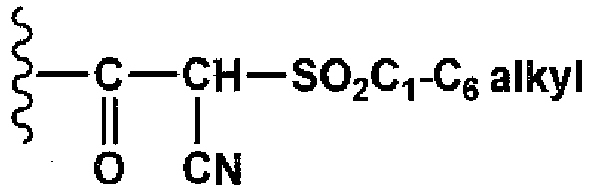
- R20 is C1-C6 alkyl or CF3;
- R21 is C1-C6 alkyl, C3-C8 cycloalkyl or CF3;
- R2 is H,C1-C6 alkyl, halo, optionally substituted C1-C6-alkoxy or N(C1-C6 alkyl)2,
- R3 is H, C1-C6 alkyl, C1-C6 alkoxy, or halo;
- R4 is H, halo or C1-C6 alkyl;
- R5 is H, halo or C1-C6 alkyl;
- R6 is H or halo;
- R7 and R8 are independently H, optionally substituted C1-C6 alkyl, optionally substituted aryl, optionally substituted C3-C8 cycloalkyl, phenylsulfonyl, dideutero-C1-C6-alkyl, optionally substituted C3-C8-cycloalkyl-C1-C6-alkyl, optionally substituted aryl-C1-C6-alkyl, optionally substituted C2-C6 alkynyl, optionally substituted 5- to 7-membered monocyclic heterocyclo, optionally substituted 7- to 10-membered bicyclic heterocyclo, optionally substituted C1-C6-alkoxy-C1-C6-alkyl, 5- to 7-membered monocyclic heteroaryl-C1-C6-alkyl, C2-C6 alkenyl, or C5-C8 cycloalkenyl,
- provided that only one of R7 and R8 is H,
- and wherein the optional substituents on R7 and R8, where possible, are 1 or 2 groups independently selected from hydroxy, optionally substituted C1-C6 alkyl, optionally substituted C1-C6 alkoxy, halo, optionally substituted aryl, optionally substituted C3-C8 cycloalkyl, 5- to 7-membered monocyclic heteroaryl or 5- to 7-membered monocyclic heterocyclic;
- or R7 and R8 are taken together with the nitrogen to which they are attached to form an optionally substituted 5- to 7-membered monocyclic heterocyclo ring, an optionally substituted 7- to 10-membered bicyclic heterocyclo ring, an optionally substituted 5- to 7-membered monocyclic heteroaryl ring, an optionally substituted 5- to 7-membered monocyclic heteroaryl-substituted 5- to 7-membered monocyclic heterocyclo ring, or a C3-C8-cycloalkyl-C1-C6-alkyl-substituted 7- to 10-membered bicyclic heterocyclo ring;
- R9 is H, C1-C10 alkyl, aryl, optionally substituted phenyl, C1-C6 alkylphenyl, optinally substituted C1-C6 alkoxyphenyl, di-C1-C6-alkylphenyl, dihalo(C1-C6-alkyl)phenyl, C2-C6 alkynylphenyl, optionally substituted 5- to 7-membered monocyclic heteroaryl, 7- to 10-membered bicyclic heteroaryl, C3-C8 cycloalkyl, C3-C8-cycloalkyl-C1-C6-alkyl, C2-C6 alkynyloxyphenyl, C2-C6-alkynyl-C1-C6-alkoxyphenyl, 5- to 7-membered monocyclic heteroarylphenyl, di-C1-C6-alkylaminophenyl, C1-C6 alkylsulfonylaminophenyl, 5- to 7-membered monocyclic heterocyclophenyl, C3-C8 cycloalkyl optionally substituted phenyl, optionally substituted phenyl-C1-C6-alkylcarbonyl, phenyl-C1-C6-alkyl or C1-C6 alkylcarbonyl;
- and/or a pharmaceutically acceptable salt thereof, a tautomer thereof or stereoisomer thereof.
- In a further aspect, the invention provides a compound of Formula (II) within the scope of the eighth aspect wherein:
- Y is CR6;
- R4 and R5 are independently H or F;
- R6 is H, F, or Cl;
- is phenyl;

- R1 is COOH,


- R2 is H, CH3, CH3O, CF3O, C2H5, Cl, or F;
- R3 is H or F;
- R7 and R8 are independently H, CH3, C2H5, C3H7, n-C4H9, i-C3H7, i-C4H9, t-C4H9,



- or R7 and R8 are taken together with the nitrogen to which they are attached to form


- R9 is


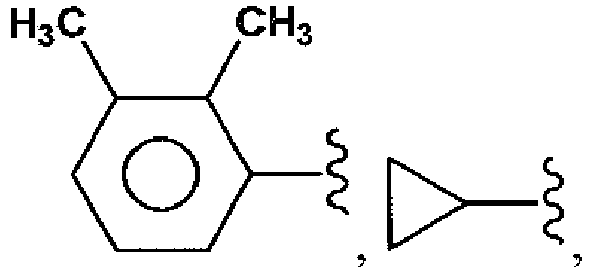


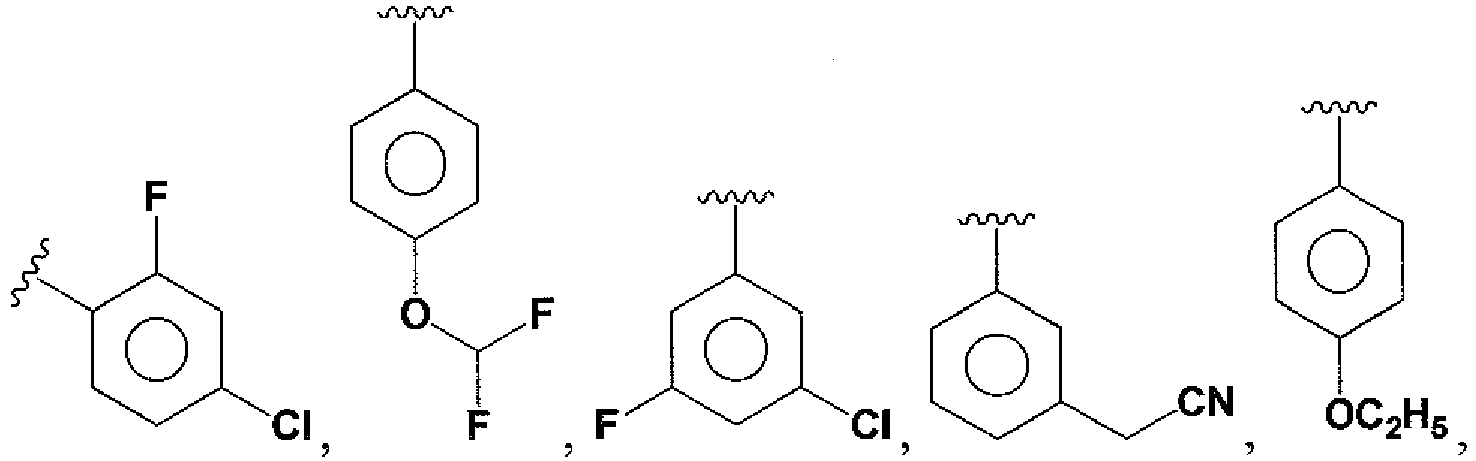
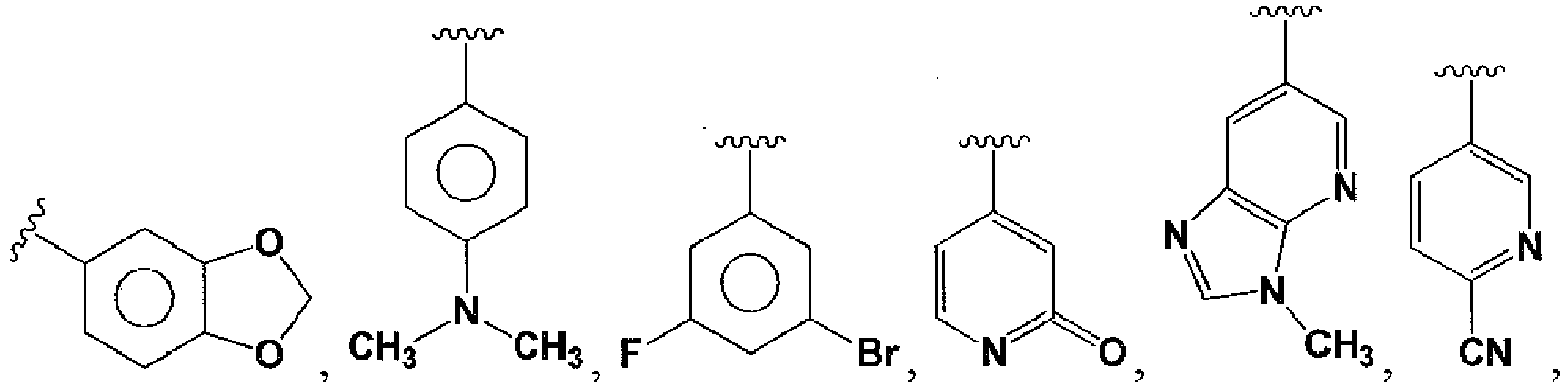


- and/or a pharmaceutically acceptable salt thereof, a tautomer thereof or stereoisomer thereof.
- In another aspect, the invention provides a compound selected from the exemplified examples within the scope of the previous aspects, or a pharmaceutically acceptable salt, tautomer or stereoisomer thereof.
- In another aspect, the invention provides a compound selected from any subset list of compounds within the scope of any of the above aspects.
- In another embodiment, the compounds of the invention have human IDO IC50 values :::;1500 nM.
- In another embodiment, the compounds of the invention have human IDO IC50 values ≤ 250 nM.
- In another embodiment, the compounds of the invention have human IDO IC50 values ≤ 50 nM.
- In another embodiment, the compounds of the invention have human IDO IC50 values ≤ 20 nM.
- In another embodiment, the compounds of the invention have human IDO IC50 values ≤ 10 nM.
- In another embodiment, the present invention provides a composition comprising one or more compounds of the present invention and/or a pharmaceutically acceptable salt thereof, a stereoisomer thereof, a tautomer thereof, or a solvate thereof
- In another embodiment, the present invention provides a pharmaceutical composition comprising a pharmaceutically acceptable carrier and at least one of the compounds of the present invention and/or a pharmaceutically acceptable salt thereof, a stereoisomer thereof, a tautomer thereof, or a solvate thereof.
- In another embodiment, the present invention provides a pharmaceutical composition, comprising: a pharmaceutically acceptable carrier and a therapeutically effective amount of at least one of the compounds of the present invention and/or a pharmaceutically acceptable salt thereof, a stereoisomer thereof, a tautomer thereof, or a solvate thereof.
- In another embodiment, the present invention provides a process for making a compound of the present invention and/or a pharmaceutically acceptable salt thereof, a stereoisomer thereof, a tautomer thereof, or a solvate thereof.
- In another embodiment, the present invention provides an intermediate for making a compound of the present invention and/or a pharmaceutically acceptable salt thereof, a stereoisomer thereof, a tautomer thereof, or a solvate thereof.
- In another embodiment, the present invention provides one or more compounds of the present invention and/or a pharmaceutically acceptable salt thereof, a stereoisomer thereof or a tautomer thereof for use in a method for the treatment and/or prophylaxis of various types of cancer, viral infections and/or autoimmune diseases, comprising administering to a patient in need of such treatment and/or prophylaxis a therapeutically effective amount of one or more compounds of the present invention and/or a pharmaceutically acceptable salt thereof, a stereoisomer thereof or a tautomer thereof, alone, or, optionally, in combination with another compound of the present invention and/or at least one other type of therapeutic agent, such as a chemotherapeutic agent or a signal transductor inhibitor.
- In another embodiment, the present invention provides a compound of the present invention, and/or a pharmaceutically acceptable salt thereof, a stereoisomer thereof or a tautomer thereof, for use in therapy.
- In another embodiment, the present invention provides a combined preparation of a compound of the present invention, and/or a pharmaceutically acceptable salt thereof, a stereoisomer thereof or a tautomer thereof, and additional therapeutic agent(s) for simultaneous, separate or sequential use in therapy.
- In another embodiment, the present invention provides a combined preparation of a compound of the present invention, and/or a pharmaceutically acceptable salt thereof, a stereoisomer thereof or a tautomer thereof, and additional therapeutic agent(s) for simultaneous, separate or sequential use in the treatment and/or prophylaxis of multiple diseases or disorders associated with the enzymatic activity of IDO.
- In another aspect, the invention provides a compound described herein and/or a pharmaceutically acceptable salt thereof, a stereoisomer thereof or a tautomer thereof for use in a method of treating a patient suffering from or susceptible to a medical condition that is sensitive to enzymatic activity of IDO. A number of medical conditions can be treated. The method comprises administering to the patient a therapeutically effective amount of a composition comprising a compound described herein and/or a pharmaceutically acceptable salt thereof, a stereoisomer thereof or a tautomer thereof. For example, the compounds described herein may be used to treat or prevent viral infections, proliferative diseases (e.g., cancer), and autoimmune diseases.
- The compounds and pharmaceutical compositions of the present invention are useful in treating or preventing any disease or conditions that are sensitive to enzymatic activity of IDO. These include viral and other infections (e.g., skin infections, GI infection, urinary tract infections, genito-urinary infections, systemic infections), proliferative diseases (e.g., cancer), and autoimmune diseases (e.g., rheumatoid arthritis, lupus). The compounds and pharmaceutical compositions maybe administered to animals, preferably mammals (e.g., domesticated animals, cats, dogs, mice, rats), and more preferably humans. Any method of administration may be used to deliver the compound or pharmaceutical composition to the patient. In certain embodiments, the compound or pharmaceutical composition is administered orally. In other embodiments, the compound or pharmaceutical composition is administered parenterally.
- Compounds of the invention can modulate activity of the enzyme indoleamine-2,3-dioxygenase (IDO). The term "modulate" is meant to refer to an ability to increase or decrease activity of an enzyme or receptor. Accordingly, compounds of the invention can be used in methods of modulating IDO by contacting the enzyme with any one or more of the compounds or compositions described herein. In some embodiments, compounds of the present invention can act as inhibitors of IDO. In further embodiments, the compounds of the invention can be used to modulate activity of IDO in cell or in an individual in need of modulation of the enzyme by administering a modulating (e.g., inhibiting) amount of a compound of the invention.
- Compounds of the invention can inhibit activity of the enzyme indoleamine-2,3-dioxygenase (IDO). For example, the compounds of the invention can be used to inhibit activity of IDO in cell or in an individual in need of modulation of the enzyme by administering an inhibiting amount of a compound of the invention.
- The present invention further provides methods of inhibiting the degradation of tryptophan in a system containing cells expressing IDO such as a tissue, living organism, or cell culture. In some embodiments, the present invention provides a compound of composition provided herein for use in methods of altering (e.g., increasing) extracellular tryptophan levels in a mammal by administering an effective amount of a compound of composition provided herein. Methods of measuring tryptophan levels and tryptophan degradation are routine in the art.
- The present invention further provides a compound or composition recited herein for use in methods of inhibiting immunosuppression such as IDO-mediated immunosuppression in a patient by administering to the patient an effective amount of a compound or composition recited herein. IDO-mediated immunosuppression has been associated with, for example, cancers, tumor growth, metastasis, viral infection, and viral replication.
- The present invention further provides a compound of the present invention or a pharmaceutical composition thereof for use in methods of treating diseases associated with activity or expression, including abnormal activity and/or overexpression, of IDO in an individual (e.g., patient) by administering to the individual in need of such treatment a therapeutically effective amount or dose of a compound of the present invention or a pharmaceutical composition thereof. Example diseases can include any disease, disorder or condition that is directly or indirectly linked to expression or activity of the IDO enzyme, such as over expression or abnormal activity. An IDO-associated disease can also include any disease, disorder or condition that can be prevented, ameliorated, or cured by modulating enzyme activity. Examples of IDO-associated diseases include cancer, viral infection such as HIV infection, HCV infection, depression, neurodegenerative disorders such as Alzheimer's disease and Huntington's disease, trauma, age-related cataracts, organ transplantation (e.g., organ transplant rejection), and autoimmune diseases including asthma, rheumatoid arthritis, multiple sclerosis, allergic inflammation, inflammatory bowel disease, psoriasis and systemic lupus erythematosus.
- As used herein, the term "cell" is meant to refer to a cell that is in vitro, ex vivo or in vivo. In some embodiments, an ex vivo cell can be part of a tissue sample excised from an organism such as a mammal. In some embodiments, an in vitro cell can be a cell in a cell culture. In some embodiments, an in vivo cell is a cell living in an organism such as a mammal.
- As used herein, the term "contacting" refers to the bringing together of indicated moieties in an in vitro system or an in vivo system. For example, "contacting" the IDO enzyme with a compound of the invention includes the administration of a compound of the present invention to an individual or patient, such as a human, having IDO, as well as, for example, introducing a compound of the invention into a sample containing a cellular or purified preparation containing the IDO enzyme.
- The term "IDO inhibitor" refers to an agent capable of inhibiting the activity of indoleamine 2,3-dioxygenase (IDO) and thereby reversing IDO-mediated immunosuppression. The IDO inhibitor may inhibit IDO1 and/or IDO2 (INDOL1). An IDO inhibitor may be a reversible or irreversible IDO inhibitor. "A reversible IDO inhibitor" is a compound that reversibly inhibits IDO enzyme activity either at the catalytic site or at a non-catalytic site and "an irreversible IDO inhibitor" is a compound that irreversibly destroys IDO enzyme activity by forming a covalent bond with the enzyme.
- Types of cancers that may be treated with the compounds of this invention include, but are not limited to, brain cancers, skin cancers, bladder cancers, ovarian cancers, breast cancers, gastric cancers, pancreatic cancers, prostate cancers, colon cancers, blood cancers, lung cancers and bone cancers. Examples of such cancer types include neuroblastoma, intestine carcinoma such as rectum carcinoma, colon carcinoma, familiar adenomatous polyposis carcinoma and hereditary non-polyposis colorectal cancer, esophageal carcinoma, labial carcinoma, larynx carcinoma, hypopharynx carcinoma, tongue carcinoma, salivary gland carcinoma, gastric carcinoma, adenocarcinoma, medullary thyroid carcinoma, papillary thyroid carcinoma, renal carcinoma, kidney parenchymal carcinoma, ovarian carcinoma, cervix carcinoma, uterine corpus carcinoma, endometrium carcinoma, chorion carcinoma, pancreatic carcinoma, prostate carcinoma, testis carcinoma, breast carcinoma, urinary carcinoma, melanoma, brain tumors such as glioblastoma, astrocytoma, meningioma, medulloblastoma and peripheral neuroectodermal tumors, Hodgkin lymphoma, non-Hodgkin lymphoma, Burkitt lymphoma, acute lymphatic leukemia (ALL), chronic lymphatic leukemia (CLL), acute myeloid leukemia (AML), chronic myeloid leukemia (CML), adult T-cell leukemia lymphoma, diffuse large B-cell lymphoma (DLBCL), hepatocellular carcinoma, gall bladder carcinoma, bronchial carcinoma, small cell lung carcinoma, non-small cell lung carcinoma, multiple myeloma, basalioma, teratoma, retinoblastoma, choroid melanoma, seminoma, rhabdomyosarcoma, craniopharyngioma, osteosarcoma, chondrosarcoma, myosarcoma, liposarcoma, fibrosarcoma, Ewing sarcoma and plasmocytoma.
- Thus, according to another embodiment, the invention provides a a compound or composition of the present invention for use in a method of treating an autoimmune disease by providing to a patient in need thereof a compound or composition of the present invention. Examples of such autoimmune diseases include, but are not limited to, collagen diseases such as rheumatoid arthritis, systemic lupus erythematosus. Sharp's syndrome, CREST syndrome (calcinosis, Raynaud's syndrome, esophageal dysmotility, telangiectasia), dermatomyositis, vasculitis (Morbus Wegener's) and Sjögren's syndrome, renal diseases such as Goodpasture's syndrome, rapidly-progressing glomerulonephritis and membrano-proliferative glomerulonephritis type II, endocrine diseases such as type-I diabetes, autoimmune polyendocrinopathy-candidiasis-ectodermal dystrophy (APECED), autoimmune parathyroidism, pernicious anemia, gonad insufficiency, idiopathic Morbus Addison's, hyperthyreosis, Hashimoto's thyroiditis and primary myxedema, skin diseases such as pemphigus vulgaris, bullous pemphigoid, herpes gestationis, epidermolysis bullosa and erythema multiforme major, liver diseases such as primary biliary cirrhosis, autoimmune cholangitis, autoimmune hepatitis type-1, autoimmune hepatitis type-2, primary sclerosing cholangitis, neuronal diseases such as multiple sclerosis, myasthenia gravis, myasthenic Lambert-Eaton syndrome, acquired neuromyotomy, Guillain-Barre syndrome (Muller-Fischer syndrome), stiff-man syndrome, cerebellar degeneration, ataxia, opsoclonus, sensoric neuropathy and achalasia, blood diseases such as autoimmune hemolytic anemia, idiopathic thrombocytopenic purpura (Morbus Werlhof), infectious diseases with associated autoimmune reactions such as AIDS, malaria and Chagas disease.
- One or more additional pharmaceutical agents or treatment methods such as, for example, anti-viral agents, chemotherapeutics or other anti-cancer agents, immune enhancers, immunosuppressants, radiation, anti-tumor and anti-viral vaccines, cytokine therapy (e.g., IL2 and GM-CSF), and/or tyrosine kinase inhibitors can be optionally used in combination with the compounds of the present invention for treatment of IDO-associated diseases, disorders or conditions. The agents can be combined with the present compounds in a single dosage form, or the agents can be administered simultaneously or sequentially as separate dosage forms.
- Suitable chemotherapeutic or other anti-cancer agents include, for example, alkylating agents (including, without limitation, nitrogen mustards, ethylenimine derivatives, alkyl sulfonates, nitrosoureas and triazenes) such as uracil mustard, chlormethine, cyclophosphamide (CYTOXAN®), ifosfamide, melphalan, chlorambucil, pipobroman, triethylene-melamine, triethylenethiophosphoramine, busulfan, carmustine, lomustine, streptozocin, dacarbazine, and temozolomide.
- In the treatment of melanoma, suitable agents for use in combination with the compounds of the present invention include: dacarbazine (DTIC), optionally, along with other chemotherapy drugs such as carmustine (BCNU) and cisplatin; the "Dartmouth regimen", which consists of DTIC, BCNU, cisplatin and tamoxifen; a combination of cisplatin, vinblastine, and DTIC, temozolomide or YERVOY™. Compounds according to the invention may also be combined with immunotherapy drugs, including cytokines such as interferon alpha, interleukin 2, and tumor necrosis factor (TNF) in the treatment of melanoma.
- Compounds of the invention may also be used in combination with vaccine therapy in the treatment of melanoma. Antimelanorna vaccines are, in some ways, similar to the anti-virus vaccines which are used to prevent diseases caused by viruses such as polio, measles, and mumps. Weakened melanoma cells or parts of melanoma cells called antigens may be injected into a patient to stimulate the body's immune system to destroy melanoma cells.
- Melanomas that are confined to the arms or legs may also be treated with a combination of agents including one or more compounds of the invention, using a hyperthermic isolated limb perfusion technique. This treatment protocol temporarily separates the circulation of the involved limb from the rest of the body and injects high doses of chemotherapy into the artery feeding the limb, thus providing high doses to the area of the tumor without exposing internal organs to these doses that might otherwise cause severe side effects. Usually the fluid is warmed to 102° to 104° F. Melphalan is the drug most often used in this chemotherapy procedure. This can be given with another agent called tumor necrosis factor (TNF).
- Suitable chemotherapeutic or other anti-cancer agents include, for example, antimetabolites (including, without limitation, folic acid antagonists, pyrimidine analogs, purine analogs and adenosine deaminase inhibitors) such as methotrexate, 5-fluorouracil, floxuridine, cytarabine, 6-mercaptopurine, 6-thioguanine, fludarabine phosphate, pentostatine, and gemcitabine.
- Suitable chemotherapeutic or other anti-cancer agents further include, for example, certain natural products and their derivatives (for example, vinca alkaloids, antitumor antibiotics, enzymes, lymphokines and epipodophyllotoxins) such as vinblastine, vincristine, vindesine, bleomycin, dactinomycin, daunorubicin, doxorubicin, epirubicin, idarubicin, ara-C, paclitaxel (Taxol), mithramycin, deoxyco-formycin, mitomycin-C, L-asparaginase, interferons (especially IFN-a), etoposide, and teniposide.
- Other cytotoxic agents include navelbene, CPT-11, anastrazole, letrazole, capecitabine, reloxafine, and droloxafine.
- Also suitable are cytotoxic agents such as epidophyllotoxin; an antineoplastic enzyme; a topoisomerase inhibitor; procarbazine; mitoxantrone; platinum coordination complexes such as cisplatin and carboplatin; biological response modifiers; growth inhibitors; antihormonal therapeutic agents; leucovorin; tegafur; and haematopoietic growth factors.
- Other anti-cancer agent(s) include antibody therapeutics such as trastuzumab (HERCEPTIN®), antibodies to costimulatory molecules such as CTLA-4, 4-1BB and PD-1, or antibodies to cytokines (IL-1O or TGF-β).
- Other anti-cancer agents also include those that block immune cell migration such as antagonists to chemokine receptors, including CCR2 and CCR4.
- Other anti-cancer agents also include those that augment the immune system such as adjuvants or adoptive T cell transfer.
- Anti-cancer vaccines include dendritic cells, synthetic peptides, DNA vaccines and recombinant viruses.
- The pharmaceutical composition of the invention may optionally include at least one signal transduction inhibitor (STI). A "signal transduction inhibitor" is an agent that selectively inhibits one or more vital steps in signaling pathways, in the normal function of cancer cells, thereby leading to apoptosis. Suitable STIs include, but are not limited to: (i) bcr/abl kinase inhibitors such as, for example, STI 571 (GLEEVEC®); (ii) epidermal growth factor (EGF) receptor inhibitors such as, for example, kinase inhibitors (IRESSA®, SSI-774) and antibodies (Imclone: C225 [Goldstein et al., Clin. Cancer Res., 1:1311-1318 (1995)], and Abgenix: ABX-EGF); (iii) her-2/neu receptor inhibitors such as farnesyl transferase inhibitors (FTI) such as, for example, L-744,832 (Kohl et al., Nat. Med., 1 (8):792-797 (1995)); (iv) inhibitors of Akt family kinases or the Akt pathway, such as, for example, rapamycin (see, for example, Sekulic et al., Cancer Res., 60:3504-3513 (2000)); (v) cell cycle kinase inhibitors such as, for example, flavopiridol and UCN-O1 (see, for example, Sausville, Curr. Med. Chem. Anti-Canc. Agents, 3:47-56 (2003)); and (vi) phosphatidyl inositol kinase inhibitors such as, for example, LY294002 (see, for example, Vlahos et al., J. Biol. Chem., 269:5241-5248 (1994)). Alternatively, at least one STI and at least one IDO inhibitor may be in separate pharmaceutical compositions. In a specific embodiment of the present invention, at least one IDO inhibitor and at least one STI may be administered to the patient concurrently or sequentially. In other words, at least one IDO inhibitor maybe administered first, at least one STI may be administered first, or at least one IDO inhibitor and at least one STI may be administered at the same time. Additionally, when more than one IDO inhibitor and/or STI is used, the compounds may be administered in any order.
- The present invention further provides a pharmaceutical composition for the treatment of a chronic viral infection in a patient comprising at least one IDO inhibitor, optionally, at least one chemotherapeutic drug, and, optionally, at least one antiviral agent, in a pharmaceutically acceptable carrier. The pharmaceutical compositions may include at least one IDO inhibitor of the instant invention in addition to at least one established (known) IDO inhibitor. In a specific embodiment, at least one of the IDO inhibitors of the pharmaceutical composition is selected from the group consisting of compounds of formulas (I) and (II).
- Also provided is above pharmaceutical composition for use in a method for treating a chronic viral infection in a patient by administering an effective amount of the above pharmaceutical composition.
- In a specific embodiment of the present invention, at least one IDO inhibitor and at least one chemotherapeutic agent may be administered to the patient concurrently or sequentially. In other words, at least one IDO inhibitor may be administered first, at least one chemotherapeutic agent may be administered first, or at least one IDO inhibitor and the at least one STI may be administered at the same time. Additionally, when more than one IDO inhibitor and/or chemotherapeutic agent is used, the compounds may be administered in any order. Similarly, any antiviral agent or STI may also be administered at any point in comparison to the administration of an IDO inhibitor.
- Chronic viral infections that may be treated using the present combinatorial treatment include, but are not limited to, diseases caused by: hepatitis C virus (HCV), human papilloma virus (HPV), cytomegalovirus (CMV), herpes simplex virus (HSV), Epstein-Barr virus (EBV), varicella zoster virus, coxsackie virus, human immunodeficiency virus (HIV). Notably, parasitic infections (e.g., malaria) may also be treated by the above methods wherein compounds known to treat the parasitic conditions are optionally added in place of the antiviral agents.
- In yet another embodiment, the pharmaceutical compositions comprising at least one IDO inhibitor of the instant invention may be administered to a patient to prevent arterial restenosis, such as after balloon endoscopy or stent placement. In a particular embodiment, the pharmaceutical composition further comprises at least one taxane (e.g., paclitaxel (Taxol); see e.g., Scheller et al., Circulation, 110:810-814 (2004)).
- Suitable antiviral agents contemplated for use in combination with the compounds of the present invention can comprise nucleoside and nucleotide reverse transcriptase inhibitors (NRTIs), non-nucleoside reverse transcriptase inhibitors (NNRTIs), protease inhibitors and other antiviral drugs.
- Examples of suitable NRTIs include zidovudine (AZT); didanosine (ddl); zalcitabine (ddC); stavudine (d4T); lamivudine (3TC); abacavir (1592U89); adefovir dipivoxil [bis(POM)-PMEA]; lobucavir (BMS-180194); BCH-I0652; emitricitabine [(-)-FTC]; beta-L-FD4 (also called beta-L-D4C and named beta-L-2',3'-dicleoxy-5-fluoro-cytidene); DAPD, ((-)-beta-D-2,6-diamino-purine dioxolane); and lodenosine (FddA). Typical suitable NNRTIs include nevirapine (BI-RG-587); delaviradine (BHAP, U-90152); efavirenz (DMP-266); PNU-142721; AG-1549; MKC-442 (1-(ethoxy-methyl)-5-(1-methylethyl)-6-(phenylmethyl)-(2,4(1H,3H)-pyrimidinedione); and (+)-calanolide A (NSC-675451) and B. Typical suitable protease inhibitors include saquinavir (Ro 31-8959); ritonavir (ABT-538); indinavir (MK-639); nelfnavir (AG-1343); amprenavir (141W94); lasinavir (BMS-234475); DMP-450; BMS-2322623; ABT-378; and AG-1549. Other antiviral agents include hydroxyurea, ribavirin, IL-2, IL-12, pentafuside and Yissum Project No. 11607.
- The present invention also includes pharmaceutical kits useful, for example, in the treatment or prevention of IDO-associated diseases or disorders, obesity, diabetes and other diseases referred to herein which include one or more containers containing a pharmaceutical composition comprising a therapeutically effective amount of a compound of the invention. Such kits can further include, if desired, one or more of various conventional pharmaceutical kit components, such as, for example, containers with one or more pharmaceutically acceptable carriers, additional containers, as will be readily apparent to those skilled in the art. Instructions, either as inserts or as labels, indicating quantities of the components to be administered, guidelines for administration, and/or guidelines for mixing the components, can also be included in the kit.
- The combination therapy is intended to embrace administration of these therapeutic agents in a sequential manner, that is, wherein each therapeutic agent is administered at a different time, as well as administration of these therapeutic agents, or at least two of the therapeutic agents, in a substantially simultaneous manner. Substantially simultaneous administration can be accomplished, for example, by administering to the subject a single dosage form having a fixed ratio of each therapeutic agent or in multiple, single dosage forms for each of the therapeutic agents. Sequential or substantially simultaneous administration of each therapeutic agent can be effected by any appropriate route including, but not limited to, oral routes, intravenous routes, intramuscular routes, and direct absorption through mucous membrane tissues. The therapeutic agents can be administered by the same route or by different routes. For example, a first therapeutic agent of the combination selected may be administered by intravenous injection while the other therapeutic agents of the combination may be administered orally. Alternatively, for example, all therapeutic agents may be administered orally or all therapeutic agents may be administered by intravenous injection. Combination therapy also can embrace the administration of the therapeutic agents as described above in further combination with other biologically active ingredients and non-drug therapies (e.g., surgery or radiation treatment). Where the combination therapy further comprises a non-drug treatment, the non-drug treatment may be conducted at any suitable time so long as a beneficial effect from the co-action of the combination of the therapeutic agents and non-drug treatment is achieved. For example, in appropriate cases, the beneficial effect is still achieved when the non-drug treatment is temporally removed from the administration of the therapeutic agents, perhaps by days or even weeks.
- The invention also provides pharmaceutically acceptable compositions which comprise a therapeutically effective amount of one or more of the compounds of Formula I, formulated together with one or more pharmaceutically acceptable carriers (additives) and/or diluents, and optionally, one or more additional therapeutic agents described above.
- The compounds of this invention can be administered for any of the uses described herein by any suitable means, for example, orally, such as tablets, capsules (each of which includes sustained release or timed release formulations), pills, powders, granules, elixirs, tinctures, suspensions (including nanosuspensions, microsuspensions, spray-dried dispersions), syrups, and emulsions; sublingually; bucally; parenterally, such as by subcutaneous, intravenous, intramuscular, or intrasternal injection, or infusion techniques (e.g., as sterile injectable aqueous or non-aqueous solutions or suspensions); nasally, including administration to the nasal membranes, such as by inhalation spray; topically, such as in the form of a cream or ointment; or rectally such as in the form of suppositories. They can be administered alone, but generally will be administered with a pharmaceutical carrier selected on the basis of the chosen route of administration and standard pharmaceutical practice.
- The phrase "pharmaceutically acceptable" is employed herein to refer to those compounds, materials, compositions, and/or dosage forms which are, within the scope of sound medical judgment, suitable for use in contact with the tissues of human beings and animals without excessive toxicity, irritation, allergic response, or other problem or complication, commensurate with a reasonable benefit/risk ratio.
- The phrase "pharmaceutically acceptable carrier" as used herein means a pharmaceutically acceptable material, composition or vehicle, such as a liquid or solid filler, diluent, excipient, manufacturing aid (e.g., lubricant, talc magnesium, calcium or zinc stearate, or steric acid), or solvent encapsulating material, involved in carrying or transporting the subject compound from one organ, or portion of the body, to another organ, or portion of the body. Each carrier must be "acceptable" in the sense of being compatible with the other ingredients of the formulation and not injurious to the patient.
- The term "pharmaceutical composition" means a composition comprising a compound of the invention in combination with at least one additional pharmaceutically acceptable carrier. A "pharmaceutically acceptable carrier" refers to media generally accepted in the art for the delivery of biologically active agents to animals, in particular, mammals, including, i.e., adjuvant, excipient or vehicle, such as diluents, preserving agents, fillers, flow regulating agents, disintegrating agents, wetting agents, emulsifying agents, suspending agents, sweetening agents, flavoring agents, perfuming agents, antibacterial agents, antifungal agents, lubricating agents and dispensing agents, depending on the nature of the mode of administration and dosage forms.
- Pharmaceutically acceptable carriers are formulated according to a number of factors well within the purview of those of ordinary skill in the art. These include, without limitation: the type and nature of the active agent being formulated; the subject to which the agent-containing composition is to be administered; the intended route of administration of the composition; and the therapeutic indication being targeted. Pharmaceutically acceptable carriers include both aqueous and non-aqueous liquid media, as well as a variety of solid and semi-solid dosage forms. Such carriers can include a number of different ingredients and additives in addition to the active agent, such additional ingredients being included in the formulation for a variety of reasons, e.g., stabilization of the active agent, binders, etc., well known to those of ordinary skill in the art. Descriptions of suitable pharmaceutically acceptable carriers, and factors involved in their selection, are found in a variety of readily available sources such as, for example, Allen, L. V. Jr. et al. Remington: The Science and Practice of Pharmacy (2 Volumes), 22nd Edition (2012), Pharmaceutical Press.
- The dosage regimen for the compounds of the present invention will, of course, vary depending upon known factors, such as the pharmacodynamic characteristics of the particular agent and its mode and route of administration; the species, age, sex, health, medical condition, and weight of the recipient; the nature and extent of the symptoms; the kind of concurrent treatment; the frequency of treatment; the route of administration, the renal and hepatic function of the patient, and the effect desired.
- By way of general guidance, the daily oral dosage of each active ingredient, when used for the indicated effects, will range between about 0.001 to about 5000 mg per day, preferably between about 0.01 to about 1000 mg per day, and most preferably between about 0.1 to about 250 mg per day. Intravenously, the most preferred doses will range from about 0.01 to about 10 mg/kg/minute during a constant rate infusion. Compounds of this invention may be administered in a single daily dose, or the total daily dosage may be administered in divided doses of two, three, or four times daily.
- The compounds are typically administered in admixture with suitable pharmaceutical diluents, excipients, or carriers (collectively referred to herein as pharmaceutical carriers) suitably selected with respect to the intended form of administration, e.g., oral tablets, capsules, elixirs, and syrups, and consistent with conventional pharmaceutical practices.
- Dosage forms (pharmaceutical compositions) suitable for administration may contain from about 1 milligram to about 2000 milligrams of active ingredient per dosage unit. In these pharmaceutical compositions the active ingredient will ordinarily be present in an amount of about 0.1-95% by weight based on the total weight of the composition.
- A typical capsule for oral administration contains at least one of the compounds of the present invention (250 mg), lactose (75 mg), and magnesium stearate (15 mg). The mixture is passed through a 60 mesh sieve and packed into a No. 1 gelatin capsule.
- A typical injectable preparation is produced by aseptically placing at least one of the compounds of the present invention (250 mg) into a vial, aseptically freeze-drying and sealing. For use, the contents of the vial are mixed with 2 mL of physiological saline, to produce an injectable preparation.
- The present invention includes within its scope pharmaceutical compositions comprising, as an active ingredient, a therapeutically effective amount of at least one of the compounds of the present invention, alone or in combination with a pharmaceutical carrier. Optionally, compounds of the present invention can be used alone, in combination with other compounds of the invention, or in combination with one or more other therapeutic agent(s), e.g., an anticancer agent or other pharmaceutically active material.
- Regardless of the route of administration selected, the compounds of the present invention, which may be used in a suitable hydrated form, and/or the pharmaceutical compositions of the present invention, are formulated into pharmaceutically acceptable dosage forms by conventional methods known to those of skill in the art.
- Actual dosage levels of the active ingredients in the pharmaceutical compositions of this invention may be varied so as to obtain an amount of the active ingredient which is effective to achieve the desired therapeutic response for a particular patient, composition, and mode of administration, without being toxic to the patient.
- The selected dosage level will depend upon a variety of factors including the activity of the particular compound of the present invention employed, or the ester, salt or amide thereof, the route of administration, the time of administration, the rate of excretion or metabolism of the particular compound being employed, the rate and extent of absorption, the duration of the treatment, other drugs, compounds and/or materials used in combination with the particular compound employed, the age, sex, weight, condition, general health and prior medical history of the patient being treated, and like factors well known in the medical arts.
- A physician or veterinarian having ordinary skill in the art can readily determine and prescribe the effective amount of the pharmaceutical composition required. For example, the physician or veterinarian could start doses of the compounds of the invention employed in the pharmaceutical composition at levels lower than that required in order to achieve the desired therapeutic effect and gradually increase the dosage until the desired effect is achieved.
- In general, a suitable daily dose of a compound of the invention will be that amount of the compound which is the lowest dose effective to produce a therapeutic effect. Such an effective dose will generally depend upon the factors described above. Generally, oral, intravenous, intracerebroventricular and subcutaneous doses of the compounds of this invention for a patient will range from about 0.01 to about 50 mg per kilogram of body weight per day.
- If desired, the effective daily dose of the active compound may be administered as two, three, four, five, six or more sub-doses administered separately at appropriate intervals throughout the day, optionally, in unit dosage forms. In certain aspects of the invention, dosing is one administration per day.
- While it is possible for a compound of the present invention to be administered alone, it is preferable to administer the compound as a pharmaceutical formulation (composition).
- Unless specifically stated otherwise herein, references made in the singular may also include the plural. For example, "a" and "an" may refer to either one, or one or more.
- Unless otherwise indicated, any heteroatom with unsatisfied valences is assumed to have hydrogen atoms sufficient to satisfy the valences.
- Throughout the specification and the appended claims, a given chemical formula or name shall encompass all stereo and optical isomers and racemates thereof where such isomers exist. Unless otherwise indicated, all chiral (enantiomeric and diastereomeric) and racemic forms are within the scope of the invention. Many geometric isomers of C=C double bonds, C=N double bonds, ring systems, and the like can also be present in the compounds, and all such stable isomers are contemplated in the present invention. Cis- and trans- (or E- and Z-) geometric isomers of the compounds of the present invention are described and may be isolated as a mixture of isomers or as separated isomeric forms. The present compounds can be isolated in optically active or racemic forms. Optically active forms may be prepared by resolution of racemic forms or by synthesis from optically active starting materials. All processes used to prepare compounds of the present invention and intermediates made therein are considered to be part of the present invention. When enantiomeric or diastereomeric products are prepared, they may be separated by conventional methods, for example, by chromatography or fractional crystallization. Depending on the process conditions the end products of the present invention are obtained either in free (neutral) or salt form. Both the free form and the salts of these end products are within the scope of the invention. If so desired, one form of a compound may be converted into another form. A free base or acid may be converted into a salt; a salt may be converted into the free compound or another salt; a mixture of isomeric compounds of the present invention may be separated into the individual isomers. Compounds of the present invention, free form and salts thereof, may exist in multiple tautomeric forms, in which hydrogen atoms are transposed to other parts of the molecules and the chemical bonds between the atoms of the molecules are consequently rearranged. It should be understood that all tautomeric forms, insofar as they may exist, are included within the invention.
- When a substituent is noted as "optionally substituted", the substituents are selected from, for example, substituents such as alkyl, cycloalkyl, aryl, heterocyclo, halo, hydroxy, alkoxy, oxo, alkanoyl, aryloxy, alkanoyloxy, amino, alkylamino, arylamino, arylalkylamino, disubstituted amines in which the 2 amino substituents are selected from alkyl, aryl or arylalkyl; alkanoylamino, aroylamino, aralkanoylamino, substituted alkanoylamino, substituted arylamino, substituted aralkanoylamino, thiol, alkylthio, arylthio, arylalkylthio, alkylthiono, arylthiono, arylalkylthiono, alkylsulfonyl, arylsulfonyl, arylalkylsulfonyl, sulfonamido, e.g. -SO2NH2, substituted sulfonamido, nitro, cyano, carboxy, carbamyl, e.g. -CONH2, substituted carbamyl e.g. -CONHalkyl, - CONHaryl, -CONHarylalkyl or cases where there are two substituents on the nitrogen selected from alkyl, aryl or arylalkyl; alkoxycarbonyl, aryl, substituted aryl, guanidino, heterocyclyl, e.g., indolyl, imidazolyl, furyl, thienyl, thiazolyl, pyrrolidyl, pyridyl, pyrimidyl, pyrrolidinyl, piperidinyl, morpholinyl, piperazinyl, homopiperazinyl and the like, and substituted heterocyclyl, unless otherwise defined.
- For purposes of clarity and in accordance with standard convention in the art, the symbol

- Additonally, for purposes of clarity, where a substituent has a dash (-) that is not between two letters or symbols; this is used to indicate a point of attachment for a substituent. For example, -CONH2 is attached through the carbon atom.
- Additionally, for purposes of clarity, when there is no substituent shown at the end of a solid line, this indicates that there is a methyl (CH3) group connected to the bond.
- As used herein, the term "alkyl" or "alkylene" is intended to include both branched and straight-chain saturated aliphatic hydrocarbon groups having the specified number of carbon atoms. For example, "C1-C6 alkyl" denotes alkyl having 1 to 6 carbon atoms. Example alkyl groups include, but are not limited to, methyl (Me), ethyl (Et), propyl (e.g., n-propyl and isopropyl), butyl (e.g., n-butyl, isobutyl, t-butyl), and pentyl (e.g., n-pentyl, isopentyl, neopentyl).
- The term "alkenyl" denotes a straight- or branch-chained hydrocarbon radical containing one or more double bonds and typically from 2 to 20 carbon atoms in length. For example, "C2-C8 alkenyl" contains from two to eight carbon atoms. Alkenyl groups include, but are not limited to, for example, ethenyl, propenyl, butenyl, 1-methyl-2-buten-1-yl, heptenyl, octenyl and the like.
- The term "alkynyl" denotes a straight- or branch-chained hydrocarbon radical containing one or more triple bonds and typically from 2 to 20 carbon atoms in length. For example, "C2-C8 alkenyl" contains from two to eight carbon atoms. Representative alkynyl groups include, but are not limited to, for example, ethynyl, 1-propynyl, 1-butynyl, heptynyl, octynyl and the like.
- The term "alkoxy" or "alkyloxy" refers to an -O-alkyl group. "C1-6 alkoxy" (or alkyloxy), is intended to include C1, C2, C3, C4, C5, and C6 alkoxy groups. Example alkoxy groups include, but are not limited to, methoxy, ethoxy, propoxy (e.g., n-propoxy and isopropoxy), and t-butoxy. Similarly, "alkylthio" or "thioalkoxy" represents an alkyl group as defined above with the indicated number of carbon atoms attached through a sulphur bridge; for example methyl-S- and ethyl-S-.
- The term "aryl", either alone or as part of a larger moiety such as "aralkyl", "aralkoxy", or aryloxyalkyl", refers to monocyclic, bicyclic and tricyclic ring systems having a total of five to 15 ring members, wherein at least one ring in the system is aromatic and wherein each ring in the system contains three to seven ring members. In certain embodiments of the invention, "aryl" refers to an aromatic ring system which includes, but not limited to phenyl, biphenyl, indanyl, 1-naphthyl, 2-naphthyl and terahydronaphthyl. The term "aralkyl" or "arylalkyl" refers to an alkyl residue attached to an aryl ring. Non-limiting examples include benzyl, phenethyl and the like. The fused aryls may be connected to another group either at a suitable position on the cycloalkyl ring or the aromatic ring. For example:


- Arrowed lines drawn from the ring system indicate that the bond may be attached to any of the suitable ring atoms.
- The term "cycloalkyl" refers to cyclized alkyl groups. C3-6 cycloalkyl is intended to include C3, C4, C5, and C6 cycloalkyl groups. Example cycloalkyl groups include, but are not limited to, cyclopropyl, cyclobutyl, cyclopentyl, cyclohexyl, and norbornyl. Branched cycloalkyl groups such as 1-methylcyclopropyl and 2-methylcyclopropyl are included in the definition of "cycloalkyl". The term "cycloalkenyl" refers to cyclized alkenyl groups. C4-6 cycloalkenyl is intended to include C4, C5, and C6 cycloalkenyl groups. Example cycloalkenyl groups include, but are not limited to, cyclobutenyl, cyclopentenyl, and cyclohexenyl.
- The term "cycloalkylalkyl"refers to a cycloalkyl or substituted cycloalkyl bonded to an alkyl group connected to the carbazole core of the compound.
- "Halo" or "halogen" includes fluoro, chloro, bromo, and iodo. "Haloalkyl" is intended to include both branched and straight-chain saturated aliphatic hydrocarbon groups having the specified number of carbon atoms, substituted with 1 or more halogens. Examples of haloalkyl include, but are not limited to, fluoromethyl, difluoromethyl, trifluoromethyl, trichloromethyl, pentafluoroethyl, pentachloroethyl, 2,2,2-trifluoroethyl, heptafluoropropyl, and heptachloropropyl. Examples of haloalkyl also include "fluoroalkyl" that is intended to include both branched and straight-chain saturated aliphatic hydrocarbon groups having the specified number of carbon atoms, substituted with 1 or more fluorine atoms.
- "Haloalkoxy" or "haloalkyloxy" represents a haloalkyl group as defined above with the indicated number of carbon atoms attached through an oxygen bridge. For example, "C1-6 haloalkoxy", is intended to include C1, C2, C3, C4, C5, and C6 haloalkoxy groups. Examples of haloalkoxy include, but are not limited to, trifluoromethoxy, 2,2,2-trifluoroethoxy, and pentafluorothoxy. Similarly, "haloalkylthio" or "thiohaloalkoxy" represents a haloalkyl group as defined above with the indicated number of carbon atoms attached through a sulphur bridge; for example trifluoromethyl-S-, and pentafluoroethyl-S-.
- The term "benzyl," as used herein, refers to a methyl group on which one of the hydrogen atoms is replaced by a phenyl group.
- As used herein, the term "heterocycle," "heterocyclyl," or "heterocyclic group" is intended to mean a stable 3-, 4-, 5-, 6-, or 7-membered monocyclic or bicyclic or 7-, 8-, 9-, 10-, 11-, 12-, 13-, or 14-membered polycyclic heterocyclic ring that is saturated, partially unsaturated, or fully unsaturated, and that contains carbon atoms and 1, 2, 3 or 4 heteroatoms independently selected from the group consisting ofN, O and S; and including any polycyclic group in which any of the above-defined heterocyclic rings is fused to a benzene ring. The nitrogen and sulfur heteroatoms may optionally be oxidized (i.e., N→O and S(O)p, wherein p is 0, 1 or 2). The nitrogen atom may be substituted or unsubstituted (i.e., N or NR wherein R is H or another substituent, if defined). The heterocyclic ring may be attached to its pendant group at any heteroatom or carbon atom that results in a stable structure. The heterocyclic rings described herein may be substituted on carbon or on a nitrogen atom if the resulting compound is stable. A nitrogen in the heterocycle may optionally be quaternized. It is preferred that when the total number of S and O atoms in the heterocycle exceeds 1, then these heteroatoms are not adjacent to one another. It is preferred that the total number of S and O atoms in the heterocycle is not more than 1. When the term "heterocycle" is used, it is intended to include heteroaryl.
- Examples of heterocycles include, but are not limited to, acridinyl, azetidinyl, azocinyl, benzimidazolyl, benzofuranyl, benzothiofuranyl, benzothiophenyl, benzoxazolyl, benzoxazolinyl, benzthiazolyl, benztriazolyl, benztetrazolyl, benzisoxazolyl, benzisothiazolyl, benzimidazolinyl, carbazolyl, 4aH-carbazolyl, carbolinyl, chromanyl, chromenyl, cinnolinyl, decahydroquinolinyl, 2H,6H-1,5,2-dithiazinyl, dihydrofuro[2,3-b]tetrahydrofuran, furanyl, furazanyl, imidazolidinyl, imidazolinyl, imidazolyl, 1H-indazolyl, imidazolopyridinyl, indolenyl, indolinyl, indolizinyl, indolyl, 3H-indolyl, isatinoyl, isobenzofuranyl, isochromanyl, isoindazolyl, isoindolinyl, isoindolyl, isoquinolinyl, isothiazolyl, isothiazolopyridinyl, isoxazolyl, isoxazolopyridinyl, methylenedioxyphenyl, morpholinyl, naphthyridinyl, octahydroisoquinolinyl, oxadiazolyl, 1,2,3-oxadiazolyl, 1,2,4-oxadiazolyl, 1,2,5-oxadiazolyl, 1,3,4-oxadiazolyl, oxazolidinyl, oxazolyl, oxazolopyridinyl, oxazolidinylperimidinyl, oxindolyl, pyrimidinyl, phenanthridinyl, phenanthrolinyl, phenazinyl, phenothiazinyl, phenoxathiinyl, phenoxazinyl, phthalazinyl, piperazinyl, piperidinyl, piperidonyl, 4-piperidonyl, piperonyl, pteridinyl, purinyl, pyranyl, pyrazinyl, pyrazolidinyl, pyrazolinyl, pyrazolopyridinyl, pyrazolyl, pyridazinyl, pyridooxazolyl, pyridoimidazolyl, pyridothiazolyl, pyridinyl, pyrimidinyl, pyrrolidinyl, pyrrolinyl, 2-pyrrolidonyl, 2H-pyrrolyl, pyrrolyl, quinazolinyl, quinolinyl, 4H-quinolizinyl, quinoxalinyl, quinuclidinyl, tetrazolyl, tetrahydrofuranyl, tetrahydroisoquinolinyl, tetrahydroquinolinyl, 6H-1,2,5-thiadiazinyl, 1,2,3-thiadiazolyl, 1,2,4-thiadiazolyl, 1,2,5-thiadiazolyl, 1,3,4-thiadiazolyl, thianthrenyl, thiazolyl, thienyl, thiazolopyridinyl, thienothiazolyl, thienooxazolyl, thienoimidazolyl, thiophenyl, triazinyl, 1,2,3-triazolyl, 1,2,4-triazolyl, 1,2,5-triazolyl, 1,3,4-triazolyl, and xanthenyl. Also included are fused ring and spiro compounds containing, for example, the above heterocycles.
- As used herein, the term "bicyclic heterocycle" or "bicyclic heterocyclic group" is intended to mean a stable 9- or 10-membered heterocyclic ring system which contains two fused rings and consists of carbon atoms and 1, 2, 3, or 4 heteroatoms independently selected from the group consisting of N, O and S. Of the two fused rings, one ring is a 5- or 6-membered monocyclic aromatic ring comprising a 5-membered heteroaryl ring, a 6-membered heteroaryl ring or a benzo ring, each fused to a second ring. The second ring is a 5- or 6-membered monocyclic ring which is saturated, partially unsaturated, or unsaturated, and comprises a 5-membered heterocycle, a 6-membered heterocycle or a carbocycle (provided the first ring is not benzo when the second ring is a carbocycle).
- The bicyclic heterocyclic group may be attached to its pendant group at any heteroatom or carbon atom which results in a stable structure. The bicyclic heterocyclic group described herein may be substituted on carbon or on a nitrogen atom if the resulting compound is stable. It is preferred that when the total number of S and O atoms in the heterocycle exceeds 1, then these heteroatoms are not adjacent to one another. It is preferred that the total number of S and O atoms in the heterocycle is not more than 1.
- Examples of a bicyclic heterocyclic group are, but not limited to, quinolinyl, isoquinolinyl, phthalazinyl, quinazolinyl, indolyl, isoindolyl, indolinyl, 1H-indazolyl, benzimidazolyl, 1,2,3,4-tetrahydroquinolinyl, 1,2,3,4-tetrahydroisoquinolinyl, 5,6,7,8-tetrahydro-quinolinyl, 2,3-dihydro-benzofuranyl, chromanyl, 1,2,3,4-tetrahydro-quinoxalinyl and 1,2,3,4-tetrahydro-quinazolinyl.
- As used herein, the term "aromatic heterocyclic group" or "heteroaryl" is intended to mean stable monocyclic and polycyclic aromatic hydrocarbons that include at least one heteroatom ring member such as sulfur, oxygen, or nitrogen. Heteroaryl groups include, without limitation, pyridyl, pyrimidinyl, pyrazinyl, pyridazinyl, triazinyl, furyl, quinolyl, isoquinolyl, thienyl, imidazolyl, thiazolyl, indolyl, pyrroyl, oxazolyl, benzofuryl, benzothienyl, benzthiazolyl, isoxazolyl, pyrazolyl, triazolyl, tetrazolyl, indazolyl, 1,2,4-thiadiazolyl, isothiazolyl, purinyl, carbazolyl, benzimidazolyl, indolinyl, benzodioxolanyl and benzodioxane. Heteroaryl groups are substituted or unsubstituted. The nitrogen atom is substituted or unsubstituted (i.e., N or NR wherein R is H or another substituent, if defined). The nitrogen and sulfur heteroatoms may optionally be oxidized (i.e., N→O and S(O)p, wherein p is 0, 1 or 2).
- Bridged rings are also included in the definition of heterocycle. A bridged ring occurs when one or more, preferably one to three, atoms (i.e., C, O, N, or S) link two non-adjacent carbon or nitrogen atoms. Examples of bridged rings include, but are not limited to, one carbon atom, two carbon atoms, one nitrogen atom, two nitrogen atoms, and a carbon-nitrogen group. It is noted that a bridge always converts a monocyclic ring into a tricyclic ring. When a ring is bridged, the substituents recited for the ring may also be present on the bridge.
- The term "heterocyclylalkyl"refers to a heterocyclyl or substituted heterocyclyl bonded to an alkyl group connected to the carbazole core of the compound.
- The term "counter ion" is used to represent a negatively charged species such as chloride, bromide, hydroxide, acetate, and sulfate or a positively charged species such as sodium (Na+), potassium (K+), ammonium (RnNHm+ where n=0-4 and m=0-4) and the like.
- The term "electron withdrawing group" (EWG) refers to a substituent which polarizes a bond, drawing electron density towards itself and away from other bonded atoms. Examples of EWGs include, but are not limited to, CF3, CF2CF3, CN, halogen, haloalkyl, NO2 sulfone, sulfoxide, ester, sulfonamide, carboxamide, alkoxy, alkoxyether, alkenyl, alkynyl, OH, C(O)alkyl, CO2H, phenyl, heteroaryl, -O-phenyl, and -O-heteroaryl. Preferred examples of EWG include, but are not limited to, CF3, CF2CF3, CN, halogen, SO2(C1-4 alkyl), CONH(C1-4 alkyl), CON(C1-4 alkyl)2, and heteroaryl. More preferred examples of EWG include, but are not limited to, CF3 and CN.
- As used herein, the term "amine protecting group" means any group known in the art of organic synthesis for the protection of amine groups which is stable to an ester reducing agent, a disubstituted hydrazine, R4-M and R7-M, a nucleophile, a hydrazine reducing agent, an activator, a strong base, a hindered amine base and a cyclizing agent. Such amine protecting groups fitting these criteria include those listed in Wuts, P. G. M. and Greene, T.W. Protecting Groups in Organic Synthesis, 4th Edition, Wiley (2007) and The Peptides: Analysis, Synthesis, Biology, Vol. 3, Academic Press, New York (1981), the disclosure of which is hereby incorporated by reference. Examples of amine protecting groups include, but are not limited to, the following: (1) acyl types such as formyl, trifluoroacetyl, phthalyl, and p-toluenesulfonyl; (2) aromatic carbamate types such as benzyloxycarbonyl (Cbz) and substituted benzyloxycarbonyls, 1-(p-biphenyl)-1-methylethoxycarbonyl, and 9-fluorenylmethyloxycarbonyl (Fmoc); (3) aliphatic carbamate types such as tert-butyloxycarbonyl (Boc), ethoxycarbonyl, diisopropylmethoxycarbonyl, and allyloxycarbonyl; (4) cyclic alkyl carbamate types such as cyclopentyloxycarbonyl and adamantyloxycarbonyl; (5) alkyl types such as triphenylmethyl and benzyl; (6) trialkylsilane such as trimethylsilane; (7) thiol containing types such as phenylthiocarbonyl and dithiasuccinoyl; and (8) alkyl types such as triphenylmethyl, methyl, and benzyl; and substituted alkyl types such as 2,2,2-trichloroethyl, 2-phenylethyl, and t-butyl; and trialkylsilane types such as trimethylsilane.
- As referred to herein, the term "substituted" means that at least one hydrogen atom is replaced with a non-hydrogen group, provided that normal valencies are maintained and that the substitution results in a stable compound. Ring double bonds, as used herein, are double bonds that are formed between two adjacent ring atoms (e.g., C=C, C=N, or N=N).
- In cases wherein there are nitrogen atoms (e.g., amines) on compounds of the present invention, these may be converted to N-oxides by treatment with an oxidizing agent (e.g., mCPBA and/or hydrogen peroxides) to afford other compounds of this invention. Thus, shown and claimed nitrogen atoms are considered to cover both the shown nitrogen and its N-oxide (N→O) derivative.
- When any variable occurs more than one time in any constituent or formula for a compound, its definition at each occurrence is independent of its definition at every other occurrence. Thus, for example, if a group is shown to be substituted with 0-3 R, then said group may optionally be substituted with up to three R groups, and at each occurrence R is selected independently from the definition of R. Also, combinations of substituents and/or variables are permissible only if such combinations result in stable compounds.
- When a bond to a substituent is shown to cross a bond connecting two atoms in a ring, then such substituent may be bonded to any atom on the ring. When a substituent is listed without indicating the atom in which such substituent is bonded to the rest of the compound of a given formula, then such substituent may be bonded via any atom in such substituent. Combinations of substituents and/or variables are permissible only if such combinations result in stable compounds.
- The phrase "pharmaceutically acceptable" is employed herein to refer to those compounds, materials, compositions, and/or dosage forms that are, within the scope of sound medical judgment, suitable for use in contact with the tissues of human beings and animals without excessive toxicity, irritation, allergic response, and/or other problem or complication, commensurate with a reasonable benefit/risk ratio.
- As used herein, "pharmaceutically acceptable salts" refer to derivatives of the disclosed compounds wherein the parent compound is modified by making acid or base salts thereof. Examples of pharmaceutically acceptable salts include, but are not limited to, mineral or organic acid salts of basic groups such as amines; and alkali or organic salts of acidic groups such as carboxylic acids. The pharmaceutically acceptable salts include the conventional non-toxic salts or the quaternary ammonium salts of the parent compound formed, for example, from non-toxic inorganic or organic acids. For example, such conventional non-toxic salts include those derived from inorganic acids such as hydrochloric, hydrobromic, sulfuric, sulfamic, phosphoric, and nitric; and the salts prepared from organic acids such as acetic, propionic, succinic, glycolic, stearic, lactic, malic, tartaric, citric, ascorbic, pamoic, maleic, hydroxymaleic, phenylacetic, glutamic, benzoic, salicylic, sulfanilic, 2-acetoxybenzoic, fumaric, toluenesulfonic, methanesulfonic, ethane disulfonic, oxalic, and isethionic, and the like.
- The pharmaceutically acceptable salts of the present invention can be synthesized from the parent compound that contains a basic or acidic moiety by conventional chemical methods. Generally, such salts can be prepared by reacting the free acid or base forms of these compounds with a stoichiometric amount of the appropriate base or acid in water or in an organic solvent, or in a mixture of the two; generally, nonaqueous media like ether, ethyl acetate, ethanol, isopropanol, or acetonitrile are preferred. Lists of suitable salts are found in Remington: The Science and Practice of Pharmacy, 22nd Edition, Allen, L. V. Jr., Ed.; Pharmaceutical Press, London, UK (2012), the disclosure of which is hereby incorporated by reference.
- In addition, compounds of formula I may have prodrug forms. Any compound that will be converted in vivo to provide the bioactive agent (i.e., a compound of formula I) is a prodrug within the scope and spirit of the invention. Various forms of prodrugs are well known in the art. For examples of such prodrug derivatives, see:
- a) Bundgaard, H., ed., Design of Prodrugs, Elsevier (1985), and Widder, K. et al., eds., Methods in Enzymology, 112:309-396, Academic Press (1985);
- b) Bundgaard, H., Chapter 5, "Design and Application of Prodrugs," A Textbook of Drug Design and Development, pp. 113-191, Krosgaard-Larsen, P. et al., eds., Harwood Academic Publishers (1991);
- c) Bundgaard, H., Adv. Drug Deliv. Rev., 8:1-38 (1992);
- d) Bundgaard, H. et al., J. Pharm. Sci., 77:285 (1988);
- e) Kakeya, N. et al., Chem. Pharm. Bull., 32:692 (1984); and
- f) Rautio, J (Editor). Prodrugs and Targeted Delivery (Methods and Principles in Medicinal Chemistry), Vol 47, Wiley-VCH, 2011.
- Compounds containing a carboxy group can form physiologically hydrolyzable esters that serve as prodrugs by being hydrolyzed in the body to yield formula I compounds per se. Such prodrugs are preferably administered orally since hydrolysis in many instances occurs principally under the influence of the digestive enzymes. Parenteral administration may be used where the ester per se is active, or in those instances where hydrolysis occurs in the blood. Examples of physiologically hydrolyzable esters of compounds of formula I include C1-6alkyl, C1-6alkylbenzyl, 4-methoxybenzyl, indanyl, phthalyl, methoxymethyl, C1-6 alkanoyloxy-C1-6alkyl (e.g., acetoxymethyl, pivaloyloxymethyl or propionyloxymethyl), C1-6alkoxycarbonyloxy-C1-6alkyl (e.g., methoxycarbonyl-oxymethyl or ethoxycarbonyloxymethyl, glycyloxymethyl, phenylglycyloxymethyl, (5-methyl-2-oxo-1,3-dioxolen-4-yl)-methyl), and other well known physiologically hydrolyzable esters used, for example, in the penicillin and cephalosporin arts. Such esters may be prepared by conventional techniques known in the art. Preparation of prodrugs is well known in the art and described in, for example, King, F.D., ed., Medicinal Chemistry: Principles and Practice, The Royal Society of Chemistry, Cambridge, UK (2nd edition, reproduced, 2006); Testa, B. et al., Hydrolysis in Drug and Prodrug Metabolism. Chemistry, Biochemistry and Enzymology, VCHA and Wiley-VCH, Zurich, Switzerland (2003); Wermuth, C.G., ed., The Practice of Medicinal Chemistry, 3rd edition, Academic Press, San Diego, CA (2008).
- The present invention is intended to include all isotopes of atoms occurring in the present compounds. Isotopes include those atoms having the same atomic number but different mass numbers. By way of general example and without limitation, isotopes of hydrogen include deuterium and tritium. Isotopes of carbon include 13C and 14C. Isotopically-labeled compounds of the invention can generally be prepared by conventional techniques known to those skilled in the art or by processes analogous to those described herein, using an appropriate isotopically-labeled reagent in place of the non-labeled reagent otherwise employed.
- The term "solvate" means a physical association of a compound of this invention with one or more solvent molecules, whether organic or inorganic. This physical association includes hydrogen bonding. In certain instances the solvate will be capable of isolation, for example when one or more solvent molecules are incorporated in the crystal lattice of the crystalline solid. The solvent molecules in the solvate may be present in a regular arrangement and/or a non-ordered arrangement. The solvate may comprise either a stoichiometric or nonstoichiometric amount of the solvent molecules. "Solvate" encompasses both solution-phase and isolable solvates. Exemplary solvates include, but are not limited to, hydrates, ethanolates, methanolates, and isopropanolates. Methods of solvation are generally known in the art.
- As used herein, the term "patient" refers to organisms to be treated by the methods of the present invention. Such organisms preferably include, but are not limited to, mammals (e.g., murines, simians, equines, bovines, porcines, canines, felines, and the like), and most preferably refers to humans.
- As used herein, the term "effective amount" means that amount of a drug or pharmaceutical agent, i.e., a compound of the invention, that will elicit the biological or medical response of a tissue, system, animal or human that is being sought, for instance, by a researcher or clinician. Furthermore, the term "therapeutically effective amount" means any amount which, as compared to a corresponding subject who has not received such amount, results in improved treatment, healing, prevention, or amelioration of a disease, disorder, or side effect, or a decrease in the rate of advancement of a disease or disorder. An effective amount can be administered in one or more administrations, applications or dosages and is not intended to be limited to a particular formulation or administration route. The term also includes within its scope amounts effective to enhance normal physiological function
- As used herein, the term "treating" includes any effect, e.g., lessening, reducing, modulating, ameliorating or eliminating, that results in the improvement of the condition, disease, disorder, and the like, or ameliorating a symptom thereof.
- As used herein, the term "pharmaceutical composition" refers to the combination of an active agent with a carrier, inert or active, making the composition especially suitable for diagnostic or therapeutic use in vivo or ex vivo.
- Examples of bases include, but are not limited to, alkali metals (e.g., sodium) hydroxides, alkaline earth metals (e.g., magnesium), hydroxides, ammonia, and compounds of formula NW4 +, wherein W is C1-4 alkyl, and the like.
- For therapeutic use, salts of the compounds of the present invention are contemplated as being pharmaceutically acceptable. However, salts of acids and bases that are non-pharmaceutically acceptable may also find use, for example, in the preparation or purification of a pharmaceutically acceptable compound.
- The compounds of the present invention may be prepared by methods such as those illustrated in the following Schemes utilizing chemical transformations known to those skilled in the art. Solvents, temperatures, pressures, and other reaction conditions may readily be selected by one of ordinary skill in the art. Starting materials are commercially available or readily prepared by one of ordinary skill in the art. These Schemes are illustrative and are not meant to limit the possible techniques one skilled in the art may use to manufacture compounds disclosed herein. Different methods may be evident to those skilled in the art. Additionally, the various steps in the synthesis may be performed in an alternate sequence or order to give the desired compound(s). Further, the representation of the reactions in these Schemes as discrete steps does not preclude their being performed in tandem, either by telescoping multiple steps in the same reaction vessel or by performing multiple steps without purifying or characterizing the intermediate(s). In addition, many of the compounds prepared by the methods below can be further modified using conventional chemistry well known to those skilled in the art. All documents cited herein are incorporated herein by reference in their entirety.
- References to many of these chemical transformations employed herein can be found in Smith, M.B. et al., March's Advanced Organic Chemistry Reactions, Mechanisms, and Structure, Fifth Edition, Wiley-Interscience, New York (2001), or other standard texts on the topic of synthetic organic chemistry. Certain transformations may require that reactive functional groups be masked by protecting group(s). A convenient reference which provides conditions for introduction, removal, and relative susceptibility to reaction conditions of these groups is Greene, T.W. et al., Protective Groups in Organic Synthesis, Third Edition, Wiley-Interscience, New York (1999).
- Referring to Scheme 1 set out below, treatment of compounds (i) where X is a halogen, such as Cl, Br or I, and Q is a halogen with amines HNR7R8 and a suitable base in a solvent such as THF, DMF, NMP, dioxane or the like affords intermediates (ii). Generally heating is required. Suitable bases include, but are not limited to aliphatic tertiary amines, sodium or potassium carbonate, or an excess of the reacting primary or secondary amine HNR7R8. Reduction of the nitro group in compounds (ii) to afford anilines (iii) can be effected by various means including catalytic hydrogenation and dissolving metal reductions both in their various forms. See House, H.O., Modern Synthetic Reactions, Second Edition, W.A. Benjamin, Inc., Menlo Park, California, publ. (1972). A preferred method for effecting this reduction without removal of the halogen substituent X involves stirring a solution of (ii) in a wet alcoholic solvent with an acid such as ammonium chloride and finely divided zinc. Treatment of anilines (iii) with an isocyanate R9N=C=O (iva), affords urea compounds (iv). Typically, this reaction is performed in a solvent such as THF at a temperature between ambient and the boiling point of the solvent. Coupling of (iv) with arylboronic acids or esters (ivb), preferably under the conditions of Suzuki (see Kotha, S. et al., Tetrahedron, 58:9633-9695 (2002)) affords compounds of the invention I. Typically, this reaction is performed by heating the halide and the boronic acid or ester to from about 90 to about 98 °C with a base such as aqueous tribasic sodium or potassium phosphate or sodium or potassium carbonate in a solvent such as dioxane, DMF, THF, or NMP using a catalyst such as tetrakis(triphenylphosphine)palladium or Cl2Pd(dppf). Many variations on this reaction involving the use of different temperatures, solvents, bases, anhydrous conditions, catalysts, boronate derivatives, and halide surrogates such as triflates are known to those skilled in the art of organic/medicinal chemistry. Mild conditions have been reported for the coupling of sensitive boronic acid derivatives. See Kinzel, T. et al., J. Am. Chem. Soc., 132(40):14073-14075 (2010). Related coupling reactions for the conversion of (iv) and other aryl halide intermediates described in later Schemes into compounds of the invention include the Heck (olefin) (J. Am. Chem. Soc., 96(4): 1133-1136 (1974)), Stille (organostannane) (Synthesis, 803-815 (1992)), Sonogashira (acetylene) (Sonogashira, K. et al., Tetrahedron Lett., 16(50):4467-4470 (1975)), and Negishi (organozinc) (Aldrichimica Acta, 38(3):71-78 (2005)) coupling reactions.

- Scheme 2 describes a preparation of compounds of the invention I similar to that of Scheme 1 but with the transformations performed in a different order. In this Scheme the Suzuki or related coupling is performed on intermediate (iii) to afford aniline (v) which is derivatized by reaction with an isocyanate (iva) to afford compounds of the invention I.

- Scheme 3 illustrates a route to compounds of the invention I in which the Suzuki or related coupling is performed on intermediates (ii) to afford intermediates (vi). Reduction under the conditions described above provides anilines (v) which react with isocyanates to afford compounds of the invention I.

- Scheme 4 illustrates a method suitable for preparation of compounds of the invention I for which the boronic acid/ester or related derivatives of the


- In Scheme 5 the order of synthetic steps is changed from that shown in Scheme 4. Accordingly, aryl boronate esters (viii) are functionalized by coupling with R9N=C=O to give amides or ureas-ureas (x). Alternatively, (x) may be prepared by the conditions shown in Scheme 4 on (iii). These derivatives undergo Suzuki or related coupling reactions to afford compounds of the invention I.

- Scheme 6 describes an additional method for the preparation of compounds of the invention I. Treatment of acid or ester (xi) with primary or secondary amines HNR7R8, either in excess or in the presence of a suitable base such as an aliphatic tertiary amine, optionally in the presence of a solvent such as DMF or NMP, at elevated temperature provides adducts (xii). Esters (xii) may be saponified to the corresponding carboxylic acids (xiii) under various conditions familiar to those of ordinary skill in the art. Generally this is effected using an alkali metal hydroxide (MOH) in aqueous solution, preferably with an organic co-solvent such as methanol or THF. Carboxylic acids (xiii) can be converted (by treatment with DPPA and a tertiary amine base) to acyl azides which rearrange (Curtius rearrangement) upon heating to form isocyanates which can be trapped by alcohols R'OH to furnish carbamates (xiv). Many variations on the Curtius rearrangement are familiar to those skilled in the art of organic/medicinal chemistry which have utility for the transformation of carboxylic acids such as (xiii) into carbamates (xiv) or the related amines (iii). Transformation of carbamates (xiv) into the corresponding anilines (xii) is effected in a manner which depends upon the nature of the R' group. Typically, acidic conditions (∼4M HCl in dioxane or∼1:1 TFA-CH2Cl2) are used for acid-labile carbamates (R' = t-Bu). Benzylic carbamates are generally cleaved to the corresponding anilines by exposure to hydrogen gas in the presence of a noble metal catalyst such as Pd or Pt or by phase transfer hydrogenolysis. (Synthesis, 685 (1976).) Methods for transformation of anilines (iii) into compounds of the invention I are described in the other Schemes.

- Scheme 7 describes a preparation of compounds of the invention I similar to that of Scheme 6 in which the intermediate isocyanate formed in the Curtius rearrangement is intercepted by an amine R9NH2 to generate urea intermediate (iv). Intermediate (xv) is further transformed using the Suzuki or related coupling into compounds of the invention I.

- In Scheme 8 an earlier aniline intermediate (iii) is converted into the corresponding urea derivative (iv) as shown. Suzuki or related coupling reactions serve to transform this intermediate into compounds of the invention I.

- Scheme 9 describes a preparation of compounds of the invention starting from dibromoaniline or related dihaloheterocycles (xx) where X and Q are each halo. Introduction of the NHCONHR9 group is accomplished as in the above Schemes to provide dibromourea (xxi). This intermediate can undergo Suzuki or related coupling at the less hindered bromide to afford intermediate (xxii). Finally, treatment with amines HNR7R8 and an appropriate catalyst, preferably using the conditions of Buchwald affords compounds of the invention I.

- Intermediates prepared in the above Schemes may require further elaboration in order to be converted into compounds of the invention. Examples of this are provided in the following Schemes.
- Scheme 10 illustrates the conversion of nitriles (xxiii) into tetrazole intermediates (xxiv) which can be converted to compounds of the invention as described herein. Typically, the nitrile (xxiii) is prepared by chemistry described above (often Suzuki coupling on an intermediate such as (iii)) and heated with an azide such as tributyltinazide in a solvent such as toluene at or near the boiling point. Compounds (xxiv) may be converted to compounds of the invention I or may be intermediates which are transformed into compounds of the invention I by methods taught in the previous schemes. This methodology could be used to prepare heteroaromatic tetrazole derivatives in addition to the phenyl derivatives shown.

- Scheme 11 illustrates the transformation of intermediates or compounds of the invention into further intermediates or compounds of the invention by functional group interconversions. Accordingly, alkyl ethers (xxix) can be converted to phenols by treatment with Lewis acids such as BBr3, preferably in a solvent such as CH2Cl2 or CH2ClCH2Cl. Re-alkylation affords new ether derivatives (xxx) in which the carboxylic acid has also been alkylated. Alternatively, phenols may be alkylated using the Mitsunobu reaction. (Reviewed in: Kumara Swamy, K.C. et al., "Mitsunobu and Related Reactions: Advances and Applications", Chem. Rev., 109:2551-2651 (2009).) Further transformation affords carboxylic acids derivatives (xxxi) or protected intermediates which could be further transformed into compounds of the invention I. The saponification reaction is generally accomplished by the use of an alkali metal hydroxide in aqueous or mixed aqueous/organic solvents. This methodology could be used to prepare heteroaromatic carboxylate derivatives in addition to the phenyl derivatives shown.

- The carboxylic acids prepared in Scheme 11 can be derivatized (Scheme 12) to provide acylsulfonamides (xxxii) which may be transformed into compounds of the invention I using chemistry described in the schemes above. Generally, the conversion of carboxylic acids to acylsulfonamides is accomplished using a coupling reagent such as CDI and a base such as DBU in a solvent such as DMF or THF. This methodology could be used to prepare heteroaromatic acylsulfonamide derivatives in addition to the phenyl derivatives shown.

- The methods described in the Schemes above can be used to prepare amine derivatives (xxxiii) which may be further elaborated by treatment with a base and an electrophile such as an acyl or sulfonyl chloride or a carboxylic or sulfonic acid anhydride or activated esters or the like to prepare carboxamide or sulfonamide compounds of the invention I (Scheme 13). Alternatively, this derivatization may be performed on an earlier intermediate which may be transformed into compounds of the invention I using reactions described in the Schemes above. This methodology may be used to prepare heteroaromatic amine derivatives in addition to the aniline derivatives shown.
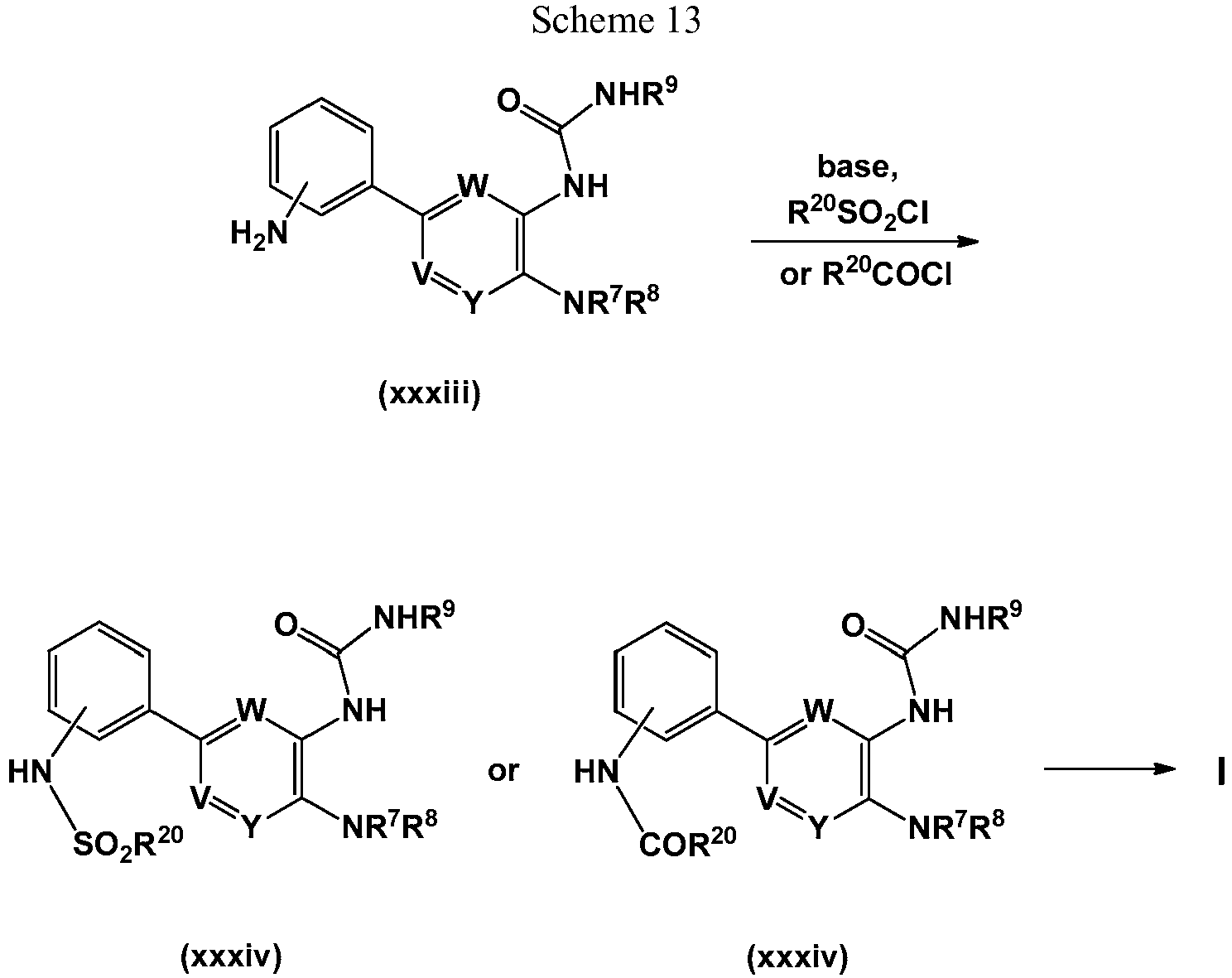
- Air- or moisture-sensitive reactions were generally performed under an atmosphere of nitrogen or argon in anhydrous solvents (EMD DRISOLV®). Zinc (-325 mesh) for nitro group reduction was obtained from Alfa Aesar. Reaction concentrations indicated in the tables and procedures are given in units of molar and are approximate. Temperatures are given in degrees Celsius. Reactions were monitored for completeness by thin layer chromatography (TLC) or tandem liquid chromatography-mass spectroscopy (LCMS). For TLC, 0.25 mm plates coated with Silica60/F254 were used with visualization by UV light at ∼254 nM, exposure to iodine vapor, or heating with PMA (phosphomolybdic acid solution), ninhydrin in ethanol, anisaldehyde solution, or ceric ammonium molybdate solution.
- Unless otherwise specified, "dried" refers to the addition of anhydrous MgSO4 followed by filtration and rinsing the residual solids with an appropriate organic solvent. "Stripped" means concentration under reduced pressure, generally on a rotary evaporator. "Silica gel chromatography", "flash chromatography", or "chromatographed on silica gel" refers to glass column chromatography performed in a manner similar to that described by Still (J. Org. Chem., 43:2923 (1978)). Typically silica gel 60 (EMD, 230-400 mesh ASTM) is used with solvents from JT Baker or Mallinckrodt. HPLC refers to purification by reverse-phase high-performance liquid chromatography generally on C18 columns using the stated mobile phases. Analytical HPLC runs were performed using the columns, flow rates, and mobile phases indicated. It is understood that analytical HPLC retention times (Tr) are reported in minutes, and may be dependent on temperature, pH, and other factors. ISCO refers to chromatography on pre-packed silica gel cartridges using automated systems marketed by Teledyne Isco. For all chromatographic purifications the isolation of product by concentration of the appropriate fractions by evaporation at or below ambient pressure is implied. Melting points were determined on a Thomas-Hoover Uni-Melt apparatus and are uncorrected. Generally, mass spectral results are reported as the (M+H)+ value. For halogenated compounds where two or more peaks are significant, m/z for one peak in the cluster, generally the most intense, is reported. 1H NMR spectra were recorded on dilute solutions at 400 or 500 MHz on VARIAN® or JEOL® instruments in the solvents indicated. Chemical shifts are reported in parts per million (ppm) downfield from internal tetramethylsilane (TMS) or from the position of TMS inferred by the deuterated NMR solvent. Apparent multiplicities are reported as: singlet-s, doublet-d, triplet-t, quartet-q, or multiplet-m. Peaks which exhibit broadening are further denoted as br. Integrations are approximate. It should be noted that integration intensities, peak shapes, chemical shifts and coupling constants can be dependent on solvent, concentration, temperature, pH, and other factors. Further, peaks which overlap with or exchange with water or solvent peaks in the NMR spectrum may not provide reliable integration intensities.
- Unless otherwise specified, the various substituents of the compounds as employed herein are defined in the same manner as compounds of the invention of Formula (I).
- For ease of reference, the following abbreviations are used herein.
Abbreviations AcOH, HOAc acetic acid ACN acetonitrile Ac2O acetic anhydride ADDP 1,1'-(azodicarbonyl)dipiperidine aq. aqueous Bn benzyl Boc t-butyl carbamate Boc2O di-t-butyl dicarbonate BOP Benzotriazol-1-yloxytris(dimethylamino)phosphonium hexafluorophosphate Bu butyl Cbz benzyl carbamate conc. concentrated DCE dichloroethane DCM dichloromethane DIAD diisopropyl azodicarboxylate DIEA N,N-diisopropylethylamine DMAP 4-N,N-dimethylaminopyridine DMF dimethylformamide DMSO dimethylsulfoxide DMT-MM 4-(4,6-dimethoxy-1,3,5-triazin-2-yl)-4-methylmorpholinium chloride EDC 1-(3-(dimethylamino)propyl)-3-ethylcarbodiimide hydrochloride Et ethyl EtOAc ethyl acetate EtOH ethanol Et2O diethyl ether Et3N triethylamine Fmoc 9-fluorenylmethyl carbamate h hour(s) HATU O-(7-azabenzotriazol-1-yl)-N,N,N',N'-tetramethyluronium hexafluorophosphate HOAt 1-hydroxy-7-azabenzotriazole HPLC high performance liquid chromatography i-PrOH isopropanol KOAc potassium acetate LAH Lithium aluminum hydride min minute(s) Me methyl MeCN acetonitrile MeOH methanol Me2NH dimethylamine NaHMDS sodium bis(trimethylsilyl)amide Na(OAc)3BH sodium triacetoxyborohydride n-BuLi n-butyllithium NCS N-chlorosuccinimide NMM N-methylmorpholine NMP n-methylpyrrolidinone NMR nuclear magnetic resonance OTf trifluoromethylsulfonyloxy Pd/C palladium on carbon Pd(dppf)2Cl2 [1,1'-bis(diphenylphosphino)ferrocene]dichloropalladium(II) Pd(OAc)2 palladium acetate Pd(PPh3)4 tetrakis(triphenylphosphine)palladium Pd2(dba)3 tris(dibenzylideneacetone)dipalladium(0) PE Petroleum ether Ph phenyl PhMe toluene Ph2TfN 1,1,1-trifluoro-N-phenyl-N-(trifluoromethyl)sulfonyl methanesulfonamide PPh3 triphenyl phosphine RB Round-bottom flask rt room temperature sat. saturated t-Bu tertiary butyl t-BuOH tertiary butanol TFA trifluoroacetic acid Tf2O trifluoromethylsulfonic anhydride THF tetrahydrofuran TMS trimethylsilyl TsO p-toluenesulfonyl -
- a Waters Sunfire C18 4.6 x 150mm 3.5 µ. 1 mL/min, 10-90% methanol-water 0.2% H3PO4, gradient over 15 min.
- b Waters Sunfire C18 4.6 x 150mm 3.5 µ. 1 mL/min, 10-90% methanol-water 0.2% H3PO4, gradient over 10 min.
- c YMC S5 ODS, 4.6 x 50 mm. 4 mL/min, 10-90% methanol-water 0.2% H3PO4, gradient over 12 min.
- d Waters X-Bridge Phenyl 4.6 x 150 mm 3.5 µ, 1 mL/min, 10-90% methanol-water 0.2% H3PO4, gradient over 10 min.
- e YMC S5 ODS, 4.6 x 50 mm. 4 mL/min, 10-90% methanol-water 0.2% H3PO4, gradient over 4 min.
- f YMC S5 ODS, 4.6 x 50 mm. 1 mL/min, 10-90% methanol-water 0.2% H3PO4, gradient over 15 min.
- g Sunfire C18 3.0 x 150mm 3.5 µ. 0.5 mL/min, 14-95% acetonitrile-water, 0.05% TFA, gradient over 12 min.
- h YMC pro c18 S5 ODS, 4.6 x 50 mm. 4 mL/min, 10-90% methanol-water 0.2% H3PO4, gradient over 12 min.
- i SUPELCO® Ascentis 4.6 x 50 mm, 2.7µ C18, 4mL/min, 5-95% acetonitrile-water, 10 mM NH4OAc, gradient over 4 min. (Column temp. = 35 °C.)
- j Waters Acquity UPLC BEH C18, 2.1 x 50 mm, 1.7-µm particles; Mobile Phase A: 5:95 acetonitrile:water with 10 mM ammonium acetate; Mobile Phase B: 90:10 acetonitrile:water with 10 mM ammonium acetate; Temperature: 50 °C; Gradient: 0-100% B over 3 minutes, then a 0.75-minute hold at 100% B; Flow: 1.11 mL/min.
- k Waters Acquity UPLC BEH C18, 2.1 x 50 mm, 1.7-µm particles; Mobile Phase A: 5:95 acetonitrile:water with 0.05% TFA; Mobile Phase B: 95:5 acetonitrile:water with 0.05% TFA; Temperature: 50 °C; Gradient: 0-100% B over 3 minutes, then a 0.75-minute hold at 100% B; Flow: 1.11 mL/min.
- l Luna C18, 4.6 x 30 mm, 3-µm particles; 10-90% MeOH-water (0.1% TFA in both phases) gradient over 5 min. Flow: 4 mL/min.
- m ZORBAX® SB C18, 4.6 x 75 mm, 50-90% MeOH-water (0.1% TFA in both phases) gradient over 8 min. Flow: 2.5 mL/min.
- n YMC S5 ODS, 4.6 x 50 mm. 4 mL/min, 10-90% methanol-water 0.05% TFA, gradient over 4 min.
- o Luna C18, 4.6 x 30 mm, 3-µm particles; 10-86% CH3CN-water (10 mM NH4OAc in both phases) gradient over 2 min. Flow: 4 mL/min.
- p Luna C18, 4.6 x 30 mm, 3-µm particles; 10-85.5% MeOH-water (0.1% TFA in both phases) gradient over 2 min. Flow: 4 mL/min.
- q Luna C18, 4.6 x 30 mm, 3-µm particles; 10-90% MeOH-water (0.1% TFA in both phases) gradient over 3.5 min. Flow: 4 mL/min.
- r PHENOMENEX®, 2.0 x 30 mm, 2.5-µm particles; 26-90% MeOH-water (0.1% TFA in both phases) gradient over 3 min. Flow: 1 mL/min.
- s Waters Acquity UPLC BEH C18, 2.1 x 50 mm, 1.7-µm particles; Mobile Phase A: 5:95 acetonitrile:water with 0.05% TFA; Mobile Phase B: 95:5 acetonitrile:water with 0.05% TFA; Temperature: 50 °C; Gradient: 0-100% B over 3 minutes, then a 0.75-minute hold at 100% B; Flow: 1.11 mL/min.
- t Column: Xbridge (150 x 4.6 mm), 3.5 µ; Method: 0.05% TFA in water pH2.5; Mobile Phase A: Buffer: acetonitrile (95:5) Mobile Phase B: acetonitrile: Buffer (95:5) Flow: 1.0 ml/min.
- u Column: Sunfire (150 x 4.6 mm), Method: 0.05% TFA in water pH2.5 Mobile Phase A: Buffer: acetonitrile (95:5) Mobile Phase B: acetonitrile: Buffer (95:5) Flow: 1.0 ml/min.
- v Column: Ascentis Express C8 (5 x 2.1 mm) 2.7 µM particles, 10 mM in ammonium formate. 98:2 to 2:98 water-acetonitrile gradient over 1.5 min. Flow: 1.0 ml/min.
- w Phenomenex-Luna C18 3 um 4.6 x 30mm, 0%B-95%B with flow rate 4 mL/min and 2 min gradient time; Solvent A: 10% water/90% acetonitrile with 10 mM NH4OAc; Solvent B: 10% water/90% acetonitrile with 10 mM NH4OAc, wavelength 220 nM.
- x Phenomenex Luna C18, 2.0 x 30 mm, 5-µm particles; Mobile Phase A: 10:90 water:MeOH 0.1% TFA; Mobile Phase B: 10:90 water:MeOH 0.1%TFA; Temperature: RT; Gradient: 0% B for a 0.2min hold, then 0-100%B over 2.5 minutes, then a 3-minute hold at 100% B; Flow: 1.5 mL/min.
- y Waters Acquity UPLC BEH C18, 2.1 x 50 mm, 1.7-µm particles; Mobile Phase A: water with 0.05% TFA; Mobile Phase B: acetonitrile with 0.05% TFA; Temperature: 50°C; Gradient: 2-98% B over 1 minutes, then a 0.5-minute hold at 100% B; Flow: 0.8 mL/min.
-
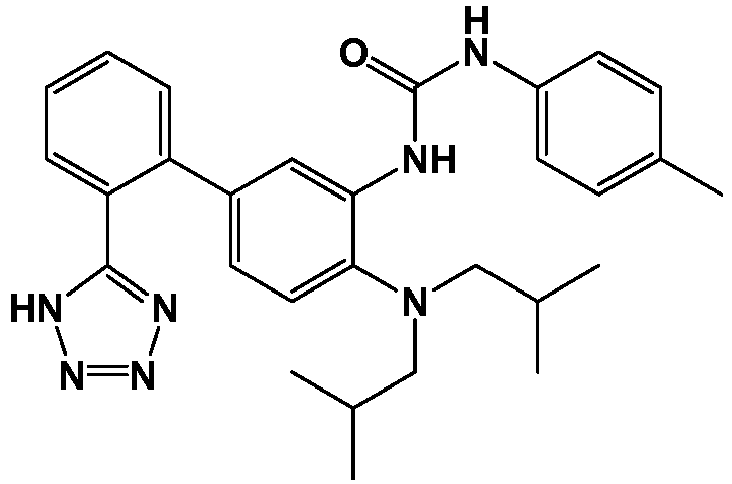
-

- A solution of diisobutylamine (0.284 g, 2.200 mmol) and 4-bromo-1-fluoro-2-nitrobenzene (0.220 g, 1 mmol) was heated at 130 °C for 6h. The reaction was cooled and diluted with ethyl acetate. This solution was washed with aq. HCl then brine, dried, and stripped to afford 0.3g (87%) of 4-bromo-N,N-diisobutyl-2-nitroaniline (1A) as an orange oil. 1H NMR (400 MHz, DMSO-d6) δ ppm 7.90(d, 1 H, J = 2.6 Hz); 7.60(dd, 1 H, J = 9.0, 2.4 Hz); 7.32(d, 1 H, J = 9.0 Hz); 2.89(d, 4H, J = 7.3 Hz); 1.76-1.86(m, 2H); 0.77(d, 12H, J = 6.4 Hz). MS(ES): m/z = 331 [M+H]+.
-

- To a stirred solution of 4-bromo-N,N-diisobutyl-2-nitroaniline (1A) (0.9 g, 2.7 mmol) in ethanol (Volume: 10 mL) was added 2 mL of water followed by ammonium chloride (1.46 g, 27.3 mmol) then zinc (1.79 g, 27.3 mmol). The mixture was stirred 1h, cooling to RT then diluted with dichloromethane and filtered. The filtrate was washed with water, dried, and stripped to afford an oil. Chromatography on silica gel (gradient elution with ether-hexanes) afforded, after removal of solvent, 0.66g (77%) of 4-bromo-N1,N1-diisobutylbenzene-1,2-diamine (1B) as a pale purple oil. MS(ES): m/z = 301 [M+H]+. 1H NMR (400 MHz, DMSO-d6) δ ppm 6.92(d, 1 H, J = 8.4 Hz); 6.81(d, 1 H, J = 2.2 Hz); 6.63(dd, 1 H, J = 8.1, 2.2 Hz); 2.53(d, 4H, J = 7.0 Hz); 1.59-1.69(m, 2H); 0.84(d, 12H, J = 6.6 Hz).
-

- To a stirred solution of 4-bromo-N1,N1-diisobutylbenzene-1,2-diamine (1B) (0.1 g, 0.33 mmol) in THF (Volume: 1 mL) was added 1-isocyanato-4-methylbenzene (0.067 g, 0.50 mmol). The solution was stirred 1h at 50 °C then purified by silica gel chromatography (gradient elution with EtOAc-hexanes). Concentration of the appropriate fractions afforded 0.12g (79%) of 1-(5-bromo-2-(diisobutylamino)phenyl)-3-p-tolylurea (1C) as a white solid. 1H NMR (400 MHz, DMSO-d6) δ ppm 9.48 (1 H, s), 8.20 (1 H, d, J = 2.4 Hz), 7.95 (1 H, s), 7.35 (2 H, d, J=8.4 Hz), 7.18(d, 1H, J = 8.6 Hz), 7.07-7.13 (3 H, m), 2.68(4H, d, J = 6.6 Hz), 2.24 (3 H, s), 1.58-1.68 (2H, m), 0.82 (12H, d, J = 6.6 Hz). MS(ES): m/z = 434 [M+H]+.
-
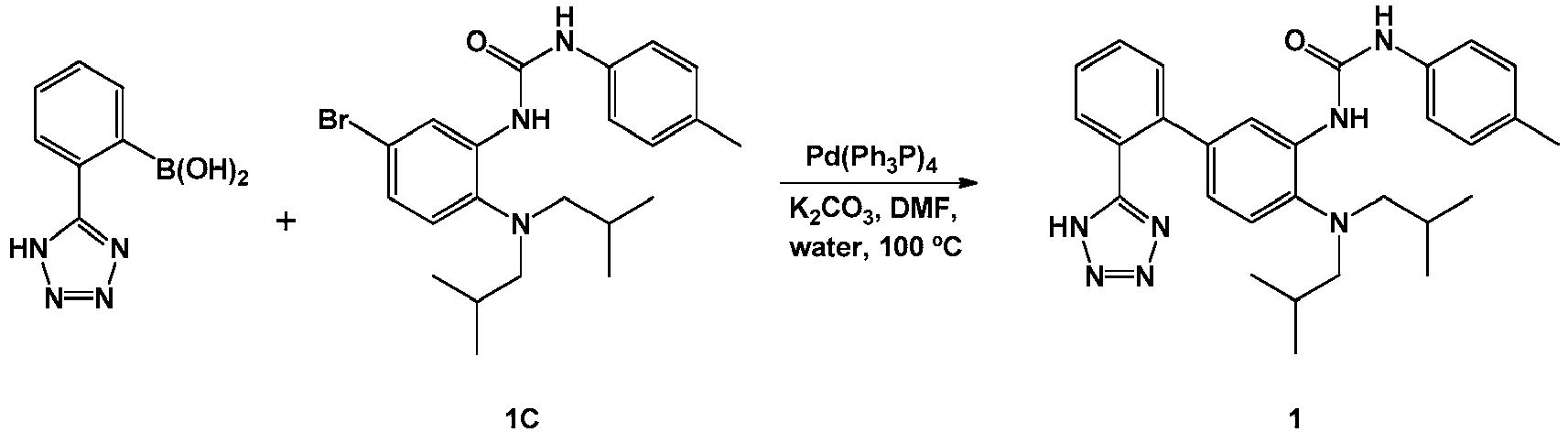
- To a suspension of 2-(1H-tetrazol-5-yl)phenylboronic acid (0.062 g, 0.32 mmol) and 1-(5-bromo-2-(diisobutylamino)phenyl)-3-p-tolylurea (1C) (0.07 g, 0.162 mmol) and tetrakis(triphenylphosphine)palladium(0) (0.019 g, 0.016 mmol) in degassed DMF (Volume: 2 mL) was added aq. potassium carbonate (0.540 mL, 0.809 mmol). The mixture was placed under nitrogen and heated at 100 °C for 2h. The reaction was cooled, diluted with aq. HCl, and extracted twice with dichloromethane. The organic extracts were combined, dried, stripped, and purified by prep. HPLC (Axia 30 x 100 mm column, MeOH-water-TFA gradient). Concentration of the appropriate fraction afforded 0.061g (74%) of 1-(4-(diisobutylamino)-2'-(1H-tetrazol-5-yl)biphenyl-3-yl)-3-p-tolylurea (1) as a white powder. 1H NMR (400 MHz, DMSO-d6) δ ppm 9.32 (1 H, s), 7.90 (1 H, d, J=2.2 Hz), 7.83 (1 H, s), 7.65-7.70 (1 H, m), 7.60 (1H, d, J = 7.7 Hz), 7.50-7.57 (2 H, m), 7.33 (2 H, d, J=8.4 Hz), 7.05-7.10 (3 H, m), 6.52 (1 H, dd, J=8.1, 2.1 Hz), 2.66 (4 H, d, J=6.8 Hz), 1.59-1.69 (2H, m), 0.83 (12H, d, J =6.6 Hz). MS(ES): m/z = 498 [M+H]+,
- Using the method described (Examples 1A and 3A are representative), the appropriate amines HNR7R8 were reacted with 2-fluoro-5-bromonitrobenzene in the indicated (Table 1A) solvents at the indicated temperatures. Any additional tertiary amine base utilized in these transformations is indicated in the table. This afforded nitroanilines which were processed by the procedure for the conversion of 1A into 1B to afford intermediates.
Table 1A Preparation of Intermediates (iii) from a Commercially-Available Fluoro nitrobenzene 
NR7R8 Amine eq. Solvent Conc. Base Temp Time (M+H)+ HPLC Tr iiia 
3 None None 140 20h 319 4.48l iiib 
2 THF 0.4M None 50 3h 285 2.40l iiic 
2 THF 0.1M None 50 3h 299 2.20o iiid 
2 THF 0.4M None 50 3h 311 3.17l iiif 
2.2 THF 0.8M None 60 1h 269 2.92l iiig 
1.3 HCl salt DMF 1 M Et3N 2.5eq. 100 2h 269 2.92l iiih 
3 NMP 1M None 100 0.5h 224 (M+H - 2 MeOH)+ 2.48l iiii 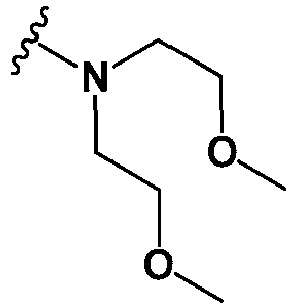
3 NMP 1M None 100 0.5h 303 1.68o iiij 
3 NMP 1M None 60 1.5h 285 2.32l iiik 
1.5 NMP 2M Et3N 1.4eq. 55 2h 251 2.15l iiil 
1.2 HCl salt NMP 0.6M Et3N 2.2eq. 130 1.5h 325 3.14l iiim 
1.1 HCl salt NMP 1M DIEA 2eq. 135 4h 339 4.25l iiin 
1.2 HCl salt NMP 1M DIEA 2.2eq. 130 2h 297 3.66l iiio 
3 NMP 1M None 100 17h 275 2.06l iiip 
1.1 HCl salt NMP 1M Et3N 2.3eq. 100 3h 285 2.59l iiiq 
1.2 HCl salt NMP 1M DIEA 3eq. 110 3h 299 3.10l iiir 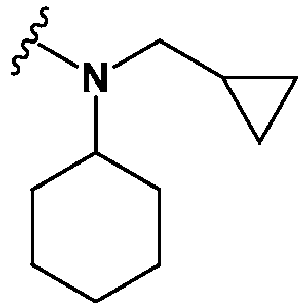
1.2 HCl salt NMP 1M DIEA 3eq. 120 3h 325 1.71p iiis 
1.2 HCl salt NMP 1M DIEA 2.5eq. 120 3h 313 1.72p iiit 
3 NMP 1M None 100 1h 301 1.79p iiiu 
1.3 HCl salt NMP 1M DIEA 2.8eq. 120 20 299 1.81p iiiv 
1 HCl salt NMP 0.5M DIEA 3eq. 135 5h 313 2.05p iiiw 
1.4 HCl salt NMP 0.5M DIEA 3eq. 110 3h 321 2.43p iiix 
1.4 HCl salt NMP 0.6M DIEA 3eq. 110 3h 287 2.54p iiiy 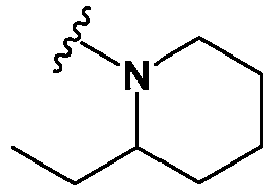
2.5 NMP 1M None 110 3h 285 2.06p iiiz 
1.7 NMP 1M DIEA 1.3eq. 140 24h 327 2.88q iiiab 
1.2 HCl salt NMP 1M DIEA 2.5eq. 125 4h 313 2.61l iiiac 
1.7 NMP 1M DIEA 1.3eq. 140 24h 329 2.86q iiiad 
1.7 HCl salt NMP 1M DIEA 3eq. 140 24h 287 2.321 iiiag 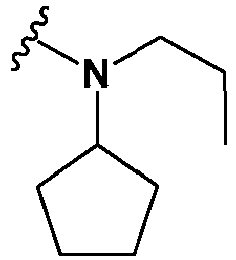
1.4 NMP 1M DIEA 1.3eq. 140 18h 299 2.34q iiiah 
1.4 NMP 1M DIEA 1.2eq. 140 4h 313 2.64q iiiaj 
1.4 HCl salt NMP 0.6M DIEA 3eq. 140 18h 327 2.01q iiiak 
4 NMP 1M None 140 4h 259 1.73q iiial 
0.8 NMP 1M DIEA 1.4eq. 130 5h 299 2.08q iiiam 
1.4 NMP 1.5M Et3N 1.1eq. 100 2h 321 3.90q iiian 
1.4 NMP 1M DIEA 1.2eq. 130 19h 369 2.76q iiiao 
1 NMP 1M Et3N 1.2eq. 140 6h 395 2.84r iiiap 
1.4 HCl salt NMP 1M DIEA 1.2eq. 130 19h 371 2.39q iiiaq 
1.1 HCl salt NMP 1M DIEA 2.4eq. 150 18h 335 2.51q iiiar 
1.3 NMP 1.3M DIEA 1.5 eq. 130 20h 339 2.63q iiias 
3 DMF 0.6M None 80 1h 273 4.59l iiiat 
2 NMP 1.5M DIEA 1.2eq. 110-115 7h 351 1.23k iiiau 
1.1 NMP 1.5M DIEA 1.1eq. 110-120 6h 369 3.35l iiiav 
1.1 NMP 1.5M DIEA 1.2eq. 120 4h 397 3.97l iiiaw 
1.3 NMP 1.5M DIEA 2eq. 140 30 369 2.06p iiiax 
4 NMP 1.5M None 120 72 313 4.641 iiiay 
2 NMP 1.5M DIEA 1eq. 130 16 327 1.63p iiiaz 
1.5 NMP 1.5M DIEA 1 eq. 100 1 331 3.40l iiibc 
10 None None 46 3h (M-H)- 271 2.24v iiibd 
1.2 DMF 0.5M K2CO3 3eq 80 18h (M-H)- 266 1.84v - Using the methods described (Example 1A and 3A are representative), the appropriate amines HNR7R8 were reacted with 2,4-difluoro-5-bromonitrobenzene in the indicated (Table 1B) solvents at the indicated temperatures. Any additional tertiary amine base utilized in these transformations is indicated in the table. This afforded nitroanilines which were processed by the procedure for the conversion of 1A into 1B to afford the intermediates (iii).
- Certain aniline derivatives iii may be made by alkylation of nitroanilines followed by reduction as described above. The procedure below is illustrative.
-

- A solution of 4-bromo-N-cyclohexyl-2-nitroaniline (0.598 g, 1.999 mmol) in DMF (4 mL) was treated with 3-bromo-2-methylprop-1-ene (0.403 mL, 4.00 mmol) followed by sodium hydride (0.137 g, 4.00 mmol). The reaction was stirred at RT for 15 min. and then treated with an additional 0.3 g of sodium hydride and 0.4 mL of alkylating agent. The reaction was stirred an additional 4h at RT then carefully quenched with glacial HOAc then diluted with water. This dark mixture was ext. with ether, and the org. ext. was dried, stripped, and submitted purified by ISCO. Concentration of the appropriate fractions afforded 0.32 g (43%) of 4-bromo-N-cyclohexyl-N-(2-methylallyl)-2-nitroaniline as an oil. LCMS: 353 (M + H)+. HPLC Tr: 2.48p.
-

- The title compound was prepared from 4-bromo-N-cyclohexyl-2-nitroaniline and 4-chlorobenzylbromide using the procedure for preparation of 4-bromo-N-cyclohexyl-N-(2-methylallyl)-2-nitroaniline. LCMS: 425 (M + H)+. HPLC Tr: 5.48l.
- Reduction of the nitro groups as described above affords anilines iii:
Table 1B Ex. No. NR7R8 (M+H)+ HPLC Tr method iiiba 
323 1.99p iiibb 
395 4.69l -

Ex. No. NR7R8 Amine eq. Solvent conc. Base Temp Time (M+H)+ HPLC Tr method iiica 
1.3 THF 0.3M Et3N 1.3eq. 60 1.5h 285 3.43l iiicb 
1.2 NMP 0.7M DIEA 1.3eq. 140 24h 345 2.39r iiicc 
1.2 HCl salt NMP 0.5M Et3N 2.2eq. 130 1.5h 325 3.14l iiicd 
1.1 DMF 1M Et3N 1.5 eq. 60 1.5h 317 2.25p - Preparation of Intermediates from a Commercially-Available Difluoronitrobenzene

- 4-bromo-N1-cyclohexyl-6-fluoro-N1-isobutylbenzene-1,2-diamine was prepared from 5-bromo-1,2-difluoro-3-nitrobenzene and N-isobutylcyclohexanamine by the procedures outlined in the examples above.
-

-

- To a suspension of 2-(1H-tetrazol-5-yl)phenyl-boronic acid (0.68 g, 3.6 mmol) and 4-bromo-N1-cyclohexyl-N1-methylbenzene-1,2-diamine (iiib) (0.57 g, 2 mmol) and tetrakis(triphenylphosphine)palladium(0) (0.12 g, 0.100 mmol) in DMF (Volume: 8 mL) was added aq. potassium carbonate (5.00 mL, 10.0 mmol). The mixture was placed under nitrogen and heated at 100 °C for 3h. LCMS indicated reaction is ∼50% complete, so it was treated with an additional 0.15 g of boronic acid and 0.04g of catalyst and heated at 90 °C overnight. The reaction was cooled and poured into diluted aq. HOAc. The resulting mixture was extracted twice with chloroform. The combined organic extracts were dried, stripped, and chromatographed on silica gel (gradient elution with EtOAc-hexanes, 1% HOAc) to afford, after removal of solvent, N4-cyclohexyl-N4-methyl-2'-(1H-tetrazol-5-yl)biphenyl-3,4-diamine (2A) (0.17 g, 23% yield) as a beige foam. 1H NMR (400 MHz, DMSO-d6) δ ppm 11.93(br. s, 1H); 7.48-7.66(m, 4H); 6.79(d, 1 H, J = 7.9 Hz); 6.52(d, 1H, J = 2.2 Hz); 6.12(dd, 1H, J = 7.9, 1.8 Hz); 4.6-4.8(br. s, 2H); 2.68-2.76(m, 1H); 1.90(s, 3H); 1.64-1.76(m, 4H); 1.50-1.58(m, 1H); 1.26-1.39(m, 2H); 1.02-1.19(m, 3H). MS(ES): m/z = 349 [M+H]+,
-

- To a stirred solution of N4-cyclohexyl-N4-methyl-2'-(1H-tetrazol-5-yl)biphenyl-3,4-diamine (2A) (0.015 g, 0.043 mmol) in THF (Volume: 0.2 mL) was added 1-isocyanato-4-(trifluoromethyl)benzene (0.014 g, 0.073 mmol). The solution was stirred 2h at 50 °C then cooled and purified by prep. HPLC (Axia 21 x 100 mm column, MeOH-water-TFA gradient). Concentration of the appropriate fraction afforded 1-(4-(cyclohexyl(methyl)amino)-2'-(1H-tetrazol-5-yl)biphenyl-3-yl)-3-(4-(trifluoromethyl)phenyl)urea (2) (0.012 g, 49% yield) as a white powder. 1H NMR (400 MHz, DMSO-d6) δ ppm 9.92(s, 1H); 8.44(s, 1H); 8.02(s, 1H); 7.60-7.71(m, 6H); 7.52-7.56(m, 2H); 7.12(d, 1H, J = 8.1 Hz); 6.58(d, 1H, J = 7.7 Hz); 2.60-2.66(m, 1H); 2.58(s, 3H); 1.81-1.88(m, 2H); 1.66-1.74(m, 2H); 1.50-1.57(m, 1H); 1.01-1.29(m, 5H). MS(ES): m/z = 536 [M+H]+.
-

-

- To a stirred solution of 4-bromo-1-fluoro-2-nitrobenzene (0.440 g, 2 mmol) in THF (Volume: 2 mL) was added N-methylcyclopentanamine (0.595 g, 6.00 mmol). The solution was stirred 1h at 60 °C then cooled and stirred at RT. The solution was diluted with ether and washed with dilute aq. HOAc then aq. sodium bicarbonate then brine. The organic phase was dried and stripped to afford 4-bromo-N-cyclopentyl-N-methyl-2-nitroaniline (3A) (0.57 g, 91% yield) as an orange oil. 1H NMR (400 MHz, DMSO-d6) δ ppm 7.94(d, 1H, J = 2.4 Hz); 7.64(dd, 1H, J = 9.0, 2.4 Hz); 7.30(d, J = 9.0 Hz); 3.70-3.79(m, 1H); 2.58(s, 3H); 1.44-1.83(m, 10H). MS(ES): m/z = 301 [M+H]+.
-

- A suspension of 2-(1H-tetrazol-5-yl)phenylboronic acid (0.190 g, 1.000 mmol) and 4-bromo-N-cyclopentyl-N-methyl-2-nitroaniline (3A) (0.150 g, 0.5 mmol) and tetrakis(triphenylphosphine)palladium(0) (0.035 g, 0.03 mmol) in degassed DMF (Volume: 4 mL) was treated with aq. potassium carbonate (1.667 mL, 2.500 mmol). The mixture was placed under nitrogen and heated at 95 °C for 2.5h. The reaction was diluted with ∼4 mL of water and filtered hot. The filtrate was diluted to 40 mL with water, brought to pH3 with conc. HCl, and stirred vigorously to induce precipitation of product. The resulting red solid was filtered, rinsed with water, and air-dried to afford N-cyclopentyl-N-methyl-3-nitro-2'-(1H-tetrazol-5-yl)biphenyl-4-amine (3B) (0.175 g, 91% yield). 1H NMR (400 MHz, DMSO-d6) δ ppm 7.65-7.69(m, 2H); 7.55-7.62(m, 2H); 7.53(d, 1H, J = 2.2 Hz); 7.20(d, 1H, J = 8.6 Hz); 7.09(dd, 1H, J = 8.6, 2.2 Hz); 3.77-3.86(m, 1H); 2.58(s, 3H); 1.76-1.89(m, 2H); 1.46-1.69(m, 8H). MS(ES): m/z = 365 [M+H]+.
-

- A suspension of N-cyclopentyl-N-methyl-3-nitro-2'-(1H-tetrazol-5-yl)biphenyl-4-amine (0.16 g, 0.439 mmol) and palladium on carbon (0.05 g, 0.047 mmol) in ethanol (Volume: 5 mL) was treated with HCl in dioxane (0.132 mL, 0.527 mmol) and hydrogenated at 45 psi for 30 min. Catalyst was removed by filtration, and the organic solution was stripped and purified by prep. HPLC (Axia 30 x 100 mm column, MeOH-water-TFA gradient). Concentration of the appropriate fractions afforded N4-cyclopentyl-N4-methyl-2'-(1H-tetrazol-5-yl)biphenyl-3,4-diamine (3C) (0.05 g, 34% yield) as a glass. HPLC Tr: 2.761. MS(ES): m/z = 335 [M+H]+.
-
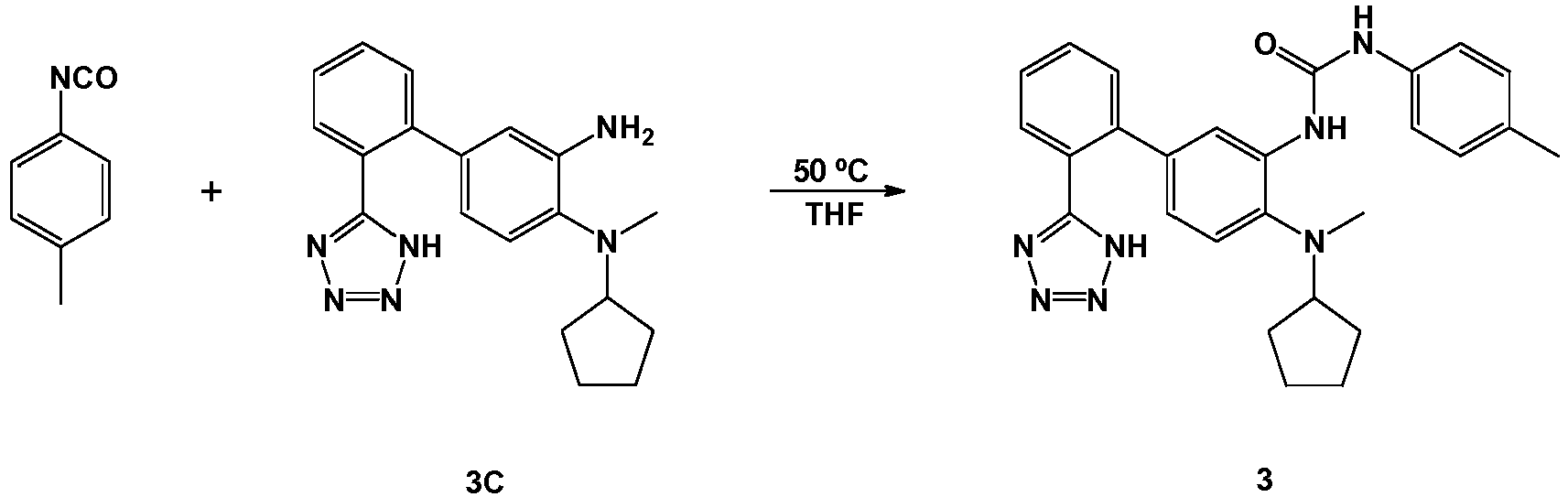
- To a solution of N4-cyclopentyl-N4-methyl-2'-(1H-tetrazol-5-yl)biphenyl-3,4-diamine (0.02 g, 0.060 mmol) in THF (Volume: 0.5 mL) was added 1-isocyanato-4-methylbenzene (0.012 g, 0.090 mmol). The solution was stirred 2h at 50 °C then purified by prep. HPLC (Axia 21 x 100 mm column, MeOH-water-TFA gradient). Concentration of the appropriate fraction afforded 1-(4-(cyclopentyl(methyl)amino)-2'-(1H-tetrazol-5-yl)biphenyl-3-yl)-3-p-tolylurea (3) (0.009 g, 30.6% yield) as a white powder. MS(ES): m/z = 468 [M+H]+. HPLC Tr: 12.28d.
-

-

- 2-Bromoaniline (300 mg, 1.744 mmol) was taken up in DCM (Volume: 5 mL) and cooled to 0 °C. Pyridine (2.82 mL, 34.9 mmol) was added, followed by dropwise addition of trifluoromethanesulfonic anhydride (0.440 mL, 2.62 mmol). The reaction was stirred at 0 °C and slowly warmed to rt overnight. The reaction was diluted with DCM, washed with 1N HCl, then brine, dried over Na2SO4, filtered, and concentrated and purified by ISCO Companion (0-40% EtOAc/hexane; 80g column). N-(2-bromophenyl)-1,1,1-trifluoromethanesulfonamide (4A) (189 mg, 0.622 mmol, 36% yield) was obtained as a brown oil. 1H NMR (400 MHz, CDCl3) δ ppm 7.61-7.65 (2 H, m), 7.37 (1 H, td, J=7.9, 1.4 Hz), 7.17 (1 H, td, J=7.8, 1.4 Hz). MS(ES): m/z = 304 [M-H]-.
-
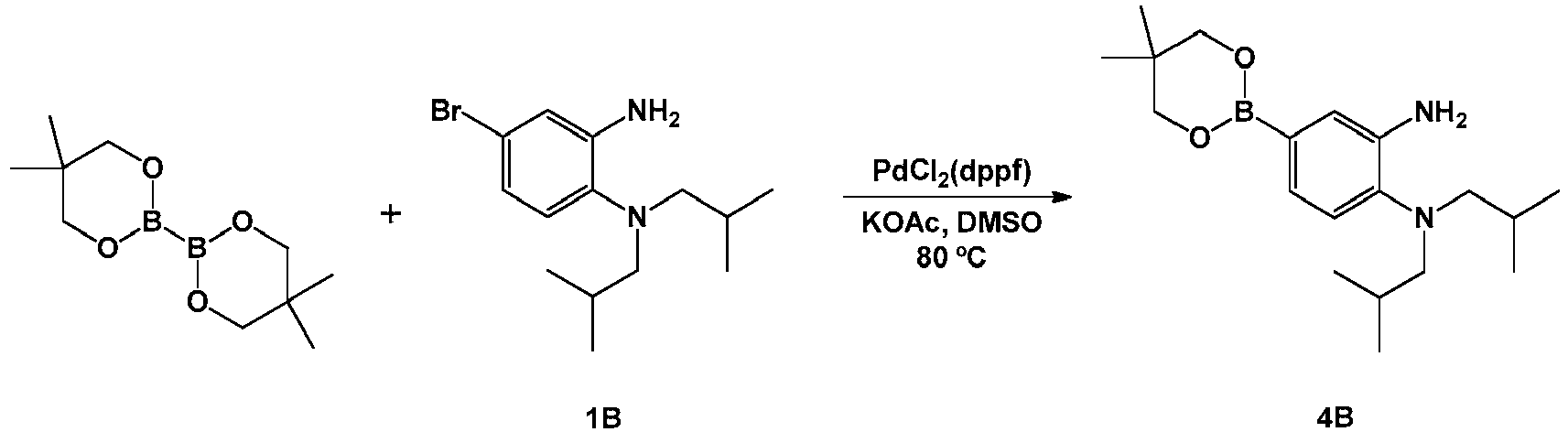
- 4-Bromo-N1,N1-diisobutylbenzene-1,2-diamine (560 mg, 1.87 mmol), 5,5,5',5'-tetramethyl-2,2'-bi(1,3,2-dioxaborinane) (550 mg, 2.43 mmol), PdCl2(dppf)-CH2Cl2Adduct (46 mg, 0.056 mmol), and potassium acetate (551 mg, 5.61 mmol) were combined in a 2 dram vial, and DMSO (Volume: 3 mL) was added. The vial was evacuated and filled with argon 3x, then heated at 80 °C for 3h, cooled to RT and the contents purified by ISCO Companion (0-20% EtOAc/hexane; 80g column). 4-(5,5-dimethyl-1,3,2-dioxaborinan-2-yl)-N1,N1-diisobutylbenzene-1,2-diamine (355 mg, 1.068 mmol, 57% yield) was obtained as a white solid. 1H NMR (400 MHz, chloroform-d) δ ppm 7.12 - 7.22 (2 H, m), 7.01 - 7.08 (1 H, m), 3.74 (4 H, s), 2.64 (4 H, d, J=7.3 Hz), 1.69 - 1.85 (2 H, m), 1.02 (6 H, s), 0.89 (12 H, d, J=6.6 Hz). MS(ES): m/z = 265 [M+H-C5H8]+.
-

- 4-(5,5-Dimethyl-1,3,2-dioxaborinan-2-yl)-N1,N1-diisobutylbenzene-1,2-diamine (71 mg, 0.21 mmol), N-(2-bromophenyl)-1,1,1-trifluoromethanesulfonamide (50 mg, 0.16 mmol), PdCl2(dppf)-CH2Cl2Adduct (13.43 mg, 0.016 mmol), and potassium phosphate, tribasic (0.247 mL, 0.493 mmol) were added to a 2 dram vial and evacuated and filled with argon 3x. The mixture was suspended in 1 mL of dioxane and heated at 80 °C for 3h, cooled to rt and purified via ISCO Companion (0-20% EtOAc/hexane; 25g column). N-(3'-Amino-4'-(diisobutylamino)biphenyl-2-yl)-1,1,1-trifluoromethanesulfonamide (30 mg, 0.068 mmol, 41% yield) was obtained as a purple gum. 1H NMR (400 MHz, CDCl3) δ ppm 7.64(d, 1H, J = 8.8 Hz); 7.26-7.41(m, 3H); 7.18(d, 1 H, J = 7.9 Hz); 6.62-6.69(m, 2H); 2.69(d, 4H, J = 7.3 Hz); 1.78-1.91(m, 2H); 0.98(d, 12H, J = 6.6 Hz). MS(ES): m/z = 444 [M+H]+.
-

- N-(3'-Amino-4'-(diisobutylamino)biphenyl-2-yl)-1,1,1-trifluoromethanesulfonamide (4C) (30 mg, 0.068 mmol) was taken up in THF (Volume: 2 mL) and 1-isocyanato-4-methylbenzene (0.011 mL, 0.088 mmol) was added. The reaction was stirred at rt overnight, and then solvent removed in vacuo. The reaction mixture was purified by prep. HPLC C18 (PHENOMENEX® Luna S5 ODS 21 x 100 mm, 10mM NH4OAc in MeOH/H2O gradient) to afford N-(4'-(diisobutylamino)-3'-(3-p-tolylureido)biphenyl-2-yl)-1,1,1-trifluoromethanesulfonamide(23 mg, 58%) as a white solid. 1H NMR (400 MHz, MeOD) δ ppm 7.86 (1 H, d, J=2.0 Hz), 7.33 - 7.40 (2 H, m), 7.19 - 7.33 (5 H, m), 7.13 - 7.18 (1 H, m), 7.10 (2 H, d, J=8.1 Hz), 2.72 (4 H, d, J=7.0 Hz), 2.29 (3 H, s), 1.69 - 1.84 (2 H, m), 0.91 (12 H, d, J=6.8 Hz). MS(ES): m/z = 577 [M+H]+.
-

-
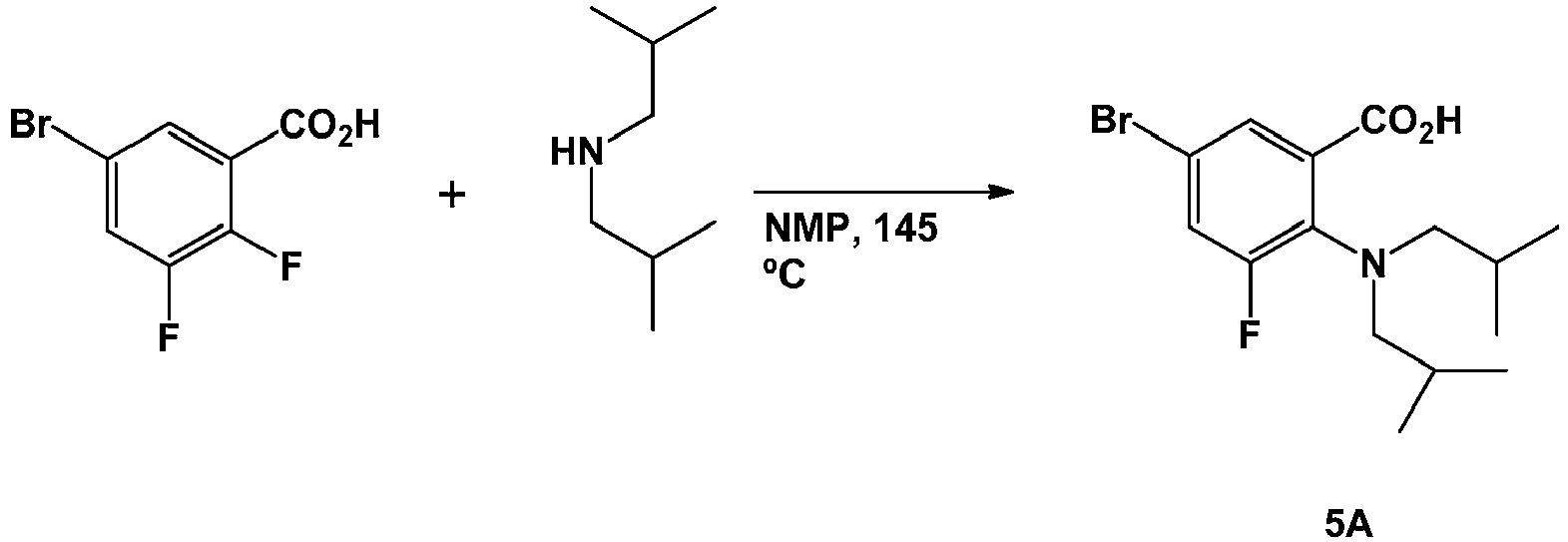
- A solution of 5-bromo-2,3-difluorobenzoic acid (0.75 g, 3.16 mmol) in NMP (Volume: 0.4 mL) was treated with diisobutylamine (1.636 g, 12.66 mmol) and heated to 145 °C for 17h. Chromatography on silica gel (gradient elution with EtOAc-hexanes-1%HOAc) afforded 0.22g (20%) of 5-bromo-2-(diisobutylamine)-3-fluorobenzoic acid as an off-white solid plus some mixed fractions. Concentration and silica gel chromatography on the mixed fractions afforded a further 0.3g of material. MS(ES): m/z = 348 [M+H]+. 1H NMR (400 MHz, DMSO-d6) δ ppm 14.51(br.s, 1 H); 7.69(dd, 1 H, J = 11.9, 2.4 Hz); 7.61(br. s, 1H); 2.88(d, 4H, J = 6.6 Hz); 1.65-1.77(m, 2H); 0.82(d, 12H, J = 6.6 Hz).
-

- A solution of 5-bromo-2-(diisobutylamino)-3-fluorobenzoic acid (5A) (0.3 g, 0.87 mmol) and triethylamine (0.145 mL, 1.04 mmol) in THF (Volume: 5 mL) was treated with diphenyl phosphorazidate (0.26 g, 0.95 mmol) and stirred 30 min. at RT. The solution was then treated with tert-butanol (2.5 mL, 26 mmol) and heated to reflux. The reaction was stirred overnight at 65 °C then cooled, diluted with ether, and washed with aq. HOAc then aq. sodium bicarbonate. The organic phase was dried, stripped, and redissolved in 4 mL of 4M HCl/dioxane. The resulting solution was stirred 1.5h at RT then concentrated to afford an oil. LCMS indicated some t-butyl carbamate remained, so the oil was dissolved in 4 mL of HCl/dioxane and stirred 3h at RT. The reaction was concentrated to near dryness under reduced pressure. Addition of a few drops of methanol afforded a precipitate which was filtered, rinsed with 30% ether-hexanes, and air-dried to afford 0.039 g (14%) of 4-bromo-6-fluoro- N1,N1-diisobutylbenzene-1,2-diamine as a colorless solid. Prep. HPLC (Axia 30 x 100 mm column, MeOH-water-TFA gradient) on the mother liquor afforded a further 0.04 g of material. MS(ES): m/z = 319 [M+H]+. 1H NMR (400 MHz, DMSO-d6) δ ppm 6.67 (1H, dd, J= 2.2, 1.2 Hz), 6.50 (1 H, dd, J=11.4, 2.2 Hz), (NH2 obscured by broad water peak); 2.57-2.72 (4 H, m), 1.53-1.63 (2 H, m), 0.81-0.87 (12 H, m).
-

- A solution of 4-bromo-6-fluoro-N1,N1-diisobutylbenzene-1,2-diamine (5B) (0.065 g, 0.205 mmol) in THF (Volume: 1 mL) was treated with 1-isocyanato-4-methylbenzene (0.038 g, 0.287 mmol) and placed under nitrogen. The reaction was stirred 30 min. at 50 °C. An additional 0.04 g of p-tolylisocyanate was added, and the reaction was stirred 2h longer at 50 °C. The reaction was cooled, treated with 0.03 mL of N,N-dimethylethylenediamine, and chromatographed on silica gel (gradient elution with EtOAc-hexanes). Concentration of the appropriate fractions afforded 0.85g (92%) of 1-(5-bromo-2-(diisobutylamino)-3-fluorophenyl)-3-p-tolylurea as a colorless solid. 1H NMR (400 MHz, DMSO-d6) δ ppm 9.57(s, 1 H); 8.18-8.22(m, 2H); 7.34(d, 2H, J = 8.6 Hz); 7.10(d, 2H, J = 8.4 Hz); 7.07(dd, 1 H, J = 11.4, 2.2 Hz); 2.73-2.84(br. m, 4H); 2.24(s, 3H); 1.54-1.64(m, 2H); 0.82(d, 6H, J = 6.6 Hz). MS(ES): m/z = 452 [M+H]+.
-

- To a mixture of 2-(1H-tetrazol-5-yl)phenylboronic acid (0.025 g, 0.133 mmol) and 1-(5-bromo-2-(diisobutylamino)-3-fluorophenyl)-3-p-tolylurea (5C) (0.03 g, 0.067 mmol) and tetrakis(triphenylphosphine)palladium(0) (7.70 mg, 6.66 µmol) in degassed DMF (Volume: 1 mL) was added aq. potassium carbonate (0.222 mL, 0.333 mmol). The mixture was placed under nitrogen and heated at 90 °C for 1h. The reaction was cooled, brought to pH 4 with glacial HOAc, filtered, and purified by prep. HPLC (Axia 30 x 100 mm column, MeOH-water-TFA gradient). Concentration of the appropriate fraction afforded 0.027 g (79%) of 1-(4-(diisobutylamino)-5-fluoro-2'-(1H-tetrazol-5-yl)biphenyl-3-yl)-3-p-tolylurea as a white powder. 1H NMR (400 MHz, DMSO-d6) δ ppm 9.47(s, 1 H); 8.14(s, 1H); 7.82(d, 1H, J = 1.5 Hz); 7.57-7.73(m, 4H); 7.34(d, 2H, J = 8.4 Hz); 7.11(d, 2H, J = 8.1 Hz); 6.44(dd, 1 H, J = 12.8, 2.0 Hz); 2.81(d, 4H, J = 5.7); 2.26(s, 3H); 1.60-1.70(m, 2H); 0.86(d, 12H, J = 6.6 Hz). MS(ES): m/z = 516 [M+H]+.
-

- The title compound was prepared from 5C and 2-carboxyphenylboronic acid by the procedure used to convert 5C into 5. MS(ES): m/z = 492 [M+H]+. HPLC Tr: 13.02d.
-

-

- 4-(5,5-Dimethyl-1,3,2-dioxaborinan-2-yl)-N1,N1-diisobutylbenzene-1,2-diamine (4B) (356 mg, 1.07 mmol, 2-bromobenzonitrile (150 mg, 0.824 mmol), PdCl2(dppf)-CH2Cl2Adduct (67.3 mg, 0.082 mmol), and potassium phosphate, tribasic (1.24 mL, 2.48 mmol) were added to a 2 dram vial and evacuated and filled with argon 3x. The mixture was heated at 80 °C for 3h. An additional 0.05 eq. PdCl2(dppf)-CH2Cl2Adduct and 75 mg bromobenzonitrile were added and heating was continued for 3h. The reaction was cooled to rt and purified via ISCO Companion (EtOAc/hexane gradient) to afford 3'-amino-4'-(diisobutylamino)biphenyl-2-carbonitrile (289 mg, >quantitative yield) as a yellow gum. 1H NMR (400 MHz, CDCl3) δ ppm 7.76(dd, 1H, J = 7.0, 1.1 Hz); 7.63(td, 1H, J = 7.6, 1.3 Hz); 7.53(dd, 1 H, J = 7.7, 0.9 Hz); 7.41(td, 1H, J = 7.5, 1.1 Hz); 7.18(d, 1h, J = 8.6 Hz); 6.92-6.97(m, 2H); 4.2-4.3(br. s, 2H); 2.69(d, 4H, J = 7.3 Hz); 1.79-1.91(m, 2H); 0.96(d, 12H, J = 6.8 Hz). MS(ES): m/z = 322 [M+H]+.
-

- A solution of 3'-amino-4'-(diisobutylamino)biphenyl-2-carbonitrile (7A) (148 mg, 0.460 mmol) and azidotributyltin (0.883 mL, 3.22 mmol) in toluene (Volume: 3 mL) was heated at 110 °C for 5h. The reaction was cooled to rt and purified via ISCO Companion (EtOAc/hexane gradient with 1% AcOH). N4,N4-Diisobutyl-2'-(1H-tetrazol-5-yl)biphenyl-3,4-diamine (163 mg, 97% yield) was obtained as a yellow solid. 1H NMR (400 MHz, CDCl3) δ ppm (all lines are somewhat broad.) 7.96(d, 1H, J = 7.5 Hz); 7.53-7.64(m, 2H); 7.47(d, 1 H, J = 7.3 Hz); 7.08(d, 1H, J - 7.3 Hz); 7.00(s, 1H); 6.65(d, 1H, J = 7.7 Hz); 2.98-3.10(br. d, 4H, coupling unresolved); 1.88-1.98(m, 2H); 0.91(d, 12H, J = 6.6 Hz). MS(ES): m/z = 365 [M+H]+.
-
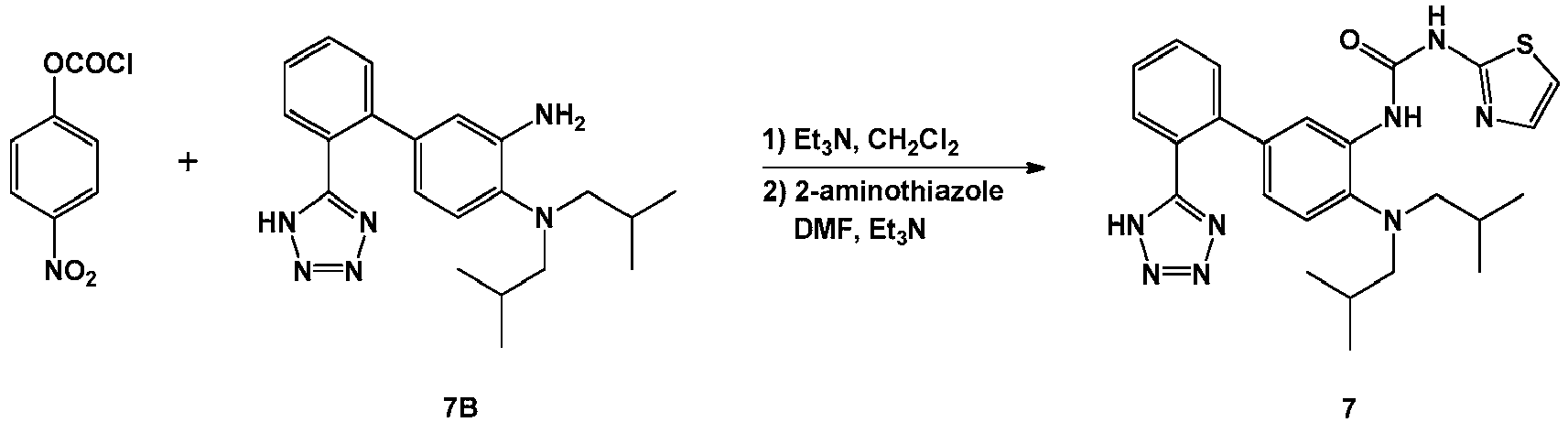
- N4,N4-Diisobutyl-2'-(1H-tetrazol-5-yl)biphenyl-3,4-diamine (7B) (20 mg, 0.055 mmol) was taken up in DCM (1 mL) and Et3N (0.038 mL, 0.274 mmol) and 4-nitrophenyl carbonochloridate (13 mg, 0.066 mmol) were added. The reaction was stirred at rt for 1h, an additional 5 eq. of Et3N and 1.2 eq. 4-nitrophenyl carbonochloridate were added, and the reaction was stirred overnight. The reaction was diluted with DCM and washed with 0.1M HCl, then brine. The organic phase was dried over Na2SO4, filtered and concentrated. The yellow residue was taken up in DMF (1.000 mL) and Et3N (0.038 mL, 0.274 mmol) and thiazol-2-amine (8.2 mg, 0.082 mmol) were added. The reaction was stirred 3h at RT then purified by prep. HPLC (C18 PHENOMENEX® Luna S5 ODS 21 x 100 mm, 10mM NH4OAc, MeOH-H2O gradient). Concentration of the appropriate fractions afforded 1-(4-(diisobutylamino)-2'-(1H-tetrazol-5-yl)biphenyl-3-yl)-3-(thiazol-2-yl)urea (8.4 mg, 31% yield) as an off-white solid. MS(ES): m/z = 491 [M+H]+. HPLC Tr: 2.23°.
-

-

- To a solution of 4-bromo-1-fluoro-2-nitrobenzene (0.440 g, 2 mmol) in DMF (1mL) was added Hunig's base followed by 3,3,3-trifluoropropan-1-amine, HCl (0.419 g, 2.80 mmol). The solution was stirred 1h at 90 °C then cooled and poured into 40 ml of water. The mixture was rapidly stirred while the pH was adjusted to ∼5 with glacial HOAc. Product precipitated and was filtered, rinsed with water, and air-dried to afford 4-bromo-2-nitro-N-(3,3,3-trifluoropropyl)aniline (0.6 g, 91% yield) as an orange powder. Spectra was consistent with the proposed nitroaniline at a purity of >95%. MS(ES): m/z = 313 [M+H]+, HPLC Tr: 2.14p.
-

- To a solution of 4-bromo-2-nitro-N-(3,3,3-trifluoropropyl)aniline (8A) (0.1 g, 0.319 mmol) in DMF (2 mL) was added sodium hydride (0.038 g, 0.958 mmol). The mixture was stirred 2 min. at RT then treated with (bromomethyl)benzene (0.057 mL, 0.479 mmol). The reaction was stirred 1h at RT then quenched with aq. HOAc. This mixture was extracted with ether, and the organic extract was dried, stripped and purified by ISCO chromatography (gradient elution with EtOAc-hexanes) to afford N-benzyl-4-bromo-2-nitro-N-(3,3,3-trifluoropropyl)aniline (0.11 g, 81% yield) as an orange oil at a purity of >95%. MS(ES): m/z = 405 [M+H]+, HPLC Tr: 2.71q.
-

- To a solution of N-benzyl-4-bromo-2-nitro-N-(3,3,3-trifluoropropyl)aniline (8B) (0.1 g, 0.248 mmol) in ethanol (6 mL) was added 1 mL of water followed by ammonium chloride (0.199 g, 3.72 mmol). The mixture was stirred 10 min. at RT then treated with zinc (0.243 g, 3.72 mmol). This mixture was stirred 30 min. at RT, diluted with dichloromethane, and filtered. The filtrate was washed with water, dried, and stripped to afford N1-benzyl-4-bromo-N1-(3,3,3-trifluoropropyl)benzene-1,2-diamine (8C) (0.09 g, 92% yield) as an amber oil. Spectra was consistent with the proposed aniline at a purity of ∼95%. MS(ES): m/z = 373 [M+H]+, HPLC Tr: 4.53l.
-

- To a solution of N1-benzyl-4-bromo-N1-(3,3,3-trifluoropropyl)benzene-1,2-diamine (8C) (0.086 g, 0.23 mmol) in THF (1 mL) was added 1-isocyanato-4-methylbenzene (0.040 g, 0.299 mmol). The solution was stirred 1h at 55 °C then cooled to RT, treated with 0.02 mL of N,N-dimethylethylenediamine, and purified by ISCO chromatography (gradient elution with EtOAc-hexanes) to afford 0.1 g (86%) of 1-(2-(benzyl(3,3,3-trifluoropropyl)amino)-5-bromophenyl)-3-(p-tolyl)urea as a white powder. MS(ES): m/z = 508 [M+H]+, HPLC Tr: 2.79q.
-

- To a suspension of 2-boronobenzoic acid (0.016 g, 0.099 mmol) and 1-(2-(benzyl(3,3,3-trifluoropropyl)amino)-5-bromophenyl)-3-(p-tolyl)urea (8D) (0.025 g, 0.049 mmol) and tetrakis(triphenylphosphine)palladium(0) (5.71 mg, 4.94 µmol) in degassed DMF (1 mL) was added aq. potassium carbonate (0.165 mL, 0.247 mmol). The mixture was placed under nitrogen and heated at 95 °C for 3h. The reaction was cooled to 60 °C, brought to pH4 with glacial HOAc, filtered, and purified via preparative LC/MS with the following conditions: Column: Waters XBridge C18, 19 x 150 mm, 5-µm particles; Guard Column: Waters XBridge C18, 19 x 10 mm, 5-µm particles; Mobile Phase A: 5:95 acetonitrile:water with 10 mM ammonium acetate; Mobile Phase B: 95:5 acetonitrile:water with 10-mM ammonium acetate; Gradient: 15-100% B over 15 minutes, then a 5-minute hold at 100% B; Flow: 20 mL/min. Fractions containing the desired product were combined and dried via centrifugal evaporation to afford 4'-(benzyl(3,3,3-trifluoropropyl)amino)-3'-(3-(p-tolyl)ureido)-[1,1'-biphenyl]-2-carboxylic acid (0.015 g, 52.7% yield). MS(ES): m/z = 548 [M+H]+, HPLC Tr: 4.72l.
-

- To a suspension of 8D (0.025 g, 0.049 mmol) and 2-borono-4-fluorobenzoic acid (0.018 g, 0.099 mmol) and tetrakis(triphenylphosphine)palladium(0) (5.71 mg, 4.94 µmol) in degassed DMF (1 mL) was added aq. potassium carbonate (0.165 mL, 0.247 mmol). The mixture was placed under nitrogen and heated at 95°C for 3h. The reaction was cooled to 60°C, brought to pH4 with glacial HOAc, filtered, and purified by prep. HPLC (Axia Luna 30 x 100 mm column, MeOH-water-TFA gradient). Concentration of the appropriate fraction afforded 0.014 g (50%) of 4'-(Benzyl(3,3,3-trifluoropropyl)amino)-5-fluoro-3'-(3-(p-tolyl)ureido)-[1,1'-biphenyl]-2-carboxylic acid. MS(ES): m/z = 566 [M+H]+, HPLC Tr: 4.86l.
-

- The title compound was prepared from 8D and 2-tetrazolylphenylboronic acid by the procedure used for the conversion of 8D to 8. MS(ES): m/z = 572 [M+H]+, HPLC Tr: 2.64q.
-

- The title compound was prepared from 8A and 3-chlorobenzyl bromide by the general procedure used for the conversion of 8A to 8B. MS(ES): m/z = 439 [M+H]+, HPLC Tr: 4.951.
- The title compound was prepared from 11A by the general procedure used for the conversion of 8B to 8C. MS(ES): m/z = 409 [M+H]+, HPLC Tr: 4.74l.
- The title compound was prepared from 11B by the general procedure used for the conversion of 8C to 8D. MS(ES): m/z = 542 [M+H]+, HPLC Tr: 2.84q.
- The title compound was prepared from 11C by the general procedure used for the conversion of 8D to 8. MS(ES): m/z = 582 [M+H]+, HPLC Tr: 4.83l.
-

- The title compound was prepared from 11C and 2-carboxy-5-fluorophenylboronic acid by the general procedure for the conversion of 8D to 8. MS(ES): m/z = 600 [M+H]+, HPLC Tr: 4.94l.
-

- The title compound was prepared from 11C and 2-tetrazolylphenylboronic acid by the general procedure for the conversion of 8D to 8. MS(ES): m/z = 606 [M+H]+, HPLC Tr: 4.81l.
-

- The title compound was prepared from 8A and 4-chlorobenzyl bromide by the general procedure used for the conversion of 8A to 8B. MS(ES): m/z = 439 [M+H]+, HPLC Tr: 4.99l.
- The title compound was prepared from 14A by the general procedure used for the conversion of 8B to 8C. MS(ES): m/z = 409 [M+H]+, HPLC Tr: 4.77l.
- The title compound was prepared from 14B by the general procedure used for the conversion of 8C to 8D. MS(ES): m/z = 542 [M+H]+, HPLC Tr: 511l.
- The title compound was prepared from 14C by the general procedure used for the conversion of 8D to 8. MS(ES): m/z = 582 [M+H]+, HPLC Tr: 4.87l
-

- The title compound was prepared from 14C and 2-carboxy-5-fluorophenylboronic acid by the general procedure for the conversion of 8D to 8. MS(ES): m/z = 600 [M+H]+, HPLC Tr: 4.97l.
-

- The title compound was prepared from 14C and 2-tetrazolylphenylboronic acid by the general procedure for the conversion of 8D to 8. MS(ES): m/z = 606 [M+H]+, HPLC Tr: 2.98r .
-
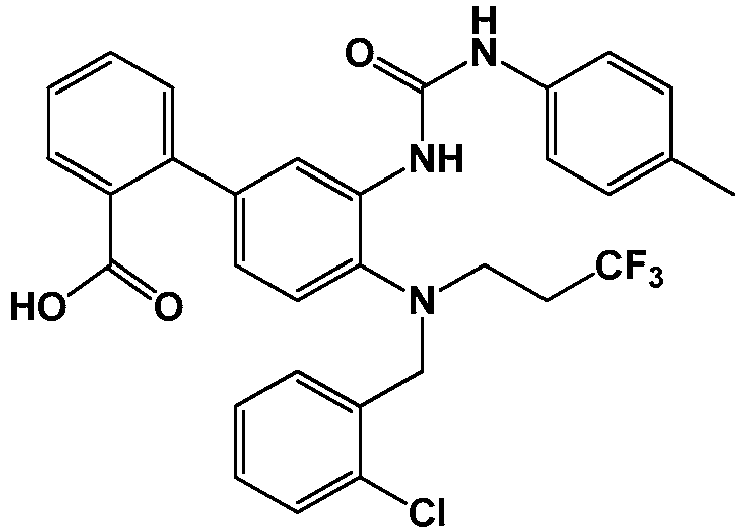
- The title compound was prepared from 8A and 2-chlorobenzyl bromide by the general procedure used for the conversion of 8A to 8B. MS(ES): m/z = 439 [M+H]+, HPLC Tr: 4.94l.
- The title compound was prepared from 17A by the general procedure used for the conversion of 8B to 8C. MS(ES): m/z = 409 [M+H]+, HPLC Tr: 4.78l.
- The title compound was prepared from 14B by the general procedure used for the conversion of 8C to 8D. MS(ES): m/z = 542 [M+H]+, HPLC Tr: 3.19r.
- The title compound was prepared from 17C by the general procedure used for the conversion of 8D to 8. MS(ES): m/z = 582 [M+H]+, HPLC Tr: 4.85l.
-

- The title compound was prepared from 17C and 2-carboxy-5-fluorophenylboronic acid by the general procedure for the conversion of 8D to 8. MS(ES): m/z = 600 [M+H]+, HPLC Tr: 3.04r .
-
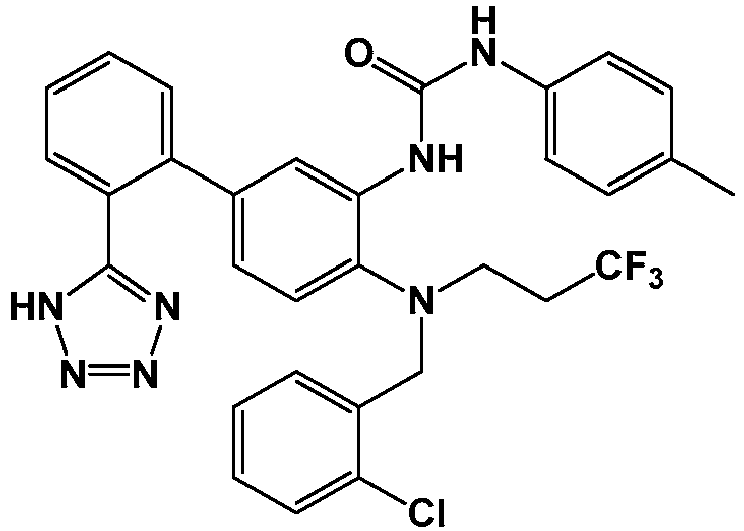
- The title compound was prepared from 17C and 2-tetrazolylphenylboronic acid by the general procedure for the conversion of 8D to 8. MS(ES): m/z = 606 [M+H]+, HPLC Tr: 4.81l .
-

- The title compound was prepared from the nitro intermediate iiik and benzyl bromide by the general procedure used for the conversion of 8A to 8B. MS(ES): m/z = 371 [M+H]+, HPLC Tr: 2.58q.
- The title compound was prepared from 20A by the general procedure used for the conversion of 8B to 8C. MS(ES): m/z = 343 [M+H]+, HPLC Tr: 4.15l.
- The title compound was prepared from 20B by the general procedure used for the conversion of 8C to 8D. MS(ES): m/z = 476 [M+H]+, HPLC Tr: 2.68q.
- The title compound was prepared from 20C by the general procedure used for the conversion of 8D to 8. MS(ES): m/z = 516 [M+H]+, HPLC Tr: 2.11k.
-

- The title compound was prepared from 20C and 2-carboxy-5-fluorophenylboronic acid by the general procedure for the conversion of 8D to 8. MS(ES): m/z = 534 [M+H]+, HPLC Tr: 2.16k.
-

- The title compound was prepared from 20C and 2-tetrazolylphenylboronic acid by the general procedure for the conversion of 8D to 8. MS(ES): m/z = 540 [M+H]+, HPLC Tr: 2.07k.
-

- The title compound was prepared from the nitro intermediate iiias and propargyl bromide by the general procedure used for the conversion of 8A to 8B. MS(ES): m/z = 313 [M+H]+, HPLC Tr: 4.61l.
- The title compound was prepared from 23A by the general procedure used for the conversion of 8B to 8C. MS(ES): m/z = 283 [M+H]+, HPLC Tr: 213p.
- The title compound was prepared from 23B by the general procedure used for the conversion of 8C to 8D. MS(ES): m/z = 416 [M+H]+, HPLC Tr: 2.76q.
- The title compound was prepared from 23C and 2-carboxy-5-fluorophenylboronic acid by the general procedure used for the conversion of 8D to 8. MS(ES): m/z = 474 [M+H]+, HPLC Tr: 2.66q.
-

- The title compound was prepared from 23C and 2-tetrazolylphenylboronic acid by the general procedure for the conversion of 8D to 8. MS(ES): m/z = 480 [M+H]+, HPLC Tr: 2.55q.
-

-

- To a stirred solution of 1,3-difluoro-2-nitrobenzene (0.955 g, 6 mmol) in NMP (2 mL) was added Hunig's Base (1.153 mL, 6.60 mmol) followed by diisobutylamine (0.775 g, 6.00 mmol). The solution was stirred 30 min. at 100 °C, after which time it was still pale yellow with TLC showing a tiny new spot. The temperature was raised to 125 °C, stirring was continued 2h longer, and overnight at 110 °C. LCMS shows ∼10% SM and essentially none of the bis-adduct; 0.1 mL more diisobutylamine was added, and the reaction was stirred 1h longer at 125 °C. The reaction was cooled and poured into aq. HOAc. This mixture was extracted with 1:1 ether-heptane, and the organic extract was washed with sat'd aq. sodium bicarbonate, dried, and stripped to afford 3-fluoro-N,N-diisobutyl-2-nitroaniline (1.5 g, 89% yield) as a dark oil. MS(ES): m/z = 269 [M+H]+. HPLC Tr: 4.83l.
-
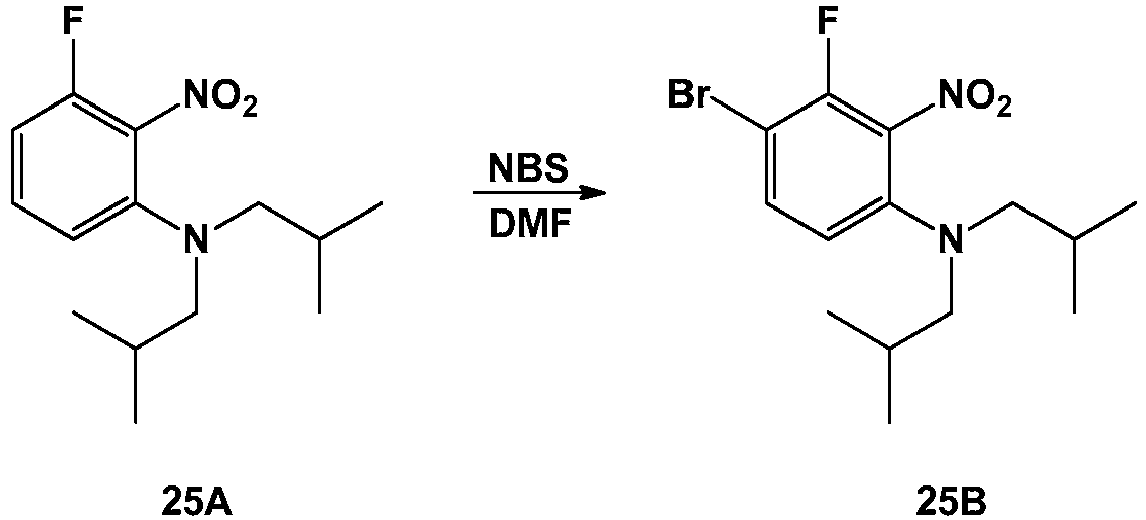
- To a stirred, cooled (0 °C) solution of 3-fluoro-N,N-diisobutyl-2-nitroaniline (25A) (0.268 g, 1 mmol) in DMF (3 mL) was added N-bromosuccinimide (0.178 g, 1.000 mmol). The solution was warmed to RT, stirred an additional 15 min., and TLC taken. Most of the UV+ material was a new spot at slightly higher Rf (∼0.7 in 10% ether-hexanes) than the ∼10-20% SM which remains. A much smaller spot was present further down the plate. An additional 30 mg of NBS was added, and the reaction was stirred 30 min. longer then partially concentrated. Flash chromatography (gradient elution with ether-hexanes afforded 4-bromo-3-fluoro-N,N-diisobutyl-2-nitroaniline (0.32 g, 88% yield) as an orange oil. MS(ES): m/z = 349 [M+H]+. HPLC Tr: 2.89q.
-
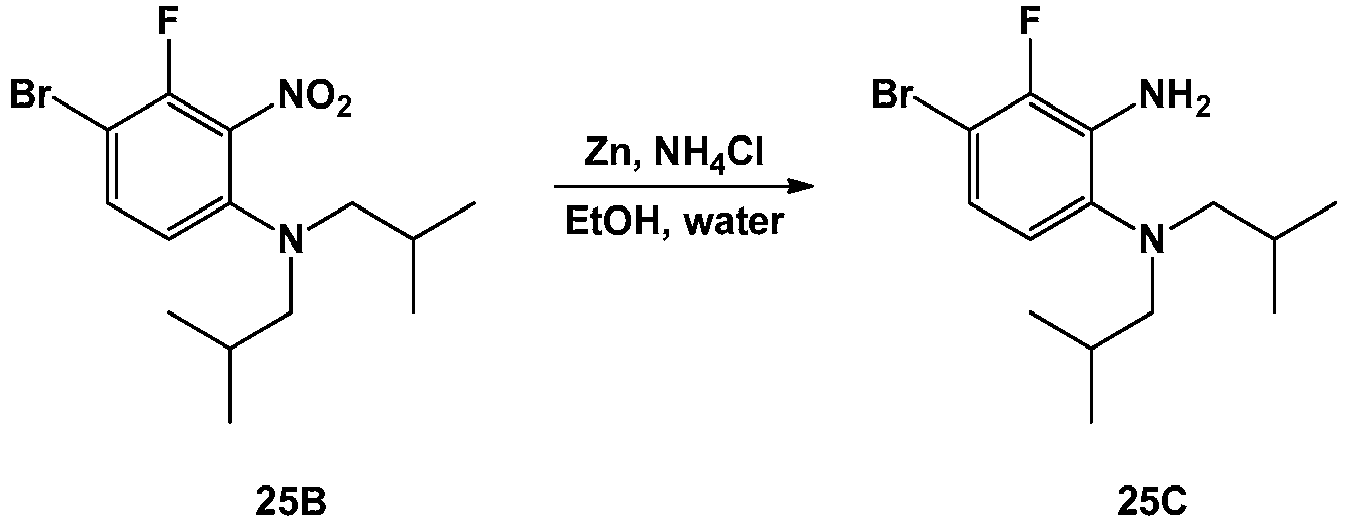
- To a solution of 4-bromo-3-fluoro-N,N-diisobutyl-2-nitroaniline (25B) (0.28 g, 0.806 mmol) in ethanol (8 mL) was added 2 mL of water followed by ammonium chloride (0.259 g, 4.84 mmol). The resulting mixture was stirred 5 min. at RT then treated with zinc (0.316 g, 4.84 mmol). This mixture was stirred vigorously for 30 min. then diluted with dichloromethane and filtered. The filtrate was washed with water, dried, and stripped to afford 4-bromo-3-fluoro-N1,N1-diisobutylbenzene-1,2-diamine (0.25 g, 98% yield) as a brown oil. Spectra was consistent with the proposed aniline at the stated level of purity. MS(ES): m/z = 319 [M+H]+. HPLC Tr: 5.10l.
-

- A solution of crude 4-bromo-3-fluoro-N1,N1-diisobutylbenzene-1,2-diamine (0.254 g, 0.8 mmol) was dissolved in THF (1 mL), treated with 1-isocyanato-4-methylbenzene (0.138 g, 1.040 mmol), and stirred 18h at 45 °C. The reaction was quenched with 0.04 mL of N,N-dimethylethylenediamine and purified by flash chromatography (gradient elution with EtOAc-hexanes). Concentration of the appropriate fractions afforded 1-(3-bromo-6-(diisobutylamino)-2-fluorophenyl)-3-(p-tolyl)urea (0.16 g, 40.0% yield) as a tan solid. MS(ES): m/z = 452 [M+H]+. HPLC Tr: 2.74q.
-

- A suspension of (2-(1H-tetrazol-5-yl)phenyl)boronic acid (0.025 g, 0.133 mmol) and 1-(3-bromo-6-(diisobutylamino)-2-fluorophenyl)-3-(p-tolyl)urea (25D) (0.03 g, 0.067 mmol) and tetrakis(triphenylphosphine)palladium(0) (7.70 mg, 6.66 µmol) in degassed DMF (1.5 mL) was treated with aq. potassium carbonate (0.222 mL, 0.333 mmol). The reaction was heated at 95 °C for 2h then cooled to RT and stirred overnight. The reaction was treated with glacial HOAc to pH3 then filtered and purified by prep. HPLC. (Axia Luna 30 x 100 mm column, MeOH-water-TFA gradient). The appropriate fraction was concentrated to afford 1-(4-(diisobutylamino)-2-fluoro-2'-(1H-tetrazol-5-yl)-[1,1'-biphenyl]-3-yl)-3-(p-tolyl)urea (0.006 g, 16% yield) as a white powder. MS(ES): m/z = 516 [M+H]+. HPLC Tr: 12.61d.
-

- The title compound was prepared from 25D and 2-carboxyphenylboronic acid by the general procedure for the preparation of 25. MS(ES): m/z = 492 [M+H]+, HPLC Tr: 12.43d.
-

-

- A solution of 2-methylpropan-1-amine (0.285 g, 3.90 mmol) and 4,4,4-trifluoro-2-methylbutanoic acid (0.468 g, 3 mmol) in DMF (8 mL) was treated with triethylamine (0.544 mL, 3.90 mmol) followed by BOP (1.460 g, 3.30 mmol). The solution was stirred 18h at RT then diluted with ether and washed with 0.5 M aq. HCl and then saturated aq. sodium bicarbonate. The organic phase was dried and stripped to afford 4,4,4-trifluoro-N-isobutyl-2-methylbutanamide (0.6 g, 90% yield) as a waxy white solid. MS(ES): m/z = 212 [M+H]+. HPLC Tr: 1.60p.
-

- To a solution of lithium aluminum hydride (7.50 mL, 7.50 mmol) in THF was added 4,4,4-trifluoro-N-isobutyl-2-methylbutanamide (27A) (0.528 g, 2.5 mmol). The suspension was brought to reflux and stirred for 6h. The reaction was cooled and stirred overnight at RT. The reaction was quenched using the method of Fieser, and treated with 10 mL more THF, and MgSO4 and then stirred 1h at RT. The reaction was filtered and stripped to afford 4,4,4-trifluoro-N-isobutyl-2-methylbutan-1-amine, 0.5 tetrahydrofuran (0.57 g, 93% yield) as a colorless oil. MS(ES): m/z = 198 [M+H]+. HPLC Tr: 1.27p.
-

- To a solution of 4-bromo-1-fluoro-2-nitrobenzene (0.220 g, 1 mmol) and 4,4,4-trifluoro-N-isobutyl-2-methylbutan-1-amine (27B), 0.5 tetrahydrofuran (0.327 g, 1.400 mmol) in N-methyl-2-pyrrolidinone (0.3 mL) was added Hunig's Base (0.210 mL, 1.200 mmol). The reaction was stirred at 130 °C for 18h. The reaction was cooled to RT, diluted with ether and washed with 10% aq. HOAc then aq. sodium bicarbonate. The organic phase was dried and stripped to afford 4-bromo-N-isobutyl-2-nitro-N-(4,4,4-trifluoro-2-methylbutyl)aniline (0.38 g, 86% yield) as a dark orange oil. MS(ES): m/z = 399 [M+H]+. HPLC Tr: 5.05l.
-

- The title compound was prepared from 27C by the procedure used for the conversion of 8B to 8C. MS(ES): m/z = 369 [M+H]+. HPLC Tr: 2.76q.
-

- The title compound was prepared from 27D at 50 °C by the procedure used for the conversion of 8C to 8D. MS(ES): m/z = 502 [M+H]+. HPLC Tr: 3.25r.
-

- The title compound was prepared from 27E by the procedure used for the conversion of 8D to 8. MS(ES): m/z = 566 [M+H]+. HPLC Tr: 2.70q.
-

- The title compound was prepared from 27E and 2-carboxyphenylboronic acid by the procedure used for the conversion of 8D to 8. MS(ES): m/z = 542 [M+H]+. HPLC Tr: 2.71q.
-

-

- To a stirred, cooled (0 °C) solution of cyclohexanamine (1.091 g, 11.00 mmol) and triethylamine (1.214 g, 12.00 mmol) in THF (Volume: 10 mL) was added isobutyryl chloride (1.066 g, 10 mmol). The resulting slurry was stirred 30 min., warming to RT then diluted with 1:1 ether-hexanes. The resulting mixture was washed with aq. HCl then sat'd aq. sodium bicarbonate, dried, and stripped to afford N-cyclohexylisobutyramide as a colorless solid. MS(ES): m/z = 170 [M+H]+. HPLC Tr: 2.611.
-

- The title compound was prepared from 29A and lithium aluminum deuteride by the procedure used for the conversion of 27A to 27B. MS(ES): m/z = 158 [M+H]+. HPLC Tr: 1.56p.
-

- The title compound was prepared from 29B at 140 °C by the procedure used for the conversion of 27B to 27C. MS(ES): m/z = 359 [M+H]+. HPLC Tr: 3.74q.
-
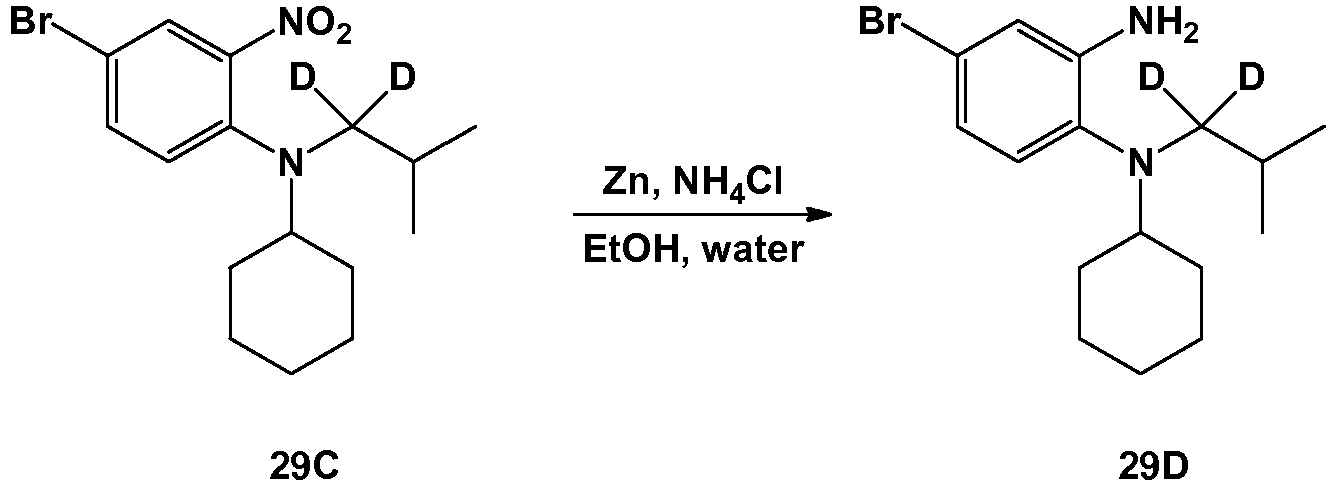
- The title compound was prepared from 29C by the procedure used for the conversion of 8B to 8C. MS(ES): m/z = 327 [M+H]+. HPLC Tr: 2.86q.
-

- The title compound was prepared from 29D at 55 °C by the procedure used for the conversion of 8C to 8D. MS(ES): m/z = 462 [M+H]+. HPLC Tr: 5.361.
-

- The title compound was prepared from 29E at 100 °C by the procedure used for the conversion of 8D to 8. MS(ES): m/z = 526 [M+H]+. HPLC Tr: 13.01d.
-

- The title compound was prepared from 29E and 2-carboxyphenylboronic acid at 100 °C by the procedure used for the conversion of 8E to 8. MS(ES): m/z = 502 [M+H]+. HPLC Tr: 12.64d.
-

- The title compound was prepared from 29E and 2-carboxy-5-fluorophenylboronic acid at 100 °C by the procedure used for the conversion of 8D to 8. MS(ES): m/z = 520 [M+H]+. HPLC Tr: 13.04d.
-

-

- The title compound was prepared from 29D and 2-fluorophenylisocyanate at 55 °C by the procedure used for the conversion of 8C to 8D. MS(ES): m/z = 466 [M+H]+. HPLC Tr: 3.43q.
-

- The title compound was prepared from 32A at 100 °C by the procedure used for the conversion of 8D to 8. MS(ES): m/z = 530 [M+H]+. HPLC Tr: 3.05q.
-

- The title compound was prepared from 32A and 2-carboxyphenylboronic acid at 100 °C by the procedure used for the conversion of 8D to 8. MS(ES): m/z = 506 [M+H]+. HPLC Tr: 2.97q.
-

- The title compound was prepared from 32A and 2-carboxy-5-fluorophenylboronic acid at 100 °C by the procedure used for the conversion of 8D to 8. MS(ES): m/z = 524 [M+H]+. HPLC Tr: 3.09q.
-

-

- To a suspension of 1-(5-bromo-2-(diisobutylamino)phenyl)-3-p-tolylurea (0.432 g, 1 mmol) and 5,5,5',5'-tetramethyl-2,2'-bi(1,3,2-dioxaborinane) (0.294 g, 1.300 mmol) and 1,1'-bis(diphenylphosphino)ferrocene-palladium(II) dichloride dichloromethane complex (0.024 g, 0.030 mmol) in degassed DMSO (Volume: 2 mL) was added potassium acetate (0.294 g, 3.00 mmol). The mixture was placed under nitrogen and heated at 80 °C for 1.3h. The reaction temperature was raised to 90 °C, and stirring was continued for 3h. The reaction was cooled to RT, diluted with water, and extracted with ether. The organic extract was dried, stripped, and chromatographed on silica gel (gradient elution with ether-hexanes) to afford 1-(2-(diisobutylamino)-5-(5,5-dimethyl-1,3,2-dioxaborinan-2-yl)phenyl)-3-p-tolylurea (0.37 g, 76% yield) as a white powder. 1H NMR (400 MHz, DMSO-d6) δ ppm 9.26 (s, 1 H), 8.22(d, 1H, J = 1.5 Hz); 7.66(s, 1H); 7.35(d, 2H, J = 8.4 Hz); 7.28(dd, 1H, J = 7.9, 1.3 Hz); 7.13(d, 1H, J = 8.1 Hz); 7.07(d, 2H, J = 8.4 Hz); 3.72(s, 4H); 2.71(d, 4H, J = 7.0 Hz); 2.24(s, 3H); 1.60-1.71(m, 2H); 0.95(s, 6H); 0.82(d, 12H, J = 6.6 Hz). MS(ES): m/z = 398 [M+H-C5H8]+.
-
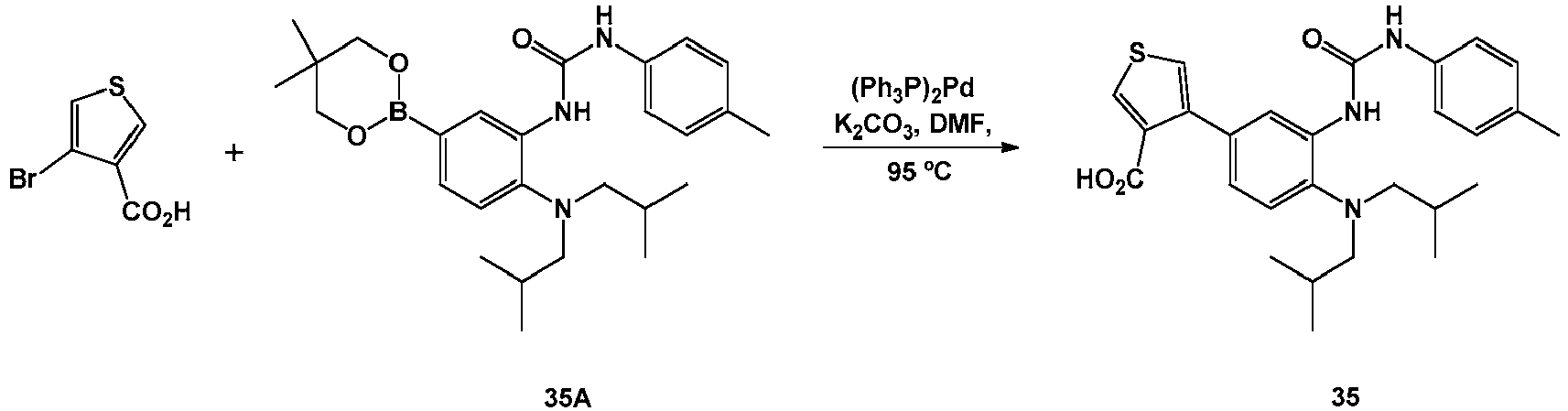
- A suspension of 4-bromothiophene-3-carboxylic acid (0.036 g, 0.17 mmol) and 1-(2-(diisobutylamino)-5-(5,5-dimethyl-1,3,2-dioxaborinan-2-yl)phenyl)-3-p-tolylurea (35A) (0.04 g, 0.086 mmol) and tetrakis(triphenylphosphine)palladium(0) (9.93 mg, 8.59 µmol) in degassed DMF (Volume: 1 mL) was treated with aq. potassium carbonate (0.29 mL, 0.43 mmol). The suspension was placed under nitrogen and heated at 95 °C for 2h. The reaction was cooled, brought to pH 5 with glacial HOAc, filtered, and purified by prep. HPLC (Axia 30 x 100 mm column, MeOH-water-TFA gradient). Concentration of the appropriate fraction afforded 4-(4-(diisobutylamino)-3-(3-p-tolylureido)phenyl)thiophene-3-carboxylic acid (0.008 g, 0.016 mmol, 18% yield) as a white powder. 1H NMR (400 MHz, DMSO-d6) δ ppm 9.33 (s, 1 H), 8.23(d, 1H, J = 3.3 Hz); 7.97(d, 1H, J = 1.8 Hz); 7.83(s, 1H); 7.47(d, 1H, J = 3.3 Hz); 7.34(d, 2H, J = 8.4 Hz); 7.18(d, 1H, J = 8.4 Hz); 7.07(d, 2H, J = 8.1 Hz); 6.94(dd, 1H, J = 8.1, 1.8 Hz); 2.68(d, 4H, J = 6.8 Hz); 2.23(s, 3H); 1.61-1.76(m, 2H); 0.86(d, 12H, J = 6.6 Hz). MS(ES): m/z = 480 [M+H]+.
-
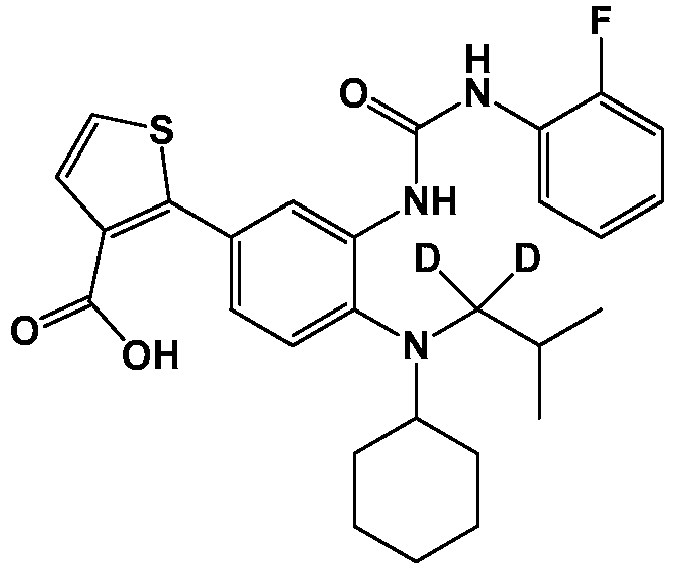
- The title compound was prepared from 32A and 2-boronothiophene-3-carboxylic acid at 100 °C by the procedure used for the conversion of 8D to 8. MS(ES): m/z = 512 [M+H]+. HPLC Tr: 3.10q.
-

-

- The title compound was prepared from 5-bromo-2-chloro-3-nitropyridine and N-methylcyclohexylamine (2.2 eq.) in DMF (~0.3 M) at 50 °C by the procedure used for the preparation of 1A. MS(ES): m/z = 316 [M+H]+. HPLC Tr: 5.011.
-

- The title compound was prepared from 37A by the procedure used for the preparation of 1B. MS(ES): m/z = 284 [M+H]+. HPLC Tr: 2.88l.
-

- The title compound was prepared from 37B and 2-fluorophenyl isocyanate at 60 °C by the procedure used for the conversion of 8C to 8D. MS(ES): m/z = 423 [M+H]+. HPLC Tr: 4.85l.
-

- The title compound was prepared from 37C at 95 °C by the procedure used for the conversion of 8D to 8. MS(ES): m/z = 487 [M+H]+. HPLC Tr: 11.53d.
-

-

- A mixture of toluene (Ratio: 2.250, Volume: 9 mL) and water (Ratio: 1.000, Volume: 4 mL) was degassed by purges with nitrogen (3x). 4-(5,5-dimethyl-1,3,2-dioxaborinan-2-yl)-N1,N1-diisobutylbenzene-1,2-diamine (4B) (2 g, 6.02 mmol), 5-(2-bromophenyl)-2-trityl-2H-tetrazole (2.56 g, 5.47 mmol) and sodium carbonate (1.160 g, 10.94 mmol) were added, and the reaction mixture was purged with nitrogen. Pd(Ph3P)4 (0.632 g, 0.547 mmol) was added, the mixture was degassed (3x), and the reaction mixture was heated at 80 °C under a nitrogen atmosphere for 14h. The reaction was cooled to room temperature, and the resulting mixture was extracted with DCM (3x 60ml), washed with water and brine, dried over anhydrous Na2SO4. Purification by ISCO chromatography (gradient elution with ethyl acetate-hexanes) afforded N4,N4-diisobutyl-2'-(2-trityl-2H-tetrazol-5-yl)biphenyl-3,4-diamine (2.37 g, 3.91 mmol, 71.4% yield) as white solid. MS(ES): m/z = 607 [M+H]+. HPLC Tr: 1.28k.
-

- A solution of N4,N4-diisobutyl-2'-(1-trityl-1H-tetrazol-5-yl)-[1,1'-biphenyl]-3,4-diamine (38A) (0.2 g, 0.330 mmol) in THF (1 mL) was treated with 4-bromo-2-fluoro-1-isocyanatobenzene (0.093 g, 0.428 mmol) and warmed to 55 °C. After 1h, the solution was treated with 0.3 mL of 4 M aq. HCl and stirred 3h at RT. This mixture was treated with ~0.3 mL of DMF and a few drops of EtOH to give a solution, and then it was chromatographed on silica gel (elution with 1:1 ether-hexanes, 1% HOAc, gradient of EtOH from 0% to 5%). Concentration of the appropriate fractions afforded 1-(4-bromo-2-fluorophenyl)-3-(4-(diisobutylamino)-2'-(1H-tetrazol-5-yl)-[1,1'-biphenyl]-3-yl)urea (0.058 g, 27.3% yield) as a colorless foam. MS(ES): m/z = 580 [M+H]+. HPLC Tr: 13.18d.
-

-

- A stirred, cooled (0 °C) solution of 4-bromo-N,N-diisobutyl-2-nitroaniline (1A) (0.494 g, 1.5 mmol) in DMF (4 mL) was treated with N-chlorosuccinimide (0.220 g, 1.650 mmol). The orange solution was warmed to RT and stirred 15 min. LCMS indicates that LTN reaction has occurred. The reaction was warmed with a heat gun to ~60 °C for a few seconds then cooled to RT with stirring over 10 min. TLC indicates SM and one spot at lower Rf and one spot at higher Rf. The reaction was treated with an additional 150 mg. of NCS and re-warmed to 60 °C. The reaction was then stirred overnight at RT. The reaction was purified by prep. HPLC (Axia Luna 30 x 100 mm column, gradient elution with MeOH-water-TFA, four injections). Concentration of the appropriate fractions afforded 4-bromo-2-chloro-N,N-diisobutyl-6-nitroaniline (0.27 g, 47.0% yield) as an orange oil. MS(ES): m/z = 363 [M+H]+. HPLC Tr: 5.52l.
-

- The title compound was prepared from 39A using the procedures for the conversion of 1A into 1C. MS(ES): m/z = 468 [M+H]+. HPLC Tr: 5.49l.
-

- The title compound was prepared from 39B using the procedures for the conversion of 8D to 8. MS(ES): m/z = 532 [M+H]+. HPLC Tr: 5.00l.
-

- The title compound was prepared from 39B and 2-carboxyphenylboronic acid by the procedure described for the conversion of 8D to 8. MS(ES): m/z = 508 [M+H]+. HPLC Tr: 13.34d.
-

- The title compound was prepared from 39B and 2-borono-4-fluorobenzoic acid by the procedure described for the conversion of 8D to 8. MS(ES): m/z = 526 [M+H]+. HPLC Tr: 5.23l.
- Using the methods described for the preparation of 27B and 29B, amines RNH2 and carboxylic acids R'CO2H are coupled to give amides which are further transformed by the action of LiAlH4 into secondary amines RNHCH2R' (lx, Table 2) useful as intermediates in the synthesis of compounds of the present invention.
Table 2 Amine Starting Materials Made by Hydride Reduction of Amides 
R R' Coupling method (M+H)+ Tr lxa 

acid chloride 156 1.46o lxb 

acid chloride used in subsequent step without purification or characterization lxc 

acid chloride 142 1.22o lxd 

acid chloride 1H NMR (400 MHz, DMSO-d6) δ ppm 2.89-2.98(m, 1 H); 2.41(t, 2H, J = 7.0 Hz); 1.20-1.72(m, 10H); 0.84(t, 3H, J = 7.4 Hz). lxe 

acid chloride 196 1.24q 1xf 

Bop 224 1.36o lxg 

acid chloride 170 0.60p lxq 

acid chloride 144 0.98p lxr 

acid chloride 160 0.80p lxs 

Bop 210 0.81p - Additional secondary amines RNHCHR'R"(lx) useful as intermediates in the synthesis of compounds of the present invention may be prepared by the scheme below. Some Examples prepared by this method are shown in Table 3a. The Example below utilizing sodium cyanoborohydride as the reducing agent and acetic acid as a proton source is representative and not intended to be limiting. Additional proton sources could include any number of inorganic acids such as HCl or HBr and other organic acids. Other reducing agents utilized for this transformation include but are not limited to sodium triacetoxyborohydride and sodium borohydride.
-

- To a stirred solution of 2,2-difluoroethanamine (0.446 g, 5.50 mmol)in DMF (5 mL) and acetic acid (0.572 mL, 10.00 mmol) was added cyclohexanone (0.491 g, 5 mmol) followed by a solution of sodium cyanoborohydride (6.00 mL, 6.00 mmol) in THF. The solution was stirred overnight at RT. The reaction was diluted with ether and treated with 0.5M aq. HCl. The phases were stirred together for 1h, separated, and the aq. phase was brought to pH 10 with sat. aq. sodium carbonate. The resulting mixture was extracted with ether, and the organic extract was dried and concentrated to afford a colorless oil. This oil was dissolved in ether, treated with 2 mL of 4M HCl in dioxane, and the resulting solid was filtered, rinsed with ether, and air-dried to afford N-(2,2-difluoroethyl)cyclohexanamine, HCl (0.5 g, 47.6% yield) as a white powder. MS(ES): m/z = 164 [M+H]+. HPLC Tr: 0.55p.
- Using the methods described for the preparation of lxi, amines RNH2 and aldehydes/ketones R'COR" are condensed to secondary amines RNHCHR'R" (lx, Table 3 a) useful as intermediates in the synthesis of compounds of the present invention.
Table 3 a Amine Starting Materials Made by Reductive Amination 
Entry RNH2 R'COR" (M+H)+ Tr lxj 
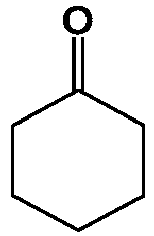
196 1.00p lxk 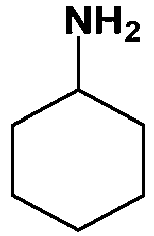

210 1.18p lxl 

142 (Crude product was derivatized as the t-butyl carbamate for purification, then deprotected to give the desired amine·HCl.) 1.36p - Additional secondary amines RNHCHR'R"(lx) useful as intermediates in the synthesis of compounds of the present invention may be prepared by the scheme below. Some Examples prepared by this method are shown in Table 3b.
-

- A solution of 4,4,4-trifluorobutanal (3.72 g, 29.5 mmol) and 2-methylprop-2-en-1-amine (2, 28.1 mmol) in MeOH (14.06 ml) was warmed to 40°C for 30 min. then cooled to RT. This solution was treated with sodium borohydride (1.596 g, 42.2 mmol) and stirred ON at RT. The reaction was diluted with water and extracted twice with ether. The comb. org. ext. dried and stripped to afford 4,4,4-trifluoro-N-(2-methylallyl)butan-1-amine (2.9 g, 14.40 mmol, 51.2 % yield) as a colorless oil. MS(ES): m/z = 182 [M+H]+. HPLC Tr: 0.53k.
- Using the methods described for the preparation of lxs, amines RNH2 and aldehydes/ketones R'COR" are converted to secondary amines RNHCHR'R" (lx, Table 3b) useful as intermediates in the synthesis of compounds of the present invention.
Table 3b Amine Starting Materials Made by Reductive Amination 
Entry RNH2 R'COR" (M+H)+ Tr lxt 

200 1.12p lxu 

228 1.02p lxv 

200 0.49k lxw 

226 (M-H)- 1.31w lxy 

224 0.64s - Additional secondary amines RNHCHR'R" (lx, R" = H) useful as intermediates in the synthesis of compounds of the present invention may be prepared by carbamate N-alkylation followed by carbamate deprotection as shown in the scheme below. Some Examples prepared by this method are shown in Table 4. The Example below utilizing a t-butyl carbamate with sodium hydride as the base is representative and not intended to be limiting. Benzyl carbamates are also suitable groups for activating amines for alkylation and are removed under reducing conditions. Other bases of suitable strength include lithium dialkylamides and the related disilylazides and others known to those skilled in the art of organic/medicinal chemistry.
-

-

- A solution of 2,2-difluoroethanamine (0.892 g, 11.00 mmol) in THF (Volume: 10 mL) was treated with di-tert-butyl dicarbonate (2.182 g, 10 mmol) followed by N-methylmorpholine (1.099 mL, 10.00 mmol). The solution was stirred 1.5h at RT then diluted with ether. This solution was washed with diluted aq. HOAc then aq. sodium bicarbonate, dried, and concentrated to afford tert-butyl 2,2-difluoroethylcarbamate (1.8 g, 94% yield) as a colorless crystalline solid. MS(ES): m/z = 182 [M+H]+. HPLC Tr: 2.241.
-

- To a stirred solution of tert-butyl 2,2-difluoroethylcarbamate (0.544 g, 3 mmol) in DMF (Volume: 4 mL) was added sodium hydride (0.180 g, 4.50 mmol). The mixture was placed under nitrogen and stirred for 10 min. then treated with (bromomethyl)cyclopropane (0.567 g, 4.20 mmol). The reaction was stirred 1.5h at RT then quenched with diluted aq. HOAc. The resulting mixture was diluted with ether and washed with water then sat. aq. sodium bicarbonate. The organic phase was dried and concentrated to afford tert-butyl cyclopropylmethyl(2,2-difluoroethyl)carbamate (0.64 g, 86% yield) as a colorless oil. MS(ES): m/z = 180 [M+H - isobutylene]+. HPLC Tr: 1.85°.
-

- tert-Butyl cyclopropylmethyl(2,2-difluoroethyl)carbamate (0.6 g, 2.55 mmol) was treated with a solution of HCl (2.55 ml, 10.20 mmol) in dioxane. The solution was stirred 1h at RT then concentrated under reduced pressure to afford an oily white solid. This material was suspended in 30% ether-hexanes and filtered, rinsed with 30% ether-hexanes, and air-dried to afford N-(cyclopropylmethyl)-2,2-difluoroethanamine, HCl (0.37 g, 80% yield) as a colorless solid. MS(ES): m/z = 180 [M+H]+. HPLC Tr: 0.28°.
- Using the methods described for the preparation of lxm, amines RNH2 are derivatized as t-butyl carbamates, alkylated, and then deprotected to afford secondary amine hydrochloride salts RNHCH2R'·HCl (lx, Table 4) useful as intermediates in the synthesis of compounds of the present invention.
Table 4 Amine Starting Materials Made by Carbamate Alkylation 
RNH2 R'CH2X" (M+H)+ Tr lxn 

142 0.99p lxo 

1H NMR (400 MHz, DMSO-d6) δ ppm 0.84(br.s, 1 H); 2.91-3.0(m, 2H); 2.71-2.75(br.s, 2H); 1.26(t, 3H, J = 7.3 Hz); 1.01(s, 9H). 1.18p lxp 

154 1.47l - Using the methods described for the conversion of 1B to 1C, aniline intermediates iii and the appropriate isocyanate R9NCO are converted to the urea intermediates iv (Table 5, Z = NR7R8).
Table 5 Bromourea Intermediates Made by Scheme 1 
R9 NR7R8 Temp. (°C) (M+H)+ Tr iva 

60 418 4.58l ivb 
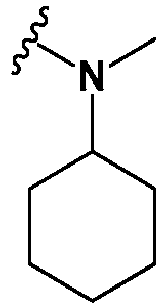
60 438 4.51l ivd 

50 444 5.05l ive 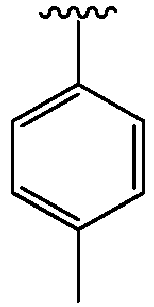

50 420 4.38l ivg 

55 424 4.03l ivh 

60 438 4.07l ivi 

50 418 3.97l ivk 

55 440 4.77l ivl 

55 472 5.07l ivm 

55 430 5.43l ivn 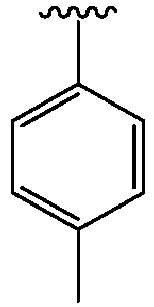
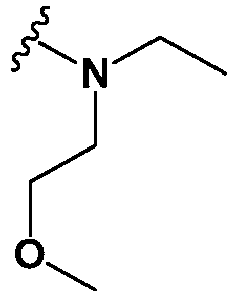
45 408 1.93o ivo 

55 432 4.65l ivp 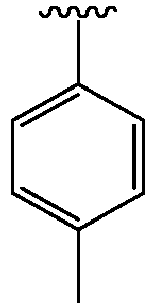

55 458 2.25o ivq 

55 446 2.45p ivr 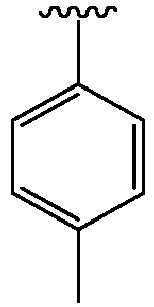

55 434 2.47p ivs 

55 432 2.47p ivt 

60 446 2.57p ivu 

60 454 2.87p ivv 

60 424 2.96p ivw 

60 422 2.82p ivx 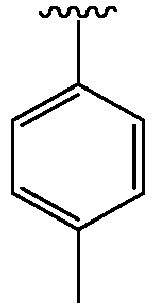

60 420 3.01p ivy 

60 418 2.87p ivz 

55 460 3.51q ivaa 

55 464 3.43q ivac 
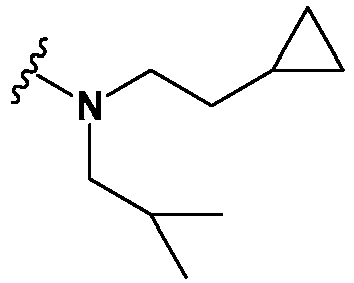
55 446 3.43q ivad 

55 450 3.38q ivae 

55 456 3.42q ivag 

60 420 3.31q ivah 

60 424 3.23q ivai 

60 442 3.27q ivaj 

50 514 3.48q ival 

55 418 4.56l ivam 

45 432 3.25q ivan 

45 434 3.21q ivao 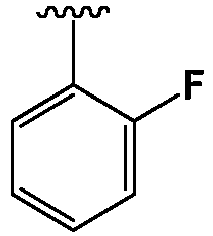

45 428 3.20q ivap 

45 446 2.89q ivaq 
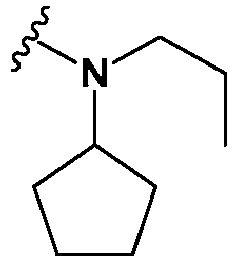
45 450 2.84q ivar 

60 460 2.85q ivas 

60 392 2.65q ivat 

45 432 2.85q ivau 

50 454 1.23k ivav 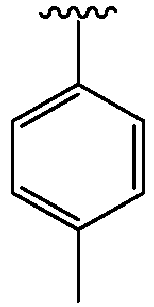

60 528 2.94q ivaw 

50 502 3.25r ivax 

45 504 2.80q ivay 

45 468 2.79q ivaz 
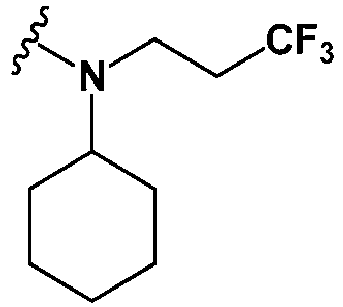
45 500 3.28r ivba 

50 474 2.84q ivbb 

45 506 2.86q ivbc 

45 502 1.31k ivbd 

45 454 3.21r ivbe 

50 470 1.22k ivbf 

50 468 3.18r ivbg 

RT 484 5.16l ivbh 

RT 532 5.04l ivbi 

RT 504 5.04l ivbj 

RT 504 1.23k ivbk 

50 448 5.21l ivbl 

50 486 5.39l ivbm 

50 452 5.11l ivbn 

50 462 4.97l ivbo 

50 500 5.33l ivbp 

RT 458 5.18l ivbq 

RT 464 4.57l ivbr 

RT 512 1.28k ivbs 

55 528 5.35l ivbt 
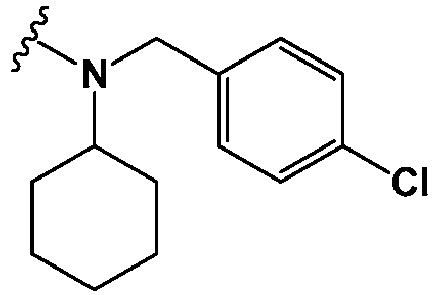
55 532 5.27l - Using the method described for the conversion of 2A to 2B, bromide intermediates viii and the appropriate arylboronic acid are converted to the biaryl intermediates x (Table 6, Z = NR7R8).
Table 6 Biaryldiamine Intermediates Made by Scheme 2 

-NR7R8 (M+H)+ Tr va 
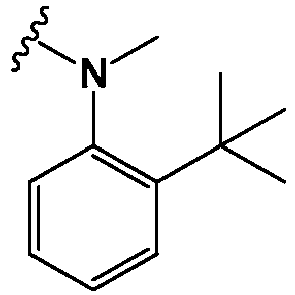
391 3.93l vb 

325 2.88l vc 

363 2.59l vd 

341 2.67q - Using the methods described for the conversion of 1B to 1C, aniline intermediates iii and the appropriate isocyanate R9NCO are converted to the urea intermediates iv.
Table 7 B5F Bromourea Intermediates Made by Scheme 1 
Ex. R9 -NR7R8 Temp. (°C) (M+H)+ Tr ivca 

60 436 5.05l ivcb 

55 4.58 4.22l ivcc 

55 478 3.65q ivcd 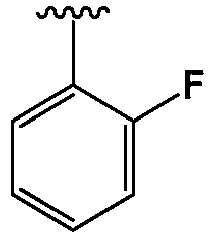

45 482 3.60q ivce 

45 500 3.65q ivcf 

45 452 5.22l ivcg 

45 490 5.39l - Using the method described for the conversion of 1B to 1C, aniline intermediates (iii) and the appropriate isocyanate R9NCO are converted to the urea intermediates (iv).
Table 8 
Ex. R9 -NR7R8 Temp. (°C) (M+H)+ Tr ivda 

50 482 5.49l ivdb 

50 478 5.59l ivdc 

50 516 5.75q - The following compounds of the invention set out in Table 9 were prepared employing the process set out below
Table 9 
Ex. No. Name 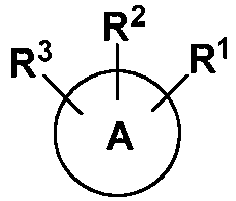
R9 -NR7R8 Tr method (M+H) + 42 3'-(3-(2-chlorophenyl)ureid o)-4'-(cyclohexyl(methyl )amino)-4-methoxybiphenyl-3-carboxylic acid 


11.53b 508 43 4'-(cyclohexyl(methyl )amino)-4-methoxy-3'-(3-p-tolylureido)bipheny 1-3-carboxylic acid 

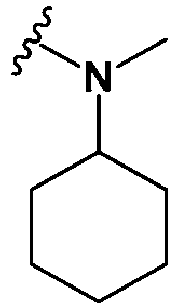
11.61b 488 44 1-(4-(cyclohexyl(methyl )amino)-2'-(1H-tetrazol-5-yl)biphenyl-3-yl)-3-p-tolylurea 


11.77b 482 45 1-(2-chlorophenyl)-3-(4-(cyclohexyl (methyl)amino)-2'-(1H-tetrazol-5-yl) biphenyl-3-yl)urea 
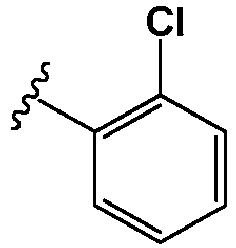

11.67b 502 46 1-(4-(cyclohexylamino)-2'-(1H-tetrazol-5-yl)biphenyl-3-yl)-3-p-tolylurea 


11.76b 468 47 1-(4-((4aS,8aS)-octahydroquinolin-1(2H)-yl)-2'-(1H-tetrazol-5-yl)biphenyl-3-yl)-3-p-tolylurea 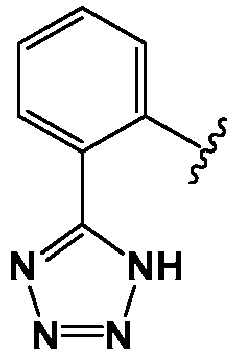


13.09b 508 48 4'-(cyclohexyl amino)-3'-(3-p-tolylureido)bipheny 1-2-carboxylic acid 


11.16b 444 49 4'-((4aS,8aS)-octahydroquinolin-1(2H)-yl)-3'-(3-p-tolylureido)bipheny 1-2-carboxylic acid 


12.42b 484 50 1-(4-(methyl(tetra hydro-2H-pyran-4-yl)amino)-2'-(1H-tetrazol-5-yl)biphenyl-3-yl)-3-p-tolylurea 


11.65b 484 51 4'-(methyl(tetra hydro-2H-pyran-4-yl)amino)-3'-(3-p-tolylureido)bipheny 1-2-carboxylic acid 


11.54b 460 52 4'-(diisobutyl amino)-3'-(3-p-tolylureido) biphenyl-2-carboxylic acid 
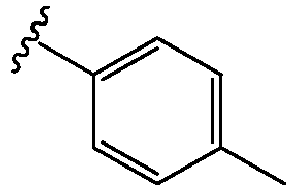
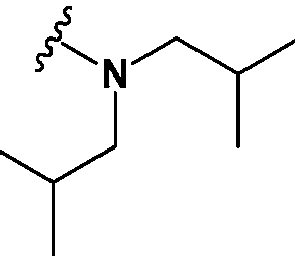
13.35b 474 53 1-(4-(cyclohexyl (ethyl)amino)-2'-(1H-tetrazol-5-yl)biphenyl-3-yl)-3-(2-fluorophenyl) urea 
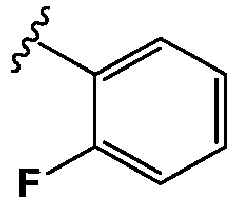

11.38b 500 54 4'-((2,2-dimethoxyethyl)(m ethyl)amino)-3'-(3-p-tolylureido) biphenyl-2-carboxylic acid 


11.99b 464 55 1-(4-((2,2-dimethoxyethyl)(m ethyl) amino)-2'-(1H-tetrazol-5-yl)biphenyl-3-yl)-3-p-tolylurea 


11.95b 488 56 4'-(bis(2-methoxyethyl)amin o)-3'-(3-p-tolylureido)bipheny 1-2-carboxylic acid 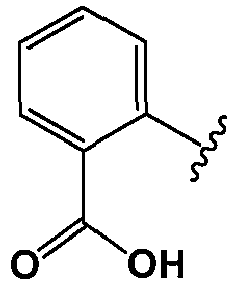


12.13b 478 57 1-(4-(bis(2-methoxyethyl)amin o)-2'-(1H-tetrazol-5-yl)biphenyl-3-yl)-3-p-tolylurea 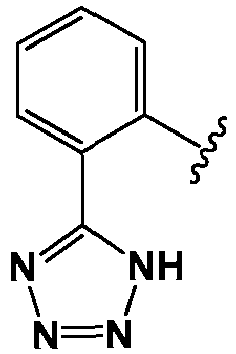

12.01b 502 58 4'-((cyclopropylmethy 1)(propyl)amino)-3'-(3-p-tolylureido)bipheny 1-2-carboxylic acid 


11.36d 458 59 1-(4-((cyclopropylmethy 1)(propyl) amino)-2'-(1H-tetrazol-5-yl)biphenyl-3-yl)-3-p-tolylurea 

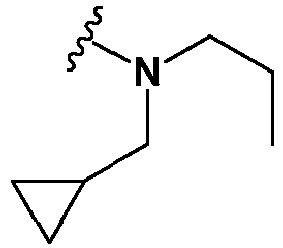
11.71b 482 60 1-(4-((cyclopropylmethy 1)(2,2-difluoroethyl)amino )-2'-(1H-tetrazol-5-yl)biphenyl-3-yl)-3-p-tolylurea 


16.81a 504 61 4'-((cyclopropylmethy 1)(2,2-difluoroethyl)amino )-3'-(3-p-tolylureido)bipheny 1-2-carboxylic acid 


17.15a 480 62 4'-((cyclopropylmethy 1)(2,2-difluoroethyl)amino )-4-methoxy-3'-(3-p-tolylureido)bipheny 1-3-carboxylic acid 


17.05a 510 63 1-(4-((cyclopropylmethy 1)(3,3,3-trifluoropropyl)ami no)-2'-(1H-tetrazol-5-yl)biphenyl-3-yl)-3-p-tolylurea 


12.86b 536 64 4'-((cyclopropylmethy 1)(3,3,3-trifluoropropyl)ami no)-3'-(3-p-tolylureido)bipheny 1-2-carboxylic acid 


17.66a 512 65 4'-((cyclopropylmethy 1)(3,3,3-trifluoropropyl)ami no)-4-methoxy-3'-(3-p-tolylureido)bipheny 1-3-carboxylic acid 


13.01b 542 66 1-(4-(bis(cyclopropylmet hyl)amino)-2'-(1H-tetrazol-5-yl)biphenyl-3-yl)-3-p-tolylurea 
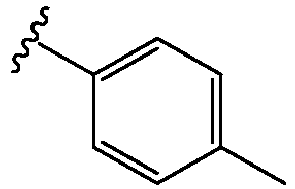

15.24a 494 67 4'-(bis(cyclopropylmet hyl)amino)-3'-(3-p-tolylureido)bipheny 1-2-carboxylic acid 


14.54a 470 68 3'-(3-(2-chlorophenyl)ureid o)-4'-(diisobutylamino)-4-fluorobiphenyl-2-carboxylic acid 


7.27m 512 69 4'-(diisobutylamino)-3-fluoro-3'-(3-o-tolylureido)bipheny 1-2-carboxylic acid 


7.14m 492 70 4'-(diisobutylamino)-4-fluoro-3'-(3-p-tolylureido)bipheny 1-2-carboxylic acid 


7.10m 492 71 N-(4'-(diisobutylamino)-4-methoxy-3'-(3-p-tolylureido)bipheny 1-2-yl)-1,1,1-trifluoromethanesul fonamide 


7.94m 607 72 4'-(ethyl(2-methoxyethyl)amin o)-3'-(3-p-tolylureido)bipheny 1-2-carboxylic acid 


15.32a 448 73 1-(4-(ethyl(2-methoxyethyl)amin o)-2'-(1H-tetrazol-5-yl)biphenyl-3-yl)-3-p-tolylurea 


15.79a 472 74 N-(4'-(diisobutylamino)-3'-(3-p-tolylureido)bipheny 1-2-yl) methanesulfonamid e 


7.01m 523 75 1-(4-(cyclopentyl(ethyl)a mino)-2'-(1H-tetrazol-5-yl)biphenyl-3-yl)-3-p-tolylurea 


15.60a 482 76 4'-(cyclopentyl(ethyl)a mino)-3'-(3-p-tolylureido)bipheny 1-2-carboxylic acid 


14.90a 458 77 4'-(cyclopentyl(ethyl)a mino)-4-methoxy-3'-(3-p-tolylureido)bipheny 1-3-carboxylic acid 


13.56a 488 78 4'-(cycloheptyl(methyl )amino)-4-methoxy-3'-(3-p-tolylureido)bipheny 1-3-carboxylic acid 

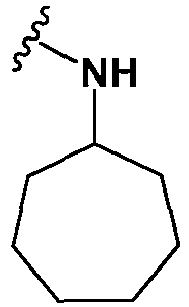
16.00a 502 79 1-(4-(cycloheptyl(methyl )amino)-2'-(1H-tetrazol-5-yl)biphenyl-3-yl)-3-p-tolylurea 
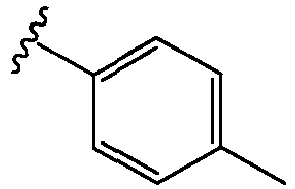

16.29a 496 80 4'-(cycloheptyl(methyl )amino)-3'-(3-p-tolylureido)bipheny 1-2-carboxylic acid 


15.42a 472 81 N-(4'-(diisobutylamino)-4-fluoro-3'-(3-p-tolylureido)bipheny 1-2-yl)-1,1,1-trifluoromethanesul fonamide 


8.32m 595 82 1-(4-(cyclohexyl(cyclopr opylmethyl) amino)-2'-(1H-tetrazol-5-yl)biphenyl-3-yl)-3-p-tolylurea 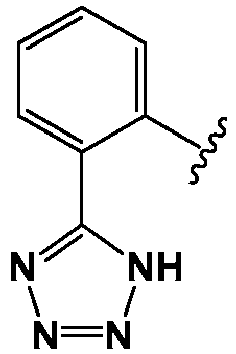


16.55a 522 83 4'-(cyclohexyl(cyclopr opylmethyl) amino)-3'-(3-p-tolylureido)bipheny 1-2-carboxylic acid 
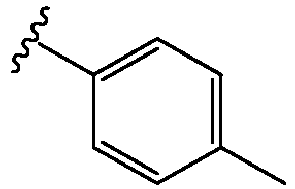

15.81a 498 84 N-(4'-(diisobutylamino)-3'-(3-p-tolylureido)bipheny 1-2-yl)-2,2,2-trifluoroethanesulfo namide 


7.67m 591 85 1-(4-(cyclohexyl(propyl) amino)-2'-(1H-tetrazol-5-yl)biphenyl-3-yl)-3-p-tolylurea 


16.81a 510 86 4'-(cyclohexyl(propyl) amino)-3'-(3-p-tolylureido)bipheny 1-2-carboxylic acid 

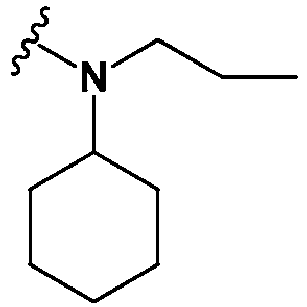
16.09a 486 87 4'-(cyclohexyl(propyl) amino)-5-fluoro-3'-(3-p-tolylureido)bipheny 1-2-carboxylic acid 


17.11a 504 88 1-(4-(dibutylamino)-2'-(lH-tetrazol-5-yl)biphenyl-3-yl)-3-p-tolylurea 


12.48b 498 89 4'-(dibutylamino)-3'-(3-p-tolylureido) biphenyl-2-carboxylic acid 


16.27a 474 90 4'-(dibutylamino)-5-fluoro-3'-(3-p-tolylureido)bipheny 1-2-carboxylic acid 


17.28a 492 91 2-(4-(dibutylamino)-3-(3-p-tolylureido) phenyl)thiophene-3-carboxylic acid 

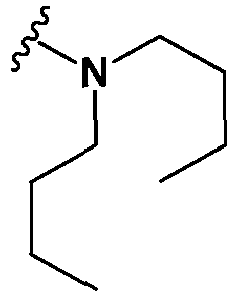
17.46a 480 92 1-(4-((cyclopropylmethy 1)(isobutyl) amino)-2'-(1H-tetrazol-5-yl)biphenyl-3-yl)-3-p-tolylurea 


1.90k 496 93 4'-((cyclopropylmethy 1)(isobutyl)amino)-3'-(3-p-tolylureido)bipheny 1-2-carboxylic acid 


1.87k 472 96 1-(2'-(2-cyano-2-(methylsulfonyl) acetyl)-4-(diisobutylamino)bi phenyl-3-yl)-3-p-tolylurea 


5.50m 575 97 4'-((cyclobutylmethyl) (isobutyl)amino)-3'-(3-p-tolylureido)bipheny 1-3-carboxylic acid 


1.57k 486 98 1-(4-((cyclobutylmethyl) (isobutyl) amino)-2'-(1H-tetrazol-5-yl)biphenyl-3-yl)-3-p-tolylurea 


2.79i 510 99 4'-((cyclobutylmethyl) (isobutyl)amino)-5-fluoro-3'-(3-p-tolylureido)bipheny 1-2-carboxylic acid 


2.86i 504 100 4'-((cyclobutylmethyl) (isobutyl)amino)-3'-(3-p-tolylureido)bipheny 1-2-carboxylic acid 


1.59k 486 101 4'-(diisobutylamino)-6-(dimethylamino)-3'-(3-p-tolylureido)bipheny 1-2-carboxylic acid 


2.29j 517 102 4-(4-(diisobutylamino)-3-(3-p-tolylureido)phenyl)-1-ethyl-3-methyl-1H-pyrazole-5-carboxylic acid 


1.95k 506 103 5-(4-(diisobutylamino)-3-(3-p-tolylureido)phenyl)t hiazole-4-carboxylic acid 


2.05k 481 104 4'-((4,4-difluorocyclohexyl) (methyl) amino)-3'-(3-p-tolylureido)bipheny 1-2-carboxylic acid 
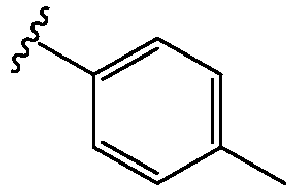

16.82a 494 105 4'-((4,4-difluorocyclohexyl) (methyl) amino)-5-fluoro-3'-(3-p-tolylureido) biphenyl-2-carboxylic acid 


17.35a 512 106 1-(4-((4,4-difluorocyclohexyl) (methyl) amino)-2'-(lH-tetrazol-5-yl)biphenyl-3-yl)-3-p-tolylurea 


16.74a 518 107 4'-(2-ethylpiperidin-1-yl)-3'-(3-p-tolylureido)bipheny 1-2-carboxylic acid 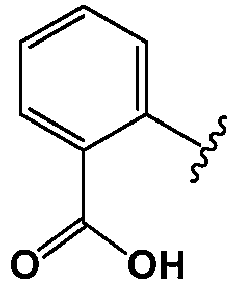


1.76k 458 108 4'-(ethyl(neopentyl)a mino)-3'-(3-(2-fluorophenyl)ureido )biphenyl-2-carboxylic acid 


1.95k 464 109 1-(4-(2-ethylpiperidin-1-yl)-2'-(1H-tetrazol-5-yl)biphenyl-3-yl)-3-(2-fluorophenyl)urea 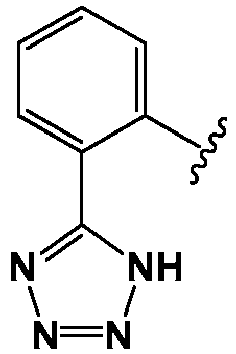


1.63k 486 110 1-(4-(ethyl(neopentyl)a mino)-2'-(1H-tetrazol-5-yl)biphenyl-3-yl)-3-p-tolylurea 


2.10k 484 111 4'-(ethyl(neopentyl)a mino)-3'-(3-p-tolylureido)bipheny 1-2-carboxylic acid 


2.04k 460 112 1-(4-(ethyl(neopentyl)a mino)-2'-(1H-tetrazol-5-yl)biphenyl-3-yl)-3-(2-fluorophenyl)urea 


2.01k 488 113 4'-(ethyl(neopentyl)a mino)-5-fluoro-3'-(3-p-tolylureido)bipheny 1-2-carboxylic acid 

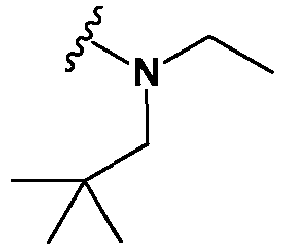
2.16k 478 114 1-(4-(2-ethylpiperidin-1-yl)-2'-(1H-tetrazol-5-yl)biphenyl-3-yl)-3-p-tolylurea 


1.75k 482 115 4'-(ethyl(neopentyl)a mino)-5-fluoro-3'-(3-(2-fluorophenyl)ureido )biphenyl-2-carboxylic acid 


2.09k 482 116 4'-(2-ethylpiperidin-1-yl)-3'-(3-(2-fluorophenyl)ureido )biphenyl-2-carboxylic acid 


1.64k 462 117 1-(4-(diisobutylamino)-4'-methoxy-2'-(1H-tetrazol-5-yl)biphenyl-3-yl)-3-p-tolylurea 


7.23m 528 118 1-(4-(cyclohexyl(isobuty 1)amino)-2'-(1H-tetrazol-5-yl)biphenyl-3-yl)-3-p-tolylurea 


18.20a 524 119 4'-(cyclohexyl(isobuty 1)amino)-3'-(3-p-tolylureido)bipheny 1-2-carboxylic acid 


17.91a 500 120 4-chloro-4'-(cyclohexyl(isobuty 1)amino)-3'-(3-p-tolylureido)bipheny 1-2-carboxylic acid 


19.73a 534 121 1-(4-(cyclohexyl(isobuty 1)amino)-2'-(1H-tetrazol-5-yl)biphenyl-3-yl)-3-(2-fluorophenyl)urea 
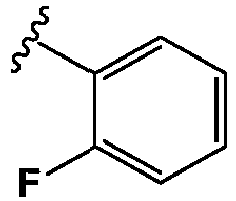

17.79a 528 122 4'-(cyclohexyl(isobuty 1)amino)-3'-(3-(2-fluorophenyl)ureido )biphenyl-2-carboxylic acid 


17.53a 504 123 4-chloro-4'-(cyclohexyl(isobuty 1)amino)-3'-(3-(2-fluorophenyl)ureido )biphenyl-2-carboxylic acid 


19.11a 538 124 4'-(cyclohexyl(isobuty 1)amino)-5-fluoro-3'-(3-p-tolylureido)bipheny 1-2-carboxylic acid 


2.26k 518 125 4'-(cyclohexyl(isobuty 1)amino)-5-fluoro-3'-(3-(2-fluorophenyl)ureido )biphenyl-2-carboxylic acid 


2.18k 522 126 4'-(diisobutylamino)-5-fluoro-3'-(3-p-tolylureido)bipheny 1-2-carboxylic acid 


2.28k 492 127 4-chloro-4'-(diisobutylamino)-3'-(3-p-tolylureido)bipheny 1-2-carboxylic acid 

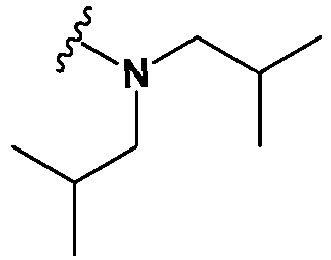
2.36k 508 128 4'-(diisobutylamino)-5-methoxy-3'-(3-p-tolylureido)bipheny 1-2-carboxylic acid 


17.91a 504 129 1-(4-((2-cyclopropylethyl)(is obutyl) amino)-2'-(lH-tetrazol-5-yl)biphenyl-3-yl)-3-p-tolylurea 


17.77a 510 130 4'-((2-cyclopropylethyl)(is obutyl) amino)-5-fluoro-3'-(3-p-tolylureido) biphenyl-2-carboxylic acid 


18.33a 504 131 2-(4-((2-cyclopropylethyl)(is obutyl)amino)-3-(3-p-tolylureido)phenyl) thiophene-3-carboxylic acid 


18.32a 492 132 4'-((2-cyclopropylethyl)(is obutyl)amino)-3'-(3-p-tolylureido)bipheny 1-2-carboxylic acid 


17.50a 486 133 1-(4-((2-cyclopropylethyl)(is obutyl)amino)-2'-(1H-tetrazol-5-yl)biphenyl-3-yl)-3-(2-fluorophenyl)urea 


2.10k 514 134 4'-((2-cyclopropylethyl)(is obutyl)amino)-3'-(3-(2-fluorophenyl)ureido ) biphenyl-2-carboxylic acid 


2.05k 490 135 4'-((2-cyclopropylethyl)(is obutyl)amino)-5-fluoro-3'-(3-(2-fluorophenyl) ureido)biphenyl-2-carboxylic acid 


2.18k 508 136 2-(4-((2-cyclopropylethyl)(is obutyl)amino)-3-(3-(2-fluorophenyl)ureido ) phenyl)thiophene-3-carboxylic acid 

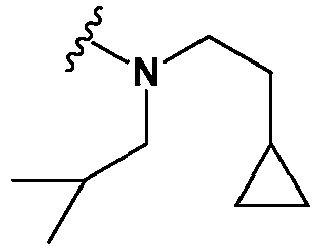
2.22k 496 137 1-(2,4-difluorophenyl)-3-(4-(diisobutylamino)-2'-(lH-tetrazol-5-yl) biphenyl-3-yl)urea 

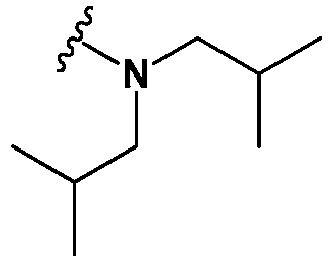
13.23b 520 138 3'-(3-(2,4-difluorophenyl)urei do)-4'-(diisobutylamino)bi phenyl-2-carboxylic acid 


13.21b 496 139 1-cyclopropyl-3-(4-(diisobutylamino)-2'-(lH-tetrazol-5-yl)biphenyl-3-yl)urea 


2.16i 448 140 1-cyclohexyl-3-(4-(diisobutylamino)-2'-(lH-tetrazol-5-yl)biphenyl-3-yl)urea 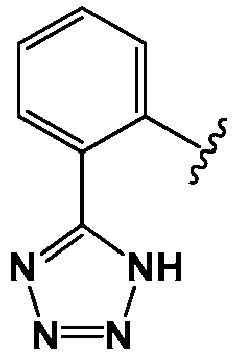


2.59i 490 141 1-(4-(diisobutylamino)-2'-(lH-tetrazol-5-yl)biphenyl-3-yl)-3-neopentylurea 


2.51i 478 142 1-(cyclopropylmethyl )-3-(4-(diisobutylamino)-2'-(lH-tetrazol-5-yl)biphenyl-3-yl)urea 


2.29i 462 143 1-(benzo[d]thiazol-6-yl)-3-(4-(diisobutylamino)-2'-(1H-tetrazol-5-yl)biphenyl-3-yl)urea 


2.26i 541 144 methyl 2-(3-(4-(diisobutylamino)-2'-(1H-tetrazol-5-yl)biphenyl-3-yl)ureido) thiazole-5-carboxylate 
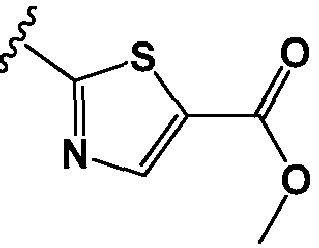
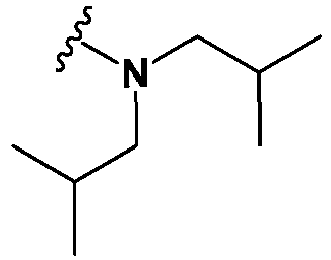
2.26i 549 145 1-(4-(diisobutylamino)-2'-(lH-tetrazol-5-yl)biphenyl-3-yl)-3-(1,3,4-thiadiazol-2-yl)urea 


1.91i 492 146 3'-(3-(2,4-difluorophenyl)urei do)-4'-(diisobutylamino)-5-fluorobiphenyl-2-carboxylic acid 


13.84b 514 147 1-(4-(isobutyl(isopropyl) amino)-2'-(1H-tetrazol-5-yl)biphenyl-3-yl)-3-p-tolylurea 


12.68b 484 148 4'-(isobutyl(isopropyl) amino)-3'-(3-p-tolylureido)bipheny 1-2-carboxylic acid 


12.28b 460 149 5-fluoro-4'-(isobutyl(isopropyl) amino)-3'-(3-p-tolylureido)bipheny 1-2-carboxylic acid 


12.99b 478 150 4'-(diisobutylamino)-3-fluoro-3'-(3-p-tolylureido)bipheny 1-2-carboxylic acid 


2.06j 492 151 3-(4-(diisobutylamino)-3-(3-p-tolylureido)phenyl)i sonicotinic acid 

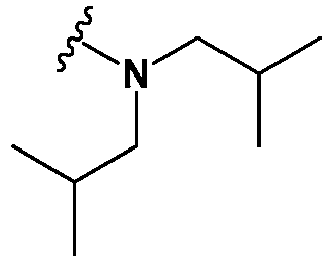
1.89k 475 152 3-(4-(diisobutylamino)-3-(3-p-tolylureido)phenyl)f uran-2-carboxylic acid 


2.70k 464 153 1-(2-fluorophenyl)-3-(4-(isobutyl (isopropyl)amino)-2'-(lH-tetrazol-5-yl)biphenyl-3-yl)urea 


1.97k 488 154 3'-(3-(2-fluorophenyl)ureido )-4'-(isobutyl(isopropyl) amino)biphenyl-2-carboxylic acid 


1.93k 464 155 5-fluoro-3'-(3-(2-fluorophenyl)ureido )-4'-(isobutyl(isopropyl) amino)biphenyl-2-carboxylic acid 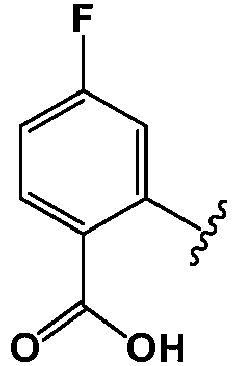


2.06k 482 156 1-(2,4-difluorophenyl)-3-(4-(isobutyl (isopropyl)amino)-2'-(1H-tetrazol-5-yl)biphenyl-3-yl)urea 

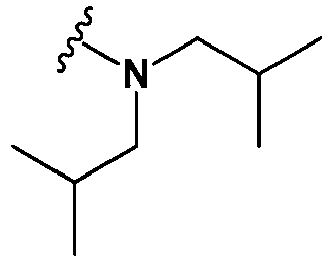
2.02k 506 157 3'-(3-(2,4-difluorophenyl)urei do)-4'-(isobutyl(isopropyl) amino)biphenyl-2-carboxylic acid 


1.98k 482 158 3'-(3-(2,4-difluorophenyl)urei do)-5-fluoro-4'-(isobutyl(isopropyl) amino) biphenyl-2-carboxylic acid 


2.09k 500 159 4-(4-(diisobutylamino)-3-(3-p-tolylureido)phenyl) nicotinic acid 
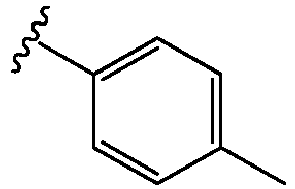

2.00k 475 160 3'-(3-(2,4-difluorophenyl)urei do)-4'-(diisobutylamino)-5-methoxybiphenyl-2-carboxylic acid 


2.28k 526 161 1-(4-(cyclohexyl(isobuty 1)amino)-2'-(1H-tetrazol-5-yl)biphenyl-3-yl)-3-(2-(trifluoromethyl)ph enyl)urea 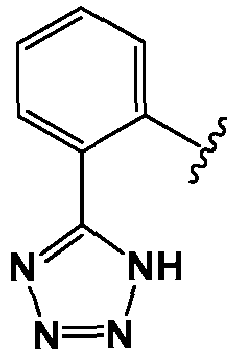


2.37k 578 162 4'-(cyclohexyl(isobuty 1)amino)-3'-(3-(2-(trifluoromethyl)ph enyl)ureido)biphen yl-2-carboxylic acid 


2.38k 554 163 4'-(cyclohexyl(isobuty 1)amino)-5-fluoro-3'-(3-(2-(trifluoromethyl)ph enyl)ureido) biphenyl-2-carboxylic acid 


2.49k 572 164 1-(5-(2-(1H-tetrazol-5-yl)cyclopent-1-enyl)-2-(diisobutylamino)p henyl)-3-p-tolylurea 


2.21k 488 165 4'-(cyclopentyl(propyl )amino)-3'-(3-p-tolylureido)bipheny 1-2-carboxylic acid 


2.85q 472 166 4'-(cyclopentyl(propyl )amino)-5-fluoro-3'-(3-p-tolylureido)bipheny 1-2-carboxylic acid 
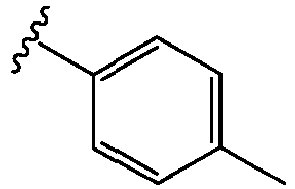

2.95q 490 167 4'-(cyclopentyl(propyl )amino)-5-fluoro-3'-(3-(2-fluorophenyl)ureido )biphenyl-2-carboxylic acid 


1.77k 494 168 4'-(cyclopentyl(propyl )amino)-3'-(3-(2-fluorophenyl)ureido )biphenyl-2-carboxylic acid 


2.75q 476 169 1-(4-(cyclopentyl(propyl )amino)-2'-(1H-tetrazol-5-yl)biphenyl-3-yl)-3-p-tolylurea 


2.87q 496 170 1-(4-(cyclopentyl(propyl )amino)-2'-(1H-tetrazol-5-yl)biphenyl-3-yl)-3-(2-fluorophenyl)urea 


2.76q 500 171 4'-(cyclopentyl(isobut yl)amino)-5-fluoro-3'-(3-p-tolylureido)bipheny 1-2-carboxylic acid 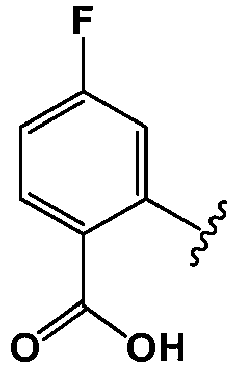


2.04k 504 172 4'-(cyclopentyl(isobut yl)amino)-3'-(3-p-tolylureido)bipheny 1-2-carboxylic acid 
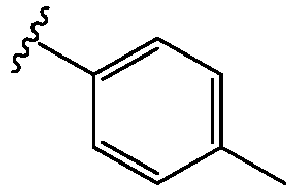

2.41q 486 173 4'-(cyclopentyl(isobut yl)amino)-3'-(3-(2-fluorophenyl)ureido )biphenyl-2-carboxylic acid 
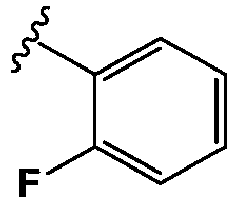

1.85k 490 174 1-(4-(cyclopentyl(isobut yl)amino)-2'-(1H-tetrazol-5-yl)biphenyl-3-yl)-3-p-tolylurea 


2.47q 510 175 1-(4-(cyclopentyl(isobut yl)amino)-2'-(1H-tetrazol-5-yl)biphenyl-3-yl)-3-(2-fluorophenyl)urea 


1.91k 514 176 4'-(cyclopentyl(isobut yl)amino)-5-fluoro-3'-(3-(2-fluorophenyl)ureido ) biphenyl-2-carboxylic acid 

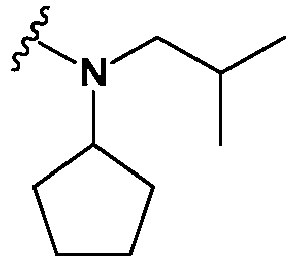
2.47q 508 177 4'-(butyl(cyclohexyl)a mino)-3'-(3-(p-tolyl)ureido)-[1,1'-biphenyl]-2-carboxylic acid 


4.21l 500 178 4'-(butyl(cyclohexyl)a mino)-5-fluoro-3'-(3-(p-tolyl)ureido)-[1,1'-biphenyl]-2-carboxylic acid 
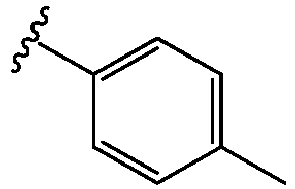
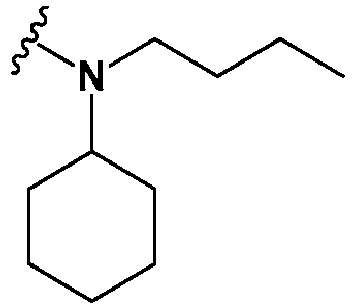
4.41l 518 179 1-(4-(isobutyl(methyl)a mino)-2'-(1H-tetrazol-5-yl)-[1,1'-biphenyl]-3-yl)-3-(p-tolyl)urea 


2.21q 456 180 4'-(isobutyl(methyl)a mino)-3'-(3-(p-tolyl)ureido)-[1,1'-biphenyl]-2-carboxylic acid 


2.17q 432 181 5-fluoro-4'-(isobutyl(methyl)a mino)-3'-(3-(p-tolyl)ureido)-[1,1'-biphenyl]-2-carboxylic acid 


2.31q 450 182 4'-(cyclobutyl(isobutyl )amino)-5-fluoro-3'-(3-(p-tolyl)ureido)-[1,1'-biphenyl]-2-carboxylic acid 


2.55q 490 183 4'-(cyclobutyl(isobutyl )amino)-3'-(3-(p-tolyl)ureido)-[1,1'-biphenyl]-2-carboxylic acid 
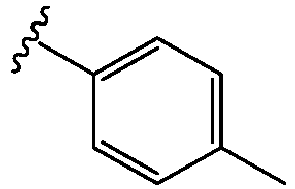

2.41q 472 184 1-(4-(cyclobutyl(isobutyl )amino)-2'-(1H-tetrazol-5-yl)-[1,1'-biphenyl]-3-yl)-3-(p-tolyl)urea 


2.49q 496 185 1-(4-(benzyl(propyl)ami no)-2'-(1H-tetrazol-5-yl)-[1,1'-biphenyl]-3-yl)-3-(p-tolyl)urea 


2.52q 518 186 4'-(benzyl(propyl)ami no)-5-ffuoro-3'-(3-(p-tolyl)ureido)-[1,1'-biphenyl]-2-carboxylic acid 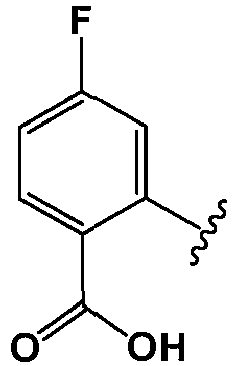


2.56q 512 187 4'-(benzyl(propyl)ami no)-3'-(3-(p-tolyl)ureido)-[1,1'-biphenyl]-2-carboxylic acid 


2.43q 494 188 4'-(cyclohexyl(4,4,4-trifluoro-3-methylbutyl)amino) -3'-(3-(p-tolyl)ureido)-[1,1'-biphenyl]-2-carboxylic acid 

2.66q 568 189 4'-(cyclohexyl(4,4,4-trifluoro-3-methylbutyl)amino) -5-fluoro-3'-(3-(p-tolyl)ureido)-[1,1'-biphenyl]-2-carboxylic acid 


2.75q 586 190 1-(4-(cyclohexyl(4,4,4-trifluoro-3-methylbutyl)amino) -2'-(lH-tetrazol-5-yl)-[1,1'-biphenyl]-3-yl)-3-(p-tolyl)urea 


3.01r 592 191 1-(4-((4-chlorobenzyl)(2-methoxyethyl) amino)-2'-(1H-tetrazol-5-yl)-[1,1'-biphenyl]-3-yl)-3-(p-tolyl)urea 


2.62q 568 192 4'-((4-chlorobenzyl)(2-methoxyethyl) amino)-3'-(3-(p-tolyl)ureido)-[1,1'-biphenyl]-2-carboxylic acid 


2.64q 544 193 4'-((4-chlorobenzyl)(2-methoxyethyl) amino)-5-fluoro-3'-(3-(p-tolyl)ureido)-[1,1'-biphenyl]-2-carboxylic acid 

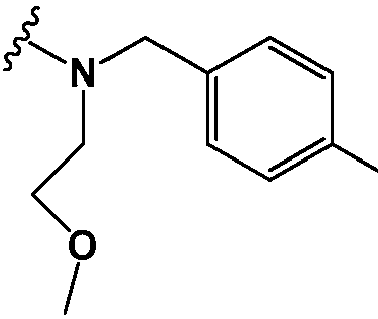
2.72q 562 194 1-(4-(cyclohexyl(2,2-difluoroethyl) amino)-2'-(1H-tetrazol-5-yl)-[1,1'-biphenyl]-3-yl)-3-(p-tolyl)urea 


2.60q 532 195 1-(4-(cyclohexyl(3,3,3-trifluoropropyl) amino)-2'-(1H-tetrazol-5-yl)-[1,1'-biphenyl]-3-yl)-3-(p-tolyl)urea 


2.96r 564 196 4'-(cyclohexyl(2,2-difluoroethyl)amino )-3'-(3-(p-tolyl)ureido)-[1,1'-biphenyl]-2-carboxylic acid 


2.66q 508 197 4'-(cyclohexyl(3,3,3-trifluoropropyl) amino)-3'-(3-(p-tolyl)ureido)-[1,1'-biphenyl]-2-carboxylic acid 

2.75q 540 198 4'-(isobutyl(3,3,3-trifluoropropyl) amino)-3'-(3-(p-tolyl)ureido)-[1,1'-biphenyl]-2-carboxylic acid 

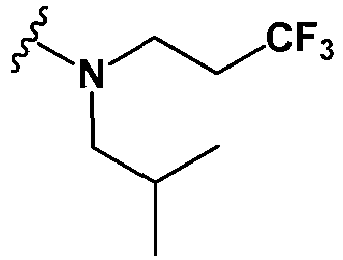
2.90r 514 199 1-(4-(isobutyl(3,3,3-trifluoropropyl) amino)-2'-(1H-tetrazol-5-yl)-[1,1'-biphenyl]-3-yl)-3-(p-tolyl)urea 


2.23k 538 200 5-fluoro-4'-(isobutyl(3,3,3-trifluoropropyl)ami no)-3'-(3-(p-tolyl) ureido)-[1,1'-biphenyl]-2-carboxylic acid 


2.99r 532 201 1-(2-fluorophenyl)-3-(4-(isobutyl(4,4,4-trifluoro-3-methylbutyl)amino) -2'-(lH-tetrazol-5-yl)-[1,1'-biphenyl]-3-yl)urea 


2.63q 570 202 1-(4-(isobutyl(4,4,4-trifluoro-3-methylbutyl)amino) -2'-(lH-tetrazol-5-yl)-[1,1'-biphenyl]-3-yl)-3-(p-tolyl)urea 


2.66q 566 203 5-fluoro-4'-(isobutyl(4,4,4-trifluoro-3-methylbutyl)amino) -3'-(3-(p-tolyl) ureido)-[1,1'-biphenyl]-2-carboxylic acid 
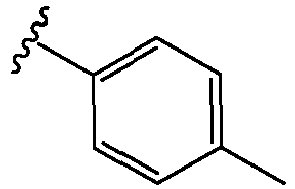

2.74q 560 204 5-fluoro-3'-(3-(2-fluorophenyl)ureido )-4'-(isobutyl(4,4,4-trifluoro-3-methylbutyl)amino) -[1,1'-biphenyl]-2-carboxylic acid 


2.71q 564 205 4'-(isobutyl(4,4,4-trifluoro-3-methylbutyl)amino) -3'-(3-(p-tolyl)ureido)-[1,1'-biphenyl]-2-carboxylic acid 


2.66q 542 206 4'-((2-(tert-butyl)phenyl)amino )-3'-(3-(p-tolyl)ureido)-[1,1'-biphenyl]-2-carboxylic acid 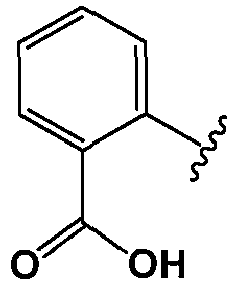


2.34k 494 207 1-(4-((2-(tert-butyl)phenyl)(meth yl)amino)-2'-(1H-tetrazol-5-yl)-[1,1'-biphenyl]-3-yl)-3-(2-fluorophenyl)urea 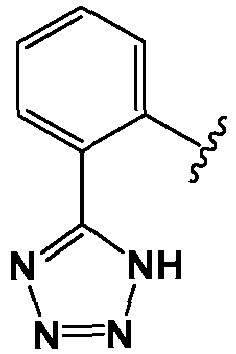


471l 536 208 1-(4-((2-(tert-butyl)phenyl)amino )-2'-(1H-tetrazol-5-yl)-[1,1'-biphenyl]-3-yl)-3-(p-tolyl)urea 
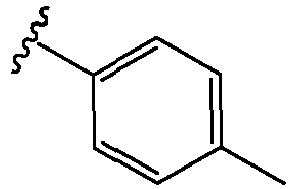

2.27k 518 209 4'-((2-(tert-butyl)phenyl)(meth yl)amino)-3'-(3-(2-fluorophenyl)ureido )-4-methoxy-[1,1'-biphenyl]-3-carboxylic acid 
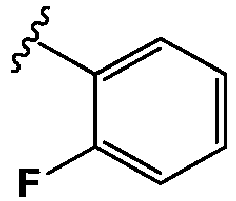

2.68q 542 210 1-(4-((2-(tert-butyl)phenyl)(meth yl) amino)-2'-(1H-tetrazol-5-yl)-[1,1'-biphenyl]-3-yl)-3-(p-tolyl)urea 


2.69q 532 - Using the methods described herein (the preparation of Example 2 from 2A is representative), the following compounds of the invention were prepared from aniline intermediates (v) and the appropriate isocyanates R9NCO.
Table 10 
Ex. No. Name 
R9 -NR7R8 Trmethod (M+H) + 211 1-(4-(cyclohexyl(methyl)amino )-2'-(1H-tetrazol-5-yl) biphenyl-3-yl)-3-m-tolylurea 
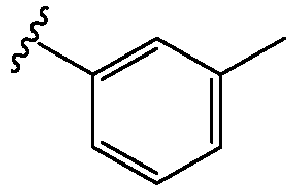

11.83b 482 212 1-(4-(cyclohexyl(methyl)amino )-2'-(1H-tetrazol-5-yl) biphenyl-3-yl)-3-(2-(trifluoromethyl)phenyl)ur ea 


11.69b 536 213 4'-(cyclohexyl(methyl)amino )-3'-(3-p-tolylureido)biphenyl-2-carboxylic acid 


11.14b 458 214 1-(4-(cyclohexyl(methyl)amino )-2'-(1H-tetrazol-5-yl) biphenyl-3-yl)-3-(2-fluorophenyl)urea 
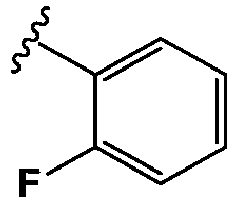

11.47b 486 215 3'-(3-(2-chlorophenyl)ureido)-4'-(cyclohexyl(methyl)amino ) biphenyl-2-carboxylic acid 

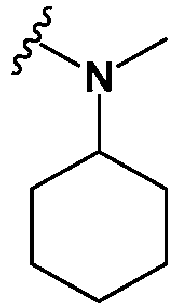
3.661 478 216 1-(4-(cyclohexyl(ethyl)amino)-2'-(1H-tetrazol-5-yl) biphenyl-3-yl)-3-p-tolylurea 


11.75b 496 218 4'-(cyclohexyl(methyl)amino )-3'-(3-phenylureido)biphenyl-2-carboxylic acid 


10.78b 444 219 4'-(cyclohexyl(methyl)amino )-3'-(3-(2-fluorophenyl)ureido) biphenyl-2-carboxylic acid 


10.90b 462 - Using the methods described below, the following compounds of the invention were prepared.
Table 11 
Ex. No. Name 
R9 -NR7R8 HPLC Tr (M+H)+ 220 4'-(cyclohexyl(methyl)ami no)-2'-fluoro-4-methoxy-5'-(3-p-tolylureido)biphenyl-3-carboxylic acid 


13.05b 506 221 4'-(cyclohexyl(methyl)ami no)-2'-fluoro-5'-(3-p-tolylureido)biphenyl-2-carboxylic acid 


12.49b 476 222 1-(4-(cyclohexyl(methyl)ami no)-6-fluoro-2'-(1H-tetrazol-5-yl)biphenyl-3 - yl)-3-p-tolylurea 
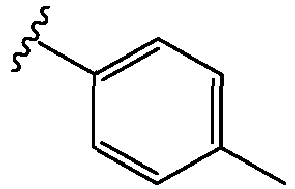

12.59b 500 223 1-(4-((cyclopropylmethyl)(2, 2-difluoroethyl)amino)-6-fluoro-2'-(1H-tetrazol-5-yl)biphenyl-3-yl)-3 -p-tolylurea 


12.26b 522 224 4'-((cyclopropylmethyl)(2, 2-difluoroethyl)amino)-2'-fluoro-5'-(3-p-tolylureido)biphenyl-2-carboxylic acid 


12.47b 498 225 4'-(cyclohexyl(isobutyl)ami no)-2'-fluoro-5'-(3-p-tolylureido)biphenyl-2-carboxylic acid 


13.94b 518 226 4'-(cyclohexyl(isobutyl)ami no)-5'-(3-(2,4-difluorophenyl)ureido)-2',5-difluoro-[1,1'-biphenyl] -2-carboxylic acid 


3.30q 558 227 1-(4-(cyclohexyl(isobutyl)ami no)-6-fluoro-2'-(1H-tetrazol-5-yl)biphenyl-3-yl)-3-p-tolylurea 


3.22q 542 228 4'-(cyclohexyl(isobutyl)ami no)-2'-fluoro-5'-(3-(2-fluorophenyl)ureido) biphenyl-2-carboxylic acid 


3.16q 522 229 4'-(cyclohexyl(isobutyl)ami no)-2',5-difluoro-5'-(3-(2-fluorophenyl)ureido) biphenyl-2-carboxylic acid 


3.26q 540 230 4'-(cyclohexyl(isobutyl)ami no)-5'-(3-(2,4-difluorophenyl)ureido)-2'-fluorobiphenyl-2-carboxylic acid 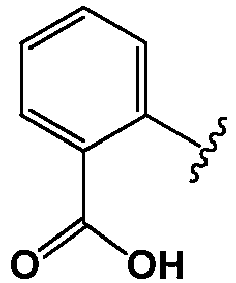


3.21q 540 231 4'-(cyclohexyl(isobutyl)ami no)-2',5-difluoro-5'-(3-(p-tolyl)ureido)-[1,1'-biphenyl]-2-carboxylic acid 


3.32q 536 -

- To a solution of 4'-(diisobutylamino)-3'-(3-(p-tolyl)ureido)-[1,1'-biphenyl]-2-carboxylic acid (Example 52) (40 mg, 0.084 mmol) in DMF (1 mL) was added DMAP (77 mg, 0.633 mmol), then EDC (162 mg, 0.845 mmol) and methanesulfonamide (121 mg, 1.267 mmol). The mixture was stirred at room temperature for 18h, filtered and purified by HPLC PHENOMENEX® Axia (Luna 5µ 30X100mm) 35% B (Solvent B = 90% MeOH - 10% H2O - 0.1% TFA) to 100% B in A (Solvent A = 10% MeOH - 90% H2O - 0.1% TFA) in 20 minutes and concentrated to obtain the product 4'-(diisobutylamino)-N-(methylsulfonyl)-3'-(3-(p-tolyl)ureido)-[1,1'-biphenyl]-2-carboxamide (19.4 mg, 0.035 mmol, 41.7% yield) LC/MS, m/z = 551.5(M+1). HPLC Rt = 1.04 min. LC/MS (BEH C18 2.1X 50mm, 1.7u, 0 to 100 B in 1 min with 0.5 min hold time, Flow rate = 1 ml/min, detection at 254 nm, Solvent A: 100% water / 0.1% TFA; Solvent B: 100% ACN / 0.1% TFA). 1H NMR (500MHz, methanol-d4) δ 8.05 (d, J=2.0 Hz, 1H), 7.59 - 7.46 (m, 3H), 7.44 - 7.36 (m, 1H), 7.29 (d, J=8.4 Hz, 2H), 7.22 (d, J=7.9 Hz, 1H), 7.11 (d, J=7.9 Hz, 2H), 7.08 - 7.01 (m, 1H), 3.10 (s, 3H), 2.68 (d, J=6.9 Hz, 4H), 2.31 (s, 3H), 1.85 - 1.56 (m, 2H), 0.87 (d, J=6.4 Hz, 12H).
- Following the procedure of Example 232, the following compounds were prepared.

Example No. R [M+H]+ HPLC RT 233 
577.5 1.06v 234 
605.5 1.04v -

-

- A mixture of 4-bromo-1-fluoro-2-nitrobenzene (4 g, 18.18 mmol) and 3,5-dimethylpiperidine (2.058 g, 18.18 mmol) was heated at 130 °C for 3h, cooled to rt, diluted with DCM (5ml) and purified by Column chromatography (0-20% EtOAc/hexane; 220g column) to obtain 1-(4-bromo-2-nitrophenyl)-3,5-dimethylpiperidine (5.03 g, 16.06 mmol, 88% yield) as an orange oil. LC/MS, m/z = 314.4(M+1). HPLC Rt = 1.26 min. LC/MS (BEH C18 2.1X 50mm, 1.7u, 0 to 100 B in 1 min with 0.5 min hold time, Flow rate = 1 ml/min, detection at 254 nm, Solvent A: 100% water / 0.1% TFA; Solvent B: 100% ACN/ 0.1% TFA).
-

- 1-(4-Bromo-2-nitrophenyl)-3,5-dimethylpiperidine (235A) (6 g, 19.16 mmol) was taken up in EtOH (Ratio: 10.00, Volume: 60 mL) and water (Ratio: 1.000, Volume: 6 mL), zinc (12.53 g, 192 mmol) and ammonium chloride (10.25 g, 192 mmol) were added. The resulting exothermic reaction was stirred at room temperature for 30 minutes. The resulting solution turned to clear from orange color, was cooled at room temperature and filtered through a CELITE® pad, washed with additional 30ml of DCM and the filtrate concentrated and purified by column chromatography (0-10% EtOAc/hexane; 120g column). 5-Bromo-2-(3,5-dimethylpiperidin-1-yl)aniline (4.97 g, 17.55 mmol, 92% yield) was obtained as a light yellow oil. LC/MS, m/z = 283.0(M+1). HPLC Rt = 1.01 min. LC/MS (BEH C18 2.1X 50mm, 1.7u, 0 to 100 B in 1 min with 0.5 min hold time, Flow rate = 1 ml/min, detection at 254 nm, Solvent A: 100% water / 0.1% TFA; Solvent B: 100% ACN/ 0.1% TFA).
-

- A mixture of 5-bromo-2-(3,5-dimethylpiperidin-1-yl)aniline (235B) (4.8 g, 16.95 mmol), 5,5,5',5'-tetramethyl-2,2'-bi(1,3,2-dioxaborinane) (4.98 g, 22.03 mmol), PdCl2(dppf)-CH2Cl2 Adduct (0.372 g, 0.508 mmol) and potassium acetate (4.99 g, 50.8 mmol) in DMSO (Volume: 30 mL) was evacuated and filled with nitrogen three times, then heated at 80 °C for 4h. The completed reaction was cooled to rt and the reaction mixture loaded on a silica gel plug (300g), and washed with (20% EtOAc/hexane). The resulting organic solution was concentrated and redissolved in DCM (5ml), and purified by column chromatography (0-20% EtOAc/hexane; 120g column). 5-(5,5-Dimethyl-1,3,2-dioxaborinan-2-yl)-2-(3,5-dimethylpiperidin-1-yl)aniline (4.07 g, 12.87 mmol, 76% yield) was obtained as a light brown solid. LC/MS, m/z = 249.0(M+1). HPLC Rt = 0.64min. (boronic acid) LC/MS (BEH C18 2.1X 50mm, 1.7u, 0 to 100 B in 1 min with 0.5 min hold time, Flow rate = 1 ml/min, detection at 254 nm, Solvent A: 100% water / 0.1% TFA; Solvent B: 100% ACN/ 0.1% TFA).
-

- A mixture of toluene (Ratio: 2.250, Volume: 18 mL) and water (Ratio: 1.000, Volume: 8 mL) was degassed by purges with nitrogen (3x). 5-(5,5-Dimethyl-1,3,2-dioxaborinan-2-yl)-2-(3,5-dimethylpiperidin-1-yl)aniline (235C) (3 g, 9.49 mmol), 5-(2-bromophenyl)-2-trityl-2H-tetrazole (4.03 g, 8.62 mmol) and sodium carbonate (1.828 g, 17.25 mmol) were added, and the reaction mixture was purged (bubble) with nitrogen. Pd(Ph3P)4 (0.997 g, 0.862 mmol) was added at last. This mixture was degassed (3x) and the reaction mixture was heated at 80 °C under a nitrogen atmosphere for 14h, cooled to room temperature, and the resulting mixture was extracted with DCM (3x 60ml), washed with water and brine, dried over anhydrous Na2SO4 and the residue was purified by column chromatography (120g, 0% to 30% EtOAc in hexane) to obtain the product 4-(3,5-dimethylpiperidin-1-yl)-2'-(2-trityl-2H-tetrazol-5-yl)biphenyl-3-amine (3.31 g, 5.60 mmol, 65.0% yield) as a light yellow solid. LC/MS, m/z = 591.3(M+1). HPLC Rt = 1.18 min. LC/MS (BEH C18 2.1X 50mm, 1.7u, 0 to 100 B in 1 min with 0.5 min hold time, Flow rate = 1 ml/min, detection at 254 nm, Solvent A: 100% water / 0.1% TFA; Solvent B: 100% ACN/ 0.1% TFA).
-

- To a solution of 4-(3,5-dimethylpiperidin-1-yl)-2'-(2-trityl-2H-tetrazol-5-yl)-[1,1'-biphenyl]-3-amine (235D) (59 mg, 0.100 mmol) in THF (1 mL) was added 1-isocyanato-4-methylbenzene (0.016 mL, 0.130 mmol). The solution was stirred 2h at RT. 4N HCl in dioxane (0.100 mL, 0.399 mmol) was added to the reaction mixture and the resulting mixture was heated at 50 °C for 10min, cooled to room temperature and concentrated. The residue was purified by HPLC, Column: Waters XBridge C18, 19 x 250 mm, 5-µm particles; Guard Column: Waters XBridge C18, 19 x 10 mm, 5-µm particles; Mobile Phase A: 5:95 acetonitrile:water with 0.05% TFA; Mobile Phase B: 95:5 acetonitrile:water with 0.05% TFA; Gradient: 20-100% B over 25 minutes, then a 5-minute hold at 100% B; Flow: 20 mL/min. Fractions containing the desired product were combined and dried via centrifugal evaporation to obtain 1-(4-((3,5-dimethylpiperidin-1-yl)-2'-(1H-tetrazol-5-yl)-[1,1'-biphenyl]-3-yl)-3-(p-tolyl)urea (37.8 mg, 78% yield). LC/MS, m/z = 482.5(M+1). HPLC Rt = 0.94 min. LC/MS (BEH C18 2.1X 50mm, 1.7u, 0 to 100 B in 1 min with 0.5 min hold time, Flow rate = 1 ml/min, detection at 254 nm, Solvent A: 100% water / 0.1% TFA; Solvent B: 100% ACN / 0.1% TFA). 1H NMR (500MHz, methanol-d4) δ 8.01 - 7.94 (m, 1H), 7.75 - 7.70 (m, 1H), 7.68-7.62 (m, 3H), 7.60 - 7.50 (m, 2H), 7.32 (d, J=8.4 Hz, 2H), 7.15 (d, J=8.4 Hz, 2H), 3.01 (s, 2H), 2.94 - 2.80 (m, 2H), 2.32 (s, 3H), 2.21 - 1.92 (m, 2H), 1.59 - 1.39 (m, 2H), 1.16 - 0.86 (m, 6H).
- Following the procedure of Example 235, Part E, employing the R9NCO substituent listed below, the following compounds were obtained.

Example No. R9 [M+H]+ HPLC RT 236 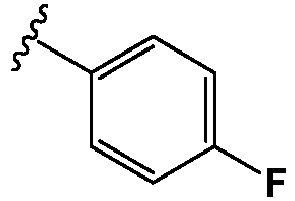
486.4 0.92v 237 
486.4 0.91v -

-

- 4-Bromo-N1,N1-diisobutylbenzene-1,2-diamine (15.0 g, 50.1 mmol), 5,5,5',5'-tetramethyl-2,2'-bi(1,3,2-dioxaborinane) (20.38 g, 90.0 mmol), PdCl2(dppf)-CH2Cl2Adduct (1.842 g, 2.256 mmol), and potassium acetate (22.14 g, 226 mmol) were combined in a 250 mL RB flask, and DMSO (Volume: 150 mL) was added. The flask was evacuated and filled with argon 3x, then heated at 80 °C for 16h. The reaction was cooled to RT diluted with ethyl acetate and filtered. The filtrate was washed with water, dried, and concentrated to afford crude solid. Chromatography on silica gel (EtOAc-hexanes gradient) afforded 4-(5,5-dimethyl-1,3,2-dioxaborinan-2-yl)-N1,N1-diisobutylbenzene-1,2-diamine (13.0 g, 78% yield) as a white solid. MS(ES): m/z = 265. (These mass spectra correspond to [M+H]+ for free boronic acid. No significant [M+H]+ is seen for the parent compound.) 1H NMR (400 MHz, DMSO-d6) δ ppm 7.07 (d, 1 H, J = 1.2 Hz), 6.92-6.96 (m, 2H), 4.66 (brs, 2 H), 3.70 (s, 4H), 2.57 (d, 4H, J = 7.2 Hz), 1.66-1.69 (m, 2H), 0.94 (s, 6H), 0.84 (d, 12H, J = 6.8 Hz).
-

- 4-(5,5-Dimethyl-1,3,2-dioxaborinan-2-yl)-N1,N1-diisobutylbenzene-1,2-diamine (238A) (7.5 g, 22.57 mmol), 2-bromobenzonitrile (4.93 g, 27.1 mmol), PdCl2(dppf)-CH2Cl2Adduct (3.69 g, 4.51 mmol) and potassium phosphate, tribasic (14.37 g, 67.7 mmol) were added to a 250 mL RB flask, which was evacuated and filled with argon 3 x followed by 2 mL of dioxane. The reaction mixture was heated at 80 °C for 16h. The reaction was cooled to room temperature, concentrated in dioxane, diluted with ethyl acetate, washed with water, dried, and concentrated to afford crude solid. Chromatography on silica gel (EtOAc-hexanes gradient) afforded 3'-amino-4'-(diisobutylamino)biphenyl-2-carbonitrile (6.2 g, 85.0% yield). 1H NMR (400 MHz, CDCl3) δ ppm 7.72 (dd, 1H, J = 8.0, 1.2 Hz), 7.58-7.61 (m, 1H), 7.50 (dd, 1 H, J = 8.0, 1.2 Hz), 7.37-7.39 (m, 1H), 7.14 (t, 1H), 7.13-7.15 (m, 1H), 6.89-6.92 (m, 2H), 4.12 (2H, brs), 2.65 (d, 4H, J = 7.2 Hz), 1.77-1.84 (m, 2H), 0.92 (d, 12H, J = 6.4 Hz). MS(ES): m/z = 322.2 [M+H]+.
-

- 3'-Amino-4'-(diisobutylamine)biphenyl-2-carbonitrile (238B) (3.0 g, 9.33 mmol) and azidotributyltin (17.90 mL, 65.33 mmol) in toluene (60 mL) were heated at 110 °C for 40 hours, cooled to room temperature and washed with 10% KF aqueous solution, dried and concentrated to afford crude liquid product. Chromatography on silica gel (EtOAc-hexanes gradient) afforded N4,N4-diisobutyl-2'-(1H-tetrazol-5-yl) biphenyl-3,4-diamine (3.5 g) as yellow oil. MS(ES): m/z = 365.2 [M+H]+.
-

- To the stirred solution of N4,N4-diisobutyl-2'-(1H-tetrazol-5-yl)biphenyl-3,4-diamine (238C) (500 mg, 1.372 mmol) in DCM (3.0 mL) was added 4-nitrophenyl carbonochloridate (332 mg, 1.646 mmol) dropwise and refluxed for 1h. Reaction progress was detected by TLC and LCMS. The reaction mixture was concentrated to afford the crude carbamate. (Note: This intermediate was carried forward for the next step without purification.) The yellow residue (4-nitrophenyl(4-(diisobutylamino)-2'-(1H-tetrazol-5-yl)-[1,1'-biphenyl]-3-yl)carbamate, 60.0 mg, 0.113 mmol) was taken up in DCE (1.0 mL). The solution was treated with Et3N (0.016 mL, 0.113 mmol) then pyridin-2-amine (10.66 mg, 0.113 mmol), stirred overnight at RT, and purified by preparative HPLC. Concentration of appropriate fractions afforded 1-(4-(diisobutylamino)-2'-(1H-tetrazol-5-yl)-[1,1'-biphenyl]-3-yl)-3-(pyridin-2-yl)urea (18 mg, 32.5% yield) as an off-white solid. 1H NMR (400 MHz, DMSO-d6) δ ppm 11.30 (brs, 1H), 9.84 (s, 1H), 8.22 (dd, 1H, J = 18.4, 1.2 Hz), 7.53-7.76 (m, 5H), 7.08-7.14 (m, 2H), 6.99-7.02 (m, 1H), 6.57 (dd, 1H, J = 8.4, 2.4 Hz), 2.84 (d, 4H, J = 6.8 Hz), 1.67-1.73 (m, 2H), 0.80 (d, 12H, J = 6.8 Hz). MS(ES): m/z = 485.4 [M+H]+,
-

-

- A mixture of toluene (12.5 mL) and water (5.0 mL) was degassed for 10 minutes. 4-(5,5-Dimethyl-1,3,2-dioxaborinan-2-yl)-N1,N1-diisobutylbenzene-1,2-diamine (2.48 g, 7.49 mmol), 5-(2-bromophenyl)-2-trityl-2H-tetrazole (2.5 g, 5.35 mmol), sodium carbonate (1.13 g, 10.70 mmol) and tetrakis(triphenylphosphine)palladium(0) (0.371 g, 0.321 mmol) were added. This mixture was degassed under N2 atmosphere and heated at 80 °C for overnight. The reaction was cooled to room temperature, concentrated in toluene, and the residue was dissolved in ethyl acetate, washed with water, dried, concentrated and purified on silica gel (EtOAc/hexane gradient) to afford N4,N4-diisobutyl-2'-(2-trityl-2H-tetrazol-5-yl)-[1,1'-biphenyl]-3,4-diamine (2.4 g) as an off-white solid. MS(ES): m/z = 607.4 [M+H]+.
-

- N4,N4-Diisobutyl-2'-(2-trityl-2H-tetrazol-5-yl)-[1,1'-biphenyl]-3,4-diamine (0.1 g, 0.165 mmol) and 4-nitrophenyl carbonochloridate (0.033 g, 0.165 mmol) were taken in DCM (1 mL) and refluxed for 1h. The progress of the reaction was checked by LCMS. The solvent was removed to give 4-nitrophenyl (4-(diisobutylamino)-2'-(2-trityl-2H-tetrazol-5-yl)-[1,1'-biphenyl]-3-yl)carbamate (0.110 g). MS(ES): m/z = 772.2 [M+H]+.
-

- To a slurry of sodium hydride (4.76 mg, 0.194 mmol) in THF (0.5 mL) was added a solution of pyrimidin-2-amine (8.87 mg, 0.093 mmol) in THF (0.5 mL) at 0 °C. The reaction mixture was stirred for 15 minutes, and 4-nitrophenyl (4-(diisobutylamino)-2'-(2-trityl-2H-tetrazol-5-yl)-[1,1'-biphenyl]-3-yl)carbamate (60 mg, 0.078 mmol) in THF (1.0 mL) added. The reaction mixture was slowly brought to room temperature, and stirred for 1h. The progress of the reaction was checked by TLC. No starting material was observed. The reaction mixture was quenched with ice cold water, extracted with ethyl acetate twice, the combined organic layer was washed with water, brine, dried over sodium sulfate and concentrated to give 1-(4-(diisobutylamino)-2'-(2-trityl-2H-tetrazol-5-yl)-[1,1'-biphenyl]-3-yl)-3-(pyrimidin-2-yl) urea (60 mg). MS(ES): m/z = 728.8 [M+H]+.
-

- To a solution of 1-(4-(diisobutylamino)-2'-(2-trityl-2H-tetrazol-5-yl)-[1,1'-biphenyl]-3-yl)-3-(pyrimidin-2-yl)urea (100 mg, 0.137 mmol) in DCM (1 mL) was added TFA (0.5 mL, 6.49 mmol) at 0 °C. The reaction mixture was brought to RT and stirred for 1h. The progress of the reaction was monitored by TLC. The complete conversion of starting material was observed. The reaction mixture was purified by silica gel column chromatography (230-400 mesh) using EtOAc/pet ether gradient. The fractions were concentrated to give the 1-(4-(diisobutylamino)-2'-(1H-tetrazol-5-yl)-[1,1'-biphenyl]-3-yl)-3-(pyrimidin-2-yl)urea (50 mg; 67.6% by LCMS), which was purified by reverse phase HPLC and freeze-dried to give 1-(4-(diisobutylamino)-2'-(1H-tetrazol-5-yl)-[1,1'-biphenyl]-3-yl)-3-(pyrimidin-2-yl)urea (12 mg) as an off-white solid. MS(ES): m/z = 486.2 [M+H]+.
- Following the procedure of Example 239 using appropriate trityl-tetrazole and dioxaborinane starting materials, the following compounds were prepared.
Table 12 
Ex. No. Name NR7R8 R9 HPLC Ret Time (M+H)+ / (M-1) 240 1-(4-(diisobutylamino)-2'-(2H-tetrazol-5-yl)-[1,1'-biphenyl]-3-yl)-3-(1-(4-fluorophenyl)-2-methylpropan-2-yl)urea 

20.07t 558.4 241 1-(4-(diisobutylamino)-2'-(1H-tetrazol-5-yl)-[1,1'-biphenyl]-3-yl)-3-(3-ethynylphenyl)urea 

19.86t 508.2 242 1-(4-(diisobutylamino)-2'-(1H-tetrazol-5-yl)-[1,1'-biphenyl]-3-yl)-3-(3-(prop-2-yn-1-yloxy)phenyl) urea 

19.54t 538.4 243 1-(4-chloro-2,6-difluorophenyl)-3-(4-(diisobutylamino)-2'-(1H-tetrazol-5-yl)-[1,1'-biphenyl]-3-yl)urea 

19.96t 554 244 1-(4-(diisobutylamino)-2'-(1H-tetrazol-5-yl)-[1,1'-biphenyl]-3-yl)-3-(4-(prop-2-yn-1-yloxy)phenyl) urea 
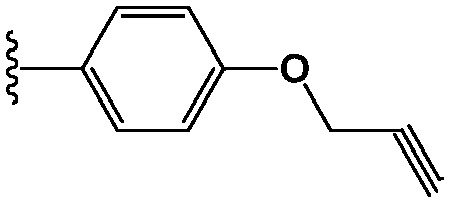
18.91t 536.2 245 1-(4-(diisobutylamino)-2'-(1H-tetrazol-5-yl)-[1,1'-biphenyl]-3-yl)-3-isobutylurea 

10.80t 464.4 246 1-(4-(diisobutylamino)-2'-(1H-tetrazol-5-yl)-[1,1'-biphenyl]-3-yl)-3-isopropylurea 

10.27t 450.4 247 1-(4-(diisobutylamino)-2'-(1H-tetrazol-5-yl)-[1,1'-biphenyl]-3-yl)-3-(isoquinolin-5-yl)urea 

8.80t 533.2 248 2-(3-(4-(diisobutylamino)-2'-(1H-tetrazol-5-yl)-[1,1'-biphenyl]-3-yl)ureido)-N-methylbenzamide 

18.33t 539.2 249 1-(4-(diisobutylamino)-2'-(1H-tetrazol-5-yl)biphenyl-3-yl)-3-(4-trifluoromethyl)phenyl) urea 

23.41t 550.0 -


- To the stirred solution of N4,N4-(diisobutylamino)-2'-(1H-tetrazol-5-yl)biphenyl-3-yl)-3,4-diamine (238E) (30 mg, 0.081 mmol) in DCM (2.0 mL) was added 2-fluoro-5-isocyanatobenzonitrile (13 mg, 0.082 mmol). The reaction was stirred at RT for 16 h. Solvent was removed in vacuo and the residue purified by prep. HPLC. The concentration of the appropriate fractions and freeze drying afforded 1-(3-cyano-4-fluorophenyl)-3-(4-(diisobutylamino)-2'-(1H-tetrazol-5-yl)-[1,1'-biphenyl]-3-yl)urea (43.0 mg, 100% yield) as an off-white solid. 1H NMR (400 MHz, DMSO-d6) δ ppm 9.82 (s, 1H), 7.97-8.01 (m, 2H), 7.88 (d, 1H, J = 2.0 Hz), 7.47-7.71 (m, 6H), 7.48 (d, 1H, J = 8.4 Hz), 6.44 (dd, 1 H, J = 8.0, 2.0 Hz), 2.68 (d, 4H, J = 6.8 Hz), 1.64-1.67 (m, 2H), 0.84 (d, 12H, J = 6.4 Hz). MS(ES): m/z = 527.2 [M+H]+.
-

- To a solution of 5-amino-2-fluorobenzonitrile (30 mg, 0.220 mmol) in DCM (2.0 mL) at 0 °C was added sodium carbonate (117 mg, 1.102 mmol) and phosgene (0.047 mL 0.441 mmol). The reaction was stirred at RT for 1h. MS(ES): m/z = 195, (These mass spectra correspond to [M+H]+ for methyl carbamate of the product. No significant [M+H]+ was seen for the parent compound. The above reaction mixture was filtered, concentrated under reduced pressure and used for the next step without purification.
- Following the procedure of Example 250 employing the appropriate R9NCO, the following compounds were prepared.
Table 13 
Ex. No. Name NR7R8 R9 HPLC Ret Time (M+H)+ / (M-1) 251 1-(3-chloro-5-fluorophenyl)-3-(4-(diisobutylamino)-2'-(1H-tetrazol-5-yl)-[1,1'-biphenyl]-3-yl)urea 

20.97t 536.2 252 1-(4-(diisobutylamino)-2'-(1H-tetrazol-5-yl)-[1,1'-biphenyl]-3-yl)-3-(4-fluoro-3-methoxyphenyl)urea 

18.81t 532.3 253 1-(4-(diisobutylamino)-2'-(1H-tetrazol-5-yl)-[1,1'-biphenyl]-3-yl)-3-(3-(oxazol-5-yl)phenyl)urea 

11.34t 549.2 254 4-chloro-3-(3-(4-(diisobutylamino)-2'-(1H-tetrazol-5-yl)-[1,1'-biphenyl]-3-yl)ureido)benzamide 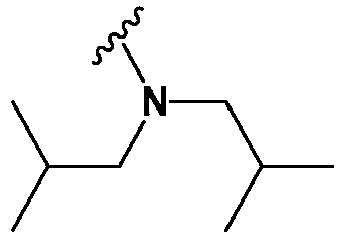

10.54t 559 255 1-(4-(diisobutylamino)-2'-(1H-tetrazol-5-yl)-[1,1'-biphenyl]-3-yl)-3-(4-(oxazol-5-yl)phenyl)urea 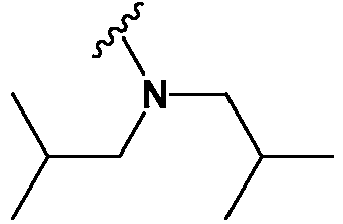

18.21t 549.2 256 1-(2-(1H-1,2,4-triazol-1-yl)phenyl)-3-(4-(diisobutylamino)-2'-(1H-tetrazol-5-yl)-[1,1'-biphenyl]-3-yl)urea 

10.81t 551.3 257 1-(3-azidophenyl)-3-(4-(diisobutylamino)-2'-(1H-tetrazol-5-yl)-[1,1'-biphenyl]-3-yl)urea 

20.10t 525.4 258 1-(3-bromo-4-fluorophenyl)-3-(4-(diisobutylamino)-2'-(1H-tetrazol-5-yl)-[1,1'-biphenyl]-3-yl)urea 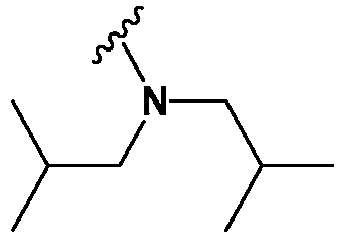

20.54t 580.2 259 1-(benzo[b]thiophen-5-yl)-3-(4-(diisobutylamino)-2'-(1H-tetrazol-5-yl)-[1,1'-biphenyl]-3-yl)urea 

20.10t 538.0 260 1-(4-cyano-2-fluorophenyl)-3-(4-(diisobutylamino)-2'-(1H-tetrazol-5-y1)-[1,1 biphenyl]-3-yl)urea 

19.19t 527.2 261 1-(4-cyano-3-methoxyphenyl)-3-(4-(diisobutylamino)-2'-(1H-tetrazol-5-yl)-[1,1 biphenyl]-3-yl)urea 

18.97t 537.2 262 1-(4-(diisobutylamino)-2'-(1H-tetrazol-5-yl)-[1,1'-biphenyl]-3-yl)-3-(3-(dimethylamino)phenyl) urea 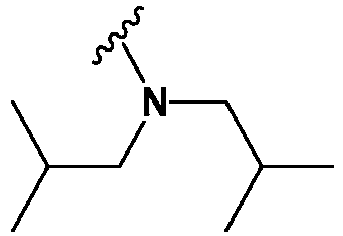

9.61t 527.2 263 1-(2,3-difluorophenyl)-3-(4-(diisobutylamino)-2'-(1H-tetrazol-5-yl)-[1,1'-biphenyl]-3-yl)urea 

19.62t 520.2 264 1-(4-(diisobutylamino)-2'-(1H-tetrazol-5-yl)-[1,1'-biphenyl]-3-yl)-3-(2-fluoro-4-methylphenyl)urea 

19.68t 516.2 266 3-(3-(4-(diisobutylamino)-2'-(1H-tetrazol-5-yl)-[1,1'-biphenyl]-3-yl)ureido)benzenesulfon amide 

10.42t 563.2 267 1-(3-(1H-imidazol-1-yl)phenyl)-3-(4-(diisobutylamino)-2'-(1H-tetrazol-5-yl)-[1,1'-biphenyl]-3-yl)urea 
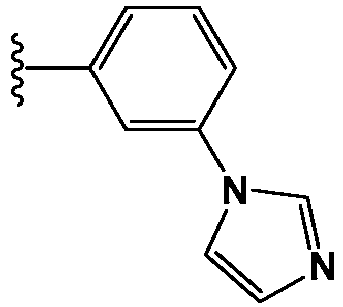
9.49t 550.4 268 1-(cyclohexylmethyl)-3 - (4-(diisobutylamino)-2'-(1H-tetrazol-5-yl)-[1,1'-biphenyl]-3-yl)urea 

20.03t 502.2 269 1-(4-(diisobutylamino)-2'-(2H-tetrazol-5-yl)-[1,1'-biphenyl]-3-yl)-3-(2-(prop-2-yn-1-yloxy)phenyl)ure 

19.71t 538.4 270 1-(4-(diisobutylamino)-2'-(1H-tetrazol-5-yl)-[1,1'-biphenyl]-3-yl)-3-(2-(piperidin-1-yl)phenyl)urea 

18.26t 567.4 271 1-(4-(diisobutylamino)-2'-(1H-tetrazol-5-yl)-[1,1'-biphenyl]-3-yl)-3-(4-fluoro-3-(trifluoromethyl)phenyl) urea 

20.47t 570.2 272 1-(4-(diisobutylamino)-2'-(1H-tetrazol-5-yl)-[1,1'-biphenyl]-3-yl)-3-(4-fluoro-2-isopropoxyphenyl)urea 

20.69t 560.2 273 1-(4-(diisobutylamino)-2'-(1H-tetrazol-5-yl)-[1,1'-biphenyl]-3-yl)-3-(3-(trifluoromethoxy)pheny l)urea 

20.38t 568.2 274 1-(2-cyclopropylphenyl)-3-(4-(diisobutylamino)-2'-(1H-tetrazol-5-yl)-[1,1'-biphenyl]-3-yl)urea 

20.70t 524.2 275 1-(4-(diisobutylamino)-2'-(1H-tetrazol-5-yl)-[1,1'-biphenyl]-3-yl)-3-(3-fluoro-2-hydroxyphenyl)urea 

17.98t 516.2 276 1-(2,3-dihydro-1H-inden-4-yl)-3-(4-(diisobutylamino)-2'-(1H-tetrazol-5-yl)-[1,1'-biphenyl]-3-yl)urea 

20.12t 524.2 - The urea analogs of Examples 277 to 279 were prepared by the following procedure.
Table 14 
Ex. No. Name NR7R8 R9 HPLC Ret Time (M+H)+/ (M-1) 277 1-(4-(diisobutylamino)-2'-(1H-tetrazol-5-yl)-[1,1'-biphenyl]-3-yl)-3-(2-ethynylphenyl)urea 

20.16t 506.2 278 1-(4-(diisobutylamino)-2'-(1H-tetrazol-5-yl)-[1,1'-biphenyl]-3-yl)-3-(4-ethynylphenyl)urea 

19.98t 506.2 279 1-(4-(diisobutylamino)-2'-(1H-tetrazol-5-yl)-[1,1'-biphenyl]-3-yl)-3-(4-fluoro-3-(methylsulfonyl)phenyl) urea 
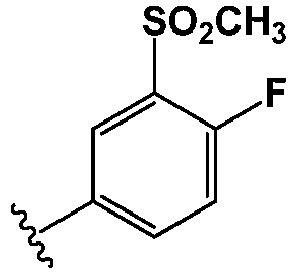
18.02t 578.2 - The urea analogs of Examples 280 to 287 were prepared using the method described herein, i.e., the preparation of 2 from 2A, from aniline intermediates A and the appropriate isocyanates R9NCO.
Table 15 
Ex. No. Name NR7R8 R9 HPLC Ret Time (M+H)+/ (M-1) 280 1-(2-(difluoromethoxy) phenyl)-3-(4-(diisobutyl amino)-2'-(1H-tetrazol-5-yl)biphenyl-3-yl)urea 

19.84t 550.3 281 1-(4-(diisobutylamino)-2'-(1H-tetrazol-5-yl)biphenyl-3-yl)-3-(2-methoxyphenyl)urea 

19.27t 514.3 282 1-(4-(diisobutylamino)-2'-(1H-tetrazol-5-yl)-(1,1'-biphenyl]-3-yl)-3-(2,4,6-trifluorophenyl)urea 

18.89t 536.2 283 1-(2,6-difluorophenyl)-3-(4-(diisobutylamino)-2'-(2H-tetrazol-5-yl)-[1,1'-biphenyl]-3-yl)urea 

18.72t 518.2 284 1-(4-(diisobutylamino)-2'-(1H-tetrazol-5-yl)-[1,1'-biphenyl]-3-yl)-3-(2-fluoro-4-(methylsulfonyl) phenyl)urea 

17.93t 580.1 285 1-(4-azidophenyl)-3-(4-(diisobutylamino)-2'-(1H-tetrazol-5-yl)-[1,1'-biphenyl]-3-yl)urea 
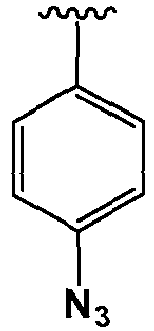
19.63t 523.2 286 1-(3-chloro-4-fluorophenyl)-3-(4-(diisobutylamino)-2'-(1H-tetrazol-5-yl)biphenyl-3-yl)urea 

20.51t 534.0 287 1-(4-(diisobutylamino)-2'-(1H-tetrazol-5-yl)-[1,1'-biphenyl]-3-yl)-3-(3-fluoro-4-methylphenyl)urea 

19.75t 516.2 -


- To a solution of N4,N4-diisobutyl-2'-(1H-tetrazol-5-yl)-[1,1'-biphenyl]-3,4-diamine (30 mg, 0.082 mmol) in THF (0.3 mL) was added 2,4,4-trimethylpentan-2-amine (15.96 mg, 0.123 mmol) and CDI (40 mg, 0.247 mmol). The reaction mixture was refluxed overnight. The progress of the reaction was checked by TLC and O-LCMS. Unreacted starting material was observed. CDI (1.0 eq) was added to the reaction mixture which was refluxed. The complete consumption of starting material was observed. The reaction mixture was diluted with EtOAc, washed with water, the organic layer collected, dried over anhydrous Na2SO4, filtered and excess solvent was evaporated under reduced pressure. The resultant crude material was purified by reverse phase HPLC and freeze-drying afforded 1-(4-(diisobutylamino)-2'-(1H-tetrazol-5-yl)-[1,1'-biphenyl]-3-yl)-3-(2,4,4-trimethylpentan-2-yl)urea (6.0 mg, 13.27% yield) as a pale yellow solid. LCMS MS(ES): m/z = 520.2 [M+H]+.
-

- The compound was prepared from N4-benzyl-N4-isobutyl-2'-(2-trityl-2H-tetrazol-5-yl) biphenyl-3, 4-diamine by the general procedure used for the conversion of A to IIA as set out prior to Examples 280 to 287 and followed by detritylation (DCM, TFA, 1 hr). MS(ES): m/z=531.2 [M+H]+, HPLC Tr: 19.8.
-

- The compound was prepared from N4-benzyl-N4-isobutyl-2'-(2-trityl-2H-tetrazol-5-yl) biphenyl-3, 4-diamine by the general procedure used for the conversion of A to IIA as set out prior to Examples 280 to 287 and followed by detritylation (DCM, TFA, 1 hr). MS(ES): m/z =602.2 [M+H]+, HPLC Tr: 20.52.
-

- The compound was prepared from N4-benzyl-N4-isobutyl-2'-(2-trityl-2H-tetrazol-5-yl) biphenyl-3, 4-diamine by the general procedure used for the synthesis of Example 250 and followed by detritylation (DCM, TFA, 1 hr). MS(ES): m/z =556.2 [M-H], HPLC Tr: 21.03.
- Compound 292was prepared employing methodology described herein.
Table 16 Ex No. Name NR7R8 R9 HPLC Ret Time (M+H)+/ (M-1) 292 1-(4-(benzyl(isobutyl)amino)-2'-(1H-tetrazol-5-yl)-[1,1'-biphenyl]-3-yl)-3-(p-tolyl)urea 

19.80t 531.2 -

-

- To a stirred solution of 4-bromo-N1-phenethyl-N1-(3,3,3-trifluoropropyl)benzene-1,2-diamine (30 mg, 0.077 mmol) in DCM was added 1-isocyanato-2-(trifluoromethyl)benzene (17 mg, 0.093 mmol). The reaction mixture was stirred overnight. The reaction mixture was concentrated to give 1-(5-bromo-2-(phenethyl(3,3,3-trifluoropropyl)amino)phenyl)-3-(2-(trifluoromethyl)phenyl)urea (35 mg). MS(ES): m/z = 576.1 [M+H]+.
- Employing procedures described here, the title compound was prepared from 1-(5-bromo-2-(phenethyl(3,3,3-trifluoropropyl)amino)phenyl)-3-(2-(trifluoromethyl)phenyl)urea (295A). MS(ESI-) m/z = 638.2 [M-H].
-

-

- To a stirred solution of 4-bromo-N1-phenethyl-N1-(3,3,3-trifluoropropyl)benzene-1,2-diamine (30 mg, 0.077 mmol) in DCM added 4-cyclopropyl-3-fluoroaniline (14 mg, 0.093 mmol) and CDI (25 mg, 0.155 mmol). The reaction mixture was heated at 40 °C for 48 hours. The reaction mixture was diluted with DCM and washed with water, brine solution, the organic layer dried over Na2SO4 and concentrated to provide 1-(5-bromo-2-(phenethyl(3,3,3-trifluoropropyl)amino)phenyl)-3-(4-cyclopropyl-3-fluorophenyl)urea (35 mg). 1H NMR (400 MHz, CDCl3) δ ppm 8.49 (d, 1H, J = 2.4 Hz), 7.36-7.40 (m, 2H), 7.21-7.31 (m, 4H), 7.12-7.15 (m, 2H), 7.06 (d,1H, J = 8.4 Hz), 6.81-6.90 (m, 2H), 3.15-3.21 (m, 4H), 2.72-2.76 (m, 2H), 2.01-2.08 (m, 2H), 1.22-1.25 (m, 1H), 0.92-0.97 (m, 2H), 0.66-0.70 (m, 2H). MS(ES): m/z = 564.2 [M+H]+.
-

- The title compound was prepared from 1-(5-bromo-2-(phenethyl(3,3,3-trifluoropropyl)amino)phenyl)-3-(4-cyclopropyl-3-fluorophenyl)urea (296A) as outlined above. 1H NMR (400 MHz, DMSO-d6) δ ppm 9.53 (s, 1H), 8.38 (s, 1H), 8.15 (s, 1H), 7.56-7.72 (m, 4H), 7.43 (dd, 1H, J = 12.8, 2.0 Hz), 7.41-7.45 (m, 3H), 7.13-7.17 (m, 3H), 6.89-7.00 (m, 2H), 6.62 (dd, 1H, J = 8.4, 2.0 Hz), 3.15-3.22 (m, 4H), 2.51-2.63 (m, 2H), 2.33-2.39 (m, 2H), 1.93-1.97 (m, 1H), 0.89-0.93 (m, 2H), 0.65-0.67. MS(ES): m/z = 630.2 [M+H]+,
- The following compounds were prepared using the procedure shown below with the appropriate starting materials.
Table 17 
Ex No. Name NR7R8 R9 HPLC Ret Time (M+H)+ / (M-1) 297 1-(4-((4-chlorobenzyl)(4,4,4-trifluorobutyl)amino)-2'-(l1-tetrazol-5-yl)-[1,1'-biphenyl]-3-yl)-3-(4-cyclopropyl-3-fluorophenyl)urea 
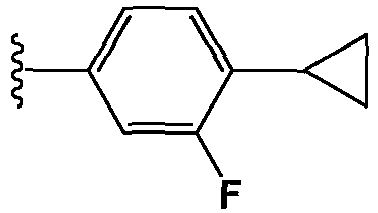
21.77t 664.2 298 1-(4-cyclopropylphenyl)-3-(4-(phenethyl(3,3,3-trifluoropropyl)amino)-2'-(1H-tetrazol-5-yl)-[1,1'-biphenyl]-3-yl)urea 

20.27t 612.4 299 1-(4-cyclopropylphenyl)-3-(4-((4-fluoro-2-(trifluoromethyl)benzyl)(3,3, 3-trifluoropropyl) amino)-2'-(1H-tetrazol-5-yl)-[1,1'-biphenyl]-3-yl)urea 

20.98t 684.5 300 1-(4-((4-fluoro-2-(trifluoromethyl)benzyl)(3,3, 3-trifluoropropyl)amino)-2 '-(1H-tetrazol-5-yl)-[1,1'-biphenyl]-3-yl)-3-(2-fluoro-4-(trifluoromethyl) phenyl)urea 

20.79t 730.4 301 1-(2'-(1H-tetrazol-5-yl)-4-((4-(trifluoromethoxy) benzyl)(3,3,3-trifluoropropyl)amino)-[1,1'-biphenyl]-3-yl)-3-(2-fluoro-4-(trifluoromethyl) phenyl)urea 

20.71t 728.3 302 1-(2'-(1H-tetrazol-5-yl)-4-((4-(trifluoromethoxy) benzyl)(3,3,3-trifluoropropyl)amino)-[1,1'-biphenyl]-3-yl)-3-(4-cyclopropylphenyl)urea 

21.21t 682.5 303 1-(2-fluoro-4-(trifluoromethyl)phenyl)-3-(4-((pyridin-2-ylmethyl)(3,3,3-trifluoropropyl)amino)-2'-(1H-tetrazol-5-yl)-[1,1'-biphenyl]-3-yl)urea 

16.28t 645.3 304 1-(4-cyclopropylphenyl)-3-(4-((pyridin-2-ylmethyl)(3,3,3-trifluoropropyl)amino)-2'-(1H-tetrazol-5-yl)-[1,1'-biphenyl]-3-yl)urea 

15.60t 599.4 - Starting from cis-N-isobutyl-4-(trifluoromethyl)cyclohexanamine (lxy, Table 3b) and 2-fluoro-5-bromonitrobenzene the following compounds of the generic structure below with substituents specified in the table were prepared using the procedure for the conversion of 1B to Example 1.

Ex No. Name R HPLC Ret Time (M+H)+ 305 1-(4-(isobutyl(4-(trifluoromethyl)cyclohexyl)a mino)-2'-(1H-tetrazol-5-yl)-[1,1'-biphenyl]-3-yl)-3-(p-tolyl)urea 
2.31j 592 306 5-fluoro-4'-(isobutyl(4-(trifluoromethyl)cyclohexyl)a mino)-3'-(3-(p-tolyl)ureido)-[1,1'-biphenyl]-2-carboxylic acid 
2.12j 586 307 4'-(isobutyl(4-(trifluoromethyl)cyclohexyl)a mino)-3'-(3-(p-tolyl)ureido)-[1,1'-biphenyl]-2-carboxylic acid 
2.28j 568 -

- A reaction vial was charged with N4,N4-diisobutyl-2'-(2-trityl-2H-tetrazol-5-yl)-[1,1'-biphenyl]-3,4-diamine ((38A), 99.3 mg, 0.164 mmol) in dry THF (2 mL) under nitrogen. This solution was treated with 4-nitrophenyl chloroformate (36.3 mg, 0.180 mmol) and stirred for 0.5 hours. The reaction was then treated with 5-methylpyrazin-2-amine (53.6 mg, 0.491 mmol) and triethylamine (68.4 µl, 0.491 mmol). The reaction was warmed to 50°C overnight then cooled and treated with 100 uL of 5-6 M HCl in isopropanol. This mixture was briefly warmed to 50°C, stirred overnight at RT, then concentrated and partially purified by reverse-phase HPLC (methanol-water gradient +0.1% TFA). This material was further purified via preparative LC/MS with the following conditions: Column: Waters XBridge C18, 19 x 200 mm, 5-µm particles; Mobile Phase A: 5:95 acetonitrile: water with 10-mM ammonium acetate; Mobile Phase B: 95:5 acetonitrile: water with 10-mM ammonium acetate; Gradient: 20-80% B over 20 minutes, then a 5-minute hold at 100% B; Flow: 20 mL/min. Fractions containing the desired product were combined and dried via centrifugal evaporationto afford 0.012 g (15%) of 1-(4-(diisobutylamino)-2'-(2H-tetrazol-5-yl)-[1,1'-biphenyl]-3-yl)-3-(5-methylpyrazin-2-yl)urea. MS(ES): m/z = 500 [M+H]+. HPLC ret. time: 1.71j.
-

-

- A reaction vial was charged with DMF (5.0 mL), 4-bromo-1-fluoro-2-nitrobenzene (304 mg, 1.382 mmol) and 2-boronobenzoic acid (459 mg, 2.76 mmol). Nitrogen was bubbled through the solution for 20 minutes. A solution of potassium carbonate (2764 µl, 2.76 mmol) (1.0 M solution) was added and bubbling with nitrogen continued for a few more minutes. Tetrakis(triphenylphosphine)palladium(0) (80 mg, 0.069 mmol) was added and the vial was sealed. The reaction was heated to 90 °C for 3 hours. The light orange reaction was cooled and quenched with 10% acetic acid. Some precipitate formed. The reaction was concentrated under a stream of nitrogen. The reaction was filtered and the yellow solid rinsed with water. This first crop contained product but was not pure by TLC on silica gel (1:1 ethyl acetate-hexanes +0.5% acetic acid). After standing, additional solid precipitates from the mother liquor. Filtration provided 4'-fluoro-3'-nitro-[1,1'-biphenyl]-2-carboxylic acid (153 mg, 42%) as a pale yellow solid. 1H NMR (400MHz, DMSO-d6) δ 13.10 - 12.87 (m, 1H), 8.06 (dd, J=7.1, 2.3 Hz, 1H), 7.90 (dd, J=7.8, 1.2 Hz, 1H), 7.77 (ddd, J=8.6, 4.4, 2.4 Hz, 1H), 7.70 - 7.61 (m, 2H), 7.70 - 7.61 (m, 2H), 7.59 - 7.52 (m, 1H), 7.46 (dd, J=7.6, 0.9 Hz, 1H).
-

- A reaction vial was charged with 4'-fluoro-3'-nitro-[1,1'-biphenyl]-2-carboxylic acid (111 mg, 0.425 mmol), palladium(II) acetate (9.5 mg, 0.042 mmol), silver carbonate (234 mg, 0.850 mmol), lithium carbonate (62.8 mg, 0.850 mmol), t-Boc-L-phenylalanine (22.6 mg, 0.085 mmol), potassium methyltrifluoroborate (155 mg, 1.275 mmol). DMF (32.9 µL, 0.425 mmol) and a stirring bar. t-Butanol (3.0 mL) was added and the vial was evacuated and filled with nitrogen three times. The vial was sealed, and the reaction was stirred for 5 minutes at ambient temperature. The reaction was then warmed to 90 °C for three days. The cooled reaction was quenched with 2 mL 1 N hydrochloric acid and sonicated. Methylene chloride was added, and the reaction was filtered. The filtrate was transferred to a separatory funnel and partitioned between methylene chloride and water. The organic phase was dried over magnesium sulfate, filtered and evaporated. The crude product was purified by RP-HPLC (methanol-water gradient +0.1% TFA). Evaporation of the appropriate fractions gave 4'-fluoro-3-methyl-3'-nitro-[1,1'-biphenyl]-2-carboxylic acid (26 mg, 0.094 mmol, 22 % yield) as a yellow solid. 1H NMR (400MHz, DMSO-d6) δ 13.31 (s, 1H), 8.11 (dd, J=7.1, 2.3 Hz, 1H), 7.82 (ddd, J=8.7, 4.4, 2.3 Hz, 1H), 7.70 (dd, J=11.2, 8.7 Hz, 1H), 7.49 - 7.43 (m, 1H), 7.38 (d, J=6.0 Hz, 1H), 7.31 (d, J=7.6 Hz, 1H), 2.38 (s, 3H). 19F NMR (376MHz, DMSO-d6) δ -121.18.
-

- 4'-Fluoro-3-methyl-3'-nitro-[1,1'-biphenyl]-2-carboxylic acid (32 mg, 0.116 mmol) was dissolved in DMF (1 mL) and diisobutylamine (1 mL). The reaction was warmed to 110 °C and stirred for 4 hours. The cooled reaction was quenched with 10% acetic acid. A nice solid formed. The solid was filtered and rinsed with water. Air drying provided 4'-(diisobutylamino)-3-methyl-3'-nitro-[1,1'-biphenyl]-2-carboxylic acid (27.9 mg, 62%) as an orange solid. MS(ES): m/z = 385 [M+H]+.
-

- A Parr bottle was charged with 4'-(diisobutylamino)-3-methyl-3'-nitro-[1,1'-biphenyl]-2-carboxylic acid (26 mg, 0.068 mmol) in ethyl acetate (ca. 10 mL). 10% Pd/C (26 mg) was added and the vessel pressurized with 45 psi hydrogen. After 3 hours, the reaction was filtered and evaporated to give 20 mg of an orange solid. This material was used without purification in the subsequent reaction. MS(ES): m/z = 355 [M+H]+.
-

- 3'-Amino-4'-(diisobutylamino)-3-methyl-[1,1'-biphenyl]-2-carboxylic acid (10 mg, 0.028 mmol) was dissolved in dry DMF (0.25 mL). 1-Isocyanato-4-(trifluoromethoxy)benzene (10 uL) was added and stirring continued for 4 hours. The reaction was then diluted with DMF (1.75 mL). The crude material was purified via preparative LC/MS with the following conditions: Column: Waters XBridge C18, 19 x 200 mm, 5-µm particles; Mobile Phase A: 5:95 acetonitrile: water with 10-mM ammonium acetate; Mobile Phase B: 95:5 acetonitrile: water with 10-mM ammonium acetate; Gradient: 25-80% B over 20 minutes, then a 5-minute hold at 100% B; Flow: 20 mL/min. Fractions containing the desired product were combined and dried via centrifugal evaporation to give 4'-(diisobutylamino)-3-methyl-3'-(3-(4-(trifluoro methoxy)phenyl)ureido)-[1,1'-biphenyl]-2-carboxylic acid (8.0 mg, 50%).
1H NMR (500MHz, DMSO-d6) δ 9.72 (s, 1H), 8.04 (s, 1H), 7.96 (s, 1H), 7.59 (d, J=8.8 Hz, 2H), 7.46 - 7.34 (m, 1H), 7.30 (d, J=8.8 Hz, 2H), 7.28 - 7.22 (m, 2H), 7.19 (d, J=7.4 Hz, 1H), 7.03 (d, J=7.1 Hz, 1H), 2.71 (d, J=6.7 Hz, 4H), 2.34 (s, 3H), 1.70 (dt, J=13.1, 6.6 Hz, 2H), 0.89 (d, J=6.4 Hz, 12H). MS(ES): m/z = 558 [M+H]+. - Using the method shown below, the following compounds of the invention were prepared from aniline intermediates L and the appropriate isocyanate R9NCO.
Table 18 
Ex. No. Name NR7R8 R9 HPLC Ret Time (M+H) +/ (M-1) 315 1-(4-(3,3-difluoropyrrolidin-1-yl)-2'-(1H-tetrazol-5-yl)-[1,1'-biphenyl]-3-yl)-3-(p-tolyl)urea 

16.93t 476.2 316 1-(4-(3,3-difluoropyrrolidin-1-yl)-2'-(1H-tetrazol-5-yl)-[1,1'-biphenyl]-3-yl)-3-(4-(trifluoromethoxy)pheny l)urea 

18.18t 544.0 317 1-(4-(5-benzyl-2,5-diazabicyclo[2.2.1]hepta n-2-yl)-2'-(1H-tetrazol-5-yl)-[1,1'-biphenyl]-3-yl)-3-(p-tolyl)urea 

8.80t 555.2 318 1-(4-(5-benzyl-2,5-diazabicyclo[2.2.1]hepta n-2-yl)-2'-(1H-tetrazol-5-yl)-[1,1'-biphenyl]-3-yl)-3-(4-(trifluoromethoxy)pheny l)urea 

14.93t 627.2 319 1-(4-((4-chlorobenzyl)(4,4,4-trifluorobutyl) amino)-2'-(1H-tetrazol-5-yl)-[1,1'-biphenyl]-3-yl)-3-(2,4-difluorophenyl)urea 

20.55t 642 320 1-(4-((4-chlorobenzyl)(4,4,4-trifluorobutyl)amino)-2'-(1H-tetrazol-5-yl)-[1,1'-biphenyl]-3-yl)-3-(p-tolyl)urea 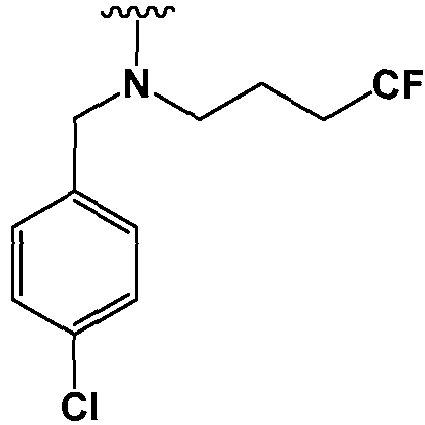

21.06t 620.2 321 1-(4-((4-chlorobenzyl)(4,4,4-trifluorobutyl)amino)-2'-(1H-tetrazol-5-yl)-[1,1'-biphenyl]-3-yl)-3-(2-(trifluoromethyl)phenyl) urea 

12.33t 674.2 322 1-(4-((4-chlorobenzyl)(4,4,4-trifluorobutyl)amino)-2'-(1H-tetrazol-5-yl)-[1,1'-biphenyl]-3-yl)-3-(4-(trifluoromethoxy)pheny l)urea 

21.02t 688.2 323 1-(4-((4-fluorobenzyl)(3,3,3-trifluoropropyl)amino)-2'-(1H-tetrazol-5-yl)-[1,1'-biphenyl]-3-yl)-3-(4-(trifluoromethoxy)pheny l)urea 

20.13t 660.2 324 1-(2,4-difluorophenyl)-3-(4-((4-fluorobenzyl) (3,3,3-trifluoropropyl)amino)-2'-(1H-tetrazol-5-yl)-[1,1'-biphenyl]-3-yl)urea 

19.25t 612 Ex. No. Name NR7R8 R9 HPLC Ret Time (M+H) +/ (M-1) 325 1-(4-((4-fluorobenzyl)(3,3,3-trifluoropropyl)amino)-2'-(1H-tetrazol-5-yl)-[1,1'-biphenyl]-3-yl)-3-(p-tolyl)urea 

19.87t 588.2 326 1-(4-((4-fluorobenzyl)(3,3,3-trifluoropropyl)amino)-2'-(1H-tetrazol-5-yl)-[1,1'-biphenyl]-3-yl)-3-(2-(trifluoromethyl)phenyl) urea 

11.69t 644.2 327 1-(2'-(1H-tetrazol-5-yl)-4-((4-(trifluoromethyl) benzyl)(3,3,3-trifluoropropyl)amino)-[1,1'-biphenyl]-3-yl)-3-(4-(trifluoromethoxy) phenyl)urea 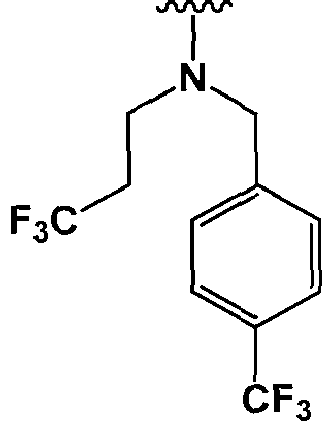

20.77t 710.2 328 1-(2'-(1H-tetrazol-5-yl)-4-((4-(trifluoromethyl) benzyl)(3,3,3-trifluoropropyl)amino)-[1,1'-biphenyl]-3-yl)-3-(2-(trifluoromethyl)phenyl) urea 

20.11t 692 329 1-(2'-(1H-tetrazol-5-yl)-4-((4-(trifluoromethyl) benzyl)(3,3,3-trifluoropropyl)amino)-[1,1'-biphenyl]-3-yl)-3-(p-tolyl)urea 

20.64t 640.2 330 1-(2'-(1H-tetrazol-5-yl)-4-((4-(trifluoromethyl) benzyl)(3,3,3-trifluoropropyl)amino)-[1,1'-biphenyl]-3-yl)-3-(2,4-difluorophenyl)urea 

20.43t 662.2 331 1-(4-(phenethyl(3,3,3-trifluoropropyl)amino)-2'-(1H-tetrazol-5-yl)-[1,1'-biphenyl]-3-yl)-3-(4-(trifluoromethoxy)pheny l)urea 

20.85t 656.4 332 1-(2,4-difluorophenyl)-3-(4-(phenethyl(3,3,3-trifluoropropyl)amino)-2'-(1H-tetrazol-5-yl)-[1,1'-biphenyl]-3-yl)urea 

19.51t 608.2 333 1-(4-(phenethyl(3,3,3-trifluoropropyl)amino)-2'-(1H-tetrazol-5-yl)-[1,1'-biphenyl]-3-yl)-3-(2-(trifluoromethyl)phenyl) urea 

20.16t 638.2 (M-1)- 334 1-(4-(phenethyl(3,3,3-trifluoropropyl)amino)-2'-(1H-tetrazol-5-yl)-[1,1'-biphenyl]-3-yl)-3-(p-tolyl)urea 

19.79t 586.2 335 1-(4-((2,4-dichlorobenzyl)(3,3,3-trifluoropropyl)amino)-2'-(1H-tetrazol-5-yl)-[1,1'-biphenyl]-3-yl)-3-(2-(trifluoromethyl) phenyl)urea 

20.46t 694.9 336 1-(4-((2,4-dichlorobenzyl)(3,3,3-trifluoropropyl)amino)-2'-(1H-tetrazol-5-yl)-[1,1'-biphenyl]-3-yl)-3-(2,4-difluorophenyl) urea 

20.58t 662 337 1-(4-((2,4-dichlorobenzyl)(3,3,3-trifluoropropyl)amino)-2'-(1H-tetrazol-5-yl)-[1,1'-biphenyl]-3-yl)-3-(4-(trifluoromethoxy) phenyl)urea 

21.25t 710.9 338 1-(4-((4-fluoro-2-(frifluoromethyl) benzyl)(3,3,3-trifluoropropyl)amino)-2'-(1 H-tetrazol-5-yl)-[1,1'-biphenyl]-3-yl)-3-(2-(trifluoromethyl)phenyl) urea 

19.83t 712.3 339 1-(4-((4-fluoro-2-(trifluoromethyl) benzyl)(3,3,3-trifluoropropyl)amino)-2'-(1H-tetrazol-5-yl)-[1,1'-biphenyl]-3-yl)-3-(4-(trifluoromethoxy)pheny l)urea 

20.46t 728.3 340 1-(2,4-difluorophenyl)-3-(4-((4-fluoro-2-(trifluoromethyl)benzyl)( 3,3,3-trifluoropropyl) amino)-2'-(1H-tetrazol-5-yl)-[1,1'-biphenyl]-3-yl)urea 

19.58t 680.3 341 1-(2'-(1H-tetrazol-5-yl)-4-((4-(trifluoromethoxy)benzyl )(3,3,3-trifluoropropyl)amino)-[1,1'-biphenyl]-3-yl)-3-(p-tolyl)urea 

20.57t 654 342 1-(2'-(1H-tetrazol-5-yl)-4-((4-(trifluoromethoxy)benzyl )(3,3,3-trifluoropropyl)amino)-[1,1'-biphenyl]-3-yl)-3-(2-(trifluoromethyl)phenyl) urea 

20.10t 708.2 343 1-(4-((pyridin-2-ylmethyl)(3,3,3-trifluoropropyl)amino)-2'-(1H-tetrazol-5-yl)-[1,1'-biphenyl]-3-yl)-3-(4-(trifluoromethoxy) phenyl)urea 

16.06t 643.3 344 1-(2,4-difluorophenyl)-3-(4-((pyridin-2-ylmethyl)(3,3,3-trifluoropropyl)amino)-2'-(1H-tetrazol-5-yl)-[1,1'-biphenyl]-3-yl)urea 

14.48t 595.3 345 1-(4-((pyridin-2-ylmethyl)(3,3,3-trifluoropropyl)amino)-2'-(1H-tetrazol-5-yl)-[1,1'-biphenyl]-3-yl)-3-(2-(trifluoromethyl) phenyl)urea 

14.63t 627.3 - The following compounds were prepared employing the method outlined below employing appropriate starting materials.
Table 19 
Ex. No. Name NR7R8 R9 HPLC Ret Time (M+H)+/ (M-1) 346 1-(3-chloro-5-fluorophenyl)-3-(4-(diisobutylamino)-2'-(1H-tetrazol-5-yl)-[1,1'-biphenyl]-3-yl)urea 

20.97t 536.2 347 1-(4-cyclopropylphenyl)-3-(4-(3,3-difluoropyrrolidin-1-yl)-2'-(1H-tetrazol-5-yl)-[1,1'-biphenyl]-3-yl)urea 

17.98t 502.2 348 1-(4-(5-benzyl-2,5-diazabicyclo[2.2.1] heptan-2-yl)-2'-(2H-tetrazol-5-yl)-[1,1'-biphenyl]-3-yl)-3-(4-cyclopropylphenyl) urea 

9.41t 583.4 349 1-(4-((4-chlorobenzyl)(4,4,4-trifluorobutyl)amino)-2'-(1H-tetrazol-5-yl)-[1,1'-biphenyl]-3-yl)-3-(4-cyclopropylphenyl)urea 

21.33t 646.2 350 1-(4-cyclopropylphenyl)-3-(4-((4-fluorobenzyl)(3,3,3-trifluoropropyl)amino)-2'-(1H-tetrazol-5-yl)-[1,1'-biphenyl]-3-yl)urea 

20.67t 616.2 351 1-(4-cyclopropyl-3-fluorophenyl)-3-(4-((2,4-dichlorobenzyl) (3,3,3-trifluoropropyl)amino)-2'-(1H-tetrazol-5-yl)-[1,1'-biphenyl]-3-yl)urea 

16.70t 684.9 352 1-(4-cyclopropyl-3-fluorophenyl)-3-(4-((4-fluoro-2-(trifluoromethyl)benzyl) (3,3,3-trifluoropropyl)amino)-2'-(1H-tetrazol-5-yl)-[1,1'-biphenyl]-3-yl)urea 

20.85t 700.2 (M-1)- 353 1-(2'-(1H-tetrazol-5-yl)-4-((4-(trifluoromethoxy)benzyl)(3,3 ,3-trifluoropropyl)amino)-[1,1'-biphenyl]-3-yl)-3-(4-cyclopropyl-3-fluorophenyl)urea 

20.79t 698 (M-H)- 354 1-(4-cyclopropyl-3-fluorophenyl)-3-(4-((pyridin-2-ylmethyl)(3,3,3-trifluoropropyl)amino)-2'-(1H-tetrazol-5-yl)-[1,1'-biphenyl]-3-yl)urea 

15.91t 617.5 -

-

- The above compound was prepared from 1-(5-bromo-2-(cyclohexyl(isobutyl)amino)-4-fluorophenyl)-3-(p-tolyl)urea (Table 7) and 4-fluoro-2-(4,4,5,5-tetramethyl-1,3,2-dioxaborolan-2-yl)benzonitrile by the procedure used for conversion of 1C to 1. MS(ES): m/z = 517[M + H]+. HPLC Tr: 5.171.
-

- The compound was prepared from 1-(2'-cyano-4-(cyclohexyl(isobutyl)amino)-5',6-difluoro-[1,1'-biphenyl]-3-yl)-3-(p-tolyl)urea by the general procedure used for the conversion of 7A into 7B. MS(ES): m/z = 560[M + H]+. HPLC Tr: 2.94q.
-

-

- A solution of 4-bromo-N-cyclohexyl-N-(2-methylallyl)-2-nitroaniline (0.05 g, 0.142 mmol) in dioxane (2 mL) was treated with osmium tetroxide (0.072 g, 7.08 µmol) and 2,6-lutidine (0.016 mL, 0.142 mmol) followed by a slurry of sodium periodate (0.121 g, 0.566 mmol) in water (0.5 mL). This mixture was stirred 3h at RT. then diluted with ether and washed twice with water. The org. phase was dried, stripped, and chromatographed on silica gel (gradient elution with ether-hexanes). Concentration of the appropriate fractions afforded 1-((4-bromo-2-nitrophenyl)(cyclohexyl)amino)propan-2-one as an oil. MS(ES): m/z = 275 [M + H]+. HPLC Tr: 4.471.
-

- A solution of 1-((4-bromo-2-nitrophenyl)(cyclohexyl)amino)propan-2-one (0.045 g, 0.127 mmol) in dichloromethane (0.5 ml) was treated with DAST (0.067 ml, 0.507 mmol) and stirred at RT. After 24h, additional DAST (0.1 mL) was added, and the reaction was stirred an additional 24h. The reaction was applied to a silica gel column (hexane) and eluted with a gradient of ether-hexane. Concentration of the appropriate fractions afforded 4-bromo-N-cyclohexyl-N-(2,2-difluoropropyl)-2-nitroaniline (0.04 g, 0.101 mmol, 80 % yield) as an orange oil. MS(ES): m/z = 297[M + H]+. HPLC Tr: 2.30p.
-

- A solution of 4-bromo-N-cyclohexyl-N-(2,2-difluoropropyl)-2-nitroaniline (0.037 g, 0.098 mmol) in ethanol (3 mL) was treated with ammonium chloride (0.079 g, 1.471 mmol) and 0.3 mL of water. This mixture was stirred 10 min. at RT then treated with zinc (0.096 g, 1.471 mmol). The reaction was stirred 5 min. at RT then diluted with dichloromethane and filtered. The filtrate was washed with water, dried, and stripped to afford an oil. This was dissolved in 0.5 mL of THF and treated with 0.03 mL of p-tolyl isocyanate. The reaction was stirred 1h at RT. LCMS of the first step indiates that much hydroxylamine intermediate was present. The second step has proceeded to give a mixture of the desired urea and N-hydroxy urea. The reaction was diluted with 2 mL of ethanol and 0.2 mL of water followed by 0.05g of ammonium chloride and 0.1g of zinc. The reaction was stirred ON at RT. The reaction was concentrated and applied to a silica gel column. Gradient elution with ether-hexanes afforded 0.016 g (34%) of 1-(5-bromo-2-(cyclohexyl(2,2-difluoropropyl)amino)phenyl)-3-(p-tolyl)urea as a glass. MS(ES): m/z = 482[M+H]+. HPLC Tr: 4.461.
-

- The title compound was prepared from 1-(5-bromo-2-(cyclohexyl(2,2-difluoropropyl)amino)phenyl)-3-(p-tolyl)urea and(2-(1H-tetrazol-5-yl)phenyl)boronic acid by the procedure used for conversion of 1C to 1. MS(ES): m/z = 546[M + H]+. HPLC Tr: 4.021.
-

-

- To a stirred, cooled (-78 °C) solution of (E)-3-phenylprop-2-en-1-ol (2.415 g, 18.00 mmol) in THF (3 mL) was added n-butyllithium (5.76 mL, 14.40 mmol), dropwise over 4-5 min. The solution was stirred for 5 min. at -78 °C then treated with 4-bromo-1-fluoro-2-nitrobenzene (2.64 g, 12 mmol) and allowed to warm to RT with stirring. Stirring at RT was continued for 30 min, after which time the reaction was transferred into aq. HCl, and this mixture was extracted with ether. The organic extract was dried, stripped, and chromatographed on silica gel (gradient elution with ether-hexanes). Concentration of the appropriate fractions afforded an oily yellow solid. This was triturated with heptane to afford 4-bromo-1-(cinnamyloxy)-2-nitrobenzene (2.2 g, 52.1% yield) as a pale yellow powder, mp 95-97 °C. 1H NMR (400 MHz, DMSO-d6) δ ppm 8.13(d, 1 H, J = 2.4 Hz); 7.84(dd, 1 H, J = 9.0, 2.4 Hz); 7.47(d, 2 H, J = 7.3 Hz); 7.42(d, 1H, J = 9.2 Hz); 7.35(t, 2H, J = 7.4 Hz); 7.28(t, 1H, J = 7.8 Hz); 6.78(d, 1H, J = 16.1 Hz); 6.46(dt, 1H, J = 16.1, 5.8 Hz); 4.92(d, 2H, J = 5.9 Hz).
-

- A solution of 4-bromo-1-(cinnamyloxy)-2-nitrobenzene (8A) (1.5 g, 4.49 mmol) in diglyme (3 mL) was placed under nitrogen and heated to 150 °C for 36h. The reaction was cooled and purified by flash chromatography (gradient elution with hexanes up to 15% ether-hexanes). Concentration of the appropriate fractions afforded 4-bromo-2-nitro-6-(1-phenylallyl)phenol (1.08 g, 68.4% yield) as an oily yellow solid. 1H NMR (400 MHz, DMSO-d6) δ ppm 10.73(br. s, 1H); 8.04(d, 1H, J = 2.4 Hz) 7.62(d, 1 H, J = 2.4 Hz); 7.31(t, 2 H, J = 7.4 Hz); 7.16-7.25(m, 3H); 6.39(ddd, 1H, J = 17.1, 10.1, 7.5 Hz); 5.23 (d, 1H, J = 10.1 Hz); 5.15(d, 1H, J = 7.3 Hz); 5.00(d, 1H, J = 17.2 Hz).
-

- To a solution of 4-bromo-2-nitro-6-(1-phenylallyl)phenol (0.1 g, 0.299 mmol) in DMF (1 mL) was added potassium carbonate (0.124 g, 0.898 mmol) followed by 3-bromoprop-1-ene (0.145 g, 1.197 mmol). This mixture was brought to 60°C and stirred for 17h. The reaction was cooled, quenched with glacial HOAc, and purified by flash chromatography (gradient elution with ether-hexanes). Concentration of the appropriate fractions afforded 2-(allyloxy)-5-bromo-1-nitro-3-(1-phenylallyl)benzene (0.105 g, 89 % yield) as a colorless oil. 1H NMR (400 MHz, DMSO-d6) δ ppm 8.08(d, 1H, J = 2.2 Hz) 7.69(d, 1 H, J = 2.2 Hz); 7.33(dd, 2 H, J = 7.5, 7.3 Hz); 7.24(td, 1H, J = 7.5, 1.8 Hz); 7.19(d, 2H, J = 7.7 Hz); 6.34-6.44(m, 1H); 5.84-5.95(m, 1H); 5.21-5.32(m, 3H); 5.13(d, 1H, J = 7.0 Hz); 5.02(dd, 1H, J = 17.0, 1.1 Hz); 4.25-4.41(m, 2H).
-

- A solution of 2-(allyloxy)-5-bromo-1-nitro-3-(1-phenylallyl)benzene (0.09 g, 0.240 mmol) in NMP (0.2 mL) was heated at 60°C for 20 min. LCMS suggests that LTN reaction has occurred. The solution was treated with 0.05 mL more isobutylamine and heated to 80°C for 2h. LCMS suggests that reaction is occurring to give two products. The reaction was cooled and purified by prep. HPLC (Axia Luna 30 x 100 mm column, MeOH-water-TFA gradient). Concentration of the appropriate (earlier-eluting) fractions afforded 4-bromo-N-isobutyl-2-nitro-6-(1-phenylallyl)aniline as a yellow oil. MS(ES): m/z = 391 [M + H]+. HPLC Tr: 5.431.
-

- A solution of 4-bromo-N-isobutyl-2-nitro-6-(1-phenylallyl)aniline (0.06 g, 0.154 mmol) in ethanol (4 mL) was treated with 0.4 mL of water, and the resulting mixture was stirred for 5 min. at RT. This stirred suspension was treated with zinc (0.151 g, 2.312 mmol), and after stirring 30 min. the reaction was diluted with dichloromethane and filtered. The filtrate was washed with water, dried, and stripped to afford 4-bromo-N1-isobutyl-6-(1-phenylallyl)benzene-1,2-diamine (0.055 g, 92 % yield) as a pale amber oil. MS(ES): m/z = 359[M + H]+. HPLC Tr: 4.351.
-

- A solution of 4-bromo-N1-isobutyl-6-(1-phenylallyl)benzene-1,2-diamine (0.033 g, 0.092 mmol) in THF (0.8 mL) was treated with 1-fluoro-2-isocyanatobenzene (0.025 g, 0.184 mmol). The reaction was stirred 30 min. at 60°C then cooled, concentrated, and purified by flash chromatography (gradient elution with ether-hexanes). Concentration of the appropriate fractions afforded 1-(5-bromo-2-(isobutylamino)-3-(1-phenylallyl)phenyl)-3-(2-fluorophenyl)urea (0.04 g, 88 % yield) as a colorless solid. MS(ES): m/z = 498[M + H]+. HPLC Tr: 5.231.
-

- The title compound was prepared from 1-(5-bromo-2-(isobutylamino)-3-(1-phenylallyl)phenyl)-3-(2-fluorophenyl)urea and(2-(1H-tetrazol-5-yl)phenyl)boronic acid by the procedure used for conversion of 1C to 1. MS(ES): m/z = 562[M + H]+. HPLC Tr: 4.021.
-

-

- The title compound was prepared from 4-bromo-N1-isobutyl-6-(1-phenylallyl)benzene-1,2-diamine and 1-isocyanato-4-methylbenzene by the procedure used to prepare 1-(5-bromo-2-(isobutylamino)-3-(1-phenylallyl)phenyl)-3-(2-fluorophenyl)urea. MS(ES): m/z = 492[M + H]+. HPLC Tr: 5.091.
-

- The title compound was prepared from 1-(5-bromo-2-(isobutylamino)-3-(1-phenylallyl)phenyl)-3-(p-tolyl)urea and (2-(1H-tetrazol-5-yl)phenyl)boronic acid by the procedure used for conversion of 1C to 1. MS(ES): m/z = 558[M + H]+. HPLC Tr: 4.481.
-

-

- 4-(5,5-Dimethyl-1,3,2-dioxaborinan-2-yl)-N1,N1-diisobutylbenzene-1,2-diamine (4B) (128 mg, 0.385 mmol), methyl 2-bromo-5-chlorobenzoate (80 mg, 0.321 mmol), PdCl2(dppf)-CH2Cl2Adduct (23.5 mg, 0.032 mmol) and potassium phosphate, tribasic (204 mg, 0.962 mmol) were added to a 2 dram vial which was then evacuated and filled with nitrogen 3x. Dioxane (2 mL) was added and the resultant mixture was purged with nitrogen for five minutes. The mixture was then heated at 100 °C for 20h. The reaction was cooled to rt, filtered and concentrated in vacuo before being purified via ISCO Companion (12g silica gel column with 0-10% EtOAc/hexane gradient) to afford the title compound as a clear oil (99.4 mg, 75%). 1H NMR (500MHz, CDCl3) δ 7.71 (d, J=2.2 Hz, 1H), 7.45 (dd, J=8.2, 2.1 Hz, 1H), 7.33 (d, J=8.0 Hz, 1H), 7.06 (d, J=8.0 Hz, 1H), 6.66 (d, J=1.9 Hz, 1H), 6.60 (dd, J=8.0, 1.9 Hz, 1H), 4.17 (br. s., 2H), 2.65 (d, J=7.2 Hz, 4H), 1.79 (m, 2H), 0.93 (d, J=6.7 Hz, 12H). MS(ES): m/z = 389 [M+H]+.
-

- To a mixture of methyl 3'-amino-4-chloro-4'-(diisobutylamino)-[1,1'-biphenyl]-2-carboxylate (99.4 mg, 0.256 mmol) in MeOH (1 mL) and THF (0.6 mL) was added LiOH (2M aq solution, 1.28 mL, 2.56 mmol). The resulting mixture was heated at 100 °C for thirty minutes, then cooled to room temperature and neutralized with HCl (1N in diethyl ether, 2.56 mL, 2.56 mmol). The mixture was concentrated to remove volatiles, then extracted with EtOAc (3x). The combined organic layers were concentrated in vacuo to afford the title compound as a brown solid (75 mg, 77%) which was used without further purification. MS(ES): m/z = 375 [M+H]+.
-

- To a mixture of 5-aminopicolinonitrile (20 mg, 0.168 mmol) in anhydrous THF (1 mL) was added 4-nitrophenyl carbonochloridate (41 mg, 0.201 mmol). The mixture was stirred at 35 °C for twenty minutes to afford 4-nitrophenyl (6-cyanopyridin-3-yl) carbamate. MS(ESI+) m/z 285.2 (M + H)+. The entire reaction mixture was used without further purification.
- To the 4-nitrophenyl (6-cyanopyridin-3-yl) carbamate reaction mixture was added 3'-amino-4-chloro-4'-(diisobutylamino)-[1,1'-biphenyl]-2-carboxylic acid (25 mg, 0.067 mmol), followed by TEA (0.04 mL, 0.267 mmol). The resulting mixture was stirred at 50°C for twenty minutes. After cooling to room temperature, the compound was purified via via preparative LC/MS with the following conditions: Column: Waters XBridge C18, 19 x 150 mm, 5-µm particles; Guard Column: Waters XBridge C18, 19 x 10 mm, 5-µm particles; Mobile Phase A: 5:95 acetonitrile:water with 10 mM ammonium acetate; Mobile Phase B: 95:5 acetonitrile:water with 10-mM ammonium acetate; Gradient: 15-100% B over 15 minutes, then a 5-minute hold at 100% B; Flow: 20 mL/min. Fractions containing the desired product were combined and dried via centrifugal evaporation to afford the title compound (17.7 mg, 51% yield). MS(ES): m/z = 520 [M+H]+, HPLC Tr: 1.73j.
-

- To a mixture of 3'-amino-4-chloro-4'-(diisobutylamino)-[1,1'-biphenyl]-2-carboxylic acid (25 mg, 0.067 mmol) in anhydrous THF (0.5 mL) was added 4-chloro-2-fluoro-1-isocyanatobenzene (19 mg, 0.113 mmol). The resulting mixture was stirred at 50°C for ten minutes. After cooling to room temperature, the compound was purified via via preparative LC/MS with the following conditions: Column: Waters XBridge C18, 19 x 150 mm, 5-µm particles; Guard Column: Waters XBridge C18, 19 x 10 mm, 5-µm particles; Mobile Phase A: 5:95 acetonitrile:water with 10 mM ammonium acetate; Mobile Phase B: 95:5 acetonitrile:water with 10-mM ammonium acetate; Gradient: 15-100% B over 15 minutes, then a 5-minute hold at 100% B; Flow: 20 mL/min. Fractions containing the desired product were combined and dried via centrifugal evaporation to afford the title compound (28.1 mg, 76% yield). MS(ES): m/z = 546 [M+H]+, HPLC Tr: 2.03j.
-

-

- To a mixture of 4-bromo-1-fluoro-2-nitrobenzene (2.02 ml, 16.4 mmol) and 1,2,3,4-tetrahydroquinoline (8.72 g, 65.5 mmol), in a 100 mL pressure flask, was added K2CO3 (11.31 g, 82.0 mmol). The flask was sealed and the resulting mixture was heated at 130°C for 16 hours, before being cooled to rt, then partitioned between water and EtOAc. The layers were separated and the aqueous layer was extracted twice more with EtOAc. These organic extracts were combined with the original organic layer and were washed with brine, then dried over anhydrous sodium sulfate. The crude material was filtered, then concentrated in vacuo to afford a residue which was treated with 1-methylpiperazine (1.64 g, 16.4 mmol). The resultant mixture was heated at 80°C for one hour then cooled to room temperature. The crude reaction mixture was purified by flash chromatography to afford the title compound (1.43 g, 26%). MS(ES): m/z = 333 [M+H]+, HPLC Tr: 4.621.
-

- To a solution of 1-(4-bromo-2-nitrophenyl)-1,2,3,4-tetrahydroquinoline (1.43 g, 4.3 mmol) in dioxane (14.3 mL), in a sealable reaction vial, was added 2-(5,5-dimethyl-1,3,2-dioxaborinan-2-yl)benzonitrile (1.20 g, 5.6 mmol), PdCl2(dppf)-CH2Cl2 adduct (0.18 g, 0.22 mmol) and potassium phosphate, tribasic (2.24 g, 12.9 mmol). The mixture was purged with nitrogen for five minutes before the vial was sealed and the reaction heated at 100°C for two hours. The reaction was cooled to room temperature and the solids were removed by vacuum filtration through a fritted glass funnel. The filtrate was concentrate in vacuo and the crude reaction mixture was purified by flash chromatography to afford the title compound as a dark red solid (1.26 g, 83%). MS(ES): m/z = 356 [M+H]+, HPLC Tr: 4.401.
-

- To a solution of 4'-(3,4-dihydroquinolin-1(2H)-yl)-3'-nitro-[1,1'-biphenyl]-2-carbonitrile (0.6 g, 1.7 mmol) in toluene (7 mL), in a sealable reaction vial, was added azidotributylstannane (3 ml, 10.9 mmol). The reaction was then heated at 105 °C for 16 hours before being cooled to room temperature. The solvent was removed under reduced pressure, and the resultant residue was purified by flash chromatography to afford the title compound (0.61 g, 86%). MS(ES): m/z = 399 [M+H]+, HPLC Tr: 4.071.
-

- To a solution of ammonium chloride (0.49 g, 9.2 mmol) in water (0.92 mL) was added EtOH (6.4 mL). The mixture was cooled to 0 °C then treated with zinc (325 mesh flake, 0.83 g, 12.6 mmol). To this mixture was added a solution of 1-(3-nitro-2'-(1H-tetrazol-5-yl)-[1,1'-biphenyl]-4-yl)-1,2,3,4-tetrahydroquinoline (0.61 g, 1.53 mmol) in EtOH (1 mL). The mixture was allowed to warm to room temperature and was stirred for 1.5 hours. After that time, the reaction mixture was filtered through a pad of Celite and the isolated solids were thoroughly rinsed with DCM. The combined filtrates were concentrated in vacuo to remove volatiles then partitioned between water and DCM. The layers were separated and the organic layer was dried over anhydrous sodium sulfate, filtered and concentrated in vacuo to afford a brown residue. Purification by flash chromatography, followed by treatment with DCM, removal of remaining solids and concentration in vacuo afforded the title compound (0.21 g, 29%), which was used without further purification. MS(ES): m/z = 369 [M+H]+, HPLC Tr: 3.571.
-

- To a homogeneous mixture of 4-(3,4-dihydroquinolin-1(2H)-yl)-2'-(1H-tetrazol-5-yl)-[1,1'-biphenyl]-3-amine (0.03 g, 0.08 mmol) in anhydrous THF (1.3 mL) was added 4-nitrophenyl carbonochloridate (0.02 g, 0.10 mmol). The mixture was stirred at room temperature for twenty minutes to afford 4-nitrophenyl (4-(3,4-dihydroquinolin-1(2H)-yl)-2'-(1H-tetrazol-5-yl)-[1,1'-biphenyl]-3-yl)carbamate. MS(ES): m/z = 534 [M+H]+, HPLC Tr: 4.501. The entire reaction mixture was used without further purification.
-

- To the reaction mixture from Step E, containing 4-nitrophenyl (4-(3,4-dihydroquinolin-1(2H)-yl)-2'-(1H-tetrazol-5-yl)-[1,1'-biphenyl]-3-yl)carbamate, was added p-toluidine (12 mg, 0.11 mmol) followed by triethylamine (0.05 mL, 0.33 mmol). The mixture was then heated at 50 °C for thirty minutes. After cooling to room temperature, the reaction mixture was concentrated in vacuo then redissolved in DMF (1 mL) before beimg purified via via preparative LC/MS with the following conditions: Column: Waters XBridge C18, 19 x 150 mm, 5-µm particles; Guard Column: Waters XBridge C18, 19 x 10 mm, 5-µm particles; Mobile Phase A: 5:95 acetonitrile:water with 10 mM ammonium acetate; Mobile Phase B: 95:5 acetonitrile:water with 10-mM ammonium acetate; Gradient: 15-100% B over 25 minutes, then a 5-minute hold at 100% B; Flow: 20 mL/min. Fractions containing the desired product were combined and dried via centrifugal evaporation to afford the title compound (11.9 mg, 29% yield). MS(ES): m/z = 502 [M+H]+, HPLC Tr: 1.66j.
-

- The title compound (25.2 mg, 60%) was prepared following a procedure analogous to that for the synthesis of Example 361, except that 6-methylpyridin-3-amine (12 mg, 0.11 mmol) was used instead of p-toluidine. MS(ES): m/z = 503 [M+H]+, HPLC Tr: 1.36j.
-

- The title compound (5.4 mg, 12%) was prepared following a procedure analogous to that for the synthesis of Example 361, except that 4-(trifluoromethoxy)aniline (20 mg, 0.11 mmol) was used instead of p-toluidine. MS(ES): m/z = 572 [M+H]+, HPLC Tr: 1.82j.
-

- The title compound (9.3 mg, 20%) was prepared following a procedure analogous to that for the synthesis of Example361, except that 2-fluoro-4-(trifluoromethyl)aniline (20 mg, 0.11 mmol) was used instead of p-toluidine. MS(ES): m/z = 574 [M+H]+, HPLC Tr: 1.86j.
-

- The title compound (24.7 mg, 59%) was prepared following a procedure analogous to that for the synthesis of Example361, except that 6-fluoropyridin-3-amine (13 mg, 0.11 mmol) was used instead of p-toluidine. MS(ES): m/z = 507 [M+H]+, HPLC Tr: 1.42j.
-

- The title compound (11.5 mg, 26%) was prepared following a procedure analogous to that for the synthesis of Example361, except that 3-methylisoxazol-5-amine (11 mg, 0.11 mmol) was used instead of p-toluidine. MS(ES): m/z = 493 [M+H]+, HPLC Tr: 1.39j.
-

-

- A mixture of 4-bromo-1-fluoro-2-nitrobenzene (0.39 ml, 3.2 mmol) and 3-phenylpyrrolidine (1.0 g, 6.79 mmol), in a sealable vial with pressure release cap, was heated at 105°C for 16 hours before being cooled to room temperature. The crude reaction mixture was purified by flash chromatography to afford the title compound (1.04 g, 94%). 1H NMR (400MHz, CDCl3) δ 7.90 (d, J=2.4 Hz, 1H), 7.46 (dd, J=9.2, 2.4 Hz, 1H), 7.40 - 7.32 (m, 2H), 7.31 - 7.21 (m, 3H), 6.83 (d, J=9.2 Hz, 1H), 3.59 - 3.39 (m, 4H), 3.28 (ddd, J=10.1, 7.5, 2.9 Hz, 1H), 2.41 (dtd, J=12.1, 6.1, 2.6 Hz, 1H), 2.16 (dtd, J=2.0, 9.7, 7.7 Hz, 1H). MS(ES): m/z = 347 [M+H]+, HPLC Tr: 4.811.
-

- The title compound (19.8 mg, 52%) was prepared following a procedure analogous to that for the synthesis of Example 361, except that (±)-1-(4-bromo-2-nitrophenyl)-3-phenylpyrrolidine was used instead of 1-(4-bromo-2-nitrophenyl)-1,2,3,4-tetrahydroquinoline. MS(ES): m/z = 516 [M+H]+, HPLC Tr: 1.65j.
-

- The title compound (20.6 mg, 54%) was prepared following a procedure analogous to that for the synthesis of Example 362, except that (±)-1-(4-bromo-2-nitrophenyl)-3-phenylpyrrolidine was used instead of 1-(4-bromo-2-nitrophenyl)-1,2,3,4-tetrahydroquinoline. MS(ES): m/z = 517 [M+H]+, HPLC Tr: 1.36j.
-

- The title compound (22.6 mg, 52%) was prepared following a procedure analogous to that for the synthesis of Example363, except that (±)-1-(4-bromo-2-nitrophenyl)-3-phenylpyrrolidine was used instead of 1-(4-bromo-2-nitrophenyl)-1,2,3,4-tetrahydroquinoline. MS(ES): m/z = 586 [M+H]+, HPLC Tr: 1.79j.
-

- The title compound (9.5 mg, 22%) was prepared following a procedure analogous to that for the synthesis of Example 364, except that (±)-1-(4-bromo-2-nitrophenyl)-3-phenylpyrrolidine was used instead of 1-(4-bromo-2-nitrophenyl)-1,2,3,4-tetrahydroquinoline. MS(ES): m/z = 588 [M+H]+, HPLC Tr: 1.85j.
-

- The title compound (11.8 mg, 31%) was prepared following a procedure analogous to that for the synthesis of Example 365, except that (±)-1-(4-bromo-2-nitrophenyl)-3-phenylpyrrolidine was used instead of 1-(4-bromo-2-nitrophenyl)-1,2,3,4-tetrahydroquinoline. MS(ES): m/z = 521 [M+H]+, HPLC Tr: 1.42j.
-

- The title compound (8.8 mg, 23%) was prepared following a procedure analogous to that for the synthesis of Example366, except that (±)-1-(4-bromo-2-nitrophenyl)-3-phenylpyrrolidine was used instead of 1-(4-bromo-2-nitrophenyl)-1,2,3,4-tetrahydroquinoline. MS(ES): m/z = 507 [M+H]+, HPLC Tr: 1.38j.
-

-

- To a solution of 1-(4-bromo-2-nitrophenyl)-1,2,3,4-tetrahydroquinoline (0.40 g, 1.20 mmol) in DMF (10.5 mL), in a sealable reaction vial, was added 2-borono-4-fluorobenzoic acid (0.29 g, 1.57 mmol), K2CO3 (0.83 g, 6.02 mmol) and water (1.5 ml). The heterogenous mixture was purged with nitrogen for 15 minutes, before tetrakis(triphenylphophine)palladium(0) (0.07 g, 0.06 mmol) was added to the flask. The mixture was purged with nitrogen for an additional five minutes before the vial was sealed and the reaction heated at 100°C for three hours. The reaction mixture was cooled to room temperature before being treated with Et2O and water. Aqueous HCl (1N) was added until the aqueous layer reached pH 4. The mixture was thoroughly extracted with Et2O and these organic extracts were combined, washed with water then brine, and dried over anhydrous sodium sulfate. The drying agent was removed by filtration and the filtrate was concentrated in vacuo to afford the crude product which was purified by flash chromatography to afford the title compound (0.34 g, 72%). MS(ES): m/z = 393 [M+H]+, HPLC Tr: 1.271.
-

- The title compound (11.8 mg, 41%) was prepared following a procedure analogous to that for the synthesis of Example 361, except that 4'-(3,4-dihydro-quinolin-1(2H)-yl)-5-fluoro-3'-nitro-[1,1'-biphenyl]-2-carboxylic acid was used instead of 1-(3-nitro-2'-(1H-tetrazol-5-yl)-[1,1'-biphenyl]-4-yl)-1,2,3,4-tetrahydroquinoline. MS(ES): m/z = 496 [M+H]+, HPLC Tr: 1.67j.
- Using the methods described herein, the following additional compounds of the invention were prepared.
Example No. Compound HPLC Tr (M+H)+ 374 
1.86j 590 375 
1.92j 596 376 
1.74j 527 377 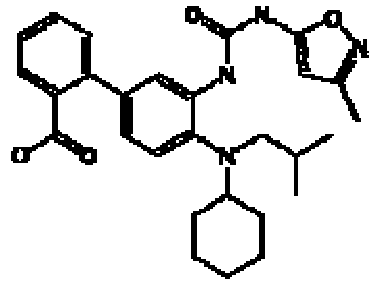
1.64j 491 378 
1.53j 502 379 
1.65j 526 380 
2.52j 540 381 
1.90j 546 382 
1.53j 537 383 
1.64j 561 384 
1.70j 565 385 
2.14j 539 386 
1.67j 534 387 
1.38j 535 388 
1.08j 523 389 
1.38j 522 390 
1.59j 594 391 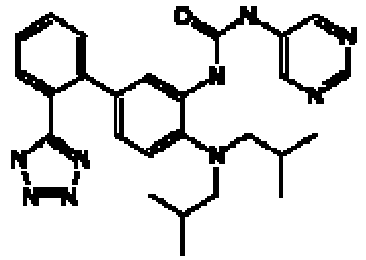
1.51j 486 392 
2.28j 608 393 
2.13j 581 394 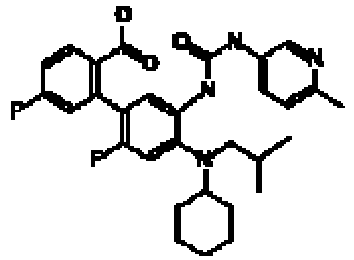
1.74j 537 395 
1.61j 499 396 
1.40j 489 397 
1.64j 506 398 
1.92j 543 399 
1.46j 519 400 
1.73j 563 401 
0.82j 506 402 
1.37j 524 403 
1.51j 574 404 
1.41j 562 405 
1.68j 556 406 
1.47j 556 407 
1.40j 544 408 
1.59j 509 409 
1.68j 558 410 
2.19j 548 411 
1.72j 559 412 
2.10j 578 413 
1.49j 550 414 
2.13v 654 415 
1.67j 572 416 
1.92j 554 417 
17.27a 550 418 
1.84j 526 419 
1.87j 544 420 
1.95j 544 421 
1.97k 562 422 
2.00k 572 423 
1.80j 568 424 
17.73a 502 425 
1.94j 492 426 
1.96j 510 427 
1.77j 530 428 
2.05j 548 429 
2.27k 516 430 
1.66j 546 431 
1.71j 540 432 
1.69j 522 433 
2.00j 542 434 
2.12j 574 435 
2.06j 536 436 
2.08j 580 437 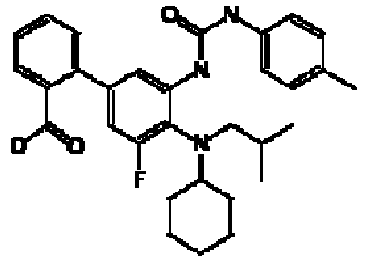
2.03j 518 438 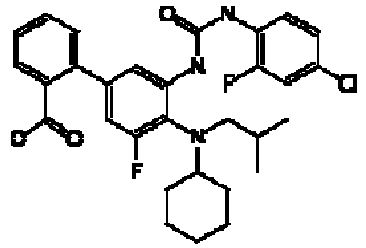
2.10j 556 439 
1.67j 506 440 
1.72j 526 441 
1.73j 550 442 
174j 544 443 
1.66j 488 444 
1.65j 512 445 
1.69j 502 446 
1.51j 526 447 
1.51j 520 448 
1.91j 492 449 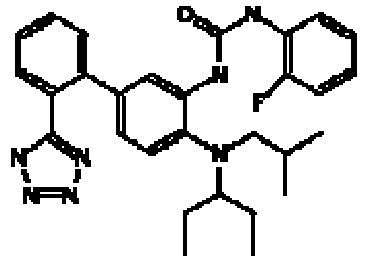
1.93j 516 450 
1.93j 510 451 
1.89j 558 452 
1.90j 564 453 
1.92j 550 454 
1.93j 528 455 
1.60k 526 456 
4.561 540 457 
1.75j 523 458 
2.08j 524 459 
2.05j 512 460 
1.93j 498 461 
1.95j 516 462 
1.95j 522 463 
1.89j 527 464 
1.88j 476 465 
1.90j 528 466 
1.92j 522 467 
17.73a 578 468 
2.11j 592 469 
2.05j 586 470 
1.97j 590 471 
4.531 498 472 
4.451 522 473 
4.681 516 474 
4.641 500 475 
4.581 524 476 
4.801 518 477 
2.78q 496 478 
2.67q 478 479 
2.73q 530 480 
2.68q 512 481 
2.36k 508 482 
4.811 606 483 
4.751 516 484 
4.641 520 485 
1.64w 606 486 
1.26w 524 487 
4.21x 559 488 
4.75x 530 489 
4.38x 510 491 
1.18y 518 492 
2.15k 508 493 
2.24k 508 494 
1.09y 542 495 
4.97x 558 496 
5.17x 596 497 
2.02k 504 498 
1.93k 516 499 
1.26w 516 500 
4.81x 542 501 
4.90x 570 -
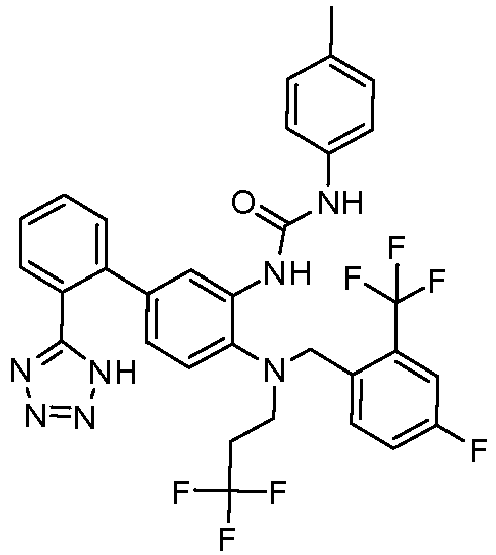
-

- The title compound was prepared from 3,3,3-trifluoropropanoic acid and (4-fluoro-2-(trifluoromethyl)phenyl)-methanamine by the general procedure used for the synthesis of Example 651A. MS(ES): m/z = 304.32 [M+H]+.
-

- The title compound was prepared from 3,3,3-trifluoro-N-(4-fluoro-2-(trifluoromethyl)benzyl)propanamide by the general procedure used for the synthesis of Example 651B. MS(ES): m/z = 290 [M+H]+.
-

- To a solution of 3,3,3-trifluoro-N-(4-fluoro-2-(trifluoromethyl)benzyl)propan-1-amine (631 mg, 2.182 mmol) in tetrahydrofuran (4 mL) was added LiHMDS (5.45 mL, 5.45 mmol, 1 M) at -78 °C. The mixture stirred for 10 min, then 4-bromo-1-fluoro-2-nitrobenzene was added (400 mg, 1.818 mmol). After 3h TLC suggested the complete consumption of starting material. The reaction mixture was poured into cooled saturated ammonium chloride solution and extracted with ethyl acetate. The organic layer was washed with brine, dried over sodium sulfate, filtered and concentrated. The crude material was purified by silica gel (230-400 mesh) column chromatography using ethyl acetate and hexane. The solvent was evaporated to get 4-bromo-N-(4-fluoro-2-(trifluoromethyl)benzyl)-2-nitro-N-(3,3,3-trifluoropropyl)aniline (550 mg, 47.0% yield) as a yellow liquid. MS(ES): m/z = 489 [M+H]+.
- The title compound was prepared from 4-bromo-N-(4-fluoro-2-(trifluoromethyl)benzyl)-2-nitro-N-(3,3,3-trifluoropropyl)aniline at 0°C by the general procedure used for the conversion of 1A to 1B. MS(ES): m/z = 461.14 [M+H]+.
-

- The title compound was prepared from 4-bromo-N1-(4-fluoro-2-(trifluoromethyl)benzyl)-N1-(3,3,3-trifluoropropyl)benzene-1,2-diamine by the general procedure used for the synthesis of Example 651 MS(ES): m/z = 525 [M+H]+.
-

- To the stirred solution of N4-(4-fluoro-2-(trifluoromethyl)benzyl)-2'-(1H-tetrazol-5-yl)-N4-(3,3,3-trifluoropropyl)-[1,1'-biphenyl]-3,4-diamine (20 mg, 0.038 mmol) in methylene chloride (200 µL) was added 1-isocyanato-4-methylbenzene (5.08 mg, 0.038 mmol). The reaction was stirred overnight. The solvent was evaporated and the crude sample was purified by RP-HPLC (acetonitrile-water gradient + TFA). The product containing fraction was partially evaporated to remove the acetonitrile and then lyophilized to give the product (15 mg). MS(ES): m/z = 656 [M+H]+ HPLC Tr: 22.46u.
-

- Example 503 was prepared using the procedures used to make Example 503. MS(ES): m/z = 724 [M+H]+, HPLC Tr: 23.63u.
-

- Example 504 was prepared using the procedures used to make Example 503. MS(ES): m/z = 676 [M+H]+, HPLC Tr: 22.63u
-

-

- To a stirred solution of (2,4-dichlorophenyl)methanamine (2.0 g, 11.36 mmol), 3,3,3-trifluoropropanoic acid (1.74 g, 13.63 mmol) and pyridine (1.79 g, 22.72 mmol), in methylene chloride was added phosphorus oxychloride (1.27 mL, 13.63 mmol) at 0 °C. The reaction mixture was brought to room temperature and stirred for 1 h. The reaction mixture was diluted with methylene chloride and washed with water then brine solution.The organic layer was dried over sodium sulfate, filtered and concentrated to provided N-(2,4-dichlorobenzyl)-3,3,3-trifluoropropanamide (2.93 g). 1H NMR (400 MHz, CDCl3) δ ppm 7.40 (d, 1H, J = 2.0 Hz), 7.32 (d, 1H, J = 14.4 Hz), 7.24 (dd, 1H, J = 8.4, 2.0 Hz), 6.17 (brs, 1H), 4.53 (d, 2H, J = 6.0 Hz), 3.06-3.14 (q, 2H).
-
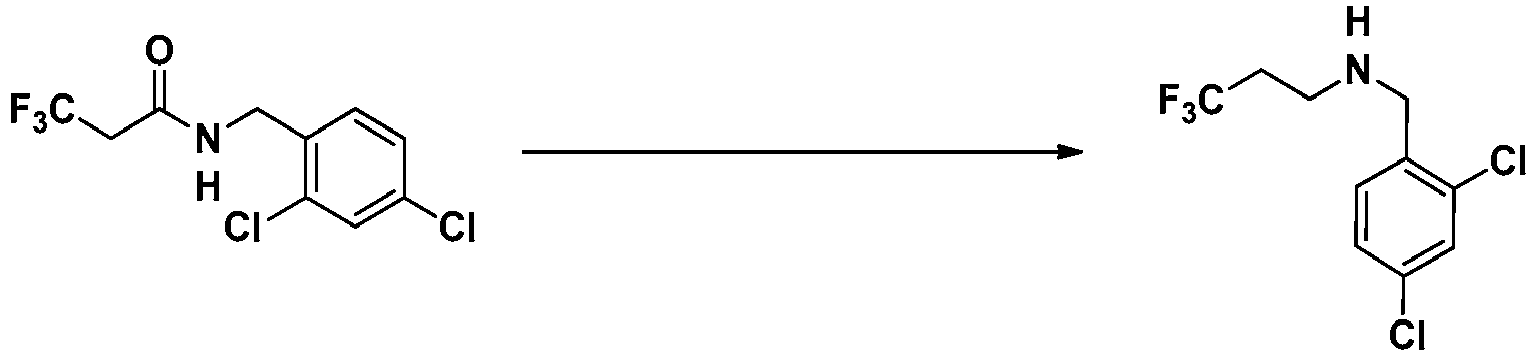
- To a stirred solution of N-(2,4-dichlorobenzyl)-3,3,3-trifluoropropanamide (2.9 g, 10.14 mmol) in tetrahydrofuran (150 mL) was added borane-methyl sulfide complex (4.81 mL, 50.7 mmol) at 0 °C. The reaction mixture was stirred at room temperature for 30 minutes. The reaction mixture was refluxed for 2 hours. The reaction mixture was cooled to 0 °C, quenched with methanol slowly (effervescence observed), then excess solvent was removed completely under reduced pressur. Methanol was added at 0 °C and the mixture refluxed overnight. The methanol was removed and 1.5 N hydrochloric acid was added. The mixture was extracted with methylene chloride. The organic layer was dried over sodium sulfate, filtered and concentrated to provide N-(2,4-dichlorobenzyl)-3,3,3-trifluoropropan-1-amine (2.25 g, 8.27 mmol). 1H NMR (400 MHz, CDCl3) δ ppm 7.78 (d, 1H, J = 8.4 Hz), 7.32 (d, 1H, J = 14.4 Hz), 7.24 (dd, 1H, J = 8.4, 2.0 Hz), 4.22 (d, 2H, J = 8.4 Hz), 3.08-3.11 (q, 2H), 2.78-2.84 (q, 2H).
-

- A pressure tube was charged with 4-bromo-1-fluoro-2-nitrobenzene (1.5 g, 6.82 mmol), N-(2,4-dichlorobenzyl)-3,3,3-trifluoropropan-1-amine (2.22 g, 8.18 mmol), DIPEA (2.38 mL, 13.64 mmol), in NMP (10.5 mL) solvent. The reaction mixture was heated at 130 °C for 72 hours. The reaction mixture was cooled to room temperature, diluted with MTBE, washed with water (3x), brine (1x). The organic layer was dried over sodium sulfate, filtered and concentrated in vacuo to give a crude dark brown solid. Purification using flash column chromatography (0% to 5% ethyl acetate/hexane gradient) provided 4-bromo-N-(2,4-dichlorobenzyl)-2-nitro-N-(3,3,3-trifluoropropyl)aniline (0.750 g).
-

- The title compound was prepared from 4-bromo-N-(2,4-dichlorobenzyl)-2-nitro-N-(3,3,3-trifluoropropyl)aniline by the general procedure used for forming 1B. MS(ES): m/z = 443.0 [M+H]+.
-

- To a stirred solution of 4-bromo-N1-(2,4-dichlorobenzyl)-N1-(3,3,3-trifluoropropyl)benzene-1,2-diamine (140 mg, 0.317 mmol), potassium carbonate 2M solution (3.33 mL, 6.65 mmol), in dioxane ethanol mixture was added (2-(1H-tetrazol-5-yl)phenyl)boronic acid (60 mg, 0.317 mmol). The reaction mixture was degassed for 30 minutes. Pd(Ph3P)4 (18 mg, 0.016 mmol) was added and the reaction was again degassed for 5 minutes then heated at 85 °C for 3 hours. The reaction mixture was concentrated in vacuo. The resulting residue was dissolved in ethyl acetate and washed with water, dried over sodium sulfate, filtered and concentrated to give the crude product. Purification using flash chromatography provided (80 mg). 1H NMR (400 MHz, CDCl3) δ ppm 7.63-7.67 (m, 2H), 7.51-7.56 (m, 2H), 7.44 (d, 1H, J = 2.0 Hz), 7.27 (dd, 1H, J = 8.0, 2.0 Hz), 7.17 (d, 1H, J = 8.4 Hz), 7.01 (d, 1H, J = 8.0 Hz), 6.61 (d, 1H, J = 2.0 Hz), 6.34 (dd, 1H, J = 8.0, 2.0 Hz), 4.20 (s, 2H), 3.24 (t, 2H), 2.31-2.38 (m, 2H). MS(ES): m/z = 507 [M+H]+.
-

- To the stirred solution of N4-(4-fluoro-2-(trifluoromethyl)benzyl)-2'-(1H-tetrazol-5-yl)-N4-(3,3,3-trifluoropropyl)-[1,1'-biphenyl]-3,4-diamine (20 mg, 0.038 mmol) in methylene chloride (200 µL) was added 1-isocyanato-4-methylbenzene (5.08 mg, 0.038 mmol). The reaction was stirred overnight. The solvent was evaporated and the crude sample was purified by RP-HPLC (acetonitrile-water gradient + TFA). The product containing fraction was partially evaporated to remove the acetonitrile and then lyophilized to give the product (20 mg). MS(ES): m/z = 640 [M+H]+ HPLC Tr: 23.54u,.
-

- Example 506 was prepared using the procedures described for Example 505. MS(ES): m/z = 573 [M+H]+, HPLC Tr: 14.4u.
-

-
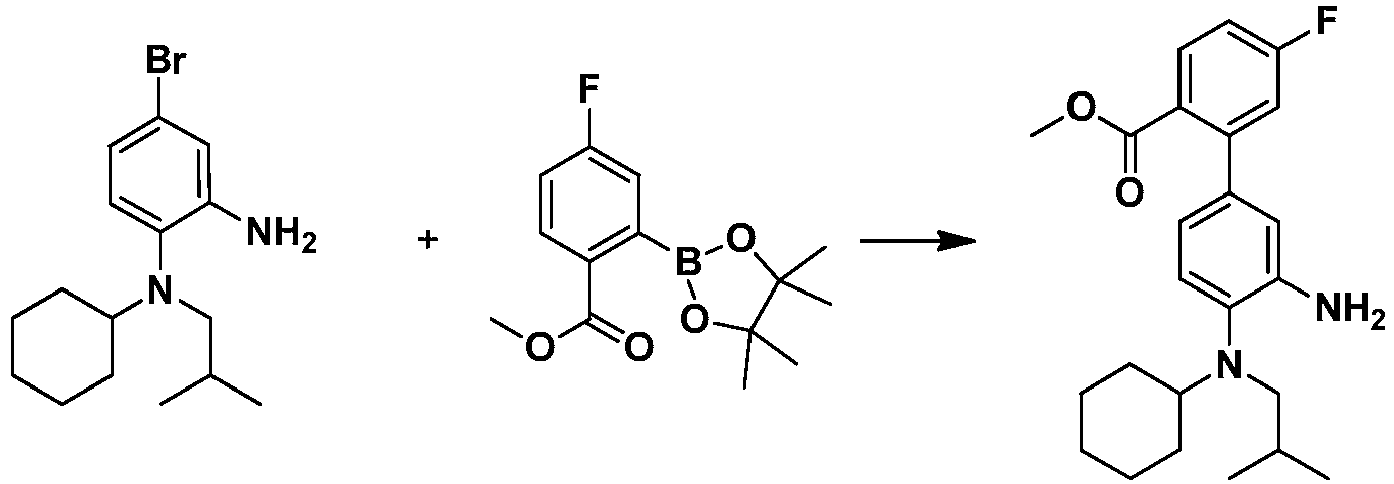
- To a stirred solution of 4-bromo-N1-cyclohexyl-N1-isobutylbenzene-1,2-diamine (200 mg, 0.615 mmol)(Intermediate iiiz in Table 1A) in dry dioxane (4.0 ml) added methyl 4-fluoro-2-(4,4,5,5-tetramethyl-1,3,2-dioxaborolan-2-yl)benzoate (207 mg, 0.738 mmol), followed by potassium phosphate (0.153 ml, 1.845 mmol).The reaction was purged with argon for 15 minutes and PdCl2(dppf) (90 mg, 0.123 mmol) was added. The reaction was again purged with argon for 5 minutes. The reaction was then sealed and heated to 80°C overnight. The reaction was diluted with ethyl acetate (10 ml) and washed sequentially with water(10 ml) and brine(10 ml). The organic phase was dried over sodium sulfate, filtered and concentrated to give the crude product. The crude product was purified by flash column using 60-120 mesh silica gel using 0-20% ethyl acetate/petroleum ether as eluent. Evaporation of the appropriate fractions provided the product as a semi-solid.
-

- To a stirred solution of 3,5-dibromo-4-methylaniline (0.020 g, 0.075 mmol) in dry methylene chloride (2.0 mL) under nitrogen was added sodium carbonate (0.040 g, 0.377 mmol). The reaction was cooled to 0°C and phosgene (0.037 g, 0.075 mmol) solution was added. The reaction was stirred at room temperature for 1.5 hour. The reaction was filtered through celite, washed with dry methylene chloride (2 ml) and concentrated under reduced pressure. After pumping down under high vacuum the product 1,3-dibromo-5-isocyanato-2-methylbenzene (20 mg, 0.069 mmol, 91 % yield) was obtained.
This intermediate 1,3-dibromo-5-isocyanato-2-methylbenzene (0.02 g, 0.069 mmol) was dissolved in dry methylene chloride (1.0 ml) and methyl 3'-amino-4'-(cyclohexyl(isobutyl)amino)-5-fluoro-[1,1'-biphenyl]-2-carboxylate (0.027 g, 0.069 mmol)(dissolved in methylene chloride (2 ml)) was added. The reaction was stirred for 30 minutes when the mixture was concentrated to give the crude product. The crude product was purified by preparative TLC using 10% ethyl acetate in petroleum ether as eluent. The pure product band was extracted with methylene chloride and filtered through a celite bed. Evaporation then gave the pure product (22 mg). -

- To a stirred solution of methyl 4'-(cyclohexyl(isobutyl)amino)-3'-(3-(3,5-dibromo-4-methylphenyl)ureido)-5-fluoro-[1,1'-biphenyl]-2-carboxylate (0.02 g, 0.029 mmol), in a mixture of dry tetrahydrofuran (1.0 mL), methanol (1.0 mL), and water (0.200 mL) cooled to 0°C was added lithium hydroxide monohydrate (6.09 mg, 0.145 mmol). The reaction was stirred at room temperature for 36 hours. Reaction mixture was concentrated to give an off white solid, The reaction was diluted with MTBE and washed with water. Aqueous layer was extracted with MTBE (2X10 ml). The combined organic layers were dried over sodium sulfate, filtered and concentrated to give an off white solid. The crude product was purified by preparative HPLC to give the final product (10 mg). MS(ES): m/z = 676 [M+H]+ HPLC Tr: 27.32u.
-

-

- To a homogeneous mixture of 4-bromo-1-fluoro-2-nitrobenzene (700 mg, 3.18 mmol) in N-methylpyrrolidinone (3.2 mL) in a sealable tube, was added DIPEA (2.2 mL, 12.60 mmol) followed by dicyclopropylamine hydrochloride (510 mg, 3.82 mmol). The tube was sealed and the mixture was heated to 110°C. The reaction was heated for 3 hours when it was cooled. The reaction was quenched with water then extracted with three portions of ethyl acetate. The combined organic layers were washed with brine then dried with anhydrous sodium sulfate, filtered and concentrated in vacuo to afford a blood red oil (1.3035g). The crude product was purified on an Isco CombiFlash System using a 40 g silica gel column. The compound was eluted with 0-50% ethyl acetate in hexanes. As the separation was not good, the chromatography was repeated; however, adequate separation did not occur on this attempt either. Evaporation of the product containing fractions in vacuo afforded an amber oil (609.8 mg). This material still contains significant impurities but, as purification is problematic, the compound is carried forward into the next reaction.
-

- To a solution of 4-bromo-N,N-dicyclopropyl-2-nitroaniline (609.8 mg, 2.052 mmol) in ethanol (15 mL) and water (3.00 mL), under nitrogen, was added ammonium chloride (2195 mg, 41.0 mmol). The reaction was stirred for 5 minutes before adding zinc (2683 mg, 41.0 mmol). The mixture was stirred at room temperature for ca. 6 hours. The reaction mixture was filtered through a pad of Celite which was then thoroughly rinsed with chloroform. The combined organic filtrates were concentrated in vacuo to afford a dark brown residue which was redissolved in chloroform. The crude product was purified on Isco CombiFlash System using a 40 g silica flash column. The compound was eluted with a gradient of 0-100% ethyl acetate in hexanes. Evaporation of the appropriate fractions gave the desired product as a golden oil (180 mg). 1H NMR (400MHz, DMSO-d6) δ 7.09 (d, J=8.4 Hz, 1H), 6.77 (d, J=2.2 Hz, 1H), 6.64 (dd, J=8.3, 2.3 Hz, 1H), 4.93 (s, 2H), 0.48 - 0.34 (m, 8H) (cyclopropyl methines are obscured by DMSO).
-

- To a stirred solution of 4-bromo-N1,N1-dicyclopropylbenzene-1,2-diamine (45 mg, 0.168 mmol) in argon-purged dimethylformamide (1 mL) was added 2-(tetrazol-5-yl)phenylboronic acid (64.0 mg, 0.337 mmol), followed by cesium carbonate (0.561 mL, 0.842 mmol, 1.5 M aqueous). The reaction was purged with argon for 15 minutes then Pd(Ph3P)4 (19.46 mg, 0.017 mmol) was added. The reaction was purged with argon for another 5 minutes when the vial was capped and heated to 100°C. The reaction was heated for 4.5 hours and then allowed to cool to room temperature overnight. The crude product was purified on an Isco CombiFlash System using a RediSep normal phase silica flash column (12g). The compound was eluted with a 0-100% ethyl acetate in hexanes gradient. Evaporation of the product containing fractions gave the desired product as a gold residue (15.5 mg). MS(ES): m/z = 333 [M+H]+.
-

- To a solution of 5-methylisoxazol-3-amine (11 mg, 0.112 mmol) in anhydrous tetrahydrofuran (1 mL), at room temperature in a sealable vial, was added 4-nitrophenyl chloroformate (27.1 mg, 0.135 mmol). The mixture was stirred for 0.5 hour when LCMS indicated the presence of the desired carbamate intermediate. The reaction was divided in half by volume and one portion was used in this preparation. This material was added to a solution of N4,N4-dicyclopropyl-2'-(1H-tetrazol-5-yl)-[1,1'-biphenyl]-3,4-diamine (15.5 mg, 0.047 mmol) in methylene chloride (2 mL) in a sealable vial. Triethylamine (0.01 mL, 0.072 mmol) was then added and the reaction stirred for 10 days. The reaction was concentrated to dryness then redissolved in 1.5mL dimethylformamide. The reaction was filtered through an Acrodisc (13mm syringe filter with 0.45µm Nylon membrane) syringe filter. The crude material was purified via preparative LCMS with the following conditions: Column: Waters XBridge C18, 19 x 100 mm, 5-µm particles; Guard Column: Waters XBridge C18, 19 x 10 mm, 5-µm particles; Mobile Phase A: 5:95 acetonitrile:water with 0.05% TFA; Mobile Phase B: 95:5 acetonitrile:water with 0.05% TFA; Gradient: 20-100% B over 10 minutes, then a 5-minute hold at 100% B; Flow: 20 mL/min. Fractions containing the desired product were combined and dried via centrifugal evaporation to give 0.6 mg. MS(ES): m/z = 457 [M+H]+, HPLC Tr: 1.85k.
-

- Example 510 was prepared using the procedures used to make Example 532. 1H NMR (500MHz, METHANOL-d4) δ 8.06 (d, J=2.0 Hz, 1H), 7.89 - 7.82 (m, 1H), 7.74 (d, J=7.4 Hz, 1H), 7.53 - 7.44 (m, 2H), 7.38 (td, J=7.4, 1.5 Hz, 1H), 7.19 (d, J=8.4 Hz, 1H), 7.16 - 7.07 (m, 3H), 7.06 (dd, J=7.9, 2.0 Hz, 1H), 2.82 (br. s., 3H), 2.12 - 2.02 (m, 2H), 1.88 (br. s., 2H), 1.79 - 1.60 (m, 4H), 1.51 (dquin, J=13.3, 6.7 Hz, 1H), 0.86 (d, J=6.9 Hz, 6H). MS(ES): m/z = 539 [M+H]+, HPLC Tr: 2.18k.
-

- Example 511 was prepared using the procedures used to make Example 532. MS(ES): m/z = 606 [M+H]+ HPLC Tr: 2.39k, 1H NMR (500MHz, METHANOL-d4) δ 8.13 (d, J=2.0 Hz, 1H), 7.52 (d, J=9.4 Hz, 2H), 7.45 (d, J=4.0 Hz, 3H), 7.36 (dq, J=8.2, 4.0 Hz, 1H), 7.20 (d, J=8.4 Hz, 1H), 7.17 (d, J=8.4 Hz, 2H), 7.11 (dd, J=8.4, 2.0 Hz, 1H), 2.83 (br. s., 3H), 2.05 (d, J=6.4 Hz, 2H), 1.98 - 1.89 (m, 2H), 1.79 - 1.58 (m, 4H), 1.50 (dquin, J=13.3, 6.7 Hz, 1H), 0.87 (d, J=6.4 Hz, 6H).
-

- Example 512 was prepared using the procedures used to make Example 532. MS(ES): m/z = 536 [M+H]+ HPLC Tr: 2.25k, 1H NMR (500MHz, METHANOL-d4) δ 8.16 (d, J=2.0 Hz, 1H), 7.80 - 7.76 (m, 1H), 7.54 - 7.49 (m, 1H), 7.48 - 7.44 (m, 1H), 7.38 (td, J=7.6, 1.2 Hz, 1H), 7.28 (d, J=8.4 Hz, 2H), 7.19 - 7.10 (m, 3H), 6.99 (dd, J=7.9, 2.0 Hz, 1H), 2.82 - 2.68 (m, 3H), 2.32 (s, 3H), 2.08 - 1.98 (m, 2H), 1.83 - 1.53 (m, 6H), 1.51 - 1.42 (m, 1H), 0.82 (d, J=6.4 Hz, 6H).
-

- Example 513 was prepared using the procedures used to make Example 532. MS(ES): m/z = 590 [M+H]+ HPLC Tr: 2.38k. 1H NMR (500MHz, METHANOL-d4) δ 8.12 (d, J=2.0 Hz, 1H), 7.67 (d, J=7.4 Hz, 1H), 7.65 - 7.61 (m, 2H), 7.54 (d, J=8.9 Hz, 2H), 7.44 (d, J=4.0 Hz, 2H), 7.38 - 7.30 (m, 1H), 7.22 - 7.17 (m, 1H), 7.13 (dd, J=8.4, 2.0 Hz, 1H), 2.84 (br. s., 3H), 2.13 - 2.02 (m, 2H), 1.96 (d, J=8.9 Hz, 2H), 1.78 - 1.60 (m, 4H), 1.51 (dquin, J=13.3, 6.6 Hz, 1H), 0.88 (d, J=6.9 Hz, 6H).
-

- Example 514 was prepared using the procedures used to make Example 531. MS(ES): m/z = 630 [M+H]+ HPLC Tr: 2.35k. 1H NMR (500MHz, METHANOL-d4) δ 7.95 (d, J=2.0 Hz, 1H), 7.66 (d, J=7.4 Hz, 1H), 7.57 (d, J=4.0 Hz, 2H), 7.52 (d, J=8.9 Hz, 2H), 7.50 - 7.45 (m, 1H), 7.17 (d, J=8.9 Hz, 2H), 6.99 (d, J=7.9 Hz, 1H), 6.55 (dd, J=7.9, 2.0 Hz, 1H), 2.77 (d, J=6.9 Hz, 3H), 2.05 (br. s., 2H), 1.86 (br. s., 2H), 1.77 - 1.57 (m, 4H), 1.43 (dquin, J=13.3, 6.6 Hz, 1H), 0.84 (d, J=6.9 Hz, 6H).
-

- Example 515 was prepared using the methology described for Example 522. MS(ES): m/z = 526 [M+H]+ HPLC Tr: 1.79k. 1H NMR (500MHz, DMSO-d6) δ 13.86 - 11.94 (m, 1H), 9.65 (br. s., 1H), 8.08 (d, J=8.4 Hz, 1H), 7.91 (dd, J=8.9, 5.9 Hz, 1H), 7.55 (d, J=2.0 Hz, 1H), 7.34 (td, J=8.4, 2.5 Hz, 1H), 7.26 (dd, J=9.7, 2.7 Hz, 1H), 7.07 (d, J=11.9 Hz, 1H), 6.02 (br. s., 1H), 3.74 (s, 3H), 2.82 (br. s., 2H), 2.69 - 2.58 (m, 1H), 1.88 (d, J=11.4 Hz, 2H), 1.69 (d, J=11.9 Hz, 2H), 1.53 (d, J=10.9 Hz, 1H), 1.41 (dquin, J=13.3, 6.7 Hz, 1H), 1.35 - 1.20 (m, 2H), 1.16 - 0.97 (m, 3H), 0.87 (d, J=6.4 Hz, 6H).
-

- Example 516 was prepared using the methology described for Example 522. MS(ES): m/z = 536 [M+H]+ HPLC Tr: 2.06k. 1H NMR (500MHz, METHANOL-d4) δ 8.02 - 7.96 (m, 2H), 7.26 (s, 1H), 7.21 - 7.16 (m, 3H), 7.12 (td, J=8.2, 2.5 Hz, 1H), 6.92 (d, J=5.9 Hz, 1H), 6.86 (d, J=11.4 Hz, 1H), 2.76 (d, J=6.9 Hz, 2H), 2.60 (t, J=11.6 Hz, 1H), 2.33 (s, 3H), 1.73 (d, J=9.9 Hz, 4H), 1.58 (d, J=11.9 Hz, 1H), 1.51 (dquin, J=13.3, 6.7 Hz, 1H), 1.35 - 1.21 (m, 2H), 1.21 - 0.99 (m, 3H), 0.84 (d, J=6.4 Hz, 6H).
-

- Example 517 was prepared using the methology described for Example 522. MS(ES): m/z = 591 [M+H]+ HPLC Tr: 2.06k. 1H NMR (500MHz, METHANOL-d4) δ 8.64 (d, J=2.5 Hz, 1H), 8.34 (dd, J=8.7, 2.2 Hz, 1H), 8.03 - 7.95 (m, 2H), 7.67 (d, J=8.4 Hz, 1H), 7.18 (dd, J=9.4, 3.0 Hz, 1H), 7.13 (td, J=8.3, 2.7 Hz, 1H), 6.92 (d, J=11.4 Hz, 1H), 2.84 (d, J=6.9 Hz, 2H), 2.75 - 2.65 (m, 1H), 1.93 (d, J=11.4 Hz, 2H), 1.78 (d, J=12.9 Hz, 2H), 1.60 (d, J=11.9 Hz, 1H), 1.58 - 1.49 (m, 1H), 1.44 - 1.33 (m, 2H), 1.28 - 1.04 (m, 4H), 0.90 (d, J=6.4 Hz, 6H).
-

-

- A solution of 4,4-difluorocyclohexanamine hydrochloride (426.3 mg, 2.484 mmol) in anhydrous methylene chloride (15 mL) was cooled to 0 °C under nitrogen. Triethylamine (0.74 mL, 5.31 mmol) was then added. The mixture was stirred at 0 °C for 15 minutes when isobutyryl chloride (0.25 mL, 2.386 mmol) was added dropwise via syringe. The mixture was stirred and allowed to warm slowly to room temperature overnight. The reaction was quenched with saturated aqueous sodium bicarbonate solution then extracted with four portions of methylene chloride. The combined organic extracts were washed with 1N hydrochloric acid and brine. This organic phase was dried over sodium sulfate. LCMS of acidic aqueous layer suggests presence of product. Extract with three portions of 5% MeOH/CHC13. HPLC of the aqueous layer showed no further product and was discarded. The methanol-chloroform extract was washed with brine and the organic layer was added to the original methylene chloride extract. The combined extracts were dried over sodium sulfate, filtered and evaporated to afford a white solid (513.9 mg). 1H NMR (400MHz, CHLOROFORM-d) δ 5.46 - 5.23 (m, 1H), 4.03 - 3.78 (m, 1H), 2.43 - 2.26 (m, 1H), 2.22 - 1.98 (m, 4H), 1.98 - 1.73 (m, 2H), 1.59 - 1.45 (m, 2H), 1.18 (d, J=7.0 Hz, 6H).
-

- To a solution of N-(4,4-difluorocyclohexyl)isobutyramide (510 mg, 2.485 mmol) in anhydrous THF (15 mL), at room temperature under nitrogen, was added borane-THF complex (6 mL, 6.00 mmol, 1M solution in THF) via syringe. Stirring was continued overnight. The reaction carefully quenched with methanol before being concentrated in vacuo to afford an off-white residue (491.9 mg). This material was used in the subsequent transformation without purification.
-

- To a solution of 5-bromo-2,4-difluoronitrobenzene (537 mg, 2.258 mmol) in anhydrous. NMP (1 mL), under nitrogen, was added DIPEA (1.183 mL, 6.77 mmol) followed by 4,4-difluoro-N-isobutylcyclohexanamine (475 mg, 2.484 mmol) in NMP (2 mL). The mixture was warmed to 110 °C and stirred for three days. The reaction was cooled to room temperature and diluted with ether. The diluted reaction was washed twice with 1N hydrochloric acid. The organic layer was then washed twice with a saturated solution of sodium bicarbonate and then brine. The organic phase was dried over sodium sulfate, filtered and concentrated in vacuo to afford a dark brown residue (925.2mg). The crude product was purified on an Isco CombiFlash System using a 24 g silica column. The product was eluted with a gradient of 0-100% ethyl acetate in hexanes. Evaporation of the appropriate fractions gave the desired product as a red-orange solid (682 mg). 1H NMR (400MHz, CHLOROFORM-d) δ 8.04 (d, J=7.3 Hz, 1H), 6.95 (d, J=10.8 Hz, 1H), 3.13 - 2.95 (m, 1H), 2.87 (d, J=7.3 Hz, 2H), 2.16 (dd, J=11.0, 3.3 Hz, 2H), 1.99 - 1.75 (m, 5H), 1.75 - 1.63 (m, 2H), 0.92 (d, J=6.6 Hz, 6H). MS(ES): m/z = 409 [M+H]+.
-

- A solution of 4-bromo-N-(4,4-difluorocyclohexyl)-5-fluoro-N-isobutyl-2-nitroaniline (680 mg, 1.662 mmol) in ethanol (6 mL) and water (1.200 mL) was cooled to 0°C under nitrogen. The reaction was treated with zinc(652 mg, 9.97 mmol) and ammonium chloride (533 mg, 9.97 mmol). The reaction was then stirred overnight. The reaction mixture was then filtered through a pad of Celite which was then thoroughly rinsed with chloroform. The combined organic filtrates were concentrated in vacuo to afford a dark residue which was partitioned between ethyl acetate and water. The layers were separated and the organic layer was concentrated in vacuo to afford a dark purple oily residue (722.0 mg). The crude product was purified on an Isco CombiFlash System using a 40 g silica gel column. The product was eluted with a gradient of 0-100% ethyl acetate in hexanes. Evaporation of the appropriate fractions gave the desired product as a purple oil (308 mg). 1H NMR (400MHz, DMSO-d6) δ 7.06 (d, J=10.6 Hz, 1H), 6.93 (d, J=7.5 Hz, 1H), 4.89 (s, 2H), 2.95 - 2.64 (m, 3H), 1.91 - 1.68 (m, 4H), 1.58 (d, J=11.4 Hz, 2H), 1.36 (dquin, J=13.4, 6.7 Hz, 1H), 0.81 (d, J=6.6 Hz, 6H). MS(ES): m/z = 379 [M+H]+.
-
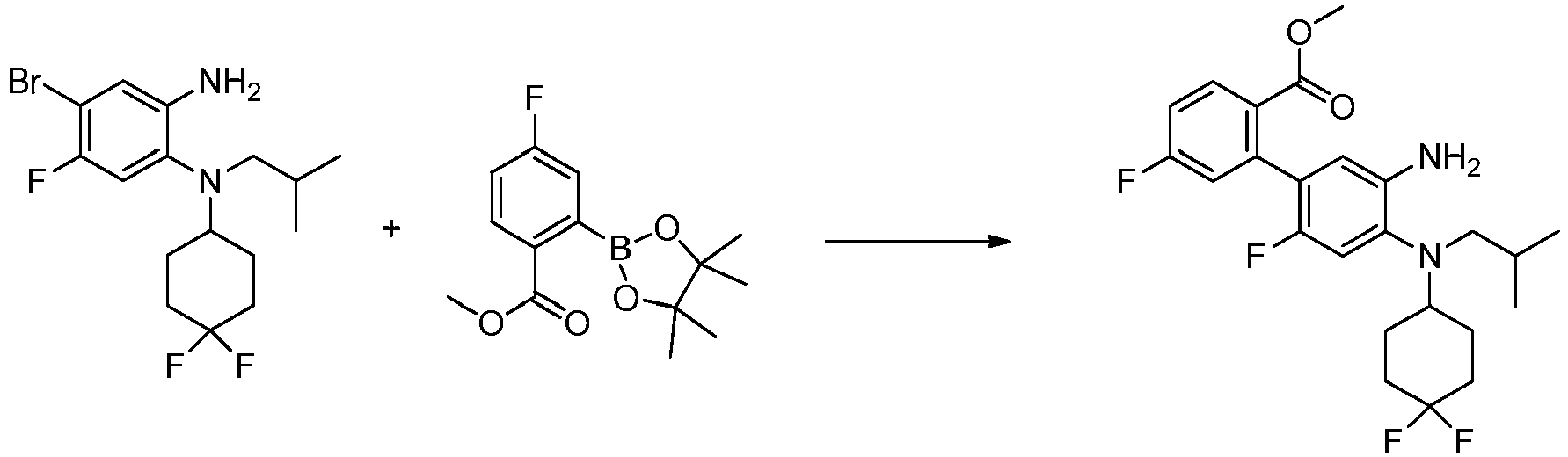
- To a stirred solution of 4-bromo-N1-(4,4-difluorocyclohexyl)-5-fluoro-N1-isobutylbenzene-1,2-diamine (305 mg, 0.804 mmol) in dry dioxane (5mL) was added methyl 4-fluoro-2-(4,4,5,5-tetramethyl-1,3,2-dioxaborolan-2-yl)benzoate (270 mg, 0.965 mmol) and potassium phosphate (512 mg, 2.413 mmol). The reaction was purged with argon for 15 minutes and then PdCl2(dppf) (118 mg, 0.161 mmol) was added. The reaction was purged with argon for another 5 minutes. The reaction was sealed and heated to 80°C overnight. The cooled reaction mixture was concentrated in vacuo to remove volatiles before being redissolved in ethyl acetate. The mixture was washed sequentially with water, then brine, before being dried over sodium sulfate, filtered and evaporated to afford a dark brown oil (928.9 mg). The crude product was purified on an Isco CombiFlash System using a 40 g silica gel column. The product was eluted with a gradient of 0-50% ethyl acetate in hexanes. Evaporation of the appropriate fractions gave the desired product as an oil (224.3 mg). MS(ES): m/z = 453 [M+H]+.
-

- A reaction vial was charged with methyl 5'-amino-4'-((4,4-difluorocyclohexyl)(isobutyl)amino)-2',5-difluoro-[1,1'-biphenyl]-2-carboxylate (37 mg, 0.082 mmol) in anhydrous tetrahydrofuran (2 mL). 4-Nitrophenyl chloroformate (18.13 mg, 0.090 mmol) was added followed by triethylamine (0.23 mL, 1.650 mmol). After 40 minutes, 5-methylisoxazol-3-amine (64.2 mg, 0.654 mmol) was added and the reaction warmed to 50°C. The reaction was stirred overnight. LCMS suggests partial conversion to product. The reaction was quenched with water and then extracted twice with ethyl acetate. The combined organic extracts were washed with brine and then concentrated in vacuo to afford a gold-yellow residue. This material was resubjected to the reaction conditions. The cooled reaction was quenched with water and extracted twice with ethyl acetate. The combined organic layers were washed with brine and concentrated in vacuo to afford a yellow residue (49 mg). LCMS is consistent with the presence of the expected product. To a homogeneous mixture of methyl 4'-((4,4-difluorocyclohexyl)(isobutyl) amino)-2',5-difluoro-5'-(3-(5-methylisoxazol-3-yl)ureido)-[1,1'-biphenyl]-2-carboxylate (47.1 mg, 0.082 mmol) in anhydrous tetrahydrofuran (2 mL), methanol (2 mL) and water (1 mL) was added lithium hydroxide (19.56 mg, 0.817 mmol). The mixture was stirred for 21 hours. The reaction was concentrated in vacuo to remove volatiles then treated with 2 mL of water. 1 N hydrochloric acid was then added until the pH was ca.4. The resulting mixture was extracted twice with ethyl acetate and the combined organic extracts were washed with brine then concentrated in vacuo to afford the crude product.The residue was redissolved in 1.5mL DMF and passed through a syringe filter. The crude material was purified via preparative LCMS with the following conditions: Column: Waters XBridge C18, 19 x 150 mm, 5-µm particles; Guard Column: Waters XBridge C18, 19 x 10 mm, 5-µm particles; Mobile Phase A: 5:95 acetonitrile:water with 10-mM ammonium acetate; Mobile Phase B: 95:5 acetonitrile:water with 10-mM ammonium acetate; Gradient: 15-100% B over 15 minutes, then a 5-minute hold at 100% B; Flow: 20 mL/min. Fractions containing the desired product were combined and dried via centrifugal evaporation. The yield of the product was 17.6 mg, MS(ES): m/z = 563 [M+H]+ HPLC Tr: 1.88k. 1H NMR (500MHz, DMSO-d6) δ 10.44 (br. s., 1H), 8.84 (br. s., 1H), 8.24 - 8.07 (m, 1H), 7.94 - 7.73 (m, 1H), 7.33 (t, J=8.2 Hz, 1H), 7.24 (d, J=9.4 Hz, 1H), 7.20 (d, J=11.4 Hz, 1H), 6.38 (br. s., 1H), 2.88 - 2.76 (m, 2H), 2.35 (d, J=3.0 Hz, 3H), 2.09 - 1.91 (m, 4H), 1.87 - 1.69 (m, 2H), 1.58 (q, J=12.2 Hz, 2H), 1.44 - 1.31 (m, 1H), 0.89 - 0.82 (m, 6H).
-

-

- To a stirred solution of 4-bromo-N1-(4,4-difluorocyclohexyl)-5-fluoro-N1-isobutylbenzene-1,2-diamine (150 mg, 0.396 mmol) in dry dioxane (3 mL) was added methyl 4-fluoro-2-(4,4,5,5-tetramethyl-1,3,2-dioxaborolan-2-yl)benzoate (133 mg, 0.475 mmol), followed by potassium phosphate (252 mg, 1.187 mmol). The reaction mixture was purged with argon for 15 minutes before adding PdCl2(dppf) (57.9 mg, 0.079 mmol). The reaction mixture was again purged with argon for another 5 minutes before the reaction was equipped with a Vigreaux column and heated to 80°C under an argon atmosphere. After heating for 5 hour, LCMS suggests partial conversion to product. Reaction was again purged with argon for 15min before 62.5 mg of the boronate reagent and 49 mg of the Pd catalyst were added. Argon was bubbled through the reaction mixture for 5 minutes before heating again at 80°C. The reaction was stirred overnight. Reaction was cooled to room temperature and diluted with ethyl acetate. The mixture was washed sequentially with water then brine. The organic phase was dried over sodium sulfate, filtered and concentrated in vacuo to afford a dark brown oil (528.3 mg). The crude product was purified on an Isco CombiFlash System using a 24 g silica gel column. The product was eluted with a gradient of 0-50% ethyl acetate in hexanes. Evaporation of the appropriate fractions gave the desired product (53 mg). MS(ES): m/z = 453 [M+H]+.
-

- To a solution of methyl 5'-amino-4'-((4,4-difluorocyclohexyl)(isobutyl)amino)-2',5-difluoro-[1,1'-biphenyl]-2-carboxylate (52.8 mg, 0.117 mmol) in anhydrous tetrahydrofuran (2 mL) was added 1-isocyanato-4-methylbenzene (21.75 mg, 0.163 mmol). The mixture was warmed to 50 °C under nitrogen atmosphere. After 2 hours, heating was stopped and the reaction allowed to stir at room temperature overnight.The reaction was partitioned between water and ethyl acetate. The layers were separated and the aqueous layer was extracted twice more with ethyl acetate. The combined organic extracts were washed once each with water and brine. The organic layer was dried over sodium sulfate, filtered and evaporated to afford a dark brown residue (106.6 mg). The crude product was purified on Isco CombiFlash System using a 12 g silica gel column. The product was eluted with a gradient of 0-100% ethyl acetate in hexanes. Evaporation of the appropriate fractions gave the desired product as a colorless glass (56 mg). MS(ES): m/z = 586 [M+H]+.
-

- To a homogeneous mixture of methyl 4'-((4,4-difluorocyclohexyl)(isobutyl)amino)-2',5-difluoro-5'-(3-(p-tolyl)ureido)-[1,1'-biphenyl]-2-carboxylate (56.0 mg, 0.096 mmol) in anhydrous tetrahydrofuran (1 mL), methanol (1 mL) and water (0.5 mL), at room temperature under nitrogen, was added lithium hydroxide (22.90 mg, 0.956 mmol). The reaction was stirred overnight. The reaction was concentrated in vacuo to remove volatiles then treated with 2 mL of water. Hydrochloric acid (1N) was then added until ca. pH 4. The resulting mixture was extracted twice with ethyl acetate and the combined organic extracts were washed with brine. Evaporation then afforded a glassy residue. The crude product was purified on an Isco CombiFlash System using a 12 g silica gel column. The product was eluted with a gradient of 0-100% ethyl acetate in hexanes. Appropriate fractions containing expected product peak were combined and concentrated to remove volatiles then lyophilized to afford a white solid (21.1mg). MS(ES): m/z = 572 [M+H]+, HPLC Tr: 12.97g. 1H NMR (400MHz, DMSO-d6) δ 12.79 (br. s., 1H), 9.45 (s, 1H), 8.10 (d, J=8.4 Hz, 1H), 8.00 - 7.87 (m, 2H), 7.46 - 7.32 (m, 3H), 7.25 (dd, J=9.6, 2.5 Hz, 1H), 7.16 (d, J=11.4 Hz, 1H), 7.10 (d, J=8.4 Hz, 2H), 2.96 - 2.78 (m, 3H), 2.26 (s, 3H), 2.14 - 1.93 (m, 4H), 1.93 - 1.68 (m, 2H), 1.65 - 1.50 (m, 2H), 1.42 (dquin, J=13.2, 6.7 Hz, 1H), 0.88 (d, J=6.6 Hz, 6H).
-

- Example 520 was prepared using the chemistry described for Example 518. MS(ES): m/z = 630 [M+H]+, HPLC Tr: 2.13k. 1H NMR (500MHz, DMSO-d6) δ 9.54 (br. s., 1H), 8.17 (s, 1H), 8.01 - 7.88 (m, 4H), 7.53 (s, 1H), 7.35 (td, J=8.5, 2.7 Hz, 1H), 7.26 (dd, J=9.4, 2.5 Hz, 1H), 7.18 (d, J=11.4 Hz, 1H), 5.06 (q, J=9.2 Hz, 2H), 2.88 - 2.78 (m, 3H), 2.14 - 1.92 (m, 4H), 1.91 - 1.71 (m, 2H), 1.62 - 1.47 (m, 2H), 1.38 (dquin, J=13.3, 6.6 Hz, 1H), 0.86 (d, J=6.9 Hz, 6H).
-

- Example 521 was prepared using the chemistry described for Example 518. MS(ES): m/z = 675 [M+H]+, HPLC Tr: 2.12k. 1H NMR (500MHz, DMSO-d6) δ 11.29 (br. s., 1H), 8.28 (br. s., 1H), 8.09 (dd, J=8.2, 3.2 Hz, 1H), 7.99 - 7.90 (m, 2H), 7.40 - 7.32 (m, 1H), 7.27 (d, J=8.9 Hz, 1H), 7.22 (d, J=11.4 Hz, 1H), 2.82 (br. s., 3H), 2.16 (d, J=3.5 Hz, 3H), 2.09 - 1.94 (m, 4H), 1.90 - 1.71 (m, 2H), 1.61 - 1.47 (m, 2H), 1.43 - 1.30 (m, 1H), 0.91-0.80 (m, 6H)
-

-

- A solution of cyclohexanamine (3.65 g, 36.8 mmol) in anhydrous tetrahydrofuran (30 mL) was cooled to 0 °C under nitrogen. Triethylamine (5.60 mL, 40.1 mmol) was added. The mixture was stirred at 0 °C for 10 minutes before isobutyryl chloride (3.51 mL, 33.5 mmol) was added dropwise via syringe. The mixture was allowed to warm slowly to room temperature. After three days, the reaction was quenched with saturated sodium bicarbonate solution then extracted with four portions of methylene chloride. The combined organic extracts were washed with 1N hydrochloric acid and brine. The aqueous layer was further extracted with three portions of 5% MeOH/CHCl3. No product is apparent in aqueous layer, which was then discarded. The organic extracts were combined with the original organic layer and concentrated in vacuo to afford an off-white solid (5.43g). The crude product was purified on an Isco CombiFlash System using a 120 g silica gel column. The product was eluted with a gradient of 0-100% ethyl acetate in hexanes. Evaporation of the appropriate fractions gave the desired product as a colorless solid (5.05 g). 1H NMR (400MHz, CHLOROFORM-d) δ 5.28 (br. s., 1H), 3.92 - 3.60 (m, 1H), 2.32 (spt, J=6.9 Hz, 1H), 2.01 - 1.86 (m, 2H), 1.81 - 1.69 (m, 2H), 1.51 - 1.33 (m, 2H), 1.17 (d, J=6.8 Hz, 6H) (some resonances are obscured by the methyls of the isobutyl group).
-

- Lithium aluminum hydride (48 mL, 48.0 mmol, 1M in tetrahydrofuran) was slowly added to a solution of N-cyclohexylisobutyramide (4 g, 23.63 mmol) in anhydrous tetrahydroduran (100 mL) under nitrogen. The resulting solution was heated at 70 °C for 20 hours. The reaction mixture was cooled to room temperature then diluted with ether and cooled in an ice bath to 0°C. Water (2 mL) was slowly added to the reaction mixture followed by 15% aqueous sodium hydroxide (2 mL). Water (6mL) was then added and the reaction mixture was removed from the ice bath and allowed to warm to room temperature. The mixture was stirred for 15 minutes at room temperature before magnesium sulfate was added and the mixture stirred for another 15 minutes. The mixture was filtered through a fritted glass funnel to remove salts. The filtrate was transferred to a separatory funnel where the layers were separated. The aqueous layer was extracted twice more with ethyl acetate. The combined organic extracts were washed with water then brine. The organic phase was dried over magnesium sulfate, filtered and concentrated in vacuo to afford an oil (2.9573g). This material was used without purification. 1H NMR (400MHz, DMSO-d6) δ 2.52 (dt, J=3.6, 1.9 Hz, 1H), 2.33 (d, J=6.8 Hz, 2H), 1.88 - 1.75 (m, 2H), 1.73 - 1.63 (m, 2H), 1.62 - 1.48 (m, 2H), 1.27 - 1.09 (m, 4H), 1.06 - 0.93 (m, 2H), 0.87 (d, J=6.6 Hz, 6H).
-

- To a solution of 5-bromo-2,4-difluoronitrobenzene (1.806 g, 7.59 mmol) in anhydrous NMP (3 mL) was added diisopropylethylamine (3.98 mL, 22.77 mmol) followed by N-isobutylcyclohexanamine (1.2964 g, 8.35 mmol) in NMP (6 mL). The mixture was heated at 110 °C under nitrogen. After stirring for 19 hours, the reaction was allowed to cool to room temperature before being diluted with ether. The ether solution was washed twice with 1N hydrochloric acid. The organic layer was then washed twice with each saturated sodium bicarbonate solution then brine. The organic layer was dried over sodium sulfate, filtered and concentrated in vacuo to afford a dark residue (3.06g). The crude product was purified on an Isco CombiFlash System using a 80 g silica gel column. The product was eluted with a gradient of 0-100% ethyl acetate in hexanes. Evaporation of the appropriate fractions gave the desired product as a red-orange solid (2.30 g). 1H NMR (400MHz, CHLOROFORM-d) δ 7.99 (d, J=7.3 Hz, 1H), 6.89 (d, J=11.0 Hz, 1H), 2.97 - 2.90 (m, 1H), 2.89 (d, J=7.3 Hz, 2H), 1.91 - 1.77 (m, 4H), 1.71 (dt, J=13.5, 6.8 Hz, 1H), 1.67 - 1.58 (m, 1H), 1.50 - 1.38 (m, 2H), 1.34 - 1.18 (m, 2H), 1.16 - 1.02 (m, 1H), 0.92 (d, J=6.6 Hz, 6H). MS(ES): m/z = 373 [M+H]+.
-

- A solution of 4-bromo-N-cyclohexyl-5-fluoro-N-isobutyl-2-nitroaniline (1.116 g, 2.99 mmol) in ethanol (20 mL) and water (4.00 mL) was cooled to 0°C under nitrogen. Zinc (3.91 g, 59.8 mmol) and ammonium chloride (3.20 g, 59.8 mmol) were then added. The mixture was stirred at room temperature for an hour. The reaction mixture was filtered through a pad of Celite which was then thoroughly rinsed with chloroform. The combined organic filtrates were concentrated in vacuo to afford a waxy, gold residue (1.1283g). The sample was suspended in chloroform. The sample was filtered and the filtrate applied to a 40 g Isco silica gel column. The product was eluted with 0-100% ethyl acetate in hexanes. Only partial purification was achieved. Concentrate product containing fractions. The partially purified product was purified on Isco CombiFlash System using a 40 g silica gel column. The product was eluted with a gradient of 0-50% ethyl acetate in hexanes. Evaporation of the appropriate fractions gave the desired product as a gold oil (246 mg). 1H NMR (400MHz, DMSO-d6) δ 7.00 (d, J=10.8 Hz, 1H), 7.11 - 6.96 (m, 1H), 6.91 (d, J=7.3 Hz, 1H), 4.80 (s, 2H), 2.89 - 2.67 (m, 2H), 2.60 (tt, J=11.7, 3.2 Hz, 1H), 1.73 (br. s., 4H), 1.55 (d, J=9.9 Hz, 1H), 1.44 - 1.28 (m, 3H), 1.16 - 0.95 (m, 3H), 0.80 (d, J=6.6 Hz, 6H). MS(ES): m/z = 343 [M+H]+.
-

- To a stirred solution of 4-bromo-N1-cyclohexyl-5-fluoro-N1-isobutylbenzene-1,2-diamine (246 mg, 0.717 mmol) in dry dioxane (5 mL) was added methyl 4-fluoro-2-(4,4,5,5-tetramethyl-1,3,2-dioxaborolan-2-yl)benzoate (241 mg, 0.860 mmol), followed by potassium phosphate (456 mg, 2.150 mmol). The reaction was purged with argon for 15 minutes. PdCl2(dppf) (105 mg, 0.143 mmol) was added and purging with argon continued for 5 minutes. The reaction was then heated to 80°C. The reaction was heated for ca. 24 hours. The cooled reaction was evaporated then resuspended in ethyl acetate. The mixture was washed sequentially with water and then brine, The organic layer was dried over sodium sulfate, filtered and concentrated in vacuo to afford a dark brown residue (953.5mg). Purification was attenpted on a CombiFlash System using a 40 g Isco silica gel column. The column was eluted with a gradient of 0-100% ethyl acetate in hexanes. As only partial purification was achieved the material was purified a second time on the Isco CombiFlash System using a 24 g silica gel column. The product was eluted with a 0-50% ethyl acetate in hexanes gradient. Evaporation of the appropriate fractions gave the desired product as an oil (144.7 mg). 1H NMR (400MHz, DMSO-d6) δ 7.88 (dd, J=8.7, 6.1 Hz, 1H), 7.34 (td, J=8.5, 2.6 Hz, 1H), 7.28 (dd, J=9.9, 2.6 Hz, 1H), 6.87 (d, J=12.1 Hz, 1H), 6.67 (d, J=7.9 Hz, 1H), 4.65 (s, 2H), 3.60 (s, 3H), 2.78 (br. s., 2H), 2.75 - 2.64 (m, 1H), 1.77 (t, J=11.1 Hz, 4H), 1.58 (d, J=10.6 Hz, 1H), 1.49 - 1.35 (m, 3H), 1.19 - 1.00 (m, 3H), 0.84 (d, J=6.6 Hz, 6H)
- The rest of the preparation was accomplished as in Example 518. MS(ES): m/z = 538 [M+H]+, HPLC Tr: 1.82j. 1H NMR (500MHz, DMSO-d6) δ 10.32 (br. s., 1H), 8.09 (d, J=8.4 Hz, 1H), 7.91 (dd, J=8.7, 6.2 Hz, 1H), 7.63 (br. s., 1H), 7.51 (d, J=9.4 Hz, 1H), 7.33 (td, J=8.4, 2.5 Hz, 1H), 7.26 (dd, J=9.7, 2.2 Hz, 1H), 7.11 (d, J=11.9 Hz, 1H), 2.84 (d, J=6.4 Hz, 2H), 2.69 (t, J=11.6 Hz, 1H), 2.53 (s, 3H), 2.00 - 1.87 (m, 2H), 1.67 (d, J=9.4 Hz, 2H), 1.52 (br. s., 1H), 1.44 (dt, J=13.4, 6.7 Hz, 1H), 1.40 - 1.27 (m, 2H), 1.14 - 0.97 (m, 3H), 0.86 (d, J=6.4 Hz, 6H).
-

- Example 523 was prepared using the chemistry described for Example 522. MS(ES): m/z = 604 [M+H]+, HPLC Tr: 2.78k. 1H NMR (500MHz, DMSO-d6) δ 9.41 (s, 1H), 7.97 (d, J=8.4 Hz, 1H), 7.91 (dd, J=8.7, 6.2 Hz, 1H), 7.80 (s, 1H), 7.36 (d, J=8.9 Hz, 2H), 7.34 - 7.29 (m, 1H)(partially obscured), 7.25 (dd, J=9.4, 2.5 Hz, 1H), 7.13 (d, J=8.4 Hz, 2H), 7.07 (d, J=11.4 Hz, 1H), 2.81 (d, J=5.9 Hz, 2H), 2.66 - 2.57 (m, 1H), 2.47 - 2.39 (m, 1H), 1.87 (d, J=10.9 Hz, 2H), 1.81 - 1.66 (m, 7H), 1.53 (d, J=11.4 Hz, 1H), 1.46 - 1.17 (m, 8H), 1.16 - 0.95 (m, 3H).
-

- Example 524 was prepared using the chemistry described for Example 522. MS(ES): m/z = 607 [M+H]+, HPLC Tr: 2.04k. 1H NMR (500MHz, DMSO-d6) δ 9.23 (br. s., 1H), 8.00 (d, J=8.4 Hz, 1H), 7.91 (dd, J=8.9, 5.9 Hz, 1H), 7.74 (s, 1H), 7.39 - 7.33 (m, 1H), 7.31 (d, J=8.9 Hz, 2H), 7.25 (dd, J=9.7, 2.7 Hz, 1H), 7.07 (d, J=11.4 Hz, 1H), 6.90 (d, J=8.9 Hz, 2H), 3.79 - 3.69 (m, 4H), 3.08 - 3.00 (m, 4H), 2.79 (d, J=5.0 Hz, 2H), 2.59 (t, J=11.4 Hz, 1H), 1.84 (d, J=9.9 Hz, 2H), 1.71 (d, J=12.4 Hz, 2H), 1.53 (d, J=11.4 Hz, 1H), 1.39 (dquin, J=13.3, 6.6 Hz, 1H), 1.32 - 1.19 (m, 2H), 1.16 - 0.95 (m, 3H), 0.85 (d, J=6.4 Hz, 6H).
-

- Example 525 was prepared using the chemistry described for Example 522. MS(ES): m/z = 538 [M+H]+, HPLC Tr: 2.28k. 1H NMR (500MHz, DMSO-d6) δ 10.24 (s, 1H), 8.59 (br. s., 1H), 8.16 - 8.08 (m, 2H), 7.98 - 7.88 (m, 2H), 7.35 (td, J=8.4, 2.5 Hz, 1H), 7.29 (dd, J=9.7, 2.7 Hz, 1H), 7.13 (d, J=11.4 Hz, 1H), 2.86 (d, J=5.4 Hz, 2H), 2.71 - 2.61 (m, 1H), 2.43 (s, 3H), 1.87 (d, J=10.9 Hz, 2H), 1.67 (d, J=12.4 Hz, 2H), 1.52 (d, J=10.9 Hz, 1H), 1.43 (dquin, J=13.4, 6.7 Hz, 1H), 1.37 - 1.25 (m, 2H), 1.13 - 0.96 (m, 3H), 0.87 (d, J=6.4 Hz, 6H).
-

-

- 4-bromo-N,N-diisobutyl-2-nitroaniline (20 g, 60.7 mmol)(lA), 5,5,5',5'-tetramethyl-2,2'-bi(1,3,2-dioxaborinane) (15.09 g, 66.8 mmol), PdCl2(dppf)-CH2Cl2 adduct (1.111 g, 1.519 mmol) and potassium acetate (17.89 g, 182 mmol) were combined in a round bottom flask. Dimethylsulfoxide (200 mL) was added and the flask evacuated and back-filled with nitrogen 3 times. The reaction was then heated at 80 °C for 8 h. The reaction was cooled to room temperature, divided in half, and passed through a two short silica gel plugs. The silica gel was rinsed with hexane/ethyl acetate (4:1) (3x100mL). After removal of the solvent, the crude product was purified on a 750 g RediSep silica gel column using a 0-10% ethyl acetate in hexanes gradient. 4-(5,5-Dimethyl-1,3,2-dioxaborinan-2-yl)-N,N-diisobutyl-2-nitroaniline (22.17 g) was obtained as a yellow/orange oil. 1H NMR (400MHz, CHLOROFORM-d) δ 8.15 (d, J=1.5 Hz, 1H), 7.75 (dd, J=8.4, 1.5 Hz, 1H), 7.06 (d, J=8.6 Hz, 1H), 3.76 (s, 4H), 3.09 - 2.89 (m, 4H), 1.95 (dquin, J=13.5, 6.8 Hz, 2H), 1.03 (s, 6H), 0.85 (d, J=6.6 Hz, 12H).
-

- A 20 mL vial was charged with 4-(5,5-dimethyl-1,3,2-dioxaborinan-2-yl)-N,N-diisobutyl-2-nitroaniline (300 mg, 0.828 mmol), methyl 2-bromo-4-methylbenzoate (158 mg, 0.690 mmol) and cesium carbonate (675 mg, 2.070 mmol). The vial was sealed, evacuated, and back-filled with argon (x3). Dioxane-water (3:1, 3.0 mL) was then added and the mixture purged again with argon. PdCl2(dppf)-CH2Cl2 adduct (56.4 mg, 0.069 mmol) was added and the reaction vial then sealed and heated at 100 °C. The reaction was heated for ca. 5 hours. The cooled reaction was transferred to a separatory funnel and diluted with ethyl acetate. The organic layer was washed with water. The layers were separated and the aqueous layer was extracted twice more with ethyl acetate. The combined organic extracts were washed with water then brine. The organic layer was dried over sodium sulfate, filtered and concentrated in vacuo to afford a dark brown residue (637mg). The crude product was purified on Isco CombiFlash System using a 12 g silica gel column. The product was eluted with a gradient of 0-100% ethyl acetate in hexanes. Evaporation of the appropriate fractions gave the desired product as a viscous orange red oil (292.5 mg).
1H NMR (400MHz, CHLOROFORM-d) δ 7.82 (d, J=7.9 Hz, 1H), 7.73 (d, J=2.2 Hz, 1H), 7.33 (dd, J=8.6, 2.2 Hz, 1H), 7.28 - 7.23 (m, 1H), 7.22 - 7.19 (m, 1H), 7.15 (d, J=8.8 Hz, 1H), 3.69 (s, 3H), 3.00 (d, J=7.0 Hz, 4H), 2.45 (s, 3H), 2.05 - 1.92 (m, 2H), 0.90 (d, J=6.6 Hz, 12H). -

- To a solution of methyl 4'-(diisobutylamino)-5-methyl-3'-nitro-[1,r-biphenyl]-2-carboxylate (275 mg, 0.690 mmol) in ethanol (3.5 mL) and water (0.5 mL), at 0°C under nitrogen, was added zinc (271 mg, 4.14 mmol) and ammonium chloride (221 mg, 4.14 mmol). The mixture was stirred at room temperature for 4 hours then placed in refrigerator overnight. The reaction was filtered through a pad of Celite which was then thoroughly rinsed with chloroform. The filtrate was concentrated in vacuo to afford an oily residue (313.3 mg). The crude product was purified on Isco CombiFlash System using a 12 g silica gel column. The product was eluted with a gradient of 0-100% ethyl acetate in hexanes. Evaporation of the appropriate fractions gave the desired product as an amber oil (150.1 mg). 1H NMR (400MHz, CHLOROFORM-d) δ 7.69 (d, J=7.7 Hz, 1H), 7.23 (d, J=1.1 Hz, 1H), 7.21 - 7.15 (m, 1H), 7.08 (d, J=7.9 Hz, 1H), 6.72 (d, J=2.0 Hz, 1H), 6.65 (dd, J=8.0, 2.1 Hz, 1H), 4.24 - 4.16 (m, 2H), 3.62 (s, 3H), 2.68 (d, J=7.3 Hz, 4H), 2.43 (s, 3H), 1.82 (dquin, J=13.5, 6.8 Hz, 2H), 0.96 (d, J=6.6 Hz, 12H).
- The rest of the preparation was accomplished as in Example 519. MS(ES): m/z = 492 [M+H]+, HPLC Tr: 2.11k. 1H NMR (500MHz, DMSO-d6) δ 9.38 (br. s., 1H), 8.16 (d, J=4.0 Hz, 1H), 8.05 - 7.94 (m, 1H), 7.90 (d, J=2.0 Hz, 1H), 7.58 (dd, J=7.4, 4.5 Hz, 1H), 7.30 - 7.09 (m, 5H), 7.08 - 6.99 (m, 1H), 6.97 - 6.87 (m, 1H), 2.73 (d, J=2.0 Hz, 4H), 2.38 (d, J=3.5 Hz, 3H), 1.79 - 1.64 (m, 2H), 0.96 - 0.81 (m, 12H).
-

- Example 527 was prepared using the procedures described for Example 526. MS(ES): m/z = 526 [M+H]+, HPLC Tr: 2.20k
-

- Example 528 was prepared using the procedures described for Example 526. MS(ES): m/z = 510 [M+H]+ HPLC Tr: 2.16k. 1H NMR (500MHz, METHANOL-d4) δ 7.94 (d, J=2.0 Hz, 1H), 7.78 (td, J=8.9, 5.9 Hz, 1H), 7.66 (d, J=7.9 Hz, 1H), 7.60 (s, 1H), 7.20 - 7.13 (m, 2H), 7.02 (dd, J=8.4, 2.0 Hz, 1H), 6.95 - 6.79 (m, 2H), 2.70 (d, J=7.4 Hz, 4H), 2.40 (s, 3H), 1.78 (dquin, J=13.4, 6.7 Hz, 2H), 0.91 (d, J=6.4 Hz, 12H).
-

- Example 529 was prepared using the procedures described for Example 526. MS(ES): m/z = 518 [M+H]+, HPLC Tr: 2.14k. 1H NMR (500MHz, METHANOL-d4) δ 8.02 (d, J=2.0 Hz, 1H), 7.68 (d, J=7.9 Hz, 1H), 7.60 (s, 1H), 7.29 (d, J=8.9 Hz, 2H), 7.25 (s, 1H), 7.18 (d, J=7.9 Hz, 1H), 7.15 (d, J=8.4 Hz, 1H), 6.98 (dd, J=8.4, 2.0 Hz, 1H), 6.89 - 6.80 (m, 2H), 4.02 (q, J=6.9 Hz, 2H), 2.64 (d, J=6.9 Hz, 4H), 2.40 (s, 3H), 1.72 (dquin, J=13.5, 6.7 Hz, 2H), 1.40 (t, J=6.9 Hz, 3H), 0.86 (d, J=6.4 Hz, 12H).
-

- Example 530 was prepared using the procedures described for Example 526. MS(ES): m/z = 488 [M+H]+, HPLC Tr: 2.16k, 1H NMR (500MHz, DMSO-d6) δ 9.39 (s, 1H), 8.00 (d, J=2.0 Hz, 1H), 7.90 (s, 1H), 7.58 (d, J=7.4 Hz, 1H), 7.36 (d, J=8.4 Hz, 2H), 7.22 (dd, J=7.7, 3.7 Hz, 2H), 7.18 (s, 1H), 7.09 (d, J=8.4 Hz, 2H), 6.90 (dd, J=7.9, 2.0 Hz, 1H), 2.71 (d, J=6.9 Hz, 4H), 2.38 (s, 3H), 2.25 (s, 3H), 1.70 (dquin, J=13.3, 6.6 Hz, 2H), 0.88 (d, J=6.4 Hz, 12H).
-

-

- To a solution of 4-bromo-N1-(4,4-difluorocyclohexyl)-5-fluoro-N1-isobutylbenzene-1,2-diamine (60 mg, 0.158 mmol)(Intermediate 518D) in anhydrous tetrahydrofuran (1mL) was added 3,4-(methylenedioxy)phenyl isocyanate (43.9 mg, 0.269 mmol). The tube was sealed and the resulting mixture was heated at 50 °C for 0.5 hour and then allowed to stir at room temperature overnight. The crude product was purified on an Isco CombiFlash System using a 24 g silica gel column. The product was eluted with a gradient of 0-50% ethyl acetate in hexanes. Evaporation of the appropriate fractions gave the desired product as a glass (71.2 mg). MS(ES): m/z = 542 [M+H]+.
-

- To a stirred solution of 1-(benzo[d][1,3]dioxol-5-yl)-3-(5-bromo-2-((4,4-difluorocyclohexyl)(isobutyl)amino)-4-fluorophenyl)urea (35.6 mg, 0.066 mmol) in argon-purged dimethylformamide (1 mL) was added 2-borono-4-fluorobenzoic acid (24.14 mg, 0.131 mmol), followed by potassium carbonate (0.219 mL, 0.328 mmol, 1.5 M aqueous). The reaction was purged with argon for 15 minutes and then Pd(Ph3P)4 (7.58 mg, 6.56 µmol) was added. Purging with argon was continued for another 5 minutes. The vial was then capped vial and heated to 100°C. The reaction was heated for 2.25 hours then allowed to cool to room temperature. The reaction was treated with dropwise addition of glacial acetic acid until ca. pH 4, then diluted with 1.5 mL dimethylformamide. The reaction was filtered through an Acrodisc (13mm syringe filter with 0.45µm Nylon membrane) syringe filter. The crude material was purified via preparative LCMS with the following conditions: Column: Waters XBridge C18, 19 x 150 mm, 5-µm particles; Guard Column: Waters XBridge C18, 19 x 10 mm, 5-µm particles; Mobile Phase A: 5:95 acetonitrile:water with 10-mM ammonium acetate; Mobile Phase B: 95:5 acetonitrile:water with 10-mM ammonium acetate; Gradient: 20-100% B over 15 minutes, then a 5-minute hold at 100% B; Flow: 20 mL/min. Fractions containing the desired product were combined and dried via centrifugal evaporation to give the final product (7.2 mg). MS(ES): m/z = 602 [M+H]+, HPLC Tr: 2.18k, 1H NMR (500MHz, METHANOL-d4) δ 8.05 (d, J=7.9 Hz, 1H), 8.00 - 7.94 (m, 1H), 7.19 - 7.06 (m, 2H), 7.00 (s, 1H), 6.89 (d, J=11.4 Hz, 1H), 6.79 - 6.74 (m, 2H), 5.95 (s, 2H), 2.75 (d, J=6.4 Hz, 3H), 2.04 (br. s., 2H), 1.82 - 1.58 (m, 6H), 1.55 - 1.43 (m, 1H), 0.84 (d, J=6.4 Hz, 6H).
-

- Example 532 was prepared using the methodology shown for Example 531. MS(ES): m/z = 608 [M+H]+, HPLC Tr: 2.07k.
-

- Example 533 was prepared using the methodology shown for Example 531. MS(ES): m/z = 554 [M+H]+, HPLC Tr: 2.26k, 1H NMR (500MHz, METHANOL-d4) δ 8.08 - 8.02 (m, 1H), 7.93 (d, J=7.9 Hz, 1H), 7.58 - 7.53 (m, 1H), 7.48 - 7.40 (m, 2H), 7.28 (d, J=8.4 Hz, 2H), 7.14 (d, J=8.4 Hz, 2H), 6.88 (d, J=10.9 Hz, 1H), 2.75 (d, J=5.9 Hz, 3H), 2.32 (s, 3H), 2.09 - 1.99 (m, 2H), 1.81 - 1.56 (m, 6H), 1.50 (dquin, J=13.4, 6.7 Hz, 1H), 0.85 (d, J=6.4 Hz, 6H).
-

- Example 534 was prepared using the methodology shown for Example 531. MS(ES): m/z = 578 [M+H]+, HPLC Tr: 2.23k, 1H NMR (500MHz, METHANOL-d4) δ 7.86 (d, J=7.9 Hz, 1H), 7.79 (d, J=7.4 Hz, 1H), 7.68 - 7.62 (m, 1H), 7.60 - 7.56 (m, 1H), 7.55 - 7.49 (m, 1H), 7.30 (d, J=7.9 Hz, 2H), 7.14 (d, J=8.4 Hz, 2H), 6.74 (d, J=11.4 Hz, 1H), 2.83 - 2.68 (m, 3H), 2.32 (s, 3H), 2.11 - 2.01 (m, 2H), 1.81 - 1.57 (m, 6H), 1.46 (dquin, J= 13.4, 6.7 Hz, 1H), 0.84 (d, J=6.4 Hz, 6H).
-

-

- A scintillation vial was charged with 4-(5,5-dimethyl-1,3,2-dioxaborinan-2-yl)-N,N-diisobutyl-2-nitroaniline (300 mg, 0.828 mmol) (intermediate 526A) and methyl 2-bromo-6-methylbenzoate (158 mg, 0.690 mmol). Dioxane (3.00 mL) and water (1 mL) were then added. To this mixture was added cesium carbonate (675 mg, 2.070 mmol) and the resulting mixture was purged with argon for 15-20 min. To the reaction mixture was then added PdCl2(dppf)-CH2Cl2 adduct (56.4 mg, 0.069 mmol). The reaction mixture was purged with argon for 5 minutes more when the vial was sealed and warmed to 100 °C. After stirring overnight, the cooled reaction mixture was partitioned between ethyl acetate and water. The layers were separated and the aqueous layer was extracted twice more with ethyl acetate. The combined organic extracts were washed with water and then brine. The organic layer was dried over sodium sulfate filtered and concentrated in vacuo to afford a dark brown oil (428.0 mg). The crude product was purified on Isco CombiFlash System using a 24 g silica gel column. The product was eluted with a gradient of 0-100% ethyl acetate in hexanes. Evaporation of the appropriate fractions gave the desired product as an orange oil (244.2 mg). 1H NMR (400MHz, CHLOROFORM-d) δ 7.78 (d, J=2.4 Hz, 1H), 7.46 - 7.34 (m, 2H), 7.24 (dd, J=7.4, 5.0 Hz, 2H), 7.15 (d, J=8.6 Hz, 1H), 3.69 (s, 3H), 2.99 (d, J=7.3 Hz, 4H), 2.42 (s, 3H), 1.97 (dquin, J=13.5, 6.8 Hz, 2H), 0.89 (d, J=6.6 Hz, 12H).
-

- To a solution of methyl 4'-(diisobutylamino)-3-methyl-3'-nitro-[1,1'-biphenyl]-2-carboxylate (230.9 mg, 0.579 mmol) in ethanol (4.90 mL) and water (0.7 mL) under nitrogen, was added ammonium chloride (310 mg, 5.79 mmol). The mixture was stirred at room temperature for 10 min before zinc (379 mg, 5.79 mmol) was added. The reaction was stirred for 2 hours. The reaction was diluted with methylene chloride and filtered through a pad of Celite. The filtrate was concentrated in vacuo to afford an oily residue (206.7 mg). MS(ES): m/z = 369 [M+H]+.
-

- To a solution of methyl 3'-amino-4'-(diisobutylamino)-3-methyl-[1,1'-biphenyl]-2-carboxylate (34.4 mg, 0.093 mmol) in anhydrous tetrahydrofuran (2 mL) was treated with 4-nitrophenyl chloroformate (20.70 mg, 0.103 mmol). The mixture was stirred for ca. 2 hours. 5-Amino-3-methylisoxazole (73.3 mg, 0.747 mmol) and triethylamine (0.23 mL, 1.650 mmol) were added and the reaction warmed to 50 °C. After stirring overnight, the reaction was partitioned between water and ethyl acetate. The layers were separated and the aqueous layer was then extracted twice with ethyl acetate. These combined organic extracts were washed with brine. The organic layer was then concentrated in vacuo. The crude product was purified on an Isco CombiFlash System using a 12 g silica gel column. The product was eluted with a gradient of 0-100% ethyl acetate in hexanes. Evaporation of the appropriate fractions gave the desired product as a yellow solid (14.8 mg). MS(ES): m/z = 493 [M+H]+.
-

- To a homogeneous mixture of methyl 4'-(diisobutylamino)-3-methyl-3'-(3-(3-methylisoxazol-5-yl)ureido)-[1,1'-biphenyl]-2-carboxylate (14.8 mg, 0.030 mmol) in tetrahydrofuran (1 mL), methanol (1 mL) and water (0.5 mL) was added lithium hydroxide (7.20 mg, 0.300 mmol). The mixture was stirred at room temperature for a day. More lithium hydroxide (7.20 mg, 0.300 mmol) and water (0.5 mL) were added. The reaction was stirred for 3 days when the temperature was raised to 40°C. After ca. 5 hours, sodium hydroxide solution (0.060 mL, 0.300 mmol, 5 M) was added and the reaction heated at 50°C. After 4 hours, the reaction was allowed to cool to room temperature. The next morning the reaction was warmed to 70°C and stirred for 5 days. The reaction was allowed to stand for 16 days when LCMS analysis suggested the presence of some of the desired product. The reaction mixture was treated with glacial acetic acid until ca. pH 4. The acidified reaction mixture was diluted with 1.5 mL dimethylformamide before being filtered through an Acrodisc (13mm syringe filter with 0.45µm Nylon membrane) syringe filter. The crude material was purified via preparative LCMS with the following conditions: Column: Waters XBridge C18, 19 x 150 mm, 5-µm particles; Guard Column: Waters XBridge C18, 19 x 10 mm, 5-µm particles; Mobile Phase A: 5:95 acetonitrile:water with 10-mM
ammonium acetate; Mobile Phase B: 95:5 acetonitrile:water with 10-mM ammonium acetate; Gradient: 15-100% B over 15 minutes, then a 5-minute hold at 100% B; Flow: 20 mL/min. Fractions containing the desired product were combined and dried via centrifugal evaporation to give 0.8 mg of the desired product. MS(ES): m/z = 479 [M+H]+, HPLC Tr: 1.74k. -

- To a solution of 4-(5,5-dimethyl-1,3,2-dioxaborinan-2-yl)-N1,N1-diisobutylbenzene-1,2-diamine (80 mg, 0.241 mmol) (Intermediate 4B) in anhydrous tetrahydrofuran (2.5 mL) was added 1-isocyanato-4-methylbenzene (54.5 mg, 0.409 mmol). The tube was sealed and the resulting mixture was stirred at 50 °C. The reaction was heated overnight. The reaction was then cooled and the crude product was purified on an Isco CombiFlash System using a 12 g silica gel column. The product was eluted with a gradient of 0-100% ethyl acetate in hexanes. Evaporation of the appropriate fractions gave the desired product which was dried under vacuum overnight (107.4 mg). LCMS suggests presence of boronic acid (MS(ES): m/z = 479 [M+H]+). A portion of this material 1-(2-(diisobutylamino)-5-(5,5-dimethyl-1,3,2-dioxaborinan-2-yl)phenyl)-3-(p-tolyl)urea (26.8 mg, 0.058 mmol) was dissolved in argon-purged dimethylformamide (1 mL). 2-Bromo-6-methylbenzoic acid (24.76 mg, 0.115 mmol) was added followed by potassium carbonate (0.192 mL, 0.288 mmol, 1.5 M aqueous). Purging with argon was continued for 15 minutes when Pd(Ph3P)4 (6.65 mg, 5.76 µmol) was added. The reaction was purged with argon for 5 minutes, capped, and heated to 100°C. The reaction was heated for 4 hours and then allowed to cool to room temperature. The reaction was treated with a dropwise addition of glacial acetic acid until ca. pH 4, then diluted with dimethylformamide (1.5 mL). The reaction was passed through an Acrodisc (13mm syringe filter with 0.45µm Nylon membrane) syringe filter. The crude material was purified via preparative LCMS with the following conditions: Column: Waters XBridge C18, 19 x 250 mm, 5-µm particles; Guard Column: Waters XBridge C18, 19 x 10 mm, 5-µm particles; Mobile Phase A: 5:95 acetonitrile:water with 10-mM ammonium acetate; Mobile Phase B: 95:5 acetonitrile:water with 10-mM ammonium acetate; Gradient: 15-100% B over 25 minutes, then a5-minute hold at 100% B; Flow: 20 mL/min. Fractions containing the desired product were combined and dried via centrifugal evaporation to give 0.8 mg of the desired product. MS(ES): m/z = 488 [M+H]+. HPLC Tr: 2.13k,1H NMR (500MHz, METHANOL-d4) δ 8.04 (s, 1H), 7.33 - 7.25 (m, 4H), 7.22 - 7.15 (m, 2H), 7.14 - 7.05 (m, 3H), 2.65 (d, J=7.4 Hz, 4H), 2.42 (s, 3H), 2.30 (s, 3H), 1.73 (dquin, J=13.4, 6.7 Hz, 2H), 0.87 (d, J=6.4 Hz, 12H).
-

- Example 537was prepared using the procedures described for Example 531. MS(ES): m/z = 582 [M+H]+, HPLC Tr: 2.18k.
-

- Example 538 was prepared using the procedures described for Example 531. MS(ES): m/z = 576 [M+H]+. HPLC Tr: 1.93k.
-

- Example 539 was prepared using the procedures described for Example 531. MS(ES): m/z = 608 [M+H]+. HPLC Tr: 1.88k.
-

- Example 540 was prepared using the procedures described for Example 531. MS(ES): m/z = 602 [M+H]+. HPLC Tr: 1.96k.
-

-

- To a solution of 4-bromo-N1,N1-dicyclopropylbenzene-1,2-diamine (30 mg, 0.112 mmol) (Intermediate 509B) in anhydrous tetrahydrofuran (1mL), in a sealable tube, was added 1-isocyanato-4-methylbenzene (0.024 mL, 0.191 mmol). The tube was sealed and the resulting mixture was heated at 50 °C The reaction was heated for ca. 1.5 hour. The reaction was quenched with water then partitioned between ethyl acetate and brine. The layers were separated and the aqueous layer extracted twice more with ethyl acetate. The organic extracts were combined and concentrated in vacuo to afford a tan solid (60.8 mg). LCMS suggests the presence of the desired product and N,N'-ditoluylurea. Use this material directly in the next transformation.
-

- To a stirred solution of 1-(5-bromo-2-(dicyclopropylamino)phenyl)-3-(p-tolyl)urea (22.5 mg, 0.056 mmol) in argon-purged dimethylformamide (1 mL) was added 2-borono-4-fluorobenzoic acid (20.68 mg, 0.112 mmol), followed by an aqueous solution of potassium carbonate (0.187 mL, 0.281 mmol, 1.5 M). The reaction was purged with argon for 15 minutes then Pd(Ph3P)4 (6.49 mg, 5.62 µmol) was added. Purging with argon was continued for another 5 minutes when the vial was capped and heated to 100°C. Heating was continued for 6 hours when the reaction was allowed to cool to room temperature. After 3 days, the reaction was treated with the dropwise addition of glacial acetic acid until ca. pH 4. The reaction was then diluted with 1.5mL dimethylformamide and filtered through an Acrodisc (13mm syringe filter with 0.45 µm Nylon membrane) syringe filter. The crude material was purified via preparative LCMS with the following conditions: Column: Waters XBridge C18, 19 x 250 mm, 5-µm particles; Guard Column: Waters XBridge C18, 19 x 10 mm, 5-µm particles; Mobile Phase A: 5:95 acetonitrile:water with 10-mM ammonium acetate; Mobile Phase B: 95:5 acetonitrile:water with 10-mM ammonium acetate; Gradient: 15-100% B over 25 minutes, then a 5-minute hold at 100% B; Flow: 20 mL/min. Fractions containing the desired product were combined and dried via centrifugal evaporation. The yield of the product was 3.3 mg. MS(ES): m/z = 460 [M+H]+. HPLC Tr: 2.17k, 1H NMR (500MHz, METHANOL-d4) δ 8.11 (d, J=2.0 Hz, 1H), 7.80 (dd, J=8.4, 5.9 Hz, 1H), 7.27 (dd, J=7.9, 3.0 Hz, 3H), 7.16 (dd, J=9.9, 2.5 Hz, 1H), 7.13 (d, J=8.4 Hz, 2H), 7.07 (td, J=8.4, 2.5 Hz, 1H), 7.01 (dd, J=8.4, 2.0 Hz, 1H), 2.62 - 2.53 (m, 2H), 2.32 (s, 3H), 0.49 (d, J=5.9 Hz, 4H), 0.39 (br. s., 4H).
- Using the methods described herein, the following additional compounds of the invention were prepared.
Example No. Compound HPLC Tr (M+H)+ 542 
543 
2.14k 490 544 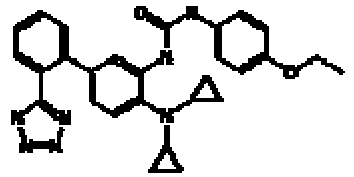
2.04k 496 545 
2.15k 518 - Exemplary compounds were tested for inhibition of IDO activity. Experimental procedures and results are provided below.
- Human IDO1/HEK293 cells were seeded at 10,000 cells per 50uL per well with RPMI/phenol red free media contains 10% FBS in a 384-well black wall clear bottom tissue culture plate (Matrix Technologies LLC) 125nL of certain concentration of compound was then added to each well using ECHO liquid handling systems. The cells were incubated for 20 hours in 37 °C incubator with 5% CO2.
- The compound treatments were stopped by adding Trichloroacetic Acid(Sigma-Aldrich) to a final concentration at 0.2%. The cell plate was further incubated at 50°C for 30 minute. The equal volume supernatant (20uL) and 0.2% (w/v) Ehrlich reagent (4-dimethylaminobenzaldehyde, Sigma-Aldrich) in glacial acetic acid were mixed in a new clear bottom 384-well plate. This plate was then incubated at room temperature for 30 minute. The absorbance at 490 nm was measured on Envision plate reader.
- Compound IC50 values were calculated using the counts of 500 nM of a reference standard treatment as one hundred percent inhibition, and counts of no compound but DMSO treatment as zero percent inhibition.
- Reagents:Hela cells (ATCC, CCL-2)
- IFNg (R&D, 28-IF-100)-- resuspend at 10 ug/mL in PBS with 0.1% BSA
- 30% TCA
- Ehrlich reagent (2% w/v p-dimethylaminobenzaldehyde in glacial acetic acid)
- Cell Titer 96 Aqueous Non-Radioactive Cell Proliferation Assay, MTS (Promega, Cat # G5430)
- Hela cancer cell lines were acquired from the American Type Culture Collection. Cells were maintained in phenol red free-RPMI1640 medium containing high glucose and L-glutamine (Invitrogen) supplemented with 10% fetal bovine serum (FBS; Invitrogen). Cell cultures were incubated at 37°C, 5% CO2, and 100% humidity.
- Hela cells were seeded on 96-well plates (40,000 cells per well) and allowed to adhere for 5-6 hours. Cells were then treated with vehicle (DMSO) or with IDO inhibitor at a top dose of 30µM (3-fold dilution all the way down to 1.5nM). A final concentration of 100 ng/mL of human recombinant IFN-γ (R&D, 28-IF-100) was immediately added to the cells to stimulate IDO expression. Treated cells were then incubated for 20 hours at 37°C. At the end of the 20h incubation, reactions were terminated by the addition of 30% TCA to each well. Plates were incubated for 30 minutes at 50°C to hydrolyze N-formylkynurenine to kynurenine. Cells were centrifuged 10 minutes at 2400 rpm. 100 ul of supernatants were transfered to new 96 flat well plates and mixed with 100 ul Ehrlich reagent. The resulting solution was incubated 10 minutes at RT. Absorbance at 490 nM was read using Spectra Max 384 (Molecular Devices).
- Results of the IDO assays are shown in the table below.
Ex. No. HEK human IDO-1 (IC50, uM) Hela Kyurenine (IC50, uM) LLE_IDO_ABS_DR (IC50, uM) 1 3.31E-03 1.37E-03 3.45E-03 2 0.02 0.09 3 0.01 0.06 4 0.08 5 4.05E-03 6 6.47E-03 7 0.02 8 0.18 9 0.35 10 0.10 11 0.25 12 0.22 13 0.06 0.03 14 0.10 0.08 15 0.09 16 0.02 0.01 17 0.27 18 0.63 19 0.04 0.02 20 0.13 21 0.15 22 0.03 23 0.45 24 0.01 25 0.03 26 0.37 27 2.55E-03 28 0.01 29 4.76E-03 30 5.19E-03 31 5.18E-03 32 2.54E-03 33 4.99E-03 34 4.01E-03 35 0.01 36 5.90E-03 37 0.01 0.04 38 1.78E-03 1.84E-03 39 2.37E-03 1.00E-03 40 0.01 3.79E-03 41 6.31E-03 1.78E-03 42 1.17 43 1.43 44 1.72E-03 7.93E-03 45 0.01 0.06 46 0.09 0.13 47 0.01 0.04 48 0.85 0.50 49 0.18 0.16 50 0.06 0.31 51 2.13 52 5.57E-03 0.01 53 7.72E-04 3.45E-03 54 0.08 0.30 55 0.11 0.23 56 3.12 3.59 57 0.22 0.27 58 0.06 0.10 59 0.01 0.02 60 0.14 0.14 61 0.70 0.51 62 2.28 4.12 63 0.12 64 0.29 65 3.70 66 0.03 67 0.35 68 0.56 69 0.89 70 0.11 71 1.74 72 0.85 73 0.15 74 5.77 75 3.24E-03 76 0.02 77 3.26 78 1.92 79 1.81E-03 80 8.75E-03 81 0.27 82 0.0038 83 0.02 84 2.11 85 1.65E-03 86 4.16E-03 87 3.68E-03 88 9.82E-03 89 0.05 90 0.01 91 0.06 92 0.02 93 0.08 94 9.24E-03 95 0.20 96 1.18 97 4.64 98 0.03 99 0.09 100 0.09 101 0.01 102 0.21 103 1.76 104 0.10 105 0.19 106 8.81E-03 107 1.86 108 0.25 109 0.41 110 0.04 111 0.21 112 0.03 113 0.40 114 0.16 115 0.35 116 2.34 117 0.01 118 4.76E-03 119 5.19E-03 120 0.03 121 2.59E-03 122 3.47E-03 123 0.02 124 5.18E-03 125 5.92E-03 126 0.01 0.02 127 0.08 0.13 128 0.39 129 9.53E-03 130 0.04 131 0.05 132 0.05 133 6.45E-03 134 0.03 135 0.02 136 0.07 137 5.24E-03 138 6.24E-03 139 1.98 140 2.96 141 0.43 142 0.95 143 0.15 144 0.01 145 0.08 146 0.01 147 0.01 148 0.04 149 0.06 150 0.06 0.04 151 4.62 152 0.77 153 5.16E-03 154 0.03 155 0.04 156 7.45E-03 157 0.02 158 0.03 159 0.98 160 0.19 161 0.24 162 1.27 163 1.03 164 5.40E-03 165 0.01 166 0.02 167 0.04 168 0.03 169 4.55E-03 170 5.68E-03 171 0.02 172 0.01 173 0.01 174 9.92E-03 175 4.36E-03 176 7.86E-03 177 9.59E-03 178 5.49E-03 179 0.05 180 0.23 181 0.27 182 0.05 183 0.02 184 0.01 185 2.63E-03 186 0.03 187 0.02 188 0.29 189 0.48 190 0.08 191 5.79E-03 192 7.82E-03 193 0.07 0.03 194 4.74E-03 195 4.79E-03 196 0.02 197 0.01 198 0.21 199 0.06 200 0.11 201 4.46E-03 202 0.01 203 7.31E-03 204 5.26E-03 205 0.02 206 0.60 207 0.13 208 0.05 209 0.56 210 0.21 211 0.11 0.49 212 0.20 1.27 213 6.56E-03 0.01 214 1.07E-03 2.36E-03 215 0.12 1.28 216 8.31E-04 8.35E-04 217 0.01 0.06 218 0.09 0.49 219 0.01 0.08 220 0.44 1.47 221 6.56E-03 9.05E-03 222 2.63E-03 0.01 223 0.16 0.42 224 0.44 0.64 225 2.52E-03 226 2.67E-03 227 2.91E-03 228 1.74E-03 229 2.56E-03 230 2.14E-03 231 2.13E-03 2.73E-03 232 0.66 233 0.81 234 9.37 235 0.79 236 2.14 237 1.29 238 0.75 239 3.86 240 2.23 241 0.02 242 4.72E-03 243 7.60E-04 244 9.30E-03 245 0.18 246 1.22 247 2.76 248 5.07 249 0.14 250 0.93 251 0.09 252 1.23 253 2.49 254 6.07 255 0.03 256 4.18 257 2.73E-03 258 0.09 259 2.44E-03 260 6.48E-03 261 4.31 262 0.19 263 7.97E-03 264 2.61E-03 266 4.49 267 1.46 268 0.83 269 0.25 270 1.83 271 1.01 272 2.72 273 0.18 274 0.46 275 0.50 276 0.78 277 0.16 278 1.31E-03 279 5.05 280 2.39 281 1.45 282 8.20E-03 283 0.01 284 2.09 285 2.28E-03 286 0.11 287 4.47E-03 288 9.12 289 1.21 290 0.05 0.03 291 1.83 0.09 292 4.03E-03 295 0.30 296 0.18 297 0.01 298 0.08 299 0.05 0.02 300 0.18 301 7.87E-03 2.85E-03 302 5.53E-03 3.26E-03 303 0.28 0.05 304 0.07 305 0.006 306 0.04 307 0.04 308 0.27 309 0.004 315 7.77 316 7.72 317 0.05 0.03 318 0.12 319 0.02 0.02 320 4.85E-03 321 0.61 322 0.22 0.06 323 0.54 324 0.16 325 0.09 326 1.33 327 0.26 328 0.39 329 4.03E-03 330 0.02 331 0.16 332 0.11 0.08 333 0.30 334 0.02 335 1.08 336 0.34 337 0.41 338 0.49 339 0.16 340 0.04 0.03 341 8.45E-04 1.73E-03 342 0.17 343 0.23 344 0.05 0.03 345 0.82 346 0.09 347 5.26 348 0.01 0.01 349 0.13 7.49E-03 350 0.25 351 0.35 352 0.22 0.09 353 2.37E-03 5.10E-03 354 0.12 355 3.29E-03 2.37E-03 356 4.06E-03 357 0.32 0.04 358 0.35 0.02 359 0.55 360 0.02 361 0.22 0.11 362 5.49 363 0.90 364 4.67 365 5.06 366 5.01 367 0.01 0.02 368 2.50 369 0.52 370 0.07 0.05 371 3.74 372 1.94 373 4.00 3.34 374 6.84 375 4.74 376 2.15E-03 377 1.68E-03 378 0.07 0.06 379 0.03 0.02 380 0.07 0.05 381 0.11 382 0.35 0.50 383 0.13 0.07 384 1.89 1.64 385 0.20 386 0.04 387 2.23 388 10.00 389 0.62 390 1.59 391 0.28 392 0.01 393 2.07E-03 394 7.90E-03 395 0.07 396 6.07E-03 397 0.01 398 9.69E-03 399 0.02 400 5.35E-03 401 1.18 402 4.83 403 2.32E-03 404 2.56 405 1.23 406 7.59E-03 407 3.11 408 0.01 409 0.11 410 0.05 411 0.05 412 0.06 413 1.96 414 8.45E-04 1.73E-03 415 0.13 416 0.10 417 1.89E-03 418 4.63E-03 419 5.08E-03 420 5.25 421 3.30 422 1.48 423 0.02 424 5.27E-03 425 0.01 426 8.85E-03 427 1.61E-03 428 1.84E-03 429 5.55E-03 430 6.06E-04 431 3.76E-03 432 1.82E-03 433 1.97E-03 434 3.70E-03 435 3.00E-03 436 1.16E-03 437 3.13E-03 438 1.67E-03 439 0.01 440 1.55E-03 441 1.14E-03 442 2.23E-03 443 0.01 444 3.21E-03 445 0.05 446 2.45E-03 447 0.06 448 1.56E-03 449 1.41E-03 450 5.47E-03 451 1.74E-03 452 6.61E-04 453 9.90E-03 454 2.35E-03 455 0.51 456 8.63E-04 457 0.37 458 0.14 459 7.09E-03 460 2.40E-03 461 4.24E-03 462 1.11E-03 463 0.02 464 0.79 465 0.20 466 1.74 467 0.01 468 0.08 469 0.72 470 0.19 471 0.04 472 9.13E-03 0.01 473 0.06 0.07 474 0.09 475 0.05 476 0.14 477 7.65E-03 478 0.01 479 3.80 480 1.84 481 1.84 482 0.04 0.02 483 7.33E-03 6.12E-03 484 0.01 2.50E-03 485 5.75E-03 486 0.03 487 1.05 488 3.46E-03 489 0.22 491 0.13 492 0.16 493 0.12 494 0.03 495 0.05 496 0.01 497 0.23 498 0.59 499 1.26 500 0.02 501 0.32 502 0.02 5.01E-03 503 0.01 2.24E-03 504 5.14E-03 4.00E-04 505 0.04 506 0.04 507 2.87 509 6.63 510 1.38E-03 511 8.10E-03 512 0.05 2.88E-03 513 0.01 514 0.02 0.01 515 4.22 516 0.05 517 0.07 518 0.02 519 6.91E-03 520 4.87 521 8.44E-03 522 1.22 523 5.52 524 2.72 525 0.09 526 0.24 527 0.04 528 0.16 529 0.39 530 0.30 531 0.02 532 4.82E-03 533 8.02E-03 534 3.05E-03 535 0.14 536 0.07 537 6.08E-03 538 0.01 539 0.0033 540 0.01 541 3.43 542 0.76 543 7.24 544 1.74 545 0.06
Claims (15)
- A compound of Formula (I)
 W is CR4 or N,V is CR5 or N, andY is CR6 or N;is optionally substituted aryl or optionally substituted 5- to 7-membered monocyclic heteroaryl;
 R1 is COOH, optionally substituted heterocyclyl, -NHSO2R20,
 R2 and R3 are independently H, halogen, optionally substituted C1-C6 alkyl, optionally substituted C1-C6 alkoxy or optionally substituted N(C1-C6 alkyl)2;R4, R5 and R6 are independently H, halogen, CN, OH, optionally substituted C1-C6 alkyl or optionally substituted C1-C6 alkoxy;R7 and R8 are independently H, optionally substituted C1-C6 alkyl, optionally substituted aryl, optionally substituted C1-C6 alkoxy, optionally substituted C3-C8 cycloalkyl, optionally substituted di-deutero-C1-C10-alkyl, optionally substituted C2-C10 alkynyl, optionally substituted 5- to 7-membered monocyclic heteroaryl, optionally substituted 8- to 10-membered bicyclic heteroaryl, optionally substituted aryl C1-C6 alkyl, arylsulfonyl, optionally substituted C2-C6 alkenyl, or optionally substituted C5-C8 cycloalkenyl,provided that only one of R7and R8 is H,or R7 and R8 are taken together with the nitrogen to which they are attached to form an optionally substituted 4- to 10-membered monocyclic or bicyclic heterocyclic ring, or an optionally substituted 5- to 7-membered monocyclic heteroaryl ring;R9 is optionally substituted aryl; optionally substituted C3-C8 cycloalkyl, optionally substituted C1-C6 alkyl, optionally substituted 5- to 7-membered monocyclic heterocyclo, optionally substituted 7- to 10-membered bicyclic heterocyclo, optionally substituted 5- to 7-membered monocyclic heteroaryl, optionally substituted 8- to 10-membered bicyclic heteroaryl, optionally substituted C1-C6 alkanoyloxy 5- to 7-membered monocyclic heteroaryl, R24CO-, optionally substituted C1-C6 alkoxy, optionally substituted aryloxy, optionally substituted C2-C6 alkenyl, optionally substituted C2-C6 alkynyl, or optionally substituted C5-C8 cycloalkenyl;R20 is optionally substituted C1-C6 alkyl, CH2CF3, CF3 or CF2CF3;R21 is optionally substituted C1-C6 alkyl or optionally substituted C3-C8 cycloalkyl;R22 is optionally substituted C1-C6 alkyl, optionally substituted C3-C8 cycloalkyl, optionally substituted C2-C6 alkenyl, or optionally substituted C2-C6 alkynyl;R23 is optionally substituted C1-C6 alkyl, optionally substituted C3-C8 cycloalkyl, optionally substituted C2-C6 alkenyl, or optionally substituted C2-C6 alkynyl;R24 is optionally substituted aryl-C1-C6-alkyl, optionally substituted C1-C6 alkylaryl, aryl-C1-C6-alkyl(hydroxy), or optionally substituted C1-C6 alkyl;and/or a stereoisomer, a tautomer or a pharmaceutically acceptable salt thereof.
 - The compound and/or stereoisomer, tautomer or pharmaceutically acceptable salt thereof as defined in Claim 1 wherein:W is CR4;V is CR5;Y is CR6 or N;R4 is H or halo;R5 is H or halo; andR6 is H or halo.
- The compound and/or stereoisomer, tautomer or pharmaceutically acceptable salt thereof as defined in Claim 1 whereinis phenyl or a 5- to 6-membered monocyclic heteroaryl.

- The compound and/or stereoisomer, tautomer or pharmaceutically acceptable salt thereof as defined in Claim 3 whereinis:


- The compound and/or stereoisomer, tautomer or pharmaceutically acceptable salt thereof as defined in Claim 1 wherein:R1 is COOH, optionally substituted heterocyclyl, -NHSO2R20,
 R2 is H, halogen, optionally substituted C1-C6 alkyl or
optionally substituted C1-C6 alkoxy; andR3 is H or C1-C6 alkyl. - The compound and/or stereoisomer, tautomer or pharmaceutically acceptable salt thereof as defined in Claim 5 wherein:R1 is COOH, optionally substituted heterocyclyl, -NHSO2CH3,
 where R21 is C1-C6 alkyl, C3-C8 cycloalkyl or CF3;R2 is H, CH3, C2H5, CH3O, CF3O, F, or Cl; andR3 is H, CH3, or C2H5.
 - The compound and/or stereoisomer, tautomer or pharmaceutically acceptable salt thereof as defined in Claim 1 wherein:R7 and R8 are independently optionally substituted C1-C6 alkyl, optionally substituted aryl, optionally substituted C1-C6 alkoxy, optionally substituted C3-C8 cycloalkyl, optionally substituted di-deutero-C1-C6-alkyl, optionally substituted C1-C6-alkylphenyl-C1-C6-alkyl, optionally substituted C2-C6 alkynyl, optionally substituted C3-C8-cycloalkyl-C1-C8-alkyl, optionally substituted C1-C6-alkoxy-C1-C6-alkyl, optionally substituted 5- to 6-membered monocyclic heteroaryl, optionally substituted 7- to 10-membered bicyclic heteroaryl, optionally substituted aryl C1-C6 alkyl, phenylsulfonyl, optionally substituted C2-C6 alkenyl, or 5- to 6-membered monocyclic heteroaryl-C1-C6-alkyl,or R7 and R8 are taken together with the nitrogen to which they are attached to form(a) a 7- to 10-membered bicyclic heterocyclic ring which is optionally substituted with a phenyl-C1-C6-alkyl group, or(b) a 5- to 7-membered monocyclic heterocyclic ring which is optionally substituted with 1 or 2 C1-C6 alkyl groups, phenyl, a C1-C6-alkyl-substituted 5- to 7-membered monocyclic heteroaryl, and/or 1 or 2 halo groups; or(c) a 5- to 7-membered monocyclic heteroaryl which is optionally substituted with a C1-C6 alkyl;R9 is optionally substituted aryl; optionally substituted C3-C8 cycloalkyl, optionally substituted C1-C6 alkyl, optionally substituted C1-C6 alkoxy, optionally substituted C1-C6 alkylaryl, optionally substituted C1-C6 alkoxyaryl, optionally substituted C3-C8 cycloalkyl C1-C6 alkyl, optionally substituted 5- to 7-membered monocyclic heterocyclo, optionally substituted 7- to 10-membered bicyclic heterocyclo, optionally substituted 5- to 6-membered monocyclic heteroaryl, optionally substituted 8- to 10-membered bicyclic heteroaryl, optionally substituted C1-C6 alkanoyloxy 5- to 7-membered monocyclic heteroaryl, optionally substituted aryloxy, optionally substituted C2-C6 alkenyl, optionally substituted C2-C6 alkynyl, or optionally substituted C5-C8 cycloalkenyl, C2-C6 alkynylaryl, C2-C6 alkynyloxyaryl, 5- to 6-membered heteroarylaryl, 5- or 6-membered heterocycloaryl, C3-C8 cycloalkylaryl or C1-C6 alkanoyl.
- A compound of Formula (II)
 Y is CR6 or N;is phenyl substituted with R1, and optionally substituted with R2 and/or R3 or
 is a 5- to 7-membered monocyclic heteroaryl substituted with R1, and optionally substituted with R2 and/or R3;
 R1 is COOH, optional substituted tetrazol-5-yl, -NHSO2R20,
 R20 is C1-C6 alkyl or CF3;R21 is C1-C6 alkyl, C3-C8 cycloalkyl or CF3;R2 is H,C1-C6 alkyl, halo, optionally substituted C1-C6-alkoxy or N(C1-C6 alkyl)2,R3 is H, C1-C6 alkyl, C1-C6 alkoxy, or halo;R4 is H, halo or C1-C6 alkyl;R5 is H, halo or C1-C6 alkyl;R6 is H or halo;R7 and R8 are independently H, optionally substituted C1-C6 alkyl, optionally substituted aryl, optionally substituted C3-C8 cycloalkyl, phenylsulfonyl, dideutero-C1-C6-alkyl, optionally substituted C3-C8-cycloalkyl-C1-C6-alkyl, optionally substituted aryl-C3-C6-alkyl, optionally substituted C2-C6 alkynyl, optionally substituted 5- to 7-membered monocyclic heterocyclo, optionally substituted 7- to 10-membered bicyclic heterocyclo, optionally substituted C1-C6-alkoxy-C1-C6-alkyl, 5- to 7-membered monocyclic heteroaryl-C1-C6-alkyl, C2-C6 alkenyl, or C5-C8 cycloalkenyl,provided that only one of R7 and R8 is H,and wherein the optional substituents on R7 and R8, where possible, are 1 or 2 groups independently selected from hydroxy, optionally substituted C1-C6 alkyl, optionally substituted C1-C6 alkoxy, halo, optionally substituted aryl, optionally substituted C3-C8 cycloalkyl, 5- to 7-membered monocyclic heteroaryl or 5- to 7-membered monocyclic heterocyclic;or R7 and R8 are taken together with the nitrogen to which they are attached to form an optionally substituted 5- to 7-membered monocyclic heterocyclo ring, an optionally substituted 7- to 10-membered bicyclic heterocyclo ring, an optionally substituted 5- to 7-membered monocyclic heteroaryl ring, an optionally substituted 5- to 7-membered monocyclic heteroaryl-substituted 5- to 7-membered monocyclic heterocyclo ring, or a C3-C8-cycloalkyl-C1-C6-alkyl-substituted 7- to 10-membered bicyclic heterocyclo ring;R9 is H, C1-C10 alkyl, aryl, optionally substituted phenyl, C1-C6 alkylphenyl, optinally substituted C1-C6 alkoxyphenyl, di-C1-C6-alkylphenyl, dihalo(C1-C6-alkyl)phenyl, C2-C6 alkynylphenyl, optionally substituted 5- to 7-membered monocyclic heteroaryl, 7- to 10-membered bicyclic heteroaryl, C3-C8 cycloalkyl, C3-C8-cycloalkyl-C1-C6-alkyl, C2-C6 alkynyloxyphenyl, C2-C6-alkynyl-C1-C6-alkoxyphenyl, 5- to 7-membered monocyclic heteroarylphenyl, di-C1-C6-alkylaminophenyl, C1-C6 alkylsulfonylaminophenyl, 5- to 7-membered monocyclic heterocyclophenyl, C3-C8 cycloalkyl optionally substituted phenyl, optionally substituted phenyl-C1-C6-alkylcarbonyl, phenyl-C1-C6-alkyl or C1-C6 alkylcarbonyl;and/or a pharmaceutically acceptable salt thereof, a tautomer thereof or stereoisomer thereof.
 - The compound and/or stereoisomer, tautomer or pharmaceutically acceptable salt thereof according to Claim 1 wherein the IC50 in the HEK Human IDO-1 assay is < 10 nM.
- A pharmaceutical composition comprising one or more compounds and/or a stereoisomer, a tautomer or a pharmaceutically acceptable salt thereof according to any of claims 1-9 and a pharmaceutically acceptable carrier or diluent.
- A compound and/or a stereoisomer, a tautomer or a pharmaceutically acceptable salt thereof according to any one of claims 1-9 for use in the treatment of cancer, viral infections, depression, organ transplant rejection or an autoimmune disease.
- The compound and/or stereoisomer, tautomer or pharmaceutically acceptable salt thereof for the use in the treatment of claim 11, wherein said cancer is selected from cancer of the colon, pancreatic cancer, breast cancer, prostate cancer, lung cancer, ovarian cancer, cervical cancer, renal cancer, cancer of the head and neck, lymphoma, leukemia and melanoma.
- A compound and/or a stereoisomer, a tautomer or a pharmaceutically acceptable salt thereof according to any one of claims 1-9 for use in a method for the treatment of cancer, viral infections, depression, organ transplant rejection or an autoimmune disease, in a patient comprising administering to said patient a therapeutically effective amount of a compound and/or a stereoisomer, a tautomer or pharmaceutically acceptable salt thereof according to any one of claims 1-9.
- The compound and/or stereoisomer, tautomer or pharmaceutically acceptable salt thereof for the use in the method according to Claim 13 further comprising administering to the patient a therapeutically effective amount of an anti-viral agent, a chemotherapeutic agent, an immunosuppressant, radiation, an anti-tumor vaccine, an antiviral vaccine, cytokine therapy and/or a tyrosine kinase inhibitor prior to, simultaneously with or after administration of the compound.
- A compound and/or a stereoisomer, a tautomer or a pharmaceutically acceptable salt thereof for use in a method of inhibiting activity of indoleamine 2,3-dioxygenase comprising contacting said indoleamine 2,3-dioxygenase with a compound and/or a stereoisomer, a tautomer or a pharmaceutically acceptable salt thereof according to any one of claims 1-9.
Applications Claiming Priority (2)
| Application Number | Priority Date | Filing Date | Title |
|---|---|---|---|
| US201361870371P | 2013-08-27 | 2013-08-27 | |
| PCT/US2014/052600 WO2015031295A1 (en) | 2013-08-27 | 2014-08-26 | Ido inhibitors |
Publications (2)
| Publication Number | Publication Date |
|---|---|
| EP3039020A1 EP3039020A1 (en) | 2016-07-06 |
| EP3039020B1 true EP3039020B1 (en) | 2017-07-19 |
Family
ID=51539339
Family Applications (1)
| Application Number | Title | Priority Date | Filing Date |
|---|---|---|---|
| EP14766038.5A Not-in-force EP3039020B1 (en) | 2013-08-27 | 2014-08-26 | Ido inhibitors |
Country Status (8)
| Country | Link |
|---|---|
| US (1) | US9758492B2 (en) |
| EP (1) | EP3039020B1 (en) |
| JP (1) | JP6371851B2 (en) |
| CN (1) | CN105658643B (en) |
| CA (1) | CA2921199A1 (en) |
| EA (1) | EA029981B1 (en) |
| MX (1) | MX2016002075A (en) |
| WO (1) | WO2015031295A1 (en) |
Families Citing this family (43)
| Publication number | Priority date | Publication date | Assignee | Title |
|---|---|---|---|---|
| HUE039339T2 (en) * | 2013-03-15 | 2018-12-28 | Bristol Myers Squibb Co | Inhibitors of indoleamine 2,3-dioxygenase (ido) |
| GB201311888D0 (en) | 2013-07-03 | 2013-08-14 | Glaxosmithkline Ip Dev Ltd | Novel compounds |
| GB201311891D0 (en) | 2013-07-03 | 2013-08-14 | Glaxosmithkline Ip Dev Ltd | Novel compound |
| CN105517999B (en) * | 2013-07-11 | 2019-06-28 | 百时美施贵宝公司 | IDO inhibitors |
| US20180228907A1 (en) | 2014-04-14 | 2018-08-16 | Arvinas, Inc. | Cereblon ligands and bifunctional compounds comprising the same |
| GB201419579D0 (en) * | 2014-11-03 | 2014-12-17 | Iomet Pharma Ltd | Pharmaceutical compound |
| MX2017012738A (en) * | 2015-04-03 | 2017-11-15 | Bristol Myers Squibb Co | Inhibitors of indoleamine 2,3-dioxygenase for the treatment of cancer. |
| CN108260355A (en) * | 2015-09-24 | 2018-07-06 | 葛兰素史克知识产权开发有限公司 | The conditioning agent of indole amine 2,3-dioxygenase |
| WO2017140272A1 (en) * | 2016-02-19 | 2017-08-24 | 正大天晴药业集团股份有限公司 | Tricyclic compound acting as immunomodulator |
| EP3416725A1 (en) | 2016-02-19 | 2018-12-26 | INSERM (Institut National de la Santé et de la Recherche Médicale) | Methods and pharmaceutical compositions for the treatment of obesity |
| WO2017192844A1 (en) * | 2016-05-04 | 2017-11-09 | Bristol-Myers Squibb Company | Inhibitors of indoleamine 2,3-dioxygenase and methods of their use |
| EP3452452A4 (en) * | 2016-05-04 | 2019-10-30 | Bristol-Myers Squibb Company | Inhibitors of indoleamine 2,3-dioxygenase and methods of their use |
| EP3452450A1 (en) * | 2016-05-04 | 2019-03-13 | Bristol-Myers Squibb Company | Inhibitors of indoleamine 2,3-dioxygenase and methods of their use |
| CA3023034A1 (en) | 2016-05-12 | 2017-11-16 | Glaxosmithkline Intellectual Property Development Limited | Modulators of indoleamine 2,3-dioxygenase |
| CN107556244B (en) * | 2016-07-01 | 2021-09-03 | 上海迪诺医药科技有限公司 | Fused ring compound, pharmaceutical composition and application thereof |
| WO2018036414A1 (en) * | 2016-08-23 | 2018-03-01 | 北京诺诚健华医药科技有限公司 | Fused heterocyclic derivative, preparation method therefor and medical use thereof |
| JP2019528301A (en) * | 2016-08-26 | 2019-10-10 | ブリストル−マイヤーズ スクイブ カンパニーBristol−Myers Squibb Company | Indoleamine 2,3-dioxygenase inhibitors and methods of use thereof |
| CN108017639B (en) * | 2016-11-01 | 2020-09-15 | 南京华威医药科技集团有限公司 | IDO inhibitor and preparation method and application thereof |
| WO2018119440A1 (en) | 2016-12-22 | 2018-06-28 | Calithera Biosciences, Inc. | Compositions and methods for inhibiting arginase activity |
| WO2018136437A2 (en) | 2017-01-17 | 2018-07-26 | Tesaro, Inc. | Compounds useful as inhibitors of indoleamine 2,3-dioxygenase and/or tryptophan dioxygenase |
| RU2764243C2 (en) | 2017-09-22 | 2022-01-14 | ДЖУБИЛАНТ ЭПИПЭД ЭлЭлСи | Heterocyclic compounds as pad inhibitors |
| CN111225915B (en) | 2017-10-18 | 2023-03-07 | 朱比兰特埃皮帕德有限公司 | Imidazopyridine compounds as PAD inhibitors |
| US11629135B2 (en) | 2017-11-06 | 2023-04-18 | Jubilant Prodell Llc | Pyrimidine derivatives as inhibitors of PD1/PD-L1 activation |
| RS65576B1 (en) | 2017-11-24 | 2024-06-28 | Jubilant Episcribe Llc | Heterocyclic compounds as prmt5 inhibitors |
| AU2019205904A1 (en) | 2018-01-05 | 2020-06-18 | Dicerna Pharmaceuticals, Inc. | Reducing beta-catenin and IDO expression to potentiate immunotherapy |
| US11447449B2 (en) | 2018-01-05 | 2022-09-20 | Bristol-Myers Squibb Company | Inhibitors of indoleamine 2,3-dioxygenase and methods of their use |
| EP3743063A4 (en) * | 2018-01-26 | 2021-10-20 | Nurix Therapeutics, Inc. | CBL-B INHIBITORS AND METHOD OF USING THEREOF |
| CN112105610B (en) | 2018-03-13 | 2024-01-26 | 朱比连特普罗德尔有限责任公司 | Bicyclic compounds as inhibitors of PD1/PD-L1 interaction/activation |
| EP3823604A4 (en) | 2018-07-17 | 2022-03-16 | Board of Regents, The University of Texas System | COMPOUNDS USEFUL AS INDOLEAMINE 2,3-DIOXYGENASE AND/OR TRYPTOPHANE DIOXYGENASE INHIBITORS |
| US12059420B2 (en) * | 2018-07-23 | 2024-08-13 | Bristol-Myers Squibb Company | Inhibitors of indoleamine 2,3-dioxygenase and methods of their use |
| CN111763164B (en) * | 2019-04-02 | 2023-03-10 | 中国医学科学院药物研究所 | Preparation method and application of a class of ortho-carbonylamino-substituted benzene derivatives |
| KR102922115B1 (en) | 2019-04-09 | 2026-02-04 | 누릭스 테라퓨틱스 인코포레이티드 | 3-substituted piperidine compounds for inhibiting CBL-B, and use of CBL-B inhibitors in combination with cancer vaccines and/or oncolytic viruses |
| US12653809B2 (en) | 2019-07-30 | 2026-06-16 | Nurix Therapeutics, Inc. | Urea, amide, and substituted heteroaryl compounds for CBL-B inhibition |
| CN114728070A (en) | 2019-09-25 | 2022-07-08 | 百时美施贵宝公司 | Composite biomarkers for cancer therapy |
| CN111153846B (en) * | 2020-01-17 | 2021-08-31 | 中国药科大学 | Pyrrole compound, its preparation method and pharmaceutical composition and use |
| CN111153850B (en) * | 2020-01-17 | 2021-08-13 | 中国药科大学 | Indole compound, its preparation method and pharmaceutical composition and use |
| US11839659B2 (en) | 2020-07-02 | 2023-12-12 | Northwestern University | Proteolysis-targeting chimeric molecules (PROTACs) that induce degradation of indoleamine 2,3-dioxygenase (IDO) protein |
| ES3068139T3 (en) * | 2020-11-06 | 2026-05-27 | Boehringer Ingelheim Int | Derivatives of 2'[thiophen(2-yl)formamido]'N(phenyl)'2-methylpropanamide and their use as a drug |
| CN112206228A (en) * | 2020-11-24 | 2021-01-12 | 烟台大学 | Compound pharmaceutical composition of paclitaxel and IDO1 small molecule inhibitor and use thereof |
| EP4052705A1 (en) | 2021-03-05 | 2022-09-07 | Universität Basel Vizerektorat Forschung | Compositions for the treatment of ebv associated diseases or conditions |
| BR112023017582A2 (en) | 2021-03-05 | 2023-12-05 | Univ Basel | COMPOSITIONS FOR THE TREATMENT OF DISEASES OR CONDITIONS ASSOCIATED WITH EBV |
| US12319655B2 (en) | 2021-12-09 | 2025-06-03 | Deciphera Pharmaceuticals, Llc | RAF kinase inhibitors and methods of use thereof |
| EP4786459A1 (en) * | 2023-09-28 | 2026-08-05 | West China Hospital, Sichuan University | Benzene ring-containing compound having analgesic effect, preparation method therefor, and use thereof |
Family Cites Families (14)
| Publication number | Priority date | Publication date | Assignee | Title |
|---|---|---|---|---|
| US20020173507A1 (en) * | 2000-08-15 | 2002-11-21 | Vincent Santora | Urea compounds and methods of uses |
| SI1309589T1 (en) * | 2000-08-15 | 2006-06-30 | Amgen Inc | Urea compounds and methods of uses |
| JP2003091058A (en) * | 2001-09-19 | 2003-03-28 | Konica Corp | Silver halide color photographic sensitive material |
| ATE323702T1 (en) * | 2002-08-06 | 2006-05-15 | Astrazeneca Ab | CONDENSED PYRIDINES AND PYRIMIDINES WITH TIE2 (TEK) ACTIVITY |
| CN1795187A (en) * | 2003-03-27 | 2006-06-28 | 兰肯瑙医学研究所 | Novel IDO inhibitors and methods of use thereof |
| WO2005121132A1 (en) * | 2004-06-11 | 2005-12-22 | Shionogi & Co., Ltd. | Fused heterocyclic compound having anti-hcv effect |
| ES2465469T3 (en) * | 2005-01-14 | 2014-06-05 | Gilead Connecticut, Inc. | Diaryl ureas 1,3-substituted as kinase activity modulators |
| ES2540561T3 (en) | 2005-12-20 | 2015-07-10 | Incyte Corporation | N-hydroxyamidinoheterocycles as indolamine 2,3-dioxygenase modulators |
| US20080182882A1 (en) * | 2006-11-08 | 2008-07-31 | Incyte Corporation | N-hydroxyamidinoheterocycles as modulators of indoleamine 2,3-dioxygenase |
| JP2011506454A (en) * | 2007-12-13 | 2011-03-03 | グラクソスミスクライン エルエルシー | Thiazole and oxazole kinase inhibitors |
| WO2009078992A1 (en) * | 2007-12-17 | 2009-06-25 | Amgen Inc. | Linear tricyclic compounds as p38 kinase inhibitors |
| US20100041642A1 (en) * | 2008-08-15 | 2010-02-18 | Locus Pharmaceuticals, Inc. | Urea inhibitors of map kinases |
| EP2493862B1 (en) * | 2009-10-28 | 2016-10-05 | Newlink Genetics Corporation | Imidazole derivatives as ido inhibitors |
| WO2012149540A1 (en) * | 2011-04-28 | 2012-11-01 | The Broad Institute Inc | Inhibitors of histone deacetylase |
-
2014
- 2014-08-26 EA EA201690306A patent/EA029981B1/en not_active IP Right Cessation
- 2014-08-26 CA CA2921199A patent/CA2921199A1/en not_active Abandoned
- 2014-08-26 EP EP14766038.5A patent/EP3039020B1/en not_active Not-in-force
- 2014-08-26 US US14/914,184 patent/US9758492B2/en active Active
- 2014-08-26 WO PCT/US2014/052600 patent/WO2015031295A1/en not_active Ceased
- 2014-08-26 JP JP2016539013A patent/JP6371851B2/en not_active Expired - Fee Related
- 2014-08-26 CN CN201480058859.6A patent/CN105658643B/en not_active Expired - Fee Related
- 2014-08-26 MX MX2016002075A patent/MX2016002075A/en unknown
Non-Patent Citations (1)
| Title |
|---|
| None * |
Also Published As
| Publication number | Publication date |
|---|---|
| MX2016002075A (en) | 2016-05-26 |
| US20160200674A1 (en) | 2016-07-14 |
| CN105658643A (en) | 2016-06-08 |
| EA029981B1 (en) | 2018-06-29 |
| JP2016530283A (en) | 2016-09-29 |
| JP6371851B2 (en) | 2018-08-08 |
| CA2921199A1 (en) | 2015-03-05 |
| WO2015031295A1 (en) | 2015-03-05 |
| EA201690306A1 (en) | 2016-06-30 |
| CN105658643B (en) | 2019-03-01 |
| EP3039020A1 (en) | 2016-07-06 |
| US9758492B2 (en) | 2017-09-12 |
Similar Documents
| Publication | Publication Date | Title |
|---|---|---|
| US9758492B2 (en) | IDO inhibitors | |
| EP3019488B1 (en) | Ido inhibitors | |
| EP3016932B1 (en) | Ido inhibitors | |
| US9675571B2 (en) | Inhibitors of indoleamine 2,3-dioxygenase (IDO) | |
| US10167254B2 (en) | IDO inhibitors | |
| US9624188B2 (en) | IDO inhibitors | |
| US9738630B2 (en) | Inhibitors of lysine methyl transferase | |
| US10689331B2 (en) | IDO inhibitors |
Legal Events
| Date | Code | Title | Description |
|---|---|---|---|
| PUAI | Public reference made under article 153(3) epc to a published international application that has entered the european phase |
Free format text: ORIGINAL CODE: 0009012 |
|
| 17P | Request for examination filed |
Effective date: 20160324 |
|
| AK | Designated contracting states |
Kind code of ref document: A1 Designated state(s): AL AT BE BG CH CY CZ DE DK EE ES FI FR GB GR HR HU IE IS IT LI LT LU LV MC MK MT NL NO PL PT RO RS SE SI SK SM TR |
|
| AX | Request for extension of the european patent |
Extension state: BA ME |
|
| DAX | Request for extension of the european patent (deleted) | ||
| GRAP | Despatch of communication of intention to grant a patent |
Free format text: ORIGINAL CODE: EPIDOSNIGR1 |
|
| STAA | Information on the status of an ep patent application or granted ep patent |
Free format text: STATUS: GRANT OF PATENT IS INTENDED |
|
| INTG | Intention to grant announced |
Effective date: 20170224 |
|
| GRAS | Grant fee paid |
Free format text: ORIGINAL CODE: EPIDOSNIGR3 |
|
| GRAA | (expected) grant |
Free format text: ORIGINAL CODE: 0009210 |
|
| STAA | Information on the status of an ep patent application or granted ep patent |
Free format text: STATUS: THE PATENT HAS BEEN GRANTED |
|
| AK | Designated contracting states |
Kind code of ref document: B1 Designated state(s): AL AT BE BG CH CY CZ DE DK EE ES FI FR GB GR HR HU IE IS IT LI LT LU LV MC MK MT NL NO PL PT RO RS SE SI SK SM TR |
|
| REG | Reference to a national code |
Ref country code: GB Ref legal event code: FG4D |
|
| REG | Reference to a national code |
Ref country code: FR Ref legal event code: PLFP Year of fee payment: 4 |
|
| REG | Reference to a national code |
Ref country code: CH Ref legal event code: EP |
|
| REG | Reference to a national code |
Ref country code: IE Ref legal event code: FG4D |
|
| REG | Reference to a national code |
Ref country code: AT Ref legal event code: REF Ref document number: 910271 Country of ref document: AT Kind code of ref document: T Effective date: 20170815 |
|
| REG | Reference to a national code |
Ref country code: DE Ref legal event code: R096 Ref document number: 602014012059 Country of ref document: DE |
|
| REG | Reference to a national code |
Ref country code: NL Ref legal event code: MP Effective date: 20170719 |
|
| REG | Reference to a national code |
Ref country code: LT Ref legal event code: MG4D |
|
| REG | Reference to a national code |
Ref country code: AT Ref legal event code: MK05 Ref document number: 910271 Country of ref document: AT Kind code of ref document: T Effective date: 20170719 |
|
| PG25 | Lapsed in a contracting state [announced via postgrant information from national office to epo] |
Ref country code: FI Free format text: LAPSE BECAUSE OF FAILURE TO SUBMIT A TRANSLATION OF THE DESCRIPTION OR TO PAY THE FEE WITHIN THE PRESCRIBED TIME-LIMIT Effective date: 20170719 Ref country code: LT Free format text: LAPSE BECAUSE OF FAILURE TO SUBMIT A TRANSLATION OF THE DESCRIPTION OR TO PAY THE FEE WITHIN THE PRESCRIBED TIME-LIMIT Effective date: 20170719 Ref country code: HR Free format text: LAPSE BECAUSE OF FAILURE TO SUBMIT A TRANSLATION OF THE DESCRIPTION OR TO PAY THE FEE WITHIN THE PRESCRIBED TIME-LIMIT Effective date: 20170719 Ref country code: SE Free format text: LAPSE BECAUSE OF FAILURE TO SUBMIT A TRANSLATION OF THE DESCRIPTION OR TO PAY THE FEE WITHIN THE PRESCRIBED TIME-LIMIT Effective date: 20170719 Ref country code: AT Free format text: LAPSE BECAUSE OF FAILURE TO SUBMIT A TRANSLATION OF THE DESCRIPTION OR TO PAY THE FEE WITHIN THE PRESCRIBED TIME-LIMIT Effective date: 20170719 Ref country code: NO Free format text: LAPSE BECAUSE OF FAILURE TO SUBMIT A TRANSLATION OF THE DESCRIPTION OR TO PAY THE FEE WITHIN THE PRESCRIBED TIME-LIMIT Effective date: 20171019 Ref country code: NL Free format text: LAPSE BECAUSE OF FAILURE TO SUBMIT A TRANSLATION OF THE DESCRIPTION OR TO PAY THE FEE WITHIN THE PRESCRIBED TIME-LIMIT Effective date: 20170719 |
|
| PG25 | Lapsed in a contracting state [announced via postgrant information from national office to epo] |
Ref country code: BG Free format text: LAPSE BECAUSE OF FAILURE TO SUBMIT A TRANSLATION OF THE DESCRIPTION OR TO PAY THE FEE WITHIN THE PRESCRIBED TIME-LIMIT Effective date: 20171019 Ref country code: IS Free format text: LAPSE BECAUSE OF FAILURE TO SUBMIT A TRANSLATION OF THE DESCRIPTION OR TO PAY THE FEE WITHIN THE PRESCRIBED TIME-LIMIT Effective date: 20171119 Ref country code: ES Free format text: LAPSE BECAUSE OF FAILURE TO SUBMIT A TRANSLATION OF THE DESCRIPTION OR TO PAY THE FEE WITHIN THE PRESCRIBED TIME-LIMIT Effective date: 20170719 Ref country code: PL Free format text: LAPSE BECAUSE OF FAILURE TO SUBMIT A TRANSLATION OF THE DESCRIPTION OR TO PAY THE FEE WITHIN THE PRESCRIBED TIME-LIMIT Effective date: 20170719 Ref country code: GR Free format text: LAPSE BECAUSE OF FAILURE TO SUBMIT A TRANSLATION OF THE DESCRIPTION OR TO PAY THE FEE WITHIN THE PRESCRIBED TIME-LIMIT Effective date: 20171020 Ref country code: RS Free format text: LAPSE BECAUSE OF FAILURE TO SUBMIT A TRANSLATION OF THE DESCRIPTION OR TO PAY THE FEE WITHIN THE PRESCRIBED TIME-LIMIT Effective date: 20170719 Ref country code: LV Free format text: LAPSE BECAUSE OF FAILURE TO SUBMIT A TRANSLATION OF THE DESCRIPTION OR TO PAY THE FEE WITHIN THE PRESCRIBED TIME-LIMIT Effective date: 20170719 |
|
| REG | Reference to a national code |
Ref country code: CH Ref legal event code: PL |
|
| REG | Reference to a national code |
Ref country code: DE Ref legal event code: R097 Ref document number: 602014012059 Country of ref document: DE |
|
| PG25 | Lapsed in a contracting state [announced via postgrant information from national office to epo] |
Ref country code: LI Free format text: LAPSE BECAUSE OF NON-PAYMENT OF DUE FEES Effective date: 20170831 Ref country code: CH Free format text: LAPSE BECAUSE OF NON-PAYMENT OF DUE FEES Effective date: 20170831 Ref country code: RO Free format text: LAPSE BECAUSE OF FAILURE TO SUBMIT A TRANSLATION OF THE DESCRIPTION OR TO PAY THE FEE WITHIN THE PRESCRIBED TIME-LIMIT Effective date: 20170719 Ref country code: DK Free format text: LAPSE BECAUSE OF FAILURE TO SUBMIT A TRANSLATION OF THE DESCRIPTION OR TO PAY THE FEE WITHIN THE PRESCRIBED TIME-LIMIT Effective date: 20170719 Ref country code: CZ Free format text: LAPSE BECAUSE OF FAILURE TO SUBMIT A TRANSLATION OF THE DESCRIPTION OR TO PAY THE FEE WITHIN THE PRESCRIBED TIME-LIMIT Effective date: 20170719 Ref country code: MC Free format text: LAPSE BECAUSE OF FAILURE TO SUBMIT A TRANSLATION OF THE DESCRIPTION OR TO PAY THE FEE WITHIN THE PRESCRIBED TIME-LIMIT Effective date: 20170719 |
|
| PLBE | No opposition filed within time limit |
Free format text: ORIGINAL CODE: 0009261 |
|
| STAA | Information on the status of an ep patent application or granted ep patent |
Free format text: STATUS: NO OPPOSITION FILED WITHIN TIME LIMIT |
|
| REG | Reference to a national code |
Ref country code: IE Ref legal event code: MM4A |
|
| PG25 | Lapsed in a contracting state [announced via postgrant information from national office to epo] |
Ref country code: EE Free format text: LAPSE BECAUSE OF FAILURE TO SUBMIT A TRANSLATION OF THE DESCRIPTION OR TO PAY THE FEE WITHIN THE PRESCRIBED TIME-LIMIT Effective date: 20170719 Ref country code: IT Free format text: LAPSE BECAUSE OF FAILURE TO SUBMIT A TRANSLATION OF THE DESCRIPTION OR TO PAY THE FEE WITHIN THE PRESCRIBED TIME-LIMIT Effective date: 20170719 Ref country code: SM Free format text: LAPSE BECAUSE OF FAILURE TO SUBMIT A TRANSLATION OF THE DESCRIPTION OR TO PAY THE FEE WITHIN THE PRESCRIBED TIME-LIMIT Effective date: 20170719 Ref country code: SK Free format text: LAPSE BECAUSE OF FAILURE TO SUBMIT A TRANSLATION OF THE DESCRIPTION OR TO PAY THE FEE WITHIN THE PRESCRIBED TIME-LIMIT Effective date: 20170719 |
|
| REG | Reference to a national code |
Ref country code: BE Ref legal event code: MM Effective date: 20170831 |
|
| 26N | No opposition filed |
Effective date: 20180420 |
|
| PG25 | Lapsed in a contracting state [announced via postgrant information from national office to epo] |
Ref country code: LU Free format text: LAPSE BECAUSE OF NON-PAYMENT OF DUE FEES Effective date: 20170826 |
|
| REG | Reference to a national code |
Ref country code: FR Ref legal event code: PLFP Year of fee payment: 5 |
|
| PG25 | Lapsed in a contracting state [announced via postgrant information from national office to epo] |
Ref country code: IE Free format text: LAPSE BECAUSE OF NON-PAYMENT OF DUE FEES Effective date: 20170826 |
|
| PG25 | Lapsed in a contracting state [announced via postgrant information from national office to epo] |
Ref country code: SI Free format text: LAPSE BECAUSE OF FAILURE TO SUBMIT A TRANSLATION OF THE DESCRIPTION OR TO PAY THE FEE WITHIN THE PRESCRIBED TIME-LIMIT Effective date: 20170719 Ref country code: BE Free format text: LAPSE BECAUSE OF NON-PAYMENT OF DUE FEES Effective date: 20170831 |
|
| PG25 | Lapsed in a contracting state [announced via postgrant information from national office to epo] |
Ref country code: MT Free format text: LAPSE BECAUSE OF NON-PAYMENT OF DUE FEES Effective date: 20170826 |
|
| PG25 | Lapsed in a contracting state [announced via postgrant information from national office to epo] |
Ref country code: HU Free format text: LAPSE BECAUSE OF FAILURE TO SUBMIT A TRANSLATION OF THE DESCRIPTION OR TO PAY THE FEE WITHIN THE PRESCRIBED TIME-LIMIT; INVALID AB INITIO Effective date: 20140826 |
|
| PG25 | Lapsed in a contracting state [announced via postgrant information from national office to epo] |
Ref country code: CY Free format text: LAPSE BECAUSE OF FAILURE TO SUBMIT A TRANSLATION OF THE DESCRIPTION OR TO PAY THE FEE WITHIN THE PRESCRIBED TIME-LIMIT Effective date: 20170719 |
|
| PGFP | Annual fee paid to national office [announced via postgrant information from national office to epo] |
Ref country code: FR Payment date: 20190711 Year of fee payment: 6 Ref country code: DE Payment date: 20190813 Year of fee payment: 6 |
|
| PG25 | Lapsed in a contracting state [announced via postgrant information from national office to epo] |
Ref country code: MK Free format text: LAPSE BECAUSE OF FAILURE TO SUBMIT A TRANSLATION OF THE DESCRIPTION OR TO PAY THE FEE WITHIN THE PRESCRIBED TIME-LIMIT Effective date: 20170719 |
|
| PGFP | Annual fee paid to national office [announced via postgrant information from national office to epo] |
Ref country code: GB Payment date: 20190822 Year of fee payment: 6 |
|
| PG25 | Lapsed in a contracting state [announced via postgrant information from national office to epo] |
Ref country code: TR Free format text: LAPSE BECAUSE OF FAILURE TO SUBMIT A TRANSLATION OF THE DESCRIPTION OR TO PAY THE FEE WITHIN THE PRESCRIBED TIME-LIMIT Effective date: 20170719 |
|
| PG25 | Lapsed in a contracting state [announced via postgrant information from national office to epo] |
Ref country code: PT Free format text: LAPSE BECAUSE OF FAILURE TO SUBMIT A TRANSLATION OF THE DESCRIPTION OR TO PAY THE FEE WITHIN THE PRESCRIBED TIME-LIMIT Effective date: 20170719 |
|
| PG25 | Lapsed in a contracting state [announced via postgrant information from national office to epo] |
Ref country code: AL Free format text: LAPSE BECAUSE OF FAILURE TO SUBMIT A TRANSLATION OF THE DESCRIPTION OR TO PAY THE FEE WITHIN THE PRESCRIBED TIME-LIMIT Effective date: 20170719 |
|
| REG | Reference to a national code |
Ref country code: DE Ref legal event code: R119 Ref document number: 602014012059 Country of ref document: DE |
|
| GBPC | Gb: european patent ceased through non-payment of renewal fee |
Effective date: 20200826 |
|
| PG25 | Lapsed in a contracting state [announced via postgrant information from national office to epo] |
Ref country code: FR Free format text: LAPSE BECAUSE OF NON-PAYMENT OF DUE FEES Effective date: 20200831 Ref country code: DE Free format text: LAPSE BECAUSE OF NON-PAYMENT OF DUE FEES Effective date: 20210302 |
|
| PG25 | Lapsed in a contracting state [announced via postgrant information from national office to epo] |
Ref country code: GB Free format text: LAPSE BECAUSE OF NON-PAYMENT OF DUE FEES Effective date: 20200826 |
|
| P01 | Opt-out of the competence of the unified patent court (upc) registered |
Effective date: 20230417 |