EP3039010B1 - Aryl naphthyl methanone oxime(s) and process for preparation thereof - Google Patents
Aryl naphthyl methanone oxime(s) and process for preparation thereof Download PDFInfo
- Publication number
- EP3039010B1 EP3039010B1 EP14786724.6A EP14786724A EP3039010B1 EP 3039010 B1 EP3039010 B1 EP 3039010B1 EP 14786724 A EP14786724 A EP 14786724A EP 3039010 B1 EP3039010 B1 EP 3039010B1
- Authority
- EP
- European Patent Office
- Prior art keywords
- methanone
- naphthalen
- compound
- oxime
- phenyl
- Prior art date
- Legal status (The legal status is an assumption and is not a legal conclusion. Google has not performed a legal analysis and makes no representation as to the accuracy of the status listed.)
- Not-in-force
Links
- -1 Aryl naphthyl methanone oxime Chemical class 0.000 title claims description 91
- 238000000034 method Methods 0.000 title claims description 53
- 230000008569 process Effects 0.000 title claims description 26
- 238000002360 preparation method Methods 0.000 title claims description 16
- 150000001875 compounds Chemical class 0.000 claims description 190
- CSCPPACGZOOCGX-UHFFFAOYSA-N Acetone Chemical compound CC(C)=O CSCPPACGZOOCGX-UHFFFAOYSA-N 0.000 claims description 149
- 210000004027 cell Anatomy 0.000 claims description 104
- BWHMMNNQKKPAPP-UHFFFAOYSA-L potassium carbonate Chemical compound [K+].[K+].[O-]C([O-])=O BWHMMNNQKKPAPP-UHFFFAOYSA-L 0.000 claims description 102
- 206010028980 Neoplasm Diseases 0.000 claims description 60
- 239000005517 L01XE01 - Imatinib Substances 0.000 claims description 54
- 229960002411 imatinib Drugs 0.000 claims description 54
- KTUFNOKKBVMGRW-UHFFFAOYSA-N imatinib Chemical compound C1CN(C)CCN1CC1=CC=C(C(=O)NC=2C=C(NC=3N=C(C=CN=3)C=3C=NC=CC=3)C(C)=CC=2)C=C1 KTUFNOKKBVMGRW-UHFFFAOYSA-N 0.000 claims description 54
- 229910000027 potassium carbonate Inorganic materials 0.000 claims description 51
- 150000003839 salts Chemical class 0.000 claims description 45
- 238000011282 treatment Methods 0.000 claims description 44
- 150000003891 oxalate salts Chemical class 0.000 claims description 36
- 230000004069 differentiation Effects 0.000 claims description 34
- WEVYNIUIFUYDGI-UHFFFAOYSA-N 3-[6-[4-(trifluoromethoxy)anilino]-4-pyrimidinyl]benzamide Chemical compound NC(=O)C1=CC=CC(C=2N=CN=C(NC=3C=CC(OC(F)(F)F)=CC=3)C=2)=C1 WEVYNIUIFUYDGI-UHFFFAOYSA-N 0.000 claims description 33
- 201000011510 cancer Diseases 0.000 claims description 30
- 125000000217 alkyl group Chemical group 0.000 claims description 28
- 239000003814 drug Substances 0.000 claims description 23
- 229940079593 drug Drugs 0.000 claims description 21
- 230000000694 effects Effects 0.000 claims description 19
- LFQSCWFLJHTTHZ-UHFFFAOYSA-N Ethanol Chemical compound CCO LFQSCWFLJHTTHZ-UHFFFAOYSA-N 0.000 claims description 18
- 125000003545 alkoxy group Chemical group 0.000 claims description 18
- 208000029742 colonic neoplasm Diseases 0.000 claims description 18
- 229910052736 halogen Inorganic materials 0.000 claims description 18
- 150000002367 halogens Chemical class 0.000 claims description 18
- 125000000449 nitro group Chemical group [O-][N+](*)=O 0.000 claims description 18
- 206010009944 Colon cancer Diseases 0.000 claims description 17
- 208000032839 leukemia Diseases 0.000 claims description 17
- 230000006907 apoptotic process Effects 0.000 claims description 15
- 206010006187 Breast cancer Diseases 0.000 claims description 14
- 208000026310 Breast neoplasm Diseases 0.000 claims description 14
- WTDHULULXKLSOZ-UHFFFAOYSA-N Hydroxylamine hydrochloride Chemical compound Cl.ON WTDHULULXKLSOZ-UHFFFAOYSA-N 0.000 claims description 14
- 125000004122 cyclic group Chemical group 0.000 claims description 14
- 231100000135 cytotoxicity Toxicity 0.000 claims description 14
- 230000003013 cytotoxicity Effects 0.000 claims description 14
- 210000000130 stem cell Anatomy 0.000 claims description 14
- 150000001412 amines Chemical class 0.000 claims description 13
- 208000031261 Acute myeloid leukaemia Diseases 0.000 claims description 12
- 125000003282 alkyl amino group Chemical group 0.000 claims description 10
- 229910052739 hydrogen Inorganic materials 0.000 claims description 10
- 239000001257 hydrogen Substances 0.000 claims description 10
- 150000002431 hydrogen Chemical group 0.000 claims description 9
- 206010025323 Lymphomas Diseases 0.000 claims description 8
- 208000034578 Multiple myelomas Diseases 0.000 claims description 8
- ZYJJFAOGSSNZFF-UHFFFAOYSA-N ON=C(c1ccccc1)c1cccc2ccccc12 Chemical class ON=C(c1ccccc1)c1cccc2ccccc12 ZYJJFAOGSSNZFF-UHFFFAOYSA-N 0.000 claims description 8
- 206010035226 Plasma cell myeloma Diseases 0.000 claims description 8
- 208000000236 Prostatic Neoplasms Diseases 0.000 claims description 8
- 229910052717 sulfur Inorganic materials 0.000 claims description 8
- 125000001637 1-naphthyl group Chemical group [H]C1=C([H])C([H])=C2C(*)=C([H])C([H])=C([H])C2=C1[H] 0.000 claims description 7
- CLJFSYLNLBSFGQ-UHFFFAOYSA-N CSc1ccc(cc1)C(=NO)c1cccc2ccccc12 Chemical compound CSc1ccc(cc1)C(=NO)c1cccc2ccccc12 CLJFSYLNLBSFGQ-UHFFFAOYSA-N 0.000 claims description 7
- 230000001965 increasing effect Effects 0.000 claims description 6
- 230000001939 inductive effect Effects 0.000 claims description 6
- 150000002923 oximes Chemical class 0.000 claims description 6
- 208000016691 refractory malignant neoplasm Diseases 0.000 claims description 6
- RUBNXANEHQAEPM-UHFFFAOYSA-N COc1ccc(cc1)C(=NOCCCCl)c1cccc2ccccc12 Chemical compound COc1ccc(cc1)C(=NOCCCCl)c1cccc2ccccc12 RUBNXANEHQAEPM-UHFFFAOYSA-N 0.000 claims description 5
- 206010060862 Prostate cancer Diseases 0.000 claims description 5
- 230000002147 killing effect Effects 0.000 claims description 5
- 229910052760 oxygen Inorganic materials 0.000 claims description 5
- KWCATMAOAHUFOC-UHFFFAOYSA-N (4-methylsulfanylphenyl)-naphthalen-1-ylmethanone Chemical compound C1=CC(SC)=CC=C1C(=O)C1=CC=CC2=CC=CC=C12 KWCATMAOAHUFOC-UHFFFAOYSA-N 0.000 claims description 4
- DLFVBJFMPXGRIB-UHFFFAOYSA-N Acetamide Chemical compound CC(N)=O DLFVBJFMPXGRIB-UHFFFAOYSA-N 0.000 claims description 4
- KCWLHOILNDZBPK-UHFFFAOYSA-N COc1ccc(cc1)C(=NO)c1cccc2ccccc12 Chemical compound COc1ccc(cc1)C(=NO)c1cccc2ccccc12 KCWLHOILNDZBPK-UHFFFAOYSA-N 0.000 claims description 4
- QWEFUYKFCPWENY-UHFFFAOYSA-N COc1ccc(cc1)C(=NOCCN1CCOCC1)c1cccc2ccccc12 Chemical compound COc1ccc(cc1)C(=NOCCN1CCOCC1)c1cccc2ccccc12 QWEFUYKFCPWENY-UHFFFAOYSA-N 0.000 claims description 4
- YTJIDPORJRFHPJ-UHFFFAOYSA-N CSc1ccc(cc1)C(=NOCCCCl)c1cccc2ccccc12 Chemical compound CSc1ccc(cc1)C(=NOCCCCl)c1cccc2ccccc12 YTJIDPORJRFHPJ-UHFFFAOYSA-N 0.000 claims description 4
- 150000001408 amides Chemical class 0.000 claims description 4
- 210000003969 blast cell Anatomy 0.000 claims description 4
- 239000008194 pharmaceutical composition Substances 0.000 claims description 4
- 230000001629 suppression Effects 0.000 claims description 4
- UIPGVFCIROSYEU-UHFFFAOYSA-N 1-(4-methoxyphenyl)-1-naphthalen-1-yl-N-(3-piperidin-1-ylpropoxy)methanimine Chemical compound N1(CCCCC1)CCCON=C(C1=CC=CC2=CC=CC=C12)C1=CC=C(C=C1)OC UIPGVFCIROSYEU-UHFFFAOYSA-N 0.000 claims description 3
- KJLSMGYKJPIELR-UHFFFAOYSA-N C(C(=O)O)(=O)O.CN(CC(C)ON=C(C1=CC=CC2=CC=CC=C12)C1=CC=C(C=C1)OC)C Chemical compound C(C(=O)O)(=O)O.CN(CC(C)ON=C(C1=CC=CC2=CC=CC=C12)C1=CC=C(C=C1)OC)C KJLSMGYKJPIELR-UHFFFAOYSA-N 0.000 claims description 3
- MOUKAIFPJUCTBR-UHFFFAOYSA-N CSc1ccc(cc1)C(=NOCCN1CCOCC1)c1cccc2ccccc12 Chemical compound CSc1ccc(cc1)C(=NOCCN1CCOCC1)c1cccc2ccccc12 MOUKAIFPJUCTBR-UHFFFAOYSA-N 0.000 claims description 3
- BAOANWQMPDMYFH-UHFFFAOYSA-N OC(=O)C(O)=O.CCN(CC)CCON=C(c1ccc(OC)cc1)c1cccc2ccccc12 Chemical compound OC(=O)C(O)=O.CCN(CC)CCON=C(c1ccc(OC)cc1)c1cccc2ccccc12 BAOANWQMPDMYFH-UHFFFAOYSA-N 0.000 claims description 3
- CBIFVXSEUCQARJ-UHFFFAOYSA-N OC(=O)C(O)=O.COc1ccc(cc1)C(=NOCCCN(C)C)c1cccc2ccccc12 Chemical compound OC(=O)C(O)=O.COc1ccc(cc1)C(=NOCCCN(C)C)c1cccc2ccccc12 CBIFVXSEUCQARJ-UHFFFAOYSA-N 0.000 claims description 3
- HFNCXHNFMIWUPL-UHFFFAOYSA-N OC(=O)C(O)=O.COc1ccc(cc1)C(=NOCCN(C(C)C)C(C)C)c1cccc2ccccc12 Chemical compound OC(=O)C(O)=O.COc1ccc(cc1)C(=NOCCN(C(C)C)C(C)C)c1cccc2ccccc12 HFNCXHNFMIWUPL-UHFFFAOYSA-N 0.000 claims description 3
- SXDSBGRSLRPJPJ-UHFFFAOYSA-N OC(=O)C(O)=O.COc1ccc(cc1)C(=NOCCN(C)C)c1cccc2ccccc12 Chemical compound OC(=O)C(O)=O.COc1ccc(cc1)C(=NOCCN(C)C)c1cccc2ccccc12 SXDSBGRSLRPJPJ-UHFFFAOYSA-N 0.000 claims description 3
- ZAMOTZPNZQJJDN-UHFFFAOYSA-N OC(=O)C(O)=O.COc1ccc(cc1)C(=NOCCN1CCCC1)c1cccc2ccccc12 Chemical compound OC(=O)C(O)=O.COc1ccc(cc1)C(=NOCCN1CCCC1)c1cccc2ccccc12 ZAMOTZPNZQJJDN-UHFFFAOYSA-N 0.000 claims description 3
- ZZIBZUAVNINSLZ-UHFFFAOYSA-N OC(=O)C(O)=O.COc1ccc(cc1)C(=NOCCN1CCCCC1)c1cccc2ccccc12 Chemical compound OC(=O)C(O)=O.COc1ccc(cc1)C(=NOCCN1CCCCC1)c1cccc2ccccc12 ZZIBZUAVNINSLZ-UHFFFAOYSA-N 0.000 claims description 3
- VIAMVOBJGHGNIX-UHFFFAOYSA-N ON=C(c1ccc(O)cc1)c1cccc2ccccc12 Chemical compound ON=C(c1ccc(O)cc1)c1cccc2ccccc12 VIAMVOBJGHGNIX-UHFFFAOYSA-N 0.000 claims description 3
- 229920005556 chlorobutyl Polymers 0.000 claims description 3
- 150000001860 citric acid derivatives Chemical class 0.000 claims description 3
- 229940125898 compound 5 Drugs 0.000 claims description 3
- 239000003085 diluting agent Substances 0.000 claims description 3
- 239000003937 drug carrier Substances 0.000 claims description 3
- 150000002148 esters Chemical class 0.000 claims description 3
- WVRGPMGFOISWJF-UHFFFAOYSA-N ethyl 2-[[(4-methylsulfanylphenyl)-naphthalen-1-ylmethylidene]amino]oxyacetate Chemical compound CCOC(=O)CON=C(c1ccc(SC)cc1)c1cccc2ccccc12 WVRGPMGFOISWJF-UHFFFAOYSA-N 0.000 claims description 3
- 239000002904 solvent Substances 0.000 claims description 3
- 150000003892 tartrate salts Chemical class 0.000 claims description 3
- XVMSFILGAMDHEY-UHFFFAOYSA-N 6-(4-aminophenyl)sulfonylpyridin-3-amine Chemical compound C1=CC(N)=CC=C1S(=O)(=O)C1=CC=C(N)C=N1 XVMSFILGAMDHEY-UHFFFAOYSA-N 0.000 claims description 2
- QDHHCQZDFGDHMP-UHFFFAOYSA-N Chloramine Chemical compound ClN QDHHCQZDFGDHMP-UHFFFAOYSA-N 0.000 claims description 2
- 208000031637 Erythroblastic Acute Leukemia Diseases 0.000 claims description 2
- 208000036566 Erythroleukaemia Diseases 0.000 claims description 2
- 208000021841 acute erythroid leukemia Diseases 0.000 claims description 2
- 150000001348 alkyl chlorides Chemical class 0.000 claims description 2
- 230000001747 exhibiting effect Effects 0.000 claims description 2
- VZCYOOQTPOCHFL-OWOJBTEDSA-L fumarate(2-) Chemical class [O-]C(=O)\C=C\C([O-])=O VZCYOOQTPOCHFL-OWOJBTEDSA-L 0.000 claims description 2
- 201000005787 hematologic cancer Diseases 0.000 claims description 2
- 208000024200 hematopoietic and lymphoid system neoplasm Diseases 0.000 claims description 2
- 150000003840 hydrochlorides Chemical class 0.000 claims description 2
- 150000004701 malic acid derivatives Chemical class 0.000 claims description 2
- 238000010992 reflux Methods 0.000 claims description 2
- 125000002887 hydroxy group Chemical group [H]O* 0.000 claims 3
- 206010046766 uterine cancer Diseases 0.000 claims 1
- OKKJLVBELUTLKV-UHFFFAOYSA-N Methanol Chemical compound OC OKKJLVBELUTLKV-UHFFFAOYSA-N 0.000 description 129
- VLKZOEOYAKHREP-UHFFFAOYSA-N n-Hexane Chemical compound CCCCCC VLKZOEOYAKHREP-UHFFFAOYSA-N 0.000 description 120
- 238000006243 chemical reaction Methods 0.000 description 80
- HEDRZPFGACZZDS-MICDWDOJSA-N Trichloro(2H)methane Chemical compound [2H]C(Cl)(Cl)Cl HEDRZPFGACZZDS-MICDWDOJSA-N 0.000 description 78
- 239000000047 product Substances 0.000 description 76
- RTZKZFJDLAIYFH-UHFFFAOYSA-N Diethyl ether Chemical compound CCOCC RTZKZFJDLAIYFH-UHFFFAOYSA-N 0.000 description 69
- 230000015572 biosynthetic process Effects 0.000 description 62
- XEKOWRVHYACXOJ-UHFFFAOYSA-N Ethyl acetate Chemical compound CCOC(C)=O XEKOWRVHYACXOJ-UHFFFAOYSA-N 0.000 description 57
- MUBZPKHOEPUJKR-UHFFFAOYSA-N Oxalic acid Chemical compound OC(=O)C(O)=O MUBZPKHOEPUJKR-UHFFFAOYSA-N 0.000 description 52
- 238000003786 synthesis reaction Methods 0.000 description 42
- 238000004458 analytical method Methods 0.000 description 41
- 239000011541 reaction mixture Substances 0.000 description 40
- 239000012043 crude product Substances 0.000 description 39
- 238000012544 monitoring process Methods 0.000 description 38
- 238000004809 thin layer chromatography Methods 0.000 description 38
- 238000002330 electrospray ionisation mass spectrometry Methods 0.000 description 36
- 238000005160 1H NMR spectroscopy Methods 0.000 description 32
- PNEYBMLMFCGWSK-UHFFFAOYSA-N aluminium oxide Inorganic materials [O-2].[O-2].[O-2].[Al+3].[Al+3] PNEYBMLMFCGWSK-UHFFFAOYSA-N 0.000 description 32
- 238000004440 column chromatography Methods 0.000 description 32
- XLYOFNOQVPJJNP-UHFFFAOYSA-N water Chemical compound O XLYOFNOQVPJJNP-UHFFFAOYSA-N 0.000 description 30
- 229910001868 water Inorganic materials 0.000 description 30
- 239000000706 filtrate Substances 0.000 description 25
- ZBNZXTGUTAYRHI-UHFFFAOYSA-N Dasatinib Chemical compound C=1C(N2CCN(CCO)CC2)=NC(C)=NC=1NC(S1)=NC=C1C(=O)NC1=C(C)C=CC=C1Cl ZBNZXTGUTAYRHI-UHFFFAOYSA-N 0.000 description 24
- IAZDPXIOMUYVGZ-UHFFFAOYSA-N Dimethylsulphoxide Chemical compound CS(C)=O IAZDPXIOMUYVGZ-UHFFFAOYSA-N 0.000 description 24
- 239000002067 L01XE06 - Dasatinib Substances 0.000 description 24
- 229960002448 dasatinib Drugs 0.000 description 24
- 208000032791 BCR-ABL1 positive chronic myelogenous leukemia Diseases 0.000 description 21
- 239000002253 acid Substances 0.000 description 21
- 208000010833 Chronic myeloid leukaemia Diseases 0.000 description 19
- 208000033761 Myelogenous Chronic BCR-ABL Positive Leukemia Diseases 0.000 description 19
- 239000003981 vehicle Substances 0.000 description 19
- 235000006408 oxalic acid Nutrition 0.000 description 17
- 230000002829 reductive effect Effects 0.000 description 16
- 239000007832 Na2SO4 Substances 0.000 description 15
- PMZURENOXWZQFD-UHFFFAOYSA-L Sodium Sulfate Chemical compound [Na+].[Na+].[O-]S([O-])(=O)=O PMZURENOXWZQFD-UHFFFAOYSA-L 0.000 description 15
- 239000000203 mixture Substances 0.000 description 15
- 229910052938 sodium sulfate Inorganic materials 0.000 description 15
- SQDFHQJTAWCFIB-UHFFFAOYSA-N n-methylidenehydroxylamine Chemical compound ON=C SQDFHQJTAWCFIB-UHFFFAOYSA-N 0.000 description 14
- 239000002585 base Substances 0.000 description 13
- 125000000956 methoxy group Chemical group [H]C([H])([H])O* 0.000 description 13
- BMTOUFGXYHIAKA-UHFFFAOYSA-N CC1=C(SC=C1)C1=CC=C(C2=CC=CC=C12)C=NO Chemical compound CC1=C(SC=C1)C1=CC=C(C2=CC=CC=C12)C=NO BMTOUFGXYHIAKA-UHFFFAOYSA-N 0.000 description 12
- 208000033776 Myeloid Acute Leukemia Diseases 0.000 description 11
- 210000003819 peripheral blood mononuclear cell Anatomy 0.000 description 11
- JUJWROOIHBZHMG-UHFFFAOYSA-N Pyridine Chemical compound C1=CC=NC=C1 JUJWROOIHBZHMG-UHFFFAOYSA-N 0.000 description 10
- 238000002474 experimental method Methods 0.000 description 10
- 239000012458 free base Substances 0.000 description 10
- 125000002496 methyl group Chemical group [H]C([H])([H])* 0.000 description 10
- 230000035772 mutation Effects 0.000 description 10
- 230000026731 phosphorylation Effects 0.000 description 10
- 238000006366 phosphorylation reaction Methods 0.000 description 10
- 230000014509 gene expression Effects 0.000 description 9
- 239000003112 inhibitor Substances 0.000 description 9
- 108020004999 messenger RNA Proteins 0.000 description 9
- HEDRZPFGACZZDS-UHFFFAOYSA-N Chloroform Chemical compound ClC(Cl)Cl HEDRZPFGACZZDS-UHFFFAOYSA-N 0.000 description 8
- 102000001301 EGF receptor Human genes 0.000 description 8
- 108060006698 EGF receptor Proteins 0.000 description 8
- 231100000002 MTT assay Toxicity 0.000 description 8
- 238000000134 MTT assay Methods 0.000 description 8
- 241000699670 Mus sp. Species 0.000 description 8
- 230000030833 cell death Effects 0.000 description 7
- 238000000684 flow cytometry Methods 0.000 description 7
- 230000012010 growth Effects 0.000 description 7
- 230000009467 reduction Effects 0.000 description 7
- 238000010898 silica gel chromatography Methods 0.000 description 7
- QTBSBXVTEAMEQO-UHFFFAOYSA-N Acetic acid Chemical compound CC(O)=O QTBSBXVTEAMEQO-UHFFFAOYSA-N 0.000 description 6
- 206010014759 Endometrial neoplasm Diseases 0.000 description 6
- NQRYJNQNLNOLGT-UHFFFAOYSA-N Piperidine Chemical compound C1CCNCC1 NQRYJNQNLNOLGT-UHFFFAOYSA-N 0.000 description 6
- 231100000673 dose–response relationship Toxicity 0.000 description 6
- 125000001624 naphthyl group Chemical group 0.000 description 6
- JPXMTWWFLBLUCD-UHFFFAOYSA-N nitro blue tetrazolium(2+) Chemical compound COC1=CC(C=2C=C(OC)C(=CC=2)[N+]=2N(N=C(N=2)C=2C=CC=CC=2)C=2C=CC(=CC=2)[N+]([O-])=O)=CC=C1[N+]1=NC(C=2C=CC=CC=2)=NN1C1=CC=C([N+]([O-])=O)C=C1 JPXMTWWFLBLUCD-UHFFFAOYSA-N 0.000 description 6
- 125000003107 substituted aryl group Chemical group 0.000 description 6
- 0 C*1C[C@@](C)CCC1 Chemical compound C*1C[C@@](C)CCC1 0.000 description 5
- 101150029707 ERBB2 gene Proteins 0.000 description 5
- 102100022596 Tyrosine-protein kinase ABL1 Human genes 0.000 description 5
- 230000001640 apoptogenic effect Effects 0.000 description 5
- 230000001419 dependent effect Effects 0.000 description 5
- 238000011156 evaluation Methods 0.000 description 5
- 239000003550 marker Substances 0.000 description 5
- WSFSSNUMVMOOMR-BJUDXGSMSA-N methanone Chemical compound O=[11CH2] WSFSSNUMVMOOMR-BJUDXGSMSA-N 0.000 description 5
- 239000013610 patient sample Substances 0.000 description 5
- UMJSCPRVCHMLSP-UHFFFAOYSA-N pyridine Natural products COC1=CC=CN=C1 UMJSCPRVCHMLSP-UHFFFAOYSA-N 0.000 description 5
- TZCPCKNHXULUIY-RGULYWFUSA-N 1,2-distearoyl-sn-glycero-3-phosphoserine Chemical compound CCCCCCCCCCCCCCCCCC(=O)OC[C@H](COP(O)(=O)OC[C@H](N)C(O)=O)OC(=O)CCCCCCCCCCCCCCCCC TZCPCKNHXULUIY-RGULYWFUSA-N 0.000 description 4
- RAGSWDIQBBZLLL-UHFFFAOYSA-N 2-chloroethyl(diethyl)azanium;chloride Chemical compound Cl.CCN(CC)CCCl RAGSWDIQBBZLLL-UHFFFAOYSA-N 0.000 description 4
- 206010000830 Acute leukaemia Diseases 0.000 description 4
- 102000004121 Annexin A5 Human genes 0.000 description 4
- 108090000672 Annexin A5 Proteins 0.000 description 4
- AKVAHZQWRBSFLM-UHFFFAOYSA-N COC1=C(C=CC=C1)C1=CC=C(C2=CC=CC=C12)C=NO Chemical compound COC1=C(C=CC=C1)C1=CC=C(C2=CC=CC=C12)C=NO AKVAHZQWRBSFLM-UHFFFAOYSA-N 0.000 description 4
- OKKJLVBELUTLKV-MZCSYVLQSA-N Deuterated methanol Chemical compound [2H]OC([2H])([2H])[2H] OKKJLVBELUTLKV-MZCSYVLQSA-N 0.000 description 4
- GHASVSINZRGABV-UHFFFAOYSA-N Fluorouracil Chemical compound FC1=CNC(=O)NC1=O GHASVSINZRGABV-UHFFFAOYSA-N 0.000 description 4
- ZWZWYGMENQVNFU-UHFFFAOYSA-N Glycerophosphorylserin Natural products OC(=O)C(N)COP(O)(=O)OCC(O)CO ZWZWYGMENQVNFU-UHFFFAOYSA-N 0.000 description 4
- 206010066476 Haematological malignancy Diseases 0.000 description 4
- 208000002250 Hematologic Neoplasms Diseases 0.000 description 4
- 101000823316 Homo sapiens Tyrosine-protein kinase ABL1 Proteins 0.000 description 4
- 241000699666 Mus <mouse, genus> Species 0.000 description 4
- 238000011529 RT qPCR Methods 0.000 description 4
- 102000001332 SRC Human genes 0.000 description 4
- 238000003556 assay Methods 0.000 description 4
- ILAHWRKJUDSMFH-UHFFFAOYSA-N boron tribromide Chemical compound BrB(Br)Br ILAHWRKJUDSMFH-UHFFFAOYSA-N 0.000 description 4
- 210000000481 breast Anatomy 0.000 description 4
- 230000022131 cell cycle Effects 0.000 description 4
- 230000030609 dephosphorylation Effects 0.000 description 4
- 238000006209 dephosphorylation reaction Methods 0.000 description 4
- 239000003480 eluent Substances 0.000 description 4
- 229960002949 fluorouracil Drugs 0.000 description 4
- AOJFQRQNPXYVLM-UHFFFAOYSA-N pyridin-1-ium;chloride Chemical compound [Cl-].C1=CC=[NH+]C=C1 AOJFQRQNPXYVLM-UHFFFAOYSA-N 0.000 description 4
- 229910000104 sodium hydride Inorganic materials 0.000 description 4
- 238000001644 13C nuclear magnetic resonance spectroscopy Methods 0.000 description 3
- OCWGRWAYARCRTQ-UHFFFAOYSA-N 2-chloro-n,n-dimethylpropan-1-amine;hydron;chloride Chemical compound Cl.CC(Cl)CN(C)C OCWGRWAYARCRTQ-UHFFFAOYSA-N 0.000 description 3
- 102000049320 CD36 Human genes 0.000 description 3
- 108010045374 CD36 Antigens Proteins 0.000 description 3
- 102000006311 Cyclin D1 Human genes 0.000 description 3
- 108010058546 Cyclin D1 Proteins 0.000 description 3
- YMWUJEATGCHHMB-UHFFFAOYSA-N Dichloromethane Chemical compound ClCCl YMWUJEATGCHHMB-UHFFFAOYSA-N 0.000 description 3
- 206010014733 Endometrial cancer Diseases 0.000 description 3
- 102100031785 Endothelial transcription factor GATA-2 Human genes 0.000 description 3
- VZCYOOQTPOCHFL-OWOJBTEDSA-N Fumaric acid Chemical class OC(=O)\C=C\C(O)=O VZCYOOQTPOCHFL-OWOJBTEDSA-N 0.000 description 3
- 101001066265 Homo sapiens Endothelial transcription factor GATA-2 Proteins 0.000 description 3
- 101001015004 Homo sapiens Integrin beta-3 Proteins 0.000 description 3
- 102100032999 Integrin beta-3 Human genes 0.000 description 3
- 108091000080 Phosphotransferase Proteins 0.000 description 3
- RWRDLPDLKQPQOW-UHFFFAOYSA-N Pyrrolidine Chemical compound C1CCNC1 RWRDLPDLKQPQOW-UHFFFAOYSA-N 0.000 description 3
- 229940125907 SJ995973 Drugs 0.000 description 3
- KQXDHUJYNAXLNZ-XQSDOZFQSA-N Salinomycin Chemical compound O1[C@@H]([C@@H](CC)C(O)=O)CC[C@H](C)[C@@H]1[C@@H](C)[C@H](O)[C@H](C)C(=O)[C@H](CC)[C@@H]1[C@@H](C)C[C@@H](C)[C@@]2(C=C[C@@H](O)[C@@]3(O[C@@](C)(CC3)[C@@H]3O[C@@H](C)[C@@](O)(CC)CC3)O2)O1 KQXDHUJYNAXLNZ-XQSDOZFQSA-N 0.000 description 3
- 239000004189 Salinomycin Substances 0.000 description 3
- 230000002159 abnormal effect Effects 0.000 description 3
- 230000004913 activation Effects 0.000 description 3
- 210000004369 blood Anatomy 0.000 description 3
- 239000008280 blood Substances 0.000 description 3
- 230000008859 change Effects 0.000 description 3
- WBLIXGSTEMXDSM-UHFFFAOYSA-N chloromethane Chemical compound Cl[CH2] WBLIXGSTEMXDSM-UHFFFAOYSA-N 0.000 description 3
- KRKNYBCHXYNGOX-UHFFFAOYSA-N citric acid Chemical compound OC(=O)CC(O)(C(O)=O)CC(O)=O KRKNYBCHXYNGOX-UHFFFAOYSA-N 0.000 description 3
- 230000001472 cytotoxic effect Effects 0.000 description 3
- 101150042537 dld1 gene Proteins 0.000 description 3
- 230000000925 erythroid effect Effects 0.000 description 3
- 102000015694 estrogen receptors Human genes 0.000 description 3
- 108010038795 estrogen receptors Proteins 0.000 description 3
- 238000001727 in vivo Methods 0.000 description 3
- 230000002401 inhibitory effect Effects 0.000 description 3
- IOOMXAQUNPWDLL-UHFFFAOYSA-M lissamine rhodamine anion Chemical compound C=12C=CC(=[N+](CC)CC)C=C2OC2=CC(N(CC)CC)=CC=C2C=1C1=CC=C(S([O-])(=O)=O)C=C1S([O-])(=O)=O IOOMXAQUNPWDLL-UHFFFAOYSA-M 0.000 description 3
- XZMHJYWMCRQSSI-UHFFFAOYSA-N n-[5-[2-(3-acetylanilino)-1,3-thiazol-4-yl]-4-methyl-1,3-thiazol-2-yl]benzamide Chemical compound CC(=O)C1=CC=CC(NC=2SC=C(N=2)C2=C(N=C(NC(=O)C=3C=CC=CC=3)S2)C)=C1 XZMHJYWMCRQSSI-UHFFFAOYSA-N 0.000 description 3
- CXAYOCVHDCXPAI-UHFFFAOYSA-N naphthalen-1-yl(phenyl)methanone Chemical class C=1C=CC2=CC=CC=C2C=1C(=O)C1=CC=CC=C1 CXAYOCVHDCXPAI-UHFFFAOYSA-N 0.000 description 3
- LNETULKMXZVUST-OZUIXNLOSA-N naphthalene-1-carboxylic acid Chemical class C1=CC=C2C([14C](=O)O)=CC=CC2=C1 LNETULKMXZVUST-OZUIXNLOSA-N 0.000 description 3
- 102000020233 phosphotransferase Human genes 0.000 description 3
- 239000012704 polymeric precursor Substances 0.000 description 3
- LPNYRYFBWFDTMA-UHFFFAOYSA-N potassium tert-butoxide Chemical compound [K+].CC(C)(C)[O-] LPNYRYFBWFDTMA-UHFFFAOYSA-N 0.000 description 3
- 210000002307 prostate Anatomy 0.000 description 3
- 108090000623 proteins and genes Proteins 0.000 description 3
- 239000011342 resin composition Substances 0.000 description 3
- 230000002441 reversible effect Effects 0.000 description 3
- 229960001548 salinomycin Drugs 0.000 description 3
- 235000019378 salinomycin Nutrition 0.000 description 3
- 230000011664 signaling Effects 0.000 description 3
- 102000009076 src-Family Kinases Human genes 0.000 description 3
- 108010087686 src-Family Kinases Proteins 0.000 description 3
- RMVRSNDYEFQCLF-UHFFFAOYSA-N thiophenol Chemical class SC1=CC=CC=C1 RMVRSNDYEFQCLF-UHFFFAOYSA-N 0.000 description 3
- 229940121358 tyrosine kinase inhibitor Drugs 0.000 description 3
- 239000005483 tyrosine kinase inhibitor Substances 0.000 description 3
- ZQDSOUPBYJIPNM-UHFFFAOYSA-N 1-(2-chloroethyl)azepane;hydrochloride Chemical compound [Cl-].ClCC[NH+]1CCCCCC1 ZQDSOUPBYJIPNM-UHFFFAOYSA-N 0.000 description 2
- VFLQQZCRHPIGJU-UHFFFAOYSA-N 1-(2-chloroethyl)piperidine;hydron;chloride Chemical compound Cl.ClCCN1CCCCC1 VFLQQZCRHPIGJU-UHFFFAOYSA-N 0.000 description 2
- FSNGFFWICFYWQC-UHFFFAOYSA-N 1-(2-chloroethyl)pyrrolidine;hydron;chloride Chemical compound Cl.ClCCN1CCCC1 FSNGFFWICFYWQC-UHFFFAOYSA-N 0.000 description 2
- AHZCYZMNFBGXAC-UHFFFAOYSA-N 1-[[5-chloro-2-(trifluoromethyl)phenyl]methyl]-7-(2-piperazin-1-ylpyridin-4-yl)-3,4-dihydro-2h-pyrido[2,3-b]pyrazine Chemical compound FC(F)(F)C1=CC=C(Cl)C=C1CN1C2=CC(C=3C=C(N=CC=3)N3CCNCC3)=CN=C2NCC1 AHZCYZMNFBGXAC-UHFFFAOYSA-N 0.000 description 2
- LQLJZSJKRYTKTP-UHFFFAOYSA-N 2-dimethylaminoethyl chloride hydrochloride Chemical compound Cl.CN(C)CCCl LQLJZSJKRYTKTP-UHFFFAOYSA-N 0.000 description 2
- AZKSAVLVSZKNRD-UHFFFAOYSA-M 3-(4,5-dimethylthiazol-2-yl)-2,5-diphenyltetrazolium bromide Chemical compound [Br-].S1C(C)=C(C)N=C1[N+]1=NC(C=2C=CC=CC=2)=NN1C1=CC=CC=C1 AZKSAVLVSZKNRD-UHFFFAOYSA-M 0.000 description 2
- LJQNMDZRCXJETK-UHFFFAOYSA-N 3-chloro-n,n-dimethylpropan-1-amine;hydron;chloride Chemical compound Cl.CN(C)CCCCl LJQNMDZRCXJETK-UHFFFAOYSA-N 0.000 description 2
- FOXZAOMUHUKULZ-UHFFFAOYSA-N 3-cyclohexyl-2-prop-2-enylsulfanylspiro[6h-benzo[h]quinazoline-5,1'-cyclohexane]-4-one Chemical compound C1=2C(=O)N(C3CCCCC3)C(SCC=C)=NC=2C2=CC=CC=C2CC21CCCCC2 FOXZAOMUHUKULZ-UHFFFAOYSA-N 0.000 description 2
- 101001082110 Acanthamoeba polyphaga mimivirus Eukaryotic translation initiation factor 4E homolog Proteins 0.000 description 2
- 229910015845 BBr3 Inorganic materials 0.000 description 2
- NOXGNFLLBKAQJV-IZHYLOQSSA-N CCN(CC)CCO/N=C(/c(cc1)ccc1SC)\c1cccc2ccccc12 Chemical compound CCN(CC)CCO/N=C(/c(cc1)ccc1SC)\c1cccc2ccccc12 NOXGNFLLBKAQJV-IZHYLOQSSA-N 0.000 description 2
- AJDGACSLISOKMI-FCQUAONHSA-N CN(C)CCO/N=C(/c(cc1)ccc1OC)\c1cccc2ccccc12 Chemical compound CN(C)CCO/N=C(/c(cc1)ccc1OC)\c1cccc2ccccc12 AJDGACSLISOKMI-FCQUAONHSA-N 0.000 description 2
- NUWDFDFGYYDZQR-UHFFFAOYSA-N CSc1ccc(cc1)C(=NOCCCCCl)c1cccc2ccccc12 Chemical compound CSc1ccc(cc1)C(=NOCCCCCl)c1cccc2ccccc12 NUWDFDFGYYDZQR-UHFFFAOYSA-N 0.000 description 2
- AGVXIKCFLKOZLB-UHFFFAOYSA-N ClCCCON=CC1=CC=C(C2=CC=CC=C12)C=1SC=CC1C Chemical compound ClCCCON=CC1=CC=C(C2=CC=CC=C12)C=1SC=CC1C AGVXIKCFLKOZLB-UHFFFAOYSA-N 0.000 description 2
- 101150118364 Crkl gene Proteins 0.000 description 2
- 108050006400 Cyclin Proteins 0.000 description 2
- 108020004414 DNA Proteins 0.000 description 2
- 101001082109 Danio rerio Eukaryotic translation initiation factor 4E-1B Proteins 0.000 description 2
- 101710082961 GATA-binding factor 2 Proteins 0.000 description 2
- WMBWREPUVVBILR-UHFFFAOYSA-N GCG Natural products C=1C(O)=C(O)C(O)=CC=1C1OC2=CC(O)=CC(O)=C2CC1OC(=O)C1=CC(O)=C(O)C(O)=C1 WMBWREPUVVBILR-UHFFFAOYSA-N 0.000 description 2
- 102100031181 Glyceraldehyde-3-phosphate dehydrogenase Human genes 0.000 description 2
- 102100039622 Granulocyte colony-stimulating factor receptor Human genes 0.000 description 2
- 102100031573 Hematopoietic progenitor cell antigen CD34 Human genes 0.000 description 2
- 102000003964 Histone deacetylase Human genes 0.000 description 2
- 108090000353 Histone deacetylase Proteins 0.000 description 2
- 101000746364 Homo sapiens Granulocyte colony-stimulating factor receptor Proteins 0.000 description 2
- 101000777663 Homo sapiens Hematopoietic progenitor cell antigen CD34 Proteins 0.000 description 2
- 101001046686 Homo sapiens Integrin alpha-M Proteins 0.000 description 2
- 101001012157 Homo sapiens Receptor tyrosine-protein kinase erbB-2 Proteins 0.000 description 2
- MFESCIUQSIBMSM-UHFFFAOYSA-N I-BCP Chemical compound ClCCCBr MFESCIUQSIBMSM-UHFFFAOYSA-N 0.000 description 2
- 102100022338 Integrin alpha-M Human genes 0.000 description 2
- 239000005411 L01XE02 - Gefitinib Substances 0.000 description 2
- YNAVUWVOSKDBBP-UHFFFAOYSA-N Morpholine Chemical compound C1COCCN1 YNAVUWVOSKDBBP-UHFFFAOYSA-N 0.000 description 2
- TZCCKCLHNUSAMQ-DUGSHLAESA-N NC(=O)C[C@H](NC(=O)[C@H](CCCNC(=N)N)NC(=O)[C@@H]1CCCN1C(=O)[C@H](CCCNC(=N)N)NC(=O)[C@H](Cc2ccc(F)cc2)NC(=O)[C@H](Cc3c[nH]c4ccccc34)NC(=O)Cc5cccs5)C(=O)N Chemical compound NC(=O)C[C@H](NC(=O)[C@H](CCCNC(=N)N)NC(=O)[C@@H]1CCCN1C(=O)[C@H](CCCNC(=N)N)NC(=O)[C@H](Cc2ccc(F)cc2)NC(=O)[C@H](Cc3c[nH]c4ccccc34)NC(=O)Cc5cccs5)C(=O)N TZCCKCLHNUSAMQ-DUGSHLAESA-N 0.000 description 2
- 102100033237 Pro-epidermal growth factor Human genes 0.000 description 2
- 102100036691 Proliferating cell nuclear antigen Human genes 0.000 description 2
- 102100030086 Receptor tyrosine-protein kinase erbB-2 Human genes 0.000 description 2
- 102000003800 Selectins Human genes 0.000 description 2
- 108090000184 Selectins Proteins 0.000 description 2
- KEAYESYHFKHZAL-UHFFFAOYSA-N Sodium Chemical compound [Na] KEAYESYHFKHZAL-UHFFFAOYSA-N 0.000 description 2
- VMHLLURERBWHNL-UHFFFAOYSA-M Sodium acetate Chemical compound [Na+].CC([O-])=O VMHLLURERBWHNL-UHFFFAOYSA-M 0.000 description 2
- TXUZVZSFRXZGTL-QPLCGJKRSA-N afimoxifene Chemical compound C=1C=CC=CC=1C(/CC)=C(C=1C=CC(OCCN(C)C)=CC=1)/C1=CC=C(O)C=C1 TXUZVZSFRXZGTL-QPLCGJKRSA-N 0.000 description 2
- 239000002246 antineoplastic agent Substances 0.000 description 2
- 210000000601 blood cell Anatomy 0.000 description 2
- FJDQFPXHSGXQBY-UHFFFAOYSA-L caesium carbonate Chemical compound [Cs+].[Cs+].[O-]C([O-])=O FJDQFPXHSGXQBY-UHFFFAOYSA-L 0.000 description 2
- 230000003915 cell function Effects 0.000 description 2
- 230000010261 cell growth Effects 0.000 description 2
- 238000002512 chemotherapy Methods 0.000 description 2
- 230000000052 comparative effect Effects 0.000 description 2
- 239000002299 complementary DNA Substances 0.000 description 2
- 229940126214 compound 3 Drugs 0.000 description 2
- 231100000433 cytotoxic Toxicity 0.000 description 2
- 230000003247 decreasing effect Effects 0.000 description 2
- 238000011161 development Methods 0.000 description 2
- 230000018109 developmental process Effects 0.000 description 2
- 201000010099 disease Diseases 0.000 description 2
- 208000037265 diseases, disorders, signs and symptoms Diseases 0.000 description 2
- 210000002919 epithelial cell Anatomy 0.000 description 2
- 210000002950 fibroblast Anatomy 0.000 description 2
- 238000001943 fluorescence-activated cell sorting Methods 0.000 description 2
- 229960002584 gefitinib Drugs 0.000 description 2
- XGALLCVXEZPNRQ-UHFFFAOYSA-N gefitinib Chemical compound C=12C=C(OCCCN3CCOCC3)C(OC)=CC2=NC=NC=1NC1=CC=C(F)C(Cl)=C1 XGALLCVXEZPNRQ-UHFFFAOYSA-N 0.000 description 2
- 108020004445 glyceraldehyde-3-phosphate dehydrogenase Proteins 0.000 description 2
- 238000010438 heat treatment Methods 0.000 description 2
- 125000004356 hydroxy functional group Chemical group O* 0.000 description 2
- 238000003119 immunoblot Methods 0.000 description 2
- 238000000338 in vitro Methods 0.000 description 2
- 238000002329 infrared spectrum Methods 0.000 description 2
- 150000002611 lead compounds Chemical class 0.000 description 2
- 230000003211 malignant effect Effects 0.000 description 2
- 239000000463 material Substances 0.000 description 2
- 210000003593 megakaryocyte Anatomy 0.000 description 2
- IUSXYVRFJVAVOB-UHFFFAOYSA-N n-(2-chloroethyl)-n-propan-2-ylpropan-2-amine;hydron;chloride Chemical compound Cl.CC(C)N(C(C)C)CCCl IUSXYVRFJVAVOB-UHFFFAOYSA-N 0.000 description 2
- 210000004940 nucleus Anatomy 0.000 description 2
- 239000013641 positive control Substances 0.000 description 2
- RWWYLEGWBNMMLJ-YSOARWBDSA-N remdesivir Chemical compound NC1=NC=NN2C1=CC=C2[C@]1([C@@H]([C@@H]([C@H](O1)CO[P@](=O)(OC1=CC=CC=C1)N[C@H](C(=O)OCC(CC)CC)C)O)O)C#N RWWYLEGWBNMMLJ-YSOARWBDSA-N 0.000 description 2
- 238000011160 research Methods 0.000 description 2
- 230000019491 signal transduction Effects 0.000 description 2
- 239000001632 sodium acetate Substances 0.000 description 2
- 235000017281 sodium acetate Nutrition 0.000 description 2
- 239000012312 sodium hydride Substances 0.000 description 2
- 239000000243 solution Substances 0.000 description 2
- 238000010186 staining Methods 0.000 description 2
- 230000005945 translocation Effects 0.000 description 2
- 150000004917 tyrosine kinase inhibitor derivatives Chemical class 0.000 description 2
- 238000001262 western blot Methods 0.000 description 2
- WMBWREPUVVBILR-WIYYLYMNSA-N (-)-Epigallocatechin-3-o-gallate Chemical compound O([C@@H]1CC2=C(O)C=C(C=C2O[C@@H]1C=1C=C(O)C(O)=C(O)C=1)O)C(=O)C1=CC(O)=C(O)C(O)=C1 WMBWREPUVVBILR-WIYYLYMNSA-N 0.000 description 1
- ZXCUOCHXNYWBBG-ZQWQDMLBSA-N (1s,2s,3s,4s)-3,4-bis[2-methylpropyl-[(4-phenoxyphenyl)methyl]carbamoyl]cyclobutane-1,2-dicarboxylic acid Chemical compound O=C([C@H]1[C@@H]([C@@H]([C@H]1C(O)=O)C(O)=O)C(=O)N(CC(C)C)CC=1C=CC(OC=2C=CC=CC=2)=CC=1)N(CC(C)C)CC(C=C1)=CC=C1OC1=CC=CC=C1 ZXCUOCHXNYWBBG-ZQWQDMLBSA-N 0.000 description 1
- GNPHAOQLHRZODS-ZQWQDMLBSA-N (1s,2s,3s,4s)-3,4-bis[butyl-[(4-phenoxyphenyl)methyl]carbamoyl]cyclobutane-1,2-dicarboxylic acid Chemical compound O=C([C@H]1[C@@H]([C@@H]([C@H]1C(O)=O)C(O)=O)C(=O)N(CCCC)CC=1C=CC(OC=2C=CC=CC=2)=CC=1)N(CCCC)CC(C=C1)=CC=C1OC1=CC=CC=C1 GNPHAOQLHRZODS-ZQWQDMLBSA-N 0.000 description 1
- SHAHPWSYJFYMRX-GDLCADMTSA-N (2S)-2-(4-{[(1R,2S)-2-hydroxycyclopentyl]methyl}phenyl)propanoic acid Chemical compound C1=CC([C@@H](C(O)=O)C)=CC=C1C[C@@H]1[C@@H](O)CCC1 SHAHPWSYJFYMRX-GDLCADMTSA-N 0.000 description 1
- KAFZOLYKKCWUBI-HPMAGDRPSA-N (2s)-2-[[(2s)-2-[[(2s)-1-[(2s)-3-amino-2-[[(2s)-2-[[(2s)-2-(3-cyclohexylpropanoylamino)-4-methylpentanoyl]amino]-5-methylhexanoyl]amino]propanoyl]pyrrolidine-2-carbonyl]amino]-5-(diaminomethylideneamino)pentanoyl]amino]butanediamide Chemical compound N([C@@H](CC(C)C)C(=O)N[C@@H](CCC(C)C)C(=O)N[C@@H](CN)C(=O)N1[C@@H](CCC1)C(=O)N[C@@H](CCCN=C(N)N)C(=O)N[C@@H](CC(N)=O)C(N)=O)C(=O)CCC1CCCCC1 KAFZOLYKKCWUBI-HPMAGDRPSA-N 0.000 description 1
- HPJGEESDHAUUQR-SKGSPYGFSA-N (2s)-2-[[(2s)-5-(diaminomethylideneamino)-2-[[(2s)-1-[(2s)-5-(diaminomethylideneamino)-2-[[(2s)-2-[[(2s)-3-naphthalen-2-yl-2-(3-pyridin-3-ylpropanoylamino)propanoyl]amino]-3-phenylpropanoyl]amino]pentanoyl]pyrrolidine-2-carbonyl]amino]pentanoyl]amino]buta Chemical compound NC(=O)C[C@@H](C(N)=O)NC(=O)[C@H](CCCN=C(N)N)NC(=O)[C@@H]1CCCN1C(=O)[C@H](CCCN=C(N)N)NC(=O)[C@@H](NC(=O)[C@H](CC=1C=C2C=CC=CC2=CC=1)NC(=O)CCC=1C=NC=CC=1)CC1=CC=CC=C1 HPJGEESDHAUUQR-SKGSPYGFSA-N 0.000 description 1
- LJIOTBMDLVHTBO-CUYJMHBOSA-N (2s)-2-amino-n-[(1r,2r)-1-cyano-2-[4-[4-(4-methylpiperazin-1-yl)sulfonylphenyl]phenyl]cyclopropyl]butanamide Chemical compound CC[C@H](N)C(=O)N[C@]1(C#N)C[C@@H]1C1=CC=C(C=2C=CC(=CC=2)S(=O)(=O)N2CCN(C)CC2)C=C1 LJIOTBMDLVHTBO-CUYJMHBOSA-N 0.000 description 1
- KCOYQXZDFIIGCY-CZIZESTLSA-N (3e)-4-amino-5-fluoro-3-[5-(4-methylpiperazin-1-yl)-1,3-dihydrobenzimidazol-2-ylidene]quinolin-2-one Chemical compound C1CN(C)CCN1C1=CC=C(N\C(N2)=C/3C(=C4C(F)=CC=CC4=NC\3=O)N)C2=C1 KCOYQXZDFIIGCY-CZIZESTLSA-N 0.000 description 1
- COXVPYKZDDKVRF-ULQDDVLXSA-N (4,4-difluorocyclohexyl)methyl N-[(2S)-4-methyl-1-oxo-1-[[(2S)-1-oxo-3-[(3S)-2-oxopyrrolidin-3-yl]propan-2-yl]amino]pentan-2-yl]carbamate Chemical compound CC(C)C[C@@H](C(=O)N[C@@H](C[C@@H]1CCNC1=O)C=O)NC(=O)OCC2CCC(CC2)(F)F COXVPYKZDDKVRF-ULQDDVLXSA-N 0.000 description 1
- FOLCUFKJHSQMEL-BIXPGCQOSA-N (4-butylcyclohexyl) N-[(2S)-4-methyl-1-oxo-1-[[(2S)-1-oxo-3-[(3S)-2-oxopyrrolidin-3-yl]propan-2-yl]amino]pentan-2-yl]carbamate Chemical compound CCCCC1CCC(CC1)OC(=O)N[C@@H](CC(C)C)C(=O)N[C@@H](C[C@@H]2CCNC2=O)C=O FOLCUFKJHSQMEL-BIXPGCQOSA-N 0.000 description 1
- VPURGMWFNZFHNK-UHFFFAOYSA-N (4-hydroxyphenyl)-naphthalen-1-ylmethanone Chemical compound C1=CC(O)=CC=C1C(=O)C1=CC=CC2=CC=CC=C12 VPURGMWFNZFHNK-UHFFFAOYSA-N 0.000 description 1
- DEGIYCMFDIWAKC-UHFFFAOYSA-N (4-methoxyphenyl)-naphthalen-1-ylmethanone Chemical compound C1=CC(OC)=CC=C1C(=O)C1=CC=CC2=CC=CC=C12 DEGIYCMFDIWAKC-UHFFFAOYSA-N 0.000 description 1
- VUDZSIYXZUYWSC-DBRKOABJSA-N (4r)-1-[(2r,4r,5r)-3,3-difluoro-4-hydroxy-5-(hydroxymethyl)oxolan-2-yl]-4-hydroxy-1,3-diazinan-2-one Chemical compound FC1(F)[C@H](O)[C@@H](CO)O[C@H]1N1C(=O)N[C@H](O)CC1 VUDZSIYXZUYWSC-DBRKOABJSA-N 0.000 description 1
- FRJJJAKBRKABFA-TYFAACHXSA-N (4r,6s)-6-[(e)-2-[6-chloro-4-(4-fluorophenyl)-2-propan-2-ylquinolin-3-yl]ethenyl]-4-hydroxyoxan-2-one Chemical compound C(\[C@H]1OC(=O)C[C@H](O)C1)=C/C=1C(C(C)C)=NC2=CC=C(Cl)C=C2C=1C1=CC=C(F)C=C1 FRJJJAKBRKABFA-TYFAACHXSA-N 0.000 description 1
- VIMMECPCYZXUCI-MIMFYIINSA-N (4s,6r)-6-[(1e)-4,4-bis(4-fluorophenyl)-3-(1-methyltetrazol-5-yl)buta-1,3-dienyl]-4-hydroxyoxan-2-one Chemical compound CN1N=NN=C1C(\C=C\[C@@H]1OC(=O)C[C@@H](O)C1)=C(C=1C=CC(F)=CC=1)C1=CC=C(F)C=C1 VIMMECPCYZXUCI-MIMFYIINSA-N 0.000 description 1
- QBTROWHSMGZXCV-RQURQNPSSA-N (6r,7r)-1-[(4s,5r)-4-acetyloxy-5-methyl-3-methylidene-6-phenylhexyl]-4,7-dihydroxy-6-(11-phenoxyundecoxy)-2,8-dioxabicyclo[3.2.1]octane-3,4,5-tricarboxylic acid Chemical compound C([C@@H](C)[C@H](OC(C)=O)C(=C)CCC12[C@@H]([C@@H](OCCCCCCCCCCCOC=3C=CC=CC=3)C(O1)(C(O)=O)C(O)(C(O2)C(O)=O)C(O)=O)O)C1=CC=CC=C1 QBTROWHSMGZXCV-RQURQNPSSA-N 0.000 description 1
- UXKLQDCALAWFIU-VKNDCNMPSA-N (6r,7r)-1-[(4s,5r)-4-acetyloxy-5-methyl-3-methylidene-6-phenylhexyl]-4,7-dihydroxy-6-tetradecoxy-2,8-dioxabicyclo[3.2.1]octane-3,4,5-tricarboxylic acid Chemical compound C([C@@H](C)[C@H](OC(C)=O)C(=C)CCC12[C@H](O)[C@H](C(O2)(C(O)=O)C(O)(C(O1)C(O)=O)C(O)=O)OCCCCCCCCCCCCCC)C1=CC=CC=C1 UXKLQDCALAWFIU-VKNDCNMPSA-N 0.000 description 1
- VGNCBRNRHXEODV-XXVHXNRLSA-N (6r,7r)-1-[(4s,5r)-4-acetyloxy-5-methyl-3-methylidene-6-phenylhexyl]-6-dodecoxy-4,7-dihydroxy-2,8-dioxabicyclo[3.2.1]octane-3,4,5-tricarboxylic acid Chemical compound C([C@@H](C)[C@H](OC(C)=O)C(=C)CCC12[C@H](O)[C@H](C(O2)(C(O)=O)C(O)(C(O1)C(O)=O)C(O)=O)OCCCCCCCCCCCC)C1=CC=CC=C1 VGNCBRNRHXEODV-XXVHXNRLSA-N 0.000 description 1
- IGVKWAAPMVVTFX-BUHFOSPRSA-N (e)-octadec-5-en-7,9-diynoic acid Chemical compound CCCCCCCCC#CC#C\C=C\CCCC(O)=O IGVKWAAPMVVTFX-BUHFOSPRSA-N 0.000 description 1
- NIDSRGCVYOEDFW-UHFFFAOYSA-N 1-bromo-4-chlorobutane Chemical compound ClCCCCBr NIDSRGCVYOEDFW-UHFFFAOYSA-N 0.000 description 1
- UUFQTNFCRMXOAE-UHFFFAOYSA-N 1-methylmethylene Chemical compound C[CH] UUFQTNFCRMXOAE-UHFFFAOYSA-N 0.000 description 1
- GVNVAWHJIKLAGL-UHFFFAOYSA-N 2-(cyclohexen-1-yl)cyclohexan-1-one Chemical compound O=C1CCCCC1C1=CCCCC1 GVNVAWHJIKLAGL-UHFFFAOYSA-N 0.000 description 1
- JGMXNNSYEFOBHQ-OWOJBTEDSA-N 2-[(e)-4-morpholin-4-ylbut-2-enyl]-1,1-dioxothieno[3,2-e]thiazine-6-sulfonamide Chemical compound O=S1(=O)C=2SC(S(=O)(=O)N)=CC=2C=CN1C\C=C\CN1CCOCC1 JGMXNNSYEFOBHQ-OWOJBTEDSA-N 0.000 description 1
- RYWCQJDEHXJHRI-XJMXIVSISA-N 2-[3-[5-[6-[3-[3-(carboxymethyl)phenyl]-4-[(2r,3s,4s,5s,6r)-3,4,5-trihydroxy-6-(hydroxymethyl)oxan-2-yl]oxyphenyl]hexyl]-2-[(2r,3s,4s,5s,6r)-3,4,5-trihydroxy-6-(hydroxymethyl)oxan-2-yl]oxyphenyl]phenyl]acetic acid Chemical compound O[C@H]1[C@@H](O)[C@H](O)[C@@H](CO)O[C@@H]1OC(C(=C1)C=2C=C(CC(O)=O)C=CC=2)=CC=C1CCCCCCC(C=C1C=2C=C(CC(O)=O)C=CC=2)=CC=C1O[C@@H]1[C@@H](O)[C@@H](O)[C@H](O)[C@@H](CO)O1 RYWCQJDEHXJHRI-XJMXIVSISA-N 0.000 description 1
- ORQHHLPTMSGMQT-UHFFFAOYSA-N 2-[4-(5-fluoropyridin-2-yl)piperazin-1-yl]-n-(4,5,6,7-tetrahydro-1,3-benzothiazol-2-yl)acetamide Chemical compound N1=CC(F)=CC=C1N1CCN(CC(=O)NC=2SC=3CCCCC=3N=2)CC1 ORQHHLPTMSGMQT-UHFFFAOYSA-N 0.000 description 1
- LTHNHFOGQMKPOV-UHFFFAOYSA-N 2-ethylhexan-1-amine Chemical compound CCCCC(CC)CN LTHNHFOGQMKPOV-UHFFFAOYSA-N 0.000 description 1
- MWDVCHRYCKXEBY-LBPRGKRZSA-N 3-chloro-n-[2-oxo-2-[[(1s)-1-phenylethyl]amino]ethyl]benzamide Chemical compound N([C@@H](C)C=1C=CC=CC=1)C(=O)CNC(=O)C1=CC=CC(Cl)=C1 MWDVCHRYCKXEBY-LBPRGKRZSA-N 0.000 description 1
- NBJHDLKSWUDGJG-UHFFFAOYSA-N 4-(2-chloroethyl)morpholin-4-ium;chloride Chemical compound Cl.ClCCN1CCOCC1 NBJHDLKSWUDGJG-UHFFFAOYSA-N 0.000 description 1
- JOFDSYLCZIHGGO-UHFFFAOYSA-N 4-[(4-cyclohexylphenyl)methyl-[2-[[5-(dimethylamino)naphthalen-1-yl]sulfonyl-methylamino]acetyl]amino]-2-hydroxybenzoic acid Chemical compound C1=CC=C2C(N(C)C)=CC=CC2=C1S(=O)(=O)N(C)CC(=O)N(C=1C=C(O)C(C(O)=O)=CC=1)CC(C=C1)=CC=C1C1CCCCC1 JOFDSYLCZIHGGO-UHFFFAOYSA-N 0.000 description 1
- XDCOYBQVEVSNNB-UHFFFAOYSA-N 4-[(7-naphthalen-2-yl-1-benzothiophen-2-yl)methylamino]butanoic acid Chemical compound OC(=O)CCCNCc1cc2cccc(-c3ccc4ccccc4c3)c2s1 XDCOYBQVEVSNNB-UHFFFAOYSA-N 0.000 description 1
- DODQJNMQWMSYGS-QPLCGJKRSA-N 4-[(z)-1-[4-[2-(dimethylamino)ethoxy]phenyl]-1-phenylbut-1-en-2-yl]phenol Chemical compound C=1C=C(O)C=CC=1C(/CC)=C(C=1C=CC(OCCN(C)C)=CC=1)/C1=CC=CC=C1 DODQJNMQWMSYGS-QPLCGJKRSA-N 0.000 description 1
- UZOFELREXGAFOI-UHFFFAOYSA-N 4-methylpiperidine Chemical compound CC1CCNCC1 UZOFELREXGAFOI-UHFFFAOYSA-N 0.000 description 1
- RRELDGDKULRRDM-UHFFFAOYSA-N 6-[2-chloro-4-nitro-5-(oxan-4-yloxy)anilino]-3,4-dihydro-1H-quinolin-2-one Chemical compound [O-][N+](=O)c1cc(Cl)c(Nc2ccc3NC(=O)CCc3c2)cc1OC1CCOCC1 RRELDGDKULRRDM-UHFFFAOYSA-N 0.000 description 1
- UFMQJYHLIUACCG-UHFFFAOYSA-N 8-nitroindolo[2,1-b]quinazoline-6,12-dione Chemical compound C1=CC=C2C(=O)N3C4=CC=C([N+](=O)[O-])C=C4C(=O)C3=NC2=C1 UFMQJYHLIUACCG-UHFFFAOYSA-N 0.000 description 1
- 102100031585 ADP-ribosyl cyclase/cyclic ADP-ribose hydrolase 1 Human genes 0.000 description 1
- 102100033350 ATP-dependent translocase ABCB1 Human genes 0.000 description 1
- QTBSBXVTEAMEQO-UHFFFAOYSA-M Acetate Chemical compound CC([O-])=O QTBSBXVTEAMEQO-UHFFFAOYSA-M 0.000 description 1
- 102100022900 Actin, cytoplasmic 1 Human genes 0.000 description 1
- 108010085238 Actins Proteins 0.000 description 1
- 241000713842 Avian sarcoma virus Species 0.000 description 1
- MLDQJTXFUGDVEO-UHFFFAOYSA-N BAY-43-9006 Chemical compound C1=NC(C(=O)NC)=CC(OC=2C=CC(NC(=O)NC=3C=C(C(Cl)=CC=3)C(F)(F)F)=CC=2)=C1 MLDQJTXFUGDVEO-UHFFFAOYSA-N 0.000 description 1
- 229940124290 BCR-ABL tyrosine kinase inhibitor Drugs 0.000 description 1
- 208000032800 BCR-ABL1 positive blast phase chronic myelogenous leukemia Diseases 0.000 description 1
- 208000004860 Blast Crisis Diseases 0.000 description 1
- BREZGEKGYAMHTC-UHFFFAOYSA-N CC(C)C1C(CCNC)C1 Chemical compound CC(C)C1C(CCNC)C1 BREZGEKGYAMHTC-UHFFFAOYSA-N 0.000 description 1
- BVUSNSZMDQZACH-RQZHXJHFSA-N CC(C)N(CCO/N=C(/c(cc1)ccc1SC)\c1cccc2c1cccc2)C(C)C Chemical compound CC(C)N(CCO/N=C(/c(cc1)ccc1SC)\c1cccc2c1cccc2)C(C)C BVUSNSZMDQZACH-RQZHXJHFSA-N 0.000 description 1
- PUSUGDFAYUBRQJ-SGEDCAFJSA-N CC1(C=CC(/C(/c2cccc3ccccc23)=N/OCCN2CCCCCC2)=CC1)SC Chemical compound CC1(C=CC(/C(/c2cccc3ccccc23)=N/OCCN2CCCCCC2)=CC1)SC PUSUGDFAYUBRQJ-SGEDCAFJSA-N 0.000 description 1
- CJXQLZPCXSPYOO-IZHYLOQSSA-N CCN(CC)C(CO/N=C(/c(cc1)ccc1SC)\c1cccc2ccccc12)=O Chemical compound CCN(CC)C(CO/N=C(/c(cc1)ccc1SC)\c1cccc2ccccc12)=O CJXQLZPCXSPYOO-IZHYLOQSSA-N 0.000 description 1
- WIBSBEAYBAJPPJ-VHXPQNKSSA-N CN(C)CCCO/N=C(/c(cc1)ccc1OC)\c1cccc2ccccc12 Chemical compound CN(C)CCCO/N=C(/c(cc1)ccc1OC)\c1cccc2ccccc12 WIBSBEAYBAJPPJ-VHXPQNKSSA-N 0.000 description 1
- PWIDYECUBXXMGR-VHXPQNKSSA-N CN(C)CCCO/N=C(/c(cc1)ccc1SC)\c1cccc2ccccc12 Chemical compound CN(C)CCCO/N=C(/c(cc1)ccc1SC)\c1cccc2ccccc12 PWIDYECUBXXMGR-VHXPQNKSSA-N 0.000 description 1
- QWEFUYKFCPWENY-IZHYLOQSSA-N COc(cc1)ccc1/C(/c1c(cccc2)c2ccc1)=N/OCCN1CCOCC1 Chemical compound COc(cc1)ccc1/C(/c1c(cccc2)c2ccc1)=N/OCCN1CCOCC1 QWEFUYKFCPWENY-IZHYLOQSSA-N 0.000 description 1
- YXMPWUOQCRAOIC-DQSJHHFOSA-N CSc(cc1)ccc1/C(/c1c(cccc2)c2ccc1)=N/OCCCCN1CCCCC1 Chemical compound CSc(cc1)ccc1/C(/c1c(cccc2)c2ccc1)=N/OCCCCN1CCCCC1 YXMPWUOQCRAOIC-DQSJHHFOSA-N 0.000 description 1
- INAWKKCPCPEGGZ-QPLCGJKRSA-N CSc(cc1)ccc1/C(/c1c(cccc2)c2ccc1)=N/OCCCN1CCOCC1 Chemical compound CSc(cc1)ccc1/C(/c1c(cccc2)c2ccc1)=N/OCCCN1CCOCC1 INAWKKCPCPEGGZ-QPLCGJKRSA-N 0.000 description 1
- MOUKAIFPJUCTBR-IZHYLOQSSA-N CSc(cc1)ccc1/C(/c1c(cccc2)c2ccc1)=N/OCCN1CCOCC1 Chemical compound CSc(cc1)ccc1/C(/c1c(cccc2)c2ccc1)=N/OCCN1CCOCC1 MOUKAIFPJUCTBR-IZHYLOQSSA-N 0.000 description 1
- CLJFSYLNLBSFGQ-HNENSFHCSA-N CSc(cc1)ccc1/C(/c1cccc2ccccc12)=N/O Chemical compound CSc(cc1)ccc1/C(/c1cccc2ccccc12)=N/O CLJFSYLNLBSFGQ-HNENSFHCSA-N 0.000 description 1
- BGUZVOXRFPWMHA-GCUVURNUSA-N CSc(cc1)ccc1/C(/c1cccc2ccccc12)=N/OCCCCNCCc1ccccc1 Chemical compound CSc(cc1)ccc1/C(/c1cccc2ccccc12)=N/OCCCCNCCc1ccccc1 BGUZVOXRFPWMHA-GCUVURNUSA-N 0.000 description 1
- YTJIDPORJRFHPJ-LNVKXUELSA-N CSc(cc1)ccc1/C(/c1cccc2ccccc12)=N/OCCCCl Chemical compound CSc(cc1)ccc1/C(/c1cccc2ccccc12)=N/OCCCCl YTJIDPORJRFHPJ-LNVKXUELSA-N 0.000 description 1
- OLWQYWLZDJUUJW-QPLCGJKRSA-N CSc(cc1)ccc1/C(/c1cccc2ccccc12)=N/OCCN1CCCCC1 Chemical compound CSc(cc1)ccc1/C(/c1cccc2ccccc12)=N/OCCN1CCCCC1 OLWQYWLZDJUUJW-QPLCGJKRSA-N 0.000 description 1
- ZHCJQWVFADAIIQ-RQZHXJHFSA-N CSc(cc1)ccc1/C(/c1cccc2ccccc12)=N/OCCN1CCCCCC1 Chemical compound CSc(cc1)ccc1/C(/c1cccc2ccccc12)=N/OCCN1CCCCCC1 ZHCJQWVFADAIIQ-RQZHXJHFSA-N 0.000 description 1
- LQCISWFLWIZXPQ-UHFFFAOYSA-N C[I](CC1)(C1C1(CC1)[I]=N)=C Chemical compound C[I](CC1)(C1C1(CC1)[I]=N)=C LQCISWFLWIZXPQ-UHFFFAOYSA-N 0.000 description 1
- 229920002134 Carboxymethyl cellulose Polymers 0.000 description 1
- 208000005623 Carcinogenesis Diseases 0.000 description 1
- 108010078791 Carrier Proteins Proteins 0.000 description 1
- 102000005483 Cell Cycle Proteins Human genes 0.000 description 1
- 108010031896 Cell Cycle Proteins Proteins 0.000 description 1
- 206010057248 Cell death Diseases 0.000 description 1
- 241000282693 Cercopithecidae Species 0.000 description 1
- 101150065749 Churc1 gene Proteins 0.000 description 1
- DNWKYGOOCPOFQN-UHFFFAOYSA-N ClCCCCON=CC1=CC=C(C2=CC=CC=C12)C=1SC=CC1C Chemical compound ClCCCCON=CC1=CC=C(C2=CC=CC=C12)C=1SC=CC1C DNWKYGOOCPOFQN-UHFFFAOYSA-N 0.000 description 1
- 229940125761 Compound 6g Drugs 0.000 description 1
- 102100029375 Crk-like protein Human genes 0.000 description 1
- 102000053602 DNA Human genes 0.000 description 1
- 101100366888 Dictyostelium discoideum dstA gene Proteins 0.000 description 1
- MYMOFIZGZYHOMD-UHFFFAOYSA-N Dioxygen Chemical compound O=O MYMOFIZGZYHOMD-UHFFFAOYSA-N 0.000 description 1
- 101100536354 Drosophila melanogaster tant gene Proteins 0.000 description 1
- 102000004190 Enzymes Human genes 0.000 description 1
- 108090000790 Enzymes Proteins 0.000 description 1
- 102100027304 Eukaryotic translation initiation factor 4E Human genes 0.000 description 1
- 101710091918 Eukaryotic translation initiation factor 4E Proteins 0.000 description 1
- HSWVJQBEXRKOBZ-QGZVFWFLSA-N FC1=C(OC2CCN(CC2)C=2N=C3C(=NC=2N[C@H]2COCC2)CN(CC3)C(C)=O)C=CC(=C1)F Chemical compound FC1=C(OC2CCN(CC2)C=2N=C3C(=NC=2N[C@H]2COCC2)CN(CC3)C(C)=O)C=CC(=C1)F HSWVJQBEXRKOBZ-QGZVFWFLSA-N 0.000 description 1
- 108010075641 GATA2 Transcription Factor Proteins 0.000 description 1
- 102000011852 GATA2 Transcription Factor Human genes 0.000 description 1
- 101000777636 Homo sapiens ADP-ribosyl cyclase/cyclic ADP-ribose hydrolase 1 Proteins 0.000 description 1
- 101000919315 Homo sapiens Crk-like protein Proteins 0.000 description 1
- 239000005511 L01XE05 - Sorafenib Substances 0.000 description 1
- 239000005536 L01XE08 - Nilotinib Substances 0.000 description 1
- 239000002145 L01XE14 - Bosutinib Substances 0.000 description 1
- 239000002137 L01XE24 - Ponatinib Substances 0.000 description 1
- 108010047230 Member 1 Subfamily B ATP Binding Cassette Transporter Proteins 0.000 description 1
- 206010027476 Metastases Diseases 0.000 description 1
- 108060004795 Methyltransferase Proteins 0.000 description 1
- 102000016397 Methyltransferase Human genes 0.000 description 1
- 241000699660 Mus musculus Species 0.000 description 1
- SQVRNKJHWKZAKO-PFQGKNLYSA-N N-acetyl-beta-neuraminic acid Chemical group CC(=O)N[C@@H]1[C@@H](O)C[C@@](O)(C(O)=O)O[C@H]1[C@H](O)[C@H](O)CO SQVRNKJHWKZAKO-PFQGKNLYSA-N 0.000 description 1
- TZYWCYJVHRLUCT-VABKMULXSA-N N-benzyloxycarbonyl-L-leucyl-L-leucyl-L-leucinal Chemical compound CC(C)C[C@@H](C=O)NC(=O)[C@H](CC(C)C)NC(=O)[C@H](CC(C)C)NC(=O)OCC1=CC=CC=C1 TZYWCYJVHRLUCT-VABKMULXSA-N 0.000 description 1
- QCOGKXLOEWLIDC-UHFFFAOYSA-N N-methylbutylamine Chemical compound CCCCNC QCOGKXLOEWLIDC-UHFFFAOYSA-N 0.000 description 1
- JBNBQIWAVSPKRD-UHFFFAOYSA-N N/[O]=C/CN1CCCCCCC1 Chemical compound N/[O]=C/CN1CCCCCCC1 JBNBQIWAVSPKRD-UHFFFAOYSA-N 0.000 description 1
- 238000005481 NMR spectroscopy Methods 0.000 description 1
- 108090001146 Nuclear Receptor Coactivator 1 Proteins 0.000 description 1
- 102100037223 Nuclear receptor coactivator 1 Human genes 0.000 description 1
- AKQOBHZKBDHWQI-BZEFIUHZSA-N O[C@H]1C[C@@H](CCC1)N1C(C2(C3=C1N=C(N=C3)NC1=CC=C(C=C1)S(=O)(=O)NC([2H])([2H])[2H])CC2)=O Chemical compound O[C@H]1C[C@@H](CCC1)N1C(C2(C3=C1N=C(N=C3)NC1=CC=C(C=C1)S(=O)(=O)NC([2H])([2H])[2H])CC2)=O AKQOBHZKBDHWQI-BZEFIUHZSA-N 0.000 description 1
- 238000010222 PCR analysis Methods 0.000 description 1
- 108091008606 PDGF receptors Proteins 0.000 description 1
- BHHGXPLMPWCGHP-UHFFFAOYSA-N Phenethylamine Chemical compound NCCC1=CC=CC=C1 BHHGXPLMPWCGHP-UHFFFAOYSA-N 0.000 description 1
- 102000011653 Platelet-Derived Growth Factor Receptors Human genes 0.000 description 1
- 102100038239 Protein Churchill Human genes 0.000 description 1
- 101710142009 Protein insensitive Proteins 0.000 description 1
- 102000004022 Protein-Tyrosine Kinases Human genes 0.000 description 1
- 108090000412 Protein-Tyrosine Kinases Proteins 0.000 description 1
- 108700020978 Proto-Oncogene Proteins 0.000 description 1
- 102000052575 Proto-Oncogene Human genes 0.000 description 1
- 108010024221 Proto-Oncogene Proteins c-bcr Proteins 0.000 description 1
- ZSJLQEPLLKMAKR-UHFFFAOYSA-N Streptozotocin Natural products O=NN(C)C(=O)NC1C(O)OC(CO)C(O)C1O ZSJLQEPLLKMAKR-UHFFFAOYSA-N 0.000 description 1
- 229930006000 Sucrose Natural products 0.000 description 1
- CZMRCDWAGMRECN-UGDNZRGBSA-N Sucrose Chemical compound O[C@H]1[C@H](O)[C@@H](CO)O[C@@]1(CO)O[C@@H]1[C@H](O)[C@@H](O)[C@H](O)[C@@H](CO)O1 CZMRCDWAGMRECN-UGDNZRGBSA-N 0.000 description 1
- 208000031673 T-Cell Cutaneous Lymphoma Diseases 0.000 description 1
- 239000005463 Tandutinib Substances 0.000 description 1
- NAVMQTYZDKMPEU-UHFFFAOYSA-N Targretin Chemical compound CC1=CC(C(CCC2(C)C)(C)C)=C2C=C1C(=C)C1=CC=C(C(O)=O)C=C1 NAVMQTYZDKMPEU-UHFFFAOYSA-N 0.000 description 1
- 101710183280 Topoisomerase Proteins 0.000 description 1
- 102000040945 Transcription factor Human genes 0.000 description 1
- 108091023040 Transcription factor Proteins 0.000 description 1
- GLNADSQYFUSGOU-GPTZEZBUSA-J Trypan blue Chemical compound [Na+].[Na+].[Na+].[Na+].C1=C(S([O-])(=O)=O)C=C2C=C(S([O-])(=O)=O)C(/N=N/C3=CC=C(C=C3C)C=3C=C(C(=CC=3)\N=N\C=3C(=CC4=CC(=CC(N)=C4C=3O)S([O-])(=O)=O)S([O-])(=O)=O)C)=C(O)C2=C1N GLNADSQYFUSGOU-GPTZEZBUSA-J 0.000 description 1
- 101710098624 Tyrosine-protein kinase ABL1 Proteins 0.000 description 1
- 102100033001 Tyrosine-protein phosphatase non-receptor type 1 Human genes 0.000 description 1
- 101710128896 Tyrosine-protein phosphatase non-receptor type 1 Proteins 0.000 description 1
- 238000010817 Wright-Giemsa staining Methods 0.000 description 1
- 239000012190 activator Substances 0.000 description 1
- 208000009956 adenocarcinoma Diseases 0.000 description 1
- 125000005907 alkyl ester group Chemical class 0.000 description 1
- 150000001350 alkyl halides Chemical class 0.000 description 1
- LNETULKMXZVUST-UHFFFAOYSA-N alpha-naphthoic acid Natural products C1=CC=C2C(C(=O)O)=CC=CC2=C1 LNETULKMXZVUST-UHFFFAOYSA-N 0.000 description 1
- 229940024606 amino acid Drugs 0.000 description 1
- 150000001413 amino acids Chemical class 0.000 description 1
- 230000001093 anti-cancer Effects 0.000 description 1
- 230000003178 anti-diabetic effect Effects 0.000 description 1
- 230000003110 anti-inflammatory effect Effects 0.000 description 1
- 229940041181 antineoplastic drug Drugs 0.000 description 1
- 238000003149 assay kit Methods 0.000 description 1
- 238000011717 athymic nude mouse Methods 0.000 description 1
- 230000002238 attenuated effect Effects 0.000 description 1
- 210000003719 b-lymphocyte Anatomy 0.000 description 1
- 230000009286 beneficial effect Effects 0.000 description 1
- 229960002938 bexarotene Drugs 0.000 description 1
- 229950007225 bimosiamose Drugs 0.000 description 1
- 230000004071 biological effect Effects 0.000 description 1
- 230000033228 biological regulation Effects 0.000 description 1
- 210000004204 blood vessel Anatomy 0.000 description 1
- 210000001185 bone marrow Anatomy 0.000 description 1
- 229960003736 bosutinib Drugs 0.000 description 1
- UBPYILGKFZZVDX-UHFFFAOYSA-N bosutinib Chemical compound C1=C(Cl)C(OC)=CC(NC=2C3=CC(OC)=C(OCCCN4CCN(C)CC4)C=C3N=CC=2C#N)=C1Cl UBPYILGKFZZVDX-UHFFFAOYSA-N 0.000 description 1
- 239000012267 brine Substances 0.000 description 1
- OSVHLUXLWQLPIY-KBAYOESNSA-N butyl 2-[(6aR,9R,10aR)-1-hydroxy-9-(hydroxymethyl)-6,6-dimethyl-6a,7,8,9,10,10a-hexahydrobenzo[c]chromen-3-yl]-2-methylpropanoate Chemical compound C(CCC)OC(C(C)(C)C1=CC(=C2[C@H]3[C@H](C(OC2=C1)(C)C)CC[C@H](C3)CO)O)=O OSVHLUXLWQLPIY-KBAYOESNSA-N 0.000 description 1
- 229910000024 caesium carbonate Inorganic materials 0.000 description 1
- 239000003560 cancer drug Substances 0.000 description 1
- 230000036952 cancer formation Effects 0.000 description 1
- 230000005907 cancer growth Effects 0.000 description 1
- 239000001768 carboxy methyl cellulose Substances 0.000 description 1
- 235000010948 carboxy methyl cellulose Nutrition 0.000 description 1
- 239000008112 carboxymethyl-cellulose Substances 0.000 description 1
- 231100000504 carcinogenesis Toxicity 0.000 description 1
- 239000003054 catalyst Substances 0.000 description 1
- 230000006369 cell cycle progression Effects 0.000 description 1
- 230000024245 cell differentiation Effects 0.000 description 1
- 239000013043 chemical agent Substances 0.000 description 1
- 150000005829 chemical entities Chemical class 0.000 description 1
- 239000003795 chemical substances by application Substances 0.000 description 1
- 210000000349 chromosome Anatomy 0.000 description 1
- 210000001072 colon Anatomy 0.000 description 1
- 229940127108 compound 5g Drugs 0.000 description 1
- 229940126136 compound 5i Drugs 0.000 description 1
- 238000009833 condensation Methods 0.000 description 1
- 230000005494 condensation Effects 0.000 description 1
- 238000012790 confirmation Methods 0.000 description 1
- 201000007241 cutaneous T cell lymphoma Diseases 0.000 description 1
- 210000000805 cytoplasm Anatomy 0.000 description 1
- 230000001086 cytosolic effect Effects 0.000 description 1
- 230000001085 cytostatic effect Effects 0.000 description 1
- 230000034994 death Effects 0.000 description 1
- 230000007547 defect Effects 0.000 description 1
- 238000012217 deletion Methods 0.000 description 1
- 230000037430 deletion Effects 0.000 description 1
- 206010012601 diabetes mellitus Diseases 0.000 description 1
- HPNMFZURTQLUMO-UHFFFAOYSA-N diethylamine Chemical compound CCNCC HPNMFZURTQLUMO-UHFFFAOYSA-N 0.000 description 1
- 238000009826 distribution Methods 0.000 description 1
- 229950005778 dovitinib Drugs 0.000 description 1
- 238000002651 drug therapy Methods 0.000 description 1
- 230000009977 dual effect Effects 0.000 description 1
- 229940121647 egfr inhibitor Drugs 0.000 description 1
- 201000003908 endometrial adenocarcinoma Diseases 0.000 description 1
- 208000029382 endometrium adenocarcinoma Diseases 0.000 description 1
- PQJJJMRNHATNKG-UHFFFAOYSA-N ethyl bromoacetate Chemical compound CCOC(=O)CBr PQJJJMRNHATNKG-UHFFFAOYSA-N 0.000 description 1
- 125000001495 ethyl group Chemical group [H]C([H])([H])C([H])([H])* 0.000 description 1
- 230000007717 exclusion Effects 0.000 description 1
- 230000002349 favourable effect Effects 0.000 description 1
- 230000003328 fibroblastic effect Effects 0.000 description 1
- 239000012467 final product Substances 0.000 description 1
- 102000004632 fms-Like Tyrosine Kinase 3 Human genes 0.000 description 1
- 108010003374 fms-Like Tyrosine Kinase 3 Proteins 0.000 description 1
- 238000013467 fragmentation Methods 0.000 description 1
- 238000006062 fragmentation reaction Methods 0.000 description 1
- 239000001530 fumaric acid Substances 0.000 description 1
- 125000000524 functional group Chemical group 0.000 description 1
- 230000004927 fusion Effects 0.000 description 1
- 102000037865 fusion proteins Human genes 0.000 description 1
- 108020001507 fusion proteins Proteins 0.000 description 1
- 210000003714 granulocyte Anatomy 0.000 description 1
- 230000008676 import Effects 0.000 description 1
- 238000011534 incubation Methods 0.000 description 1
- 239000000411 inducer Substances 0.000 description 1
- 230000006698 induction Effects 0.000 description 1
- 230000005764 inhibitory process Effects 0.000 description 1
- 238000002347 injection Methods 0.000 description 1
- 239000007924 injection Substances 0.000 description 1
- 238000011081 inoculation Methods 0.000 description 1
- 210000000936 intestine Anatomy 0.000 description 1
- 230000003834 intracellular effect Effects 0.000 description 1
- 125000000741 isoleucyl group Chemical group [H]N([H])C(C(C([H])([H])[H])C([H])([H])C([H])([H])[H])C(=O)O* 0.000 description 1
- 125000001449 isopropyl group Chemical group [H]C([H])([H])C([H])(*)C([H])([H])[H] 0.000 description 1
- 210000001985 kidney epithelial cell Anatomy 0.000 description 1
- 210000000265 leukocyte Anatomy 0.000 description 1
- 238000011068 loading method Methods 0.000 description 1
- 210000004072 lung Anatomy 0.000 description 1
- 210000004324 lymphatic system Anatomy 0.000 description 1
- 238000010841 mRNA extraction Methods 0.000 description 1
- 238000004519 manufacturing process Methods 0.000 description 1
- 230000035800 maturation Effects 0.000 description 1
- 238000005259 measurement Methods 0.000 description 1
- 230000007246 mechanism Effects 0.000 description 1
- 230000001404 mediated effect Effects 0.000 description 1
- 230000009401 metastasis Effects 0.000 description 1
- 230000001394 metastastic effect Effects 0.000 description 1
- 206010061289 metastatic neoplasm Diseases 0.000 description 1
- 238000000386 microscopy Methods 0.000 description 1
- 230000000394 mitotic effect Effects 0.000 description 1
- 210000001616 monocyte Anatomy 0.000 description 1
- 210000003003 monocyte-macrophage precursor cell Anatomy 0.000 description 1
- 230000000877 morphologic effect Effects 0.000 description 1
- 238000010172 mouse model Methods 0.000 description 1
- 230000036457 multidrug resistance Effects 0.000 description 1
- 201000005962 mycosis fungoides Diseases 0.000 description 1
- JBLLRCOZJMVOAE-HSQYWUDLSA-N n-[(2s)-1-[[(2s)-1-(1,3-benzothiazol-2-yl)-1-oxo-3-[(3s)-2-oxopyrrolidin-3-yl]propan-2-yl]amino]-4-methyl-1-oxopentan-2-yl]-4-methoxy-1h-indole-2-carboxamide Chemical compound C([C@H](NC(=O)[C@H](CC(C)C)NC(=O)C=1NC=2C=CC=C(C=2C=1)OC)C(=O)C=1SC2=CC=CC=C2N=1)[C@@H]1CCNC1=O JBLLRCOZJMVOAE-HSQYWUDLSA-N 0.000 description 1
- RCSBCWXPGSPJNF-UHFFFAOYSA-N n-[4-[5-[3-chloro-4-(trifluoromethoxy)phenyl]-1,3,4-oxadiazol-2-yl]butyl]-4-(1,8-naphthyridin-2-yl)butanamide Chemical compound C1=C(Cl)C(OC(F)(F)F)=CC=C1C(O1)=NN=C1CCCCNC(=O)CCCC1=CC=C(C=CC=N2)C2=N1 RCSBCWXPGSPJNF-UHFFFAOYSA-N 0.000 description 1
- HVAAHUDGWQAAOJ-UHFFFAOYSA-N n-benzylethanamine Chemical compound CCNCC1=CC=CC=C1 HVAAHUDGWQAAOJ-UHFFFAOYSA-N 0.000 description 1
- HBEDNENASUYMPO-LJQANCHMSA-N n-hydroxy-4-[[(2r)-3-oxo-2-(thiophen-2-ylmethyl)-2,4-dihydroquinoxalin-1-yl]methyl]benzamide Chemical compound C1=CC(C(=O)NO)=CC=C1CN1C2=CC=CC=C2NC(=O)[C@H]1CC1=CC=CS1 HBEDNENASUYMPO-LJQANCHMSA-N 0.000 description 1
- 230000009826 neoplastic cell growth Effects 0.000 description 1
- 229960001346 nilotinib Drugs 0.000 description 1
- HHZIURLSWUIHRB-UHFFFAOYSA-N nilotinib Chemical compound C1=NC(C)=CN1C1=CC(NC(=O)C=2C=C(NC=3N=C(C=CN=3)C=3C=NC=CC=3)C(C)=CC=2)=CC(C(F)(F)F)=C1 HHZIURLSWUIHRB-UHFFFAOYSA-N 0.000 description 1
- 230000000683 nonmetastatic effect Effects 0.000 description 1
- 231100000252 nontoxic Toxicity 0.000 description 1
- 230000003000 nontoxic effect Effects 0.000 description 1
- 231100000956 nontoxicity Toxicity 0.000 description 1
- 238000011580 nude mouse model Methods 0.000 description 1
- 210000000056 organ Anatomy 0.000 description 1
- 210000001672 ovary Anatomy 0.000 description 1
- 230000002018 overexpression Effects 0.000 description 1
- 150000007978 oxazole derivatives Chemical class 0.000 description 1
- 230000037361 pathway Effects 0.000 description 1
- 210000003200 peritoneal cavity Anatomy 0.000 description 1
- 150000002989 phenols Chemical class 0.000 description 1
- 210000004214 philadelphia chromosome Anatomy 0.000 description 1
- 229960001131 ponatinib Drugs 0.000 description 1
- PHXJVRSECIGDHY-UHFFFAOYSA-N ponatinib Chemical compound C1CN(C)CCN1CC(C(=C1)C(F)(F)F)=CC=C1NC(=O)C1=CC=C(C)C(C#CC=2N3N=CC=CC3=NC=2)=C1 PHXJVRSECIGDHY-UHFFFAOYSA-N 0.000 description 1
- 230000003389 potentiating effect Effects 0.000 description 1
- 208000025638 primary cutaneous T-cell non-Hodgkin lymphoma Diseases 0.000 description 1
- 230000003651 pro-proliferative effect Effects 0.000 description 1
- 230000035755 proliferation Effects 0.000 description 1
- XJMOSONTPMZWPB-UHFFFAOYSA-M propidium iodide Chemical compound [I-].[I-].C12=CC(N)=CC=C2C2=CC=C(N)C=C2[N+](CCC[N+](C)(CC)CC)=C1C1=CC=CC=C1 XJMOSONTPMZWPB-UHFFFAOYSA-M 0.000 description 1
- 238000012342 propidium iodide staining Methods 0.000 description 1
- 239000003531 protein hydrolysate Substances 0.000 description 1
- 102000004169 proteins and genes Human genes 0.000 description 1
- 238000011002 quantification Methods 0.000 description 1
- 238000011552 rat model Methods 0.000 description 1
- 238000003753 real-time PCR Methods 0.000 description 1
- 239000000018 receptor agonist Substances 0.000 description 1
- 229940044601 receptor agonist Drugs 0.000 description 1
- 102000027426 receptor tyrosine kinases Human genes 0.000 description 1
- 108091008598 receptor tyrosine kinases Proteins 0.000 description 1
- 230000001105 regulatory effect Effects 0.000 description 1
- 238000009877 rendering Methods 0.000 description 1
- BOLDJAUMGUJJKM-LSDHHAIUSA-N renifolin D Natural products CC(=C)[C@@H]1Cc2c(O)c(O)ccc2[C@H]1CC(=O)c3ccc(O)cc3O BOLDJAUMGUJJKM-LSDHHAIUSA-N 0.000 description 1
- 229930002330 retinoic acid Natural products 0.000 description 1
- SHGAZHPCJJPHSC-YCNIQYBTSA-N retinoic acid group Chemical group C\C(=C/C(=O)O)\C=C\C=C(\C=C\C1=C(CCCC1(C)C)C)/C SHGAZHPCJJPHSC-YCNIQYBTSA-N 0.000 description 1
- 102000003702 retinoic acid receptors Human genes 0.000 description 1
- 108090000064 retinoic acid receptors Proteins 0.000 description 1
- 239000000523 sample Substances 0.000 description 1
- 210000002966 serum Anatomy 0.000 description 1
- HPALAKNZSZLMCH-UHFFFAOYSA-M sodium;chloride;hydrate Chemical compound O.[Na+].[Cl-] HPALAKNZSZLMCH-UHFFFAOYSA-M 0.000 description 1
- 229960003787 sorafenib Drugs 0.000 description 1
- 239000007858 starting material Substances 0.000 description 1
- 230000000638 stimulation Effects 0.000 description 1
- ZSJLQEPLLKMAKR-GKHCUFPYSA-N streptozocin Chemical compound O=NN(C)C(=O)N[C@H]1[C@@H](O)O[C@H](CO)[C@@H](O)[C@@H]1O ZSJLQEPLLKMAKR-GKHCUFPYSA-N 0.000 description 1
- 229960001052 streptozocin Drugs 0.000 description 1
- 239000000126 substance Substances 0.000 description 1
- 239000000758 substrate Substances 0.000 description 1
- 239000005720 sucrose Substances 0.000 description 1
- 230000004083 survival effect Effects 0.000 description 1
- 208000024891 symptom Diseases 0.000 description 1
- UXXQOJXBIDBUAC-UHFFFAOYSA-N tandutinib Chemical compound COC1=CC2=C(N3CCN(CC3)C(=O)NC=3C=CC(OC(C)C)=CC=3)N=CN=C2C=C1OCCCN1CCCCC1 UXXQOJXBIDBUAC-UHFFFAOYSA-N 0.000 description 1
- 229950009893 tandutinib Drugs 0.000 description 1
- 238000012360 testing method Methods 0.000 description 1
- 125000000341 threoninyl group Chemical group [H]OC([H])(C([H])([H])[H])C([H])(N([H])[H])C(*)=O 0.000 description 1
- 230000036962 time dependent Effects 0.000 description 1
- 210000001519 tissue Anatomy 0.000 description 1
- 230000001988 toxicity Effects 0.000 description 1
- 231100000419 toxicity Toxicity 0.000 description 1
- VZCYOOQTPOCHFL-UHFFFAOYSA-N trans-butenedioic acid Natural products OC(=O)C=CC(O)=O VZCYOOQTPOCHFL-UHFFFAOYSA-N 0.000 description 1
- 230000007704 transition Effects 0.000 description 1
- 102000035160 transmembrane proteins Human genes 0.000 description 1
- 108091005703 transmembrane proteins Proteins 0.000 description 1
- 229960001727 tretinoin Drugs 0.000 description 1
- 238000012447 xenograft mouse model Methods 0.000 description 1
Images


Classifications
-
- C—CHEMISTRY; METALLURGY
- C07—ORGANIC CHEMISTRY
- C07C—ACYCLIC OR CARBOCYCLIC COMPOUNDS
- C07C251/00—Compounds containing nitrogen atoms doubly-bound to a carbon skeleton
- C07C251/32—Oximes
- C07C251/34—Oximes with oxygen atoms of oxyimino groups bound to hydrogen atoms or to carbon atoms of unsubstituted hydrocarbon radicals
- C07C251/48—Oximes with oxygen atoms of oxyimino groups bound to hydrogen atoms or to carbon atoms of unsubstituted hydrocarbon radicals with the carbon atom of at least one of the oxyimino groups bound to a carbon atom of a six-membered aromatic ring
-
- C—CHEMISTRY; METALLURGY
- C07—ORGANIC CHEMISTRY
- C07C—ACYCLIC OR CARBOCYCLIC COMPOUNDS
- C07C249/00—Preparation of compounds containing nitrogen atoms doubly-bound to a carbon skeleton
- C07C249/04—Preparation of compounds containing nitrogen atoms doubly-bound to a carbon skeleton of oximes
- C07C249/08—Preparation of compounds containing nitrogen atoms doubly-bound to a carbon skeleton of oximes by reaction of hydroxylamines with carbonyl compounds
-
- C—CHEMISTRY; METALLURGY
- C07—ORGANIC CHEMISTRY
- C07C—ACYCLIC OR CARBOCYCLIC COMPOUNDS
- C07C251/00—Compounds containing nitrogen atoms doubly-bound to a carbon skeleton
- C07C251/32—Oximes
- C07C251/50—Oximes having oxygen atoms of oxyimino groups bound to carbon atoms of substituted hydrocarbon radicals
- C07C251/58—Oximes having oxygen atoms of oxyimino groups bound to carbon atoms of substituted hydrocarbon radicals of hydrocarbon radicals substituted by nitrogen atoms not being part of nitro or nitroso groups
-
- C—CHEMISTRY; METALLURGY
- C07—ORGANIC CHEMISTRY
- C07C—ACYCLIC OR CARBOCYCLIC COMPOUNDS
- C07C251/00—Compounds containing nitrogen atoms doubly-bound to a carbon skeleton
- C07C251/32—Oximes
- C07C251/50—Oximes having oxygen atoms of oxyimino groups bound to carbon atoms of substituted hydrocarbon radicals
- C07C251/60—Oximes having oxygen atoms of oxyimino groups bound to carbon atoms of substituted hydrocarbon radicals of hydrocarbon radicals substituted by carboxyl groups
-
- C—CHEMISTRY; METALLURGY
- C07—ORGANIC CHEMISTRY
- C07C—ACYCLIC OR CARBOCYCLIC COMPOUNDS
- C07C319/00—Preparation of thiols, sulfides, hydropolysulfides or polysulfides
- C07C319/02—Preparation of thiols, sulfides, hydropolysulfides or polysulfides of thiols
-
- C—CHEMISTRY; METALLURGY
- C07—ORGANIC CHEMISTRY
- C07C—ACYCLIC OR CARBOCYCLIC COMPOUNDS
- C07C321/00—Thiols, sulfides, hydropolysulfides or polysulfides
- C07C321/24—Thiols, sulfides, hydropolysulfides, or polysulfides having thio groups bound to carbon atoms of six-membered aromatic rings
- C07C321/26—Thiols
-
- C—CHEMISTRY; METALLURGY
- C07—ORGANIC CHEMISTRY
- C07C—ACYCLIC OR CARBOCYCLIC COMPOUNDS
- C07C55/00—Saturated compounds having more than one carboxyl group bound to acyclic carbon atoms
- C07C55/02—Dicarboxylic acids
- C07C55/06—Oxalic acid
- C07C55/07—Salts thereof
-
- C—CHEMISTRY; METALLURGY
- C07—ORGANIC CHEMISTRY
- C07C—ACYCLIC OR CARBOCYCLIC COMPOUNDS
- C07C57/00—Unsaturated compounds having carboxyl groups bound to acyclic carbon atoms
- C07C57/02—Unsaturated compounds having carboxyl groups bound to acyclic carbon atoms with only carbon-to-carbon double bonds as unsaturation
- C07C57/13—Dicarboxylic acids
- C07C57/15—Fumaric acid
-
- C—CHEMISTRY; METALLURGY
- C07—ORGANIC CHEMISTRY
- C07C—ACYCLIC OR CARBOCYCLIC COMPOUNDS
- C07C59/00—Compounds having carboxyl groups bound to acyclic carbon atoms and containing any of the groups OH, O—metal, —CHO, keto, ether, groups, groups, or groups
- C07C59/235—Saturated compounds containing more than one carboxyl group
- C07C59/245—Saturated compounds containing more than one carboxyl group containing hydroxy or O-metal groups
- C07C59/255—Tartaric acid
-
- C—CHEMISTRY; METALLURGY
- C07—ORGANIC CHEMISTRY
- C07C—ACYCLIC OR CARBOCYCLIC COMPOUNDS
- C07C59/00—Compounds having carboxyl groups bound to acyclic carbon atoms and containing any of the groups OH, O—metal, —CHO, keto, ether, groups, groups, or groups
- C07C59/235—Saturated compounds containing more than one carboxyl group
- C07C59/245—Saturated compounds containing more than one carboxyl group containing hydroxy or O-metal groups
- C07C59/265—Citric acid
-
- C—CHEMISTRY; METALLURGY
- C07—ORGANIC CHEMISTRY
- C07D—HETEROCYCLIC COMPOUNDS
- C07D295/00—Heterocyclic compounds containing polymethylene-imine rings with at least five ring members, 3-azabicyclo [3.2.2] nonane, piperazine, morpholine or thiomorpholine rings, having only hydrogen atoms directly attached to the ring carbon atoms
- C07D295/04—Heterocyclic compounds containing polymethylene-imine rings with at least five ring members, 3-azabicyclo [3.2.2] nonane, piperazine, morpholine or thiomorpholine rings, having only hydrogen atoms directly attached to the ring carbon atoms with substituted hydrocarbon radicals attached to ring nitrogen atoms
- C07D295/08—Heterocyclic compounds containing polymethylene-imine rings with at least five ring members, 3-azabicyclo [3.2.2] nonane, piperazine, morpholine or thiomorpholine rings, having only hydrogen atoms directly attached to the ring carbon atoms with substituted hydrocarbon radicals attached to ring nitrogen atoms substituted by singly bound oxygen or sulfur atoms
- C07D295/084—Heterocyclic compounds containing polymethylene-imine rings with at least five ring members, 3-azabicyclo [3.2.2] nonane, piperazine, morpholine or thiomorpholine rings, having only hydrogen atoms directly attached to the ring carbon atoms with substituted hydrocarbon radicals attached to ring nitrogen atoms substituted by singly bound oxygen or sulfur atoms with the ring nitrogen atoms and the oxygen or sulfur atoms attached to the same carbon chain, which is not interrupted by carbocyclic rings
- C07D295/088—Heterocyclic compounds containing polymethylene-imine rings with at least five ring members, 3-azabicyclo [3.2.2] nonane, piperazine, morpholine or thiomorpholine rings, having only hydrogen atoms directly attached to the ring carbon atoms with substituted hydrocarbon radicals attached to ring nitrogen atoms substituted by singly bound oxygen or sulfur atoms with the ring nitrogen atoms and the oxygen or sulfur atoms attached to the same carbon chain, which is not interrupted by carbocyclic rings to an acyclic saturated chain
Definitions
- the present invention relates to substituted aryl naphthyl methanone oxime (s) of formula I, useful for treatment of cancer, more particularly for treatment of chronic myelogenous leukemia, acute myelogenous leukemia, lymphoma, multiple myeloma, solid tumor forming cell-lines including breast cancer, endometrial cancer, colon cancer, prostate cancer and also for killing of drug resistant cancer stem cells.
- the present invention also relates to a process for preparation of substituted aryl naphthyl methanone oxime (s).
- Cancer or malignant neoplasia is a broad group of various diseases characterized by uncontrolled and abnormal growth of cells. It can arise in any organ of the body such as lungs, breast, ovary, intestine etc. The cancerous cells can invade nearby tissues and can spread through the blood stream and lymphatic system to other parts of the body and this process is termed as metastasis. The unchecked growth of cancer results in the death of the host, as a rule, in a few months to few years from the first appearance of symptoms depending to a certain extent upon the site of origin.
- HDAC histone deacetylase
- DNMT Deoxyribose nucleic acid methyl transferase
- (-)-Epigallocatechin 3-gallate (EGCG) is the most intriguing accepted product that exhibit DNMT inhibitory activity though their beneficial anticancer activity may fade due to intercede of its multiple biological effects [ Lambert, J. D.; Sang, S.; Yang, C. S. Chem Res Toxicol (2007), 20, (4), 583-5 .].
- Bexarotene is retinoic acid mimetic DNMT inhibitor and is in preclinical stages for the treatment of cutaneous T-cell lymphoma [ Qu, L.; Tang, X. Cancer Chemother Pharmacol (2010) 65, (2), 201-5 .].
- tyrosine kinase inhibitors have proved successful in treatment of various kinds of cancers including chronic myelogenous leukemia (CML) and acute myelogenous leukemia (AML) as well as solid tumors.
- CML chronic myelogenous leukemia
- AML acute myelogenous leukemia
- Imatinib an inhibitor of BCR-ABL, a constitutively active tyrosine kinase found in CML patients with Philadelphia chromosome (an abnormal translocation of chromosome 9 and 22 creating a fusion between break-point cluster gene (BCR) and ABL kinase) has been the first choice drug for BCR-ABL-positive CML since 2001.
- BCR break-point cluster gene
- ABL ABL kinase
- Nilotinib has relatively favorable safety profile over imatinib as first line tyrosine kinase inhibitor for the treatment of leukemia [ Goldman, J. M.; Marin, D. Oncology (Williston Park). (2012) Oct;26(10):901-7 ] .
- Dual SRC/BCR-ABL tyrosine kinase inhibitor dasatinib has been approved for use in patients with chronic myelogenous leukemia (CML), especially in imatinib resistant cases [ Santos, F. P.; Kantarjian, H.; Quintas-Cardama, A.; Cortes, J. Cancer J (2011) 17, (6), 465-76 .].
- dasatinib also exhibits limited success rate in imatinib resistant patients and there is occurrence of dasatinib-resistance [ Soverini, S.; et al. Haematologica. (2007) Mar;92(3):401-4 ] .
- Dual BCR-ABL/Lyn tyrosine kinase inhibitors like bafetinib or bosutinib have shown strong efficacy in leukemia and solid tumors [ Santos, F. P.; Kantarjian, H.; Quintas-Cardama, A.; Cortes, J. Cancer J (2011) 17, (6), 465-76 ., Amsberg, K.G.; Brummendorf, T. H.
- Inhibitors of type III receptor tyrosine kinase family members including platelet derived growth factor receptors and FMS like tyrosine kinase 3, like tandutinib, sorafenib have been found effective in both leukemia and a number of solid tumors [ DeAngelo, D. J.; Stone, R. M.; Heaney, M. L.; Nimer, S. D.; Paquette, R. L.; Klisovic, R. B.; Caligiuri, M. A.; Cooper, M. R.; Lecerf, J. M.; Karol, M. D.; Sheng, S.; Holford, N.; Curtin, P. T.; Druker, B.
- Dovitinib a multiple tyrosine kinase inhibitor that also inhibits topoisomerases I and II have been shown to be effective in multiple cancer types [ Hasinoff, B. B.; Wu, X.; Nitiss, J. L.; Kanagasabai, R.; Yalowich, J. C. Biochem Pharmacol (2012) 84, (12), 1617-26 ].
- Cyclin dependent kinase (CDK) inhibitors alone or in combination are also being actively pursued for treatment of both leukemia and solid tumors; Flavopiridol, a synthetic flavonoid inhibitor of CDKs, arrests cell division and causes apoptosis in non-small lung cancer cells and is currently under phase I clinical trial for combination treatment of CML patients with imatinib [ Bose, P.; Perkins, E. B.; Honeycut, C.; Wellons, M. D.; Stefan, T.; Jacobberger, J. W.; Kontopodis, E.; Beumer, J. H.; Egorin, M. J.; Imamura, C.
- imatinib Bose, P.; Perkins, E. B.; Honeycut, C.; Wellons, M. D.; Stefan, T.; Jacobberger, J. W.; Kontopodis, E.; Beumer, J. H.; Egorin, M. J.; Imamura, C.
- PD 0332991 is an orally available pyridopyrimidine-derived cyclin-dependent kinase (CDK) inhibitor with potential antineoplastic activity [ Leonard, J. P.; LaCasce, A. S.; Smith, M. R.; Noy, A.; Chirieac, L. R.; Rodig, S. J.; Yu, J.
- CDK pyridopyrimidine-derived cyclin-dependent kinase
- Imatinib resistance in BCR-ABL-dependent CML can be divided into two types : a. BCR-ABL dependent. b. BCR-ABL independent. BCR-ABL-dependent resistance can occur due to mutations in the BCR-ABL protein which prevents its binding to imatinib, therefore rendering this protein insensitive to the drug ( Pricl, S.; Fermeglia, M.; Ferrone, M.; Tamborini, E. Mol Cancer Ther. (2005) 4(8):1167-74 ).
- T315I point mutation which occurs at the 315 th amino acid of the ABL kinase, where a threonine moiety is substituted by an isoleucine moiety eliminates an essential oxygen molecule that is critical for hydrogen bonding between BCR-ABL.
- BCR-ABL has been shown to be insensitive to not only imatinib but also to a number of BCR-ABL inhibitors such as dasatinib and bosutinib [( Pricl, S.; Fermeglia, M.; Ferrone, M.; Tamborini, E. Mol Cancer Ther. (2005) 4(8):1167-74 ).
- BCR-ABL-independent imatinib resistance can occur due a number of mechanisms including drug efflux by P-glycoprotein or multi drug resistance group of transporter proteins, defects in drug import in the intracellular milieu or activation of alternate signaling pathway such as activation of src family of kinases which have been implicated in imatinib signaling as well as locking imatinib in an active conformation which is incapable of binding to imatinib ( Nestal de Moraes, G.; Souza, P. S.; Costas, F. C.; Vasconcelos, F. C.; Reis, F.R.; Maia, R. C. Leuk Res Treatment. (2012) ;2012:671702 .).
- cancer stem cells These cells are termed as “cancer stem cells” (CSC) and they typically harbour some stem cell markers on the cell surface and are refractory to drug treatments. Such CSCs are also evident in all cancer types including solid tumors and are responsible for relapse. In colon cancer cells these CSCs harbour CD133 in the cell surface ( O'Brien, C.A.; Pollett, A.; Gallinger, S.; Dick, J. E. Nature. (2007) 445(7123):106-10 .).
- JP 2012 092329 A discloses a base generator with less occurrence of outgas or odor when in use, and to provide a photosensitive resin composition applicable to various polymeric precursors and having less occurrence of outgas or odor when in use.
- the photosensitive resin composition includes the polymeric precursor in which the reaction to a final product is accelerated by a basic material or heating in the presence of the basic material, and contains the base generator as an essential component.
- JP 2012 092328 A discloses a base generator with less occurrence of outgas or odor when in use, and to provide a photosensitive resin composition applicable to various polymeric precursors and having less occurrence of outgas or odor when in use.
- the base generator which generates a base by electromagnetic irradiation is characterized by including in one molecule, at least one blocked covalent bond-forming group in which a part of the structure thereof varies by heating and/or electromagnetic irradiation to become a functional group possible to form a covalent bond together with other molecules.
- the main object of the present invention is to provide a substituted aryl naphthyl methanone oxime(s) or a pharmaceutically acceptable salt thereof.
- Another object of the present invention is to provide a pharmaceutical composition containing substituted aryl naphthyl methanone oxime(s) and a pharmaceutically acceptable carrier or a diluent thereof.
- Yet another object of the present invention is to provide a process for preparation of substituted aryl naphthyl methanone oxime (s).
- Still another object of the present invention is to provide a substituted aryl naphthyl methanone oxime (s) for treatment of hematological malignancy, particularly their use in treatment of leukemia, acute leukemia, lymphoma, multiple myeloma, solid tumors and cancer stem cells.
- s aryl naphthyl methanone oxime
- Yet another object of the present invention is to provide a compound which obviates the drawback of currently available drugs.
- Still another object of the present invention is to provide a compound which causes robust apoptosis in existing drug resistant cancer samples.
- Yet another object of the present invention is to provide a compound that induces differentiation in blast cells which is indicative of restoring normal blood cell functions.
- Still another object of the present invention is to provide a compound which is also efficacious in solid tumor forming cell-lines including, breast, prostate, colon and endometrial cancers.
- Yet another object of the present invention is to provide a compound which is efficacious in killing drug resistant cancer stem cells.
- the present invention provides substituted aryl naphthyl methanone oxime(s) of formula (I) and their pharmaceutically acceptable salts thereof.
- the compounds are selected from the group consisting of :
- the compound is for use in the treatment of cancer and killing of drug resistant cancer stem cells.
- the cancer is selected from the group consisting of blood cancer, leukemia, lymphoma and multiple myeloma.
- the starting compound 3 used for the preparation of compound of general formula I have been synthesized by our previously reported procedure. ( Srivastava, N.; Sangita; Ray, S.; Singh, M. M.; Dwivedi, A.; Kumar, A., Bioorg Med Chem (2004), 12, (5), 1011-21 ).
- the process for the preparation of compound of general formula I comprising of reacting a substituted phenylnaphthalen-1-yl-methanone oxime derivative (4) of formula I (scheme 2) with an aminoalkyl chloride, alkyl chloride, alkylepoxychloride, cyclic or open chain amino chloride, alkylhydroxyaminochloride, alkylacetachloride or dihaloalkane (scheme 2) in the presence of a suitable base (defined in scheme 2) at reflux to furnish the compound 5, 6, 7 & 8 of formula I (scheme 2).
- the base is selected from the group consisting of K 2 CO 3 , CsCO 3 , KOH and NaH.
- the solvent is selected from the group consisting of dry DMF, acetone and THF.
- the pharmaceutically acceptable salts of the compound of general formula I is selected from the group consisting of hydrochlorides, citrates, oxalates, fumarates, malates and tartrates.
- the reactions to furnish the compound of formula I are carried out without any catalyst.
- the compound is for use in the treatment of leukemia.
- the compound is for use in suppression of BCR-ABL activity in CML thereof.
- the compound is for use in suppression of c-SRC activity in imatinib-resistance in CML thereof.
- the compound is for use in inducing apoptosis in imatinib-resistant CML cells.
- the compound is for use in inducing of apoptosis and differentiation in AML cells.
- the compound is for use in inducing megakaryocytic differentiation in K562 cells and inducing differentiation in blast cells of erythroleukemia or increasing platelet amount.
- the compound is for use in exhibiting cancer-specific cytotoxicity in ER-positive or ER-negative breast cancer cells, prostate cancer cells, uternine adenocarcinoma and colon cancer cells.
- the compound is for use in selective cytotoxicity towards cancer stem cells such as but not limited to CD133+ colon cancer stem cells.
- the representative compounds of formula I and its salts thereof are used for the treatment of solid tumors and hematological malignancy, more particularly their use in treatment of leukemia, acute leukemia, lymphoma and multiple myeloma.
- the pharmaceutical composition comprising an effective amount of a compound of formula I optionally along with a pharmaceutically acceptable carrier or diluents.
- the compound is for use as anticancer agent and for treatment of hematological malignancy such as their use in treatment of leukemia, acute leukemia, lymphoma and multiple myeloma and as well as in solid tumors.
- the present invention provides the process for preparation of substituted aryl naphthyl methanone oximes of general formula (I) and their derivatives, salts, pharmaceutical composition thereof and their use in treatment of chronic myelogenous leukemia, acute myelogenous leukemia, lymphoma, multiple myeloma, breast cancer, endometrial cancer prostate cancer and colon cancer as subject in need thereof.
- the present invention provides substituted aryl naphthyl methanone oxime (s) of formula (I), for use in the treatment of hematological malignancy, particularly for use in treatment of leukemia, acute leukemia, lymphoma and multiple myeloma and solid tumors such as breast cancer, endometrial cancer, prostate cancer and colon cancer.
- This invention also relates to a process for the preparation of Substituted Aryl naphthyl methanone oxime (s). Reacting the substituted Naphthalene-1-carboxylic acid (1) and suitably substituted phenol or thiophenol (2) in the presence of PPA at 90 °C to yield compound 3b.
- Formula II [ Atul Kumar, S. R. Pathak, Pervez Ahmad, S. Ray, P. Tewari, A. K. Srivastava Bioorganic & Medicinal Chemistry Letters 16 (2006) 2719-2723 ].
- Method B Into a 50 ml round bottom flask, 4-(methylthiophenyl)(naphthalen-1-yl)methanone oxime (1 mmole, 293 mg), 2-chloro-N,N-diethylethanamine hydrochloride (1.2 mmole, 205 mg), Cs 2 CO 3 (5 mmole) and dry DMF (10.0 ml) were taken. The reaction mixture was refluxed under anhydrous conditions for 5 hours. The reaction was followed by TLC monitoring. After completion of the reaction, filtrate was concentrated and the crude product was purified by basic alumina column chromatography using distilled Hexane to yield the pure product (62.6%).
- Method B Into a 50 ml round bottom flask, 4-(methylthio)phenyl (naphthalen-1-yl)methanone oxime (1 mmole, 293 mg), (2-Chloro-propyl)-dimethyl-amine hydrochloride (1.2 mmole, 189.6 mg), baked K 2 CO 3 (5 mmole, 690 mg) and dry acetone (10.0 ml) were taken. The reaction mixture was refluxed under anhydrous conditions for 6 hours. The reaction was followed by TLC monitoring. After completion of the reaction, K 2 CO 3 was filtered off and washed with acetone (2x10 ml). Filtrate was concentrated and the crude product was purified by basic alumina column chromatography using distilled Hexane to yield the pure product (250mg, 66.13%).
- EXAMPLE 21 Synthesis of (4-methoxyphenyl)(naphthalen-1-yl)methanone O-2-(piperidin-1-yl)ethyl oxime oxalate (Compound 6a).
- EXAMPLE 22 Synthesis of (4-methoxyphenyl)(naphthalen-1-yl)methanone O-2-(pyrrolidin-1-yl)ethyl oxime oxalate (Compound 6b).
- EXAMPLE 25 Synthesis of (4-methoxyphenyl)(naphthalen-1-yl)methanone O-2-(diisopropylamino)ethyl oxime oxalate (Compound 6e).
- EXAMPLE 27 Synthesis of (4-methoxyphenyl)(naphthalen-1-yl)methanone O-2-(azepan-1-yl)ethyl oxime oxalate (Compound 6g).
- EXAMPLE 32 Synthesis of (4-(methylthio)phenyl)(naphthalen-1-yl)methanone O-3-(piperidin-1-yl)propyl oxime oxalate (Compound 7a).
- Example 36 Synthesis of (4-methoxyphenyl)(naphthalen-1-yl)methanone O-3-(2-ethylhexylamino)propyl oxime (Compound 7e).
- Table-1 IC 50 ( ⁇ M) values of compounds in K562, HL60 and NIH3T3 cell lines as tested using MTT assay after 48h treatment. Results were calculated from three independent experiments performed in triplicate. Compounds with IC 50 more than 15 ⁇ M were considered inactive. S. No.
- test compound To consider a molecule as a candidate compound in cancer drug therapy, the test compound must have specific cytotoxicity towards the cancer cells without affecting normal cell growth. Therefore, all active compounds were assessed for toxicity in non-cancer cell-lines: mouse fibroblast cell line (NIH3T3) and monkey kidney epithelial cells (Vero). 5d and 5m exhibited much higher IC 50 values in the normal cells compared to leukemia cells. Therefore, based on safety index (IC 50 /CC 50 ), 5d [Centans; based on IUPAC name prefixed with Central Drug Research Institute's signature (Cent)] was selected as a lead compound. Table 2: IC 50 of Active compounds in Leukemia and normal cell lines. Results were calculated from three independent experiments performed in triplicates.
- Centans The efficacy of Centans in comparison to marketed drugs imatinib and dasatinib were determined in K562 and HL-60 cells that were used as examples of CML and AML respectively. As shown in table 3, Centans exhibited a much lower IC50 in comparison to both imatinib and dasatinib, indicating its higher efficacy. Table 3:. IC 50 of Centans, imatinib and dasatinib in K562 and HL60 cell lines after 48h of treatment. Following 48h treatment of indicated cell lines with Centans, imatinib or dasatinib (10 point dose response) MTT assays were performed and IC-50 for the compounds were determined. Results were calculated from three independent experiments performed in triplicates. Cell-line IC 50( ⁇ M) Centans HL 60 5.99 K562 3.61 Imatinib HL 60 9.63 K562 5.16 Dasatinib HL 60 6.85 K562 6.8
- Centans shows higher efficacy than imatinib and dasatinib in peripheral blood mononuclear cells (PBMC) isolated from CML patients.
- PBMC peripheral blood mononuclear cells
- PBMCs isolated from indicated groups of BCR-ABL-positive CML patients or healthy individuals were treated with 1 ⁇ M Centans, imatinib or dasatinib for 48h and the cytotoxicity was determined by MTT assay in triplicates. Data represents % cell death. Centans showed better efficacy than both imatinib and dasatinib in all the groups, but this efficacy was highest in imatinib-resistant patient samples (p ⁇ 0.01).
- centans showed much stronger cytotoxic activity in comparison to imatinib or dasatinib. Importantly centans showed appreciable cytotoxicity in patient sample harbouring multidrug resistant T315I BCR-ABL mutation. Table 5:.
- Centans induces cell death in PBMCs from patients with BCR-ABL mutations including multi-drug resistant T315I mutation with higher efficacy than imatinib and dasatinib.
- Mutation % Cell Death centans Imatinib Dasatinib T315I 34.60 4.81 8.91 H396R 40.78 8.66 27.82 Y253H 42.93 19.36 32.96 E255V 48.18 23.10 44.40
- Centans-induced cell-death in K562 and HL-60 is apoptotic in nature.
- phosphatidylserine exposure (Annexine V/ PI; Flow cytometry) was performed in K562 and HL-60 cell-lines. As apparent form Figure 1 , treatment with Centans caused a robust and dose-dependent increase in phosphatidylserine exposure, which reached 5 fold over vehicle with 5 ⁇ M ANS in K562 and about 3 fold in HL-60.
- Centans induces Apoptosis in K562 and HL-60 cells.
- a and B Centans increases phosphatidylserine exposure- K562(A) and HL-60 (B) cells were treated with vehicle (DMSO) or Centans (dissolved in DMSO) at indicated concentrations for 24 h and phosphatidylserine exposure was assessed by flow cytometry using the FL1-H channel (Annexin-V) and FL2-H channel (PI). Representative dot plots and relative apoptotic cell in the graph are shown.
- C and D is the graphical representation of data pooled from three independent experiments. *P ⁇ 0.05, **P ⁇ 0.01 ***P ⁇ 0.001 compared to vehicle treated control.
- Centans induces G0/G1 growth arrest in K562 and HL-60 cells.
- Fig 2 Centans induces G1 Growth arrest.
- a and B Cell cycle analysis -Propidium iodide (PI) staining of K562 cells (A) and HL-60 cells (B) treated with vehicle (DMSO) or 0.5 ⁇ M Centans, followed by flow cytometry analysis to find % distribution of cells in different phases of the cell cycle. Data has been shown as percent of total cells from data pooled from three independent experiments.
- C and D mRNA expression of cell cycle regulatory factors- K562(C) or HL-60 (D) cells were treated with Vehicle or Centans, followed by mRNA isolation and cDNA preparation and quantitative real-time PCR (p21, p27 and cyclin D1). Graphs reprented pooled data from three independent experiments.
- Bcr-Abl Kinase activity of Bcr-Abl is the major cause of CML, and since Centans causes growth arrest and apoptosis in Bcr-Abl positive K562 cells, phosphorylation status of Bcr-Abl which is representative of its kinase activity was measured by immunoblotting. As shown in Fig 3 both imatinib and Centans dose dependently inhibited phosphorylation of BCR-ABL (pBCR-ABL) and its downstream substrates stat5 and Crkl, while eIF4E (used as a control gene unaffected by BCR-ABL signalling) remained unchanged.
- Fig. 3 Centans inhibits BCR-ABL signalling and SRC phosphorylation.
- K562 Cells were treated with V (DMSO), 0.5 ⁇ M, 1 ⁇ M Centans or 1 ⁇ M Imatinib for 48h and protein lysate prepared from these cells were used to detect the phosphorylation status of BCR-ABL, STAT-5, CRKL and vSRC-1 by western blotting.
- ELF4E and ⁇ -actin were used as loading control.
- Centans treated cells was stained with Wright- Giemsa stain.
- Figure 4.A clearly indicates that Centans is capable of inducing differentiation in K562 cells in a dose-dependent manner. After 3 day of incubation with 0.5 ⁇ M of Centans, cells exhibited megakaryocytic morphology characterized by a sharp increase in nuclear-to-cytoplasm ratio, and multiple lobed nuclei, while the vehicle-treated cells displayed homogenous population of immature blast-like cell morphology ( Fig. 4.A ). This differentiation was much more pronounced at 12d, where mature megakaryocytes were visible ( Fig. 4A ).
- CentANS induces Differentiation in K562 cells.
- B Expression of differentiation Markers - K562 cells were treated with vehicle; V (DMSO) or centANS and mRNA from these cells were isolated and reverse transcribed.
- cDNA was used to measure the expression CD10, GATA2, CD61, (megakaryocytic lineage markers) and CD36 (Erythroid lineage marker) by Quantitative Real time PCR, GAPDH was used as control. Data represents mean ⁇ SEM from three independent experiments; *P ⁇ 0.05, **P ⁇ 0.01, and ***P ⁇ 0.001 compared to control.
- Centans induces granulocytic/monocytic differentiation in HL-60:
- HL60 cell treated with Centans were cyto-spinned on microscope slides and stained with Wright- Giemsa and micro-photographed.
- Fig. 5A upper panel
- morphological features of differentiation such as condensation of nuclei and protrusion of cytoplasm, were clearly evident among the treated cells.
- NBT nitro blue tetrazolium
- mRNA level of CD11b a marker for granulocytic differentiation was significantly increased ( Fig. 5B ).
- mRNA level of GCSFR a key marker for terminal granulocytic differentiation increased upon Centans treatment ( Fig. 5B ).
- Centans also enhanced expression of c/EBP group of transcription factors that have been shown to be especially critical in granulocyte development ( Fig. 5B ).
- Centans induces granulocytic/monocytic differentiation in HL-60 model of AML.
- A. HL60 cells treated with Centans (1 ⁇ M) for 3,6 and 12 days were cytospinned on Microscope slides and stained with Giemsa and May Crünwald solutions (upper panel) or NBT (lower panel), slides were microphotographed and used to detect change in nuclear morphology and NBT reduction.
- B. HL60 cells were treated with Vehicle (DMSO) or Centans as indicated in image, mRNA from these samples were isolated and reverse transcribed and these samples were used to measure the expression of CD11b GCSFR,and C/EBP ⁇ / ⁇ & ⁇ by Quantitative real-time PCR, using GAPDH as normalizing control. Data presented as mean ⁇ SEM from three independent experiments; *P ⁇ 0.05, **P ⁇ 0.01, and ***P ⁇ 0.001 compared to vehicle treated control.
- Centans and related series of compounds were evaluated in solid tumor cell-lines MCF-7 (estrogen receptor positive, non-metastatic breast tumor), MDA-MB-231(estrogen receptor negative, metastatic breast tumor), DU-145 (prostrate tumor), Ishikawa (endometrial adenocarcinoma) cells by MTT assay following 24h treatment of indicated compounds. As depicted in table 6. Centans showed selective cytotoxicity in all the cancer cells tested but not in non-cancer cell-lines Vero and HEK-293. Efficacy of Centans was comparable to that of the positive control compound 4-hydroxy-tamoxifen (4-OHT). Table 6.
- centans Efficacy of centans in colon cancer cell-lines were also assessed using sulphorhodamine B assay and as shown in table 7, centans exhibited robust cytotoxicity in four different colon cancer cell lines compared to the marketted drug for colon cancer 5-fluoro uracil (5-FU).
- Table 7. IC50 of Centans in colon cancer cell lines as determined by Sulphorhodamine B (SRB) assay. Cancer cell-line SW620 DLD1 HCT116 Colo205 Centans 8.78 ⁇ M 15.6 ⁇ M 7.7 ⁇ M 4.2 ⁇ M 5-FU >50 ⁇ M 16.38 ⁇ M >50 ⁇ M 38.06 ⁇ M
- Centans induces apoptosis in MCF-7 and MDA-MB-231 cell-lines.
- apoptosis was measured by flow cytometry using annexin V/PI staining kit from Sigma according to manufacturer's instructions. A concentration-dependent increase in apoptotic cell population was observed upon treatment with Centans and the effect was stronger in MDA-MB231 than MCF-7 cells ( Fig 6A and B ).
- Fig.6 Apoptosis induction by Centans in breast cancer cells.
- Annexin V/PI staining of (A) MCF-7 and (B) MDA-MB231 cells were treated with vehicle (DMSO) or Centans at indicated concentrations for 24 h and DNA fragmentation was assessed by flow cytometry using the FL1-H channel (Annexin-V) and FL2-H channel (PI) of a Becton Dickinson FACS Calibur. Shown are representative dot plots. Quantification of flow cytometry data shown as percent of total cells (right panel). Data presented as mean ⁇ SEM from three independent experiments; *P ⁇ 0.05, **P ⁇ 0.01, and ***P ⁇ 0.001 compared to control.
- Centans inhibits EGFR and Her2 phosphorylation
- Centans reduces tumor volume in mouse xenograft model:
- Fig.8 Regression of xenograft tumor by Centans in athymic nude mice.
- B Effect of Centans treatment on tumor morphology. Representative tumor sections from mice treated with vehicle or Centans (16mg.kg -1 .day -1 ) for 25 days.
- C Effect of Centans treatment on PCNA levels were analyzed by Western blotting from in tumors of vehicle or Centans treated mice. Data represent mean ⁇ S.E.M. **P ⁇ 0.01 compared to vehicle-treated control.
- centans showed cytotoxicity in drug resistant leukemic cells
- the efficacy of centans in cancer stem cells was assessed.
- Fig. 9 In vehicle (DMSO) treated control cells 15.30% cells were found to be CD133+ (value represents %CD133+ cells minus % cells in isotype control) and 24h treatment with 20uM centans reduced this population to 2.94% (5.79-2.85), while salinomycin the positive control at equivalent concentration reduced the CD133+ population to 5.42% (5.91-0.49) and 5-FU had no effect.
- Fig. 9 Centans reduces CD133+ colon cancer stem cells with a higher efficacy than salinomycin. DLD1 colon cancer cells were treated with indicated compounds for 24h following which the CD133+ population was assessed by flow cytometry using CD133 antibody or relevant isotype control antibody (BD biosciences) in a Becton Dickinson FACS Calibur. Numbers in the dot plot represent % CD133+ cells.
Landscapes
- Chemical & Material Sciences (AREA)
- Organic Chemistry (AREA)
- Chemical Kinetics & Catalysis (AREA)
- Pharmaceuticals Containing Other Organic And Inorganic Compounds (AREA)
- Acyclic And Carbocyclic Compounds In Medicinal Compositions (AREA)
Description
- The present invention relates to substituted aryl naphthyl methanone oxime (s) of formula I, useful for treatment of cancer, more particularly for treatment of chronic myelogenous leukemia, acute myelogenous leukemia, lymphoma, multiple myeloma, solid tumor forming cell-lines including breast cancer, endometrial cancer, colon cancer, prostate cancer and also for killing of drug resistant cancer stem cells. The present invention also relates to a process for preparation of substituted aryl naphthyl methanone oxime (s).
- Cancer or malignant neoplasia is a broad group of various diseases characterized by uncontrolled and abnormal growth of cells. It can arise in any organ of the body such as lungs, breast, ovary, intestine etc. The cancerous cells can invade nearby tissues and can spread through the blood stream and lymphatic system to other parts of the body and this process is termed as metastasis. The unchecked growth of cancer results in the death of the host, as a rule, in a few months to few years from the first appearance of symptoms depending to a certain extent upon the site of origin.
- The cancer of blood or bone marrow is called leukemia which is characterized by abnormal increase of immature white blood cells. Mainly three classes of agents have been most extensively studied in the search of chemical inducers of differentiation of leukemic cells viz. histone deacetylase (HDAC) inhibitors [Zini, R.; Norfo, R.; Ferrari, F.; Bianchi, E.; Salati, S.; Pennucci, V.; Sacchi, G.; Carboni, C.; Ceccherelli, G. B.; Tagliafico, E.; Ferrari, S.; Manfredini, R. Exp Hematol (2012) 40, (12), 1043-1054 e6], Deoxyribose nucleic acid methyl transferase (DNMT) inhibitors [Savickiene, J.; Treigyte, G.; Borutinskaite, V. V.; Navakauskiene, R. Cell Mol Biol Lett (2012) 17, (4), 501-25] and retinoic acid receptor agonists [Brown, G.; Hughes,


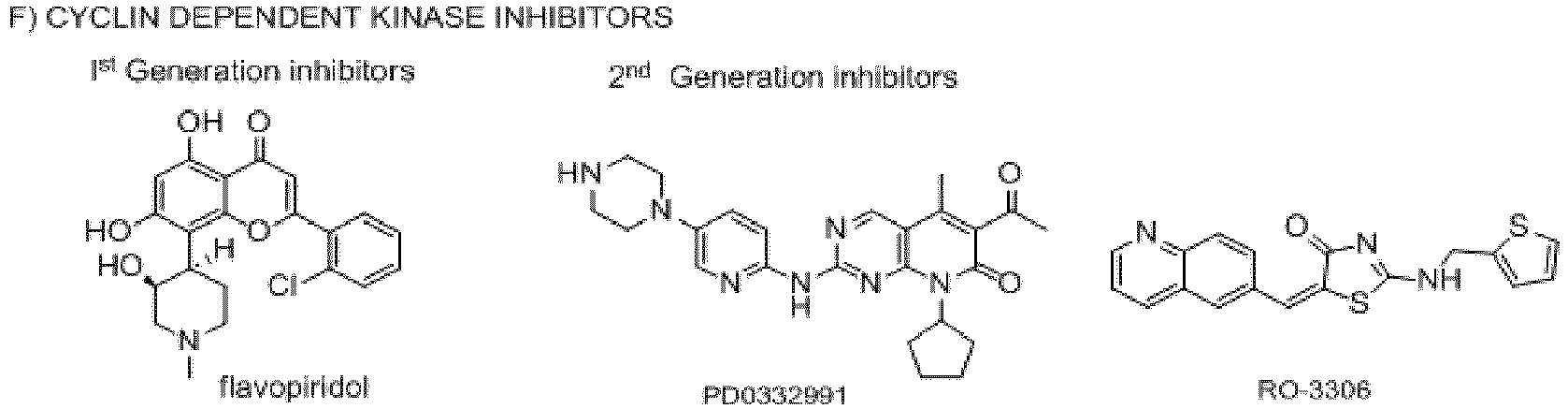
- P. Leuk Res Treatment (2012), 939021]. (-)-Epigallocatechin 3-gallate (EGCG) is the most intriguing accepted product that exhibit DNMT inhibitory activity though their beneficial anticancer activity may fade due to intercede of its multiple biological effects [Lambert, J. D.; Sang, S.; Yang, C. S. Chem Res Toxicol (2007), 20, (4), 583-5.]. Bexarotene is retinoic acid mimetic DNMT inhibitor and is in preclinical stages for the treatment of cutaneous T-cell lymphoma [Qu, L.; Tang, X. Cancer Chemother Pharmacol (2010) 65, (2), 201-5.]. In addition, tyrosine kinase inhibitors have proved successful in treatment of various kinds of cancers including chronic myelogenous leukemia (CML) and acute myelogenous leukemia (AML) as well as solid tumors. Imatinib, an inhibitor of BCR-ABL, a constitutively active tyrosine kinase found in CML patients with Philadelphia chromosome (an abnormal translocation of
chromosome 9 and 22 creating a fusion between break-point cluster gene (BCR) and ABL kinase) has been the first choice drug for BCR-ABL-positive CML since 2001. However, occurrence of frequent imatinib resistance in patients has necessitated the search for new chemical entities. Nilotinib has relatively favorable safety profile over imatinib as first line tyrosine kinase inhibitor for the treatment of leukemia [Goldman, J. M.; Marin, D. Oncology (Williston Park). (2012) Oct;26(10):901-7]. Dual SRC/BCR-ABL tyrosine kinase inhibitor dasatinib has been approved for use in patients with chronic myelogenous leukemia (CML), especially in imatinib resistant cases [Santos, F. P.; Kantarjian, H.; Quintas-Cardama, A.; Cortes, J. Cancer J (2011) 17, (6), 465-76.]. However, dasatinib also exhibits limited success rate in imatinib resistant patients and there is occurrence of dasatinib-resistance [Soverini, S.; et al. Haematologica. (2007) Mar;92(3):401-4] . Dual BCR-ABL/Lyn tyrosine kinase inhibitors like bafetinib or bosutinib have shown strong efficacy in leukemia and solid tumors [Santos, F. P.; Kantarjian, H.; Quintas-Cardama, A.; Cortes, J. Cancer J (2011) 17, (6), 465-76., Amsberg, K.G.; Brummendorf, T. H. Expert Rev anticancer ther (2012) 12, (9), 1121-1127., Daud, A. I.; Krishnamurthi, S. S.; Saleh, M. N.; Gitlitz, B. J.; Borad, M. J.; Gold, P. J.; Chiorean, E. G.; Springett, G. M.; Abbas, R.; Agarwal, S.; Bardy-Bouxin, N.; Hsyu, P. H.; Leip, E.; Turnbull, K.; Zacharchuk, C.; Messersmith, W. A. Clin Cancer Res (2011) 18, (4), 1092-1100]. Inhibitors of type III receptor tyrosine kinase family members including platelet derived growth factor receptors and FMS liketyrosine kinase 3, like tandutinib, sorafenib have been found effective in both leukemia and a number of solid tumors [DeAngelo, D. J.; Stone, R. M.; Heaney, M. L.; Nimer, S. D.; Paquette, R. L.; Klisovic, R. B.; Caligiuri, M. A.; Cooper, M. R.; Lecerf, J. M.; Karol, M. D.; Sheng, S.; Holford, N.; Curtin, P. T.; Druker, B. J.; Heinrich, M. C. Blood (2006), 108, (12), 3674-81]. Dovitinib, a multiple tyrosine kinase inhibitor that also inhibits topoisomerases I and II have been shown to be effective in multiple cancer types [Hasinoff, B. B.; Wu, X.; Nitiss, J. L.; Kanagasabai, R.; Yalowich, J. C. Biochem Pharmacol (2012) 84, (12), 1617-26]. Efficacy of Cyclin dependent kinase (CDK) inhibitors alone or in combination are also being actively pursued for treatment of both leukemia and solid tumors; Flavopiridol, a synthetic flavonoid inhibitor of CDKs, arrests cell division and causes apoptosis in non-small lung cancer cells and is currently under phase I clinical trial for combination treatment of CML patients with imatinib [Bose, P.; Perkins, E. B.; Honeycut, C.; Wellons, M. D.; Stefan, T.; Jacobberger, J. W.; Kontopodis, E.; Beumer, J. H.; Egorin, M. J.; Imamura, C. K.; Douglas Figg, W., Sr.; Karp, J. E.; Koc, O. N.; Cooper, B. W.; Luger, S. M.; Colevas, A. D.; Roberts, J. D.; Grant, S. Cancer Chemother Pharmacol (2012) 69, (6), 1657-67], PD 0332991 is an orally available pyridopyrimidine-derived cyclin-dependent kinase (CDK) inhibitor with potential antineoplastic activity [Leonard, J. P.; LaCasce, A. S.; Smith, M. R.; Noy, A.; Chirieac, L. R.; Rodig, S. J.; Yu, J. Q.; Vallabhajosula, S.; Schoder, H.; English, P.; Neuberg, D.S.; Martin, P.; Millenson, M. M.; Ely, S. A.; Courtney, R.; Shaik, N.; Wilner, K. D.; Randolph, S.; Van den Abbeele, A. D.; Chen-Kiang, S. Y.; Yap, J. T.; Shapiro, G. I. Blood (2012):119(20):4597-607] and RO-3306 reversibly arrests human cells at the G2/M border of the cell cycle [Aarts, M.; Sharpe, R.; Garcia-Murillas, I.; Gevensleben, H.; Hurd, M. S.; Shumway, S. D.; Toniatti, C.; Ashworth, A.; Turner, N. C. Cancer Discov 2, (6), 524-39.]. - Imatinib resistance in BCR-ABL-dependent CML can be divided into two types :a. BCR-ABL dependent. b. BCR-ABL independent. BCR-ABL-dependent resistance can occur due to mutations in the BCR-ABL protein which prevents its binding to imatinib, therefore rendering this protein insensitive to the drug (Pricl, S.; Fermeglia, M.; Ferrone, M.; Tamborini, E. Mol Cancer Ther. (2005) 4(8):1167-74). Among the reported mutations, T315I point mutation which occurs at the 315th amino acid of the ABL kinase, where a threonine moiety is substituted by an isoleucine moiety eliminates an essential oxygen molecule that is critical for hydrogen bonding between BCR-ABL. BCR-ABL has been shown to be insensitive to not only imatinib but also to a number of BCR-ABL inhibitors such as dasatinib and bosutinib [(Pricl, S.; Fermeglia, M.; Ferrone, M.; Tamborini, E. Mol Cancer Ther. (2005) 4(8):1167-74). Weisberg, E.; Manley, P.W.; Cowan-Jacob, S.W.; Hochhaus, A.; Griffin, J.D. Nat Rev Cancer. (2007) 7(5):345-56.] Only ponatinib has been shown to be effective against this mutation (O'Hare, T.; Deininger, M.W.; Eide, C.A.; Clackson, T.; Druker, B.J. Clin Cancer Res. (2011) 17(2):212-21). BCR-ABL-independent imatinib resistance can occur due a number of mechanisms including drug efflux by P-glycoprotein or multi drug resistance group of transporter proteins, defects in drug import in the intracellular milieu or activation of alternate signaling pathway such as activation of src family of kinases which have been implicated in imatinib signaling as well as locking imatinib in an active conformation which is incapable of binding to imatinib (Nestal de Moraes, G.; Souza, P. S.; Costas, F. C.; Vasconcelos, F. C.; Reis, F.R.; Maia, R. C. Leuk Res Treatment. (2012) ;2012:671702.). In addition, it has been shown that even in imatinib sensitive cells where BCR-ABL activity is downregulated by imatinib an undifferentiated subpopulation of cells expressing the cluster of differentiation (CD) 34 (CD34; a member of the sialomucin group of transmembrane proteins) but are CD38 negantive (CD34+ CD38-) are not killed by imatinib and these cells ultimately are responsible for relapse of leukemia (Corbin, A.S.; Agarwal, A.; Loriaux, M.; Cortes, J.; Deininger, M.W.; Druker, B.J. J Clin Invest. (2011);121(1):396-409). These cells are termed as "cancer stem cells" (CSC) and they typically harbour some stem cell markers on the cell surface and are refractory to drug treatments. Such CSCs are also evident in all cancer types including solid tumors and are responsible for relapse. In colon cancer cells these CSCs harbour CD133 in the cell surface (O'Brien, C.A.; Pollett, A.; Gallinger, S.; Dick, J. E. Nature. (2007) 445(7123):106-10.). Till date therapeutics for CSCs are not available and only salinomycin has been shown to be effective in killing these cells in vitro (Gupta, P.B.; Onder, T.T.; Jiang, G.; Tao, K.; Kuperwasser, C.; Weinberg, R.A.; Lander, E. S. Cell. (2009) 138(4):645-59).
- Reference may be made to Kumar A et al. vol 44, no. 1, 1 January 2009, pages 109-116, XP025842151 which discloses synthesis of a series of 2-aryl-naphtho[1,2-d]oxazole derivatives and their evaluation for PTP-1B inhibitory activity. The compounds have been screened in vivo for antidiabetic activity under sucrose loaded model (SLM), sucrose-challenged streptozotocin-induced diabetic rat model (STZ-S) and db/db mice model.
- Reference may be made to
JP 2012 092329 A - Reference may be made to
JP 2012 092328 A - Reference may be made to
US 2007/276036 A1 which discloses a new class of non-glycosidic and non-peptidic inhibitors of selectins with low molecular weight, as well as methods for their production. These compounds represent a new class of non-toxic, in vivo anti-inflammatory effective inhibitors of selectins, and do not exhibit the disadvantages of the glycosidic inhibitor complexes, and are furthermore more potent in vitro, compared to the known drug bimosiamose. Furthermore, medicaments containing the compounds and their uses in the treatment of diseases are described.Treatment of cancer by the use of natural, synthetic, or biologic chemical agents to reverse, suppress, or prevent the process of carcinogenesis is termed as chemotherapy. Essentially, effective implementation of this strategy requires cytotoxicity in not only the malignant cells but also in the cancer stem cells to prevent relapse of cancer following chemotherapy. - The main object of the present invention is to provide a substituted aryl naphthyl methanone oxime(s) or a pharmaceutically acceptable salt thereof.
- Another object of the present invention is to provide a pharmaceutical composition containing substituted aryl naphthyl methanone oxime(s) and a pharmaceutically acceptable carrier or a diluent thereof.
- Yet another object of the present invention is to provide a process for preparation of substituted aryl naphthyl methanone oxime (s).
- Still another object of the present invention is to provide a substituted aryl naphthyl methanone oxime (s) for treatment of hematological malignancy, particularly their use in treatment of leukemia, acute leukemia, lymphoma, multiple myeloma, solid tumors and cancer stem cells.
- Yet another object of the present invention is to provide a compound which obviates the drawback of currently available drugs.
- Still another object of the present invention is to provide a compound which causes robust apoptosis in existing drug resistant cancer samples.
- Yet another object of the present invention is to provide a compound that induces differentiation in blast cells which is indicative of restoring normal blood cell functions.
- Still another object of the present invention is to provide a compound which is also efficacious in solid tumor forming cell-lines including, breast, prostate, colon and endometrial cancers.
- Yet another object of the present invention is to provide a compound which is efficacious in killing drug resistant cancer stem cells.
- Accordingly, the present invention provides substituted aryl naphthyl methanone oxime(s) of formula (I) and their pharmaceutically acceptable salts thereof.

- R1= H, halogen, alkyl, alkoxy, nitro
- R2 = H, halogen, alkyl, alkoxy, hydroxy, nitro
- R3 = H, alkyl, alkoxy, nitro, halogen
- X = O, S
- R4 = hydrogen, alkyl group (c1-c6) alkylamino group (c1-c6), cyclic or open chain amines
- R5 hydrogen, alkyl group c1-c6), alkylepoxy, alkylhydroxyamino group (c1-c6), alkylamino group (c1-c6), cyclic or open chain amines, ester and amides derivatives


- m = 1, 2, 3, 4
- In another embodiment of the invention, the compounds are selected from the group consisting of :
- 1. (4-(methylthio)phenyl)(naphthalen-1-yl)methanone oxime (4a),
- 2. (4-methoxyphenyl)(naphthalen-1-yl)methanone oxime (4b),
- 3. (4-hydroxyphenyl)(naphthalen-1-yl)methanone oxime (4c),
- 4. (4-(methylthio)phenyl)(naphthalen-1-yl)methanone O-2-(piperidin-1-yl)ethyl oxime oxalate (5a),
- 5. (4-(methylthio)phenyl)(naphthalen-1-yl)methanone O-2-(pyrrolidin-1-yl)ethyl oxime oxalate (5b),
- 6. (4-(methylthio)phenyl)(naphthalen-1-yl)methanone O-2-(dimethylamino)ethyl oxime oxalate (5c),
- 7. (4-(methylthio)phenyl)(naphthalen-1-yl)methanone O-2-(diethylamino)ethyl oxime oxalate (5d),
- 8. (4-(methylthio)phenyl)(naphthalen-1-yl)methanone O-2-(diisopropylamino)ethyl oxime (5e),
- 9. (4-(methylthio)phenyl)(naphthalen-1-yl)methanone O-2-morpholinoethyl oxime (5f),
- 10.(4-(methylthio)phenyl)(naphthalen-1-yl)methanone O-1-(dimethylamino)propan-2-yl oxime oxalate (5g),
- 11. (4-(methylthio)phenyl)(naphthalen-1-yl)methanone O-2-(azepan-1-yl)ethyl oxime oxalate (5h),
- 12. (4-(methylthio)phenyl)(naphthalen-1-yl)methanone O-2-(diethylamino)ethyl oxime citrate (5i),
- 13. (4-(methylthio)phenyl)(naphthalen-1-yl)methanone O-2-(diethylamino)ethyl oxime fumarate (5j),
- 14. (4-(methylthio)phenyl)(naphthalen-1-yl)methanone O-2-(diethylamino)ethyl oxime tartrate (5k),
- 15. (4-(methylthio)phenyl)(naphthalen-1-yl)methanone O-2-(diethylamino)ethyl oxime (51),
- 16. (4-(methylthio)phenyl)(naphthalen-1-yl)methanone O-3-(dimethylamino)propyl oxime oxalate (5m),
- 17. (4-(methylthio)phenyl)(naphthalen-1-yl)methanone O-3-chloropropyl oxime (5n),
- 18. (4-(methylthio)phenyl)(naphthalen-1-yl)methanone O-4-chlorobutyl oxime (5o),
- 19. Ethyl 2-((4-(methylthio)phenyl)(naphthalen-1-yl)methyleneaminooxy)acetate (5p),
- 20. N,N-diethyl-2-((4-(methylthio)phenyl)(naphthalen-1-yl)methyleneaminooxy) acetamide (5q),
- 21. (4-methoxyphenyl)(naphthalen-1-yl)methanone O-2-(piperidin-1-yl)ethyl oxime oxalate (6a),
- 22. (4-methoxyphenyl)(naphthalen-1-yl)methanone O-2-(pyrrolidin-1-yl)ethyl oxime oxalate (6b),
- 23. (4-methoxyphenyl)(naphthalen-1-yl)methanone O-2-(dimethylamino)ethyl oxime oxalate (6c),
- 24. (4-methoxyphenyl)(naphthalen-1-yl)methanone O-2-(diethylamino)ethyl oxime oxalate (6d),
- 25. (4-methoxyphenyl)(naphthalen-1-yl)methanone O-2-(diisopropylamino)ethyl oxime oxalate (6e),
- 26. (4-methoxyphenyl)(naphthalen-1-yl)methanone O-1-(dimethylamino)propan-2-yl oxime oxalate (6f),
- 27. (4-methoxyphenyl)(naphthalen-1-yl)methanone O-2-(azepan-1-yl)ethyl oxime oxalate (6g),
- 28. (4-methoxyphenyl)(naphthalen-1-yl)methanone O-2-morpholinoethyl oxime (6h),
- 29. (4-methoxyphenyl)(naphthalen-1-yl)methanone O-3-(dimethylamino)propyl oxime oxalate (6i),
- 30. (4-methoxyphenyl)(naphthalen-1-yl)methanone O-3-chloropropyl oxime (6j),
- 31. (4-methoxyphenyl)(naphthalen-1-yl)methanone O-3-(piperidin-1-yl)propyl oxime (6k),
- 32. (4-(methylthio)phenyl)(naphthalen-1-yl)methanone O-3-(piperidin-1-yl)propyl oxime oxalate (7a),
- 33. (4-(methylthio)phenyl)(naphthalen-1-yl)methanone O-3-morpholinopropyl oxime (7b),
- 34. (4-(methylthio)phenyl)(naphthalen-1-yl)methanone O-3-(4-methylpiperidin-1-yl)propyl oxime oxalate (7c),
- 35. (4-(methylthio)phenyl) (naphthalen-1-yl)methanone O-3-(butyl(methyl)amino) propyl oxime (7d),
- 36. (4-methoxyphenyl)(naphthalen-1-yl)methanone O-3-(2-ethylhexylamino)propyl oxime (7e),
- 37. (4-(methylthio)phenyl)(naphthalen-1-yl)methanone O-4-(piperidin-1-yl)butyl oxime (8a),
- 38. (4-(methylthio)phenyl)(naphthalen-1-yl)methanone O-4-(pyrrolidin-1-yl)butyl oxime (8b),
- 39. (4-(methylthio)phenyl)(naphthalen-1-yl)methanone O-4-(phenethylamino)butyl oxime (8c),
- 40. (4-(methylthio)phenyl)(naphthalen-1-yl)methanoneO-4-(benzyl(ethyl) amino) butyl oxime (8d),
- In another embodiment of the invention, the compound is for use in the treatment of cancer and killing of drug resistant cancer stem cells.
- In yet another embodiment of the invention, the cancer is selected from the group consisting of blood cancer, leukemia, lymphoma and multiple myeloma.
- In another embodiment of the present invention the starting
compound 3 used for the preparation of compound of general formula I have been synthesized by our previously reported procedure. (Srivastava, N.; Sangita; Ray, S.; Singh, M. M.; Dwivedi, A.; Kumar, A., Bioorg Med Chem (2004), 12, (5), 1011-21). - In another embodiment of the present invention the process for the preparation of compound of general formula I, the said process comprising of:
- Reacting substituted phenylnaphthalen-1-yl-methanone (3) of formula II with hydroxylamine hydrochloride and dry pyridine in absolute ethanol to form substituted phenylnaphthalen-1-yl-methanone oxime (4) of formula I. (scheme 1).


- In another embodiment of the present invention the process for the preparation of compound of general formula I, the said process comprising of reacting a substituted phenylnaphthalen-1-yl-methanone oxime derivative (4) of formula I (scheme 2) with an aminoalkyl chloride, alkyl chloride, alkylepoxychloride, cyclic or open chain amino chloride, alkylhydroxyaminochloride, alkylacetachloride or dihaloalkane (scheme 2) in the presence of a suitable base (defined in scheme 2) at reflux to furnish the
compound - In another embodiment of the present invention the base is selected from the group consisting of K2CO3, CsCO3, KOH and NaH.
- In yet another embodiment the solvent is selected from the group consisting of dry DMF, acetone and THF.
- In another embodiment of the present invention the pharmaceutically acceptable salts of the compound of general formula I is selected from the group consisting of hydrochlorides, citrates, oxalates, fumarates, malates and tartrates.


- In another embodiment of the present invention the process for the preparation of compound of general formula I, the said process comprising of reacting 4a with alkylbromoacetate and the base used is Sodium hydride giving the product 5p of formula I
- In another embodiment of the present invention the process for the preparation of compound of general formula I, the said process comprising of reacting 5p of formula I with potassium tertiary butoxide and cyclic or open chain amine to produce 5q of formula I. (Scheme 3).
- In another embodiment of the present invention the process for the preparation of compound of general formula I, the said process comprising of reacting 4a with alkylbromoacetate and the base used is Sodium hydride giving the product 5p of formula I
- In another embodiment of the present invention the process for the preparation of compound of general formula I, the said process comprising of reacting 5p of formula I with potassium tertiary butoxide and cyclic or open chain amine to produce 5q of formula I. (Scheme 3).

- In another embodiment of the present invention the process for the preparation of compound of general formula II, the said process comprising of:
- Reacting substituted Methoxy-phenyl)-naphthalen-1-yl-methanone (3b) formula II with HBr/acetic acid, HBr/H2O, BBr3 or pyridine hydrochloride at 130 °C to furnish the compound (3c) of formula II
- In another embodiment of the present invention the process for the preparation of compound of general formula I, the said process comprising of
- Reacting compound 3c (formula II) with hydroxylamine hydrochloride in the presence of a base like sodium acetate or pyridine and solvent used is absolute ethanol/methanol to furnish the compound 4c of formula I. (Scheme 4).
- In another embodiment of the present invention, the reactions to furnish the compound of formula I are carried out without any catalyst.
- In a more preferred embodiment of the invention, the compound is for use in the treatment of leukemia.
- In even preferred embodiment of the invention, the compound is for use in suppression of BCR-ABL activity in CML thereof.
- In even more preferred embodiment of the invention, the compound is for use in suppression of c-SRC activity in imatinib-resistance in CML thereof.
- In a more preferred embodiment of the invention, the compound is for use in inducing apoptosis in imatinib-resistant CML cells.
- In a preferred embodiment of the invention, the compound is for use in inducing of apoptosis and differentiation in AML cells.
- In another embodiment of the invention, the compound is for use in inducing megakaryocytic differentiation in K562 cells and inducing differentiation in blast cells of erythroleukemia or increasing platelet amount.
- In a morepreferred embodiment of the invention, the compound is for use in exhibiting cancer-specific cytotoxicity in ER-positive or ER-negative breast cancer cells, prostate cancer cells, uternine adenocarcinoma and colon cancer cells..
- In an even preferred embodiment of the invention, the compound is for use in selective cytotoxicity towards cancer stem cells such as but not limited to CD133+ colon cancer stem cells.
- In another embodiment of the invention, the representative compounds of formula I and its salts thereof are used for the treatment of solid tumors and hematological malignancy, more particularly their use in treatment of leukemia, acute leukemia, lymphoma and multiple myeloma.
- In another embodiment of the present invention, the pharmaceutical composition is provided comprising an effective amount of a compound of formula I optionally along with a pharmaceutically acceptable carrier or diluents.
- In another embodiment of the present invention, the compound is for use as anticancer agent and for treatment of hematological malignancy such as their use in treatment of leukemia, acute leukemia, lymphoma and multiple myeloma and as well as in solid tumors.
-
-
Fig. 1 : CentANS induces apoptotic cell death in K562 and HL-60 cells -
Fig. 2 : CentANS induces G0/G1 growth arrest in K562 and HL-60 cells. -
Fig. 3 : Centans induces dephosphorylation of BCR-ABL and SRC protooncogene. -
Fig. 4 : Centans induces megakaryocytic differentiation in K562 Cells -
Fig. 5 : Centans induces Granulocytic/monocytic differentiation in HL-60 cells. -
Fig. 6 : Centans induces apoptotic cell death in breast cancer cells -
Fig. 7 : Centans induces dephosphorylation of epidermal growth factor receptor (EGFR) and human epidermal growth factor receptor 2 (Her2). -
Fig. 8 : Centans causes reduction of tumor volume in vivo. -
Fig. 9 : Centans reduces CD133+ colon cancer stem cells. -
- Centans: Abbreviation used for compounds based on the IUPAC name of the compound, prefixed with Cent; a Central Drug Research Institute signature.
- CML: Chronic myelogenous leukemia
- AML: Acute myelogenous leukemia
- PBMC: Peripheral blood mononuclear cells
- BCR: "Break point cluster region" gene
- ABL: Abelson murine leukemia viral oncogene homolog 1
- BCR-ABL: a fusion protein of BCR and ABL
- APOP: Apoptosis
- Stat5: Signal transducer and activator of
transciption 5 - Crkl: v-CRK avian sarcoma virus CT10-homolog-like
- eIF4E: Eukaryotic translation initiation factor 4E
- GATA-2:
GATA binding protein 2 - ER: Estrogen Receptor
- MTT: 3-(4,5-dimethythiazol-. 2-yl)-2,5-diphenyl tetrazolium bromide
- PI: Propidium Iodide
- Accordingly, the present invention provides the process for preparation of substituted aryl naphthyl methanone oximes of general formula (I) and their derivatives, salts, pharmaceutical composition thereof and their use in treatment of chronic myelogenous leukemia, acute myelogenous leukemia, lymphoma, multiple myeloma, breast cancer, endometrial cancer prostate cancer and colon cancer as subject in need thereof.
- The present invention provides substituted aryl naphthyl methanone oxime (s) of formula (I), for use in the treatment of hematological malignancy, particularly for use in treatment of leukemia, acute leukemia, lymphoma and multiple myeloma and solid tumors such as breast cancer, endometrial cancer, prostate cancer and colon cancer.

- R1= H, halogen, alkyl, alkoxy, nitro
- R2 = H, halogen, alkyl, alkoxy, hydroxy, nitro
- R3 = H, alkyl, alkoxy, nitro, halogen
- X = O,S
- R4 = hydrogen, alkyl group (c1-c6), alkylamino group (c1-c6), cyclic or open chain amines
- R5 hydrogen, alkyl group (c1-c6), alkylepoxy, alkylhydroxyamino group
(c1-c6), alkylamino group (c1-c6), cyclic or open chain amines, alkyl ester and amides derivatives



- m = 1, 2, 3, 4
- This invention also relates to a process for the preparation of Substituted Aryl naphthyl methanone oxime (s). Reacting the substituted Naphthalene-1-carboxylic acid (1) and suitably substituted phenol or thiophenol (2) in the presence of PPA at 90 °C to yield compound 3b. (Formula II) [Atul Kumar, S. R. Pathak, Pervez Ahmad, S. Ray, P. Tewari, A. K. Srivastava Bioorganic & Medicinal Chemistry Letters 16 (2006) 2719-2723].

- The
compound 3 on treatment with a hydroxylamine hydrochloride in the presence of base like pyridine, sodium acetate in dry ethanol yields compound 4. (Formula I) - Compound 4 on treatment with a number of alkyl halides in the presence of base, like K2CO3, CsCO3, KOH,NaH etc. in dry DMF or acetone, yields
compound - Compound 4 on treatment with various dihaloalkanes in the presence of base, like K2CO3, CsCO3 etc. in dry DMF/ acetone also yields compound 5n, o (formula I), which on reaction with a number of amines in dry DMF/Methanol yields compound 7 & 8 of formula I (Scheme 2).
- Compound 4b on treatment with HBr/acetic acid, HBr/H2O, BBr3 or pyridine hydrochloride yields compound 4c (formula I).
- Following examples are given by way of illustrations and therefore, should not be construed to limit the scope of the present invention:
- The following examples are given by way of illustrating the present invention and should not be construed to limit the scope of the invention:
-

- Into a 50 ml round bottom flask, (4-Methylsulfanyl-phenyl)-naphthalen-1-yl-methanone (1 mmole, 278mg), hydroxylamine hydrochloride (2mmole, 140mg), dry pyridine (0.5 ml) and absolute ethanol (7.0 ml) were taken to obtain a reaction mixture. The reaction mixture was refluxed at 80° C under anhydrous conditions for 8 hours. The reaction was followed by TLC (thin layer chromatography) monitoring. After completion of the reaction, ethanol was evaporated under reduced pressure. The resulting mixture was poured onto crushed ice and extracted with ethyl acetate (3x50 ml), washed with water until pH =7, dried over anhydrous Na2SO4 (8-9g) and concentrated. The crude product was purified by silica gel column chromatography using ethyl acetate and distilled Hexane as an eluent (8%) to yield the pure productIt was then recrystellize from ethyl acetate and Hexane. Yield: 215 mg, 73.4%.
M.P.= 135 °C, ESI MS (m/z)= 294(M+H); IR(KBr, Cm-1): 3235.8, 2921.5, 1899.5, 1591.0, 1491.1, 1434.8, 1390.9, 1352.4, 1313.1, 1093.0, 1074.0, 969.6, 922.0, 770.1, 695.6; 1H NMR(CDCl3, 300MHz): δ=7.99(t, J=8.7 Hz, 2H, ArH), 7.73(d, J=8.1 Hz, 1H, ArH), 7.64-7.33(m, 6H, ArH), 7.16(d, J=7.2 Hz, 2H, ArH), 2.46(s, 3H, SCH3); 13C NMR (CDCl3, 50 MHz): δ = 157.43, 141.26, 133.89, 132.75, 131.73, 130.80, 129.61, 128.89, 127.84(2), 127.14, 126.74, 126.54(2), 126.23, 126.09, 125.73, 15.67; Analysis calculated for C18H15NOS: C, 73.69; H, 5.15; N, 4.77, found: C, 73.71; H, 5.16; N, 4.80. -

- Into a 50 ml round bottom flask, (4-Methoxy phenyl)-naphthalen-1-yl-methanone (1 mmole, 262mg), hydroxylamine hydrochloride (2mmole, 140mg), dry pyridine (0.5 ml) and absolute ethanol (7.0 ml) were taken. The reaction mixture was refluxed under anhydrous conditions for 8 hours. The reaction was followed by TLC monitoring. After completion of the reaction, ethanol was evaporated under reduced pressure. The resulting mixture was poured onto crushed ice and extracted with ethyl acetate (3x50 ml), washed with water until pH =7, dried over anhydrous Na2SO4 and concentrated. The crude product was purified by silica gel column chromatography using ethyl acetate and distilled Hexane as an eluent (6%) to yield the pure product. It was then recrystallized from ethyl acetate and Hexane. Yield: 209 mg, 75.45%.
M.P. = 132°C; ESI MS(m/z) = 278(M+H); IR (KBr, Cm-1): 3254.2, 3056.7, 2924.9, 1603.6, 1510.5, 1460.0, 1252.1, 1176.3, 1025.4, 970.4, 928.8, 835.0, 771.8; 1H NMR(CDCl3, 300MHz): δ= 7.95(t, J=6.6 Hz, 2H, ArH), 7.76(d, J=8.1 Hz, 1H, ArH), 7.63-7.39(m, 6H, ArH), 6.83(d, J=8.9 Hz, 2H, ArH), 3.79(s, 3H, OCH3); 13C NMR (CDCl3, 75MHz): 160.82, 156.91, 133.51, 132.14, 131.87, 130.47, 129.11, 128.65, 128.48, 128.39, 126.72, 126.32, 126.13, 125.87, 125.38, 125.20, 113.91, 55.32; Analysis calculated for C18H15NO2: C, 77.96; H, 5.45; N, 5.05, found: C, 77.97; H, 5.43; N, 5.07. -

- Into a 50 ml round bottom flask, (4-Hydroxy-phenyl)-naphthalen-1-yl-methanone (1 mmole, 248mg), hydroxylamine hydrochloride (2mmole, 140mg), dry pyridine (0.5 ml) and absolute ethanol (7.0 ml) were taken. The reaction mixture was refluxed under anhydrous conditions for 7 hours. The reaction was followed by TLC monitoring. After completion of the reaction, ethanol was evaporated under reduced pressure. The resulting mixture was poured onto crushed ice and extracted with ethyl acetate (3x50 ml), washed with water until pH =7, dried over anhydrous Na2SO4 and concentrated. The crude product was purified by silica gel column chromatography using chloroform as eluent to yield the pure product. It was then recrystellized with ethyl acetate and hexane. Yield: 221 mg, 84.03%.ESI MS (m/z) = 264 (M+H); 1H NMR (200MHz, CDCl3): δ= 7.91(t, J=8.0 Hz, 2H, ArH), 7.71(d, J=8.0 Hz, 1H, ArH), 7.55-7.31(m, 5H, ArH), 7.26(m, 1H, ArH), 6.52-6.47(m, 2H, ArH); 13C NMR(CDCl3+CD3OD, 75MHz): 159.61, 157.99, 134.92, 134.07, 131.88, 129.84, 129.78(2), 129.51, 129.37, 127.50, 127.27, 127.11, 126.94, 126.48, 116.41; Analysis calculated for C17H13NO2: C, 77.55; H, 4.98; N, 5.32, found: C, 77.50; H, 5.06; N, 5.26.
-

- Into a 50 ml round bottom flask, 4-(methylthiophenyl)(naphthalen-1-yl)methanone oxime (1 mmole, 293 mg), 1-(2-chloroethyl)piperidine hydrochloride (1.2 mmole, 220.8 mg), baked K2CO3 (5 mmole, 690 mg) and dry acetone (10.0 ml) were taken. The reaction mixture was refluxed under anhydrous conditions for 6 hours. The reaction was followed by TLC monitoring. After completion of the reaction, K2CO3 was filtered off and washed with acetone (2x10 ml). Filtrate was concentrated and the crude product was purified by basic alumina column chromatography using distilled Hexane to yield the pure product (349mg, 86.6%). The product obtained was oily, so a salt of the compound was prepared.
- Procedure for oxalate salt formation: Oxalic acid, 1mmole/ 1mmole of compound, (109.1 mg) and oily product (349 mg) were dissolved in dry methanol separately into two round bottom flasks. The acid and the compound were mixed and shaken thoroughly. The salt was precipitated using dry diethyl ether, filtered, washed with the same and collected. Yield: 390 mg, 85.2%.
M.P. (Oxalate Salt of compound)= 155°C, ESI MS (m/z) = 404 ; IR (KBr, Cm-1) = 3020.4, 2970.1, 2360.8, 1758.4, 1630.1, 1522.3, 1216.4, 761.8, 670.3; 1H NMR(CDCl3, 200MHz): δ= 7.94 (d, J=8.0 Hz, 2H, ArH), 7.63-7.41(m, 5H, ArH), 7.29-7.27(m, 2H, ArH), 7.18 (d, J=8.2 Hz, 2H, ArH), 4.46(m, 2H, OCH2), 3.21(m, 4H, NCH2)2.47-2.46(m, 5H, SCH3 & NCH2), 1.51(m, 5H, CH2). Analysis calculated for C25H28N2OS: C, 74.22; H, 6.98; N, 6.92; found: C, 74.25; H, 6.95; N, 6.96. -

- Into a 50 ml round bottom flask, 4-(methylthiophenyl)(naphthalen-1-yl)methanone oxime (1 mmole, 293 mg), 1-(2-chloroethyl)pyrrolidine hydrochloride (1.2 mmole, 204 mg), baked K2CO3 (5 mmole, 690 mg) and dry acetone (10.0 ml) were taken. The reaction mixture was refluxed under anhydrous conditions for 6 hours. The reaction was followed by TLC monitoring. After completion of the reaction, K2CO3 was filtered off and washed with acetone (2x10 ml). Filtrate was concentrated and the crude product was purified by basic alumina column chromatography using distilled Hexane to yield the pure product (250mg, 64.26%). The product obtained was oily, so a salt of the compound was prepared.
- Procedure for oxalate salt formation: Oxalic acid, 1mmole/ 1mmole of compound, (108.9 mg) and oily product (250 mg) were dissolved in dry methanol separately into two round bottom flasks. The acid and the compound were mixed and shaken thoroughly. The salt was precipitated using dry diethyl ether, filtered, washed with the same and collected. Yield: 390 mg, 85.2%.
M.P. (Oxalate Salt of compound)= 153° C, ESI MS (m/z)= 390 (M+H); IR (KBr, Cm-1) = 3021.01, 2359.2, 1757.5, 1629.5, 1216.6, 761.0, 671.4; 1H NMR (CDCl3, 200MHz): δ=7.93 (d, J=7.6 Hz, 2H, ArH), 7.62-7.41(m, 5H, ArH), 7.29-7.27(m, 2H, ArH), 7.17 (d, J=8.4 Hz, 2H, ArH), 4.61-4.45(m, 2H, OCH2), 3.29(m, 2H, NCH2), 2.82-2.80(m, 4H, NCH2), 2.47(s, 3H, SCH3), 1.70(m, 4H, CH2). Analysis calculated for C24H26N2OS (free base): C, 73.81; H, 6.71; N, 7.17, found: C, 73.79; H, 6.68; N, 7.15. -

- Into a 50 ml round bottom flask, 4-(methylthiophenyl) (naphthalen-1-yl)methanone oxime (1 mmole, 293 mg), (2-Chloro-ethyl)-dimethyl-amine hydrochloride (1.2 mmole, 172.8 mg), baked K2CO3 (5 mmole, 690 mg) and dry acetone (10.0 ml) were taken. The reaction mixture was refluxed under anhydrous conditions for 6 hours. The reaction was followed by TLC monitoring. After completion of the reaction, K2CO3 was filtered off and washed with acetone (2x10 ml). Filtrate was concentrated and the crude product was purified by basic alumina column chromatography using distilled Hexane to yield the pure product (280mg, 76.9%). The product obtained was oily, so a salt of the compound was prepared.
- Procedure for oxalate salt formation: Oxalic acid, 1mmole/ 1mmole of compound, (96.9 mg) and oily product (280 mg) were dissolved in dry methanol separately into two round bottom flasks. The acid and the compound were mixed and shaken thoroughly. The salt was precipitated using dry diethyl ether, filtered, washed with the same and collected. Yield: 310 mg, 63.27%.
M. P. (Oxalate Salt of compound)= 105°C; ESI MS (m/z)= 365 (M+H), IR (KBr, Cm-1): 3020.5, 2970.8, 2362.1, 1757.3, 1629.1, 1216.4, 1044.6, 760.9, 670.2; 1H NMR (CDCl3, 200MHz): δ=7.93 (d, J=7.7 Hz, 2H, ArH), 7.61-7.41(m, 5H, ArH), 7.28-7.25(m, 2H, ArH), 7.17(d, J=8.4 Hz, 2H, ArH), 4.65-4.49(m, 2H, OCH2), 3.47(s, 6H, NCH3), 2.45(s, 3H, SCH3), 2.40(m, 2H, NCH2). Analysis calculated for C22H24N2OS (free base): C, 72.49; H, 6.64; N, 7.69; Found: C, 72.46; H, 6.63; N, 7.67. -

- Method A: Into a 50 ml round bottom flask, 4-(methylthiophenyl)(naphthalen-1-yl)methanone oxime (1 mmole, 293 mg), 2-chloro-N,N-diethylethanamine hydrochloride (1.2 mmole, 205 mg), baked K2CO3 (5 mmole, 690 mg) and dry acetone (10.0 ml) were taken. The reaction mixture was refluxed under anhydrous conditions for 6 hours. The reaction was followed by TLC monitoring. After completion of the reaction, K2CO3 was filtered off and washed with acetone (2x10 ml). Filtrate was concentrated and the crude product was purified by basic alumina column chromatography using distilled Hexane to yield the pure product (250 mg, 63.6%). The product obtained was oily so a salt of the compound was prepared.
- Procedure for oxalate salt formation: Oxalic acid, 1mmole/ 1mmole of compound, (80.15 mg) and the oily product (250 mg) were dissolved in dry methanol separately into two round bottom flasks. The acid and the compound were mixed and shaken thoroughly. The salt was precipitated using dry diethyl ether, filtered, washed with the same and collected. Yield: 259 mg, 48.3%.
M.P. (Oxalate Salt of compound)= 115 °C; ESI MS (m/z)= 393 (M+H); 1H NMR(CDCl3, 200MHz): δ=7.93 (d, J=8.0 Hz, 2H, ArH), 7.63-7.41(m, 5H, ArH), 7.27-7.25(m, 2H, ArH), 7.17-7.13(d, J=8.0 Hz, 2H, ArH), 4.48(m, 2H, OCH2), 3.26(m, 2H, NCH2), 2.72(m, 4H, NCH2), 2.46(s, 3H, SCH3), 0.81(m, 6H, CH3); Analysis calculated for C26H30N2O5S: C, 64.71; H, 6.27; N, 5.80 found: C, 64.76; H, 6.26; N, 5.85. - Method B: Into a 50 ml round bottom flask, 4-(methylthiophenyl)(naphthalen-1-yl)methanone oxime (1 mmole, 293 mg), 2-chloro-N,N-diethylethanamine hydrochloride (1.2 mmole, 205 mg), Cs2CO3 (5 mmole) and dry DMF (10.0 ml) were taken. The reaction mixture was refluxed under anhydrous conditions for 5 hours. The reaction was followed by TLC monitoring. After completion of the reaction, filtrate was concentrated and the crude product was purified by basic alumina column chromatography using distilled Hexane to yield the pure product (62.6%).
-

- Into a 50 ml round bottom flask, 4-(methylthiophenyl) (naphthalen-1-yl)methanone oxime (1 mmole, 293 mg), (2-Chloro-ethyl)-diisopropyl-amine hydrochloride (1.2 mmole, 240 mg), baked K2CO3 (5 mmole, 690 mg) and dry acetone (10.0 ml) were taken. The reaction mixture was refluxed under anhydrous conditions for 6 hours. The reaction was followed by TLC monitoring. After completion of the reaction, K2CO3 was filtered off and washed with acetone (2x10 ml). Filtrate was concentrated and the crude product was purified by basic alumina column chromatography using distilled Hexane to yield the pure product (325mg, 77.38%). Oily Compound; ESI MS(m/z)= 421(M+H); 1H NMR(CDCl3, 200MHz): 7.92(d, J=7.6 Hz, 2H, ArH),7.57-7.39(m, 5H, ArH), 7.32-7.26(m, 2H, ArH), 7.15 (d, J=8.5 Hz, 2H, ArH), 4.09 (t, J=7.2 Hz, 2H, OCH2), 2.94-2.88(m, 2H, NCH), 2.68(m, 2H, NCH2), 2.45(s, 3H, SCH3), 0.93-0.89(d, J=6.5 Hz, 12H, CH3). Analysis calculated for C26H32N2OS: C, 74.24; H, 7.67; N, 6.66, found: C, 74.20; H, 7.65; N, 6.65.
-

- Into a 50 ml round bottom flask, 4-(methylthiophenyl) (naphthalen-1-yl)methanone oxime (1 mmole, 293 mg), 4-(2-Chloro-ethyl)-morpholine hydrochloride (1.2 mmole, 223.2 mg), baked K2CO3 (5 mmole, 690 mg) and dry acetone (10.0 ml) were taken. The reaction mixture was refluxed under anhydrous conditions for 6 hours. The reaction was followed by TLC monitoring. After completion of the reaction, K2CO3 was filtered off and washed with acetone (2x10 ml). Filtrate was concentrated and the crude product was purified by basic alumina column chromatography using distilled Hexane to yield the pure product (298mg, 73.22%). Oily compound, ESI MS(m/z) = 407 (M+H); IR(Neat, Cm-1): 4300.2, 3020.6, 1757.4, 1593.6, 1216.5, 1042.5, 762.0, 671.3; 1H (300MHz, CDCl3): δ=7.93 (d, J=8.3 Hz, 2H, ArH), 7.68 (d, J=8.2 Hz, 1H, ArH), 7.58-7.40(m, 5H, ArH), 7.32-7.28(m, 1H, ArH), 7.18(d, J=8.4 Hz, 2H, ArH), 4.33(t, J=5.6 Hz, 2H, OCH2), 3.77-3.51(m, 4H, OCH2), 2.63(t, J=5.6 Hz, 2H, NCH2), 2.47(s, 3H, SCH3), 2.27(t, J=4.3 Hz, 4H, NCH2); Analysis calculated for C24H26N2O2S: C, 70.90; H, 6.45; N, 6.89, found: C, 70.89; H, 6.40; N, 6.86.
-

- Method A: Into a 50 ml round bottom flask, 4-(methylthio)phenyl (naphthalen-1-yl)methanone oxime (1 mmole, 293 mg), (2-Chloro-propyl)-dimethyl-amine hydrochloride (1.2 mmole, 189.6 mg), baked K2CO3 (5 mmole, 690 mg) and dry DMF (10.0 ml) were taken. The reaction mixture was refluxed under anhydrous conditions for 5 hours. The reaction was followed by TLC monitoring. After completion of the reaction, the mixture was quenched into water (100ml), extracted with ethyl acetate (3X75ml) and dried over anhydrous Na2SO4. The filtrate was concentrated and the crude product was purified by basic alumina column chromatography using distilled Hexane to yield the pure product (67.13%). The product obtained was oily so a salt of the compound was prepared.
- Procedure for oxalate salt formation: Oxalic acid, 1mmole/ 1mmole of compound, (83.3 mg) and oily product (250 mg) were dissolved in dry methanol separately into two round bottom flasks. The acid and the compound were mixed and shaken thoroughly. The salt was precipitated using dry diethyl ether, filtered, washed with the same and collected. Yield: 260 mg, 64.35%.
M.P. (Oxalate Salt of compound) = 101°C, ESI MS (m/z) = 379 (M+H); IR (KBr, Cm-1)= 3020.7, 2361.4, 1761.8, 1631.9, 1525.6, 1426.5, 1216.1, 761.0, 670.3; 1H NMR(300MHz, CDCl3): δ= 7.9240(d, J=7.8 Hz, 2H, ArH) 7.6788(d, J=8.2 Hz, 1H, ArH), 7.5763-7.3997(m, 5H, ArH), 7.3223-7.2806(m, 1H, ArH), 7.1766(d, J=8.4 Hz, 2H, ArH), 4.0737-4.0187(m, 1H, OCH), 3.0861-2.8784(m, 2H, NCH2), 2.4656(s, 3H, SCH3), 2.1236(s, 6H, NCH3), 0.9154(d, J=6.0 Hz, 3H, CH-CH3); Analysis calculated for C23H26N2OS(free base): C, 72.98; H, 6.92; N, 7.40, found: C, 72.93; H, 6.88; N, 7.37. - Method B: Into a 50 ml round bottom flask, 4-(methylthio)phenyl (naphthalen-1-yl)methanone oxime (1 mmole, 293 mg), (2-Chloro-propyl)-dimethyl-amine hydrochloride (1.2 mmole, 189.6 mg), baked K2CO3 (5 mmole, 690 mg) and dry acetone (10.0 ml) were taken. The reaction mixture was refluxed under anhydrous conditions for 6 hours. The reaction was followed by TLC monitoring. After completion of the reaction, K2CO3 was filtered off and washed with acetone (2x10 ml). Filtrate was concentrated and the crude product was purified by basic alumina column chromatography using distilled Hexane to yield the pure product (250mg, 66.13%).
-

- Into a 50 ml round bottom flask, 4-(methylthio)phenyl (naphthalen-1-yl)methanone oxime (1 mmole, 293 mg), 1-(2-Chloro-ethyl)-azepane hydrochloride (1.2 mmole, 237.6 mg), baked K2CO3 (5 mmole, 690 mg) and dry acetone (10.0 ml) were taken. The reaction mixture was refluxed under anhydrous conditions for 6 hours. The reaction was followed by TLC monitoring. After completion of the reaction, K2CO3 was filtered off and washed with acetone (2x10 ml). Filtrate was concentrated and the crude product was purified by basic alumina column chromatography using distilled Hexane to yield the pure product (350mg, 83.7%). The product obtained was oily so a salt of the compound was prepared.
- Procedure for oxalate salt formation: Oxalic acid, 1mmole/ 1mmole of compound, (105.5 mg) and oily product (350 mg) were dissolved in dry methanol separately into two round bottom flasks. The acid and the compound were mixed and shaken thoroughly. The salt was precipitated using dry diethyl ether, filtered, washed with the same and collected. Yield: 427 mg, 78.49%.
M.P. (Oxalate Salt of compound) =1450 C; ESI MS(m/z)= 419 (M+H); ); IR(KBr, Cm-1): 3444.7, 2931.2, 2604.7, 1921.2, 1741.9, 1430.3, 1246.1, 1095.6, 1066.0, 961.0, 777.3; 1H NMR(300MHz, CDCl3): δ= 7.93(d, J=8.2 Hz, 2H, ArH), 7.68(d, J=8.2 Hz, 1H, ArH), 7.58-7.39(m, 5H, ArH), 7.33-7.28(m, 1H, ArH), 7.18(d, J=8.6 Hz, 2H, ArH), 4.28(t, J=6.1 Hz, 2H, OCH2), 2.78(t, J=.5 Hz, 2H, NCH2), 2.51(m,. 4H, NCH2), 2.47(s, 3H, SCH3), 1.49(m, 8H, CH2); Analysis Calculated for C26H30N2OS (free base): C, 74.60; H, 7.22; N, 6.69, found: C, 74.62; H, 7.20; N, 6.68. -

- Procedure for citrate salt formation: citric acid, 1mmole/ 1mmole of compound, (122.45 mg) and (4-(methylthio)phenyl)(naphthalen-1-yl)methanone O-2-(diethylamino)ethyl oxime (250 mg) were dissolved in dry methanol separately into two round bottom flasks. The acid and the compound were mixed and shaken thoroughly and kept in refrigerator for overnight after adding dry diethyl ether. The salt was filtered, washed with dry diethyl ether and collected. Yield: 49%. Analysis calculated for C30H36N2O8SC, 61.63; H, 6.21; N, 4.79; found: C, 61.62; H, 6.17; N, 4.75.
-
- Procedure for fumarate salt formation: fumaric acid, 1mmole/ 1mmole of compound, (73.98 mg) and (4-(methylthio)phenyl)(naphthalen-1-yl)methanone O-2-(diethylamino)ethyl oxime (250 mg) were dissolved in dry methanol separately into two round bottom flasks. The acid and the compound were mixed and shaken thoroughly and kept in refrigerator for overnight after adding dry diethyl ether. The salt was filtered, washed with dry diethyl ether and collected. Yield: 48.3%. Analysis calculated for C28H32N2O5S, C, 66.12; H, 6.34; N, 5.51; found: C, 66.13; H, 6.37; N, 5.55.
-

- Procedure for tartrate salt formation: tartric acid, 1mmole/ 1mmole of compound, (95.66 mg) and (4-(methylthio)phenyl)(naphthalen-1-yl)methanone O-2-(diethylamino)ethyl oxime (250 mg) were dissolved in dry methanol separately into two round bottom flasks. The acid and the compound were mixed and shaken thoroughly and kept in refrigerator for overnight after adding dry diethyl ether. The salt was filtered, washed with dry diethyl ether and collected. Yield: 51%. Analysis calculated for C28H34N2O7S, C, 61.97; H, 6.32; N, 5.16; found: C, 61.93; H, 6.30; N, 5.11.
-

- Into a 50 ml round bottom flask, 4-(methylthiophenyl)(naphthalen-1-yl)methanone oxime (1 mmole, 293 mg), 2-chloro-N,N-diethylethanamine hydrochloride (1.2 mmole, 205 mg), baked K2CO3 (5 mmole, 690 mg) and dry acetone (10.0 ml) were taken. The reaction mixture was refluxed under anhydrous conditions for 6 hours. The reaction was followed by TLC monitoring. After completion of the reaction, K2CO3 was filtered off and washed with acetone (2x10 ml). Filtrate was concentrated and the crude product was purified by basic alumina column chromatography using distilled Hexane to yield the pure product (250 mg, 63.6%). The product obtained was oily so a salt of the compound was prepared. ESI MS (m/z)= 393 (M+H); IR (KBr, Cm-1): 3445.9, 2939.4, 2362.7, 1742.4, 1645.1, 1400.5, 1235.1, 964.2, 718.3; 1H NMR(CDCl3, 200MHz): δ=7.93 (d, J=8.0 Hz, 2H, ArH), 7.63-7.41(m, 5H, ArH), 7.27-7.25(m, 2H, ArH), 7.17-7.13(d, J=8.0 Hz, 2H, ArH), 4.48(m, 2H, OCH2), 3.26(m, 2H, NCH2), 2.72(m, 4H, NCH2), 2.46(s, 3H, SCH3), 0.81(m, 6H, CH3); Analysis calculated for C24H28N2OS: C, 73.43; H, 7.19; N, 7.14, found: C, 73.41; H, 7.15; N, 7.10.
-

- Into a 50 ml round bottom flask, 4-(methylthiophenyl)(naphthalen-1-yl)methanone oxime (1 mmole, 293 mg), 3-chloro-N,N-dimethylpropan-1-amine hydrochloride (1.2 mmole, 190 mg), baked K2CO3 (5 mmole, 690 mg) and dry acetone (10.0 ml) were taken. The reaction mixture was refluxed under anhydrous conditions for 6 hours. The reaction was followed by TLC monitoring. After completion of the reaction, K2CO3 was filtered off and washed with acetone (2x10 ml). Filtrate was concentrated and the crude product was purified by basic alumina column chromatography using distilled Hexane to yield the pure product (240 mg, 63.5%). The product obtained was oily so a salt of the compound was prepared.
- Procedure for oxalate salt formation: Oxalic acid, 1mmole/ 1mmole of compound, (80 mg) and oily product (240 mg) were dissolved in dry methanol separately into two round bottom flasks.The acid and the compound were mixed and shaken thoroughly. The salt was precipitated using dry diethyl ether, filtered, washed with the same and collected. Yield: 251 mg, 49.8%.
M.P. (Oxalate Salt of compound)= 110°C; ESI MS (m/z)= 379 (M+H); IR (KBr, Cm-1): 3448.1, 2938.1, 2682.5, 1621.9, 1471.4, 1240.3, 1048.1, 719.1; 1H NMR(CD3OD, 200MHz): δ= 7.97 (d, J=8.2 Hz, 2H, ArH), 7.60-7.44(m, 5H, ArH), 7.39-7.26(m, 2H, ArH), 7.16(d, J=8.0 Hz, 2H, ArH), 4.21-4.16(t, J=5.6 Hz 2H, OCH2), 2,90-2.85(m, 2H, NCH2), 2.63(s, 6H, NCH3), 2.43(s, 3H, SCH3), 2.02-1.96(m, 2H, CH2); Analysis calculated for C23H26N2OS(Free base): C, 72.98; H, 6.92; N, 7.40, found: C, 72.95; H, 6.89; N, 7.38. -

- Into a 50 ml round bottom flask, 4-(methylthiophenyl) (naphthalen-1-yl)methanone oxime (2 mmole, 586 mg), 1-bromo-3-chloropropane (4 mmole, 0.39 ml), baked K2CO3 (10 mmole, 1380 mg) and dry acetone (15.0 ml) were taken. The reaction mixture was refluxed under anhydrous conditions for 8 hours. The reaction was followed by TLC monitoring. After completion of the reaction, K2CO3 was filtered off and washed with acetone (2x10 ml). Filtrate was concentrated and the crude product was purified by silica gel column chromatography using distilled Hexane to yield the pure product (510 mg, 69.11 %).
- Oily compound, ESI MS(m/z) = 370 (M+H); IR(Neat, Cm-1): 3464.5, 3055,8, 1594.0, 1493.4, 1437.8, 1314.6, 1217.4, 1095.5, 1042.5, 964.0, 758.3; 1H (200MHz, CDCl3): δ= 7.92(d, J=6 Hz, 2H, ArH), 7.66-7.41(m, 6H, ArH), 7.32-7.26(m, 1H, ArH), 7.17(d, J=8 Hz, 2H, ArH), 4.28(t, J=4.9 Hz, 2H, OCH2), 3.42(t, J=6.7 Hz, 2H, CH2Cl), 2.46(s, 3H, SCH3), 2.10-2.04(m, 2H,CH2); Analysis calculated for C21H20ClNOS: C, 68.19; H, 5.45; N, 3.79, found: C, 68.21; H, 5.44; N, 3.80.
-

- Into a 50 ml round bottom flask 4-(methylthiophenyl) (naphthalen-1-yl)methanone oxime (2 mmole, 586 mg), 1-bromo-4-chlorobutane (4 mmole, 0.46 ml), baked K2CO3 (10 mmole, 1380 mg) and dry acetone (15.0 ml) were taken. The reaction mixture was refluxed under anhydrous conditions for 8 hours. The reaction was followed by TLC monitoring. After completion of the reaction, K2CO3 was filtered off and washed with acetone (2x10 ml). Filtrate was concentrated and the crude product was purified by silica gel column chromatography using distilled Hexane to yield the pure product (547 mg, 71.22%).
- Oily compound, ESI MS (m/z) = 385 (M+H); 1H (200MHz, CDCl3): δ= 7.92(d, J=7.6 Hz, 2H, ArH), 7.55-7.39(m, 6H, ArH), 7.32-7.20(m, 1H, ArH), 7.17(d, J=8.5 Hz, 2H, ArH), 4.19(t, J=5.7 Hz, 2H, OCH2), 3.42(t, J=6.5 Hz, 2H, CH2Cl), 2.46(s, 3H, SCH3), 1.79-1.61(m, 4H, CH2); Analysis calculated for C22H22ClNOS: C, 68.82; H, 5.78; N, 3.65; found: C, 68.80; H, 5.76; N, 3.64.
-

- Into a 50 ml round bottom flask, 4-(methylthiophenyl)(naphthalen-1-yl)methanone oxime (1 mmole, 293 mg), ethyl -2-bromoacetate (1.2 mmole), baked K2CO3 (5 mmole) and dry acetone (10.0 ml) were taken. The reaction mixture was refluxed under anhydrous conditions for 6 hours. The reaction was followed by TLC monitoring. After completion of the reaction, K2CO3 was filtered off and washed with acetone (2x10 ml). Filtrate was concentrated and the crude product was purified by basic alumina column chromatography using distilled Hexane to yield the pure product (65.0%).
ESI MS (m/z)= 393 (M+H); 1H NMR(CDCl3, 300MHz): δ=7.93(d, J=6.0 Hz, 2H, ArH), 7.64-7.43(m, 7H, ArH), 7.16(d, J=6.0 Hz, 2H, ArH), 4.62(s, 1H, OCH2), 4.16(q, J=12.0 Hz, 2H, OCH2), 2.45(s, 3H, SCH3), 1.34 (t, J=12.0 Hz, 3H, CH3); Analysis calculated for C22H21NO3S: C, 69.63; H, 5.58; N, 3.69; found: C, 69.60; H, 5.53; N, 3.66. -

- Into a microwave vial (2-5 cm), ethyl 2-((4-(methylthio)phenyl)(naphthalen-1-yl)methyleneaminooxy)acetate (379mg, 1mmole) and potassium tertiary butoxide (1 mmole) and diethylamine (1 mmole) was taken. The reaction mixture was then irradiated to microwave for 3 min. On completion of the reaction, the mixture was diluted with 15 ml of dichloromethane and extracted. It was then washed with brine, then with water and dried over anhydrous Na2SO4. The crude product was purified by silica gel column chromatography using 1% MeOH/CHCl3 as eluent to yield the pure product. Yield: 54.3%. 1H NMR(CDCl3, 300MHz): δ=7.92(d J=8.0 Hz, 2H, ArH), 7.70(d, J=9.0 Hz, 1H, ArH), 7.62-7.46(m, 6H, ArH), 7.36-7.31(m, 1H, ArH), 7.20(d, J=9.0 Hz, 2H, ArH), 4.71(s, 2H, OCH2), 4.02(q, J=6.0 Hz, 4H, NCH2), 2.50(s, 3H, SCH3), 1.86(t, 6H, CH3); Analysis calculated for C24H26N2O2S: C, 70.90; H, 6.45; N, 6.89; found: C, 70.95; H, 6.43; N, 6.84.
-
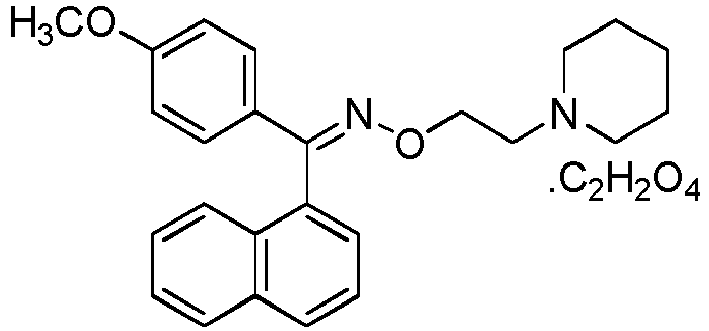
- Into a 50 ml round bottom flask, (4-(methoxy phenyl)(naphthalen-1-yl)methanone oxime (1 mmole, 277 mg), 1-(2-chloroethyl)piperidine hydrochloride (1.2 mmole, 220.8 mg), baked K2CO3 (5 mmole, 690 mg) and dry acetone (10.0 ml) were taken. The reaction mixture was refluxed under anhydrous conditions for 6 hours. The reaction was followed by TLC monitoring. After completion of the reaction, K2CO3 was filtered off and washed with acetone (2x10 ml). The filtrate was concentrated and the crude product was purified by basic alumina column chromatography using distilled Hexane to yield the pure product (312mg, 80.41%). The product obtained was oily so a salt of the compound was prepared.
- Procedure for oxalate salt formation: Oxalic acid, 1mmole/ 1mmole of compound, (101.3 mg) and oily product (312 mg) were dissolved in dry methanol separately into two round bottom flasks. The acid and the compound were mixed and shaken thoroughly. The salt was precipitated using dry diethyl ether, filtered, washed with the same and collected. Yield: 364 mg, 70.82%.
M. P. (Oxalate Salt of compound) = 171°C; ESI MS (m/z): 389 (M+H), IR (KBr, Cm-1): 3409.7, 3020.1, 2959.6, 2361.4, 1771.7, 1609.9, 1513.2, 1216.1, 1030.0, 761.0, 670.1. 1H NMR(CDCl3, 300MHz): δ=7.92(d J=8.0 Hz, 2H, ArH), 7.71(d, J=8.2 Hz, 1H, ArH), 7.58-7.42(m, 5H, ArH), 7.33-7.28(m, 1H, ArH), 6.84(d, J=8.8 Hz, 2H, ArH), 4.30(t, J=6.0 Hz, 2H, OCH2), 3.80(s, 3H, OCH3), 2.62(t, J=5.4 Hz, 2H, NCH2), 2.25-2.23(m, 4H, NCH2), 1.48-1.43(m, 4H, CH2), 1.34-1.28(m, 2H, CH2); Analysis calculated for C25H28N2O2(free base): C, 77.29; H, 7.26; N, 7.21, found: C, 77.31; H, 7.30; N, 7.20. -

- Into a 50 ml round bottom flask, (4-(methoxy phenyl)(naphthalen-1-yl)methanone oxime (1 mmole, 277 mg), 1-(2-chloroethyl)pyrrolidine hydrochloride (1.2 mmole, 204 mg), baked K2CO3 (5 mmole, 690 mg) and dry acetone (10.0 ml) were taken. The reaction mixture was refluxed under anhydrous conditions for 6 hours. The reaction was followed by TLC monitoring. After completion of the reaction, K2CO3 was filtered off and washed with acetone (2x10 ml). The filtrate was concentrated and the crude product was purified by basic alumina column chromatography using distilled Hexane to yield the pure product (262mg, 69.87%). The product obtained was oily so a salt of the compound was prepared.
- Procedure for oxalate salt formation: Oxalic acid, 1mmole/ 1mmole of compound, (88.02 mg) and oily product (262 mg) were dissolved in dry methanol separately into two round bottom flasks. The acid and the compound were mixed and shaken thoroughly. The salt was precipitated using dry diethyl ether, filtered, washed with the same and collected. Yield: 325 mg, 64.87%.
M. P. (Oxalate Salt of compound)= 158°C; ESI MS(m/z) = 375 (M+H); IR (KBr, Cm-1): 3450.2, 3020.0, 1758.1, 1629.6, 1216.0, 1045.5, 761.6, 669.7; 1H NMR(CDCl3, 300MHz): δ=7.93(d, J=8.0 Hz, 2H, ArH), 7.73(d, J=9.8 Hz, 1H, ArH), 7.58-7.42(m, 5H, ArH), 6.84(d, J=8.7 Hz, 2H, ArH), 4.32(t, J=6.1 Hz, 2H, OCH2), 3.75(s, 3H, OCH3), 2.75-2.68(m, 2H, NCH2), 2.47-2.44 (m, 4H, NCH2), 1.66-1.57 (m, 4H, CH2); Analysis calculated for C24H26N2O2 (free base): C, 76.98; H, 7.00; N, 7.48, found: C, 76.95; H, 7.03; N, 7.45. -

- Into a 50 ml round bottom flask, 4-(methylthio)phenyl (naphthalen-1-yl)methanone oxime (1 mmole, 277 mg), (2-Chloro-ethyl)-dimethyl-amine hydrochloride (1.2 mmole, 172.8 mg), baked K2CO3 (5 mmole, 690 mg) and dry acetone (10.0 ml) were taken. The reaction mixture was refluxed under anhydrous conditions for 6 hours. The reaction was followed by TLC monitoring. After completion of the reaction, K2CO3 was filtered off and washed with acetone (2x10 ml). The filtrate was concentrated and the crude product was purified by basic alumina column chromatography using distilled Hexane to yield the pure product (281mg, 80.8%). The product obtained was oily so a salt of the compound was prepared.
- Procedure for oxalate salt formation: Oxalic acid, 1mmole/ 1mmole of compound, (101.8mg) and oily product (281 mg) were dissolved in dry methanol separately into two round bottom flasks.The acid and the compound were mixed and shaken thoroughly. The salt was precipitated using dry diethyl ether, filtered, washed with the same and collected. Yield: 329 mg, 69.4%.
M. P. (Oxalate Salt of compound)= 141°C; ESI MS (m/z)= 349 (M+H), IR (KBr, Cm-1): 3443.3, 3019.8, 2962.4, 2361.6, 1756.8, 1627.5, 1510.3, 1466.8, 1216.5, 1032.0, 761.1, 670.0; 1H NMR(CDCl3, 200MHz): δ=7.92(m, 2H, ArH), 7.61-7.37(m, 6H, ArH), 7.31-7.26(m, 1H, ArH), 6.84(d, J=6.8 Hz, 2H, ArH), 4.49(t, J=4.6 Hz, 2H, OCH2), 3.78(s, 3H, OCH3), 3.29-3.27(m, 2H, NCH2), 2.46(s, 6H, NCH3). Analysis calculated for C22H24N2O2 (free base): C, 75.83; H, 6.94; N, 8.04, Found: C, 75.80; H, 6.90; N, 8.00. -

- Into a 50 ml round bottom flask, (4-(methoxy phenyl)(naphthalen-1-yl)methanone oxime (1 mmole, 277 mg), 2-chloro-N,N-diethylethanamine hydrochloride (1.2 mmole, 205 mg), baked K2CO3 (5 mmole, 690 mg) and dry acetone (10.0 ml) were taken. The reaction mixture was refluxed under anhydrous conditions for 6 hours. The reaction was followed by TLC monitoring. After completion of the reaction, K2CO3 was filtered off and washed with acetone (2x10 ml). The filtrate was concentrated and the crude product was purified by basic alumina column chromatography using distilled Hexane to yield the pure product (289 mg, 76.86%). The product obtained was oily so a salt of the compound was prepared.
- Procedure for oxalate salt formation: Oxalic acid, 1mmole/ 1mmole of compound, (96.85 mg) and oily product (289 mg) were dissolved in dry methanol separately into two round bottom flasks. The acid and the compound were mixed and shaken thoroughly. The salt was precipitated using dry diethyl ether, filtered, washed with the same and collected. Yield: 295 mg, 58.78%.
M.P.(Oxalate Salt of compound)= 137°C; ESI MS(m/z)= 377 (M+H), IR(KBr,Cm-1): 3445.4, 2940.8, 2645.9, 1900.0, 1607.6, 1510.1, 1313.4, 1249.4, 1177.5, 1030.3, 963.3, 717.1; 1H NMR(CDCl3, 200MHz): δ= 7.91(d, J=8.1 Hz, 2H, ArH),7.69(d, J=8.2 Hz, 1H, ArH), 7.57-7.39(m, 5H, ArH), 7.32-7.26(m, 1H, ArH), 6.83(d, J=7.1 Hz, 2H, ArH), 4.25(t, J=6.3 Hz, 2H, OCH2), 3.78(s, 3H, OCH3), 2.74(t, J=5.9 Hz, 2H, NCH2), 2.45-2.34(q, J=7.2 Hz, 4H, CH2), 0.88(t, J=7.2 Hz, 6H, CH3); Analysis calculated for C24H28N2O2: C, 76.56; H, 7.50; N, 7.44, found: C, 76.53; H, 7.52; N, 7.42. -

- Into a 50 ml round bottom flask, 4-(methoxy phenyl (naphthalen-1-yl)methanone oxime (1 mmole, 277 mg), (2-Chloro-ethyl)-diisopropyl-amine hydrochloride (1.2 mmole, 240 mg), baked K2CO3 (5 mmole, 690 mg) and dry acetone (10.0 ml) were taken. The reaction mixture was refluxed under anhydrous conditions for 6 hours. The reaction was followed by TLC monitoring. After completion of the reaction, K2CO3 was filtered off and washed with acetone (2x10 ml). The filtrate was concentrated and the crude product was purified by basic alumina column chromatography using distilled Hexane to yield the pure product (318mg, 78.71%). The product obtained was oily so a salt of the compound was prepared.
- Procedure for oxalate salt formation: Oxalic acid, 1mmole/ 1mmole of compound, (99.18 mg) and oily product (318 mg) were dissolved in dry methanol separately into two round bottom flasks. The acid and the compound were mixed and shaken thoroughly. The salt was precipitated using dry diethyl ether, filtered, washed with the same and collected. Yield: 331 mg, 62.45%.
M.P. (Oxalate Salt of compound)= 130°C; ESI MS(m/z)= 405 (M+H), IR (KBr, Cm-1): 3445.3, 2977.4, 2691.6, 1748.4, 1638.8, 1508.0, 1394.7, 1252.6, 1178.0, 966.1, 777.6; 1H NMR(CDCl3, 200MHz): δ=7.92(d J=8.1 Hz, 2H, ArH), 7.69(d, J=8.0 Hz, 1H, ArH), 7.58-7.40(m, 5H, ArH), 7.33-7.29(m, 1H, ArH), 6.83(d, J=6.9 Hz, 2H, ArH) 4.09(t, J=7.3 Hz, 2H, OCH2), 3.79(s, 3H, OCH3), 2.98-2.85(m, 2H, NCH), 2.69-2.60(m, 2H, NCH 2), 0.94(d, J=6.5 Hz, 12H, CHCH 3); Analysis calculated for C26H32N2O2: C, 77.19; H, 7.97; N, 6.92, found: C, 77.24; H, 7.99; N, 6.90. -

- Into a 50 ml round bottom flask, 4-(methoxy phenyl (naphthalen-1-yl)methanone oxime (1 mmole, 277 mg), (2-Chloro-propyl)-dimethyl-amine hydrochloride (1.2 mmole, 189.6 mg), baked K2CO3 (5 mmole, 690 mg) and dry acetone (10.0 ml) were taken. The reaction mixture was refluxed under anhydrous conditions for 6 hours. The reaction was followed by TLC monitoring. After completion of the reaction, K2CO3 was filtered off and washed with acetone (2x10 ml). Filtrate was concentrated and the crude product was purified by basic alumina column chromatography using distilled Hexane to yield the pure product (270mg, 74.59%). The product obtained was oily so a salt of the compound was prepared.
- Procedure for oxalate salt formation: Oxalic acid, 1mmole/ 1mmole of compound, (93.98 mg) and oily product (270 mg) were dissolved in dry methanol separately into two round bottom flasks. The acid and the compound were mixed and shaken thoroughly. The salt was precipitated using dry diethyl ether, filtered, washed with the same and collected. Yield: 250 mg, 51.23%.
M.P. (Oxalate Salt of compound)= 105°C; ESI MS(m/z)= 363 (M+H), IR (KBr, Cm-1): 3746.4, 2931.5, 1754.4, 1694.1, 1629.4, 1559.5, 1511.4, 1462.6, 1252.0, 1176.7, 962.8, 739.5; 1H NMR (200MHz, CDCl3): δ= 7.91(d, J=8.8 Hz, 2H, ArH), 7.69(d, J=8.1 Hz, 1H, ArH), 7.54-7.39(m, 5H, ArH), 7.32-7.26(m, 2H, ArH & CHCl3), 6.83(m, 2H, ArH), 4.00-3.97(m, 1H, OCH), 3.80(s, 3H, OCH3), 2.09(s, 6H, NCH3), 0.85(d, J=6.6 Hz, 3H, CH-CH3); Analysis calculated for C23H26N2O2: C, 76.21; H, 7.23; N, 7.73, found: C, 76.21; H, 7.23; N, 7.73. -

- Into a 50 ml round bottom flask, 4-(methoxy phenyl (naphthalen-1-yl)methanone oxime (1 mmole, 277 mg), 1-(2-Chloro-ethyl)-azepane hydrochloride (1.2 mmole, 237.6 mg), baked K2CO3 (5 mmole, 690 mg) and dry acetone (10.0 ml) were taken. The reaction mixture was refluxed under anhydrous conditions for 6 hours. The reaction was followed by TLC monitoring. After completion of the reaction, K2CO3 was filtered off and washed with acetone (2x10 ml). Filtrate was concentrated and the crude product was purified by basic alumina column chromatography using distilled Hexane to yield the pure product (312mg, 77.61%). The product obtained was oily so a salt of the compound was prepared.
- Procedure for oxalate salt formation: Oxalic acid, 1mmole/ 1mmole of compound, (97.79 mg) and oily product (312 mg) were dissolved in dry methanol separately into two round bottom flasks. The acid and the compound were mixed and shaken thoroughly. The salt was precipitated using dry diethyl ether, filtered, washed with the same and collected. Yield: 331 mg, 62.69%.
M.P. (Oxalate Salt of compound)= 122 °C; ESI MS(m/z)= 403 (M+H), IR (KBr, Cm-1): 3446.5, 2933.9, 2599.9, 1721.6, 1607.9, 1510.2, 1459.5, 1251.3, 1177.9, 1026.7, 960.1, 719.2; 1H NMR (300MHz, CDCl3): δ= 7.92(d, J=8.0 Hz, 2H, ArH), 7.69(d, J=8.2 Hz, 1H, ArH), 7.58-7.39(m, 5H, ArH), 7.33-7.28(m, 1H, ArH), 6.84(d, J=8.5 Hz, 2H, ArH), 4.27(t, J=6.1 Hz, 2H, OCH2), 3.80(s, 3H, OCH3), 2.78-2.67(m, 2H NCH2), 2.51(m, 4H NCH2), 1.49(m, 8H, CH2); Analysis calculated for C26H30N2O2: C, 77.58; H, 7.51; N, 6.96; found: C, 77.55; H, 7.53; N, 6.95. -

- Into a 50 ml round bottom flask, 4-(methoxy phenyl (naphthalen-1-yl)methanone oxime (1 mmole), 1-(2-Chloro-ethyl)-morpholine hydrochloride (1.2 mmole), baked K2CO3 (5 mmole) and dry acetone (10.0 ml) were taken. The reaction mixture was refluxed under anhydrous conditions for 4 hours. The reaction was followed by TLC monitoring. After completion of the reaction, K2CO3 was filtered off and washed with acetone (2x10 ml). Filtrate was concentrated and the crude product was purified by basic alumina column chromatography using distilled Hexane to yield the pure product (78.5%).
ESI MS(m/z)= 391(M+H), NMR (300MHz, CDCl3): δ= 7.94 (d, J= 8.22Hz, 2H, ArH), 7.66-7.43 (m, 6H, ArH), 7.31(m, 1H, ArH), 6.86(d, J= 8.9Hz, 2H, ArH), 4.47(br, s, 2H, OCH3), 3.81(s, 3H, OCH3), 3.60-3.53(m, 4H, OCH2), 3.25-3.24(m, 2H, OCH2), 2.71(broad, 6H NCH2); Analysis calculated for: C24H26N2O3: C, 73.85; H, 6.73; N, 7.20; found: C, 73.82; H, 6.71; N, 7.17. -

- Into a 50 ml round bottom flask (4-(methoxy phenyl)(naphthalen-1-yl)methanone oxime (1 mmole, 277 mg), 3-chloro-N,N-dimethylpropan-1-amine hydrochloride (1.2 mmole, 190 mg), baked K2CO3 (5 mmole, 690 mg) and dry acetone (10.0 ml) were taken. The reaction mixture was refluxed under anhydrous conditions for 6 hours. The reaction was followed by TLC monitoring. After completion of the reaction, K2CO3 was filtered off and washed with acetone (2x10 ml). Filtrate was concentrated and the crude product was purified by basic alumina column chromatography using distilled Hexane to yield the pure product (253 mg, 69.89%). The product obtained was oily so the salt of the compound was prepared.
- Procedure for oxalate salt formation: Oxalic acid, 1mmole/ 1mmole of compound, (88.06 mg) and oily product (253 mg) were dissolved in dry methanol separately into two round bottom flasks. The acid and the compound were mixed and shaken thoroughly. The salt was precipitated using dry diethyl ether, filtered, washed with the same and collected. Yield: 250 mg, 65.96%.
M.P. (Oxalate Salt of compound)= 1550C; ESI MS(m/z)= 363 (M+H), IR (KBr, Cm-1): 3446.3, 3045.6, 2957.4, 2680.0, 2470.8, 1741.9, 1602.8, 1510.0, 1251.9, 1177.4, 1043.6, 719.1; 1H NMR (200MHz, CDCl3): δ= 7.92(d, J=7.7 Hz, 2H, ArH), 7.69(d, J=8.0 Hz, 1H, ArH), 7.63-7.44(m, 5H, ArH), 7.32-7.28(m, 2H, ArH), 6.83(d, J=8.4 Hz, 2H, ArH), 4.17(t, J=6.0 Hz, 2H, OCH2), 3.80(s, 3H, OCH3), 2.65(m, 2H, NCH2), 2.12(s, 2H, NCH3), 1.78(m, 2H, CH2). Analysis calculated for C23H26N2O2: C, 76.21; H, 7.23; N, 7.73; Found: C, 76.20; H, 7.25; N, 7.70. -

- Into a 50 ml round bottom flask, (4-Methoxy-phenyl)-naphthalen-1-yl-methanone oxime (2 mmole, 526.58 mg), 1-bromo-3-chloropropane (4 mmole, 0.39 ml), baked K2CO3 (10 mmole, 1380 mg) and dry acetone (15.0 ml) were taken. The reaction mixture was refluxed under anhydrous conditions for 8 hours. The reaction was followed by TLC monitoring. After completion of the reaction, K2CO3 was filtered off and washed with acetone (2x10 ml). Filtrate was concentrated and the crude product was purified by silica gel column chromatography using 30% chloroform/ Hexane to yield the pure product (614 mg, 86.7%).
Oily compound, ESI MS(m/z) = 354 (M+H); 1H NMR (200MHz, CDCl3): δ= 7.93(d, J=8.0 Hz, 2H, ArH), 7.70(m, 1H, ArH), 7.64-7.45(m, 5H, ArH), 7.33-7.29(m, 2H, ArH), 6.84(d, J=4.0 Hz, 2H, ArH), 4.29(t, J=5.7 Hz, 2H, OCH2), 3.42-3.35(m, 2H, CH2Cl), 3.79(s, 3H, OCH3), 2.14-2.01(m, 2H,CH2); Analysis calculated for C21H20ClNO2: C, 71.28; H, 5.70; N, 3.96; found: C, 71.32; H, 5.75; N, 3.90. -

- Into a 50 ml round bottom flask, (4-Methoxy-phenyl)-naphthalen-1-yl-methanone O-(3-chloro-propyl)-oxime (1 mmole, 353 mg), Piperidine (5 mmole, 0.49ml) and dry methanol (10.0 ml) were taken. The reaction mixture was refluxed under anhydrous conditions for 6 hours. The reaction was followed by TLC monitoring. After completion of the reaction, methanol was evaporated under reduced pressure. The resulting mixture was poured onto water and extracted with ethyl acetate (3x50 ml), washed with water, dried over anhydrous Na2SO4 and concentrated. The crude product was purified by basic alumina column chromatography using distilled Hexane to yield the pure product (289mg, 69.1 %).
Oily Compound; ESI MS (m/z)= 403 (M+H); 1H NMR (200MHz, CDCl3): δ= 7.93(d, J=8 Hz, 2H, ArH), 7.70(d, J=4 Hz, 1H, ArH), 7.64-7.45(m, 5H, ArH), 7.33-7.29(m, 1H, ArH), 6.84(d, J=4 Hz, 2H, ArH), 4.13-4.15(m, 2H, OCH2), 3.8(s, 3H, OCH3), 3.75(m, 2H, NCH2), 3.34(m, 2H, NCH2), 2.70-2.58(m, 2H, NCH2), 2.10-1.71(m, 8H, CH2). Analysis calculated for C21H20ClNO2: C, 77.58; H, 7.51; N, 6.96; found: C, 77.55; H, 7.50; N, 6.89. -

- Into a 50 ml round bottom flask, 4-(methylthiophenyl)(naphthalen-1-yl)methanone O-3-chloropropyl oxime (1 mmole, 369 mg), piperidine (5 mmole, 0.49 ml) and dry methanol (10.0 ml) were taken. The reaction mixture was refluxed under anhydrous conditions for 6 hours. The reaction was followed by TLC monitoring. After completion of the reaction, methanol was evaporated under reduced pressure. The resulting mixture was poured onto water and extracted with ethyl acetate (3x50 ml), washed with water, dried over anhydrous Na2SO4 and concentrated. The crude product was purified by basic alumina column chromatography using distilled Hexane to yield the pure product (335mg, 75.59%).The product obtained was oily so a salt of the compound was prepared.
- Procedure for oxalate salt formation: Oxalic acid, 1mmole/ 1mmole of compound, (100.7 mg) and oily product (335 mg) were dissolved in dry methanol separately into two round bottom flasks. The acid and the compound were mixed and shaken thoroughly. The salt was precipitated using dry diethyl ether, filtered, washed with the same and collected. Yield: 395 mg, 90.65%.
M.P. (Oxalate Salt of compound)= 137°C; ESI MS (m/z)= 419 (M+H); IR (KBr, Cm-1): 3854, 3740, 3443, 2925, 2358, 1753, 1633, 1553, 1220, 760; 1H NMR (300MHz, CDCl3): δ=7.93(d, J=8.2 Hz, 2H, ArH), 7.64-7.38(m, 6H, ArH), 7.30(m, 1H, ArH), 7.16(d, J=8.0 Hz, 2H, ArH), 4.13(m, 2H, OCH2), 3.75(m, 2H, NCH2), 3.34(m, 2H, NCH2), 2.70-2.58(m, 2H, NCH2), 2.45(s, 3H, SCH3), 2.10-1.71(m, 8H, CH2). Analysis calculated for C26H30N2OS: C, 74.60; H, 7.22; N, 6.69; found: C, 74.58; H, 7.20; N, 6.67. -

- Into a 50 ml round bottom flask, 4-(methylthio)phenyl)(naphthalen-1-yl)methanone O-3-chloropropyl oxime (1 mmole, 369 mg), Morpholine (5 mmole, 0.44ml) and dry methanol (10.0 ml) were taken. The reaction mixture was refluxed under anhydrous conditions for 6 hours. The reaction was followed by TLC monitoring. After completion of the reaction, methanol was evaporated under reduced pressure. The resulting mixture was poured onto water and extracted with ethyl acetate (3x50 ml), washed with water, dried over anhydrous Na2SO4 and concentrated. The crude product was purified by basic alumina column chromatography using distilled Hexane to yield the pure product (265mg, 60%).
M.P.= 890C, ESI MS(m/z)= 421(M+H); IR(KBr, Cm-1): 3440.1, 2953.6, 2858.6, 2807.4, 2689.8, 1556.0, 1590.3, 1485.7, 1437.4, 1394.3, 1369.8, 1310.1, 1252.3, 1113.2, 1058.5, 585.8, 799.7, 777.7; 1H (300MHz, CDCl3): δ=7.93(d, J=7.9 Hz, 2H, ArH), 7.54-7.39(m, 6H, ArH), 7.30 (d, J=8.1 Hz, 1H, ArH), 7.15(d, J=8.0 Hz, 2H, ArH), 4.19(t, J=6.3 Hz, 2H, OCH2), 3.70-3.60(m, 4H, OCH2), 2.44(s, 3H, SCH3), 2.30-2.15(m, 6H, NCH2), 1.26(m, 2H, CH2). Analysis calculated for C25H28N2O2S: C, 71.40; H, 6.71; N, 6.66. found: C, 71.38; H, 6.69; N, 6.64. -

- Into a 50 ml round bottom flask, 4-(methylthiophenyl)(naphthalen-1-yl)methanone O-3-chloropropyl oxime (1 mmole, 369 mg), 4-methylpiperidine (5 mmole, 0.59 ml) and dry methanol (10.0 ml) were taken. The reaction mixture was refluxed under anhydrous conditions for 6 hours. The reaction was followed by TLC monitoring. After completion of the reaction, methanol was evaporated under reduced pressure. The resulting mixture was poured onto water and extracted with ethyl acetate (3x50 ml), washed with water, dried over anhydrous Na2SO4 and concentrated. The crude product was purified by basic alumina column chromatography using distilled Hexane to yield the pure product (350mg, 81.1%).The product obtained was oily so a salt of the compound was prepared.
- Procedure for oxalate salt formation: Oxalic acid, 1mmole/ 1mmole of compound, (102.1 mg) and oily product (350 mg) were dissolved in dry methanol separately into two round bottom flasks. The acid and the compound were mixed and shaken thoroughly. The salt was precipitated using dry diethyl ether, filtered, washed with the same and collected. Yield: 400 mg, 71.7%.
M.P.(oxalate salt of compound): 1450 C, ESI MS(m/z)= 433 (M+H), IR Spectra: (KBr, Cm-1): 3445.4, 2928.8, 1648.1, 1451.6, 1246.1, 779.6. 1H NMR (300MHz, CDCl3): δ=7.93(d, J=8.0 Hz, 2H, ArH), 7.56-7.38(m, 6H, ArH), 7.30(d, J=8.1 Hz, 1H, ArH), 7.16(d, J=8.5 Hz, 2H, ArH), 4.13(m, 2H, OCH2), 3.49-3.42(m, 2H, NCH2), 2.63(m, 2H, NCH2), 2.45(s, 3H, SCH3), 2.00(m, 2H, NCH2), 1.63(m, 5H, CH2 & CH), 1.24(m, 2H, CH2), 0.96(d, J=5.6 Hz, 3H, CHCH3). Analysis calculated for C27H32N2OS (free base): C, 74.96; H, 7.46; N, 6.48; found: C, 74.92; H, 7.43; N, 6.47. -

- Into a 50 ml round bottom flask, (4-(methylthio)phenyl)(naphthalen-1-yl)methanone O-3-chloropropyl oxime (1 mmole, 369 mg), N-methylbutan-1-amine (5 mmole, 0.59ml) and dry methanol (15.0 ml) were taken. The reaction mixture was refluxed under anhydrous conditions for 6 hours. The reaction was followed by TLC monitoring. After completion of the reaction, methanol was evaporated under reduced pressure. The resulting mixture was poured onto water and extracted with ethyl acetate (3x50 ml), washed with water, dried over anhydrous Na2SO4 and concentrated. The crude product was purified by basic alumina column chromatography using distilled Hexane to yield the pure product (287mg, 68.3%). Oily Compound; ESI MS (m/z)= 421 (M+H); 1H NMR (300MHz, CDCl3): δ= 7.93(d, J=8 Hz, 2H, ArH), 7.62-7.39(m, 6H, ArH), 7.31-7.26(m, 1H, ArH), 7.15-7.11(m, 2H, ArH), 4.19-4.10(m, 2H, OCH2), 2.46(s, 3H, SCH3), 2.44(t, J=6.7 Hz, 4H, NCH2), 2.24(s, 3H, NCH2), 1.34-1.22(m, 6H, CH2), 0.91(t, J=6.9 Hz, 3H, CH3). Analysis calculated for C26H32N2OS: C, 74.24; H, 7.67; N, 6.66; found: C, 74.22; H, 7.65; N, 6.63.
-

- Into a 50 ml round bottom flask, (4-Methoxy-phenyl)-naphthalen-1-yl-methanone O-(3-chloro-propyl)-oxime (1 mmole, 353 mg), 2-ethylhexan-1-amine (5 mmole, 0.82ml) and dry methanol (10.0 ml) were taken. The reaction mixture was refluxed under anhydrous conditions for 6 hours. The reaction was followed by TLC monitoring. After completion of the reaction, methanol was evaporated under reduced pressure. The resulting mixture was poured onto water and extracted with ethyl acetate (3x50 ml), washed with water, dried over anhydrous Na2SO4 and concentrated. The crude product was purified by basic alumina column chromatography using distilled Hexane to yield the pure product (321mg, 71.9%).
Oily Compound; ESI MS (m/z)= 447 (M+H); 1H NMR (300MHz, CDCl3): δ= 8.07(d, J=9 Hz, 1H, ArH), 7.94-7.91(m, 1H, ArH), 7.67-7.61(m, 2H, ArH), 7.59-7.54(m, 3H, ArH), 7.48-7.45 (m, 1H, ArH), 7.41-7.39 (d, 1H, ArH), 7.25-7.22(d, 2H, ArH), 3.48-3.28(m, 1H, OCH2), 3.25-3.23 (m, 1H, OCH2), 2.47 (s, 3H, SCH3), 1.93-1.87 (m, 2H, NCH2), 1.50-1.48(m, 2H, NCH2), 1.12-0.92(m, 5H, CH2-CH2, CH), 0.81-0.60(m,12H, 3CH2, 2CH3); Analysis calculated for C29H38N2O2: C, 77.99; H, 8.58; N, 6.27; found: C, 78.03; H, 8.61; N, 6.30. -

- Into a 50 ml round bottom flask, 4-(methylthiophenyl)(naphthalen-1-yl)methanone O-4-chlorobutyl oxime (1 mmole, 383 mg), piperidine (5 mmole, 0.49 ml) and dry methanol (10.0 ml) were taken. The reaction mixture was refluxed under anhydrous conditions for 7 hours. The reaction was followed by TLC monitoring. After completion of the reaction, methanol was evaporated under reduced pressure. The resulting mixture was poured onto water and extracted with ethyl acetate (3x50 ml), washed with water, dried over anhydrous Na2SO4 and concentrated. The crude product was purified by basic alumina column chromatography using distilled Hexane to yield the pure product. Yield: 361 mg, 83.6%.
Oily Compound, ESI MS (m/z)= 433 (M+H); IR Spectra: (Neat, Cm-1): 3020.7, 2934.8, 1595.0, 1216.0, 761.4; 1H NMR (CDCl3, 300MHz): δ=7.93 (d, J=8.04 Hz, 2 H, ArH), 7.67 (d, J=8.6 Hz, 1H, ArH), 7.58-7.41(m, 5H, ArH), 7.39-7.28(m, 1H, ArH), 7.17(d, J=8.6 Hz, 2H, ArH), 4.17-4.13(t, J=6.8 Hz, 2H, OCH2), 2.46(s, 3H, SCH3), 2.24-2.16(m, 6H, NCH2), 1.64-1.28(m, 10H, CH2); Analysis calculated for C27H32N2OS(free base) = C, 74.96; H, 7.46; N, 6.48; found: C, 74.92; H, 7.51; N, 6.50. -

- Into a 50 ml round bottom flask, 4-(methylthio)phenyl)(naphthalen-1-yl)methanone O-3-chloropropyl oxime (1 mmole, 369 mg), Pyrrolidine (5 mmole, 0.42ml) and dry methanol (10.0 ml) were taken. The reaction mixture was refluxed under anhydrous conditions for 7 hours. The reaction was followed by TLC monitoring. After completion of the reaction, methanol was evaporated under reduced pressure. The resulting mixture was poured onto water and extracted with ethyl acetate (3x50 ml), washed with water, dried over anhydrous Na2SO4 and concentrated. The crude product was purified by basic alumina column chromatography using distilled Hexane to yield the pure product (289mg, 69.1 %).
Oily Compound; ESI MS(m/z)= 419(M+H); IR (Neat, Cm-1): 3379.8, 3020.8, 1635.5, 1514.8, 1216.4,761.7; 1H NMR (300MHz, CDCl3): δ=7.93(d, J=8.1 Hz, 2H, ArH), 7.56-7.42(m, 6H, ArH), 7.33-7.28(m, 1H, ArH), 7.16(d, J=8.6 Hz, 2H, ArH), 4.18(t, J=6.5 Hz, 2H, OCH2), 2.46(s, 3H, SCH3), 2.37-2.31(m, 4H, NCH2), 1.77-1.43(m, 8H, CH2). Analysis calculated for C26H30N2OS: C, 74.60; H, 7.22; N, 6.69; found: C, 74.55; H, 7.18; N, 6.67. -

- Into a 50 ml round bottom flask, 4-(methylthio)phenyl)(naphthalen-1-yl)methanone O-4-chlorobutyl oxime (1 mmole, 383 mg), 2-phenylethanamine (5 mmole, 0.63ml) and dry methanol (15.0 ml) were taken. The reaction mixture was refluxed under anhydrous conditions for 6 hours. The reaction was followed by TLC monitoring. After completion of the reaction, methanol was evaporated under reduced pressure. The resulting mixture was poured onto water and extracted with ethyl acetate (3x50 ml), washed with water, dried over anhydrous Na2SO4 and concentrated. The crude product was purified by basic alumina column chromatography using distilled Hexane to yield the pure product (329mg, 72.5%).
Oily Compound; ESI MS (m/z)= 455 (M+H); 1H NMR (300MHz, CDCl3): δ= 7.90-7.85(m, 2H, ArH), 7.63(d, J=9 Hz, 1H, ArH), 7.54-7.49(m, 2H, ArH), 7.45-7.36(m, 5H, ArH), 7.29(m, 1H, ArH), 7.23-7.14(m, 5H, ArH), 4.13(t, J=6 Hz, 2H, OCH2), 2.50-2.45(m, 2H, NCH2), 2.45(s, 3H, SCH3), 1.60-1.55(m, 4H, NCH2, ArCH2), 0.91-0.85(m, 4H, CH2-CH2). Analysis calculated for C29H30N2OS: C, 76.61; H, 6.65; N, 6.16; found: C, 76.56; H, 6.64; N, 6.15. -

- Into a 50 ml round bottom flask, 4-(methylthio)phenyl)(naphthalen-1-yl)methanone O-4-chlorobutyl oxime (1 mmole, 383 mg), N-benzylethanamine (5 mmole) and dry methanol (15.0 ml) were taken. The reaction mixture was refluxed under anhydrous conditions for 7 hours. The reaction was followed by TLC monitoring. After completion of the reaction, methanol was evaporated under reduced pressure. The resulting mixture was poured onto water and extracted with ethyl acetate (3x50 ml), washed with water, dried over anhydrous Na2SO4 and concentrated. The crude product was purified by basic alumina column chromatography using distilled Hexane to yield the pure product (329mg, 72.5%). Oily Compound; ESI MS (m/z)= 483 (M+H); 1H NMR (300MHz, CDCl3): δ= 7.93-7.91(m, 3H, ArH), 7.64-7.14(m, 13H, ArH), 4.17(t, J=6 Hz, 2H, OCH2), 3.82(s, 2H, NCH2), 2.75(q, J=4.0 Hz, 2H, NCH2), 2.54-2.47(m, 5H, SCH3, NCH2), 1.77-1.66(m, 4H, CH2), 1.19-1.14(t, J=4.0 Hz, 3H, CH3). Analysis calculated for C31H34N2OS: C, 77.14; H, 7.10; N, 5.80; found: C, 77.17; H, 7.12; N, 5.85.
- All the compounds synthesized were screened for cytotoxicity on leukemia cell lines K562, HL-60 and mouse fibroblast cell line NIH3T3 using (3-(4,5-dimethylthiazol-2-yl)-2,5-diphenyltetrazolium bromide (MTT) assay kit from Sigma according to manufacturer's instructions and trypan blue exclusion method. Activity of these compounds is given in Table-1. Cytotoxicity of five most active compounds (5a, 5d, 5j, 5m and 7c) was further checked in Kasumil and U937 cells. Compounds 5a, 5d, 5m and 7c exhibited higher efficacy than imatinib (IC50 values are shown in Table 2) in K562.
Table-1: IC50 (µM) values of compounds in K562, HL60 and NIH3T3 cell lines as tested using MTT assay after 48h treatment. Results were calculated from three independent experiments performed in triplicate. Compounds with IC50 more than 15µM were considered inactive. S. No. Compound K562 HL60 NIH3T3 1 4a > 50 µM > 50 µM > 50 µM 2 4b > 50 µM > 50 µM > 50 µM 3 5a 5.8 µM >20 µM 15 µM 4 5b 25 µM 19 µM 20 µM 5 5c > 50 µM > 50 µM > 50 µM 6 5d 3.61 µM 5.99 µM > 20 µM 7 5e 7 µM 14 µM 16 µM 8 5f >25 µM > 50 µM 26 µM 9 5g > 50 µM > 50 µM > 50 µM 10 5h > 50 µM > 50 µM > 50 µM 11 5i >30 µM > 50 µM 40 µM 12 5j 8.5 µM 10 µM 25 µM 13 5k > 50 µM > 50 µM > 50 µM 14 51 > 50 µM > 50 µM > 50 µM 15 5m 4.8 µM 7.78 µM > 25 µM 16 5p > 50 µM 15 µM > 50 µM 17 5q > 50 µM > 50 µM > 50 µM 18 6a > 50 µM > 50 µM > 50 µM 19 6b > 50 µM > 50 µM > 50 µM 20 6c > 50 µM > 50 µM > 50 µM 21 6d > 50 µM > 50 µM > 50 µM 22 6e > 50 µM > 50 µM > 50 µM 23 6f > 50 µM > 50 µM > 50 µM 24 6g 6.66 µM > 50 µM 16 µM 25 6h 19 µM > 50 µM 26 µM 26 6i > 50 µM > 50 µM > 50 µM 27 7a >20 > 50 µM > 50 µM 28 7b > 50 µM > 50 µM > 50 µM 29 7c 5.73 µM > 50 µM 21 µM 30 7d > 50 µM 13 µM > 50 µM 31 8a 6.34 µM 16 µM 20 µM 32 8b > 50 µM > 50 µM > 50 µM 33 8c >30 µM > 50 µM > 50 µM 34 8d 16.3 µM > 50 µM > 50 µM - To consider a molecule as a candidate compound in cancer drug therapy, the test compound must have specific cytotoxicity towards the cancer cells without affecting normal cell growth. Therefore, all active compounds were assessed for toxicity in non-cancer cell-lines: mouse fibroblast cell line (NIH3T3) and monkey kidney epithelial cells (Vero). 5d and 5m exhibited much higher IC50 values in the normal cells compared to leukemia cells. Therefore, based on safety index (IC50/CC50), 5d [Centans; based on IUPAC name prefixed with Central Drug Research Institute's signature (Cent)] was selected as a lead compound.
Table 2: IC50 of Active compounds in Leukemia and normal cell lines. Results were calculated from three independent experiments performed in triplicates. Compound K562 HL60 Kasumi 1 U937 Vero NIH3T3 5a 5.8 µM >20 µM 27 µM > 18 µM >25 µM 15 µM 5d (Centans) 3.61 µM 5.99 µM 6.78 µM 8.12 µM >25 µM >20 µM 5j 8.5 µM 10 µM 20 µM >24 µM >25 µM 25 µM 5m 4.8 µM 7.78 µM > 10 µM > 15 µM >25 µM >25 µM 7c 5.73 µM >50 µM 19 µM >25 µM >25 µM 21 µM IMT 7.53 µM 9.63 µM ND ND ND ND - As described in table 2, among all the compounds tested compound 5d (Centans) showed strong cytotoxicity against BCR-ABL-positive CML model K562, acute myeloblastic leukemia model HL60, Kasumil (Acute Myeloid Leukemia with t(8;21) translocation) and U937 (monoblast), while it showed no toxicity against non-cancerous fibroblastic cell-lines Vero and NIH3T3. ND; not done.
- The efficacy of Centans in comparison to marketed drugs imatinib and dasatinib were determined in K562 and HL-60 cells that were used as examples of CML and AML respectively. As shown in table 3, Centans exhibited a much lower IC50 in comparison to both imatinib and dasatinib, indicating its higher efficacy.
Table 3:. IC50 of Centans, imatinib and dasatinib in K562 and HL60 cell lines after 48h of treatment. Following 48h treatment of indicated cell lines with Centans, imatinib or dasatinib (10 point dose response) MTT assays were performed and IC-50 for the compounds were determined. Results were calculated from three independent experiments performed in triplicates. Cell-line IC 50(µM) Centans HL 60 5.99 K562 3.61 Imatinib HL 60 9.63 K562 5.16 Dasatinib HL 60 6.85 K562 6.8 - Centans shows higher efficacy than imatinib and dasatinib in peripheral blood mononuclear cells (PBMC) isolated from CML patients.
- Next PBMCs isolated from freshly diagnosed, imatinib sensitive, imatinib resistant CML (BCR-ABL +ve) patient samples or healthy controls were treated for 48h with Centans, imatinib and dasatinib and following treatment the efficacy of each drug in each group was determined by MTT assay. As shown in Table 4. Centans showed most robust cytotoxic effect in PBMCs from imatinib-resistant CML patients (72%) compared to imatinib (40%) and dasatinib (59%). Centans also showed higher cytotoxicity than imatinib or dasatinib in PBMCs from freshly diagnosed or imatinib sensitive patients, while all three drugs showed comparative activity on PBMCs from healthy controls.
Table 4:. PBMCs isolated from indicated groups of BCR-ABL-positive CML patients or healthy individuals were treated with 1µM Centans, imatinib or dasatinib for 48h and the cytotoxicity was determined by MTT assay in triplicates. Data represents % cell death. Centans showed better efficacy than both imatinib and dasatinib in all the groups, but this efficacy was highest in imatinib-resistant patient samples (p< 0.01). Patient Type Sample ID Centans P value Centans vs Imatinib Imatinib P value Centans vs Dasatinib Dasatinib Healt hy contr ol C1 14.01 0.76978 10.51 0.30456 2.39 C2 20.65 17.91 12.03 C3 16.93 19.93 18.93 Averag e 17.196 67 16.116 67 11.11667 SEM 1.9214 35 2.8633 39 4.796476 Fresh ly Diag nose d P1 68.82 0.10281 3 61.58 0.01760 7 55.46 P10 73.32 53.34 43.59 P11 55.61 49.51 32.75 P15 71.19 64.1 52.79 Averag e 67.235 57.132 5 46.1475 SEM 3.9824 84 3.4255 4 5.138736 Imati nib Resis P2 69.46 0.00797 7 32.81 0.0074 56.61 tant P13 70.03 34.05 53.82 P14 77.68 48.35 68.84 P17 78.93 47.84 56.41 P18 64.49 36.67 57.84 Averag e 72.118 39.944 58.704 SEM 3.0305 76 3.7861 58 2.926022 Imati nib treate d /Resp onder P3 50.92 0.32157 49.79 0.51036 4 73.22 P12 62.41 48.39 43.65 P16 76.59 62.39 47.26 Averag e 63.306 67 53.523 33 54.71 SEM 6.4292 35 3.8552 99 8.065716 - Next, comparative cytotoxic efficacy of centans with imatinib and dasatinib was assessed in CML patient samples harbouring different BCR-ABL mutations by MTT assay. PBMCs isolated from patients harbouring indicated mutations in BCR-ABL were treated with 5µM centans, imatinib or dasatinib for 48h, followed by MTT assay. As shown in Table 5. Centans showed much stronger cytotoxic activity in comparison to imatinib or dasatinib. Importantly centans showed appreciable cytotoxicity in patient sample harbouring multidrug resistant T315I BCR-ABL mutation.
Table 5:. Centans induces cell death in PBMCs from patients with BCR-ABL mutations including multi-drug resistant T315I mutation with higher efficacy than imatinib and dasatinib. Mutation % Cell Death centans Imatinib Dasatinib T315I 34.60 4.81 8.91 H396R 40.78 8.66 27.82 Y253H 42.93 19.36 32.96 E255V 48.18 23.10 44.40 - To determine whether cell death caused by Centans is specifically associated with apoptosis: phosphatidylserine exposure (Annexine V/ PI; Flow cytometry) was performed in K562 and HL-60 cell-lines. As apparent form
Figure 1 , treatment with Centans caused a robust and dose-dependent increase in phosphatidylserine exposure, which reached 5 fold over vehicle with 5µM ANS in K562 and about 3 fold in HL-60. -
Fig 1 Centans induces Apoptosis in K562 and HL-60 cells. (A and B) Centans increases phosphatidylserine exposure- K562(A) and HL-60 (B) cells were treated with vehicle (DMSO) or Centans (dissolved in DMSO) at indicated concentrations for 24 h and phosphatidylserine exposure was assessed by flow cytometry using the FL1-H channel (Annexin-V) and FL2-H channel (PI). Representative dot plots and relative apoptotic cell in the graph are shown. C and D is the graphical representation of data pooled from three independent experiments. *P < 0.05, **P < 0.01 ***P<0.001 compared to vehicle treated control. - To evaluate the cytostatic effect of Centans, K562 and HL-60 cells were analysed for cell cycle progression in presence of Centans in and as shown in
Fig. 2A and B , that the G1 and apoptotic sub-populations were significantly increased by Centans treatment. To further confirm this, mRNA levels of cell cycle regulatory proteins p21, p27 and cyclin D1 were measured by real time PCR and we found that Centans significantly enhanced mRNA levels of growth suppressant proteins p21 and p27 while it decreased the level of pro-proliferative Cyclin D1 mRNA in both K562 and HL-60 cells. (Fig 2C and D ). -
Fig 2 Centans induces G1 Growth arrest. (A and B) Cell cycle analysis -Propidium iodide (PI) staining of K562 cells (A) and HL-60 cells (B) treated with vehicle (DMSO) or 0.5 µM Centans, followed by flow cytometry analysis to find % distribution of cells in different phases of the cell cycle. Data has been shown as percent of total cells from data pooled from three independent experiments. (C and D). mRNA expression of cell cycle regulatory factors- K562(C) or HL-60 (D) cells were treated with Vehicle or Centans, followed by mRNA isolation and cDNA preparation and quantitative real-time PCR (p21, p27 and cyclin D1). Graphs reprented pooled data from three independent experiments. *P < 0.05, **P < 0.01,***P < 0.001 compared to vehicle treated control. - Kinase activity of Bcr-Abl is the major cause of CML, and since Centans causes growth arrest and apoptosis in Bcr-Abl positive K562 cells, phosphorylation status of Bcr-Abl which is representative of its kinase activity was measured by immunoblotting. As shown in
Fig 3 both imatinib and Centans dose dependently inhibited phosphorylation of BCR-ABL (pBCR-ABL) and its downstream substrates stat5 and Crkl, while eIF4E (used as a control gene unaffected by BCR-ABL signalling) remained unchanged. - Effect of Centans was also observed in terms of SRC kinase activation. SRC kinases activated by BCR-ABL remain fully active in imatinib-treated mouse leukemic cells, suggesting that imatinib does not inactivate all BCR-ABL activated signalling pathways. This SRC pathway is responsible for survival of leukemic cells that becomes imatinib resistant and for CML transition to lymphoid blast crisis. Effect of Centans and Imatinib was compared on its dephosphorylation by immunoblotting and we found that Centans dephosphorylating SRC-1 in a dose dependent manner, while imatinib failed to do so (
Fig. 3 ). -
Fig. 3 . Centans inhibits BCR-ABL signalling and SRC phosphorylation. K562 Cells were treated with V (DMSO), 0.5µM, 1 µM Centans or 1 µM Imatinib for 48h and protein lysate prepared from these cells were used to detect the phosphorylation status of BCR-ABL, STAT-5, CRKL and vSRC-1 by western blotting. ELF4E and β-actin were used as loading control. - In order to clarify whether the inhibitory effects of Centans on the growth and cell cycle of K562 cells was followed by differentiation, Centans treated cells was stained with Wright- Giemsa stain.
Figure 4.A . clearly indicates that Centans is capable of inducing differentiation in K562 cells in a dose-dependent manner. After 3 day of incubation with 0.5 µM of Centans, cells exhibited megakaryocytic morphology characterized by a sharp increase in nuclear-to-cytoplasm ratio, and multiple lobed nuclei, while the vehicle-treated cells displayed homogenous population of immature blast-like cell morphology (Fig. 4.A ). This differentiation was much more pronounced at 12d, where mature megakaryocytes were visible (Fig. 4A ). Confirmation of Centans-mediated megakaryocytic differentiation was attained through measurement of expression of relevant cell differentiation markers by quantitative real time PCR. mRNA expression levels of cluster of differentiation 10 (CD10) (transiently present during B-cell maturation at early-B and pre-B lymphoblastic stages and related to megakaryocytic differentiation), CD36 (erythroid differentiation lineage), GATA2 (Over expression of GATA-2 inhibits erythroid and promotes megakaryocyte differentiation) and CD61 (megakaryocytic differentiation marker) was measured. We found that the expression level of CD10, GATA2 and CD61 were increased while that of CD36 was decreased. These results further confirm that the differentiation induced by Centans is megakaryocytic (Fig 4.B ). -
Fig 4 . CentANS induces Differentiation in K562 cells. (A) Giemsa Staining- K562 cells treated with CentANS (0.5µM) for 3, 6 and 12 days and were cytospinned on Microscopy slides and stained with Giemsa and May Crünwald solutions, slides were micro-photographed and used to detect change in nuclear morphology. (B) Expression of differentiation Markers - K562 cells were treated with vehicle; V (DMSO) or centANS and mRNA from these cells were isolated and reverse transcribed. cDNA was used to measure the expression CD10, GATA2, CD61, (megakaryocytic lineage markers) and CD36 (Erythroid lineage marker) by Quantitative Real time PCR, GAPDH was used as control. Data represents mean ± SEM from three independent experiments; *P < 0.05, **P < 0.01, and ***P < 0.001 compared to control. - Differentiation potential of Centans on HL-60 cells was evaluated by the effect of this compound on Nuclear/cytosolic ratio and change in nuclear morphology, which are reliable markers of differentiation. For this, HL60 cell treated with Centans were cyto-spinned on microscope slides and stained with Wright- Giemsa and micro-photographed. As shown in
Fig. 5A (upper panel), morphological features of differentiation, such as condensation of nuclei and protrusion of cytoplasm, were clearly evident among the treated cells. This was further confirmed by nitro blue tetrazolium (NBT) reduction assay in HL-60 cells (NBT reduction is a hallmark of monocyte activity).Fig. 5A (lower panel) depicts time-dependent reduction of NBT by Centans-treated cells. - Further confirm of granulocytic/monocytic differentiation of HL-60 cells by Centans, was obtained by QRT-PCR analysis of expression of lineage specific differentiation markers following Centans treatment. mRNA level of CD11b, a marker for granulocytic differentiation was significantly increased (
Fig. 5B ). Further, mRNA level of GCSFR, a key marker for terminal granulocytic differentiation increased upon Centans treatment (Fig. 5B ). Centans also enhanced expression of c/EBP group of transcription factors that have been shown to be especially critical in granulocyte development (Fig. 5B ). -
Figure 5 . Centans induces granulocytic/monocytic differentiation in HL-60 model of AML. A. HL60 cells treated with Centans (1µM) for 3,6 and 12 days were cytospinned on Microscope slides and stained with Giemsa and May Crünwald solutions (upper panel) or NBT (lower panel), slides were microphotographed and used to detect change in nuclear morphology and NBT reduction. B. HL60 cells were treated with Vehicle (DMSO) or Centans as indicated in image, mRNA from these samples were isolated and reverse transcribed and these samples were used to measure the expression of CD11b GCSFR,and C/EBPα/β& ε by Quantitative real-time PCR, using GAPDH as normalizing control. Data presented as mean ± SEM from three independent experiments; *P < 0.05, **P < 0.01, and ***P < 0.001 compared to vehicle treated control. - Efficacy of Centans and related series of compounds were evaluated in solid tumor cell-lines MCF-7 (estrogen receptor positive, non-metastatic breast tumor), MDA-MB-231(estrogen receptor negative, metastatic breast tumor), DU-145 (prostrate tumor), Ishikawa (endometrial adenocarcinoma) cells by MTT assay following 24h treatment of indicated compounds. As depicted in table 6. Centans showed selective cytotoxicity in all the cancer cells tested but not in non-cancer cell-lines Vero and HEK-293. Efficacy of Centans was comparable to that of the positive control compound 4-hydroxy-tamoxifen (4-OHT).
Table 6. IC50 of Centans and related compounds in cell line models of breast, prostate and endometrial cancers after 48h of treatment. Following 48h treatment of indicated cell lines with Centans, Centans analogs or 4-OHT (10 point dose response) MTT assays were performed and IC-50 for the compounds were determined. Results were calculated from three independent experiments performed in triplicates. Compound MCF-7 MDA-MB231 DU-145 Ishikawa 4a 18 20 >50 >50 5a 13.5 8.8 10 10 5b 6.6 5.01 9.5 6 5c 14 12.78 15 9 5d (Centans) 7.5 7.2 9 12 5f >50 >50 >50 >50 5m 8 7.2 9.5 7 6a 18 >50 >50 >50 6b 25 >50 >50 >50 6c 15 >50 >50 >50 6d 20 >50 >50 >50 6e 23 >50 >50 >50 6i 20.5 >50 >50 >50 7a 5 20 15 12 7b >50 >50 >50 >50 7c 6.5 20 10 >50 8a 8 18 7.5 18 8b >50 >50 >50 >50 OH-TAM 8.8 8 10 20 - Efficacy of centans in colon cancer cell-lines were also assessed using sulphorhodamine B assay and as shown in table 7, centans exhibited robust cytotoxicity in four different colon cancer cell lines compared to the marketted drug for colon cancer 5-fluoro uracil (5-FU).
Table 7. IC50 of Centans in colon cancer cell lines as determined by Sulphorhodamine B (SRB) assay. Cancer cell-line SW620 DLD1 HCT116 Colo205 Centans 8.78 µM 15.6 µM 7.7 µM 4.2 µM 5-FU >50µM 16.38 µM >50µM 38.06 µM - To asses if the cell death induced by centans in MCF-7 and MDA-MB231 lines is apoptotic in nature, apoptosis was measured by flow cytometry using annexin V/PI staining kit from Sigma according to manufacturer's instructions. A concentration-dependent increase in apoptotic cell population was observed upon treatment with Centans and the effect was stronger in MDA-MB231 than MCF-7 cells (
Fig 6A and B ). -
Fig.6 Apoptosis induction by Centans in breast cancer cells. Annexin V/PI staining of (A) MCF-7 and (B) MDA-MB231 cells were treated with vehicle (DMSO) or Centans at indicated concentrations for 24 h and DNA fragmentation was assessed by flow cytometry using the FL1-H channel (Annexin-V) and FL2-H channel (PI) of a Becton Dickinson FACS Calibur. Shown are representative dot plots. Quantification of flow cytometry data shown as percent of total cells (right panel). Data presented as mean ± SEM from three independent experiments; *P < 0.05, **P < 0.01, and ***P<0.001 compared to control. - Since EGFR and Her2 play major roles in breast cancer development and metastatis, the effect of Centans on regulation of these two factors was evaluated in MCF-7 and MDA-MB-231 cells by enzyme-linked immunosorbant assays (ELISA). As depicted in
fig. 7 . A and B, EGF dependent EGFR phosphorylation at Tyr1068 was strongly attenuated by Centans in both MCF-7 and MDA-MB-231 cells and this effect was much stronger than that of Gefitinib (marketted EGFR inhibitor/ anti-cancer drug). The calculated IC50 for Centans in terms of EGFR phosphorylation were 14.7nM (MCF-7) and 12.75nM (MDA-MB-231). Centans treatment also significantly reduced HER2 phosphorylation in a dose-dependent manner in both MCF-7 and MDA-MB-231 cells (Fig. 7C and D ). -
Fig. 7 . Inhibition of EGFR and Her2 phosphorylation by Centans in MCF-7 and MDA-MB231 cells. Serum starved (A,C) MCF-7 cells and (B,D) MDA-MB231 cells were pre-incubated for 1 h with the indicated concentrations of Centans prior to stimulation with EGF for 15 min and EGFR (A and B) or Her2 (C and D) phosphorylation were measured by ELISA. Gef=Gefitinib. All doses are in µM. - The effect of Centans on the growth of MCF-7 xenograft tumor was studied. Injection of MCF-7 cells in the peritoneal cavity of NIH-III strain of nude mice resulted in the appearance of palpable tumors that rapidly grew from 9 d to 25 d. Beyond 25 d, vehicle treated mice bearing tumors (control) show significant mortality (data not shown). Administration of Centans at 16mg.kg-1.day-1 dose resulted in nearly 50% reduction in relative tumor volume compared to vehicle treated mice on days 21 and 25 following the inoculation of MCF-7 cells (
Fig 8A ). - Histological assessment showed that tumors from vehicle-treated mice were primarily composed of tumor epithelial cells with small amounts of mouse-derived stroma and frequent blood vessels. Tumors from mice treated with Centans presented with large areas of stroma where deletion of epithelial cells had occurred as evident from few mitotic figures (
Fig 8B ). In addition, a significant reduction in the levels of PCNA (marker of proliferation) was observed in tumors from Centans treated mice compared to control (Fig 8C ). -
Fig.8 Regression of xenograft tumor by Centans in athymic nude mice. (A) Increase in relative tumor volume over time in various treatment groups indicated. N = 10 mice/group; data represent mean ± S.E.M. *P < 0.05 and **P < 0.01 compared to vehicle (carboxymethyl cellulose). (B) Effect of Centans treatment on tumor morphology. Representative tumor sections from mice treated with vehicle or Centans (16mg.kg-1.day-1) for 25 days. (C) Effect of Centans treatment on PCNA levels were analyzed by Western blotting from in tumors of vehicle or Centans treated mice. Data represent mean ± S.E.M. **P < 0.01 compared to vehicle-treated control. - Since centans showed cytotoxicity in drug resistant leukemic cells, the efficacy of centans in cancer stem cells (CD133+ DLD1 colon cancer cells) was assessed. As shown in
Fig. 9 . In vehicle (DMSO) treated control cells 15.30% cells were found to be CD133+ (value represents %CD133+ cells minus % cells in isotype control) and 24h treatment with 20uM centans reduced this population to 2.94% (5.79-2.85), while salinomycin the positive control at equivalent concentration reduced the CD133+ population to 5.42% (5.91-0.49) and 5-FU had no effect. -
Fig. 9 . Centans reduces CD133+ colon cancer stem cells with a higher efficacy than salinomycin. DLD1 colon cancer cells were treated with indicated compounds for 24h following which the CD133+ population was assessed by flow cytometry using CD133 antibody or relevant isotype control antibody (BD biosciences) in a Becton Dickinson FACS Calibur. Numbers in the dot plot represent % CD133+ cells. -
- 1. The present compound shows better efficacy than existing drugs imatinib and dasatinib both in leukemia cell-lines and patient samples.
- 2. The present compound causes robust apoptosis in imatinib resistant cancer samples.
- 3. The present compound induces cell death in broader range of leukemic cells than imatinib or dasatinib.
- 4. The present compound induces differentiation in blast cells which is indicative of restoring normal blood cell functions.
- 5. The present compound is also efficacious in solid tumor forming cell-lines including, breast, prostate and endometrial cancers.
Claims (17)
- A compound of formula I or a pharmaceutically acceptable salt thereof,
 R1 = H, halogen, alkyl, alkoxy, nitroR2 = H, halogen, alkyl, alkoxy, nitroR3 = H, alkyl, alkoxy, nitro, halogenX=O, SR4 = hydrogen, alkyl group (C1-C6), alkylamino group (C1-C6), cyclic or open chain amines R5 = hydrogen, alkyl group (C1-C6), alkylepoxy, alkylhydroxyamino group (C1-C6), alkylamino group (C1-C6), cyclic or open chain amines, ester and amides


- The compound as claimed in claim 1, wherein the compound is selected from the group consisting of:1. (4-(methylthio)phenyl)(naphthalen-1-yl)methanone oxime (4a),2. (4-methoxyphenyl)(naphthalen-1-yl)methanone oxime (4b),3. (4-hydroxyphenyl)(naphthalen-1-yl)methanone oxime (4c),4. (4-(methylthio)phenyl)(naphthalen-1-yl)methanone O-2-(piperidin-1-yl)ethyl oxime oxalate (5a),5. (4-(methylthio)phenyl)(naphthalen-1-yl)methanone O-2-(pyrrolidin-1-yl)ethyl oxime oxalate (5b),6. (4-(methylthio)phenyl)(naphthalen-1-yl)methanone O-2-(dimethylamino)ethyl oxime oxalate (5c),7. (4-(methylthio)phenyl)(naphthalen-1-yl)methanone O-2-(diethylamino)ethyl oxime oxalate (5d),8. (4-(methylthio)phenyl)(naphthalen-1-yl)methanone O-2-(diisopropylamino)ethyl oxime (5e),9. (4-(methylthio)phenyl)(naphthalen-1-yl)methanone O-2-morpholinoethyl oxime (5f),10. (4-(methylthio)phenyl)(naphthalen-1-yl)methanone O-1-(dimethylamino)propan-2-yl oxime oxalate (5g),11. (4-(methylthio)phenyl)(naphthalen-1-yl)methanone O-2-(azepan-1-yl)ethyl oxime oxalate (5h),12. (4-(methylthio)phenyl)(naphthalen-1-yl)methanone O-2-(diethylamino)ethyl oxime citrate (5i),13. (4-(methylthio)phenyl)(naphthalen-1-yl)methanone O-2-(diethylamino)ethyl oxime fumarate (5j),14. (4-(methylthio)phenyl)(naphthalen-1-yl)methanone O-2-(diethylamino)ethyl oxime tartrate (5k),15. (4-(methylthio)phenyl)(naphthalen-1-yl)methanone O-2-(diethylamino)ethyl oxime (51),16. (4-(methylthio)phenyl)(naphthalen-1-yl)methanone O-3-(dimethylamino)propyl oxime oxalate (5m),17. (4-(methylthio)phenyl)(naphthalen-1-yl)methanone O-3-chloropropyl oxime (5n),18. (4-(methylthio)phenyl)(naphthalen-1-yl)methanone 0-4-chlorobutyl oxime (5o),19. Ethyl 2-((4-(methylthio)phenyl)(naphthalen-1-yl)methyleneaminooxy)acetate (5p),20. N,N-diethyl-2-((4-(methylthio)phenyl)(naphthalen-1-yl)methyleneaminooxy) acetamide (5q),21. (4-methoxyphenyl)(naphthalen-1-yl)methanone O-2-(piperidin-1-yl)ethyl oxime oxalate (6a),22. (4-methoxyphenyl)(naphthalen-1-yl)methanone O-2-(pyrrolidin-1-yl)ethyl oxime oxalate (6b),23. (4-methoxyphenyl)(naphthalen-1-yl)methanone O-2-(dimethylamino)ethyl oxime oxalate (6c),24. (4-methoxyphenyl)(naphthalen-1-yl)methanone O-2-(diethylamino)ethyl oxime oxalate (6d),25. (4-methoxyphenyl)(naphthalen-1-yl)methanone O-2-(diisopropylamino)ethyl oxime oxalate (6e),26. (4-methoxyphenyl)(naphthalen-1-yl)methanone O-1-(dimethylamino)propan-2-yl oxime oxalate (6f),27. (4-methoxyphenyl)(naphthalen-1-yl)methanone O-2-(azepan-1-yl)ethyl oxime oxalate (6g),28. (4-methoxyphenyl)(naphthalen-1-yl)methanone O-2-morpholinoethyl oxime (6h),29. (4-methoxyphenyl)(naphthalen-1-yl)methanone O-3-(dimethylamino)propyl oxime oxalate (6i),30. (4-methoxyphenyl)(naphthalen-1-yl)methanone O-3-chloropropyl oxime (6j),31. (4-methoxyphenyl)(naphthalen-1-yl)methanone O-3-(piperidin-1-yl)propyl oxime (6k),32. (4-(methylthio)phenyl)(naphthalen-1-yl)methanone O-3-(piperidin-1-yl)propyl oxime oxalate (7a),33. (4-(methylthio)phenyl)(naphthalen-1-yl)methanone O-3-morpholinopropyl oxime (7b),34. (4-(methylthio)phenyl)(naphthalen-1-yl)methanone O-3-(4-methylpiperidin-1-yl)propyl oxime oxalate (7c),35. (4-(methylthio)phenyl) (naphthalen-1-yl)methanone O-3-(butyl(methyl)amino) propyl oxime (7d),36. (4-methoxyphenyl)(naphthalen-1-yl)methanone O-3-(2-ethylhexylamino)propyl oxime (7e),37. (4-(methylthio)phenyl)(naphthalen-1-yl)methanone O-4-(piperidin-1-yl)butyl oxime (8a),38. (4-(methylthio)phenyl)(naphthalen-1 -yl)methanone O-4-(pyrrolidin-1-yl)butyl oxime (8b),39. (4-(methylthio)phenyl)(naphthalen-1-yl)methanone O-4-(phenethylamino)butyl oxime (8c),40. (4-(methylthio)phenyl)(naphthalen-1-yl)methanoneO-4-(benzyl(ethyl) amino) butyl oxime (8d),
- The compound as claimed in claim 1, wherein the structural formula of the compound is:


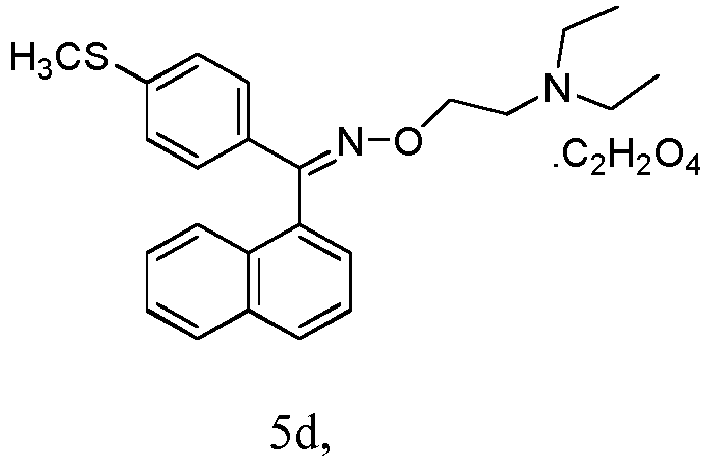


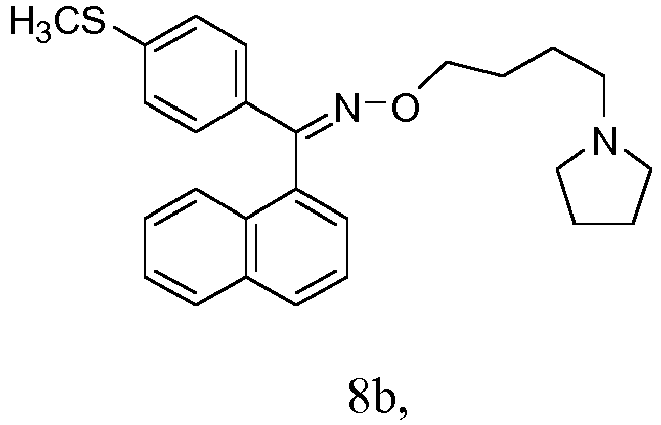


- The compound as claimed in claim 1, wherein the compound is for use in killing of drug resistant cancer cells and cancer stem cells.
- The compound as claimed in claim 1, wherein the compound is for use in the treatment of cancer which is selected from the group consisting of blood cancer, leukemic cancer, lymphoma cancer, multiple myeloma cancer, breast cancer and colon cancer.
- A process for the preparation of compound as claimed in claim 1, comprising the steps of;a) reacting a substituted phenylnaphthalen-1-yl-methanone compound (3) of formula II
 R1 = H, halogen, alkyl, alkoxy, nitroR2 = H, halogen, alkyl, alkoxy, hydroxy, nitroR3 = H, alkyl, alkoxy, nitro, halogenX=O, SR4 = hydrogen, alkyl group (C1-C6), alkylamino group (C1-C6), cyclic or open chain amineswith hydroxylamine hydrochloride and pyridine in absolute ethanol to form substituted phenylnaphthalen-1-yl-methanone oxime (4) of formula I
 R1 = H, halogen, alkyl, alkoxy, nitroR2 = H, halogen, alkyl, alkoxy, hydroxy, nitroR3 = H, alkyl, alkoxy, nitro, halogenX=O, SR4 = hydrogen, alkyl group (C1-C6), alkylamino group (C1-C6), cyclic or open chain aminesb) reacting a substituted phenylnaphthalen-1-yl-methanone oxime as obtained from step (a) with an aminoalkyl chloride, alkyl chloride, alkylepoxychloride, cyclic or open chain amino chloride, alkylhydroxyaminochloride, alkylacetachloride or dihaloalkane in the presence of a base at a reflux temperature in the range of 70°C to 120°C to form the compound 5, 6, 7 & 8 of formula I.
 R1 = H, halogen, alkyl, alkoxy, nitroR2 = H, halogen, alkyl, alkoxy, hydroxy, nitroR3 = H, alkyl, alkoxy, nitro, halogenX=O, SR4 = hydrogen, alkyl group (C1-C6), alkylamino group (C1-C6), cyclic or open chain amines R5 = alkyl group (C1-C6), alkylepoxy, alkylhydroxyamino group (C1-C6), alkylamino group (C1-C6), cyclic or open chain amines, ester and amides derivatives


- The process as claimed in claim 6, wherein the base is selected from the group consisting of K2CO3, CsCO3, KOH and NaH.
- The process as claimed in claim 6, wherein the solvent is selected from the group consisting of dry DMF, acetone and THF.
- The compound as claimed in claim 1, wherein the pharmaceutically acceptable salt is selected from the group consisting of hydrochlorides, citrates, oxalates, fumarates, malates and tartrates.
- A pharmaceutical composition comprising an effective amount of a compound of formula I optionally along with a pharmaceutically acceptable carrier or diluents.
- The compound as claimed in claim 1, wherein the compound is for use in the treatment of leukemia.
- The compound as claimed in claim 1, wherein the compound is for use in the suppression of BCR-ABL activity in CML thereof.
- The compound as claimed in claim 1, wherein the compound is for use in the suppression of c-SRC activity in imatinib-resistance in CML thereof.
- The compound as claimed in claim 1, wherein the compound is for use in inducing apoptosis in imatinib-resistant CML cells.
- The compound as claimed in claim 1, wherein the compound is for use in inducting apoptosis and differentiation in AML cells.
- The compound as claimed in claim 1, wherein the compound is for use in inducting megakaryocytic differentiation in K562 cells and differentiation in blast cells of erythroleukemia or increasing platelet amount.
- The compound as claimed in claim 1, wherein the compound is for use in exhibiting cancer-specific cytotoxicity in ER-positive or ER-negative breast cancer cells, prostate cancer cells, uterine adenocarcinoma and colon cancer.
Applications Claiming Priority (2)
| Application Number | Priority Date | Filing Date | Title |
|---|---|---|---|
| IN2567DE2013 | 2013-08-30 | ||
| PCT/IN2014/000556 WO2015029068A1 (en) | 2013-08-30 | 2014-08-29 | Aryl naphthyl methanone oxime(s) and process for preparation thereof |
Publications (2)
| Publication Number | Publication Date |
|---|---|
| EP3039010A1 EP3039010A1 (en) | 2016-07-06 |
| EP3039010B1 true EP3039010B1 (en) | 2017-10-11 |
Family
ID=51753267
Family Applications (1)
| Application Number | Title | Priority Date | Filing Date |
|---|---|---|---|
| EP14786724.6A Not-in-force EP3039010B1 (en) | 2013-08-30 | 2014-08-29 | Aryl naphthyl methanone oxime(s) and process for preparation thereof |
Country Status (3)
| Country | Link |
|---|---|
| US (1) | US9994515B2 (en) |
| EP (1) | EP3039010B1 (en) |
| WO (1) | WO2015029068A1 (en) |
Family Cites Families (4)
| Publication number | Priority date | Publication date | Assignee | Title |
|---|---|---|---|---|
| US4673746A (en) * | 1978-10-06 | 1987-06-16 | Hoechst-Roussel Pharmaceuticals, Inc. | 1,2-benzisoxazoloxyacetic acids and related compounds |
| DE102004036213B4 (en) * | 2004-07-26 | 2011-02-24 | Johannes-Gutenberg-Universität Mainz | Non-glycosidic and non-peptide selectin inhibitors, their preparation and pharmaceutical compositions |
| JP2012092328A (en) * | 2010-09-30 | 2012-05-17 | Dainippon Printing Co Ltd | Base generator, photosensitive resin composition, pattern formation material comprising the photosensitive resin composition, and method for producing relief pattern and article using the composition |
| JP2012092329A (en) * | 2010-09-30 | 2012-05-17 | Dainippon Printing Co Ltd | Base generator, photosensitive resin composition, pattern formation material comprising the photosensitive resin composition, and method for producing relief pattern and article using the composition |
-
2014
- 2014-08-29 EP EP14786724.6A patent/EP3039010B1/en not_active Not-in-force
- 2014-08-29 WO PCT/IN2014/000556 patent/WO2015029068A1/en not_active Ceased
- 2014-08-29 US US14/915,194 patent/US9994515B2/en not_active Expired - Fee Related
Non-Patent Citations (1)
| Title |
|---|
| None * |
Also Published As
| Publication number | Publication date |
|---|---|
| WO2015029068A1 (en) | 2015-03-05 |
| US20160304442A1 (en) | 2016-10-20 |
| US9994515B2 (en) | 2018-06-12 |
| WO2015029068A4 (en) | 2015-06-11 |
| EP3039010A1 (en) | 2016-07-06 |
Similar Documents
| Publication | Publication Date | Title |
|---|---|---|
| Mohan et al. | Development of a novel azaspirane that targets the Janus kinase-signal transducer and activator of transcription (STAT) pathway in hepatocellular carcinoma in vitro and in vivo | |
| Hutzen et al. | Curcumin analogue GO-Y030 inhibits STAT3 activity and cell growth in breast and pancreatic carcinomas | |
| AU2004258867B2 (en) | Compounds and methods for inducing apoptosis in cancer cells | |
| JP2022526266A (en) | Compositions and Methods for Treating Cancer | |
| EP3271333B1 (en) | Usp7 inhibitor compounds and methods of use | |
| Geesala et al. | 2-Azetidinones: Synthesis and biological evaluation as potential anti-breast cancer agents | |
| Shi et al. | Inhibition of IL-6/STAT3 signaling in human cancer cells using Evista | |
| Biswas et al. | Evaluation of Novel 3‐Hydroxyflavone Analogues as HDAC Inhibitors Against Colorectal Cancer | |
| KR20210027382A (en) | Activator of the unfolded protein reaction | |
| Kumar et al. | Alkyne–azide cycloaddition analogues of dehydrozingerone as potential anti-prostate cancer inhibitors via the PI3K/Akt/NF-kB pathway | |
| Han et al. | Discovery of β-cyclocitral-derived mono-carbonyl curcumin analogs as anti-hepatocellular carcinoma agents via suppression of MAPK signaling pathway | |
| MX2007014843A (en) | Selective apoptotic induction in cancer cells including activation of procaspase-3. | |
| Bhatt et al. | Novel diphenylamine analogs induce mesenchymal to epithelial transition in triple negative breast cancer | |
| Zhang et al. | Discovery of dual CDK6/BRD4 inhibitor inducing apoptosis and increasing the sensitivity of ferroptosis in triple-negative breast cancer | |
| Li et al. | Synthesis and discovery of 18β-glycyrrhetinic acid derivatives inhibiting cancer stem cell properties in ovarian cancer cells | |
| Pandey et al. | 7-hydroxyfrullanolide, isolated from Sphaeranthus indicus, inhibits colorectal cancer cell growth by p53-dependent and-independent mechanism | |
| KR20150042590A (en) | Inhibition of Migration and Invasion of Cancer Cells Overexpressing K-Ras | |
| Liu et al. | Synthesis of a celastrol derivative as a cancer stem cell inhibitor through regulation of the STAT3 pathway for treatment of ovarian cancer | |
| US9994515B2 (en) | Aryl naphthyl methanone oxime(s) and process for preparation thereof | |
| CN109328062A (en) | Small molecule reactive oxygen species inducers and mitochondrial activity inhibitors | |
| Wang et al. | Design, synthesis and evaluation of novel Cyclopropanesulfonamide derivatives for the treatment of EGFRC797S mutation in Non-Small cell lung cancer | |
| CN114026098B (en) | Benzopyranyl compounds, methods and uses | |
| EP2909171B1 (en) | N-substituted 3,4-bis(catechol)pyrrole compounds, their preparation and use in the treatment of cancer | |
| EP2833865A1 (en) | Treatment of proliferative diseases with pyrimidodiazepinones | |
| US9604974B2 (en) | Compounds as modulator of JAK-STAT pathway, methods and applications thereof |
Legal Events
| Date | Code | Title | Description |
|---|---|---|---|
| PUAI | Public reference made under article 153(3) epc to a published international application that has entered the european phase |
Free format text: ORIGINAL CODE: 0009012 |
|
| 17P | Request for examination filed |
Effective date: 20160226 |
|
| AK | Designated contracting states |
Kind code of ref document: A1 Designated state(s): AL AT BE BG CH CY CZ DE DK EE ES FI FR GB GR HR HU IE IS IT LI LT LU LV MC MK MT NL NO PL PT RO RS SE SI SK SM TR |
|
| AX | Request for extension of the european patent |
Extension state: BA ME |
|
| DAX | Request for extension of the european patent (deleted) | ||
| GRAP | Despatch of communication of intention to grant a patent |
Free format text: ORIGINAL CODE: EPIDOSNIGR1 |
|
| STAA | Information on the status of an ep patent application or granted ep patent |
Free format text: STATUS: GRANT OF PATENT IS INTENDED |
|
| RIC1 | Information provided on ipc code assigned before grant |
Ipc: C07C 55/07 20060101ALI20170321BHEP Ipc: C07C 251/48 20060101AFI20170321BHEP Ipc: C07C 59/255 20060101ALI20170321BHEP Ipc: C07C 249/08 20060101ALI20170321BHEP Ipc: C07C 319/02 20060101ALI20170321BHEP Ipc: C07C 59/265 20060101ALI20170321BHEP Ipc: C07D 295/088 20060101ALI20170321BHEP Ipc: C07C 251/58 20060101ALI20170321BHEP Ipc: C07C 321/26 20060101ALI20170321BHEP Ipc: C07C 251/60 20060101ALI20170321BHEP Ipc: C07C 57/15 20060101ALI20170321BHEP |
|
| INTG | Intention to grant announced |
Effective date: 20170418 |
|
| GRAS | Grant fee paid |
Free format text: ORIGINAL CODE: EPIDOSNIGR3 |
|
| GRAA | (expected) grant |
Free format text: ORIGINAL CODE: 0009210 |
|
| STAA | Information on the status of an ep patent application or granted ep patent |
Free format text: STATUS: THE PATENT HAS BEEN GRANTED |
|
| AK | Designated contracting states |
Kind code of ref document: B1 Designated state(s): AL AT BE BG CH CY CZ DE DK EE ES FI FR GB GR HR HU IE IS IT LI LT LU LV MC MK MT NL NO PL PT RO RS SE SI SK SM TR |
|
| REG | Reference to a national code |
Ref country code: GB Ref legal event code: FG4D |
|
| REG | Reference to a national code |
Ref country code: CH Ref legal event code: EP |
|
| REG | Reference to a national code |
Ref country code: IE Ref legal event code: FG4D |
|
| REG | Reference to a national code |
Ref country code: AT Ref legal event code: REF Ref document number: 935872 Country of ref document: AT Kind code of ref document: T Effective date: 20171115 |
|
| REG | Reference to a national code |
Ref country code: DE Ref legal event code: R096 Ref document number: 602014015748 Country of ref document: DE |
|
| REG | Reference to a national code |
Ref country code: NL Ref legal event code: MP Effective date: 20171011 |
|
| REG | Reference to a national code |
Ref country code: LT Ref legal event code: MG4D |
|
| REG | Reference to a national code |
Ref country code: AT Ref legal event code: MK05 Ref document number: 935872 Country of ref document: AT Kind code of ref document: T Effective date: 20171011 |
|
| PG25 | Lapsed in a contracting state [announced via postgrant information from national office to epo] |
Ref country code: NL Free format text: LAPSE BECAUSE OF FAILURE TO SUBMIT A TRANSLATION OF THE DESCRIPTION OR TO PAY THE FEE WITHIN THE PRESCRIBED TIME-LIMIT Effective date: 20171011 |
|
| PG25 | Lapsed in a contracting state [announced via postgrant information from national office to epo] |
Ref country code: NO Free format text: LAPSE BECAUSE OF FAILURE TO SUBMIT A TRANSLATION OF THE DESCRIPTION OR TO PAY THE FEE WITHIN THE PRESCRIBED TIME-LIMIT Effective date: 20180111 Ref country code: FI Free format text: LAPSE BECAUSE OF FAILURE TO SUBMIT A TRANSLATION OF THE DESCRIPTION OR TO PAY THE FEE WITHIN THE PRESCRIBED TIME-LIMIT Effective date: 20171011 Ref country code: LT Free format text: LAPSE BECAUSE OF FAILURE TO SUBMIT A TRANSLATION OF THE DESCRIPTION OR TO PAY THE FEE WITHIN THE PRESCRIBED TIME-LIMIT Effective date: 20171011 Ref country code: ES Free format text: LAPSE BECAUSE OF FAILURE TO SUBMIT A TRANSLATION OF THE DESCRIPTION OR TO PAY THE FEE WITHIN THE PRESCRIBED TIME-LIMIT Effective date: 20171011 Ref country code: SE Free format text: LAPSE BECAUSE OF FAILURE TO SUBMIT A TRANSLATION OF THE DESCRIPTION OR TO PAY THE FEE WITHIN THE PRESCRIBED TIME-LIMIT Effective date: 20171011 |
|
| PG25 | Lapsed in a contracting state [announced via postgrant information from national office to epo] |
Ref country code: HR Free format text: LAPSE BECAUSE OF FAILURE TO SUBMIT A TRANSLATION OF THE DESCRIPTION OR TO PAY THE FEE WITHIN THE PRESCRIBED TIME-LIMIT Effective date: 20171011 Ref country code: AT Free format text: LAPSE BECAUSE OF FAILURE TO SUBMIT A TRANSLATION OF THE DESCRIPTION OR TO PAY THE FEE WITHIN THE PRESCRIBED TIME-LIMIT Effective date: 20171011 Ref country code: IS Free format text: LAPSE BECAUSE OF FAILURE TO SUBMIT A TRANSLATION OF THE DESCRIPTION OR TO PAY THE FEE WITHIN THE PRESCRIBED TIME-LIMIT Effective date: 20180211 Ref country code: BG Free format text: LAPSE BECAUSE OF FAILURE TO SUBMIT A TRANSLATION OF THE DESCRIPTION OR TO PAY THE FEE WITHIN THE PRESCRIBED TIME-LIMIT Effective date: 20180111 Ref country code: LV Free format text: LAPSE BECAUSE OF FAILURE TO SUBMIT A TRANSLATION OF THE DESCRIPTION OR TO PAY THE FEE WITHIN THE PRESCRIBED TIME-LIMIT Effective date: 20171011 Ref country code: RS Free format text: LAPSE BECAUSE OF FAILURE TO SUBMIT A TRANSLATION OF THE DESCRIPTION OR TO PAY THE FEE WITHIN THE PRESCRIBED TIME-LIMIT Effective date: 20171011 Ref country code: GR Free format text: LAPSE BECAUSE OF FAILURE TO SUBMIT A TRANSLATION OF THE DESCRIPTION OR TO PAY THE FEE WITHIN THE PRESCRIBED TIME-LIMIT Effective date: 20180112 |
|
| REG | Reference to a national code |
Ref country code: DE Ref legal event code: R097 Ref document number: 602014015748 Country of ref document: DE |
|
| PG25 | Lapsed in a contracting state [announced via postgrant information from national office to epo] |
Ref country code: SK Free format text: LAPSE BECAUSE OF FAILURE TO SUBMIT A TRANSLATION OF THE DESCRIPTION OR TO PAY THE FEE WITHIN THE PRESCRIBED TIME-LIMIT Effective date: 20171011 Ref country code: EE Free format text: LAPSE BECAUSE OF FAILURE TO SUBMIT A TRANSLATION OF THE DESCRIPTION OR TO PAY THE FEE WITHIN THE PRESCRIBED TIME-LIMIT Effective date: 20171011 Ref country code: CZ Free format text: LAPSE BECAUSE OF FAILURE TO SUBMIT A TRANSLATION OF THE DESCRIPTION OR TO PAY THE FEE WITHIN THE PRESCRIBED TIME-LIMIT Effective date: 20171011 Ref country code: DK Free format text: LAPSE BECAUSE OF FAILURE TO SUBMIT A TRANSLATION OF THE DESCRIPTION OR TO PAY THE FEE WITHIN THE PRESCRIBED TIME-LIMIT Effective date: 20171011 |
|
| PLBE | No opposition filed within time limit |
Free format text: ORIGINAL CODE: 0009261 |
|
| STAA | Information on the status of an ep patent application or granted ep patent |
Free format text: STATUS: NO OPPOSITION FILED WITHIN TIME LIMIT |
|
| PG25 | Lapsed in a contracting state [announced via postgrant information from national office to epo] |
Ref country code: PL Free format text: LAPSE BECAUSE OF FAILURE TO SUBMIT A TRANSLATION OF THE DESCRIPTION OR TO PAY THE FEE WITHIN THE PRESCRIBED TIME-LIMIT Effective date: 20171011 Ref country code: IT Free format text: LAPSE BECAUSE OF FAILURE TO SUBMIT A TRANSLATION OF THE DESCRIPTION OR TO PAY THE FEE WITHIN THE PRESCRIBED TIME-LIMIT Effective date: 20171011 Ref country code: SM Free format text: LAPSE BECAUSE OF FAILURE TO SUBMIT A TRANSLATION OF THE DESCRIPTION OR TO PAY THE FEE WITHIN THE PRESCRIBED TIME-LIMIT Effective date: 20171011 Ref country code: RO Free format text: LAPSE BECAUSE OF FAILURE TO SUBMIT A TRANSLATION OF THE DESCRIPTION OR TO PAY THE FEE WITHIN THE PRESCRIBED TIME-LIMIT Effective date: 20171011 |
|
| 26N | No opposition filed |
Effective date: 20180712 |
|
| PG25 | Lapsed in a contracting state [announced via postgrant information from national office to epo] |
Ref country code: SI Free format text: LAPSE BECAUSE OF FAILURE TO SUBMIT A TRANSLATION OF THE DESCRIPTION OR TO PAY THE FEE WITHIN THE PRESCRIBED TIME-LIMIT Effective date: 20171011 |
|
| REG | Reference to a national code |
Ref country code: DE Ref legal event code: R119 Ref document number: 602014015748 Country of ref document: DE |
|
| PG25 | Lapsed in a contracting state [announced via postgrant information from national office to epo] |
Ref country code: MC Free format text: LAPSE BECAUSE OF FAILURE TO SUBMIT A TRANSLATION OF THE DESCRIPTION OR TO PAY THE FEE WITHIN THE PRESCRIBED TIME-LIMIT Effective date: 20171011 |
|
| REG | Reference to a national code |
Ref country code: CH Ref legal event code: PL |
|
| GBPC | Gb: european patent ceased through non-payment of renewal fee |
Effective date: 20180829 |
|
| PG25 | Lapsed in a contracting state [announced via postgrant information from national office to epo] |
Ref country code: LU Free format text: LAPSE BECAUSE OF NON-PAYMENT OF DUE FEES Effective date: 20180829 Ref country code: CH Free format text: LAPSE BECAUSE OF NON-PAYMENT OF DUE FEES Effective date: 20180831 Ref country code: LI Free format text: LAPSE BECAUSE OF NON-PAYMENT OF DUE FEES Effective date: 20180831 |
|
| REG | Reference to a national code |
Ref country code: BE Ref legal event code: MM Effective date: 20180831 |
|
| PG25 | Lapsed in a contracting state [announced via postgrant information from national office to epo] |
Ref country code: DE Free format text: LAPSE BECAUSE OF NON-PAYMENT OF DUE FEES Effective date: 20190301 |
|
| PG25 | Lapsed in a contracting state [announced via postgrant information from national office to epo] |
Ref country code: FR Free format text: LAPSE BECAUSE OF NON-PAYMENT OF DUE FEES Effective date: 20180831 Ref country code: BE Free format text: LAPSE BECAUSE OF NON-PAYMENT OF DUE FEES Effective date: 20180831 |
|
| PG25 | Lapsed in a contracting state [announced via postgrant information from national office to epo] |
Ref country code: GB Free format text: LAPSE BECAUSE OF NON-PAYMENT OF DUE FEES Effective date: 20180829 |
|
| PG25 | Lapsed in a contracting state [announced via postgrant information from national office to epo] |
Ref country code: MT Free format text: LAPSE BECAUSE OF NON-PAYMENT OF DUE FEES Effective date: 20180829 |
|
| PG25 | Lapsed in a contracting state [announced via postgrant information from national office to epo] |
Ref country code: TR Free format text: LAPSE BECAUSE OF FAILURE TO SUBMIT A TRANSLATION OF THE DESCRIPTION OR TO PAY THE FEE WITHIN THE PRESCRIBED TIME-LIMIT Effective date: 20171011 |
|
| PG25 | Lapsed in a contracting state [announced via postgrant information from national office to epo] |
Ref country code: PT Free format text: LAPSE BECAUSE OF FAILURE TO SUBMIT A TRANSLATION OF THE DESCRIPTION OR TO PAY THE FEE WITHIN THE PRESCRIBED TIME-LIMIT Effective date: 20171011 |
|
| PG25 | Lapsed in a contracting state [announced via postgrant information from national office to epo] |
Ref country code: IE Free format text: LAPSE BECAUSE OF NON-PAYMENT OF DUE FEES Effective date: 20180829 Ref country code: MK Free format text: LAPSE BECAUSE OF NON-PAYMENT OF DUE FEES Effective date: 20171011 Ref country code: HU Free format text: LAPSE BECAUSE OF FAILURE TO SUBMIT A TRANSLATION OF THE DESCRIPTION OR TO PAY THE FEE WITHIN THE PRESCRIBED TIME-LIMIT; INVALID AB INITIO Effective date: 20140829 Ref country code: CY Free format text: LAPSE BECAUSE OF FAILURE TO SUBMIT A TRANSLATION OF THE DESCRIPTION OR TO PAY THE FEE WITHIN THE PRESCRIBED TIME-LIMIT Effective date: 20171011 |
|
| PG25 | Lapsed in a contracting state [announced via postgrant information from national office to epo] |
Ref country code: AL Free format text: LAPSE BECAUSE OF FAILURE TO SUBMIT A TRANSLATION OF THE DESCRIPTION OR TO PAY THE FEE WITHIN THE PRESCRIBED TIME-LIMIT Effective date: 20171011 |