EP3037458A1 - Polymer, and pharmaceutical composition employing the same - Google Patents
Polymer, and pharmaceutical composition employing the same Download PDFInfo
- Publication number
- EP3037458A1 EP3037458A1 EP15202204.2A EP15202204A EP3037458A1 EP 3037458 A1 EP3037458 A1 EP 3037458A1 EP 15202204 A EP15202204 A EP 15202204A EP 3037458 A1 EP3037458 A1 EP 3037458A1
- Authority
- EP
- European Patent Office
- Prior art keywords
- repeating unit
- polymer
- polyvinyl alcohol
- moiety
- modified polyvinyl
- Prior art date
- Legal status (The legal status is an assumption and is not a legal conclusion. Google has not performed a legal analysis and makes no representation as to the accuracy of the status listed.)
- Granted
Links
- 0 CCC(C)OC(N*(C)(C)CNC(OCCO)=O)=O Chemical compound CCC(C)OC(N*(C)(C)CNC(OCCO)=O)=O 0.000 description 5
- NIMLQBUJDJZYEJ-UHFFFAOYSA-N CC(C)(C1)CC(C)(CN=C=O)CC1N=C=O Chemical compound CC(C)(C1)CC(C)(CN=C=O)CC1N=C=O NIMLQBUJDJZYEJ-UHFFFAOYSA-N 0.000 description 1
Images

Classifications
-
- A—HUMAN NECESSITIES
- A61—MEDICAL OR VETERINARY SCIENCE; HYGIENE
- A61K—PREPARATIONS FOR MEDICAL, DENTAL OR TOILETRY PURPOSES
- A61K47/00—Medicinal preparations characterised by the non-active ingredients used, e.g. carriers or inert additives; Targeting or modifying agents chemically bound to the active ingredient
- A61K47/30—Macromolecular organic or inorganic compounds, e.g. inorganic polyphosphates
- A61K47/32—Macromolecular compounds obtained by reactions only involving carbon-to-carbon unsaturated bonds, e.g. carbomers, poly(meth)acrylates, or polyvinyl pyrrolidone
-
- A—HUMAN NECESSITIES
- A61—MEDICAL OR VETERINARY SCIENCE; HYGIENE
- A61K—PREPARATIONS FOR MEDICAL, DENTAL OR TOILETRY PURPOSES
- A61K31/00—Medicinal preparations containing organic active ingredients
- A61K31/16—Amides, e.g. hydroxamic acids
- A61K31/18—Sulfonamides
-
- A—HUMAN NECESSITIES
- A61—MEDICAL OR VETERINARY SCIENCE; HYGIENE
- A61K—PREPARATIONS FOR MEDICAL, DENTAL OR TOILETRY PURPOSES
- A61K31/00—Medicinal preparations containing organic active ingredients
- A61K31/21—Esters, e.g. nitroglycerine, selenocyanates
- A61K31/215—Esters, e.g. nitroglycerine, selenocyanates of carboxylic acids
- A61K31/235—Esters, e.g. nitroglycerine, selenocyanates of carboxylic acids having an aromatic ring attached to a carboxyl group
-
- A—HUMAN NECESSITIES
- A61—MEDICAL OR VETERINARY SCIENCE; HYGIENE
- A61K—PREPARATIONS FOR MEDICAL, DENTAL OR TOILETRY PURPOSES
- A61K31/00—Medicinal preparations containing organic active ingredients
- A61K31/33—Heterocyclic compounds
- A61K31/395—Heterocyclic compounds having nitrogen as a ring hetero atom, e.g. guanethidine or rifamycins
- A61K31/435—Heterocyclic compounds having nitrogen as a ring hetero atom, e.g. guanethidine or rifamycins having six-membered rings with one nitrogen as the only ring hetero atom
- A61K31/4353—Heterocyclic compounds having nitrogen as a ring hetero atom, e.g. guanethidine or rifamycins having six-membered rings with one nitrogen as the only ring hetero atom ortho- or peri-condensed with heterocyclic ring systems
- A61K31/437—Heterocyclic compounds having nitrogen as a ring hetero atom, e.g. guanethidine or rifamycins having six-membered rings with one nitrogen as the only ring hetero atom ortho- or peri-condensed with heterocyclic ring systems the heterocyclic ring system containing a five-membered ring having nitrogen as a ring hetero atom, e.g. indolizine, beta-carboline
-
- A—HUMAN NECESSITIES
- A61—MEDICAL OR VETERINARY SCIENCE; HYGIENE
- A61K—PREPARATIONS FOR MEDICAL, DENTAL OR TOILETRY PURPOSES
- A61K31/00—Medicinal preparations containing organic active ingredients
- A61K31/33—Heterocyclic compounds
- A61K31/395—Heterocyclic compounds having nitrogen as a ring hetero atom, e.g. guanethidine or rifamycins
- A61K31/435—Heterocyclic compounds having nitrogen as a ring hetero atom, e.g. guanethidine or rifamycins having six-membered rings with one nitrogen as the only ring hetero atom
- A61K31/44—Non condensed pyridines; Hydrogenated derivatives thereof
-
- A—HUMAN NECESSITIES
- A61—MEDICAL OR VETERINARY SCIENCE; HYGIENE
- A61K—PREPARATIONS FOR MEDICAL, DENTAL OR TOILETRY PURPOSES
- A61K31/00—Medicinal preparations containing organic active ingredients
- A61K31/33—Heterocyclic compounds
- A61K31/395—Heterocyclic compounds having nitrogen as a ring hetero atom, e.g. guanethidine or rifamycins
- A61K31/535—Heterocyclic compounds having nitrogen as a ring hetero atom, e.g. guanethidine or rifamycins having six-membered rings with at least one nitrogen and one oxygen as the ring hetero atoms, e.g. 1,2-oxazines
- A61K31/5375—1,4-Oxazines, e.g. morpholine
- A61K31/5377—1,4-Oxazines, e.g. morpholine not condensed and containing further heterocyclic rings, e.g. timolol
-
- A—HUMAN NECESSITIES
- A61—MEDICAL OR VETERINARY SCIENCE; HYGIENE
- A61K—PREPARATIONS FOR MEDICAL, DENTAL OR TOILETRY PURPOSES
- A61K31/00—Medicinal preparations containing organic active ingredients
- A61K31/33—Heterocyclic compounds
- A61K31/395—Heterocyclic compounds having nitrogen as a ring hetero atom, e.g. guanethidine or rifamycins
- A61K31/55—Heterocyclic compounds having nitrogen as a ring hetero atom, e.g. guanethidine or rifamycins having seven-membered rings, e.g. azelastine, pentylenetetrazole
- A61K31/551—Heterocyclic compounds having nitrogen as a ring hetero atom, e.g. guanethidine or rifamycins having seven-membered rings, e.g. azelastine, pentylenetetrazole having two nitrogen atoms, e.g. dilazep
-
- A—HUMAN NECESSITIES
- A61—MEDICAL OR VETERINARY SCIENCE; HYGIENE
- A61K—PREPARATIONS FOR MEDICAL, DENTAL OR TOILETRY PURPOSES
- A61K38/00—Medicinal preparations containing peptides
- A61K38/04—Peptides having up to 20 amino acids in a fully defined sequence; Derivatives thereof
- A61K38/07—Tetrapeptides
-
- A—HUMAN NECESSITIES
- A61—MEDICAL OR VETERINARY SCIENCE; HYGIENE
- A61K—PREPARATIONS FOR MEDICAL, DENTAL OR TOILETRY PURPOSES
- A61K9/00—Medicinal preparations characterised by special physical form
- A61K9/10—Dispersions; Emulsions
- A61K9/107—Emulsions ; Emulsion preconcentrates; Micelles
- A61K9/1075—Microemulsions or submicron emulsions; Preconcentrates or solids thereof; Micelles, e.g. made of phospholipids or block copolymers
-
- C—CHEMISTRY; METALLURGY
- C08—ORGANIC MACROMOLECULAR COMPOUNDS; THEIR PREPARATION OR CHEMICAL WORKING-UP; COMPOSITIONS BASED THEREON
- C08G—MACROMOLECULAR COMPOUNDS OBTAINED OTHERWISE THAN BY REACTIONS ONLY INVOLVING UNSATURATED CARBON-TO-CARBON BONDS
- C08G18/00—Polymeric products of isocyanates or isothiocyanates
- C08G18/06—Polymeric products of isocyanates or isothiocyanates with compounds having active hydrogen
- C08G18/28—Polymeric products of isocyanates or isothiocyanates with compounds having active hydrogen characterised by the compounds used containing active hydrogen
- C08G18/2805—Compounds having only one group containing active hydrogen
- C08G18/2815—Monohydroxy compounds
- C08G18/283—Compounds containing ether groups, e.g. oxyalkylated monohydroxy compounds
-
- C—CHEMISTRY; METALLURGY
- C08—ORGANIC MACROMOLECULAR COMPOUNDS; THEIR PREPARATION OR CHEMICAL WORKING-UP; COMPOSITIONS BASED THEREON
- C08G—MACROMOLECULAR COMPOUNDS OBTAINED OTHERWISE THAN BY REACTIONS ONLY INVOLVING UNSATURATED CARBON-TO-CARBON BONDS
- C08G18/00—Polymeric products of isocyanates or isothiocyanates
- C08G18/06—Polymeric products of isocyanates or isothiocyanates with compounds having active hydrogen
- C08G18/28—Polymeric products of isocyanates or isothiocyanates with compounds having active hydrogen characterised by the compounds used containing active hydrogen
- C08G18/40—High-molecular-weight compounds
- C08G18/62—Polymers of compounds having carbon-to-carbon double bonds
- C08G18/6212—Polymers of alkenylalcohols; Acetals thereof; Oxyalkylation products thereof
-
- C—CHEMISTRY; METALLURGY
- C08—ORGANIC MACROMOLECULAR COMPOUNDS; THEIR PREPARATION OR CHEMICAL WORKING-UP; COMPOSITIONS BASED THEREON
- C08G—MACROMOLECULAR COMPOUNDS OBTAINED OTHERWISE THAN BY REACTIONS ONLY INVOLVING UNSATURATED CARBON-TO-CARBON BONDS
- C08G18/00—Polymeric products of isocyanates or isothiocyanates
- C08G18/06—Polymeric products of isocyanates or isothiocyanates with compounds having active hydrogen
- C08G18/70—Polymeric products of isocyanates or isothiocyanates with compounds having active hydrogen characterised by the isocyanates or isothiocyanates used
- C08G18/71—Monoisocyanates or monoisothiocyanates
- C08G18/711—Monoisocyanates or monoisothiocyanates containing oxygen in addition to isocyanate oxygen
-
- C—CHEMISTRY; METALLURGY
- C08—ORGANIC MACROMOLECULAR COMPOUNDS; THEIR PREPARATION OR CHEMICAL WORKING-UP; COMPOSITIONS BASED THEREON
- C08G—MACROMOLECULAR COMPOUNDS OBTAINED OTHERWISE THAN BY REACTIONS ONLY INVOLVING UNSATURATED CARBON-TO-CARBON BONDS
- C08G18/00—Polymeric products of isocyanates or isothiocyanates
- C08G18/06—Polymeric products of isocyanates or isothiocyanates with compounds having active hydrogen
- C08G18/70—Polymeric products of isocyanates or isothiocyanates with compounds having active hydrogen characterised by the isocyanates or isothiocyanates used
- C08G18/72—Polyisocyanates or polyisothiocyanates
- C08G18/73—Polyisocyanates or polyisothiocyanates acyclic
-
- C—CHEMISTRY; METALLURGY
- C08—ORGANIC MACROMOLECULAR COMPOUNDS; THEIR PREPARATION OR CHEMICAL WORKING-UP; COMPOSITIONS BASED THEREON
- C08G—MACROMOLECULAR COMPOUNDS OBTAINED OTHERWISE THAN BY REACTIONS ONLY INVOLVING UNSATURATED CARBON-TO-CARBON BONDS
- C08G18/00—Polymeric products of isocyanates or isothiocyanates
- C08G18/06—Polymeric products of isocyanates or isothiocyanates with compounds having active hydrogen
- C08G18/70—Polymeric products of isocyanates or isothiocyanates with compounds having active hydrogen characterised by the isocyanates or isothiocyanates used
- C08G18/72—Polyisocyanates or polyisothiocyanates
- C08G18/74—Polyisocyanates or polyisothiocyanates cyclic
- C08G18/75—Polyisocyanates or polyisothiocyanates cyclic cycloaliphatic
- C08G18/751—Polyisocyanates or polyisothiocyanates cyclic cycloaliphatic containing only one cycloaliphatic ring
- C08G18/752—Polyisocyanates or polyisothiocyanates cyclic cycloaliphatic containing only one cycloaliphatic ring containing at least one isocyanate or isothiocyanate group linked to the cycloaliphatic ring by means of an aliphatic group
- C08G18/753—Polyisocyanates or polyisothiocyanates cyclic cycloaliphatic containing only one cycloaliphatic ring containing at least one isocyanate or isothiocyanate group linked to the cycloaliphatic ring by means of an aliphatic group containing one isocyanate or isothiocyanate group linked to the cycloaliphatic ring by means of an aliphatic group having a primary carbon atom next to the isocyanate or isothiocyanate group
- C08G18/755—Polyisocyanates or polyisothiocyanates cyclic cycloaliphatic containing only one cycloaliphatic ring containing at least one isocyanate or isothiocyanate group linked to the cycloaliphatic ring by means of an aliphatic group containing one isocyanate or isothiocyanate group linked to the cycloaliphatic ring by means of an aliphatic group having a primary carbon atom next to the isocyanate or isothiocyanate group and at least one isocyanate or isothiocyanate group linked to a secondary carbon atom of the cycloaliphatic ring, e.g. isophorone diisocyanate
-
- C—CHEMISTRY; METALLURGY
- C08—ORGANIC MACROMOLECULAR COMPOUNDS; THEIR PREPARATION OR CHEMICAL WORKING-UP; COMPOSITIONS BASED THEREON
- C08G—MACROMOLECULAR COMPOUNDS OBTAINED OTHERWISE THAN BY REACTIONS ONLY INVOLVING UNSATURATED CARBON-TO-CARBON BONDS
- C08G18/00—Polymeric products of isocyanates or isothiocyanates
- C08G18/06—Polymeric products of isocyanates or isothiocyanates with compounds having active hydrogen
- C08G18/70—Polymeric products of isocyanates or isothiocyanates with compounds having active hydrogen characterised by the isocyanates or isothiocyanates used
- C08G18/72—Polyisocyanates or polyisothiocyanates
- C08G18/74—Polyisocyanates or polyisothiocyanates cyclic
- C08G18/76—Polyisocyanates or polyisothiocyanates cyclic aromatic
- C08G18/7657—Polyisocyanates or polyisothiocyanates cyclic aromatic containing two or more aromatic rings
- C08G18/7664—Polyisocyanates or polyisothiocyanates cyclic aromatic containing two or more aromatic rings containing alkylene polyphenyl groups
- C08G18/7671—Polyisocyanates or polyisothiocyanates cyclic aromatic containing two or more aromatic rings containing alkylene polyphenyl groups containing only one alkylene bisphenyl group
-
- C—CHEMISTRY; METALLURGY
- C08—ORGANIC MACROMOLECULAR COMPOUNDS; THEIR PREPARATION OR CHEMICAL WORKING-UP; COMPOSITIONS BASED THEREON
- C08G—MACROMOLECULAR COMPOUNDS OBTAINED OTHERWISE THAN BY REACTIONS ONLY INVOLVING UNSATURATED CARBON-TO-CARBON BONDS
- C08G18/00—Polymeric products of isocyanates or isothiocyanates
- C08G18/06—Polymeric products of isocyanates or isothiocyanates with compounds having active hydrogen
- C08G18/70—Polymeric products of isocyanates or isothiocyanates with compounds having active hydrogen characterised by the isocyanates or isothiocyanates used
- C08G18/72—Polyisocyanates or polyisothiocyanates
- C08G18/80—Masked polyisocyanates
- C08G18/8061—Masked polyisocyanates masked with compounds having only one group containing active hydrogen
- C08G18/8064—Masked polyisocyanates masked with compounds having only one group containing active hydrogen with monohydroxy compounds
-
- C—CHEMISTRY; METALLURGY
- C08—ORGANIC MACROMOLECULAR COMPOUNDS; THEIR PREPARATION OR CHEMICAL WORKING-UP; COMPOSITIONS BASED THEREON
- C08G—MACROMOLECULAR COMPOUNDS OBTAINED OTHERWISE THAN BY REACTIONS ONLY INVOLVING UNSATURATED CARBON-TO-CARBON BONDS
- C08G81/00—Macromolecular compounds obtained by interreacting polymers in the absence of monomers, e.g. block polymers
- C08G81/02—Macromolecular compounds obtained by interreacting polymers in the absence of monomers, e.g. block polymers at least one of the polymers being obtained by reactions involving only carbon-to-carbon unsaturated bonds
- C08G81/021—Block or graft polymers containing only sequences of polymers of C08C or C08F
-
- C—CHEMISTRY; METALLURGY
- C08—ORGANIC MACROMOLECULAR COMPOUNDS; THEIR PREPARATION OR CHEMICAL WORKING-UP; COMPOSITIONS BASED THEREON
- C08G—MACROMOLECULAR COMPOUNDS OBTAINED OTHERWISE THAN BY REACTIONS ONLY INVOLVING UNSATURATED CARBON-TO-CARBON BONDS
- C08G81/00—Macromolecular compounds obtained by interreacting polymers in the absence of monomers, e.g. block polymers
- C08G81/02—Macromolecular compounds obtained by interreacting polymers in the absence of monomers, e.g. block polymers at least one of the polymers being obtained by reactions involving only carbon-to-carbon unsaturated bonds
- C08G81/024—Block or graft polymers containing sequences of polymers of C08C or C08F and of polymers of C08G
- C08G81/025—Block or graft polymers containing sequences of polymers of C08C or C08F and of polymers of C08G containing polyether sequences
-
- C—CHEMISTRY; METALLURGY
- C08—ORGANIC MACROMOLECULAR COMPOUNDS; THEIR PREPARATION OR CHEMICAL WORKING-UP; COMPOSITIONS BASED THEREON
- C08G—MACROMOLECULAR COMPOUNDS OBTAINED OTHERWISE THAN BY REACTIONS ONLY INVOLVING UNSATURATED CARBON-TO-CARBON BONDS
- C08G81/00—Macromolecular compounds obtained by interreacting polymers in the absence of monomers, e.g. block polymers
- C08G81/02—Macromolecular compounds obtained by interreacting polymers in the absence of monomers, e.g. block polymers at least one of the polymers being obtained by reactions involving only carbon-to-carbon unsaturated bonds
- C08G81/024—Block or graft polymers containing sequences of polymers of C08C or C08F and of polymers of C08G
- C08G81/027—Block or graft polymers containing sequences of polymers of C08C or C08F and of polymers of C08G containing polyester or polycarbonate sequences
-
- A—HUMAN NECESSITIES
- A61—MEDICAL OR VETERINARY SCIENCE; HYGIENE
- A61K—PREPARATIONS FOR MEDICAL, DENTAL OR TOILETRY PURPOSES
- A61K9/00—Medicinal preparations characterised by special physical form
- A61K9/14—Particulate form, e.g. powders, Processes for size reducing of pure drugs or the resulting products, Pure drug nanoparticles
- A61K9/141—Intimate drug-carrier mixtures characterised by the carrier, e.g. ordered mixtures, adsorbates, solid solutions, eutectica, co-dried, co-solubilised, co-kneaded, co-milled, co-ground products, co-precipitates, co-evaporates, co-extrudates, co-melts; Drug nanoparticles with adsorbed surface modifiers
- A61K9/146—Intimate drug-carrier mixtures characterised by the carrier, e.g. ordered mixtures, adsorbates, solid solutions, eutectica, co-dried, co-solubilised, co-kneaded, co-milled, co-ground products, co-precipitates, co-evaporates, co-extrudates, co-melts; Drug nanoparticles with adsorbed surface modifiers with organic macromolecular compounds
-
- A—HUMAN NECESSITIES
- A61—MEDICAL OR VETERINARY SCIENCE; HYGIENE
- A61K—PREPARATIONS FOR MEDICAL, DENTAL OR TOILETRY PURPOSES
- A61K9/00—Medicinal preparations characterised by special physical form
- A61K9/20—Pills, tablets, discs, rods
- A61K9/2004—Excipients; Inactive ingredients
- A61K9/2022—Organic macromolecular compounds
- A61K9/2027—Organic macromolecular compounds obtained by reactions only involving carbon-to-carbon unsaturated bonds, e.g. polyvinyl pyrrolidone, poly(meth)acrylates
Definitions
- the disclosure relates to a polymer and a pharmaceutical composition employing the same.
- the Biophaimaceutical Classification System (BCS), originally developed by G. Amidon, separates pharmaceuticals for oral administration into four classes depending on their solubility and their absorbability:
- the compounds classified as BCS Class II are apt to appear to have spontaneous self- aggregation when mixed with water, resulting in the development of pharmaceutical formulations employing the compound classified as BCS Class II being very limited. However, about 70% of clinically developed drugs are classified as BCS Class II. In order to achieve the expected effect of drugs, the solubility of drugs should be improved to force the dissolved drug into single-molecule form.
- the disclosure provides a polymer.
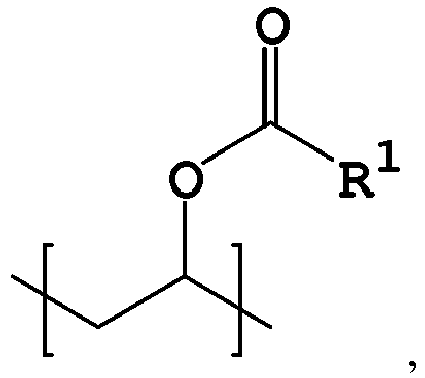
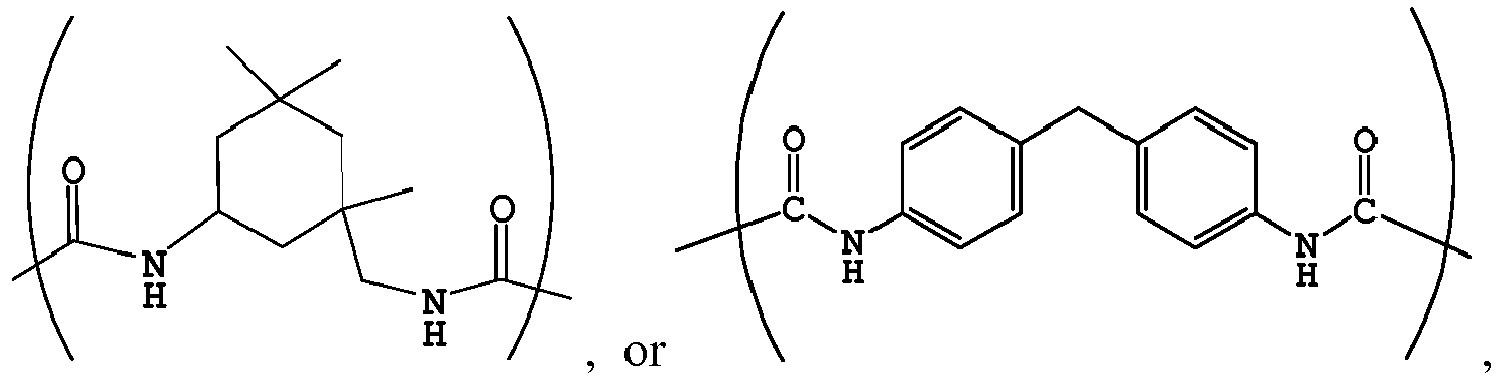
- the polymer includes a first repeating unit, a second repeating unit, and a third repeating unit, wherein the first repeating unit is the second repeating unit wherein R 1 is C 1-6 alkyl group; and, the third repeating unit is wherein X is and Y is hydrophilic polymeric moiety.
- the disclosure also provides a pharmaceutical composition including the aforementioned polymer serving as an excipient.
- the pharmaceutical composition includes a bioactive component; and an excipient, wherein the excipient includes the aforementioned polymer.
- the disclosure provides a polymer, and pharmaceutical composition employing the same.
- the polymer is a modified polyvinyl alcohol, wherein the hydroxy group of polyvinyl alcohol is modified by hydrophilic polymeric moiety, and alkanoyl group.
- the polymer of the disclosure can be a modified polyvinyl alcohol, wherein the hydroxy group of polyvinyl alcohol is modified by hydrophilic polymeric moiety, alkanoyl group, and hydrophobic moiety. Due to the solubility of the polymer, the polymer of the disclosure can serve as an excipient for improving the absorption, and dissolution of the compounds classified as BCS Class II within the human body.
- the bio-availability of the drugs can be enhanced by means of the polymer, without changing the dosage form of the drugs.
- the polymer would appear to spontaneously have a micelle structure when mixed with water.
- the hydrophobic part of the core of the micelle structure can encapsulate the insoluble drug, and the hydrophilic part can ensure that the micelle structure disperses stably and uniformly in water and reduces the accumulation of drugs.
- the polymer of the disclosure serving as an excipient can improve the solubility and avoid the accumulation of the compounds classified as BCS Class II, the bio-availability of the drugs can be enhanced.
- the amount of the additional excipient used in a solid dosage form of the pharmaceutical composition can be reduced, resulting in the reduction of side reaction of drugs.
- the polymer of the disclosure can include a first repeating unit, a second repeating unit, and a third repeating unit, wherein the first repeating unit, the second repeating unit, and the third repeating unit are arranged in a random fashion.
- the first repeating unit can be the second repeating unit can be wherein R 1 is C 1-6 alkyl group; and, the third repeating unit can be wherein X is or and Y is hydrophilic polymeric moiety.
- the hydrophilic polymeric moiety can be polyethylene glycol (PEG) moiety, methoxy polyethylene glycol (mPEG) moiety, polyvinylpyrrolidone (PVP) moiety, polyacrylic acid (PAA) moiety, or polymethacrylic acid (PMA) moiety.
- the hydrophilic polymeric moiety has a weight average molecular weight between about 500 and 100,000, such between about 1,000 and 80,000, or between about 1,500 and 60,000.
- the stability of the micelle and the state of the polymer can be improved by adjusting the molecular weight (such as weight average molecular weight) of the hydrophilic polymeric moiety.
- the hydrophilic polymeric moiety can be polyethylene glycol (polyethylene glycol, PEG) moiety, or methoxy polyethylene glycol moiety, wherein the polyethylene glycol moiety (or methoxy polyethylene glycol moiety) is bonded with the X moiety via the residual group eliminating hydrogen atom from terminal hydroxyl group.
- the third repeating unit can be or
- the hydrophilic polymeric moiety has a grafting ratio between about 0.1% and 10%, such as between about 1% and 8%.
- the hydrophilic polymeric moiety grafting ratio of the polymer is determined by measuring the percentage of the third repeating unit, based on the total of the first, second, and third repeating units.
- the hydrophilic polymeric moiety grafting ratio is too low, the polymer is not apt to form micelle and insoluble in water, resulting in reduction of solubility.
- the hydrophilic polymeric moiety grafting ratio is too low, the drug loading of the polymer is reduced, resulting in reduction of solubility.
- R1 of the second repeating unit can be methyl group, ethyl group, propyl group, isopropyl group, butyl group, isobutyl group, tert-butyl group, pentyl group, or hexyl group.
- the second repeating unit can be and the polymer has an esterification degree between 10% and 85%, wherein the esterification degree of the polymer is determined by measuring the percentage of the second repeating unit, based on the total of the first, second, and third repeating units.
- the polymer of the disclosure has a weight average molecular weight between about 5,000 and 500,000, such as between about 8,000 and 400,000, or between about 8,000 and 300,000.
- the molecular weight of the polymer can be adjusted according to the lipophilicity of the drug, in order to increase the solubility.
- the first repeating unit of the polymer has a weight percentage between about 5wt%-50wt%
- the second repeating unit has a weight percentage between about 10wt%-55wt%
- the third repeating unit has a weight percentage between about 25wt%-75wt%, wherein the weight percentage is based on the total weight of the first repeating unit, the second repeating unit, and the third repeating unit.
- the polymer has lower solubility in water (the solubility would be improved by mixing with organic solvent) and is not apt to form micelle due to the increased hydrophobicity, resulting in reduction of solubility.
- the weight percentage of the first repeating unit (or the third repeating unit) is too high or the weight percentage of the second repeating unit is too low, the micelle of the polymer in water is unstable due to the increased hydrophilicity, resulting in not being able to use the polymer to encapsulate hydrophobic drugs.
- the first repeating unit has a weight percentage between about 10wt%-45wt%
- the second repeating unit has a weight percentage between about 15wt%-50wt%
- the third repeating unit has a weight percentage between about 25wt%-70wt%.
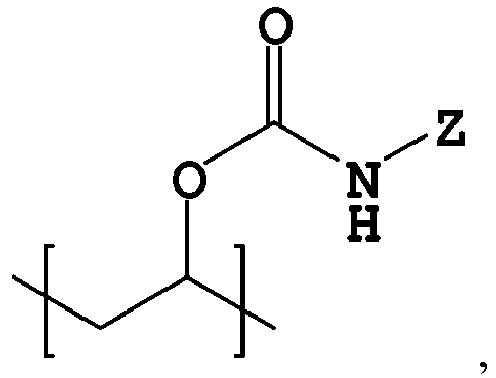
- the polymer can further include a fourth repeating unit, wherein the fourth repeating unit is wherein Z is a hydrophobic moiety.
- the first repeating unit, second repeating unit, third repeating unit, and the fourth repeating unit are arranged in a random fashion.
- the hydrophobic moiety can be phenyl group, naphthyl group, or C 4-20 alkyl group (such as:-C 5 H 11 , -C 7 H 15 , -C 9 H 19 , or -C 11 H 23 ).
- the hydrophobic moiety can be polyester moiety, such as: polycaprolactone moiety, polylactic acid moiety, polyglycolic acid moiety, or poly(lactic-co-glycolic) acid moiety, wherein, the polyester moiety can have a weight average molecular weight between 500 and 5,000.
- the first repeating unit of the polymer of the disclosure has a weight percentage between about 5wt%-40wt%
- the second repeating unit has a weight percentage between about 10wt%-50wt%
- the third repeating unit has a weight percentage between about 25wt%-70wt%
- the fourth repeating unit has a weight percentage between about 5wt%-50wt%, wherein the weight percentage is based on the total weight of the first repeating unit, the second repeating unit, the third repeating unit, and fourth repeating unit.
- the hydrophobic moiety has a grafting ratio between about 0.1% and 10%, such as between about 1% and 8%.
- the hydrophobic polymeric moiety grafting ratio of the polymer is determined by measuring the percentage of the fourth repeating unit, based on the total of the first, second, third and fourth repeating units.
- the hydrophobic polymeric moiety grafting ratio is too high, the polymer has lower solubility in water (the solubility would be improved by mixing with organic solvent) and is not apt to form micelle due to the increased hydrophobicity, resulting in reduction of solubility.
- the hydrophobic polymeric moiety grafting ratio is too low, the drug loading of the polymer is reduced, resulting in reduction of solubility. Further, the micelle of the polymer in water is unstable due to the increased hydrophilicity, resulting in the polymer being unable to encapsulate hydrophobic drugs.
- the hydrophobic of the polymer can be adjusted according to the drug, which is encapsulated by the polymer, in order to enhance the solubility of the drugs.
- esterification, hydrophilic moiety grafting, and hydrophobic moiety grafting for preparing the polymer of the disclosure does not have to be performed in a particular order.
- the esterification, hydrophilic moiety grafting, and hydrophobic moiety grafting for preparing the polymer performed in that order are merely illustrative.
- the disclosure provides a pharmaceutical composition, including a bioactive component, and an excipient, wherein the excipient includes the aforementioned polymer.
- the weight ratio between the bioactive component and the excipient is between about 10: 1 and 1: 20.
- the pharmaceutical composition can be in the form of tablets, capsules, powders, flakes, powders, microcapsules, suspensions, emulsions, or granules.
- the bioactive component can be nanoparticles, microcapsules, liposomes, micelles, emulsions and the like.
- the polymer of the disclosure can serve as an excipient for improving the absorption and dissolution of the compounds classified as BCS Class II. Therefore, the bio-availability of the drugs can be enhanced by means of the polymer, without changing the dosage form of the drugs.
- the bioactive component can be lipophilic drugs.
- the bioactive component can be non-steroid anti-inflammatory drugs, psychotropic drugs, antilipemic drugs, antiemetic drugs, or a combination thereof.
- the bioactive component can be salicylic acid derivative, propionic acid derivative, phenylacetic acids derivative, indoleacetic acids) derivative, oxicams derivative, or pyrazalones derivative, such as ibuprofen, naproxen, ketoprofen, flurbiprofen, fenoprofen, suprofen, fluprofen, fenbufen, tolmetin sodium, zomepirac, sulindac, indomethacin, mefenamic acid, meclofenamate, diflunisal, flufenisal, piroxicam, sudoxicam, isoxicam, chlorpheniramine, brompheniramine, dexchlorpheniramine, dexbrompheniramine, triprolidine, chlorcyclizine, diphenhydramine, doxylamine, tripelennamine, cyproheptadine, bromodiphenhydramin, phenind
- polyvinyl acetate (PVAc) with esterification degree of 20% (having a weight average molecular weight between about 10,000-12,000) (1 eq) was disposed into a reaction bottle, and then dried under vacuum at 60°C for 24 hr.
- the polyvinyl acetate was dissolved in dimethylacetamide (DMAc), and then stirred and heated to 80°C for 2 hr.
- DMAc dimethylacetamide
- the reaction bottle was cooled to room temperature, and 4-dimethylaminopyridine (DMAP) was added into the reaction bottle (0.01 eq). After stirring for 10 min, the reaction bottle was placed in a water bath tank at room temperature, and then acetic anhydride (0.2 eq) was added slowly into the reaction bottle.
- DMAP 4-dimethylaminopyridine
- Preparation Example 2 was performed in the same manner as in Preparation Example 1 except that 0.01 eq of 4-dimethylaminopyridine (DMAP) was substituted with 0.02 eq of 4-dimethylaminopyridine, 0.2 eq of acetic anhydride was substituted with 0.4 eq of acetic anhydride, and 0.22 eq of trimethylamine was substituted with 0.44 eq of trimethylamine.
- DMAP 4-dimethylaminopyridine
- 0.2 eq of acetic anhydride was substituted with 0.4 eq of acetic anhydride
- 0.22 eq of trimethylamine was substituted with 0.44 eq of trimethylamine.
- Preparation Example 3 was performed in the same manner as in Preparation Example 1 except that 0.01 eq of 4-dimethylaminopyridine (DMAP) was substituted with 0.03eq of 4-dimethylaminopyridine, 0.2 eq of acetic anhydride was substituted with 0.6eq of acetic anhydride, and 0.22 eq of trimethylamine was substituted with 0.66eq of trimethylamine.
- DMAP 4-dimethylaminopyridine
- acetic anhydride was substituted with 0.6eq of acetic anhydride
- 0.22 eq of trimethylamine was substituted with 0.66eq of trimethylamine.
- methoxy polyethylene glycol having a weight average Molecular weight of 1900
- DMSO dimethyl sulfoxide
- HDI hexamethylene diisocyanate
- Preparation Example 5 was performed in the same manner as in Preparation Example 4 except that 19.0g of methoxy polyethylene glycol (with a weight average molecular weight of 1900) was substituted with 20.0g of methoxy polyethylene glycol (with a weight average molecular weight of 2000), obtaining active methoxy polyethylene glycol prepolymer (2).
- Preparation Example 6 was performed in the same manner as in Preparation Example 4 except that 19.0g of methoxy polyethylene glycol (with a weight average molecular weight of 1900) was substituted with 25.0g of methoxy polyethylene glycol (with a weight average molecular weight of 5000), obtaining active methoxy polyethylene glycol prepolymer (3).
- methoxy polyethylene glycol (with a weight average Molecular weight 2000) was added into a reaction bottle, and dried in a vacuum oven at 100 °C for 24 hr. After cooling to room temperature, 53mL of dimethyl sulfoxide (DMSO) was added into the reaction bottle in nitrogen atmosphere, and heated to 60-70°C to force the methoxy polyethylene glycol completely dissolved in DMSO. After cooling to room temperature, 2.8g of methylene diphenyl diisocyanate (MDI) was added into the reaction bottle, and heated to 50°C to react without the addition of catalyst.
- DMSO dimethyl sulfoxide
- MDI methylene diphenyl diisocyanate
- 190g of methoxy polyethylene glycol (with a weight average molecular weight 2000) was added into a reaction bottle, and dried in a vacuum oven at 100 °C for 24 hr. After cooling to room temperature, 490mL of dimethyl sulfoxide (DMSO) was added into the reaction bottle in nitrogen atmosphere, and heated to 60-70°C to force the methoxy polyethylene glycol completely dissolved in DMSO. After cooling to room temperature, 20g of isophorone diisocyanate (IPDI) was added into the reaction bottle, and heated to 80 °C to react without the addition of catalyst.
- DMSO dimethyl sulfoxide
- IPDI isophorone diisocyanate
- Methoxy polyethylene glycol prepolymer (1) prepared according to Preparation Example 4, and the amount of methoxy polyethylene glycol prepolymer (with a weight average molecular weight of about 1900) and hexamethylene diisocyanate (HDI) are shown in Table 2), 15.8g of polyvinyl acetate (with a weight average molecular weight of about 10,000-12,000) (having an esterification degree of 20%), and 170mL of dimethyl sulfoxide (DMSO) were added into a reaction bottle. After stirring uniformly, the reaction bottle was heated to 90°C. After reacting for 16 hr, the reaction bottle was cooled to room temperature, and a substantial amount of ethyl ether was added into the reaction bottle.
- DMSO dimethyl sulfoxide
- the precipitate was gathered. Next, the precipitate was dried in a vacuum oven at 80°C. Next, the result was extracted using dichloromethane as the extraction solvent, obtaining the modified polyvinyl alcohol (1) (having the repeating unit A , repeating unit B , and repeating unit C (n>1, and the moiety having a weight average molecular weight of about 1900), wherein the repeating units A, B, and C are arranged in a random fashion).
- Example 2 was performed in the same manner as in Example 1 except that the amounts of methoxy polyethylene glycol and hexamethylene diisocyanate (HDI) using for preparing methoxy polyethylene glycol prepolymer (1) shown in Table 2 were used instead of those disclosed in Example 1, 15.8g of polyvinyl acetate (PVAc) (having an esterification degree of 20%) was substituted with 86.2g of polyvinyl acetate (PVAc) (having an esterification degree of 20%), and 170mL of dimethyl sulfoxide (DMSO) was substituted with 713mL of dimethyl sulfoxide (DMSO), obtaining modified polyvinyl alcohol (2) (having the repeating unit A repeating unit B and repeating unit C (n>1, and the moiety having a weight average molecular weight of about 1900), wherein the repeating units A, B, and C are arranged in a random fashion).
- PVAc polyvinyl acetate
- DMSO dimethyl sulfox
- Example 3 was performed in the same manner as in Example 1 except that the amounts of methoxy polyethylene glycol and hexamethylene diisocyanate (HDI) using for preparing methoxy polyethylene glycol prepolymer (1) shown in Table 2 were used instead of those disclosed in Example 1, 15.8g of polyvinyl acetate (PVAc) (having an esterification degree of 20%) was substituted with 137.9g of polyvinyl acetate (PVAc) (having an esterification degree of 20%), and 170mL of dimethyl sulfoxide (DMSO) was substituted with 716mL of dimethyl sulfoxide (DMSO), obtaining modified polyvinyl alcohol (3) (having the repeating unit A repeating unit B and repeating unit C (n>1, and the moiety having a weight average molecular weight of about 1900), wherein the repeating units A, B, and C are arranged in a random fashion).
- PVAc polyvinyl acetate
- DMSO dimethyl s
- Example 4 was performed in the same manner as in Example 1 except that the amounts of methoxy polyethylene glycol and hexamethylene diisocyanate (HDI) using for preparing methoxy polyethylene glycol prepolymer (1) shown in Table 2 were used instead of those disclosed in Example 1, 15.8g of polyvinyl acetate (PVAc) (having an esterification degree of 20%) was substituted with 46g of polyvinyl acetate (PVAc) (having an esterification degree of 20%), and 170mL of dimethyl sulfoxide (DMSO) was substituted with 611mL of dimethyl sulfoxide (DMSO), obtaining modified polyvinyl alcohol (4) (having the repeating unit A repeating unit B and repeating unit C (n>1, and the moiety having a weight average molecular weight of about 1900), wherein the repeating units A, B, and C are arranged in a random fashion).
- PVAc polyvinyl acetate
- DMSO dimethyl sulfox
- Example 5 was performed in the same manner as in Example 1 except that the amounts of methoxy polyethylene glycol and hexamethylene diisocyanate (HDI) using for preparing methoxy polyethylene glycol prepolymer (1) shown in Table 2 were used instead of those disclosed in Example 1, 15.8g of polyvinyl acetate (PVAc) (having an esterification degree of 20%) was substituted with 124.1g of polyvinyl acetate (PVAc) (having an esterification degree of 20%), and 170mL of dimethyl sulfoxide (DMSO) was substituted with 847mL of dimethyl sulfoxide (DMSO), obtaining modified polyvinyl alcohol (5) (having the repeating unit A repeating unit B and repeating unit C (n>1, and the moiety having a weight average molecular weight of about 1900), wherein the repeating units A, B, and C are arranged in a random fashion).
- PVAc polyvinyl acetate
- DMSO dimethyl sul
- Example 6 was performed in the same manner as in Example 1 except that the amounts of methoxy polyethylene glycol and hexamethylene diisocyanate (HDI) using for preparing methoxy polyethylene glycol prepolymer (1) shown in Table 2 were used instead of those disclosed in Example 1, 15.8g of polyvinyl acetate (PVAc) (having an esterification degree of 20%) was substituted with 137.9g of polyvinyl acetate (PVAc) (having an esterification degree of 20%), and 170mL of dimethyl sulfoxide (DMSO) was substituted with 716mL of dimethyl sulfoxide (DMSO), obtaining modified polyvinyl alcohol (6) (having the repeating unit A repeating unit B and repeating unit C (n>1, and the moiety having a weight average molecular weight of about 1900), wherein the repeating units A, B, and C are arranged in a random fashion).
- PVAc polyvinyl acetate
- DMSO dimethyl
- Methoxy polyethylene glycol prepolymer (2) (prepared according to Preparation Example 5, and the amount of methoxy polyethylene glycol prepolymer (with a weight average molecular weight of about 2000) and hexamethylene diisocyanate (HDI) are shown in Table 2), 86.2g of polyvinyl acetate (with a weight average molecular weight of about 10,000-12,000) (having an esterification degree of 20%), and 740mL of dimethyl sulfoxide (DMSO) were added into a reaction bottle. After stirring uniformly, the reaction bottle was heated to 90°C. After reacting for 16 hr, the reaction bottle was cooled to room temperature, and a substantial amount of ethyl ether was added into the reaction bottle.
- DMSO dimethyl sulfoxide
- the precipitate was gathered. Next, the precipitate was dried in a vacuum oven at 80°C. Next, the result was extracted using dichloromethane as the extraction solvent, obtaining the modified polyvinyl alcohol (7) (having the repeating unit A repeating unit B and repeating unit C (n>1, and the moiety having a weight average molecular weight of about 2000), wherein the repeating units A, B, and C are arranged in a random fashion).
- Methoxy polyethylene glycol prepolymer (3) (prepared according to Preparation Example 6, and the amount of methoxy polyethylene glycol prepolymer (with a weight average molecular weight of about 5000) and hexamethylene diisocyanate (HDI) are shown in Table 2), 78.6g of polyvinyl acetate (with a weight average molecular weight of about 10,000-12,000) (having an esterification degree of 20%), and 485mL of dimethyl sulfoxide (DMSO) were added into a reaction bottle. After stirring uniformly, the reaction bottle was heated to 90°C. After reacting for 16 hr, the reaction bottle was cooled to room temperature, and a substantial amount of ethyl ether was added into the reaction bottle.
- DMSO dimethyl sulfoxide
- the modified polyvinyl alcohol (8) (having the repeating unit A repeating unit B and repeating unit C (n>1, and the moiety having a weight average molecular weight of about 5000), wherein the repeating units A, B, and C are arranged in a random fashion).
- the weight percentages of repeating units A, B, and C are shown in Table 3.
- the weight percentages of repeating units A, B, and C were measured via the methoxy polyethylene glycol grafting ratio (according to the area integrations of -CH 3 peak of repeating unit C) and the weight average molecular weight of the modified polyvinyl alcohol.
- the modified polyvinyl alcohol (1) was further subjected to an esterification in the following steps: 60g of modified polyvinyl alcohol (1) (prepared by Example 1) and 470mL of dimethylacetamide (DMAC) were added into a reaction bottle. Next, the reaction bottle was stirred and heated to 80°C for 2hr. After the modified polyvinyl alcohol (1) dissolving in dimethylacetamide (DMAC) uniformly, the reaction bottle was cooled to 30-35, and then 0.51g of 4-dimethylaminopyridine (DMAP) was added into the reaction bottle. After stirring for 10 min, the reaction bottle was placed in a water bath tank at room temperature, and then 7.9mL of acetic anhydride was added into the reaction bottle slowly.
- DMAC dimethylacetamide
- the result was subjected to a dialysis purification, obtaining the modified polyvinyl alcohol (9) (having the repeating unit A repeating unit B and repeating unit c (n>1, and the moiety having a weight average molecular weight of about 1900), wherein the repeating units A, B, and C are arranged in a random fashion).
- the amounts of components of the above esterification are shown in Table 4.
- the modified polyvinyl alcohol (2) was further subjected to an esterification in the following steps: 60g of modified polyvinyl alcohol (2) (prepared by Example 1) and 741mL of dimethylacetamide (DMAC) were added into a reaction bottle. Next, the reaction bottle was stirred and heated to 80°C for 2hr. After the modified polyvinyl alcohol (1) dissolving in dimethylacetamide (DMAC) uniformly, the reaction bottle was cooled to 30-35, and then 1.3g of 4-dimethylaminopyridine (DMAP) was added into the reaction bottle. After stirring for 10 min, the reaction bottle was placed in a water bath tank at room temperature, and then 20.0mL of acetic anhydride was added into the reaction bottle slowly.
- DMAC dimethylacetamide
- the result was subjected to a dialysis purification, obtaining the modified polyvinyl alcohol (10) (having the repeating unit A repeating unit B and repeating unit (n>1, and the moiety having a weight average molecular weight of about 1900), wherein the repeating units A, B, and C are arranged in a random fashion).
- the amounts of components of the above esterification are shown in Table 4.
- the modified polyvinyl alcohol (2) was further subjected to an esterification in the following steps: 60g of modified polyvinyl alcohol (2) (prepared by Example 1) and 912mL of dimethylacetamide (DMAC) were added into a reaction bottle. Next, the reaction bottle was stirred and heated to 80°C for 2hr. After the modified polyvinyl alcohol (1) dissolving in dimethylacetamide (DMAC) uniformly, the reaction bottle was cooled to 30-35, and then 1.94g of 4-dimethylaminopyridine (DMAP) was added into the reaction bottle. After stirring for 10 min, the reaction bottle was placed in a water bath tank at room temperature, and then 30.0mL of acetic anhydride was added into the reaction bottle slowly.
- DMAC dimethylacetamide
- the result was subjected to a dialysis purification, obtaining the modified polyvinyl alcohol (11) (having the repeating unit A repeating unit B and repeating unit C (n>1, and the moiety having a weight average molecular weight of about 1900), wherein the repeating units A, B, and C are arranged in a random fashion).
- the amounts of components of the above esterification are shown in Table 4.
- modified polyvinyl alcohol (g) acetic anhydride (mL) 4-dimethylaminopyridine (g) triethylamine (mL) dimethylacetamide (DMAC)(mL) modified polyvinyl alcohol (9) modified polyvinyl alcohol (1)/60g 7.9 0.51 12.8 470 modified polyvinyl alcohol (10) modified polyvinyl alcohol (2)/60g 20 1.3 32.5 741 modified polyvinyl alcohol (11) modified polyvinyl alcohol (2)/60g 30 1.94 48.7 912
- the weight percentages of repeating units A, B, and C are shown in Table 5. The weight percentages of repeating units A, B, and C were measured via the hydrophilic moiety grafting ratio, esterification degree, and the weight average molecular weight of the modified polyvinyl alcohol (9)-(11).
- the hydrophobic moiety was introduced into the modified polyvinyl alcohol (3) by following steps: 50g of modified polyvinyl alcohol (3) (prepared from Example 3) and 256mL of dimethyl sulfoxide (DMSO) were added into a reaction bottle. Next, the reaction bottle was heated to 100°C and then stirred for 2 hr, resulting in the modified polyvinyl alcohol (3) being dissolved into DMSO uniformly. Next, the reaction bottle was cooled to room temperature, and then 6.2 mL of phenyl isocyanate was added into the reaction bottle. After stirring, the reaction bottle was heated to 90°C for 22 hr.
- modified polyvinyl alcohol (3) prepared from Example 3
- DMSO dimethyl sulfoxide
- the result was subjected to a precipitation purification (with ethyl ether) and a dialysis purification, obtaining the modified polyvinyl alcohol (12) (having the repeating unit A repeating unit B repeating unit C (n>1, and the moiety having a weight average molecular weight of about 1900), and repeating unit D wherein the repeating units A, B, C, and D are arranged in a random fashion).
- the amounts of components of the above esterification are shown in Table 6.
- the hydrophobic moiety was introduced into the modified polyvinyl alcohol (3) by following steps: 50g of modified polyvinyl alcohol (3) (prepared from Example 3) and 257mL of dimethyl sulfoxide (DMSO) were added into a reaction bottle. Next, the reaction bottle was heated to 100°C and then stirred for 2 hr, resulting in the modified polyvinyl alcohol (3) being dissolved into DMSO uniformly. Next, the reaction bottle was cooled to room temperature, and then 8.2 mL of naphthyl isocyanate was added into the reaction bottle. After stirring, the reaction bottle was heated to 90°C for 22 hr.
- DMSO dimethyl sulfoxide
- the result was subjected to a precipitation purification (with ethyl ether) and a dialysis purification, obtaining the modified polyvinyl alcohol (13) (having the repeating unit repeating unit B repeating unit C (n>1, and the moiety having a weight average molecular weight of about 1900), and repeating unit D wherein the repeating units A, B, C, and D are arranged in a random fashion).
- the amounts of components of the above esterification are shown in Table 6.
- modified polyvinyl alcohol aryl isocyanate dimethyl sulfoxide (mL) modified polyvinyl alcohol (12) modified polyvinyl alcohol (4)/50g phenyl isocyanate /6.2mL 256 modified polyvinyl alcohol (13) modified polyvinyl alcohol (4)/50g naphthyl isocyanate /8.2mL 257
- the weight percentages of repeating units A, B, C, and D are shown in Table 7.
- the weight percentages of repeating units A, B, C, and D were measured via the hydrophilic moiety grafting ratio, esterification degree, hydrophobic moiety grafting ratio, and the weight average molecular weight of the modified polyvinyl alcohol (12)-(13).
- Table 7 weight percentage of repeating unit A (wt%) weight percentage of repeating unit B (wt%) weight percentage of repeating unit C (wt%) weight percentage of repeating unit D (wt%) hydrophobic moiety grafting ratio (%) modified polyvinyl alcohol (12) 31 18 36 15 9 modified polyvinyl alcohol (13) 33 18 36 13 6
- Methoxy polyethylene glycol prepolymer (4) (prepared according to Preparation Example 7, and the components for preparing the Methoxy polyethylene glycol prepolymer (4) including 200.0g of methoxy polyethylene glycol (with a weight average Molecular weight of 1900), 23.7g of methylene diphenyl diisocyanate (MDI), 68.9g of polyvinyl acetate (PVAc) (with an esterification degree of 20%, and a weight average molecular weight of about 10,000-12,000), and 620mL of dimethyl sulfoxide (DMSO) were added into a reaction bottle. After stirring uniformly, the reaction bottle was heated to 60°C.
- methoxy polyethylene glycol with a weight average Molecular weight of 1900
- MDI methylene diphenyl diisocyanate
- PVAc polyvinyl acetate
- DMSO dimethyl sulfoxide
- the reaction bottle was cooled to room temperature, and a substantial amount of ethyl ether was added into the reaction bottle. After stirring for 1hr and then standing, the precipitate was gathered. Next, the precipitate was dried in a vacuum oven at 80°C. Next, the result was purified by ultrafilitration, obtaining the modified polyvinyl alcohol (14) (having the repeating unit A repeating unit B and repeating unit C (n>1, and the moiety having a weight average molecular weight of about 1900), wherein the repeating units A, B, and C are arranged in a random fashion).
- the modified polyvinyl alcohol (14) having the repeating unit A repeating unit B and repeating unit C (n>1, and the moiety having a weight average molecular weight of about 1900), wherein the repeating units A, B, and C are arranged in a random fashion).
- the weight percentages of repeating units A, B, and C are shown in Table 8.
- the weight percentages of repeating units A, B, and C were measured via the hydrophilic moiety grafting ratio, esterification degree, and the weight average molecular weight of the modified polyvinyl alcohol (14).
- Table 8 weight percentage of repeating unit A (wt%) weight percentage of repeating unit B (wt%) weight percentage of repeating unit C (wt%) methoxy polyethylene glycol moiety grafting ratio (%) modified polyvinyl alcohol (14) 45 22 33 1.2
- CMC Critical micelle concentration
- the critical micelle concentration of the modified polyvinyl alcohol was determined.
- the testing methods are described in the following: First, pyrene was dissolved into acetone to prepare a pyrene-containing acetone solution (1.8 ⁇ 10 -4 M).
- the modified polyvinyl alcohol (2)-(3), and (9)-(11) were separately formulated to 2 mg/mL aqueous solutions.
- the aqueous solutions (containing the modified polyvinyl alcohol) were then aliquoted to obtain 15 concentrations until the concentration reached 6 ⁇ 10 -5 mg/ml. Each of the aliquots (5 mL) was uniformly mixed with 15 ⁇ l of pyrene-containing acetone solution (1.8 ⁇ 10 -4 M).
- the modified polyvinyl alcohol polymer prepared by the Examples of the disclosure has the ability for appearing a micelle structure.
- the core of the micelle structure constituted by the hydrophobic groups of the modified polyvinyl alcohol polymer can stably carry the hydrophobic drugs.
- the modified polyvinyl alcohol (1)-(3), (5), (7)-(8), and (10)-(13) of Examples 1 -3, 5, 7-8, and 10-13 of the disclosure were added into various solvent (such as DI water, ethanol (EtOH), dichloromethane (DCM), and dimethyl sulfoxide (DMSO)), to prepare a 10 wt% solution.
- solvent such as DI water, ethanol (EtOH), dichloromethane (DCM), and dimethyl sulfoxide (DMSO)
- the modified polyvinyl alcohol polymers of the disclosure are soluble in water, thereby promoting the release of drug.
- the modified polyvinyl alcohol polymer has high esterification degree, the modified polyvinyl alcohol polymer has increased solubility in ethanol and dichloromethane. Further, when the hydrophobic moiety is introduce into the modified polyvinyl alcohol polymer, the modified polyvinyl alcohol polymer has reduced solubility in water.
- the modified polyvinyl alcohol (5) of the disclosure was completely dissolved in water, obtaining a clarified liquid.
- the modified polyvinyl alcohol (5) has a relatively high dissolution rate. Therefore, it is expected that the modified polyvinyl alcohol has a relatively high disintegration rate and rapid onset of action in the aqueous environment of the human gastrointestinal tract. Furthermore, due to the relatively high saturation concentration in comparison with kollicoat IR and polyvinyl acetate (with an esterification degree of 20%), the modified polyvinyl alcohol (5) exhibits an improved hydrophilic characteristic. As a result, a relatively high add-on amount of modified polyvinyl alcohol (5) serving as excipient can be still dissolved in the aqueous environment of human gastrointestinal tract.
- the modified polyvinyl alcohol (2), (9), (10) and (11) prepared by Examples of the disclosure were analyzed by the differential scanning calorimeter (DSC) and thermogravimetric analyzer (TGA) to determine the temperature of weight loss at 5% and the thermal degradation temperature (Td). The results are shown in Table 12.
- Table 12 temperature of weight loss at 5% ( °C) thermal degradation temperature (°C) modified polyvinyl alcohol (2) 285 321 (29%) 430 (66%) modified polyvinyl alcohol (9) 290 330 (33°70) 434 (62%) modified polyvinyl alcohol (10) 308.25 331(43%) 421(53%) modified polyvinyl alcohol (11) 312.03 337(44%) 422(52%)
- the thermal degradation temperature and melting point of the modified polyvinyl alcohol polymer of the disclosure is higher than the room temperature (25 C). It means that the modified polyvinyl alcohol polymer of the disclosure exhibit high thermal stability.
- the modified polyvinyl alcohol (1)-(3), and (9) prepared from Examples 1-3, and 9 (serving as an excipient) and commercially available excipient (with a trade No. Kollidon® VA64, sold and manufactured by BASF) were individually mixed with fenofibrate (active pharmaceutical ingredient with low solubility in water).
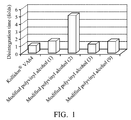
- the tablet of the mixture (with 4wt% excipient) was produced by tableting. Next, the tablets were disposed into a disintegration tester, and the disintegration time of the tablet was measured to determine the pelletizability of the excipient. The result was shown in FIG. 1 . As shown in FIG. 1 , the disintegration time of the Kollidon® VA64 is 13.8 min.
- the disintegration time of the modified polyvinyl alcohol polymer of the disclosure was 1.5-5 times greater than that of Kollidon® VA64. It means that the modified polyvinyl alcohol of the disclosure exhibits high pelletizability, especially the modified polyvinyl alcohol (2).
- the modified polyvinyl alcohol (2), (3)-(5), and (8)-(12) prepared from Examples 2, 3-5, 8, and 9-12 (serving as an excipient), commercially available excipient (with a trade No. Kollidon® VA64, sold and manufactured by BASF), and hydroxypropyl methyl cellulose acetate succinate (HPMC-AS) were individually mixed with API (such as fenofibrate, aprepitant, nevirapine, glyburide, sorafenib, vemurafenib, and telaprevir), where in the weight ratio between the active ingredient and the excipient was 1:10.
- API such as fenofibrate, aprepitant, nevirapine, glyburide, sorafenib, vemurafenib, and telaprevir
- the mixture was dissolved in water at 25°C, and then the result was stirred by ultrasonic vibration, thereby achieving a balanced state.
- the amount of the API of the solution was determined by HPLC-UV.
- the peak area of the API was integrated, and the results are shown in Table 13.
- the modified polyvinyl alcohol (2), (3), and (9) prepared from Examples 2, 3, and 9 (serving as an excipient) and hydroxypropyl methyl cellulose acetate succinate (HPMC-AS) were individually mixed with API (such as fenofibrate), wherein the weight ratio between the API and the excipient was 1:2.
- API such as fenofibrate
- the mixture was dissolved in methanol, and then subjected to a solid dispersion to form a powder.
- the powder was dissolved in water at 25°C, and then the result was stirred by ultrasonic vibration, thereby achieving a balanced state.
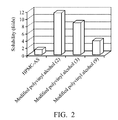
- the amount of the API of the solution was determined by HPLC-UV. The peak area of the API was integrated, and the results are shown in FIG.
- the peak area of the HPMC-AS as a comparative reference As shown in FIG. 2 , the peak area of the modified polyvinyl alcohol polymer of the disclosure was about 2.5-10 times greater than that of HPMC-AS. It means that the modified polyvinyl alcohol of the disclosure exhibits high solubility for solid dispersion, especially the modified polyvinyl alcohol (2).
- the modified polyvinyl alcohol (3)-(5), (8), and (9)-(12) prepared from Examples 3-5, 8, and 9-12 (serving as an excipient) and hydroxypropyl methyl cellulose acetate succinate (HPMC-AS) were individually mixed with an API (such as aprepitant), wherein the weight ratio between the API and the excipient was 1:1.
- the mixture was dissolved in methanol, and then subjected to a solid dispersion to form a powder. Next, the powder was dissolved in water at 25°C, and then the result was stirred by ultrasonic vibration, thereby achieving a balanced state.
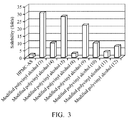
- the amount of the API of the solution was determined by HPLC-UV. The peak area of the API was integrated, and the results are shown in FIG.
- the peak area of the HPMC-AS as a comparative reference was about 2-30 times greater than that of HPMC-AS. It means that the modified polyvinyl alcohol of the disclosure exhibits high solubility for solid dispersion, especially the modified polyvinyl alcohol (3).
- the modified polyvinyl alcohol (2) prepared from Example 2 was dissolved in water, obtaining a solution with a concentration of 10 mg/mL.
- the cytotoxicity of the modified polyvinyl alcohol (2) was measured according to the standard requirements of ISO 10993-5, thereby determining the effect on the cell viability of the modified polyvinyl alcohol. As shown in FIG. 4 , the cell viability is reduced when the concentration of the modified polyvinyl alcohol (2) is increased. It results from the increased viscosity due to the high concentration of the modified polyvinyl alcohol, rather than the toxicity of the modified polyvinyl alcohol (2).
- modified polyvinyl alcohol (1)-(3), (5), (8)-(9), and (12) prepared from Example 2, 3-5, 8, and 9-12, commercially available excipient Kollidon® VA64, sold and manufactured by BASF), and hydroxypropyl methyl cellulose acetate succinate (HPMC-AS) were dissolved in water individually, obtaining a solution with a concentration of 10 mg/mL.
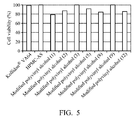
- the cytotoxicity of the above excipient was measured according to the standard requirements of ISO 10993-5, thereby determining the effect on the cell viability of the excipient. As shown in FIG. 5 , the cell viabilities of all modified polyvinyl alcohol are larger than 80%. Therefore, the modified polyvinyl alcohol of the disclosure does not cause significant cytotoxicity.
- the mutagenicity of modified polyvinyl alcohol (2), (3), (5), (8), (9), and (12) prepared from Example 2, 3, 5, 8, 9, and 12 was determined by the Ames test.
- the Ames test was carried out using Sal. Typhimurium TA98 strain and Sal. Typhimurium TA100 strain without an enzyme for activating metabolism of drugs (S9).
- DMSO 100 ⁇ L/plate
- NOPD 4-nitro-o-phenylenediamine
- the mutagenicity of modified polyvinyl alcohol (2), (5), (8), (9), and (12) prepared from Example 2, 5, 8, 9, and 12 was determined by the Ames test.
- the Ames test was carried out using Sal. Typhimurium TA98 strain and Sal. Typhimurium TA100 strain with an enzyme for activating metabolism of drugs (S9).
- DMSO 100 ⁇ L/plate
- (+)Benzo[ ⁇ ]pyrene 100 ⁇ L/plate
- the number of surviving colonies (per plate) of the modified polyvinyl alcohol is within the normal range (i.e. the number of surviving colonies is less than two times of the number of spontaneous surviving colonies. Therefore, the modified polyvinyl alcohol of the disclosure within the specific concentration is non-mutagenic to Sal. Typhimurium TA98 strain and Sal. Typhimurium TA100 strain, with or without the presence of enzyme for activating metabolism of drugs (S9). Accordingly, due to the solubility, the polymer of the disclosure can serve as an excipient for improving the absorption, and dissolution of the compounds classified as BCS Class II within the human body. As a result, the bio-availability of the drugs can be enhanced by means of the polymer, without changing the dosage form of the drugs.
- the polymer of the disclosure has the functions for disintegrating and/or bonding the pharmaceutical composition. Therefore, the amount of the additional excipient used in a solid dosage form of the pharmaceutical composition can be reduced, resulting in the reduction of side reaction of drugs. Moreover, the polymer of the disclosure does not cause significant biotoxicity and mutagenicity.
Landscapes
- Health & Medical Sciences (AREA)
- Chemical & Material Sciences (AREA)
- Medicinal Chemistry (AREA)
- Life Sciences & Earth Sciences (AREA)
- Polymers & Plastics (AREA)
- Chemical Kinetics & Catalysis (AREA)
- Organic Chemistry (AREA)
- Public Health (AREA)
- Pharmacology & Pharmacy (AREA)
- Epidemiology (AREA)
- Veterinary Medicine (AREA)
- Animal Behavior & Ethology (AREA)
- General Health & Medical Sciences (AREA)
- Engineering & Computer Science (AREA)
- Gastroenterology & Hepatology (AREA)
- Inorganic Chemistry (AREA)
- Bioinformatics & Cheminformatics (AREA)
- Immunology (AREA)
- Proteomics, Peptides & Aminoacids (AREA)
- Emergency Medicine (AREA)
- Biophysics (AREA)
- Molecular Biology (AREA)
- Dispersion Chemistry (AREA)
- Medicinal Preparation (AREA)
Abstract



Description
- The disclosure relates to a polymer and a pharmaceutical composition employing the same.
- The Biophaimaceutical Classification System (BCS), originally developed by G. Amidon, separates pharmaceuticals for oral administration into four classes depending on their solubility and their absorbability:
- Class I-High Permeability, High Solubility
- Class II-High Permeability, Low Solubility
- Class III-Low Permeability, High Solubility
- Class IV-Low Permeability, Low Solubility
- Due to the hydrophobic and lipophilic characteristics, the compounds classified as BCS Class II are apt to appear to have spontaneous self- aggregation when mixed with water, resulting in the development of pharmaceutical formulations employing the compound classified as BCS Class II being very limited. However, about 70% of clinically developed drugs are classified as BCS Class II. In order to achieve the expected effect of drugs, the solubility of drugs should be improved to force the dissolved drug into single-molecule form.
- Therefore, it is crucial to improve the solubility, absorption, and dissolution of the compounds classified as BCS Class II within the human body, in order to enhance the bio-availability of drugs.
- According to embodiments of the disclosure, the disclosure provides a polymer. The polymer includes a first repeating unit, a second repeating unit, and a third repeating unit, wherein the first repeating unit is


- According to another embodiment of the disclosure, the disclosure also provides a pharmaceutical composition including the aforementioned polymer serving as an excipient. The pharmaceutical composition includes a bioactive component; and an excipient, wherein the excipient includes the aforementioned polymer.
- A detailed description is given in the following embodiments with reference to the accompanying drawings.
- The disclosure can be more fully understood by reading the subsequent detailed description and examples with references made to the accompanying drawings, wherein:
-
FIG. 1 is a graph plotting the disintegration time of the modified polyvinyl alcohol (1), (2), (3), and (9) prepared from Examples 1, 2, 3, and 9 and the commercially available excipient Kollidon® VA64. -
FIG. 2 is a graph plotting the solubility of the modified polyvinyl alcohol (2), (3), and (9) prepared from Examples 2, 3, and 9 and the excipient HPMC-AS. -
FIG. 3 is a graph plotting the solubility of the modified polyvinyl alcohol (3)-(5), and (8)-(12) prepared from Examples 3-5 and 8-12 and HPMC-AS. -
FIG. 4 is a graph plotting the cell viability of the modified polyvinyl alcohol (2) aqueous solution in various concentrations. -
FIG. 5 is a graph plotting the cell viability of the modified polyvinyl alcohol (1), (2), (3), (5), (8), (9), and (12) prepared from Examples 1, 2, 3, 5, 8, 9, and 12, the commercially available excipient Kollidon® VA64 and HPMC-AS. - In the following detailed description, for purposes of explanation, numerous specific details are set forth in order to provide a thorough understanding of the disclosed embodiments. It will be apparent, however, that one or more embodiments may be practiced without these specific details. In other instances, well-known structures and devices are schematically shown in order to simplify the drawing.
- The disclosure provides a polymer, and pharmaceutical composition employing the same. The polymer is a modified polyvinyl alcohol, wherein the hydroxy group of polyvinyl alcohol is modified by hydrophilic polymeric moiety, and alkanoyl group. In addition, according to embodiments of the disclosure, the polymer of the disclosure can be a modified polyvinyl alcohol, wherein the hydroxy group of polyvinyl alcohol is modified by hydrophilic polymeric moiety, alkanoyl group, and hydrophobic moiety. Due to the solubility of the polymer, the polymer of the disclosure can serve as an excipient for improving the absorption, and dissolution of the compounds classified as BCS Class II within the human body. As a result, the bio-availability of the drugs can be enhanced by means of the polymer, without changing the dosage form of the drugs. The polymer would appear to spontaneously have a micelle structure when mixed with water. The hydrophobic part of the core of the micelle structure can encapsulate the insoluble drug, and the hydrophilic part can ensure that the micelle structure disperses stably and uniformly in water and reduces the accumulation of drugs. The polymer of the disclosure serving as an excipient can improve the solubility and avoid the accumulation of the compounds classified as BCS Class II, the bio-availability of the drugs can be enhanced. On the other hand, by means of the polymer of the disclosure exhibiting solubility and having the functions for disintegrating and/or bonding the pharmaceutical composition, the amount of the additional excipient used in a solid dosage form of the pharmaceutical composition can be reduced, resulting in the reduction of side reaction of drugs.
- The polymer of the disclosure can include a first repeating unit, a second repeating unit, and a third repeating unit, wherein the first repeating unit, the second repeating unit, and the third repeating unit are arranged in a random fashion. The first repeating unit can be


- According to embodiments of the disclosure, the hydrophilic polymeric moiety can be polyethylene glycol (PEG) moiety, methoxy polyethylene glycol (mPEG) moiety, polyvinylpyrrolidone (PVP) moiety, polyacrylic acid (PAA) moiety, or polymethacrylic acid (PMA) moiety. The hydrophilic polymeric moiety has a weight average molecular weight between about 500 and 100,000, such between about 1,000 and 80,000, or between about 1,500 and 60,000. The stability of the micelle and the state of the polymer can be improved by adjusting the molecular weight (such as weight average molecular weight) of the hydrophilic polymeric moiety. According to embodiments of the disclosure, the hydrophilic polymeric moiety can be polyethylene glycol (polyethylene glycol, PEG) moiety, or methoxy polyethylene glycol moiety, wherein the polyethylene glycol moiety (or methoxy polyethylene glycol moiety) is bonded with the X moiety via the residual group eliminating hydrogen atom from terminal hydroxyl group. Namely, the third repeating unit can be


- According to embodiments of the disclosure, the hydrophilic polymeric moiety has a grafting ratio between about 0.1% and 10%, such as between about 1% and 8%. The hydrophilic polymeric moiety grafting ratio of the polymer is determined by measuring the percentage of the third repeating unit, based on the total of the first, second, and third repeating units. When the hydrophilic polymeric moiety grafting ratio is too low, the polymer is not apt to form micelle and insoluble in water, resulting in reduction of solubility. When the hydrophilic polymeric moiety grafting ratio is too low, the drug loading of the polymer is reduced, resulting in reduction of solubility.
- According to embodiments of the disclosure, R1 of the second repeating unit can be methyl group, ethyl group, propyl group, isopropyl group, butyl group, isobutyl group, tert-butyl group, pentyl group, or hexyl group. For example, the second repeating unit can be

- According to embodiments of the disclosure, the polymer of the disclosure has a weight average molecular weight between about 5,000 and 500,000, such as between about 8,000 and 400,000, or between about 8,000 and 300,000. The molecular weight of the polymer can be adjusted according to the lipophilicity of the drug, in order to increase the solubility.
- According to embodiments of the disclosure, the first repeating unit of the polymer has a weight percentage between about 5wt%-50wt%, the second repeating unit has a weight percentage between about 10wt%-55wt%, and the third repeating unit has a weight percentage between about 25wt%-75wt%, wherein the weight percentage is based on the total weight of the first repeating unit, the second repeating unit, and the third repeating unit. When the weight percentage of the first repeating unit (or the third repeating unit) is too low or the weight percentage of the second repeating unit is too high, the polymer has lower solubility in water (the solubility would be improved by mixing with organic solvent) and is not apt to form micelle due to the increased hydrophobicity, resulting in reduction of solubility. When the weight percentage of the first repeating unit (or the third repeating unit) is too high or the weight percentage of the second repeating unit is too low, the micelle of the polymer in water is unstable due to the increased hydrophilicity, resulting in not being able to use the polymer to encapsulate hydrophobic drugs. In addition, according to other embodiments of the disclosure, the first repeating unit has a weight percentage between about 10wt%-45wt%, the second repeating unit has a weight percentage between about 15wt%-50wt%, and the third repeating unit has a weight percentage between about 25wt%-70wt%.
- According to embodiments of the disclosure, the polymer can further include a fourth repeating unit, wherein the fourth repeating unit is
- According to embodiments of the disclosure, the first repeating unit of the polymer of the disclosure has a weight percentage between about 5wt%-40wt%, the second repeating unit has a weight percentage between about 10wt%-50wt%, the third repeating unit has a weight percentage between about 25wt%-70wt%, and the fourth repeating unit has a weight percentage between about 5wt%-50wt%, wherein the weight percentage is based on the total weight of the first repeating unit, the second repeating unit, the third repeating unit, and fourth repeating unit. According to some embodiments of the disclosure, the hydrophobic moiety has a grafting ratio between about 0.1% and 10%, such as between about 1% and 8%. The hydrophobic polymeric moiety grafting ratio of the polymer is determined by measuring the percentage of the fourth repeating unit, based on the total of the first, second, third and fourth repeating units. When the hydrophobic polymeric moiety grafting ratio is too high, the polymer has lower solubility in water (the solubility would be improved by mixing with organic solvent) and is not apt to form micelle due to the increased hydrophobicity, resulting in reduction of solubility. When the hydrophobic polymeric moiety grafting ratio is too low, the drug loading of the polymer is reduced, resulting in reduction of solubility. Further, the micelle of the polymer in water is unstable due to the increased hydrophilicity, resulting in the polymer being unable to encapsulate hydrophobic drugs. The hydrophobic of the polymer can be adjusted according to the drug, which is encapsulated by the polymer, in order to enhance the solubility of the drugs.
- The esterification, hydrophilic moiety grafting, and hydrophobic moiety grafting for preparing the polymer of the disclosure does not have to be performed in a particular order. In Examples of the disclosure, the esterification, hydrophilic moiety grafting, and hydrophobic moiety grafting for preparing the polymer performed in that order are merely illustrative.
- The disclosure provides a pharmaceutical composition, including a bioactive component, and an excipient, wherein the excipient includes the aforementioned polymer. The weight ratio between the bioactive component and the excipient is between about 10: 1 and 1: 20. According to embodiments of the disclosure, since the polymer of the disclosure exhibits superior binding capacity and sustained capability, the pharmaceutical composition can be in the form of tablets, capsules, powders, flakes, powders, microcapsules, suspensions, emulsions, or granules. In addition, the bioactive component can be nanoparticles, microcapsules, liposomes, micelles, emulsions and the like.
- According to embodiments of the disclosure, due to the solubility, the polymer of the disclosure can serve as an excipient for improving the absorption and dissolution of the compounds classified as BCS Class II. Therefore, the bio-availability of the drugs can be enhanced by means of the polymer, without changing the dosage form of the drugs. The bioactive component can be lipophilic drugs. In addition, the bioactive component can be non-steroid anti-inflammatory drugs, psychotropic drugs, antilipemic drugs, antiemetic drugs, or a combination thereof. According to other embodiments of the disclosure, the bioactive component can be salicylic acid derivative, propionic acid derivative, phenylacetic acids derivative, indoleacetic acids) derivative, oxicams derivative, or pyrazalones derivative, such as ibuprofen, naproxen, ketoprofen, flurbiprofen, fenoprofen, suprofen, fluprofen, fenbufen, tolmetin sodium, zomepirac, sulindac, indomethacin, mefenamic acid, meclofenamate, diflunisal, flufenisal, piroxicam, sudoxicam, isoxicam, chlorpheniramine, brompheniramine, dexchlorpheniramine, dexbrompheniramine, triprolidine, chlorcyclizine, diphenhydramine, doxylamine, tripelennamine, cyproheptadine, bromodiphenhydramin, phenindamine, pyrilamine, azatadine, acrivastine, astemizole, azelastine, cetirizine, ebastine, fexofenadine, ketotifen, carbinoxamine, desloratadine, loratadine, pheniramine, thonzylamine, mizolastine, terfenadine, chlophendianol, caramiphen, dextromethorphan, codeine, hydrocodone, pseudoephedrine, ephedrine, phenylephrine, guaifenesin, guaiacotsulfonate, celecoxib, rofecoxib, valdecoxib, acetaminophen, phenacetin, acteylsalicylic acid, aripiprazole, fenofibrate, aprepitant, nevirapine, glyburide, sorafenib, vemurafenib, telaprevir, or a combination thereof.
- The following examples are intended to illustrate the disclosure more fully without limiting the scope, since numerous modifications and variations will be apparent to those skilled in this art.
- First, polyvinyl acetate (PVAc) with esterification degree of 20% (having a weight average molecular weight between about 10,000-12,000) (1 eq) was disposed into a reaction bottle, and then dried under vacuum at 60°C for 24 hr. Next, the polyvinyl acetate was dissolved in dimethylacetamide (DMAc), and then stirred and heated to 80°C for 2 hr. Next, the reaction bottle was cooled to room temperature, and 4-dimethylaminopyridine (DMAP) was added into the reaction bottle (0.01 eq). After stirring for 10 min, the reaction bottle was placed in a water bath tank at room temperature, and then acetic anhydride (0.2 eq) was added slowly into the reaction bottle. After the addition of acetic anhydride is complete, triethylamine (0.22 eq) was added into the reaction bottle at room temperature and stirred at 40°C for 16 hr. Next, after cooling to room temperature, a substantial amount of ethyl ether was added into the reaction bottle. After stirring for 1hr and then standing, the precipitate was gathered. The above step was repeated two more times, and then the precipitate was dried under vacuum, obtaining polyvinyl acetate (white solid). Next, 1H-NMR spectrum of obtained compound was measured, and the esterification degree polyvinyl acetate was determined (according to the area integrations of -CH3 peak (δ= 2.0-1.8) and -CH2 peak (δ= 1.2-1.8). The result was shown in Table 1.
- Preparation Example 2 was performed in the same manner as in Preparation Example 1 except that 0.01 eq of 4-dimethylaminopyridine (DMAP) was substituted with 0.02 eq of 4-dimethylaminopyridine, 0.2 eq of acetic anhydride was substituted with 0.4 eq of acetic anhydride, and 0.22 eq of trimethylamine was substituted with 0.44 eq of trimethylamine. Next, the esterification degree of the polyvinyl acetate obtained from Preparation Example 2 was determined, and the result was shown in Table 1.
- Preparation Example 3 was performed in the same manner as in Preparation Example 1 except that 0.01 eq of 4-dimethylaminopyridine (DMAP) was substituted with 0.03eq of 4-dimethylaminopyridine, 0.2 eq of acetic anhydride was substituted with 0.6eq of acetic anhydride, and 0.22 eq of trimethylamine was substituted with 0.66eq of trimethylamine. Next, the esterification degree of the polyvinyl acetate obtained from Preparation Example 3 was determined, and the result was shown in Table 1.
Table 1 components (eq) polyvinyl acetate ( esterification degree 20%)acetic anhydride DMAP triethylamine esterification degree of polyvinyl acetate (%) Preparation Example 1 1 0.2 0.01 0.22 36 Preparation Example 2 1 0.4 0.02 0.44 62 Preparation Example 3 1 0.6 0.03 0.66 77 - 19.0g of methoxy polyethylene glycol (having a weight average Molecular weight of 1900) was added into a reaction bottle, and then dried in a vacuum oven at 100 °C for 24 hr. After cooling to room temperature, 47.9mL of dimethyl sulfoxide (DMSO) was added into the reaction bottle in nitrogen atmosphere, and heated to 60-70°C to force the methoxy polyethylene glycol completely dissolved in DMSO. After cooling to room temperature, 1.5g of hexamethylene diisocyanate (HDI) was added into the reaction bottle, and heated to 90°C to react without the addition of catalyst. Next, the reaction was terminated after being checked the weight average molecular weight of product by gel permeation chromatography, obtaining active methoxy polyethylene glycol prepolymer (1) (with a structure of



- Preparation Example 5 was performed in the same manner as in Preparation Example 4 except that 19.0g of methoxy polyethylene glycol (with a weight average molecular weight of 1900) was substituted with 20.0g of methoxy polyethylene glycol (with a weight average molecular weight of 2000), obtaining active methoxy polyethylene glycol prepolymer (2).
- Preparation Example 6 was performed in the same manner as in Preparation Example 4 except that 19.0g of methoxy polyethylene glycol (with a weight average molecular weight of 1900) was substituted with 25.0g of methoxy polyethylene glycol (with a weight average molecular weight of 5000), obtaining active methoxy polyethylene glycol prepolymer (3).
- 25.0g of methoxy polyethylene glycol (with a weight average Molecular weight 2000) was added into a reaction bottle, and dried in a vacuum oven at 100 °C for 24 hr. After cooling to room temperature, 53mL of dimethyl sulfoxide (DMSO) was added into the reaction bottle in nitrogen atmosphere, and heated to 60-70°C to force the methoxy polyethylene glycol completely dissolved in DMSO. After cooling to room temperature, 2.8g of methylene diphenyl diisocyanate (MDI) was added into the reaction bottle, and heated to 50°C to react without the addition of catalyst. Next, the reaction was terminated after being checked the weight average molecular weight of product by gel permeation chromatography, obtaining active methoxy polyethylene glycol prepolymer (4) (with a structure of


- 190g of methoxy polyethylene glycol (with a weight average molecular weight 2000) was added into a reaction bottle, and dried in a vacuum oven at 100 °C for 24 hr. After cooling to room temperature, 490mL of dimethyl sulfoxide (DMSO) was added into the reaction bottle in nitrogen atmosphere, and heated to 60-70°C to force the methoxy polyethylene glycol completely dissolved in DMSO. After cooling to room temperature, 20g of isophorone diisocyanate (IPDI) was added into the reaction bottle, and heated to 80 °C to react without the addition of catalyst. Next, the reaction was terminated after being checked the weight average molecular weight of product by gel permeation chromatography, obtaining active methoxy polyethylene glycol prepolymer (5) (with a structure of


- Methoxy polyethylene glycol prepolymer (1) (prepared according to Preparation Example 4, and the amount of methoxy polyethylene glycol prepolymer (with a weight average molecular weight of about 1900) and hexamethylene diisocyanate (HDI) are shown in Table 2), 15.8g of polyvinyl acetate (with a weight average molecular weight of about 10,000-12,000) (having an esterification degree of 20%), and 170mL of dimethyl sulfoxide (DMSO) were added into a reaction bottle. After stirring uniformly, the reaction bottle was heated to 90°C. After reacting for 16 hr, the reaction bottle was cooled to room temperature, and a substantial amount of ethyl ether was added into the reaction bottle. After stirring for 1hr and then standing, the precipitate was gathered. Next, the precipitate was dried in a vacuum oven at 80°C. Next, the result was extracted using dichloromethane as the extraction solvent, obtaining the modified polyvinyl alcohol (1) (having the repeating unit A


- Example 2 was performed in the same manner as in Example 1 except that the amounts of methoxy polyethylene glycol and hexamethylene diisocyanate (HDI) using for preparing methoxy polyethylene glycol prepolymer (1) shown in Table 2 were used instead of those disclosed in Example 1, 15.8g of polyvinyl acetate (PVAc) (having an esterification degree of 20%) was substituted with 86.2g of polyvinyl acetate (PVAc) (having an esterification degree of 20%), and 170mL of dimethyl sulfoxide (DMSO) was substituted with 713mL of dimethyl sulfoxide (DMSO), obtaining modified polyvinyl alcohol (2) (having the repeating unit A


- Example 3 was performed in the same manner as in Example 1 except that the amounts of methoxy polyethylene glycol and hexamethylene diisocyanate (HDI) using for preparing methoxy polyethylene glycol prepolymer (1) shown in Table 2 were used instead of those disclosed in Example 1, 15.8g of polyvinyl acetate (PVAc) (having an esterification degree of 20%) was substituted with 137.9g of polyvinyl acetate (PVAc) (having an esterification degree of 20%), and 170mL of dimethyl sulfoxide (DMSO) was substituted with 716mL of dimethyl sulfoxide (DMSO), obtaining modified polyvinyl alcohol (3) (having the repeating unit A


- Example 4 was performed in the same manner as in Example 1 except that the amounts of methoxy polyethylene glycol and hexamethylene diisocyanate (HDI) using for preparing methoxy polyethylene glycol prepolymer (1) shown in Table 2 were used instead of those disclosed in Example 1, 15.8g of polyvinyl acetate (PVAc) (having an esterification degree of 20%) was substituted with 46g of polyvinyl acetate (PVAc) (having an esterification degree of 20%), and 170mL of dimethyl sulfoxide (DMSO) was substituted with 611mL of dimethyl sulfoxide (DMSO), obtaining modified polyvinyl alcohol (4) (having the repeating unit A


- Example 5 was performed in the same manner as in Example 1 except that the amounts of methoxy polyethylene glycol and hexamethylene diisocyanate (HDI) using for preparing methoxy polyethylene glycol prepolymer (1) shown in Table 2 were used instead of those disclosed in Example 1, 15.8g of polyvinyl acetate (PVAc) (having an esterification degree of 20%) was substituted with 124.1g of polyvinyl acetate (PVAc) (having an esterification degree of 20%), and 170mL of dimethyl sulfoxide (DMSO) was substituted with 847mL of dimethyl sulfoxide (DMSO), obtaining modified polyvinyl alcohol (5) (having the repeating unit A


- Example 6 was performed in the same manner as in Example 1 except that the amounts of methoxy polyethylene glycol and hexamethylene diisocyanate (HDI) using for preparing methoxy polyethylene glycol prepolymer (1) shown in Table 2 were used instead of those disclosed in Example 1, 15.8g of polyvinyl acetate (PVAc) (having an esterification degree of 20%) was substituted with 137.9g of polyvinyl acetate (PVAc) (having an esterification degree of 20%), and 170mL of dimethyl sulfoxide (DMSO) was substituted with 716mL of dimethyl sulfoxide (DMSO), obtaining modified polyvinyl alcohol (6) (having the repeating unit A


- Methoxy polyethylene glycol prepolymer (2) (prepared according to Preparation Example 5, and the amount of methoxy polyethylene glycol prepolymer (with a weight average molecular weight of about 2000) and hexamethylene diisocyanate (HDI) are shown in Table 2), 86.2g of polyvinyl acetate (with a weight average molecular weight of about 10,000-12,000) (having an esterification degree of 20%), and 740mL of dimethyl sulfoxide (DMSO) were added into a reaction bottle. After stirring uniformly, the reaction bottle was heated to 90°C. After reacting for 16 hr, the reaction bottle was cooled to room temperature, and a substantial amount of ethyl ether was added into the reaction bottle. After stirring for 1hr and then standing, the precipitate was gathered. Next, the precipitate was dried in a vacuum oven at 80°C. Next, the result was extracted using dichloromethane as the extraction solvent, obtaining the modified polyvinyl alcohol (7) (having the repeating unit A


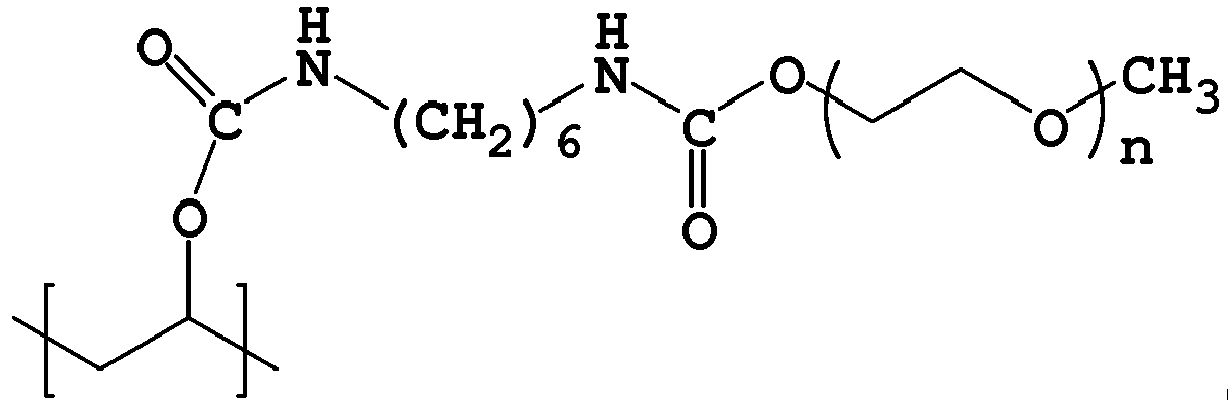

- Methoxy polyethylene glycol prepolymer (3) (prepared according to Preparation Example 6, and the amount of methoxy polyethylene glycol prepolymer (with a weight average molecular weight of about 5000) and hexamethylene diisocyanate (HDI) are shown in Table 2), 78.6g of polyvinyl acetate (with a weight average molecular weight of about 10,000-12,000) (having an esterification degree of 20%), and 485mL of dimethyl sulfoxide (DMSO) were added into a reaction bottle. After stirring uniformly, the reaction bottle was heated to 90°C. After reacting for 16 hr, the reaction bottle was cooled to room temperature, and a substantial amount of ethyl ether was added into the reaction bottle. After stirring for 1hr and then standing, the precipitate was gathered. Next, the precipitate was dried in a vacuum oven at 80°C. Next, the result was extracted using dichloromethane as the extraction solvent, obtaining the modified polyvinyl alcohol (8) (having the repeating unit A


Table 2 methoxy polyethylene glycol weight average molecular weight esterification degree 20% of polyvinyl acetate (g) methoxy polyethylene glycol (g) HDI(mL) solvent (mL) modified polyvinyl alcohol (1) 1900 15.8 57 4.5 170/DMSO modified polyvinyl alcohol (2) 1900 86.2 250 19 713/DMSO modified polyvinyl alcohol (3) 1900 137.9 200 17.2 716/DMSO modified polyvinyl alcohol (4) 1900 46 200 15.7 611/DMSO modified polyvinyl alcohol (5) 1900 124.1 180 13.6 847/DMAc modified polyvinyl alcohol (6) 1900 137.9 200 17.2 716/DMAc modified polyvinyl alcohol (7) 2000 86.2 263 19 740/DMSO modified polyvinyl alcohol (8) 5000 78.6 150 4.33 485/DMSO - Next, 1H-NMR spectra of modified polyvinyl alcohol (1)-(8) were measured, and the methoxy polyethylene glycol grafting ratio was determined (according to the equivalent ratio between the repeating unit C and all repeating units (i.e. repeating units A, B, and C) and shown in Table 3. The equivalents of repeating units A, B, and C were determined by measuring the hydrogen signal area integration (the signal (δ= 1.2-1.8) was -CH2 peak of repeating units A, B, and C; the signal (δ= 1.8-2.0) was -CH3 peak of repeating unit B; the signal (δ= 3.23) was -CH3 peak of repeating unit C; the signal (δ= 3.55-4.1) was -CH peak of repeating unit A; and the signal (δ= 4.2-5.2) was -OH peak of repeating unit A and -CH peak of repeating unit B). The weight percentages of repeating units A, B, and C are shown in Table 3. The weight percentages of repeating units A, B, and C were measured via the methoxy polyethylene glycol grafting ratio (according to the area integrations of -CH3 peak of repeating unit C) and the weight average molecular weight of the modified polyvinyl alcohol.
Table 3 weight percentage of repeating unit A (wt%) weight percentage of repeating unit B (wt%) weight percentage of repeating unit C (wt%) methoxy polyethylene glycol moiety grafting ratio (%) modified polyvinyl alcohol (1) 22 12 66 4.6 modified polyvinyl alcohol (2) 24 12 64 4.2 modified polyvinyl alcohol (3) 39 20 41 1.7 modified polyvinyl alcohol (4) 20 10 70 5.4 modified polyvinyl alcohol (5) 39 20 41 1.7 modified polyvinyl alcohol (6) 41 21 38 1.5 modified polyvinyl alcohol (7) 24 12 64 4.0 modified polyvinyl alcohol (8) 48 24 29 0.4 - The modified polyvinyl alcohol (1) was further subjected to an esterification in the following steps: 60g of modified polyvinyl alcohol (1) (prepared by Example 1) and 470mL of dimethylacetamide (DMAC) were added into a reaction bottle. Next, the reaction bottle was stirred and heated to 80°C for 2hr. After the modified polyvinyl alcohol (1) dissolving in dimethylacetamide (DMAC) uniformly, the reaction bottle was cooled to 30-35, and then 0.51g of 4-dimethylaminopyridine (DMAP) was added into the reaction bottle. After stirring for 10 min, the reaction bottle was placed in a water bath tank at room temperature, and then 7.9mL of acetic anhydride was added into the reaction bottle slowly. After the addition of acetic anhydride was complete, 12.8mL of triethylamine was added into the reaction bottle at room temperature. After stirring at 40 °C for 16 hr, the reaction bottle was cooled to room temperature, and then a substantial amount of ethyl ether was added into the reaction bottle. After stirring for 1hr and then standing, the precipitate was gathered. Next, the precipitate was dried in a vacuum oven at 80°C. Next, the result was subjected to a dialysis purification, obtaining the modified polyvinyl alcohol (9) (having the repeating unit A


- The modified polyvinyl alcohol (2) was further subjected to an esterification in the following steps: 60g of modified polyvinyl alcohol (2) (prepared by Example 1) and 741mL of dimethylacetamide (DMAC) were added into a reaction bottle. Next, the reaction bottle was stirred and heated to 80°C for 2hr. After the modified polyvinyl alcohol (1) dissolving in dimethylacetamide (DMAC) uniformly, the reaction bottle was cooled to 30-35, and then 1.3g of 4-dimethylaminopyridine (DMAP) was added into the reaction bottle. After stirring for 10 min, the reaction bottle was placed in a water bath tank at room temperature, and then 20.0mL of acetic anhydride was added into the reaction bottle slowly. After the addition of acetic anhydride was complete, 32.5mL of triethylamine was added into the reaction bottle at room temperature. After stirring at 40 °C for 16 hr, the reaction bottle was cooled to room temperature, and then a substantial amount of ethyl ether was added into the reaction bottle. After stirring for 1hr and then standing, the precipitate was gathered. Next, the precipitate was dried in a vacuum oven at 80°C. Next, the result was subjected to a dialysis purification, obtaining the modified polyvinyl alcohol (10) (having the repeating unit A


- The modified polyvinyl alcohol (2) was further subjected to an esterification in the following steps: 60g of modified polyvinyl alcohol (2) (prepared by Example 1) and 912mL of dimethylacetamide (DMAC) were added into a reaction bottle. Next, the reaction bottle was stirred and heated to 80°C for 2hr. After the modified polyvinyl alcohol (1) dissolving in dimethylacetamide (DMAC) uniformly, the reaction bottle was cooled to 30-35, and then 1.94g of 4-dimethylaminopyridine (DMAP) was added into the reaction bottle. After stirring for 10 min, the reaction bottle was placed in a water bath tank at room temperature, and then 30.0mL of acetic anhydride was added into the reaction bottle slowly. After the addition of acetic anhydride was complete, 48.7mL of triethylamine was added into the reaction bottle at room temperature. After stirring at 40 °C for 16 hr, the reaction bottle was cooled to room temperature, and then a substantial amount of ethyl ether was added into the reaction bottle. After stirring for 1hr and then standing, the precipitate was gathered. Next, the precipitate was dried in a vacuum oven at 80°C. Next, the result was subjected to a dialysis purification, obtaining the modified polyvinyl alcohol (11) (having the repeating unit A


Table 4 modified polyvinyl alcohol (g) acetic anhydride (mL) 4-dimethylaminopyridine (g) triethylamine (mL) dimethylacetamide (DMAC)(mL) modified polyvinyl alcohol (9) modified polyvinyl alcohol (1)/60g 7.9 0.51 12.8 470 modified polyvinyl alcohol (10) modified polyvinyl alcohol (2)/ 60g 20 1.3 32.5 741 modified polyvinyl alcohol (11) modified polyvinyl alcohol (2)/ 60g 30 1.94 48.7 912 - Next, 1H-NMR spectra of modified polyvinyl alcohol (9)-(11) were measured, and the esterification degrees of modified polyvinyl alcohol (9)-(11) were determined (according to the equivalent ratio between the repeating unit B and all repeating units (i.e. repeating units A, B, and C) and shown in Table 5. The equivalents of repeating units A, B, and C were determined by measuring the hydrogen signal area integration (the signal (δ= 1.2-1.8) was -CH2 peak of repeating units A, B, and C; the signal (δ= 1.8-2.0) was -CH3 peak of repeating unit B; the signal (δ= 3.2) was -CH3 peak of repeating unit C.
- The hydrophilic moiety grafting ratio was determined via the hydrogen signal (δ= 3.2) area integration of repeating unit C, and the esterification degree of the modified polyvinyl alcohol was determined via the hydrogen signal (δ= 1.8-2.0) area integration of repeating unit B. The weight percentages of repeating units A, B, and C are shown in Table 5. The weight percentages of repeating units A, B, and C were measured via the hydrophilic moiety grafting ratio, esterification degree, and the weight average molecular weight of the modified polyvinyl alcohol (9)-(11).
Table5 weight percentage of repeating unit A (wt%) weight percentage of repeating unit B (wt%) weight percentage of repeating unit C (wt%) esterification degree (%) modified polyvinyl alcohol (9) 15 22 62 40 modified polyvinyl alcohol (10) 12 40 49 61 modified polyvinyl alcohol (11) 5 52 43 82 - The hydrophobic moiety was introduced into the modified polyvinyl alcohol (3) by following steps: 50g of modified polyvinyl alcohol (3) (prepared from Example 3) and 256mL of dimethyl sulfoxide (DMSO) were added into a reaction bottle. Next, the reaction bottle was heated to 100°C and then stirred for 2 hr, resulting in the modified polyvinyl alcohol (3) being dissolved into DMSO uniformly. Next, the reaction bottle was cooled to room temperature, and then 6.2 mL of phenyl isocyanate was added into the reaction bottle. After stirring, the reaction bottle was heated to 90°C for 22 hr. Next, the result was subjected to a precipitation purification (with ethyl ether) and a dialysis purification, obtaining the modified polyvinyl alcohol (12) (having the repeating unit A


- The hydrophobic moiety was introduced into the modified polyvinyl alcohol (3) by following steps: 50g of modified polyvinyl alcohol (3) (prepared from Example 3) and 257mL of dimethyl sulfoxide (DMSO) were added into a reaction bottle. Next, the reaction bottle was heated to 100°C and then stirred for 2 hr, resulting in the modified polyvinyl alcohol (3) being dissolved into DMSO uniformly. Next, the reaction bottle was cooled to room temperature, and then 8.2 mL of naphthyl isocyanate was added into the reaction bottle. After stirring, the reaction bottle was heated to 90°C for 22 hr. Next, the result was subjected to a precipitation purification (with ethyl ether) and a dialysis purification, obtaining the modified polyvinyl alcohol (13) (having the repeating unit


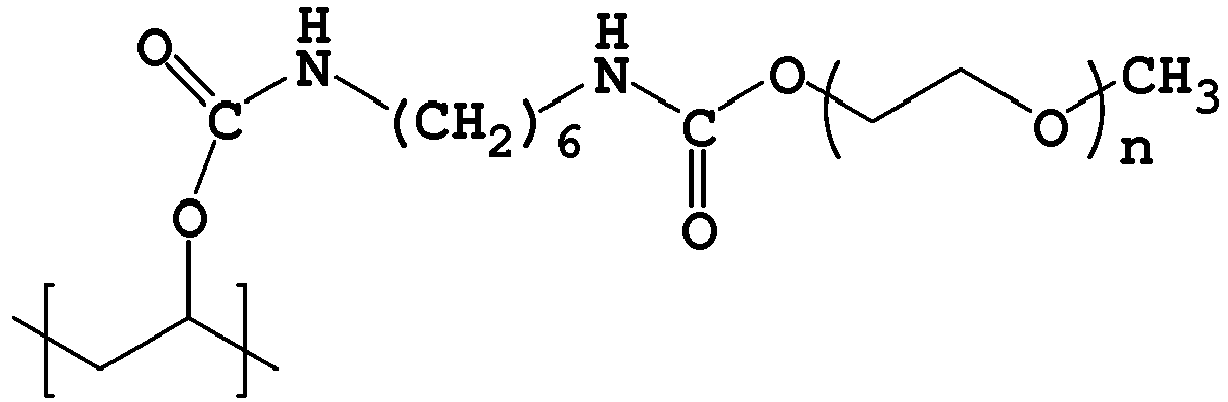


Table 6 modified polyvinyl alcohol aryl isocyanate dimethyl sulfoxide (mL) modified polyvinyl alcohol (12) modified polyvinyl alcohol (4)/50g phenyl isocyanate /6.2mL 256 modified polyvinyl alcohol (13) modified polyvinyl alcohol (4)/50g naphthyl isocyanate /8.2mL 257 - Next, 1H-NMR spectra of modified polyvinyl alcohol (12)-(13) were measured, and the hydrophobic moiety (i.e. N-phenyl isocyanate group, or N-naphthyl isocyanate group) grafting ratio of modified polyvinyl alcohol (12)-(13) were determined (according to the equivalent ratio between the repeating unit D and all repeating units (i.e. repeating units A,B, C, and D) and shown in Table 7). The equivalents of repeating units A, B, C, and D were determined by measuring the hydrogen signal area integration (the signal (δ= 1.2-1.8) was -CH2 peak of repeating units A, B, and C; the signal (δ= 1.8-2.0) was -CH3 peak of repeating unit B; the signal (δ= 3.23) was -CH3 peak of repeating unit C; the signal (δ= 3.55-4.1) was -CH peak of repeating unit A; the signal (δ= 4.2-5.2) was -OH peak of repeating unit A and -CH peak of repeating unit B; and the signal (δ=7.0-8.5) was hydrogen peak of aryl group of repeating unit D. The weight percentages of repeating units A, B, C, and D are shown in Table 7. The weight percentages of repeating units A, B, C, and D were measured via the hydrophilic moiety grafting ratio, esterification degree, hydrophobic moiety grafting ratio, and the weight average molecular weight of the modified polyvinyl alcohol (12)-(13).
Table 7 weight percentage of repeating unit A (wt%) weight percentage of repeating unit B (wt%) weight percentage of repeating unit C (wt%) weight percentage of repeating unit D (wt%) hydrophobic moiety grafting ratio (%) modified polyvinyl alcohol (12) 31 18 36 15 9 modified polyvinyl alcohol (13) 33 18 36 13 6 - Methoxy polyethylene glycol prepolymer (4) (prepared according to Preparation Example 7, and the components for preparing the Methoxy polyethylene glycol prepolymer (4) including 200.0g of methoxy polyethylene glycol (with a weight average Molecular weight of 1900), 23.7g of methylene diphenyl diisocyanate (MDI), 68.9g of polyvinyl acetate (PVAc) (with an esterification degree of 20%, and a weight average molecular weight of about 10,000-12,000), and 620mL of dimethyl sulfoxide (DMSO) were added into a reaction bottle. After stirring uniformly, the reaction bottle was heated to 60°C.
- After reacting for 16 hr, the reaction bottle was cooled to room temperature, and a substantial amount of ethyl ether was added into the reaction bottle. After stirring for 1hr and then standing, the precipitate was gathered. Next, the precipitate was dried in a vacuum oven at 80°C. Next, the result was purified by ultrafilitration, obtaining the modified polyvinyl alcohol (14) (having the repeating unit A

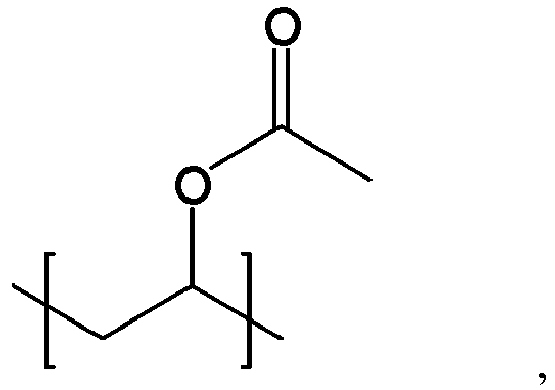
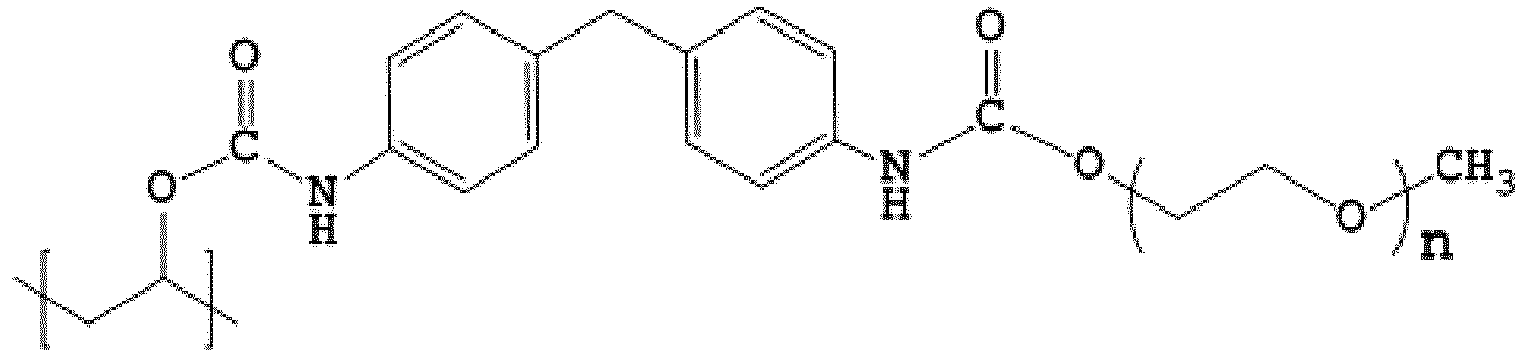

- Next, 1H-NMR spectrum of modified polyvinyl alcohol (14) was measured, and the esterification degree of modified polyvinyl alcohol (14) were determined (according to the equivalent ratio between the repeating unit B and all repeating units (i.e. repeating units A, B, and C) and shown in Table 8.
- The equivalents of repeating units A, B, and C were determined by measuring the hydrogen signal area integration (the signal (δ= 1.2-1.8) was -CH2 peak of repeating units A, B, and C; the signal (δ= 1.8-2.0) was -CH3 peak of repeating unit B; the signal (δ= 3.3) was -CH3 peak of repeating unit C. The weight percentages of repeating units A, B, and C are shown in Table 8. The hydrophilic moiety grafting ratio of the modified polyvinyl alcohol was determined via the hydrogen signal (δ= 3.2) area integration of repeating unit C, and the esterification degree of the modified polyvinyl alcohol was determined via the hydrogen signal (δ= 1.8-2.0) area integration of repeating unit B. The weight percentages of repeating units A, B, and C were measured via the hydrophilic moiety grafting ratio, esterification degree, and the weight average molecular weight of the modified polyvinyl alcohol (14).
Table 8 weight percentage of repeating unit A (wt%) weight percentage of repeating unit B (wt%) weight percentage of repeating unit C (wt%) methoxy polyethylene glycol moiety grafting ratio (%) modified polyvinyl alcohol (14) 45 22 33 1.2 - The critical micelle concentration of the modified polyvinyl alcohol was determined. The testing methods are described in the following: First, pyrene was dissolved into acetone to prepare a pyrene-containing acetone solution (1.8×10⁻⁴M). The modified polyvinyl alcohol (2)-(3), and (9)-(11) were separately formulated to 2 mg/mL aqueous solutions. The aqueous solutions (containing the modified polyvinyl alcohol) were then aliquoted to obtain 15 concentrations until the concentration reached 6×10⁻⁵ mg/ml. Each of the aliquots (5 mL) was uniformly mixed with 15µl of pyrene-containing acetone solution (1.8×10⁻⁴M). The mixtures were left to stand in the dark for 16 hours and then the acetone was evaporated under vacuum. Subsequently, each aliquot was analyzed by a fluorescence spectrometer, emission was detected at wavelength 339 nm and an exciting wavelength of excitation spectrum was scanned from 360 to 500 nm. The wavelengths which showed the strongest absorption were recorded. According to the log of the concentration and the absorption on the fluorescence spectra, the point at which the absorption started changing indicated the critical micelle concentration. Table 9 shows the critical micelle concentration (CMC) of several micelle materials.
Table 9 Critical micelle concentration (mg/mL) modified polyvinyl alcohol (2) 0.38 modified polyvinyl alcohol (3) 0.31 modified polyvinyl alcohol (9) 0.49 modified polyvinyl alcohol (10) 0.16 modified polyvinyl alcohol (11) 0.10 - As shown in Table 9, the modified polyvinyl alcohol polymer prepared by the Examples of the disclosure has the ability for appearing a micelle structure. The core of the micelle structure constituted by the hydrophobic groups of the modified polyvinyl alcohol polymer can stably carry the hydrophobic drugs.
- The modified polyvinyl alcohol (1)-(3), (5), (7)-(8), and (10)-(13) of Examples 1 -3, 5, 7-8, and 10-13 of the disclosure were added into various solvent (such as DI water, ethanol (EtOH), dichloromethane (DCM), and dimethyl sulfoxide (DMSO)), to prepare a 10 wt% solution. The dissolution profile of the modified polyvinyl alcohol was observed, and the results are shown in Table 10.
Table 10 Solubility (10wt%) DI water DMSO ethanol DCM modified polyvinyl alcohol (1) soluble soluble insoluble insoluble modified polyvinyl alcohol (2) soluble soluble insoluble insoluble modified polyvinyl alcohol (3) soluble soluble insoluble insoluble modified polyvinyl alcohol (5) soluble soluble insoluble insoluble modified polyvinyl alcohol (7) soluble soluble insoluble insoluble modified polyvinyl alcohol (8) soluble soluble insoluble insoluble modified polyvinyl alcohol (9) soluble soluble soluble slightly soluble modified polyvinyl alcohol (10) soluble soluble soluble soluble modified polyvinyl alcohol (11) soluble soluble soluble soluble modified polyvinyl alcohol (12) soluble soluble insoluble insoluble modified polyvinyl alcohol (13) slightly soluble soluble insoluble insoluble - As shown in Table 10, all the modified polyvinyl alcohol polymers of the disclosure are soluble in water, thereby promoting the release of drug. When the modified polyvinyl alcohol polymer has high esterification degree, the modified polyvinyl alcohol polymer has increased solubility in ethanol and dichloromethane. Further, when the hydrophobic moiety is introduce into the modified polyvinyl alcohol polymer, the modified polyvinyl alcohol polymer has reduced solubility in water.
- The modified polyvinyl alcohol (5) prepared from Example 5, commercially available polyvinyl alcohol polymer (with trade No. kollicoat IR, sold and manufactured by BASF), and polyvinyl acetate (PVAc) (with an esterification degree of 20% and a weight average molecular weight of about 10,000-12,000) were added into DI water, and the dissolution profile of the modified polyvinyl alcohol were observed. The modified polyvinyl alcohol (5) of the disclosure was completely dissolved in water, obtaining a clarified liquid. The commercially available polyvinyl alcohol polymer (kollicoat IR) was partially dissolved in water; and, polyvinyl acetate (PVAc) (with an esterification degree of 20% and a weight average molecular weight of about 10,000-12,000) had a relatively low solubility in water. The results are shown in Table 11.
Table 11 dissolution time (1mg/1mL) Saturation concentration (in 5mL H2O) modified polyvinyl alcohol (5) 30 s >325 mg kollicoat IR 120 s 125 mg polyvinyl acetate (with an esterification degree of 20%) >10 min <100 mg - As shown in Table 11, in comparison with kollicoat IR and polyvinyl acetate (with an esterification degree of 20%), the modified polyvinyl alcohol (5) has a relatively high dissolution rate. Therefore, it is expected that the modified polyvinyl alcohol has a relatively high disintegration rate and rapid onset of action in the aqueous environment of the human gastrointestinal tract. Furthermore, due to the relatively high saturation concentration in comparison with kollicoat IR and polyvinyl acetate (with an esterification degree of 20%), the modified polyvinyl alcohol (5) exhibits an improved hydrophilic characteristic. As a result, a relatively high add-on amount of modified polyvinyl alcohol (5) serving as excipient can be still dissolved in the aqueous environment of human gastrointestinal tract.
- The modified polyvinyl alcohol (2), (9), (10) and (11) prepared by Examples of the disclosure were analyzed by the differential scanning calorimeter (DSC) and thermogravimetric analyzer (TGA) to determine the temperature of weight loss at 5% and the thermal degradation temperature (Td). The results are shown in Table 12.
Table 12 temperature of weight loss at 5% ( °C) thermal degradation temperature (°C) modified polyvinyl alcohol (2) 285 321 (29%) 430 (66%) modified polyvinyl alcohol (9) 290 330 (33°70) 434 (62%) modified polyvinyl alcohol (10) 308.25 331(43%) 421(53%) modified polyvinyl alcohol (11) 312.03 337(44%) 422(52%) - As shown in Table 12, the thermal degradation temperature and melting point of the modified polyvinyl alcohol polymer of the disclosure is higher than the room temperature (25 C). It means that the modified polyvinyl alcohol polymer of the disclosure exhibit high thermal stability.
- The modified polyvinyl alcohol (1)-(3), and (9) prepared from Examples 1-3, and 9 (serving as an excipient) and commercially available excipient (with a trade No. Kollidon® VA64, sold and manufactured by BASF) were individually mixed with fenofibrate (active pharmaceutical ingredient with low solubility in water). The tablet of the mixture (with 4wt% excipient) was produced by tableting. Next, the tablets were disposed into a disintegration tester, and the disintegration time of the tablet was measured to determine the pelletizability of the excipient. The result was shown in
FIG. 1 . As shown inFIG. 1 , the disintegration time of the Kollidon® VA64 is 13.8 min. The disintegration time of the modified polyvinyl alcohol polymer of the disclosure was 1.5-5 times greater than that of Kollidon® VA64. It means that the modified polyvinyl alcohol of the disclosure exhibits high pelletizability, especially the modified polyvinyl alcohol (2). - The modified polyvinyl alcohol (2), (3)-(5), and (8)-(12) prepared from Examples 2, 3-5, 8, and 9-12 (serving as an excipient), commercially available excipient (with a trade No. Kollidon® VA64, sold and manufactured by BASF), and hydroxypropyl methyl cellulose acetate succinate (HPMC-AS) were individually mixed with API (such as fenofibrate, aprepitant, nevirapine, glyburide, sorafenib, vemurafenib, and telaprevir), where in the weight ratio between the active ingredient and the excipient was 1:10. The mixture was dissolved in water at 25°C, and then the result was stirred by ultrasonic vibration, thereby achieving a balanced state. Next, the amount of the API of the solution was determined by HPLC-UV. The peak area of the API was integrated, and the results are shown in Table 13.
Table 13 fenofibrate aprepitant nevirapine glyburide sorafenib vemurafenib telaprevir modified polyvinyl alcohol (2) 17967 41970 2014715 236939 ND* ND ND modified polyvinyl alcohol (3) ND ND 767947 221127 ND ND ND modified polyvinyl alcohol (4) ND 18262 40813 ND 40813 53649 ND modified polyvinyl alcohol (5) 6706 0 283184 171559 ND 36508 ND modified polyvinyl alcohol (8) ND ND 19439 38991 ND 34087 ND modified polyvinyl alcohol (9) 27802 52438 1061727 185387 ND ND ND modified polyvinyl alcohol (10) 160654 68473 344937 21019 116006 384734 6236 modified polyvinyl alcohol (11) 181767 221752 116006 84357 344937 1005170 8283 modified polyvinyl alcohol (12) ND 24924 1623968 202145 30844 131307 ND Kollidon® VA64 6674 ND 521231 18807 ND 8783 ND HPMC-AS ND ND ND ND ND ND ND (ND :not detected) - As shown in Table 13, all the modified polyvinyl alcohol polymers of the disclosure, which are serving as excipient, exhibit high solubility.
- The modified polyvinyl alcohol (2), (3), and (9) prepared from Examples 2, 3, and 9 (serving as an excipient) and hydroxypropyl methyl cellulose acetate succinate (HPMC-AS) were individually mixed with API (such as fenofibrate), wherein the weight ratio between the API and the excipient was 1:2. The mixture was dissolved in methanol, and then subjected to a solid dispersion to form a powder. Next, the powder was dissolved in water at 25°C, and then the result was stirred by ultrasonic vibration, thereby achieving a balanced state. Next, the amount of the API of the solution was determined by HPLC-UV. The peak area of the API was integrated, and the results are shown in
FIG. 2 (the peak area of the HPMC-AS as a comparative reference). As shown inFIG. 2 , the peak area of the modified polyvinyl alcohol polymer of the disclosure was about 2.5-10 times greater than that of HPMC-AS. It means that the modified polyvinyl alcohol of the disclosure exhibits high solubility for solid dispersion, especially the modified polyvinyl alcohol (2). - The modified polyvinyl alcohol (3)-(5), (8), and (9)-(12) prepared from Examples 3-5, 8, and 9-12 (serving as an excipient) and hydroxypropyl methyl cellulose acetate succinate (HPMC-AS) were individually mixed with an API (such as aprepitant), wherein the weight ratio between the API and the excipient was 1:1. The mixture was dissolved in methanol, and then subjected to a solid dispersion to form a powder. Next, the powder was dissolved in water at 25°C, and then the result was stirred by ultrasonic vibration, thereby achieving a balanced state. Next, the amount of the API of the solution was determined by HPLC-UV. The peak area of the API was integrated, and the results are shown in
FIG. 3 (the peak area of the HPMC-AS as a comparative reference). As shown inFIG. 3 , the peak area of the modified polyvinyl alcohol polymer of the disclosure was about 2-30 times greater than that of HPMC-AS. It means that the modified polyvinyl alcohol of the disclosure exhibits high solubility for solid dispersion, especially the modified polyvinyl alcohol (3). - The modified polyvinyl alcohol (2) prepared from Example 2 was dissolved in water, obtaining a solution with a concentration of 10 mg/mL. The cytotoxicity of the modified polyvinyl alcohol (2) was measured according to the standard requirements of ISO 10993-5, thereby determining the effect on the cell viability of the modified polyvinyl alcohol. As shown in
FIG. 4 , the cell viability is reduced when the concentration of the modified polyvinyl alcohol (2) is increased. It results from the increased viscosity due to the high concentration of the modified polyvinyl alcohol, rather than the toxicity of the modified polyvinyl alcohol (2). - Next, modified polyvinyl alcohol (1)-(3), (5), (8)-(9), and (12) prepared from Example 2, 3-5, 8, and 9-12, commercially available excipient Kollidon® VA64, sold and manufactured by BASF), and hydroxypropyl methyl cellulose acetate succinate (HPMC-AS) were dissolved in water individually, obtaining a solution with a concentration of 10 mg/mL. The cytotoxicity of the above excipient was measured according to the standard requirements of ISO 10993-5, thereby determining the effect on the cell viability of the excipient. As shown in
FIG. 5 , the cell viabilities of all modified polyvinyl alcohol are larger than 80%. Therefore, the modified polyvinyl alcohol of the disclosure does not cause significant cytotoxicity. - The mutagenicity of modified polyvinyl alcohol (2), (3), (5), (8), (9), and (12) prepared from Example 2, 3, 5, 8, 9, and 12 was determined by the Ames test. The Ames test was carried out using Sal. Typhimurium TA98 strain and Sal. Typhimurium TA100 strain without an enzyme for activating metabolism of drugs (S9). DMSO (100 µL/plate) was used as negative control, and 4-nitro-o-phenylenediamine (NOPD) (100 µL/plate) was used as positive control. The results are shown in Table 14.
Table 14 Concentration (mg/mL) TA98 (CFU/plate) TA100 (CFU/plate) modified polyvinyl alcohol (2) 10 14 142 1 14 123 0.1 12 128 modified polyvinyl alcohol (3) 10 17 148 1 13 133 0.1 9 141 modified polyvinyl alcohol (5) 10 27 154 1 19 118 0.1 17 117 modified polyvinyl alcohol (8) 10 26 134 1 13 105 0.1 15 127 modified polyvinyl alcohol (9) 10 16 144 1 16 130 0.1 12 111 modified polyvinyl alcohol (12) 10 30 143 1 29 123 0.1 26 111 Negative control (DMSO) 100µL/plate 17 106 Positive control (NOPD) 100µL/plate 1200 1019 - The mutagenicity of modified polyvinyl alcohol (2), (5), (8), (9), and (12) prepared from Example 2, 5, 8, 9, and 12 was determined by the Ames test. The Ames test was carried out using Sal. Typhimurium TA98 strain and Sal. Typhimurium TA100 strain with an enzyme for activating metabolism of drugs (S9). DMSO (100µL/plate) was used as negative control, and (+)Benzo[α]pyrene (100µL/plate) was used as positive control. The results are shown in Table 15.
Table 15 Concentrati on (mg/mL) TA98 (CFU/plate)+S9 TA100 (CFU/plate)+S9 modified polyvinyl alcohol (2) 10 18 121 1 18 105 0.1 19 107 modified polyvinyl alcohol (5) 10 23 118 1 16 100 0.1 18 97 modified polyvinyl alcohol (8) 10 45 167 1 48 137 0.1 43 158 modified polyvinyl alcohol (9) 10 28 143 1 24 106 0.1 19 118 modified polyvinyl alcohol (12) 10 46 162 1 37 165 0.1 47 157 Negative control (DMSO) 100µL/plate 34 134 Positive control ((+)Benzo[α]pyre ne) 100µL/plate 151 290 - As shown in Tables 14 and 15, the number of surviving colonies (per plate) of the modified polyvinyl alcohol is within the normal range (i.e. the number of surviving colonies is less than two times of the number of spontaneous surviving colonies. Therefore, the modified polyvinyl alcohol of the disclosure within the specific concentration is non-mutagenic to Sal. Typhimurium TA98 strain and Sal. Typhimurium TA100 strain, with or without the presence of enzyme for activating metabolism of drugs (S9). Accordingly, due to the solubility, the polymer of the disclosure can serve as an excipient for improving the absorption, and dissolution of the compounds classified as BCS Class II within the human body. As a result, the bio-availability of the drugs can be enhanced by means of the polymer, without changing the dosage form of the drugs.
- On the other hand, besides the solubility, the polymer of the disclosure has the functions for disintegrating and/or bonding the pharmaceutical composition. Therefore, the amount of the additional excipient used in a solid dosage form of the pharmaceutical composition can be reduced, resulting in the reduction of side reaction of drugs. Moreover, the polymer of the disclosure does not cause significant biotoxicity and mutagenicity.
- It will be clear that various modifications and variations can be made to the disclosed methods and materials. It is intended that the specification and examples be considered as exemplary only, with the true scope of the disclosure being indicated by the following claims and their equivalents.
Claims (19)
- A polymer, comprising a first repeating unit, a second repeating unit, and a third repeating unit, wherein the first repeating unit is


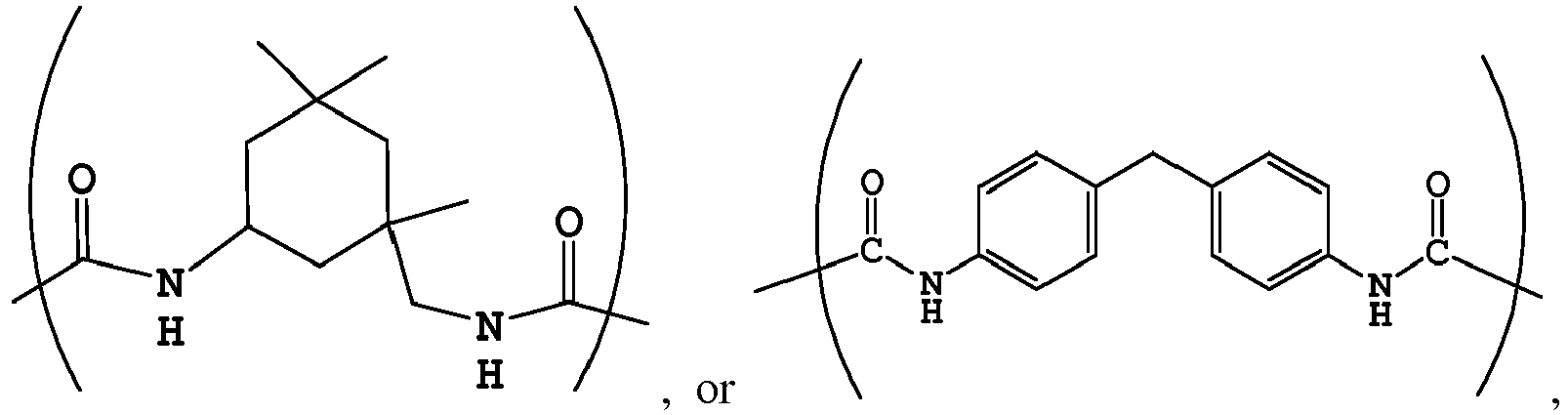
- The polymer as claimed in claim 1, wherein the hydrophilic polymeric moiety has a weight average molecular weight between 500 and 100,000.
- The polymer as claimed in claim 1, wherein the third repeating unit is


- The polymer as claimed in claim 1, wherein the third repeating unit is


- The polymer as claimed in claim 1, wherein R1 is methyl group, ethyl group, propyl group, isopropyl group, butyl group, isobutyl group, tert-butyl group, pentyl group, or hexyl group.
- The polymer as claimed in claim 1, wherein the polymer has a weight average molecular weight between 5,000 and 500,000.
- The polymer as claimed in claim 1, wherein the second repeating unit is
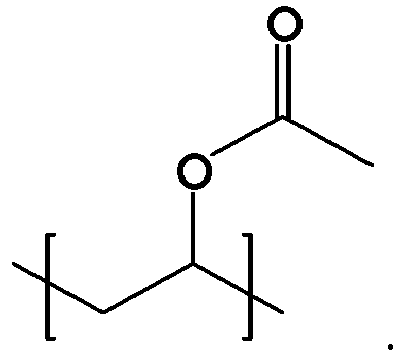
- The polymer as claimed in claim 7, wherein the polymer has an esterification degree between 10% and 85%.
- The polymer as claimed in claim 1, further comprising: a fourth repeating unit, wherein the fourth repeating unit is hydrophobic moiety.

- The polymer as claimed in claim 9, wherein the hydrophobic moiety is phenyl group, naphthyl group, or C4-20 alkyl group.
- The polymer as claimed in claim 9, wherein the hydrophobic moiety is a polyester moiety.
- The polymer as claimed in claim 11, wherein the polyester moiety has a weight average molecular weight between 500 and 5,000.
- The polymer as claimed in claim 11, wherein the polyester moiety is polycaprolactone moiety, polylactic acid moiety, polyglycolic acid moiety, or poly(lactic-co-glycolic) acid moiety.
- The polymer as claimed in claim 9, wherein the first repeating unit has a weight percentage of 5-40wt%, the second repeating unit has a weight percentage of 10-50wt%, the third repeating unit has a weight percentage of 25-70wt%, and the fourth repeating unit has a weight percentage of 5-50wt%, based on the total weight of the first repeating unit, the second repeating unit, and the third repeating unit.
- The polymer as claimed in claim 12, wherein the hydrophobic moiety has a grafting ratio between 0.1% and 10%.
- A pharmaceutical composition, comprising:a bioactive component; andan excipient, wherein the excipient comprises the polymer as claimed in claim 1.
- The pharmaceutical composition as claimed in claim 16, wherein the bioactive component is lipophilic drug.
- The pharmaceutical composition as claimed in claim 17, wherein the bioactive component is non-steroid anti-inflammatory drug, psychotropic drug, antilipemic drug, antiemetic drug, or a combination thereof.
- The pharmaceutical composition as claimed in claim 17, wherein the bioactive component is ibuprofen, naproxen, ketoprofen, flurbiprofen, fenoprofen, suprofen, fluprofen, fenbufen, tolmetin sodium, zomepirac, sulindac, indomethacin, mefenamic acid, meclofenamate, diflunisal, flufenisal, piroxicam, sudoxicam, isoxicam, chlorpheniramine, brompheniramine, dexchlorpheniramine, dexbrompheniramine, triprolidine, chlorcyclizine, diphenhydramine, doxylamine, tripelennamine, cyproheptadine, bromodiphenhydramine, phenindamine, pyrilamine, azatadine, acrivastine, astemizole, azelastine, cetirizine, ebastine, fexofenadine, ketotifen, carbinoxamine, desloratadine, loratadine, pheniramine, thonzylamine, mizolastine, terfenadine, chlophendianol, caramiphen, dextromethorphan, codeine, hydrocodone, pseudoephedrine, ephedrine, phenylephrine, guaifenesin, guaiacotsulfonate, celecoxib, rofecoxib, valdecoxib, acetaminophen, phenacetin, acteylsalicylic acid, aripiprazole, fenofibrate, aprepitant, nevirapine, glyburide, sorafenib, vemurafenib, telaprevir, or a combination thereof.
Applications Claiming Priority (1)
| Application Number | Priority Date | Filing Date | Title |
|---|---|---|---|
| TW103145163A TWI525110B (en) | 2014-12-24 | 2014-12-24 | Polymer, and pharmaceutical composition employing the same |
Publications (2)
| Publication Number | Publication Date |
|---|---|
| EP3037458A1 true EP3037458A1 (en) | 2016-06-29 |
| EP3037458B1 EP3037458B1 (en) | 2017-12-13 |
Family
ID=55352982
Family Applications (1)
| Application Number | Title | Priority Date | Filing Date |
|---|---|---|---|
| EP15202204.2A Active EP3037458B1 (en) | 2014-12-24 | 2015-12-22 | Polymer, and pharmaceutical composition employing the same |
Country Status (5)
| Country | Link |
|---|---|
| US (1) | US9737607B2 (en) |
| EP (1) | EP3037458B1 (en) |
| CN (1) | CN105732991B (en) |
| ES (1) | ES2661887T3 (en) |
| TW (1) | TWI525110B (en) |
Families Citing this family (4)
| Publication number | Priority date | Publication date | Assignee | Title |
|---|---|---|---|---|
| DE102013021060A1 (en) * | 2013-12-18 | 2015-06-18 | Rathor Ag | Process for the separation of monomers from isocyanate-containing prepolymers |
| CN110291089B (en) | 2017-01-17 | 2022-05-27 | 海帕瑞吉尼克斯股份有限公司 | Protein kinase inhibitors for promoting liver regeneration or reducing or preventing liver cell death |
| CN113045759A (en) | 2019-12-26 | 2021-06-29 | 财团法人工业技术研究院 | Grafted polymer and composite material containing same |
| TWI788127B (en) | 2021-12-03 | 2022-12-21 | 財團法人工業技術研究院 | Hydrophobic polyvinyl alcohol and method for preparing hydrophobic polyvinyl alcohol |
Citations (2)
| Publication number | Priority date | Publication date | Assignee | Title |
|---|---|---|---|---|
| WO2007115381A2 (en) * | 2006-04-10 | 2007-10-18 | K.U. Leuven Research And Development | Solid dispersion of poorly soluble drugs in graft copolymers |
| EP2604645A1 (en) * | 2011-12-12 | 2013-06-19 | Industrial Technology Research Institute | Brush polymer and medical use thereof |
Family Cites Families (11)
| Publication number | Priority date | Publication date | Assignee | Title |
|---|---|---|---|---|
| DE2363853A1 (en) * | 1973-12-21 | 1975-07-03 | Hoechst Ag | SELF-SUPPORTING PACKAGES OR CAPSULES FOR WRAPPING MEDICINES |
| DE3322993A1 (en) * | 1983-06-25 | 1985-01-03 | Basf Ag, 6700 Ludwigshafen | METHOD FOR ACYLATING POLYVINYL ALCOHOLS AND PHYTOPOLYMERIZABLE AND / OR PHOTO CROSSLINKABLE MIXTURES CONTAINING SO ACYLATED PRODUCTS |
| DE3536530A1 (en) | 1985-10-12 | 1987-04-23 | Basf Ag | USE OF POLYALKYLENE OXIDES AND VINYL ACETATE GRAFT COPOLYMERISATS AS GRAY INHIBITORS IN THE WASHING AND TREATMENT OF TEXTILE GOODS CONTAINING SYNTHESIS FIBERS |
| DE10353186A1 (en) * | 2003-11-13 | 2005-06-16 | Röhm GmbH & Co. KG | Multilayer dosage form containing a modulatory substance in relation to the release of active ingredient |
| DE102005058569B4 (en) | 2005-12-08 | 2010-07-15 | Lts Lohmann Therapie-Systeme Ag | Foam wafer with polyvinyl alcohol-polyethylene glycol graft copolymer |
| WO2007112446A2 (en) * | 2006-03-28 | 2007-10-04 | University Of Washington | Alginate-based nanofibers and related scaffolds |
| US8198364B2 (en) * | 2006-06-14 | 2012-06-12 | Valorisation-Recherche, Limited Partnership | Poly (vinyl alcohol) polymers, uses and preparation thereof |
| US20110052699A1 (en) * | 2008-02-13 | 2011-03-03 | Adrian Funke | Drug delivery system with stabilising effect |
| US8216495B2 (en) * | 2008-03-25 | 2012-07-10 | Formac Pharmaceuticals N.V. | Preparation method for solid dispersions |
| KR101310710B1 (en) * | 2011-03-23 | 2013-09-27 | 한미약품 주식회사 | Oral complex composition comprising omega-3 fatty acid ester and hmg-coa reductase inhibitor |
| KR101466617B1 (en) | 2011-11-17 | 2014-11-28 | 한미약품 주식회사 | ORAL COMPLEX FORMULATION COMPRISING OMEGA-3 FATTY ACID AND HMG-CoA REDUCTASE INHIBITOR WITH IMPROVED STABILITY |
-
2014
- 2014-12-24 TW TW103145163A patent/TWI525110B/en active
-
2015
- 2015-09-15 CN CN201510584744.7A patent/CN105732991B/en active Active
- 2015-12-22 EP EP15202204.2A patent/EP3037458B1/en active Active
- 2015-12-22 ES ES15202204.2T patent/ES2661887T3/en active Active
- 2015-12-24 US US14/757,563 patent/US9737607B2/en active Active
Patent Citations (2)
| Publication number | Priority date | Publication date | Assignee | Title |
|---|---|---|---|---|
| WO2007115381A2 (en) * | 2006-04-10 | 2007-10-18 | K.U. Leuven Research And Development | Solid dispersion of poorly soluble drugs in graft copolymers |
| EP2604645A1 (en) * | 2011-12-12 | 2013-06-19 | Industrial Technology Research Institute | Brush polymer and medical use thereof |
Non-Patent Citations (1)
| Title |
|---|
| LLANOS & SEFTON: "Immobilization of poly(ethylene glycol) onto poly(vinyl alcohol) hydrogel. 1. Synthesis and characterization", MACROMOLECULES, AMERICAN CHEMICAL SOCIETY, US, vol. 24, no. 23, 30 November 1991 (1991-11-30), pages 6065 - 6072, XP002347763, ISSN: 0024-9297, DOI: 10.1021/MA00023A003 * |
Also Published As
| Publication number | Publication date |
|---|---|
| US20160184437A1 (en) | 2016-06-30 |
| EP3037458B1 (en) | 2017-12-13 |
| TW201623346A (en) | 2016-07-01 |
| ES2661887T3 (en) | 2018-04-04 |
| CN105732991B (en) | 2019-04-23 |
| TWI525110B (en) | 2016-03-11 |
| US9737607B2 (en) | 2017-08-22 |
| CN105732991A (en) | 2016-07-06 |
Similar Documents
| Publication | Publication Date | Title |
|---|---|---|
| EP3037458B1 (en) | Polymer, and pharmaceutical composition employing the same | |
| US12109270B2 (en) | Rifaximin complexes | |
| Chaturvedi et al. | Blend microspheres of poly (3-hydroxybutyrate) and cellulose acetate phthalate for colon delivery of 5-fluorouracil | |
| JP6473421B2 (en) | Modified poly (beta-amino ester) for drug delivery | |
| US9511026B2 (en) | Poorly soluble drug containing microspheres with improved bioavailability and method of preparing the same | |
| de Medeiros Modolon et al. | Sweet block copolymer nanoparticles: preparation and self-assembly of fully oligosaccharide-based amphiphile | |
| KR101661952B1 (en) | Novel esterified cellulose ethers of very low viscosity | |
| KR20150125013A (en) | Novel esterified cellulose ethers of low viscosity | |
| JP2015052012A (en) | Therapeutic peptide-polymer conjugates, particles, compositions, and related methods | |
| EP2222754A2 (en) | Thermoresponsive arginine-based hydrogels as biologic carriers | |
| Mukhopadhyay et al. | Efficient oral insulin delivery by dendronized chitosan: in vitro and in vivo studies | |
| EP3247338A1 (en) | Poly(beta-amino ester)s with additives for drug delivery | |
| Zhou et al. | Negative dendritic effect on enzymatic hydrolysis of dendrimer conjugates | |
| EP3919471A1 (en) | Rosmarinic acid derivative, rosmarinic acid-derived particles, and composition comprising same for treating inflammatory disease | |
| Street et al. | Precision polymer nanofibers with a responsive polyelectrolyte corona designed as a modular, functionalizable nanomedicine platform | |
| WO2008123798A1 (en) | Solid nanocomposition for delivering biologically active substances | |
| KR101540874B1 (en) | Solid molecular dispersion | |
| KR20240165457A (en) | X842 formulation | |
| EP3616722B1 (en) | Pharmaceutical composition | |
| Heer et al. | Novel excipients as different polymers: a review | |
| CN107531994A (en) | Process for preparing graft copolymer excipients with excellent peptide and protein binding properties | |
| Kamble et al. | Norfloxacin mixed solvency based solid dispersions | |
| US20050147676A1 (en) | Release sustaining composition and sustained release preparation | |
| Patnaik et al. | Polyethylenimine-polyethyleneglycol-bis (aminoethylphosphate) nanoparticles mediated efficient DNA and siRNA transfection in mammalian cells | |
| Bruce et al. | Engineering of degradable linkers to improve the oxidative sensitivity of thioketal-based biomaterials |
Legal Events
| Date | Code | Title | Description |
|---|---|---|---|
| PUAI | Public reference made under article 153(3) epc to a published international application that has entered the european phase |
Free format text: ORIGINAL CODE: 0009012 |
|
| AK | Designated contracting states |
Kind code of ref document: A1 Designated state(s): AL AT BE BG CH CY CZ DE DK EE ES FI FR GB GR HR HU IE IS IT LI LT LU LV MC MK MT NL NO PL PT RO RS SE SI SK SM TR |
|
| AX | Request for extension of the european patent |
Extension state: BA ME |
|
| 17P | Request for examination filed |
Effective date: 20160726 |
|
| RBV | Designated contracting states (corrected) |
Designated state(s): AL AT BE BG CH CY CZ DE DK EE ES FI FR GB GR HR HU IE IS IT LI LT LU LV MC MK MT NL NO PL PT RO RS SE SI SK SM TR |
|
| GRAP | Despatch of communication of intention to grant a patent |
Free format text: ORIGINAL CODE: EPIDOSNIGR1 |
|
| STAA | Information on the status of an ep patent application or granted ep patent |
Free format text: STATUS: GRANT OF PATENT IS INTENDED |
|
| INTG | Intention to grant announced |
Effective date: 20170714 |
|
| GRAS | Grant fee paid |
Free format text: ORIGINAL CODE: EPIDOSNIGR3 |
|
| GRAA | (expected) grant |
Free format text: ORIGINAL CODE: 0009210 |
|
| STAA | Information on the status of an ep patent application or granted ep patent |
Free format text: STATUS: THE PATENT HAS BEEN GRANTED |
|
| REG | Reference to a national code |
Ref country code: GB Ref legal event code: FG4D |
|
| REG | Reference to a national code |
Ref country code: AT Ref legal event code: REF Ref document number: 954302 Country of ref document: AT Kind code of ref document: T Effective date: 20171215 Ref country code: CH Ref legal event code: EP |
|
| REG | Reference to a national code |
Ref country code: IE Ref legal event code: FG4D |
|
| REG | Reference to a national code |
Ref country code: DE Ref legal event code: R096 Ref document number: 602015006644 Country of ref document: DE |
|
| REG | Reference to a national code |
Ref country code: FR Ref legal event code: PLFP Year of fee payment: 3 |
|
| REG | Reference to a national code |
Ref country code: ES Ref legal event code: FG2A Ref document number: 2661887 Country of ref document: ES Kind code of ref document: T3 Effective date: 20180404 |
|
| REG | Reference to a national code |
Ref country code: NL Ref legal event code: MP Effective date: 20171213 |
|
| PG25 | Lapsed in a contracting state [announced via postgrant information from national office to epo] |
Ref country code: NO Free format text: LAPSE BECAUSE OF FAILURE TO SUBMIT A TRANSLATION OF THE DESCRIPTION OR TO PAY THE FEE WITHIN THE PRESCRIBED TIME-LIMIT Effective date: 20180313 Ref country code: FI Free format text: LAPSE BECAUSE OF FAILURE TO SUBMIT A TRANSLATION OF THE DESCRIPTION OR TO PAY THE FEE WITHIN THE PRESCRIBED TIME-LIMIT Effective date: 20171213 Ref country code: SE Free format text: LAPSE BECAUSE OF FAILURE TO SUBMIT A TRANSLATION OF THE DESCRIPTION OR TO PAY THE FEE WITHIN THE PRESCRIBED TIME-LIMIT Effective date: 20171213 |
|
| REG | Reference to a national code |
Ref country code: AT Ref legal event code: MK05 Ref document number: 954302 Country of ref document: AT Kind code of ref document: T Effective date: 20171213 |
|
| PG25 | Lapsed in a contracting state [announced via postgrant information from national office to epo] |
Ref country code: HR Free format text: LAPSE BECAUSE OF FAILURE TO SUBMIT A TRANSLATION OF THE DESCRIPTION OR TO PAY THE FEE WITHIN THE PRESCRIBED TIME-LIMIT Effective date: 20171213 Ref country code: BG Free format text: LAPSE BECAUSE OF FAILURE TO SUBMIT A TRANSLATION OF THE DESCRIPTION OR TO PAY THE FEE WITHIN THE PRESCRIBED TIME-LIMIT Effective date: 20180313 Ref country code: RS Free format text: LAPSE BECAUSE OF FAILURE TO SUBMIT A TRANSLATION OF THE DESCRIPTION OR TO PAY THE FEE WITHIN THE PRESCRIBED TIME-LIMIT Effective date: 20171213 Ref country code: GR Free format text: LAPSE BECAUSE OF FAILURE TO SUBMIT A TRANSLATION OF THE DESCRIPTION OR TO PAY THE FEE WITHIN THE PRESCRIBED TIME-LIMIT Effective date: 20180314 Ref country code: LV Free format text: LAPSE BECAUSE OF FAILURE TO SUBMIT A TRANSLATION OF THE DESCRIPTION OR TO PAY THE FEE WITHIN THE PRESCRIBED TIME-LIMIT Effective date: 20171213 |
|
| PG25 | Lapsed in a contracting state [announced via postgrant information from national office to epo] |
Ref country code: NL Free format text: LAPSE BECAUSE OF FAILURE TO SUBMIT A TRANSLATION OF THE DESCRIPTION OR TO PAY THE FEE WITHIN THE PRESCRIBED TIME-LIMIT Effective date: 20171213 |
|
| PG25 | Lapsed in a contracting state [announced via postgrant information from national office to epo] |
Ref country code: CZ Free format text: LAPSE BECAUSE OF FAILURE TO SUBMIT A TRANSLATION OF THE DESCRIPTION OR TO PAY THE FEE WITHIN THE PRESCRIBED TIME-LIMIT Effective date: 20171213 Ref country code: SK Free format text: LAPSE BECAUSE OF FAILURE TO SUBMIT A TRANSLATION OF THE DESCRIPTION OR TO PAY THE FEE WITHIN THE PRESCRIBED TIME-LIMIT Effective date: 20171213 Ref country code: EE Free format text: LAPSE BECAUSE OF FAILURE TO SUBMIT A TRANSLATION OF THE DESCRIPTION OR TO PAY THE FEE WITHIN THE PRESCRIBED TIME-LIMIT Effective date: 20171213 Ref country code: CY Free format text: LAPSE BECAUSE OF FAILURE TO SUBMIT A TRANSLATION OF THE DESCRIPTION OR TO PAY THE FEE WITHIN THE PRESCRIBED TIME-LIMIT Effective date: 20171213 |
|
| PG25 | Lapsed in a contracting state [announced via postgrant information from national office to epo] |
Ref country code: RO Free format text: LAPSE BECAUSE OF FAILURE TO SUBMIT A TRANSLATION OF THE DESCRIPTION OR TO PAY THE FEE WITHIN THE PRESCRIBED TIME-LIMIT Effective date: 20171213 Ref country code: IS Free format text: LAPSE BECAUSE OF FAILURE TO SUBMIT A TRANSLATION OF THE DESCRIPTION OR TO PAY THE FEE WITHIN THE PRESCRIBED TIME-LIMIT Effective date: 20180413 Ref country code: PL Free format text: LAPSE BECAUSE OF FAILURE TO SUBMIT A TRANSLATION OF THE DESCRIPTION OR TO PAY THE FEE WITHIN THE PRESCRIBED TIME-LIMIT Effective date: 20171213 Ref country code: AT Free format text: LAPSE BECAUSE OF FAILURE TO SUBMIT A TRANSLATION OF THE DESCRIPTION OR TO PAY THE FEE WITHIN THE PRESCRIBED TIME-LIMIT Effective date: 20171213 Ref country code: SM Free format text: LAPSE BECAUSE OF FAILURE TO SUBMIT A TRANSLATION OF THE DESCRIPTION OR TO PAY THE FEE WITHIN THE PRESCRIBED TIME-LIMIT Effective date: 20171213 |
|
| REG | Reference to a national code |
Ref country code: DE Ref legal event code: R097 Ref document number: 602015006644 Country of ref document: DE |
|
| PG25 | Lapsed in a contracting state [announced via postgrant information from national office to epo] |
Ref country code: LU Free format text: LAPSE BECAUSE OF NON-PAYMENT OF DUE FEES Effective date: 20171222 Ref country code: MC Free format text: LAPSE BECAUSE OF FAILURE TO SUBMIT A TRANSLATION OF THE DESCRIPTION OR TO PAY THE FEE WITHIN THE PRESCRIBED TIME-LIMIT Effective date: 20171213 Ref country code: MT Free format text: LAPSE BECAUSE OF NON-PAYMENT OF DUE FEES Effective date: 20171222 |
|
| REG | Reference to a national code |
Ref country code: BE Ref legal event code: MM Effective date: 20171231 |
|
| PLBE | No opposition filed within time limit |
Free format text: ORIGINAL CODE: 0009261 |
|
| STAA | Information on the status of an ep patent application or granted ep patent |
Free format text: STATUS: NO OPPOSITION FILED WITHIN TIME LIMIT |
|
| 26N | No opposition filed |
Effective date: 20180914 |
|
| PG25 | Lapsed in a contracting state [announced via postgrant information from national office to epo] |
Ref country code: BE Free format text: LAPSE BECAUSE OF NON-PAYMENT OF DUE FEES Effective date: 20171231 Ref country code: DK Free format text: LAPSE BECAUSE OF FAILURE TO SUBMIT A TRANSLATION OF THE DESCRIPTION OR TO PAY THE FEE WITHIN THE PRESCRIBED TIME-LIMIT Effective date: 20171213 |
|
| PG25 | Lapsed in a contracting state [announced via postgrant information from national office to epo] |
Ref country code: SI Free format text: LAPSE BECAUSE OF FAILURE TO SUBMIT A TRANSLATION OF THE DESCRIPTION OR TO PAY THE FEE WITHIN THE PRESCRIBED TIME-LIMIT Effective date: 20171213 |
|
| PG25 | Lapsed in a contracting state [announced via postgrant information from national office to epo] |
Ref country code: LT Free format text: LAPSE BECAUSE OF NON-PAYMENT OF DUE FEES Effective date: 20171213 Ref country code: HU Free format text: LAPSE BECAUSE OF FAILURE TO SUBMIT A TRANSLATION OF THE DESCRIPTION OR TO PAY THE FEE WITHIN THE PRESCRIBED TIME-LIMIT; INVALID AB INITIO Effective date: 20151222 |
|
| REG | Reference to a national code |
Ref country code: CH Ref legal event code: PL |
|
| PG25 | Lapsed in a contracting state [announced via postgrant information from national office to epo] |
Ref country code: MK Free format text: LAPSE BECAUSE OF FAILURE TO SUBMIT A TRANSLATION OF THE DESCRIPTION OR TO PAY THE FEE WITHIN THE PRESCRIBED TIME-LIMIT Effective date: 20171213 |
|
| PG25 | Lapsed in a contracting state [announced via postgrant information from national office to epo] |
Ref country code: LI Free format text: LAPSE BECAUSE OF NON-PAYMENT OF DUE FEES Effective date: 20181231 Ref country code: CH Free format text: LAPSE BECAUSE OF NON-PAYMENT OF DUE FEES Effective date: 20181231 |
|
| PG25 | Lapsed in a contracting state [announced via postgrant information from national office to epo] |
Ref country code: TR Free format text: LAPSE BECAUSE OF FAILURE TO SUBMIT A TRANSLATION OF THE DESCRIPTION OR TO PAY THE FEE WITHIN THE PRESCRIBED TIME-LIMIT Effective date: 20171213 |
|
| PG25 | Lapsed in a contracting state [announced via postgrant information from national office to epo] |
Ref country code: PT Free format text: LAPSE BECAUSE OF FAILURE TO SUBMIT A TRANSLATION OF THE DESCRIPTION OR TO PAY THE FEE WITHIN THE PRESCRIBED TIME-LIMIT Effective date: 20171213 |
|
| PG25 | Lapsed in a contracting state [announced via postgrant information from national office to epo] |
Ref country code: AL Free format text: LAPSE BECAUSE OF FAILURE TO SUBMIT A TRANSLATION OF THE DESCRIPTION OR TO PAY THE FEE WITHIN THE PRESCRIBED TIME-LIMIT Effective date: 20171213 |
|
| PGFP | Annual fee paid to national office [announced via postgrant information from national office to epo] |
Ref country code: GB Payment date: 20251229 Year of fee payment: 11 |
|
| PGFP | Annual fee paid to national office [announced via postgrant information from national office to epo] |
Ref country code: IT Payment date: 20251219 Year of fee payment: 11 |
|
| PGFP | Annual fee paid to national office [announced via postgrant information from national office to epo] |
Ref country code: FR Payment date: 20251226 Year of fee payment: 11 |
|
| PGFP | Annual fee paid to national office [announced via postgrant information from national office to epo] |
Ref country code: IE Payment date: 20251229 Year of fee payment: 11 |
|
| PGFP | Annual fee paid to national office [announced via postgrant information from national office to epo] |
Ref country code: ES Payment date: 20260102 Year of fee payment: 11 |
|
| PGFP | Annual fee paid to national office [announced via postgrant information from national office to epo] |
Ref country code: DE Payment date: 20251229 Year of fee payment: 11 |