EP3035549A1 - Device and method for self-interference cancellation - Google Patents
Device and method for self-interference cancellation Download PDFInfo
- Publication number
- EP3035549A1 EP3035549A1 EP15194813.0A EP15194813A EP3035549A1 EP 3035549 A1 EP3035549 A1 EP 3035549A1 EP 15194813 A EP15194813 A EP 15194813A EP 3035549 A1 EP3035549 A1 EP 3035549A1
- Authority
- EP
- European Patent Office
- Prior art keywords
- signal
- wireless communication
- communication device
- self
- interference
- Prior art date
- Legal status (The legal status is an assumption and is not a legal conclusion. Google has not performed a legal analysis and makes no representation as to the accuracy of the status listed.)
- Withdrawn
Links
- 238000000034 method Methods 0.000 title claims abstract description 19
- 238000004891 communication Methods 0.000 claims abstract description 74
- 230000006870 function Effects 0.000 description 28
- 238000012549 training Methods 0.000 description 7
- 238000010586 diagram Methods 0.000 description 6
- 238000010295 mobile communication Methods 0.000 description 6
- 238000012545 processing Methods 0.000 description 6
- 230000005540 biological transmission Effects 0.000 description 4
- 238000013507 mapping Methods 0.000 description 4
- 238000004590 computer program Methods 0.000 description 3
- 230000007774 longterm Effects 0.000 description 2
- 230000006978 adaptation Effects 0.000 description 1
- 230000015556 catabolic process Effects 0.000 description 1
- 230000010267 cellular communication Effects 0.000 description 1
- 208000015842 craniosynostosis 2 Diseases 0.000 description 1
- 238000006731 degradation reaction Methods 0.000 description 1
- 230000002452 interceptive effect Effects 0.000 description 1
- 238000012804 iterative process Methods 0.000 description 1
- 230000003446 memory effect Effects 0.000 description 1
- 238000012986 modification Methods 0.000 description 1
- 230000004048 modification Effects 0.000 description 1
- 230000004044 response Effects 0.000 description 1
- 238000005070 sampling Methods 0.000 description 1
- 230000011664 signaling Effects 0.000 description 1
- 239000002699 waste material Substances 0.000 description 1
Images


Classifications
-
- H—ELECTRICITY
- H04—ELECTRIC COMMUNICATION TECHNIQUE
- H04W—WIRELESS COMMUNICATION NETWORKS
- H04W24/00—Supervisory, monitoring or testing arrangements
- H04W24/02—Arrangements for optimising operational condition
-
- H—ELECTRICITY
- H04—ELECTRIC COMMUNICATION TECHNIQUE
- H04B—TRANSMISSION
- H04B1/00—Details of transmission systems, not covered by a single one of groups H04B3/00 - H04B13/00; Details of transmission systems not characterised by the medium used for transmission
- H04B1/38—Transceivers, i.e. devices in which transmitter and receiver form a structural unit and in which at least one part is used for functions of transmitting and receiving
- H04B1/40—Circuits
- H04B1/50—Circuits using different frequencies for the two directions of communication
- H04B1/52—Hybrid arrangements, i.e. arrangements for transition from single-path two-direction transmission to single-direction transmission on each of two paths or vice versa
- H04B1/525—Hybrid arrangements, i.e. arrangements for transition from single-path two-direction transmission to single-direction transmission on each of two paths or vice versa with means for reducing leakage of transmitter signal into the receiver
-
- H—ELECTRICITY
- H04—ELECTRIC COMMUNICATION TECHNIQUE
- H04L—TRANSMISSION OF DIGITAL INFORMATION, e.g. TELEGRAPHIC COMMUNICATION
- H04L25/00—Baseband systems
- H04L25/02—Details ; arrangements for supplying electrical power along data transmission lines
- H04L25/03—Shaping networks in transmitter or receiver, e.g. adaptive shaping networks
- H04L25/03006—Arrangements for removing intersymbol interference
Definitions
- LTE Long Term Evolution
- a cancelation algorithm may estimate self-interference from the transmitter at the receiver, and then cancel the estimated self-interference. This estimation, typically accomplished by adapting a filter, is challenging as the mapping from transmitted signal to interference is highly nonlinear and may have memory effect.
- the present disclosure is directed to a wireless communication device and method for self-interference cancellation.
- an estimator Before the actual self-interference cancelation (SIC), an estimator establishes a self-interference function or mapping between the transmitter and the interfering transmission signal leaking to the receiver. To increase the accuracy of the self-interference function, influence from external transmissions should be minimized, such as when the signals transmitted from the base station are mainly only known signals. Then during normal operation, the self-interference function may be used to generate a signal without self-interference cancellation.
- the self-interference cancellation is described herein in the context of a wireless communication device operating with the Long Term Evolution (LTE) downlink (DL) signaling structure.
- LTE Long Term Evolution
- DL downlink
- the self-interference cancellation is applicable to any wireless communication standard where in the downlink there is a known signal and low utilization.
- the known signal may be a reference signal, a cell-specific reference signal (CRS), a pilot signal, etc.
- a base station is required to transmit regular reference signals.
- LTE Enhanced ICIC (elCIC) base stations eNB
- ABS Almost Blank Subframes
- PBCH Physical Broadcast Channel
- PSS Primary Synchronization Channel
- SSS Secondary Synchronization Channel
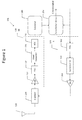
- FIG. 1 illustrates a schematic diagram of a wireless communication device 100.
- the wireless communication device 100 may comprise an antenna 110, a duplexer 120, a receiver 130, an estimator 140, a cancellation device 150, and a transmitter 160.
- the uplink (UL) is on a different frequency band from the downlink (DL). Because the duplexer 120 is imperfect, there is still some degradation in signal quality due to self-interference. It should be noted that the disclosure is not limited to the uplink and downlink being on different frequency bands, but is equally applicable to wireless communication standards where the uplink and downlink are on a same frequency band.
- the receiver 130 may include, for example, a low noise amplifier (LNA) configured to remove noise from a received signal, an automatic gain control (AGC) 134 configured to adjust the gain of the received signal, a down converter 136 configured to covert the received signal centered at an intermediate frequency (IF) to a baseband signal centered at zero frequency, and an analog-to-digital converter 138.
- LNA low noise amplifier
- AGC automatic gain control
- IF intermediate frequency
- analog-to-digital converter 138 analog-to-digital converter
- the transmitter 160 may include, for example, a digital-to-analog converter 162, and up converter 164 configured to convert a baseband signal centered at zero frequency to a signal centered at an IF, and a power amplifier (PA) 166.
- a digital-to-analog converter 162 and up converter 164 configured to convert a baseband signal centered at zero frequency to a signal centered at an IF
- PA power amplifier
- the estimator 140 establishes a self-interference function. More specifically, the estimator 140 estimates a cell-specific reference signal (CRS), that is, a known signal in LTE received from the base station eNB during a low load ABS subframe. The transmitter 160 then transmits within a coherence time of this CRS estimation a predetermined signal X(t). The cancellation device 150 cancels the estimated CRS from a received signal Y(t), which includes self-interference from the transmitted predetermined signal X(t). The cancelling results in a self-interference function f(X), which is then used during normal operation to cancel self-interference.
- CRS cell-specific reference signal
- FIG. 2 illustrates an LTE resource grid 200 of frequency versus time.
- a resource grid 200 comprises resource elements, which is the basic unit of physical resource in LTE.
- the resource element Ro 220 represents antenna port 0, and the hatched resource elements 230 represent other antenna ports in other respective resource grids.
- the blank resource elements 210 are not associated with any antenna port.
- the self-interference function f() determination is performed over the entire resource grid 200 after the resource element R 0 220 representing antenna port 0 and the hatched resource elements 230 representing the other antenna ports are not transmitting, such as during an ABS or low load subframe.
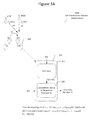
- Figure 3A illustrates a schematic diagram of a wireless communication system 300A including the wireless communication device 100 of Figure 1 during a determination of a self-interference function f().
- the estimator 140 determines the self-inference function during ABS or low load subframes.
- the wireless communication system 300A includes one or more base stations eNB1, eNB2 transmitting cell-specific reference signals S_CRS1, S_CRS2.
- the wireless communication device 100 monitors the downlink signals from the base stations eNB1, eNB2 to detect their cell identifiers. This operation is performed in standard LTE and typical infrastructure-based communications.
- the self-interference function establishment of this disclosure comprises estimating a known signal, transmitting a predetermined signal, and cancelling the estimated known signal from a received signal. Each of these steps is described in more detail below.
- Known cell-specific reference signals CRS from one or more base stations eNB is estimated by the wireless communication device's estimator 140. This estimation is performed during a low load or ABS subframe in the downlink so as to increase the estimation accuracy.
- the ABS subframe is specific to LTE.
- a low load subframe may be defined in frequency and time based on a utilization threshold.
- a low load subframe may be, for example, somewhere between 20% and 50%.
- H k represents the channel from k-th eNB
- S CRS,K represents the CRS sequence from k-th base station eNB.
- a predetermined signal X(t) is by the transmitter 160 within the coherence time when the CRS estimate is still valid.
- the coherence time is the time duration over which the channel impulse response H is considered to be not varying much.
- the downlink signal based on CRS sequence is reconstructed by the estimator 140 at the sampling points.
- I(t) represents other signals such as synchronization signals, including, for example, Primary Synchronization Signal (PSS), secondary Synchronization Signal (SSS), Physical Broadcast Channel (PBCH) signals, and minor interference signals.
- PSS Primary Synchronization Signal
- SSS secondary Synchronization Signal
- PBCH Physical Broadcast Channel
- mapping or self-interference function f() is what the overall self-interference cancellation algorithm is attempting to determine. This is the function that is used during normal operation for the self-interference cancellation.
- Figure 3B illustrates a schematic diagram of the wireless communication system 300B including the wireless communication device 100 of Figure 1 during normal operation. Note that wireless communication system 300A and 300B are the same system, but at different periods of time.
- the self-interference function f() may be used by the cancellation device 150 during normal operation, that is when there is channel traffic, to cancel self-interference from the transmitter 160 to the receiver 130. Basically, the self-interference function f() is used to reconstruct the self-interference f(X(t)) from the transmitter 160.
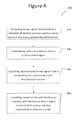
- Figure 4 is a flowchart illustrating a method of self-interference cancellation using the wireless communication device 100 of Figure 1 .
- a known signal such as a CRS, received from a base station eNB is estimated by the estimator 140 when a utilization of the base station eNB is less than a predetermined threshold.
- a predetermined signal X(t) is transmitted by the transmitter 160 within a coherence time.
- Step 430 the estimated known signal U(t) is cancelled from a received signal Y(t) by the cancellation device 150.
- the cancelling results in a self-interference function f().
- Step 440 while another wireless communication channel is active, self-interference is cancelled from a received signal Y(t) based on the self-interference function f() to result in a signal without self-interference.
- the training described above occurs during an ABS or low load subframe.
- the training may occur during normal transmission between the base station(s) eNB and the wireless communication device 100.
- This alternative training algorithm is similar to the algorithm described above except that the wireless communication device 100 estimates the f() function even when the transmitter 160 is transmitting data.
- the wireless communication device 100 estimates CRS signals and cancels the estimated CRS signals. Then the wireless communication device 100 estimates the f() function.
- An iterative algorithm may be applied to improve this estimation and for convergence.
- a computer program product may be embodied on a non-transitory computer-readable medium comprising program instructions configured such that when executed by processing circuitry cause the processing circuitry to implement the method of Figure 4 .
- the training sequence is performed at least once. However, additional training sequences may be performed at any time deemed necessary to accomplish accurate self-interference cancellation.
- the training sequence may be performed during normal operation rather than during an ABS or low load subframe, as described above.
- Estimation and cancellation is jointly optimized in an iterative process rather than being performed separately.
- a second round of estimation is then performed in an iterative loop.
- the self-interference cancellation has been described as being performed in a wireless communication device 100, such as a mobile communication device, communicating with a base station eNB. Alternatively, this self-interference cancellation may be performed in a base station communicating with a mobile communication device. Also, the description is mainly with respect to one mobile communication device and one base station, however, there may be a plurality of base stations.
- Example 1 is a wireless communication device, comprising an estimator configured to estimate a known signal received from a second wireless communication device when the second wireless communication device is utilized less than a predetermined threshold; a transmitter configured to transmit within a coherence time of the estimated known signal, a predetermined signal; and a cancellation device configured to cancel the estimated known signal from a received signal.
- Example 2 the subject matter of Example 1, wherein the cancellation device is configured to produce, as a result of the cancelling, a self-interference function.
- Example 3 the subject matter of Example 2, wherein the cancellation device is further configured to cancel, based on the self-interference function, self-interference from the received signal.
- Example 4 the subject matter of Example 1, wherein the known signal is a reference signal.
- Example 5 the subject matter of Example 1, wherein the known signal is a cell-specific reference signal (CRS).
- CRS cell-specific reference signal
- Example 6 the subject matter of Example 1, wherein the known signal is a pilot signal.
- Example 7 the subject matter of Example 1, wherein the known signal is estimated during an almost blank subframe (ABS).
- Example 8 the subject matter of Example 1, wherein the known signal is estimated during a low load subframe.
- Example 9 the subject matter of Example 1, wherein the second wireless communication device is a base station.
- Example 10 the subject matter of Example 1, further comprising a plurality of second wireless communication devices.
- Example 11 the subject matter of Example 1, wherein the wireless communication device is a mobile communication device.
- Example 12 is a method for self-interference cancellation in a wireless communication device, the method comprising estimating, by an estimator, a known signal received from a second wireless communication device when the second wireless communication device is utilized less than a predetermined threshold; transmitting, by a transmitter and within a coherence time of the estimated known signal, a predetermined signal; and cancelling, by a cancellation device, the estimated known signal from a received signal.
- Example 13 the subject matter of Example 12, wherein the cancelling step comprises producing a self-interference function.
- Example 14 the subject matter of Example 13, further comprising cancelling, based on the self-interference function, self-interference from the received signal while the second wireless communication channel is active.
- Example 15 the subject matter of Example 12, wherein the known signal is a reference signal.
- Example 16 the subject matter of Example 12, wherein the known signal is a cell-specific reference signal (CRS).
- CRS cell-specific reference signal
- Example 17 the subject matter of Example 12, wherein the known signal is a pilot signal.
- Example 18 the subject matter of Example 12, wherein the known signal is estimated during an almost blank subframe (ABS).
- Example 19 the subject matter of Example 12, wherein the second wireless communication device is a base station.
- Example 20 the subject matter of Example 12, further comprising a plurality of second wireless communication devices.
- Example 21 the subject matter of Example 12, further comprising repeating the estimating, transmitting and cancelling steps.
- Example 22 the subject matter of Example 12, wherein the estimating, transmitting, and cancelling steps are performed iteratively.
- Example 23 is a wireless communication device comprising an estimating means for estimating a known signal received from a second wireless communication device when the second wireless communication device is utilized less than a predetermined threshold; a transmitting means for transmitting within a coherence time of the estimated known signal, a predetermined signal; and a cancellation means for cancelling the estimated known signal from a received signal.
- Example 24 the subject matter of Example 23, wherein the known signal is a signal selected from the group of signals consisting of a reference signal, a cell-specific reference signal (CRS), and a pilot signal.
- the known signal is a signal selected from the group of signals consisting of a reference signal, a cell-specific reference signal (CRS), and a pilot signal.
- CRS cell-specific reference signal
- Example 25 is a computer program product embodied on a non-transitory computer-readable medium comprising program instructions configured such that when executed by processing circuitry cause the processing circuitry to implement the method of Example 12.
- Example 26 the subject matter of any of Examples 2-3, wherein the known signal is a reference signal.
- Example 27 the subject matter of any of Examples 2-4, wherein the known signal is a cell-specific reference signal (CRS).
- CRS cell-specific reference signal
- Example 28 the subject matter of any of Examples 2-5, wherein the known signal is a pilot signal.
- Example 29 the subject matter of any of Examples 2-6, wherein the known signal is estimated during an almost blank subframe (ABS).
- ABS almost blank subframe
- Example 30 the subject matter of any of Examples 2-7, wherein the known signal is estimated during a low load subframe.
- Example 31 the subject matter of any of Examples 2-8, wherein the other wireless communication device is a base station.
- Example 32 the subject matter of any of Examples 2-9, further comprising a plurality of other wireless communication devices.
- Example 33 the subject matter of any of Examples 2-10, wherein the wireless communication device is a mobile communication device.
- Example 34 is a wireless communication device, comprising an estimating means for estimating a known signal received from another wireless communication device when the other wireless communication device is utilized less than a predetermined threshold; a transmitting means for transmitting within a coherence time of the estimated known signal, a predetermined signal; and a cancellation means for cancelling the estimated known signal from a received signal.
- Example 35 the subject matter of Example 34, wherein the cancellation means produces, as a result of the cancelling, a self-interference function, and the cancellation means comprises means for cancelling, based on the self-interference function, self-interference from a signal received.
- Example 35 the subject matter of Example 34, wherein the known signal is a reference signal.
- Example 37 the subject matter of any of Examples 12-14, wherein the known signal is a reference signal.
- Example 38 the subject matter of any of Examples 12-15, wherein the known signal is a cell-specific reference signal (CRS).
- CRS cell-specific reference signal
- Example 39 the subject matter of any of Examples 12-16, wherein the known signal is a pilot signal.
- Example 40 the subject matter of any of Examples 12-17, wherein the known signal is estimated during an almost blank subframe (ABS).
- ABS almost blank subframe
- Example 41 the subject matter of any of Examples 12-18, wherein the other wireless communication device is a base station.
- Example 42 the subject matter of any of Examples 12-19, further comprising a plurality of other wireless communication devices.
- Example 43 the subject matter of any of Examples 12-20, further comprising repeating the estimating, transmitting and cancelling steps.
- Example 44 the subject matter of any of Examples 12-21, wherein the estimating, transmitting, and cancelling steps are performed iteratively.
- Example 45 is a computer program product embodied on a non-transitory computer-readable medium comprising program instructions configured such that when executed by processing circuitry cause the processing circuitry to implement the subject matter of any of Examples 12-22.
- Example 46 is an apparatus substantially as shown and described.
- Example 47 is a method substantially as shown and described.
Landscapes
- Engineering & Computer Science (AREA)
- Computer Networks & Wireless Communication (AREA)
- Signal Processing (AREA)
- Power Engineering (AREA)
- Mobile Radio Communication Systems (AREA)
Abstract
A method for self-interference cancellation in a wireless communication device. The wireless communication device has an estimator, a transmitter and a cancellation device. The estimator is configured to estimate a known signal received from a second wireless communication device when the second wireless communication device is utilized less than a predetermined threshold. The transmitter is configured to transmit within a coherence time of the estimated known signal, a predetermined signal. The cancellation device is configured to cancel the estimated known signal from a received signal.
Description
- In communications, especially Long Term Evolution (LTE) cellular communications, when a communication device is transmitting in the uplink, the uplink signal often leaks into the downlink frequency band. While the power of the leaked signal is small as compared with the power of the transmit signal, the leaked signal power is still significant enough to prevent the base station from scheduling downlink transmissions on the full downlink frequency band. This is a waste of resources.
- To alleviate this so-called self-interference, a cancelation algorithm may estimate self-interference from the transmitter at the receiver, and then cancel the estimated self-interference. This estimation, typically accomplished by adapting a filter, is challenging as the mapping from transmitted signal to interference is highly nonlinear and may have memory effect.
-
-
Figure 1 illustrates a schematic diagram of a wireless communication device. -
Figure 2 illustrates a typical time-frequency resource map in a mobile communication standard, such as LTE. -
Figure 3A illustrates a schematic diagram of the wireless communication device ofFigure 1 during a training operation. -
Figure 3B illustrates a schematic diagram of the wireless communication device ofFigure 1 during normal operation. -
Figure 4 is a flowchart illustrating a method of self-interference cancellation using the wireless communication device ofFigure 1 . - The present disclosure is directed to a wireless communication device and method for self-interference cancellation. Before the actual self-interference cancelation (SIC), an estimator establishes a self-interference function or mapping between the transmitter and the interfering transmission signal leaking to the receiver. To increase the accuracy of the self-interference function, influence from external transmissions should be minimized, such as when the signals transmitted from the base station are mainly only known signals. Then during normal operation, the self-interference function may be used to generate a signal without self-interference cancellation.
- The self-interference cancellation is described herein in the context of a wireless communication device operating with the Long Term Evolution (LTE) downlink (DL) signaling structure. However, the disclosure is not limited in this respect. The self-interference cancellation is applicable to any wireless communication standard where in the downlink there is a known signal and low utilization. The known signal may be a reference signal, a cell-specific reference signal (CRS), a pilot signal, etc.
- A base station is required to transmit regular reference signals. LTE Enhanced ICIC (elCIC) base stations (eNB) transmit Almost Blank Subframes (ABS), which include mostly cell-specific reference signals (CRSs), with some minimal signals such as Physical Broadcast Channel (PBCH), Primary Synchronization Channel (PSS), and Secondary Synchronization Channel (SSS). During ABS there is no user data transmitted and thus is a preferable time to establish the self-interference cancellation function with high accuracy.
-
Figure 1 illustrates a schematic diagram of awireless communication device 100. Thewireless communication device 100 may comprise anantenna 110, aduplexer 120, areceiver 130, anestimator 140, acancellation device 150, and atransmitter 160. - In LTE, the uplink (UL) is on a different frequency band from the downlink (DL). Because the
duplexer 120 is imperfect, there is still some degradation in signal quality due to self-interference. It should be noted that the disclosure is not limited to the uplink and downlink being on different frequency bands, but is equally applicable to wireless communication standards where the uplink and downlink are on a same frequency band. - The
receiver 130 may include, for example, a low noise amplifier (LNA) configured to remove noise from a received signal, an automatic gain control (AGC) 134 configured to adjust the gain of the received signal, adown converter 136 configured to covert the received signal centered at an intermediate frequency (IF) to a baseband signal centered at zero frequency, and an analog-to-digital converter 138. - The
transmitter 160 may include, for example, a digital-to-analog converter 162, and upconverter 164 configured to convert a baseband signal centered at zero frequency to a signal centered at an IF, and a power amplifier (PA) 166. - By way of overview, before the actual self-interference cancellation is performed, the
estimator 140 establishes a self-interference function. More specifically, theestimator 140 estimates a cell-specific reference signal (CRS), that is, a known signal in LTE received from the base station eNB during a low load ABS subframe. Thetransmitter 160 then transmits within a coherence time of this CRS estimation a predetermined signal X(t). Thecancellation device 150 cancels the estimated CRS from a received signal Y(t), which includes self-interference from the transmitted predetermined signal X(t). The cancelling results in a self-interference function f(X), which is then used during normal operation to cancel self-interference. A more detailed description of this self-interference function establishment and self-interference cancellation is explained in more detail below with respect toFigures 3A and3B . -
Figure 2 illustrates anLTE resource grid 200 of frequency versus time. Aresource grid 200 comprises resource elements, which is the basic unit of physical resource in LTE. There is oneresource grid 200 defined per antenna port. The resource element Ro 220 representsantenna port 0, and thehatched resource elements 230 represent other antenna ports in other respective resource grids. Theblank resource elements 210 are not associated with any antenna port. The self-interference function f() determination is performed over theentire resource grid 200 after theresource element R 0 220 representingantenna port 0 and the hatchedresource elements 230 representing the other antenna ports are not transmitting, such as during an ABS or low load subframe. -
Figure 3A illustrates a schematic diagram of awireless communication system 300A including thewireless communication device 100 ofFigure 1 during a determination of a self-interference function f(). As mentioned above, before the actual self-interference cancellation is performed, theestimator 140 determines the self-inference function during ABS or low load subframes. - The
wireless communication system 300A includes one or more base stations eNB1, eNB2 transmitting cell-specific reference signals S_CRS1, S_CRS2. Thewireless communication device 100 monitors the downlink signals from the base stations eNB1, eNB2 to detect their cell identifiers. This operation is performed in standard LTE and typical infrastructure-based communications. - The self-interference function establishment of this disclosure comprises estimating a known signal, transmitting a predetermined signal, and cancelling the estimated known signal from a received signal. Each of these steps is described in more detail below.
- Known cell-specific reference signals CRS from one or more base stations eNB is estimated by the wireless communication device's
estimator 140. This estimation is performed during a low load or ABS subframe in the downlink so as to increase the estimation accuracy. The ABS subframe is specific to LTE. For wireless communication standards generally, a low load subframe may be defined in frequency and time based on a utilization threshold. A low load subframe may be, for example, somewhere between 20% and 50%. The estimated signal U(t), generated when the base stations are transmitting CRS sequences, is represented byEquation 1 as follows:
where Hk represents the channel from k-th eNB, and SCRS,K represents the CRS sequence from k-th base station eNB. There are many known methods for the wireless communication device to determine the CRS sequences and the channel information H_k, k=1, ... K. - Next, a predetermined signal X(t) is by the
transmitter 160 within the coherence time when the CRS estimate is still valid. As is known, the coherence time is the time duration over which the channel impulse response H is considered to be not varying much. This predetermined signal may be represented inEquation 2 as follows:
- The downlink signal based on CRS sequence is reconstructed by the
estimator 140 at the sampling points. The reconstructed received sequence U(t) due to the reference signals is represented by Equation 3 as follows:
- The received signal Y(t) at the
receiver 130 is represented by Equation 4 as follows:
- The received signal Y(t) during ABS subframes is represented by Equation 5 as follows:

- The mapping or self-interference function f() is what the overall self-interference cancellation algorithm is attempting to determine. This is the function that is used during normal operation for the self-interference cancellation.
- The self-interference mapping function f() from the
transmitter 160 to thereceiver 130 is determined by theestimator 140 canceling the reconstructed CRS sequence U(t) from the received signal Y(t), as represented byEquation 6 as follows:
where U(t) represents only the downlink CRS sequence without interference from the known transmitted signal X(t), though therefore may be downlink CRS sequence from more than one base station eNB. -
Figure 3B illustrates a schematic diagram of thewireless communication system 300B including thewireless communication device 100 ofFigure 1 during normal operation. Note thatwireless communication system - After the self-interference function f() is established as described above with respect to
Figure 3A , there is actual self-interference cancellation during normal operation, as described in detail below with respect toFigure 3B . - The self-interference function f() may be used by the
cancellation device 150 during normal operation, that is when there is channel traffic, to cancel self-interference from thetransmitter 160 to thereceiver 130. Basically, the self-interference function f() is used to reconstruct the self-interference f(X(t)) from thetransmitter 160. The signal without self-interference may be represented by Equation (7) as follows:
-
Figure 4 is a flowchart illustrating a method of self-interference cancellation using thewireless communication device 100 ofFigure 1 . - At
Step 410, a known signal, such as a CRS, received from a base station eNB is estimated by theestimator 140 when a utilization of the base station eNB is less than a predetermined threshold. - At
Step 420, a predetermined signal X(t) is transmitted by thetransmitter 160 within a coherence time. - Next, at
Step 430, the estimated known signal U(t) is cancelled from a received signal Y(t) by thecancellation device 150. The cancelling results in a self-interference function f(). - Finally, at
Step 440, while another wireless communication channel is active, self-interference is cancelled from a received signal Y(t) based on the self-interference function f() to result in a signal without self-interference. - The training described above occurs during an ABS or low load subframe. Alternatively, the training may occur during normal transmission between the base station(s) eNB and the
wireless communication device 100. This alternative training algorithm is similar to the algorithm described above except that thewireless communication device 100 estimates the f() function even when thetransmitter 160 is transmitting data. In this alternative algorithm, thewireless communication device 100 estimates CRS signals and cancels the estimated CRS signals. Then thewireless communication device 100 estimates the f() function. An iterative algorithm may be applied to improve this estimation and for convergence. - A computer program product may be embodied on a non-transitory computer-readable medium comprising program instructions configured such that when executed by processing circuitry cause the processing circuitry to implement the method of
Figure 4 . - The training sequence is performed at least once. However, additional training sequences may be performed at any time deemed necessary to accomplish accurate self-interference cancellation.
- In an alternative process the training sequence may be performed during normal operation rather than during an ABS or low load subframe, as described above. Estimation and cancellation is jointly optimized in an iterative process rather than being performed separately. First the CRS is estimated, then some self-interference is cancelled from the received signal, then the self-interference function f() is estimated but perhaps only to 80% accuracy. A second round of estimation is then performed in an iterative loop.
- The self-interference cancellation has been described as being performed in a
wireless communication device 100, such as a mobile communication device, communicating with a base station eNB. Alternatively, this self-interference cancellation may be performed in a base station communicating with a mobile communication device. Also, the description is mainly with respect to one mobile communication device and one base station, however, there may be a plurality of base stations. - Example 1 is a wireless communication device, comprising an estimator configured to estimate a known signal received from a second wireless communication device when the second wireless communication device is utilized less than a predetermined threshold; a transmitter configured to transmit within a coherence time of the estimated known signal, a predetermined signal; and a cancellation device configured to cancel the estimated known signal from a received signal.
- In Example 2, the subject matter of Example 1, wherein the cancellation device is configured to produce, as a result of the cancelling, a self-interference function.
- In Example 3, the subject matter of Example 2, wherein the cancellation device is further configured to cancel, based on the self-interference function, self-interference from the received signal.
- In Example 4, the subject matter of Example 1, wherein the known signal is a reference signal.
- In Example 5, the subject matter of Example 1, wherein the known signal is a cell-specific reference signal (CRS).
- In Example 6, the subject matter of Example 1, wherein the known signal is a pilot signal.
- In Example 7, the subject matter of Example 1, wherein the known signal is estimated during an almost blank subframe (ABS).
- In Example 8, the subject matter of Example 1, wherein the known signal is estimated during a low load subframe.
- In Example 9, the subject matter of Example 1, wherein the second wireless communication device is a base station.
- In Example 10, the subject matter of Example 1, further comprising a plurality of second wireless communication devices.
- In Example 11, the subject matter of Example 1, wherein the wireless communication device is a mobile communication device.
- Example 12 is a method for self-interference cancellation in a wireless communication device, the method comprising estimating, by an estimator, a known signal received from a second wireless communication device when the second wireless communication device is utilized less than a predetermined threshold; transmitting, by a transmitter and within a coherence time of the estimated known signal, a predetermined signal; and cancelling, by a cancellation device, the estimated known signal from a received signal.
- In Example 13, the subject matter of Example 12, wherein the cancelling step comprises producing a self-interference function.
- In Example 14, the subject matter of Example 13, further comprising cancelling, based on the self-interference function, self-interference from the received signal while the second wireless communication channel is active.
- In Example 15, the subject matter of Example 12, wherein the known signal is a reference signal.
- In Example 16, the subject matter of Example 12, wherein the known signal is a cell-specific reference signal (CRS).
- In Example 17, the subject matter of Example 12, wherein the known signal is a pilot signal.
- In Example 18, the subject matter of Example 12, wherein the known signal is estimated during an almost blank subframe (ABS).
- In Example 19, the subject matter of Example 12, wherein the second wireless communication device is a base station.
- In Example 20, the subject matter of Example 12, further comprising a plurality of second wireless communication devices.
- In Example 21, the subject matter of Example 12, further comprising repeating the estimating, transmitting and cancelling steps.
- In Example 22, the subject matter of Example 12, wherein the estimating, transmitting, and cancelling steps are performed iteratively.
- Example 23 is a wireless communication device comprising an estimating means for estimating a known signal received from a second wireless communication device when the second wireless communication device is utilized less than a predetermined threshold; a transmitting means for transmitting within a coherence time of the estimated known signal, a predetermined signal; and a cancellation means for cancelling the estimated known signal from a received signal.
- In Example 24, the subject matter of Example 23, wherein the known signal is a signal selected from the group of signals consisting of a reference signal, a cell-specific reference signal (CRS), and a pilot signal.
- Example 25 is a computer program product embodied on a non-transitory computer-readable medium comprising program instructions configured such that when executed by processing circuitry cause the processing circuitry to implement the method of Example 12.
- In Example 26, the subject matter of any of Examples 2-3, wherein the known signal is a reference signal.
- In Example 27, the subject matter of any of Examples 2-4, wherein the known signal is a cell-specific reference signal (CRS).
- In Example 28, the subject matter of any of Examples 2-5, wherein the known signal is a pilot signal.
- In Example 29, the subject matter of any of Examples 2-6, wherein the known signal is estimated during an almost blank subframe (ABS).
- In Example 30, the subject matter of any of Examples 2-7, wherein the known signal is estimated during a low load subframe.
- In Example 31, the subject matter of any of Examples 2-8, wherein the other wireless communication device is a base station.
- In Example 32, the subject matter of any of Examples 2-9, further comprising a plurality of other wireless communication devices.
- In Example 33, the subject matter of any of Examples 2-10, wherein the wireless communication device is a mobile communication device.
- Example 34 is a wireless communication device, comprising an estimating means for estimating a known signal received from another wireless communication device when the other wireless communication device is utilized less than a predetermined threshold; a transmitting means for transmitting within a coherence time of the estimated known signal, a predetermined signal; and a cancellation means for cancelling the estimated known signal from a received signal.
- In Example 35, the subject matter of Example 34, wherein the cancellation means produces, as a result of the cancelling, a self-interference function, and the cancellation means comprises means for cancelling, based on the self-interference function, self-interference from a signal received.
- In Example 35, the subject matter of Example 34, wherein the known signal is a reference signal.
- In Example 37, the subject matter of any of Examples 12-14, wherein the known signal is a reference signal.
- In Example 38, the subject matter of any of Examples 12-15, wherein the known signal is a cell-specific reference signal (CRS).
- In Example 39, the subject matter of any of Examples 12-16, wherein the known signal is a pilot signal.
- In Example 40, the subject matter of any of Examples 12-17, wherein the known signal is estimated during an almost blank subframe (ABS).
- In Example 41, the subject matter of any of Examples 12-18, wherein the other wireless communication device is a base station.
- In Example 42, the subject matter of any of Examples 12-19, further comprising a plurality of other wireless communication devices.
- In Example 43, the subject matter of any of Examples 12-20, further comprising repeating the estimating, transmitting and cancelling steps.
- In Example 44, the subject matter of any of Examples 12-21, wherein the estimating, transmitting, and cancelling steps are performed iteratively.
- Example 45 is a computer program product embodied on a non-transitory computer-readable medium comprising program instructions configured such that when executed by processing circuitry cause the processing circuitry to implement the subject matter of any of Examples 12-22.
- Example 46 is an apparatus substantially as shown and described.
- Example 47 is a method substantially as shown and described.
- While the foregoing has been described in conjunction with exemplary embodiment, it is understood that the term "exemplary" is merely meant as an example, rather than the best or optimal. Accordingly, the disclosure is intended to cover alternatives, modifications and equivalents, which may be included within the scope of the disclosure.
- Although specific embodiments have been illustrated and described herein, it will be appreciated by those of ordinary skill in the art that a variety of alternate and/or equivalent implementations may be substituted for the specific embodiments shown and described without departing from the scope of the present application. This application is intended to cover any adaptations or variations of the specific embodiments discussed herein.
Claims (15)
- A wireless communication device, comprising:an estimator configured to estimate a known signal received from a second wireless communication device when the second wireless communication device is utilized less than a predetermined threshold;a transmitter configured to transmit within a coherence time of the estimated known signal, a predetermined signal; anda cancellation device configured to cancel the estimated known signal from a received signal.
- The wireless communication device of claim 1,
wherein the cancellation device is configured to produce, as a result of the cancelling, a self-interference function. - The wireless communication device of claim 2,
wherein the cancellation device is further configured to cancel, based on the self-interference function, self-interference from the received signal. - The wireless communication device of any of claims 2-3, wherein the known signal is a reference signal.
- The wireless communication device of any of claims 2-3, wherein the known signal is a cell-specific reference signal (CRS).
- A wireless communication device, comprising:an estimating means for estimating a known signal received from a second wireless communication device when the second wireless communication device is utilized less than a predetermined threshold;a transmitting means for transmitting within a coherence time of the estimated known signal, a predetermined signal; anda cancellation means for cancelling the estimated known signal from a received signal.
- The wireless communication device of claim 6, wherein the known signal is a signal selected from the group of signals consisting of a reference signal, a cell-specific reference signal (CRS), and a pilot signal.
- The wireless communication device of claim 6,
wherein the cancellation means produces, as a result of the cancelling, a self-interference function, and the cancellation means comprises means for cancelling, based on the self-interference function, self-interference from a signal received. - The wireless communication device of claim 6, wherein the known signal is a reference signal.
- A method for self-interference cancellation in a wireless communication device, the method comprising:estimating, by an estimator, a known signal received from a second wireless communication device when the second wireless communication device is utilized less than a predetermined threshold;transmitting, by a transmitter and within a coherence time of the estimated known signal, a predetermined signal; andcancelling, by a cancellation device, the estimated known signal from a received signal.
- The method of claim 10,
wherein the cancelling step comprises producing a self-interference function. - The method of claim 11, further comprising:cancelling, based on the self-interference function, self-interference from the received signal while the second wireless communication channel is active.
- The method of any of claims 10-12, wherein the known signal is a reference signal.
- The method of any of claims 10-12, further comprising:repeating the estimating, transmitting and cancelling steps.
- The method of any of claims 10-12, wherein the estimating, transmitting, and cancelling steps are performed iteratively.
Applications Claiming Priority (1)
| Application Number | Priority Date | Filing Date | Title |
|---|---|---|---|
| US14/577,317 US9832666B2 (en) | 2014-12-19 | 2014-12-19 | Device and method for self-interference cancellation |
Publications (1)
| Publication Number | Publication Date |
|---|---|
| EP3035549A1 true EP3035549A1 (en) | 2016-06-22 |
Family
ID=54557297
Family Applications (1)
| Application Number | Title | Priority Date | Filing Date |
|---|---|---|---|
| EP15194813.0A Withdrawn EP3035549A1 (en) | 2014-12-19 | 2015-11-16 | Device and method for self-interference cancellation |
Country Status (4)
| Country | Link |
|---|---|
| US (1) | US9832666B2 (en) |
| EP (1) | EP3035549A1 (en) |
| CN (1) | CN105721017B (en) |
| TW (1) | TWI590610B (en) |
Families Citing this family (8)
| Publication number | Priority date | Publication date | Assignee | Title |
|---|---|---|---|---|
| KR102301826B1 (en) * | 2014-08-27 | 2021-09-14 | 삼성전자 주식회사 | Wireless communication system and method for managing resource for interference coordication thereof |
| CN107210978B (en) * | 2015-01-23 | 2020-11-24 | Lg 电子株式会社 | Method for estimating nonlinear self-interfering signal channel by device using FDR scheme |
| EP3304766B1 (en) * | 2015-05-28 | 2019-03-13 | Telefonaktiebolaget LM Ericsson (publ) | Transceiver with alternating mode of operation |
| US9693330B1 (en) * | 2015-07-30 | 2017-06-27 | Rockwell Collins, Inc. | Wideband high frequency based precision time transfer |
| CN107872243A (en) * | 2016-09-23 | 2018-04-03 | 北京大学(天津滨海)新代信息技术研究院 | A kind of Radio Frequency Interfere cancellation element and method |
| US11374613B2 (en) * | 2018-03-29 | 2022-06-28 | U-Blox Ag | Active interference cancellation apparatus, signal isolation control apparatus and method of actively cancelling interference |
| CN108768583A (en) * | 2018-03-30 | 2018-11-06 | 重庆邮电大学 | A kind of data source analog platform based on LTE-A |
| US11770473B2 (en) * | 2020-05-01 | 2023-09-26 | Qualcomm Incorporated | Avoid and react to sudden possibility of damage to receiver in self-interference measurement |
Citations (2)
| Publication number | Priority date | Publication date | Assignee | Title |
|---|---|---|---|---|
| US20130286903A1 (en) * | 2012-04-25 | 2013-10-31 | Nec Laboratories America, Inc. | Interference Cancellation for Full-Duplex Communications |
| WO2014200212A1 (en) * | 2013-06-10 | 2014-12-18 | Lg Electronics Inc. | Method of measuring self-interference channel and user equipment thereto |
Family Cites Families (5)
| Publication number | Priority date | Publication date | Assignee | Title |
|---|---|---|---|---|
| US5943606A (en) | 1996-09-30 | 1999-08-24 | Qualcomm Incorporated | Determination of frequency offsets in communication systems |
| CN103718636B (en) | 2011-06-17 | 2018-10-09 | 瑞典爱立信有限公司 | method and node for random access |
| CN103516638B (en) | 2012-06-25 | 2016-08-24 | 华为技术有限公司 | A kind of method of channel response being obtained from interference channel and full duplex letter machine |
| CN103716061B (en) | 2013-12-31 | 2015-09-23 | 遵义天义利威机电有限责任公司 | Low-complexity full-duplex antenna selection method |
| CN103957182B (en) | 2014-05-21 | 2017-03-08 | 苏州东奇信息科技股份有限公司 | A kind of common channel full duplex system based on MPPSK modulation |
-
2014
- 2014-12-19 US US14/577,317 patent/US9832666B2/en not_active Expired - Fee Related
-
2015
- 2015-11-16 EP EP15194813.0A patent/EP3035549A1/en not_active Withdrawn
- 2015-11-16 TW TW104137722A patent/TWI590610B/en not_active IP Right Cessation
- 2015-11-19 CN CN201510801574.3A patent/CN105721017B/en not_active Expired - Fee Related
Patent Citations (2)
| Publication number | Priority date | Publication date | Assignee | Title |
|---|---|---|---|---|
| US20130286903A1 (en) * | 2012-04-25 | 2013-10-31 | Nec Laboratories America, Inc. | Interference Cancellation for Full-Duplex Communications |
| WO2014200212A1 (en) * | 2013-06-10 | 2014-12-18 | Lg Electronics Inc. | Method of measuring self-interference channel and user equipment thereto |
Also Published As
| Publication number | Publication date |
|---|---|
| CN105721017A (en) | 2016-06-29 |
| TWI590610B (en) | 2017-07-01 |
| CN105721017B (en) | 2019-04-23 |
| US20160183100A1 (en) | 2016-06-23 |
| US9832666B2 (en) | 2017-11-28 |
| TW201631920A (en) | 2016-09-01 |
Similar Documents
| Publication | Publication Date | Title |
|---|---|---|
| US9832666B2 (en) | Device and method for self-interference cancellation | |
| EP3800946B1 (en) | Methods and apparatuses for multi-panel power control | |
| EP2744278B1 (en) | Wireless communication system, wireless base station apparatus, user terminal, and method for wireless communication | |
| EP2557834B1 (en) | Base station device, mobile station device and reference signal transmission method | |
| KR102136609B1 (en) | Apparatus and method for signaling power information in wireless communication system | |
| EP2860925B1 (en) | Method and full-duplex communication device for acquiring channel response of self-interfering channel | |
| EP3605938B1 (en) | Flexible time masks for listen-before-talk based channel access | |
| US20180255519A1 (en) | User terminal and radio communication method | |
| EP2781043B1 (en) | Methods and arrangements for reference signal measurements | |
| US8929232B2 (en) | Transmission power control method and mobile station apparatus | |
| KR102254938B1 (en) | Method, device and system for performing wireless communication in wireless communication system | |
| US9814054B2 (en) | Base station, user apparatus and interference reduction method | |
| US9509427B2 (en) | Adaptive suppression of unknown interference | |
| US9369309B2 (en) | Receiving apparatus, method for receiving, and wireless communication system | |
| US9819385B2 (en) | Method and apparatus for interference cancellation | |
| KR20140107998A (en) | Method and apparatus for detecting signal | |
| JP5780547B2 (en) | Communication terminal, base station, and wireless communication method | |
| CN107708196A (en) | Communication means, the network equipment and terminal device | |
| US20190098636A1 (en) | Interference based resource allocation | |
| US20160128081A1 (en) | Method and Network Node for Assisting Handling of Interference at a Receiver Device | |
| CN111385861B (en) | Method and device for coordinating downlink traffic channel interference | |
| KR20180041385A (en) | Methods and apparatus for using irc receiver selectively by a user equipment |
Legal Events
| Date | Code | Title | Description |
|---|---|---|---|
| PUAI | Public reference made under article 153(3) epc to a published international application that has entered the european phase |
Free format text: ORIGINAL CODE: 0009012 |
|
| 17P | Request for examination filed |
Effective date: 20151116 |
|
| AK | Designated contracting states |
Kind code of ref document: A1 Designated state(s): AL AT BE BG CH CY CZ DE DK EE ES FI FR GB GR HR HU IE IS IT LI LT LU LV MC MK MT NL NO PL PT RO RS SE SI SK SM TR |
|
| AX | Request for extension of the european patent |
Extension state: BA ME |
|
| 17Q | First examination report despatched |
Effective date: 20180605 |
|
| STAA | Information on the status of an ep patent application or granted ep patent |
Free format text: STATUS: THE APPLICATION HAS BEEN WITHDRAWN |
|
| 18W | Application withdrawn |
Effective date: 20180809 |