EP3034599A1 - Use of lipopeptide compound for improving aroma of alcoholic beverages and determination method thereof - Google Patents
Use of lipopeptide compound for improving aroma of alcoholic beverages and determination method thereof Download PDFInfo
- Publication number
- EP3034599A1 EP3034599A1 EP14836131.4A EP14836131A EP3034599A1 EP 3034599 A1 EP3034599 A1 EP 3034599A1 EP 14836131 A EP14836131 A EP 14836131A EP 3034599 A1 EP3034599 A1 EP 3034599A1
- Authority
- EP
- European Patent Office
- Prior art keywords
- aroma
- lipopeptides
- lichenysin
- liquors
- compounds
- Prior art date
- Legal status (The legal status is an assumption and is not a legal conclusion. Google has not performed a legal analysis and makes no representation as to the accuracy of the status listed.)
- Granted
Links
- 0 C*(*)**C(F)(F)F Chemical compound C*(*)**C(F)(F)F 0.000 description 1
Images


Classifications
-
- A—HUMAN NECESSITIES
- A23—FOODS OR FOODSTUFFS; TREATMENT THEREOF, NOT COVERED BY OTHER CLASSES
- A23L—FOODS, FOODSTUFFS OR NON-ALCOHOLIC BEVERAGES, NOT OTHERWISE PROVIDED FOR; PREPARATION OR TREATMENT THEREOF
- A23L2/00—Non-alcoholic beverages; Dry compositions or concentrates therefor; Preparation or treatment thereof
- A23L2/52—Adding ingredients
-
- A—HUMAN NECESSITIES
- A23—FOODS OR FOODSTUFFS; TREATMENT THEREOF, NOT COVERED BY OTHER CLASSES
- A23L—FOODS, FOODSTUFFS OR NON-ALCOHOLIC BEVERAGES, NOT OTHERWISE PROVIDED FOR; PREPARATION OR TREATMENT THEREOF
- A23L2/00—Non-alcoholic beverages; Dry compositions or concentrates therefor; Preparation or treatment thereof
- A23L2/52—Adding ingredients
- A23L2/56—Flavouring or bittering agents
-
- A—HUMAN NECESSITIES
- A23—FOODS OR FOODSTUFFS; TREATMENT THEREOF, NOT COVERED BY OTHER CLASSES
- A23L—FOODS, FOODSTUFFS OR NON-ALCOHOLIC BEVERAGES, NOT OTHERWISE PROVIDED FOR; PREPARATION OR TREATMENT THEREOF
- A23L27/00—Spices; Flavouring agents or condiments; Artificial sweetening agents; Table salts; Dietetic salt substitutes; Preparation or treatment thereof
- A23L27/88—Taste or flavour enhancing agents
-
- C—CHEMISTRY; METALLURGY
- C12—BIOCHEMISTRY; BEER; SPIRITS; WINE; VINEGAR; MICROBIOLOGY; ENZYMOLOGY; MUTATION OR GENETIC ENGINEERING
- C12G—WINE; PREPARATION THEREOF; ALCOHOLIC BEVERAGES; PREPARATION OF ALCOHOLIC BEVERAGES NOT PROVIDED FOR IN SUBCLASSES C12C OR C12H
- C12G3/00—Preparation of other alcoholic beverages
- C12G3/04—Preparation of other alcoholic beverages by mixing, e.g. for preparation of liqueurs
- C12G3/06—Preparation of other alcoholic beverages by mixing, e.g. for preparation of liqueurs with flavouring ingredients
-
- G—PHYSICS
- G01—MEASURING; TESTING
- G01N—INVESTIGATING OR ANALYSING MATERIALS BY DETERMINING THEIR CHEMICAL OR PHYSICAL PROPERTIES
- G01N30/00—Investigating or analysing materials by separation into components using adsorption, absorption or similar phenomena or using ion-exchange, e.g. chromatography or field flow fractionation
- G01N30/02—Column chromatography
- G01N30/88—Integrated analysis systems specially adapted therefor, not covered by a single one of the groups G01N30/04 - G01N30/86
- G01N2030/8809—Integrated analysis systems specially adapted therefor, not covered by a single one of the groups G01N30/04 - G01N30/86 analysis specially adapted for the sample
- G01N2030/8813—Integrated analysis systems specially adapted therefor, not covered by a single one of the groups G01N30/04 - G01N30/86 analysis specially adapted for the sample biological materials
Definitions
- the present invention belongs to the field of food.
- the present invention relates to the preparation and quantification of lipopeptides and its application in improving the aroma of alcoholic beverages, and more particularly relates to a method of alcoholic beverages production.
- the matrix compounds in food affect its aroma and quality.
- the migratation of aroma from food to consumer's olfactory organ is affected by many factors, including the chemical interactions between food and aroma components, physical factors and physiological factors of consumers (chewing time, respiration). Due to the fact that the sense is an important factor in determining consumer preferences, it has important significance to research on how the aroma releases from the food and then acts with olfactory receptors.
- Lipopeptide is one kind of important compounds produced by Bacillus, including surfactin, lichenysin, iturin, fengycin and so on. Lipopeptide exhibits numerous pharmaceutical activities, including antimicrobial, antitumor, anti-inflammatory.
- Surfactin is reported to be a potent surfactant, which could reduce the surface tension of water from 70mN / m to 36mN / m and the critical micelle concentration is 15.6mg / L. Iturin is reported as a strong antibiotics, which has strong inhibitory to yeast and mold.
- Fengycin is mold inhibitor, mainly is used for the inhibition of plant pathogenic fungi.
- lipopeptides such as surfactin, lichenysin, iturins and fengycin play an important role in enhancing the quality of alcoholic beverages, especially the improvement of aroma.
- the present invention provides a method for improving or enhancing the aroma of drinks, including the addition of an effective amount of one kind or more kinds of lipopeptides.
- the addition of lipopeptides was more than 1 ⁇ g/L, more than 10 ⁇ g / L, more than 100 ⁇ g / L, 1-1000 ⁇ g / L, 1-500 ⁇ g / L, 1-200 ⁇ g / L, 1-100 ⁇ g / L, 1 -10 ⁇ g / L, 10-1000 ⁇ g / L, 10-500 ⁇ g / L, 10-200 ⁇ g / L, 10-100 ⁇ g / L, 100-1000 ⁇ g / L, 100-900 ⁇ g / L, 100-500 ⁇ g / L, 100-200 ⁇ g / L or 200-500 ⁇ g / L.
- the content of lichenysin in alcoholic beverage itself should be considered.
- the total content of lichenysin after the addition was 500-1500 ⁇ g / L, and more preferably 600-1400 ⁇ g / L, 700-1300 ⁇ g / L, 800-1200 ⁇ g / L, 900-1100 ⁇ g / L, and most preferably 950-1050 ⁇ g / L, such as 1000 ⁇ g / L.
- the content of lichenysin in alcoholic beverage could be quantified by the method described in the present invention.
- the present invention also provides a method for lipopeptides preparation, including separation and purification from Chinese liquor.
- the SPE C18 cartridge elluted alcoholic beverage was further purified by preparative chromatography to separate the lipopeptide.
- chromatographic separation was carried out using an Xbridge Prep C18 (250 mm ⁇ 19 mm, 10 ⁇ m) reversed-phase column. The detection was selected at wavelength of 210 nm. Methanol solution containing 0.1 % formic acid was the mobile phase A and methanol was mobile phase B. The separation program was : 0 to 10 min,40% B to 25% B; 10 to 50 min, 25% B to 5% B; 50 to 55 min, 5% B to 0% B.
- the present invention also provides a method for quantification of lipopeptides in alcoholic beverages, especifically the quantification of lichenysins. Said method couples the ultra-high performance liquid chromatography (UPLC) with mass spectrometry.
- UPLC ultra-high performance liquid chromatography
- the UPLC parameters were as follows: the column was UPLC TM BEH C 18 column (100 mm ⁇ 2.1 mm i.d., 1.7 ⁇ m); the column temperature was 30°C; the injection volume was 2 ⁇ L; the flow rate was 0.3mL / min; methanol solution containing 0.1% formic acid was the mobile phase A and methanol was mobile phase B. And the elution program was : 0 to 0.1 min, 15% B; 0.1 to 10 min, 0% B; 10 to 11 min, 15% B.
- Mass selective detector (MSD) parameters were as follows: positive ion mode; atomizing air pressure, 30psi; separation voltage, 3.5 kV; collision induced voltage, 20V; gas for drying, N 2 ; temperature for drying, 100°C; ion scan range, 50-1500m / z.
- the present invention also provides a composition containing one or more kinds of lipopeptides; alternatively, pharmaceutically or food acceptable carriers or excipients were contained in said composition; in particular, said composition is food, especially drinks.
- the lipopeptides content in said composition was more than 1 ⁇ g / L, more than 10 ⁇ g / L, more than 100 ⁇ g / L, 1-1000 ⁇ g / L, 1-500 ⁇ g / L, 1-200 ⁇ g / L, 1-100 ⁇ g / L, 1-10 ⁇ g / L, 10-1000 ⁇ g / L, 10-500 ⁇ g / L, 10-200 ⁇ g / L, 10-100 ⁇ g / L, 100-1000 ⁇ g / L, 100-900 ⁇ g / L, 100-500 ⁇ g / L, 100-200 ⁇ g / L or 200-500 ⁇ g / L.
- the content of lichenysin in alcoholic beverage itself should be considered.
- the total content of lichenysin after addition was 500-1500 ⁇ g / L, and more preferably 600-1400 ⁇ g / L, 700-1300 ⁇ g / L, 800-1200 ⁇ g / L, 900-1100 ⁇ g / L, and particularly preferably 950-1050 ⁇ g / L, such as 1000 ⁇ g / L.
- the content of lichenysin in Chinese liquor could be quantified by the method described in the present invention.
- the present invention also provides application of lipopeptides in improving or enhancing the aroma of drinks.
- the addition of lipopeptides was more than 1 ⁇ g / L, more than 10 ⁇ g / L, more than 100 ⁇ g / L, 1-1000 ⁇ g / L, 1-500 ⁇ g / L, 1-200 ⁇ g / L, 1-100 ⁇ g / L, 1-10 ⁇ g / L, 10-1000 ⁇ g / L, 10-500 ⁇ g / L, 10-200 ⁇ g / L, 10-100 ⁇ g / L, 100-1000 ⁇ g / L, 100-900 ⁇ g / L, 100-500 ⁇ g / L, 100-200 ⁇ g / L or 200-500 ⁇ g / L.
- the present invention also provides application of lipopeptides in enhancing the volatility of aroma compounds and / or reducing the volatility of off-flavor compounds.
- said aroma compounds were any one or more of esters, alcohols and aldehydes, and the said off-flavor compounds were phenolic compounds.
- the addition of lipopeptides was more than 1 ⁇ g / L, more than 10 ⁇ g / L, more than 100 ⁇ g / L, 1-1000 ⁇ g / L, 1-500 ⁇ g / L, 1-200 ⁇ g / L, 1-100 ⁇ g / L, 1-10 ⁇ g / L, 10-1000 ⁇ g / L, 10-500 ⁇ g / L, 10-200 ⁇ g / L, 10-100 ⁇ g / L, 100-1000 ⁇ g / L, 100-900 ⁇ g / L, 100-500 ⁇ g / L, 100-200 ⁇ g / L or 200-500 ⁇ g / L.
- the headspace solidphase microextraction coupled with gas chromatography-mass spectrometry (HS-SPME-GC-MS) method was used to evaluated the effect of lipopeptides on volatile aroma compounds. Specifically, said method comprises:
- the present invention also provides a method of alcoholic beverages production, comprising addition of one or more kinds of lipopeptides.
- the addition of lipopeptides added was more than 1 ⁇ g / L, more than 10 ⁇ g / L, more than 100 ⁇ g / L, 1-1000 ⁇ g / L, 1-500 ⁇ g / L, 1-200 ⁇ g / L, 1-100 ⁇ g / L, 1-10 ⁇ g / L, 10-1000 ⁇ g / L, 10-500 ⁇ g / L, 10-200 ⁇ g / L, 10-100 ⁇ g / L, 100-1000 ⁇ g / L, 100-900 ⁇ g / L, 100-500 ⁇ g / L, 100-200 ⁇ g / L or 200-500 ⁇ g / L.
- the content of lichenysin in alcoholic beverage When added to alcoholic beverage, the content of lichenysin in alcoholic beverage itself should be considered.
- the total content of lichenysin after the addition was 500-1500 ⁇ g / L, and more preferably 600-1400 ⁇ g / L, 700-1300 ⁇ g / L, 800-1200 ⁇ g / L, 900-1100 ⁇ g / L, and most preferably 950-1050 ⁇ g / L, such as 1000 ⁇ g / L.
- the content of lichenysin in alcoholic beverage could be quantified by the method described in the present invention.
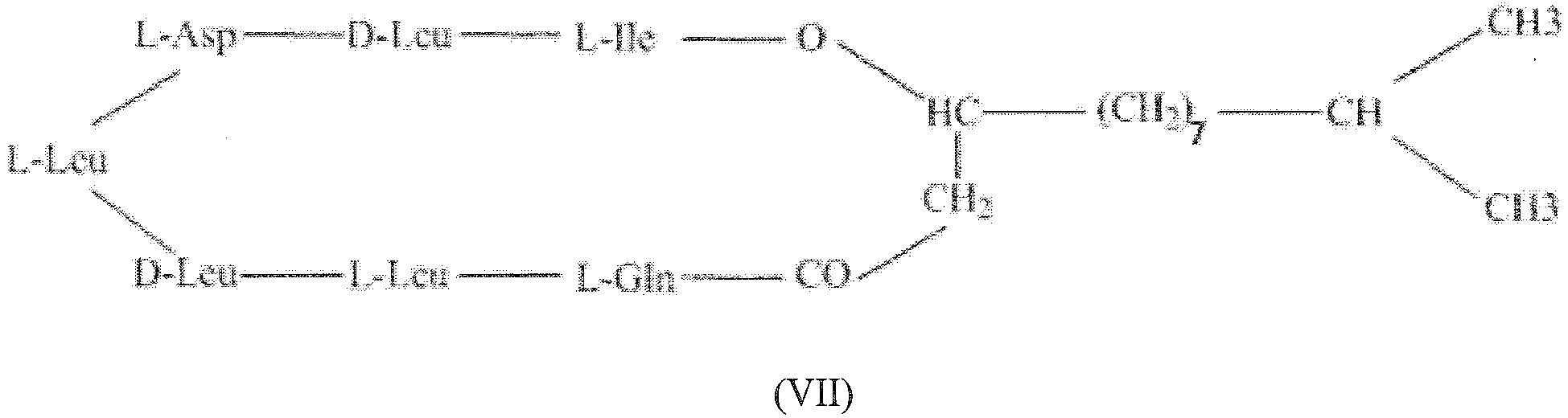
- said lipopeptide in the present invention is any one or more of the following: surfactin, lichenysin, iturins and fengycin. And without specified, said lichenysin is any one or more of the seven kinds of homologs (fraction (I) to fraction (VII)) :
- the mass-to-charge-ratio ( m / z ) of fraction (I) to fraction (VII) were 993, 1007, 1021, 1035, 1049, 1007 and 1021, respectivity.
- Said flavor compounds in alcoholic beverages include aroma compounds and off-flavor compounds.
- said aroma compounds were any one or more of esters, alcohols and acids, and said off-flavor compounds were phenolic compounds.
- said esters, alcohols, acids or phenolic compounds were compounds exsisted in Chinese liquor.
- said food are preferably drinks; specifically, the drinks are alcoholic liquors (Chinese liquor, rice wine, wine, beer, sake, shochu, whiskey, brandy, vodka, rum or gin); more specifically, the alcoholic liquor is Chinese liquor; more specifically, the Chinese liquor was soy sauce aroma type liquor, strong aroma type liquor, light aroma type liquor, soybean-flavor type liquor or medical aroma type liquor.
- alcoholic liquors Choinese liquor, rice wine, wine, beer, sake, shochu, whiskey, brandy, vodka, rum or gin
- the alcoholic liquor is Chinese liquor; more specifically, the Chinese liquor was soy sauce aroma type liquor, strong aroma type liquor, light aroma type liquor, soybean-flavor type liquor or medical aroma type liquor.
- the present invention evaluated the effect of lipopeptides (lichenysin) on aroma volatility in alcoholic beverages by HS-SPME.
- Lipopeptides, especially lichenysin have significant impacts on the volatility of aroma compounds of alcoholic beverages.
- lipopeptides (lichenysin) mainly affected the esters, alcohols, acids and phenolic compounds of liquors.
- Example 1 Sensory evaluation experiments of improving or enhancing the quality and flavor of Chinese liquor by lichenysin
- Fraction V could be either commercially obtained or prepared according to the method reported in references: Yakimov, M.M.; Abrah am, W.-R.; Meyer, H.; Giuliano, L.; Golyshin, P.N., Structural characterization of lichenysin A components by fast atom bombardment tandem mass spectrometry. Biochimica et Biophysica Acta1999,1438(2),273-280 .
- Fraction VII could be either commercially obtained or prepared according to the methods reported in references: Yakimov, M.M.; Abrah am, W.-R.; Meyer, H.; Giuliano, L.; Golyshin, P.N., Structural characterization of lichenysin A components by fast atom bombardment tandem mass spectrometry. Biochimica et Biophysica Acta1999,1438(2),273-280 .
- HS-SPME conditions 8 mL of sample was added to a 20 mL headspace vial for HS-SPME extraction.
- SPME a 50/30 ⁇ m DVB/CAR/PDMS fiber was used.
- the sample was preheated at 20 - 30°C for 5 min and extracted for 30-50 min, and then desorbed by GC for 5min.
- GC conditions a DB-Wax column (60 m ⁇ 0.325 mm ⁇ 0.25 ⁇ m) was used for the GC analysis.
- the injector temperature was 250°C and the splitless mode was used.
- the conditions of heating up programs were as follows: starting temperature 50°C (holding 2 min), then raised to 230°C at the rate of 6°C/min, and held at 230°C for 30 min.
- the column carrier gas was helium at a flow rate of 2 mL/min.
- MS conditions The electron impact energy was 70 eV, and the ion source temperature was set at 230°C. Full-scan acquisition was used in the ranges of masses (30-350 amu).
- Lichenysin shown in formula VII the same as example 1.
- Soy sauce aroma type liquor ( Langjiu liquor) eluted by SPE C18 column was further purified by preparative chromatography.
- Methanol solution containing 0.1% formic acid was the mobile phase A and methanol was mobile phase B.
- the separate program was : 0 to 10 min,40% B to 25% B; 10 to 50 min, 25% B to 5% B; 50 to 55 min, 5% B to 0% B. Pure product was obtained after concentrated by evaporation.
- Mass selective detector (MSD) parameters were as follows: positive ion mode; atomizing air pressure, 30psi; separation voltage, 3.5 kV; collision induced voltage, 20V; gas for drying, N 2 ; temperature for drying, 100°C; ion scan range, 50-1500m / z. Acquisition and analysis of datas were carried out by Masslynx 4.1 Mass Spectrometry software.
- Lichenysin was separated, extracted and purified from Chinese liquor, and surfactin, iturin and fengycin could also be extracted.
- seven homologs were contained in lichenysin product. Datas in Figure 2 showed that seven pure homologs with different structures were obtained. The molecular weight, the M + , the main fragments and chromatographic purity were exhibited in Table 4.
- Detection was carried out by UPLC coupling with MS.
- the column was UPLC TM BEH C 18 column (100 mm ⁇ 2.1 mm i.d., 1.7 ⁇ m); the column temperature was 30°C; the injection volume was 2 ⁇ L; the flow rate was 0.3mL / min.
- Methanol solution containing 0.1% formic acid was the mobile phase A and methanol was mobile phase B.
- the elution program was : 0 to 0.1 min, 15% B; 0.1 to 10 min, 0% B; 10 to 11 min, 15% B.
- Mass selective detector (MSD) parameters were as follows: positive ion mode; atomizing air pressure, 30psi; separation voltage, 3.5 kV; collision induced voltage, 20V; gas for drying, N 2 ; temperature for drying, 100°C; ion scan range, 50-1500m / z.
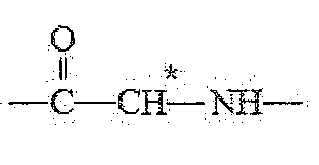
- amino acid moiety was basically consistent with the lichenysin reported, and the amino acid moiety was N' -Gln-Leu-Leu-Val-Asp-Leu-Ile- C' and the fatty acid moiety was C 15 - fatty acid.
- Figure 4(A) indicated that the compound had chemical shifts of which were important functional groups of the cyclicpeptides. In addition, there were 7 chemical shifts of and one chemical shift of and the 7 amino acids and the hydroxy fatty acid formed a cyclicpeptide. Information in 1 H NMR spectrum was incomplete, which could not fully reflect the structural information of the compound.
- Figure 4(B) indicated that the compound had corresponding chemical shifts of which were important functional groups of the cyclicpeptides. In addition, there were 7 chemical shifts of and one chemical shift of and the 7 amino acids and the hydroxy fatty acid formed a cyclicpeptide. These confirmed that the cyclicpeptide was surely formed by 7 amino acids and a hydroxy fatty acid.
- the structural information of the compound was basically reflected in Table 6.
- Quantification was carried out by coupling the ultra-high performance liquid chromatography (UPLC) with mass spectrometry.
- UPLC ultra-high performance liquid chromatography
- the UPLC parameters were as follows: the column of chromatography was UPLC TM BEH C 18 column (100 mm ⁇ 2.1 mm i.d., 1.7 ⁇ m); the column temperature was 30°C; the injection volume was 2 ⁇ L; the flow rate was 0.3mL / min. Methanol solution containing 0.1% formic acid was the mobile phase A and methanol was mobile phase B. And the elution program was : 0 to 0.1 min, 15% B; 0.1 to 10 min, 0% B; 10 to 11 min, 15% B.
- Mass selective detector (MSD) parameters were as follows: positive ion mode; atomizing air pressure, 30psi; separation voltage, 3.5 kV; collision induced voltage, 20V; gas for drying, N 2 ; temperature for drying, 100°C; ion scan range, 50-1500m / z.
- the content of lichenysin in liquors could be calculated through the standard curves of Table 7.
Landscapes
- Chemical & Material Sciences (AREA)
- Health & Medical Sciences (AREA)
- Life Sciences & Earth Sciences (AREA)
- Engineering & Computer Science (AREA)
- Nutrition Science (AREA)
- Food Science & Technology (AREA)
- Polymers & Plastics (AREA)
- Organic Chemistry (AREA)
- Bioinformatics & Cheminformatics (AREA)
- General Engineering & Computer Science (AREA)
- General Health & Medical Sciences (AREA)
- Genetics & Genomics (AREA)
- Biochemistry (AREA)
- Wood Science & Technology (AREA)
- Zoology (AREA)
- Alcoholic Beverages (AREA)
- Peptides Or Proteins (AREA)
Abstract
Description
- This application claims the benefit of priority to Chinese Application No.
201310358602.X - The present invention belongs to the field of food. The present invention relates to the preparation and quantification of lipopeptides and its application in improving the aroma of alcoholic beverages, and more particularly relates to a method of alcoholic beverages production.
- The matrix compounds in food affect its aroma and quality. The migratation of aroma from food to consumer's olfactory organ is affected by many factors, including the chemical interactions between food and aroma components, physical factors and physiological factors of consumers (chewing time, respiration). Due to the fact that the sense is an important factor in determining consumer preferences, it has important significance to research on how the aroma releases from the food and then acts with olfactory receptors. Currently, there are some classic researches, such as the β- lactoglobulin in milk, the β- cyclodextrin in colloid and the phenolic compounds in wine. However, little is known about the matrix compounds of liquors, especially Chinese liquors.
- Currently, researches on the quality of alcoholic beverages focus on the identification and quantification of the aroma compounds. However, just the aroma compounds could not reflect the senses of liquors and the matrix compounds also determined the aroma quality of liquors. Now, Ultra-high performance liquid chromatography coupled with tandem mass spectrometry (UPLC-MS) is an important means to research on macromolecular matrix compounds. In addition, headspace solid phase micro extraction (HS-SPME) and gas chromatography-mass spectrometry (GC-MS) are important means to study the effects of macromolecular matrix compounds on aroma. Though there are many researches on volatile compounds of alcoholic beverages, rather little information has been reported about the nonvolatile macrocompounds.
- Lipopeptide is one kind of important compounds produced by Bacillus, including surfactin, lichenysin, iturin, fengycin and so on. Lipopeptide exhibits numerous pharmaceutical activities, including antimicrobial, antitumor, anti-inflammatory. Surfactin is reported to be a potent surfactant, which could reduce the surface tension of water from 70mN / m to 36mN / m and the critical micelle concentration is 15.6mg / L. Iturin is reported as a strong antibiotics, which has strong inhibitory to yeast and mold. Fengycin is mold inhibitor, mainly is used for the inhibition of plant pathogenic fungi.
- However, there is no relevant reports about applicaiton of lipopeptides (such as lichenysin) in improving the aroma of drinks, especially the aroma of alcoholic beverages.
- The present inventors find that lipopeptides such as surfactin, lichenysin, iturins and fengycin play an important role in enhancing the quality of alcoholic beverages, especially the improvement of aroma.
- The present invention provides a method for improving or enhancing the aroma of drinks, including the addition of an effective amount of one kind or more kinds of lipopeptides. Specifically, the addition of lipopeptides was more than 1µg/L, more than 10µg / L, more than 100µg / L, 1-1000µg / L, 1-500µg / L, 1-200µg / L, 1-100µg / L, 1 -10µg / L, 10-1000µg / L, 10-500µg / L, 10-200µg / L, 10-100µg / L, 100-1000µg / L, 100-900µg / L, 100-500µg / L, 100-200µg / L or 200-500µg / L.
- When the lipopeptide was added to alcoholic beverage (Chinese liquor, rice wine, wine, beer, sake, shochu, whiskey, brandy, vodka, rum or gin), the content of lichenysin in alcoholic beverage itself should be considered. Preferably, the total content of lichenysin after the addition was 500-1500µg / L, and more preferably 600-1400µg / L, 700-1300µg / L, 800-1200µg / L, 900-1100µg / L, and most preferably 950-1050µg / L, such as 1000µg / L. The content of lichenysin in alcoholic beverage could be quantified by the method described in the present invention.
- The present invention also provides a method for lipopeptides preparation, including separation and purification from Chinese liquor.
- Specifically, the SPE C18 cartridge elluted alcoholic beverage was further purified by preparative chromatography to separate the lipopeptide.
- More specifically, chromatographic separation was carried out using an Xbridge Prep C18 (250 mm × 19 mm, 10 µm) reversed-phase column. The detection was selected at wavelength of 210 nm. Methanol solution containing 0.1 % formic acid was the mobile phase A and methanol was mobile phase B. The separation program was : 0 to 10 min,40% B to 25% B; 10 to 50 min, 25% B to 5% B; 50 to 55 min, 5% B to 0% B.
- The present invention also provides a method for quantification of lipopeptides in alcoholic beverages, especifically the quantification of lichenysins. Said method couples the ultra-high performance liquid chromatography (UPLC) with mass spectrometry.
- the UPLC parameters were as follows: the column was UPLC™ BEH C18 column (100 mm×2.1 mm i.d., 1.7 µm); the column temperature was 30°C; the injection volume was 2 µL; the flow rate was 0.3mL / min; methanol solution containing 0.1% formic acid was the mobile phase A and methanol was mobile phase B. And the elution program was : 0 to 0.1 min, 15% B; 0.1 to 10 min, 0% B; 10 to 11 min, 15% B.
- Mass selective detector (MSD) parameters were as follows: positive ion mode; atomizing air pressure, 30psi; separation voltage, 3.5 kV; collision induced voltage, 20V; gas for drying, N2; temperature for drying, 100°C; ion scan range, 50-1500m / z.
- Acquisition and analysis of datas were carried out by Masslynx 4.1 Mass Spectrometry software.
- The present invention also provides a composition containing one or more kinds of lipopeptides; alternatively, pharmaceutically or food acceptable carriers or excipients were contained in said composition; in particular, said composition is food, especially drinks. Specifically, the lipopeptides content in said composition was more than 1µg / L, more than 10µg / L, more than 100µg / L, 1-1000µg / L, 1-500µg / L, 1-200µg / L, 1-100µg / L, 1-10µg / L, 10-1000µg / L, 10-500µg / L, 10-200µg / L, 10-100µg / L, 100-1000µg / L, 100-900µg / L, 100-500µg / L, 100-200µg / L or 200-500µg / L.
- When the composition was alcoholic beverage, the content of lichenysin in alcoholic beverage itself should be considered. Preferably, the total content of lichenysin after addition was 500-1500µg / L, and more preferably 600-1400µg / L, 700-1300µg / L, 800-1200µg / L, 900-1100µg / L, and particularly preferably 950-1050µg / L, such as 1000µg / L. The content of lichenysin in Chinese liquor could be quantified by the method described in the present invention.
- The present invention also provides application of lipopeptides in improving or enhancing the aroma of drinks. Specifically, the addition of lipopeptides was more than 1µg / L, more than 10µg / L, more than 100µg / L, 1-1000µg / L, 1-500µg / L, 1-200µg / L, 1-100µg / L, 1-10µg / L, 10-1000µg / L, 10-500µg / L, 10-200µg / L, 10-100µg / L, 100-1000µg / L, 100-900µg / L, 100-500µg / L, 100-200µg / L or 200-500µg / L.
- The present invention also provides application of lipopeptides in enhancing the volatility of aroma compounds and / or reducing the volatility of off-flavor compounds. Specifically, said aroma compounds were any one or more of esters, alcohols and aldehydes, and the said off-flavor compounds were phenolic compounds. Specifically, the addition of lipopeptides was more than 1µg / L, more than 10µg / L, more than 100µg / L, 1-1000µg / L, 1-500µg / L, 1-200µg / L, 1-100µg / L, 1-10µg / L, 10-1000µg / L, 10-500µg / L, 10-200µg / L, 10-100µg / L, 100-1000µg / L, 100-900µg / L, 100-500µg / L, 100-200µg / L or 200-500µg / L.
- In one embodiment of the present invention, the headspace solidphase microextraction coupled with gas chromatography-mass spectrometry (HS-SPME-GC-MS) method was used to evaluated the effect of lipopeptides on volatile aroma compounds. Specifically, said method comprises:
- 8 mL of sample was added to a 20 mL headspace vial for HS-SPME extraction. For SPME, a 50/30 µ m DVB/CAR/PDMS fiber was used. The sample was preheated at 20 - 30°C for 5 min and extracted for 30-50 min, and then desorbed by GC for 5min. For the GC analysis, a DB-Wax column (60 m × 0.325 mm × 0.25 µm) was used. The injector temperature was 250°C and the splitless mode was used. The conditions of GC were as follows: starting
temperature 50°C (holding 2 min), then raised to 230°C at the rate of 6°C/min, and held at 230°C for 30 min; the column carrier gas was helium at a flow rate of 2 mL/min. The conditions of MS were as follows: the electron impact energy was 70 eV, and the ion source temperature was set at 230°C; full-scan acquisition was used in the ranges of masses (30-350 amu). - The present invention also provides a method of alcoholic beverages production, comprising addition of one or more kinds of lipopeptides. Specifically, the addition of lipopeptides added was more than 1µg / L, more than 10µg / L, more than 100µg / L, 1-1000µg / L, 1-500µg / L, 1-200µg / L, 1-100µg / L, 1-10µg / L, 10-1000µg / L, 10-500µg / L, 10-200µg / L, 10-100µg / L, 100-1000µg / L, 100-900µg / L, 100-500µg / L, 100-200µg / L or 200-500µg / L.
- When added to alcoholic beverage, the content of lichenysin in alcoholic beverage itself should be considered. Preferably, the total content of lichenysin after the addition was 500-1500µg / L, and more preferably 600-1400µg / L, 700-1300µg / L, 800-1200µg / L, 900-1100µg / L, and most preferably 950-1050µg / L, such as 1000µg / L. The content of lichenysin in alcoholic beverage could be quantified by the method described in the present invention.
- Without specified, said lipopeptide in the present invention is any one or more of the following: surfactin, lichenysin, iturins and fengycin. And without specified, said lichenysin is any one or more of the seven kinds of homologs (fraction (I) to fraction (VII)) :


- The mass-to-charge-ratio (m/z) of fraction (I) to fraction (VII) were 993, 1007, 1021, 1035, 1049, 1007 and 1021, respectivity.
- Said flavor compounds in alcoholic beverages include aroma compounds and off-flavor compounds. Without otherwise specified, said aroma compounds were any one or more of esters, alcohols and acids, and said off-flavor compounds were phenolic compounds. In particular, said esters, alcohols, acids or phenolic compounds were compounds exsisted in Chinese liquor.
- The present invention, said food are preferably drinks; specifically, the drinks are alcoholic liquors (Chinese liquor, rice wine, wine, beer, sake, shochu, whiskey, brandy, vodka, rum or gin); more specifically, the alcoholic liquor is Chinese liquor; more specifically, the Chinese liquor was soy sauce aroma type liquor, strong aroma type liquor, light aroma type liquor, soybean-flavor type liquor or medical aroma type liquor.
- The present invention evaluated the effect of lipopeptides (lichenysin) on aroma volatility in alcoholic beverages by HS-SPME. The results revealed that 20-30°C and 30-50 min were the optimized extraction temperature and extraction time, respectivity. Lipopeptides, especially lichenysin, have significant impacts on the volatility of aroma compounds of alcoholic beverages. Specifically, lipopeptides (lichenysin) mainly affected the esters, alcohols, acids and phenolic compounds of liquors.
-
-
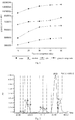
Figure 1 . Effect of extraction time on volatility of aroma compounds (esters, alcohols and acids) and off-flavor compounds (phenolic compounds). -
Figure 2 . Elution curve of separation and collection of lichenysin; Each peak corresponds to a kind of homolog. -
Figure 3 . MS/MS spectrum of lichenysin (m/z : 1035.6). -
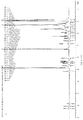
Figure 4 .1 H NMR spectrum (A) and 13C NMR spectrum (B) of lichenysin (molecular weight: 1034.6). - While the present invention has been described in some detail for purposes of clarity and understanding, one skilled in the art will appreciate that various changes in form and detail can be made without departing from the true scope of the invention. Conditions, which are not indicated in the present invention, could according to conventional conditions or conditions recommended by the manufacturer. The reagents or equipments without manufacturer specified are conventional products that can be obtained through commercially.
- Mixed lichenysin (mixture of fraction I to fraction VII) could be commercially obtained, or prepared according to the methods reported, or prepared according to the methods described in example 4 of present invention. The lichenysin used in the present example was prepared according to the method described in example 4 and it was a mixture of equal proportions of the seven homologues (fraction I to fraction VII).
- Fraction V could be either commercially obtained or prepared according to the method reported in references: Yakimov, M.M.; Abrah am, W.-R.; Meyer, H.; Giuliano, L.; Golyshin, P.N., Structural characterization of lichenysin A components by fast atom bombardment tandem mass spectrometry. Biochimica et Biophysica Acta1999,1438(2),273-280.
- Fraction VII could be either commercially obtained or prepared according to the methods reported in references: Yakimov, M.M.; Abrah am, W.-R.; Meyer, H.; Giuliano, L.; Golyshin, P.N., Structural characterization of lichenysin A components by fast atom bombardment tandem mass spectrometry. Biochimica et Biophysica Acta1999,1438(2),273-280.
- Chinese liquor samples: Langjiu samples (the content of lichenysin in itself was 100 µg / L before adding extra lichenysin, and the lichenysin was added to a final content of 1000 µg / L).
-
- (1) Mixed lichenysin, fraction V or fraction VII was added to liquor samples with an addition of 900 µg/L (to a final content of 1000 µg/L).
- (2) Evaluation the differences by sensory evaluation experiments
- Sensory evaluation experiments was as follows. The liquor samples were diluted to the same degree (such as 55 degrees, and samples less than 55 degrees could not be diluted) and then were tasted at room temperature and scored by 20 National Liquor judges. The overall score was 110 points, and the highest score for color, smell, taste, style and scent remaining on the glass were 10 points, 25 points, 50 points, 15 points, 10 points, respectivity. The strength of scent remaining on the glass was evaluated after inverted for 30 minutes.
- Datas were shown in Table 1.
Table 1 Effects of lichenysin on sensory evaluation of liquors Langjiu sample Blank (without lichenysin added) Fraction V added Fraction VII added Mixed lichenysin added Sensory evaluation (overall score was 110 points) 84.8 88.0 87.5 88.5 scent remaining on the glass (overall score was 10 points) 7 10 10 10 - Datas in Table 1 showed that the quality of Chinese liquor and scent remaining on the glass were improved significantly by adding lichenysin.
- The volatility of aroma compounds (esters, alcohols and acids) and off-flavor compounds (phenolic compounds) in model solutions were evaluated by HS-SPME-GC-MS method.
- HS-SPME conditions: 8 mL of sample was added to a 20 mL headspace vial for HS-SPME extraction. For SPME, a 50/30 µm DVB/CAR/PDMS fiber was used. The sample was preheated at 20 - 30°C for 5 min and extracted for 30-50 min, and then desorbed by GC for 5min.
- GC conditions: a DB-Wax column (60 m × 0.325 mm × 0.25 µm) was used for the GC analysis. The injector temperature was 250°C and the splitless mode was used. The conditions of heating up programs were as follows: starting
temperature 50°C (holding 2 min), then raised to 230°C at the rate of 6°C/min, and held at 230°C for 30 min. The column carrier gas was helium at a flow rate of 2 mL/min. - MS conditions: The electron impact energy was 70 eV, and the ion source temperature was set at 230°C. Full-scan acquisition was used in the ranges of masses (30-350 amu).
- According to the peak area of volatile compounds, 20-30°C and 30-50min were the optimized extraction temperature and extraction time, respectivity.
- Mixed lichenysin (mixture of fraction I to fraction VII) : the same as example 1.
- Fraction V : the same as example 1.
- Fraction VII : the same as example 1.
- Chinese liquor samples: Langjiu liquor (soy sauce aroma type liquor), strong aroma type liquor, and light aroma type liquor.
-
- (1) Mixed lichenysin, fraction V or fraction VII was added to liquor samples with an addition of 100 µg/L.
- (2) Evaluation and analysis of the effect on liquors was carried out by the method described in Example 2.
- Results were shown in Table 2. The blank control was the liquor without any addition of lichenysin.
Table 2 Effect of lichenysin on the volatility of aroma compounds and off-flavor compounds in liquors Sample 1 Sample 2Sample 3Blank control Fraction V added Net change Blank control Fraction VII added Net change Blank control Mixed lichenysin added Net change esters 59173 68394 15.58% 153321 175827 14.68% 218884 242003 10.56% alcohols 1845522 1892688 2.56% 2360905 2405441 1.89% 2277122 2242713 1.51% acids 366963 182724 50.21% 5256621 4656515 11.42% N.D. N.D. - phenolic compounds 32980 13629 58.67% 3457 1798 47.98% 14993 5302 64.64% - Results shown in Table 2 indicated that the volatility of aroma compounds (such as esters, alcohols and acids) and off-flavor compounds (phenolic compounds) were significantly affected by lichenysin. Lichenysin could efficiently suppress the volatility of phenolic compounds and enhance the volatility of esters, alcohols and acids. In addition, the volatility of phenolic off-flavors was significantly deduced by addition of lichenysin with a
reduction amount 50% -70%. - Lichenysin shown in formula VII: the same as example 1.
- Mixed lichenysin (mixture of fraction I to fraction VII) : the same as example 1.
- Fraction V : the same as example 1.
- Fraction VII : the same as example 1.
- Liquor samples: wine and beer
-
- (1) Mixed lichenysin, fraction V or fraction VII was added to liquor samples with an addition of 100 µg/L.
- (2) Evaluation and analysis of the effect on liquors was carried out by the method described in Example 2.
- Results were shown in Table 3. The blank control was the sample without any addition of lichenysin.
Table 3 Effect of lichenysin on the volatility of typical off-flavor compounds in wine or beer Compound conc. (µg/L) odor descriptor source Blank control Samples with lichenysin added Net change 4-Ethylphenol 440 Phenolic off-flavor in wine 218681.77 146110.58 33.19% 4-Ethylguaiacol 135 Phenolic off-flavor in wine 236798.33 112161.9767 52.63% trans-2-nonenal 20,000 orris, fat and cucumber in beer 200870.26 96688.35 51.87% Diacetyl 100,000 buttery in beer 104482.04 48527.12333 53.55% Linoleic Acid 100,000 fatty in beer 275077.94 126608.9733 53.97% - SPE C18 column (Waters) was used for the purification of lipopeptides in Chinese iquor, and equipments for extraction were Waters 2767 Sample Manager, Waters 2489 UV/visible Detector and Waters 2535 Quaternary Gradient Module.
- Waters Acquity UPLC and Synapt Q-TOF system were used for mass spectrometry (MS) identification of lichenysin.
- Though there were many researches on volatile compounds of Chinese liquor, rather little information had been reported about the nonvolatile macrocompounds. The samples eluted by SPE C18 column were further purified by preparative chromatography.
- Soy sauce aroma type liquor (Langjiu liquor) eluted by SPE C18 column was further purified by preparative chromatography. An Xbridge Prep C18 (250 mm × 19 mm, 10 µm) reversed-phase column was used and the detection was selected at wavelength of 210 nm. Methanol solution containing 0.1% formic acid was the mobile phase A and methanol was mobile phase B. The separate program was : 0 to 10 min,40% B to 25% B; 10 to 50 min, 25% B to 5% B; 50 to 55 min, 5% B to 0% B. Pure product was obtained after concentrated by evaporation.
- Mass selective detector (MSD) parameters were as follows: positive ion mode; atomizing air pressure, 30psi; separation voltage, 3.5 kV; collision induced voltage, 20V; gas for drying, N2; temperature for drying, 100°C; ion scan range, 50-1500m / z. Acquisition and analysis of datas were carried out by Masslynx 4.1 Mass Spectrometry software.
- Lichenysin was separated, extracted and purified from Chinese liquor, and surfactin, iturin and fengycin could also be extracted. In addition,, seven homologs were contained in lichenysin product. Datas in
Figure 2 showed that seven pure homologs with different structures were obtained. The molecular weight, the M+, the main fragments and chromatographic purity were exhibited in Table 4.Table 4 MS and purity results of lichenysin Molecular weight M+ (m/z) MS/MS main fragments Purity (100%) 210 nm 992.6 993.6 671.4 83.7 1006.6 1007.6 685.4 94.8 1006.6 1007.6 671.4 40.6 1020.6 1021.6 685.4 87.3 1020.6 1021.6 671.4 95.3 1034.6 1035.6 685.4 100 1048.6 1049.6 685.4 85.8 - To confirm the proposed structure of the fractions (I to VII), MS and NMR measurements were used. And the isolated compound with a m/z 1035.6 (685.4) was analyzed by quadrupole-time-of-flight mass spectrometer (Q-TOF-MS).
- Waters Acquity UPLC and Synapt Q-TOF system were used for mass spectrometry (MS) identification of lipopeptides from Chinses liquor.
- Detection was carried out by UPLC coupling with MS. The column was UPLC™ BEH C18 column (100 mm×2.1 mm i.d., 1.7 µm); the column temperature was 30°C; the injection volume was 2 µL; the flow rate was 0.3mL / min. Methanol solution containing 0.1% formic acid was the mobile phase A and methanol was mobile phase B. And the elution program was : 0 to 0.1 min, 15% B; 0.1 to 10 min, 0% B; 10 to 11 min, 15% B. Mass selective detector (MSD) parameters were as follows: positive ion mode; atomizing air pressure, 30psi; separation voltage, 3.5 kV; collision induced voltage, 20V; gas for drying, N2; temperature for drying, 100°C; ion scan range, 50-1500m / z.
- The structure of amino acid moiety was basically consistent with the lichenysin reported, and the amino acid moiety was N'-Gln-Leu-Leu-Val-Asp-Leu-Ile-C' and the fatty acid moiety was C15 - fatty acid.
- The datas of other six fractions were similar.
- NMR spectrometer (Bruker AM 600).
- NMR spectrometer (Bruker AM 600) was used for analysis the 1H and 13C NMR spectrum. The solvent was deuterated methanol and the experimental temperature was 323K.
- Results were shown in
Figure 4 , Table 5 and Table 6.Table 5 Chemical shift of 1H NMR spectrum of lichenysin (molecular weight 1034.6) Gln Leu Leu Val Asp Leu Ile 3-HFA NH 7.847 8.17 H-2 4.706 4.433 4.365 4.328 5.164 4.512 4.456 4.08 H-3 2.272 1.928 2.01 2.43 2.635 2.214 2.618 2.877 4-CH2 1.647 (multi-spectrum) 5-CH2 1.291 (multi-spectrum) CH3 0.816-0.968 (multi-spectrum) Table 6 Chemical shift of 1C NMR spectrum of lichenysin (molecular weight 1034.6) Gln Leu Leu Val Asp Leu Ile 3-HFA C=O 172.255 173.113 171.963 170.844 171.496 173.604 171.143 172.255 C=O-NH2 176.424 174.048 NHCH 52.46 50.574 52.023 59.948 51.54 52.736 56.898 72.573 3-CH2 33.849 38.816 39.805 31.297 36.992 40.135 36.348 40.633 4-CH2 24.442-29.634 (multi-spectrum) CH3 10.464-21.938 (multi-spectrum) -
Figure 4(A) indicated that the compound had chemical shifts of


-
Figure 4(B) indicated that the compound had corresponding chemical shifts of


- Datas indicated that the molecular formula of the lichenysin (molecular weight 1034.6) was as follows:

- The structure of other six fractions were similar.
- Analysis and comparation of datas from 1H and 13C NMR experiments conformed that the volatile macrocompounds were lipopeptides, including surfactin, lichenysin, iturin and fengycin.
- The quantification of lichenysin in Chinese liquors was carried out by Waters Acquity UPLC and Synapt Q-TOF system.
- Quantification was carried out by coupling the ultra-high performance liquid chromatography (UPLC) with mass spectrometry.
- The UPLC parameters were as follows: the column of chromatography was UPLC™ BEH C18 column (100 mm×2.1 mm i.d., 1.7 µm); the column temperature was 30°C; the injection volume was 2 µL; the flow rate was 0.3mL / min. Methanol solution containing 0.1% formic acid was the mobile phase A and methanol was mobile phase B. And the elution program was : 0 to 0.1 min, 15% B; 0.1 to 10 min, 0% B; 10 to 11 min, 15% B.
- Mass selective detector (MSD) parameters were as follows: positive ion mode; atomizing air pressure, 30psi; separation voltage, 3.5 kV; collision induced voltage, 20V; gas for drying, N2; temperature for drying, 100°C; ion scan range, 50-1500m / z.
- The content of lichenysin in liquors could be calculated through the standard curves of Table 7.
- 3. Results were shown in Table 7 and Table 8.
Table 7 Standard curves of lichenysins from Chinese liquors (LC-MS / MS) Molecular weight M+ (m/z) MS/MS main fragments Slope Intercept R2 n Linear range (µg/L) 992.6 993.6 671.4 0.155 -66.84 0.999 4 17.5-17500 1006.6 1007.6 685.4 1.392 64.6 0.999 4 65-65000 1006.6 1007.6 671.4 25.07 -157.5 0.999 3 150-15000 1020.6 1021.6 685.4 4.578 -133.3 0.999 4 47.5-47500 1020.6 1021.6 671.4 3.336 -86.18 0.999 4 35-35000 1034.6 1035.6 685.4 2.784 -582.9 0.997 5 16-160000 1048.6 1049.6 685.4 1.913 -5.37 0.999 3 75-7500 Table 8 Contents of lichenysins (µg / L) in several main types of Chinese liquors (LC-MS / MS) Molecular weight M+ (m/z) MS/MS main fragments Medical aroma type Soybean-flavor type Strong aroma type Light aroma type Soy sauce aroma type 1006.6 1007.6 685.4 42.42 0.74 1.84 2.62 1.64 1006.6 1007.6 671.4 929.69 12.50 64.39 36.82 128.57 1020.6 1021.6 685.4 305.97 5.01 22.50 21.49 48.27 1020.6 1021.6 671.4 143.98 2.22 8.14 7.09 11.86 1034.6 1035.6 685.4 399.75 1.60 15.72 31.69 33.68 1048.6 1049.6 685.4 16.68 0.33 1.21 0.63 0.38 Σ 1838.4 22.39 113.81 100.34 224.41 - Results in Table 7 showed that the limit of detection was 1 µg / L. It can be concluded that the method in present invention significantly improved the detection sensitivity of lichenysins, while the detectable concentration was more than 10 mg/L by diode array detection means.
- Datas in Table 8 showed that the content of lichenysins in Chinese liquors was between 10 µg/L and 1000µg/L, but the contents were significantly different between samples.
- The results also showed that a high sensitivity method for the quantification of lichenysin in Chinese liquors was constructed (LC-MS / MS).
Claims (9)
- A method for improving or enhancing the aroma of drinks, including the addition of an effective amount of one kind or more kinds lipopeptides.
- Application of lipopeptides in preparation or production of drinks, in improving or enhancing the aroma of drinks, in enhancing the volatility of aroma compounds and / or reducing the volatility of off-flavor compounds.
- The application of claim 2, said aroma compounds were any one or more of esters, alcohols and aldehydes, and the said off-flavor compounds were phenolic compounds.
- A method of Chinese liquor production, comprising addition of one or more kinds of lipopeptides.
- A method for lipopeptide preparation, including separation and purification from Chinese liquor; Specifically, Chinese liquor eluted by SPE C18 coumn is further purified by preparative chromatography;
More specifically, chromatographic separation is carried out by an Xbridge Prep C18 (250 mm × 19 mm, 10 µm) reversed-phase column; the detection is selected at wavelength of 210 nm; methanol solution containing 0.1% formic acid is the mobile phase A and methanol is mobile phase B; the separate program was : 0 to 10 min,40% B to 25% B; 10 to 50 min, 25% B to 5% B; 50 to 55 min, 5% B to 0% B. - A method for quantification of lipopeptides in Chinese liquor, said method couples the ultra-high performance liquid chromatography (UPLC) with mass spectrometry;
Specifically,
the UPLC parameters are as follows: the column is UPLC™ BEH C18 column (100 mm×2.1 mm i.d., 1.7 µm); the column temperature is 30°C; the injection volume is 2 µL; the flow rate was 0.3mL / min; Methanol solution containing 0.1% formic acid is the mobile phase A and methanol is mobile phase B; and the elution program is : 0 to 0.1 min, 15% B; 0.1 to 10 min, 0% B; 10 to 11 min, 15% B;
Mass selective detector (MSD) parameters are as follows: positive ion mode; atomizing air pressure, 30psi; separation voltage, 3.5 kV; collision induced voltage, 20V; gas for drying, N2; temperature for drying, 100°C; ion scan range, 50-1500m / z. - A composition, said composition containing one or more kinds of lipopeptides; alternatively, pharmaceutically or food acceptable carriers or excipients are contained in said composition; in particular, said composition is food, especially drinks.
- The method of claim 1, claim 4, claim 5 or claim 6, the application of claim 2 or claim 3, the composition of claim 7, said drinks are alcoholic liquor, such as Chinese liquors; said Chinese liquors are soy sauce aroma type liquors, strong aroma type liquors, light aroma type liquors, soy-bean flavor type liquors or medical aroma type liquors;
said lipopeptides are any one or more of surfactin, lichenysin, iturins and fengycin;
said lichenysin is any one or more of the seven homologs (fraction (I) to fraction (VII)) :


- The method of claim 1 or claim 4, the application of claim 2 or claim 3, the composition of claim 7, the total content of said lipopeptides is 500-1500µg / L, and preferably 600-1400µg / L, 700-1300µg / L, 800-1200µg / L, 900-1100µg / L, and more preferably 950-1050µg / L, such as 1000µg / L.
Applications Claiming Priority (2)
| Application Number | Priority Date | Filing Date | Title |
|---|---|---|---|
| CN201310358602.XA CN103571728B (en) | 2013-08-16 | 2013-08-16 | Lipopeptide compound is for improving purposes and the assay method thereof of distilled spirit fragrance |
| PCT/CN2014/080702 WO2015021823A1 (en) | 2013-08-16 | 2014-06-25 | Use of lipopeptide compound for improving aroma of alcoholic beverages and determination method thereof |
Publications (3)
| Publication Number | Publication Date |
|---|---|
| EP3034599A1 true EP3034599A1 (en) | 2016-06-22 |
| EP3034599A4 EP3034599A4 (en) | 2017-04-26 |
| EP3034599B1 EP3034599B1 (en) | 2018-12-05 |
Family
ID=50044444
Family Applications (1)
| Application Number | Title | Priority Date | Filing Date |
|---|---|---|---|
| EP14836131.4A Active EP3034599B1 (en) | 2013-08-16 | 2014-06-25 | Use of lipopeptide compound for improving aroma of alcoholic beverages and determination method thereof |
Country Status (3)
| Country | Link |
|---|---|
| EP (1) | EP3034599B1 (en) |
| CN (1) | CN103571728B (en) |
| WO (1) | WO2015021823A1 (en) |
Families Citing this family (4)
| Publication number | Priority date | Publication date | Assignee | Title |
|---|---|---|---|---|
| CN103571728B (en) * | 2013-08-16 | 2016-08-10 | 江南大学 | Lipopeptide compound is for improving purposes and the assay method thereof of distilled spirit fragrance |
| CN115436531B (en) * | 2022-10-20 | 2024-06-25 | 茅台学院 | A method for identifying the quality of Daqu based on non-volatile substances in Daqu |
| CN116735752B (en) * | 2023-07-07 | 2025-07-22 | 宜宾五粮液股份有限公司 | Method for detecting content of bioactive peptide in wine |
| CN118496919A (en) * | 2024-05-11 | 2024-08-16 | 北京衍微科技有限公司 | Composition for improving fragrance retaining effect and application thereof |
Family Cites Families (7)
| Publication number | Priority date | Publication date | Assignee | Title |
|---|---|---|---|---|
| US4522261A (en) * | 1983-04-05 | 1985-06-11 | The Board Of Regents For The University Of Oklahoma | Biosurfactant and enhanced oil recovery |
| JP2005028559A (en) * | 2003-07-08 | 2005-02-03 | Shinobu Ito | Nanocapsule |
| KR100851063B1 (en) * | 2007-01-25 | 2008-08-12 | 경상대학교산학협력단 | Method for the Preparation of High-Perfect Soy Sauce and Soy Sauce Using Bacillus Permilis H1 Strains |
| CN101372502A (en) * | 2007-08-22 | 2009-02-25 | 中国科学院沈阳应用生态研究所 | A method for separating and extracting bacillus subtilis lipopeptide antibacterial substances |
| CN101240014B (en) * | 2008-03-07 | 2011-01-26 | 山东省科学院生物研究所 | A lipopeptide complex with physiological activity and its preparation method and application |
| EP2299848A1 (en) * | 2008-06-24 | 2011-03-30 | Nutrinova Nutrition Specialties & Food Ingredients GmbH | Cyclic lipopeptides for use as taste modulators |
| CN103571728B (en) * | 2013-08-16 | 2016-08-10 | 江南大学 | Lipopeptide compound is for improving purposes and the assay method thereof of distilled spirit fragrance |
-
2013
- 2013-08-16 CN CN201310358602.XA patent/CN103571728B/en not_active Expired - Fee Related
-
2014
- 2014-06-25 WO PCT/CN2014/080702 patent/WO2015021823A1/en not_active Ceased
- 2014-06-25 EP EP14836131.4A patent/EP3034599B1/en active Active
Also Published As
| Publication number | Publication date |
|---|---|
| CN103571728B (en) | 2016-08-10 |
| CN103571728A (en) | 2014-02-12 |
| WO2015021823A1 (en) | 2015-02-19 |
| EP3034599B1 (en) | 2018-12-05 |
| EP3034599A4 (en) | 2017-04-26 |
Similar Documents
| Publication | Publication Date | Title |
|---|---|---|
| Ruiz et al. | Effects on varietal aromas during wine making: A review of the impact of varietal aromas on the flavor of wine | |
| Sun et al. | Aroma modulation of Cabernet Gernischt dry red wine by optimal enzyme treatment strategy in winemaking | |
| Nasi et al. | Identification of free and bound volatile compounds as typicalness and authenticity markers of non-aromatic grapes and wines through a combined use of mass spectrometric techniques | |
| Zhao et al. | Exploring jujube wine flavor and fermentation mechanisms by HS-SPME-GC–MS and UHPLC-MS metabolomics | |
| Kankolongo Cibaka et al. | 3-Sulfanyl-4-methylpentan-1-ol in dry-hopped beers: First evidence of glutathione S-conjugates in hop (Humulus lupulus L.) | |
| Sánchez-Gómez et al. | An innovative use of vine-shoots residues and their “feedback” effect on wine quality | |
| JP2021516554A (en) | Moscato wine replica made from individual ingredients | |
| JP7721437B2 (en) | Whisky replica made from individual components | |
| JP2021516555A (en) | Alcoholic beverages produced from individual components | |
| Zheng et al. | Aroma and taste analysis of pickled tea from spontaneous and yeast-enhanced fermentation by mass spectrometry and sensory evaluation | |
| Sanekata et al. | Identification and characterization of geranic acid as a unique flavor compound of hops (Humulus lupulus L.) variety Sorachi Ace | |
| EP3034599B1 (en) | Use of lipopeptide compound for improving aroma of alcoholic beverages and determination method thereof | |
| Mattivi et al. | Development of reliable analytical tools for evaluating the influence of reductive winemaking on the quality of Lugana wines | |
| Marchal et al. | Contribution of oak lignans to wine taste: chemical identification, sensory characterization and quantification | |
| Andrés-Iglesias et al. | Simulation and flavor compound analysis of dealcoholized beer via one-step vacuum distillation | |
| Caffrey et al. | Characterization of Humulus lupulus glycosides with porous graphitic carbon and sequential high performance liquid chromatography quadrupole time-of-flight mass spectrometry and high performance liquid chromatography fractionation | |
| WO2020252334A1 (en) | Sake replicas produced from individual components | |
| US20220010248A1 (en) | Scotch replicas produced from individual components | |
| Ma Yu et al. | Volatile components and aroma characteristics of Fen-Maotai-flavored liquor. | |
| Winstel et al. | Isolation of a new taste-active brandy tannin A: Structural elucidation, quantitation and sensory assessment | |
| Li et al. | Characterization of Xiaoqu Qingxiangxing Baijiu by gas chromatography-olfactometry, quantitative measurements, aroma recombination, and omission experiments | |
| Bai et al. | Metabolomics and flavor diversity of Viognier wines co-fermented with Saccharomyces cerevisiae from different sources of Metschnikowia pulcherrima strains | |
| Metafa et al. | Comparison of solid-phase extraction sorbents for the fractionation and determination of important free and glycosidically-bound varietal aroma compounds in wines by gas chromatography-mass spectrometry | |
| WO2020072557A1 (en) | Bourbon replicas produced from individual components | |
| Wang et al. | Chemical profile of terpene glycosides from Meili grape detected by GC–MS and UPLC–Q-TOF-MS |
Legal Events
| Date | Code | Title | Description |
|---|---|---|---|
| PUAI | Public reference made under article 153(3) epc to a published international application that has entered the european phase |
Free format text: ORIGINAL CODE: 0009012 |
|
| 17P | Request for examination filed |
Effective date: 20160229 |
|
| AK | Designated contracting states |
Kind code of ref document: A1 Designated state(s): AL AT BE BG CH CY CZ DE DK EE ES FI FR GB GR HR HU IE IS IT LI LT LU LV MC MK MT NL NO PL PT RO RS SE SI SK SM TR |
|
| AX | Request for extension of the european patent |
Extension state: BA ME |
|
| DAX | Request for extension of the european patent (deleted) | ||
| A4 | Supplementary search report drawn up and despatched |
Effective date: 20170324 |
|
| RIC1 | Information provided on ipc code assigned before grant |
Ipc: G01N 30/88 20060101ALI20170320BHEP Ipc: G01N 30/02 20060101ALI20170320BHEP Ipc: C07K 7/06 20060101ALI20170320BHEP Ipc: C12G 3/06 20060101AFI20170320BHEP Ipc: A23L 2/52 20060101ALI20170320BHEP Ipc: C07K 1/20 20060101ALI20170320BHEP Ipc: A23L 27/00 20160101ALI20170320BHEP Ipc: A23L 2/56 20060101ALI20170320BHEP |
|
| STAA | Information on the status of an ep patent application or granted ep patent |
Free format text: STATUS: EXAMINATION IS IN PROGRESS |
|
| 17Q | First examination report despatched |
Effective date: 20180313 |
|
| GRAP | Despatch of communication of intention to grant a patent |
Free format text: ORIGINAL CODE: EPIDOSNIGR1 |
|
| STAA | Information on the status of an ep patent application or granted ep patent |
Free format text: STATUS: GRANT OF PATENT IS INTENDED |
|
| INTG | Intention to grant announced |
Effective date: 20180706 |
|
| GRAS | Grant fee paid |
Free format text: ORIGINAL CODE: EPIDOSNIGR3 |
|
| GRAA | (expected) grant |
Free format text: ORIGINAL CODE: 0009210 |
|
| STAA | Information on the status of an ep patent application or granted ep patent |
Free format text: STATUS: THE PATENT HAS BEEN GRANTED |
|
| AK | Designated contracting states |
Kind code of ref document: B1 Designated state(s): AL AT BE BG CH CY CZ DE DK EE ES FI FR GB GR HR HU IE IS IT LI LT LU LV MC MK MT NL NO PL PT RO RS SE SI SK SM TR |
|
| REG | Reference to a national code |
Ref country code: GB Ref legal event code: FG4D |
|
| REG | Reference to a national code |
Ref country code: CH Ref legal event code: EP |
|
| REG | Reference to a national code |
Ref country code: AT Ref legal event code: REF Ref document number: 1073062 Country of ref document: AT Kind code of ref document: T Effective date: 20181215 |
|
| REG | Reference to a national code |
Ref country code: IE Ref legal event code: FG4D |
|
| REG | Reference to a national code |
Ref country code: DE Ref legal event code: R096 Ref document number: 602014037570 Country of ref document: DE |
|
| REG | Reference to a national code |
Ref country code: NL Ref legal event code: MP Effective date: 20181205 |
|
| REG | Reference to a national code |
Ref country code: AT Ref legal event code: MK05 Ref document number: 1073062 Country of ref document: AT Kind code of ref document: T Effective date: 20181205 |
|
| REG | Reference to a national code |
Ref country code: LT Ref legal event code: MG4D |
|
| PG25 | Lapsed in a contracting state [announced via postgrant information from national office to epo] |
Ref country code: ES Free format text: LAPSE BECAUSE OF FAILURE TO SUBMIT A TRANSLATION OF THE DESCRIPTION OR TO PAY THE FEE WITHIN THE PRESCRIBED TIME-LIMIT Effective date: 20181205 Ref country code: LV Free format text: LAPSE BECAUSE OF FAILURE TO SUBMIT A TRANSLATION OF THE DESCRIPTION OR TO PAY THE FEE WITHIN THE PRESCRIBED TIME-LIMIT Effective date: 20181205 Ref country code: AT Free format text: LAPSE BECAUSE OF FAILURE TO SUBMIT A TRANSLATION OF THE DESCRIPTION OR TO PAY THE FEE WITHIN THE PRESCRIBED TIME-LIMIT Effective date: 20181205 Ref country code: FI Free format text: LAPSE BECAUSE OF FAILURE TO SUBMIT A TRANSLATION OF THE DESCRIPTION OR TO PAY THE FEE WITHIN THE PRESCRIBED TIME-LIMIT Effective date: 20181205 Ref country code: BG Free format text: LAPSE BECAUSE OF FAILURE TO SUBMIT A TRANSLATION OF THE DESCRIPTION OR TO PAY THE FEE WITHIN THE PRESCRIBED TIME-LIMIT Effective date: 20190305 Ref country code: HR Free format text: LAPSE BECAUSE OF FAILURE TO SUBMIT A TRANSLATION OF THE DESCRIPTION OR TO PAY THE FEE WITHIN THE PRESCRIBED TIME-LIMIT Effective date: 20181205 Ref country code: NO Free format text: LAPSE BECAUSE OF FAILURE TO SUBMIT A TRANSLATION OF THE DESCRIPTION OR TO PAY THE FEE WITHIN THE PRESCRIBED TIME-LIMIT Effective date: 20190305 Ref country code: LT Free format text: LAPSE BECAUSE OF FAILURE TO SUBMIT A TRANSLATION OF THE DESCRIPTION OR TO PAY THE FEE WITHIN THE PRESCRIBED TIME-LIMIT Effective date: 20181205 |
|
| PG25 | Lapsed in a contracting state [announced via postgrant information from national office to epo] |
Ref country code: RS Free format text: LAPSE BECAUSE OF FAILURE TO SUBMIT A TRANSLATION OF THE DESCRIPTION OR TO PAY THE FEE WITHIN THE PRESCRIBED TIME-LIMIT Effective date: 20181205 Ref country code: SE Free format text: LAPSE BECAUSE OF FAILURE TO SUBMIT A TRANSLATION OF THE DESCRIPTION OR TO PAY THE FEE WITHIN THE PRESCRIBED TIME-LIMIT Effective date: 20181205 Ref country code: GR Free format text: LAPSE BECAUSE OF FAILURE TO SUBMIT A TRANSLATION OF THE DESCRIPTION OR TO PAY THE FEE WITHIN THE PRESCRIBED TIME-LIMIT Effective date: 20190306 Ref country code: AL Free format text: LAPSE BECAUSE OF FAILURE TO SUBMIT A TRANSLATION OF THE DESCRIPTION OR TO PAY THE FEE WITHIN THE PRESCRIBED TIME-LIMIT Effective date: 20181205 |
|
| PG25 | Lapsed in a contracting state [announced via postgrant information from national office to epo] |
Ref country code: NL Free format text: LAPSE BECAUSE OF FAILURE TO SUBMIT A TRANSLATION OF THE DESCRIPTION OR TO PAY THE FEE WITHIN THE PRESCRIBED TIME-LIMIT Effective date: 20181205 |
|
| PG25 | Lapsed in a contracting state [announced via postgrant information from national office to epo] |
Ref country code: PL Free format text: LAPSE BECAUSE OF FAILURE TO SUBMIT A TRANSLATION OF THE DESCRIPTION OR TO PAY THE FEE WITHIN THE PRESCRIBED TIME-LIMIT Effective date: 20181205 Ref country code: PT Free format text: LAPSE BECAUSE OF FAILURE TO SUBMIT A TRANSLATION OF THE DESCRIPTION OR TO PAY THE FEE WITHIN THE PRESCRIBED TIME-LIMIT Effective date: 20190405 Ref country code: CZ Free format text: LAPSE BECAUSE OF FAILURE TO SUBMIT A TRANSLATION OF THE DESCRIPTION OR TO PAY THE FEE WITHIN THE PRESCRIBED TIME-LIMIT Effective date: 20181205 Ref country code: IT Free format text: LAPSE BECAUSE OF FAILURE TO SUBMIT A TRANSLATION OF THE DESCRIPTION OR TO PAY THE FEE WITHIN THE PRESCRIBED TIME-LIMIT Effective date: 20181205 |
|
| PG25 | Lapsed in a contracting state [announced via postgrant information from national office to epo] |
Ref country code: SK Free format text: LAPSE BECAUSE OF FAILURE TO SUBMIT A TRANSLATION OF THE DESCRIPTION OR TO PAY THE FEE WITHIN THE PRESCRIBED TIME-LIMIT Effective date: 20181205 Ref country code: IS Free format text: LAPSE BECAUSE OF FAILURE TO SUBMIT A TRANSLATION OF THE DESCRIPTION OR TO PAY THE FEE WITHIN THE PRESCRIBED TIME-LIMIT Effective date: 20190405 Ref country code: RO Free format text: LAPSE BECAUSE OF FAILURE TO SUBMIT A TRANSLATION OF THE DESCRIPTION OR TO PAY THE FEE WITHIN THE PRESCRIBED TIME-LIMIT Effective date: 20181205 Ref country code: SM Free format text: LAPSE BECAUSE OF FAILURE TO SUBMIT A TRANSLATION OF THE DESCRIPTION OR TO PAY THE FEE WITHIN THE PRESCRIBED TIME-LIMIT Effective date: 20181205 Ref country code: EE Free format text: LAPSE BECAUSE OF FAILURE TO SUBMIT A TRANSLATION OF THE DESCRIPTION OR TO PAY THE FEE WITHIN THE PRESCRIBED TIME-LIMIT Effective date: 20181205 |
|
| REG | Reference to a national code |
Ref country code: DE Ref legal event code: R097 Ref document number: 602014037570 Country of ref document: DE |
|
| PLBE | No opposition filed within time limit |
Free format text: ORIGINAL CODE: 0009261 |
|
| STAA | Information on the status of an ep patent application or granted ep patent |
Free format text: STATUS: NO OPPOSITION FILED WITHIN TIME LIMIT |
|
| PG25 | Lapsed in a contracting state [announced via postgrant information from national office to epo] |
Ref country code: SI Free format text: LAPSE BECAUSE OF FAILURE TO SUBMIT A TRANSLATION OF THE DESCRIPTION OR TO PAY THE FEE WITHIN THE PRESCRIBED TIME-LIMIT Effective date: 20181205 Ref country code: DK Free format text: LAPSE BECAUSE OF FAILURE TO SUBMIT A TRANSLATION OF THE DESCRIPTION OR TO PAY THE FEE WITHIN THE PRESCRIBED TIME-LIMIT Effective date: 20181205 |
|
| 26N | No opposition filed |
Effective date: 20190906 |
|
| PG25 | Lapsed in a contracting state [announced via postgrant information from national office to epo] |
Ref country code: MC Free format text: LAPSE BECAUSE OF FAILURE TO SUBMIT A TRANSLATION OF THE DESCRIPTION OR TO PAY THE FEE WITHIN THE PRESCRIBED TIME-LIMIT Effective date: 20181205 |
|
| REG | Reference to a national code |
Ref country code: CH Ref legal event code: PL |
|
| REG | Reference to a national code |
Ref country code: BE Ref legal event code: MM Effective date: 20190630 |
|
| PG25 | Lapsed in a contracting state [announced via postgrant information from national office to epo] |
Ref country code: TR Free format text: LAPSE BECAUSE OF FAILURE TO SUBMIT A TRANSLATION OF THE DESCRIPTION OR TO PAY THE FEE WITHIN THE PRESCRIBED TIME-LIMIT Effective date: 20181205 |
|
| PG25 | Lapsed in a contracting state [announced via postgrant information from national office to epo] |
Ref country code: IE Free format text: LAPSE BECAUSE OF NON-PAYMENT OF DUE FEES Effective date: 20190625 |
|
| PG25 | Lapsed in a contracting state [announced via postgrant information from national office to epo] |
Ref country code: CH Free format text: LAPSE BECAUSE OF NON-PAYMENT OF DUE FEES Effective date: 20190630 Ref country code: BE Free format text: LAPSE BECAUSE OF NON-PAYMENT OF DUE FEES Effective date: 20190630 Ref country code: LU Free format text: LAPSE BECAUSE OF NON-PAYMENT OF DUE FEES Effective date: 20190625 Ref country code: LI Free format text: LAPSE BECAUSE OF NON-PAYMENT OF DUE FEES Effective date: 20190630 |
|
| PG25 | Lapsed in a contracting state [announced via postgrant information from national office to epo] |
Ref country code: CY Free format text: LAPSE BECAUSE OF FAILURE TO SUBMIT A TRANSLATION OF THE DESCRIPTION OR TO PAY THE FEE WITHIN THE PRESCRIBED TIME-LIMIT Effective date: 20181205 |
|
| PG25 | Lapsed in a contracting state [announced via postgrant information from national office to epo] |
Ref country code: HU Free format text: LAPSE BECAUSE OF FAILURE TO SUBMIT A TRANSLATION OF THE DESCRIPTION OR TO PAY THE FEE WITHIN THE PRESCRIBED TIME-LIMIT; INVALID AB INITIO Effective date: 20140625 Ref country code: MT Free format text: LAPSE BECAUSE OF FAILURE TO SUBMIT A TRANSLATION OF THE DESCRIPTION OR TO PAY THE FEE WITHIN THE PRESCRIBED TIME-LIMIT Effective date: 20181205 |
|
| PG25 | Lapsed in a contracting state [announced via postgrant information from national office to epo] |
Ref country code: MK Free format text: LAPSE BECAUSE OF FAILURE TO SUBMIT A TRANSLATION OF THE DESCRIPTION OR TO PAY THE FEE WITHIN THE PRESCRIBED TIME-LIMIT Effective date: 20181205 |
|
| PGFP | Annual fee paid to national office [announced via postgrant information from national office to epo] |
Ref country code: FR Payment date: 20230630 Year of fee payment: 10 Ref country code: DE Payment date: 20230613 Year of fee payment: 10 |
|
| REG | Reference to a national code |
Ref country code: DE Ref legal event code: R119 Ref document number: 602014037570 Country of ref document: DE |
|
| PG25 | Lapsed in a contracting state [announced via postgrant information from national office to epo] |
Ref country code: DE Free format text: LAPSE BECAUSE OF NON-PAYMENT OF DUE FEES Effective date: 20250101 |
|
| PG25 | Lapsed in a contracting state [announced via postgrant information from national office to epo] |
Ref country code: FR Free format text: LAPSE BECAUSE OF NON-PAYMENT OF DUE FEES Effective date: 20240630 |
|
| PGFP | Annual fee paid to national office [announced via postgrant information from national office to epo] |
Ref country code: GB Payment date: 20250625 Year of fee payment: 12 |