EP3034579A1 - Heat transmission method and high-temperature heat pump device - Google Patents
Heat transmission method and high-temperature heat pump device Download PDFInfo
- Publication number
- EP3034579A1 EP3034579A1 EP14835951.6A EP14835951A EP3034579A1 EP 3034579 A1 EP3034579 A1 EP 3034579A1 EP 14835951 A EP14835951 A EP 14835951A EP 3034579 A1 EP3034579 A1 EP 3034579A1
- Authority
- EP
- European Patent Office
- Prior art keywords
- heat transmission
- mass
- tetrafluoropropene
- transmission composition
- composition
- Prior art date
- Legal status (The legal status is an assumption and is not a legal conclusion. Google has not performed a legal analysis and makes no representation as to the accuracy of the status listed.)
- Granted
Links
Images







Classifications
-
- F—MECHANICAL ENGINEERING; LIGHTING; HEATING; WEAPONS; BLASTING
- F25—REFRIGERATION OR COOLING; COMBINED HEATING AND REFRIGERATION SYSTEMS; HEAT PUMP SYSTEMS; MANUFACTURE OR STORAGE OF ICE; LIQUEFACTION SOLIDIFICATION OF GASES
- F25B—REFRIGERATION MACHINES, PLANTS OR SYSTEMS; COMBINED HEATING AND REFRIGERATION SYSTEMS; HEAT PUMP SYSTEMS
- F25B30/00—Heat pumps
- F25B30/02—Heat pumps of the compression type
-
- C—CHEMISTRY; METALLURGY
- C09—DYES; PAINTS; POLISHES; NATURAL RESINS; ADHESIVES; COMPOSITIONS NOT OTHERWISE PROVIDED FOR; APPLICATIONS OF MATERIALS NOT OTHERWISE PROVIDED FOR
- C09K—MATERIALS FOR MISCELLANEOUS APPLICATIONS, NOT PROVIDED FOR ELSEWHERE
- C09K5/00—Heat-transfer, heat-exchange or heat-storage materials, e.g. refrigerants; Materials for the production of heat or cold by chemical reactions other than by combustion
- C09K5/02—Materials undergoing a change of physical state when used
- C09K5/04—Materials undergoing a change of physical state when used the change of state being from liquid to vapour or vice versa
- C09K5/041—Materials undergoing a change of physical state when used the change of state being from liquid to vapour or vice versa for compression-type refrigeration systems
- C09K5/044—Materials undergoing a change of physical state when used the change of state being from liquid to vapour or vice versa for compression-type refrigeration systems comprising halogenated compounds
- C09K5/045—Materials undergoing a change of physical state when used the change of state being from liquid to vapour or vice versa for compression-type refrigeration systems comprising halogenated compounds containing only fluorine as halogen
-
- C—CHEMISTRY; METALLURGY
- C10—PETROLEUM, GAS OR COKE INDUSTRIES; TECHNICAL GASES CONTAINING CARBON MONOXIDE; FUELS; LUBRICANTS; PEAT
- C10M—LUBRICATING COMPOSITIONS; USE OF CHEMICAL SUBSTANCES EITHER ALONE OR AS LUBRICATING INGREDIENTS IN A LUBRICATING COMPOSITION
- C10M171/00—Lubricating compositions characterised by purely physical criteria, e.g. containing as base-material, thickener or additive, ingredients which are characterised exclusively by their numerically specified physical properties, i.e. containing ingredients which are physically well-defined but for which the chemical nature is either unspecified or only very vaguely indicated
- C10M171/008—Lubricant compositions compatible with refrigerants
-
- C—CHEMISTRY; METALLURGY
- C09—DYES; PAINTS; POLISHES; NATURAL RESINS; ADHESIVES; COMPOSITIONS NOT OTHERWISE PROVIDED FOR; APPLICATIONS OF MATERIALS NOT OTHERWISE PROVIDED FOR
- C09K—MATERIALS FOR MISCELLANEOUS APPLICATIONS, NOT PROVIDED FOR ELSEWHERE
- C09K2205/00—Aspects relating to compounds used in compression type refrigeration systems
- C09K2205/10—Components
- C09K2205/12—Hydrocarbons
- C09K2205/126—Unsaturated fluorinated hydrocarbons
-
- F—MECHANICAL ENGINEERING; LIGHTING; HEATING; WEAPONS; BLASTING
- F25—REFRIGERATION OR COOLING; COMBINED HEATING AND REFRIGERATION SYSTEMS; HEAT PUMP SYSTEMS; MANUFACTURE OR STORAGE OF ICE; LIQUEFACTION SOLIDIFICATION OF GASES
- F25B—REFRIGERATION MACHINES, PLANTS OR SYSTEMS; COMBINED HEATING AND REFRIGERATION SYSTEMS; HEAT PUMP SYSTEMS
- F25B2400/00—Component parts or details not otherwise provided for in this subclass
- F25B2400/12—Inflammable refrigerants
- F25B2400/121—Inflammable refrigerants using R1234
Definitions
- the present invention relates to a heat transmission method using a coolant for a high-temperature heat pump, the coolant being suitable for use at a condensation temperature of 70°C or higher, and also to a high-temperature heat pump device.
- a once through steam boiler or the like which generates steam by use of heat of combustion of a fossil fuel such as oil, gas or the like in order to supply a heat source for a heating step such as a drying step, a sterilization step or the like.
- a heating method using a heat pump reduces carbon dioxide emissions as compared with a conventional method of combusting a fossil fuel to supply heat.
- a heat pump is generally used for cooling or heating in an air conditioning device or a hot water supply device.
- Chlorofluorocarbon (CFC) or hydrochlorofluorocarbon (HCFC) each containing fluorine and chlorine are conventionally used as a coolant of a heat pump cycle, but use thereof has been stopped step by step from the viewpoint of ozone layer protection.
- a natural coolant such as ammonia, carbon dioxide or the like and hydrofluorocarbon (HFC), which does not contain a chlorine atom in a molecule, are mainly used.
- Patent Literature 1 discloses a coolant for a high-temperature heat pump, which has a condensation temperature of 70°C to 150°C. This coolant contains 1,1,1,3,3-pentafluoropropane as a main component and contains 1,1,1,3,3-pentafluoroprobutane at a mass ratio of 20% by mass or less.
- HFC which has a high global warming potential (GWP)
- GWP global warming potential
- HFO hydrofluoroolefin
- Patent Literature 2 discloses using, as a coolant of an air conditioning device for an automobile, a composition containing 2,3,3,3-tetrafluoropropene (HFO) and polyalkyleneglycol (PAG) lubricant.
- HFO 2,3,3,3-tetrafluoropropene
- PAG polyalkyleneglycol
- Patent Literature 3 discloses using, as a coolant of a low-temperature freezer, a mixed compound of tetrafluoropropene such as 2,3,3,3-tetrafluoropropene, 1,3,3,3-tetrafluoropropene or the like and difluoromethane.
- Patent Literature 1 proposes an HFC mixed coolant for a high-temperature heat pump. Since this coolant has a high global warming potential of 794 to 1030, it is concerned that use thereof for a long time in the future may cause a problem.
- Patent Literature 2 and Patent Literature 3 each propose an air conditioning device of a steam compression cycle using a working fluid having a low GWP.
- the working fluid used in each of Patent Literature 2 and Patent Literature 3 is a coolant suitable for use in air conditioning (cooling, heating).
- air conditioning cooling, heating
- no example of applying such a coolant to a heat pump cycle for hot water supply or water vapor generation is described.
- a heat transmission composition that is capable of performing heat transmission at a high temperature and contains, as a main component, a coolant providing superior heat transmission performance than a conventional coolant and having a low GWP.
- the present invention made has an object of providing a novel heat transmission composition and a high-temperature heat pump device that are further improved.
- a preferable heat transmission working medium according to the present invention does not substantially contribute to global warming, unlike many types of hydrofluorocarbon currently used.
- the present inventors performed active studies in order to solve the above-described problems. As a result, the present inventors paid attention to unsaturated halogenated hydrocarbon, and obtained knowledge that use thereof, especially, use of fluorinated propene as a heat transmission medium at a predetermined temperature and a predetermined pressure would provide a very effective heat transmission method. Thus, the present invention was completed.
- An embodiment of the present invention is directed to a heat transmission method using a high-temperature heat pump system accommodating a heat transmission composition, the heat transmission method including the step of gasifying the heat transmission composition, the step of compressing the heat transmission composition, the step of condensing the heat transmission composition, and the step of decreasing the pressure of the heat transmission composition, which are performed sequentially.
- the heat transmission composition contains cis-1,3,3,3-tetrafluoropropene at a mass ratio of 95.0% by mass or more and 99.9% by mass or less, and contains trans-1,3,3,3-tetrafluoropropene or 2,3,3,3-tetrafluoropropene at a mass ratio of 0.1% by mass or more and 5.0% by mass or less; and the heat transmission composition has a condensation temperature of 70°C or higher.
- An embodiment of the present invention is directed to a heat transmission method using a high-temperature heat pump system accommodating a heat transmission composition, the heat transmission method including the step of gasifying the heat transmission composition, the step of compressing the heat transmission composition, the step of condensing the heat transmission composition, and the step of decreasing the pressure of the heat transmission composition, which are performed sequentially.
- the heat transmission composition contains cis-1,3,3,3-tetrafluoropropene at a mass ratio of 80.0% by mass or more and 99.9% by mass or less, and contains trans-1-chloro-3,3,3-trifluoropropene or 1,1,1,3,3-pentafluoropropane at a mass ratio of 0.1% by mass or more and 20.0% by mass or less; and the heat transmission composition has a condensation temperature of 70°C or higher.
- the heat transmission composition may contain cis-1,3,3,3-tetrafluoropropene at a mass ratio of 90.0% by mass or more and 99.9% by mass or less, and contain 1,1,1,3,3-pentafluoropropane at a mass ratio of 0.1% by mass or more and 10.0% by mass or less.
- the heat transmission composition may contain cis-1,3,3,3-tetrafluoropropene at a mass ratio of 90.0% by mass or more and 99.9% by mass or less, and contain trans-1-chloro-3,3,3-trifluoropropene at a mass ratio of 0.1% by mass or more and 10.0% by mass or less.
- the heat transmission composition may contain a lubricant.
- the lubricant may be selected from mineral oil (paraffin-based oil or naphthene-based oil), and synthetic oils including alkylbenzenes (AB), poly(alfa-olefin), esters, polyolesters (POE), polyalkyleneglycols (PAG), polyvinylethers (PVE), and a combination thereof.
- mineral oil paraffin-based oil or naphthene-based oil
- synthetic oils including alkylbenzenes (AB), poly(alfa-olefin), esters, polyolesters (POE), polyalkyleneglycols (PAG), polyvinylethers (PVE), and a combination thereof.
- the heat transmission composition may further contain a stabilizer.
- the stabilizer may be selected from nitro compounds, epoxy compounds, phenols, imidazoles, amines, diene-based compounds, phosphates, aromatic unsaturated hydrocarbons, isoprenes, propadienes, terpenes, and the like, and a combination thereof.
- the heat transmission composition may further contain a flame retardant.
- the flame retardant may be selected from phosphates, halogenated aromatic compounds, fluorinated iodocarbon, fluorinated bromocarbon, and the like, and a combination thereof.
- warm water, pressurized hot water or superheated steam of 60°C or higher may be generated.
- warm water, pressurized hot water or superheated steam of 80°C or higher may be generated.
- pressurized hot water or superheated steam of 110°C or higher may be generated.
- An embodiment of the present invention is directed to a high-temperature heat pump device using the heat transmission method described in any of the above.
- the heat transmission composition according to the present invention is usable as a non-flammable or slightly flammable mixed coolant for a heat cycle that has little influence on the environment and has superb heat transmission characteristics.
- a high-temperature heat pump device exhibiting superb heat transmission characteristics is provided.
- a heat transmission method uses a heat transmission composition which is a mixture of cis-1,3,3,3-tetrafluoropropene and trans-1,3,3,3-tetrafluoropropene or 2,3,3,3-tetrafluoropropene.
- the heat transmission method according to the present invention uses a heat transmission composition which is a mixture of cis-1,3,3,3-tetrafluoropropene and trans-1-chloro-3,3,3-trifluoropropene or 1,1,1,3,3-pentafluoropropane.
- the present inventors have found that the heat transmission composition according to the present invention is such a mixture and therefore is non-flammable or slightly flammable, has little load on the environment and has superb heat cycle characteristics and heat transmission characteristics.
- Cis-1,3,3,3-tetrafluoropropene HFO-1234ze (Z) will be described.
- HFO-1234ze (Z) contains a carbon-carbon double bond in a molecule and is highly reactive with a hydroxyl radical, and therefore has a very low global warming potential (GWP) and has little load on the environment.
- HFO-1234ze (Z) is slightly flammable or flame-resistant and has no toxicity.
- HFO-1234ze (Z) has a boiling point of 9.8°C at an atmospheric pressure, an atmospheric lifetime of 10 days, and a global warming potential (GWP) of 3 ( Chemical Physics Letters 2009, Vol. 473, pp. 233-237 ).
- HFO-1234ze (Z) has a critical temperature of 150.1°C and a critical pressure of 3.54 MPa (4th IIR Conference on Thermophysical Properties and Transfer Processes of Refrigerant, Proceedings TP-018).
- HFO-1234ze (E) contains a carbon-carbon double bond in a molecule and is highly reactive with a hydroxyl radical, and therefore has a very low global warming potential (GWP) and has little load on the environment.
- HFO-1234ze (E) is slightly flammable or flame-resistant and has no toxicity.
- HFO-1234ze (E) has a boiling point of -19°C at an atmospheric pressure, an atmospheric lifetime of 14 days, and a global warming potential (GWP) of 6 ( Chemical Physics Letters 2007, Vol. 443, pp. 199-204 ).
- HFO-1234ze (E) has a critical temperature of 109.4°C and a critical pressure of 3.63 MPa ( Journal of Chemical Engineering Data 2010, Vol. 55, pp. 1594-1597 ).
- HFO-1234yf contains a carbon-carbon double bond in a molecule and is highly reactive with a hydroxyl radical, and therefore has a very low global warming potential (GWP) and has little load on the environment. HFO-1234yf is slightly flammable and has no toxicity. HFO-1234yf has a boiling point of -29°C at an atmospheric pressure, an atmospheric lifetime of 11 days, and a global warming potential (GWP) of 4 ( Chemical Physics Letters 2007, Vol. 439, pp. 18-22 ). HFO-1234yf has a critical temperature of 94.7°C and a critical pressure of 3.38 MPa ( International Journal of Refrigeration 2010, Vol. 33, pp. 474-479 )
- HCFO-1233zd (E) contains a carbon-carbon double bond in a molecule and is highly reactive with a hydroxyl radical, and therefore has a very low global warming potential (GWP) and has little load on the environment.
- HCFO-1233zd (E) is slightly flammable or flame-resistant and has no toxicity.
- HCFO-1233zd (E) has a boiling point of 18.3°C at an atmospheric pressure, an atmospheric lifetime of 26 days, and a global warming potential (GWP) of 7 ( Journal of Photochemistry and Photobiology A: Chemistry 2008, Vol. 199, pp. 92-97 ).
- HCFO-1233zd (E) has a critical temperature of 109.4°C and a critical pressure of 3.63 MPa ( Journal of Chemical Engineering Data 2012, Vol. 57, pp. 3581-3586 ).
- HFC-245fa is non-flammable and has a low level of toxicity.
- HFC-245fa has a boiling point of 15.3°C at an atmospheric pressure, an atmospheric lifetime of 7.6 years, and a global warming potential (GWP) of 1030 (IPCC 4th Assessment Report, 2007).
- GWP global warming potential
- HFC-245fa has a high global warming potential (GWP), and therefore, when being used, is contained preferably at 1% by mass or more and 20% by mass or less, and especially preferably at 1% by mass or more and 10% by mass or less.
- GWP global warming potential
- the heat transmission composition according to the present invention contains cis-1,3,3,3-tetrafluoropropene at a mass ratio of 95.0% by mass or more and 99.9% by mass or less, and contains trans-1,3,3,3-tetrafluoropropene or 2,3,3,3-tetrafluoropropene at a mass ratio of 0.1% by mass or more and 5.0% by mass or less. Owing to having such a composition, the heat transmission composition according to the present invention has a global warming potential of less than 150.
- the heat transmission composition according to the present invention contains cis-1,3,3,3-tetrafluoropropene at a mass ratio of 80.0% by mass or more and 99.9% by mass or less, and contains trans-1-chloro-3,3,3-trifluoropropene or 1,1,1,3,3-pentafluoropropane at a mass ratio of 0.1% by mass or more and 20.0% by mass or less.
- the heat transmission composition according to the present invention as a coolant, has a global warming potential of less than 150.
- Cis-1,3,3,3-tetrafluoropropene and trans-1-chloro-3,3,3-trifluoropropene or 1,1,1,3,3-pentafluoropropane have critical temperatures close to each other, and the critical temperature of the heat transmission composition according to the present invention containing such substances is not much influenced by the mass ratios of the substances.
- the critical temperature of each of trans-1,3,3,3-tetrafluoropropene and 2,3,3,3-tetrafluoropropene is lower than the critical temperature of cis-1,3,3,3-tetrafluoropropene.
- the critical temperature of the heat transmission composition according to the present invention containing such substances decreases as the mass ratio of trans-1,3,3,3-tetrafluoropropene or 2,3,3,3-tetrafluoropropene increases.
- the heat transmission composition containing cis-1,3,3,3-tetrafluoropropene and trans-1,3,3,3-tetrafluoropropene or 2,3,3,3-tetrafluoropropene according to the present invention preferably contains trans-1,3,3,3-tetrafluoropropene or 2,3,3,3-tetrafluoropropene at 0.1 % by mass or more and 5.0% by mass or less.
- the heat transmission composition containing cis-1,3,3,3-tetrafluoropropene and trans-1-chloro-3,3,3-trifluoropropene or 1,1,1,3,3-pentafluoropropane contains cis-1,3,3,3-tetrafluoropropene at a mass ratio of 80.0% by mass or more, preferably at a mass ratio of 90.0% by mass or more and 99.9% by mass, and contains trans-1-chloro-3,3,3-trifluoropropene or 1,1,1,3,3-pentafluoropropane at a mass ratio of 0.1% by mass or more and 20.0% by mass or less, preferably at a mass ratio of 0.1% by mass or more and 10.0% by mass or less.
- a lubricant is used in a compressor sliding portion.
- the lubricant include mineral oil (paraffin-based oil or naphthene-based oil), and synthetic oils such as alkylbenzenes (AB), poly(alfa-olefin), esters, polyolesters (POE), polyalkyleneglycols (PAG), and polyvinylethers (PVE).
- a lubricant is used in an expander sliding portion.
- the lubricant include mineral oil (paraffin-based oil or naphthene-based oil), and synthetic oils such as alkylbenzenes (AB), poly(alfa-olefin), esters, polyolesters (POE), polyalkyleneglycols (PAG), and polyvinylethers (PVE).
- Usable alkylbenzenes include n-octylbenzene, n-nonylbenzene, n-decylbenzene, n-undecylbenzene, n-dodecylbenzene, n-tridecylbenzene, 2-methyl-1-phenylheptane, 2-methyl-1-phenyloctane, 2-methyl-1-phenylnonane, 2-methyl-1-phenyldecane, 2-methyl-1-phenylundecane, 2-methyl-1-phenyldodecane, 2-methyl-1-phenyltridecane, and the like.
- esters include aromatic esters such as benzoic acid, phthalic acid, isophthalic acid, terephthalic acid, trimellitic acid, pyromellitic acid, a mixture thereof and the like; dibasic acid ester; polyolester; complex ester; carbonate ester; and the like.
- Alcohols which are materials of polyolesters include, for example, esters of hindered alcohol such as neopentylglycol, trimethylolethane, trimethylolpropane, trimethylolbutane, di-(trimethylolpropane), tri-(trimethylolpropane), pentaerythritol, di-(pentaerythritol), tri-(pentaerythritol), and the like.
- esters of hindered alcohol such as neopentylglycol, trimethylolethane, trimethylolpropane, trimethylolbutane, di-(trimethylolpropane), tri-(trimethylolpropane), pentaerythritol, di-(pentaerythritol), tri-(pentaerythritol), and the like.
- Carboxylic acids which are materials of polyolesters include valeric acid, caproic acid, enathic acid, caprylic acid, pelargonic acid, capric acid, oleic acid, isopentanoic acid, 2-methylhexanoic acid, 2-ethylpentanoic acid, 2-ethylhexanoic acid, 3,5,5-trimethylhexanoic acid, and the like.
- a usable example of polyalkyleneglycol is a compound obtained by addition polymerization of aliphatic alcohol having a carbon number of 1 or more and 18 or less, such as methanol, ethanol, linear or branched propanol, linear or branched butanol, linear or branched pentanol, linear or branched hexanol or the like, with ethylene oxide, propylene oxide, butylene oxide or the like.
- Usable polyvinylethers include polymethylvinylether, polyethylvinylether, poly-n-propylvinylether, polyisopropylvinylether, and the like.
- the heat transmission composition according to the present invention may contain a stabilizer in order to improve the thermal stability, oxidation resistance and the like thereof.
- a stabilizer include nitro compounds, epoxy compounds, phenols, imidazoles, amines, hydrocarbons, and the like.
- Usable nitro compounds include known compounds, for example, aliphatic and/or aromatic derivatives.
- Usable aliphatic nitro compounds include, for example, nitromethane, nitroethane, 1-nitropropane, 2-nitropropane, and the like.
- Usable aromatic nitro compounds include, for example, nitrobenzene, o-, m- or p-dinitrobenzene, trinitrobenzene, o-, m- or p-nitrotoluene, o-, m- or p-ethylnitrobenzene, 2,3-, 2,4-, 2,5-, 2,6-, 3,4- or 3,5-dimethylnitrobenzene, o-, m-or p-nitroacetophenone, o-, m- or p-nitrophenol, o-, m- or p-nitroanisole, and the like.
- Usable epoxy compounds include, for example, monoepoxy-based compounds such as ethyleneoxide, 1,2-butyleneoxide, propyleneoxide, styreneoxide, cyclohexeneoxide, glycidol, epichlorhydrin, glycidylmethacrylate, phenylglycidylether, allylglycidylether, methylglycidylether, butylglycidylether, 2-ethylhexylglycidylether, and the like; and polyepoxy-based compounds such as diepoxybutane, vinylcyclohexenedioxide, neopentylglycoldiglycidylether, ethyleneglycoldiglycidylether, glycerinepolyglycidylether, trimethylolpropanetriglycidylether, and the like.
- monoepoxy-based compounds such as ethyleneoxide, 1,2-butyleneoxide, propy
- Usable phenols may contain any of various substitutes such as an alkyl group, an alkenyl group, an alkoxy group, a carboxyl group, a carbonyl group, a halogen atom or the like as well as a hydroxy group.
- Such phenols include, for example, monovalent phenols such as 2,6-di-t-butyl-p-cresol, o-cresol, m-cresol, p-cresol, thymol, p-t-butylphenol, o-methoxyphenol, m-methoxyphenol, p-methoxyphenol, eugenol, isoeugenol, butylhydroxyanisole, phenol, xylenol, and the like; and divalent phenols such as t-butylcatechol, 2,5-di-t-aminohydroquinone, 2,5-di-t-butylhydroquinone, and the like.
- monovalent phenols such as 2,6-di-t-butyl-p-cresol, o-cresol, m-cresol, p-cresol, thymol, p-t-butylphenol, o-methoxyphenol, m-meth
- Usable imidazoles contain, as a substitute at the N position, a linear or branched alkyl group, a linear or branched cycloalkyl group or a linear or branched aryl group having a carbon number of 1 or more and 18 or less.
- Such imidazoles include 1-methylimidazole, 1-n-butylimidazole, 1-phenylimidazole, 1-benzylimidazole, 1-( ⁇ -oxyethyl)imidazole, 1-methyl-2-propylimidazole, 1-methyl-2-isobutylimidazole, 1-n-butyl-2-methylimidazole, 1,2-dimethylimidazole, 1,4-dimethylimidazole, 1,5-dimethylimidazole, 1,2,5-trimethylimidazole, 1,4,5-trimethylimidazole, 1-ethyl-2-methylimidazole, and the like. These compounds may be used independently or in a combination of two or more.
- Usable amines include pentylamine, hexylamine, diisopropylamine, diisobutylamine, di-n-propylamine, diallylamine, triethylamine, N-methylaniline, pyridine, morpholine, N-methylmorpholine, triallylamine, allylamine, ⁇ -methylbenzylamine, methylamine, dimethylamine, trimethylamine, ethylamine, diethylamine, propylamine, isopropylamine, dipropylamine, butylamine, isobutylamine, dibutylamine, tributylamine, dipentylamine, tripentylamine, 2-ethylhexylamine, aniline, N,N-dimethylaniline, N,N-diethylaniline, ethylenediamine, propylenediamine, diethylenetriamine, tetraethylenepentamine, benzylamine, dibenzylamine, dipheny
- Usable hydrocarbons include aromatic unsaturated hydrocarbons such as ⁇ -methylstyrene, p-isopropenyltoluene, and the like; isoprenes; propadienes; terpenes; and the like. These may be used independently or in a combination of two or more.
- the stabilizer may be added to one of, or both of, the coolant and the lubricant in advance, or may be put into the condenser independently.
- the amount of the stabilizer is preferably 0.001% by mass or more and 10% by mass or less, more preferably 0.01% by mass or more and 5% by mass or less, and still more preferably 0.02% by mass or more and 2% by mass or less, with respect to the main coolant (100% by mass).
- the amount of the stabilizer exceeds the upper limit or less than the lower limit, the stability of the coolant, the heat cycle performance and the like are not provided sufficiently.
- the heat transmission composition according to the present invention may contain a flame retardant in order to improve the flammability thereof.
- a flame retardant include phosphates, halogenated aromatic compounds, fluorinated iodocarbon, fluorinated bromocarbon, and the like.
- the heat transmission medium according to the present invention having such a composition has a condensation temperature of 70°C or higher, preferably 80°C or higher, and more preferably 90°C or higher and 140°C or lower.
- the condensation pressure of the heat transmission composition according to the present invention having such a composition is determined by the composition and the condensation temperature of the heat transmission composition. Namely, the condensation pressure is equal to the saturated steam pressure of the heat transmission composition at the condensation temperature.
- the condensation pressure of a heat transmission composition exceeds 5.0 MPa, the compressor, the condenser and pipes need to have a high level of pressure resistance. This is not preferable because the devices having such a high level of pressure resistance cost high.
- the condensation pressure is lower than 5.0 MPa, and thus a known compressor, a known condenser and known pipes are usable.
- the heat transmission composition according to the present invention is non-flammable, has little load on the environment, and has superb heat cycle characteristics. Therefore, the heat transmission composition according to the present invention is usable as a heat medium for a high-temperature heat pump usable to generate pressurized warm water, superheated steam or the like; as a working medium for an organic rankine cycle usable for a power generation system or the like; as a coolant for a steam compression-type freezing cycle system; as a medium for an absorption-type heat pump, a heat pipe or the like; a washing detergent for cycle washing of a cooling system or a heat pump system; as a metal washing detergent; as a flux washing detergent; as a dilution solvent; as a foaming agent, as an aerosol; or the like.
- the heat transmission method according to the present invention is applicable for a packaged compact device (rankine cycle system, heat pump cycle system, etc.) and also for a power general system, a heat pump hot water supply system, a heat pump steam generation system or the like of a large plant scale.
- a high-temperature heat pump device is a system that transfers heat of a substance to be cooled, for example, air, water, brine or the like, to a coolant, by an evaporator, as latent heat of evaporation of the coolant, applies work to, and thus compress, the generated coolant steam by the compressor, discharges the heat of condensation by the condenser to liquefy the coolant steam, subjects the condensed coolant to throttle expansion by an expansion valve so that the condensed coolant has a low pressure and a low temperature, and transfers the coolant to the evaporator to evaporate the coolant.
- the coolant receives the thermal energy of the substance to be cooled, so that the substance to be cooled is cooled to decrease the temperature.
- the thermal energy of the coolant is given to a load fluid, so that the load fluid is heated to increase the temperature.
- the high-temperature heat pump device is applicable to a known system.
- a fluid to be cooled or a fluid to be heated that is subjected to heat exchange with a coolant (heat transmission composition) in an evaporator or a condenser of the high-temperature heat pump device may be air, water, brine, silicone oil, or the like.
- a coolant heat transmission composition
- One of such mediums is preferably selected in accordance with the temperature condition of cycle driving.
- FIG. 1 is a schematic view showing an example of a high-temperature heat pump device to which the heat transmission composition according to the present invention is applicable.
- a structure and an operation (repetition cycle) of a high-temperature heat pump device 100 shown in FIG. 1 will be described.
- the high-temperature heat pump device 100 includes an evaporator 11 that receives heat and a condenser 13 that supplies heat.
- the high-temperature heat pump device 100 also includes a compressor 12 that increases the pressure of a working medium (heat transmission composition) steam that has exited from the evaporator 11 to consume electric power, and an expansion valve 13 that subjects the working medium supercooled liquid that has exited from the condenser 13 to throttle expansion.
- a working medium heat transmission composition
- a high-temperature heat pump system accommodating a coolant includes at least one of evaporator 11, at least one of compressor 12, at least one of condenser 13, at least one of expander 14, and a pipe used to transfer the coolant between these elements.
- compressors include a single-stage or multi-stage centrifugal compressor, a rotary piston-type compressor, a rotary vane-type compressor, a scroll-type compressor, a screw-type compressor, and a piston-crank-type compressor.
- warm water of 60°C or higher preferably pressurized hot water or superheated steam of 80°C or higher, and more preferably pressurized ho water or superheated steam of 110°C or higher, may be generated.
- the coefficient of performance is a generally recognized criterion for performance of a coolant, and is especially useful to represent a relative thermodynamic efficiency of a heat transmission composition in a specific heating or cooling cycle including evaporation or condensation of the heat transmission composition.
- COP H the ratio of the amount of heat released by the heat transmission composition to a medium to be heated in a condenser, with respect to the work applied by the compressor for compressing the steam.
- the volume capacity of a heat transmission composition represents the amount of heat for cooling or heating that is given by the heat transmission composition per unit absorption volume of a compressor. Namely, as the volume capacity of the heat transmission composition is larger with respect to a specific compressor, the heat transmission composition absorbs or releases a larger amount of heat.
- Table 1 shows high-temperature heat pump cycle calculation conditions 1.
- Transcritical high-temperature heat pump cycle calculation conditions 1 Evaporation temperature T EVA 30 [°C] Condensation temperature T CON 90 [°C] Degree of superheat T sh 5 [K] Degree of supercool T sc 10 [K] Compressor efficiency ⁇ 0.7 [-]
- the heat pump cycle conditions 1 are made with an assumption that hot water of 80°C is generated by heat exchange between the heat transmission composition and heat source water in the condenser.
- enthalpy of the heat transmission composition at the outlet of the compressor after the isentropic compression is represented by h 2th
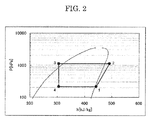
- FIG.2 is a P-h diagram in example 1 (the mass ratio of cis-1,3,3,3-tetrafluoropropene : 1,1,1,3,3-pentafluoropropane is 95:5).
- cycle points 1, 2, 3 and 4 represent the steam compression cycle calculation conditions 1.
- FIG. 3 is a P-h diagram in example 2 (the mass ratio of cis-1,3,3,3-tetrafluoropropene : trans-1-chloro-3,3,3-trifluoropropene is 95:5).
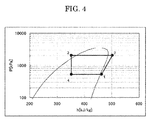
- FIG. 4 is a P-h diagram in example 3 (the mass ratio of cis-1,3,3,3-tetrafluoropropene : 1,1,1,3,3-pentafluoropropane is 95:5).
- Table 2 shows high-temperature heat pump cycle calculation conditions 2.
- High-temperature heat pump cycle calculation conditions 2 Evaporation temperature T EVA 60 [°C] Condensation temperature T CON 120 [°C] Degree of superheat T sh 5 [K] Degree of supercool T sc 10 [K] Compressor efficiency n 0.7 [-]
- the heat pump cycle conditions 2 are made with an assumption that pressurized hot water of 110°C is generated by heat exchange between the heat transmission composition and heat source water in the condenser.
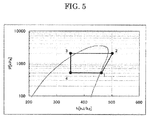
- FIG. 5 is a P-h diagram in example 4 (the mass ratio of cis-1,3,3,3-tetrafluoropropene : trans-1-chloro-3,3,3-trifluoropropene is 95:5).
- FIG. 6 is a P-h diagram in example 3 (the mass ratio of cis-1,3,3,3-tetrafluoropropene : 1,1,1,3,3-pentafluoropropane is 95:5).
- Table 3 shows high-temperature heat pump cycle calculation conditions 3.
- High-temperature heat pump cycle calculation conditions 3 Evaporation temperature T EVA 80 [°C] Condensation temperature T CON 140 [°C] Degree of superheat T sh 5 [K] Degree of supercool T sc 10 [K] Compressor efficiency n 0.7 [-]
- the heat pump cycle conditions 3 are made with an assumption that pressurized hot water of 130°C is generated by heat exchange between the heat transmission composition and heat source water in the condenser.
- FIG. 7 is a P-h diagram in example 6 (the mass ratio of cis-1,3,3,3-tetrafluoropropene : trans-1-chloro-3,3,3-trifluoropropene is 95:5).
- FIG. 8 is a P-h diagram in example 7 (the mass ratio of cis-1,3,3,3-tetrafluoropropene : trans-1,3,3,3-tetrafluoropropene is 95:5).
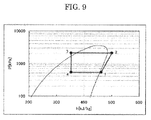
- FIG. 9 is a P-h diagram in example 8 (the mass ratio of cis-1,3,3,3-tetrafluoropropene : trans-1,3,3,3-tetrafluoropropene is 95:5).
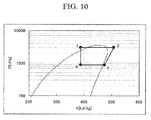
- FIG. 10 is a P-h diagram in example 9 (the mass ratio of cis-1,3,3,3-tetrafluoropropene : trans-1,3,3,3-tetrafluoropropene is 95:5).
- FIG. 11 is a P-h diagram in example 10 (the mass ratio of cis-1,3,3,3-tetrafluoropropene : 2,3,3,3-tetrafluoropropene is 95:5).
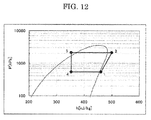
- FIG. 12 is a P-h diagram in example 11 (the mass ratio of cis-1,3,3,3-tetrafluoropropene : 2,3,3,3-tetrafluoropropene is 95:5).
- FIG. 13 is a P-h diagram in example 12 (the mass ratio of cis-1,3,3,3-tetrafluoropropene : 2,3,3,3-tetrafluoropropene is 95:5).
- FIG. 14 is a P-h diagram in comparative example 1 (the mass ratio of 1,1,1,3,3-pentafluoropropane : 1,1,1,3,3-pentafluorobutane is 95:5).
- HFC-365mfc is flammable and has a low level of toxicity.
- HFC-365mfc has a boiling point of 40.2°C at an atmospheric pressure, an atmospheric lifetime of 8.6 years, and a global warming potential (GWP) of 794 (IPCC 4th Assessment Report, 2007).
- GWP global warming potential
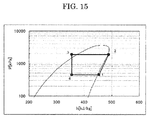
- FIG. 15 is a P-h diagram in comparative example 2 (the mass ratio of 1,1,1,3,3-pentafluoropropane : 1,1,1,3,3-pentafluorobutane is 95:5).
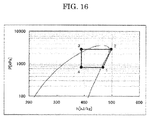
- FIG. 16 is a P-h diagram in comparative example 3 (the mass ratio of 1,1,1,3,3-pentafluoropropane : 1,1,1,3,3-pentafluorobutane is 95:5).
- examples 1 through 12 and comparative examples 1 through 3 values of a first component and a second component of each heat transmission composition are shown by percent by mass.
- the first component of the mixed heat transmission composition is cis-1,3,3,3-tetrafluoropropene, and the second component thereof is 1,1,1,3,3-pentafluoropropane.
- the first component of the mixed heat transmission composition is cis-1,3,3,3-tetrafluoropropene, and the second component thereof is trans-1-chloro-3,3,3-trifluoropropene.
- the first component of the mixed heat transmission composition is cis-1,3,3,3-tetrafluoropropene, and the second component thereof is trans-1,3,3,3-tetrafluoropropene.
- the first component of the mixed heat transmission composition is cis-1,3,3,3-tetrafluoropropene, and the second component thereof is 2,3,3,3-tetrafluoropropene.
- the first component of the mixed heat transmission composition is 1,1,1,3,3-pentafluoropropane, and the second component thereof is 1,1,1,3,3-pentafluorobutane.
- the heat transmission compositions according to the present invention when being applied to a high-temperature heat pump, the heat transmission compositions according to the present invention, have higher values of the coefficient of performance and the volume capacity than those of the mixed heat transmission compositions of 1,1,1,3,3-pentafluoropropane and 1,1,1,3,3-pentafluoroprobutane described in Patent Literature 1 (Japanese Laid-Open Patent Publication No. 2013-525720).
- a thermal stability test was performed using cis-1,3,3,3-tetrafluoropropene (HFO-1234ze (Z)).
- thermo stability test was performed using 1,1,1,3,3-pentafluoropropane (HFC-245fa).
- HFC-245fa 1,1,1,3,3-pentafluoropropane
- "Refrigerating machine oils” 1.0 g of heat transmission composition and metal pieces (test pieces of iron, copper, and aluminum) were sealed in a glass test tube, heated to a predetermined temperature and kept for 2 weeks. The heating temperature was set to 175°C, 200°C and 250°C. Two weeks later, the external appearance, the purity and the acid content (F - ion) of the heat transmission composition were measured to evaluate the thermal stability. Table 21 shows the results.
- the sealed thick glass test tube was put into a thermostatic tank cooled to -20°C, and kept still until the temperature of the thermostatic tank and the temperature of the composition in the glass test tube became equal to each other. Then, the compatibility of the heat transmission composition and the refrigerating machine oil was evaluated by a visual check. The compatibility was evaluated while the temperature of the thermostatic tank was changed from -20 to +80°C. Tables 22 through 26 show the results. In Tables 22 through 26, " ⁇ " indicates that the coolant and the refrigerating machine oil were uniformly mixed, and " ⁇ " indicates that the coolant and the refrigerating machine oil were separated into two layers or that the composition was clouded.
- the present invention is directed to a heat transmission method of transmitting, by a condensation step, heat of a non-flammable or slightly flammable heat transmission composition having little load on the environment to a fluid to be heated. Under the heat transmission temperature condition of 70°C or higher, this method is usable more preferably than a conventional heat transmission method using a condensation step of a hydrofluorocarbon heat transmission composition. This method, which provides a superb coefficient of performance and a superb volume capacity, significantly contributes to reduction of power consumption. Warm water in a middle to low temperature range, which is not fully utilized conventionally, may be heated by the method according to the present invention and used as high quality warm water, pressurized hot water or superheated steam.
Landscapes
- Chemical & Material Sciences (AREA)
- Engineering & Computer Science (AREA)
- Thermal Sciences (AREA)
- Physics & Mathematics (AREA)
- Chemical Kinetics & Catalysis (AREA)
- Organic Chemistry (AREA)
- Materials Engineering (AREA)
- Combustion & Propulsion (AREA)
- Mechanical Engineering (AREA)
- General Engineering & Computer Science (AREA)
- Oil, Petroleum & Natural Gas (AREA)
- General Chemical & Material Sciences (AREA)
- Lubricants (AREA)
Description
- The present invention relates to a heat transmission method using a coolant for a high-temperature heat pump, the coolant being suitable for use at a condensation temperature of 70°C or higher, and also to a high-temperature heat pump device.
- In steel, petroleum, chemical, cement, paper and pulp, ceramic engineering, biomass and other industries, a once through steam boiler or the like is used, which generates steam by use of heat of combustion of a fossil fuel such as oil, gas or the like in order to supply a heat source for a heating step such as a drying step, a sterilization step or the like. Recently, energy savings and carbon dioxide emissions reduction are serious problems in industries. It is considered that a heating method using a heat pump reduces carbon dioxide emissions as compared with a conventional method of combusting a fossil fuel to supply heat.
- A heat pump is generally used for cooling or heating in an air conditioning device or a hot water supply device.
- Chlorofluorocarbon (CFC) or hydrochlorofluorocarbon (HCFC) each containing fluorine and chlorine are conventionally used as a coolant of a heat pump cycle, but use thereof has been stopped step by step from the viewpoint of ozone layer protection. Today, a natural coolant such as ammonia, carbon dioxide or the like and hydrofluorocarbon (HFC), which does not contain a chlorine atom in a molecule, are mainly used.
- A heat pump known as a hot water supply device or a steam generation device uses HFC as a coolant. For example,
Patent Literature 1 discloses a coolant for a high-temperature heat pump, which has a condensation temperature of 70°C to 150°C. This coolant contains 1,1,1,3,3-pentafluoropropane as a main component and contains 1,1,1,3,3-pentafluoroprobutane at a mass ratio of 20% by mass or less. - However, it is concerned that HFC, which has a high global warming potential (GWP), significantly contributes to the warming. Therefore, hydrofluoroolefin (HFO), which is a fluorine-containing unsaturated compound, is proposed as a substitute coolant having a low global warming potential.
- For example,
Patent Literature 2 discloses using, as a coolant of an air conditioning device for an automobile, a composition containing 2,3,3,3-tetrafluoropropene (HFO) and polyalkyleneglycol (PAG) lubricant. -
Patent Literature 3 discloses using, as a coolant of a low-temperature freezer, a mixed compound of tetrafluoropropene such as 2,3,3,3-tetrafluoropropene, 1,3,3,3-tetrafluoropropene or the like and difluoromethane. -
- Patent Literature 1:
PCT Japanese National Phase Laid-Open Patent Publication No. 2013-525720 - Patent Literature 2:
PCT Japanese National Phase Laid-Open Patent Publication No. 2007-535611 - Patent Literature 3:
Japanese Laid-Open Patent Publication No. 2010-47754 -
Patent Literature 1 proposes an HFC mixed coolant for a high-temperature heat pump. Since this coolant has a high global warming potential of 794 to 1030, it is concerned that use thereof for a long time in the future may cause a problem. -
Patent Literature 2 andPatent Literature 3 each propose an air conditioning device of a steam compression cycle using a working fluid having a low GWP. The working fluid used in each ofPatent Literature 2 andPatent Literature 3 is a coolant suitable for use in air conditioning (cooling, heating). However, no example of applying such a coolant to a heat pump cycle for hot water supply or water vapor generation is described. - As described above, the level of performance of currently available high-temperature heat pumps using a coolant having a high level of environmental compatibility is still insufficient. Therefore, it is desired to find a heat transmission composition that is capable of performing heat transmission at a high temperature and contains, as a main component, a coolant providing superior heat transmission performance than a conventional coolant and having a low GWP.
- The present invention made has an object of providing a novel heat transmission composition and a high-temperature heat pump device that are further improved. A preferable heat transmission working medium according to the present invention does not substantially contribute to global warming, unlike many types of hydrofluorocarbon currently used.
- The present inventors performed active studies in order to solve the above-described problems. As a result, the present inventors paid attention to unsaturated halogenated hydrocarbon, and obtained knowledge that use thereof, especially, use of fluorinated propene as a heat transmission medium at a predetermined temperature and a predetermined pressure would provide a very effective heat transmission method. Thus, the present invention was completed.
- An embodiment of the present invention is directed to a heat transmission method using a high-temperature heat pump system accommodating a heat transmission composition, the heat transmission method including the step of gasifying the heat transmission composition, the step of compressing the heat transmission composition, the step of condensing the heat transmission composition, and the step of decreasing the pressure of the heat transmission composition, which are performed sequentially. The heat transmission composition contains cis-1,3,3,3-tetrafluoropropene at a mass ratio of 95.0% by mass or more and 99.9% by mass or less, and contains trans-1,3,3,3-tetrafluoropropene or 2,3,3,3-tetrafluoropropene at a mass ratio of 0.1% by mass or more and 5.0% by mass or less; and the heat transmission composition has a condensation temperature of 70°C or higher.
- An embodiment of the present invention is directed to a heat transmission method using a high-temperature heat pump system accommodating a heat transmission composition, the heat transmission method including the step of gasifying the heat transmission composition, the step of compressing the heat transmission composition, the step of condensing the heat transmission composition, and the step of decreasing the pressure of the heat transmission composition, which are performed sequentially. The heat transmission composition contains cis-1,3,3,3-tetrafluoropropene at a mass ratio of 80.0% by mass or more and 99.9% by mass or less, and contains trans-1-chloro-3,3,3-trifluoropropene or 1,1,1,3,3-pentafluoropropane at a mass ratio of 0.1% by mass or more and 20.0% by mass or less; and the heat transmission composition has a condensation temperature of 70°C or higher.
- In the heat transmission composition method, the heat transmission composition may contain cis-1,3,3,3-tetrafluoropropene at a mass ratio of 90.0% by mass or more and 99.9% by mass or less, and contain 1,1,1,3,3-pentafluoropropane at a mass ratio of 0.1% by mass or more and 10.0% by mass or less.
- In the heat transmission composition method, the heat transmission composition may contain cis-1,3,3,3-tetrafluoropropene at a mass ratio of 90.0% by mass or more and 99.9% by mass or less, and contain trans-1-chloro-3,3,3-trifluoropropene at a mass ratio of 0.1% by mass or more and 10.0% by mass or less.
- In the heat transmission composition method, the heat transmission composition may contain a lubricant.
- In the heat transmission composition method, the lubricant may be selected from mineral oil (paraffin-based oil or naphthene-based oil), and synthetic oils including alkylbenzenes (AB), poly(alfa-olefin), esters, polyolesters (POE), polyalkyleneglycols (PAG), polyvinylethers (PVE), and a combination thereof.
- In the heat transmission composition method, the heat transmission composition may further contain a stabilizer.
- In the heat transmission composition method, the stabilizer may be selected from nitro compounds, epoxy compounds, phenols, imidazoles, amines, diene-based compounds, phosphates, aromatic unsaturated hydrocarbons, isoprenes, propadienes, terpenes, and the like, and a combination thereof.
- In the heat transmission composition method, the heat transmission composition may further contain a flame retardant.
- In the heat transmission composition method, the flame retardant may be selected from phosphates, halogenated aromatic compounds, fluorinated iodocarbon, fluorinated bromocarbon, and the like, and a combination thereof.
- In the heat transmission composition method, warm water, pressurized hot water or superheated steam of 60°C or higher may be generated.
- In the heat transmission composition method, warm water, pressurized hot water or superheated steam of 80°C or higher may be generated.
- In the heat transmission composition method, pressurized hot water or superheated steam of 110°C or higher may be generated.
- An embodiment of the present invention is directed to a high-temperature heat pump device using the heat transmission method described in any of the above.
- The heat transmission composition according to the present invention is usable as a non-flammable or slightly flammable mixed coolant for a heat cycle that has little influence on the environment and has superb heat transmission characteristics. By use of the heat transmission composition according to the present invention, a high-temperature heat pump device exhibiting superb heat transmission characteristics is provided.
-
- [
FIG. 1] FIG. 1 is a schematic view of a high-temperature heat pump cycle to which a working medium according to the present invention is applicable. - [
FIG. 2] FIG. 2 is a P-h diagram in example 1 according to the present invention. - [
FIG. 3] FIG. 3 is a P-h diagram in example 2 according to the present invention. - [
FIG. 4] FIG. 4 is a P-h diagram in example 3 according to the present invention. - [
FIG. 5] FIG. 5 is a P-h diagram in example 4 according to the present invention. - [
FIG. 6] FIG. 6 is a P-h diagram in example 5 according to the present invention. - [
FIG. 7] FIG. 7 is a P-h diagram in example 6 according to the present invention. - [
FIG. 8] FIG. 8 is a P-h diagram in example 7 according to the present invention. - [
FIG. 9] FIG. 9 is a P-h diagram in example 8 according to the present invention. - [
FIG. 10] FIG. 10 is a P-h diagram in example 9 according to the present invention. - [
FIG. 11] FIG. 11 is a P-h diagram in example 10 according to the present invention. - [
FIG. 12] FIG. 12 is a P-h diagram in example 11 according to the present invention. - [
FIG. 13] FIG. 13 is a P-h diagram in example 12 according to the present invention. - [
FIG. 14] FIG. 14 is a P-h diagram in comparative example 1 provided as a comparison to the present invention. - [
FIG. 15] FIG. 15 is a P-h diagram in comparative example 2 provided as a comparison the present invention. - [
FIG. 16] FIG. 16 is a P-h diagram in comparative example 3 provided as a comparison the present invention. - Hereinafter, a heat transmission method and a high-temperature heat pump device according to the present invention will be described with reference to the drawings. The heat transmission method and the high-temperature heat pump device according to the present invention are not to be construed as being limited to the following embodiments or examples. In the drawings referred to in the embodiments and the examples, the same elements or elements having substantially the same functions will bear the same reference signs, and descriptions thereof will not be described in repetition.
- A heat transmission method according to the present invention uses a heat transmission composition which is a mixture of cis-1,3,3,3-tetrafluoropropene and trans-1,3,3,3-tetrafluoropropene or 2,3,3,3-tetrafluoropropene. Alternatively, the heat transmission method according to the present invention uses a heat transmission composition which is a mixture of cis-1,3,3,3-tetrafluoropropene and trans-1-chloro-3,3,3-trifluoropropene or 1,1,1,3,3-pentafluoropropane. The present inventors have found that the heat transmission composition according to the present invention is such a mixture and therefore is non-flammable or slightly flammable, has little load on the environment and has superb heat cycle characteristics and heat transmission characteristics.
- Cis-1,3,3,3-tetrafluoropropene (HFO-1234ze (Z)) will be described.
- HFO-1234ze (Z) contains a carbon-carbon double bond in a molecule and is highly reactive with a hydroxyl radical, and therefore has a very low global warming potential (GWP) and has little load on the environment. HFO-1234ze (Z) is slightly flammable or flame-resistant and has no toxicity. HFO-1234ze (Z) has a boiling point of 9.8°C at an atmospheric pressure, an atmospheric lifetime of 10 days, and a global warming potential (GWP) of 3 (Chemical Physics Letters 2009, Vol. 473, pp. 233-237). HFO-1234ze (Z) has a critical temperature of 150.1°C and a critical pressure of 3.54 MPa (4th IIR Conference on Thermophysical Properties and Transfer Processes of Refrigerant, Proceedings TP-018).
- Trans-1,3,3,3-tetrafluoropropene (HFO-1234ze (E)) will be described.
- HFO-1234ze (E) contains a carbon-carbon double bond in a molecule and is highly reactive with a hydroxyl radical, and therefore has a very low global warming potential (GWP) and has little load on the environment. HFO-1234ze (E) is slightly flammable or flame-resistant and has no toxicity. HFO-1234ze (E) has a boiling point of -19°C at an atmospheric pressure, an atmospheric lifetime of 14 days, and a global warming potential (GWP) of 6 (Chemical Physics Letters 2007, Vol. 443, pp. 199-204). HFO-1234ze (E) has a critical temperature of 109.4°C and a critical pressure of 3.63 MPa (Journal of Chemical Engineering Data 2010, Vol. 55, pp. 1594-1597).
- 2,3,3,3-tetrafluoropropene (HFO-1234yf) will be described.
- HFO-1234yf contains a carbon-carbon double bond in a molecule and is highly reactive with a hydroxyl radical, and therefore has a very low global warming potential (GWP) and has little load on the environment. HFO-1234yf is slightly flammable and has no toxicity. HFO-1234yf has a boiling point of -29°C at an atmospheric pressure, an atmospheric lifetime of 11 days, and a global warming potential (GWP) of 4 (Chemical Physics Letters 2007, Vol. 439, pp. 18-22). HFO-1234yf has a critical temperature of 94.7°C and a critical pressure of 3.38 MPa (International Journal of Refrigeration 2010, Vol. 33, pp. 474-479)
- Now, trans-1-chloro-3,3,3-trifluoropropene (HCFO-1233zd (E)) will be described.
- HCFO-1233zd (E) contains a carbon-carbon double bond in a molecule and is highly reactive with a hydroxyl radical, and therefore has a very low global warming potential (GWP) and has little load on the environment. HCFO-1233zd (E) is slightly flammable or flame-resistant and has no toxicity. HCFO-1233zd (E) has a boiling point of 18.3°C at an atmospheric pressure, an atmospheric lifetime of 26 days, and a global warming potential (GWP) of 7 (Journal of Photochemistry and Photobiology A: Chemistry 2008, Vol. 199, pp. 92-97). HCFO-1233zd (E) has a critical temperature of 109.4°C and a critical pressure of 3.63 MPa (Journal of Chemical Engineering Data 2012, Vol. 57, pp. 3581-3586).
- Now, 1,1,1,3,3-pentafluoropropane (HFC-245fa) will be described.
- HFC-245fa is non-flammable and has a low level of toxicity. HFC-245fa has a boiling point of 15.3°C at an atmospheric pressure, an atmospheric lifetime of 7.6 years, and a global warming potential (GWP) of 1030 (IPCC 4th Assessment Report, 2007).
- HFC-245fa has a high global warming potential (GWP), and therefore, when being used, is contained preferably at 1% by mass or more and 20% by mass or less, and especially preferably at 1% by mass or more and 10% by mass or less.
- In an embodiment, the heat transmission composition according to the present invention contains cis-1,3,3,3-tetrafluoropropene at a mass ratio of 95.0% by mass or more and 99.9% by mass or less, and contains trans-1,3,3,3-tetrafluoropropene or 2,3,3,3-tetrafluoropropene at a mass ratio of 0.1% by mass or more and 5.0% by mass or less. Owing to having such a composition, the heat transmission composition according to the present invention has a global warming potential of less than 150.
- In an embodiment, the heat transmission composition according to the present invention contains cis-1,3,3,3-tetrafluoropropene at a mass ratio of 80.0% by mass or more and 99.9% by mass or less, and contains trans-1-chloro-3,3,3-trifluoropropene or 1,1,1,3,3-pentafluoropropane at a mass ratio of 0.1% by mass or more and 20.0% by mass or less. Owing to having such a composition, the heat transmission composition according to the present invention, as a coolant, has a global warming potential of less than 150.
- Cis-1,3,3,3-tetrafluoropropene and trans-1-chloro-3,3,3-trifluoropropene or 1,1,1,3,3-pentafluoropropane have critical temperatures close to each other, and the critical temperature of the heat transmission composition according to the present invention containing such substances is not much influenced by the mass ratios of the substances. By contrast, the critical temperature of each of trans-1,3,3,3-tetrafluoropropene and 2,3,3,3-tetrafluoropropene is lower than the critical temperature of cis-1,3,3,3-tetrafluoropropene. Therefore, the critical temperature of the heat transmission composition according to the present invention containing such substances decreases as the mass ratio of trans-1,3,3,3-tetrafluoropropene or 2,3,3,3-tetrafluoropropene increases. For this reason, the heat transmission composition containing cis-1,3,3,3-tetrafluoropropene and trans-1,3,3,3-tetrafluoropropene or 2,3,3,3-tetrafluoropropene according to the present invention preferably contains trans-1,3,3,3-tetrafluoropropene or 2,3,3,3-tetrafluoropropene at 0.1 % by mass or more and 5.0% by mass or less.
- The heat transmission composition containing cis-1,3,3,3-tetrafluoropropene and trans-1-chloro-3,3,3-trifluoropropene or 1,1,1,3,3-pentafluoropropane contains cis-1,3,3,3-tetrafluoropropene at a mass ratio of 80.0% by mass or more, preferably at a mass ratio of 90.0% by mass or more and 99.9% by mass, and contains trans-1-chloro-3,3,3-trifluoropropene or 1,1,1,3,3-pentafluoropropane at a mass ratio of 0.1% by mass or more and 20.0% by mass or less, preferably at a mass ratio of 0.1% by mass or more and 10.0% by mass or less.
- In the case where the heat transmission composition according to the present invention is used as a coolant of a high-temperature heat pump, a lubricant is used in a compressor sliding portion. Examples of the lubricant include mineral oil (paraffin-based oil or naphthene-based oil), and synthetic oils such as alkylbenzenes (AB), poly(alfa-olefin), esters, polyolesters (POE), polyalkyleneglycols (PAG), and polyvinylethers (PVE).
- In the case where the heat transmission composition according to the present invention is used as a working medium of a rankine cycle, a lubricant is used in an expander sliding portion. Examples of the lubricant include mineral oil (paraffin-based oil or naphthene-based oil), and synthetic oils such as alkylbenzenes (AB), poly(alfa-olefin), esters, polyolesters (POE), polyalkyleneglycols (PAG), and polyvinylethers (PVE).
- Usable alkylbenzenes include n-octylbenzene, n-nonylbenzene, n-decylbenzene, n-undecylbenzene, n-dodecylbenzene, n-tridecylbenzene, 2-methyl-1-phenylheptane, 2-methyl-1-phenyloctane, 2-methyl-1-phenylnonane, 2-methyl-1-phenyldecane, 2-methyl-1-phenylundecane, 2-methyl-1-phenyldodecane, 2-methyl-1-phenyltridecane, and the like.
- Usable esters include aromatic esters such as benzoic acid, phthalic acid, isophthalic acid, terephthalic acid, trimellitic acid, pyromellitic acid, a mixture thereof and the like; dibasic acid ester; polyolester; complex ester; carbonate ester; and the like.
- Alcohols which are materials of polyolesters include, for example, esters of hindered alcohol such as neopentylglycol, trimethylolethane, trimethylolpropane, trimethylolbutane, di-(trimethylolpropane), tri-(trimethylolpropane), pentaerythritol, di-(pentaerythritol), tri-(pentaerythritol), and the like.
- Carboxylic acids which are materials of polyolesters include valeric acid, caproic acid, enathic acid, caprylic acid, pelargonic acid, capric acid, oleic acid, isopentanoic acid, 2-methylhexanoic acid, 2-ethylpentanoic acid, 2-ethylhexanoic acid, 3,5,5-trimethylhexanoic acid, and the like.
- A usable example of polyalkyleneglycol is a compound obtained by addition polymerization of aliphatic alcohol having a carbon number of 1 or more and 18 or less, such as methanol, ethanol, linear or branched propanol, linear or branched butanol, linear or branched pentanol, linear or branched hexanol or the like, with ethylene oxide, propylene oxide, butylene oxide or the like.
- Usable polyvinylethers include polymethylvinylether, polyethylvinylether, poly-n-propylvinylether, polyisopropylvinylether, and the like.
- The heat transmission composition according to the present invention may contain a stabilizer in order to improve the thermal stability, oxidation resistance and the like thereof. Examples of the stabilizer include nitro compounds, epoxy compounds, phenols, imidazoles, amines, hydrocarbons, and the like.
- Usable nitro compounds include known compounds, for example, aliphatic and/or aromatic derivatives. Usable aliphatic nitro compounds include, for example, nitromethane, nitroethane, 1-nitropropane, 2-nitropropane, and the like. Usable aromatic nitro compounds include, for example, nitrobenzene, o-, m- or p-dinitrobenzene, trinitrobenzene, o-, m- or p-nitrotoluene, o-, m- or p-ethylnitrobenzene, 2,3-, 2,4-, 2,5-, 2,6-, 3,4- or 3,5-dimethylnitrobenzene, o-, m-or p-nitroacetophenone, o-, m- or p-nitrophenol, o-, m- or p-nitroanisole, and the like.
- Usable epoxy compounds include, for example, monoepoxy-based compounds such as ethyleneoxide, 1,2-butyleneoxide, propyleneoxide, styreneoxide, cyclohexeneoxide, glycidol, epichlorhydrin, glycidylmethacrylate, phenylglycidylether, allylglycidylether, methylglycidylether, butylglycidylether, 2-ethylhexylglycidylether, and the like; and polyepoxy-based compounds such as diepoxybutane, vinylcyclohexenedioxide, neopentylglycoldiglycidylether, ethyleneglycoldiglycidylether, glycerinepolyglycidylether, trimethylolpropanetriglycidylether, and the like.
- Usable phenols may contain any of various substitutes such as an alkyl group, an alkenyl group, an alkoxy group, a carboxyl group, a carbonyl group, a halogen atom or the like as well as a hydroxy group. Such phenols include, for example, monovalent phenols such as 2,6-di-t-butyl-p-cresol, o-cresol, m-cresol, p-cresol, thymol, p-t-butylphenol, o-methoxyphenol, m-methoxyphenol, p-methoxyphenol, eugenol, isoeugenol, butylhydroxyanisole, phenol, xylenol, and the like; and divalent phenols such as t-butylcatechol, 2,5-di-t-aminohydroquinone, 2,5-di-t-butylhydroquinone, and the like.
- Usable imidazoles contain, as a substitute at the N position, a linear or branched alkyl group, a linear or branched cycloalkyl group or a linear or branched aryl group having a carbon number of 1 or more and 18 or less. Such imidazoles include 1-methylimidazole, 1-n-butylimidazole, 1-phenylimidazole, 1-benzylimidazole, 1-(β-oxyethyl)imidazole, 1-methyl-2-propylimidazole, 1-methyl-2-isobutylimidazole, 1-n-butyl-2-methylimidazole, 1,2-dimethylimidazole, 1,4-dimethylimidazole, 1,5-dimethylimidazole, 1,2,5-trimethylimidazole, 1,4,5-trimethylimidazole, 1-ethyl-2-methylimidazole, and the like. These compounds may be used independently or in a combination of two or more.
- Usable amines include pentylamine, hexylamine, diisopropylamine, diisobutylamine, di-n-propylamine, diallylamine, triethylamine, N-methylaniline, pyridine, morpholine, N-methylmorpholine, triallylamine, allylamine, α-methylbenzylamine, methylamine, dimethylamine, trimethylamine, ethylamine, diethylamine, propylamine, isopropylamine, dipropylamine, butylamine, isobutylamine, dibutylamine, tributylamine, dipentylamine, tripentylamine, 2-ethylhexylamine, aniline, N,N-dimethylaniline, N,N-diethylaniline, ethylenediamine, propylenediamine, diethylenetriamine, tetraethylenepentamine, benzylamine, dibenzylamine, diphenylamine, diethylhydroxylamine, and the like. These may be used independently or in a combination of two or more.
- Usable hydrocarbons include aromatic unsaturated hydrocarbons such as α-methylstyrene, p-isopropenyltoluene, and the like; isoprenes; propadienes; terpenes; and the like. These may be used independently or in a combination of two or more.
- The stabilizer may be added to one of, or both of, the coolant and the lubricant in advance, or may be put into the condenser independently. There is no specific limitation on the amount of the stabilizer, but the amount of the stabilizer is preferably 0.001% by mass or more and 10% by mass or less, more preferably 0.01% by mass or more and 5% by mass or less, and still more preferably 0.02% by mass or more and 2% by mass or less, with respect to the main coolant (100% by mass). In the case where the amount of the stabilizer exceeds the upper limit or less than the lower limit, the stability of the coolant, the heat cycle performance and the like are not provided sufficiently.
- The heat transmission composition according to the present invention may contain a flame retardant in order to improve the flammability thereof. Examples of the flame retardant include phosphates, halogenated aromatic compounds, fluorinated iodocarbon, fluorinated bromocarbon, and the like.
- The heat transmission medium according to the present invention having such a composition has a condensation temperature of 70°C or higher, preferably 80°C or higher, and more preferably 90°C or higher and 140°C or lower.
- The condensation pressure of the heat transmission composition according to the present invention having such a composition is determined by the composition and the condensation temperature of the heat transmission composition. Namely, the condensation pressure is equal to the saturated steam pressure of the heat transmission composition at the condensation temperature. In general, when the condensation pressure of a heat transmission composition exceeds 5.0 MPa, the compressor, the condenser and pipes need to have a high level of pressure resistance. This is not preferable because the devices having such a high level of pressure resistance cost high. In the case where the heat transmission composition according to the present invention is used, the condensation pressure is lower than 5.0 MPa, and thus a known compressor, a known condenser and known pipes are usable.
- The heat transmission composition according to the present invention is non-flammable, has little load on the environment, and has superb heat cycle characteristics. Therefore, the heat transmission composition according to the present invention is usable as a heat medium for a high-temperature heat pump usable to generate pressurized warm water, superheated steam or the like; as a working medium for an organic rankine cycle usable for a power generation system or the like; as a coolant for a steam compression-type freezing cycle system; as a medium for an absorption-type heat pump, a heat pipe or the like; a washing detergent for cycle washing of a cooling system or a heat pump system; as a metal washing detergent; as a flux washing detergent; as a dilution solvent; as a foaming agent, as an aerosol; or the like.
- The heat transmission method according to the present invention is applicable for a packaged compact device (rankine cycle system, heat pump cycle system, etc.) and also for a power general system, a heat pump hot water supply system, a heat pump steam generation system or the like of a large plant scale.
- Hereinafter, a high-temperature heat pump device using the heat transmission composition according to the present invention will be described in detail.
- A high-temperature heat pump device is a system that transfers heat of a substance to be cooled, for example, air, water, brine or the like, to a coolant, by an evaporator, as latent heat of evaporation of the coolant, applies work to, and thus compress, the generated coolant steam by the compressor, discharges the heat of condensation by the condenser to liquefy the coolant steam, subjects the condensed coolant to throttle expansion by an expansion valve so that the condensed coolant has a low pressure and a low temperature, and transfers the coolant to the evaporator to evaporate the coolant. In the evaporator, the coolant receives the thermal energy of the substance to be cooled, so that the substance to be cooled is cooled to decrease the temperature. In the condenser, the thermal energy of the coolant is given to a load fluid, so that the load fluid is heated to increase the temperature. The high-temperature heat pump device is applicable to a known system.
- A fluid to be cooled or a fluid to be heated that is subjected to heat exchange with a coolant (heat transmission composition) in an evaporator or a condenser of the high-temperature heat pump device may be air, water, brine, silicone oil, or the like. One of such mediums is preferably selected in accordance with the temperature condition of cycle driving.
-
FIG. 1 is a schematic view showing an example of a high-temperature heat pump device to which the heat transmission composition according to the present invention is applicable. Hereinafter, a structure and an operation (repetition cycle) of a high-temperatureheat pump device 100 shown inFIG. 1 will be described. - The high-temperature
heat pump device 100 according to the present invention includes anevaporator 11 that receives heat and acondenser 13 that supplies heat. The high-temperatureheat pump device 100 also includes acompressor 12 that increases the pressure of a working medium (heat transmission composition) steam that has exited from theevaporator 11 to consume electric power, and anexpansion valve 13 that subjects the working medium supercooled liquid that has exited from thecondenser 13 to throttle expansion. - In the case where the high-temperature heat pump device is repeated using the heat transmission composition according to the present invention, (a) through (d) below may be performed to obtain, as thermal energy, energy that is greater than the electric power put to the medium to be heated, by the
condenser 13. - (a) The working medium in a liquid state in the heat exchanger (evaporator 11) is subjected to heat exchange with a fluid to be cooled (air, water, etc.), so that the working medium is gasified.
- (b) The gasified coolant is removed from the heat exchanger and the gasified working medium is transferred to the
compressor 12, so that a high-pressure superheated seam is supplied. - (c) The working medium that has exited from the
compressor 12 is transferred to thecondenser 13 and the working medium in a gaseous state is subjected to heat exchange with a fluid to be heated (air, water, etc.), so that the working medium is liquefied. - (d) The liquefied coolant is subjected to throttle expansion by the
expansion valve 14, and a low-pressure wet steam is supplied, so that the coolant is recirculated to step (a). - A high-temperature heat pump system accommodating a coolant includes at least one of
evaporator 11, at least one ofcompressor 12, at least one ofcondenser 13, at least one ofexpander 14, and a pipe used to transfer the coolant between these elements. - There is no specific limitation on the type of the compressor. Usable compressors include a single-stage or multi-stage centrifugal compressor, a rotary piston-type compressor, a rotary vane-type compressor, a scroll-type compressor, a screw-type compressor, and a piston-crank-type compressor.
- By use of the heat transmission composition according to the present invention as the working medium of a steam compression cycle system, warm water of 60°C or higher, preferably pressurized hot water or superheated steam of 80°C or higher, and more preferably pressurized ho water or superheated steam of 110°C or higher, may be generated.
- Hereinafter, the present invention will be described in detail by way of examples. The present invention is not limited to any of the following examples.
- The coefficient of performance (COP) is a generally recognized criterion for performance of a coolant, and is especially useful to represent a relative thermodynamic efficiency of a heat transmission composition in a specific heating or cooling cycle including evaporation or condensation of the heat transmission composition. The ratio of the amount of heat received by the coolant from a medium to be cooled in an evaporator, with respect to the work applied by a compressor for compression, is represented by COPR. By contrast, the ratio of the amount of heat released by the heat transmission composition to a medium to be heated in a condenser, with respect to the work applied by the compressor for compressing the steam, is represented by COPH.
- The volume capacity of a heat transmission composition represents the amount of heat for cooling or heating that is given by the heat transmission composition per unit absorption volume of a compressor. Namely, as the volume capacity of the heat transmission composition is larger with respect to a specific compressor, the heat transmission composition absorbs or releases a larger amount of heat.
- In a performance evaluation on a high-temperature heat pump cycle using a mixed heat transmission composition of cis-1,3,3,3-tetrafluoropropene and 1,1,1,3,3-pentafluoropropane, the coefficient of performance was calculated under the conditions shown in Table 1. Physical property values of the heat transmission composition were obtained from REFPROP ver. 9.0 of National Institute of Standards and Technology (NIST) of the United States.
- Table 1 shows high-temperature heat pump
cycle calculation conditions 1.[Table 1] Transcritical high-temperature heat pump cycle calculation conditions 1Evaporation temperature TEVA 30 [°C] Condensation temperature TCON 90 [°C] Degree of superheat Tsh 5 [K] Degree of supercool Tsc 10 [K] Compressor efficiency η 0.7 [-] - The heat
pump cycle conditions 1 are made with an assumption that hot water of 80°C is generated by heat exchange between the heat transmission composition and heat source water in the condenser. - For calculating the high-temperature heat pump cycle performance (COPH), the following conditions were assumed.
- (A) The compression performed by the compressor is isentropic compression.
- (B) The throttle expansion performed by the expansion valve is isenthalpic expansion.
- (C) The heat loss and the pressure loss in the pipe and the heat exchanger are ignored.
- (D) The compressor efficiency η is 0.7.
- Hereinafter, equations used to calculate the high-temperature heat pump cycle performance (COPH) will be described in detail. The input heat amount QEVA to the evaporator is:

- The released heat amount QCON from the condenser is:

- It should be noted that where the enthalpy of the heat transmission composition at the outlet of the compressor after the isentropic compression is represented by h2th, enthalpy h2 of the heat transmission composition at the outlet of the compressor calculated in consideration of the compressor efficiency is:

- Work W given by the compressor for compressing the heat transmission composition steam is:

- The coefficient of performance (COPH) of the high-temperature heat pump cycle is:

- Now, an equation used to calculate the volume capacity (CAP) of the heat transmission medium will be described in detail. The steam density of the heat transmission medium at the absorption inlet of the compressor is ρ2, and the released heat amount in the gas cooler is QGC. Therefore,

- In (1) through (6) above, the symbols represent the following:
- G: Amount of circulating heat transmission composition
- W: Compression work
- QEVA: Input heat amount
- QCON: Released heat amount
- COPH: Coefficient of performance (heating)
- CAP: Volume capacity (heating)
- h: Specific enthalpy
- 1,2,3,4: Cycle point
- 2th: Cycle point after isentropic compression
-
FIG.2 is a P-h diagram in example 1 (the mass ratio of cis-1,3,3,3-tetrafluoropropene : 1,1,1,3,3-pentafluoropropane is 95:5). In the figure, cycle points 1, 2, 3 and 4 represent the steam compressioncycle calculation conditions 1. - In a performance evaluation on a high-temperature heat pump cycle using a mixed heat transmission composition of cis-1,3,3,3-tetrafluoropropene and trans-1-chloro-3,3,3-trifluoropropene, the coefficient of performance was calculated under the conditions shown in Table 1.
FIG. 3 is a P-h diagram in example 2 (the mass ratio of cis-1,3,3,3-tetrafluoropropene : trans-1-chloro-3,3,3-trifluoropropene is 95:5). - In a performance evaluation on the high-temperature heat pump cycle using the mixed heat transmission composition of cis-1,3,3,3-tetrafluoropropene and 1,1,1,3,3-pentafluoropropane, the coefficient of performance was calculated under the conditions shown in Table 2.
FIG. 4 is a P-h diagram in example 3 (the mass ratio of cis-1,3,3,3-tetrafluoropropene : 1,1,1,3,3-pentafluoropropane is 95:5). - Table 2 shows high-temperature heat pump
cycle calculation conditions 2.[Table 2] High-temperature heat pump cycle calculation conditions 2Evaporation temperature TEVA 60 [°C] Condensation temperature TCON 120 [°C] Degree of superheat Tsh 5 [K] Degree of supercool Tsc 10 [K] Compressor efficiency n 0.7 [-] - The heat
pump cycle conditions 2 are made with an assumption that pressurized hot water of 110°C is generated by heat exchange between the heat transmission composition and heat source water in the condenser. - In a performance evaluation on the high-temperature heat pump cycle using the mixed heat transmission composition of cis-1,3,3,3-tetrafluoropropene and trans-1-chloro-3,3,3-trifluoropropene, the coefficient of performance was calculated under the conditions shown in Table 2.
FIG. 5 is a P-h diagram in example 4 (the mass ratio of cis-1,3,3,3-tetrafluoropropene : trans-1-chloro-3,3,3-trifluoropropene is 95:5). - In a performance evaluation on the high-temperature heat pump cycle using the mixed heat transmission composition of cis-1,3,3,3-tetrafluoropropene and 1,1,1,3,3-pentafluoropropane, the coefficient of performance was calculated under the conditions shown in Table 3.
FIG. 6 is a P-h diagram in example 3 (the mass ratio of cis-1,3,3,3-tetrafluoropropene : 1,1,1,3,3-pentafluoropropane is 95:5). - Table 3 shows high-temperature heat pump
cycle calculation conditions 3.[Table 3] High-temperature heat pump cycle calculation conditions 3Evaporation temperature TEVA 80 [°C] Condensation temperature TCON 140 [°C] Degree of superheat Tsh 5 [K] Degree of supercool Tsc 10 [K] Compressor efficiency n 0.7 [-] - The heat
pump cycle conditions 3 are made with an assumption that pressurized hot water of 130°C is generated by heat exchange between the heat transmission composition and heat source water in the condenser. - In a performance evaluation on the high-temperature heat pump cycle using the mixed heat transmission composition of cis-1,3,3,3-tetrafluoropropene and trans-1-chloro-3,3,3-trifluoropropene, the coefficient of performance was calculated under the conditions shown in Table 3.
FIG. 7 is a P-h diagram in example 6 (the mass ratio of cis-1,3,3,3-tetrafluoropropene : trans-1-chloro-3,3,3-trifluoropropene is 95:5). - In a performance evaluation on a high-temperature heat pump cycle using a mixed heat transmission composition of cis-1,3,3,3-tetrafluoropropene and trans-1,3,3,3-tetrafluoropropene, the coefficient of performance was calculated under the conditions shown in Table 1.
FIG. 8 is a P-h diagram in example 7 (the mass ratio of cis-1,3,3,3-tetrafluoropropene : trans-1,3,3,3-tetrafluoropropene is 95:5). - In a performance evaluation on the high-temperature heat pump cycle using the mixed heat transmission composition of cis-1,3,3,3-tetrafluoropropene and trans-1,3,3,3-tetrafluoropropene, the coefficient of performance was calculated under the conditions shown in Table 2.
FIG. 9 is a P-h diagram in example 8 (the mass ratio of cis-1,3,3,3-tetrafluoropropene : trans-1,3,3,3-tetrafluoropropene is 95:5). - In a performance evaluation on the high-temperature heat pump cycle using the mixed heat transmission composition of cis-1,3,3,3-tetrafluoropropene and trans-1,3,3,3-tetrafluoropropene, the coefficient of performance was calculated under the conditions shown in Table 3.
FIG. 10 is a P-h diagram in example 9 (the mass ratio of cis-1,3,3,3-tetrafluoropropene : trans-1,3,3,3-tetrafluoropropene is 95:5). - In a performance evaluation on a high-temperature heat pump cycle using a mixed heat transmission composition of cis-1,3,3,3-tetrafluoropropene and 2,3,3,3-tetrafluoropropene, the coefficient of performance was calculated under the conditions shown in Table 1.
FIG. 11 is a P-h diagram in example 10 (the mass ratio of cis-1,3,3,3-tetrafluoropropene : 2,3,3,3-tetrafluoropropene is 95:5). - In a performance evaluation on the high-temperature heat pump cycle using the mixed heat transmission composition of cis-1,3,3,3-tetrafluoropropene and 2,3,3,3-tetrafluoropropene, the coefficient of performance was calculated under the conditions shown in Table 2.
FIG. 12 is a P-h diagram in example 11 (the mass ratio of cis-1,3,3,3-tetrafluoropropene : 2,3,3,3-tetrafluoropropene is 95:5). - <Mixed heat transmission composition of cis-1,3,3,3-tetrafluoropropene and 2,3,3,3-tetrafluoropropene>
- In a performance evaluation on the high-temperature heat pump cycle using the mixed heat transmission composition of cis-1,3,3,3-tetrafluoropropene and 2,3,3,3-tetrafluoropropene, the coefficient of performance was calculated under the conditions shown in Table 3.
FIG. 13 is a P-h diagram in example 12 (the mass ratio of cis-1,3,3,3-tetrafluoropropene : 2,3,3,3-tetrafluoropropene is 95:5). - In a performance evaluation on a high-temperature heat pump cycle using a mixed heat transmission composition of 1,1,1,3,3-pentafluoropropane and 1,1,1,3,3-pentafluorobutane instead of the heat transmission composition according to the present invention, the coefficient of performance was calculated under the conditions shown in Table 1.
FIG. 14 is a P-h diagram in comparative example 1 (the mass ratio of 1,1,1,3,3-pentafluoropropane : 1,1,1,3,3-pentafluorobutane is 95:5). - HFC-365mfc is flammable and has a low level of toxicity. HFC-365mfc has a boiling point of 40.2°C at an atmospheric pressure, an atmospheric lifetime of 8.6 years, and a global warming potential (GWP) of 794 (IPCC 4th Assessment Report, 2007).
- In a performance evaluation on the high-temperature heat pump cycle using the mixed heat transmission composition of 1,1,1,3,3-pentafluoropropane and 1,1,1,3,3-pentafluorobutane instead of the heat transmission composition according to the present invention, the coefficient of performance was calculated under the conditions shown in Table 2.
FIG. 15 is a P-h diagram in comparative example 2 (the mass ratio of 1,1,1,3,3-pentafluoropropane : 1,1,1,3,3-pentafluorobutane is 95:5). - In a performance evaluation on the high-temperature heat pump cycle using the mixed heat transmission composition of 1,1,1,3,3-pentafluoropropane and 1,1,1,3,3-pentafluorobutane instead of the heat transmission composition according to the present invention, the coefficient of performance was calculated under the conditions shown in Table 3.
FIG. 16 is a P-h diagram in comparative example 3 (the mass ratio of 1,1,1,3,3-pentafluoropropane : 1,1,1,3,3-pentafluorobutane is 95:5). - The calculation results of the high-temperature heat pump cycle performance (COPH) in examples 1 through 12 and comparative examples 1 through 3 are shown in Tables 4 through 18.
- In examples 1 through 12 and comparative examples 1 through 3, values of a first component and a second component of each heat transmission composition are shown by percent by mass. In examples 1, 3 and 5, the first component of the mixed heat transmission composition is cis-1,3,3,3-tetrafluoropropene, and the second component thereof is 1,1,1,3,3-pentafluoropropane.
- In examples 2, 4 and 6, the first component of the mixed heat transmission composition is cis-1,3,3,3-tetrafluoropropene, and the second component thereof is trans-1-chloro-3,3,3-trifluoropropene.
- In examples 7 through 9, the first component of the mixed heat transmission composition is cis-1,3,3,3-tetrafluoropropene, and the second component thereof is trans-1,3,3,3-tetrafluoropropene.
- In examples 10 through 12, the first component of the mixed heat transmission composition is cis-1,3,3,3-tetrafluoropropene, and the second component thereof is 2,3,3,3-tetrafluoropropene.
- In comparative examples 1, 2 and 3, the first component of the mixed heat transmission composition is 1,1,1,3,3-pentafluoropropane, and the second component thereof is 1,1,1,3,3-pentafluorobutane.
- In Tables 4, 5, 10 and 13 regarding examples 1, 2, 7 and 10, the relative COP values and the relative CAP values were respectively calculated, with the COP values and the CAP values at the corresponding component ratios of the mixed heat transmission composition of comparative example 1 shown in Table 16 being 1.00. Similarly, in Tables 6, 7, 11 and 14 regarding examples 3, 4, 8 and 11, the relative COP values and the relative CAP values were respectively calculated, with the COP values and the CAP values at the corresponding component ratios of the mixed heat transmission composition of comparative example 2 shown in Table 17 being 1.00. In Tables 8, 9, 12 and 15 regarding examples 5, 6, 9 and 12, the relative COP values and the relative CAP values were respectively calculated, with the COP values and the CAP values at the corresponding component ratios of the mixed heat transmission composition of comparative example 3 shown in Table 18 being 1.00.
[Table 4] 1st component 2nd component GWP T2 [°C] PEVA [kPa] PCON [kPa] Pressure ratio [-] Relative COP [-] Relative CAP [-] 90 10 106 103.5 213 1100 5.16 1.02 1.25 92 8 85 103.7 212 1097 5.16 1.02 1.23 95 5 54 104.0 212 1092 5.16 1.02 1.20 97 3 34 104.2 211 1088 5.16 1.02 1.18 98 2 24 104.3 211 1087 5.16 1.02 1.17 99 1 13 104.4 210 1085 5.15 1.02 1.16 [Table 5] 1st component 2nd component GWP T2 [°C] PEVA [kPa] PCON [kPa] Pressure ratio [-] Relative COP [-] Relative CAP [-] 90 10 3.4 104.1 207 1066 5.16 1.03 1.22 92 8 3.3 104.2 207 1070 5.16 1.02 1.21 95 5 3.2 104.3 208 1075 5.16 1.02 1.18 97 3 3.1 104.4 209 1078 5.16 1.02 1.17 98 2 3.1 104.4 209 1080 5.16 1.02 1.16 99 1 3.0 104.4 210 1082 5.15 1.02 1.16 [Table 6] 1st component 2nd component GWP T2 [°C] PEVA [kPa] PCON [kPa] Pressure ratio [-] Relative COP [-] Relative CAP [-] 90 10 106 129.6 524 2059 3.93 1.02 1.19 92 8 85 129.8 523 2053 3.93 1.02 1.17 95 5 54 130.0 521 2043 3.92 1.02 1.14 97 3 34 130.1 519 2037 3.92 1.02 1.13 98 2 24 130.2 518 2033 3.92 1.02 1.12 99 1 13 130.3 518 2030 3.92 1.02 1.11 [Table 7] 1st component 2nd component GWP T2 [°C] PEVA [kPa] PCON [kPa] Pressure ratio [-] Relative COP [-] Relative CAP [-] 90 10 3.4 130.0 508 1996 3.93 1.03 1.16 92 8 3.3 130.1 510 2003 3.93 1.03 1.15 95 5 3.2 130.2 513 2012 3.92 1.03 1.13 97 3 3.1 130.2 514 2018 3.92 1.02 1.12 98 2 3.1 130.3 515 2021 3.92 1.02 1.12 99 1 3.0 130.3 516 2024 3.92 1.02 1.11 [Table 8] 1st component 2nd component GWP T2 [°C] PEVA [kPa] PCON [kPa] Pressure ratio [-] Relative COP [-] Relative CAP [-] 90 10 106 150.0 872 2992 3.43 1.01 1.15 92 8 85 150.1 869 2983 3.43 1.01 1.14 95 5 54 150.2 866 2969 3.43 1.02 1.12 97 3 34 150.3 863 2959 3.43 1.02 1.11 98 2 24 150.4 862 2954 3.43 1.02 1.10 99 1 13 150.4 860 2949 3.43 1.02 1.09 [Table 9] 1st component 2nd component GWP T2 [°C] PEVA [kPa] PCON [kPa] Pressure ratio [-] Relative COP [-] Relative CAP [-] 90 10 3.4 150.2 845 2900 3.43 1.03 1.14 92 8 3.3 150.3 848 2909 3.43 1.03 1.13 95 5 3.2 150.3 852 2922 3.43 1.02 1.11 97 3 3.1 150.4 855 2931 3.43 1.02 1.10 98 2 3.1 150.4 856 2935 3.43 1.02 1.10 99 1 3.0 150.4 857 2939 3.43 1.02 1.09 [Table 10] 1st component 2nd component GWP T2 [°C] PEVA [kPa] PCON [kPa] Pressure ratio [-] Relative COP [-] Relative CAP [-] 90 10 3.3 104.3 227 1167 5.14 1.00 1.31 92 8 3.2 104.3 224 1150 5.14 1.01 1.27 95 5 3.2 104.4 218 1124 5.15 1.01 1.22 97 3 3.1 104.4 215 1107 5.15 1.01 1.19 98 2 3.1 104.4 213 1099 5.15 1.02 1.18 99 1 3.0 104.5 212 1091 5.15 1.02 1.17 [Table 11] 1st component 2nd component GWP T2 [°C] PEVA [kPa] PCON [kPa] Pressure ratio [-] Relative COP [-] Relative CAP [-] 90 10 3.3 130.7 557 2188 3.92 0.99 1.23 92 8 3.2 130.6 549 2154 3.92 1.00 1.20 95 5 3.2 130.5 536 2105 3.92 1.01 1.16 97 3 3.1 130.4 528 2073 3.92 1.01 1.14 98 2 3.1 130.4 524 2057 3.92 1.02 1.13 99 1 3.0 130.4 521 2042 3.92 1.02 1.12 [Table 12] 1st component 2nd component GWP T2 [°C] PEVA [kPa] PCON [kPa] Pressure ratio [-] Relative COP [-] Relative CAP [-] 90 10 3.3 151.4 926 3196 3.45 0.97 1.18 92 8 3.2 151.2 912 3143 3.45 0.98 1.16 95 5 3.2 150.9 891 3066 3.44 1.00 1.13 97 3 3.1 150.7 878 3016 3.43 1.01 1.11 98 2 3.1 150.6 871 2991 3.43 1.01 1.10 99 1 3.0 150.5 865 2967 3.43 1.02 1.10 [Table 13] 1st component 2nd component GWP T2 [°C] PEVA [kPa] PCON [kPa] Pressure ratio [-] Relative COP [-] Relative CAP [-] 90 10 3.1 104.2 229 1176 5.14 0.99 1.31 92 8 3.1 104.2 225 1157 5.14 1.00 1.27 95 5 3.1 104.3 219 1128 5.15 1.01 1.22 97 3 3.0 104.4 216 1110 5.15 1.01 1.19 98 2 3.0 104.4 214 1101 5.15 1.01 1.18 99 1 3.0 104.4 212 1092 5.15 1.02 1.17 [Table 14] 1st component 2nd component GWP T2 [°C] PEVA [kPa] PCON [kPa] Pressure ratio [-] Relative COP [-] Relative CAP [-] 90 10 3.1 130.6 562 2206 3.93 0.98 1.22 92 8 3.1 130.6 552 2168 3.93 0.99 1.20 95 5 3.1 130.5 538 2113 3.92 1.00 1.16 97 3 3.0 130.4 529 2078 3.92 1.01 1.14 98 2 3.0 130.4 525 2060 3.92 1.01 1.13 99 1 3.0 130.4 521 2043 3.92 1.02 1.12 [Table 15] 1st component 2nd component GWP T2 [°C] PEVA [kPa] PCON [kPa] Pressure ratio [-] Relative COP [-] Relative CAP [-] 90 10 3.1 151.5 933 3227 3.46 0.96 1.17 92 8 3.1 151.2 917 3166 3.45 0.97 1.15 95 5 3.1 150.9 894 3079 3.44 0.99 1.13 97 3 3.0 150.7 880 3024 3.44 1.00 1.11 98 2 3.0 150.6 873 2996 3.43 1.01 1.10 99 1 3.0 150.5 866 2970 3.43 1.01 1.09 [Table 16] 1st component 2nd component GWP T2 [°C] PEVA [kPa] PCON [kPa] Pressure ratio [-] Relative COP [-] Relative CAP [-] 90 10 1006 94.9 164 946 5.75 1.00 1.00 92 8 1011 95.1 167 958 5.73 1.00 1.00 95 5 1018 95.4 171 976 5.70 1.00 1.00 97 3 1023 95.6 174 988 5.68 1.00 1.00 98 2 1025 95.7 175 994 5.68 1.00 1.00 99 1 1028 95.7 177 1000 5.67 1.00 1.00 [Table 17] 1st component 2nd component GWP T2 [°C] PEVA [kPa] PCON [kPa] Pressure ratio [-] Relative COP [-] Relative CAP [-] 90 10 1006 122.0 432 1824 4.23 1.00 1.00 92 8 1011 122.2 438 1846 4.21 1.00 1.00 95 5 1018 122.5 447 1877 4.20 1.00 1.00 97 3 1023 122.7 454 1897 4.18 1.00 1.00 98 2 1025 122.8 457 1907 4.18 1.00 1.00 99 1 1028 122.9 460 1917 4.17 1.00 1.00 [Table 18] 1st component 2nd component GWP T2 [°C] PEVA [kPa] PCON [kPa] Pressure ratio [-] Relative COP [-] Relative CAP [-] 90 10 1006 143.2 740 2689 3.63 1.00 1.00 92 8 1011 143.4 750 2718 3.62 1.00 1.00 95 5 1018 143.7 765 2760 3.61 1.00 1.00 97 3 1023 143.9 775 2788 3.60 1.00 1.00 98 2 1025 144.0 780 2802 3.59 1.00 1.00 99 1 1028 144.1 785 2815 3.59 1.00 1.00 - From Tables 4 through 18, when being applied to a high-temperature heat pump, the heat transmission compositions according to the present invention, have higher values of the coefficient of performance and the volume capacity than those of the mixed heat transmission compositions of 1,1,1,3,3-pentafluoropropane and 1,1,1,3,3-pentafluoroprobutane described in Patent Literature 1 (Japanese Laid-Open Patent Publication No. 2013-525720).
- 30 g of working medium was put into an autoclave formed of SUS316, heated to 150°C and kept for 5 weeks. Presence/absence of a decomposition product of the working medium and presence/absence of an isomer product of the working medium were evaluated by use of gas chromatography. Table 19 shows the results.
[Table 19] Heat transmission medium Purity [GC%] Before the test 5 weeks later Heat transmission medium Geometrical isomer Heat transmission medium Geometrical isomer HFO-1234ze(E) 99.96 0.01 99.95 0.01 HFO-1234ze(Z) 99.71 0.01 99.71 0.01 HCFO-1233zd(E) 99.97 0.01 98.96 1.00 - With any of the heat transmission compositions, no thermal decomposition product was observed. As is clear from the results shown in Table 19, no isomerization reaction of HFO-1234ze advanced either from the trans isomer or the cis isomer. Regarding HCFO-1233zd, a small amount of trans isomer was confirmed to be isomerized. It is seen that the heat transmission compositions used in the present invention have high thermal stability.
- A thermal stability test was performed using cis-1,3,3,3-tetrafluoropropene (HFO-1234ze (Z)). In conformity to the sealed tube test of JIS-K-2211, "Refrigerating machine oils", 1.0 g of heat transmission composition and metal pieces (test pieces of iron, copper, and aluminum) were sealed in a glass test tube, heated to a predetermined temperature and kept for 2 weeks. The heating temperature was set to 175°C, 200°C and 250°C. Two weeks later, the external appearance, the purity and the acid content (F- ion) of the heat transmission composition were measured to evaluate the thermal stability. Table 20 shows the results.
[Table 20] Temperature [°C] HFO-1234ze(Z) Purity [GC%] Acid content (F-) [ppm] External appearance Heat transmission medium Geometrical isomer Before the test 99.78 0.00 None Colorless, transparent 175 99.68 0.11 3 Colorless, transparent 200 99.63 0.15 2 Colorless, transparent 250 96.33 3.26 5 Colorless, transparent - A thermal stability test was performed using 1,1,1,3,3-pentafluoropropane (HFC-245fa). In conformity to the sealed tube test of JIS-K-2211, "Refrigerating machine oils", 1.0 g of heat transmission composition and metal pieces (test pieces of iron, copper, and aluminum) were sealed in a glass test tube, heated to a predetermined temperature and kept for 2 weeks. The heating temperature was set to 175°C, 200°C and 250°C. Two weeks later, the external appearance, the purity and the acid content (F- ion) of the heat transmission composition were measured to evaluate the thermal stability. Table 21 shows the results.
[Table 21] Temperature [°C] HFC-245fa Purity [GC%] Acid content (F-) [ppm] External appearance Before the test 99.97 None Colorless, transparent 175 99.97 <1 Colorless, transparent 200 99.97 <1 Colorless, transparent 250 99.97 <1 Colorless, transparent - As is clear from the results shown in Tables 20 and 21, no thermal decomposition product of cis-1,3,3,3-tetrafluoropropene or 1,1,1,3,3-pentafluoropropane was observed. The acid content (F-) as a byproduct after the thermal stability test was minute. It is seen that the heat transmission compositions used in the present invention have high thermal stability even in a high-temperature state.
- In conformity to the compatibility test of a heat transmission composition and a refrigerating machine oil of JIS-K-2211, "Refrigerating machine oils", 1.7 g of heat transmission composition and 0.3 g of refrigerating machine oil were put into a thick glass test tube and cooled with liquid nitrogen to solidity a mixture of the heat transmission composition and the refrigerating machine oil. After the mixture of the heat transmission composition and the refrigerating machine oil was solidified, a top part of the test tube and a vacuum pump were connected with each other to remove the remaining air, and the top part of the test tube was sealed by use of a gas burner. The sealed thick glass test tube was put into a thermostatic tank cooled to -20°C, and kept still until the temperature of the thermostatic tank and the temperature of the composition in the glass test tube became equal to each other. Then, the compatibility of the heat transmission composition and the refrigerating machine oil was evaluated by a visual check. The compatibility was evaluated while the temperature of the thermostatic tank was changed from -20 to +80°C. Tables 22 through 26 show the results. In Tables 22 through 26, "○" indicates that the coolant and the refrigerating machine oil were uniformly mixed, and "×" indicates that the coolant and the refrigerating machine oil were separated into two layers or that the composition was clouded.
- For the compatibility test, the following five types of lubricant were used.
- Mineral oil (MO): SUNISO 4GS (produced by Japan Sun Oil Company, Ltd.)
- Polyolester oil (POE): SUNICE T68 (produced by Japan Sun Oil Company, Ltd.)
- Alkylbenzene oil (AB): ATMOS 68N (produced by JX Nippon Oil & Energy Corporation)
- Polyalkyleneglycol oil (PAG): SUNICE P56 (produced by Japan Sun Oil Company, Ltd.)
- Polyvinylether oil (PVE): Daphne Hermetic Oil FVC68D (produced by Idemitsu Kosan Co., Ltd.)
- All the heat transmission compositions exhibited good compatibility with POE, which was synthetic oil. Regarding HCFO-1233zd containing a chlorine atom, both of the trans isomer and the cis isomer exhibited good compatibility also with the mineral oil.
- The present invention is directed to a heat transmission method of transmitting, by a condensation step, heat of a non-flammable or slightly flammable heat transmission composition having little load on the environment to a fluid to be heated. Under the heat transmission temperature condition of 70°C or higher, this method is usable more preferably than a conventional heat transmission method using a condensation step of a hydrofluorocarbon heat transmission composition. This method, which provides a superb coefficient of performance and a superb volume capacity, significantly contributes to reduction of power consumption. Warm water in a middle to low temperature range, which is not fully utilized conventionally, may be heated by the method according to the present invention and used as high quality warm water, pressurized hot water or superheated steam.
- 11: evaporator; 12: compressor; 13: condenser; 14: expansion valve; 100: high-temperature heat pump device
| Refrigerating machine oil : mineral oil (SUNISO 4GS) | ||||
| Temperature [°C] | HFO-1234ze (E) | HFO-1234ze (Z) | HCFO-1233zd (E) | HCFO-1233zd (Z) |
| -20 | × | × | ○ | ○ |
| 0 | × | × | ○ | ○ |
| 20 | × | × | ○ | ○ |
| 40 | × | × | ○ | ○ |
| 60 | × | × | ○ | ○ |
| 80 | × | × | ○ | ○ |
| Refrigerating machine oil : Polyolester oil (SUNICE T68) | ||||
| Temperature [°C] | HFO-1234ze (E) | HFO-1234ze (Z) | HCFO-1233zd (E) | HCFO-1233zd (Z) |
| -20 | ○ | ○ | ○ | ○ |
| 0 | ○ | ○ | ○ | ○ |
| 20 | ○ | ○ | ○ | ○ |
| 40 | ○ | ○ | ○ | ○ |
| 60 | ○ | ○ | ○ | ○ |
| 80 | ○ | ○ | ○ | ○ |
| Refrigerating machine oil : Alkylbenzene oil (ATMOS 68N) | ||||
| Temperature [°C] | HFO-1234ze (E) | HFO-1234ze (Z) | HCFO-1233zd (E) | HCFO-1233zd (Z) |
| -20 | × | × | ○ | ○ |
| 0 | × | × | ○ | ○ |
| 20 | × | × | ○ | ○ |
| 40 | × | × | ○ | ○ |
| 60 | × | × | ○ | ○ |
| 80 | × | × | ○ | ○ |
| Refrigerating machine oil : Polyalkyleneglycol oil (SUNICE P56) | ||||
| Temperature [°C] | HFO-1234ze (E) | HFO-1234ze (Z) | HCFO-1233zd (E) | HCFO-1233zd (Z) |
| -20 | ○ | ○ | ○ | ○ |
| 0 | ○ | ○ | ○ | ○ |
| 20 | ○ | ○ | ○ | ○ |
| 40 | ○ | ○ | ○ | ○ |
| 60 | ○ | ○ | ○ | ○ |
| 80 | ○ | ○ | ○ | ○ |
| Refrigerating machine oil : Polyvinylether oil (Daphne Hermetic Oil FVC68D) | ||||
| Temperature [°C] | HFO-1234ze (E) | HFO-1234ze (Z) | HCFO-1233zd (E) | HCFO-1233zd (Z) |
| -20 | ○ | ○ | ○ | ○ |
| 0 | ○ | ○ | ○ | ○ |
| 20 | ○ | ○ | ○ | ○ |
| 40 | ○ | ○ | ○ | ○ |
| 60 | ○ | ○ | ○ | ○ |
| 80 | ○ | ○ | ○ | ○ |
Claims (14)
- A heat transmission method using a high-temperature heat pump system accommodating a heat transmission composition, the heat transmission method including the step of gasifying the heat transmission composition, the step of compressing the heat transmission composition, the step of condensing the heat transmission composition, and the step of decreasing the pressure of the heat transmission composition, the steps are performed sequentially;
wherein the heat transmission composition contains cis-1,3,3,3-tetrafluoropropene at a mass ratio of 95.0% by mass or more and 99.9% by mass or less, and contains trans-1,3,3,3-tetrafluoropropene or 2,3,3,3-tetrafluoropropene at a mass ratio of 0.1% by mass or more and 5.0% by mass or less; and the heat transmission composition has a condensation temperature of 70°C or higher. - A heat transmission method using a high-temperature heat pump system accommodating a heat transmission composition, the heat transmission method including the step of gasifying the heat transmission composition, the step of compressing the heat transmission composition, the step of condensing the heat transmission composition, and the step of decreasing the pressure of the heat transmission composition, the steps are performed sequentially;
wherein the heat transmission composition contains cis-1,3,3,3-tetrafluoropropene at a mass ratio of 80.0% by mass or more and 99.9% by mass or less, and contains trans-1-chloro-3,3,3-trifluoropropene or 1,1,1,3,3-pentafluoropropane at a mass ratio of 0.1% by mass or more and 20.0% by mass or less; and the heat transmission composition has a condensation temperature of 70°C or higher. - The heat transmission method according to claim 2, wherein the heat transmission composition contains cis-1,3,3,3-tetrafluoropropene at a mass ratio of 90.0% by mass or more and 99.9% by mass or less, and contains 1,1,1,3,3-pentafluoropropane at a mass ratio of 0.1% by mass or more and 10.0% by mass or less.
- The heat transmission method according to claim 2, wherein the heat transmission composition contains cis-1,3,3,3-tetrafluoropropene at a mass ratio of 90.0% by mass or more and 99.9% by mass or less, and contains trans-1-chloro-3,3,3-trifluoropropene at a mass ratio of 0.1% by mass or more and 10.0% by mass or less.
- The heat transmission method according to claim 1, wherein the heat transmission composition contains a lubricant.
- The heat transmission method according to claim 5, wherein the lubricant is selected from mineral oil (paraffin-based oil or naphthene-based oil), and synthetic oils including alkylbenzenes (AB), poly(alfa-olefin), esters, polyolesters (POE), polyalkyleneglycols (PAG), polyvinylethers (PVE), and a combination thereof.
- The heat transmission method according to claim 1, wherein the heat transmission composition further contains a stabilizer.
- The heat transmission method according to claim 7, wherein the stabilizer is selected from nitro compounds, epoxy compounds, phenols, imidazoles, amines, diene-based compounds, phosphates, aromatic unsaturated hydrocarbons, isoprenes, propadienes, terpenes, and the like, and a combination thereof.
- The heat transmission method according to claim 1, wherein the heat transmission composition further contains a flame retardant.
- The heat transmission method according to claim 9, wherein the flame retardant is selected from phosphates, halogenated aromatic compounds, fluorinated iodocarbon, fluorinated bromocarbon, and the like, and a combination thereof.
- The heat transmission method according to claim 1, wherein warm water, pressurized hot water or superheated steam of 60°C or higher is generated.
- The heat transmission method according to claim 1, wherein warm water, pressurized hot water or superheated steam of 80°C or higher is generated.
- The heat transmission method according to claim 1, wherein pressurized hot water or superheated steam of 110°C or higher is generated.
- A high-temperature heat pump device using the heat transmission method according to claim 1.
Applications Claiming Priority (2)
| Application Number | Priority Date | Filing Date | Title |
|---|---|---|---|
| JP2013168752 | 2013-08-14 | ||
| PCT/JP2014/071284 WO2015022959A1 (en) | 2013-08-14 | 2014-08-12 | Heat transmission method and high-temperature heat pump device |
Publications (3)
| Publication Number | Publication Date |
|---|---|
| EP3034579A1 true EP3034579A1 (en) | 2016-06-22 |
| EP3034579A4 EP3034579A4 (en) | 2017-06-21 |
| EP3034579B1 EP3034579B1 (en) | 2019-11-13 |
Family
ID=52468344
Family Applications (1)
| Application Number | Title | Priority Date | Filing Date |
|---|---|---|---|
| EP14835951.6A Active EP3034579B1 (en) | 2013-08-14 | 2014-08-12 | Heat transmission method |
Country Status (5)
| Country | Link |
|---|---|
| US (1) | US10215455B2 (en) |
| EP (1) | EP3034579B1 (en) |
| JP (1) | JP6299763B2 (en) |
| CN (1) | CN105408442B (en) |
| WO (1) | WO2015022959A1 (en) |
Cited By (1)
| Publication number | Priority date | Publication date | Assignee | Title |
|---|---|---|---|---|
| US9797273B2 (en) | 2013-11-29 | 2017-10-24 | Central Glass Company, Limited | Method for converting thermal energy into mechanical energy, organic rankine cycle device, and method for replacing working fluid |
Families Citing this family (10)
| Publication number | Priority date | Publication date | Assignee | Title |
|---|---|---|---|---|
| JP2015209441A (en) * | 2014-04-23 | 2015-11-24 | Jx日鉱日石エネルギー株式会社 | Refrigerator oil and working fluid composition for refrigerator |
| JP6263079B2 (en) | 2014-04-23 | 2018-01-17 | Jxtgエネルギー株式会社 | Refrigerator oil and working fluid composition for refrigerator |
| FR3056222B1 (en) * | 2016-09-19 | 2020-01-10 | Arkema France | COMPOSITION BASED ON 1-CHLORO-3,3,3-TRIFLUOROPROPENE |
| CN110418828B (en) * | 2017-03-17 | 2022-05-10 | Agc株式会社 | Composition for thermal cycle system and thermal cycle system |
| US20190107333A1 (en) * | 2017-09-22 | 2019-04-11 | Honeywell International Inc. | Heat pipes, methods for transferring heat using heat pipes, and heat transfer fluids for use in heat pipes |
| CR20200175A (en) * | 2017-09-26 | 2020-06-26 | Quesada Saborio Carlos | PIPE JOINT |
| US11162495B2 (en) * | 2017-10-13 | 2021-11-02 | Trane International Inc. | Oil circulation in a scroll compressor |
| CN114574275A (en) * | 2022-03-09 | 2022-06-03 | 天津大学 | Mixture of refrigerator oil and fire retardant suitable for refrigerating system |
| CN114484931A (en) * | 2022-03-28 | 2022-05-13 | 烟台鲁吉汽车科技有限公司 | Absorption heat pump device for vehicle |
| US20240336823A1 (en) * | 2023-04-06 | 2024-10-10 | The Chemours Company Fc, Llc | Refrigerant compositions comprising z-1,3,3,3-tetrafluoropropene, methods of making same, and uses thereof |
Family Cites Families (12)
| Publication number | Priority date | Publication date | Assignee | Title |
|---|---|---|---|---|
| US7279451B2 (en) * | 2002-10-25 | 2007-10-09 | Honeywell International Inc. | Compositions containing fluorine substituted olefins |
| US20120097885A9 (en) | 2003-10-27 | 2012-04-26 | Honeywell International Inc. | Compositions Containing Difluoromethane and Fluorine Substituted Olefins |
| US8008244B2 (en) * | 2004-04-29 | 2011-08-30 | Honeywell International Inc. | Compositions of tetrafluoropropene and hydrocarbons |
| US20110009678A1 (en) * | 2007-09-13 | 2011-01-13 | Arkema Inc. | Compositions containing a combination of z and e stereoisomers of hydrofluoroolefins |
| CN107384323A (en) | 2008-07-30 | 2017-11-24 | 霍尼韦尔国际公司 | The composition of the alkene substituted containing difluoromethane and fluorine |
| FR2937328B1 (en) | 2008-10-16 | 2010-11-12 | Arkema France | HEAT TRANSFER METHOD |
| FR2957606B1 (en) | 2010-03-19 | 2012-05-18 | Arkema France | REFRIGERANT FLUID FOR HEAT TRANSFER AT HIGH TEMPERATURE |
| US8518293B2 (en) * | 2010-09-03 | 2013-08-27 | Honeywell International Inc. | 1,3,3,3-tetrafluoropropene process azeotropes with HF |
| KR101951618B1 (en) * | 2011-05-19 | 2019-02-25 | 알케마 인코포레이티드 | Non-flammable compositions of chloro-trifluoropropene |
| FR2979419B1 (en) * | 2011-08-30 | 2018-03-30 | Arkema France | SUPERCRITICAL HEAT TRANSFER FLUIDS BASED ON TETRAFLUOROPROPENE |
| US20130075063A1 (en) * | 2011-09-26 | 2013-03-28 | Ryan Hulse | Azeotrope-like compositions of cis-1,3,3,3-tetrafluoropropene and 1,1,1,3,3-pentafluoropropane |
| JP6213194B2 (en) * | 2013-11-29 | 2017-10-18 | セントラル硝子株式会社 | Method for converting thermal energy into mechanical energy, organic Rankine cycle device, and method for replacing working fluid |
-
2014
- 2014-08-12 WO PCT/JP2014/071284 patent/WO2015022959A1/en not_active Ceased
- 2014-08-12 JP JP2015531823A patent/JP6299763B2/en active Active
- 2014-08-12 CN CN201480040188.0A patent/CN105408442B/en active Active
- 2014-08-12 EP EP14835951.6A patent/EP3034579B1/en active Active
-
2016
- 2016-02-12 US US15/043,074 patent/US10215455B2/en active Active
Non-Patent Citations (1)
| Title |
|---|
| See references of WO2015022959A1 * |
Cited By (2)
| Publication number | Priority date | Publication date | Assignee | Title |
|---|---|---|---|---|
| US9797273B2 (en) | 2013-11-29 | 2017-10-24 | Central Glass Company, Limited | Method for converting thermal energy into mechanical energy, organic rankine cycle device, and method for replacing working fluid |
| EP2878645B1 (en) * | 2013-11-29 | 2019-03-27 | Central Glass Company, Limited | Method for converting thermal energy into mechanical energy |
Also Published As
| Publication number | Publication date |
|---|---|
| US10215455B2 (en) | 2019-02-26 |
| CN105408442A (en) | 2016-03-16 |
| JP6299763B2 (en) | 2018-03-28 |
| WO2015022959A1 (en) | 2015-02-19 |
| US20160178255A1 (en) | 2016-06-23 |
| EP3034579B1 (en) | 2019-11-13 |
| JPWO2015022959A1 (en) | 2017-03-02 |
| CN105408442B (en) | 2019-09-20 |
| EP3034579A4 (en) | 2017-06-21 |
Similar Documents
| Publication | Publication Date | Title |
|---|---|---|
| EP3034579B1 (en) | Heat transmission method | |
| US9797273B2 (en) | Method for converting thermal energy into mechanical energy, organic rankine cycle device, and method for replacing working fluid | |
| US10101065B2 (en) | Heat transmission method and high-temperature heat pump device | |
| EP2889355B1 (en) | Azeotropic mixture-like composition, heat transfer composition, cleaner, high-temperature heat pump device, and heat transfer method | |
| JP6504172B2 (en) | Thermal cycle system | |
| CN102083934B (en) | Refrigerant composition comprising difluoromethane (HFC32), pentafluoroethane (HFC125) and 2,3,3,3-tetrafluoropropene (HFO1234yf) | |
| EP3121241B1 (en) | Heat cycle system composition and heat cycle system | |
| EP3153561A1 (en) | Composition for heat cycle system and heat cycle system | |
| EP3287502A1 (en) | Composition for use in heat cycle system, and heat cycle system | |
| EP3112437A1 (en) | Composition for heat cycle system, and heat cycle system | |
| EP3115431A1 (en) | Working medium for heat cycle, and heat cycle system | |
| CN107614651A (en) | Working medium for thermal cycle and thermal cycle system | |
| JP6908042B2 (en) | Operating medium for thermal cycle | |
| EP4442787A1 (en) | Working medium | |
| US20150353802A1 (en) | Binary refrigerating fluid | |
| CN107532073A (en) | Composition for thermal cycle system and thermal cycle system | |
| JP6468331B2 (en) | Method for converting thermal energy into mechanical energy, organic Rankine cycle device, and method for replacing working fluid | |
| JP7446313B2 (en) | Stabilized heat transfer compositions, methods, and systems | |
| JP6435854B2 (en) | Heat transfer medium comprising 2-chloro-1,3,3,3-tetrafluoropropene | |
| JP2026048785A (en) | Stabilized heat transfer composition, method, and system | |
| CN120092064A (en) | Working medium for thermal cycle and composition for thermal cycle system | |
| WO2026070778A1 (en) | Working medium for thermal cycling, composition for thermal cycling system, and thermal cycling system | |
| WO2026070777A1 (en) | Working medium for heat cycle, composition for heat cycle system, and heat cycle system | |
| WO2022271925A1 (en) | Stabilizer compositions and stabilized heat transfer compositions, methods and systems |
Legal Events
| Date | Code | Title | Description |
|---|---|---|---|
| PUAI | Public reference made under article 153(3) epc to a published international application that has entered the european phase |
Free format text: ORIGINAL CODE: 0009012 |
|
| 17P | Request for examination filed |
Effective date: 20160301 |
|
| AK | Designated contracting states |
Kind code of ref document: A1 Designated state(s): AL AT BE BG CH CY CZ DE DK EE ES FI FR GB GR HR HU IE IS IT LI LT LU LV MC MK MT NL NO PL PT RO RS SE SI SK SM TR |
|
| AX | Request for extension of the european patent |
Extension state: BA ME |
|
| DAX | Request for extension of the european patent (deleted) | ||
| A4 | Supplementary search report drawn up and despatched |
Effective date: 20170524 |
|
| RIC1 | Information provided on ipc code assigned before grant |
Ipc: F25B 1/00 20060101ALI20170518BHEP Ipc: C10M 101/02 20060101ALI20170518BHEP Ipc: C10N 40/30 20060101ALI20170518BHEP Ipc: C10M 105/06 20060101ALI20170518BHEP Ipc: C10M 105/38 20060101ALI20170518BHEP Ipc: C10M 105/32 20060101ALI20170518BHEP Ipc: C10M 107/24 20060101ALI20170518BHEP Ipc: C10M 107/34 20060101ALI20170518BHEP Ipc: C10N 30/00 20060101ALI20170518BHEP Ipc: C10M 107/02 20060101ALI20170518BHEP Ipc: C09K 5/04 20060101AFI20170518BHEP |
|
| STAA | Information on the status of an ep patent application or granted ep patent |
Free format text: STATUS: EXAMINATION IS IN PROGRESS |
|
| 17Q | First examination report despatched |
Effective date: 20180622 |
|
| GRAP | Despatch of communication of intention to grant a patent |
Free format text: ORIGINAL CODE: EPIDOSNIGR1 |
|
| STAA | Information on the status of an ep patent application or granted ep patent |
Free format text: STATUS: GRANT OF PATENT IS INTENDED |
|
| INTG | Intention to grant announced |
Effective date: 20190717 |
|
| GRAS | Grant fee paid |
Free format text: ORIGINAL CODE: EPIDOSNIGR3 |
|
| GRAA | (expected) grant |
Free format text: ORIGINAL CODE: 0009210 |
|
| STAA | Information on the status of an ep patent application or granted ep patent |
Free format text: STATUS: THE PATENT HAS BEEN GRANTED |
|
| AK | Designated contracting states |
Kind code of ref document: B1 Designated state(s): AL AT BE BG CH CY CZ DE DK EE ES FI FR GB GR HR HU IE IS IT LI LT LU LV MC MK MT NL NO PL PT RO RS SE SI SK SM TR |
|
| REG | Reference to a national code |
Ref country code: CH Ref legal event code: EP Ref country code: AT Ref legal event code: REF Ref document number: 1201630 Country of ref document: AT Kind code of ref document: T Effective date: 20191115 |
|
| REG | Reference to a national code |
Ref country code: DE Ref legal event code: R096 Ref document number: 602014056893 Country of ref document: DE |
|
| REG | Reference to a national code |
Ref country code: IE Ref legal event code: FG4D |
|
| REG | Reference to a national code |
Ref country code: NL Ref legal event code: MP Effective date: 20191113 |
|
| REG | Reference to a national code |
Ref country code: LT Ref legal event code: MG4D |
|
| PG25 | Lapsed in a contracting state [announced via postgrant information from national office to epo] |
Ref country code: FI Free format text: LAPSE BECAUSE OF FAILURE TO SUBMIT A TRANSLATION OF THE DESCRIPTION OR TO PAY THE FEE WITHIN THE PRESCRIBED TIME-LIMIT Effective date: 20191113 Ref country code: BG Free format text: LAPSE BECAUSE OF FAILURE TO SUBMIT A TRANSLATION OF THE DESCRIPTION OR TO PAY THE FEE WITHIN THE PRESCRIBED TIME-LIMIT Effective date: 20200213 Ref country code: NO Free format text: LAPSE BECAUSE OF FAILURE TO SUBMIT A TRANSLATION OF THE DESCRIPTION OR TO PAY THE FEE WITHIN THE PRESCRIBED TIME-LIMIT Effective date: 20200213 Ref country code: PL Free format text: LAPSE BECAUSE OF FAILURE TO SUBMIT A TRANSLATION OF THE DESCRIPTION OR TO PAY THE FEE WITHIN THE PRESCRIBED TIME-LIMIT Effective date: 20191113 Ref country code: GR Free format text: LAPSE BECAUSE OF FAILURE TO SUBMIT A TRANSLATION OF THE DESCRIPTION OR TO PAY THE FEE WITHIN THE PRESCRIBED TIME-LIMIT Effective date: 20200214 Ref country code: SE Free format text: LAPSE BECAUSE OF FAILURE TO SUBMIT A TRANSLATION OF THE DESCRIPTION OR TO PAY THE FEE WITHIN THE PRESCRIBED TIME-LIMIT Effective date: 20191113 Ref country code: LV Free format text: LAPSE BECAUSE OF FAILURE TO SUBMIT A TRANSLATION OF THE DESCRIPTION OR TO PAY THE FEE WITHIN THE PRESCRIBED TIME-LIMIT Effective date: 20191113 Ref country code: PT Free format text: LAPSE BECAUSE OF FAILURE TO SUBMIT A TRANSLATION OF THE DESCRIPTION OR TO PAY THE FEE WITHIN THE PRESCRIBED TIME-LIMIT Effective date: 20200313 Ref country code: LT Free format text: LAPSE BECAUSE OF FAILURE TO SUBMIT A TRANSLATION OF THE DESCRIPTION OR TO PAY THE FEE WITHIN THE PRESCRIBED TIME-LIMIT Effective date: 20191113 Ref country code: NL Free format text: LAPSE BECAUSE OF FAILURE TO SUBMIT A TRANSLATION OF THE DESCRIPTION OR TO PAY THE FEE WITHIN THE PRESCRIBED TIME-LIMIT Effective date: 20191113 |
|
| PG25 | Lapsed in a contracting state [announced via postgrant information from national office to epo] |
Ref country code: IS Free format text: LAPSE BECAUSE OF FAILURE TO SUBMIT A TRANSLATION OF THE DESCRIPTION OR TO PAY THE FEE WITHIN THE PRESCRIBED TIME-LIMIT Effective date: 20200313 Ref country code: HR Free format text: LAPSE BECAUSE OF FAILURE TO SUBMIT A TRANSLATION OF THE DESCRIPTION OR TO PAY THE FEE WITHIN THE PRESCRIBED TIME-LIMIT Effective date: 20191113 Ref country code: RS Free format text: LAPSE BECAUSE OF FAILURE TO SUBMIT A TRANSLATION OF THE DESCRIPTION OR TO PAY THE FEE WITHIN THE PRESCRIBED TIME-LIMIT Effective date: 20191113 |
|
| PG25 | Lapsed in a contracting state [announced via postgrant information from national office to epo] |
Ref country code: AL Free format text: LAPSE BECAUSE OF FAILURE TO SUBMIT A TRANSLATION OF THE DESCRIPTION OR TO PAY THE FEE WITHIN THE PRESCRIBED TIME-LIMIT Effective date: 20191113 |
|
| PG25 | Lapsed in a contracting state [announced via postgrant information from national office to epo] |
Ref country code: DK Free format text: LAPSE BECAUSE OF FAILURE TO SUBMIT A TRANSLATION OF THE DESCRIPTION OR TO PAY THE FEE WITHIN THE PRESCRIBED TIME-LIMIT Effective date: 20191113 Ref country code: ES Free format text: LAPSE BECAUSE OF FAILURE TO SUBMIT A TRANSLATION OF THE DESCRIPTION OR TO PAY THE FEE WITHIN THE PRESCRIBED TIME-LIMIT Effective date: 20191113 Ref country code: EE Free format text: LAPSE BECAUSE OF FAILURE TO SUBMIT A TRANSLATION OF THE DESCRIPTION OR TO PAY THE FEE WITHIN THE PRESCRIBED TIME-LIMIT Effective date: 20191113 Ref country code: RO Free format text: LAPSE BECAUSE OF FAILURE TO SUBMIT A TRANSLATION OF THE DESCRIPTION OR TO PAY THE FEE WITHIN THE PRESCRIBED TIME-LIMIT Effective date: 20191113 Ref country code: CZ Free format text: LAPSE BECAUSE OF FAILURE TO SUBMIT A TRANSLATION OF THE DESCRIPTION OR TO PAY THE FEE WITHIN THE PRESCRIBED TIME-LIMIT Effective date: 20191113 |
|
| REG | Reference to a national code |
Ref country code: DE Ref legal event code: R097 Ref document number: 602014056893 Country of ref document: DE |
|
| REG | Reference to a national code |
Ref country code: AT Ref legal event code: MK05 Ref document number: 1201630 Country of ref document: AT Kind code of ref document: T Effective date: 20191113 |
|
| PG25 | Lapsed in a contracting state [announced via postgrant information from national office to epo] |
Ref country code: SM Free format text: LAPSE BECAUSE OF FAILURE TO SUBMIT A TRANSLATION OF THE DESCRIPTION OR TO PAY THE FEE WITHIN THE PRESCRIBED TIME-LIMIT Effective date: 20191113 Ref country code: SK Free format text: LAPSE BECAUSE OF FAILURE TO SUBMIT A TRANSLATION OF THE DESCRIPTION OR TO PAY THE FEE WITHIN THE PRESCRIBED TIME-LIMIT Effective date: 20191113 |
|
| PLBE | No opposition filed within time limit |
Free format text: ORIGINAL CODE: 0009261 |
|
| STAA | Information on the status of an ep patent application or granted ep patent |
Free format text: STATUS: NO OPPOSITION FILED WITHIN TIME LIMIT |
|
| 26N | No opposition filed |
Effective date: 20200814 |
|
| PG25 | Lapsed in a contracting state [announced via postgrant information from national office to epo] |
Ref country code: AT Free format text: LAPSE BECAUSE OF FAILURE TO SUBMIT A TRANSLATION OF THE DESCRIPTION OR TO PAY THE FEE WITHIN THE PRESCRIBED TIME-LIMIT Effective date: 20191113 Ref country code: SI Free format text: LAPSE BECAUSE OF FAILURE TO SUBMIT A TRANSLATION OF THE DESCRIPTION OR TO PAY THE FEE WITHIN THE PRESCRIBED TIME-LIMIT Effective date: 20191113 |
|
| PG25 | Lapsed in a contracting state [announced via postgrant information from national office to epo] |
Ref country code: IT Free format text: LAPSE BECAUSE OF FAILURE TO SUBMIT A TRANSLATION OF THE DESCRIPTION OR TO PAY THE FEE WITHIN THE PRESCRIBED TIME-LIMIT Effective date: 20191113 |
|
| PG25 | Lapsed in a contracting state [announced via postgrant information from national office to epo] |
Ref country code: MC Free format text: LAPSE BECAUSE OF FAILURE TO SUBMIT A TRANSLATION OF THE DESCRIPTION OR TO PAY THE FEE WITHIN THE PRESCRIBED TIME-LIMIT Effective date: 20191113 |
|
| REG | Reference to a national code |
Ref country code: CH Ref legal event code: PL |
|
| GBPC | Gb: european patent ceased through non-payment of renewal fee |
Effective date: 20200812 |
|
| PG25 | Lapsed in a contracting state [announced via postgrant information from national office to epo] |
Ref country code: CH Free format text: LAPSE BECAUSE OF NON-PAYMENT OF DUE FEES Effective date: 20200831 Ref country code: LI Free format text: LAPSE BECAUSE OF NON-PAYMENT OF DUE FEES Effective date: 20200831 Ref country code: LU Free format text: LAPSE BECAUSE OF NON-PAYMENT OF DUE FEES Effective date: 20200812 |
|
| REG | Reference to a national code |
Ref country code: BE Ref legal event code: MM Effective date: 20200831 |
|
| PG25 | Lapsed in a contracting state [announced via postgrant information from national office to epo] |
Ref country code: FR Free format text: LAPSE BECAUSE OF NON-PAYMENT OF DUE FEES Effective date: 20200831 |
|
| PG25 | Lapsed in a contracting state [announced via postgrant information from national office to epo] |
Ref country code: IE Free format text: LAPSE BECAUSE OF NON-PAYMENT OF DUE FEES Effective date: 20200812 Ref country code: GB Free format text: LAPSE BECAUSE OF NON-PAYMENT OF DUE FEES Effective date: 20200812 Ref country code: BE Free format text: LAPSE BECAUSE OF NON-PAYMENT OF DUE FEES Effective date: 20200831 |
|
| PG25 | Lapsed in a contracting state [announced via postgrant information from national office to epo] |
Ref country code: TR Free format text: LAPSE BECAUSE OF FAILURE TO SUBMIT A TRANSLATION OF THE DESCRIPTION OR TO PAY THE FEE WITHIN THE PRESCRIBED TIME-LIMIT Effective date: 20191113 Ref country code: MT Free format text: LAPSE BECAUSE OF FAILURE TO SUBMIT A TRANSLATION OF THE DESCRIPTION OR TO PAY THE FEE WITHIN THE PRESCRIBED TIME-LIMIT Effective date: 20191113 Ref country code: CY Free format text: LAPSE BECAUSE OF FAILURE TO SUBMIT A TRANSLATION OF THE DESCRIPTION OR TO PAY THE FEE WITHIN THE PRESCRIBED TIME-LIMIT Effective date: 20191113 |
|
| PG25 | Lapsed in a contracting state [announced via postgrant information from national office to epo] |
Ref country code: MK Free format text: LAPSE BECAUSE OF FAILURE TO SUBMIT A TRANSLATION OF THE DESCRIPTION OR TO PAY THE FEE WITHIN THE PRESCRIBED TIME-LIMIT Effective date: 20191113 |
|
| P01 | Opt-out of the competence of the unified patent court (upc) registered |
Effective date: 20230330 |
|
| PGFP | Annual fee paid to national office [announced via postgrant information from national office to epo] |
Ref country code: DE Payment date: 20250819 Year of fee payment: 12 |