EP3034538A1 - Polymer particles and biomaterials comprising the same - Google Patents
Polymer particles and biomaterials comprising the same Download PDFInfo
- Publication number
- EP3034538A1 EP3034538A1 EP14307083.7A EP14307083A EP3034538A1 EP 3034538 A1 EP3034538 A1 EP 3034538A1 EP 14307083 A EP14307083 A EP 14307083A EP 3034538 A1 EP3034538 A1 EP 3034538A1
- Authority
- EP
- European Patent Office
- Prior art keywords
- chain
- formula
- monomer units
- anyone
- hydrogen atom
- Prior art date
- Legal status (The legal status is an assumption and is not a legal conclusion. Google has not performed a legal analysis and makes no representation as to the accuracy of the status listed.)
- Withdrawn
Links
- 239000002245 particle Substances 0.000 title claims abstract description 116
- 229920000642 polymer Polymers 0.000 title claims abstract description 76
- 239000012620 biological material Substances 0.000 title claims abstract description 45
- 239000000463 material Substances 0.000 claims abstract description 31
- 239000003242 anti bacterial agent Substances 0.000 claims abstract description 29
- 239000004568 cement Substances 0.000 claims abstract description 13
- 239000007943 implant Substances 0.000 claims abstract description 13
- 239000008194 pharmaceutical composition Substances 0.000 claims abstract description 8
- -1 polycyclic alkenes Chemical class 0.000 claims description 108
- 239000000178 monomer Substances 0.000 claims description 87
- 229920002557 polyglycidol polymer Polymers 0.000 claims description 43
- MYPYJXKWCTUITO-UHFFFAOYSA-N vancomycin Natural products O1C(C(=C2)Cl)=CC=C2C(O)C(C(NC(C2=CC(O)=CC(O)=C2C=2C(O)=CC=C3C=2)C(O)=O)=O)NC(=O)C3NC(=O)C2NC(=O)C(CC(N)=O)NC(=O)C(NC(=O)C(CC(C)C)NC)C(O)C(C=C3Cl)=CC=C3OC3=CC2=CC1=C3OC1OC(CO)C(O)C(O)C1OC1CC(C)(N)C(O)C(C)O1 MYPYJXKWCTUITO-UHFFFAOYSA-N 0.000 claims description 36
- 125000004435 hydrogen atom Chemical group [H]* 0.000 claims description 34
- 108010059993 Vancomycin Proteins 0.000 claims description 27
- 229960003165 vancomycin Drugs 0.000 claims description 27
- MYPYJXKWCTUITO-LYRMYLQWSA-O vancomycin(1+) Chemical compound O([C@@H]1[C@@H](O)[C@H](O)[C@@H](CO)O[C@H]1OC1=C2C=C3C=C1OC1=CC=C(C=C1Cl)[C@@H](O)[C@H](C(N[C@@H](CC(N)=O)C(=O)N[C@H]3C(=O)N[C@H]1C(=O)N[C@H](C(N[C@@H](C3=CC(O)=CC(O)=C3C=3C(O)=CC=C1C=3)C([O-])=O)=O)[C@H](O)C1=CC=C(C(=C1)Cl)O2)=O)NC(=O)[C@@H](CC(C)C)[NH2+]C)[C@H]1C[C@](C)([NH3+])[C@H](O)[C@H](C)O1 MYPYJXKWCTUITO-LYRMYLQWSA-O 0.000 claims description 26
- 125000002950 monocyclic group Chemical group 0.000 claims description 21
- JFNLZVQOOSMTJK-KNVOCYPGSA-N norbornene Chemical compound C1[C@@H]2CC[C@H]1C=C2 JFNLZVQOOSMTJK-KNVOCYPGSA-N 0.000 claims description 20
- 125000000217 alkyl group Chemical group 0.000 claims description 18
- 125000004432 carbon atom Chemical group C* 0.000 claims description 18
- 230000006870 function Effects 0.000 claims description 16
- RTAQQCXQSZGOHL-UHFFFAOYSA-N Titanium Chemical compound [Ti] RTAQQCXQSZGOHL-UHFFFAOYSA-N 0.000 claims description 15
- 229910052719 titanium Inorganic materials 0.000 claims description 15
- 239000010936 titanium Substances 0.000 claims description 15
- 230000009471 action Effects 0.000 claims description 12
- CEAZRRDELHUEMR-URQXQFDESA-N Gentamicin Chemical compound O1[C@H](C(C)NC)CC[C@@H](N)[C@H]1O[C@H]1[C@H](O)[C@@H](O[C@@H]2[C@@H]([C@@H](NC)[C@@](C)(O)CO2)O)[C@H](N)C[C@@H]1N CEAZRRDELHUEMR-URQXQFDESA-N 0.000 claims description 10
- 229930182566 Gentamicin Natural products 0.000 claims description 10
- 230000003115 biocidal effect Effects 0.000 claims description 10
- 229920001577 copolymer Polymers 0.000 claims description 10
- 238000006116 polymerization reaction Methods 0.000 claims description 10
- 150000003839 salts Chemical class 0.000 claims description 10
- 125000003545 alkoxy group Chemical group 0.000 claims description 8
- 229960002518 gentamicin Drugs 0.000 claims description 8
- 229920003229 poly(methyl methacrylate) Polymers 0.000 claims description 8
- 239000004926 polymethyl methacrylate Substances 0.000 claims description 8
- 125000005843 halogen group Chemical group 0.000 claims description 7
- 125000003518 norbornenyl group Chemical group C12(C=CC(CC1)C2)* 0.000 claims description 7
- SJYNFBVQFBRSIB-UHFFFAOYSA-N norbornadiene Chemical compound C1=CC2C=CC1C2 SJYNFBVQFBRSIB-UHFFFAOYSA-N 0.000 claims description 6
- VYXHVRARDIDEHS-QGTKBVGQSA-N (1z,5z)-cycloocta-1,5-diene Chemical compound C\1C\C=C/CC\C=C/1 VYXHVRARDIDEHS-QGTKBVGQSA-N 0.000 claims description 5
- HECLRDQVFMWTQS-RGOKHQFPSA-N 1755-01-7 Chemical compound C1[C@H]2[C@@H]3CC=C[C@@H]3[C@@H]1C=C2 HECLRDQVFMWTQS-RGOKHQFPSA-N 0.000 claims description 5
- 229910045601 alloy Inorganic materials 0.000 claims description 5
- 239000000956 alloy Substances 0.000 claims description 5
- 239000000539 dimer Substances 0.000 claims description 5
- 229910052736 halogen Inorganic materials 0.000 claims description 5
- 150000002367 halogens Chemical class 0.000 claims description 5
- 230000003834 intracellular effect Effects 0.000 claims description 5
- 239000004696 Poly ether ether ketone Substances 0.000 claims description 4
- GWEVSGVZZGPLCZ-UHFFFAOYSA-N Titan oxide Chemical compound O=[Ti]=O GWEVSGVZZGPLCZ-UHFFFAOYSA-N 0.000 claims description 4
- 229940126575 aminoglycoside Drugs 0.000 claims description 4
- MYSWGUAQZAJSOK-UHFFFAOYSA-N ciprofloxacin Chemical compound C12=CC(N3CCNCC3)=C(F)C=C2C(=O)C(C(=O)O)=CN1C1CC1 MYSWGUAQZAJSOK-UHFFFAOYSA-N 0.000 claims description 4
- 229920001692 polycarbonate urethane Polymers 0.000 claims description 4
- 229920002530 polyetherether ketone Polymers 0.000 claims description 4
- 229920000139 polyethylene terephthalate Polymers 0.000 claims description 4
- 239000005020 polyethylene terephthalate Substances 0.000 claims description 4
- 229920002338 polyhydroxyethylmethacrylate Polymers 0.000 claims description 4
- 229920001343 polytetrafluoroethylene Polymers 0.000 claims description 4
- 239000004810 polytetrafluoroethylene Substances 0.000 claims description 4
- UCSJYZPVAKXKNQ-HZYVHMACSA-N streptomycin Chemical compound CN[C@H]1[C@H](O)[C@@H](O)[C@H](CO)O[C@H]1O[C@@H]1[C@](C=O)(O)[C@H](C)O[C@H]1O[C@@H]1[C@@H](NC(N)=N)[C@H](O)[C@@H](NC(N)=N)[C@H](O)[C@H]1O UCSJYZPVAKXKNQ-HZYVHMACSA-N 0.000 claims description 4
- 229930186147 Cephalosporin Natural products 0.000 claims description 3
- 108010015899 Glycopeptides Proteins 0.000 claims description 3
- 102000002068 Glycopeptides Human genes 0.000 claims description 3
- 229930182555 Penicillin Natural products 0.000 claims description 3
- 108010040201 Polymyxins Proteins 0.000 claims description 3
- 239000004098 Tetracycline Substances 0.000 claims description 3
- WZPBZJONDBGPKJ-VEHQQRBSSA-N aztreonam Chemical compound O=C1N(S([O-])(=O)=O)[C@@H](C)[C@@H]1NC(=O)C(=N/OC(C)(C)C(O)=O)\C1=CSC([NH3+])=N1 WZPBZJONDBGPKJ-VEHQQRBSSA-N 0.000 claims description 3
- 229960003644 aztreonam Drugs 0.000 claims description 3
- 229940124587 cephalosporin Drugs 0.000 claims description 3
- 150000001780 cephalosporins Chemical class 0.000 claims description 3
- 239000000919 ceramic Substances 0.000 claims description 3
- 150000001875 compounds Chemical class 0.000 claims description 3
- 239000003814 drug Substances 0.000 claims description 3
- 239000003120 macrolide antibiotic agent Substances 0.000 claims description 3
- 229910052751 metal Inorganic materials 0.000 claims description 3
- 239000002184 metal Substances 0.000 claims description 3
- 229940124530 sulfonamide Drugs 0.000 claims description 3
- 150000003456 sulfonamides Chemical class 0.000 claims description 3
- 235000019364 tetracycline Nutrition 0.000 claims description 3
- 150000003522 tetracyclines Chemical class 0.000 claims description 3
- DQJCDTNMLBYVAY-ZXXIYAEKSA-N (2S,5R,10R,13R)-16-{[(2R,3S,4R,5R)-3-{[(2S,3R,4R,5S,6R)-3-acetamido-4,5-dihydroxy-6-(hydroxymethyl)oxan-2-yl]oxy}-5-(ethylamino)-6-hydroxy-2-(hydroxymethyl)oxan-4-yl]oxy}-5-(4-aminobutyl)-10-carbamoyl-2,13-dimethyl-4,7,12,15-tetraoxo-3,6,11,14-tetraazaheptadecan-1-oic acid Chemical compound NCCCC[C@H](C(=O)N[C@@H](C)C(O)=O)NC(=O)CC[C@H](C(N)=O)NC(=O)[C@@H](C)NC(=O)C(C)O[C@@H]1[C@@H](NCC)C(O)O[C@H](CO)[C@H]1O[C@H]1[C@H](NC(C)=O)[C@@H](O)[C@H](O)[C@@H](CO)O1 DQJCDTNMLBYVAY-ZXXIYAEKSA-N 0.000 claims description 2
- SGKRLCUYIXIAHR-AKNGSSGZSA-N (4s,4ar,5s,5ar,6r,12ar)-4-(dimethylamino)-1,5,10,11,12a-pentahydroxy-6-methyl-3,12-dioxo-4a,5,5a,6-tetrahydro-4h-tetracene-2-carboxamide Chemical compound C1=CC=C2[C@H](C)[C@@H]([C@H](O)[C@@H]3[C@](C(O)=C(C(N)=O)C(=O)[C@H]3N(C)C)(O)C3=O)C3=C(O)C2=C1O SGKRLCUYIXIAHR-AKNGSSGZSA-N 0.000 claims description 2
- MMRINLZOZVAPDZ-LSGRDSQZSA-N (6r,7r)-7-[[(2z)-2-(2-amino-1,3-thiazol-4-yl)-2-methoxyiminoacetyl]amino]-3-[(1-methylpyrrolidin-1-ium-1-yl)methyl]-8-oxo-5-thia-1-azabicyclo[4.2.0]oct-2-ene-2-carboxylic acid;chloride Chemical compound Cl.S([C@@H]1[C@@H](C(N1C=1C([O-])=O)=O)NC(=O)\C(=N/OC)C=2N=C(N)SC=2)CC=1C[N+]1(C)CCCC1 MMRINLZOZVAPDZ-LSGRDSQZSA-N 0.000 claims description 2
- OQMIRQSWHKCKNJ-UHFFFAOYSA-N 1,1-difluoroethene;1,1,2,3,3,3-hexafluoroprop-1-ene Chemical group FC(F)=C.FC(F)=C(F)C(F)(F)F OQMIRQSWHKCKNJ-UHFFFAOYSA-N 0.000 claims description 2
- IZXIZTKNFFYFOF-UHFFFAOYSA-N 2-Oxazolidone Chemical compound O=C1NCCO1 IZXIZTKNFFYFOF-UHFFFAOYSA-N 0.000 claims description 2
- GSDSWSVVBLHKDQ-UHFFFAOYSA-N 9-fluoro-3-methyl-10-(4-methylpiperazin-1-yl)-7-oxo-2,3-dihydro-7H-[1,4]oxazino[2,3,4-ij]quinoline-6-carboxylic acid Chemical compound FC1=CC(C(C(C(O)=O)=C2)=O)=C3N2C(C)COC3=C1N1CCN(C)CC1 GSDSWSVVBLHKDQ-UHFFFAOYSA-N 0.000 claims description 2
- WZPBZJONDBGPKJ-UHFFFAOYSA-N Antibiotic SQ 26917 Natural products O=C1N(S(O)(=O)=O)C(C)C1NC(=O)C(=NOC(C)(C)C(O)=O)C1=CSC(N)=N1 WZPBZJONDBGPKJ-UHFFFAOYSA-N 0.000 claims description 2
- 208000035143 Bacterial infection Diseases 0.000 claims description 2
- 108010013198 Daptomycin Proteins 0.000 claims description 2
- KRHYYFGTRYWZRS-UHFFFAOYSA-M Fluoride anion Chemical compound [F-] KRHYYFGTRYWZRS-UHFFFAOYSA-M 0.000 claims description 2
- GSDSWSVVBLHKDQ-JTQLQIEISA-N Levofloxacin Chemical compound C([C@@H](N1C2=C(C(C(C(O)=O)=C1)=O)C=C1F)C)OC2=C1N1CCN(C)CC1 GSDSWSVVBLHKDQ-JTQLQIEISA-N 0.000 claims description 2
- 108010028921 Lipopeptides Proteins 0.000 claims description 2
- 229930193140 Neomycin Natural products 0.000 claims description 2
- 108010093965 Polymyxin B Proteins 0.000 claims description 2
- KGZHFKDNSAEOJX-WIFQYKSHSA-N Ramoplanin Chemical compound C([C@H]1C(=O)N[C@H](CCCN)C(=O)N[C@H](C(=O)N[C@@H](C(=O)N[C@H](C(=O)NCC(=O)N[C@@H](CC(C)C)C(=O)N[C@H](C)C(=O)N[C@H](C(=O)O[C@@H]([C@@H](C(N[C@@H](C(=O)N[C@H](CCCN)C(=O)N[C@@H](C(=O)N[C@H](C(=O)N[C@@H](C(=O)N[C@H](C(=O)N1)[C@H](C)O)C=1C=CC(O)=CC=1)C=1C=CC(O)=CC=1)[C@@H](C)O)C=1C=CC(O)=CC=1)=O)NC(=O)[C@H](CC(N)=O)NC(=O)\C=C/C=C/CC(C)C)C(N)=O)C=1C=C(Cl)C(O)=CC=1)C=1C=CC(O)=CC=1)[C@@H](C)O)C=1C=CC(O[C@@H]2[C@H]([C@@H](O)[C@H](O)[C@@H](CO)O2)O[C@@H]2[C@H]([C@@H](O)[C@H](O)[C@@H](CO)O2)O)=CC=1)C1=CC=CC=C1 KGZHFKDNSAEOJX-WIFQYKSHSA-N 0.000 claims description 2
- 108010053950 Teicoplanin Proteins 0.000 claims description 2
- WKDDRNSBRWANNC-UHFFFAOYSA-N Thienamycin Natural products C1C(SCCN)=C(C(O)=O)N2C(=O)C(C(O)C)C21 WKDDRNSBRWANNC-UHFFFAOYSA-N 0.000 claims description 2
- 229960003022 amoxicillin Drugs 0.000 claims description 2
- LSQZJLSUYDQPKJ-NJBDSQKTSA-N amoxicillin Chemical compound C1([C@@H](N)C(=O)N[C@H]2[C@H]3SC([C@@H](N3C2=O)C(O)=O)(C)C)=CC=C(O)C=C1 LSQZJLSUYDQPKJ-NJBDSQKTSA-N 0.000 claims description 2
- 229960004099 azithromycin Drugs 0.000 claims description 2
- MQTOSJVFKKJCRP-BICOPXKESA-N azithromycin Chemical compound O([C@@H]1[C@@H](C)C(=O)O[C@@H]([C@@]([C@H](O)[C@@H](C)N(C)C[C@H](C)C[C@@](C)(O)[C@H](O[C@H]2[C@@H]([C@H](C[C@@H](C)O2)N(C)C)O)[C@H]1C)(C)O)CC)[C@H]1C[C@@](C)(OC)[C@@H](O)[C@H](C)O1 MQTOSJVFKKJCRP-BICOPXKESA-N 0.000 claims description 2
- 208000022362 bacterial infectious disease Diseases 0.000 claims description 2
- 239000001506 calcium phosphate Substances 0.000 claims description 2
- JSVCEVCSANKFDY-SFYZADRCSA-N carbacephem Chemical compound C1CC(C)=C(C(O)=O)N2C(=O)[C@@H](NC(=O)C)[C@H]21 JSVCEVCSANKFDY-SFYZADRCSA-N 0.000 claims description 2
- 229960002100 cefepime Drugs 0.000 claims description 2
- VOAZJEPQLGBXGO-SDAWRPRTSA-N ceftobiprole Chemical compound S1C(N)=NC(C(=N\O)\C(=O)N[C@@H]2C(N3C(=C(\C=C/4C(N([C@H]5CNCC5)CC\4)=O)CS[C@@H]32)C(O)=O)=O)=N1 VOAZJEPQLGBXGO-SDAWRPRTSA-N 0.000 claims description 2
- 229950004259 ceftobiprole Drugs 0.000 claims description 2
- 229960004755 ceftriaxone Drugs 0.000 claims description 2
- VAAUVRVFOQPIGI-SPQHTLEESA-N ceftriaxone Chemical compound S([C@@H]1[C@@H](C(N1C=1C(O)=O)=O)NC(=O)\C(=N/OC)C=2N=C(N)SC=2)CC=1CSC1=NC(=O)C(=O)NN1C VAAUVRVFOQPIGI-SPQHTLEESA-N 0.000 claims description 2
- 229960001668 cefuroxime Drugs 0.000 claims description 2
- JFPVXVDWJQMJEE-IZRZKJBUSA-N cefuroxime Chemical compound N([C@@H]1C(N2C(=C(COC(N)=O)CS[C@@H]21)C(O)=O)=O)C(=O)\C(=N/OC)C1=CC=CO1 JFPVXVDWJQMJEE-IZRZKJBUSA-N 0.000 claims description 2
- 229940106164 cephalexin Drugs 0.000 claims description 2
- ZAIPMKNFIOOWCQ-UEKVPHQBSA-N cephalexin Chemical compound C1([C@@H](N)C(=O)N[C@H]2[C@@H]3N(C2=O)C(=C(CS3)C)C(O)=O)=CC=CC=C1 ZAIPMKNFIOOWCQ-UEKVPHQBSA-N 0.000 claims description 2
- DDTDNCYHLGRFBM-YZEKDTGTSA-N chembl2367892 Chemical compound CC(=O)N[C@H]1[C@@H](O)[C@H](O)[C@H](CO)O[C@H]1O[C@@H]([C@H]1C(N[C@@H](C2=CC(O)=CC(O[C@@H]3[C@H]([C@H](O)[C@H](O)[C@@H](CO)O3)O)=C2C=2C(O)=CC=C(C=2)[C@@H](NC(=O)[C@@H]2NC(=O)[C@@H]3C=4C=C(O)C=C(C=4)OC=4C(O)=CC=C(C=4)[C@@H](N)C(=O)N[C@H](CC=4C=C(Cl)C(O5)=CC=4)C(=O)N3)C(=O)N1)C(O)=O)=O)C(C=C1Cl)=CC=C1OC1=C(O[C@H]3[C@H]([C@@H](O)[C@H](O)[C@H](CO)O3)NC(C)=O)C5=CC2=C1 DDTDNCYHLGRFBM-YZEKDTGTSA-N 0.000 claims description 2
- 229960003405 ciprofloxacin Drugs 0.000 claims description 2
- 229960002227 clindamycin Drugs 0.000 claims description 2
- KDLRVYVGXIQJDK-AWPVFWJPSA-N clindamycin Chemical compound CN1C[C@H](CCC)C[C@H]1C(=O)N[C@H]([C@H](C)Cl)[C@@H]1[C@H](O)[C@H](O)[C@@H](O)[C@@H](SC)O1 KDLRVYVGXIQJDK-AWPVFWJPSA-N 0.000 claims description 2
- DOAKLVKFURWEDJ-QCMAZARJSA-N daptomycin Chemical compound C([C@H]1C(=O)O[C@H](C)[C@@H](C(NCC(=O)N[C@@H](CCCN)C(=O)N[C@@H](CC(O)=O)C(=O)N[C@H](C)C(=O)N[C@@H](CC(O)=O)C(=O)NCC(=O)N[C@H](CO)C(=O)N[C@H](C(=O)N1)[C@H](C)CC(O)=O)=O)NC(=O)[C@H](CC(O)=O)NC(=O)[C@@H](CC(N)=O)NC(=O)[C@H](CC=1C2=CC=CC=C2NC=1)NC(=O)CCCCCCCCC)C(=O)C1=CC=CC=C1N DOAKLVKFURWEDJ-QCMAZARJSA-N 0.000 claims description 2
- 229960005484 daptomycin Drugs 0.000 claims description 2
- 229960003722 doxycycline Drugs 0.000 claims description 2
- 239000005038 ethylene vinyl acetate Substances 0.000 claims description 2
- 229940124307 fluoroquinolone Drugs 0.000 claims description 2
- 229960001625 furazolidone Drugs 0.000 claims description 2
- PLHJDBGFXBMTGZ-WEVVVXLNSA-N furazolidone Chemical compound O1C([N+](=O)[O-])=CC=C1\C=N\N1C(=O)OCC1 PLHJDBGFXBMTGZ-WEVVVXLNSA-N 0.000 claims description 2
- ZZUFCTLCJUWOSV-UHFFFAOYSA-N furosemide Chemical compound C1=C(Cl)C(S(=O)(=O)N)=CC(C(O)=O)=C1NCC1=CC=CO1 ZZUFCTLCJUWOSV-UHFFFAOYSA-N 0.000 claims description 2
- 229960003883 furosemide Drugs 0.000 claims description 2
- KHYBPSFKEHXSLX-UHFFFAOYSA-N iminotitanium Chemical compound [Ti]=N KHYBPSFKEHXSLX-UHFFFAOYSA-N 0.000 claims description 2
- 229960002182 imipenem Drugs 0.000 claims description 2
- ZSKVGTPCRGIANV-ZXFLCMHBSA-N imipenem Chemical compound C1C(SCC\N=C\N)=C(C(O)=O)N2C(=O)[C@H]([C@H](O)C)[C@H]21 ZSKVGTPCRGIANV-ZXFLCMHBSA-N 0.000 claims description 2
- 229960003376 levofloxacin Drugs 0.000 claims description 2
- 229960003907 linezolid Drugs 0.000 claims description 2
- TYZROVQLWOKYKF-ZDUSSCGKSA-N linezolid Chemical compound O=C1O[C@@H](CNC(=O)C)CN1C(C=C1F)=CC=C1N1CCOCC1 TYZROVQLWOKYKF-ZDUSSCGKSA-N 0.000 claims description 2
- JAPHQRWPEGVNBT-UTUOFQBUSA-N loracarbef Chemical compound C1([C@H](C(=O)N[C@@H]2C(N3C(=C(Cl)CC[C@@H]32)C([O-])=O)=O)[NH3+])=CC=CC=C1 JAPHQRWPEGVNBT-UTUOFQBUSA-N 0.000 claims description 2
- 229960001977 loracarbef Drugs 0.000 claims description 2
- 229910001092 metal group alloy Inorganic materials 0.000 claims description 2
- 229910044991 metal oxide Inorganic materials 0.000 claims description 2
- 150000004706 metal oxides Chemical class 0.000 claims description 2
- MHWLWQUZZRMNGJ-UHFFFAOYSA-N nalidixic acid Chemical compound C1=C(C)N=C2N(CC)C=C(C(O)=O)C(=O)C2=C1 MHWLWQUZZRMNGJ-UHFFFAOYSA-N 0.000 claims description 2
- 229960000210 nalidixic acid Drugs 0.000 claims description 2
- 229960004927 neomycin Drugs 0.000 claims description 2
- 229910001000 nickel titanium Inorganic materials 0.000 claims description 2
- 229960001699 ofloxacin Drugs 0.000 claims description 2
- LSQZJLSUYDQPKJ-UHFFFAOYSA-N p-Hydroxyampicillin Natural products O=C1N2C(C(O)=O)C(C)(C)SC2C1NC(=O)C(N)C1=CC=C(O)C=C1 LSQZJLSUYDQPKJ-UHFFFAOYSA-N 0.000 claims description 2
- 229920000024 polymyxin B Polymers 0.000 claims description 2
- 229960005266 polymyxin b Drugs 0.000 claims description 2
- 229950003551 ramoplanin Drugs 0.000 claims description 2
- 108010076689 ramoplanin Proteins 0.000 claims description 2
- 229960003040 rifaximin Drugs 0.000 claims description 2
- NZCRJKRKKOLAOJ-XRCRFVBUSA-N rifaximin Chemical compound OC1=C(C(O)=C2C)C3=C4N=C5C=C(C)C=CN5C4=C1NC(=O)\C(C)=C/C=C/[C@H](C)[C@H](O)[C@@H](C)[C@@H](O)[C@@H](C)[C@H](OC(C)=O)[C@H](C)[C@@H](OC)\C=C\O[C@@]1(C)OC2=C3C1=O NZCRJKRKKOLAOJ-XRCRFVBUSA-N 0.000 claims description 2
- 229960005322 streptomycin Drugs 0.000 claims description 2
- 229960002673 sulfacetamide Drugs 0.000 claims description 2
- SKIVFJLNDNKQPD-UHFFFAOYSA-N sulfacetamide Chemical compound CC(=O)NS(=O)(=O)C1=CC=C(N)C=C1 SKIVFJLNDNKQPD-UHFFFAOYSA-N 0.000 claims description 2
- 229960001608 teicoplanin Drugs 0.000 claims description 2
- QORWJWZARLRLPR-UHFFFAOYSA-H tricalcium bis(phosphate) Chemical compound [Ca+2].[Ca+2].[Ca+2].[O-]P([O-])([O-])=O.[O-]P([O-])([O-])=O QORWJWZARLRLPR-UHFFFAOYSA-H 0.000 claims description 2
- 229940078499 tricalcium phosphate Drugs 0.000 claims description 2
- 229910000391 tricalcium phosphate Inorganic materials 0.000 claims description 2
- 235000019731 tricalcium phosphate Nutrition 0.000 claims description 2
- JGSARLDLIJGVTE-MBNYWOFBSA-N Penicillin G Chemical compound N([C@H]1[C@H]2SC([C@@H](N2C1=O)C(O)=O)(C)C)C(=O)CC1=CC=CC=C1 JGSARLDLIJGVTE-MBNYWOFBSA-N 0.000 claims 1
- YZBQHRLRFGPBSL-RXMQYKEDSA-N carbapenem Chemical compound C1C=CN2C(=O)C[C@H]21 YZBQHRLRFGPBSL-RXMQYKEDSA-N 0.000 claims 1
- IAIWVQXQOWNYOU-FPYGCLRLSA-N nitrofural Chemical compound NC(=O)N\N=C\C1=CC=C([N+]([O-])=O)O1 IAIWVQXQOWNYOU-FPYGCLRLSA-N 0.000 claims 1
- 229940049954 penicillin Drugs 0.000 claims 1
- LISFMEBWQUVKPJ-UHFFFAOYSA-N quinolin-2-ol Chemical compound C1=CC=C2NC(=O)C=CC2=C1 LISFMEBWQUVKPJ-UHFFFAOYSA-N 0.000 claims 1
- 229960002180 tetracycline Drugs 0.000 claims 1
- 229930101283 tetracycline Natural products 0.000 claims 1
- 229940088710 antibiotic agent Drugs 0.000 abstract description 21
- 238000000034 method Methods 0.000 abstract description 21
- 238000002360 preparation method Methods 0.000 abstract description 10
- 230000000975 bioactive effect Effects 0.000 abstract description 4
- 238000011065 in-situ storage Methods 0.000 abstract description 3
- YMWUJEATGCHHMB-UHFFFAOYSA-N Dichloromethane Chemical compound ClCCl YMWUJEATGCHHMB-UHFFFAOYSA-N 0.000 description 60
- LFQSCWFLJHTTHZ-UHFFFAOYSA-N Ethanol Chemical compound CCO LFQSCWFLJHTTHZ-UHFFFAOYSA-N 0.000 description 57
- ZMXDDKWLCZADIW-UHFFFAOYSA-N N,N-Dimethylformamide Chemical compound CN(C)C=O ZMXDDKWLCZADIW-UHFFFAOYSA-N 0.000 description 55
- 238000006243 chemical reaction Methods 0.000 description 43
- WYURNTSHIVDZCO-UHFFFAOYSA-N Tetrahydrofuran Chemical compound C1CCOC1 WYURNTSHIVDZCO-UHFFFAOYSA-N 0.000 description 42
- 239000000243 solution Substances 0.000 description 32
- 239000000203 mixture Substances 0.000 description 23
- ZMANZCXQSJIPKH-UHFFFAOYSA-N Triethylamine Chemical compound CCN(CC)CC ZMANZCXQSJIPKH-UHFFFAOYSA-N 0.000 description 21
- 230000015572 biosynthetic process Effects 0.000 description 19
- 238000003786 synthesis reaction Methods 0.000 description 18
- XLYOFNOQVPJJNP-UHFFFAOYSA-N water Substances O XLYOFNOQVPJJNP-UHFFFAOYSA-N 0.000 description 18
- RTZKZFJDLAIYFH-UHFFFAOYSA-N Diethyl ether Chemical compound CCOCC RTZKZFJDLAIYFH-UHFFFAOYSA-N 0.000 description 17
- 238000005481 NMR spectroscopy Methods 0.000 description 17
- 239000002904 solvent Substances 0.000 description 17
- DHKHKXVYLBGOIT-UHFFFAOYSA-N acetaldehyde Diethyl Acetal Natural products CCOC(C)OCC DHKHKXVYLBGOIT-UHFFFAOYSA-N 0.000 description 16
- SNRUBQQJIBEYMU-UHFFFAOYSA-N dodecane Chemical compound CCCCCCCCCCCC SNRUBQQJIBEYMU-UHFFFAOYSA-N 0.000 description 16
- VEXZGXHMUGYJMC-UHFFFAOYSA-N Hydrochloric acid Chemical compound Cl VEXZGXHMUGYJMC-UHFFFAOYSA-N 0.000 description 15
- 229920003171 Poly (ethylene oxide) Polymers 0.000 description 15
- FJKIXWOMBXYWOQ-UHFFFAOYSA-N ethenoxyethane Chemical compound CCOC=C FJKIXWOMBXYWOQ-UHFFFAOYSA-N 0.000 description 14
- 239000000047 product Substances 0.000 description 13
- CSCPPACGZOOCGX-UHFFFAOYSA-N Acetone Chemical compound CC(C)=O CSCPPACGZOOCGX-UHFFFAOYSA-N 0.000 description 12
- IJGRMHOSHXDMSA-UHFFFAOYSA-N Atomic nitrogen Chemical compound N#N IJGRMHOSHXDMSA-UHFFFAOYSA-N 0.000 description 12
- PPBRXRYQALVLMV-UHFFFAOYSA-N Styrene Chemical compound C=CC1=CC=CC=C1 PPBRXRYQALVLMV-UHFFFAOYSA-N 0.000 description 12
- HEDRZPFGACZZDS-MICDWDOJSA-N Trichloro(2H)methane Chemical compound [2H]C(Cl)(Cl)Cl HEDRZPFGACZZDS-MICDWDOJSA-N 0.000 description 12
- 239000004480 active ingredient Substances 0.000 description 12
- 238000002296 dynamic light scattering Methods 0.000 description 12
- 238000007306 functionalization reaction Methods 0.000 description 11
- 238000005160 1H NMR spectroscopy Methods 0.000 description 10
- CSNNHWWHGAXBCP-UHFFFAOYSA-L Magnesium sulfate Chemical compound [Mg+2].[O-][S+2]([O-])([O-])[O-] CSNNHWWHGAXBCP-UHFFFAOYSA-L 0.000 description 10
- 238000003756 stirring Methods 0.000 description 10
- OKKJLVBELUTLKV-UHFFFAOYSA-N Methanol Chemical compound OC OKKJLVBELUTLKV-UHFFFAOYSA-N 0.000 description 9
- VLKZOEOYAKHREP-UHFFFAOYSA-N n-Hexane Chemical compound CCCCCC VLKZOEOYAKHREP-UHFFFAOYSA-N 0.000 description 9
- 239000012429 reaction media Substances 0.000 description 9
- WYTZZXDRDKSJID-UHFFFAOYSA-N (3-aminopropyl)triethoxysilane Chemical compound CCO[Si](OCC)(OCC)CCCN WYTZZXDRDKSJID-UHFFFAOYSA-N 0.000 description 8
- VHYFNPMBLIVWCW-UHFFFAOYSA-N 4-Dimethylaminopyridine Chemical compound CN(C)C1=CC=NC=C1 VHYFNPMBLIVWCW-UHFFFAOYSA-N 0.000 description 8
- 0 CCC[C@](C)*C1(CC)CCCC1 Chemical compound CCC[C@](C)*C1(CC)CCCC1 0.000 description 8
- 239000006185 dispersion Substances 0.000 description 8
- 238000009826 distribution Methods 0.000 description 8
- 239000011541 reaction mixture Substances 0.000 description 8
- PNPBGYBHLCEVMK-UHFFFAOYSA-N benzylidene(dichloro)ruthenium;tricyclohexylphosphanium Chemical compound Cl[Ru](Cl)=CC1=CC=CC=C1.C1CCCCC1[PH+](C1CCCCC1)C1CCCCC1.C1CCCCC1[PH+](C1CCCCC1)C1CCCCC1 PNPBGYBHLCEVMK-UHFFFAOYSA-N 0.000 description 7
- 238000000921 elemental analysis Methods 0.000 description 7
- 238000005259 measurement Methods 0.000 description 7
- 229910000104 sodium hydride Inorganic materials 0.000 description 7
- QOSSAOTZNIDXMA-UHFFFAOYSA-N Dicylcohexylcarbodiimide Chemical compound C1CCCCC1N=C=NC1CCCCC1 QOSSAOTZNIDXMA-UHFFFAOYSA-N 0.000 description 6
- IAZDPXIOMUYVGZ-WFGJKAKNSA-N Dimethyl sulfoxide Chemical compound [2H]C([2H])([2H])S(=O)C([2H])([2H])[2H] IAZDPXIOMUYVGZ-WFGJKAKNSA-N 0.000 description 6
- CTKINSOISVBQLD-UHFFFAOYSA-N Glycidol Chemical group OCC1CO1 CTKINSOISVBQLD-UHFFFAOYSA-N 0.000 description 6
- 150000001241 acetals Chemical class 0.000 description 6
- 239000012298 atmosphere Substances 0.000 description 6
- 208000015181 infectious disease Diseases 0.000 description 6
- 229910052757 nitrogen Inorganic materials 0.000 description 6
- 238000007152 ring opening metathesis polymerisation reaction Methods 0.000 description 6
- 238000001356 surgical procedure Methods 0.000 description 6
- 238000000108 ultra-filtration Methods 0.000 description 6
- IMNFDUFMRHMDMM-UHFFFAOYSA-N anhydrous n-heptane Natural products CCCCCCC IMNFDUFMRHMDMM-UHFFFAOYSA-N 0.000 description 5
- 125000002843 carboxylic acid group Chemical group 0.000 description 5
- 239000003054 catalyst Substances 0.000 description 5
- 238000000502 dialysis Methods 0.000 description 5
- 229910052943 magnesium sulfate Inorganic materials 0.000 description 5
- 125000002496 methyl group Chemical group [H]C([H])([H])* 0.000 description 5
- 239000002480 mineral oil Substances 0.000 description 5
- 235000010446 mineral oil Nutrition 0.000 description 5
- UIIMBOGNXHQVGW-UHFFFAOYSA-M Sodium bicarbonate Chemical compound [Na+].OC([O-])=O UIIMBOGNXHQVGW-UHFFFAOYSA-M 0.000 description 4
- 210000000988 bone and bone Anatomy 0.000 description 4
- 238000002474 experimental method Methods 0.000 description 4
- 230000004907 flux Effects 0.000 description 4
- 238000004442 gravimetric analysis Methods 0.000 description 4
- 125000005842 heteroatom Chemical group 0.000 description 4
- 238000000746 purification Methods 0.000 description 4
- RYHBNJHYFVUHQT-UHFFFAOYSA-N 1,4-Dioxane Chemical compound C1COCCO1 RYHBNJHYFVUHQT-UHFFFAOYSA-N 0.000 description 3
- LILXDMFJXYAKMK-UHFFFAOYSA-N 2-bromo-1,1-diethoxyethane Chemical compound CCOC(CBr)OCC LILXDMFJXYAKMK-UHFFFAOYSA-N 0.000 description 3
- 229960000549 4-dimethylaminophenol Drugs 0.000 description 3
- LUMNWCHHXDUKFI-UHFFFAOYSA-N 5-bicyclo[2.2.1]hept-2-enylmethanol Chemical compound C1C2C(CO)CC1C=C2 LUMNWCHHXDUKFI-UHFFFAOYSA-N 0.000 description 3
- IAYPIBMASNFSPL-UHFFFAOYSA-N Ethylene oxide Chemical compound C1CO1 IAYPIBMASNFSPL-UHFFFAOYSA-N 0.000 description 3
- KJTLSVCANCCWHF-UHFFFAOYSA-N Ruthenium Chemical compound [Ru] KJTLSVCANCCWHF-UHFFFAOYSA-N 0.000 description 3
- VYPSYNLAJGMNEJ-UHFFFAOYSA-N Silicium dioxide Chemical compound O=[Si]=O VYPSYNLAJGMNEJ-UHFFFAOYSA-N 0.000 description 3
- HEMHJVSKTPXQMS-UHFFFAOYSA-M Sodium hydroxide Chemical compound [OH-].[Na+] HEMHJVSKTPXQMS-UHFFFAOYSA-M 0.000 description 3
- 238000002835 absorbance Methods 0.000 description 3
- 150000001336 alkenes Chemical class 0.000 description 3
- 239000007864 aqueous solution Substances 0.000 description 3
- 230000001580 bacterial effect Effects 0.000 description 3
- 239000007853 buffer solution Substances 0.000 description 3
- MGNZXYYWBUKAII-UHFFFAOYSA-N cyclohexa-1,3-diene Chemical compound C1CC=CC=C1 MGNZXYYWBUKAII-UHFFFAOYSA-N 0.000 description 3
- 238000012674 dispersion polymerization Methods 0.000 description 3
- 150000002430 hydrocarbons Chemical group 0.000 description 3
- 230000008569 process Effects 0.000 description 3
- 230000002035 prolonged effect Effects 0.000 description 3
- 229910052707 ruthenium Inorganic materials 0.000 description 3
- 229920006395 saturated elastomer Polymers 0.000 description 3
- 238000004626 scanning electron microscopy Methods 0.000 description 3
- 239000000126 substance Substances 0.000 description 3
- 239000000725 suspension Substances 0.000 description 3
- 238000004627 transmission electron microscopy Methods 0.000 description 3
- RDEIXVOBVLKYNT-VQBXQJRRSA-N (2r,3r,4r,5r)-2-[(1s,2s,3r,4s,6r)-4,6-diamino-3-[(2r,3r,6s)-3-amino-6-(1-aminoethyl)oxan-2-yl]oxy-2-hydroxycyclohexyl]oxy-5-methyl-4-(methylamino)oxane-3,5-diol;(2r,3r,4r,5r)-2-[(1s,2s,3r,4s,6r)-4,6-diamino-3-[(2r,3r,6s)-3-amino-6-(aminomethyl)oxan-2-yl]o Chemical compound OS(O)(=O)=O.O1C[C@@](O)(C)[C@H](NC)[C@@H](O)[C@H]1O[C@@H]1[C@@H](O)[C@H](O[C@@H]2[C@@H](CC[C@@H](CN)O2)N)[C@@H](N)C[C@H]1N.O1C[C@@](O)(C)[C@H](NC)[C@@H](O)[C@H]1O[C@@H]1[C@@H](O)[C@H](O[C@@H]2[C@@H](CC[C@H](O2)C(C)N)N)[C@@H](N)C[C@H]1N.O1[C@H](C(C)NC)CC[C@@H](N)[C@H]1O[C@H]1[C@H](O)[C@@H](O[C@@H]2[C@@H]([C@@H](NC)[C@@](C)(O)CO2)O)[C@H](N)C[C@@H]1N RDEIXVOBVLKYNT-VQBXQJRRSA-N 0.000 description 2
- NSTVHFOHEYKXRQ-UHFFFAOYSA-N 4-bicyclo[2.2.1]hept-2-enylmethanol Chemical compound C1CC2C=CC1(CO)C2 NSTVHFOHEYKXRQ-UHFFFAOYSA-N 0.000 description 2
- WKBOTKDWSSQWDR-UHFFFAOYSA-N Bromine atom Chemical compound [Br] WKBOTKDWSSQWDR-UHFFFAOYSA-N 0.000 description 2
- ZAMOUSCENKQFHK-UHFFFAOYSA-N Chlorine atom Chemical compound [Cl] ZAMOUSCENKQFHK-UHFFFAOYSA-N 0.000 description 2
- ULGZDMOVFRHVEP-RWJQBGPGSA-N Erythromycin Chemical compound O([C@@H]1[C@@H](C)C(=O)O[C@@H]([C@@]([C@H](O)[C@@H](C)C(=O)[C@H](C)C[C@@](C)(O)[C@H](O[C@H]2[C@@H]([C@H](C[C@@H](C)O2)N(C)C)O)[C@H]1C)(C)O)CC)[C@H]1C[C@@](C)(OC)[C@@H](O)[C@H](C)O1 ULGZDMOVFRHVEP-RWJQBGPGSA-N 0.000 description 2
- PXGOKWXKJXAPGV-UHFFFAOYSA-N Fluorine Chemical compound FF PXGOKWXKJXAPGV-UHFFFAOYSA-N 0.000 description 2
- XLYOFNOQVPJJNP-ZSJDYOACSA-N Heavy water Chemical compound [2H]O[2H] XLYOFNOQVPJJNP-ZSJDYOACSA-N 0.000 description 2
- 101000801643 Homo sapiens Retinal-specific phospholipid-transporting ATPase ABCA4 Proteins 0.000 description 2
- DGAQECJNVWCQMB-PUAWFVPOSA-M Ilexoside XXIX Chemical compound C[C@@H]1CC[C@@]2(CC[C@@]3(C(=CC[C@H]4[C@]3(CC[C@@H]5[C@@]4(CC[C@@H](C5(C)C)OS(=O)(=O)[O-])C)C)[C@@H]2[C@]1(C)O)C)C(=O)O[C@H]6[C@@H]([C@H]([C@@H]([C@H](O6)CO)O)O)O.[Na+] DGAQECJNVWCQMB-PUAWFVPOSA-M 0.000 description 2
- NQTADLQHYWFPDB-UHFFFAOYSA-N N-Hydroxysuccinimide Chemical compound ON1C(=O)CCC1=O NQTADLQHYWFPDB-UHFFFAOYSA-N 0.000 description 2
- 102100033617 Retinal-specific phospholipid-transporting ATPase ABCA4 Human genes 0.000 description 2
- 229910019891 RuCl3 Inorganic materials 0.000 description 2
- CDBYLPFSWZWCQE-UHFFFAOYSA-L Sodium Carbonate Chemical class [Na+].[Na+].[O-]C([O-])=O CDBYLPFSWZWCQE-UHFFFAOYSA-L 0.000 description 2
- 206010041925 Staphylococcal infections Diseases 0.000 description 2
- 230000002378 acidificating effect Effects 0.000 description 2
- 238000004458 analytical method Methods 0.000 description 2
- 125000000129 anionic group Chemical group 0.000 description 2
- GDTBXPJZTBHREO-UHFFFAOYSA-N bromine Substances BrBr GDTBXPJZTBHREO-UHFFFAOYSA-N 0.000 description 2
- 229910052794 bromium Inorganic materials 0.000 description 2
- 239000000460 chlorine Substances 0.000 description 2
- 229910052801 chlorine Inorganic materials 0.000 description 2
- 238000013270 controlled release Methods 0.000 description 2
- HGCIXCUEYOPUTN-UHFFFAOYSA-N cyclohexene Chemical compound C1CCC=CC1 HGCIXCUEYOPUTN-UHFFFAOYSA-N 0.000 description 2
- ZSWFCLXCOIISFI-UHFFFAOYSA-N cyclopentadiene Chemical compound C1C=CC=C1 ZSWFCLXCOIISFI-UHFFFAOYSA-N 0.000 description 2
- LPIQUOYDBNQMRZ-UHFFFAOYSA-N cyclopentene Chemical compound C1CC=CC1 LPIQUOYDBNQMRZ-UHFFFAOYSA-N 0.000 description 2
- 238000010511 deprotection reaction Methods 0.000 description 2
- 238000012377 drug delivery Methods 0.000 description 2
- 230000000694 effects Effects 0.000 description 2
- 238000005538 encapsulation Methods 0.000 description 2
- 239000011737 fluorine Substances 0.000 description 2
- 229910052731 fluorine Inorganic materials 0.000 description 2
- IXCSERBJSXMMFS-UHFFFAOYSA-N hcl hcl Chemical compound Cl.Cl IXCSERBJSXMMFS-UHFFFAOYSA-N 0.000 description 2
- 230000002458 infectious effect Effects 0.000 description 2
- 239000003999 initiator Substances 0.000 description 2
- 238000009434 installation Methods 0.000 description 2
- 230000010354 integration Effects 0.000 description 2
- 229940041028 lincosamides Drugs 0.000 description 2
- 239000007788 liquid Substances 0.000 description 2
- 229940041033 macrolides Drugs 0.000 description 2
- 230000014759 maintenance of location Effects 0.000 description 2
- 239000012528 membrane Substances 0.000 description 2
- 150000002739 metals Chemical class 0.000 description 2
- 208000015688 methicillin-resistant staphylococcus aureus infectious disease Diseases 0.000 description 2
- 150000002960 penicillins Chemical class 0.000 description 2
- 229940041153 polymyxins Drugs 0.000 description 2
- 238000001556 precipitation Methods 0.000 description 2
- 150000007660 quinolones Chemical class 0.000 description 2
- 239000004627 regenerated cellulose Substances 0.000 description 2
- 230000000717 retained effect Effects 0.000 description 2
- YBCAZPLXEGKKFM-UHFFFAOYSA-K ruthenium(iii) chloride Chemical compound [Cl-].[Cl-].[Cl-].[Ru+3] YBCAZPLXEGKKFM-UHFFFAOYSA-K 0.000 description 2
- 238000001542 size-exclusion chromatography Methods 0.000 description 2
- 239000011734 sodium Substances 0.000 description 2
- 229910052708 sodium Inorganic materials 0.000 description 2
- 229910000030 sodium bicarbonate Inorganic materials 0.000 description 2
- 239000007790 solid phase Substances 0.000 description 2
- 238000001179 sorption measurement Methods 0.000 description 2
- 229940040944 tetracyclines Drugs 0.000 description 2
- 150000003573 thiols Chemical class 0.000 description 2
- JOXIMZWYDAKGHI-UHFFFAOYSA-N toluene-4-sulfonic acid Chemical compound CC1=CC=C(S(O)(=O)=O)C=C1 JOXIMZWYDAKGHI-UHFFFAOYSA-N 0.000 description 2
- 238000005199 ultracentrifugation Methods 0.000 description 2
- 230000002792 vascular Effects 0.000 description 2
- HVSYSQGJZITGQV-CCAGOZQPSA-N (1Z,3Z)-cyclonona-1,3-diene Chemical compound C1CC\C=C/C=C\CC1 HVSYSQGJZITGQV-CCAGOZQPSA-N 0.000 description 1
- RDAFFINKUCJOJK-UYIJSCIWSA-N (1z,5e)-cyclodeca-1,5-diene Chemical compound C1CC\C=C/CC\C=C\C1 RDAFFINKUCJOJK-UYIJSCIWSA-N 0.000 description 1
- RDEIXVOBVLKYNT-HDZPSJEVSA-N (2r,3r,4r,5r)-2-[(1s,2s,3r,4s,6r)-4,6-diamino-3-[(2r,3r,6s)-3-amino-6-[(1r)-1-aminoethyl]oxan-2-yl]oxy-2-hydroxycyclohexyl]oxy-5-methyl-4-(methylamino)oxane-3,5-diol;(2r,3r,4r,5r)-2-[(1s,2s,3r,4s,6r)-4,6-diamino-3-[(2r,3r,6s)-3-amino-6-(aminomethyl)oxan-2 Chemical compound OS(O)(=O)=O.O1C[C@@](O)(C)[C@H](NC)[C@@H](O)[C@H]1O[C@@H]1[C@@H](O)[C@H](O[C@@H]2[C@@H](CC[C@@H](CN)O2)N)[C@@H](N)C[C@H]1N.O1C[C@@](O)(C)[C@H](NC)[C@@H](O)[C@H]1O[C@@H]1[C@@H](O)[C@H](O[C@@H]2[C@@H](CC[C@H](O2)[C@@H](C)N)N)[C@@H](N)C[C@H]1N.O1[C@H]([C@@H](C)NC)CC[C@@H](N)[C@H]1O[C@H]1[C@H](O)[C@@H](O[C@@H]2[C@@H]([C@@H](NC)[C@@](C)(O)CO2)O)[C@H](N)C[C@@H]1N RDEIXVOBVLKYNT-HDZPSJEVSA-N 0.000 description 1
- YWIJRSGCJZLJNV-UPHRSURJSA-N (4z)-bicyclo[6.1.0]non-4-ene Chemical compound C1C\C=C/CCC2CC21 YWIJRSGCJZLJNV-UPHRSURJSA-N 0.000 description 1
- OOLUVSIJOMLOCB-UHFFFAOYSA-N 1633-22-3 Chemical compound C1CC(C=C2)=CC=C2CCC2=CC=C1C=C2 OOLUVSIJOMLOCB-UHFFFAOYSA-N 0.000 description 1
- GZCBDJXMTJDJAN-UHFFFAOYSA-N 2,3,4,5-tetrahydrooxepin-2-yl acetate Chemical compound CC(=O)OC1CCCC=CO1 GZCBDJXMTJDJAN-UHFFFAOYSA-N 0.000 description 1
- RGHQKFQZGLKBCF-UHFFFAOYSA-N 2-bromoethyl acetate Chemical compound CC(=O)OCCBr RGHQKFQZGLKBCF-UHFFFAOYSA-N 0.000 description 1
- FUBFWTUFPGFHOJ-UHFFFAOYSA-N 2-nitrofuran Chemical class [O-][N+](=O)C1=CC=CO1 FUBFWTUFPGFHOJ-UHFFFAOYSA-N 0.000 description 1
- RPABDKTXMKOGKI-OYTUFZPASA-N 6-methyl-n-[2-[(2s,5s,8s,11s,14s,17s,20s,23s)-8,11,14,20-tetrakis(2-aminoethyl)-5-[(1r)-1-hydroxyethyl]-17,23-bis(2-methylpropyl)-3,6,9,12,15,18,21,24-octaoxo-1,4,7,10,13,16,19,22-octazacyclotetracos-2-yl]ethyl]octanamide Chemical compound CCC(C)CCCCC(=O)NCC[C@@H]1NC(=O)[C@H](CC(C)C)NC(=O)[C@H](CCN)NC(=O)[C@H](CC(C)C)NC(=O)[C@H](CCN)NC(=O)[C@H](CCN)NC(=O)[C@H](CCN)NC(=O)[C@H]([C@@H](C)O)NC1=O RPABDKTXMKOGKI-OYTUFZPASA-N 0.000 description 1
- YCNYCBYHUAGZIZ-UHFFFAOYSA-N 7-oxabicyclo[2.2.1]hept-2-ene Chemical compound O1C2CCC1C=C2 YCNYCBYHUAGZIZ-UHFFFAOYSA-N 0.000 description 1
- YKCNBNDWSATCJL-UHFFFAOYSA-N 7-oxabicyclo[2.2.1]hepta-2,5-diene Chemical compound C1=CC2C=CC1O2 YKCNBNDWSATCJL-UHFFFAOYSA-N 0.000 description 1
- ZCYVEMRRCGMTRW-UHFFFAOYSA-N 7553-56-2 Chemical compound [I] ZCYVEMRRCGMTRW-UHFFFAOYSA-N 0.000 description 1
- 241000894006 Bacteria Species 0.000 description 1
- JFNLZVQOOSMTJK-UHFFFAOYSA-N C(C1)C2C=CC1C2 Chemical compound C(C1)C2C=CC1C2 JFNLZVQOOSMTJK-UHFFFAOYSA-N 0.000 description 1
- NQBXVHIRCMYZHR-UHFFFAOYSA-N C1=CC2OC1C#C2 Chemical compound C1=CC2OC1C#C2 NQBXVHIRCMYZHR-UHFFFAOYSA-N 0.000 description 1
- FODSYWFWLVBLQH-UHFFFAOYSA-N CC(C)C(CC1)CC1C=C Chemical compound CC(C)C(CC1)CC1C=C FODSYWFWLVBLQH-UHFFFAOYSA-N 0.000 description 1
- PBKBRCTVZVLMTF-FBPIMBLNSA-N CCO[C@@H](CCCNC(C(C(C)[C@H](C(C)CC1(C)CC(O)=O)C(O)=O)[C@H](C)[C@@H]1C(O)=O)=O)C[SH-]OC Chemical compound CCO[C@@H](CCCNC(C(C(C)[C@H](C(C)CC1(C)CC(O)=O)C(O)=O)[C@H](C)[C@@H]1C(O)=O)=O)C[SH-]OC PBKBRCTVZVLMTF-FBPIMBLNSA-N 0.000 description 1
- VWPVGUWRBYJRTP-UHFFFAOYSA-N C[NH+](CCOCC(C1)C2C=CC1C2)[O-] Chemical compound C[NH+](CCOCC(C1)C2C=CC1C2)[O-] VWPVGUWRBYJRTP-UHFFFAOYSA-N 0.000 description 1
- OKTJSMMVPCPJKN-UHFFFAOYSA-N Carbon Chemical compound [C] OKTJSMMVPCPJKN-UHFFFAOYSA-N 0.000 description 1
- 108010078777 Colistin Proteins 0.000 description 1
- RYGMFSIKBFXOCR-UHFFFAOYSA-N Copper Chemical compound [Cu] RYGMFSIKBFXOCR-UHFFFAOYSA-N 0.000 description 1
- 102000004190 Enzymes Human genes 0.000 description 1
- 108090000790 Enzymes Proteins 0.000 description 1
- PEEHTFAAVSWFBL-UHFFFAOYSA-N Maleimide Chemical compound O=C1NC(=O)C=C1 PEEHTFAAVSWFBL-UHFFFAOYSA-N 0.000 description 1
- ZOKXTWBITQBERF-UHFFFAOYSA-N Molybdenum Chemical compound [Mo] ZOKXTWBITQBERF-UHFFFAOYSA-N 0.000 description 1
- 239000004793 Polystyrene Substances 0.000 description 1
- 229930189077 Rifamycin Natural products 0.000 description 1
- KEAYESYHFKHZAL-UHFFFAOYSA-N Sodium Chemical compound [Na] KEAYESYHFKHZAL-UHFFFAOYSA-N 0.000 description 1
- NINIDFKCEFEMDL-UHFFFAOYSA-N Sulfur Chemical compound [S] NINIDFKCEFEMDL-UHFFFAOYSA-N 0.000 description 1
- DPOPAJRDYZGTIR-UHFFFAOYSA-N Tetrazine Chemical compound C1=CN=NN=N1 DPOPAJRDYZGTIR-UHFFFAOYSA-N 0.000 description 1
- 229910000883 Ti6Al4V Inorganic materials 0.000 description 1
- 239000013543 active substance Substances 0.000 description 1
- 230000002776 aggregation Effects 0.000 description 1
- 238000004220 aggregation Methods 0.000 description 1
- 125000004183 alkoxy alkyl group Chemical group 0.000 description 1
- 125000003277 amino group Chemical group 0.000 description 1
- 238000012653 anionic ring-opening polymerization Methods 0.000 description 1
- 230000000844 anti-bacterial effect Effects 0.000 description 1
- 239000012300 argon atmosphere Substances 0.000 description 1
- 150000001540 azides Chemical class 0.000 description 1
- 239000011324 bead Substances 0.000 description 1
- 230000008901 benefit Effects 0.000 description 1
- PNPBGYBHLCEVMK-UHFFFAOYSA-L benzylidene(dichloro)ruthenium;tricyclohexylphosphane Chemical compound Cl[Ru](Cl)=CC1=CC=CC=C1.C1CCCCC1P(C1CCCCC1)C1CCCCC1.C1CCCCC1P(C1CCCCC1)C1CCCCC1 PNPBGYBHLCEVMK-UHFFFAOYSA-L 0.000 description 1
- PPFNYTNPPCUXBQ-UHFFFAOYSA-N bicyclo[5.1.0]oct-5-ene Chemical compound C1CCC=CC2CC21 PPFNYTNPPCUXBQ-UHFFFAOYSA-N 0.000 description 1
- PFYXSUNOLOJMDX-UHFFFAOYSA-N bis(2,5-dioxopyrrolidin-1-yl) carbonate Chemical compound O=C1CCC(=O)N1OC(=O)ON1C(=O)CCC1=O PFYXSUNOLOJMDX-UHFFFAOYSA-N 0.000 description 1
- 229940041011 carbapenems Drugs 0.000 description 1
- 229910052799 carbon Inorganic materials 0.000 description 1
- 125000003178 carboxy group Chemical group [H]OC(*)=O 0.000 description 1
- 210000000170 cell membrane Anatomy 0.000 description 1
- 210000002421 cell wall Anatomy 0.000 description 1
- MYPYJXKWCTUITO-KIIOPKALSA-N chembl3301825 Chemical compound O([C@@H]1[C@@H](O)[C@H](O)[C@@H](CO)O[C@H]1OC1=C2C=C3C=C1OC1=CC=C(C=C1Cl)[C@@H](O)[C@H](C(N[C@@H](CC(N)=O)C(=O)N[C@H]3C(=O)N[C@H]1C(=O)N[C@H](C(N[C@H](C3=CC(O)=CC(O)=C3C=3C(O)=CC=C1C=3)C(O)=O)=O)[C@H](O)C1=CC=C(C(=C1)Cl)O2)=O)NC(=O)[C@@H](CC(C)C)NC)[C@H]1C[C@](C)(N)C(O)[C@H](C)O1 MYPYJXKWCTUITO-KIIOPKALSA-N 0.000 description 1
- 239000007810 chemical reaction solvent Substances 0.000 description 1
- 238000004320 controlled atmosphere Methods 0.000 description 1
- 229910052802 copper Inorganic materials 0.000 description 1
- 239000010949 copper Substances 0.000 description 1
- CFBGXYDUODCMNS-UHFFFAOYSA-N cyclobutene Chemical compound C1CC=C1 CFBGXYDUODCMNS-UHFFFAOYSA-N 0.000 description 1
- 125000001047 cyclobutenyl group Chemical group C1(=CCC1)* 0.000 description 1
- UCIYGNATMHQYCT-OWOJBTEDSA-N cyclodecene Chemical compound C1CCCC\C=C\CCC1 UCIYGNATMHQYCT-OWOJBTEDSA-N 0.000 description 1
- HYPABJGVBDSCIT-UPHRSURJSA-N cyclododecene Chemical compound C1CCCCC\C=C/CCCC1 HYPABJGVBDSCIT-UPHRSURJSA-N 0.000 description 1
- ZXIJMRYMVAMXQP-UHFFFAOYSA-N cycloheptene Chemical compound C1CCC=CCC1 ZXIJMRYMVAMXQP-UHFFFAOYSA-N 0.000 description 1
- BESIOWGPXPAVOS-UPHRSURJSA-N cyclononene Chemical compound C1CCC\C=C/CCC1 BESIOWGPXPAVOS-UPHRSURJSA-N 0.000 description 1
- URYYVOIYTNXXBN-UPHRSURJSA-N cyclooctene Chemical compound C1CCC\C=C/CC1 URYYVOIYTNXXBN-UPHRSURJSA-N 0.000 description 1
- 239000004913 cyclooctene Substances 0.000 description 1
- BKUVLGADJFPJRI-OWOJBTEDSA-N cyclopentadecene Chemical compound C1CCCCCC\C=C\CCCCCC1 BKUVLGADJFPJRI-OWOJBTEDSA-N 0.000 description 1
- 125000002433 cyclopentenyl group Chemical group C1(=CCCC1)* 0.000 description 1
- 125000002704 decyl group Chemical group [H]C([H])([H])C([H])([H])C([H])([H])C([H])([H])C([H])([H])C([H])([H])C([H])([H])C([H])([H])C([H])([H])C([H])([H])* 0.000 description 1
- 238000011161 development Methods 0.000 description 1
- DHCWLIOIJZJFJE-UHFFFAOYSA-L dichlororuthenium Chemical compound Cl[Ru]Cl DHCWLIOIJZJFJE-UHFFFAOYSA-L 0.000 description 1
- AASUFOVSZUIILF-UHFFFAOYSA-N diphenylmethanone;sodium Chemical compound [Na].C=1C=CC=CC=1C(=O)C1=CC=CC=C1 AASUFOVSZUIILF-UHFFFAOYSA-N 0.000 description 1
- 238000004821 distillation Methods 0.000 description 1
- 229940079593 drug Drugs 0.000 description 1
- 239000003937 drug carrier Substances 0.000 description 1
- 238000001035 drying Methods 0.000 description 1
- 229960003276 erythromycin Drugs 0.000 description 1
- UXOLDCOJRAMLTQ-UTCJRWHESA-N ethyl (2z)-2-chloro-2-hydroxyiminoacetate Chemical compound CCOC(=O)C(\Cl)=N\O UXOLDCOJRAMLTQ-UTCJRWHESA-N 0.000 description 1
- 125000001495 ethyl group Chemical group [H]C([H])([H])C([H])([H])* 0.000 description 1
- 238000001914 filtration Methods 0.000 description 1
- 238000004108 freeze drying Methods 0.000 description 1
- 238000004817 gas chromatography Methods 0.000 description 1
- 238000000892 gravimetry Methods 0.000 description 1
- 150000004820 halides Chemical group 0.000 description 1
- 125000003187 heptyl group Chemical group [H]C([*])([H])C([H])([H])C([H])([H])C([H])([H])C([H])([H])C([H])([H])C([H])([H])[H] 0.000 description 1
- 125000004051 hexyl group Chemical group [H]C([H])([H])C([H])([H])C([H])([H])C([H])([H])C([H])([H])C([H])([H])* 0.000 description 1
- 229910052588 hydroxylapatite Inorganic materials 0.000 description 1
- 239000005457 ice water Substances 0.000 description 1
- PNDPGZBMCMUPRI-UHFFFAOYSA-N iodine Chemical compound II PNDPGZBMCMUPRI-UHFFFAOYSA-N 0.000 description 1
- 239000011630 iodine Substances 0.000 description 1
- 229910052740 iodine Inorganic materials 0.000 description 1
- 229910052741 iridium Inorganic materials 0.000 description 1
- GKOZUEZYRPOHIO-UHFFFAOYSA-N iridium atom Chemical compound [Ir] GKOZUEZYRPOHIO-UHFFFAOYSA-N 0.000 description 1
- 125000000959 isobutyl group Chemical group [H]C([H])([H])C([H])(C([H])([H])[H])C([H])([H])* 0.000 description 1
- 125000001972 isopentyl group Chemical group [H]C([H])([H])C([H])(C([H])([H])[H])C([H])([H])C([H])([H])* 0.000 description 1
- 125000001449 isopropyl group Chemical group [H]C([H])([H])C([H])(*)C([H])([H])[H] 0.000 description 1
- 210000003041 ligament Anatomy 0.000 description 1
- 239000007791 liquid phase Substances 0.000 description 1
- 238000011068 loading method Methods 0.000 description 1
- 238000003760 magnetic stirring Methods 0.000 description 1
- 238000004519 manufacturing process Methods 0.000 description 1
- 230000004048 modification Effects 0.000 description 1
- 238000012986 modification Methods 0.000 description 1
- 239000002808 molecular sieve Substances 0.000 description 1
- 229910052750 molybdenum Inorganic materials 0.000 description 1
- 239000011733 molybdenum Substances 0.000 description 1
- 229940041009 monobactams Drugs 0.000 description 1
- 125000000896 monocarboxylic acid group Chemical group 0.000 description 1
- 125000004108 n-butyl group Chemical group [H]C([H])([H])C([H])([H])C([H])([H])C([H])([H])* 0.000 description 1
- 125000000740 n-pentyl group Chemical group [H]C([H])([H])C([H])([H])C([H])([H])C([H])([H])C([H])([H])* 0.000 description 1
- 125000004123 n-propyl group Chemical group [H]C([H])([H])C([H])([H])C([H])([H])* 0.000 description 1
- 125000001971 neopentyl group Chemical group [H]C([*])([H])C(C([H])([H])[H])(C([H])([H])[H])C([H])([H])[H] 0.000 description 1
- 231100000252 nontoxic Toxicity 0.000 description 1
- 230000003000 nontoxic effect Effects 0.000 description 1
- 125000001400 nonyl group Chemical group [H]C([*])([H])C([H])([H])C([H])([H])C([H])([H])C([H])([H])C([H])([H])C([H])([H])C([H])([H])C([H])([H])[H] 0.000 description 1
- 125000002347 octyl group Chemical group [H]C([*])([H])C([H])([H])C([H])([H])C([H])([H])C([H])([H])C([H])([H])C([H])([H])C([H])([H])[H] 0.000 description 1
- 239000012074 organic phase Substances 0.000 description 1
- 229910052762 osmium Inorganic materials 0.000 description 1
- SYQBFIAQOQZEGI-UHFFFAOYSA-N osmium atom Chemical compound [Os] SYQBFIAQOQZEGI-UHFFFAOYSA-N 0.000 description 1
- 125000004430 oxygen atom Chemical group O* 0.000 description 1
- 239000008188 pellet Substances 0.000 description 1
- XYJRXVWERLGGKC-UHFFFAOYSA-D pentacalcium;hydroxide;triphosphate Chemical compound [OH-].[Ca+2].[Ca+2].[Ca+2].[Ca+2].[Ca+2].[O-]P([O-])([O-])=O.[O-]P([O-])([O-])=O.[O-]P([O-])([O-])=O XYJRXVWERLGGKC-UHFFFAOYSA-D 0.000 description 1
- RGSFGYAAUTVSQA-UHFFFAOYSA-N pentamethylene Natural products C1CCCC1 RGSFGYAAUTVSQA-UHFFFAOYSA-N 0.000 description 1
- 229920000636 poly(norbornene) polymer Polymers 0.000 description 1
- 229920002223 polystyrene Polymers 0.000 description 1
- IRAPFUAOCHNONS-UHFFFAOYSA-N potassium;phenylmethylbenzene Chemical compound [K+].C=1C=CC=CC=1[CH-]C1=CC=CC=C1 IRAPFUAOCHNONS-UHFFFAOYSA-N 0.000 description 1
- 238000001243 protein synthesis Methods 0.000 description 1
- 108090000623 proteins and genes Proteins 0.000 description 1
- 102000004169 proteins and genes Human genes 0.000 description 1
- 238000000425 proton nuclear magnetic resonance spectrum Methods 0.000 description 1
- BTVYFIMKUHNOBZ-QXMMDKDBSA-N rifamycin s Chemical class O=C1C(C(O)=C2C)=C3C(=O)C=C1NC(=O)\C(C)=C/C=C\C(C)C(O)C(C)C(O)C(C)C(OC(C)=O)C(C)C(OC)\C=C/OC1(C)OC2=C3C1=O BTVYFIMKUHNOBZ-QXMMDKDBSA-N 0.000 description 1
- 229940081192 rifamycins Drugs 0.000 description 1
- 238000002390 rotary evaporation Methods 0.000 description 1
- 229930195734 saturated hydrocarbon Natural products 0.000 description 1
- 125000002914 sec-butyl group Chemical group [H]C([H])([H])C([H])([H])C([H])(*)C([H])([H])[H] 0.000 description 1
- 238000013207 serial dilution Methods 0.000 description 1
- 238000002444 silanisation Methods 0.000 description 1
- URGAHOPLAPQHLN-UHFFFAOYSA-N sodium aluminosilicate Chemical compound [Na+].[Al+3].[O-][Si]([O-])=O.[O-][Si]([O-])=O URGAHOPLAPQHLN-UHFFFAOYSA-N 0.000 description 1
- 239000012312 sodium hydride Substances 0.000 description 1
- 239000012265 solid product Substances 0.000 description 1
- 239000011877 solvent mixture Substances 0.000 description 1
- 238000000527 sonication Methods 0.000 description 1
- 238000001228 spectrum Methods 0.000 description 1
- 239000007858 starting material Substances 0.000 description 1
- 239000000758 substrate Substances 0.000 description 1
- 239000011593 sulfur Substances 0.000 description 1
- 229910052717 sulfur Inorganic materials 0.000 description 1
- 125000000999 tert-butyl group Chemical group [H]C([H])([H])C(*)(C([H])([H])[H])C([H])([H])[H] 0.000 description 1
- YLQBMQCUIZJEEH-UHFFFAOYSA-N tetrahydrofuran Natural products C=1C=COC=1 YLQBMQCUIZJEEH-UHFFFAOYSA-N 0.000 description 1
- 150000003536 tetrazoles Chemical class 0.000 description 1
- 238000012546 transfer Methods 0.000 description 1
- 229910052723 transition metal Inorganic materials 0.000 description 1
- 150000003624 transition metals Chemical class 0.000 description 1
- 230000014616 translation Effects 0.000 description 1
- WLPUWLXVBWGYMZ-UHFFFAOYSA-N tricyclohexylphosphine Chemical compound C1CCCCC1P(C1CCCCC1)C1CCCCC1 WLPUWLXVBWGYMZ-UHFFFAOYSA-N 0.000 description 1
- WFKWXMTUELFFGS-UHFFFAOYSA-N tungsten Chemical compound [W] WFKWXMTUELFFGS-UHFFFAOYSA-N 0.000 description 1
- 229910052721 tungsten Inorganic materials 0.000 description 1
- 239000010937 tungsten Substances 0.000 description 1
- 229910052720 vanadium Inorganic materials 0.000 description 1
- 229960001572 vancomycin hydrochloride Drugs 0.000 description 1
- LCTORFDMHNKUSG-XTTLPDOESA-N vancomycin monohydrochloride Chemical compound Cl.O([C@@H]1[C@@H](O)[C@H](O)[C@@H](CO)O[C@H]1OC1=C2C=C3C=C1OC1=CC=C(C=C1Cl)[C@@H](O)[C@H](C(N[C@@H](CC(N)=O)C(=O)N[C@H]3C(=O)N[C@H]1C(=O)N[C@H](C(N[C@@H](C3=CC(O)=CC(O)=C3C=3C(O)=CC=C1C=3)C(O)=O)=O)[C@H](O)C1=CC=C(C(=C1)Cl)O2)=O)NC(=O)[C@@H](CC(C)C)NC)[C@H]1C[C@](C)(N)[C@H](O)[C@H](C)O1 LCTORFDMHNKUSG-XTTLPDOESA-N 0.000 description 1
Images


Classifications
-
- C—CHEMISTRY; METALLURGY
- C08—ORGANIC MACROMOLECULAR COMPOUNDS; THEIR PREPARATION OR CHEMICAL WORKING-UP; COMPOSITIONS BASED THEREON
- C08G—MACROMOLECULAR COMPOUNDS OBTAINED OTHERWISE THAN BY REACTIONS ONLY INVOLVING UNSATURATED CARBON-TO-CARBON BONDS
- C08G65/00—Macromolecular compounds obtained by reactions forming an ether link in the main chain of the macromolecule
- C08G65/02—Macromolecular compounds obtained by reactions forming an ether link in the main chain of the macromolecule from cyclic ethers by opening of the heterocyclic ring
- C08G65/04—Macromolecular compounds obtained by reactions forming an ether link in the main chain of the macromolecule from cyclic ethers by opening of the heterocyclic ring from cyclic ethers only
- C08G65/22—Cyclic ethers having at least one atom other than carbon and hydrogen outside the ring
-
- A—HUMAN NECESSITIES
- A61—MEDICAL OR VETERINARY SCIENCE; HYGIENE
- A61K—PREPARATIONS FOR MEDICAL, DENTAL OR TOILETRY PURPOSES
- A61K47/00—Medicinal preparations characterised by the non-active ingredients used, e.g. carriers or inert additives; Targeting or modifying agents chemically bound to the active ingredient
- A61K47/50—Medicinal preparations characterised by the non-active ingredients used, e.g. carriers or inert additives; Targeting or modifying agents chemically bound to the active ingredient the non-active ingredient being chemically bound to the active ingredient, e.g. polymer-drug conjugates
- A61K47/51—Medicinal preparations characterised by the non-active ingredients used, e.g. carriers or inert additives; Targeting or modifying agents chemically bound to the active ingredient the non-active ingredient being chemically bound to the active ingredient, e.g. polymer-drug conjugates the non-active ingredient being a modifying agent
- A61K47/56—Medicinal preparations characterised by the non-active ingredients used, e.g. carriers or inert additives; Targeting or modifying agents chemically bound to the active ingredient the non-active ingredient being chemically bound to the active ingredient, e.g. polymer-drug conjugates the non-active ingredient being a modifying agent the modifying agent being an organic macromolecular compound, e.g. an oligomeric, polymeric or dendrimeric molecule
- A61K47/59—Medicinal preparations characterised by the non-active ingredients used, e.g. carriers or inert additives; Targeting or modifying agents chemically bound to the active ingredient the non-active ingredient being chemically bound to the active ingredient, e.g. polymer-drug conjugates the non-active ingredient being a modifying agent the modifying agent being an organic macromolecular compound, e.g. an oligomeric, polymeric or dendrimeric molecule obtained otherwise than by reactions only involving carbon-to-carbon unsaturated bonds, e.g. polyureas or polyurethanes
- A61K47/60—Medicinal preparations characterised by the non-active ingredients used, e.g. carriers or inert additives; Targeting or modifying agents chemically bound to the active ingredient the non-active ingredient being chemically bound to the active ingredient, e.g. polymer-drug conjugates the non-active ingredient being a modifying agent the modifying agent being an organic macromolecular compound, e.g. an oligomeric, polymeric or dendrimeric molecule obtained otherwise than by reactions only involving carbon-to-carbon unsaturated bonds, e.g. polyureas or polyurethanes the organic macromolecular compound being a polyoxyalkylene oligomer, polymer or dendrimer, e.g. PEG, PPG, PEO or polyglycerol
-
- A—HUMAN NECESSITIES
- A61—MEDICAL OR VETERINARY SCIENCE; HYGIENE
- A61K—PREPARATIONS FOR MEDICAL, DENTAL OR TOILETRY PURPOSES
- A61K47/00—Medicinal preparations characterised by the non-active ingredients used, e.g. carriers or inert additives; Targeting or modifying agents chemically bound to the active ingredient
- A61K47/50—Medicinal preparations characterised by the non-active ingredients used, e.g. carriers or inert additives; Targeting or modifying agents chemically bound to the active ingredient the non-active ingredient being chemically bound to the active ingredient, e.g. polymer-drug conjugates
- A61K47/69—Medicinal preparations characterised by the non-active ingredients used, e.g. carriers or inert additives; Targeting or modifying agents chemically bound to the active ingredient the non-active ingredient being chemically bound to the active ingredient, e.g. polymer-drug conjugates the conjugate being characterised by physical or galenical forms, e.g. emulsion, particle, inclusion complex, stent or kit
- A61K47/6921—Medicinal preparations characterised by the non-active ingredients used, e.g. carriers or inert additives; Targeting or modifying agents chemically bound to the active ingredient the non-active ingredient being chemically bound to the active ingredient, e.g. polymer-drug conjugates the conjugate being characterised by physical or galenical forms, e.g. emulsion, particle, inclusion complex, stent or kit the form being a particulate, a powder, an adsorbate, a bead or a sphere
- A61K47/6927—Medicinal preparations characterised by the non-active ingredients used, e.g. carriers or inert additives; Targeting or modifying agents chemically bound to the active ingredient the non-active ingredient being chemically bound to the active ingredient, e.g. polymer-drug conjugates the conjugate being characterised by physical or galenical forms, e.g. emulsion, particle, inclusion complex, stent or kit the form being a particulate, a powder, an adsorbate, a bead or a sphere the form being a solid microparticle having no hollow or gas-filled cores
- A61K47/6929—Medicinal preparations characterised by the non-active ingredients used, e.g. carriers or inert additives; Targeting or modifying agents chemically bound to the active ingredient the non-active ingredient being chemically bound to the active ingredient, e.g. polymer-drug conjugates the conjugate being characterised by physical or galenical forms, e.g. emulsion, particle, inclusion complex, stent or kit the form being a particulate, a powder, an adsorbate, a bead or a sphere the form being a solid microparticle having no hollow or gas-filled cores the form being a nanoparticle, e.g. an immuno-nanoparticle
- A61K47/6931—Medicinal preparations characterised by the non-active ingredients used, e.g. carriers or inert additives; Targeting or modifying agents chemically bound to the active ingredient the non-active ingredient being chemically bound to the active ingredient, e.g. polymer-drug conjugates the conjugate being characterised by physical or galenical forms, e.g. emulsion, particle, inclusion complex, stent or kit the form being a particulate, a powder, an adsorbate, a bead or a sphere the form being a solid microparticle having no hollow or gas-filled cores the form being a nanoparticle, e.g. an immuno-nanoparticle the material constituting the nanoparticle being a polymer
- A61K47/6935—Medicinal preparations characterised by the non-active ingredients used, e.g. carriers or inert additives; Targeting or modifying agents chemically bound to the active ingredient the non-active ingredient being chemically bound to the active ingredient, e.g. polymer-drug conjugates the conjugate being characterised by physical or galenical forms, e.g. emulsion, particle, inclusion complex, stent or kit the form being a particulate, a powder, an adsorbate, a bead or a sphere the form being a solid microparticle having no hollow or gas-filled cores the form being a nanoparticle, e.g. an immuno-nanoparticle the material constituting the nanoparticle being a polymer the polymer being obtained otherwise than by reactions involving carbon to carbon unsaturated bonds, e.g. polyesters, polyamides or polyglycerol
-
- C—CHEMISTRY; METALLURGY
- C08—ORGANIC MACROMOLECULAR COMPOUNDS; THEIR PREPARATION OR CHEMICAL WORKING-UP; COMPOSITIONS BASED THEREON
- C08F—MACROMOLECULAR COMPOUNDS OBTAINED BY REACTIONS ONLY INVOLVING CARBON-TO-CARBON UNSATURATED BONDS
- C08F32/00—Homopolymers and copolymers of cyclic compounds having no unsaturated aliphatic radicals in a side chain, and having one or more carbon-to-carbon double bonds in a carbocyclic ring system
- C08F32/02—Homopolymers and copolymers of cyclic compounds having no unsaturated aliphatic radicals in a side chain, and having one or more carbon-to-carbon double bonds in a carbocyclic ring system having no condensed rings
- C08F32/04—Homopolymers and copolymers of cyclic compounds having no unsaturated aliphatic radicals in a side chain, and having one or more carbon-to-carbon double bonds in a carbocyclic ring system having no condensed rings having one carbon-to-carbon double bond
Definitions
- the present invention relates to polymer particles comprising antibiotics which are deliverable in situ, as well as a method of preparation thereof.
- the present invention also relates to bioactive biomaterials for the controlled delivery of antibiotics comprising support materials having such polymer particles on their surface.
- the invention also relates to implants, prostheses, stents, lenses or cements as well as any pharmaceutical composition comprising said biomaterials.
- the main gist of the present invention is to give the implantable devices the capacity to prevent and/or alleviate infectious processes which may follow their installation.
- cements with antibiotics have been used in prosthetic surgery locally. In France there are 2 preparations on the market using either gentamycin or a combination of erythromycin and colimycin. It is also possible to prepare "cement with antibiotics", particularly with vancomycin, in the operating theatre in non-standard conditions.
- the limiting factor of this method is the uncontrolled release (in terms of concentration and duration) of the active ingredients used. Actually, the kinetics of release of the active ingredient is not controlled since no device makes it possible to adjust its delivery and therefore to perpetuate its action over a predefined duration. Moreover, part of the active ingredient may not be released because it is trapped too deep in the cement.
- DDS drug delivery systems
- stimulable polymers namely which are polymers sensitive to an external stimulus such a variation in pH or temperature
- stimulable polymers which exhibit reactive functions obtained by encapsulation or adsorption of the active ingredients directly in the material or in beads which are themselves adsorbed or grafted on the material.
- adsorption does not allow a controlled release of the active ingredient.
- encapsulation when it can allow, on the one hand, a controlled release of the active ingredient, on the other hand, it proves incompatible with prolonged use and/or when the material is subjected to high stresses (flux, friction, etc.).
- EP1771492 and EP1758621 patents disclose polymer particles having a reactive function, optionally engaged in a bond with an active ingredient or a biological molecule such as a protein, the said reactive function being covalently bonded to the said polymers is pH-sensitive.
- Such pH control presents the advantage to deliver the active ingredients only if necessary and the active ingredients kinetics are modulated by the pH decrease which typically occurs when infection rises.
- it would be useful to have polymer particles where the active ingredients comprised therein can be released in higher quantities at a specific location as to eradicate infections that can rise not only during the surgery to implant the device but also later on.
- the inventors made up polymer particles and biomaterials comprising the same that contain one, two or more antibiotics which can be delivered in different and controllable manners.
- the invention also relates to biomaterials comprising a support material having on its support surface covalently bonded polymer particles as defined above.
- the invention also relates to a monocyclic or polycyclic alkene based macromonomer, useful as a starting material for the preparation of particles as defined above.
- the invention relates more specifically to particles that have generally a spherical form and have more preferably a diameter between 50 nm and 10 ⁇ m, preferably between 300 and 400 nm.
- the invention also relates to the use of biomaterials as defined above for the preparation of implantable medical devices, in particular in the form of lenses, implants, prostheses, stents or cements, in particular in ocular, vascular, endovascular or bone surgery or treatment.
- the invention also relates to medical devices, including implants, prostheses, stents, lenses or cements as well as any pharmaceutical composition, comprising biomaterials as defined above.
- the present invention relates therefore to polymer particles and biomaterials as defined above.
- alkyl as used herein is a branched or unbranched saturated hydrocarbon group of 1 to 10 carbon atoms, for example, 1 to 8 carbon atoms, or 1 to 6 carbon atoms, such as methyl, ethyl, n-propyl, isopropyl, n-butyl, isobutyl, s-butyl, t-butyl, n-pentyl, isopentyl, s-pentyl, neopentyl, hexyl, heptyl, octyl, nonyl, decyl, and the like.
- the alkyl group can also be substituted (by halogen atoms or alkoxy groups for instance) or unsubstituted.
- halogenated alkyl specifically refers to an alkyl group that is substituted with one or more halide, e.g., fluorine, chlorine, bromine, or iodine.
- the alkyl group can also be interrupted by two or more heteroatoms, such as sulfur, nitrogen, or oxygen atoms.
- the term "alkyl group” can specifically refer to polyoxyethylene or polyoxypropylene group.
- alkoxy and alkoxyl as used herein to refer to an alkyl group as defined above bonded through an ether linkage (-O-).
- alkoxyalkyl specifically refers to an alkyl group that is substituted with one or more alkoxy groups, as described above.
- halogen atom includes chlorine, fluorine, iodine, or bromine.
- the monocyclic alkene presents a number of carbon atoms constituting the ring of about 4 to 12 or the polycyclic alkene presents a number of carbon atoms constituting the rings of about 6 to 20.
- the invention relates more specifically to particles or biomaterials as defined above, wherein the monocyclic alkenes from which the monomer units are derived are:
- the invention also relates to particles or biomaterials as defined above, wherein the monomer units are derived from the polymerization of polycyclic alkenes and are:
- the invention relates more specifically to particles as defined above, wherein the polycyclic alkenes from which the monomer units are derived are:
- the invention relates more specifically to preferred particles or biomaterials as defined above, wherein the monocyclic or polycyclic alkenes from which the monomer units are derived are:
- the particles or biomaterials as defined above are characterized in that at least 0.5% up to 100% of the monomer units are substituted by a chain R as defined above, the said chain R being identical or different for these monomers.
- the invention relates more specifically to particles or biomaterials as defined above, characterized in that they comprise:
- particles of the invention when particles of the invention are formed by polymer chains with p+q is 0 exclusively, then at least one of said polymer chains presents a R chain comprising a polyethyleneglycol-polyglycidol chain of formula (I) where R' is -CONHAb1 as defined above.
- the invention relates more specifically to particles or biomaterials as defined above, wherein the chain or chains R substituting the monomers are represented by the formula (I) as defined above, more specifically wherein at least one, or all (if compatible), of the following specific embodiments are fulfilled:
- p moiety represents the glycidol moiety in the parenthesis of formula (1) where p is the number of said units.
- q moiety represents the glycidol moiety in the parenthesis of formula (1) where q is the number of said units.
- this embodiment includes polymer particles where Ab1 or Ab2 is present, preferably Ab2 is present, more preferably gentamicin, or both Ab1 and Ab2 are present.
- Ab1 and Ab2 are present, this entails that at least two different R chains are present in the polymer particles of the invention, ones with Ab1 and other ones with Ab2.
- the particles or biomaterials are as defined above, wherein the chain of formula (I) is of the following formula: wherein R' is -CONHAb1 and n is as defined above, and preferably n is from 1 to 300, more preferably from 10 to 100, or Ab1 is preferably vancomycin or a salt thereof.
- the particles or biomaterials are as defined above, wherein R' in formula (I) is an hydrogen atom.
- the particles or biomaterials are as defined above, wherein R' in formula (I) is an hydrogen atom and q is 0.
- the particles or biomaterials are as defined above, wherein R' in formula (1) is an hydrogen atom and p is 0.
- Such particles or materials are especially advantageous since they permit a controlled action of the antibiotics, e.g. vancomycin and/or gentamicin, in an effective amount to prevent and/or alleviate infectious processes which may occur for instance during surgery of the implants or later on.
- the antibiotics e.g. vancomycin and/or gentamicin
- the particles according to the invention are stimulable particles, that is to say they are sensitive to a stimulus such as a variation in pH, which then allows the release of the antibiotics Ab2 (such as gentamycin) bonded onto these particles.
- the invention also relates to biomaterials as defined above, wherein the reactive function situated on the support material in order to ensure the covalent bond between the said material and the said particles by reacting the reactive function of these latter of the OH, halogen, NH2, C(O)X1 type, wherein X1 represents a hydrogen atom, a halogen atom, an OR" or NHR" group, wherein R" represents a hydrogen atom or an alkyl group, with a reactive function of the material in order to form a bond of the -O-C(O)-, -NH-C(O)-, -C(O)-NH-, -C(O)O- or -C(OC)2 type, or a type of bond that can be obtained by click chemistry (bioorthogonal reaction), such as via azide/cycloalkyne reaction, chloro-oxime/norbornene reaction, tetrazine/cycloctene reaction, thiol/alkene reaction, thi
- the invention relates more particularly to biomaterials as defined above, wherein the reactive function of the support material is situated on an alkyl chain having about 1 to 10 carbon atoms grafted on said material, substituted or unsubstituted, and optionally comprising one or several heteroatoms, in particular O and/or Si, in said chain.
- the invention relates more particularly to biomaterials as defined above, wherein:
- the antibiotics used in the invention are more specifically the following:
- cephalosporins including those from first to the fifth generations, such as cefalexin, cefuroxim, ceftriaxone, cefepime, ceftobiprole; carbacephem, such as Loracarbef; carbapenems, such as imipenem; glycopeptides, such as vancomycin, teicoplanin or ramoplanin; lipopeptides, such as daptomycin; monobactams, such as aztreonam; penicillins, such as amoxicillin; or polymyxins, such as polymyxin B.
- cephalosporins including those from first to the fifth generations, such as cefalexin, cefuroxim, ceftriaxone, cefepime, ceftobiprole; carbacephem, such as Loracarbef; carbapenems, such as imipenem; glycopeptides, such as vancomycin, teicoplanin or ramoplanin; lipopeptide
- Ab1 is a glycopeptide, preferably vancomycin or a salt thereof (such as hydrochloride).
- antibiotics Ab2 are examples: aminoglycosides, including gentamicin, neomycin, and streptomycin; anzamycins, such as rifaximin; lincosamides, such as clindamycin; macrolides, such as azithromycin; nitrofuranes, such as furazolidone; oxazolidinones, such as linezolid; quinolones or fluoroquinolones, such as nalidixic acid, ofloxacin, ciprofloxacin, or levofloxacin; sulfonamides, such as sulfacetamide, furosemide; tetracyclines, such as doxycycline.
- Ab2 is an aminoglycoside, preferably gentamicin or any salt thereof (such gentamicin sulfate).
- the polymer particles and biomaterials comprise vancomycin and/or gentamicin, or any salt thereof (such as gentamicin sulfate)
- the invention also relates to the use of biomaterials as defined above for the preparation of implantable medical devices, in particular in the form of implants, prostheses, stents, lenses or cements, in particular in vascular, endovascular or bone surgery or treatment.
- the invention also relates to medical devices, more specifically implants, prostheses, stents or cements as well as any pharmaceutical composition, comprising biomaterials as defined above. It can be for instance ocular lenses, dental, ligament, valve or bone prostheses, implants, stents or cements.
- the invention also relates to a pharmaceutical composition
- a pharmaceutical composition comprising particles or biomaterials as defined above, wherein said particles or biomaterials comprise antibiotics Ab1 and/or Ab2, preferably vancomycin or/and gentamicin, or any salt thereof, optionally in association with a pharmaceutically acceptable carrier, in particular for use in parenteral form.
- the polymer particles, biomaterials, implants, prostheses, stents or cements as well as the pharmaceutical composition according to the invention are useful as medicines, they are more particularly for a use in the treatment of bacterial infections.
- the invention also relates to a method of preparation of particles as defined above, wherein it comprises a step of polymerization of a monocyclic or polycyclic alkene as defined above substituted by a chain R as defined above, optionally in the presence of:
- the polymerization step is preferably a ROMP reaction (Ring-opening metathesis polymerization), which can implement a wide variety of metals and range from a simple RuCl 3 /alcohol mixture to Grubbs' catalyst.
- ROMP reaction Ring-opening metathesis polymerization
- the preparation of the particles is carried out in one step and allows the antibiotics comprised therein to be effective and/or particles having efficient kinetics of release of antibiotics depending on the envisioned uses thereof.
- the invention also relates to a method of preparation of biomaterials as defined above, wherein it comprises the step as defined above, followed by a step of fixing said particles obtained in the previous step on a support material as defined above by placing the said particles in the presence of the said material, this latter having been optionally functionalized with a reactive function as defined above capable of ensuring the covalent bond between the said material and the said particles by reacting with the reactive function of the said particles.
- the use of the particles makes it possible to introduce several chemical functions and antibiotics easily on the surface of the biomaterial.
- Grafting is a technique which allows one or several molecules chosen for their specific properties to be fixed by covalent bonding to the surface of any type of material.
- the technique of functionalization can be carried out under anhydrous conditions with controlled atmosphere, temperature and pressure, which enables perfect control of the grafting conditions.
- the technique can be carried out in an aqueous solution.
- the technique employed comprises a modification of the functionality at the surface of the biomaterial in order to render it more reactive. Said technique is known to one skilled in the art.
- the invention also relates to monocyclic or polycyclic alkenes substituted by a chain R or a group X as defined above.
- the preferred monocyclic or polycyclic alkenes as defined above are chosen from amongst those mentioned above.
- the invention also relates to a monocyclic or polycyclic alkene based macromonomer of formula (IV): formula (IV) wherein n represents an integer from about 0 to 300, especially from 10 to 100, p represents an integer from about 0 to 300, q represents an integer from about 0 to 300, with n+p+q is from about 10 to 300, A represents a hydrogen atom or a group of the following formula (II):
- R' represents a hydrogen atom, -CH2CNAb2 or -CONHAb1 as defined above, with the proviso that when p is different from 0, then q is 0 and R' represents a hydrogen atom or -CONHAb1, when q is different from 0, then p is 0 and R' represents a hydrogen atom or -CONHAb2, when p+q is not zero, at least one of the p or q moieties comprises the formula (II) or (III) respectively, and when p+q is 0, then R' can be -CONHAb1 only,
- Z represents a monocyclic or polycyclic alkene to which the polyethyleneglycol-polyglycidol chain is attached, optionally substituted by a group X, wherein X represents an alkyl or alkoxy chain with about 1 to 500 carbon atoms, preferably 40 to 400 carbon atoms, comprising a reactive function of the OH, halogen, NH2, C(O)X1 type, wherein X1 represents a hydrogen atom, a halogen atom, an OR" or NHR"group, in which R" represents a hydrogen atom or an alkyl group.
- Z of formula (IV) can be Z1 or Z2, as defined above.
- the invention relates more particularly to monocyclic or polycyclic alkenes based macromonomers as defined above, characterized by the following formula (V): in which Z is as described above, n is as defined above, more preferably is 0, and m is q as defined above, and B is as defined above (including specific and particular embodiments), wherein at least one of the m moieties comprises the formula (III).
- the cyclic alkenes are selected from norbornene, tetracyclododecadiene, dicyclopentadiene, the dimer of norbornadiene, and cycloocta-1,5-diene.
- the cyclic alkene is norbornene, as defined above.
- the invention also relates to the use of monocyclic or polycyclic alkenes based macromonomer as defined above for carrying out a method of preparation of particles or biomaterials defined above, especially by the methods described above.
- the invention further relates to particles or biomaterials as defined above wherein the monocyclic or polycyclic alkenes based macromonomers are as defined above specifically.
- Ethylene oxide (EO; 99.5%; Aldrich) was stirred over sodium at -30°C for 2 hours and subsequently cryodistilled. Tetrahydrofuran (THF; J.T. Baker) was cryodistilled from sodium benzophenone before use. Ethanol (96%; purissimum grade pur; Xilab) and dichloromethane (purissimum grade pur, Xilab) were degassed before use. Diphenyl methyl potassium (DPMK; 0.64 mol.L -1 in THF) was synthesized and dosed according to well-established procedures. Sodium hydride (60% in dispersion in mineral oil; Aldrich) was washed with anhydrous heptane before use.
- Anhydrous hexane (99%), anhydrous N-N-dimethylformamide (DMF; 99.8%), dicyclohexylcarbodiimide (DCC; 99%), 3-aminopropyltriethoxysilane (APTES; ABCR; 97%) was obtained from ABCR, France.
- N-hydroxysuccinimide (NHS; 98%) was purchased from Alfa Aesar, France.
- Vancomycin hydrochloride was purchased from Aldrich.
- 4-Dimethylaminopyridine (DMAP, 99%) and disuccinimidyl carbonate (DSC; 98%) were obtained from Acros, France.
- ROMP Ring-Opening Metathesis Polymerization
- 1 H NMR spectra were obtained using a Bruker spectrometer 400 MHz in CDCl 3 , D 2 O or DMSO- d 6 used as solvent.
- Size exclusion chromatography analyses were carried out on a Varian apparatus equipped with TOSOHAAS TSK gel columns and a refractive index detector. THF or DMF were used as solvents at a flow rate of 1 mL.min -1 . Mass calibration was achieved with narrow polydispersity polystyrene standards.
- latexes were diluted about 800 times to minimize multiple scatterings caused by high concentration.
- the scattering angle used was 173°.
- TEM pictures were performed with a HITACHI H7650 microscope operating at an accelerating voltage of 80 kV.
- samples diluted about 800 times were deposited on a 200 mesh carbon film-coated copper grids surface.
- the particle grafting density was characterized by SEM observations using a HITACHI S-2500 scanning electron microscope.
- Tosylic acid (TsOH, 1 g) was added portion-wise to a magnetically stirred solution of 40.0 g of 2,3-epoxypropanol (glycidol) in 200 mL of ethyl vinyl ether. The temperature was maintained below 40°C with an ice-water bath. The reaction mixture was stirred for 3 hours. Then, the reaction mixture was washed with 100 mL of NaHCO 3 saturated water solution, the organic phase was dried with MgSO 4 , filtrated, and the solvent (ethyl vinyl ether) was evaporated under reduced pressure. The product was purified by distillation under reduced pressure.
- DMF N,N-dimethylformamide
- HCl concentrated hydrochloric acid
- the solvent was evaporated under reduced pressure and the macromonomer was redissolved in 50 mL of ethanol and filtrated to remove residual salts. Then, ethanol was evaporated, and the macromonomer was redissolved in 50 mL of water. Purification of the sample was carried out by a 2-3 days dialysis in water, then the macromonomer was lyophilized.
- DMF N,N-dimethylformamide
- HCl concentrated hydrochloric acid
- TEA triethylamine
- Dispersion polymerizations were carried out at room temperature under inert atmosphere (glovebox) and under stirring. Solvents were degassed according to the freeze-pump-thaw procedure.
- 10 mg (3.6 10 -5 mol) of Grubbs 1 st generation complex were dissolved in 3.3 mL of dichloromethane/ethanol mixture (1:1 v/v).
- Both norbornene (201 mg; 6.18 10 -3 mol) and ⁇ -norbornenyl-polyglycidol macromonomer (241 mg; 3.24 10 -5 mol) were first dissolved in 6 mL of dichlomethane/ethanol solution (35:65 v/v) and added to the catalyst. 206 mg of dodecane is also added as internal standard. The mixture was stirred during 24 hours.
- the desactivation of the reaction medium was performed by addition of 0.3 mL of ethyl vinyl ether.
- Elemental analysis measured values were compared with the theoretical ones calculated from the initial state and considering a conversion of 80% for Nb and a total conversion for the macromonomer. A macromonomer conversion of 41% was determined, close to the macromonomer conversion calculated by gravimetric analysis.
- Functionalized particles were formed by ROMP in dispersion. Dispersion polymerizations were carried out at room temperature under inert atmosphere (glovebox) and stirring. Solvents were degassed according to the freeze-pump-thaw procedure. In a typical synthesis, 30 mg (3.6 10 -5 mol) of Grubbs 1 st generation complex were dissolved in 10 mL of dichloromethane/ethanol mixture (50/50% vs volume).
- Norbornene (6.1 10 -3 mol), ⁇ -norbornenyl- ⁇ -carboxylic acid-poly(ethylene oxide) macromonomer (3.7 10 -5 mol) and ⁇ -norbornenyl- ⁇ -vancomycin-poly(ethylene oxide) macromonomer (1.1 10 -4 mol) were first dissolved in 18 mL of dichlomethane/ethanol solution (35/65% V/V) and added to the Grubbs 1 solution. The mixture was stirred during 24 hours. At the end of polymerization Ruthenium end-capped chains were deactivated by addition of 0.3 mL of ethyl vinyl ether. Then, the particles were transferred to DMF to carry out the grafting step onto titanium surfaces: first DMF was added drop wise, then dichloromethane and ethanol were evaporated under reduced pressure.
- the particle grafting step was a two-step process: first, titanium surfaces were functionalized with anime groups using APTES through a well established protocol: Briefly, titanium samples were first outgassed at 150°C under vacuum (10 -5 Torr) for 20 h. Silanization of the surface was performed by immersing the substrate in a solution of APTES (10 -2 M) in anhydrous hexane under inert atmosphere (glovebox) during 2 h. Samples were washed in glovebox by two rinsings under stirring and sonication for 30 min (both steps have been performed using anhydrous hexane). Finally, samples were outgassed at 100°C under vacuum (10 -5 Torr) for 4 h.
- the particles were covalently linked onto the titanium surface through the formation of an amide bond between the carboxylic acid groups of the particles and the amine groups present onto the surfaces (activated by NHS and DCC).
- DCC (237 mg, 82 eq.; 1.1 10 -3 mol)
- NHS 100 mg, 62 eq.; 8.7 10 -4 mol
- the mixture was deposited on titanium materials and stirred for 72 h at room temperature. The samples were then washed in three successive ethanol baths, dried and stored under inert atmosphere. The grafting step was carried out three times. Between two successive steps, the materials were rinsed in ethanol baths.
- ⁇ -norbornenyl poly(ethylene oxide) was prepared by anionic ring-opening polymerization of ethylene oxide.
- 1.1 mL of norbornene methanol (1 eq.; 9.35 10 -3 mol) were dissolved in 200 mL of THF previously cryodistilled.
- 11.7 mL of DPMK (0.8 eq.; 0.64 mol.L -1 ) are added.
- 21 mL (45 eq.; 0.421 mol) of ethylene oxide stirred over sodium and cryodistilled were promptly added.
- the mixture was stirred during 48 hours under vacuum at room temperature, and the anionic active centres were neutralized with 5 mL of acidic methanol.
- the polymer was precipitated in anhydrous diethyl ether, filtered, dissolved in dichloromethane, dried with MgSO 4 , filtered on celite, concentrated, precipitated in diethyl ether, filtered and dried under vacuum.
- Dispersion polymerization was carried out at room temperature under inert atmosphere (glovebox) and under stirring. Solvents were degassed according to the freeze-pump-thaw procedure. In a typical experiment, 30 mg (3.6 10 -5 mol) of Grubbs 1 st generation complex were dissolved in 10 mL of dichloromethane/ethanol mixture (1:1 v/v).
- Norbornene (580 mg; 6.18 10 -3 mol), ⁇ -norbornenyl- ⁇ -carboxylic acid-poly(ethylene oxide) macromonomer (153 mg; 5.1 10 -5 mol) and ⁇ -norbornenyl-poly(ethylene oxide)- bloc -polyglycidol macromonomer (582 mg; 1.1 10 -4 mol) were first dissolved in 18 mL of dichlomethane/ethanol solution (35:65 v/v) and added to the catalyst. 0.2 mL of dodecane is also added as internal standard. The mixture was stirred during 24 hours. The desactivation of the reaction medium was performed by addition of 0.3 mL of ethyl vinyl ether. Then, the particles were transferred to DMF to carry out the grafting step onto titanium surfaces: first DMF was added dropwise, then dichloromethane and ethanol were evaporated under reduced pressure.
- MRSA BCB8 were suspended in Mueller-Hinton broth to obtain a 0.5 McF suspension, which was diluted to a final concentration of 1.10 6 CFU.ml -1 .
- suspension absorbances were measured at 600 nm. MICs were determined as the minimal concentration for which the lowest absorbance is observed.
- the MICs were as follows:
- the MICs are gathered in Figure 7 including also MICS measurements of Nb-PEO-OH (macro OH, equivalent to macro Vanco without Vancomycin), and Nb-PEO-OH particles (OH particles, equivalent to Vanco particles without Vancomycin).
Landscapes
- Health & Medical Sciences (AREA)
- Chemical & Material Sciences (AREA)
- Medicinal Chemistry (AREA)
- Engineering & Computer Science (AREA)
- Public Health (AREA)
- General Health & Medical Sciences (AREA)
- Organic Chemistry (AREA)
- Pharmacology & Pharmacy (AREA)
- Epidemiology (AREA)
- Life Sciences & Earth Sciences (AREA)
- Animal Behavior & Ethology (AREA)
- Bioinformatics & Cheminformatics (AREA)
- Nanotechnology (AREA)
- Veterinary Medicine (AREA)
- Chemical Kinetics & Catalysis (AREA)
- Polymers & Plastics (AREA)
- Immunology (AREA)
- Materials For Medical Uses (AREA)
Abstract
The present invention relates to polymer particles comprising antibiotics which are deliverable in situ, as well as a method of preparation thereof. The present invention also relates to bioactive biomaterials for the controlled delivery of antibiotics comprising support materials having such polymer particles on their surface. The invention also relates to implants, prostheses, stents, lenses or cements as well as any pharmaceutical composition comprising said biomaterials.
Description
- The present invention relates to polymer particles comprising antibiotics which are deliverable in situ, as well as a method of preparation thereof. The present invention also relates to bioactive biomaterials for the controlled delivery of antibiotics comprising support materials having such polymer particles on their surface. The invention also relates to implants, prostheses, stents, lenses or cements as well as any pharmaceutical composition comprising said biomaterials.
- The main gist of the present invention is to give the implantable devices the capacity to prevent and/or alleviate infectious processes which may follow their installation. In order to alleviate these effects it has been proposed to administer a medicament by the general route and/or to administer antibiotics locally where installation of implants occurs during bone surgery.
- Since 1970 cements with antibiotics have been used in prosthetic surgery locally. In France there are 2 preparations on the market using either gentamycin or a combination of erythromycin and colimycin. It is also possible to prepare "cement with antibiotics", particularly with vancomycin, in the operating theatre in non-standard conditions. The limiting factor of this method is the uncontrolled release (in terms of concentration and duration) of the active ingredients used. Actually, the kinetics of release of the active ingredient is not controlled since no device makes it possible to adjust its delivery and therefore to perpetuate its action over a predefined duration. Moreover, part of the active ingredient may not be released because it is trapped too deep in the cement.
- In order to remedy these drawbacks, systems for delivery of active ingredients, so-called "drug delivery systems (DDS)" have been developed. The principle of these drug delivery systems is to deliver pharmacologically active substances in situ, in a prolonged and regular manner, in a sufficient and non-toxic quantity.
- In that context, stimulable polymers, namely which are polymers sensitive to an external stimulus such a variation in pH or temperature, have already been described which exhibit reactive functions obtained by encapsulation or adsorption of the active ingredients directly in the material or in beads which are themselves adsorbed or grafted on the material. However, adsorption does not allow a controlled release of the active ingredient. As regards encapsulation, when it can allow, on the one hand, a controlled release of the active ingredient, on the other hand, it proves incompatible with prolonged use and/or when the material is subjected to high stresses (flux, friction, etc.).
-
EP1771492 andEP1758621 patents disclose polymer particles having a reactive function, optionally engaged in a bond with an active ingredient or a biological molecule such as a protein, the said reactive function being covalently bonded to the said polymers is pH-sensitive. Such pH control presents the advantage to deliver the active ingredients only if necessary and the active ingredients kinetics are modulated by the pH decrease which typically occurs when infection rises. However, it would be useful to have polymer particles where the active ingredients comprised therein can be released in higher quantities at a specific location as to eradicate infections that can rise not only during the surgery to implant the device but also later on. - There is thus a need to have polymer particles or a biomaterial comprising the same where active ingredients comprised therein, and more specifically antibiotics, can be delivered in a tunable manner depending on the degree of infection and can potentially eradicate such infection efficiently and over a long period of time. There is also a need to provide polymer particles or a biomaterial comprising the same where at least two antibiotics can present satisfactory anti-bacteria properties for a wide range of bacteria spectra in a controlled and prolonged manner.
- In this context, the inventors made up polymer particles and biomaterials comprising the same that contain one, two or more antibiotics which can be delivered in different and controllable manners.
- It is an object of the invention to provide polymer particles, the said particles being formed by polymer chains containing about 30 to 10000 monomer units, identical or different, derived from polymerization of monocyclic or polycyclic alkenes, wherein at least one of the said monomer units is substituted by a chain R comprising a polyethyleneglycol-polyglycidol chain of formula (I), wherein formula (I) is as follows:

- n represents an integer from about 0 to 300, especially from 10 to 100, p represents an integer from about 0 to 300, q represents an integer from about 0 to 300, with n+p+q is from about 10 to 300,
- A represents a hydrogen atom or a group of the following formula (II):
- -CONHAb1, where Ab1 represents an antibiotic with extracellular action,
- B represents a hydrogen atom or a group of the following formula (III):
- -CH2CNAb2, wherein Ab2 represents an antibiotic with intracellular action,
- R' represents a hydrogen atom, -CH2CNAb2 or -CONHAb1 as defined above, with the proviso that when p is different from 0, then q is 0 and R' represents a hydrogen atom or -CONHAb1 as defined above, when q is different from 0, then p is 0 and R' represents a hydrogen atom or -CH2CNAb2, when p+q is not zero, at least one of the p or q moieties comprises the formula (II) or (III) respectively, and when said particles are formed by polymer chains with p+q is 0 exclusively, then at least one of said polymer chains presents a R chain comprising a polyethyleneglycol-polyglycidol chain of formula (1) where R' is -CONHAb1 as defined above,

- The invention also relates to biomaterials comprising a support material having on its support surface covalently bonded polymer particles as defined above.
- The invention also relates to a monocyclic or polycyclic alkene based macromonomer, useful as a starting material for the preparation of particles as defined above.
- The invention relates more specifically to particles that have generally a spherical form and have more preferably a diameter between 50 nm and 10 µm, preferably between 300 and 400 nm.
- The invention also relates to the use of biomaterials as defined above for the preparation of implantable medical devices, in particular in the form of lenses, implants, prostheses, stents or cements, in particular in ocular, vascular, endovascular or bone surgery or treatment.
- The invention also relates to medical devices, including implants, prostheses, stents, lenses or cements as well as any pharmaceutical composition, comprising biomaterials as defined above.
-
-
Figure 1 : Size distributions of the PNb-PGLD particles measured by Dynamic light scattering (DLS) in EtOH/CH2Cl2 (65/35 %v/v) and in water -
Figure 2 : Distribution profiles of the particle size functionalized with carboxylic acid groups and Vancomycin measured by DLS in the reaction solvent (EtOH/CH2Cl2 mixture) and in DMF. For each solvent, the measure has been carried out three times (measures 1-3). -
Figure 3 : Scanning electron microscopy (SEM) observation of the titanium surface after grafting of particles functionalized with carboxylic acid groups and Vancomycin -
Figure 4 : Size distributions of polynorbornene-poly(ethylene oxide)-poly(ethylene oxide)-bloc-polyglycidol particles measured by DLS in the reaction medium (EtOH/CH2Cl2), in water and in DMF -
Figure 5 : Transmission electron microscopy (TEM) observations of the polynorbornene-poly(ethylene oxide)-poly(ethylene oxide)-bloc-polyglycidol particles -
Figure 6 : Size distributions of polynorbornene-poly(ethylene oxide)-poly(ethylene oxide)-bloc-polyglycidol particles functionalized with GS measured by DLS in the reaction medium (EtOH/CH2Cl2), in water and in DMF -
Figure 7 : MICs measurements were determined as the minimal concentration for which the lowest absorbance. Results are given for Vancomycin alone (Vanco), Macromonomer Vancomycin (Nb-PEO-Vanco; macro Vanco, as obtained by example 3.b)); particles grafted with Vancomycin as obtained by example 3 c) (Vanco particles); macro OH (equivalent to macro Vanco without Vancomycin), OH particles (equivalent to Vanco particles without Vancomycin) - The present invention relates therefore to polymer particles and biomaterials as defined above.
- The term "alkyl" as used herein is a branched or unbranched saturated hydrocarbon group of 1 to 10 carbon atoms, for example, 1 to 8 carbon atoms, or 1 to 6 carbon atoms, such as methyl, ethyl, n-propyl, isopropyl, n-butyl, isobutyl, s-butyl, t-butyl, n-pentyl, isopentyl, s-pentyl, neopentyl, hexyl, heptyl, octyl, nonyl, decyl, and the like. The alkyl group can also be substituted (by halogen atoms or alkoxy groups for instance) or unsubstituted. For example, the term "halogenated alkyl" specifically refers to an alkyl group that is substituted with one or more halide, e.g., fluorine, chlorine, bromine, or iodine. The alkyl group can also be interrupted by two or more heteroatoms, such as sulfur, nitrogen, or oxygen atoms. For example, the term "alkyl group" can specifically refer to polyoxyethylene or polyoxypropylene group.
- The terms "alkoxy" and "alkoxyl" as used herein to refer to an alkyl group as defined above bonded through an ether linkage (-O-). The term "alkoxyalkyl" specifically refers to an alkyl group that is substituted with one or more alkoxy groups, as described above.
- The term "halogen atom" includes chlorine, fluorine, iodine, or bromine.
- As used herein, the term "about" will be understood by a person of ordinary skill in the art and will vary to some extent on the context in which it is used. If there are uses of the term which are not clear to persons of ordinary skill in the art given the context in which it is used, "about" will mean up to plus or minus 10% of the particular term.
- According to a specific embodiment, the monocyclic alkene presents a number of carbon atoms constituting the ring of about 4 to 12 or the polycyclic alkene presents a number of carbon atoms constituting the rings of about 6 to 20.
- The invention relates more specifically to particles or biomaterials as defined above, wherein the monomer units are derived from the polymerization of monocyclic alkenes and are of the following formula (Z1):
=[CH-R1-CH]= (Z1)
wherein R1 represents a hydrocarbon chain with 2 to 10 carbon atoms, saturated or unsaturated. - The invention relates more specifically to particles or biomaterials as defined above, wherein the monocyclic alkenes from which the monomer units are derived are:
- cyclobutene leading to a polymer comprising monomer units of formula (Z1a) below:

- cyclopentene leading to a polymer comprising monomer units of formula (Z1b) below:
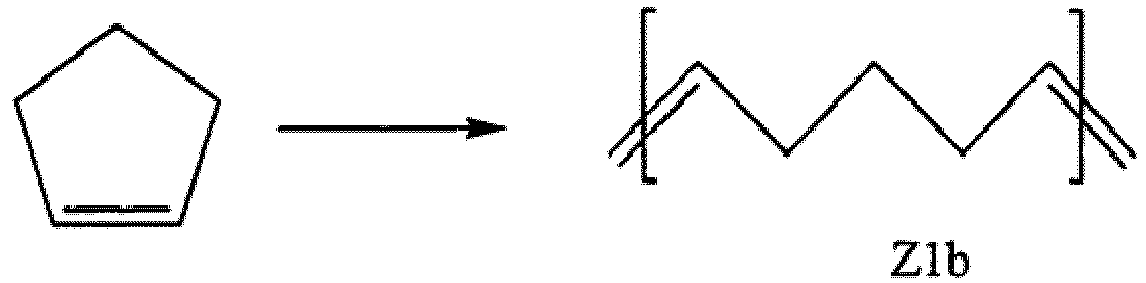
- cyclopentadiene leading to a polymer comprising monomer units of formula (Z1c) below:

- cyclohexene leading to a polymer comprising monomer units of formula (Z1d) below:

- cyclohexadiene leading to a polymer comprising monomer units of formula (Z1e) below:

- cycloheptene leading to a polymer comprising monomer units of formula (Z1f) below:

- cyclooctene leading to a polymer comprising monomer units of formula (Z1h) below:

- cyclooctapolyene, especially cycloocta-1,5-diene, leading to a polymer comprising monomer units of formula (Z1i) below:
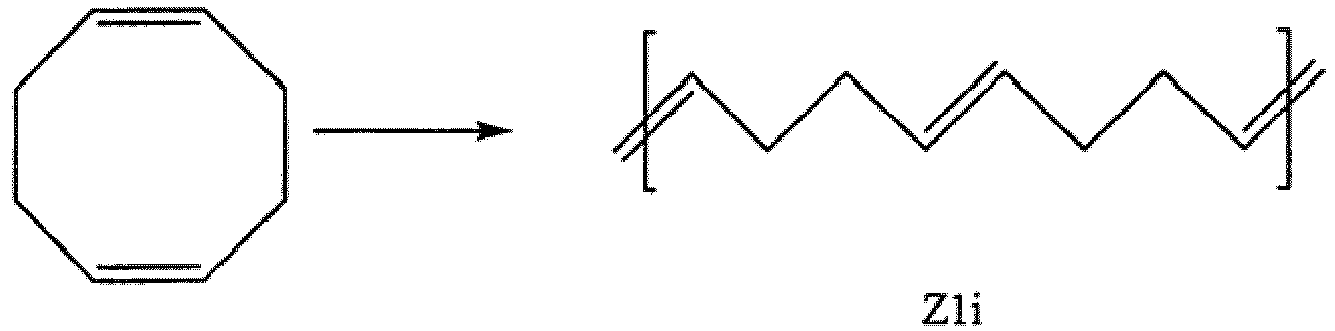
- cyclononene leading to a polymer comprising monomer units of formula (Z1j) below:

- cyclononadiene leading to a polymer comprising monomer units of formula (Z1k) below:

- cyclodecene leading to a polymer comprising monomer units of formula (Z1l) below:

- cyclodeca-1,5-diene leading to a polymer comprising monomer units of formula (Z1m) below:

- cyclododecene leading to a polymer comprising monomer units of formula (Z1n) below:

- The invention also relates to particles or biomaterials as defined above, wherein the monomer units are derived from the polymerization of polycyclic alkenes and are:
- of formula (Z2) below:
=[CH-R2-CH]= (Z2)
wherein R2 represents:- * a ring of formula

- Y represents -CH2-, or a heteroatom, or a -CHR- group , or a -CHX- group, R chain and X being as defined above,
- Y1 and Y2, independently of one another, represent H, or a chain R, or a group X, as mentioned above, or form in association with the carbon atoms bearing them a ring with 4 to 8 carbon atoms, this ring being optionally substituted by a chain R or a group X as mentioned above,
- a represents a single or double bond,
- * or a ring of formula

- Y' represents -CH2-, or a heteroatom, or a -CHR- group, or a -CHX- group, R and X being as defined above,
- Y'1 and Y'2 independently of one another represent -CH2-, or a -C(O) group, of a - COR group, or a -C-OX group, R and X being as defined above,
- * a ring of formula
- of formula (Z3) below:

- * a ring of formula

- n1 and n2, independently of one another, represent 0 or 1,
- Y" represents -CH2-, or a -CHR- group, or a -CHX- group, R and X being as defined above,
- Y"1 and Y"2 independently of one another represent a hydrocarbon chain with 0 to 10 carbon atoms,
- *or a ring of formula

or
a -CHX- group, R and X being as defined above, - * or a ring of formula

- * a ring of formula
- The invention relates more specifically to particles as defined above, wherein the polycyclic alkenes from which the monomer units are derived are:
- monomers containing a cyclobutene ring leading to a polymer comprising monomer units of formula (Z2a) below:

- monomers containing a cyclopentene ring leading to a polymer comprising monomer units of formula (Z2b) below:

- (bicyclo[2.2.1]hept-2-ene)norbornene leading to a polymer comprising monomer units of formula (Z2c) below:

- norbornadiene leading to a polymer comprising monomer units of formula (Z2d) below:

- 7-oxanorbornene leading to a polymer comprising monomer units of formula (Z2e) below:

- 7-oxanorbornadiene leading to a polymer comprising monomer units of formula (Z2f) below:

- the dimer of norbornadiene leading to a polymer comprising monomer units of formula (Z3a) below:

- dicyclopentadiene leading to a polymer comprising monomer units of formula (Z3b) below:

- tetracyclododecadiene leading to a polymer comprising monomer units of formula (Z3c) below:

- The invention relates more specifically to preferred particles or biomaterials as defined above, wherein the monocyclic or polycyclic alkenes from which the monomer units are derived are:
- norbornene (bicyclo[2.2.1]hept-2-ene) leading to a polymer comprising monomer units of formula (Z2c),
- tetracyclododecadiene leading to a polymer comprising monomer units of formula (Z3c),
- dicyclopentadiene leading to a polymer comprising monomer units of formula (Z3b), the dimer of norbornadiene leading to a polymer comprising monomer units of formula (Z3a),
- cycloocta-1,5-diene leading to a polymer comprising monomer units of formula (Z1i), preferably the monocyclic or polycyclic alkenes from which the monomer units are derived is:
- norbornene (bicyclo[2.2.1]hept-2-ene) leading to a polymer comprising monomer units of formula (Z2c).
- Advantageously the particles or biomaterials as defined above are characterized in that at least 0.5% up to 100% of the monomer units are substituted by a chain R as defined above, the said chain R being identical or different for these monomers.
- The invention relates more specifically to particles or biomaterials as defined above, characterized in that they comprise:
- between about 0.5% and 99.5% of monomer units substituted by a chain R as defined above, the said chain R being identical for these monomers, and between about 0.5% and 99.5% of monomer units substituted by a chain R as defined above, the said chain R of these monomers being different from the chain R of the preceding monomers (for instance, one chain R can comprise groups of formula (II) and the other chain R can comprise groups of formula (III)), and between 0.0% and about 99% of unsubstituted monomer units, optionally at least one of the monomer units substituted by a chain R is also substituted by a group X,
- and/or between about 0.5% and 99.5% of monomer units substituted by a chain R as defined above, the said chain R being identical or different for these monomers, and between about 0.5% and 99.5% of unsubstituted monomer units, optionally at least one of the monomer units substituted by a chain R is also substituted by a group X,
- and/or between about 0.5% and 99.5% of monomer units substituted by a group X as defined above, and between about 0.5% and 99.5% of monomer units substituted by a chain R as defined above, the said chain R being identical or different for these monomers, and between 0.0% and about 99.0% of unsubstituted monomer units,
- the total of the percentages of the monomers mentioned above being 100%.
- According to a specific embodiment, when particles of the invention are formed by polymer chains with p+q is 0 exclusively, then at least one of said polymer chains presents a R chain comprising a polyethyleneglycol-polyglycidol chain of formula (I) where R' is -CONHAb1 as defined above. This embodiment includes for instance particles where a polymer chain comprises at least one of the monomer units substituted by a chain R comprising a polyethyleneglycol-polyglycidol chain of formula (1) where p+q is 0 with R'=CH2CNAb2, then another polymer chain of said particles may comprise monomer units substituted by a chain R of formula (I) where p+q is different from 0 or monomer units substituted by a chain R of formula (I) where p+q is 0 and R' is CONHAb1.
- The invention relates more specifically to particles or biomaterials as defined above, wherein the chain or chains R substituting the monomers are represented by the formula (I) as defined above, more specifically wherein at least one, or all (if compatible), of the following specific embodiments are fulfilled:
- n+p+q is from 10 to 100; and/or
- n is from 35 to 70, more specifically n is from 40 to 60 (e.g. n=45); and/or
- either p or q is from 1 to 300.
- According to the invention, the term "p moiety" represents the glycidol moiety in the parenthesis of formula (1) where p is the number of said units.
- According to the invention, the term "q moiety" represents the glycidol moiety in the parenthesis of formula (1) where q is the number of said units.
- According to the invention, when p+q is not zero, at least one of the p or q moieties comprises the formula (II) or (III) respectively, this embodiment includes polymer particles where Ab1 or Ab2 is present, preferably Ab2 is present, more preferably gentamicin, or both Ab1 and Ab2 are present. When both Ab1 and Ab2 are present, this entails that at least two different R chains are present in the polymer particles of the invention, ones with Ab1 and other ones with Ab2.
- According to a specific embodiment, the particles or biomaterials are as defined above, wherein the chain of formula (I) is of the following formula:

- According to another specific embodiment, the particles or biomaterials are as defined above, wherein R' in formula (I) is an hydrogen atom.
- According to another specific embodiment, the particles or biomaterials are as defined above, wherein R' in formula (I) is an hydrogen atom and q is 0.According to another specific embodiment, the particles or biomaterials are as defined above, wherein R' in formula (1) is an hydrogen atom and p is 0.
- Such particles or materials are especially advantageous since they permit a controlled action of the antibiotics, e.g. vancomycin and/or gentamicin, in an effective amount to prevent and/or alleviate infectious processes which may occur for instance during surgery of the implants or later on.
- Where B represents a group of the following formula (III), the particles according to the invention are stimulable particles, that is to say they are sensitive to a stimulus such as a variation in pH, which then allows the release of the antibiotics Ab2 (such as gentamycin) bonded onto these particles.
- The biomaterials according to the invention as defined above are advantageously materials wherein the support material is chosen from:
- metals or oxides thereof, preferably titanium or TiO2,
- metal alloys, in particular alloys with or without shape memory such as Ni-Ti alloys, Ti-6Al-4V alloys,
- polymers, such as polyethylene terephthalate (PET), polytetrafluoroethylene (PTFE), polyvinylidine fluoride (PVDF), polyether etherketone (PEEK), polycarbonate-urethane (PCU), polyhydroxyethylmethacrylate (PHEMA), polymethylmethacrylate (PMMA), poluethylmethacrylate (PEMA), poly(4-hydroxystyrene),
- copolymers, such as the copolymer ethylene vinyl acetate (EVA), the copolymer vinylidene fluoride-hexafluoropropylene P(VDF-HFP), poly(lactic acid)-co-poly(glycolic acid) (PLA-PGA), copolymers of polymethylmethacrylate (PMMA) and poluethylmethacrylate (PEMA),
- ceramics, such as hydroxyapatites, or compounds of hydroxyapatites and tricalcium phosphate in varied proportions, in particular in the
proportions 50/50. - The invention also relates to biomaterials as defined above, wherein the reactive function situated on the support material in order to ensure the covalent bond between the said material and the said particles by reacting the reactive function of these latter of the OH, halogen, NH2, C(O)X1 type, wherein X1 represents a hydrogen atom, a halogen atom, an OR" or NHR" group, wherein R" represents a hydrogen atom or an alkyl group, with a reactive function of the material in order to form a bond of the -O-C(O)-, -NH-C(O)-, -C(O)-NH-, -C(O)O- or -C(OC)2 type, or a type of bond that can be obtained by click chemistry (bioorthogonal reaction), such as via azide/cycloalkyne reaction, chloro-oxime/norbornene reaction, tetrazine/cycloctene reaction, thiol/alkene reaction, thiol/maleimide reaction, or tetrazole/alkene reaction.
- The invention relates more particularly to biomaterials as defined above, wherein the reactive function of the support material is situated on an alkyl chain having about 1 to 10 carbon atoms grafted on said material, substituted or unsubstituted, and optionally comprising one or several heteroatoms, in particular O and/or Si, in said chain.
- The invention relates more particularly to biomaterials as defined above, wherein:
- the reactive function of the material is an NH2 function situated on an aminopropyltriethoxysilane (APTES) molecule grafted on the material (M) according to the following formulae:


- the reactive function of the material is an NH2 function situated on a surface which is coupled to COOH groups present onto particles, using for instance NHS/DCC (i.e., N-hydroxysuccinimide/Dicyclohexylcarbodiimide).
- The antibiotics used in the invention are more specifically the following:
- the antibiotics with extracellular action (Ab1) are generally those that target the bacterial cell wall (such as penicillins and cephalosporins) or the cell membrane (such as polymyxins),
- the antibiotics with intracellular action (Ab2) are generally those that interfere with essential bacterial enzymes (such as rifamycins, lipiarmycins, quinolones, and sulfonamides) or those that target protein synthesis (such as macrolides, lincosamides and tetracyclines).
- Among the antibiotics Ab1, one can cite the following classes: cephalosporins, including those from first to the fifth generations, such as cefalexin, cefuroxim, ceftriaxone, cefepime, ceftobiprole; carbacephem, such as Loracarbef; carbapenems, such as imipenem; glycopeptides, such as vancomycin, teicoplanin or ramoplanin; lipopeptides, such as daptomycin; monobactams, such as aztreonam; penicillins, such as amoxicillin; or polymyxins, such as polymyxin B.
- According to a specific embodiment, Ab1 is a glycopeptide, preferably vancomycin or a salt thereof (such as hydrochloride).
- Among the antibiotics Ab2, one can cite the following classes: aminoglycosides, including gentamicin, neomycin, and streptomycin; anzamycins, such as rifaximin; lincosamides, such as clindamycin; macrolides, such as azithromycin; nitrofuranes, such as furazolidone; oxazolidinones, such as linezolid; quinolones or fluoroquinolones, such as nalidixic acid, ofloxacin, ciprofloxacin, or levofloxacin; sulfonamides, such as sulfacetamide, furosemide; tetracyclines, such as doxycycline. According to a specific embodiment, Ab2 is an aminoglycoside, preferably gentamicin or any salt thereof (such gentamicin sulfate).
- The polymer particles and biomaterials, according to a particular embodiment of the invention, comprise vancomycin and/or gentamicin, or any salt thereof (such as gentamicin sulfate)
- The invention also relates to the use of biomaterials as defined above for the preparation of implantable medical devices, in particular in the form of implants, prostheses, stents, lenses or cements, in particular in vascular, endovascular or bone surgery or treatment.
- The invention also relates to medical devices, more specifically implants, prostheses, stents or cements as well as any pharmaceutical composition, comprising biomaterials as defined above. It can be for instance ocular lenses, dental, ligament, valve or bone prostheses, implants, stents or cements.
- The invention also relates to a pharmaceutical composition comprising particles or biomaterials as defined above, wherein said particles or biomaterials comprise antibiotics Ab1 and/or Ab2, preferably vancomycin or/and gentamicin, or any salt thereof, optionally in association with a pharmaceutically acceptable carrier, in particular for use in parenteral form.
- The polymer particles, biomaterials, implants, prostheses, stents or cements as well as the pharmaceutical composition according to the invention are useful as medicines, they are more particularly for a use in the treatment of bacterial infections.
- The invention also relates to a method of preparation of particles as defined above, wherein it comprises a step of polymerization of a monocyclic or polycyclic alkene as defined above substituted by a chain R as defined above, optionally in the presence of:
- one or several monocyclic or polycyclic alkenes as defined above, identical to or different from the foregoing, and substituted by a chain R as defined above, the said chain R being different from that substituting the aforementioned monocyclic or polycyclic alkene (for instance, one chain R can comprise groups of formula (II) -with antibiotic Ab1- and the other chain R can comprise groups of formula (III) -with antibiotic Ab2),
- and/or one or several monocyclic or polycyclic alkenes as defined above, identical to or different from the foregoing, and substituted by a group X as defined above,
- and/or one or several monocyclic or polycyclic alkenes as defined above, identical to or different from the foregoing, the said alkenes being unsubstituted,
- The polymerization step is preferably a ROMP reaction (Ring-opening metathesis polymerization), which can implement a wide variety of metals and range from a simple RuCl3/alcohol mixture to Grubbs' catalyst.
- The preparation of the particles is carried out in one step and allows the antibiotics comprised therein to be effective and/or particles having efficient kinetics of release of antibiotics depending on the envisioned uses thereof.
- The invention also relates to a method of preparation of biomaterials as defined above, wherein it comprises the step as defined above, followed by a step of fixing said particles obtained in the previous step on a support material as defined above by placing the said particles in the presence of the said material, this latter having been optionally functionalized with a reactive function as defined above capable of ensuring the covalent bond between the said material and the said particles by reacting with the reactive function of the said particles.
- The use of the particles makes it possible to introduce several chemical functions and antibiotics easily on the surface of the biomaterial.
- Schematically, the production of the proposed device can be divided into three distinct steps:
- 1-The functionalization of the biomaterial
- 2-The synthesis of the bioactive particles (as described above)
- 3-The fixing of the particles on the biomaterial (as described above)
- In terms of materials, the development of a bioactive prosthesis necessitates control of the interfaces between materials and molecules or between materials and biomolecules.
- Grafting is a technique which allows one or several molecules chosen for their specific properties to be fixed by covalent bonding to the surface of any type of material. The technique of functionalization can be carried out under anhydrous conditions with controlled atmosphere, temperature and pressure, which enables perfect control of the grafting conditions. In an alternative embodiment, the technique can be carried out in an aqueous solution. The technique employed comprises a modification of the functionality at the surface of the biomaterial in order to render it more reactive. Said technique is known to one skilled in the art.
- The invention also relates to monocyclic or polycyclic alkenes substituted by a chain R or a group X as defined above.
- The preferred monocyclic or polycyclic alkenes as defined above are chosen from amongst those mentioned above.
- The invention also relates to a monocyclic or polycyclic alkene based macromonomer of formula (IV):

n represents an integer from about 0 to 300, especially from 10 to 100, p represents an integer from about 0 to 300, q represents an integer from about 0 to 300, with n+p+q is from about 10 to 300,
A represents a hydrogen atom or a group of the following formula (II): - -CONHAb1, where Ab1 represents an antibiotic with extracellular action,
- -CH2CNAb2, wherein Ab2 represents an antibiotic with intracellular action,
- R' represents a hydrogen atom, -CH2CNAb2 or -CONHAb1 as defined above, with the proviso that when p is different from 0, then q is 0 and R' represents a hydrogen atom or -CONHAb1, when q is different from 0, then p is 0 and R' represents a hydrogen atom or -CONHAb2, when p+q is not zero, at least one of the p or q moieties comprises the formula (II) or (III) respectively, and when p+q is 0, then R' can be -CONHAb1 only,
- Z represents a monocyclic or polycyclic alkene to which the polyethyleneglycol-polyglycidol chain is attached, optionally substituted by a group X, wherein X represents an alkyl or alkoxy chain with about 1 to 500 carbon atoms, preferably 40 to 400 carbon atoms, comprising a reactive function of the OH, halogen, NH2, C(O)X1 type, wherein X1 represents a hydrogen atom, a halogen atom, an OR" or NHR"group, in which R" represents a hydrogen atom or an alkyl group.
- The specific or particular embodiments relative to the particles or materials described above are also included (when applicable) for the monocyclic or polycyclic alkene based macromonomers as defined by formula (IV). More specifically, Z of formula (IV) can be Z1 or Z2, as defined above.
- The invention relates more particularly to monocyclic or polycyclic alkenes based macromonomers as defined above, characterized by the following formula (V):

- In a particular embodiment, the cyclic alkenes are selected from norbornene, tetracyclododecadiene, dicyclopentadiene, the dimer of norbornadiene, and cycloocta-1,5-diene. In a specific embodiment, the cyclic alkene is norbornene, as defined above.
- The invention also relates to the use of monocyclic or polycyclic alkenes based macromonomer as defined above for carrying out a method of preparation of particles or biomaterials defined above, especially by the methods described above.
- The invention further relates to particles or biomaterials as defined above wherein the monocyclic or polycyclic alkenes based macromonomers are as defined above specifically.
- The invention will now be illustrated by the following examples. They are not intended to be limiting. The percentages are expressed by weight, unless otherwise specified.
- Material: Ethylene oxide (EO; 99.5%; Aldrich) was stirred over sodium at -30°C for 2 hours and subsequently cryodistilled. Tetrahydrofuran (THF; J.T. Baker) was cryodistilled from sodium benzophenone before use. Ethanol (96%; purissimum grade pur; Xilab) and dichloromethane (purissimum grade pur, Xilab) were degassed before use. Diphenyl methyl potassium (DPMK; 0.64 mol.L-1 in THF) was synthesized and dosed according to well-established procedures. Sodium hydride (60% in dispersion in mineral oil; Aldrich) was washed with anhydrous heptane before use. Grubbs first generation complex Ch-(PCy3)2Ru=CH-Ph (Aldrich; stored in a glovebox under Argon atmosphere) was used as received. Norbornene (Nb) (99% (GC); Aldrich), 5-norbornene-2-methanol (98%; mixture of endo and exo; Aldrich), bromoacetaldehyde diethyl acetal (97%; Aldrich), 2-bromoethyl acetate (97%; Aldrich), Gentamicin Sulphate (GS; C1, C1a, C2 mixture; Aldrich), were used without further purification. Titanium discs (Ti90Al6V4; Ø=5 mm; h=3 mm; Ra=5-6 µm) were purchased from Good Fellow, France. Anhydrous hexane (99%), anhydrous N-N-dimethylformamide (DMF; 99.8%), dicyclohexylcarbodiimide (DCC; 99%), 3-aminopropyltriethoxysilane (APTES; ABCR; 97%) was obtained from ABCR, France. N-hydroxysuccinimide (NHS; 98%) was purchased from Alfa Aesar, France. Vancomycin hydrochloride was purchased from Aldrich. 4-Dimethylaminopyridine (DMAP, 99%) and disuccinimidyl carbonate (DSC; 98%) were obtained from Acros, France.
- Methods: ROMP (Ring-Opening Metathesis Polymerization) was performed in a glovebox. 1H NMR spectra were obtained using a
Bruker spectrometer 400 MHz in CDCl3, D2O or DMSO-d6 used as solvent. Size exclusion chromatography analyses were carried out on a Varian apparatus equipped with TOSOHAAS TSK gel columns and a refractive index detector. THF or DMF were used as solvents at a flow rate of 1 mL.min-1. Mass calibration was achieved with narrow polydispersity polystyrene standards. For ROMP in dispersion, conversions of Nb were determined by gas chromatography with a trace of dodecane as internal standard, using a VARIAN GC3900 (GC retention times: tGC Nb = 1.77 min; tGC dodecane = 8.55 min). The PEO-based macromonomer conversions were followed by SEC (SEC retention times: tSEC macromonomers = 18.75 min;.tSEC dodecane = 31.70 min), while the PGLD-based macromonomer conversions were determined by elemental analysis after the particle dispersion purification by ultrafiltration and lyophilisation of the particles and also by gravimetry after ultracentrifugation (Eppendorf centrifuge 5804R ; 8000 rpm ; 5 min ; 10°C) and drying under vacuum. Dynamic light scattering (DLS) measurements were performed using a MALVERN zetasizer Nano ZS equipped with He-Ne laser (4 mW; 633 nm). Before measurements, latexes were diluted about 800 times to minimize multiple scatterings caused by high concentration. The scattering angle used was 173°. TEM pictures were performed with a HITACHI H7650 microscope operating at an accelerating voltage of 80 kV. For the particles size, distribution and morphology observation, samples diluted about 800 times were deposited on a 200 mesh carbon film-coated copper grids surface. The particle grafting density was characterized by SEM observations using a HITACHI S-2500 scanning electron microscope. -

- Tosylic acid (TsOH, 1 g) was added portion-wise to a magnetically stirred solution of 40.0 g of 2,3-epoxypropanol (glycidol) in 200 mL of ethyl vinyl ether. The temperature was maintained below 40°C with an ice-water bath. The reaction mixture was stirred for 3 hours. Then, the reaction mixture was washed with 100 mL of NaHCO3 saturated water solution, the organic phase was dried with MgSO4, filtrated, and the solvent (ethyl vinyl ether) was evaporated under reduced pressure. The product was purified by distillation under reduced pressure.
Yield: 71%
1H NMR data in CDCl3: δ (ppm) 0.8-1.2 (m ; 6H ; -CH3) ; 2.4-2.7 (m ; 2H CH2 acetal) ; 3.05 (m ; 1H ; CH glycidol) ; 3.3-3.9 (m ; 4H ; CH2 glycidol) ; 4.85 (t; 1H ; CH acetal) -

- For a macromonomer with a number-average polymerization degree (DPn) of 12, 0.44 mL of the initiator 5-norbornene-2-methanol was added to 200 mL of freshly cryodistilled THF, following by the addition of 4.5 mL of DPMK solution (0.64 mol.L-1 in THF). Then, Glycidol acetal, (6.55 mL) was added to the reaction medium. For a full conversion, the reaction was left stirring for approximately 24 hours at 65°C. 5-7 drops of degassed acidified methanol were added to the reaction mixture to desactivate the polymerization. After a 2-3 days dialysis in ethanol, the solution was filtered and the solvent was removed by rotary evaporation and the macromonomer was dried under vacuum.
Yield: 67%
1H NMR data in CDCl3: δ (ppm) (400 MHz): 1.12-1.95 (80H, -CH3); 2.35-2.45 (3H, - CH-cycle); 3.49-3.99 (96H, -O-CH-CH2-O- and CH-CH2-OAc); 4.71 (13H ; CH) 6.00-6.28 (2H ; -CH=CH-cycle) -
DPn;Th 1 DPn;NMR 2 Mn;NMR (g.mol-1) 3 Mn;SEC (g.mol-1) 4 PDI 5 13 12 1910 1630 1.06 27 25 3830 3710 1.06 54 50 7440 7630 1.09 1 DPn;Th=nmono/nNbOH with nmono the initial amount of monomer and nNbOH the initial amount of norbornene methanol.
2 DPn;NMR=2ICH/INb with INb: integration of the ethylenic protons of the norbornenyl entity, ICH: integration of the CH proton of the acetal entity
3 Mn;NMR=MNb+146DPn;NMR MNb molecular weight of the norbornenyl entity, 146: molecular weight of the glycidol acetal unit.
4 molecular weight measured by Size Exclusion Chromatography
5 PDI: Polydispersity index -

- The α-norbornenyl-poly(glycidol acetal) macromonomer (1.65 g ; DPn=50 ; Mn=7440 g/mol) was dissolved in 75 mL of a mixture of N,N-dimethylformamide (DMF)/acetone (1:4 v/v), and 4.5 mL of concentrated hydrochloric acid (HCl) solution (11.7 mol.L-1) were added. The reaction was stirred for 1 hour, and then a saturated Na2CO3 aqueous solution was added to neutralize HCl until pH=8 (monitored with pH paper). The solvent was evaporated under reduced pressure and the macromonomer was redissolved in 50 mL of ethanol and filtrated to remove residual salts. Then, ethanol was evaporated, and the macromonomer was redissolved in 50 mL of water. Purification of the sample was carried out by a 2-3 days dialysis in water, then the macromonomer was lyophilized.
- Yield: 85%
- 1H NMR data in D2O: δ (ppm) (400 MHz): 1.12-1.95 (m, 4H, -CH2-cycle); 2.35-2.45 (m, 3H, -CH-cycle); 3.49-3.99 (2m, 125H, -O-CH-CH2-O- and CH-CH2-OH); 6.00-6.28 (-CH=CH-cycle)
DPn;NMR=53; Mn:NMR=3900 g/mol - SEC in DMF: Mn=4000 g.mol-1; PDI=1.15
-

- α-norbornene-poly(glycidol acetal) macromonomer (1.65 g) was added to a 75 mL solution of N,N-dimethylformamide (DMF)/acetone (1:4 v/v). Then, 0.64 mL of concentrated hydrochloric acid (HCl) solution (11.7 mol/L) were added. The reaction was stirred for 4 min, then a saturated Na2CO3 aqueous solution was added to neutralize the HCl until pH=8 (monitored with pH paper). The solvent was evaporated and the product was dissolved in ethanol. The residual salts were removed by filtration. After a 2-3 days dialysis, the product was lyophilized.
Yield: 72% for DPn=12 (1); 89% for DPn=25 (2)
SEC in THF: (1): Mn=1270 g.mol-1 ; PDI=1.08. (1): Mn=2570 g.mol-1 ; PDI=1.08 -

- In a typical experiment, 1 g of partially deprotected α-norbornenyl-poly(glycidol acetal) macromonomer was dissolved in 30 mL of freshly cryodistilled THF. 10 equivalents of NaH (M=24 g/mol; dispersed in mineral oil 60% (w/w)), previously washed with heptane to remove the mineral oil, were dispersed in 10 mL of THF. The macromonomer solution was added dropwise to NaH under stirring and under a nitrogen flux. After 30 min, 4.5 equivalents of bromoacetaldehyde diethyl acetal (M=197 g.mol-1; d=1.31) were added dropwise. The reaction mixture was stirred for 12 hours at 60°C. NaH was then neutralized with a 1 N HCl solution and the solution mixture was evaporated, redissolved in CH2Cl2, dried with MgSO4 and filtrated. Finally, CH2Cl2 was evaporated and the product was dried under vacuum.
Yield: 72% for DPn=12 (1); 89% for DPn=25 (2)
SEC in THF: (1): Mn=1270 g.mol-1 ; PDI=1.08. (1): Mn=2570 g.mol-1 ; PDI=1.08 -

- Acetal functionalized polyglycidol macromonomer (0.4 g) was dissolved in 18 mL of DMF/Acetone (1:4 v/v) and 1.1 mL of concentrated HCl (11.7 N) was added dropwise. The mixture was stirring for 6 hours at room temperature. Then the solution was basified by adding dropwise a solution of triethylamine (TEA) (1 M) dissolved in the solvent medium under nitrogen flux (pH=10). Finally, GS (5 eq.) dissolved in 10 mL of buffer solution pH=12 was added dropwise. After 12 hours, the solvent was evaporated and the product was purified by a 3-days dialysis in a
TEA solution 10 mM (pH=10.5).
Mn;NMR=2710 g/mol for DPn=12 (1) and Mn;NMR=5890 g/mol for DPn=25 (2).
- SEC in DMF: (1): Mn=1980 g.mol-1; PDI=1.27. (2): Mn=3420 g.mol-1 ; PDI=1.32 -

- Dispersion polymerizations were carried out at room temperature under inert atmosphere (glovebox) and under stirring. Solvents were degassed according to the freeze-pump-thaw procedure. In a typical experiment, 10 mg (3.6 10-5 mol) of
Grubbs 1st generation complex were dissolved in 3.3 mL of dichloromethane/ethanol mixture (1:1 v/v). Both norbornene (201 mg; 6.18 10-3 mol) and α-norbornenyl-polyglycidol macromonomer (241 mg; 3.24 10-5 mol) were first dissolved in 6 mL of dichlomethane/ethanol solution (35:65 v/v) and added to the catalyst. 206 mg of dodecane is also added as internal standard. The mixture was stirred during 24 hours. The desactivation of the reaction medium was performed by addition of 0.3 mL of ethyl vinyl ether. - Nb conversion by GC: πNb>99%.
- Macromonomer conversion by gravimetric analysis: first 5 mL of dispersion was ultra-centrifuged (8000 rpm; 10°C; for 5 min), then the solid phase (mf sol=198.9 mg; PNb-PGLD) and the liquid phase (mf liq=144.4mg; dodecane, desactivated Grubbs I catalyst and unreacted PGLD) were dried under vacuum. These weights were compared with the theoretical weights determined by considering the introduced products before the reaction (norbornene and PGLD; mth sol=229 mg; mth liq=112 mg). The macromonomer conversion can be calculated with the following equation:

- πPGLD : macromonomer conversion
- mi Nb : initial weight of the Nb monomer
- mi PGLD : initial weight of the PGLD macromonomer
- Macromonomer conversion by elemental analysis: first, the particles were transferred in water and purify by ultrafiltration, then the dispersion was lyophilized. Elemental analysis: Measured: (mol%) C: 33.19; H: 58.03; O: 8.78. Theoretical values for a total conversion: (mol. %) C: 34.18; H: 56.57; O: 9.25.
The macromonomer conversion can be calculated by considering the elemental analysis and the polymer formula (C7H10)n-(C8H12O(C3H6O2)DPn)m, the initial proportions and a total conversion of Nb: πPGLD=94%. - particle size measurement by DLS are presented on
Figure 1 : -

- 10 mg (3.6 10-5 mol) of
Grubbs 1st generation complex were dissolved in 3.3 mL of dichloromethane/ethanol mixture (1:1 v/v). Both norbornene (201 mg; 2.14 10-3 mol) and GS-functionalized α-norbornenyl polyglycidol macromonomer (241 mg; Mn=3420 g/mol; 7.05 10-5 g/mol) were first dissolved in 6 mL of dichlomethane/ethanol solution (35:65 v/v) and added to the catalyst. 206 mg of dodecane is also added as internal standard. The mixture was stirred during 24 hours. The desactivation of the reaction medium was performed by addition of 0.3 mL of ethyl vinyl ether. - Nb conversion by GC: πNb=80%
- Macromonomer conversion by gravimetric analysis: Macromonomer conversion πPGLD was determined thanks to a gravimetric analysis. After ultracentrifugation the solid phase (mf sol=197.7 mg; PNb-PGLD was dried under vacuum. This weight was compared with the theoretical weight determined by considering the introduced products before the reaction (Nb; macromonomer) and a Nb conversion of 80% (mth sol=324.8 mg). The calculated macromonomer conversion is 45%.

- Macromonomer conversion by elemental analysis: first, the particles were transferred in water and purify by ultrafiltration, then the dispersion was lyophilized. Elemental analysis: Measured: (mol%): C: 30.51 ; H: 63.68 ; N: 0.63 ; O: 5.18. Theoretical values for a total conversion (mol%): C: 34.06 ; H: 57.22 ; N: 2.28; O: 6.44.
- Elemental analysis measured values were compared with the theoretical ones calculated from the initial state and considering a conversion of 80% for Nb and a total conversion for the macromonomer. A macromonomer conversion of 41% was determined, close to the macromonomer conversion calculated by gravimetric analysis.
- SEC in THF: Mn=97300 g/mol (styrene eq) PDI=1.59
- Size measurement: The DLS analysis of the dispersion showed the presence of big objects with diameters of about 5-6 µm in the ethanol/dichloromethane solvent mixture and with diameters of 2-3 µm in water after their transfer and an ultrafiltration purification step. The GS loading is about 20 106 molecules per particle versus 3 106 molecules per particle with the PEO based particles.
-
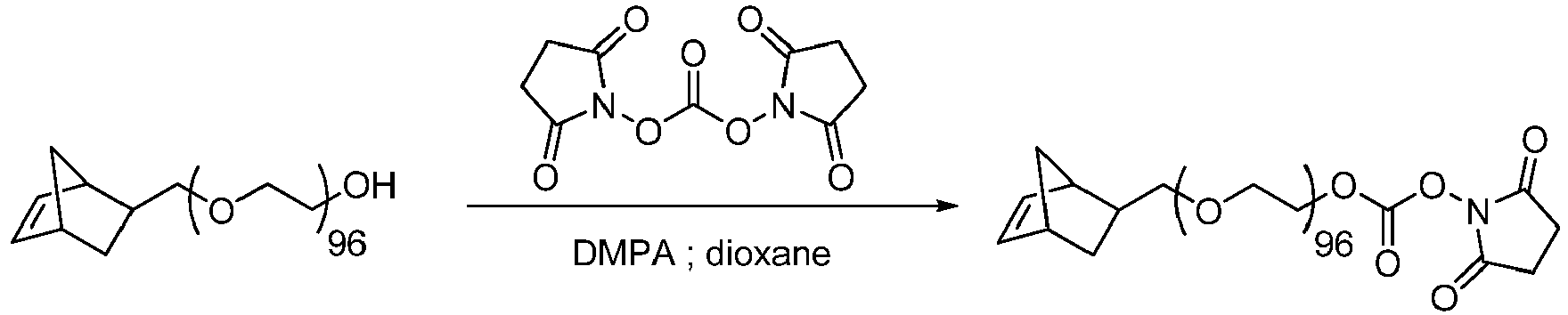
- In a typical experiment, 5g of a-norbornenyl-poly(ethylene oxide) macromonomer (Mn=4300 g/mol; 1.16 mmol) was dissolved in 25 mL of dry dioxane and then DSC (9 mmol in 20 mL of dry acetone) was added. DMAP (9 mmol in 15 mL of dry acetone) was added slowly under magnetic stirring and the reaction was carried out at room temperature for 6 h. Nb-PEO-SC was directly precipitated from the reaction mixture by diethyl ether and then several cycles of redissolving of the product in acetone and precipitation in diethyl ether were carried out in order to remove excess DSC and DMAP. The activated product was stored dry in a glovebox.
Yield: 75%
1H NMR (CDCl3, 400 MHz): δ (ppm) Norbornenyl moiety, 5.85-6.04, 3.30, 3.11, 3.00, 2.84, 2.68-2.72, 2.25, 1.74, 1.62, 1.04-1.40, 0.41; EO moiety, 4.40, 3.40-3.80; Succinimidyl moiety, 2.77
Mn;NMR=4300 g/mol
functionalization: F>99% - SEC in THF: Mn;SEC=3900 g/mol (styrene eq) PDI=1.08
-

- To a solution of vancomycin (0.2235 g, 0.15 mmol) and triethylamine (TEA, 0.4 mL, 3.0 mmol) in anhydrous dimethylformamide (DMF, 10 mL) was added a solution of Nb-PEO-SC (0.3 g, 0.075 mmol) in anhydrous DMF (10 mL) and 2.235 g molecular sieves (4 Å). The reaction mixture was stirred at 30 °C for 12 hrs, filtered through celite, and the solid product was obtained by precipitation with diethyl ether, filtered, and dried. The product was purified by ultrafiltration using deionized H2O as the solvent and a regenerated cellulose membrane (5 K Daltons) to separate the product from unreacted vancomycin. The retained fraction was frozen with liquid nitrogen and lyophilized for 48 hrs.
- Yield: 88%
1H NMR (DMSO-d6 , 400 MHz): δ (ppm) Norbornenyl moiety, 5.85-6.04, 3.30, 3.11, 3.00, 2.84, 2.68-2.72, 2.25, 1.74, 1.62, 1.04-1.40, 0.41; EO moiety, 3.40-3.80; Vancomycin moiety, 6.44-7.66, 5.29-5.49, 4.06-4.47, 3.41-3.75 (overlapped by EO moiety peak), 2.73, 1.11-2.02, 0.84.
Mn;NMR=5100 g/mol
functionalization: F>99% - SEC in DMF: Mn=8000 g/mol (styrene eq.) PDI=1.13
-
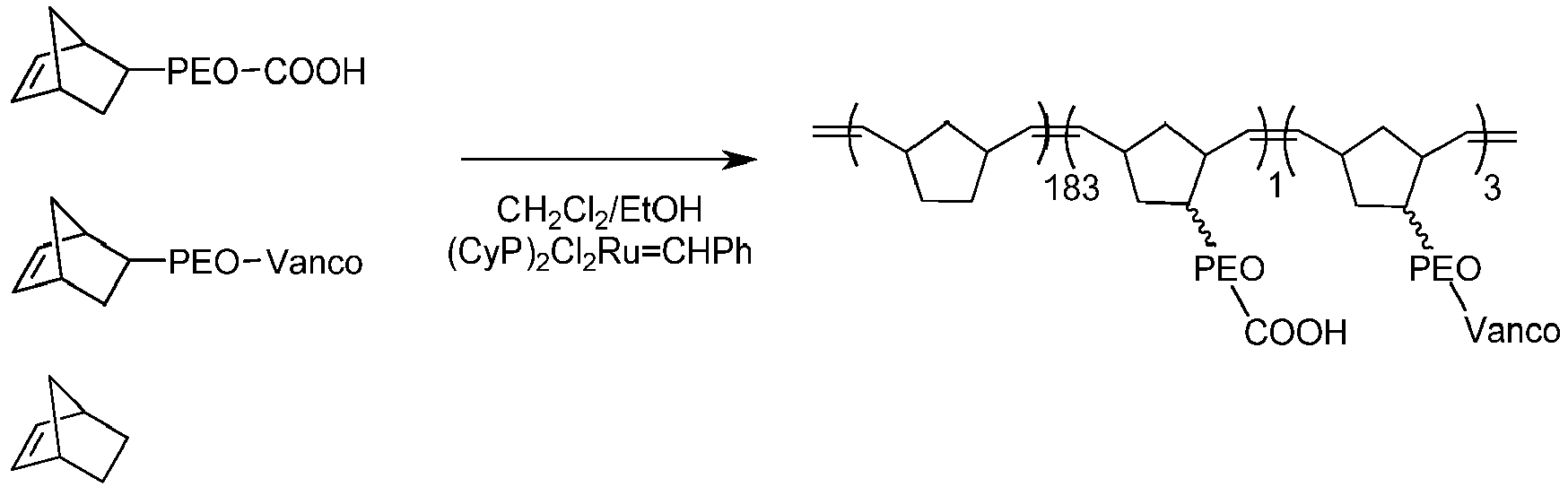
- Functionalized particles were formed by ROMP in dispersion. Dispersion polymerizations were carried out at room temperature under inert atmosphere (glovebox) and stirring. Solvents were degassed according to the freeze-pump-thaw procedure. In a typical synthesis, 30 mg (3.6 10-5 mol) of
Grubbs 1st generation complex were dissolved in 10 mL of dichloromethane/ethanol mixture (50/50% vs volume). Norbornene (6.1 10-3 mol), α-norbornenyl-ω-carboxylic acid-poly(ethylene oxide) macromonomer (3.7 10-5 mol) and α-norbornenyl-ω-vancomycin-poly(ethylene oxide) macromonomer (1.1 10-4 mol) were first dissolved in 18 mL of dichlomethane/ethanol solution (35/65% V/V) and added to theGrubbs 1 solution. The mixture was stirred during 24 hours. At the end of polymerization Ruthenium end-capped chains were deactivated by addition of 0.3 mL of ethyl vinyl ether. Then, the particles were transferred to DMF to carry out the grafting step onto titanium surfaces: first DMF was added drop wise, then dichloromethane and ethanol were evaporated under reduced pressure. - Norbornene conversion: >99%
- Global macromonomer conversion: 90%
- Distribution profiles of the particle size functionalized with carboxylic acid groups and Vancomycin : measurement by DLS given in
Figure 2 -

- The particle grafting step was a two-step process: first, titanium surfaces were functionalized with anime groups using APTES through a well established protocol: Briefly, titanium samples were first outgassed at 150°C under vacuum (10-5 Torr) for 20 h. Silanization of the surface was performed by immersing the substrate in a solution of APTES (10-2 M) in anhydrous hexane under inert atmosphere (glovebox) during 2 h. Samples were washed in glovebox by two rinsings under stirring and sonication for 30 min (both steps have been performed using anhydrous hexane). Finally, samples were outgassed at 100°C under vacuum (10-5 Torr) for 4 h. Next, the particles were covalently linked onto the titanium surface through the formation of an amide bond between the carboxylic acid groups of the particles and the amine groups present onto the surfaces (activated by NHS and DCC). In inert atmosphere (glovebox), DCC (237 mg, 82 eq.; 1.1 10-3 mol) and NHS (100 mg, 62 eq.; 8.7 10-4 mol) were diluted in 2 mL of particle dispersed in DMF (n-COOH=1.5 10-5 mol). Finally, the mixture was deposited on titanium materials and stirred for 72 h at room temperature. The samples were then washed in three successive ethanol baths, dried and stored under inert atmosphere. The grafting step was carried out three times. Between two successive steps, the materials were rinsed in ethanol baths.
- SEM observation of the titanium surface after grafting of particles functionalized with carboxylic acid groups and Vancomycin is presented on
Figure 3 . -

- α-norbornenyl poly(ethylene oxide) was prepared by anionic ring-opening polymerization of ethylene oxide. 1.1 mL of norbornene methanol (1 eq.; 9.35 10-3 mol) were dissolved in 200 mL of THF previously cryodistilled. 11.7 mL of DPMK (0.8 eq.; 0.64 mol.L-1) are added. Then 21 mL (45 eq.; 0.421 mol) of ethylene oxide stirred over sodium and cryodistilled were promptly added. The mixture was stirred during 48 hours under vacuum at room temperature, and the anionic active centres were neutralized with 5 mL of acidic methanol. The polymer was precipitated in anhydrous diethyl ether, filtered, dissolved in dichloromethane, dried with MgSO4, filtered on celite, concentrated, precipitated in diethyl ether, filtered and dried under vacuum.
- 50% yield
- 1H NMR data in CDCl3: δ (ppm) = 1.08-1.79 (m, 4H, -CH2-cycle); 2.72-3.45 (m, 3H,
- CH-cycle); 3.63 (m, 164H, -CH2-O-); 5.91-6.09 (m, 2H, -CH=CH-cycle)
DPn;NMR=41 ; Mn;NMR=1930 g/mol - SEC in THF: Mn;SEC=2240 g/mol (styrene eq) PDI=1.09
-

- 8 g of α-norbornenyl poly(ethylene oxide) (1 eq; Mn=1930 g/mol; 4.14 10-3 mol) were dissolved in 200 mL of freshly cryodistilled THF. Then, 5.2 mL of DPMK (0.8 eq; 0.64 mol/L) were added. Finally, 18 mL (30 eq.; 0.124 mol) of glycidol acetal are promptly added. The mixture was stirred during 48 hours under vacuum at 65°C, and the anionic active centres were neutralized with 5 mL of acidic methanol. The solvent was evaporated, the polymer was dissolved in dichloromethane, dried with MgSO4, filtered on celite. The dichloromethane was evaporated. The polymer was dried under vacuum and lyophilized overnight in dioxane.
- 99% yield
- 1H NMR data in CDCl3: δ (ppm) = 1.1-1.5 (d, 278H, -CH3); 2.72-3.45 (m, 3H, -CH-cycle); 3.5-3.7 (m, 586H, -CH2-O-, -CH-O-); 4.75 (s, 45H, -CH-); 5.91-6.09 (m, 2H, - CH=CH-cycle)
DPn;PEO= 41; DPn;PGLDAc= 45; Mn;NMR=8500g/mol - SEC in THF: Mn=5930 g/mol (styrene eq) PDI=1.07
-

- 5 g of a-norbornenyl poly(ethylene oxide)-bloc-poly(glycidol actetal) were dissolved in 150 mL of THF. Then, 6.4 mL of HCl 37% were added. The reaction mixture was stirred during 1H at room temperature. Then, the solution was neutralized by adding NaHCO3 saturated water solution. The solvent was evaporated; the polymer was dissolved in water, purified by ultrafiltration (MWCO 1000) and lyophilized overnight.
- 90% yield
- 1H NMR data in DMSO-d6 : δ (ppm) = 2.72-3.45 (m, 3H, -CH-cycle); 3.2-3.8 (m, 432H, -CH2-O-, -CH-O-); 4.49 (s, 39H, -OH); 5.9-6.2 (m, 2H, -CH=CH-cycle)
Mn;NMR=5260 g/mol - SEC in THF: Mn=2030 g/mol (styrene eq) PDI=1.03
-

- 2.8 g (Mn=5260 g/mol; DPn;PGLD=45; nOH=2.4 10-2 mol) of α-norbornenyl poly(ethylene oxide)-bloc-polyglycidol macromonomer was dissolved in 20 mL of freshly cryodistilled THF. 5 equivalents of NaH (M=24 g/mol; dispersed in mineral oil 60% (w/w)), previously washed with heptane to remove the mineral oil, were dispersed in 20 mL of THF. The macromonomer solution was added dropwise to NaH under stirring and under a nitrogen flux. After 30 min, 4.5 equivalents of bromoacetaldehyde diethyl acetal (M=197 g.mol-1; d=1.31) were added dropwise. The reaction mixture was stirred for 12 hours at 60°C. NaH was then neutralized with a 3 N HCl solution and the solution mixture was evaporated, redissolved in CH2Cl2, dried with MgSO4 and filtrated. Finally, CH2Cl2 was evaporated and the product was dried under vacuum and lyophilized overnight in dioxane.
- 87% yield
- 1H NMR data in D2O: δ (ppm) = 1.12-1.48 (m, 103H,-CH3); 2.72-3.45 (m, 3H, -CH-cycle); 3.3-4.0 (m, 532H, -CH2-O-, -CH-O-); 5.9-6.2 (m, 2H, -CH=CH-cycle)
- DPn;PEO=41; DPn:PGLD=28; DPn;PGLDAc=17
- Functionalization: 38%
- Mn;NMR=7210 g/mol
- SEC in THF: Mn=3150 g/mol; PDI=1.3
-

- Acetal functionalized α-norbornenyl-poly(ethylene oxide)-bloc-polyglycidol macromonomer (2.36 g; Mn=7210 g/mol; nAc=5.56 10-3 mol) was dissolved in 40 mL of 3M HCl solution. The mixture was stirring for 6 hours at room temperature. Then 280 mL of
buffer solution pH 12 and NaOH pellets were added to basified the solution and finally, GS (5 eq.; M=477 g/mol; 13.20 g), dissolved in 70 mL ofbuffer solution pH 12, was added dropwise. The mixture was stirred during 12 hours at room temperature. After this time, the solvent was evaporated, the reminder taken up in a 10 mM solution of triethylamine in deionized H2O and purified by a 3 days dialysis using a 10 mM solution of triethylamine in deionized H2O as the solvent and a regenerated cellulose membrane (1 K Daltons) to separate the product from unreacted GS. The retained fraction was frozen with liquid nitrogen and lyophilized for 48 hours. - The structure was confirmed by 1H NMR in D2O
- 8 GS molecules per macromonomer
- Functionalization: 47%
- Mn;NMR=7640 g/mol
-

- The Dispersion polymerization was carried out at room temperature under inert atmosphere (glovebox) and under stirring. Solvents were degassed according to the freeze-pump-thaw procedure. In a typical experiment, 30 mg (3.6 10-5 mol) of
Grubbs 1st generation complex were dissolved in 10 mL of dichloromethane/ethanol mixture (1:1 v/v). Norbornene (580 mg; 6.18 10-3 mol), α-norbornenyl-ω-carboxylic acid-poly(ethylene oxide) macromonomer (153 mg; 5.1 10-5 mol) and α-norbornenyl-poly(ethylene oxide)-bloc-polyglycidol macromonomer (582 mg; 1.1 10-4 mol) were first dissolved in 18 mL of dichlomethane/ethanol solution (35:65 v/v) and added to the catalyst. 0.2 mL of dodecane is also added as internal standard. The mixture was stirred during 24 hours. The desactivation of the reaction medium was performed by addition of 0.3 mL of ethyl vinyl ether. Then, the particles were transferred to DMF to carry out the grafting step onto titanium surfaces: first DMF was added dropwise, then dichloromethane and ethanol were evaporated under reduced pressure. - Norbornene conversion: >99%
- Global macromonomer conversion: 92%
- Size distribution of the particles by DLS in the reaction medium (EtOH/CH2Cl2), in water and in DMF is given on
Figure 4 . In EtOH/CH2Cl2: D=245 nm (0.122). In H2O: D=365 nm (0.358) (aggregation of the Particles). In DMF: D=230 nm (0.069). - TEM observations of the particles are presented on
Figure 5 . -

- 7 mg (7.6 10-6 mol) of
Grubbs 1st generation complex were dissolved in 2 mL of dichloromethane/ethanol mixture (1:1 v/v). Norbornene (121 mg; 1.3 10-3 mol), α-norbornenyl-ω-carboxylic acid-poly(ethylene oxide) macromonomer (32mg; 1.05 10-5 mol) and α-norbornenyl-poly(ethylene oxide)-bloc-polyglycidol macromonomer (182 mg; 2.4 10-4 mol) were first dissolved in 6 mL of dichlomethane/ethanol solution (35:65 v/v) and added to the catalyst. 0.2 mL of dodecane is also added as internal standard. The mixture was stirred during 24 hours. The desactivation of the reaction medium was performed by addition of 0.2 mL of ethyl vinyl ether. Then, the particles were transferred to DMF to carry out the grafting step onto titanium surfaces: - Norbornene conversion: >99%
- Size distribution of the particles by DLS in the reaction medium (EtOH/CH2Cl2), in water and in DMF is given on
Figure 6 . In EtOH/CH2Cl2: D=620 nm (0.30). In H2O: D=565 nm (0.32). In DMF: D=520 nm (0.27) - From a 24h bacterial culture, MRSA BCB8 were suspended in Mueller-Hinton broth to obtain a 0.5 McF suspension, which was diluted to a final concentration of 1.106 CFU.ml-1.
- Then twofold serial dilutions of chemicals were prepared (from 256 µg.ml-1 to 0.06 µg.ml-1) and 100 µl of MRSA BCB8 suspension were incubated with 200 µl of chemical containing solutions for 24h at 37 °C.
- After this time, suspension absorbances were measured at 600 nm. MICs were determined as the minimal concentration for which the lowest absorbance is observed.
- The MICs were as follows:
- MIC Vancomycin (Vanco.): 0.6 µg.ml-1
- MIC Macromonomer Vancomycin (Nb-PEO-Vanco; macro Vanco, as obtained by example 3.b)): 1.3 µg.ml-1
- MIC particles grafted with Vancomycin as obtained by example 3 c) (Vanco particles): 10.6 µg.ml-1
- The MICs are gathered in
Figure 7 including also MICS measurements of Nb-PEO-OH (macro OH, equivalent to macro Vanco without Vancomycin), and Nb-PEO-OH particles (OH particles, equivalent to Vanco particles without Vancomycin).
Claims (16)
- Polymer particles, the said particles being formed by polymer chains containing about 30 to 10000 monomer units, identical or different, derived from polymerization of monocyclic or polycyclic alkenes, wherein at least one of the said monomer units is substituted by a chain R comprising a polyethyleneglycol-polyglycidol chain of formula (I), wherein formula (I) is as follows:
 n represents an integer from about 0 to 300, especially from 10 to 100, p represents an integer from about 0 to 300, q represents an integer from about 0 to 300, with n+p+q is from about 10 to 300,A represents a hydrogen atom or a group of the following formula (II):-CONHAb1, where Ab1 represents an antibiotic with extracellular action,B represents a hydrogen atom or a group of the following formula (III):-CH2CNAb2, wherein Ab2 represents an antibiotic with intracellular action,R' represents a hydrogen atom, -CH2CNAb2 or -CH2CNAb1 as defined above, with the proviso that when p is different from 0, then q is 0 and R' represents a hydrogen atom or -CONHAb1 as defined above, when q is different from 0, then p is 0 and R' represents a hydrogen atom or -CH2CNAb2, when p+q is not zero, at least one of the p or q moieties comprises the formula (II) or (III) respectively, and when said particles are formed by polymer chains with p+q is 0 exclusively, then at least one of said polymer chains presents a R chain comprising a polyethyleneglycol-polyglycidol chain of formula (I) where R' is -CONHAb1 as defined above,and wherein at least oneof said monomer units, identical or different from the monomer units substituted by R chain, is substituted by a group X, wherein X represents an alkyl or alkoxy chain with about 1 to 500 carbon atoms, preferably 40 to 400 carbon atoms, comprising a reactive function of the OH, halogen, NH2, C(O)X1 type, wherein X1 represents a hydrogen atom, a halogen atom, an OR" or NHR" group, in which R" represents a hydrogen atom or an alkyl group..
- The polymer particles according to claim 1, wherein the monocyclic or polycyclic alkenes from which the monomer units are derived are selected from the group consisting of norbornene (bicyclo[2.2.1]hept-2-ene), tetracyclododecadiene, dicyclopentadiene, the dimer of norbornadiene, and cycloocta-1,5-diene.
- The polymer particles according to claim 1 or 2, wherein the chain or chains R substituting the monomers are represented by the formula (I), more specifically wherein at least one, or all, of the following specific embodiments are fulfilled:n+p+q is from 10 to 100; and/orn is from 35 to 70, more specifically n is from 40 to 60 (e.g. n=45); and/oreither p or q is from 1 to 300.
- The polymer particles according to anyone of claim 1-3, wherein the chain of formula (I) is of the following formula:

- The polymer particles according to anyone of claim 1-3, wherein R' in formula (I) is an hydrogen atom.
- The polymer particles according to anyone of claim 1-5, wherein Ab1 represents a cephalosporin, including those from first to the fifth generations, such as cefalexin, cefuroxim, ceftriaxone, cefepime, ceftobiprole; a carbacephem, such as Loracarbef; a carbapenem, such as imipenem; a glycopeptide, such as vancomycin, teicoplanin or ramoplanin; a lipopeptide, such as daptomycin; a monobactam, such as aztreonam; a penicillin, such as amoxicillin; or a polymyxin, such as polymyxin B; preferably Ab1 is vancomycin and any salt thereof.
- The polymer particles according to anyone of claim 1-6, wherein Ab2 represents an aminoglycoside, including gentamicin, neomycin, and streptomycin; an anzamycin, such as rifaximin; a lincosamide, such as clindamycin; a macrolide, such as azithromycin; a nitrofurane, such as furazolidone; an oxazolidinone, such as linezolid; a quinolone or a fluoroquinolone, such as nalidixic acid, ofloxacin, ciprofloxacin, or levofloxacin; a sulfonamide, such as sulfacetamide, furosemide; a tetracycline, such as doxycycline; preferably Ab2 is an aminoglycoside, preferably gentamicin or any salt thereof.
- The polymer particles according to anyone of claim 1-7, wherein they comprise:between about 0.5% and 99.5% of monomer units substituted by a chain R as defined in anyone of the preceding claims, the said chain R being identical for these monomers, and between about 0.5% and 99.5% of monomer units substituted by a chain R as defined in anyone of the preceding claims, the said chain R of these monomers being different from the chain R of the preceding monomers, more preferably said chain R comprises groups of formula (II) and the said other different chain R comprises groups of formula (III), and between 0.0% and about 99% of unsubstituted monomer units, optionally at least one of the monomer units substituted by a chain R is also substituted by a group Xand/or between about 0.5% and 99.5% of monomer units substituted by a chain R as defined in anyone of the preceding claims, the said chain R being identical or different for these monomers, and between about 0.5% and 99.5% of unsubstituted monomer units, optionally at least one of the monomer units substituted by a chain R is also substituted by a group Xand/or between about 0.5% and 99.5% of monomer units directly substituted by a group X as defined in anyone of the preceding claims, and between about 0.5% and 99.5% of monomer units substituted by a chain R as defined in anyone of the preceding claims, the said chain R being identical or different for these monomers, and between 0.0% and about 99.0% of unsubstituted monomer units,the total of the percentages of the monomers mentioned above being 100%.
- A monocyclic or polycyclic alkene based macro monomer of formula (IV) as follows:

n represents an integer from about 0 to 300, especially from 10 to 100, p represents an integer from about 0 to 300, q represents an integer from about 0 to 300, with n+p+q is from about 10 to 300,
A represents a hydrogen atom or a group of the following formula (II):-CONHAb1, where Ab1 represents an antibiotic with extracellular action,B represents a hydrogen atom or a group of the following formula (III):-CH2CNAb2, wherein Ab2 represents an antibiotic with intracellular action,R' represents a hydrogen atom, -CH2CNAb2 or -CONHAb1 as defined above, with the proviso that when p is different from 0, then q is 0 and R' represents a hydrogen atom or -CONHAb1, when q is different from 0, then p is 0 and R' represents a hydrogen atom or -CONHAb2, when p+q is not zero, at least one of the p or q moieties comprises the formula (II) or (III) respectively, and when p+q is 0, then R' can be -CONHAb1 only,
Z represents a monocyclic or polycyclic alkene to which the polyethyleneglycol-polyglycidol chain is attached, optionally substituted by a group X, wherein X represents an alkyl or alkoxy chain with about 1 to 500 carbon atoms, preferably 40 to 400 carbon atoms, comprising a reactive function of the OH, halogen, NH2, C(O)X1 type, wherein X1 represents a hydrogen atom, a halogen atom, an OR" or NHR"group, in which R" represents a hydrogen atom or an alkyl group. - The macromonomer according to claim 9, wherein it is of the following formula (V):

- The macromonomer according to anyone of claim 9-10, wherein the cyclic alkene is selected from norbornene, tetracyclododecadiene, dicyclopentadiene, the dimer of norbornadiene, and cycloocta-1,5-diene, more particularly it is norbornene.
- A biomaterial comprising a support material having on its support surface covalently bonded polymer particles as defined in anyone of claims 1-8.
- The biomaterial according to claim 12, wherein the support material is chosen from:- metals or metal oxides thereof, preferably titanium or TiO2,- metal alloys, in particular alloys with or without shape memory such as Ni-Ti alloys,- polymers, such as polyethylene terephthalate (PET), polytetrafluoroethylene (PTFE), polyvinylidine fluoride (PVDF), polyether etherketone (PEEK), polycarbonate-urethane (PCU), polyhydroxyethylmethacrylate (PHEMA), polymethylmethacrylate (PMMA), poluethylmethacrylate (PEMA), poly(4-hydroxystyrene),- copolymers, such as the copolymer ethylene vinyl acetate (EVA), the copolymer vinylidene fluoride-hexafluoropropylene P(VDF-HFP), poly(lactic acid)-co-poly(glycolic acid) (PLA-PGA), copolymers of polymethylmethacrylate (PMMA) and poluethylmethacrylate (PEMA),- ceramics, such as hydroxyapatites, or compounds of hydroxyapatites and tricalcium phosphate.
- A medical device, including implants, prostheses, stents, lenses or cements as well as any pharmaceutical composition, comprising a biomaterial as defined in anyone of claim 12 and 13.
- The medical device of claim 14, wherein the medical device is an implant, prostheses, stents, lenses, cements, or any pharmaceutical composition.
- Polymer particles of anyone of claims 1-8, a biomaterial of anyone of claims 12-13, or a medical device according to anyone of claim 14-15, as a medicine, more particularly for a use in the treatment of bacterial infections.
Priority Applications (6)
| Application Number | Priority Date | Filing Date | Title |
|---|---|---|---|
| EP14307083.7A EP3034538A1 (en) | 2014-12-18 | 2014-12-18 | Polymer particles and biomaterials comprising the same |
| US15/535,588 US20170360947A1 (en) | 2014-12-18 | 2015-12-18 | Polymer particles and biomaterials comprising the same |
| JP2017532831A JP2018502953A (en) | 2014-12-18 | 2015-12-18 | Polymer particles and biomaterials containing the same |
| CA2969806A CA2969806A1 (en) | 2014-12-18 | 2015-12-18 | Polymer particles and biomaterials comprising the same |
| EP15816164.6A EP3237488A1 (en) | 2014-12-18 | 2015-12-18 | Polymer particles and biomaterials comprising the same |
| PCT/EP2015/080622 WO2016097358A1 (en) | 2014-12-18 | 2015-12-18 | Polymer particles and biomaterials comprising the same |
Applications Claiming Priority (1)
| Application Number | Priority Date | Filing Date | Title |
|---|---|---|---|
| EP14307083.7A EP3034538A1 (en) | 2014-12-18 | 2014-12-18 | Polymer particles and biomaterials comprising the same |
Publications (1)
| Publication Number | Publication Date |
|---|---|
| EP3034538A1 true EP3034538A1 (en) | 2016-06-22 |
Family
ID=52358562
Family Applications (1)
| Application Number | Title | Priority Date | Filing Date |
|---|---|---|---|
| EP14307083.7A Withdrawn EP3034538A1 (en) | 2014-12-18 | 2014-12-18 | Polymer particles and biomaterials comprising the same |
Country Status (1)
| Country | Link |
|---|---|
| EP (1) | EP3034538A1 (en) |
Cited By (3)
| Publication number | Priority date | Publication date | Assignee | Title |
|---|---|---|---|---|
| CN107501484A (en) * | 2017-09-06 | 2017-12-22 | 济南大学 | A kind of fluorine-containing polyolefin copolymer of combed and preparation method and application |
| EP3498361A1 (en) * | 2017-12-18 | 2019-06-19 | Evonik Degussa GmbH | Method for producing temperature-stable polyalkenamers |
| EP3546495A1 (en) * | 2018-03-29 | 2019-10-02 | Evonik Degussa GmbH | Method for producing temperature-stable polyalkenamers |
Citations (3)
| Publication number | Priority date | Publication date | Assignee | Title |
|---|---|---|---|---|
| EP1758621A1 (en) | 2004-06-21 | 2007-03-07 | The Centre National de la Recherche Scientifique | Bioactive biomaterials for controlled delivery of active principles |
| EP1771492A1 (en) | 2004-06-21 | 2007-04-11 | Centre National De La Recherche Scientifique | Stimulateable polymer particles exhibiting reactive functions, method for the production and the use thereof |
| EP2726107A1 (en) * | 2011-06-28 | 2014-05-07 | Centre National De La Recherche Scientifique | Polymer particles or nano-vectors and use thereof as a drug and/or diagnostic agent |
-
2014
- 2014-12-18 EP EP14307083.7A patent/EP3034538A1/en not_active Withdrawn
Patent Citations (5)
| Publication number | Priority date | Publication date | Assignee | Title |
|---|---|---|---|---|
| EP1758621A1 (en) | 2004-06-21 | 2007-03-07 | The Centre National de la Recherche Scientifique | Bioactive biomaterials for controlled delivery of active principles |
| EP1771492A1 (en) | 2004-06-21 | 2007-04-11 | Centre National De La Recherche Scientifique | Stimulateable polymer particles exhibiting reactive functions, method for the production and the use thereof |
| EP1758621B1 (en) * | 2004-06-21 | 2010-08-11 | Centre National de la Recherche Scientifique | Bioactive biomaterials for controlled delivery of active principles |
| EP1771492B1 (en) * | 2004-06-21 | 2010-11-10 | Centre National De La Recherche Scientifique | Stimulateable polymer particles exhibiting reactive functions, method for the production and the use thereof |
| EP2726107A1 (en) * | 2011-06-28 | 2014-05-07 | Centre National De La Recherche Scientifique | Polymer particles or nano-vectors and use thereof as a drug and/or diagnostic agent |
Non-Patent Citations (2)
| Title |
|---|
| MIKI K ET AL: "Ring-opening metathesis polymerization-based synthesis of polymeric nanoparticles for enhanced tumor imaging in vivo: Synergistic effect of folate-receptor targeting and PEGylation", BIOMATERIALS, ELSEVIER SCIENCE PUBLISHERS BV., BARKING, GB, vol. 31, no. 5, 23 October 2009 (2009-10-23), pages 934 - 942, XP026790423, ISSN: 0142-9612, [retrieved on 20091023] * |
| MINH NGOC NGUYEN ET AL: "Impact of RGD Nanopatterns Grafted onto Titanium on Osteoblastic Cell Adhesion", BIOMACROMOLECULES, vol. 13, no. 3, 28 February 2012 (2012-02-28), pages 896 - 904, XP055179890, ISSN: 1525-7797, DOI: 10.1021/bm201812u * |
Cited By (9)
| Publication number | Priority date | Publication date | Assignee | Title |
|---|---|---|---|---|
| CN107501484A (en) * | 2017-09-06 | 2017-12-22 | 济南大学 | A kind of fluorine-containing polyolefin copolymer of combed and preparation method and application |
| EP3498361A1 (en) * | 2017-12-18 | 2019-06-19 | Evonik Degussa GmbH | Method for producing temperature-stable polyalkenamers |
| WO2019121767A1 (en) * | 2017-12-18 | 2019-06-27 | Evonik Degussa Gmbh | Method for producing temperature-stable polyalkenylenes |
| CN111491716A (en) * | 2017-12-18 | 2020-08-04 | 赢创运营有限公司 | Method for producing thermally stable ring-opened polycycloolefins |
| EP3546495A1 (en) * | 2018-03-29 | 2019-10-02 | Evonik Degussa GmbH | Method for producing temperature-stable polyalkenamers |
| WO2019185911A1 (en) | 2018-03-29 | 2019-10-03 | Evonik Degussa Gmbh | Method for producing temperature-stable polyalkenylenes |
| KR20200136970A (en) * | 2018-03-29 | 2020-12-08 | 에보닉 오퍼레이션스 게엠베하 | Method for producing temperature-stable polyalkenylene |
| CN112154168A (en) * | 2018-03-29 | 2020-12-29 | 赢创运营有限公司 | Process for preparing temperature-stable polyalkenamers |
| US11753490B2 (en) | 2018-03-29 | 2023-09-12 | Evonik Operations Gmbh | Method for producing temperature-stable polyalkenylenes |
Similar Documents
| Publication | Publication Date | Title |
|---|---|---|
| US20170360947A1 (en) | Polymer particles and biomaterials comprising the same | |
| Li et al. | The immobilization of antibiotic-loaded polymeric coatings on osteoarticular Ti implants for the prevention of bone infections | |
| US20120082717A1 (en) | Complex, multilayer using the same, and device coated with the multilayer | |
| Pichavant et al. | Vancomycin functionalized nanoparticles for bactericidal biomaterial surfaces | |
| US20080004398A1 (en) | Bioactive Biomaterials for Controlled Delivery of Active Principles | |
| KR101617218B1 (en) | Covalently attached antimicrobial polymers | |
| US6929818B2 (en) | Methods and clinical devices for the inhibition or prevention of mammalian cell growth | |
| De Giglio et al. | Ciprofloxacin-loaded Chitosan nanoparticles as Titanium Coatings: A Valuable Strategy to Prevent Implant-associated Infections. | |
| US20230399457A1 (en) | Bioactive Synthetic Copolymer, Bioactive Macromolecule and Related Methods Thereof | |
| EP2603547B1 (en) | Methods for preparation of novel graft copolymers | |
| KR20180068852A (en) | Composition of amphiphilic block copolymer with improved micelle stability and pharmaceutical composition comprising the same | |
| CN111298203B (en) | Antibacterial peptide coating and preparation method and application thereof | |
| Huang et al. | Polymethacrylic acid encapsulated TiO 2 nanotubes for sustained drug release and enhanced antibacterial activities | |
| JP2015221204A (en) | Self-extinguishing coating | |
| Ozgen et al. | Injectable carboxymethyl chitosan/oxidized dextran hydrogels containing zoledronic acid modified strontium hydroxyapatite nanoparticles | |
| Sun et al. | Synergy effect of bactericidal and antifouling with structure reversion and hydrolysis of cationic amphiphilic copolymer PHMA-b-PCBMAE to zwitterionic copolymer | |
| CN112533651B (en) | Bone cement composition | |
| KR102097492B1 (en) | Ring opening metathesis polymers with cis-alpha-beta unsaturated anhydride structures for pH-responsive grafting and degradation and use thereof | |
| KR20190059049A (en) | Drug carrier comprising hyaluronate-calcium complex and alginate | |
| Pichavant et al. | Nanoparticles highly loaded with gentamicin sulfate by a combination of polyhydroxylated macromonomers and ROMP for the synthesis of bioactive biomaterials | |
| Atluri et al. | Metronidazole-loaded chitosan coating for dental implants | |
| JP2023552599A (en) | New polymers and their uses | |
| JP5265914B2 (en) | Stimulating polymer particles presenting reactive functional groups, methods for their production and use | |
| EP4035735A1 (en) | Novel crosslinked alginic acid structure | |
| Kanokpreechawut et al. | Incorporation of chitosan whisker and hydroxyapatite: A synergistic approach to reinforce chitosan/Poly (ethylene glycol) gel |
Legal Events
| Date | Code | Title | Description |
|---|---|---|---|
| PUAI | Public reference made under article 153(3) epc to a published international application that has entered the european phase |
Free format text: ORIGINAL CODE: 0009012 |
|
| AK | Designated contracting states |
Kind code of ref document: A1 Designated state(s): AL AT BE BG CH CY CZ DE DK EE ES FI FR GB GR HR HU IE IS IT LI LT LU LV MC MK MT NL NO PL PT RO RS SE SI SK SM TR |
|
| AX | Request for extension of the european patent |
Extension state: BA ME |
|
| STAA | Information on the status of an ep patent application or granted ep patent |
Free format text: STATUS: THE APPLICATION HAS BEEN PUBLISHED |
|
| STAA | Information on the status of an ep patent application or granted ep patent |
Free format text: STATUS: THE APPLICATION IS DEEMED TO BE WITHDRAWN |
|
| 18D | Application deemed to be withdrawn |
Effective date: 20161223 |