EP3034517A1 - Amphiphilic bioconjugates obtained from xylan derivatives - Google Patents
Amphiphilic bioconjugates obtained from xylan derivatives Download PDFInfo
- Publication number
- EP3034517A1 EP3034517A1 EP14307052.2A EP14307052A EP3034517A1 EP 3034517 A1 EP3034517 A1 EP 3034517A1 EP 14307052 A EP14307052 A EP 14307052A EP 3034517 A1 EP3034517 A1 EP 3034517A1
- Authority
- EP
- European Patent Office
- Prior art keywords
- formula
- compound
- radical
- carbon atoms
- linear
- Prior art date
- Legal status (The legal status is an assumption and is not a legal conclusion. Google has not performed a legal analysis and makes no representation as to the accuracy of the status listed.)
- Granted
Links
- 229920001221 xylan Polymers 0.000 title description 8
- 150000004823 xylans Chemical class 0.000 title description 8
- 150000001875 compounds Chemical class 0.000 claims abstract description 58
- 125000004432 carbon atom Chemical group C* 0.000 claims abstract description 27
- 125000000217 alkyl group Chemical group 0.000 claims abstract description 20
- 125000003545 alkoxy group Chemical group 0.000 claims abstract description 5
- 239000000203 mixture Substances 0.000 claims description 16
- 238000006243 chemical reaction Methods 0.000 claims description 14
- 125000002887 hydroxy group Chemical group [H]O* 0.000 claims description 13
- 238000000034 method Methods 0.000 claims description 8
- 239000004094 surface-active agent Substances 0.000 claims description 7
- 238000002360 preparation method Methods 0.000 claims description 6
- 239000002537 cosmetic Substances 0.000 claims description 5
- 235000015872 dietary supplement Nutrition 0.000 claims description 2
- 239000008194 pharmaceutical composition Substances 0.000 claims description 2
- 239000000546 pharmaceutical excipient Substances 0.000 claims description 2
- XLYOFNOQVPJJNP-UHFFFAOYSA-N water Chemical compound O XLYOFNOQVPJJNP-UHFFFAOYSA-N 0.000 description 11
- 239000000243 solution Substances 0.000 description 10
- OKKJLVBELUTLKV-UHFFFAOYSA-N Methanol Chemical compound OC OKKJLVBELUTLKV-UHFFFAOYSA-N 0.000 description 9
- HEDRZPFGACZZDS-UHFFFAOYSA-N Chloroform Chemical compound ClC(Cl)Cl HEDRZPFGACZZDS-UHFFFAOYSA-N 0.000 description 8
- 238000007306 functionalization reaction Methods 0.000 description 8
- OXBLVCZKDOZZOJ-UHFFFAOYSA-N 2,3-Dihydrothiophene Chemical compound C1CC=CS1 OXBLVCZKDOZZOJ-UHFFFAOYSA-N 0.000 description 7
- 230000008878 coupling Effects 0.000 description 7
- 238000010168 coupling process Methods 0.000 description 7
- 238000005859 coupling reaction Methods 0.000 description 7
- 235000014113 dietary fatty acids Nutrition 0.000 description 7
- 229930195729 fatty acid Natural products 0.000 description 7
- 239000000194 fatty acid Substances 0.000 description 7
- IAZDPXIOMUYVGZ-UHFFFAOYSA-N Dimethylsulphoxide Chemical compound CS(C)=O IAZDPXIOMUYVGZ-UHFFFAOYSA-N 0.000 description 6
- LFQSCWFLJHTTHZ-UHFFFAOYSA-N Ethanol Chemical compound CCO LFQSCWFLJHTTHZ-UHFFFAOYSA-N 0.000 description 6
- -1 fatty acid esters Chemical class 0.000 description 6
- CSTIZSQKHUSKHU-UHFFFAOYSA-N 2-azidoethanamine Chemical compound NCCN=[N+]=[N-] CSTIZSQKHUSKHU-UHFFFAOYSA-N 0.000 description 5
- 0 CC(C(O)=C([C@@]1OC)O)(OC(C2O)C(C(*)(*)OC(CO[C@@]3(C)C(*)(*)OC(CO)C(C(CNCCNC=*N=N)O)O)C(O)=C3O)C=C[C@]2O)OC1C(O)=O Chemical compound CC(C(O)=C([C@@]1OC)O)(OC(C2O)C(C(*)(*)OC(CO[C@@]3(C)C(*)(*)OC(CO)C(C(CNCCNC=*N=N)O)O)C(O)=C3O)C=C[C@]2O)OC1C(O)=O 0.000 description 5
- 238000003760 magnetic stirring Methods 0.000 description 5
- VVJKKWFAADXIJK-UHFFFAOYSA-N Allylamine Chemical compound NCC=C VVJKKWFAADXIJK-UHFFFAOYSA-N 0.000 description 4
- HEDRZPFGACZZDS-MICDWDOJSA-N Trichloro(2H)methane Chemical compound [2H]C(Cl)(Cl)Cl HEDRZPFGACZZDS-MICDWDOJSA-N 0.000 description 4
- 229920001577 copolymer Polymers 0.000 description 4
- 150000002148 esters Chemical class 0.000 description 4
- 150000004665 fatty acids Chemical class 0.000 description 4
- 235000013305 food Nutrition 0.000 description 4
- 125000002496 methyl group Chemical group [H]C([H])([H])* 0.000 description 4
- 239000000047 product Substances 0.000 description 4
- 238000006268 reductive amination reaction Methods 0.000 description 4
- VKPPFDPXZWFDFA-UHFFFAOYSA-N 2-chloroethanamine Chemical compound NCCCl VKPPFDPXZWFDFA-UHFFFAOYSA-N 0.000 description 3
- YMWUJEATGCHHMB-UHFFFAOYSA-N Dichloromethane Chemical compound ClCCl YMWUJEATGCHHMB-UHFFFAOYSA-N 0.000 description 3
- RTZKZFJDLAIYFH-UHFFFAOYSA-N Diethyl ether Chemical compound CCOCC RTZKZFJDLAIYFH-UHFFFAOYSA-N 0.000 description 3
- XEKOWRVHYACXOJ-UHFFFAOYSA-N Ethyl acetate Chemical compound CCOC(C)=O XEKOWRVHYACXOJ-UHFFFAOYSA-N 0.000 description 3
- KWYUFKZDYYNOTN-UHFFFAOYSA-M Potassium hydroxide Chemical compound [OH-].[K+] KWYUFKZDYYNOTN-UHFFFAOYSA-M 0.000 description 3
- 238000004458 analytical method Methods 0.000 description 3
- PBAYDYUZOSNJGU-UHFFFAOYSA-N chelidonic acid Natural products OC(=O)C1=CC(=O)C=C(C(O)=O)O1 PBAYDYUZOSNJGU-UHFFFAOYSA-N 0.000 description 3
- 239000000463 material Substances 0.000 description 3
- 229940049964 oleate Drugs 0.000 description 3
- ZQPPMHVWECSIRJ-KTKRTIGZSA-N oleic acid Chemical compound CCCCCCCC\C=C/CCCCCCCC(O)=O ZQPPMHVWECSIRJ-KTKRTIGZSA-N 0.000 description 3
- 239000012074 organic phase Substances 0.000 description 3
- 229920000136 polysorbate Polymers 0.000 description 3
- 238000000746 purification Methods 0.000 description 3
- WBHHMMIMDMUBKC-QJWNTBNXSA-M ricinoleate Chemical compound CCCCCC[C@@H](O)C\C=C/CCCCCCCC([O-])=O WBHHMMIMDMUBKC-QJWNTBNXSA-M 0.000 description 3
- 229940066675 ricinoleate Drugs 0.000 description 3
- 239000000126 substance Substances 0.000 description 3
- 238000009281 ultraviolet germicidal irradiation Methods 0.000 description 3
- JNIQBPHJIAOMQU-FSIIMWSLSA-N (2s,3s,4s,5r)-2,3,4,5-tetrahydroxy-6-oxoheptanoic acid Chemical compound CC(=O)[C@H](O)[C@@H](O)[C@H](O)[C@H](O)C(O)=O JNIQBPHJIAOMQU-FSIIMWSLSA-N 0.000 description 2
- IJGRMHOSHXDMSA-UHFFFAOYSA-N Atomic nitrogen Chemical compound N#N IJGRMHOSHXDMSA-UHFFFAOYSA-N 0.000 description 2
- 239000002028 Biomass Substances 0.000 description 2
- CSNNHWWHGAXBCP-UHFFFAOYSA-L Magnesium sulfate Chemical compound [Mg+2].[O-][S+2]([O-])([O-])[O-] CSNNHWWHGAXBCP-UHFFFAOYSA-L 0.000 description 2
- 229910020889 NaBH3 Inorganic materials 0.000 description 2
- XKGDWZQXVZSXAO-ADYSOMBNSA-N Ricinoleic Acid methyl ester Chemical compound CCCCCC[C@@H](O)C\C=C/CCCCCCCC(=O)OC XKGDWZQXVZSXAO-ADYSOMBNSA-N 0.000 description 2
- XKGDWZQXVZSXAO-SFHVURJKSA-N Ricinolsaeure-methylester Natural products CCCCCC[C@H](O)CC=CCCCCCCCC(=O)OC XKGDWZQXVZSXAO-SFHVURJKSA-N 0.000 description 2
- PXIPVTKHYLBLMZ-UHFFFAOYSA-N Sodium azide Chemical compound [Na+].[N-]=[N+]=[N-] PXIPVTKHYLBLMZ-UHFFFAOYSA-N 0.000 description 2
- 239000003905 agrochemical Substances 0.000 description 2
- 125000002947 alkylene group Chemical group 0.000 description 2
- 229940053200 antiepileptics fatty acid derivative Drugs 0.000 description 2
- 230000021615 conjugation Effects 0.000 description 2
- 238000001914 filtration Methods 0.000 description 2
- 239000002029 lignocellulosic biomass Substances 0.000 description 2
- PSGAAPLEWMOORI-PEINSRQWSA-N medroxyprogesterone acetate Chemical compound C([C@@]12C)CC(=O)C=C1[C@@H](C)C[C@@H]1[C@@H]2CC[C@]2(C)[C@@](OC(C)=O)(C(C)=O)CC[C@H]21 PSGAAPLEWMOORI-PEINSRQWSA-N 0.000 description 2
- 239000003348 petrochemical agent Substances 0.000 description 2
- 229920000642 polymer Polymers 0.000 description 2
- 229920001282 polysaccharide Polymers 0.000 description 2
- 239000005017 polysaccharide Substances 0.000 description 2
- 150000004804 polysaccharides Chemical class 0.000 description 2
- XKGDWZQXVZSXAO-UHFFFAOYSA-N ricinoleic acid methyl ester Natural products CCCCCCC(O)CC=CCCCCCCCC(=O)OC XKGDWZQXVZSXAO-UHFFFAOYSA-N 0.000 description 2
- 238000001338 self-assembly Methods 0.000 description 2
- 150000003573 thiols Chemical class 0.000 description 2
- DHBXNPKRAUYBTH-UHFFFAOYSA-N 1,1-ethanedithiol Chemical compound CC(S)S DHBXNPKRAUYBTH-UHFFFAOYSA-N 0.000 description 1
- OKTJSMMVPCPJKN-UHFFFAOYSA-N Carbon Chemical compound [C] OKTJSMMVPCPJKN-UHFFFAOYSA-N 0.000 description 1
- XDTMQSROBMDMFD-UHFFFAOYSA-N Cyclohexane Chemical compound C1CCCCC1 XDTMQSROBMDMFD-UHFFFAOYSA-N 0.000 description 1
- SNRUBQQJIBEYMU-UHFFFAOYSA-N Dodecane Natural products CCCCCCCCCCCC SNRUBQQJIBEYMU-UHFFFAOYSA-N 0.000 description 1
- KCXVZYZYPLLWCC-UHFFFAOYSA-N EDTA Chemical compound OC(=O)CN(CC(O)=O)CCN(CC(O)=O)CC(O)=O KCXVZYZYPLLWCC-UHFFFAOYSA-N 0.000 description 1
- VGGSQFUCUMXWEO-UHFFFAOYSA-N Ethene Chemical compound C=C VGGSQFUCUMXWEO-UHFFFAOYSA-N 0.000 description 1
- 229920002488 Hemicellulose Polymers 0.000 description 1
- 238000006736 Huisgen cycloaddition reaction Methods 0.000 description 1
- UFHFLCQGNIYNRP-UHFFFAOYSA-N Hydrogen Chemical compound [H][H] UFHFLCQGNIYNRP-UHFFFAOYSA-N 0.000 description 1
- 238000004566 IR spectroscopy Methods 0.000 description 1
- 239000007832 Na2SO4 Substances 0.000 description 1
- PMZURENOXWZQFD-UHFFFAOYSA-L Sodium Sulfate Chemical compound [Na+].[Na+].[O-]S([O-])(=O)=O PMZURENOXWZQFD-UHFFFAOYSA-L 0.000 description 1
- NINIDFKCEFEMDL-UHFFFAOYSA-N Sulfur Chemical compound [S] NINIDFKCEFEMDL-UHFFFAOYSA-N 0.000 description 1
- 238000005903 acid hydrolysis reaction Methods 0.000 description 1
- 230000002378 acidificating effect Effects 0.000 description 1
- 239000013543 active substance Substances 0.000 description 1
- 125000001931 aliphatic group Chemical group 0.000 description 1
- 125000003342 alkenyl group Chemical group 0.000 description 1
- 125000004450 alkenylene group Chemical group 0.000 description 1
- 125000001118 alkylidene group Chemical group 0.000 description 1
- 150000001412 amines Chemical class 0.000 description 1
- 239000007864 aqueous solution Substances 0.000 description 1
- RQPZNWPYLFFXCP-UHFFFAOYSA-L barium dihydroxide Chemical class [OH-].[OH-].[Ba+2] RQPZNWPYLFFXCP-UHFFFAOYSA-L 0.000 description 1
- 239000012620 biological material Substances 0.000 description 1
- OTJZCIYGRUNXTP-UHFFFAOYSA-N but-3-yn-1-ol Chemical compound OCCC#C OTJZCIYGRUNXTP-UHFFFAOYSA-N 0.000 description 1
- 125000000484 butyl group Chemical group [H]C([*])([H])C([H])([H])C([H])([H])C([H])([H])[H] 0.000 description 1
- 239000006227 byproduct Substances 0.000 description 1
- 229910052799 carbon Inorganic materials 0.000 description 1
- 239000003054 catalyst Substances 0.000 description 1
- 238000005119 centrifugation Methods 0.000 description 1
- 239000007806 chemical reaction intermediate Substances 0.000 description 1
- 239000003153 chemical reaction reagent Substances 0.000 description 1
- ARUVKPQLZAKDPS-UHFFFAOYSA-L copper(II) sulfate Chemical compound [Cu+2].[O-][S+2]([O-])([O-])[O-] ARUVKPQLZAKDPS-UHFFFAOYSA-L 0.000 description 1
- 229910000366 copper(II) sulfate Inorganic materials 0.000 description 1
- 238000002425 crystallisation Methods 0.000 description 1
- 230000008025 crystallization Effects 0.000 description 1
- 125000002704 decyl group Chemical group [H]C([H])([H])C([H])([H])C([H])([H])C([H])([H])C([H])([H])C([H])([H])C([H])([H])C([H])([H])C([H])([H])C([H])([H])* 0.000 description 1
- 239000008367 deionised water Substances 0.000 description 1
- 229910021641 deionized water Inorganic materials 0.000 description 1
- 239000003599 detergent Substances 0.000 description 1
- 230000018109 developmental process Effects 0.000 description 1
- 230000008034 disappearance Effects 0.000 description 1
- 238000004090 dissolution Methods 0.000 description 1
- 150000004662 dithiols Chemical class 0.000 description 1
- 125000003438 dodecyl group Chemical group [H]C([H])([H])C([H])([H])C([H])([H])C([H])([H])C([H])([H])C([H])([H])C([H])([H])C([H])([H])C([H])([H])C([H])([H])C([H])([H])C([H])([H])* 0.000 description 1
- 238000001035 drying Methods 0.000 description 1
- QYDYPVFESGNLHU-UHFFFAOYSA-N elaidic acid methyl ester Natural products CCCCCCCCC=CCCCCCCCC(=O)OC QYDYPVFESGNLHU-UHFFFAOYSA-N 0.000 description 1
- 238000005538 encapsulation Methods 0.000 description 1
- 125000001495 ethyl group Chemical group [H]C([H])([H])C([H])([H])* 0.000 description 1
- 238000003818 flash chromatography Methods 0.000 description 1
- 238000005187 foaming Methods 0.000 description 1
- 239000000446 fuel Substances 0.000 description 1
- 230000004927 fusion Effects 0.000 description 1
- 239000005431 greenhouse gas Substances 0.000 description 1
- 239000011121 hardwood Substances 0.000 description 1
- 125000003187 heptyl group Chemical group [H]C([*])([H])C([H])([H])C([H])([H])C([H])([H])C([H])([H])C([H])([H])C([H])([H])[H] 0.000 description 1
- 125000004051 hexyl group Chemical group [H]C([H])([H])C([H])([H])C([H])([H])C([H])([H])C([H])([H])C([H])([H])* 0.000 description 1
- 229910052739 hydrogen Inorganic materials 0.000 description 1
- 239000001257 hydrogen Substances 0.000 description 1
- 229910052943 magnesium sulfate Inorganic materials 0.000 description 1
- 235000019341 magnesium sulphate Nutrition 0.000 description 1
- 238000004519 manufacturing process Methods 0.000 description 1
- 239000012528 membrane Substances 0.000 description 1
- QYDYPVFESGNLHU-KHPPLWFESA-N methyl oleate Chemical compound CCCCCCCC\C=C/CCCCCCCC(=O)OC QYDYPVFESGNLHU-KHPPLWFESA-N 0.000 description 1
- 229940073769 methyl oleate Drugs 0.000 description 1
- 230000004048 modification Effects 0.000 description 1
- 238000012986 modification Methods 0.000 description 1
- 230000035772 mutation Effects 0.000 description 1
- 229910052757 nitrogen Inorganic materials 0.000 description 1
- 125000001400 nonyl group Chemical group [H]C([*])([H])C([H])([H])C([H])([H])C([H])([H])C([H])([H])C([H])([H])C([H])([H])C([H])([H])C([H])([H])[H] 0.000 description 1
- 125000002347 octyl group Chemical group [H]C([*])([H])C([H])([H])C([H])([H])C([H])([H])C([H])([H])C([H])([H])C([H])([H])C([H])([H])[H] 0.000 description 1
- 125000001147 pentyl group Chemical group C(CCCC)* 0.000 description 1
- 239000004810 polytetrafluoroethylene Substances 0.000 description 1
- 229920001343 polytetrafluoroethylene Polymers 0.000 description 1
- 239000002244 precipitate Substances 0.000 description 1
- 125000001436 propyl group Chemical group [H]C([*])([H])C([H])([H])C([H])([H])[H] 0.000 description 1
- 239000002994 raw material Substances 0.000 description 1
- 239000012429 reaction media Substances 0.000 description 1
- 230000035484 reaction time Effects 0.000 description 1
- 230000002829 reductive effect Effects 0.000 description 1
- 238000010992 reflux Methods 0.000 description 1
- 230000008929 regeneration Effects 0.000 description 1
- 238000011069 regeneration method Methods 0.000 description 1
- 230000002441 reversible effect Effects 0.000 description 1
- 150000003839 salts Chemical class 0.000 description 1
- 229920006395 saturated elastomer Polymers 0.000 description 1
- 235000010378 sodium ascorbate Nutrition 0.000 description 1
- PPASLZSBLFJQEF-RKJRWTFHSA-M sodium ascorbate Substances [Na+].OC[C@@H](O)[C@H]1OC(=O)C(O)=C1[O-] PPASLZSBLFJQEF-RKJRWTFHSA-M 0.000 description 1
- 229960005055 sodium ascorbate Drugs 0.000 description 1
- 229910052938 sodium sulfate Inorganic materials 0.000 description 1
- PPASLZSBLFJQEF-RXSVEWSESA-M sodium-L-ascorbate Chemical compound [Na+].OC[C@H](O)[C@H]1OC(=O)C(O)=C1[O-] PPASLZSBLFJQEF-RXSVEWSESA-M 0.000 description 1
- 238000005063 solubilization Methods 0.000 description 1
- 230000007928 solubilization Effects 0.000 description 1
- 238000001228 spectrum Methods 0.000 description 1
- 238000003756 stirring Methods 0.000 description 1
- 229910052717 sulfur Inorganic materials 0.000 description 1
- 239000011593 sulfur Substances 0.000 description 1
- 239000006228 supernatant Substances 0.000 description 1
- 238000005406 washing Methods 0.000 description 1
- 238000009736 wetting Methods 0.000 description 1
- 239000002023 wood Substances 0.000 description 1
- 125000000969 xylosyl group Chemical group C1([C@H](O)[C@@H](O)[C@H](O)CO1)* 0.000 description 1
Classifications
-
- C—CHEMISTRY; METALLURGY
- C08—ORGANIC MACROMOLECULAR COMPOUNDS; THEIR PREPARATION OR CHEMICAL WORKING-UP; COMPOSITIONS BASED THEREON
- C08B—POLYSACCHARIDES; DERIVATIVES THEREOF
- C08B37/00—Preparation of polysaccharides not provided for in groups C08B1/00 - C08B35/00; Derivatives thereof
- C08B37/0006—Homoglycans, i.e. polysaccharides having a main chain consisting of one single sugar, e.g. colominic acid
- C08B37/0057—Homoglycans, i.e. polysaccharides having a main chain consisting of one single sugar, e.g. colominic acid beta-D-Xylans, i.e. xylosaccharide, e.g. arabinoxylan, arabinofuronan, pentosans; (beta-1,3)(beta-1,4)-D-Xylans, e.g. rhodymenans; Hemicellulose; Derivatives thereof
-
- A—HUMAN NECESSITIES
- A61—MEDICAL OR VETERINARY SCIENCE; HYGIENE
- A61K—PREPARATIONS FOR MEDICAL, DENTAL OR TOILETRY PURPOSES
- A61K47/00—Medicinal preparations characterised by the non-active ingredients used, e.g. carriers or inert additives; Targeting or modifying agents chemically bound to the active ingredient
- A61K47/30—Macromolecular organic or inorganic compounds, e.g. inorganic polyphosphates
- A61K47/36—Polysaccharides; Derivatives thereof, e.g. gums, starch, alginate, dextrin, hyaluronic acid, chitosan, inulin, agar or pectin
- A61K47/38—Cellulose; Derivatives thereof
-
- C—CHEMISTRY; METALLURGY
- C07—ORGANIC CHEMISTRY
- C07H—SUGARS; DERIVATIVES THEREOF; NUCLEOSIDES; NUCLEOTIDES; NUCLEIC ACIDS
- C07H3/00—Compounds containing only hydrogen atoms and saccharide radicals having only carbon, hydrogen, and oxygen atoms
- C07H3/06—Oligosaccharides, i.e. having three to five saccharide radicals attached to each other by glycosidic linkages
-
- C—CHEMISTRY; METALLURGY
- C08—ORGANIC MACROMOLECULAR COMPOUNDS; THEIR PREPARATION OR CHEMICAL WORKING-UP; COMPOSITIONS BASED THEREON
- C08L—COMPOSITIONS OF MACROMOLECULAR COMPOUNDS
- C08L31/00—Compositions of homopolymers or copolymers of compounds having one or more unsaturated aliphatic radicals, each having only one carbon-to-carbon double bond, and at least one being terminated by an acyloxy radical of a saturated carboxylic acid, of carbonic acid or of a haloformic acid; Compositions of derivatives of such polymers
- C08L31/02—Homopolymers or copolymers of esters of monocarboxylic acids
-
- C—CHEMISTRY; METALLURGY
- C08—ORGANIC MACROMOLECULAR COMPOUNDS; THEIR PREPARATION OR CHEMICAL WORKING-UP; COMPOSITIONS BASED THEREON
- C08L—COMPOSITIONS OF MACROMOLECULAR COMPOUNDS
- C08L5/00—Compositions of polysaccharides or of their derivatives not provided for in groups C08L1/00 or C08L3/00
- C08L5/14—Hemicellulose; Derivatives thereof
-
- C—CHEMISTRY; METALLURGY
- C08—ORGANIC MACROMOLECULAR COMPOUNDS; THEIR PREPARATION OR CHEMICAL WORKING-UP; COMPOSITIONS BASED THEREON
- C08L—COMPOSITIONS OF MACROMOLECULAR COMPOUNDS
- C08L2201/00—Properties
- C08L2201/06—Biodegradable
-
- C—CHEMISTRY; METALLURGY
- C08—ORGANIC MACROMOLECULAR COMPOUNDS; THEIR PREPARATION OR CHEMICAL WORKING-UP; COMPOSITIONS BASED THEREON
- C08L—COMPOSITIONS OF MACROMOLECULAR COMPOUNDS
- C08L2205/00—Polymer mixtures characterised by other features
- C08L2205/02—Polymer mixtures characterised by other features containing two or more polymers of the same C08L -group
Definitions
- the present invention concerns new amphiphilic copolymers which are bioconjugates obtained from the conjugation of xylan derivatives and fatty acid derivatives.
- the present invention also relates to the use of these bioconjugates in cosmetic, pharmaceutical and food compositions, in particular as surfactant.
- the aim of the present invention is to provide new fully biobased and biocompatible bioconjugates.
- Another aim of the present invention is to provide new amphiphilic polymers derived from xylans.
- Another aim of the present invention is to provide biodegradable bioconjugates.
- the present invention relates to a compound of formula (I): wherein:
- the compounds of formula (I) are conjugates of xylan and fatty acid esters. They are obtained by the conjugation of xylan derivatives with fatty acid derivatives, through covalent binding.
- the present invention also relates to a compound of formula (I-1): wherein n, k, A' 1 and R a are as defined in formula (I).
- a compound of formula (I-1) corresponds to a compound of formula (I) wherein X 1 is a radical of formula (II) as defined above, A 1 is an alkylene radical A' 1 as defined above and X 2 is a group OR a , R a being as defined above.
- n is 3.
- A' 1 has the formula (IV): wherein:
- A' 1 has the following formula (IV-1): wherein:
- A' 1 has the following formula (IV-2):
- R 2 being as defined above in formula (IV-1).
- R a is a methyl group.
- Preferred compounds of formula (I-1) have the following formula: n being preferably 4.
- k is 2.
- k is 2 and R a is methyl.
- R a is methyl.
- Such compounds have the following formula: n being preferably 4.
- preferred compounds of formula (I-1) have the following formula: n, R a and R 2 being as defined above.
- the present invention relates to the following compounds:
- the present invention also relates to a process for the preparation of a compound of formula (I-1) as defined above, comprising the reaction of a compound of formula (VI): with a compound of formula (VII): k, n, A' 1 and R a being as defined in formula (I-1).
- This process consists in a thiol-ene coupling.
- the compounds of formula (VI) are prepared by reductive amination of xylooligosaccharides of formula (X) through the following reaction scheme:
- This functionalization reaction is carried out with reactions well-known in the art.
- the compounds of formula (X) are prepared according to a well-known reaction for polysaccharides named reductive amination from beechwood 4- O -methylglucuronoxylan.
- the compounds of formula (VII) are prepared by thiol functionalization of esters of fatty acids, according to well-known reactions.
- such compounds may be obtained by reacting a dithiol of formula (XI): k being as defined above, with a fatty acid derivative having the following formula (XII): wherein:
- the present invention also relates to a compound of formula (I-2): wherein n, A 2 and A 3 are as defined in formula (I).
- a compound of formula (I-2) corresponds to a compound of formula (I) wherein X 1 is a radical of formula (III) as defined above, A 1 is a radical -A 2 -O- as defined above and X 2 is an alkyl group A 3 as defined above.
- n 3
- a 3 has the formula (V): wherein:
- a 3 has the following formula (V-1): wherein:
- a 2 is an ethylene radical.
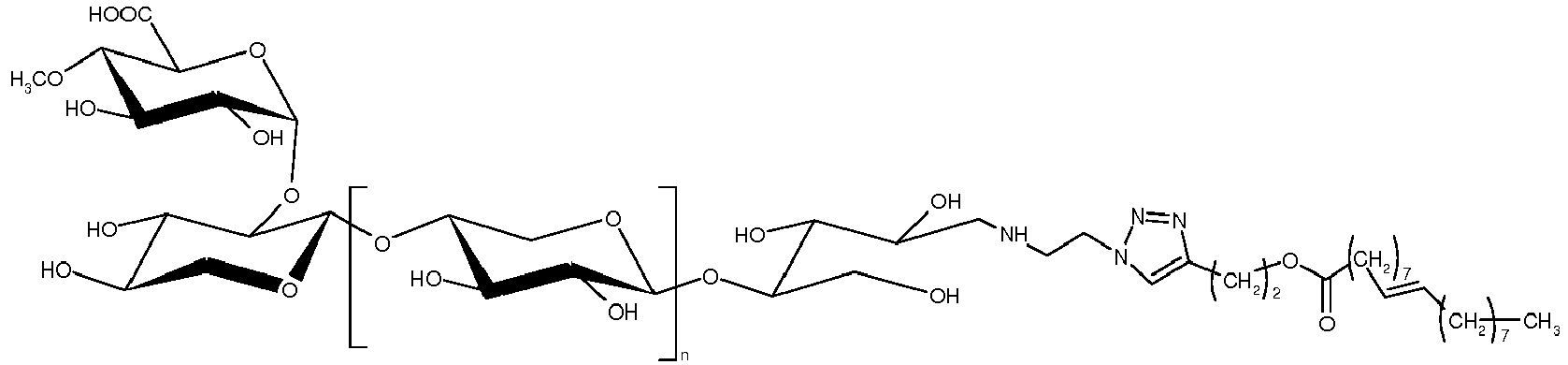
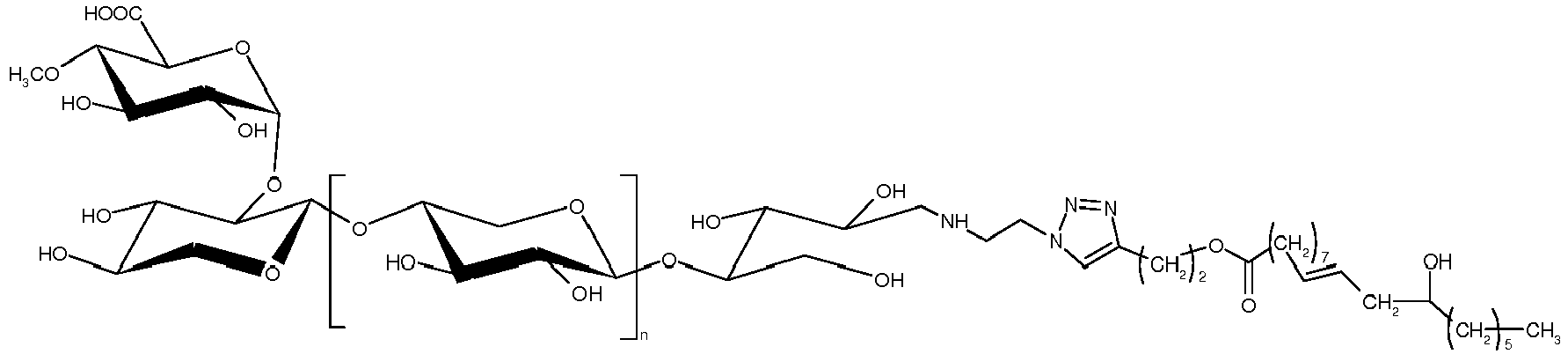
- Preferred compounds of formula (I-2) have the following formula: n being preferably 4.
- preferred compounds of formula (I-2) have the following formula: n and R 2 being as defined above.
- the present invention relates to the following compounds:
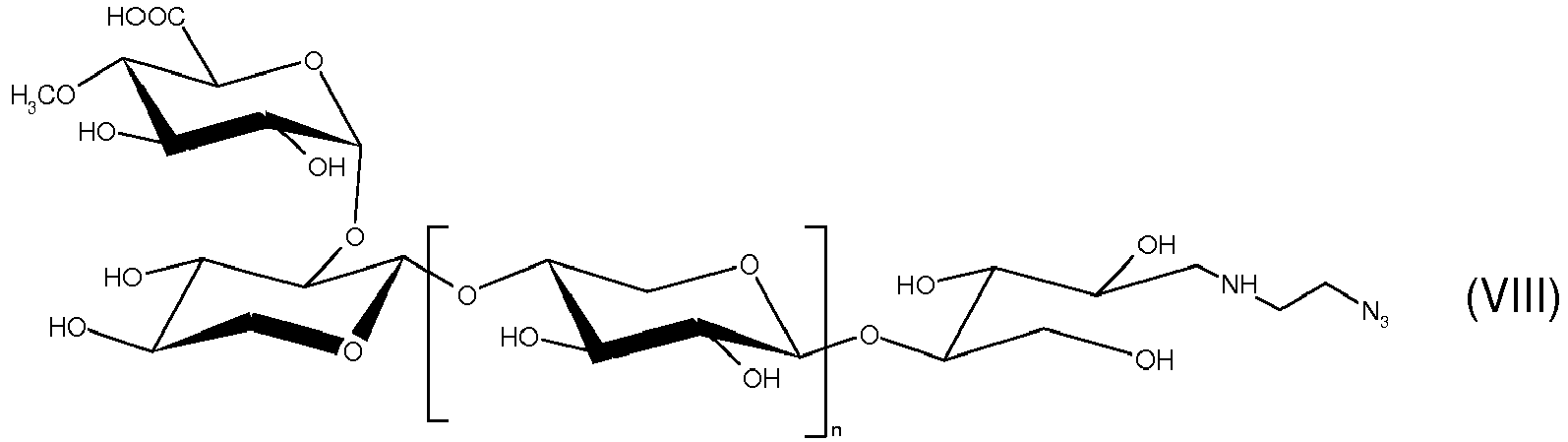
- the present invention also relates to a process for the preparation of a compound of formula (I-2) as defined above, comprising the reaction of a compound of formula (VIII): with a compound of formula (IX): n, A 2 , and A 3 being as defined in formula (I-2).
- This process consists in an azide-alcyne coupling.
- the compounds of formula (VIII) are prepared by reductive amination of xylooligosaccharides of formula (X) through the following reaction scheme:
- This functionalization reaction is carried out with reactions well-known in the art.
- the compounds of formula (IX) are prepared by alcyne functionalization of esters of fatty acids, according to well-known reactions.
- Such compounds may be obtained by reacting an alcyne of formula (XIII):
- (C x -C y )alkyl means a saturated aliphatic hydrocarbon group, which may be straight or branched, having x to y carbon atoms in the chain.
- Preferred alkyl groups have 1 to about 30, in particular 1 to 12, more particularly 1 to 15, preferably 1 to 10, and more preferably 1 to 6, carbon atoms in the chain.
- the following alkyl groups may be cited as example: methyl, ethyl, propyl, butyl, pentyl, hexyl, heptyl, octyl, nonyl, decyl, dodecyl.
- the alkyl groups may also be substituted by one or several hydroxyl groups.
- alkyl groups may also comprise one or several insaturations. When they comprise a double bond, these alkyl groups may also be called “alkenyl” groups.
- (C x -C y )alkylene refers to a divalent saturated aliphatic hydrocarbon radical, comprising from x to y carbon atoms, having preferably from 1 to 30, in particular 1 to 15 carbon atoms, more particularly 1 to 12 carbon atoms and more preferably 2 to 10 carbon atoms.
- said radical when said radical is linear, it may be represented by the formula (CH 2 ) m wherein m is an integer varying from 1 to 30, in particular from 1 to 15, more particularly from 1 to 12, and preferably from 2 to 10.
- alkylene may be cited as example: methylene, ethylene, propylene, butylene, pentylene, hexylene, heptylene, octylene, nonylene, decylene, dodecylene.
- alkylene radicals may also be substituted by one or several hydroxyl groups.
- alkylene radicals may also comprise one or several insaturations. When they comprise a double bond, these alkylene radicals may also be called “alkenylene” radicals.
- alkoxy means an alkyl-O- group wherein the alkyl group is as herein described.
- exemplary alkoxy groups include methoxy, ethoxy, n -propoxy, i -propoxy, n -butoxy and heptoxy.
- the compounds of the invention have surfactant properties. Especially, the inventors have discovered that these compounds have properties similar to the well-known surfactant Tween ® 80.
- compositions such as detergent compositions, comprising at least one compound of formula (I) as defined above, in particular at least one compound of formula (I-1) as defined above and/or at least one compound of formula (I-2) as defined above.
- the present invention also relates to the use of a compound of formula (I) as defined above, in particular of formula (I-1) as defined above or of formula (I-2) as defined above, as a surfactant.
- the present invention relates to a cosmetic composition
- a cosmetic composition comprising at least one compound of formula (I) as defined above and a physiologically acceptable vehicle.
- the present invention also relates to a pharmaceutical composition
- a pharmaceutical composition comprising at least one compound of formula (I) as defined above and a pharmaceutically acceptable excipient.
- the present invention also relates to a food supplement comprising at least one compound of formula (I) as defined above.
- the present invention also relates to the use of a compound of formula (I) as defined above, in particular of formula (I-1) as defined above or of formula (I-2) as defined above, for the encapsulation of actives. Indeed, it has been shown that the compounds of the invention are able to self-assemble.
- the wording « comprising one» or « including one » means « comprising at least one» or « including at least one » unless specified otherwise.
- MGX (Sigma Aldrich; X-4252) was solubilized in sulfuric acidic media (0.7 M) at 50 g/L. The solution was heated at 90°C for 45 minutes under magnetic stirring. After reaction, the solution was cooled down with ice and neutralized using a saturated barium hydroxide solution. Finally, centrifugation was conducted to remove the salt that precipitated and the supernatant was freeze-dried.
- XOS were purified by selective ethanol purification (1:9). The purification was done twice before drying the precipitate under vacuum.
- XOS were obtained with 22 wt.% yield and characterized to have around 6 xylose units and only one methylglucuronic acid (MeGlcA) unit per chain positioned at the non reductive end chain.
- MeGlcA methylglucuronic acid
- XOS were dissolved in deionized water at 100 g/L.
- 2-aminoethylazide prepared from 2-chloroethylamine as explained below
- allylamine Alfa Aesar
- NaBH 3 CN Sigma Aldrich
- 2-chloroethylamine hydrochlorate (Sigma Aldrich) is solubilized in water (133 g/L) at 80°C. Then sodium azide (3 eq., Sigma Aldrich) is added and the mixture is kept under reflux and magnetic stirring for the night. The mixture is cooled to room temperature then to 0°C using an ice bath. Potassium hydroxide (same amount as 2-chloroethylamine hydrochlorate, Prolabo) is added and after total dissolution, the product is extracted using diethyl ether. Organic phase is dried over magnesium sulfate (Acros Organics), filterted and finally evaporated to obtain 2-aminoethylazide (20 mol.% yield).
- the mixture XOS + 2-aminoethylazide or allylamine was stirred at 50°C for three days.
- the solution was then precipitated in ethanol three times (1:10) to remove the excess of amine and NaBH 3 CN.
- the product was finally dried under vacuum (random yield between 40 and 80 wt.% due to the purification step).
- Fatty acid esters were dissolved in MeOH at 50 g/L.
- the esters used here are the following: methyloleate (MeOI)(Alfa Aesar) and methylricinoleate (MeRic)(Nu-Chek Prep).
- TGA chromatograms clearly show that thermal stability of TE bioconjugates is increased in comparison to XOS. This increase can be due to the presence of sulfur. The temperature stability shows that the coupling is effective.
- XOS were dissolved in DMSO at 100 g/L and stirred for at least few hours in a water bath at 30°C.
- FAE derivatives (1 eq.) were dissolved in DMSO (volume as low as possible) and added to the solution.
- sodium ascorbate (NaAsc)(3.5 eq) was added.
- CuSO 4 (3.5 eq.) was added.
- the solution was stirred for 20-25 hours at 30°C.
- the reaction medium was then dialyzed 4-5 days against milliQ water (100-500 Da membrane) containing EDTA (VWR International) the first 2 days, and finally lyophilized (29 wt.% yield).
- Oleate with Ricinoleate:
- AA bioconjugates have been analyzed through the same techniques as TE ones, i.e. NMR, TGA and DSC. Moreover, AA bioconjugates were also analyzed through IR spectroscopy.
- Example 7 Self-assembly of copolymers obtained using AA coupling
- the obtained copolymers are amphiphilic with a HLB of 15 (Davies method). This HLB value is similar to the one of Tween ® 80, a surfactant widely employed in cosmetic and food fields.
- the CMC of XOS-AA-Ric has been measured equal to 100 mg/L and the one of XOS-AA-OI equal to 260 mg/L. These copolymers decrease interface tension (water/air) as well as Tween® 80 and increase the wetting of aqueous solution on several surfaces as PET and PTFE. Moreover, XOS-AA-Ric has a foaming capacity. These results promise potential applications as surfactant in cosmetic and food industries.
- objects of XOS-AA-Ric and XOS-AA-OI self-assembly were characterized by DLS and TEM: spherical objects are formed with a micellar size under 50 nm. These objects have the fatty chains in their core and the XOS forming the shell. These objects are in dynamic equilibrium. Aggregates ( ⁇ 500 nm) are also formed and can be eliminated by a simple filtration at 0,45 ⁇ m. Interestingly, their assembly is reversible and XOS-AA-Ric and XOS-AA-OI can self-assemble in chloroform forming spherical objects with a micellar size under 50 nm. In that case, XOS are in the core of the objects and fatty chains form the shell. These objects are also in dynamic equilibrium and bigger aggregates ( ⁇ 1000 nm) are formed and can be eliminated by a simple filtration at 0,45 ⁇ m.
Landscapes
- Chemical & Material Sciences (AREA)
- Health & Medical Sciences (AREA)
- Organic Chemistry (AREA)
- Life Sciences & Earth Sciences (AREA)
- Medicinal Chemistry (AREA)
- General Health & Medical Sciences (AREA)
- Polymers & Plastics (AREA)
- Chemical Kinetics & Catalysis (AREA)
- Molecular Biology (AREA)
- Biochemistry (AREA)
- Engineering & Computer Science (AREA)
- Materials Engineering (AREA)
- Genetics & Genomics (AREA)
- Biotechnology (AREA)
- Pharmacology & Pharmacy (AREA)
- Inorganic Chemistry (AREA)
- Epidemiology (AREA)
- Animal Behavior & Ethology (AREA)
- Public Health (AREA)
- Veterinary Medicine (AREA)
- Polysaccharides And Polysaccharide Derivatives (AREA)
- Medicinal Preparation (AREA)
- Cosmetics (AREA)
- Coloring Foods And Improving Nutritive Qualities (AREA)
- Organic Low-Molecular-Weight Compounds And Preparation Thereof (AREA)
Abstract

- n is an integer comprised between 1 and 7;
- X1 is in particular a radical of formula -CH2-S-(CH2)k-S-;
- A1 is in particular a linear or branched alkylene radical comprising from 2 to 30 carbon atoms, and
- X2 is in particular an alkoxy group of formula ORa, wherein Ra is a linear or branched alkyl group comprising from 1 to 10 carbon atoms.
Description
- The present invention concerns new amphiphilic copolymers which are bioconjugates obtained from the conjugation of xylan derivatives and fatty acid derivatives.
- The present invention also relates to the use of these bioconjugates in cosmetic, pharmaceutical and food compositions, in particular as surfactant.
- The direction of the industry to renewable raw materials is a major challenge for which biomass offers promising perspectives. The chemical sector today begins a mutation from petrochemicals (petro-refinery) to agrochemicals (bio-refinery). Provided it does not compete with the food chain, agrochemicals offer original economic and ecological risk solutions, including reducing the carbon footprint and emissions of greenhouse gas emissions from finished products. Thus, alternative biomass is gradually integrating the chemical industry and in particular in the fuel sector. The challenge ahead is colossal; the aim is to produce bio-refinery by all the reaction intermediates and chemicals known to petrochemicals (mimicry), on the one hand, and to develop new molecules and bio-based materials, on the other hand. The partial deconstruction and direct modification of lignocellulosic biomass is also an important way to consider.
- There is a growing interest in renewable resources, whether for energy or material appearance. In materials science, many natural resources have great potential for replacing fossil resources, including lignocellulosic biomass, mainly composed of polysaccharides. Especially, xylan is the most abundant hemicellulose in hardwoods. Xylans are a byproduct of the wood and paper industry, and are generally burned during regeneration of the reagents of the manufacturing process of pulp. However, because of their structures and properties, xylans are good candidates for the development of functional biomaterials.
- The aim of the present invention is to provide new fully biobased and biocompatible bioconjugates.
- Another aim of the present invention is to provide new amphiphilic polymers derived from xylans.
- Another aim of the present invention is to provide biodegradable bioconjugates.
- Therefore, the present invention relates to a compound of formula (I):

- n is an integer comprised between 1 and 15, preferably between 1 and 7, and more preferably between 2 and 6;
- X1 is chosen from the group consisting of:
- a radical of formula (II):
-CH2-S-(CH2)k-S- (II)
wherein k is an integer comprised between 2 and 10, and - a radical of formula (III):

- a radical of formula (II):
- A1 is chosen from the group consisting of:
- a linear or branched alkylene radical A'1, optionally substituted by at least one hydroxyl group, comprising from 2 to 30 carbon atoms, when X1 is a radical of formula (II) as defined above, and
- a radical of formula -A2-O-, wherein A2 is a linear or branched alkylene radical, comprising from 2 to 10 carbon atoms, when X1 is a radical of formula (III) as defined above,
- X2 is chosen from the group consisting of:
- an alkoxy group of formula ORa, wherein Ra is H or a linear or branched alkyl group comprising from 1 to 10 carbon atoms, when X1 is a radical of formula (II) as defined above, and
- a linear or branched alkyl group A3, optionally substituted by at least one hydroxyl group, optionally comprising at least one double bond, comprising from 2 to 30 carbon atoms, when X1 is a radical of formula (III) as defined above.
- The compounds of formula (I) are conjugates of xylan and fatty acid esters. They are obtained by the conjugation of xylan derivatives with fatty acid derivatives, through covalent binding.
- The present invention also relates to a compound of formula (I-1):

- A compound of formula (I-1) corresponds to a compound of formula (I) wherein X1 is a radical of formula (II) as defined above, A1 is an alkylene radical A'1 as defined above and X2 is a group ORa, Ra being as defined above.
- According to an embodiment, in formula (I-1), n is 3.
- According to an embodiment, in formula (I-1), A'1 has the formula (IV):

- R is a linear or branched alkyl group comprising from 2 to 15 carbon atoms, and optionally comprising at least one hydroxyl group; and
- A4 is a linear or branched alkylene radical comprising from 2 to 15 carbon atoms.
- Preferably, in formula (I-1), A'1 has the following formula (IV-1):

- R2 is H or OH;
- p, m, and q are integers comprised between 2 and 10.
- More preferably, A'1 has the following formula (IV-2):

- R2 being as defined above in formula (IV-1).
- According to a preferred embodiment, in formula (I-1), Ra is a methyl group.
- Preferred compounds of formula (I-1) have the following formula:

- According to a preferred embodiment, in formula (I-1), k is 2.
- According to a preferred embodiment, in formula (I-1), k is 2 and Ra is methyl. Such compounds have the following formula:

- According to an embodiment, preferred compounds of formula (I-1) have the following formula:

- More particularly, the present invention relates to the following compounds:


- The present invention also relates to a process for the preparation of a compound of formula (I-1) as defined above, comprising the reaction of a compound of formula (VI):


- This process consists in a thiol-ene coupling.
- According to an embodiment, the compounds of formula (VI) are prepared by reductive amination of xylooligosaccharides of formula (X) through the following reaction scheme:

- This functionalization reaction is carried out with reactions well-known in the art.
- The compounds of formula (X) are prepared according to a well-known reaction for polysaccharides named reductive amination from beechwood 4-O-methylglucuronoxylan.
- According to an embodiment, the compounds of formula (VII) are prepared by thiol functionalization of esters of fatty acids, according to well-known reactions.
- Especially, such compounds may be obtained by reacting a dithiol of formula (XI):

with a fatty acid derivative having the following formula (XII):
- A"1 represents a bond or a linear or branched alkylene radical, having from 1 to 18, preferably from 1 to 10, carbon atoms, said alkylene radical optionally comprising at least a double bond, and/or optionally substituted by at least one hydroxyl group;
- R'1 is a hydrogen or an alkyl group, straight or branched, having from 1 to 15, preferably from 1 to 8, carbon atoms; and
- Ra is as defined above.
- The present invention also relates to a compound of formula (I-2):

- A compound of formula (I-2) corresponds to a compound of formula (I) wherein X1 is a radical of formula (III) as defined above, A1 is a radical -A2-O- as defined above and X2 is an alkyl group A3 as defined above.
- According to an embodiment, in formula (I-2), n is 3.
- According to an embodiment, in formula (I-2), A3 has the formula (V):

- A4 is a linear or branched alkylene radical comprising 1 to 10 carbon atoms, optionally substituted by at least one hydroxyl group, and
- R3 is a linear or branched alkyl group comprising 1 to 10 carbon atoms, optionally substituted by at least one hydroxyl group.
- Preferably, A3 has the following formula (V-1):

- R2 is H or OH;
- r, s, and t are integers comprised between 2 and 10. More preferably, A3 has the following formula (V-2):

- According to a preferred embodiment, in formula (I-2), A2 is an ethylene radical.
- Preferred compounds of formula (I-2) have the following formula:

- According to an embodiment, preferred compounds of formula (I-2) have the following formula:

- More particularly, the present invention relates to the following compounds:
- The present invention also relates to a process for the preparation of a compound of formula (I-2) as defined above, comprising the reaction of a compound of formula (VIII):

- This process consists in an azide-alcyne coupling.
- According to an embodiment, the compounds of formula (VIII) are prepared by reductive amination of xylooligosaccharides of formula (X) through the following reaction scheme:
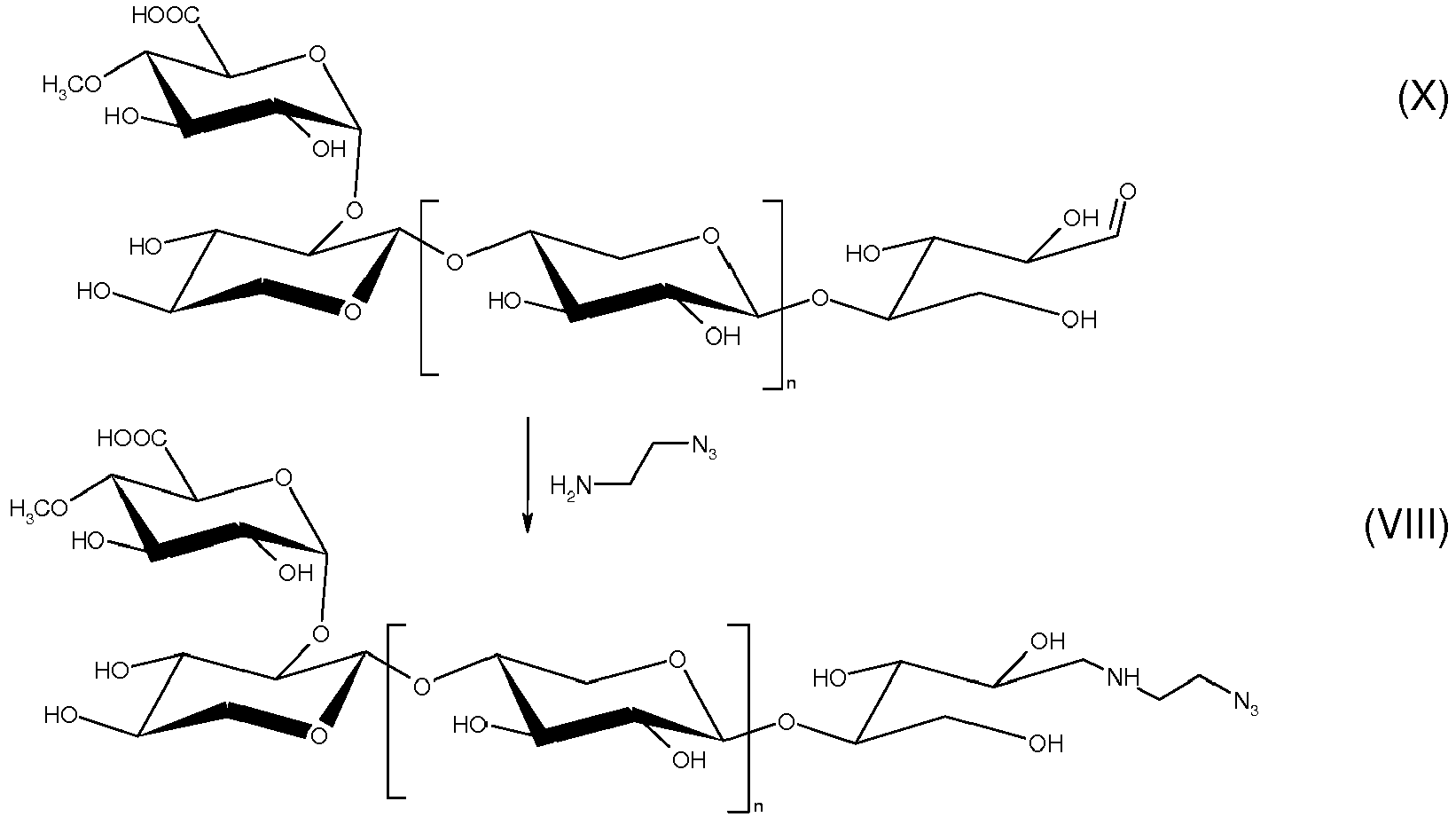
- This functionalization reaction is carried out with reactions well-known in the art.
- According to an embodiment, the compounds of formula (IX) are prepared by alcyne functionalization of esters of fatty acids, according to well-known reactions.
- Especially, such compounds may be obtained by reacting an alcyne of formula (XIII):
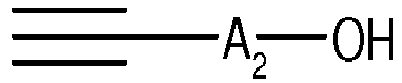
- A2 being as defined in formula (I-2),
with an ester of fatty acid of formula (XIV):
- A3 is as defined in formula (I-2); and
- R'a is a linear or branched alkyl group comprising from 1 to 10 carbon atoms, being preferably methyl.
- As used herein, the term "(Cx-Cy)alkyl" means a saturated aliphatic hydrocarbon group, which may be straight or branched, having x to y carbon atoms in the chain. Preferred alkyl groups have 1 to about 30, in particular 1 to 12, more particularly 1 to 15, preferably 1 to 10, and more preferably 1 to 6, carbon atoms in the chain. The following alkyl groups may be cited as example: methyl, ethyl, propyl, butyl, pentyl, hexyl, heptyl, octyl, nonyl, decyl, dodecyl.
- Within the present application, the alkyl groups may also be substituted by one or several hydroxyl groups.
- Within the present application, the alkyl groups may also comprise one or several insaturations. When they comprise a double bond, these alkyl groups may also be called "alkenyl" groups.
- As used herein, the term "(Cx-Cy)alkylene" (or "alkylidene") refers to a divalent saturated aliphatic hydrocarbon radical, comprising from x to y carbon atoms, having preferably from 1 to 30, in particular 1 to 15 carbon atoms, more particularly 1 to 12 carbon atoms and more preferably 2 to 10 carbon atoms. When said radical is linear, it may be represented by the formula (CH2)m wherein m is an integer varying from 1 to 30, in particular from 1 to 15, more particularly from 1 to 12, and preferably from 2 to 10. The following alkylene may be cited as example: methylene, ethylene, propylene, butylene, pentylene, hexylene, heptylene, octylene, nonylene, decylene, dodecylene.
- Within the present application, the alkylene radicals may also be substituted by one or several hydroxyl groups.
- Within the present application, the alkylene radicals may also comprise one or several insaturations. When they comprise a double bond, these alkylene radicals may also be called "alkenylene" radicals.
- As used herein, the term "alkoxy" means an alkyl-O- group wherein the alkyl group is as herein described. Exemplary alkoxy groups include methoxy, ethoxy, n-propoxy, i-propoxy, n-butoxy and heptoxy.
- Surprisingly, the compounds of the invention have surfactant properties. Especially, the inventors have discovered that these compounds have properties similar to the well-known surfactant Tween®80.
- Therefore, the present invention also relates to compositions, such as detergent compositions, comprising at least one compound of formula (I) as defined above, in particular at least one compound of formula (I-1) as defined above and/or at least one compound of formula (I-2) as defined above.
- The present invention also relates to the use of a compound of formula (I) as defined above, in particular of formula (I-1) as defined above or of formula (I-2) as defined above, as a surfactant.
- According to another embodiment, the present invention relates to a cosmetic composition comprising at least one compound of formula (I) as defined above and a physiologically acceptable vehicle.
- The present invention also relates to a pharmaceutical composition comprising at least one compound of formula (I) as defined above and a pharmaceutically acceptable excipient.
- The present invention also relates to a food supplement comprising at least one compound of formula (I) as defined above.
- The present invention also relates to the use of a compound of formula (I) as defined above, in particular of formula (I-1) as defined above or of formula (I-2) as defined above, for the encapsulation of actives. Indeed, it has been shown that the compounds of the invention are able to self-assemble.
- In the whole application, the wording « comprising one» or « including one » means « comprising at least one» or « including at least one » unless specified otherwise.
- The invention is described in the foregoing by way of non-limiting examples.
- Controlled sulfuric acidic hydrolysis of beechwood 4-O-methylglucuronoxylan (MGX) was performed to get well-defined xylooligosaccharides (XOS).
- MGX (Sigma Aldrich; X-4252) was solubilized in sulfuric acidic media (0.7 M) at 50 g/L. The solution was heated at 90°C for 45 minutes under magnetic stirring. After reaction, the solution was cooled down with ice and neutralized using a saturated barium hydroxide solution. Finally, centrifugation was conducted to remove the salt that precipitated and the supernatant was freeze-dried. XOS were purified by selective ethanol purification (1:9). The purification was done twice before drying the precipitate under vacuum.
- XOS were obtained with 22 wt.% yield and characterized to have around 6 xylose units and only one methylglucuronic acid (MeGlcA) unit per chain positioned at the non reductive end chain.
- XOS were dissolved in deionized water at 100 g/L.
- 2-aminoethylazide (prepared from 2-chloroethylamine as explained below) or allylamine (Alfa Aesar)(7.5 eq.) was added under magnetic stirring, followed by NaBH3CN (Sigma Aldrich)(7.5 eq.).
- 2-chloroethylamine hydrochlorate (Sigma Aldrich) is solubilized in water (133 g/L) at 80°C. Then sodium azide (3 eq., Sigma Aldrich) is added and the mixture is kept under reflux and magnetic stirring for the night. The mixture is cooled to room temperature then to 0°C using an ice bath. Potassium hydroxide (same amount as 2-chloroethylamine hydrochlorate, Prolabo) is added and after total dissolution, the product is extracted using diethyl ether. Organic phase is dried over magnesium sulfate (Acros Organics), filterted and finally evaporated to obtain 2-aminoethylazide (20 mol.% yield).
- The mixture XOS + 2-aminoethylazide or allylamine was stirred at 50°C for three days. The solution was then precipitated in ethanol three times (1:10) to remove the excess of amine and NaBH3CN. The product was finally dried under vacuum (random yield between 40 and 80 wt.% due to the purification step).

- Fatty acid esters (FAE) were dissolved in MeOH at 50 g/L. The esters used here are the following: methyloleate (MeOI)(Alfa Aesar) and methylricinoleate (MeRic)(Nu-Chek Prep).
- Ethanedithiol (20 eq, Acros Organics) was added under magnetic stirring, followed by DMPA (0.1 eq.)(Sigma Aldrich). The mixture was stirred under UV irradiation for 15 minutes. The solution was then dried under vacuum. Finally the mixture was purified using flash chromatography (gradient of dichloromethane and methanol) and dried under vacuum (88 wt.% yield).


- Functionalized XOS were dissolved in MeOH at 50 g/L the day before to ensure solubilization. Functionalized FAE (15 eq.) and DMPA (0.75 eq.) were added under magnetic stirring in five times every hour while the mixture was stirred under UV irradiation. The mixture was stirred under UV irradiation for 19 hours, i.e. total reaction time of 24h. The solution was then dried under vacuum. Finally the mixture was purified by washing the mixture two times with EtOH and one time with cyclohexane (72 wt.% yield).
with Oleate:

- These TE bioconjugates have been analyzed through NMR, TGA and DSC. NMR analyses were performed in D2O as well as in CDCl3.
- In deutered water, one can clearly see the well-defined signals of XOS between 2.8 and 6.1 ppm.
- In deutered chloroform, one can barely see signals from MeOI. Most of bioconjugates have precipitated at the bottom of the NMR tube.
- Then, thermal properties of TE bioconjugates were analyzed though TGA and DSC. TGA chromatograms clearly show that thermal stability of TE bioconjugates is increased in comparison to XOS. This increase can be due to the presence of sulfur. The temperature stability shows that the coupling is effective.
- FAE were functionalized in bulk using 3-butyn-1-ol (10 eq., Acros Organics) with TBD as catalyst (0.1 eq., Sigma Aldrich). The mixture was stirred under nitrogen at 100°C for 4 hours and for 4 hours more at 100°C under vacuum. The mixture was then purified by adding ethyl acetate and water (4:1). The organic phase is mixed with water two times more and dried over Na2SO4. Finally the organic phase is filtrated and evaporated (75 wt.% yield).
with Oleate:

- XOS were dissolved in DMSO at 100 g/L and stirred for at least few hours in a water bath at 30°C. FAE derivatives (1 eq.) were dissolved in DMSO (volume as low as possible) and added to the solution. After 15 minutes stirring, sodium ascorbate (NaAsc)(3.5 eq) was added. Finally after 10 minutes, CuSO4 (3.5 eq.) was added. The solution was stirred for 20-25 hours at 30°C. The reaction medium was then dialyzed 4-5 days against milliQ water (100-500 Da membrane) containing EDTA (VWR International) the first 2 days, and finally lyophilized (29 wt.% yield).
with Oleate:

- AA bioconjugates have been analyzed through the same techniques as TE ones, i.e. NMR, TGA and DSC. Moreover, AA bioconjugates were also analyzed through IR spectroscopy.
- Analyses of bioconjugates clearly show the disappearance of the N3 vibration (2,110 cm-1) meaning that the coupling was effective and that the conversion seems full.
- Spectra also show the appearance of C=O (1730 cm-1) and C-N (1380 cm-1) vibrations due to the Huisgen cycloaddition and the appearance of clear signals corresponding to CH2 vibrations (asymmetric vibrations at 2,920 cm-1 and symmetric ones at 2,650 cm-1) of FAE. Then, NMR analyses were performed in D2O as well as CDCl3 for both bioconjugates.
- In deutered water - for both bioconjugates - one can clearly see the signals of XOS between 3.1 and 4.7 ppm but the signals of FAE are undefined between 0.6 and 1.8 ppm. Moreover, no signal from aminoethylazide can be seen, confirming, together with IR, that the conversion is full.
- In deutered chloroform - for both bioconjugates - one can see signals from FAE only. Some bioconjugates have precipitated at the bottom of the NMR tube but most of them are left in solution and organized in chloroform with FAE at the outer of the objects.
- Finally, thermal properties of these AA bioconjugates were analyzed though TGA and DSC. For both FAE, TGA chromatograms show that thermal stability of AA bioconjugates is similar to XOS.
- For both FAE, DSC chromatograms show a flat profile for AA bioconjugates as well as for XOS. Because FAE still have a crystallization/fusion behavior after functionalization, it means that there is no free FAE left in the product.
- The obtained copolymers are amphiphilic with a HLB of 15 (Davies method). This HLB value is similar to the one of Tween® 80, a surfactant widely employed in cosmetic and food fields.
- The CMC of XOS-AA-Ric has been measured equal to 100 mg/L and the one of XOS-AA-OI equal to 260 mg/L. These copolymers decrease interface tension (water/air) as well as Tween® 80 and increase the wetting of aqueous solution on several surfaces as PET and PTFE. Moreover, XOS-AA-Ric has a foaming capacity. These results promise potential applications as surfactant in cosmetic and food industries.
- Moreover, objects of XOS-AA-Ric and XOS-AA-OI self-assembly were characterized by DLS and TEM: spherical objects are formed with a micellar size under 50 nm. These objects have the fatty chains in their core and the XOS forming the shell. These objects are in dynamic equilibrium. Aggregates (≈ 500 nm) are also formed and can be eliminated by a simple filtration at 0,45 µm. Interestingly, their assembly is reversible and XOS-AA-Ric and XOS-AA-OI can self-assemble in chloroform forming spherical objects with a micellar size under 50 nm. In that case, XOS are in the core of the objects and fatty chains form the shell. These objects are also in dynamic equilibrium and bigger aggregates (≈ 1000 nm) are formed and can be eliminated by a simple filtration at 0,45 µm.
- These results promise potential applications in active substance delivery as these polymers are biocompatible and biodegradable.
Claims (14)
- A compound of formula (I):
 - n is an integer comprised between 1 and 15;- X1 is chosen from the group consisting of:. a radical of formula (II):
-CH2-S-(CH2)k-S- (II)
wherein k is an integer comprised between 2 and 10, and. a radical of formula (III): - A1 is chosen from the group consisting of:. a linear or branched alkylene radical A'1, optionally substituted by at least one hydroxyl group, comprising from 2 to 30 carbon atoms, when X1 is a radical of formula (II) as defined above, and. a radical of formula -A2-O-, wherein A2 is a linear or branched alkylene radical, comprising from 2 to 10 carbon atoms, when X1 is a radical of formula (III) as defined above,- X2 is chosen from the group consisting of:. an alkoxy group of formula ORa, wherein Ra is H or a linear or branched alkyl group comprising from 1 to 10 carbon atoms, when X1 is a radical of formula (II) as defined above, and. a linear or branched alkyl group A3, optionally substituted by at least one hydroxyl group, optionally comprising at least one double bond, comprising from 2 to 30 carbon atoms, when X1 is a radical of formula (III) as defined above.
 - The compound of claim 1, of formula (I-1):

- The compound of claim 1, of formula (I-2):

- The compound of claim 2, wherein A'1 has the formula (IV):
 - R is a linear or branched alkyl group comprising from 2 to 15 carbon atoms, and optionally comprising at least one hydroxyl group; and- A4 is a linear or branched alkylene radical comprising from 2 to 15 carbon atoms.
 - The compound of claim 3, wherein A3 has the following formula (V):
 - A4 is a linear or branched alkylene radical comprising 1 to 10 carbon atoms, optionally substituted by at least one hydroxyl group, and- R3 is a linear or branched alkyl group comprising 1 to 10 carbon atoms, optionally substituted by at least one hydroxyl group.
 - The compound of any one of claims 1 to 5, having one of the following formulae:

 R2 is H or OH; andRa is as defined in claim 1.
 - The compound of any one of claims 1 to 6, wherein n is 3.
- The compound of any one of claims 1 to 7, having one of the following formulae:


- A process for the preparation of a compound of formula (I-1) of claim 2, comprising the reaction of a compound of formula (VI):


- A process for the preparation of a compound of formula (I-2) of claim 3, comprising the reaction of a compound of formula (VIII):


- A cosmetic composition comprising at least one compound of formula (I) of any one of claims 1 to 8, and a physiologically acceptable vehicle.
- A pharmaceutical composition comprising at least one compound of formula (I) of any one of claims 1 to 8, and a pharmaceutically acceptable excipient.
- A food supplement comprising at least one compound of formula (I) of any one of claims 1 to 8.
- The use of a compound of formula (I) of any one of claims 1 to 8 as a surfactant.
Priority Applications (7)
| Application Number | Priority Date | Filing Date | Title |
|---|---|---|---|
| EP14307052.2A EP3034517B1 (en) | 2014-12-16 | 2014-12-16 | Amphiphilic bioconjugates obtained from xylan derivatives |
| ES14307052.2T ES2643029T3 (en) | 2014-12-16 | 2014-12-16 | Amphiphilic bioconjugates obtained from xylan derivatives |
| DK14307052.2T DK3034517T3 (en) | 2014-12-16 | 2014-12-16 | Amphiphilic bioconjugates obtained from xyland derivatives |
| US15/536,543 US10047171B2 (en) | 2014-12-16 | 2015-12-16 | Amphiphilic bioconjugates obtained from xylan derivatives |
| PCT/EP2015/080082 WO2016097043A1 (en) | 2014-12-16 | 2015-12-16 | Amphiphilic bioconjugates obtained from xylan derivatives |
| CA2971120A CA2971120A1 (en) | 2014-12-16 | 2015-12-16 | Amphiphilic bioconjugates obtained from xylan derivatives |
| JP2017533498A JP6612875B2 (en) | 2014-12-16 | 2015-12-16 | Amphiphilic bioconjugates derived from xylan derivatives |
Applications Claiming Priority (1)
| Application Number | Priority Date | Filing Date | Title |
|---|---|---|---|
| EP14307052.2A EP3034517B1 (en) | 2014-12-16 | 2014-12-16 | Amphiphilic bioconjugates obtained from xylan derivatives |
Publications (2)
| Publication Number | Publication Date |
|---|---|
| EP3034517A1 true EP3034517A1 (en) | 2016-06-22 |
| EP3034517B1 EP3034517B1 (en) | 2017-07-12 |
Family
ID=52391764
Family Applications (1)
| Application Number | Title | Priority Date | Filing Date |
|---|---|---|---|
| EP14307052.2A Not-in-force EP3034517B1 (en) | 2014-12-16 | 2014-12-16 | Amphiphilic bioconjugates obtained from xylan derivatives |
Country Status (7)
| Country | Link |
|---|---|
| US (1) | US10047171B2 (en) |
| EP (1) | EP3034517B1 (en) |
| JP (1) | JP6612875B2 (en) |
| CA (1) | CA2971120A1 (en) |
| DK (1) | DK3034517T3 (en) |
| ES (1) | ES2643029T3 (en) |
| WO (1) | WO2016097043A1 (en) |
Cited By (1)
| Publication number | Priority date | Publication date | Assignee | Title |
|---|---|---|---|---|
| WO2023118500A1 (en) * | 2021-12-22 | 2023-06-29 | Cambridge Glycoscience Ltd | Biomass derived surface-active compositions and products |
Citations (1)
| Publication number | Priority date | Publication date | Assignee | Title |
|---|---|---|---|---|
| WO2010090591A1 (en) * | 2009-02-05 | 2010-08-12 | Swetree Technologies Ab | Aminated hemicellulose molecule and method for production thereof |
Family Cites Families (2)
| Publication number | Priority date | Publication date | Assignee | Title |
|---|---|---|---|---|
| JP4084027B2 (en) * | 2001-11-05 | 2008-04-30 | 独立行政法人科学技術振興機構 | Polysaccharides with binding sites for the matrix |
| JP2012180424A (en) * | 2011-02-28 | 2012-09-20 | Univ Of Tokyo | Xylan derivative precursor, xylan derivative, xylan graft copolymer, method of producing these, and polymer molded product |
-
2014
- 2014-12-16 DK DK14307052.2T patent/DK3034517T3/en active
- 2014-12-16 ES ES14307052.2T patent/ES2643029T3/en active Active
- 2014-12-16 EP EP14307052.2A patent/EP3034517B1/en not_active Not-in-force
-
2015
- 2015-12-16 WO PCT/EP2015/080082 patent/WO2016097043A1/en not_active Ceased
- 2015-12-16 JP JP2017533498A patent/JP6612875B2/en not_active Expired - Fee Related
- 2015-12-16 US US15/536,543 patent/US10047171B2/en not_active Expired - Fee Related
- 2015-12-16 CA CA2971120A patent/CA2971120A1/en not_active Abandoned
Patent Citations (1)
| Publication number | Priority date | Publication date | Assignee | Title |
|---|---|---|---|---|
| WO2010090591A1 (en) * | 2009-02-05 | 2010-08-12 | Swetree Technologies Ab | Aminated hemicellulose molecule and method for production thereof |
Non-Patent Citations (2)
| Title |
|---|
| BOUXIN F ET AL: "Direct conversion of xylan into alkyl pentosides", CARBOHYDRATE RESEARCH, PERGAMON, GB, vol. 345, no. 17, 22 November 2010 (2010-11-22), pages 2469 - 2473, XP027445294, ISSN: 0008-6215, [retrieved on 20100907], DOI: 10.1016/J.CARRES.2010.09.003 * |
| SUNSANEE UDOMRATI ET AL: "Esterified xylo-oligosaccharides for stabilization of Tween 80-stabilized oil-in-water emulsions: stabilization mechanism, rheological properties, and stability of emulsions", JOURNAL OF THE SCIENCE OF FOOD AND AGRICULTURE, vol. 94, no. 15, 30 April 2014 (2014-04-30), pages 3241 - 3247, XP055193989, ISSN: 0022-5142, DOI: 10.1002/jsfa.6676 * |
Cited By (1)
| Publication number | Priority date | Publication date | Assignee | Title |
|---|---|---|---|---|
| WO2023118500A1 (en) * | 2021-12-22 | 2023-06-29 | Cambridge Glycoscience Ltd | Biomass derived surface-active compositions and products |
Also Published As
| Publication number | Publication date |
|---|---|
| JP6612875B2 (en) | 2019-11-27 |
| WO2016097043A1 (en) | 2016-06-23 |
| CA2971120A1 (en) | 2016-06-23 |
| US20180002453A1 (en) | 2018-01-04 |
| US10047171B2 (en) | 2018-08-14 |
| JP2018508595A (en) | 2018-03-29 |
| DK3034517T3 (en) | 2017-08-28 |
| EP3034517B1 (en) | 2017-07-12 |
| ES2643029T3 (en) | 2017-11-21 |
Similar Documents
| Publication | Publication Date | Title |
|---|---|---|
| Larsen et al. | Investigation of curing rates of bio-based thiol-ene films from diallyl 2, 5-furandicaboxylate | |
| CN103865071B (en) | A kind of preparation method of polypeptide-polytrimethylene carbonate-MPEGPLA double graft copolymer | |
| EP3034517B1 (en) | Amphiphilic bioconjugates obtained from xylan derivatives | |
| JP5544615B2 (en) | Thermoreversible polymer composition | |
| US20140039081A1 (en) | Sulphur-containing thermoplastic polymers | |
| CN108727515B (en) | Vegetable oleic acid-chitosan-based polyol, and method for preparing the polyol catalyzed by a free radical photoinitiator | |
| Sirviö et al. | Carbamation of starch with amine using dimethyl carbonate as coupling agent | |
| JP2002194080A (en) | Polymer and its production method | |
| CN107189054B (en) | A kind of polyethylene glycol containing acetal bonds, derivative and its synthetic method | |
| CN109970556A (en) | A kind of vegetable oil-based polyacid alcohol ether ester and preparation method and application thereof | |
| CN104744685B (en) | A kind of three arm polyethyleneglycol derivatives and preparation method thereof | |
| CN102070680A (en) | Preparation method of alkyl polyglucoside sulfate | |
| CN116217862A (en) | A kind of preparation method of degradable biofilm aid | |
| JP5822273B2 (en) | Biodegradable hydrogel and method for producing the same | |
| US11981756B2 (en) | Tempo-cellulose structures and related methods | |
| EP3529238B1 (en) | Bis-diox(ol)ane compounds | |
| CN105669987A (en) | Preparation method for polyvinyl alcohol-poly(lactide-glycolide) graft copolymer | |
| Hasan et al. | Preparation and Characterization of PVA-Cellulose Micro Crystal Composite Film from Jute fiber | |
| JP2020079226A (en) | Method for producing biopolyol from epoxidized fatty acid esters | |
| Brocchini | Degradable Polyacetal Polymers | |
| CN1951978A (en) | Carbowax modifier of nicotinic acid and its synthesis method | |
| CN107936217A (en) | A kind of synthetic method of sulfur-containing polymer polyalcohol | |
| CN103193965B (en) | The preparation method of amino terminated poly(ethylene glycol)-polyester amphipathic nature block polymer and products obtained therefrom | |
| CN101367993B (en) | Method for improving thermostability of propylene carbonate with cyclodextrin | |
| JP2007031620A (en) | Organic compound and method for producing the same |
Legal Events
| Date | Code | Title | Description |
|---|---|---|---|
| PUAI | Public reference made under article 153(3) epc to a published international application that has entered the european phase |
Free format text: ORIGINAL CODE: 0009012 |
|
| AK | Designated contracting states |
Kind code of ref document: A1 Designated state(s): AL AT BE BG CH CY CZ DE DK EE ES FI FR GB GR HR HU IE IS IT LI LT LU LV MC MK MT NL NO PL PT RO RS SE SI SK SM TR |
|
| AX | Request for extension of the european patent |
Extension state: BA ME |
|
| 17P | Request for examination filed |
Effective date: 20161014 |
|
| RBV | Designated contracting states (corrected) |
Designated state(s): AL AT BE BG CH CY CZ DE DK EE ES FI FR GB GR HR HU IE IS IT LI LT LU LV MC MK MT NL NO PL PT RO RS SE SI SK SM TR |
|
| GRAP | Despatch of communication of intention to grant a patent |
Free format text: ORIGINAL CODE: EPIDOSNIGR1 |
|
| INTG | Intention to grant announced |
Effective date: 20170203 |
|
| GRAS | Grant fee paid |
Free format text: ORIGINAL CODE: EPIDOSNIGR3 |
|
| GRAA | (expected) grant |
Free format text: ORIGINAL CODE: 0009210 |
|
| AK | Designated contracting states |
Kind code of ref document: B1 Designated state(s): AL AT BE BG CH CY CZ DE DK EE ES FI FR GB GR HR HU IE IS IT LI LT LU LV MC MK MT NL NO PL PT RO RS SE SI SK SM TR |
|
| REG | Reference to a national code |
Ref country code: GB Ref legal event code: FG4D |
|
| REG | Reference to a national code |
Ref country code: CH Ref legal event code: EP |
|
| REG | Reference to a national code |
Ref country code: AT Ref legal event code: REF Ref document number: 908233 Country of ref document: AT Kind code of ref document: T Effective date: 20170715 |
|
| REG | Reference to a national code |
Ref country code: IE Ref legal event code: FG4D |
|
| REG | Reference to a national code |
Ref country code: DE Ref legal event code: R096 Ref document number: 602014011698 Country of ref document: DE |
|
| REG | Reference to a national code |
Ref country code: DK Ref legal event code: T3 Effective date: 20170822 |
|
| REG | Reference to a national code |
Ref country code: SE Ref legal event code: TRGR Ref country code: FR Ref legal event code: PLFP Year of fee payment: 4 |
|
| REG | Reference to a national code |
Ref country code: NL Ref legal event code: MP Effective date: 20170712 |
|
| REG | Reference to a national code |
Ref country code: ES Ref legal event code: FG2A Ref document number: 2643029 Country of ref document: ES Kind code of ref document: T3 Effective date: 20171121 |
|
| REG | Reference to a national code |
Ref country code: LT Ref legal event code: MG4D |
|
| REG | Reference to a national code |
Ref country code: AT Ref legal event code: MK05 Ref document number: 908233 Country of ref document: AT Kind code of ref document: T Effective date: 20170712 |
|
| REG | Reference to a national code |
Ref country code: NO Ref legal event code: T2 Effective date: 20170712 |
|
| PG25 | Lapsed in a contracting state [announced via postgrant information from national office to epo] |
Ref country code: HR Free format text: LAPSE BECAUSE OF FAILURE TO SUBMIT A TRANSLATION OF THE DESCRIPTION OR TO PAY THE FEE WITHIN THE PRESCRIBED TIME-LIMIT Effective date: 20170712 Ref country code: LT Free format text: LAPSE BECAUSE OF FAILURE TO SUBMIT A TRANSLATION OF THE DESCRIPTION OR TO PAY THE FEE WITHIN THE PRESCRIBED TIME-LIMIT Effective date: 20170712 Ref country code: NL Free format text: LAPSE BECAUSE OF FAILURE TO SUBMIT A TRANSLATION OF THE DESCRIPTION OR TO PAY THE FEE WITHIN THE PRESCRIBED TIME-LIMIT Effective date: 20170712 Ref country code: AT Free format text: LAPSE BECAUSE OF FAILURE TO SUBMIT A TRANSLATION OF THE DESCRIPTION OR TO PAY THE FEE WITHIN THE PRESCRIBED TIME-LIMIT Effective date: 20170712 |
|
| PG25 | Lapsed in a contracting state [announced via postgrant information from national office to epo] |
Ref country code: IS Free format text: LAPSE BECAUSE OF FAILURE TO SUBMIT A TRANSLATION OF THE DESCRIPTION OR TO PAY THE FEE WITHIN THE PRESCRIBED TIME-LIMIT Effective date: 20171112 Ref country code: BG Free format text: LAPSE BECAUSE OF FAILURE TO SUBMIT A TRANSLATION OF THE DESCRIPTION OR TO PAY THE FEE WITHIN THE PRESCRIBED TIME-LIMIT Effective date: 20171012 Ref country code: GR Free format text: LAPSE BECAUSE OF FAILURE TO SUBMIT A TRANSLATION OF THE DESCRIPTION OR TO PAY THE FEE WITHIN THE PRESCRIBED TIME-LIMIT Effective date: 20171013 Ref country code: LV Free format text: LAPSE BECAUSE OF FAILURE TO SUBMIT A TRANSLATION OF THE DESCRIPTION OR TO PAY THE FEE WITHIN THE PRESCRIBED TIME-LIMIT Effective date: 20170712 Ref country code: PL Free format text: LAPSE BECAUSE OF FAILURE TO SUBMIT A TRANSLATION OF THE DESCRIPTION OR TO PAY THE FEE WITHIN THE PRESCRIBED TIME-LIMIT Effective date: 20170712 Ref country code: RS Free format text: LAPSE BECAUSE OF FAILURE TO SUBMIT A TRANSLATION OF THE DESCRIPTION OR TO PAY THE FEE WITHIN THE PRESCRIBED TIME-LIMIT Effective date: 20170712 |
|
| REG | Reference to a national code |
Ref country code: DE Ref legal event code: R097 Ref document number: 602014011698 Country of ref document: DE |
|
| PG25 | Lapsed in a contracting state [announced via postgrant information from national office to epo] |
Ref country code: RO Free format text: LAPSE BECAUSE OF FAILURE TO SUBMIT A TRANSLATION OF THE DESCRIPTION OR TO PAY THE FEE WITHIN THE PRESCRIBED TIME-LIMIT Effective date: 20170712 Ref country code: CZ Free format text: LAPSE BECAUSE OF FAILURE TO SUBMIT A TRANSLATION OF THE DESCRIPTION OR TO PAY THE FEE WITHIN THE PRESCRIBED TIME-LIMIT Effective date: 20170712 |
|
| PLBE | No opposition filed within time limit |
Free format text: ORIGINAL CODE: 0009261 |
|
| STAA | Information on the status of an ep patent application or granted ep patent |
Free format text: STATUS: NO OPPOSITION FILED WITHIN TIME LIMIT |
|
| PG25 | Lapsed in a contracting state [announced via postgrant information from national office to epo] |
Ref country code: SM Free format text: LAPSE BECAUSE OF FAILURE TO SUBMIT A TRANSLATION OF THE DESCRIPTION OR TO PAY THE FEE WITHIN THE PRESCRIBED TIME-LIMIT Effective date: 20170712 Ref country code: EE Free format text: LAPSE BECAUSE OF FAILURE TO SUBMIT A TRANSLATION OF THE DESCRIPTION OR TO PAY THE FEE WITHIN THE PRESCRIBED TIME-LIMIT Effective date: 20170712 Ref country code: SK Free format text: LAPSE BECAUSE OF FAILURE TO SUBMIT A TRANSLATION OF THE DESCRIPTION OR TO PAY THE FEE WITHIN THE PRESCRIBED TIME-LIMIT Effective date: 20170712 Ref country code: IT Free format text: LAPSE BECAUSE OF FAILURE TO SUBMIT A TRANSLATION OF THE DESCRIPTION OR TO PAY THE FEE WITHIN THE PRESCRIBED TIME-LIMIT Effective date: 20170712 |
|
| 26N | No opposition filed |
Effective date: 20180413 |
|
| REG | Reference to a national code |
Ref country code: CH Ref legal event code: PL |
|
| PG25 | Lapsed in a contracting state [announced via postgrant information from national office to epo] |
Ref country code: SI Free format text: LAPSE BECAUSE OF FAILURE TO SUBMIT A TRANSLATION OF THE DESCRIPTION OR TO PAY THE FEE WITHIN THE PRESCRIBED TIME-LIMIT Effective date: 20170712 |
|
| REG | Reference to a national code |
Ref country code: IE Ref legal event code: MM4A |
|
| PG25 | Lapsed in a contracting state [announced via postgrant information from national office to epo] |
Ref country code: LU Free format text: LAPSE BECAUSE OF NON-PAYMENT OF DUE FEES Effective date: 20171216 Ref country code: MT Free format text: LAPSE BECAUSE OF NON-PAYMENT OF DUE FEES Effective date: 20171216 |
|
| REG | Reference to a national code |
Ref country code: BE Ref legal event code: MM Effective date: 20171231 |
|
| PG25 | Lapsed in a contracting state [announced via postgrant information from national office to epo] |
Ref country code: IE Free format text: LAPSE BECAUSE OF NON-PAYMENT OF DUE FEES Effective date: 20171216 |
|
| PG25 | Lapsed in a contracting state [announced via postgrant information from national office to epo] |
Ref country code: LI Free format text: LAPSE BECAUSE OF NON-PAYMENT OF DUE FEES Effective date: 20171231 Ref country code: BE Free format text: LAPSE BECAUSE OF NON-PAYMENT OF DUE FEES Effective date: 20171231 Ref country code: CH Free format text: LAPSE BECAUSE OF NON-PAYMENT OF DUE FEES Effective date: 20171231 |
|
| PG25 | Lapsed in a contracting state [announced via postgrant information from national office to epo] |
Ref country code: HU Free format text: LAPSE BECAUSE OF FAILURE TO SUBMIT A TRANSLATION OF THE DESCRIPTION OR TO PAY THE FEE WITHIN THE PRESCRIBED TIME-LIMIT; INVALID AB INITIO Effective date: 20141216 Ref country code: MC Free format text: LAPSE BECAUSE OF FAILURE TO SUBMIT A TRANSLATION OF THE DESCRIPTION OR TO PAY THE FEE WITHIN THE PRESCRIBED TIME-LIMIT Effective date: 20170712 |
|
| GBPC | Gb: european patent ceased through non-payment of renewal fee |
Effective date: 20181216 |
|
| PG25 | Lapsed in a contracting state [announced via postgrant information from national office to epo] |
Ref country code: CY Free format text: LAPSE BECAUSE OF FAILURE TO SUBMIT A TRANSLATION OF THE DESCRIPTION OR TO PAY THE FEE WITHIN THE PRESCRIBED TIME-LIMIT Effective date: 20170712 |
|
| PG25 | Lapsed in a contracting state [announced via postgrant information from national office to epo] |
Ref country code: MK Free format text: LAPSE BECAUSE OF FAILURE TO SUBMIT A TRANSLATION OF THE DESCRIPTION OR TO PAY THE FEE WITHIN THE PRESCRIBED TIME-LIMIT Effective date: 20170712 |
|
| PG25 | Lapsed in a contracting state [announced via postgrant information from national office to epo] |
Ref country code: GB Free format text: LAPSE BECAUSE OF NON-PAYMENT OF DUE FEES Effective date: 20181216 |
|
| PG25 | Lapsed in a contracting state [announced via postgrant information from national office to epo] |
Ref country code: TR Free format text: LAPSE BECAUSE OF FAILURE TO SUBMIT A TRANSLATION OF THE DESCRIPTION OR TO PAY THE FEE WITHIN THE PRESCRIBED TIME-LIMIT Effective date: 20170712 |
|
| PG25 | Lapsed in a contracting state [announced via postgrant information from national office to epo] |
Ref country code: PT Free format text: LAPSE BECAUSE OF FAILURE TO SUBMIT A TRANSLATION OF THE DESCRIPTION OR TO PAY THE FEE WITHIN THE PRESCRIBED TIME-LIMIT Effective date: 20170712 |
|
| PG25 | Lapsed in a contracting state [announced via postgrant information from national office to epo] |
Ref country code: AL Free format text: LAPSE BECAUSE OF FAILURE TO SUBMIT A TRANSLATION OF THE DESCRIPTION OR TO PAY THE FEE WITHIN THE PRESCRIBED TIME-LIMIT Effective date: 20170712 |
|
| PGFP | Annual fee paid to national office [announced via postgrant information from national office to epo] |
Ref country code: FR Payment date: 20201222 Year of fee payment: 7 Ref country code: NO Payment date: 20201218 Year of fee payment: 7 Ref country code: DK Payment date: 20201218 Year of fee payment: 7 Ref country code: FI Payment date: 20201215 Year of fee payment: 7 Ref country code: SE Payment date: 20201221 Year of fee payment: 7 |
|
| PGFP | Annual fee paid to national office [announced via postgrant information from national office to epo] |
Ref country code: DE Payment date: 20201223 Year of fee payment: 7 Ref country code: ES Payment date: 20210122 Year of fee payment: 7 |
|
| REG | Reference to a national code |
Ref country code: DE Ref legal event code: R119 Ref document number: 602014011698 Country of ref document: DE |
|
| REG | Reference to a national code |
Ref country code: FI Ref legal event code: MAE |
|
| REG | Reference to a national code |
Ref country code: NO Ref legal event code: MMEP Ref country code: DK Ref legal event code: EBP Effective date: 20211231 |
|
| REG | Reference to a national code |
Ref country code: SE Ref legal event code: EUG |
|
| PG25 | Lapsed in a contracting state [announced via postgrant information from national office to epo] |
Ref country code: FI Free format text: LAPSE BECAUSE OF NON-PAYMENT OF DUE FEES Effective date: 20211216 |
|
| PG25 | Lapsed in a contracting state [announced via postgrant information from national office to epo] |
Ref country code: SE Free format text: LAPSE BECAUSE OF NON-PAYMENT OF DUE FEES Effective date: 20211217 Ref country code: NO Free format text: LAPSE BECAUSE OF NON-PAYMENT OF DUE FEES Effective date: 20211231 Ref country code: DE Free format text: LAPSE BECAUSE OF NON-PAYMENT OF DUE FEES Effective date: 20220701 |
|
| PG25 | Lapsed in a contracting state [announced via postgrant information from national office to epo] |
Ref country code: FR Free format text: LAPSE BECAUSE OF NON-PAYMENT OF DUE FEES Effective date: 20211231 |
|
| PG25 | Lapsed in a contracting state [announced via postgrant information from national office to epo] |
Ref country code: DK Free format text: LAPSE BECAUSE OF NON-PAYMENT OF DUE FEES Effective date: 20211231 |
|
| REG | Reference to a national code |
Ref country code: ES Ref legal event code: FD2A Effective date: 20230301 |
|
| PG25 | Lapsed in a contracting state [announced via postgrant information from national office to epo] |
Ref country code: ES Free format text: LAPSE BECAUSE OF NON-PAYMENT OF DUE FEES Effective date: 20211217 |