EP3034161A1 - Method and reactor design for the production of methanol - Google Patents
Method and reactor design for the production of methanol Download PDFInfo
- Publication number
- EP3034161A1 EP3034161A1 EP14198922.8A EP14198922A EP3034161A1 EP 3034161 A1 EP3034161 A1 EP 3034161A1 EP 14198922 A EP14198922 A EP 14198922A EP 3034161 A1 EP3034161 A1 EP 3034161A1
- Authority
- EP
- European Patent Office
- Prior art keywords
- methanol
- solvent
- reactor
- heat
- water
- Prior art date
- Legal status (The legal status is an assumption and is not a legal conclusion. Google has not performed a legal analysis and makes no representation as to the accuracy of the status listed.)
- Withdrawn
Links
- OKKJLVBELUTLKV-UHFFFAOYSA-N Methanol Chemical compound OC OKKJLVBELUTLKV-UHFFFAOYSA-N 0.000 title claims abstract description 152
- 238000000034 method Methods 0.000 title claims abstract description 29
- 238000004519 manufacturing process Methods 0.000 title claims abstract description 11
- 239000002904 solvent Substances 0.000 claims abstract description 59
- PEDCQBHIVMGVHV-UHFFFAOYSA-N Glycerine Chemical compound OCC(O)CO PEDCQBHIVMGVHV-UHFFFAOYSA-N 0.000 claims abstract description 24
- 238000003786 synthesis reaction Methods 0.000 claims abstract description 22
- 230000015572 biosynthetic process Effects 0.000 claims abstract description 21
- XLYOFNOQVPJJNP-UHFFFAOYSA-N water Substances O XLYOFNOQVPJJNP-UHFFFAOYSA-N 0.000 claims abstract description 19
- DNIAPMSPPWPWGF-UHFFFAOYSA-N Propylene glycol Chemical compound CC(O)CO DNIAPMSPPWPWGF-UHFFFAOYSA-N 0.000 claims abstract description 18
- 238000006243 chemical reaction Methods 0.000 claims abstract description 14
- 238000009835 boiling Methods 0.000 claims abstract description 4
- 125000003158 alcohol group Chemical group 0.000 claims abstract 2
- 239000000203 mixture Substances 0.000 claims description 6
- 238000004821 distillation Methods 0.000 claims description 3
- LFQSCWFLJHTTHZ-UHFFFAOYSA-N Ethanol Chemical compound CCO LFQSCWFLJHTTHZ-UHFFFAOYSA-N 0.000 claims description 2
- GBMDVOWEEQVZKZ-UHFFFAOYSA-N methanol;hydrate Chemical compound O.OC GBMDVOWEEQVZKZ-UHFFFAOYSA-N 0.000 claims description 2
- 230000003197 catalytic effect Effects 0.000 abstract description 3
- 239000007789 gas Substances 0.000 description 16
- CURLTUGMZLYLDI-UHFFFAOYSA-N Carbon dioxide Chemical compound O=C=O CURLTUGMZLYLDI-UHFFFAOYSA-N 0.000 description 11
- 229910002092 carbon dioxide Inorganic materials 0.000 description 7
- 239000000047 product Substances 0.000 description 6
- UFHFLCQGNIYNRP-UHFFFAOYSA-N Hydrogen Chemical compound [H][H] UFHFLCQGNIYNRP-UHFFFAOYSA-N 0.000 description 4
- 239000001569 carbon dioxide Substances 0.000 description 4
- 239000003054 catalyst Substances 0.000 description 4
- MWKFXSUHUHTGQN-UHFFFAOYSA-N decan-1-ol Chemical compound CCCCCCCCCCO MWKFXSUHUHTGQN-UHFFFAOYSA-N 0.000 description 4
- 229910052739 hydrogen Inorganic materials 0.000 description 4
- 239000001257 hydrogen Substances 0.000 description 4
- 239000007788 liquid Substances 0.000 description 4
- WVDDGKGOMKODPV-UHFFFAOYSA-N Benzyl alcohol Chemical compound OCC1=CC=CC=C1 WVDDGKGOMKODPV-UHFFFAOYSA-N 0.000 description 3
- LYCAIKOWRPUZTN-UHFFFAOYSA-N Ethylene glycol Chemical compound OCCO LYCAIKOWRPUZTN-UHFFFAOYSA-N 0.000 description 3
- LRHPLDYGYMQRHN-UHFFFAOYSA-N N-Butanol Chemical compound CCCCO LRHPLDYGYMQRHN-UHFFFAOYSA-N 0.000 description 3
- 150000001298 alcohols Chemical class 0.000 description 3
- 239000000446 fuel Substances 0.000 description 3
- 229930195733 hydrocarbon Natural products 0.000 description 3
- 150000002430 hydrocarbons Chemical class 0.000 description 3
- TVMXDCGIABBOFY-UHFFFAOYSA-N octane Chemical compound CCCCCCCC TVMXDCGIABBOFY-UHFFFAOYSA-N 0.000 description 3
- BDERNNFJNOPAEC-UHFFFAOYSA-N propan-1-ol Chemical compound CCCO BDERNNFJNOPAEC-UHFFFAOYSA-N 0.000 description 3
- UGFAIRIUMAVXCW-UHFFFAOYSA-N Carbon monoxide Chemical compound [O+]#[C-] UGFAIRIUMAVXCW-UHFFFAOYSA-N 0.000 description 2
- LCGLNKUTAGEVQW-UHFFFAOYSA-N Dimethyl ether Chemical compound COC LCGLNKUTAGEVQW-UHFFFAOYSA-N 0.000 description 2
- 239000006227 byproduct Substances 0.000 description 2
- 229910002091 carbon monoxide Inorganic materials 0.000 description 2
- VUZPPFZMUPKLLV-UHFFFAOYSA-N methane;hydrate Chemical compound C.O VUZPPFZMUPKLLV-UHFFFAOYSA-N 0.000 description 2
- 238000004064 recycling Methods 0.000 description 2
- 238000006057 reforming reaction Methods 0.000 description 2
- 238000001179 sorption measurement Methods 0.000 description 2
- 238000000629 steam reforming Methods 0.000 description 2
- OTJFQRMIRKXXRS-UHFFFAOYSA-N (hydroxymethylamino)methanol Chemical compound OCNCO OTJFQRMIRKXXRS-UHFFFAOYSA-N 0.000 description 1
- CIWBSHSKHKDKBQ-JLAZNSOCSA-N Ascorbic acid Chemical compound OC[C@H](O)[C@H]1OC(=O)C(O)=C1O CIWBSHSKHKDKBQ-JLAZNSOCSA-N 0.000 description 1
- 239000004215 Carbon black (E152) Substances 0.000 description 1
- 201000005569 Gout Diseases 0.000 description 1
- 239000002250 absorbent Substances 0.000 description 1
- 230000002745 absorbent Effects 0.000 description 1
- 239000003463 adsorbent Substances 0.000 description 1
- 230000009286 beneficial effect Effects 0.000 description 1
- 235000019445 benzyl alcohol Nutrition 0.000 description 1
- 238000001651 catalytic steam reforming of methanol Methods 0.000 description 1
- 239000007795 chemical reaction product Substances 0.000 description 1
- 230000009849 deactivation Effects 0.000 description 1
- SZXQTJUDPRGNJN-UHFFFAOYSA-N dipropylene glycol Chemical compound OCCCOCCCO SZXQTJUDPRGNJN-UHFFFAOYSA-N 0.000 description 1
- 238000010438 heat treatment Methods 0.000 description 1
- 238000011065 in-situ storage Methods 0.000 description 1
- 238000012994 industrial processing Methods 0.000 description 1
- 239000007791 liquid phase Substances 0.000 description 1
- 239000012528 membrane Substances 0.000 description 1
- -1 n-decanol Chemical class 0.000 description 1
- 230000007935 neutral effect Effects 0.000 description 1
- 230000009972 noncorrosive effect Effects 0.000 description 1
- 231100000252 nontoxic Toxicity 0.000 description 1
- 230000003000 nontoxic effect Effects 0.000 description 1
- 231100000572 poisoning Toxicity 0.000 description 1
- 230000000607 poisoning effect Effects 0.000 description 1
- 238000010926 purge Methods 0.000 description 1
- 238000011084 recovery Methods 0.000 description 1
- 230000002787 reinforcement Effects 0.000 description 1
- 238000012958 reprocessing Methods 0.000 description 1
- 238000007086 side reaction Methods 0.000 description 1
- 238000005245 sintering Methods 0.000 description 1
- 238000005406 washing Methods 0.000 description 1
Images
Classifications
-
- B—PERFORMING OPERATIONS; TRANSPORTING
- B01—PHYSICAL OR CHEMICAL PROCESSES OR APPARATUS IN GENERAL
- B01J—CHEMICAL OR PHYSICAL PROCESSES, e.g. CATALYSIS OR COLLOID CHEMISTRY; THEIR RELEVANT APPARATUS
- B01J8/00—Chemical or physical processes in general, conducted in the presence of fluids and solid particles; Apparatus for such processes
- B01J8/02—Chemical or physical processes in general, conducted in the presence of fluids and solid particles; Apparatus for such processes with stationary particles, e.g. in fixed beds
- B01J8/04—Chemical or physical processes in general, conducted in the presence of fluids and solid particles; Apparatus for such processes with stationary particles, e.g. in fixed beds the fluid passing successively through two or more beds
- B01J8/0446—Chemical or physical processes in general, conducted in the presence of fluids and solid particles; Apparatus for such processes with stationary particles, e.g. in fixed beds the fluid passing successively through two or more beds the flow within the beds being predominantly vertical
- B01J8/0476—Chemical or physical processes in general, conducted in the presence of fluids and solid particles; Apparatus for such processes with stationary particles, e.g. in fixed beds the fluid passing successively through two or more beds the flow within the beds being predominantly vertical in two or more otherwise shaped beds
- B01J8/0488—Chemical or physical processes in general, conducted in the presence of fluids and solid particles; Apparatus for such processes with stationary particles, e.g. in fixed beds the fluid passing successively through two or more beds the flow within the beds being predominantly vertical in two or more otherwise shaped beds the beds being placed in separate reactors
-
- B—PERFORMING OPERATIONS; TRANSPORTING
- B01—PHYSICAL OR CHEMICAL PROCESSES OR APPARATUS IN GENERAL
- B01J—CHEMICAL OR PHYSICAL PROCESSES, e.g. CATALYSIS OR COLLOID CHEMISTRY; THEIR RELEVANT APPARATUS
- B01J8/00—Chemical or physical processes in general, conducted in the presence of fluids and solid particles; Apparatus for such processes
- B01J8/02—Chemical or physical processes in general, conducted in the presence of fluids and solid particles; Apparatus for such processes with stationary particles, e.g. in fixed beds
- B01J8/04—Chemical or physical processes in general, conducted in the presence of fluids and solid particles; Apparatus for such processes with stationary particles, e.g. in fixed beds the fluid passing successively through two or more beds
- B01J8/0496—Heating or cooling the reactor
-
- C—CHEMISTRY; METALLURGY
- C07—ORGANIC CHEMISTRY
- C07C—ACYCLIC OR CARBOCYCLIC COMPOUNDS
- C07C29/00—Preparation of compounds having hydroxy or O-metal groups bound to a carbon atom not belonging to a six-membered aromatic ring
- C07C29/15—Preparation of compounds having hydroxy or O-metal groups bound to a carbon atom not belonging to a six-membered aromatic ring by reduction of oxides of carbon exclusively
- C07C29/151—Preparation of compounds having hydroxy or O-metal groups bound to a carbon atom not belonging to a six-membered aromatic ring by reduction of oxides of carbon exclusively with hydrogen or hydrogen-containing gases
- C07C29/1512—Preparation of compounds having hydroxy or O-metal groups bound to a carbon atom not belonging to a six-membered aromatic ring by reduction of oxides of carbon exclusively with hydrogen or hydrogen-containing gases characterised by reaction conditions
- C07C29/1514—Preparation of compounds having hydroxy or O-metal groups bound to a carbon atom not belonging to a six-membered aromatic ring by reduction of oxides of carbon exclusively with hydrogen or hydrogen-containing gases characterised by reaction conditions the solvents being characteristic
-
- C—CHEMISTRY; METALLURGY
- C07—ORGANIC CHEMISTRY
- C07C—ACYCLIC OR CARBOCYCLIC COMPOUNDS
- C07C29/00—Preparation of compounds having hydroxy or O-metal groups bound to a carbon atom not belonging to a six-membered aromatic ring
- C07C29/15—Preparation of compounds having hydroxy or O-metal groups bound to a carbon atom not belonging to a six-membered aromatic ring by reduction of oxides of carbon exclusively
- C07C29/151—Preparation of compounds having hydroxy or O-metal groups bound to a carbon atom not belonging to a six-membered aromatic ring by reduction of oxides of carbon exclusively with hydrogen or hydrogen-containing gases
- C07C29/152—Preparation of compounds having hydroxy or O-metal groups bound to a carbon atom not belonging to a six-membered aromatic ring by reduction of oxides of carbon exclusively with hydrogen or hydrogen-containing gases characterised by the reactor used
-
- C—CHEMISTRY; METALLURGY
- C07—ORGANIC CHEMISTRY
- C07C—ACYCLIC OR CARBOCYCLIC COMPOUNDS
- C07C29/00—Preparation of compounds having hydroxy or O-metal groups bound to a carbon atom not belonging to a six-membered aromatic ring
- C07C29/74—Separation; Purification; Use of additives, e.g. for stabilisation
- C07C29/76—Separation; Purification; Use of additives, e.g. for stabilisation by physical treatment
- C07C29/86—Separation; Purification; Use of additives, e.g. for stabilisation by physical treatment by liquid-liquid treatment
-
- B—PERFORMING OPERATIONS; TRANSPORTING
- B01—PHYSICAL OR CHEMICAL PROCESSES OR APPARATUS IN GENERAL
- B01J—CHEMICAL OR PHYSICAL PROCESSES, e.g. CATALYSIS OR COLLOID CHEMISTRY; THEIR RELEVANT APPARATUS
- B01J2208/00—Processes carried out in the presence of solid particles; Reactors therefor
- B01J2208/00008—Controlling the process
- B01J2208/00017—Controlling the temperature
- B01J2208/00106—Controlling the temperature by indirect heat exchange
- B01J2208/00265—Part of all of the reactants being heated or cooled outside the reactor while recycling
- B01J2208/00274—Part of all of the reactants being heated or cooled outside the reactor while recycling involving reactant vapours
-
- B—PERFORMING OPERATIONS; TRANSPORTING
- B01—PHYSICAL OR CHEMICAL PROCESSES OR APPARATUS IN GENERAL
- B01J—CHEMICAL OR PHYSICAL PROCESSES, e.g. CATALYSIS OR COLLOID CHEMISTRY; THEIR RELEVANT APPARATUS
- B01J2219/00—Chemical, physical or physico-chemical processes in general; Their relevant apparatus
- B01J2219/00002—Chemical plants
- B01J2219/00004—Scale aspects
- B01J2219/00006—Large-scale industrial plants
-
- B—PERFORMING OPERATIONS; TRANSPORTING
- B01—PHYSICAL OR CHEMICAL PROCESSES OR APPARATUS IN GENERAL
- B01J—CHEMICAL OR PHYSICAL PROCESSES, e.g. CATALYSIS OR COLLOID CHEMISTRY; THEIR RELEVANT APPARATUS
- B01J2219/00—Chemical, physical or physico-chemical processes in general; Their relevant apparatus
- B01J2219/00002—Chemical plants
- B01J2219/00027—Process aspects
- B01J2219/0004—Processes in series
Definitions
- the present invention relates to a novel method for the production of methanol and a reactor design for carrying out the method.
- Methanol is produced from synthesis gas (syngas) via an equilibrium reaction, which proceeds at elevated temperature under elevated pressure.
- the synthesis reactions are: CO + H 2 O ⁇ -> CH 3 OH + heat (1) CO 2 + 3H 2 ⁇ -> CH 3 OH + H 2 O + heat (2) CO + H 2 O ⁇ -> CO 2 + H 2 + heat (3)
- Unconverted syngas is recovered from the methanol synthesis reactor and recycled back to the reactor.
- the amount of re-cycling depends on one-pass conversion, higher conversion, lower recycling and consequently smaller synthesis loop size as well as lower operating cost for the recycle compressor.
- the selection of the solvent is a key aspect of the present invention. More specifically, an appropriate solvent needs to be readily available, non-toxic, non-corrosive, cheap and thermally stable. In addition, the solvent must possess a very low vapour pressure, viscosity and syngas dissolving capacity. It needs to be a good solvent for methanol at an elevated pressure and temperature, but it should preferably have a low affinity for methanol dissolving at low temperatures, possibly leading to a liquid-liquid phase split in order to separate methanol from the solvent.
- the solvent needs the ability to be readily recovered and purified from methanol and dissolved syngas for recycling.
- the solvent is preferably nonreactive with the catalyst in the methanol synthesis condition. If not, it must at least be neutral to the catalyst, thus causing no deactivation or poisoning.
- Suitable solvents for use in the method according to the invention are propylene glycol and glycerol. Higher alcohols, such as n-decanol, can also be used. Furthermore, blends of different solvents may be used to enhance the performance of the wash unit. The method of the invention is however not limited to these solvents, which means that any solvent or blend of solvents, which can fulfil the process and safety requirements as well as the economic criteria, may be used.
- CN 103274357 A discloses an adsorption enhanced method for steam reforming of methanol. Carbon dioxide in the product of the reforming reaction is adsorbed and removed through an adsorbent by utilizing le Chatelier's principle, so that the reforming reaction is promoted to move in a hydrogen generation direction. This way, the methanol and steam reforming reaction is reinforced, and the reaction temperature is reduced. Furthermore, because the side reaction of carbon monoxide is inhibited after the carbon dioxide concentration has been reduced, the purpose of radically reducing the carbon monoxide concentration is achieved.
- the CN publication further discloses a device for hydrogen production by methanol steam reforming, which is based on continuous adsorption reinforcement, said device comprising four parallel reactors and matching heating or decompressing equipment.
- the feedstock for the production line is industrial carbon dioxide and water, which may be of lower quality.
- the end product can be high octane gasoline, high cetane diesel or other liquid hydrocarbon mixtures suitable for further industrial processing or commercial use. Products such as dimethyl ether or methanol may also be withdrawn from the production line.
- the process is emission-free and able to reprocess all hydrocarbons, which are not suited for use as liquid fuels, to form high octane products.
- the heat, which is generated by exothermic reactions in the process, is fully utilized and so is the heat produced in the reprocessing of hydrocarbons, which are not suitable for liquid fuels.
- the novel method according to the invention is a method for the production of methanol via the exothermic equilibrium reactions (1)-(3), wherein methanol, water and heat are partly removed from the methanol synthesis reactor or from a point between two or more methanol synthesis reactors by means of a solvent capable of absorbing methanol, water and heat.
- the solvent for use in the method according to the invention is preferably an alcohol.
- Most preferred alcohols are propylene glycol and glycerol.
- Table 1 compares the properties and performance of propylene glycol and glycerol with other potential solvents. In this table some key process parameters of various solvents in a wash unit are benchmarked against glycerol solvent.
- a wash unit comprises a high pressure counter-flow liquid-gas contactor, where fresh solvent along with recovered solvent is contacted with high temperature and pressure syngas with methanol content. The solvent absorbs methanol and partly other species, and it exits the contactor from the bottom. The lean gas (lean in methanol) leaves the contactor from the top.
- the effluent solvent is depressurized and degased first; then it is treated in a solvent recovery unit, such as a distillation unit, to separate the solvent from the methanol product.
- the solvent is pressurized via a pump and recycled to the contactor along with make-up fresh solvent to compensate solvent losses.
- Sin in Table 1 refers to inlet solvent weight flow
- Sin/Gin indicates the weight ratio of the inlet solvent and the inlet gas to the contactor.
- Sout and Gout refer to outlet solvent and gas from the contactor, respectively.
- Solvent loss and gas loss are an indication of lost solvent in washed gas and trapped gas in the washing solvent, both in percentage of inlet solvent and inlet gas, respectively.
- the method according to the invention is highly beneficial in large methanol plants, whereas in a single train synthesis process, the reactor size would be a limiting factor. Pushing the reactions (1) and (2) to the right hand side in a single pass reactor would minimize the catalyst volume as well as the recycle ratio of the synthesis loop. Nevertheless, the process scheme is not limited to large production plants.
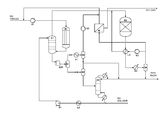
- the figure shows a reactor design comprising two reactors, i.e. a boiling water reactor R1 and a second methanol synthesis reactor R2.
- Make-up (MU) syngas is compressed together with recovered hydrogen from the synthesis loop off-gas and desorbed syngas from a wash unit, and the compressed mixture is fed to the boiling water reactor R1.
- the effluent from R1 at 260°C is brought into contact with the selected solvent in the wash unit C1 and cooled down to 180-190°C.
- the cooled, methanol-lean gas is fed to the second methanol synthesis reactor R2.
- the product stream from R2 is cooled and raw methanol is separated from the product stream, and unconverted syngas is recycled to reactor R2.
- a purge stream is sent to the membrane unit M.
- the recovered high concentration hydrogen stream is recycled to the make-up gas compressor K1.
- Rich solvent from C1 is depressurized in the expander EX1 and passed through high pressure separator (S1), medium pressure separator (S2) and low pressure separator (S3) columns to recover solvent from dissolved methanol, water and syngas. Remaining methanol-water in the solvent is recovered in the distillation column C2. Pure solvent is mixed with make-up (MU) solvent, cooled and pressurized via the pump P1 and fed to the wash unit C1. Power recovered from the expander EX1 is in far excess relative to the power needed in the pump P1, which means that there is no need for an external power source for P1 during normal operation.
- S1 high pressure separator
- S2 medium pressure separator
- S3 low pressure separator
Landscapes
- Chemical & Material Sciences (AREA)
- Organic Chemistry (AREA)
- Chemical Kinetics & Catalysis (AREA)
- Organic Low-Molecular-Weight Compounds And Preparation Thereof (AREA)
Abstract
Description
- The present invention relates to a novel method for the production of methanol and a reactor design for carrying out the method.
- Methanol is produced from synthesis gas (syngas) via an equilibrium reaction, which proceeds at elevated temperature under elevated pressure. The synthesis reactions are:
CO + H2O <-> CH3OH + heat (1)
CO2 + 3H2 <-> CH3OH + H2O + heat (2)
CO + H2O <-> CO2 + H2 + heat (3)
- One of the problems associated with methanol production is the difficulty of sufficient temperature control across the catalytic bed. The conversion of syngas to methanol is extremely exothermic and causes a sharp temperature rise in the catalytic bed unless an appropriate means of heat removal is applied. If the reaction heat is not removed from the reactor, the temperature will rise to the maximum equilibrium temperature, which is usually as high as 300°C in a typical methanol synthesis reactor. Such a high temperature will not only generate a considerable amount of various by-products, but also deactivate the catalyst due to a sintering phenomenon.
- Unconverted syngas is recovered from the methanol synthesis reactor and recycled back to the reactor. The amount of re-cycling depends on one-pass conversion, higher conversion, lower recycling and consequently smaller synthesis loop size as well as lower operating cost for the recycle compressor.
- It is known that in situ withdrawal or post-withdrawal of heat and/or methanol and water from the synthesis reactor will enhance the conversion due to le Chatelier's principle, which states that if a dynamic equilibrium is disturbed by a change in conditions, then the position of equilibrium moves to counteract this change. According to the method of the present invention heat, methanol and water will be partly removed from the methanol synthesis reactor or from a point between two or more synthesis reactors, which is done by using a solvent capable of absorbing methanol, water and heat. The type and amount of solvent will determine the degree of conversion in a one pass reactor at a specific process condition.
- The selection of the solvent is a key aspect of the present invention. More specifically, an appropriate solvent needs to be readily available, non-toxic, non-corrosive, cheap and thermally stable. In addition, the solvent must possess a very low vapour pressure, viscosity and syngas dissolving capacity. It needs to be a good solvent for methanol at an elevated pressure and temperature, but it should preferably have a low affinity for methanol dissolving at low temperatures, possibly leading to a liquid-liquid phase split in order to separate methanol from the solvent.
- Furthermore, the solvent needs the ability to be readily recovered and purified from methanol and dissolved syngas for recycling. In addition, the solvent is preferably nonreactive with the catalyst in the methanol synthesis condition. If not, it must at least be neutral to the catalyst, thus causing no deactivation or poisoning.
- Suitable solvents for use in the method according to the invention are propylene glycol and glycerol. Higher alcohols, such as n-decanol, can also be used. Furthermore, blends of different solvents may be used to enhance the performance of the wash unit. The method of the invention is however not limited to these solvents, which means that any solvent or blend of solvents, which can fulfil the process and safety requirements as well as the economic criteria, may be used.
-
CN 103274357 A discloses an adsorption enhanced method for steam reforming of methanol. Carbon dioxide in the product of the reforming reaction is adsorbed and removed through an adsorbent by utilizing le Chatelier's principle, so that the reforming reaction is promoted to move in a hydrogen generation direction. This way, the methanol and steam reforming reaction is reinforced, and the reaction temperature is reduced. Furthermore, because the side reaction of carbon monoxide is inhibited after the carbon dioxide concentration has been reduced, the purpose of radically reducing the carbon monoxide concentration is achieved. The CN publication further discloses a device for hydrogen production by methanol steam reforming, which is based on continuous adsorption reinforcement, said device comprising four parallel reactors and matching heating or decompressing equipment. - From
US 2007/0244208 a process for producing high octane liquid fuel from carbon dioxide and water is known. The feedstock for the production line is industrial carbon dioxide and water, which may be of lower quality. The end product can be high octane gasoline, high cetane diesel or other liquid hydrocarbon mixtures suitable for further industrial processing or commercial use. Products such as dimethyl ether or methanol may also be withdrawn from the production line. The process is emission-free and able to reprocess all hydrocarbons, which are not suited for use as liquid fuels, to form high octane products. The heat, which is generated by exothermic reactions in the process, is fully utilized and so is the heat produced in the reprocessing of hydrocarbons, which are not suitable for liquid fuels. - However, both in the CN and in the US publication, reactions different from those of the present method are disclosed. Also the solvents/absorbents are different from those used in the method of the present invention, i.e. they are not alcohols, and the process steps are also different from those of the present method.
- Thus, the novel method according to the invention is a method for the production of methanol via the exothermic equilibrium reactions (1)-(3), wherein methanol, water and heat are partly removed from the methanol synthesis reactor or from a point between two or more methanol synthesis reactors by means of a solvent capable of absorbing methanol, water and heat.
- The solvent for use in the method according to the invention is preferably an alcohol. Most preferred alcohols are propylene glycol and glycerol. Table 1 compares the properties and performance of propylene glycol and glycerol with other potential solvents. In this table some key process parameters of various solvents in a wash unit are benchmarked against glycerol solvent. A wash unit comprises a high pressure counter-flow liquid-gas contactor, where fresh solvent along with recovered solvent is contacted with high temperature and pressure syngas with methanol content. The solvent absorbs methanol and partly other species, and it exits the contactor from the bottom. The lean gas (lean in methanol) leaves the contactor from the top. The effluent solvent is depressurized and degased first; then it is treated in a solvent recovery unit, such as a distillation unit, to separate the solvent from the methanol product. The solvent is pressurized via a pump and recycled to the contactor along with make-up fresh solvent to compensate solvent losses. According to this description, Sin in Table 1 refers to inlet solvent weight flow, and Sin/Gin indicates the weight ratio of the inlet solvent and the inlet gas to the contactor. Sout and Gout refer to outlet solvent and gas from the contactor, respectively. Solvent loss and gas loss are an indication of lost solvent in washed gas and trapped gas in the washing solvent, both in percentage of inlet solvent and inlet gas, respectively. From Table 1, it is seen that glycerol standing out as the best solvent among the listed solvents in terms of solvent loss, gas loss. Due to very low loss in solvent, required make-up solvent is also very low.
Table 1 Solvent wash unit to recover 90% of methanol in gas stream entering the wash column at 257°C and 87.4 barg with mole composition (%) : CH3OH 31.3, CO 10.2, CO2 8.4, H2 48.5, the balance being inerts and by-products solvent Sin Sin/Gin solvent loss* gas loss* Sout T (°C) Gout T (°C) Glycerol 1.00 0.86 0.03 0.009 229 159 Dipropylene glycol 0.99 1.57 0.22 0.05 220 147 Decanol 1.11 1.31 0.24 0.05 217 147 Benzyl alcohol 1.16 1.18 0.65 0.22 226 157 Propylene glycol 0.86 1.56 1.00 0.36 226 161 Dimethanol amine 1.06 1.66 6.6 2.4 218 165 Ethylene glycol 1.06 1.45 6.6 2.4 218 165 1-Butanol 0.92 1.66 11.57 4.4 215 169 water 0.54 1.35 16.60 15.7 206 200 1-Propanol 0.84 1.83 22.54 9.1 208 173 Sin: relative inlet solvent weight base flow; Sin/Gin: solvent to gas weight ratio; *) in wt% - The method according to the invention is highly beneficial in large methanol plants, whereas in a single train synthesis process, the reactor size would be a limiting factor. Pushing the reactions (1) and (2) to the right hand side in a single pass reactor would minimize the catalyst volume as well as the recycle ratio of the synthesis loop. Nevertheless, the process scheme is not limited to large production plants.
- The method of the invention is illustrated in more detail in the following example with reference to the figure, which shows a suitable reactor design without being limited thereto.
- The figure shows a reactor design comprising two reactors, i.e. a boiling water reactor R1 and a second methanol synthesis reactor R2. Make-up (MU) syngas is compressed together with recovered hydrogen from the synthesis loop off-gas and desorbed syngas from a wash unit, and the compressed mixture is fed to the boiling water reactor R1. The effluent from R1 at 260°C is brought into contact with the selected solvent in the wash unit C1 and cooled down to 180-190°C. The cooled, methanol-lean gas is fed to the second methanol synthesis reactor R2. The product stream from R2 is cooled and raw methanol is separated from the product stream, and unconverted syngas is recycled to reactor R2. A purge stream is sent to the membrane unit M. The recovered high concentration hydrogen stream is recycled to the make-up gas compressor K1.
- Rich solvent from C1 is depressurized in the expander EX1 and passed through high pressure separator (S1), medium pressure separator (S2) and low pressure separator (S3) columns to recover solvent from dissolved methanol, water and syngas. Remaining methanol-water in the solvent is recovered in the distillation column C2. Pure solvent is mixed with make-up (MU) solvent, cooled and pressurized via the pump P1 and fed to the wash unit C1. Power recovered from the expander EX1 is in far excess relative to the power needed in the pump P1, which means that there is no need for an external power source for P1 during normal operation.
Claims (6)
- A method for the production of methanol via the exothermic equilibrium reactions
CO + H2O <-> CH3OH + heat (1)
CO2 + 3H2 <-> CH3OH + H2O + heat (2)
CO + H2O <-> CO2 + H2 + heat (3)
wherein methanol, water and heat are partly removed from the methanol synthesis reactor or from a point between two or more methanol synthesis reactors by means of a solvent capable of absorbing methanol, water and heat. - The method according to claim 1, wherein the solvent capable of absorbing methanol, water and heat is an alcohol.
- The method according to claim 2, wherein the alcohol is either glycerol, propylene glycol or a mixture of both.
- A reactor design for carrying out the method for production of methanol according to any of the claims 1-3, said reactor design comprising two reactors R1 and R2, where R1 is a boiling water reactor and R2 is a second methanol synthesis reactor.
- The reactor design according to claim 4, further comprising a high pressure separator (S1) column, a medium pressure separator (S2) column and a low pressure separator (S3) column to recover solvent from dissolved methanol, water and syngas.
- The reactor design according to claim 4 or 5, further comprising a wash unit C1, where the selected solvent is brought into contact with the effluent from the reactor R1, and a distillation column C2 for recovering remaining methanol-water in the solvent.
Priority Applications (2)
| Application Number | Priority Date | Filing Date | Title |
|---|---|---|---|
| EP14198922.8A EP3034161A1 (en) | 2014-12-18 | 2014-12-18 | Method and reactor design for the production of methanol |
| PCT/EP2015/078316 WO2016096425A1 (en) | 2014-12-18 | 2015-12-02 | Method and reactor design for the production of methanol |
Applications Claiming Priority (1)
| Application Number | Priority Date | Filing Date | Title |
|---|---|---|---|
| EP14198922.8A EP3034161A1 (en) | 2014-12-18 | 2014-12-18 | Method and reactor design for the production of methanol |
Publications (1)
| Publication Number | Publication Date |
|---|---|
| EP3034161A1 true EP3034161A1 (en) | 2016-06-22 |
Family
ID=52133963
Family Applications (1)
| Application Number | Title | Priority Date | Filing Date |
|---|---|---|---|
| EP14198922.8A Withdrawn EP3034161A1 (en) | 2014-12-18 | 2014-12-18 | Method and reactor design for the production of methanol |
Country Status (2)
| Country | Link |
|---|---|
| EP (1) | EP3034161A1 (en) |
| WO (1) | WO2016096425A1 (en) |
Cited By (4)
| Publication number | Priority date | Publication date | Assignee | Title |
|---|---|---|---|---|
| KR20180128448A (en) * | 2016-03-30 | 2018-12-03 | 할도르 토프쉐 에이/에스 | Methanol synthesis process layout for mass production capacity |
| WO2019008317A1 (en) * | 2017-07-07 | 2019-01-10 | Johnson Matthey Public Limited Company | Methanol synthesis process |
| WO2022106313A1 (en) | 2020-11-17 | 2022-05-27 | Totalenergies Onetech | Process for methanol synthesis from co2-rich syngas |
| EP4484719A4 (en) * | 2022-02-25 | 2025-10-22 | Mitsubishi Heavy Ind Ltd | FACILITY |
Families Citing this family (4)
| Publication number | Priority date | Publication date | Assignee | Title |
|---|---|---|---|---|
| DE102017206763A1 (en) * | 2017-04-21 | 2018-10-25 | Siemens Aktiengesellschaft | Process and apparatus for converting carbon dioxide to methanol |
| CN107235826B (en) * | 2017-06-16 | 2021-02-09 | 中国石油大学(华东) | Interstage absorption separation-based methanol preparation process by using synthesis gas fluidized bed |
| DK3556451T3 (en) * | 2018-04-20 | 2020-08-31 | Siemens Ag | Procedure for operating a reactor plant |
| EP4059596A1 (en) | 2021-03-16 | 2022-09-21 | Paul Scherrer Institut | Process for methanol production from co2 with water removal |
Citations (7)
| Publication number | Priority date | Publication date | Assignee | Title |
|---|---|---|---|---|
| EP0326718A1 (en) * | 1988-02-05 | 1989-08-09 | Process Engineering Consultants Pec B.V. | A process for producing methanol |
| EP0430699A2 (en) * | 1989-12-01 | 1991-06-05 | Csir | Production of methanol |
| GB2293334A (en) * | 1994-09-26 | 1996-03-27 | Shell Int Research Maatschappij B V | Process for carrying out chemical equilibrium reactions |
| US20070244208A1 (en) | 2006-03-20 | 2007-10-18 | Shulenberger Arthur M | Process for producing liquid fuel from carbon dioxide and water |
| US20070299145A1 (en) * | 2006-06-26 | 2007-12-27 | Lattner James R | Reactor and process for producing methanol |
| WO2009106231A1 (en) * | 2008-02-25 | 2009-09-03 | Haldor Topsoe A/S | Reactor for the preparation of methanol |
| CN103274357A (en) | 2013-05-24 | 2013-09-04 | 浙江大学 | Methanol steam reforming hydrogen production method and device based on adsorption reinforcement |
-
2014
- 2014-12-18 EP EP14198922.8A patent/EP3034161A1/en not_active Withdrawn
-
2015
- 2015-12-02 WO PCT/EP2015/078316 patent/WO2016096425A1/en not_active Ceased
Patent Citations (7)
| Publication number | Priority date | Publication date | Assignee | Title |
|---|---|---|---|---|
| EP0326718A1 (en) * | 1988-02-05 | 1989-08-09 | Process Engineering Consultants Pec B.V. | A process for producing methanol |
| EP0430699A2 (en) * | 1989-12-01 | 1991-06-05 | Csir | Production of methanol |
| GB2293334A (en) * | 1994-09-26 | 1996-03-27 | Shell Int Research Maatschappij B V | Process for carrying out chemical equilibrium reactions |
| US20070244208A1 (en) | 2006-03-20 | 2007-10-18 | Shulenberger Arthur M | Process for producing liquid fuel from carbon dioxide and water |
| US20070299145A1 (en) * | 2006-06-26 | 2007-12-27 | Lattner James R | Reactor and process for producing methanol |
| WO2009106231A1 (en) * | 2008-02-25 | 2009-09-03 | Haldor Topsoe A/S | Reactor for the preparation of methanol |
| CN103274357A (en) | 2013-05-24 | 2013-09-04 | 浙江大学 | Methanol steam reforming hydrogen production method and device based on adsorption reinforcement |
Cited By (4)
| Publication number | Priority date | Publication date | Assignee | Title |
|---|---|---|---|---|
| KR20180128448A (en) * | 2016-03-30 | 2018-12-03 | 할도르 토프쉐 에이/에스 | Methanol synthesis process layout for mass production capacity |
| WO2019008317A1 (en) * | 2017-07-07 | 2019-01-10 | Johnson Matthey Public Limited Company | Methanol synthesis process |
| WO2022106313A1 (en) | 2020-11-17 | 2022-05-27 | Totalenergies Onetech | Process for methanol synthesis from co2-rich syngas |
| EP4484719A4 (en) * | 2022-02-25 | 2025-10-22 | Mitsubishi Heavy Ind Ltd | FACILITY |
Also Published As
| Publication number | Publication date |
|---|---|
| WO2016096425A1 (en) | 2016-06-23 |
Similar Documents
| Publication | Publication Date | Title |
|---|---|---|
| WO2016096425A1 (en) | Method and reactor design for the production of methanol | |
| EP2024304B1 (en) | Mixed alcohol synthesis with enhanced carbon value use | |
| CN108698985B (en) | Method for supplying carbon dioxide to synthesize urea | |
| CN101372446B (en) | Process for the preparation of dimethyl ether | |
| JP5386590B2 (en) | Absorber and demethanizer for methanol-olefin process | |
| EP2641889B1 (en) | Methanol production process | |
| MX2015003867A (en) | Process for the preparation of hydrocarbons. | |
| EP4289806A1 (en) | Method for producing propylene | |
| AU2008258127B2 (en) | Process for the preparation of pure dimethyl ether | |
| ZA200110175B (en) | Ethylene recovery system. | |
| GB2568127A (en) | Method for removing methanol from a gas mixture | |
| CA2896284A1 (en) | Method for recycling methanol in the process of preparing dimethyl oxalate from synthesis gas | |
| KR20180005666A (en) | A New Method for Methanol Synthesis | |
| JP6070695B2 (en) | Method for producing nitrite, and method for producing dialkyl oxalate and dialkyl carbonate | |
| JP6889644B2 (en) | Oxygen isotope substitution method and oxygen isotope substitution device | |
| US9925489B2 (en) | Method and device for generating fuel for a gas turbine | |
| CN108017517B (en) | Method for separating low-concentration 1, 2-butanediol from ethylene glycol by azeotropic distillation | |
| CN109422708B (en) | Ethylene oxide purification process | |
| CN202465559U (en) | Combined device for producing methyl tertiary butyl ether (MTBE) by utilizing mixed carbon 4 (C4) | |
| KR102869184B1 (en) | Integrated Process for Producing BTX and Hydrogen from Shale Gas with Feeding of Carbon Dioxide | |
| CN120603800A (en) | Method and apparatus for producing propylene and hydrogen from propane | |
| CN110669542A (en) | Method and device for preparing Fischer-Tropsch wax by using coke oven gas | |
| US9611202B2 (en) | Process for the preparation of dimethyl ether | |
| EP2890669B1 (en) | Process for the preparation of dimethyl ether | |
| WO2016164226A1 (en) | Apparatus and process for treating sour syngas |
Legal Events
| Date | Code | Title | Description |
|---|---|---|---|
| PUAI | Public reference made under article 153(3) epc to a published international application that has entered the european phase |
Free format text: ORIGINAL CODE: 0009012 |
|
| AK | Designated contracting states |
Kind code of ref document: A1 Designated state(s): AL AT BE BG CH CY CZ DE DK EE ES FI FR GB GR HR HU IE IS IT LI LT LU LV MC MK MT NL NO PL PT RO RS SE SI SK SM TR |
|
| AX | Request for extension of the european patent |
Extension state: BA ME |
|
| STAA | Information on the status of an ep patent application or granted ep patent |
Free format text: STATUS: REQUEST FOR EXAMINATION WAS MADE |
|
| 17P | Request for examination filed |
Effective date: 20161215 |
|
| RBV | Designated contracting states (corrected) |
Designated state(s): AL AT BE BG CH CY CZ DE DK EE ES FI FR GB GR HR HU IE IS IT LI LT LU LV MC MK MT NL NO PL PT RO RS SE SI SK SM TR |
|
| STAA | Information on the status of an ep patent application or granted ep patent |
Free format text: STATUS: EXAMINATION IS IN PROGRESS |
|
| 17Q | First examination report despatched |
Effective date: 20170517 |
|
| STAA | Information on the status of an ep patent application or granted ep patent |
Free format text: STATUS: THE APPLICATION HAS BEEN WITHDRAWN |
|
| 18W | Application withdrawn |
Effective date: 20170914 |