EP3032219A1 - Tilt detecting device - Google Patents
Tilt detecting device Download PDFInfo
- Publication number
- EP3032219A1 EP3032219A1 EP15195559.8A EP15195559A EP3032219A1 EP 3032219 A1 EP3032219 A1 EP 3032219A1 EP 15195559 A EP15195559 A EP 15195559A EP 3032219 A1 EP3032219 A1 EP 3032219A1
- Authority
- EP
- European Patent Office
- Prior art keywords
- pattern
- detecting device
- small
- center
- tilt detecting
- Prior art date
- Legal status (The legal status is an assumption and is not a legal conclusion. Google has not performed a legal analysis and makes no representation as to the accuracy of the status listed.)
- Granted
Links
Images


Classifications
-
- G—PHYSICS
- G01—MEASURING; TESTING
- G01C—MEASURING DISTANCES, LEVELS OR BEARINGS; SURVEYING; NAVIGATION; GYROSCOPIC INSTRUMENTS; PHOTOGRAMMETRY OR VIDEOGRAMMETRY
- G01C9/00—Measuring inclination, e.g. by clinometers, by levels
- G01C9/02—Details
- G01C9/06—Electric or photoelectric indication or reading means
-
- G—PHYSICS
- G01—MEASURING; TESTING
- G01C—MEASURING DISTANCES, LEVELS OR BEARINGS; SURVEYING; NAVIGATION; GYROSCOPIC INSTRUMENTS; PHOTOGRAMMETRY OR VIDEOGRAMMETRY
- G01C9/00—Measuring inclination, e.g. by clinometers, by levels
- G01C9/02—Details
- G01C9/08—Means for compensating acceleration forces due to movement of instrument
-
- G—PHYSICS
- G01—MEASURING; TESTING
- G01C—MEASURING DISTANCES, LEVELS OR BEARINGS; SURVEYING; NAVIGATION; GYROSCOPIC INSTRUMENTS; PHOTOGRAMMETRY OR VIDEOGRAMMETRY
- G01C9/00—Measuring inclination, e.g. by clinometers, by levels
- G01C9/18—Measuring inclination, e.g. by clinometers, by levels by using liquids
-
- G—PHYSICS
- G01—MEASURING; TESTING
- G01C—MEASURING DISTANCES, LEVELS OR BEARINGS; SURVEYING; NAVIGATION; GYROSCOPIC INSTRUMENTS; PHOTOGRAMMETRY OR VIDEOGRAMMETRY
- G01C9/00—Measuring inclination, e.g. by clinometers, by levels
- G01C9/18—Measuring inclination, e.g. by clinometers, by levels by using liquids
- G01C9/20—Measuring inclination, e.g. by clinometers, by levels by using liquids the indication being based on the inclination of the surface of a liquid relative to its container
-
- G—PHYSICS
- G01—MEASURING; TESTING
- G01C—MEASURING DISTANCES, LEVELS OR BEARINGS; SURVEYING; NAVIGATION; GYROSCOPIC INSTRUMENTS; PHOTOGRAMMETRY OR VIDEOGRAMMETRY
- G01C9/00—Measuring inclination, e.g. by clinometers, by levels
- G01C9/02—Details
- G01C9/06—Electric or photoelectric indication or reading means
- G01C2009/066—Electric or photoelectric indication or reading means optical
Definitions
- the present invention relates to a tilt detecting device capable of stably detecting tilt and horizontality.
- a tilt sensor for instance, is known and as conventional tilt sensors and the following two types can be cited.
- a first one is a device where a liquid is sealed in a container so that a free liquid surface is formed, an absolute pattern is projected by a telecentric optical system to a liquid surface of the liquid, and a reflection image of the absolute pattern obtained by a rear-surface reflection on the liquid is projected to a photodetection element.
- an oil with viscosity or the like is used so that recognition of the absolute pattern can be performed normally even under vibrating, and the absolute pattern can be stably recognized by damping of the oil.
- the viscosity of the oil rises under a low temperature, in order to detect the tilt under a low-temperature environment, there is a problem that follow-up properties deteriorate.
- a second one is a device where an image of penetrating type circular bubble tube is projected to an element split in four parts and the tilt of the sensor is detected from changes of light amount.
- a displacement by vibrating can be processed by averaging, and as the liquid to be sealed in the bubble tube, alcohol with a low viscosity or the like is used.
- It is an object of the present invention is to provide a tilt detecting device capable of stably detecting the tilt and the horizontality without being affected by an environmental temperature and a photodetecting condition of a photodetection element.
- a tilt detecting device comprises a light source for projecting a pattern, a liquid component having a free liquid surface and for rear-surface reflecting by the free liquid surface, a photodetection element for photodetecting a reflection image of the rear-surface reflected pattern, and an arithmetic processing unit, wherein the arithmetic processing unit is adapted to scan a predetermined range of a photodetection surface of the photodetection element as many times as required and performs averaging processing to a photodetection signal as detected and calculates a barycentric position of the pattern based on signals subjected to averaging processing.
- the arithmetic processing unit scans circularly around a point set in advance as a center on the photodetection element.
- the arithmetic processing unit scans around a barycenter, as a center, obtained by a calculation with different radiuses, respectively.
- the pattern comprises at least two small patterns disposed point-symmetrically with respect to the barycenter of the pattern.
- the arithmetic processing unit obtains respectively width centers of the two small patterns by averaging processing and calculates the barycentric position of the pattern based on a straight line connecting the width centers of the two small patterns.
- the arithmetic processing unit obtains the width center of the small patterns for each of two sets of the two small patterns disposed point-symmetrically, calculates the straight line connecting the width centers of the two small patterns for each set, and calculates an intersection of two straight lines as the barycentric position.
- the pattern comprises at least one small pattern, a center of the small pattern is located at a known position with respect to the barycenter of the pattern, a center position of the small pattern is calculated based on a photodetection signal in scanning, and the barycentric position of the pattern is calculated based on the center position of the small pattern.
- the arithmetic processing unit scans on the photodetection element in an X-direction and in a Y-direction, acquires photodetection signals of respective rows, which the pixels belong to, in the X-direction and in the Y-direction, detects the pattern, and calculates the barycentric position of the pattern.
- a tilt detecting device comprises a light source for projecting a pattern, a liquid component having a free liquid surface and for rear-surface reflecting by the free liquid surface, a photodetection element for photodetecting a reflection image of the rear-surface reflected pattern, and an arithmetic processing unit, wherein the arithmetic processing unit is adapted to scan a predetermined range of a photodetection surface of the photodetection element as many times as required and performs averaging processing to a photodetection signal as detected and calculates a barycentric position of the pattern based on signals subjected to averaging processing.
- liquid component alcohol or the like which is a liquid with low viscosity dependence on a temperature and relatively low viscosity can be used so that a follow-up properties do not deteriorate even under a low-temperature environment, and the tilt and the horizontality can be stably detected without being affected by the environmental temperature or a projecting condition to the photodetection element.
- the arithmetic processing unit scans circularly around a point set in advance as a center on the photodetection element. As a result, the arithmetic processing unit can calculate an approximate position of the barycenter of the pattern.
- the arithmetic processing unit scans around a barycenter, as a center, obtained by a calculation with different radiuses, respectively.
- the pattern comprises at least two small patterns disposed point-symmetrically with respect to the barycenter of the pattern. As a result, the barycentric position of the pattern can be easily calculated.
- the arithmetic processing unit obtains respectively width centers of the two small patterns by averaging processing and calculates the barycentric position of the pattern based on a straight line connecting the width centers of the two small patterns. As a result, even in a case where there is vibration from outside, the barycentric position of the pattern can be calculated with accuracy.
- the arithmetic processing unit obtains the width center of the small pattern for each of two sets of the two small patterns disposed point-symmetrically, calculates the straight line connecting the width centers of the two small patterns for each set, and calculates an intersection of two straight lines as the barycentric position.
- the barycentric position of the pattern can be calculated with more accuracy.
- the pattern comprises at least one small pattern, a center of the small pattern is located at a known position with respect to the barycenter of the pattern, a center position of the small pattern is calculated based on a photodetection signal in scanning, and the barycentric position of the pattern is calculated based on the center position of the small pattern.
- the barycentric position of the pattern can be calculated only by scanning the one small pattern.
- the arithmetic processing unit scans on the photodetection element in an X-direction and in a Y-direction, acquires photodetection signals of respective rows, which the pixels belong to, in the X-direction and in the Y-direction, detects the pattern, and calculates the barycentric position of the pattern.
- the barycenter of the pattern can be calculated regardless of a shape of the pattern.
- FIG.1 a description will be given on a tilt detecting device 1 according to an embodiment of the present invention.
- a light source for instance an LED, for emitting a light beam in a horizontal direction.
- a first condenser lens 4 On a projecting optical axis 3 of the light source 2, a first condenser lens 4, a pattern component 5, a second condenser lens 6, and a beam splitter 7 are arranged.
- a liquid component 9 is disposed on a reflecting optical axis 8 of the beam splitter 7, and the liquid component 9 is contained in a container 10 so that a free liquid surface is formed.
- a material of the liquid component 9 a liquid with a viscosity, of which is relatively small even under a low temperature is used, for instance, alcohol.
- the light source 2 and the free liquid surface of the liquid component 9 may be arranged at conjugate positions.
- the pattern component 5 is obtained by forming an opaque pattern in a transparent substrate or by punching a pattern in an opaque substrate. In the present embodiment, by punching circular holes at a predetermined angle pitch in a circumferential direction, as shown in FIG.2A and FIG.2B , a pattern 15 consisted of a plurality of circular small patterns 14 as arranged at the predetermined angle pitch is formed.
- the small patterns 14 may be at least two (one set) of the small patterns 14 disposed at point-symmetric positions with respect to a barycenter G of the pattern 15, there are preferably four (two sets) or more of the small patterns 14 disposed at point-symmetric positions with respect to the barycenter G of the pattern 15. It is to be noted that various kinds of arrangement of the small patterns 14 can be considered, and the drawing shows a case where the small patterns 14 is arranged at the predetermined angle pitch on the same circumference.
- the light source 2, the first condenser lens 4, the pattern unit 5, the second condenser lens 6, the beam splitter 7 and the like, constitute a free liquid surface projecting optical system.
- a laser beam emitted from the light source 2 and reflected by the beam splitter 7 is configured so as to be reflected by the free liquid surface of the liquid component 9 and to penetrate through the beam splitter 7.
- a third condenser lens 12 and a photodetection element 13 are disposed on a penetrating optical axis 11 of the beam splitter 7.
- a profile sensor which is an aggregate of pixels is used, for instance.
- the profile sensor can detect a position of a target in the profile sensor only by informations of respective rows, which the pixels belong to, in an X-direction and in a Y-direction without acquiring the informations of all the pixels.
- a CCD or a CMOS sensor may be used as the photodetection element 13.
- the beam splitter 7, the third condenser lens 12, and the photodetection element 13 make up together a photodetecting optical system.
- the tilt detecting device 1 has an arithmetic processing unit 16.
- the penetrating optical axis 11 is an optical axis of a reflection light reflected on the free liquid surface of the liquid component 9, and in a case where the free liquid surface projecting optical axis is tilted, the free liquid surface of the liquid component 9 relatively tilts with respect to the free liquid surface projecting optical system.
- the reflecting optical axis 8 tilts with respect to the beam splitter 7, and further, the reflection light (the penetrating optical axis 11) at the beam splitter 7 angle-deflects with respect to the reflecting optical axis 8.
- a projecting position of the free liquid surface projecting optical system with respect to the photodetection element 13 changes. Based on a displacement of the projecting position on the photodetection element 13, tilt of the free liquid surface projecting optical system can be detected.
- the arithmetic processing unit 16 is designed so as to calculate the tilt of the free liquid surface of the liquid component 9 and a direction of the tilt based on an input signal photodetecting from the photodetection element 13.
- the laser beam emitted from the light source 2 passes through the first condenser lens 4, the pattern component 5, the second condenser lens 6, and the beam splitter 7 and is incident to the liquid component 9, and the laser beam is reflected by the free liquid surface.
- the reflection light passes through the beam splitter 7 and the third condenser lens 12 and is projected to the photodetection element 13. That is, the pattern 15 is projected to the photodetection element 13.
- the position of the barycenter G of the pattern 15 coincides with a center of the photodetection element 13 or an origin point as offset in advance.
- the barycenter G of the pattern 15 coincides with the center of the photodetection element 13 (that is, a scanning center).
- a state of the free liquid surface of the liquid component 9 is changed by vibrating, and a position or a shape of the image of the pattern 15 on the photodetection element 13 changes.
- a tilt detection is performed by the tilt detecting device 1
- two processes that is, a coarse tilt detection process and a precise tilt detection process are carried out.
- a detection of the scanning center is performed.
- the arithmetic processing unit 16 performs scanning a point set in advance, for instance, the center of the photodetection element 13, as a center pattern (the scanning center) circularly. It is to be noted that the coarse tilt detection process, a scan radius is set to be the same as the radius of the pattern 15 and scanning is confined to plural times.
- the tilt detecting device 1 In a case where the tilt detecting device 1 is horizontal, as a result of the coarse tilt detection, detection signals are detected at an equal interval and an equal signal width in one cycle of scanning. Therefore, a barycenter of the total signals appearing in the one cycle of scanning coincides with the center pattern. That is, the barycenter G of the pattern 15 obtained from the detection signal coincides with the center pattern.
- the barycenter of the total signals is obtained based on positions of the detection signals on a scan line 17 (see FIG.3 ) which is a trajectory of scanning.
- the pattern 15 relatively moves with respect to the photodetection element 13, and the barycenter G of the pattern 15 is displaced from the center pattern by ⁇ d.
- the scan line 17 When scanning is performed around the center pattern as a center under this condition, the scan line 17 onlypasses through a part of the small patterns 14 of the pattern 15. For instance, in the condition of FIG.2B , when scanning is performed around the center of the photodetection element 13 as the center, the scan line 17 passes through the small pattern 14 in a lower right part in the figure but does not pass through the small pattern 14 in an upper left part.
- the barycenter of the detection signals on the scan line 17 is obtained, the barycenter is a position moved in a lower right direction from the center of the photodetection element 13.
- the barycentric position obtained from the detection signals is set again as the center pattern, and the coarse tilt detection process is performed as described above.
- the center pattern can be made to approximately coincide with the barycenter G of the pattern 15.
- the signals detecting all the small patterns 14 appears on the scan line 17.
- the barycenter G of the pattern 15 obtained in the coarse tilt detection process is used as the center pattern, the photodetection element 13 is scanned circularly, and the photodetection signals from the pixel on the scan line 17 are detected. Further, scanning is performed concentrically by changing the radius (r1, r2, and r3 in FIG.3 ) for each cycle of scanning. A range in a radial direction as performed scanning is up to the scan range where the small patterns 14 are completely included. Further, a change amount of the radius at each cycle is by the unit of one pixel of the photodetection element 13 or the unit of a required pixel.
- scanning is configured so as to be performed about 40 to 50 times per second, for instance.
- the radius of the scan line 17 is changed, and required spots (three spots in FIG. 3 ) are scanned. Since the small pattern 14 has a circular shape, the rectangular waves detected by the arithmetic processing unit 16 become rectangular waves having the detection signals 18a to 18c with different widths as shown in FIG.4A to FIG.4C .
- a scan line 17a is a rectangular wave as shown in FIG.4A
- what is detected by a scan line 17b is a rectangular wave as shown in FIG.4B
- what is detected by a scan line 17c is a rectangular wave as shown in FIG.4C .
- the arithmetic processing unit 16 is configured so as to scan on each of the scan lines 17a to 17c as many as required, respectively.
- the liquid component 9 is a liquid such as alcohol with the low viscosity, in a case where the tilt detecting device 1 vibrates due to vibration from outside, the liquid component 9 vibrates, the state of the free liquid surface is changed, and a position or a shape of a reflection image of the pattern 15 projected to the photodetection element 13 changes.
- the width of the detection signal 18 detected by the arithmetic processing unit 16 changes to P1, P2, P3 or the like and the width of the rectangular wave changes.
- the arithmetic processing unit 16 obtains a pitch between the centers O of the width of each of the adjacent rectangular waves and can obtain the pitch between the small patterns 14 detected by averaging processing. Further, by obtaining a point where an obtained pitch between each of the small patterns 14 becomes an equal pitch, the barycenter G of the pattern 15 can be obtained.
- the center O of the width of each rectangular wave obtained by averaging processing is located on a straight line passing through the center of the small pattern 14 and the barycenter G of the pattern 15. Therefore, the position of the barycenter G of the pattern 15 may be obtained by obtaining the centers O of the widths of the small pattern 14 and the small pattern 14 at a point-symmetric position with respect to the small pattern 14 and by obtaining a midpoint of a line connecting the centers O of the widths to each other based on the detection signal on the same scanning line.
- the position of the barycenter G of the pattern 15 may be obtained by obtaining an intersection of the lines connecting the centers O of the widths of the small patterns 14 at point-symmetric positions. Further, based on a position of the rectangular wave on the scan line 17 and on a width of the rectangular wave, the barycenter may be obtained from a figure.
- the arithmetic processing unit 16 may calculate an amount of moving and a moving direction of the barycenter Gof the pattern 15 with respect to the center of the photodetection element 13, that is, a change of the photodetection position on the photodetection element 13, detect the tilt of the tilt detecting device 1 based on the change of the photodetection position and perform leveling.
- the center O of the width of the small pattern 14 is obtained, and the position of the barycenter G of the pattern 15 is obtained from the width center O of the small pattern 14.
- the tilt detecting device 1 vibrates due to vibration from outside and the photodetecting condition of the photodetection element 13 is continuously changing, by appropriately selecting the number of scanning times, a variation caused by changing of the condition can be offset, and the width center O of the small pattern 14 and the position of the barycenter G of the pattern 15 can be obtained with precision.
- the liquid component 9 the liquid such as alcohol or the like with relatively small change of the viscosity can be used.
- the follow-up properties of the liquid component 9 does not deteriorate even under the low-temperature environment, and the tilt and the horizontality of the tilt detecting device 1 can be stably detected without being affected by an environmental temperature.
- the tilt detecting device 1 projects the reflection image of the pattern 15 to the photodetection element 13 by a liquid rear-surface reflection by the liquid component 9. As a result, the deterioration of the follow-up properties of the liquid component 9 due to a fabrication accuracy of a glass can be suppressed.
- the projecting position of the pattern 15 on the photodetection element 13 is circularly scanned, by scanning the required range on the photodetection element 13 in the X-direction and in the Y-direction, by acquiring the informations of respective rows, which the pixels belong to, in the X-direction and the in Y-direction and by detecting the small pattern 14, the position of the barycenter G of the pattern 15 may be obtained.
- the shape of the small pattern 14 is set to the circular shape, the small pattern 14 may have any other shapes as long as the shape that can be disposed point-symmetrically such as an elliptical small pattern 14' as shown in FIG.6A , a hexagonal small pattern 14" as shown in FIG.6B and the like.
- the pattern 15 is formed by disposing the small patterns 14 at the predetermined angle pitch in the circumferential direction
- the pattern 15 may have another shape such as an elliptical shape, an even-number polygonal shape and the like as long as the shape that the small patterns 14 can be disposed point-symmetrically.
- the small patterns 14 in order to calculate the position of the barycenter G of the pattern 15, at least two small patterns 14 disposed at point-symmetric positions are used.
- the center of the small pattern 14 is positioned at a known position with respect to the barycenter of the pattern 15, and if, while scanning, it is possible to judge at which position the barycenter G of the pattern 15 is positioned with respect to the center of the small pattern 14, the small patterns 14 may be one.
Landscapes
- Physics & Mathematics (AREA)
- Engineering & Computer Science (AREA)
- General Physics & Mathematics (AREA)
- Radar, Positioning & Navigation (AREA)
- Remote Sensing (AREA)
- Length Measuring Devices By Optical Means (AREA)
Description
- The present invention relates to a tilt detecting device capable of stably detecting tilt and horizontality.
- As a device for detecting the horizontality and the tilt, a tilt sensor, for instance, is known and as conventional tilt sensors and the following two types can be cited.
- A first one is a device where a liquid is sealed in a container so that a free liquid surface is formed, an absolute pattern is projected by a telecentric optical system to a liquid surface of the liquid, and a reflection image of the absolute pattern obtained by a rear-surface reflection on the liquid is projected to a photodetection element.
- In the case of the sensor described above, since the liquid surface of the liquid is horizontal at all times, when the sensor is tilted, a reflection image projected to the photodetection element moves, and by detecting an amount of moving of the reflection image, the tilt of the sensor is detected.
- As the liquid sealed in the container, an oil with viscosity or the like is used so that recognition of the absolute pattern can be performed normally even under vibrating, and the absolute pattern can be stably recognized by damping of the oil. However, since the viscosity of the oil rises under a low temperature, in order to detect the tilt under a low-temperature environment, there is a problem that follow-up properties deteriorate.
- Further, a second one is a device where an image of penetrating type circular bubble tube is projected to an element split in four parts and the tilt of the sensor is detected from changes of light amount. In the case of the second sensor, since a light quantity difference caused by a shade of air bubbles is seen, a displacement by vibrating can be processed by averaging, and as the liquid to be sealed in the bubble tube, alcohol with a low viscosity or the like is used.
- However, in the case of the sensor described above, since a movement of the air bubbles directly depend on an accuracy of a glass inner surface, a range where the movement of the air bubbles follows up the tilt of the sensor with the good sensitivity is limited. Further, an influence by a deformation of the air bubbles caused by a temperature change can be easily applied, and there is a problem that an offset at a zero point is difficult.
- It is an object of the present invention is to provide a tilt detecting device capable of stably detecting the tilt and the horizontality without being affected by an environmental temperature and a photodetecting condition of a photodetection element.
- To attain the object as described above, a tilt detecting device according to the present invention comprises a light source for projecting a pattern, a liquid component having a free liquid surface and for rear-surface reflecting by the free liquid surface, a photodetection element for photodetecting a reflection image of the rear-surface reflected pattern, and an arithmetic processing unit, wherein the arithmetic processing unit is adapted to scan a predetermined range of a photodetection surface of the photodetection element as many times as required and performs averaging processing to a photodetection signal as detected and calculates a barycentric position of the pattern based on signals subjected to averaging processing.
- Further, in the tilt detecting device according to the present invention, the arithmetic processing unit scans circularly around a point set in advance as a center on the photodetection element.
- Further, in the tilt detecting device according to the present invention, the arithmetic processing unit scans around a barycenter, as a center, obtained by a calculation with different radiuses, respectively.
- Further, in the tilt detecting device according to the present invention, the pattern comprises at least two small patterns disposed point-symmetrically with respect to the barycenter of the pattern.
- Further, in the tilt detecting device according to the present invention, the arithmetic processing unit obtains respectively width centers of the two small patterns by averaging processing and calculates the barycentric position of the pattern based on a straight line connecting the width centers of the two small patterns.
- Further, in the tilt detecting device according to the present invention, the arithmetic processing unit obtains the width center of the small patterns for each of two sets of the two small patterns disposed point-symmetrically, calculates the straight line connecting the width centers of the two small patterns for each set, and calculates an intersection of two straight lines as the barycentric position.
- Further, in the tilt detecting device according to the present invention, the pattern comprises at least one small pattern, a center of the small pattern is located at a known position with respect to the barycenter of the pattern, a center position of the small pattern is calculated based on a photodetection signal in scanning, and the barycentric position of the pattern is calculated based on the center position of the small pattern.
- Furthermore, in the tilt detecting device according to the present invention, the arithmetic processing unit scans on the photodetection element in an X-direction and in a Y-direction, acquires photodetection signals of respective rows, which the pixels belong to, in the X-direction and in the Y-direction, detects the pattern, and calculates the barycentric position of the pattern.
- According to the present invention, a tilt detecting device comprises a light source for projecting a pattern, a liquid component having a free liquid surface and for rear-surface reflecting by the free liquid surface, a photodetection element for photodetecting a reflection image of the rear-surface reflected pattern, and an arithmetic processing unit, wherein the arithmetic processing unit is adapted to scan a predetermined range of a photodetection surface of the photodetection element as many times as required and performs averaging processing to a photodetection signal as detected and calculates a barycentric position of the pattern based on signals subjected to averaging processing. As a result, as the liquid component, alcohol or the like which is a liquid with low viscosity dependence on a temperature and relatively low viscosity can be used so that a follow-up properties do not deteriorate even under a low-temperature environment, and the tilt and the horizontality can be stably detected without being affected by the environmental temperature or a projecting condition to the photodetection element.
- Further, according to the present invention, in the tilt detecting device, the arithmetic processing unit scans circularly around a point set in advance as a center on the photodetection element. As a result, the arithmetic processing unit can calculate an approximate position of the barycenter of the pattern.
- Further, according to the present invention, in the tilt detecting device, the arithmetic processing unit scans around a barycenter, as a center, obtained by a calculation with different radiuses, respectively. As a result, even in a case where there is an individual different in responsiveness or the like of each pixel of the photodetection element, an error caused by the individual difference can be suppressed, and the calculation accuracy of the barycentric position of the pattern can be improved.
- Further, according to the present invention, in the tilt detecting device, the pattern comprises at least two small patterns disposed point-symmetrically with respect to the barycenter of the pattern. As a result, the barycentric position of the pattern can be easily calculated.
- Further, according to the present invention, in the tilt detecting device, the arithmetic processing unit obtains respectively width centers of the two small patterns by averaging processing and calculates the barycentric position of the pattern based on a straight line connecting the width centers of the two small patterns. As a result, even in a case where there is vibration from outside, the barycentric position of the pattern can be calculated with accuracy.
- Further, according to the present invention, in the tilt detecting device, the arithmetic processing unit obtains the width center of the small pattern for each of two sets of the two small patterns disposed point-symmetrically, calculates the straight line connecting the width centers of the two small patterns for each set, and calculates an intersection of two straight lines as the barycentric position. As a result, even in a case where there is the vibration from the outside, the barycentric position of the pattern can be calculated with more accuracy.
- Further, according to the present invention, in the tilt detecting device, the pattern comprises at least one small pattern, a center of the small pattern is located at a known position with respect to the barycenter of the pattern, a center position of the small pattern is calculated based on a photodetection signal in scanning, and the barycentric position of the pattern is calculated based on the center position of the small pattern. As a result, the barycentric position of the pattern can be calculated only by scanning the one small pattern.
- Furthermore, according to the present invention, in the tilt detecting device, the arithmetic processing unit scans on the photodetection element in an X-direction and in a Y-direction, acquires photodetection signals of respective rows, which the pixels belong to, in the X-direction and in the Y-direction, detects the pattern, and calculates the barycentric position of the pattern. As a result, the barycenter of the pattern can be calculated regardless of a shape of the pattern.
-
-
FIG.1 is a block diagram to show a tilt detecting device according to an embodiment of the present invention. -
FIG.2A is a case where a barycenter of a pattern projected to a photodetection element coincides a center of the photodetection element, andFIG.2B is a drawing to show a case where the barycenter of the pattern is deviated from the center of the photodetection element. -
FIG.3 is a drawing to explain a scanning condition of a small pattern. -
FIG.4A to FIG.4C are drawings to show rectangular waves obtained by scanning on each scan line. -
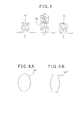
FIG.5 is a drawings to explain a change of a width and a pitch of the rectangular waves caused by a change of a photodetecting condition on the photodetection element. -
FIG.6A and FIG.6B are drawings to show other examples of the small pattern. - A Description will be given below in embodiments of the present invention by referring to the attached drawings.
- First, in
FIG.1 , a description will be given on atilt detecting device 1 according to an embodiment of the present invention. - There is provided a light source 2, for instance an LED, for emitting a light beam in a horizontal direction. On a projecting
optical axis 3 of the light source 2, a first condenser lens 4, apattern component 5, asecond condenser lens 6, and abeam splitter 7 are arranged. - A liquid component 9 is disposed on a reflecting
optical axis 8 of thebeam splitter 7, and the liquid component 9 is contained in acontainer 10 so that a free liquid surface is formed. As a material of the liquid component 9, a liquid with a viscosity, of which is relatively small even under a low temperature is used, for instance, alcohol. The light source 2 and the free liquid surface of the liquid component 9 may be arranged at conjugate positions. - The
pattern component 5 is obtained by forming an opaque pattern in a transparent substrate or by punching a pattern in an opaque substrate. In the present embodiment, by punching circular holes at a predetermined angle pitch in a circumferential direction, as shown inFIG.2A and FIG.2B , apattern 15 consisted of a plurality of circularsmall patterns 14 as arranged at the predetermined angle pitch is formed. - Although there may be at least two (one set) of the
small patterns 14 disposed at point-symmetric positions with respect to a barycenter G of thepattern 15, there are preferably four (two sets) or more of thesmall patterns 14 disposed at point-symmetric positions with respect to the barycenter G of thepattern 15. It is to be noted that various kinds of arrangement of thesmall patterns 14 can be considered, and the drawing shows a case where thesmall patterns 14 is arranged at the predetermined angle pitch on the same circumference. - The light source 2, the first condenser lens 4, the
pattern unit 5, thesecond condenser lens 6, thebeam splitter 7 and the like, constitute a free liquid surface projecting optical system. - A laser beam emitted from the light source 2 and reflected by the
beam splitter 7 is configured so as to be reflected by the free liquid surface of the liquid component 9 and to penetrate through thebeam splitter 7. On a penetratingoptical axis 11 of thebeam splitter 7, athird condenser lens 12, and aphotodetection element 13 are disposed. As thephotodetection element 13, a profile sensor which is an aggregate of pixels is used, for instance. The profile sensor can detect a position of a target in the profile sensor only by informations of respective rows, which the pixels belong to, in an X-direction and in a Y-direction without acquiring the informations of all the pixels. It is to be noted that as thephotodetection element 13, a CCD or a CMOS sensor may be used. - The beam splitter 7, the
third condenser lens 12, and thephotodetection element 13 make up together a photodetecting optical system. - Further, the
tilt detecting device 1 has anarithmetic processing unit 16. The penetratingoptical axis 11 is an optical axis of a reflection light reflected on the free liquid surface of the liquid component 9, and in a case where the free liquid surface projecting optical axis is tilted, the free liquid surface of the liquid component 9 relatively tilts with respect to the free liquid surface projecting optical system. As a result, the reflectingoptical axis 8 tilts with respect to thebeam splitter 7, and further, the reflection light (the penetrating optical axis 11) at thebeam splitter 7 angle-deflects with respect to the reflectingoptical axis 8. - For this reason, a projecting position of the free liquid surface projecting optical system with respect to the
photodetection element 13 changes. Based on a displacement of the projecting position on thephotodetection element 13, tilt of the free liquid surface projecting optical system can be detected. Thearithmetic processing unit 16 is designed so as to calculate the tilt of the free liquid surface of the liquid component 9 and a direction of the tilt based on an input signal photodetecting from thephotodetection element 13. - The laser beam emitted from the light source 2 passes through the first condenser lens 4, the
pattern component 5, thesecond condenser lens 6, and thebeam splitter 7 and is incident to the liquid component 9, and the laser beam is reflected by the free liquid surface. The reflection light passes through thebeam splitter 7 and thethird condenser lens 12 and is projected to thephotodetection element 13. That is, thepattern 15 is projected to thephotodetection element 13. - In a case where the
tilt detecting device 1 is horizontal, the position of the barycenter G of thepattern 15 coincides with a center of thephotodetection element 13 or an origin point as offset in advance. In the present embodiment, as shown inFIG.2A , the barycenter G of thepattern 15 coincides with the center of the photodetection element 13 (that is, a scanning center). - Further, in a case where the
tilt detecting device 1 tilts, since the free liquid surface of the liquid component 9 keeps horizontal, an image of thepattern 15 on the liquid component 9 moves in proportion to a tilt angle. That is, as shown inFIG.2B , the position of the barycenter G of thepattern 15 is projected to the position deviated from the center of thephotodetection element 13. - Further, in a case where the
tilt detecting device 1 vibrates, a state of the free liquid surface of the liquid component 9 is changed by vibrating, and a position or a shape of the image of thepattern 15 on thephotodetection element 13 changes. - In the present embodiment, when a tilt detection is performed by the
tilt detecting device 1, two processes, that is, a coarse tilt detection process and a precise tilt detection process are carried out. - In the coarse tilt detection process, first, a detection of the scanning center is performed. In the coarse tilt detection process, the
arithmetic processing unit 16 performs scanning a point set in advance, for instance, the center of thephotodetection element 13, as a center pattern (the scanning center) circularly. It is to be noted that the coarse tilt detection process, a scan radius is set to be the same as the radius of thepattern 15 and scanning is confined to plural times. - In a case where the
tilt detecting device 1 is horizontal, as a result of the coarse tilt detection, detection signals are detected at an equal interval and an equal signal width in one cycle of scanning. Therefore, a barycenter of the total signals appearing in the one cycle of scanning coincides with the center pattern. That is, the barycenter G of thepattern 15 obtained from the detection signal coincides with the center pattern. Here, the barycenter of the total signals is obtained based on positions of the detection signals on a scan line 17 (seeFIG.3 ) which is a trajectory of scanning. - Further, in a case where the
tilt detecting device 1 is tilted, as shown inFIG.2B , thepattern 15 relatively moves with respect to thephotodetection element 13, and the barycenter G of thepattern 15 is displaced from the center pattern by Δd. - When scanning is performed around the center pattern as a center under this condition, the scan line 17 onlypasses through a part of the
small patterns 14 of thepattern 15. For instance, in the condition ofFIG.2B , when scanning is performed around the center of thephotodetection element 13 as the center, the scan line 17 passes through thesmall pattern 14 in a lower right part in the figure but does not pass through thesmall pattern 14 in an upper left part. - Therefore, in a case where the barycenter of the detection signals on the scan line 17 is obtained, the barycenter is a position moved in a lower right direction from the center of the
photodetection element 13. Next, the barycentric position obtained from the detection signals is set again as the center pattern, and the coarse tilt detection process is performed as described above. - By repeatedly carrying out the coarse tilt detection process, the center pattern can be made to approximately coincide with the barycenter G of the
pattern 15. By approximately coinciding with the center pattern with the barycenter G of thepattern 15, the signals detecting all thesmall patterns 14 appears on the scan line 17. - When a condition where all the
small patterns 14 are obtained, then, the precise tilt detection is carried out. - In the precise tilt detection process, the barycenter G of the
pattern 15 obtained in the coarse tilt detection process is used as the center pattern, thephotodetection element 13 is scanned circularly, and the photodetection signals from the pixel on the scan line 17 are detected. Further, scanning is performed concentrically by changing the radius (r1, r2, and r3 inFIG.3 ) for each cycle of scanning. A range in a radial direction as performed scanning is up to the scan range where thesmall patterns 14 are completely included. Further, a change amount of the radius at each cycle is by the unit of one pixel of thephotodetection element 13 or the unit of a required pixel. - When the scan line 17 passes through the
small patterns 14, a rectangular wave having thedetection signal 18 with a width equivalent to thesmall pattern 14 is detected. It is to be noted that in the present embodiment, scanning is configured so as to be performed about 40 to 50 times per second, for instance. - In the present embodiment, as shown in
FIG.3 , the radius of the scan line 17 is changed, and required spots (three spots inFIG. 3 ) are scanned. Since thesmall pattern 14 has a circular shape, the rectangular waves detected by thearithmetic processing unit 16 become rectangular waves having the detection signals 18a to 18c with different widths as shown inFIG.4A to FIG.4C . - In
FIG. 3 , what is detected by ascan line 17a is a rectangular wave as shown inFIG.4A , what is detected by ascan line 17b is a rectangular wave as shown inFIG.4B , and what is detected by ascan line 17c is a rectangular wave as shown inFIG.4C . Thearithmetic processing unit 16 is configured so as to scan on each of thescan lines 17a to 17c as many as required, respectively. - Since the liquid component 9 is a liquid such as alcohol with the low viscosity, in a case where the
tilt detecting device 1 vibrates due to vibration from outside, the liquid component 9 vibrates, the state of the free liquid surface is changed, and a position or a shape of a reflection image of thepattern 15 projected to thephotodetection element 13 changes. - In a case where the position or the shape of the reflection image of the
pattern 15 changes, as shown inFIG.5 , the width of thedetection signal 18 detected by thearithmetic processing unit 16 changes to P1, P2, P3 or the like and the width of the rectangular wave changes. - Since scannings are performed on each of the
scan lines 17a to 17c by a required number of times, respectively, by applying the averaging processing to the rectangular waves detected by thearithmetic processing unit 16, respectively, the change caused by vibrating of the liquid component 9 or the like is offset, and a center O of the width of each of the rectangular waves can be acquired. - Further, the
arithmetic processing unit 16 obtains a pitch between the centers O of the width of each of the adjacent rectangular waves and can obtain the pitch between thesmall patterns 14 detected by averaging processing. Further, by obtaining a point where an obtained pitch between each of thesmall patterns 14 becomes an equal pitch, the barycenter G of thepattern 15 can be obtained. - It is to be noted that the center O of the width of each rectangular wave obtained by averaging processing is located on a straight line passing through the center of the
small pattern 14 and the barycenter G of thepattern 15. Therefore, the position of the barycenter G of thepattern 15 may be obtained by obtaining the centers O of the widths of thesmall pattern 14 and thesmall pattern 14 at a point-symmetric position with respect to thesmall pattern 14 and by obtaining a midpoint of a line connecting the centers O of the widths to each other based on the detection signal on the same scanning line. - Further, in a case where there are two sets or more of the
small patterns 14 which are point-symmetry with respect to the barycenter G of thepattern 15, the position of the barycenter G of thepattern 15 may be obtained by obtaining an intersection of the lines connecting the centers O of the widths of thesmall patterns 14 at point-symmetric positions. Further, based on a position of the rectangular wave on the scan line 17 and on a width of the rectangular wave, the barycenter may be obtained from a figure. - After the position of the barycenter G of the
pattern 15 is obtained, thearithmetic processing unit 16 may calculate an amount of moving and a moving direction of the barycenter Gof thepattern 15 with respect to the center of thephotodetection element 13, that is, a change of the photodetection position on thephotodetection element 13, detect the tilt of thetilt detecting device 1 based on the change of the photodetection position and perform leveling. - As described above, in the present embodiment, by scanning the reflection image of the
pattern 15 projected to thephotodetection element 13 circularly as many times as required and by applying the averaging processing to the obtained rectangular waves, the center O of the width of thesmall pattern 14 is obtained, and the position of the barycenter G of thepattern 15 is obtained from the width center O of thesmall pattern 14. - Thus, even in a case where the
tilt detecting device 1 vibrates due to vibration from outside and the photodetecting condition of thephotodetection element 13 is continuously changing, by appropriately selecting the number of scanning times, a variation caused by changing of the condition can be offset, and the width center O of thesmall pattern 14 and the position of the barycenter G of thepattern 15 can be obtained with precision. - Therefore, as the liquid component 9, the liquid such as alcohol or the like with relatively small change of the viscosity can be used. As a result, the follow-up properties of the liquid component 9 does not deteriorate even under the low-temperature environment, and the tilt and the horizontality of the
tilt detecting device 1 can be stably detected without being affected by an environmental temperature. - Further, the
tilt detecting device 1 projects the reflection image of thepattern 15 to thephotodetection element 13 by a liquid rear-surface reflection by the liquid component 9. As a result, the deterioration of the follow-up properties of the liquid component 9 due to a fabrication accuracy of a glass can be suppressed. - Further, since scanning is performed on the scan lines 17 with different radiuses at required spots, even in a case where there is an individual difference in the responsiveness and the like of each pixel of the
photodetection element 13, an error caused by the individual difference can be suppressed by averaging processing, and a calculation accuracy of the width center O of thesmall pattern 14 and the barycenter G of thepattern 15 can be improved and brought close to true values. - Further, by scanning the plurality of scan lines 17, it can be easily determined which position on the small pattern is scanned.
- It is to be noted that in the present embodiment, although the projecting position of the
pattern 15 on thephotodetection element 13 is circularly scanned, by scanning the required range on thephotodetection element 13 in the X-direction and in the Y-direction, by acquiring the informations of respective rows, which the pixels belong to, in the X-direction and the in Y-direction and by detecting thesmall pattern 14, the position of the barycenter G of thepattern 15 may be obtained. - Further, in the present embodiment, although the shape of the
small pattern 14 is set to the circular shape, thesmall pattern 14 may have any other shapes as long as the shape that can be disposed point-symmetrically such as an elliptical small pattern 14' as shown inFIG.6A , a hexagonalsmall pattern 14" as shown inFIG.6B and the like. - Further, in the present embodiment, although the
pattern 15 is formed by disposing thesmall patterns 14 at the predetermined angle pitch in the circumferential direction, thepattern 15 may have another shape such as an elliptical shape, an even-number polygonal shape and the like as long as the shape that thesmall patterns 14 can be disposed point-symmetrically. - Further, in the present embodiment, in order to calculate the position of the barycenter G of the
pattern 15, at least twosmall patterns 14 disposed at point-symmetric positions are used. The center of thesmall pattern 14 is positioned at a known position with respect to the barycenter of thepattern 15, and if, while scanning, it is possible to judge at which position the barycenter G of thepattern 15 is positioned with respect to the center of thesmall pattern 14, thesmall patterns 14 may be one.
Claims (8)
- A tilt detecting device comprising, a light source (2) for projecting a pattern (5, 15), a liquid component (9) having a free liquid surface and for rear-surface reflecting by said free liquid surface, a photodetection element (13) for photodetecting a reflection image of said rear-surface reflected pattern, and an arithmetic processing unit (16), wherein said arithmetic processing unit is adapted to scan a predetermined range of a photodetection surface of said photodetection element as many times as required and performs averaging processing to a photodetection signal as detected and calculates a barycentric position of said pattern based on signals subjected to averaging processing.
- A tilt detecting device according to claim 1, wherein said arithmetic processing unit (16) scans circularly around a point set in advance as a center on said photodetection element (13).
- A tilt detecting device according to claim 2, wherein said arithmetic processing unit (16) scans around a barycenter, as a center, obtained by a calculation with different diameters, respectively.
- A tilt detecting device according to any one of claims 1 to 3, wherein said pattern (15) comprises at least two small patterns (14) disposed point-symmetrically with respect to the barycenter of said pattern.
- A tilt detecting device according to claim 4, wherein said arithmetic processing unit (16) obtains respectively width centers of said two small patterns (14) by averaging processing and calculates said barycentric position of said pattern (15) based on a straight line connecting said width centers of said two small patterns.
- A tilt detecting device according to claim 4, wherein said arithmetic processing unit (16) obtains said width center of said small pattern (14) for each of two sets of said two small patterns disposed point-symmetrically, calculates said straight line connecting said width centers of said two small patterns for each set, and calculates an intersection of two straight lines as said barycentric position.
- A tilt detecting device according to any one of claims 1 to 3, wherein said pattern (15) comprises at least one small pattern (14), a center of said small pattern is located at a known position with respect to said barycenter of said pattern, a center position of said small pattern is calculated based on a photodetection signal in scanning, and said barycentric position of said pattern is calculated based on said center position of said small pattern.
- A tilt detecting device according claim 1, wherein said arithmetic processing unit (16) scans on said photodetection element (13) in an X-direction and in a Y-direction, acquires photodetection signals of respective rows, which said pixels belong to, in said X-direction and in said Y-direction, detects said pattern (15), and calculates said barycentric position of said pattern.
Applications Claiming Priority (1)
| Application Number | Priority Date | Filing Date | Title |
|---|---|---|---|
| JP2014248631A JP2016109602A (en) | 2014-12-09 | 2014-12-09 | Inclination detector |
Publications (2)
| Publication Number | Publication Date |
|---|---|
| EP3032219A1 true EP3032219A1 (en) | 2016-06-15 |
| EP3032219B1 EP3032219B1 (en) | 2018-06-27 |
Family
ID=54608434
Family Applications (1)
| Application Number | Title | Priority Date | Filing Date |
|---|---|---|---|
| EP15195559.8A Active EP3032219B1 (en) | 2014-12-09 | 2015-11-20 | Tilt detecting device |
Country Status (4)
| Country | Link |
|---|---|
| US (1) | US10088310B2 (en) |
| EP (1) | EP3032219B1 (en) |
| JP (1) | JP2016109602A (en) |
| CN (1) | CN105698759A (en) |
Families Citing this family (2)
| Publication number | Priority date | Publication date | Assignee | Title |
|---|---|---|---|---|
| CN107560600B (en) * | 2017-09-30 | 2023-12-29 | 常熟宏川石化仓储有限公司 | Oil storage tank gradient detection system and method |
| CN110631552A (en) * | 2019-09-27 | 2019-12-31 | 西安华腾光电有限责任公司 | Photoelectric liquid pendulum two-dimensional inclination angle sensor |
Citations (4)
| Publication number | Priority date | Publication date | Assignee | Title |
|---|---|---|---|---|
| US5371951A (en) * | 1991-04-04 | 1994-12-13 | Leica Heerbrugg Ag | Two-axis inclinometer |
| US5893215A (en) * | 1996-04-17 | 1999-04-13 | Kabushiki Kaisha Topcon | Inclination sensor and surveying instrument using the same |
| EP1772703A2 (en) * | 2005-10-07 | 2007-04-11 | Kabushiki Kaisha TOPCON | Position detecting device and inclination sensor device of surveying apparatus using the same, and position measuring method |
| US20090002690A1 (en) * | 2005-01-12 | 2009-01-01 | Andreas Glimm | Inclination detection methods and apparatus |
Family Cites Families (9)
| Publication number | Priority date | Publication date | Assignee | Title |
|---|---|---|---|---|
| US4590680A (en) * | 1984-06-13 | 1986-05-27 | Technical Designs Incorporated | Electronic inclination sensing device |
| JP3794599B2 (en) | 1997-07-31 | 2006-07-05 | 株式会社トプコン | Optical axis compensator |
| JP3787736B2 (en) * | 1997-10-08 | 2006-06-21 | 株式会社トプコン | Tilt sensor |
| JP4074971B2 (en) | 1999-03-17 | 2008-04-16 | 株式会社トプコン | Tilt-setting rotating laser device |
| US6473714B1 (en) * | 1998-09-29 | 2002-10-29 | Kabushiki Kaisha Topcon | Inclination measuring apparatus |
| TW200742834A (en) * | 2006-05-11 | 2007-11-16 | Asia Optical Co Inc | Horizontal sensor and horizontal sensing method |
| US8289528B2 (en) * | 2008-03-07 | 2012-10-16 | Trimble Ab | Tilt sensor for a measuring instrument |
| JP5718068B2 (en) * | 2011-01-17 | 2015-05-13 | 株式会社トプコン | Tilt detector and tilt detector |
| JP6324270B2 (en) * | 2014-08-28 | 2018-05-16 | 株式会社トプコン | Measuring device and tilt sensor device |
-
2014
- 2014-12-09 JP JP2014248631A patent/JP2016109602A/en active Pending
-
2015
- 2015-11-20 EP EP15195559.8A patent/EP3032219B1/en active Active
- 2015-11-24 US US14/950,517 patent/US10088310B2/en active Active
- 2015-12-09 CN CN201510901116.7A patent/CN105698759A/en active Pending
Patent Citations (4)
| Publication number | Priority date | Publication date | Assignee | Title |
|---|---|---|---|---|
| US5371951A (en) * | 1991-04-04 | 1994-12-13 | Leica Heerbrugg Ag | Two-axis inclinometer |
| US5893215A (en) * | 1996-04-17 | 1999-04-13 | Kabushiki Kaisha Topcon | Inclination sensor and surveying instrument using the same |
| US20090002690A1 (en) * | 2005-01-12 | 2009-01-01 | Andreas Glimm | Inclination detection methods and apparatus |
| EP1772703A2 (en) * | 2005-10-07 | 2007-04-11 | Kabushiki Kaisha TOPCON | Position detecting device and inclination sensor device of surveying apparatus using the same, and position measuring method |
Also Published As
| Publication number | Publication date |
|---|---|
| JP2016109602A (en) | 2016-06-20 |
| EP3032219B1 (en) | 2018-06-27 |
| CN105698759A (en) | 2016-06-22 |
| US20160161253A1 (en) | 2016-06-09 |
| US10088310B2 (en) | 2018-10-02 |
Similar Documents
| Publication | Publication Date | Title |
|---|---|---|
| US11859976B2 (en) | Automatic locating of target marks | |
| US10185026B2 (en) | Measuring instrument | |
| US10767991B2 (en) | Laser scanner | |
| EP2476998B1 (en) | Liquid container and inclination detector including the same | |
| KR20140019227A (en) | Image sensor positioning apparatus and method | |
| US9151962B2 (en) | Position detector and autofocus control apparatus using focal point deviation detector | |
| US11650299B2 (en) | Calibration method for solid-state LiDAR system | |
| JP2014006134A (en) | Optical measurement device | |
| US20180217510A1 (en) | High-resolution position encoder with image sensor and encoded target pattern | |
| JP6644282B2 (en) | Measuring device and measuring method | |
| KR20130040026A (en) | Method and apparatus for measuring distance of object | |
| CN113475056B (en) | Wide-angle high-resolution distance measuring device | |
| US10088310B2 (en) | Tilt detecting device | |
| US8860929B2 (en) | High precise laser rangefinder | |
| JP6571733B2 (en) | Angle measuring device for specifying rotation angle | |
| JP7537930B2 (en) | Shape measurement method | |
| JP2007040801A (en) | Three-dimensional coordinate measuring system and method | |
| KR20060045055A (en) | Lens meter | |
| US7212294B2 (en) | Method for determination of the level of two or more measurement points, and an arrangement for this purpose | |
| JP2006275553A (en) | Position measuring system | |
| CN113050073A (en) | Reference plane calibration method, obstacle detection method and distance detection device | |
| JP2009042128A (en) | Height measuring device | |
| JP2007155401A (en) | Displacement sensor and shape measuring apparatus | |
| JP2606662B2 (en) | Focus position detector | |
| KR101133562B1 (en) | Profile Measuring Apparatus using The Astigmatic Lens |
Legal Events
| Date | Code | Title | Description |
|---|---|---|---|
| PUAI | Public reference made under article 153(3) epc to a published international application that has entered the european phase |
Free format text: ORIGINAL CODE: 0009012 |
|
| AK | Designated contracting states |
Kind code of ref document: A1 Designated state(s): AL AT BE BG CH CY CZ DE DK EE ES FI FR GB GR HR HU IE IS IT LI LT LU LV MC MK MT NL NO PL PT RO RS SE SI SK SM TR |
|
| AX | Request for extension of the european patent |
Extension state: BA ME |
|
| 17P | Request for examination filed |
Effective date: 20161124 |
|
| RBV | Designated contracting states (corrected) |
Designated state(s): AL AT BE BG CH CY CZ DE DK EE ES FI FR GB GR HR HU IE IS IT LI LT LU LV MC MK MT NL NO PL PT RO RS SE SI SK SM TR |
|
| 17Q | First examination report despatched |
Effective date: 20170607 |
|
| GRAP | Despatch of communication of intention to grant a patent |
Free format text: ORIGINAL CODE: EPIDOSNIGR1 |
|
| RIC1 | Information provided on ipc code assigned before grant |
Ipc: G01C 9/20 20060101ALI20180222BHEP Ipc: G01C 9/18 20060101ALI20180222BHEP Ipc: G01C 9/06 20060101AFI20180222BHEP Ipc: G01C 9/08 20060101ALI20180222BHEP |
|
| INTG | Intention to grant announced |
Effective date: 20180313 |
|
| GRAS | Grant fee paid |
Free format text: ORIGINAL CODE: EPIDOSNIGR3 |
|
| GRAA | (expected) grant |
Free format text: ORIGINAL CODE: 0009210 |
|
| AK | Designated contracting states |
Kind code of ref document: B1 Designated state(s): AL AT BE BG CH CY CZ DE DK EE ES FI FR GB GR HR HU IE IS IT LI LT LU LV MC MK MT NL NO PL PT RO RS SE SI SK SM TR |
|
| REG | Reference to a national code |
Ref country code: GB Ref legal event code: FG4D |
|
| REG | Reference to a national code |
Ref country code: AT Ref legal event code: REF Ref document number: 1012720 Country of ref document: AT Kind code of ref document: T Effective date: 20180715 |
|
| REG | Reference to a national code |
Ref country code: IE Ref legal event code: FG4D |
|
| REG | Reference to a national code |
Ref country code: DE Ref legal event code: R096 Ref document number: 602015012682 Country of ref document: DE |
|
| PG25 | Lapsed in a contracting state [announced via postgrant information from national office to epo] |
Ref country code: BG Free format text: LAPSE BECAUSE OF FAILURE TO SUBMIT A TRANSLATION OF THE DESCRIPTION OR TO PAY THE FEE WITHIN THE PRESCRIBED TIME-LIMIT Effective date: 20180927 Ref country code: FI Free format text: LAPSE BECAUSE OF FAILURE TO SUBMIT A TRANSLATION OF THE DESCRIPTION OR TO PAY THE FEE WITHIN THE PRESCRIBED TIME-LIMIT Effective date: 20180627 Ref country code: LT Free format text: LAPSE BECAUSE OF FAILURE TO SUBMIT A TRANSLATION OF THE DESCRIPTION OR TO PAY THE FEE WITHIN THE PRESCRIBED TIME-LIMIT Effective date: 20180627 Ref country code: NO Free format text: LAPSE BECAUSE OF FAILURE TO SUBMIT A TRANSLATION OF THE DESCRIPTION OR TO PAY THE FEE WITHIN THE PRESCRIBED TIME-LIMIT Effective date: 20180927 Ref country code: SE Free format text: LAPSE BECAUSE OF FAILURE TO SUBMIT A TRANSLATION OF THE DESCRIPTION OR TO PAY THE FEE WITHIN THE PRESCRIBED TIME-LIMIT Effective date: 20180627 |
|
| REG | Reference to a national code |
Ref country code: NL Ref legal event code: MP Effective date: 20180627 |
|
| REG | Reference to a national code |
Ref country code: LT Ref legal event code: MG4D |
|
| PG25 | Lapsed in a contracting state [announced via postgrant information from national office to epo] |
Ref country code: LV Free format text: LAPSE BECAUSE OF FAILURE TO SUBMIT A TRANSLATION OF THE DESCRIPTION OR TO PAY THE FEE WITHIN THE PRESCRIBED TIME-LIMIT Effective date: 20180627 Ref country code: RS Free format text: LAPSE BECAUSE OF FAILURE TO SUBMIT A TRANSLATION OF THE DESCRIPTION OR TO PAY THE FEE WITHIN THE PRESCRIBED TIME-LIMIT Effective date: 20180627 Ref country code: HR Free format text: LAPSE BECAUSE OF FAILURE TO SUBMIT A TRANSLATION OF THE DESCRIPTION OR TO PAY THE FEE WITHIN THE PRESCRIBED TIME-LIMIT Effective date: 20180627 Ref country code: GR Free format text: LAPSE BECAUSE OF FAILURE TO SUBMIT A TRANSLATION OF THE DESCRIPTION OR TO PAY THE FEE WITHIN THE PRESCRIBED TIME-LIMIT Effective date: 20180928 |
|
| REG | Reference to a national code |
Ref country code: AT Ref legal event code: MK05 Ref document number: 1012720 Country of ref document: AT Kind code of ref document: T Effective date: 20180627 |
|
| PG25 | Lapsed in a contracting state [announced via postgrant information from national office to epo] |
Ref country code: NL Free format text: LAPSE BECAUSE OF FAILURE TO SUBMIT A TRANSLATION OF THE DESCRIPTION OR TO PAY THE FEE WITHIN THE PRESCRIBED TIME-LIMIT Effective date: 20180627 |
|
| PG25 | Lapsed in a contracting state [announced via postgrant information from national office to epo] |
Ref country code: EE Free format text: LAPSE BECAUSE OF FAILURE TO SUBMIT A TRANSLATION OF THE DESCRIPTION OR TO PAY THE FEE WITHIN THE PRESCRIBED TIME-LIMIT Effective date: 20180627 Ref country code: SK Free format text: LAPSE BECAUSE OF FAILURE TO SUBMIT A TRANSLATION OF THE DESCRIPTION OR TO PAY THE FEE WITHIN THE PRESCRIBED TIME-LIMIT Effective date: 20180627 Ref country code: PL Free format text: LAPSE BECAUSE OF FAILURE TO SUBMIT A TRANSLATION OF THE DESCRIPTION OR TO PAY THE FEE WITHIN THE PRESCRIBED TIME-LIMIT Effective date: 20180627 Ref country code: CZ Free format text: LAPSE BECAUSE OF FAILURE TO SUBMIT A TRANSLATION OF THE DESCRIPTION OR TO PAY THE FEE WITHIN THE PRESCRIBED TIME-LIMIT Effective date: 20180627 Ref country code: RO Free format text: LAPSE BECAUSE OF FAILURE TO SUBMIT A TRANSLATION OF THE DESCRIPTION OR TO PAY THE FEE WITHIN THE PRESCRIBED TIME-LIMIT Effective date: 20180627 Ref country code: AT Free format text: LAPSE BECAUSE OF FAILURE TO SUBMIT A TRANSLATION OF THE DESCRIPTION OR TO PAY THE FEE WITHIN THE PRESCRIBED TIME-LIMIT Effective date: 20180627 Ref country code: IS Free format text: LAPSE BECAUSE OF FAILURE TO SUBMIT A TRANSLATION OF THE DESCRIPTION OR TO PAY THE FEE WITHIN THE PRESCRIBED TIME-LIMIT Effective date: 20181027 |
|
| PG25 | Lapsed in a contracting state [announced via postgrant information from national office to epo] |
Ref country code: SM Free format text: LAPSE BECAUSE OF FAILURE TO SUBMIT A TRANSLATION OF THE DESCRIPTION OR TO PAY THE FEE WITHIN THE PRESCRIBED TIME-LIMIT Effective date: 20180627 Ref country code: ES Free format text: LAPSE BECAUSE OF FAILURE TO SUBMIT A TRANSLATION OF THE DESCRIPTION OR TO PAY THE FEE WITHIN THE PRESCRIBED TIME-LIMIT Effective date: 20180627 Ref country code: IT Free format text: LAPSE BECAUSE OF FAILURE TO SUBMIT A TRANSLATION OF THE DESCRIPTION OR TO PAY THE FEE WITHIN THE PRESCRIBED TIME-LIMIT Effective date: 20180627 |
|
| REG | Reference to a national code |
Ref country code: DE Ref legal event code: R097 Ref document number: 602015012682 Country of ref document: DE |
|
| PLBE | No opposition filed within time limit |
Free format text: ORIGINAL CODE: 0009261 |
|
| STAA | Information on the status of an ep patent application or granted ep patent |
Free format text: STATUS: NO OPPOSITION FILED WITHIN TIME LIMIT |
|
| PG25 | Lapsed in a contracting state [announced via postgrant information from national office to epo] |
Ref country code: DK Free format text: LAPSE BECAUSE OF FAILURE TO SUBMIT A TRANSLATION OF THE DESCRIPTION OR TO PAY THE FEE WITHIN THE PRESCRIBED TIME-LIMIT Effective date: 20180627 |
|
| 26N | No opposition filed |
Effective date: 20190328 |
|
| PG25 | Lapsed in a contracting state [announced via postgrant information from national office to epo] |
Ref country code: MC Free format text: LAPSE BECAUSE OF FAILURE TO SUBMIT A TRANSLATION OF THE DESCRIPTION OR TO PAY THE FEE WITHIN THE PRESCRIBED TIME-LIMIT Effective date: 20180627 Ref country code: LU Free format text: LAPSE BECAUSE OF NON-PAYMENT OF DUE FEES Effective date: 20181120 |
|
| REG | Reference to a national code |
Ref country code: BE Ref legal event code: MM Effective date: 20181130 |
|
| REG | Reference to a national code |
Ref country code: IE Ref legal event code: MM4A |
|
| PG25 | Lapsed in a contracting state [announced via postgrant information from national office to epo] |
Ref country code: SI Free format text: LAPSE BECAUSE OF FAILURE TO SUBMIT A TRANSLATION OF THE DESCRIPTION OR TO PAY THE FEE WITHIN THE PRESCRIBED TIME-LIMIT Effective date: 20180627 |
|
| PG25 | Lapsed in a contracting state [announced via postgrant information from national office to epo] |
Ref country code: FR Free format text: LAPSE BECAUSE OF NON-PAYMENT OF DUE FEES Effective date: 20181130 Ref country code: IE Free format text: LAPSE BECAUSE OF NON-PAYMENT OF DUE FEES Effective date: 20181120 |
|
| PG25 | Lapsed in a contracting state [announced via postgrant information from national office to epo] |
Ref country code: BE Free format text: LAPSE BECAUSE OF NON-PAYMENT OF DUE FEES Effective date: 20181130 Ref country code: AL Free format text: LAPSE BECAUSE OF FAILURE TO SUBMIT A TRANSLATION OF THE DESCRIPTION OR TO PAY THE FEE WITHIN THE PRESCRIBED TIME-LIMIT Effective date: 20180627 |
|
| PG25 | Lapsed in a contracting state [announced via postgrant information from national office to epo] |
Ref country code: MT Free format text: LAPSE BECAUSE OF NON-PAYMENT OF DUE FEES Effective date: 20181120 |
|
| PG25 | Lapsed in a contracting state [announced via postgrant information from national office to epo] |
Ref country code: TR Free format text: LAPSE BECAUSE OF FAILURE TO SUBMIT A TRANSLATION OF THE DESCRIPTION OR TO PAY THE FEE WITHIN THE PRESCRIBED TIME-LIMIT Effective date: 20180627 |
|
| PG25 | Lapsed in a contracting state [announced via postgrant information from national office to epo] |
Ref country code: PT Free format text: LAPSE BECAUSE OF FAILURE TO SUBMIT A TRANSLATION OF THE DESCRIPTION OR TO PAY THE FEE WITHIN THE PRESCRIBED TIME-LIMIT Effective date: 20180627 |
|
| PG25 | Lapsed in a contracting state [announced via postgrant information from national office to epo] |
Ref country code: HU Free format text: LAPSE BECAUSE OF FAILURE TO SUBMIT A TRANSLATION OF THE DESCRIPTION OR TO PAY THE FEE WITHIN THE PRESCRIBED TIME-LIMIT; INVALID AB INITIO Effective date: 20151120 Ref country code: MK Free format text: LAPSE BECAUSE OF NON-PAYMENT OF DUE FEES Effective date: 20180627 Ref country code: CY Free format text: LAPSE BECAUSE OF FAILURE TO SUBMIT A TRANSLATION OF THE DESCRIPTION OR TO PAY THE FEE WITHIN THE PRESCRIBED TIME-LIMIT Effective date: 20180627 |
|
| GBPC | Gb: european patent ceased through non-payment of renewal fee |
Effective date: 20191120 |
|
| PG25 | Lapsed in a contracting state [announced via postgrant information from national office to epo] |
Ref country code: GB Free format text: LAPSE BECAUSE OF NON-PAYMENT OF DUE FEES Effective date: 20191120 |
|
| PGFP | Annual fee paid to national office [announced via postgrant information from national office to epo] |
Ref country code: DE Payment date: 20230929 Year of fee payment: 9 Ref country code: CH Payment date: 20231201 Year of fee payment: 9 |
|
| REG | Reference to a national code |
Ref country code: DE Ref legal event code: R119 Ref document number: 602015012682 Country of ref document: DE |
|
| REG | Reference to a national code |
Ref country code: CH Ref legal event code: PL |
|
| REG | Reference to a national code |
Ref country code: CH Ref legal event code: PL |
|
| PG25 | Lapsed in a contracting state [announced via postgrant information from national office to epo] |
Ref country code: CH Free format text: LAPSE BECAUSE OF NON-PAYMENT OF DUE FEES Effective date: 20241130 |
|
| PG25 | Lapsed in a contracting state [announced via postgrant information from national office to epo] |
Ref country code: DE Free format text: LAPSE BECAUSE OF NON-PAYMENT OF DUE FEES Effective date: 20250603 |