EP3030004A1 - Storing wi-fi and cellular tower location database to optimize cellular network selection - Google Patents
Storing wi-fi and cellular tower location database to optimize cellular network selection Download PDFInfo
- Publication number
- EP3030004A1 EP3030004A1 EP15197649.5A EP15197649A EP3030004A1 EP 3030004 A1 EP3030004 A1 EP 3030004A1 EP 15197649 A EP15197649 A EP 15197649A EP 3030004 A1 EP3030004 A1 EP 3030004A1
- Authority
- EP
- European Patent Office
- Prior art keywords
- mobile device
- location
- database
- location database
- identifier
- Prior art date
- Legal status (The legal status is an assumption and is not a legal conclusion. Google has not performed a legal analysis and makes no representation as to the accuracy of the status listed.)
- Granted
Links
Images



Classifications
-
- H—ELECTRICITY
- H04—ELECTRIC COMMUNICATION TECHNIQUE
- H04W—WIRELESS COMMUNICATION NETWORKS
- H04W48/00—Access restriction; Network selection; Access point selection
- H04W48/18—Selecting a network or a communication service
-
- H—ELECTRICITY
- H04—ELECTRIC COMMUNICATION TECHNIQUE
- H04W—WIRELESS COMMUNICATION NETWORKS
- H04W4/00—Services specially adapted for wireless communication networks; Facilities therefor
- H04W4/02—Services making use of location information
- H04W4/029—Location-based management or tracking services
-
- H—ELECTRICITY
- H04—ELECTRIC COMMUNICATION TECHNIQUE
- H04W—WIRELESS COMMUNICATION NETWORKS
- H04W72/00—Local resource management
- H04W72/50—Allocation or scheduling criteria for wireless resources
- H04W72/56—Allocation or scheduling criteria for wireless resources based on priority criteria
-
- H—ELECTRICITY
- H04—ELECTRIC COMMUNICATION TECHNIQUE
- H04L—TRANSMISSION OF DIGITAL INFORMATION, e.g. TELEGRAPHIC COMMUNICATION
- H04L2101/00—Indexing scheme associated with group H04L61/00
- H04L2101/60—Types of network addresses
- H04L2101/618—Details of network addresses
- H04L2101/622—Layer-2 addresses, e.g. medium access control [MAC] addresses
-
- H—ELECTRICITY
- H04—ELECTRIC COMMUNICATION TECHNIQUE
- H04W—WIRELESS COMMUNICATION NETWORKS
- H04W84/00—Network topologies
- H04W84/02—Hierarchically pre-organised networks, e.g. paging networks, cellular networks, WLAN [Wireless Local Area Network] or WLL [Wireless Local Loop]
- H04W84/10—Small scale networks; Flat hierarchical networks
- H04W84/12—WLAN [Wireless Local Area Networks]
Definitions
- the present disclosure relates generally to wireless communications and, in particular, to cellular network selection techniques.
- the mobile device When a cellular radiofrequency transceiver of a mobile device is activated, the mobile device seeks to acquire a suitable wireless network in order to obtain voice and data services. System selection algorithms enable the mobile device to find the optimal wireless network under various conditions.
- GPRS General Packet Radio Service
- UMTS Universal Mobile Telecommunication System
- LTE Long-Term Evolution
- PLMN list contains a list of networks mobile country code (MCC) and mobile network code (MNC) with a priority order.
- MCC mobile country code
- MNC mobile network code
- the PLMN list combined with access technology are typically stored in a subscriber identity module (SIM) or universal subscriber identity module (USIM) card.
- SIM subscriber identity module
- USIM universal subscriber identity module
- the mobile device On activation of a cellular transceiver, the mobile device scans all the channels within GPRS or UMTS or LTE band groups until a suitable system is found. It is desirable for the system selection algorithm to find a usable cellular network quickly in order to prolong battery life and to provide a good user experience.
- the present disclosure provides a technique for selecting a cellular network by using a stored or pre-loaded location database that includes the locations of Wi-Fi access points and corresponding information for cellular base stations (cell towers).
- the mobile device After powering on or activating the cellular radiofrequency transceiver, the mobile device scans for a Wi-Fi signal. If a Wi-Fi signal is detected, the mobile device obtains a media access control (MAC) address of the broadcasting wireless access point from the Wi-Fi signal and then searches the database for the location of the Wi-Fi access point by using the obtained MAC address. This location is used as the current location of the mobile device. The current location is then used to prioritize the band search, thereby expediting the process of finding a desired cellular network.
- MAC media access control
- one aspect of the present disclosure is a method of selecting a cellular network that includes storing a location database in a memory of a mobile device, the location database providing location data for one or more locations each identified by a unique identifier, in response to recognizing the identifier, determining a current location of the mobile device by looking up the identifier in the database, prioritizing bands based on the current location to define a band priority, and selecting the cellular network based on the band priority.
- Another aspect of the present disclosure is a non-transitory computer-readable medium comprising instructions in code which when loaded into a memory and executed by a processor of a mobile device cause the mobile device to store a location database in a memory of a mobile device, the location database providing location data for one or more locations each identified by a unique identifier, in response to recognizing the identifier, determine a current location of the mobile device by looking up the identifier in the database, prioritize bands based on the current location to define a band priority, and select the cellular network based on the band priority.
- a mobile device having a memory for storing a location database that includes location data for one or more locations each identified by a unique identifier, a processor operatively coupled to the memory to in response to recognizing the identifier, determine a current location of the mobile device by looking up the identifier in the database, prioritize bands based on the current location to define a band priority and select the cellular network based on the band priority.
- this disclosure may be implemented by a mobile device (i.e., a mobile communications device or wireless communications device) having a cellular radiofrequency transceiver as well as a Wi-Fi transceiver.
- the mobile device stores a location database (or geolocation database) that includes location data for Wi-Fi access points.
- the location information may comprise location coordinates or the identity of nearby cell towers with which a mobile country code (MCC) is associated.
- MCC mobile country code
- the mobile device may detect a beacon signal from a Wi-Fi access point (WAP).
- the beacon signal contains a MAC address of the WAP.
- the mobile device extracts the MAC address and looks up the MAC address in the database to determine a location of the broadcasting WAP. Since the effective range of a wireless access point (WAP) is relatively small, this provides an approximate current location of the mobile device (with an error of less than the effective range), which is sufficient for reordering or prioritizing the bands for more efficient searching.
- FIG. 1 is a depiction of a mobile device implementing an embodiment of the present disclosure.
- This mobile device which is generally designated by reference numeral 100, includes a processor 110 and memory 120, 130 for executing one or more applications.
- the memory may include flash memory 120 and/or random access memory (RAM) 130. Other types or forms of memory may be used.
- the mobile device 100 includes a user interface 140 for interacting with the mobile device and its applications.
- the user interface 140 may include one or more input/output devices, such as a display screen 150 (e.g. an LCD or LED screen or touch-sensitive display screen), and may optionally include a keyboard or keypad.
- the user interface may also include an optical jog pad and/or a thumbwheel, trackball, track pad or equivalent.
- the mobile device 100 may include a cellular radiofrequency (RF) transceiver 170 for communicating with other devices.
- the cellular radiofrequency transceiver 170 enables wireless communication with one or more base stations over a cellular wireless network using cellular communication protocols and standards for both voice calls and packet data transfer such as GSM, CDMA, GPRS, EDGE, UMTS, LTE, etc.
- the mobile device 100 may include a Subscriber Identity Module (SIM) card 112 for GSM-type devices or a Re-Usable Identification Module (RUIM) card for CDMA-type devices.
- SIM Subscriber Identity Module
- RUIM Re-Usable Identification Module
- the RF transceiver 170 may include separate voice and data channels.
- the mobile device 100 may also include one or more ports for wired connections, e.g. USB, HDMI, FireWire (IEEE 1394), etc.
- ports for wired connections e.g. USB, HDMI, FireWire (IEEE 1394), etc.
- the mobile device 100 optionally includes a speech-recognition subsystem that has a microphone 180 for transforming voice input in the form of sound waves into an electrical signal.
- the mobile device 100 may include a speaker 182 and/or an earphone jack.
- the mobile device 100 optionally includes a position-determining subsystem such as a global navigation satellite system (GNSS) receiver, for example a Global Positioning System (GPS) receiver 190 (e.g. in the form of a chip or chipset) for receiving GNSS (e.g. GPS) radio signals transmitted from one or more orbiting GNSS (e.g. GPS) satellites.
- GNSS global navigation satellite system
- GPS Global Positioning System
- the mobile device 100 includes a Wi-Fi transceiver 192 for receiving a Wi-Fi signal transmitted by a Wi-Fi access point, router, adapter or hotspot.
- Wi-Fi® is a registered trademark of the Wi-Fi Alliance, it shall be identified simply as "Wi-Fi" in this specification.
- the mobile device 100 optionally includes a Bluetooth® transceiver 194, and/or a near-field communications (NFC) chip.
- the mobile device 100 may also optionally include a transceiver for WiMax TM (IEEE 802.16), a transceiver for ZigBee® (IEEE 802.15.4-2003 or other wireless personal area networks), an infrared transceiver or an ultra-wideband transceiver.
- the mobile device may include other sensors like a digital compass 196 and/or accelerometer 198.
- Other sensors may include a tilt sensor, gyroscope or equivalent.
- the mobile device 100 may comprise a wireless communications device, tablet, personal digital assistant, cell phone, smart phone, smart watch, smart accessory, gaming device or any other portable electronic device that has cellular transceiver and a Wi-Fi receiver.
- the mobile device 100 detects a Wi-Fi beacon signal using the Wi-Fi transceiver 192 of the mobile device 100 that is broadcast by a Wi-Fi access point 210.
- the mobile device 100 identifies the broadcasting access point by extracting the MAC address from the beacon frame of the beacon signal and searching a database stored in a memory of the mobile device for the location associated with the MAC address.
- the database stores the locations of access points by listing their MAC addresses. This provides an approximation for the current location of the mobile device. Using this current location the mobile device can reorder or prioritize the bands and then efficiently search the bands for a desired cellular network.
- the Wi-Fi access point 210 is connected to a server 200 or other computing device that is connected to a data network 40 such as the Internet.
- a data network 40 such as the Internet.
- the mobile device 100 connects to the cellular network via a base transceiver station (BTS) 50, base station controller (BSC) 60, Serving GPRS Support Node (SGSN) 62, and Gateway GPRS Support Node (GGSN) 64.
- BTS base transceiver station
- BSC base station controller
- SGSN Serving GPRS Support Node
- GGSN Gateway GPRS Support Node
- the mobile device connects via an eNodeB 66, mobility management entity (MME) 68 and serving gateway (SGW) 69.
- MME mobility management entity
- SGW serving gateway
- a network-selection method is outlined by way of example in FIG. 3A .
- the method entails a step, act or operation of storing (300A) a location database in a memory of a mobile device, the location database providing location data for one or more locations each identified by a unique identifier, in response to recognizing the identifier, determining (330A) a current location of the mobile device by looking up the identifier in the database, prioritizing (340A) bands based on the current location to define a band priority, and selecting (350A) the cellular network based on the band priority.
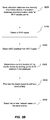
- a network-selection method based on Wi-Fi is depicted by way of example in the flowchart of FIG. 3B .
- the method entails steps, acts or operations of storing (300B) a location database in a memory of a mobile device, the location database providing location data for Wi-Fi access points, detecting (310B) a Wi-Fi signal, obtaining (320B) a MAC address from the Wi-Fi signal, determining (330B) a current location of the mobile device by looking up the MAC address in the database, prioritizing (340B) the bands based on the current location to define a band priority, e.g. to create a set of prioritized bands, and selecting (350B) the cellular network based on the band priority.
- a band priority e.g. to create a set of prioritized bands
- the location database is, in one implementation, a geolocation database that includes entries of Wi-Fi Access Point MAC addresses and corresponding cellular tower identification information which includes the Mobile Country Code (MCC).
- MCC Mobile Country Code
- This database is stored (e.g. pre-loaded or dynamically loaded) in the memory of the mobile device. In some embodiments, particularly in cases in which the mobile device has limited memory capacity, it may be more appropriate to store a subset of the database in the memory of the device.
- the database may store key Wi-Fi access points, e.g. access points for airports. Storing airport access points would cover a large number of cases since most users turn off the cellular radiofrequency transceivers before a flight and then turn the transceiver back on after landing at the airport.
- the mobile device Upon power on (radio on), the mobile device initiates its standard (non-location prioritized) cellular system selection, while the Wi-Fi function is enabled to perform a passive scan to find the available wireless access points. Alternatively, an active scan involving a probe request and probe response may be used.
- the mobile device retrieves the MAC address broadcasted in the beacon signal (i.e. in the 802.11-compliant beacon frame) to search for a matching mobile country code (MCC) in the stored database.
- MCC mobile country code
- the device continues the system selection algorithm if the MCC matches its current searching PLMN list. Otherwise, the current system selection algorithm is interrupted and the device starts a new search. The priority is given to the registered PLMN (RPLMN) list that matches the MCC.
- RPLMN registered PLMN
- a new band search list is loaded based upon the MCC.
- the device starts a new system search on the new band list. If no match is found in the database, the Wi-Fi function is disabled and the device only performs searches on the cellular network.
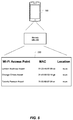
- FIG. 4 is a depiction of a location database 250 including location data for Wi-Fi access points (WAPs) and cell towers.
- the location database is a single database stored in the memory 120, 130 of the mobile device 100.
- the database stores the access point name, MAC address (e.g. in a MAC-48 identifier format).
- the database also stores the cell tower identification and mobile country code (MCC), the latter constituting the location information.
- MCC mobile country code
- Other information may be stored as well such as, for example, the mobile network operator, type of wireless communication (GSM, LTE, etc.), the broadcast signal power, etc.
- FIG. 5 depicts another implementation in which the MAC address of each WAP is stored in association with location coordinates. Note that in this particular example, the database does not need to have a MCC. However, in both FIG. 4 and FIG. 5 , the MAC address is associated with location data of some sort that enables the mobile device to determine its current location and to use this current location for band reordering.
- the location data in the database 250 may be stored as a collection of data in any suitable data structure, e.g. the data may be stored in computer registers, in a relational database as a table having a plurality of different fields and records.
- the table may be, for example, a look-up table as illustrated by way of example in FIGS. 4 and 5 . Variants of this table may include other formats, arrangements, or data elements.
- the location data may be expressed as coordinates of latitude and longitude, although other location identifiers may be used, e.g. city, country, etc.
- This location data may also be formatted in any computer-readable format, e.g. binary values, ASCII or Extended Binary-Coded Decimal Interchange Code.
- the data may include any information sufficient to identify the relevant information, such as descriptive text, codes, and/or pointers or references to data stored in other local or remote storage means.
- the database(s) can be updated regularly to reflect any possible changes to the APs.
- the databases may be updated on a regular basis by pushing updates to the mobile device or in response to update requests sent by the mobile device. With the evolution of Wi-Fi and cellular database and the incremental increase in device memory capacity, more precise network information can be included in the database.
- the Radio Access Technology (RAT) combined with the absolute radio-frequency channel number (ARFCN) frequency can uniquely identify the cellular network. This information could be stored or loaded on the device with an associated MAC address. With this additional information, the mobile device could directly search the frequency and RAT to further accelerate the system selection process.
- RAT Radio Access Technology
- ARFCN absolute radio-frequency channel number
- the current location is used to order the RATs.
- the search order may place UMTS before LTE or vice versa.
- the current location may be used to order a RAT/band combination.
- a RAT/band prioritization may be as follows: UMTS band 4, LTE band 2, LTE band 7, etc.
- the current location may be used to determine a list of prioritized frequencies (i.e. specific channels or channel numbers, e.g. EARFCN, UARFCN, ARFCN) and/or a list of prioritized base stations.
- the current location may be used to order specific channels within a band, e.g. UARFCN 1037 for UMTS.
- the network search may be based on a prioritization of bands and/or RATs.
- the prioritization may also be based on prioritized channel numbers or frequencies within the bands and/or based on prioritized PLMN ID's (MCC/MNC).
- the mobile device may store a first database for the first SIM card and a second database for the second SIM card.
- the mobile device may detect which SIM card is in the mobile device and then search the prioritized list corresponding to the SIM card.
- the method may be further refined to avoid unnecessary scanning.
- the mobile device should remain in the same geographic area when the user triggers a power on or radio on.
- the mobile device may use a first timer T1 to reduce the number of unnecessary scans. For example, if a certain time, e.g. 60 minutes, has not elapsed between the events of the device powering off (or radio off) and the device powering up (or radio on), the device will not start the location detection.
- the mobile device can trigger a scan to detect its location after the certain time (e.g. 60 minutes) has elapsed between the same events.
- a total scan timer T2 (second timer) may be defined to limit a total scan time.
- the method may further entail applying a timer (e.g. timer T1) to require a threshold amount of time to elapse before performing the detecting of the broadcast signal and the obtaining of the current location from the database.
- a timer e.g. timer T1
- the Wi-Fi module may be capable of more than one band (such as 2.4GHz, 5GHz, or others).
- the 2.4GHz band which has only 11-14 channels is scanned first. Within the 2.4GHz band, channels may be scanned in an optimized order as well.
- the 2.4GHz band has more deployed access points than the 5GHz band, and 5GHz access points only exist as dual-band products (as 5GHz-only devices are almost non-existent in the market).
- the 2.4GHz band is fairly uniform in all countries, whereas the 5GHz and other bands tend to be more regional.
- the mobile device exploits knowledge of its current location to expedite the system selection upon powering on the device ("power on”) or on activating the cellular radio transceiver ("radio on”), especially when the device travels to a different geographic region. This will save device battery life and improve the user experience.
- the method is not restricted to cases where the device is powered on or the cellular radio is activated. This method may also apply to other cases, for example, when the mobile device is out of coverage for a long period of time and the device may travel to a different geographic region during this period. Wi-Fi could be used to periodically scan to detect an available network.
- Wi-Fi wireless fidelity
- this technology may be applied to any other short-range wireless technology that broadcasts a unique device identification code (e.g. a MAC address) in its beacon signal to enable a receiving device to look up the code in a database that correlates the codes with location data.
- Wi-Fi encompasses the IEEE 802.11 standard and all its drafts and amendments.
- the short-range wireless technology may comprise Bluetooth, NFC, RFID, QR (Quick Response) code or other barcode, or any equivalent device having a MAC address or unique identifier that is linked to location information.
- the Bluetooth, NFC, QR reader, barcode reader is activated to obtain a reading from which the location information is determined.
- the unique identifier e.g. MAC or code
- the mobile device may detect a signal (Wi-Fi or Bluetooth) or reading an RFID tag, QR code or barcode.
- Obtaining the identifier enables the mobile device to recognize the identifier, to look up the identifier in the database and to determine the location of the mobile device. This location data enables the mobile device to select the cellular network.
- any of the methods disclosed herein may be implemented in hardware, software, firmware or any combination thereof.
- the method steps, acts or operations may be programmed or coded as computer-readable instructions and recorded electronically, magnetically or optically on a fixed, permanent, non-volatile or non-transitory computer-readable medium, computer-readable memory, machine-readable memory or computer program product.
- the computer-readable memory or computer-readable medium comprises instructions in code which when loaded into a memory and executed on a processor of a computing device cause the computing device to perform one or more of the foregoing method(s).
- a computer-readable medium can be any means that contain, store, communicate, propagate or transport the program for use by or in connection with the instruction execution system, apparatus or device.
- the computer-readable medium may be electronic, magnetic, optical, electromagnetic, infrared or any semiconductor system or device.
- computer executable code to perform the methods disclosed herein may be tangibly recorded on a computer-readable medium including, but not limited to, a floppy-disk, a CD-ROM, a DVD, RAM, ROM, EPROM, Flash Memory or any suitable memory card, etc.
- the method may also be implemented in hardware.
- a hardware implementation might employ discrete logic circuits having logic gates for implementing logic functions on data signals, an application-specific integrated circuit (ASIC) having appropriate combinational logic gates, a programmable gate array (PGA), a field programmable gate array (FPGA), etc.
Landscapes
- Engineering & Computer Science (AREA)
- Computer Networks & Wireless Communication (AREA)
- Signal Processing (AREA)
- Computer Security & Cryptography (AREA)
- Mobile Radio Communication Systems (AREA)
- Telephone Function (AREA)
Abstract
Description
- The present disclosure relates generally to wireless communications and, in particular, to cellular network selection techniques.
- When a cellular radiofrequency transceiver of a mobile device is activated, the mobile device seeks to acquire a suitable wireless network in order to obtain voice and data services. System selection algorithms enable the mobile device to find the optimal wireless network under various conditions.
- In General Packet Radio Service (GPRS), Universal Mobile Telecommunication System (UMTS) and Long-Term Evolution (LTE) cellular network systems, a public land mobile network (PLMN) list is normally used for the system selection. The PLMN list contains a list of networks mobile country code (MCC) and mobile network code (MNC) with a priority order. The PLMN list combined with access technology are typically stored in a subscriber identity module (SIM) or universal subscriber identity module (USIM) card.
- Further features and advantages of the present disclosurewill become apparent from the following detailed description, taken in combination with the appended drawings, in which:
-
FIG. 1 is a depiction of a mobile device implementing the present disclosure; -
FIG. 2 is a depiction of a system implementing the present disclosure; -
FIG. 3A is a flowchart outlining a method for selection of a cellular network; -
FIG. 3B is a flowchart outlining a method for selection of a cellular network using a location database of Wi-Fi access points and cell towers; -
FIG. 4 is a depiction of a location database including medium access control (MAC) addresses of Wi-Fi access points and corresponding cell towers and associated mobile country codes; -
FIG. 5 is a depiction of a location database including location coordinates for the MAC addresses of Wi-Fi access points. - It will be noted that throughout the appended drawings, like features are identified by like reference numerals.
- On activation of a cellular transceiver, the mobile device scans all the channels within GPRS or UMTS or LTE band groups until a suitable system is found. It is desirable for the system selection algorithm to find a usable cellular network quickly in order to prolong battery life and to provide a good user experience.
- However, mobile devices today need to scan an ever-growing set of bands and radio access technologies (RATs). Currently, LTE uses 11 bands, UMTS uses 7 bands and GSM uses 4 bands. This scan can take a significant amount of time to complete while also depleting the battery. A technique to assist cellular network selection is therefore highly desirable.
- The present disclosure provides a technique for selecting a cellular network by using a stored or pre-loaded location database that includes the locations of Wi-Fi access points and corresponding information for cellular base stations (cell towers). After powering on or activating the cellular radiofrequency transceiver, the mobile device scans for a Wi-Fi signal. If a Wi-Fi signal is detected, the mobile device obtains a media access control (MAC) address of the broadcasting wireless access point from the Wi-Fi signal and then searches the database for the location of the Wi-Fi access point by using the obtained MAC address. This location is used as the current location of the mobile device. The current location is then used to prioritize the band search, thereby expediting the process of finding a desired cellular network.
- Accordingly, one aspect of the present disclosure is a method of selecting a cellular network that includes storing a location database in a memory of a mobile device, the location database providing location data for one or more locations each identified by a unique identifier, in response to recognizing the identifier, determining a current location of the mobile device by looking up the identifier in the database, prioritizing bands based on the current location to define a band priority, and selecting the cellular network based on the band priority.
- Another aspect of the present disclosureis a non-transitory computer-readable medium comprising instructions in code which when loaded into a memory and executed by a processor of a mobile device cause the mobile device to store a location database in a memory of a mobile device, the location database providing location data for one or more locations each identified by a unique identifier, in response to recognizing the identifier, determine a current location of the mobile device by looking up the identifier in the database, prioritize bands based on the current location to define a band priority, and select the cellular network based on the band priority.
- Another aspect of the present disclosureis a mobile device having a memory for storing a location database that includes location data for one or more locations each identified by a unique identifier, a processor operatively coupled to the memory to in response to recognizing the identifier, determine a current location of the mobile device by looking up the identifier in the database, prioritize bands based on the current location to define a band priority and select the cellular network based on the band priority.
- The details and particulars of these aspects of the disclosure will now be described below, by way of example, with reference to the drawings.
- In general, this disclosure may be implemented by a mobile device (i.e., a mobile communications device or wireless communications device) having a cellular radiofrequency transceiver as well as a Wi-Fi transceiver. The mobile device stores a location database (or geolocation database) that includes location data for Wi-Fi access points. The location information may comprise location coordinates or the identity of nearby cell towers with which a mobile country code (MCC) is associated. On powering on or activating the cellular transceiver, the mobile device may detect a beacon signal from a Wi-Fi access point (WAP). The beacon signal contains a MAC address of the WAP. The mobile device extracts the MAC address and looks up the MAC address in the database to determine a location of the broadcasting WAP. Since the effective range of a wireless access point (WAP) is relatively small, this provides an approximate current location of the mobile device (with an error of less than the effective range), which is sufficient for reordering or prioritizing the bands for more efficient searching.
-
FIG. 1 is a depiction of a mobile device implementing an embodiment of the present disclosure. This mobile device, which is generally designated byreference numeral 100, includes aprocessor 110 andmemory flash memory 120 and/or random access memory (RAM) 130. Other types or forms of memory may be used. - As depicted by way of example in
FIG. 1 , themobile device 100 includes auser interface 140 for interacting with the mobile device and its applications. Theuser interface 140 may include one or more input/output devices, such as a display screen 150 (e.g. an LCD or LED screen or touch-sensitive display screen), and may optionally include a keyboard or keypad. The user interface may also include an optical jog pad and/or a thumbwheel, trackball, track pad or equivalent. - As depicted by way of example in
FIG. 1 , themobile device 100 may include a cellular radiofrequency (RF)transceiver 170 for communicating with other devices. Thecellular radiofrequency transceiver 170 enables wireless communication with one or more base stations over a cellular wireless network using cellular communication protocols and standards for both voice calls and packet data transfer such as GSM, CDMA, GPRS, EDGE, UMTS, LTE, etc. - The
mobile device 100 may include a Subscriber Identity Module (SIM)card 112 for GSM-type devices or a Re-Usable Identification Module (RUIM) card for CDMA-type devices. TheRF transceiver 170 may include separate voice and data channels. - The
mobile device 100 may also include one or more ports for wired connections, e.g. USB, HDMI, FireWire (IEEE 1394), etc. - The
mobile device 100 optionally includes a speech-recognition subsystem that has amicrophone 180 for transforming voice input in the form of sound waves into an electrical signal. Optionally, themobile device 100 may include aspeaker 182 and/or an earphone jack. - The
mobile device 100 optionally includes a position-determining subsystem such as a global navigation satellite system (GNSS) receiver, for example a Global Positioning System (GPS) receiver 190 (e.g. in the form of a chip or chipset) for receiving GNSS (e.g. GPS) radio signals transmitted from one or more orbiting GNSS (e.g. GPS) satellites. - The
mobile device 100 includes a Wi-Fi transceiver 192 for receiving a Wi-Fi signal transmitted by a Wi-Fi access point, router, adapter or hotspot. Although Wi-Fi® is a registered trademark of the Wi-Fi Alliance, it shall be identified simply as "Wi-Fi" in this specification. - The
mobile device 100 optionally includes a Bluetooth®transceiver 194, and/or a near-field communications (NFC) chip. Themobile device 100 may also optionally include a transceiver for WiMax™ (IEEE 802.16), a transceiver for ZigBee® (IEEE 802.15.4-2003 or other wireless personal area networks), an infrared transceiver or an ultra-wideband transceiver. - Optionally, the mobile device may include other sensors like a
digital compass 196 and/oraccelerometer 198. Other sensors may include a tilt sensor, gyroscope or equivalent. - The
mobile device 100 may comprise a wireless communications device, tablet, personal digital assistant, cell phone, smart phone, smart watch, smart accessory, gaming device or any other portable electronic device that has cellular transceiver and a Wi-Fi receiver. - In the embodiment depicted by way of example in
FIG. 2 , themobile device 100 detects a Wi-Fi beacon signal using the Wi-Fi transceiver 192 of themobile device 100 that is broadcast by a Wi-Fi access point 210. Themobile device 100 identifies the broadcasting access point by extracting the MAC address from the beacon frame of the beacon signal and searching a database stored in a memory of the mobile device for the location associated with the MAC address. The database stores the locations of access points by listing their MAC addresses. This provides an approximation for the current location of the mobile device. Using this current location the mobile device can reorder or prioritize the bands and then efficiently search the bands for a desired cellular network. The Wi-Fi access point 210 is connected to aserver 200 or other computing device that is connected to adata network 40 such as the Internet. Once the desired cellular network is identified, themobile device 100 connects to the cellular network via a base transceiver station (BTS) 50, base station controller (BSC) 60, Serving GPRS Support Node (SGSN) 62, and Gateway GPRS Support Node (GGSN) 64. In an LTE implementation, the mobile device connects via aneNodeB 66, mobility management entity (MME) 68 and serving gateway (SGW) 69. Using this band-prioritization technology the mobile device expedites network selection. Furthermore, embodiments of the present disclosure may advantageously conserve power and prolong the battery life of the mobile device. - A network-selection method is outlined by way of example in
FIG. 3A . The method entails a step, act or operation of storing (300A) a location database in a memory of a mobile device, the location database providing location data for one or more locations each identified by a unique identifier, in response to recognizing the identifier, determining (330A) a current location of the mobile device by looking up the identifier in the database, prioritizing (340A) bands based on the current location to define a band priority, and selecting (350A) the cellular network based on the band priority. - A network-selection method based on Wi-Fi is depicted by way of example in the flowchart of
FIG. 3B . The method entails steps, acts or operations of storing (300B) a location database in a memory of a mobile device, the location database providing location data for Wi-Fi access points, detecting (310B) a Wi-Fi signal, obtaining (320B) a MAC address from the Wi-Fi signal, determining (330B) a current location of the mobile device by looking up the MAC address in the database, prioritizing (340B) the bands based on the current location to define a band priority, e.g. to create a set of prioritized bands, and selecting (350B) the cellular network based on the band priority. - The location database is, in one implementation, a geolocation database that includes entries of Wi-Fi Access Point MAC addresses and corresponding cellular tower identification information which includes the Mobile Country Code (MCC). This database is stored (e.g. pre-loaded or dynamically loaded) in the memory of the mobile device. In some embodiments, particularly in cases in which the mobile device has limited memory capacity, it may be more appropriate to store a subset of the database in the memory of the device. For example, the database may store key Wi-Fi access points, e.g. access points for airports. Storing airport access points would cover a large number of cases since most users turn off the cellular radiofrequency transceivers before a flight and then turn the transceiver back on after landing at the airport.
- Upon power on (radio on), the mobile device initiates its standard (non-location prioritized) cellular system selection, while the Wi-Fi function is enabled to perform a passive scan to find the available wireless access points. Alternatively, an active scan involving a probe request and probe response may be used. Once the mobile device finds an AP, the mobile device retrieves the MAC address broadcasted in the beacon signal (i.e. in the 802.11-compliant beacon frame) to search for a matching mobile country code (MCC) in the stored database. The device continues the system selection algorithm if the MCC matches its current searching PLMN list. Otherwise, the current system selection algorithm is interrupted and the device starts a new search. The priority is given to the registered PLMN (RPLMN) list that matches the MCC. If no match is found in the RPLMN list, a new band search list is loaded based upon the MCC. The device starts a new system search on the new band list. If no match is found in the database, the Wi-Fi function is disabled and the device only performs searches on the cellular network.
-
FIG. 4 is a depiction of alocation database 250 including location data for Wi-Fi access points (WAPs) and cell towers. In the illustrated embodiment, the location database is a single database stored in thememory mobile device 100. In the embodiment illustrated inFIG. 4 , the database stores the access point name, MAC address (e.g. in a MAC-48 identifier format). In this embodiment, the database also stores the cell tower identification and mobile country code (MCC), the latter constituting the location information. Other information may be stored as well such as, for example, the mobile network operator, type of wireless communication (GSM, LTE, etc.), the broadcast signal power, etc. -
FIG. 5 depicts another implementation in which the MAC address of each WAP is stored in association with location coordinates. Note that in this particular example, the database does not need to have a MCC. However, in bothFIG. 4 andFIG. 5 , the MAC address is associated with location data of some sort that enables the mobile device to determine its current location and to use this current location for band reordering. - The location data in the
database 250 may be stored as a collection of data in any suitable data structure, e.g. the data may be stored in computer registers, in a relational database as a table having a plurality of different fields and records. The table may be, for example, a look-up table as illustrated by way of example inFIGS. 4 and5 . Variants of this table may include other formats, arrangements, or data elements. The location data may be expressed as coordinates of latitude and longitude, although other location identifiers may be used, e.g. city, country, etc. This location data may also be formatted in any computer-readable format, e.g. binary values, ASCII or Extended Binary-Coded Decimal Interchange Code. Moreover, the data may include any information sufficient to identify the relevant information, such as descriptive text, codes, and/or pointers or references to data stored in other local or remote storage means. - The database(s) can be updated regularly to reflect any possible changes to the APs. The databases may be updated on a regular basis by pushing updates to the mobile device or in response to update requests sent by the mobile device. With the evolution of Wi-Fi and cellular database and the incremental increase in device memory capacity, more precise network information can be included in the database. The Radio Access Technology (RAT) combined with the absolute radio-frequency channel number (ARFCN) frequency can uniquely identify the cellular network. This information could be stored or loaded on the device with an associated MAC address. With this additional information, the mobile device could directly search the frequency and RAT to further accelerate the system selection process.
- In some implementations, the current location is used to order the RATs. For example, the search order may place UMTS before LTE or vice versa. In a further implementation, the current location may be used to order a RAT/band combination. For example, a RAT/band prioritization may be as follows: UMTS band 4, LTE band 2, LTE band 7, etc.
- In other implementations, the current location may be used to determine a list of prioritized frequencies (i.e. specific channels or channel numbers, e.g. EARFCN, UARFCN, ARFCN) and/or a list of prioritized base stations. In a further implementation, the current location may be used to order specific channels within a band, e.g. UARFCN 1037 for UMTS.
- In other words, the network search may be based on a prioritization of bands and/or RATs. The prioritization may also be based on prioritized channel numbers or frequencies within the bands and/or based on prioritized PLMN ID's (MCC/MNC).
- In a scenario in which the user of the mobile device has multiple SIM cards, e.g. a first SIM card for a home country and a second SIM card for a foreign country, the mobile device may store a first database for the first SIM card and a second database for the second SIM card. The mobile device may detect which SIM card is in the mobile device and then search the prioritized list corresponding to the SIM card.
- The method may be further refined to avoid unnecessary scanning. In most cases, the mobile device should remain in the same geographic area when the user triggers a power on or radio on. In order to avoid unnecessary scanning, the mobile device may use a first timer T1 to reduce the number of unnecessary scans. For example, if a certain time, e.g. 60 minutes, has not elapsed between the events of the device powering off (or radio off) and the device powering up (or radio on), the device will not start the location detection. The mobile device can trigger a scan to detect its location after the certain time (e.g. 60 minutes) has elapsed between the same events. Optionally, a total scan timer T2 (second timer) may be defined to limit a total scan time. The scan should only last for this T2 timer and no background scan or back-off algorithm will be applied after T2 expires. Accordingly, the method may further entail applying a timer (e.g. timer T1) to require a threshold amount of time to elapse before performing the detecting of the broadcast signal and the obtaining of the current location from the database.
- The method may be further refined by optimizing the scanning within Wi-Fi. In some embodiments, the Wi-Fi module may be capable of more than one band (such as 2.4GHz, 5GHz, or others). In one embodiment, to optimize its scanning procedure, the 2.4GHz band which has only 11-14 channels is scanned first. Within the 2.4GHz band, channels may be scanned in an optimized order as well. The 2.4GHz band has more deployed access points than the 5GHz band, and 5GHz access points only exist as dual-band products (as 5GHz-only devices are almost non-existent in the market). The 2.4GHz band is fairly uniform in all countries, whereas the 5GHz and other bands tend to be more regional.
- In this method, the mobile device exploits knowledge of its current location to expedite the system selection upon powering on the device ("power on") or on activating the cellular radio transceiver ("radio on"), especially when the device travels to a different geographic region. This will save device battery life and improve the user experience.
- It will be appreciated that the method is not restricted to cases where the device is powered on or the cellular radio is activated. This method may also apply to other cases, for example, when the mobile device is out of coverage for a long period of time and the device may travel to a different geographic region during this period. Wi-Fi could be used to periodically scan to detect an available network.
- Although the present disclosure refers to Wi-Fi, it will be understood that this technology may be applied to any other short-range wireless technology that broadcasts a unique device identification code (e.g. a MAC address) in its beacon signal to enable a receiving device to look up the code in a database that correlates the codes with location data. Wi-Fi encompasses the IEEE 802.11 standard and all its drafts and amendments. In lieu of Wi-Fi, the short-range wireless technology may comprise Bluetooth, NFC, RFID, QR (Quick Response) code or other barcode, or any equivalent device having a MAC address or unique identifier that is linked to location information. In response to activation of a cellular transceiver, the Bluetooth, NFC, QR reader, barcode reader is activated to obtain a reading from which the location information is determined. The unique identifier (e.g. MAC or code) may be obtained by the mobile device by detecting a signal (Wi-Fi or Bluetooth) or reading an RFID tag, QR code or barcode. Obtaining the identifier enables the mobile device to recognize the identifier, to look up the identifier in the database and to determine the location of the mobile device. This location data enables the mobile device to select the cellular network.
- Any of the methods disclosed herein may be implemented in hardware, software, firmware or any combination thereof. Where implemented as software, the method steps, acts or operations may be programmed or coded as computer-readable instructions and recorded electronically, magnetically or optically on a fixed, permanent, non-volatile or non-transitory computer-readable medium, computer-readable memory, machine-readable memory or computer program product. In other words, the computer-readable memory or computer-readable medium comprises instructions in code which when loaded into a memory and executed on a processor of a computing device cause the computing device to perform one or more of the foregoing method(s).
- A computer-readable medium can be any means that contain, store, communicate, propagate or transport the program for use by or in connection with the instruction execution system, apparatus or device. The computer-readable medium may be electronic, magnetic, optical, electromagnetic, infrared or any semiconductor system or device. For example, computer executable code to perform the methods disclosed herein may be tangibly recorded on a computer-readable medium including, but not limited to, a floppy-disk, a CD-ROM, a DVD, RAM, ROM, EPROM, Flash Memory or any suitable memory card, etc. The method may also be implemented in hardware. A hardware implementation might employ discrete logic circuits having logic gates for implementing logic functions on data signals, an application-specific integrated circuit (ASIC) having appropriate combinational logic gates, a programmable gate array (PGA), a field programmable gate array (FPGA), etc.
- This invention has been described in terms of specific embodiments, implementations and configurations which are intended to be exemplary only. Persons of ordinary skill in the art will appreciate, having read this disclosure, that many obvious variations, modifications and refinements may be made without departing from the inventive concept(s) presented herein. The scope of the exclusive right sought by the Applicant(s) is therefore intended to be limited solely by the appended claims.
Claims (15)
- A method of selecting a cellular network, the method comprising:storing a location database in a memory of a mobile device, the location database providing location data for one or more locations each identified by a unique identifier;in response to recognizing the identifier, determining a current location of the mobile device by looking up the identifier in the location database;prioritizing bands based on the current location to define a band priority; andselecting the cellular network based on the band priority.
- The method as claimed in claim 1, wherein recognizing the identifier comprises:detecting a Wi-Fi signal;obtaining a MAC address from the Wi-Fi signal;and wherein determining the current location comprises looking up the MAC address in the location database.
- The method as claimed in claim 2, wherein detecting the Wi-Fi signal comprises passively scanning for a Wi-Fi beacon signal broadcast by a Wi-Fi access point.
- The method as claimed in claim 3, comprising searching for a mobile country code associated with the MAC address in the location database.
- The method as claimed in any preceding claim, wherein the recognizing step occurs in response to activating a cellular radiofrequency transceiver.
- The method as claimed in claim 2 or any of claims 3 to 5 as dependent on claim 2, further comprising:waiting for a threshold amount of time to elapse before performing the detecting of the Wi-Fi signal and the determining of the current location; andlimiting a total scan time for detecting the Wi-Fi signal.
- The method as claimed in claim 2 or any of claims 3 to 6 as dependent on claim 2, wherein the location database comprises WI-FI Access Point MAC addresses and corresponding cellular tower identification information including the Mobile Country Code (MCC) and the determining step comprises determining the current location using the cellular tower identification information.
- The method as claimed in claim 2 or any of claims 3 to 6 as dependent on claim 2, wherein the location database comprises a subset of all possible WI-FI Access Point MAC addresses and corresponding cellular tower identification information including the Mobile Country Code (MCC) and the determining step comprises determining the current location using the cellular tower identification information.
- The method of any preceding claim, wherein the prioritizing step includes prioritizing the different Radio Access Technologies (RAT) available to the mobile device to be used by the selecting step.
- The method of any preceding claim, wherein the prioritizing step includes prioritizing the different channels within any band available to the mobile device to be used by the selecting step.
- The method of any preceding claim, wherein the storing step comprises storing a plurality of different location databases, wherein each location database is associated with a specific SIM card and comprises location data for one or more locations each identified by a unique identifier, and the method further comprises detecting the specific SIM card operating with the mobile device and the determining step comprises searching the location database associated with the detected SIM card to determine the current location.
- A non-transitory computer-readable medium comprising instructions in code which when loaded into a memory and executed by a processor of a mobile device cause the mobile device to:store a location database in a memory of a mobile device, the location database providing location data for one or more locations each identified by a unique identifier;in response to recognizing the identifier, determine a current location of the mobile device by looking up the identifier in the location database; andprioritize bands based on the current location to define a band priority; andselect the cellular network based on the band priority.
- A mobile device comprising:a memory for storing a location database that includes location data for one or more locations each identified by a unique identifier;a processor operatively coupled to the memory to:in response to recognizing the identifier, determine a current location of the mobile device by looking up the identifier in the location database;prioritize bands based on the current location to define a band priority; andselect the cellular network based on the band priority.
- The mobile device as claimed in claim 13, wherein the location database also includes prioritized Radio Access Technologies.
- The mobile device as claimed in claim 13, wherein the location database also includes prioritized absolute radio-frequency channel numbers (ARFCN).
Applications Claiming Priority (1)
| Application Number | Priority Date | Filing Date | Title |
|---|---|---|---|
| US14/558,264 US10462733B2 (en) | 2014-12-02 | 2014-12-02 | Storing Wi-Fi and cellular tower database to assist cellular network system selection |
Publications (2)
| Publication Number | Publication Date |
|---|---|
| EP3030004A1 true EP3030004A1 (en) | 2016-06-08 |
| EP3030004B1 EP3030004B1 (en) | 2018-07-11 |
Family
ID=55066287
Family Applications (1)
| Application Number | Title | Priority Date | Filing Date |
|---|---|---|---|
| EP15197649.5A Active EP3030004B1 (en) | 2014-12-02 | 2015-12-02 | Storing wi-fi and cellular tower location database to optimize cellular network selection |
Country Status (2)
| Country | Link |
|---|---|
| US (2) | US10462733B2 (en) |
| EP (1) | EP3030004B1 (en) |
Families Citing this family (26)
| Publication number | Priority date | Publication date | Assignee | Title |
|---|---|---|---|---|
| US11729576B2 (en) | 2008-03-29 | 2023-08-15 | NEXRF Corp. | Targeted content delivery |
| US11706733B1 (en) | 2008-03-29 | 2023-07-18 | NEXRF Corp. | Location positioning engine system and method |
| US10503912B1 (en) | 2014-08-12 | 2019-12-10 | NEXRF Corp. | Multi-channel communication of data files |
| EP3224815A4 (en) | 2014-11-25 | 2018-10-31 | Fynd Technologies, Inc | Geolocation bracelet, systems, and methods |
| US10084879B2 (en) * | 2015-05-08 | 2018-09-25 | Simo Holdings Inc. | Virtual subscriber identity module for mobile communication device |
| US9615200B2 (en) * | 2015-06-18 | 2017-04-04 | International Business Machines Corporation | Distributed cellular client tracking |
| US9648663B2 (en) | 2015-06-18 | 2017-05-09 | International Business Machines Corporation | Distributed cellular client network |
| CN104994563B (en) * | 2015-06-19 | 2016-12-28 | 广东欧珀移动通信有限公司 | A kind of method for network access and mobile communication terminal |
| US9439197B1 (en) | 2015-08-10 | 2016-09-06 | Planetary Network Technologies, Inc. | Method and apparatus for directed adaptive control of dynamic channel selection in wireless networks |
| US9832791B2 (en) | 2015-08-04 | 2017-11-28 | Network Performance Research Group Llc | Method and apparatus for use of simultaneous multiple channels in the dynamic frequency selection band in wireless networks |
| US10104665B2 (en) | 2015-08-10 | 2018-10-16 | Network Performance Research Group Llc | Method and apparatus for providing dynamic frequency selection spectrum access in peer-to-peer wireless networks |
| US9699786B2 (en) | 2015-09-07 | 2017-07-04 | Network Performance Research Group Llc | Method and apparatus for integrating radio agent data in network organization of dynamic channel selection in wireless networks |
| US9924518B2 (en) | 2015-08-10 | 2018-03-20 | Network Performance Research Group Llc | Method and apparatus for dynamic channel selection device |
| US9807625B2 (en) | 2015-08-10 | 2017-10-31 | Network Performance Research Group Llc | Method and apparatus for using time shifted analysis based on gathering non-encrypted information from packets |
| US10368247B2 (en) | 2015-11-25 | 2019-07-30 | Network Performance Research Group Llc | Cloud DFS super master detector location systems and methods |
| US9930670B2 (en) | 2015-11-25 | 2018-03-27 | Network Performance Research Group Llc | System, method, and apparatus for setting device geolocation via location proxies |
| US9839038B2 (en) * | 2015-11-25 | 2017-12-05 | Network Performance Research Group Llc | System, method, and apparatus for setting a regulatory operating mode of a device |
| US10057844B2 (en) * | 2016-01-22 | 2018-08-21 | T-Mobile Usa, Inc. | Location or service-based determination of radio selection rules |
| US10838582B2 (en) | 2016-06-15 | 2020-11-17 | NEXRF Corp. | Mobile autonomous dynamic graphical user interface |
| CN108696843A (en) * | 2017-03-07 | 2018-10-23 | 中移(杭州)信息技术有限公司 | Bluetooth group control method, device and system between a kind of physical equipment |
| EP3557890B1 (en) | 2018-04-16 | 2021-01-13 | Sony Network Communications Europe B.V. | Establishing a wireless connection to a cellular network |
| US10420019B1 (en) * | 2018-04-27 | 2019-09-17 | T-Mobile Usa, Inc. | Bandwidth-based search order for cell discovery |
| CN110636083B (en) * | 2019-11-07 | 2021-06-18 | 迈普通信技术股份有限公司 | Network address multiplexing method, device, network equipment and storage medium |
| EP4320730A4 (en) * | 2021-04-05 | 2025-04-30 | Frederic Nabki | ULTRA-WIDEBAND (UWB) COMMUNICATION METHODS AND SYSTEMS |
| US12335806B2 (en) * | 2022-04-12 | 2025-06-17 | Qualcomm Incorporated | Priority based stand-alone and carrier aggregated frequency band usage |
| US12143836B2 (en) | 2022-05-10 | 2024-11-12 | T-Mobile Innovations Llc | Optimization of device configuration relating to wireless access technologies |
Citations (4)
| Publication number | Priority date | Publication date | Assignee | Title |
|---|---|---|---|---|
| US20070230420A1 (en) * | 2006-04-03 | 2007-10-04 | Research In Motion Limited | System and method for facilitating determination of mode and configuration of a wireless user equipment (UE) device |
| US20110116453A1 (en) * | 2009-11-17 | 2011-05-19 | Apple Inc. | Location-based network detection |
| WO2012142166A1 (en) * | 2011-04-14 | 2012-10-18 | Qualcomm Incorporated | Selective band- scanning by a multi - sim user equipment in a wireless communications system |
| US20130007039A1 (en) * | 2011-06-28 | 2013-01-03 | Amazon Technologies, Inc. | Optimizing cell search in a mobile communication system supporting variable channel bandwidths |
Family Cites Families (8)
| Publication number | Priority date | Publication date | Assignee | Title |
|---|---|---|---|---|
| US6868270B2 (en) * | 1994-01-11 | 2005-03-15 | Telefonaktiebolaget L.M. Ericsson | Dual-mode methods, systems, and terminals providing reduced mobile terminal registrations |
| US8254986B2 (en) * | 2002-05-21 | 2012-08-28 | Incnetworks, Inc. | Seamless multistage handoff algorithm to facilitate handoffs between hetergeneous wireless networks |
| JP2007529811A (en) | 2004-03-16 | 2007-10-25 | コーニンクレッカ フィリップス エレクトロニクス エヌ ヴィ | Fingerprint authentication method and system using pressure map |
| US20070129103A1 (en) * | 2005-12-05 | 2007-06-07 | Al-Shaikh Saleh A | Cellular phone having multiple lines |
| KR101080643B1 (en) | 2008-07-14 | 2011-11-08 | 주식회사 유니온커뮤니티 | Apparatus for Distinguishing Living Body Fingerprint and Method therof |
| CN102421166A (en) * | 2011-11-21 | 2012-04-18 | 华为技术有限公司 | A method, device and system for discovering wireless access points |
| US9104898B2 (en) | 2012-11-21 | 2015-08-11 | Lenovo (Singapore) Pte. Ltd. | Utilizing force information to improve fingerprint reading |
| US9491645B2 (en) * | 2013-08-06 | 2016-11-08 | Google Technology Holdings LLC | Method and apparatus for wireless network data collection |
-
2014
- 2014-12-02 US US14/558,264 patent/US10462733B2/en active Active
-
2015
- 2015-12-02 EP EP15197649.5A patent/EP3030004B1/en active Active
-
2019
- 2019-09-20 US US16/577,075 patent/US11240743B2/en active Active
Patent Citations (4)
| Publication number | Priority date | Publication date | Assignee | Title |
|---|---|---|---|---|
| US20070230420A1 (en) * | 2006-04-03 | 2007-10-04 | Research In Motion Limited | System and method for facilitating determination of mode and configuration of a wireless user equipment (UE) device |
| US20110116453A1 (en) * | 2009-11-17 | 2011-05-19 | Apple Inc. | Location-based network detection |
| WO2012142166A1 (en) * | 2011-04-14 | 2012-10-18 | Qualcomm Incorporated | Selective band- scanning by a multi - sim user equipment in a wireless communications system |
| US20130007039A1 (en) * | 2011-06-28 | 2013-01-03 | Amazon Technologies, Inc. | Optimizing cell search in a mobile communication system supporting variable channel bandwidths |
Non-Patent Citations (2)
| Title |
|---|
| "3rd Generation Partnership Project; Technical Specification Group Core Network and Terminals; Non-Access-Stratum (NAS) functions related to Mobile Station (MS) in idle mode (Release 12)", 26 June 2014 (2014-06-26), XP050906662, Retrieved from the Internet <URL:http://www.3gpp.org/ftp/Specs/2014-12/Rel-12/23_series/23122-c50.zip> [retrieved on 20140626] * |
| "Radio protocols for LTE and LTE advanced", 30 November 2012, WILEY, Singapore, ISBN: 978-1-118-18853-8, article SEUNGJUNE YI ET AL: "Idle Mode Procedure", pages: 31 - 34, XP055254401 * |
Also Published As
| Publication number | Publication date |
|---|---|
| US20200015157A1 (en) | 2020-01-09 |
| US10462733B2 (en) | 2019-10-29 |
| US11240743B2 (en) | 2022-02-01 |
| EP3030004B1 (en) | 2018-07-11 |
| US20160157168A1 (en) | 2016-06-02 |
Similar Documents
| Publication | Publication Date | Title |
|---|---|---|
| US11240743B2 (en) | Storing Wi-Fi and cellular tower database to assist cellular network system selection | |
| US9668094B2 (en) | Utilizing Wi-Fi country code to assist cellular network selection | |
| US10165485B2 (en) | Method for selecting a cellular network | |
| CN104137497B (en) | The method and apparatus that the search collection of TV white space channel is generated based on positional information | |
| CN104902541B (en) | A network access method and mobile communication terminal | |
| CN104853411B (en) | A kind of method for network access and mobile communication terminal | |
| KR20120031549A (en) | Method and apparatus for selecting plmn in mobile communication terminal comprising a plurality of sim cards | |
| KR20190002645A (en) | Network search method and terminal device | |
| US9848303B2 (en) | GNSS-assisted cellular network selection | |
| WO2016111684A1 (en) | Triggering a more aggressive plmn search algorithm when in a visited plmn adjacent to the home plmn | |
| EP3557890B1 (en) | Establishing a wireless connection to a cellular network | |
| CN113709844B (en) | A network search method, terminal and storage medium | |
| CN115866577A (en) | Multi-band multi-RAT cell search | |
| US20220141778A1 (en) | Information Obtaining Method and Terminal Device | |
| CN110858990A (en) | Network reselection method and device | |
| EP3209066B1 (en) | Device and method of handling a public land mobile network selection | |
| HK1224122B (en) | Utilizing wi-fi country code to assist cellular network selection | |
| CN107105480B (en) | Apparatus and method for handling public land mobile network selection | |
| TWI583222B (en) | Apparatus and method for handling public land mobile network selection | |
| JP2021034874A (en) | Communication device, control method, and program |
Legal Events
| Date | Code | Title | Description |
|---|---|---|---|
| PUAI | Public reference made under article 153(3) epc to a published international application that has entered the european phase |
Free format text: ORIGINAL CODE: 0009012 |
|
| AK | Designated contracting states |
Kind code of ref document: A1 Designated state(s): AL AT BE BG CH CY CZ DE DK EE ES FI FR GB GR HR HU IE IS IT LI LT LU LV MC MK MT NL NO PL PT RO RS SE SI SK SM TR |
|
| AX | Request for extension of the european patent |
Extension state: BA ME |
|
| 17P | Request for examination filed |
Effective date: 20161109 |
|
| RBV | Designated contracting states (corrected) |
Designated state(s): AL AT BE BG CH CY CZ DE DK EE ES FI FR GB GR HR HU IE IS IT LI LT LU LV MC MK MT NL NO PL PT RO RS SE SI SK SM TR |
|
| 17Q | First examination report despatched |
Effective date: 20170203 |
|
| REG | Reference to a national code |
Ref country code: DE Ref legal event code: R079 Ref document number: 602015013329 Country of ref document: DE Free format text: PREVIOUS MAIN CLASS: H04W0048180000 Ipc: H04W0072100000 |
|
| GRAP | Despatch of communication of intention to grant a patent |
Free format text: ORIGINAL CODE: EPIDOSNIGR1 |
|
| RIC1 | Information provided on ipc code assigned before grant |
Ipc: H04W 84/12 20090101ALI20171129BHEP Ipc: H04W 72/10 20090101AFI20171129BHEP Ipc: H04W 48/18 20090101ALI20171129BHEP |
|
| INTG | Intention to grant announced |
Effective date: 20171218 |
|
| GRAS | Grant fee paid |
Free format text: ORIGINAL CODE: EPIDOSNIGR3 |
|
| GRAA | (expected) grant |
Free format text: ORIGINAL CODE: 0009210 |
|
| AK | Designated contracting states |
Kind code of ref document: B1 Designated state(s): AL AT BE BG CH CY CZ DE DK EE ES FI FR GB GR HR HU IE IS IT LI LT LU LV MC MK MT NL NO PL PT RO RS SE SI SK SM TR |
|
| REG | Reference to a national code |
Ref country code: GB Ref legal event code: FG4D |
|
| REG | Reference to a national code |
Ref country code: CH Ref legal event code: EP |
|
| REG | Reference to a national code |
Ref country code: AT Ref legal event code: REF Ref document number: 1018284 Country of ref document: AT Kind code of ref document: T Effective date: 20180715 |
|
| REG | Reference to a national code |
Ref country code: IE Ref legal event code: FG4D |
|
| REG | Reference to a national code |
Ref country code: DE Ref legal event code: R096 Ref document number: 602015013329 Country of ref document: DE |
|
| REG | Reference to a national code |
Ref country code: FR Ref legal event code: PLFP Year of fee payment: 4 |
|
| REG | Reference to a national code |
Ref country code: NL Ref legal event code: MP Effective date: 20180711 |
|
| REG | Reference to a national code |
Ref country code: LT Ref legal event code: MG4D |
|
| REG | Reference to a national code |
Ref country code: AT Ref legal event code: MK05 Ref document number: 1018284 Country of ref document: AT Kind code of ref document: T Effective date: 20180711 |
|
| PG25 | Lapsed in a contracting state [announced via postgrant information from national office to epo] |
Ref country code: NL Free format text: LAPSE BECAUSE OF FAILURE TO SUBMIT A TRANSLATION OF THE DESCRIPTION OR TO PAY THE FEE WITHIN THE PRESCRIBED TIME-LIMIT Effective date: 20180711 |
|
| PG25 | Lapsed in a contracting state [announced via postgrant information from national office to epo] |
Ref country code: SE Free format text: LAPSE BECAUSE OF FAILURE TO SUBMIT A TRANSLATION OF THE DESCRIPTION OR TO PAY THE FEE WITHIN THE PRESCRIBED TIME-LIMIT Effective date: 20180711 Ref country code: GR Free format text: LAPSE BECAUSE OF FAILURE TO SUBMIT A TRANSLATION OF THE DESCRIPTION OR TO PAY THE FEE WITHIN THE PRESCRIBED TIME-LIMIT Effective date: 20181012 Ref country code: IS Free format text: LAPSE BECAUSE OF FAILURE TO SUBMIT A TRANSLATION OF THE DESCRIPTION OR TO PAY THE FEE WITHIN THE PRESCRIBED TIME-LIMIT Effective date: 20181111 Ref country code: RS Free format text: LAPSE BECAUSE OF FAILURE TO SUBMIT A TRANSLATION OF THE DESCRIPTION OR TO PAY THE FEE WITHIN THE PRESCRIBED TIME-LIMIT Effective date: 20180711 Ref country code: PL Free format text: LAPSE BECAUSE OF FAILURE TO SUBMIT A TRANSLATION OF THE DESCRIPTION OR TO PAY THE FEE WITHIN THE PRESCRIBED TIME-LIMIT Effective date: 20180711 Ref country code: AT Free format text: LAPSE BECAUSE OF FAILURE TO SUBMIT A TRANSLATION OF THE DESCRIPTION OR TO PAY THE FEE WITHIN THE PRESCRIBED TIME-LIMIT Effective date: 20180711 Ref country code: NO Free format text: LAPSE BECAUSE OF FAILURE TO SUBMIT A TRANSLATION OF THE DESCRIPTION OR TO PAY THE FEE WITHIN THE PRESCRIBED TIME-LIMIT Effective date: 20181011 Ref country code: FI Free format text: LAPSE BECAUSE OF FAILURE TO SUBMIT A TRANSLATION OF THE DESCRIPTION OR TO PAY THE FEE WITHIN THE PRESCRIBED TIME-LIMIT Effective date: 20180711 Ref country code: LT Free format text: LAPSE BECAUSE OF FAILURE TO SUBMIT A TRANSLATION OF THE DESCRIPTION OR TO PAY THE FEE WITHIN THE PRESCRIBED TIME-LIMIT Effective date: 20180711 Ref country code: BG Free format text: LAPSE BECAUSE OF FAILURE TO SUBMIT A TRANSLATION OF THE DESCRIPTION OR TO PAY THE FEE WITHIN THE PRESCRIBED TIME-LIMIT Effective date: 20181011 |
|
| PG25 | Lapsed in a contracting state [announced via postgrant information from national office to epo] |
Ref country code: LV Free format text: LAPSE BECAUSE OF FAILURE TO SUBMIT A TRANSLATION OF THE DESCRIPTION OR TO PAY THE FEE WITHIN THE PRESCRIBED TIME-LIMIT Effective date: 20180711 Ref country code: AL Free format text: LAPSE BECAUSE OF FAILURE TO SUBMIT A TRANSLATION OF THE DESCRIPTION OR TO PAY THE FEE WITHIN THE PRESCRIBED TIME-LIMIT Effective date: 20180711 Ref country code: ES Free format text: LAPSE BECAUSE OF FAILURE TO SUBMIT A TRANSLATION OF THE DESCRIPTION OR TO PAY THE FEE WITHIN THE PRESCRIBED TIME-LIMIT Effective date: 20180711 Ref country code: HR Free format text: LAPSE BECAUSE OF FAILURE TO SUBMIT A TRANSLATION OF THE DESCRIPTION OR TO PAY THE FEE WITHIN THE PRESCRIBED TIME-LIMIT Effective date: 20180711 |
|
| REG | Reference to a national code |
Ref country code: DE Ref legal event code: R097 Ref document number: 602015013329 Country of ref document: DE |
|
| PG25 | Lapsed in a contracting state [announced via postgrant information from national office to epo] |
Ref country code: IT Free format text: LAPSE BECAUSE OF FAILURE TO SUBMIT A TRANSLATION OF THE DESCRIPTION OR TO PAY THE FEE WITHIN THE PRESCRIBED TIME-LIMIT Effective date: 20180711 Ref country code: EE Free format text: LAPSE BECAUSE OF FAILURE TO SUBMIT A TRANSLATION OF THE DESCRIPTION OR TO PAY THE FEE WITHIN THE PRESCRIBED TIME-LIMIT Effective date: 20180711 Ref country code: CZ Free format text: LAPSE BECAUSE OF FAILURE TO SUBMIT A TRANSLATION OF THE DESCRIPTION OR TO PAY THE FEE WITHIN THE PRESCRIBED TIME-LIMIT Effective date: 20180711 Ref country code: RO Free format text: LAPSE BECAUSE OF FAILURE TO SUBMIT A TRANSLATION OF THE DESCRIPTION OR TO PAY THE FEE WITHIN THE PRESCRIBED TIME-LIMIT Effective date: 20180711 |
|
| PLBE | No opposition filed within time limit |
Free format text: ORIGINAL CODE: 0009261 |
|
| STAA | Information on the status of an ep patent application or granted ep patent |
Free format text: STATUS: NO OPPOSITION FILED WITHIN TIME LIMIT |
|
| PG25 | Lapsed in a contracting state [announced via postgrant information from national office to epo] |
Ref country code: SK Free format text: LAPSE BECAUSE OF FAILURE TO SUBMIT A TRANSLATION OF THE DESCRIPTION OR TO PAY THE FEE WITHIN THE PRESCRIBED TIME-LIMIT Effective date: 20180711 Ref country code: DK Free format text: LAPSE BECAUSE OF FAILURE TO SUBMIT A TRANSLATION OF THE DESCRIPTION OR TO PAY THE FEE WITHIN THE PRESCRIBED TIME-LIMIT Effective date: 20180711 Ref country code: SM Free format text: LAPSE BECAUSE OF FAILURE TO SUBMIT A TRANSLATION OF THE DESCRIPTION OR TO PAY THE FEE WITHIN THE PRESCRIBED TIME-LIMIT Effective date: 20180711 |
|
| 26N | No opposition filed |
Effective date: 20190412 |
|
| REG | Reference to a national code |
Ref country code: CH Ref legal event code: PL |
|
| PG25 | Lapsed in a contracting state [announced via postgrant information from national office to epo] |
Ref country code: MC Free format text: LAPSE BECAUSE OF FAILURE TO SUBMIT A TRANSLATION OF THE DESCRIPTION OR TO PAY THE FEE WITHIN THE PRESCRIBED TIME-LIMIT Effective date: 20180711 Ref country code: SI Free format text: LAPSE BECAUSE OF FAILURE TO SUBMIT A TRANSLATION OF THE DESCRIPTION OR TO PAY THE FEE WITHIN THE PRESCRIBED TIME-LIMIT Effective date: 20180711 Ref country code: LU Free format text: LAPSE BECAUSE OF NON-PAYMENT OF DUE FEES Effective date: 20181202 |
|
| REG | Reference to a national code |
Ref country code: IE Ref legal event code: MM4A |
|
| REG | Reference to a national code |
Ref country code: BE Ref legal event code: MM Effective date: 20181231 |
|
| PG25 | Lapsed in a contracting state [announced via postgrant information from national office to epo] |
Ref country code: IE Free format text: LAPSE BECAUSE OF NON-PAYMENT OF DUE FEES Effective date: 20181202 |
|
| PG25 | Lapsed in a contracting state [announced via postgrant information from national office to epo] |
Ref country code: BE Free format text: LAPSE BECAUSE OF NON-PAYMENT OF DUE FEES Effective date: 20181231 |
|
| PG25 | Lapsed in a contracting state [announced via postgrant information from national office to epo] |
Ref country code: CH Free format text: LAPSE BECAUSE OF NON-PAYMENT OF DUE FEES Effective date: 20181231 Ref country code: LI Free format text: LAPSE BECAUSE OF NON-PAYMENT OF DUE FEES Effective date: 20181231 |
|
| PG25 | Lapsed in a contracting state [announced via postgrant information from national office to epo] |
Ref country code: MT Free format text: LAPSE BECAUSE OF NON-PAYMENT OF DUE FEES Effective date: 20181202 |
|
| PG25 | Lapsed in a contracting state [announced via postgrant information from national office to epo] |
Ref country code: TR Free format text: LAPSE BECAUSE OF FAILURE TO SUBMIT A TRANSLATION OF THE DESCRIPTION OR TO PAY THE FEE WITHIN THE PRESCRIBED TIME-LIMIT Effective date: 20180711 |
|
| PG25 | Lapsed in a contracting state [announced via postgrant information from national office to epo] |
Ref country code: PT Free format text: LAPSE BECAUSE OF FAILURE TO SUBMIT A TRANSLATION OF THE DESCRIPTION OR TO PAY THE FEE WITHIN THE PRESCRIBED TIME-LIMIT Effective date: 20180711 |
|
| PG25 | Lapsed in a contracting state [announced via postgrant information from national office to epo] |
Ref country code: HU Free format text: LAPSE BECAUSE OF FAILURE TO SUBMIT A TRANSLATION OF THE DESCRIPTION OR TO PAY THE FEE WITHIN THE PRESCRIBED TIME-LIMIT; INVALID AB INITIO Effective date: 20151202 Ref country code: CY Free format text: LAPSE BECAUSE OF FAILURE TO SUBMIT A TRANSLATION OF THE DESCRIPTION OR TO PAY THE FEE WITHIN THE PRESCRIBED TIME-LIMIT Effective date: 20180711 Ref country code: MK Free format text: LAPSE BECAUSE OF NON-PAYMENT OF DUE FEES Effective date: 20180711 |
|
| REG | Reference to a national code |
Ref country code: DE Ref legal event code: R079 Ref document number: 602015013329 Country of ref document: DE Free format text: PREVIOUS MAIN CLASS: H04W0072100000 Ipc: H04W0072560000 |
|
| REG | Reference to a national code |
Ref country code: DE Ref legal event code: R082 Ref document number: 602015013329 Country of ref document: DE Ref country code: DE Ref legal event code: R081 Ref document number: 602015013329 Country of ref document: DE Owner name: MALIKIE INNOVATIONS LTD., IE Free format text: FORMER OWNER: BLACKBERRY LIMITED, WATERLOO, ONTARIO, CA |
|
| REG | Reference to a national code |
Ref country code: GB Ref legal event code: 732E Free format text: REGISTERED BETWEEN 20240620 AND 20240627 |
|
| PGFP | Annual fee paid to national office [announced via postgrant information from national office to epo] |
Ref country code: GB Payment date: 20251223 Year of fee payment: 11 |
|
| PGFP | Annual fee paid to national office [announced via postgrant information from national office to epo] |
Ref country code: FR Payment date: 20251230 Year of fee payment: 11 |
|
| PGFP | Annual fee paid to national office [announced via postgrant information from national office to epo] |
Ref country code: DE Payment date: 20251229 Year of fee payment: 11 |