EP3029132A1 - Grease composition - Google Patents
Grease composition Download PDFInfo
- Publication number
- EP3029132A1 EP3029132A1 EP14832412.2A EP14832412A EP3029132A1 EP 3029132 A1 EP3029132 A1 EP 3029132A1 EP 14832412 A EP14832412 A EP 14832412A EP 3029132 A1 EP3029132 A1 EP 3029132A1
- Authority
- EP
- European Patent Office
- Prior art keywords
- carbon atoms
- group
- formula
- straight
- chain
- Prior art date
- Legal status (The legal status is an assumption and is not a legal conclusion. Google has not performed a legal analysis and makes no representation as to the accuracy of the status listed.)
- Granted
Links
Images

Classifications
-
- C—CHEMISTRY; METALLURGY
- C10—PETROLEUM, GAS OR COKE INDUSTRIES; TECHNICAL GASES CONTAINING CARBON MONOXIDE; FUELS; LUBRICANTS; PEAT
- C10M—LUBRICATING COMPOSITIONS; USE OF CHEMICAL SUBSTANCES EITHER ALONE OR AS LUBRICATING INGREDIENTS IN A LUBRICATING COMPOSITION
- C10M135/00—Lubricating compositions characterised by the additive being an organic non-macromolecular compound containing sulfur, selenium or tellurium
- C10M135/32—Heterocyclic sulfur, selenium or tellurium compounds
- C10M135/36—Heterocyclic sulfur, selenium or tellurium compounds the ring containing sulfur and carbon with nitrogen or oxygen
-
- C—CHEMISTRY; METALLURGY
- C10—PETROLEUM, GAS OR COKE INDUSTRIES; TECHNICAL GASES CONTAINING CARBON MONOXIDE; FUELS; LUBRICANTS; PEAT
- C10M—LUBRICATING COMPOSITIONS; USE OF CHEMICAL SUBSTANCES EITHER ALONE OR AS LUBRICATING INGREDIENTS IN A LUBRICATING COMPOSITION
- C10M101/00—Lubricating compositions characterised by the base-material being a mineral or fatty oil
- C10M101/02—Petroleum fractions
-
- C—CHEMISTRY; METALLURGY
- C10—PETROLEUM, GAS OR COKE INDUSTRIES; TECHNICAL GASES CONTAINING CARBON MONOXIDE; FUELS; LUBRICANTS; PEAT
- C10M—LUBRICATING COMPOSITIONS; USE OF CHEMICAL SUBSTANCES EITHER ALONE OR AS LUBRICATING INGREDIENTS IN A LUBRICATING COMPOSITION
- C10M105/00—Lubricating compositions characterised by the base-material being a non-macromolecular organic compound
- C10M105/02—Well-defined hydrocarbons
- C10M105/04—Well-defined hydrocarbons aliphatic
-
- C—CHEMISTRY; METALLURGY
- C10—PETROLEUM, GAS OR COKE INDUSTRIES; TECHNICAL GASES CONTAINING CARBON MONOXIDE; FUELS; LUBRICANTS; PEAT
- C10M—LUBRICATING COMPOSITIONS; USE OF CHEMICAL SUBSTANCES EITHER ALONE OR AS LUBRICATING INGREDIENTS IN A LUBRICATING COMPOSITION
- C10M105/00—Lubricating compositions characterised by the base-material being a non-macromolecular organic compound
- C10M105/08—Lubricating compositions characterised by the base-material being a non-macromolecular organic compound containing oxygen
- C10M105/18—Ethers, e.g. epoxides
-
- C—CHEMISTRY; METALLURGY
- C10—PETROLEUM, GAS OR COKE INDUSTRIES; TECHNICAL GASES CONTAINING CARBON MONOXIDE; FUELS; LUBRICANTS; PEAT
- C10M—LUBRICATING COMPOSITIONS; USE OF CHEMICAL SUBSTANCES EITHER ALONE OR AS LUBRICATING INGREDIENTS IN A LUBRICATING COMPOSITION
- C10M105/00—Lubricating compositions characterised by the base-material being a non-macromolecular organic compound
- C10M105/08—Lubricating compositions characterised by the base-material being a non-macromolecular organic compound containing oxygen
- C10M105/32—Esters
- C10M105/42—Complex esters, i.e. compounds containing at least three esterified carboxyl groups and derived from the combination of at least three different types of the following five types of compound: monohydroxy compounds, polyhydroxy compounds, monocarboxylic acids, polycarboxylic acids and hydroxy carboxylic acids
-
- C—CHEMISTRY; METALLURGY
- C10—PETROLEUM, GAS OR COKE INDUSTRIES; TECHNICAL GASES CONTAINING CARBON MONOXIDE; FUELS; LUBRICANTS; PEAT
- C10M—LUBRICATING COMPOSITIONS; USE OF CHEMICAL SUBSTANCES EITHER ALONE OR AS LUBRICATING INGREDIENTS IN A LUBRICATING COMPOSITION
- C10M115/00—Lubricating compositions characterised by the thickener being a non-macromolecular organic compound other than a carboxylic acid or salt thereof
- C10M115/08—Lubricating compositions characterised by the thickener being a non-macromolecular organic compound other than a carboxylic acid or salt thereof containing nitrogen
-
- C—CHEMISTRY; METALLURGY
- C10—PETROLEUM, GAS OR COKE INDUSTRIES; TECHNICAL GASES CONTAINING CARBON MONOXIDE; FUELS; LUBRICANTS; PEAT
- C10M—LUBRICATING COMPOSITIONS; USE OF CHEMICAL SUBSTANCES EITHER ALONE OR AS LUBRICATING INGREDIENTS IN A LUBRICATING COMPOSITION
- C10M135/00—Lubricating compositions characterised by the additive being an organic non-macromolecular compound containing sulfur, selenium or tellurium
- C10M135/02—Sulfurised compounds
- C10M135/04—Hydrocarbons
-
- C—CHEMISTRY; METALLURGY
- C10—PETROLEUM, GAS OR COKE INDUSTRIES; TECHNICAL GASES CONTAINING CARBON MONOXIDE; FUELS; LUBRICANTS; PEAT
- C10M—LUBRICATING COMPOSITIONS; USE OF CHEMICAL SUBSTANCES EITHER ALONE OR AS LUBRICATING INGREDIENTS IN A LUBRICATING COMPOSITION
- C10M135/00—Lubricating compositions characterised by the additive being an organic non-macromolecular compound containing sulfur, selenium or tellurium
- C10M135/02—Sulfurised compounds
- C10M135/06—Esters, e.g. fats
-
- C—CHEMISTRY; METALLURGY
- C10—PETROLEUM, GAS OR COKE INDUSTRIES; TECHNICAL GASES CONTAINING CARBON MONOXIDE; FUELS; LUBRICANTS; PEAT
- C10M—LUBRICATING COMPOSITIONS; USE OF CHEMICAL SUBSTANCES EITHER ALONE OR AS LUBRICATING INGREDIENTS IN A LUBRICATING COMPOSITION
- C10M169/00—Lubricating compositions characterised by containing as components a mixture of at least two types of ingredient selected from base-materials, thickeners or additives, covered by the preceding groups, each of these compounds being essential
-
- C—CHEMISTRY; METALLURGY
- C10—PETROLEUM, GAS OR COKE INDUSTRIES; TECHNICAL GASES CONTAINING CARBON MONOXIDE; FUELS; LUBRICANTS; PEAT
- C10M—LUBRICATING COMPOSITIONS; USE OF CHEMICAL SUBSTANCES EITHER ALONE OR AS LUBRICATING INGREDIENTS IN A LUBRICATING COMPOSITION
- C10M2215/00—Organic non-macromolecular compounds containing nitrogen as ingredients in lubricant Compositions
- C10M2215/10—Amides of carbonic or haloformic acids
- C10M2215/102—Ureas; Semicarbazides; Allophanates
- C10M2215/1026—Ureas; Semicarbazides; Allophanates used as thickening material
-
- C—CHEMISTRY; METALLURGY
- C10—PETROLEUM, GAS OR COKE INDUSTRIES; TECHNICAL GASES CONTAINING CARBON MONOXIDE; FUELS; LUBRICANTS; PEAT
- C10M—LUBRICATING COMPOSITIONS; USE OF CHEMICAL SUBSTANCES EITHER ALONE OR AS LUBRICATING INGREDIENTS IN A LUBRICATING COMPOSITION
- C10M2219/00—Organic non-macromolecular compounds containing sulfur, selenium or tellurium as ingredients in lubricant compositions
- C10M2219/02—Sulfur-containing compounds obtained by sulfurisation with sulfur or sulfur-containing compounds
- C10M2219/022—Sulfur-containing compounds obtained by sulfurisation with sulfur or sulfur-containing compounds of hydrocarbons, e.g. olefines
-
- C—CHEMISTRY; METALLURGY
- C10—PETROLEUM, GAS OR COKE INDUSTRIES; TECHNICAL GASES CONTAINING CARBON MONOXIDE; FUELS; LUBRICANTS; PEAT
- C10M—LUBRICATING COMPOSITIONS; USE OF CHEMICAL SUBSTANCES EITHER ALONE OR AS LUBRICATING INGREDIENTS IN A LUBRICATING COMPOSITION
- C10M2219/00—Organic non-macromolecular compounds containing sulfur, selenium or tellurium as ingredients in lubricant compositions
- C10M2219/02—Sulfur-containing compounds obtained by sulfurisation with sulfur or sulfur-containing compounds
- C10M2219/024—Sulfur-containing compounds obtained by sulfurisation with sulfur or sulfur-containing compounds of esters, e.g. fats
-
- C—CHEMISTRY; METALLURGY
- C10—PETROLEUM, GAS OR COKE INDUSTRIES; TECHNICAL GASES CONTAINING CARBON MONOXIDE; FUELS; LUBRICANTS; PEAT
- C10M—LUBRICATING COMPOSITIONS; USE OF CHEMICAL SUBSTANCES EITHER ALONE OR AS LUBRICATING INGREDIENTS IN A LUBRICATING COMPOSITION
- C10M2219/00—Organic non-macromolecular compounds containing sulfur, selenium or tellurium as ingredients in lubricant compositions
- C10M2219/08—Thiols; Sulfides; Polysulfides; Mercaptals
- C10M2219/082—Thiols; Sulfides; Polysulfides; Mercaptals containing sulfur atoms bound to acyclic or cycloaliphatic carbon atoms
-
- C—CHEMISTRY; METALLURGY
- C10—PETROLEUM, GAS OR COKE INDUSTRIES; TECHNICAL GASES CONTAINING CARBON MONOXIDE; FUELS; LUBRICANTS; PEAT
- C10M—LUBRICATING COMPOSITIONS; USE OF CHEMICAL SUBSTANCES EITHER ALONE OR AS LUBRICATING INGREDIENTS IN A LUBRICATING COMPOSITION
- C10M2219/00—Organic non-macromolecular compounds containing sulfur, selenium or tellurium as ingredients in lubricant compositions
- C10M2219/08—Thiols; Sulfides; Polysulfides; Mercaptals
- C10M2219/082—Thiols; Sulfides; Polysulfides; Mercaptals containing sulfur atoms bound to acyclic or cycloaliphatic carbon atoms
- C10M2219/086—Thiols; Sulfides; Polysulfides; Mercaptals containing sulfur atoms bound to acyclic or cycloaliphatic carbon atoms containing sulfur atoms bound to carbon atoms of six-membered aromatic rings
-
- C—CHEMISTRY; METALLURGY
- C10—PETROLEUM, GAS OR COKE INDUSTRIES; TECHNICAL GASES CONTAINING CARBON MONOXIDE; FUELS; LUBRICANTS; PEAT
- C10M—LUBRICATING COMPOSITIONS; USE OF CHEMICAL SUBSTANCES EITHER ALONE OR AS LUBRICATING INGREDIENTS IN A LUBRICATING COMPOSITION
- C10M2219/00—Organic non-macromolecular compounds containing sulfur, selenium or tellurium as ingredients in lubricant compositions
- C10M2219/10—Heterocyclic compounds containing sulfur, selenium or tellurium compounds in the ring
- C10M2219/102—Heterocyclic compounds containing sulfur, selenium or tellurium compounds in the ring containing sulfur and carbon only in the ring
-
- C—CHEMISTRY; METALLURGY
- C10—PETROLEUM, GAS OR COKE INDUSTRIES; TECHNICAL GASES CONTAINING CARBON MONOXIDE; FUELS; LUBRICANTS; PEAT
- C10M—LUBRICATING COMPOSITIONS; USE OF CHEMICAL SUBSTANCES EITHER ALONE OR AS LUBRICATING INGREDIENTS IN A LUBRICATING COMPOSITION
- C10M2219/00—Organic non-macromolecular compounds containing sulfur, selenium or tellurium as ingredients in lubricant compositions
- C10M2219/10—Heterocyclic compounds containing sulfur, selenium or tellurium compounds in the ring
- C10M2219/104—Heterocyclic compounds containing sulfur, selenium or tellurium compounds in the ring containing sulfur and carbon with nitrogen or oxygen in the ring
- C10M2219/106—Thiadiazoles
-
- C—CHEMISTRY; METALLURGY
- C10—PETROLEUM, GAS OR COKE INDUSTRIES; TECHNICAL GASES CONTAINING CARBON MONOXIDE; FUELS; LUBRICANTS; PEAT
- C10N—INDEXING SCHEME ASSOCIATED WITH SUBCLASS C10M RELATING TO LUBRICATING COMPOSITIONS
- C10N2030/00—Specified physical or chemical properties which is improved by the additive characterising the lubricating composition, e.g. multifunctional additives
- C10N2030/06—Oiliness; Film-strength; Anti-wear; Resistance to extreme pressure
-
- C—CHEMISTRY; METALLURGY
- C10—PETROLEUM, GAS OR COKE INDUSTRIES; TECHNICAL GASES CONTAINING CARBON MONOXIDE; FUELS; LUBRICANTS; PEAT
- C10N—INDEXING SCHEME ASSOCIATED WITH SUBCLASS C10M RELATING TO LUBRICATING COMPOSITIONS
- C10N2040/00—Specified use or application for which the lubricating composition is intended
- C10N2040/02—Bearings
-
- C—CHEMISTRY; METALLURGY
- C10—PETROLEUM, GAS OR COKE INDUSTRIES; TECHNICAL GASES CONTAINING CARBON MONOXIDE; FUELS; LUBRICANTS; PEAT
- C10N—INDEXING SCHEME ASSOCIATED WITH SUBCLASS C10M RELATING TO LUBRICATING COMPOSITIONS
- C10N2050/00—Form in which the lubricant is applied to the material being lubricated
- C10N2050/10—Form in which the lubricant is applied to the material being lubricated semi-solid; greasy
Definitions
- the present invention relates to a grease composition for preventing white layer flaking of the rolling bearings.
- the poly-V belts have been employed since the mid-1980s to meet the tendencies toward smaller-diameter pulleys and larger transmission torque, and to improve the belt durability.
- a peculiar problem has been produced, resulting from the flaking that occurs at the early stage, associated with white structural change on the rolling surface of the rolling bearings.
- the bearings for use in the automotive electrical equipment or automotive auxiliaries have been thus required to have both long lubrication life and excellent resistance to flaking.
- lithium soap greases or diurea greases using inexpensive mineral oil as the base oil; lithium soap greases or diurea greases using as the base oil a synthetic hydrocarbon oil and an ether type synthetic oil and the like.
- diurea greases containing the aromatic urea compounds are frequently chosen in light of the durability under high temperatures.
- an anti-flaking additive for example, an oxidizer for passivation such as nitrites or the like is added to the grease composition for oxidizing the metal surface to inhibit the catalytic action thereof, thereby preventing the generation of hydrogen that would be caused by decomposition of the lubricant.
- an anti-flaking additive for example, an oxidizer for passivation such as nitrites or the like is added to the grease composition for oxidizing the metal surface to inhibit the catalytic action thereof, thereby preventing the generation of hydrogen that would be caused by decomposition of the lubricant.
- a grease composition comprising a fluorinated polymer oil as the base oil, polytetrafluoroethylene as the thickener, and an electroconductive material is proposed for the purpose of extending the life of rolling bearings, without causing the hydrogen embrittlement-induced flaking even when water permeates through the bearing ( JP 2002-250351 A ).
- a grease composition comprising a poly ⁇ -olefin synthetic oil or diphenyl ether type synthetic oil, a urea-based thickener, at least one of an organic antimony compound or an organic molybdenum compound as the extreme-pressure agent, and zinc sulfonate ( JP 2004-108403 A ), which is designed to form a film on the surface of the rolling bearing to reduce the load applied to the rolling bearing in the tangential direction thereof under severe conditions including high temperatures, high speeds, heavy loads and the like.
- any of the above-mentioned proposals do not provide sufficient measures against the flaking problem after generation of hydrogen because those proposals are not intended to cope with the action after generation of hydrogen, in other words, not intended to prevent hydrogen from penetrating to the inside of metal.
- JP (Hei) 09-176670A discloses that a thiazole compound such as 2,5-dimercapto-1,3,4-thiadiazole and the like can impart a wear-resistant action when used in combination with an alkali metal borate.
- JP 2002-206095 A discloses that when the grease to be enclosed in the rolling bearing for supporting the main shaft of machine tools comprises a predetermined sulfur-containing compound such as a disulfide compound or the like, the bearing life can be improved and heat generation can be reduced under the high-speed rotations.
- JP 2007-186609 A discloses a grease composition for electric contact.
- the grease composition When used within a low temperature region, the grease composition is capable of effectively reducing wear of the copper surface or copper alloy surface (silver-plated surface, gold-plated surface) without causing any chattering (drop in voltage) even at the contact of a very low current by adding an organic zinc compound or thiadiazole compound to the grease composition.
- An object of the invention is to provide a grease composition capable of preventing the white layer flaking of rolling bearings.
- the invention provides a grease composition as shown below.
- a grease composition for preventing the white layer flaking of rolling bearings comprising a base oil, a thickener, and an anti-flaking additive represented by the following formula (1): R 1 -S x -A (1) wherein
- the grease composition of the invention can effectively prevent the white layer flaking of rolling bearings to extend the anti-flaking life of the rolling bearings. Also, the grease composition of the invention can exhibit a long lubrication life even at an elevated temperature.
- Fig. 1 is a schematic diagram showing the test using four rolling steel balls.
- n indicates 1500 rpm and W indicates 100 kg (4.1 GPa).
- white layer flaking herein used means abnormal flaking occurring at the early stage, associated with white color change in the structure.
- white layer flaking herein used is synonymous with the terms of white flaking, white phase flaking, embrittlement-induced flaking, hydrogen embrittlement-induced flaking and the like in this field.
- the bearing life depending on the rolling fatigue can be estimated in accordance with the formula for the life as defined in the standards (ISO0281, JIS B-1518).
- the life span may become shorter than estimated.
- the life span of the rolling bearings on the market was as short as about 1/10 to 1/20 the estimated life span.
- the white layer flaking is one of the damages caused by interior-originating fatigue, and shows a peculiar phenomenon where white layer was exposed when Nital was used to etch the metallic structure after occurrence of the flaking.
- the base oil that can be used in the invention is not particularly limited. Mineral oils and synthetic oils can be used. Those base oils may be used alone or in combination.
- synthetic oils examples include ester type synthetic oils such as diesters and polyol esters; hydrocarbon synthetic oils such as poly ⁇ -olefins and polybutene; ether type synthetic oils such as alkyl diphenyl ethers, dialkyl diphenyl ethers and polypropylene glycols; silicone oils; fluorinated oils; and other kinds of synthetic oils.
- ester type synthetic oils complex ester oils are preferred, which are synthesized from a polyol (for example, pentaerythritol) with a monovalent fatty acid (for example, a straight-chain or branched saturated or unsaturated fatty acid having 6 to 22 carbon atoms, such as caprylic acid, nonanoic acid or the like) and a polybasic acid (for example, a straight-chain or branched saturated or unsaturated dibasic acid having 3 to 10 carbon atoms, such as adipic acid or the like).
- a polyol for example, pentaerythritol
- a monovalent fatty acid for example, a straight-chain or branched saturated or unsaturated fatty acid having 6 to 22 carbon atoms, such as caprylic acid, nonanoic acid or the like
- a polybasic acid for example, a straight-chain or branched saturated or unsaturated dibasic acid having 3 to 10 carbon atoms, such as a
- poly ⁇ -olefins are preferable.
- alkyl diphenyl ethers are preferable.
- the synthetic oils are preferably used as the base oils in the invention.
- the ester type synthetic oils, hydrocarbon synthetic oils and ether type synthetic oils are preferable.
- the complex ester oils synthesized from pentaerythritol with fatty acids consisting of adipic acid, heptanoic acid, caprylic acid and capric acid; poly ⁇ -olefins; and alkyl diphenyl ethers are more preferable.
- the base oil may preferably have a kinematic viscosity at 40°C of 20 to 500 mm 2 /s.
- a kinematic viscosity at 40°C When the kinematic viscosity is less than 20 mm 2 /s at 40°C, a sufficient oil film may not be ensured during the low speed operation and under high temperatures.
- the kinematic viscosity exceeds 500 mm 2 /s at 40°C the torque may abnormally increase during the high speed operation and under low temperatures.
- the kinematic viscosity at 40°C may be more preferably 50 to 200 mm 2 /s, and most preferably 60 to 130 mm 2 /s.
- the content of the base oil may preferably be in the range of 95 to 50 mass%, and more preferably 90 to 70 mass%, based on the total mass of the grease composition of the invention.
- the flowability of the grease in the bearing varies depending on the kind of thickener contained in the grease, which has a serious effect on the bearing lubrication life.
- the grease is required to constantly retain on the portions to be lubricated, without softening or leakage.
- a diurea compound represented by the following formula (I) is preferable: R1-NHCONH-R2-NHCONH-R3 (I) wherein R2 is a bivalent aromatic hydrocarbon group having 6 to 15 carbon atoms; and R1 and R3, which may be the same or different from each other represent a straight-chain or branched alkyl group having 8 to 22 carbon atoms, cyclohexyl group or an aromatic hydrocarbon group having 6 to 12 carbon atoms.
- the diurea compound of formula (I) is obtainable by reacting a diisocyanate represented by the following formula (II) with a monoamine represented by the following formula (III-1) or (III-2).
- the reaction conditions for obtaining the diurea compound are well known to persons skilled in the art.
- R1-NH 2 (III-1) R3-NH 2 (III-2) (wherein R1, R2 and R3 are the same as those previously defined.)
- R 2 Representative examples of the group indicated by R 2 include the groups having the following structural formulas. Particularly preferable is the group where two phenyl groups are bonded to methylene group, as indicated by (II-2) in the center.
- alkyl group having 8 to 22 carbon atoms straight-chain alkyl groups having 8 to 18 carbon atoms are preferred, and straight-chain alkyl groups having 8 carbon atoms and 18 carbon atoms are most preferable.
- aromatic hydrocarbon group having 6 to 12 carbon atoms those having seven carbon atoms are most preferable.
- the ratio of the number of moles of the cyclohexyl groups to the total number of moles of the cyclohexyl groups and the straight-chain or branched alkyl groups having 8 to 22 carbon atoms may be in the range of 60 to 95%, and more preferably 70 to 90%. If the above-mentioned molar ratio is less than 60%, the flowability tends to increase and the resultant grease tends to soften, so that the grease easily leaks from the bearing, which will shorten the life. If the above-mentioned molar ratio exceeds 95%, the resultant grease tends to be so hard that the flowability becomes poor. As a result, the grease cannot easily penetrate into the portion to be lubricated, which may shorten the life.
- the diurea compound obtainable by reacting the diisocyanate of formula (II) where R2 is the group represented by the above formula (II-2) with the monoamine of formula (III-1) where R1 is a straight-chain alkyl group having eight carbon atoms and the monoamine of formula (III-2) where R3 is a straight-chain alkyl group having eight carbon atoms, that is, the diurea compound represented by the following formula (I-1) is preferably used.
- a mixture of the diurea compound obtainable by reacting the diisocyanate of formula (II) where R2 is the group represented by the above formula (II-2) with the monoamine of formula (III-1) where R1 is cyclohexyl group and the monoamine of formula (III-2) where R3 is a straight-chain alkyl group having 18 carbon atoms, that is, the diurea compound represented by the following formula (I-2-1); the diurea compound represented by the following formula (1-2-2); and the diurea compound represented by the following formula (1-2-3), with the ratio of the number of moles of the cyclohexyl groups to the total number of moles of the cyclohexyl groups and the straight-chain alkyl groups having 18 carbon atoms being in the range of 70 to 90 mol%.
- the diurea compound obtainable by reacting the diisocyanate of formula (II) where R2 is the group represented by the above formula (II-2) with the monoamine of formula (III-1) where R1 is an aromatic hydrocarbon group having seven carbon atoms and the monoamine of formula (III-2) where R3 is an aromatic hydrocarbon group having seven carbon atoms is particularly preferable.
- Most preferable is a mixture of the diurea compounds represented by the above formulas (I-2-1), (I-2-2) and (I-2-3), with the ratio of the number of moles of the cyclohexyl groups to the total number of moles of the cyclohexyl groups and the straight-chain alkyl groups having 18 carbon atoms being in the range of 70 to 90 mol%.
- the content of the thickener may preferably be in the range of 5 to 25 mass%, and more preferably 10 to 20 mass%, based on the total mass of the grease composition according to the invention. With the content of less than 5 mass%, the resultant grease will be soft and may cause the problem of leakage, which cannot satisfy the lubrication life. On the other hand, when the content exceeds 25 mass%, the poor flowability will hinder the grease from entering into the portions to be lubricated, which may make the lubrication life unsatisfactory.
- the worked penetration of the grease composition according to the invention may preferably be 200 to 300, and more preferably 220 to 280.
- the worked penetration exceeds 300, the high-speed revolutions will often cause the problem of grease leakage, which may hinder the satisfactory lubrication life.
- the worked penetration is less than 200, the poor flowability of the resultant grease may not satisfy the required lubrication life.
- the anti-flaking additive used in the invention is represented by the above formula (1).
- the anti-flaking additive may be used alone or two or more kinds of anti-flaking additives may be used together.
- the anti-flaking additive that is used in the invention includes the following compounds:
- anti-flaking additive represented by formula (1) examples include mercaptan, mercaptothiazole and derivatives thereof, mercaptothiadiazole and derivatives thereof, dimercaptothiadiazole and derivatives thereof, sulfurized fats and oils, olefin sulfides, polysulfides, mercaptothiazole benzothiazole, benzothiadiazole and the like.
- examples are as follows: diphenyl sulfide, benzylphenyl sulfide, diphenyl disulfide, 4,4'-dimethyldiphenyl disulfide, 2,2'-dipyridyl disulfide, 2,2-dipyrimidine disulfide, bis(benzothiazole-2-yl)persulfide, difurfuryl disulfide, dimethyl sulfide, diethyl sulfide, isopropyl sulfide, n-propyl sulfide, isobutyl sulfide, di-n-hexyl sulfide, dodecylmethyl sulfide, n-nonyl sulfide, n-dodecyl sulfide, di-n-butyl disulfide, methylpropyl pertrisulfide, bis-(2-mercaptoethyl)sulfide,
- R 1 is a straight-chain or branched alkyl or alkenyl group having 1 to 20 carbon atoms
- A is a group represented by -S y -B-R 3 , in which B is a group as shown below:
- R 3 represents -S z -R 4 , in which R 4 is a straight-chain or branched alkyl or alkenyl group having 1 to 20 carbon atoms, x is 2, y is 0, and z is 2.
- sulfurized fats and oils, and olefin sulfides are preferable.
- 2,5-dimercapto-1,3,4-thiazole derivatives represented by the following formula (1-1) are preferred.
- R1 and R4 are each a straight-chain or branched alkyl or alkenyl group having 1 to 20 carbon atoms is preferable. It is most preferable when R1 and R4 both represent a straight-chain alkyl group having eight carbon atoms.
- the mechanism which can effectively prevent the white layer flaking of the rolling bearings by using the grease composition of the invention comprising the anti-flaking additive represented by formula (1) is considered to be as follows.
- the cause for the white layer flaking is presumed to be the presence of hydrogen. More specifically, when the grease is used under a heavy load, the grease will decompose to generate hydrogen. The hydrogen thus generated will penetrate to the inside of the steel material of the rolling bearing and then react with carbide at the grain boundaries. This is considered to result in embrittlement of the steel material.
- the anti-flaking additive used in the invention has in the molecular structure thereof at least one sulfur atom, which is readily adsorbed on the metal surface of the rolling bearing. Through the generation of iron-mercaptide, a film of iron sulfide is obtained on the surface. The thus obtained iron sulfide film can prevent hydrogen from penetrating to the inside of the metal, which is considered to lead to excellent anti-flaking properties.
- the content of the anti-flaking additive may preferably be in the range of 0.1 to 20 mass%, more preferably 0.5 to 10 mass%, and most preferably 0.5 to 4 mass%, based on the total mass of the grease composition. With the content of less than 0.1 mass%, a sufficient effect cannot be expected. When the content exceeds 20 mass%, the cost performance is disadvantageous because the obtainable effect will be saturated.
- the grease composition of the invention may further comprise any other generally used additives when necessary.
- the rust inhibitor, load carrying additive, antioxidant and the like may be added if necessary.
- the contents of those optional additives may generally be 0.5 to 5 mass% based on the total mass of the grease composition according to the invention.
- the rust inhibitor includes inorganic and organic ones.
- the inorganic rust inhibitor include inorganic metallic salts such as sodium silicate, lithium carbonate, potassium carbonate, zinc oxide and the like.
- the organic rust inhibitor include benzoates such as sodium benzoate and lithium benzoate, sulfonates such as calcium sulfonate and zinc sulfonate, carboxylates such as zinc naphthenate and sodium sebacate, succinic acid and derivatives thereof such as succinic anhydride and succinic acid half ester, sorbitan esters such as sorbitan monooleate and sorbitan trioleate, and fatty acid amine salts.
- load carrying additive examples include phosphorus-containing compounds such as phosphate and the like; sulfur-containing compounds such as polysulfides, sulfurized fats and oils, and the like; phosphorus-sulfur compounds such as phosphorothionates and the like; thiocarbamates; thiophosphates; and organic phosphates.
- the antioxidant is known as an oxidative degradation inhibitor for grease.
- the phenol type antioxidants and the amine type antioxidants can be used.
- phenol type antioxidants examples include 2,6-di-t-butyl-p-cresol (BHT), 2,2'-methylenebis(4-methyl-6-t-butylphenol), 4,4'-butylidenebis(3-methyl-6-t-butylphenol), 2,6-di-t-butylphenol, 2,4-dimethyl-6-t-butylphenol, t-butylhydroxy anisole (BHA), 4,4'-butylidenebis(3-methyl-6-t-butylphenol), 4,4'-methylenebis(2,3-di-t-butylphenol), 4,4'-thiobis(3-methyl-6-t-butylphenol), octadecyl-3-(3,5-di-t-butyl-4-hydroxyphenyl)propionate and the like. In particular, octadecyl-3-(3,5-di-t-butyl-4-hydroxyphenyl)propionate is preferably used.
- amine type antioxidants examples include N-n-butyl-p-aminophenol, 4,4'-tetramethyl-di-aminodiphenylmethane, ⁇ -naphthylamine, N-phenyl- ⁇ -naphthylamine, phenothiazine, alkyldiphenylamine and the like.
- alkyldiphenylamine is preferably used.
- the grease composition of the invention is used for a variety of rolling bearings in the industrial machines and automobiles.
- the rolling bearings for the industrial machines include those for various motors of the industrial machines, the reduction gears and oil hydraulic components of the industrial robots, the main shaft and reduction gears of the wind power generators, and the winches for the elevators.
- the rolling bearings for the automobiles preferably include those for the automotive electrical equipment or automotive auxiliaries, for example, alternators, electromagnetic clutches for car's air conditioners, intermediate pulleys, idler pulleys, tension pulleys and the like.
- Diphenylmethane diisocyanate was reacted with the predetermined amount(s) of amine(s) (octylamine, cyclohexylamine, stearylamine, p-toluidine) in each base oil to prepare a base grease.
- amine(s) octylamine, cyclohexylamine, stearylamine, p-toluidine
- the base oil and the additives were added to have a worked penetration of 280 (when determined according to JIS K2220) in a mill, thereby obtaining a grease composition.
- the formulation for the sample grease compositions are shown in the following Tables.
- the components used for the preparation of the sample grease compositions are as follows.
- the kinematic viscosity of the base oil was determined in accordance with JIS K 2220 23.
- mass% in the following Tables means the percentage by mass based on the total mass of each sample grease composition. All the sample grease compositions contained the following antioxidant and rust inhibitor although they are not indicated in the Tables.
- Fig. 1 three steel balls with a diameter of 15 mm designed for bearings were disposed in a cylindrical container with an inner diameter of 40 mm and a height of 14 mm, which was filled with about 20 g of each test grease composition.
- Another steel ball (5/8-in) for bearing was set to a tester so that the steel ball (5/8-in) was placed in contact with the top of the three steel balls.
- the steel ball (5/8-in) was driven to rotate for 4 hours for shakedown with the application of a load in a direction of W as shown in Fig. 1 , and then hydrogen gas was introduced into the tester.
- the lower three balls revolved as each rotating on its axis. The ball was driven to rotate continuously until the flaking took place on the steel ball surfaces.
Landscapes
- Chemical & Material Sciences (AREA)
- Oil, Petroleum & Natural Gas (AREA)
- Chemical Kinetics & Catalysis (AREA)
- General Chemical & Material Sciences (AREA)
- Organic Chemistry (AREA)
- Engineering & Computer Science (AREA)
- Health & Medical Sciences (AREA)
- Emergency Medicine (AREA)
- Lubricants (AREA)
Abstract
Description
- The present invention relates to a grease composition for preventing white layer flaking of the rolling bearings.
- To satisfy the demands on cars for a smaller size and lighter weight on one hand and a larger living space on the other hand, the reduction of space for the engine room has been required, which has led to the reduction in size and weight of the parts in the automotive electrical equipment and automotive auxiliaries, such as alternators, tension pulleys and the like. Also, in response to the demand for quietness, the engine room is closely sealed, so that greases are required to be resistant to high temperatures in consideration of the high-temperature operating environments.
- In addition, the poly-V belts have been employed since the mid-1980s to meet the tendencies toward smaller-diameter pulleys and larger transmission torque, and to improve the belt durability. Concurrently, a peculiar problem has been produced, resulting from the flaking that occurs at the early stage, associated with white structural change on the rolling surface of the rolling bearings.
- The bearings for use in the automotive electrical equipment or automotive auxiliaries have been thus required to have both long lubrication life and excellent resistance to flaking.
- There are conventionally employed for rolling bearings lithium soap greases or diurea greases using inexpensive mineral oil as the base oil; lithium soap greases or diurea greases using as the base oil a synthetic hydrocarbon oil and an ether type synthetic oil and the like. In particular, diurea greases containing the aromatic urea compounds are frequently chosen in light of the durability under high temperatures.
- However, those greases cannot satisfy the long bearing life under high temperatures because of the insufficient heat resistance of the employed base oils or thickeners and the poor flowability toward the bearing portions to be lubricated with grease.
- In order to inhibit a catalytic action on the metal surface newly exposed as a result of the wear, an anti-flaking additive, for example, an oxidizer for passivation such as nitrites or the like is added to the grease composition for oxidizing the metal surface to inhibit the catalytic action thereof, thereby preventing the generation of hydrogen that would be caused by decomposition of the lubricant. (JP (Hei) 3-210394 A and JP (Hei) 5-263091).
- Also, use of a phenyl ether type synthetic oil as the base oil for grease is proposed to prevent the generation of hydrogen caused by decomposition of the lubricant (JP (Hei) 3-250094 A).
- Further, it is proposed to add an azo compound capable of absorbing hydrogen to the composition of grease to be used for the metal materials required to have tribological properties and for a variety of members, in particular, the grease to be enclosed in the bearing located at portions easily exposed to water (
JP 2002-130301 A - In addition, a grease composition comprising a fluorinated polymer oil as the base oil, polytetrafluoroethylene as the thickener, and an electroconductive material is proposed for the purpose of extending the life of rolling bearings, without causing the hydrogen embrittlement-induced flaking even when water permeates through the bearing (
JP 2002-250351 A - Also, there is proposed a grease composition comprising a poly α-olefin synthetic oil or diphenyl ether type synthetic oil, a urea-based thickener, at least one of an organic antimony compound or an organic molybdenum compound as the extreme-pressure agent, and zinc sulfonate (
JP 2004-108403 A - However, any of the above-mentioned proposals do not provide sufficient measures against the flaking problem after generation of hydrogen because those proposals are not intended to cope with the action after generation of hydrogen, in other words, not intended to prevent hydrogen from penetrating to the inside of metal.
- As the additives for grease, the compounds containing sulfur atom and nitrogen atom, such as thiadiazole compounds are known. For example,
JP (Hei) 09-176670A -
JP 2002-206095 A -
JP 2007-186609 A - An object of the invention is to provide a grease composition capable of preventing the white layer flaking of rolling bearings.
- As a result of intensive studies by the inventors of the invention, it was found that use of a particular additive can effectively reduce the white layer flaking of rolling bearings so that the additive can successfully extend the anti-flaking life of rolling bearings.
- Namely, the invention provides a grease composition as shown below.
- A grease composition for preventing the white layer flaking of rolling bearings, comprising a base oil, a thickener, and an anti-flaking additive represented by the following formula (1):
R1-Sx-A (1)
wherein - R1 is a hydrogen atom, a straight-chain or branched alkyl or alkenyl group having 1 to 20 carbon atoms, or an aromatic hydrocarbon group having 6 to 26 carbon atoms;
- A is a hydrogen atom, -Sy-R2, -Sy-B-R3, -R2SH or a group represented by the following formula (2-1) or (2-2):
- wherein R2 is a straight-chain or branched alkyl or alkenyl group having 1 to 20 carbon atoms, or an aromatic hydrocarbon group having 6 to 26 carbon atoms;
- R5 is a straight-chain or branched alkyl or alkenyl group having 1 to 20 carbon atoms, or an aromatic hydrocarbon group having 6 to 26 carbon atoms;
- B is a 5-membered heterocyclic ring having at least one heteroatom selected from the group consisting of sulfur atom, nitrogen atom and oxygen atom;
- R3 is a hydrogen atom, -Sz-R4, -SH, a straight-chain or branched alkyl or alkenyl group having 1 to 20 carbon atoms, or an aromatic hydrocarbon group having 6 to 26 carbon atoms;
- R4 is a straight-chain or branched alkyl or alkenyl group having 1 to 20 carbon atoms, or an aromatic hydrocarbon group having 6 to 26 carbon atoms;
- x is a number from 1 to 10;
- y is a number from 0 to 10;
- z is a number from 1 to 10; and
- w is a number from 1 to 10;
- The grease composition of the invention can effectively prevent the white layer flaking of rolling bearings to extend the anti-flaking life of the rolling bearings. Also, the grease composition of the invention can exhibit a long lubrication life even at an elevated temperature.
-
Fig. 1 is a schematic diagram showing the test using four rolling steel balls. In the figure, n indicates 1500 rpm and W indicates 100 kg (4.1 GPa). - The term "white layer flaking" herein used means abnormal flaking occurring at the early stage, associated with white color change in the structure. The term "white layer flaking" herein used is synonymous with the terms of white flaking, white phase flaking, embrittlement-induced flaking, hydrogen embrittlement-induced flaking and the like in this field.
- In general, the bearing life depending on the rolling fatigue can be estimated in accordance with the formula for the life as defined in the standards (ISO0281, JIS B-1518). However, in the case where the white layer flaking occurs, the life span may become shorter than estimated. In fact, it is reported that the life span of the rolling bearings on the market was as short as about 1/10 to 1/20 the estimated life span. The white layer flaking is one of the damages caused by interior-originating fatigue, and shows a peculiar phenomenon where white layer was exposed when Nital was used to etch the metallic structure after occurrence of the flaking.
- The base oil that can be used in the invention is not particularly limited. Mineral oils and synthetic oils can be used. Those base oils may be used alone or in combination.
- Examples of the synthetic oils include ester type synthetic oils such as diesters and polyol esters; hydrocarbon synthetic oils such as poly α-olefins and polybutene; ether type synthetic oils such as alkyl diphenyl ethers, dialkyl diphenyl ethers and polypropylene glycols; silicone oils; fluorinated oils; and other kinds of synthetic oils.
- As for the ester type synthetic oils, complex ester oils are preferred, which are synthesized from a polyol (for example, pentaerythritol) with a monovalent fatty acid (for example, a straight-chain or branched saturated or unsaturated fatty acid having 6 to 22 carbon atoms, such as caprylic acid, nonanoic acid or the like) and a polybasic acid (for example, a straight-chain or branched saturated or unsaturated dibasic acid having 3 to 10 carbon atoms, such as adipic acid or the like). In particular, it is preferable to use complex ester oils synthesized from pentaerythritol with adipic acid, heptanoic acid, caprylic acid and capric acid.
- Of the hydrocarbon synthetic oils, poly α-olefins are preferable.
- Of the ether type synthetic oils, alkyl diphenyl ethers are preferable.
- The synthetic oils are preferably used as the base oils in the invention. Particularly, the ester type synthetic oils, hydrocarbon synthetic oils and ether type synthetic oils are preferable. The complex ester oils synthesized from pentaerythritol with fatty acids consisting of adipic acid, heptanoic acid, caprylic acid and capric acid; poly α-olefins; and alkyl diphenyl ethers are more preferable.
- The base oil may preferably have a kinematic viscosity at 40°C of 20 to 500 mm2/s. When the kinematic viscosity is less than 20 mm2/s at 40°C, a sufficient oil film may not be ensured during the low speed operation and under high temperatures. When the kinematic viscosity exceeds 500 mm2/s at 40°C, the torque may abnormally increase during the high speed operation and under low temperatures. From the same reasons as mentioned above, the kinematic viscosity at 40°C may be more preferably 50 to 200 mm2/s, and most preferably 60 to 130 mm2/s.
- The content of the base oil may preferably be in the range of 95 to 50 mass%, and more preferably 90 to 70 mass%, based on the total mass of the grease composition of the invention.
- Under the circumstances of high temperatures, the flowability of the grease in the bearing varies depending on the kind of thickener contained in the grease, which has a serious effect on the bearing lubrication life. For obtaining the long lubrication life, the grease is required to constantly retain on the portions to be lubricated, without softening or leakage. In light of this, as the thickener that can be used in the invention, a diurea compound represented by the following formula (I) is preferable:
R1-NHCONH-R2-NHCONH-R3 (I)
wherein R2 is a bivalent aromatic hydrocarbon group having 6 to 15 carbon atoms; and R1 and R3, which may be the same or different from each other represent a straight-chain or branched alkyl group having 8 to 22 carbon atoms, cyclohexyl group or an aromatic hydrocarbon group having 6 to 12 carbon atoms. - The diurea compound of formula (I) is obtainable by reacting a diisocyanate represented by the following formula (II) with a monoamine represented by the following formula (III-1) or (III-2). The reaction conditions for obtaining the diurea compound are well known to persons skilled in the art.
O=C=N-R2-N=C=O (II)
R1-NH2 (III-1)
R3-NH2 (III-2)
(wherein R1, R2 and R3 are the same as those previously defined.) - Representative examples of the group indicated by R2 include the groups having the following structural formulas. Particularly preferable is the group where two phenyl groups are bonded to methylene group, as indicated by (II-2) in the center.

- As the alkyl group having 8 to 22 carbon atoms, straight-chain alkyl groups having 8 to 18 carbon atoms are preferred, and straight-chain alkyl groups having 8 carbon atoms and 18 carbon atoms are most preferable. As the aromatic hydrocarbon group having 6 to 12 carbon atoms, those having seven carbon atoms are most preferable.
- When one of R1 or R3 represents cyclohexyl group and the other represents a straight-chain or branched alkyl group having 8 to 22 carbon atoms in formula (I), the ratio of the number of moles of the cyclohexyl groups to the total number of moles of the cyclohexyl groups and the straight-chain or branched alkyl groups having 8 to 22 carbon atoms may be in the range of 60 to 95%, and more preferably 70 to 90%. If the above-mentioned molar ratio is less than 60%, the flowability tends to increase and the resultant grease tends to soften, so that the grease easily leaks from the bearing, which will shorten the life. If the above-mentioned molar ratio exceeds 95%, the resultant grease tends to be so hard that the flowability becomes poor. As a result, the grease cannot easily penetrate into the portion to be lubricated, which may shorten the life.
- Particularly, the diurea compound obtainable by reacting the diisocyanate of formula (II) where R2 is the group represented by the above formula (II-2) with the monoamine of formula (III-1) where R1 is a straight-chain alkyl group having eight carbon atoms and the monoamine of formula (III-2) where R3 is a straight-chain alkyl group having eight carbon atoms, that is, the diurea compound represented by the following formula (I-1) is preferably used.

- Also, preferred is a mixture of the diurea compound obtainable by reacting the diisocyanate of formula (II) where R2 is the group represented by the above formula (II-2) with the monoamine of formula (III-1) where R1 is cyclohexyl group and the monoamine of formula (III-2) where R3 is a straight-chain alkyl group having 18 carbon atoms, that is, the diurea compound represented by the following formula (I-2-1); the diurea compound represented by the following formula (1-2-2); and the diurea compound represented by the following formula (1-2-3), with the ratio of the number of moles of the cyclohexyl groups to the total number of moles of the cyclohexyl groups and the straight-chain alkyl groups having 18 carbon atoms being in the range of 70 to 90 mol%.


- Also, the diurea compound obtainable by reacting the diisocyanate of formula (II) where R2 is the group represented by the above formula (II-2) with the monoamine of formula (III-1) where R1 is an aromatic hydrocarbon group having seven carbon atoms and the monoamine of formula (III-2) where R3 is an aromatic hydrocarbon group having seven carbon atoms, that is, the diurea compound represented by the following formula (1-3) is particularly preferable.

- Most preferable is a mixture of the diurea compounds represented by the above formulas (I-2-1), (I-2-2) and (I-2-3), with the ratio of the number of moles of the cyclohexyl groups to the total number of moles of the cyclohexyl groups and the straight-chain alkyl groups having 18 carbon atoms being in the range of 70 to 90 mol%.
- The content of the thickener may preferably be in the range of 5 to 25 mass%, and more preferably 10 to 20 mass%, based on the total mass of the grease composition according to the invention. With the content of less than 5 mass%, the resultant grease will be soft and may cause the problem of leakage, which cannot satisfy the lubrication life. On the other hand, when the content exceeds 25 mass%, the poor flowability will hinder the grease from entering into the portions to be lubricated, which may make the lubrication life unsatisfactory.
- The worked penetration of the grease composition according to the invention may preferably be 200 to 300, and more preferably 220 to 280. When the worked penetration exceeds 300, the high-speed revolutions will often cause the problem of grease leakage, which may hinder the satisfactory lubrication life. When the worked penetration is less than 200, the poor flowability of the resultant grease may not satisfy the required lubrication life.
- The anti-flaking additive used in the invention is represented by the above formula (1). The anti-flaking additive may be used alone or two or more kinds of anti-flaking additives may be used together.
- The anti-flaking additive that is used in the invention includes the following compounds:
- S-H compounds represented by formula (1) where R1 is a hydrogen atom;
- di-, tri-, tetra- or polysulfide bond-containing compounds represented by formula (1) where R1 is a straight-chain or branched alkyl or alkenyl group having 1 to 20 carbon atoms or an aromatic hydrocarbon group having 6 to 26 carbon atoms; and A is -Sy-R2 or -Sy-B-R3; and
- thiazole compounds represented by formula (1) where A is -Sy-B-R3, in which R3 represents -Sz-R4, -SH, a straight-chain or branched alkyl or alkenyl group having 1 to 20 carbon atoms or an aromatic hydrocarbon group having 6 to 26 carbon atoms.
- Specific examples of the anti-flaking additive represented by formula (1) include mercaptan, mercaptothiazole and derivatives thereof, mercaptothiadiazole and derivatives thereof, dimercaptothiadiazole and derivatives thereof, sulfurized fats and oils, olefin sulfides, polysulfides, mercaptothiazole benzothiazole, benzothiadiazole and the like.
- More specifically, examples are as follows: diphenyl sulfide, benzylphenyl sulfide, diphenyl disulfide, 4,4'-dimethyldiphenyl disulfide, 2,2'-dipyridyl disulfide, 2,2-dipyrimidine disulfide, bis(benzothiazole-2-yl)persulfide, difurfuryl disulfide, dimethyl sulfide, diethyl sulfide, isopropyl sulfide, n-propyl sulfide, isobutyl sulfide, di-n-hexyl sulfide, dodecylmethyl sulfide, n-nonyl sulfide, n-dodecyl sulfide, di-n-butyl disulfide, methylpropyl pertrisulfide, bis-(2-mercaptoethyl)sulfide, dibutyl trisulfide, didodecyl trisulfide, dioctyl pentasulfide, didodecyl pentasulfide, dinonyl pentasulfide, dodecyl disulfide, dodecyl trisulfide, dioctyl pentasulfide, dioctyl tetrasulfide, o-mercaptobenzoic acid, 2-(methylmercapto)aniline, 6-mercaptonicotinic acid, 2-mercaptopyrimidine, (2-mercaptoethyl)pyrazine, 4,6-dimethyl-2-mercaptopyrimidine, 4-hydroxy-2-mercapto-6-phenylpyrimidine, 6-mercaptopurine, 3-mercapto-1,2,4- azole, 2-dibutylamino-4,6-dimercapto-s-triazine, 1-ethyl-5-mercaptotetrazole, 1-methyl-5-mercaptotetrazole, 1-(m-acetamidophenyl)-5-mercaptotetrazole, 1-(4-ethoxyphenyl)-5-mercaptotetrazole, 1-cyclohexyl-5-mercaptotetrazole, 4-methyl-2-mercaptobenzothiazole, 4,5-dimethylthiazole, 2-isopropyl-4-methylthiazole, 1,2-benzisothiazole, 2-methyl-β-naphthothiazole, 2-methoxythiazole, thiazole-2-carbaldehyde, 2-acetyl thiazole, benzothiazole-2-acetonitrile, 4-thiazolamine, 2-amino-4-methylthiazole, benzothiazol-6-amine, 5-aminobenzothiazole, 2-aminobenzothiazole, 2-amino-6-methylbenzothiazole, 4-(2-methyl-4-thiazolyl)aniline, 2-amino-5-phenylthiazole, 2-amino-6-methoxybenzothiazole, 5-methoxybenzothiazol-2-amine, 2-aminobenzo-thiazol-6-ol, 2-amino-α-(methoxyimino)-4-thiazoleacetic acid ethyl ester, 3-isothiazolecarboxylic acid, 4-thiazolecarboxylic acid, 3-methyl-4-isothiazolecarboxylic acid, 4-methyl-5-thiazolecarboxylic acid, 2-methylthiazole-5- carboxylic acid, benzothiazole-2-carboxylic acid, 2-benzothiazole acetic acid, 4-methyl-5-thiazole ethanol, 2-mercaptobenzothiazole, 4-methyl-2-mercaptobenzothiazole, bis(benzothiazol-2-yl)persulfide, 2,5-dimercapto-1,3,4-thiadiazole, 2,5-dithioacetic acid-1,3,4-thiadiazole, 2-amino-1,3,4-thiadiazole, 2-thioacetic acid-5-mercapto-1,3,4-thiadiazole, benzenethiol, phenylmethanethiol, p-toluenethiol, 3-methylbenzenethiol, 3,4-dimethylbenzenethiol, 2-naphthalenethiol, p-xylenedithiol, toluene-3,4-dithiol, 2-aminobenzenethiol, 2-methoxybenzenethiol, 3H-1,2-benzodithiol-3-one, 3H-1,2-benzodithiol-3-one 1,1-dioxide, 3-pyridinethiol, 2-pyridinethiol, 6-methyl-2-pyridinethiol, 5-nitro-2-pyridinethiol, 1H-imidazole-2-thiol, 5-nitro-1H-benzoimidazole-2-thiol, 5-methoxy-1H-benzimidazole-2-thiol, 1,1'-(thiocarbonyl)-bis(1H-imidazole), 6-(dibutylamino)-1,3,5-triazine-2,4-dithiol, 1-phenyl-1H-tetrazole-5-thiol, 1,3-dithiol-2-thione, ethylenetrithiocarbonate, 1,3-dithiol-2-thione-4,5-dicarboxylic acid dimethyl ether, 4-methyl-2-mercaptobenzothiazole, 5-amino-1,3,4-thiadiazole-2-thiol, bismuthiol, 2,2'-dithiobis(1,3,4-thiadiazole-5-thiol), bis[(diethoxyphosphinothioyl)thio]methane, 5-heptyl-1,3,4-oxadiazole-2-thiol, methanethiol, 1-propanethiol, n-amyl mercaptan, n-hexyl mercaptan, n-hexadecyl mercaptan, stearyl mercaptan, 1,3-propanedithiol, 1,4-butanedithiol, 1,5-pentanedithiol, 1,6-hexanedithiol, isobutyl mercaptan, 2,3-butanedithiol, 1,2-propanedithiol, β-mercaptopropionic acid, triglycol dimercaptan, mercaptopropionic acid methoxybutyl ether, 2-ethylhexyl-3-mercaptopropionate, n-octyl-3-mercaptopropionate, mercaptopropionic acid tridecyl ether, stearyl-3-mercaptopropionate, 3-mercaptopropionate, bis-(2-mercaptoethyl)sulfide, trimethylol propane, tris(3-mercaptopropionate), dodecyldithiobenzothiazole, hexyldithiobenzothiazole, dodecyldithiobenzimidazole, 2,5-bis(dodecyldithio)thiadiazole, 2,5-bis(octyldithio)thiadiazole, 2,5-bis(diethyldithio-carbamic acid)thiadiazole, sulfurized fats and oils, olefin sulfides and the like.
- In particular, preferably used is a compound of formula (1) wherein R1 is a straight-chain or branched alkyl or alkenyl group having 1 to 20 carbon atoms,
- A is a group represented by -Sy-B-R3, in which B is a group as shown below:

- R3 represents -Sz-R4, in which R4 is a straight-chain or branched alkyl or alkenyl group having 1 to 20 carbon atoms,
x is 2,
y is 0, and
z is 2. - Also, the sulfurized fats and oils, and olefin sulfides are preferable.
- Especially, 2,5-dimercapto-1,3,4-thiazole derivatives represented by the following formula (1-1) are preferred.

- Of the compounds of formula (1-1), the compound where R1 and R4 are each a straight-chain or branched alkyl or alkenyl group having 1 to 20 carbon atoms is preferable. It is most preferable when R1 and R4 both represent a straight-chain alkyl group having eight carbon atoms.
- Without wishing to be bound by any theory, the mechanism which can effectively prevent the white layer flaking of the rolling bearings by using the grease composition of the invention comprising the anti-flaking additive represented by formula (1) is considered to be as follows.
- Namely, there are various opinions about the mechanism which causes the white layer flaking, and the cause has not yet been identified. However, according to the one opinion, the cause for the white layer flaking is presumed to be the presence of hydrogen. More specifically, when the grease is used under a heavy load, the grease will decompose to generate hydrogen. The hydrogen thus generated will penetrate to the inside of the steel material of the rolling bearing and then react with carbide at the grain boundaries. This is considered to result in embrittlement of the steel material.
- The anti-flaking additive used in the invention has in the molecular structure thereof at least one sulfur atom, which is readily adsorbed on the metal surface of the rolling bearing. Through the generation of iron-mercaptide, a film of iron sulfide is obtained on the surface. The thus obtained iron sulfide film can prevent hydrogen from penetrating to the inside of the metal, which is considered to lead to excellent anti-flaking properties.
- The content of the anti-flaking additive may preferably be in the range of 0.1 to 20 mass%, more preferably 0.5 to 10 mass%, and most preferably 0.5 to 4 mass%, based on the total mass of the grease composition. With the content of less than 0.1 mass%, a sufficient effect cannot be expected. When the content exceeds 20 mass%, the cost performance is disadvantageous because the obtainable effect will be saturated.
- The grease composition of the invention may further comprise any other generally used additives when necessary. For example, the rust inhibitor, load carrying additive, antioxidant and the like may be added if necessary. The contents of those optional additives may generally be 0.5 to 5 mass% based on the total mass of the grease composition according to the invention.
- The rust inhibitor includes inorganic and organic ones. Examples of the inorganic rust inhibitor include inorganic metallic salts such as sodium silicate, lithium carbonate, potassium carbonate, zinc oxide and the like. Examples of the organic rust inhibitor include benzoates such as sodium benzoate and lithium benzoate, sulfonates such as calcium sulfonate and zinc sulfonate, carboxylates such as zinc naphthenate and sodium sebacate, succinic acid and derivatives thereof such as succinic anhydride and succinic acid half ester, sorbitan esters such as sorbitan monooleate and sorbitan trioleate, and fatty acid amine salts.
- Examples of the load carrying additive include phosphorus-containing compounds such as phosphate and the like; sulfur-containing compounds such as polysulfides, sulfurized fats and oils, and the like; phosphorus-sulfur compounds such as phosphorothionates and the like; thiocarbamates; thiophosphates; and organic phosphates.
- The antioxidant is known as an oxidative degradation inhibitor for grease. The phenol type antioxidants and the amine type antioxidants can be used.
- Examples of the phenol type antioxidants include 2,6-di-t-butyl-p-cresol (BHT), 2,2'-methylenebis(4-methyl-6-t-butylphenol), 4,4'-butylidenebis(3-methyl-6-t-butylphenol), 2,6-di-t-butylphenol, 2,4-dimethyl-6-t-butylphenol, t-butylhydroxy anisole (BHA), 4,4'-butylidenebis(3-methyl-6-t-butylphenol), 4,4'-methylenebis(2,3-di-t-butylphenol), 4,4'-thiobis(3-methyl-6-t-butylphenol), octadecyl-3-(3,5-di-t-butyl-4-hydroxyphenyl)propionate and the like. In particular, octadecyl-3-(3,5-di-t-butyl-4-hydroxyphenyl)propionate is preferably used.
- Examples of the amine type antioxidants include N-n-butyl-p-aminophenol, 4,4'-tetramethyl-di-aminodiphenylmethane, α-naphthylamine, N-phenyl-α-naphthylamine, phenothiazine, alkyldiphenylamine and the like. In particular, alkyldiphenylamine is preferably used.
- The grease composition of the invention is used for a variety of rolling bearings in the industrial machines and automobiles. Examples of the rolling bearings for the industrial machines include those for various motors of the industrial machines, the reduction gears and oil hydraulic components of the industrial robots, the main shaft and reduction gears of the wind power generators, and the winches for the elevators. The rolling bearings for the automobiles preferably include those for the automotive electrical equipment or automotive auxiliaries, for example, alternators, electromagnetic clutches for car's air conditioners, intermediate pulleys, idler pulleys, tension pulleys and the like.
- Diphenylmethane diisocyanate was reacted with the predetermined amount(s) of amine(s) (octylamine, cyclohexylamine, stearylamine, p-toluidine) in each base oil to prepare a base grease. To the base grease, the base oil and the additives were added to have a worked penetration of 280 (when determined according to JIS K2220) in a mill, thereby obtaining a grease composition.
- The formulation for the sample grease compositions are shown in the following Tables. The components used for the preparation of the sample grease compositions are as follows.
-
- POE: Complex ester oil synthesized from pentaerythritol with adipic acid, heptanoic acid, caprylic acid and capric acid (Kinematic viscosity at 40°C: 102 mm2/s)
- PAO: Synthetic hydrocarbon oil (Kinematic viscosity at 40°C: 68.0 mm2/s)
- ADE: Alkyldiphenyl ether oil (Kinematic viscosity at 40°C: 100 mm2/s)
- MO: Mineral oil (Kinematic viscosity at 40°C: 90 mm2/s)
- The kinematic viscosity of the base oil was determined in accordance with JIS K 2220 23.
-
- Aliphatic diurea: diurea compound consisting of diphenylmethane diisocyanate and octylamine.
- Alicyclic - aliphatic diurea: diurea compound consisting of diphenylmethane diisocyanate, and a mixture of cyclohexylamine and stearylamine (with a molar ratio of 5:1).
- Aromatic diurea: diurea compound consisting of diphenylmethane diisocyanate and p-toluidine.
-
- Bis(octyldithio)thiazole
- Olefin sulfide
- Sulfurized fat and oil
- NaNO2 (sodium nitrite)
- The term "mass%" in the following Tables means the percentage by mass based on the total mass of each sample grease composition. All the sample grease compositions contained the following antioxidant and rust inhibitor although they are not indicated in the Tables.
- As shown in
Fig. 1 , three steel balls with a diameter of 15 mm designed for bearings were disposed in a cylindrical container with an inner diameter of 40 mm and a height of 14 mm, which was filled with about 20 g of each test grease composition. Another steel ball (5/8-in) for bearing was set to a tester so that the steel ball (5/8-in) was placed in contact with the top of the three steel balls. The steel ball (5/8-in) was driven to rotate for 4 hours for shakedown with the application of a load in a direction of W as shown inFig. 1 , and then hydrogen gas was introduced into the tester. The lower three balls revolved as each rotating on its axis. The ball was driven to rotate continuously until the flaking took place on the steel ball surfaces. - * The flaking occurs at a point between two balls where the highest contact pressure is applied.
- * The life was expressed as the total number of contact times of the upper ball with the lower balls counted when the flaking took place. These procedures were repeated at least five times to determine the L50 life (i.e., the number of contact times when 50% expired). The results are shown in Tables 1 and 2.
-
- Steel balls for test: 15-mm-dia. steel balls and a 5/8-in steel ball for bearing
- Load for test (W): 100 kgf (4.1 GPa)
- Rotational speed (n): 1500 rpm
- Feed rate of hydrogen gas: 15 ml/min.
- Atmospheric pressure at test part: 0.96 atm. (because of vacuum extraction)
- The repeated number of tests: 5 (at a minimum)
-
- 20 x 106 times or more: o (acceptable)
- Less than 20 x 106 times: x (unacceptable)

| Examples | |||||||||
| 1 | 2 | 3 | 4 | 5 | 6 | 7 | 8 | ||
| Base oils | ADE | Balance | - | - | - | Balance | Balance | Balance | Balance |
| POE | - | Balance | - | - | - | - | - | - | |
| PAO | - | - | Balance | - | - | - | - | - | |
| MO | - | - | - | Balance | - | - | - | - | |
| Thickeners (mass%) | Aliphatic diurea | 10 | 10 | 10 | 10 | - | - | - | - |
| Alicyclic - aliphatic diurea | - | - | - | - | 10 | - | 10 | 10 | |
| Aromatic diurea | - | - | - | - | - | 19 | - | - | |
| Anti-flaking additives (mass%) | Bis(octyldithio)-thiazole | 2 | 2 | 2 | 2 | 2 | 2 | - | - |
| Olefin sulfide | - | - | - | - | - | - | 2 | - | |
| Sulfurized oil fat | - | - | - | - | - | - | - | 2 | |
| Test using four rolling steel balls | Number of contacts L50 (×106) | 20 < | 20 < | 20 < | 20 < | 20 < | 20 < | 20 < | 20 < |
| Evaluations | o | o | o | o | o | o | o | o | |
| Comparative Examples | ||||||||
| 1 | 2 | 3 | 4 | 5 | 6 | 7 | ||
| Base oils | ADE | Balance | Balance | - | - | - | Balance | Balance |
| POE | - | - | Balance | - | - | - | - | |
| PAO | - | - | - | Balance | - | - | - | |
| MO | - | - | - | - | Balance | - | - | |
| Thickeners (mass%) | Aliphatic diurea | 10 | 10 | 10 | 10 | 10 | - | - |
| Alicyclic - aliphatic diurea | - | - | - | - | - | 10 | - | |
| Aromatic diurea | - | - | - | - | - | - 19 | 19 | |
| Anti-flaking additive (mass%) | NaNO2 | - | 2 | 2 | 2 | 2 | 2 | 2 |
| Test using four rolling steel balls | Number of contacts L50 (×106) | 1.2 | 12.8 | 8.7 | 9.5 | 10.2 | 14.2 | 15.5 |
| Evaluations | x | x | x | x | x | x | x | |
Claims (10)
- A grease composition for preventing white layer flaking of rolling bearings, comprising a base oil, a thickener, and an anti-flaking additive represented by formula (1):
R1-Sx-A (1)
wherein R1 is a hydrogen atom, a straight-chain or branched alkyl or alkenyl group having 1 to 20 carbon atoms, or an aromatic hydrocarbon group having 6 to 26 carbon atoms;A is a hydrogen atom, -Sy-R2, -Sy-B-R3, -R2SH or a group represented by formula (2-1) or (2-2):where the straight-chain or branched alkyl or alkenyl group having 1 to 20 carbon atoms may optionally comprise one or more heteroatoms selected from the group consisting of nitrogen atom and oxygen atom, and/or may be optionally substituted by one or more aromatic hydrocarbon groups having 6 to 26 carbon atoms; provided that R1 and A do not represent a hydrogen atom at the same time.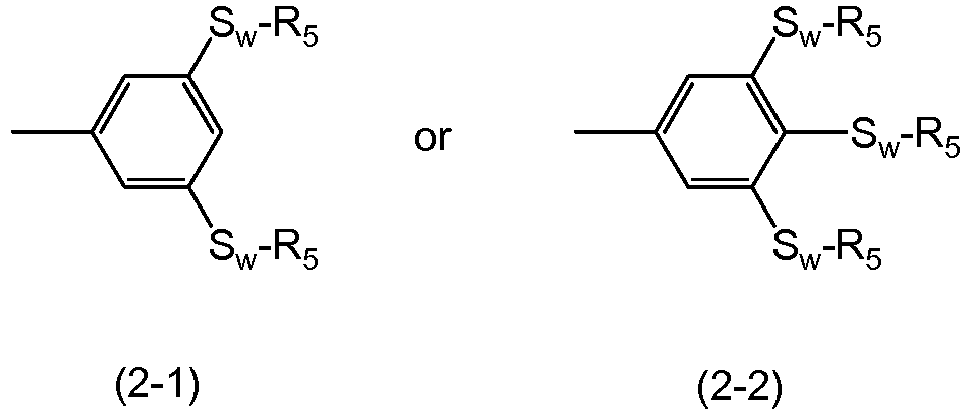 wherein R2 is a straight-chain or branched alkyl or alkenyl group having 1 to 20 carbon atoms, or an aromatic hydrocarbon group having 6 to 26 carbon atoms;R5 is a straight-chain or branched alkyl or alkenyl group having 1 to 20 carbon atoms, or an aromatic hydrocarbon group having 6 to 26 carbon atoms;B is a 5-membered heterocyclic ring having at least one heteroatom selected from the group consisting of sulfur atom, nitrogen atom and oxygen atom;R3 is a hydrogen atom, -Sz-R4, -SH, a straight-chain or branched alkyl or alkenyl group having 1 to 20 carbon atoms, or an aromatic hydrocarbon group having 6 to 26 carbon atoms;R4 is a straight-chain or branched alkyl or alkenyl group having 1 to 20 carbon atoms, or an aromatic hydrocarbon group having 6 to 26 carbon atoms;x is a number from 1 to 10;y is a number from 0 to 10;z is a number from 1 to 10; andw is a number from 1 to 10;
 - The grease composition of claim 1, wherein the anti-flaking additive is a compound of formula (1) wherein R1 is a straight-chain or branched alkyl or alkenyl group having 1 to 20 carbon atoms,
A is the group represented by -Sy-B-R3,
in which B is a group represented by the following formula: R3 represents -Sz-R4, in which R4 is a straight-chain or branched alkyl or alkenyl group having 1 to 20 carbon atoms,x is 2,y is 0, andz is 2; or the anti-flaking additive is a sulfurized oil fat, or an olefin sulfide.
 - The grease composition of claim 1 or 2, wherein the anti-flaking additive is:a 2,5-dimercapto-1,3,4-thiazole derivative of formula (1-1):
 the sulfurized oil fat; orthe olefin sulfide.
 - The grease composition of claim 3, wherein the anti-flaking additive is the 2,5-dimercapto-1,3,4-thiazole derivative of formula (1-1) wherein R1 and R4 are both straight-chain alkyl groups having eight carbon atoms; the sulfurized oil fat; or the olefin sulfide.
- The grease composition of any one of claims 1 to 4, wherein the anti-flaking additive is contained in an amount of 0.1 to 20 mass% based on the total mass of the grease composition.
- The grease composition of any one of claims 1 to 5, wherein the thickener is a diurea compound represented by formula (I):
R1-NHCONH-R2-NHCONH-R3 (I)
wherein R2 is a bivalent aromatic hydrocarbon group having 6 to 15 carbon atoms; and R1 and R3 which may be the same or different from each other represent a straight-chain or branched alkyl group having 8 to 22 carbon atoms, cyclohexyl group, or an aromatic hydrocarbon group having 6 to 12 carbon atoms. - The grease composition of claim 6, wherein the thickener is a diurea compound represented by formula (I-1):


a diurea compound represented by formula (1-3).
- The grease composition of any one of claims 1 to 7, wherein the base oil is a mineral oil, a synthetic oil or a mixture thereof.
- The grease composition of claim 8, wherein the base oil is the synthetic oil selected from the group consisting of ester type synthetic oils, hydrocarbon synthetic oils, and ether type synthetic oils.
- The grease composition of any one of claims 1 to 9, wherein the base oil has a kinematic viscosity at 40°C of 20 to 500 mm2/s.
Applications Claiming Priority (2)
| Application Number | Priority Date | Filing Date | Title |
|---|---|---|---|
| JP2013161383 | 2013-08-02 | ||
| PCT/JP2014/070467 WO2015016376A1 (en) | 2013-08-02 | 2014-08-04 | Grease composition |
Publications (3)
| Publication Number | Publication Date |
|---|---|
| EP3029132A1 true EP3029132A1 (en) | 2016-06-08 |
| EP3029132A4 EP3029132A4 (en) | 2017-03-01 |
| EP3029132B1 EP3029132B1 (en) | 2020-04-22 |
Family
ID=52431895
Family Applications (1)
| Application Number | Title | Priority Date | Filing Date |
|---|---|---|---|
| EP14832412.2A Active EP3029132B1 (en) | 2013-08-02 | 2014-08-04 | Grease composition |
Country Status (6)
| Country | Link |
|---|---|
| US (1) | US10077411B2 (en) |
| EP (1) | EP3029132B1 (en) |
| JP (1) | JP6762093B2 (en) |
| KR (1) | KR101905603B1 (en) |
| CN (1) | CN105492582B (en) |
| WO (1) | WO2015016376A1 (en) |
Cited By (1)
| Publication number | Priority date | Publication date | Assignee | Title |
|---|---|---|---|---|
| EP3666860A1 (en) * | 2018-11-06 | 2020-06-17 | Kyodo Yushi Co., Ltd. | Anti-flaking agent and lubricant composition comprising the same |
Families Citing this family (7)
| Publication number | Priority date | Publication date | Assignee | Title |
|---|---|---|---|---|
| JP2018009101A (en) * | 2016-07-14 | 2018-01-18 | Jxtgエネルギー株式会社 | Grease composition |
| JP6885686B2 (en) * | 2016-07-26 | 2021-06-16 | 協同油脂株式会社 | Grease composition |
| JP7002835B2 (en) * | 2016-07-28 | 2022-02-04 | 協同油脂株式会社 | Silicone grease composition |
| JP6359219B1 (en) * | 2017-04-10 | 2018-07-18 | ミネベアミツミ株式会社 | Grease composition and rolling bearing |
| JP6913566B2 (en) * | 2017-08-23 | 2021-08-04 | 協同油脂株式会社 | Grease composition |
| CN109810745B (en) * | 2019-01-30 | 2021-10-22 | 辽宁海华科技股份有限公司 | Special lubricating grease for industrial robot harmonic speed reducer and preparation method thereof |
| JP7751585B2 (en) * | 2020-08-12 | 2025-10-08 | 株式会社ジェイテクト | Grease composition and rolling bearing |
Family Cites Families (32)
| Publication number | Priority date | Publication date | Assignee | Title |
|---|---|---|---|---|
| JP2878749B2 (en) | 1990-01-16 | 1999-04-05 | エヌティエヌ株式会社 | Grease-filled rolling bearings for alternators |
| JPH03250094A (en) | 1990-02-28 | 1991-11-07 | Ntn Corp | Grease-filled gearing for electrical equipment and auxiliary machinery of vehicle |
| IT1263745B (en) | 1992-01-22 | 1996-08-27 | Ntn Toyo Bearing Co Ltd | CONTACT ROLLING BEARING CLOSED WITH GREASE |
| JP2557597B2 (en) | 1992-01-22 | 1996-11-27 | エヌティエヌ株式会社 | Rolling bearing with grease for alternator |
| US5641730A (en) | 1995-11-29 | 1997-06-24 | Chevron Chemical Company | Grease composition with improved antiwear properties |
| JP2001247888A (en) * | 2000-03-02 | 2001-09-14 | Cosmo Sekiyu Lubricants Kk | Grease composition |
| JP2002130301A (en) | 2000-10-17 | 2002-05-09 | Nsk Ltd | Rolling bearing |
| JP3915877B2 (en) | 2001-01-11 | 2007-05-16 | 日本精工株式会社 | Grease composition and angular contact ball bearings for spindle support of machine tools |
| JP2002250351A (en) | 2001-02-20 | 2002-09-06 | Nsk Ltd | Rolling bearing |
| US6652149B2 (en) | 2001-02-20 | 2003-11-25 | Nsk Ltd. | Rolling bearing |
| JP4761658B2 (en) * | 2001-07-03 | 2011-08-31 | コスモ石油ルブリカンツ株式会社 | Grease composition |
| JP4002745B2 (en) | 2001-09-11 | 2007-11-07 | 協同油脂株式会社 | Grease composition |
| JP4004276B2 (en) | 2001-11-21 | 2007-11-07 | 株式会社松村石油研究所 | Grease composition |
| US7265080B2 (en) | 2002-06-12 | 2007-09-04 | Nsk Ltd. | Rolling bearing, rolling bearing for fuel cell, compressor for fuel cell system and fuel cell system |
| JP2004225843A (en) | 2003-01-24 | 2004-08-12 | Nsk Ltd | Grease composition, rolling bearing, pump for fuel cell system, and fuel cell system |
| JP4102627B2 (en) | 2002-09-13 | 2008-06-18 | 株式会社ジェイテクト | Rolling bearing |
| JP2004162849A (en) | 2002-11-14 | 2004-06-10 | Nsk Ltd | Rolling device |
| JP2004196997A (en) | 2002-12-19 | 2004-07-15 | Nsk Ltd | bearing |
| JP4334922B2 (en) | 2003-06-20 | 2009-09-30 | Ntn株式会社 | Grease for roller bearings |
| JP2005248034A (en) | 2004-03-04 | 2005-09-15 | Ntn Corp | GREASE COMPOSITION, PROCESS FOR PRODUCING THE SAME, AND GREASE COMPOSITION ROLLED BEARING |
| JP2006077967A (en) * | 2004-09-13 | 2006-03-23 | Nsk Ltd | One-way clutch built-in type rotation transmission device |
| JP2006292039A (en) | 2005-04-08 | 2006-10-26 | Nsk Ltd | Rolling bearing unit for wheel support |
| JP4955273B2 (en) * | 2006-01-13 | 2012-06-20 | 協同油脂株式会社 | Grease composition for electrical contacts |
| JP2007192329A (en) | 2006-01-19 | 2007-08-02 | Nsk Ltd | One-way clutch built-in type rotation transmission device |
| CN101522869B (en) | 2006-10-06 | 2013-03-20 | 出光兴产株式会社 | Lubricating grease |
| JP2009114354A (en) | 2007-11-07 | 2009-05-28 | Kyodo Yushi Co Ltd | Grease composition |
| JP5467723B2 (en) | 2008-01-23 | 2014-04-09 | 協同油脂株式会社 | Lubricant composition and machine member |
| JP5544068B2 (en) | 2008-03-06 | 2014-07-09 | 出光興産株式会社 | Lubricating oil composition for fine blanking |
| JP5557240B2 (en) * | 2009-11-16 | 2014-07-23 | 協同油脂株式会社 | Flame retardant grease composition |
| JP5214649B2 (en) * | 2010-02-26 | 2013-06-19 | 協同油脂株式会社 | Grease composition for hub unit bearing using angular ball bearing and hub unit bearing |
| JP2012017460A (en) * | 2010-06-10 | 2012-01-26 | Ntn Corp | Lubricant composition, grease composition and grease-enclosed bearing |
| US20150133353A1 (en) | 2012-06-05 | 2015-05-14 | Jx Nippon Oil & Energy Corporation | Grease composition |
-
2014
- 2014-08-04 US US14/909,377 patent/US10077411B2/en active Active
- 2014-08-04 CN CN201480043381.XA patent/CN105492582B/en active Active
- 2014-08-04 WO PCT/JP2014/070467 patent/WO2015016376A1/en not_active Ceased
- 2014-08-04 JP JP2015529641A patent/JP6762093B2/en active Active
- 2014-08-04 KR KR1020167003968A patent/KR101905603B1/en active Active
- 2014-08-04 EP EP14832412.2A patent/EP3029132B1/en active Active
Non-Patent Citations (1)
| Title |
|---|
| See references of WO2015016376A1 * |
Cited By (1)
| Publication number | Priority date | Publication date | Assignee | Title |
|---|---|---|---|---|
| EP3666860A1 (en) * | 2018-11-06 | 2020-06-17 | Kyodo Yushi Co., Ltd. | Anti-flaking agent and lubricant composition comprising the same |
Also Published As
| Publication number | Publication date |
|---|---|
| JPWO2015016376A1 (en) | 2017-03-02 |
| EP3029132A4 (en) | 2017-03-01 |
| KR101905603B1 (en) | 2018-10-08 |
| JP6762093B2 (en) | 2020-09-30 |
| CN105492582A (en) | 2016-04-13 |
| US20160177213A1 (en) | 2016-06-23 |
| KR20160031018A (en) | 2016-03-21 |
| US10077411B2 (en) | 2018-09-18 |
| EP3029132B1 (en) | 2020-04-22 |
| CN105492582B (en) | 2018-05-25 |
| WO2015016376A1 (en) | 2015-02-05 |
Similar Documents
| Publication | Publication Date | Title |
|---|---|---|
| EP3029132A1 (en) | Grease composition | |
| US5922654A (en) | Lubricant composition | |
| EP1388584B1 (en) | Grease composition and grease composition-sealed bearing | |
| JP5188248B2 (en) | Grease composition and linear motion apparatus using the grease composition | |
| JPWO1997015644A1 (en) | Lubricant composition | |
| JP6348374B2 (en) | Grease composition | |
| EP3187572A1 (en) | Grease composition | |
| JP6797033B2 (en) | Urea grease composition | |
| EP2465916A1 (en) | Grease composition and machine component | |
| EP1764406B1 (en) | Rust proof rust preventive grease composition, grease filled bearing and rust preventive agent for grease composition | |
| EP0675192B1 (en) | Use of organic bismuth compounds in extreme pressure grease lubricant compositions for rolling bearing application with extended service life | |
| JP6223863B2 (en) | Grease composition | |
| JP4832724B2 (en) | Grease composition and grease-filled bearing | |
| US7491683B2 (en) | Grease composition for rolling bearing and rolling bearing using the same | |
| JP3951069B2 (en) | Grease for bearing | |
| WO2023201327A1 (en) | Electric vehicle grease | |
| KR20050022236A (en) | Grease composition for ball joint | |
| JP4035675B2 (en) | Grease composition and rolling bearing | |
| JP2000026877A (en) | Grease composition | |
| JP3567957B2 (en) | Grease composition and rolling bearing | |
| EP4722321A1 (en) | Grease composition | |
| JP3539465B2 (en) | Grease composition | |
| JPH10140174A (en) | Lubricant composition | |
| JPH11228985A (en) | Grease composition | |
| JP2018016725A (en) | Silicone grease composition |
Legal Events
| Date | Code | Title | Description |
|---|---|---|---|
| PUAI | Public reference made under article 153(3) epc to a published international application that has entered the european phase |
Free format text: ORIGINAL CODE: 0009012 |
|
| 17P | Request for examination filed |
Effective date: 20160209 |
|
| AK | Designated contracting states |
Kind code of ref document: A1 Designated state(s): AL AT BE BG CH CY CZ DE DK EE ES FI FR GB GR HR HU IE IS IT LI LT LU LV MC MK MT NL NO PL PT RO RS SE SI SK SM TR |
|
| AX | Request for extension of the european patent |
Extension state: BA ME |
|
| RIN1 | Information on inventor provided before grant (corrected) |
Inventor name: FUKUSHIMA, YOSHINORI Inventor name: KOMORIYA, TOMONOBU Inventor name: NAKAZAWA, SATORU Inventor name: HIROOKA, IWAKI Inventor name: MUTO, MASATAKA Inventor name: MORI, SHIGEYUKI Inventor name: YOSHINARI, TERASU |
|
| DAX | Request for extension of the european patent (deleted) | ||
| A4 | Supplementary search report drawn up and despatched |
Effective date: 20170130 |
|
| RIC1 | Information provided on ipc code assigned before grant |
Ipc: C10M 169/04 20060101ALI20170124BHEP Ipc: C10M 135/28 20060101ALI20170124BHEP Ipc: C10M 105/18 20060101ALI20170124BHEP Ipc: C10M 101/02 20060101ALI20170124BHEP Ipc: C10M 105/32 20060101ALI20170124BHEP Ipc: C10N 40/02 20060101ALI20170124BHEP Ipc: C10M 135/06 20060101ALI20170124BHEP Ipc: C10M 135/36 20060101ALI20170124BHEP Ipc: C10M 135/34 20060101ALI20170124BHEP Ipc: C10N 50/10 20060101ALI20170124BHEP Ipc: C10M 115/08 20060101ALI20170124BHEP Ipc: C10N 30/00 20060101ALI20170124BHEP Ipc: C10M 169/00 20060101ALI20170124BHEP Ipc: C10M 169/06 20060101ALI20170124BHEP Ipc: C10M 135/04 20060101AFI20170124BHEP Ipc: C10M 135/22 20060101ALI20170124BHEP |
|
| STAA | Information on the status of an ep patent application or granted ep patent |
Free format text: STATUS: EXAMINATION IS IN PROGRESS |
|
| 17Q | First examination report despatched |
Effective date: 20190212 |
|
| GRAP | Despatch of communication of intention to grant a patent |
Free format text: ORIGINAL CODE: EPIDOSNIGR1 |
|
| STAA | Information on the status of an ep patent application or granted ep patent |
Free format text: STATUS: GRANT OF PATENT IS INTENDED |
|
| INTG | Intention to grant announced |
Effective date: 20191115 |
|
| GRAS | Grant fee paid |
Free format text: ORIGINAL CODE: EPIDOSNIGR3 |
|
| GRAA | (expected) grant |
Free format text: ORIGINAL CODE: 0009210 |
|
| STAA | Information on the status of an ep patent application or granted ep patent |
Free format text: STATUS: THE PATENT HAS BEEN GRANTED |
|
| AK | Designated contracting states |
Kind code of ref document: B1 Designated state(s): AL AT BE BG CH CY CZ DE DK EE ES FI FR GB GR HR HU IE IS IT LI LT LU LV MC MK MT NL NO PL PT RO RS SE SI SK SM TR |
|
| REG | Reference to a national code |
Ref country code: CH Ref legal event code: EP |
|
| REG | Reference to a national code |
Ref country code: DE Ref legal event code: R096 Ref document number: 602014064250 Country of ref document: DE |
|
| REG | Reference to a national code |
Ref country code: IE Ref legal event code: FG4D |
|
| REG | Reference to a national code |
Ref country code: AT Ref legal event code: REF Ref document number: 1260064 Country of ref document: AT Kind code of ref document: T Effective date: 20200515 |
|
| REG | Reference to a national code |
Ref country code: SE Ref legal event code: TRGR |
|
| REG | Reference to a national code |
Ref country code: LT Ref legal event code: MG4D |
|
| REG | Reference to a national code |
Ref country code: NL Ref legal event code: MP Effective date: 20200422 |
|
| PG25 | Lapsed in a contracting state [announced via postgrant information from national office to epo] |
Ref country code: IS Free format text: LAPSE BECAUSE OF FAILURE TO SUBMIT A TRANSLATION OF THE DESCRIPTION OR TO PAY THE FEE WITHIN THE PRESCRIBED TIME-LIMIT Effective date: 20200822 Ref country code: NO Free format text: LAPSE BECAUSE OF FAILURE TO SUBMIT A TRANSLATION OF THE DESCRIPTION OR TO PAY THE FEE WITHIN THE PRESCRIBED TIME-LIMIT Effective date: 20200722 Ref country code: FI Free format text: LAPSE BECAUSE OF FAILURE TO SUBMIT A TRANSLATION OF THE DESCRIPTION OR TO PAY THE FEE WITHIN THE PRESCRIBED TIME-LIMIT Effective date: 20200422 Ref country code: PT Free format text: LAPSE BECAUSE OF FAILURE TO SUBMIT A TRANSLATION OF THE DESCRIPTION OR TO PAY THE FEE WITHIN THE PRESCRIBED TIME-LIMIT Effective date: 20200824 Ref country code: NL Free format text: LAPSE BECAUSE OF FAILURE TO SUBMIT A TRANSLATION OF THE DESCRIPTION OR TO PAY THE FEE WITHIN THE PRESCRIBED TIME-LIMIT Effective date: 20200422 Ref country code: LT Free format text: LAPSE BECAUSE OF FAILURE TO SUBMIT A TRANSLATION OF THE DESCRIPTION OR TO PAY THE FEE WITHIN THE PRESCRIBED TIME-LIMIT Effective date: 20200422 Ref country code: GR Free format text: LAPSE BECAUSE OF FAILURE TO SUBMIT A TRANSLATION OF THE DESCRIPTION OR TO PAY THE FEE WITHIN THE PRESCRIBED TIME-LIMIT Effective date: 20200723 |
|
| REG | Reference to a national code |
Ref country code: AT Ref legal event code: MK05 Ref document number: 1260064 Country of ref document: AT Kind code of ref document: T Effective date: 20200422 |
|
| PG25 | Lapsed in a contracting state [announced via postgrant information from national office to epo] |
Ref country code: BG Free format text: LAPSE BECAUSE OF FAILURE TO SUBMIT A TRANSLATION OF THE DESCRIPTION OR TO PAY THE FEE WITHIN THE PRESCRIBED TIME-LIMIT Effective date: 20200722 Ref country code: RS Free format text: LAPSE BECAUSE OF FAILURE TO SUBMIT A TRANSLATION OF THE DESCRIPTION OR TO PAY THE FEE WITHIN THE PRESCRIBED TIME-LIMIT Effective date: 20200422 Ref country code: LV Free format text: LAPSE BECAUSE OF FAILURE TO SUBMIT A TRANSLATION OF THE DESCRIPTION OR TO PAY THE FEE WITHIN THE PRESCRIBED TIME-LIMIT Effective date: 20200422 Ref country code: HR Free format text: LAPSE BECAUSE OF FAILURE TO SUBMIT A TRANSLATION OF THE DESCRIPTION OR TO PAY THE FEE WITHIN THE PRESCRIBED TIME-LIMIT Effective date: 20200422 |
|
| PG25 | Lapsed in a contracting state [announced via postgrant information from national office to epo] |
Ref country code: AL Free format text: LAPSE BECAUSE OF FAILURE TO SUBMIT A TRANSLATION OF THE DESCRIPTION OR TO PAY THE FEE WITHIN THE PRESCRIBED TIME-LIMIT Effective date: 20200422 |
|
| REG | Reference to a national code |
Ref country code: DE Ref legal event code: R097 Ref document number: 602014064250 Country of ref document: DE |
|
| PG25 | Lapsed in a contracting state [announced via postgrant information from national office to epo] |
Ref country code: ES Free format text: LAPSE BECAUSE OF FAILURE TO SUBMIT A TRANSLATION OF THE DESCRIPTION OR TO PAY THE FEE WITHIN THE PRESCRIBED TIME-LIMIT Effective date: 20200422 Ref country code: DK Free format text: LAPSE BECAUSE OF FAILURE TO SUBMIT A TRANSLATION OF THE DESCRIPTION OR TO PAY THE FEE WITHIN THE PRESCRIBED TIME-LIMIT Effective date: 20200422 Ref country code: EE Free format text: LAPSE BECAUSE OF FAILURE TO SUBMIT A TRANSLATION OF THE DESCRIPTION OR TO PAY THE FEE WITHIN THE PRESCRIBED TIME-LIMIT Effective date: 20200422 Ref country code: SM Free format text: LAPSE BECAUSE OF FAILURE TO SUBMIT A TRANSLATION OF THE DESCRIPTION OR TO PAY THE FEE WITHIN THE PRESCRIBED TIME-LIMIT Effective date: 20200422 Ref country code: AT Free format text: LAPSE BECAUSE OF FAILURE TO SUBMIT A TRANSLATION OF THE DESCRIPTION OR TO PAY THE FEE WITHIN THE PRESCRIBED TIME-LIMIT Effective date: 20200422 Ref country code: IT Free format text: LAPSE BECAUSE OF FAILURE TO SUBMIT A TRANSLATION OF THE DESCRIPTION OR TO PAY THE FEE WITHIN THE PRESCRIBED TIME-LIMIT Effective date: 20200422 Ref country code: RO Free format text: LAPSE BECAUSE OF FAILURE TO SUBMIT A TRANSLATION OF THE DESCRIPTION OR TO PAY THE FEE WITHIN THE PRESCRIBED TIME-LIMIT Effective date: 20200422 Ref country code: CZ Free format text: LAPSE BECAUSE OF FAILURE TO SUBMIT A TRANSLATION OF THE DESCRIPTION OR TO PAY THE FEE WITHIN THE PRESCRIBED TIME-LIMIT Effective date: 20200422 |
|
| PG25 | Lapsed in a contracting state [announced via postgrant information from national office to epo] |
Ref country code: PL Free format text: LAPSE BECAUSE OF FAILURE TO SUBMIT A TRANSLATION OF THE DESCRIPTION OR TO PAY THE FEE WITHIN THE PRESCRIBED TIME-LIMIT Effective date: 20200422 Ref country code: SK Free format text: LAPSE BECAUSE OF FAILURE TO SUBMIT A TRANSLATION OF THE DESCRIPTION OR TO PAY THE FEE WITHIN THE PRESCRIBED TIME-LIMIT Effective date: 20200422 |
|
| PLBE | No opposition filed within time limit |
Free format text: ORIGINAL CODE: 0009261 |
|
| STAA | Information on the status of an ep patent application or granted ep patent |
Free format text: STATUS: NO OPPOSITION FILED WITHIN TIME LIMIT |
|
| 26N | No opposition filed |
Effective date: 20210125 |
|
| PG25 | Lapsed in a contracting state [announced via postgrant information from national office to epo] |
Ref country code: MC Free format text: LAPSE BECAUSE OF FAILURE TO SUBMIT A TRANSLATION OF THE DESCRIPTION OR TO PAY THE FEE WITHIN THE PRESCRIBED TIME-LIMIT Effective date: 20200422 |
|
| REG | Reference to a national code |
Ref country code: CH Ref legal event code: PL |
|
| GBPC | Gb: european patent ceased through non-payment of renewal fee |
Effective date: 20200804 |
|
| PG25 | Lapsed in a contracting state [announced via postgrant information from national office to epo] |
Ref country code: LI Free format text: LAPSE BECAUSE OF NON-PAYMENT OF DUE FEES Effective date: 20200831 Ref country code: LU Free format text: LAPSE BECAUSE OF NON-PAYMENT OF DUE FEES Effective date: 20200804 Ref country code: CH Free format text: LAPSE BECAUSE OF NON-PAYMENT OF DUE FEES Effective date: 20200831 |
|
| REG | Reference to a national code |
Ref country code: BE Ref legal event code: MM Effective date: 20200831 |
|
| PG25 | Lapsed in a contracting state [announced via postgrant information from national office to epo] |
Ref country code: SI Free format text: LAPSE BECAUSE OF FAILURE TO SUBMIT A TRANSLATION OF THE DESCRIPTION OR TO PAY THE FEE WITHIN THE PRESCRIBED TIME-LIMIT Effective date: 20200422 |
|
| PG25 | Lapsed in a contracting state [announced via postgrant information from national office to epo] |
Ref country code: BE Free format text: LAPSE BECAUSE OF NON-PAYMENT OF DUE FEES Effective date: 20200831 Ref country code: IE Free format text: LAPSE BECAUSE OF NON-PAYMENT OF DUE FEES Effective date: 20200804 Ref country code: GB Free format text: LAPSE BECAUSE OF NON-PAYMENT OF DUE FEES Effective date: 20200804 |
|
| PG25 | Lapsed in a contracting state [announced via postgrant information from national office to epo] |
Ref country code: TR Free format text: LAPSE BECAUSE OF FAILURE TO SUBMIT A TRANSLATION OF THE DESCRIPTION OR TO PAY THE FEE WITHIN THE PRESCRIBED TIME-LIMIT Effective date: 20200422 Ref country code: MT Free format text: LAPSE BECAUSE OF FAILURE TO SUBMIT A TRANSLATION OF THE DESCRIPTION OR TO PAY THE FEE WITHIN THE PRESCRIBED TIME-LIMIT Effective date: 20200422 Ref country code: CY Free format text: LAPSE BECAUSE OF FAILURE TO SUBMIT A TRANSLATION OF THE DESCRIPTION OR TO PAY THE FEE WITHIN THE PRESCRIBED TIME-LIMIT Effective date: 20200422 |
|
| PG25 | Lapsed in a contracting state [announced via postgrant information from national office to epo] |
Ref country code: MK Free format text: LAPSE BECAUSE OF FAILURE TO SUBMIT A TRANSLATION OF THE DESCRIPTION OR TO PAY THE FEE WITHIN THE PRESCRIBED TIME-LIMIT Effective date: 20200422 |
|
| P01 | Opt-out of the competence of the unified patent court (upc) registered |
Effective date: 20230510 |
|
| PGFP | Annual fee paid to national office [announced via postgrant information from national office to epo] |
Ref country code: DE Payment date: 20250702 Year of fee payment: 12 |
|
| PGFP | Annual fee paid to national office [announced via postgrant information from national office to epo] |
Ref country code: FR Payment date: 20250703 Year of fee payment: 12 |
|
| PGFP | Annual fee paid to national office [announced via postgrant information from national office to epo] |
Ref country code: SE Payment date: 20250702 Year of fee payment: 12 |