EP3029028B1 - Novel method for synthesizing key intermediate of apixaban - Google Patents
Novel method for synthesizing key intermediate of apixaban Download PDFInfo
- Publication number
- EP3029028B1 EP3029028B1 EP14834003.7A EP14834003A EP3029028B1 EP 3029028 B1 EP3029028 B1 EP 3029028B1 EP 14834003 A EP14834003 A EP 14834003A EP 3029028 B1 EP3029028 B1 EP 3029028B1
- Authority
- EP
- European Patent Office
- Prior art keywords
- compound
- chloro
- valeryl chloride
- reaction
- ice bath
- Prior art date
- Legal status (The legal status is an assumption and is not a legal conclusion. Google has not performed a legal analysis and makes no representation as to the accuracy of the status listed.)
- Active
Links
- 0 *C1=CC=C(*)CC1 Chemical compound *C1=CC=C(*)CC1 0.000 description 2
Classifications
-
- C—CHEMISTRY; METALLURGY
- C07—ORGANIC CHEMISTRY
- C07D—HETEROCYCLIC COMPOUNDS
- C07D211/00—Heterocyclic compounds containing hydrogenated pyridine rings, not condensed with other rings
- C07D211/04—Heterocyclic compounds containing hydrogenated pyridine rings, not condensed with other rings with only hydrogen or carbon atoms directly attached to the ring nitrogen atom
- C07D211/80—Heterocyclic compounds containing hydrogenated pyridine rings, not condensed with other rings with only hydrogen or carbon atoms directly attached to the ring nitrogen atom having two double bonds between ring members or between ring members and non-ring members
- C07D211/84—Heterocyclic compounds containing hydrogenated pyridine rings, not condensed with other rings with only hydrogen or carbon atoms directly attached to the ring nitrogen atom having two double bonds between ring members or between ring members and non-ring members with hetero atoms or with carbon atoms having three bonds to hetero atoms, with at the most one bond to halogen directly attached to ring carbon atoms
- C07D211/86—Oxygen atoms
- C07D211/88—Oxygen atoms attached in positions 2 and 6, e.g. glutarimide
-
- C—CHEMISTRY; METALLURGY
- C07—ORGANIC CHEMISTRY
- C07D—HETEROCYCLIC COMPOUNDS
- C07D211/00—Heterocyclic compounds containing hydrogenated pyridine rings, not condensed with other rings
- C07D211/02—Preparation by ring-closure or hydrogenation
-
- C—CHEMISTRY; METALLURGY
- C07—ORGANIC CHEMISTRY
- C07D—HETEROCYCLIC COMPOUNDS
- C07D211/00—Heterocyclic compounds containing hydrogenated pyridine rings, not condensed with other rings
- C07D211/04—Heterocyclic compounds containing hydrogenated pyridine rings, not condensed with other rings with only hydrogen or carbon atoms directly attached to the ring nitrogen atom
- C07D211/06—Heterocyclic compounds containing hydrogenated pyridine rings, not condensed with other rings with only hydrogen or carbon atoms directly attached to the ring nitrogen atom having no double bonds between ring members or between ring members and non-ring members
- C07D211/36—Heterocyclic compounds containing hydrogenated pyridine rings, not condensed with other rings with only hydrogen or carbon atoms directly attached to the ring nitrogen atom having no double bonds between ring members or between ring members and non-ring members with hetero atoms or with carbon atoms having three bonds to hetero atoms with at the most one bond to halogen, e.g. ester or nitrile radicals, directly attached to ring carbon atoms
- C07D211/40—Oxygen atoms
-
- C—CHEMISTRY; METALLURGY
- C07—ORGANIC CHEMISTRY
- C07D—HETEROCYCLIC COMPOUNDS
- C07D211/00—Heterocyclic compounds containing hydrogenated pyridine rings, not condensed with other rings
- C07D211/04—Heterocyclic compounds containing hydrogenated pyridine rings, not condensed with other rings with only hydrogen or carbon atoms directly attached to the ring nitrogen atom
- C07D211/68—Heterocyclic compounds containing hydrogenated pyridine rings, not condensed with other rings with only hydrogen or carbon atoms directly attached to the ring nitrogen atom having one double bond between ring members or between a ring member and a non-ring member
- C07D211/72—Heterocyclic compounds containing hydrogenated pyridine rings, not condensed with other rings with only hydrogen or carbon atoms directly attached to the ring nitrogen atom having one double bond between ring members or between a ring member and a non-ring member with hetero atoms or with carbon atoms having three bonds to hetero atoms, with at the most one bond to halogen, directly attached to ring carbon atoms
- C07D211/74—Oxygen atoms
- C07D211/76—Oxygen atoms attached in position 2 or 6
Definitions
- the invention relates to a method for synthesizing an intermediate of Apixaban,
- Apixaban i.e., 1-(4-methoxylphenyl)-7-oxo-6-[4-(2-oxo-1-piperidyl)phenyl]-4,5,6,7-tetrahydro-1H-pyrazolo[3,4-c]pyridyl-3-carbox amide, has the following structural formula:
- Apixaban is an oral anticoagulant jointly developed by Pfizer and Squibb, acting as an inhibitor of Xa factor.
- Apixaban is now marketed in China, US and Europe. In China, it is approved for adult patients undergoing elective hip-joint or knee-joint replacement, and for preventing venous thrombus embolism (VTE), Its marketing provides a safe and effective new choice for anticoagulation after clinical orthopedic surgery, bringing out good news for the patients of elective hip-joint or knee-joint replacement in China. Clinical trials show that Apixaban has better effect than enoxaparin.
- An object of the invention is to provide a novel method for synthesizing key intermediate compound of Apixaban, overcoming the defects and deficiencies in the prior art.
- the invention provides a method for synthesizing a compound of formula II - an intermediate compound of Apixaban, comprising the step of: reacting a compound of formula I with 5-chloro-valeryl chloride in an inert solvent in the presence of only an inorganic base, with the reaction scheme of: herein R is a nitro group.
- the invention provides a method for synthesizing an intermediate of Apixaban, characterized in that, the method comprises the step of: reacting a compound of formula I with 5-chloro-valeryl chloride in an inert solvent in the presence of an inorganic base to obtain a compound of formula II, with the reaction scheme of: wherein R is group; and in both cases the inorganic base is selected from the group consisting of sodium hydroxide, potassium hydroxide, sodium carbonate, potassium carbonate, sodium bicarbonate, or potassium bicarbonate.
- the inorganic base used in the invention is sodium hydroxide, potassium hydroxide, potassium carbonate, sodium carbonate, sodium bicarbonate, potassium bicarbonate, and the like, preferably sodium hydroxide.
- the inert solvent used in the invention can be tetrahydrofuran, acetonitrile, dichloromethane, N,N-dimethylformamide, 1,2-dichloroethane, and the like, preferably acetonitrile,
- the compound of formula II (IIa or IIb) is preferably obtained by reacting 5-chloro-valeryl chloride with the compound of formula I (Ia or Ib) in the presence of sodium hydroxide in the solvent of acetonitrile, wherein the molar ratio of 5-chloro-valeryl chloride to the compound of formula I is 1,0 - 3.0, preferably 1.5 - 2.3; the molar ratio of sodium hydroxide to the compound of formula I is 2.0 - 10,0, preferably 5.0 - 6.5; the solvent is preferably acetonitrile, and the ratio of the volume of the solvent to the weight of the reactant is 25 - 40, preferably 28 - 35, In this case, the reaction temperature when dropwise adding 5-chloro-valeryl chloride is controlled to -10 °C to 10 °C, preferably -5 °C to 5 °C.
- the reaction temperature after completing the addition of 5-chloro-valeryl chloride is 0 °C to 50 °C, preferably 15 °C to 40 °C.
- the crude product of compound IIa can be recrystallized in a mixed solvent of ethyl acetate/petroleum ether (ethyl acetate/n-heptane and the like) in a ratio of ethyl acetate/petroleum ether of 2/1 - 1/1, preferably 1/1.
- the ratio of the volume of the recrystallization solvent to the weight of the crude product of compound IIa is 1 - 3, preferably 1 - 1.5.
- the invention provides a method for synthesizing the intermediate of Apixaban without adding the organic base of tertiary amine, without using the expensive cyclization reagents of sodium tert-butoxide and potassium tert-butoxide, and without using the expensive and dangerous agent of sodium hydride.
- This method can obtain the intermediate of Apixaban by simply using inexpensive organic base via one pot process in an inert solvent.
- This method has the advantages of mild reaction condition, simple operation, being convenient for purification, low production cost, being environmentally friendly, and being suitable for industrial production.
- reaction solution was cooled to 0 °C in an ice bath, and adjusted to a neutral pH with 2 N of hydrochloric acid.
- the reaction solution was stood for layering.
- the resultant acetonitrile layer was concentrated to dryness, and washed with saturated sodium bicarbonate solution (30 ml * 3) after adding 50 ml ethyl acetate. All the aqueous phases were combined, and then extracted with ethyl acetate. The resultant organic phases were combined, washed with saturated saline, dried, and concentrated to provide yellow solid containing parts of oil.
- reaction solution was cooled to 0 °C in an ice bath, and adjusted to a neutral pH with 2 N of hydrochloric acid.
- the reaction solution was stood for layering.
- the lower organic layer was washed with saturated sodium bicarbonate solution (30 ml * 3), and concentrated to dryness to obtain yellow solid containing parts of oil.
- the mixed solvent of ethyl acetate/petroleum ether (1:1, 8 ml) was added, heated to reflux, completely dissolved, stirred, naturally cooled to crystallize and filtered to obtain 5.79g yellow solid. Yield: 73.0%. Purity: 99.1%.
- reaction solution was cooled to 0 °C in an ice bath, and adjusted to a neutral pH with 2 N of hydrochloric acid.
- the reaction solution was stood for layering.
- the organic layer was washed with saturated sodium bicarbonate solution (30 ml *3), and concentrated to dryness to obtain yellow solid containing parts of oily.
- the mixed solvent of ethyl acetate/petroleum ether (1:1, 8 ml) was added, heated to reflux, completely dissolved, stirred, naturally cooled to crystallize and filtered to obtain 4.78g yellow solid. Yield: 60.0%. Purity: 98.3%.
- reaction solution was cooled to 0 °C in an ice bath, and adjusted to a neutral pH with 2 N of hydrochloric acid.
- the reaction solution was stood for layering.
- the acetonitrile layer was concentrated to dryness, and washed with saturated sodium bicarbonate solution (30 ml * 3) after adding 50 ml ethyl acetate. All the aqueous phases were combined, and extracted with ethyl acetate. The organic phases were combined, washed with saturated saline, dried, and concentrated to provide yellow solid containing parts of oil.
- reaction solution was cooled to 0 °C in an ice bath, and adjusted to a neutral pH with 6 N of hydrochloric acid.
- the reaction solution was concentrated to dryness, pulpifying for 1 hour after adding 8 ml saturated sodium bicarbonate solution, and filtered to obtain 2.29 g yellow solid. Yield: 87.5%. Purity: 95.3% (HPLC).
- reaction solution was cooled to 0 °C in an ice bath, and adjusted to a neutral pH with 6 N of hydrochloric acid to layer.
- the aqueous layer was extracted with 30 ml dichloromethane.
- the organic phase was concentrated to dryness, pulpifying for 1 hour after adding 8 ml saturated sodium bicarbonate solution and filtered to obtain 2.0 g yellow solid. Yield: 77.3%. Purity: 96.0%.
- reaction solution was cooled to 0 °C in an ice bath, and adjusted to a neutral pH with 6 N of hydrochloric acid to layer.
- the aqueous layer was extracted with 30 ml dichloromethane.
- the organic phase was concentrated to dryness, pulpifying for 1 hour after adding 8 ml saturated sodium bicarbonate solution and filtered to obtain 1.89 g yellow solid. Yield: 72.3%. Purity: 94.9%.
- reaction solution was cooled to 0 °C in an ice bath, and adjusted to a neutral pH with 6 N of hydrochloric acid.
- the reaction solution was concentrated to dryness, pulpifying for 1 hour after adding 16 ml saturated sodium bicarbonate solution, and filtered to obtain 1.76 g yellow solid. Yield: 67.3%. Purity: 95.0%.
Landscapes
- Chemical & Material Sciences (AREA)
- Organic Chemistry (AREA)
- Plural Heterocyclic Compounds (AREA)
- Organic Low-Molecular-Weight Compounds And Preparation Thereof (AREA)
- Heterocyclic Carbon Compounds Containing A Hetero Ring Having Nitrogen And Oxygen As The Only Ring Hetero Atoms (AREA)
- Pharmaceuticals Containing Other Organic And Inorganic Compounds (AREA)
- Agricultural Chemicals And Associated Chemicals (AREA)
- Low-Molecular Organic Synthesis Reactions Using Catalysts (AREA)
Description
- The present application claims the priority of Chinese patent application No.
201310335663.4 filed on August 5, 2013 - The invention relates to a method for synthesizing an intermediate of Apixaban,
- Apixaban, i.e., 1-(4-methoxylphenyl)-7-oxo-6-[4-(2-oxo-1-piperidyl)phenyl]-4,5,6,7-tetrahydro-1H-pyrazolo[3,4-c]pyridyl-3-carbox amide, has the following structural formula:

- Apixaban is an oral anticoagulant jointly developed by Pfizer and Squibb, acting as an inhibitor of Xa factor. Apixaban is now marketed in China, US and Europe. In China, it is approved for adult patients undergoing elective hip-joint or knee-joint replacement, and for preventing venous thrombus embolism (VTE), Its marketing provides a safe and effective new choice for anticoagulation after clinical orthopedic surgery, bringing out good news for the patients of elective hip-joint or knee-joint replacement in China. Clinical trials show that Apixaban has better effect than enoxaparin. Each of 1-(4-nitrophenyl)piperidyl-2-one and 5,6-dihydro-3-(4-morpholinyl)-1-[4-(2-oxo-1-piperidyl)phenyl]-2(1H)-pyridone compounds is one of the key intermediates for synthesizing Apixaban, the relevant preparing methods of which are currently reported as follow:
- 1. CN publication No.
CN101065379 discloses a method for preparing 1-(4-nitrophenyl)piperidyl-2-one comprising reacting paranitroaniline with 5-bromo-valeryl chloride in base through amidation and cyclization two steps reaction. The reaction scheme is as follow:
- 2. CN publication No.
CN101967145 discloses a preparing method having the reaction scheme of:
- 3. CN publication No.
CN103159670 A discloses a preparation method for an Apixaban intermediate 1-(4-nitrophenyl)-2-piperidone, comprising an integrated reaction of paranitroaniline and halogenated valeryl chloride in the presence of a phase transfer catalyst in a mixed system of inorganic base aqueous solution and aprotic solvent. - The primary problems suffered by these methods lie in that:
- 1) The quality control and preparation process is relatively difficult, and the cost is relatively high because of using 5-bromo-valeryl chloride as raw material. Using organic base such as potassium tert-butoxide and the like as the base, and tetrahydrofuran as the solvent lead to the high cost and thus they are not suitable for industrial production.
- 2) In the above reactions, the amidation reaction is carried out by a tertiary amine organic base of triethylamine and the cyclization reaction is carried out by a stronger base of sodium tert-butoxide, potassium tert-butoxide, or sodium hydride. These methods use very hazardous sodium hydride and have the disadvantages of complicated operations, tedious post-treatment and being relatively difficult quality control of product.
- An object of the invention is to provide a novel method for synthesizing key intermediate compound of Apixaban, overcoming the defects and deficiencies in the prior art.
- The invention provides a method for synthesizing a compound of formula II - an intermediate compound of Apixaban, comprising the step of: reacting a compound of formula I with 5-chloro-valeryl chloride in an inert solvent in the presence of only an inorganic base, with the reaction scheme of:


- The specific reaction scheme is as follows:
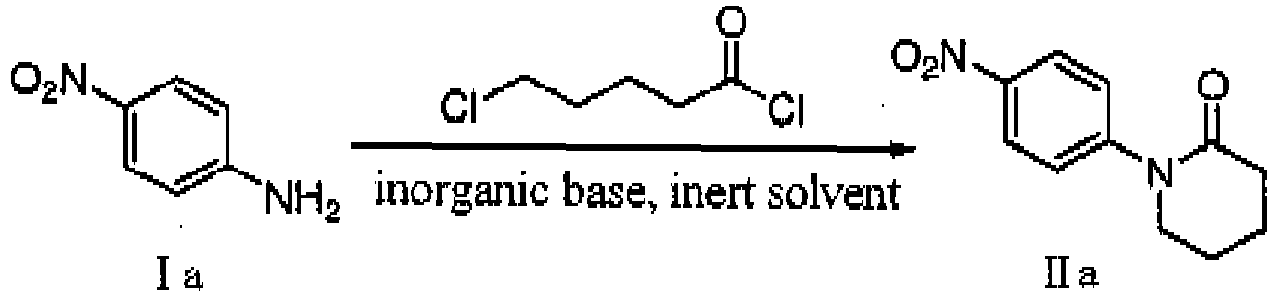

- In the invention, 4-R-aniline and 5-chloro-valeryl chloride are reacted in an inert solvent in the presence of an inorganic base to obtain a compound of 1-(4-R-phenyl) piperidine-2-one.
- The inorganic base used in the invention is sodium hydroxide, potassium hydroxide, potassium carbonate, sodium carbonate, sodium bicarbonate, potassium bicarbonate, and the like, preferably sodium hydroxide.
- The inert solvent used in the invention can be tetrahydrofuran, acetonitrile, dichloromethane, N,N-dimethylformamide, 1,2-dichloroethane, and the like, preferably acetonitrile,
- In the invention, the compound of formula II (IIa or IIb) is preferably obtained by reacting 5-chloro-valeryl chloride with the compound of formula I (Ia or Ib) in the presence of sodium hydroxide in the solvent of acetonitrile, wherein the molar ratio of 5-chloro-valeryl chloride to the compound of formula I is 1,0 - 3.0, preferably 1.5 - 2.3; the molar ratio of sodium hydroxide to the compound of formula I is 2.0 - 10,0, preferably 5.0 - 6.5; the solvent is preferably acetonitrile, and the ratio of the volume of the solvent to the weight of the reactant is 25 - 40, preferably 28 - 35, In this case, the reaction temperature when dropwise adding 5-chloro-valeryl chloride is controlled to -10 °C to 10 °C, preferably -5 °C to 5 °C.
- In the invention, the reaction temperature after completing the addition of 5-chloro-valeryl chloride is 0 °C to 50 °C, preferably 15 °C to 40 °C.
- Moreover, the crude product of compound IIa can be recrystallized in a mixed solvent of ethyl acetate/petroleum ether (ethyl acetate/n-heptane and the like) in a ratio of ethyl acetate/petroleum ether of 2/1 - 1/1, preferably 1/1. The ratio of the volume of the recrystallization solvent to the weight of the crude product of compound IIa is 1 - 3, preferably 1 - 1.5.
- The invention provides a method for synthesizing the intermediate of Apixaban without adding the organic base of tertiary amine, without using the expensive cyclization reagents of sodium tert-butoxide and potassium tert-butoxide, and without using the expensive and dangerous agent of sodium hydride. This method can obtain the intermediate of Apixaban by simply using inexpensive organic base via one pot process in an inert solvent. This method has the advantages of mild reaction condition, simple operation, being convenient for purification, low production cost, being environmentally friendly, and being suitable for industrial production.
- The technical solutions of the invention and the technical effects thereof will be further explained below in combination with examples, to more clearly illustrate the objects, technical features and effects of the invention.
- 5g paranitroaniline and 150 ml acetonitrile were added into a 500 ml three-necked flask, stirred, and cooled to 0 °C in an ice bath. 8.7 g (6 eq) sodium hydroxide was added and stirred in the ice bath for 10 min. Then 9.4 ml of 5-chloro-valeryl chloride (2 eq) (diluted with 10 ml acetonitrile) was dropwise added while controlling the temperature to 0-5 °C. After completing the addition, the content of the flask was stirred for 10 min while keeping the temperature. The temperature was naturally raised to 20 °C after removing the ice bath. The reaction was performed for 2 hours. After observing the absence of the reaction intermediate, the reaction solution was cooled to 0 °C in an ice bath, and adjusted to a neutral pH with 2 N of hydrochloric acid. The reaction solution was stood for layering. The resultant acetonitrile layer was concentrated to dryness, and washed with saturated sodium bicarbonate solution (30 ml * 3) after adding 50 ml ethyl acetate. All the aqueous phases were combined, and then extracted with ethyl acetate. The resultant organic phases were combined, washed with saturated saline, dried, and concentrated to provide yellow solid containing parts of oil. The mixed solvent of ethyl acetate/petroleum ether (1:1, 8 ml) was added, heated to reflux, completely dissolved, stirred, naturally cooled to crystallize and filtered to obtain 6.64 g yellow solid Yield: 83.2%. Purity: 99.0% (HPLC).
EI-MS (m/z): 220.1
HNMR (400 MHz, DMSO, ppm) δ: 8.24 (d,J=8.8 Hz, 2H), 7.63 (d,J=8.8 Hz, 2H), 3.71 (t,J=6.0 Hz, 2H), 2.48 (t,J=6.6 Hz, 2H), 1.84-1.91 (m,4H). - 5g paranitroaniline and 150 ml dichloromethane were added into a 500 ml three-necked flask, stirred, and cooled to 0 °C in an ice bath. 8.7 g (6 eq) sodium hydroxide was added and stirred in the ice bath for 10 min. Then 9.4 ml 5-chloro-valeryl chloride (2 eq) (diluted with 10 ml dichloromethane) was dropwise added while controlling the temperature to 0-5 °C. After completing the addition, the content of the flask was stirred for 10 min while keeping the temperature. The temperature was naturally raised to 30 °C after removing the ice bath. The reaction was performed for 2 to 6 hours. After observing the absence of the reaction intermediate, the reaction solution was cooled to 0 °C in an ice bath, and adjusted to a neutral pH with 2 N of hydrochloric acid. The reaction solution was stood for layering. The lower organic layer was washed with saturated sodium bicarbonate solution (30 ml * 3), and concentrated to dryness to obtain yellow solid containing parts of oil. The mixed solvent of ethyl acetate/petroleum ether (1:1, 8 ml) was added, heated to reflux, completely dissolved, stirred, naturally cooled to crystallize and filtered to obtain 5.79g yellow solid. Yield: 73.0%. Purity: 99.1%.
- 5g paranitroaniline and 150 ml tetrahydrofuran were added into a 500 ml three-necked flask, stirred, and cooled to 0 °C in an ice bath. 8.7 g (6 eq) sodium hydroxide was added and stirred in the ice bath for 10 min. Then 9.4 ml 5-chloro-valeryl chloride (2 eq) (diluted with 10 ml tetrahydrofuran) was dropwise added while controlling the temperature to 0-5 °C. After completing the addition, the content of the flask was stirred for 10 min while keeping the temperature. The temperature was naturally raised to 20 °C after removing the ice bath. The reaction was performed for 2 to 6 hours. After observing the absence of the reaction intermediate, the reaction solution was cooled to 0 °C in an ice bath, and adjusted to a neutral pH with 2 N of hydrochloric acid. The reaction solution was stood for layering. The organic layer was washed with saturated sodium bicarbonate solution (30 ml *3), and concentrated to dryness to obtain yellow solid containing parts of oily. The mixed solvent of ethyl acetate/petroleum ether (1:1, 8 ml) was added, heated to reflux, completely dissolved, stirred, naturally cooled to crystallize and filtered to obtain 4.78g yellow solid. Yield: 60.0%. Purity: 98.3%.
- 5g paranitroaniline and 150 ml acetonitrile were added into a 500 ml three-necked flask, stirred, and cooled to 0 °C in an ice bath. 8.1g (4 eq) potassium hydroxide was added and stirred in the ice bath for 10 min. Then 10.8ml of 5-chloro-valeryl chloride (2.3 eq) (diluted with 10 ml acetonitrile) was dropwise added while controlling the temperature to 0-5 °C. After completing the addition, the content of the flask was stirred for 10 min while keeping the temperature. The temperature was naturally raised to 20 °C after removing the ice bath. The reaction was performed for 2 to 4 hours. After observing the absence of the reaction intermediate, the reaction solution was cooled to 0 °C in an ice bath, and adjusted to a neutral pH with 2 N of hydrochloric acid. The reaction solution was stood for layering. The acetonitrile layer was concentrated to dryness, and washed with saturated sodium bicarbonate solution (30 ml * 3) after adding 50 ml ethyl acetate. All the aqueous phases were combined, and extracted with ethyl acetate. The organic phases were combined, washed with saturated saline, dried, and concentrated to provide yellow solid containing parts of oil. The mixed solvent of ethyl acetate/petroleum ether (1:1, 8 ml) was added, heated to reflux, completely dissolved, stirred, naturally cooled to crystallize and filtered to provide 5.53g yellow solid. Yield: 69.3%. Purity: 98.9%.
- 2g compound C (compound Ib) and 50 ml acetonitrile were added into a three-necked flask to obtain a turbid solution. The turbid solution was stirred and cooled to 0 °C in an ice bath. 1,75g (6 eq) sodium hydroxide was added and stirred in the ice bath for 10 min. Then 1.9 ml of 5-chloro-valeryl chloride (2 eq) (diluted with 2 ml acetonitrile) was dropwise added while controlling the temperature to 0-5 °C. After completing the addition, the ice bath was removed and the temperature was naturally raised to 30 °C. The reaction was performed for 5 hours. After observing the absence of the starting material and the intermediate state of the reaction, the reaction solution was cooled to 0 °C in an ice bath, and adjusted to a neutral pH with 6 N of hydrochloric acid. The reaction solution was concentrated to dryness, pulpifying for 1 hour after adding 8 ml saturated sodium bicarbonate solution, and filtered to obtain 2.29 g yellow solid. Yield: 87.5%. Purity: 95.3% (HPLC).
EI-MS (m/z): 355.2
HNMR (400 MHz, DMSO, ppm) δ7.32 (d,J=8.8 Hz, 2H), 7.26 (d,J=8.8 Hz, 2H), 5.71 (t,J=4.8 Hz, 1H), 3.72-3.69 (m,2H), 3,65-3.63 (m,4H), 3.60-3,57 (m,2H), 2.79-2.77 (m,4H), 2.44-2.41 (m,2H), 2.40-2,39(m, 2H), 1.88-1.82 (m,4H). - 2g compound C (compound Ib) and 60 ml dichloromethane were added into a three-necked flask, stirred, and cooled to 0 °C in an ice bath. 1.75g (6 eq) sodium hydroxide was added and stirred in the ice bath for 10 min. Then 1.9 ml 5-chloro-valeryl chloride (2 eq) (diluted with 2 ml dichloromethane) was dropwise added while controlling the temperature to 0-5 °C. After completing the addition, the ice bath was removed and the temperature was naturally raised to 25 °C. The reaction was performed for 5 hours. After observing the absence of the starting material and the intermediate state of the reaction, the reaction solution was cooled to 0 °C in an ice bath, and adjusted to a neutral pH with 6 N of hydrochloric acid to layer. The aqueous layer was extracted with 30 ml dichloromethane. The organic phase was concentrated to dryness, pulpifying for 1 hour after adding 8 ml saturated sodium bicarbonate solution and filtered to obtain 2.0 g yellow solid. Yield: 77.3%. Purity: 96.0%.
- 2 g compound C (compound Ib) and 60 ml tetrahydrofuran were added into a three-necked flask, stirred, and cooled to 0 °C in an ice bath. 1.75 g (6 eq) sodium hydroxide was added and stirred in the ice bath for 10 min. Then 1.9 ml 5-chloro-valeryl chloride (2 eq) (diluted with 2 ml dichloromethane) was dropwise added while controlling the temperature to 0-5 °C. After completing the addition, the ice bath was removed and the temperature was naturally raised to 25 °C. The reaction was performed for 4 hours. After observing the absence of the starting material and the intermediate state of the reaction, the reaction solution was cooled to 0 °C in an ice bath, and adjusted to a neutral pH with 6 N of hydrochloric acid to layer. The aqueous layer was extracted with 30 ml dichloromethane. The organic phase was concentrated to dryness, pulpifying for 1 hour after adding 8 ml saturated sodium bicarbonate solution and filtered to obtain 1.89 g yellow solid. Yield: 72.3%. Purity: 94.9%.
- 2 g compound C (compound Ib) and 60 ml acetonitrile were added into a three-necked flask, stirred, and cooled to 0 °C in an ice bath. 4.62 g (6 eq) sodium carbonate was added and stirred in the ice bath for 10 min. Then 2.2 ml 5-chloro-valeryl chloride (2.3 eq) (diluted with 3 ml acetonitrile) was dropwise added while controlling the temperature to 0-5 °C. After completing the addition, the ice bath was removed and the temperature was naturally raised to 30 °C. The reaction was performed for 20 hours. After observing the completion of the reaction, the reaction solution was cooled to 0 °C in an ice bath, and adjusted to a neutral pH with 6 N of hydrochloric acid. The reaction solution was concentrated to dryness, pulpifying for 1 hour after adding 16 ml saturated sodium bicarbonate solution, and filtered to obtain 1.76 g yellow solid. Yield: 67.3%. Purity: 95.0%.
Claims (10)
- A method for synthesizing an intermediate of Apixaban, characterized in that, the method comprises the step of: reacting a compound of formula I with 5-chloro-valeryl chloride in an inert solvent in the presence of only an inorganic base to obtain a compound of formula II, with the reaction scheme of:

- A method for synthesizing an intermediate of Apixaban, characterized in that, the method comprises the step of: reacting a compound of formula I with 5-chloro-valeryl chloride in an inert solvent in the presence of an inorganic base to obtain a compound of formula II, with the reaction scheme of:


the inorganic base is selected from the group consisting of sodium hydroxide, potassium hydroxide, sodium carbonate, potassium carbonate, sodium bicarbonate, or potassium bicarbonate. - The method according to claim 1 or 2, characterized in that the inert solvent is selected from the group consisting of tetrahydrofuran, acetonitrile, dichloromethane, N,N-dimethylformamide, or 1,2-dichloroethane.
- The method according to claim 1 or 2, characterized in that, the inorganic base is sodium hydroxide.
- The method according to claim 1 or 2, characterized in that, the inert solvent is acetonitrile.
- The method according to claim 1 or 2, characterized in that, the molar ratio of 5-chloro-valeryl chloride to the compound of formula I is 1.0 - 3.0, preferably 1.5 - 2.3.
- The method according to claim 1 or 2, characterized in that, the inorganic base is sodium hydroxide, and the molar ratio of sodium hydroxide to the compound of formula I is 2.0 - 10.0, preferably 5.0 - 6.5.
- The method according to claim 1 or 2, characterized in that, the inert solvent is acetonitrile, and the ratio of the volume of the solvent to the weight of the reactant is 25 - 40, preferably 28 - 35.
- The method according to claim 1 or 2, wherein 5-chloro-valeryl chloride is added dropwise, and the reaction temperature when dropwise adding 5-chloro-valeryl chloride is controlled to -10 °C to 10 °C, preferably -5 °C to 5 °C.
- The method according to claim 1 or 2, wherein 5-chloro-valeryl chloride is added dropwise, and the reaction temperature after completing the addition of 5-chloro-valeryl chloride is 0 °C to 50 °C, preferably 15 °C to 40 °C.
Applications Claiming Priority (2)
| Application Number | Priority Date | Filing Date | Title |
|---|---|---|---|
| CN201310335663.4A CN104341336B (en) | 2013-08-02 | 2013-08-02 | A kind of new method of synthesis Eliquis important intermediate |
| PCT/CN2014/083228 WO2015018289A1 (en) | 2013-08-02 | 2014-07-29 | Novel method for synthesizing key intermediate of apixaban |
Publications (3)
| Publication Number | Publication Date |
|---|---|
| EP3029028A1 EP3029028A1 (en) | 2016-06-08 |
| EP3029028A4 EP3029028A4 (en) | 2016-12-28 |
| EP3029028B1 true EP3029028B1 (en) | 2018-07-11 |
Family
ID=52460638
Family Applications (1)
| Application Number | Title | Priority Date | Filing Date |
|---|---|---|---|
| EP14834003.7A Active EP3029028B1 (en) | 2013-08-02 | 2014-07-29 | Novel method for synthesizing key intermediate of apixaban |
Country Status (5)
| Country | Link |
|---|---|
| US (1) | US9656958B2 (en) |
| EP (1) | EP3029028B1 (en) |
| CN (2) | CN104341336B (en) |
| ES (1) | ES2687244T3 (en) |
| WO (1) | WO2015018289A1 (en) |
Families Citing this family (4)
| Publication number | Priority date | Publication date | Assignee | Title |
|---|---|---|---|---|
| WO2016035007A2 (en) | 2014-09-05 | 2016-03-10 | Unichem Laboratories Limited | An improved process for the preparation of apixaban and intermediates thereof |
| EP3064497A1 (en) | 2015-07-20 | 2016-09-07 | F.I.S.- Fabbrica Italiana Sintetici S.p.A. | Dimer impurities of apixaban and method to remove them |
| WO2018158620A1 (en) * | 2017-02-28 | 2018-09-07 | Sun Pharmaceutical Industries Limited | Preparation of active pharmaceutical ingredients and intermediates thereof |
| CN108558741B (en) * | 2017-12-27 | 2020-10-30 | 浙江天宇药业股份有限公司 | Synthesis method of Apixaban intermediate |
Family Cites Families (6)
| Publication number | Priority date | Publication date | Assignee | Title |
|---|---|---|---|---|
| CN1098656C (en) * | 1997-06-25 | 2003-01-15 | 董定彪 | Smoke-free cigarette |
| AP2002002481A0 (en) * | 1999-10-13 | 2002-06-30 | Pfizer Prod Inc | Biaryl ether derivatives useful as monoamine reuptake inhibitors. |
| CN101065379B (en) * | 2004-09-28 | 2011-05-11 | 布里斯托尔-迈尔斯斯奎布公司 | Process for preparing 4,5-dihydro-pyrazolo [3,4-c] pyrid-2-ones |
| CA2736370C (en) * | 2008-09-15 | 2016-12-13 | Auspex Pharmaceuticals, Inc. | Pyrazole carboxamide inhibitors of factor xa |
| CN101967145B (en) * | 2010-09-09 | 2012-07-04 | 华东理工大学 | Method for preparing antithrombotic medicament apixaban |
| CN103159670A (en) * | 2011-12-16 | 2013-06-19 | 中国科学院兰州化学物理研究所 | Synthetic method of apixaban intermediate 1-(4-nitrobenzophenone)-2-piperidone |
-
2013
- 2013-08-02 CN CN201310335663.4A patent/CN104341336B/en active Active
-
2014
- 2014-07-29 CN CN201480027912.6A patent/CN105358529B/en active Active
- 2014-07-29 ES ES14834003.7T patent/ES2687244T3/en active Active
- 2014-07-29 EP EP14834003.7A patent/EP3029028B1/en active Active
- 2014-07-29 US US14/902,286 patent/US9656958B2/en active Active
- 2014-07-29 WO PCT/CN2014/083228 patent/WO2015018289A1/en not_active Ceased
Non-Patent Citations (1)
| Title |
|---|
| None * |
Also Published As
| Publication number | Publication date |
|---|---|
| EP3029028A1 (en) | 2016-06-08 |
| US9656958B2 (en) | 2017-05-23 |
| EP3029028A4 (en) | 2016-12-28 |
| CN104341336A (en) | 2015-02-11 |
| CN105358529B (en) | 2018-09-25 |
| CN105358529A (en) | 2016-02-24 |
| CN104341336B (en) | 2018-10-16 |
| US20160280646A1 (en) | 2016-09-29 |
| WO2015018289A1 (en) | 2015-02-12 |
| CN105358529A8 (en) | 2017-05-17 |
| ES2687244T3 (en) | 2018-10-24 |
Similar Documents
| Publication | Publication Date | Title |
|---|---|---|
| CA2958625C (en) | Crystal of pyrrole derivative and method for producing the same | |
| EA019431B1 (en) | Process and intermediates for preparing integrase inhibitors | |
| NO340420B1 (en) | Process for the preparation of 1- (3- (2- (1-benzothiophen-5-yl) -ethoxy) propyl) azetidin-3-ol or salts thereof | |
| CN114085234B (en) | Process for preparing 1, 3-benzodioxole heterocyclic compounds | |
| EP3386945A1 (en) | Solid forms of (2r,4s)-5-(biphenyl-4-yl)-4-[(3-carboxypropionyl)amino]-2- -methylpentanoic acid ethyl ester, its salts and a preparation method | |
| WO2007091570A1 (en) | Binding inhibitor of sphingosine-1-phosphate | |
| US9656958B2 (en) | Method for synthesizing key intermediate of apixaban | |
| Hu et al. | Synthesis of quaternary carbon centered chromans from the reactions of ethyl 2-(2-hydroxyaryl)-2-oxoacetates with allenic ester or allenic sulfone catalyzed by tertiary phosphine and SPTS | |
| CA3248246A1 (en) | Method for preparing pyrrole compound and intermediate thereof | |
| EP2266966A1 (en) | A process for the preparation of febuxostat | |
| FI91064C (en) | Process for the preparation of therapeutically active 3- (N-acylethylaminoalkyl) chromanes and -1,4-dioxanes | |
| CN109053528A (en) | A kind of synthesis technology of Levetiracetam | |
| CN118251384A (en) | Benzothiazole compounds, preparation methods and applications thereof | |
| CN112661668A (en) | N-substituted amide compound and preparation method thereof | |
| EP3589606A1 (en) | Transition metal-catalyzed protodecarboxylation of alpha-halo-acrylic acid derivatives | |
| CA3131388A1 (en) | Pyrazolopyridine compounds for ire1 inhibition | |
| US5112855A (en) | Hydrogenated 1-benzooxacycloalkylpyridinecarboxylic acid compounds and compositions | |
| CN105636938B (en) | The method for preparing 3- alkylthio group -2- bromopyridines | |
| CN110862372A (en) | Synthesis of clopidogrel intermediate (S) -2- (2-thiophene ethylamino) - (2-chlorphenyl) -methyl acetate | |
| WO2012107831A1 (en) | Method of making a pyridone compound, 5-ethyl-1-phenyl-2-(1h)-pyridone, and intermediates thereof | |
| EP2009002A1 (en) | New process for the manufacture of 1H-imidazo [4,5-c]-quinoline ring systems | |
| AU2014221468B2 (en) | Substituted (R)-3-(4-methylcarbamoyl-3-fluorophenylamino)tetrahydrofuran-3-enecarboxylic acid (variants) and ester thereof, method for producing and using same | |
| CN1910180B (en) | Process for the preparation of 2-(ethoxymethyl)-tropane derivatives | |
| CN106892926A (en) | A kind of intermediate of DPP IV inhibitor, its preparation method and the method that DPP IV inhibitor is prepared by it | |
| CN102531990B (en) | 2-(4- OBzl-2-oxo-2,5-pyrroline-1-yl)-acetamide and synthesis and application thereof |
Legal Events
| Date | Code | Title | Description |
|---|---|---|---|
| PUAI | Public reference made under article 153(3) epc to a published international application that has entered the european phase |
Free format text: ORIGINAL CODE: 0009012 |
|
| 17P | Request for examination filed |
Effective date: 20160108 |
|
| AK | Designated contracting states |
Kind code of ref document: A1 Designated state(s): AL AT BE BG CH CY CZ DE DK EE ES FI FR GB GR HR HU IE IS IT LI LT LU LV MC MK MT NL NO PL PT RO RS SE SI SK SM TR |
|
| AX | Request for extension of the european patent |
Extension state: BA ME |
|
| DAX | Request for extension of the european patent (deleted) | ||
| A4 | Supplementary search report drawn up and despatched |
Effective date: 20161130 |
|
| RIC1 | Information provided on ipc code assigned before grant |
Ipc: C07D 211/76 20060101AFI20161124BHEP |
|
| STAA | Information on the status of an ep patent application or granted ep patent |
Free format text: STATUS: EXAMINATION IS IN PROGRESS |
|
| 17Q | First examination report despatched |
Effective date: 20170718 |
|
| GRAP | Despatch of communication of intention to grant a patent |
Free format text: ORIGINAL CODE: EPIDOSNIGR1 |
|
| STAA | Information on the status of an ep patent application or granted ep patent |
Free format text: STATUS: GRANT OF PATENT IS INTENDED |
|
| INTG | Intention to grant announced |
Effective date: 20180309 |
|
| GRAA | (expected) grant |
Free format text: ORIGINAL CODE: 0009210 |
|
| STAA | Information on the status of an ep patent application or granted ep patent |
Free format text: STATUS: THE PATENT HAS BEEN GRANTED |
|
| AK | Designated contracting states |
Kind code of ref document: B1 Designated state(s): AL AT BE BG CH CY CZ DE DK EE ES FI FR GB GR HR HU IE IS IT LI LT LU LV MC MK MT NL NO PL PT RO RS SE SI SK SM TR |
|
| REG | Reference to a national code |
Ref country code: GB Ref legal event code: FG4D |
|
| REG | Reference to a national code |
Ref country code: CH Ref legal event code: EP |
|
| REG | Reference to a national code |
Ref country code: AT Ref legal event code: REF Ref document number: 1016725 Country of ref document: AT Kind code of ref document: T Effective date: 20180715 |
|
| GRAS | Grant fee paid |
Free format text: ORIGINAL CODE: EPIDOSNIGR3 |
|
| REG | Reference to a national code |
Ref country code: IE Ref legal event code: FG4D |
|
| REG | Reference to a national code |
Ref country code: DE Ref legal event code: R096 Ref document number: 602014028465 Country of ref document: DE |
|
| REG | Reference to a national code |
Ref country code: FR Ref legal event code: PLFP Year of fee payment: 5 |
|
| REG | Reference to a national code |
Ref country code: ES Ref legal event code: FG2A Ref document number: 2687244 Country of ref document: ES Kind code of ref document: T3 Effective date: 20181024 |
|
| REG | Reference to a national code |
Ref country code: NL Ref legal event code: MP Effective date: 20180711 |
|
| REG | Reference to a national code |
Ref country code: LT Ref legal event code: MG4D |
|
| REG | Reference to a national code |
Ref country code: AT Ref legal event code: MK05 Ref document number: 1016725 Country of ref document: AT Kind code of ref document: T Effective date: 20180711 |
|
| PG25 | Lapsed in a contracting state [announced via postgrant information from national office to epo] |
Ref country code: NL Free format text: LAPSE BECAUSE OF FAILURE TO SUBMIT A TRANSLATION OF THE DESCRIPTION OR TO PAY THE FEE WITHIN THE PRESCRIBED TIME-LIMIT Effective date: 20180711 |
|
| PG25 | Lapsed in a contracting state [announced via postgrant information from national office to epo] |
Ref country code: SE Free format text: LAPSE BECAUSE OF FAILURE TO SUBMIT A TRANSLATION OF THE DESCRIPTION OR TO PAY THE FEE WITHIN THE PRESCRIBED TIME-LIMIT Effective date: 20180711 Ref country code: AT Free format text: LAPSE BECAUSE OF FAILURE TO SUBMIT A TRANSLATION OF THE DESCRIPTION OR TO PAY THE FEE WITHIN THE PRESCRIBED TIME-LIMIT Effective date: 20180711 Ref country code: NO Free format text: LAPSE BECAUSE OF FAILURE TO SUBMIT A TRANSLATION OF THE DESCRIPTION OR TO PAY THE FEE WITHIN THE PRESCRIBED TIME-LIMIT Effective date: 20181011 Ref country code: RS Free format text: LAPSE BECAUSE OF FAILURE TO SUBMIT A TRANSLATION OF THE DESCRIPTION OR TO PAY THE FEE WITHIN THE PRESCRIBED TIME-LIMIT Effective date: 20180711 Ref country code: FI Free format text: LAPSE BECAUSE OF FAILURE TO SUBMIT A TRANSLATION OF THE DESCRIPTION OR TO PAY THE FEE WITHIN THE PRESCRIBED TIME-LIMIT Effective date: 20180711 Ref country code: GR Free format text: LAPSE BECAUSE OF FAILURE TO SUBMIT A TRANSLATION OF THE DESCRIPTION OR TO PAY THE FEE WITHIN THE PRESCRIBED TIME-LIMIT Effective date: 20181012 Ref country code: PL Free format text: LAPSE BECAUSE OF FAILURE TO SUBMIT A TRANSLATION OF THE DESCRIPTION OR TO PAY THE FEE WITHIN THE PRESCRIBED TIME-LIMIT Effective date: 20180711 Ref country code: IS Free format text: LAPSE BECAUSE OF FAILURE TO SUBMIT A TRANSLATION OF THE DESCRIPTION OR TO PAY THE FEE WITHIN THE PRESCRIBED TIME-LIMIT Effective date: 20181111 Ref country code: BG Free format text: LAPSE BECAUSE OF FAILURE TO SUBMIT A TRANSLATION OF THE DESCRIPTION OR TO PAY THE FEE WITHIN THE PRESCRIBED TIME-LIMIT Effective date: 20181011 Ref country code: LT Free format text: LAPSE BECAUSE OF FAILURE TO SUBMIT A TRANSLATION OF THE DESCRIPTION OR TO PAY THE FEE WITHIN THE PRESCRIBED TIME-LIMIT Effective date: 20180711 |
|
| PG25 | Lapsed in a contracting state [announced via postgrant information from national office to epo] |
Ref country code: AL Free format text: LAPSE BECAUSE OF FAILURE TO SUBMIT A TRANSLATION OF THE DESCRIPTION OR TO PAY THE FEE WITHIN THE PRESCRIBED TIME-LIMIT Effective date: 20180711 Ref country code: LV Free format text: LAPSE BECAUSE OF FAILURE TO SUBMIT A TRANSLATION OF THE DESCRIPTION OR TO PAY THE FEE WITHIN THE PRESCRIBED TIME-LIMIT Effective date: 20180711 Ref country code: HR Free format text: LAPSE BECAUSE OF FAILURE TO SUBMIT A TRANSLATION OF THE DESCRIPTION OR TO PAY THE FEE WITHIN THE PRESCRIBED TIME-LIMIT Effective date: 20180711 |
|
| REG | Reference to a national code |
Ref country code: CH Ref legal event code: PL |
|
| PG25 | Lapsed in a contracting state [announced via postgrant information from national office to epo] |
Ref country code: LU Free format text: LAPSE BECAUSE OF NON-PAYMENT OF DUE FEES Effective date: 20180729 |
|
| REG | Reference to a national code |
Ref country code: BE Ref legal event code: MM Effective date: 20180731 |
|
| REG | Reference to a national code |
Ref country code: DE Ref legal event code: R097 Ref document number: 602014028465 Country of ref document: DE |
|
| PG25 | Lapsed in a contracting state [announced via postgrant information from national office to epo] |
Ref country code: EE Free format text: LAPSE BECAUSE OF FAILURE TO SUBMIT A TRANSLATION OF THE DESCRIPTION OR TO PAY THE FEE WITHIN THE PRESCRIBED TIME-LIMIT Effective date: 20180711 Ref country code: MC Free format text: LAPSE BECAUSE OF FAILURE TO SUBMIT A TRANSLATION OF THE DESCRIPTION OR TO PAY THE FEE WITHIN THE PRESCRIBED TIME-LIMIT Effective date: 20180711 Ref country code: CZ Free format text: LAPSE BECAUSE OF FAILURE TO SUBMIT A TRANSLATION OF THE DESCRIPTION OR TO PAY THE FEE WITHIN THE PRESCRIBED TIME-LIMIT Effective date: 20180711 Ref country code: RO Free format text: LAPSE BECAUSE OF FAILURE TO SUBMIT A TRANSLATION OF THE DESCRIPTION OR TO PAY THE FEE WITHIN THE PRESCRIBED TIME-LIMIT Effective date: 20180711 Ref country code: CH Free format text: LAPSE BECAUSE OF NON-PAYMENT OF DUE FEES Effective date: 20180731 Ref country code: LI Free format text: LAPSE BECAUSE OF NON-PAYMENT OF DUE FEES Effective date: 20180731 |
|
| REG | Reference to a national code |
Ref country code: IE Ref legal event code: MM4A |
|
| PLBE | No opposition filed within time limit |
Free format text: ORIGINAL CODE: 0009261 |
|
| STAA | Information on the status of an ep patent application or granted ep patent |
Free format text: STATUS: NO OPPOSITION FILED WITHIN TIME LIMIT |
|
| PG25 | Lapsed in a contracting state [announced via postgrant information from national office to epo] |
Ref country code: SM Free format text: LAPSE BECAUSE OF FAILURE TO SUBMIT A TRANSLATION OF THE DESCRIPTION OR TO PAY THE FEE WITHIN THE PRESCRIBED TIME-LIMIT Effective date: 20180711 Ref country code: BE Free format text: LAPSE BECAUSE OF NON-PAYMENT OF DUE FEES Effective date: 20180731 Ref country code: SK Free format text: LAPSE BECAUSE OF FAILURE TO SUBMIT A TRANSLATION OF THE DESCRIPTION OR TO PAY THE FEE WITHIN THE PRESCRIBED TIME-LIMIT Effective date: 20180711 Ref country code: DK Free format text: LAPSE BECAUSE OF FAILURE TO SUBMIT A TRANSLATION OF THE DESCRIPTION OR TO PAY THE FEE WITHIN THE PRESCRIBED TIME-LIMIT Effective date: 20180711 |
|
| 26N | No opposition filed |
Effective date: 20190412 |
|
| PG25 | Lapsed in a contracting state [announced via postgrant information from national office to epo] |
Ref country code: IE Free format text: LAPSE BECAUSE OF NON-PAYMENT OF DUE FEES Effective date: 20180729 |
|
| PG25 | Lapsed in a contracting state [announced via postgrant information from national office to epo] |
Ref country code: SI Free format text: LAPSE BECAUSE OF FAILURE TO SUBMIT A TRANSLATION OF THE DESCRIPTION OR TO PAY THE FEE WITHIN THE PRESCRIBED TIME-LIMIT Effective date: 20180711 |
|
| PG25 | Lapsed in a contracting state [announced via postgrant information from national office to epo] |
Ref country code: MT Free format text: LAPSE BECAUSE OF NON-PAYMENT OF DUE FEES Effective date: 20180729 |
|
| REG | Reference to a national code |
Ref country code: DE Ref legal event code: R082 Ref document number: 602014028465 Country of ref document: DE Representative=s name: TERPATENT PARTGMBB, DE Ref country code: DE Ref legal event code: R082 Ref document number: 602014028465 Country of ref document: DE Representative=s name: TERPATENT PATENTANWAELTE TER SMITTEN EBERLEIN-, DE |
|
| PG25 | Lapsed in a contracting state [announced via postgrant information from national office to epo] |
Ref country code: TR Free format text: LAPSE BECAUSE OF FAILURE TO SUBMIT A TRANSLATION OF THE DESCRIPTION OR TO PAY THE FEE WITHIN THE PRESCRIBED TIME-LIMIT Effective date: 20180711 |
|
| PG25 | Lapsed in a contracting state [announced via postgrant information from national office to epo] |
Ref country code: PT Free format text: LAPSE BECAUSE OF FAILURE TO SUBMIT A TRANSLATION OF THE DESCRIPTION OR TO PAY THE FEE WITHIN THE PRESCRIBED TIME-LIMIT Effective date: 20180711 |
|
| PG25 | Lapsed in a contracting state [announced via postgrant information from national office to epo] |
Ref country code: HU Free format text: LAPSE BECAUSE OF FAILURE TO SUBMIT A TRANSLATION OF THE DESCRIPTION OR TO PAY THE FEE WITHIN THE PRESCRIBED TIME-LIMIT; INVALID AB INITIO Effective date: 20140729 Ref country code: CY Free format text: LAPSE BECAUSE OF FAILURE TO SUBMIT A TRANSLATION OF THE DESCRIPTION OR TO PAY THE FEE WITHIN THE PRESCRIBED TIME-LIMIT Effective date: 20180711 Ref country code: MK Free format text: LAPSE BECAUSE OF NON-PAYMENT OF DUE FEES Effective date: 20180711 |
|
| P01 | Opt-out of the competence of the unified patent court (upc) registered |
Effective date: 20230526 |
|
| P02 | Opt-out of the competence of the unified patent court (upc) changed |
Effective date: 20230711 |
|
| PGFP | Annual fee paid to national office [announced via postgrant information from national office to epo] |
Ref country code: ES Payment date: 20250807 Year of fee payment: 12 |
|
| PGFP | Annual fee paid to national office [announced via postgrant information from national office to epo] |
Ref country code: DE Payment date: 20250716 Year of fee payment: 12 |
|
| PGFP | Annual fee paid to national office [announced via postgrant information from national office to epo] |
Ref country code: IT Payment date: 20250808 Year of fee payment: 12 |
|
| PGFP | Annual fee paid to national office [announced via postgrant information from national office to epo] |
Ref country code: GB Payment date: 20250710 Year of fee payment: 12 |
|
| PGFP | Annual fee paid to national office [announced via postgrant information from national office to epo] |
Ref country code: FR Payment date: 20250721 Year of fee payment: 12 |