EP3027615B1 - Anti-infective compounds - Google Patents
Anti-infective compounds Download PDFInfo
- Publication number
- EP3027615B1 EP3027615B1 EP14745158.7A EP14745158A EP3027615B1 EP 3027615 B1 EP3027615 B1 EP 3027615B1 EP 14745158 A EP14745158 A EP 14745158A EP 3027615 B1 EP3027615 B1 EP 3027615B1
- Authority
- EP
- European Patent Office
- Prior art keywords
- lcms
- nmr
- esi
- cdcl
- brs
- Prior art date
- Legal status (The legal status is an assumption and is not a legal conclusion. Google has not performed a legal analysis and makes no representation as to the accuracy of the status listed.)
- Active
Links
- 0 CCc1c(C(*(C)Cc(cc2)ccc2N(CC2)CCN2c2ccc(C(*)(F)F)cc2)=O)[n](cc(cc2)Cl)c2n1 Chemical compound CCc1c(C(*(C)Cc(cc2)ccc2N(CC2)CCN2c2ccc(C(*)(F)F)cc2)=O)[n](cc(cc2)Cl)c2n1 0.000 description 9
- GPIPZTBCAPYQPL-UHFFFAOYSA-N CCc1c(C(NCc(cc2)ccc2N(CC2)CCC2(C)O)=O)[n](cc(cc2)Cl)c2n1 Chemical compound CCc1c(C(NCc(cc2)ccc2N(CC2)CCC2(C)O)=O)[n](cc(cc2)Cl)c2n1 GPIPZTBCAPYQPL-UHFFFAOYSA-N 0.000 description 2
- MZVKIPKLTRBZPR-UHFFFAOYSA-N CCc1c(C(NCc(cc2)ccc2N(CC2)CCC2C(OCCN2CCCCC2)=O)=O)[n](cc(cc2)Cl)c2n1 Chemical compound CCc1c(C(NCc(cc2)ccc2N(CC2)CCC2C(OCCN2CCCCC2)=O)=O)[n](cc(cc2)Cl)c2n1 MZVKIPKLTRBZPR-UHFFFAOYSA-N 0.000 description 2
- NGERLRHZLOFPAL-UHFFFAOYSA-N CCc1c(C(NCc2ccc(CN3CCOCC3)cc2)=O)[n](ccc(Cl)c2)c2n1 Chemical compound CCc1c(C(NCc2ccc(CN3CCOCC3)cc2)=O)[n](ccc(Cl)c2)c2n1 NGERLRHZLOFPAL-UHFFFAOYSA-N 0.000 description 2
- FVXFZKDTAOSPPU-UHFFFAOYSA-N Cc1c(C(NCc(cc2)ccc2N(CC2)CCC2c(cc2)ccc2Cl)=O)[n](ccc(F)c2)c2n1 Chemical compound Cc1c(C(NCc(cc2)ccc2N(CC2)CCC2c(cc2)ccc2Cl)=O)[n](ccc(F)c2)c2n1 FVXFZKDTAOSPPU-UHFFFAOYSA-N 0.000 description 2
- BQAXUDQVZMCVTE-UHFFFAOYSA-N Cc1c(C(NCc(cc2)ccc2N(CC2)CCC2c(cc2)ccc2F)=O)[n](cc(cc2)Cl)c2n1 Chemical compound Cc1c(C(NCc(cc2)ccc2N(CC2)CCC2c(cc2)ccc2F)=O)[n](cc(cc2)Cl)c2n1 BQAXUDQVZMCVTE-UHFFFAOYSA-N 0.000 description 2
- KPKNTUUIEVXMOH-UHFFFAOYSA-N C1OC2(CCNCC2)OC1 Chemical compound C1OC2(CCNCC2)OC1 KPKNTUUIEVXMOH-UHFFFAOYSA-N 0.000 description 1
- BPQFJPFTFWCDQN-UHFFFAOYSA-N CC(C)(C)OC(NCc1nc(cc(cc2)Cl)c2[n]1C)=O Chemical compound CC(C)(C)OC(NCc1nc(cc(cc2)Cl)c2[n]1C)=O BPQFJPFTFWCDQN-UHFFFAOYSA-N 0.000 description 1
- UJJXIXMPUNHESB-UHFFFAOYSA-N CC(C)(C)OC(NCc1nc(ccc(Cl)c2)c2[nH]1)=O Chemical compound CC(C)(C)OC(NCc1nc(ccc(Cl)c2)c2[nH]1)=O UJJXIXMPUNHESB-UHFFFAOYSA-N 0.000 description 1
- QZOLKSCBGIXHMC-UHFFFAOYSA-N CC(C)(C)OC(NCc1nc(ccc(Cl)c2)c2[n]1C)=O Chemical compound CC(C)(C)OC(NCc1nc(ccc(Cl)c2)c2[n]1C)=O QZOLKSCBGIXHMC-UHFFFAOYSA-N 0.000 description 1
- PSYDEJFCOGNXFW-PJGBBTHTSA-N CC/C=C\C(\Cl)=C/C(/C)=N/C(/CC)=C(\C)/C(NCc(cc1)ccc1N(CC1)CCN1c(cc1)ccc1OC)=O Chemical compound CC/C=C\C(\Cl)=C/C(/C)=N/C(/CC)=C(\C)/C(NCc(cc1)ccc1N(CC1)CCN1c(cc1)ccc1OC)=O PSYDEJFCOGNXFW-PJGBBTHTSA-N 0.000 description 1
- FYORCLLFJYRITQ-UHFFFAOYSA-N CCC1=C(C(NCc(cc2)ccc2N(CC2)CCN2c(cc2)ccc2Cl)=O)N(C=CC=C2)C2=CCCN1 Chemical compound CCC1=C(C(NCc(cc2)ccc2N(CC2)CCN2c(cc2)ccc2Cl)=O)N(C=CC=C2)C2=CCCN1 FYORCLLFJYRITQ-UHFFFAOYSA-N 0.000 description 1
- CGMBRBQNCDQOQU-UHFFFAOYSA-N CCC1=C(C(NCc(cc2)ccc2N(CC2)CCN2c(cc2)ccc2OC)=O)N(C=CC(OC)=C2)C2=CCCN1 Chemical compound CCC1=C(C(NCc(cc2)ccc2N(CC2)CCN2c(cc2)ccc2OC)=O)N(C=CC(OC)=C2)C2=CCCN1 CGMBRBQNCDQOQU-UHFFFAOYSA-N 0.000 description 1
- OQHSVNPVVJLMNI-UHFFFAOYSA-N CCc1c(C(NCc(cc2)ccc2-c(cc2)ccc2C(O)=O)=O)[n](ccc(Cl)c2)c2n1 Chemical compound CCc1c(C(NCc(cc2)ccc2-c(cc2)ccc2C(O)=O)=O)[n](ccc(Cl)c2)c2n1 OQHSVNPVVJLMNI-UHFFFAOYSA-N 0.000 description 1
- NPEBKSLBNBFVQX-UHFFFAOYSA-N CCc1c(C(NCc(cc2)ccc2N(C)c(cc2)ccc2OC(F)(F)F)=O)[n](ccc(Cl)c2)c2n1 Chemical compound CCc1c(C(NCc(cc2)ccc2N(C)c(cc2)ccc2OC(F)(F)F)=O)[n](ccc(Cl)c2)c2n1 NPEBKSLBNBFVQX-UHFFFAOYSA-N 0.000 description 1
- OVUGQLAVQQSSQJ-UHFFFAOYSA-N CCc1c(C(NCc(cc2)ccc2N(CC2)CCC22OCCO2)=O)[n](cc(cc2)Cl)c2n1 Chemical compound CCc1c(C(NCc(cc2)ccc2N(CC2)CCC22OCCO2)=O)[n](cc(cc2)Cl)c2n1 OVUGQLAVQQSSQJ-UHFFFAOYSA-N 0.000 description 1
- SALWHTOJGJAVDT-UHFFFAOYSA-N CCc1c(C(NCc(cc2)ccc2N(CC2)CCC2=O)=O)[n](cc(cc2)Cl)c2n1 Chemical compound CCc1c(C(NCc(cc2)ccc2N(CC2)CCC2=O)=O)[n](cc(cc2)Cl)c2n1 SALWHTOJGJAVDT-UHFFFAOYSA-N 0.000 description 1
- JZCVJYQDCHFLNK-UHFFFAOYSA-N CCc1c(C(NCc(cc2)ccc2N(CC2)CCC2Cl)=O)[n](ccc(Cl)c2)c2n1 Chemical compound CCc1c(C(NCc(cc2)ccc2N(CC2)CCC2Cl)=O)[n](ccc(Cl)c2)c2n1 JZCVJYQDCHFLNK-UHFFFAOYSA-N 0.000 description 1
- LMAVVTKGIOXAAY-UHFFFAOYSA-N CCc1c(C(NCc(cc2)ccc2N(CC2)CCC2c(cc2)ccc2C(OC)=O)=O)[n](cc(cc2)Cl)c2n1 Chemical compound CCc1c(C(NCc(cc2)ccc2N(CC2)CCC2c(cc2)ccc2C(OC)=O)=O)[n](cc(cc2)Cl)c2n1 LMAVVTKGIOXAAY-UHFFFAOYSA-N 0.000 description 1
- DOFKFANRHXOKIM-UHFFFAOYSA-N CCc1c(C(NCc(cc2)ccc2N(CC2)CCC2c(cc2)ccc2Cl)=O)[n](cc(C(F)(F)F)cc2)c2n1 Chemical compound CCc1c(C(NCc(cc2)ccc2N(CC2)CCC2c(cc2)ccc2Cl)=O)[n](cc(C(F)(F)F)cc2)c2n1 DOFKFANRHXOKIM-UHFFFAOYSA-N 0.000 description 1
- GOJIRCXGCXSSHF-UHFFFAOYSA-N CCc1c(C(NCc(cc2)ccc2N(CC2)CCC2c(cc2)ccc2Cl)=O)[n](cc(cc2)Br)c2n1 Chemical compound CCc1c(C(NCc(cc2)ccc2N(CC2)CCC2c(cc2)ccc2Cl)=O)[n](cc(cc2)Br)c2n1 GOJIRCXGCXSSHF-UHFFFAOYSA-N 0.000 description 1
- CDACTJRCSGSKEQ-UHFFFAOYSA-N CCc1c(C(NCc(cc2)ccc2N(CC2)CCC2c(cc2)ccc2Cl)=O)[n](cccc2OC)c2n1 Chemical compound CCc1c(C(NCc(cc2)ccc2N(CC2)CCC2c(cc2)ccc2Cl)=O)[n](cccc2OC)c2n1 CDACTJRCSGSKEQ-UHFFFAOYSA-N 0.000 description 1
- SUFHMMQXSVCSBP-UHFFFAOYSA-N CCc1c(C(NCc(cc2)ccc2N(CC2)CCC2c2ccc(C(F)(F)F)cc2)=O)[n](cc(C(F)(F)F)cc2)c2n1 Chemical compound CCc1c(C(NCc(cc2)ccc2N(CC2)CCC2c2ccc(C(F)(F)F)cc2)=O)[n](cc(C(F)(F)F)cc2)c2n1 SUFHMMQXSVCSBP-UHFFFAOYSA-N 0.000 description 1
- XGDRBTPWUDUOGV-UHFFFAOYSA-N CCc1c(C(NCc(cc2)ccc2N(CC2)CCC2c2ccc(C(F)(F)F)cc2)=O)[n](cc(C)cc2)c2n1 Chemical compound CCc1c(C(NCc(cc2)ccc2N(CC2)CCC2c2ccc(C(F)(F)F)cc2)=O)[n](cc(C)cc2)c2n1 XGDRBTPWUDUOGV-UHFFFAOYSA-N 0.000 description 1
- FWZVPXXBXLLOTC-UHFFFAOYSA-N CCc1c(C(NCc(cc2)ccc2N(CC2)CCC2c2ccc(C(F)(F)F)cc2)=O)[n](cccc2OC)c2n1 Chemical compound CCc1c(C(NCc(cc2)ccc2N(CC2)CCC2c2ccc(C(F)(F)F)cc2)=O)[n](cccc2OC)c2n1 FWZVPXXBXLLOTC-UHFFFAOYSA-N 0.000 description 1
- ILGVMDZZHFALJA-UHFFFAOYSA-N CCc1c(C(NCc(cc2)ccc2N(CC2)CCC2c2ccc(C)cc2)=O)[n](cc(cc2)OC)c2n1 Chemical compound CCc1c(C(NCc(cc2)ccc2N(CC2)CCC2c2ccc(C)cc2)=O)[n](cc(cc2)OC)c2n1 ILGVMDZZHFALJA-UHFFFAOYSA-N 0.000 description 1
- AZEBFXCVGHXIEG-UHFFFAOYSA-N CCc1c(C(NCc(cc2)ccc2N(CC2)CCC2c2ccccc2)=O)[n](cc(cc2)F)c2n1 Chemical compound CCc1c(C(NCc(cc2)ccc2N(CC2)CCC2c2ccccc2)=O)[n](cc(cc2)F)c2n1 AZEBFXCVGHXIEG-UHFFFAOYSA-N 0.000 description 1
- WYVQQFADDCPEIM-UHFFFAOYSA-N CCc1c(C(NCc(cc2)ccc2N(CC2)CCC2c2ccccc2)=O)[n](ccc(OC)c2)c2n1 Chemical compound CCc1c(C(NCc(cc2)ccc2N(CC2)CCC2c2ccccc2)=O)[n](ccc(OC)c2)c2n1 WYVQQFADDCPEIM-UHFFFAOYSA-N 0.000 description 1
- LLJOZWQUSGLFSZ-UHFFFAOYSA-N CCc1c(C(NCc(cc2)ccc2N(CC2)CCN2c2ccc(C(F)(F)F)cc2)=O)[n](cccc2Cl)c2n1 Chemical compound CCc1c(C(NCc(cc2)ccc2N(CC2)CCN2c2ccc(C(F)(F)F)cc2)=O)[n](cccc2Cl)c2n1 LLJOZWQUSGLFSZ-UHFFFAOYSA-N 0.000 description 1
- PYMZOKMZTBYCNM-HSZRJFAPSA-N CCc1c(C(NCc(cc2)ccc2N(CC2)C[C@@H]2Oc(cc2)ccc2Cl)=O)[n](cc(cc2)Cl)c2n1 Chemical compound CCc1c(C(NCc(cc2)ccc2N(CC2)C[C@@H]2Oc(cc2)ccc2Cl)=O)[n](cc(cc2)Cl)c2n1 PYMZOKMZTBYCNM-HSZRJFAPSA-N 0.000 description 1
- SMGGCHHKGSHUAA-HSZRJFAPSA-N CCc1c(C(NCc(cc2)ccc2N(CC2)C[C@@H]2Oc(cc2)ccc2Cl)=O)[n](ccc(Cl)c2)c2n1 Chemical compound CCc1c(C(NCc(cc2)ccc2N(CC2)C[C@@H]2Oc(cc2)ccc2Cl)=O)[n](ccc(Cl)c2)c2n1 SMGGCHHKGSHUAA-HSZRJFAPSA-N 0.000 description 1
- SXWSMLHDMXBBED-ONEGZZNKSA-N CCc1c(C(NCc2ccc(/C=C/c(cc3)ccc3F)cc2)=O)[n](cc(cc2)Cl)c2n1 Chemical compound CCc1c(C(NCc2ccc(/C=C/c(cc3)ccc3F)cc2)=O)[n](cc(cc2)Cl)c2n1 SXWSMLHDMXBBED-ONEGZZNKSA-N 0.000 description 1
- RIDOBOFZTWIKMM-UHFFFAOYSA-N CCc1c(C(NCc2ccc(C3CCOCC3)cc2)=O)[n](ccc(Cl)c2)c2n1 Chemical compound CCc1c(C(NCc2ccc(C3CCOCC3)cc2)=O)[n](ccc(Cl)c2)c2n1 RIDOBOFZTWIKMM-UHFFFAOYSA-N 0.000 description 1
- IPVAXVIKKXEMFH-UHFFFAOYSA-N CCc1c(C(NCc2cccc(CC(Nc(cc3)ccc3F)=O)c2)=O)[n](cc(cc2)Cl)c2n1 Chemical compound CCc1c(C(NCc2cccc(CC(Nc(cc3)ccc3F)=O)c2)=O)[n](cc(cc2)Cl)c2n1 IPVAXVIKKXEMFH-UHFFFAOYSA-N 0.000 description 1
- ZLCQRYBSRLXSOP-UHFFFAOYSA-N CCc1c(C(NCc2cccc(N(CC3)CCN3c(cc3)ccc3OC(F)(F)F)c2)=O)[n](CC=C(C=C2)Cl)c2n1 Chemical compound CCc1c(C(NCc2cccc(N(CC3)CCN3c(cc3)ccc3OC(F)(F)F)c2)=O)[n](CC=C(C=C2)Cl)c2n1 ZLCQRYBSRLXSOP-UHFFFAOYSA-N 0.000 description 1
- RKERSQUCBZGJIT-UHFFFAOYSA-N CCc1c(C(NCc2nc(ccc(-c(cc3)ccc3OC(F)(F)F)c3)c3[o]2)=O)[n](ccc(Cl)c2)c2n1 Chemical compound CCc1c(C(NCc2nc(ccc(-c(cc3)ccc3OC(F)(F)F)c3)c3[o]2)=O)[n](ccc(Cl)c2)c2n1 RKERSQUCBZGJIT-UHFFFAOYSA-N 0.000 description 1
- PRIMKUHZEHTEJW-UHFFFAOYSA-N CCc1c(C(NCc2nc3cc(Cl)ccc3[n]2C)=O)[n](cc(cc2)Cl)c2n1 Chemical compound CCc1c(C(NCc2nc3cc(Cl)ccc3[n]2C)=O)[n](cc(cc2)Cl)c2n1 PRIMKUHZEHTEJW-UHFFFAOYSA-N 0.000 description 1
- PRVKQVKBHFTEAO-UHFFFAOYSA-N CCc1c(C=O)[n](cc(cc2)Cl)c2n1 Chemical compound CCc1c(C=O)[n](cc(cc2)Cl)c2n1 PRVKQVKBHFTEAO-UHFFFAOYSA-N 0.000 description 1
- SIYMDHWDWCJTJB-UHFFFAOYSA-N C[n]1c(cc(cc2)Cl)c2nc1CN Chemical compound C[n]1c(cc(cc2)Cl)c2nc1CN SIYMDHWDWCJTJB-UHFFFAOYSA-N 0.000 description 1
- SPLIVFYNGMDOBZ-UHFFFAOYSA-N C[n]1c(ccc(Cl)c2)c2nc1CN Chemical compound C[n]1c(ccc(Cl)c2)c2nc1CN SPLIVFYNGMDOBZ-UHFFFAOYSA-N 0.000 description 1
- LIMDOPKDKXPDIN-UHFFFAOYSA-N Cc1c(C(NCc(cc2)ccc2N(CC2)CCC2c(cc2)ccc2F)=O)[n](cccc2F)c2n1 Chemical compound Cc1c(C(NCc(cc2)ccc2N(CC2)CCC2c(cc2)ccc2F)=O)[n](cccc2F)c2n1 LIMDOPKDKXPDIN-UHFFFAOYSA-N 0.000 description 1
- UAPNIASKZYFOLA-UHFFFAOYSA-N Cc1c(C(NCc(cc2)ccc2N(CC2)CCC2c(cc2)ccc2OC(F)(F)F)=O)[n](cc(cc2)OC)c2n1 Chemical compound Cc1c(C(NCc(cc2)ccc2N(CC2)CCC2c(cc2)ccc2OC(F)(F)F)=O)[n](cc(cc2)OC)c2n1 UAPNIASKZYFOLA-UHFFFAOYSA-N 0.000 description 1
- GTRPHVDDARSKNG-UHFFFAOYSA-N Cc1c(C(NCc(cc2)ccc2N(CC2)CCC2c(cc2)ccc2OC(F)(F)F)=O)[n](ccc(Cl)c2)c2n1 Chemical compound Cc1c(C(NCc(cc2)ccc2N(CC2)CCC2c(cc2)ccc2OC(F)(F)F)=O)[n](ccc(Cl)c2)c2n1 GTRPHVDDARSKNG-UHFFFAOYSA-N 0.000 description 1
- QIJWSAQRHZFKFC-UHFFFAOYSA-N Cc1c(C(NCc(cc2)ccc2N(CC2)CCC2c(cc2)ccc2OC)=O)[n](cc(C)cc2)c2n1 Chemical compound Cc1c(C(NCc(cc2)ccc2N(CC2)CCC2c(cc2)ccc2OC)=O)[n](cc(C)cc2)c2n1 QIJWSAQRHZFKFC-UHFFFAOYSA-N 0.000 description 1
- YTNMLFILIBQQKO-UHFFFAOYSA-N Cc1c(C(NCc(cc2)ccc2N(CC2)CCC2c2ccc(C(F)(F)F)cc2)=O)[n](cc(cc2)Cl)c2n1 Chemical compound Cc1c(C(NCc(cc2)ccc2N(CC2)CCC2c2ccc(C(F)(F)F)cc2)=O)[n](cc(cc2)Cl)c2n1 YTNMLFILIBQQKO-UHFFFAOYSA-N 0.000 description 1
- KYXFYJRPHMATMU-UHFFFAOYSA-N Cc1c(C(NCc(cc2)ccc2N(CC2)CCC2c2ccc(C(F)(F)F)cc2)=O)[n](cc(cc2)OC)c2n1 Chemical compound Cc1c(C(NCc(cc2)ccc2N(CC2)CCC2c2ccc(C(F)(F)F)cc2)=O)[n](cc(cc2)OC)c2n1 KYXFYJRPHMATMU-UHFFFAOYSA-N 0.000 description 1
- GKXJSEPVWHFQCT-UHFFFAOYSA-N Cc1c(C(NCc(cc2)ccc2N(CC2)CCC2c2ccc(C)cc2)=O)[n](cc(cc2)OC)c2n1 Chemical compound Cc1c(C(NCc(cc2)ccc2N(CC2)CCC2c2ccc(C)cc2)=O)[n](cc(cc2)OC)c2n1 GKXJSEPVWHFQCT-UHFFFAOYSA-N 0.000 description 1
- AEKVBBNGWBBYLL-UHFFFAOYSA-N N#Cc(cc1)ccc1F Chemical compound N#Cc(cc1)ccc1F AEKVBBNGWBBYLL-UHFFFAOYSA-N 0.000 description 1
- FGMYNGSWRAOYSV-UHFFFAOYSA-N N#Cc(cc1)ccc1N(CC1)CCC11OCCO1 Chemical compound N#Cc(cc1)ccc1N(CC1)CCC11OCCO1 FGMYNGSWRAOYSV-UHFFFAOYSA-N 0.000 description 1
- WVBPEUGZSSDGPT-UHFFFAOYSA-N NCc1nc(ccc(Cl)c2)c2[nH]1 Chemical compound NCc1nc(ccc(Cl)c2)c2[nH]1 WVBPEUGZSSDGPT-UHFFFAOYSA-N 0.000 description 1
- JMYGJDAUVORJHP-UHFFFAOYSA-N NN(CC1)CCC11OCCO1 Chemical compound NN(CC1)CCC11OCCO1 JMYGJDAUVORJHP-UHFFFAOYSA-N 0.000 description 1
- BXIXXXYDDJVHDL-UHFFFAOYSA-N Nc(c(N)c1)ccc1Cl Chemical compound Nc(c(N)c1)ccc1Cl BXIXXXYDDJVHDL-UHFFFAOYSA-N 0.000 description 1
Images
Classifications
-
- C—CHEMISTRY; METALLURGY
- C07—ORGANIC CHEMISTRY
- C07D—HETEROCYCLIC COMPOUNDS
- C07D471/00—Heterocyclic compounds containing nitrogen atoms as the only ring hetero atoms in the condensed system, at least one ring being a six-membered ring with one nitrogen atom, not provided for by groups C07D451/00 - C07D463/00
- C07D471/02—Heterocyclic compounds containing nitrogen atoms as the only ring hetero atoms in the condensed system, at least one ring being a six-membered ring with one nitrogen atom, not provided for by groups C07D451/00 - C07D463/00 in which the condensed system contains two hetero rings
- C07D471/04—Ortho-condensed systems
-
- A—HUMAN NECESSITIES
- A61—MEDICAL OR VETERINARY SCIENCE; HYGIENE
- A61K—PREPARATIONS FOR MEDICAL, DENTAL OR TOILETRY PURPOSES
- A61K31/00—Medicinal preparations containing organic active ingredients
- A61K31/33—Heterocyclic compounds
- A61K31/395—Heterocyclic compounds having nitrogen as a ring hetero atom, e.g. guanethidine or rifamycins
- A61K31/435—Heterocyclic compounds having nitrogen as a ring hetero atom, e.g. guanethidine or rifamycins having six-membered rings with one nitrogen as the only ring hetero atom
- A61K31/4353—Heterocyclic compounds having nitrogen as a ring hetero atom, e.g. guanethidine or rifamycins having six-membered rings with one nitrogen as the only ring hetero atom ortho- or peri-condensed with heterocyclic ring systems
- A61K31/437—Heterocyclic compounds having nitrogen as a ring hetero atom, e.g. guanethidine or rifamycins having six-membered rings with one nitrogen as the only ring hetero atom ortho- or peri-condensed with heterocyclic ring systems the heterocyclic ring system containing a five-membered ring having nitrogen as a ring hetero atom, e.g. indolizine, beta-carboline
-
- A—HUMAN NECESSITIES
- A61—MEDICAL OR VETERINARY SCIENCE; HYGIENE
- A61P—SPECIFIC THERAPEUTIC ACTIVITY OF CHEMICAL COMPOUNDS OR MEDICINAL PREPARATIONS
- A61P31/00—Antiinfectives, i.e. antibiotics, antiseptics, chemotherapeutics
- A61P31/04—Antibacterial agents
-
- A—HUMAN NECESSITIES
- A61—MEDICAL OR VETERINARY SCIENCE; HYGIENE
- A61P—SPECIFIC THERAPEUTIC ACTIVITY OF CHEMICAL COMPOUNDS OR MEDICINAL PREPARATIONS
- A61P31/00—Antiinfectives, i.e. antibiotics, antiseptics, chemotherapeutics
- A61P31/04—Antibacterial agents
- A61P31/06—Antibacterial agents for tuberculosis
-
- A—HUMAN NECESSITIES
- A61—MEDICAL OR VETERINARY SCIENCE; HYGIENE
- A61P—SPECIFIC THERAPEUTIC ACTIVITY OF CHEMICAL COMPOUNDS OR MEDICINAL PREPARATIONS
- A61P43/00—Drugs for specific purposes, not provided for in groups A61P1/00-A61P41/00
Definitions
- the present invention relates to small molecule compounds and their use in the treatment of bacterial infections, in particular Tuberculosis.
- Tuberculosis still claims the life of more than 1.8 million people each year.
- MDR multi-drug resistant
- the most urgent clinical need is to discover potent agents capable of reducing the time of M-XDR tuberculosis therapy with a success rate comparable to susceptible tuberculosis.
- the last decade has seen the discovery of promising new agent classes for the management of tuberculosis ( Stover C.K.
- Current chemotherapy consists of compounds that directly target Mycobacterium tuberculosis bacillus, by targeting either the synthesis of macromolecules such as DNA, RNA or protein synthesis, or key components of the cell-wall.
- the most widely used dedicated anti-tubercular drugs isoniazid, ethionamide and pyrazinamide are pro-drugs that first require activation. As active forms, they demonstrate inhibitory activity on primarily cell-wall synthesis and/or on a wide range of mycobacterial targets, which have not yet been fully characterized.
- the bacillus mainly localizes inside phagocytic cells, such as macrophages and dendritic cells, where it adapts drastically its metabolism to survive the harsh environment found in professional phagocytic cells (Rohde et al., 2007; Schnappinger et al., 2003). Therefore, we developed and used a phenotypic high-content screening technology in infected macrophages to identify novel antitubercular compounds ( WO2010003533A2 ), overcoming many of the numerous and burdensome steps involved with other methodologies (Arain et al., 1996). The technology has several advantages compared to traditional phenotypic screening approaches since it allows i) screening under physiologically relevant conditions, which is notoriously challenging in the field ( Pethe K.
- WO 2011/113606 discloses benzyl aminocarbonyl-imidazo[1,2-a]pyridines and their utility as anti-infective compounds.
- WO 2012/143796 discloses piperazine-1-yl-benzyl aminocarbonyl-imidazo[1,2-a]pyridines and their utility as anti-inflammation compounds.
- Ekins et al. (Chemistry and Biology, vol. 20, pp. 370-378 ) discloses Bayesian models to screen for compounds with antitubercular cell activity.
- the present invention relates to compounds in accordance with the appended claims.
- the present invention relates to compounds having the general formula I: wherein
- halogen including fluorine, C 1 -C 3 alkyl, C 1 -C 3 haloalkyl, methylhydroxyl, COOMe, C(O)H, COOH, OMe, or OCF 3 ;
- the present invention also relates to pharmeceutically acceptable salts of the compounds according to the present invention.
- alkyl refers to a monovalent straight or branched chain, saturated aliphatic hydrocarbon radical having a number of carbon atoms in the specified range.
- C 1 -C 6 alkyl refers to any of the hexyl alkyl and pentyl alkyl isomers as well as n-, iso-, sec-, and t-butyl, n- and isopropyl, ethyl and methyl.
- alkenyl refers to a monovalent straight or branched chain aliphatic hydrocarbon radical containing one carbon-carbon double bond and having a number of carbon atoms in the specified range.
- C 2 -C 6 alkenyl refers to all of the hexenyl and pentenyl isomers as well as 1-butenyl, 2-butenyl, 3-butenyl, isobutenyl, 1-propenyl, 2-propenyl, and ethenyl (or vinyl).
- cycloalkyl refers to a group, such as optionally substituted or non-substituted cyclic hydrocarbon, having from three to eight carbon atoms, unless otherwise defined.
- C 3 -C 8 cycloalkyl refers to cyclopropyl, cyclobutyl, cyclopentyl, cyclohexyl, cycloheptyl, and cyclooctyl.
- haloalkyl refers to an alkyl group, as defined herein that is substituted with at least one halogen.
- straight or branched chained “haloalkyl” groups useful in the present invention include, but are not limited to, methyl, ethyl, propyl, isopropyl, n -butyl, and t -butyl substituted independently with one or more halogens.
- haloalkyl should be interpreted to include such substituents such as -CHF 2 , -CF 3 , -CH 2 -CH 2 -F, -CH 2 -CF 3 , and the like.
- heteroalkyl refers to an alkyl group where one or more carbon atoms have been replaced with a heteroatom, such as, O, N, or S.
- a heteroatom e.g ., O, N, or S
- the resulting heteroalkyl groups are, respectively, an alkoxy group ( e.g., -OCH 3 , etc.), an amine ( e.g., -NHCH 3 , -N(CH 3 ) 2 , etc.), or thioalkyl group ( e.g., -SCH 3 , etc.).
- a non-terminal carbon atom of the alkyl group which is not attached to the parent molecule is replaced with a heteroatom (e.g ., O, N, or S) and the resulting heteroalkyl groups are, respectively, an alkyl ether (e.g., -CH 2 CH 2 -O-CH 3 , etc.), alkyl amine (e.g., -CH 2 NHCH 3 , -CH 2 N(CH 3 ) 2 , etc.), or thioalkyl ether (e.g., -CH 2 -S-CH 3 ).
- an alkyl ether e.g., -CH 2 CH 2 -O-CH 3 , etc.
- alkyl amine e.g., -CH 2 NHCH 3 , -CH 2 N(CH 3 ) 2 , etc.
- thioalkyl ether e.g., -CH 2 -S-CH 3
- halogen refers to fluorine, chlorine, bromine, or iodine.
- phenyl as used herein is meant to indicate that optionally substituted or non-substituted phenyl group.
- benzyl as used herein is meant to indicate that optionally substituted or non-substituted benzyl group.
- heteroaryl refers to (i) optionally substituted 5- and 6-membered heteroaromatic rings and (ii) optionally substituted 9- and 10-membered bicyclic, fused ring systems in which at least one ring is aromatic, wherein the heteroaromatic ring or the bicyclic, fused ring system contains from 1 to 4 heteroatoms independently selected from N, O, and S, where each N is optionally in the form of an oxide and each S in a ring which is not aromatic is optionally S(O) or S(O) 2 .
- Suitable 5- and 6-membered heteroaromatic rings include, for example, pyridyl, pyrrolyl, pyrazinyl, pyrimidinyl, pyridazinyl, triazinyl, thienyl, furanyl, imidazolyl, pyrazolyl, triazolyl, tetrazolyl, oxazolyl, isooxazolyl, oxadiazolyl, thiazolyl, isothiazolyl, and thiadiazolyl.
- Suitable 9-and 10-membered heterobicyclic, fused ring systems include, for example, benzofuranyl, indolyl, indazolyl, naphthyridinyl, isobenzofuranyl, benzopiperidinyl, benzisoxazolyl, benzoxazolyl, chromenyl, quinolinyl, isoquinolinyl, cinnolinyl, quinazolinyl, tetrahydroquinolinyl, tetrahydroisoquinolinyl, isoindolyl, benzodioxolyl, benzofuranyl, imidazo[1,2-a]pyridinyl, benzotriazolyl, dihydroindolyl, dihydroisoindolyl, indazolyl, indolinyl, isoindolinyl, quinoxalinyl, quinazolinyl, 2,3-dihydrobenzo
- heterocyclyl refers to (i) optionally substituted 4- to 8-membered, saturated and unsaturated but non-aromatic monocyclic rings containing at least one carbon atom and from 1 to 4 heteroatoms, (ii) optionally substituted bicyclic ring systems containing from 1 to 6 heteroatoms, and (iii) optionally substituted tricyclic ring systems, wherein each ring in (ii) or (iii) is independent of fused to, or bridged with the other ring or rings and each ring is saturated or unsaturated but nonaromatic, and wherein each heteroatom in (i), (ii), and (iii) is independently selected from N, O, and S, wherein each N is optionally in the form of an oxide and each S is optionally oxidized to S(O) or S(O) 2 .
- Suitable 4- to 8-membered saturated heterocyclyls include, for example, azetidinyl, piperidinyl, morpholinyl, thiomorpholinyl, thiazolidinyl, isothiazolidinyl, oxazolidinyl, isoxazolidinyl, pyrrolidinyl, imidazolidinyl, piperazinyl, tetrahydrofuranyl, tetrahydrothienyl, pyrazolidinyl, hexahydropyrimidinyl, thiazinanyl, thiazepanyl, azepanyl, diazepanyl, tetrahydropyranyl, tetrahydrothiopyranyl, dioxanyl, and azacyclooctyl.
- Suitable unsaturated heterocyclic rings include those corresponding to the saturated heterocyclic rings listed in the above sentence in which a single bond is replaced with a double bond. It is understood that the specific rings and ring systems suitable for use in the present invention are not limited to those listed in this and the preceding paragraphs. These rings and ring systems are merely representative.
- MIC 80 refers to the concentration of compound which inhibits bacterial growth, preferably growth of M. tuberculosis, in comparison to a control without any drug after five days by 80%.
- the present invention relates to compounds having one of the formulae 1-231, 238, 281-285, 289-300, 309-316, 325-328, 333-337, 340-350, as shown in Tables 1 and 2, preferably one of the formulae 1-21, 23-24, 26, 28-33, 35-57, 59-77, 79-83, 85-87, 90-98, 100-102, 106-111, 113-116 118-124, 126-128, 130-142, 144-150, 153, 155-167, 169-184, 186-188, 190-197, 199, 201, 203-208, 210-211, 213-214, 216, 218-231, 238, 281-285, 289-300, 309-316, 325-328, 333-337, 340-350 as shown in Tables 1 and 2, and pharmaceutically acceptable salts thereof.
- Particularly preferred compounds are compounds having one of the formulae 55, 171, 175 and 325 as shown
- the compounds as defined above have an inhibitory activity on bacterial growth, preferably on the growth of M. tuberculosis, inside a host cell, preferably a macrophage, at a concentration between 1-20 ⁇ M, preferably less than 1 ⁇ M.
- the compounds as defined above have a MIC 80 of less than 1 ⁇ M.
- the present invention relates to compounds as defined above for use in the treatment of a bacterial infection, e.g. tuberculosis.
- the present invention relates to compounds as defined above for use in the treatment of Tuberculosis.
- the present invention relates to a pharmaceutical composition
- a pharmaceutical composition comprising a compound as defined above, and a pharmaceutically acceptable carrier.
- a "suitable amount”, as used herein, is meant to refer to an amount in the range of from 0.01 mg/kg body weight to 1 g/kg body weight.
- Examples of pharmaceutically acceptable addition salts include, without limitation, the nontoxic inorganic and organic acid addition salts such as the acetate derived from acetic acid, the aconate derived from aconitic acid, the ascorbate derived from ascorbic acid, the benzenesulfonate derived from benzensulfonic acid, the benzoate derived from benzoic acid, the cinnamate derived from cinnamic acid, the citrate derived from citric acid, the embonate derived from embonic acid, the enantate derived from enanthic acid, the formate derived from formic acid, the fumarate derived from fumaric acid, the glutamate derived from glutamic acid, the glycolate derived from glycolic acid, the hydrochloride derived from hydrochloric acid, the hydrobromide derived from hydrobromic acid, the lactate derived from lactic acid, the maleate derived from maleic acid, the malonate derived from malonic
- acids such as oxalic acid, which may not be considered pharmaceutically acceptable, may be useful in the preparation of salts useful as intermediates in obtaining a chemical compound of the invention and its pharmaceutically acceptable acid addition salt.
- the compounds of the invention are used in their respective free base form according to the present invention.
- Metal salts of a chemical compound of the invention include alkali metal salts, such as the sodium salt of a chemical compound of the invention containing a carboxy group.
- the chemical compounds of the invention may be provided in unsolvated or solvated forms together with a pharmaceutically acceptable solvent(s) such as water, ethanol, and the like.
- Solvated forms may also include hydrated forms such as the monohydrate, the dihydrate, the hemihydrate, the trihydrate, the tetrahydrate, and the like. In general, solvated forms are considered equivalent to unsolvated forms for the purposes of this invention.
- the compounds of the invention may be administered in the form of the raw chemical compound, it is preferred to introduce the active ingredient, optionally in the form of a physiologically acceptable salt in a pharmaceutical composition together with one or more adjuvants, excipients, carriers, buffers, diluents, and/or other customary pharmaceutical auxiliaries.
- Such salts of the compounds of the invention may be anhydrous or solvated.
- the invention provides medicaments comprising a compound useable according to the invention, or a pharmaceutically acceptable salt or derivative thereof, together with one or more pharmaceutically acceptable carriers therefor, and, optionally, other therapeutic and/or prophylactic ingredients.
- the carrier(s) must be "acceptable” in the sense of being compatible with the other ingredients of the formulation and not harmful to the recipient thereof.
- a medicament of the invention may be those suitable for oral, rectal, bronchial, nasal, topical, buccal, sub-lingual, transdermal, vaginal or parenteral (including cutaneous, subcutaneous, intramuscular, intraperitoneal, intravenous, intraarterial, intracerebral, intraocular injection or infusion) administration, or those in a form suitable for administration by inhalation or insufflation, including powders and liquid aerosol administration, or by sustained release systems.
- sustained release systems include semipermeable matrices of solid hydrophobic polymers containing the compound of the invention, which matrices may be in form of shaped articles, e.g. films or microcapsules.
- the compounds useable according to the invention may thus be placed into the form of medicament and unit dosages thereof.
- Such forms include solids, and in particular tablets, filled capsules, powder and pellet forms, and liquids, in particular aqueous or non-aqueous solutions, suspensions, emulsions, elixirs, and capsules filled with the same, all for oral use, suppositories for rectal administration, and sterile injectable solutions for parenteral use.
- Such medicament and unit dosage forms thereof may comprise conventional ingredients in conventional proportions, with or without additional active compounds or principles, and such unit dosage forms may contain any suitable effective amount of the active ingredient commensurate with the intended daily dosage range to be employed.
- the compounds useable according to the invention can be administered in a wide variety of oral and parenteral dosage forms. It will be obvious to those skilled in the art that the following dosage forms may comprise, as the active component, either a compound(s) useable according to the invention or a pharmaceutically acceptable salt of a compound(s) useable according to the invention.
- pharmaceutically acceptable carriers can be either solid or liquid.
- Solid form preparations include powders, tablets, pills, capsules, cachets, suppositories, and dispersible granules.
- a solid carrier can be one or more substances which may also act as diluents, flavouring agents, solubilizers, lubricants, suspending agents, binders, preservatives, tablet disintegrating agents, or an encapsulating material.
- the carrier is a finely divided solid which is in a mixture with the finely divided active component.
- the active component is mixed with the carrier having the necessary binding capacity in suitable proportions and compacted in the shape and size desired.
- Suitable carriers are magnesium carbonate, magnesium stearate, talc, sugar, lactose, pectin, dextrin, starch, gelatin, tragacanth, methylcellulose, sodium carboxymethylcellulose, a low melting wax, cocoa butter, and the like.
- the term "preparation” is intended to include the formulation of the active compound with encapsulating material as carrier providing a capsule in which the active component, with or without carriers, is surrounded by a carrier, which is thus in association with it.
- cachets and lozenges are included. Tablets, powders, capsules, pills, cachets, and lozenges can be used as solid forms suitable for oral administration.
- a low melting wax such as a mixture of fatty acid glyceride or cocoa butter
- the active component is dispersed homogeneously therein, as by stirring.
- the molten homogenous mixture is then poured into convenient sized moulds, allowed to cool, and thereby to solidify.
- Compositions suitable for vaginal administration may be presented as pessaries, tampons, creams, gels, pastes, foams or sprays containing in addition to the active ingredient such carriers as are known in the art to be appropriate.
- Liquid preparations include solutions, suspensions, and emulsions, for example, water or water-propylene glycol solutions.
- parenteral injection liquid preparations can be formulated as solutions in aqueous polyethylene glycol solution.
- the chemical compounds according to the present invention may thus be formulated for parenteral administration (e.g. by injection, for example bolus injection or continuous infusion) and may be presented in unit dose form in ampoules, pre-filled syringes, small volume infusion or in multi-dose containers with an added preservative.
- the compositions may take such forms as suspensions, solutions, or emulsions in oily or aqueous vehicles, and may contain formulation agents such as suspending, stabilising and/or dispersing agents.
- the active ingredient may be in powder form, obtained by aseptic isolation of sterile solid or by lyophilization from solution, for constitution with a suitable vehicle, e.g. sterile, pyrogen-free water, before use.
- Aqueous solutions suitable for oral use can be prepared by dissolving the active component in water and adding suitable colorants, flavours, stabilising and thickening agents, as desired.
- Aqueous suspensions suitable for oral use can be made by dispersing the finely divided active component in water with viscous material, such as natural or synthetic gums, resins, methylcellulose, sodium carboxymethylcellulose, or other well known suspending agents.
- solid form preparations which are intended to be converted, shortly before use, to liquid form preparations for oral administration.
- liquid forms include solutions, suspensions, and emulsions.
- These preparations may contain, in addition to the active component, colorants, flavours, stabilisers, buffers, artificial and natural sweeteners, dispersants, thickeners, solubilizing agents, and the like.
- the medicament is applied topically or systemically or via a combination of the two routes.
- the compounds of the present invention may, in one embodiment, be administered in a formulation containing 0,001% to 70% per weight of the compound, preferably between 0,01% to 70% per weight of the compound, even more preferred between 0,1% and 70% per weight of the compound.
- a suitable amount of compound administered is in the range of from 0.01 mg/kg body weight to 1 g/kg body weight.
- compositions suitable for administration also include lozenges comprising the active agent in a flavoured base, usually sucrose and acacia or tragacanth; pastilles comprising the active ingredient in an inert base such as gelatin and glycerol or sucrose and acacia; and mouthwashes comprising the active ingredient in a suitable liquid carrier.
- lozenges comprising the active agent in a flavoured base, usually sucrose and acacia or tragacanth
- pastilles comprising the active ingredient in an inert base such as gelatin and glycerol or sucrose and acacia
- mouthwashes comprising the active ingredient in a suitable liquid carrier.
- Solutions or suspensions are applied directly to the nasal cavity by conventional means, for example with a dropper, pipette or spray.
- the compositions may be provided in single or multi-dose form. In the latter case of a dropper or pipette, this may be achieved by the patient administering an appropriate, predetermined volume of the solution or suspension. In the case of a spray, this may be achieved for example by means of a metering atomising spray pump.
- Administration to the respiratory tract may also be achieved by means of an aerosol formulation in which the active ingredient is provided in a pressurised pack with a suitable propellant such as a chlorofluorocarbon (CFC) for example dichlorodifluoromethane, trichlorofluoromethane, or dichlorotetrafluoroethane, carbon dioxide, or other suitable gas.
- a suitable propellant such as a chlorofluorocarbon (CFC) for example dichlorodifluoromethane, trichlorofluoromethane, or dichlorotetrafluoroethane, carbon dioxide, or other suitable gas.
- CFC chlorofluorocarbon
- the aerosol may conveniently also contain a surfactant such as lecithin.
- the dose of drug may be controlled by provision of a metered valve.
- the active ingredients may be provided in the form of a dry powder, for example a powder mix of the compound in a suitable powder base such as lactose, starch, starch derivatives such as hydroxypropylmethyl cellulose and polyvinylpyrrolidone (PVP).
- a powder base such as lactose, starch, starch derivatives such as hydroxypropylmethyl cellulose and polyvinylpyrrolidone (PVP).
- PVP polyvinylpyrrolidone
- the powder carrier will form a gel in the nasal cavity.
- the powder composition may be presented in unit dose form for example in capsules or cartridges of, e.g., gelatin, or blister packs from which the powder may be administered by means of an inhaler.
- the compound In compositions intended for administration to the respiratory tract, including intranasal compositions, the compound will generally have a small particle size for example of the order of 5 microns or less. Such a particle size may be obtained by means known in the art, for example by micronization.
- compositions adapted to give sustained release of the active ingredient may be employed.
- the pharmaceutical preparations are preferably in unit dosage forms.
- the preparation is subdivided into unit doses containing appropriate quantities of the active component.
- the unit dosage form can be a packaged preparation, the package containing discrete quantities of preparation, such as packaged tablets, capsules, and powders in vials or ampoules.
- the unit dosage form can be a capsule, tablet, cachet, or lozenge itself, or it can be the appropriate number of any of these in packaged form. Tablets or capsules for oral administration and liquids for intravenous administration and continuous infusion are preferred compositions.
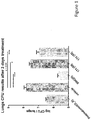
- Figure 1 shows the in vivo efficacy of compounds 171 and 175 in a murine model of acute tuberculosis infection.
- Example 1 Determination the Minimum Inhibitory Concentration 80% (MIC 80 ) of new chemical entities against M . tuberculosis
- a starting culture of M. tuberculosis was prepared by diluting a frozen aliquot in 50mL of 7H9 medium supplemented with glycerol, to an optical density at 600nM (OD 600 ) of 0.02.
- the culture was incubated for 3 days at 37°C to an OD 600 of 0.2-0.3.
- the bacteria were the harvested by centrifugation at 3000 rpm, washed once and resuspended to an OD 600 of 0.1 in 7H9 medium without glycerol.
- the OD 600 was finally adjusted to 0.02 and the culture was kept at room temperature before dispensing to the assay plate.
- the assay was carried out in 384-well flat bottom microplates in a final volume of 50 ⁇ l. 25 ⁇ l of the prepared bacterial working culture was added to the compound test plate containing 0.5 ⁇ l of serial diluted test compounds.
- the plates were incubated at 37°C for 5 days. Bacterial growth was determined after 5 days of incubation by measuring fluorescence intensity at 488nm after 5 days of incubation using the plate reader SPECTRA MAX plus (Molecular Devices®). MIC 80 , the concentration of the compound that inhibits growth compared to the drug free control after 5 days by 80%, were determined using Graph Pad PRISM® software.
- the imidazopyridine compounds (scaffolds I - IX; see Table 1 ) underwent derivatization according to the methods outlined below (Schemes 1-22). Resulting derivatives were examined for inhibitory activity (MIC) using the assays described above (Example 1) and the results are summarized in Table 1. The synthesized compounds 1-350 are shown in Table 2.
- V2 (0.10 g, 60 %) as a white solid.
- Example 3 In vivo activity in a murine model
- mice 8-week old female BalbC mice were infected with 8 ⁇ 10 6 M . tuberculosis H37Rv via intranasal inoculation. Mice were sacrificed at day 1 to control the number of CFU in the lungs. In the acute model of infection, mice were treated for 3 days, starting at day 6. Compounds were freshly dissolved in a 20% d- ⁇ -tocopheryl polyethylene glycol 1000 succinate (ETPGS) solution and administered by oral gavage as single dose per day. Bacterial load was assessed in lungs after homogenizing the organs in 1X PBS. Serial dilutions of organs homogenates were spread on Middlebrook 7H11 plates and CFU were determined after 3 weeks incubation at 37°C under 5% CO2.
- Isoniazid Isoniazid
Landscapes
- Health & Medical Sciences (AREA)
- Chemical & Material Sciences (AREA)
- Organic Chemistry (AREA)
- Life Sciences & Earth Sciences (AREA)
- Veterinary Medicine (AREA)
- Public Health (AREA)
- General Health & Medical Sciences (AREA)
- Medicinal Chemistry (AREA)
- Animal Behavior & Ethology (AREA)
- Pharmacology & Pharmacy (AREA)
- Chemical Kinetics & Catalysis (AREA)
- Nuclear Medicine, Radiotherapy & Molecular Imaging (AREA)
- General Chemical & Material Sciences (AREA)
- Communicable Diseases (AREA)
- Oncology (AREA)
- Epidemiology (AREA)
- Pulmonology (AREA)
- Bioinformatics & Cheminformatics (AREA)
- Engineering & Computer Science (AREA)
- Pharmaceuticals Containing Other Organic And Inorganic Compounds (AREA)
- Nitrogen Condensed Heterocyclic Rings (AREA)
- Medicines That Contain Protein Lipid Enzymes And Other Medicines (AREA)
Description
- The present invention relates to small molecule compounds and their use in the treatment of bacterial infections, in particular Tuberculosis.
- Tuberculosis (TB) still claims the life of more than 1.8 million people each year. Inadequate use of chemotherapy has led to an increasing number in multi-drug resistant (MDR) TB, and the situation is likely to worsen with the emergence and spread of exensively drug resistant form of the disease (Chaisson R.E.&Nuermberger E.L., N Engl J Med 2012; Zhao Y. et al., N Engl J Med 2012). The most urgent clinical need is to discover potent agents capable of reducing the time of M-XDR tuberculosis therapy with a success rate comparable to susceptible tuberculosis. The last decade has seen the discovery of promising new agent classes for the management of tuberculosis (Stover C.K. et al. Nature 2000 ; Andreis K. et al. Science 2005; Makarov V. et al. Science 2009), several of which are currently under clinical development (Diacon A.H. et al. Antimicrob Agents Chemother 2010; Diacon A.H. et al. Antimicrob Agents Chemother 2012 ; Gler M.T. et al. N Engl J Med 2012). However, given the high attrition rate during clinical development and emergence of resistance, the discovery of additional clinical candidates is clearly needed.
- Current chemotherapy consists of compounds that directly target Mycobacterium tuberculosis bacillus, by targeting either the synthesis of macromolecules such as DNA, RNA or protein synthesis, or key components of the cell-wall. The most widely used dedicated anti-tubercular drugs isoniazid, ethionamide and pyrazinamide are pro-drugs that first require activation. As active forms, they demonstrate inhibitory activity on primarily cell-wall synthesis and/or on a wide range of mycobacterial targets, which have not yet been fully characterized.
- One of the most challenging obstacle in the discovery of new anti-TB drugs is the lack of predictive in vitro screening methods that reproduce critical features found in vivo. Although there is still a lack of understanding of the biological mechanisms behind tubercle bacillus persistence, i.e. the location and state of latent bacteria in humans, M. tuberculosis is thought to persists in primary granulomas (Lenaerts et al., 2007) and within various cell types (Houben et al., 2006; Neyrolles et al., 2006). The bacillus mainly localizes inside phagocytic cells, such as macrophages and dendritic cells, where it adapts drastically its metabolism to survive the harsh environment found in professional phagocytic cells (Rohde et al., 2007; Schnappinger et al., 2003). Therefore, we developed and used a phenotypic high-content screening technology in infected macrophages to identify novel antitubercular compounds (
WO2010003533A2 ), overcoming many of the numerous and burdensome steps involved with other methodologies (Arain et al., 1996). The technology has several advantages compared to traditional phenotypic screening approaches since it allows i) screening under physiologically relevant conditions, which is notoriously challenging in the field (Pethe K. et al. Nat Commun 2010; Stanley S.A. et al., ACS Chem Biol 2012), ii) selection of non-cytotoxic compounds that penetrate effectively inside macrophages, and iii) selection of compounds that are poor substrates for macrophage-induced efflux mechanisms (Adams K.N. et al. Cell 2011), thereby compressing the discovery and optimization time of new lead molecules. -
WO 2011/113606 discloses benzyl aminocarbonyl-imidazo[1,2-a]pyridines and their utility as anti-infective compounds. -
WO 2012/143796 discloses piperazine-1-yl-benzyl aminocarbonyl-imidazo[1,2-a]pyridines and their utility as anti-inflammation compounds. - Ekins et al. (Chemistry and Biology, vol. 20, pp. 370-378) discloses Bayesian models to screen for compounds with antitubercular cell activity.
- It was an object of the present invention to identify compounds effective against bacterial infections, in particular compounds that would prevent M. tuberculosis multiplication inside the host macrophage.
- The present invention relates to compounds in accordance with the appended claims.
- In one aspect, the present invention relates to compounds having the general formula I:

- X is CH or N;
Y is CH, O or N;
m is 0 or 1;
n is 0 or 1; - R1 is, at each occurrence, independently selected from the group consisting of hydrogen, halogen, methyl, ethyl, t-butyl, phenyl, -NC(O)R5, -OR5, -C(O)R5, -C(O)OR5, any of which is optionally substituted;
- R2 is, at each occurrence, independently selected from the group consisting of hydrogen and hydroxyl;
- R3 is, at each occurrence, independently selected from the group consisting of methyl and ethyl;
- R4 is, at each occurrence, independently selected from the group consisting of hydrogen, halogen, methyl, -methoxy and -CF3;
- R5 is, at each occurrence, independently selected from the group consisting of C1-C3 alkylhetorocycle, phenyl and benzyl, any of which is optionally substituted;
- X is CH or N
- R24 is, at each occurrence, independently selected from the group consisting of hydrogen, halogens, C1-C2 alkyl, -methoxy, -CF3 and -OCF3;
- R25 is, at each occurrence, independently selected from the group consisting of methyl and ethyl;
- R26 is, at each occurrence, independently selected from the group consisting of hydrogen, halogen, methyl, -methoxy and -CF3;
- X is CH2 or NH
n is 0 or 1 - R27 is, at each occurrence, independently selected from the group consisting of methyl and ethyl;
- R28 is, at each occurrence, independently selected from the group consisting of hydrogen, halogen, methyl, -methoxy and -CF3;
- and pharmaceutically acceptable salts thereof,
- wherein the compound has one one of the formulae 1-231, 238, 281-285, 289-300, 309-316, 325-328, 333-337, 340-350, as shown further below.
- The term "optionally substituted" as used herein is meant to indicate that a hydrogen atom attached to a member atom within a group, or several such hydrogen atoms, is replaced by a group, such as halogen including fluorine, C1-C3 alkyl, C1-C3 haloalkyl, methylhydroxyl, COOMe, C(O)H, COOH, OMe, or OCF3;
- In one embodiment, the present invention also relates to pharmeceutically acceptable salts of the compounds according to the present invention.
- The term "alkyl" refers to a monovalent straight or branched chain, saturated aliphatic hydrocarbon radical having a number of carbon atoms in the specified range. Thus, for example, "C1-C6 alkyl" refers to any of the hexyl alkyl and pentyl alkyl isomers as well as n-, iso-, sec-, and t-butyl, n- and isopropyl, ethyl and methyl.
- The term "alkenyl" refers to a monovalent straight or branched chain aliphatic hydrocarbon radical containing one carbon-carbon double bond and having a number of carbon atoms in the specified range. Thus, for example, "C2-C6 alkenyl" refers to all of the hexenyl and pentenyl isomers as well as 1-butenyl, 2-butenyl, 3-butenyl, isobutenyl, 1-propenyl, 2-propenyl, and ethenyl (or vinyl).
- The term "cycloalkyl", alone or in combination with any other term, refers to a group, such as optionally substituted or non-substituted cyclic hydrocarbon, having from three to eight carbon atoms, unless otherwise defined. Thus, for example, "C3-C8 cycloalkyl" refers to cyclopropyl, cyclobutyl, cyclopentyl, cyclohexyl, cycloheptyl, and cyclooctyl.
- The term "haloalkyl" refers to an alkyl group, as defined herein that is substituted with at least one halogen. Examples of straight or branched chained "haloalkyl" groups useful in the present invention include, but are not limited to, methyl, ethyl, propyl, isopropyl, n-butyl, and t-butyl substituted independently with one or more halogens. The term "haloalkyl" should be interpreted to include such substituents such as -CHF2, -CF3, -CH2-CH2-F, -CH2-CF3, and the like.
- The term "heteroalkyl" refers to an alkyl group where one or more carbon atoms have been replaced with a heteroatom, such as, O, N, or S. For example, if the carbon atom of alkyl group which is attached to the parent molecule is replaced with a heteroatom (e.g., O, N, or S) the resulting heteroalkyl groups are, respectively, an alkoxy group (e.g., -OCH3, etc.), an amine (e.g., -NHCH3, -N(CH3)2, etc.), or thioalkyl group (e.g., -SCH3, etc.). If a non-terminal carbon atom of the alkyl group which is not attached to the parent molecule is replaced with a heteroatom (e.g., O, N, or S) and the resulting heteroalkyl groups are, respectively, an alkyl ether (e.g., -CH2CH2-O-CH3, etc.), alkyl amine (e.g., -CH2NHCH3, -CH2N(CH3)2, etc.), or thioalkyl ether (e.g., -CH2-S-CH3).
- The term "halogen" refers to fluorine, chlorine, bromine, or iodine.
- The term "phenyl" as used herein is meant to indicate that optionally substituted or non-substituted phenyl group.
- The term "benzyl" as used herein is meant to indicate that optionally substituted or non-substituted benzyl group.
- The term "heteroaryl" refers to (i) optionally substituted 5- and 6-membered heteroaromatic rings and (ii) optionally substituted 9- and 10-membered bicyclic, fused ring systems in which at least one ring is aromatic, wherein the heteroaromatic ring or the bicyclic, fused ring system contains from 1 to 4 heteroatoms independently selected from N, O, and S, where each N is optionally in the form of an oxide and each S in a ring which is not aromatic is optionally S(O) or S(O)2. Suitable 5- and 6-membered heteroaromatic rings include, for example, pyridyl, pyrrolyl, pyrazinyl, pyrimidinyl, pyridazinyl, triazinyl, thienyl, furanyl, imidazolyl, pyrazolyl, triazolyl, tetrazolyl, oxazolyl, isooxazolyl, oxadiazolyl, thiazolyl, isothiazolyl, and thiadiazolyl. Suitable 9-and 10-membered heterobicyclic, fused ring systems include, for example, benzofuranyl, indolyl, indazolyl, naphthyridinyl, isobenzofuranyl, benzopiperidinyl, benzisoxazolyl, benzoxazolyl, chromenyl, quinolinyl, isoquinolinyl, cinnolinyl, quinazolinyl, tetrahydroquinolinyl, tetrahydroisoquinolinyl, isoindolyl, benzodioxolyl, benzofuranyl, imidazo[1,2-a]pyridinyl, benzotriazolyl, dihydroindolyl, dihydroisoindolyl, indazolyl, indolinyl, isoindolinyl, quinoxalinyl, quinazolinyl, 2,3-dihydrobenzofuranyl, and 2,3-dihydrobenzo-1,4-dioxinyl.
- The term "heterocyclyl" refers to (i) optionally substituted 4- to 8-membered, saturated and unsaturated but non-aromatic monocyclic rings containing at least one carbon atom and from 1 to 4 heteroatoms, (ii) optionally substituted bicyclic ring systems containing from 1 to 6 heteroatoms, and (iii) optionally substituted tricyclic ring systems, wherein each ring in (ii) or (iii) is independent of fused to, or bridged with the other ring or rings and each ring is saturated or unsaturated but nonaromatic, and wherein each heteroatom in (i), (ii), and (iii) is independently selected from N, O, and S, wherein each N is optionally in the form of an oxide and each S is optionally oxidized to S(O) or S(O)2. Suitable 4- to 8-membered saturated heterocyclyls include, for example, azetidinyl, piperidinyl, morpholinyl, thiomorpholinyl, thiazolidinyl, isothiazolidinyl, oxazolidinyl, isoxazolidinyl, pyrrolidinyl, imidazolidinyl, piperazinyl, tetrahydrofuranyl, tetrahydrothienyl, pyrazolidinyl, hexahydropyrimidinyl, thiazinanyl, thiazepanyl, azepanyl, diazepanyl, tetrahydropyranyl, tetrahydrothiopyranyl, dioxanyl, and azacyclooctyl. Suitable unsaturated heterocyclic rings include those corresponding to the saturated heterocyclic rings listed in the above sentence in which a single bond is replaced with a double bond. It is understood that the specific rings and ring systems suitable for use in the present invention are not limited to those listed in this and the preceding paragraphs. These rings and ring systems are merely representative.
- The term "MIC80" refers to the concentration of compound which inhibits bacterial growth, preferably growth of M. tuberculosis, in comparison to a control without any drug after five days by 80%.
- In accordance with the appended claims, the present invention relates to compounds having one of the formulae 1-231, 238, 281-285, 289-300, 309-316, 325-328, 333-337, 340-350, as shown in Tables 1 and 2, preferably one of the formulae 1-21, 23-24, 26, 28-33, 35-57, 59-77, 79-83, 85-87, 90-98, 100-102, 106-111, 113-116 118-124, 126-128, 130-142, 144-150, 153, 155-167, 169-184, 186-188, 190-197, 199, 201, 203-208, 210-211, 213-214, 216, 218-231, 238, 281-285, 289-300, 309-316, 325-328, 333-337, 340-350 as shown in Tables 1 and 2, and pharmaceutically acceptable salts thereof. Particularly preferred compounds are compounds having one of the
formulae Figure 1 . - Preferably, the compounds as defined above have an inhibitory activity on bacterial growth, preferably on the growth of M. tuberculosis, inside a host cell, preferably a macrophage, at a concentration between 1-20 µM, preferably less than 1 µM. Preferably, the compounds as defined above have a MIC80 of less than 1 µM.
- In one aspect, the present invention relates to compounds as defined above for use in the treatment of a bacterial infection, e.g. tuberculosis.
- In one aspect, the present invention relates to compounds as defined above for use in the treatment of Tuberculosis.
- In one aspect, the present invention relates to a pharmaceutical composition comprising a compound as defined above, and a pharmaceutically acceptable carrier.
- Also disclosed is a method of treatment of a bacterial infection, in particular Tuberculosis, comprising the application of a suitable amount of a compound as defined above or of a pharmaceutical composition as defined above to a person in need thereof.
- In one embodiment, a "suitable amount", as used herein, is meant to refer to an amount in the range of from 0.01 mg/kg body weight to 1 g/kg body weight.
- Examples of pharmaceutically acceptable addition salts include, without limitation, the nontoxic inorganic and organic acid addition salts such as the acetate derived from acetic acid, the aconate derived from aconitic acid, the ascorbate derived from ascorbic acid, the benzenesulfonate derived from benzensulfonic acid, the benzoate derived from benzoic acid, the cinnamate derived from cinnamic acid, the citrate derived from citric acid, the embonate derived from embonic acid, the enantate derived from enanthic acid, the formate derived from formic acid, the fumarate derived from fumaric acid, the glutamate derived from glutamic acid, the glycolate derived from glycolic acid, the hydrochloride derived from hydrochloric acid, the hydrobromide derived from hydrobromic acid, the lactate derived from lactic acid, the maleate derived from maleic acid, the malonate derived from malonic acid, the mandelate derived from mandelic acid, the methanesulfonate derived from methane sulphonic acid, the naphthalene-2-sulphonate derived from naphtalene-2-sulphonic acid, the nitrate derived from nitric acid, the perchlorate derived from perchloric acid, the phosphate derived from phosphoric acid, the phthalate derived from phthalic acid, the salicylate derived from salicylic acid, the sorbate derived from sorbic acid, the stearate derived from stearic acid, the succinate derived from succinic acid, the sulphate derived from sulphuric acid, the tartrate derived from tartaric acid, the toluene-p-sulphonate derived from p-toluene sulphonic acid, and the like. Such salts may be formed by procedures well known and described in the art.
- Other acids such as oxalic acid, which may not be considered pharmaceutically acceptable, may be useful in the preparation of salts useful as intermediates in obtaining a chemical compound of the invention and its pharmaceutically acceptable acid addition salt.
- In another embodiment, the compounds of the invention are used in their respective free base form according to the present invention.
- Metal salts of a chemical compound of the invention include alkali metal salts, such as the sodium salt of a chemical compound of the invention containing a carboxy group.
- The chemical compounds of the invention may be provided in unsolvated or solvated forms together with a pharmaceutically acceptable solvent(s) such as water, ethanol, and the like. Solvated forms may also include hydrated forms such as the monohydrate, the dihydrate, the hemihydrate, the trihydrate, the tetrahydrate, and the like. In general, solvated forms are considered equivalent to unsolvated forms for the purposes of this invention.
- The production of medicaments containing the compounds of the invention, its active metabolites or isomers and salts according to the invention and their application can be performed according to well-known pharmaceutical methods.
- While the compounds of the invention, useable according to the invention for use in therapy, may be administered in the form of the raw chemical compound, it is preferred to introduce the active ingredient, optionally in the form of a physiologically acceptable salt in a pharmaceutical composition together with one or more adjuvants, excipients, carriers, buffers, diluents, and/or other customary pharmaceutical auxiliaries. Such salts of the compounds of the invention may be anhydrous or solvated.
- In a preferred embodiment, the invention provides medicaments comprising a compound useable according to the invention, or a pharmaceutically acceptable salt or derivative thereof, together with one or more pharmaceutically acceptable carriers therefor, and, optionally, other therapeutic and/or prophylactic ingredients. The carrier(s) must be "acceptable" in the sense of being compatible with the other ingredients of the formulation and not harmful to the recipient thereof.
- A medicament of the invention may be those suitable for oral, rectal, bronchial, nasal, topical, buccal, sub-lingual, transdermal, vaginal or parenteral (including cutaneous, subcutaneous, intramuscular, intraperitoneal, intravenous, intraarterial, intracerebral, intraocular injection or infusion) administration, or those in a form suitable for administration by inhalation or insufflation, including powders and liquid aerosol administration, or by sustained release systems. Suitable examples of sustained release systems include semipermeable matrices of solid hydrophobic polymers containing the compound of the invention, which matrices may be in form of shaped articles, e.g. films or microcapsules.
- The compounds useable according to the invention, together with a conventional adjuvant, carrier, or diluent, may thus be placed into the form of medicament and unit dosages thereof. Such forms include solids, and in particular tablets, filled capsules, powder and pellet forms, and liquids, in particular aqueous or non-aqueous solutions, suspensions, emulsions, elixirs, and capsules filled with the same, all for oral use, suppositories for rectal administration, and sterile injectable solutions for parenteral use. Such medicament and unit dosage forms thereof may comprise conventional ingredients in conventional proportions, with or without additional active compounds or principles, and such unit dosage forms may contain any suitable effective amount of the active ingredient commensurate with the intended daily dosage range to be employed.
- The compounds useable according to the invention can be administered in a wide variety of oral and parenteral dosage forms. It will be obvious to those skilled in the art that the following dosage forms may comprise, as the active component, either a compound(s) useable according to the invention or a pharmaceutically acceptable salt of a compound(s) useable according to the invention.
- For preparing a medicament from a compound useable according to the invention, pharmaceutically acceptable carriers can be either solid or liquid. Solid form preparations include powders, tablets, pills, capsules, cachets, suppositories, and dispersible granules. A solid carrier can be one or more substances which may also act as diluents, flavouring agents, solubilizers, lubricants, suspending agents, binders, preservatives, tablet disintegrating agents, or an encapsulating material.
- In powders, the carrier is a finely divided solid which is in a mixture with the finely divided active component. In tablets, the active component is mixed with the carrier having the necessary binding capacity in suitable proportions and compacted in the shape and size desired. Suitable carriers are magnesium carbonate, magnesium stearate, talc, sugar, lactose, pectin, dextrin, starch, gelatin, tragacanth, methylcellulose, sodium carboxymethylcellulose, a low melting wax, cocoa butter, and the like. The term "preparation" is intended to include the formulation of the active compound with encapsulating material as carrier providing a capsule in which the active component, with or without carriers, is surrounded by a carrier, which is thus in association with it. Similarly, cachets and lozenges are included. Tablets, powders, capsules, pills, cachets, and lozenges can be used as solid forms suitable for oral administration.
- For preparing suppositories, a low melting wax, such as a mixture of fatty acid glyceride or cocoa butter, is first melted and the active component is dispersed homogeneously therein, as by stirring. The molten homogenous mixture is then poured into convenient sized moulds, allowed to cool, and thereby to solidify. Compositions suitable for vaginal administration may be presented as pessaries, tampons, creams, gels, pastes, foams or sprays containing in addition to the active ingredient such carriers as are known in the art to be appropriate. Liquid preparations include solutions, suspensions, and emulsions, for example, water or water-propylene glycol solutions. For example, parenteral injection liquid preparations can be formulated as solutions in aqueous polyethylene glycol solution.
- The chemical compounds according to the present invention may thus be formulated for parenteral administration (e.g. by injection, for example bolus injection or continuous infusion) and may be presented in unit dose form in ampoules, pre-filled syringes, small volume infusion or in multi-dose containers with an added preservative. The compositions may take such forms as suspensions, solutions, or emulsions in oily or aqueous vehicles, and may contain formulation agents such as suspending, stabilising and/or dispersing agents. Alternatively, the active ingredient may be in powder form, obtained by aseptic isolation of sterile solid or by lyophilization from solution, for constitution with a suitable vehicle, e.g. sterile, pyrogen-free water, before use.
- Aqueous solutions suitable for oral use can be prepared by dissolving the active component in water and adding suitable colorants, flavours, stabilising and thickening agents, as desired. Aqueous suspensions suitable for oral use can be made by dispersing the finely divided active component in water with viscous material, such as natural or synthetic gums, resins, methylcellulose, sodium carboxymethylcellulose, or other well known suspending agents.
- Also included are solid form preparations which are intended to be converted, shortly before use, to liquid form preparations for oral administration. Such liquid forms include solutions, suspensions, and emulsions. These preparations may contain, in addition to the active component, colorants, flavours, stabilisers, buffers, artificial and natural sweeteners, dispersants, thickeners, solubilizing agents, and the like.
- In one embodiment of the present invention, the medicament is applied topically or systemically or via a combination of the two routes.
- For administration, the compounds of the present invention may, in one embodiment, be administered in a formulation containing 0,001% to 70% per weight of the compound, preferably between 0,01% to 70% per weight of the compound, even more preferred between 0,1% and 70% per weight of the compound. In one embodiment, a suitable amount of compound administered is in the range of from 0.01 mg/kg body weight to 1 g/kg body weight.
- Compositions suitable for administration also include lozenges comprising the active agent in a flavoured base, usually sucrose and acacia or tragacanth; pastilles comprising the active ingredient in an inert base such as gelatin and glycerol or sucrose and acacia; and mouthwashes comprising the active ingredient in a suitable liquid carrier.
- Solutions or suspensions are applied directly to the nasal cavity by conventional means, for example with a dropper, pipette or spray. The compositions may be provided in single or multi-dose form. In the latter case of a dropper or pipette, this may be achieved by the patient administering an appropriate, predetermined volume of the solution or suspension. In the case of a spray, this may be achieved for example by means of a metering atomising spray pump.
- Administration to the respiratory tract may also be achieved by means of an aerosol formulation in which the active ingredient is provided in a pressurised pack with a suitable propellant such as a chlorofluorocarbon (CFC) for example dichlorodifluoromethane, trichlorofluoromethane, or dichlorotetrafluoroethane, carbon dioxide, or other suitable gas. The aerosol may conveniently also contain a surfactant such as lecithin. The dose of drug may be controlled by provision of a metered valve.
- Alternatively the active ingredients may be provided in the form of a dry powder, for example a powder mix of the compound in a suitable powder base such as lactose, starch, starch derivatives such as hydroxypropylmethyl cellulose and polyvinylpyrrolidone (PVP). Conveniently the powder carrier will form a gel in the nasal cavity. The powder composition may be presented in unit dose form for example in capsules or cartridges of, e.g., gelatin, or blister packs from which the powder may be administered by means of an inhaler.
- In compositions intended for administration to the respiratory tract, including intranasal compositions, the compound will generally have a small particle size for example of the order of 5 microns or less. Such a particle size may be obtained by means known in the art, for example by micronization.
- When desired, compositions adapted to give sustained release of the active ingredient may be employed.
- The pharmaceutical preparations are preferably in unit dosage forms. In such form, the preparation is subdivided into unit doses containing appropriate quantities of the active component. The unit dosage form can be a packaged preparation, the package containing discrete quantities of preparation, such as packaged tablets, capsules, and powders in vials or ampoules. Also, the unit dosage form can be a capsule, tablet, cachet, or lozenge itself, or it can be the appropriate number of any of these in packaged form. Tablets or capsules for oral administration and liquids for intravenous administration and continuous infusion are preferred compositions.
- Further details on techniques for formulation and administration may be found in the latest edition of Remington's Pharmaceutical Sciences (Maack Publishing Co. Easton, Pa.).
- Reference is now made to the figures and tables, wherein
Figure 1 shows the in vivo efficacy ofcompounds - Table 1 summarizes imidazopyridine derivatives (general scaffolds I-VId) with their respective inhibitory activities.
- Table 2 summarizes compounds 1-350 in terms of their structures and corresponding characteristics.
- The invention is now further described by reference to the following examples which are intended to illustrate, not to limit the scope of the invention.
- Cell-based assays are key tools in lead finding and optimization of new chemical entities for Mycobacterium tuberculosis. The availability of a robust in vitro assay for testing the Minimum inhibitory concentration (MIC) of a new chemical entity is an absolute requirement for the success of a program. The microplate broth dilution assay using a M. tuberculosis strain expressing the green-fluorescent protein (GFP) was selected as this method i) delivers highly reproducible results, ii) allows screening of large number of compounds, and iii) can be partially automated if required.
- Breiefly, a starting culture of M. tuberculosis was prepared by diluting a frozen aliquot in 50mL of 7H9 medium supplemented with glycerol, to an optical density at 600nM (OD600) of 0.02. The culture was incubated for 3 days at 37°C to an OD600 of 0.2-0.3. The bacteria were the harvested by centrifugation at 3000 rpm, washed once and resuspended to an OD600 of 0.1 in 7H9 medium without glycerol. The OD600 was finally adjusted to 0.02 and the culture was kept at room temperature before dispensing to the assay plate.
- The assay was carried out in 384-well flat bottom microplates in a final volume of 50µl. 25µl of the prepared bacterial working culture was added to the compound test plate containing 0.5µl of serial diluted test compounds.
- The plates were incubated at 37°C for 5 days. Bacterial growth was determined after 5 days of incubation by measuring fluorescence intensity at 488nm after 5 days of incubation using the plate reader SPECTRA MAX plus (Molecular Devices®). MIC80, the concentration of the compound that inhibits growth compared to the drug free control after 5 days by 80%, were determined using Graph Pad PRISM® software.
- The imidazopyridine compounds (scaffolds I - IX; see Table 1) underwent derivatization according to the methods outlined below (Schemes 1-22). Resulting derivatives were examined for inhibitory activity (MIC) using the assays described above (Example 1) and the results are summarized in Table 1. The synthesized compounds 1-350 are shown in Table 2.

- To a solution of methyl 3-oxopentanoate (200 g, 1.55 mol) in anhydrous DCM (500 mL) was added SO2Cl2 (220 g, 1.63 mol) dropwise at 0 °C, then the mixture was stirred at 25 °C for 16 hours. The reaction mixture was poured into water (500 mL). The organic layer was separated and washed with water (500 mL×3), brine (500 mL), dried over anhydrous Na2SO4 and concentrated under reduced pressure to afford compound A1 (245 g, yield: 96%) as a colorless oil which was used for next step without further purification.
- To a solution of 5-bromopyridin-2-amine (10.0 g, 57.8 mmol) in MeOH (10 mL) was added compound A1 (10.5 g, 63.6 mmol) dropwise at 25 °C, then the mixture was stirred at reflux for 16 hours. The reaction mixture was concentrated. The residue was partitioned between EtOAc (100 mL) and water (100 mL). The organic layer was separated and washed with water (100 mL x 3), brine (100 mL), dried over anhydrous Na2SO4 and concentrated under reduced pressure. The residue was purified by combi flash (PE: EtOAc = 4: 1) to afford compound A2 (4.00 g, yield: 25%) as a yellow powder.
- To a solution of compound A2 (3.00 g, 10.6 mmol) in THF (40 mL) and MeOH (20 mL) was added 2N NaOH (40 mL) at 25 °C, then the mixture was stirred at 25 °C for 16 hours. Most of the MeOH and THF were evaporated under reduced pressure. The mixture was then washed with DCM (40 mL x 2). The aqueous layer was then acidified with HCl to pH = 6, No solid was precipitated. The aqueous phase was concentrated under reduced pressure and suspended in DCM/ MeOH= 5: 1 (40 mL) under stirring. The mixture was filtered and the filtrate was concentrated under reduced pressure to afford compound A3 (2.60 g, yield: 91%) as a white powder.
- To a solution of compound A3 (60 mg, 0.224 mmol), HOBt (45 mg, 0.336 mmol), EDCI (86 mg, 0.448 mmol) in 1.5 mL DMF was added NMM (136 mg, 1.34mmol). The mixture was stirred at 20°C for 10 minutes. Then (4-(4-phenylpiperidin-1-yl)phenyl)methanamine (40 mg, 0.212 mmol) was added to the mixture and stirred at 30°C for 18 hours. 15 mL of water was added into the mixture and the solid was formed. The mixture was filtered and the filter cake was dissolved in 20 mL DCM and concentrated under reduced pressure to give the crude product A4, which was triturated with 3 mL x 2 of CH3OH twice and 3 mL of CH3CN in sequence and then filtered and the filter cake was dried to give the pure product A4 (12 mg, 12%) as a white solid.

- To a suspension of compound 1-bromo-4-(trifluoromethyl)benzene (20.0 g, 89.3 mmol), compound tert-butyl 4-(4,4,5,5-tetramethyl-1,3,2-dioxaborolan-2-yl)-5,6-dihydropyridine-1(2H)-carboxylate (33.1 g, 107 mmol) in DMF (200 mL) was added K2CO3 (30.3 g, 223 mmol) and PdCl2(dppf) (1.33 g, 1.79 mmol) under nitrogen. The reaction mixture was stirred at 80 °C under nitrogen for 16 hours. TLC and LCMS showed the reaction was finished. The mixture was filtered and the filtrate was concentrated under reduced pressure. The residue was partitioned between water (200 mL) and EtOAc (400 mL). The layers were separated and the aqueous layer was extracted with EtOAc (400 mL×2). The combined extracts were washed with water (100 mL×2), dried over anhydrous Na2SO4 and concentrated under reduced pressure. The residue pressure was purified by combi flash (Eluents: PE : THF = 19 : 1) to afford compound Y05_1A (16.0 g, 54.6%yield) as a yellow oil.
- To a solution of B1 (16.0 g, 48.8 mmol) in MeOH (250 mL) was added Pd/C (10%, 2.50 g) under Ar atmosphere. The suspension was degassed under vacuum and purged with H2 for 3 times. The reaction mixture was stirred at 20°C under H2 atmosphere (40 psi) for 24 hours. LCMS showed that the reaction was finished. The mixture was filtered through a pad of celite and the filter cake was washed with MeOH (50 mL×3). The combined filtrates were concentrated under reduced pressure to dryness to give compound B2 (14.0 g, 86.9% yield) as a colorless oil.
- A solution of compound B2 (14.0 g, 42.4 mmol) in HCl/dioxane (4N, 140 mL) was stirred at 25 °C for 3 hours. LCMS showed the reaction was finished. The reaction mixture was concentrated to dryness to give compound B3 (14.0 g 92.1% yield) as a white solid.
- To a solution of compound B3 (8.98 g, 39.0 mmol) and 4-fluorobenzonitrile (5.20 g, 43.0 mmol) in anhydrous DMSO (100 mL) was added K2CO3 (26.9 g, 195 mmol). The reaction mixture was stirred at 120 °C for 16 hours. LCMS indicated the reaction was finished. The mixture was poured into water (200 mL) and collected by filtration. The solid was dissolved in EtOAc (600 mL) which was washed with water (200 mL×3) and washed with brine (200 mL×3), dried over anhydrous Na2SO4 and concentrated under reduced pressure. The residue was triturated with n-hexane (100 mL) to afford compound B4 (11.0 g, 85.5% yield) as a white solid.
- To a suspension of compound B4 (7.00 g, 21.2 mmol) in anhydrous THF (120 mL) was added LiAlH4 (4.10 g, 108 mmol) at 0∼10 °C. The reaction mixture was refluxed for 3 hours. TLC and LCMS showed the reaction was finished. The reaction mixture was cooled to 0 °C, and quenched with water (4.1 mL), NaOH (10%, 4.1 mL) and THF (120 mL) carefully. The mixture was filtered and the filtrate was dried over anhydrous Na2SO4, concentrated under reduced pressure. The residue was triturated with n-hexane (100 mL) to afford compound Y05 (5.60 g, crude) as white solid. To a solution of B5 (5.60 g, crude), in MeOH (150 mL) was added Boc2O (9.42 g, 42.4 mmol). The mixture was stirred at about 18 °C for 2 hours. LCMS showed the reaction was finished. The solution was concentrated in vacuo and the residue was purified by combi flash (Eluents: THF/PE = 1/20) to give compound Y05_Boc (5.80 g, crude). A mixture of B5_Boc in HCl/dioxane (4N, 80 mL) was stirred at 18 °C for 3 hours. LCMS showed the reaction was finished. The reaction mixture was concentrated under reduced pressure to give compound B5 (5.10 g 72.0% yield) as a white solid.

- To a suspension of 1-bromo-4-(trifluoromethoxy)benzene (20.0 g, 83.0 mmol), compound tert-butyl piperazine-1-carboxylate (18.6 g, 99.6 mmol) in dioxane (100 mL) was added Cs2CO3 (37.8 g, 166 mmol) and Pd2(dba)3 (1.20 g), Xantphos (1.20 g) under nitrogen. The reaction mixture was stirred at 120 °C under nitrogen for 16 hours. TLC and LCMS showed the reaction was finished. Water (200 mL) was added and the mixture was extracted with EtOAc (100 mL×3). The combined organic layers were washed with brine (100 mL×2), dried over anhydrous Na2SO4 and concentrated under reduced pressure. The residue was triturated with MTBE (50 mL) to afford compound c1 (18.8 g, 65% yield) as a red solid.
- A solution of compound C1 (18.8 g, 54.0 mmol) in HCl/dioxane (4N, 250 mmol) was stirred at 25 °C for 3 hours. LCMS showed the reaction was finished. The reaction mixture was concentrated to give compound C2 (13.3 g, crude), which was used to next step directly.
- To a solution of compound C2 (13.3 g, 54.0 mmol) and 4-fluorobenzonitrile (7.20 g, 59.4 mmol) in anhydrous DMSO (150 mL) was added K2CO3 (30.0 g, 216 mmol). The reaction mixture was stirred at 120 °C for 16 hours. LCMS indicated the reaction was finished. The mixture was poured into water (600 mL) and collected by filtration. The solid was dissolved in EtOAc (500 mL), dried over anhydrous Na2SO4 and concentrated under reduced pressure. The residue was triturated with n-Hexane/MTBE to afford compound C3 (11.8 g, 62.9% yield) as brown solid.
- To a suspension of compound C3 (11.8 g, 34.0 mmol) in anhydrous THF (150 mL) was added LiAlH4 (6.50 g, 170 mmol) at 0∼10 °C. The reaction mixture was refluxed for 3 hours. TLC and LCMS showed the reaction was finished. The reaction mixture was cooled to 0 °C, and quenched with water (6.5 mL), NaOH (10%, 6.5 mL), and THF (100 mL) carefully. The mixture was filtered and the filtrate was dried over anhydrous Na2SO4, concentrated under reduced pressure. The residue was triturated with n-Hexane/MTBE to afford compound C4 (5.37 g, 45 %yield) as yellow solid.

- To a solution of compound 4-(4-aminopiperidin-1-yl)benzonitrile (500 mg, 2.48 mmol) in anhydrous THF (5 mL) was added TEA (754 mg, 7.45 mmol) followed by (4-Fluoro-phenyl)-acetyl chloride (514 mg, 2.98 mmol) at 0 °C. After stirring at the temperature for 0.5 hour, the mixture was allowed to warm to 20 °C and stirred for 16 hours. The reaction mixture was diluted with water (100 mL), extracted with EtOAc (50 mL×3). The extracts was washed with brine, dried over Na2SO4 and concentrated to give a residue which was purified by silica gel column (eluent: PE/EA = 4/1 to 1/2) to afford 380 mg (yield: 45%) of D1 as a white solid.
- To a solution of compound D1 (380 mg, 1.13 mmol) in MeOH (10 mL) was added Raney-Ni (50 mg). After stirring at 20 °C for 2 hours, the mixture was filtered and the filtrate was concentrated to give crude product which was purified by silica gel column (eluent: DCM/MeOH = 30/1 to 10/1) to afford 150 mg (yield: 39%) of D2 as a white solid.

- A mixture of 4-fluoro-benzonitrile (5.00 g, 41.3 mmol), piperidin-4-ol (8.35 g, 82.6 mmol) and K2CO3 (5.71 g, 41.3 mmol) in DMSO (50 mL) was stirred at 120 °C for 16 hours. The mixture was diluted with water (100 mL), extracted with EtOAc (100 mL×3). The combined extracts were washed with water (100 mL) and brine (100 mL), dried over anhydrous Na2SO4 and concentrated to give a residue. The residue was purified by silica gel column (eluent: PE/EtOAc = 5/1 to 1/1) to afford 4.70 g (yield: 57%) of E1 as a white solid.
- To a solution of compound E1 (1.00 g, 4.94 mmol) in DMF (10 mL) was added NaH (60% dispersion in mineral oil, 237 mg, 5.93 mmol) at 0 °C. After stirring at 0 °C for 0.5 hour, Bromomethyl-benzene (930 mg, 5.4 mmol) was added to the mixture at 0 °C. Then the mixture was allowed to warm to 20°C and stirred for 16 hours. The reaction was quenched with water (100 mL) and extracted with EtOAc (50 mL×3). The combined extracts were washed with water (100 mL) and brine (100 mL), dried over anhydrous Na2SO4 and concentrated to give a residue. The residue was purified by silica gel column (eluent: PE/EtOAc = 4/1 to 1/1) to afford 1.10 g (yield: 78%) of E2 as a white solid.
- To a solution of compound E2 (1.00 g, 3.42 mmol) in anhydrous THF (10 mL) was added LiAlH4 (390 mg, 10.2 mmol) at 0 °C. After stirring at 0 °C for 0.5 hour, the mixture was allowed to warm to 20 °C and stirred for 0.5 hour. The reaction was quenched with NaOH solution (0.5 mL), diluted with water (50 mL), extracted with EtOAc (50 mL×3). The extracts was washed with brine, dried over Na2SO4 and concentrated to give a residue which was purified by silica gel column (eluent: DCM/MeOH = 20/1) to afford 350 mg (yield: 35%) of E3 as a white solid.

- A mixture of 4-fluoro benzonitrile (10.0 g, 82.0 mmol), 1,4-dioxa-8-azaspiro[4.5]decane (11.8 g, 82.0 mmol) and K2CO3 (11.4 g, 82.0 mmol) in DMSO (100 mL) was stirred at 100 °C 16 hours. The mixture was diluted with water (200 mL), extracted with EtOAc (250 mL×3). The combined extracts were washed with water (200 mL) and brine (200 mL), dried over anhydrous Na2SO4 and concentrated to afford 18.0 g (yield: 90%) of F1 as a yellow solid.
- A solution of compound F1 (5.00 g, 20.0 mmol) in MeOH (50 mL) was added Raney-Ni (1.0 g). After stirring at the temperature for 4 hours, the mixture was filtered and the filtrate was concentrated to afford F2 (5.00 g, yield: 98%) as a yellow solid.
- A mixture of compound F2 (1.10 g, 4.50 mmol), 6-chloro-2-ethylimidazo[1,2-a]pyridine-3-carboxylic acid (1.00 g, 4.50 mmol), EDCI (955 mg, 4.90 mmol), HOBt (661 mg, 4.90 mmol) and TEA (1.30 g, 13.3 mmol) in THF (20 mL) was stirred at 20 °C for 16 hours. Then the mixture was diluted with water (50 mL) and extracted with EtOAc (50 mL×3). The extracts were combined, washed with brine, dried over Na2SO4 and concentrated to give a residue which was purified by silica gel column (eluent: DCM/MeOH = 20/1 to 15/1) to afford 1.50 g (yield: 75%) of F3 as a yellow solid.
- A solution of compound F3 (1.40 g, 3.08 mmol) in THF/HCl (5 mL/5 mL, HCl: 2M) was refluxed for 16 hours. The mixture was diluted with water (80 mL) and basified with NaOH aqueous solution (2M, 5 mL) to pH = 8. Then the mixture was extracted with EtOAc (50 mL×3). The extracts were combined, washed with brine, dried over Na2SO4 and concentrated to give 1.00 g (yield: 79%) of compound F4 as a brown solid.
- To a solution of compound F4 (100 mg, 0.24 mmol) in anhydrous THF (5 mL) was added MeMgBr (0.16 mL, 0.48 mmol, 3.0 M in diethyl ether) dropwise at -78°C. The mixture was stirred at the temperature for 0.5 hour. The reaction mixture was quenched with MeOH (1 mL), diluted with water (30 mL), extracted with EtOAc (20 mL×3). The extracts were combined, washed with brine (30 mL), dried over Na2SO4 and concentrated to give a residue which was purified by Prep-HPLC (0.1% TFA as additive). Most of MeCN was removed under reduced pressure, the remaining solvent was removed by lyophilization to give 27 mg (as TFA salt, yield: 21%) of compound F5 as pale yellow oil.

- To a solution of 4-fluoro-benzonitrile (7.80 g, 63.9 mmol) and 1-Boc-piperazine (10.0 g, 53.7 mmol) in DMSO (200 mL) was added K2CO3 (14.8 g, 107 mmol). The resulting mixture was stirred at 100 °C for 16 hours. TLC and LCMS showed the reaction was finished. The DMSO solvent was removed in vacuum, and the residue was suspended in water (100 mL), extracted with EtOAc (100 mL × 3). The combined extracts were washed with water (100 mL) and brine (100 mL), dried over anhydrous Na2SO4 and concentrated to give a residue. The residue was purified by re-crystallization from MeOH (150 mL) to afford 7.08 g (yield: 43%) of compound G1 as a white powder.
- To a solution of G1 (1.00 g, 3.50 mmol) in MeOH (50 mL) was added Raney-Ni (0.50 g). The suspension was degassed under vacuum and purged with H2 for three times. The reaction mixture was stirred at 20 °C for 4 hours under H2 atmosphere (45 psi). LCMS showed the reaction was completed. The reaction mixture was filtrated and the filtrate was concentrated under reduced pressure and purified by silica gel column (eluent: EtOAc/PE = 3/1 to EtOAc, 1% TEA as additive) to afford 1.00 g (yield: 100%) of compound G2 as a white powder.
- A mixture of compound 6-chloro-2-ethylimidazo[1,2-a]pyridine-3-carboxylic acid (140 mg, 0.48 mmol), G2 (90 mg, 0.40 mmol), EDCI (234 mg, 1.20 mmol), HOBt (162 mg, 1.20 mmol) and TEA (121 mg, 2.00 mmol) in THF (10 mL) was stirred at 20 °C for 16 hours. LCMS showed the reaction was finished. The reaction mixture was poured into water (30 mL), extracted with EtOAc (20 mL × 3). The combined extracts were washed with brine (10 mL), dried over anhydrous Na2SO4 and concentrated to give a residue. The residue was purified by silica gel column (eluent: PE/EtOAc = 8/1 to 4/1) to afford 120 mg (yield: 47%) of compound G3 as a white powder.
- To a solution of G3 (120 mg, 0.24 mmol) in DCM (5mL) was added TFA (1.5 mL). The resulting solution was stirred at 20 °C for 6 hours. LCMS showed the reaction was finished. The solvent was removed by concentration to afford 92 mg TFA Salt (yield: 87%) of compound G4 as a white powder, without further purification for next step.
- To a solution of compound G4 (45 mg, 0.11 mmol) and TEA (40 mg, 0.55 mmol) in DCM (10 mL) was added dropwise 4-fluorobenzoyl chloride (21 mg, 0.13 mmol). The resulting mixture was stirred at 20 °C for 1.5 hours. LCMS showed the reaction was finished. The reaction mixture was concentrated to give a residue, which was purified by Prep-HPLC (0.1% TFA as additive), most of CH3CN was removed by evaporation under reduced pressure, and the remaining solvent was removed by lyophilization to afford 35 mg TFA salt (yield: 71%) of G5 as a white powder.

- A mixture of compound ethyl piperidine-4-carboxylate (10.0 g, 63.6 mmol), 4-fluorobenzonitrile (8.10 g, 65.5 mmol), K2CO3 (14.4 g, 104 mmol) in DMSO (150 mL) were stirred at 120 °C for 16 hours. LCMS showed the reaction was finished. After removal of solvent under vacuum, the residue was poured into water (100 mL), extracted with EtOAc (50 mL × 3), the combined extracts were washed with brine (50 mL), dried over anhydrous Na2SO4 and concentrated to give a residue, which was purified by silica gel column (eluent: PE/EtOAc = 4/1) to afford 9.50 g (yield: 51%) of compound H1 as a dark oil.
- A mixture of compound H1(8.50 g, 33.0 mmol), Raney Ni (1.00 g) in MeOH (300 mL) was stirred at 20 °C under H2 ballon for 4 hours. LCMS showed the reaction was finished. After filtration, the filtrate was concentrated to give a residue, which was purified by silica gel column (eluent: EtOAc, 0.5% TEA as additive) to afford 6.08 g (yield: 71%) of compound H2 as a white solid.
- A mixture of compound H2 (6.08 g, 26.0 mmol), Boc2O (6.83 g, 32.8 mmol) and TEA (2.55 g, 25.7 mmol) in THF (150 mL) was stirred at 20 °C for 16 hours. LCMS showed the reaction was finished. After removal of the solvent, the mixture was poured into water (100 mL), extracted with EtOAc (50 mL × 3), the combined extracts were washed with brine (50 mL), dried over anhydrous Na2SO4 and concentrated to give a residue. The residue was purified by silica gel column (eluent: PE/ EtOAc = 4/1) to afford 6.80 g of crude compound H3 as a white solid, which was used for the next step without further purification.
- A mixture of compound H3 (crude, 6.80 g) and 2M KOH (20 mL) in MeOH (100 mL) was stirred at 30 °C for 3 hours. LCMS showed the reaction was finished. After removal of the solvent by concentration, the residue was poured into water (100 mL). The aqueous phase was extracted with EtOAc (30 mL × 2) and discarded, the aqueous layer was acidified to pH = 4 with 2M HCl carefully and extracted with EtOAc (50 mL × 3). The combined extracts were washed with brine (40 mL) and dried over anhydrous Na2SO4, concentrated to afford 5.50 g of crude compound H4 as a white solid, which was used for the next step without further purification.
- A mixture of compound H4 (crude, 5.50 g), N,O-dimethylhydroxylamine hydrochloride (4.76 g, 49.0 mmol), EDCI (9.55 g, 49.0 mmol), HOBt (6.62 g, 49.0 mmol) and TEA (10.3 g, 82.0 mmol) in THF (150 mL) was stirred stirred at 20 °C for 12 hours. LCMS showed the reaction was finished. After removal of the solvent under reduced pressure, the mixture was poured into water (100 mL), extracted with EtOAc (70 mL × 3). The combined extracts were washed with brine (50 mL), dried over anhydrous Na2SO4 and concentrated to give a residue, which was purified by silica gel column (eluent: PE/EtOAc = 4/1) to afford 5.80 g (3-step yield: 63%) of compound H5 as a red solid.
- A mixture of Mg (99.6 mg, 4.15 mmol) and 4-(trifluoromethoxy)-phenyl bromide (1.00 g, 4.15 mmol) in anhydrous THF (15 mL) was stirred at 50 °C until Mg almost disappeared. Then a solution of compound H5 (400 mg, 1.06 mmol) in anhydrous THF (10 mL) was added into the above solution at 0 °C dropwise. The resulting mixture was stirred at 20 °C for another 3 hours. LCMS showed the reaction was finished. After the reaction was quenched with saturated NH4Cl aqueous solution (20 mL), the mixture was extracted with EtOAc (20 mL × 3). The combined extracts were washed with brine (10 mL), dried over anhydrous Na2SO4 and concentrated to give a residue, which was purified by silica gel column (eluent: PE/EtOAc = 4/1) to afford 100 mg (yield: 21%) of compound H6 as a white solid.
- To a solution of compound H6 (100 mg, 0.21 mmol) in DCM (20 mL) was added TFA (4 mL), then the mixture was stirred at 20 °C for 5 hours. After removal of the solvent under vacuum, the mixture was poured into water (20 mL), extracted with EtOAc (10 mL), the extract was discarded. The aqueous layer was basified to pH = 9.0 with 1M NaOH aqueous solution, extracted with EtOAc (20 mL × 3). The combined extracts were washed with brine (10 mL), dried over anhydrous Na2SO4 and concentrated to give a residue, which was used directly in next step without further purification.

- A mixture of 4-bromobenzonitrile (1.40 g, 7.80 mmol), tert-butyl 4-(4,4,5,5-tetramethyl-1,3,2-dioxaborolan-2-yl)-5,6-dihydropyridine-1(2H)-carboxylate (2.00 g, 6.48 mmol), anhydrous potassium carbonate (2.68 g, 19.5mmol) and PdCl2(dppf) (0.95 g, 1.30 mmol) in anhydrous DMF (30 mL) was stirred at 80 °C under nitrogen atmosphere for 16 hours. The reaction mixture was poured into water (100 mL) and extracted with EtOAc (50 mL × 3). The combined extracts were washed with water (50 mL) and brine (50 mL), dried over anhydrous Na2SO4 and concentrated to give a residue. The residue was purified by silica gel column (eluent: PE/EtOAc = 8/1) to afford 1.50 g (yield: 83%) of compound I1 as a yellow oil.
- A mixture of I1 (1.50 g, 5.00 mmol) and Raney Ni (500 mg) in MeOH (40 mL) was hydrogenated at 25°C under 45 psi of hydrogen pressure for 3 hours. The mixture was filtered and the filtrate was concentrated to give crude product. The crude product was purified by silica gel column (elutent: DCM/MeOH = 10/1, 1% TEA as additive) to afford 635 mg (yield: 42%) of I2 as a yellow powder.
- A mixture of compound 6-chloro-2-ethylimidazo[1,2-a]pyridine-3-carboxylic acid (278 mg, 1.24 mmol), I2 (300 mg, 1.03 mmol), EDCI (242 mg, 3.10 mmol) and HOBT (167 mg, 3.10 mmol) in THF (15 mL) was stirred at 20 °C for 8 hours. The reaction mixture was poured into water (30 mL), extracted with EtOAc (20 mL × 3). The combined extracts were washed with water (20 mL) and brine (20 mL), dried over anhydrous Na2SO4 and concentrated to give a residue. The residue was purified by silica gel column (eluent: DCM/MeOH = 10/1, 0.5% TEA as additive) to afford 500 mg (yield: 97%) of I3 as a yellow power.
- To a solution of I3 (500 mg, 1.00 mmol) in DCM (16 mL) was added TFA (4 mL) and the resulting mixture was stirred at 20 °C for 5 hours. TLC showed the reaction was finished. The reaction mixture was concentrated to afford 300 mg (as TFA salt, yield: 75%) of crude I4 as yellow oil, which was used for next step without further purification.
- To a mixture of I4 (100 mg, 0.25 mmol) and Et3N (76 mg, 0.75 mmol) in anhydrous THF (10 mL) was added 4-fluorobenzoyl chloride (48 mg, 0.30 mmol) at 0 °C. The resulting mixture was stirred at 20 °C for 30 minutes. LCMS indicated the reaction was complete. The reaction mixture was poured into H2O (10 mL) extracted with EtOAc (10 mL×3). The combined extracts were washed with brine (10 mL), dried over anhydrous Na2SO4, and concentrated to give a residue. The residue was purified by Prep-HPLC (0.1% TFA as additive), most of MeCN was removed by concentration, then 0.5 mL conc. HCl was added and the water was removed by lyophilization to afford 26 mg (as HCl salt, yield: 20%) of I5 as a white power.

- A mixture of compound 6-chloro-2-ethylimidazo[1,2-a]pyridine-3-carboxylic acid (300 mg, 1.34 mmol, 4-Bromo-benzylamine (248 mg, 1.34 mmol), EDCI (286 mg, 1.47 mmol), HOBt (198 mg, 1.47 mmol) and TEA (405 mg, 4.01 mmol) in anhydrous THF (10 mL) was stirred at 20 °C for 16 hours. Then the mixture was diluted with water (50 mL) and extracted with EtOAc (40 mL×3). The combined extracts were washed with brine (100 mL), dried over anhydrous Na2SO4 and concentrated to afford 450 mg (yield: 86%) of compound J1 which was used directly in next step.
- A mixture of compound J1 (100 mg, 0.25 mmol), 1-Fluoro-4-vinyl-benzene (46 mg, 0.38 mmol), Pd2(dba)3 (23 mg, 0.025 mmol), P(o-toly)3 (8 mg, 0.025 mmol) and TEA (129 mg, 1.27 mmol) in DMF (2 mL) was stirred at 100 °C for 16 hours under N2 atmosphere. The reaction mixture was diluted with water (50 mL) and extracted with EtOAc (40 mL × 3). The combined extracts were washed with water (100 mL) and brine (100 mL), dried over anhydrous Na2SO4 and concentrated to give crude product which was purified by prep-HPLC (0.1% NH3·H2O as additive). Most of MeCN was removed under reduced pressure, the remaining solvent was removed by lyophilization to afford 14 mg (yield: 13%) of J2 as a white amorphous.

- A solution of 3-aminobenzonitrile (4.12 g, 34.9 mmol), 4-(trifluoromethoxy)benzaldehyde (8.38 g, 44.1 mmol) and HOAc (2.43 g, 40.5 mmol) in DCE (100 mL) was stirred at 25 °C for 3 hours, then the NaBH(OAc)3 (12.7 g, 60.0 mmol) was added into the reaction mixture and the resulting mixture was stirred at 25 °C for 16 hours, TLC showed the reaction was complete. The reaction mixture was basified with aqueous NaHCO3 till pH = 8, extracted with EtOAc (30 mL × 3), the combined extracts was dried with anhydrous Na2SO4 and concentrated under reduced pressure to give 11.4 g (yield: 98%) of compound K1 as a yellow solid. LCMS purity: 93%, without further purification for next step.
- A solution of compound K1 (2.00 g, 6.85 mmol) in DMF (10 mL) was added dropwise in portions into the suspension of NaH (0.328 g, 8.20 mmol, 60% dispersion in paraffin oil) in anhydrous DMF (5 mL) with syringe during a period of 10 minutes under N2 while keeping inner temperature between 0 °C to 10 °C. The reaction mixture was allowed to stir at 25 °C for 10 minutes. Then MeI (1.06 g, 7.47 mmol) was added dropwise in portions into the reaction mixture during a period of 10 minutes with syringe while keeping inner temperature between 0 °C and 10 °C and then stirred at 25 °C for 14 hours. the reaction was quenched with saturated aqueous NH4Cl and extracted with EtOAc (30 mL × 3), The combined extracts was dried with anhydrous Na2SO4 and concentrated under reduced pressure, The residue was purified by silica gel column (eluent: PE/EtOAc = 12:1) to afford 350 mg (yield: 17%) of compound K2 as a yellow oil.
- A solution of LiAlH4 (300 mg, 7.89 mmol) in anhydrous THF (10 mL) was stirred at 0 °C for 5 minutes, then a solution of compound K2 (350 mg, 1.14 mmol) in anhydrous THF (10 mL) was added dropwise in portions into the mixture during a period of 10 minutes and the resulting mixture was refluxed for 3.5 hours, the reaction was quenched with H2O (5 mL) and 15% aqueous NaOH (3 mL) and H2O (10 mL) in turn, the mixture was extracted with EtOAc (15 mL × 3), the combined extracts was dried with anhydrous Na2SO4 and concentrated under reduced pressure to give 300 mg (yield: 85%) of compound K3 as a colorless oil.

- A solution of 3-cyanophenol (1.40 g, 11.8 mmol), 4-(trifluoromethoxy)benzyl bromide (3.29 g , 13.0 mmol) and Na2CO3 (3.23 g , 23.4 mmol) in acetone (100 mL) was stirred while maintaining gentle reflux for 15 hours, the TLC showed that the reaction was completed. The reaction mixture was filtered to remove the precipitate. The solution was extracted with EtOAc (20 mL × 3), the combined extracts was dried with anhydrous Na2SO4 and concentrated under reduced pressure to dryness, then the crude product was purified by silica gel column (eluent: PE/EtOAc = 12/1) to give 3.01 g (yield: 87%) of compound L1 as a colourless oil.
- A solution of LiAlH4 (325 mg , 8.55 mmol) in THF (10 mL) was stirred at 0 °C for 5 minutes, then a solution of 3-3 (500 mg, 1.71 mmol) in THF (10 mL) was added dropwise in portions into the mixture during a period of 10 minutes, and the resulting mixture was refluxed for 3.5 hours, the TLC showed that the reaction was completed. The reaction was quenched with H2O (3 mL), 15% aqueous NaOH (3 mL) and H2O (9 mL) in turn, extracted with EtOAc (20 mL × 3), the combined extracts was dried with anhydrous Na2SO4 and concentrated under reduced pressure to give 480 mg (yield: 96%) of compound L2 as a colourless oil.

- TFA (50 mL) was added dropwise into the solution of compound tert-butyl 4-(4-(trifluoromethoxy)phenyl)piperidine-1-carboxylate (12.5 g, 36.2 mmol) in DCM (100 mL) while keep inner temperature between 0 and 5 °C during a period of 30 minutes, then the reaction mixture was stirred at 25 °C for 17 hours. The reaction mixture was extracted with DCM (20 mL × 3), the combined extracts was dried with anhydrous Na2SO4 and concentrated under reduced pressure to give 8.50 g (yield: 96%) of compound M1 as a yellow power.
- A solution of compound M1 (1.00 g, 4.08 mmol), compound 3-bromophenylisocyanide (890 mg, 4.92 mmol), Pd2(dba)3 (750 mg, 0.819 mmol), Xantphos (720 mg, 1.24 mmol) and t-BuONa (1.70 g, 12.3 mmol) in toluene (30 mL) was stirred under N2 at 110 °C for 18 hours. The reaction mixture was quenched with water (20 mL) at 0 °C, then filtered through celite pad. The mixture was extracted with EtOAc (20 mL × 3). The combined extracts was dried with anhydrous Na2SO4 and concentrated under reduced pressure to obtain the crude product. The crude product was purified by silica gel chromatography (eluted: PE: EtOAc = 7 : 1) to give 1.00 g (yield: 69%) of compound M2 as a yellow solid.
- LiAlH4 (280 mg, 7.36 mmol) was added into the THF (5 mL) and stirred under N2 at 0 °C for 30 minutes. Then the solution of compound M2 (500 mg, 1.44 mmol) in THF (5 mL) was added dropwise into the suspension while keep inner temperature between 0 and 5 °C during a period of 30 minutes. Then the reaction mixture was refluxed for 3.5 hours, TLC showed that the reaction was completed. The reaction was quenched with (3 mL) H2O, 15% aqueous NaOH (3 mL) and H2O (9 mL) in turn. The mixture was extracted with EtOAc (20 mL × 3), the combined extracts were dried with anhydrous Na2SO4 and concentrated under reduced pressure to give 390 mg (yield: 83%) of compound M3 as a yellow oil.

- A solution of 4-bromo benzyl bromide (10.0 g, 40.0 mmol) and PPh3 (10.5 g, 40.0 mmol) in toluene (100 mL) was heated to reflux for 12 hours. After cooled to room temperature, the mixture was filtrated and the filter cake was washed with toluene (200 mL), dried over high vacuum to give compound N1 (19.5 g, yield: 95%) as a white powder which was used to next step directly.
- To a suspension of compound N1 (14.4 g, 28.1 mmol) in anhydrous THF (120 mL) was dropwise added n-BuLi (11.8 mL, 29.5 mmol, 2.5 M in hexane) at -70 °C, the mixture was stirred at -70 °C for 30 minutes. Then the mixture was warmed to 0 °C, and a solution of tetrahydro-4H-pyran-4-one (2.95 g, 29.5 mmol) in anhydrous THF (10 mL) was dropwise added at 0 - 10 °C. Then the reaction mixture was stirred at 20 °C for 12 hours. Saturated NH4Cl (100 mL) was added at 0 - 10 °C, then diluted with water (200 mL), extracted with EtOAc (100 mL x 2). The combined organic layer was concentrated under reduced pressure to give the residue, which was purified by silica gel column (eluent: PE/EtOAc = 8/1) to give compound N2 (4.90 g, yield: 69%) as a yellow oil.
- A mixture of compound N2 (4.90 g, 19.3 mmol), Zn(CN)2 (2.38 g, 20.3 mmol) and Pd(PPh3)4 (2.24 g, 1.94 mmol) in DMF (20 mL) was heated to reflux for 1 hour under N2. Then the reaction mixture was diluted with water (100 mL) and EtOAc (100 mL). After filtration, the organic layer was separated and washed with brine, dried over Na2SO4 and concentrated under reduced pressure to give a crude oil, which was purified by silica gel column (eluent: PE/EtOAc = 10/1) to give compound N3 (5.50 g, yield: 69%) as light yellow oil.
- A mixture of compound N3 (500 mg, 2.51 mmol) and Pd/C (100 mg, 10%) in MeOH (20 mL) was stirred under H2 (balloon) at 20 °C for 24 hours. The mixture was filtrated and the filtrate was concentrated under reduced pressure to give the crude compound N4 (420 mg) as a light yellow oil, which was used to next step directly
- To a solution of compound N4 (400 mg, from above) in anhydrous THF (10 mL) was added LiAlH4 (378 mg, 9.94 mmol) at at 20 °C, the reaction mixture was heated at 70 °C for 12 hours. Water (0.4 mL) and 2M NaOH (0.4 mL) was dropwise added to the reaction mixture at 20 °C to quench the reaction. Then the mixture was filtrated and the cake was washed with THF (20 mL x 2). The combined filtrate was concentrated under reduced pressure to give the crude residue (440 mg) as a light yellow oil. The residue was dissolved in DCM (30 mL) and 1M HCl (30 mL), then extracted with DCM (30 mL x 2). The aqueous layer was adjust to pH = 8 by saturated NaHCO3, then extracted with DCM (40 mL x 3), the combined organic phase was dried over anhydrous Na2SO4 and concentrated to give compound N5 (310 mg, 2 steps yield: 60%) as gum.

- To a mixture of 4-chlorothiophenol (10.0 g, 69.5 mmol) and K2CO3 (29.0 g, 210 mmol) in acetone (110 mL) was added 2,3-dichloro-1-propene (9.90 g, 90.0 mmol). The resulting mixture was stirred at 60 °C for 5 hours. After cooled to room temperature, the mixture was filtered and the filtrate was concentrated under reduced pressure to afford 10.0 g (yield: 65%) of compound O1 as a yellow power.
- A solution of compound O1 (10.0 g, 45.9 mmol) in PhNMe2 (50 mL) was stirred at 190 °C for 20 hours. After cooled to room temperature, the mixture was extracted with TBME (30 mL×3). The combined extracts was washed by brine (20 mL), dried over anhydrous Na2SO4 and concentrated under reduced pressure to give a residue, which was purified by silica gel column (eluent: PE/EtOAc = 20/1) to afford 8.00 g (yield: 96%) of compound O2 as a white power.
- A solution of AIBN (300 mg, 1.83 mmol) and NBS (1.95 g, 11.0 mmol) in CCl4 (10 mL) was stirred at 80 °C for 10 minutes, then a solution of compound O2 (2.00 g, 11.0 mmol) in CCl4 (20 mL) was added into the above solution. The resulting mixture was stirred at 80 °C for 17 hours. After cooling to room temperature, the mixture was filtered and the filtrate was concentrated under reduced pressure to give residue, which was purified by silica gel column (eluent: PE/EtOAc= 15/1) to afford 2.17 g (yield: 76%) of compound O3 as a yellow power.
- To a mixture of NaH (120 mg, 3.00 mmol, 60% dispersion in mineral oil) in anhydrous THF (10 mL) was added a solution of Boc2NH (454 mg, 1.09 mmol) in anhydrous THF (15 mL) at 0 °C under N2 dropwise. After stirred at 0 °C for 30 minutes, a solution of compound O3 (500 mg, 1.93 mmol) in anhydrous THF (10 mL) was added at 0 °C dropwise. The resulting mixture was allowed to stir at 25 °C for 15 hours. The reaction was quenched with water (30 mL) and extracted with EtOAc (30 mL×3). The combined extracts were washed with brine (20 mL), dried over anhydrous Na2SO4 and concentrated under reduced pressure to give a yellow power, which was purified by silica gel column (eluent: PE/EtOAc= 12/1) to afford 400 mg (yield: 53%) of compound O4 as a yellow power.
- A solution of compound O4 (400 mg, 1.05 mmol) and TFA (15 mL) in DCM (30 mL) was stirred at 25 °C for 15 hours. The mixture was concentrated under reduced pressure to give a residue, which was suspended in saturated aqueous Na2CO3 solution (20 mL) and extracted with EtOAc (20 mL×3). The combined extracts were washed with brine (20 mL), dried over anhydrous Na2SO4 and concentrated under reduced pressure to afford 164 mg (yield: 79%) of compound O5 as a yellow powder.

- To a solution of compound 1-bromo-4-iodobenzene (5.00 g, 17.7 mmol) in anhydrous THF (20 mL) was dropwise added i-PrMgCl (10 mL, 20.0 mmol, 2M in THF) at -40 °C. After being stirred at this temperature for 1 hour, a solution of tetrahydro-4H-pyran-4-one (1.77 g, 17.7 mmol) in anhydrous THF (2 mL) was dropwise added at -40 °C. Then the mixture was allowed to warm to 20 °C and stirred for 2 hours. Saturated NH4Cl (50 mL) was dropwise added at 10 - 25 °C, to quench the reaction followed by water (50 mL). The mixture was extracted with EtOAc (50 mL x 2). The combined organic layer was concentrated and purified by silica gel column (eluent: PE/EtOAc = 20/1) to give compound P1(1.58 g, yield: 35%) as a white powder.
- A solution of compound P1 (1.57 g, 6.11 mmol) and p-toluenesulfonic acid monohydrate (5 mg) in toluene (40 mL) was heated to reflux for 8 hours. The reaction solution was concentrated under reduced pressure to give the crude compound P2 (1.62 g, quant.) which was used to next step directly.
- A mixture of compound P2 (1.62 g, from above), Zn(CN)2 (835 mg, 7.11 mmol) and Pd(PPh3)4 (783 mg, 0.678 mmol) in DMF (15 mL) was heated to reflux for 1 hour under N2. Then the reaction mixture was diluted with water (50 mL) and EtOAc (30 mL x 3), the EtOAc layer was separated and washed with brine, dried over anhydrous Na2SO4 and concentrated under reduced pressure to give a crude residue, which was purified by silica gel column (eluent: PE/EtOAc = 20/1) to give compound P3 (930 mg, 2 steps yield: 82%) as a light yellow oil.
- A mixture of compound P3 (930 mg, 5.02 mmol) and Pd/C (150 mg, 10%) in MeOH (20 mL) was stirred at 20 °C under H2 (1 atm) for 48 hours. The reaction mixture was filtrated, and the filtrate was concentrated to give a crude compound P4 which was used to next step directly.
- To a solution of compound P4 (710 mg, 3.79 mmol) in anhydrous THF (30 mL) was added LiAlH4 (720 mg, 19.0 mmol) at at 20 °C for 48 hours. Water (0.7 mL) and 2M NaOH (0.7 mL) was dropwise added to the reaction mixture at 20 °C to quench the reaction, then the mixture was filtrated and the filter cake was washed with THF (30 mL x 2). The combined filtrate was concentrated to give a crude residue, which was diluted with DCM (50 mL) and 1M HCl (40 mL), then extracted with DCM (30 mL × 2). The aqueous layer was adjust to pH = 8 by saturated NaHCO3, then extracted with DCM (50 mL x 3), the combined DCM phase was dried over anhydrous Na2SO4 and concentrated to give compound P5 (210 mg, yield: 29%) as light oil.

- A mixture of 4-chloro-2-iodophenol (1.00 g, 3.94 mmol), propargylamine (1.08 g, 19.6 mmol), CuI (75 mg, 0.40 mmol), PdCl2(PPh3)2 (278 mg, 0.40 mmol) and TMG (4.21 g, 36.6 mmol) in anhydrous DMF (20 mL) was stirred at 50 °C under N2 for 5 hours. After cooled to room temperature, the mixture was diluted with water (20 mL) and extracted with EtOAc (30 mL × 3). The combined extracts were washed with brine (15 mL), dried over anhydrous Na2SO4 and concentrated under reduced pressure to give a residue, which was purified by prep-HPLC (0.1% NH3.H2O). Most of CH3CN was removed by evaporation under reduced pressure, and the remaining solvent was removed by lyophilization to afford 300 mg (yield: 41%) of compound R1 as a yellow powder.

- A solution of 4-chloro-1,2-phenylenediamine (3.00 g, 21.1 mmol) and glycine (2.00 g, 26.0 mmol) in 6N HCl (16 mL) was stirred under N2 at 100 °C for 72 hours. After cooled to room temperature, the mixture was suspended in concentrated NH3.H2O solution (18 mL) and extracted with CH2Cl2 (30 mL×3). The combined extracts were washed with brine (20 mL), dried over anhydrous Na2SO4 and concentrated under reduced pressure to afford 1.21 g (yield: 32%) of compound R1 as a yellow powder.
- To a solution of compound R1 (3.62 g, 20.0 mmol) and TEA (4.04 g, 40 mmol) in THF (70 mL) was added Boc2O (4.32 g, 20 mmol) at 0 °C dropwise and the resulting solution was stirred at 25 °C for 15 hours. The mixture was diluted with water (50 mL), extracted with EtOAc (30 mL×3). The combined extracts were dried over anhydrous Na2SO4 and concentrated under reduced pressure to give a residue, which was purified by silica gel column (eluent: PE/ EtOAc= 1/5) to afford 900 mg (yield: 16%) of compound R2 as a yellow powder.
- To a suspension of compound R2 (600 mg, 2.14 mmol) and K2CO3 (588 mg, 4.26 mmol) in DMF (20 mL) was added CH3I (420 mg, 2.96 mmol) dropwise at 0 °C. The resulting mixture was stirred at 25 °C for 16 hours. The mixture was diluted with water (50 mL) and extracted with EtOAc (30 mL×3). The combined extracts were washed with brine (20 mL), dried over anhydrous Na2SO4 and concentrated under reduced pressure to give residue, which was purified by silica gel column (elutant: PE/EtOAc= 5/1) to afford 350 mg (yield: 56%) of a mixture compound R3 and compound R3' as a yellow power.
- To a solution of compound R3 and compound R3' (500 mg, 1.69 mmol) in DCM (25 mL) was added TFA (12 mL) dropwise at 0 °C. The resulting solution was stirred at 25 °C for 15 hours, the mixture was concentrated under reduced pressure to give a residue, which was suspended in saturated aqueous Na2CO3 (15 mL) and extracted with EtOAc (20 mL×3). The combined extracts were dried over anhydrous Na2SO4 and concentrated under reduced pressure to afford 289 mg (yield: 88%) of a mixture of compound R4 and compound R4' as a yellow power, used directly for next step without further purification.

- To a solution of Boc-GLY-OH (18.6 g, 106 mmol) and TEA (10.6 g, 105 mmol) in anhydrous THF (200 mL) was added isobutyl chloroformate (12.0 g, 87.9 mmol) at -20 °C dropwise. After the resulting solution was stirred at -20 °C for 1.5 hours, a solution of 2-amino-5-chlorophenol (20.0 g, 106 mmol) in anhydrous THF (50 mL) was added dropwise into above solution and the resulting mixture was stirred at 25 °C for 17 hours. The reaction was quenched with water (50 mL), and the mixture was suspended in saturated aqueous Na2CO3 (20 mL), extracted with EtOAc (50 mL×3). The combined extracts were washed with brine (30 mL), dried over anhydrous Na2SO4 and concentrated under reduced pressure to give a residue, which was purified by silica gel column (elutent: PE/EtOAc= 4/1) to afford 12.0 g (yield: 32.6%) of compound S1 as a yellow powder.
- A solution of compound S1 (5.00 g , 14.5 mmol) and PPh3 (8.45 g, 32.2 mmol) in anhydrous THF (70 mL) was stirred at 0 °C for 30 minutes, then DEAD (5.0 mL, 31.7 mmol) was added dropwise. The resulting solution was stirred at 25 °C for 15 hours. The reaction mixture was diluted with water (20 mL) and extracted with EtOAc (30 mL×3). The combined extracts were washed with brine (15 mL), dried over anhydrous Na2SO4 and concentrated under reduced pressure to give a residue, which was purified by silica gel column (elutent: PE/EtOAc= 9/1) to afford 2.40 g (yield: 51%) of compound S2 as a yellow powder
- The solution of compound S2 (1.00 g, 3.06 mmol), 4-(trifluoromethoxy)phenylboronic acid (800 mg, 3.88 mmol), Pd(PPh3)4, (600 mg, 0.519 mmol) and aqueous 2M Na2CO3 (10 mL) in DME (35 mL)was stirred at 80 °C for 17 hours. The mixture was diluted with water (20 mL), extracted with EtOAc (20 mL × 3), washed with brine (10 mL). The combined extracts was dried over anhydrous Na2SO4 and concentrated under reduced pressure to give a residue, which was purified by column (elutent: PE/EtOAc= 9:1) to afford 1.00 g (yield: 80%) of compound S3 as a white power.
- A solution of compound S3 (400 mg, 0.980 mmol) and TFA (7 mL) in DCM (12 mL) was stirred at 25 °C for 2.5 hours. The mixture was concentrated under reduced pressure to give a residue, the residue was suspended in saturated aqueous Na2CO3 (15 mL) and extracted with EtOAc (20 mL × 3). The combined extracts was washed with brine (15 mL), dried over anhydrous Na2SO4 and concentrated under reduced pressure to afford 230 mg (yield: 76%) of compound S4 as a yellow oil.

- To a mixture of tert-butyl-2-amino-2-thioxoethylcarbamate (450 mg, 2.37 mmol), CaO (165 mg, 2.94 mmol), Pd2(dba)3 (365 mg, 0.400 mmol) and dppf (885 mg, 1.60 mmol) in MeCN (7 mL) was added a mixture of 2-chloro-4-iodoaniline (500 mg, 1.97 mmol) in MeCN (3 mL) at 20 °C, the resulting mixture was stirred at 60 °C under N2 atmosphere for 8 hours. After cooling to room temperature, the mixture was diluted with water (20 mL), extracted with EtOAc (30 mL × 3), washed with brine (10 mL), dried over anhydrous Na2SO4 and concentrated under reduced pressure to give a residue, which was purified by column (eluted: PE/EtOAc=6/1) to afford 500 mg (yield: 87%) of compound T1 as a yellow powder.
- A solution of compound T1 (300 mg, 1.00 mmol) and TFA (5 mL) in DCM (8 mL) was stirred at 25 °C for 3 hours. The mixture was concentrated under reduced pressure to give a residue, which was suspended in saturated aqueous Na2CO3 solution (20 mL) and extracted with EtOAc (20 mL × 3). The combined extracts were washed with brine (20 mL), dried over anhydrous Na2SO4 and concentrated under reduced pressure to afford 182 mg (yield: 91%) of compound T2 as a yellow powder.


- A mixture of epichlorohydrin (4.00 g, 43.2 mmol), 4-fluorophenol (5.34 g, 47.6 mmol) and Cs2CO3 (14.1 g, 43.3 mmol) in MeCN (50 mL) was stirred at 80 °C for 17 hours. After cooling to room temperature, the mixture was diluted with water (50 mL), extracted with EtOAc (50 mL x3), washed with brine (30 mL), dried over anhydrous Na2SO4 and concentrated under reduced pressure to give a residue, the residue was purified by silica gel column (eluted : EtOAc/PE =1: 10) to afford 2.10 g (yield: 29%) of compound U1 as a colorless oil.
- A mixture of compound U1 (1.00 g, 5.95 mmol), 4-cyanophenyl isocyanate (1.03 g, 7.15 mmol) and MgI2 (825 mg, 2.98 mmol) in anhydrous THF (25 mL) was stirred at 60 °C for 17 hours. After cooling to room temperature, the mixture was diluted with water (35 mL), extracted with EtOAc (30 mL x3), washed with brine (30 mL), dried over anhydrous Na2SO4 and concentrated under reduced pressure to give a residue, the residue was washed with EtOAc/PE (1/4, 15 mL) to afford 800 mg (yield: 43%) of compound T2 as a dark powder.
- The mixture of compound U2 (400 mg, 1.28 mmol) and Raney Ni (100 mg) in MeOH (20 mL) was stirred under H2 (50 psi) at 30 °C for 17 hours. The mixture was filtered and the filtration was concentrated under reduced pressure to afford 320 mg (yield: 78%) of compound U3 as a yellow oil.

- A mixture of 2-amno-4-fluoropyridine (0.41 g, 3.66 mmol) and ethyl-2-chloroacetoacetate (0.66g, 4.02 mmol) in EtOH (7 mL) was stirred at reflux temperature for overnight. The reaction mixture was concentrated under reduced pressure and the resulting residue was purified by column chromatography (n-hexane : ethyl acetate = 3 : 1 ratio) to give V1.
- To a suspension of V1 (0.20 g, 0.90 mmol) in MeOH (6 mL) was added aqueous LiOH (0.11 g, 4.5 mmol in 2mL H2O) and then the resulting mixture was stirred at 50°C. After 2h, the organic solvent was removed under reduced pressure, the resulting aqueous suspension was acidified with 1M HCl (aq.) and then the resulting precipitate was filtered and dried in vacuo to give V2 (0.10 g, 60 %) as a white solid.
- To a stirred solution of V2 (0.030 g, 0.16 mmol), 1-ethyl-3-(3-dimethylaminopropyl)-carbodiimide (0.044 g, 0.23 mmol), 1-hydroxybenzotriazole (0.010 g, 0.078 mmol) and triethylamine (0.043 mL, 0.31 mmol) in anhydrous DMF was added substituted benzylamine (0.17 mmol) and the resulting mixture was stirred for 4h at 80°C. The organic solvent was removed under reduced pressure and the resulting residue was purified by flash column chromatography (n-hexane : ethyl acetate = 2 : 1 ratio) to give V3.
- The effect of
compounds day 6. Compounds were freshly dissolved in a 20% d-α-tocopheryl polyethylene glycol 1000 succinate (ETPGS) solution and administered by oral gavage as single dose per day. Bacterial load was assessed in lungs after homogenizing the organs in 1X PBS. Serial dilutions of organs homogenates were spread on Middlebrook 7H11 plates and CFU were determined after 3 weeks incubation at 37°C under 5% CO2. - In the acute model of infection (after 3 days of treatment; Figure 3), a reduction of CFU compared to untreated mice was observed in the lungs of mice treated with 50 mg/kg of either
compound 171 orcompound 175 administered orally. Overall bothcompound 171 andcompound 175, demonstrated effect in the acute mouse model of infection. - Investigation of bacillus growth inhibitors within macrophages has long been limited due to cumbersome CFU plating, slow bacillus growth, safety requirements and difficulties in setting-up appropriate infection conditions. As a consequence, this approach was always used as a secondary assay after the initial selection of compounds that are active on in vitro extracellular growth. With the advent of automated confocal microscopy, the above mentioned limitations could be readdressed and the methodology employed herein demonstrates the feasibility of large scale compound screening.
- Obviously compounds tested to be active against in vitro M. tuberculosis growth are the most promising. The best inhibitors isolated from this library have an inhibitory activity. Further structure activity relationship studies will contribute to determine if their activity can be additionally improved. Taken together, the above results show that monitoring M. tuberculosis growth with automated fluorescence microscopy is highly robust and reliable and that this method enables fast selection of potent anti-TB compounds.
-
- Andries K. et al. A diarylquinoline drug active on the ATP synthase of Mycobacterium tuberculosis (2005). Science 307, 223-227.
- Arain, T. M., Resconi, A. E., Singh, D. C., and Stover, C. K. (1996). Reporter gene technology to assess activity of antimycobacterial agents in macrophages. Antimicrob Agents Chemother 40, 1542-1544.
- Brodin, P., Christophe, T., No, Z., Kim, J., Genovesio, A., Fenistein, D.P.C., Jeon, H., Ewann, F.A., Kang, S., Lee, S., Seo, M.J., Park, E., Contreras Dominguez, M., Nam, J., Kim, E. Anti-Infective Compounds.
WO2010003533A1 . - Chaisson, R. E. & Nuermberger, E. L. Confronting multidrug-resistant tuberculosis (2012). N Engl J Med 366, 2223-2224
- Diacon A.H. et al. Early bactericidal activity and pharmacokinetics of PA-824 in smear-positive tuberculosis patients (2010). Antimicrob Agents Chemother 54, 3402-3407
- Diacon, A. H. et al. Randomized pilot trial of eight weeks of bedaquiline (TMC207) treatment for multidrug-resistant tuberculosis: long-term outcome, tolerability, and effect on emergence of drug resistance (2012). Antimicrob Agents Chemother 56, 3271-3276
- Gler, M. T. et al. Delamanid for multidrug-resistant pulmonary tuberculosis (2012). N Engl J Med 366, 2151-2160
- Houben, E. N., Nguyen, L., and Pieters, J. (2006). Interaction of pathogenic mycobacteria with the host immune system. .
- Lenaerts, A. J., Hoff, D., Aly, S., Ehlers, S., Andries, K., Cantarero, L., Orme, I. M., and Basaraba, R. J. (2007). Location of persisting mycobacteria in a Guinea pig model of tuberculosis revealed by r207910. Antimicrob Agents Chemother 51, 3338-3345.
- Makarov, V. et al. Benzothiazinones kill Mycobacterium tuberculosis by blocking arabinan synthesis (2009). Science 324, 801-804.
- Neyrolles, O., Hernandez-Pando, R., Pietri-Rouxel, F., Fornes, P., Tailleux, L., Barrios Payan, J. A., Pivert, E., Bordat, Y., Aguilar, D., Prevost, M. C., et al. (2006). Is adipose tissue a place for Mycobacterium tuberculosis persistence? PLoS ONE 1, e43.
- Pethe, K. et al. A chemical genetic screen in Mycobacterium tuberculosis identifies carbon-source-dependent growth inhibitors devoid of in vivo efficacy (2010). Nat Commun 1:57. doi: 10.1038/ncomms1060.
- Rohde, K. H., Abramovitch, R. B., and Russell, D. G. (2007). Mycobacterium tuberculosis invasion of macrophages: linking bacterial gene expression to environmental cues. Cell Host Microbe 2, 352-364.
- Schnappinger, D., Ehrt, S., Voskuil, M. I., Liu, Y., Mangan, J. A., Monahan, I. M., Dolganov, G., Efron, B., Butcher, P. D., Nathan, C., and Schoolnik, G. K. (2003). Transcriptional Adaptation of Mycobacterium tuberculosis within Macrophages: Insights into the Phagosomal Environment. J Exp Med 198, 693-704.
- Stanley, S. A. et al. Identification of novel inhibitors of M. tuberculosis growth using whole cell based high-throughput screening (2012). .
- Stover, C.K., Arrener, P., VanDevanter, D.R., Sherman, D.R., Arain, T.M., Langhorne, M.H., Anderson, S.W., Towell, J.A., Yuan, Y., McMurray, D.N., Kreiswirth, B.N., Barry, C.E., Baker, W.R. (2000). A small-molecule nitroimidazopyran drug candidate for the treatment of tuberculosis. Naure 405, 962-6.
- Zhao, Y. et al. National survey of drug-resistant tuberculosis in China (2012). N Engl J Med 366, 2161-2170.
- In the following tables 1 and 2, compounds 1-231, 238, 281-285, 289-300, 309-316, 325-328, 333-337, 340-350 are shown which form part of the present invention, whereas compounds 232-237, 239-280, 286-288, 301-308, 317-324, 329-332, 338-339 do not form part of the present invention.
or
a compound which has the general formula VII:
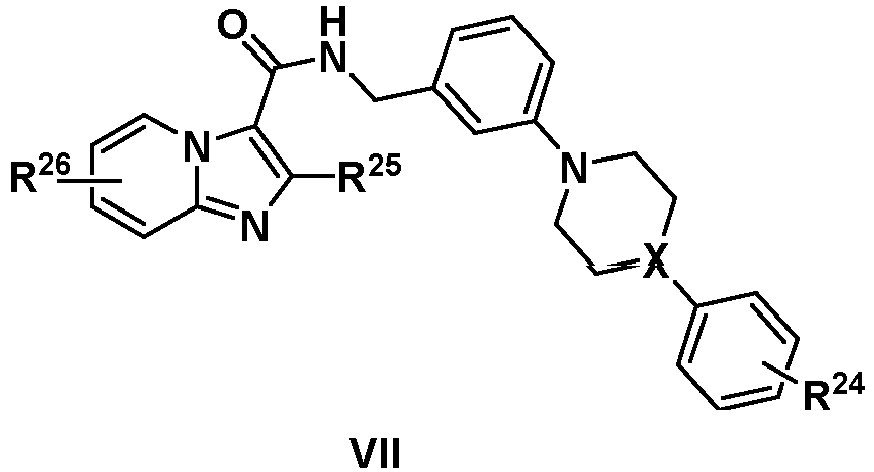
a compound which has the general formula VIII:

| # cpd | QUM (MIC80, uM) | # cpd | QUM (MIC80, uM) | # cpd | QUM (MIC80 , uM) |
| 1 | +++ | 27 | ++ | 53 | +++ |
| 2 | +++ | 28 | +++ | 54 | +++ |
| 3 | +++ | 29 | +++ | 55 | +++ |
| 4 | +++ | 30 | +++ | 56 | +++ |
| 5 | +++ | 31 | +++ | 57 | +++ |
| 6 | +++ | 32 | +++ | 58 | ++ |
| 7 | +++ | 33 | +++ | 59 | +++ |
| 8 | +++ | 34 | ++ | 60 | +++ |
| 9 | +++ | 35 | +++ | 61 | +++ |
| 10 | +++ | 36 | +++ | 62 | +++ |
| 11 | +++ | 37 | +++ | 63 | +++ |
| 12 | +++ | 38 | +++ | 64 | +++ |
| 13 | +++ | 39 | +++ | 65 | +++ |
| 14 | +++ | 40 | +++ | 66 | +++ |
| 15 | +++ | 41 | +++ | 67 | +++ |
| 16 | +++ | 42 | +++ | 68 | +++ |
| 17 | +++ | 43 | +++ | 69 | +++ |
| 18 | +++ | 44 | +++ | 70 | +++ |
| 19 | +++ | 45 | +++ | 71 | +++ |
| 20 | +++ | 46 | +++ | 72 | +++ |
| 21 | +++ | 47 | +++ | 73 | +++ |
| 22 | ++ | 48 | +++ | 74 | +++ |
| 23 | +++ | 49 | +++ | 75 | +++ |
| 24 | +++ | 50 | +++ | 76 | +++ |
| 25 | ++ | 51 | +++ | 77 | +++ |
| 26 | +++ | 52 | +++ | 78 | ++ |
| 79 | +++ | 105 | ++ | 131 | +++ |
| 80 | +++ | 106 | +++ | 132 | +++ |
| 81 | +++ | 107 | +++ | 133 | +++ |
| 82 | +++ | 108 | +++ | 134 | +++ |
| 83 | +++ | 109 | +++ | 135 | +++ |
| 84 | ++ | 110 | +++ | 136 | +++ |
| 85 | +++ | 111 | +++ | 137 | +++ |
| 86 | +++ | 112 | ++ | 138 | +++ |
| 87 | +++ | 113 | +++ | 139 | +++ |
| 88 | ++ | 114 | +++ | 140 | +++ |
| 89 | ++ | 115 | +++ | 141 | +++ |
| 90 | +++ | 116 | +++ | 142 | +++ |
| 91 | +++ | 117 | ++ | 143 | ++ |
| 92 | +++ | 118 | +++ | 144 | +++ |
| 93 | +++ | 119 | +++ | 145 | +++ |
| 94 | +++ | 120 | +++ | 146 | +++ |
| 95 | +++ | 121 | +++ | 147 | +++ |
| 96 | +++ | 122 | +++ | 148 | +++ |
| 97 | +++ | 123 | +++ | 149 | +++ |
| 98 | +++ | 124 | +++ | 150 | +++ |
| 99 | ++ | 125 | ++ | 151 | ++ |
| 100 | +++ | 126 | +++ | 152 | ++ |
| 101 | +++ | 127 | +++ | 153 | +++ |
| 102 | +++ | 128 | +++ | 154 | ++ |
| 103 | ++ | 129 | ++ | 155 | +++ |
| 104 | ++ | 130 | +++ | 156 | +++ |
| 157 | +++ | 183 | +++ | 209 | ++ |
| 158 | +++ | 184 | +++ | 210 | +++ |
| 159 | +++ | 185 | ++ | 211 | +++ |
| 160 | +++ | 186 | +++ | 212 | ++ |
| 161 | +++ | 187 | +++ | 213 | +++ |
| 162 | +++ | 188 | +++ | 214 | +++ |
| 163 | +++ | 189 | ++ | 215 | ++ |
| 164 | +++ | 190 | +++ | 216 | +++ |
| 165 | +++ | 191 | +++ | 217 | ++ |
| 166 | +++ | 192 | +++ | 218 | +++ |
| 167 | +++ | 193 | +++ | 219 | +++ |
| 168 | ++ | 194 | +++ | 220 | +++ |
| 169 | +++ | 195 | +++ | 221 | +++ |
| 170 | +++ | 196 | +++ | 222 | +++ |
| 171 | +++ | 197 | +++ | 223 | +++ |
| 172 | +++ | 198 | ++ | 224 | +++ |
| 173 | +++ | 199 | +++ | 225 | +++ |
| 174 | +++ | 200 | ++ | 226 | +++ |
| 175 | +++ | 201 | +++ | 227 | +++ |
| 176 | +++ | 202 | ++ | 228 | +++ |
| 177 | +++ | 203 | +++ | 229 | +++ |
| 178 | +++ | 204 | +++ | 230 | +++ |
| 179 | +++ | 205 | +++ | 231 | +++ |
| 180 | +++ | 206 | +++ | 232 | + |
| 181 | +++ | 207 | +++ | 233 | +++ |
| 182 | +++ | 208 | +++ | 234 | + |
| 235 | +++ | 261 | +++ | 287 | +++ |
| 236 | +++ | 262 | + | 288 | +++ |
| 237 | +++ | 263 | + | 289 | +++ |
| 238 | +++ | 264 | ++ | 290 | +++ |
| 239 | +++ | 265 | ++ | 291 | +++ |
| 240 | +++ | 266 | ++ | 292 | +++ |
| 241 | +++ | 267 | +++ | 293 | +++ |
| 242 | +++ | 268 | +++ | 294 | +++ |
| 243 | +++ | 269 | +++ | 295 | +++ |
| 244 | +++ | 270 | +++ | 296 | +++ |
| 245 | +++ | 271 | ++ | 297 | +++ |
| 246 | +++ | 272 | ++ | 298 | +++ |
| 247 | ++ | 273 | +++ | 299 | +++ |
| 248 | ++ | 274 | ++ | 300 | +++ |
| 249 | + | 275 | + | 301 | +++ |
| 250 | + | 276 | + | 302 | +++ |
| 251 | ++ | 277 | + | 303 | +++ |
| 252 | +++ | 278 | ++ | 304 | ++ |
| 253 | +++ | 279 | +++ | 305 | ++ |
| 254 | +++ | 280 | +++ | 306 | ++ |
| 255 | + | 281 | ++ | 307 | +++ |
| 256 | +++ | 282 | ++ | 308 | +++ |
| 257 | +++ | 283 | ++ | 309 | +++ |
| 258 | +++ | 284 | +++ | 310 | +++ |
| 259 | +++ | 285 | +++ | 311 | +++ |
| 260 | + | 286 | +++ | 312 | +++ |
| 313 | +++ | 328 | +++ | 343 | +++ |
| 314 | +H- | 329 | ++ | 344 | +++ |
| 315 | +++ | 330 | ++ | 345 | +++ |
| 316 | +++ | 331 | ++ | 346 | +++ |
| 317 | ++ | 332 | ++ | 347 | +++ |
| 318 | ++ | 333 | +++ | 348 | +++ |
| 319 | +++ | 334 | +++ | 349 | +++ |
| 320 | +++ | 335 | +++ | 350 | +++ |
| 321 | +++ | 336 | +++ | ||
| 322 | +++ | 337 | +++ | ||
| 323 | +++ | 338 | +++ | ||
| 324 | +++ | 339 | ++ | ||
| 325 | +++ | 340 | +++ | ||
| 326 | +++ | 341 | +++ | ||
| 327 | +++ | 342 | +++ |
| Activity range: +++ indicates < 1 uM, ++ indicates between 1-20 uM, + indicates > 20 uM |
| cpd | Structure | Characterization Data |
| 1 |
 |
white solid: 1H-NMR (CDCl3): δ 9.66 (1H, d, J = 1.2 Hz), 7.21-7.60 (9H, m), 7.02 (2H, d, J = 8.4 Hz), 6.05 (1H, brs), 4.64 (2H, d, J = 5.2 Hz), 3.79-3.93 (2H, m), 2.99 (2H, q, J = 7.6 Hz), 2.80-2.94 (2H, m), 2.61-2.75 (1H, m), 1.87-2.05 (4H, m), 1.42 (3H, t, J = 7.6 Hz); LCMS: 100%, MS (ESI): m/z 519.0[M+ H]+. |
| 2 |
 |
yellow solid: 1H-NMR (CDCl3): δ 9.65 (1H, s), 7.51 (1H, d, J = 9.2 Hz), 7.43 (1H, d, J = 9.6 Hz), 7.27-7.33 (2H, m), 7.20 (2H, d, J = 8.4 Hz), 7.01 (2H, d, J = 8.4 Hz), 6.89 (2H. d, J = 8.8 Hz), 6.05 (1H, brs), 4.64 (2H, d, J = 5.2 Hz), 3.76-3.90 (5H, m), 2.98 (2H, q, J = 7.6 Hz), 2.80-2.90 (2H, m), 2.60-2.73 (1H, m), 1.80-2.03 (4H, m), 1.42 (3H, t, J = 7.6 Hz); LCMS: 100%, MS (ESI): m/z 549.1[M+ H]+. |
| 3 |
 |
white solid: 1H-NMR (CDCl3): δ 9.55 (1H, d, J = 7.6 Hz), 7.93 (1H, s), 7.22-7.37 (10H, m), 7.11-7.13 (1H, m), 7.02 (2H, d, J = 8.4 Hz), 6.09 (1H, brs), 4.65 (2H, d, J = 5.2 Hz), 3.85 (2H, d, J = 12.4 Hz), 3.02 (2H, q, J = 7.6 Hz), 2.83-2.91 (2H, m), 2.66-2.70 (1H, m), 1.90-2.02 (4H, m), 1.44 (3H, t, J = 7.6 Hz); LCMS: 100%, MS (ESI): m/z 507.1[M+ H]+. |
| 4 |
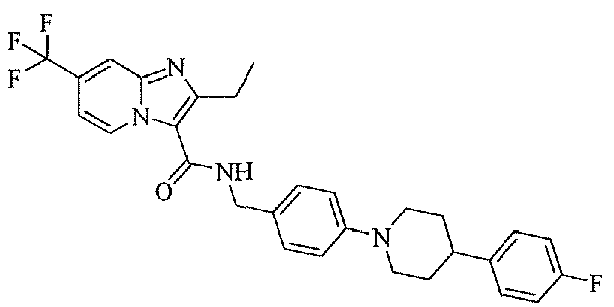 |
white solid: 1H-NMR (CDCl3): δ 9.55 (1H, d, J = 7.2 Hz), 8.04 (1H, s), 7.28-7.30 (3H, m), 7.20-7.24 (2H, m), 7.12 (1H, d, J = 1.2 Hz), 7.00-7.10 (4H, m), 6.10 (1H, brs), 4.65 (2H, d, J = 5.6 Hz), 3.84 (2H, d, J = 12.4 Hz), 2.90-3.05 (2H, m), 2.82-2.89 (2H, m), 2.63-2.71 (1H, m), 1.82-1.99 (4H, m), 1.44 (3H, t, J = 7.6 Hz); LCMS: 100%, MS (ESI): m/z 525.0[M+ H]+. |
| 5 |
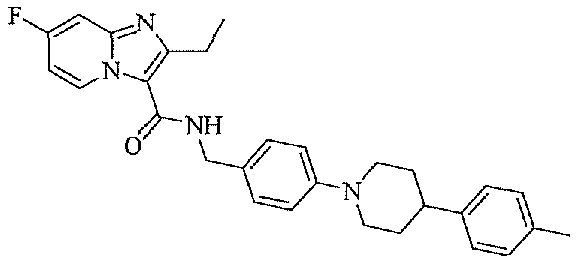 |
yellow solid: 1H-NMR (CDCl3): δ 9.44(1H, t, J= 7.2 Hz, 6.0 Hz), 7.28(2H, d, J= 8.8 Hz), 7.21-7.26(1H, m), 7.14-7.16.01(4H, m), 6.98(2H, d, J= 8.8 Hz), 6.77-6.81(1H, m), 5.99(1H, brs), 4.61(2H, d, J= 5.2 Hz), 3.80-3.87(2H, m), 2.92-2.98(2H, m), 2.80-2.86(2H, m), 2.59-2.67(2H, m), 2.92-2.98(1H, m), 2.34(3H, s), 1.83-1.97(2H, m), 1.39(3H, t, J= 7.2 Hz); LCMS: 98.2%, MS (ESI): m/z 493.0[M+ Na]+. |
| 6 |
 |
white solid: 1H-NMR (CDCl3): δ 9.20 (1H, d, J = 6.8 Hz), 7.30 (2H, d, J = 8.8 Hz), 7.20-7.10 (4H, m), 7.09-7.01 (3H, m), 6.86-6.81(1H, m), 6.08 (1H, brs), 4.63 (2H, d, J = 5.2 Hz), 3.83-3.80 (2H, m), 3.00 (2H, q, J = 7.6 Hz), 2.90-2.83 (2H, m), 2.68-2.60 (1H, m), 2.33 (1H, s), 1.97-1.86 (4H, m), 1.40 (3H, t, J = 7.6 Hz); LCMS: 98.4%, MS (ESI): m/z 471.1[M+ H]+. |
| 7 |
 |
white solid: 1H-NMR(CDCl3): δ 9.54 (1H, d, J = 1.2 Hz), 7.54 (1H, d, J = 9.6 Hz), 7.26-7.30 (3H, m), 7.12-7.17 (4H, m), 6.99 (2H, d, J = 8.8 Hz), 6.02 (1H, brs), 4.62 (2H, d, J = 5.2 Hz), 3.82 (2H, d, J = 12 Hz), 2.96 (2H, q, J = 7.6 Hz), 2.80-2.87 (2H, m), 2.60-2.66 (1H, m), 2.33 (3H, s), 1.83-1.97 (4H, m), 1.40 (3H, t, J = 7.6 Hz); LCMS: 98.0%, MS (ESI): m/z 487.1[M+ H]+. |
| 8 |
 |
white solid: 1H-NMR (CDCl3): δ 9.24 (1H, d, J = 7 Hz), 7.29 (2H, d, J = 8.5 Hz), 7.17 (2H, d, J = 8.8 Hz), 7.11 (1H, d, J = 6.8 Hz), 6.98 (2H, d, J = 8.5 Hz), 6.87 (2H, d, J = 8.5 Hz), 6.82 (1H, t, J = 6.9 Hz), 6.01 (1H, brs), 4.62 (2H, d, J = 5.5 Hz), 3.81 (2H, d, J = 12.2 Hz), 3.60 (3H, s), 2.99 (2H, q, J = 7.5 Hz), 2.82 (2H, td, J = 12.2, 2.5 Hz), 2.57-2.66 (1H, m), 2.61 (3H, s), 1.80-2.00 (4H, m), 1.37 (3H, t, J = 7.7 Hz); LCMS: 100%, MS (ESI): m/z 483.1 [M+ H]+. |
| 9 |
 |
white solid: 1H-NMR (CDCl3): δ 9.16 - 9.29 (1 H, m), 7.46 - 7.56 (1 H, m), 7.28 - 7.37 (4 H, m), 7.12 - 7.21 (1 H, m), 6.96 - 7.05 (4 H, m), 6.84 - 6.95 (1 H, m), 5.93 - 6.09 (1 H, m), 4.56 - 4.69 (2 H, m), 3.35 (8 H, s), 2.90 - 3.02 (2 H, m), 2.37 (3 H, s), 1.32 - 1.45 (3 H, m); LCMS:100%, MS (ESI): m/z 453.2[M+ H]+. |
| 10 |
 |
pink solid : 1H-NMR (CDCl3): δ 9.24 (1H, d, J = 7.6 Hz), 7.31 (2H, d, J = 8.4 Hz), 7.13 (2H, d, J = 8.8 Hz), 6.91-7.01 (4H, m), 6.88 (1H, d, J= 2.0 Hz), 6.61 (1H, dd, J= 7.6 Hz, 2.4 Hz), 5.95 (1H, brs), 4.61 (2H, d, J= 5.2 Hz), 3.86 (3H, s), 3.33 (8H, s), 2.91 (2H, q, J= 7.6 Hz), 1.38 (3H, t, J = 7.6 Hz); LCMS: 98.3%, MS (ESI): m/z 554.1 [M+ H]+. |
| 11 |
 |
white solid: 1H-NMR (CDCl3): δ 9.47 (1H, dd, J = 5.2, 2.4 Hz), 7.50-7.65 (3H, m), 7.37 (2H, d, J = 8.4 Hz), 7.20-7.35 (3H, m overlap with CDCl3 signal), 7.00 (2H, d, J = 8.4 Hz), 6.04 (1H, bra), 4.63 (2H, d, J = 5.6 Hz), 3.84 (2H, d, J = 12.4 Hz), 2.98 (2H, q, J = 7.6 Hz), 2.80-2.90 (2H, m), 2.65-2.80 (1H, m), 1.85-2.05 (4H, m), 1.41 (3H, t, J = 7.6 Hz); LCMS: 98.3%, MS (ESI): m/z 525.1[M+ H]+. |
| 12 |
 |
white solid: 1H-NMR (CDCl3): δ 9.21 (1H, d, J = 6.8 Hz), 7.59 (2H, d, J = 8.0 Hz), 7.37 (2H, d, J = 8.0 Hz), 7.30 (2H, d, J = 8.4 Hz), 7.06-6.99 (3H, m), 6.85-6.83 (1H, m), 6.07 (1H, brs), 4.63 (2H, d, J = 5.6 Hz), 3.86-3.82 (2H, m), 3.01 (2H, q, J = 7.6 Hz), 2.90-2.83 (2H, m), 2.80-2.67 (1H, m), 2.02-1.85 (4H, m), 1.41 (3H, t, J = 7.6 Hz); LCMS: 98.4%, MS (ESI): m/z 525.1[M+ H]+. |
| 13 |
 |
white solid: 1H-NMR (CDCl3): δ 9.37 (1H, d, J = 7.6 Hz), 7.58 (2H, d, J = 8.0 Hz), 7.37 (2H, d, J = 8.0 Hz), 7.25-7.35 (3H, m), 7.00 (2H, d, J = 8.4 Hz), 6.91 (1H, dd, J 1 = 2.0 Hz, J 2 = 7.2 Hz), 6.03 (1H, brs), 4.62 (2H, d, J = 5.2 Hz), 3.83 (2H, d, J = 12 Hz), 2.96 (2H, q, J = 7.6 Hz), 2.70-2.90 (2H, m), 2.65-2.79 (1H, m), 1.85-2.02 (4H, m), 1.39 (3H, t, J = 7.6 Hz); LCMS: 98.4%, MS (ESI): m/z 541.0 [M+ H]+. |
| 14 |
 |
white solid: 1H-NMR (CDCl3): δ 9.44(1H, t, J= 6.4 Hz), 7.17-7.30(6H, m), 6.99(2H, d, J = 8.8 Hz), 6.87(2H, d, J= 8.8 Hz), 6.87(1H, m), 6.00(1H, brs), 4.61(2H, d, J= 5.2 Hz), 3.81-3.87(5H, m), 2.93-2.98(2H, m), 2.80-2.86(2H, m), 2.54-2.57(1H, m), 1.18-1.97(4H, m), 1.40(3H, t, J= 7.2 Hz); LCMS: 98.2%, MS (ESI): m/z 487.1[M+ H]+. |
| 15 |
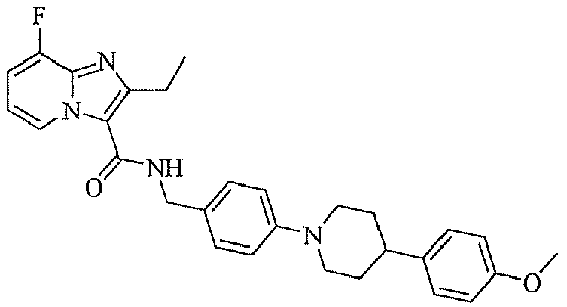 |
white solid: 1H-NMR (CDCl3): δ 9.21 (1H, d, J = 6.8 Hz), 7.29 (2H, d, J = 8.4 Hz), 7.18 (2H, d, J = 8.4 Hz), 7.04-6.98 (3H, m), 6.89-6.84 (3H, m), 6.07 (1H, brs), 4.63 (2H, d, J = 5.2 Hz), 3.84-3.80 (5H, m), 3.00 (2H, q, J = 7.6 Hz), 2.86-2.80 (2H, m), 2.64-2.56 (1H, m), 1.97-1.84 (4H, m), 1.41 (3H, t, J = 7.6 Hz); LCMS: 98.7%, MS (ESI): m/z 487.1[M+H]+. |
| 16 |
 |
white solid: 1H-NMR(CDCl3): δ 9.54 (1H, d, J = 1.2 Hz), 7.54 (1H, d, J = 9.2 Hz), 7.27-7.31 (4H, m), 7.18 (2H, d, J = 8.8 Hz), 6.99 (2H, d, J = 8.8 Hz), 6.87 (2H, J = 8.8 Hz), 6.03 (1H, brs), 4.62 (2H, d, J = 5.6 Hz), 3.79-3.85 (5H, m), 2.97 (2H, q, J = 7.6 Hz), 2.80-2.88 (2H, m), 2.58-2.68 (1H, m), 1.84-1.97 (4H, m), 1.40 (3H, t, J = 7.6 Hz); LCMS: 100%, MS (ESI): m/z 525.1[M+ Na]+. |
| 17 |
 |
yellow solid: 1H-NMR (CDCl3): δ 9.44(1H, t, J= 6.4 Hz, J 2= 6.8 Hz), 7.18-7.30(7H, m), 6.98(2H, d, J= 8 Hz), 6.78-6.80(1H, m), 6.01(1H, brs), 4.62(2H, d, J= 5.2 Hz), 3.81-3.84(2H, m), 2.93-2.98(2H, m), 2.80-2.86(2H, m), 2.52-2.55(1H, m), 1.84-1.96(4H, m), 1.40(3H, t, J=7.6 Hz); LCMS: 99.8%, MS (ESI): m/z 491.1[M+ H]+. |
| 18 |
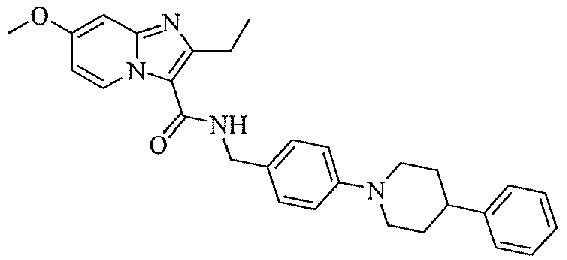 |
white solid: 1H-NMR (CDCl3): δ 9.25 (1H, d, J = 7.6 Hz), 7.15-7.36 (9H, m), 6.98 (2H, d, J = 8.8 Hz), 6.89 (1H, d, J = 2.4 Hz), 6.61 (1H, dd, J = 7.6 Hz, 2.4 Hz), 5.93 (1H, brs), 4.60 (2H, d, J = 5.2 Hz), 3.87 (3H, s), 3.82 (2H, d, J = 12.4 Hz), 2.75-2.95 (4H, m), 2.60-2.72 (1H, m), 1.80-2.02 (4H, m), 1.39 (3H, t, J = 7.6 Hz); LCMS: 100.0%, MS (ESI): m/z 469.1[M+ H]+. |
| 19 |
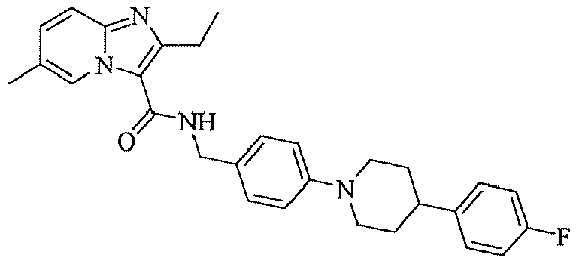 |
pink solid: 1H-NMR (CDCl3): δ 9.19 - 9.30 (1 H, m), 7.53 (1 H, d, J=9.03 Hz), 7.28 - 7.33 (2 H, t), 7.18 - 7.24 (3 H, m), 6.95 - 7.07 (4 H, m), 5.96 - 6.10 (1 H, m), 4.65 (2 H, d, J=5.52 Hz), 3.84 (2 H, d, J=12.30 Hz), 2.98 (2 H, q, J=7.57 Hz), 2.77 - 2.93 (2 H, m), 2.67 (1 H, s), 2.39 (3 H, s), 1.94 - 2.01 (2 H, m), 1.82 - 1.94 (2 H, m), 1.42 (3 H, t, J=7.59 Hz); LCMS: 98.0%, MS (ESI): m/z 471.1[M+H]+. |
| 20 |
 |
yellow solid: 1H-NMR (CDCl3): δ 9.24 (1H, d, J = 7.6 Hz), 7.15-7.35 (4H, m), 6.93-7.05 (4H, m), 6.89 (1H, d, J = 2.4 Hz), 6.61 (1H, dd, J = 7.6 Hz, 2.4 Hz),5.94 (1H, brs), 4.60 (2H, d, J = 5.2 Hz), 3.87 (3H, s), 3.81 (2H, d, J = 12.4 Hz), 2.92 (2H, q, J = 7.6 Hz), 2.82 (2H, td, J = 12.4 Hz, 2.4 Hz), 2.55-2.70 (1H, m), 1.75-2.02 (4H, m), 1.39 (3H, t, J = 7.6 Hz); LCMS: 99.0%, MS (ESI): m/z 487.1[M+ H]+. |
| 21 |
 |
off-white solid: 1H-NMR (CDCl3): δ 9.24 (1H, d, J = 7.6 Hz), 7.22-7.35 (5H, m), 7.18 (2H, 2H, d, J = 8.4 Hz), 6.98 (2H, d, J = 8.4 Hz), 6.88 (1H, d, J = 2.4 Hz), 6.61 (1H, dd, J = 7.6 Hz, 2.4 Hz), 5.94 (1H, m), 4.60 (2H, d, J = 5.2 Hz), 3.87 (3H, s), 3.81 (2H, d, J = 12.4 Hz), 2.92 (2H, q, J = 7.6 Hz), 2.82 (2H, td, J = 12.0 Hz, 2.4 Hz), 2.58-2.68 (1H, m), 1.80-2.00 (4H, m), 1.38 (3H, t, J = 7.6 Hz); LCMS: 100.0%, MS (ESI): m/z 503.1[M+ H]+. |
| 22 |
 |
pink solid : 1H-NMR (CDCl3): δ 9.60 (1H, d, J = 7.2 Hz), 7.68 (1H, d, J = 7.2 Hz), 7.20-7.40 (4H, m), 7.20 (2H, d, J = 8.4 Hz), 6.95-7.05 (3H, m), 6.12 (1H, brs), 4.65 (2H, d, J = 5.2 Hz), 3.80-3.90 (2H, m), 3.05 (2H, q, J = 7.6 Hz), 2.80-2.90 (2H, m), 2.60-2.70 (1H, m), 1.80-2.00 (4H, m), 1.40 (3H, t, J = 7.6 Hz); LCMS: 100%, MS (ESI): m/z 541.0[M + H]+. |
| 23 |
 |
white solid : 1H-NMR (CDCl3): δ 9.25 (1H, d, J = 7.6 Hz), 7.28 (2H, d, J = 8.8 Hz), 7.08-7.20 (4H, m), 6.98 (2H, d, J = 8.8 Hz), 6.88 (1H, d, J = 2.4 Hz), 6.61 (1H, dd, J = 7.6 Hz, 2.4 Hz), 5.93 (1H, brs), 4.60 (2H, d, J = 5.2 Hz), 3.87 (3H, s), 3.80 (2H, d, J = 12.4 Hz), 2.92 (2H, q, J = 7.6 Hz), 2.82 (2H, td, J = 12.0 Hz, 2.8 Hz), 2.55-2.68 (1H, m), 2.33 (3H, s), 1.80-2.00 (4H, m), 1.38 (3H, t, J = 7.6 Hz); LCMS: 98.7%, MS (ESI): m/z. 483.2[M+ H]+. |
| 24 |
 |
pink solid : 1H-NMR (CDCl3): δ 9.52 (1H, d, J = 7.2 Hz), 7.90 (1H, s), 7.26-7.29 (2H, m), 7.10-7.15 (4H, m), 7.07 (1H, d, J = 2.0 Hz), 6.99 (2H, d, J = 8.8 Hz), 6.07 (1H, brs), 4.62 (2H, d, J = 5.2 Hz), 3.81 (2H, d, J = 12.0 Hz), 2.99 (2H, q, J = 7.6 Hz), 2.79-2.87 (2H, m), 2.60-2.68 (1H, m), 2.33 (3H, s), 1.85-1.96 (4H, m), 1.41 (3H, t, J = 7.6 Hz); LCMS: 98.6%, MS (ESI): m/z 521.1[M+ H]+. |
| 25 |
 |
white solid : 1H-NMR (CDCl3): δ 9.61 (1H, d, J = 6.8 Hz), 7.68 (1H, d, J = 7.2 Hz), 7.20-7.40 (2H, m), 7.10-7.20 (4H, m), 6.95-7.05 (3H, m), 6.12 (1H, brs), 4.65 (2H, d, J = 5.2 Hz), 3.80-3.90 (2H, m), 3.05 (2H, q, J = 7.2 Hz), 2.80-2.90 (2H, m), 2.55-2.70 (1H, m), 2.36 (3H, s), 1.80-2.00 (4H, m), 1.40 (3H, t, J = 7.2 Hz); LCMS: 98.4%, MS (ESI): m/z 521.0[M + H]+. |
| 26 |
 |
white solid: 1H-NMR (CDCl3): δ 9.55 (1H, d, J = 7.2 Hz), 7.93 (1H, s), 7.60 (2H, d, J = 8.0 Hz), 7.38 (2H, d, J = 8.0 Hz), 7.28-7.34 (2H, m), 7.11 (1H, d, J = 7.2 Hz), 7.01 (2H, d, J = 8.4 Hz), 6.10 (1H, brs), 4.66 (2H, d, J = 5.2 Hz), 3.86 (2H, d, J = 12.4 Hz), 3.02 (2H, q, J = 7.6 Hz), 2.85-2.91 (2H, m), 2.72-2.79 (1H, m), 1.88-2.04 (4H, m), 1.44 (3H, t, J = 7.6Hz); LCMS: 99.2%, MS (ESI): m/z 575.0[M+ H]+. |
| 27 |
 |
yellow solid: 1H-NMR (CDCl3): δ 9.58 (1H, d, J = 6.8 Hz), 7.65 (1H, d, J = 7.2 Hz), 7.28 (2H, d, J = 8.8 Hz), 7.17 (2H, d, J = 8.8 Hz), 6.90-7.00 (3H, m), 6.86 (2H, d, J = 8.8 Hz), , 6.08 (1H, brs), 4.62 (2H, d, J = 5.6 Hz), 3.75-3.85 (2H, m), 3.80 (3H, s), 3.03 (2H, q, J = 7.6 Hz), 2.80-2.90 (2H, m), 2.55-2.65 (1H, m), 1.80-2.00 (4H, m), 1.38 (3H, t, J = 7.6 Hz); LCMS: 99.7%, MS (ESI): m/z 537.0[M + H]+. |
| 28 |
 |
yellow solid : 1H-NMR (CDCl3): δ 9.41 (1H, d, J = 7.2 Hz), 7.60 (1H, d, J = 8.8 Hz), 7.28-7.40 (3H, m), 7.10 (2H, d, J = 8.4 Hz), 6.98 (2H, d, J = 8.4 Hz), 6.80-6.95 (3H, m), 6.01 (1H, brs), 4.62 (2H, d, J = 5.2 Hz), 3.20-3.41 (8H, m), 2.97 (2H, q, J = 7.6 Hz), 2.28 (3H, s), 1.40 (3H, t, J = 7.6 Hz); LCMS: 99.7%, MS (ESI): m/z 454.0[M+ H]+. |
| 29 |
 |
white solid: 1H-NMR (CDCl3): δ 9.41 (1H, d, J = 6.8 Hz), 7.61 (1H, d, J = 9.2 Hz), 7.51 (2H, d, J = 8.8 Hz), 7.27-7.38 (3H, m), 6.95-7.04 (4H, m), 6.92 (1H, t, J = 6.8 Hz), 6.02 (1H, brs), 4.63 (2H, d, J = 5.6 Hz), 3.39-3.50 (4H, m), 3.29-3.39 (4H, m), 2.98 (2H, q, J = 7.6 Hz), 1.40 (3H, t, J = 7.6 Hz); LCMS: 100%, MS (ESI): m/z 508.1 [M+ H]+. |
| 30 |
 |
white solid: 1H-NMR (CDCl3): δ 9.44 (1H, d, J = 6.8 Hz), 7.63 (1H, d, J = 9.2 Hz), 7.31-7.42 (2H, m, overlap with CDCl3 signal), 6.85-7.08 (8H, m), 6.04 (1H, brs), 4.66 (2H, d, J = 5.2 Hz), 3.81 (3H, s), 3.38 (4H, t, J = 4.4 Hz), 3.26 (4H, t, J = 4.4 Hz), 3.00 (2H, q, J = 7.6 Hz), 1.43 (3H, t, J = 7.6 Hz); LCMS: 98.8%, MS (ESI): m/z 492.3 [M+ Na]+. |
| 31 |
 |
off-white solid: 1H-NMR (CDCl3): δ 9.23 (1H, d, J = 7.2 Hz), 7.33 (2H, d, J = 8.8 Hz), 7.13 (2H, d, J = 8.4 Hz), 7.08-6.99 (3H, m), 6.93 (2H, d, J = 8.4 Hz), 6.88-6.83 (1H, m), 6.08 (1H, brs), 4.65 (2H, d, J = 5.6 Hz), 3.39-3.30 (8H, m), 3.02 (2H, q, J = 7.6 Hz), 1.43 (3H, t, J = 7.6 Hz); LCMS: 99.5%, MS (ESI): m/z 494.1[M+ Na]+. |
| 32 |
 |
white solid: 1H-NMR (CDCl3): δ 9.23 (1H, d, J = 7.2 Hz), 7.33 (2H, d, J = 8.8 Hz), 7.08-6.96 (5H, m), 6.91-6.83 (3H, m), 6.08 (1H, brs), 4.65 (2H, d, J = 5.6 Hz), 3.81 (3H, s), 3.39-3.36 (4H, m), 3.27-3.24 (4H, m), 3.02 (2H, q, J = 7.6 Hz), 1.43 (3H, t, J = 7.6 Hz); LCMS: 98.8%, MS (ESI): m/z 488.1 [M+ H]+. |
| 33 |
 |
white solid : 1H-NMR(CDCl3): δ 9.56 (1H, d, J = 1.2 Hz), 7.56 (1H, d, J = 9.6 Hz), 7.30-7.35 (3H, m), 6.97-7.05 (4H, m), 6.89 (2H, d, J = 8.8 Hz), 6.05 (1H, brs), 4.65 (2H, d, J = 5.2 Hz), 3.81 (3H, s), 3.35-3.40 (4H, m), 3.23-3.29 (4H, m), 2.98 (2H, q, J = 7.6 Hz), 1.42 (3H, t, J = 7.6 Hz); LCMS: 98.4%, MS (ESI): m/z 526.1[M+ Na]+. |
| 34 |
 |
white solid: 1H-NMR (CDCl3): δ 9.42 (1H, d, J = 6.8 Hz), 7.60 (1H, d, J = 6.8 Hz), 7.25-7.35 (2H, m), 7.12-7.20 (4H, m), 7.01 (2H, d, J = 8.8 Hz), 6.82 (1H, t, J = 7.2 Hz), 6.08 (1H, brs), 4.64 (2H, d, J = 5.6 Hz), 3.84 (2H, d, J = 12.0 Hz), 3.04 (2H, q, J = 7.6 Hz), 2.85 (2H, t, J = 12.0 Hz), 2.60-2.70 (1H, m), 1.85-2.00 (4H, m), 1.40 (3H, t, J = 7.6 Hz); LCMS: 100%, MS(ESI):m/z 531.1/533.1 [M+H]. |
| 35 |
 |
white solid: 1H-NMR (CDCl3): δ 9.39 (1H, d, J = 7.2 Hz), 7.61 (1H, s), 7.25-7.32 (2H, m), 7.13 (2H, d, J = 8.0 Hz), 6.90-7.05 (5H, m), 6.04 (1H, brs), 4.63 (2H, d, J = 5.2 Hz), 3.30-3.40 (8H, m), 2.97 (2H, q, J = 7.6 Hz), 2.31(1H, s), 1.41 (3H, t, J = 7.6 Hz); LCMS: 100%, MS (ESI): m/z 488.1 [M+H]+. |
| 36 |
 |
off-white solid: 1H-NMR(CDCl3): δ 9.56 (1H, d, J = 1.2 Hz), 7.56 (1H, d, J = 9.6 Hz), 7.27-7.35 (3H, m), 7.13 (2H, d, J = 8.4 Hz), 7.01 (2H, d, J = 8.8 Hz), 6.93 (2H, d, J = 8.4 Hz), 6.06 (1H, brs), 4.65 (2H, d, J = 5.6 Hz), 3.29-3.40 (8H, m), 2.98 (2H, q, J = 7.6 Hz), 1.42 (3H, t, J = 7.6 Hz); LCMS: 100%, MS (ESI): m/z 510.1[M+Na]+. |
| 37 |
 |
white solid: 1H-NMR (CDCl3): δ 9.43 (1H, d, J = 7.2 Hz), 7.63 (1H, d, J = 8.8 Hz), 7.31-7.42 (3H, m), 7.20-7.30 (2H, m, overlap with CDCl3 signal), 7.00 (2H, d, J = 8.4 Hz), 6.85-6.98 (3H, m), 6.05 (1H, brs), 4.65 (2H, d, J = 5.2 Hz), 3.20-3.45 (8H, m), 3.01 (2H, q, J = 7.6 Hz), 1.43 (3H, t, J = 7.6 Hz); LCMS: 100%, MS (ESI): m/z 474.1[M+ H]+. |
| 38 |
 |
white solid: 1H-NMR (CDCl3): δ 9.24 (1H, d, J = 6.8 Hz), 7.31 (2H, d, J = 8.5 Hz), 7.11 (1H, d, J = 6.9 Hz), 6.97 (4H, t, J = 8.7 Hz), 6.84-6.90 (2H, m), 6.82 (1H, t, J = 7.0 Hz), 6.02 (1H, brs), 4.63 (2H, d, J = 5.4 Hz), 3.78 (3H, s), 3.18-3.38 (8H, m), 3.00 (2H, q, J = 7.6 Hz), 2.61 (3H, s), 1.37 (3H, t, J = 7.7 Hz); LCMS: 100%, MS (ESI): m/z 484.1[M+ H]+. |
| 39 |
 |
white solid: 1H-NMR (CDCl3): δ 9.24 (1H, d, J = 6.9 Hz), 7.31 (2H, d, J = 8.7 Hz), 7.07-7.15 (3H, m), 6.98 (2H, d, J = 8.7 Hz), 6.90 (2H, d, J = 8.5 Hz), 6.82 (1H, t, J = 7 Hz), 6.03 (1H, brs), 4.63 (2H, d, J = 5.5 Hz), 3.25-3.38 (8H, m), 3.00 (2H, q, J = 7.6 Hz), 2.61 (3H, s), 2.29 (3H, s), 1.37 (3H, t, J = 7.6 Hz); LCMS: 100%, MS (ESI): m/z 490.1[M+ H]+. |
| 40 |
 |
white solid: 1H-NMR (CDCl3): δ 9.25 (1H, d, J = 7 Hz), 7.51 (2H, d, J = 8.7 Hz), 7.32 (2H, d, J = 8.5 Hz), 7.12 (1H, d, J = 7.5 Hz), 6.98 (4H, d, J = 8.5 Hz), 6.82 (1H, t, J = 6.9 Hz), 6.03 (1H, brs), 4.63 (2H, d, J = 5.5 Hz), 3.30-3.48 (8H, m), 3.00 (2H, q, J = 7.7 Hz), 2.62 (3H, s), 1.37 (3H, t, J = 7.7 Hz); LCMS: 98.5%, MS (ESI): m/z 522.1[M+ H]+. |
| 41 |
 |
white solid: 1H-NMR (CDCl3): δ 9.25 (1H, d, J = 7 Hz), 7.26-7.35 (4H, m), 7.11 (1H, d, J = 6.9 Hz), 6.96-7.03 (4H, m), 6.90 (1H, t, J = 7.3 Hz), 6.82 (1H, t, J = 7.0 Hz), 6.02 (1H, brs), 4.63 (2H, d, J = 5.4 Hz), 3.35 (8H, s), 3.00 (2H, q, J = 7.5 Hz), 2.61 (3H, s), 1.37 (3H, t, J = 7.6 Hz); LCMS: 100%, MS (ESI): m/z 476.1[M+H]+. |
| 42 |
 |
white solid: 1H-NMR (CDCl3): δ 9.48 (1H, dd, J = 4.8, 2.0 Hz), 7.59 (1H, dd, J = 9.6, 5.2 Hz), 7.34 (2H, d, J = 8.4 Hz), 7.24-7.30 (1H, m, overlap with CDCl3 signal), 7.17 (2H, d, J = 8.8 Hz), 6.90-7.08 (4H, m), 6.06 (1H, brs), 4.65 (2H, d, J = 5.6 Hz), 3.36 (8H, s), 2.99 (2H, q, J = 7.6 Hz), 1.43 (3H, t, J = 7.6 Hz); LCMS: 98.2%, MS(ESI): m/z 542.1 [M+H]+. |
| 43 |
 |
white solid: 1H-NMR (CDCl3): δ 9.24 (1H, d, J = 6.9 Hz), 7.31 (2H, d, J = 8.5 Hz), 7.23 (2H, d, J = 8.9 Hz),7.12 (1H, d, J = 6.7 Hz), 6.98 (2H, d, J = 8.7 Hz), 6.90 (2H, d, J = 8.9 Hz), 6.82 (1H, t, J = 6.8 Hz), 6.03 (1H, brs), 4.63 (2H, d, J = 5.5 Hz), 3.28-3.38 (8H, m), 3.00 (2H, q, J = 7.7 Hz), 2.62 (3H, s), 1.37 (3H, t, J = 7.7 Hz); LCMS: 100%, MS (ESI): m/z 488.1[M+ H]+. |
| 44 |
 |
white solid : 1H-NMR (CDCl3): δ 9.24 (1H, d, J = 6.9 Hz), 7.32 (2H, d, J = 8.7 Hz), 7.08-7.17 (3H, m), 6.91-7.03 (4H, m), 6.82 (1H, t, J = 6.9 Hz), 6.03 (1H, brs), 4.63 (2H, d, J = 5.5 Hz), 3.30-3.38 (8H, m), 3.00 (2H, q, J = 7.5 Hz), 2.62 (3H, s), 1.37 (3H, t, J = 7.7 Hz); LCMS: 98.3%, MS (ESI): m/z 538.1[M+ H]+. |
| 45 |
 |
white solid : 1H-NMR(CDCl3): δ 9.56 (1H, d, J = 1.2 Hz), 7.56 (1H, d, J = 9.2 Hz), 7.30-7.40 (3H, m), 7.23-7.29 (2H, m), 7.00 (2H, d, J = 8.4 Hz), 6.92 (2H, d, J = 8.8 Hz), 6.06 (1H, brs), 4.65 (2H, d, J = 5.6 Hz), 3.25-3.40 (8H, m), 2.98 (2H, q, J = 7.6 Hz), 1.42 (3H, t, J = 7.6 Hz); LCMS: 100%, MS (ESI): m/z 530.0[M+Na]+. |
| 46 |
 |
white solid : 1H-NMR (CDCl3): δ 9.38 (1H, d, J = 7.2 Hz), 7.61 (1H, d, J = 1.6 Hz), 7.32 (2H, d, J = 8.4 Hz), 6.99 (4H, t, J = 8.8 Hz), 6.85-6.95 (3H, m), 6.03 (1H, brs), 4.64 (2H, d, J = 5.6 Hz), 3.81 (3H, s), 3.20-3. 30 (4H, m), 3.32-3.40 (4H, m), 2.97 (2H, q, J= 7.6 Hz), 1.41 (3H, t, J = 7.2 Hz); LCMS: 100%, MS (ESI): m/z 526.0 [M+ Na]+. |
| 47 |
 |
white solid : 1H-NMR (CDCl3): δ 9.37 (1H, d, J = 6.4 Hz) , 7.42 (1H, d, J = 7.2 Hz), 7.33 (2H, d, J = 8.8 Hz), 7.25 (2H, d, J = 8.8 Hz), 7.00 (2H, d, J = 8.4 Hz), 6.82-6.93 (3H, m), 6.09 (1H, brs), 4.65 (2H, d, J= 5.2 Hz), 3.34 (8H, d, J = 6.8 Hz), 3.03 (2H, q, J = 7.6 Hz), 1.40 (3H, t, J = 7.6 Hz); LCMS: 100.0%, MS (ESI): m/z 508.0[M+ H]+. |
| 48 |
 |
white solid : 1H-NMR(CDCl3): δ 9.56 (1H, d, J = 1.6 Hz), 7.53-7.59 (3H, m), 7.29-7.35 (3H, m), 7.00 (4H, d, J = 8.8 Hz), 6.07 (1H, brs), 4.65 (2H, d, J = 5.6 Hz), 3.43-3.49 (4H, m), 3.35-3.40 (4H, m), 2.98 (2H, q, J = 7.6 Hz), 1.42 (3H, t, J = 7.6 Hz); LCMS: 98.4%, MS (ESI): m/z 542.0[M+ H]+. |
| 49 |
 |
white solid : 1H-NMR (CDCl3): δ 9.37 (1H, dd, J1 = 0.8 Hz, J2 = 7.2 Hz), 7.54 (2H, d, J = 8.8 Hz), 7.42 (1H, dd, J1 = 0.8 Hz, J2 = 7.6 Hz), 7.34 (2H, d, J = 8.8 Hz), 7.00 (4H, d, J = 8.4 Hz), 6.88 (1H, t, J = 7.2 Hz), 6.10 (1H, brs), 4.66 (2H, d, J = 5.6 Hz), 3.47 (4H, dd, J1 = 4.4 Hz, J2 =7.2 Hz), 3.38 (4H, dd, J1 = 7.2 Hz, J2 = 10 Hz), 3.04 (2H, q, J = 7.6 Hz), 1.41 (3H, t, J = 7.6 Hz); LCMS: 98.7%, MS (ESI): m/z 542.0[M+ H]+. |
| 50 |
 |
yellow solid: 1H-NMR (CDCl3): δ 9.37 (1H, d, J = 6.8 Hz), 7.42 (1H, d, J = 6.4 Hz), 7.33 (2H, d, J = 8.4 Hz), 7.00 (4H, t, J = 9.2 Hz), 6.86-6.90 (3H, m), 6.10 (1H, brs), 4.65 (2H, d, J = 5.6 Hz), 3.81 (3H, s), 3.38 (4H, t, J = 5 Hz), 3.25 (4H, t, J = 5 Hz), 3.04 (2H, q, J = 7.6 Hz), 1.41 (3H, t, J = 7.6 Hz); LCMS: 100.0%, MS (ESI): m/z 526.1[M+ Na]+. |
| 51 |
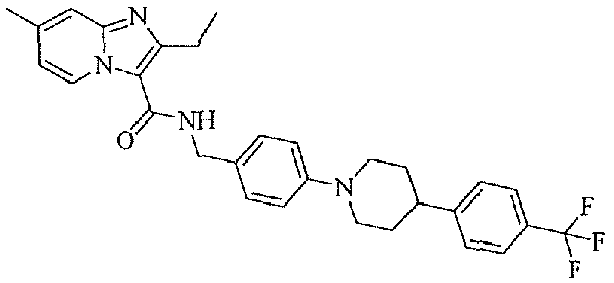 |
white solid: 1H-NMR (CDCl3): δ 9.31 (1H, d, J = 7.2 Hz), 7.60 (2H, d, J = 8.4 Hz), 7.38 (3H, d, J = 8.0 Hz), 7.33-7.28 (2H, m), 7.01 (2H, d, J = 8.8 Hz), 6.78 (1H, d, J = 7.0 Hz), 6.01 (1H, brs), 4.64 (2H, d, J= 5.2 Hz), 3.84 (2H, d, J = 12.4 Hz), 2.96 (2H, q, J = 7.2 Hz), 2.83 (2H, td, J = 12 Hz, 2.4 Hz), 2.78-2.72 (1H, m), 2.45 (3H, s), 2.02-1.91 (4H, m), 1.28 (3H, t, J= 7.2 Hz); LCMS: 100%, MS (ESI): m/z 521.1[M+ H]+. |
| 52 |
 |
yellow solid : 1H-NMR (CDCl3): δ 9.30 (1H, d, J = 7.2 Hz), 7.38 (1H, s), 7.32-7.29 (4H, m), 7.20 (2H, d, J = 8.4 Hz), 7.00 (2H, d, J = 8.4 Hz), 6.77 (1H, dd, J = 7.2 Hz, 1.6 Hz), 6.0 (1H, brs), 4.64 (2H, d, J = 5.6 Hz), 3.81 (2H, d, J = 12.4 Hz), 2.97 (2H, q, J = 7.2 Hz), 2.84 (2H, td, J = 12 Hz, 2.4 Hz), 2.70-2.60 (1H, m), 2.42 (3H, s), 2.01-1.82 (4H, m), 1.39 (3H, t, J = 7.2 Hz); LCMS: 100%, MS (ESI): m/z 487.1[M+ H]+. |
| 53 |
 |
white solid: 1H-NMR (CDCl3): δ 9.37 (1H, dd, J = 0.8 Hz, J = 6.8 Hz), 7.42 (1H, dd, J = 0.8 Hz, J = 7.2 Hz), 7.31 (4H, d, J = 8.4 Hz), 7.20 (2H, d, J = 8.4 Hz), 7.00 (2H, d, J = 8.8 Hz), 6.88 (1H, t, J = 7.2 Hz), 6.09 (1H, brs), 4.64 (2H, d, J = 5.2 Hz), 3.84 (2H, d, J = 12.0 Hz), 3.04 (2H, q, J = 7.6 Hz), 2.85 (2H, td, J = 2.4, 12.4 Hz), 2.62-2.70 (1H, m), 1.83-1.98 (4H, m), 1.41 (3H, t, J = 7.6 Hz); LCMS: 100.0%, MS (ESI): m/z 507.0[M+ H]+. |
| 54 |
 |
white solid : 1H-NMR (CDCl3): δ 9.28 (1H, d, J = 7.2 Hz), 7.35-7.29 (3H, m), 6.99-6.95 (4H, m), 6.86 (2H, d, J = 8.8 Hz), 6.74 (1H, d, J = 7.2 Hz), 5.99 (1H, brs), 4.62 (2H, d, J = 5.6 Hz), 3.78 (3H, s), 3.36-3.22 (8H, m), 2.95 (2H, q, J = 7.6 Hz), 2.17 (3H, s), 1.39 (3H, t, J = 7.6 Hz); LCMS: 100%, MS (ESI): m/z 484.1[M+ H]+. |
| 55 |
 |
white solid: 1H-NMR (CDCl3): δ 9.14 - 9.31 (1H, m), 7.45 - 7.56 (1 H, m), 7.29 - 7.38 (2H, m), 7.08 - 7.22 (3H, m), 6.96 (4H, s), 5.95 - 6.09 (1H, m), 4.57 - 4.73 (2H, m), 3.34 (8H, s), 2.89 - 3.04 (2H, m), 2.37 (3H, s), 1.40 (3H, s); LCMS: 98.2%, MS (ESI): m/z 538.1[M+ H]+. |
| 56 |
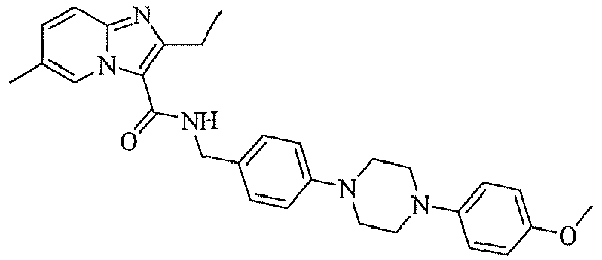 |
white solid: 1H-NMR (CDCl3): δ 9.13 - 9.25 (1H, m), 7.46 - 7.54 (1H, m), 7.27 - 7.36 (2H, m), 7.09 - 7.21 (1H, m), 6.96 (4H, d, J=9.54 Hz), 6.88 (2H, s), 5.96 - 6.06 (1H, m), 4.59 - 4.67 (2H, m), 3.78 (3H, s), 3.35 (4H, d, J=5.27 Hz), 3.23 (4H, brs), 2.90 - 3.01 (2H, m), 2.36 (3H, s), 1.39 (3H, t, J=7.53 Hz); LCMS: 98.8%, MS (ESI): m/z 484.0[M+ H]+. |
| 57 |
 |
yellow solid: 1H-NMR (CDCl3): δ 9.25 (1H, d, J = 7.6 Hz), 7.51 (2H, d, J = 8.8 Hz), 7.31 (2H, d, J = 8.4 Hz), 6.92-7.03 (4H, m),6.89 (1H, d, J = 2.0 Hz) 6.61 (1H, dd, J = 7.6 Hz, 2.4 Hz), 5.96 (1H, brs), 4.61 (2H, d, J = 5.6 Hz), 3.87 (3H, s), 3.25-3.49 (8H, m), 2.92 (2H, q, J = 7.6 Hz), 1.39 (3H, t , J = 7.6 Hz); LCMS: 98.5%, MS (ESI): m/z 538.1[M+ H]+, 560.0 [M+Na]+. |
| 58 |
 |
white solid : 1H-NMR (CDCl3): δ 8.99 (1H, d, J= 6.8 Hz), 7.31 (2H, d, J = 8.4 Hz), 6.97 (4H, t, J= 8.8 Hz), 6.87 (2H, d, J = 8.8 Hz), 6.81 (1H, t, = 7.2 Hz), 6.62 (1H, d, J = 8.0 Hz), 6.05 (1H, brs), 4.62 (2H, d, J = 5.6 Hz), 4.02 (3H, s). 3.78 (3H, s), 3.35 (4H, t, J = 4.8 Hz), 3.23 (4H, t, J = 4.8 Hz), 2.98 (2H, q, J = 7.6 Hz), 1.38 (3H, t, J = 7.6 Hz); LCMS: 99.4%, MS (ESI): m/z 522.1 [M+Na] +. |
| 59 |
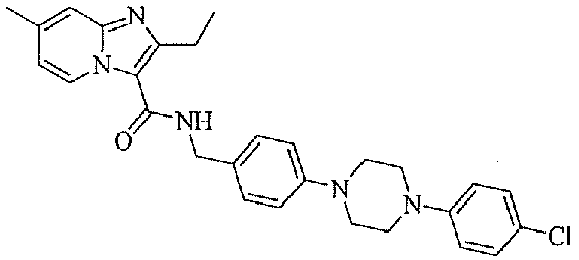 |
white solid : 1H-NMR (CDCl3): δ 9.28 (1H, d, J = 7.2 Hz), 7.36 (1H, s), 7.31 (2H, d, J = 8.4 Hz), 7.23 (2H, d, J = 8.8 Hz), 6.98 (2H, d, J = 8.4 Hz), 6.89 (2H, d, J = 8.8 Hz), 6.75 (1H, d, J = 6.4 Hz), 6.00 (1H, brs), 4.62 (2H, d, J = 5.6 Hz), 3.33-3.31 (8H, m), 2.95 (2H, q, J = 7.6 Hz), 2.42 (3H, s), 1.38 (3H, t, J = 7.6 Hz); LCMS: 100%, MS (ESI): m/z 488.1[M+ H]+. |
| 60 |
 |
white solid : 1H-NMR (CDCl3): δ 9.13 - 9.25 (1H, m), 7.46 - 7.54 (1H, m), 7.27 - 7.36 (2H, m), 7.09 - 7.21 (1H, m), 6.96 (4H, d, J=9.54 Hz), 6.88 (2H, s), 5.96 - 6.06 (1H, m), 4.59 - 4.67 (2H, m) ,3.78 (3H, s), 3.35 (4H, d, J=5.27 Hz), 3.23 (4H, brs), 2.90 - 3.01 (2H, m), 2.36 (3H, s), 1.39 (3H, t, J=7.53 Hz); LCMS: 99.0%, MS (ESI): m/z 522.1[M+ H]+. |
| 61 |
 |
white solid : 1H-NMR (CDCl3): δ 9.28 (1H, d, J = 7.2 Hz), 7.51 (2H, d, J = 8.8 Hz), 7.36-7.30 (3H, m), 6.98 (4H, d, J = 8.4 Hz), 6.76 (1H, d, J = 7.2 Hz), 6.00 (1H, brs), 4.63 (2H, d, J = 5.2 Hz), 3.45-3.34 (8H, m), 2.94 (2H, q, J = 7.6 Hz), 2.42 (3H, s), 1.39 (3H, t, J = 7.6 Hz); LCMS: 99.3%, MS (ESI): m/z 522.1 [M+ H]+. |
| 62 |
 |
white solid : 1H-NMR (CDCl3): δ 9.41 (1H, d, J = 7.2 Hz), 7.61 (1H, d, J = 8.8 Hz), 7.25-7.36 (5H, m, overlap with CDCl3 signal), 6.95-7.04 (m, 4H), 6.86-6.94 (2H, m), 6.03 (1H, brs), 4.63 (2H, d, J = 5.2 Hz), 3.35 (8H, s), 2.98 (2H, q, J = 7.6 Hz), 1.41 (3H, t, J = 7.6 Hz); LCMS: 100%, MS (ESI): m/z 440.1 [M+ H]+. |
| 63 |
 |
white solid : 1H-NMR (CDCl3): δ 9.21 (1H, d, J = 6.8 Hz), 7.31 (2H, d, J = 8.4 Hz), 7.24 (2H, d, J = 9.2 Hz), 7.06-6.97 (3H, m), 6.90 (2H, d, J = 9.2 Hz), 6.86-6.81 (1H, m), 6.07 (1H, brs), 4.63 (2H, d, J = 5.6 Hz), 3.35-3.30 (8H, m), 3.00 (2H, q, J= 7.6 Hz), 1.40 (3H, t, J= 7.6 Hz); LCMS: 100%, MS (ESI): m/z 491.9[M+ Na]+. |
| 64 |
 |
white solid : 1H-NMR (CDCl3): δ 9.35 (1H, d, J=6.8 Hz) , 7.39 (1H, d, J = 7.2 Hz), 7.28-7.32 (4H, m), 6.99 (4H, d, J = 8 Hz), 6.83-6.92 (2H, m), 6.07 (1H, brs), 4.63 (2H, d, J= 5.2 Hz), 3.35 (8H, s), 3.01 (2H, q, J= 7.6 Hz), 1.39 (3H, t, J= 7.8 Hz); LCMS: 100.0%, MS (ESI): m/z474.0[M+ H]+. |
| 65 |
 |
yellow solid : 1H-NMR (CDCl3): δ 9.12 - 9.29 (1 H, m), 7.48 - 7.53 (1 H, m), 7.29 - 7.34 (2 H, m), 7.15 - 7.20 (1 H, m), 7.07 - 7.14 (2 H, m), 6.94 - 7.01 (2 H, m,), 6.85 - 6.94 (2 H, m), 5.95 - 6.04 (1 H, m), 4.63 (2 H, d, J=5.52 Hz,), 3.34 (4 H, d, J=5.77 Hz), 3.30 (4 H, d, J=5.77 Hz), 2.96 (2 H, d, J=7.53 Hz), 2.36 (3 H, s), 2.29 (3 H, s), 1.39 (3 H, t, J=7.53 Hz); LCMS: 100%, MS (ESI): m/z 467.2[M+ H]+. |
| 66 |
 |
white solid : 1H-NMR (CDCl3): δ 9.14 - 9.31 (1 H, m), 7.45 - 7.56 (1 H, m), 7.28 - 7.40 (2 H, m), 7.19 - 7.30 (2 H, m), 7.15 - 7.20 (1 H, m), 6.94 - 7.02 (2 H, m), 6.85 - 6.94 (2 H, m), 5.97 - 6.06 (1 H, m), 4.63 (2 H, d, J=5.27 Hz), 3.32 (8 H, q, J=5.94 Hz), 2.96 (2 H, d, J=7.53 Hz), 2.36 (3 H, s), 1.39 (3 H, t, J=7.53 Hz); LCMS: 100%, MS (ESI): m/z 488.0[M+ H]+. |
| 67 |
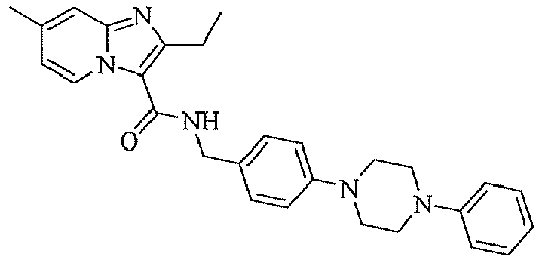 |
white solid : 1H-NMR (CDCl3): δ 9.30 (1H, d, J = 7.2 Hz), 7.38-7.28 (5H, m), 7.01 (4H, dd, J = 8.0 Hz, 1.6 Hz), 6.92 (1H, t, J = 7.2 Hz), 6.76 (1H, dd, J = 7.2 Hz, 1.6 Hz), 6.02 (1H, brs), 4.64 (2H, d, J = 5.6 Hz), 3.37 (8H, s), 2.97 (2H, q, J = 7.6 Hz), 2.44 (3H, s), 1.41 (3H, t, J = 7.6 Hz); LCMS: 100%, MS (ESI): m/z476.1[M+ H]+. |
| 68 |
 |
white solid : 1H-NMR(CDCl3): δ 9.56 (1H, d, J = 1.2 Hz), 7.57 (1H, d, J = 9.2 Hz), 7.29-7.35 (5H, m), 7.01 (4H, d, J= 8.4 Hz), 6.93 (1H, t, J= 7.2 Hz), 6.05 (1H, brs), 4.65 (2H, d, J = 5.6 Hz), 3.38 (8H, s), 2.98 (2H, q, J = 7.6 Hz), 1.42 (3H, t, J = 7.6 Hz); LCMS: 100%, MS (ESI): m/z 496.0[M+ Na]+. |
| 69 |
 |
white solid : 1H-NMR (CDCl3): δ 9.44-9.48(1H, m), 7.33-7.28(3H, m), 7.25-7.23(1H, m), 7.01(4H, d, J = 8.4 Hz), 6.92(4H, d, J=7.2Hz), 6.83-6.78(1H, m), 6.02(1H, brs), 4.64(2H, d, J=5.6Hz), 3.37(8H, s), 2.99-2.94(2H, m), 1.41(3H, t, J = 7.6 Hz); LCMS: 99.9%, MS (ESI): m/z 480.1[M+ Na]+. |
| 70 |
 |
yellow solid : 1H-NMR (CDCl3): δ 9.23 (1H, d, J = 6.8 Hz), 7.34-7.28 (4H, m), 7.08-7.00 (5H, m), 6.92 (1H, t, J = 7.2 Hz), 6.88-6.83 (1H, m), 6.10 (1H, brs), 4.65 (2H, d, J = 5.6 Hz), 3.38 (8H, s), 3.02 (2H, q, J = 7.6 Hz), 1.42 (3H, t, J = 7.6 Hz); LCMS: 98.8%, MS (ESI): m/z 480.1 [M+ Na]+. |
| 71 |
 |
white solid : 1H-NMR (CDCl3): δ 9.48 (1H, dd, J = 4.8, 2.0 Hz), 7.59 (1H, dd, J = 9.6, 5.2 Hz), 7.24-7.35 (5H, m, overlap with CDCl3 signal), 7.01 (4H, d, J = 8.8 Hz), 6.93 (1H, t, J = 7.6 Hz), 6.06 (1H, brs), 4.65 (2H, d, J = 5.6 Hz), 3.38 (8H, s), 2.99 (2H, q, J = 7.6 Hz), 1.42 (3H, t, J = 7.6 Hz); LCMS: 100%, MS (ESI): m/z 480.1[M+ Na]+. |
| 72 |
 |
white solid : 1H-NMR (CDCl3): δ 9.56 (1H, d, J = 1.6 Hz), 7.40-7.49 (1H, m), 7.29-7.37 (1H, m), 7.05-7.29 (4H. m), 6.84-7.01 (4H, m), 5.95 (1H, brs), 4.48-4.62 (2H, m), 3.65-3.81 (2H, m), 2.89 (2H, q, J = 7.6 Hz), 2.69-2.81 (2H, m), 2.50-2.61 (1H, m), 1.71-1.95 (4H, m), 1.33 (3H, t, J = 7.6 Hz); LCMS: 100%, MS (ESI): m/z 535.0[M+ H]+. |
| 73 |
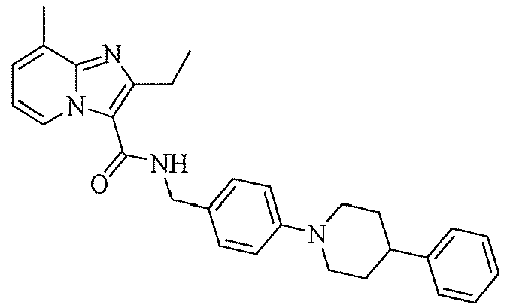 |
white solid : 1H-NMR (CDCl3): δ 9.24 (1H, d, J = 6.8 Hz), 7.18-7.36 (7H, m), 7.1 (1H, d, J = 6.8 Hz), 6.98 (2H, d, J = 8.4 Hz), 6.81 (1H, t, J = 6.9 Hz), 6.03 (1H, brs), 4.62(2H, d, J = 5.5 Hz), 3.82 (2H, d, J = 12.3 Hz), 2.99 (2H, q, J = 7.7 Hz), 2.83 (2H, td, J = 12, 2.8 Hz), 2.62-2.71 (1H, m), 2.61 (3H, s), 1.83-2.01 (4H, m), 1.36 (3H, t, J = 7.5 Hz); LCMS: 100%, MS (ESI): m/z 475.2[M+ H]+. |
| 74 |
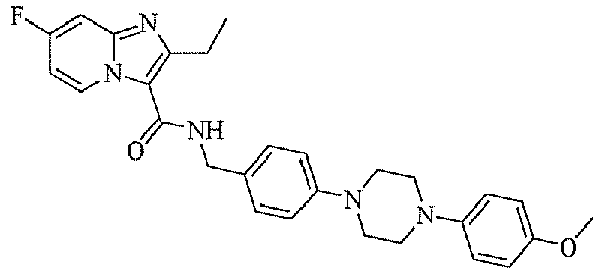 |
yellow solid : 1H-NMR (CDCl3): δ 9.41-9.45(1H, m), 7.29(2H, d, J= 8.4 Hz), 7.20-7.22(1H, m), 6.93-6.99(4H, m), 6.85-6.88(2H, m), 6.75-6.80(1H, m), 5.99(1H, brs), 4.61(2H, d, J=5.2Hz), 3.78(3H, s), 3.33-3.36(4H, m), 3.21-3.24(4H, m), 2.91-2.97(2H, m), 1.38(3H, t, J= 7.2 Hz); LCMS: 98.0%, MS (ESI): m/z 488.1 [M+ H]+, 510.1 [M+ H]+ |
| 75 |
 |
white solid :1H-NMR (CDCl3): δ 9.40-9.48 (1H, m), 7.52-7.60 (1H, m), 7.30 (2H, d, J = 8.8 Hz), 7.20-7.28 (1H, m, overlapped with CDCl3), 7.10 (2H, d, J = 8.4 Hz), 6.98 (2H, d, J = 8.4 Hz), 6.90 (2H, d, J = 8.8 Hz), 6.02 (1H, brs), 4.62 (2H, d, J = 5.6 Hz), 3.20-3.40 (8H, m), 2.96 (2H, q, J = 7.6 Hz), 2.28 (3H, s), 1.39 (3H, t, J = 7.6 Hz); LCMS: 100%, MS (ESI): m/z 494.1 [M+ Na]+. |
| 76 |
 |
white solid : 1H-NMR (DMSO-d6 ): δ 9.40-9.51 (1H, m), 7.42-7.62 (3H, m), 7.26-7.40 (3H, m, overlap with CDCl3 signal), 6.89-7.10 (4H, m), 6.04 (1H, brs), 4.63 (1H, d, J = 5.6 Hz), 3.20-3.50 (8H, m), 2.97 (2H, q, J = 7.6 Hz), 1.40 (3H, t, J = 7.6 Hz); LCMS: 100%, MS (ESI): m/z 526.0[M+ H]+. |
| 77 |
 |
white solid : 1H-NMR (CDCl3): δ 9.40-9.52 (1H, m), 7.52-7.62 (1H, m), 7.31 (2H, d, J = 8.0 Hz), 7.15-7.28 (3H, m, overlapped with CDCl3), 6.98 (2H, d, J = 8.0 Hz), 6.90 (2H, d, J = 8.4 Hz), 6.03 (1H, brs), 4.63 (2H, d, J = 5.2 Hz), 3.20-3.45 (8H, m), 2.97 (2H, q, J = 7.2 Hz), 1.40 (3H, t, J = 7.2 Hz); LCMS: 100%, MS (ESI): m/z 492.0[M+ H]+. |
| 78 |
 |
white solid : 1H-NMR (CDCl3): δ 9.60 (1H, d, J = 6.8 Hz), 7.65 (1H, d, J = 6.8 Hz), 7.25-7.40 (2H, m), 7.10-7.25 (2H, m), 6.90-7.10 (5H, m), 6.09 (1H, brs), 4.62 (2H, d, J = 5.2 Hz), 3.70-3.90 (2H, m), 3.02 (2H, q, J = 7.6 Hz), 2.75-2.90 (2H, m), 2.60-2.70 (1H, m), 1.80-2.05 (4H, m), 1.38 (3H, t, J = 7.2 Hz); LCMS: 100%, MS (ESI): m/z 525.0[M + H]+. |
| 79 |
 |
white solid : 1H-NMR (CDCl3): δ 9.63 (1H, s), 7.49 (1H, d, J = 9.6 Hz), 7.39 (1H, d, J = 9.6 Hz), 7.29-7.35 (2H, m), 7.05-7.20 (4H, m), 6.90-7.05 (2H, m), 6.03 (1H, brs), 4.62 (2H, d, J = 5.2 Hz), 3.71-3.91 (2H, m), 2.96 (2H, q, J = 7.6 Hz), 2.75-2.90 (2H, m), 2.55-2.70 (1H, m), 2.33 (3H, s), 1.80-2.05 (4H, m), 1.40 (3H, t, J = 7.6 Hz); LCMS: 98.1%, MS (ESI): m/z 531.1 [M+ H]+. |
| 80 |
 |
white solid : 1H-NMR (CDCl3): δ 9.86 (1H, s), 7.69 (1H, d, J = 8.8 Hz), 7.47 (1H, d, J = 9.2 Hz), 7.28-7.40 (4H, m), 6.95-7.10 (4H, m), 6.87-6.95 (1H, m), 6.07 (1H, s), 4.64 (2H, d, J = 5.2 Hz), 3.36 (8H, s), 2.99 (2H, q, J = 7.6 Hz), 1.42 (3H, t, J = 7.2 Hz); LCMS: 100%, MS (ESI): m/z 530.1 [M+ H]+. |
| 81 |
 |
white solid : 1H-NMR (CDCl3): δ 9.53 (1H, d, J = 7.2 Hz), 7.91 (1H, s), 7.26-7.33 (4H, m), 7.09 (2H, d, J = 7.6 Hz), 6.96-7.05 (4H,m), 6.89-6.92 (1H, m), 6.08 (1H, brs), 4.64 (2H, d, J = 5.2 Hz), 3.39-3.41 (8H, m), 3.00 (2H, q, J = 7.2 Hz), 1.42 (3H, t, J = 7.2 Hz); LCMS: 98.7%, MS (ESI): m/z 508.1 [M+ H]+. |
| 82 |
 |
yellow solid : 1H-NMR (CDCl3): δ 9.42-9.46(1H, m), 7.31-7.13(3H, m), 7.01-6.86(6H, m), 6.80-6.77(1H, m), 6.00(1H, brs), 4.62(2H, d, J=5.2Hz), 3.35(4H, d, J=4.4Hz), 3.27(4H, d, J=4.4Hz),2.97-2.92(2H, m), 1.39(3H, t, J=7.6 Hz); LCMS: 99.4%, MS (ESI): m/z 476.1[M+ H]+. |
| 83 |
 |
white solid : 1H-NMR (CDCl3): δ 9.25 (1H, d, J = 7 Hz), 7.31 (2H, d, J = 8.3 Hz), 7.12 (1H, d, J = 6.3 Hz), 6.89-7.04 (6H, m), 6.82 (1H, t, J = 6.8 Hz), 6.03 (1H, brs), 4.63 (2H, d, J = 5.3 Hz), 3.20-3.44 (8H, m), 3.00 (2H, q, J = 7.4 Hz), 2.62 (3H, s,), 1.37 (3H, t, J= 7.7 Hz); LCMS: 99.5%, MS (ESI): m/z 494.1 [M+ H]+. |
| 84 |
 |
white solid : 1H-NMR (CDCl3): δ 9.58 (1H, d, J = 6.8 Hz), 7.66 (1H, d, J = 6.8 Hz), 7.25-7.35 (4H, m), 6.95-7.05 (5H, m), 6.91 (1H, t, J = 6.8 Hz), 6.10 (1H, brs), 4.64 (2H, d, J = 5.2 Hz), 3.36 (8H, s), 3.03 (2H, q, J = 7.6 Hz), 1.38 (3H, t, J = 7.6 Hz); LCMS: 100%, MS (ESI): m/z 508.0[M + H]+. |
| 85 |
 |
yellow solid : 1H-NMR (CDCl3): δ 9.35 (1H, d, J=6.8 Hz), 7.39 (1H, d, J = 7.6 Hz), 7.30 (2H, d, J = 8 Hz), 6.89-7.19 (6H, m), 6.85 (1H, t, J = 7.2 Hz), 6.08 (1H, brs), 4.63 (2H, d, J = 5.6 Hz), 3.35 (2H, d, J = 5.6 Hz), 3.27 (2H, d, J = 5.6 Hz), 3.01 (2H, q, J = 7.6 Hz), 1.38 (3H, t, J = 7.6 Hz): LCMS:100.0%, MS (ESI): m/z 492.0[M+ H]+. |
| 86 |
 |
yellow solid : 1H-NMR (CDCl3): δ 9.53 (1H, d, J = 7.2 Hz), 7.91 (1H, s), 7.45 (2H, d, J = 10.0 Hz), 7.09 (1H, d, J = 7.2 Hz), 6.94-7.00 (6H, m), 6.08 (1H, brs), 4.63 (2H, d, J = 4.8 Hz), 3.32-3.40 (4H, m), 3.27-3.30 (4H, m), 3.00 (2H, q, J = 7.6 Hz), 1.42 (3H, t, J = 7.6 Hz); LCMS: 98.8%, MS (ESI): m/z 526.0[M+ H]+. |
| 87 |
 |
white solid : 1H-NMR (CDCl3): δ 9.86 (1H, s), 7.69 (1H, d, J = 9.6 Hz), 7.48 (1H, d, J = 9.2 Hz), 7.28-7.41 (2H, m), 6.83-7.12 (6H, m), 6.08 (1H, s), 4.64 (2H, d, J = 5.2 Hz), 3.36 (4H, s), 3.26 (4H, s), 2.99 (2H, q, J = 7.6 Hz), 1.42 (3H, t, J = 7.6 Hz); LCMS: 99.0%, MS (ESI): m/z 526.0[M+ H]+. |
| 88 |
 |
yellow solid : 1H-NMR (CDCl3): δ 9.60 (1H, d, J = 7.2 Hz), 7.66 (1H, d, J = 7.2 Hz), 7.58 (2H, d, J = 8.0 Hz), 7.36 (2H, d, J = 7.6 Hz), 7.29 (2H, d, J = 8.0 Hz), 6.90-7.05 (3H, m), 6.10 (1H, brs), 4.63 (2H, d, J = 5.2 Hz), 3.75-3.90 (2H, m), 3.05 (2H, q, J = 7.6 Hz), 2.80-2.90 (2H, m), 2.65-2.75 (1H, m), 1.80-2.05 (4H, m), 1.38 (3H, t, J = 7.6 Hz); LCMS: 100%, MS (ESI): m/z 575.0[M + H]+. |
| 89 |
 |
yellow solid : 1H-NMR (CDC13): δ 9.39 (1H, d, J = 7.2 Hz), 7.58 (1H, d, J = 7.6 Hz), 7.20-7.40 (2H, m), 7.17 (2H, d, J = 8.4 Hz), 6.98 (2H, d, J =8.0 Hz), 6.87 (2H, d, J = 7.2 Hz), 6.79 (1H, t, J = 7.2 Hz), 6.06 (1H, brs), 4.62 (2H, d, J = 5.2 Hz), 3.70-3.90 (5H, m), 3.01 (2H, q, J = 7.6 Hz), 2.83 (2H, t, J = 11.6 Hz), 2.61 (2H, t, J = 12.0 Hz), 1.80-2.00 (4H, m), 1.38 (3H, t, J = 7.6 Hz); LCMS: 100%, MS(ESI):m/z 569.0/571.0 [M+23] |
| 90 |
 |
white solid : 1H-NMR (CDCl3): δ 9.43(1H, t, J= 7.6 Hz), 7.22-7.63 (5H, m), 6.97(2H, d, J= 8.4 Hz), 6.89(2H, d, J= 8.4 Hz), 6.61-6.81(1H, m), 6.00(1H, brs), 4.61(2H, d, J= 4.8 Hz), 3.48-3.55(8H, m), 2.91-2.95(2H, m), 1.39(3H, d, J= 7.6 Hz); LCMS: 99.9%, MS (ESI): m/z 492.0[M+ H]+. |
| 91 |
 |
white solid : 1H-NMR (CDCl3): δ 9.28 (1H, d, J = 6.8 Hz), 7.35-7.22 (9H, m), 6.99 (2H, d, J = 7.6 Hz), 6.75 (1H, d, J = 6.8 Hz), 5.98 (1H, brs), 4.62 (2H, d, J = 4.4 Hz), 3.82 (2H, d, J = 11.2 Hz), 2.66 (1H, brs), 2.42 (3H, s), 1.95-1.83 (4H, m), 1.40-1.30 (3H, m); LCMS: 100%, MS (ESI): m/z 453.1[M+ H]+. |
| 92 |
 |
white solid : 1H-NMR (CDCl3): δ 9.25 (1H, d, J = 7.6 Hz), 7.28 (2H, d, J = 8.4 Hz), 7.17 (2H, d, J = 8.0 Hz), 6.98 (2H, d, J = 8.0 Hz), 6.80-6.90 (3H, m), 6.60 (1H, d, J = 6.4 Hz), 5.94 (1H, brs), 4.60 (2H, d, J = 5.2 Hz), 3.86 (3H, s), 3.70-3.82 (5H, m), 2.92 (2H, q, J = 7.6 Hz), 2.82 (2H, t, J = 12.0 Hz), 2.55-2.70 (1H, m), 1.85-2.02 (4H, m), 1.39 (3H, t, J = 7.6 Hz); LCMS: 98.7%, MS (ESI): m/z 499.1 [M+H]+, 521.1 [M+Na]+. |
| 93 |
 |
yellow solid : 1H-NMR (CDCl3): δ 9.44(1H, t, J = 7.2 Hz), 7.30(2H, d, J = 8 Hz), 7.21-7.24(1H, m), 7.10(2H, d, J= 7.6 Hz), 6.98(2H, d, J= 8.4 Hz), 6.90(2H, d, J= 8.0 Hz), 6.77-6.81(1H, m), 5.97(1H, brs), 4.61(2H, d, J= 5.2 Hz), 3.19-3.46(8H, m), 2.92-2.97(2H, m), 2.89(3H, s), 1.39(3H, t, J= 7.2 Hz); LCMS: 99.9%, MS (ESI): m/z 494.0[M+ Na]+. |
| 94 |
 |
white solid : 1H-NMR (CDCl3): δ 9.40 (1H, d, J = 6.8 Hz), 7.58 (1H, d, J = 7.6 Hz), 7.31 (2H, d, J = 8.0 Hz), 7.14 (2H, d, J = 8.4 Hz), 7.05 (2H, d, J = 8.4 Hz), 6.85-7.05 (4H, m), 6.80 (1H, t, J = 7.2 Hz), 6.08 (1H, brs), 4.63 (2H, d, J = 5.2 Hz), 3.18-3.44 (8H, m), 3.02 (2H, q, J = 7.6 Hz), 1.38 (3H, t, J = 7.6 Hz); LCMS: 98.2%, MS(ESI):m/z 601.8/603.8 [M+H] + |
| 95 |
 |
white solid : 1H-NMR (CDC13): δ 9.40 (1H, d, J = 6.8 Hz), 7.58 (1H, d, J = 6.8 Hz), 7.30 (2H, d, J = 8.4 Hz), 6.90-7.05 (4H, m), 6.87 (2H, d, J = 9.2 Hz), 6.79 (1H, t, J = 7.2 Hz), 6.07 (1H, brs), 4.63 (2H, d, J = 5.6 Hz), 3.96 (3H, s), 3.28-3.50 (4H, m), 3.15-3.28 (4H, m), 3.02 (2H, q, J = 7.6 Hz), 1.38 (3H, t, J = 7.6 Hz); LCMS: 100%, MS(ESI):m/z 571.6/573.6 [M+23] |
| 96 |
 |
white solid : 1H-NMR (CDCl3): δ 9.53 (1H, d, J = 7.2 Hz), 7.91 (1H, s), 7.31 (2H, d, J = 8.4 Hz), 7.09 (1H, d, J = 6.8 Hz), 6.81-7.01 (4H, m), 6.87 (2H, d, J = 9.2 Hz), 6.11 (1H, brs), 4.63 (2H, d, J= 5.6 Hz), 3.79 (3H, s), 3.35-3.40 (4H, m), 3.28-3.32 (4H, m), 3.00 (2H, q, J = 7.6 Hz), 1.42 (3H, t, J = 7.6 Hz); LCMS: 100%, MS (ESI): m/z 538.1[M+ H]+. |
| 97 |
 |
white solid : 1H-NMR (CDC13): δ 9.40 (1H, d, J = 6.8 Hz), 7.58 (1H, d, J = 7.2 Hz), 7.31 (2H, d, J = 8.8 Hz), 7.11 (2H, d, J = 8.8 Hz), 6.99 (2H, d, J = 8.8 Hz), 6.90 (2H, d, J = 8.8 Hz), 6.80 (1H, t, J = 7.2 Hz), 6.07 (1H, brs), 4.63 (2H, d, J = 5.2 Hz), 3.20-3.40 (8H, m), 3.02 (2H, q, J = 7.6 Hz), 2.29 (3H, s), 1.38 (3H, t, J = 7.6 Hz); LCMS: 100%, MS(ESI):m/z 532.1/534.1 [M+H]+ |
| 98 |
 |
grey solid : 1H-NMR (CDCl3): δ 9.34 (1H, d, J = 6.8 Hz) , 7.39 (1H, d, J = 7.2 Hz), 7.27 (2H, d, J = 8.4 Hz), 7.17 (2H, d, J = 8.4 Hz), 6.99 (2H, d, J = 8.4 Hz), 6.83-6.87 (3H, m), 6.07 (1H, brs), 4.62 (2H, d, J = 5.2 Hz), 3.80-3.82 (5H, m), 3.02 (2H, q, J = 7.2 Hz), 2.82 (2H, t, J = 11.2 Hz), 2.61 (1H, t, J = 11.6 Hz), 1.81-1.95 (4H, m), 1.38 (3H, t, J = 7.2 Hz); LCMS: 100.0%, MS (ESI): m/z 525.1[M+Na]+. |
| 99 |
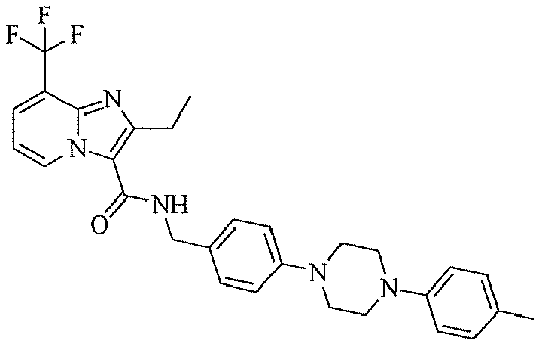 |
white solid : 1H-NMR (CDCl3): δ 9.61 (1H, d, J = 6.8 Hz), 7.68 (1H, d, J = 6.8 Hz), 7.32 (2H, d, J = 8.8 Hz), 7.13 (2H, d, J = 8.4 Hz), 6.98-7.03 (3H, m), 6.92 (2H, d, J = 8.4 Hz), 6.12 (1H, brs), 4.66 (2H, d, J = 5.2 Hz), 3.31-3.38 (8H, m), 3.05 (2H, q, J = 7.6 Hz), 2.31 (3H, s), 1.40 (3H, t, J = 7.6 Hz); LCMS: 100%, MS (ESI): m/z 522.1[M + H]+. |
| 100 |
 |
white solid : 1H-NMR (CDCl3): δ 9.13 (1H, d, J = 2.4 Hz), 7.52 (1H, d, J = 9.6 Hz), 7.33 (2H, d, J = 8.8 Hz), 7.14 (2H, d, J =8.8 Hz), 7.01 (2H, d, J =8.4 Hz), 6.93 (2H, d, J = 8.4 Hz), 6.05 (1H, brs), 4.65 (2H, d, J = 5.6 Hz), 3.90 (3H, s), 3.25-3.40 (8H, m), 2.97 (2H, q, J = 7.6 Hz), 2.31 (3H, s), 1.41 (3H, t, J = 7.6 Hz); LCMS: 100%, MS(ESI):m/z 484.1 [M+H]+ |
| 101 |
 |
white solid : 1H-NMR (CDCl3): δ 9.65 (1H, s), 7.51 (1H, d, J = 9.2 Hz), 7.41 (1H, d, J = 9.6 Hz), 7.33 (2H, d, J = 8.4 Hz), 7.13 (2H, d, J = 8.4 Hz), 7.01 (2H, d, J = 8.4 Hz), 6.93 (2H, d, J = 8.4 Hz), 6.07 (1H, brs), 4.64 (2H, d, J = 5.2 Hz), 3.26-3.42 (8H, m), 2.98 (2H, q, J = 7.6 Hz), 1.42 (3H, t, J = 7.6 Hz); LCMS: 100%, MS (ESI): m/z 534.0[M+ H]+. |
| 102 |
 |
yellow solid : 1H-NMR (CDCl3): δ 9.88 (1H, s), 7.71 (1H, d, J = 9.2 Hz), 7.49 (1H, dd, J = 7.6, 2.0 Hz), 7.33 (2H, d, J = 8.4 Hz), 7.13 (2H, d, J = 8.0 Hz), 7.01 (2H, d, J = 8.4 Hz), 6.93 (2H, d, J = 4.8 Hz), 6.09 (1H, s), 4.66 (2H, d, J = 5.2 Hz), 3.35-3.45 (4H, m), 3.25-3.35 (4H, m), 3.01 (2H, q, J = 7.6 Hz), 2.31 (3H, s), 1.43 (3H, t, J = 7.6 Hz); LCMS: 100%, MS (ESI): m/z 522.1 [M+ H]+. |
| 103 |
 |
white solid : 1H-NMR (CDCl3): δ 9.01 (1H, d, J = 6.8 Hz), 7.34 (2H, d, J = 8.4 Hz), 7.26 (2H, d, J = 8.8 Hz), 7.00 (2H, d, J = 8.4 Hz), 6.92 (2H, d, J = 9.2 Hz), 6.83 (1H, t, J = 7.4 Hz), 6.64 (1H, d, J = 7.6 Hz), 6.07 (1H, brs), 4.65 (2H, d, J= 5.6 Hz), 4.04 (3H, s). 3.36 (4H, d, J = 5.6 Hz), 3.33 (4H, d, J = 6.0 Hz), 3.00 (2H, q, J = 7.6 Hz), 1.40 (3H, t, J = 7.6 Hz); LCMS: 100%, MS (ESI): m/z 526.1[M+ Na]+. |
| 104 |
 |
yellow solid : 1H-NMR (CDC13): δ 8.99 (1H, dd, J = 0.8 Hz, J = 7.2 Hz), 7.31 (2H, d, J = 8.8 Hz), 7.11 (2H, d, J = 8.0 Hz), 6.98 (2H, d, J = 8.8 Hz), 6.93 (2H, d, J = 10.0 Hz), 6.81 (1H, t, J = 7.4 Hz), 6.62 (1H, d, J = 7.2 Hz), 6.04 (1H, brs), 4.62 (2H, d, J = 5.2 Hz), 4.02 (3H, s). 3.28-3.84 (8H, m), 2.98 (2H, q, J = 7.6 Hz), 2.29 (3H, s), 1.38 (3H, t, J = 7.6 Hz); LCMS: 100%, MS (ESI): m/z 484.1 [M+ H]+. |
| 105 |
 |
white solid : 1H-NMR (CDCl3): δ 9.59 (1H, d, J = 7.2 Hz), 7.66 (1H, d, J = 6.8 Hz), 7.30 (2H, d, J = 8.4 Hz), 6.94-7.06 (5H, m), 6.85-6.90 (2H, m), 6.13 (1H, brs), 4.63 (2H, d, J = 5.6 Hz), 3.79 (3H, s), 3.34-3.37 (4H, m), 3.19-3.30 (4H, m), 3.03 (2H, q, J = 7.6 Hz), 1.38 (3H, t, J = 7.6 Hz); LCMS: 99.4%, MS (ESI): m/z 538.1 [M + H]+. |
| 106 |
 |
white solid : 1H-NMR (CDCl3): δ 9.55 (1H, d, J = 7.2 Hz), 7.93 (1H, s), 7.33 (2H, d, J = 8.4 Hz), 7.10-7.15 (3H, m), 7.01 (2H, d, J = 8.4 Hz), 6.92 (2H, d, J = 8.4 Hz), 6.10 (1H, brs), 4.65 (2H, d, J = 5.6 Hz), 3.36-3.40 (4H, m), 3.27-3.38 (4H, m), 3.01 (2H, q, J = 7.6 Hz), 2.31 (3H, s), 1.44 (3H, t, J = 7.6 Hz); LCMS: 100%, MS (ESI): m/z 522.0[M+ H]+. |
| 107 |
 |
white solid : 1H-NMR (CDCl3): δ 9.13 (1H, d, J = 2.4 Hz), 7.52 (1H, d, J =9.6 Hz), 7.34 (2H, d, J = 8.8 Hz), 7.10-7.20 (3H, m), 6.92-7.04 (4H, m), 6.06 (1H, brs), 4.66 (2H, d, J = 5.6 Hz), 3.90 (3H, s), 3.26-3.40 (8H, m), 2.98 (2H, q, J = 7.6 Hz), 1.42 (3H, t, J = 7.6 Hz); LCMS: 98.0%, MS(ESI):m/z 554.1 [M+H]+ |
| 108 |
 |
yellow solid : 1H-NMR (CDCl3): δ 9.25 (1H, d, J = 7.6 Hz), 7.31 (2H, d, J = 8.4 Hz), 7.11 (2H, d, J = 8.4 Hz),6.99 (2H, d, J = 8.4 Hz), 6.89-6.96 (3H, m), 6.61 (1H, dd, J = 7.6 Hz,2.4 Hz), 5.95 (1H, brs), 4.62 (2H, d, J = 5.6 Hz), 3.87 (3H, s), 3.52-3.71 (8H, m), 2.92 (2H, q, J = 7.6 Hz), 2.29 (3H, s), 1.39 (3H, t, J = 7.6 Hz); LCMS: 100.0%, MS (ESI): m/z 484.1[M+H]+, 506.1 [M+Na]+. |
| 109 |
 |
white solid : 1H-NMR (CDCl3): δ 9.88 (1H, s), 7.72 (1H, d, J = 9.6 Hz), 7.50 (1H, dd, J = 8.0, 1.6 Hz), 7.33 (2H, d, J = 8.4 Hz), 6.95-7.08 (4H, m), 6.89 (2H, d, J = 9.2 Hz), 6.10 (1H, s), 4.66 (2H, d, J = 5.6 Hz), 3.81 (3H, s), 3.35-3.52 (4H, m), 3.21-3.30 (4H, m), 3.01 (2H, q, J = 7.6 Hz), 1.44 (3H, t, J = 7.6 Hz); LCMS: 100%, MS (ESI): m/z 538.1[M+ H]+. |
| 110 |
 |
white solid : 1H-NMR (CDCl3): δ 9.27 (1H, d, J = 7.6 Hz), 7.32 (2H, d, J = 8.4 Hz), 6.95-7.04 (4H, m), 6.85-6.94 (3H, m), 6.32 (1H, dd, J = 7.6, 2.4 Hz), 5.97 (1H, t, J = 4.4 Hz), 4.63 (2H, d, J = 5.6 Hz), 3.89 (3H, s), 3.81 (3H, s), 3.30-3.40 (4H, m), 3.20-3.29 (4H, m), 2.94 (2H, q, J = 7.6 Hz), 1.41 (3H, t, J = 7.6 Hz); LCMS: 99.0%, MS (ESI): m/z 522.1[M+ Na]+. |
| 111 |
 |
white solid : 1H-NMR (CDCl3): δ 9.13 (1H, d, J = 2.0 Hz), 7.51 (1H, d, J =9.6 Hz), 7.33 (2H, d, J = 8.8 Hz), 7.12 (2H, dd, J =9.6, 2.4 Hz), 6.92-7.08 (4H, m), 6.89 (2H, d, J =9.2 Hz), 6.05 (1H, brs), 4.65 (2H, d, J= 5.2 Hz), 3.89 (3H, s), 3.30-3.40 (4H, m), 3.20-3.30 (4H, m), 2.97 (2H, q, J = 7.6 Hz), 1.41 (3H, t, J = 7.6 Hz); LCMS: 100%, MS(ESI):m/z 522.1 [M+23]. |
| 112 |
 |
white solid : 1H-NMR (CDCl3): δ 9.61 (1H, d, J = 6.8 Hz), 7.68 (1H, d, J = 7.2 Hz), 7.20-7.40 (7H, m), 6.95-7.10 (3H, m), 6.12 (1H, brs), 4.65 (2H, d, J = 5.6 Hz), 3.80-3.90 (2H, m), 3.06 (2H, q, J = 7.6 Hz), 2.80-2.90 (2H, m), 2.60-2.75 (1H, m), 1.85-2.05 (4H, m), 1.40 (3H, t, J = 7.6 Hz); LCMS: 100%, MS (ESI): m/z 507.0[M + H]+. |
| 113 |
 |
yellow solid : H-NMR (CDCl3): δ 9.29 (1H, d, J = 7.6 Hz), 7.76 (1H, d, J = 2.0 Hz ), 7.15-7.36 (7H, m), 6.93-7.05 (3H, m), 6.05 (1H, brs), 4.60 (2H, d, J = 5.6 Hz), 4.52-4.63 (2H. m), 2.94 (2H, q, J = 7.6 Hz), 2.77-2.89 (2H, m), 2.60-2.71 (1H. m), 1.81-2.02 (4H. m), 1.38 (3H, t, J = 7.6 Hz): LCMS: 98.3%, MS (ESI): m/z 517.0[M+ H]+. |
| 114 |
 |
white solid : 1H-NMR (CDCl3): δ 9.16 - 9.27 (1 H, m), 7.44 - 7.54 (1 H, m), 7.23 - 7.31 (3 H, m), 7.09 - 7.20 (4 H, m), 6.98 (2 H, d, J=8.60 Hz), 5.98 (1 H, br. s.), 4.61 (2 H, d, J=5.51 Hz), 3.80 (2 H, d, J=12.35 Hz), 2.95 (2 H, d, J=7.72 Hz), 2.77 - 2.86 (2 H, m), 2.62 (1 H, s), 2.34 (6 H, d, J=12.35 Hz), 1.81 - 1.98 (4 H, m), 1.38 (3 H, t, J=7.50 Hz,); LCMS: 98.0%, MS (ESI): m/z 453.0[M+ H]+. |
| 115 |
 |
yellow solid : 1H-NMR (CDCl3): δ 9.45 (1H, dd, J = 5.2, 2.4 Hz), 7.55 (1H, dd, J = 10.0, 5.2 Hz), 7.20-7.30 (3H, m, overlap with CDCl3 signa), 7.10-7.20 (4H, m), 6.98 (2H, d, J = 8.8 Hz), 6.01 (1H, brs), 4.55-4.65 (2H, m), 3.81 (2H, d, J = 12.0 Hz), 2.96 (2H, q, J = 7.6 Hz), 2.82 (2H, td, J = 12.0, 2.8 Hz), 2.60-2.70 (1H, m), 2.32 (3H, s), 1.80-2.00 (4H, m), 1.39 (3H, t, J = 7.6 Hz); LCMS: 98.7%, MS (ESI): m/z 493.0[M+Na]+. |
| 116 |
 |
white solid : 1H-NMR (CDCl3): δ 9.41-9.45(1H, m), 7.29(2H, d, J= 8.4 Hz), 7.19-7.22(1H, m), 7.12(2H, d, J= 8.4 Hz), 6.92-6.98(5H, m), 6.75-6.80(1H, m), 5.99(1H, brs), 4.60(2H, d, J=5.2Hz), 3.30-3.35(8H, m), 2.91-2.97(2H, m), 1.38(3H, t, J= 7.6 Hz); LCMS: 98.1%, MS (ESI): m/z 542.1[M+ H]+. |
| 117 |
 |
red solid: 1H-NMR (CDCl3): δ 8.98 (1H, dd, J= 0.8 Hz, J = 6.8 Hz), 7.24-7.29 (4H, m), 7.15 (2H, d, J = 8.0 Hz), 6.97 (2H, d, J = 8.4 Hz), 6.80 (1H, t, J = 6.2 Hz), 6.60 (1H, d, J = 7.6 Hz), 6.03 (1H, brs), 4.61 (2H, d, J = 5.2 Hz), 4.01 (3H, s). 3.81 (2H, d, J = 12.4 Hz), 2.97 (2H, q, J = 7.6 Hz), 2.82 (2H, t, J = 11.4 Hz), 2.62-2.69 (1H, m), 1.82-1.96 (4H, m), 1.37 (3H, t, J = 7.6 Hz); LCMS: 100%, MS (ESI): m/z 553.1[M+ H]+. |
| 118 |
 |
pink solid: 1H-NMR (CDCl3): δ 9.10 (1H, d, J = 1.6 Hz), 7.48 (1H, d, J = 9.6 Hz), 7.17-7.35 (7H, m), 7.08 (1H, d, J = 7.2 Hz), 6.98 (2H, d, J = 8.4 Hz), 6.02 (1H, brs), 4.62 (2H, d, J = 5.2 Hz), 3.86 (3H, s), 3.82 (2H, d, J = 12.4 Hz), 2.94 (2H, q, J = 7.6 Hz), 2.83 (2H, t, J = 12.0 Hz), 2.60-2.70 (1H, m), 1.80-2.00 (4H, m), 1.38 (3H, t, J = 7.6 Hz); LCMS: 100%, MS(ESI):m/z 469.1 [M+H]+ |
| 119 |
 |
red solid: 1H-NMR (CDCl3): δ 9.34 (1H, d, J = 6.8 Hz), 7.57 (2H, d, J = 8 Hz), 7.34-7.39 (3H, m), 7.28 (2H, d, J = 8. 8 Hz), 6.98 (2H, d, J = 8.4 Hz), 6.85 (1H, t, J = 7.2 Hz), 6.06 (1H, brs), 4.62 (2H, d, J = 5.6 Hz), 3.82 (2H, d, J = 12.0 Hz), 3.01 (2H, q, J = 7.6 Hz), 2.84 (2H, td, J = 2.8, J = 12.4 Hz), 2.68-2.76 (1H, m), 1.84-2.00 (4H, m), 1.38 (3H, t, J = 7.6 Hz); LCMS: 98.5%, MS (ESI): m/z 541.1 [M+ H]+. |
| 120 |
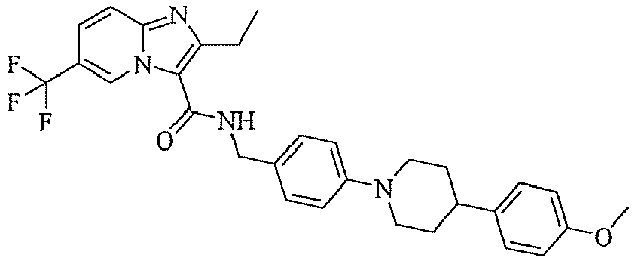 |
yellow solid: 1H-NMR (CDCl3): δ 9.70-9.80 (1H, m), 7.68 (1H, d, J = 8.8 Hz), 7.46 (1H, dd, J = 7.6, 2.0 Hz), 7.26 (2H, d, J = 8.8 Hz), 7.16 (2H, dd, J = 4.8 2.0 Hz), 6.98 (2H, d, J = 8.8 Hz), 6.86 (2H, dd, J = 4.8 2.0 Hz), 6.06 (1H, m), 4.62 (2H, d, J = 5.2 Hz), 3.82 (2H, s), 3.79 (3H, s), 2.99 (2H, q, J = 7.6 Hz), 2.75-2.89 (2H, m), 2.53-2.69 (1H, m), 1.78-2.01 (4H, m), 1.40 (3H, t, J = 7.6 Hz); LCMS: 100%, MS (ESI): m/z 537.0[M+ H]+. |
| 121 |
 |
white solid: 1H-NMR (CDCl3): δ 9.85 (1H, s), 7.69 (1H, d, J = 5.2 Hz), 7.47 (1H, dd, J = 7.6, 2.0 Hz), 7.30 (2H, d, J = 8.0 Hz), 7.18-7.24 (2H, m), 6.98 (2H, d, J = 8.4 Hz), 6.88 (2H, d, J = 5.2 Hz), 6.02-6.11 (1H, m), 4.63 (2H, d, J = 5.6 Hz), 3.30-3.35 (8H, m), 2.99 (2H, q, J = 8.4 Hz), 1.41 (3H, t, J = 7.6 Hz); LCMS: 100%, MS (ESI): m/z 541.8[M+ H]+. |
| 122 |
 |
red solid : 1H-NMR (CDCl3): δ 9.15 - 9.27 (1 H, m), 7.49 (1 H, d, J=9.04 Hz), 7.22 - 7.33 (4 H, m), 7.17 (3 H, d, J=8.38 Hz), 6.97 (2 H, d, J=8.60 Hz), 5.94 - 6.06 (1 H, m), 4.61 (2 H, d, J=5.51 Hz), 3.80 (2 H, d, J=12.35 Hz), 2.95 (2 H, d, J=7.50 Hz), 2.81 (2 H, d, J=2.43 Hz), 2.57 - 2.69 (1 H, m), 2.35 (3 H, s), 1.92 (2 H, br. s.), 1.85 (2 H, dd, J=12.46, 3.42 Hz), 1.38 (3 H, t, J=7.50 Hz); LCMS: 100%, MS (ESI): m/z 487.0[M+ H]+. |
| 123 |
 |
pink solid : 1H-NMR (CDCl3): δ 9.13 (1H, d, J = 2.0 Hz), 7.52 (1H, d, J = 9.6 Hz), 7.31 (2H, d, J = 8.4 Hz), 7.20 (2H, d, J = 8.4 Hz), 7.13 (1H, dd, J = 9.6, 2.4 Hz), 7.01 (2H, d, J = 8.8 Hz), 6.89 (2H, d, J = 8.8 Hz), 6.05 (1H, brs), 4.65 (2H, d, J = 5.2 Hz), 3.90 (3H, s), 3.76-3.88 (5H, m), 2.97 (2H, q, J = 7.6 Hz), 2.87 (2H, td, J = 12.0, 2.4 Hz), 2.60-2.70 (1H, m), 1.80-2.00 (4H, m), 1.41 (3H, t, J = 7.6 Hz); LCMS: 100%, MS(ESI):m/z 521.1 [M+23] |
| 124 |
 |
white solid : 1H-NMR (CDCl3): δ 9.55 (1H, d, J = 7.2 Hz), 7.93 (1H, s), 7.30-7.32 (2H, m), 7.19 (2H, d, J = 8.4 Hz), 7.10 (1H, dd, J = 7.2, 1.6 Hz), 7.01 (2H, d, J = 8.8 Hz), 6.89 (2H, d, J = 8.4 Hz), 6.09 (1H, brs), 4.65 (2H, d, J = 5.6 Hz), 3.86 (2H, s), 3.82 (3H, s), 3.01 (2H, q, J = 7.6 Hz), 2.81-2.89 (2H, m), 2.61-2.67 (1H, m), 1.86-2.00 (4H, m), 1.44 (3H, t, J = 7.6 Hz); LCMS: 99.1%, MS (ESI): m/z 537.0[M+ H]+. |
| 125 |
 |
pink solid : 1H-NMR (CDCl3): δ 9.02 (1H, d, J = 6.8 Hz), 7.61 (2H, d, J = 8.0 Hz), 7.38 (2H, d, J = 8.0 Hz), 7.31 (2H, d, J = 8.8 Hz), 7.00 (2H, d, J = 8.8 Hz), 6.83 (1 H, t, J = 7.6 Hz), 6.63 (1H, d, J = 7.6 Hz), 6.07 (1H, brs), 4.64 (2H, d, J = 5.6 Hz), 4.04 (3H, s), 3.85 (2H, d, J = 12.4 Hz), 3.00 (2H, q, J = 7.6 Hz), 2.86 (2H, dt, J = 2.8 Hz, J = 12 Hz), 2.73 (1H, m), 1.87-2.00 (4H, m), 1.41 (3H, t, J= 7.6 Hz); LCMS: 99.1%, MS (ESI): m/z 537.1[M+ H]+. |
| 126 |
 |
red solid : 1H-NMR (CDC13): δ 9.14 (1H, d, J = 2.0 Hz), 7.60 (1H, d, J = 8.4 Hz), 7.53 (2H, d, J = 9.6 Hz), 7.39 (2H, d, J = 8.4 Hz), 7.32 (2H, d, J = 8.4 Hz), 7.15 (2H, d, J = 9.6 Hz), 7.02 (2H, d, J = 8.8 Hz), 6.05 (1H, brs), 4.65 (2H, d, J = 5.6 Hz), 3.90 (3H, s), 3.86 (2H, d, J = 12.4 Hz), 2.98 (2H, q, J = 7.6 Hz), 2.87 (2H, td, J = 12.0, 2.4 Hz), 2.70-2.80 (1H, m), 1.88-2.05 (4H, m), 1.42 (3H, t, J = 7.6 Hz); LCMS: 98.40%, MS(ESI):m/z 537.1 [M+H]+ |
| 127 |
 |
white solid : 1H-NMR (CDCl3): δ 9.13 (1H, d, J = 2.4 Hz), 7.52 (1H, d, J = 9.6 Hz), 7.31 (2H, d, J = 8.8 Hz),7.08-7.21 (5H, m), 7.02 (2H, d, J = 8.8 Hz), 6.04 (1H, brs), 4.65 (2H, d, J = 5.2 Hz), 3.90 (3H, s), 3.85 (2H, d, J = 12.0 Hz), 2.98 (2H, q, J = 7.6 Hz), 2.85 (2H, td, J = 12.0, 2.8 Hz), 2.61-2.70 (1H, m), 2.36 (3H, m), 1.80-2.00 (4H, m), 1.39 (3H, t, J = 7.6 Hz); LCMS: 98.40%, MS(ESI):m/z 483.1 [M+H]+ |
| 128 |
 |
gray solid: 1H-NMR (CDCl3): δ 9.13 (1H, d, J = 2.4 Hz), 7.51 (1H, d, J = 9.6 Hz), 7.33 (2H, d, J= 8.8 Hz), 7.26 (2H, d, J = 9.2 Hz), 7.13 (1H, dd, J = 9.6, 2.4 Hz), 7.01 (2H, d, J = 7.6 Hz), 6.92 (2H, d, J = 8.8 Hz), 6.05 (1H, brs), 4.66 (2H, d, J= 5.6 Hz), 3.90 (3H, s), 3.25-3.40 (8H, m), 2.98 (2H, q, J = 7.6 Hz), 1.41 (3H, t, J = 7.6 Hz); LCMS: 100%, MS(ESI):m/z 504.1 [M+H]+ |
| 129 |
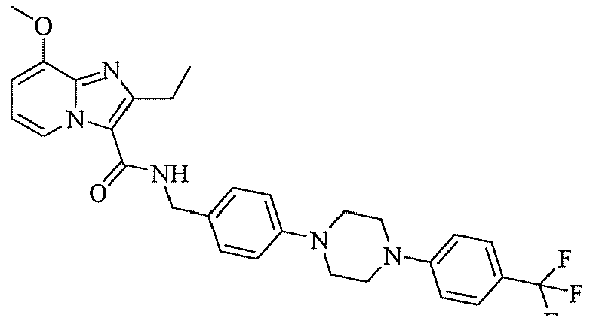 |
yellow solid: 1H-NMR (CDCl3): δ 9.01 (1H, d, J = 6.8 Hz), 7.53 (2H, d, J = 8.8 Hz), 7.34 (2H, d, J = 8.4 Hz), 7.00 (4H, d, J = 8.4 Hz), 6.83 (1H, t, J = 7.4 Hz), 6.64 (1H, d, J = 7.6 Hz), 6.08 (1H, brs), 4.65 (2H, d, J = 5.6 Hz), 4.04 (3H, s). 3.36-3.47 (8H, m), 3.01 (2H, q, J = 7.6 Hz), 1.41 (3H, t, J = 7.6 Hz); LCMS: 99.0%, MS (ESI): m/z 538.0[M+ H]+. |
| 130 |
 |
white solid: 1H-NMR (CDCl3): δ 9.88 (1H, s), 7.72 (1H, d, J = 9.2 Hz), 7.48-7.59 (3H, m), 7.34 (2H, d, J = 8.4 Hz), 6.95-7.08 (4H, m), 6.10 (1H, s), 4.67 (2H, d, J = 5.6 Hz), 3.41-3.52 (4H, m), 3.32-3.51 (4H, m), 3.02 (2H, q, J = 7.2 Hz), 1.44 (3H, t, J = 7.6 Hz); LCMS: 98.8%, MS (ESI): m/z 576.0[M+ H]+. |
| 131 |
 |
white solid: 1H-NMR (CDCl3): δ 9.32 (1H, d, J = 7.2 Hz), 7.79 (1H, d, J = 1.2 Hz ), 7.23-7.34 (2H, m), 6.95-7.08 (3H, m), 6.89 (2H, d, J = 8.8 Hz), 6.04 (1H, brs), 4.63 (2H, d, J = 5.2 Hz), 3.78-3.89 (5H. m), 2.97 (2H, q, J = 7.6 Hz), 2.79-2.90 (2H, m), 2.56-2.69 (1H. m), 1.80-2.02 (4H. m), 1.41 (3H, t, J = 7.6 Hz); LCMS: 98.5%, MS (ESI): m/z 517.0[M+ H]+. |
| 132 |
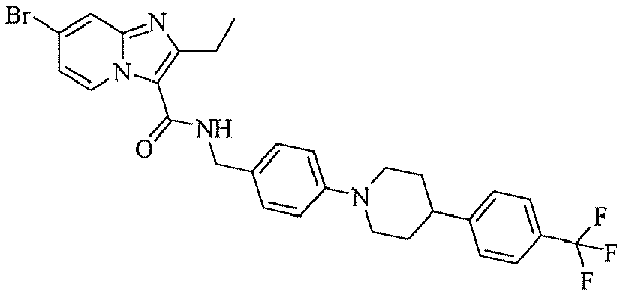 |
red solid : 1H-NMR (CDCl3): δ 9.33 (1H, d, J = 7.6 Hz), 7.80 (1H, d, J = 1.2 Hz), 7.60 (2H, d, J = 8.0 Hz), 7.39 (2H, d, J = 8.0 Hz), 7.29-7.34 (2H, m), 6.97-7.09 (3H, m), 6.04 (1H, brs), 4.64 (2H, d, J = 5.2 Hz), 4.56-4.68 (2H. m), 2.98 (2H, q, J = 7.6 Hz), 2.80-2.93 (2H, m), 2.68-2.80 (1H. m), 1.83-2.02 (4H. m), 1.41 (3H, t, J = 7.6 Hz); LCMS: 98.2%, MS (ESI): m/z 585.0[M+ H]+. |
| 133 |
 |
yellow solid: 1H-NMR (CDCl3): δ 9.32 (1H, d, J = 7.2 Hz), 7.80 (1H, d, J = 1.6 Hz), 7.28-7.37 (2H, m), 7.20-7.26 (2H, m), 6.94-7.09 (5H. m), 6.04 (1H, brs), 4.63 (2H, d, J = 5.6 Hz), 4.57-4.66 (2H. m), 2.98 (2H, q, J = 7.6 Hz), 2.79-2.90 (2H, m), 2.59-2.73 (1H. m), 1.80-2.01 (4H. m), 1.41 (3H, t, J = 7.6 Hz) |
| 134 |
 |
gray solid: 1H-NMR (CDCl3): δ 9.33 (1H, d, J = 7.6 Hz), 7.80 (1H, d, J = 1.6 Hz), 7.28-7.35 (6H, m), 7.17-7.25 (2H, m), 6.97-7.08 (3H. m), 6.04 (1H, brs), 4.63 (2H, d, J = 5.6 Hz), 4.57-4.68 (2H. m), 2.98 (2H, q, J = 7.6 Hz), 2.78-2.89 (2H, m), 2.60-2.71 (1H. m), 1.81-2.00 (4H. m), 1.41 (3H, t, J = 7.6 Hz); LCMS: 98.4%, MS (ESI): m/z 552.6[M+ H]+. |
| 135 |
 |
white solid: 1H-NMR (CDCl3): δ 9.33 (1H, d, J = 7.6 Hz), 7.80 (1H, d, J = 1.2 Hz), 7.33 (2H, d, J = 8.8 Hz), 7.21-7.31 (2H, m), 6.96-7.08 (3H, m), 6.88-6.95 (2H, m), 6.05 (1H, brs), 4.64 (2H, d, J = 5.2 Hz), 3.27-3.41 (8H, m), 2.98 (2H, q, J = 7.6 Hz), 1.41 (3H, t, J = 7.6 Hz); LCMS: 99.0%, MS (ESI): m/z 553.6[M+ H]+. |
| 136 |
 |
yellow solid : 1H-NMR (CDCl3): δ 9.66 (1H, d, J = 1.2 Hz), 7.60 (2H, d, J = 8.0 Hz), 7.52 (1H, d, J = 9.2 Hz), 7.35-7.45 (3H, m), 7.29-7.35 (2H, m), 7.02 (2H, d, J = 8.4 Hz), 6.06 (1H, brs), 4.65 (2H, d, J = 5.6 Hz), 3.80-3.91 (2H, m), 2.99 (2H, q, J = 7.6 Hz), 2.81-2.91 (2H, m), 2.70-2.80 (1H, m), 1.86-2.06 (4H, m), 1.42 (3H, t, J = 7.6 Hz); LCMS: 98.9%, MS (ESI): m/z 585.0[M+ H]+. |
| 137 |
 |
yellow solid : 1H-NMR (CDCl3): δ 9.43(1H, t, J= 6.4 Hz), 7.19-7.30(5H, m), 6.99-7.02(4H, m), 6.75-6.81(1H, m), 5.99(1H, brs), 4.61(2H, d, J= 5.6 Hz), 3.73-3.83(2H, m), 2.92-2.98(2H, m), 2.80-2.86(2H, m), 2.62-2.68(1H, m), 1.78-1.96(4H, m), 1.39(3H, t, J=7.6 Hz); LCMS: 99.9%, MS (ESI): m/z 475.0[M+ H]+. |
| 138 |
 |
gray solid : 1H-NMR (CDCl3): δ 9.63 (1H, s), 7.49 (1H, d, J = 9.2 Hz ), 7.39 (1H, d, J = 9.6 Hz), 7.31 (2H, d, J = 8.4 Hz), 6.90-7.17 (4H, m), 6.87 (2H, d, J = 8.8 Hz), 6.03 (1H, brs), 4.62 (2H, d, J= 5.2 Hz), 3.78 (3H, s), 3.14-3.45 (8H. m), 2.96 (2H, q, J = 7.6 Hz), 1.40 (3H, t, J = 7.6 Hz); LCMS: 100%, MS (ESI): m/z 548.0[M+ H]+. |
| 139 |
 |
yellow solid : 1H-NMR (CDCl3): δ 9.41 (1H, d, J = 7.2 Hz), 7.61 (1H, d, J = 8.8 Hz), 7.20-7.40 (5H, m, overlap with CDCl3 signal), 7.18 (2H, d, J = 8.4 Hz), 6.82-7.05 (3H, m), 6.01 (1H, brs), 4.63 (2H, d, J = 5.6 Hz), 3.82 (2H, d, J = 12.0 Hz), 2.98 (2H, q, J = 7.6 Hz), 2.83 (2H, t, J = 11.2 Hz), 2.53-2.70 (1H, m), 1.72-2.03 (4H, m), 1.41 (3H, t, J = 7.6 Hz); LCMS: 100%, MS (ESI): m/z 473.0[M+ H]+. |
| 140 |
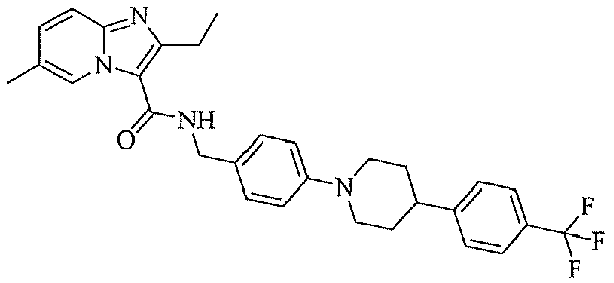 |
yellow solid : 1H-NMR (CDCl3): δ 9.16 - 9.29 (m, 1 H), 7.58 (br. s., 3 H), 7.12 - 7.41 (m, 6 H) 6.99 (br. s, 2 H), 5.94 - 6.10 (m, 1 H), 4.62 (br. s, 2 H), 3.83 (d, J=10.54 Hz, 2 H), 2.95 (d, J=6.53 Hz, 2 H), 2.84 (br. s, 2 H), 2.72 (br. s, 1 H), 2.36 (d, J=4.27 Hz, 3 H), 1.85 - 2.04 (m, 4 H), 1.31 - 1.47 (m, 3 H); LCMS: 99.1%, MS (ESI): m/z 521.0[M+ H]+. |
| 141 |
 |
white solid : 1H-NMR (CDCl3): δ 9.28 (1H, d, J = 7.2 Hz), 7.35-7.29 (3H, m), 7.10 (2H, d, J = 8.0 Hz), 6.98 (2H, d, J = 8.4 Hz), 6.75 (2H, d, J = 6.8 Hz), 5.99 (1H, brs), 4.62 (2H, d, J = 5.6 Hz), 3.35-3.29 (8H, m), 2.95 (2H, q, J = 7.6 Hz), 2.42 (3H, s), 2.29 (3H, s), 1.39 (3H, t, J = 7.6 Hz); LCMS: 100%, MS (ESI): m/z 490.1 [M+ H]+. |
| 142 |
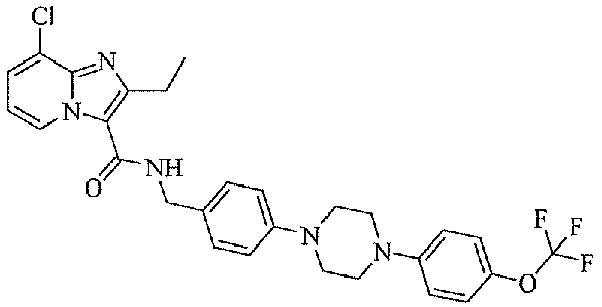 |
white solid : 1H-NMR (CDCl3): δ 9.35 (1H, d, J = 6.4 Hz), 7.40 (1H, d, J = 7.2 Hz), 7.31 (2H, d, J = 6.8 Hz), 7.14 (2H, d, J = 7.2 Hz), 6.94-7.00 (4H, m), 6.86-6.88 (1H, m), 6.08 (1H, brs), 4.64 (2H, s), 3.34 (8H, s), 3.02 (2H, d, J = 7.2 Hz), 1.39 (3H, t, J = 7.6 Hz); LCMS: 97.9%, MS (ESI): m/z 474.0[M+ H]+. |
| 143 |
 |
yellow solid : 1H-NMR (CDCl3): δ 9.40 (1H, d, J = 6.8 Hz), 7.45-7.65 (3H, m), 7.30-7.45 (2H, m), 7.20-7.30 (2H, m), 7.00 (2H, d, J = 7.6 Hz), 6.80 (1H, t, J = 7.2 Hz), 6.07 (1H, brs), 4.62 (2H, d, J = 5.2 Hz), 3.83 (2H, d, J = 12.0 Hz), 3.02 (2H, q, J = 7.6 Hz), 2.85 (2H, t, J = 12.0 Hz), 2.73 (2H, t, J = 7.6 Hz), 1.75-2.00 (4H, m), 1.38 (3H, t, J = 7.6 Hz); LCMS: 98.6%, MS(ESI):m/z 584.9/586.9 [M+H] |
| 144 |
 |
yellow solid : 1H-NMR (CDCl3): δ 9.25 (1H, d, J = 7 Hz), 7.29 (2H, d, J = 8.5 Hz), 7.07-7.20 (5H, m), 6.98 (2H, d, J = 8.5 Hz), 6.82 (1H, t, J = 6.9 Hz), 6.01 (1H, brs), 4.62 (2H, d, J = 5.3 Hz), 3.81 (2H, d, J = 12.0 Hz), 2.99 (2H, q, J = 7.5 Hz), 2.83 (2H, td, J = 11.7, 2.0 Hz), 2.55-2.68 (1H, m), 2.61 (3H, s), 2.33 (3H, s), 1.82-1.98 (4H, m), 1.37 (3H, t, J = 7.5 Hz); LCMS: 98.7%, MS (ESI): m/z 489.1[M+ H]+. |
| 145 |
 |
yellow solid : 1H-NMR (CDCl3): δ 9.25 (1H, d, J = 6.8 Hz), 7.58 (2H, d, J = 8.2 Hz), 7.36 (2H, d, J = 8.2 Hz), 7.30 (2H, d, J = 8.6 Hz), 7.11 (1H, d, = 6.6 Hz), 6.99 (2H, d, J = 8.6 Hz) 6.82 (1H, t, J = 6.9 Hz), 6.02 (1H, brs), 4.63 (2H, d, J = 5.5 Hz), 3.83 (2H, d, J = 12.3 Hz), 3.00 (2H, q, J = 7.6 Hz), 2.84 (2H, td, J = 12, 2.5 Hz), 2.68-2.78 (1H, m), 2.61 (3H, s), 1.84-2.02 (4H, m), 1.37 (3H, t, J = 7.5 Hz); LCMS: 98.6%, MS (ESI): m/z 521.1[M+ H]+. |
| 146 |
 |
yellow solid : 1H-NMR (CDCl3): δ 9.86 (1H, d, J = 0.8 Hz), 7.68 (1H, d, J = 9.6 Hz), 7.56 (2H, d, J = 8.0 Hz), 7.46 (1H, d, J = 9.2 Hz), 7.35 (2H, d, J = 8.0 Hz), 7.29 (2H, d, J = 8.4 Hz), 6.98 (2H, d, J = 8.8 Hz), 6.06 (1H, m), 4.63 (2H, d, J = 5.2 Hz), 3.83 (2H, d, J = 12.4 Hz), 2.99 (2H, q, J = 7.6 Hz), 2.80-2.91 (2H, m), 2.57-2.79 (1H, m), 1.82-2.03 (4H, m), 1.41 (3H, t, J = 7.6 Hz); LCMS: 99.3%, MS (ESI): m/z 575.0[M+ H]+. |
| 147 |
 |
red solid : 1H-NMR (CDCl3): δ 9.34 (1H, dd, J = 8 Hz), 7.38 (1H, dd, J = 8 Hz), 7.27 (2H, m) 7.07-7.17 (4H, m), 6.98 (2H, d, J = 8.40 Hz), 6.84 (1H, t, J = 7.2 Hz), 6.05 (1H, brs), 4.61 (2H, d, J = 5.6 Hz), 3.81 (2H, d, J = 12.4 Hz), 3.01 (2H, q, J = 7.6 Hz), 2.82 (2H, td, J = 2.8, J = 12.0 Hz), 2.62 (1H, m), 2.32 (3H, s), 1.85-1.96 (4H, m), 1.37 (3H, t, J = 8 Hz); LCMS: 100.0%, MS (ESI): m/z 487.1[M+ H]+. |
| 148 |
 |
yellow solid : 1H-NMR (CDCl3): δ 9.20 (1H, d, J = 6.8 Hz), 7.29-7.17 (4H, m), 7.04-6.96 (5H, m), 6.85-6.80 (1H, m), 6.04 (1H, brs), 4.61 (2H, d, J = 5.6 Hz), 3.82-3.79 (2H, m), 2.98 (2H, q, J = 7.6 Hz), 2.85-2.78 (2H, m), 2.67-2.60 (1H, m), 1.95-1.79 (4H, m), 1.39 (3H, t, J = 7.6 Hz); LCMS: 98.7%, MS (ESI): m/z 475.0[M+ H]+. |
| 149 |
 |
white solid : 1H-NMR (CDCl3): δ 9.40-9.49 (1H, m), 7.55 (1H, dd, J = 9.6, 4.8 Hz), 7.29 (2H, d, J = 8.4 Hz), 7.19-7.28 (2H, m, overlap with CDCl3 signal), 6.90-7.00 (4H, m), 6.84 (2H, d, J = 8.4 Hz), 6.03 (1H, t, J = 4.4 Hz), 4.61 (2H, d, J = 5.6 Hz), 3.77 (3H, s), 3.30-3.40 (4H, m), 3.15-3.25 (4H, m), 2.96 (2H, q, J = 7.6 Hz), 1.39 (3H, t, J = 7.6 Hz); LCMS: 100%, MS (ESI): m/z 488.1[M+ H]+. |
| 150 |
 |
pink solid : 1H-NMR (CDCl3): δ 9.45 (1H, dd, J = 4.8, 2.0 Hz), 7.56 (1H, dd, J = 10.0, 5.6 Hz), 7.20-7.31 (3H, m, overlap with CDCl3 signal), 7.16 (2H, d, J = 8.8 Hz), 6.98 (2H, d, J = 8.8 Hz), 6.86 (2H, d, J = 8.8 Hz), 5.95-6.05 (1H, m), 4.61 (2H, d, J = 5.6 Hz), 3.76-3.88 (5H, m), 2.96 (2H, q, J = 7.2 Hz), 2.77-2.87 (2H, m), 2.53-2.66 (1H, m), 1.78-1.99 (4H, m), δ 1.39 (3H, t, J = 7.2 Hz); LCMS: 100%, MS(ESI): m/z 487.0 [M+H]+. |
| 151 |
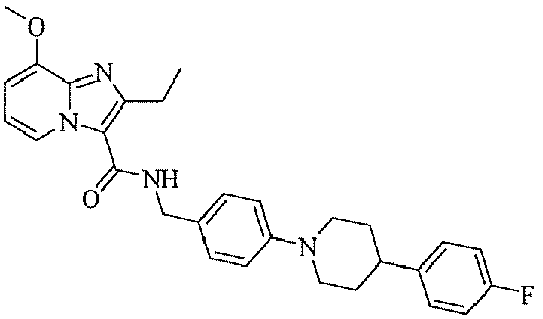 |
pink solid : 1H-NMR (CDCl3): δ 8.97 (1H, dd, J = 0.4 Hz, J = 6.8 Hz) 7.25-7.29 (2H, m), 7.17-7.20 (2H, m), 6.96-7.01 (4H, m), 6.80 (1H, t, J = 7.6 Hz), 6.60 (1H, d, J = 7.6 Hz), 6.02 (1H, brs), 4.60 (2H, d, J = 5.6 Hz), 4.00 (3H, s), 3.80 (2H, d, J = 12.4 Hz), 2.95 (2H, q, J = 8.0 Hz), 2.82 (2H, td, J = 2.4 Hz, J = 12.4 Hz), 2.66-2.60 (1H, m), 1.95-1.82 (4H, m), 1.37 (3H, J = 7.6 Hz); LCMS: 100%, MS (ESI): m/z 487.1[M+ H]+. |
| 152 |
 |
pink solid : 1H-NMR (CDCl3): δ 8.97 (1H, dd, J = 0.8 Hz, J = 7.2 Hz), 7.25-7.28 (2H, m), 7.17 (2H, d, J = 2.0 Hz), 7.15 (2H, d, J = 1.6 Hz), 6.96-6.98 (2H, m), 6.84-6.87 (2H, m), 6.80 (1H, t, J = 7.2 Hz), 6.60 (1H, d, J = 7.2 Hz), 6.02 (1H, brs), 4.60 (2H, d, J = 5.6 Hz), 4.0 (3H, s), 3.78-3.81 (5H, m), 2.96 (2H, q, J = 7.6 Hz), 2.80 (2H, td, J =2.4 Hz, J = 12Hz) 2.60 (1H, m), 1.82-1.99 (4H, m), 1.37 (3H, t, J = 7.6 Hz); LCMS: 100%, MS (ESI): m/z 521.1[M+ Na]+. |
| 153 |
 |
yellow solid : 1H-NMR (CDCl3): δ 9.45 (1H, dd, J = 5.2, 2.4 Hz) , 7.56 (1H, dd, J = 9.6, 5.2 Hz), 7.15-7.32 (5H, m, overlap with CDCl3 signal), 6.90-7.05 (4H, m) , 6.01 (1H, brs) , 4.60 (2H, d, J = 5.6 Hz) , 3.80 (2H, d, J = 12.4 Hz) , 2.95 (2H, q, J = 7.6 Hz) , 2.78-2.86 (2H, m) , 2.60-2.70 (1H, m), 1.78-2.00 (4H, m), 1.38 (3H, t, J = 7.6 Hz); LCMS: 100%, MS (ESI): m/z 457.1 [M+ H]+. |
| 154 |
 |
yellow solid : 1H-NMR (CDCl3): δ 9.57 (1H, d, J = 7.6 Hz), 7.64 (1H, d, J = 7.2 Hz), 7.20-7.30 (4H, m), 7.15 (2H, d, J = 8.0 Hz), 6.95-7.00 (3H, m), , 6.08 (1H, brs), 4.62 (2H, d, J = 6.0 Hz), 3.68-3.85 (2H, m), 3.03 (2H, q, J = 7.6 Hz), 2.78-2.88 (2H, m), 2.65-2.72 (1H, m), 1.80-2.00 (4H, m), 1.37 (3H, t, J = 7.6 Hz); LCMS: 100%, MS (ESI): m/z 591.0[M + H]+. |
| 155 |
 |
yellow solid : 1H-NMR (CDCl3): δ 9.27 (1H, d, J = 7.2 Hz), 7.35 (1H, s), 7.28 (2H, d, J = 8.4 Hz), 7.16 (2H, dd, J = 6.4 Hz, 2.0 Hz), 6.97 (2H, dd, J = 8.8 Hz, 2.0 Hz), 6.86 (2H, dd, J = 6.4 Hz, 2.0 Hz), 6.73 (1H, dd, J = 6.4 Hz, 2.0 Hz), 5.96 (1H, brs), 4.60 (2H, d, J = 2.8 Hz), 3.81-3.78 (5H, m), 2.93 (2H, q, J = 8.4 Hz), 2.83 (2H, td, J = 12 Hz, 2.4 Hz), 2.66-2.56 (1H, m), 2.41 (3H, d, J = 0.4 Hz), 1.98-1.82 (4H, m), 1.37 (3H, t, J = 7.2 Hz); LCMS: 100%, MS (ESI): m/z 483.1 [M+ H]+. |
| 156 |
 |
white solid : 1H-NMR (CDCl3): δ 9.56 (1H, s), 7.40-7.50 (3H, m), 7.29-7.37 (1H. m), 7.21-7.29 (2H, m), 6.81-6.97 (4H, m), 5.98 (1H, brs), 4.56 (2H, d, J = 5.6 Hz), 3.41-3.51 (4H, m), 3.22-3.41 (4H, m), 2.89 (2H, q, J = 7.6 Hz), 1.33 (3H, t, J = 7.6 Hz); LCMS: 100%, MS (ESI): m/z 586.0[M+ H]+. |
| 157 |
 |
yellow solid : 1H-NMR (CDCl3): δ 9.39 (1H, d, J = 5.6 Hz), 7.59 (1H, d, J = 8.8 Hz), 7.26-7.35 (3H, m, overlap with CDCl3 signal), 7.10-7.17 (4H, m), 6.95-7.03 (2H, m), 6.91 (1H, t, J = 6.8 Hz), 5.96-6.05 (1H, m), 4.61 (2H, d, J = 5.6 Hz), 3.75-3.85 (2H, m), 2.97 (2H, q, J = 7.6 Hz), 2.76-2.88 (2H, m), 2.56-2.68 (1H, m), 2.32 (3H, s), 1.80-1.99 (4H, m), 1.39 (3H, t, J = 7.6 Hz); LCMS: 98.4%, MS (ESI): m/z 475.1[M+ Na]+. |
| 158 |
 |
yellow solid : 1H-NMR(CDCl3): δ 9.54 (1H, dd, J = 2.0 Hz, J = 0.8 Hz), 7.50-7.60 (3H, m), 7.36-7.40 (2H, m), 7.27-7.32 (3H, m), 6.93-7.00 (2H, m), 6.04 (1H, brs), 4.63 (2H, d, J = 5.6 Hz), 3.78-3.86 (2H, m), 2.98 (2H, q, J = 7.6 Hz), 2.82-2.89 (2H, m), 2.69-2.80 (1H, m), 1.82-2.00 (4H, m), 1.40 (3H, t, J = 7.2 Hz); LCMS: 100%, MS (ESI): m/z 541.1[M+ H]+. |
| 159 |
 |
yellow solid: 1H-NMR (CDCl3): δ 9.65 (1H, d, J = 1.2 Hz), 7.51 (1H, d, J = 9.2 Hz), 7.41 (1H, dd, J = 9.2, 2.0 Hz), 7.28-7.35 (4H, m), 7.20 (2H, d, J = 8.4 Hz), 7.01 (2H, d, J = 8.4 Hz), 6.05 (1H, brs), 4.64 (2H, d, J = 5.2 Hz), 3.76-3.90 (2H, m), 2.98 (2H, q, J = 7.6 Hz), 2.80-2.90 (2H, m), 2.60-2.73 (1H, m), 1.80-2.03 (4H, m), 1.42 (3H, t, J = 7.6 Hz); LCMS: 100%, MS (ESI): m/z 553.0[M+ H]+. |
| 160 |
 |
yellow solid : 1H-NMR (CDCl3): δ 9.37 (1H, dd, J1 = 0.8 Hz, J2 = 6.8 Hz), 7.42 (1H, dd, J1 = 0.8 Hz, J2 = 7.6 Hz), 7.33 (2H, d, J = 8.4 Hz), 7.13 (2H, d, J = 8.0 Hz), 7.01 (2H, d, J = 8.8 Hz), 6.86-6.94 (3H, m), 6.09 (1H, brs), 4.65 (2H, d, J = 5.2 Hz), 3.37 (4H, dd, J1 = 3.6 Hz, J2 = 7.2 Hz), 3.31 (4H, dd, J1 = 2.4 Hz, J2 = 5.6 Hz), 3.04 (2H, q, J = 7.6 Hz), 1.41 (3H, t, J = 7.6 Hz); LCMS: 98.4%, MS (ESI): m/z 488.1 [M+ H]+. |
| 161 |
 |
white solid : 1H-NMR (CDCl3): δ 9.23 (1H, d, J = 6.8 Hz), 7.53 (2H, d, J = 8.8 Hz), 7.34 (2H, d, J = 8.4 Hz), 7.08-6.99 (5H, m), 6.88-6.83 (1H, m), 6.10 (1H, brs), 4.66 (2H, d, J = 5.6 Hz), 3.48-3.36 (8H, m), 3.01 (2H, q, J = 7.6 Hz), 1.43 (3H, t, J = 7.6 Hz); LCMS: 99.5%, MS (ESI): m/z 526.1[M+ H]+. |
| 162 |
 |
yellow solid : 1H-NMR (CDCl3): δ 9.48 (1H, dd, J = 4.8, 2.4 Hz), 7.59 (1H, dd, J = 9.6, 5.2 Hz), 7.25-7.35 (5H, m, overlap with CDCl3 signa), 7.20 (2H, d, J = 8.4 Hz), 7.00 (2H, d, J = 8.8 Hz), 6.05 (1H, brs), 4.64 (2H, d, J = 5.6 Hz), 3.84 (2H, d, J = 12.4 Hz), 2.99 (2H, q, J = 7.6 Hz), 2.85 (2H, td, J = 12.0, 2.4 Hz), 2.60-2.70 (1H, m), 1.80-2.00 (4H, m), 1.42 (3H, t, J = 7.6 Hz); LCMS: 98.7%, MS (ESI): m/z 491.0[M+ H]+. |
| 163 |
 |
yellow solid : 1H-NMR (CDCl3): δ 9.28 (1H, d, J = 7.2 Hz), 7.35 (1H, s), 7.30-7.26 (2H, m), 7.21-7.18 (2H, m), 7.02-6.97 (4H, m), 6.75 (1H, dd, J = 7.2 Hz, 1.6 Hz), 5.98 (1H, brs), 4.61 (2H, d, J= 5.6 Hz), 3.80 (2H, d, J = 12.4 Hz), 2.94 (2H, q, J = 7.2 Hz), 2.82 (2H, td, J = 12 Hz, 2.4 Hz), 2.68-2.61 (1H, m), 2.42 (3H, s), 1.98-1.80 (4H, m), 1.38 (3H, t, J = 7.2 Hz); LCMS: 100%, MS (ESI): m/z 471.1 [M+ H]+. |
| 164 |
 |
white solid : 1H-NMR (CDCl3): δ 9.44(1H, t, J 1= 7.6 Hz, 6.0 Hz), 7.53(2H, d, J= 7.6 Hz), 7.34(2H, d, J= 8.8 Hz), 7.27(2H, d, J= 7.6 Hz), 7.21-7.23(1H, m), 7.95(2H, d, J= 8.8 Hz), 6.75-6.81(1H, m), 6.76-6.81(1H, m), 6.03(1H, brs), 4.61(2H, d, J= 5.6 Hz), 3.49-3.88(2H, m), 2.93-2.98(2H, m), 2.82-2.88(2H, m), 2.70-2.77(1H, m), 1.63-1.99(4H, m), 1.23(3H, t, J= 7.6 Hz); LCMS: 99.1%, MS (ESI): m/z 525.0[M+ H]+.490.1 [M+ Na]+ |
| 165 |
 |
white solid : 1H-NMR (CDCl3): δ 9.45 (1H, dd, J = 5.2, 2.4 Hz), 7.56 (1H, dd, J = 10.0, 5.2 Hz), 7.18-7.40 (8H, m, overlap with CDCl3 signal), 7.00 (2H, d, J = 8.4 Hz) , 6.02 (1H, brs), 4.62 (2H, d, J = 5.2 Hz), 3.82 (2H, d, J = 12.4 Hz), 2.97 (2H, q, J = 7.6 Hz), 2.80-2.90 (2H, m) , 2.60-2.71 (1H, m) , 1.80-2.05 (4H, m), 1.40 (3H, t, J = 7.6 Hz); LCMS: 100%, MS (ESI): m/z 457.0[M+ H]+ |
| 166 |
 |
white solid : 1H-NMR (CDCl3): δ 9.44(1H, t, J= 7.2 Hz), 7.21-7.35(7H, m), 7.00(2H, d, J= 8.4 Hz), 6.77-6.81(1H, m), 5.60(1H, brs), 4.61(2H, d, J= 5.6 Hz), 3.81-3.84(2H, m), 2.92-2.98(1H, m), 2.81-2.88(2H, m), 2.62-2.70(1H, m), 1.86-2.01(4H, m), 1.39(3H, t, J=7.6 Hz); LCMS: 99.9%, MS (ESI): m/z 457.0[M+ H]+. |
| 167 |
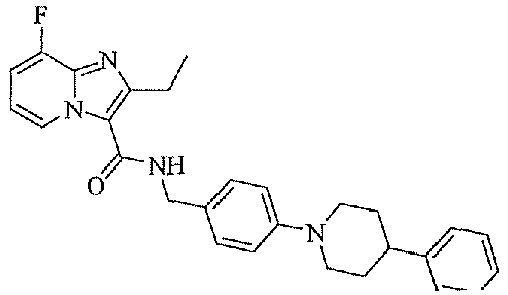 |
red solid : 1H-NMR (CDCl3): δ 9.20 (1H, d, J = 6.8 Hz), 7.35-7.20 (6H, m), 7.05-6.98 (3H, m), 6.86-6.81 (1H, m), 6.06 (1H, brs), 4.62 (2H, d, J = 5.6 Hz), 3.84-3.81 (2H, m), 3.00 (2H, q, J = 7.6 Hz), 2.87-2.81 (2H, m), 2.71-2.63 (1H, m), 2.01-1.86 (4H, m), 1.40 (3H, t, J = 7.6 Hz); LCMS: 100%, MS (ESI): m/z 457.0[M+ H]+. |
| 168 |
 |
white solid : 1H-NMR (CDC13): δ 9.39 (1H, d, J = 6.8 Hz), 7.58 (1H, d, J = 7.2 Hz), 7.18-7.38 (8H, m), 6.99 (2H, d, J = 7.6 Hz), 6.80 (1H, t, J = 7.2 Hz), 6.07 (1H, brs), 4.62 (2H, d, J = 5.6 Hz), 3.82 (2H, d, J = 12.4 Hz), 3.02 (2H, q, J = 7.6 Hz), 2.84 (2H, t, J = 11.6 Hz), 2.60-2.75 (1H, m), 1.85-2.00 (4H, m), 1.38 (3H, t, J = 7.6 Hz); LCMS: 100%, MS(ESI):m/z 516.8/518.8 [M+H]. |
| 169 |
 |
white solid : 1H-NMR (CDCl3): δ 9.86 (1H, s), 7.69 (1H, d, J = 9.2 Hz), 7.47 (1H, dd, J = 7.6, 1.6 Hz), 7.28 (2H, t, J = 8.4 Hz), 7.12 (4H, s), 6.99 (2H, d, J = 8.0 Hz), 6.06 (1H, m), 4.63 (2H, d, J = 5.2 Hz), 3.82 (2H, d, J = 12.4 Hz), 2.99 (2H, q, J = 7.2 Hz), 2.81-2.86 (2H, m), 2.58-2.70 (1H, m), 2.33 (3H, s), 1.82-2.02 (4H, m), 1.41 (3H, t, J = 7.6 Hz); LCMS: 100%, MS (ESI): m/z 521.0[M+ H]+. |
| 170 |
 |
white solid : 1H-NMR (CDCl3): δ 9.41 (1H, d, J = 7.2 Hz), 7.61 (1H, d, J = 8.8 Hz), 7.15-7.36 (8H, m, overlap with CDCl3 signal), 6.99 (2H, d, J = 8.8 Hz), 6.92 (1H, t, J = 7.2 Hz), 6.02 (1H, brs), 4.63 (2H, d, J = 5.6 Hz), 3.83 (2H, d, J = 12.0 Hz), 2.98 (2H, q, J = 7.6 Hz), 2.72-2.90 (2H, m), 2.60-2.70 (1H, m), 1.81-2.04 (4H, m), 1.40 (3H, t, J = 7.6 Hz); LCMS: 99.3%, MS (ESI): m/z439.1[M+ H]+. |
| 171 |
 |
white solid : 1H-NMR (CDCl3): δ 9.28 (1H, d, J = 7.2 Hz), 7.38 (1H, s), 7.30-7.25 (3H, m), 7.17-7.15 (2H, m), 6.98 (2H, d, J = 8.4 Hz), 6.77 (1H, d, J = 6.0 Hz), 5.98 (1H, brs), 4.62 (2H, d, J = 5.6 Hz), 2.95 (2H, q, J = 7.6 Hz), 2.83 (2H, td, J = 10.8 Hz, 2.4 Hz), 2.70-2.62 (1H, m), 2.43 (3H, s), 2.03-1.75 (4H, m), 1.39 (3H, t, J = 8.4 Hz); LCMS: 100%, MS (ESI): m/z 537.1[M+ H]+. |
| 172 |
 |
white solid : 1H-NMR (CDCl3): δ 9.11 (1H, d, J = 2.4 Hz), 7.49 (1H, d, J = 9.6 Hz), 7.26-7.35 (4H, m), 7.18 (2H, d, J = 8.4 Hz), 7.11 (1H, dd, J = 9.6, 2.4 Hz), 6.98 (2H, d, J = 8.4 Hz), 6.02 (1H, brs), 4.63 (2H, d, J = 5.2 Hz), 3.88 (3H, s), 3.82 (2H, d, J = 12.4 Hz), 2.95 (2H, q, J = 7.6 Hz), 2.85 (2H, td, J = 12.0, 2.4 Hz), 2.58-2.70 (1H, m), 1.80-2.00 (4H, m), 1.39 (3H, t, J = 7.6 Hz); LCMS: 100%, MS(ESI):m/z 503.0 [M+H]+ |
| 173 |
 |
white solid : 1H-NMR (CDCl3): δ 9.24 (1H, d, J = 7 Hz), 7.26-7.31 (4H, m), 7.15-7.20 (2H, m), 7.11 (1H, d, J = 7 Hz), 6.98(2H, d, J = 8.5 Hz), 6.82 (1H, t, J = 6.9 Hz), 6.03 (1H, brs), 4.62(2H, d, J = 5.3 Hz), 3.81 (2H, d, J = 12.5 Hz), 2.99 (2H, q, J = 7.5 Hz), 2.83 (2H, td, J = 12.2, 2.5 Hz), 2.62-2.69 (1H, m), 2.61 (3H, s), 1.79-1.98 (4H, m), 1.37 (3H, t, J = 7.5 Hz); LCMS: 100%, MS (ESI): m/z 487.0[M+ H]+. |
| 174 |
 |
white solid : 1H-NMR (CDCl3): δ 9.19 - 9.27 (m, 1 H) 7.46 - 7.55 (m, 1 H), 7.25 - 7.32 (m, 4 H), 7.14 - 7.21 (m, 3 H), 6.92 - 7.07 (m, 2 H), 5.96 - 6.12 (m, 1 H), 4.59 - 4.65 (m, 2 H), 3.77 - 3.89 (m, 2 H), 2.91 - 3.00 (m, 2 H), 2.77 - 2.90 (m, 2 H), 2.61 - 2.75 (m, 1 H), 2.37 (s, 3 H), 1.80 - 2.00 (m, 4 H), 1.40 (s, 3 H); LCMS: 100%, MS (ESI): m/z 537.0[M+ H]+. |
| 175 |
 |
white solid : 1H-NMR (CDCl3): δ 9.42-9.46 (1H, m), 7.30-7.21 (3H, m), 7.17-7.15 (2H, m), 6.99 (2H, d, J= 7.6 Hz), 6.81-6.77 (1H, m), 5.99 (1H, brs), 4.61 (2H, d, J= 5.2 Hz), 2.97-2.92 (2H, m), 2.86-2.80 (2H, m), 2.67 (1H, m), 1.97-1.89 (4H, m), 1.41-1.37 (3H, t, J = 7.6 Hz); LCMS: 99.9%, MS (ESI): m/z 541.0[M+ H]+. |
| 176 |
 |
white solid : 1H-NMR (CDCl3): δ 9.20 (1H, d, J = 6.8 Hz), 7.30-7.26 (4H, m), 7.18 (2H, d, J = 8.4 Hz), 7.06-6.97 (3H, m), 6.86-6.81(1H, m), 6.06 (1H, brs), 4.62 (2H, d, J = 5.2 Hz), 3.83-3.80 (2H, m), 3.00 (2H, q, J = 7.6 Hz), 2.86-2.80 (2H, m), 2.68-2.60 (1H, m), 1.96-1.83 (4H, m), 1.40 (3H, t, J = 7.6 Hz); LCMS: 100%, MS (ESI): m/z 491.0[M+ H]+. |
| 177 |
 |
yellow solid : 1H-NMR (CDC13): δ 8.99 (1H, d, J = 6.8 Hz) 7.20-7.35 (7H, m), 6.99 (2H, d, J = 8.0 Hz), 6.81 (1H, t, J = 7.6 Hz), 6.61 (1H, d, J = 7.6 Hz), 6.04 (1H, brs), 4.61 (2H, d, J = 5.6 Hz), 4.01 (3H, s), 3.82 (2H, d, J = 12 Hz), 2.98 (2H, q, J = 7.6 Hz), 2.83 (2H, t, J = 9.6 Hz), 2.63-2.69 (1H, m), 1.89-1.98 (4H, m), 1.38 (3H, t, J = 7.6 Hz); LCMS: 100%, MS (ESI): m/z 469.0[M+ H]+. |
| 178 |
 |
white solid : 1H-NMR (CDCl3): δ 9.86 (1H, s), 7.69 (1H, d, J = 9.2 Hz), 7.47 (1H, dd, J = 7.6, 1.6 Hz), 7.18-7.36 (7H, m), 7.00 (2H, d, J = 8.0 Hz), 6.07 (1H, m), 4.63 (1H, d, J = 5.2 Hz), 3.83 (2H, d, J = 12 Hz), 2.97 (2H, q, J = 7.6 Hz), 2.71-2.88 (2 H, m), 2.57-2.63 (1H, m), 1.81-2.03 (4H, m), 1.41 (3H, t, J = 7.6 Hz); LCMS: 100%, MS (ESI): m/z 507.0[M+ H]+. |
| 179 |
 |
yellow solid : 1H-NMR (CDCl3): δ 9.10 (1H, d, J = 2.4 Hz), 7.49 (1H, d, J = 9.6 Hz), 7.29 (2H, d, J = 8.4 Hz), 7.15-7.25 (2H, m), 7.11 (1H, dd, J = 8.4, 2.4 Hz), 7.00 (1H, t, J = 8.8 Hz), 6.03 (1H, brs), 4.62 (2H, d, J = 5.6 Hz), 3.87 (3H, s), 3.81 (2H, d, J = 12.4 Hz), 2.95 (2H, q, J = 7.6 Hz), 2.82 (2H, td, J = 12.0, 2.4 Hz), 2.55-2.70 (1H, m), 1.80-2.00 (4H, m), 1.39 (3H, t, J = 7.6 Hz); LCMS: 100%, MS(ESI):m/z 487.0 [M+H]+. |
| 180 |
 |
red solid : 1H-NMR (CDCl3): δ 9.40 (1H, d, J = 6.8 Hz), 7.60 (1H, d, J = 8.8 Hz), 7.25-7.35 (3H, m, overlap with CDCl3 signal), 7.17 (2H, d, J = 8.4 Hz), 6.99 (2H, d, J = 8.8 Hz), 6.89-6.91 (1H, m), 6.87 (2H, d, J = 8.8 Hz), 6.02 (1H, brs), 4.62 (2H, d, J = 5.2 Hz), 3.72-3.84 (5H, m), 2.98 (2H, q, J = 7.6 Hz), 2.77-2.87 (2H, m), 2.56-2.67 (1H, m), 1.63-1.98 (4H, m), 1.40 (3H, t, J = 7.2 Hz); LCMS: 99.2%, MS (ESI): m/z 491.1 [M+ Na]+. |
| 181 |
 |
white solid : 1H-NMR (CDCl3): δ 9.24 (1H, d, J = 6.8 Hz), 7.23-7.32 (4H, m), 7.16 (2H, d, J = 8.3 Hz), 7.11 (1H, d, J = 6.8 Hz), 6.98 (2H, d, J = 8.5 Hz), 6.82 (1H, t, J = 6.9 Hz), 6.02 (1H, brs), 4.62 (2H, d, J = 5.3 Hz), 3.82 (2H, d, J = 12.0 Hz), 2.99 (2H, q, J = 7.6 Hz), 2.84 (2H, td, J = 12.1, 2.4 Hz), 2.627-2.72 (1H, m), 2.61 (3H, s), 1.81-2.00 (4H, m), 1.37 (3H, t, J = 7.7 Hz); LCMS: 100%, MS (ESI): m/z 537.1[M+ H]+. |
| 182 |
 |
white solid : 1H-NMR (CDCl3): δ 9.11 (1H, d, J = 2.4 Hz), 7.50 (1H, d, J = 9.6 Hz), 7.22-7.32 (4H, m), 7.17 (2H, d, J = 8.4 Hz), 7.10 (1H, dd, J = 9.6, 2.4 Hz), 6.99 (2H, d, J = 8.8 Hz), 6.02 (1H, brs), 4.62 (2H, d, J = 5.6 Hz), 3.88 (3H, s), 3.82 (2H, q, J = 12.4 Hz), 2.95 (2H, q, J = 7.6 Hz), 2.83 (2H, td, J = 12.0, 2.4 Hz), 2.62-2.74 (1H, m), 1.80-2.00 (4H, m), 1.39 (3H, t, J = 7.6 Hz); LCMS: 100%, MS(ESI):m/z 553.1 [M+H]+. |
| 183 |
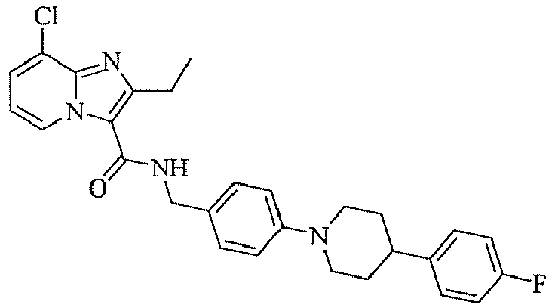 |
white solid : 1H-NMR (CDCl3): δ 9.35 (1H, d, J = 6.8 Hz), 7.40 (1H, d, J = 7.2 Hz), 7.29 (2H, d, J = 8.4 Hz), 7.20 (2H, dd, J = 8.8, J = 5.6 Hz), 6.98-7.03 (4H, m), 6.86 (1H, t, J = 7.2 Hz), 6.07 (1H, brs), 4.62 (2H, d, J = 5.6 Hz), 3.82 (2H, d, J = 12.4 Hz), 3.02 (2H, q, J = 7.6 Hz), 2.83 (2H, t, J = 11. 2 Hz), 2.64-2.65 (1H, m), 1.84-1.96 (4H, m), 1.39 (3H, t, J = 7.65 Hz); LCMS: 100.0%, MS (ESI): m/z491.0[M+ H]+. |
| 184 |
 |
white solid : 1H-NMR (CDCl3): δ 9.25 (1H, d, J = 7.6 Hz), 7.22-7.32 (4H, m), 7.16 (2H, d, J = 8.4 Hz), 6.98 (2H, d, J = 8.4 Hz), 6.89 (1H, d, J = 2.4 Hz), 6.60 (1H, dd, J = 6.4 Hz, 2.8 Hz), 5.94 (1H, brs), 4.60 (2H, d, J = 5.6 Hz), 3.87 (3H, s), 3.82 (2H, d, J = 12.4 Hz), 2.92 (2H, q, J = 7.6 Hz), 2.82 (2H, td, J = 12.0 Hz, 2.4 Hz), 2.60-2.72 (1H, m), 1.70-2.02 (4H, m), 1.39 (3H, t, J = 7.6 Hz); LCMS: 100.0%, MS (ESI): m/z 553.1 [M+H]+. |
| 185 |
 |
yellow solid : 1H-NMR (CDCl3): δ 9.39 (1H, d, J = 6.8 Hz), 7.58 (1H, d, J = 7.2 Hz), 7.20-7.32 (4H, m), 7.19 (2H, d, J = 8.0 Hz), 6.99 (2H, d, J = 8.8 Hz), 6.79 (1H, t, J = 7.2 Hz), 6.08 (1H, brs), 4.62 (2H, d, J = 5.6 Hz), 3.83 (2H, d, J = 12.4 Hz), 3.04 (2H, q, J = 7.6 Hz), 2.83 (2H, td, J = 12.0, 2.4 Hz), 2.60-2.72 (1H, m), 1.80-2.00 (4H, m), 1.38 (3H, t, J = 7.6 Hz); LCMS: 100%, MS(ESI):m/z 601.0/603.0 [M+H]+ |
| 186 |
 |
yellow solid : 1H-NMR (CDCl3): δ 9.53 (1H, d, J = 7.2 Hz), 7.91 (1H, s), 7.24-7.38 (4H, m), 7.18 (2H, d, J = 8.0 Hz), 7.09 (1H, dd, J = 7.2, 1.6 Hz), 6.98 (2H, d, J = 8.4 Hz), 6.11 (1H, brs), 4.63 (2H, d, J = 5.2 Hz), 3.81-3.86 (2H, m), 3.10 (2H, q, J = 7.6 Hz), 2.80-2.86 (2H, m), 2.61-2.68 (1H, m), 1.80-2.08 (4H, m), 1.44 (3H, t, J = 7.6Hz); LCMS: 100%, MS (ESI): m/z 541.1 [M+ H]+. |
| 187 |
 |
white solid : 1H-NMR (CDCl3): δ 9.63 (1H, s), 7.49 (1H, d, J = 9.2 Hz), 7.43 (1H, d, J = 7.6 Hz), 7.21-7.32 (3H, m), 7.13-7.20 (2H, m), 6.92-7.04 (2H, m), 6.04 (1H, brs), 4.54-4.67 (2H, m), 3.76-3.89 (2H, m), 2.94 (2H, q, J = 7.6 Hz), 2.76-2.89 (2H, m), 2.59-2.71 (1H, m), 1.77-2.00 (4H, m), 1.42 (3H, t, J = 7.6 Hz); LCMS: 100%, MS (ESI): m/z 602.8[M+ H]+. |
| 188 |
 |
white solid : 1H-NMR (CDCl3): δ 9.82 (1H, d, J = 15.2 Hz), 7.70 (1H, d, J = 9.2 Hz), 7.45-7.52 (2H, m), 7.32 (2H, d, J = 8.4 Hz), 7.14 (2H, d, J = 8.8 Hz), 6.88-7.08 (4H, m), 6.02-6.15 (1H, m), 4.64 (2H, d, J = 5.6 Hz), 3.23-3.42 (8H, m), 3.00 (2H, q, J = 7.6 Hz), 1.44 (3H, t, J = 7.2 Hz); LCMS: 98.0%, MS (ESI): m/z 592.0[M+ H]+. |
| 189 |
 |
yellow solid : 1H-NMR (CDCl3): δ 9.39 (1H, d, J = 6.4 Hz), 7.58 (1H, d, J = 6.8 Hz), 7.22-7.30 (2H, m), 7.15-7.21 (2H, m), 6.90-7.03 (4H, m), 6.80 (1H, t, J = 7.2 Hz), 6.07 (1H, brs), 4.62 (2H, d, J = 5.6 Hz), 3.82 (2H, d, J = 12.4 Hz), 3.12 (2H, q, J = 7.6 Hz), 2.83 (2H, td, J = 12.4, 2.8 Hz), 2.60-2.70 (1H, m), 1.80-2.00 (4H, m), 1.38 (3H, t, J = 7.6 Hz); LCMS: 99.0%, MS(ESI):m/z 535.0/537.0 [M+H] |
| 190 |
 |
yellow solid : 1H-NMR (CDCl3): δ 9.35 (1H, d, J = 6.8 Hz), 7.40 (1H, d, J = 6.8 Hz), 7.28-7.37 (4H, m), 7.21-7.25 (3H, m), 7.00 (2H, d, J = 8.4 Hz), 6.86 (1H, t, J = 7.2 Hz), 6.07 (1H, brs), 4.63 (2H, d, J = 5.6 Hz), 3.83 (2H, d, J = 12 Hz), 3.02 (2H, q, J = 7.6 Hz), 2.82-2.87 (2H, m), 2.63-2.70 (1H, m), 1.86-2.01 (4H, m), 1.39 (3H, t, J = 7.6 Hz); LCMS: 99.6%, MS (ESI): m/z 473.0[M+ H]+. |
| 191 |
 |
white solid : 1H-NMR (CDCl3): δ 9.33 (1H, d, J = 7.6 Hz), 7.80 (1H, d, J = 1.6 Hz), 7.28-7.36 (3H, m), 7.15-7.26 (2H, m), 6.97-7.12 (3H, m), 6.04 (1H, brs), 4.63 (2H, d, J = 5.6 Hz), 3.73-3.92 (2H. m), 2.98 (2H, q, J = 7.6 Hz), 2.79-2.91 (2H, m), 2.63-2.78 (1H. m), 1.81-2.03 (4H. m), 1.41 (3H, t, J = 7.6 Hz); LCMS: 100%, MS (ESI): m/z 603.0[M+ H]+. |
| 192 |
 |
yellow solid : 1H-NMR (CDCl3): δ 9.30 (1H, d, J = 7.6 Hz), 7.78 (1H, d, J = 1.2 Hz), 7.31 (2H, d, J = 8.4 Hz), 7.14 (2H, d, J = 8.4 Hz), 6.87-7.05 (5H, m), 6.04 (1H, brs), 4.62 (2H, d, J = 5.6 Hz), 3.22-3.40 (8H, m), 2.98 (2H, q, J = 7.6 Hz), 1.41 (3H, t, J = 7.6 Hz); LCMS: 98.3%, MS (ESI): m/z 602.0[M+ H]+. |
| 193 |
 |
white solid: 1H-NMR (CDCl3): δ 9.23 (1H, d, J = 7.2 Hz), 7.33 (2H, d, J = 8.4 Hz), 7.17 (2H, d, J = 8.8 Hz), 7.08-6.96 (5H, m), 6.88-6.83 (1H, m), 6.09 (1H, brs), 4.66 (2H, d, J = 5.2 Hz), 3.40-3.30 (8H, m), 3.02 (2H, q, J = 7.6 Hz), 1.43 (3H, t, J = 7.6 Hz); LCMS: 96.5%, MS (ESI): m/z 542.1[M+ H]+. |
| 194 |
 |
white solid: 1H-NMR (CDCl3): δ 9.39 (1H, d, J = 7.6 Hz), 7.61 (1H, d, J = 1.6 Hz), 7.32 (2H, d, J = 8.8 Hz), 7.26 (2H, d, J = 9.2 Hz), 7.00 (2H, d, J = 8.4 Hz), 6.88-9.95 (3H, m), 6.05 (1H, brs), 4.64 (2H, d, J = 5.2 Hz), 3.34 (8H, d, J = 6.8 Hz), 2.98 (2H, q, J = 7.6 Hz), 1.41 (3H, t, J = 7.6 Hz); LCMS: 97.6%, MS (ESI): m/z 507.9 [M+ H]+. |
| 195 |
 |
white solid: 1H-NMR (CDCl3): δ 9.25 (1H, d, J = 7.6 Hz), 7.57 (2H, d, J = 8.0 Hz), 7.37 (2H, d, J = 8.0 Hz), 7.29 (2H, d, J = 8.8 Hz), 6.99 (2H, d, J = 8.4 Hz), 6.89 (1H, d, J = 2.0 Hz), 6.61 (1H, dd, J = 7.6 Hz, 2.4 Hz), 5.95 (1H, brs), 4.61 (2H, d, J = 5.2 Hz), 3.87(3H, s),3.83 (2H, d, J = 12.4 Hz), 2.92 (2H, q, J = 7.6 Hz), 2.84 (2H, td, J = 12.0 Hz, 2.4 Hz), 2.55-2.70 (1H, m), 1.85-2.02 (4H, m), 1.39 (3H, t, J = 7.6 Hz); LCMS: 98.7%, MS (ESI): m/z 537.1 [M+H]+, 559.1 [M+Na]+. |
| 196 |
 |
white solid: 1H-NMR (CDCl3): δ 9.28 (1H, d, J = 6.8 Hz), 7.36-7.31 (3H, m), 7.14 (2H, d, J = 8.8 Hz), 6.99-6.94 (4H, m), 6.75 (1H, d, J = 6.8 Hz), 5.30 (1H, brs), 4.62 (2H, d, J = 5.6 Hz), 3.34 (8H, brs), 2.95 (1H, q, J = 7.2 Hz), 2.42 (3H, s), 1.39 (3H, t, J = 7.6 Hz); LCMS: 97.9%, MS (ESI): m/z 454.1 [M+ H]+. |
| 197 |
 |
white solid: 1H-NMR (CDCl3): δ 9.63 (1H, s), 7.49 (1H, d, J = 9.6 Hz), 7.39 (1H, d, J = 9.2 Hz), 7.31 (2H, d, J = 8.4 Hz), 7.14 (2H. d. J = 8.8 Hz), 6.87-7.05 (4H, m), 6.05 (1H, brs), 4.62 (2H, d, J = 5.6 Hz), 3.21-3.45 (8H. m), 2.96 (2H, q, J = 7.6 Hz), 1.40 (3H, t, J = 7.6 Hz); LCMS: 95.9%, MS (ESI): m/z 603.8[M+ H]+. |
| 198 |
 |
white solid : 1H-NMR (CDCl3): δ 9.58 (1H, d, J = 6.8 Hz), 7.66 (1H, d, J = 6.8 Hz), 7.31 (2H, d, J = 8.4 Hz), 6.90-7.10 (7H, m), 6.10 (1H, brs), 4.64 (2H, d, J = 5.6 Hz), 3.30-3.42 (4H, m), 3.20-3.30 (4H, m), 3.03 (2H, q, J = 7.2 Hz), 1.38 (3H, t, J = 7.2 Hz); LCMS: 97.5%, MS (ESI): m/z 526.0[M + H]+. |
| 199 |
 |
white solid : 1H-NMR (CDC13): δ 9.40 (1H, d, J = 7.2 Hz), 7.58 (1H, d, J = 7.2 Hz), 7.42 (2H, d, J = 7.2 Hz), 7.24 (2H, d, J = 8.8 Hz), 6.98 (2H, d, J = 8.0 Hz), 6.90 (2H, d, J = 8.8 Hz), 6.80 (1H, t, J = 6.8 Hz), 6.08 (1H, brs), 4.63 (2H, d, J = 5.2 Hz), 3.20-3.40 (8H, m), 3.02 (2H, q, J = 7.6 Hz), 1.38 (3H, t, J = 7.6 Hz); LCMS: 97.5%, MS(ESI):m/z 552.0/554.0 [M+H]+ |
| 200 |
 |
yellow solid : 1H-NMR (CDCl3): δ 8.99 (1H, d, J = 6.8 Hz), 7.32 (2H, d, J = 8.0 Hz), 7.14 (2H, d, J = 8.8 Hz), 6.94-6.99 (4H, m), 6.82 (1H, t, J = 7.2 Hz), 6.62 (1H, d, J = 7.6 Hz), 6.05 (1H, brs), 4.63 (2H, d, J = 5.6 Hz), 4.02 (3H, s). 3.34 (8H, s), 2.98 (2H, q, J = 7.6 Hz), 1.38 (3H, t, J = 7.6 Hz); LCMS: 96.2%, MS (ESI): m/z 554.1 [M+ H]+. |
| 201 |
 |
white solid : 1H-NMR (CDCl3): δ 9.63 (1H, s), 7.49 (1H, d, J = 9.6 Hz), 7.39 (1H, d, J = 9.6 Hz), 7.31 (2H, d, J = 8.4 Hz), 7.19-7.26 (2H, m), 6.98 (2H, d, J = 8.4 Hz), 6.90 (2H, d, J = 8.8 Hz), 6.04 (1H, brs), 4.62 (2H, d, J = 5.6 Hz), 3.15-3.40 (8H, m), 2.96 (2H, q, J = 7.6 Hz), 1.42 (3H, t, J = 7.6 Hz); LCMS: 97.8%, MS (ESI): m/z 552.0[M+ H]+. |
| 202 |
 |
white solid : 1H-NMR (CDCl3): δ 9.59 (1H, d, J = 6.8 Hz), 7.66 (1H, d, J = 7.2 Hz), 7.31 (2H, d, J = 8.4 Hz), 7.14 (2H, d, J = 8.4 Hz), 6.92-7.01 (5H, m), 6.12 (1H, brs), 4.64 (2H, d, J = 5.6 Hz), 3.17-3.54 (8H, m), 3.03 (2H, q, J = 7.6 Hz), 1.37 (3H, t, J = 7.6 Hz); LCMS: 97.9%, MS (ESI): m/z 592.0[M + H]+. |
| 203 |
 |
white solid : 1H-NMR (CDCl3): δ 9.55 (1H, d, J = 7.2 Hz), 7.93 (1H, s), 7.34 (2H, d, J = 8.4 Hz), 7.16 (2H, d, J = 8.4 Hz), 7.11 (1H, dd, J = 7.6, 2.0 Hz), 6.96-7.03 (4H, m), 6.11 (1H, brs), 4.66 (2H, d, J = 5.6 Hz), 3.29-3.38 (8H, m), 3.01 (2H, q, J = 7.6 Hz), 1.44 (3H, t, J = 7.6 Hz); LCMS: 97.7%, MS (ESI): m/z 592.0[M+ H]+. |
| 204 |
 |
white solid : 1H-NMR (CDCl3): δ 9.39 (1H, d, J = 7.2 Hz), 7.62 (1H, s), 7.53 (2H, d, J = 8.4 Hz), 7.33 (2H, d, J = 8.0 Hz), 7.00 (4H, d, J = 8.8 Hz), 6.93 (1H, dd, J 1 = 2.0 Hz, J 2 = 7.6 Hz), 6.04 (1H, brs), 4.64 (2H, d, J = 5.6 Hz), 3.30-3.50 (8H, m), 2.98 (2H, q, J = 7.6 Hz), 1.41 (3H, t, J = 7.6 Hz); LCMS: 95.6%, MS (ESI): m/z 542.1 [M+ H]+. |
| 205 |
 |
white solid: 1H-NMR (CDCl3): δ 9.39 (1H, d, J = 7.6 Hz), 7.61 (2H, d, J = 1.6 Hz), 7.25-7.33 (2H, m), 7.20 (2H, d, J = 8.8 Hz), 7.00 (2H, d, J = 8.4 Hz), 6.85-6.95 (3H, m), 6.03 (1H, brs), 4.63 (2H, d, J = 5.6 Hz), 3.75-3.90 (5H, m), 2.98 (2H, q, J = 7.2 Hz), 2.80-2.90 (2H, m), 2.60-2.70 (1H, m), 1.83-2.02 (4H, m), 1.40 (3H, t, J = 7.6 Hz); LCMS: 97.3%, MS (ESI): m/z 525.1 [M+ Na]+. |
| 206 |
 |
white solid: 1H-NMR (CDCl3): δ 9.55 (1H, d, J = 7.2 Hz), 7.93 (1H, s), 7.53 (2H, d, J = 8.8 Hz), 7.34 (2H, d, J = 8.4 Hz), 7.11 (1H, dd, J = 7.2, 1.6 Hz), 6.97-7.04 (4H, m), 6.11 (1H, brs), 4.66 (2H, d, J = 5.2 Hz), 3.46-3.50 (4H, m), 3.31-3.40 (4H, m), 3.02 (2H, q, J = 7.6 Hz), 1.44 (3H, t, J = 7.6 Hz); LCMS: 97.2%, MS (ESI): m/z 576.0[M+ H]+. |
| 207 |
 |
white solid : 1H-NMR (CDCl3): δ 9.32 (1H, d, J = 7.2 Hz), 7.79 (1H, d, J = 2.0 Hz), 7.32 (2H, d, J = 8.8 Hz), 7.13 (2H. d. J = 8.0 Hz), 6.97-7.10 (3H, m), 6.89-7.00 (2H. m), 6.05 (1H, brs), 4.64 (2H, d, J = 5.2 Hz), 3.25-3.43 (8H, m), 2.98 (2H, q, J = 7.6 Hz), 1.41 (3H, t, J = 7.6 Hz); LCMS: 97.1%, MS (ESI): m/z 532.0[M+ H]+. |
| 208 |
 |
white solid: 1H-NMR (CDCl3): δ 9.33 (1H, d, J = 7.2 Hz), 7.80 (1H, d, J = 1.6 Hz), 7.32 (2H, d, J = 8.8 Hz), 6.94-7.07 (5H, m), 6.90 (2H, d, J = 8.8 Hz), 6.04 (1H, brs), 4.64 (2H, d, J = 5.2 Hz), 3.90 (3H, s), 3.31-3.42 (4H, m), 3.20-3.30 (4H, m), 2.98 (2H, q, J = 7.6 Hz), 1.41 (3H, t, J = 7.6 Hz); LCMS: 95.4%, MS (ESI): m/z 548.0[M+ H]+. |
| 209 |
 |
yellow solid: 1H-NMR (CDCl3): δ 9.57 (1H, d, J = 7.2 Hz), 7.64 (1H, d, J = 7.2 Hz), 7.29 (2H, d, J = 8.8 Hz), 7.20-7.26 (2H, m), 6.94-6.98 (3H, m), 6.86-6.91 (2H, m), 6.08 (1H, brs), 4.62 (2H, d, J = 5.2 Hz), 3.28-3.35 (8H, m), 3.01 (2H, q, J = 7.6 Hz), 1.37 (3H, t, J = 7.6 Hz); LCMS: 97.4%, MS (ESI): m/z 542.0[M + H]+. |
| 210 |
 |
white solid: 1H-NMR (CDCl3): δ 9.13 (1H, s), 7.45-7.60 (3H, m), 7.34 (2H, d, J = 8.4 Hz), 7.14 (2H, d, J = 8.8 Hz), 7.00 (4H, d, J = 8.0 Hz), 6.06 (1H, brs), 4.66 (2H, d, J = 5.2 Hz), 3.90 (3H, s), 3.40-3.50 (4H, m), 3.30-3.40 (4H, m), 2.98 (2H, q, J = 7.6 Hz), 1.41 (3H, t, J = 7.6 Hz); LCMS: 98.2%, MS(ESI):m/z 538.0 [M+H]+. |
| 211 |
 |
gray solid: 1H-NMR (CDCl3): δ 9.51 (1H, d, J = 6.8 Hz), 7.89 (1H, s), 7.29 (2H, d, J = 15.2 Hz), 7.24-7.30 (2H, m), 7.07 (1H, d, J = 7.6 Hz), 7.00 (2H, dd, J = 12.0, 11.6 Hz), 6.89 (2H, m), 6.04 (1H, brs), 4.62 (2H, d, J = 5.6 Hz), 3.31-3.48 (4H, m), 3.25-3.30 (4H, m), 2.98 (2H, q, J = 7.6 Hz), 1.40 (3H, t, J = 7.6 Hz); LCMS: 97.4%, MS (ESI): m/z 541.8[M+ H]+. |
| 212 |
 |
white solid: 1H-NMR (CDCl3): δ 8.99 (1H, d, J = 6.8 Hz), 7.26-7.30 (4H, m), 7.17 (2H, d, J = 8.4 Hz), 6.98 (2H, d, J = 8.4 Hz), 6.81 (1H, t, J = 7.2 Hz), 6.61 (1H, d, J = 7.6 Hz), 6.04 (1H, brs), 4.61 (2H, d, J = 5.2 Hz), 4.02 (3H, s), 3.80 (2H, d, J = 12 Hz), 2.99 (2H ,q, J = 7.6 Hz), 2.83 (2H, td, J = 2.4 Hz, J = 12 Hz), 2.67-2.60 (1H, m), 2.01-1.80 (4H, m), 1.38 (3H, t, J = 7.6 Hz); LCMS: 99.3%, MS (ESI): m/z 503.0[M+ H]+. |
| 213 |
 |
yellow solid: 1H-NMR (CDCl3): δ 9.38 (1H, d, J = 6.8 Hz), 7.56 (1H, d, J = 7.2 Hz), 7.20-7.35 (4H, m), 7.16 (2H, d, J = 7.6 Hz), 6.97 (2H, d, J = 7.6 Hz), 6.78 (1H, t, J = 7.2 Hz), 6.07 (1H, brs), 4.60 (2H, d, J = 5.6 Hz), 3.80 (2H, d, J = 12.4 Hz), 3.02 (2H, q, J = 7.6 Hz), 2.81 (2H, td, J = 12.0, 2.4 Hz), 2.55-2.70 (1H, m), 1.75-2.00 (4H, m), 1.36 (3H, t, J = 7.6 Hz); LCMS: 100%, MS(ESI):m/z 550.8/552.8 [M+H] |
| 214 |
 |
white solid: 1H-NMR (CDCl3): δ 9.31 (1H, d, J = 7.6 Hz), 7.78 (1H, s), 7.12 (2H, d, J = 6.8 Hz), 7.31 (2H, d, J = 8.4 Hz), 6.81-7.09 (5H, m), 6.03 (1H, brs), 4.62 (2H, d, J = 5.2 Hz), 3.26-3.53 (8H, m), 2.87-3.05 (2H, m), 1.41 (3H, t, J = 7.6 Hz); LCMS: 98.2%, MS (ESI): m/z 588.0[M+ H]+. |
| 215 |
 |
yellow solid: 1H-NMR (CDCl3): δ 9.01 (1H, d, J = 6.8 Hz), 7.28-7.32 (2H, m), 7.14-7.18 (4H, m), 7.00 (2H, d, J = 8.8 Hz), 6.83 (1H, t, J = 7.2 Hz), 6.63 (1H, d, J = 7.6 Hz), 6.06 (1H, brs), 4.62 (2H, d, J = 5.6 Hz), 4.04 (3H, s), 3.82 (2H, d, J= 12.4 Hz), 3.01 (2H ,q, J = 7.6 Hz), 2.85 (2H, td, J = 2.8 Hz, J = 12 Hz), 2.61-2.68 (1H, m), 2.35 (3H, s), 1.85-1.98 (4H, m), 1.40 (3H, t, J = 7.6 Hz); LCMS: 97.8%, MS (ESI): m/z 483.1[M+ H]+. |
| 216 |
 |
yellow solid: 1H-NMR (CDCl3): δ 9.19 - 9.29 (1 H, m), 7.52 (1 H, d, J=9.16 Hz), 7.14 - 7.41 (8 H, m), 7.01 (2 H, d, J=8.66 Hz), 5.97 - 6.11 (1 H, m), 4.64 (2 H, d, J=5.40 Hz), 3.85 (2 H, d, J=12.30 Hz), 2.91 - 3.04 (2 H, m), 2.86 (2 H, d, J=2.76 Hz), 2.60 - 2.73 (1 H, m), 2.39 (3 H, s), 1.98 (4 H, br. s.), 1.41 (3 H, t, J=7.53 Hz); LCMS: 100%, MS (ESI): m/z 453.1 [M+ H]+. |
| 217 |
 |
yellow solid: 1H-NMR (CDCl3): δ 9.61 (1H, d, J = 6.8 Hz), 7.68 (1H, d, J = 7.2 Hz), 7.53 (2H, d, J = 8.4 Hz), 7.33 (2H, d, J = 8.4 Hz), 6.99-7.02 (5H, m), 6.13 (1H, brs), 4.66 (2H, d, J = 5.6 Hz), 3.31-3.49 (8H, m), 3.05 (2H, q, J = 7.6 Hz), 1.41 (3H, t, J = 7.6 Hz); LCMS: 98.6%, MS (ESI): m/z 576.0[M + H]+. |
| 218 |
 |
white solid: 1H-NMR (CDCl3): δ 9.42 (1H, d, J = 6.0 Hz), 7.61 (1H, d, J = 7.6 Hz), 7.53 (2H, d, J = 8.4 Hz), 7.34 (2H, d, J = 8.8 Hz), 7.00 (4H, d, J = 8.8 Hz), 6.82 (1H, t, J = 7.2 Hz), 6.10 (1H, brs), 4.65 (2H, d, J = 5.6 Hz), 3.30-3.50 (8H, m), 3.04 (2H, q, J = 7.6 Hz), 1.38 (3H, t, J = 7.6 Hz); LCMS: 100%, MS(ESI):m/z 585.8/587.8 [M+H]+ |
| 219 |
 |
white solid: 1H-NMR (CDCl3): δ 9.32 (1H, d, J = 7.6 Hz), 7.79 (1H, d, J = 1.6 Hz), 7.28-7.33 (2H, m), 7.13-7.20 (4H, m), 6.93-7.06 (3H. m), 6.04 (1H, brs), 4.63 (2H, d, J = 5.6 Hz), 4.56-4.67 (2H. m), 2.98 (2H, q, J = 7.6 Hz), 2.76-2.92 (2H, m), 2.60-2.70 (1H. m), 1.83-2.02 (4H. m), 1.41 (3H, t, J = 7.6 Hz); LCMS: 95.0%, MS (ESI): m/z 533.0[M+ H]+. |
| 220 |
 |
yellow solid: 1H-NMR (CDCl3): δ 9.27 (1H, d, J = 7.6 Hz), 7.33 (2H, d, J = 8.8 Hz), 7.25 (2H, d, J = 8.8 Hz), 6.99 (2H, d, J = 8.8 Hz), 6.91 (3H, d, J = 8.8 Hz), 6.63 (1H, dd, J = 7.6 Hz, 2.4 Hz), 5.97 (1H, m), 4.63 (2H, d, J = 5.6 Hz), 3.89 (3H, s), 3.20-3.40 (8H, m), 2.94 (2H, q, J = 7.6 Hz), 1.41 (3H, t, J = 7.6 Hz); LCMS: 100.0%, MS (ESI): m/z 504.0[M+ H]+. |
| 221 |
 |
white solid: 1H-NMR (CDCl3): δ 9.38 (1H, d, J = 7.6 Hz), 7.61 (1H, d, J = 1.6 Hz), 7.24-7.33 (2H, m), 7.13-7.20 (4H, m), 7.00 (2H, d, J= 8.4 Hz), 6.92 (1H, dd, J 1 = 2.4 Hz, J 2 = 7.6 Hz), 6.03 (1H, brs), 4.63 (2H, d, J = 5.6 Hz), 3.83 (2H, d, J = 12.4 Hz), 2.97 (2H, q, J = 7.6 Hz), 2.80-2.90 (2H, m), 2.59-2.72 (1H, m), 2.35 (3H, s), 1.85-2.02 (4H, m), 1.41 (3H, t, J = 7.6 Hz); LCMS: 97.2%, MS (ESI): m/z 486.8 [M+ H]+. |
| 222 |
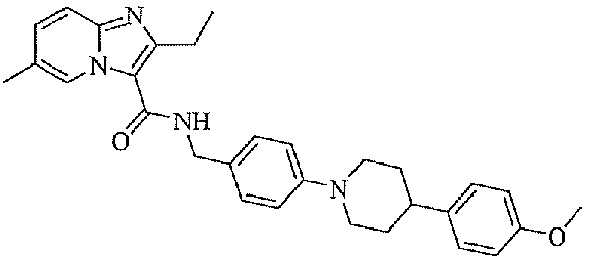 |
yellow solid: 1H-NMR (CDCl3): δ 9.18 - 9.34 (m, 1 H), 7.48 - 7.58 (m, 1 H), 7.28 (s, 2 H) 7.17 - 7.23 (m, 3 H), 6.98 - 7.03 (m, 2 H), 6.90 (s, 2 H), 5.96 - 6.06 (m, 1 H), 4.64 (d, J=5.52 Hz, 2 H), 3.83 - 3.88 (m, 1 H), 3.82 (s, 4 H), 2.94 - 3.03 (m, 2 H), 2.79 - 2.90 (m, 2 H), 2.59 - 2.69 (m, 1 H), 2.39 (s, 3 H), 1.82 - 2.01 (m, 4 H), 1.42 (t, J=7.53 Hz, 3 H); LCMS: 100%, MS (ESI): m/z 483.0[M+ H]+. |
| 223 |
 |
white solid: 1H-NMR (CDCl3): δ 9.86 (1H, s), 7.69 (1H, d, J = 9.2 Hz), 7.46 (1H, dd, J = 7.6, 1.6 Hz), 7.25-7.32 (4H, m), 7.16 (2H, d, J = 8.0 Hz), 7.00 (2H, d, J = 8.8 Hz), 6.00-6.16 (1H, m), 4.63 (2H, d, J = 5.2 Hz), 3.83 (2H, d, J = 12.4 Hz), 2.99 (2H, q, J = 7.6 Hz), 2.79-2.89 (2H, m), 2.51-2.73 (1H, m), 1.78-2.02 (4H, m), 1.42 (3H, t, J = 7.6 Hz); LCMS: 100%, MS (ESI): m/z 591.0[M+ H]+. |
| 224 |
 |
yellow solid: 1H-NMR (CDCl3): δ 9.37 (1H, dd, J1 = 0.8 Hz, J2 = 6.8 Hz) , 7.41 (1H, dd, J1 = 1.2 Hz, J2 = 7.6 Hz), 7.27-7.32 (4H, m), 7.18(2H, d, J = 8 Hz), 7.01 (2H, d, J = 8.4 Hz), 6.87 (1H, t, J = 7.2 Hz), 6.09 (1H, brs), 4.64 (2H, d, J = 5.2 Hz), 3.84 (2H, d, J = 12.4 Hz), 3.05 (2H, q, J = 7.6 Hz,), 2.86 (2H, t, J = 11.6 Hz), 2.70 (1H, t, J = 12 Hz), 1.88-1.99 (4H, m), 1.41 (3H, t, J = 7.6 Hz); LCMS: 100.00%, MS (ESI): m/z 556.9[M+ H]+. |
| 225 |
 |
yellow solid: 1H-NMR (CDCl3): δ 9.24 (1H, d, J = 7 Hz), 7.29 (2H, d, J = 8.5 Hz), 7.16-7.23 (2H, m), 7.11 (1H, d, J = 7 Hz), 6.95-7.03 (4H, m), 6.81 (1H, t, J = 6.9 Hz), 6.03 (1H, brs), 4.62 (2H, d, J = 5.3 Hz), 3.81 (2H, d, J = 12.3 Hz), 2.99 (2H, q, J = 7.5 Hz), 2.83 (2H, td, J = 12.2, 2.6 Hz), 2.62-2.69 (1H, m), 2.61 (3H, s), 1.79-1.98 (4H, m), 1.36 (3H, t, J = 7.5 Hz); LCMS: 100%, MS (ESI): m/z 471.1[M+ H]+. |
| 226 |
 |
white solid: 1H-NMR (CDCl3): δ 9.86 (1H, s), 7.69 (1H, d, J = 9.2 Hz), 7.47 (1H, dd, J = 7.6, 2.0 Hz), 7.28-7.33 (4H, m), 7.18 (2H, d, J = 8.4 Hz), 6.99 (2H, d, J = 8.4 Hz), 6.07 (1H, m), 4.62 (2H, d, J = 5.6 Hz), 3.81 (2H, m), 2.99 (2H, q, J = 7.6 Hz), 2.77-2.90 (2H, m), 2.58-2.70 (1H, m), 1.79-2.00 (4H, m), 1.41 (3H, t, J = 7.6 Hz); LCMS: 100%, MS (ESI): m/z 541.0[M+ H]+. |
| 227 |
 |
yellow solid: 1H-NMR (CDCl3): δ 9.86 (1H, s), 7.69 (1H, d, J = 9.2 Hz), 7.47 (1H, dd, J = 7.6, 2.0 Hz), 7.25-7.38 (2H, m), 7.15-7.25 (2H, m), 6.91-7.09 (4H, m), 6.13 (1H, m), 4.63 (1H, d, J = 5.2 Hz), 3.82 (2H, d, J = 12.4 Hz), 3.00 (2H, q, J = 7.8 Hz), 2.78-2.90 (2H, m), 2.49-2.73 (1H, m), 1.78-2.03 (4H, m), 1.43 (3H, t, J = 7.6 Hz); LCMS: 100%, MS (ESI): m/z 525.0[M+ H]+. |
| 228 |
 |
white solid: 1H-NMR (CDCl3): δ 9.53 (1H, d, J = 7.6 Hz), 7.91 (1H, s), 7.29-7.52 (3H, m), 7.28 (1H, s), 7.16 (2H, d, J = 8.0 Hz), 7.10 (1H, dd, J = 7.6, 1.6 Hz), 6.96 (2H, d, J = 22.0 Hz), 6.08 (1H, brs), 4.63 (2H, d, J = 5.6 Hz), 3.82 (2H, d, J = 12.4 Hz), 3.00 (2H, q, J = 7.6 Hz), 2.79-2.82 (2H, m), 2.63-2.70 (1H, m), 1.84-1.89 (4H, m), 1.35 (3H, t, J = 7.6 Hz); LCMS: 100%, MS (ESI): m/z 590.8[M+ H]+. |
| 229 |
 |
white solid : 1H-NMR (CDCl3): δ 9.46(1H, t, J = 7.2 Hz), 7.53(2H, d, J= 8.8 Hz), 7.33(2H, d, J = 8.4Hz), 7.23-7.25(1H, m), 6.99-7.01(4H, m), 6.79-6.83(1H, m), 6.04(1H, brs), 4.64(2H, d, J = 5.6 Hz), 3.36-3.48(8H, m), 2.94-3.00(2H, m), 1.41(3H, t, J = 7.6 Hz); LCMS: 99.9%, MS (ESI): m/z 526.0[M+ H]+. |
| 230 |
 |
white solid : 1H-NMR (CDCl3): δ 9.41 (1H, d, J = 7.2 Hz), 7.53-7.65 (3H, m), 7.28-7.40 (5H, m), 6.99 (2H, d, J = 8.4 Hz), 6.89-6.96 (1H, m), 5.97-6.09 (1H, m), 4.63 (2H, d, J = 5.6 Hz), 3.75-3.90 (2H, m), 2.98 (2H, q, J = 7.6 Hz), 2.80-2.90 (2H, m), 2.65-2.79 (1H, m), 1.85-2.01 (4H, m), 1.41 (3H, t, J = 7.6 Hz); LCMS: 100%, MS (ESI): m/z 507.0[M+ H]+. |
| 231 |
 |
white solid : 1H-NMR (CDCl3): δ 9.28 (1H, d, J = 7.2 Hz), 7.36 (1H, s), 7.30-7.26 (2H, m), 7.17-7.12 (4H, m), 6.98 (2H, d, J = 8.4 Hz), 6.75 (1H, dd, J = 7.2 Hz, 1.6 Hz), 4.61 (2H, d, J = 5.6 Hz), 3.73 (2H, d, J = 12.4 Hz), 2.94 (2H, q, J = 7.2 Hz), 2.81 (2H, td, J = 12 Hz, 2.4 Hz), 2.67-2.57 (1H, m), 2.42 (3H, s), 2.01-1.81 (4H, m), 1.39 (3H, t, J = 7.2 Hz). |
| 232 |
 |
white solid; 1H-NMR (DMSO-d6, 400 MHz): δ 1.26 (3H, t, J = 7.6 Hz), 1.65-1.63 (2H, m), 1.92-1.89 (2H, m), 3.01 (2H, q, J = 7.6 Hz), 3.17 (1H, brs), 3.39 (2H, s), 3.62-3.59 (2H, m), 3.82 (1H, m), 4.49 (2H, d, J = 5.6 Hz), 7.10 (2H, t, J = 8.8 Hz), 7.29-7.25 (4H, m), 7.38-7.36 (2H, m), 7.65 (1H, dd, J = 9.2, 1.6 Hz), 7.78 (1H, d, J = 9.6 Hz), 8.19 (1H, d, J = 7.2 Hz), 8.70 (1H, t, J = 5.6 Hz), 9.11 (1H, s); LCMS: 99.7%, MS (ESI): m/z 548.2[M+ H]+. |
| 233 |
 |
yellow solid; 1H-NMR (MeOD, 300 MHz): δ1.37 (3H, t, J = 7.5 Hz), 2.15-2.23 (4H, m), 3.10 (2H, q, J = 7.5 Hz), 3.51-3.57 (2H, m), 3.77-3.87 (3H, m), 4.63 (2H, s), 4.68 (2H, s), 7.29-7.41 (5H, m), 7.57-7.64 (4H, m), 7.76-7.81 (2H, m), 9.22 (1H, d, J = 9.0 Hz); LCMS: 98.9%, MS (ESI): m/z 503.2[M+ H]+. |
| 234 |
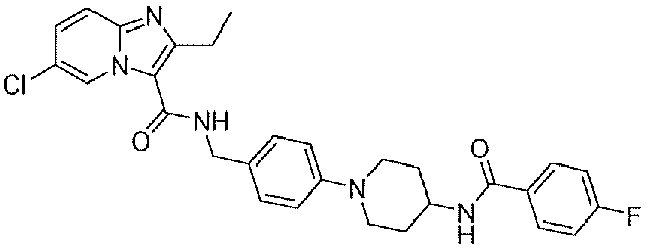 |
white solid: 1H-NMR (DMSO-d6, 400 MHz): δ1.29 (3H, t, J = 7.6 Hz), 1.79-1.81 (2H, m), 1.97-1.99 (2H, m), 3.02 (2H, q, J = 7.6 Hz), 3.15 (1H, m), 3.70-3.73 (2H, m), 4.05 (1H, m), 4.50 (2H, d, J = 5.6 Hz), 7.25-7.33 (4H, m), 7.36-7.38 (2H, m), 7.64 (1H, dd, J = 1.6 Hz, 9.6 Hz), 7.78 (1H, d, J = 9.6 Hz), 7.92-7.96 (2H, m), 8.42 (1H, d, J = 7.2 Hz), 8.65 (1H, t, J = 5.6 Hz), 9.12 (1H, d, J = 1.6 Hz); LCMS: 100%, MS (ESI): m/z 534.1 [M+ H]+. |
| 235 |
 |
white solid: 1H-NMR (DMSO-d6, Bruker Avance 300 MHz): δ 1.25 (3H, t, J = 7.5Hz), 3.00 (2H, q, J = 7.5Hz), 3.08-3.28 (4H, m), 3.31-3.91 (4H, m), 4.43 (2H, d, J = 5.7 Hz), 6.95 (2H, d, J = 8.7 Hz), 7.20-7.33 (4H, m), 7.49 (2H, dd, J = 8.4, 5.4 Hz), 7.70 (1H, dd, J = 9.2, 1.8 Hz), 7.80 (1H, d, J = 9.2 Hz), 8.70 (1H, t, J = 5.7 Hz), 9.10 (1H, s); LCMS: 100%, MS (ESI): m/z 520.0 [M+ H]+. |
| 236 |
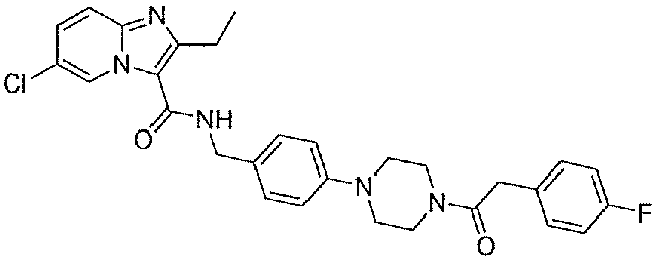 |
white solid: 1H-NMR (DMSO-d6, Bruker Advance 300 MHz): δ 1.24 (3H, t, J= 7.5Hz), 2.91-3.12 (6H, m), 3.51-3.65 (4H, m), 3.74 (2H, s), 4.42-4.44 (2H, m), 6.92 (2H, d, J = 8.7 Hz), 7.10 (2H, t, J = 8.8 Hz), 7.19-7.31 (4H, m), 7.69 (1H, dd, J = 9.6, 1.8 Hz), 7.78 (1H, d, J = 9.6 Hz), 8.66 (1H, t, J = 5.7 Hz), 9.10 (1H, s). LCMS: 100%, MS (ESI): m/z 534.0 [M+ H]+. |
| 237 |
 |
pale yellow oil; 1H-NMR (CD3OD, 300 MHz): δ1.32-1.41 (6H, m), 1.91-1.96 (2H, m), 2.02-2.13 (2H, m), 3.12 (2H, q, J = 7.5 Hz), 3.51-3.55 (2H, m), 3.82-3.91 (2H, m), 4.70 (2H, s), 7.66 (4H, s), 7.80-7.90 (2H, m), 9.24 (1H, s); LCMS: 98.4%, MS (ESI): m/z 427.1[M+ H]+. |
| 238 |
 |
pale yellow oil; 1H-NMR (CD3OD, 300 MHz): δ0.99 (3H, t, J = 7.5 Hz), 1.39 (3H, t, J = 7.5 Hz), 1.62 (2H, q, J = 7.5 Hz), 1.90-2.08 (4H, m), 3.12 (2H, q, J = 7.5 Hz), 3.53-3.59 (2H, m), 3.83-3.91 (2H, m), 4.70 (2H, s), 7.66 (4H, s), 7.80-7.90 (2H, m), 9.25 (1H, s); LCMS: 99.0%, MS (ESI): m/z 440.2[M+ H]+. |
| 239 |
 |
white solid; 1H-NMR (CD3OD, 400 MHz): δ1.40 (2H, t, J = 7.6 Hz), 2.11 (2H, d, J = 13.6 Hz), 2.50-2.61 (2H, m), 3.13 (2H, q, J = 7.6 Hz), 3.67 (2H, d, J = 12.4 Hz), 4.02-4.09 (2H, m), 4.72 (2H, s), 7.29 (1H, d, J = 7.6 Hz), 7.39 (2H, t, J = 8.0 Hz), 7.57 (2H, d, J = 7.2 Hz), 7.67-7.73 (4H, m), 7.81-7.89 (2H, m), 9.26 (1H, d, J = 0.8 Hz); LCMS: 99.9%, MS (ESI): m/z 489.2[M+ H]+. |
| 240 |
 |
white amorphous (powder); 1H-NMR (DMSO-d6, Bruker Avance 400 MHz): δ 1.33 (3H, t, J = 7.2 Hz), 2.00-2.12 (2H, m), 2.13-2.30 (2H, m), 3.11 (2H, q, J = 7.6 Hz), 3.55-3.70 (5H, m), 4.59 (2H, d, J = 5.6 Hz), 7.43 (2H, t, J = 8.8 Hz), 7.57 (2H, d, J = 7.6 Hz), 7.65-7.78 (2H, m), 7.88-7.95 (2H, m), 8.12 (2H, dd, J = 8.8, 5.6 Hz), 9.11 (1H, brs), 9.19 (1H, s); LCMS: 100%, MS (ESI): m/z 519 [M+H]+. |
| 241 |
 |
white amorphous (powder); 1H-NMR (MeOD, Bruker Avance 400 MHz): δ 1.43 (3H, t, J = 7.6 Hz), 2.16-2.38 (4H, m), 3.17 (2H, q, J = 7.6 Hz), 3.75-3.88 (4H, m), 3.90-4.01 (1H, m), 4.74 (2H, d, J = 4.4 Hz), 7.48 (2H, d, J = 8.4 Hz), 7.70 (4H, s), 7.89 (1H, d, J = 9.6 Hz), 8.00 (1H, dd, J = 9.6, 2.0 Hz), 8.22 (2H, d, J = 8.8 Hz), 8.95 (1H, t, J = 5.6 Hz), 9.31 (1H, s); LCMS: 100%, MS (ESI): m/z 584.8 [M+H]+. |
| 242 |
 |
white amorphous (powder); 1H-NMR (MeOD, Bruker Avance 400 MHz): δ 1.42 (3H, t, J = 7.6 Hz), 2.03-2.18 (2H, m), 2.25-2.35 (2H, m), 3.04-3.12 (1H, m), 3.18 (2H, q, J = 7.6 Hz), 3.68-3.70 (4H, m), 3.93 (2H, s), 4.72 (2H, d, J = 2.8 Hz), 7.06 (2H, t, J = 8.8 Hz), 7.23-7.30 (2H, dd, J = 8.4, 5.2 Hz), 7.67 (4H, s), 7.93 (1H, d, J = 9.6 Hz), 8.08 (1H, dd, J = 9.6, 2.0 Hz), 9.05 (1H, t, J = 6.0 Hz), 9.32 (1H, d, J = 1.2 Hz); LCMS: 100%, MS (ESI): m/z 533.0 [M+H]+. |
| 243 |
 |
white amorphous (gum); 1H-NMR (DMSO-d6, Bruker Avance 400 MHz): δ 1.32 (3H, t, J = 7.6 Hz), 1.52-1.91 (4H, m), 2.75-2.92 (2H, m), 3.08 (2H, q, J = 7.6 Hz), 3.10-3.25 (1H, m), 3.58-3.72 (1H, m), 4.53 (2H, d, J = 1.6 Hz), 7.26-7.38 (6H, m), 7.51 (2H, dd, J = 8.4, 5.6 Hz), 7.95 (2H, s), 9.09 (1H, t, J = 5.6 Hz), 9.19 (1H, s); LC-MS purity: 100%. MS (ESI): m/z 519.1 [M+H]+. |
| 244 |
 |
white solid(sticky powder); mp = 216.2-220.7°C: 1H-NMR (DMSO-d6, Bruker Avance 400 MHz): δ 1.32 (3H, t, J = 7.2 Hz), 1.37-1.50 (2H, m), 1.68-1.81 (2H, m), 2.58-2.82 (2H, m), 3.01-3.15 (3H, m), 3.74 (2H, s), 4.03-4.08 (1H, m), 4.51 (2H, d, J = 5.6 Hz), 4.54-4.58 (1H, m), 7.11-7.20 (4H, m), 7.24-7.40 (4H, m), 7.950 (2H, s), 9.06 (1H, brs), 9.19 (1H, s); LC-MS purity: 100%. MS (ESI): m/z 533.0 [M+H]+. |
| 245 |
 |
white solid (powder); mp = 221.5-221.8°C: 1H-NMR (DMSO-d6, 400 MHz): δ 0.85 (9H, s). 1.23 (3H, t, J = 7.6 Hz), 1.50 (2H, d, J = 12.4 Hz), 1.61-1.69 (2H, m), 2.86-2.98 (4H, m), 3.45 (2H, d, J = 9.6 Hz), 3.92 (1H, s), 4.40 (2H, d, J = 5.6 Hz), 6.89 (2H, d, J = 8.8 Hz), 7.19 (2H, d, J = 8.4 Hz), 7.44 (1H, dd, J = 2.0 Hz, 9.2 Hz), 7.65 (1H, d, J = 9.6 Hz), 8.39 (1H, t, J = 5.6 Hz), 9.05 (1H, s); LCMS: 97.4%, MS (ESI): m/z 440.2[M+ H]+. |
| 246 |
 |
white amorphous (powder); 1H-NMR (DMSO-d6, 300 MHz): δ 1.23 (3H, t, J = 7.5 Hz), 2.97 (2H, q, J = 7.5 Hz), 4.50 (2H, d, J = 5.7 Hz), 7.10-7.23 (4H, m), 7.34 (2H, d, J = 8.1 Hz), 7.43 (1H, dd, J = 9.6, 1.5 Hz), 7.50-7.70 (5H, m), 8.48 (1H, t, J = 5.7 Hz), 9.04 (1H, s); LCMS: 98.7%, MS (ESI): m/z 433.9 [M+ H]+. |
| 247 |
 |
white power; mp >142.3 °C: decomposed; 1H-NMR (DMSO-d6, 400 MHz): δ 1.23 (3H, t, J = 7.6 Hz), 2.94 (2H, q, J = 7.6 Hz), 2.97 (3H, s), 4.45 (2H, d, J = 6.0 Hz), 4.59 (2H, s), 6.60-6.70 (2H, m), 6.76 (1H, s), 7.12 (1H, t, J = 8.0 Hz), 7.24 (2H, d, J = 8.4 Hz), 7.29 (2H, d, J = 8.8 Hz), 7.45 (1H, dd, J = 9.2, 2.0 Hz), 7.66 (1H, d, J = 9.6 Hz), 8.43 (1H, t, J = 6.0 Hz), 9.04 (1H, d, J = 1.2 Hz); LCMS: 98.6%, MS (ESI): m/z 517.0 [M+H]+. °C |
| 248 |
 |
white powder; mp >142.7°C: decomposed; 1H-NMR (DMSO-d6, 400 MHz): δ 1.26 (3H, t, J = 7.6 Hz), 2.99 (2H, q, J = 7.6 Hz), 4.51 (2H, d, J = 5.6 Hz), 5.14 (2H, s), 6.90 (1H, dd, J = 8.4, 2.0 Hz), 6.94 (1H, d, J = 7.6 Hz), 7.03 (1H, s), 7.27 (1H, t, J = 8.0 Hz), 7.35 (2 H, d, J = 8.0 Hz), 7.45 (1H, dd, J = 9.2, 2.0 H, 7.56 (2H, d, J = 8.8 Hz), 7.67 (1H, d, J = 9.6 Hz), 8.47 (1H, t, J = 5.6 Hz), 9.07 (1H, d, J = 1.2 Hz); LCMS: 96.1%, MS (ESI): m/z 504.1[M+ H]+. |
| 249 |
 |
white solid; mp = 135.5-136.4°C: 1H-NMR (DMSO-d6, 400 MHz): δ 1.26 (3H, t, J = 7.6 Hz), 1.69-1.79 (2H, m), 1.80-1.90 (2H, m), 2.70-2.80 (3H, m), 2.99 (2H, q, J = 7.6 Hz), 3.75-3.85 (2H, m), 4.49 (2H, d, J = 6.0 Hz), 6.78 (1H, d, J = 7.6 Hz), 6.88 (1H, d, J = 8.0 Hz), 7.01 (1H, s), 7.19 (1H, t, J = 8.0 Hz), 7.28 (2H, d, J = 8.0 Hz), 7.39-7.47 (3H, m), 7.66 (1H, d, J = 9.6 Hz), 8.51 (1H, t, J = 6.0 Hz), 9.03 (1H, d, J = 1.2 Hz); LCMS: 100%, MS (ESI): m/z 557.0 [M+ H]+. |
| 250 |
 |
white amorophous; mp >198.8°C: decomposed; 1H-NMR (DMSO-d6, 400 MHz): δ 1.24 (3 H, t-J = 7.2 Hz), 2.98 (2H, q, J = 7.6 Hz), 3.62 (2H, s), 4.53 (2H, d, J = 6.0 Hz), 7.09 (2H, t, J = 9.2 Hz), 7.10-7.35 (4H, m), 7.46 (1H, dd, J= 9.2, 2.0 Hz), 7.58 (2H, dd , J = 9.5, 5.2 Hz), 7.66 (1H, d, J = 9.2 Hz), 8.50 (1H, brs, J = 6.0 Hz), 9.07(1H, d, J = 1.6 Hz), 10.21 (1H, brs); LCMS: 99%, MS (ESI): m/z 465.1 [M+ H]+. |
| 251 |
 |
white amorophous; mp >168.0°C: decomposed; 1H-NMR (DMSO-d6, 400 MHz): δ 1.27 (3 H, t-J = 7.6 Hz), 3.00 (2H, q, J = 7.2 Hz), 3.20-3.30 (8H, m), 4.50 (2H, d, J = 6.0 Hz), 4.50 (2H, d, J = 6.0 Hz), 6.83 (1H, d, J = 7.6 Hz), 6.91 (1H, d, J = 8.4 Hz), 7.02 (1 H, s), 7.07 (2H, d, J = 8.8 Hz), 7.20-7.26 (3H, m), 7.45 (1H, dd, J = 9.6, 2.0 Hz), 8.50 (1H, t, J = 6.0 Hz), 9.04 (1H, d, J = 1.6 Hz); LCMS: 95.2%, MS (ESI): m/z 580.1 [M+ Na]+. |
| 252 |
 |
Gum; 1H-NMR (CDCl3, 400 MHz): δ 1.20-1.40 (2H, m), 1.41 (3H, t, J = 7.2 Hz), 1.50-1.59 (2H, m), 1.68-1.82 (1H, m), 2.55 (2 H, d, J = 6.8 Hz), 2.99 (2H, q, J = 7.6 Hz), 3.28-3.38 (2H, m), 3.90-4.00 (2H, m), 4.68 (2 H, d, J = 5.2 Hz), 6.08 (1H, brs), 6.92 (1H, t, J = 6.8 Hz), 7.15 (2 H, d, J = 8.0 Hz), 7.26-7.40 (3H, m), 7.61 (1H, d, J = 8.8 Hz), 9.41 (1H, d, J = 6.8 Hz); LCMS: 98.96%, MS (ESI): m/z 377.8 [M+ H]+. |
| 253 |
 |
white solid; mp = 132.2-133.0°C: 1H-NMR (CDCl3, 400 MHz): δ 1.25-1.40 (2H, m), 1.44 (3H, t, J = 7.6 Hz), 1.52-1.59 (2H, m), 1.70-1.85 (1H, m), 2.57 (2H, d, J = 7.2 Hz), 3.00 (2H, q, J = 7.6 Hz), 3.30-3.40 (2H, m), 3.90-4.00 (2H, m), 4.69 (2H, d, J = 5.6 Hz), 6.11 (1H, brs), 7.18 (2H, d, J = 8.0 Hz), 7.30-7.40 (3H, m), 7.57 (1H, d, J = 9.6 Hz), 9.56 (1H, d, J = 1.6 Hz); LCMS: 100%, MS (ESI): m/z 411.8 [M+ H]+. |
| 254 |
 |
white amorphous; mp >125.9°C: decomposed; 1H-NMR (CDCl3, 400 MHz): δ 1.20-1.40 (2H, m), 1.40 (3H, t, J = 7.2 Hz), 1.50-1.60 (2H, m), 1.68-1.83 (1H, m), 2.56 (2H, d, J = 7.2 Hz), 2.97 (2H, q, J = 7.6 Hz), 3.28-3.40 (2H, m), 3.90-4.00 (2H, m), 4.67 (2H, d, J = 5.6 Hz), 6.08 (1H, brs), 6.91 (1H, dd, J = 7.6, 2.0 Hz), 7.15 (2H, d, J = 8.0 Hz), 7.26-7.38 (2H, m), 7.59 (1H, d, J = 1.6 Hz), 9.36 (1H, d, J = 7.2 Hz); LCMS: 99.86%, MS (ESI): m/z 411.7 [M+ H]+. |
| 255 |
 |
yellow solid; mp = 126.3-127.2°C: 1H-NMR (DMSO-d6, 400 MHz): δ 1.24 (3H, t, J = 7.6 Hz), 1.65-1.73 (2H, m), 1.95-2.05 (2H, m), 2.97 (2H, t, J = 7.2 Hz), 3.00-3.07 (2H, m), 3.45-3.55 (2H, m), 4.47 (2H, d, J = 6.0 Hz), 4.55-4.59 (1H, m), 6.76 (1H, d, J = 7.2 Hz), 6.84-6.86 (1H, m), 6.97 (1H, s), 7.06 (2H, d, J = 9.2 Hz), 7.17 (1H, t, J = 8.0 Hz), 7.26 (2H, d, J = 8.8 Hz), 7.41-7.44 (1H, dd, J = 9.6, 2.0 Hz), 7.64 (1H, d, J = 9.2 Hz), 8.49 (1H, t, J = 5.6 Hz), 9.01 (1H, d, J = 1.6 Hz); LCMS: 96.4%, MS (ESI): m/z 573.1[M+ H]+. |
| 256 |
 |
white solid; mp >220°C: 1H-NMR (DMSO-d6, 400 MHz): δ 1.28 (3H, t, J = 7.6 Hz), 3.00 (2H, q, J = 7.6 Hz), 4.79 (2H, d, J = 5.6 Hz), 7.33 (1H, dd, J = 8.4, 2.0 Hz), 7.37 (1H, s), 7.48 (1H, dd, J = 9.6, 2.0 Hz), 7.68 (1H, d, J = 9.2 Hz), 7.90 (1H, d, J = 2.0 Hz), 7.96(1 H, d, J = 8.4 Hz), 8.70 (1H, t, J = 5.6 Hz), 9.12 (1H, d, J = 1.6 Hz); LCMS: 95.4%, MS (ESI): m/z 404.0 [M+ H]+. |
| 257 |
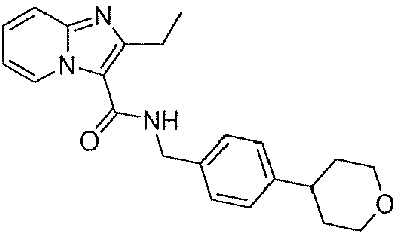 |
White amorphous; mp >133.7°C: decomposed; 1H-NMR (CDCl3, 400 MHz): δ 1.42 (3H, t, J = 7.6 Hz), 1.72-1.90 (4H, m), 2.70-2.82 (1H, m), 3.00 (2H, q, J = 7.6 Hz), 3.53 (2H, td, J = 11.6, 2.8 Hz), 3.93 (2H, dd, J = 10.8, 2.8 Hz), 4.68 (2H, d, J = 6.0 Hz), 6.09 (1H, brs), 6.90-6.95 (1H, m), 7.21-7.30 (2H, m), 7.30-7.40 (3H, m),7.61 (1H, d, J = 9.2 Hz), 9.41 (1H, d, J = 7.2 Hz); LCMS: 99.27%, MS (ESI): m/z 364.1 [M+ H]+. |
| 258 |
 |
White amorphous; mp >195.5°C: decomposed; 1H-NMR (CDCl3, 400 MHz): δ 1.41 (3H, t, J = 7.6 Hz), 1.71-1.90 (4H, m), 2.72-2.84 (1H, m), 2.98 (2H, q, J = 7.2 Hz), 3.53 (2H, td, J = 11.6, 2.8 Hz), 4.08 (2H, dd, J = 11.2, 3.6 Hz), 4.68 (2 H, d, J = 5.6 Hz), 6.10 (1H, brs), 7.20-7.28 (2H, m), 7.28-7.49 (3H, m), 7.54 (1H, d, J = 9.6 Hz), 9.54 (1H, d, J = 1.6 Hz); LCMS: 100%, MS (ESI): m/z 398.1 [M+ H]+. |
| 259 |
 |
White amorphous; mp >156.6°C: decomposed; 1H-NMR (CDC13, 400 MHz): δ 1.40 (3H, t, J = 7.6 Hz), 1.71-1.90 (4H, m), 2.72-2.84 (1H, m), 2.97 (2H, q, J = 7.6 Hz), 3.53 (2H, td, J = 11.6, 2.8 Hz), 4.05-4.15 (2H, m), 4.67 (2H, d, J = 6.0 Hz), 6.09 (1H, brs), 6.91 (1H, dd, J = 7.6, 2.4 Hz), 7.23-7.26 (2H, m), 7.33 (2H, ,d, J = 8.0 Hz), 7.59 (1H, d, J = 2.0 Hz), 9.36 (1H, d, J = 7.2 Hz); LCMS: 100%, MS (ESI): m/z 398.1 [M+ H]+. |
| 260 |
 |
yellow amorphous; 1H-NMR (DMSO-d6, 400 MH°Cz): δ 1.31 (3H, t, J = 7.6 Hz), 3.03 (2H, q, J = 7.6 Hz), 4.76 (2H, s), 7.18 (1H, dd, J = 8.4, 2.0 Hz), 7.45-7.55 (2H, m), 7.56 (1H, d, J = 2.0 Hz), 7.68-7.70 (1H, m), 8.57 (1H, brs), 9.24 (1H, d, J = 1.6 Hz); LCMS: 100%, MS (ESI): m/z 388.1[M+H]+. |
| 261 |
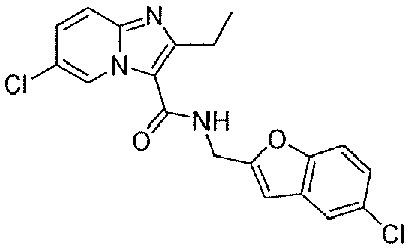 |
white solid; mp = 223.5-225.6°C: 1H-NMR (DMSO-d6, 400 MHz): δ 1.27 (3H, t, J = 7.6 Hz), 3.00 (2H, q, J = 7.2 Hz), 4.70 (2H, d, J = 5.6 Hz), 6.81 (1H, s), 7.29 (1H, dd, J = 8.8, 2.4 Hz), 7.47 (1H, dd, J = 9.6, 2.0 Hz), 7.58 (1H, d, J = 8.4 Hz), 7.68 (2H, dd, J = 5.6, 3.6 Hz), 8.59 (1H, t, J = 5.2 Hz), 9.08 (1H, d, J = 1.6 Hz); LCMS: 99.3%, MS (ESI): m/z 387.8[M+ H]+. |
| 262 |
 |
white solid; mp >220°C: 1H-NMR (DMSO-d6, 400 MHz): δ 1.29 (3H, t, J = 7.6 Hz), 3.00 (2H, q, J = 7.6 Hz), 3.85 (3H, s), 4.84 (2H, d, J = 5.6 Hz), 7.21 (1H, dd, J = 8.4, 2.0 Hz), 7.47 (1H, dd, J = 9.2, 2.0 Hz), 7.59 (1H, d, J = 8.8 Hz), 7.68 (1H, d, J = 9.6 Hz), 7.74 (1H, d, J = 2.0 Hz), 8.65 (1H, t, J = 5.6 Hz), 9.26 (1H, d, J = 1.6 Hz); LCMS: 100%, MS (ESI): m/z 402.0[M+ H]+. |
| 263 |
 |
white solid; mp >220°C: 1H-NMR (DMSO-d6, 400 MHz): δ 1.28 (3H, t, J = 7.6 Hz), 3.01 (2H, q, J = 7.6 Hz), 3.86 (3H, s), 4.84 (2H, d, J = 5.6 Hz), 7.28 (1H, dd, J = 8.4, 2.0 Hz), 7.47 (1H, dd, J = 9.2, 2.0 Hz), 7.59-7.71 (3H, m), 8.66 (1H, t, J = 5.6 Hz), 9.24 (1H, d, J = 1.6 Hz); LCMS: 98.7%, MS (ESI): m/z 401.9[M+ H]+. |
| 264 |
 |
white solid; mp = 201.1-201.8°C: 1H-NMR (DMSO-d6, 400 MHz): δ 1.31 (3H, t, J = 7.2 Hz), 3.05 (2H, q, J = 7.2 Hz), 4.84 (2H, d, J = 5.6 Hz), 7.43 (1H, dd, J = 8.4, 2.0 Hz), 7.49 (1H, dd, J = 9.6, 2.0 Hz), 7.69 (1H, d, J = 5.6 Hz), 7.71 (1H, d, J = 9.6 Hz), 7.74 (1H, d, J = 8.8 Hz), 7.95 (1H, d, J = 2.0 Hz), 8.68 (1H, t, J = 5.6 Hz), 9.13 (1H, d, J = 1.6 Hz); LCMS: 98.6%, MS (ESI): m/z 389.0[M+ H]+. |
| 265 |
 |
white solid; mp >220°C: 1H-NMR (DMSO-d6, 400 MHz): δ 1.32 (3H, t, J = 7.6 Hz), 3.06 (2H, q, J = 7.6 Hz), 4.86 (2H, d, J = 4.4 Hz), 7.12 (1H, dd, J = 7.6, 2.4 Hz), 7.46 (2H, d, J = 8.4 Hz), 7.69 (1H, dd, J = 8.4, 1.6 Hz), 7.79-7.86 (4H, m), 8.02 (1H, d, J = 1.2 Hz), 8.70 (1H, brs), 9.01 (1H, d, J = 7.6 Hz); LCMS: 98.2%, MS (ESI): m/z 515.1[M+ H]+. |
| 266 |
 |
white solid; mp >220°C: 1H-NMR (DMSO-d6, 400 MHz): δ 1.33 (3H, t, J = 7.6 Hz), 3.07 (2H, q, J = 7.6 Hz), 4.93 (2H, d, J = 6.0 Hz), 7.50 (1H, dd, J = 9.6, 2.0 Hz), 7.55 (1H, dd, J = 8.8, 2.4 Hz), 7.70 (1H, dd, J = 9.6, 0.8 Hz), 7.97 (1H, d, J = 8.8 Hz), 8.24 (1H, d, J = 2.0 Hz), 8.88 (1H, t, J = 6.0 Hz), 9.15 (1H, dd, J = 2.4, 0.8 Hz); LCMS: 100%, MS (ESI): m/z 405.0 [M+H]+. |
| 267 |
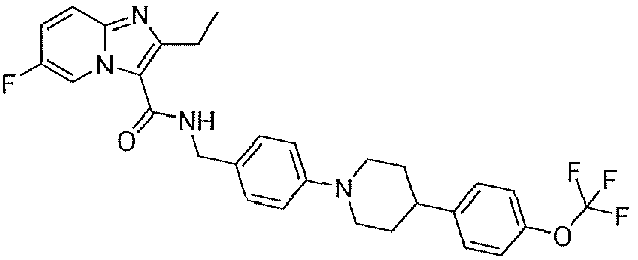 |
yellow amorphous; mp >167.9°C: decomposed; 1H-NMR (CDC13, 400 MHz): δ 1.40 (3H, t, J = 7.6 Hz), 1.80-1.99 (4H, m), 2.65-2.72 (1H, m), 2.75-2.87 (2H, m), 2.97 (2H, q, J = 7.6 Hz), 3.75-3.85 (2H, m), 4.62 (2H, d, J = 5.2 Hz), 6.03 (1H, brs), 6.99 (2H, d, J = 8.8 Hz), 7.16 (2H, d, J = 8.4 Hz), 7.25-7.32 (5H, m), 7.56 (1H, dd, J = 10.0, 5.2 Hz), 9.46 (1H, dd, J = 5.2, 2.4 Hz); LCMS: 98.7%, MS (ESI): m/z 541.3 [M+ H]+. |
| 268 |
 |
white amorphous; mp >177.7°C: decomposed; 1H-NMR (CDCl3, 400 MHz): δ 1.39 (3H, t, J = 7.6 Hz), 1.83-1.96 (4H, m), 2.63-2.69 (1H, m), 2.70-2.90 (2H, m), 2.97 (2H, q, J = 7.6 Hz), 3.75-3.85 (2H, m), 4.60 (2H, d, J = 5.2 Hz), 6.04 (1H, brs), 6.78-6.84 (1H, m), 6.95-6.99 (3H, m), 7.14 (2H, d, J = 8.8 Hz), 7.23-7.29 (4H, m), 9.18 (1H, dd, J = 6.8, 0.8 Hz); LCMS: 99.5%, MS (ESI): m/z 541.3 [M+ H]+. |
| 269 |
 |
white solid; mp >220°C: 1H-NMR (DMSO-d6, 400 MHz): δ 1.32 (3H, t, J = 7.2 Hz), 3.07 (2H, q, J = 7.2 Hz), 4.86 (2H, d, J = 5.6 Hz), 7.12 (1H, dd, J = 7.6, 2.4 Hz), 7.46-7.50 (2H, m), 7.69 (1H, dd, J = 8.4, 0.8 Hz), 7.79-7.80 (4H, m), 8.06(1H, d, J = 1.2 Hz ), 8.69 (1H, t, J = 6.0 Hz ), 9.01 (1H, dd, J = 7.6, 0.8 Hz); LCMS: 99.4%, MS (ESI): m/z 515.2 [M+ H]+. |
| 270 |
 |
white amorphous; mp > 96.9°C: decomposed; 1H-NMR (CDCl3, 400 MHz): δ 1.38 (3H, t, J = 7.6 Hz), 2.95 (2H, q, J = 7.6 Hz), 3.02 (1H, dd, J = 14.4, 6.4 Hz), 3.15 (1H, dd, J = 14.0, 6.0 Hz), 3.70 (1H, dd, J = 8.8, 6.8 Hz), 4.02 (1H, t, J = 8.8 Hz), 4.65 (2H, d, J = 5.6 Hz), 4.82-4.90 (1H, m), 6.05 (1H, t, J = 2.8 Hz), 6.89 (1H, dd, J = 7.6, 2.4 Hz), 6.99-7.05 (2H, m), 7.21-7.26 (2H, m), 7.36 (2H, dd, J = 6.8, 2.0 Hz), 7.46 (2H, dd, J = 6.4, 2.0 Hz), 7.58 (1H, dd, J = 2.0, 0.8 Hz), 9.36 (1H, d, J = 0.8 Hz); LCMS: 100%, MS (ESI): m/z 507.0 [M+ H]+. |
| 271 |
 |
white amorphous; mp > 97.10°C: 1H-NMR (CDCl3, 400 MHz): δ 1.27 (3H, t, J = 7.6 Hz), 3.00 (2H, q, J = 7.6 Hz), 3.89-3.94 (1H, m), 4.19-4.30 (3H, m), 4.51 (2H, d, J = 6.0 Hz), 5.01-.06 (1H, m), 6.95-7.00 (2H, m), 7.08-7.22 (3H, m), 7.40 (2H, d, J = 8.8 Hz), 7.56 (2H, d, J = 8.8 Hz), 7.85 (1H, s), 8.58 (1H, t, J = 7.2 Hz), 8.97 (1H, dd, J = 7.2, 0.4 Hz); LCMS: 97.1%, MS (ESI): m/z 523.3 [M+ H]+. |
| 272 |
 |
Brown solid: 1H-NMR (400 MHz, DMSO): δ 8.96 (d, J = 7.6 Hz, 1H), 8.56 - 8.50 (m, 1H), 8.15 (s, 1H), 7.78 (s, 1H), 7.62 (t, J = 5.2 Hz, 1H), 7.53 (d, J = 8.0 Hz, 1H), 7.33 - 7.24 (m, 1H), 7.10 - 7.07 (m, 1H), 4.65 (dd, J = 13.2, 6.4 Hz, 2H), 3.82 (s, 3H), 3.02 - 2.94 (m, 2H), 1.28 - 1.23 (m, 3H); LCMS (electrospray) m/z (M+H)+ |
| 273 |
 |
Brown solid: 1H-NMR (400 MHz, DMSO): δ 11.03 (s, 1H), 9.08 (d, J = 2.0 Hz, 1H), 8.50 (t, J = 6.0 Hz, 1H), 7.67 (d, J = 9.2 Hz, 1H), 7.50 (d, J = 8.0 Hz, 1H), 7.45 (dd, J = 9.2, 2.0 Hz, 1H), 7.39 (s, 1H), 7.30 (t, J = 2.8 Hz, 1H), 7.03 (dd, J = 8.0, 1.2 Hz, 1H), 6.38 (t, J = 2.4 Hz, 1H), 4.61 (d, J = 6.0 Hz, 2H), 2.99 (q, J = 14.4, 7.6 Hz, 2H), 1.26 (t, J = 7.6 Hz, 3H); LCMS (electrospray) m/z (M+H)+ |
| 274 |
 |
White solid: 1H-NMR (400 MHz, DMSO): δ 9.06 (d, J = 2.0 Hz, 1H), 8.51 -8.43 (m, 1H), 8.40 (s, 1H), 7.68 - 7.63 (m, 2H), 7.50 -7.43 (m, 2H), 7.40 (d, J = 8.8 Hz, 2H), 7.34 (t, J = 8.8 Hz, 2H), 7.27 (d, J = 8.4 Hz, 1H), 5.34 (s, 2H), 4.62 (d, J = 5.6 Hz, 2H), 3.00 -2.93 (m, 2H), 1.26 -1.19 (m, 3H); LCMS (electrospray) m/z (M+H)+ 528.26 |
| 275 |
 |
White solid: 1H-NMR (400 MHz, DMSO): δ 8.95 (d, J = 7.2 Hz, 1H), 8.60 -8.41 (m, 1H), 8.40 (s, 1H), 7.78 (t, J = 5.2 Hz, 1H), 7.66 (s, 1H), 7.49 (d, J = 8.4 Hz, 1H), 7.40 (d, J = 8.8 Hz, 2H), 7.37 -7.31 (m, 1H), 7.29 -7.25 (m, 2H), 7.09 -7.06 (m, 1H), 5.34 (s, 2H), 4.61 (d, J = 5.6 Hz, 2H), 2.99 -2.91 (m, 2H), 1.25 -1.09 (m, 3H); LCMS (electrospray) m/z (M+H)+ 528.26 |
| 276 |
 |
Brown solid: 1H-NMR (400 MHz, DMSO): δ 12.40 (s, 1H), 8.96 (d, J = 7.2 Hz, 1H), 8.52 (t, J = 5.3 Hz, 1H), 8.17 (s, 1H), 7.78 (d, J = 1.6 Hz, 1H), 7.57 (brs, 2H), 7.23 (d, J = 8.4 Hz, 1H), 7.09 (dd, J = 7.6, 2.0 Hz, 1H), 4.63 (d, J = 5.6 Hz, 2H), 2.98 (q, J = 15.2, 7.6 Hz, 2H), 1.25 (t, J = 7.6 Hz, 3H), ; LCMS (electrospray) m/z (M+H)+ 354.16. |
| 277 |
 |
White solid: 1H-NMR (400 MHz, DMSO): δ 8.94 (d, J = 7.2, 1H), 8.41 (t, J = 6.0 Hz, 1H), 8.30 (brs, 1H), 7.78 (d, J = 2.0 Hz, 1H), 7.32 (d, J = 8.4 Hz, 2H), 7.20 (d, J = 8.4 Hz, 2H), 7.08 (dd, J = 7.2, 2.0 Hz, 1H), 6.03 (brs, 1H), 4.43 (d, J = 6.0 Hz, 2H), 2.96 (q, J = 14.8, 7.2 Hz, 2H), 1.25 (t, J = 7.6 Hz, 3H), ; LCMS (electrospray) m/z (M+H)+ 428.15 |
| 278 |
 |
White solid: 1H-NMR (400 MHz, DMSO): δ 9.06 (d, J = 2.0, 1H), 8.42 (t, J = 6.0 Hz, 1H), 8.20 (s, 1H), 7.66 (d, J = 9.6 Hz, 1H), 7.45 (dd, J = 9.6, 2.0 Hz, 1H), 7.31 (d, J = 8.4 Hz, 2H), 7.21 (d, J = 8.8 Hz, 2H), 5.95 (s, 1H), 4.44 (d, J = 6.0 Hz, 2H), 2.97 (q, J = 15.2, 7.6 Hz, 2H), 1.24 (t, J = 7.6 Hz, 3H), ; LCMS (electrospray) m/z (M+H)+ 428.24 |
| 279 |
 |
Brown solid: 1H-NMR (400 MHz, DMSO): δ 8.98 (d, J = 7.2, 1H), 8.55 (t, J = 5.6 Hz, 1H), 8.07 (d, J = 8.8 Hz, 2H), 7.80 (d, J = 2.4 Hz, 1H), 7.58 (s, 1H), 7.49 (d, J = 8.0 Hz, 2H), 7.11 (dd, J = 7.2, 2.0 Hz, 1H), 4.69 (d, J = 5.6 Hz, 2H), 3.03 (q, J = 15.2, 7.6 Hz, 2H), 1.28 (t, J = 7.2 Hz, 3H); LCMS (electrospray) m/z (M+H)+ 481.09 |
| 280 |
 |
Brown solid: 1H-NMR (400 MHz, DMSO): δ 9.09 (d, J = 7.2 Hz, 1H), 8.58 (t, J = 5.6 Hz, 1H), 8.07 (d, J = 9.6 Hz, 2H), 7.68 (d, J = 9.2 Hz, 1H), 7.61 (s, 1H), 7.50 (d, J = 8.0 Hz, 2H), 7.46 (dd, J = 9.6, 2.0 Hz, 1H), 4.69 (d, J = 5.6 Hz, 2H), 3.03 (q, J = 14.8, 7.2 Hz, 2H), 1.29 (t, J = 7.6 Hz, 3H); LCMS (electrospray) m/z (M+H)+ 481.08 |
| 281 |
 |
White solid: 1H-NMR (400 MHz, DMSO): δ 8.74 (d, J = 6.8 Hz, 1H), 8.57 (t, J = 6.0 Hz, 1H), 7.28 (dd, J = 10.8, 7.6 Hz, 1H), 7.20 (t, J = 8.0 Hz, 1H), 7.00 -6.97 (m, 1H), 6.95 (s, 1H), 6.83 (t, J = 8.0 Hz, 2H), 4.49 (d, J = 6.0 Hz, 2H), 3.73 (t, J = 4.4 Hz,, 4H), 3.09 (t, J = 4.7 Hz,, 4H), 3.00 (q, J = 14.8, 7.6 Hz, 2H), 1.27 (t, J = 7.6 Hz, 3H); LCMS (electrospray) m/z (M+H)+ 383.31 |
| 282 |
 |
White solid; mp = 179°C: 1H-NMR (400 MHz, DMSO-d6): δ 1.25 (t, J = 7.6 Hz, 3H), 2.98 (q, J = 7.6 Hz, 2H), 3.39 (t, J = 8.0 Hz, 2H), 4.24 (t, J = 8.0 Hz, 2H), 4.31 (s, 2H), 4.51 (d, J = 5.6 Hz, 2H), 7.25 (d, J = 8.0 Hz, 2H), 7.36 (d, J = 8.0 Hz, 2H), 7.43 (d, J = 9.2 Hz, 1H), 7.65 (d, J = 9.2 Hz, 1H), 8.46 (t, J = 5.6 Hz, 1H, NH), 9.06 (s, 1H); LCMS (electrospray) m/z (M+H) + 413. |
| 283 |
 |
White solid; mp = 172°C: 1H-NMR (400 MHz, DMSO-d6): δ 1.25 (t, J = 7.6 Hz, 3H), 2.97 (q, J = 7.6 Hz, 2H), 3.39 (t, J = 8.0 Hz, 2H), 4.24 (t, J = 8.0 Hz, 2H), 4.32 (s, 2H), 4.51 (d, J = 5.6 Hz, 2H), 7.08 (d, J = 7.6 Hz, 1H), 7.25 (d, J = 8.0 Hz, 2H), 7.36 (d, J = 8.0 Hz, 2H), 7.77 (s, 1H), 8.46 (t, J = 5.6 Hz, 1H, NH), 8.95 (d, J = 7.6 Hz, 1H); LCMS (electrospray) m/z (M+H) + 413. |
| 284 |
 |
White solid; mp = 133°C: 1H-NMR (400 MHz, DMSO-d6): δ 1.24 (t, J = 7.6 Hz, 3H), 2.31 (brs, 4H), 2.97 (q, J = 7.6 Hz, 2H), 3.42 (s, 2H), 3.54 (brs, 4H), 4.50 (d, J = 5.6 Hz, 2H), 7.26 (d, J = 8.0 Hz, 2H), 7.31 (d, J = 8.0 Hz, 2H), 7.44 (d, J = 9.2 Hz, 1H), 7.65 (d, J = 9.2 Hz, 1H), 8.46 (t, J = 5.6 Hz, 1H, NH), 9.06 (s, 1H) ; LCMS (electrospray) m/z (M+H) + 413. |
| 285 |
 |
White solid; mp = 107°C: 1H-NMR (400 MHz, DMSO-d6): δ 1.25 (t, J = 7.6 Hz, 3H), 2.32 (brs, 4H), 2.97 (q, J = 7.6 Hz, 2H), 3.43 (s, 2H), 3.55 (brs, 4H), 4.50 (d, J = 5.6 Hz, 2H), 7.08 (d, J = 7.2 Hz, 1H), 7.26 (d, J = 8.0 Hz, 2H), 7.31 (d, J = 8.0 Hz, 2H), 7.78 (s, 1H), 8.45 (t, J = 5.6 Hz, 1H, NH), 8.95 (d, J = 7.2 Hz, 1H); LCMS (electrospray) m/z (M+H) + 413. |
| 286 |
 |
White solid; mp = 138°C: 1H-NMR (400 MHz, DMSO-d6): δ 1.26 (t, J = 7.6 Hz, 3H), 3.00 (q, J = 7.6 Hz, 2H), 3.25 (s, 3H), 4.50 (d, J = 6.0 Hz, 2H), 6.92 (d, J = 8.4 Hz, 2H), 7.10 (d, J = 8.4 Hz, 2H), 7.19 (d, J = 8.4 Hz, 2H), 7.35 (d, J = 8.4 Hz, 2H), 7.45 (d, J = 9.2 Hz, 1H), 7.66 (d, J = 9.2 Hz, 1H), 8.46 (t, J = 6.0 Hz, 1H, NH), 9.09 (s, 1H); LCMS (electrospray) m/z (M+H) + 503. |
| 287 |
 |
White solid; mp = 134°C: 1H-NMR (400 MHz, DMSO-d6): δ 1.26 (t, J = 7.6 Hz, 3H), 2.97 (q, J = 7.6 Hz, 2H), 3.24 (s, 3H), 4.50 (d, J = 6.0 Hz, 2H), 6.92 (d, J = 8.8 Hz, 2H), 7.08-7.10 (m, 3H), 7.19 (d, J = 8.8 Hz, 2H), 7.35 (d, J = 8.8 Hz, 2H), 7.78 (s, 1H), 8.45 (t, J = 6.0 Hz, 1H, NH), 8.97 (d, J = 7.2 Hz, 1H); LCMS (electrospray) m/z (M+H) + 503. |
| 288 |
 |
White solid; mp = 120°C: 1H-NMR (400 MHz, DMSO-d6): δ 1.27 (t, J = 7.6 Hz, 3H), 2.99 (q, J = 7.6 Hz, 2H), 3.25 (s, 3H), 4.50 (d, J = 5.6 Hz, 2H), 6.92 (d, J = 8.4 Hz, 2H), 6.98-7.02 (m, 1H), 7.10 (d, J = 8.4 Hz, 2H), 7.19 (d, J = 8.4 Hz, 2H), 7.34-7.39 (m, 3H), 7.59 (d, J = 6.8 Hz, 1H), 8.38 (t, J = 5.6 Hz, 1H, NH), 8.98 (d, J = 6.8 Hz, 1H); LCMS (electrospray) m/z (M+H) + 469. |
| 289 |
 |
Ivory solid; mp = 192°C: 1H-NMR (400 MHz, DMSO-d6): δ 1.69-1.76 (m, 2H), 1.81-1.84 (m, 2H), 2.54 (s, 3H), 2.63-2.74 (m, 3H), 3.74-3.78 (m, 5H), 4.42 (d, J = 5.6 Hz, 2H), 6.94 (d, J = 8.8 Hz, 2H), 7.07-7.12 (m, 2H), 7.16 (dd, J = 2.4 Hz, 9.6 Hz, 1H), 7.22 (d, J = 8.8 Hz, 2H), 7.27-7.31 (m, 2H), 7.48 (d, J = 9.6 Hz, 1H), 8.17 (t, J = 5.6 Hz, 1H, NH), 8.70 (d, J = 2.4 Hz, 1H); LCMS (electrospray) m/z (M+H) + 473. |
| 290 |
 |
Ivory solid; mp = 178°C: 1H-NMR (400 MHz, DMSO-d6): δ 1.68-1.75 (m, 2H), 1.79-1.82 (m, 2H), 2.24 (s, 3H), 2.54 (s, 3H), 2.56-2.62 (m, 1H), 2.67-2.74 (m, 2H), 3.73-3.77 (m, 5H), 4.42 (d, J = 6.0 Hz, 2H), 6.94 (d, J = 8.8 Hz, 2H), 7.08 (d, J = 8.8 Hz, 2H), 7.12 (d, J = 8.8 Hz, 2H), 7.16 (dd, J = 2.4 Hz, 9.6 Hz, 1H), 7.22 (d, J = 8.8 Hz, 2H), 7.48 (d, J = 9.6 Hz, 1H), 8.18 (t, J = 6.0 Hz, 1H, NH), 8.70 (d, J = 2.4 Hz, 1H); LCMS (electrospray) m/z (M+H) + 469. |
| 291 |
 |
Ivory solid; mp = 207°C: 1H-NMR (400 MHz, DMSO-d6): δ 1.74-1.81 (m, 2H), 1.85-1.88 (m, 2H), 2.56 (s, 3H), 2.70-2.78 (m, 3H), 3.77-3.80 (m, 5H), 4.42 (d, J = 5.6 Hz, 2H), 6.95 (d, J = 8.8 Hz, 2H), 7.16 (dd, J = 2.4 Hz, 9.6 Hz, 1H), 7.23 (d, J = 8.8 Hz, 2H), 7.47 (d, J = 9.6 Hz, 1H), 7.49 (d, J = 8.8 Hz, 2H), 7.64 (d, J = 8.8 Hz, 2H), 8.18 (t, J = 5.6 Hz, 1H, NH), 8.70 (d, J = 2.4 Hz, 1H); LCMS (electrospray) m/z (M+H) + 523. |
| 292 |
 |
White solid; mp = 183°C: 1H-NMR (400 MHz, DMSO-d6): δ 1.71-1.77 (m, 2H), 1.84-1.87 (m, 2H), 2.54 (s, 3H), 2.69-2.75 (m, 3H), 3.75-3.79 (m, 5H), 4.42 (d, J = 6.0 Hz, 2H), 6.95 (d, J = 8.8 Hz, 2H), 7.16 (dd, J = 2.4 Hz, 9.6 Hz, 1H), 7.22 (d, J = 8.8 Hz, 2H), 7.27 (d, J = 8.8 Hz, 2H), 7.39 (d, J = 8.8 Hz, 2H), 7.48 (d, J = 9.6 Hz, 1H), 8.17 (t, J = 6.0 Hz, 1H, NH), 8.70 (d, J = 2.4 Hz, 1H); LCMS (electrospray) m/z (M+H) + 539. |
| 293 |
 |
Ivory solid; mp = 181°C: 1H-NMR (400 MHz, DMSO-d6): δ 1.69-1.76 (m, 2H), 1.81-1.84 (m, 2H), 2.29 (s, 3H), 2.53 (s, 3H), 2.64-2.74 (m, 3H), 3.74-3.77 (m, 2H), 4.41 (d, J = 6.0 Hz, 2H), 6.94 (d, J = 8.8 Hz, 2H), 7.07-7.12 (m, 2H), 7.20-7.23 (m, 3H), 7.27-7.30 (m, 2H), 7.45 (d, J = 9.2 Hz, 1H), 8.21 (t, J = 6.0 Hz, 1H, NH), 8.83 (s, 1H); LCMS (electrospray) m/z (M+H) + 457. |
| 294 |
 |
Ivory solid; mp = 188°C 1H-NMR (400 MHz, DMSO-d6): δ 1.68-1.75 (m, 2H), 1.81-1.84 (m, 2H), 2.29 (s, 3H), 2.53 (s, 3H), 2.63-2.74 (m, 3H), 3.75-3.78 (m, 2H), 4.41 (d, J = 6.0 Hz, 2H), 6.94 (d, J = 8.8 Hz, 2H), 7.21-7.24 (m, 3H), 7.28 (d, J = 8.8 Hz, 2H), 7.32 (d, J = 8.8 Hz, 2H), 7.47 (d, J = 8.8 Hz, 1H), 8.21 (t, J = 6.0 Hz, 1H, NH), 8.82 (d, J = 1.6 Hz, 1H); LCMS (electrospray) m/z (M+H) + 473. |
| 295 |
 |
Ivory solid; mp = 184°C: 1H-NMR (400 MHz, DMSO-d6): δ 1.67-1.74 (m, 2H), 1.79-1.82 (m, 2H), 2.29 (s, 3H), 2.53 (s, 3H), 2.54-2.59 (m, 1H), 2.67-2.73 (m, 2H), 3.70 (s, 3H), 3.74-3.77 (m, 2H), 4.41 (d, J = 6.0 Hz, 2H), 6.84 (d, J = 8.8 Hz, 2H), 6.94 (d, J = 8.8 Hz, 2H), 7.16 (d, J = 8.8 Hz, 2H), 7.21-7.23 (m, 3H), 7.45 (d, J = 9.6 Hz, 1H), 8.21 (t, J = 6.0 Hz, 1H, NH), 8.82 (d, J = 0.8 Hz, 1H); LCMS (electrospray) m/z (M+H) + 469. |
| 296 |
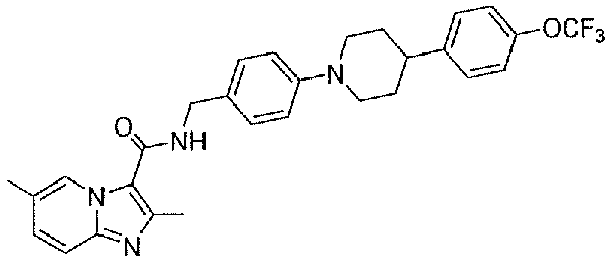 |
Ivory solid; mp = 184°C: 1H-NMR (400 MHz, DMSO-d6): δ 1.71-1.78 (m, 2H), 1.83-1.86 (m, 2H), 2.29 (s, 3H), 2.53 (s, 3H), 2.69-2.75 (m, 3H), 3.76-3.79 (m, 2H), 4.41 (d, J = 6.0 Hz, 2H), 6.95 (d, J = 8.8 Hz, 2H), 7.21-7.23 (m, 3H), 7.27 (d, J = 8.8 Hz, 2H), 7.39 (d, J = 8.8 Hz, 2H), 7.47 (d, J = 8.8 Hz, 1H), 8.21 (t, J = 6.0 Hz, 1H, NH), 8.82 (s, 1H); LCMS (electrospray) m/z (M+H) + 523. |
| 297 |
 |
Pale yellow solid: 1H-NMR (400 MHz, DMSO-d6): δ 1.69-1.76(m, 2H), 1.82-1.85(m, 2H), 2.56 (s, 3H), 2.61-2.75(m, 3H), 3.75-3.78 (m, 2H), 4.43 (d, J = 6.0 Hz, 2H), 6.95 (d, J = 8.4 Hz, 2H), 7.08-7.13 (m, 3H), 7.23 (d, J = 8.4 Hz, 2H), 7.28-7.32 (m, 2H), 7.74 (d, J = 1.2 Hz, 1H), 8.35 (t, J = 5.8 Hz, 1H), 9.00 (d, J = 7.6 Hz, 1H); LCMS (electrospray) m/z (M+H) + 477. |
| 298 |
 |
Pale yellow solid: 1H-NMR (400 MHz, DMSO-d6): δ 1.75-1.81 (m, 2H), 1.86-1.89 (m, 2H), 2.56 (s, 3H), 2.72-2.82 (m, 3H), 3.79 (d, J = 11.6 Hz, 2H), 4.43 (d, J = 6.0 Hz, 2H), 6.96 (d, J = 8.4 Hz, 2H), 7.09 (dd, J = 7.6, 2.0, 1H), 7.24 (d, J = 8.4 Hz, 2H), 7.50 (d, J = 8.0 Hz, 2H), 7.65 (d, J = 8.0 Hz, 2H), 7.73 (d, J = 1.6 Hz, 1H), 8.35 (t, J = 5.8 Hz), 9.00 (d, J = 7.6 Hz, 1H); LCMS (electrospray) m/z (M+H) + 527. |
| 299 |
 |
Yellow solid: 1H-NMR (400 MHz, DMSO-d6): δ 1.67-1.74 (m, 2H), 1.79-1.81 (m, 2H), 2.24(s, 3H), 2.54 (s, 3H), 2.56-2.62 (m, 1H), 2.67-2.73 (m, 2H), 3.75 (d, J =12.4 Hz, 2H), 4.41(d, J = 6.0 Hz, 2H), 6.93(d, J = 8.8 Hz, 2H), 7.07(dd, J = 7.6, 2.0 Hz, 3H), 7.12 (d, J = 8.4 Hz, 2H), 7.21 (d, J = 8.8 Hz, 2H), 7.72(d, J = 2.0 Hz, 1H), 8.33 (t, J = 6.0 Hz, 1H), 8.98 (d, J = 7.6 Hz, 1H); LCMS (electrospray) m/z (M+H) + 473. |
| 300 |
 |
Pale pink solid: 1H-NMR (400 MHz, DMSO-d6): δ 1.70-1.74(m, 2H), 1.83-1.86 (m, 2H), 2.55 (s, 3H), 2.68-2.74(m, 3H), 3.76 (d, J = 12.4 Hz, 2H), 4.41 (d, J = 6.0 Hz, 2H), 6.94 (d, J = 8.4 Hz, 2H), 7.07 (dd, J = 7.6, 1.2 Hz, 1H), 7.22 (d, J = 8.4 Hz, 2H), 7.26 (d, J = 8.4 Hz, 2H), 7.38 (d, J = 8.4 Hz, 2H), 7.72 (d, J = 1.2 Hz, 1H), 8.32(t, J = 5.8 Hz, 1H), 8.99 (d, J = 7.2 Hz, 1H); LCMS (electrospray) m/z (M+H) + 543 |
| 301 |
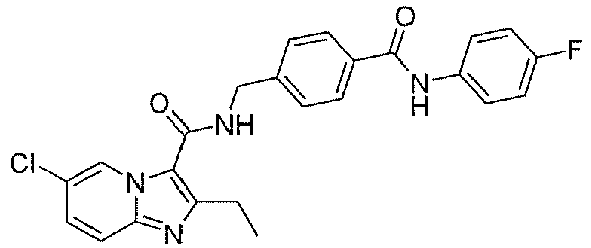 |
1H-NMR (400 MHz, CDC13 + CD3OD): δ 9.22 -9.23 (m, 1H), 7.88 (d, J = 8.4 Hz, 2H), 7.59 -7.63 (m, 2H), 7.50 (dd, J = 9.6, 2.0 Hz, 2H), 7.47 (d, J = 8.4 Hz, 2H), 7.33 (dd, J = 9.6, 2.0 Hz, 1H), 7.02 (dd, J = 9.6, 8.4 Hz, 1H), 4.68 (s, 2H), 2.98 (q, J = 7.6 Hz, 2H), 1.33 (t, J = 7.6 Hz, 3H); LCMS (electrospray) m/z (M+H)+ 451. |
| 302 |
 |
1H-NMR (400 MHz, CDCl3 + CD3OD): δ 9.06 (d, J = 7.6 Hz, 1H), 7.88 (d, J = 8.0 Hz, 2H), 7.60 -7.62 (m, 2H), 7.54 (d, J = 2.0 Hz, 2H), 7.46 (d, J = 8.0 Hz, 1H), 7.02 (dd, J = 8.8, 8.8 Hz, 2H), 6.93 (dd, J = 7.6, 2.0 Hz, 1H), 4.68 (s, 2H), 2.7 (q, J = 7.6 Hz, 2H), 1.33 (t, J = 7.6 Hz, 3H); LCMS (electrospray) m/z (M+H)+ 451. |
| 303 |
 |
1H-NMR (400 MHz, CDC13): δ 9.51 (d, J = 2.0 Hz, 1H), 7.53 (d, J = 9.6 Hz, 1H), 7.31 -7.41 (m, 4H), 7.29 (dd, J = 9.6, 2.0 Hz, 1H), 6.12 (t, J = 5.2 Hz, 1H), 4.68 (d, J = 5.6 Hz, 2H), 3.68 -3.80 (m, 4H), 2.97 (q, J = 7.6 Hz, 2H), 2.42 -2.52 (m, 4H), 1.39 (t, J = 7.6 Hz, 3H); LCMS (electrospray) m/z (M+H)+ 441 |
| 304 |
 |
1H-NMR (400 MHz, CDC13): δ 9.35 (d, J = 7.2 Hz, 1H), 7.58 (d, J = 2.0 Hz, 1H), 7.33 -7.38 (m, 4H), 6.90 (dd, J = 7.4, 2.0 Hz, 1H), 6.09 (t, J = 5.0 Hz, 1H), 4.68 (d, J = 5.6 Hz, 2H), 3.68 -3.80 (m, 4H), 2.96 (q, J = 7.6 Hz, 2H), 2.42 -2.52 (m, 4H), 1.39 (t, J = 7.6 Hz, 3H); LCMS (electrospray) m/z (M+H)+ 441. |
| 305 |
 |
1H-NMR (400 MHz, CDC13): δ 9.48 -9.49 (m, 1H), 7.53 (d, J = 8.8 Hz, 1H), 7.28 -7.31 (m, 3H), 7.19 (d, J = 8.0 Hz, 2H), 7.00 -7.03 (m, 2H), 6.92 (dd, J = 8.8, 8.0 Hz, 2H), 6.07 (m, 1H), 4.62 (d, J = 5.6 Hz, 2H), 3.46 (s, 3H), 2.93 (q, J = 7.6 Hz, 2H), 1.36 (t, J = 7.6 Hz, 3H); LCMS (electrospray) m/z (M+H)+ 465. |
| 306 |
 |
1H-NMR (400 MHz, CDCl3): δ 9.28 (d, J = 7.6 Hz, 1H), 7.56 (d, J = 2.0 Hz, 1H), 7.26 (d, J = 8.0 Hz, 2H), 7.16 (d, J = 8.0 Hz, 2H), 6.98 -7.01 (m, 2H), 6.86 -6.93 (m, 3H), 6.92 (dd, J = 8.8, 8.0 Hz, 2H), 6.15 (t, J = 5.6 Hz, 1H), 4.60 (d, J = 5.6 Hz, 2H), 3.43 (s, 3H), 2.89 (q, J = 7.6 Hz, 2H), 1.34 (t, J = 7.6 Hz, 3H); LCMS (electrospray) m/z (M+H)+ 465. |
| 307 |
 |
1H-NMR (400 MHz, CDCl3): δ 9.53 (d, J = 2.0 Hz, 1H (m, 1H), 7.55 (d, J = 9.6 Hz, 1H), 7.31 (dd, J = 9.6, 2.0 Hz, 1H), 7.05 -7.10 (m, 2H), 6.93 (dd, J = 9.2, 8.0 Hz, 2H), 6.08 (t, J = 5.6 Hz, 1H), 4.62 (d, J = 5.6 Hz, 2H), 3.85 -3.88 (m, 4H), 3.07 -3.10 (m, 4H), 2.98 (q, J = 7.6 Hz, 2H), 1.42 (t, J = 7.6 Hz, 3H); LCMS (electrospray) m/z (M+H)+ 417. |
| 308 |
 |
1H-NMR (400 MHz, CDC13): δ 9.36 (d, J = 7.6 Hz, 1H), 7.60 (d, J = 2.0 Hz, 1H), 7.05 -7.10 (m, 2H), 6.90 -6.95 (m, 2H), 6.07 (t, J = 5.6 Hz, 1H), 4.62 (d, J = 5.6 Hz, 2H), 3.85 -3.88 (m, 4H), 3.08 -3.09 (m, 4H), 3.00 (q, J = 7.6 Hz, 2H), 1.41 (t, J = 7.6 Hz, 3H); LCMS (electrospray) m/z (M+H)+ 417. |
| 309 |
 |
1H-NMR (400 MHz, DMSO-d6): δ 8.80 (d, J = 6.8 Hz, 1H), 8.42 (t, J = 6.0 Hz, 1H), 7.27 (dd, J = 8.0, 7.6 Hz, 1H), 7.22 (d, J = 8.8 Hz, 2H), 7.12 (d, J = 8.0 Hz, 2H), 7.08 (d, J = 8.4 Hz, 2H), 6.95 -6.98 (m, 4H), 6.94 (d, J = 8.8 Hz, 2H), 4.41 (d, J = 6.0 Hz, 2H), 3.70 -3.80 (m, 2H), 3.40 -3.48 (m, 3H), 2.67 -2.73 (m, 2H), 2.57 (s, 3H), 2.24 (s, 3H), 1.78 -1.84 (m, 2H), 1.50 -1.76 (m, 2H); LCMS (electrospray) m/z (M+H)+ 457. |
| 310 |
 |
1H-NMR (400 MHz, DMSO-d6): δ 8.80 (d, J = 6.8 Hz, 1H), 8.42 (t, J = 6.0 Hz, 1H), 7.64 (d, J = 8.4 Hz, 2H), 7.49 (d, J = 8.4 Hz, 2H), 7.27 (dd, J = 7.6, 7.6 Hz, 1H), 7.23 (d, J = 8.8 Hz, 2H), 6.96 -6.99 (m, 1H), 6.95 (d, J = 8.8 Hz, 2H), 4.42 (d, J = 6.0 Hz, 2H), 3.70 -3.80 (m, 2H), 3.30 - 3.40 (m, 3H), 2.70 -2.80 (m, 2H), 2.57 (s, 3H), 1.84 -1.90 (m, 2H), 1.70 - 1.80 (m, 2H); LCMS (electrospray) m/z (M+H)+ 511. |
| 311 |
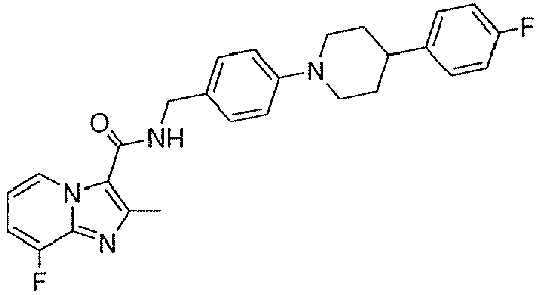 |
1H-NMR (400 MHz, CDC13): δ 9.24 (d, J = 6.8 Hz, 1H), 7.30 (d, J = 8.0 Hz, 2H), 7.30 (d, J = 8.0 Hz, 2H), 7.15 -7.24 (m, 3H), 6.97 -7.06 (m, 4H), 6.81 -6.97 (m, 1H), 6.05 (br s, 1H), 4.62 (d, J = 5.2 Hz, 2H), 3.76 -3.85 (m, 2H), 2.80 -2.90 (m, 2H), 2.69 (s, 3H),2.60 -2.68 (m, 1H), 1.60 -2.00 (m, 4H); LCMS (electrospray) m/z (M+H)+ 461. |
| 312 |
 |
1H-NMR (400 MHz, DMSO-d6): δ 8.80 (d, J = 6.8 Hz, 1H), 8.43 (t, J = 6.0 Hz, 1H), 7.39 (d, J = 8.8 Hz, 2H), 7.24 -7.29 (m, 2H), 7.22 (d, J = 8.8 Hz, 2H), 6.96 -6.99 (m, 1H), 6.94 (d, J = 8.8 Hz, 2H), 4.42 (d, J = 6.0 Hz, 2H), 3.70 -3.80 (m, 2H), 3.30 -3.40 (m, 3H), 2.70 -2.80 (m, 2H), 2.57 (s, 3H), 1.82 -1.90 (m, 2H), 1.68 -1.80 (m, 2H); LCMS (electrospray) m/z (M+H)+ 527. |
| 313 |
 |
1H-NMR (400 MHz, DMSO-d6): δ-1.68 -1.75 (m, 2H), 1.79 -1.85 (m, 2H), 2.56 (s, 3H), 2.62 -2.73 (m, 3H), 3.74 -3.77 (m, 2H), 4.43 (d, J = 5.6 Hz, 2H), 6.95 (d, J = 8.4 Hz, 2H), 7.04 -7.11 (m, 2H), 7.23 (d, J = 8.4 Hz, 2H), 7.27 -7.30 (m, 2H), 7.44 -7.49 (m, 1H), 7.61 -7.64 (m, 1H), 8.28 (t, J = 5.6 Hz, 1H, NH), 9.06 -9.07 (m, 1H), ; LCMS (electrospray) m/z (M+H)+ 461. |
| 314 |
 |
1H-NMR (400 MHz, DMSO-d6): δ-1.68 -1.75 (m, 2H), 1.79 -1.83 (m, 2H), 2.56 (s, 3H), 2.58 -2.62 (m, 1H), 2.68 -2.73 (m, 1H), 3.74 -3.77 (m, 2H), 4.42 (d, J = 6.0 Hz, 2H), 6.94 (d, J = 8.4 Hz, 2H), 7.07 -7.13 (m, 4H), 7.23 (d, J = 8.4 Hz, 2H), 7.44 -7.49 (m, 2H), 7.61 -7.64 (m, 1H), 8.27 (t, J = 6.0 Hz, 1H, NH), 9.05 -9.07 (m, 1H) ; LCMS (electrospray) m/z (M+H)+ 456. |
| 315 |
 |
1H-NMR (400 MHz, DMSO-d6): δ-1.71 -1.80 (m, 2H), 1.83 -1.88 (m, 2H), 2.56 (s, 3H), 2.71 -2.80 (m, 3H), 3.77 -3.80 (m, 2H), 4.43 (d, J = 6.0 Hz, 2H), 6.96 (d, J = 8.4 Hz, 2H), 7.24 (d, J = 8.4 Hz, 2H), 7.44 -7.50 (m, 3H), 7.61 -7.65 (m, 3H), 8.28 (t, J = 6.0 Hz, 1H, NH), 9.05 -9.07 (m, 1H) ; LCMS (electrospray) m/z (M+H)+ 511. |
| 316 |
 |
1H-NMR (400 MHz, Acetone-d6): δ-1.82 -1.89 (m, 2H), 1.92 -1.96 (m, 2H), 2.66 (s, 3H), 2.76 -2.84 (m, 3H), 3.82 -3.86 (m, 2H), 4.58 (d, J = 5.6 Hz, 2H), 6.99 (d, J = 8.4 Hz, 2H), 7.26 -7.31 (m, 4H), 7.37 -7.44 (m, 4H), 7.55 -7.59 (m, 1H), 9.34 -9.36 (m, 1H) ; LCMS (electrospray) m/z (M+H)+ 527. |
| 317 |
 |
1H-NMR (400 MHz, CDCl3): δ 1.40 (t, J = 7.6 Hz, 3H), 2.86 -3.00 (m, 5H), 4.70 -4.47 (m, 4H), 6.20 (brs, 1H), 7.45 -7.01 (m, 9H), 7.53 (d, J = 9.6 Hz, 1H), 9.50 (s, 1H). |
| 318 |
 |
1H-NMR (400 MHz, CDCl3): δ 1.39 (t, J = 7.6 Hz, 3H), 2.86 -2.99 (m, 5H), 4.48 (m, 2H), 4.71 -4.69 (m, 2H), 6.16 (brs, 1H), 6.89 (dd, J = 7.2Hz, 2.0 Hz, 1H), 7.01 -7.45 (m, 8H), 7.59 (d, J = 2.0 Hz, 1H), 9.34 (d, J = 7.2 Hz, 1H) |
| 319 |
 |
1H-NMR (400 MHz, CDCl3): δ 1.37 (t, J = 7.6 Hz, 3H), 2.02 -1.64 (m, 15H), 2.93 (q, J = 7.6 Hz, 2H), 3.48 (s, 2H), 4.60 (d, J = 5.2 Hz, 2H), 6.05 (brs, 1H), 6.88 (d, J = 8.0 Hz, 2H), 7.25 -7.27 (m, 3H), 7.51 (d, J = 9.6 Hz, 1H), 9.50 (s, 1H); ); 13C NMR (100 MHz, CDCl3) d 13.4, 23.6, 28.4, 28.5, 34.0, 37.3, 39.7, 43.4, 76.9, 77.2, 77.5, 78.6, 115.1, 117.0, 121.6, 126.3, 128.3, 129.2, 129.7, 144.6, 151.5, 159.6, 161.2, 199.8 |
| 320 |
 |
1H-NMR (400 MHz, CDCl3): δ 1.36 (t, J = 7.6 Hz, 3H), 2.00 -1.64 (m, 15H), 2.92 (q, J = 7.6 Hz, 2H), 3.48 (s, 2H), 4.59 (d, J = 5.6 Hz, 2H), 6.05 (brs, 1H), 6.89 -6.85 (m, 3H), 7.25 (d, J = 8.4 Hz, 2H), 7.55 (d, J = 2.0 Hz, 1H), 9.32 (d, J = 7.6 Hz, 1H); 13C NMR (100 MHz, CDCl3) d 13.4, 23.6, 28.4, 28.6, 34.0, 37.3, 39.7, 43.4, 76.9, 77.2, 77.5, 78.6, 114.7, 115.1, 115.8, 128.6, 129.2, 129.7, 133.6, 146.2, 151.7, 159.6, 161.2, 199.8 |
| 321 |
 |
1H-NMR (400 MHz, CDCl3): δ 1.36 (t, J = 7.6 Hz, 3H), 2.10 -1.63 (m, 15H), 2.94 (q, J = 7.6 Hz, 2H), 4.56 (d, J = 5.2 Hz, 2H), 5.99 (brs, 1H), 6.77 (d, J = 8.4 Hz, 2H), 7.14 (d, J = 8.4 Hz, 2H), 7.20 -7.29 (m, 1H), 7.52 (d, J = 9.6 Hz, 1H), 9.51 (d, J = 1.6 Hz, 1H); ; LCMS (electrospray) m/z (M+H)+ 463. |
| 322 |
 |
1H-NMR (400 MHz, CDCl3): δ 1.37 (t, J = 7.6 Hz, 3H), 2.10 -1.63 (m, 15H), 2.94 (q, J = 7.6 Hz, 2H), 4.54 (d, J = 5.2 Hz, 2H), 5.95 (brs, 1H), 6.59 (d, J = 8.8 Hz, 2H), 6.88 (dd, J = 2.4 Hz, 7.6 Hz, 1H), 7.16 (d, J = 8.8 Hz, 2H), 7.58(d, J = 2.0 Hz, 1H), 9.35 (d, J = 7.6 Hz, 1H); LCMS (electrospray) m/z (M+H)+ 463 |
| 323 |
 |
1H-NMR (400 MHz, CDCl3): δ 1.38 (t, J = 7.6 Hz, 3H), 2.04 -1.61 (m, 15H), 2.94 (q, J = 7.6 Hz, 2H), 4.54 (d, J = 5.2 Hz, 2H), 5.98 (brs, 1H), 6.59 (d, J = 8.4 Hz, 2H), 7.16 (d, J = 8.8, 1H), 7.27 (dd, J = 2.4 Hz, 9.6 Hz, 1H), 7.52 (d, J = 9.2 Hz, 1H), 9.51 (d, J = 1.2 Hz, 1H); LCMS (electrospray) m/z (M+H)+ 463. |
| 324 |
 |
1H-NMR (400 MHz, CDC13): δ 1.37 (t, J = 7.6 Hz, 3H), 2.02 -1.61 (m, 15H), 2.93 (q, J = 7.6 Hz, 2H), 4.56 (d, J = 5.2 Hz, 2H), 5.97 (brs, 1H), 6.78 (d, J = 8.4 Hz, 2H), 6.88 (dd, J = 2.0 Hz, 7.0 Hz, 1H), 7.14 (d, J = 8.4 Hz, 2H), 7.58(d, J = 2.0 Hz, 1H), 9.34 (d, J = 7.2 Hz, 1H); LCMS (electrospray) m/z (M+H)+ 463. |
| 325 |
 |
White solid: 1H-NMR (400 MHz, DMSO-d6): δ 1.78-1.95 (m, 4H), 2.60 (s, 3H), 2.72-2.82 (m, 1H), 2.92-3.08 (m, 2H), 3.73-3.76 (m, 2H), 4.48 (d, J = 6.0 Hz, 2H), 7.11-7.22 (m, 4H), 7.29-7.35 (m, 4H), 7.54 (dd, J = 9.6, 1.6 Hz, 1H), 7.68 (d, J = 9.6 Hz, 1H), 8.48 (t, J = 6.0 Hz, 1H, NH), 9.15 (d, J = 1.2 Hz, 1H); LCMS (electrospray) m/z (M+H) + 477. |
| 326 |
 |
Beige solid: 1H-NMR (400 MHz, DMSO-d6): δ 1.66-1.86 (m, 4H), 2.60 (s, 3H), 2.70-2.75 (m, 3H), 3.76-3.79 (m, 2H), 4.43 (d, J = 5.6 Hz, 2H), 6.95 (d, J = 8.8 Hz, 2H), 7.09-7.15 (m, 4H), 7.24 (d, J = 8.8 Hz, 2H), 7.46 (dd, J = 9.6, 2.4 Hz, 1H), 7.63 (d, J = 9.6 Hz, 1H), 8.36 (t, J = 5.6 Hz, 1H, NH), 9.12 (d, J = 1.6 Hz, 1H); LCMS (electrospray) m/z (M+H) + 473. |
| 327 |
 |
Beige solid: 1H-NMR (400 MHz, DMSO-d6): δ 1.72-1.92 (m, 4H), 2.59 (s, 3H), 2.73-2.79 (m, 3H), 3.79-3.82 (m, 2H), 4.44 (d, J = 6.0 Hz, 2H), 6.97 (d, J = 8.8 Hz, 2H), 7.25 (d, J = 8.8 Hz, 2H), 7.46 (dd, J = 9.4, 2.2 Hz, 1H), 7.51 (d, J = 8.0 Hz, 2H), 7.62-7.67 (m, 3H), 8.37 (t, J = 6.0 Hz, 1H, NH), 9.13 (d, J = 2.0 Hz, 1H) ); LCMS (electrospray) m/z (M+H) + 527. |
| 328 |
 |
Beige solid: 1H-NMR (400 MHz, DMSO-d6): δ 1.78-1.90 (m, 4H), 2.58 (s, 3H), 2.71-2.76 (m, 3H), 3.77-3.81 (m, 2H), 4.44 (d, J = 6.0 Hz, 2H), 6.97 (d, J = 8.8 Hz, 2H), 7.24 (d, J = 8.8 Hz, 2H), 7.29 (d, J = 8.8 Hz, 2H), 7.41 (d, J = 8.8 Hz, 2H), 7.46 (dd, J = 9.6, 2.0 Hz, 1H), 7.63 (d, J = 9.6 Hz, 1H), 8.36 (t, J = 6.0 Hz, 1H, NH), 9.13 (d, J = 1.6 Hz, 1H); LCMS (electrospray) m/z (M+H) + 543. |
| 329 |
 |
White solid: 1H-NMR (400 MHz, CDC13): δ 1.38 (t, J = 7.6 Hz, 3H), 2.95 (q, J = 7.6 Hz, 2H), 4.61 (d, J = 6.0 Hz, 2H), 4.73 (d, J = 6.0 Hz, 2H), 6.16 (brs, 1H), 6.37 (brs, 1H), 6.89 (dd, J = 2.0, 7.6 Hz, 1H), 6.99 - 7.06 (m, 2H), 7.30 -7.36 (m, 2H), 7.42 (dd, J = 7.6, 7.6 Hz, 1H), 7.51 - 7.55 (m, 1H), 7.59 (d, J = 2.0 Hz, 1H), 7.66 -7.68 (m, 1H), 7.84 (s, 1H), 9.33 (d, J = 7.6 Hz, 1H); LCMS (electrospray) m/z 465, 467 (M+H)+, Cl-isotope pattern. |
| 330 |
 |
Pale brown solid: 1H-NMR (400 MHz, CDC13): δ 1.35 (t, J = 7.6Hz, 3H), 2.76 -2.97 (m, 2H), 2.86 & 2.94 (s, 3H), 4.45 & 4.68 (s, 2H), 6.31 (brs, 1H), 6.87 (dd, J = 2.0, 7.2 Hz, 1H), 7.00 -7.08 (m, 3H), 7.26 -7.43 (m, 5H), 7.57 (d, J = 2.0 Hz, 1H), 9.28 (d, J = 7.2 Hz, 1H); LCMS (electrospray) m/z 479, 481 (M+H)+, Cl-isotope pattern. |
| 331 |
 |
Pale yellow solid: 1H-NMR (400 MHz, CDC13): δ 1.37 (t, J = 7.6 Hz, 3H), 2.62 -2.64 (m, 4H), 2.94 (q, J = 7.6 Hz, 2H), 3.74 -3.76 (m, 4H), 3.85 (s, 2H), 4.78 (d, J = 5.6 Hz, 2H), 6.18 (brt, J = 5.6 Hz, 1H), 7.28 (dd, J = 2.0, 9.6 Hz, 1H), 7.37 (dd, J = 1.2, 8.0 Hz, 1H), 7.51 -7.54 (m, 2H), 7.70 (d, J = 1.2 Hz, 1H), 9.51 (d, J = 2.0 Hz, 1H); LCMS (electrospray) m/z 454, 456 (M+H)+, Cl-isotope pattern. |
| 332 |
 |
Pale brown solid: 1H-NMR (400 MHz, CDC13): δ 1.37 (t, J = 7.6 Hz, 3H), 2.63 -2.65 (m, 4H), 2.94 (q, J = 7.6 Hz, 2H), 3.75 -3.77 (m, 4H), 3.86 (s, 2H), 4.79 (d, J = 6.0 Hz, 2H), 6.13 (brt, J = 6.0 Hz, 1H), 6.90 (dd, J = 2.0, 7.2 Hz, 1H), 7.37 (dd, J = 1.6, 8.4 Hz, 1H), 7.52 (d, J = 8.4 Hz, 1H), 7.59 (d, J = 2.0 Hz, 1H), 7.72 (d, J = 1.6 Hz, 1H), 9.36 (d, J = 7.2 Hz, 1H); LCMS (electrospray) m/z 454, 456 (M+H)+, Cl-isotope pattern. |
| 333 |
 |
Pale red solid: 1H-NMR (400 MHz, CDC13): δ 1.37 (t, J = 7.6 Hz, 3H), 1.98 -2.04 (m, 2H), 2.18 -2.29 (m, 2H), 2.93 (q, J = 7.6 Hz, 2H), 3.05 - 3.11 (m, 2H), 3.49 -3.55 (m, 2H), 4.19 -4.24 (m, 1H), 4.60 (d, J = 5.2 Hz, 2H), 6.01 (brs, 1H), 6.92 (d, J = 8.4 Hz, 2H), 7.26 -7.31 (m, 3H), 7.52 (d, J = 9.6 Hz, 1H), 9.53 (d, J = 2.1 Hz, 1H); LCMS (electrospray) m/z 431 (M+H)+. |
| 334 |
 |
Pale red solid: 1H-NMR (400 MHz, CDC13): δ 1.36(t, J = 7.2 Hz, 3H), 1.99 -2.04 (m, 2H), 2.17 -2.20 (m, 2H), 2.92 (q, J = 7.2 Hz, 2H), 3.05 - 3.10 (m, 2H), 3.50 -3.52 (m, 2H), 4.20 -4.23 (m, 1H), 4.59 (d, J = 5.6 Hz, 2H), 5.99 (brs, 1H), 6.89 -6.94 (m, 3H), 7.26 -7.27 (m, 2H), 7.58 (s, 1H), 9.35 (d, J = 6.8 Hz, 1H); LCMS (electrospray) m/z 431 (M+H)+. |
| 335 |
 |
White solid: 1H-NMR (400 MHz, DMSO-d6): δ 1.26 (t, J = 7.6 Hz, 3H), 2.98 (q, J = 7.6 Hz, 2H), 4.58 (d, J = 6.0 Hz, 2H), 7.08 (dd, J = 2.4, 7.2 Hz, 1H), 7.48 (d, J = 8.4 Hz, 2H), 7.72 (d, J = 8.0 Hz, 2H), 7.78 -7.80 (m, 3H), 8.00 (d, J = 8.4 Hz, 2H), 8.51 (brt, J = 5.6 Hz, 1H), 8.97 (d, J = 7.2 Hz, 1H); LCMS (electrospray) m/z 434, 436 (M+H)+, Cl-isotope pattern. |
| 336 |
 |
Pale yellow solid: 1H-NMR (400 MHz, CDCl3): δ 1.36 (t, J = 7.6 Hz, 3H), 1.71 -2.03 (m, 8H), 2.47 -2.55 (m, 2H), 2.62 -2.65 (m, 1H), 2.72 - 2.84 (m, 2H), 2.87 -2.97 (m, 3H), 3.30 -3.40 (m, 2H), 3.62 -3.77 (m, 4H), 4.23 -4.26 (m, 1H), 4.58 (d, J = 5.2 Hz, 2H), 6.02 (brs, 1H), 6.91 (d, J = 8.4 Hz, 2H), 7.24 -7.29 (m, 3H), 7.51 (d, J = 9.6 Hz, 1H), 9.51 (d, J = 1.2 Hz, 1H); LCMS (electrospray) m/z 554, 556 (M+H)+, Cl-isotope pattern. |
| 337 |
 |
Pale pink solid: 1H-NMR (400 MHz, CDC13): δ 1.36 (t, J = 7.6 Hz, 3H); 1.82 -1.92 (m, 2H), 2.00 -2.04 (m, 2H), 2.44 -2.51 (m, 5H), 2.61 (t, J = 5.6 Hz, 2H), 2.77 -2.84 (m, 2H), 2.91 (t, J = 7.6 Hz, 2H), 2.91 -2.97 (m, 1H), 3.62 -3.70 (m, 5H), 4.22 (t, J = 5.6 Hz, 2H), 4.58 (d, J = 5.6 Hz, 2H), 5.97 (brt, J = 5.6 Hz, 1H), 6.88 -6.94 (m, 3H), 7.25 -7.27 (m, 2H), 7.58 -7.59 (m, 1H), 9.35 (d, J = 7.6 Hz, 1H); LCMS (electrospray) m/z 554, 556 (M+H)+, Cl- isotope pattern. |
| 338 |
 |
White solid: 1H-NMR (400 MHz, CDC13): δ 1.38 (t, J = 7.6 Hz, 3H), 2.64 (s, 3H), 2.95 (q, J = 7.6 Hz, 2H), 4.78 (d, J = 5.6 Hz, 2H), 6.15 (brt, J = 5.6 Hz, 1H), 7.31 -7.35 (m, 2H), 7.46 (d, J = 8.4 Hz, 1H), 7.55 (d, J = 9.2 Hz, 1H), 7.65 (s, 114), 9.54 (s, 1H); LCMS (electrospray) m/z 369, 371 (M+H)+, Cl- isotope pattern. |
| 339 |
 |
White solid: 1H-NMR (400 MHz, CDCl3): δ 1.36 (t, J = 7.6 Hz, 3H), 2.64 (s, 3H), 2.93 (q, J = 7.6 Hz, 2H), 4.77 (d, J = 6.0 Hz, 2H), 6.14 (brt, J = 6.0 Hz, 1H), 6.90 (dd, J = 2.4, 7.6 Hz, 1H), 7.31 (dd, J = 2.0, 8.4 Hz, 1H), 7.45 (d, J = 8.4 Hz, 1H), 7.60 (d, J = 2.4 Hz, 1H), 7.65 (d, J = 2.0 Hz, 1H), 9.36 (d, J = 7.6 Hz, 1H); LCMS (electrospray) m/z 369, 371 (M+H)+, Cl- isotope pattern. |
| 340 |
 |
Pale yellow solid: 1H-NMR (400 MHz, CDCl3 + CD3OD): δ 1.24 (t, J = 7.6 Hz, 3H), 2.19 -2.25 (m, 2H), 2.81 (q, J = 7.6 Hz, 2H), 3.33 -3.45 (m, 3H), 3.58 -3.62 (m, 1H), 4.46 (d, J = 5.2 Hz, 2H), 4.93 -4.94 (m, 1H), 6.34 (brs, 1H), 6.48 (d, J = 8.2 Hz, 2H), 6.72 -6.75 (m, 2H), 7.13 -7.17 (m, 4H), 7.23 -7.26 (m, 1H), 7.42 -7.44 (m, 1H), 9.30 -9.31 (m, 1H); LCMS (electrospray) m/z 509, 511 (M+H)+, Cl- isotope pattern. |
| 341 |
 |
Pale yellow solid: 1H-NMR (400 MHz, CDC13): δ 1.35 (t, J = 7.6Hz, 3H), 2.27 -2.33 (m, 2H), 2.90 (q, J = 7.6 Hz, 2H), 3.41 -3.54 (m, 3H), 3.66 -3.70 (m, 1H), 4.56 (d, J = 5.2 Hz, 2H), 4.99 -5.02 (m, 1H), 5.95 (brs, 1H), 6.56 (d, J = 8.4 Hz, 2H), 6.79 -6.83 (m, 2H), 6.88 (dd, J = 2.0, 7.2 Hz, 1H), 7.21 -7.25 (m, 4H), 7.58 (d, J = 2.0 Hz, 1H), 9.34 (d, J = 7.2 Hz, 1H); LCMS (electrospray) m/z 509, 511 (M+H)+, Cl- isotope pattern. |
| 342 |
 |
Pale yellow solid: 1H-NMR (400 MHz, CDCl3 + CD3OD): δ 1.28 (t, J = 7.6 Hz, 3H), 2.23 -2.28 (m, 2H), 2.85 (q, J = 7.6 Hz, 2H), 3.37 -3.49 (m, 3H), 3.61 -3.65 (m, 1H), 4.50 (d, J = 5.2 Hz, 2H), 4.96 -4.97 (m, 1H), 6.22 (brs, 1H), 6.52 (d, J = 8.8 Hz, 2H), 6.75 -6.79 (m, 2H), 7.17 -7.20 (m, 4H), 7.28 (d, J = 1.6 Hz, 1H), 7.46 (d, J = 9.6 Hz, 1H), 9.37 -9.38 (m, 1H); LCMS (electrospray) m/z 509, 511 (M+H)+, Cl-isotope pattern. |
| 343 |
 |
Pale yellow solid: 1H-NMR (400 MHz, CDCl3): δ 1.34 (t, J = 7.6 Hz, 3H), 2.26 -2.33 (m, 2H), 2.89 (q, J = 7.6 Hz, 2H), 3.41 -3.53 (m, 3H), 3.66 -3.70 (m, 1H), 4.56 (d, J = 5.2 Hz, 2H), 4.99 -5.01 (m, 1H), 5.97 (bit, J = 5.2 Hz, 1H), 6.56 (d, J = 8.4 Hz, 2H), 6.78 -6.82 (m, 2H), 6.87 (dd, J = 2.0, 7.6 Hz, 1H), 7.21 -7.25 (m, 4H), 7.57 (d, J = 2.0 Hz, 1H), 9.34 (d, J = 7.6 Hz, 1H); LCMS (electrospray) m/z 509, 511 (M+H)+, Cl-isotope pattern. |
| 344 |
 |
Pale yellow solid: 1H-NMR (400 MHz, CDC13): δ 1.39 (t, J = 7.6 Hz, 3H), 1.99 -2.19 (m, 4H), 2.77 -2.80 (m, 1H), 2.95 -3.05 (m, 4H), 3.79 - 3.82 (m, 2H), 3.90 (s, 3H), 4.64 (d, J = 5.6 Hz, 2H), 6.41 (brs, 1H), 7.31 - 7.39 (m, 7H), 7.61 (d, J = 9.6 Hz, 1H), 7.97 -8.00 (m, 2H), 9.49 (d, J = 1.2 Hz, 1H); LCMS (electrospray) m/z 531, 533 (M+H)+ , Cl- isotope pattern. |
| 345 |
 |
Yellow solid: 1H-NMR (400 MHz, CDCl3 + CD3OD): δ 1.32 (t, J = 7.6 Hz, 3H), 1.97 -2.03 (m, 2H), 2.65 -2.80 (m, 1H), 2.95 -3.01 (m, 6H), 3.71 -3.74 (m, 2H), 4.57 (s, 2H), 4.57 (d, J = 6.4 Hz, 2H), 7.21 -7.28 (m, 6H), 7.40 -7.43 (m, 3H), 7.62 (d, J = 9.2 Hz, 1H), 9.28 (d, J = 1.6 Hz, 1H); LCMS (electrospray) m/z 503, 505 (M+H)+ , Cl-isotope pattern. |
| 346 |
 |
Violet solid: 1H-NMR (400 MHz, CDCl3): δ 1.39 (t, J = 7.6 Hz, 3H), 1.99 -2.09 (m, 4H), 2.79 -3.02 (m, 4H), 3.47 -3.50 (m, 1H), 3.81 -3.84 (m, 2H), 4.63 (s, 2H), 6.16 (brs, 1H), 7.00 -7.10 (m, 2H), 7.27 -7.45 (m, 5H), 7.57 -7.59 (m, 1H), 7.84 -7.85 (m, 2H), 9.52 (s, 1H), 9.99 (s, 1H); LCMS (electrospray) m/z 501, 503 (M+H)+, Cl- isotope pattern. |
| 347 |
 |
Pale pink solid: 1H-NMR (400 MHz, CDCl3): δ 1.94 -2.04 (m, 4H), 2.61 - 2.71 (m, 1H), 2.66 (s, 3H), 3.78 -3.81 (m, 2H), 4.61 (d, J = 5.6 Hz, 2H), 6.15 (brs, 1H), 6.79 -6.83 (m, 1H), 6.98 -7.16 (m, 4H), 7.19 -7.24 (m, 3H), 7.31 -7.33 (m, 2H), 9.43 -9.47 (m, 1H); LCMS (electrospray) m/z 461 (M+H)+. |
| 348 |
 |
White solid: 1H-NMR (400 MHz, CDCl3): δ 1.96 -2.02 (m, 4H), 2.65 - 2.75 (m, 1H), 2.70 (s, 3H), 2.95 -2.99 (m, 2H), 3.77 -3.80 (m, 2H), 4.63 (d, J = 5.6 Hz, 2H), 6.42 (brs, 1H), 6.84 -6.88 (m, 1H), 7.19 -7.24 (m, 2H), 7.26 -7.33 (m, 5H), 7.37 -7.41 (m, 2H), 9.42 -9.45 (m, 1H); LCMS (electrospray) m/z 477, 479 (M+H)+, Cl-isotope pattern |
| 349 |
 |
Pale pink solid: 1H-NMR (400 MHz, CDCl3): δ 1.97 -2.05 (m, 4H), 2.68 (s, 3H), 2.73 -2.82 (m, 1H), 2.83 -2.96 (m, 2H), 3.80 -3.83 (m, 2H), 4.62 (d, J = 5.6 Hz, 2H), 6.25 (brs, 1H), 6.81 -6.85 (m, 1H), 7.00 -7.18 (m, 2H), 7.24 -7.27 (m, 1H), 7.31 -7.41 (m, 4H), 7.56 -7.58 (m, 2H), 9.43 - 9.47 (m, 1H); LCMS (electrospray) m/z 511 (M+H)+. |
| 350 |
 |
White solid: 1H-NMR (400 MHz, CDCl3): δ 1.96 -2.05 (m, 4H), 2.69 (s, 3H), 2.69 -2.74 (m, 1H), 2.85 -2.96 (m, 2H), 3.78 -3.81 (m, 2H), 4.62 (d, J = 5.6 Hz, 2H), 6.31 (brs, 1H), 6.82 -6.87 (m, 1H), 7.15 -7.17 (m, 2H), 7.20 -7.30 (m, 5H), 7.35 -7.41 (m, 2H), 9.43 -9.46 (m, 1H); LCMS (electrospray) m/z 527 (M+H)+. |
Claims (4)
- A compound having the general formula I:
 X is CH or N;
Y is CH, O or N;
m is 0 or 1;
n is 0 or 1;R1 is, at each occurrence, independently selected from the group consisting of hydrogen, halogen, methyl, ethyl, t-butyl, phenyl, -NC(O)R5, -OR5, -C(O)R5, -C(O)OR5;R2 is, at each occurrence, independently selected from the group consisting of hydrogen and hydroxyl;R3 is, at each occurrence, independently selected from the group consisting of methyl and ethyl;R4 is, at each occurrence, independently selected from the group consisting of hydrogen, halogen, methyl, -methoxy and -CF3;R5 is, at each occurrence, independently selected from the group consisting of C1-C3 alkylhetorocycle, phenyl and benzyl;and pharmaceutically acceptable salts thereof;
or
a compound having the general formula VII: X is CH or NR24 is, at each occurrence, independently selected from the group consisting of hydrogen, halogen, C1-C2 alkyl, -methoxy, -CF3 and -OCF3;R25 is, at each occurrence, independently selected from the group consisting of methyl and ethyl;R26 is, at each occurrence, independently selected from the group consisting of hydrogen, halogen, methyl, -methoxy and -CF3;and pharmaceutically acceptable salts thereof, or
a compound having the general formula VIII: X is CH2 or NH
n is 0 or 1R27 is, at each occurrence, independently selected from the group consisting of methyl and ethyl;R28 is, at each occurrence, independently selected from the group consisting of hydrogen, halogen, methyl, -methoxy and -CF3;and pharmaceutically acceptable salts thereof,
wherein the compound has one of the formulae 1-231, 238, 281-285, 289-300, 309-316, 325-328, 333-337, 340-350, as shown in the following table:


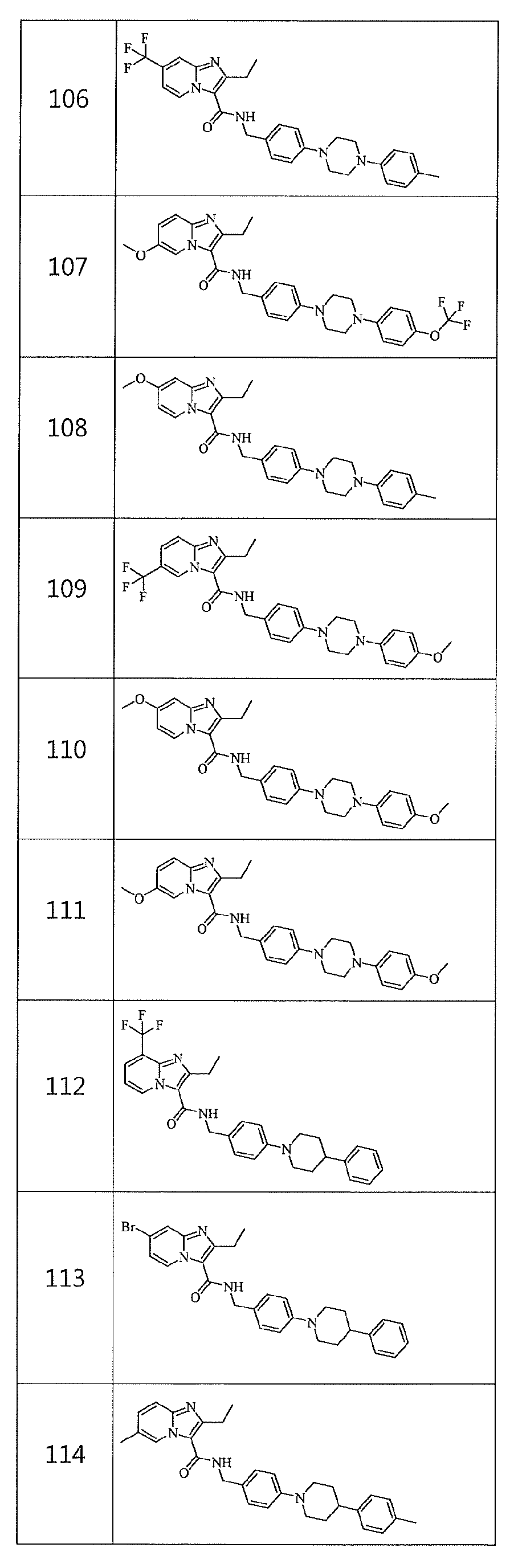

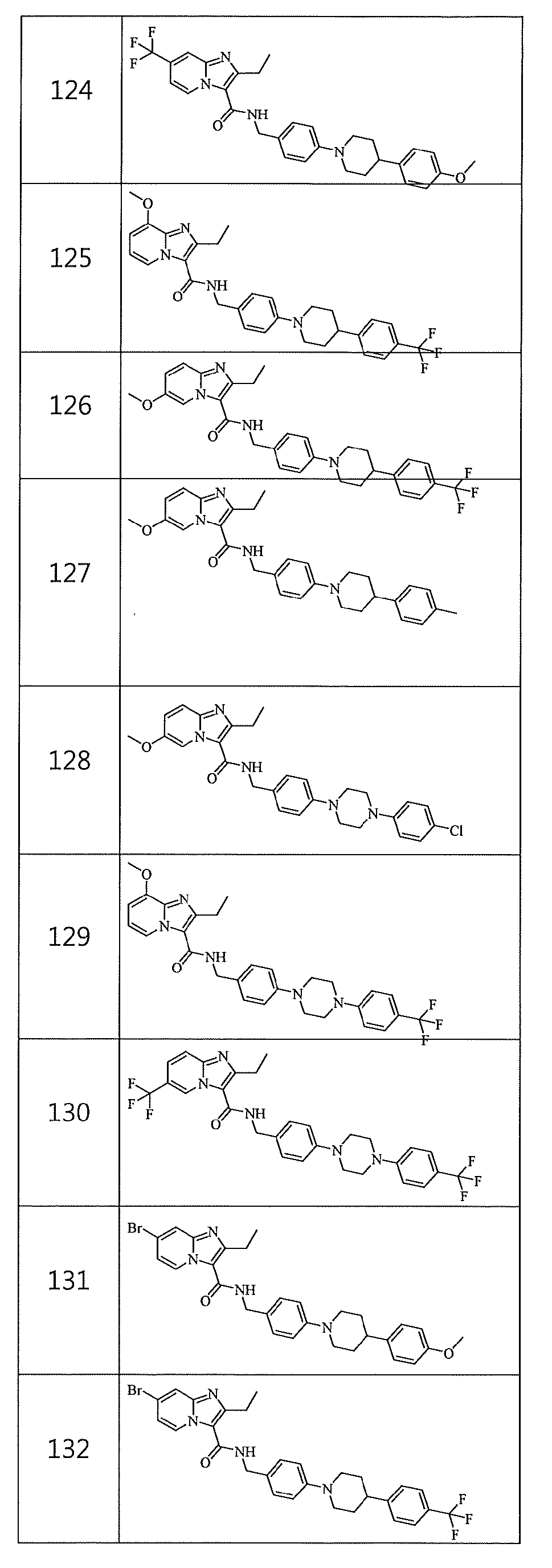


 , preferably one of the formulae 1-21, 23-24, 26, 28-33, 35-57, 59-77, 79-83, 85-87, 90-98, 100-102, 106-111, 113-116 118-124, 126-128, 130-142, 144-150, 153, 155-167, 169-184, 186-188, 190-197, 199, 201, 203-208, 210-211, 213-214, 216, 218-231, 238, 281-285, 289-300, 309-316, 325-328, 333-337, 340-350 as shown above.
- The compound according to claim 1, having one of the formulae 55, 171, 175 and 325 as shown hereafter:
55 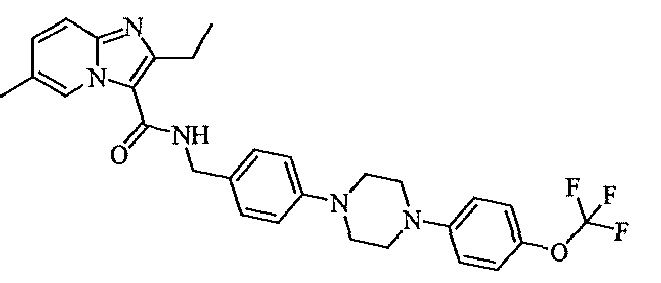
171 
175 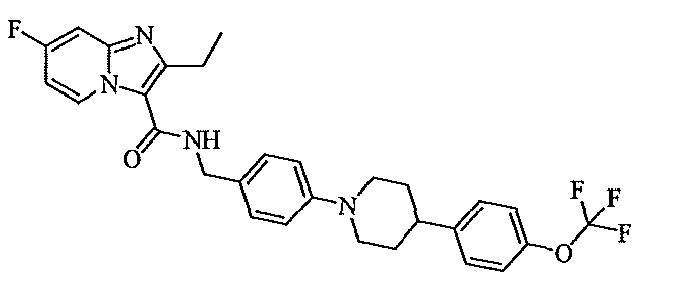
325 
- The compound according to any of claims 1 - 2, for use in the treatment of a bacterial infection, wherein, preferably, said bacterial infection is Tuberculosis.
- A pharmaceutical composition comprising a compound according to any of claims 1 - 3, and a pharmaceutically acceptable carrier.
Applications Claiming Priority (2)
| Application Number | Priority Date | Filing Date | Title |
|---|---|---|---|
| US201361861750P | 2013-08-02 | 2013-08-02 | |
| PCT/EP2014/066614 WO2015014993A2 (en) | 2013-08-02 | 2014-08-01 | Anti-infective compounds |
Publications (2)
| Publication Number | Publication Date |
|---|---|
| EP3027615A2 EP3027615A2 (en) | 2016-06-08 |
| EP3027615B1 true EP3027615B1 (en) | 2021-07-21 |
Family
ID=51260879
Family Applications (1)
| Application Number | Title | Priority Date | Filing Date |
|---|---|---|---|
| EP14745158.7A Active EP3027615B1 (en) | 2013-08-02 | 2014-08-01 | Anti-infective compounds |
Country Status (12)
| Country | Link |
|---|---|
| US (1) | US20160185774A1 (en) |
| EP (1) | EP3027615B1 (en) |
| JP (3) | JP2016525562A (en) |
| KR (1) | KR102292293B1 (en) |
| CN (2) | CN105745208A (en) |
| DK (1) | DK3027615T3 (en) |
| ES (1) | ES2883565T3 (en) |
| HU (1) | HUE056198T2 (en) |
| PH (1) | PH12016500207A1 (en) |
| RU (1) | RU2734760C2 (en) |
| SG (1) | SG11201600686QA (en) |
| WO (1) | WO2015014993A2 (en) |
Families Citing this family (27)
| Publication number | Priority date | Publication date | Assignee | Title |
|---|---|---|---|---|
| MD3316969T2 (en) * | 2015-07-02 | 2022-07-31 | Janssen Sciences Ireland Unlimited Co | Antibacterial compounds |
| PE20181352A1 (en) * | 2015-09-17 | 2018-08-22 | Marvin J Miller | HETEROCYCLIC COMPOUNDS CONTAINING BENZYLAMINE AND USEFUL COMPOSITIONS AGAINST MYCOBACTERIAL INFECTION |
| EP3472152A1 (en) * | 2016-06-16 | 2019-04-24 | Janssen Sciences Ireland Unlimited Company | Heterocyclic compounds as antibacte rials |
| MA45377A (en) | 2016-06-16 | 2019-04-24 | Janssen Sciences Ireland Unlimited Co | HETEROCYCLIC COMPOUNDS AS ANTIBACTERIAL AGENTS |
| MA47676A (en) | 2017-03-01 | 2021-06-02 | Janssen Sciences Ireland Unlimited Co | POLYTHERAPY |
| CN111246848A (en) | 2017-10-05 | 2020-06-05 | 快尔生物技术公司 | Ring-fused thiazolo-2-pyridone in combination with antituberculosis drugs |
| CN108101828B (en) * | 2018-01-15 | 2021-05-04 | 西华师范大学 | 3-indolylcarboxamide compounds and preparation method thereof |
| CN108159049B (en) * | 2018-02-01 | 2021-01-05 | 中国科学院广州生物医药与健康研究院 | A new use of pyridine compounds |
| AU2019387370A1 (en) | 2018-11-30 | 2021-06-10 | Nuvation Bio Inc. | Pyrrole and pyrazole compounds and methods of use thereof |
| JP2022081710A (en) * | 2019-03-29 | 2022-06-01 | ユーティアイ リミテッド パートナーシップ | Use of t-type calcium channel blocker for treating rheumatoid arthritis |
| US20220226299A1 (en) * | 2019-03-29 | 2022-07-21 | Nippon Chemiphar Co., Ltd. | Use of t-type calcium channel blocker for treating pruritus |
| TWI861208B (en) * | 2019-09-10 | 2024-11-11 | 日商鹽野義製藥股份有限公司 | Benzyl amine-containing 5,6-heteroaromatic compounds useful against mycobacterial infection |
| CN114423758B (en) * | 2019-09-13 | 2025-05-27 | 爱尔兰詹森科学公司 | Antibacterial compounds |
| KR20220071199A (en) * | 2019-09-30 | 2022-05-31 | 얀센 사이언시즈 아일랜드 언리미티드 컴퍼니 | 4-quinolinone antibacterial compound |
| CA3151712A1 (en) * | 2019-09-30 | 2021-04-08 | Jerome Emile Georges Guillemont | Cytochrome bd inhibitors as anti-bacterial agents for the treatment of tuberculosis |
| IL328855A (en) | 2019-12-20 | 2026-08-01 | Qurient Co Ltd | A pharmaceutical oral dosage form of q203 |
| KR102381397B1 (en) * | 2020-07-10 | 2022-03-30 | 경희대학교 산학협력단 | Naphthoquinone derivatives compound and a composition containing the same for antibacterial activity |
| WO2022194803A1 (en) | 2021-03-16 | 2022-09-22 | Janssen Sciences Ireland Unlimited Company | Antibacterial compounds |
| CA3211592A1 (en) | 2021-03-17 | 2022-09-22 | Jerome Emile Georges Guillemont | Antibacterial compounds |
| MX2023010941A (en) | 2021-03-17 | 2023-11-28 | Janssen Sciences Ireland Unlimited Co | Antibacterial compounds. |
| CA3234515A1 (en) | 2021-10-28 | 2023-05-04 | Jose Manuel Bartolome-Nebreda | Imidazopyridine amides and related compounds for use in the treatment of bacterial infections |
| JP2025530847A (en) * | 2022-09-16 | 2025-09-17 | 北京華益健康薬物研究中心 | METTL3 inhibitor compounds, pharmaceutical compositions thereof and uses thereof |
| WO2024089170A1 (en) | 2022-10-27 | 2024-05-02 | Janssen Sciences Ireland Unlimited Company | Antibacterial compounds |
| WO2024223859A1 (en) | 2023-04-26 | 2024-10-31 | Janssen Pharmaceutica Nv | Antibacterial compounds |
| JP2026525955A (en) | 2023-07-18 | 2026-08-04 | ヤンセン ファーマシューティカ エヌ.ベー. | A combination product of at least three antibiotics, including bedaquiline, pretomanid or delamanid, and a cytochrome BC1 inhibitor, and their use in the treatment of mycobacterial infections. |
| CN117946118A (en) * | 2024-01-15 | 2024-04-30 | 珃诺生物医药科技(杭州)有限公司 | A compound for targeted degradation of ERK5 protein and preparation method thereof |
| CN119118959A (en) * | 2024-09-06 | 2024-12-13 | 镇江市高等专科学校 | Preparation method of tert-butyl 4-[4-(aminomethyl)phenyl]piperazine-1-carboxylate |
Citations (2)
| Publication number | Priority date | Publication date | Assignee | Title |
|---|---|---|---|---|
| WO2009140101A2 (en) * | 2008-05-12 | 2009-11-19 | Boehringer Ingelheim International Gmbh | Imidazopyridine compounds useful as mmp-13 inhibitors |
| US20100298314A1 (en) * | 2006-12-20 | 2010-11-25 | Schering Corporation | Novel jnk inhibitors |
Family Cites Families (5)
| Publication number | Priority date | Publication date | Assignee | Title |
|---|---|---|---|---|
| FR2906250B1 (en) * | 2006-09-22 | 2008-10-31 | Sanofi Aventis Sa | DERIVATIVES OF 2-ARYL-6PHENYL-IMIDAZO (1,2-A) PYRIDINES, THEIR PREPARATION AND THEIR THERAPEUTIC USE |
| IN2012DN04917A (en) * | 2009-11-05 | 2015-09-25 | Univ Notre Dame Du Lac | |
| RU2576662C2 (en) * | 2010-03-18 | 2016-03-10 | Энститю Пастер Корея | Antiinfective compounds |
| WO2012143796A2 (en) * | 2011-04-21 | 2012-10-26 | Institut Pasteur Korea | Anti-inflammation compounds |
| CN103324035B (en) * | 2013-06-20 | 2015-07-01 | 深圳市华星光电技术有限公司 | Mask plate and manufacture method of array base plate |
-
2014
- 2014-08-01 WO PCT/EP2014/066614 patent/WO2015014993A2/en not_active Ceased
- 2014-08-01 RU RU2016107378A patent/RU2734760C2/en active
- 2014-08-01 JP JP2016530547A patent/JP2016525562A/en not_active Withdrawn
- 2014-08-01 CN CN201480054331.1A patent/CN105745208A/en active Pending
- 2014-08-01 CN CN201811384685.9A patent/CN109575018A/en active Pending
- 2014-08-01 EP EP14745158.7A patent/EP3027615B1/en active Active
- 2014-08-01 HU HUE14745158A patent/HUE056198T2/en unknown
- 2014-08-01 DK DK14745158.7T patent/DK3027615T3/en active
- 2014-08-01 SG SG11201600686QA patent/SG11201600686QA/en unknown
- 2014-08-01 ES ES14745158T patent/ES2883565T3/en active Active
- 2014-08-01 US US14/909,663 patent/US20160185774A1/en not_active Abandoned
- 2014-08-01 KR KR1020167005457A patent/KR102292293B1/en active Active
-
2016
- 2016-01-29 PH PH12016500207A patent/PH12016500207A1/en unknown
-
2018
- 2018-06-25 JP JP2018119810A patent/JP6757768B2/en active Active
-
2019
- 2019-04-15 JP JP2019077088A patent/JP2019131606A/en active Pending
Patent Citations (2)
| Publication number | Priority date | Publication date | Assignee | Title |
|---|---|---|---|---|
| US20100298314A1 (en) * | 2006-12-20 | 2010-11-25 | Schering Corporation | Novel jnk inhibitors |
| WO2009140101A2 (en) * | 2008-05-12 | 2009-11-19 | Boehringer Ingelheim International Gmbh | Imidazopyridine compounds useful as mmp-13 inhibitors |
Non-Patent Citations (1)
| Title |
|---|
| S. EKINS ET. AL.: "Bayesin Models Leveraging Bioactivity and Cytotoxicity Information for Drug Discovery", CHEMISTRY AND BIOLOGY, vol. 20, no. 3, 21 February 2013 (2013-02-21), pages 370 - 378, XP002768838 * |
Also Published As
| Publication number | Publication date |
|---|---|
| RU2016107378A (en) | 2017-09-07 |
| JP2016525562A (en) | 2016-08-25 |
| WO2015014993A3 (en) | 2015-04-02 |
| JP2018158941A (en) | 2018-10-11 |
| SG11201600686QA (en) | 2016-02-26 |
| EP3027615A2 (en) | 2016-06-08 |
| HUE056198T2 (en) | 2022-02-28 |
| PH12016500207A1 (en) | 2016-04-25 |
| KR20170082450A (en) | 2017-07-14 |
| ES2883565T3 (en) | 2021-12-09 |
| JP2019131606A (en) | 2019-08-08 |
| CN109575018A (en) | 2019-04-05 |
| JP6757768B2 (en) | 2020-09-23 |
| RU2016107378A3 (en) | 2018-03-29 |
| CN105745208A (en) | 2016-07-06 |
| KR102292293B1 (en) | 2021-08-23 |
| WO2015014993A2 (en) | 2015-02-05 |
| DK3027615T3 (en) | 2021-10-25 |
| US20160185774A1 (en) | 2016-06-30 |
| RU2734760C2 (en) | 2020-10-23 |
Similar Documents
| Publication | Publication Date | Title |
|---|---|---|
| RU2734760C2 (en) | Anti-infectious compounds | |
| EP3157904B1 (en) | Anti-infective compounds | |
| EP3022184B1 (en) | Substituted benzene compounds | |
| RU2576662C2 (en) | Antiinfective compounds | |
| AU2017208998B2 (en) | Bruton's tyrosine kinase inhibitors | |
| EP1742945B1 (en) | Substituted phenylamino-pyrimidines | |
| CN115835866B (en) | Cereblon binding compounds, compositions thereof, and methods of use thereof | |
| HUP0500109A2 (en) | Synthesis of 4,5-dihydro-pyrazolo[3,4-c]pyrid-2-ones | |
| WO2014134774A1 (en) | Compounds inhibiting leucine-rich repeat kinase enzyme activity | |
| KR20220141331A (en) | P2X3 modifier | |
| CN116262750A (en) | A kind of aromatic heterocyclic compound and its preparation method and application | |
| CN116322692A (en) | Autotaxin inhibitor compounds | |
| EP4194454A1 (en) | Heterocyclic compound as bcl-2 inhibitor | |
| CN113816950A (en) | Azaindole derivatives, preparation method and application thereof | |
| KR20180025914A (en) | Pyridin-3-ylacetic acid derivatives as inhibitors of human immunodeficiency virus replication | |
| JP2006511528A (en) | 2-pyridyl and 2-pyrimidylcycloalkyleneamide compounds as NR2B receptor antagonists | |
| KR101560536B1 (en) | Heterocyclic compounds | |
| WO2007045622A1 (en) | Oxazolo [4 , 5-b] pyridine compounds as nitric oxide synthase inhibitors | |
| CN117551078A (en) | Aromatic monocyclic derivatives and their preparation methods and uses |
Legal Events
| Date | Code | Title | Description |
|---|---|---|---|
| PUAI | Public reference made under article 153(3) epc to a published international application that has entered the european phase |
Free format text: ORIGINAL CODE: 0009012 |
|
| 17P | Request for examination filed |
Effective date: 20160229 |
|
| AK | Designated contracting states |
Kind code of ref document: A2 Designated state(s): AL AT BE BG CH CY CZ DE DK EE ES FI FR GB GR HR HU IE IS IT LI LT LU LV MC MK MT NL NO PL PT RO RS SE SI SK SM TR |
|
| AX | Request for extension of the european patent |
Extension state: BA ME |
|
| RIN1 | Information on inventor provided before grant (corrected) |
Inventor name: OH, SOOHYUN Inventor name: SEO, MOOYOUNG Inventor name: KANG, SUNHEE Inventor name: SEO, MIN JUNG Inventor name: KIM, RYANG YEO Inventor name: PETHE, KEVIN Inventor name: AHN, JIYE Inventor name: SEO, JEONGJEA Inventor name: LEE, SAEYEON Inventor name: LEE, SUMI Inventor name: PARK, DONGSIK Inventor name: KIM, JEONGJUN Inventor name: KIM, JAESEUNG Inventor name: NAM, KIYEAN Inventor name: KANG, JUHEE |
|
| DAX | Request for extension of the european patent (deleted) | ||
| STAA | Information on the status of an ep patent application or granted ep patent |
Free format text: STATUS: EXAMINATION IS IN PROGRESS |
|
| 17Q | First examination report despatched |
Effective date: 20170907 |
|
| RIC1 | Information provided on ipc code assigned before grant |
Ipc: C07D 471/04 20060101AFI20170906BHEP |
|
| 17Q | First examination report despatched |
Effective date: 20170914 |
|
| RIC1 | Information provided on ipc code assigned before grant |
Ipc: C07D 471/04 20060101AFI20170914BHEP |
|
| 17Q | First examination report despatched |
Effective date: 20170926 |
|
| RIC1 | Information provided on ipc code assigned before grant |
Ipc: C07D 471/04 20060101AFI20170921BHEP |
|
| 17Q | First examination report despatched |
Effective date: 20180123 |
|
| RIC1 | Information provided on ipc code assigned before grant |
Ipc: C07D 471/04 20060101AFI20180118BHEP |
|
| 17Q | First examination report despatched |
Effective date: 20180129 |
|
| RIC1 | Information provided on ipc code assigned before grant |
Ipc: C07D 471/04 20060101AFI20180119BHEP |
|
| PUAG | Search results despatched under rule 164(2) epc together with communication from examining division |
Free format text: ORIGINAL CODE: 0009017 |
|
| 17Q | First examination report despatched |
Effective date: 20180326 |
|
| B565 | Issuance of search results under rule 164(2) epc |
Effective date: 20180326 |
|
| RIC1 | Information provided on ipc code assigned before grant |
Ipc: C07D 471/04 20060101AFI20180321BHEP |
|
| GRAP | Despatch of communication of intention to grant a patent |
Free format text: ORIGINAL CODE: EPIDOSNIGR1 |
|
| STAA | Information on the status of an ep patent application or granted ep patent |
Free format text: STATUS: GRANT OF PATENT IS INTENDED |
|
| INTG | Intention to grant announced |
Effective date: 20190605 |
|
| GRAJ | Information related to disapproval of communication of intention to grant by the applicant or resumption of examination proceedings by the epo deleted |
Free format text: ORIGINAL CODE: EPIDOSDIGR1 |
|
| STAA | Information on the status of an ep patent application or granted ep patent |
Free format text: STATUS: EXAMINATION IS IN PROGRESS |
|
| INTC | Intention to grant announced (deleted) | ||
| GRAP | Despatch of communication of intention to grant a patent |
Free format text: ORIGINAL CODE: EPIDOSNIGR1 |
|
| STAA | Information on the status of an ep patent application or granted ep patent |
Free format text: STATUS: GRANT OF PATENT IS INTENDED |
|
| INTG | Intention to grant announced |
Effective date: 20210216 |
|
| GRAS | Grant fee paid |
Free format text: ORIGINAL CODE: EPIDOSNIGR3 |
|
| GRAA | (expected) grant |
Free format text: ORIGINAL CODE: 0009210 |
|
| STAA | Information on the status of an ep patent application or granted ep patent |
Free format text: STATUS: THE PATENT HAS BEEN GRANTED |
|
| AK | Designated contracting states |
Kind code of ref document: B1 Designated state(s): AL AT BE BG CH CY CZ DE DK EE ES FI FR GB GR HR HU IE IS IT LI LT LU LV MC MK MT NL NO PL PT RO RS SE SI SK SM TR |
|
| REG | Reference to a national code |
Ref country code: GB Ref legal event code: FG4D |
|
| REG | Reference to a national code |
Ref country code: CH Ref legal event code: EP |
|
| REG | Reference to a national code |
Ref country code: DE Ref legal event code: R096 Ref document number: 602014078891 Country of ref document: DE |
|
| REG | Reference to a national code |
Ref country code: AT Ref legal event code: REF Ref document number: 1412508 Country of ref document: AT Kind code of ref document: T Effective date: 20210815 |
|
| REG | Reference to a national code |
Ref country code: IE Ref legal event code: FG4D |
|
| REG | Reference to a national code |
Ref country code: DK Ref legal event code: T3 Effective date: 20211021 |
|
| REG | Reference to a national code |
Ref country code: SE Ref legal event code: TRGR |
|
| REG | Reference to a national code |
Ref country code: LT Ref legal event code: MG9D |
|
| REG | Reference to a national code |
Ref country code: ES Ref legal event code: FG2A Ref document number: 2883565 Country of ref document: ES Kind code of ref document: T3 Effective date: 20211209 |
|
| PG25 | Lapsed in a contracting state [announced via postgrant information from national office to epo] |
Ref country code: HR Free format text: LAPSE BECAUSE OF FAILURE TO SUBMIT A TRANSLATION OF THE DESCRIPTION OR TO PAY THE FEE WITHIN THE PRESCRIBED TIME-LIMIT Effective date: 20210721 Ref country code: RS Free format text: LAPSE BECAUSE OF FAILURE TO SUBMIT A TRANSLATION OF THE DESCRIPTION OR TO PAY THE FEE WITHIN THE PRESCRIBED TIME-LIMIT Effective date: 20210721 Ref country code: NO Free format text: LAPSE BECAUSE OF FAILURE TO SUBMIT A TRANSLATION OF THE DESCRIPTION OR TO PAY THE FEE WITHIN THE PRESCRIBED TIME-LIMIT Effective date: 20211021 Ref country code: PT Free format text: LAPSE BECAUSE OF FAILURE TO SUBMIT A TRANSLATION OF THE DESCRIPTION OR TO PAY THE FEE WITHIN THE PRESCRIBED TIME-LIMIT Effective date: 20211122 Ref country code: FI Free format text: LAPSE BECAUSE OF FAILURE TO SUBMIT A TRANSLATION OF THE DESCRIPTION OR TO PAY THE FEE WITHIN THE PRESCRIBED TIME-LIMIT Effective date: 20210721 Ref country code: LT Free format text: LAPSE BECAUSE OF FAILURE TO SUBMIT A TRANSLATION OF THE DESCRIPTION OR TO PAY THE FEE WITHIN THE PRESCRIBED TIME-LIMIT Effective date: 20210721 Ref country code: BG Free format text: LAPSE BECAUSE OF FAILURE TO SUBMIT A TRANSLATION OF THE DESCRIPTION OR TO PAY THE FEE WITHIN THE PRESCRIBED TIME-LIMIT Effective date: 20211021 |
|
| PG25 | Lapsed in a contracting state [announced via postgrant information from national office to epo] |
Ref country code: PL Free format text: LAPSE BECAUSE OF FAILURE TO SUBMIT A TRANSLATION OF THE DESCRIPTION OR TO PAY THE FEE WITHIN THE PRESCRIBED TIME-LIMIT Effective date: 20210721 Ref country code: LV Free format text: LAPSE BECAUSE OF FAILURE TO SUBMIT A TRANSLATION OF THE DESCRIPTION OR TO PAY THE FEE WITHIN THE PRESCRIBED TIME-LIMIT Effective date: 20210721 Ref country code: GR Free format text: LAPSE BECAUSE OF FAILURE TO SUBMIT A TRANSLATION OF THE DESCRIPTION OR TO PAY THE FEE WITHIN THE PRESCRIBED TIME-LIMIT Effective date: 20211022 |
|
| REG | Reference to a national code |
Ref country code: HU Ref legal event code: AG4A Ref document number: E056198 Country of ref document: HU |
|
| REG | Reference to a national code |
Ref country code: DE Ref legal event code: R097 Ref document number: 602014078891 Country of ref document: DE |
|
| PLBE | No opposition filed within time limit |
Free format text: ORIGINAL CODE: 0009261 |
|
| STAA | Information on the status of an ep patent application or granted ep patent |
Free format text: STATUS: NO OPPOSITION FILED WITHIN TIME LIMIT |
|
| PG25 | Lapsed in a contracting state [announced via postgrant information from national office to epo] |
Ref country code: SM Free format text: LAPSE BECAUSE OF FAILURE TO SUBMIT A TRANSLATION OF THE DESCRIPTION OR TO PAY THE FEE WITHIN THE PRESCRIBED TIME-LIMIT Effective date: 20210721 Ref country code: SK Free format text: LAPSE BECAUSE OF FAILURE TO SUBMIT A TRANSLATION OF THE DESCRIPTION OR TO PAY THE FEE WITHIN THE PRESCRIBED TIME-LIMIT Effective date: 20210721 Ref country code: RO Free format text: LAPSE BECAUSE OF FAILURE TO SUBMIT A TRANSLATION OF THE DESCRIPTION OR TO PAY THE FEE WITHIN THE PRESCRIBED TIME-LIMIT Effective date: 20210721 Ref country code: MC Free format text: LAPSE BECAUSE OF FAILURE TO SUBMIT A TRANSLATION OF THE DESCRIPTION OR TO PAY THE FEE WITHIN THE PRESCRIBED TIME-LIMIT Effective date: 20210721 Ref country code: LU Free format text: LAPSE BECAUSE OF NON-PAYMENT OF DUE FEES Effective date: 20210801 Ref country code: EE Free format text: LAPSE BECAUSE OF FAILURE TO SUBMIT A TRANSLATION OF THE DESCRIPTION OR TO PAY THE FEE WITHIN THE PRESCRIBED TIME-LIMIT Effective date: 20210721 Ref country code: CZ Free format text: LAPSE BECAUSE OF FAILURE TO SUBMIT A TRANSLATION OF THE DESCRIPTION OR TO PAY THE FEE WITHIN THE PRESCRIBED TIME-LIMIT Effective date: 20210721 Ref country code: AL Free format text: LAPSE BECAUSE OF FAILURE TO SUBMIT A TRANSLATION OF THE DESCRIPTION OR TO PAY THE FEE WITHIN THE PRESCRIBED TIME-LIMIT Effective date: 20210721 |
|
| 26N | No opposition filed |
Effective date: 20220422 |
|
| REG | Reference to a national code |
Ref country code: AT Ref legal event code: UEP Ref document number: 1412508 Country of ref document: AT Kind code of ref document: T Effective date: 20210721 |
|
| PG25 | Lapsed in a contracting state [announced via postgrant information from national office to epo] |
Ref country code: CY Free format text: LAPSE BECAUSE OF FAILURE TO SUBMIT A TRANSLATION OF THE DESCRIPTION OR TO PAY THE FEE WITHIN THE PRESCRIBED TIME-LIMIT Effective date: 20210721 |
|
| PG25 | Lapsed in a contracting state [announced via postgrant information from national office to epo] |
Ref country code: MK Free format text: LAPSE BECAUSE OF FAILURE TO SUBMIT A TRANSLATION OF THE DESCRIPTION OR TO PAY THE FEE WITHIN THE PRESCRIBED TIME-LIMIT Effective date: 20210721 |
|
| PG25 | Lapsed in a contracting state [announced via postgrant information from national office to epo] |
Ref country code: MT Free format text: LAPSE BECAUSE OF FAILURE TO SUBMIT A TRANSLATION OF THE DESCRIPTION OR TO PAY THE FEE WITHIN THE PRESCRIBED TIME-LIMIT Effective date: 20210721 |
|
| PGFP | Annual fee paid to national office [announced via postgrant information from national office to epo] |
Ref country code: NL Payment date: 20250825 Year of fee payment: 12 |
|
| PGFP | Annual fee paid to national office [announced via postgrant information from national office to epo] |
Ref country code: HU Payment date: 20250725 Year of fee payment: 12 |
|
| PGFP | Annual fee paid to national office [announced via postgrant information from national office to epo] |
Ref country code: ES Payment date: 20250916 Year of fee payment: 12 |
|
| PGFP | Annual fee paid to national office [announced via postgrant information from national office to epo] |
Ref country code: DK Payment date: 20250825 Year of fee payment: 12 Ref country code: DE Payment date: 20250827 Year of fee payment: 12 |
|
| PGFP | Annual fee paid to national office [announced via postgrant information from national office to epo] |
Ref country code: IT Payment date: 20250825 Year of fee payment: 12 Ref country code: TR Payment date: 20250714 Year of fee payment: 12 |
|
| PGFP | Annual fee paid to national office [announced via postgrant information from national office to epo] |
Ref country code: GB Payment date: 20250826 Year of fee payment: 12 Ref country code: BE Payment date: 20250825 Year of fee payment: 12 |
|
| PGFP | Annual fee paid to national office [announced via postgrant information from national office to epo] |
Ref country code: FR Payment date: 20250825 Year of fee payment: 12 Ref country code: AT Payment date: 20250819 Year of fee payment: 12 |
|
| PGFP | Annual fee paid to national office [announced via postgrant information from national office to epo] |
Ref country code: CH Payment date: 20250901 Year of fee payment: 12 |
|
| PGFP | Annual fee paid to national office [announced via postgrant information from national office to epo] |
Ref country code: IE Payment date: 20250819 Year of fee payment: 12 |
|
| PGFP | Annual fee paid to national office [announced via postgrant information from national office to epo] |
Ref country code: SE Payment date: 20260611 Year of fee payment: 13 |