EP3027613B1 - Pyrroloquinoline derivatives as 5-ht6 antagonists, preparation method and use thereof - Google Patents
Pyrroloquinoline derivatives as 5-ht6 antagonists, preparation method and use thereof Download PDFInfo
- Publication number
- EP3027613B1 EP3027613B1 EP13759883.5A EP13759883A EP3027613B1 EP 3027613 B1 EP3027613 B1 EP 3027613B1 EP 13759883 A EP13759883 A EP 13759883A EP 3027613 B1 EP3027613 B1 EP 3027613B1
- Authority
- EP
- European Patent Office
- Prior art keywords
- pyrrolo
- quinoline
- sulfonyl
- quinolin
- amine
- Prior art date
- Legal status (The legal status is an assumption and is not a legal conclusion. Google has not performed a legal analysis and makes no representation as to the accuracy of the status listed.)
- Not-in-force
Links
- 0 *c1cc2c3[n](*[Al])ccc3c(*)nc2cc1* Chemical compound *c1cc2c3[n](*[Al])ccc3c(*)nc2cc1* 0.000 description 1
- SGQYVHJZRWZPLA-YTJLLHSVSA-N CC(C)(C)OC(N(CC1)C[C@H]1Nc1nc2ccccc2c2c1cc[nH]2)O Chemical compound CC(C)(C)OC(N(CC1)C[C@H]1Nc1nc2ccccc2c2c1cc[nH]2)O SGQYVHJZRWZPLA-YTJLLHSVSA-N 0.000 description 1
- ZEYRDXUWJDGTLD-UHFFFAOYSA-N CCc1c(CCN(C)C)c(cc(cc2)OC)c2[nH]1 Chemical compound CCc1c(CCN(C)C)c(cc(cc2)OC)c2[nH]1 ZEYRDXUWJDGTLD-UHFFFAOYSA-N 0.000 description 1
- SQGDFGQPOSKCLT-UHFFFAOYSA-N CN(C)CCNc1c(cc[nH]2)c2c(cccc2)c2n1 Chemical compound CN(C)CCNc1c(cc[nH]2)c2c(cccc2)c2n1 SQGDFGQPOSKCLT-UHFFFAOYSA-N 0.000 description 1
- AIJIQCBYMBZLJD-UHFFFAOYSA-N CN(C)CCc(c1cc(OC)ccc11)c[n]1S(c1ccccc1)(=O)=O Chemical compound CN(C)CCc(c1cc(OC)ccc11)c[n]1S(c1ccccc1)(=O)=O AIJIQCBYMBZLJD-UHFFFAOYSA-N 0.000 description 1
- NCMQWXCVAGKLDH-UHFFFAOYSA-N CN(CC1)CCN1c1nc2ccccc2c2c1cc[nH]2 Chemical compound CN(CC1)CCN1c1nc2ccccc2c2c1cc[nH]2 NCMQWXCVAGKLDH-UHFFFAOYSA-N 0.000 description 1
- VYQKSTBALGEPLO-UHFFFAOYSA-N Clc(cc1c2c3cc[nH]2)ccc1nc3N1CCNCC1 Chemical compound Clc(cc1c2c3cc[nH]2)ccc1nc3N1CCNCC1 VYQKSTBALGEPLO-UHFFFAOYSA-N 0.000 description 1
Classifications
-
- A—HUMAN NECESSITIES
- A61—MEDICAL OR VETERINARY SCIENCE; HYGIENE
- A61K—PREPARATIONS FOR MEDICAL, DENTAL OR TOILETRY PURPOSES
- A61K31/00—Medicinal preparations containing organic active ingredients
- A61K31/33—Heterocyclic compounds
- A61K31/395—Heterocyclic compounds having nitrogen as a ring hetero atom, e.g. guanethidine or rifamycins
- A61K31/435—Heterocyclic compounds having nitrogen as a ring hetero atom, e.g. guanethidine or rifamycins having six-membered rings with one nitrogen as the only ring hetero atom
- A61K31/47—Quinolines; Isoquinolines
- A61K31/4738—Quinolines; Isoquinolines ortho- or peri-condensed with heterocyclic ring systems
- A61K31/4745—Quinolines; Isoquinolines ortho- or peri-condensed with heterocyclic ring systems condensed with ring systems having nitrogen as a ring hetero atom, e.g. phenantrolines
-
- A—HUMAN NECESSITIES
- A61—MEDICAL OR VETERINARY SCIENCE; HYGIENE
- A61K—PREPARATIONS FOR MEDICAL, DENTAL OR TOILETRY PURPOSES
- A61K31/00—Medicinal preparations containing organic active ingredients
- A61K31/33—Heterocyclic compounds
- A61K31/395—Heterocyclic compounds having nitrogen as a ring hetero atom, e.g. guanethidine or rifamycins
- A61K31/495—Heterocyclic compounds having nitrogen as a ring hetero atom, e.g. guanethidine or rifamycins having six-membered rings with two or more nitrogen atoms as the only ring heteroatoms, e.g. piperazine or tetrazines
- A61K31/496—Non-condensed piperazines containing further heterocyclic rings, e.g. rifampin, thiothixene or sparfloxacin
-
- A—HUMAN NECESSITIES
- A61—MEDICAL OR VETERINARY SCIENCE; HYGIENE
- A61K—PREPARATIONS FOR MEDICAL, DENTAL OR TOILETRY PURPOSES
- A61K31/00—Medicinal preparations containing organic active ingredients
- A61K31/33—Heterocyclic compounds
- A61K31/395—Heterocyclic compounds having nitrogen as a ring hetero atom, e.g. guanethidine or rifamycins
- A61K31/535—Heterocyclic compounds having nitrogen as a ring hetero atom, e.g. guanethidine or rifamycins having six-membered rings with at least one nitrogen and one oxygen as the ring hetero atoms, e.g. 1,2-oxazines
- A61K31/5375—1,4-Oxazines, e.g. morpholine
- A61K31/5377—1,4-Oxazines, e.g. morpholine not condensed and containing further heterocyclic rings, e.g. timolol
-
- A—HUMAN NECESSITIES
- A61—MEDICAL OR VETERINARY SCIENCE; HYGIENE
- A61K—PREPARATIONS FOR MEDICAL, DENTAL OR TOILETRY PURPOSES
- A61K31/00—Medicinal preparations containing organic active ingredients
- A61K31/33—Heterocyclic compounds
- A61K31/395—Heterocyclic compounds having nitrogen as a ring hetero atom, e.g. guanethidine or rifamycins
- A61K31/55—Heterocyclic compounds having nitrogen as a ring hetero atom, e.g. guanethidine or rifamycins having seven-membered rings, e.g. azelastine, pentylenetetrazole
- A61K31/551—Heterocyclic compounds having nitrogen as a ring hetero atom, e.g. guanethidine or rifamycins having seven-membered rings, e.g. azelastine, pentylenetetrazole having two nitrogen atoms, e.g. dilazep
-
- A—HUMAN NECESSITIES
- A61—MEDICAL OR VETERINARY SCIENCE; HYGIENE
- A61P—SPECIFIC THERAPEUTIC ACTIVITY OF CHEMICAL COMPOUNDS OR MEDICINAL PREPARATIONS
- A61P1/00—Drugs for disorders of the alimentary tract or the digestive system
-
- A—HUMAN NECESSITIES
- A61—MEDICAL OR VETERINARY SCIENCE; HYGIENE
- A61P—SPECIFIC THERAPEUTIC ACTIVITY OF CHEMICAL COMPOUNDS OR MEDICINAL PREPARATIONS
- A61P1/00—Drugs for disorders of the alimentary tract or the digestive system
- A61P1/04—Drugs for disorders of the alimentary tract or the digestive system for ulcers, gastritis or reflux esophagitis, e.g. antacids, inhibitors of acid secretion, mucosal protectants
-
- A—HUMAN NECESSITIES
- A61—MEDICAL OR VETERINARY SCIENCE; HYGIENE
- A61P—SPECIFIC THERAPEUTIC ACTIVITY OF CHEMICAL COMPOUNDS OR MEDICINAL PREPARATIONS
- A61P1/00—Drugs for disorders of the alimentary tract or the digestive system
- A61P1/12—Antidiarrhoeals
-
- A—HUMAN NECESSITIES
- A61—MEDICAL OR VETERINARY SCIENCE; HYGIENE
- A61P—SPECIFIC THERAPEUTIC ACTIVITY OF CHEMICAL COMPOUNDS OR MEDICINAL PREPARATIONS
- A61P1/00—Drugs for disorders of the alimentary tract or the digestive system
- A61P1/14—Prodigestives, e.g. acids, enzymes, appetite stimulants, antidyspeptics, tonics, antiflatulents
-
- A—HUMAN NECESSITIES
- A61—MEDICAL OR VETERINARY SCIENCE; HYGIENE
- A61P—SPECIFIC THERAPEUTIC ACTIVITY OF CHEMICAL COMPOUNDS OR MEDICINAL PREPARATIONS
- A61P25/00—Drugs for disorders of the nervous system
-
- A—HUMAN NECESSITIES
- A61—MEDICAL OR VETERINARY SCIENCE; HYGIENE
- A61P—SPECIFIC THERAPEUTIC ACTIVITY OF CHEMICAL COMPOUNDS OR MEDICINAL PREPARATIONS
- A61P25/00—Drugs for disorders of the nervous system
- A61P25/04—Centrally acting analgesics, e.g. opioids
-
- A—HUMAN NECESSITIES
- A61—MEDICAL OR VETERINARY SCIENCE; HYGIENE
- A61P—SPECIFIC THERAPEUTIC ACTIVITY OF CHEMICAL COMPOUNDS OR MEDICINAL PREPARATIONS
- A61P25/00—Drugs for disorders of the nervous system
- A61P25/06—Antimigraine agents
-
- A—HUMAN NECESSITIES
- A61—MEDICAL OR VETERINARY SCIENCE; HYGIENE
- A61P—SPECIFIC THERAPEUTIC ACTIVITY OF CHEMICAL COMPOUNDS OR MEDICINAL PREPARATIONS
- A61P25/00—Drugs for disorders of the nervous system
- A61P25/08—Antiepileptics; Anticonvulsants
-
- A—HUMAN NECESSITIES
- A61—MEDICAL OR VETERINARY SCIENCE; HYGIENE
- A61P—SPECIFIC THERAPEUTIC ACTIVITY OF CHEMICAL COMPOUNDS OR MEDICINAL PREPARATIONS
- A61P25/00—Drugs for disorders of the nervous system
- A61P25/14—Drugs for disorders of the nervous system for treating abnormal movements, e.g. chorea, dyskinesia
-
- A—HUMAN NECESSITIES
- A61—MEDICAL OR VETERINARY SCIENCE; HYGIENE
- A61P—SPECIFIC THERAPEUTIC ACTIVITY OF CHEMICAL COMPOUNDS OR MEDICINAL PREPARATIONS
- A61P25/00—Drugs for disorders of the nervous system
- A61P25/14—Drugs for disorders of the nervous system for treating abnormal movements, e.g. chorea, dyskinesia
- A61P25/16—Anti-Parkinson drugs
-
- A—HUMAN NECESSITIES
- A61—MEDICAL OR VETERINARY SCIENCE; HYGIENE
- A61P—SPECIFIC THERAPEUTIC ACTIVITY OF CHEMICAL COMPOUNDS OR MEDICINAL PREPARATIONS
- A61P25/00—Drugs for disorders of the nervous system
- A61P25/18—Antipsychotics, i.e. neuroleptics; Drugs for mania or schizophrenia
-
- A—HUMAN NECESSITIES
- A61—MEDICAL OR VETERINARY SCIENCE; HYGIENE
- A61P—SPECIFIC THERAPEUTIC ACTIVITY OF CHEMICAL COMPOUNDS OR MEDICINAL PREPARATIONS
- A61P25/00—Drugs for disorders of the nervous system
- A61P25/20—Hypnotics; Sedatives
-
- A—HUMAN NECESSITIES
- A61—MEDICAL OR VETERINARY SCIENCE; HYGIENE
- A61P—SPECIFIC THERAPEUTIC ACTIVITY OF CHEMICAL COMPOUNDS OR MEDICINAL PREPARATIONS
- A61P25/00—Drugs for disorders of the nervous system
- A61P25/22—Anxiolytics
-
- A—HUMAN NECESSITIES
- A61—MEDICAL OR VETERINARY SCIENCE; HYGIENE
- A61P—SPECIFIC THERAPEUTIC ACTIVITY OF CHEMICAL COMPOUNDS OR MEDICINAL PREPARATIONS
- A61P25/00—Drugs for disorders of the nervous system
- A61P25/24—Antidepressants
-
- A—HUMAN NECESSITIES
- A61—MEDICAL OR VETERINARY SCIENCE; HYGIENE
- A61P—SPECIFIC THERAPEUTIC ACTIVITY OF CHEMICAL COMPOUNDS OR MEDICINAL PREPARATIONS
- A61P25/00—Drugs for disorders of the nervous system
- A61P25/28—Drugs for disorders of the nervous system for treating neurodegenerative disorders of the central nervous system, e.g. nootropic agents, cognition enhancers, drugs for treating Alzheimer's disease or other forms of dementia
-
- A—HUMAN NECESSITIES
- A61—MEDICAL OR VETERINARY SCIENCE; HYGIENE
- A61P—SPECIFIC THERAPEUTIC ACTIVITY OF CHEMICAL COMPOUNDS OR MEDICINAL PREPARATIONS
- A61P25/00—Drugs for disorders of the nervous system
- A61P25/30—Drugs for disorders of the nervous system for treating abuse or dependence
-
- A—HUMAN NECESSITIES
- A61—MEDICAL OR VETERINARY SCIENCE; HYGIENE
- A61P—SPECIFIC THERAPEUTIC ACTIVITY OF CHEMICAL COMPOUNDS OR MEDICINAL PREPARATIONS
- A61P25/00—Drugs for disorders of the nervous system
- A61P25/30—Drugs for disorders of the nervous system for treating abuse or dependence
- A61P25/32—Alcohol-abuse
-
- A—HUMAN NECESSITIES
- A61—MEDICAL OR VETERINARY SCIENCE; HYGIENE
- A61P—SPECIFIC THERAPEUTIC ACTIVITY OF CHEMICAL COMPOUNDS OR MEDICINAL PREPARATIONS
- A61P25/00—Drugs for disorders of the nervous system
- A61P25/30—Drugs for disorders of the nervous system for treating abuse or dependence
- A61P25/34—Tobacco-abuse
-
- A—HUMAN NECESSITIES
- A61—MEDICAL OR VETERINARY SCIENCE; HYGIENE
- A61P—SPECIFIC THERAPEUTIC ACTIVITY OF CHEMICAL COMPOUNDS OR MEDICINAL PREPARATIONS
- A61P25/00—Drugs for disorders of the nervous system
- A61P25/30—Drugs for disorders of the nervous system for treating abuse or dependence
- A61P25/36—Opioid-abuse
-
- A—HUMAN NECESSITIES
- A61—MEDICAL OR VETERINARY SCIENCE; HYGIENE
- A61P—SPECIFIC THERAPEUTIC ACTIVITY OF CHEMICAL COMPOUNDS OR MEDICINAL PREPARATIONS
- A61P29/00—Non-central analgesic, antipyretic or antiinflammatory agents, e.g. antirheumatic agents; Non-steroidal antiinflammatory drugs [NSAID]
-
- A—HUMAN NECESSITIES
- A61—MEDICAL OR VETERINARY SCIENCE; HYGIENE
- A61P—SPECIFIC THERAPEUTIC ACTIVITY OF CHEMICAL COMPOUNDS OR MEDICINAL PREPARATIONS
- A61P3/00—Drugs for disorders of the metabolism
- A61P3/04—Anorexiants; Antiobesity agents
-
- A—HUMAN NECESSITIES
- A61—MEDICAL OR VETERINARY SCIENCE; HYGIENE
- A61P—SPECIFIC THERAPEUTIC ACTIVITY OF CHEMICAL COMPOUNDS OR MEDICINAL PREPARATIONS
- A61P3/00—Drugs for disorders of the metabolism
- A61P3/08—Drugs for disorders of the metabolism for glucose homeostasis
- A61P3/10—Drugs for disorders of the metabolism for glucose homeostasis for hyperglycaemia, e.g. antidiabetics
-
- A—HUMAN NECESSITIES
- A61—MEDICAL OR VETERINARY SCIENCE; HYGIENE
- A61P—SPECIFIC THERAPEUTIC ACTIVITY OF CHEMICAL COMPOUNDS OR MEDICINAL PREPARATIONS
- A61P43/00—Drugs for specific purposes, not provided for in groups A61P1/00-A61P41/00
-
- C—CHEMISTRY; METALLURGY
- C07—ORGANIC CHEMISTRY
- C07D—HETEROCYCLIC COMPOUNDS
- C07D471/00—Heterocyclic compounds containing nitrogen atoms as the only ring hetero atoms in the condensed system, at least one ring being a six-membered ring with one nitrogen atom, not provided for by groups C07D451/00 - C07D463/00
- C07D471/02—Heterocyclic compounds containing nitrogen atoms as the only ring hetero atoms in the condensed system, at least one ring being a six-membered ring with one nitrogen atom, not provided for by groups C07D451/00 - C07D463/00 in which the condensed system contains two hetero rings
- C07D471/04—Ortho-condensed systems
Definitions
- the invention relates to the field of pharmaceutical and organic chemistry, and provides pyrroloquinolone derivatives, formulations and methods.
- 5-HT 6 subtype One of the recent additions to the serotonin receptors superfamily constitute 5-HT 6 subtype, which via stimulating adenyl cyclase increases the cAMP intracellular level (Ruat et al., 1993; Schoeffter and Weaber, 1994).
- 5-HT 6 antagonists do not seem probable to display antipsychotic action (Pouzet et al., 2002). However, such compounds improve learning and memory in animal models, including novel object discrimination (King et al., 2004), Morris water maze learning (Rogers and Hagan, 2001) and attention set shifting (Rodefer et al., 2008). These results suggest that 5-HT 6 antagonist might be useful for the treatment of cognitive deficits in schizophrenia and other cognitive disorders such as Alzheimer's disease.
- 5-HT 6 ligands allowed observing interaction of the 5-HT 6 modulators and other brain neurotransmitters, mainly acetylcholine (Ach) and glutamate (Glu).
- the 5-HT 6 receptor antagonists have been shown to increase the acetylcholine transmission (Bentley et al., 1999; Riemer et al., 2003).
- SB-271046, a 5-HT 6 receptor antagonist increases the level of glutamate in the cortex and hippocampus (Dawson et al., 2001), while application of a 5-HT 6 receptor agonist WAY-466 leads to the hippocampal glutamate level decrease (Schechter et al., 2004).
- 5-HT 6 selective agents have been identified as potentially useful in the treatment or prophylaxis of certain disorders of the central nervous system such as Parkinson's disease, schizophrenia, anxiety depression, maniac depression, obsessive compulsive disorders, mood disorders, Alzheimer's disease, age related cognitive decline, mild cognitive impairment, neurodegenerative disorders characterized by impaired neuronal growth, panic attacks, epilepsy, attention deficit hyperactivity disorder (ADHD), withdraw from drug abuse such as cocaine, ethanol, nicotine and benzodiazepines, and pain.
- 5-HT 6 ligands are also expected to be useful in the treatment or prophylaxis of obesity and type-2 diabetes.
- the first selective 5-HT 6 receptors ligands were identified by the high throughput screening of the compound libraries, which resulted in the selection of the antagonist I-SB-271046 (Formula (I)). It was the first 5-HT 6 receptor agent that entered clinical trials for cognitive impairment in schizophrenia and Alzheimer's disease.
- the second group comprises arylpiperazine derivatives, containing one or more condensed aromatic rings.
- PRX-07034 belongs to monoarylpiperazine derivatives modified with sulfonyl moiety (Formula (V)).
- Formula (V) monoarylpiperazine derivatives modified with sulfonyl moiety
- SB-742457 and R-1485 are the subject of clinical trials for cognitive impairment in schizophrenia and Alzheimer's disease (Formulas (VI)-(VII)).
- sulfonyl or sulfonamide group may be replaced by its amide or alkyl bioisoster or carboxamide group (Cole et al., 2003; WO2005030724 ), arylsulfonyl and arylsulfonamide derivatives remain an important class of 5-HT 6 ligands.
- amide or alkyl bioisoster or carboxamide group Cold et al., 2003; WO2005030724
- arylsulfonyl and arylsulfonamide derivatives remain an important class of 5-HT 6 ligands.
- the goal of the present invention relates to providing potent and selective 5-HT 6 antagonists based on a pyrroloquinoline core structure, as compounds useful for the treatment of certain CNS disorders.
- derivatives containing pyrrolo[3,2- c ]quinoline core unit might act as inhibitors of kynurenine-3-hydroxylase (KYN-OH) enzyme, which is involved in the tryptophan metabolism and leads to the accumulation of the potent neurotoxic quinolinic acid. It is believed that selective inhibition of KYN-OH might play a role in the neuronal protection (Heidempergher et al., 1999).
- KYN-OH kynurenine-3-hydroxylase
- Patent publication US 6 365 598 B1 discloses series of differently substituted pyrroloquinolines as agonists and antagonists of 5-HT 2A and 5-HT 2C sites and their application in the treatment of CNS disorders, including obesity, schizophrenia, depression, anxiety, migraine, sexual disorders, pain and gastrointestinal dysfunctions (Formula (XII)).
- the invention relates to a compound of the general formula (XIV): or a tautomer, stereoisomer, N -oxide, isotopically-labelled analogue, or a pharmacologically acceptable salt, hydrate or solvate of any of the foregoing, wherein:
- the invention particularly relates to a compound of the general formula (XIV) or a tautomer, stereoisomer, N -oxide or a pharmacologically acceptable salt, hydrate or solvate of any of the foregoing, wherein:
- the invention relates to racemates, mixtures of diastereomers as well as the individual stereoisomers of the compounds having formula (XIV).
- the compounds of the invention of formula (XIV), as well as pharmacologically acceptable salts thereof, have 5-HT 6 receptor antagonistic activity and as such are useful in treating and preventing diseases, disorders or conditions involving 5-HT 6 receptors, or treatable by manipulation of those receptors.
- one aspect of the invention provides a method for the treatment, control or prevention of such diseases, disorders or conditions in a mammal which comprises administering to such mammal a therapeutically effective amount of a compound of formula XIV.
- the diseases, disorders or conditions for which the compounds of the present invention are useful in treating or preventing include, but are not limited to: schizophrenia, anxiety, depression, maniac depression, epilepsy, obsessive compulsive disorders, mood disorders, migraine, Alzheimer's disease, age related cognitive decline, mild cognitive impairment, sleep disorders, eating disorders, anorexia, bulimia, panic attacks, attention deficit hyperactivity disorder, attention deficit disorder, Parkinson's disease, Huntington's disease, withdrawal from abuse of cocaine, ethanol, nicotine or benzodiazepines, pain, obesity and type-2 diabetes, functional bowel disorder, Irritable Bowel Syndrome.
- the invention also provides the use of a compound or salt according to formula (XIV) for the manufacture of medicament.
- the invention further relates to combination therapies wherein a compound of the invention, of a pharmaceutically acceptable salt thereof, or a pharmaceutical composition or formulation comprising a compound of the invention, is administrated concurrently or sequentially or as a combined preparation with another therapeutic agent or agents, for treating one or more of the conditions listed.
- a compound of the invention, of a pharmaceutically acceptable salt thereof, or a pharmaceutical composition or formulation comprising a compound of the invention is administrated concurrently or sequentially or as a combined preparation with another therapeutic agent or agents, for treating one or more of the conditions listed.
- Such other therapeutic agent(s) may be administrated prior to, simultaneously with, of following the administration of the compounds of the invention.
- the therapeutic agent or agents used in the combination with the compound of invention relates to the compounds used for treating a disorder or conditions chosen from the disorders listed in the invention, with the mechanism of action that synergistically ameliorate the positive outcomes of therapy.
- the compounds of the invention exert 5-HT 6 receptor antagonist properties. This activity of the compounds of the invention is readily demonstrated, for example, using one or more of the assays described herein or known in the art.
- the invention also provides methods of preparing the compounds of the invention and the intermediates used in those methods.
- the invention relates to intermediates of general formula XIX: or a tautomer, stereoisomer, N -oxide, isotopically-labelled analogue or a pharmacologically acceptable salt, hydrate or solvate of any of the foregoing, wherein R 1 , R 2 , R 3 are the same as in formula (XIV).
- the invention relates to racemates, mixtures of diastereomers as well as the individual stereoisomers of the compounds having formula (XIX).
- the compounds of formula XIV can be prepared e.g. using the reactions and techniques described below. Generally, compounds described in the scope of this patent application can be synthesized by the route described in Scheme 1 and the Examples. In Scheme 1 compounds of formula XIV (A-9) and XIX (A-8) can be prepared by:
- Isolation and purification of the compounds and intermediates described herein can be affected, if desired, by any suitable separation or purification procedure such as, for example, filtration, extraction, crystallization, column chromatography, thin layer chromatography, preparative low or high-pressure liquid chromatography, or a combination of these procedures.
- the compounds of the present invention may contain one asymmetric center and can thus occur as racemates and racemic mixtures or single enantiomers.
- Some of the crystalline forms for the compounds may exist as polymorphs: as such intended to belong to the invention.
- some of the compounds may form solvates with water (i.e. hydrates), or common organic solvents. Such solvents also fall within the scope of this invention.
- the compounds of the invention may also be used as reagents or standards in the biochemical study of neurological function, dysfunction and disease.
- Examples of the compounds of the invention are the following: 1 N1,N1- dimethyl- N2 -(1-(phenylsulfonyl)-1 H -pyrrolo[3,2- c ]quinolin-4-yl)ethane-1,2-diamine 2 1-((3-chlorophenyl)sulfonyl)- N -(azetidin-3-yl)-1 H -pyrrolo[3,2- c ]quinolin-4-amine 3 1-(naphthalen-1-ylsulfonyl)- N -(azetidin-3-yl)-1 H -pyrrolo[3,2- c ]quinolin-4-amine 4 1-(phenylsulfonyl)- N -(pyrrolidin-3-yl)-1 H -pyrrolo[3,2- c ]quinolin-4-amine 5 1-((3-chlorophenyl)sulfonyl)- N -(pyrrolidin-3
- alkyl denotes a univalent saturated branched or straight hydrocarbon chain. Unless otherwise stated such chains can contain from 1 to 3 carbon atoms. Representative of such alkyl groups are methyl, ethyl, propyl, isopropyl and the like. The same carbon content applies to the patent term 'alkane', and to derivative terms such as 'alkoxy'.
- the carbon content of various hydrocarbon containing moieties is indicated by a prefix designating the minimum and maximum number of carbon atoms in the moiety, i.e., the prefix C x -C y defines the number of carbon atoms present from the integrer "x" to the integrer "y” inclusive.
- 'Alkyl(C 1-3 )' for example, means methyl, ethyl, n-propyl or isopropyl.
- 'aryl' embraces monocyclic or fused bicyclic aromatic or hetero-aromatic groups, including but not limited to furyl, thienyl, pyrroryl, oxazolyl, thiazolyl, imidazolyl, imidazo[2,1-b][1,3]thiazolyl, pyrazolyl, isoxazolyl, isothiazolyl, pyridyl, pyridazinyl, pirymidinyl, pyrazinyl, 1,3,5-triazinyl, phenyl, 1 H -indazol-7-yl, 1 H -indazol-6-yl, 1 H -indol-2-yl, 1 H -indol-3-yl, 1 H -indol-6-yl, 1 H -indol-7-yl, indolizinyl, isoindolyl, 1-benzofuran-2-yl, 1-benz
- 'Halo ' or 'Halogen' means chloro, fluoro, bromo or iodo; 'hetero' as in 'heteroalkyl, heteroaromatic' etc. means containing one or more N, O or S atoms. 'heteroalkyl' includes alkyl groups with heteroatoms in any position, thus including N -bound O -bound or S-bound alkyl groups.
- substituted' means that the specified group or moiety bears one or more substituents. Where any group may carry multiple substituents, and a variety of possible substituents is provided, the substituents are independently selected, and need not to be the same.
- the term 'unsubstituted' means that the specified group bears no substituents.
- N -oxides of the compounds mentioned above belong to the invention.
- Tertiary amines may or may not give rise to N -oxide metabolites.
- the extent to what N -oxidation takes place varies from trace amounts to a near quantitative conversion.
- N -oxides may be more active than their corresponding tertary amines, or less active. While N -oxides can easily be reduced to their corresponding tertary amines by chemical means, in human body this happens to varying degrees.
- Some N-oxides undergo nearly quantitative reductive conversion to the corresponding tertiary amines, in other cases is a mere trace reaction, or even completely absent.
- any compound metabolized in vivo to provide the bioactive agent is a prodrug
- Prodrugs are therapeutic agents, inactive per se but transformed into one or more active metabolites.
- Prodrugs are bioreversible derivatives of drug molecules used to overcome some barriers to the utility of the parent drug molecule. These barriers include, but are not limited to, solubility, permeability, stability, presystemic metabolism and targeting limitations. In particular this relates to compounds with primary or secondary amino or hydroxy groups.
- Such compounds can be reacted with organic acids to yield compounds having formula (XIV) wherein an additional group is present that is easily removed after administration, for instance, but not limited to amidine, enamine, a Mannich base, a hydroxyl-methylene derivative, an O-(acyloxymethylene carbamate) derivative, carbamate, ester, amide or enaminone.
- an additional group is present that is easily removed after administration, for instance, but not limited to amidine, enamine, a Mannich base, a hydroxyl-methylene derivative, an O-(acyloxymethylene carbamate) derivative, carbamate, ester, amide or enaminone.
- 'Crystal form' refers to various solid forms of the same compound, for example polymorphs, solvates and amorphous forms.
- the compound of formula (XIV) and pharmaceutically acceptable salts thereof may exist in a form of hydrate or a solvate, and such a hydrate and solvate are also encompassed in the present invention. Examples thereof include 1/10 hydrates hydrate, 1/4 hydrate, monohydrate, dihydrochloride, dihydrate, dihydrochloride 3/2 hydrate, and the like.
- 'Amorphous' forms are non-crystalline materials with no long range order, and generally do not give a distinctive powder X-ray diffraction pattern.
- selective and “selectivity” refer to compounds that display reactivity towards a particular receptor (e.g. a 5-HT 6 receptor) without displaying substantial cross-reactivity towards another receptor (e.g. other 5-HT receptor sub-types).
- selective compounds of the present invention may display reactivity towards 5-HT 6 receptors without displaying substantial cross-reactivity towards other 5-HT receptors.
- a compound of the present invention has at least about 10 folds selectivity to the 5-HT 6 receptor, at least about 50 folds selectivity to the 5-HT 6 receptor, at least about 100 folds selectivity to 5-HT 6 receptor, at least about 250 folds selectivity to 5-HT 6 receptor, or at least about 500 folds selectivity to the desired target.
- the present invention provides a pharmaceutical composition comprising a compound of formula (XIV), or pharmaceutically acceptable salt or solvate thereof, together with one or more pharmaceutically acceptable carriers thereof, and optionally one or more other therapeutic ingredients.
- the carrier(s) must be 'acceptable' in the sense of being compatible with the other ingredients of the formulation and not deleterious to the recipient thereof.
- composition encompasses a product comprising specified ingredients in predetermined amount or proportions, as well as any product that results, directly or indirectly, from combining specified ingredients in specified amounts.
- this term encompasses a product comprising one or more active ingredients, and an optimal carrier comprising inert ingredients, as well as any product that results, directly or indirectly from combination, complexation or aggregation of any two or more of the ingredients, or from dissociation of one or more of the ingredients, or from other types of reactions or interaction of one or more of the ingredients.
- compositions are prepared by uniformly and intimately bringing the active ingredients into association with a liquid carrier or a finely divided solid carrier or both, and then, if necessary, shaping the product into desired formulation.
- the pharmaceutical composition includes enough of the active object compound to produce the desired effect upon the progress or condition of disease.
- the pharmaceutical compositions of the present invention encompass any composition made by admixing a compound of the present invention and a pharmaceutically acceptable carrier.
- pharmaceutically acceptable it is meant the carrier, diluent or excipient must be compatible with the other ingredients of the formulation and not deleterious to the recipient thereof.
- the term "combination preparation” comprises both true combinations, meaning a compound of formula (XIV) and one or more other medicaments physically combined in one preparation such as a tablet or injection fluid, comprising a compound of formula (XIV) and one or more other medicaments in separate dosage forms, together with instruction for use, optionally with further means for facilitating compliance with the administration of the component compounds, e.g. label or drawings.
- the pharmacotherapy by definition is simultaneous.
- the affinity of the compound of the invention for 5-HT 6 receptors was determined using radioligand binding assay. From the binding affinity measured for a given compound of formula (XIV), one can estimate a theoretical lowest effective dose. At a concentration of the compound equal to twice the measured K i -value, nearly 100% of the 5-HT 6 receptors likely will be occupied by the compound. Converting that concentration to mg of compound per kg of patient yields a theoretical lowest effective dose, assuming ideal bioavailability. Pharmacokinetic, pharmacodynamic, and other considerations may alter the dose actually administered to a higher or lower value.
- the typical daily dose of the active ingredients varies within a wide range and will depend on various factors such as the relevant indication, the route of administration, the age, weight and sex of the patient and may be determined by a physician.
- total daily dose administration to a patient a single or individual doses may be in amounts, for example from 0.001 to 10 mg/kg body weight daily, and more usually 0.01 to 1000 mg per day, of total active ingredients.
- terapéuticaally effective amount refers to an amount of a therapeutic agent to treat a condition treatable by administrating a composition of the invention. That amount is the amount sufficient to exhibit a detectable therapeutic or ameliorative response in as tissue system, animal or human. It is not useful to specify an exact effective amount in advance.
- pharmaceutically acceptable salt refers to those salts that are, within the scope medical judgment, suitable for use in contact with tissues of humans and lower animals without undue toxicity, irritation, allergic response, and the like, and are commensurate with a reasonable benefit/risk ratio.
- Pharmaceutically acceptable salts are well-known in the art. They can be prepared in situ when finally isolating and purifying the compounds of the invention, or separately by reacting them with pharmaceutically acceptable non-toxic acids, including inorganic or organic acids (Berge, 1977).
- the "free base” form may be regenerated by contacting the salt with a base, and isolating the parent compound in the conventional matter.
- the parent form of the compound differs from the various salt forms in certain physical properties, such as solubility in polar solvents, but otherwise the salts are equivalent to the parent form of the compound for the purposes of the present invention.
- Complex refers to a complex of the compound of the invention, e.g. formula (XIV), complexed with a metal ion, where at least one metal atom is chelated or sequestered. Complexes are prepared by methods well known in the art (Dwyer, 1964).
- treatment refers to any treatment a mammalian, for example human condition or disease, and includes: (1) inhibiting the disease or condition, i.e., arresting its development, (2) relieving the disease or condition, i.e.; causing the condition to regress, or (3) stopping the symptoms of the disease.
- the term "medical therapy" intendeds to include prophylactic, diagnistic and therapeutic regimens carries out in vivo or ex vivo on humans or other mammals.
- Analytical HPLC were run on a Waters Alliance HPLC instrument, equipped with a ChromolithSpeedROD column (4.6 ⁇ 50 mm). Standard conditions were eluent system A (water/0.1% TFA), system B (acetonitrile/0.1% TFA). A flow rate of 5 mL/min and a gradient of (0-100)% B over 3 min were used. Detection was performed on a PDA detector.
- LC/MS were carried out on a system consisted of a Waters Acquity UPLC, coupled to a Waters TQD mass spectrometer. All the analyses were carried out using a Acquity UPLC BEH C18, 50 ⁇ 2.1 mm column, at 40 °C. A flow rate of 0.3 mL/min and a gradient of (5-95)% B over 10 min was used. Eluent A: water/0.1% HCO 2 H; eluent B: acetonitrile/0.1% HCO 2 H. The UPLC/MS purity of all the test compounds and key intermediates was determined to be >97%.
- ⁇ -aminoester A-1 (10 g, 25.6 mmol, 1 eq) was dissolved in DMF (100 ml), followed by addition of K 2 CO 3 (10.5 g, 76.5 mmol, 3 eq). Subsequently, allyl bromide (4.42 ml, 51.2 mmol, 2 eq) was added dropwisely. The reaction mixture was stirred at room temperature for 6 h. Then, the mixture was diluted with ethyl acetate and washed with water (5 ⁇ ) and brine. The organic phase was concentrated under vacuum. The obtained yellow solid was treated with diethyl ether giving a white precipitate which was filtrated and dried under vacuum.
- the ⁇ -aminoester A-2 (2 g, 4.64 mmol, 1 eq) was dissolved in DCM (12 ml) the Grubbs II catalyst (300 mg, 0.36 mmol, 0.03 eq) was added. The mixture was irradiated by microwaves at 38°C for 30 min in Biotage MW. Then, DMSO (0.71 ml, 10 mmol, 2.1 eq) was added to a reaction mixture and it was stirred at room temperature for 20 h. After this time silica gel was added and was stirred for next 5 minutes. The mixture was diluted with DCM and filtrated through a layer of silica gel. The filtrate was concentrated under reduced pressure and the obtained residue was treated with diethyl ether to give a white precipitate which was filtrated and dried under vacuum.
- nitro derivative A-4 (2.5 g, 10.2 mmol, 1 eq) was dissolved in 50 mL of methanol; subsequently 10% Pd/C (180 mg, 7 weigh%) and acetic acid (0.26 ml, 4.6 mmol, 0.45 eq) were added. The mixture was stirred for 2 h under hydrogen atmosphere. Then it was filtrated though Celite, and concentrated under vacuum to give compound 5, as a light-brown solid.
- the obtained compound A-8u (500 mg, 1.71 mmol, 1 eq) was mixed together with Pd 2 (dba) 3 (31 mg, 0.03 mmol, 0.02 eq), BINAP (42 mg, 0.07 mmol, 0.04 eq) and t -BuOK (268 mg, 2.4 mmol, 1.4 eq).
- the mixture was suspended in toluene (10 ml) and 1-Boc-3-hydroxypyrrolidine (382 mg, 2.00 mmol, 1.2 eq) was added.
- the reaction was irradiated by microwave at 115°C for 1h.
- the resulting mixture was concentrated and purified on silica gel using AcOEt/Hex 3/7 (v/v) as a developing solvent.
- Radioligand binding assays were employed for determining the affinity and the selectivity profile of the synthesized compounds for cloned serotonin: 5-HT 1A , 5-HT 2A , 5-HT 6 , 5-HT 7 and dopamine D 2L receptors. This was accomplished by displacement of respective radioligands from cloned human receptors, all stably expressed in HEK293 cells: [ 3 H]-8-OH-DPAT for 5-HT 1A R, [ 3 H]-ketanserin for 5-HT 2A R, and [ 3 H]-LSD for 5-HT 6 R, [ 3 H]-5-CT for 5-HT 7 R and [ 3 H]-raclopride for D 2 R
- HEK293 cells with stable expression of human serotonin 5-HT 1A R, 5-HT 2A ,5-HT 6 , 5-HT 7b R or dopamine D 2L R (all prepared with the use of Lipofectamine 2000) were maintained at 37 °C in a humidified atmosphere with 5% CO 2 and were grown in Dulbeco's Modifier Eagle Medium containing 10% dialysed foetal bovine serum and 500 mg/ml G418 sulphate.
- cells were subcultured in 10 cm diameter dishes, grown to 90% confluence, washed twice with prewarmed to 37°C phosphate buffered saline (PBS) and were pelleted by centrifugation (200 g) in PBS containing 0.1 mM EDTA and 1 mM dithiothreitol. Prior to membrane preparations pellets were stored at -80°C.
- PBS phosphate buffered saline
- the composition of the assay buffers was as follows: for 5-HT 1A R: 50 mM Tris-HCl, 0.1 mM EDTA, 4 mM MgCl 2 , 10 mM pargyline and 0.1% ascorbate; for 5-HT 2A R: 50 mM Tris-HCl, 0.1 mM EDTA, 4 mM MgCl 2 and 0.1% ascorbate; for 5-HT 6 R: 50 mM Tris-HCl, 0.5 mM EDTA and 4 mM MgCl 2 , for 5-HT 7b R: 50 mM Tris-HCl, 4 mM MgCl 2 , 10 mM pargyline and 0.1% ascorbate; for dopamine D
- the assay samples contained as radioligands: 1.5 nM [ 3 H]-8-OH-DPAT (135.2 Ci/mmol) for 5-HT 1A R; 2nM [ 3 H]-Ketanserin (53.4 Ci/mmol) for 5-HT 2A R; 2 nM [ 3 H]-LSD (83.6 Ci/mmol) for 5-HT 6 R; 0.6 nM [ 3 H]-5-CT (39.2 Ci/mmol) for 5-HT 7 R or 2.5 nM [ 3 H]-Raclopride (76.0 Ci/mmol).
- Non-specific binding is defined with10 ⁇ M of 5-HT in 5-HT 1A R and 5-HT 7 R binding experiments, whereas 10 ⁇ M of chlorpromazine, 10 ⁇ M of methiothepine or 1 ⁇ M of (+)butaclamol were used in 5-HT 2A R, 5-HT 6 R and D 2L assays, respectively.
- Each compound was tested in triplicate at 7-8 concentrations (10 -11 -10 -4 M).
- the inhibition constants ( K i ) were calculated from the Cheng-Prusoff equation (Cheng et al., 1973)
- Radioligand binding assays were employed for determining the affinity of the selected compounds for ⁇ 1 receptors (Greengrass et al., 1979) in rat cerebral cortex, H 1 receptors (Smit et al., 1996) and 5-HT 2C receptors (Stam et al. ) expressed in HEK-293 cells, and M 1 receptors (Dorje et al., 1991) and D 3 receptors (Mackenzie et al., 1994) expressed in CHO cells., 1994).
- Non specific binding was defined with 0.5 ⁇ M prazosine in ⁇ 1 R binding experiments and 1 ⁇ M pyrilamine in H 1 R assays. Solutions containing 1 of atropine, 10 ⁇ M of RS 102221 and 10 ⁇ M of (+)butaclamol were used in M 1 R, 5-HT 2C R and D 3 R experiments, respectively. Each compound was tested in duplicate at 10 -6 M concentration. Results were expressed as a mean of two separate experiments (Table 3). Table 3. The binding data of the library members for ⁇ 1 , H 1 , M 1 , 5-HT 2C and D 3 receptors.
- the CHO-human-5HT 6 -Aequorin assay was bought from Euroscreen, Brussels (Euroscreen, Technical dossier, Human recombinant serotonin 5-HT 6 -A1 receptor, DNA clone and CHO AequoScreenTM recombinant cell line, catalog no.: ES-316-A, February 2003).
- Human-5HT 6 -Aequorin cells express mitochondrial targeted apo-Aequorin. Cells have to be loaded with coelanterazine, in order to reconstitute active Aequorin.
- Example 4 formulation used in in vivo animal experiments
- mice Male Wistar rats weighing 220-250 g were used in the test. The animals were housed in polycarbonate Makrolon type 3 cages (dimensions 26.5 ⁇ 15 ⁇ 42 cm) in groups of four. All animals were kept in an environmentally controlled rooms (ambient temperature 22 ⁇ 2°C; relative humidity 50-60%; 12:12 light:dark cycle, lights on at 8:00). They were allowed to acclimatize with the environment for one week before commencement of the experiments. Standard laboratory food (Ssniff M-Z) and filtered water were freely available. The experiments were conducted in the light phase between 09.00 and 14.00 hours. 1 h before the start of the experiment, rats were transferred to the experimental room for acclimation.
- the experiment was carried out according to the method of Porsolt et al. (1978).
- the animals were gently individually placed in Plexiglas cylinders (40 cm high, 18 cm in diameter) containing 15 cm of water maintained at 25°C for 15 min.
- the rats were placed in a Plexiglas box for 30 min under a 60-W bulb to dry off.
- the rats were placed again in the cylinder and the total duration of immobility was recorded throughout the 5-min test period. Fresh water was used for each animal.
- the experimental compounds were dissolved in the distilled water. All compounds were administrated in the volume of 2 ml/kg.
- mice Male Wistar rats weighing 220-250 g were used in the test. The animals were housed in polycarbonate Makrolon type 3 cages (dimensions 26.5 ⁇ 15 ⁇ 42 cm) in groups of four. All animals were kept in an environmentally controlled rooms (ambient temperature 22 ⁇ 2°C; relative humidity 50-60%; 12:12 light:dark cycle, lights on at 8:00). They were allowed to acclimatize with the environment for one week before commencement of the experiments. Standard laboratory food (Ssniff M-Z) and filtered water were freely available. The experiments were conducted in the light phase between 09.00 and 14.00 hours. 1 h before the start of the experiment, rats were transferred to the experimental room for acclimation.
- the rats were placed again in the test chambers. Recording data started immediately after the first lick and every 20 licks rats were punished with an electric shock (0.5 mA, lasting 1 s). The impulses were released via the spout of the drinking bottles. If a rat was drinking when an impulse was released, it received a shock. The number of licks and the number of shocks received during a 5-min experimental session was recorded automatically.
- the experimental compounds were dissolved in the distilled water. All compounds were administrated in the volume of 2 ml/kg.
- mice Male Sprague-Dawley rats (Charles River, Germany) weighing -250 g at the arrival were housed in the standard laboratory cages, under standard colony A/C controlled conditions: room temperature 21 ⁇ 2°C, humidity (40-50 %), 12-hr light/dark cycle (lights on: 06:00) with ad libitum access to food and water. Rats were allowed to acclimatize for at least 7 days before the start of the experimental procedure. During this week animals were handled for at least 3 times. Behavioral testing was carried out during the light phase of the light/dark cycle. At least 1 h before the start of the experiment, rats were transferred to the experimental room for acclimation.
- Rats were tested in a dimly lit (25 lx) "open field" apparatus made of a dull gray plastic (66 ⁇ 56 ⁇ 30 cm). After each measurement, the floor was cleaned and dried.
- the procedure lasting for 2 days consisted of the habituation to the test arena (without any objects) for 5 min.
- the test session comprising of two trials separated by an inter-trial interval (ITI) of 1 h was carried out on the next day.
- ITI inter-trial interval
- the objects used were the glass beakers filled with the gravel and the plastic bottles filled with the sand.
- the heights of the objects were comparable (-12 cm) and the objects were heavy enough not to be displaced by the animals.
- PCP Phencyclidine
- IP 5 mg/kg
- T1 familiarization phase
- Phencyclidine hydrochloride (Sigma-Aldrich) and the experimental compounds were dissolved in the distilled water. All compounds were administrated in the volume of 1 ml/kg. Table 6. Results of behavioral evaluation of the selected compounds.
- Pharmacological model Compd 6 Compd 7 Compd 10 Compd 29 Compd. 30 Compd 42 Minimum effective dose (mg/kg) Forced swim test in rats (potential antidepressant properties) 10 3 NT >10 10 0.1 Conflict drinking (Vogel test) in rats (potential anxiolytic properties) 3 10 10 10 10 3 Tested and active doses (mg/kg) Novel object recognition test in rats (potential procognitive properties) 1 and 3 1 and 3 NT 1 and 3 1 and 3 NT
- results of the behavioral tests i.e. forced swim test and conflict drinking test in rats, described in Examples 8 and 9 confirm potential activity of the compounds of invention in therapy of depression and/or anxiety.
- a reference antidepressant drug imipramine was effective after administration of a dose of 15 mg/kg increasing the climbing time.
- SB-271046 selective 5-HT 6 receptor antagonist
- results of the behavioral tests i.e. forced swim test and conflict drinking test in rats, described in Examples 8 and 9 confirm potential activity of the compounds of invention in therapy of depression and/or anxiety.
- a reference antidepressant drug imipramine was effective after administration of a dose of 15 mg/kg increasing the climbing time.
- SB-271046 selective 5-HT 6 receptor antagonist
- the conflict drinking test Vogel test
- diazepam used as a reference anxiolytic drug, was effective in doses of 5-10 mg/kg
- Results of the behavioral NOR test in rats, described in Example 10 confirm the potential procognitive activity of the compounds in the therapy of psychiatric disorders like schizophrenia, affective disorders and neurodegenerative diseases. This is because all four compounds tested reduced PCP-induced cognitive deficits at the doses of 1 and 3 mg/kg. SB-271046, used as a reference compound, was effective against PCP-induced deficit also at the dose of 1 mg/kg.
Landscapes
- Health & Medical Sciences (AREA)
- Chemical & Material Sciences (AREA)
- Veterinary Medicine (AREA)
- Public Health (AREA)
- General Health & Medical Sciences (AREA)
- Animal Behavior & Ethology (AREA)
- Life Sciences & Earth Sciences (AREA)
- Pharmacology & Pharmacy (AREA)
- Medicinal Chemistry (AREA)
- Organic Chemistry (AREA)
- Engineering & Computer Science (AREA)
- Bioinformatics & Cheminformatics (AREA)
- Chemical Kinetics & Catalysis (AREA)
- General Chemical & Material Sciences (AREA)
- Nuclear Medicine, Radiotherapy & Molecular Imaging (AREA)
- Biomedical Technology (AREA)
- Neurology (AREA)
- Neurosurgery (AREA)
- Epidemiology (AREA)
- Psychiatry (AREA)
- Pain & Pain Management (AREA)
- Diabetes (AREA)
- Addiction (AREA)
- Obesity (AREA)
- Hematology (AREA)
- Emergency Medicine (AREA)
- Anesthesiology (AREA)
- Psychology (AREA)
- Hospice & Palliative Care (AREA)
- Rheumatology (AREA)
- Endocrinology (AREA)
- Child & Adolescent Psychology (AREA)
- Nutrition Science (AREA)
- Pharmaceuticals Containing Other Organic And Inorganic Compounds (AREA)
- Nitrogen Condensed Heterocyclic Rings (AREA)
- Medicines That Contain Protein Lipid Enzymes And Other Medicines (AREA)
Description
- The invention relates to the field of pharmaceutical and organic chemistry, and provides pyrroloquinolone derivatives, formulations and methods.
- Serotonin (5-Hydroxytryptamine; 5-HT) receptors play a critical role in many physiological and behavioral functions in humans and animals (Hannon et al., 2008). These functions are mediated via 15 subtypes of 5-HT receptors (Hoyer et al., 2002). One of the recent additions to the serotonin receptors superfamily constitute 5-HT6 subtype, which via stimulating adenyl cyclase increases the cAMP intracellular level (Ruat et al., 1993; Schoeffter and Weaber, 1994).
- The results of the autoradiographic and immunohistochemical studies, as well as mRNA hybridization experiments, revealed that 5-HT6 receptors were almost exclusively found in the central nervous system (CNS), displaying the highest density in the olfactory tubercle, cortex, striatum, nucleus accumbens and hippocampus (Kohen et al., 1996; Gérard et al., 1997; Ward et al., 1995).
- Much of the recent interest in the 5-HT6 receptor results from the fact that several psychotropic agents display high affinity for 5-HT6 receptor and show antagonistic properties at these sites (Monsma et al., 1993). These compounds include amitriptyline, clozapine, quetiapine, olanzapine, sertindole. However, they display multitarget profile.
- The results of the in vivo tests published so far have indicated that the 5-HT6 antagonists may evoke antidepressant and antianxiolytic responses in the animal models. As it was demonstrated by Wesotowska et al. compound SB-258585 displayed an antidepressant-like effect in the forced swim test in rats and anxiolytic-like effect in the conflict drinking test in rats (Wesotowska and Nikiforuk, 2007a). Other 5-HT6 antagonits, i.e. SB-399885, and SB-271046 also produced antidepressant-like activity in the forced swim test in rats (Hirano et al., 2009). Moreover, SB-399885 showed antianxiety-like effect in the conflict drinking (Vogel) test and an elevated plus maze test performed in rats (Wesotowska and Nikiforuk, 2007b).
- The investigation of the potential role of 5-HT6 receptors in schizophrenia, conducted in the standard models of this disorder, revealed that 5-HT6 antagonists do not seem probable to display antipsychotic action (Pouzet et al., 2002). However, such compounds improve learning and memory in animal models, including novel object discrimination (King et al., 2004), Morris water maze learning (Rogers and Hagan, 2001) and attention set shifting (Rodefer et al., 2008). These results suggest that 5-HT6 antagonist might be useful for the treatment of cognitive deficits in schizophrenia and other cognitive disorders such as Alzheimer's disease.
- The pharmacological studies of 5-HT6 ligands allowed observing interaction of the 5-HT6 modulators and other brain neurotransmitters, mainly acetylcholine (Ach) and glutamate (Glu). The 5-HT6 receptor antagonists have been shown to increase the acetylcholine transmission (Bentley et al., 1999; Riemer et al., 2003). Other studies have also presented that SB-271046, a 5-HT6 receptor antagonist, increases the level of glutamate in the cortex and hippocampus (Dawson et al., 2001), while application of a 5-HT6 receptor agonist WAY-466 leads to the hippocampal glutamate level decrease (Schechter et al., 2004). Taking into account the role of Ach and Glu in the learning and memory, these results might suggest that 5-HT6 receptors may impact the cognitive processes, which are often disturbed in the affective disorders and neurodegenerative diseases (Mitchell and Neumaier, 2005; Upton et al., 2008).
- In the last years, the 5-HT6 receptor agents were reported to reduce the food intake in rats, thus suggesting that the 5-HT6 receptors modulators might be of potential use in the feeding disorders like obesity, anorexia and bulimia (Heal et al., 2008). As the current pharmacological approaches to the obesity treatment are not effective enough, these observations make the 5-HT6 receptors a promising molecular target for a new anti-obesity agents. These seems important, since obesity - characterized by an increase in body fat content resulting in excess body weight above accepted norms - is the most prevalent nutritional disorder in the western world. Importantly, it leads to increased mortality due to increased incidences of diseases such as cardiovascular, digestive, respiratory diseases, and type-2 diabetes.
- Concluding, 5-HT6 selective agents have been identified as potentially useful in the treatment or prophylaxis of certain disorders of the central nervous system such as Parkinson's disease, schizophrenia, anxiety depression, maniac depression, obsessive compulsive disorders, mood disorders, Alzheimer's disease, age related cognitive decline, mild cognitive impairment, neurodegenerative disorders characterized by impaired neuronal growth, panic attacks, epilepsy, attention deficit hyperactivity disorder (ADHD), withdraw from drug abuse such as cocaine, ethanol, nicotine and benzodiazepines, and pain. 5-HT6 ligands are also expected to be useful in the treatment or prophylaxis of obesity and type-2 diabetes.
- The first selective 5-HT6 receptors ligands were identified by the high throughput screening of the compound libraries, which resulted in the selection of the antagonist I-SB-271046 (Formula (I)). It was the first 5-HT6 receptor agent that entered clinical trials for cognitive impairment in schizophrenia and Alzheimer's disease.

- In the same time, a series of tryptamine derivatives based around EMDT was reported as 5-HT6R agonists. In a next move, arylsulfonamide derivatives of indole and indole-like structures were designed. It was found, that compound MS-245 displayed high affinity for 5-HT6 receptors and high selectivity over other monoaminergic receptors (Formulas (II)-(III)). Moreover, an introduction of the sulfonamide moiety switched the functional profile from agonistic to antagonistic one.

- Since that time, several 5-HT6 ligands possessing sulfonyl or sulfonamide moiety have been developed. Chemically, they might be divided into two main groups. The first one consists in the indole and indole-like based structures. Among them PF-05212365 is currently under clinical development for the treatment of cognitive deficits in schizophrenia and Alzheimer disease (Formula (IV)).
- The second group comprises arylpiperazine derivatives, containing one or more condensed aromatic rings. PRX-07034 belongs to monoarylpiperazine derivatives modified with sulfonyl moiety (Formula (V)). Currently it is investigated under clinical trials for cognition and suppression of the food intake. Other arylpiperazine derivatives with planar aromatic systems, e.g. SB-742457 and R-1485 are the subject of clinical trials for cognitive impairment in schizophrenia and Alzheimer's disease (Formulas (VI)-(VII)).

- It is worth noting that the above mentioned structures, adapt in the pharmacophore models for 5-HT6 receptors antagonists, independently developed by Pullagurla (Pullagurla et al., 2004) and López-Rodriguez (López-Rodriguez et al. 2005). The key elements proposed in these models are the two hydrophobic regions, double hydrogen bond acceptor (mainly sulfonyl or sulfonamide moiety) and the basic center of the molecule.
- Although the sulfonyl or sulfonamide group may be replaced by its amide or alkyl bioisoster or carboxamide group (Cole et al., 2003;
WO2005030724 ), arylsulfonyl and arylsulfonamide derivatives remain an important class of 5-HT6 ligands. Several patent publication e.g.US 8 003 670 ,US 6 423 717 ,US 7 960 374 B2 ,US 2009/0069337 A1 ,WO 2011/044134 A1 ,EP 2069310 B1 ,WO2008/147812 disclose several classes of arylsulfonamides, and claim their potential application in the treatment of CNS disorders related to disturbance of 5-HT6 receptor functions. - The goal of the present invention relates to providing potent and selective 5-HT6 antagonists based on a pyrroloquinoline core structure, as compounds useful for the treatment of certain CNS disorders.
- Since many years the pyrrolo[3,2-c]quinoline system has been widely used as a central core of biologically active compounds possessing antitumor (Helissey et al., 1987), hypotensive (Wright et al., 1971) and anti-inflammatory properties (
US 5 216162 ). Pyrroloquinoline-derived heterocycles were also shown to inhibit the gastric (H+/K+)-ATPase, an enzyme responsible for secretion of acid into the gastric tumen (Brown et al., 1990). - The antisecretory activity of pyrrolo[3,2-c]quinolines was found beneficial in the treatment of the gastric ulcer and was disclosed in the international patent publication
WO 00/01696 
- Furthermore, derivatives containing pyrrolo[3,2-c]quinoline core unit might act as inhibitors of kynurenine-3-hydroxylase (KYN-OH) enzyme, which is involved in the tryptophan metabolism and leads to the accumulation of the potent neurotoxic quinolinic acid. It is believed that selective inhibition of KYN-OH might play a role in the neuronal protection (Heidempergher et al., 1999). The synthesis of pyrrolo[3,2-c]quinoline derivatives along with their use for the prevention and treatment in the neurodegenerative diseases, revealed by such mechanism of action, was the subject of the international patent application
WO 98/05660 
- It is worth noting that pyrrolo[2,3-f]quinolines were reported to show affinity for 5-HT2A, 5-HT2B and 5-HT2C receptors. Patent publication
US 6 365 598 B1 discloses series of differently substituted pyrroloquinolines as agonists and antagonists of 5-HT2A and 5-HT2C sites and their application in the treatment of CNS disorders, including obesity, schizophrenia, depression, anxiety, migraine, sexual disorders, pain and gastrointestinal dysfunctions (Formula (XII)).
- Moreover, their structural analogs, pyrroloquinoxaline derivatives, have been developed as potent 5-HT3 receptors agonists with potential analgesic-like properties.
- Recently, Benakki et al. reported on a synthesis of N-methyl-pyrrolo-[3,2-c]quinoline derivatives of general formula (XIII) (Benakki et al., 2008).

- Surprisingly, it was found that certain pyrroloquinolone derivatives are 5-HT6 receptor antagonists. The invention relates to a compound of the general formula (XIV):

- R1, R2 independently represent hydrogen, an unsubstituted alkyl(C1-C3) group, an alkyl(C1-C3) group substituted with one or more halogen atoms, an alkoxyl(C1-C3) group, or independently a group selected from: cyano, nitro, amino, hydroxyl;
- T represents CO, CH2, substituted alkyl(C1-C2) group, SO, SO2;
- Ar represents unsubstituted aryl (5-6 membered), biaryl (8-10 membered), heteroaryl (5-6 membered), heteroaryl (8-10 membered) having 1-3 heteroatoms independently selected from the group consisting of N, O, S, optionally substituted with one or more substituents selected from alkyl(C1-C3) group, an alkyl(C1-C3) group substituted with one or more halogen atoms, alkoxy(C1-C3) group, alkenyl(C2-C4), halogen, nitro, hydroxyl, cyano, amino, alkylamino, carboxamide;
- R3 represents substituent selected from the group of cyclic or linear substituted or not substituted amines consisting of (XV)-(XVIII):


- A represents NH, O, CH2, NR5;
- B represents NH, O, NR4;
- R4 represents hydrogen atom or alkyl(C1-C3) group;
- R5 represents alkyl(C1-C3) group or benzyl;
- R6 represents alkyl(C1-C3) group;
- n is selected from 0, 1, 2;
- m is selected from 0, 1, 2;
- l is selected from 1 and 2.
- The invention particularly relates to a compound of the general formula (XIV) or a tautomer, stereoisomer, N-oxide or a pharmacologically acceptable salt, hydrate or solvate of any of the foregoing, wherein:
- R1, R2 independently represent hydrogen, methyl, ethyl groups optionally substituted with one or more halogen atoms, or independently substituted with group selected from: cyano, nitro, amino, hydroxyl, methoxyl;
- T represents CO, CH2, substituted alkyl(C1-C2) group, SO2;
- Ar represents unsubstituted aryl (5-6 membered), biaryl (8-10 membered), heteroaryl (5-6 membered), heteroaryl (8-10 membered) having 1-3 heteroatoms independently selected from the group consisting of N, O, S, optionally substituted with one or more substituents selected from alkyl(C1-C3) group, an alkyl(C1-C3) group substituted with one or more halogen atoms, methoxy, ethoxy, halogen, nitro, hydroxy, cyano, amino, alkylamino, carboxamide;
- R3 represents substituent selected from the group of cyclic or linear substituted or not substituted amines consisting of structures XV-XVIII, wherein: A, n, m, l have the meanings as given above;
- B represents NH, O;
- R4 represents hydrogen atom;
- R5 represents alkyl (C1-C3) group or benzyl;
- R6 represents alkyl (C1-C3) group.
- The invention relates to racemates, mixtures of diastereomers as well as the individual stereoisomers of the compounds having formula (XIV).
- The compounds of the invention of formula (XIV), as well as pharmacologically acceptable salts thereof, have 5-HT6 receptor antagonistic activity and as such are useful in treating and preventing diseases, disorders or conditions involving 5-HT6 receptors, or treatable by manipulation of those receptors. Thus one aspect of the invention provides a method for the treatment, control or prevention of such diseases, disorders or conditions in a mammal which comprises administering to such mammal a therapeutically effective amount of a compound of formula XIV. The diseases, disorders or conditions for which the compounds of the present invention are useful in treating or preventing include, but are not limited to: schizophrenia, anxiety, depression, maniac depression, epilepsy, obsessive compulsive disorders, mood disorders, migraine, Alzheimer's disease, age related cognitive decline, mild cognitive impairment, sleep disorders, eating disorders, anorexia, bulimia, panic attacks, attention deficit hyperactivity disorder, attention deficit disorder, Parkinson's disease, Huntington's disease, withdrawal from abuse of cocaine, ethanol, nicotine or benzodiazepines, pain, obesity and type-2 diabetes, functional bowel disorder, Irritable Bowel Syndrome.
- Other embodiments of the invention include:
- pharmaceutical compositions for treating disorders resulting from disturbance of 5-HT6 transmission, the composition comprising a compound of formula (XIV), pharmaceutically acceptable salts and solvates thereof, and a pharmaceutically acceptable carrier;
- methods of treating a disorder or condition treatable by blocking 5-HT6 receptors, the method comprising administering to a mammal in need of such treating a compound of formula (XIV) or pharmaceutically acceptable salt thereof;
- pharmaceutical compositions for treating a disorder or condition chosen from the disorders listed herein, the compositions comprising a compound of formula (XIV) or a pharmaceutically acceptable salt thereof, and a pharmaceutically acceptable carrier;
- methods of antagonizing a 5-HT6 receptor that comprises administering to a subject in need thereof, an effective amount of a compound.
- The invention also provides the use of a compound or salt according to formula (XIV) for the manufacture of medicament.
- The invention further relates to combination therapies wherein a compound of the invention, of a pharmaceutically acceptable salt thereof, or a pharmaceutical composition or formulation comprising a compound of the invention, is administrated concurrently or sequentially or as a combined preparation with another therapeutic agent or agents, for treating one or more of the conditions listed. Such other therapeutic agent(s) may be administrated prior to, simultaneously with, of following the administration of the compounds of the invention.
- The therapeutic agent or agents used in the combination with the compound of invention relates to the compounds used for treating a disorder or conditions chosen from the disorders listed in the invention, with the mechanism of action that synergistically ameliorate the positive outcomes of therapy.
- The compounds of the invention exert 5-HT6 receptor antagonist properties. This activity of the compounds of the invention is readily demonstrated, for example, using one or more of the assays described herein or known in the art.
- The invention also provides methods of preparing the compounds of the invention and the intermediates used in those methods.
- The invention relates to intermediates of general formula XIX:

- The invention relates to racemates, mixtures of diastereomers as well as the individual stereoisomers of the compounds having formula (XIX).
- The compounds of formula XIV can be prepared e.g. using the reactions and techniques described below. Generally, compounds described in the scope of this patent application can be synthesized by the route described in Scheme 1 and the Examples.

- a) aza-Bayliss-Hillman reaction performed in a polar solvent selected from acetonitrile, ethanol, isopropanol, DMF or DMSO in the presence of tertiary amine such as DABCO (1,4-diazabicyclo[2.2.2]octane), quinuclidine or 3-hydroxyquinuclidine and Lewis acid selected from Sc(OTf)3, Yb(OTf)3, Ti(Oi-Pr)4 and Cu(OTf)2. The process is typically conducted for 24-48 hours at room temperature,
- b) Generation of diene derivative A-2 upon alkylation of A-1 with allyl bromide in the presence of a strong base selected from t-BuOK, t-BuONa, K2CO3, Cs(CO3)2, TEA, in a polar solvent preferably alcohol, acetonitrile or DMF,
- c) Ring-closing metathesis reaction of the derivative A-2. The process is typically performed using 3-10 mol% of ruthenium catalyst in dichloromethane or toluene and additionally supported by microwave irradiation,
- d) Treating the resulting pyrroline A-3 with a strong base to yield pyrrole derivative A-4. The reaction is typically performed in a suitable solvent such as DMF or DMSO, in a presence of base selected from t-BuOK, t-BuONa, K2CO3, Cs(CO3)2 or TEA,
- e) Reduction of the nitro derivative A-4 to its amino analog A-5. The conversion to the amino derivative is a conventional process, performed under hydrogen atmosphere, using 5-10 mol% of palladium on activated charcoal,
- f) Cyclization of the compound A-5 to the lactam A-6 in acidic conditions, a polar protic solvent e.g. 2-methoxyethanol, isopropanol, n-BuOH, sec-BuOH, t-BuOH,
- g) Conversion of the lactam derivative A-6 to its chloro analog A-7 by treating compound A-6 with a chlorinating agent such as POCl3, SOCl2, PCl5 at the elevated temperature,
- h) Preparation of the amine/ether substituted pyrroloquinolines of the general structure A-8. The process may be performed using various solvents selected from non polar solvents such as toluene, benzene, xylenes, tetrahydrofuran and dioxane or polar solvents selected from acetone, acetonitrile, DMF, DMSO. The reaction is typically conducted at 70-140°C for 2-24h and is often supported by microwave irradiation,
- i) Treatment of pyrroloquinoline A-8 with differently substituted aryl sulfonyl halide, arylacyl halide or arylalkyl halide derivatives in the presence of a strong base selected from t-BuOK, t-BuONa, NaOH, NaH, TEA, DIEA or phosphazene bases such as BTPP to yield the final products A-9, in case of the Boc-protected amines the final products were deprotected in acidic conditions.
- Isolation and purification of the compounds and intermediates described herein can be affected, if desired, by any suitable separation or purification procedure such as, for example, filtration, extraction, crystallization, column chromatography, thin layer chromatography, preparative low or high-pressure liquid chromatography, or a combination of these procedures.
- Suitable separation and isolation procedures can be taken from the preparation and examples. However, other equivalent separation or isolation procedures could, of course, also be used.
- The compounds of the present invention may contain one asymmetric center and can thus occur as racemates and racemic mixtures or single enantiomers.
- Isomeric forms of compounds presented in general formula (XIV). Formula (XIV) shows the structure of the class of compounds without preferred stereochemistry. The independent syntheses of these isomers, or their chromatographic separation may be achieved as known in the art by appropriate modification of the methodology disclosed therein. Their absolute stereochemistry may be determined by the X-ray crystallography of crystalline products or crystalline intermediates, which are derivatized, if necessary, with a reagent containing as asymmetric center of known absolute configuration. The racemic mixture of compounds can be separated directly by chromatographic methods utilizing chiral stationary phases: methods well-known in the art. Alternatively, any enantiomer of a compound may be obtained by stereoselective synthesis using optically pure starting materials or reagents of known configuration by methods well-known in the art.
- Some of the crystalline forms for the compounds may exist as polymorphs: as such intended to belong to the invention. In addition, some of the compounds may form solvates with water (i.e. hydrates), or common organic solvents. Such solvents also fall within the scope of this invention.
- The compounds of the invention may also be used as reagents or standards in the biochemical study of neurological function, dysfunction and disease.
- Examples of the compounds of the invention are the following:
1 N1,N1-dimethyl-N2-(1-(phenylsulfonyl)-1H-pyrrolo[3,2-c]quinolin-4-yl)ethane-1,2-diamine 2 1-((3-chlorophenyl)sulfonyl)-N-(azetidin-3-yl)-1H-pyrrolo[3,2-c]quinolin-4-amine 3 1-(naphthalen-1-ylsulfonyl)-N-(azetidin-3-yl)-1H-pyrrolo[3,2-c]quinolin-4-amine 4 1-(phenylsulfonyl)-N-(pyrrolidin-3-yl)-1H-pyrrolo[3,2-c]quinolin-4-amine 5 1-((3-chlorophenyl)sulfonyl)-N-(pyrrolidin-3-yl)-1H-pyrrolo[3,2-c]quinolin-4-amine 6 (S)-1-((3-chlorophenyl)sulfonyl)-N-(pyrrolidin-3-yl)-1H-pyrrolo[3,2-c]quinolin-4-amine 7 (R)-1-((3-chlorophenyl)sulfonyl)-N-(pyrrolidin-3-yl)-1H-pyrrolo[3,2-c]quinolin-4-amine 8 1-((3-fluorophenyl)sulfonyl)-N-(pyrrolidin-3-yl)-1H-pyrrolo[3,2-c]quinolin-4-amine 9 (S)-1-((3-fluorophenyl)sulfonyl)-N-(pyrrolidin-3-yl)-1H-pyrrolo[3,2-c]quinolin-4-amine 10 (R)-1-((3-fluorophenyl)sulfonyl)-N-(pyrrolidin-3-yl)-1H-pyrrolo[3,2-c]quinolin-4-amine 11 1-((4-fluorophenyl)sulfonyl)-N-(pyrrolidin-3-yl)-1H-pyrrolo[3,2-c]quinolin-4-amine 12 1-((2,5-difluorophenyl)sulfonyl)-N-(pyrrolidin-3-yl)-1H-pyrrolo[3,2-c]quinolin-4-amine 13 1-((3-methoxyphenyl)sulfonyl)-N-(pyrrolidin-3-yl)-1H-pyrrolo[3,2-c]quinolin-4-amine 14 1-((3-(trifluoromethyl)phenyl)sulfonyl)-N-(pyrrolidin-3-yl)-1H-pyrrolo[3,2-c]quinolin-4-amine 15 (S)-1-((3-(trifluoromethyl)phenyl)sulfonyl)-N-(pyrrolidin-3-yl)-1H-pyrrolo[3,2-c]quinolin-4-amine 16 (R)-1-((3-(trifluoromethyl)phenyl)sulfonyl)-N-(pyrrolidin-3-yl)-1H-pyrrolo[3,2-c]quinolin-4-amine 17 1-((4-(tert-butyl)phenyl)sulfonyl)-N-(pyrrolidin-3-yl)-1H-pyrrolo[3,2-c]quinolin-4-amine 18 1-((4-aminophenyl)sulfonyl)-N-(pyrrolidin-3-yl)-1H-pyrrolo[3,2-c]quinolin-4-amine 19 (S)-1-((4-aminophenyl)sulfonyl)-N-(pyrrolidin-3-yl)-1H-pyrrolo[3,2-c]quinolin-4-amine 20 (R)-1-((4-aminophenyl)sulfonyl)-N-(pyrrolidin-3-yl)-1H-pyrrolo[3,2-c]quinolin-4-amine 21 1-(naphthalen-1-ylsulfonyl)-N-(pyrrolidin-3-yl)-1H-pyrrolo[3,2-c]quinolin-4-amine 22 1-(quinolin-8-ylsulfonyl)-N-(pyrrolidin-3-yl)-1H-pyrrolo[3,2-c]quinolin-4-amine 23 1-((5-methylbenzo[b]thiophen-2-yl)sulfonyl)-N-(pyrrolidin-3-yl)-1H-pyrrolo[3,2-c]quinolin-4-amine 24 7-fluoro-1-((3-chlorophenyl)sulfonyl)-N-(pyrrolidin-3-yl)-1H-pyrrolo[3,2-c]quinolin-4-amine 25 8-chloro-1-((3-chlorophenyl)sulfonyl)-N-(pyrrolidin-3-yl)-1H-pyrrolo[3,2-c]quinolin-4-amine 26 N-methyl-1-(1-(phenylsulfonyl)-1H-pyrrolo[3,2-c]quinolin-4-yl)pyrrolidin-3-amine 27 1-(phenylsulfonyl)-4-(piperazin-1-yl)-1H-pyrrolo[3,2-c]quinoline 28 1-((2-bromophenyl)sulfonyl)-4-(piperazin-1-yl)-1H-pyrrolo[3,2-c]quinoline 29 1-((3-chlorophenyl)sulfonyl)-4-(piperazin-1-yl)-1H-pyrrolo[3,2-c]quinoline 30 1-((3-fluorophenyl)sulfonyl)-4-(piperazin-1-yl)-1H-pyrrolo[3,2-c]quinoline 31 1-((4-fluorophenyl)sulfonyl)-4-(piperazin-1-yl)-1H-pyrrolo[3,2-c]quinoline 32 1-((2,5-difluorophenyl)sulfonyl)-4-(piperazin-1-yl)-1H-pyrrolo[3,2-c]quinoline 33 1-((3,4-difluorophenyl)sulfonyl)-4-(piperazin-1-yl)-1H-pyrrolo[3,2-c]quinolinee 34 1-((3,4-dichlorophenyl)sulfonyl)-4-(piperazin-1-yl)-1H-pyrrolo[3,2-c]quinoline 35 1-((3-(trifluoromethyl)phenyl)sulfonyl)-4-(piperazin-1-yl)-1H-pyrrolo[3,2-c]quinoline 36 1-((4-(trifluoromethyl)phenyl)sulfonyl)-4-(piperazin-1-yl)-1H-pyrrolo[3,2-c]quinoline 37 1-((3-methoxyphenyl)sulfonyl)-4-(piperazin-1-yl)-1H-pyrrolo[3,2-c]quinoline 38 1-((3-cyanophenyl)sulfonyl)-4-(piperazin-1-yl)-1H-pyrrolo[3,2-c]quinoline 39 1-((3-methylphenyl)sulfonyl)-4-(piperazin-1-yl)-1H-pyrrolo[3,2-c]quinoline 40 1-((4-isopropylphenyl)sulfonyl)-4-(piperazin-1-yl)-1H-pyrrolo[3,2-c]quinoline 41 1-((4-(tert-butyl)phenyl)sulfonyl)-4-(piperazin-1-yl)-1H-pyrrolo[3,2-c]quinoline 42 1-(4-(aminophenyl)sulfonyl)-4-(piperazin-1-yl)-1H-pyrrolo[3,2-c]quinoline 43 1-(naphthalen-1-ylsulfonyl)-4-(piperazin-1-yl)-1H-pyrrolo[3,2-c]quinoline 44 1-(naphthalen-2-ylsulfonyl)-4-(piperazin-1-yl)-1H-pyrrolo[3,2-c]quinoline 45 1-(quinolin-8-ylsulfonyl)-4-(piperazin-1-yl)-1H-pyrrolo[3,2-c]quinoline 46 1-((5-chlorothiophen-2-yl)sulfonyl)-4-(piperazin-1-yl)-1H-pyrrolo[3,2-c]quinoline 47 1-((5-methylbenzo[b]thiophen-2-yl)sulfonyl)-4-(piperazin-1-yl)-1H-pyrrolo[3,2-c]quinoline 48 1-((5-chloro-3-methylbenzo[b]thiophen-2-yl)sulfonyl)-4-(piperazin-1-yl)-1H-pyrrolo[3,2-c]quinoline 49 1-(3-chlorobenzyl)-4-(piperazin-1-yl)-1H-pyrrolo[3,2-c]quinoline 50 1-(3-fluorobenzyl)-4-(piperazin-1-yl)-1H-pyrrolo[3,2-c]quinoline 51 (3-chlorophenyl)-(4-(piperazin-1-yl)-1H-pyrrolo[3,2-c]quinolin-1-yl)methanone 52 (3-methylphenyl)-(4-(piperazin-1-yl)-1H-pyrrolo[3,2-c]quinolin-1-yl)methanone 53 1-(phenylsulfonyl)-4-(4-methylpiperazin-1-yl)-1H-pyrrolo[3,2-c]quinoline 544 1-((3-chlorophenyl)sulfonyl)-4-(4-methylpiperazin-1-yl)-1H-pyrrolo[3,2-c]quinoline 55 1-((3-fluorophenyl)sulfonyl)-4-(4-methylpiperazin-1-yl)-1H-pyrrolo[3,2-c]quinoline 56 1-((4-fluorophenyl)sulfonyl)-4-(4-methylpiperazin-1-yl)-1H-pyrrolo[3,2-c]quinoline 57 1-((4-aminophenyl)sulfonyl)-4-(4-methylpiperazin-1-yl)-1H-pyrrolo[3,2-c]quinoline 58 1-(naphthalen-1-ylsulfonyl)-4-(4-methylpiperazin-1-yl)-1H-pyrrolo[3,2-c]quinoline 59 1-(quinolin-8-ylsulfonyl)-4-(4-methylpiperazin-1-yl)-1H-pyrrolo[3,2-c]quinolone 60 1-(phenylsulfonyl)-4-(4-benzylpiperazin-1-yl)-1H-pyrrolo[3,2-c]quinoline 61 1-((5-chlorothiophen-2-yl)sulfonyl)-4-(4-benzylpiperazin-1-yl)-1H-pyrrolo[3,2-c]quinoline 62 1-(quinolin-8-ylsulfonyl)-4-(4-benzylpiperazin-1-yl)-1H-pyrrolo[3,2-c]quinoline 63 8-nitro-1-((4-isopropylphenyl)sulfonyl)-4-(piperazin-1-yl)-1H-pyrrolo[3,2-c]quinoline 64 8-nitro-1-((3-(trifluoromethyl)phenyl)sulfonyl)-4-(piperazin-1-yl)-1H-pyrrolo[3,2-c]quinoline 65 8-amino-1-((3,4-dichlorophenyl)sulfonyl)-4-(piperazin-1-yl)-1H-pyrrolo[3,2-c]quinoline 66 8-cartoonitrile-1-(3-methylphenyl)-4-(piperazin-1-yl)-1H-pyrrolo[3,2-c]quinoline 67 8-carbonitrile-1-(naphthalen-1-ylsulfonyl)-4-(piperazin-1-yl)-1H-pyrrolo[3,2-c]quinoline 68 8-methoxy-1-((3-(trifluoromethyl)phenyl)sulfonyl)-4-(piperazin-1-yl)-1H-pyrrolo[3,2-c]quinoline 69 8-methoxy-1-((3-fluorophenyl)sulfonyl)-4-(piperazin-1-yl)-1H-pyrrolo[3,2-c]quinoline 70 8-chloro-1-((3-chlorophenyl)sulfonyl)-4-(piperazin-1-yl)-1H-pyrrolo[3,2-c]quinoline 71 8-chloro-1-(naphthalen-1-ylsulfonyl)-4-(piperazin-1-yl)-1H-pyrrolo[3,2-c]quinoline 72 7-fluoro-1-((3-methylphenyl)sulfonyl)-4-(piperazin-1-yl)-1H-pyrrolo[3,2-c]quinoline 73 7-fluoro-1-((3-chlorophenyl)sulfonyl)-4-(piperazin-1-yl)-1H-pyrrolo[3,2-c]quinoline 74 1-((3,4-difluorophenyl)sulfonyl)-4-(1,4-diazepan-1-yl)-1H-pyrrolo[3,2-c]quinoline 75 1-((3-chlorophenyl)sulfonyl)-4-(1,4-diazepan-1-yl)-1H-pyrrolo[3,2-c]quinoline 76 1-((3-chlorophenyl)sulfonyl)-4-(piperidin-1-yl)-1H-pyrrolo[3 ,2-c]quinoline 77 1-(quinolin-8-ylsulfonyl)-4-(piperidin-1-yl)-1H-pyrrolo[3,2-c]quinoline 78 1-((3-chlorophenyl)sulfonyl)-4-(morpholine-4-yl)-1H-pyrrolo[3, 2-c]quinoline 79 1-(quinolin-8-ylsulfonyl)-4-(morpholine-4-yl)-1H-pyrrolo[3,2-c]quinoline 80 1-((3-methylphenyl)sulfonyl)-4-(pyrrolidin-3-yloxy)-1H-pyrrolo[3,2-c]quinoline 81 1-((2,5-difluorophenyl)sulfonyl)-4-(pyrrolidin-3-yloxy)-1H-pyrrolo[3,2-c]quinoline - The chemical names of the substances were generated using ChemBioDraw Ultra 12.0. For the avoidance of doubt, if chemical name and chemical structure of the above illustrated compounds do not correspond by mistake, the chemical structure is regarded to unambiguously define the compound.
- General terms used in the description of compounds herein disclosed bear their usual meanings. The term alkyl as used herein denotes a univalent saturated branched or straight hydrocarbon chain. Unless otherwise stated such chains can contain from 1 to 3 carbon atoms. Representative of such alkyl groups are methyl, ethyl, propyl, isopropyl and the like. The same carbon content applies to the patent term 'alkane', and to derivative terms such as 'alkoxy'. The carbon content of various hydrocarbon containing moieties is indicated by a prefix designating the minimum and maximum number of carbon atoms in the moiety, i.e., the prefix Cx-Cy defines the number of carbon atoms present from the integrer "x" to the integrer "y" inclusive. 'Alkyl(C1-3)' for example, means methyl, ethyl, n-propyl or isopropyl.
- The term 'aryl' embraces monocyclic or fused bicyclic aromatic or hetero-aromatic groups, including but not limited to furyl, thienyl, pyrroryl, oxazolyl, thiazolyl, imidazolyl, imidazo[2,1-b][1,3]thiazolyl, pyrazolyl, isoxazolyl, isothiazolyl, pyridyl, pyridazinyl, pirymidinyl, pyrazinyl, 1,3,5-triazinyl, phenyl, 1H-indazol-7-yl, 1H-indazol-6-yl, 1H-indol-2-yl, 1H-indol-3-yl, 1H-indol-6-yl, 1H-indol-7-yl, indolizinyl, isoindolyl, 1-benzofuran-2-yl, 1-benzofuran-3-yl, 1,2,3,4-tetrahydronaphtyl, 1,2,3,4-tetrahydroisoquinolinyl, indanyl, indenyl, 1-benzothien-3-yl, 1-benzothien-2-yl, 2,3-dihydro-1,4-benzodioxin-5-yl, benzimidazolyl, 1,3-benzothiazol-4-yl, 1,3-benzothiazol-5-yl, benzo[1 ,2, 5]thiaz-diazolyl, quinolinyl, isoquinolinyl, phtalazinyl, quinazolinyl, quinoxalinyl, 1,8-naphthyridinyl, naphtyl, pteridinyl or azulenyl. 'Halo' or 'Halogen' means chloro, fluoro, bromo or iodo; 'hetero' as in 'heteroalkyl, heteroaromatic' etc. means containing one or more N, O or S atoms. 'heteroalkyl' includes alkyl groups with heteroatoms in any position, thus including N-bound O-bound or S-bound alkyl groups.
- The term 'substituted' means that the specified group or moiety bears one or more substituents. Where any group may carry multiple substituents, and a variety of possible substituents is provided, the substituents are independently selected, and need not to be the same. The term 'unsubstituted' means that the specified group bears no substituents.
- N-oxides of the compounds mentioned above belong to the invention. Tertiary amines may or may not give rise to N-oxide metabolites. The extent to what N-oxidation takes place varies from trace amounts to a near quantitative conversion. N-oxides may be more active than their corresponding tertary amines, or less active. While N-oxides can easily be reduced to their corresponding tertary amines by chemical means, in human body this happens to varying degrees. Some N-oxides undergo nearly quantitative reductive conversion to the corresponding tertiary amines, in other cases is a mere trace reaction, or even completely absent.
- Any compound metabolized in vivo to provide the bioactive agent (i.e., the compound of formula (XIV) is a prodrug Prodrugs are therapeutic agents, inactive per se but transformed into one or more active metabolites. Prodrugs are bioreversible derivatives of drug molecules used to overcome some barriers to the utility of the parent drug molecule. These barriers include, but are not limited to, solubility, permeability, stability, presystemic metabolism and targeting limitations. In particular this relates to compounds with primary or secondary amino or hydroxy groups. Such compounds can be reacted with organic acids to yield compounds having formula (XIV) wherein an additional group is present that is easily removed after administration, for instance, but not limited to amidine, enamine, a Mannich base, a hydroxyl-methylene derivative, an O-(acyloxymethylene carbamate) derivative, carbamate, ester, amide or enaminone.
- 'Crystal form' refers to various solid forms of the same compound, for example polymorphs, solvates and amorphous forms. The compound of formula (XIV) and pharmaceutically acceptable salts thereof may exist in a form of hydrate or a solvate, and such a hydrate and solvate are also encompassed in the present invention. Examples thereof include 1/10 hydrates hydrate, 1/4 hydrate, monohydrate, dihydrochloride, dihydrate, dihydrochloride 3/2 hydrate, and the like. 'Amorphous' forms are non-crystalline materials with no long range order, and generally do not give a distinctive powder X-ray diffraction pattern.
- The terms "selective" and "selectivity" refer to compounds that display reactivity towards a particular receptor (e.g. a 5-HT6 receptor) without displaying substantial cross-reactivity towards another receptor (e.g. other 5-HT receptor sub-types). Thus, for example, selective compounds of the present invention may display reactivity towards 5-HT6 receptors without displaying substantial cross-reactivity towards other 5-HT receptors. In one embodiment, a compound of the present invention has at least about 10 folds selectivity to the 5-HT6 receptor, at least about 50 folds selectivity to the 5-HT6 receptor, at least about 100 folds selectivity to 5-HT6 receptor, at least about 250 folds selectivity to 5-HT6 receptor, or at least about 500 folds selectivity to the desired target.
- Throughout the description and the claim of the specification the word "comprise" and variations of the word, such as "comprising" and "comprises" is not intended to exclude other additives, components, integers or steps.
- While it may be possible for the compounds of formula (XIV) to be administered as the raw chemical, it is preferable to present them as a 'pharmaceutical composition'. According to a further aspect, the present invention provides a pharmaceutical composition comprising a compound of formula (XIV), or pharmaceutically acceptable salt or solvate thereof, together with one or more pharmaceutically acceptable carriers thereof, and optionally one or more other therapeutic ingredients. The carrier(s) must be 'acceptable' in the sense of being compatible with the other ingredients of the formulation and not deleterious to the recipient thereof.
- The term "composition" as used herein encompasses a product comprising specified ingredients in predetermined amount or proportions, as well as any product that results, directly or indirectly, from combining specified ingredients in specified amounts. In relation to pharmaceutical compositions, this term encompasses a product comprising one or more active ingredients, and an optimal carrier comprising inert ingredients, as well as any product that results, directly or indirectly from combination, complexation or aggregation of any two or more of the ingredients, or from dissociation of one or more of the ingredients, or from other types of reactions or interaction of one or more of the ingredients. In general, pharmaceutical compositions are prepared by uniformly and intimately bringing the active ingredients into association with a liquid carrier or a finely divided solid carrier or both, and then, if necessary, shaping the product into desired formulation. The pharmaceutical composition includes enough of the active object compound to produce the desired effect upon the progress or condition of disease. Accordingly, the pharmaceutical compositions of the present invention encompass any composition made by admixing a compound of the present invention and a pharmaceutically acceptable carrier. By "pharmaceutically acceptable" it is meant the carrier, diluent or excipient must be compatible with the other ingredients of the formulation and not deleterious to the recipient thereof.
- With the context of this application, the term "combination preparation" comprises both true combinations, meaning a compound of formula (XIV) and one or more other medicaments physically combined in one preparation such as a tablet or injection fluid, comprising a compound of formula (XIV) and one or more other medicaments in separate dosage forms, together with instruction for use, optionally with further means for facilitating compliance with the administration of the component compounds, e.g. label or drawings. With true combinations, the pharmacotherapy by definition is simultaneous.
- The affinity of the compound of the invention for 5-HT6 receptors was determined using radioligand binding assay. From the binding affinity measured for a given compound of formula (XIV), one can estimate a theoretical lowest effective dose. At a concentration of the compound equal to twice the measured K i-value, nearly 100% of the 5-HT6 receptors likely will be occupied by the compound. Converting that concentration to mg of compound per kg of patient yields a theoretical lowest effective dose, assuming ideal bioavailability. Pharmacokinetic, pharmacodynamic, and other considerations may alter the dose actually administered to a higher or lower value. The typical daily dose of the active ingredients varies within a wide range and will depend on various factors such as the relevant indication, the route of administration, the age, weight and sex of the patient and may be determined by a physician. In general, total daily dose administration to a patient a single or individual doses, may be in amounts, for example from 0.001 to 10 mg/kg body weight daily, and more usually 0.01 to 1000 mg per day, of total active ingredients.
- The term "therapeutically effective amount" as used herein refers to an amount of a therapeutic agent to treat a condition treatable by administrating a composition of the invention. That amount is the amount sufficient to exhibit a detectable therapeutic or ameliorative response in as tissue system, animal or human. It is not useful to specify an exact effective amount in advance.
- The term "pharmaceutically acceptable salt" refers to those salts that are, within the scope medical judgment, suitable for use in contact with tissues of humans and lower animals without undue toxicity, irritation, allergic response, and the like, and are commensurate with a reasonable benefit/risk ratio. Pharmaceutically acceptable salts are well-known in the art. They can be prepared in situ when finally isolating and purifying the compounds of the invention, or separately by reacting them with pharmaceutically acceptable non-toxic acids, including inorganic or organic acids (Berge, 1977). The "free base" form may be regenerated by contacting the salt with a base, and isolating the parent compound in the conventional matter. The parent form of the compound differs from the various salt forms in certain physical properties, such as solubility in polar solvents, but otherwise the salts are equivalent to the parent form of the compound for the purposes of the present invention.
- "Complex" refers to a complex of the compound of the invention, e.g. formula (XIV), complexed with a metal ion, where at least one metal atom is chelated or sequestered. Complexes are prepared by methods well known in the art (Dwyer, 1964).
- The term "treatment" as used herein refers to any treatment a mammalian, for example human condition or disease, and includes: (1) inhibiting the disease or condition, i.e., arresting its development, (2) relieving the disease or condition, i.e.; causing the condition to regress, or (3) stopping the symptoms of the disease.
- As used herein, the term "medical therapy" intendeds to include prophylactic, diagnistic and therapeutic regimens carries out in vivo or ex vivo on humans or other mammals.
Abbreviations AcOEt ethyl acetate; AcOH acetic acid; BINAP 2,2'-bis(diphenylphosphino)-1,1'-binaphthyl NaH sodium hydride; NaOH sodium hydroxide; BTPP phosphazene base P1-t-Bu--tris(tetramethylene); Na2SO4 sodium sulfate; PCl5 phosphorus pentachloride; BuOH butanol; Pd/C palladium on activated charcoal; CDCl3 deuterated chloroform; Pd2(dba)3 tris(dibenzylideneacetone)--dipalladium(0); CD3OD deuterated methanol; DABCO 1,4-diazabicyclo[2.2.2]octane; POCl3 phosphorus oxychloride; DCM dichloromethane; SOCl2 thionyl chloride; t-BuOK potassium tert-butoxide DIEA diisopropylethylamine; t-BuONa sodium tert-butoxide DMF dimethylformamide; TEA triethylamine; DMSO dimethyl sulfoxide; MW molecular weight; HCl hydrochloric acid; HPLC high performance liquid chromatography; Hex hexane; MeCN acetonitrile; 1H NMR Proton Nuclear Magnetic Resonance; MeOH methanol; LC-MS high performance liquid chromatography coupled to mass spectrometer. NaH sodium hydride; NaOH sodium hydroxide; - The synthesis was carried out at ambient temperature, unless indicated otherwise. Organic solvents (from Aldrich and Chempur) were of reagent grade and were used without purification. The reagents were from Aldrich, Chembridge, Fluorochem.
- Analytical HPLC were run on a Waters Alliance HPLC instrument, equipped with a ChromolithSpeedROD column (4.6 × 50 mm). Standard conditions were eluent system A (water/0.1% TFA), system B (acetonitrile/0.1% TFA). A flow rate of 5 mL/min and a gradient of (0-100)% B over 3 min were used. Detection was performed on a PDA detector.
- 1H NMR spectra were obtained in a Varian BB 200 spectrometer using TMS (0.00 ppm) in chloroform-d1 , and were recorded at 300 MHz; J values are in hertz (Hz), and splitting patterns are designated as follows: s (singlet), d (doublet), t (triplet), m (multiplet).
- LC/MS were carried out on a system consisted of a Waters Acquity UPLC, coupled to a Waters TQD mass spectrometer. All the analyses were carried out using a Acquity UPLC BEH C18, 50 × 2.1 mm column, at 40 °C. A flow rate of 0.3 mL/min and a gradient of (5-95)% B over 10 min was used. Eluent A: water/0.1% HCO2H; eluent B: acetonitrile/0.1% HCO2H. The UPLC/MS purity of all the test compounds and key intermediates was determined to be >97%.
-
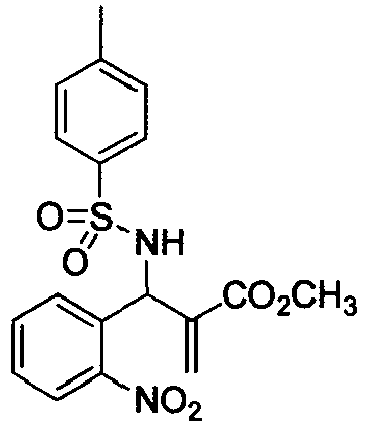
- In a dried flask p-toluenosulfonamide (18 g, 105 mmol, 1eq) and DABCO (1.78 g, 15.7 mmol, 1eq) were mixed together with the previously activated molecular sieves (4 Å, 21 g). The mixture was suspended in isopropanol (300 ml), followed by addition of nitrobenzaldehyde (15.8 g, 105 mmol, 1 eq) and methyl acrylate (10.7 ml, 115 mmol, 1.1 eq). Subsequently, Ti(iOPr)4 was added as a freshly prepared solution in isopropanol (0.6 ml, 2.1 mmol, 0.02 eq). The flask was filled with nitrogen and the mixture was stirred at room temperature for 24 h. Then, a mixture was filtered through Celite which was rinsed with DCM. The solvent was evaporated and to the remaining crude was dissolved in AcOEt, washed with 1M KHSO4, saturated NaHCO3, water and brine and dried over MgSO4. Evaporation of the solvent gave a yellow oil which was subsequently dissolved in AcOEt and crystalized upon addition of n-hexane. The appearing white precipitate was filtrated, rinsed with diethyl ether and dried under vacuum.
- White solid, Mp 109-111°C, yield 63%, C18H18N2O6S, MW 390.41, Monoisotopic Mass 390.09, [M+H]+391.4.
1H NMR (300 MHz, CDCl3) δ (ppm) 2.40 (s, 3 H), 3.56 (s, 3 H), 5.68 (s, 1 H), 5.84-5.87 (d, 1 H, J = 8.72 Hz), 6.06-6.09 (d, 1 H, J = 8.46 Hz), 6.21 (s, 1 H), 7.22-7.26 (m, 2 H), 7.36-7.42 (td, 1 H, J = 7.44 Hz, J = 1.28 Hz), 7.51-7.56 (td, 1 H, J = 7.70 Hz, J = 1.28 Hz), 7.67-7.70 (m, 3 H), 7.80-7.84 (dd, 1 H, J = 8.08 Hz, J = 1.54 Hz). -

- β-aminoester A-1 (10 g, 25.6 mmol, 1 eq) was dissolved in DMF (100 ml), followed by addition of K2CO3 (10.5 g, 76.5 mmol, 3 eq). Subsequently, allyl bromide (4.42 ml, 51.2 mmol, 2 eq) was added dropwisely. The reaction mixture was stirred at room temperature for 6 h. Then, the mixture was diluted with ethyl acetate and washed with water (5×) and brine. The organic phase was concentrated under vacuum. The obtained yellow solid was treated with diethyl ether giving a white precipitate which was filtrated and dried under vacuum.
- White solid, Mp 83-85° C, yield 95%, C21H22N2O6S, MW 430.47, Monoisotopic Mass 430.12, [M+H]+ 430.8. 1H NMR (300 MHz, CDCl3) δ (ppm) 2.41 (s, 3 H) 3.49-3.55 (m, 3 H) 3.92-4.01 (m, 1 H) 4.15-4.25 (m,1 H) 4.92-5.03 (m, 2 H) 5.43-5.59 (m, 2 H) 6.44 (s, 1 H) 6.79 (s, 1 H) 7.23-7.27 (m, 2 H) 7.42-7.49 (m,1 H) 7.61-7.68 (m, 3 H) 7.75-7.80 (d, 1 H, J = 7.69 Hz) 7.89-7.93 (dd, 1 H, J = 8.21, J = 1.28 Hz).
-

- The β-aminoester A-2 (2 g, 4.64 mmol, 1 eq) was dissolved in DCM (12 ml) the Grubbs II catalyst (300 mg, 0.36 mmol, 0.03 eq) was added. The mixture was irradiated by microwaves at 38°C for 30 min in Biotage MW. Then, DMSO (0.71 ml, 10 mmol, 2.1 eq) was added to a reaction mixture and it was stirred at room temperature for 20 h. After this time silica gel was added and was stirred for next 5 minutes. The mixture was diluted with DCM and filtrated through a layer of silica gel. The filtrate was concentrated under reduced pressure and the obtained residue was treated with diethyl ether to give a white precipitate which was filtrated and dried under vacuum.
- Light brown solid, yield 80%, Mp 124-125°C, C19H18N2O6S, MW 402.42, Monoisotopic Mass 402.09, [M+H]+ 403.31. 1HNMR 300 MHz, CDCl3) δ (ppm) 2.36 (s, 3 H), 3.45 (s, 3 H), 4.29 (m, 1 H), 4.54 (m, 1 H), 6.61-6.64 (m, 1 H), 6.68 (t, 1 H, J = 2.0 Hz), 7.27 (d, 2 H, J = 8.27 Hz), 7.31-7.36 (m, 1 H), 7.48-7.50 (m, 2 H), 7.74 (d, 2 H, J = 8.27 Hz), 7.83 (d, 1 H, J = 8.22 Hz).
-

- To a solution of 2,5-dihydropyrrole A-3 (2.5 g, 6.2 mmol, 1 eq) in DMF (40 ml) t-BuOK (2.09 g, 18.7 mmol, 3 eq) was added. The reaction mixture was stirred at ambient temperature for 2 hours under HPLC monitoring. Then, the mixture was diluted with ethyl acetate, neutralized with 1 M KHSO4 (20 ml) and washed with saturated solution of NaHCO3, water (3×) and brine. The organic layer was dried under Na2SO4 and concentrated under reduced pressure. The obtained crude was purified on silica gel with AcOEt/Hex (4/6) as a developing solvent.
- Light brown solid, yield 100%, C12H10N2O4, MW 246.22, Monoisotopic Mass 246.06, [M+H]+ 247.3. 1H NMR (300 MHz, CDCl3) δ (ppm) 3.62-3.63 (m, 3 H) 6.69-6.73 (t, 1 H, J = 2.95 Hz) 6.82-6.85 (m, 1 H) 7.44-7.48 (m, 1 H) 7.51-58 (m, 1 H) 7.60-7.66 (m, 1 H) 8.03-8.04 (dd, 1 H, J = 8.21, J = 1.28 Hz).
-

- The nitro derivative A-4 (2.5 g, 10.2 mmol, 1 eq) was dissolved in 50 mL of methanol; subsequently 10% Pd/C (180 mg, 7 weigh%) and acetic acid (0.26 ml, 4.6 mmol, 0.45 eq) were added. The mixture was stirred for 2 h under hydrogen atmosphere. Then it was filtrated though Celite, and concentrated under vacuum to give compound 5, as a light-brown solid.
- Light brown solid, Mp 295-297°C, yield 98%, C12H12N2O2, MW 216.24, Monoisotopic Mass 216.09, [M+H]+ 217.0. 1H NMR (300 MHz, CD3OD/CDCl3) δ (ppm) 3.60-3.62 (m, 3 H) 6.59-6.60 (d, 1 H, J = 3.08 Hz) 6.67-6.70 (m, 2 H) 6.71-6.73 (m, 1 H) 7.04-7.11 (m, 2 H).
-

- A suspension of compound A-5 (2.5 g, 11.6 mmol, 1 eq) in sec-butanol (50 ml) and AcOH (0.5 ml, 8.7 mmol, 0.75 eq) was stirred at 70°C for 3 h. Then a solvent was evaporated under vacuum to give the light brown solid.
- Light brown solid, Mp 292-294°C, yield 99%, C11H8N2O, MW 184.19, Monoisotopic Mass 184.06, [M+H]+ 185.0. 1H NMR (300 MHz, CD3OD/CDCl3) δ (ppm) 6.81-6.82 (d, 1 H, J = 3.08 Hz) 7.18-7.20 (d, 1 H, J = 3.08 Hz) 7.23-7.30 (m, 1 H) 7.36-7.45 (m, 2 H) 7.95-7.98 (d, 1 H, J = 7.69 Hz).
-

- A mixture of lactam A-6 (1.2 g, 6.5 mmol, 1 eq) and 12 mL of POCl3 was heated at 105°C for 12 hours. It was then poured on ice and was neutralized with ammonia solution. The aqueous phase was extracted with DCM to give key synthon A-7 as a light-brown solid. The precipitate in aqueous phase was filtrated and combined with the extracted product.
- Light brown solid, yield 85%, C11H7ClN2, MW 202.64, Monoisotopic Mass 202.03, [M+H]+ 202.9.
1H NMR (300 MHz, DMSO-d6) δ (ppm) 6.71-6.73 (m, 1 H) 7.60-7.66 (m, 3 H) 7.93-7.98 (m, 1H) 8.36-8.42 (m, 1 H) 12.82 (s, 1 H). - The following compounds were prepared according to the above procedure:
-

- Brown solid, yield 72%, C11H6ClN3O2, MW 247.64, Monoisotopic Mass 247.01, [M+H]+ 248.0.
-

- Light brown solid, yield 80%, C12H6ClN3, MW 227.65, Monoisotopic Mass 227.03, [M+H]+ 228.0.
-

- Brown solid, yield 78%, C12H9ClN2O, MW 232.67, Monoisotopic Mass 232.04, [M+H]+233.0.
-

- Brown solid, yield 75%, Mp 143-145°C, C11H6ClFN2, MW 220.63, Monoisotopic Mass 220.02, [M+H]+ 221.0.
-

- Light brown solid, yield 81%, C11H6Cl2N2, MW 237.08, Monoisotopic Mass 235.99, [M+H]+ 237.0. 1H NMR (300 MHz, DMSO-d6 ) δ (ppm) 6.68-6.71 (m, 1 H) 7.59-7.68 (m, 3 H) 7.90-8.00 (m, 1H), 12.75 (s, 1 H).
- Compound A-7 (200 mg, 1 mmol, 1 eq) was suspended in 5 ml of MeCN followed by addition of amine (539 µl, 4.9 mmol, 5 eq). The mixture was irradiated by microwave for 10 h at 140°C. The solvent was then evaporated and the mixture was purified on silica with DCM/MeOH/NH3aq 9/1.5/0.1 (v/v/v) as a developing solvent.
-

- Brown oil, yield 56%, C15H18N4, MW 254.33, Monoisotopic Mass 254.15, [M+H]+ 255.0. 1H NMR (300 MHz, CD3OD/CDCl3) δ (ppm) 2.27-2.29 (s, 6 H) 2.56-2.61 (t, 2 H, J = 5.90) 3.75-3.78 (t, 2 H, J = 5.90 Hz) 6.61-6.62 (d, 1 H, J = 3.08 Hz) 7.12-7.16 (m, 2 H) 7.26-7.38 (m, 1 H) 7.73-7.76 (d, 1 H, J = 8.21 Hz) 7.86-7.88 (d, 1 H, J = 7.95 Hz).
- Compound A-7 (0.35 g, 1.7 mmol, 1eq) was suspended in 12 ml of MeCN followed by addition of amine (6.9 mmol, 4 eq). The mixture was irradiated by microwave for 5h at 140°C. The solvent was subsequently evaporated and the mixture was purified on silica with DCM/MeOH 9/1.5 (v/v) as a developing solvent.
-

- White foam, yield 57 %, C19H22N4O2, MW 338.40, Monoisotopic Mass 338.17, [M+H]+ 339.26.
-

- Light brown foam, yield 60%, C20H24N4O2, MW 352.43, Monoisotopic Mass 352.19, [M+H]+ 353.5.
-

- Light brown foam, yield 60%, C20H24N4O2, MW 352.43, Monoisotopic Mass 352.19, [M+H]+ 353.2.1H NMR (300 MHz, DMSO-d5 ) δ (ppm) 1.35-1.49 (m, 9 H) 1.98 (b s, 1 H) 2.30 (b s, 1 H) 3.27-3.56 (m, 4 H) 3.71-3.81 (m, 1 H) 4.93 (b s, 1 H) 6.55 (d, 1 H, J = 3.08 Hz) 7.13 (d, 1 H J = 3.08 Hz) 7.16-7.23 (m, 1 H) 7.25-7.27 (m, 1 H) 7.33-7.34 (t, 1 H, J = 7.31 Hz) 7.71-7.81 (d, 1 H, J = 8.46 Hz) 7.86 (dd, 1 H, J = 7.95, 1.28 Hz).
-

- Obtained from A-8d using a solution of 4N HCl in dioxane and isolated as a HCl salt. White solid, yield 60%, C15H16N4, MW 252.31, Monoisotopic Mass 252.14, [M+H]+ 253.1. 1H NMR (300 MHz, CD3OD/CDCl3) δ (ppm) 2.10 - 2.26 (m, 1 H) 2.43 - 2.57 (m, 1 H) 3.16 (m, 1 H) 3.22 - 3.34 (m, 1 H) 3.47 - 3.68 (m, 3 H), 5.36 (b s, 1 H) 7.03 (t, 2 H, J = 7.95 Hz) 7.28 - 7.37 (m, 1 H) 7.47 (t, 1 H, J = 7.82 Hz) 7.68 (dd, 2 H, J = 7.82, J = 4.74 Hz) 7.74 - 7.80 (m, 1 H) 7.83 (dd, 1 H, J = 3.85, J = 1.28 Hz).
-

- Light brown foam, yield 62%, C20H24N4O2, MW 352.43, Monoisotopic Mass 352.19, [M+H]+ 353.2.1H NMR (300 MHz, DMSO-d 5) δ (ppm)1.37 - 1.50 (m, 9 H), 2.00 (b s, 1 H), 2.30 (b s, 1 H), 3.28-3.56 (m, 4 H), 3.70-3.85 (m, 1 H), 4.92 (b s, 1 H), 6.50-5.58 (d, 1 H, J = 3.08 Hz), 7.10-7.15 (d, 1 H, J = 3.08 Hz), 7.17-7.24 (m, 1 H), 7.25-7.28 (m, 1 H), 7.34-7.43 (t, 1 H, J = 7.18 Hz), 7.72-7.82 (d, 1 H, J = 7.95 Hz), 7.83-7.90 (dd, 1 H, J = 7.95, J = 1.03 Hz).
-

- Brown oil, yield 61%, C20H23FN4O2, MW 370.42, Monoisotopic Mass 370.18, [M+H]+ 371.2.
-

- Light brown foam, yield 63%, C20H23ClN4O2, MW 386.88, Monoisotopic Mass 386.15, [M+H]+ 387.2.
- 1H NMR (300 MHz, DMSO-d5 ) δ (ppm) d ppm 1.37-1.51 (m, 9 H) 2.00 (b s, 1 H) 2.32 (b s, 1 H) 3.28-3.57 (m, 4 H) 3.71-3.81 (m, 1 H) 4.92 (b s, 1 H) 6.55 (d, 1 H, J = 3.08 Hz) 7.13 (d, 1 H J = 3.08 Hz) 7.20-7.24 (m, 1 H) 7.26-7.28 (m, 1 H) 7.71-7.81 (d, 1 H, J = 8.40 Hz) 7.83 (m, 1 H).
- Compound A-7 (0.35 g, 1.7 mmol, 1 eq) was suspended in a mixture of toluene and TEA (1.4 ml, 10.2 mmol, 6 eq). Subsequently, an amine (2.4 mmol, 2 eq) was added and the reaction was stirred at 114°C for 14 hours. For homopiperazine derivatives the reaction was assisted by the microwave irradiation at 140°C for 6 hours. The reaction mixture was evaporated, the remaining crude product was purified on silica gel with respective eluents: AcOEt/Hex 4/6 (v/v) for Boc-N-methylpyrrolidin-3-amine and Boc-piperazine derivatives, and DCM/MeOH 9/1.5 (v/v) for methylpiperazine, benzylpiperazine and homopiperazine.
-

- Brown oil, yield 67%, C21H26N4O2, MW 366.46, Monoisotopic Mass 366.21, [M+H]+ 367.2.
-

- Light brown foam, yield 63%, C20H24N4O2 MW 352.43, Monoisotopic Mass 352.19, [M+H]+ 353.4. 1H NMR (300 MHz, CDCl3) δ (ppm) 3.45-3.55 (m, 4H) 3.57-3.66 (m, 4H) 6.45-6.46 (d, 1H, J = 3.07 Hz) 7.03-7.08 (d, 1H, J = 3.34 Hz) 7.09-7.15 (m, 1H) 7.56-7.64 (d, 1H, J = 7.95 Hz) 7.82-7.86 (dd, 1H, J = 1.01 Hz, J = 7.95 Hz).
-

- Obtained from A-8i using a solution of 4N HCl in dioxane and isolated as a HCl salt. White solid, yield 100%, C15H16N4, MW 252.31, Monoisotopic Mass 252.14, [M+H]+ = 253.1. 1H NMR (300 MHz, CD3OD/CDCl3) δ (ppm) 2.55-2.59 (t, 4 H, J = 5.17 Hz) 3.82-3.87 (t, 4 H, J = 4.90 Hz) 6.64-6.68 (m, 1 H) 7.17-7.29 (m, 2 H) 7.34-7.41 (m, 1'H) 7.79-7.84 (m, 2 H).
-

- Light brown foam, yield 62%, C16H18N4, MW 266.34, Monoisotopic Mass 266.15, [M+H]+ 267.4. 1H NMR (300 MHz, CD3OD/CDCl3) δ (ppm) 2.33 (s, 3 H) 260-2.64 (t, 4 H, J = 5.12 Hz) 3.87-3.90 (t, 4 H, J = 4.87 Hz) 6.64-6.64 (d, 1 H, J = 3.07 Hz) 7.15-7.26 (m, 2 H) 7.36-7.42 (m, 1 H) 7.83-7.87 (m, 2H).
-
- Brown oil, yield 55%, C22H22N4, MW 342.44, Monoisotopic Mass 342.18, [M+H]+ 343.5. 1H NMR (300 MHz, CD3OD/CDCl3) δ (ppm) 2.66-2.69 (t, 4 H, J = 4.87 Hz) 3.61 (s, 2 H) 3.87-3.90 (t, 4 H, J = 4.87 Hz) 6.68-6.70 (m, 1 H) 7.17-7.19 (m, 1 H) 7.24-7.49 (m, 7 H) 7.78-7.86 (m, 2 H).
-

- Yellow oil, yield 62%, C20H23N5O4, MW 397.43, Monoisotopic Mass 397.18, [M+H]+ 398.2.
-

- Obtained from A-9l under palladium-catalyzed reduction. Compound A-9l (300 mg, 0.82 mmol) was dissolved in methanol, and subsequently, 10% Pd/C (30 mg, 10 weigh%) and acetic acid (21 µl, 0.37 mmol, 0.45 eq) were added. The mixture was stirred for 2 h under hydrogen atmosphere. Then, it was filtrated though Celite, and concentrated under vacuum. The remaining crude was purified on silica with AcOEt/Hex 5/5 as developing solvent.
Brown oil, C20H25N5O2, yield 62%, MW 367.44, Monoisotopic Mass 367.20, [M+H]+ 368.2. -

- Brown oil, yield 59%, C21H23N5O4, MW 377.44, Monoisotopic Mass 377.19, [M+H]+ 378.2.
-

- Light brown foam, yield 64%, C21H26N4O3, MW 382.46, Monoisotopic Mass 382.20, [M+H]+ 383.2.
-

- Brown oil, yield 65%, C20H23ClN4O2, MW 386.88, Monoisotopic Mass 386.15, [M+H]+ 387.2.
-

- Obtained from A-8p using a solution of 4N HCl in dioxane and isolated as a HCl salt. White solid, C15H15ClN4, MW 286.76, Monoisotopic Mass 286.10, [M+H]+ 287.1
1H NMR (300 MHz, CD3OD/CDCl3) δ (ppm) 2.56-2.59 (t, 4 H, J = 5.19 Hz) 3.83-3.89 (t, 4 H, J = 4.87 Hz) 6.65-6.67 (m, 1 H) 7.19-7.30 (m, 1 H) 7.32-7.39 (m, 1 H) 7.80-7.84 (m, 2 H). -

- Brown oil, yield 60%, C20H23FN4O2, MW 370.42, Monoisotopic Mass 370.18, [M+H]+ 371.2.
-

- Light brown foam, yield 85%, C21H26N4O2, MW 366.46, Monoisotopic Mass 366.21, [M+H]+ 367.2.
-

- Obtained from A-8r using a solution of 4N HCl in dioxane and isolated as a HCl salt. White solid, yield 85%, C16H18N4, MW 266.34, Monoisotopic Mass 266.15, [M+H]+ 267.2.
- 1H NMR (300 MHz, CD3OD/CDCl3) δ (ppm) 1.64-1.67 (m, 2 H), 2.55-2.57 (m, 2 H), 2.78-2.82 (m, 2 H), 3.18-3.22 (m, 2 H), 3.68-3.42 (m, 2 H), 6.42-6.45 (d, 1 H, J = 3.07 Hz), 7.02-7.10 (m, 1 H), 7.36-7.39 (m,1 H), 7.68-7.75 (m, 1 H), 7.83-7.89 (m,1 H), 8.00-8.12 (m, 1 H).
-

- Compound A-7 (180 mg, 0.89 mmol, 1 eq) was suspended in toluene (3 ml) and added the respective amine (3.56 mmol, 4 eq). The mixture was irradiated by microwave at 125°C for 1 h. The solvent was evaporated and the remaining crude was purified on silica with AcOEt/Hex 4/6 as a developing solvent.
- Yellow foam, yield 60%, C16H17N3, MW 251.33, Monoisotopic Mass 251.14. 1H NMR (300 MHz, CDCl3) δ (ppm) 1.62-1.79 (m, 6 H) 3.33 (s, 4 H) 6.72 (b s, 1 H) 7.25-7.33 (m, 1 H) 7.38-7.47 (m, 2 H) 7.66-7.74 (d, 1 H, J = 8.22 Hz) 8.16-8.22 (dd, 1 H, J = 8.02, J = 1.17 Hz) 12.35-12.44 (m, 1 H).
-

- Compound A-7 (180 mg, 0.89 mmol, 1 eq) was suspended in toluene (3 ml) and added the respective amine (3.56 mmol, 4 eq). The mixture was irradiated by microwave at 125°C for 1 h. The solvent was evaporated and the remaining crude was purified on silica with AcOEt/Hex 4/6 as a developing solvent.
- Light brown foam, yield 62%, C15H15N3O, MW 253.30, Monoisotopic Mass 253.12. 1H NMR (300 MHz, CDCl3) δ (ppm) 3.65-3.74 (m, 4 H) 3.78-3.87 (m, 4 H) 6.74-6.78 (dd, 1 H, J = 3.13, J = 1.76 Hz) 7.27-7.33 (m, 1 H) 7.38-7.45 (m, 2 H) 7.64-7.70 (m, 1 H) 8.14-8.21 (m, 1 H) 12.29 (b s, 1 H).
- Compound A-7 (400 mg, 2 mmol, 1 eq) was dissolved in DMF and added Cs2CO3 (775 mg, 2.38 mmol, 1.2 eq). Benzyl bromide (270 µl, 2.18 mmol, 1.1 eq) was added dropwisely. The reaction was conducted at room temperature for 30 min. Then, the mixture was diluted with AcOEt, washed with water (3×) and brine (1×), dried over Na2SO4, filtrated and concentrated under reduced pressure. The remaining crude was purified on chromatographic column with AcOEt/Hex 2/8 (v/v) as a developing solvent. The obtained compound A-8u (500 mg, 1.71 mmol, 1 eq) was mixed together with Pd2(dba)3 (31 mg, 0.03 mmol, 0.02 eq), BINAP (42 mg, 0.07 mmol, 0.04 eq) and t-BuOK (268 mg, 2.4 mmol, 1.4 eq). The mixture was suspended in toluene (10 ml) and 1-Boc-3-hydroxypyrrolidine (382 mg, 2.00 mmol, 1.2 eq) was added. The reaction was irradiated by microwave at 115°C for 1h. The resulting mixture was concentrated and purified on silica gel using AcOEt/Hex 3/7 (v/v) as a developing solvent. Compound A-8w (620 mg, 1.40 mmol, 1 eq) was suspended in DMSO, and t-BuOK (1.25 g, 11.2 mmol, 8 eq) was added as a solid. The flask was placed in the oil bath and the air was bubbled into the mixture. The reaction was carried out at 70°C for 30 min to obtain deprotected ether derivative A-9x. Next, the mixture was diluted with water and was extracted AcOEt (3 × 40 mL). After drying over MgSO4 it was concentrated and purified on the silica with AcOEt/Hex 4/6 (v/v) as a developing solvent.
-

- White foam, yield 80%, C18H13ClN2, MW 292.76, Monoisotopic Mass 292.08, [M+H]+ 293.20.
-

- White foam, yield 91%, C27H29N3O3, MW 443.54, Monoisotopic Mass 443.22, [M+H]+ 444.1.
-

- White foam, yield 90%, C20H23N3O3, MW 353.41, Monoisotopic Mass 353.17, [M+H]+ 354.2.
- Compound A-8 (0.28 mmol, 1 eq) was dissolved in DCM (5 ml). The mixture was placed in the ice-bath and sulfonyl chloride or arylacyl chloride or arylalkyl halide (0.50 mmol, 1.8 eq) was added in portions. The reaction was carried out in the presence of a strong base chosen from potassium tert-butoxide, sodium hydride, cesium carbonate or BTPP and was performed for 3h. Subsequently, the mixture was evaporated and the remaining yellow crude was purified on silica gel. All the Boc-protected arylsulfonamide, arylamide and arylalkyl derivatives of 1H-pyrrolo[3,2-c]quinolines of general structure A-9 were characterized by LC-MS and 1H NMR methods (data given for representative compounds 5', 21', 27', 29', 43', 46', 48'). They were further deprotected using 4N HCl solution in dioxane to yield the final arylsulfonamide derivatives of amine/ether-substituted pyrroloquinolines A-9.
1 N1,N1-dimethyl-N2-(1-(phenylsulfonyl)-1H-pyrrolo[3,2-c]quinolin-4-yl)ethane-1,2-diamine The title compound was prepared starting from amine 1H NMR (300 MHz, CD3OD) δ (ppm) 2.50 (s, 6 H), 2.80-2.86 (t, 2 H, J = 5.82 Hz), 3.82-3.85 (t, 2 H, J = 5.82 Hz), 7.15-7.17 (m, 1 H), 7.35-7.40 (m, 2 H), 7.55-7.57 (m, 2 H), 7.64-7.68 (m, 2 H), 7.82-7.86 (m, 2 H), 7.93-7.94 (m, 1 H), 8.76-8.77 (m, 1 H) A-9a and benzenesulfonyl chloride. Yield 60%, C21H22N4O2S, MW 394.49, Monoisotopic Mass 394.15, [M+H]+ 395.0 2 1-((3-chlorophenyl)sulfonyl)-N-(azetidin-3-yl)-1H-pyrrolo[3,2-c]quinolin-4-amine The title compound was prepared starting from amine 1H NMR (300 MHz, DMSO-d6 ) δ (ppm) 2.5 (b s , 1 H), 3.35-3.45 (m, 1 H), 3.60-3.87 (m, 4 H), 4.29 (b s, 1 H), 6.39-6.43 (d, 1 H, J = 7.5 Hz), 7.25-7.29 (s, 1 H, J = 7.5 Hz), 7.37-7.39 (m, 1 H), 7.47-7.51 (m, 1 H), 7.65-7.80 (m, 4 H), 8.15-8.20 (m, 1 H), 8.23 (s, 1 H) A-9b and 3-chlorobenzenesulfo-nyl chloride, and isolated as HCl salt. Yield, 62%, C20H17ClN4O2S, MW 412.89, Monoisotopic Mass 412.08, [M+H]+ 413.1 3 1-(naphthalen-1-ylsulfonyl)-N-(azetidin-3-yl)-1H-pyrrolo[3,2-c]quinolin-4-amine The title compound was prepared starting from amine A-9b and 1-naphtalenesulfonyl chloride, and isolated as HCl salt. Yield 64%, C24H20N4O2S, MW 428.51, Monoisotopic Mass 428.13, [M+H]+ 429.1 4 1-(phenylsulfonyl)-N-(pyrrolidin-3-yl)-1H-pyrrolo[3,2-c]quinolin-4-amine The title compound was prepared starting from amine A-9c and benzenesulfonyl chloride, and isolated as HCl salt. Yield, 80%, C21H20N4O2S, MW 392.47, Monoisotopic Mass 392.13, [M+H]+ 393.1 5 1-((3-chlorophenyl)sulfonyl)-N-(pyrrolidin-3-yl)-1H-pyrrolo[3,2-c]quinolin-4-amine The title compound was prepared starting from amine A-9c and 3-chlorobenzenesulfo-nyl chloride, and isolated as HCl salt. Yield 90%, C21H19ClN4O2S, MW 426.92, Monoisotopic Mass 426.09, [M+H]+ 427.3 5' tert-butyl 3-((1-((3-chlorophenyl)sulfonyl)-1H-pyrrolo[3,2-c]quinolin-4-yl)amino)pyrrolidine-1-carboxylate The title compound was prepared starting from amine 1H NMR (300 MHz, CDCl3) δ (ppm) 1.50 (s, 9 H), 2.05-2.08 (m, 2 H), 2.17-2.18 (m, 1 H), 3.19-3.38 (m, 1 H), 3.49-3.70 (m, 2 H), 3.83-3.90 (m, 1 H), 4.88-4.91 (b s, 1 H), 6.71-6.73 (d, 1 H, J = 3.85 Hz), 7.21-7.27-7.35 (m, 2 H), 7.44-49 (m, 2 H), 7.54-7.60 (m, 1 H), 7.69-7.80 (m, 2 H), 7.86-7.87 (d, 1 H, J = 3.59 Hz), 8.70-8.74 (dd, 1H, J = 8.60 Hz, J = 1.02 Hz) A-9c and 3-chloro-benzenesulfonyl chloride. Yield 90%, C26H27ClN4O4S, MW 527.03, Monoisotopic Mass 526.14, [M+H]+ 527.22. 6 (S)-1-((3-chlorophenyl)sulfonyl)-N-(pyrrolidin-3-yl)-1H-pyrrolo[3,2-c]quinolin-4-amine The title compound was prepared starting from amine 1H NMR (300 MHz, CD3OD/CDCl3) δ (ppm) 2.24-2.40 (m, 1 H) 2.52-2.69 (m, 1 H) 3.27-3.44 (m, 2 H) 3.56-3.79 (m, 3 H) 5.46-5.68 (m, 1 H) 7.32-7.64 (m, 5 H) 7.69-7.73 (t, 1 H, J = 1.79 Hz) 7.85-8.01 (m, 2 H) 8.44-8.53 (d, 1 H, J = 8.25 Hz) 8.72-8.79 (dd, 1H, J = 8.53, J = 1.10 Hz) A-9d and 3-chlorobenzenesulfo-nyl chloride, and isolated as HCl salt. Yield 92%, Mp 211-21 °C, C21H19ClN4O2S, MW 426.92, Monoisotopic Mass 426.09. [M+H]+ 427.2 7 (R)-1-((3-chlorophenyl)sulfonyl)-N-(pyrrolidin-3-yl)-1H-pyrrolo[3,2-c]quinolin-4-amine The title compound was prepared starting from amine 1H NMR (300 MHz, CD3OD/CDCl3) δ (ppm) 2.25-2.38 (m, 1 H) 2.54-2.68 (m, 1 H) 3.23-3.35 (m, 1 H) 3.38-3.43 (m, 1 H) 3.57-3.76 (m, 3 H) 5.50-5.64 (m, 1 H) 7.29-7.63 (m, 5 H) 7.68-7.73 (t, 1 H, J = 1.80 Hz) 7.84-7.98 (m, 2 H) 8.41-8.49 (d, 1 H, J = 8.46 Hz) 8.72-8.78 (dd, 1 H, J = 8.59, J = 1.15 Hz) A-9e and 3-chlorobenzenesulfonyl chloride, and isolated as HCl salt. Yield 91%, 221-223, C21H19ClN4O2S, MW 426.92, Monoisotopic Mass 426.09, [M+H]+ 427.2 8 1-((3-fluorophenyl)sulfonyl)-N-(pyrrolidin-3-yl)-1H-pyrrolo[3,2-c]quinolin-4-amine The title compound was prepared starting from amine A-9c and 3-fluorobenzenesulfo-nyl chloride, and isolated as HCl salt. Yield 89%, C21H19FN4O2S, MW 410.46, Monoisotopic Mass 410.12 [M+H]+ 411.2 9 (S)-1-((3-fluorophenyl)sulfonyl)-N-(pyrrolidin-3-yl)-1H-pyrrolo[3,2-c]quinolin-4-amine The title compound was prepared starting from amine A-9d and 3-fluorobenzenesulfo-nyl chloride, and isolated as HCl salt. Yield 85%, C21H19FN4O2S, MW 410.46, Monoisotopic Mass 410.12 [M+H]+ 411.2 10 (R)-1-((3-fluorophenyl)sulfonyl)-N-(pyrrolidin-3-yl)-1H-pyrrolo[3,2-c]quinolin-4-amine The title compound was prepared starting from amine A-9e and 3-fluorobenzenesulfo-nyl chloride, and isolated as HCl salt. Yield 90%, C21H19FN4O2S, MW 410.46, Monoisotopic Mass 410.12 [M+H]+ 411.2 11 1-((4-fluorophenyl)sulfonyl)-N-(pyrrolidin-3-yl)-1H-pyrrolo[3,2-c]quinolin-4-amine The title compound was prepared starting from amine 1H NMR (300 MHz, CD3OD/CDCl3) δ (ppm) 2.10-2.26 (m, 1 H) 2.43-2.57 (m, 1 H) 3.15-3.18 (m, 1 H) 3.22-3.34 (m, 1 H) 3.47-3.68 (m, 3 H) 5.36 (b s, 1 H) 7.00-7.05 (t, 2 H, J = 7.95 Hz) 7.28-7.37 (m, 1 H) 7.44-7.50 (t, 1 H, J = 7.82 Hz) 7.62-7.71 (dd, 2 H, J = 7.82, J = 4.74 Hz) 7.74-7.80 (m, 1 H) 7.82-7.84 (dd, 1 H, J = 3.85, J = 1.28 Hz) 8.26-8.29 (d, 1 H, J = 8.46 Hz) 8.67-8.74 (d, 1 H, J = 8.72 Hz) A-9c and 4-fluorobenzenesulfo-nyl chloride, and isolated as HCl salt. Yield 88%, C21H19FN4O2S, MW 410.46, Monoisotopic Mass 410.12, [M+H]+ 411.3 12 1-((2,5-difluorophenyl)sulfonyl)-N-(pyrrolidin-3-yl)-1H-pyrrolo[3,2-c]quinolin-4-amine The title compound was prepared starting from amine A-9c and 2,5-difluoro-benzenesulfonyl chlo-ride, and isolated as HCl salt. Yield 79%, C21H18F2N4O2S, MW 428.46, Monoisotopic Mass 428.11, [M+H]+ 429.0 13 1-((3-methoxyphenyl)sulfonyl)-N-(pyrrolidin-3-yl)-1H-pyrrolo[3,2-c]quinolin-4-amine The title compound was prepared starting from amine 1H NMR (300 MHz, DMSO-d6 ) δ (ppm) 2.37-2.43 (m, 3 H) 2.62-2.72 (m, 4 H) 3.67-3.78 (m, 4 H) 6.88-6.89 (d, 1 H, J = 3.85 Hz) 7.04-7.1 (m, 1 H) 7.29-7.44 (m, 1 H) 7.57-7.75 (m, 3 H) 7.79-7.82 (dd, 1 H, J = 8.46, J = 0.77 Hz) 7.87-7.93 (m, 1 H) 7.97-8.04 (m, 1 H) 8.44-8.50 (dd, 1 H, J = 8.46, J = 0.77 Hz) 8.56-8.63 (m, 1 H) A-9c and 3-methoxybenzenesulfonyl chlo-ride, and isolated as HCl salt. Yield 95%, C22H22N4O3S, MW 422.50, Monoisotopic Mass 422.14. [M+H]+ 423.2 14 1-((3-(trifluoromethyl)phenyl)s ulfonyl)-N-(pyrrolidin-3-yl)-1H-pyrrolo[3,2-c]quinolin-4-amine The title compound was prepared starting from amine A-9c and 3-(trifluoromethyl) benzenesulfonyl chloride, and isolated as HCl salt. Yield 90%, C22H19F3N4O2S, MW 460.47, Monoisotopic Mass 460.12, [M+H]+ 461.3 15 (S)-1-((3-(trifluoromethyl)phenyl)s ulfonyl)-N-(pyrrolidin-3-yl)-1H-pyrrolo[3,2-c]quinolin-4-amine The title compound was prepared starting from amine A-9d and 3-(trifluoromethyl)-benzenesulfonyl chloride, and isolated as HCl salt. Yield 91%, C22H19F3N4O2S, MW 460.47, Monoisotopic Mass 460.12, [M+H]+ 461.3 16 (R)-1-((3-(trifluoromethyl)phenyl)s ulfonyl)-N-(pyrrolidin-3-yl)-1H-pyrrolo[3,2-c]quinolin-4-amine The title compound was prepared starting from amine A-9e and 3-(trifluoromethyl)-benzenesulfonyl chloride, and isolated as HCl salt. Yield 88%, C22H19F3N4O2S, MW 460.47, Monoisotopic Mass 460.12, [M+H]+ 461.3 17 1-((4-(tert-butyl)phenyl)sulfonyl)-N-(pyrrolidin-3-yl)-1H-pyrrolo[3,2-c]quinolin-4-amine The title compound was prepared starting from amine A-9c and 4-tert-butylbenzene-sulfonyl chloride, and isolatd as HCl salt. 1H NMR (300 MHz, CD3OD/CDCl3) δ (ppm) 1.17 (s, 9 H) 2.23-2.39 (m, 1 H) 2.53-2.70 (m, 1 H) 3.28 (b s, 2 H) 3.62 (b s, 3 H) 5.49-5.64 (m, 1 H) 7.26 (s, 1 H) 7.32-7.46 (m, 2 H) 7.49-7.70 (m, 3 H) 7.80-7.92 (m, 2 H) 8.36-8.49 (m, 1 H) 8.83-8.86 (d, 1 H, J = 8.53 Hz) Yield 78%, C25H28N4O25, MW 448.58, Monoisotopic Mass 448.19, [M+H]+ 449.3 18 1-((4-aminophenyl)sulfonyl)-N-(pyrrolidin-3-yl)-1H-pyrrolo[3,2-c]quinolin-4-amine The title compound was prepared starting from amine A-9c and 4-aminobenzene-sulfonyl chloride, and isolated as HCl salt. Yield 66%, C21H21N5O2S, MW 407.49, Monoisotopic Mass 407.14, [M+H]+ 408.2 19 (S)-1-((4-aminophenyl)sulfonyl)-N-(pyrrolidin-3-yl)-1H-pyrrolo[3,2-c]quinolin-4-amine The title compound was prepared starting from amine A-9d and 4-aminobenzene-sulfonyl chloride, and isolated as HCl salt. Yield 67%, C21H21N5O2S, MW 407.49, Monoisotopic Mass 407.14, [M+H]+ 408.2 20 (R)-1-((4-aminophenyl)sulfonyl)-N-(pyrrolidin-3-yl)-1H-pyrrolo[3,2-c]quinolin-4-amine The title compound was prepared starting from amine 1H NMR (300 MHz, CD3OD/CDCl3) δ (ppm) 2.25-2.37 (m, 1 H) 2.48-2.62 (m, 4 H) 3.70-3.82 (m, 2 H) 6.88-6.89 (d, 1 H, J = 3.92 Hz) 7.09-7.15 (m, 1 H) 7.29-7.47 (m, 1 H) 7.63-7.78 (m, 3 H) 7.80-7.86 (m, 1 H), 7.90-7.97 (m, 1 H) 8.01-8.06 (m, 1 H) 8.52-8.58 (dd, 1H, J = 9.30 Hz, J = 0.80 Hz) 8.64-8.67 (m, 1 H) A-9e and 4-aminobenzene-sulfonyl chloride, and isolated as HCl salt. Yield 66%, C21H21N5O2S, MW 407.49, Monoisotopic Mass 407.14, [M+H]+ 408.2 21 1-(naphthalen-1-ylsulfonyl)-N-(pyrrolidin-3-yl)-1H-pyrrolo[3,2-c]quinolin-4-amine The title compound was prepared starting from amine 1H NMR (300 MHz, CD3OD/CDCl3) δ (ppm) 2.17-2.31 (m, 1H), 2.41-2.56 (m, 5 H), 3.25-3.40 (d, 1 H, J = 5.39 Hz), 5.42 (b s, 1 H), 7.21-7.34 (t, 1H, J = 7.69 Hz) 7.47-7.72 (m, 4 H) 7.99-8.08 (m, 2 H) 8.10-8.15 (d, 1 H, J = 3.85 Hz) 8.16-8.21 (d, 1 H, J = 7.44 Hz) 8.22-8.26 (d, 1 H, J = 8.21 Hz,) 8.28-8.35 (d, 1 H, J = 8.46 Hz) 8.36-8.46 (d, 1 H, J = 5.90 Hz) 8.48-8.55 (d, 1 H, J = 7.69 Hz) A-9c and 1-naphtalenesulfonyl chloride, and isolated as HCl salt. Yield 88%, C25H22N4O2S, MW 442.53, Monoisotopic Mass 442.15, [M+H]+ 443.3 21' tert-butyl 3-((1/-(naphthalen-1-ylsulfonyl)-1H-pyrrolo[3,2-c]quinolin-4-yl)amino)pyrrolidine-1-carboxylate The title compound was prepared starting from amine A-9c and 1-naphtatenesulfonyl chloride. Yield 88%, C30H30N4O4S, MW 542.65, Monoisotopic Mass 542.20, [M+H]+ 543.27 22 1-(quinolin-8-ylsulfonyl)-N-(pyrrolidin-3-yl)-1H-pyrrolo[3,2-c]quinolin-4-amine The title compound was prepared starting from amine 1H NMR (300 MHz, CD3OD/CDCl3) δ (ppm) 2.17-2.33 (m, 1 H) 2.48-2.63 (m, 1 H) 3.28-30 (m, 3 H) 3.56 (b s, 2 H) 5.39-5.55 (m, 1 H) 7.27-7.52 (m, 2 H) 7.57-7.76 (m, 2 H) 8.00-8.16 (dd, 2 H, J = 10.26, J = 8.46 Hz) 8.22-8.39 (m, 2 H) 8.50-8.80 (m, 3 H) A-9c and 8-quinolinesulfonyl chloride, and isolated as HCl salt. Yield 86%, C24H21N5O2S, MW 443.52, Monoisotopic Mass 443.14, [M+H]+ 444.2 23 1-((5-methylbenzo[b]thiophen-2-yl)sulfonyl)-N-(pyrrolidin-3-yl)-1H-pyrrolo[3,2-c]quinolin-4-amine The title compound was prepared starting from amine A-9c and 5-methylbenzo[b]-thiophene-2-sulfonyl chloride, and isolated as HCl salt. Yield 65%, C24H22N4O2S2' MW 462.59, Monoisotopic Mass 462.12, [M+H]+ 463.0 24 7-fluoro-1-((3-chlorophenyl)sulfonyl)-N-(pyrrolidin-3-yl)-1H-pyrrolo[3,2-c]quinolin-4-amine The title compound was prepared starting from amine A-9f and 3-chlorobenzene-sulfonyl chloride, and isolated as HCl salt. Yield 82%, C21H19Cl2FN4O2S, MW 481.37, Monoisotopic Mass 480.06, [M+H]+ 481.1 25 8-chloro-1-((3-chlorophenyl)sulfonyl)-N-(pyrrolidin-3-yl)-1H-pyrrolo[3,2-c]quinolin-4-amine The title compound was prepared starting from amine 1H NMR (300 MHz, DMSO-d6 ) δ (ppm) 2.22-2.28 (m, 1 H), 2.40-2.46 (m, 1 H), 3.25-3.38 (m, 1 H), 3.51-3.59 (m, 4 H), 5.25 (s, 1 H), 7.36-7.46 (m, 1 H), 7.59-7.65 (t, 2 H, J = 7.9 Hz), 7.81-7.84 (m, 2 H), 7.89-8.07 (m, 1 H), 8.20-8.22 (m, 1 H), 8.30-8.35 (m, 1 H), 8.66-8.69 (m, 1 H), 9.50 (s, 1 H) A-9g and 3-chlorobenzene-sulfonyl chloride, and isolated as HCl salt. Yield 80%, C21H18Cl2N4O2S, MW 461.36, Monoisotopic Mass 460.05, [M+H]+ 461.1 26 N-methyl-1-(1-(phenylsulfonyl)-1H-pyrrolo[3,2-c]quinolin-4-yl)pyrrolidin-3-amine The title compound was prepared starting from amine 1H NMR (300 MHz, CD3OD/CDCl3) δ (ppm) 1.52-1.80 (m, 1 H), 2.74-3.02 (m, 5 H), 3.32 (s, 3 H), 6.34 - 6.37 (d, 1 H, J = 3.61 Hz), 7.28 - 7.30 (d, 1 H, J = 3.52 Hz), 7.30-7.35 (m, 2 H), 7.62 (m, 2 H), 7.69-7.73 (m, 2 H), 7.84-7.87 (m, 3 H), 8.47-8.56 (m, 1 H) A-9h and benzenesulfonyl chloride, and isolated as HCl salt. Yield 68%, C22H22N4O2S, MW 406.50, Monoisotopic Mass 406.15, [M+H]+ = 407.2 27 1-(phenylsulfonyl)-4-(piperazin-1-yl)-1H-pyrrolo[3,2-c]quinoline The title compound was prepared starting from amine 1H NMR (300 MHz, methanol-d4) δ (ppm) 3.25-3.33 (d, 2 H, J = 1.28 Hz) 3.54 (b s, 4 H) 7.22-7.31 (m, 2 H) 7.41-7.57 (m, 4 H) 7.58-7.71 (d, 2 H, J = 7.44 Hz) 7.77-7.85 (d, 2 H, J = 7.69 Hz) 8.15 (b s, 1 H) 8.20-8.29 (m, 1 H) 8.85-8.93 (d, 1 H, J = 8.46 Hz) A-9i and benzenesulfonyl chloride, and isolated as HCl salt. Yield 70%, C21H20N4O2S, MW 392.47, Monoisotopic Mass 392.13, [M+H]+ = 393.5 27' tert-butyl 4-(1-(phenylsulfonyl)-1H-pyrrolo[3,2-c]quinolin-4-yl)piperazine-1-carboxylate The title compound was prepared starting from amine A-9i and benzenesulfonyl chloride. Yield 70%, C26H28N4O4S, MW 492.59, Monoisotopic Mass 492.18, [M+H]+ = 493.30 28 1-((2-bromophenyl)sulfonyl)-4-(piperazin-1-yl)-1H-pyrrolo[3,2-c]quinoline The title compound was prepared starting from amine 1H NMR (300 MHz, CD3OD/CDCl3) δ (ppm) 3.04-3.21 (m, 1 H) 3.44 (b s, 4 H) 4.26 (b s, 3 H) 7.03-7.26 (m, 2 H) 7.29-7.62 (m, 4 H) 7.92-8.26 (m, 3 H) 8.29-8.43 (m, 1 H) A-9i and 2-bromobenzene-sulfonyl chloride, and isolated as HCl salt. Yield 60%, C21H19BrN4O2S, MW 471.37, Monoisotopic Mass 470.04, [M+H]+ 471.2 29 1-((3-chlorophenyl)sulfonyl)-4-(piperazin-1-yl)-1H-pyrrolo[3,2-c]quinoline The title compound was prepared starting from amine 1H NMR (300 MHz, CD3OD/CDCl3) δ (ppm) 3.43 (b s, 4 H), 4.29 (b s, 4 H), 7.24 (s, 1 H), 7.26-7.50 (m, 3 H), 7.56-7.61 (m, 2 H), 7.68 (s, 1 H), 8.02 (s, 1 H), 8.22-8.32 (d, 1 H, J = 8.47 Hz), 8.74-8.76 (d, 1 H, J = 8.31 Hz) A-9i and 3-chlorobenzene-sulfonyl chloride, and isolated as HCl salt. Yield 95%, Mp 161-163°C, C21H19ClN4O2S, MW 426.92, Monoisotopic Mass 426.09, [M+H]+ 427.2 29' tert-butyl 4-(1-((3-chlorophenyl)sulfonyl)-1H-pyrrolo[3,2-c]quinolin-4-yl)piperazine-1-carboxylate The title compound was prepared starting from amine A-9i and 3-chlorobenzenesulfonyl chloride. Yield 95%, C26H27ClN4O4S, MW 527.03, Monoisotopic Mass 526.14, [M+H]+ 427.46 30 1-((3-fluorophenyl)sulfonyl)-4-(piperazin-1-yl)-1 H-pyrrolo[3,2-c]quinoline The title compound was prepared starting from amine 1H NMR (300 MHz, CD3OD/CDCl3) δ (ppm) 3.45 (b s, 4 H) 4.28 (b s, 4 H) 7.13-7.23 (d, 2 H, J = 6.92 Hz) 7.34-7.61 (m, 5 H) 8.01 (b s, 1 H) 8.24-8.34 (d, 1 H, J = 7.44 Hz) 8.69-8.78 (d, 1 H, J = 8.46 Hz) A-9i and 3-fluorobenzenesulfonyl chloride, and isolated as HCl salt. Yield 93%, Mp 192-193 °C, C21H19FN4O2S, MW 410.46, Monoisotopic Mass 410.12, [M+H]+ 411.3 31 1-((4-fluorophenyl)sulfonyl)-4-(piperazin-1-yl)-1H-pyrrolo[3,2-c]quinoline The title compound was prepared starting from amine A-9i and 4-fluorobenzenesulfonyl chloride, and isolated as HCl salt. Yield 95%, C21H19FN4O2S, MW 410.46, Monoisotopic Mass 410.12, [M+H]+ 411.3 32 1-((2,5-difluorophenyl)sulfonyl)-4-(piperazin-1-yl)-1H-pyrrolo[3,2-c]quinoline The title compound was prepared starting from amine A-9i and 2,5-difluorobenzene-sulfonyl chloride, and isolated as HCl salt. Yield 81%, C21H18F2N4O2S, MW 428.46, Monoisotopic Mass 428.11, [M+H]+ 429.2 33 1-((3,4-difluorophenyl)sulfonyl)-4-(piperazin-1-yl)-1H-pyrrolo[3,2-c]quinoline The title compound was prepared starting from amine A-9i and 3,4-difluorobenzenesulfonyl chlo-ride, and isolated as HCl salt. Yield 83%, C21H18F2N4O2S, MW 428.46, Monoisotopic Mass 428.11, [M+H]+ 429.4 34 1-((3,4-dichlorophenyl)sulfonyl)-4-(piperazin-1-yl)-1H-pyrrolo[3,2-c]quinoline The title compound was prepared starting from amine A-9i and 3,4-dichlorobenzene-sulfonyl chloride, and isolated as HCl salt. Yield 80%, C21H18Cl2N4O2S, MW 461.36, Monoisotopic Mass 460.05, [M+H]+ 461.2 35 1-((3-(trifluoromethyl)phenyl)s ulfonyl)-4-(piperazin-1-yl)-1H-pyrrolo[3,2-c]quinoline The title compound was prepared starting from amine 1H NMR (300 MHz, CD3OD/CDCl3) δ (ppm) 3.40 (b s, 4 H) 4.25 (b s, 4 H) 7.22-7.26 (m, 1 H) 7.33-7.44 (t, 1 H, J = 7.79 Hz), 7.52-7.62 (t, 1H, J = 7.83 Hz), 7.61-7.70 (d, 2H, J = 8.22 Hz), 7.80-7.89 (d, 2H, J = 8.18 Hz), 8.03-8.08 (d, 1H, J = 3.32 Hz), 8.27-8.34 (d, 1H, J = 8.43 Hz), 8.72-8.77 (d, 1H, J = 8.68 Hz) A-9i and 3-(trifluoromethyl)-benzenesulfonyl chloride, and isolated as HCl salt. Yield 92%, C22H19F3N4O2S, MW 460.47, Monoisotopic Mass 460.12, [M+H]+ 461.3 36 1-((4-(trifluoromethyl)phenyl)s ulfonyl)-4-(piperazin-1-yl)-1H-pyrrolo[3,2-c]quinoline The title compound was prepared starting from amine A-9i and 4-(trifluoromethyl)-benzenesulfonyl chloride, and isolated as HCl salt. Yield 89%, C22H19F3N4O2S, MW 460.47, Monoisotopic Mass 460.12, [M+H]+ 461.3 37 1-((3-methoxyphenyl)sulfonyl)-4-(piperazin-1-yl)-1H-pyrrolo[3,2-c]quinoline The title compound was prepared starting from amine A-9i and 3-methoxybenzene-sulfonyl chloride, and isolated as HCl salt. Yield 91%, C22H22N4O3S, MW 422.50, Monoisotopic Mass 422.14, [M+H]+ 423.3 38 1-((3-cyanophenyl)sulfonyl)-4-(piperazin-1-yl)-1H-pyrrolo[3,2-c]quinoline The title compound was prepared starting from amine 1H NMR (300 MHz, CD3OD/CDCl3) δ (ppm) 3.42 (b s, 4 H) 4.24 (b s, 4 H) 7.21 (b s, 1 H) 7.36-7.41 (m, 1 H) 7.51-7.58 (m, 2 H) 7.73-7.83 (d, 1 H, J = 6.67 Hz) 7.88 (b s, 1 H) 8.02 (s, 2 H) 8.18-8.27 (d, 1 H, J = 8.21 Hz) 8.63-8.72 (d, 1H, J = 8.46 Hz) A-9i and 3-cyanobenzene-sulfonyl chloride, and isolated as HCl salt. Yield 89%, C22H19N5O2S, MW 417.48, Monoisotopic Mass 417.13. [M+H]+ 418.2 39 1-((3-methylphenyl)sulfonyl)-4-(piperazin-1-yl)-1H-pyrrolo[3,2-c]quinoline The title compound was prepared starting from amine A-9i and 3-methylbenzene sulfonyl chloride, and isolated as HCl salt. Yield 80%, C22H23ClN4O2S, MW 406.50, Monoisotopic Mass 406.15, [M+H]+ 407.1 40 1-((4-isopropylphenyl)sulfonyl)-4-(piperazin-1-yl)-1H-pyrrolo[3,2-c]quinoline The title compound was prepared starting from amine A-9i and 4-isopropylbenzene-sulfonyl chloride, and isolated as HCl salt. 1H NMR (300 MHz, CD3OD/CDCl3) δ (ppm) 1.99 (s, 6 H) 2.85 (m, 1 H) 3.50 (b s, 4H) 4.34 (bs, 4 H) 7.15-7.28 (m, 3 H) 7.37-7.46 (t, 1 H , J = 7.57 Hz) 7.53-7.69 (m, 3 H) 8.02 (b s, 1 H) 8.31-8.40 (d, 1 H, J = 8.21 Hz) 8.81-8.88 (d, 1 H, J = 8.46 Hz) Yield 79%, C24H26N4O2S, MW 434.55, Monoisotopic Mass 434.18, [M+H]+ 435.3 41 1-((4-(tert-butyl)phenyl)sulfonyl)-4-(piperazin-1-yl)-1H-pyrrolo[3,2-c]quinoline The title compound was prepared starting from amine A-9i and 4-tert-butylbenzene-sulfonyl chloride, and isolated as HCl salt. Yield 70%, C25H28N4O2S, MW 448.58, Monoisotopic Mass 448.19, [M+H]+ 449.3 42 1-(4-(aminophenyl)sulfonyl)-4-(piperazin-1-yl)-1H-pyrrolo[3, 2-c]quinoline The title compound was prepared starting from amine A-9i and 4-aminobenzene-sulfonyl chloride, and isolated as HCl salt. Yield 68%, C21H21N5O2S, MW 407.49, Monoisotopic Mass 407.14, [M+H]+ 408.2 43 1-(naphthalen-1-ylsulfonyl)-4-(piperazin-1-yl)-1H-pyrrolo[3,2-c]quinoline The title compound was prepared starting from amine 1H NMR (300 MHz, CD3OD/CDCl3) δ (ppm) 3.36-3.55 (m, 4 H), 4.20-4.40 (m, 4 H), 7.16-7.29 (m, 2 H), 7.35-7.45 (d, 1 H, J = 6.16 Hz), 7.46-7.62 (m, 3 H), 7.80-7.89 (d, 1 H, J = 7.69 Hz), 7.95-8.10 (m, 3 H), 8.17-8.30 (t, 2 H, J = 8.08 Hz), 8.54-8.64 (d, 1 H, J = 8.72 Hz) A-9i and 1-naphtalenesulfonyl chloride, and isolated as HCl salt. Yield 86%, Mp 158-160 °C, C25H22N4O2S, MW 442.53, Monoisotopic Mass 442.15, [M+H]+ 443.3 43' tert-butyl 4-(1-(naphthalen-1-ylsulfonyl)-1H-pyrrolo[3,2-c]quinolin-4-yl)piperazine-1-carboxylate The title compound was prepared starting from amine A-9i and 1-naphtalenesulfonyl chloride. Yield 86%, C30H30N4O4S, MW 542.65, Monoisotopic Mass 542.20, [M+H]+ 543.34 44 1-(naphthalen-2-ylsulfonyl)-4-(piperazin-1-yl)-1H-pyrrolo[3,2-c]quinoline The title compound was prepared starting from amine A-9i and 2-naphtalenesulfonyl chloride, and isolated as HCl salt. Yield 88%, C25H23ClN4O2S, MW 442.53, Monoisotopic Mass: 442.15, [M+H]+ 443.1 45 1-(quinolin-8-ylsulfonyl)-4-(piperazin-1-yl)-1H-pyrrolo[3,2-c]quinoline The title compound was prepared starting from amine 1H NMR (300 MHz, CD3OD/CDCl3) δ (ppm) 3.45 (b s, 4 H), 4.30 (b s, 4 H), 7.07 (b s, 1 H), 7.31-7.41 (m, 2 H), 7.47-7.52 (t, 1 H, J = 7.44 Hz), 7.63-7.68 (t, 1 H, J = 7.95 Hz), 8.07-8.13 (t, 2 H, J = 7.18 Hz), 8.25-8.28 (d, 1 H, J = 8.46 Hz), 8.42 (b s, 1 H), 8.68-8.70 (m, 2 H), 8.78-8.81 (d, 1 H, J = 8.46 Hz) A-9i and 8-quinolinesulfonyl chloride, and isolated as HCl salt. Yield 85%, C24H21N5O2S, MW 443.53, Monoisotopic Mass 443.14, [M+H]+ 444.2 46 1-((5-chlorothiophen-2-yl)sulfonyl)-4-(piperazin-1-yl)-1H-pyrrolo[3,2-c]quinoline The title compound was prepared starting from amine 1H NMR (300 MHz, CD3OD/CDCl3) δ (ppm) 3.34 (b s,4H),3.97(bs,4H),7.51-7.56 (t, 1 H, J = 7.69 Hz), 7.64-7.69 (t, 1 H, J = 7.43 Hz), 7.90-8.14 (m, 3 H), 8.84-8.86 (d, 1 H, J = 7.69 Hz), 9.62 (s, 2 H) A-9i and 5-chlorothiophene-2-sulfonyl chloride, and isolated as HCl salt. Yield 65%, C19H17ClN4O2S2, MW 432.95, Monoisotopic Mass 432.05, [M+H]+ 433.2 46' tert-butyl 4-(1-((5-chlorothiophen-2-yl)sulfonyl)-1H-pyrrolo[3,2-c]quinolin-4-yl)piperazine-1-carboxylate The title compound was prepared starting from amine A-9i and 5-chlorothiophene-2-sulfo-nyl chloride. Yield 65%, C24H25ClN4O4S2, MW 533.06, Monoisotopic Mass 532.10, [M+H]+ 533.2. 47 1-((5-methylbenzo[b]thiophen-2-yl)sulfonyl)-4-(piperazin-1-yl)-1H-pyrrolo[3,2-c]quinoline The title compound was prepared starting from amine A-9i and 5-methylbenzo[b]-thiophene-2-sulfonyl chloride, and isolated as HCl salt. Yield 68%, C24H22N4O2S2, MW 462.59, Monoisotopic Mass 462.12, [M+H]+ 463.9 48 1-((5-chloro-3-methylbenzo[b]thiophen-2-yl)sulfonyl)-4-(piperazin-1-yl)-1H-pyrrolo[3,2-c]quinoline The title compound was prepared starting from amine 1H NMR (300 MHz, CD3OD/CDCl3) δ (ppm) 2.58 (s, 3 H), 3.51 (b s, 4 H), 4.32 (b s, 4 H), 7.24-7.26 (m, 3 H), 7.39-7.58 (m, 2 H), 7.61-7.71 (m, 1 H), 8.01 (s, 1 H), 8.33 (s, 1H), 8.81-8.83 (m, 1 H) A-9i and 5-chloro-3-methylbenzo[b]thiophene-2-sulfonyl chloride, and isolated as HCl salt. Yield 63%, C24H21ClN4O2S2, MW 497.03, Monoisotopic Mass 496.08, [M+H]+ 497.2 48' tert-butyl 4-(1-((5-chloro-3-methylbenzo[b]thiophen-2-yl)sulfonyl)-1H-pyrrolo[3,2-c]quinolin-4-yl)piperazine-1-carboxylate The title compound was prepared starting from amine A-9i and 5-chloro-3-methylbenzo[b]-thiophene-2-sulfonyl chloride. Yield 63% C29H29ClN4O4S2, MW 597.15, Monoisotopic Mass 596.13, [M+H]+ 597.19, 599.42, 600.38 49 1-(3-chlorobenzyl)-4-(piperazin-1-yl)-1H-pyrrolo[3,2-c]quinoline The title compound was prepared starting from amine A-9i and 1-chloro-3-(chloromethyl)-benzene and isolated as HCl salt. Yield 90%, C21H20Cl2N4O2S, MW 376.88, Monoisotopic Mass 376.15, [M+H]+ 377.2 50 1-(3-fluorobenryl)-4-(piperazin-1-yl)-1H-pyrrolo[3,2-c]quinoline The title compound was prepared starting from amine A-9i and 1-(chloromethyl)-3-fluorobenzene and isolated as HCl salt. Yield 91%, C22H21FN4, MW 360.43, Monoisotopic Mass 360.18, [M+H]+ 361.2 51 (3-chlorophenyl)-(4-(piperazin-1-yl)-1H-pyrrolo[3,2-c]quinolin-1-yl)methanone The title compound was prepared starting from amine A-9i and 3-chlorobenzoyl chloride, and isolated as HCl salt. Yield 87%, C22H20Cl2N4O, MW 427.33, Monoisotopic Mass 426.10, [M+H] 427.1 52 (3-methylphenyl)-(4-(piperazin-1-yl)-1H-pyrrolo[3,2-c]quinolin-1-yl)methanone The title compound was prepared starting from amine A-9i and 3-fluorobenzoyl chloride, and isolated as HCl salt. Yield 86%, C23H22N4O, MW 370.45, Monoisotopic Mass 370.18, [M+H]+ 371.2 53 1-(phenylsulfonyl)-4-(4-methylpiperazin-1-yl)-1H-pyrrolo[3,2-c]quinoline The title compound was prepared starting from amine 1H NMR (300 MHz, CDCl3) δ (ppm) 2.38 (s, 3 H) 2.54-2.72 (m, 4 H) 3.56-3.77 (m, 4 H) 6.83 (s, 1 H) 7.21-7.28 (m, 1 H) 7.32-7.40 (m, 2 H) 7.40-7.52 (m, 2 H) 7.60-7.74 (m, 2 H) 7.77-7.85 (m, 1 H) 7.87-7.95 (m, 1 H) 8.76-8.79 (dd, 1 H, J = 8.59, J = 0.90 Hz) A-9j and benzenesulfonyl chloride. Yield 85%, C22H22N4O2S, MW 406.50, Monoisotopic 406.15, [M+H]+ 407.2 54 1-((3-chlorophenyl)sulfonyl)-4-(4-methylpiperazin-1-yl)-1H-pyrrolo[3,2-c]quinoline The title compound was prepared starting from amine 1H NMR (300 MHz, CDCl3) δ (ppm) 2.39 (s, 3 H) 2.60-2.68 (m, 4 H) 3.65-3.72 (m, 4 H) 6.86-6.87 (d, 1 H, J = 3.59 Hz) 7.27-7.34 (m, 2 H) 7.42-7.58 (m, 3 H) 7.71-7.72 (t, 1 H, J = 1.92 Hz) 7.81-7.89 (m, 2 H) 8.74-8.77 (dd, 1 H, J = 8.59, J = 0.90 Hz) A-9j and 3-chlorobenzene-sulfonyl chloride. Yield 91%, C22H21ClN4O2S, MW 440.95, Monoisotopic Mass 440.11, [M+H]+ 441.2 55 1-((3-fluorophenyl)sulfonyl)-4-(4-methylpiperazin-1-yl)-1H-pyrrolo[3,2-c]quinoline The title compound was prepared starting from amine 1H NMR (300 MHz, CDCl3) δ (ppm) 2.39 (s, 3 H) 2.55-2.72 (m, 4 H) 3.60-3.76 (m, 4 H) 6.86-6.87 (d, 1 H, J = 3.85 Hz) 7.19-7.22 (m, 1H) 7.26-7.42 (m, 3 H) 7.43-7.55 (m, 2 H) 7.77-7.92 (m, 2 H) 8.74-8.77 (dd, 1 H, J = 8.59, J = 0.90 Hz) A-9j and 3-fluorobenzene-sulfonyl chloride. Yield 88%, C22H21FN4O2S, MW 424.49, Monoisotopic Mass 424.14, [M+H]+ 425.3 56 1-((4-fluorophenyl)sulfonyl)-4-(4-methylpiperazin-1-yl)-1H-pyrrolo[3,2-c]quinoline The title compound was prepared starting from amine A-9j and 4-fluorobenzene-sulfonyl chloride. Yield 81%, C22H21FN4O2S, MW 424.49, Monoisotopic Mass 424.14, [M+H]+ 425.1 57 1-((4-aminophenyl)sulfonyl)-((4-(4-methylpiperazin-1-yl)-1H-pyrrolo[3,2-c]quinoline The title compound was prepared starting from amine 1H NMR (300 MHz, CDCl3) δ (ppm) 2.38 (s, 3 H) 2.55-2.74 (m, 4 H) 3.55-3.76 (m, 4 H) 6.50 (s, 1H) 6.60-6.74 (m, 1 H) 6.86 (s, 1 H) 7.21-7.29 (m, 1 H) 7.36-7.42 (m, 2 H) 7.44-7.55 (m, 2 H) 7.68-7.76 (m, 1 H) 7.88-7.95 (m, 1 H) 8.77-8.81 (dd, 1 H, J = 8.6, J = 0.9 Hz) A-9j and 4-aminobenzene-sulfonyl chloride. Yield 65%, C21H22ClN5O2S, MW 421.52 Monoisotopic Mass 421.16, [M+H]+ 422.2 58 1-(naphthalen-1-ylsulfonyl)-4-(4-methylpiperazin-1-yl)-1H-pyrrolo[3,2-c]quinoline The title compound was prepared starting from amine A-9j and 1-naphtalenesulfonyl chloride. 1H NMR (300 MHz, CDCl3) δ (ppm) 2.43 (s, 3 H), 2.65-2.73 (t, 4 H, J = 4.88 Hz), 3.74-3.77 (t, 4 H, J = 4.87 Hz), 6.87-6.89 (d, 1 H, J = 3.85 Hz), 7.05-7.27 (m, 1 H), 7.30-7.42 (m, 2 H), 7.60-7.74 (m, 3 H), 7.79-7.82 (dd, 1 H, J = 1.03 Hz, J = 8.34 Hz), 7.86-7.92 (m, 1 H), 7.98-8.03 (m, 2 H), 8.46-8.50 (dd, 1 H, J = 8.46 Hz, J = 0.77 Hz,), 8.57-8.60 (d, 1 H, J = 8.72 Hz) Yield 89%, C26H24N4O2Sr MW 456.56, Monoisotopic Mass 456.16, [M+H]+ 457.2. 59 1-(quinolin-8-ylsulfonyl)-4-(4-methylpiperazi n-1-yl)-1H-pyrrolo[3,2-c]quinolone The title compound was prepared starting from amine A-9j and 8-quinolnesulfonyl chloride. Yield 72%, C22H22N4O2S, MW 457.55, Monoisotopic Mass 457.16, [M+H]+ 458.4 60 1-(phenylsutfonyl)-4-(4-benzylpiperazin-1-yl)-1 H-pyrrolo[3,2-c]quinoline The title compound was prepared starting from amine A-9k and benzenesulfonyl chloride. Yield 93%, C28H26N4O2S, MW 482.60, Monoisotopic Mass 482.18, [M+H]+ 483.4 61 1-((5-chlorothiophen-2-yl)sulfonyl)-4-(4-benzylpiperazin-1-yl)-1H-pyrrolo[3,2-c]quinoline The title compound was prepared starting from amine A-9k and 5-chlorothiophene-2-sulfonyl chloride. Yield 81%, C26H23ClN4O2S2, MW 523,07, Monoisotopic Mass 522,10, [M+H]+ 523.4 62 1-(quinolin-8-ylsulfonyl)-4-(4-benzylpiperazin-1-yl)-1H-pyrrolo[3,2-c]quinoline The title compound was prepared starting from amine 1H NMR (300 MHz, CDCl3) δ (ppm) 2.70-2.79 (m, 4 H) 3.63-3.80 (m, 6 H) 6.77-6.78 (d, 1 H, J = 3.85 Hz) 7.12-7.18 (m, 1 H) 7.28-7.47 (m, 6 H) 7.55-7.62 (m, 1 H) 7.75-7.79 (dd, 1 H, J = 8.46, J = 1.03 Hz) 8.01-8.04 (dd, 1 H, J = 8.33, J = 1.41 Hz) 8.11-8.16 (m, 1 H) 8.11-8.16 (m, 1 H) 8.25-8.26 (d, 1H, J = 3.85 Hz) 8.47-8.50 (dd, 1 H, J = 7.44, J = 1.28 Hz) 8.66-8.69 (dd, 1H, J = 8.59, J = 0.90 Hz) 8.87-8.88 (dd, 1 H, J = 4.10, J = 1.80 Hz) A-9k and 8-quinolinesulfonyl chloride. Yield 88%, C31H27N5O2Sr MW 533.64, Monoisotopic Mass 533.19, [M+H]+ 534.5 63 8-nitro-1-((4-isopropylphenyl)sulfonyl)-4-(piperazin-1-yl)-1H-pyrrolo[3,2-c]quinoline The title compound was prepared starting from amine 1H NMR (300 MHz, CD3OD/CDCl3) δ (ppm) 1.25 (s, 6 H), 2.90-2.92 (m, 1 H), 3.44 (b s, 4 H), 4.31 (b s, 4 H), 7.25 (s, 1 H), 7.28-7.53 (m, 2 H), 7.58-7.65 (m, 2 H), 7.70 (s, 1 H), 8.23-8.35 (d, 1 H, J = 8.5 Hz), 8.74-8.76 (d, 1 H, J = 8.3 Hz), 9.06 (s, 1 H) A-9l and 4-isopropylbenzene-sulfonyl chloride, and isolated as HCl salt. Yield 70%, C24H25N5O4S, MW 479.55, Monoisotopic Mass 479.16, [M+H]+ 480.2 64 8-nitro-1-((3-(trifluoromethyl)phenyl)s ulfonyl)-4-(piperazin-1-yl)-1H-pyrrolo[3,2-c]quinoline The title compound was prepared starting from amine A-9l and 3-(trifluoromethyl)-benzenesulfonyl chloride, and isolated as HCl salt. Yield 84%, C22H18F3N5O4S, MW 505.47, Monoisotopic Mass: 505.10, [M+H]+ 506.1 65 8-amino-1-((3,4-dichlorophenyl)sulfonyl)-4-(piperazin-1-yl)-1H-pyrrolo[3,2-c]quinoline The title compound was prepared starting from amine A-9m and 3,4-dichloro-benzenesulfonyl chloride, and isolated as HCl salt. Yield 63%, C21H19Cl2N5O2S, MW 476.38, Monoisotopic Mass 475.06, [M+H]+ 476.1 66 8-carbonitrile-1-(3-methylphenyl)-4-(piperazin-1-yl)-1H-pyrrolo[3,2-c]quinoline The title compound was prepared starting from amine A-9n and 3-methylbenzene-sulfonyl chloride, and isolated as HCl salt. Yield 72%, C23H21N5O2S, MW 431.14, Monoisotopic Mass 431.51, [M+H]+ 432.2 67 8-carbonitrile-1-(naphthalen-1-ylsulfonyl)-4-(piperazin-1-yl)-1H-pyrrolo[3,2-c]quinoline The title compound was prepared starting from amine A-9n and 1-naphtalenesulfonyl chloride, and isolated as HCl salt. Yield 88%, C26H22ClN5O2S, MW 504.00, Monoisotopic Mass 503.12, [M+H]+ 504.1 68 8-methoxy-1-((3-(trifluoromethyl)phenyl)s ulfonyl)-4-(piperazin-1-yl)-1H-pyrrolo[3,2-c]quinoline The title compound was prepared starting from amine A-9o and 3-(trifluoromethyl)-benzenesulfonyl chloride, and isolated as HCl salt. Yield 86%, C23H21F3N4O3S, MW 490.50, Monoisotopic Mass 490.13, [M+H]+ 491.1 69 8-methoxy-1-((3-fluorophenyl)sulfonyl)-4-(piperazin-1-yl)-1H-pyrrolo[3,2-c]quinoline The title compound was prepared starting from amine 1H NMR (300 MHz, CD3OD/CDCl3) δ (ppm) 3.46 (b s, 4 H) 3.85 (s, 3 H) 4.33 (b s, 4 H) 7.28 (s, 1 H) 7.29-7.55 (m, 3 H) 7.56-7.69 (m, 2 H) 7.77 (s, 1 H) 8.26-8.33 (d, 1 H, J = 8.47 Hz) 8.77-8.79 (d, 1 H, J = 8.3 Hz) A-9o and 3-fluorobenzene-sulfonyl chloride, and isolated as HCl salt. Yield 91%, C22H21FN4O3S, MW 440.49, Monoisotopic Mass 440.13, [M+H]+ 441.1 70 8-chloro-1-((3-chlorophenyl)sulfonyl)-4-(piperazin-1-yl)-1H-pyrrolo[3,2-c]quinoline The title compound was prepared starting from amine 1H NMR (300 MHz, CD3OD/CDCl3) δ (ppm) 2.27-2.41 (m, 1 H) 2.55-2.67 (m, 1 H) 3.24-3.35 (m, 1 H) 3.40-3.45 (m, 1 H) 3.58-3.77 (m, 3 H) 5.50-5.65 (m, 1 H) 7.30-7.65 (m, 5 H) 7.70-7.72 (t, 1 H, J = 1.80 Hz) 7.85-8.00 (m, 1 H) 8.41-8.49 (d, 1 H, J = 8.46 Hz) 8.72-8.78 (dd, 1 H, J = 8.59, J = 1.15 Hz) A-9p and 3-chlorobenzene-sulfonyl chloride, and isolated as HCl salt. Yield 93%, C21H18Cl2N4O2S, MW 461.36, Monoisotopic Mass: 460.05, [M+H]+ 461.1 71 8-chloro-1-(naphthalen-1-ylsulfonyl)-4-(piperazin-1-yl)-1H-pyrrolo[3,2-c]quinoline The title compound was prepared starting from amine A-9p and 1-naphtalenesulfonyl chloride, and isolated as HCl salt. Yield 88%, C25H21ClN4O2S, MW 476.98, Monoisotopic Mass: 476.11, [M+H]+ 477.1 72 7-fluoro-1-((3-methylphenyl)sulfonyl)-4-(piperazin-1-yl)-1H-pyrrolo[3,2-c]quinoline The title compound was prepared starting from amine A-9q and 3-methylbenzene-sulfonyl chloride, and isolated as HCl salt. Yield 77%, C22H21FN4O2S, MW 424.49, Monoisotopic Mass: 424.14, [M+H]+ 425.1 73 7-fluoro-1-((3-chlorophenyl)sulfonyl)-4-(piperazin-1-yl)-1H-pyrrolo[3,2-c]quinoline The title compound was prepared starting from amine A-9q and 3-chlorobenzene-sulfonyl chloride, and isolated as HCl salt. Yield 82%, C21H18ClFN4O2S, MW 444.91, Monoisotopic Mass: 444.08, [M+H]+ 453.2 74 1-((3,4-difluorophenyl)sulfonyl)-4-(1,4-diazepan-1-yl)-1H-pyrrolo[3,2-c]quinoline The title compound was prepared starting from amine 1H NMR (300 MHz, DMSO-d6 ) δ (ppm)1.62-1.66 (m, 2 H), 2.52-2.59 (t, 2 H, J = 7.2 Hz), 2.73-2.79 (t, 2 H, J = 7.2 Hz), 3.64-3.72 (t, 2 H, J = 7.1 Hz), 3.12-1.22 (t, 2 H, J = 7.2 Hz), 6.30-6.36 (s, 1 H), 7.24-7.30 (s, 1 H), 7.25-7.29 (m, 1 H), 7.34-7.39 (m, 1 H), 7.62-7.68 (m, 1H), 7.70-7.74 (m, 1 H), 7.75-79 (m, 1 H), 7.82-7.89 (m, 1 H), 8.07-8.12 (m, 1 H), 8.22-8.28 (m, 1 H) A-9r and 2,5-difluorobenzene-sulfonyl chloride, and isolated as HCl salt. Yield 89%, C22H20F2N4O2S, MW 442.48, Monoisotopic Mass: 442.13, [M+H]+ 443.1 75 1-((3-chlorophenyl)sulfonyl)-4-(1,4-diazepan-1-yl)-1H-pyrrolo[3,2-c]quinoline The title compound was prepared starting from amine A-9r and 3-chlorobenzenesulfonyl chloride, and isolated as HCl salt. Yield 91%, C22H21ClN4O2S, MW 440.95, Monoisotopic Mass: 440.11, [M+H]+ 441.1 76 1-((3-chlorophenyl)sulfonyl)-4-(piperidin-1-yl)-1H-pyrrolo[3,2-c]quinoline The title compound was prepared starting from amine A-9s and 3-chlorobenzene-sulfonyl chloride. Yield 94%, C22H20ClN3O2S, MW 425.93, Monoisotopic Mass: 425.10, [M+H]+ 426.0 77 1-(quinolin-8-ylsulfonyl)-4-(piperidin-1-yl)-1H-pyrrolo[3,2-c]quinoline The title compound was prepared starting from amine 1H NMR (300 MHz, DMSO-d6 ) δ (ppm) 1.75 (b s, 3 H) 3.84-4.05 (m, 6 H) 7.19-7.40 (m, 2 H) 7.52-7.69 (m, 1 H) 7.80-7.88 (t, 1 H, J = 7.92 Hz) 7.93-8.03 (t, 1 H, J = 7.53 Hz) 8.10-8.23 (dd, 1 H, J = 7.92, J = 5.58 Hz) 8.36-8.64 (m, 4 H) 8.79-8.89 (m, 1 H) 9.27-9.42 (m, 2 H) A-9s and 8-quinolinesulfonyl chlo-ride. Yield 95%, C25H22N4O2S, MW 442.53, Monoisotopic Mass: 442.15, [M+H]+ 443.1 78 1-((3-chlorophenyl)sulfonyl)-4-(morpholine-4-yl)-1H-pyrrolo[3,2-c]quinoline The title compound was prepared starting from amine 1H NMR (300 MHz, DMSO-d6 ) δ (ppm) 3.48-3.57 (m, 4 H) 3.73-3.81 (m, 4H) 7.17-7.20 (d, 1 H, J = 3.72 Hz) 7.28-7.34 (m, 1 H) 7.45-7.51 (m, 1 H) 7.53-7.58 (m, 1 H) 7.67-7.76 (m, 3 H) 7.94-7.97 (t, 1 H, J = 1.86 Hz) 8.05-8.08 (d, 1 H, J = 3.91 Hz) 8.60-8.64 (dd, 1H, J = 8.51, J = 0.88 Hz) A-9t and 3-chlorobenzene-sulfonyl chloride. Yield 96%, C21H18ClN3O3S, MW: 427.90, Monoisotopic Mass 427.08, [M+H]+ 428.0 79 1-(quinolin-8-ylsulfonyl)-4-(morpholine-4-yl)-1H-pyrrolo[3,2-c]quinoline The title compound was prepared starting from amine A-9t and 8-quinolinesulfonyl chloride. Yield 89%, C24H20N4O3S, MW 444.51, Monoisotopic Mass: 444.13, [M+H]+ 445.2 80 1-((3-methylphenyl)sulfonyl)-4-(pyrrolidin-3-yloxy)-1H-pyrrolo[3,2-c]quinoline The title compound was prepared starting from alcohol A-9x and 3-methylbenzene-sulfonyl chloride. 1H NMR (300 MHz, DMSO-d6 ) δ (ppm) 1.75-2.20 (m, 3 H) 2.37 (s, 3 H) 2.66-2.80 (m, 3 H) 2.99-3.20 (m, 2 H) 3.60-3.77 (m, 1 H) 6.30-6.35 (d, 1 H, J = 6.1 Hz) 7.25-7.30 (d, 1 H, J = 6.1 Hz) 7.45-7.50 (m, 1 H) 7.65-7.80 (m, 3 H) 7.88-7.92 (m, 1 H) 8.17-8.25 (m, 2 H) Yield 79%, C22H21N3O3S, MW 407.49, Monoisotopic Mass: 407.13, [M+H]+ 408.1 81 1-((2,5-difluorophenyl)sulfonyl)-4-(pyrrolidin-3-yloxy)-1H-pyrrolo[3,2-c]quinoline The title compound was prepared starting from alcohol A-9x and 2,5-difluorobenzene-sulfonyl chloride, and isolated as HCl salt. Yield 82%, C21H17F2N3O3S, MW 429.44, Monoisotopic Mass: 429.10, [M+H]+ 430.1 - Radioligand binding assays were employed for determining the affinity and the selectivity profile of the synthesized compounds for cloned serotonin: 5-HT1A, 5-HT2A, 5-HT6, 5-HT7 and dopamine D2L receptors. This was accomplished by displacement of respective radioligands from cloned human receptors, all stably expressed in HEK293 cells: [3H]-8-OH-DPAT for 5-HT1AR, [3H]-ketanserin for 5-HT2AR, and [3H]-LSD for 5-HT6R, [3H]-5-CT for 5-HT7R and [3H]-raclopride for D2R
- HEK293 cells with stable expression of human serotonin 5-HT1AR, 5-HT2A,5-HT6, 5-HT7bR or dopamine D2LR (all prepared with the use of Lipofectamine 2000) were maintained at 37 °C in a humidified atmosphere with 5% CO2 and were grown in Dulbeco's Modifier Eagle Medium containing 10% dialysed foetal bovine serum and 500 mg/ml G418 sulphate. For membranes preparations, cells were subcultured in 10 cm diameter dishes, grown to 90% confluence, washed twice with prewarmed to 37°C phosphate buffered saline (PBS) and were pelleted by centrifugation (200 g) in PBS containing 0.1 mM EDTA and 1 mM dithiothreitol. Prior to membrane preparations pellets were stored at -80°C.
- Cell pellets were thawed and homogenized in 20 volumes of assay buffer using an Ultra Turrax tissue homogenizer and centrifuged twice at 35 000 g for 20 min at 4°C, with incubation for 15 min at 37°C in between. The composition of the assay buffers was as follows: for 5-HT1AR: 50 mM Tris-HCl, 0.1 mM EDTA, 4 mM MgCl2, 10 mM pargyline and 0.1% ascorbate; for 5-HT2AR: 50 mM Tris-HCl, 0.1 mM EDTA, 4 mM MgCl2 and 0.1% ascorbate; for 5-HT6R: 50 mM Tris-HCl, 0.5 mM EDTA and 4 mM MgCl2, for 5-HT7bR: 50 mM Tris-HCl, 4 mM MgCl2, 10 mM pargyline and 0.1% ascorbate; for dopamine D2LR: 50 mM Tris-HCl, 1 mM EDTA, 4 mM MgCl2, 120 mM NaCl, 5 mM KCl, 1.5 mM CaCl2 and 0.1% ascorbate.
- All assays were incubated in a total volume of 200 ml in 96-well microtitre plates for 1 h at 37°C, except for 5-HT1AR and 5-HT2AR which were incubated at room temperature for 1 h and 1.5 h, respectively. The process of equilibration is terminated by rapid filtration through Unifilter plates with a 96-well cell harvester and radioactivity retained on the filters was quantified on a Microbeta plate reader.
- For displacement studies the assay samples contained as radioligands: 1.5 nM [3H]-8-OH-DPAT (135.2 Ci/mmol) for 5-HT1AR; 2nM [3H]-Ketanserin (53.4 Ci/mmol) for 5-HT2AR; 2 nM [3H]-LSD (83.6 Ci/mmol) for 5-HT6R; 0.6 nM [3H]-5-CT (39.2 Ci/mmol) for 5-HT7R or 2.5 nM [3H]-Raclopride (76.0 Ci/mmol).
- Non-specific binding is defined with10 µM of 5-HT in 5-HT1AR and 5-HT7R binding experiments, whereas 10 µM of chlorpromazine, 10 µM of methiothepine or 1 µM of (+)butaclamol were used in 5-HT2AR, 5-HT6R and D2L assays, respectively. Each compound was tested in triplicate at 7-8 concentrations (10-11-10-4 M). The inhibition constants (K i) were calculated from the Cheng-Prusoff equation (Cheng et al., 1973)
- Results were expressed as means of at least three separate experiments.
- Membrane preparation and general assay procedures for cloned receptors were adjusted to 96-microwell format based on described protocols (Bojarski et al., 1993; Paluchowska et al., 2007; Zajdel et al., 2012a; Zajdel et al., 2012b).
Table 1. The binding data of the library members for 5-HT1A, 5-HT6, 5-HT7 and D2 receptors. No K i [nM]a 5-HT1A 5-HT6 5-HT7 D2 1 1880 10 3967 2257 2 NTb 98c NT NT 4 9148 4 7890 NT 5 3026 8 2133 1437 6 2351 3 4989 1012 7 2675 7 3943 754 8 3006 5 9594 900 9 NT 99c NT NT 10 NT 100c NT NT 11 5832 18 6877 664 12 7058 9 5222 NT 13 5187 6 4850 513 14 NT 7 3816 1282 15 NT 98c NT NT 16 NT 99c NT NT 17 6308 101 1289 NT 18 NT 100c NT NT 19 NT 100c NT NT 20 NT 99c NT NT 21 5330 19 1421 2260 22 15230 4 18470 6400 23 19140 94 1314 1548 24 NT 95c NT NT 25 NT 96c NT NT 26 NT 90c NT NT 27 298 11 NT 1129 28 1223 3 7901 7154 29 773 3 1794 1345 30 437 3 2797 NT 31 214 18 6404 5943 32 238 4 7693 5086 33 311 18 5007 1775 34 NT 12 1979 1548 35 NT 3 6389 2634 36 194 34 2265 13320 37 372 7 5252 7041 38 218 14 2388 4689 39 760 3 4139 2156 a K i values were calculated from three independent binding experiments with SEM ± 22%
b NT - not tested
c displacement % at 10-6MTable 2. The binding data of the library members for 5-HT1A, 5-HT6, 5-HT7 and D2 receptors. No K i [nM]a 5-HT1A 5-HT6 5-HT7 D2 40 148 14 3258 2545 41 NTb 41 8445 1677 42 NT 97c NT NT 43 711 14 1985 4012 44 NT 99c NT NT 45 922 5 7807 6336 46 590 8 NT 817 47 NT 28 2958 1565 48 1473 16 8820 190 49 3258 17 3268 2071 51 NT 90c NT NT 53 127 2 3795 342 54 519 2 3488 1257 55 640 2 8249 894 56 152 10 NT 393 58 211 36 NT 826 59 208 <1 7687 1915 60 32980 220 2361 415 61 12840 93 16150 239 62 3522 66 5869 1466 63 NT 86c NT NT 65 NT 90c NT NT 67 NT 100c NT NT 71 NT 98c NT NT 74 4183 20 6461 4892 75 NT 100c NT NT 76 NT 361 22270 14460 77 85360 188 27020 5832 78 456500 157 20100 37250 79 NT 95 3425 1228 81 NT 96c NT NT a Ki values were calculated from three independent binding experiments with SEM ±22%
b NT - not tested
c displacement % at 10-6M - Radioligand binding assays were employed for determining the affinity of the selected compounds for α1 receptors (Greengrass et al., 1979) in rat cerebral cortex, H1 receptors (Smit et al., 1996) and 5-HT2C receptors (Stam et al.) expressed in HEK-293 cells, and M1 receptors (Dorje et al., 1991) and D3 receptors (Mackenzie et al., 1994) expressed in CHO cells., 1994). This was accomplished by displacement of respective radioligands: [3H]prazosin for α1R, [3H]pyrilamine for H1R, [3H]pirenzepine for M1R, [3H]mesulergine for 5-HT2CR and [3H]methyl-spiperone for D3R.
- Non specific binding was defined with 0.5 µM prazosine in α1R binding experiments and 1 µM pyrilamine in H1R assays. Solutions containing 1 of atropine, 10 µM of RS 102221 and 10 µM of (+)butaclamol were used in M1R, 5-HT2CR and D3R experiments, respectively. Each compound was tested in duplicate at 10-6 M concentration. Results were expressed as a mean of two separate experiments (Table 3).
Table 3. The binding data of the library members for α1, H1, M1, 5-HT2C and D3 receptors. Compd % in hibition of control binding at 10-6M α1 H1 M1 5-HT2C D3 6 17 NTa 9 21 69 7 10 17 -1 2 82 29 20 NT -11 13 66 30 16 41 15 11 57 aNT - not tested - The CHO-human-5HT6-Aequorin assay was bought from Euroscreen, Brussels (Euroscreen, Technical dossier, Human recombinant serotonin 5-HT6-A1 receptor, DNA clone and CHO AequoScreen™ recombinant cell line, catalog no.: ES-316-A, February 2003). Human-5HT6-Aequorin cells express mitochondrial targeted apo-Aequorin. Cells have to be loaded with coelanterazine, in order to reconstitute active Aequorin. After binding of agonists to the human 5-HT6 receptor the intracellular calcium concentration increases and binding of calcium to the apo-Aequorin/coelanterazine leads to an oxidation reaction of coelanterazine, which results in the production of apo- Aequorin, coelenteramide, CO2 and light (λmax 469 nm). This luminescent response is dependent on the agonist concentration. Luminescence is measured using the MicroBeta Jet (Perkin Elmer). Agonistic effects of compounds are expressed as pEC50. Antagonistic effects of compounds were determined as inhibition of 10-6 M α-methylserotonin induced luminescence and the pA2 was calculated according to Cheng-Preushoff equation. Compounds were tested at 2 independent experiment-ts were performed in duplicate.
Table 4. The agonist and antagonist effect of the selected library members. Compound % inhibition of control agonist response % inhibition of control antagonist response 5 -2.0 93.7 6 13.6 92.5 7 0.8 85.9 8 9.6 80.8 11 4.8 51.8 13 6.5 68.8 14 10.8 88.8 21 10.6 60.0 22 16.4 70.2 29 5.1 99.8 30 1.2 91.6 32 4.3 84.3 34 -2.1 71.4 35 1.2 90.1 38 7.0 61.3 39 8.9 89.0 40 -5.2 65.3 43 2.4 94.7 45 7.8 75.8 48 2.7 37.7 54 2.8 89.6 55 7.8 82.8 57 1.5 97.3 59 16.9 61.0 76 22.2 11.6 78 21.3 23.8 Table 5. The intrinsic activity for 5-HT6 receptors of selected library member. Compound IC50 [nM] K B [nM] 29 32 5 methiothepin 18 2.8 - For intraperitoneal (i.p.) administration: to the desired quantity of the solid compound in a glass beaker, required volume of sterile water for injection was added and swirled with glass bar until complete dissolution of the compound.
- Animals. Male Wistar rats weighing 220-250 g were used in the test. The animals were housed in polycarbonate Makrolon type 3 cages (dimensions 26.5 × 15 × 42 cm) in groups of four. All animals were kept in an environmentally controlled rooms (ambient temperature 22±2°C; relative humidity 50-60%; 12:12 light:dark cycle, lights on at 8:00). They were allowed to acclimatize with the environment for one week before commencement of the experiments. Standard laboratory food (Ssniff M-Z) and filtered water were freely available. The experiments were conducted in the light phase between 09.00 and 14.00 hours. 1 h before the start of the experiment, rats were transferred to the experimental room for acclimation.
- Apparatus and procedure. The experiment was carried out according to the method of Porsolt et al. (1978). On the first day of experiment, the animals were gently individually placed in Plexiglas cylinders (40 cm high, 18 cm in diameter) containing 15 cm of water maintained at 25°C for 15 min. Upon removal from water, the rats were placed in a Plexiglas box for 30 min under a 60-W bulb to dry off. On the following day, the rats were placed again in the cylinder and the total duration of immobility was recorded throughout the 5-min test period. Fresh water was used for each animal.
- Experimental design. The compounds were administered IP, 60 minutes before the test.
- Drugs. The experimental compounds were dissolved in the distilled water. All compounds were administrated in the volume of 2 ml/kg.
- Animals. Male Wistar rats weighing 220-250 g were used in the test. The animals were housed in polycarbonate Makrolon type 3 cages (dimensions 26.5 × 15 × 42 cm) in groups of four. All animals were kept in an environmentally controlled rooms (ambient temperature 22±2°C; relative humidity 50-60%; 12:12 light:dark cycle, lights on at 8:00). They were allowed to acclimatize with the environment for one week before commencement of the experiments. Standard laboratory food (Ssniff M-Z) and filtered water were freely available. The experiments were conducted in the light phase between 09.00 and 14.00 hours. 1 h before the start of the experiment, rats were transferred to the experimental room for acclimation.
- Apparatus and procedure. A modification of the method of Vogel et al. (1971) was employed using Anxiety Monitoring System "Vogel test" produced by TSE Systems. It was consisted of polycarbonate cages (dimensions 26.5 × 15 × 42 cm), equipped with a grid floor made from stainless steel bars and drinking bottles containing tap water. Experimental chambers were connected to PC software by control chassis and electric shocks' generator. On the first day of the experiment, the rats were adapted to the test chambers for 10 min. After the adaptation period, the animals were deprived of water for 24 h and were then placed in the test chambers for another 10-min adaptation period during which they had free access to the drinking bottles. Afterwards, they were allowed a 30-min free-drinking session in their home cages. After another 24-h water deprivation period, the rats were placed again in the test chambers. Recording data started immediately after the first lick and every 20 licks rats were punished with an electric shock (0.5 mA, lasting 1 s). The impulses were released via the spout of the drinking bottles. If a rat was drinking when an impulse was released, it received a shock. The number of licks and the number of shocks received during a 5-min experimental session was recorded automatically.
- Experimental design. The compounds were administered IP, 60 minutes before the test.
- Drugs. The experimental compounds were dissolved in the distilled water. All compounds were administrated in the volume of 2 ml/kg.
- Animals. Male Sprague-Dawley rats (Charles River, Germany) weighing -250 g at the arrival were housed in the standard laboratory cages, under standard colony A/C controlled conditions: room temperature 21 ± 2°C, humidity (40-50 %), 12-hr light/dark cycle (lights on: 06:00) with ad libitum access to food and water. Rats were allowed to acclimatize for at least 7 days before the start of the experimental procedure. During this week animals were handled for at least 3 times. Behavioral testing was carried out during the light phase of the light/dark cycle. At least 1 h before the start of the experiment, rats were transferred to the experimental room for acclimation.
- Apparatus and procedure. Rats were tested in a dimly lit (25 lx) "open field" apparatus made of a dull gray plastic (66 × 56 × 30 cm). After each measurement, the floor was cleaned and dried.
- The procedure lasting for 2 days consisted of the habituation to the test arena (without any objects) for 5 min. The test session comprising of two trials separated by an inter-trial interval (ITI) of 1 h was carried out on the next day.
- During the first trial (familiarization, T1) two identical objects (A1 and A2) were presented in the opposite corners of the open field, approximately 10 cm from the walls. During the second trial (recognition, T2) one of the A objects was replaced by a novel one, so that the animals were presented with the A=familiar and B=novel objects. Both trials lasted for 3 min and the animals were returned to their home cages after T1.
- The objects used were the glass beakers filled with the gravel and the plastic bottles filled with the sand. The heights of the objects were comparable (-12 cm) and the objects were heavy enough not to be displaced by the animals.
- The sequence of presentations and the location of the objects was randomly assigned to each rat. By definition, animals explored the objects when looking, licking, sniffing or touching the object while sniffing, but not when leaning against, standing or sitting on the object.
- Any rat exploring the two objects for less than 5 s within 3 min of T1 or T2 was eliminated from the study. Exploration time of the objects and the distance traveled were measured using the Any-maze® video tracking system. Based on exploration time (E) of two objects during T2, discrimination index (DI) was calculated according to the formula:

- Experimental design. Phencyclidine (PCP), used to attenuate learning, was administered at the dose of 5 mg/kg (IP) 45 min before familiarization phase (T1). The compounds were administrated IP, 1 hour and 15 min before T1.
- Drugs. Phencyclidine hydrochloride (Sigma-Aldrich) and the experimental compounds were dissolved in the distilled water. All compounds were administrated in the volume of 1 ml/kg.
Table 6. Results of behavioral evaluation of the selected compounds. Pharmacological model Compd 6 Compd 7 Compd 10 Compd 29 Compd. 30 Compd 42 Minimum effective dose (mg/kg) Forced swim test in rats (potential antidepressant properties) 10 3 NT >10 10 0.1 Conflict drinking (Vogel test) in rats (potential anxiolytic properties) 3 10 10 10 10 3 Tested and active doses (mg/kg) Novel object recognition test in rats (potential procognitive properties) 1 and 3 1 and 3 NT 1 and 3 1 and 3 NT - Results of the behavioral tests, i.e. forced swim test and conflict drinking test in rats, described in Examples 8 and 9 confirm potential activity of the compounds of invention in therapy of depression and/or anxiety. In the forced swim test, a reference antidepressant drug imipramine was effective after administration of a dose of 15 mg/kg increasing the climbing time. SB-271046 (selective 5-HT6 receptor antagonist) displayed it's antidepressant-like activity at dose of 10 mg/kg. In the conflict drinking test (Vogel test) in rats all the investigated compounds as well as SB-271046 were active at a dose of ≤10 mg/kg increasing the number of licks and the number of shocks received. By comparison diazepam, used as a reference anxiolytic drug, was effective in doses of 5-10 mg/kg
- Results of the behavioral NOR test in rats, described in Example 10 confirm the potential procognitive activity of the compounds in the therapy of psychiatric disorders like schizophrenia, affective disorders and neurodegenerative diseases. This is because all four compounds tested reduced PCP-induced cognitive deficits at the doses of 1 and 3 mg/kg. SB-271046, used as a reference compound, was effective against PCP-induced deficit also at the dose of 1 mg/kg.
-
- 1. Benakki, H.; Colacino, E.; André, C.; Guenoun, F.; Martinez, J.; Lamaty, F. Tetrahedron, 2008, 64, 5949-5955.
- 2. Bentley, J.C.; Bourson, A.; Boess, F.G.; Fone, K.C.; Marsden, C.A.; Petit, N.; Sleight, A.J. Br. J. Pharmacol. 1999, 126, 1537-1542.
- 3. Berge, S.M.; Bighley, L.D.; Monkhause, D.C. J. Pharm. Sci. 1977, 66, 1-19.
- 4. Boissier JR, Simon P, Aron C. Eur. J. Pharmacol. 1968, 4, 145-151.
- 5. Bojarski, A.J.; Cegta, M.T.; Charakchieva-Minol, S.; Mokrosz, M.J.; Maćkowiak, M.; Misztal, S.; Mokrosz, J.L. Pharmazie 1993, 48, 289-294.
- 6. Brown, T.H.; Ife, R.I.; Keeling, D.J.; Laing, S.M.; Leach, C.A., Parsons, M.E.; Price, C.A.; Reavill, D.R.; Wiggal, K.J. J. Med.Chem. 1990, 33, 527-533.
- 7. Cheng, Y.; Prusoff, W.H. Biochem Pharmacol. 1973, 22, 3099.
- 8.
Cole, D.C.; Kelly, M.G.; Bravo, B.A.; Palmer, Y.L. US Patent 2003232843, 2003 . - 9. Dawson, L.A.; Nguyen, H.Q.; Li, P. Neuropsychopharmacology, 2001, 25, 662-668.
- 10. Dorje, F.; Wess, J.; Lambrecht, G.; Tacke, R.; Mutschler, E.; Brann, M.R. J. Pharmacol. Exp. Theor. 1991, 256, 727-733.
- 11. Dwyer, F.P.; Sargeson, A.M.; James, L.B. J. Am. Chem. Soc. 1964, 86, 590-592.
- 12. Gérard, C.; Martres, M.P.; Lefèvre, K.; Miquel, M.C.; Verge, D.; Lanfumey, L.; Doucet, E.; Hamon, M.; el Mestikawy, S. Brain. Res. 1997, 746, 207-219
- 13. Greengrass, P.; Bremmer, R. Eur. J. Pharmacol. 1979, 55, 323-326.
- 14. Hannon, J.; Hoyer, D. Behav. Brain Res. 2008, 195, 198-213.
- 15. Heal, D.J.; Smith, S.L.; Fisas, A.; Codony, X.; Buschmann, H. Pharmacol. Ther. 2008, 117, 207.
- 16. Heidempergher, F.; Pavarello, P.; Pillan, A.; Pinciroli, V.; Torre, A.D.; Speciale, C.; Marconi, M.; Cini, M.; Toma, S.; Greco, F.; Varasi, M. Il Farmaco, 1999, 54, 152-160.
- 17. Helissey, P.; Parrot-Lopez, H.; Renault, J.; Cross, S. Eur. J. Med. Chem. 1987, 22, 366-368.
- 18. Hirano, K.; Piers, T.M.; Searle, K.M.; Miller, N.D.; Rutter, R.; Chapman, P.F. Life Sci. 2009, 84, 558-562.
- 19. Hoyer, D.; Hannon, J. Pharmacol. Biochem. Beh., 2002, 71, 533-554.
- 20. King, M.W.; Sleight, A.J.; Wolley, M.L.; Topham, I.A.; Marsden, C.A.; Fone, K.C.F. Neuropharmacology, 2004, 47, 195-204.
- 21. Kohen, R.; Metclaf, M.A.; Khan, N.; Druck, T.; Huebner, K.; Lachowicz, J.E.; Meltzer, H.Y.; Sibley, D.R.; Roth, B.L.; Hamblin, M.W.J. Neurochem. 1996, 66, 47.
- 22. López-Rodriguez, M.L.; Benhamú, B.; de la Fuente, T.; Sanz, A.; Pardo, L.; Campillo, M.; J. Med. Chem. 2005, 48, 4216.
- 23. MacKenzie, R.G.; VanLeeuwen, D.; Pugsley, T.A.; Shih, Y-H.; Demaltos, S.; Tang, L.; Todd, R.D.; O'Malley, K.L. Eur. J. Pharmacol.1994, 266, 79-85.
- 24. Martin, C.M.; Dyson, P.J.; Ingham, S.L.; Johnson, B.F.G.; Blake, A. J. Chem. Soc. Dalton Trans. 1995, 2741-2748.
- 25. Mitchell, E.; Neumaier, J.F. Pharmacol. Ther. 2005, 108, 320.
- 26. Monsma, F.J., Jr.; Shen, Y.; Ward, R.P.; Hamblin, M.W.; Simbley, D.R. Mol. Pharmacol. 1993, 43, 320-327.
- 27. Paluchowska, M.H.; Bugno, R.; Tatarczyńska, E.; Nikiforuk, A.; Lenda, T.; Chojnacka-Wójcik, E. Bioorg. Med. Chem. 2007, 15, 7116.
- 28. Porsolt, R. D.; Bertin, A.; Jelfre, M. Arch. Int. Pharmacodyn. Ther. 1977, 229, 327-336.
- 29. Pouzet, B.; Didriksen, M.; Arnt, J. Pharmacol. Biochem. Behav. 2002, 71, 634-643.
- 30. Pullagurla, M.R.; Westkaemper, R.B.; Glennon, R.A. Bioorg. Med. Chem. Lett. 2004, 14, 4569.
- 31. Riemer, C.; Borroni, E.; Levet-Trafit, B.; Martin, J.R.; Poli, S.; Porter, R.H.; Bös, M. J. Med. Chem. 2003, 46, 1273-1276.
- 32. Rodefer, S.J.; Nguyen, T.N.; Karlsson, J.J.; Arnt, J. Neuropschopharmacology, 2008, 33, 2657-2666.
- 33. Rogers, D.C.; Hagan, J.J.; Psychopharmacology, 2001, 158, 114-119.
- 34. Ruat, M.; Traiffort, E.; Arrang, J.M.; Tardivel-Lacombe, J.; Diaz, J.; Leurs, R.; Schwartz, J.C. Biochem. Biophys. Res. Commun. 1993, 193, 268-276.
- 35. Schechter, L.E.; Smith, D.L.; Li, P.; Lin, Q.; Soc. Neurosci. Meet, 2004, 394, 11.
- 36. Schoeffter, P.; Waeber, C.; Naudyn-Schmied. Arch. Pharmacol. 1994, 350, 356-360.
- 37. Smit, M.J; Timmerman, H.; Hijzlelendoorn, J.C.; Fukui, H.; Leurs, R.; Brit. J. Pharmacol. 1996, 117, 1071-1080.
- 38. Stam, N.J.; Vanderheyden, P.; van Alebeek, C.; Klomp, J.; de Boer, T.; van Delft, A.M.; Olijve, W. Eur. J. Pharmacol. 1994, 269, 339-348.
- 39. Upton, N.; Chuang, T.T.; Hunter, A.J.; Virley, D.J. Neurotherapeutics 2008, 5, 458.
- 40. Ward, R.P.; Hamblin, M.W.; Lachowicz, J.E.; Hoffman, B.J.; Sibley, B.R.; Dorsa, D.M. Neuroscience 1995, 64, 1105.
- 41. Wesotowska, A.; Nikiforuk, A. Behav. Pharmacol., 2007a, 18, 439-46.
- 42. Wesotowska, A.; Nikiforuk, A. Neuropharmacology, 2007b, 52, 1274-1283.
- 43. Wright, G.C.; Watson, E.J.; Ebetino, F.F.; Lougheed, G.; Stevenson, B.F.; Winterstein, A.; Bickerton, R.K.; Halliday, R.P.; Pals, D.T. J. Med. Chem. 1971, 14, 1060-1066.
- 44. Zajdel P.; Kurczab R; Grychowska K.; Satata G.; Pawtowski M.; Bojarski A.J., Eur. J. Med. Chem., 2012a, 56, 348-60.
- 45. Zajdel, P.; Marciniec, K.; Maślankiewicz, A.; Satata, G.; Duszyńka, B.; Bojarski, A. J.; Partyka, A.; Jastrzbska-Wi
 sek, M.; Wróbel, D.; Wesotowska, A.; Pawtowski, M. Bioorg. Med. Chem., 2012b, 20, 1545-1556.
Claims (14)
- A compound of the general formula (XIV):
 - R1, R2 independently represent hydrogen, an unsubstituted alkyl (C1-C3) group, an alkyl(C1-C3) group substituted with one or more halogen atoms, an alkoxyl(C1-C3) group, or independently a group selected from: cyano, nitro, amino, hydroxyl;- T represents CO, CH2, substituted alkyl (C1-C2) group, SO, SO2;- Ar represents unsubstituted aryl (5-6 membered), biaryl (8-10 membered), heteroaryl (5-6 membered), heteroaryl (8-10 membered) having 1-3 heteroatoms independently selected from the group consisting of N, O, S, optionally substituted with one or more substituents selected from alkyl(C1-C3) group, an alkyl(C1-C3) group substituted with one or more halogen atoms, alkoxy(C1-C3) group, alkenyl(C2-C4), halogen, nitro, hydroxyl, cyano, amino, alkylamino, carboxamide;- R3 represents substituent selected from the group of cyclic or linear substituted or not substituted amines consisting of structures XV-XVIII:wherein:
 - A represents NH, O, CH2, NR5;- B represents NH, O, NR4;- R4 represents hydrogen atom or alkyl(C1-C3) group;- R5 represents alkyl(C1-C3) group or benzyl;- R6 represents alkyl(C1-C3) group;- n is selected from 0, 1, 2;- m is selected from 0, 1, 2;- I is selected from 1 and 2.
 - The compound as claimed in claim 1 of the general formula (XIV), or a tautomer, stereoisomer, N-oxide, isotopically-labelled analogue or a pharmacologically acceptable salt, hydrate or solvate of any of the foregoing, wherein:- R1, R2 independently represent hydrogen, methyl, ethyl groups optionally substituted with one or more halogen atoms, or independently selected from: cyano, nitro, amino, hydroxyl, methoxyl;- T represents CO, CH2, substituted alkyl (C1-C2) group, SO2;- Ar represents unsubstituted aryl (5-6 membered), biaryl (8-10 membered), heteroaryl (8-10 membered) having 1-3 heteroatoms independently selected from the group consisting of N, O, S, optionally substituted with one or more substituents selected from alkyl(C1-C3) group, an alkyl(C1-C3) group substituted with one or more halogen atoms, methoxy, ethoxy, halogen, nitro, hydroxyl, cyano, amino, alkylamino, carboxamide;- R3 represents substituent selected from the group of cyclic or linear substituted or not substituted amines consisting of structures XV-XVIII, wherein: A, n, m, l have the meanings as given above;- B represents NH, O;- R4 represents hydrogen atom;- R5 represents alkyl (C1-C3) group or benzyl;- R6 represents alkyl (C1-C3) group.
- The compound as claimed in claim 1 or 2 of the general formula (XIV), selected from those of the formulae:N1,N1-dimethyl-N2-(1-(phenylsulfonyl)-1H-pyrrolo[3,2-c]quinolin-4-yl)ethane-1,2-diamine1-((3-chlorophenyl)sulfonyl)-N-(azetidin-3-yl)-1H-pyrrolo[3,2-c]quinolin-4-amine1-(naphthalen-1-ylsulfonyl)-N-(azetidin-3-yl)-1H-pyrrolo[3,2-c]quinolin-4-amine1-(phenylsulfonyl)-N-(pyrrolidin-3-yl)-1H-pyrrolo[3,2-c]quinolin-4-amine1-((3-chlorophenyl)sulfonyl)-N-(pyrrolidin-3-yl)-1H-pyrrolo[3,2-c]quinolin-4-amine(S)-1-((3-chlorophenyl)sulfonyl)-N-(pyrrolidin-3-yl)-1H-pyrrolo[3,2-c]quinolin-4-amine(R)-1-((3-chlorophenyl)sulfonyl)-N-(pyrrolidin-3-yl)-1H-pyrrolo[3,2-c]quinolin-4-amine1-((3-fluorophenyl)sulfonyl)-N-(pyrrolidin-3-yl)-1H-pyrrolo[3,2-c]quinolin-4-amine(S)-1-((3-fluorophenyl)sulfonyl)-N-(pyrrolidin-3-yl)-1H-pyrrolo[3,2-c]quinolin-4-amine(R)-1-((3-fluorophenyl)sulfonyl)-N-(pyrrolidin-3-yl)-1H-pyrrolo[3,2-c]quinolin-4-amine1-((4-fluorophenyl)sulfonyl)-N-(pyrrolidin-3-yl)-1H-pyrrolo[3,2-c]quinolin-4-amine1-((2,5-difiuorophenyl)sulfonyl)-N-(pyrrolidin-3-yl)-1H-pyrrolo[3,2-c]quinolin-4-amine1-((3-methoxyphenyl)sulfonyl)-N-(pyrrolidin-3-yl)-1H-pyrrolo[3,2-c]quinolin-4-amine1-((3-(trifluoromethyl)phenyl)sulfonyl)-N-(pyrrolidin-3-yl)-1H-pyrrolo[3,2-c]quinolin-4-amine(S)-1-((3-(trifluoromethyl)phenyl)sulfonyl)-N-(pyrrolidin-3-yl)-1H-pyrrolo[3,2-c]quinolin-4-amine(R)-1-((3-(trifluoromethyl)phenyl)sulfonyl)-N-(pyrrolidin-3-yl)-1H-pyrrolo[3,2-c]quinolin-4-amine1-((4-(tert-butyl)phenyl)sulfonyl)-N-(pyrrolidin-3-yl)-1H-pyrrolo[3,2-c]quinolin-4-amine1-((4-aminophenyl)sulfonyl)-N-(pyrrolidin-3-yl)-1H-pyrrolo[3,2-c]quinolin-4-amine(S)-1-((4-aminophenyl)sulfonyl)-N-(pyrrolidin-3-yl)-1H-pyrrolo[3,2-c]quinolin-4-amine(R)-1-((4-aminophenyl)sulfonyl)-N-(pyrrolidin-3-yl)-1Hpyrrolo[3,2-c]quinolin-4-amine1-(naphthalen-1-ylsulfonyl)-N-(pyrrolidin-3-yl)-1H-pyrrolo[3,2-c]quinolin-4-amine1-(quinolin-8-ylsulfonyl)-N-(pyrrolidin-3-yl)-1H-pyrrolo[3,2-c]quinolin-4-amine1-((5-methylbenzo[b]thiophen-2-yl)sulfonyl)-N-(pyrrolidin-3-yl)-1H-pyrrolo[3,2-c]quinolin-4-amine7-fluoro-1-((3-chlorophenyl)sulfonyl)-N-(pyrrolidin-3-yl)-1H-pyrrolo[3,2-c]quinolin-4-amine8-chloro-1-((3-chlorophenyl)sulfonyl)-N-(pyrrolidin-3-yl)-1H-pyrrolo[3,2-c]quinolin-4-amineN-methyl-1-(1-(phenylsulfonyl)-1H-pyrrolo[3,2-c]quinolin-4-yl)pyrrolidin-3-amine1-(phenylsulfonyl)-4-(piperazin-1-yl)-1H-pyrrolo[3,2-c]quinoline1-((2-bromophenyl)sulfonyl)-4-(piperazin-1-yl)-1H-pyrrolo[3,2-c]quinoline1-((3-chlorophenyl)sulfonyl)-4-(piperazin-1-yl)-1H-pyrrolo[3,2-c]quinoline1-((3-fluorophenyl)sulfonyl)-4-(piperazin-1-yl)-1H-pyrrolo[3,2-c]quinoline1-((4-fluorophenyl)sulfonyl)-4-(piperazin-1-yl)-1H-pyrrolo[3,2-c]quinoline1-((2,5-difluorophenyl)sulfonyl)-4-(piperazin-1-yl)-1H-pyrrolo[3,2-c]quinoline1-((3,4-difluorophenyl)sulfonyl)-4-(piperazin-1-yl)-1H-pyrrolo[3,2-c]quinoline1-((3,4-dichlorophenyl)sulfonyl)-4-(piperazin-1-yl)-1H-pyrrolo[3,2-c]quinoline1-((3-(trifluoromethyl)phenyl)sulfonyl)-4-(piperazin-1-yl)-1H-pyrrolo[3,2-c]quinoline1-((4-(trifluoromethyl)phenyl)sulfonyl)-4-(piperazin-1-yl)-1H-pyrrolo[3,2-c]quinoline1-((3-methoxyphenyl)sulfonyl)-4-(piperazin-1-yl)-1H-pyrrolo[3,2-c]quinoline1-((3-cyanophenyl)sulfonyl)-4-(piperazin-1-yl)-1H-pyrrolo[3,2-c]quinoline1-((3-methylphenyl)sulfonyl)-4-(piperazin-1-yl)-1H-pyrrolo[3,2-c]quinoline1-((4-isopropylphenyl)sulfonyl)-4-(piperazin-1-yl)-1H-pyrrolo[3,2-c]quinoline1-((4-(tert-butyl)phenyl)sulfonyl)-4-(piperazin-1-yl)-1H-pyrrolo[3,2-c]quinoline1-(4-(aminophenyl)sulfonyl)-4-(piperazin-1-yl)-1H-pyrrolo[3,2-c]quinoline1-(naphthalen-1-ylsulfonyl)-4-(piperazin-1-yl)-1H-pyrrolo[3,2-c]quinoline1-(naphthalen-2-ylsulfonyl)-4-(piperazin-1-yl)-1H-pyrrolo[3,2-c]quinoline1-(quinolin-8-ylsulfonyl)-4-(piperazin-1-yl)-1H-pyrrolo[3,2-c]quinoline1-((5-chlorothiophen-2-yl)sulfonyl)-4-(piperazin-1-yl)-1H-pyrrolo[3,2-c]quinoline1-((5-methylbenzo[b]thiophen-2-yl)sulfonyl)-4-(piperazin-1-yl)-1H-pyrrolo[3,2-c]quinoline1-((5-chloro-3-methylbenzo[b]thiophen-2-yl)sulfonyl)-4-(piperazin-1-yl)-1H-pyrrolo[3,2-c]quinoline1-(3-chlorobenzyl)-4-(piperazin-1-yl)-1H-pyrrolo[3,2-c]quinoline1-(3-fluorobenzyl)-4-(piperazin-1-yl)-1H-pyrrolo[3,2-c]quinoline(3-chlorophenyl)-(4-(piperazin-1-yl)-1H-pyrrolo[3,2-c]quinolin-1-yl)methanone(3-methylphenyl)-(4-(piperazin-1-yl)-1H-pyrrolo[3,2-c]quinolin-1-yl)methanone1-(phenylsulfonyl)-4-(4-methylpiperazin-1-yl)-1H-pyrrolo[3,2-c]quinoline1-((3-chlorophenyl)sulfonyl)-4-(4-methylpiperazin-1-yl)-1H-pyrrolo[3,2-c]quinoline1-((3-fluorophenyl)sulfonyl)-4-(4-methylpiperazin-1-yl)-1H-pyrrolo[3,2-c]quinoline1-((4-fluorophenyl)sulfonyl)-4-(4-methylpiperazin-1-yl)-1H-pyrrolo[3,2-c]quinoline1-((4-aminophenyl)sulfonyl)-4-(4-methylpiperazin-1-yl)-1H-pyrrolo[3,2-c]quinoline1-(naphthalen-1-ylsulfonyl)-4-(4-methylpiperazin-1-yl)-1H-pyrrolo[3,2-c]quinoline1-(quinolin-8-ylsulfonyl)-4-(4-methylpiperazin-1-yl)-1H-pyrrolo[3,2-c]quinolone1-(phenylsulfonyl)-4-(4-benzylpiperazin-1-yl)-1H-pyrrolo[3,2-c]quinoline1-((5-chlorothiophen-2-yl)sulfonyl)-4-(4-benzylpiperazin-1-yl)-1H-pyrrolo[3,2-c]quinoline41-1-(quinolin-8-ylsulfonyl)-4-(4-benzylpiperazin-1-yl)-1H-pyrrolo[3,2-c]quinoline8-nitro-1-((4-isopropylphenyl)sulfonyl)-4-(piperazin-1-yl)-1Hpyrrolo[3,2-c]quinoline8-nitro-1-((3-(trifluoromethyl)phenyl)sulfonyl)-4-(piperazin-1-yl)-1H-pyrrolo[3,2-c]quinoline8-amino-1-((3,4-dichlorophenyl)sulfonyl)-4-(piperazin-1-yl)-1H-pyrrolo[3,2-c]quinoline8-carbonitrile-1-(3-methylphenyl)-4-(piperazin-1-yl)-1H-pyrrolo[3,2-c]quinoline8-carbonitrile-1-(naphthalen-1-ylsulfonyl)-4-(piperazin-1-yl)-1H-pyrrolo[3,2-c]quinoline8-methoxy-1-((3-(trifluoromethyl)phenyl)sulfonyl)-4-(piperazin-1-yl)-1H-pyrrolo[3,2-c]quinoline8-methoxy-1-((3-fluorophenyl)sulfonyl)-4-(piperazin-1-yl)-1H-pyrrolo[3,2-c]quinoline8-chloro-1-((3-chlorophenyl)sulfonyl)-4-(piperazin-1-yl)-1H-pyrrolo[3,2-c]quinoline8-chloro-1-(naphthalen-1-ylsulfonyl)-4-(piperazin-1-yl)-1H-pyrrolo[3,2-c]quinoline7-fluoro-1-((3-methylphenyl)sulfonyl)-4-(piperazin-1-yl)-1H-pyrrolo[3,2-c]quinoline7-fluoro-1-((3-chlorophenyl)sulfonyl)-4-(piperazin-1-yl)-1H-pyrrolo[3,2-c]quinoline1-((3,4-difluorophenyl)sulfonyl)-4-(1,4-diazepan-1-yl)-1H-pyrrolo[3,2-c]quinoline1-((3-chlorophenyl)sulfonyl)-4-(1,4-diazepan-1-yl)-1H-pyrrolo[3,2-c]quinoline1-((3-chlorophenyl)sulfonyl)-4-(piperidin-1-yl)-1H-pyrrolo[3,2-c]quinoline1-(quinolin-8-ylsulfonyl)-4-(piperidin-1-yl)-1H-pyrrolo[3,2-c]quinoline1-((3-chlorophenyl)sulfonyl)-4-(morpholine-4-yl)-1H-pyrrolo[3,2-c]quinoline1-(quinolin-8-ylsulfonyl)-4-(morpholine-4-yl)-1H-pyrrolo[3,2-c]quinoline1-((3-methylphenyl)sulfonyl)-4-(pyrrolidin-3-yloxy)-1H-pyrrolo[3,2-c]quinoline1-((2,5-difluorophenyl)sulfonyl)-4-(pyrrolidin-3-yloxy)-1H-pyrrolo[3,2-c]quinoline
- The compound as claimed in any one of the claims 1-3, said compound being an optically active enantiomer.
- Pharmaceutical compositions comprising a compound according to any of the claims 1-4, and a pharmaceutically acceptable carrier or diluent.
- The composition of claim 5, further comprising at least one additional therapeutic agent.
- Process to prepare compounds of formula (XIV) and formula (XIX), wherein all symbols have meaning as given in claim 1 and in Scheme 1, comprising the steps of:a) aza-Bayliss-Hillman reaction performed in a polar solvent, in the presence of tertiary amine such as DABCO (1,4-diazabicyclo[2.2.2]octane), quinuclidine or 3-hydroxyquinuclidine and Lewis acid selected from Sc(OTf)3, Yb(OTf)3, Ti(Oi-Pr)4 and Cu(OTf)2,b) Generation of diene derivative of formula A-2

 c) Ring-closing metathesis reaction of the derivative of formula A-2, using 3-10 mol% of ruthenium catalyst in dichloromethane or toluene and optionally supported by microwave irradiationd) Treating the resulting pyrroline of formula A-3
 e) Reduction of the nitro derivative of formula A-4 to its amino analog of formula A-5,
 f) Cyclization of the compound of formula A-5 to the lactam of formula A-6
 g) Conversion of the lactam derivative A-6 to its chloro analog of formula A-7
 h) Preparation of the amine/ether substituted pyrroloquinolines of the general structure XIX
 i) Treatment of pyrroloquinoline XIX with differently substituted aryl sulfonyl halide, arylacyl halide or arylalkyl halide derivatives in the presence of a strong base or phosphazene bases to yield the final products XIV, in case of the Boc-protected amines the final products were deprotected in acidic conditions.
 - A compound of the formula XIV according to claims 1-4 for use in medicine.
- A compound of the formula XIV according to claims 1-4 for use in the treatment or prophylaxis of diseases, disorders or conditions selected from the group consisting of schizophrenia, anxiety, depression, maniac depression, epilepsy, obsessive compulsive disorders, mood disorders, migraine, Alzheimer's disease, age related cognitive decline, mild cognitive impairment, sleep disorders, eating disorders, anorexia, bulimia, panic attacks, attention deficit hyperactivity disorder, attention deficit disorder, Parkinson's disease, Huntington's disease, withdrawal from abuse of cocaine, ethanol, nicotine or benzodiazepines, pain, obesity and type-2 diabetes, functional bowel disorder, Irritable Bowel Syndrome.
- A compound of the formula XIV according to claims 1-4 in combination with another medicament, for simultaneous, separate or sequential use in the treatment or prophylaxis of diseases, disorders or conditions selected from the group consisting of schizophrenia, anxiety, depression, maniac depression, epilepsy, obsessive compulsive disorders, mood disorders, migraine, Alzheimer's disease, age related cognitive decline, mild cognitive impairment, sleep disorders, eating disorders, anorexia, bulimia, panic attacks, attention deficit hyperactivity disorder, attention deficit disorder, Parkinson's disease, Huntington's disease, withdrawal from abuse of cocaine, ethanol, nicotine or benzodiazepines, pain, obesity and type-2 diabetes, functional bowel disorder, Irritable Bowel syndrome.
- Pharmaceutical composition comprising a compound as claimed in any one of the claims 1-4 for use in the treatment or prophylaxis of diseases, disorders or conditions selected from the group consisting of schizophrenia, anxiety, depression, maniac depression, epilepsy, obsessive compulsive disorders, mood disorders, migraine, Alzheimer's disease, age related cognitive decline, mild cognitive impairment, sleep disorders, eating disorders, anorexia, bulimia, panic attacks, attention deficit hyperactivity disorder, attention deficit disorder, Parkinson's disease, Huntington's disease, withdrawal from abuse of cocaine, ethanol, nicotine or benzodiazepines, pain, obesity and type-2 diabetes, functional bowel disorder, Irritable Bowel syndrome.
- A compound of the general formula (XIX):

- The compound as claimed in claim 12, said compound being an optically active enantiomer.
- The compound as claimed in claim 12 of the general formula (XIX), selected from the group consisting of:N1,N1 -dimet yl-N2 -(1H-pyrrolo[3,2-c]quinolin-4-yl)ethane-1,2-diamineN-(azetidin-3-yl)-1H-pyrrolo[3,2-c]quinolin-4-amineN-(pyrrolidin-3-yl)-1H-pyrrolo[3,2-c]quinolin-4-amine(R)-N-(pyrrolidin-3-yl)-1H-pyrrolo[3,2-c]quinolin-4-amine(S)-N-(pyrrolidin-3-yl)-1H-pyrrolo[3,2-c]quinolin-4-amine7-fluoro-N-(pyrrolidin-3-yl)-1H-pyrrolo[3,2-c]quinolin-4-amine8-chloro-N-(pyrrolidin-3-yl)-1H-pyrrolo[3,2-c]quinolin-4-amineN-methyl-1-(1H-pyrrolo[3,2-c]quinolin-4-yl)pyrrolidin-3-amine4-(piperazin-1-yl)-1H-pyrrolo[3,2-c]quinoline4-(4-methylpiperazin-1-yl)-1H-pyrrolo[3,2-c]quinoline4-(4-benzylpiperazin-1-yl)-1H-pyrrolo[3,2-c]quinoline8-nitro-4-(piperazin-1-yl)-1H-pyrrolo[3,2-c]quinoline4-(piperazin-1-yl)-1H-pyrrolo[3,2-c]quinolin-8-amine4-(piperazin-1-yl)-1H-pyrrolo[3,2-c]quinoline-8-carbonitrile8-methoxy-4-(piperazin-1-yl)-1H-pyrrolo[3,2-c]quinoline8-chloro-4-(piperazin-1-yl)-1H-pyrrolo[3,2-c]quinoline7-fluoro-4-(piperazin-1-yl)-1H-pyrrolo[3,2-c]quinoline4-(1,4-diazepan-1-yl)-1H-pyrrolo[3,2-c]quinoline4-(piperidin-1-yl)-1H-pyrrolo[3,2-c]quinoline4-(1H-pyrrolo[3,2-c]quinolin-4-yl)morpholine4-(pyrrolidin-3-yloxy)-11-fpyrrolo[3,2-c]quinoline
Priority Applications (6)
| Application Number | Priority Date | Filing Date | Title |
|---|---|---|---|
| SI201331078T SI3027613T1 (en) | 2013-07-25 | 2013-07-25 | Pyrroloquinoline derivatives as 5-ht6 antagonists, preparation method and use thereof |
| HRP20180977TT HRP20180977T1 (en) | 2013-07-25 | 2013-07-25 | PYROLOKINOLINE DERIVATIVES AS 5-HT6 ANTAGONISTS, PREPARATION AND USE |
| HUE13759883A HUE038084T2 (en) | 2013-07-25 | 2013-07-25 | Pyrroloquinoline derivatives as 5-ht6 antagonists, preparation method and use thereof |
| RS20180713A RS57379B1 (en) | 2013-07-25 | 2013-07-25 | Pyrroloquinoline derivatives as 5-ht6 antagonists, preparation method and use thereof |
| PT137598835T PT3027613T (en) | 2013-07-25 | 2013-07-25 | Pyrroloquinoline derivatives as 5-ht6 antagonists, preparation method and use thereof |
| PL13759883T PL3027613T3 (en) | 2013-07-25 | 2013-07-25 | Pyrroloquinoline derivatives as 5-ht6 antagonists, preparation method and use thereof |
Applications Claiming Priority (1)
| Application Number | Priority Date | Filing Date | Title |
|---|---|---|---|
| PCT/PL2013/000097 WO2015012704A1 (en) | 2013-07-25 | 2013-07-25 | Pyrroloquinoline derivatives as 5-ht6 antagonists, preparation method and use thereof |
Publications (2)
| Publication Number | Publication Date |
|---|---|
| EP3027613A1 EP3027613A1 (en) | 2016-06-08 |
| EP3027613B1 true EP3027613B1 (en) | 2018-03-28 |
Family
ID=49151293
Family Applications (1)
| Application Number | Title | Priority Date | Filing Date |
|---|---|---|---|
| EP13759883.5A Not-in-force EP3027613B1 (en) | 2013-07-25 | 2013-07-25 | Pyrroloquinoline derivatives as 5-ht6 antagonists, preparation method and use thereof |
Country Status (21)
| Country | Link |
|---|---|
| US (2) | US9676772B2 (en) |
| EP (1) | EP3027613B1 (en) |
| JP (1) | JP6267334B2 (en) |
| KR (1) | KR20160034403A (en) |
| CN (1) | CN105531272B (en) |
| AU (1) | AU2013394970B2 (en) |
| BR (1) | BR112016001545A2 (en) |
| CA (1) | CA2919147A1 (en) |
| DK (1) | DK3027613T3 (en) |
| ES (1) | ES2674476T3 (en) |
| HR (1) | HRP20180977T1 (en) |
| HU (1) | HUE038084T2 (en) |
| LT (1) | LT3027613T (en) |
| MX (1) | MX363632B (en) |
| PL (1) | PL3027613T3 (en) |
| PT (1) | PT3027613T (en) |
| RS (1) | RS57379B1 (en) |
| RU (1) | RU2688161C2 (en) |
| SI (1) | SI3027613T1 (en) |
| TR (1) | TR201808781T4 (en) |
| WO (1) | WO2015012704A1 (en) |
Families Citing this family (6)
| Publication number | Priority date | Publication date | Assignee | Title |
|---|---|---|---|---|
| EP3166924B1 (en) | 2014-07-08 | 2019-02-20 | Sunshine Lake Pharma Co., Ltd. | Aromatic heterocyclic derivatives and pharmaceutical applications thereof |
| EP3377490A1 (en) | 2015-11-16 | 2018-09-26 | Fundacion para la Investigacion Medica Aplicada | Novel compounds as inhibitors of dna methyltransferases |
| WO2019180176A1 (en) | 2018-03-21 | 2019-09-26 | Spherium Biomed, S.L. | Composition for the treatment of schizophrenia and/or psychosis |
| CN115010707B (en) * | 2021-12-31 | 2023-09-19 | 淮阴师范学院 | Preparation method of quinolopyrrole derivatives |
| WO2025008012A1 (en) * | 2023-07-01 | 2025-01-09 | Univerzita Palackeho V Olomouci | Pyrroloquinolines and their use as tubuline assembly inhibitors |
| CN119708407A (en) * | 2025-02-20 | 2025-03-28 | 吉林创盈科技有限公司 | A low-voc polyurethane foaming catalyst and preparation process |
Family Cites Families (17)
| Publication number | Priority date | Publication date | Assignee | Title |
|---|---|---|---|---|
| US5216162A (en) | 1992-08-28 | 1993-06-01 | American Home Products Corporation | Substituted pyrrolo[3,2-c]quinolines |
| GB2316072B (en) | 1996-08-05 | 2000-05-10 | Pharmacia Spa | Pyrrolo[3,2-c]quinoline derivatives |
| DZ2376A1 (en) | 1996-12-19 | 2002-12-28 | Smithkline Beecham Plc | New sulfonamide derivatives process for their preparation and pharmaceutical compositions containing them. |
| EP1009748A1 (en) | 1998-07-02 | 2000-06-21 | Korea Research Institute of Chemical Technology | 3-ALKYLPYRROLO 3,2-$i(c)]QUINOLINE DERIVATIVES |
| GB9819019D0 (en) * | 1998-09-01 | 1998-10-28 | Cerebrus Ltd | Chemical compounds II |
| US6951881B2 (en) | 2002-05-10 | 2005-10-04 | Wyeth | (1-substituted-indol-3-yl) alkylidenehydrazinecarboximidamide derivatives as 5-hydroxytryptamine-6 ligands |
| JP4754821B2 (en) * | 2002-06-20 | 2011-08-24 | プロキシマゲン・リミテッド | Novel compounds useful for the treatment of obesity, type II diabetes and CNS disorders |
| KR20060030483A (en) * | 2003-06-30 | 2006-04-10 | 알타나 파마 아게 | Pyrrolodihydroisoquinoline as PD10 inhibitor |
| GB0322510D0 (en) | 2003-09-25 | 2003-10-29 | Glaxo Group Ltd | Novel compounds |
| GB0522715D0 (en) * | 2005-11-08 | 2005-12-14 | Helperby Therapeutics Ltd | New use |
| TWI428334B (en) | 2006-09-22 | 2014-03-01 | Abbvie Bahamas Ltd | Sulfonylpyrazole and sulfonylpyrazoline carboxamidine derivatives as 5-ht6 antagonists |
| EP2091953A1 (en) | 2006-10-30 | 2009-08-26 | BIOVITRUM AB (publ) | 8-sulfonyl-l, 3, 4, 8-tetrahydr0-2h- [1, 4]oxazepino [6, 7-e]indole derivatives and their use as 5-ht6 receptor ligands |
| KR101162482B1 (en) | 2007-05-03 | 2012-07-03 | 수벤 라이프 사이언시스 리미티드 | Aminoalkoxy aryl sulfonamide compounds and their use as 5-HT6 ligands |
| BRPI0811225A2 (en) * | 2007-05-24 | 2014-10-29 | Memory Pharm Corp | 4'-REPLACED COMPOUND HAVING AFFINITY FOR THE 5-HT6 RECEIVER. |
| AU2008286760A1 (en) | 2007-08-15 | 2009-02-19 | Memory Pharmaceuticals Corporation | 3' substituted compounds having 5-HT6 receptor affinity |
| AU2009291719A1 (en) * | 2008-09-10 | 2010-03-18 | Alcon Research, Ltd | Heterocyclic inhibitors of histamine receptors for the treatment of disease |
| WO2011044134A1 (en) | 2009-10-05 | 2011-04-14 | Albany Molecular Research, Inc. | Epiminocycloalkyl(b)indole derivatives as serotonin sub-type 6 (5-ht6) modulators and uses thereof |
-
2013
- 2013-07-25 KR KR1020167004760A patent/KR20160034403A/en not_active Ceased
- 2013-07-25 LT LTEP13759883.5T patent/LT3027613T/en unknown
- 2013-07-25 WO PCT/PL2013/000097 patent/WO2015012704A1/en not_active Ceased
- 2013-07-25 BR BR112016001545A patent/BR112016001545A2/en not_active Application Discontinuation
- 2013-07-25 RU RU2016106096A patent/RU2688161C2/en not_active IP Right Cessation
- 2013-07-25 EP EP13759883.5A patent/EP3027613B1/en not_active Not-in-force
- 2013-07-25 PT PT137598835T patent/PT3027613T/en unknown
- 2013-07-25 MX MX2016001080A patent/MX363632B/en unknown
- 2013-07-25 CN CN201380078490.0A patent/CN105531272B/en not_active Expired - Fee Related
- 2013-07-25 CA CA2919147A patent/CA2919147A1/en not_active Abandoned
- 2013-07-25 AU AU2013394970A patent/AU2013394970B2/en not_active Ceased
- 2013-07-25 PL PL13759883T patent/PL3027613T3/en unknown
- 2013-07-25 DK DK13759883.5T patent/DK3027613T3/en active
- 2013-07-25 JP JP2016529738A patent/JP6267334B2/en not_active Expired - Fee Related
- 2013-07-25 SI SI201331078T patent/SI3027613T1/en unknown
- 2013-07-25 US US14/907,050 patent/US9676772B2/en not_active Expired - Fee Related
- 2013-07-25 HR HRP20180977TT patent/HRP20180977T1/en unknown
- 2013-07-25 HU HUE13759883A patent/HUE038084T2/en unknown
- 2013-07-25 TR TR2018/08781T patent/TR201808781T4/en unknown
- 2013-07-25 ES ES13759883.5T patent/ES2674476T3/en active Active
- 2013-07-25 RS RS20180713A patent/RS57379B1/en unknown
-
2017
- 2017-05-05 US US15/588,225 patent/US20170239237A1/en not_active Abandoned
Also Published As
| Publication number | Publication date |
|---|---|
| MX2016001080A (en) | 2016-06-21 |
| KR20160034403A (en) | 2016-03-29 |
| BR112016001545A2 (en) | 2017-08-29 |
| RU2688161C2 (en) | 2019-05-20 |
| MX363632B (en) | 2019-03-29 |
| SI3027613T1 (en) | 2018-10-30 |
| PL3027613T3 (en) | 2018-10-31 |
| RS57379B1 (en) | 2018-08-31 |
| CA2919147A1 (en) | 2015-01-29 |
| US9676772B2 (en) | 2017-06-13 |
| CN105531272B (en) | 2017-12-22 |
| EP3027613A1 (en) | 2016-06-08 |
| CN105531272A (en) | 2016-04-27 |
| HRP20180977T1 (en) | 2018-08-10 |
| PT3027613T (en) | 2018-07-04 |
| RU2016106096A (en) | 2017-08-30 |
| AU2013394970B2 (en) | 2017-11-23 |
| JP6267334B2 (en) | 2018-01-24 |
| TR201808781T4 (en) | 2018-07-23 |
| WO2015012704A1 (en) | 2015-01-29 |
| ES2674476T3 (en) | 2018-07-02 |
| US20160159790A1 (en) | 2016-06-09 |
| US20170239237A1 (en) | 2017-08-24 |
| JP2016525542A (en) | 2016-08-25 |
| DK3027613T3 (en) | 2018-06-25 |
| AU2013394970A1 (en) | 2016-03-10 |
| LT3027613T (en) | 2018-07-25 |
| HUE038084T2 (en) | 2018-09-28 |
Similar Documents
| Publication | Publication Date | Title |
|---|---|---|
| CN113557235B (en) | Heterocyclic compounds used in drug therapy | |
| KR100883003B1 (en) | Bi- and tricyclic substituted phenylmethanones as glycine transporter 1 (ZLVT-1) inhibitors for the treatment of Alzheimer's disease | |
| EP2610247B1 (en) | Arylsulfonyl pyrazoline carboxamidine derivatives as 5-HT6 antagonists | |
| US20170239237A1 (en) | Pyrroloquinoline derivatives as 5-ht6 antagonists, preparation method and use thereof | |
| US20060142269A1 (en) | New compounds | |
| EA017726B1 (en) | Indoles as modulators of nicoticic acetylcholine receptor subtype alpha-7 | |
| CN104470902A (en) | N-(3-Heteroarylaryl)-4-arylarylcarboxamides and their analogs as Hedgehog pathway inhibitors and their use | |
| KR20100053626A (en) | 3' substituted compounds having 5-ht6 receptor affinity | |
| CA2382247C (en) | Azaindoles having serotonin receptor affinity | |
| US6686374B1 (en) | Azaindoles having serotonin receptor affinity | |
| JP2010519226A (en) | 6'-substituted indole and indazole derivatives having 5-HT6 receptor affinity | |
| US6191141B1 (en) | Azaindoles having serotonin receptor affinity | |
| EP3980416B1 (en) | 3-(2-(heteroaryl)-pyridin-4-yl)-5-(trifluoromethyl)-1,2,4-oxadiazole derivatives as hdac6 inhibitors | |
| Modica et al. | Design, synthesis and binding properties of novel and selective 5-HT3 and 5-HT4 receptor ligands | |
| WO2018015558A1 (en) | Imidazolyl-substituted indole derivatives binding 5-ht7 serotonin receptor and pharmaceutical compositions thereof | |
| WO2019243526A1 (en) | Oga inhibitor compounds | |
| CN114751899A (en) | A kind of diarylurea mTOR kinase inhibitor and its pharmaceutical composition and application | |
| WO2011088836A1 (en) | NOVEL 4-(ARYL-4-SULFONYL)-6,6a,7,8,9,10-HEXAHYDRO-4H-4,8,10a-TRIAZA-ACEPHENANTHRYLENE AND 3-ARYLSULFONYL-6,6a,7,8,9,10-HEXAHYDRO-3H-3,8,10a-TRIAZA-CYCLOPENTA[C]FLUORENE DERIVATIVES AS SEROTONIN 5-HT6 LIGANDS | |
| WO2017052394A1 (en) | Imidazopyridine compounds and their use as 5-ht6 receptor ligands |
Legal Events
| Date | Code | Title | Description |
|---|---|---|---|
| PUAI | Public reference made under article 153(3) epc to a published international application that has entered the european phase |
Free format text: ORIGINAL CODE: 0009012 |
|
| 17P | Request for examination filed |
Effective date: 20160128 |
|
| AK | Designated contracting states |
Kind code of ref document: A1 Designated state(s): AL AT BE BG CH CY CZ DE DK EE ES FI FR GB GR HR HU IE IS IT LI LT LU LV MC MK MT NL NO PL PT RO RS SE SI SK SM TR |
|
| AX | Request for extension of the european patent |
Extension state: BA ME |
|
| RAP1 | Party data changed (applicant data changed or rights of an application transferred) |
Owner name: UNIVERSITE DE MONTPELLIER Owner name: INSTYTUT FARMAKOLOGII POLSKIEJ AKADEMII NAUK Owner name: UNIWERSYTET JAGIELLONSKI Owner name: CNRS CENTRE NATIONAL DE LA RECHERCHE SCIENTIFIQUE |
|
| DAX | Request for extension of the european patent (deleted) | ||
| RIN1 | Information on inventor provided before grant (corrected) |
Inventor name: GRYCHOWSKA, KATARZYNA Inventor name: BOJARSKI, ANDRZEJ J. Inventor name: SUBRA, GILLES Inventor name: SATALA, GRZEGORZ Inventor name: POPIK, PIOTR Inventor name: PAWLOWSKI, MACIEJ Inventor name: COLACINO, EVELINA Inventor name: KOS, TOMASZ Inventor name: MARTINEZ, JEAN Inventor name: WESOLOWSKA ANNA Inventor name: LAMATY, FREDERIC Inventor name: PARTYKA, ANNA Inventor name: BANTREIL, XAVIER Inventor name: ZAJDEL, PAWEL |
|
| GRAP | Despatch of communication of intention to grant a patent |
Free format text: ORIGINAL CODE: EPIDOSNIGR1 |
|
| RAP1 | Party data changed (applicant data changed or rights of an application transferred) |
Owner name: UNIWERSYTET JAGIELLONSKI Owner name: CENTRE NATIONAL DE LA RECHERCHE SCIENTIFIQUE Owner name: INSTYTUT FARMAKOLOGII POLSKIEJ AKADEMII NAUK Owner name: UNIVERSITE DE MONTPELLIER |
|
| RAP1 | Party data changed (applicant data changed or rights of an application transferred) |
Owner name: UNIWERSYTET JAGIELLONSKI Owner name: CENTRE NATIONAL DE LA RECHERCHE SCIENTIFIQUE Owner name: UNIVERSITE DE MONTPELLIER Owner name: INSTYTUT FARMAKOLOGII POLSKIEJ AKADEMII NAUK |
|
| INTG | Intention to grant announced |
Effective date: 20171120 |
|
| GRAS | Grant fee paid |
Free format text: ORIGINAL CODE: EPIDOSNIGR3 |
|
| GRAA | (expected) grant |
Free format text: ORIGINAL CODE: 0009210 |
|
| AK | Designated contracting states |
Kind code of ref document: B1 Designated state(s): AL AT BE BG CH CY CZ DE DK EE ES FI FR GB GR HR HU IE IS IT LI LT LU LV MC MK MT NL NO PL PT RO RS SE SI SK SM TR |
|
| REG | Reference to a national code |
Ref country code: GB Ref legal event code: FG4D |
|
| REG | Reference to a national code |
Ref country code: CH Ref legal event code: EP |
|
| REG | Reference to a national code |
Ref country code: AT Ref legal event code: REF Ref document number: 983310 Country of ref document: AT Kind code of ref document: T Effective date: 20180415 |
|
| REG | Reference to a national code |
Ref country code: IE Ref legal event code: FG4D |
|
| REG | Reference to a national code |
Ref country code: DE Ref legal event code: R096 Ref document number: 602013035096 Country of ref document: DE |
|
| REG | Reference to a national code |
Ref country code: RO Ref legal event code: EPE Ref country code: DK Ref legal event code: T3 Effective date: 20180618 |
|
| REG | Reference to a national code |
Ref country code: HR Ref legal event code: TUEP Ref document number: P20180977 Country of ref document: HR |
|
| REG | Reference to a national code |
Ref country code: ES Ref legal event code: FG2A Ref document number: 2674476 Country of ref document: ES Kind code of ref document: T3 Effective date: 20180702 |
|
| REG | Reference to a national code |
Ref country code: PT Ref legal event code: SC4A Ref document number: 3027613 Country of ref document: PT Date of ref document: 20180704 Kind code of ref document: T Free format text: AVAILABILITY OF NATIONAL TRANSLATION Effective date: 20180627 Ref country code: NL Ref legal event code: FP |
|
| REG | Reference to a national code |
Ref country code: SE Ref legal event code: TRGR |
|
| REG | Reference to a national code |
Ref country code: FR Ref legal event code: PLFP Year of fee payment: 6 |
|
| REG | Reference to a national code |
Ref country code: HR Ref legal event code: T1PR Ref document number: P20180977 Country of ref document: HR |
|
| REG | Reference to a national code |
Ref country code: NO Ref legal event code: T2 Effective date: 20180328 |
|
| REG | Reference to a national code |
Ref country code: HU Ref legal event code: AG4A Ref document number: E038084 Country of ref document: HU |
|
| REG | Reference to a national code |
Ref country code: SK Ref legal event code: T3 Ref document number: E 27681 Country of ref document: SK |
|
| PG25 | Lapsed in a contracting state [announced via postgrant information from national office to epo] |
Ref country code: EE Free format text: LAPSE BECAUSE OF FAILURE TO SUBMIT A TRANSLATION OF THE DESCRIPTION OR TO PAY THE FEE WITHIN THE PRESCRIBED TIME-LIMIT Effective date: 20180328 |
|
| PG25 | Lapsed in a contracting state [announced via postgrant information from national office to epo] |
Ref country code: SM Free format text: LAPSE BECAUSE OF FAILURE TO SUBMIT A TRANSLATION OF THE DESCRIPTION OR TO PAY THE FEE WITHIN THE PRESCRIBED TIME-LIMIT Effective date: 20180328 |
|
| REG | Reference to a national code |
Ref country code: DE Ref legal event code: R097 Ref document number: 602013035096 Country of ref document: DE |
|
| REG | Reference to a national code |
Ref country code: GR Ref legal event code: EP Ref document number: 20180401790 Country of ref document: GR Effective date: 20190109 |
|
| PLBE | No opposition filed within time limit |
Free format text: ORIGINAL CODE: 0009261 |
|
| STAA | Information on the status of an ep patent application or granted ep patent |
Free format text: STATUS: NO OPPOSITION FILED WITHIN TIME LIMIT |
|
| 26N | No opposition filed |
Effective date: 20190103 |
|
| PG25 | Lapsed in a contracting state [announced via postgrant information from national office to epo] |
Ref country code: MC Free format text: LAPSE BECAUSE OF FAILURE TO SUBMIT A TRANSLATION OF THE DESCRIPTION OR TO PAY THE FEE WITHIN THE PRESCRIBED TIME-LIMIT Effective date: 20180328 Ref country code: LU Free format text: LAPSE BECAUSE OF NON-PAYMENT OF DUE FEES Effective date: 20180725 |
|
| REG | Reference to a national code |
Ref country code: HR Ref legal event code: ODRP Ref document number: P20180977 Country of ref document: HR Payment date: 20190703 Year of fee payment: 7 |
|
| PGFP | Annual fee paid to national office [announced via postgrant information from national office to epo] |
Ref country code: NL Payment date: 20190726 Year of fee payment: 7 |
|
| PGFP | Annual fee paid to national office [announced via postgrant information from national office to epo] |
Ref country code: NO Payment date: 20190729 Year of fee payment: 7 Ref country code: IE Payment date: 20190729 Year of fee payment: 7 Ref country code: DK Payment date: 20190729 Year of fee payment: 7 Ref country code: IT Payment date: 20190726 Year of fee payment: 7 Ref country code: FI Payment date: 20190729 Year of fee payment: 7 Ref country code: FR Payment date: 20190726 Year of fee payment: 7 Ref country code: SE Payment date: 20190729 Year of fee payment: 7 Ref country code: PT Payment date: 20190711 Year of fee payment: 7 Ref country code: LT Payment date: 20190702 Year of fee payment: 7 Ref country code: ES Payment date: 20190801 Year of fee payment: 7 Ref country code: DE Payment date: 20190729 Year of fee payment: 7 Ref country code: SK Payment date: 20190702 Year of fee payment: 7 Ref country code: RO Payment date: 20190704 Year of fee payment: 7 Ref country code: CZ Payment date: 20190718 Year of fee payment: 7 Ref country code: SI Payment date: 20190703 Year of fee payment: 7 Ref country code: TR Payment date: 20190705 Year of fee payment: 7 |
|
| PGFP | Annual fee paid to national office [announced via postgrant information from national office to epo] |
Ref country code: BG Payment date: 20190723 Year of fee payment: 7 Ref country code: RS Payment date: 20190702 Year of fee payment: 7 Ref country code: LV Payment date: 20190712 Year of fee payment: 7 Ref country code: BE Payment date: 20190729 Year of fee payment: 7 Ref country code: AL Payment date: 20190715 Year of fee payment: 7 Ref country code: HU Payment date: 20190710 Year of fee payment: 7 Ref country code: GR Payment date: 20190730 Year of fee payment: 7 Ref country code: PL Payment date: 20190702 Year of fee payment: 7 Ref country code: HR Payment date: 20190703 Year of fee payment: 7 |
|
| PGFP | Annual fee paid to national office [announced via postgrant information from national office to epo] |
Ref country code: IS Payment date: 20190702 Year of fee payment: 7 Ref country code: GB Payment date: 20190729 Year of fee payment: 7 Ref country code: AT Payment date: 20190703 Year of fee payment: 7 |
|
| PG25 | Lapsed in a contracting state [announced via postgrant information from national office to epo] |
Ref country code: MT Free format text: LAPSE BECAUSE OF NON-PAYMENT OF DUE FEES Effective date: 20180725 |
|
| PGFP | Annual fee paid to national office [announced via postgrant information from national office to epo] |
Ref country code: CH Payment date: 20190801 Year of fee payment: 7 |
|
| PG25 | Lapsed in a contracting state [announced via postgrant information from national office to epo] |
Ref country code: CY Free format text: LAPSE BECAUSE OF FAILURE TO SUBMIT A TRANSLATION OF THE DESCRIPTION OR TO PAY THE FEE WITHIN THE PRESCRIBED TIME-LIMIT Effective date: 20180328 Ref country code: MK Free format text: LAPSE BECAUSE OF NON-PAYMENT OF DUE FEES Effective date: 20180328 |
|
| REG | Reference to a national code |
Ref country code: AT Ref legal event code: UEP Ref document number: 983310 Country of ref document: AT Kind code of ref document: T Effective date: 20180328 |
|
| REG | Reference to a national code |
Ref country code: HR Ref legal event code: PBON Ref document number: P20180977 Country of ref document: HR Effective date: 20200725 Ref country code: DE Ref legal event code: R119 Ref document number: 602013035096 Country of ref document: DE |
|
| REG | Reference to a national code |
Ref country code: FI Ref legal event code: MAE |
|
| REG | Reference to a national code |
Ref country code: CH Ref legal event code: PL |
|
| REG | Reference to a national code |
Ref country code: DK Ref legal event code: EBP Effective date: 20200731 Ref country code: NO Ref legal event code: MMEP |
|
| REG | Reference to a national code |
Ref country code: SE Ref legal event code: EUG |
|
| REG | Reference to a national code |
Ref country code: NL Ref legal event code: MM Effective date: 20200801 |
|
| REG | Reference to a national code |
Ref country code: AT Ref legal event code: MM01 Ref document number: 983310 Country of ref document: AT Kind code of ref document: T Effective date: 20200725 |
|
| REG | Reference to a national code |
Ref country code: SK Ref legal event code: MM4A Ref document number: E 27681 Country of ref document: SK Effective date: 20200725 |
|
| GBPC | Gb: european patent ceased through non-payment of renewal fee |
Effective date: 20200725 |
|
| REG | Reference to a national code |
Ref country code: BE Ref legal event code: MM Effective date: 20200731 |
|
| PG25 | Lapsed in a contracting state [announced via postgrant information from national office to epo] |
Ref country code: GB Free format text: LAPSE BECAUSE OF NON-PAYMENT OF DUE FEES Effective date: 20200725 Ref country code: HU Free format text: LAPSE BECAUSE OF NON-PAYMENT OF DUE FEES Effective date: 20200726 Ref country code: LI Free format text: LAPSE BECAUSE OF NON-PAYMENT OF DUE FEES Effective date: 20200731 Ref country code: GR Free format text: LAPSE BECAUSE OF NON-PAYMENT OF DUE FEES Effective date: 20210210 Ref country code: CZ Free format text: LAPSE BECAUSE OF NON-PAYMENT OF DUE FEES Effective date: 20200725 Ref country code: CH Free format text: LAPSE BECAUSE OF NON-PAYMENT OF DUE FEES Effective date: 20200731 Ref country code: FI Free format text: LAPSE BECAUSE OF NON-PAYMENT OF DUE FEES Effective date: 20200725 Ref country code: FR Free format text: LAPSE BECAUSE OF NON-PAYMENT OF DUE FEES Effective date: 20200731 Ref country code: RS Free format text: LAPSE BECAUSE OF NON-PAYMENT OF DUE FEES Effective date: 20200725 Ref country code: RO Free format text: LAPSE BECAUSE OF NON-PAYMENT OF DUE FEES Effective date: 20200725 Ref country code: PT Free format text: LAPSE BECAUSE OF NON-PAYMENT OF DUE FEES Effective date: 20210301 Ref country code: NO Free format text: LAPSE BECAUSE OF NON-PAYMENT OF DUE FEES Effective date: 20200731 Ref country code: NL Free format text: LAPSE BECAUSE OF NON-PAYMENT OF DUE FEES Effective date: 20200801 |
|
| REG | Reference to a national code |
Ref country code: LT Ref legal event code: MM4D Effective date: 20200725 |
|
| PG25 | Lapsed in a contracting state [announced via postgrant information from national office to epo] |
Ref country code: LV Free format text: LAPSE BECAUSE OF NON-PAYMENT OF DUE FEES Effective date: 20200725 Ref country code: SE Free format text: LAPSE BECAUSE OF NON-PAYMENT OF DUE FEES Effective date: 20200726 Ref country code: DE Free format text: LAPSE BECAUSE OF NON-PAYMENT OF DUE FEES Effective date: 20210202 Ref country code: BE Free format text: LAPSE BECAUSE OF NON-PAYMENT OF DUE FEES Effective date: 20200731 Ref country code: AT Free format text: LAPSE BECAUSE OF NON-PAYMENT OF DUE FEES Effective date: 20200725 Ref country code: BG Free format text: LAPSE BECAUSE OF NON-PAYMENT OF DUE FEES Effective date: 20210131 |
|
| PG25 | Lapsed in a contracting state [announced via postgrant information from national office to epo] |
Ref country code: HR Free format text: LAPSE BECAUSE OF NON-PAYMENT OF DUE FEES Effective date: 20200725 Ref country code: SK Free format text: LAPSE BECAUSE OF NON-PAYMENT OF DUE FEES Effective date: 20200725 |
|
| PG25 | Lapsed in a contracting state [announced via postgrant information from national office to epo] |
Ref country code: LT Free format text: LAPSE BECAUSE OF NON-PAYMENT OF DUE FEES Effective date: 20200725 |
|
| PG25 | Lapsed in a contracting state [announced via postgrant information from national office to epo] |
Ref country code: DK Free format text: LAPSE BECAUSE OF NON-PAYMENT OF DUE FEES Effective date: 20200731 Ref country code: SI Free format text: LAPSE BECAUSE OF NON-PAYMENT OF DUE FEES Effective date: 20200726 Ref country code: IE Free format text: LAPSE BECAUSE OF NON-PAYMENT OF DUE FEES Effective date: 20200725 |
|
| REG | Reference to a national code |
Ref country code: SI Ref legal event code: KO00 Effective date: 20210810 |
|
| PG25 | Lapsed in a contracting state [announced via postgrant information from national office to epo] |
Ref country code: IT Free format text: LAPSE BECAUSE OF NON-PAYMENT OF DUE FEES Effective date: 20200725 |
|
| REG | Reference to a national code |
Ref country code: ES Ref legal event code: FD2A Effective date: 20211230 |
|
| PG25 | Lapsed in a contracting state [announced via postgrant information from national office to epo] |
Ref country code: ES Free format text: LAPSE BECAUSE OF NON-PAYMENT OF DUE FEES Effective date: 20200726 |
|
| PG25 | Lapsed in a contracting state [announced via postgrant information from national office to epo] |
Ref country code: TR Free format text: LAPSE BECAUSE OF NON-PAYMENT OF DUE FEES Effective date: 20200725 |
|
| PG25 | Lapsed in a contracting state [announced via postgrant information from national office to epo] |
Ref country code: PL Free format text: LAPSE BECAUSE OF NON-PAYMENT OF DUE FEES Effective date: 20200725 |
|
| PG25 | Lapsed in a contracting state [announced via postgrant information from national office to epo] |
Ref country code: AL Free format text: LAPSE BECAUSE OF NON-PAYMENT OF DUE FEES Effective date: 20200725 |
|
| PG25 | Lapsed in a contracting state [announced via postgrant information from national office to epo] |
Ref country code: IS Free format text: LAPSE BECAUSE OF NON-PAYMENT OF DUE FEES Effective date: 20210205 |