EP3027195B1 - Dot1l probes - Google Patents
Dot1l probes Download PDFInfo
- Publication number
- EP3027195B1 EP3027195B1 EP14831361.2A EP14831361A EP3027195B1 EP 3027195 B1 EP3027195 B1 EP 3027195B1 EP 14831361 A EP14831361 A EP 14831361A EP 3027195 B1 EP3027195 B1 EP 3027195B1
- Authority
- EP
- European Patent Office
- Prior art keywords
- probe
- alkyl
- nhc
- dot1l
- formula
- Prior art date
- Legal status (The legal status is an assumption and is not a legal conclusion. Google has not performed a legal analysis and makes no representation as to the accuracy of the status listed.)
- Not-in-force
Links
- YPKZJRGKHXINPU-SMILAEQMSA-N CC(CCCCC([C@H]1N2)SC[C@@H]1NC2=O)=O Chemical compound CC(CCCCC([C@H]1N2)SC[C@@H]1NC2=O)=O YPKZJRGKHXINPU-SMILAEQMSA-N 0.000 description 1
Images
Classifications
-
- G—PHYSICS
- G01—MEASURING; TESTING
- G01N—INVESTIGATING OR ANALYSING MATERIALS BY DETERMINING THEIR CHEMICAL OR PHYSICAL PROPERTIES
- G01N33/00—Investigating or analysing materials by specific methods not covered by groups G01N1/00 - G01N31/00
- G01N33/48—Biological material, e.g. blood, urine; Haemocytometers
- G01N33/50—Chemical analysis of biological material, e.g. blood, urine; Testing involving biospecific ligand binding methods; Immunological testing
- G01N33/53—Immunoassay; Biospecific binding assay; Materials therefor
- G01N33/573—Immunoassay; Biospecific binding assay; Materials therefor for enzymes or isoenzymes
-
- A—HUMAN NECESSITIES
- A61—MEDICAL OR VETERINARY SCIENCE; HYGIENE
- A61K—PREPARATIONS FOR MEDICAL, DENTAL OR TOILETRY PURPOSES
- A61K31/00—Medicinal preparations containing organic active ingredients
- A61K31/70—Carbohydrates; Sugars; Derivatives thereof
- A61K31/7042—Compounds having saccharide radicals and heterocyclic rings
- A61K31/7052—Compounds having saccharide radicals and heterocyclic rings having nitrogen as a ring hetero atom, e.g. nucleosides, nucleotides
- A61K31/706—Compounds having saccharide radicals and heterocyclic rings having nitrogen as a ring hetero atom, e.g. nucleosides, nucleotides containing six-membered rings with nitrogen as a ring hetero atom
- A61K31/7064—Compounds having saccharide radicals and heterocyclic rings having nitrogen as a ring hetero atom, e.g. nucleosides, nucleotides containing six-membered rings with nitrogen as a ring hetero atom containing condensed or non-condensed pyrimidines
- A61K31/7076—Compounds having saccharide radicals and heterocyclic rings having nitrogen as a ring hetero atom, e.g. nucleosides, nucleotides containing six-membered rings with nitrogen as a ring hetero atom containing condensed or non-condensed pyrimidines containing purines, e.g. adenosine, adenylic acid
-
- C—CHEMISTRY; METALLURGY
- C07—ORGANIC CHEMISTRY
- C07H—SUGARS; DERIVATIVES THEREOF; NUCLEOSIDES; NUCLEOTIDES; NUCLEIC ACIDS
- C07H19/00—Compounds containing a hetero ring sharing one ring hetero atom with a saccharide radical; Nucleosides; Mononucleotides; Anhydro-derivatives thereof
- C07H19/02—Compounds containing a hetero ring sharing one ring hetero atom with a saccharide radical; Nucleosides; Mononucleotides; Anhydro-derivatives thereof sharing nitrogen
- C07H19/04—Heterocyclic radicals containing only nitrogen atoms as ring hetero atom
- C07H19/16—Purine radicals
-
- G—PHYSICS
- G01—MEASURING; TESTING
- G01N—INVESTIGATING OR ANALYSING MATERIALS BY DETERMINING THEIR CHEMICAL OR PHYSICAL PROPERTIES
- G01N33/00—Investigating or analysing materials by specific methods not covered by groups G01N1/00 - G01N31/00
- G01N33/48—Biological material, e.g. blood, urine; Haemocytometers
- G01N33/50—Chemical analysis of biological material, e.g. blood, urine; Testing involving biospecific ligand binding methods; Immunological testing
- G01N33/58—Chemical analysis of biological material, e.g. blood, urine; Testing involving biospecific ligand binding methods; Immunological testing involving labelled substances
- G01N33/582—Chemical analysis of biological material, e.g. blood, urine; Testing involving biospecific ligand binding methods; Immunological testing involving labelled substances with fluorescent label
-
- G—PHYSICS
- G01—MEASURING; TESTING
- G01N—INVESTIGATING OR ANALYSING MATERIALS BY DETERMINING THEIR CHEMICAL OR PHYSICAL PROPERTIES
- G01N2333/00—Assays involving biological materials from specific organisms or of a specific nature
- G01N2333/90—Enzymes; Proenzymes
- G01N2333/91—Transferases (2.)
- G01N2333/91005—Transferases (2.) transferring one-carbon groups (2.1)
- G01N2333/91011—Methyltransferases (general) (2.1.1.)
- G01N2333/91017—Methyltransferases (general) (2.1.1.) with definite EC number (2.1.1.-)
-
- G—PHYSICS
- G01—MEASURING; TESTING
- G01N—INVESTIGATING OR ANALYSING MATERIALS BY DETERMINING THEIR CHEMICAL OR PHYSICAL PROPERTIES
- G01N2500/00—Screening for compounds of potential therapeutic value
- G01N2500/02—Screening involving studying the effect of compounds C on the interaction between interacting molecules A and B (e.g. A = enzyme and B = substrate for A, or A = receptor and B = ligand for the receptor)
Definitions
- This invention relates to compounds (e.g. probes) that bind to Histone H3-lysine79 (H3K79) methyl transferase ("DOT1-Like Histone H3K79 Methyltransferase" or "DOT1L”), and more particularly to probes useful for purposes such as assessing the activity of DOT1L and identifying inhibitors of DOT1L
- DOT1L plays important roles in normal cell differentiation as well as initiation of acute leukemia. DOT1L specifically catalyzes methylation of the histone H3-lysine79 (H3K79) residue located in the nucleosome core structure. DOT1L appears to be necessary and sufficient for the initiation and maintenance of leukemia with MLL (mixed lineage leukemia) gene translocations. DOT1L catalyzes an SN2 reaction of the H3K79 ⁇ -NH2 of the substrate nucleosome with the methyl group of S-(5'-adenosyl)-L-methionine (SAM), the enzyme co-factor.
- SAM S-(5'-adenosyl)-L-methionine
- WO 2012/082436 A2 discloses compounds, pharmaceutical compositions containing the compounds, and the uses of the compounds and compositions as modulators of histone methyltransferases, and for treating diseases influenced by modulation of histone methyltransferase activity.
- WO 2013/055397 A1 describes methods and compositions for the production of stem cells. Disclosed is that inhibiting one or more of Dotl L (a histone H3 methyltransferase), YY1 (a transcriptional repressor protein), and/or SUV39H1 (a histone- lysine N-methyltransferase) helps promote the reprogramming of differentiated cells.
- Dotl L a histone H3 methyltransferase
- YY1 a transcriptional repressor protein
- SUV39H1 a histone- lysine N-methyltransferase
- US 2012/142625 A1 relates to substituted purine and 7-deazapurine compounds, pharmaceutical compositions containing these compounds and methods of treating disorders in which DOT1-mediated protein methylation plays a part, such as cancer and neurological disorders, by administering these compounds and pharmaceutical compositions to subjects in need thereof.
- US 2014/100184 A1 relates generally to the design and synthesis of ribose and non-ribose containing selective inhibitors of histone methyltransferase DOT1 L.
- US 2004/0132114 A1 relates to an assay for identifying compounds which interact with the [gamma]-secretase complex.
- the assay identifies compounds which increase the affinity of the complex for certain probes.
- probes useful for both assessing the activity of DOT1L and identifying inhibitors of DOT1L can be used in various assays, including Amplified Luminescent Proximity Homogeneous Assays (“ALPHA” assays), Differential Scanning Fluorimetry (DFS) Assay, and Fluorescence Polarization (FP) assays used for high-throughput screening (HTS) for small molecule drug discovery.
- APHA Amplified Luminescent Proximity Homogeneous Assays
- DFS Differential Scanning Fluorimetry
- FP Fluorescence Polarization
- the compounds can also be used as a pull down agent for target identification.
- the compounds bind DOT1L with high affinity and are adaptable in that various fluorescence reagents can be attached to a variety of positions as can other markers, detectable tags, and affinity reagents. Importantly, by modifying the groups present at certain positions, the affinity of the compounds can be tuned for different purposes.
- the invention provides a probe, comprising a compound having formula (I): wherein:
- R8 is an affinity tag
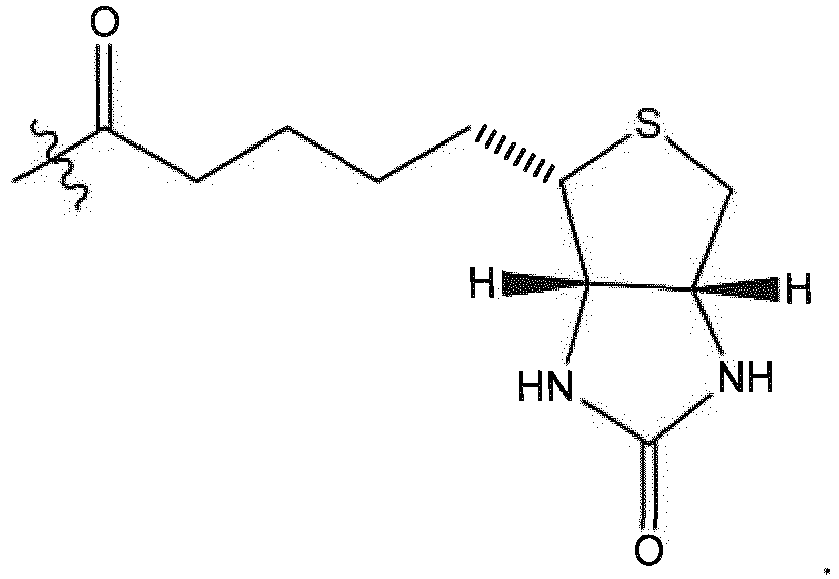
- R8 has formula (II):
- R8 is a fluorescent label (e.g., R8 is FITC).
- the polyheteroalkylene is (PEG)n, wherein PEG represents a polyethylene glycol, and n is an integer from 2-27.
- biotinylated compounds e.g., biotinylated probes of formula (Ia) or (Ib): and wherein:
- the disclosure relates to fluorescence tagged compound of formula le or If: wherein,
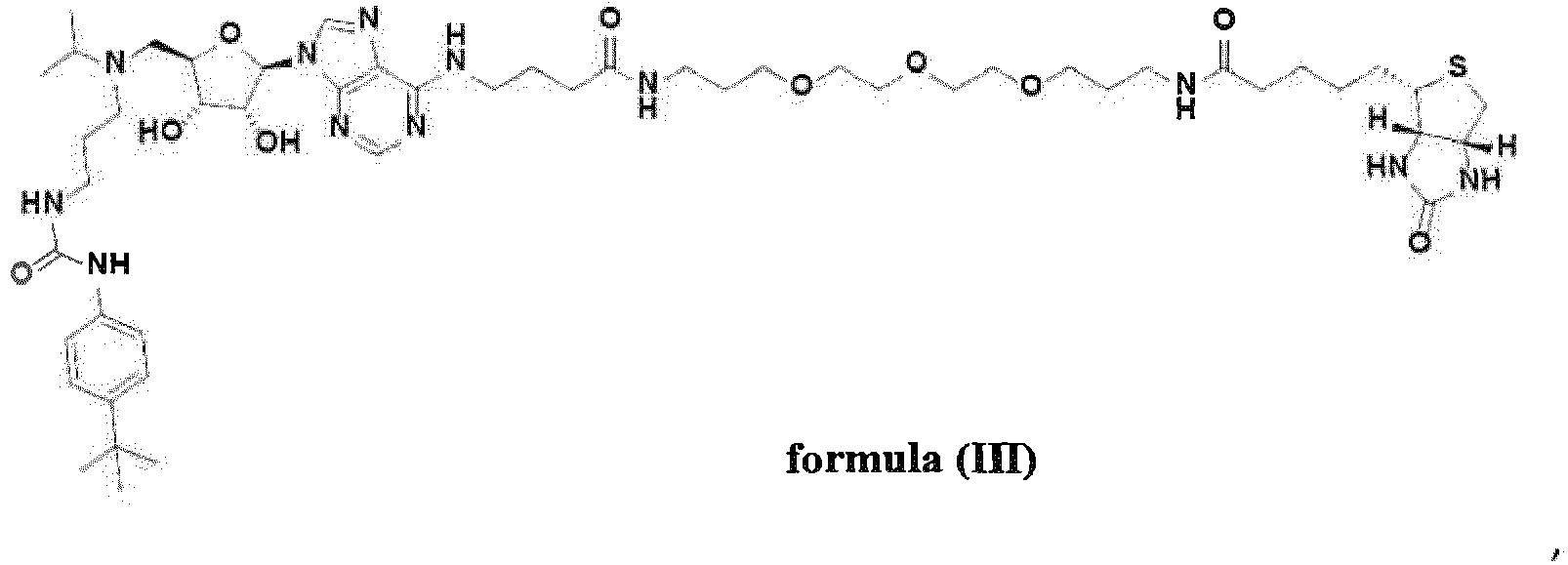
- the compound is selected from the group consisting of formula (III), formula (IV) and formula (V):
- the compound of formula (III) is also referred to as "JQPROB2B”
- the compound of formula (IV) is also referred to as “JQPROB2B-Me
- the compound of formula (V) is also referred to as "JQPROB11.”
- the probe is covalently or non-covalently bound to a solid support (e.g., a bead).
- a solid support e.g., a bead
- the bead emits singlet oxygen upon excitation by light; the bead is coated with a protein (e.g., streptavidin); or the protein is bound to the compound through association with R8; and R8 has formula (II).
- alkyl is defined to include saturated aliphatic hydrocarbons including straight chains and branched chains.
- the alkyl group has 1 to 6 carbon atoms.
- C 1-6 alkyl refers to linear or branched radicals of 1 to 6 carbon atoms (e.g., methyl, ethyl, n-propyl, isopropyl, n-butyl, isobutyl, sec-butyl, tert-butyl, n-pentyl, isopentyl, neopentyl, and n-hexyl), optionally substituted by 1 to 5 suitable substituents.
- Alkyl groups may be substituted or unsubstituted.
- alkyl groups may be substituted by one or more halo groups, up to the total number of hydrogen atoms present on the alkyl moiety.
- C 1-6 alkyl may include includes halogenated alkyl groups,
- alkyl Whenever a numerical range is used in this application, for example when 1 to 6 is used in the definition of "alkyl”, it means that the alkyl group may contain 1 carbon atom, 2 carbon atoms, 3 carbon atoms, etc. up to and including 6 carbon atoms.
- Alkyl groups described herein as optionally substituted by may be substituted by one or more substituent groups, which are selected independently unless otherwise indicated.
- the total number of substituent groups may equal the total number of hydrogen atoms on the alkyl moiety, to the extent such substitution makes chemical sense.
- Optionally substituted alkyl groups typically contain from 1 to 6 optional substituents, sometimes 1 to 5 optional substituents, preferably from 1 to 4 optional substituents, or more preferably from 1 to 3 optional substituents.
- heteroalkyl by itself or in combination with another term, refers to an alkylalkyl group as described above, wherein one or more non-contiguous carbon atoms of the alkylene chain are replaced by heteroatomic groups that are each independently selected from N, N(R), O, and S, where R is H or C1-6 alkyl, provided that there is at least one carbon atom between the occurrence of any two heteroatomic groups.
- halo or halogen group is defined to include fluorine, chlorine, bromine or iodine.
- alkylene by itself of as part of another term, refers to a saturated, branched or straight chain or cyclic hydrocarbon radical of the stated number of carbon atoms, typically 1-30 carbon atoms, and having two monovalent radical centers derived by the removal of two hydrogen atoms from the same or two different carbon atoms of a parent alkane.
- Typical alkylene radicals include, but are not limited to: methylene (-CH 2 -), 1,2-ethylene -CH 2 CH 2 -), 1,3-propylene (-CH 2 CH 2 CH 2 -), 1,4-butylene (-CH 2 CH 2 CH 2 CH 2 -), and the like.
- heteroalkylene refers to an alkylene group as described above, wherein one or more non-contiguous carbon atoms of the alkylene chain are replaced by heteroatomic groups that are each independently selected from N, N(R), O, and S, where R is H or C 1-6 alkyl, provided that there is at least one carbon atom between the occurrence of any two heteroatomic groups.
- affinity tag refers moiety that is used to facilitate purification of another molecule (e.g., a probe, protein or polypeptide).
- Affinity tags may be attached the probe molecule by any suitable method. Affinity tags generally fall into three categories: a) peptide sequences that bind to small molecules; b) fusion proteins that bind to small molecules; and c) peptide tags or fusion proteins that bind to antibodies.
- An affinity tag may also be a small molecule that has a convenient binding partner.
- an affinity tag such as biotin may be chemically coupled, for instance covalently, to a target protein or peptide to facilitate the binding of the target to streptavidin.
- Affinity tags include, for example, metal binding tags such as histidine tags, GST (in glutathione/GST binding), streptavidin (in biotin/streptavidin binding).
- metal binding tags such as histidine tags, GST (in glutathione/GST binding), streptavidin (in biotin/streptavidin binding).
- Other affinity tags include Myc or Max in a Myc/Max pair, or polyamino acids, such as polyhistidines.
- fluorescence label and “fluorophore” used interchangeably and refer to any substance that emits electromagnetic energy such as light at a certain wavelength (emission wavelength) when the substance is illuminated by radiation of a different wavelength (excitation wavelength) and is intended to encompass a chemical or biochemical molecule or fragments thereof that is capable of interacting or reacting specifically with an analyte of interest in a sample to provide one or more optical signals.
- fluorescence labels include but are not limited to fluoroscein 5- isothiocyanate (FITC), Alexa Fluor® 350, dansyl Chloride (DNS-C1), 5-(iodoacetamida)fluoroscein (5-IAF); tetramethylrhodamine 5 -(and 6-)isothiocyanate (TRITC), 6- acryloyl-2-dimethylaminonaphthalene (acrylodan), 7-nitrobenzo-2-oxa- 1 ,3,-diazol-4-yl chloride (NBD-CI), ethidium bromide, Lucifer Yellow, 5-carboxyrhodamine 6G hydrochloride, Lissamine rhodamine B sulfonyl chloride, Texas RedTM, sulfonyl chloride, BODIPYTM., naphthalamine sulfonic acids including but not limited to 1- anilinonaphthalene-8 -sulfonic acid (
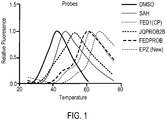
- FIG. 1 is a graph demonstrating the results of a DFS Assay (DMSO, SAH (S-adenosylhomocysteine), EPZ (EPZ004777 reported by Epizyme), JQPROB2B (e.g., a compound of formula (III)), FED1(CP), and FEDPROB) are shown)
- the inventors have designed and identified compounds (e.g., formula (I)) that bind to DOT1L with high affinity. Thus, inventors have designed and identified compounds useful as probes for both assessing the activity and identifying inhibitors of DOT1L.
- All of the compounds of formula (I) can be prepared by conventional routes such as by the procedures described in the general methods presented below, or by similar methods thereto.
- the present invention also encompasses these processes for preparing the compounds of formula (I), in addition to any novel intermediates used therein.
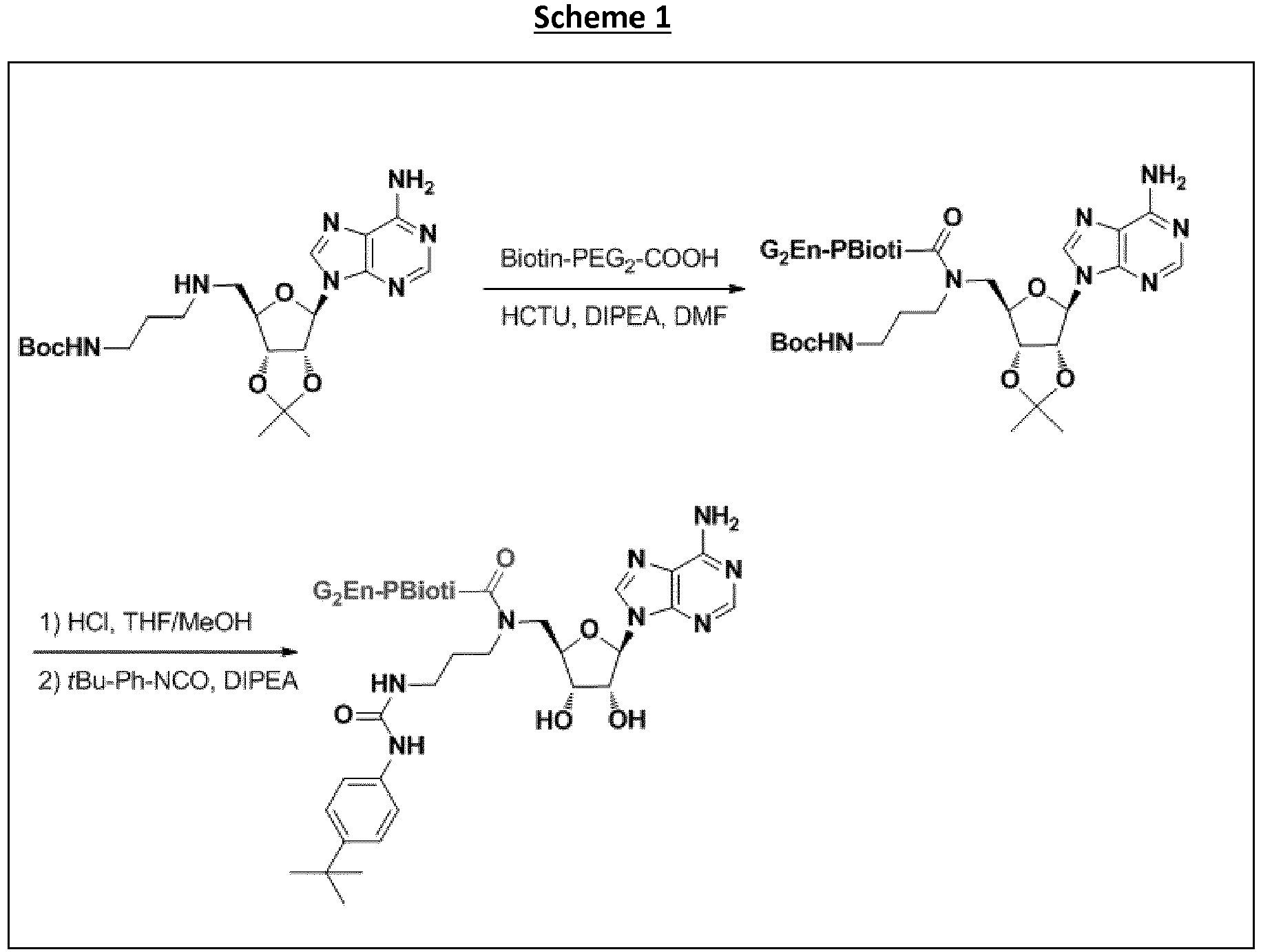
- compounds of formula (I) may be prepared as illustrated by Scheme 1.
- a protocol for performing a Fluorescence Polarization Assay for detecting the binding of (with or without a test compound) a fluorescence labeled probe to DOT1L, or an analog thereof is as follows.
- a protein solution comprising DOT1L or an active fragment thereof e.g., DOT1L SET domain
- a suitable buffer e.g., phosphate buffered saline, pH 7.4, 1 mM DTT
- a desired concentration e.g., 0.1 ⁇ M.
- a probe solution comprising a compound of formula (I), (Ie), (If) or (Ig) ("FED1- FITC") (depicted below) is prepared.
- a volume (e.g., 1 ⁇ L, 2.5 ⁇ L, 5 ⁇ L, 10 ⁇ L, 20 ⁇ L, 50 ⁇ L, or 100 ⁇ L) of the protein solution is added to a sample well of a multi-well plate (e.g., a micro titer plate). Then a volume (e.g., 1 ⁇ L, 2.5 ⁇ L, 5 ⁇ L, 10 ⁇ L, 20 ⁇ L, 50 ⁇ L, or 100 ⁇ L) of the probe solution is added to each well with or without a test compound. The plate is spun and then incubated at room temperature in the dark for 30 minutes. Binding of the probe to DOT1L or an active fragment thereof is then measured using a fluorometer.
- DFS enables assays suitable for high throughput screening assays for the effect of a small molecule on protein stability.
- DFS assays measures the thermal stability of a target protein and a subsequent increase in protein melting temperature upon binding of a ligand to the protein. Generally, specific binding will stabilize the protein.
- An exemplary protocol for performing a DFS for detecting the binding of (with or without a test compound) a fluorescence labeled probe to DOT1L, or an analog thereof, is as follows.
- a protein solution comprising DOT1L or an active fragment thereof (e.g., DOT1L SET domain) is prepared in a suitable buffer at a desired concentration (e.g., 0.1 ⁇ M. 0.5 ⁇ M, 1.0 ⁇ M, 2.5 ⁇ M, 5.0 ⁇ M, 10 ⁇ M, 20 ⁇ M, or 100 ⁇ M).
- a probe solution comprising a compound of formula (I), (Ie), (If) or (Ig) is prepared.
- a volume of the protein solution is combined with a volume of the probe solution in the presence or absence of a test compound. Binding of the probe to DOT1L or an active fragment thereof is then measured using a fluorometer.
- FIG. 1 The results of one such assay are shown in FIG. 1 .
- the binding effect DMSO, SAH (S-adenosylhomocysteine), EPZ (EPZ004777 reported by Epizyme), JQPROB2B (e.g., a compound of formula (III)), FED1(CP), and FEDPROB) are shown, of which compound of formula (III)) shows reasonable binding affinity against DOT1L..
- Alpha assays require two bead types: donor beads and acceptor beads.
- Donor beads contain a photosensitizer, phthalocyanine, which converts ambient oxygen to an excited and reactive form of O 2 , singlet oxygen, upon illumination at 680 nm. Within its 4 ⁇ sec half-life, singlet oxygen can diffuse approximately 200 nm in solution. If an Acceptor bead is within that distance, energy is transferred from the singlet oxygen to thioxene derivatives within the Acceptor bead, resulting in light production. If the Donor bead is not in proximity of an Acceptor bead, the singlet oxygen falls to ground state and no signal is produced
- An ALPHA assay developed based on probes described herein has shown excellent Z' (0.66), and is suitable for high through-put screening. The assay has been used to test the DOT1L inhibitors and the results are in good agreement with DSF assay data.
- a suitable ALPHA assay can be performed as follows.
- AlphaScreen Beads Perkin Elmer # 6760619M
- Nickel chelate acceptor beads Streptavidin donor beads
- AlphaScreen Plates Perkin Elmer # 6005359
- Plate Covers Costar # 6570
- Alpha Buffer 50 mM HEPES, 150 mM NaCl, 0.1% w/v BSA, 0.01% w/v Tween20, pH 7.5, Store at 4°, allow to equilibrate to RT before beginning assay).
- Two stock solutions e.g., a protein solution comprising DOT1L or an active fragment thereof and a probe solution comprising a compound of formula (I) are made at 2x the final concentration in Alpha buffer.
- the components of these 2x solutions are dependent on the biochemistry of the protein being assayed. All solutions containing Alpha beads should be handled in low light conditions.
- 10 ⁇ L of the protein solution is added to the 384 well alpha plate and the plate is spun at 1000 rpm for 30s. The plate is incubated at room temperature, then 100 nL of test compounds are pinned into the plate, followed by a second incubation at room temperature. Finally, 10 ⁇ L of probe solution is added to the 384 well alpha plate, the plate is spun down and incubated at room temperature and read on a plate reader.
- Plates can be read with an Envision plate reader, which comes with a predefined AlphaScreen program that has the correct excitation and emission wavelengths, cutoff filters, delay time, etc.
- a 2x solution of his6-DOT1L + biotinylated probe is made such the final concentration of the components in the final assay volume of 20 ⁇ L is: (His6-DOT1L: 80nM final concentration; Biotin-FED1 (JQ-PROB2B): 40nM final concentration). 10 ⁇ L of this solution is added to the 384 well plate and the plate is spun for 30s at 1000 rpm
- a 2x solution of alpha beads is made such the concentration of the components in the final assay volume of 20 ⁇ L is: (Nickel chelate acceptor bead: 25 ⁇ g/mL final concentration; Streptavidin donor bead: 25 ⁇ g/mL final concentration). 10 ⁇ L of this solution is added to the 384 well plate and the plate is spun for 30s at 1000 rpm. Plates are incubated at room temperature for 20 minutes, then read on plate reader.
Landscapes
- Health & Medical Sciences (AREA)
- Life Sciences & Earth Sciences (AREA)
- Chemical & Material Sciences (AREA)
- Engineering & Computer Science (AREA)
- Molecular Biology (AREA)
- Immunology (AREA)
- General Health & Medical Sciences (AREA)
- Hematology (AREA)
- Biomedical Technology (AREA)
- Urology & Nephrology (AREA)
- Biochemistry (AREA)
- Biotechnology (AREA)
- Medicinal Chemistry (AREA)
- Organic Chemistry (AREA)
- General Physics & Mathematics (AREA)
- Cell Biology (AREA)
- Microbiology (AREA)
- Pathology (AREA)
- Food Science & Technology (AREA)
- Physics & Mathematics (AREA)
- Analytical Chemistry (AREA)
- Genetics & Genomics (AREA)
- Public Health (AREA)
- Pharmacology & Pharmacy (AREA)
- Veterinary Medicine (AREA)
- Epidemiology (AREA)
- Animal Behavior & Ethology (AREA)
- Investigating, Analyzing Materials By Fluorescence Or Luminescence (AREA)
- Investigating Or Analysing Materials By The Use Of Chemical Reactions (AREA)
- Investigating Or Analysing Biological Materials (AREA)
- Measuring Or Testing Involving Enzymes Or Micro-Organisms (AREA)
- Peptides Or Proteins (AREA)
Description
- This invention relates to compounds (e.g. probes) that bind to Histone H3-lysine79 (H3K79) methyl transferase ("DOT1-Like Histone H3K79 Methyltransferase" or "DOT1L"), and more particularly to probes useful for purposes such as assessing the activity of DOT1L and identifying inhibitors of DOT1L
- DOT1L plays important roles in normal cell differentiation as well as initiation of acute leukemia. DOT1L specifically catalyzes methylation of the histone H3-lysine79 (H3K79) residue located in the nucleosome core structure. DOT1L appears to be necessary and sufficient for the initiation and maintenance of leukemia with MLL (mixed lineage leukemia) gene translocations. DOT1L catalyzes an SN2 reaction of the H3K79 ε-NH2 of the substrate nucleosome with the methyl group of S-(5'-adenosyl)-L-methionine (SAM), the enzyme co-factor.
-
WO 2012/082436 A2 discloses compounds, pharmaceutical compositions containing the compounds, and the uses of the compounds and compositions as modulators of histone methyltransferases, and for treating diseases influenced by modulation of histone methyltransferase activity. -
WO 2013/055397 A1 describes methods and compositions for the production of stem cells. Disclosed is that inhibiting one or more of Dotl L (a histone H3 methyltransferase), YY1 (a transcriptional repressor protein), and/or SUV39H1 (a histone- lysine N-methyltransferase) helps promote the reprogramming of differentiated cells. -
US 2012/142625 A1 relates to substituted purine and 7-deazapurine compounds, pharmaceutical compositions containing these compounds and methods of treating disorders in which DOT1-mediated protein methylation plays a part, such as cancer and neurological disorders, by administering these compounds and pharmaceutical compositions to subjects in need thereof. -
US 2014/100184 A1 relates generally to the design and synthesis of ribose and non-ribose containing selective inhibitors of histone methyltransferase DOT1 L. - Su et al. (2013, Curr. Op. Chem. Biol. 17, 768-755) summarizes some of the advances in target identification of bioactive molecules (including drugs and natural products) using in situ methods for cell-based proteome profiling of potential on and off targets.
- Yu et al. (2012, Nature Comm. 3, 1288) reports the three-dimensional structure of the protein methyltransferase DOT1L bound to EPZ004777.
- Daigle et al. (2011, Cancer Cell 20, 53-65) discloses EPZ004777 as a DOT1L inhibitor.
- Anglin et al (2012, J. Med. Chem. 55, 8066-8074 discloses the synthesis and structure-activity relationship investigation of adenosine-containing inhibitors of histone methyltransferase DOT1L.
-
US 2004/0132114 A1 relates to an assay for identifying compounds which interact with the [gamma]-secretase complex. In particular the assay identifies compounds which increase the affinity of the complex for certain probes. - The invention is described by the appended claims.
- Described herein are probes useful for both assessing the activity of DOT1L and identifying inhibitors of DOT1L. These probes can be used in various assays, including Amplified Luminescent Proximity Homogeneous Assays ("ALPHA" assays), Differential Scanning Fluorimetry (DFS) Assay, and Fluorescence Polarization (FP) assays used for high-throughput screening (HTS) for small molecule drug discovery. The compounds can also be used as a pull down agent for target identification. The compounds bind DOT1L with high affinity and are adaptable in that various fluorescence reagents can be attached to a variety of positions as can other markers, detectable tags, and affinity reagents. Importantly, by modifying the groups present at certain positions, the affinity of the compounds can be tuned for different purposes.
- In one aspect, the invention provides a probe, comprising a compound having formula (I):

- X is N or C-R5;
- Y is O or S;
- R1 is hydrogen or C1-3alkyl;
- R2 is Z-R8;
- R3 is hydrogen or C1-6 alkyl;
- R4 is C1-8 alkyl;
- R5 is hydrogen, halo, C1-6 alkyl, or C1-6 haloalkyl;
- Z is a divalent group consisting of any 1, 2, 3, 4, or 5 of the following independently selected moieties:
- (i) C1-30 alkylene;
- (ii) heteroalkylene that spans from 3-20 atoms in length wherein from 1-8 of the atoms in the span are heteroatomic groups that are each independently selected from N, NH, N-C1-C6 alkyl, O, and S, provided that there is at least one carbon atom between the occurrence of any two heteroatomic groups;
- (iii) polyheteroalkylene chain that spans from 21-100 atoms in length wherein from 1-50 of the atoms in the span are heteroatomic groups that are each independently selected from N, NH, N-C1-C6 alkyl, O, and S, provided that there is at least one carbon atom between the occurrence of any two heteroatomic groups;
- (iv) C2-30 alkenylene chain,
- (v) -OC(=O)-, -C(=O)O-, -NHC(=O)-, -C(=O)NH-, -NHC(=O)NH-, -NHC(=S)NH-, - OC(=O)NH-, and -NHC(=O)O-;
and
- R8 is an affinity tag or a fluorescent label.
- In some embodiments: R8 is an affinity tag;
- In some embodiments R8 has formula (II):

- In some embodiments, R8 is a fluorescent label (e.g., R8 is FITC).
- In some embodiments, Z is a divalent group consisting of one or two independently selected C1-30alkylenes; a heteroalkylene or polyheteroalkylene; and one of the following: -NHC(=O)-, -C(=O)NH-, or -NHC(=S)NH-; Z is a divalent group consisting of one or two independently selected C1-30alkylenes; a heteroalkylene; and -NHC(=O)- or -C(=O)NH- (e.g., when R8 is an affinity tag, e.g., having formula (II)); Z is a divalent group consisting of one or two independently selected C1-30alkylenes; a polyheteroalkylene; and -NHC(=O)- or -C(=O)NH- (e.g., when R8 is an affinity tag, e.g., having formula (II)); and Z is a divalent group consisting of one or two independently selected C1-30alkylenes and -NHC(=S)NH- (e.g., when R8 is a fluorescent label, e.g., FITC).
- In some embodiments, the polyheteroalkylene is (PEG)n, wherein PEG represents a polyethylene glycol, and n is an integer from 2-27.
- In one aspect, the disclosure relates to biotinylated compounds (e.g., biotinylated probes) of formula (Ia) or (Ib):


- X is N, CH, C-CI, C-CH3, or C-CF3;
- Y is O or S;
- R is t-butyl or methyl;
- n is 2-27; and
- n' is 0-10.
- In some embodiments, the disclosure relates to fluorescence tagged compound of formula le or If:


- X is N or C-R5;
- R5 is hydrogen, halo, C1-6alkyl, or C1-haloalkyl
- Y is O or S; and
- R is t-butyl or methyl.
- Disclosed is a fluorescence tagged compounds of formula (Ig):

- As described herein, the compound of formula (Ig) is also referred to as "FED-FITC,"
- In some embodiments: the compound is selected from the group consisting of formula (III), formula (IV) and formula (V):


- As described herein, the compound of formula (III) is also referred to as "JQPROB2B," the compound of formula (IV) is also referred to as "JQPROB2B-Me,' and the compound of formula (V) is also referred to as "JQPROB11."
- In some aspects, the probe is covalently or non-covalently bound to a solid support (e.g., a bead). In some embodiments: the bead emits singlet oxygen upon excitation by light; the bead is coated with a protein (e.g., streptavidin); or the protein is bound to the compound through association with R8; and R8 has formula (II).
- As used herein, the term "alkyl" is defined to include saturated aliphatic hydrocarbons including straight chains and branched chains. Preferably, the alkyl group has 1 to 6 carbon atoms. For example, as used herein, the term "C1-6 alkyl," as well as the alkyl moieties of other groups referred to herein (e.g., C1-6 haloalkyl), refers to linear or branched radicals of 1 to 6 carbon atoms (e.g., methyl, ethyl, n-propyl, isopropyl, n-butyl, isobutyl, sec-butyl, tert-butyl, n-pentyl, isopentyl, neopentyl, and n-hexyl), optionally substituted by 1 to 5 suitable substituents. Alkyl groups may be substituted or unsubstituted. In particular, unless otherwise specified, alkyl groups may be substituted by one or more halo groups, up to the total number of hydrogen atoms present on the alkyl moiety. Thus, C1-6 alkyl may include includes halogenated alkyl groups,
- Whenever a numerical range is used in this application, for example when 1 to 6 is used in the definition of "alkyl", it means that the alkyl group may contain 1 carbon atom, 2 carbon atoms, 3 carbon atoms, etc. up to and including 6 carbon atoms.
- Alkyl groups described herein as optionally substituted by may be substituted by one or more substituent groups, which are selected independently unless otherwise indicated. The total number of substituent groups may equal the total number of hydrogen atoms on the alkyl moiety, to the extent such substitution makes chemical sense. Optionally substituted alkyl groups typically contain from 1 to 6 optional substituents, sometimes 1 to 5 optional substituents, preferably from 1 to 4 optional substituents, or more preferably from 1 to 3 optional substituents.
- As used herein, the term "heteroalkyl," by itself or in combination with another term, refers to an alkylalkyl group as described above, wherein one or more non-contiguous carbon atoms of the alkylene chain are replaced by heteroatomic groups that are each independently selected from N, N(R), O, and S, where R is H or C1-6 alkyl, provided that there is at least one carbon atom between the occurrence of any two heteroatomic groups.
- As used herein, the term "halo" or "halogen" group is defined to include fluorine, chlorine, bromine or iodine.
- As used herein, the term "alkylene," by itself of as part of another term, refers to a saturated, branched or straight chain or cyclic hydrocarbon radical of the stated number of carbon atoms, typically 1-30 carbon atoms, and having two monovalent radical centers derived by the removal of two hydrogen atoms from the same or two different carbon atoms of a parent alkane. Typical alkylene radicals include, but are not limited to: methylene (-CH2-), 1,2-ethylene -CH2CH2-), 1,3-propylene (-CH2CH2CH2-), 1,4-butylene (-CH2CH2CH2CH2-), and the like.
- The term "heteroalkylene" refers to an alkylene group as described above, wherein one or more non-contiguous carbon atoms of the alkylene chain are replaced by heteroatomic groups that are each independently selected from N, N(R), O, and S, where R is H or C1-6 alkyl, provided that there is at least one carbon atom between the occurrence of any two heteroatomic groups.
- The term "affinity tag" as used herein refers moiety that is used to facilitate purification of another molecule (e.g., a probe, protein or polypeptide). Affinity tags may be attached the probe molecule by any suitable method. Affinity tags generally fall into three categories: a) peptide sequences that bind to small molecules; b) fusion proteins that bind to small molecules; and c) peptide tags or fusion proteins that bind to antibodies. An affinity tag may also be a small molecule that has a convenient binding partner. As one example, an affinity tag such as biotin may be chemically coupled, for instance covalently, to a target protein or peptide to facilitate the binding of the target to streptavidin. Affinity tags include, for example, metal binding tags such as histidine tags, GST (in glutathione/GST binding), streptavidin (in biotin/streptavidin binding). Other affinity tags include Myc or Max in a Myc/Max pair, or polyamino acids, such as polyhistidines.
- As used herein, the terms "fluorescence label" and "fluorophore" used interchangeably and refer to any substance that emits electromagnetic energy such as light at a certain wavelength (emission wavelength) when the substance is illuminated by radiation of a different wavelength (excitation wavelength) and is intended to encompass a chemical or biochemical molecule or fragments thereof that is capable of interacting or reacting specifically with an analyte of interest in a sample to provide one or more optical signals.
- Representative fluorescence labels include but are not limited to fluoroscein 5- isothiocyanate (FITC), Alexa Fluor® 350, Dansyl Chloride (DNS-C1), 5-(iodoacetamida)fluoroscein (5-IAF); tetramethylrhodamine 5 -(and 6-)isothiocyanate (TRITC), 6- acryloyl-2-dimethylaminonaphthalene (acrylodan), 7-nitrobenzo-2-oxa- 1 ,3,-diazol-4-yl chloride (NBD-CI), ethidium bromide, Lucifer Yellow, 5-carboxyrhodamine 6G hydrochloride, Lissamine rhodamine B sulfonyl chloride, Texas Red™, sulfonyl chloride, BODIPY™., naphthalamine sulfonic acids including but not limited to 1- anilinonaphthalene-8 -sulfonic acid (ANS) and 6-(p-toluidinyl)naphthalen- e-2-sulfonic acid (TNS), Anthroyl fatty acid, DPH, Parinaric acid, TMA-DPH, Fluorenyl fatty acid, Fluorescein-phosphatidylethanolamine, Texas red-phosphatidylethanolamine, Pyrenyl- phophatidylcholine, Fluorenyl - phosphotidylcholine, Merocyanine 540, I-(3- sulfonatopropyl)-4-[-.beta.-[2 [(di-n-butylamino)-6 naphthyl]vinyl]pyridinium betaine (Naphtyl Styryl), 3,3'dipropylthiadicarbocyanine (diS-C3-(5)), 4-(p-dipentyl aminostyryl)-I-methylpyridinium (di-5-ASP), Cy-3 Iodo Acetamide, Cy-5-N- Hydroxysuccinimide, Cy-7-Isothiocyanate, rhodamine 800, IR-125, Thiazole Orange, Azure B, Nile Blue, Al Phthalocyanine, Oxaxine 1, 4', 6-diamidino-2-phenylindole (DAPI), Hoechst 33342, TOTO, Acridine Orange, Ethidium Homodimer, N(ethoxycarbonylmethyl)-6-methoxyquinolinium (MQAE), Fura-2, Calcium Green, Carboxy SNARF-6, BAPTA, coumarin, phytofiuors, Coronene, and metal-ligand complexes.
- The details of one or more embodiments of the invention are set forth in the accompanying drawings and the description below. Other features, objects, and advantages of the invention will be apparent from the description and drawings, and from the claims.
-
FIG. 1 is a graph demonstrating the results of a DFS Assay (DMSO, SAH (S-adenosylhomocysteine), EPZ (EPZ004777 reported by Epizyme), JQPROB2B (e.g., a compound of formula (III)), FED1(CP), and FEDPROB) are shown) - The invention is described by the appended claims. Examples not pertaining to the invention are for illustrative purposes only.
- The inventors have designed and identified compounds (e.g., formula (I)) that bind to DOT1L with high affinity. Thus, inventors have designed and identified compounds useful as probes for both assessing the activity and identifying inhibitors of DOT1L.
- All of the compounds of formula (I) can be prepared by conventional routes such as by the procedures described in the general methods presented below, or by similar methods thereto. The present invention also encompasses these processes for preparing the compounds of formula (I), in addition to any novel intermediates used therein.
- According to a first process, compounds of formula (I) (e.g., compounds of formula (Ic)) may be prepared as illustrated by Scheme 1.
- According to a second process, compounds of formula (I) (e.g., compounds of formula (Ib)) may be prepared as illustrated by Scheme 2.

- An exemplary protocol for performing a Fluorescence Polarization Assay for detecting the binding of (with or without a test compound) a fluorescence labeled probe to DOT1L, or an analog thereof, is as follows. First, a protein solution comprising DOT1L or an active fragment thereof (e.g., DOT1L SET domain) is prepared in a suitable buffer (e.g., phosphate buffered saline, pH 7.4, 1 mM DTT) is prepared at a desired concentration (e.g., 0.1 µM. 0.5 µM, 1.0 µM, 2.5 µM, 5.0 µM, 10µM, 20 µM, or 100 µM). Then, a probe solution comprising a compound of formula (I), (Ie), (If) or (Ig) ("FED1- FITC") (depicted below) is prepared.

- A volume (e.g., 1 µL, 2.5 µL, 5 µL, 10 µL, 20 µL, 50 µL, or 100 µL) of the protein solution is added to a sample well of a multi-well plate (e.g., a micro titer plate). Then a volume (e.g., 1 µL, 2.5 µL, 5 µL, 10 µL, 20 µL, 50 µL, or 100 µL) of the probe solution is added to each well with or without a test compound. The plate is spun and then incubated at room temperature in the dark for 30 minutes. Binding of the probe to DOT1L or an active fragment thereof is then measured using a fluorometer.
- DFS enables assays suitable for high throughput screening assays for the effect of a small molecule on protein stability. DFS assays measures the thermal stability of a target protein and a subsequent increase in protein melting temperature upon binding of a ligand to the protein. Generally, specific binding will stabilize the protein. An exemplary protocol for performing a DFS for detecting the binding of (with or without a test compound) a fluorescence labeled probe to DOT1L, or an analog thereof, is as follows.
- First, a protein solution comprising DOT1L or an active fragment thereof (e.g., DOT1L SET domain) is prepared in a suitable buffer at a desired concentration (e.g., 0.1 µM. 0.5 µM, 1.0 µM, 2.5 µM, 5.0 µM, 10µM, 20 µM, or 100 µM). Then, a probe solution comprising a compound of formula (I), (Ie), (If) or (Ig) is prepared. A volume of the protein solution is combined with a volume of the probe solution in the presence or absence of a test compound. Binding of the probe to DOT1L or an active fragment thereof is then measured using a fluorometer.
- The results of one such assay are shown in
FIG. 1 . The binding effect DMSO, SAH (S-adenosylhomocysteine), EPZ (EPZ004777 reported by Epizyme), JQPROB2B (e.g., a compound of formula (III)), FED1(CP), and FEDPROB) are shown, of which compound of formula (III)) shows reasonable binding affinity against DOT1L.. - In and ALPHA assay binding of binding partners captured on the beads leads to an energy transfer from one bead to the other, ultimately producing a luminescent signal. Alpha assays require two bead types: donor beads and acceptor beads. Donor beads contain a photosensitizer, phthalocyanine, which converts ambient oxygen to an excited and reactive form of O2, singlet oxygen, upon illumination at 680 nm. Within its 4 µsec half-life, singlet oxygen can diffuse approximately 200 nm in solution. If an Acceptor bead is within that distance, energy is transferred from the singlet oxygen to thioxene derivatives within the Acceptor bead, resulting in light production. If the Donor bead is not in proximity of an Acceptor bead, the singlet oxygen falls to ground state and no signal is produced
- An ALPHA assay developed based on probes described herein has shown excellent Z' (0.66), and is suitable for high through-put screening. The assay has been used to test the DOT1L inhibitors and the results are in good agreement with DSF assay data. A suitable ALPHA assay can be performed as follows.
- AlphaScreen Beads (Perkin Elmer # 6760619M), Nickel chelate acceptor beads, Streptavidin donor beads, AlphaScreen Plates (Perkin Elmer # 6005359), Plate Covers (Costar # 6570), Alpha Buffer (50 mM HEPES, 150 mM NaCl, 0.1% w/v BSA, 0.01% w/v Tween20, pH 7.5, Store at 4°, allow to equilibrate to RT before beginning assay).
- Two stock solutions (e.g., a protein solution comprising DOT1L or an active fragment thereof and a probe solution comprising a compound of formula (I)) are made at 2x the final concentration in Alpha buffer. The components of these 2x solutions are dependent on the biochemistry of the protein being assayed. All solutions containing Alpha beads should be handled in low light conditions. In general for 384 well assay formats, 10 µL of the protein solution is added to the 384 well alpha plate and the plate is spun at 1000 rpm for 30s. The plate is incubated at room temperature, then 100 nL of test compounds are pinned into the plate, followed by a second incubation at room temperature. Finally, 10 µL of probe solution is added to the 384 well alpha plate, the plate is spun down and incubated at room temperature and read on a plate reader.
- Plate Reader Settings: Plates can be read with an Envision plate reader, which comes with a predefined AlphaScreen program that has the correct excitation and emission wavelengths, cutoff filters, delay time, etc.
- Alpha Buffer: All reagents were diluted in standard alpha buffer (e.g., 0.5% w/v BSA, .05% w/v Tween20, 1 mM DTT added fresh, pH = 8.0) and allowed to equilibrate to room temperature prior to addition to plates. After addition of Alpha beads to master solutions all subsequent steps were performed in low light conditions.
- A 2x solution of his6-DOT1L + biotinylated probe is made such the final concentration of the components in the final assay volume of 20 µL is: (His6-DOT1L: 80nM final concentration; Biotin-FED1 (JQ-PROB2B): 40nM final concentration). 10 µL of this solution is added to the 384 well plate and the plate is spun for 30s at 1000 rpm
- 100 nL of experimental compounds in DMSO is added into the 384 well assay plate, and the plate is spun again for 30s at 1000 rpm. The plates are then incubated at room temperature for 30 minutes.
- A 2x solution of alpha beads is made such the concentration of the components in the final assay volume of 20 µL is: (Nickel chelate acceptor bead: 25 µg/mL final concentration; Streptavidin donor bead: 25 µg/mL final concentration). 10 µL of this solution is added to the 384 well plate and the plate is spun for 30s at 1000 rpm. Plates are incubated at room temperature for 20 minutes, then read on plate reader.
Claims (13)
- A probe, comprising a compound having formula (I):
 X is N or C-R5;Y is O or S;R1 is hydrogen or C1-3 alkyl;R2 is Z-R8;R3 is hydrogen or C1-6 alkyl;R4 is C1-8 alkyl;R5 is hydrogen, halo, C1-6 alkyl, or C1-6 haloalkyl;Z is a divalent group consisting of any 1, 2, 3, 4, or 5 of the following independently selected moieties:(i) C1-30 alkylene;(ii) heteroalkylene that spans from 3-20 atoms in length wherein from 1-8 of the atoms in the span are heteroatomic groups that are each independently selected from N, NH, N-C1-C6 alkyl, O, and S, provided that there is at least one carbon atom between the occurrence of any two heteroatomic groups;(iii) polyheteroalkylene chain that spans from 21-100 atoms in length wherein from 1-50 of the atoms in the span are heteroatomic groups that are each independently selected from N, NH, N-C1-C6 alkyl, O, and S, provided that there is at least one carbon atom between the occurrence of any two heteroatomic groups;(iv) C2-30 alkenylene chain,(v) -OC(=O)-, -C(=O)O-, -NHC(=O)-, -C(=O)NH-, -NHC(=O)NH-, -NHC(=S)NH-, -OC(=O)NH-, and -NHC(=O)O-;andR8 is an affinity tag or a fluorescent label.
- The probe according to claim 1, wherein R8 is an affinity tag.
- The probe according to claim 1 or 2, wherein R8 has formula (II):
- The probe according to any one of claims 1-3, wherein Z is a divalent group consisting of one or two independently selected C1-30 alkylenes; a heteroalkylene or polyheteroalkylene; and one of the following -NHC(=O)-, -C(=O)NH- -NHC(=S)NH-.
- The probe of claim 4, wherein the polyheteroalkylene is (PEG)n, wherein PEG represents a polyethylene glycol, and n is an integer from 2-27.
- The probe according to any one of claims 1-5, wherein R3 is C1-6 alkyl.
- The probe of claim 1, wherein the compound is selected from the group consisting of:


- The probe according to any one of claims 1-7, wherein the probe is covalently or non-covalently bound to a solid support.
- The probe of claim 8, wherein the solid support is a bead.
- The probe of claim 9, wherein the bead is coated with a protein.
- The probe of claim 10, wherein the protein is streptavidin.
- The probe of claim 1, wherein the compound is selected from the group consisting of:

 n is 2-27;n' is 0-10;X is N, CH, C-Cl, C-CH3, or C-CF3;Y is O or S; andR is t-butyl or methyl.
- The probe of claim 1, wherein the compound is selected from the group consisting of:

 X is N or C-R5;R5 is hydrogen, halo, C1-6alkyl, or C1-6haloalkyl;Y is O or S; andR is t-butyl or methyl.
Applications Claiming Priority (2)
| Application Number | Priority Date | Filing Date | Title |
|---|---|---|---|
| US201361859654P | 2013-07-29 | 2013-07-29 | |
| PCT/US2014/048375 WO2015017311A1 (en) | 2013-07-29 | 2014-07-28 | Dot1l probes |
Publications (3)
| Publication Number | Publication Date |
|---|---|
| EP3027195A1 EP3027195A1 (en) | 2016-06-08 |
| EP3027195A4 EP3027195A4 (en) | 2017-03-01 |
| EP3027195B1 true EP3027195B1 (en) | 2019-02-06 |
Family
ID=52432358
Family Applications (1)
| Application Number | Title | Priority Date | Filing Date |
|---|---|---|---|
| EP14831361.2A Not-in-force EP3027195B1 (en) | 2013-07-29 | 2014-07-28 | Dot1l probes |
Country Status (5)
| Country | Link |
|---|---|
| US (1) | US9535067B2 (en) |
| EP (1) | EP3027195B1 (en) |
| AU (1) | AU2014296532B2 (en) |
| CA (1) | CA2919072A1 (en) |
| WO (1) | WO2015017311A1 (en) |
Families Citing this family (5)
| Publication number | Priority date | Publication date | Assignee | Title |
|---|---|---|---|---|
| US9535067B2 (en) | 2013-07-29 | 2017-01-03 | Dana-Farber Cancer Institute, Inc. | DOT1L probes |
| US9458165B2 (en) | 2014-08-27 | 2016-10-04 | Dana-Farber Cancer Institute, Inc. | DOT1L inhibitors |
| EP3814365B1 (en) * | 2018-06-27 | 2025-09-17 | Dana-Farber Cancer Institute, Inc. | Dot1l degrader and uses thereof |
| CN116239545B (en) * | 2021-12-08 | 2026-03-24 | 上海理工大学 | A fluorescent probe, its preparation method and its application |
| CN116262760A (en) * | 2023-01-18 | 2023-06-16 | 杭州纽龙生物科技有限公司 | Preparation method and application of biotinylated fluorescein isothiocyanate |
Family Cites Families (7)
| Publication number | Priority date | Publication date | Assignee | Title |
|---|---|---|---|---|
| GB0229582D0 (en) * | 2002-12-19 | 2003-01-22 | Merck Sharp & Dohme | Novel assay |
| AU2011341441A1 (en) | 2010-12-03 | 2013-06-20 | Epizyme, Inc. | Modulators of histone methyltransferase, and methods of use thereof |
| CN103391939B (en) | 2010-12-03 | 2016-03-09 | Epizyme股份有限公司 | As the purine be substituted and the 7-azapurine compound of epigenetic enzyme conditioning agent |
| WO2013055397A1 (en) | 2011-10-14 | 2013-04-18 | Children's Medical Center Corporation | Inhibition and enhancement of reprogramming by chromatin modifying enzymes |
| US20140100184A1 (en) | 2012-08-31 | 2014-04-10 | Baylor College Of Medicine | Selective inhibitors of histone methyltransferase dot1l |
| US9535067B2 (en) | 2013-07-29 | 2017-01-03 | Dana-Farber Cancer Institute, Inc. | DOT1L probes |
| US9458165B2 (en) | 2014-08-27 | 2016-10-04 | Dana-Farber Cancer Institute, Inc. | DOT1L inhibitors |
-
2014
- 2014-07-28 US US14/904,572 patent/US9535067B2/en active Active
- 2014-07-28 CA CA2919072A patent/CA2919072A1/en not_active Abandoned
- 2014-07-28 EP EP14831361.2A patent/EP3027195B1/en not_active Not-in-force
- 2014-07-28 AU AU2014296532A patent/AU2014296532B2/en not_active Expired - Fee Related
- 2014-07-28 WO PCT/US2014/048375 patent/WO2015017311A1/en not_active Ceased
Non-Patent Citations (1)
| Title |
|---|
| JOANNA S. YI ET AL: "Structure-Guided DOT1L Probe Optimization by Label-Free Ligand Displacement", ACS CHEMICAL BIOLOGY, vol. 10, no. 3, 20 March 2015 (2015-03-20), US, pages 667 - 674, XP055255074, ISSN: 1554-8929, DOI: 10.1021/cb500796d * |
Also Published As
| Publication number | Publication date |
|---|---|
| EP3027195A4 (en) | 2017-03-01 |
| US9535067B2 (en) | 2017-01-03 |
| EP3027195A1 (en) | 2016-06-08 |
| AU2014296532A1 (en) | 2016-02-11 |
| US20160146817A1 (en) | 2016-05-26 |
| CA2919072A1 (en) | 2015-02-05 |
| WO2015017311A1 (en) | 2015-02-05 |
| AU2014296532B2 (en) | 2019-05-16 |
Similar Documents
| Publication | Publication Date | Title |
|---|---|---|
| Kanaoka | Organic fluorescence reagents in the study of enzymes and proteins | |
| EP0635006B1 (en) | Europium and terbium chelators for time-resolved fluorometric assays | |
| US9535067B2 (en) | DOT1L probes | |
| Wang et al. | A general fluorescence-based coupled assay for S-adenosylmethionine-dependent methyltransferases | |
| US20150152476A1 (en) | Reagents and methods for direct labeling of nucleotides | |
| US8981100B2 (en) | Use of novel coumarins as glutathione and thiol labels | |
| US12258477B2 (en) | Silicon-substituted rhodamine dyes and dye conjugates | |
| US7172865B2 (en) | Rapid and sensitive assay for the detection and quantification of coregulators of nucleic acid binding factors | |
| EP2414527A1 (en) | Conversion of alpha-hydroxyalkylated residues in biomolecules using methyltransferases | |
| CA2473708C (en) | A rapid and sensitive assay for the detection and quantification of coregulators of nucleic acid binding factors | |
| WO2008022355A2 (en) | Methods and reagents for detecting phosphomonoester groups | |
| CA2627628A1 (en) | Novel fluorescent dyes and uses thereof | |
| CA2591652A1 (en) | Id-tag complexes, arrays, and methods of use thereof | |
| Chattopadhaya et al. | Site-specific covalent labeling of proteins inside live cells using small molecule probes | |
| WO2002068537A2 (en) | Fluorescent dye | |
| Zhang et al. | Selective pyrophosphate detection via metal complexes | |
| Dolbeare | Fluorometric quantification of specific chemical species in single cells | |
| GB2405471A (en) | Methods for determining the activity of enzymes which alter the structures of nucleic acids using chemiluminescence quenching | |
| AU2003205320B2 (en) | A rapid and sensitive assay for the detection and quantification of coregulators of nucleic acid binding factors | |
| WO2024081562A1 (en) | Dyes for nucleic acid detection | |
| Thomas | SYNTHESIS AND EVALUATION OF FLUORESCENT REAGENTS FOR THE STUDY OF NUCLEIC ACIDS AND PROTEINS. | |
| KR20200093466A (en) | A screening method of dna methyltransferase inhibitors | |
| WO2003083063A2 (en) | Common ligand mimics: naphtoates | |
| AU2003205320A1 (en) | A rapid and sensitive assay for the detection and quantification of coregulators of nucleic acid binding factors |
Legal Events
| Date | Code | Title | Description |
|---|---|---|---|
| PUAI | Public reference made under article 153(3) epc to a published international application that has entered the european phase |
Free format text: ORIGINAL CODE: 0009012 |
|
| 17P | Request for examination filed |
Effective date: 20160211 |
|
| AK | Designated contracting states |
Kind code of ref document: A1 Designated state(s): AL AT BE BG CH CY CZ DE DK EE ES FI FR GB GR HR HU IE IS IT LI LT LU LV MC MK MT NL NO PL PT RO RS SE SI SK SM TR |
|
| AX | Request for extension of the european patent |
Extension state: BA ME |
|
| DAX | Request for extension of the european patent (deleted) | ||
| A4 | Supplementary search report drawn up and despatched |
Effective date: 20170131 |
|
| RIC1 | Information provided on ipc code assigned before grant |
Ipc: A61K 31/7076 20060101AFI20170125BHEP |
|
| STAA | Information on the status of an ep patent application or granted ep patent |
Free format text: STATUS: EXAMINATION IS IN PROGRESS |
|
| 17Q | First examination report despatched |
Effective date: 20170928 |
|
| GRAP | Despatch of communication of intention to grant a patent |
Free format text: ORIGINAL CODE: EPIDOSNIGR1 |
|
| STAA | Information on the status of an ep patent application or granted ep patent |
Free format text: STATUS: GRANT OF PATENT IS INTENDED |
|
| INTG | Intention to grant announced |
Effective date: 20180924 |
|
| RIN1 | Information on inventor provided before grant (corrected) |
Inventor name: BRADNER, JAMES Inventor name: FEDERATION, ALEXANDER Inventor name: QI, JUN |
|
| GRAS | Grant fee paid |
Free format text: ORIGINAL CODE: EPIDOSNIGR3 |
|
| GRAA | (expected) grant |
Free format text: ORIGINAL CODE: 0009210 |
|
| STAA | Information on the status of an ep patent application or granted ep patent |
Free format text: STATUS: THE PATENT HAS BEEN GRANTED |
|
| AK | Designated contracting states |
Kind code of ref document: B1 Designated state(s): AL AT BE BG CH CY CZ DE DK EE ES FI FR GB GR HR HU IE IS IT LI LT LU LV MC MK MT NL NO PL PT RO RS SE SI SK SM TR |
|
| REG | Reference to a national code |
Ref country code: GB Ref legal event code: FG4D |
|
| REG | Reference to a national code |
Ref country code: CH Ref legal event code: EP Ref country code: AT Ref legal event code: REF Ref document number: 1094422 Country of ref document: AT Kind code of ref document: T Effective date: 20190215 |
|
| REG | Reference to a national code |
Ref country code: IE Ref legal event code: FG4D |
|
| REG | Reference to a national code |
Ref country code: DE Ref legal event code: R096 Ref document number: 602014040837 Country of ref document: DE |
|
| REG | Reference to a national code |
Ref country code: CH Ref legal event code: NV Representative=s name: PATENTANWALT MATTHIAS W. SCHAEFER, CH |
|
| REG | Reference to a national code |
Ref country code: NL Ref legal event code: MP Effective date: 20190206 |
|
| REG | Reference to a national code |
Ref country code: LT Ref legal event code: MG4D |
|
| PG25 | Lapsed in a contracting state [announced via postgrant information from national office to epo] |
Ref country code: PT Free format text: LAPSE BECAUSE OF FAILURE TO SUBMIT A TRANSLATION OF THE DESCRIPTION OR TO PAY THE FEE WITHIN THE PRESCRIBED TIME-LIMIT Effective date: 20190606 Ref country code: NO Free format text: LAPSE BECAUSE OF FAILURE TO SUBMIT A TRANSLATION OF THE DESCRIPTION OR TO PAY THE FEE WITHIN THE PRESCRIBED TIME-LIMIT Effective date: 20190506 Ref country code: LT Free format text: LAPSE BECAUSE OF FAILURE TO SUBMIT A TRANSLATION OF THE DESCRIPTION OR TO PAY THE FEE WITHIN THE PRESCRIBED TIME-LIMIT Effective date: 20190206 Ref country code: FI Free format text: LAPSE BECAUSE OF FAILURE TO SUBMIT A TRANSLATION OF THE DESCRIPTION OR TO PAY THE FEE WITHIN THE PRESCRIBED TIME-LIMIT Effective date: 20190206 Ref country code: NL Free format text: LAPSE BECAUSE OF FAILURE TO SUBMIT A TRANSLATION OF THE DESCRIPTION OR TO PAY THE FEE WITHIN THE PRESCRIBED TIME-LIMIT Effective date: 20190206 Ref country code: SE Free format text: LAPSE BECAUSE OF FAILURE TO SUBMIT A TRANSLATION OF THE DESCRIPTION OR TO PAY THE FEE WITHIN THE PRESCRIBED TIME-LIMIT Effective date: 20190206 |
|
| REG | Reference to a national code |
Ref country code: AT Ref legal event code: MK05 Ref document number: 1094422 Country of ref document: AT Kind code of ref document: T Effective date: 20190206 |
|
| PG25 | Lapsed in a contracting state [announced via postgrant information from national office to epo] |
Ref country code: GR Free format text: LAPSE BECAUSE OF FAILURE TO SUBMIT A TRANSLATION OF THE DESCRIPTION OR TO PAY THE FEE WITHIN THE PRESCRIBED TIME-LIMIT Effective date: 20190507 Ref country code: BG Free format text: LAPSE BECAUSE OF FAILURE TO SUBMIT A TRANSLATION OF THE DESCRIPTION OR TO PAY THE FEE WITHIN THE PRESCRIBED TIME-LIMIT Effective date: 20190506 Ref country code: IS Free format text: LAPSE BECAUSE OF FAILURE TO SUBMIT A TRANSLATION OF THE DESCRIPTION OR TO PAY THE FEE WITHIN THE PRESCRIBED TIME-LIMIT Effective date: 20190606 Ref country code: HR Free format text: LAPSE BECAUSE OF FAILURE TO SUBMIT A TRANSLATION OF THE DESCRIPTION OR TO PAY THE FEE WITHIN THE PRESCRIBED TIME-LIMIT Effective date: 20190206 Ref country code: LV Free format text: LAPSE BECAUSE OF FAILURE TO SUBMIT A TRANSLATION OF THE DESCRIPTION OR TO PAY THE FEE WITHIN THE PRESCRIBED TIME-LIMIT Effective date: 20190206 Ref country code: RS Free format text: LAPSE BECAUSE OF FAILURE TO SUBMIT A TRANSLATION OF THE DESCRIPTION OR TO PAY THE FEE WITHIN THE PRESCRIBED TIME-LIMIT Effective date: 20190206 |
|
| PG25 | Lapsed in a contracting state [announced via postgrant information from national office to epo] |
Ref country code: RO Free format text: LAPSE BECAUSE OF FAILURE TO SUBMIT A TRANSLATION OF THE DESCRIPTION OR TO PAY THE FEE WITHIN THE PRESCRIBED TIME-LIMIT Effective date: 20190206 Ref country code: SK Free format text: LAPSE BECAUSE OF FAILURE TO SUBMIT A TRANSLATION OF THE DESCRIPTION OR TO PAY THE FEE WITHIN THE PRESCRIBED TIME-LIMIT Effective date: 20190206 Ref country code: IT Free format text: LAPSE BECAUSE OF FAILURE TO SUBMIT A TRANSLATION OF THE DESCRIPTION OR TO PAY THE FEE WITHIN THE PRESCRIBED TIME-LIMIT Effective date: 20190206 Ref country code: EE Free format text: LAPSE BECAUSE OF FAILURE TO SUBMIT A TRANSLATION OF THE DESCRIPTION OR TO PAY THE FEE WITHIN THE PRESCRIBED TIME-LIMIT Effective date: 20190206 Ref country code: ES Free format text: LAPSE BECAUSE OF FAILURE TO SUBMIT A TRANSLATION OF THE DESCRIPTION OR TO PAY THE FEE WITHIN THE PRESCRIBED TIME-LIMIT Effective date: 20190206 Ref country code: CZ Free format text: LAPSE BECAUSE OF FAILURE TO SUBMIT A TRANSLATION OF THE DESCRIPTION OR TO PAY THE FEE WITHIN THE PRESCRIBED TIME-LIMIT Effective date: 20190206 Ref country code: DK Free format text: LAPSE BECAUSE OF FAILURE TO SUBMIT A TRANSLATION OF THE DESCRIPTION OR TO PAY THE FEE WITHIN THE PRESCRIBED TIME-LIMIT Effective date: 20190206 Ref country code: AL Free format text: LAPSE BECAUSE OF FAILURE TO SUBMIT A TRANSLATION OF THE DESCRIPTION OR TO PAY THE FEE WITHIN THE PRESCRIBED TIME-LIMIT Effective date: 20190206 |
|
| REG | Reference to a national code |
Ref country code: DE Ref legal event code: R097 Ref document number: 602014040837 Country of ref document: DE |
|
| PG25 | Lapsed in a contracting state [announced via postgrant information from national office to epo] |
Ref country code: PL Free format text: LAPSE BECAUSE OF FAILURE TO SUBMIT A TRANSLATION OF THE DESCRIPTION OR TO PAY THE FEE WITHIN THE PRESCRIBED TIME-LIMIT Effective date: 20190206 Ref country code: SM Free format text: LAPSE BECAUSE OF FAILURE TO SUBMIT A TRANSLATION OF THE DESCRIPTION OR TO PAY THE FEE WITHIN THE PRESCRIBED TIME-LIMIT Effective date: 20190206 |
|
| PLBE | No opposition filed within time limit |
Free format text: ORIGINAL CODE: 0009261 |
|
| STAA | Information on the status of an ep patent application or granted ep patent |
Free format text: STATUS: NO OPPOSITION FILED WITHIN TIME LIMIT |
|
| PG25 | Lapsed in a contracting state [announced via postgrant information from national office to epo] |
Ref country code: AT Free format text: LAPSE BECAUSE OF FAILURE TO SUBMIT A TRANSLATION OF THE DESCRIPTION OR TO PAY THE FEE WITHIN THE PRESCRIBED TIME-LIMIT Effective date: 20190206 |
|
| 26N | No opposition filed |
Effective date: 20191107 |
|
| REG | Reference to a national code |
Ref country code: DE Ref legal event code: R119 Ref document number: 602014040837 Country of ref document: DE |
|
| PG25 | Lapsed in a contracting state [announced via postgrant information from national office to epo] |
Ref country code: SI Free format text: LAPSE BECAUSE OF FAILURE TO SUBMIT A TRANSLATION OF THE DESCRIPTION OR TO PAY THE FEE WITHIN THE PRESCRIBED TIME-LIMIT Effective date: 20190206 Ref country code: MC Free format text: LAPSE BECAUSE OF FAILURE TO SUBMIT A TRANSLATION OF THE DESCRIPTION OR TO PAY THE FEE WITHIN THE PRESCRIBED TIME-LIMIT Effective date: 20190206 |
|
| REG | Reference to a national code |
Ref country code: CH Ref legal event code: PL |
|
| GBPC | Gb: european patent ceased through non-payment of renewal fee |
Effective date: 20190728 |
|
| PG25 | Lapsed in a contracting state [announced via postgrant information from national office to epo] |
Ref country code: TR Free format text: LAPSE BECAUSE OF FAILURE TO SUBMIT A TRANSLATION OF THE DESCRIPTION OR TO PAY THE FEE WITHIN THE PRESCRIBED TIME-LIMIT Effective date: 20190206 |
|
| REG | Reference to a national code |
Ref country code: BE Ref legal event code: MM Effective date: 20190731 |
|
| PG25 | Lapsed in a contracting state [announced via postgrant information from national office to epo] |
Ref country code: DE Free format text: LAPSE BECAUSE OF NON-PAYMENT OF DUE FEES Effective date: 20200201 Ref country code: GB Free format text: LAPSE BECAUSE OF NON-PAYMENT OF DUE FEES Effective date: 20190728 |
|
| PG25 | Lapsed in a contracting state [announced via postgrant information from national office to epo] |
Ref country code: LI Free format text: LAPSE BECAUSE OF NON-PAYMENT OF DUE FEES Effective date: 20190731 Ref country code: LU Free format text: LAPSE BECAUSE OF NON-PAYMENT OF DUE FEES Effective date: 20190728 Ref country code: CH Free format text: LAPSE BECAUSE OF NON-PAYMENT OF DUE FEES Effective date: 20190731 Ref country code: BE Free format text: LAPSE BECAUSE OF NON-PAYMENT OF DUE FEES Effective date: 20190731 |
|
| PG25 | Lapsed in a contracting state [announced via postgrant information from national office to epo] |
Ref country code: FR Free format text: LAPSE BECAUSE OF NON-PAYMENT OF DUE FEES Effective date: 20190731 |
|
| PG25 | Lapsed in a contracting state [announced via postgrant information from national office to epo] |
Ref country code: IE Free format text: LAPSE BECAUSE OF NON-PAYMENT OF DUE FEES Effective date: 20190728 |
|
| PG25 | Lapsed in a contracting state [announced via postgrant information from national office to epo] |
Ref country code: CY Free format text: LAPSE BECAUSE OF FAILURE TO SUBMIT A TRANSLATION OF THE DESCRIPTION OR TO PAY THE FEE WITHIN THE PRESCRIBED TIME-LIMIT Effective date: 20190206 |
|
| PG25 | Lapsed in a contracting state [announced via postgrant information from national office to epo] |
Ref country code: MT Free format text: LAPSE BECAUSE OF FAILURE TO SUBMIT A TRANSLATION OF THE DESCRIPTION OR TO PAY THE FEE WITHIN THE PRESCRIBED TIME-LIMIT Effective date: 20190206 Ref country code: HU Free format text: LAPSE BECAUSE OF FAILURE TO SUBMIT A TRANSLATION OF THE DESCRIPTION OR TO PAY THE FEE WITHIN THE PRESCRIBED TIME-LIMIT; INVALID AB INITIO Effective date: 20140728 |
|
| PG25 | Lapsed in a contracting state [announced via postgrant information from national office to epo] |
Ref country code: MK Free format text: LAPSE BECAUSE OF FAILURE TO SUBMIT A TRANSLATION OF THE DESCRIPTION OR TO PAY THE FEE WITHIN THE PRESCRIBED TIME-LIMIT Effective date: 20190206 |