EP3023805A1 - Phase-encode ghosting detection and mitigation in MRI - Google Patents
Phase-encode ghosting detection and mitigation in MRI Download PDFInfo
- Publication number
- EP3023805A1 EP3023805A1 EP14194280.5A EP14194280A EP3023805A1 EP 3023805 A1 EP3023805 A1 EP 3023805A1 EP 14194280 A EP14194280 A EP 14194280A EP 3023805 A1 EP3023805 A1 EP 3023805A1
- Authority
- EP
- European Patent Office
- Prior art keywords
- image
- space
- artifact
- phase
- mri
- Prior art date
- Legal status (The legal status is an assumption and is not a legal conclusion. Google has not performed a legal analysis and makes no representation as to the accuracy of the status listed.)
- Granted
Links
Images


Classifications
-
- G—PHYSICS
- G06—COMPUTING OR CALCULATING; COUNTING
- G06T—IMAGE DATA PROCESSING OR GENERATION, IN GENERAL
- G06T5/00—Image enhancement or restoration
- G06T5/70—Denoising; Smoothing
-
- G—PHYSICS
- G01—MEASURING; TESTING
- G01R—MEASURING ELECTRIC VARIABLES; MEASURING MAGNETIC VARIABLES
- G01R33/00—Arrangements or instruments for measuring magnetic variables
- G01R33/20—Arrangements or instruments for measuring magnetic variables involving magnetic resonance
- G01R33/44—Arrangements or instruments for measuring magnetic variables involving magnetic resonance using nuclear magnetic resonance [NMR]
- G01R33/48—NMR imaging systems
- G01R33/54—Signal processing systems, e.g. using pulse sequences ; Generation or control of pulse sequences; Operator console
- G01R33/56—Image enhancement or correction, e.g. subtraction or averaging techniques, e.g. improvement of signal-to-noise ratio and resolution
- G01R33/5608—Data processing and visualization specially adapted for MR, e.g. for feature analysis and pattern recognition on the basis of measured MR data, segmentation of measured MR data, edge contour detection on the basis of measured MR data, for enhancing measured MR data in terms of signal-to-noise ratio by means of noise filtering or apodization, for enhancing measured MR data in terms of resolution by means for deblurring, windowing, zero filling, or generation of gray-scaled images, colour-coded images or images displaying vectors instead of pixels
-
- G—PHYSICS
- G01—MEASURING; TESTING
- G01R—MEASURING ELECTRIC VARIABLES; MEASURING MAGNETIC VARIABLES
- G01R33/00—Arrangements or instruments for measuring magnetic variables
- G01R33/20—Arrangements or instruments for measuring magnetic variables involving magnetic resonance
- G01R33/44—Arrangements or instruments for measuring magnetic variables involving magnetic resonance using nuclear magnetic resonance [NMR]
- G01R33/48—NMR imaging systems
- G01R33/54—Signal processing systems, e.g. using pulse sequences ; Generation or control of pulse sequences; Operator console
- G01R33/56—Image enhancement or correction, e.g. subtraction or averaging techniques, e.g. improvement of signal-to-noise ratio and resolution
- G01R33/561—Image enhancement or correction, e.g. subtraction or averaging techniques, e.g. improvement of signal-to-noise ratio and resolution by reduction of the scanning time, i.e. fast acquiring systems, e.g. using echo-planar pulse sequences
- G01R33/5611—Parallel magnetic resonance imaging, e.g. sensitivity encoding [SENSE], simultaneous acquisition of spatial harmonics [SMASH], unaliasing by Fourier encoding of the overlaps using the temporal dimension [UNFOLD], k-t-broad-use linear acquisition speed-up technique [k-t-BLAST], k-t-SENSE
-
- G—PHYSICS
- G01—MEASURING; TESTING
- G01R—MEASURING ELECTRIC VARIABLES; MEASURING MAGNETIC VARIABLES
- G01R33/00—Arrangements or instruments for measuring magnetic variables
- G01R33/20—Arrangements or instruments for measuring magnetic variables involving magnetic resonance
- G01R33/44—Arrangements or instruments for measuring magnetic variables involving magnetic resonance using nuclear magnetic resonance [NMR]
- G01R33/48—NMR imaging systems
- G01R33/54—Signal processing systems, e.g. using pulse sequences ; Generation or control of pulse sequences; Operator console
- G01R33/56—Image enhancement or correction, e.g. subtraction or averaging techniques, e.g. improvement of signal-to-noise ratio and resolution
- G01R33/565—Correction of image distortions, e.g. due to magnetic field inhomogeneities
- G01R33/56509—Correction of image distortions, e.g. due to magnetic field inhomogeneities due to motion, displacement or flow, e.g. gradient moment nulling
-
- G—PHYSICS
- G06—COMPUTING OR CALCULATING; COUNTING
- G06T—IMAGE DATA PROCESSING OR GENERATION, IN GENERAL
- G06T7/00—Image analysis
- G06T7/0002—Inspection of images, e.g. flaw detection
- G06T7/0012—Biomedical image inspection
-
- G—PHYSICS
- G06—COMPUTING OR CALCULATING; COUNTING
- G06T—IMAGE DATA PROCESSING OR GENERATION, IN GENERAL
- G06T2207/00—Indexing scheme for image analysis or image enhancement
- G06T2207/10—Image acquisition modality
- G06T2207/10004—Still image; Photographic image
-
- G—PHYSICS
- G06—COMPUTING OR CALCULATING; COUNTING
- G06T—IMAGE DATA PROCESSING OR GENERATION, IN GENERAL
- G06T2207/00—Indexing scheme for image analysis or image enhancement
- G06T2207/10—Image acquisition modality
- G06T2207/10072—Tomographic images
- G06T2207/10088—Magnetic resonance imaging [MRI]
Definitions
- the present invention relates generally to phase-encode ghosting detection and mitigation in Magnetic Resonance Imaging (MRI).
- MRI Magnetic Resonance Imaging
- MS multiple sclerosis
- MR magnet resonance
- Phase-encode ghosting arises when the true phase of the spins and the phase corresponding to their spatial position differ. This phase inconsistency appears when a collection of spins moves between phase-encoding and read-out encoding, for example due to head-motion, flow of blood and cerebrospinal fluid (CSF) or pulsation of vessels, among others.
- CSF cerebrospinal fluid
- the image artifact appears as ghosting along the phase-encoding direction and can be misinterpreted as a lesion, thus negatively affect the lesion load assessment.
- the phase-encode ghosting can be exemplarily observed in 2D Fluid Attenuated Inversion Recovery (FLAIR) and Turbo Spin Echo (TSE) images at the posterior fossa and is significantly amplified after a gadolinium injection due to higher signal from blood.
- FLAIR Fluid Attenuated Inversion Recovery
- TSE Turbo Spin Echo
- phase-encoding ghosting is decreased when the signal emitted from the moving spins is attenuated.
- this can be performed by using a pre-saturation slab at the neck; hence the signal of blood flowing into the imaging volume is attenuated.
- Another approach to minimize the effect of flow is to reduce the phase shift using flow compensation or gradient moment nulling.
- An objective of the present invention is to provide a method and a device for detecting phase-encoding ghosting in MRI and mitigating the corresponding artifact in the image for improving subsequent post-processing and analysis.
- This objective is achieved according to the present invention with respect to a computer-implemented method for detecting phase-encoding ghosting in a MR image of an object to be imaged and mitigating the corresponding artifact in said MR image, the computer-implemented method comprising:
- the present invention also concerns a computer readable medium comprising a memory for storing computer executable instructions and configured for performing the previously described method when executing said instructions.
- the present invention also concerns a MRI apparatus for imaging an object, said MRI apparatus being configured for performing the method steps previously described.
- the present invention proposes in particular to use a GRAPPA navigator technique to generate the duplicate of the original k-space, notably by using GRAPPA interpolation kernels.
- GRAPPA is a parallel imaging method based on the assumption that a k-space sample can be interpolated if the measurement was performed with multiple receiver channels by a MRI apparatus.
- the interpolation kernels exploit the linear dependency of a sample in k-space on its neighboring voxels, along multiple channels.
- Figure 1 illustrates this linear dependency.
- the linear dependency is first trained on all samples of the original dataset (i.e. original k-space) and then used to interpolate each single sample of the original k-space for obtaining said duplicate.
- Figure 3 illustrates an artifact map (right) obtained according to the present invention from an original MR image (left) and showing phase-encode ghosting perpendicular to phase-encode lines due to blood-flow.
- a threshold t is then applied to the artifact map for obtaining an outlier mask as represented in Fig. 4 (middle).
- a column i.e. lines perpendicular to the phase encoding direction
- quality index might be added to the MR image for showing a decreased image quality, e.g. typically observed at the occipital sinus, transverse sinuses, basilar artery and internal carotid arteries due to phase-encoding ghosting by means of overlaying quality image information onto the original MR image (see the right image "detected artifacts" in Fig. 4 , wherein white lines highlight quality index information overlaid areas).
- FIG. 5 An illustration of a phase-encode ghosting mitigated image is represented in Figure 5 , wherein an original image (left) is compared to its corrected image (right) according to the invention. A zooming on the left temporal lobe (bottom) shows that the ghosting artifacts (arrows) are mitigated in the corrected image.
Landscapes
- Physics & Mathematics (AREA)
- Engineering & Computer Science (AREA)
- General Physics & Mathematics (AREA)
- General Health & Medical Sciences (AREA)
- Health & Medical Sciences (AREA)
- Nuclear Medicine, Radiotherapy & Molecular Imaging (AREA)
- Radiology & Medical Imaging (AREA)
- Signal Processing (AREA)
- High Energy & Nuclear Physics (AREA)
- Condensed Matter Physics & Semiconductors (AREA)
- Computer Vision & Pattern Recognition (AREA)
- Theoretical Computer Science (AREA)
- Artificial Intelligence (AREA)
- Medical Informatics (AREA)
- Quality & Reliability (AREA)
- Magnetic Resonance Imaging Apparatus (AREA)
Abstract
- acquiring MRI raw data of the object by means of a MRI apparatus, wherein the MRI apparatus comprises multiple receiver channels for acquiring said MRI raw data;
- calculating an artifact map of at least one part of the object to be imaged from the MRI raw data, said artifact map is in particular configured for highlighting artifact appearing in said MR image;
- creating an outlier mask representing detected phase-encoding artifact in said artifact map;
- mitigating phase-encode ghosting in the MR image by using the previously obtained artifact map and the outlier mask for obtaining an improved MR image.
Description
- The present invention relates generally to phase-encode ghosting detection and mitigation in Magnetic Resonance Imaging (MRI).
- For diagnosis and monitoring the inflammatory disease multiple sclerosis (MS) the brain lesion load and atrophy are important markers. Manual and automated image analyses of magnet resonance (MR) images are performed to obtain these markers to support the radiologist to quantify the progress of the disease. MRI is, however, sensitive to technical and physiological effects that can cause image artifacts. One of these artifacts is phase-encode ghosting.
- Phase-encode ghosting arises when the true phase of the spins and the phase corresponding to their spatial position differ. This phase inconsistency appears when a collection of spins moves between phase-encoding and read-out encoding, for example due to head-motion, flow of blood and cerebrospinal fluid (CSF) or pulsation of vessels, among others. The image artifact appears as ghosting along the phase-encoding direction and can be misinterpreted as a lesion, thus negatively affect the lesion load assessment. The phase-encode ghosting can be exemplarily observed in 2D Fluid Attenuated Inversion Recovery (FLAIR) and Turbo Spin Echo (TSE) images at the posterior fossa and is significantly amplified after a gadolinium injection due to higher signal from blood.
- The effect of phase-encoding ghosting is decreased when the signal emitted from the moving spins is attenuated. In case of blood flow, this can be performed by using a pre-saturation slab at the neck; hence the signal of blood flowing into the imaging volume is attenuated. Another approach to minimize the effect of flow is to reduce the phase shift using flow compensation or gradient moment nulling. These methods are adjustments applied during the acquisition and may have impact on acquisition duration and image contrast, thus are non-ideal solutions for the problem.
- An objective of the present invention is to provide a method and a device for detecting phase-encoding ghosting in MRI and mitigating the corresponding artifact in the image for improving subsequent post-processing and analysis.
- This objective is achieved according to the present invention with respect to a computer-implemented method for detecting phase-encoding ghosting in a MR image of an object to be imaged and mitigating the corresponding artifact in said MR image, the computer-implemented method comprising:
- acquiring MRI raw data of the object by means of a MRI apparatus, wherein the MRI apparatus comprises multiple receiver channels for acquiring said MRI raw data;
- calculating an artifact map of at least one part of the object to be imaged from the MRI raw data, said artifact map is in particular configured for highlighting artifact appearing in said MR image;
- creating an outlier mask representing detected phase-encoding artifact in said artifact map;
- mitigating phase-encode ghosting in the MR image by using the previously obtained artifact map and the outlier mask for obtaining an improved MR image;
- generating a new k-space, with altered artifact energy, (hereafter duplicate k-space) based on a fully-sampled centric-ordered and non-interleaved k-space (hereafter original k-space) that represents said MRI raw data. In particular said duplicate k-space might be generated by using Generalized Auto-Calibrating Partially Parallel Acquisition (GRAPPA). In this case, the duplicate k-space of the original k-space is obtained by
- determining a linear dependence of a sample in the original k-space on its neighboring voxels, along the multiple receiver channels, by fitting weights in a least squares sense to obtain an optimal weighted average of neighbors to yield the desired k-space voxel. This set of weights is hereafter referred as interpolation kernel;
- applying the linear dependence previously determined onto each sample in the original k-space using the beforehand fitted weights (i.e. interpolation kernel) for obtaining said duplicate k-space;
- subtracting the duplicate k-space with the original k-space for obtaining the artifact map. Advantageously, the duplicate k-space is identical to the original k-space only if the assumption of linear dependency applies to all k-space samples in the original k-space. MRI data, however, does not ideally obey this assumption of linearity due to imaging-artifacts, for example noise, RF field inhomogeneity, B0 inhomogeneity, geometric distortion due to gradient non-uniformity, phase-encoding ghosting, among others. The signal energy of k-space samples that not linearly depend on its neighbors is than erroneously convolved with the interpolation kernel. This convolution corresponds to a multiplication of the artifacts in image space with the inverse Fourier transformed interpolation kernel. This leads to a spatially dependent attenuation of the artifacts. When subtracting now the duplicate image, i.e. inverse Fourier transform of the duplicate k-space, with the original image, the signal energy, corresponding to the assumption of linear dependency, cancels out. Thus, the residual consists of all non-linear dependent signals, namely the spatially attenuated artifacts and noise from the duplicate image, forming the artifact map. Advantageously, the duplication can be performed with interpolation kernels of arbitrary size, however, 1D-kernels, where only dependencies on neighbouring samples from different phase-encode lines are considered, are preferred within the present invention, since they yield a better distinction of artifacts.
- applying first a threshold t, and second and optionally, a morphological erode operator to separate high intensity ghosting from background noise in the artifact map. For example, the threshold t might be determined by the following equation:

where X denotes the mean and σ the standard deviation of voxels in the artifact map. The outlier mask is then obtained by applying the threshold t to the artifact map for selecting voxels representing locations where the corresponding k-space samples strongly disobey the previously mentioned assumption of linear dependency to neighboring samples. Optionally, a morphological erode operator is applied to remove single-voxel outliers, effectively separating noise artifacts from the here targeted phase-encode ghosting. A morphological erode operation similar to that described in the document Mortamet et al. "Automatic quality assessment in structural brain magnetic resonance imaging" (Magnetic Resonance in Medicine 62: 365-372 (2009)) might be used for improving the detection of artifacts. The outlier mask is in particular used to generate a quality index for each MR image column perpendicular to the phase-encoding lines. In particular, the present invention proposes a similar metric as used for global image quality assessments disclosed in Mortamet et al., and proposes to calculate a quality index Qcol defined as follows: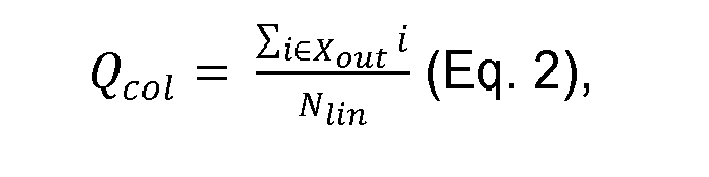
with Nlin being the number of phase encoding steps and i the voxels belonging to the outlier mask Xout. Information about the value of the quality index Qcol that reflects the presence or absence of artifacts in the MR image is preferentially overlaid onto the MR image (seeFig. 4 ). - replacing each image voxel of the inverse Fourier transformed original k-space that is indicated as artifactual in the outlier mask by the corresponding image voxel of the duplicate for obtaining said improved MR image. Indeed, the duplicate comprises voxels representing the imaged object, attenuated ghosting artifacts and additional reconstruction noise. In order to mitigate ghosting artifacts in the MR image, image voxels of the duplicate, where ghosting artifacts were attenuated, are used to replace image voxels in the inverse Fourier transformed original k-space in order to mitigate phase-encode ghosting. Each voxel in the duplicate image, i.e. each duplicate voxel, corresponds to a voxel in the inverse Fourier transformed original k-space, i.e. of an original voxel. In other words, the present invention proposes to use each duplicate voxel appearing in the outlier mask and representing an attenuated phase-encode ghosting for replacing its corresponding original voxel.
- The present invention also concerns a computer readable medium comprising a memory for storing computer executable instructions and configured for performing the previously described method when executing said instructions.
- Finally, the present invention also concerns a MRI apparatus for imaging an object, said MRI apparatus being configured for performing the method steps previously described.
- The claimed invention will be best understood from the following detailed description of specific embodiments when read in connection with the accompanying drawings:
- Figure 1
- schematic illustration of linear dependency in parallel magnet resonance imaging, using multiple receiver channels.
- Figure 2
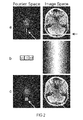
- Illustration of k-space (left) and image space (right) corresponding to the original (row a), an interpolation kernel (row b) and a duplicate (row c) according to the invention.
- Figure 3
- Illustration of a residual (right) of the original (left) and its duplicate, forming an artifact map according to the invention.
- Figure 4
- Exemplary artifact map (left), detected outliers (middle) and column wise quality index overlaid onto the original image (right) according to the invention.
- Figure 5
- Illustration of an original image (left) in comparison to its corrected image (right) with zooming on the left temporal lobe (bottom).
- The present invention proposes in particular to use a GRAPPA navigator technique to generate the duplicate of the original k-space, notably by using GRAPPA interpolation kernels. GRAPPA is a parallel imaging method based on the assumption that a k-space sample can be interpolated if the measurement was performed with multiple receiver channels by a MRI apparatus. The interpolation kernels exploit the linear dependency of a sample in k-space on its neighboring voxels, along multiple channels.
Figure 1 illustrates this linear dependency. According to the present invention, the linear dependency is first trained on all samples of the original dataset (i.e. original k-space) and then used to interpolate each single sample of the original k-space for obtaining said duplicate. - The propagation of artifacts in the different images and spaces (k-space (left) and image space (right) of the original k-space (row a), the interpolation kernel (row b) and the duplicate (row c)) is illustrated in
Figure 2 and pointed out with arrows. In interest of clarity the channel dimension is neglected in the illustration. -
Figure 3 illustrates an artifact map (right) obtained according to the present invention from an original MR image (left) and showing phase-encode ghosting perpendicular to phase-encode lines due to blood-flow. - A threshold t is then applied to the artifact map for obtaining an outlier mask as represented in
Fig. 4 (middle). Preferentially, a column (i.e. lines perpendicular to the phase encoding direction) wise quality index might be added to the MR image for showing a decreased image quality, e.g. typically observed at the occipital sinus, transverse sinuses, basilar artery and internal carotid arteries due to phase-encoding ghosting by means of overlaying quality image information onto the original MR image (see the right image "detected artifacts" inFig. 4 , wherein white lines highlight quality index information overlaid areas). - An illustration of a phase-encode ghosting mitigated image is represented in
Figure 5 , wherein an original image (left) is compared to its corrected image (right) according to the invention. A zooming on the left temporal lobe (bottom) shows that the ghosting artifacts (arrows) are mitigated in the corrected image.
Claims (8)
- A computer-implemented method for detecting phase-encoding ghosting in a MR image of an object to be imaged and mitigating the corresponding artifact in said MR image, the computer-implemented method comprising:- acquiring MRI raw data of the object by means of a MRI apparatus, wherein the MRI apparatus comprises multiple receiver channels for acquiring said MRI raw data;- calculating an artifact map of at least one part of the object to be imaged from the MRI raw data;- creating an outlier mask representing detected phase-encoding artifact in said artifact map;- mitigating phase-encode ghosting in the MR image by using the previously obtained artifact map and the outlier mask for obtaining an improved MR image.
- Computer-implemented method according to claim 1, wherein calculating the artifact map comprises:- generating a duplicate k-space based on a fully-sampled centric-ordered and non-interleaved k-space (hereafter original k-space) that represents said MRI raw data;- subtracting the duplicate k-space with the original k-space for obtaining the artifact map.
- Computer-implemented method according to claim 2, wherein said duplicate k-space is generated by using GRAPPA interpolation kernel.
- Computer-implemented method according to one of the claims 1 to 3, wherein creating the outlier mask comprises applying a threshold t to separate high intensity ghosting from background noise in the artifact map.
- Computer-implemented method according to claim 4 further comprising applying a morphological erode operator for improving the detection of artifacts in the MR image.
- Computer-implemented method according to one of the previous claims wherein mitigating phase-encode ghosting in the MR image comprises replacing each image voxel of the inverse Fourier transformed original k-space that is indicated as artifactual in the outlier mask by the corresponding image voxel of the duplicate for obtaining said improved MR image.
- Computer readable medium comprising a memory for storing computer executable instructions that perform the steps of one of the claims 1-6 when executed.
- Magnetic Resonance Imaging apparatus for imaging an object, said Magnetic Resonance Imaging apparatus being configured for performing the method steps of one of the claims 1-6 in order to obtain an improved MR image of said object.
Priority Applications (2)
| Application Number | Priority Date | Filing Date | Title |
|---|---|---|---|
| EP14194280.5A EP3023805B1 (en) | 2014-11-21 | 2014-11-21 | Phase-encode ghosting detection and mitigation in MRI |
| US14/948,599 US9846922B2 (en) | 2014-11-21 | 2015-11-23 | Method, computer readable medium and MRI apparatus for performing phase-encode ghosting detection and mitigation in MRI |
Applications Claiming Priority (1)
| Application Number | Priority Date | Filing Date | Title |
|---|---|---|---|
| EP14194280.5A EP3023805B1 (en) | 2014-11-21 | 2014-11-21 | Phase-encode ghosting detection and mitigation in MRI |
Publications (2)
| Publication Number | Publication Date |
|---|---|
| EP3023805A1 true EP3023805A1 (en) | 2016-05-25 |
| EP3023805B1 EP3023805B1 (en) | 2020-08-05 |
Family
ID=51951691
Family Applications (1)
| Application Number | Title | Priority Date | Filing Date |
|---|---|---|---|
| EP14194280.5A Active EP3023805B1 (en) | 2014-11-21 | 2014-11-21 | Phase-encode ghosting detection and mitigation in MRI |
Country Status (2)
| Country | Link |
|---|---|
| US (1) | US9846922B2 (en) |
| EP (1) | EP3023805B1 (en) |
Cited By (1)
| Publication number | Priority date | Publication date | Assignee | Title |
|---|---|---|---|---|
| CN120374601A (en) * | 2025-06-23 | 2025-07-25 | 安徽福晴医疗装备有限公司 | Automatic measurement method, system, medium and product for imaging ghost index of nuclear magnetic resonance equipment |
Families Citing this family (8)
| Publication number | Priority date | Publication date | Assignee | Title |
|---|---|---|---|---|
| KR102037117B1 (en) * | 2017-08-02 | 2019-11-29 | 재단법인 아산사회복지재단 | Method and program for reducing artifacts by structural simirality, and medial imaging device |
| US10677873B2 (en) * | 2017-08-29 | 2020-06-09 | General Electric Company | System and method for correcting an artifact within magnetic resonance data |
| CN109214992B (en) * | 2018-07-27 | 2022-04-05 | 中国科学院深圳先进技术研究院 | MRI image artifact removal method, device, medical equipment and storage medium |
| US11011257B2 (en) * | 2018-11-21 | 2021-05-18 | Enlitic, Inc. | Multi-label heat map display system |
| WO2020185757A1 (en) | 2019-03-12 | 2020-09-17 | University Of Cincinnati | A system and method for motion correction of magnetic resonance image |
| CN113597765B (en) * | 2019-03-18 | 2024-11-01 | 谷歌有限责任公司 | Frame stacking for coding artifacts |
| TWI792513B (en) * | 2021-08-20 | 2023-02-11 | 財團法人國家衛生研究院 | Method of removing motion-induced ghost artifacts in mri |
| US12136484B2 (en) | 2021-11-05 | 2024-11-05 | Altis Labs, Inc. | Method and apparatus utilizing image-based modeling in healthcare |
Citations (4)
| Publication number | Priority date | Publication date | Assignee | Title |
|---|---|---|---|---|
| US20040207402A1 (en) * | 2001-10-19 | 2004-10-21 | Peter Kellman | Method and apparatus to improve an mri image |
| US20060273792A1 (en) * | 2005-04-25 | 2006-12-07 | Kholmovski Evgueni G | Systems and methods for image reconstruction of sensitivity encoded MRI data |
| US20110311158A1 (en) * | 2010-06-17 | 2011-12-22 | Case Western Reserve University | Motion artifact removal |
| US20120133361A1 (en) * | 2010-11-25 | 2012-05-31 | Patrick Gross | Supplementation of acquired, undersampled mr data |
Family Cites Families (2)
| Publication number | Priority date | Publication date | Assignee | Title |
|---|---|---|---|---|
| EP3039441A1 (en) * | 2013-08-30 | 2016-07-06 | Koninklijke Philips N.V. | Dixon magnetic resonance imaging |
| CN104931903B (en) * | 2014-03-18 | 2018-02-02 | 上海联影医疗科技有限公司 | A kind of magnetic resonance removes the method and device of motion artifacts |
-
2014
- 2014-11-21 EP EP14194280.5A patent/EP3023805B1/en active Active
-
2015
- 2015-11-23 US US14/948,599 patent/US9846922B2/en not_active Expired - Fee Related
Patent Citations (4)
| Publication number | Priority date | Publication date | Assignee | Title |
|---|---|---|---|---|
| US20040207402A1 (en) * | 2001-10-19 | 2004-10-21 | Peter Kellman | Method and apparatus to improve an mri image |
| US20060273792A1 (en) * | 2005-04-25 | 2006-12-07 | Kholmovski Evgueni G | Systems and methods for image reconstruction of sensitivity encoded MRI data |
| US20110311158A1 (en) * | 2010-06-17 | 2011-12-22 | Case Western Reserve University | Motion artifact removal |
| US20120133361A1 (en) * | 2010-11-25 | 2012-05-31 | Patrick Gross | Supplementation of acquired, undersampled mr data |
Non-Patent Citations (3)
| Title |
|---|
| BÉNÉDICTE MORTAMET ET AL: "Automatic quality assessment in structural brain magnetic resonance imaging", MAGNETIC RESONANCE IN MEDICINE, vol. 62, no. 2, 12 June 2009 (2009-06-12), pages 365 - 372, XP055184612, ISSN: 0740-3194, DOI: 10.1002/mrm.21992 * |
| GRISWOLD M A ET AL: "Generalized autocalibrating partially parallel acquisitions (GRAPPA)", MAGNETIC RESONANCE IN MEDICINE, JOHN WILEY & SONS, INC, US, vol. 47, 1 June 2002 (2002-06-01), pages 1202 - 1210, XP002369548, ISSN: 0740-3194, DOI: 10.1002/MRM.10171 * |
| MORTAMET ET AL.: "Automatic quality assessment in structural brain magnetic resonance imaging", MAGNETIC RESONANCE IN MEDICINE, vol. 62, 2009, pages 365 - 372 |
Cited By (1)
| Publication number | Priority date | Publication date | Assignee | Title |
|---|---|---|---|---|
| CN120374601A (en) * | 2025-06-23 | 2025-07-25 | 安徽福晴医疗装备有限公司 | Automatic measurement method, system, medium and product for imaging ghost index of nuclear magnetic resonance equipment |
Also Published As
| Publication number | Publication date |
|---|---|
| EP3023805B1 (en) | 2020-08-05 |
| US9846922B2 (en) | 2017-12-19 |
| US20160148351A1 (en) | 2016-05-26 |
Similar Documents
| Publication | Publication Date | Title |
|---|---|---|
| EP3023805B1 (en) | Phase-encode ghosting detection and mitigation in MRI | |
| Frost et al. | Scan time reduction for readout‐segmented EPI using simultaneous multislice acceleration: Diffusion‐weighted imaging at 3 and 7 Tesla | |
| Wu et al. | Reducing slab boundary artifacts in three‐dimensional multislab diffusion MRI using nonlinear inversion for slab profile encoding (NPEN) | |
| Veraart et al. | Comprehensive framework for accurate diffusion MRI parameter estimation | |
| Zhang et al. | Self-feeding MUSE: a robust method for high resolution diffusion imaging using interleaved EPI | |
| Mutsaerts et al. | Gray matter contamination in arterial spin labeling white matter perfusion measurements in patients with dementia | |
| JP7140606B2 (en) | Image processing device, image processing method, image processing program, and magnetic resonance imaging device | |
| Newbould et al. | Perfusion mapping with multiecho multishot parallel imaging EPI | |
| Viessmann et al. | T2‐weighted intracranial vessel wall imaging at 7 Tesla using a DANTE‐prepared variable flip angle turbo spin echo readout (DANTE‐SPACE) | |
| Yun et al. | Whole-brain high in-plane resolution fMRI using accelerated EPIK for enhanced characterisation of functional areas at 3T | |
| US10502801B2 (en) | Method and magnetic resonance apparatus for generating a weighting matrix for reducing artifacts with parallel imaging | |
| Yarach et al. | Model‐based iterative reconstruction for single‐shot EPI at 7 T | |
| EP2757523B1 (en) | Method and apparatus for eliminating noise in magnetic resonance images | |
| Liu et al. | Improving distortion correction for isotropic high‐resolution 3D diffusion MRI by optimizing Jacobian modulation | |
| JP6049694B2 (en) | Alternating Black and Bright Blood Dynamic Contrast Enhancement (DCE) MRI | |
| JP7179483B2 (en) | Magnetic resonance imaging device | |
| JP4478694B2 (en) | Nonlinear phase correction method, recording medium, and magnetic resonance apparatus | |
| Schmidt et al. | High-resolution quantitative T2 mapping of the human brain at 7 T using a multi-echo spin-echo sequence and dictionary-based modeling | |
| Cheng et al. | Improved parallel image reconstruction using feature refinement | |
| EP3683595B1 (en) | Segment-specific undersampling in readout-segmented magnetic resonance imaging | |
| Tax et al. | Checking and correcting DTI data | |
| US11340326B2 (en) | Correction of MR object movements | |
| Kim et al. | Fast MRI techniques of the liver and pancreaticobiliary tract: overview and application | |
| Riedel et al. | Segmented simultaneous multi‐slice diffusion‐weighted imaging with navigated 3D rigid motion correction | |
| JP6058826B2 (en) | Method for obtaining magnetic resonance image using T2 * mapping based on echoplanar method |
Legal Events
| Date | Code | Title | Description |
|---|---|---|---|
| AK | Designated contracting states |
Kind code of ref document: A1 Designated state(s): AL AT BE BG CH CY CZ DE DK EE ES FI FR GB GR HR HU IE IS IT LI LT LU LV MC MK MT NL NO PL PT RO RS SE SI SK SM TR |
|
| AX | Request for extension of the european patent |
Extension state: BA ME |
|
| PUAI | Public reference made under article 153(3) epc to a published international application that has entered the european phase |
Free format text: ORIGINAL CODE: 0009012 |
|
| RAP1 | Party data changed (applicant data changed or rights of an application transferred) |
Owner name: SIEMENS HEALTHCARE GMBH |
|
| STAA | Information on the status of an ep patent application or granted ep patent |
Free format text: STATUS: REQUEST FOR EXAMINATION WAS MADE |
|
| 17P | Request for examination filed |
Effective date: 20161104 |
|
| RBV | Designated contracting states (corrected) |
Designated state(s): AL AT BE BG CH CY CZ DE DK EE ES FI FR GB GR HR HU IE IS IT LI LT LU LV MC MK MT NL NO PL PT RO RS SE SI SK SM TR |
|
| GRAJ | Information related to disapproval of communication of intention to grant by the applicant or resumption of examination proceedings by the epo deleted |
Free format text: ORIGINAL CODE: EPIDOSDIGR1 |
|
| STAA | Information on the status of an ep patent application or granted ep patent |
Free format text: STATUS: GRANT OF PATENT IS INTENDED |
|
| GRAP | Despatch of communication of intention to grant a patent |
Free format text: ORIGINAL CODE: EPIDOSNIGR1 |
|
| INTG | Intention to grant announced |
Effective date: 20200424 |
|
| GRAS | Grant fee paid |
Free format text: ORIGINAL CODE: EPIDOSNIGR3 |
|
| GRAA | (expected) grant |
Free format text: ORIGINAL CODE: 0009210 |
|
| STAA | Information on the status of an ep patent application or granted ep patent |
Free format text: STATUS: THE PATENT HAS BEEN GRANTED |
|
| AK | Designated contracting states |
Kind code of ref document: B1 Designated state(s): AL AT BE BG CH CY CZ DE DK EE ES FI FR GB GR HR HU IE IS IT LI LT LU LV MC MK MT NL NO PL PT RO RS SE SI SK SM TR |
|
| REG | Reference to a national code |
Ref country code: GB Ref legal event code: FG4D |
|
| REG | Reference to a national code |
Ref country code: CH Ref legal event code: EP |
|
| REG | Reference to a national code |
Ref country code: AT Ref legal event code: REF Ref document number: 1299474 Country of ref document: AT Kind code of ref document: T Effective date: 20200815 |
|
| REG | Reference to a national code |
Ref country code: DE Ref legal event code: R096 Ref document number: 602014068512 Country of ref document: DE |
|
| REG | Reference to a national code |
Ref country code: IE Ref legal event code: FG4D |
|
| REG | Reference to a national code |
Ref country code: LT Ref legal event code: MG4D |
|
| REG | Reference to a national code |
Ref country code: NL Ref legal event code: MP Effective date: 20200805 |
|
| REG | Reference to a national code |
Ref country code: AT Ref legal event code: MK05 Ref document number: 1299474 Country of ref document: AT Kind code of ref document: T Effective date: 20200805 |
|
| PG25 | Lapsed in a contracting state [announced via postgrant information from national office to epo] |
Ref country code: FI Free format text: LAPSE BECAUSE OF FAILURE TO SUBMIT A TRANSLATION OF THE DESCRIPTION OR TO PAY THE FEE WITHIN THE PRESCRIBED TIME-LIMIT Effective date: 20200805 Ref country code: AT Free format text: LAPSE BECAUSE OF FAILURE TO SUBMIT A TRANSLATION OF THE DESCRIPTION OR TO PAY THE FEE WITHIN THE PRESCRIBED TIME-LIMIT Effective date: 20200805 Ref country code: BG Free format text: LAPSE BECAUSE OF FAILURE TO SUBMIT A TRANSLATION OF THE DESCRIPTION OR TO PAY THE FEE WITHIN THE PRESCRIBED TIME-LIMIT Effective date: 20201105 Ref country code: SE Free format text: LAPSE BECAUSE OF FAILURE TO SUBMIT A TRANSLATION OF THE DESCRIPTION OR TO PAY THE FEE WITHIN THE PRESCRIBED TIME-LIMIT Effective date: 20200805 Ref country code: NO Free format text: LAPSE BECAUSE OF FAILURE TO SUBMIT A TRANSLATION OF THE DESCRIPTION OR TO PAY THE FEE WITHIN THE PRESCRIBED TIME-LIMIT Effective date: 20201105 Ref country code: GR Free format text: LAPSE BECAUSE OF FAILURE TO SUBMIT A TRANSLATION OF THE DESCRIPTION OR TO PAY THE FEE WITHIN THE PRESCRIBED TIME-LIMIT Effective date: 20201106 Ref country code: ES Free format text: LAPSE BECAUSE OF FAILURE TO SUBMIT A TRANSLATION OF THE DESCRIPTION OR TO PAY THE FEE WITHIN THE PRESCRIBED TIME-LIMIT Effective date: 20200805 Ref country code: LT Free format text: LAPSE BECAUSE OF FAILURE TO SUBMIT A TRANSLATION OF THE DESCRIPTION OR TO PAY THE FEE WITHIN THE PRESCRIBED TIME-LIMIT Effective date: 20200805 Ref country code: PT Free format text: LAPSE BECAUSE OF FAILURE TO SUBMIT A TRANSLATION OF THE DESCRIPTION OR TO PAY THE FEE WITHIN THE PRESCRIBED TIME-LIMIT Effective date: 20201207 Ref country code: HR Free format text: LAPSE BECAUSE OF FAILURE TO SUBMIT A TRANSLATION OF THE DESCRIPTION OR TO PAY THE FEE WITHIN THE PRESCRIBED TIME-LIMIT Effective date: 20200805 |
|
| PG25 | Lapsed in a contracting state [announced via postgrant information from national office to epo] |
Ref country code: PL Free format text: LAPSE BECAUSE OF FAILURE TO SUBMIT A TRANSLATION OF THE DESCRIPTION OR TO PAY THE FEE WITHIN THE PRESCRIBED TIME-LIMIT Effective date: 20200805 Ref country code: LV Free format text: LAPSE BECAUSE OF FAILURE TO SUBMIT A TRANSLATION OF THE DESCRIPTION OR TO PAY THE FEE WITHIN THE PRESCRIBED TIME-LIMIT Effective date: 20200805 Ref country code: RS Free format text: LAPSE BECAUSE OF FAILURE TO SUBMIT A TRANSLATION OF THE DESCRIPTION OR TO PAY THE FEE WITHIN THE PRESCRIBED TIME-LIMIT Effective date: 20200805 Ref country code: NL Free format text: LAPSE BECAUSE OF FAILURE TO SUBMIT A TRANSLATION OF THE DESCRIPTION OR TO PAY THE FEE WITHIN THE PRESCRIBED TIME-LIMIT Effective date: 20200805 Ref country code: IS Free format text: LAPSE BECAUSE OF FAILURE TO SUBMIT A TRANSLATION OF THE DESCRIPTION OR TO PAY THE FEE WITHIN THE PRESCRIBED TIME-LIMIT Effective date: 20201205 |
|
| PG25 | Lapsed in a contracting state [announced via postgrant information from national office to epo] |
Ref country code: RO Free format text: LAPSE BECAUSE OF FAILURE TO SUBMIT A TRANSLATION OF THE DESCRIPTION OR TO PAY THE FEE WITHIN THE PRESCRIBED TIME-LIMIT Effective date: 20200805 Ref country code: SM Free format text: LAPSE BECAUSE OF FAILURE TO SUBMIT A TRANSLATION OF THE DESCRIPTION OR TO PAY THE FEE WITHIN THE PRESCRIBED TIME-LIMIT Effective date: 20200805 Ref country code: DK Free format text: LAPSE BECAUSE OF FAILURE TO SUBMIT A TRANSLATION OF THE DESCRIPTION OR TO PAY THE FEE WITHIN THE PRESCRIBED TIME-LIMIT Effective date: 20200805 Ref country code: CZ Free format text: LAPSE BECAUSE OF FAILURE TO SUBMIT A TRANSLATION OF THE DESCRIPTION OR TO PAY THE FEE WITHIN THE PRESCRIBED TIME-LIMIT Effective date: 20200805 Ref country code: EE Free format text: LAPSE BECAUSE OF FAILURE TO SUBMIT A TRANSLATION OF THE DESCRIPTION OR TO PAY THE FEE WITHIN THE PRESCRIBED TIME-LIMIT Effective date: 20200805 |
|
| REG | Reference to a national code |
Ref country code: DE Ref legal event code: R097 Ref document number: 602014068512 Country of ref document: DE |
|
| PG25 | Lapsed in a contracting state [announced via postgrant information from national office to epo] |
Ref country code: AL Free format text: LAPSE BECAUSE OF FAILURE TO SUBMIT A TRANSLATION OF THE DESCRIPTION OR TO PAY THE FEE WITHIN THE PRESCRIBED TIME-LIMIT Effective date: 20200805 |
|
| PLBE | No opposition filed within time limit |
Free format text: ORIGINAL CODE: 0009261 |
|
| STAA | Information on the status of an ep patent application or granted ep patent |
Free format text: STATUS: NO OPPOSITION FILED WITHIN TIME LIMIT |
|
| PG25 | Lapsed in a contracting state [announced via postgrant information from national office to epo] |
Ref country code: MC Free format text: LAPSE BECAUSE OF FAILURE TO SUBMIT A TRANSLATION OF THE DESCRIPTION OR TO PAY THE FEE WITHIN THE PRESCRIBED TIME-LIMIT Effective date: 20200805 Ref country code: SK Free format text: LAPSE BECAUSE OF FAILURE TO SUBMIT A TRANSLATION OF THE DESCRIPTION OR TO PAY THE FEE WITHIN THE PRESCRIBED TIME-LIMIT Effective date: 20200805 |
|
| REG | Reference to a national code |
Ref country code: CH Ref legal event code: PL |
|
| 26N | No opposition filed |
Effective date: 20210507 |
|
| PG25 | Lapsed in a contracting state [announced via postgrant information from national office to epo] |
Ref country code: IT Free format text: LAPSE BECAUSE OF FAILURE TO SUBMIT A TRANSLATION OF THE DESCRIPTION OR TO PAY THE FEE WITHIN THE PRESCRIBED TIME-LIMIT Effective date: 20200805 Ref country code: LU Free format text: LAPSE BECAUSE OF NON-PAYMENT OF DUE FEES Effective date: 20201121 |
|
| REG | Reference to a national code |
Ref country code: BE Ref legal event code: MM Effective date: 20201130 |
|
| PG25 | Lapsed in a contracting state [announced via postgrant information from national office to epo] |
Ref country code: CH Free format text: LAPSE BECAUSE OF NON-PAYMENT OF DUE FEES Effective date: 20201130 Ref country code: SI Free format text: LAPSE BECAUSE OF FAILURE TO SUBMIT A TRANSLATION OF THE DESCRIPTION OR TO PAY THE FEE WITHIN THE PRESCRIBED TIME-LIMIT Effective date: 20200805 Ref country code: LI Free format text: LAPSE BECAUSE OF NON-PAYMENT OF DUE FEES Effective date: 20201130 |
|
| PG25 | Lapsed in a contracting state [announced via postgrant information from national office to epo] |
Ref country code: IE Free format text: LAPSE BECAUSE OF NON-PAYMENT OF DUE FEES Effective date: 20201121 |
|
| PG25 | Lapsed in a contracting state [announced via postgrant information from national office to epo] |
Ref country code: TR Free format text: LAPSE BECAUSE OF FAILURE TO SUBMIT A TRANSLATION OF THE DESCRIPTION OR TO PAY THE FEE WITHIN THE PRESCRIBED TIME-LIMIT Effective date: 20200805 Ref country code: MT Free format text: LAPSE BECAUSE OF FAILURE TO SUBMIT A TRANSLATION OF THE DESCRIPTION OR TO PAY THE FEE WITHIN THE PRESCRIBED TIME-LIMIT Effective date: 20200805 Ref country code: CY Free format text: LAPSE BECAUSE OF FAILURE TO SUBMIT A TRANSLATION OF THE DESCRIPTION OR TO PAY THE FEE WITHIN THE PRESCRIBED TIME-LIMIT Effective date: 20200805 |
|
| PG25 | Lapsed in a contracting state [announced via postgrant information from national office to epo] |
Ref country code: MK Free format text: LAPSE BECAUSE OF FAILURE TO SUBMIT A TRANSLATION OF THE DESCRIPTION OR TO PAY THE FEE WITHIN THE PRESCRIBED TIME-LIMIT Effective date: 20200805 |
|
| PG25 | Lapsed in a contracting state [announced via postgrant information from national office to epo] |
Ref country code: BE Free format text: LAPSE BECAUSE OF NON-PAYMENT OF DUE FEES Effective date: 20201130 |
|
| PGFP | Annual fee paid to national office [announced via postgrant information from national office to epo] |
Ref country code: GB Payment date: 20231204 Year of fee payment: 10 |
|
| PGFP | Annual fee paid to national office [announced via postgrant information from national office to epo] |
Ref country code: FR Payment date: 20231114 Year of fee payment: 10 |
|
| REG | Reference to a national code |
Ref country code: DE Ref legal event code: R081 Ref document number: 602014068512 Country of ref document: DE Owner name: SIEMENS HEALTHINEERS AG, DE Free format text: FORMER OWNER: SIEMENS HEALTHCARE GMBH, MUENCHEN, DE |
|
| PGFP | Annual fee paid to national office [announced via postgrant information from national office to epo] |
Ref country code: DE Payment date: 20240119 Year of fee payment: 10 |
|
| REG | Reference to a national code |
Ref country code: DE Ref legal event code: R119 Ref document number: 602014068512 Country of ref document: DE |
|
| GBPC | Gb: european patent ceased through non-payment of renewal fee |
Effective date: 20241121 |
|
| PG25 | Lapsed in a contracting state [announced via postgrant information from national office to epo] |
Ref country code: DE Free format text: LAPSE BECAUSE OF NON-PAYMENT OF DUE FEES Effective date: 20250603 |
|
| PG25 | Lapsed in a contracting state [announced via postgrant information from national office to epo] |
Ref country code: GB Free format text: LAPSE BECAUSE OF NON-PAYMENT OF DUE FEES Effective date: 20241121 |
|
| PG25 | Lapsed in a contracting state [announced via postgrant information from national office to epo] |
Ref country code: FR Free format text: LAPSE BECAUSE OF NON-PAYMENT OF DUE FEES Effective date: 20241130 |