EP3023615A1 - Fuel pumping unit - Google Patents
Fuel pumping unit Download PDFInfo
- Publication number
- EP3023615A1 EP3023615A1 EP15183775.4A EP15183775A EP3023615A1 EP 3023615 A1 EP3023615 A1 EP 3023615A1 EP 15183775 A EP15183775 A EP 15183775A EP 3023615 A1 EP3023615 A1 EP 3023615A1
- Authority
- EP
- European Patent Office
- Prior art keywords
- fuel
- pump
- low
- high pressure
- pumping unit
- Prior art date
- Legal status (The legal status is an assumption and is not a legal conclusion. Google has not performed a legal analysis and makes no representation as to the accuracy of the status listed.)
- Granted
Links
Images

Classifications
-
- F—MECHANICAL ENGINEERING; LIGHTING; HEATING; WEAPONS; BLASTING
- F02—COMBUSTION ENGINES; HOT-GAS OR COMBUSTION-PRODUCT ENGINE PLANTS
- F02C—GAS-TURBINE PLANTS; AIR INTAKES FOR JET-PROPULSION PLANTS; CONTROLLING FUEL SUPPLY IN AIR-BREATHING JET-PROPULSION PLANTS
- F02C7/00—Features, components parts, details or accessories, not provided for in, or of interest apart form groups F02C1/00 - F02C6/00; Air intakes for jet-propulsion plants
- F02C7/22—Fuel supply systems
- F02C7/236—Fuel delivery systems comprising two or more pumps
-
- F—MECHANICAL ENGINEERING; LIGHTING; HEATING; WEAPONS; BLASTING
- F04—POSITIVE - DISPLACEMENT MACHINES FOR LIQUIDS; PUMPS FOR LIQUIDS OR ELASTIC FLUIDS
- F04B—POSITIVE-DISPLACEMENT MACHINES FOR LIQUIDS; PUMPS
- F04B17/00—Pumps characterised by combination with, or adaptation to, specific driving engines or motors
- F04B17/05—Pumps characterised by combination with, or adaptation to, specific driving engines or motors driven by internal-combustion engines
-
- F—MECHANICAL ENGINEERING; LIGHTING; HEATING; WEAPONS; BLASTING
- F04—POSITIVE - DISPLACEMENT MACHINES FOR LIQUIDS; PUMPS FOR LIQUIDS OR ELASTIC FLUIDS
- F04B—POSITIVE-DISPLACEMENT MACHINES FOR LIQUIDS; PUMPS
- F04B23/00—Pumping installations or systems
- F04B23/04—Combinations of two or more pumps
- F04B23/08—Combinations of two or more pumps the pumps being of different types
- F04B23/12—Combinations of two or more pumps the pumps being of different types at least one pump being of the rotary-piston positive-displacement type
-
- F—MECHANICAL ENGINEERING; LIGHTING; HEATING; WEAPONS; BLASTING
- F04—POSITIVE - DISPLACEMENT MACHINES FOR LIQUIDS; PUMPS FOR LIQUIDS OR ELASTIC FLUIDS
- F04B—POSITIVE-DISPLACEMENT MACHINES FOR LIQUIDS; PUMPS
- F04B23/00—Pumping installations or systems
- F04B23/04—Combinations of two or more pumps
- F04B23/08—Combinations of two or more pumps the pumps being of different types
- F04B23/14—Combinations of two or more pumps the pumps being of different types at least one pump being of the non-positive-displacement type
-
- F—MECHANICAL ENGINEERING; LIGHTING; HEATING; WEAPONS; BLASTING
- F04—POSITIVE - DISPLACEMENT MACHINES FOR LIQUIDS; PUMPS FOR LIQUIDS OR ELASTIC FLUIDS
- F04B—POSITIVE-DISPLACEMENT MACHINES FOR LIQUIDS; PUMPS
- F04B41/00—Pumping installations or systems specially adapted for elastic fluids
- F04B41/06—Combinations of two or more pumps
-
- F—MECHANICAL ENGINEERING; LIGHTING; HEATING; WEAPONS; BLASTING
- F04—POSITIVE - DISPLACEMENT MACHINES FOR LIQUIDS; PUMPS FOR LIQUIDS OR ELASTIC FLUIDS
- F04B—POSITIVE-DISPLACEMENT MACHINES FOR LIQUIDS; PUMPS
- F04B49/00—Control, e.g. of pump delivery, or pump pressure of, or safety measures for, machines, pumps, or pumping installations, not otherwise provided for, or of interest apart from, groups F04B1/00 - F04B47/00
- F04B49/02—Stopping, starting, unloading or idling control
- F04B49/03—Stopping, starting, unloading or idling control by means of valves
- F04B49/035—Bypassing
-
- F—MECHANICAL ENGINEERING; LIGHTING; HEATING; WEAPONS; BLASTING
- F04—POSITIVE - DISPLACEMENT MACHINES FOR LIQUIDS; PUMPS FOR LIQUIDS OR ELASTIC FLUIDS
- F04D—NON-POSITIVE-DISPLACEMENT PUMPS
- F04D1/00—Radial-flow pumps, e.g. centrifugal pumps; Helico-centrifugal pumps
- F04D1/06—Multi-stage pumps
- F04D1/10—Multi-stage pumps with means for changing the flow-path through the stages, e.g. series-parallel, e.g. side loads
-
- F—MECHANICAL ENGINEERING; LIGHTING; HEATING; WEAPONS; BLASTING
- F04—POSITIVE - DISPLACEMENT MACHINES FOR LIQUIDS; PUMPS FOR LIQUIDS OR ELASTIC FLUIDS
- F04D—NON-POSITIVE-DISPLACEMENT PUMPS
- F04D13/00—Pumping installations or systems
- F04D13/12—Combinations of two or more pumps
-
- F—MECHANICAL ENGINEERING; LIGHTING; HEATING; WEAPONS; BLASTING
- F04—POSITIVE - DISPLACEMENT MACHINES FOR LIQUIDS; PUMPS FOR LIQUIDS OR ELASTIC FLUIDS
- F04D—NON-POSITIVE-DISPLACEMENT PUMPS
- F04D15/00—Control, e.g. regulation, of pumps, pumping installations or systems
- F04D15/0005—Control, e.g. regulation, of pumps, pumping installations or systems by using valves
- F04D15/0011—Control, e.g. regulation, of pumps, pumping installations or systems by using valves by-pass valves
-
- F—MECHANICAL ENGINEERING; LIGHTING; HEATING; WEAPONS; BLASTING
- F04—POSITIVE - DISPLACEMENT MACHINES FOR LIQUIDS; PUMPS FOR LIQUIDS OR ELASTIC FLUIDS
- F04D—NON-POSITIVE-DISPLACEMENT PUMPS
- F04D9/00—Priming; Preventing vapour lock
- F04D9/04—Priming; Preventing vapour lock using priming pumps; using booster pumps to prevent vapour-lock
-
- F—MECHANICAL ENGINEERING; LIGHTING; HEATING; WEAPONS; BLASTING
- F04—POSITIVE - DISPLACEMENT MACHINES FOR LIQUIDS; PUMPS FOR LIQUIDS OR ELASTIC FLUIDS
- F04C—ROTARY-PISTON, OR OSCILLATING-PISTON, POSITIVE-DISPLACEMENT MACHINES FOR LIQUIDS; ROTARY-PISTON, OR OSCILLATING-PISTON, POSITIVE-DISPLACEMENT PUMPS
- F04C11/00—Combinations of two or more machines or pumps, each being of rotary-piston or oscillating-piston type; Pumping installations
- F04C11/005—Combinations of two or more machines or pumps, each being of rotary-piston or oscillating-piston type; Pumping installations of dissimilar working principle
- F04C11/006—Combinations of two or more machines or pumps, each being of rotary-piston or oscillating-piston type; Pumping installations of dissimilar working principle having complementary function
-
- F—MECHANICAL ENGINEERING; LIGHTING; HEATING; WEAPONS; BLASTING
- F04—POSITIVE - DISPLACEMENT MACHINES FOR LIQUIDS; PUMPS FOR LIQUIDS OR ELASTIC FLUIDS
- F04C—ROTARY-PISTON, OR OSCILLATING-PISTON, POSITIVE-DISPLACEMENT MACHINES FOR LIQUIDS; ROTARY-PISTON, OR OSCILLATING-PISTON, POSITIVE-DISPLACEMENT PUMPS
- F04C2/00—Rotary-piston machines or pumps
- F04C2/08—Rotary-piston machines or pumps of intermeshing-engagement type, i.e. with engagement of co-operating members similar to that of toothed gearing
- F04C2/10—Rotary-piston machines or pumps of intermeshing-engagement type, i.e. with engagement of co-operating members similar to that of toothed gearing of internal-axis type with the outer member having more teeth or tooth-equivalents, e.g. rollers, than the inner member
-
- F—MECHANICAL ENGINEERING; LIGHTING; HEATING; WEAPONS; BLASTING
- F04—POSITIVE - DISPLACEMENT MACHINES FOR LIQUIDS; PUMPS FOR LIQUIDS OR ELASTIC FLUIDS
- F04C—ROTARY-PISTON, OR OSCILLATING-PISTON, POSITIVE-DISPLACEMENT MACHINES FOR LIQUIDS; ROTARY-PISTON, OR OSCILLATING-PISTON, POSITIVE-DISPLACEMENT PUMPS
- F04C2/00—Rotary-piston machines or pumps
- F04C2/30—Rotary-piston machines or pumps having the characteristics covered by two or more groups F04C2/02, F04C2/08, F04C2/22, F04C2/24 or having the characteristics covered by one of these groups together with some other type of movement between co-operating members
- F04C2/34—Rotary-piston machines or pumps having the characteristics covered by two or more groups F04C2/02, F04C2/08, F04C2/22, F04C2/24 or having the characteristics covered by one of these groups together with some other type of movement between co-operating members having the movement defined in groups F04C2/08 or F04C2/22 and relative reciprocation between the co-operating members
- F04C2/344—Rotary-piston machines or pumps having the characteristics covered by two or more groups F04C2/02, F04C2/08, F04C2/22, F04C2/24 or having the characteristics covered by one of these groups together with some other type of movement between co-operating members having the movement defined in groups F04C2/08 or F04C2/22 and relative reciprocation between the co-operating members with vanes reciprocating with respect to the inner member
-
- F—MECHANICAL ENGINEERING; LIGHTING; HEATING; WEAPONS; BLASTING
- F04—POSITIVE - DISPLACEMENT MACHINES FOR LIQUIDS; PUMPS FOR LIQUIDS OR ELASTIC FLUIDS
- F04C—ROTARY-PISTON, OR OSCILLATING-PISTON, POSITIVE-DISPLACEMENT MACHINES FOR LIQUIDS; ROTARY-PISTON, OR OSCILLATING-PISTON, POSITIVE-DISPLACEMENT PUMPS
- F04C2210/00—Fluid
- F04C2210/10—Fluid working
- F04C2210/1044—Fuel
-
- F—MECHANICAL ENGINEERING; LIGHTING; HEATING; WEAPONS; BLASTING
- F05—INDEXING SCHEMES RELATING TO ENGINES OR PUMPS IN VARIOUS SUBCLASSES OF CLASSES F01-F04
- F05D—INDEXING SCHEME FOR ASPECTS RELATING TO NON-POSITIVE-DISPLACEMENT MACHINES OR ENGINES, GAS-TURBINES OR JET-PROPULSION PLANTS
- F05D2220/00—Application
- F05D2220/30—Application in turbines
- F05D2220/32—Application in turbines in gas turbines
- F05D2220/323—Application in turbines in gas turbines for aircraft propulsion, e.g. jet engines
Definitions
- the present invention relates to a fuel pumping unit, for example for supplying fuel to an aero-engine.
- a typical fuel pumping system for an aero-engine comprises a low pressure (LP) pumping stage operable to draw fuel from a fuel tank, and supplying the fuel at boosted pressure to the inlet of a high pressure (HP) pumping stage.
- LP low pressure
- HP high pressure
- the inter-stage flow between LP and HP pumping stages is typically used to cool engine lubrication oil in a fuel/oil heat exchanger.
- the LP pumping stage comprises a centrifugal impeller pump whilst the HP pumping stage comprises a positive displacement pump in the form of a twin pinion gear pump.
- EP A 0657651 describes an arrangement in which a first centrifugal pump acts as the LP stage, and a second centrifugal pump acts as the HP stage, the two pumps being cantilever-mounted to respective ends of a journal shaft driven by a drive shaft.
- the present invention provides fuel pumping unit having a low pressure centrifugal pump and a high pressure centrifugal pump, in use, the low pressure pump supplying fuel at a boosted pressure to the high pressure pump for onward supply to a fuel metering unit; wherein the pumping unit further has a drive input which drives the low and high pressure pumps, a gear arrangement being operatively located between the drive input and the low and high pressure pumps such that the low and high pressure pumps are driven at different speeds by the drive input.
- the gear arrangement allows the low and high pressure pumps to be driven at different speeds, thereby improving pump efficiencies, while still allowing a single drive input to operate both pumps.
- the low pressure pump can be run at a slow enough speed to operate with low inlet pressures and to handle multiphase (e.g. air/fuel) flows, while the high pressure pump can be run at high speeds enabling it to be reduced in size and weight.
- the fuel pumping unit of the first aspect may be suitable for pumping fuel for an aero-engine, such as a gas turbine engine.
- the drive input may be a drive from an aero-engine accessory gearbox.
- the present invention provides an aero-engine having the fuel pumping unit of the first aspect.
- the high pressure pump can be driven at a higher speed than the low pressure pump.
- the gear arrangement may include a bevel gear drive.
- a bevel gear may be located at an end of the drive input.
- the low and high pressure pumps may have respective impellers mounted on respective shafts.
- the impeller shafts can then terminate in further bevel gears which mesh with the bevel gear at the end of the drive input.
- the relative speed of each impeller can be determined by suitable selection of its further bevel gear.
- the fuel pumping unit may further have an axial flow inducer, e.g. of propeller type, at the inlet to the low pressure pump.
- an axial flow inducer e.g. of propeller type
- the low and high pressure pumps may be supported on journal or rolling element (e.g. ball or roller) bearings.
- Journal bearings may be fuel lubricated.
- Rolling element bearings may be oil lubricated.
- the axes of the low and high pressure pumps may be inclined relative to each other.
- these shafts may be inclined relative to each other. This can facilitate a more compact envelope for the fuel pumping unit.
- the fuel pumping unit may further have a selector valve which is configured to selectably provide a high pressure mode and a low pressure mode, wherein: in the high pressure mode the low pressure pump supplies fuel at the boosted pressure to the high pressure pump for onward supply to the fuel metering unit; and in the low pressure mode the fuel supply from the low pressure pump to the high pressure pump is shut off such that the high pressure pump runs dry and the low pressure pump supplies fuel to the fuel metering unit.
- the high pressure pump can be run on air when the additional pressure rise it produces is not required, e.g. at low engine power settings. In particular, at low speeds the efficiency of the high pressure pump can be very low. Therefore, if it is not run on air, it may cause high fuel temperatures, which in turn can limit the heat sink capability of the fuel to cool engine oil.
- the fuel pumping unit may further have a positive displacement start pump which is driven by the drive input via the gear arrangement, the selector valve being further configured to selectably provide a start mode, wherein: in the start mode the low pressure pump supplies fuel at the boosted pressure to the start pump for onward supply to the fuel metering unit, and the fuel supply from the low pressure pump to the high pressure pump is shut off such that the high pressure pump runs dry.
- the start pump can also help to prime the centrifugal pumps should significant amounts of air have entered the centrifugal pumps.
- the start pump can recirculate fuel between the start pump and the selector valve. This recirculation can be at a low pressure rise to reduce any fuel temperature increase in the start pump.
- the start pump is a positive displacement pump such as, an external gear, a gerator or a vane pump. In particular, it may be a vane pump such as a dual lobe vane pump.
- the low pressure pump and the start pump may be driven at the same speed by the drive input. For example, they may be mounted on a common shaft.
- a ducted fan gas turbine engine incorporating the invention is generally indicated at 10 and has a principal and rotational axis X-X.
- the engine comprises, in axial flow series, an air intake 11, a propulsive fan 12, an intermediate pressure compressor 13, a high-pressure compressor 14, combustion equipment 15, a high-pressure turbine 16, an intermediate pressure turbine 17, a low-pressure turbine 18 and a core engine exhaust nozzle 19.
- a nacelle 21 generally surrounds the engine 10 and defines the intake 11, a bypass duct 22 and a bypass exhaust nozzle 23.
- air entering the intake 11 is accelerated by the fan 12 to produce two air flows: a first air flow A into the intermediate-pressure compressor 13 and a second air flow B which passes through the bypass duct 22 to provide propulsive thrust.
- the intermediate-pressure compressor 13 compresses the air flow A directed into it before delivering that air to the high-pressure compressor 14 where further compression takes place.
- the compressed air exhausted from the high-pressure compressor 14 is directed into the combustion equipment 15 where it is mixed with fuel and the mixture combusted.
- the resultant hot combustion products then expand through, and thereby drive the high, intermediate and low-pressure turbines 16, 17, 18 before being exhausted through the nozzle 19 to provide additional propulsive thrust.
- the high, intermediate and low-pressure turbines respectively drive the high and intermediate-pressure compressors 14, 13 and the fan 12 by suitable interconnecting shafts.
- the engine has a fuel pumping unit (not shown in Figure 1 ) which draws fuel from a fuel tank, and supplies pressurised fuel to a fuel metering unit of the engine. The metered fuel is then sent to the burners of the combustion equipment 15.
- a fuel pumping unit (not shown in Figure 1 ) which draws fuel from a fuel tank, and supplies pressurised fuel to a fuel metering unit of the engine. The metered fuel is then sent to the burners of the combustion equipment 15.
- N s N ⁇ Q / ⁇ ⁇ g ⁇ p 0.75
- N pump speed
- Q volume flow rate
- ⁇ p pump pressure rise
- p density
- g acceleration due to gravity.
- US units of specific speed use flow in US Gallons per minute (USGPM), speed in revolutions per minute (RPM), and pressure rise in pounds square inch (psi). These units and flow rates in Imperial Gallons per hour (IGPH) are used in following graphs and the discussion below.
- the first (LP) stage can thus be run at a speed that allows it to meet the low inlet pressure and multiphase flow (V/L) requirements when airframe fuel pumps are inoperative.
- the first stage pump can be arranged to generate the required pressure rise for engine power settings below cruise. For a modern engine with staged combustion this is around 3.45 MPa (500 psi).
- the second (HP) stage is fed with boosted pressure fuel from the first stage and so it can be run at a higher speed, which is desirable for the reduction of its size and weight. This can also increase the specific speed of the second stage, which in turn increases its efficiency.
- the second stage can be sized to generate the balance of the pressure rise required at high engine power levels. For a modern system, with staged combustion, the second stage would be required to generate about 10.34 MPa (1500 psi) at take-off flows. The total pressure rise of the pump unit at take-off would therefore be around 13.79 MPa (2000 psi).
- the pump unit is arranged so that the first and second stages operate at different speeds. In the embodiments of the invention discussed in detail below, this can be achieved with a single input drive shaft from the engine accessory gearbox.
- the efficiency of a two stage pump can still be very low and may result in high fuel temperatures which in turn limit the heat sink capability of the fuel to cool the engine oil.
- Both the pressure rise and input power of a centrifugal pump are proportional to the density of the fluid it is handling.
- the second stage of the pump unit is run "dry" (i.e. runs in air) at low engine power settings. Since the density of air is much less than the density of fuel, this can significantly reduce the power consumption of the second stage.
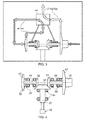
- FIGS 2 and 3 show schematically a first embodiment of the fuel pumping unit having first stage (LP) and second stage (HP) centrifugal pumps, fuel flows being indicated by thick arrowed lines.
- a drive input 30 from the engine accessory gearbox terminates in a bevel gear 32.
- Further bevel gears 34, 36 at the ends of first stage 38 and second stage 40 impeller shafts mesh with the input bevel gear.
- At the other ends of the impeller shafts are mounted first stage 42 and second stage 44 impellers of respectively the first and second stage centrifugal pumps.
- the first stage can incorporate an axial flow inducer 43.
- the bevel gears 32, 34, 36 form a gear arrangement operatively located between the drive input 30 and the low and high pressure pumps.
- the first stage bevel gear 34 is larger diameter than the second stage bevel gear 36, making the first stage pump run at a slower speed than the second stage pump. More particularly, the first stage pump can be run at a low speed compatible with the low inlet pressure and multiphase flow that occur when the airframe fuel pumps are inoperative, while the second stage can be run at a higher speed to reduce its size and weight and to increase its specific speed thereby improving its peak efficiency.
- a selector valve 46 controls the operational mode of the pumping unit. It also supplies fuel (indicated in Figures 2 and 3 by thin arrowed lines) to fuel lubricated journal bearings 48 on which the impeller shafts 38, 40 are mounted. Back-to-back oil 50 and fuel 52 seals with inter-seal drains are positioned between the bearings and the oil-lubricated bevel gears 34, 36 to prevent mingling of fuel with gear lubrication oil.
- the lubrication oil supply and scavenge can be provided by the accessory gearbox.
- the selector valve 46 has a first position which provides a high power mode, illustrated in Figure 2 . In this mode, the valve directs the delivery flow from the first stage to the inlet of the second stage and then directs the delivery flow from the second stage to a fuel metering unit (FMU) of the engine. In a second position, illustrated in Figure 3 , the selector valve provides a low power mode which directs the flow from the first stage directly to the FMU and shuts off fuel to the second stage so that it runs dry. Accumulator chambers, incorporating suitable baffling, may be provided within the valve to attenuate high transient pressures that may occur when the second stage transitions between running on fuel and air and vice-versa. In both modes, the selector valve also directs flow to the pump bearings 48.
- FMU fuel metering unit
- the selector valve 46 may be actuated electrically or hydraulically either directly from an engine electronic control (EEC) or from the FMU.
- EEC engine electronic control
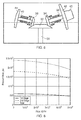
- FIG. 4 shows schematically optional variant features of the drive and pumps of the fuel pumping unit of the first embodiment.
- oil lubricated rolling element bearings 54 can be used to provide axial and radial load support for the bevel gear shaft 30, the shaft 30 being driven from the accessory gearbox via a splined shaft connection 56 at the outside of a housing of the pumping unit.
- the impeller shafts 38, 40 can be provided with axial and radial load support by oil lubricated rolling element bearings 58, with the oil 50 and fuel 52 seals now being positioned between the impellers 42, 44 and the bearings 58.
- the second stage pump may experience high axial loads during the transition from running dry to running with fuel, and hydrostatic axial thrust bearings may be advantageously deployed at this location.
- the accessory gearbox can supply and scavenge the oil used to lubricate the rolling element bearings 54, 58.
- FIG 5 shows schematically another variant of the drive and pumps of the fuel pumping unit of the first embodiment in which the impeller shafts 38, 40 of the two pumps are inclined with regard to the centreline. This can be beneficial in respect of the overall space envelope of the unit.
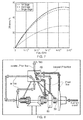
- the maximum speed for the first stage pump is 11200 RPM based on the assumption that an axial inducer would achieve a suction specific speed of 20,000 in US units. Such a drive speed is similar to that for a high performance military first stage centrifugal pump. An impeller diameter of around 160 mm would then generate a pressure rise of about 3.45 MPa (500 psi) at the take-off flow.
- the pump temperature rise was calculated for a cruise condition based on 95% engine speed and a burnt flow of 3.64 kilolitres per hour (800 IGPH) and for an idle condition based on 65% engine speed and a burnt flow of 0.45 kilolitres per hour (100 IGPH).
- the adiabatic temperature rise is predicted to be 9.3°C and at the idle condition around 26°C.
- the two stage centrifugal pumping unit thus addresses a number of issues associated with engine driven centrifugal pumps, namely:
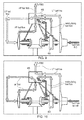
- Figures 8 to 10 show schematically a second embodiment of the fuel pumping unit.
- the pumping unit has a positive displacement start pump 60 that can be mounted on the first stage impeller shaft 38 to provide engine starting/priming capability.
- the selector valve 46 has a third position, illustrated in Figure 8 , which provides a start mode in which the flow output from LP pump is routed to the start pump, and from thence to the FMU and the engine burners at start.
- the first stage pump only generates a very low pressure rise, while in the start mode the second stage pump runs on air to reduce drag and torque.
- the start pump is able to provide an adequate pressure rise for the fuel sent to the FMU.
- the selector valve 46 takes the flow output of the start pump 60 and recirculates it back to the start pump inlet at a lower pressure.
- Figures 9 and 10 show respectively the high and low pressure modes of the unit. Accordingly, at engines speeds at and above ground idle, the start pump operates at a low back pressure and thus introduces only small parasitic losses into the fuel system.
- the start pump 60 also serves to prime the centrifugal pumps. It can be, for example, an external gear, gerotor or vane pump. However, from a size/weight standpoint, a radially balanced (dual lobe) vane pump is particularly advantageous for the following reasons:
Landscapes
- Engineering & Computer Science (AREA)
- Mechanical Engineering (AREA)
- General Engineering & Computer Science (AREA)
- Chemical & Material Sciences (AREA)
- Combustion & Propulsion (AREA)
- Structures Of Non-Positive Displacement Pumps (AREA)
Abstract
Description
- The present invention relates to a fuel pumping unit, for example for supplying fuel to an aero-engine.
- A typical fuel pumping system for an aero-engine comprises a low pressure (LP) pumping stage operable to draw fuel from a fuel tank, and supplying the fuel at boosted pressure to the inlet of a high pressure (HP) pumping stage. The inter-stage flow between LP and HP pumping stages is typically used to cool engine lubrication oil in a fuel/oil heat exchanger.
- Commonly, the LP pumping stage comprises a centrifugal impeller pump whilst the HP pumping stage comprises a positive displacement pump in the form of a twin pinion gear pump.
- However, another option is to use two centrifugal stages in series. For example,
EP A 0657651 describes an arrangement in which a first centrifugal pump acts as the LP stage, and a second centrifugal pump acts as the HP stage, the two pumps being cantilever-mounted to respective ends of a journal shaft driven by a drive shaft. - The efficiencies of centrifugal pumps typically vary with rotational speed, and a problem with the arrangement of
EP A 0657651 is that the two pumps operate at the same speed, making it difficult to operate both pumps efficiently. - Accordingly, in a first aspect the present invention provides fuel pumping unit having a low pressure centrifugal pump and a high pressure centrifugal pump, in use, the low pressure pump supplying fuel at a boosted pressure to the high pressure pump for onward supply to a fuel metering unit;
wherein the pumping unit further has a drive input which drives the low and high pressure pumps, a gear arrangement being operatively located between the drive input and the low and high pressure pumps such that the low and high pressure pumps are driven at different speeds by the drive input. - Advantageously, the gear arrangement allows the low and high pressure pumps to be driven at different speeds, thereby improving pump efficiencies, while still allowing a single drive input to operate both pumps. In addition, the low pressure pump can be run at a slow enough speed to operate with low inlet pressures and to handle multiphase (e.g. air/fuel) flows, while the high pressure pump can be run at high speeds enabling it to be reduced in size and weight.
- The fuel pumping unit of the first aspect may be suitable for pumping fuel for an aero-engine, such as a gas turbine engine. Thus the drive input may be a drive from an aero-engine accessory gearbox. Indeed, in a second aspect, the present invention provides an aero-engine having the fuel pumping unit of the first aspect.
- Optional features of the invention will now be set out. These are applicable singly or in any combination with any aspect of the invention.
- Conveniently, the high pressure pump can be driven at a higher speed than the low pressure pump.
- The gear arrangement may include a bevel gear drive. For example, a bevel gear may be located at an end of the drive input. The low and high pressure pumps may have respective impellers mounted on respective shafts. The impeller shafts can then terminate in further bevel gears which mesh with the bevel gear at the end of the drive input. The relative speed of each impeller can be determined by suitable selection of its further bevel gear.
- The fuel pumping unit may further have an axial flow inducer, e.g. of propeller type, at the inlet to the low pressure pump.
- The low and high pressure pumps may be supported on journal or rolling element (e.g. ball or roller) bearings. Journal bearings may be fuel lubricated. Rolling element bearings may be oil lubricated.
- The axes of the low and high pressure pumps may be inclined relative to each other. For example, when the low and high pressure have respective impellers mounted on respective shafts, these shafts may be inclined relative to each other. This can facilitate a more compact envelope for the fuel pumping unit.
- The fuel pumping unit may further have a selector valve which is configured to selectably provide a high pressure mode and a low pressure mode, wherein: in the high pressure mode the low pressure pump supplies fuel at the boosted pressure to the high pressure pump for onward supply to the fuel metering unit; and in the low pressure mode the fuel supply from the low pressure pump to the high pressure pump is shut off such that the high pressure pump runs dry and the low pressure pump supplies fuel to the fuel metering unit. Thus, the high pressure pump can be run on air when the additional pressure rise it produces is not required, e.g. at low engine power settings. In particular, at low speeds the efficiency of the high pressure pump can be very low. Therefore, if it is not run on air, it may cause high fuel temperatures, which in turn can limit the heat sink capability of the fuel to cool engine oil.
- When the fuel pumping unit has the selector valve, it may further have a positive displacement start pump which is driven by the drive input via the gear arrangement, the selector valve being further configured to selectably provide a start mode, wherein: in the start mode the low pressure pump supplies fuel at the boosted pressure to the start pump for onward supply to the fuel metering unit, and the fuel supply from the low pressure pump to the high pressure pump is shut off such that the high pressure pump runs dry. Such an arrangement allows the pump unit to better supply sufficient pressure rise at low speed starts, e.g. at the low windmill relight speeds prevalent on modern high bypass turbofan engines. The start pump can also help to prime the centrifugal pumps should significant amounts of air have entered the centrifugal pumps. In the high and low pressure modes, rather than the selector valve having further complexity to isolate the start pump, the start pump can recirculate fuel between the start pump and the selector valve. This recirculation can be at a low pressure rise to reduce any fuel temperature increase in the start pump. The start pump is a positive displacement pump such as, an external gear, a gerator or a vane pump. In particular, it may be a vane pump such as a dual lobe vane pump. Conveniently, the low pressure pump and the start pump may be driven at the same speed by the drive input. For example, they may be mounted on a common shaft.
- Embodiments of the invention will now be described by way of example with reference to the accompanying drawings in which:
-
Figure 1 shows a longitudinal cross-section through a ducted fan gas turbine engine; -
Figure 2 shows schematically a first embodiment of a fuel pumping unit having first stage (LP) and second stage (HP) centrifugal pumps, the pumping unit being in a high power mode; -
Figure 3 shows schematically the fuel pumping unit ofFigure 2 in a low power mode; -
Figure 4 shows a variant of the fuel pumping unit ofFigures 2 and3 ; -
Figure 5 shows another variant of the fuel pumping unit ofFigures 2 and3 ; -
Figure 6 shows predicted pressure rise characteristics for the fuel pumping unit ofFigures 2 and3 ; -
Figure 7 shows predicted efficiency characteristics for the fuel pumping unit ofFigures 2 and3 ; -
Figure 8 shows schematically a second embodiment of a fuel pumping unit having first stage (LP) and second stage (HP) centrifugal pumps, the pumping unit being in a start mode; -
Figure 9 shows schematically the fuel pumping unit ofFigure 8 in a high power mode; and -
Figure 10 shows schematically the fuel pumping unit ofFigures 8 and9 in a low power mode. - With reference to
Figure 1 , a ducted fan gas turbine engine incorporating the invention is generally indicated at 10 and has a principal and rotational axis X-X. The engine comprises, in axial flow series, anair intake 11, apropulsive fan 12, anintermediate pressure compressor 13, a high-pressure compressor 14,combustion equipment 15, a high-pressure turbine 16, anintermediate pressure turbine 17, a low-pressure turbine 18 and a coreengine exhaust nozzle 19. Anacelle 21 generally surrounds theengine 10 and defines theintake 11, abypass duct 22 and abypass exhaust nozzle 23. - During operation, air entering the
intake 11 is accelerated by thefan 12 to produce two air flows: a first air flow A into the intermediate-pressure compressor 13 and a second air flow B which passes through thebypass duct 22 to provide propulsive thrust. The intermediate-pressure compressor 13 compresses the air flow A directed into it before delivering that air to the high-pressure compressor 14 where further compression takes place. - The compressed air exhausted from the high-
pressure compressor 14 is directed into thecombustion equipment 15 where it is mixed with fuel and the mixture combusted. The resultant hot combustion products then expand through, and thereby drive the high, intermediate and low-pressure turbines nozzle 19 to provide additional propulsive thrust. The high, intermediate and low-pressure turbines respectively drive the high and intermediate-pressure compressors fan 12 by suitable interconnecting shafts. - The engine has a fuel pumping unit (not shown in
Figure 1 ) which draws fuel from a fuel tank, and supplies pressurised fuel to a fuel metering unit of the engine. The metered fuel is then sent to the burners of thecombustion equipment 15. - Typical aero engine operating conditions result in low specific speeds, Ns:

- In general, pump efficiencies increase as the specific speed increases, up to a maximum which can then be followed by a decrease in efficiency. For a typical medium/large engine application, if a single stage centrifugal pump were to be used in the fuel pumping unit the pump would have a low specific speed of less than 200 in US units, which would result in very low overall efficiencies. These low efficiencies would result in significant heat being rejected into the fuel and hence high fuel temperature rises, particularly at low engine power settings. High fuel temperatures limit the heat sink capability of the fuel for cooling the engine oil.
- However, by using a pump unit which has two centrifugal stages in series, the specific speed of each stage can be increased as the pressure rise each is required to produce can be reduced, and hence the efficiency of each stage can be improved.
- In a two stage pump unit, the first (LP) stage can thus be run at a speed that allows it to meet the low inlet pressure and multiphase flow (V/L) requirements when airframe fuel pumps are inoperative. In particular, the first stage pump can be arranged to generate the required pressure rise for engine power settings below cruise. For a modern engine with staged combustion this is around 3.45 MPa (500 psi).
- The second (HP) stage is fed with boosted pressure fuel from the first stage and so it can be run at a higher speed, which is desirable for the reduction of its size and weight. This can also increase the specific speed of the second stage, which in turn increases its efficiency. The second stage can be sized to generate the balance of the pressure rise required at high engine power levels. For a modern system, with staged combustion, the second stage would be required to generate about 10.34 MPa (1500 psi) at take-off flows. The total pressure rise of the pump unit at take-off would therefore be around 13.79 MPa (2000 psi).
- Accordingly, the pump unit is arranged so that the first and second stages operate at different speeds. In the embodiments of the invention discussed in detail below, this can be achieved with a single input drive shaft from the engine accessory gearbox.
- At low engine power conditions, the efficiency of a two stage pump can still be very low and may result in high fuel temperatures which in turn limit the heat sink capability of the fuel to cool the engine oil. Both the pressure rise and input power of a centrifugal pump are proportional to the density of the fluid it is handling. Thus preferably the second stage of the pump unit is run "dry" (i.e. runs in air) at low engine power settings. Since the density of air is much less than the density of fuel, this can significantly reduce the power consumption of the second stage.
-
Figures 2 and3 show schematically a first embodiment of the fuel pumping unit having first stage (LP) and second stage (HP) centrifugal pumps, fuel flows being indicated by thick arrowed lines. Adrive input 30 from the engine accessory gearbox terminates in abevel gear 32.Further bevel gears first stage 38 andsecond stage 40 impeller shafts mesh with the input bevel gear. At the other ends of the impeller shafts are mountedfirst stage 42 andsecond stage 44 impellers of respectively the first and second stage centrifugal pumps. The first stage can incorporate anaxial flow inducer 43. - Together, the bevel gears 32, 34, 36 form a gear arrangement operatively located between the
drive input 30 and the low and high pressure pumps. The firststage bevel gear 34 is larger diameter than the secondstage bevel gear 36, making the first stage pump run at a slower speed than the second stage pump. More particularly, the first stage pump can be run at a low speed compatible with the low inlet pressure and multiphase flow that occur when the airframe fuel pumps are inoperative, while the second stage can be run at a higher speed to reduce its size and weight and to increase its specific speed thereby improving its peak efficiency. - A
selector valve 46 controls the operational mode of the pumping unit. It also supplies fuel (indicated inFigures 2 and3 by thin arrowed lines) to fuel lubricatedjournal bearings 48 on which theimpeller shafts back oil 50 andfuel 52 seals with inter-seal drains are positioned between the bearings and the oil-lubricatedbevel gears - The
selector valve 46 has a first position which provides a high power mode, illustrated inFigure 2 . In this mode, the valve directs the delivery flow from the first stage to the inlet of the second stage and then directs the delivery flow from the second stage to a fuel metering unit (FMU) of the engine. In a second position, illustrated inFigure 3 , the selector valve provides a low power mode which directs the flow from the first stage directly to the FMU and shuts off fuel to the second stage so that it runs dry. Accumulator chambers, incorporating suitable baffling, may be provided within the valve to attenuate high transient pressures that may occur when the second stage transitions between running on fuel and air and vice-versa. In both modes, the selector valve also directs flow to thepump bearings 48. - The
selector valve 46 may be actuated electrically or hydraulically either directly from an engine electronic control (EEC) or from the FMU. -
Figure 4 shows schematically optional variant features of the drive and pumps of the fuel pumping unit of the first embodiment. In particular, oil lubricated rolling element bearings 54 can be used to provide axial and radial load support for thebevel gear shaft 30, theshaft 30 being driven from the accessory gearbox via a splined shaft connection 56 at the outside of a housing of the pumping unit. Additionally or alternatively, theimpeller shafts oil 50 andfuel 52 seals now being positioned between theimpellers -
Figure 5 shows schematically another variant of the drive and pumps of the fuel pumping unit of the first embodiment in which theimpeller shafts - Preliminary performance characteristics have been predicted for such an embodiment of an engine-driven two stage centrifugal pumping unit. A take-off flow of 20.46 kilolitres per hour (4500 IGPH (Imperial Gallons per hour)) and a minimum inlet pressure of TVP (True Vapour Pressure) + 20.1 kPa (3 psi) are assumed.
- The maximum speed for the first stage pump is 11200 RPM based on the assumption that an axial inducer would achieve a suction specific speed of 20,000 in US units. Such a drive speed is similar to that for a high performance military first stage centrifugal pump. An impeller diameter of around 160 mm would then generate a pressure rise of about 3.45 MPa (500 psi) at the take-off flow.
- For the second stage to operate at optimum efficiency would require a speed of about 130,000 RPM. However, the technical risks associated with running a pump at such a high a speed are great. Accordingly a maximum speed of 30,000 RPM is assumed for the second stage pump. At this speed an impeller diameter of less than 110 mm is needed.
- The predicted pressure rise and efficiency characteristics for the two stages are shown in
Figures 6 andFigure 7 respectively. The efficiency for a single stage centrifugal pump is also shown onFigure 7 for comparison. - The pump temperature rise was calculated for a cruise condition based on 95% engine speed and a burnt flow of 3.64 kilolitres per hour (800 IGPH) and for an idle condition based on 65% engine speed and a burnt flow of 0.45 kilolitres per hour (100 IGPH). At the cruise condition the adiabatic temperature rise is predicted to be 9.3°C and at the idle condition around 26°C.
- The two stage centrifugal pumping unit thus addresses a number of issues associated with engine driven centrifugal pumps, namely:
- Increasing the efficiency of the pumping unit.
- Reducing the heat rejection to the fuel at low engine power settings.
- Achieving acceptable low inlet pressure performance and reducing unit size and weight with a single drive from the accessory gearbox.
-
Figures 8 to 10 show schematically a second embodiment of the fuel pumping unit. - The pumping unit of the second embodiment has additional features which address:
- Low speed start: Centrifugal pumps typically do not provide enough pressure rise for engine starting; especially at the low windmill relight speeds prevalent on modern high bypass turbofan engines.
- Priming: If significant amounts of air enter a centrifugal pump it may not generate a sufficient pressure rise since the rise is proportional to the density of the fluid being pump. As a consequence, it may not be possible for the pump to dispel the air from the system and re-prime itself.
- Accordingly, in the second embodiment, the pumping unit has a positive
displacement start pump 60 that can be mounted on the firststage impeller shaft 38 to provide engine starting/priming capability. Theselector valve 46 has a third position, illustrated inFigure 8 , which provides a start mode in which the flow output from LP pump is routed to the start pump, and from thence to the FMU and the engine burners at start. At low engine speeds, the first stage pump only generates a very low pressure rise, while in the start mode the second stage pump runs on air to reduce drag and torque. However, even at the low engine speeds, the start pump is able to provide an adequate pressure rise for the fuel sent to the FMU. - As the engine spools up in speed, the
selector valve 46 takes the flow output of thestart pump 60 and recirculates it back to the start pump inlet at a lower pressure. This is illustrated inFigures 9 and 10 , which show respectively the high and low pressure modes of the unit. Accordingly, at engines speeds at and above ground idle, the start pump operates at a low back pressure and thus introduces only small parasitic losses into the fuel system. - The
start pump 60 also serves to prime the centrifugal pumps. It can be, for example, an external gear, gerotor or vane pump. However, from a size/weight standpoint, a radially balanced (dual lobe) vane pump is particularly advantageous for the following reasons: - Single rotor design.
- Radially balanced, hence it can be cantilevered on the LP centrifugal pump bearings, thereby avoiding a need for dedicated bearings for the start pump.
- Capability to run at higher speeds.
- Over stroking capability can substantially reduce its size and weight. Since the start pump is designed to operate at low pressures (typically 1.38-2.01 MPa differential (200-300 psid) for starting), the vane stroke for a given rotor size can be substantially higher without over stressing the rotor or the vanes.
- While the invention has been described in conjunction with the exemplary embodiments described above, many equivalent modifications and variations will be apparent to those skilled in the art when given this disclosure. Accordingly, the exemplary embodiments of the invention set forth above are considered to be illustrative and not limiting.
Claims (9)
- A fuel pumping unit having a low pressure centrifugal pump (42) and a high pressure centrifugal pump (44), in use, the low pressure pump supplying fuel at a boosted pressure to the high pressure pump for onward supply to a fuel metering unit;
the pumping unit further having a drive input (30) which drives the low and high pressure pumps, a gear arrangement being operatively located between the drive input and the low and high pressure pumps such that the low and high pressure pumps are driven at different speeds by the drive input; and
the pumping unit further having a selector valve (46) which is configured to selectably provide a high pressure mode and a low pressure mode, wherein:in the high pressure mode the low pressure pump supplies fuel at the boosted pressure to the high pressure pump for onward supply to the fuel metering unit; andin the low pressure mode the fuel supply from the low pressure pump to the high pressure pump is shut off such that the high pressure pump runs dry and the low pressure pump supplies fuel to the fuel metering unit. - A fuel pumping unit according to claim 1, wherein the high pressure pump is driven at a higher speed than the low pressure pump.
- A fuel pumping unit according to claim 1 or 2, wherein the gear arrangement includes a bevel gear drive.
- A fuel pumping unit according to any one of the previous claims further having an axial flow inducer at the inlet to the low pressure pump.
- A fuel pumping unit according to any one of the previous claims, wherein the axes of the low and high pressure pumps are inclined relative to each other.
- A fuel pumping unit according to any one of the previous claims further having a positive displacement start pump (60) which is driven by the drive input via the gear arrangement, the selector valve being further configured to selectably provide a start mode, wherein:in the start mode the low pressure pump supplies fuel at the boosted pressure to the start pump for onward supply to the fuel metering unit fuel, and the fuel supply from the low pressure pump to the high pressure pump is shut off such that the high pressure pump runs dry.
- A fuel pumping unit according to claim 6, wherein the low pressure pump and the start pump are driven at the same speed by the drive input.
- A fuel pumping unit according to any one of the previous claims suitable for pumping fuel for an aero-engine.
- An aero-engine having the fuel pumping unit according to any one of the previous claims.
Applications Claiming Priority (1)
| Application Number | Priority Date | Filing Date | Title |
|---|---|---|---|
| GBGB1420635.3A GB201420635D0 (en) | 2014-11-20 | 2014-11-20 | Fuel pumping unit |
Publications (2)
| Publication Number | Publication Date |
|---|---|
| EP3023615A1 true EP3023615A1 (en) | 2016-05-25 |
| EP3023615B1 EP3023615B1 (en) | 2019-07-03 |
Family
ID=52292265
Family Applications (1)
| Application Number | Title | Priority Date | Filing Date |
|---|---|---|---|
| EP15183775.4A Not-in-force EP3023615B1 (en) | 2014-11-20 | 2015-09-03 | Fuel pumping unit |
Country Status (3)
| Country | Link |
|---|---|
| US (1) | US10138816B2 (en) |
| EP (1) | EP3023615B1 (en) |
| GB (1) | GB201420635D0 (en) |
Families Citing this family (22)
| Publication number | Priority date | Publication date | Assignee | Title |
|---|---|---|---|---|
| CN112177938B (en) | 2016-08-10 | 2023-05-26 | 可克斯塔特国际股份有限公司 | Modular multi-stage pump assembly |
| US20180050812A1 (en) * | 2016-08-16 | 2018-02-22 | Hamilton Sundstrand Corporation | Aircraft fuel pump systems |
| US10428816B2 (en) * | 2016-10-24 | 2019-10-01 | Hamilton Sundstrand Corporation | Variable speed multi-stage pump |
| CN107939698A (en) * | 2017-11-30 | 2018-04-20 | 衢州学院 | A kind of multi-functional compound pumping installations of new construction |
| US10865713B2 (en) * | 2018-07-20 | 2020-12-15 | Hamilton Sundstrand Corporation | Systems and methods for cooling electronic engine control devices |
| US11085636B2 (en) * | 2018-11-02 | 2021-08-10 | General Electric Company | Fuel oxygen conversion unit |
| CN109555714B (en) * | 2019-01-23 | 2024-07-09 | 英飞同仁风机股份有限公司 | A variable double-inlet centrifugal fan, implementation method and system |
| US20200300169A1 (en) * | 2019-03-20 | 2020-09-24 | United Technologies Corporation | Mechanical demand fuel pumping system |
| US11629652B2 (en) | 2020-02-05 | 2023-04-18 | Hamilton Sundstrand Corporation | Metering pump system |
| US11788427B2 (en) | 2021-06-10 | 2023-10-17 | Pratt & Whitney Canada Corp. | Lubricant pump system and method for aircraft engine |
| US12071898B2 (en) * | 2021-07-30 | 2024-08-27 | Hamilton Sundstrand Corporation | Fluid pump systems |
| US11971040B2 (en) * | 2021-10-25 | 2024-04-30 | Hamilton Sundstrand Corporation | Aircraft fuel system with clutched augmentor pump |
| US11828233B2 (en) * | 2021-11-26 | 2023-11-28 | Hamilton Sundstrand Corporation | Fuel pump systems |
| US11725585B2 (en) * | 2021-11-30 | 2023-08-15 | Hamilton Sundstrand Corporation (HSC) | Fuel delivery pump selection |
| US11629643B1 (en) * | 2022-01-07 | 2023-04-18 | Hamilton Sundstrand Corporation | Fuel pump systems |
| FR3132931B1 (en) * | 2022-02-18 | 2024-01-12 | Safran Aircraft Engines | Fuel control system |
| US20230417190A1 (en) * | 2022-06-22 | 2023-12-28 | Hamilton Sundstrand Corporation | Dual fuel pump system for an aircraft |
| CN116163987B (en) * | 2023-02-02 | 2025-07-15 | 长沙中联泵业股份有限公司 | A multi-stage pump with automatic pressure balance control |
| US12209538B1 (en) | 2023-09-11 | 2025-01-28 | Hamilton Sundstrand Corporation | Three pump fuel systems with selectable main and augmentor pumps |
| US12366207B2 (en) | 2023-09-11 | 2025-07-22 | Hamilton Sundstrand Corporation | Variable displacement pump (VDP) systems with dry-out centrifugal main pump |
| US12366206B2 (en) | 2023-09-11 | 2025-07-22 | Hamilton Sundstrand Corporation | Variable displacement pump (VDP) systems with dual dry out pumps |
| US12352211B1 (en) * | 2024-02-28 | 2025-07-08 | Hamilton Sundstrand Corporation | Dual pump electrified fuel system with parallelism |
Citations (5)
| Publication number | Priority date | Publication date | Assignee | Title |
|---|---|---|---|---|
| US3614269A (en) * | 1970-03-09 | 1971-10-19 | Chandler Evans Inc | Integrated pump-control system using a unitized pump |
| EP0657651A1 (en) * | 1993-12-07 | 1995-06-14 | Lucas Industries Public Limited Company | Pump |
| US6447262B1 (en) * | 1999-05-14 | 2002-09-10 | Argo-Tech Corporation | Pumping system for a multi-stage pump |
| US20080028742A1 (en) * | 2004-09-16 | 2008-02-07 | Parsons Douglas A | Metering demand fuel system |
| US20140196463A1 (en) * | 2013-01-17 | 2014-07-17 | Honeywell International Inc. | High efficiency, high pressure gas turbine engine fuel supply system and method |
Family Cites Families (5)
| Publication number | Priority date | Publication date | Assignee | Title |
|---|---|---|---|---|
| GB667022A (en) | 1949-03-10 | 1952-02-20 | Rolls Royce | Improvements relating to gas-turbine engine fuel systems |
| US3147712A (en) * | 1960-09-02 | 1964-09-08 | Gen Motors Corp | Fuel pumping system for gas turbines |
| US3183838A (en) * | 1963-03-27 | 1965-05-18 | Flygts Pumpar Ab | Twin pump device |
| US3547557A (en) | 1968-10-14 | 1970-12-15 | Chandler Evans Inc | Fluid pump and delivery system |
| DD136761A1 (en) * | 1978-05-29 | 1979-07-25 | Hans Spengler | HIGH PRESSURE PUMPS UNIT |
-
2014
- 2014-11-20 GB GBGB1420635.3A patent/GB201420635D0/en not_active Ceased
-
2015
- 2015-09-03 EP EP15183775.4A patent/EP3023615B1/en not_active Not-in-force
- 2015-09-18 US US14/858,614 patent/US10138816B2/en active Active
Patent Citations (5)
| Publication number | Priority date | Publication date | Assignee | Title |
|---|---|---|---|---|
| US3614269A (en) * | 1970-03-09 | 1971-10-19 | Chandler Evans Inc | Integrated pump-control system using a unitized pump |
| EP0657651A1 (en) * | 1993-12-07 | 1995-06-14 | Lucas Industries Public Limited Company | Pump |
| US6447262B1 (en) * | 1999-05-14 | 2002-09-10 | Argo-Tech Corporation | Pumping system for a multi-stage pump |
| US20080028742A1 (en) * | 2004-09-16 | 2008-02-07 | Parsons Douglas A | Metering demand fuel system |
| US20140196463A1 (en) * | 2013-01-17 | 2014-07-17 | Honeywell International Inc. | High efficiency, high pressure gas turbine engine fuel supply system and method |
Also Published As
| Publication number | Publication date |
|---|---|
| US10138816B2 (en) | 2018-11-27 |
| EP3023615B1 (en) | 2019-07-03 |
| GB201420635D0 (en) | 2015-01-07 |
| US20160146108A1 (en) | 2016-05-26 |
Similar Documents
| Publication | Publication Date | Title |
|---|---|---|
| EP3023615B1 (en) | Fuel pumping unit | |
| US11319837B2 (en) | Lubrication systems and methods with superposition gearbox | |
| US11248532B2 (en) | Hybrid electric dual spool power extraction gearbox | |
| US8172512B2 (en) | Accessory gearbox system with compressor driven seal air supply | |
| EP3049642B1 (en) | Gas turbine engine with split lubrication system | |
| EP3171055B1 (en) | Near zero velocity lubrication system for a turbine engine | |
| US7418821B2 (en) | Aircraft gas turbine engines | |
| EP2362081A1 (en) | Bearing compartment pressurization and shaft ventilation system | |
| EP1647675B1 (en) | Adequate oil supply for an aeroengine oil tank system | |
| CN112483276A (en) | Gas turbine engine | |
| CN104136721B (en) | Turbine engine and method of operation thereof | |
| CN116733607A (en) | Combination gas turbine engine and power electronics | |
| US12540669B2 (en) | Gearbox assembly | |
| EP4116546B1 (en) | Lubrication system with anti-priming feature | |
| US12228077B2 (en) | Fuel system including driving turbine | |
| US12516668B2 (en) | Gear pump assembly | |
| CN111561395A (en) | Thermal management system and gas turbine engine | |
| GB2523196A (en) | Gear pump |
Legal Events
| Date | Code | Title | Description |
|---|---|---|---|
| AK | Designated contracting states |
Kind code of ref document: A1 Designated state(s): AL AT BE BG CH CY CZ DE DK EE ES FI FR GB GR HR HU IE IS IT LI LT LU LV MC MK MT NL NO PL PT RO RS SE SI SK SM TR |
|
| AX | Request for extension of the european patent |
Extension state: BA ME |
|
| PUAI | Public reference made under article 153(3) epc to a published international application that has entered the european phase |
Free format text: ORIGINAL CODE: 0009012 |
|
| STAA | Information on the status of an ep patent application or granted ep patent |
Free format text: STATUS: REQUEST FOR EXAMINATION WAS MADE |
|
| 17P | Request for examination filed |
Effective date: 20161124 |
|
| RBV | Designated contracting states (corrected) |
Designated state(s): AL AT BE BG CH CY CZ DE DK EE ES FI FR GB GR HR HU IE IS IT LI LT LU LV MC MK MT NL NO PL PT RO RS SE SI SK SM TR |
|
| RAP1 | Party data changed (applicant data changed or rights of an application transferred) |
Owner name: ROLLS-ROYCE PLC |
|
| STAA | Information on the status of an ep patent application or granted ep patent |
Free format text: STATUS: EXAMINATION IS IN PROGRESS |
|
| 17Q | First examination report despatched |
Effective date: 20170522 |
|
| GRAP | Despatch of communication of intention to grant a patent |
Free format text: ORIGINAL CODE: EPIDOSNIGR1 |
|
| STAA | Information on the status of an ep patent application or granted ep patent |
Free format text: STATUS: GRANT OF PATENT IS INTENDED |
|
| RIC1 | Information provided on ipc code assigned before grant |
Ipc: F04B 41/06 20060101ALI20190116BHEP Ipc: F04C 2/10 20060101ALN20190116BHEP Ipc: F02C 7/236 20060101AFI20190116BHEP Ipc: F04C 2/34 20060101ALN20190116BHEP Ipc: F04C 11/00 20060101ALN20190116BHEP Ipc: F04D 9/04 20060101ALI20190116BHEP Ipc: F04D 13/12 20060101ALI20190116BHEP |
|
| INTG | Intention to grant announced |
Effective date: 20190213 |
|
| GRAS | Grant fee paid |
Free format text: ORIGINAL CODE: EPIDOSNIGR3 |
|
| GRAA | (expected) grant |
Free format text: ORIGINAL CODE: 0009210 |
|
| STAA | Information on the status of an ep patent application or granted ep patent |
Free format text: STATUS: THE PATENT HAS BEEN GRANTED |
|
| AK | Designated contracting states |
Kind code of ref document: B1 Designated state(s): AL AT BE BG CH CY CZ DE DK EE ES FI FR GB GR HR HU IE IS IT LI LT LU LV MC MK MT NL NO PL PT RO RS SE SI SK SM TR |
|
| REG | Reference to a national code |
Ref country code: GB Ref legal event code: FG4D |
|
| REG | Reference to a national code |
Ref country code: CH Ref legal event code: EP Ref country code: AT Ref legal event code: REF Ref document number: 1151293 Country of ref document: AT Kind code of ref document: T Effective date: 20190715 |
|
| REG | Reference to a national code |
Ref country code: IE Ref legal event code: FG4D |
|
| REG | Reference to a national code |
Ref country code: DE Ref legal event code: R096 Ref document number: 602015033025 Country of ref document: DE |
|
| REG | Reference to a national code |
Ref country code: NL Ref legal event code: MP Effective date: 20190703 |
|
| REG | Reference to a national code |
Ref country code: LT Ref legal event code: MG4D |
|
| REG | Reference to a national code |
Ref country code: AT Ref legal event code: MK05 Ref document number: 1151293 Country of ref document: AT Kind code of ref document: T Effective date: 20190703 |
|
| PG25 | Lapsed in a contracting state [announced via postgrant information from national office to epo] |
Ref country code: FI Free format text: LAPSE BECAUSE OF FAILURE TO SUBMIT A TRANSLATION OF THE DESCRIPTION OR TO PAY THE FEE WITHIN THE PRESCRIBED TIME-LIMIT Effective date: 20190703 Ref country code: LT Free format text: LAPSE BECAUSE OF FAILURE TO SUBMIT A TRANSLATION OF THE DESCRIPTION OR TO PAY THE FEE WITHIN THE PRESCRIBED TIME-LIMIT Effective date: 20190703 Ref country code: PT Free format text: LAPSE BECAUSE OF FAILURE TO SUBMIT A TRANSLATION OF THE DESCRIPTION OR TO PAY THE FEE WITHIN THE PRESCRIBED TIME-LIMIT Effective date: 20191104 Ref country code: HR Free format text: LAPSE BECAUSE OF FAILURE TO SUBMIT A TRANSLATION OF THE DESCRIPTION OR TO PAY THE FEE WITHIN THE PRESCRIBED TIME-LIMIT Effective date: 20190703 Ref country code: CZ Free format text: LAPSE BECAUSE OF FAILURE TO SUBMIT A TRANSLATION OF THE DESCRIPTION OR TO PAY THE FEE WITHIN THE PRESCRIBED TIME-LIMIT Effective date: 20190703 Ref country code: NO Free format text: LAPSE BECAUSE OF FAILURE TO SUBMIT A TRANSLATION OF THE DESCRIPTION OR TO PAY THE FEE WITHIN THE PRESCRIBED TIME-LIMIT Effective date: 20191003 Ref country code: BG Free format text: LAPSE BECAUSE OF FAILURE TO SUBMIT A TRANSLATION OF THE DESCRIPTION OR TO PAY THE FEE WITHIN THE PRESCRIBED TIME-LIMIT Effective date: 20191003 Ref country code: NL Free format text: LAPSE BECAUSE OF FAILURE TO SUBMIT A TRANSLATION OF THE DESCRIPTION OR TO PAY THE FEE WITHIN THE PRESCRIBED TIME-LIMIT Effective date: 20190703 Ref country code: AT Free format text: LAPSE BECAUSE OF FAILURE TO SUBMIT A TRANSLATION OF THE DESCRIPTION OR TO PAY THE FEE WITHIN THE PRESCRIBED TIME-LIMIT Effective date: 20190703 Ref country code: SE Free format text: LAPSE BECAUSE OF FAILURE TO SUBMIT A TRANSLATION OF THE DESCRIPTION OR TO PAY THE FEE WITHIN THE PRESCRIBED TIME-LIMIT Effective date: 20190703 |
|
| RAP2 | Party data changed (patent owner data changed or rights of a patent transferred) |
Owner name: ROLLS-ROYCE PLC |
|
| PG25 | Lapsed in a contracting state [announced via postgrant information from national office to epo] |
Ref country code: IS Free format text: LAPSE BECAUSE OF FAILURE TO SUBMIT A TRANSLATION OF THE DESCRIPTION OR TO PAY THE FEE WITHIN THE PRESCRIBED TIME-LIMIT Effective date: 20191103 Ref country code: GR Free format text: LAPSE BECAUSE OF FAILURE TO SUBMIT A TRANSLATION OF THE DESCRIPTION OR TO PAY THE FEE WITHIN THE PRESCRIBED TIME-LIMIT Effective date: 20191004 Ref country code: ES Free format text: LAPSE BECAUSE OF FAILURE TO SUBMIT A TRANSLATION OF THE DESCRIPTION OR TO PAY THE FEE WITHIN THE PRESCRIBED TIME-LIMIT Effective date: 20190703 Ref country code: RS Free format text: LAPSE BECAUSE OF FAILURE TO SUBMIT A TRANSLATION OF THE DESCRIPTION OR TO PAY THE FEE WITHIN THE PRESCRIBED TIME-LIMIT Effective date: 20190703 Ref country code: LV Free format text: LAPSE BECAUSE OF FAILURE TO SUBMIT A TRANSLATION OF THE DESCRIPTION OR TO PAY THE FEE WITHIN THE PRESCRIBED TIME-LIMIT Effective date: 20190703 Ref country code: AL Free format text: LAPSE BECAUSE OF FAILURE TO SUBMIT A TRANSLATION OF THE DESCRIPTION OR TO PAY THE FEE WITHIN THE PRESCRIBED TIME-LIMIT Effective date: 20190703 |
|
| PG25 | Lapsed in a contracting state [announced via postgrant information from national office to epo] |
Ref country code: TR Free format text: LAPSE BECAUSE OF FAILURE TO SUBMIT A TRANSLATION OF THE DESCRIPTION OR TO PAY THE FEE WITHIN THE PRESCRIBED TIME-LIMIT Effective date: 20190703 |
|
| PG25 | Lapsed in a contracting state [announced via postgrant information from national office to epo] |
Ref country code: IT Free format text: LAPSE BECAUSE OF FAILURE TO SUBMIT A TRANSLATION OF THE DESCRIPTION OR TO PAY THE FEE WITHIN THE PRESCRIBED TIME-LIMIT Effective date: 20190703 Ref country code: DK Free format text: LAPSE BECAUSE OF FAILURE TO SUBMIT A TRANSLATION OF THE DESCRIPTION OR TO PAY THE FEE WITHIN THE PRESCRIBED TIME-LIMIT Effective date: 20190703 Ref country code: RO Free format text: LAPSE BECAUSE OF FAILURE TO SUBMIT A TRANSLATION OF THE DESCRIPTION OR TO PAY THE FEE WITHIN THE PRESCRIBED TIME-LIMIT Effective date: 20190703 Ref country code: EE Free format text: LAPSE BECAUSE OF FAILURE TO SUBMIT A TRANSLATION OF THE DESCRIPTION OR TO PAY THE FEE WITHIN THE PRESCRIBED TIME-LIMIT Effective date: 20190703 Ref country code: PL Free format text: LAPSE BECAUSE OF FAILURE TO SUBMIT A TRANSLATION OF THE DESCRIPTION OR TO PAY THE FEE WITHIN THE PRESCRIBED TIME-LIMIT Effective date: 20190703 |
|
| PG25 | Lapsed in a contracting state [announced via postgrant information from national office to epo] |
Ref country code: SK Free format text: LAPSE BECAUSE OF FAILURE TO SUBMIT A TRANSLATION OF THE DESCRIPTION OR TO PAY THE FEE WITHIN THE PRESCRIBED TIME-LIMIT Effective date: 20190703 Ref country code: SM Free format text: LAPSE BECAUSE OF FAILURE TO SUBMIT A TRANSLATION OF THE DESCRIPTION OR TO PAY THE FEE WITHIN THE PRESCRIBED TIME-LIMIT Effective date: 20190703 Ref country code: MC Free format text: LAPSE BECAUSE OF FAILURE TO SUBMIT A TRANSLATION OF THE DESCRIPTION OR TO PAY THE FEE WITHIN THE PRESCRIBED TIME-LIMIT Effective date: 20190703 Ref country code: IS Free format text: LAPSE BECAUSE OF FAILURE TO SUBMIT A TRANSLATION OF THE DESCRIPTION OR TO PAY THE FEE WITHIN THE PRESCRIBED TIME-LIMIT Effective date: 20200224 |
|
| REG | Reference to a national code |
Ref country code: CH Ref legal event code: PL |
|
| REG | Reference to a national code |
Ref country code: DE Ref legal event code: R097 Ref document number: 602015033025 Country of ref document: DE |
|
| PLBE | No opposition filed within time limit |
Free format text: ORIGINAL CODE: 0009261 |
|
| STAA | Information on the status of an ep patent application or granted ep patent |
Free format text: STATUS: NO OPPOSITION FILED WITHIN TIME LIMIT |
|
| PG2D | Information on lapse in contracting state deleted |
Ref country code: IS |
|
| PG25 | Lapsed in a contracting state [announced via postgrant information from national office to epo] |
Ref country code: IE Free format text: LAPSE BECAUSE OF NON-PAYMENT OF DUE FEES Effective date: 20190903 Ref country code: CH Free format text: LAPSE BECAUSE OF NON-PAYMENT OF DUE FEES Effective date: 20190930 Ref country code: LU Free format text: LAPSE BECAUSE OF NON-PAYMENT OF DUE FEES Effective date: 20190903 Ref country code: LI Free format text: LAPSE BECAUSE OF NON-PAYMENT OF DUE FEES Effective date: 20190930 |
|
| REG | Reference to a national code |
Ref country code: BE Ref legal event code: MM Effective date: 20190930 |
|
| 26N | No opposition filed |
Effective date: 20200603 |
|
| PG25 | Lapsed in a contracting state [announced via postgrant information from national office to epo] |
Ref country code: SI Free format text: LAPSE BECAUSE OF FAILURE TO SUBMIT A TRANSLATION OF THE DESCRIPTION OR TO PAY THE FEE WITHIN THE PRESCRIBED TIME-LIMIT Effective date: 20190703 Ref country code: BE Free format text: LAPSE BECAUSE OF NON-PAYMENT OF DUE FEES Effective date: 20190930 |
|
| PG25 | Lapsed in a contracting state [announced via postgrant information from national office to epo] |
Ref country code: CY Free format text: LAPSE BECAUSE OF FAILURE TO SUBMIT A TRANSLATION OF THE DESCRIPTION OR TO PAY THE FEE WITHIN THE PRESCRIBED TIME-LIMIT Effective date: 20190703 |
|
| PG25 | Lapsed in a contracting state [announced via postgrant information from national office to epo] |
Ref country code: HU Free format text: LAPSE BECAUSE OF FAILURE TO SUBMIT A TRANSLATION OF THE DESCRIPTION OR TO PAY THE FEE WITHIN THE PRESCRIBED TIME-LIMIT; INVALID AB INITIO Effective date: 20150903 Ref country code: MT Free format text: LAPSE BECAUSE OF FAILURE TO SUBMIT A TRANSLATION OF THE DESCRIPTION OR TO PAY THE FEE WITHIN THE PRESCRIBED TIME-LIMIT Effective date: 20190703 |
|
| PG25 | Lapsed in a contracting state [announced via postgrant information from national office to epo] |
Ref country code: MK Free format text: LAPSE BECAUSE OF FAILURE TO SUBMIT A TRANSLATION OF THE DESCRIPTION OR TO PAY THE FEE WITHIN THE PRESCRIBED TIME-LIMIT Effective date: 20190703 |
|
| P01 | Opt-out of the competence of the unified patent court (upc) registered |
Effective date: 20230528 |
|
| PGFP | Annual fee paid to national office [announced via postgrant information from national office to epo] |
Ref country code: GB Payment date: 20230926 Year of fee payment: 9 |
|
| PGFP | Annual fee paid to national office [announced via postgrant information from national office to epo] |
Ref country code: FR Payment date: 20230926 Year of fee payment: 9 Ref country code: DE Payment date: 20230928 Year of fee payment: 9 |
|
| REG | Reference to a national code |
Ref country code: DE Ref legal event code: R119 Ref document number: 602015033025 Country of ref document: DE |
|
| GBPC | Gb: european patent ceased through non-payment of renewal fee |
Effective date: 20240903 |
|
| PG25 | Lapsed in a contracting state [announced via postgrant information from national office to epo] |
Ref country code: DE Free format text: LAPSE BECAUSE OF NON-PAYMENT OF DUE FEES Effective date: 20250401 |
|
| PG25 | Lapsed in a contracting state [announced via postgrant information from national office to epo] |
Ref country code: GB Free format text: LAPSE BECAUSE OF NON-PAYMENT OF DUE FEES Effective date: 20240903 |
|
| PG25 | Lapsed in a contracting state [announced via postgrant information from national office to epo] |
Ref country code: FR Free format text: LAPSE BECAUSE OF NON-PAYMENT OF DUE FEES Effective date: 20240930 |