EP3022918B1 - Low delay concept in multi-layered video coding - Google Patents
Low delay concept in multi-layered video coding Download PDFInfo
- Publication number
- EP3022918B1 EP3022918B1 EP14738867.2A EP14738867A EP3022918B1 EP 3022918 B1 EP3022918 B1 EP 3022918B1 EP 14738867 A EP14738867 A EP 14738867A EP 3022918 B1 EP3022918 B1 EP 3022918B1
- Authority
- EP
- European Patent Office
- Prior art keywords
- layer
- decoding
- units
- access unit
- layers
- Prior art date
- Legal status (The legal status is an assumption and is not a legal conclusion. Google has not performed a legal analysis and makes no representation as to the accuracy of the status listed.)
- Active
Links
Images











Classifications
-
- H—ELECTRICITY
- H04—ELECTRIC COMMUNICATION TECHNIQUE
- H04N—PICTORIAL COMMUNICATION, e.g. TELEVISION
- H04N19/00—Methods or arrangements for coding, decoding, compressing or decompressing digital video signals
- H04N19/30—Methods or arrangements for coding, decoding, compressing or decompressing digital video signals using hierarchical techniques, e.g. scalability
-
- H—ELECTRICITY
- H04—ELECTRIC COMMUNICATION TECHNIQUE
- H04L—TRANSMISSION OF DIGITAL INFORMATION, e.g. TELEGRAPHIC COMMUNICATION
- H04L69/00—Network arrangements, protocols or services independent of the application payload and not provided for in the other groups of this subclass
- H04L69/30—Definitions, standards or architectural aspects of layered protocol stacks
- H04L69/32—Architecture of open systems interconnection [OSI] 7-layer type protocol stacks, e.g. the interfaces between the data link level and the physical level
- H04L69/322—Intralayer communication protocols among peer entities or protocol data unit [PDU] definitions
- H04L69/324—Intralayer communication protocols among peer entities or protocol data unit [PDU] definitions in the data link layer [OSI layer 2], e.g. HDLC
-
- H—ELECTRICITY
- H04—ELECTRIC COMMUNICATION TECHNIQUE
- H04N—PICTORIAL COMMUNICATION, e.g. TELEVISION
- H04N19/00—Methods or arrangements for coding, decoding, compressing or decompressing digital video signals
- H04N19/10—Methods or arrangements for coding, decoding, compressing or decompressing digital video signals using adaptive coding
- H04N19/102—Methods or arrangements for coding, decoding, compressing or decompressing digital video signals using adaptive coding characterised by the element, parameter or selection affected or controlled by the adaptive coding
- H04N19/119—Adaptive subdivision aspects, e.g. subdivision of a picture into rectangular or non-rectangular coding blocks
-
- H—ELECTRICITY
- H04—ELECTRIC COMMUNICATION TECHNIQUE
- H04N—PICTORIAL COMMUNICATION, e.g. TELEVISION
- H04N19/00—Methods or arrangements for coding, decoding, compressing or decompressing digital video signals
- H04N19/10—Methods or arrangements for coding, decoding, compressing or decompressing digital video signals using adaptive coding
- H04N19/134—Methods or arrangements for coding, decoding, compressing or decompressing digital video signals using adaptive coding characterised by the element, parameter or criterion affecting or controlling the adaptive coding
- H04N19/164—Feedback from the receiver or from the transmission channel
- H04N19/166—Feedback from the receiver or from the transmission channel concerning the amount of transmission errors, e.g. bit error rate [BER]
-
- H—ELECTRICITY
- H04—ELECTRIC COMMUNICATION TECHNIQUE
- H04N—PICTORIAL COMMUNICATION, e.g. TELEVISION
- H04N19/00—Methods or arrangements for coding, decoding, compressing or decompressing digital video signals
- H04N19/10—Methods or arrangements for coding, decoding, compressing or decompressing digital video signals using adaptive coding
- H04N19/169—Methods or arrangements for coding, decoding, compressing or decompressing digital video signals using adaptive coding characterised by the coding unit, i.e. the structural portion or semantic portion of the video signal being the object or the subject of the adaptive coding
- H04N19/17—Methods or arrangements for coding, decoding, compressing or decompressing digital video signals using adaptive coding characterised by the coding unit, i.e. the structural portion or semantic portion of the video signal being the object or the subject of the adaptive coding the unit being an image region, e.g. an object
- H04N19/174—Methods or arrangements for coding, decoding, compressing or decompressing digital video signals using adaptive coding characterised by the coding unit, i.e. the structural portion or semantic portion of the video signal being the object or the subject of the adaptive coding the unit being an image region, e.g. an object the region being a slice, e.g. a line of blocks or a group of blocks
-
- H—ELECTRICITY
- H04—ELECTRIC COMMUNICATION TECHNIQUE
- H04N—PICTORIAL COMMUNICATION, e.g. TELEVISION
- H04N19/00—Methods or arrangements for coding, decoding, compressing or decompressing digital video signals
- H04N19/10—Methods or arrangements for coding, decoding, compressing or decompressing digital video signals using adaptive coding
- H04N19/169—Methods or arrangements for coding, decoding, compressing or decompressing digital video signals using adaptive coding characterised by the coding unit, i.e. the structural portion or semantic portion of the video signal being the object or the subject of the adaptive coding
- H04N19/187—Methods or arrangements for coding, decoding, compressing or decompressing digital video signals using adaptive coding characterised by the coding unit, i.e. the structural portion or semantic portion of the video signal being the object or the subject of the adaptive coding the unit being a scalable video layer
-
- H—ELECTRICITY
- H04—ELECTRIC COMMUNICATION TECHNIQUE
- H04N—PICTORIAL COMMUNICATION, e.g. TELEVISION
- H04N19/00—Methods or arrangements for coding, decoding, compressing or decompressing digital video signals
- H04N19/30—Methods or arrangements for coding, decoding, compressing or decompressing digital video signals using hierarchical techniques, e.g. scalability
- H04N19/33—Methods or arrangements for coding, decoding, compressing or decompressing digital video signals using hierarchical techniques, e.g. scalability in the spatial domain
-
- H—ELECTRICITY
- H04—ELECTRIC COMMUNICATION TECHNIQUE
- H04N—PICTORIAL COMMUNICATION, e.g. TELEVISION
- H04N19/00—Methods or arrangements for coding, decoding, compressing or decompressing digital video signals
- H04N19/42—Methods or arrangements for coding, decoding, compressing or decompressing digital video signals characterised by implementation details or hardware specially adapted for video compression or decompression, e.g. dedicated software implementation
- H04N19/423—Methods or arrangements for coding, decoding, compressing or decompressing digital video signals characterised by implementation details or hardware specially adapted for video compression or decompression, e.g. dedicated software implementation characterised by memory arrangements
-
- H—ELECTRICITY
- H04—ELECTRIC COMMUNICATION TECHNIQUE
- H04N—PICTORIAL COMMUNICATION, e.g. TELEVISION
- H04N19/00—Methods or arrangements for coding, decoding, compressing or decompressing digital video signals
- H04N19/44—Decoders specially adapted therefor, e.g. video decoders which are asymmetric with respect to the encoder
-
- H—ELECTRICITY
- H04—ELECTRIC COMMUNICATION TECHNIQUE
- H04N—PICTORIAL COMMUNICATION, e.g. TELEVISION
- H04N19/00—Methods or arrangements for coding, decoding, compressing or decompressing digital video signals
- H04N19/50—Methods or arrangements for coding, decoding, compressing or decompressing digital video signals using predictive coding
-
- H—ELECTRICITY
- H04—ELECTRIC COMMUNICATION TECHNIQUE
- H04N—PICTORIAL COMMUNICATION, e.g. TELEVISION
- H04N19/00—Methods or arrangements for coding, decoding, compressing or decompressing digital video signals
- H04N19/50—Methods or arrangements for coding, decoding, compressing or decompressing digital video signals using predictive coding
- H04N19/593—Methods or arrangements for coding, decoding, compressing or decompressing digital video signals using predictive coding involving spatial prediction techniques
-
- H—ELECTRICITY
- H04—ELECTRIC COMMUNICATION TECHNIQUE
- H04N—PICTORIAL COMMUNICATION, e.g. TELEVISION
- H04N19/00—Methods or arrangements for coding, decoding, compressing or decompressing digital video signals
- H04N19/65—Methods or arrangements for coding, decoding, compressing or decompressing digital video signals using error resilience
-
- H—ELECTRICITY
- H04—ELECTRIC COMMUNICATION TECHNIQUE
- H04N—PICTORIAL COMMUNICATION, e.g. TELEVISION
- H04N19/00—Methods or arrangements for coding, decoding, compressing or decompressing digital video signals
- H04N19/65—Methods or arrangements for coding, decoding, compressing or decompressing digital video signals using error resilience
- H04N19/66—Methods or arrangements for coding, decoding, compressing or decompressing digital video signals using error resilience involving data partitioning, i.e. separation of data into packets or partitions according to importance
-
- H—ELECTRICITY
- H04—ELECTRIC COMMUNICATION TECHNIQUE
- H04N—PICTORIAL COMMUNICATION, e.g. TELEVISION
- H04N19/00—Methods or arrangements for coding, decoding, compressing or decompressing digital video signals
- H04N19/70—Methods or arrangements for coding, decoding, compressing or decompressing digital video signals characterised by syntax aspects related to video coding, e.g. related to compression standards
-
- H—ELECTRICITY
- H04—ELECTRIC COMMUNICATION TECHNIQUE
- H04N—PICTORIAL COMMUNICATION, e.g. TELEVISION
- H04N19/00—Methods or arrangements for coding, decoding, compressing or decompressing digital video signals
- H04N19/85—Methods or arrangements for coding, decoding, compressing or decompressing digital video signals using pre-processing or post-processing specially adapted for video compression
-
- H—ELECTRICITY
- H04—ELECTRIC COMMUNICATION TECHNIQUE
- H04N—PICTORIAL COMMUNICATION, e.g. TELEVISION
- H04N19/00—Methods or arrangements for coding, decoding, compressing or decompressing digital video signals
- H04N19/85—Methods or arrangements for coding, decoding, compressing or decompressing digital video signals using pre-processing or post-processing specially adapted for video compression
- H04N19/89—Methods or arrangements for coding, decoding, compressing or decompressing digital video signals using pre-processing or post-processing specially adapted for video compression involving methods or arrangements for detection of transmission errors at the decoder
-
- H—ELECTRICITY
- H04—ELECTRIC COMMUNICATION TECHNIQUE
- H04N—PICTORIAL COMMUNICATION, e.g. TELEVISION
- H04N19/00—Methods or arrangements for coding, decoding, compressing or decompressing digital video signals
- H04N19/90—Methods or arrangements for coding, decoding, compressing or decompressing digital video signals using coding techniques not provided for in groups H04N19/10-H04N19/85, e.g. fractals
- H04N19/91—Entropy coding, e.g. variable length coding [VLC] or arithmetic coding
Definitions
- a DU is a group of NAL units at consecutive positions in the bitstream. In a single layer video bitstream all these NAL units belong to the same layer, i.e. that so called base layer.
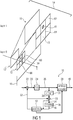
- Fig. 4 shows a picture which may be a picture of layer 0, such as layer 12 or a picture of layer 1 such as picture 15.
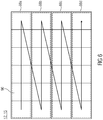
- the picture is regularly subdivided into an array of blocks 90.
- these blocks 90 are called largest coding blocks (LCB), largest coding units (LCU), coding tree blocks (CTB) or the like.
- the subdivision of the picture into blocks 90 may form a kind of base or coarsest granularity at which the above described predictions and residual codings are performed and this coarsest granularity, i.e. the size of blocks 90, may be signaled and set by the encoder, individually for layer 0 and layer 1.
- each of the one or more slices the picture is subdivided into may either be exactly composed of one complete tile or more than one complete tile, or a sub-portion of merely one tile along the coding/decoding order 92.
- Slices may also be used in order to form the WPP substreams 98a to 98d.
- slices forming the smallest units for packetization may comprise normal slices on the one hand and dependent slices on the other hand: while normal slices impose the above-described restrictions onto prediction and entropy context derivation, dependent slices do not impose such restrictions.
- each WPP substream 98a to 98d may be composed of one or more dependent slices.
- Decoding units may be composed of the first of the above mentioned NAL units.
- decoding units may consist of "of one or more VCL NAL units in an access unit and the associated non-VCL NAL units.” Decoding units thus describe a certain area of one picture, namely the area encoded into the one or more slices contained therein.
- the co-located area in the base layer picture of the same time instant is denoted by 212 and an area of this base layer picture slightly exceeding this area 212 could be necessitated in order to completely decode decoding unit 208a by exploiting inter-layer prediction.
- the slight exceeding may be the result of disparity-compensated prediction, for example.
- the decoding unit(s) 208b, which precedes decoding unit 208a within access unit 206, should cover the area needed for inter-layer prediction completely.
- NAL units of the removable packet type may, for example, comprise SEI NAL units, or redundant picture data NAL units or other specific NAL unit types. That is, the borders between access units do not move but remain, and still, the ordering rules are obeyed within each access unit, but broken at each boundary between any two access units.
- Fig. 18 illustrates that case 1 of Fig. 7 , allows that the packets belonging to different layers, but the same time instant t(i - 1), for example, are distributed within one access unit.
- the case 2 of Fig. 16 is likewise depicted at 2 with a circle around it.
- the encoder 720 encodes the pictures of layers 12 and 15 into the data stream 40 in units of the aforementioned NAL units, each of which is associated with a part of a respective picture in a spatial sense.
- NAL units belonging to a certain picture subdivide or partition, the respective picture spatially and as already described the inter-layer prediction renders portions of pictures of layer 15 dependent on portions of time-aligned pictures of layer 12 which are substantially co-located to the respective portion of the layer 15 picture with "substantially" encompassing disparity displacements.
- the encoder 720 has chosen to exploit the interleaving possibility in forming the access units collecting all NAL units belonging to a certain time instant.
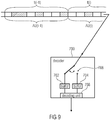
- the portion out of data stream 40 illustrated corresponds to the one inbound to the decoder of Fig. 9 . That is, in the example of Fig. 10 , the encoder 720 uses inter-layer parallel processing in encoding layers 12 and 15. As far as time instant t(i - 1) is concerned, the encoder 720 starts encoding the picture of layer 1 as soon as NAL unit 1 of the picture of layer 12 has been encoded. Each NAL unit, the encoding of which has been completed, is output by encoder 720, provided with an arrival time stamp which corresponds to the time the respective NAL unit has been output by encoder 720.
- the definition of the access units may remain the same, i.e. access units AU may collect all NAL units belonging to a certain time instant. In that case, signaling 724 merely indicates whether within each access unit, the NAL units belonging to different layers 12 and 15 are interleaved or not.
- the encoder 720 sets the removal time within each NAL unit such that the decoding unit 708 exploits the possibility of decoding layers 12 and 15 from the data stream 40 using interlayer parallel processing.
- the end-to-end delay is already reduced even if the decoder 700 does not apply inter-layer parallel processing.
- NAL units may be of different NAL unit type.
- Each NAL unit may have a NAL unit type index indicating the type of the respective NAL unit out of a set of possible types, and within each access unit, the types of the NAL units of the respective access unit may obey an ordering rule among the NAL unit types while merely between two consecutive access units, the ordering rule is broken, so that the decoder 700 is able to identify access unit borders by surveying this rule. For more information reference is made to the H.264 Standard.
- decoding units, DU are identifiable as runs of consecutive NAL units within one access unit, which belong to the same layer.
- the NAL units indicated “3" and "4" in Fig. 10 in the access unit AU(i - 1) form one DU.
- the other decoding units of access unit AU(i - 1) all comprise merely one NAL unit.
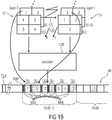
- access unit AU(i - 1) of Fig. 19 exemplarily comprises six decoding units DU which are alternately arranged within access unit AU(i -1), i.e. they are composed of runs of NAL units of one layer with the one layer alternately changing between layer 1 and layer 0.
- the access unit may remain its function as a container collecting all payload packets (VCL NAL units) carrying information on pictures - irrespective of what layer - belong to a certain time stamp or instant. Nevertheless, the embodiments described hereinafter achieve a compatibility with decoder of different types or decoders preferring different strategies in decoding inbound multi-layered video data streams.
- VCL NAL units all payload packets
- video encoder and decoders described below are still scalable, multi-view or 3D video encoders and decoders.
- the term layer is in compliance with the above description collectively used for scalable video coding layers as well as for views and/or depth maps of a multi-view coded video stream.
- multi-layer decoders that do not decode interleaved DUs can fall back to, according to various embodiments, the AU based decoding process or to a DU based decoding in a non-interleaved fashion, which would provide a low-delay operation in between the interleaved approach and the AU based approach.
- the resulting three operation modes are:
- Another embodiment would be an indication that the DU timing information provided correspond to an interleaved operation mode, so that devices unable to operate in interleaved DU mode operate in AU mode and can ignore the DU timing.
- DU CPB removal in an non-interleaved fashion across layers is done allowing the same low-delay CPB operation on DUs as in the interleaved mode for the base layer, but removes the DUs from layer (m+1) only after finishing removal of the DUs of layer m. Therefore, non-base layer DUs may remain for a longer time period in the CPB than when removed in the interleaved CPB operation mode.
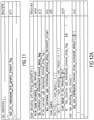
- the tables in Figs. 12a and 12b give an exemplary embodiment that signals the additional timing information as extra SEI messages, either on AU level or on DU level. Other possibilities include indication that timing provided by other means leads to CPB removal from the CPB that is interleaved across layers.
- a further aspect is the possibility of applying the mentioned decoder operation modes for the following two cases:
- Fig. 14 the arrival of decoding units (1) of an access unit (2) is shown for an interleaved bitstream according to Figs. 7 and 8 , case 1.
- the numbers in the box refer to the ID of the layer.
- DUs of different layers can be mixed within the access unit.
- a CPB removal time is associated with each decoding unit which is the start time of the decoding process. This decoding time cannot be lower than the final arrival time of a decoding unit, exemplarily shown as (3) for the first decoding unit.
- the final arrival time of the first decoding unit of the second layer which is labelled with (4), can be lowered by using an interleaved bitstream order as shown in Fig. 14 .
- An embodiment is a video encoder that creates a decoder hint within the bitstream that indicates the lowest possible CPB removal (and thus decoding times) in the bitstream using high-level syntax elements for interleaved bitstreams.
- a decoder that makes use of the described decoder hint for lower arrival time removes the decoding units from the CPB directly at or shortly after their arrival. Thus a part of the picture can be decoded completely (through all layers) earlier and thus be displayed earlier than for non-interleaved bitstreams.
- the following describes an embodiment based on the actual current HRD definition as used by HEVC extension where the timing information for interleaving is provided through an additional DU level SEI message as presented earlier.
- the described embodiment allows for DUs that are send in an order interleaved across layers to be removed DU wise from the CPB in interleaved fashion, consecutively or AU wise.
- the CPB removal time in Annex C in [1] should be extended as follows (marked by underline): "Multiple tests may be needed for checking the conformance of a bitstream, which is referred to as the bitstream under test. For each test, the following steps apply in the order listed:
- variable SubPicInterleavedHrdPreferredFlag is either specified by external means, or when not specified by external means, set equal to 0 .
- SubPicInterleavedHrdFlag SubPicHrdPreferredFlag && SubPiclnterleavedHrdPreferredFlaq && sub pic interleaved hrd params present flag
- SubPicHrdFlag and SubPiclnterleavedHrdFlag are equal to 0, the HRD operates at access unit level and each decoding unit is an access unit. Otherwise the HRD operates at sub-picture level and each decoding unit is a subset of an access unit.
- the operation of the CPB is specified in subclause C.2
- the instantaneous decoder operation is specified in clauses 2 through 10
- the operation of the DPB is specified in subclause C.3
- the output cropping is specified in subclause C.3.3 and subclause C.5.2.2.
- HSS and HRD information concerning the number of enumerated delivery schedules and their associated bit rates and buffer sizes is specified in subclauses E.1.2 and E.2.2.
- the HRD is initialized as specified by the buffering period SEI message specified in subclauses D.2.2 and D.3.2.
- the removal timing of decoding units from the CPB and output timing of decoded pictures from the DPB is specified using information in picture timing SEI messages (specified in subclauses D.2.3 and D.3.3), in decoding unit information SEI messages (specified in subclauses D.2.21 and D.3.21) or in decoding unit interleaving information SEI messages (specified in subclauses D.2.XX and D.3.XX) . All timing information relating to a specific decoding unit shall arrive prior to the CPB removal time of the decoding unit.
- earliest arrival time of DUs is different as currently defined when sub_pic_interleaved_hrd_params_present_flag is equal to 1, irrespective of the operation mode.
- the earliest arrival time is then derived as follows:
- decoder uses one coded picture buffer for the DUs of each layer.
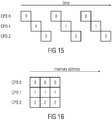
- Fig. 15 shows the assignment of DUs to different CPBs. For each layer (number in the box), an own CPB is operated and DUs are stored into different memory locations for each CPB. Exemplarily the arrival timing of an interleaved bitstream is shown. The assignment works in the same way for non-interleaved bitstreams based on the layer identifier.
- Fig. 16 shows the memory usage in the different CPBs. DUs of the same layer are stored in consecutive memory locations.
- a multi-layer decoder can take advantage of such a memory layout because the DUs belonging to the same layer can be accessed at consecutive memory addresses. DUs arrive in decoding order for each layer. The removal of DUs of a different layer cannot create any "holes" in the used CPB memory area. The used memory block always covers a continuous block in each CPB.
- the multiple CPB concept also has advantages for bitstreams that are split layer-wise at the transport layer. If different layers are transmitted using different channels the multiplexing of DUs into a single bitstream can be avoided.
- the multi-layer video decoder does not have to implement this extra step and implementation cost can be reduced.
- a further aspect is the re-arrangement of DUs from multiple CPB when these DUs share the same CPB removal time (DuNominalRemovalTime[m]).
- DNominalRemovalTime[m] the re-arrangement of DUs from multiple CPB when these DUs share the same CPB removal time.
- the embodiments set out above and in the following also describe a mechanism to synchronize multiple CPBs.
- the reference time or anchor time is described as the initial arrival time of the first decoding unit entering the (unique) CPB.
- the master CPB is the CPB for the base layer DUs, while it may be possible that the master CPB corresponds to a CPB receiving enhancement layer data if random access points for enhancement layers are allowed that initialize the HRD.
- the encoder 720 of Fig. 17 encodes video content here exemplarily including video of layers 12 and 15 into a multi-layered video data stream 40 so that same has, for each of the plurality of layers 12 and 15, the video content encoded therein in units of sub-portions of pictures of the video content using inter-layer prediction.
- sub-portions are denoted 1 to 4 for layer 0 and 1-3 for layer 1
- Each sub-portion is respectively encoded into one or more payload packets of a sequence of packets of the video data stream 40, each packet being associated with one of the plurality of layers, the sequence of packets being divided into a sequence of access units AU so that each access unit collects the payload packets relating to a common time instant.
- the access units AU are subdivided into decoding units DU so that each access unit is subdivided into two or more decoding units, with each decoding unit solely comprising payload packets associated with one of the plurality of layers, wherein the decoding units comprising packets associated with different layers are interleaved with each other.
- the encoder 720 controls the interleaving of the decoding units within the access units so as to decrease - or keep as low as possible - an end-to-end delay by traversing and encoding the common time instant in a layer-first-and-sub-portions-later traversal order. So far, the encoder's mode of operation had already been presented above with respect to Fig. 10 .
- a first timing control information 800 signals a decoder buffer retrieval time for the respective access unit AU as a whole
- a second timing control information 802 signals, for each decoding unit DU of the access unit AU, a decoder buffer retrieval time corresponding to their sequential order in the multi-layer video data stream.
- encoder 720 may spread the second timing information 802 onto several timing control packets each of which precedes an decoding unit DU the respective timing control packet is associated with, and indicates the second decoder retrieval buffer time for the decoding unit DU the respective timing control packet precedes.
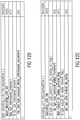
- Fig. 12c indicates an example for such a timing control packet.
- a timing control packet may form the begin of the associated decoding unit and indicate an index associated with the respective DU, i.e. decoding_unit_dx, and the decoder retrieval buffer time for the respective DU, i.e.
- du_spt_cpb_removal_delay_interleaved_increment which indicates the retrieval time or DPB removal time in predetermined temporal units (increments).
- the second timing information 802 may be output by encoder 720 during the encoding of the layers of the current time instant. To this end, the encoder 720 reacts, during the encoding, to spatial complexity variations in the pictures 12 and 15 of the various layers.
- encoder 720 may, as shown in Fig. 18 provide each access unit with a third timing control information 804 which signals, for each decoding unit of the respective access unit, a third decoder buffer retrieval time so that, in accordance with the third decoder buffer retrieval time for the respective access unit's decoding units DU, the decoding units DU in the respective access unit AU are ordered in accordance with a layer order defined among the plurality of layers so that no decoding unit comprising packets associated with a first layer follows any decoding unit in the respective access unit, comprising packets associated with a second layer succeeding the first layer in accordance with the layer order.
- the DUs shown in Fig, 18 are at the decoding side resorted so that the DUs of picture's 12 portions 1; 2; 3 and 4, precede the DUs of picture's 15 portions 1; 2 and 3.
- the encoder 720 may estimate the decoder buffer retrieval times according to the third timing control information 804 for the DUs in advance of encoding the layers of the current time instant and place the first timing control information 802 at the beginning of the respective AU. This possibility is depicted in Fig. 8 exemplarily in Fig. 12a.
- Fig 12a shows that Idu_spt_cpb_removal_delay_interleaved_increment_minus1 is sent for each DU and for each layer.
- the number of decoding units per layer may be restricted to be equal for all layers, i.e. one num_layer_decoding_units_minus1 is used, as illustrated in Fig. 12a
- an alternative to Fig. 12a may be that the number of decoding units per layer may individually be set for each layer. In the latter case, the syntax element num_layer_decoding_units_minus1 could be read for each layer, in which case the reading would be displaced from the position shown in Fig.
- encoder 720 may alternatively place timing control information 804 at the end of the AU. Even alternatively, the encoder 720 may place the third timing control information at each DUs beginning, just as the second timing control information. This is shown in Fig. 12b.
- Fig. 12b indicates an example for a timing control packet placed at the beginning of each DU (in their interleaved state).
- a timing control packet carrying timing control information 804 for a certain DU may be placed at the begin of the associated decoding unit and indicate a index associated with the respective DU, i.e. layer_decoding_unit_idx, which is layer specific, i.e. all DUs belong to the same layer are attributed to the same layer DU index.
- the decoder retrieval buffer time for the respective DU i.e. Idu_spt_cpb_removal_delay_interleaved_increment which indicates the retrieval time or DPB removal time in predetermined temporal units (increments) is signaled in such packet.
- the DUs are resorted to obey the layer order, i.e. layer 0's DUs is removed from DPB first with then layer 1's DUs and so forth. Accordingly, the timing control information 808 may be output by encoder 720 during the encoding of the layers of the current time instant.
- a decoding unit interleaving flag 808 may be inserted into the data stream by encoder 720 so as to signal whether a timing control information 808 sent in addition to timing control information 800 acts as timing control information 802 or 804. That is, if encoder 720 decided to interleave DUs of different layers as depicted in Fig. 20 (and Fig. 17 to 19 ), then decoding unit interleaving flag 808 is set to indicate that information 808 equals information 802 and the above description of Fig. 17 applies with respect to the remainder of the functionality of the encoder of Fig. 20 . If, however, encoder does not interleave packets of different layers within the access unit, as depicted in Fig.
- decoding unit interleaving flag 808 is set by encoder 720 to indicate that information 808 equals information 804 with the difference to the description of Fig. 18 with respect to the generation of 804 being that the encoder then does not have to estimate the timing control information 804 in addition to information 802, but may determine the timing control information's 804 buffer retrieval times on the fly with reacting on layer specific coding complexity variations among the sequence of layers on the fly during encoding the access unit in a manner similar to the procedure of generating the timing control information 802.
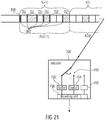
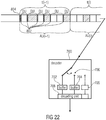
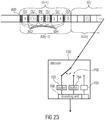
- Fig. 21 , 22 , 23 and 24 show the data stream of Fig. 17 , 18 , 19 , and 20 , respectively, as entering a decoder 700.
- decoder 700 may decode the data stream in the same manner as described above with respect to Fig. 9 using timing control information 802. That is, encoder and decoder contribute both to a minimum delay.
- Fig. 24 where decoder receives the stream of Fig. 20 , this is obviously merely possible in case of DU interleaving having been used and being indicated by flag 806.
- the decoder may, however, in case of Fig. 21 , 23 and 24 decode the multi-layered video data stream with emptying the decoder's buffer for buffering the multi-layered data stream in units of access units using the first timing control information 800 and irrespective of the second timing control information 802.
- the decoder may not be able to perform parallel processing.
- the decoder may not have more than one buffer, for example.
- the delay increases at both encoder and decoder side compared to the case of exploiting the layer-interleaved order of the DUs according to the timing control information 802, since the decoder's buffer is operated at complete AUs rather than on DU level.
- the decoder of Fig. 21 to 24 does not have to have two buffers.
- One buffer such as 702 may suffice, especially if the timing control information 802 is not exploited, but rather any of the fallback positions in form of timing control information 800 and 804 is used.
- the decoder's buffer is composed of one partial buffer for each layer, this helps when exploiting timing control information 802 since the decoder is may, for each layer, buffer the decoding units comprising packets associated with the respective layer in the partial buffer for the respective layer.
- 705 the possibility of having more than two buffers is illustrated.
- the decoder may empty decoding units from different partial buffers to decoder entities of different codecs.
- the decoder uses a smaller number of partial buffers than compared to the number of layers, namely each partial buffer for a subset of the layers with forwarding DUs of a certain layer to that partial buffer associated with the set of layers to which the layer of the respective DU belongs.
- One partial buffer such as 702 may synchronize the other partial buffers such as 704 and 705.
- the decoder may, however, in case of Fig. 22 and 23 decode the multi-layered video data stream with emptying the decoder's buffer controlled via timing control information 804, namely by removing the access units' decoding units, by de-interleaving, in accordance with the layer order.
- the decoder effectively recombines - guided via the timing control information 804 - the decoding units associated with the same layer and belonging to the access unit and reorders them following a specific rule such as DU of layer n before DU of layer n+1.
- a decoding unit interleaving flag 806 in the data stream may signal whether a timing control information 808 acts as timing control information 802 or 804.
- the decoder receiving the data stream may be configured to be responsive to the decoding unit interleaving flag 806, so as to, if the information 806 is second timing control information a la 802, empty the decoder's buffer for buffering the multi-layered data stream in units of access units using the first timing control information 800 and irrespective of information 806, and if the information is timing control information à la 804, empty the decoder's buffer for buffering the multi-layered data stream in units of the decoding units using the information 806: that is, in that case the DU were not interleaved s that using timing control information 808 an ordered DU operation with an end-to-end delay laying between the one otherwise achievable by using 802, and the maximum delay achievable by timing control information 800 would result.
- the decoder may remove the access units' decoding units from the buffer 702 - or even fill the buffer 702 with the DUs - in an de-interleaving manner so that they from an AU having the DUs order in accordance with the layer order. That is, the decoder may recombine the decoding units associated with the same layer and belonging to the access unit and reorders them following a specific rule such as DU of layer n before DU of layer n+1, before the whole AU is then removed from the buffer for being decoded.
- This deinterleaving is not necessary in case of the decoding unit interleaving flag 806 of Fig. 24 indicating the deinterleaved transmission has already been used and timing control information 808 acts like timing control information 804.
- the second timing control information 802 may be defined as an offset to the first timing control information 800.
- the multiplexer 706 shown in Fig. 21 to 24 acts as an intermediate network device configured to forward the multi-layered video data stream to the coded picture buffer of a decoder.
- the intermediate network device may, in accordance with an embodiment, be configured to receive an information qualifying the decoder as being able to handle the second timing control information, if the decoder is able to handle the second timing control information 802, derive earliest-arrival times for scheduling the forwarding, from timing control information 802 and 800 in accordance with a first computation rule, namely according to DuNominalRemovalTime ; and if the decoder is not able to handle the second timing control information 802, derive earliest-arrival times for scheduling the forwarding, from the timing control information 802 and 800 in accordance with a second computation rule, namely according to DuNominalRemovalTimeNonInterleaved .
- the intermediate network device 706 could determine the earliest-arrival time on the basis of the DU removal times of timing control information 802 by providing a fixed temporal offset between the earliest arrival time and the removal time for each DU in case of the decoder being able to decode the inbound data stream using the DU interleaved concept, wherein the intermediate network device 706 likewise provides a fixed temporal offset between the AU removal times as indicated by the timing control information 800 in order to derive the earliest arrival times of the access units in case of the decoder preferring to handle the inbound data stream access unit wise, i.e. choosing the first timing control information 800.
- the intermediate network device 706 could also take the size of the individual DUs and AUs into account.
- the inventive encoded video signal can be stored on a digital storage medium or can be transmitted on a transmission medium such as a wireless transmission medium or a wired transmission medium such as the Internet.
- embodiments of the invention can be implemented in hardware or in software.
- the implementation can be performed using a digital storage medium, for example a floppy disk, a DVD, a Blu-Ray, a CD, a ROM, a PROM, an EPROM, an EEPROM or a FLASH memory, having electronically readable control signals stored thereon, which cooperate (or are capable of cooperating) with a programmable computer system such that the respective method is performed. Therefore, the digital storage medium may be computer readable.
- Some embodiments according to the invention comprise a data carrier having electronically readable control signals, which are capable of cooperating with a programmable computer system, such that one of the methods described herein is performed.
- inventions comprise the computer program for performing one of the methods described herein, stored on a machine readable carrier.
- an embodiment of the inventive method is, therefore, a computer program having a program code for performing one of the methods described herein, when the computer program runs on a computer.
- a further embodiment of the inventive methods is, therefore, a data carrier (or a digital storage medium, or a computer-readable medium) comprising, recorded thereon, the computer program for performing one of the methods described herein.
- the data carrier, the digital storage medium or the recorded medium are typically tangible and/or non-transitionary.
- a further embodiment of the inventive method is, therefore, a data stream or a sequence of signals representing the computer program for performing one of the methods described herein.
- the data stream or the sequence of signals may for example be configured to be transferred via a data communication connection, for example via the Internet.
- a further embodiment comprises a processing means, for example a computer, or a programmable logic device, configured to or adapted to perform one of the methods described herein.
- a processing means for example a computer, or a programmable logic device, configured to or adapted to perform one of the methods described herein.
- a further embodiment comprises a computer having installed thereon the computer program for performing one of the methods described herein.
- a further embodiment according to the invention comprises an apparatus or a system configured to transfer (for example, electronically or optically) a computer program for performing one of the methods described herein to a receiver.
- the receiver may, for example, be a computer, a mobile device, a memory device or the like.
- the apparatus or system may, for example, comprise a file server for transferring the computer program to the receiver.
- a programmable logic device for example a field programmable gate array
- a field programmable gate array may cooperate with a microprocessor in order to perform one of the methods described herein.
- the methods are preferably performed by any hardware apparatus.
- a 10 th embodiment provides an encoder for encoding video content (201) into a multi-layered video data stream (200) so that same has, for each of a plurality of layers, the video content (201) encoded therein in units of sub-portions of pictures (204) of the video content using inter-layer prediction, each sub-portion being respectively encoded into one or more payload packets (202) of a sequence of packets of the video data stream, each packet being associated with one of the plurality of layers, the sequence of packets being divided into a sequence of access units (206) so that each access unit collects the payload packets (202) relating to a common time instant, wherein the access units (206) are subdivided into decoding units (208) so that each access unit (206) is subdivided into two or more decoding units (208), with each decoding unit (208) solely comprising payload packets associated with one of the plurality of layers, wherein the decoding units (208) comprising payload packets associated with different layers are interleaved with each other, each access unit compris
- a 11 th embodiment provides an encoder for encoding video content (201) into a multi-layered video data stream (200) so that same has, for each of a plurality of layers, video content encoded therein in units of sub-portions of pictures (204) of the video content using inter-layer prediction, each sub-portion being respectively encoded into one or more payload packets (202) of a sequence of packets of the video data stream, each packet being associated with one of the plurality of layers, the sequence of packets being divided into a sequence of access units (206) so that each access unit collects the payload packets (202) relating to a common time instant, wherein the access units (206) are subdivided into decoding units so that each access unit is subdivided into two or more decoding units, with each decoding unit solely comprising payload packets associated with one of the plurality of layers, and the decoding units comprising payload packets associated with different layers are interleaved with each other, each access unit comprising a first timing control information (804) signaling, for
- a 12 th embodiment provides an encoder according to the 10 th or 11 th embodiment, configured to control the interleaving of the decoding units within the access units so as to decrease an end-to-end delay by traversing and encoding the common time instant in a layer-first-and-sub-portions-later traversal order.
- a 26 th embodiment provides a method for encoding video content (201) into a multi-layered video data stream (200) so that same has, for each of a plurality of layers, the video content (201) encoded therein in units of sub-portions of pictures (204) of the video content using inter-layer prediction, each sub-portion being respectively encoded into one or more payload packets (202) of a sequence of packets of the video data stream, each packet being associated with one of the plurality of layers, the sequence of packets being divided into a sequence of access units (206) so that each access unit collects the payload packets (202) relating to a common time instant, wherein the access units (206) are subdivided into decoding units (208) so that each access unit (206) is subdivided into two or more decoding units (208), with each decoding unit (208) solely comprising payload packets associated with one of the plurality of layers, wherein the decoding units (208) comprising payload packets associated with different layers are interleaved with each other, each access unit compris
Landscapes
- Engineering & Computer Science (AREA)
- Signal Processing (AREA)
- Multimedia (AREA)
- Computer Security & Cryptography (AREA)
- Computer Networks & Wireless Communication (AREA)
- Compression Or Coding Systems Of Tv Signals (AREA)
- Two-Way Televisions, Distribution Of Moving Picture Or The Like (AREA)
- Information Retrieval, Db Structures And Fs Structures Therefor (AREA)
Priority Applications (2)
| Application Number | Priority Date | Filing Date | Title |
|---|---|---|---|
| EP23177731.9A EP4294018A1 (en) | 2013-07-15 | 2014-07-15 | Low delay concept in multi-layered video coding |
| EP19185282.1A EP3614671B1 (en) | 2013-07-15 | 2014-07-15 | Low delay concept in multi-layered video coding |
Applications Claiming Priority (2)
| Application Number | Priority Date | Filing Date | Title |
|---|---|---|---|
| US201361846479P | 2013-07-15 | 2013-07-15 | |
| PCT/EP2014/065185 WO2015007754A1 (en) | 2013-07-15 | 2014-07-15 | Low delay concept in multi-layered video coding |
Related Child Applications (2)
| Application Number | Title | Priority Date | Filing Date |
|---|---|---|---|
| EP23177731.9A Division EP4294018A1 (en) | 2013-07-15 | 2014-07-15 | Low delay concept in multi-layered video coding |
| EP19185282.1A Division EP3614671B1 (en) | 2013-07-15 | 2014-07-15 | Low delay concept in multi-layered video coding |
Publications (2)
| Publication Number | Publication Date |
|---|---|
| EP3022918A1 EP3022918A1 (en) | 2016-05-25 |
| EP3022918B1 true EP3022918B1 (en) | 2019-07-10 |
Family
ID=51177089
Family Applications (14)
| Application Number | Title | Priority Date | Filing Date |
|---|---|---|---|
| EP14741560.8A Active EP3022931B1 (en) | 2013-07-15 | 2014-07-15 | Layer id signaling using extension mechanism |
| EP23204146.7A Active EP4325858B1 (en) | 2013-07-15 | 2014-07-15 | Layer characteristic signaling in multi-layered coding |
| EP23215854.3A Pending EP4362466A3 (en) | 2013-07-15 | 2014-07-15 | Cluster-based dependency signaling |
| EP19185269.8A Active EP3614676B1 (en) | 2013-07-15 | 2014-07-15 | Layer id signaling using extension mechanism |
| EP25198132.0A Pending EP4664885A2 (en) | 2013-07-15 | 2014-07-15 | Layer id signaling using extension mechanism |
| EP23177731.9A Pending EP4294018A1 (en) | 2013-07-15 | 2014-07-15 | Low delay concept in multi-layered video coding |
| EP21164360.6A Active EP3905683B1 (en) | 2013-07-15 | 2014-07-15 | Cluster-based dependency signaling |
| EP23208252.9A Active EP4373092B1 (en) | 2013-07-15 | 2014-07-15 | Layer id signaling using extension mechanism |
| EP14741558.2A Active EP3022930B1 (en) | 2013-07-15 | 2014-07-15 | Cluster-based dependency signaling |
| EP21172028.9A Active EP3926957B1 (en) | 2013-07-15 | 2014-07-15 | Layer characteristic signaling in multi-layered coding |
| EP19185282.1A Active EP3614671B1 (en) | 2013-07-15 | 2014-07-15 | Low delay concept in multi-layered video coding |
| EP14741559.0A Active EP3022919B1 (en) | 2013-07-15 | 2014-07-15 | Layer characteristic signaling in multi-layered coding |
| EP14744010.1A Pending EP3022920A1 (en) | 2013-07-15 | 2014-07-15 | Network device and error handling |
| EP14738867.2A Active EP3022918B1 (en) | 2013-07-15 | 2014-07-15 | Low delay concept in multi-layered video coding |
Family Applications Before (13)
| Application Number | Title | Priority Date | Filing Date |
|---|---|---|---|
| EP14741560.8A Active EP3022931B1 (en) | 2013-07-15 | 2014-07-15 | Layer id signaling using extension mechanism |
| EP23204146.7A Active EP4325858B1 (en) | 2013-07-15 | 2014-07-15 | Layer characteristic signaling in multi-layered coding |
| EP23215854.3A Pending EP4362466A3 (en) | 2013-07-15 | 2014-07-15 | Cluster-based dependency signaling |
| EP19185269.8A Active EP3614676B1 (en) | 2013-07-15 | 2014-07-15 | Layer id signaling using extension mechanism |
| EP25198132.0A Pending EP4664885A2 (en) | 2013-07-15 | 2014-07-15 | Layer id signaling using extension mechanism |
| EP23177731.9A Pending EP4294018A1 (en) | 2013-07-15 | 2014-07-15 | Low delay concept in multi-layered video coding |
| EP21164360.6A Active EP3905683B1 (en) | 2013-07-15 | 2014-07-15 | Cluster-based dependency signaling |
| EP23208252.9A Active EP4373092B1 (en) | 2013-07-15 | 2014-07-15 | Layer id signaling using extension mechanism |
| EP14741558.2A Active EP3022930B1 (en) | 2013-07-15 | 2014-07-15 | Cluster-based dependency signaling |
| EP21172028.9A Active EP3926957B1 (en) | 2013-07-15 | 2014-07-15 | Layer characteristic signaling in multi-layered coding |
| EP19185282.1A Active EP3614671B1 (en) | 2013-07-15 | 2014-07-15 | Low delay concept in multi-layered video coding |
| EP14741559.0A Active EP3022919B1 (en) | 2013-07-15 | 2014-07-15 | Layer characteristic signaling in multi-layered coding |
| EP14744010.1A Pending EP3022920A1 (en) | 2013-07-15 | 2014-07-15 | Network device and error handling |
Country Status (6)
| Country | Link |
|---|---|
| US (23) | US10349066B2 (enExample) |
| EP (14) | EP3022931B1 (enExample) |
| JP (24) | JP2016527794A (enExample) |
| KR (27) | KR102162121B1 (enExample) |
| CN (9) | CN110139110B (enExample) |
| WO (5) | WO2015007752A1 (enExample) |
Families Citing this family (38)
| Publication number | Priority date | Publication date | Assignee | Title |
|---|---|---|---|---|
| US9621905B2 (en) * | 2012-06-29 | 2017-04-11 | Qualcomm Incorporated | Tiles and wavefront parallel processing |
| US20160065980A1 (en) * | 2013-04-05 | 2016-03-03 | Samsung Electronics Co., Ltd. | Video stream encoding method according to a layer identifier expansion and an apparatus thereof, and a video stream decoding method according to a layer identifier expansion and an apparatus thereof |
| US9609339B2 (en) | 2013-04-08 | 2017-03-28 | Arris Enterprises, Inc. | Individual buffer management in video coding |
| EP3022931B1 (en) * | 2013-07-15 | 2019-07-10 | GE Video Compression, LLC | Layer id signaling using extension mechanism |
| US10212437B2 (en) * | 2013-07-18 | 2019-02-19 | Qualcomm Incorporated | Device and method for scalable coding of video information |
| WO2015047162A1 (en) * | 2013-09-26 | 2015-04-02 | Telefonaktiebolaget L M Ericsson (Publ) | Hybrid codec scalable video |
| WO2015089623A1 (en) * | 2013-12-16 | 2015-06-25 | Mcafee, Inc. | Process efficient preprocessing for an encryption standard |
| US10560710B2 (en) * | 2014-01-03 | 2020-02-11 | Qualcomm Incorporated | Method for coding recovery point supplemental enhancement information (SEI) messages and region refresh information SEI messages in multi-layer coding |
| CA3083172C (en) | 2014-05-21 | 2022-01-25 | Arris Enterprises Llc | Individual buffer management in transport of scalable video |
| US10034002B2 (en) | 2014-05-21 | 2018-07-24 | Arris Enterprises Llc | Signaling and selection for the enhancement of layers in scalable video |
| JP6388531B2 (ja) * | 2014-06-17 | 2018-09-12 | 株式会社ダイセル | 油性化粧料 |
| US20150373376A1 (en) | 2014-06-20 | 2015-12-24 | Qualcomm Incorporated | Systems and methods for selectively signaling different numbers of video signal information syntax structures in a parameter set |
| US9807419B2 (en) * | 2014-06-25 | 2017-10-31 | Qualcomm Incorporated | Recovery point SEI message in multi-layer video codecs |
| US9819945B2 (en) * | 2014-06-25 | 2017-11-14 | Qualcomm Incorporated | Multi-layer video coding |
| JP6555263B2 (ja) * | 2014-06-30 | 2019-08-07 | ソニー株式会社 | 情報処理装置および方法 |
| WO2016002936A1 (ja) * | 2014-07-04 | 2016-01-07 | 日本ゼオン株式会社 | アクリルゴム、アクリルゴム組成物、アクリルゴム架橋物及びシール部材 |
| CN107925776B (zh) * | 2015-08-25 | 2021-06-08 | 索尼公司 | 发送装置、发送方法、接收装置和接收方法 |
| CA3013111C (en) * | 2016-02-02 | 2022-08-30 | Fraunhofer-Gesellschaft Zur Foerderung Der Angewandten Forschung E.V. | Scene section and region of interest handling in video streaming |
| US10230948B2 (en) * | 2016-02-03 | 2019-03-12 | Mediatek Inc. | Video transmitting system with on-the-fly encoding and on-the-fly delivering and associated video receiving system |
| KR102848785B1 (ko) * | 2016-05-06 | 2025-08-20 | 삼성전자주식회사 | 인터 프레임의 세그먼트를 부호화하기 위한 방법 및 전자 장치 |
| WO2017202527A1 (en) | 2016-05-26 | 2017-11-30 | Fraunhofer-Gesellschaft zur Förderung der angewandten Forschung e.V. | Broadcast streaming of panoramic video for interactive clients |
| JP6812149B2 (ja) * | 2016-06-30 | 2021-01-13 | オリンパス株式会社 | 走査型顕微鏡、及び、走査型顕微鏡の制御方法 |
| KR102412972B1 (ko) * | 2017-03-20 | 2022-06-23 | 프라운호퍼-게젤샤프트 츄어 푀르더룽 데어 안게반텐 포르슝에.파우. | 고급 비디오 데이터 스트림 추출 및 다중 해상도 비디오 송신 |
| JP7169988B2 (ja) * | 2017-04-11 | 2022-11-11 | ヴィド スケール インコーポレイテッド | 面連続性を使用する360度ビデオコーディング |
| KR20200064989A (ko) | 2017-09-20 | 2020-06-08 | 브이아이디 스케일, 인크. | 360도 비디오 코딩에서의 면 불연속 처리 |
| WO2019068745A1 (en) * | 2017-10-02 | 2019-04-11 | Fraunhofer-Gesellschaft zur Förderung der angewandten Forschung e.V. | EFFECTIVE IMMERSIVE CONTINUOUS DIFFUSION |
| US10810077B1 (en) * | 2018-06-11 | 2020-10-20 | Ambarella International Lp | Rapid soft-error detection |
| JP2020022087A (ja) * | 2018-08-01 | 2020-02-06 | 日本放送協会 | 映像/パケット変換装置、パケット/映像変換装置、及びプログラム |
| MX2021010393A (es) * | 2019-03-01 | 2021-11-12 | Fraunhofer Ges Forschung | Decodificador de referencia hipotetico. |
| WO2021200289A1 (ja) | 2020-03-31 | 2021-10-07 | 富士フイルム株式会社 | 情報処理装置、放射線画像撮影装置、情報処理方法、及び情報処理プログラム |
| GB202007000D0 (en) * | 2020-05-12 | 2020-06-24 | V Nova Int Ltd | Low latency communication system and method of operation |
| GB2623907B (en) | 2020-05-12 | 2024-10-16 | V Nova Int Ltd | Low latency communication system and method of operation |
| CN111338744B (zh) * | 2020-05-22 | 2020-08-14 | 北京小米移动软件有限公司 | 图像显示方法及装置、电子设备、存储介质 |
| EP4165873A1 (en) * | 2020-06-10 | 2023-04-19 | Fraunhofer-Gesellschaft zur Förderung der angewandten Forschung e.V. | Miscellaneous signaling concepts for multi-layer video bitstreams and for output timing derivation |
| CN113158623A (zh) * | 2020-12-27 | 2021-07-23 | 中国电建集团华东勘测设计研究院有限公司 | 一种编码管理的方法及系统 |
| US20250008130A1 (en) * | 2021-11-22 | 2025-01-02 | V-Nova International Limited | Processing a multi-layer video stream |
| GB2613015B (en) * | 2021-11-22 | 2024-10-23 | V Nova Int Ltd | Decoding a multi-layer video stream using a joint packet stream |
| WO2025121254A1 (ja) * | 2023-12-08 | 2025-06-12 | パナソニック インテレクチュアル プロパティ コーポレーション オブ アメリカ | 復号装置、符号化装置、復号方法、及び符号化方法 |
Citations (1)
| Publication number | Priority date | Publication date | Assignee | Title |
|---|---|---|---|---|
| WO2009111519A1 (en) * | 2008-03-06 | 2009-09-11 | General Instrument Corporation | Method and apparatus for decoding an enhanced video stream |
Family Cites Families (49)
| Publication number | Priority date | Publication date | Assignee | Title |
|---|---|---|---|---|
| US6141788A (en) * | 1998-03-13 | 2000-10-31 | Lucent Technologies Inc. | Method and apparatus for forward error correction in packet networks |
| JP2000078197A (ja) * | 1998-09-03 | 2000-03-14 | Toshiba Corp | 通信ノード及びパケット転送方法 |
| US6498865B1 (en) * | 1999-02-11 | 2002-12-24 | Packetvideo Corp,. | Method and device for control and compatible delivery of digitally compressed visual data in a heterogeneous communication network |
| JP2001203749A (ja) * | 2000-01-20 | 2001-07-27 | Mitsubishi Electric Corp | 高効率データ送信装置及び高効率データ伝送システム |
| US7095729B2 (en) | 2000-12-22 | 2006-08-22 | Intel Corporation | Method for multimedia communication over packet channels |
| JP2005533336A (ja) | 2002-07-16 | 2005-11-04 | トムソン ライセンシング | Hd−dvdのための基本層と拡張層のインターリーブ |
| JP4317403B2 (ja) * | 2002-08-09 | 2009-08-19 | パナソニック株式会社 | ヘッダ圧縮装置及びヘッダ圧縮方法 |
| EP1443774A1 (en) * | 2003-01-24 | 2004-08-04 | Alcatel | A method of encoding and decoding of data packets |
| JP4308555B2 (ja) | 2003-03-10 | 2009-08-05 | パナソニック株式会社 | 受信装置および情報閲覧方法 |
| CN101283401A (zh) * | 2005-10-05 | 2008-10-08 | Lg电子株式会社 | 信号处理的方法和装置以及编码和解码方法及其装置 |
| US9635396B2 (en) * | 2005-10-11 | 2017-04-25 | Nokia Technologies Oy | System and method for efficient scalable stream adaptation |
| BRPI0706378A2 (pt) * | 2006-01-09 | 2011-03-22 | Lg Eletronics Inc | método de predição intercamadas para sinal de vìdeo |
| US7535383B2 (en) * | 2006-07-10 | 2009-05-19 | Sharp Laboratories Of America Inc. | Methods and systems for signaling multi-layer bitstream data |
| US8422548B2 (en) * | 2006-07-10 | 2013-04-16 | Sharp Laboratories Of America, Inc. | Methods and systems for transform selection and management |
| US20080036854A1 (en) * | 2006-08-08 | 2008-02-14 | Texas Instruments Incorporated | Method and system of communicating and rendering stereoscopic and dual-view images |
| EP2116065A2 (en) | 2007-01-05 | 2009-11-11 | Thomson Licensing | Hypothetical reference decoder for scalable video coding |
| CA2674438C (en) | 2007-01-08 | 2013-07-09 | Nokia Corporation | Improved inter-layer prediction for extended spatial scalability in video coding |
| US9344362B2 (en) * | 2007-01-12 | 2016-05-17 | University-Industry Cooperation Group Of Kyung Hee University | Packet format of network abstraction layer unit, and algorithm and apparatus for video encoding and decoding using the format, QOS control algorithm and apparatus for IPV6 label switching using the format |
| JP5801054B2 (ja) | 2007-06-12 | 2015-10-28 | トムソン ライセンシングThomson Licensing | スライスデータ用のマルチパスビデオのシンタックス構造をサポートする方法及び装置 |
| US20090125636A1 (en) * | 2007-11-13 | 2009-05-14 | Qiong Li | Payload allocation methods for scalable multimedia servers |
| CN101431675B (zh) * | 2008-12-09 | 2010-12-08 | 青岛海信电子产业控股股份有限公司 | 一种像素运动估计方法和装置 |
| GB0905184D0 (en) * | 2009-03-26 | 2009-05-06 | Univ Bristol | Encryption scheme |
| US8908758B2 (en) | 2010-01-06 | 2014-12-09 | Dolby Laboratories Licensing Corporation | High performance rate control for multi-layered video coding applications |
| JP5768332B2 (ja) * | 2010-06-24 | 2015-08-26 | ソニー株式会社 | 送信機、受信機及び通信システム |
| CA2816264C (en) * | 2010-10-16 | 2017-04-11 | Lg Electronics Inc. | Digital receiver and method for processing 3d contents in digital receiver |
| US9497458B2 (en) | 2010-11-26 | 2016-11-15 | Sun Patent Trust | Image coding method, image decoding method, image coding apparatus, image decoding apparatus, program, and integrated ciruit |
| US9113172B2 (en) | 2011-01-14 | 2015-08-18 | Vidyo, Inc. | Techniques for describing temporal coding structure |
| WO2012096981A1 (en) | 2011-01-14 | 2012-07-19 | Vidyo, Inc. | Improved nal unit header |
| EP2749029A4 (en) * | 2011-08-25 | 2015-01-21 | Panasonic Ip Corp America | METHOD AND DEVICES FOR CODING, EXTRACTION AND DECODING VIDEO CONTENT BY MEANS OF A TILE CODING SCHEME |
| US9584819B2 (en) * | 2011-10-24 | 2017-02-28 | Qualcomm Incorporated | Grouping of tiles for video coding |
| US9247258B2 (en) * | 2011-10-26 | 2016-01-26 | Qualcomm Incorporated | Unified design for picture partitioning schemes |
| KR20130046534A (ko) * | 2011-10-28 | 2013-05-08 | 삼성전자주식회사 | 영상 부호화 방법 및 장치 그리고 영상 복호화 방법 및 장치 |
| US9124895B2 (en) * | 2011-11-04 | 2015-09-01 | Qualcomm Incorporated | Video coding with network abstraction layer units that include multiple encoded picture partitions |
| CN109729355B (zh) | 2012-01-20 | 2022-07-26 | Ge视频压缩有限责任公司 | 解码器、传送解多工器和编码器 |
| KR102096566B1 (ko) | 2012-04-13 | 2020-04-02 | 지이 비디오 컴프레션, 엘엘씨 | 저지연 화상 코딩 |
| UA129465C2 (uk) * | 2012-06-29 | 2025-05-07 | ДЖ.І. ВІДІЕУ КЕМПРЕШН, ЛЛСі | Концепція потоку відеоданих |
| CN104604236B (zh) | 2012-07-02 | 2017-12-15 | 诺基亚技术有限公司 | 用于视频编码的方法和装置 |
| US9565452B2 (en) | 2012-09-28 | 2017-02-07 | Qualcomm Incorporated | Error resilient decoding unit association |
| KR102445274B1 (ko) | 2012-10-01 | 2022-09-20 | 지이 비디오 컴프레션, 엘엘씨 | 향상 레이어에서 변환 계수 블록들의 서브블록-기반 코딩을 이용한 스케일러블 비디오 코딩 |
| US9781413B2 (en) * | 2012-10-02 | 2017-10-03 | Qualcomm Incorporated | Signaling of layer identifiers for operation points |
| CN107770555B (zh) | 2012-12-10 | 2020-04-14 | Lg 电子株式会社 | 解码图像的方法和使用其的装置 |
| US9992493B2 (en) | 2013-04-01 | 2018-06-05 | Qualcomm Incorporated | Inter-layer reference picture restriction for high level syntax-only scalable video coding |
| US9807421B2 (en) | 2013-04-05 | 2017-10-31 | Sharp Kabushiki Kaisha | NAL unit type restrictions |
| US20140301477A1 (en) | 2013-04-07 | 2014-10-09 | Sharp Laboratories Of America, Inc. | Signaling dpb parameters in vps extension and dpb operation |
| CN105308968B (zh) | 2013-04-08 | 2019-06-14 | Ge视频压缩有限责任公司 | 允许有效多视图/层编码的编码概念 |
| EP3697100A1 (en) | 2013-06-05 | 2020-08-19 | Sun Patent Trust | Data decoding method, data decoding apparatus, and data transmitting method |
| US9578142B2 (en) | 2013-07-01 | 2017-02-21 | Cisco Technology, Inc. | System and method for improving resilience in transmission of data fragments |
| EP3022931B1 (en) | 2013-07-15 | 2019-07-10 | GE Video Compression, LLC | Layer id signaling using extension mechanism |
| CN106664424A (zh) | 2014-01-03 | 2017-05-10 | 诺基亚技术有限公司 | 参数集编码 |
-
2014
- 2014-07-15 EP EP14741560.8A patent/EP3022931B1/en active Active
- 2014-07-15 JP JP2016526588A patent/JP2016527794A/ja active Pending
- 2014-07-15 KR KR1020187033436A patent/KR102162121B1/ko active Active
- 2014-07-15 WO PCT/EP2014/065183 patent/WO2015007752A1/en not_active Ceased
- 2014-07-15 KR KR1020227028472A patent/KR102652871B1/ko active Active
- 2014-07-15 EP EP23204146.7A patent/EP4325858B1/en active Active
- 2014-07-15 KR KR1020247012081A patent/KR20240052886A/ko active Pending
- 2014-07-15 EP EP23215854.3A patent/EP4362466A3/en active Pending
- 2014-07-15 CN CN201910182087.1A patent/CN110139110B/zh active Active
- 2014-07-15 CN CN201910310534.7A patent/CN110225358B/zh active Active
- 2014-07-15 WO PCT/EP2014/065184 patent/WO2015007753A1/en not_active Ceased
- 2014-07-15 KR KR1020167003648A patent/KR20160032168A/ko not_active Ceased
- 2014-07-15 WO PCT/EP2014/065182 patent/WO2015007751A1/en not_active Ceased
- 2014-07-15 EP EP19185269.8A patent/EP3614676B1/en active Active
- 2014-07-15 EP EP25198132.0A patent/EP4664885A2/en active Pending
- 2014-07-15 EP EP23177731.9A patent/EP4294018A1/en active Pending
- 2014-07-15 CN CN202010947572.6A patent/CN112104877B/zh active Active
- 2014-07-15 KR KR1020247036391A patent/KR20240161224A/ko active Pending
- 2014-07-15 CN CN201480050666.6A patent/CN105637876B/zh active Active
- 2014-07-15 EP EP21164360.6A patent/EP3905683B1/en active Active
- 2014-07-15 KR KR1020207027744A patent/KR102223536B1/ko active Active
- 2014-07-15 CN CN201480050628.0A patent/CN105637867B/zh active Active
- 2014-07-15 KR KR1020237003648A patent/KR102656946B1/ko active Active
- 2014-07-15 KR KR1020167002764A patent/KR20160027978A/ko not_active Ceased
- 2014-07-15 CN CN201480050665.1A patent/CN105532003B/zh active Active
- 2014-07-15 KR KR1020187031306A patent/KR102067048B1/ko active Active
- 2014-07-15 CN CN201480050655.8A patent/CN105532002B/zh active Active
- 2014-07-15 EP EP23208252.9A patent/EP4373092B1/en active Active
- 2014-07-15 JP JP2016526589A patent/JP6675979B2/ja active Active
- 2014-07-15 KR KR1020207000920A patent/KR102249228B1/ko active Active
- 2014-07-15 KR KR1020227045645A patent/KR102725872B1/ko active Active
- 2014-07-15 EP EP14741558.2A patent/EP3022930B1/en active Active
- 2014-07-15 EP EP21172028.9A patent/EP3926957B1/en active Active
- 2014-07-15 KR KR1020187036223A patent/KR102162124B1/ko active Active
- 2014-07-15 KR KR1020187036575A patent/KR102067231B1/ko active Active
- 2014-07-15 KR KR1020167003789A patent/KR101930817B1/ko active Active
- 2014-07-15 EP EP19185282.1A patent/EP3614671B1/en active Active
- 2014-07-15 EP EP14741559.0A patent/EP3022919B1/en active Active
- 2014-07-15 EP EP14744010.1A patent/EP3022920A1/en active Pending
- 2014-07-15 KR KR1020207027742A patent/KR102344387B1/ko active Active
- 2014-07-15 JP JP2016526592A patent/JP6453874B2/ja active Active
- 2014-07-15 KR KR1020207000840A patent/KR102310866B1/ko active Active
- 2014-07-15 KR KR1020227012654A patent/KR102482747B1/ko active Active
- 2014-07-15 EP EP14738867.2A patent/EP3022918B1/en active Active
- 2014-07-15 CN CN202010127563.2A patent/CN111510725B/zh active Active
- 2014-07-15 KR KR1020247011653A patent/KR20240055089A/ko active Pending
- 2014-07-15 KR KR1020217031763A patent/KR102495846B1/ko active Active
- 2014-07-15 KR KR1020247010117A patent/KR20240046281A/ko active Pending
- 2014-07-15 KR KR1020207027743A patent/KR102388631B1/ko active Active
- 2014-07-15 KR KR1020217006065A patent/KR102416235B1/ko active Active
- 2014-07-15 KR KR1020187031313A patent/KR102162120B1/ko active Active
- 2014-07-15 CN CN201480050667.0A patent/CN105637877B/zh active Active
- 2014-07-15 JP JP2016526591A patent/JP6514197B2/ja active Active
- 2014-07-15 KR KR1020227022202A patent/KR102657916B1/ko active Active
- 2014-07-15 KR KR1020217013229A patent/KR102435018B1/ko active Active
- 2014-07-15 JP JP2016526590A patent/JP6445552B2/ja active Active
- 2014-07-15 KR KR1020167003703A patent/KR101914659B1/ko active Active
- 2014-07-15 KR KR1020167003788A patent/KR101921646B1/ko active Active
- 2014-07-15 WO PCT/EP2014/065185 patent/WO2015007754A1/en not_active Ceased
- 2014-07-15 WO PCT/EP2014/065181 patent/WO2015007750A1/en not_active Ceased
-
2016
- 2016-01-14 US US14/995,399 patent/US10349066B2/en active Active
- 2016-01-14 US US14/995,260 patent/US10349065B2/en active Active
- 2016-01-14 US US14/995,222 patent/US10142639B2/en active Active
- 2016-01-14 US US14/995,430 patent/US10523954B2/en active Active
- 2016-01-14 US US14/995,244 patent/US10595027B2/en active Active
-
2018
- 2018-06-27 JP JP2018121768A patent/JP6749365B2/ja active Active
- 2018-06-27 JP JP2018121752A patent/JP2018186529A/ja active Pending
- 2018-10-11 US US16/157,723 patent/US10425651B2/en active Active
- 2018-11-29 JP JP2018224107A patent/JP6637149B2/ja active Active
- 2018-12-13 JP JP2018233051A patent/JP6966414B2/ja active Active
-
2019
- 2019-04-08 US US16/377,449 patent/US10616591B2/en active Active
- 2019-04-11 JP JP2019075436A patent/JP6792020B2/ja active Active
- 2019-04-26 US US16/395,761 patent/US11252422B2/en active Active
- 2019-07-02 US US16/460,230 patent/US10609399B2/en active Active
- 2019-08-27 US US16/552,342 patent/US11025929B2/en active Active
- 2019-12-19 JP JP2019228823A patent/JP6951405B2/ja active Active
-
2020
- 2020-01-09 US US16/738,075 patent/US11012700B2/en active Active
- 2020-02-20 US US16/795,655 patent/US11006136B2/en active Active
- 2020-02-27 US US16/802,620 patent/US10869047B2/en active Active
- 2020-06-18 JP JP2020104939A patent/JP7060650B2/ja active Active
- 2020-06-18 JP JP2020104959A patent/JP7229969B2/ja active Active
- 2020-10-28 US US17/082,096 patent/US11616964B2/en active Active
- 2020-11-05 JP JP2020185152A patent/JP2021048591A/ja active Pending
-
2021
- 2021-03-24 US US17/211,542 patent/US11647209B2/en active Active
- 2021-04-23 US US17/239,022 patent/US11546618B2/en active Active
- 2021-04-27 US US17/241,891 patent/US11792415B2/en active Active
- 2021-09-24 JP JP2021155011A patent/JP7405808B2/ja active Active
- 2021-10-21 JP JP2021172080A patent/JP7745417B6/ja active Active
-
2022
- 2022-01-14 US US17/576,875 patent/US20220141474A1/en active Pending
- 2022-04-14 JP JP2022067071A patent/JP7389168B2/ja active Active
- 2022-09-20 JP JP2022149313A patent/JP7509839B2/ja active Active
- 2022-11-08 US US18/053,446 patent/US20230156203A1/en not_active Abandoned
-
2023
- 2023-03-23 US US18/188,754 patent/US20230254495A1/en active Pending
- 2023-03-27 US US18/190,955 patent/US12294727B2/en active Active
- 2023-03-29 JP JP2023053923A patent/JP7734162B2/ja active Active
- 2023-07-18 US US18/354,448 patent/US20240129499A1/en active Pending
- 2023-10-27 JP JP2023184748A patent/JP2024012407A/ja active Pending
- 2023-11-16 JP JP2023194808A patent/JP7553685B2/ja active Active
- 2023-12-04 US US18/528,446 patent/US20240114157A1/en active Pending
- 2023-12-14 JP JP2023210738A patent/JP7739393B2/ja active Active
-
2024
- 2024-06-20 JP JP2024099284A patent/JP7775931B2/ja active Active
- 2024-09-05 JP JP2024152815A patent/JP2025000643A/ja active Pending
Patent Citations (1)
| Publication number | Priority date | Publication date | Assignee | Title |
|---|---|---|---|---|
| WO2009111519A1 (en) * | 2008-03-06 | 2009-09-11 | General Instrument Corporation | Method and apparatus for decoding an enhanced video stream |
Also Published As
Similar Documents
| Publication | Publication Date | Title |
|---|---|---|
| US11792415B2 (en) | Low delay concept in multi-layered video coding | |
| US20250280137A1 (en) | Efficient scalable coding concept | |
| US20250024056A1 (en) | Coding concept allowing efficient multi-view/layer coding | |
| EP3020199A2 (en) | Bitstream restrictions on picture partitions across layers | |
| KR102850966B1 (ko) | 비디오 데이터 스트림, 비디오 인코더, 가상 참조 디코더 및 출력 레이어 세트들을 위한 장치 및 방법 | |
| HK40044550A (en) | Coding concept allowing efficient multi-view/layer coding | |
| HK40050081B (en) | Efficient scalable coding concept |
Legal Events
| Date | Code | Title | Description |
|---|---|---|---|
| PUAI | Public reference made under article 153(3) epc to a published international application that has entered the european phase |
Free format text: ORIGINAL CODE: 0009012 |
|
| 17P | Request for examination filed |
Effective date: 20160114 |
|
| AK | Designated contracting states |
Kind code of ref document: A1 Designated state(s): AL AT BE BG CH CY CZ DE DK EE ES FI FR GB GR HR HU IE IS IT LI LT LU LV MC MK MT NL NO PL PT RO RS SE SI SK SM TR |
|
| AX | Request for extension of the european patent |
Extension state: BA ME |
|
| RIN1 | Information on inventor provided before grant (corrected) |
Inventor name: SANCHEZ DE LA FUENTE, YAGO Inventor name: MARPE, DETLEV Inventor name: SCHIERL, THOMAS Inventor name: SKUPIN, ROBERT Inventor name: SUEHRING, KARSTEN Inventor name: TECH, GERHARD |
|
| DAX | Request for extension of the european patent (deleted) | ||
| STAA | Information on the status of an ep patent application or granted ep patent |
Free format text: STATUS: EXAMINATION IS IN PROGRESS |
|
| 17Q | First examination report despatched |
Effective date: 20170202 |
|
| GRAP | Despatch of communication of intention to grant a patent |
Free format text: ORIGINAL CODE: EPIDOSNIGR1 |
|
| STAA | Information on the status of an ep patent application or granted ep patent |
Free format text: STATUS: GRANT OF PATENT IS INTENDED |
|
| RIC1 | Information provided on ipc code assigned before grant |
Ipc: H04N 19/65 20140101ALI20190111BHEP Ipc: H04N 19/30 20140101AFI20190111BHEP Ipc: H04N 19/70 20140101ALI20190111BHEP |
|
| INTG | Intention to grant announced |
Effective date: 20190201 |
|
| GRAS | Grant fee paid |
Free format text: ORIGINAL CODE: EPIDOSNIGR3 |
|
| GRAA | (expected) grant |
Free format text: ORIGINAL CODE: 0009210 |
|
| STAA | Information on the status of an ep patent application or granted ep patent |
Free format text: STATUS: THE PATENT HAS BEEN GRANTED |
|
| AK | Designated contracting states |
Kind code of ref document: B1 Designated state(s): AL AT BE BG CH CY CZ DE DK EE ES FI FR GB GR HR HU IE IS IT LI LT LU LV MC MK MT NL NO PL PT RO RS SE SI SK SM TR |
|
| REG | Reference to a national code |
Ref country code: GB Ref legal event code: FG4D |
|
| REG | Reference to a national code |
Ref country code: CH Ref legal event code: EP Ref country code: AT Ref legal event code: REF Ref document number: 1154792 Country of ref document: AT Kind code of ref document: T Effective date: 20190715 |
|
| REG | Reference to a national code |
Ref country code: DE Ref legal event code: R096 Ref document number: 602014049825 Country of ref document: DE |
|
| REG | Reference to a national code |
Ref country code: IE Ref legal event code: FG4D |
|
| REG | Reference to a national code |
Ref country code: NL Ref legal event code: MP Effective date: 20190710 |
|
| REG | Reference to a national code |
Ref country code: LT Ref legal event code: MG4D |
|
| REG | Reference to a national code |
Ref country code: AT Ref legal event code: MK05 Ref document number: 1154792 Country of ref document: AT Kind code of ref document: T Effective date: 20190710 |
|
| PG25 | Lapsed in a contracting state [announced via postgrant information from national office to epo] |
Ref country code: FI Free format text: LAPSE BECAUSE OF FAILURE TO SUBMIT A TRANSLATION OF THE DESCRIPTION OR TO PAY THE FEE WITHIN THE PRESCRIBED TIME-LIMIT Effective date: 20190710 Ref country code: AT Free format text: LAPSE BECAUSE OF FAILURE TO SUBMIT A TRANSLATION OF THE DESCRIPTION OR TO PAY THE FEE WITHIN THE PRESCRIBED TIME-LIMIT Effective date: 20190710 Ref country code: NO Free format text: LAPSE BECAUSE OF FAILURE TO SUBMIT A TRANSLATION OF THE DESCRIPTION OR TO PAY THE FEE WITHIN THE PRESCRIBED TIME-LIMIT Effective date: 20191010 Ref country code: NL Free format text: LAPSE BECAUSE OF FAILURE TO SUBMIT A TRANSLATION OF THE DESCRIPTION OR TO PAY THE FEE WITHIN THE PRESCRIBED TIME-LIMIT Effective date: 20190710 Ref country code: BG Free format text: LAPSE BECAUSE OF FAILURE TO SUBMIT A TRANSLATION OF THE DESCRIPTION OR TO PAY THE FEE WITHIN THE PRESCRIBED TIME-LIMIT Effective date: 20191010 Ref country code: PT Free format text: LAPSE BECAUSE OF FAILURE TO SUBMIT A TRANSLATION OF THE DESCRIPTION OR TO PAY THE FEE WITHIN THE PRESCRIBED TIME-LIMIT Effective date: 20191111 Ref country code: SE Free format text: LAPSE BECAUSE OF FAILURE TO SUBMIT A TRANSLATION OF THE DESCRIPTION OR TO PAY THE FEE WITHIN THE PRESCRIBED TIME-LIMIT Effective date: 20190710 Ref country code: LT Free format text: LAPSE BECAUSE OF FAILURE TO SUBMIT A TRANSLATION OF THE DESCRIPTION OR TO PAY THE FEE WITHIN THE PRESCRIBED TIME-LIMIT Effective date: 20190710 Ref country code: HR Free format text: LAPSE BECAUSE OF FAILURE TO SUBMIT A TRANSLATION OF THE DESCRIPTION OR TO PAY THE FEE WITHIN THE PRESCRIBED TIME-LIMIT Effective date: 20190710 |
|
| PG25 | Lapsed in a contracting state [announced via postgrant information from national office to epo] |
Ref country code: IS Free format text: LAPSE BECAUSE OF FAILURE TO SUBMIT A TRANSLATION OF THE DESCRIPTION OR TO PAY THE FEE WITHIN THE PRESCRIBED TIME-LIMIT Effective date: 20191110 Ref country code: RS Free format text: LAPSE BECAUSE OF FAILURE TO SUBMIT A TRANSLATION OF THE DESCRIPTION OR TO PAY THE FEE WITHIN THE PRESCRIBED TIME-LIMIT Effective date: 20190710 Ref country code: AL Free format text: LAPSE BECAUSE OF FAILURE TO SUBMIT A TRANSLATION OF THE DESCRIPTION OR TO PAY THE FEE WITHIN THE PRESCRIBED TIME-LIMIT Effective date: 20190710 Ref country code: ES Free format text: LAPSE BECAUSE OF FAILURE TO SUBMIT A TRANSLATION OF THE DESCRIPTION OR TO PAY THE FEE WITHIN THE PRESCRIBED TIME-LIMIT Effective date: 20190710 Ref country code: GR Free format text: LAPSE BECAUSE OF FAILURE TO SUBMIT A TRANSLATION OF THE DESCRIPTION OR TO PAY THE FEE WITHIN THE PRESCRIBED TIME-LIMIT Effective date: 20191011 Ref country code: LV Free format text: LAPSE BECAUSE OF FAILURE TO SUBMIT A TRANSLATION OF THE DESCRIPTION OR TO PAY THE FEE WITHIN THE PRESCRIBED TIME-LIMIT Effective date: 20190710 |
|
| REG | Reference to a national code |
Ref country code: CH Ref legal event code: PL |
|
| PG25 | Lapsed in a contracting state [announced via postgrant information from national office to epo] |
Ref country code: TR Free format text: LAPSE BECAUSE OF FAILURE TO SUBMIT A TRANSLATION OF THE DESCRIPTION OR TO PAY THE FEE WITHIN THE PRESCRIBED TIME-LIMIT Effective date: 20190710 |
|
| REG | Reference to a national code |
Ref country code: BE Ref legal event code: MM Effective date: 20190731 |
|
| PG25 | Lapsed in a contracting state [announced via postgrant information from national office to epo] |
Ref country code: EE Free format text: LAPSE BECAUSE OF FAILURE TO SUBMIT A TRANSLATION OF THE DESCRIPTION OR TO PAY THE FEE WITHIN THE PRESCRIBED TIME-LIMIT Effective date: 20190710 Ref country code: PL Free format text: LAPSE BECAUSE OF FAILURE TO SUBMIT A TRANSLATION OF THE DESCRIPTION OR TO PAY THE FEE WITHIN THE PRESCRIBED TIME-LIMIT Effective date: 20190710 Ref country code: DK Free format text: LAPSE BECAUSE OF FAILURE TO SUBMIT A TRANSLATION OF THE DESCRIPTION OR TO PAY THE FEE WITHIN THE PRESCRIBED TIME-LIMIT Effective date: 20190710 Ref country code: IT Free format text: LAPSE BECAUSE OF FAILURE TO SUBMIT A TRANSLATION OF THE DESCRIPTION OR TO PAY THE FEE WITHIN THE PRESCRIBED TIME-LIMIT Effective date: 20190710 Ref country code: RO Free format text: LAPSE BECAUSE OF FAILURE TO SUBMIT A TRANSLATION OF THE DESCRIPTION OR TO PAY THE FEE WITHIN THE PRESCRIBED TIME-LIMIT Effective date: 20190710 |
|
| PG25 | Lapsed in a contracting state [announced via postgrant information from national office to epo] |
Ref country code: SK Free format text: LAPSE BECAUSE OF FAILURE TO SUBMIT A TRANSLATION OF THE DESCRIPTION OR TO PAY THE FEE WITHIN THE PRESCRIBED TIME-LIMIT Effective date: 20190710 Ref country code: SM Free format text: LAPSE BECAUSE OF FAILURE TO SUBMIT A TRANSLATION OF THE DESCRIPTION OR TO PAY THE FEE WITHIN THE PRESCRIBED TIME-LIMIT Effective date: 20190710 Ref country code: CZ Free format text: LAPSE BECAUSE OF FAILURE TO SUBMIT A TRANSLATION OF THE DESCRIPTION OR TO PAY THE FEE WITHIN THE PRESCRIBED TIME-LIMIT Effective date: 20190710 Ref country code: LU Free format text: LAPSE BECAUSE OF NON-PAYMENT OF DUE FEES Effective date: 20190715 Ref country code: MC Free format text: LAPSE BECAUSE OF FAILURE TO SUBMIT A TRANSLATION OF THE DESCRIPTION OR TO PAY THE FEE WITHIN THE PRESCRIBED TIME-LIMIT Effective date: 20190710 Ref country code: BE Free format text: LAPSE BECAUSE OF NON-PAYMENT OF DUE FEES Effective date: 20190731 Ref country code: IS Free format text: LAPSE BECAUSE OF FAILURE TO SUBMIT A TRANSLATION OF THE DESCRIPTION OR TO PAY THE FEE WITHIN THE PRESCRIBED TIME-LIMIT Effective date: 20200224 Ref country code: CH Free format text: LAPSE BECAUSE OF NON-PAYMENT OF DUE FEES Effective date: 20190731 Ref country code: LI Free format text: LAPSE BECAUSE OF NON-PAYMENT OF DUE FEES Effective date: 20190731 |
|
| REG | Reference to a national code |
Ref country code: DE Ref legal event code: R097 Ref document number: 602014049825 Country of ref document: DE |
|
| PLBE | No opposition filed within time limit |
Free format text: ORIGINAL CODE: 0009261 |
|
| STAA | Information on the status of an ep patent application or granted ep patent |
Free format text: STATUS: NO OPPOSITION FILED WITHIN TIME LIMIT |
|
| PG2D | Information on lapse in contracting state deleted |
Ref country code: IS |
|
| PG25 | Lapsed in a contracting state [announced via postgrant information from national office to epo] |
Ref country code: IE Free format text: LAPSE BECAUSE OF NON-PAYMENT OF DUE FEES Effective date: 20190715 |
|
| 26N | No opposition filed |
Effective date: 20200603 |
|
| PG25 | Lapsed in a contracting state [announced via postgrant information from national office to epo] |
Ref country code: SI Free format text: LAPSE BECAUSE OF FAILURE TO SUBMIT A TRANSLATION OF THE DESCRIPTION OR TO PAY THE FEE WITHIN THE PRESCRIBED TIME-LIMIT Effective date: 20190710 |
|
| REG | Reference to a national code |
Ref country code: DE Ref legal event code: R082 Ref document number: 602014049825 Country of ref document: DE Representative=s name: SCHOPPE, ZIMMERMANN, STOECKELER, ZINKLER, SCHE, DE Ref country code: DE Ref legal event code: R081 Ref document number: 602014049825 Country of ref document: DE Owner name: GE VIDEO COMPRESSION, LLC, NISKAYUNA, US Free format text: FORMER OWNER: GE VIDEO COMPRESSION, LLC, ALBANY, N. Y., US Ref country code: DE Ref legal event code: R081 Ref document number: 602014049825 Country of ref document: DE Owner name: DOLBY VIDEO COMPRESSION, LLC, NISKAYUNA, US Free format text: FORMER OWNER: GE VIDEO COMPRESSION, LLC, ALBANY, N. Y., US |
|
| PG25 | Lapsed in a contracting state [announced via postgrant information from national office to epo] |
Ref country code: CY Free format text: LAPSE BECAUSE OF FAILURE TO SUBMIT A TRANSLATION OF THE DESCRIPTION OR TO PAY THE FEE WITHIN THE PRESCRIBED TIME-LIMIT Effective date: 20190710 |
|
| PG25 | Lapsed in a contracting state [announced via postgrant information from national office to epo] |
Ref country code: HU Free format text: LAPSE BECAUSE OF FAILURE TO SUBMIT A TRANSLATION OF THE DESCRIPTION OR TO PAY THE FEE WITHIN THE PRESCRIBED TIME-LIMIT; INVALID AB INITIO Effective date: 20140715 Ref country code: MT Free format text: LAPSE BECAUSE OF FAILURE TO SUBMIT A TRANSLATION OF THE DESCRIPTION OR TO PAY THE FEE WITHIN THE PRESCRIBED TIME-LIMIT Effective date: 20190710 |
|
| PG25 | Lapsed in a contracting state [announced via postgrant information from national office to epo] |
Ref country code: MK Free format text: LAPSE BECAUSE OF FAILURE TO SUBMIT A TRANSLATION OF THE DESCRIPTION OR TO PAY THE FEE WITHIN THE PRESCRIBED TIME-LIMIT Effective date: 20190710 |
|
| P01 | Opt-out of the competence of the unified patent court (upc) registered |
Effective date: 20230425 |
|
| PGFP | Annual fee paid to national office [announced via postgrant information from national office to epo] |
Ref country code: GB Payment date: 20250619 Year of fee payment: 12 |
|
| PGFP | Annual fee paid to national office [announced via postgrant information from national office to epo] |
Ref country code: FR Payment date: 20250620 Year of fee payment: 12 |
|
| PGFP | Annual fee paid to national office [announced via postgrant information from national office to epo] |
Ref country code: DE Payment date: 20250620 Year of fee payment: 12 |
|
| REG | Reference to a national code |
Ref country code: DE Ref legal event code: R081 Ref document number: 602014049825 Country of ref document: DE Owner name: GE VIDEO COMPRESSION, LLC, NISKAYUNA, US Free format text: FORMER OWNER: GE VIDEO COMPRESSION, LLC, NISKAYUNA, NY, US Ref country code: DE Ref legal event code: R081 Ref document number: 602014049825 Country of ref document: DE Owner name: DOLBY VIDEO COMPRESSION, LLC, NISKAYUNA, US Free format text: FORMER OWNER: GE VIDEO COMPRESSION, LLC, NISKAYUNA, NY, US |
|
| REG | Reference to a national code |
Ref country code: DE Ref legal event code: R081 Ref document number: 602014049825 Country of ref document: DE Owner name: DOLBY VIDEO COMPRESSION, LLC, NISKAYUNA, US Free format text: FORMER OWNER: GE VIDEO COMPRESSION, LLC, NISKAYUNA, NY, US |