EP3022390B1 - Composition for use in conducting downhole operations in oil and gas wells - Google Patents
Composition for use in conducting downhole operations in oil and gas wells Download PDFInfo
- Publication number
- EP3022390B1 EP3022390B1 EP14826402.1A EP14826402A EP3022390B1 EP 3022390 B1 EP3022390 B1 EP 3022390B1 EP 14826402 A EP14826402 A EP 14826402A EP 3022390 B1 EP3022390 B1 EP 3022390B1
- Authority
- EP
- European Patent Office
- Prior art keywords
- present
- amount
- glycerin carbonate
- alkoxylated alcohol
- wellbore fluid
- Prior art date
- Legal status (The legal status is an assumption and is not a legal conclusion. Google has not performed a legal analysis and makes no representation as to the accuracy of the status listed.)
- Active
Links
Images




Classifications
-
- C—CHEMISTRY; METALLURGY
- C09—DYES; PAINTS; POLISHES; NATURAL RESINS; ADHESIVES; COMPOSITIONS NOT OTHERWISE PROVIDED FOR; APPLICATIONS OF MATERIALS NOT OTHERWISE PROVIDED FOR
- C09K—MATERIALS FOR MISCELLANEOUS APPLICATIONS, NOT PROVIDED FOR ELSEWHERE
- C09K8/00—Compositions for drilling of boreholes or wells; Compositions for treating boreholes or wells, e.g. for completion or for remedial operations
- C09K8/02—Well-drilling compositions
- C09K8/32—Non-aqueous well-drilling compositions, e.g. oil-based
- C09K8/34—Organic liquids
-
- E—FIXED CONSTRUCTIONS
- E21—EARTH OR ROCK DRILLING; MINING
- E21B—EARTH OR ROCK DRILLING; OBTAINING OIL, GAS, WATER, SOLUBLE OR MELTABLE MATERIALS OR A SLURRY OF MINERALS FROM WELLS
- E21B43/00—Methods or apparatus for obtaining oil, gas, water, soluble or meltable materials or a slurry of minerals from wells
- E21B43/16—Enhanced recovery methods for obtaining hydrocarbons
-
- C—CHEMISTRY; METALLURGY
- C09—DYES; PAINTS; POLISHES; NATURAL RESINS; ADHESIVES; COMPOSITIONS NOT OTHERWISE PROVIDED FOR; APPLICATIONS OF MATERIALS NOT OTHERWISE PROVIDED FOR
- C09K—MATERIALS FOR MISCELLANEOUS APPLICATIONS, NOT PROVIDED FOR ELSEWHERE
- C09K8/00—Compositions for drilling of boreholes or wells; Compositions for treating boreholes or wells, e.g. for completion or for remedial operations
- C09K8/02—Well-drilling compositions
- C09K8/03—Specific additives for general use in well-drilling compositions
- C09K8/035—Organic additives
-
- C—CHEMISTRY; METALLURGY
- C09—DYES; PAINTS; POLISHES; NATURAL RESINS; ADHESIVES; COMPOSITIONS NOT OTHERWISE PROVIDED FOR; APPLICATIONS OF MATERIALS NOT OTHERWISE PROVIDED FOR
- C09K—MATERIALS FOR MISCELLANEOUS APPLICATIONS, NOT PROVIDED FOR ELSEWHERE
- C09K8/00—Compositions for drilling of boreholes or wells; Compositions for treating boreholes or wells, e.g. for completion or for remedial operations
- C09K8/02—Well-drilling compositions
- C09K8/04—Aqueous well-drilling compositions
-
- C—CHEMISTRY; METALLURGY
- C09—DYES; PAINTS; POLISHES; NATURAL RESINS; ADHESIVES; COMPOSITIONS NOT OTHERWISE PROVIDED FOR; APPLICATIONS OF MATERIALS NOT OTHERWISE PROVIDED FOR
- C09K—MATERIALS FOR MISCELLANEOUS APPLICATIONS, NOT PROVIDED FOR ELSEWHERE
- C09K8/00—Compositions for drilling of boreholes or wells; Compositions for treating boreholes or wells, e.g. for completion or for remedial operations
- C09K8/50—Compositions for plastering borehole walls, i.e. compositions for temporary consolidation of borehole walls
- C09K8/502—Oil-based compositions
-
- C—CHEMISTRY; METALLURGY
- C09—DYES; PAINTS; POLISHES; NATURAL RESINS; ADHESIVES; COMPOSITIONS NOT OTHERWISE PROVIDED FOR; APPLICATIONS OF MATERIALS NOT OTHERWISE PROVIDED FOR
- C09K—MATERIALS FOR MISCELLANEOUS APPLICATIONS, NOT PROVIDED FOR ELSEWHERE
- C09K8/00—Compositions for drilling of boreholes or wells; Compositions for treating boreholes or wells, e.g. for completion or for remedial operations
- C09K8/60—Compositions for stimulating production by acting on the underground formation
- C09K8/62—Compositions for forming crevices or fractures
- C09K8/64—Oil-based compositions
-
- E—FIXED CONSTRUCTIONS
- E21—EARTH OR ROCK DRILLING; MINING
- E21B—EARTH OR ROCK DRILLING; OBTAINING OIL, GAS, WATER, SOLUBLE OR MELTABLE MATERIALS OR A SLURRY OF MINERALS FROM WELLS
- E21B33/00—Sealing or packing boreholes or wells
- E21B33/10—Sealing or packing boreholes or wells in the borehole
- E21B33/13—Methods or devices for cementing, for plugging holes, crevices or the like
-
- E—FIXED CONSTRUCTIONS
- E21—EARTH OR ROCK DRILLING; MINING
- E21B—EARTH OR ROCK DRILLING; OBTAINING OIL, GAS, WATER, SOLUBLE OR MELTABLE MATERIALS OR A SLURRY OF MINERALS FROM WELLS
- E21B43/00—Methods or apparatus for obtaining oil, gas, water, soluble or meltable materials or a slurry of minerals from wells
- E21B43/25—Methods for stimulating production
- E21B43/26—Methods for stimulating production by forming crevices or fractures
- E21B43/267—Methods for stimulating production by forming crevices or fractures reinforcing fractures by propping
Definitions
- the present invention relates to the viscosification of non-aqueous fluids and more particularly to the viscosification of wellbore fluids.
- the invention relates to activators for use in exfoliating organophilic clays used in various applications, e.g., wellbore fluids.
- Organophilic clays are widely used as rheological control agents in a wide variety of solvent systems.
- organophilic clays have found wide usage in wellbore fluids, used in operations related to the development, completion and production of natural hydrocarbon reservoirs. Typical operations include drilling, fracturing subterranean formations, modifying the permeability of subterranean formations, logging operations, sand control, packer fluids, etc.
- organophilic clays in oil-based muds have certain advantages despite their considerably higher initial cost.
- the advantages of oil-based fluids are apparent in water-sensitive formations, e.g., swelling shale, insoluble salt formations, and at high temperatures. These fluids are used for drill stem lubrication, particularly in drilling curved or deviated wells, for corrosion protection and they have the further advantage of being reusable.
- organophilic clays in oil-based wellbore fluids as well as other non-aqueous based fluids (i.e glycol ethers), is to act as viscosifiers.
- Typical activators for use with clay- type thixotropic viscosifying agent such as organophilic clays include water, ethanol, methanol, glycols, sodium silicate, sodium fluoride, magnesium silico fluoride, calcium carbonate, polar aprotic compounds, etc.
- An especially preferred and widely used activator is propylene carbonate.
- US2007/071703 A1 discloses a thickening system comprising organoclays for thickening or structuring oil based systems, especially for cosmetic applications. No mention is however made of glycerine carbonate or alkoxylated alcohols as components of the thickening system.
- the present invention provides the use of an exfoliating agent for viscosifying a nonaqueous base fluid according to claim 1, as well as a wellbore fluid according to claim 5.
- the present disclosure provides an exfoliating agent for use in non-aqueous fluids, particularly non-aqueous wellbore fluids.
- the present disclosure provides a viscosifying package for use in non-aqueous fluids.
- the present disclosure provides a wellbore fluid comprised of a non-aqueous fluid, e.g., a hydrocarbon base fluid, an organophilic clay and an exfoliating agent.
- a non-aqueous fluid e.g., a hydrocarbon base fluid, an organophilic clay and an exfoliating agent.
- the present disclosure provides a wellbore fluid comprised of a hydrocarbon based fluid having a significant content of naphthenics and/or branched hydrocarbons, an organophilic clay, and an exfoliating agent.
- wellbore fluid refers to any fluid which is used in any phase of the exploration, drilling or production of oil and gas from subterranean formations.
- compositions of the present invention can employ a base oil including pure hydrocarbon mixtures as well as a hydrocarbon in admixture with oxygenated compounds.
- the base oil useful in the compositions of the present inventions comprise base oils with a significant content of naphthenic and/or highly branched paraffins.
- the base oil can contain from about 20% to about 99% or greater naphthenics, isoparaffins, or a mixture thereof.
- the base oil having this composition will contain from about C8 to about C30.
- Table 1 there are shown non-limiting examples of the wide variety of base oils which can be employed in the composition of the present invention.
- the base oil can comprise liquid hydrocarbon having from about 10% to about 35% isoparaffins, from about 30% to about 73% naphthenics, and having a carbon chain length of from about C8 to about C30.
- some of the base oils can include significant amounts of linear paraffins while others can contain small amounts of oxygenates such as alcohols, esters, or the like.
- some of the base oils can contain olefins while others, e.g., diesel, can contain significant amounts of aromatics.
- Table 1 demonstrates that the compositions of the present invention can employ, with advantage, a wide variety of base oils, all of which have significant hydrocarbon oil content, albeit that other compounds can be present in certain cases.
- organophilic clays that may be used in the compositions of the present invention include any clay in which the inorganic cations associated with the clay have been displaced by organic cations such as quarternary ammonium cations.
- Suitable organophilic clays include the reaction products of smectite-type, hectorite clays, or other clays and organic cations, i.e., quaternary ammonium cations (sometimes referred to as organophillic clay gellants); smectite clays; kaolin clays; and the like.
- the preferred organophilic clays used as a thixotropic viscosifying agent is a smectite-type clay that is selected from the group consisting of bentonite, hectorite, montmorillonite, nontronite, beidellite, saponite, stevensite, and mixtures thereof, most preferably bentonite or hectorite.
- the preferred quaternary ammonium cations in the event that the clay used is the reaction product of a clay and a quaternary ammonium compound, are selected from the group consisting of methyl trihydrogenated tallow ammonium, dimethyl dehydrogenated tallow ammonium, dimethyl benzyl hydrogenated tallow ammonium, methyl benzyl dehydrogenated tallow ammonium, and mixtures thereof.
- Exemplary organoclays and clay gellants suitable for use with the compositions described herein are set forth in the following U.S. patents: U.S. Pat. No. 2,531,427 ; U.S. Pat. No. 2,966,506 ; U.S. Pat. No. 4,105,578 ; and U.S. Pat. No. 4,208,218 .
- Exemplary, commercially available organophilic clays suitable for use with the compositions described herein are CLAYTONE.RTM. IMG 400 Claytone ER, Claytone EM, and Claytone II, available from Southern Clay Products, Inc., Gonzalez, Tex., U.S.A., or Bentone 34, Bentone 150 and BENTONE.RTM. 38 Organoclay (a commercial hectorite-based product, available form a number of suppliers).
- the exfoliating agents used in the present invention in general comprise glycerin carbonate in admixture with certain alkoxylated alcohols.
- the alkoxylated alcohols useful in the present invention will have the general formula: wherein R is a linear or branched alkyl from 2 to 18 carbon atoms, or an aromatic radical having the structure: where R 1 is a branched or linear alkyl having from 2 to 18 carbon atoms
- the exfoliating agent used in the present invention will generally comprise from about 10 % to about 100 % glycerin carbonate and from about 0% to about 90% alkoxylated alcohol where all amounts are by weight based on the combined weight of the glycerin carbonate and the alkoxylated alcohol. It will be understood though that different exfoliating agents have different effectiveness in different base oils. Therefore the composition of the exfoliating agent should be tailored to fit the base oil in question.
- the exfoliating agent may be incorporated into the wellbore fluid in any number of ways, whether by separate or previous addition to the base oil and/or clay, or by admixture with base oil, clay, and other components at the time of preparation of the wellbore fluid.
- a "pill” comprised of exfoliating agent and organophilic clay, alone or together with other components, can be employed, the pill being injected into the wellbore at a desired time.
- the alkoxylated alcohol used in the examples which follow are ethoxylated alcohols sold by Sasol North America, Inc. under the trade name NOVEL®.
- the ethoxylated alcohols are formed by reacting various alcohols with ethylene oxide under suitable reaction conditions.
- the resulting ethoxylated alcohol thus has an alkyl chain residue from the alcohol and the desired number of ethoxy groups.
- NOVEL® 1012-9 means that the ethoxylated alcohol has an alkyl chain length with an average carbon number of 10-12 and 9 ethoxy groups.
- An ethoxylated alcohol designated as NOVEL® 23E9 will contain an alkyl chain of 12-13 carbon atoms with 9 ethoxy groups.
- compositions of the present invention will contain from about 95% to about 98% base oil, from about 1% to about 5% organophilic clay and from about 0.005% to about 1% exfoliating agent, where all amounts are in weight % based on the total composition.
- Example 2 The experiment of Example 1 was repeated, but the base oil used was ODC-15. The results are shown in Fig. 2 and indicate that the highest viscosity was achieved using 80% glycerin carbonate and 20% alkoxylated alcohols.
- Example 1 The experiment of Example 1 was repeated, but the base oil used was LPA. The results are shown in Fig. 3 and indicate that the highest viscosity was achieved using 80% glycerin carbonate and 20% alkoxylated alcohols.
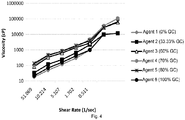
- Example 1 The experiment of Example 1 was repeated, but the base oil used was LPA-142. The results are shown in Fig. 4 and indicate that the highest viscosity was achieved using 70% glycerin carbonate and 30% alkoxylated alcohols.
- Example 1 The experiment of Example 1 was repeated, but the base oil used was LPA-170. The results are shown in Fig. 5 and indicate that the highest viscosity was achieved using 70% glycerin carbonate and 30% alkoxylated alcohols.
- Example 1 The experiment of Example 1 was repeated, but the base oil used was LPA-210. The results are shown in Fig. 6 and indicate that the highest viscosity was achieved using 80% glycerin carbonate and 20% alkoxylated alcohols.
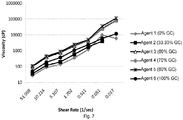
- Example 1 The experiment of Example 1 was repeated, but the base oil used was HF-1000. The results are shown in Fig. 7 and indicate that the highest viscosity was achieved using 80% glycerin carbonate and 20% alkoxylated alcohols.
- Table 3 Solvent Carbon Number Carbon Range Exfoliating Agent Reference Viscosity @ 0.017 1/sec shear rate (cP) Diesel 17 10-24 Agent 6 (100% glycerin carbonate) 311,300 ODC-15 13 10-16 Agent 5 (80% Glycerin carbonate) 164,500 LPA 13 10-16 Agent 5 (80% Glycerin carbonate) 41,100 LPA-142 11 10-12 Agent 4 (70% Glycerin carbonate) 105,700 LPA-170 13 12-14 Agent 4 (70% Glycerin carbonate) 88,100 LPA-210 15 14-16 Agent 5 (80% Glycerin carbonate) 176,200 HF-1000 14 12-16 Agent 5 (80% Glycerin carbonate) 111,600
- the exfoliating agents of the present invention display a remarkable ability with most of the base oils to increase the viscosity of the compositions.
- Example 1 To more fully demonstrate the efficacy of the exfoliating agents of the present invention, the procedure of Example 1 was followed using four of the base oils shown in Table 1. As noted above, one of the most widely used exfoliating agents used with oil based drilling fluids containing organophilic clays is propylene carbonate. By comparing the data in Table 3 above and Table 4 below, it can readily be seen that the exfoliating agent of the present invention is clearly superior to propylene carbonate at exfoliating the organophilic clay.
- organophilic clays used in wellbore fluids
- activated, organophilic clays are well known for their gelling and viscosity increasing ability in organic liquids of many types.
- wellbore fluids e.g., drilling fluids
- they find wide usage in paints, greases, and fiberglass resins. They may also be used in cosmetics, inks, and polishes.
- the composition of the present invention may contain certain ingredients tailored to the specific use of the wellbore fluid.
- the wellbore fluid was a sealing composition for sealing off subterranean zones
- water soluble clays, cross-linking agents, dispersing agents, cements, fillers and the like can also be employed.
- the composition can also include emulsifiers, wetting agents, fluid loss control additives and weighing materials.
- completion fluids are generally comprised of clear brines containing such material as ammonium chloride, sodium chloride, sodium bromide, etc.
- compositions of the present invention could be used to improve dispersion of additives of the resulting completion fluids so that the suspended particles remain suspended for longer periods of time or at higher temperatures before being introduced into completion fluids.
- Fracturing fluids according to the present invention in addition to the viscosifying package can include, proppants, certain polymeric materials and other ingredients. Methods of employing various wellbore fluids for certain purposes are well known to those skilled in the art and are also contemplated by the present invention.
- the wellbore fluids of the present invention can comprise an additive selected from the group consisting of emulsifiers, wetting agents, viscosifiers, weighting agents, fluid loss control agents, proppants, and particulate agents for forming gravel packs.
Landscapes
- Chemical & Material Sciences (AREA)
- Life Sciences & Earth Sciences (AREA)
- General Life Sciences & Earth Sciences (AREA)
- Engineering & Computer Science (AREA)
- Organic Chemistry (AREA)
- Materials Engineering (AREA)
- Oil, Petroleum & Natural Gas (AREA)
- Geology (AREA)
- Mining & Mineral Resources (AREA)
- Fluid Mechanics (AREA)
- Geochemistry & Mineralogy (AREA)
- Physics & Mathematics (AREA)
- Environmental & Geological Engineering (AREA)
- Lubricants (AREA)
- Liquid Carbonaceous Fuels (AREA)
- Solid-Sorbent Or Filter-Aiding Compositions (AREA)
- Silicates, Zeolites, And Molecular Sieves (AREA)
- Organic Low-Molecular-Weight Compounds And Preparation Thereof (AREA)
Description
- The present invention relates to the viscosification of non-aqueous fluids and more particularly to the viscosification of wellbore fluids. In particular, the invention relates to activators for use in exfoliating organophilic clays used in various applications, e.g., wellbore fluids.
- Organophilic clays are widely used as rheological control agents in a wide variety of solvent systems. In particular, organophilic clays have found wide usage in wellbore fluids, used in operations related to the development, completion and production of natural hydrocarbon reservoirs. Typical operations include drilling, fracturing subterranean formations, modifying the permeability of subterranean formations, logging operations, sand control, packer fluids, etc.
- In particular, in deep well drilling, the use of organophilic clays in oil-based muds have certain advantages despite their considerably higher initial cost. The advantages of oil-based fluids are apparent in water-sensitive formations, e.g., swelling shale, insoluble salt formations, and at high temperatures. These fluids are used for drill stem lubrication, particularly in drilling curved or deviated wells, for corrosion protection and they have the further advantage of being reusable.
- One of the primary functions of organophilic clays in oil-based wellbore fluids, as well as other non-aqueous based fluids (i.e glycol ethers), is to act as viscosifiers. However, it is well known that for organophilic clays to swell in or viscosify a non-aqueous wellbore fluid it is usually necessary to use small amounts of polar molecules as activators. Typical activators for use with clay- type thixotropic viscosifying agent such as organophilic clays include water, ethanol, methanol, glycols, sodium silicate, sodium fluoride, magnesium silico fluoride, calcium carbonate, polar aprotic compounds, etc. An especially preferred and widely used activator is propylene carbonate.
-
US2007/071703 A1 discloses a thickening system comprising organoclays for thickening or structuring oil based systems, especially for cosmetic applications. No mention is however made of glycerine carbonate or alkoxylated alcohols as components of the thickening system. - The present invention provides the use of an exfoliating agent for viscosifying a nonaqueous base fluid according to
claim 1, as well as a wellbore fluid according toclaim 5. - In one aspect, the present disclosure provides an exfoliating agent for use in non-aqueous fluids, particularly non-aqueous wellbore fluids.
- In another aspect, the present disclosure provides a viscosifying package for use in non-aqueous fluids.
- In still another aspect, the present disclosure provides a wellbore fluid comprised of a non-aqueous fluid, e.g., a hydrocarbon base fluid, an organophilic clay and an exfoliating agent.
- In still a further aspect, the present disclosure provides a wellbore fluid comprised of a hydrocarbon based fluid having a significant content of naphthenics and/or branched hydrocarbons, an organophilic clay, and an exfoliating agent.
- These and further features and advantages of the present invention will become apparent from the following detailed description, wherein reference is made to the figures in the accompanying drawings.
- The term "wellbore fluid" or similar terms refers to any fluid which is used in any phase of the exploration, drilling or production of oil and gas from subterranean formations.
- The compositions of the present invention, as will be seen below, can employ a base oil including pure hydrocarbon mixtures as well as a hydrocarbon in admixture with oxygenated compounds. In general, the base oil useful in the compositions of the present inventions comprise base oils with a significant content of naphthenic and/or highly branched paraffins. As a general rule, the base oil can contain from about 20% to about 99% or greater naphthenics, isoparaffins, or a mixture thereof. In particular, the base oil having this composition will contain from about C8 to about C30. In Table 1 below, there are shown non-limiting examples of the wide variety of base oils which can be employed in the composition of the present invention.
Table 1 LPA LPA-142 LPA-170 LPA-210 Diesel HF-1000 ODC-15 Linear -- -- -- -- 41.3' 20.9 -- Isoparaffins (mol %) 25 21 28 30 14 25 Olefins -- -- -- -- -- 24.89 -- Napthenics (monocyclic) (mol %) 62 64 60 69 22.12 30 47 Decalins (bi-cyclic) (mol %) 13 15 12 1 11.93 -- 10 Aromatics -- -- -- -- 24.7 -- 15 Oxygenates -- -- -- -- -- 3.84 -- Carbon chain range C10-C16 C-11-C12 C12-C14 C14-C16 C10-C20 C12-C22 1 Depends on specific diesel 2 Also contains 2.3% tricyclic 3 Alcohols, esters - As can be seen from the above Table 1, the base oil can comprise liquid hydrocarbon having from about 10% to about 35% isoparaffins, from about 30% to about 73% naphthenics, and having a carbon chain length of from about C8 to about C30. As can also be seen from Table 1, some of the base oils can include significant amounts of linear paraffins while others can contain small amounts of oxygenates such as alcohols, esters, or the like. As should be further apparent from Table 1, some of the base oils can contain olefins while others, e.g., diesel, can contain significant amounts of aromatics. Table 1 demonstrates that the compositions of the present invention can employ, with advantage, a wide variety of base oils, all of which have significant hydrocarbon oil content, albeit that other compounds can be present in certain cases.
- The organophilic clays that may be used in the compositions of the present invention include any clay in which the inorganic cations associated with the clay have been displaced by organic cations such as quarternary ammonium cations. Suitable organophilic clays include the reaction products of smectite-type, hectorite clays, or other clays and organic cations, i.e., quaternary ammonium cations (sometimes referred to as organophillic clay gellants); smectite clays; kaolin clays; and the like. The preferred organophilic clays used as a thixotropic viscosifying agent, in accordance with one aspect of the present invention, is a smectite-type clay that is selected from the group consisting of bentonite, hectorite, montmorillonite, nontronite, beidellite, saponite, stevensite, and mixtures thereof, most preferably bentonite or hectorite. The preferred quaternary ammonium cations, in the event that the clay used is the reaction product of a clay and a quaternary ammonium compound, are selected from the group consisting of methyl trihydrogenated tallow ammonium, dimethyl dehydrogenated tallow ammonium, dimethyl benzyl hydrogenated tallow ammonium, methyl benzyl dehydrogenated tallow ammonium, and mixtures thereof. Exemplary organoclays and clay gellants suitable for use with the compositions described herein are set forth in the following U.S. patents:
U.S. Pat. No. 2,531,427 ;U.S. Pat. No. 2,966,506 ;U.S. Pat. No. 4,105,578 ; andU.S. Pat. No. 4,208,218 . - Exemplary, commercially available organophilic clays suitable for use with the compositions described herein are CLAYTONE.RTM. IMG 400 Claytone ER, Claytone EM, and Claytone II, available from Southern Clay Products, Inc., Gonzalez, Tex., U.S.A., or Bentone 34, Bentone 150 and BENTONE.RTM. 38 Organoclay (a commercial hectorite-based product, available form a number of suppliers).
- The exfoliating agents used in the present invention in general comprise glycerin carbonate in admixture with certain alkoxylated alcohols. The alkoxylated alcohols useful in the present invention will have the general formula:


- R2 is H or CH3
- R3 is H or CH3
- a is from 0 to 12
- and b is from 1 to 12.
- The exfoliating agent used in the present invention will generally comprise from about 10 % to about 100 % glycerin carbonate and from about 0% to about 90% alkoxylated alcohol where all amounts are by weight based on the combined weight of the glycerin carbonate and the alkoxylated alcohol. It will be understood though that different exfoliating agents have different effectiveness in different base oils. Therefore the composition of the exfoliating agent should be tailored to fit the base oil in question.
- The exfoliating agent may be incorporated into the wellbore fluid in any number of ways, whether by separate or previous addition to the base oil and/or clay, or by admixture with base oil, clay, and other components at the time of preparation of the wellbore fluid. In certain cases a "pill" comprised of exfoliating agent and organophilic clay, alone or together with other components, can be employed, the pill being injected into the wellbore at a desired time.
- The alkoxylated alcohol used in the examples which follow are ethoxylated alcohols sold by Sasol North America, Inc. under the trade name NOVEL®. As is well known to those skilled in the art, the ethoxylated alcohols are formed by reacting various alcohols with ethylene oxide under suitable reaction conditions. The resulting ethoxylated alcohol thus has an alkyl chain residue from the alcohol and the desired number of ethoxy groups. By way of example, an ethoxylated alcohol designated as NOVEL® 1012-9 means that the ethoxylated alcohol has an alkyl chain length with an average carbon number of 10-12 and 9 ethoxy groups. An ethoxylated alcohol designated as NOVEL® 23E9 will contain an alkyl chain of 12-13 carbon atoms with 9 ethoxy groups.
- In general, the compositions of the present invention will contain from about 95% to about 98% base oil, from about 1% to about 5% organophilic clay and from about 0.005% to about 1% exfoliating agent, where all amounts are in weight % based on the total composition.
- To more fully illustrate the present invention, the following non-limiting examples are presented.
- Three grams of Claytone® II organophilic clay was dispersed in 100 mL of diesel containing 1 mL of the exfoliating agent. The exfoliating agents are shown in Table 2 below. The exfoliating agents shown in Table 2 are used in Examples 2-7 as well.
Table 2 Exfoliating agent Content Agent 1 0% glycerin carbonate (GC) 50% NOVEL® 1012-9 50% NOVEL ® 23E9 Agent 2 33.33% glycerin carbonate (GC) 33.33% NOVEL® 1012-9 33.33% NOVEL ® 23E9 Agent 3 60% glycerin 20% NOVEL® 20% NOVEL® carbonate (GC) 1012-9 23E9 Agent 4 70% glycerin carbonate (GC) 15% NOVEL® 1012-9 15% NOVEL ® 23E9 Agent 5 80% glycerin carbonate (GC) 10% NOVEL® 1012-9 10% NOVEL ® 23E9 Agent 6 100% glycerin carbonate (GC) --- --- - The mixture was mixed for three minutes and then sheared at medium-high (3) for one minute on a TURRAX high shear mixer. The samples were aged overnight for 16 hours at room temperature. The samples were then rehomogenized for 30 seconds and tested on a Grace 3600 Viscometer. The results are shown in
Figure 1 and indicate that the highest viscosity was achieved using 100% glycerin carbonate. - The experiment of Example 1 was repeated, but the base oil used was ODC-15. The results are shown in
Fig. 2 and indicate that the highest viscosity was achieved using 80% glycerin carbonate and 20% alkoxylated alcohols. - The experiment of Example 1 was repeated, but the base oil used was LPA. The results are shown in
Fig. 3 and indicate that the highest viscosity was achieved using 80% glycerin carbonate and 20% alkoxylated alcohols. - The experiment of Example 1 was repeated, but the base oil used was LPA-142. The results are shown in
Fig. 4 and indicate that the highest viscosity was achieved using 70% glycerin carbonate and 30% alkoxylated alcohols. - The experiment of Example 1 was repeated, but the base oil used was LPA-170. The results are shown in
Fig. 5 and indicate that the highest viscosity was achieved using 70% glycerin carbonate and 30% alkoxylated alcohols. - The experiment of Example 1 was repeated, but the base oil used was LPA-210. The results are shown in
Fig. 6 and indicate that the highest viscosity was achieved using 80% glycerin carbonate and 20% alkoxylated alcohols. - The experiment of Example 1 was repeated, but the base oil used was HF-1000. The results are shown in
Fig. 7 and indicate that the highest viscosity was achieved using 80% glycerin carbonate and 20% alkoxylated alcohols. - A summary of Examples 1-7 is shown in Table 3 below.
Table 3 Solvent Carbon Number Carbon Range Exfoliating Agent Reference Viscosity @ 0.017 1/sec shear rate (cP) Diesel 17 10-24 Agent 6 (100% glycerin carbonate) 311,300 ODC-15 13 10-16 Agent 5 (80% Glycerin carbonate) 164,500 LPA 13 10-16 Agent 5 (80% Glycerin carbonate) 41,100 LPA-142 11 10-12 Agent 4 (70% Glycerin carbonate) 105,700 LPA-170 13 12-14 Agent 4 (70% Glycerin carbonate) 88,100 LPA-210 15 14-16 Agent 5 (80% Glycerin carbonate) 176,200 HF-1000 14 12-16 Agent 5 (80% Glycerin carbonate) 111,600 - As can be seen from the data in Table 3, the exfoliating agents of the present invention display a remarkable ability with most of the base oils to increase the viscosity of the compositions.
- To more fully demonstrate the efficacy of the exfoliating agents of the present invention, the procedure of Example 1 was followed using four of the base oils shown in Table 1. As noted above, one of the most widely used exfoliating agents used with oil based drilling fluids containing organophilic clays is propylene carbonate. By comparing the data in Table 3 above and Table 4 below, it can readily be seen that the exfoliating agent of the present invention is clearly superior to propylene carbonate at exfoliating the organophilic clay.
Table 4 Solvent Carbon Number Carbon Range Exfoliating Agent Reference Viscosity @ 0.017 1/sec shear rate (cP) Diesel 17 10-24 100% Propylene carbonate 0.0 ODC-15 13 10-16 100% Propylene carbonate 11,748 LPA-170 13 12-14 100 % Propylene carbonate 0 HF-1000 14 12-16 100 % Propylene carbonate 0 - One of the advantages of the present invention is the fact that in the composition of the exfoliating agent and clay, water need not be present. As is well known, water in addition to reacting with the organophilic clay, may also interact with other additives such as guar gum, Xanthan gum, etc. Nonetheless, it is to be understood that in certain cases the addition of a small amount of water as a co-activator can further enhance the suspending characteristics of the resulting organophilic clay suspension medium. When used, water will generally be present in the composition in an amount from about 30 wt% to about 50 wt% based on the organophilic clay.
- While in the above description, reference is made to the use of the exfoliating agents of the present invention in conjunction with organophilic clays used in wellbore fluids, it will be understood that the invention is not so limited. As well known to those skilled in the art, activated, organophilic clays are well known for their gelling and viscosity increasing ability in organic liquids of many types. Thus, in addition to wellbore fluids, e.g., drilling fluids, they find wide usage in paints, greases, and fiberglass resins. They may also be used in cosmetics, inks, and polishes.
- It will be recognized that, when used as a wellbore fluid, the composition of the present invention may contain certain ingredients tailored to the specific use of the wellbore fluid. Thus, for example if the wellbore fluid was a sealing composition for sealing off subterranean zones, water soluble clays, cross-linking agents, dispersing agents, cements, fillers and the like can also be employed. In the case of viscosity well treatment fluid compositions suitable for use in managed pressure drilling (MPD), the composition can also include emulsifiers, wetting agents, fluid loss control additives and weighing materials. Still further, as is well known, completion fluids are generally comprised of clear brines containing such material as ammonium chloride, sodium chloride, sodium bromide, etc. The compositions of the present invention could be used to improve dispersion of additives of the resulting completion fluids so that the suspended particles remain suspended for longer periods of time or at higher temperatures before being introduced into completion fluids. Fracturing fluids according to the present invention in addition to the viscosifying package can include, proppants, certain polymeric materials and other ingredients. Methods of employing various wellbore fluids for certain purposes are well known to those skilled in the art and are also contemplated by the present invention. In general the wellbore fluids of the present invention can comprise an additive selected from the group consisting of emulsifiers, wetting agents, viscosifiers, weighting agents, fluid loss control agents, proppants, and particulate agents for forming gravel packs.
- Although specific embodiments of the invention have been described herein in some detail, this has been done solely for the purposes of explaining the various aspects of the invention, and is not intended to limit the scope of the invention as defined in the claims which follow. Those skilled in the art will understand that the embodiment shown and described is exemplary, and various other substitutions, alterations and modifications, including but not limited to those design alternatives specifically discussed herein, may be made in the practice of the invention without departing from its scope.
Claims (13)
- Use of an exfoliating agent for viscosifying a nonaqueous base fluid, the nonaqueous base fluid comprising an organophilic clay, wherein the exfoliating agent comprises:glycerin carbonate; andan alkoxylated alcohol having the general formula:

 whereinR1 is a branched or linear alkyl having from 2 to 18 carbon atoms, R2 is H or CH3,R3 is H or CH3,a is from 0 to 12,and b is from 1 to 12.
 - The use of claim 1, whereinsaid glycerin carbonate is present in an amount of from 10 wt% and above and said alkoxylated alcohol is present in an amount of up to 90 wt%, where all the amounts are by weight based on the combined weight of the glycerin carbonate and the alkoxylated alcohol and preferably whereinsaid glycerin carbonate is present in an amount of 80 wt% andsaid alkoxylated alcohol is present in an amount of 20 wt%,each based on the total exfoliating agent.
- The use of claim 1, whereinsaid glycerin carbonate is present in an amount of 70 wt% andsaid alkoxylated alcohol is present in an amount of 30 wt%,each based on the total exfoliating agent;and preferably whereinsaid glycerin carbonate is present in an amount of 60 wt% andsaid alkoxylated alcohol is present in an amount of 40 wt%,each based on the total exfoliating agent.
- The use of of claim 1, wherein said organophilic clay is a smectite-type clay selected from the group consisting of bentonite, hectorite, montmorillonite, nontronite, beidellite, saponite, stevensite, and mixtures thereof.
- A wellbore fluid comprising:a hydrocarbon base oil;an organophilic clay; andan exfoliating agent comprisingglycerin carbonate; andan alkoxylated alcohol having the general formula:

 R1 is a branched or linear alkyl having from 2 to 18 carbon atoms, R2 is H or CH3,R3 is H or CH3,a is from 0 to 12,and b is from 1 to 12.
 - The wellbore fluid of claim 5, wherein said base oil comprises greater than 20% naphthenics.
- The wellbore fluid of claim 5, wherein said base oil comprises from 10% to 35% isoparaffins.
- The wellbore fluid of claim 5, whereinsaid glycerin carbonate is present in an amount of from 10 wt% and above and said alkoxylated alcohol is present in an amount of up to 90 wt%, where all the amounts are by weight based on the combined weight of the glycerin carbonate and the alkoxylated alcohol;and preferably whereinsaid glycerin carbonate is present in an amount of 80 wt% andsaid alkoxylated alcohol is present in an amount of 20 wt%,each based on the total exfoliating agent.
- The wellbore fluid of claim 5, whereinsaid glycerin carbonate is present in an amount of 70 wt% andsaid alkoxylated alcohol is present in an amount of 30 wt%,each based on the total exfoliating agent;and preferably whereinsaid glycerin carbonate is present in an amount of 60 wt% andsaid alkoxylated alcohol is present in an amount of 40 wt%,each based on the total exfoliating agent.
- The wellbore fluid of claim 5, wherein said organophilic clay is a smectite-type clay selected from the group consisting of bentonite, hectorite, montmorillonite, nontronite, beidellite, saponite, stevensite, and mixtues thereof.
- The wellbore fluid of claim 5, wherein said organophilic clay is present in an amount of from 1 wt% to 5 wt% and said exfoliating agent is present in an amount of from 0.005 wt% to 1 wt%, each based on the total wellbore fluid.
- The wellbore fluid of claim 5, further comprising:
water in an amount of 30 to 50 wt% based on said organophilic clay. - The wellbore fluid of claim 5, further comprising:
an additive comprising at least one of emulsifiers, wetting agents, viscosifiers, weighting agents, fluid loss control agents, proppants, and particulate agents for forming gravel packs.
Applications Claiming Priority (2)
| Application Number | Priority Date | Filing Date | Title |
|---|---|---|---|
| US201361856200P | 2013-07-19 | 2013-07-19 | |
| PCT/US2014/047182 WO2015010011A1 (en) | 2013-07-19 | 2014-07-18 | Composition for use in conducting downhole operations in oil and gas wells |
Publications (3)
| Publication Number | Publication Date |
|---|---|
| EP3022390A1 EP3022390A1 (en) | 2016-05-25 |
| EP3022390A4 EP3022390A4 (en) | 2017-02-22 |
| EP3022390B1 true EP3022390B1 (en) | 2021-11-17 |
Family
ID=52346749
Family Applications (1)
| Application Number | Title | Priority Date | Filing Date |
|---|---|---|---|
| EP14826402.1A Active EP3022390B1 (en) | 2013-07-19 | 2014-07-18 | Composition for use in conducting downhole operations in oil and gas wells |
Country Status (10)
| Country | Link |
|---|---|
| US (1) | US9988570B2 (en) |
| EP (1) | EP3022390B1 (en) |
| CN (1) | CN105531442B (en) |
| AU (1) | AU2014290532B2 (en) |
| CA (1) | CA2917622C (en) |
| DK (1) | DK3022390T3 (en) |
| MX (1) | MX388431B (en) |
| RU (1) | RU2669411C2 (en) |
| WO (1) | WO2015010011A1 (en) |
| ZA (1) | ZA201600232B (en) |
Families Citing this family (11)
| Publication number | Priority date | Publication date | Assignee | Title |
|---|---|---|---|---|
| ES2738645T3 (en) * | 2012-10-29 | 2020-01-24 | Sasol Performance Chemicals Gmbh | Use of activators for non-aqueous fluid viscosification |
| CN103637579A (en) * | 2013-12-24 | 2014-03-19 | 黄小卫 | Electric and mechanical stretching device of movable sofa |
| JP2019522699A (en) * | 2016-06-07 | 2019-08-15 | サウジ アラビアン オイル カンパニーSaudi Arabian Oil Company | Gel-like hydrocarbon system with improved viscosity |
| CA3022613C (en) | 2016-06-16 | 2021-01-26 | Halliburton Energy Services, Inc. | Drilling fluid for downhole electrocrushing drilling |
| WO2017217995A1 (en) * | 2016-06-16 | 2017-12-21 | Halliburton Energy Services, Inc. | Drilling fluid for downhole electrocrushing drilling |
| WO2017217992A1 (en) | 2016-06-16 | 2017-12-21 | Halliburton Energy Services, Inc. | Drilling fluid for downhole electrocrushing drilling |
| US10717915B2 (en) | 2016-06-16 | 2020-07-21 | Halliburton Energy Services, Inc. | Drilling fluid for downhole electrocrushing drilling |
| MY199969A (en) | 2016-06-16 | 2023-11-30 | Chevron Usa Inc | Drilling fluid for downhole electrocrushing drilling |
| US12338382B2 (en) * | 2017-04-04 | 2025-06-24 | Harcros Chemicals, Inc. | Surfactants having non-conventional hydrophobes |
| ES2924345T3 (en) * | 2019-05-20 | 2022-10-06 | Henkel Ag & Co Kgaa | Method for preparing an at least partially exfoliated clay using an exfoliating agent comprising a poly(alkylene oxide) (meth)acrylate partial ester, a cyclic carbonate and water |
| CN111548778B (en) * | 2020-05-20 | 2023-06-02 | 中海油田服务股份有限公司 | Viscosity-increasing agent in liquid suspension form and preparation method thereof |
Family Cites Families (15)
| Publication number | Priority date | Publication date | Assignee | Title |
|---|---|---|---|---|
| US2531427A (en) | 1946-05-03 | 1950-11-28 | Ernst A Hauser | Modified gel-forming clay and process of producing same |
| BE582883A (en) | 1958-10-28 | |||
| US4105578A (en) | 1976-12-10 | 1978-08-08 | N L Industries, Inc. | Organophilic clay having enhanced dispersibility |
| US4208218A (en) | 1978-03-27 | 1980-06-17 | Nl Industries, Inc. | Viscosity increasing additive for non-aqueous fluid systems |
| US4439328A (en) * | 1981-12-28 | 1984-03-27 | Moity Randolph M | Well servicing fluid additive |
| US4828723A (en) * | 1987-07-15 | 1989-05-09 | Colgate-Palmolive Company | Stable non-aqueous suspension containing organophilic clay and low density filler |
| US5298070A (en) * | 1990-11-09 | 1994-03-29 | Shell Oil Company | Cement fluid loss reduction |
| US6620769B1 (en) * | 2000-11-21 | 2003-09-16 | Hercules Incorporated | Environmentally acceptable fluid polymer suspension for oil field services |
| US6703033B2 (en) * | 2001-04-26 | 2004-03-09 | Huntsman Petrochemical Corporation | Advances in towelettes containing organic carbonates |
| EP1316577B1 (en) * | 2001-11-30 | 2005-02-23 | Akzo Nobel N.V. | Method for preparing polymers of glycerol with a saponite catalyst |
| US20070071703A1 (en) * | 2005-09-28 | 2007-03-29 | Lin Samuel Qcheng S | High efficiency master gels for thickening oil based compositions |
| US7757766B2 (en) * | 2008-11-19 | 2010-07-20 | Halliburton Energy Services, Inc. | Density-matched suspensions and associated methods |
| US8691733B2 (en) * | 2009-09-01 | 2014-04-08 | Halliburton Energy Services, Inc. | Suspension characteristics in invert emulsions |
| US9816025B2 (en) * | 2012-07-09 | 2017-11-14 | Tucc Technology, Llc | Methods and compositions for the controlled crosslinking and viscosifying of well servicing fluids utilizing mixed borate hydrocarbon-based suspensions |
| US20140110115A1 (en) * | 2012-10-18 | 2014-04-24 | Halliburton Energy Services, Inc. | Gelling Agents and Methods of Using the Same |
-
2014
- 2014-07-18 US US14/902,865 patent/US9988570B2/en active Active
- 2014-07-18 MX MX2016000744A patent/MX388431B/en unknown
- 2014-07-18 WO PCT/US2014/047182 patent/WO2015010011A1/en not_active Ceased
- 2014-07-18 DK DK14826402.1T patent/DK3022390T3/en active
- 2014-07-18 CN CN201480041005.7A patent/CN105531442B/en active Active
- 2014-07-18 RU RU2016105471A patent/RU2669411C2/en active
- 2014-07-18 EP EP14826402.1A patent/EP3022390B1/en active Active
- 2014-07-18 CA CA2917622A patent/CA2917622C/en active Active
- 2014-07-18 AU AU2014290532A patent/AU2014290532B2/en not_active Ceased
-
2016
- 2016-01-12 ZA ZA2016/00232A patent/ZA201600232B/en unknown
Non-Patent Citations (1)
| Title |
|---|
| None * |
Also Published As
| Publication number | Publication date |
|---|---|
| ZA201600232B (en) | 2017-04-26 |
| US9988570B2 (en) | 2018-06-05 |
| CA2917622C (en) | 2021-07-13 |
| RU2016105471A (en) | 2017-08-24 |
| EP3022390A4 (en) | 2017-02-22 |
| WO2015010011A1 (en) | 2015-01-22 |
| CA2917622A1 (en) | 2015-01-22 |
| RU2016105471A3 (en) | 2018-03-27 |
| DK3022390T3 (en) | 2022-02-21 |
| CN105531442A (en) | 2016-04-27 |
| EP3022390A1 (en) | 2016-05-25 |
| AU2014290532B2 (en) | 2018-08-02 |
| AU2014290532A1 (en) | 2016-02-11 |
| MX2016000744A (en) | 2016-04-13 |
| MX388431B (en) | 2025-03-20 |
| RU2669411C2 (en) | 2018-10-11 |
| CN105531442B (en) | 2018-12-21 |
| US20160152883A1 (en) | 2016-06-02 |
Similar Documents
| Publication | Publication Date | Title |
|---|---|---|
| CA2917622C (en) | Composition for use in conducting downhole operations in oil and gas wells | |
| US9512349B2 (en) | Solid-supported crosslinker for treatment of a subterranean formation | |
| US10982124B2 (en) | Drill-in fluid compositions and methods | |
| EP2970744B1 (en) | Synergistic effect of cosurfactants on the rheological performance of drilling, completion and fracturing fluids | |
| CA1105348A (en) | Oil base fluids with organophilic clays having enhanced dispersibility | |
| EA026143B1 (en) | Graphene-based material for shale stabilization and method of use | |
| AU2008332957B2 (en) | Improved aqueous-based wellbore fluids | |
| CN101495594A (en) | Functionalized clay compositions for aqueous based drilling fluids | |
| US10836948B2 (en) | Activators for use in the viscosification of non-aqueous fluids | |
| KR20190015536A (en) | Gelled hydrocarbon system with improved viscosity | |
| EP2844716B1 (en) | Biodegradable organophilic clays for drilling fluids | |
| CA2594173C (en) | Silicate-containing additives for well bore treatments and associated methods | |
| CA2594208C (en) | Silicate-containing additives for well bore treatments and associated methods | |
| US20210131201A1 (en) | Oil swellable material for low temperature lost circulation material application | |
| US20190375976A1 (en) | Oil based drilling fluids useful having reduced change in high shear viscosity over a wide temperature range |
Legal Events
| Date | Code | Title | Description |
|---|---|---|---|
| PUAI | Public reference made under article 153(3) epc to a published international application that has entered the european phase |
Free format text: ORIGINAL CODE: 0009012 |
|
| 17P | Request for examination filed |
Effective date: 20160219 |
|
| AK | Designated contracting states |
Kind code of ref document: A1 Designated state(s): AL AT BE BG CH CY CZ DE DK EE ES FI FR GB GR HR HU IE IS IT LI LT LU LV MC MK MT NL NO PL PT RO RS SE SI SK SM TR |
|
| AX | Request for extension of the european patent |
Extension state: BA ME |
|
| DAX | Request for extension of the european patent (deleted) | ||
| A4 | Supplementary search report drawn up and despatched |
Effective date: 20170125 |
|
| RIC1 | Information provided on ipc code assigned before grant |
Ipc: E21B 43/16 20060101AFI20170119BHEP Ipc: E21B 33/13 20060101ALI20170119BHEP Ipc: C09K 8/34 20060101ALI20170119BHEP Ipc: C09K 8/502 20060101ALI20170119BHEP Ipc: C09K 8/64 20060101ALI20170119BHEP |
|
| STAA | Information on the status of an ep patent application or granted ep patent |
Free format text: STATUS: EXAMINATION IS IN PROGRESS |
|
| 17Q | First examination report despatched |
Effective date: 20171212 |
|
| GRAP | Despatch of communication of intention to grant a patent |
Free format text: ORIGINAL CODE: EPIDOSNIGR1 |
|
| STAA | Information on the status of an ep patent application or granted ep patent |
Free format text: STATUS: GRANT OF PATENT IS INTENDED |
|
| INTG | Intention to grant announced |
Effective date: 20210114 |
|
| GRAJ | Information related to disapproval of communication of intention to grant by the applicant or resumption of examination proceedings by the epo deleted |
Free format text: ORIGINAL CODE: EPIDOSDIGR1 |
|
| STAA | Information on the status of an ep patent application or granted ep patent |
Free format text: STATUS: EXAMINATION IS IN PROGRESS |
|
| RAP3 | Party data changed (applicant data changed or rights of an application transferred) |
Owner name: SASOL CHEMICALS GMBH |
|
| GRAP | Despatch of communication of intention to grant a patent |
Free format text: ORIGINAL CODE: EPIDOSNIGR1 |
|
| STAA | Information on the status of an ep patent application or granted ep patent |
Free format text: STATUS: GRANT OF PATENT IS INTENDED |
|
| INTC | Intention to grant announced (deleted) | ||
| INTG | Intention to grant announced |
Effective date: 20210714 |
|
| GRAS | Grant fee paid |
Free format text: ORIGINAL CODE: EPIDOSNIGR3 |
|
| GRAA | (expected) grant |
Free format text: ORIGINAL CODE: 0009210 |
|
| STAA | Information on the status of an ep patent application or granted ep patent |
Free format text: STATUS: THE PATENT HAS BEEN GRANTED |
|
| AK | Designated contracting states |
Kind code of ref document: B1 Designated state(s): AL AT BE BG CH CY CZ DE DK EE ES FI FR GB GR HR HU IE IS IT LI LT LU LV MC MK MT NL NO PL PT RO RS SE SI SK SM TR |
|
| REG | Reference to a national code |
Ref country code: GB Ref legal event code: FG4D |
|
| REG | Reference to a national code |
Ref country code: IE Ref legal event code: FG4D |
|
| REG | Reference to a national code |
Ref country code: DE Ref legal event code: R096 Ref document number: 602014081329 Country of ref document: DE |
|
| REG | Reference to a national code |
Ref country code: AT Ref legal event code: REF Ref document number: 1448204 Country of ref document: AT Kind code of ref document: T Effective date: 20211215 |
|
| REG | Reference to a national code |
Ref country code: RO Ref legal event code: EPE |
|
| REG | Reference to a national code |
Ref country code: NL Ref legal event code: FP |
|
| REG | Reference to a national code |
Ref country code: DK Ref legal event code: T3 Effective date: 20220217 |
|
| REG | Reference to a national code |
Ref country code: LT Ref legal event code: MG9D |
|
| REG | Reference to a national code |
Ref country code: NO Ref legal event code: T2 Effective date: 20211117 |
|
| REG | Reference to a national code |
Ref country code: AT Ref legal event code: MK05 Ref document number: 1448204 Country of ref document: AT Kind code of ref document: T Effective date: 20211117 |
|
| PG25 | Lapsed in a contracting state [announced via postgrant information from national office to epo] |
Ref country code: RS Free format text: LAPSE BECAUSE OF FAILURE TO SUBMIT A TRANSLATION OF THE DESCRIPTION OR TO PAY THE FEE WITHIN THE PRESCRIBED TIME-LIMIT Effective date: 20211117 Ref country code: LT Free format text: LAPSE BECAUSE OF FAILURE TO SUBMIT A TRANSLATION OF THE DESCRIPTION OR TO PAY THE FEE WITHIN THE PRESCRIBED TIME-LIMIT Effective date: 20211117 Ref country code: FI Free format text: LAPSE BECAUSE OF FAILURE TO SUBMIT A TRANSLATION OF THE DESCRIPTION OR TO PAY THE FEE WITHIN THE PRESCRIBED TIME-LIMIT Effective date: 20211117 Ref country code: BG Free format text: LAPSE BECAUSE OF FAILURE TO SUBMIT A TRANSLATION OF THE DESCRIPTION OR TO PAY THE FEE WITHIN THE PRESCRIBED TIME-LIMIT Effective date: 20220217 Ref country code: AT Free format text: LAPSE BECAUSE OF FAILURE TO SUBMIT A TRANSLATION OF THE DESCRIPTION OR TO PAY THE FEE WITHIN THE PRESCRIBED TIME-LIMIT Effective date: 20211117 |
|
| PG25 | Lapsed in a contracting state [announced via postgrant information from national office to epo] |
Ref country code: IS Free format text: LAPSE BECAUSE OF FAILURE TO SUBMIT A TRANSLATION OF THE DESCRIPTION OR TO PAY THE FEE WITHIN THE PRESCRIBED TIME-LIMIT Effective date: 20220317 Ref country code: SE Free format text: LAPSE BECAUSE OF FAILURE TO SUBMIT A TRANSLATION OF THE DESCRIPTION OR TO PAY THE FEE WITHIN THE PRESCRIBED TIME-LIMIT Effective date: 20211117 Ref country code: PT Free format text: LAPSE BECAUSE OF FAILURE TO SUBMIT A TRANSLATION OF THE DESCRIPTION OR TO PAY THE FEE WITHIN THE PRESCRIBED TIME-LIMIT Effective date: 20220317 Ref country code: PL Free format text: LAPSE BECAUSE OF FAILURE TO SUBMIT A TRANSLATION OF THE DESCRIPTION OR TO PAY THE FEE WITHIN THE PRESCRIBED TIME-LIMIT Effective date: 20211117 Ref country code: LV Free format text: LAPSE BECAUSE OF FAILURE TO SUBMIT A TRANSLATION OF THE DESCRIPTION OR TO PAY THE FEE WITHIN THE PRESCRIBED TIME-LIMIT Effective date: 20211117 Ref country code: HR Free format text: LAPSE BECAUSE OF FAILURE TO SUBMIT A TRANSLATION OF THE DESCRIPTION OR TO PAY THE FEE WITHIN THE PRESCRIBED TIME-LIMIT Effective date: 20211117 Ref country code: GR Free format text: LAPSE BECAUSE OF FAILURE TO SUBMIT A TRANSLATION OF THE DESCRIPTION OR TO PAY THE FEE WITHIN THE PRESCRIBED TIME-LIMIT Effective date: 20220218 Ref country code: ES Free format text: LAPSE BECAUSE OF FAILURE TO SUBMIT A TRANSLATION OF THE DESCRIPTION OR TO PAY THE FEE WITHIN THE PRESCRIBED TIME-LIMIT Effective date: 20211117 |
|
| PG25 | Lapsed in a contracting state [announced via postgrant information from national office to epo] |
Ref country code: SM Free format text: LAPSE BECAUSE OF FAILURE TO SUBMIT A TRANSLATION OF THE DESCRIPTION OR TO PAY THE FEE WITHIN THE PRESCRIBED TIME-LIMIT Effective date: 20211117 Ref country code: SK Free format text: LAPSE BECAUSE OF FAILURE TO SUBMIT A TRANSLATION OF THE DESCRIPTION OR TO PAY THE FEE WITHIN THE PRESCRIBED TIME-LIMIT Effective date: 20211117 Ref country code: EE Free format text: LAPSE BECAUSE OF FAILURE TO SUBMIT A TRANSLATION OF THE DESCRIPTION OR TO PAY THE FEE WITHIN THE PRESCRIBED TIME-LIMIT Effective date: 20211117 Ref country code: CZ Free format text: LAPSE BECAUSE OF FAILURE TO SUBMIT A TRANSLATION OF THE DESCRIPTION OR TO PAY THE FEE WITHIN THE PRESCRIBED TIME-LIMIT Effective date: 20211117 |
|
| REG | Reference to a national code |
Ref country code: DE Ref legal event code: R097 Ref document number: 602014081329 Country of ref document: DE |
|
| PLBE | No opposition filed within time limit |
Free format text: ORIGINAL CODE: 0009261 |
|
| STAA | Information on the status of an ep patent application or granted ep patent |
Free format text: STATUS: NO OPPOSITION FILED WITHIN TIME LIMIT |
|
| 26N | No opposition filed |
Effective date: 20220818 |
|
| PG25 | Lapsed in a contracting state [announced via postgrant information from national office to epo] |
Ref country code: AL Free format text: LAPSE BECAUSE OF FAILURE TO SUBMIT A TRANSLATION OF THE DESCRIPTION OR TO PAY THE FEE WITHIN THE PRESCRIBED TIME-LIMIT Effective date: 20211117 |
|
| PG25 | Lapsed in a contracting state [announced via postgrant information from national office to epo] |
Ref country code: SI Free format text: LAPSE BECAUSE OF FAILURE TO SUBMIT A TRANSLATION OF THE DESCRIPTION OR TO PAY THE FEE WITHIN THE PRESCRIBED TIME-LIMIT Effective date: 20211117 |
|
| PG25 | Lapsed in a contracting state [announced via postgrant information from national office to epo] |
Ref country code: MC Free format text: LAPSE BECAUSE OF FAILURE TO SUBMIT A TRANSLATION OF THE DESCRIPTION OR TO PAY THE FEE WITHIN THE PRESCRIBED TIME-LIMIT Effective date: 20211117 |
|
| REG | Reference to a national code |
Ref country code: CH Ref legal event code: PL |
|
| REG | Reference to a national code |
Ref country code: BE Ref legal event code: MM Effective date: 20220731 |
|
| PG25 | Lapsed in a contracting state [announced via postgrant information from national office to epo] |
Ref country code: LU Free format text: LAPSE BECAUSE OF NON-PAYMENT OF DUE FEES Effective date: 20220718 Ref country code: LI Free format text: LAPSE BECAUSE OF NON-PAYMENT OF DUE FEES Effective date: 20220731 Ref country code: FR Free format text: LAPSE BECAUSE OF NON-PAYMENT OF DUE FEES Effective date: 20220731 Ref country code: CH Free format text: LAPSE BECAUSE OF NON-PAYMENT OF DUE FEES Effective date: 20220731 |
|
| PG25 | Lapsed in a contracting state [announced via postgrant information from national office to epo] |
Ref country code: BE Free format text: LAPSE BECAUSE OF NON-PAYMENT OF DUE FEES Effective date: 20220731 |
|
| P01 | Opt-out of the competence of the unified patent court (upc) registered |
Effective date: 20230502 |
|
| PG25 | Lapsed in a contracting state [announced via postgrant information from national office to epo] |
Ref country code: IE Free format text: LAPSE BECAUSE OF NON-PAYMENT OF DUE FEES Effective date: 20220718 |
|
| PG25 | Lapsed in a contracting state [announced via postgrant information from national office to epo] |
Ref country code: HU Free format text: LAPSE BECAUSE OF FAILURE TO SUBMIT A TRANSLATION OF THE DESCRIPTION OR TO PAY THE FEE WITHIN THE PRESCRIBED TIME-LIMIT; INVALID AB INITIO Effective date: 20140718 |
|
| PG25 | Lapsed in a contracting state [announced via postgrant information from national office to epo] |
Ref country code: MK Free format text: LAPSE BECAUSE OF FAILURE TO SUBMIT A TRANSLATION OF THE DESCRIPTION OR TO PAY THE FEE WITHIN THE PRESCRIBED TIME-LIMIT Effective date: 20211117 Ref country code: CY Free format text: LAPSE BECAUSE OF FAILURE TO SUBMIT A TRANSLATION OF THE DESCRIPTION OR TO PAY THE FEE WITHIN THE PRESCRIBED TIME-LIMIT Effective date: 20211117 |
|
| PGFP | Annual fee paid to national office [announced via postgrant information from national office to epo] |
Ref country code: NL Payment date: 20240726 Year of fee payment: 11 |
|
| PG25 | Lapsed in a contracting state [announced via postgrant information from national office to epo] |
Ref country code: MT Free format text: LAPSE BECAUSE OF FAILURE TO SUBMIT A TRANSLATION OF THE DESCRIPTION OR TO PAY THE FEE WITHIN THE PRESCRIBED TIME-LIMIT Effective date: 20211117 |
|
| PGFP | Annual fee paid to national office [announced via postgrant information from national office to epo] |
Ref country code: DE Payment date: 20240729 Year of fee payment: 11 |
|
| PGFP | Annual fee paid to national office [announced via postgrant information from national office to epo] |
Ref country code: DK Payment date: 20240725 Year of fee payment: 11 |
|
| PGFP | Annual fee paid to national office [announced via postgrant information from national office to epo] |
Ref country code: GB Payment date: 20240729 Year of fee payment: 11 |
|
| PGFP | Annual fee paid to national office [announced via postgrant information from national office to epo] |
Ref country code: RO Payment date: 20240708 Year of fee payment: 11 Ref country code: NO Payment date: 20240729 Year of fee payment: 11 Ref country code: IT Payment date: 20240719 Year of fee payment: 11 |
|
| PGFP | Annual fee paid to national office [announced via postgrant information from national office to epo] |
Ref country code: TR Payment date: 20240705 Year of fee payment: 11 |
|
| REG | Reference to a national code |
Ref country code: DE Ref legal event code: R119 Ref document number: 602014081329 Country of ref document: DE |
|
| REG | Reference to a national code |
Ref country code: DK Ref legal event code: EBP Effective date: 20250731 |
|
| REG | Reference to a national code |
Ref country code: NL Ref legal event code: MM Effective date: 20250801 |
|
| GBPC | Gb: european patent ceased through non-payment of renewal fee |
Effective date: 20250718 |
|
| PG25 | Lapsed in a contracting state [announced via postgrant information from national office to epo] |
Ref country code: GB Free format text: LAPSE BECAUSE OF NON-PAYMENT OF DUE FEES Effective date: 20250718 |
|
| PG25 | Lapsed in a contracting state [announced via postgrant information from national office to epo] |
Ref country code: DE Free format text: LAPSE BECAUSE OF NON-PAYMENT OF DUE FEES Effective date: 20260203 Ref country code: NO Free format text: LAPSE BECAUSE OF NON-PAYMENT OF DUE FEES Effective date: 20250731 |
|
| PG25 | Lapsed in a contracting state [announced via postgrant information from national office to epo] |
Ref country code: RO Free format text: LAPSE BECAUSE OF NON-PAYMENT OF DUE FEES Effective date: 20250718 |
|
| PG25 | Lapsed in a contracting state [announced via postgrant information from national office to epo] |
Ref country code: NL Free format text: LAPSE BECAUSE OF NON-PAYMENT OF DUE FEES Effective date: 20250801 |