EP3021578A1 - Video encoding device, video decoding device, video system, video encoding method, video decoding method, and program - Google Patents
Video encoding device, video decoding device, video system, video encoding method, video decoding method, and program Download PDFInfo
- Publication number
- EP3021578A1 EP3021578A1 EP14823141.8A EP14823141A EP3021578A1 EP 3021578 A1 EP3021578 A1 EP 3021578A1 EP 14823141 A EP14823141 A EP 14823141A EP 3021578 A1 EP3021578 A1 EP 3021578A1
- Authority
- EP
- European Patent Office
- Prior art keywords
- sub
- sampling
- adaptive
- chroma
- reference pixel
- Prior art date
- Legal status (The legal status is an assumption and is not a legal conclusion. Google has not performed a legal analysis and makes no representation as to the accuracy of the status listed.)
- Granted
Links
Images











Classifications
-
- H—ELECTRICITY
- H04—ELECTRIC COMMUNICATION TECHNIQUE
- H04N—PICTORIAL COMMUNICATION, e.g. TELEVISION
- H04N19/00—Methods or arrangements for coding, decoding, compressing or decompressing digital video signals
- H04N19/50—Methods or arrangements for coding, decoding, compressing or decompressing digital video signals using predictive coding
- H04N19/593—Methods or arrangements for coding, decoding, compressing or decompressing digital video signals using predictive coding involving spatial prediction techniques
-
- H—ELECTRICITY
- H04—ELECTRIC COMMUNICATION TECHNIQUE
- H04N—PICTORIAL COMMUNICATION, e.g. TELEVISION
- H04N19/00—Methods or arrangements for coding, decoding, compressing or decompressing digital video signals
- H04N19/10—Methods or arrangements for coding, decoding, compressing or decompressing digital video signals using adaptive coding
- H04N19/102—Methods or arrangements for coding, decoding, compressing or decompressing digital video signals using adaptive coding characterised by the element, parameter or selection affected or controlled by the adaptive coding
- H04N19/119—Adaptive subdivision aspects, e.g. subdivision of a picture into rectangular or non-rectangular coding blocks
-
- H—ELECTRICITY
- H04—ELECTRIC COMMUNICATION TECHNIQUE
- H04N—PICTORIAL COMMUNICATION, e.g. TELEVISION
- H04N19/00—Methods or arrangements for coding, decoding, compressing or decompressing digital video signals
- H04N19/10—Methods or arrangements for coding, decoding, compressing or decompressing digital video signals using adaptive coding
- H04N19/102—Methods or arrangements for coding, decoding, compressing or decompressing digital video signals using adaptive coding characterised by the element, parameter or selection affected or controlled by the adaptive coding
- H04N19/132—Sampling, masking or truncation of coding units, e.g. adaptive resampling, frame skipping, frame interpolation or high-frequency transform coefficient masking
-
- H—ELECTRICITY
- H04—ELECTRIC COMMUNICATION TECHNIQUE
- H04N—PICTORIAL COMMUNICATION, e.g. TELEVISION
- H04N19/00—Methods or arrangements for coding, decoding, compressing or decompressing digital video signals
- H04N19/10—Methods or arrangements for coding, decoding, compressing or decompressing digital video signals using adaptive coding
- H04N19/134—Methods or arrangements for coding, decoding, compressing or decompressing digital video signals using adaptive coding characterised by the element, parameter or criterion affecting or controlling the adaptive coding
- H04N19/157—Assigned coding mode, i.e. the coding mode being predefined or preselected to be further used for selection of another element or parameter
- H04N19/159—Prediction type, e.g. intra-frame, inter-frame or bidirectional frame prediction
-
- H—ELECTRICITY
- H04—ELECTRIC COMMUNICATION TECHNIQUE
- H04N—PICTORIAL COMMUNICATION, e.g. TELEVISION
- H04N19/00—Methods or arrangements for coding, decoding, compressing or decompressing digital video signals
- H04N19/10—Methods or arrangements for coding, decoding, compressing or decompressing digital video signals using adaptive coding
- H04N19/169—Methods or arrangements for coding, decoding, compressing or decompressing digital video signals using adaptive coding characterised by the coding unit, i.e. the structural portion or semantic portion of the video signal being the object or the subject of the adaptive coding
- H04N19/17—Methods or arrangements for coding, decoding, compressing or decompressing digital video signals using adaptive coding characterised by the coding unit, i.e. the structural portion or semantic portion of the video signal being the object or the subject of the adaptive coding the unit being an image region, e.g. an object
- H04N19/176—Methods or arrangements for coding, decoding, compressing or decompressing digital video signals using adaptive coding characterised by the coding unit, i.e. the structural portion or semantic portion of the video signal being the object or the subject of the adaptive coding the unit being an image region, e.g. an object the region being a block, e.g. a macroblock
-
- H—ELECTRICITY
- H04—ELECTRIC COMMUNICATION TECHNIQUE
- H04N—PICTORIAL COMMUNICATION, e.g. TELEVISION
- H04N19/00—Methods or arrangements for coding, decoding, compressing or decompressing digital video signals
- H04N19/10—Methods or arrangements for coding, decoding, compressing or decompressing digital video signals using adaptive coding
- H04N19/169—Methods or arrangements for coding, decoding, compressing or decompressing digital video signals using adaptive coding characterised by the coding unit, i.e. the structural portion or semantic portion of the video signal being the object or the subject of the adaptive coding
- H04N19/182—Methods or arrangements for coding, decoding, compressing or decompressing digital video signals using adaptive coding characterised by the coding unit, i.e. the structural portion or semantic portion of the video signal being the object or the subject of the adaptive coding the unit being a pixel
-
- H—ELECTRICITY
- H04—ELECTRIC COMMUNICATION TECHNIQUE
- H04N—PICTORIAL COMMUNICATION, e.g. TELEVISION
- H04N19/00—Methods or arrangements for coding, decoding, compressing or decompressing digital video signals
- H04N19/10—Methods or arrangements for coding, decoding, compressing or decompressing digital video signals using adaptive coding
- H04N19/169—Methods or arrangements for coding, decoding, compressing or decompressing digital video signals using adaptive coding characterised by the coding unit, i.e. the structural portion or semantic portion of the video signal being the object or the subject of the adaptive coding
- H04N19/186—Methods or arrangements for coding, decoding, compressing or decompressing digital video signals using adaptive coding characterised by the coding unit, i.e. the structural portion or semantic portion of the video signal being the object or the subject of the adaptive coding the unit being a colour or a chrominance component
-
- H—ELECTRICITY
- H04—ELECTRIC COMMUNICATION TECHNIQUE
- H04N—PICTORIAL COMMUNICATION, e.g. TELEVISION
- H04N19/00—Methods or arrangements for coding, decoding, compressing or decompressing digital video signals
- H04N19/10—Methods or arrangements for coding, decoding, compressing or decompressing digital video signals using adaptive coding
- H04N19/189—Methods or arrangements for coding, decoding, compressing or decompressing digital video signals using adaptive coding characterised by the adaptation method, adaptation tool or adaptation type used for the adaptive coding
- H04N19/196—Methods or arrangements for coding, decoding, compressing or decompressing digital video signals using adaptive coding characterised by the adaptation method, adaptation tool or adaptation type used for the adaptive coding being specially adapted for the computation of encoding parameters, e.g. by averaging previously computed encoding parameters
-
- H—ELECTRICITY
- H04—ELECTRIC COMMUNICATION TECHNIQUE
- H04N—PICTORIAL COMMUNICATION, e.g. TELEVISION
- H04N19/00—Methods or arrangements for coding, decoding, compressing or decompressing digital video signals
- H04N19/50—Methods or arrangements for coding, decoding, compressing or decompressing digital video signals using predictive coding
- H04N19/59—Methods or arrangements for coding, decoding, compressing or decompressing digital video signals using predictive coding involving spatial sub-sampling or interpolation, e.g. alteration of picture size or resolution
-
- H—ELECTRICITY
- H04—ELECTRIC COMMUNICATION TECHNIQUE
- H04N—PICTORIAL COMMUNICATION, e.g. TELEVISION
- H04N9/00—Details of colour television systems
- H04N9/79—Processing of colour television signals in connection with recording
- H04N9/80—Transformation of the television signal for recording, e.g. modulation, frequency changing; Inverse transformation for playback
- H04N9/804—Transformation of the television signal for recording, e.g. modulation, frequency changing; Inverse transformation for playback involving pulse code modulation of the colour picture signal components
- H04N9/8042—Transformation of the television signal for recording, e.g. modulation, frequency changing; Inverse transformation for playback involving pulse code modulation of the colour picture signal components involving data reduction
- H04N9/8045—Transformation of the television signal for recording, e.g. modulation, frequency changing; Inverse transformation for playback involving pulse code modulation of the colour picture signal components involving data reduction using predictive coding
Definitions
- the present invention relates to video encoding devices, video decoding devices, video systems, video encoding methods, video decoding methods, and programs.
- HEVC High Efficiency Video Coding
- FIG. 15 is a block diagram of a video encoding device MM according to a conventional example that codes a video image using the aforementioned video encoding method.
- the video encoding device MM includes an inter prediction unit 10, an intra prediction unit 20, a transform and quantization unit 30, an entropy encoding unit 40, an inverse quantization and inverse transform unit 50, an in-loop filtering unit 60, a first buffer unit 70, and a second buffer unit 80.
- An input image a and a later-described local decoded image g that is supplied from the first buffer unit 70 are input to the inter prediction unit 10.
- This inter prediction unit 10 performs inter prediction (inter-frame prediction) using the input image a and the local decoded image g to generate and output an inter prediction image b.
- the input image a and a later-described local decoded image f that is supplied from the second buffer unit 80 are input to the intra prediction unit 20.
- This intra prediction unit 20 performs intra prediction (intra-frame prediction) using the input image a and the local decoded image f to generate and output an intra prediction image c.
- An error (residual) signal between the input image a and the inter prediction image b or the intra predication image c is input to the transform and quantization unit 30.
- This transform and quantization unit 30 transforms and quantizes the input residual signal to generate and output a quantization coefficient d.
- the quantization coefficient d and side information are input to the entropy encoding unit 40.
- This entropy encoding unit 40 performs entropy encoding on the input signal and outputs the entropy-coded signal as a bitstream z.
- the quantization coefficient d is input to the inverse quantization and inverse transform unit 50.
- This inverse quantization and inverse transform unit 50 performs inverse quantization and inverse transform on the quantization coefficient d to generate and output an inverse-transformed residual signal e.
- the second buffer unit 80 accumulates the local decoded image f and supplies the accumulated local decoded image f to the intra prediction unit 20 and the in-loop filtering unit 60 as appropriate.
- the local decoded image f is a signal obtained by adding up the inter prediction image b or the intra prediction image c and the inverse-transformed residual signal e.
- the local decoded image f is input to the in-loop filtering unit 60.
- This in-loop filtering unit 60 applies a filter such as a deblocking filter to the local decoded image f to generate and output the local decoded image g.
- the first buffer unit 70 accumulates the local decoded image g and supplies the accumulated local decoded image g to the inter prediction unit 10 as appropriate.
- FIG. 16 is a block diagram of a video decoding device NN according to a conventional example that decodes a video image from the bitstream z generated by the video encoding device MM.
- the video decoding device NN includes an entropy decoding unit 110, an inverse transform and inverse quantization unit 120, an inter prediction unit 130, an intra prediction unit 140, an in-loop filter 150, a first buffer unit 160, and a second buffer unit 170.
- the bitstream z is input to the entropy decoding unit 110.
- This entropy decoding unit 110 performs entropy decoding on the bitstream z, and generates and outputs a quantization coefficient B.
- the inverse transform and inverse quantization unit 120, the inter prediction unit 130, the intra prediction unit 140, the in-loop filtering unit 150, the first buffer unit 160, and the second buffer unit 170 respectively operate similarly to the inverse quantization and inverse transform unit 50, the inter prediction unit 10, the intra prediction unit 20, the in-loop filtering unit 60, the first buffer unit 70, and the second buffer unit 80 shown in FIG. 15 .
- Non-patent reference 1 indicates that pixel values in a encoding target block are predicted for each color component, using pixel values of reference pixels, which are reconstructed pixels that have already been encoded.
- luma component prediction methods a total of 35 modes, namely DC, Planar, and direction prediction for 33 directions are indicated as shown in FIG. 17 .
- chroma component prediction methods a method using the same prediction classification as that for a luma component, as well as DC, Planar, horizontal, and vertical methods that are independent from those for the luma component are indicated. With the above configuration, spatial redundancy can be reduced for each color component.
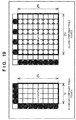
- Non-patent reference 2 describes an LM mode as a technique for reducing redundancy among color components. For example, a case of using the LM mode for an image of a YUV420 format will now be described using FIG. 18 .
- FIG. 18A shows chroma component pixels
- FIG. 18B shows luma component pixels.
- the chroma component is linearly predicted using the luma component that have been reconstructed in the pixels denoted by 16 white circles in FIG. 18B and a prediction equation indicated as Equation (1) below.
- Equation (1) P L denotes a pixel value of the luma component, and pred c denotes a predictive pixel value of the chroma component.
- ⁇ and ⁇ respectively indicate parameters that can be obtained using reference pixels denoted by 8 black circles in FIG. 18A and 8 black circles in FIG. 18B , and are determined by Equations (2) and (3) below.
- Equation (2) denotes inner product calculation
- M in Equation (3) denotes averaging calculation
- P' c in Equations (2) and (3) denotes a pixel value of a reference pixel of the chroma component.
- P ⁇ L denotes a pixel value of the luma component obtained while considering phases of the luma and the chroma, and is determined by Equation (4) below.
- the chroma prediction is performed for each smallest processing block, which is called a TU (Transform Unit).
- the number of reference pixels in the vertical direction increases as shown in FIG. 19 .
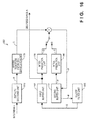
- FIG. 20 is a block diagram of the intra prediction units 20 and 140 that perform intra prediction using the aforementioned LM mode.
- the intra prediction units 20 and 140 each include a luma reference pixel acquisition unit 21, a chroma reference pixel acquisition unit 22, a prediction coefficient derivation unit 23, and a chroma linear prediction unit 24.
- the luma component of the local decoded image f is input to the luma reference pixel acquisition unit 21.
- This luma reference pixel acquisition unit 21 acquires a pixel value of each reference pixel existing neighboring a luma block corresponding to a chroma prediction target block, adjusts the phase of the acquired pixel value, and outputs the phase-adjusted pixel value as a luma reference pixel value h.
- the chroma component of the local decoded image f is input to the chroma reference pixel acquisition unit 22.
- This chroma reference pixel acquisition unit 22 acquires a pixel value of each reference pixel existing neighboring the chroma prediction target block, and outputs the acquired pixel value as a chroma reference pixel value i.
- the luma reference pixel value h and the chroma reference pixel value i are input to the prediction coefficient derivation unit 23.
- This prediction coefficient derivation unit 23 obtains the parameters ⁇ and ⁇ from Equations (2) to (4) above using these input pixel values, and outputs the parameters ⁇ and ⁇ as prediction coefficients j.
- the luma component of the local decoded image f and the prediction coefficients j are input to the chroma linear prediction unit 24.
- This chroma linear prediction unit 24 obtains a predictive pixel value of the chroma component by Equation (1) above using these input signals, and outputs the obtained predictive pixel value as a chroma predictive pixel value k.
- the available memory capacity is increasing with the advance of the semiconductor technology.
- the granularity of memory access becomes large.
- the memory bandwidth has not been significantly widened compared with the increase of the memory capacity. Since the memory is used in encoding and decoding of video images, the granularity of the memory access and the memory bandwidth have been bottlenecks.
- a memory that is closest to a calculation core e.g., an SRAM
- an external memory e.g., a DRAM
- the memory capacity of the memory closest to the calculation core can be reduced as much as possible.
- the memory closest to the calculation core needs to be able to satisfy memory requirements at the worst value, rather than average memory requirements (granularity, size, and number etc.).
- the number of times of calculation and the number of reference pixels for deriving the parameters in the case of using the LM mode for an image of the YUV420 format will be considered below.
- the size of an LCU (Largest Encoding unit), which is the largest processing block, is provided as 64x64 in the main profile in Non-patent reference 1, and the size of the smallest CU, which is the smallest processing block, is 4x4.
- the number of chroma pixels in the YUV420 format is 1/4
- the smallest calculation block of the luma component is 8x8.
- the number of reference pixels is 28x64 times.
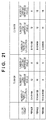
- Non-patent reference 2 describes a technique for deriving the parameters for each CU (Encoding unit) in order to reduce the worst value of the number of times of calculation for deriving the parameters for an image of a non-YUV420 format.
- FIG. 21 shows the number of times of calculation and the number of reference pixels in the case of deriving the parameters for each TU and in the case of deriving the parameters for each CU.
- Non-patent reference 3 describes a technique for reducing the number of reference pixels in the LM mode for an image of a non-YUV420 format.
- FIG. 22 For example, a case of applying the technique in Non-patent reference 3 to an image of a YUV422 format will be described using FIG. 22 .
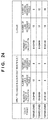
- the number of reference pixels neighboring the long side of a prediction target block is half compared with the case shown in FIG. 19 .
- both the number of luma reference pixels and the number of chroma reference pixels are 8 pixels.
- Non-patent reference 1 JCTVC-L1003, High Efficiency Video Coding (HEVC) Range Extensions text specification: Draft 2 (for PDAM).
- Non-patent reference 2 JCTVC-M0097, RCE1: The performance of extended chroma mode for non-4:2:0 format.
- Non-patent reference 3 JCTVC-M0412, AHG5: CU based chroma intra prediction with reduced reference.
- Non-patent reference 3 achieves a reduction in the number of reference pixels by uniformly sub-sampling the reference pixels. For this reason, when sub-sampling the reference pixels, characteristics of images are not considered, and there is a possibility of degradation in encoding performance.
- the present invention has been made in view of the foregoing problem, and an object of the invention is to reduce the number of reference pixels to be referenced in order to reduce redundancy among color components, while suppressing degradation in encoding performance.
- the present invention proposes the following items.
- the reference pixels existing neighboring the luma block corresponding to the chroma prediction target block and the reference pixels existing neighboring the chroma prediction target block are sub-sampled based on the luma intra prediction mode.
- the reference pixels can be sub-sampled based on a luma component prediction method, and therefore the number of pixels to be referenced in order to reduce redundancy among color components can be halved, while considering characteristics of the image. Accordingly, the number of reference pixels to be referenced in order to reduce redundancy among color components can be reduced, while suppressing degradation in encoding performance.
- the number of reference pixels to be referenced in order to reduce redundancy among color components can be reduced, while suppressing degradation in encoding performance.
- FIG. 1 is a block diagram of a video encoding device AA according to a first embodiment of the present invention.
- the video encoding device AA is different from the video encoding device MM according to the conventional example shown in FIG. 15 in that an intra prediction unit 20A is provided in place of the intra prediction unit 20.
- an intra prediction unit 20A is provided in place of the intra prediction unit 20. Note that the same constituent elements of the video encoding device AA as those of the video encoding device MM are assigned the same signs, and descriptions thereof will be omitted.
- FIG. 2 is a block diagram of the intra prediction unit 20A.
- the intra prediction unit 20A is different from the intra prediction unit 20 according to the conventional example shown in FIG. 20 in that an adaptive-sub-sampling luma reference pixel acquisition unit 21A is provided in place of the luma reference pixel acquisition unit 21, and in that an adaptive-sub-sampling chroma reference pixel acquisition unit 22A is provided in place of the chroma reference pixel acquisition unit 22.
- a luma component of a local decoded image f is input to the adaptive-sub-sampling luma reference pixel acquisition unit 21A.
- This adaptive-sub-sampling luma reference pixel acquisition unit 21A performs processing appropriate for the encoding unit, and generates and outputs a luma reference pixel value h.
- the adaptive-sub-sampling luma reference pixel acquisition unit 21A acquires a pixel value of each reference pixel existing neighboring a luma block corresponding to a chroma prediction target block, adjusts the phase thereof, and outputs the phase-adjusted pixel value as a luma reference pixel value h.
- the adaptive-sub-sampling luma reference pixel acquisition unit 21A initially determines a luma intra prediction mode such that the input image a is most resembled using the local decoded image f.
- the adaptive-sub-sampling luma reference pixel acquisition unit 21A sub-samples reference pixels existing neighboring the luma block corresponding to the chroma prediction target block based on the luma intra prediction mode, acquires a pixel value of each of the sub-sampled reference pixels, and outputs the acquired pixel value as a luma reference pixel value h.
- a chroma component of the local decoded image f is input to the adaptive-sub-sampling chroma reference pixel acquisition unit 22A.
- This adaptive-sub-sampling chroma reference pixel acquisition unit 22A performs processing appropriate for the encoding unit, and generates and outputs a chroma reference pixel value i.
- the adaptive-sub-sampling chroma reference pixel acquisition unit 22A acquires a pixel value of each reference pixel exiting neighboring the chroma prediction target block, and outputs the acquired pixel value as the chroma reference pixel value i.
- the adaptive-sub-sampling chroma reference pixel acquisition unit 22A initially determines a luma intra prediction mode such that the input image a is most resembled using the local decoded image f.
- the adaptive-sub-sampling chroma reference pixel acquisition unit 22A sub-samples the reference pixels existing neighboring the chroma prediction target block based on the luma intra prediction mode, acquires a pixel value of each of the sub-sampled reference pixels, and outputs the acquired pixel value as a chroma reference pixel value i.
- the luma component prediction method can be determined by referencing the luma intra prediction mode.
- the adaptive-sub-sampling luma reference pixel acquisition unit 21A uniformly sub-samples the reference pixels existing neighboring the luma block corresponding to the chroma prediction target block to acquire pixel values of the sub-sampled reference pixels
- the adaptive-sub-sampling chroma reference pixel acquisition unit 22A uniformly sub-samples the reference pixels existing neighboring the chroma prediction target block to acquire pixel values of the sub-sampled reference pixels.
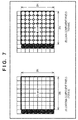
- FIG. 3 shows a case where the input image a is an image of a YUV422 format
- FIG. 6 shows a case where the input image a is an image of a YUV444 format.
- FIGS. 3 and 6 indicate that, as a result of the reference pixels being uniformly sub-sampled, the pixel value of every other reference pixel is acquired. Note that the case of direction prediction for an oblique direction refers to the case of prediction modes 15 to 21 in FIG. 17 .
- the adaptive-sub-sampling luma reference pixel acquisition unit 21A acquires pixel values of only reference pixels on the left side of the luma block corresponding to the chroma prediction target block
- the adaptive-sub-sampling chroma reference pixel acquisition unit 22A acquires pixel values of only reference pixels on the left side of the chroma prediction target block.
- FIG. 4 shows a case where the input image a is an image of a YUV422 format
- FIG. 7 shows a case where the input image a is an image of a YUV444 format.
- the case of prediction for a horizontal direction or a direction close to a horizontal direction refers to the case of prediction modes 2 to 14 in FIG. 17 .
- the adaptive-sub-sampling luma reference pixel acquisition unit 21A acquires pixel values of only reference pixels above the luma block corresponding to the chroma prediction target block
- the adaptive-sub-sampling chroma reference pixel acquisition unit 22A acquires pixel values of only reference pixels above the chroma prediction target block.
- FIG. 5 shows a case where the input image a is an image of a YUV422 format
- FIG. 8 shows a case where the input image a is an image of a YUV444 format.
- the case of prediction for a vertical direction or a direction close to a vertical direction refers to the case of prediction modes 22 to 34 in FIG. 17 .
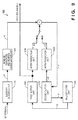
- FIG. 9 is a block diagram of a video decoding device BB according to the first embodiment of the present invention.
- the video decoding device BB is different from the video decoding device NN according to the conventional example shown in FIG. 16 in that an intra prediction unit 140A is provided in place of the intra prediction unit 140.
- an intra prediction unit 140A is provided in place of the intra prediction unit 140. Note that the same constituent elements of the video decoding device BB as those of the video decoding device NN are assigned the same signs, and descriptions thereof will be omitted.
- the intra prediction unit 140A includes the adaptive-sub-sampling luma reference pixel acquisition unit 21A, the adaptive-sub-sampling chroma reference pixel acquisition unit 22A, the prediction coefficient derivation unit 23, and the chroma linear prediction unit 24 that are shown in FIG. 2 , as the intra prediction unit 20A does.
- the adaptive-sub-sampling luma reference pixel acquisition unit 21A provided in the video encoding device AA performs processing appropriate for the encoding unit
- the adaptive-sub-sampling luma reference pixel acquisition unit 21A provided in the video decoding device BB performs processing appropriate for the decoding unit.
- the adaptive-sub-sampling luma reference pixel acquisition unit 21A acquires a pixel value of each reference pixel existing neighboring the luma block corresponding to the chroma prediction target block to adjust the phase thereof, and outputs the phase-adjusted pixel value as a luma reference pixel value.
- the adaptive-sub-sampling luma reference pixel acquisition unit 21A determines the luma intra prediction mode, sub-samples the reference pixels existing neighboring the luma block corresponding to the chroma prediction target block based on the luma intra prediction mode, acquires a pixel value of each of the sub-sampled reference pixels, and outputs the acquired pixel value as a luma reference pixel value.
- the adaptive-sub-sampling chroma reference pixel acquisition unit 22A provided in the video encoding device AA performs processing appropriate for the encoding unit
- the adaptive-sub-sampling chroma reference pixel acquisition unit 22A provided in the video decoding device BB performs processing appropriate for the decoding unit.
- the adaptive-sub-sampling chroma reference pixel acquisition unit 22A acquires a pixel value of each reference pixel existing neighboring the chroma prediction target block, and outputs the acquired pixel value as a chroma reference pixel value.
- the adaptive-sub-sampling chroma reference pixel acquisition unit 22A determines the luma intra prediction mode, sub-samples the reference pixels existing neighboring the chroma prediction target block based on the luma intra prediction mode, acquires a pixel value of each of the sub-sampled reference pixels, and outputs the acquired pixel value as a chroma reference pixel value.
- the video encoding device AA sub-samples, using the adaptive-sub-sampling luma reference pixel acquisition unit 21A, reference pixels existing neighboring the luma block corresponding to the chroma prediction target block based on the luma intra prediction mode, thereby sub-sampling these reference pixels based on the luma component prediction method.
- the video encoding device AA sub-samples, using the chroma reference pixel acquisition unit 22A, reference pixels existing neighboring the chroma prediction target block based on the luma intra prediction mode, thereby sub-sampling these reference pixels based on the luma component prediction method.
- the video decoding device BB sub-samples, using the adaptive-sub-sampling luma reference pixel acquisition unit 21A, reference pixels existing neighboring the luma block corresponding to the chroma prediction target block based on the luma intra prediction mode, thereby sub-sampling these reference pixels based on the luma component prediction method.
- the video decoding device BB sub-samples, using the chroma reference pixel acquisition unit 22A, reference pixels existing neighboring the chroma prediction target block based on the luma intra prediction mode, thereby sub-sampling these reference pixels based on the luma component prediction method.
- the video encoding device AA and the video decoding device BB can halve the number of pixels to be referenced in order to reduce redundancy among color components, while considering characteristics of an image. Accordingly, the number of reference pixels to be referenced in order to reduce redundancy among color components can be reduced, while suppressing degradation in encoding performance.
- a video encoding device CC according to a second embodiment of the present invention will be described below.
- the video encoding device CC is different from the video encoding device AA according to the first embodiment of the present invention shown in FIG. 1 in that an intra prediction unit 20B is provided in place of the intra prediction unit 20A.
- an intra prediction unit 20B is provided in place of the intra prediction unit 20A. Note that the same constituent elements of the video encoding device CC as those of the video encoding device AA will be assigned the same signs, and descriptions thereof will be omitted.
- the intra prediction unit 20B is different from the intra prediction unit 20A according to the first embodiment of the present invention shown in FIG. 1 in that an adaptive-sub-sampling luma reference pixel acquisition unit 21B is provided in place of the adaptive-sub-sampling luma reference pixel acquisition unit 21A, and in that an adaptive-sub-sampling chroma reference pixel acquisition unit 22B is provided in place of the adaptive-sub-sampling chroma reference pixel acquisition unit 22A.
- a luma component of a local decoded image f is input to the adaptive-sub-sampling luma reference pixel acquisition unit 21B.
- This adaptive-sub-sampling luma reference pixel acquisition unit 21B always initially determines a luma intra prediction mode such that the input image a is most resembled using the local decoded image f, regardless of the encoding unit.
- the adaptive-sub-sampling luma reference pixel acquisition unit 21B sub-samples reference pixels existing neighboring the luma block corresponding to the chroma prediction target block based on the luma intra prediction mode, acquires a pixel value of each of the sub-sampled reference pixels, and outputs the acquired pixel value as a luma reference pixel value h.
- a chroma component of the local decoded image f is input to the adaptive-sub-sampling chroma reference pixel acquisition unit 22B.
- This adaptive-sub-sampling chroma reference pixel acquisition unit 22B always initially determines the luma intra prediction mode such that the input image a is most resembled using the local decoded image f, regardless of the encoding unit.
- the adaptive-sub-sampling chroma reference pixel acquisition unit 22B sub-samples reference pixels existing neighboring the chroma prediction target block based on the luma intra prediction mode, acquires a pixel value of each of the sub-sampled reference pixels, and outputs the acquired pixel value as a chroma reference pixel value i.
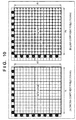
- FIG. 10 shows an example in which reference pixels are uniformly sub-sampled in the case where the encoding unit is the smallest TU block and the input image a is an image of a YUV444 format.
- a video decoding device DD according to a second embodiment of the present invention will be described below.
- the video decoding device DD is different from the video decoding device BB according to the first embodiment of the present invention shown in FIG. 9 in that an intra prediction unit 140B is provided in place of the intra prediction unit 140A.
- an intra prediction unit 140B is provided in place of the intra prediction unit 140A. Note that the same constituent elements of the video decoding device DD as those of the video decoding device BB are assigned the same signs, and descriptions thereof will be omitted.
- the intra prediction unit 140B includes the adaptive-sub-sampling luma reference pixel acquisition unit 21B, the adaptive-sub-sampling chroma reference pixel acquisition unit 22B, the prediction coefficient derivation unit 23, and the chroma linear prediction unit 24, as the intra prediction unit 20B does.
- the adaptive-sub-sampling luma reference pixel acquisition unit 21B provided in the video decoding device DD always determines the luma intra prediction mode, sub-samples reference pixels existing neighboring the luma block corresponding to the chroma prediction target block based on the luma intra prediction mode, acquires a pixel value of each of the sub-sampled reference pixels, and outputs the acquired pixel value as a luma reference pixel value, regardless of the decoding unit.
- the adaptive-sub-sampling chroma reference pixel acquisition unit 22B provided in the video decoding device DD always determines the luma intra prediction mode, sub-samples reference pixels existing neighboring the chroma prediction target block based on the luma intra prediction mode, acquires a pixel value of each of the sub-sampled reference pixels, and outputs the acquired pixel value as a chroma reference pixel value, regardless of the decoding unit.
- the following effect can be achieved in addition to the above-described effect that can be achieved by the video encoding device AA and the video decoding device BB.
- the video encoding device CC always sub-samples the reference pixels regardless of the encoding unit. Also, the video decoding device DD always sub-samples the reference pixels regardless of the decoding unit. For this reason, the reference pixels can be sub-sampled even in a larger block than the smallest CU block, and accordingly a calculation load of the prediction coefficient derivation unit 23 can be reduced.
- the present invention can be achieved by recording, in a computer-readable non-transitory storage medium, the processing of the video encoding device AA/CC and the video decoding device BB/DD according to the present invention, and causing the video encoding device AA/CC and the video decoding device BB/DD to read and execute a program recorded in this storage medium.
- a nonvolatile memory such as an EPROM or a flash memory
- a magnetic disk such as a hard disk, a CD-ROM, or the like
- the program recorded in this storage medium is read and executed by processors provided in the video encoding device AA/CC and the video decoding device BB/DD.
- the aforementioned program may be transmitted from the video encoding device AA/CC and the video decoding device BB/DD in which this program is stored in the storage device to another computer system via a transmission medium or through transmitted waves in the transmission medium.
- the "transmission medium” that transmits the program refers to a medium having a function of transmitting information, such as a network (communication network) including the Internet or a communication line including a telephone line.
- the aforementioned program may be for achieving a part of the above-described functions. Furthermore, the aforementioned program may be one that can achieve the above-described functions in combination with a program that is already recorded in the video encoding device AA/CC and the video decoding device BB/DD, i.e., a so-called differential file (differential program).
- reference pixels are sub-sampled based on the luma intra prediction mode in the case where the input image a is an image of a non-YUV420 format and the encoding unit or the decoding unit is the smallest CU block.
- reference pixels may also be sub-sampled based on the luma intra prediction mode in the case where the input image a is an image of a YUV420 format and the encoding unit or the decoding unit is the smallest CU block.
- FIG. 11 shows an example in which reference pixels are uniformly sub-sampled in the case where the input image a is an image of a YUV420 format.
- reference pixels are sub-sampled to halve the number thereof, but the invention is not limited thereto and reference pixels may be sub-sampled to reduce the number thereof to 1/n of the number thereof before the sub-sampling (where n is any power of two that satisfies n>0).
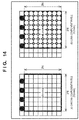
- FIGS. 12 , 13 , and 14 show cases where the input image a is an image of a YUV444 format, and reference pixels are sub-sampled to reduce the number thereof to 1/4.
- FIG. 12 shows a case where the reference pixels are uniformly sub-sampled.
- the pixel value of every other reference pixel is acquired, and both the number of luma reference pixels and the number of chroma reference pixels are 4 pixels.
- both the number of luma reference pixels and the number of chroma reference pixels are 16 pixels, as described above using FIGS. 21 and 24 . Accordingly, the number of reference pixels is 1/4 of that in the conventional example.
- FIG. 13 shows a case of acquiring pixel values of only reference pixels on the left side of the luma block corresponding to the chroma prediction target block, and reference pixels on the left side of the chroma prediction target block.
- the pixel value of every other reference pixel on the left side of the luma block and the chroma prediction target block is acquired, and both the number of luma reference pixels and the number of chroma reference pixels are 4 pixels. Accordingly, the number of reference pixels is 1/4 of that in the conventional example.
- FIG. 14 shows a case of acquiring pixel values of only reference pixels above the luma block corresponding to the chroma prediction target block, and reference pixels above the chroma prediction target block.
- the pixel value of every other reference pixel above the luma block and the chroma prediction target block is acquired, and both the number of luma reference pixels and the number of chroma reference pixels are 4 pixels. Accordingly, the number of reference pixels is 1/4 of that in the conventional example.
Landscapes
- Engineering & Computer Science (AREA)
- Multimedia (AREA)
- Signal Processing (AREA)
- Computing Systems (AREA)
- Theoretical Computer Science (AREA)
- Compression Or Coding Systems Of Tv Signals (AREA)
- Color Television Systems (AREA)
Abstract
Description
- The present invention relates to video encoding devices, video decoding devices, video systems, video encoding methods, video decoding methods, and programs.
- HEVC (High Efficiency Video Coding) has been proposed as a video encoding method using intra prediction, inter prediction, and residual transform (e.g., see Non-patent reference 1).
-
FIG. 15 is a block diagram of a video encoding device MM according to a conventional example that codes a video image using the aforementioned video encoding method. The video encoding device MM includes aninter prediction unit 10, anintra prediction unit 20, a transform andquantization unit 30, anentropy encoding unit 40, an inverse quantization andinverse transform unit 50, an in-loop filtering unit 60, afirst buffer unit 70, and asecond buffer unit 80. - An input image a and a later-described local decoded image g that is supplied from the
first buffer unit 70 are input to theinter prediction unit 10. Thisinter prediction unit 10 performs inter prediction (inter-frame prediction) using the input image a and the local decoded image g to generate and output an inter prediction image b. - The input image a and a later-described local decoded image f that is supplied from the
second buffer unit 80 are input to theintra prediction unit 20. Thisintra prediction unit 20 performs intra prediction (intra-frame prediction) using the input image a and the local decoded image f to generate and output an intra prediction image c. - An error (residual) signal between the input image a and the inter prediction image b or the intra predication image c is input to the transform and
quantization unit 30. This transform andquantization unit 30 transforms and quantizes the input residual signal to generate and output a quantization coefficient d. - The quantization coefficient d and side information (not shown) are input to the
entropy encoding unit 40. Thisentropy encoding unit 40 performs entropy encoding on the input signal and outputs the entropy-coded signal as a bitstream z. - The quantization coefficient d is input to the inverse quantization and
inverse transform unit 50. This inverse quantization andinverse transform unit 50 performs inverse quantization and inverse transform on the quantization coefficient d to generate and output an inverse-transformed residual signal e. - The
second buffer unit 80 accumulates the local decoded image f and supplies the accumulated local decoded image f to theintra prediction unit 20 and the in-loop filtering unit 60 as appropriate. The local decoded image f is a signal obtained by adding up the inter prediction image b or the intra prediction image c and the inverse-transformed residual signal e. - The local decoded image f is input to the in-
loop filtering unit 60. This in-loop filtering unit 60 applies a filter such as a deblocking filter to the local decoded image f to generate and output the local decoded image g. - The
first buffer unit 70 accumulates the local decoded image g and supplies the accumulated local decoded image g to theinter prediction unit 10 as appropriate. - [Configuration and operations of video decoding device NN]
-
FIG. 16 is a block diagram of a video decoding device NN according to a conventional example that decodes a video image from the bitstream z generated by the video encoding device MM. The video decoding device NN includes anentropy decoding unit 110, an inverse transform andinverse quantization unit 120, aninter prediction unit 130, anintra prediction unit 140, an in-loop filter 150, afirst buffer unit 160, and asecond buffer unit 170. - The bitstream z is input to the
entropy decoding unit 110. Thisentropy decoding unit 110 performs entropy decoding on the bitstream z, and generates and outputs a quantization coefficient B. - The inverse transform and
inverse quantization unit 120, theinter prediction unit 130, theintra prediction unit 140, the in-loop filtering unit 150, thefirst buffer unit 160, and thesecond buffer unit 170 respectively operate similarly to the inverse quantization andinverse transform unit 50, theinter prediction unit 10, theintra prediction unit 20, the in-loop filtering unit 60, thefirst buffer unit 70, and thesecond buffer unit 80 shown inFIG. 15 . - The aforementioned intra prediction will be described below in detail. Regarding intra prediction, Non-patent
reference 1 indicates that pixel values in a encoding target block are predicted for each color component, using pixel values of reference pixels, which are reconstructed pixels that have already been encoded. Also, as luma component prediction methods, a total of 35 modes, namely DC, Planar, and direction prediction for 33 directions are indicated as shown inFIG. 17 . As chroma component prediction methods, a method using the same prediction classification as that for a luma component, as well as DC, Planar, horizontal, and vertical methods that are independent from those for the luma component are indicated. With the above configuration, spatial redundancy can be reduced for each color component. - Non-patent
reference 2 describes an LM mode as a technique for reducing redundancy among color components. For example, a case of using the LM mode for an image of a YUV420 format will now be described usingFIG. 18 . -
FIG. 18A shows chroma component pixels, andFIG. 18B shows luma component pixels. In the LM mode, the chroma component is linearly predicted using the luma component that have been reconstructed in the pixels denoted by 16 white circles inFIG. 18B and a prediction equation indicated as Equation (1) below. - [Equation 1]

- In Equation (1), PL denotes a pixel value of the luma component, and predc denotes a predictive pixel value of the chroma component. α and β respectively indicate parameters that can be obtained using reference pixels denoted by 8 black circles in
FIG. 18A and8 black circles inFIG. 18B , and are determined by Equations (2) and (3) below. - [Equation 2]

- [Equation 3]

- R in Equation (2) denotes inner product calculation, M in Equation (3) denotes averaging calculation, and P'c in Equations (2) and (3) denotes a pixel value of a reference pixel of the chroma component. P^L denotes a pixel value of the luma component obtained while considering phases of the luma and the chroma, and is determined by Equation (4) below.
- [Equation 4]

- Note that the phase of the reference pixel in the upper part remains shifted in order to reduce memory access. The chroma prediction is performed for each smallest processing block, which is called a TU (Transform Unit).
- In the case of extending the LM mode for an image of the aforementioned YUV420 format and using the extended LM mode for an image of a YUV422 format, the number of reference pixels in the vertical direction increases as shown in
FIG. 19 . -
FIG. 20 is a block diagram of theintra prediction units intra prediction units pixel acquisition unit 21, a chroma referencepixel acquisition unit 22, a predictioncoefficient derivation unit 23, and a chromalinear prediction unit 24. - The luma component of the local decoded image f is input to the luma reference
pixel acquisition unit 21. This luma referencepixel acquisition unit 21 acquires a pixel value of each reference pixel existing neighboring a luma block corresponding to a chroma prediction target block, adjusts the phase of the acquired pixel value, and outputs the phase-adjusted pixel value as a luma reference pixel value h. - The chroma component of the local decoded image f is input to the chroma reference
pixel acquisition unit 22. This chroma referencepixel acquisition unit 22 acquires a pixel value of each reference pixel existing neighboring the chroma prediction target block, and outputs the acquired pixel value as a chroma reference pixel value i. - The luma reference pixel value h and the chroma reference pixel value i are input to the prediction
coefficient derivation unit 23. This predictioncoefficient derivation unit 23 obtains the parameters α and β from Equations (2) to (4) above using these input pixel values, and outputs the parameters α and β as prediction coefficients j. - The luma component of the local decoded image f and the prediction coefficients j are input to the chroma
linear prediction unit 24. This chromalinear prediction unit 24 obtains a predictive pixel value of the chroma component by Equation (1) above using these input signals, and outputs the obtained predictive pixel value as a chroma predictive pixel value k. - Incidentally, the available memory capacity is increasing with the advance of the semiconductor technology. However, with the increase of the memory capacity, the granularity of memory access becomes large. Meanwhile, the memory bandwidth has not been significantly widened compared with the increase of the memory capacity. Since the memory is used in encoding and decoding of video images, the granularity of the memory access and the memory bandwidth have been bottlenecks.
- In addition, manufacturing costs and power consumption of a memory that is closest to a calculation core (e.g., an SRAM) are higher than those of an external memory (e.g., a DRAM). For this reason, it is favorable that the memory capacity of the memory closest to the calculation core can be reduced as much as possible. However, since video images need to be able to be decoded even with the worst value provided in the specifications, the memory closest to the calculation core needs to be able to satisfy memory requirements at the worst value, rather than average memory requirements (granularity, size, and number etc.).
- In the LM mode, since the parameters are derived for each TU as mentioned above, the number of reference pixels increases, and the number of times of calculation and the number of times of memory access become large.
- For example, the number of times of calculation and the number of reference pixels for deriving the parameters in the case of using the LM mode for an image of the YUV420 format will be considered below. The size of an LCU (Largest Encoding unit), which is the largest processing block, is provided as 64x64 in the main profile in
Non-patent reference 1, and the size of the smallest CU, which is the smallest processing block, is 4x4. In addition, since the number of chroma pixels in the YUV420 format is 1/4, the smallest calculation block of the luma component is 8x8. For this reason, the number of times of calculation for deriving the parameters is (64/8)2=64 times, and the number of reference pixels is 28x64 times. -
Non-patent reference 2 describes a technique for deriving the parameters for each CU (Encoding unit) in order to reduce the worst value of the number of times of calculation for deriving the parameters for an image of a non-YUV420 format.FIG. 21 shows the number of times of calculation and the number of reference pixels in the case of deriving the parameters for each TU and in the case of deriving the parameters for each CU. - As described above, redundancy among color components can be reduced in the LM mode. However, when considering the CTU units, a problem arises in that the number of reference pixels of the worst value used when deriving the parameters is large.
-
Non-patent reference 3 describes a technique for reducing the number of reference pixels in the LM mode for an image of a non-YUV420 format. - For example, a case of applying the technique in
Non-patent reference 3 to an image of a YUV422 format will be described usingFIG. 22 . In this case, the number of reference pixels neighboring the long side of a prediction target block is half compared with the case shown inFIG. 19 . For this reason, as shown inFIG. 24 , both the number of luma reference pixels and the number of chroma reference pixels are 8 pixels. - Also, a case of applying the technique in
Non-patent reference 3 to an image of a YUV444 format will be described usingFIG. 23 . In this case as well, the number of reference pixels neighboring the long side of a prediction target block is half. For this reason, as shown inFIG. 24 , both the number of luma reference pixels and the number of chroma reference pixels are 8 pixels. - Non-patent reference 1: JCTVC-L1003, High Efficiency Video Coding (HEVC) Range Extensions text specification: Draft 2 (for PDAM).
Non-patent reference 2: JCTVC-M0097, RCE1: The performance of extended chroma mode for non-4:2:0 format.
Non-patent reference 3: JCTVC-M0412, AHG5: CU based chroma intra prediction with reduced reference. - The technique described in
Non-patent reference 3 achieves a reduction in the number of reference pixels by uniformly sub-sampling the reference pixels. For this reason, when sub-sampling the reference pixels, characteristics of images are not considered, and there is a possibility of degradation in encoding performance. - The present invention has been made in view of the foregoing problem, and an object of the invention is to reduce the number of reference pixels to be referenced in order to reduce redundancy among color components, while suppressing degradation in encoding performance.
- In order to solve the foregoing problem, the present invention proposes the following items.
- (1) The invention proposes a video encoding device (corresponding, for example, to a video encoding device AA in
FIG. 1 ) that codes a video image configured to include a plurality of color components, including: intra-frame prediction means (corresponding, for example, to an intra prediction unit 20A inFIG. 1 ) for performing intra-frame prediction, the intra-frame prediction means including: adaptive-sub-sampling luma reference pixel sub-sampling means (corresponding, for example, to an adaptive-sub-sampling luma reference pixel acquisition unit 21A inFIG. 2 ) for sub-sampling reference pixels existing neighboring a luma block corresponding to a chroma prediction target block based on a luma intra prediction mode; adaptive-sub-sampling luma reference pixel acquisition means (corresponding, for example, to the adaptive-sub-sampling luma reference pixel acquisition unit 21A inFIG. 2 ) for acquiring a pixel value of a reference pixel after the sub-sampling performed by the adaptive-sub-sampling luma reference pixel sub-sampling means; adaptive-sub-sampling chroma reference pixel sub-sampling means (corresponding, for example, to an adaptive-sub-sampling chroma reference pixel acquisition unit 22A inFIG. 2 ) for sub-sampling reference pixels existing neighboring the chroma prediction target block based on the luma intra prediction mode; adaptive-sub-sampling chroma reference pixel acquisition means (corresponding, for example, to the adaptive-sub-sampling chroma reference pixel acquisition unit 22A inFIG. 2 ) for acquiring a pixel value of a reference pixel after the sub-sampling performed by the adaptive-sub-sampling chroma reference pixel sub-sampling means; prediction coefficient derivation means (corresponding, for example, to a prediction coefficient derivation unit 23 inFIG. 2 ) for deriving a prediction coefficient using the pixel value acquired by the adaptive-sub-sampling luma reference pixel acquisition means and the pixel value acquired by the adaptive-sub-sampling chroma reference pixel acquisition means; and chroma linear prediction means (corresponding, for example, to a chroma linear prediction unit 24 inFIG. 2 ) for linearly predicting a predictive pixel value of each pixel constituting the chroma prediction target block, using a local decoded pixel value of the luma block corresponding to the chroma prediction target block and the prediction coefficient derived by the prediction coefficient derivation means.
According to this invention, in the intra-frame prediction, the reference pixels existing neighboring the luma block corresponding to the chroma prediction target block and the reference pixels existing neighboring the chroma prediction target block are sub-sampled based on the luma intra prediction mode. For this reason, the reference pixels can be sub-sampled based on a luma component prediction method, and therefore the number of pixels to be referenced in order to reduce redundancy among color components can be halved, while considering characteristics of the image. Accordingly, the number of reference pixels to be referenced in order to reduce redundancy among color components can be reduced, while suppressing degradation in encoding performance. - (2) Regarding the video encoding device in (1), the present invention proposes a video encoding device in which the adaptive-sub-sampling luma reference pixel sub-sampling means and the adaptive-sub-sampling chroma reference pixel sub-sampling means perform the sub-sampling only in a case where a encoding unit is a predetermined smallest encoding unit.
According to this invention, in the video encoding device in (1), the aforementioned sub-sampling is performed only in the case where the encoding unit is the predetermined smallest encoding unit. For this reason, the number of reference pixels to be referenced in order to reduce redundancy among color components can be reduced only in the case where the encoding unit is the predetermined smallest encoding unit. - (3) Regarding the video encoding device in (1), the present invention proposes a video encoding device in which the adaptive-sub-sampling luma reference pixel sub-sampling means and the adaptive-sub-sampling chroma reference pixel sub-sampling means always perform the sub-sampling regardless of a encoding unit.
According to this invention, in the video encoding device in (1), the aforementioned sub-sampling is always performed regardless of the encoding unit. For this reason, the number of reference pixels to be referenced in order to reduce redundancy among color components can always be reduced regardless of the encoding unit. - (4) Regarding any of the video encoding devices in (1) to (3), the present invention proposes a video encoding device in which the adaptive-sub-sampling luma reference pixel sub-sampling means and the adaptive-sub-sampling chroma reference pixel sub-sampling means perform the sub-sampling and reduce the number of reference pixels to 1/n (where n is any power of two that satisfies n>0) of the number of reference pixels before the sub-sampling.
According to this invention, in any of the video encoding devices in (1) to (3), by sub-sampling the reference pixels, the number of reference pixels is reduced to 1/n of the number of reference pixels before the sub-sampling. For this reason, it is possible to adjust suppressing degradation in encoding performance and a decrease of the number of reference pixels to be referenced in order to reduce redundancy among color components, by setting the value of n. - (5) Regarding any of the video encoding devices in (1) to (4), the present invention proposes a video encoding device in which the video image is a video image of a YUV422 format.
According to this invention, in any of the video encoding devices in (1) to (4), the video image is a video image of a YUV422 format. For this reason, even if a pixel block of the chroma component is rectangular in the video image of a YUV422 format, the reference pixels can be sub-sampled such that the number thereof becomes a power of two, and therefore, operations such as division can be achieved with shift operation. - (6) Regarding any of the video encoding devices in (1) to (5), the present invention proposes a video encoding device in which the size of a processing block is 8x8.
Here, in the case where the size of the processing block is 4x4, the reference pixels are excessively sub-sampled, and accordingly the accuracy of the prediction coefficient decreases, and the number of times of operation in a CTU (64x64) is 16×16=256, which is too many. In contrast, in the case where the size of the processing block is 16x16, the reference pixels are not excessively sub-sampled, and therefore the accuracy of the prediction coefficient increases, whereas the encoding performance degrades since detailed characteristics of the processing block cannot be reflected.
For this reason, according to this invention, in any of the video encoding devices in (1) to (5), the size of the processing block is 8x8. For this reason, the accuracy of the prediction coefficient can be increased while not excessively sub-sampling the reference pixels, and it is also possible to reflect detailed characteristics of the processing block while suppressing the number of times of operation in each CTU, and increase the encoding performance. - (7) The invention proposes A video decoding device (corresponding, for example, to a video decoding device BB in
FIG. 9 ) that decodes a video image configured to include a plurality of color components, including: intra-frame prediction means (corresponding, for example, to an intra prediction unit 140A inFIG. 9 ) for performing intra-frame prediction, the intra-frame prediction means including: adaptive-sub-sampling luma reference pixel sub-sampling means (corresponding, for example, to the adaptive-sub-sampling luma reference pixel acquisition unit 21A inFIG. 2 ) for sub-sampling reference pixels existing neighboring a luma block corresponding to a chroma prediction target block based on a luma intra prediction mode; adaptive-sub-sampling luma reference pixel acquisition means (corresponding, for example, to the adaptive-sub-sampling luma reference pixel acquisition unit 21A inFIG. 2 ) for acquiring a pixel value of a reference pixel after the sub-sampling performed by the adaptive-sub-sampling luma reference pixel sub-sampling means; adaptive-sub-sampling chroma reference pixel sub-sampling means (corresponding, for example, to the adaptive-sub-sampling chroma reference pixel acquisition unit 22A inFIG. 2 ) for sub-sampling reference pixels existing neighboring the chroma prediction target block based on the luma intra prediction mode; adaptive-sub-sampling chroma reference pixel acquisition means (corresponding, for example, to the adaptive-sub-sampling chroma reference pixel acquisition unit 22A inFIG. 2 ) for acquiring a pixel value of a reference pixel after the sub-sampling performed by the adaptive-sub-sampling chroma reference pixel sub-sampling means; prediction coefficient derivation means (corresponding, for example, to the prediction coefficient derivation unit 23 inFIG. 2 ) for deriving a prediction coefficient using the pixel value acquired by the adaptive-sub-sampling luma reference pixel acquisition means and the pixel value acquired by the adaptive-sub-sampling chroma reference pixel acquisition means; and chroma linear prediction means (corresponding, for example, to the chroma linear prediction unit 24 inFIG. 2 ) for linearly predicting a predictive pixel value of each pixel constituting the chroma prediction target block, using a local decoded pixel value of the luma block corresponding to the chroma prediction target block and the prediction coefficient derived by the prediction coefficient derivation means.
According to this invention, in the intra-frame prediction, the reference pixels existing neighboring the luma block corresponding to the chroma prediction target block and the reference pixels existing neighboring the chroma prediction target block are sub-sampled based on the luma intra prediction mode. For this reason, the reference pixels can be sub-sampled based on a luma component prediction method, and therefore the number of pixels to be referenced in order to reduce redundancy among color components can be halved, while considering characteristics of the image. Accordingly, the number of reference pixels to be referenced in order to reduce redundancy among color components can be reduced, while suppressing degradation in encoding performance. - (8) Regarding the video decoding device in (7), the present invention proposes a video decoding device in which the adaptive-sub-sampling luma reference pixel sub-sampling means and the adaptive-sub-sampling chroma reference pixel sub-sampling means perform the sub-sampling only in a case where a decoding unit is a predetermined smallest decoding unit.
According to this invention, in the video decoding device in (7), the aforementioned sub-sampling is performed only in the case where the decoding unit is the predetermined smallest decoding unit. For this reason, the number of reference pixels to be referenced in order to reduce redundancy among color components can be reduced only in the case where the decoding unit is the predetermined smallest decoding unit. - (9) Regarding the video decoding device in (7), the present invention proposes a video decoding device in which the adaptive-sub-sampling luma reference pixel sub-sampling means and the adaptive-sub-sampling chroma reference pixel sub-sampling means always perform the sub-sampling regardless of a decoding unit.
According to this invention, in the video decoding device in (7), the aforementioned sub-sampling is always performed regardless of the encoding unit. For this reason, the number of reference pixels to be referenced in order to reduce redundancy among color components can always be reduced regardless of the decoding unit. - (10) Regarding any of the video decoding devices in (7) to (9), the present invention proposes a video decoding device in which the adaptive-sub-sampling luma reference pixel sub-sampling means and the adaptive-sub-sampling chroma reference pixel sub-sampling means perform the sub-sampling and reduce the number of reference pixels to 1/n (where n is any power of two that satisfies n>0) of the number of reference pixels before the sub-sampling.
According to this invention, in any of the video decoding devices in (7) to (9), by sub-sampling the reference pixels, the number of reference pixels is reduced to 1/n of the number of reference pixels before the sub-sampling. For this reason, it is possible to adjust suppressing degradation in encoding performance and a decrease of the number of reference pixels to be referenced in order to reduce redundancy among color components, by setting the value of n. - (11) Regarding any of the video decoding devices in (7) to (10), the present invention proposes a video decoding device in which the video image is a video image of a YUV422 format.
According to this invention, in any of the video decoding devices in (7) to (10), the video image is a video image of a YUV422 format. For this reason, even if a pixel block of the chroma component is rectangular in the video image of a YUV422 format, the number of reference pixels can be sub-sampled so as to become a power of two, and therefore, operations such as division can be achieved with shift operation. - (12) Regarding any of the video decoding devices in (7) to (11), the present invention proposes a video decoding device in which the size of a processing block is 8x8.
Here, in the case where the size of the processing block is 4x4, the reference pixels are excessively sub-sampled, and accordingly the accuracy of the prediction coefficient decreases, and the number of times of operation in a CTU (64x64) is 16×16=256, which is too many. In contrast, in the case where the size of the processing block is 16x16, the reference pixels are not excessively sub-sampled, and therefore the accuracy of the prediction coefficient increases, whereas the encoding performance degrades since detailed characteristics of the processing block cannot be reflected.
For this reason, according to this invention, in any of the video encoding devices in (7) to (11), the size of the processing block is 8x8. For this reason, the accuracy of the prediction coefficient can be increased while not excessively sub-sampling the reference pixels, and it is also possible to reflect detailed characteristics of the processing block while suppressing the number of times of operation in each CTU, and increase the encoding performance. - (13) The present invention proposes a video system including a video encoding device (corresponding, for example, to the video encoding device AA in
FIG. 1 ) that codes a video image configured to include a plurality of color components, and a video decoding device (corresponding, for example, to the video decoding device BB inFIG. 9 ) that decodes a video image configured to include a plurality of color components, the video encoding device including encoding-side intra-frame prediction means (corresponding, for example, to the intra prediction unit 20A inFIG. 1 ) for performing intra-frame prediction, the encoding-side intra-frame prediction means including: coding-side adaptive-sub-sampling luma reference pixel sub-sampling means (corresponding, for example, to the adaptive-sub-sampling luma reference pixel acquisition unit 21A inFIG. 2 ) for sub-sampling reference pixels existing neighboring a luma block corresponding to a chroma prediction target block based on a luma intra prediction mode; coding-side adaptive-sub-sampling luma reference pixel acquisition means (corresponding, for example, to the adaptive-sub-sampling luma reference pixel acquisition unit 21A inFIG. 2 ) for acquiring a pixel value of a reference pixel after the sub-sampling performed by the encoding-side adaptive-sub-sampling luma reference pixel sub-sampling means; coding-side adaptive-sub-sampling chroma reference pixel sub-sampling means (corresponding, for example, to the adaptive-sub-sampling chroma reference pixel acquisition unit 22A inFIG. 2 ) for sub-sampling reference pixels existing neighboring the chroma prediction target block based on the luma intra prediction mode; coding-side adaptive-sub-sampling chroma reference pixel acquisition means (corresponding, for example, to the adaptive-sub-sampling chroma reference pixel acquisition unit 22A inFIG. 2 ) for acquiring a pixel value of a reference pixel after the sub-sampling performed by the encoding-side adaptive-sub-sampling chroma reference pixel sub-sampling means; coding-side prediction coefficient derivation means (corresponding, for example, to the prediction coefficient derivation unit 23 inFIG. 2 ) for deriving a prediction coefficient using the pixel value acquired by the encoding-side adaptive-sub-sampling luma reference pixel acquisition means and the pixel value acquired by the encoding-side adaptive-sub-sampling chroma reference pixel acquisition means; and coding-side chroma linear prediction means (corresponding, for example, to the chroma linear prediction unit 24 inFIG. 2 ) for linearly predicting a predictive pixel value of each pixel constituting the chroma prediction target block, using a local decoded pixel value of the luma block corresponding to the chroma prediction target block, and the prediction coefficient derived by the encoding-side prediction coefficient derivation means, the video decoding device including decoding-side intra-frame prediction means (corresponding, for example, to the intra prediction unit 140A inFIG. 9 ) for performing intra-frame prediction, the decoding-side intra-frame prediction means including: decoding-side adaptive-sub-sampling luma reference pixel sub-sampling means (corresponding, for example, to the adaptive-sub-sampling luma reference pixel acquisition unit 21A inFIG. 2 ) for sub-sampling reference pixels existing neighboring a luma block corresponding to a chroma prediction target block based on the luma intra prediction mode; decoding-side adaptive-sub-sampling luma reference pixel acquisition means (corresponding, for example, to the adaptive-sub-sampling luma reference pixel acquisition unit 21A inFIG. 2 ) for acquiring a pixel value of a reference pixel after the sub-sampling performed by the decoding-side adaptive-sub-sampling luma reference pixel sub-sampling means; decoding-side adaptive-sub-sampling chroma reference pixel sub-sampling means (corresponding, for example, to the adaptive-sub-sampling chroma reference pixel acquisition unit 22A inFIG. 2 ) for sub-sampling reference pixels existing neighboring the chroma prediction target block based on the luma intra prediction mode; decoding-side adaptive-sub-sampling chroma reference pixel acquisition means (corresponding, for example, to the adaptive-sub-sampling chroma reference pixel acquisition unit 22A inFIG. 2 ) for acquiring a pixel value of a reference pixel after the sub-sampling performed by the decoding-side adaptive-sub-sampling chroma reference pixel sub-sampling means; decoding-side prediction coefficient derivation means (corresponding, for example, to the prediction coefficient derivation unit 23 inFIG. 2 ) for deriving a prediction coefficient using the pixel value acquired by the decoding-side adaptive-sub-sampling luma reference pixel acquisition means and the pixel value acquired by the decoding-side adaptive-sub-sampling chroma reference pixel acquisition means; and decoding-side chroma linear prediction means (corresponding, for example, to the chroma linear prediction unit 24 inFIG. 2 ) for linearly predicting a predictive pixel value of each pixel constituting the chroma prediction target block, using a local decoded pixel value of the luma block corresponding to the chroma prediction target block and the prediction coefficient derived by the decoding-side prediction coefficient derivation means.
According to this invention, in the intra-frame prediction, the reference pixels existing neighboring the luma block corresponding to the chroma prediction target block and the reference pixels existing neighboring the chroma prediction target block are sub-sampled based on the luma intra prediction mode. For this reason, the reference pixels can be sub-sampled based on a luma component prediction method, and therefore the number of pixels to be referenced in order to reduce redundancy among color components can be halved, while considering characteristics of the image. Accordingly, the number of reference pixels to be referenced in order to reduce redundancy among color components can be reduced, while suppressing degradation in encoding performance. - (14) The invention proposes a method for encoding a video image in a video encoding device (corresponding, for example, to the video encoding device AA in
FIG. 1 ) that codes a video image configured to include a plurality of color components, the video encoding device including intra-frame prediction means (corresponding, for example, to the intra prediction unit 20A inFIG. 1 ) for performing intra-frame prediction and having: adaptive-sub-sampling luma reference pixel sub-sampling means (corresponding, for example, to the adaptive-sub-sampling luma reference pixel acquisition unit 21A inFIG. 2 ); adaptive-sub-sampling luma reference pixel acquisition means (corresponding, for example, to the adaptive-sub-sampling luma reference pixel acquisition unit 21A inFIG. 2 ); adaptive-sub-sampling chroma reference pixel sub-sampling means (corresponding, for example, to the adaptive-sub-sampling chroma reference pixel acquisition unit 22A inFIG. 2 ); adaptive-sub-sampling chroma reference pixel acquisition means (corresponding, for example, to the adaptive-sub-sampling chroma reference pixel acquisition unit 22A inFIG. 2 ); prediction coefficient derivation means (corresponding, for example, to the prediction coefficient derivation unit 23 inFIG. 2 ); and chroma linear prediction means (corresponding, for example, to the chroma linear prediction unit 24 inFIG. 2 ), the method including: a first step in which the adaptive-sub-sampling luma reference pixel sub-sampling means sub-samples reference pixels existing neighboring a luma block corresponding to a chroma prediction target block based on a luma intra prediction mode; a second step in which the adaptive-sub-sampling luma reference pixel acquisition means acquires a pixel value of a reference pixel after the sub-sampling performed by the adaptive-sub-sampling luma reference pixel sub-sampling means; a third step in which the adaptive-sub-sampling chroma reference pixel sub-sampling means sub-samples reference pixels existing neighboring the chroma prediction target block based on the luma intra prediction mode; a fourth step in which the adaptive-sub-sampling chroma reference pixel acquisition means acquires a pixel value of a reference pixel after the sub-sampling performed by the adaptive-sub-sampling chroma reference pixel sub-sampling means; a fifth step in which the prediction coefficient derivation means derives a prediction coefficient using the pixel value acquired by the adaptive-sub-sampling luma reference pixel acquisition means and the pixel value acquired by the adaptive-sub-sampling chroma reference pixel acquisition means; and a sixth step in which the chroma linear prediction means linearly predicts a predictive pixel value of each pixel constituting the chroma prediction target block, using a local decoded pixel value of the luma block corresponding to the chroma prediction target block and the prediction coefficient derived by the prediction coefficient derivation means.
According to this invention, in the intra-frame prediction, the reference pixels existing neighboring the luma block corresponding to the chroma prediction target block and the reference pixels existing neighboring the chroma prediction target block are sub-sampled based on the luma intra prediction mode. For this reason, the reference pixels can be sub-sampled based on a luma component prediction method, and therefore the number of pixels to be referenced in order to reduce redundancy among color components can be halved, while considering characteristics of the image. Accordingly, the number of reference pixels to be referenced in order to reduce redundancy among color components can be reduced, while suppressing degradation in encoding performance. - (15) The invention proposes a method for decoding a video image in a video decoding device (corresponding, for example, to the video decoding device BB in
FIG. 9 ) that decodes a video image configured to include a plurality of color components, the video decoding device including intra-frame prediction means (corresponding, for example, to the intra prediction unit 140A inFIG. 9 ) for performing intra-frame prediction and having: adaptive-sub-sampling luma reference pixel sub-sampling means (corresponding, for example, to the adaptive-sub-sampling luma reference pixel acquisition unit 21A inFIG. 2 ); adaptive-sub-sampling luma reference pixel acquisition means(corresponding, for example, to the adaptive-sub-sampling luma reference pixel acquisition unit 21A inFIG. 2 ); adaptive-sub-sampling chroma reference pixel sub-sampling means (corresponding, for example, to the adaptive-sub-sampling chroma reference pixel acquisition unit 22A inFIG. 2 ); adaptive-sub-sampling chroma reference pixel acquisition means(corresponding, for example, to the adaptive-sub-sampling chroma reference pixel acquisition unit 22A inFIG. 2 ); prediction coefficient derivation means (corresponding, for example, to the prediction coefficient derivation unit 23 inFIG. 2 ); and chroma linear prediction means (corresponding, for example, to the chroma linear prediction unit 24 inFIG. 2 ), the intra-frame prediction means including: a first step in which the adaptive-sub-sampling luma reference pixel sub-sampling means sub-samples reference pixels existing neighboring a luma block corresponding to a chroma prediction target block based on a luma intra prediction mode; a second step in which the adaptive-sub-sampling luma reference pixel acquisition means acquires a pixel value of a reference pixel after the sub-sampling performed by the adaptive-sub-sampling luma reference pixel sub-sampling means; a third step in which the adaptive-sub-sampling chroma reference pixel sub-sampling means sub-samples reference pixels existing neighboring the chroma prediction target block based on the luma intra prediction mode; a fourth step in which the adaptive-sub-sampling chroma reference pixel acquisition means acquires a pixel value of a reference pixel after the sub-sampling performed by the adaptive-sub-sampling chroma reference pixel sub-sampling means; a fifth step in which the prediction coefficient derivation means derives a prediction coefficient using the pixel value acquired by the adaptive-sub-sampling luma reference pixel acquisition means and the pixel value acquired by the adaptive-sub-sampling chroma reference pixel acquisition means; and a sixth step in which the chroma linear prediction means linearly predicts a predictive pixel value of each pixel constituting the chroma prediction target block, using a local decoded pixel value of the luma block corresponding to the chroma prediction target block and the prediction coefficient derived by the prediction coefficient derivation means.
According to this invention, in the intra-frame prediction, the reference pixels existing neighboring the luma block corresponding to the chroma prediction target block and the reference pixels existing neighboring the chroma prediction target block are sub-sampled based on the luma intra prediction mode. For this reason, the reference pixels can be sub-sampled based on a luma component prediction method, and therefore the number of pixels to be referenced in order to reduce redundancy among color components can be halved, while considering characteristics of the image. Accordingly, the number of reference pixels to be referenced in order to reduce redundancy among color components can be reduced, while suppressing degradation in encoding performance. - (16) The present invention proposes a program for causing a computer to execute a method for encoding a video image in a video encoding device (corresponding, for example, to the video encoding device AA in
FIG. 1 ) that codes a video image configured to include a plurality of color components, the video encoding device including intra-frame prediction means (corresponding, for example, to the intra prediction unit 20A inFIG. 1 ) for performing intra-frame prediction and having: adaptive-sub-sampling luma reference pixel sub-sampling means (corresponding, for example, to the adaptive-sub-sampling luma reference pixel acquisition unit 21A inFIG. 2 ); adaptive-sub-sampling luma reference pixel acquisition means (corresponding, for example, to the adaptive-sub-sampling luma reference pixel acquisition unit 21A inFIG. 2 ); adaptive-sub-sampling chroma reference pixel sub-sampling means (corresponding, for example, to the adaptive-sub-sampling chroma reference pixel acquisition unit 22A inFIG. 2 ); adaptive-sub-sampling chroma reference pixel acquisition means (corresponding, for example, to the adaptive-sub-sampling chroma reference pixel acquisition unit 22A inFIG. 2 ); prediction coefficient derivation means (corresponding, for example, to the prediction coefficient derivation unit 23 inFIG. 2 ); and chroma linear prediction means (corresponding, for example, to the chroma linear prediction unit 24 inFIG. 2 ), the program including: a first step in which the adaptive-sub-sampling luma reference pixel sub-sampling means sub-samples reference pixels existing neighboring a luma block corresponding to a chroma prediction target block based on a luma intra prediction mode; a second step in which the adaptive-sub-sampling luma reference pixel acquisition means acquires a pixel value of a reference pixel after the sub-sampling performed by the adaptive-sub-sampling luma reference pixel sub-sampling means; a third step in which the adaptive-sub-sampling chroma reference pixel sub-sampling means sub-samples reference pixels existing neighboring the chroma prediction target block based on the luma intra prediction mode; a fourth step in which the adaptive-sub-sampling chroma reference pixel acquisition means acquires a pixel value of a reference pixel after the sub-sampling performed by the adaptive-sub-sampling chroma reference pixel sub-sampling means; a fifth step in which the prediction coefficient derivation means derives a prediction coefficient using the pixel value acquired by the adaptive-sub-sampling luma reference pixel acquisition means and the pixel value acquired by the adaptive-sub-sampling chroma reference pixel acquisition means; and a sixth step in which the chroma linear prediction means linearly predicts a predictive pixel value of each pixel constituting the chroma prediction target block, using a local decoded pixel value of the luma block corresponding to the chroma prediction target block and the prediction coefficient derived by the prediction coefficient derivation means.
According to this invention, in the intra-frame prediction, the reference pixels existing neighboring the luma block corresponding to the chroma prediction target block and the reference pixels existing neighboring the chroma prediction target block are sub-sampled based on the luma intra prediction mode. For this reason, the reference pixels can be sub-sampled based on a luma component prediction method, and therefore the number of pixels to be referenced in order to reduce redundancy among color components can be halved, while considering characteristics of the image. Accordingly, the number of reference pixels to be referenced in order to reduce redundancy among color components can be reduced, while suppressing degradation in encoding performance. - (17) The present invention proposes a program for causing a computer to execute a method for decoding a video image in a video decoding device (corresponding, for example, to the video decoding device BB in
FIG. 9 ) that decodes a video image configured to include a plurality of color components, the video decoding device including intra-frame prediction means (corresponding, for example, to the intra prediction unit 140A inFIG. 9 ) for performing intra-frame prediction and having: adaptive-sub-sampling luma reference pixel sub-sampling means (corresponding, for example, to the adaptive-sub-sampling luma reference pixel acquisition unit 21A inFIG. 2 ); adaptive-sub-sampling luma reference pixel acquisition means (corresponding, for example, to the adaptive-sub-sampling luma reference pixel acquisition unit 21A inFIG. 2 ); adaptive-sub-sampling chroma reference pixel sub-sampling means (corresponding, for example, to the adaptive-sub-sampling chroma reference pixel acquisition unit 22A inFIG. 2 ); adaptive-sub-sampling chroma reference pixel acquisition means (corresponding, for example, to the adaptive-sub-sampling chroma reference pixel acquisition unit 22A inFIG. 2 ); prediction coefficient derivation means (corresponding, for example, to the prediction coefficient derivation unit 23 inFIG. 2 ); and chroma linear prediction means (corresponding, for example, to the chroma linear prediction unit 24 inFIG. 2 ), the intra-frame prediction means including: a first step in which the adaptive-sub-sampling luma reference pixel sub-sampling means sub-samples reference pixels existing neighboring a luma block corresponding to a chroma prediction target block based on a luma intra prediction mode; a second step in which the adaptive-sub-sampling luma reference pixel acquisition means acquires a pixel value of a reference pixel after the sub-sampling performed by the adaptive-sub-sampling luma reference pixel sub-sampling means; a third step in which the adaptive-sub-sampling chroma reference pixel sub-sampling means sub-samples reference pixels existing neighboring the chroma prediction target block based on the luma intra prediction mode; a fourth step in which the adaptive-sub-sampling chroma reference pixel acquisition means acquires a pixel value of a reference pixel after the sub-sampling performed by the adaptive-sub-sampling chroma reference pixel sub-sampling means; a fifth step in which the prediction coefficient derivation means derives a prediction coefficient using the pixel value acquired by the adaptive-sub-sampling luma reference pixel acquisition means and the pixel value acquired by the adaptive-sub-sampling chroma reference pixel acquisition means; and a sixth step in which the chroma linear prediction means linearly predicts a predictive pixel value of each pixel constituting the chroma prediction target block, using a local decoded pixel value of the luma block corresponding to the chroma prediction target block and the prediction coefficient derived by the prediction coefficient derivation means. - According to this invention, in the intra-frame prediction, the reference pixels existing neighboring the luma block corresponding to the chroma prediction target block and the reference pixels existing neighboring the chroma prediction target block are sub-sampled based on the luma intra prediction mode. For this reason, the reference pixels can be sub-sampled based on a luma component prediction method, and therefore the number of pixels to be referenced in order to reduce redundancy among color components can be halved, while considering characteristics of the image. Accordingly, the number of reference pixels to be referenced in order to reduce redundancy among color components can be reduced, while suppressing degradation in encoding performance.
- According to the present invention, the number of reference pixels to be referenced in order to reduce redundancy among color components can be reduced, while suppressing degradation in encoding performance.
-
-
FIG. 1 is a block diagram of a video encoding device according to a first embodiment of the present invention; -
FIG. 2 is a block diagram of an intra prediction unit provided in the video encoding device according to the aforementioned embodiment; -
FIG. 3 is a diagram for illustrating operations of the intra prediction unit provided in the video encoding device according to the aforementioned embodiment; -
FIG. 4 is a diagram for illustrating operations of the intra prediction unit provided in the video encoding device according to the aforementioned embodiment; -
FIG. 5 is a diagram for illustrating operations of the intra prediction unit provided in the video encoding device according to the aforementioned embodiment; -
FIG. 6 is a diagram for illustrating operations of the intra prediction unit provided in the video encoding device according to the aforementioned embodiment; -
FIG. 7 is a diagram for illustrating operations of the intra prediction unit provided in the video encoding device according to the aforementioned embodiment; -
FIG. 8 is a diagram for illustrating operations of the intra prediction unit provided in the video encoding device according to the aforementioned embodiment; -
FIG. 9 is a block diagram of a video decoding device according to the first embodiment of the present invention; -
FIG. 10 is a diagram for illustrating operations of an intra prediction unit provided in a video encoding device according to a second embodiment of the present invention; -
FIG. 11 is a diagram for illustrating operations of intra prediction units provided in a video encoding device and a video decoding device according to a modification of the present invention; -
FIG. 12 is a diagram for illustrating operations of the intra prediction units provided in a video encoding device and a video decoding device according to a modification of the present invention; -
FIG. 13 is a diagram for illustrating operations of intra prediction units provided in a video encoding device and a video decoding device according to a modification of the present invention; -
FIG. 14 is a diagram for illustrating operations of intra prediction units provided in a video encoding device and a video decoding device according to a modification of the present invention; -
FIG. 15 is a block diagram of a video encoding device according to a conventional example; -
FIG. 16 is a block diagram of a video decoding device according to a conventional example; -
FIG. 17 is a diagram for illustrating a luma component prediction method; -
FIG. 18 is a diagram for illustrating operations of intra prediction units provided in a video encoding device and a video decoding device according to a conventional example; -
FIG. 19 is a diagram for illustrating operations of intra prediction units provided in a video encoding device and a video decoding device according to a conventional example; -
FIG. 20 is a block diagram of an intra prediction unit provided in a video encoding device and a video decoding device according to a conventional example; -
FIG. 21 is a diagram for illustrating operations of intra prediction units provided in a video encoding device and a video decoding device according to a conventional example; -
FIG. 22 is a diagram for illustrating operations of intra prediction units provided in a video encoding device and a video decoding device according to a conventional example; -
FIG. 23 is a diagram for illustrating operations of intra prediction units provided in a video encoding device and a video decoding device according to a conventional example; and -
FIG. 24 is a diagram for illustrating operations of intra prediction units provided in a video encoding device and a video decoding device according to a conventional example. - Hereinafter, modes for carrying out the present invention will be described with reference to the drawings. Note that constituent elements in the following embodiments can be replaced with existing constituent elements or the like as appropriate, and various variations including combinations with other existing constituent elements are possible. Accordingly, the descriptions of the following embodiments do not limit the content of the invention stated in the claims.
-
FIG. 1 is a block diagram of a video encoding device AA according to a first embodiment of the present invention. The video encoding device AA is different from the video encoding device MM according to the conventional example shown inFIG. 15 in that anintra prediction unit 20A is provided in place of theintra prediction unit 20. Note that the same constituent elements of the video encoding device AA as those of the video encoding device MM are assigned the same signs, and descriptions thereof will be omitted. -
FIG. 2 is a block diagram of theintra prediction unit 20A. Theintra prediction unit 20A is different from theintra prediction unit 20 according to the conventional example shown inFIG. 20 in that an adaptive-sub-sampling luma referencepixel acquisition unit 21A is provided in place of the luma referencepixel acquisition unit 21, and in that an adaptive-sub-sampling chroma referencepixel acquisition unit 22A is provided in place of the chroma referencepixel acquisition unit 22. - A luma component of a local decoded image f is input to the adaptive-sub-sampling luma reference
pixel acquisition unit 21A. This adaptive-sub-sampling luma referencepixel acquisition unit 21A performs processing appropriate for the encoding unit, and generates and outputs a luma reference pixel value h. - Specifically, in the case where the encoding unit is other than the smallest CU block, which is the smallest encoding unit of CUs, the adaptive-sub-sampling luma reference
pixel acquisition unit 21A acquires a pixel value of each reference pixel existing neighboring a luma block corresponding to a chroma prediction target block, adjusts the phase thereof, and outputs the phase-adjusted pixel value as a luma reference pixel value h. - On the other hand, in the case where an input image a is an image of a non-YUV420 format and the encoding unit is the smallest CU block, the adaptive-sub-sampling luma reference
pixel acquisition unit 21A initially determines a luma intra prediction mode such that the input image a is most resembled using the local decoded image f. Next, the adaptive-sub-sampling luma referencepixel acquisition unit 21A sub-samples reference pixels existing neighboring the luma block corresponding to the chroma prediction target block based on the luma intra prediction mode, acquires a pixel value of each of the sub-sampled reference pixels, and outputs the acquired pixel value as a luma reference pixel value h. - A chroma component of the local decoded image f is input to the adaptive-sub-sampling chroma reference
pixel acquisition unit 22A. This adaptive-sub-sampling chroma referencepixel acquisition unit 22A performs processing appropriate for the encoding unit, and generates and outputs a chroma reference pixel value i. - Specifically, in the case where the encoding unit is other than the smallest CU block, the adaptive-sub-sampling chroma reference
pixel acquisition unit 22A acquires a pixel value of each reference pixel exiting neighboring the chroma prediction target block, and outputs the acquired pixel value as the chroma reference pixel value i. - On the other hand, in the case where the input image a is an image of a non-YUV420 format and the encoding unit is the smallest CU block, the adaptive-sub-sampling chroma reference
pixel acquisition unit 22A initially determines a luma intra prediction mode such that the input image a is most resembled using the local decoded image f. Next, the adaptive-sub-sampling chroma referencepixel acquisition unit 22A sub-samples the reference pixels existing neighboring the chroma prediction target block based on the luma intra prediction mode, acquires a pixel value of each of the sub-sampled reference pixels, and outputs the acquired pixel value as a chroma reference pixel value i. - The sub-sampling of the reference pixels based on the luma intra prediction mode performed by the adaptive-sub-sampling luma reference
pixel acquisition unit 21A and the adaptive-sub-sampling chroma referencepixel acquisition unit 22A will be described below. Here, the luma component prediction method can be determined by referencing the luma intra prediction mode. - For this reason, in the case where the luma component prediction method is DC, Planar, or direction prediction for an oblique direction, the adaptive-sub-sampling luma reference
pixel acquisition unit 21A uniformly sub-samples the reference pixels existing neighboring the luma block corresponding to the chroma prediction target block to acquire pixel values of the sub-sampled reference pixels, and the adaptive-sub-sampling chroma referencepixel acquisition unit 22A uniformly sub-samples the reference pixels existing neighboring the chroma prediction target block to acquire pixel values of the sub-sampled reference pixels. Regarding this case,FIG. 3 shows a case where the input image a is an image of a YUV422 format, andFIG. 6 shows a case where the input image a is an image of a YUV444 format.FIGS. 3 and6 indicate that, as a result of the reference pixels being uniformly sub-sampled, the pixel value of every other reference pixel is acquired. Note that the case of direction prediction for an oblique direction refers to the case ofprediction modes 15 to 21 inFIG. 17 . - In the case where the luma component prediction method is prediction for a horizontal direction or a direction close to a horizontal direction, the adaptive-sub-sampling luma reference
pixel acquisition unit 21A acquires pixel values of only reference pixels on the left side of the luma block corresponding to the chroma prediction target block, and the adaptive-sub-sampling chroma referencepixel acquisition unit 22A acquires pixel values of only reference pixels on the left side of the chroma prediction target block. Regarding this case,FIG. 4 shows a case where the input image a is an image of a YUV422 format, andFIG. 7 shows a case where the input image a is an image of a YUV444 format. Note that the case of prediction for a horizontal direction or a direction close to a horizontal direction refers to the case ofprediction modes 2 to 14 inFIG. 17 . - In the case where the luma component prediction method is prediction for a vertical direction or a direction close to a vertical direction, the adaptive-sub-sampling luma reference
pixel acquisition unit 21A acquires pixel values of only reference pixels above the luma block corresponding to the chroma prediction target block, and the adaptive-sub-sampling chroma referencepixel acquisition unit 22A acquires pixel values of only reference pixels above the chroma prediction target block. Regarding this case,FIG. 5 shows a case where the input image a is an image of a YUV422 format, andFIG. 8 shows a case where the input image a is an image of a YUV444 format. Note that the case of prediction for a vertical direction or a direction close to a vertical direction refers to the case ofprediction modes 22 to 34 inFIG. 17 . -
FIG. 9 is a block diagram of a video decoding device BB according to the first embodiment of the present invention. The video decoding device BB is different from the video decoding device NN according to the conventional example shown inFIG. 16 in that anintra prediction unit 140A is provided in place of theintra prediction unit 140. Note that the same constituent elements of the video decoding device BB as those of the video decoding device NN are assigned the same signs, and descriptions thereof will be omitted. - The
intra prediction unit 140A includes the adaptive-sub-sampling luma referencepixel acquisition unit 21A, the adaptive-sub-sampling chroma referencepixel acquisition unit 22A, the predictioncoefficient derivation unit 23, and the chromalinear prediction unit 24 that are shown inFIG. 2 , as theintra prediction unit 20A does. - Note that the adaptive-sub-sampling luma reference
pixel acquisition unit 21A provided in the video encoding device AA performs processing appropriate for the encoding unit, whereas the adaptive-sub-sampling luma referencepixel acquisition unit 21A provided in the video decoding device BB performs processing appropriate for the decoding unit. - Specifically, in the case where the decoding unit is other than the smallest CU block, the adaptive-sub-sampling luma reference
pixel acquisition unit 21A acquires a pixel value of each reference pixel existing neighboring the luma block corresponding to the chroma prediction target block to adjust the phase thereof, and outputs the phase-adjusted pixel value as a luma reference pixel value. - On the other hand, in the case where the input image a is an image of a non-YUV420 format and the decoding unit is the smallest CU block, the adaptive-sub-sampling luma reference
pixel acquisition unit 21A determines the luma intra prediction mode, sub-samples the reference pixels existing neighboring the luma block corresponding to the chroma prediction target block based on the luma intra prediction mode, acquires a pixel value of each of the sub-sampled reference pixels, and outputs the acquired pixel value as a luma reference pixel value. - Also, the adaptive-sub-sampling chroma reference
pixel acquisition unit 22A provided in the video encoding device AA performs processing appropriate for the encoding unit, whereas the adaptive-sub-sampling chroma referencepixel acquisition unit 22A provided in the video decoding device BB performs processing appropriate for the decoding unit. - Specifically, in the case where the decoding unit is other than the smallest CU block, the adaptive-sub-sampling chroma reference
pixel acquisition unit 22A acquires a pixel value of each reference pixel existing neighboring the chroma prediction target block, and outputs the acquired pixel value as a chroma reference pixel value. - On the other hand, in the case where the input image a is an image of a non-YUV420 format and the decoding unit is the smallest CU block, the adaptive-sub-sampling chroma reference
pixel acquisition unit 22A determines the luma intra prediction mode, sub-samples the reference pixels existing neighboring the chroma prediction target block based on the luma intra prediction mode, acquires a pixel value of each of the sub-sampled reference pixels, and outputs the acquired pixel value as a chroma reference pixel value. - With the above-described video encoding device AA and video decoding device BB, the following effect can be achieved.
- In the case where the encoding unit is the smallest CU block, the video encoding device AA sub-samples, using the adaptive-sub-sampling luma reference
pixel acquisition unit 21A, reference pixels existing neighboring the luma block corresponding to the chroma prediction target block based on the luma intra prediction mode, thereby sub-sampling these reference pixels based on the luma component prediction method. Also, in the case where the encoding unit is the smallest CU block, the video encoding device AA sub-samples, using the chroma referencepixel acquisition unit 22A, reference pixels existing neighboring the chroma prediction target block based on the luma intra prediction mode, thereby sub-sampling these reference pixels based on the luma component prediction method. - In the case where the decoding unit is the smallest CU block, the video decoding device BB sub-samples, using the adaptive-sub-sampling luma reference
pixel acquisition unit 21A, reference pixels existing neighboring the luma block corresponding to the chroma prediction target block based on the luma intra prediction mode, thereby sub-sampling these reference pixels based on the luma component prediction method. Also, in the case where the decoding unit is the smallest CU block, the video decoding device BB sub-samples, using the chroma referencepixel acquisition unit 22A, reference pixels existing neighboring the chroma prediction target block based on the luma intra prediction mode, thereby sub-sampling these reference pixels based on the luma component prediction method. - With the above-described configuration, the video encoding device AA and the video decoding device BB can halve the number of pixels to be referenced in order to reduce redundancy among color components, while considering characteristics of an image. Accordingly, the number of reference pixels to be referenced in order to reduce redundancy among color components can be reduced, while suppressing degradation in encoding performance.
- A video encoding device CC according to a second embodiment of the present invention will be described below. The video encoding device CC is different from the video encoding device AA according to the first embodiment of the present invention shown in
FIG. 1 in that an intra prediction unit 20B is provided in place of theintra prediction unit 20A. Note that the same constituent elements of the video encoding device CC as those of the video encoding device AA will be assigned the same signs, and descriptions thereof will be omitted. - The intra prediction unit 20B is different from the
intra prediction unit 20A according to the first embodiment of the present invention shown inFIG. 1 in that an adaptive-sub-sampling luma reference pixel acquisition unit 21B is provided in place of the adaptive-sub-sampling luma referencepixel acquisition unit 21A, and in that an adaptive-sub-sampling chroma reference pixel acquisition unit 22B is provided in place of the adaptive-sub-sampling chroma referencepixel acquisition unit 22A. - A luma component of a local decoded image f is input to the adaptive-sub-sampling luma reference pixel acquisition unit 21B. This adaptive-sub-sampling luma reference pixel acquisition unit 21B always initially determines a luma intra prediction mode such that the input image a is most resembled using the local decoded image f, regardless of the encoding unit. Next, the adaptive-sub-sampling luma reference pixel acquisition unit 21B sub-samples reference pixels existing neighboring the luma block corresponding to the chroma prediction target block based on the luma intra prediction mode, acquires a pixel value of each of the sub-sampled reference pixels, and outputs the acquired pixel value as a luma reference pixel value h.
- A chroma component of the local decoded image f is input to the adaptive-sub-sampling chroma reference pixel acquisition unit 22B. This adaptive-sub-sampling chroma reference pixel acquisition unit 22B always initially determines the luma intra prediction mode such that the input image a is most resembled using the local decoded image f, regardless of the encoding unit. Next, the adaptive-sub-sampling chroma reference pixel acquisition unit 22B sub-samples reference pixels existing neighboring the chroma prediction target block based on the luma intra prediction mode, acquires a pixel value of each of the sub-sampled reference pixels, and outputs the acquired pixel value as a chroma reference pixel value i.
- For example,
FIG. 10 shows an example in which reference pixels are uniformly sub-sampled in the case where the encoding unit is the smallest TU block and the input image a is an image of a YUV444 format. - A video decoding device DD according to a second embodiment of the present invention will be described below. The video decoding device DD is different from the video decoding device BB according to the first embodiment of the present invention shown in
FIG. 9 in that an intra prediction unit 140B is provided in place of theintra prediction unit 140A. Note that the same constituent elements of the video decoding device DD as those of the video decoding device BB are assigned the same signs, and descriptions thereof will be omitted. - The intra prediction unit 140B includes the adaptive-sub-sampling luma reference pixel acquisition unit 21B, the adaptive-sub-sampling chroma reference pixel acquisition unit 22B, the prediction
coefficient derivation unit 23, and the chromalinear prediction unit 24, as the intra prediction unit 20B does. - Note that the adaptive-sub-sampling luma reference pixel acquisition unit 21B provided in the video decoding device DD always determines the luma intra prediction mode, sub-samples reference pixels existing neighboring the luma block corresponding to the chroma prediction target block based on the luma intra prediction mode, acquires a pixel value of each of the sub-sampled reference pixels, and outputs the acquired pixel value as a luma reference pixel value, regardless of the decoding unit.
- Also, the adaptive-sub-sampling chroma reference pixel acquisition unit 22B provided in the video decoding device DD always determines the luma intra prediction mode, sub-samples reference pixels existing neighboring the chroma prediction target block based on the luma intra prediction mode, acquires a pixel value of each of the sub-sampled reference pixels, and outputs the acquired pixel value as a chroma reference pixel value, regardless of the decoding unit.
- With the above-described video encoding device CC and video decoding device DD, the following effect can be achieved in addition to the above-described effect that can be achieved by the video encoding device AA and the video decoding device BB.
- The video encoding device CC always sub-samples the reference pixels regardless of the encoding unit. Also, the video decoding device DD always sub-samples the reference pixels regardless of the decoding unit. For this reason, the reference pixels can be sub-sampled even in a larger block than the smallest CU block, and accordingly a calculation load of the prediction
coefficient derivation unit 23 can be reduced. - Note that the present invention can be achieved by recording, in a computer-readable non-transitory storage medium, the processing of the video encoding device AA/CC and the video decoding device BB/DD according to the present invention, and causing the video encoding device AA/CC and the video decoding device BB/DD to read and execute a program recorded in this storage medium.
- Here, for example, a nonvolatile memory such as an EPROM or a flash memory, a magnetic disk such as a hard disk, a CD-ROM, or the like can be applied as the aforementioned storage medium. The program recorded in this storage medium is read and executed by processors provided in the video encoding device AA/CC and the video decoding device BB/DD.
- The aforementioned program may be transmitted from the video encoding device AA/CC and the video decoding device BB/DD in which this program is stored in the storage device to another computer system via a transmission medium or through transmitted waves in the transmission medium. Here, the "transmission medium" that transmits the program refers to a medium having a function of transmitting information, such as a network (communication network) including the Internet or a communication line including a telephone line.
- The aforementioned program may be for achieving a part of the above-described functions. Furthermore, the aforementioned program may be one that can achieve the above-described functions in combination with a program that is already recorded in the video encoding device AA/CC and the video decoding device BB/DD, i.e., a so-called differential file (differential program).
- Although the embodiments of this invention have been described above in detail with reference to the drawings, the detailed configurations are not limited to these embodiments, and also include designs or the like in the scope that does not depart from the gist of the invention.
- For example, in the above-described first embodiment, reference pixels are sub-sampled based on the luma intra prediction mode in the case where the input image a is an image of a non-YUV420 format and the encoding unit or the decoding unit is the smallest CU block. However, the present invention is not limited thereto, and for example, reference pixels may also be sub-sampled based on the luma intra prediction mode in the case where the input image a is an image of a YUV420 format and the encoding unit or the decoding unit is the smallest CU block. For example,
FIG. 11 shows an example in which reference pixels are uniformly sub-sampled in the case where the input image a is an image of a YUV420 format. - In the above-described embodiments, reference pixels are sub-sampled to halve the number thereof, but the invention is not limited thereto and reference pixels may be sub-sampled to reduce the number thereof to 1/n of the number thereof before the sub-sampling (where n is any power of two that satisfies n>0). For example,
FIGS. 12 ,13 , and14 show cases where the input image a is an image of a YUV444 format, and reference pixels are sub-sampled to reduce the number thereof to 1/4. - In particular,
FIG. 12 shows a case where the reference pixels are uniformly sub-sampled. In this example shown inFIG. 12 , compared with the first embodiment of the present invention shown inFIG. 6 , the pixel value of every other reference pixel is acquired, and both the number of luma reference pixels and the number of chroma reference pixels are 4 pixels. In contrast, in the conventional case of deriving parameters for each CU, both the number of luma reference pixels and the number of chroma reference pixels are 16 pixels, as described above usingFIGS. 21 and24 . Accordingly, the number of reference pixels is 1/4 of that in the conventional example. -
FIG. 13 shows a case of acquiring pixel values of only reference pixels on the left side of the luma block corresponding to the chroma prediction target block, and reference pixels on the left side of the chroma prediction target block. In this example shown inFIG. 13 , compared with the first embodiment of the present invention shown inFIG. 7 , the pixel value of every other reference pixel on the left side of the luma block and the chroma prediction target block is acquired, and both the number of luma reference pixels and the number of chroma reference pixels are 4 pixels. Accordingly, the number of reference pixels is 1/4 of that in the conventional example. -
FIG. 14 shows a case of acquiring pixel values of only reference pixels above the luma block corresponding to the chroma prediction target block, and reference pixels above the chroma prediction target block. In this example shown inFIG. 14 , compared with the first embodiment of the present invention shown inFIG. 8 , the pixel value of every other reference pixel above the luma block and the chroma prediction target block is acquired, and both the number of luma reference pixels and the number of chroma reference pixels are 4 pixels. Accordingly, the number of reference pixels is 1/4 of that in the conventional example. -
- AA, CC, MM...Video encoding device
- BB, DD, NN...Video decoding device
- 20, 20A, 20B, 140, 140A, 140B...Intra prediction unit
- 21, 21A, 21B...Adaptive-sub-sampling luma reference pixel acquisition unit
- 22, 22A, 22B...Adaptive-sub-sampling chroma reference pixel acquisition unit
- 23... Prediction coefficient derivation unit
- 24... Chroma linear prediction unit
Claims (17)
- A video encoding device that codes a video image configured to include a plurality of color components, comprising:intra-frame prediction means for performing intra-frame prediction,the intra-frame prediction means including:adaptive-sub-sampling luma reference pixel sub-sampling means for sub-sampling reference pixels existing neighboring a luma block corresponding to a chroma prediction target block based on a luma intra prediction mode;adaptive-sub-sampling luma reference pixel acquisition means for acquiring a pixel value of a reference pixel after the sub-sampling performed by the adaptive-sub-sampling luma reference pixel sub-sampling means;adaptive-sub-sampling chroma reference pixel sub-sampling means for sub-sampling reference pixels existing neighboring the chroma prediction target block based on the luma intra prediction mode;adaptive-sub-sampling chroma reference pixel acquisition means for acquiring a pixel value of a reference pixel after the sub-sampling performed by the adaptive-sub-sampling chroma reference pixel sub-sampling means;prediction coefficient derivation means for deriving a prediction coefficient using the pixel value acquired by the adaptive-sub-sampling luma reference pixel acquisition means and the pixel value acquired by the adaptive-sub-sampling chroma reference pixel acquisition means; andchroma linear prediction means for linearly predicting a predictive pixel value of each pixel constituting the chroma prediction target block, using a local decoded pixel value of the luma block corresponding to the chroma prediction target block and the prediction coefficient derived by the prediction coefficient derivation means.
- The video encoding device according to claim 1,
wherein the adaptive-sub-sampling luma reference pixel sub-sampling means and the adaptive-sub-sampling chroma reference pixel sub-sampling means perform the sub-sampling only in a case where a encoding unit is a predetermined smallest encoding unit. - The video encoding device according to claim 1,
wherein the adaptive-sub-sampling luma reference pixel sub-sampling means and the adaptive-sub-sampling chroma reference pixel sub-sampling means always perform the sub-sampling regardless of a encoding unit. - The video encoding device according to any of claims 1 to 3,
wherein the adaptive-sub-sampling luma reference pixel sub-sampling means and the adaptive-sub-sampling chroma reference pixel sub-sampling means perform the sub-sampling and reduce the number of reference pixels to 1/n (where n is any power of two that satisfies n>0) of the number of reference pixels before the sub-sampling. - The video encoding device according to any of claims 1 to 4,
wherein the video image is a video image of a YUV422 format. - The video encoding device according to any of claims 1 to 5,
wherein the size of a processing block is 8x8. - A video decoding device that decodes a video image configured to include a plurality of color components, comprising:intra-frame prediction means for performing intra-frame prediction,the intra-frame prediction means including:adaptive-sub-sampling luma reference pixel sub-sampling means for sub-sampling reference pixels existing neighboring a luma block corresponding to a chroma prediction target block based on a luma intra prediction mode;adaptive-sub-sampling luma reference pixel acquisition means for acquiring a pixel value of a reference pixel after the sub-sampling performed by the adaptive-sub-sampling luma reference pixel sub-sampling means;adaptive-sub-sampling chroma reference pixel sub-sampling means for sub-sampling reference pixels existing neighboring the chroma prediction target block based on the luma intra prediction mode;adaptive-sub-sampling chroma reference pixel acquisition means for acquiring a pixel value of a reference pixel after the sub-sampling performed by the adaptive-sub-sampling chroma reference pixel sub-sampling means;prediction coefficient derivation means for deriving a prediction coefficient using the pixel value acquired by the adaptive-sub-sampling luma reference pixel acquisition means and the pixel value acquired by the adaptive-sub-sampling chroma reference pixel acquisition means; andchroma linear prediction means for linearly predicting a predictive pixel value of each pixel constituting the chroma prediction target block, using a local decoded pixel value of the luma block corresponding to the chroma prediction target block and the prediction coefficient derived by the prediction coefficient derivation means.
- The video decoding device according to claim 7,
wherein the adaptive-sub-sampling luma reference pixel sub-sampling means and the adaptive-sub-sampling chroma reference pixel sub-sampling means perform the sub-sampling only in a case where a decoding unit is a predetermined smallest decoding unit. - The video decoding device according to claim 7,
wherein the adaptive-sub-sampling luma reference pixel sub-sampling means and the adaptive-sub-sampling chroma reference pixel sub-sampling means always perform the sub-sampling regardless of a decoding unit. - The video decoding device according to any of claims 7 to 9,
wherein the adaptive-sub-sampling luma reference pixel sub-sampling means and the adaptive-sub-sampling chroma reference pixel sub-sampling means perform the sub-sampling and reduce the number of reference pixels to 1/n (where n is any power of two that satisfies n>0) of the number of reference pixels before the sub-sampling. - The video decoding device according to any of claims 7 to 10,
wherein the video image is a video image of a YUV422 format. - The video decoding device according to any of claims 7 to 11,
wherein the size of a processing block is 8x8. - A video system including a video encoding device that codes a video image configured to include a plurality of color components, and a video decoding device that decodes a video image configured to include a plurality of color components,
the video encoding device including encoding-side intra-frame prediction means for performing intra-frame prediction,
the encoding-side intra-frame prediction means including:coding-side adaptive-sub-sampling luma reference pixel sub-sampling means for sub-sampling reference pixels existing neighboring a luma block corresponding to a chroma prediction target block based on a luma intra prediction mode;coding-side adaptive-sub-sampling luma reference pixel acquisition means for acquiring a pixel value of a reference pixel after the sub-sampling performed by the encoding-side adaptive-sub-sampling luma reference pixel sub-sampling means;coding-side adaptive-sub-sampling chroma reference pixel sub-sampling means for sub-sampling reference pixels existing neighboring the chroma prediction target block based on the luma intra prediction mode;coding-side adaptive-sub-sampling chroma reference pixel acquisition means for acquiring a pixel value of a reference pixel after the sub-sampling performed by the encoding-side adaptive-sub-sampling chroma reference pixel sub-sampling means;coding-side prediction coefficient derivation means for deriving a prediction coefficient using the pixel value acquired by the encoding-side adaptive-sub-sampling luma reference pixel acquisition means and the pixel value acquired by the encoding-side adaptive-sub-sampling chroma reference pixel acquisition means; andcoding-side chroma linear prediction means for linearly predicting a predictive pixel value of each pixel constituting the chroma prediction target block, using a local decoded pixel value of the luma block corresponding to the chroma prediction target block, and the prediction coefficient derived by the encoding-side prediction coefficient derivation means,the video decoding device including decoding-side intra-frame prediction means for performing intra-frame prediction,the decoding-side intra-frame prediction means including:decoding-side adaptive-sub-sampling luma reference pixel sub-sampling means for sub-sampling reference pixels existing neighboring a luma block corresponding to a chroma prediction target block based on the luma intra prediction mode;decoding-side adaptive-sub-sampling luma reference pixel acquisition means for acquiring a pixel value of a reference pixel after the sub-sampling performed by the decoding-side adaptive-sub-sampling luma reference pixel sub-sampling means;decoding-side adaptive-sub-sampling chroma reference pixel sub-sampling means for sub-sampling reference pixels existing neighboring the chroma prediction target block based on the luma intra prediction mode;decoding-side adaptive-sub-sampling chroma reference pixel acquisition means for acquiring a pixel value of a reference pixel after the sub-sampling performed by the decoding-side adaptive-sub-sampling chroma reference pixel sub-sampling means;decoding-side prediction coefficient derivation means for deriving a prediction coefficient using the pixel value acquired by the decoding-side adaptive-sub-sampling luma reference pixel acquisition means and the pixel value acquired by the decoding-side adaptive-sub-sampling chroma reference pixel acquisition means; anddecoding-side chroma linear prediction means for linearly predicting a predictive pixel value of each pixel constituting the chroma prediction target block, using a local decoded pixel value of the luma block corresponding to the chroma prediction target block and the prediction coefficient derived by the decoding-side prediction coefficient derivation means. - A method for encoding a video image in a video encoding device that codes a video image configured to include a plurality of color components, the video encoding device including intra-frame prediction means for performing intra-frame prediction and having: adaptive-sub-sampling luma reference pixel sub-sampling means; adaptive-sub-sampling luma reference pixel acquisition means; adaptive-sub-sampling chroma reference pixel sub-sampling means; adaptive-sub-sampling chroma reference pixel acquisition means; prediction coefficient derivation means; and chroma linear prediction means, the method comprising:a first step in which the adaptive-sub-sampling luma reference pixel sub-sampling means sub-samples reference pixels existing neighboring a luma block corresponding to a chroma prediction target block based on a luma intra prediction mode;a second step in which the adaptive-sub-sampling luma reference pixel acquisition means acquires a pixel value of a reference pixel after the sub-sampling performed by the adaptive-sub-sampling luma reference pixel sub-sampling means;a third step in which the adaptive-sub-sampling chroma reference pixel sub-sampling means sub-samples reference pixels existing neighboring the chroma prediction target block based on the luma intra prediction mode;a fourth step in which the adaptive-sub-sampling chroma reference pixel acquisition means acquires a pixel value of a reference pixel after the sub-sampling performed by the adaptive-sub-sampling chroma reference pixel sub-sampling means;a fifth step in which the prediction coefficient derivation means derives a prediction coefficient using the pixel value acquired by the adaptive-sub-sampling luma reference pixel acquisition means and the pixel value acquired by the adaptive-sub-sampling chroma reference pixel acquisition means; anda sixth step in which the chroma linear prediction means linearly predicts a predictive pixel value of each pixel constituting the chroma prediction target block, using a local decoded pixel value of the luma block corresponding to the chroma prediction target block and the prediction coefficient derived by the prediction coefficient derivation means.
- A method for decoding a video image in a video decoding device that decodes a video image configured to include a plurality of color components, the video decoding device including intra-frame prediction means for performing intra-frame prediction and having: adaptive-sub-sampling luma reference pixel sub-sampling means; adaptive-sub-sampling luma reference pixel acquisition means; adaptive-sub-sampling chroma reference pixel sub-sampling means; adaptive-sub-sampling chroma reference pixel acquisition means; prediction coefficient derivation means; and chroma linear prediction means,
the intra-frame prediction means comprising:a first step in which the adaptive-sub-sampling luma reference pixel sub-sampling means sub-samples reference pixels existing neighboring a luma block corresponding to a chroma prediction target block based on a luma intra prediction mode;a second step in which the adaptive-sub-sampling luma reference pixel acquisition means acquires a pixel value of a reference pixel after the sub-sampling performed by the adaptive-sub-sampling luma reference pixel sub-sampling means;a third step in which the adaptive-sub-sampling chroma reference pixel sub-sampling means sub-samples reference pixels existing neighboring the chroma prediction target block based on the luma intra prediction mode;a fourth step in which the adaptive-sub-sampling chroma reference pixel acquisition means acquires a pixel value of a reference pixel after the sub-sampling performed by the adaptive-sub-sampling chroma reference pixel sub-sampling means;a fifth step in which the prediction coefficient derivation means derives a prediction coefficient using the pixel value acquired by the adaptive-sub-sampling luma reference pixel acquisition means and the pixel value acquired by the adaptive-sub-sampling chroma reference pixel acquisition means; anda sixth step in which the chroma linear prediction means linearly predicts a predictive pixel value of each pixel constituting the chroma prediction target block, using a local decoded pixel value of the luma block corresponding to the chroma prediction target block and the prediction coefficient derived by the prediction coefficient derivation means. - A program for causing a computer to execute a method for encoding a video image in a video encoding device that codes a video image configured to include a plurality of color components, the video encoding device including intra-frame prediction means for performing intra-frame prediction and having: adaptive-sub-sampling luma reference pixel sub-sampling means; adaptive-sub-sampling luma reference pixel acquisition means; adaptive-sub-sampling chroma reference pixel sub-sampling means; adaptive-sub-sampling chroma reference pixel acquisition means; prediction coefficient derivation means; and chroma linear prediction means, the program comprising:a first step in which the adaptive-sub-sampling luma reference pixel sub-sampling means sub-samples reference pixels existing neighboring a luma block corresponding to a chroma prediction target block based on a luma intra prediction mode;a second step in which the adaptive-sub-sampling luma reference pixel acquisition means acquires a pixel value of a reference pixel after the sub-sampling performed by the adaptive-sub-sampling luma reference pixel sub-sampling means;a third step in which the adaptive-sub-sampling chroma reference pixel sub-sampling means sub-samples reference pixels existing neighboring the chroma prediction target block based on the luma intra prediction mode;a fourth step in which the adaptive-sub-sampling chroma reference pixel acquisition means acquires a pixel value of a reference pixel after the sub-sampling performed by the adaptive-sub-sampling chroma reference pixel sub-sampling means;a fifth step in which the prediction coefficient derivation means derives a prediction coefficient using the pixel value acquired by the adaptive-sub-sampling luma reference pixel acquisition means and the pixel value acquired by the adaptive-sub-sampling chroma reference pixel acquisition means; anda sixth step in which the chroma linear prediction means linearly predicts a predictive pixel value of each pixel constituting the chroma prediction target block, using a local decoded pixel value of the luma block corresponding to the chroma prediction target block and the prediction coefficient derived by the prediction coefficient derivation means.
- A program for causing a computer to execute a method for decoding a video image in a video decoding device that decodes a video image configured to include a plurality of color components, the video decoding device including intra-frame prediction means for performing intra-frame prediction and having: adaptive-sub-sampling luma reference pixel sub-sampling means; adaptive-sub-sampling luma reference pixel acquisition means; adaptive-sub-sampling chroma reference pixel sub-sampling means; adaptive-sub-sampling chroma reference pixel acquisition means; prediction coefficient derivation means; and chroma linear prediction means,
the intra-frame prediction means comprising:a first step in which the adaptive-sub-sampling luma reference pixel sub-sampling means sub-samples reference pixels existing neighboring a luma block corresponding to a chroma prediction target block based on a luma intra prediction mode;a second step in which the adaptive-sub-sampling luma reference pixel acquisition means acquires a pixel value of a reference pixel after the sub-sampling performed by the adaptive-sub-sampling luma reference pixel sub-sampling means;a third step in which the adaptive-sub-sampling chroma reference pixel sub-sampling means sub-samples reference pixels existing neighboring the chroma prediction target block based on the luma intra prediction mode;a fourth step in which the adaptive-sub-sampling chroma reference pixel acquisition means acquires a pixel value of a reference pixel after the sub-sampling performed by the adaptive-sub-sampling chroma reference pixel sub-sampling means;a fifth step in which the prediction coefficient derivation means derives a prediction coefficient using the pixel value acquired by the adaptive-sub-sampling luma reference pixel acquisition means and the pixel value acquired by the adaptive-sub-sampling chroma reference pixel acquisition means; anda sixth step in which the chroma linear prediction means linearly predicts a predictive pixel value of each pixel constituting the chroma prediction target block, using a local decoded pixel value of the luma block corresponding to the chroma prediction target block and the prediction coefficient derived by the prediction coefficient derivation means.
Applications Claiming Priority (2)
| Application Number | Priority Date | Filing Date | Title |
|---|---|---|---|
| JP2013144726 | 2013-07-10 | ||
| PCT/JP2014/068405 WO2015005418A1 (en) | 2013-07-10 | 2014-07-10 | Video encoding device, video decoding device, video system, video encoding method, video decoding method, and program |
Publications (3)
| Publication Number | Publication Date |
|---|---|
| EP3021578A1 true EP3021578A1 (en) | 2016-05-18 |
| EP3021578A4 EP3021578A4 (en) | 2017-03-15 |
| EP3021578B1 EP3021578B1 (en) | 2019-01-02 |
Family
ID=52280096
Family Applications (1)
| Application Number | Title | Priority Date | Filing Date |
|---|---|---|---|
| EP14823141.8A Active EP3021578B1 (en) | 2013-07-10 | 2014-07-10 | Sub-sampling of reference pixels for chroma prediction based on luma intra prediction mode |
Country Status (5)
| Country | Link |
|---|---|
| US (1) | US10027980B2 (en) |
| EP (1) | EP3021578B1 (en) |
| JP (1) | JP6023332B2 (en) |
| CN (1) | CN105474639B (en) |
| WO (1) | WO2015005418A1 (en) |
Cited By (1)
| Publication number | Priority date | Publication date | Assignee | Title |
|---|---|---|---|---|
| EP3815370A4 (en) * | 2018-07-12 | 2021-08-11 | Huawei Technologies Co., Ltd. | INTRA PREDICTION USING A CROSS-COMPONENT LINEAR MODEL IN VIDEO CODING |
Families Citing this family (35)
| Publication number | Priority date | Publication date | Assignee | Title |
|---|---|---|---|---|
| JP6005572B2 (en) * | 2013-03-28 | 2016-10-12 | Kddi株式会社 | Moving picture encoding apparatus, moving picture decoding apparatus, moving picture encoding method, moving picture decoding method, and program |
| US10362305B2 (en) | 2015-03-27 | 2019-07-23 | Sony Corporation | Image processing device, image processing method, and recording medium |
| WO2016154963A1 (en) | 2015-04-01 | 2016-10-06 | Mediatek Inc. | Methods for chroma coding in video codec |
| US10200719B2 (en) * | 2015-11-25 | 2019-02-05 | Qualcomm Incorporated | Modification of transform coefficients for non-square transform units in video coding |
| EP3244617A1 (en) * | 2016-05-13 | 2017-11-15 | Thomson Licensing | A method and device for deblocking filtering a boundary within an intra predicted block |
| US20190306516A1 (en) * | 2016-05-24 | 2019-10-03 | Sharp Kabushiki Kaisha | Systems and methods for intra prediction coding |
| WO2018056603A1 (en) * | 2016-09-22 | 2018-03-29 | 엘지전자 주식회사 | Illumination compensation-based inter-prediction method and apparatus in image coding system |
| JP6798015B2 (en) * | 2016-09-30 | 2020-12-09 | エルジー エレクトロニクス インコーポレイティド | Block division and intra prediction methods and devices in image coding systems |
| WO2018079888A1 (en) * | 2016-10-28 | 2018-05-03 | 엘지전자(주) | Intra-prediction mode-based image processing method and apparatus for same |
| US10477240B2 (en) * | 2016-12-19 | 2019-11-12 | Qualcomm Incorporated | Linear model prediction mode with sample accessing for video coding |
| US11037330B2 (en) | 2017-04-08 | 2021-06-15 | Intel Corporation | Low rank matrix compression |
| JP6680260B2 (en) | 2017-04-28 | 2020-04-15 | 株式会社Jvcケンウッド | IMAGE ENCODING DEVICE, IMAGE ENCODING METHOD, IMAGE ENCODING PROGRAM, IMAGE DECODING DEVICE, IMAGE DECODING METHOD, AND IMAGE DECODING PROGRAM |
| JP2020120141A (en) * | 2017-05-26 | 2020-08-06 | シャープ株式会社 | Dynamic image encoding device, dynamic image decoding device, and filter device |
| KR102772028B1 (en) * | 2017-09-15 | 2025-02-26 | 소니그룹주식회사 | Image processing device and method |
| CN110278435B (en) * | 2018-03-16 | 2021-11-19 | 华为技术有限公司 | Intra-frame prediction method and device for image block |
| PE20241804A1 (en) | 2018-03-25 | 2024-09-10 | B1 Institute Image Technology Inc | IMAGE CODING/DECODIFICATION METHOD AND DEVICE |
| US11265579B2 (en) * | 2018-08-01 | 2022-03-01 | Comcast Cable Communications, Llc | Systems, methods, and apparatuses for video processing |
| CN121711474A (en) * | 2018-08-09 | 2026-03-20 | Oppo广东移动通信有限公司 | Method and device for predicting video image component and computer storage medium |
| KR20250002761A (en) * | 2018-09-20 | 2025-01-07 | 엘지전자 주식회사 | Method and apparatus for image decoding on basis of cclm prediction in image coding system |
| US11463686B2 (en) | 2018-09-22 | 2022-10-04 | Lg Electronics Inc. | Method and device for decoding images using CCLM prediction in image coding system |
| CN112789863B (en) * | 2018-10-05 | 2022-08-19 | 华为技术有限公司 | Intra-frame prediction method and device |
| CN111587574B (en) | 2018-11-23 | 2023-06-16 | Lg电子株式会社 | Method and device for decoding image based on CCLM prediction in image coding system |
| CN122053825A (en) | 2018-12-25 | 2026-05-15 | Oppo广东移动通信有限公司 | Decoding prediction method, device and computer storage medium |
| CN118200555A (en) | 2018-12-27 | 2024-06-14 | 英迪股份有限公司 | Image encoding/decoding method and device |
| KR102811925B1 (en) * | 2019-01-02 | 2025-05-23 | 광동 오포 모바일 텔레커뮤니케이션즈 코포레이션 리미티드 | Predictive decoding method, device and computer storage medium |
| KR102487528B1 (en) * | 2019-01-09 | 2023-01-10 | 베이징 다지아 인터넷 인포메이션 테크놀로지 컴퍼니 리미티드 | Video coding using cross-component linear models |
| CN121309830A (en) * | 2019-03-25 | 2026-01-09 | Oppo广东移动通信有限公司 | Image prediction methods, encoders, decoders, and storage media |
| KR20250140641A (en) * | 2019-06-25 | 2025-09-25 | 광동 오포 모바일 텔레커뮤니케이션즈 코포레이션 리미티드 | Image component prediction method and device, and computer storage medium |
| CN110460854B (en) * | 2019-07-15 | 2021-09-03 | 珠海市杰理科技股份有限公司 | Image compression method |
| US12323596B2 (en) | 2019-11-08 | 2025-06-03 | Interdigital Madison Patent Holdings, Sas | Deep intra prediction of an image block |
| WO2021100450A1 (en) * | 2019-11-21 | 2021-05-27 | 日本放送協会 | Intra prediction device, image encoding device, image decoding device, and program |
| JP6879401B2 (en) * | 2020-02-27 | 2021-06-02 | 株式会社Jvcケンウッド | Image coding device, image coding method and image coding program, and image decoding device, image decoding method and image decoding program. |
| CN114979629B (en) * | 2021-02-24 | 2024-12-10 | 腾讯科技(深圳)有限公司 | Method for determining image block prediction samples and encoding and decoding device |
| JP7550373B2 (en) * | 2021-08-31 | 2024-09-13 | 合同会社IP Bridge1号 | Image encoding device, image encoding method, image encoding program, image decoding device, image decoding method, and image decoding program |
| CN120128714A (en) * | 2023-12-09 | 2025-06-10 | 腾讯科技(深圳)有限公司 | Video encoding and decoding method, device, medium and electronic equipment |
Family Cites Families (7)
| Publication number | Priority date | Publication date | Assignee | Title |
|---|---|---|---|---|
| JP5544996B2 (en) * | 2010-04-09 | 2014-07-09 | ソニー株式会社 | Image processing apparatus and method |
| JP2013034162A (en) | 2011-06-03 | 2013-02-14 | Sony Corp | Image processing device and image processing method |
| JP2013034163A (en) * | 2011-06-03 | 2013-02-14 | Sony Corp | Image processing device and image processing method |
| CN103797792B (en) * | 2011-09-15 | 2018-06-05 | Vid拓展公司 | Systems and methods for spatial prediction |
| GB2501535A (en) * | 2012-04-26 | 2013-10-30 | Sony Corp | Chrominance Processing in High Efficiency Video Codecs |
| US9264710B2 (en) * | 2012-07-06 | 2016-02-16 | Texas Instruments Incorporated | Method and system for video picture intra-prediction estimation |
| JP6005572B2 (en) * | 2013-03-28 | 2016-10-12 | Kddi株式会社 | Moving picture encoding apparatus, moving picture decoding apparatus, moving picture encoding method, moving picture decoding method, and program |
-
2014
- 2014-07-10 EP EP14823141.8A patent/EP3021578B1/en active Active
- 2014-07-10 CN CN201480039166.2A patent/CN105474639B/en active Active
- 2014-07-10 WO PCT/JP2014/068405 patent/WO2015005418A1/en not_active Ceased
- 2014-07-10 JP JP2015526393A patent/JP6023332B2/en active Active
-
2016
- 2016-01-07 US US14/990,602 patent/US10027980B2/en active Active
Non-Patent Citations (1)
| Title |
|---|
| See references of WO2015005418A1 * |
Cited By (5)
| Publication number | Priority date | Publication date | Assignee | Title |
|---|---|---|---|---|
| EP3815370A4 (en) * | 2018-07-12 | 2021-08-11 | Huawei Technologies Co., Ltd. | INTRA PREDICTION USING A CROSS-COMPONENT LINEAR MODEL IN VIDEO CODING |
| US11528506B2 (en) | 2018-07-12 | 2022-12-13 | Huawei Technologies Co., Ltd. | Intra-prediction using a cross-component linear model in video coding |
| US11877006B2 (en) | 2018-07-12 | 2024-01-16 | Huawei Technologies Co., Ltd. | Intra-prediction using a cross-component linear model in video coding |
| EP4489400A3 (en) * | 2018-07-12 | 2025-03-12 | Huawei Technologies Co., Ltd. | Intra-prediction using a cross-component linear model in video coding |
| US12262053B2 (en) | 2018-07-12 | 2025-03-25 | Huawei Technologies Co., Ltd. | Intra-prediction using a cross-component linear model in video coding |
Also Published As
| Publication number | Publication date |
|---|---|
| EP3021578B1 (en) | 2019-01-02 |
| CN105474639A (en) | 2016-04-06 |
| US20160119631A1 (en) | 2016-04-28 |
| JP6023332B2 (en) | 2016-11-09 |
| EP3021578A4 (en) | 2017-03-15 |
| JPWO2015005418A1 (en) | 2017-03-02 |
| CN105474639B (en) | 2018-08-07 |
| WO2015005418A1 (en) | 2015-01-15 |
| US10027980B2 (en) | 2018-07-17 |
Similar Documents
| Publication | Publication Date | Title |
|---|---|---|
| US10027980B2 (en) | Adaptively sub-sampling luma and chroma reference pixels in intra-frame prediction for video encoding and decoding | |
| CN105284109B (en) | Dynamic image encoding device, moving image decoding apparatus, dynamic image encoding method, dynamic image decoding method and program | |
| US10834395B2 (en) | Method and a device for decoding an intra predicted block of a picture and corresponding coding method and coding device | |
| US10390022B2 (en) | Method for processing video signal and device therefor | |
| US11240493B2 (en) | Encoder, decoder and corresponding methods of boundary strength derivation of deblocking filter | |
| US20190349582A1 (en) | A method and a device for image encoding and decoding | |
| KR102696162B1 (en) | Deblocking filter for sub-partition boundaries caused by intra sub-partition coding tool | |
| US11812060B2 (en) | Method and device for deblocking filtering a boundary within an intra predicted block | |
| US11140415B2 (en) | Method and device for processing video signal | |
| KR20200136395A (en) | Image processing apparatus and image processing method | |
| KR20180080115A (en) | Intraprediction method and apparatus for performing adaptive filtering on reference pixels | |
| US12108089B2 (en) | Image processing device and image processing method | |
| RU2859878C2 (en) | Encoding/decoding of video image data | |
| US20260059118A1 (en) | Encoding device, decoding device, and non-transitory machine-readable medium for encoding/decoding video data |
Legal Events
| Date | Code | Title | Description |
|---|---|---|---|
| PUAI | Public reference made under article 153(3) epc to a published international application that has entered the european phase |
Free format text: ORIGINAL CODE: 0009012 |
|
| 17P | Request for examination filed |
Effective date: 20151211 |
|
| AK | Designated contracting states |
Kind code of ref document: A1 Designated state(s): AL AT BE BG CH CY CZ DE DK EE ES FI FR GB GR HR HU IE IS IT LI LT LU LV MC MK MT NL NO PL PT RO RS SE SI SK SM TR |
|
| AX | Request for extension of the european patent |
Extension state: BA ME |
|
| DAX | Request for extension of the european patent (deleted) | ||
| A4 | Supplementary search report drawn up and despatched |
Effective date: 20170210 |
|
| RIC1 | Information provided on ipc code assigned before grant |
Ipc: H04N 19/426 20140101ALI20170206BHEP Ipc: H04N 19/59 20140101ALI20170206BHEP Ipc: H04N 19/186 20140101ALI20170206BHEP Ipc: H04N 19/176 20140101ALI20170206BHEP Ipc: H04N 19/11 20140101AFI20170206BHEP Ipc: H04N 19/159 20140101ALI20170206BHEP Ipc: H04N 19/593 20140101ALI20170206BHEP Ipc: H04N 19/132 20140101ALI20170206BHEP Ipc: H04N 19/196 20140101ALI20170206BHEP |
|
| STAA | Information on the status of an ep patent application or granted ep patent |
Free format text: STATUS: EXAMINATION IS IN PROGRESS |
|
| 17Q | First examination report despatched |
Effective date: 20171201 |
|
| GRAP | Despatch of communication of intention to grant a patent |
Free format text: ORIGINAL CODE: EPIDOSNIGR1 |
|
| STAA | Information on the status of an ep patent application or granted ep patent |
Free format text: STATUS: GRANT OF PATENT IS INTENDED |
|
| INTG | Intention to grant announced |
Effective date: 20180725 |
|
| GRAS | Grant fee paid |
Free format text: ORIGINAL CODE: EPIDOSNIGR3 |
|
| GRAA | (expected) grant |
Free format text: ORIGINAL CODE: 0009210 |
|
| STAA | Information on the status of an ep patent application or granted ep patent |
Free format text: STATUS: THE PATENT HAS BEEN GRANTED |
|
| AK | Designated contracting states |
Kind code of ref document: B1 Designated state(s): AL AT BE BG CH CY CZ DE DK EE ES FI FR GB GR HR HU IE IS IT LI LT LU LV MC MK MT NL NO PL PT RO RS SE SI SK SM TR |
|
| REG | Reference to a national code |
Ref country code: GB Ref legal event code: FG4D |
|
| REG | Reference to a national code |
Ref country code: CH Ref legal event code: EP Ref country code: AT Ref legal event code: REF Ref document number: 1085943 Country of ref document: AT Kind code of ref document: T Effective date: 20190115 |
|
| REG | Reference to a national code |
Ref country code: IE Ref legal event code: FG4D |
|
| REG | Reference to a national code |
Ref country code: DE Ref legal event code: R096 Ref document number: 602014039268 Country of ref document: DE |
|
| REG | Reference to a national code |
Ref country code: NL Ref legal event code: MP Effective date: 20190102 |
|
| REG | Reference to a national code |
Ref country code: LT Ref legal event code: MG4D |
|
| REG | Reference to a national code |
Ref country code: AT Ref legal event code: MK05 Ref document number: 1085943 Country of ref document: AT Kind code of ref document: T Effective date: 20190102 |
|
| PG25 | Lapsed in a contracting state [announced via postgrant information from national office to epo] |
Ref country code: NL Free format text: LAPSE BECAUSE OF FAILURE TO SUBMIT A TRANSLATION OF THE DESCRIPTION OR TO PAY THE FEE WITHIN THE PRESCRIBED TIME-LIMIT Effective date: 20190102 |
|
| PG25 | Lapsed in a contracting state [announced via postgrant information from national office to epo] |
Ref country code: ES Free format text: LAPSE BECAUSE OF FAILURE TO SUBMIT A TRANSLATION OF THE DESCRIPTION OR TO PAY THE FEE WITHIN THE PRESCRIBED TIME-LIMIT Effective date: 20190102 Ref country code: PL Free format text: LAPSE BECAUSE OF FAILURE TO SUBMIT A TRANSLATION OF THE DESCRIPTION OR TO PAY THE FEE WITHIN THE PRESCRIBED TIME-LIMIT Effective date: 20190102 Ref country code: NO Free format text: LAPSE BECAUSE OF FAILURE TO SUBMIT A TRANSLATION OF THE DESCRIPTION OR TO PAY THE FEE WITHIN THE PRESCRIBED TIME-LIMIT Effective date: 20190402 Ref country code: SE Free format text: LAPSE BECAUSE OF FAILURE TO SUBMIT A TRANSLATION OF THE DESCRIPTION OR TO PAY THE FEE WITHIN THE PRESCRIBED TIME-LIMIT Effective date: 20190102 Ref country code: PT Free format text: LAPSE BECAUSE OF FAILURE TO SUBMIT A TRANSLATION OF THE DESCRIPTION OR TO PAY THE FEE WITHIN THE PRESCRIBED TIME-LIMIT Effective date: 20190502 Ref country code: FI Free format text: LAPSE BECAUSE OF FAILURE TO SUBMIT A TRANSLATION OF THE DESCRIPTION OR TO PAY THE FEE WITHIN THE PRESCRIBED TIME-LIMIT Effective date: 20190102 Ref country code: LT Free format text: LAPSE BECAUSE OF FAILURE TO SUBMIT A TRANSLATION OF THE DESCRIPTION OR TO PAY THE FEE WITHIN THE PRESCRIBED TIME-LIMIT Effective date: 20190102 |
|
| PG25 | Lapsed in a contracting state [announced via postgrant information from national office to epo] |
Ref country code: GR Free format text: LAPSE BECAUSE OF FAILURE TO SUBMIT A TRANSLATION OF THE DESCRIPTION OR TO PAY THE FEE WITHIN THE PRESCRIBED TIME-LIMIT Effective date: 20190403 Ref country code: BG Free format text: LAPSE BECAUSE OF FAILURE TO SUBMIT A TRANSLATION OF THE DESCRIPTION OR TO PAY THE FEE WITHIN THE PRESCRIBED TIME-LIMIT Effective date: 20190402 Ref country code: LV Free format text: LAPSE BECAUSE OF FAILURE TO SUBMIT A TRANSLATION OF THE DESCRIPTION OR TO PAY THE FEE WITHIN THE PRESCRIBED TIME-LIMIT Effective date: 20190102 Ref country code: HR Free format text: LAPSE BECAUSE OF FAILURE TO SUBMIT A TRANSLATION OF THE DESCRIPTION OR TO PAY THE FEE WITHIN THE PRESCRIBED TIME-LIMIT Effective date: 20190102 Ref country code: RS Free format text: LAPSE BECAUSE OF FAILURE TO SUBMIT A TRANSLATION OF THE DESCRIPTION OR TO PAY THE FEE WITHIN THE PRESCRIBED TIME-LIMIT Effective date: 20190102 Ref country code: IS Free format text: LAPSE BECAUSE OF FAILURE TO SUBMIT A TRANSLATION OF THE DESCRIPTION OR TO PAY THE FEE WITHIN THE PRESCRIBED TIME-LIMIT Effective date: 20190502 |
|
| REG | Reference to a national code |
Ref country code: DE Ref legal event code: R097 Ref document number: 602014039268 Country of ref document: DE |
|
| PG25 | Lapsed in a contracting state [announced via postgrant information from national office to epo] |
Ref country code: CZ Free format text: LAPSE BECAUSE OF FAILURE TO SUBMIT A TRANSLATION OF THE DESCRIPTION OR TO PAY THE FEE WITHIN THE PRESCRIBED TIME-LIMIT Effective date: 20190102 Ref country code: RO Free format text: LAPSE BECAUSE OF FAILURE TO SUBMIT A TRANSLATION OF THE DESCRIPTION OR TO PAY THE FEE WITHIN THE PRESCRIBED TIME-LIMIT Effective date: 20190102 Ref country code: SK Free format text: LAPSE BECAUSE OF FAILURE TO SUBMIT A TRANSLATION OF THE DESCRIPTION OR TO PAY THE FEE WITHIN THE PRESCRIBED TIME-LIMIT Effective date: 20190102 Ref country code: AL Free format text: LAPSE BECAUSE OF FAILURE TO SUBMIT A TRANSLATION OF THE DESCRIPTION OR TO PAY THE FEE WITHIN THE PRESCRIBED TIME-LIMIT Effective date: 20190102 Ref country code: EE Free format text: LAPSE BECAUSE OF FAILURE TO SUBMIT A TRANSLATION OF THE DESCRIPTION OR TO PAY THE FEE WITHIN THE PRESCRIBED TIME-LIMIT Effective date: 20190102 Ref country code: IT Free format text: LAPSE BECAUSE OF FAILURE TO SUBMIT A TRANSLATION OF THE DESCRIPTION OR TO PAY THE FEE WITHIN THE PRESCRIBED TIME-LIMIT Effective date: 20190102 Ref country code: DK Free format text: LAPSE BECAUSE OF FAILURE TO SUBMIT A TRANSLATION OF THE DESCRIPTION OR TO PAY THE FEE WITHIN THE PRESCRIBED TIME-LIMIT Effective date: 20190102 Ref country code: AT Free format text: LAPSE BECAUSE OF FAILURE TO SUBMIT A TRANSLATION OF THE DESCRIPTION OR TO PAY THE FEE WITHIN THE PRESCRIBED TIME-LIMIT Effective date: 20190102 |
|
| PLBE | No opposition filed within time limit |
Free format text: ORIGINAL CODE: 0009261 |
|
| STAA | Information on the status of an ep patent application or granted ep patent |
Free format text: STATUS: NO OPPOSITION FILED WITHIN TIME LIMIT |
|
| PG25 | Lapsed in a contracting state [announced via postgrant information from national office to epo] |
Ref country code: SM Free format text: LAPSE BECAUSE OF FAILURE TO SUBMIT A TRANSLATION OF THE DESCRIPTION OR TO PAY THE FEE WITHIN THE PRESCRIBED TIME-LIMIT Effective date: 20190102 |
|
| 26N | No opposition filed |
Effective date: 20191003 |
|
| PG25 | Lapsed in a contracting state [announced via postgrant information from national office to epo] |
Ref country code: SI Free format text: LAPSE BECAUSE OF FAILURE TO SUBMIT A TRANSLATION OF THE DESCRIPTION OR TO PAY THE FEE WITHIN THE PRESCRIBED TIME-LIMIT Effective date: 20190102 Ref country code: MC Free format text: LAPSE BECAUSE OF FAILURE TO SUBMIT A TRANSLATION OF THE DESCRIPTION OR TO PAY THE FEE WITHIN THE PRESCRIBED TIME-LIMIT Effective date: 20190102 |
|
| REG | Reference to a national code |
Ref country code: CH Ref legal event code: PL |
|
| PG25 | Lapsed in a contracting state [announced via postgrant information from national office to epo] |
Ref country code: TR Free format text: LAPSE BECAUSE OF FAILURE TO SUBMIT A TRANSLATION OF THE DESCRIPTION OR TO PAY THE FEE WITHIN THE PRESCRIBED TIME-LIMIT Effective date: 20190102 |
|
| REG | Reference to a national code |
Ref country code: BE Ref legal event code: MM Effective date: 20190731 |
|
| PG25 | Lapsed in a contracting state [announced via postgrant information from national office to epo] |
Ref country code: BE Free format text: LAPSE BECAUSE OF NON-PAYMENT OF DUE FEES Effective date: 20190731 Ref country code: LI Free format text: LAPSE BECAUSE OF NON-PAYMENT OF DUE FEES Effective date: 20190731 Ref country code: CH Free format text: LAPSE BECAUSE OF NON-PAYMENT OF DUE FEES Effective date: 20190731 Ref country code: LU Free format text: LAPSE BECAUSE OF NON-PAYMENT OF DUE FEES Effective date: 20190710 |
|
| PG25 | Lapsed in a contracting state [announced via postgrant information from national office to epo] |
Ref country code: IE Free format text: LAPSE BECAUSE OF NON-PAYMENT OF DUE FEES Effective date: 20190710 |
|
| PG25 | Lapsed in a contracting state [announced via postgrant information from national office to epo] |
Ref country code: CY Free format text: LAPSE BECAUSE OF FAILURE TO SUBMIT A TRANSLATION OF THE DESCRIPTION OR TO PAY THE FEE WITHIN THE PRESCRIBED TIME-LIMIT Effective date: 20190102 |
|
| PG25 | Lapsed in a contracting state [announced via postgrant information from national office to epo] |
Ref country code: MT Free format text: LAPSE BECAUSE OF FAILURE TO SUBMIT A TRANSLATION OF THE DESCRIPTION OR TO PAY THE FEE WITHIN THE PRESCRIBED TIME-LIMIT Effective date: 20190102 Ref country code: HU Free format text: LAPSE BECAUSE OF FAILURE TO SUBMIT A TRANSLATION OF THE DESCRIPTION OR TO PAY THE FEE WITHIN THE PRESCRIBED TIME-LIMIT; INVALID AB INITIO Effective date: 20140710 |
|
| REG | Reference to a national code |
Ref country code: DE Ref legal event code: R082 Ref document number: 602014039268 Country of ref document: DE Representative=s name: ZACCO LEGAL RECHTSANWALTSGESELLSCHAFT MBH, DE |
|
| PG25 | Lapsed in a contracting state [announced via postgrant information from national office to epo] |
Ref country code: MK Free format text: LAPSE BECAUSE OF FAILURE TO SUBMIT A TRANSLATION OF THE DESCRIPTION OR TO PAY THE FEE WITHIN THE PRESCRIBED TIME-LIMIT Effective date: 20190102 |
|
| REG | Reference to a national code |
Ref country code: DE Ref legal event code: R082 Ref document number: 602014039268 Country of ref document: DE |
|
| PGFP | Annual fee paid to national office [announced via postgrant information from national office to epo] |
Ref country code: DE Payment date: 20250722 Year of fee payment: 12 |
|
| PGFP | Annual fee paid to national office [announced via postgrant information from national office to epo] |
Ref country code: GB Payment date: 20250722 Year of fee payment: 12 |
|
| PGFP | Annual fee paid to national office [announced via postgrant information from national office to epo] |
Ref country code: FR Payment date: 20250725 Year of fee payment: 12 |