EP3021292A1 - Proxy key, proxy reader and associated methods - Google Patents
Proxy key, proxy reader and associated methods Download PDFInfo
- Publication number
- EP3021292A1 EP3021292A1 EP14193065.1A EP14193065A EP3021292A1 EP 3021292 A1 EP3021292 A1 EP 3021292A1 EP 14193065 A EP14193065 A EP 14193065A EP 3021292 A1 EP3021292 A1 EP 3021292A1
- Authority
- EP
- European Patent Office
- Prior art keywords
- reader
- key
- physical
- remote
- proxy
- Prior art date
- Legal status (The legal status is an assumption and is not a legal conclusion. Google has not performed a legal analysis and makes no representation as to the accuracy of the status listed.)
- Withdrawn
Links
- 238000000034 method Methods 0.000 title claims description 22
- 230000004044 response Effects 0.000 claims description 12
- 230000001413 cellular effect Effects 0.000 claims description 4
- 230000004888 barrier function Effects 0.000 description 9
- 238000010586 diagram Methods 0.000 description 9
- 230000001939 inductive effect Effects 0.000 description 6
- 230000006870 function Effects 0.000 description 5
- 230000009977 dual effect Effects 0.000 description 4
- 238000004590 computer program Methods 0.000 description 2
- 230000003287 optical effect Effects 0.000 description 2
- 230000002085 persistent effect Effects 0.000 description 2
- 239000007787 solid Substances 0.000 description 2
- 230000002457 bidirectional effect Effects 0.000 description 1
- 230000010267 cellular communication Effects 0.000 description 1
- 239000012212 insulator Substances 0.000 description 1
Images


Classifications
-
- G—PHYSICS
- G07—CHECKING-DEVICES
- G07C—TIME OR ATTENDANCE REGISTERS; REGISTERING OR INDICATING THE WORKING OF MACHINES; GENERATING RANDOM NUMBERS; VOTING OR LOTTERY APPARATUS; ARRANGEMENTS, SYSTEMS OR APPARATUS FOR CHECKING NOT PROVIDED FOR ELSEWHERE
- G07C9/00—Individual registration on entry or exit
- G07C9/00174—Electronically operated locks; Circuits therefor; Nonmechanical keys therefor, e.g. passive or active electrical keys or other data carriers without mechanical keys
- G07C9/00857—Electronically operated locks; Circuits therefor; Nonmechanical keys therefor, e.g. passive or active electrical keys or other data carriers without mechanical keys where the code of the data carrier can be programmed
-
- G—PHYSICS
- G07—CHECKING-DEVICES
- G07C—TIME OR ATTENDANCE REGISTERS; REGISTERING OR INDICATING THE WORKING OF MACHINES; GENERATING RANDOM NUMBERS; VOTING OR LOTTERY APPARATUS; ARRANGEMENTS, SYSTEMS OR APPARATUS FOR CHECKING NOT PROVIDED FOR ELSEWHERE
- G07C9/00—Individual registration on entry or exit
- G07C9/00174—Electronically operated locks; Circuits therefor; Nonmechanical keys therefor, e.g. passive or active electrical keys or other data carriers without mechanical keys
- G07C9/00571—Electronically operated locks; Circuits therefor; Nonmechanical keys therefor, e.g. passive or active electrical keys or other data carriers without mechanical keys operated by interacting with a central unit
-
- G—PHYSICS
- G07—CHECKING-DEVICES
- G07C—TIME OR ATTENDANCE REGISTERS; REGISTERING OR INDICATING THE WORKING OF MACHINES; GENERATING RANDOM NUMBERS; VOTING OR LOTTERY APPARATUS; ARRANGEMENTS, SYSTEMS OR APPARATUS FOR CHECKING NOT PROVIDED FOR ELSEWHERE
- G07C9/00—Individual registration on entry or exit
- G07C9/00174—Electronically operated locks; Circuits therefor; Nonmechanical keys therefor, e.g. passive or active electrical keys or other data carriers without mechanical keys
- G07C9/00857—Electronically operated locks; Circuits therefor; Nonmechanical keys therefor, e.g. passive or active electrical keys or other data carriers without mechanical keys where the code of the data carrier can be programmed
- G07C2009/0088—Electronically operated locks; Circuits therefor; Nonmechanical keys therefor, e.g. passive or active electrical keys or other data carriers without mechanical keys where the code of the data carrier can be programmed centrally
Definitions
- the invention relates to a proxy key, a proxy reader and associated methods for providing access to a locked physical space when a physical key and a reader are located at different sites.
- Fig 1 Access control systems based on electronic access are provided today using a variety of different topologies. One such solution is shown in Fig 1 .
- a physical barrier 8 e.g. a door or gate
- a reader 81 is provided in order to unlock the barrier 8.
- the reader 81 has a physical interface 14 with a corresponding physical interface 4 of a physical key 82 to allow electronic communication between the reader 81 and the physical key 82. In this way, authentication can be performed and the reader 81 can unlock the barrier 8 when access should be granted.
- the system of Fig 1 becomes overwhelmingly complex due to the need for the physical key 82 to unlock the physical barrier 8.
- security companies need to have physical keys to access all buildings they are expected to guard.
- One way to solve this is that all physical keys are stored in a central location, and if a patrolling guard has to respond to an alarm the guard first has to drive to fetch the physical key, then drive to the location and afterwards return the physical key at the central location. This is a very time consuming process which prolongs the response times and is inefficient.
- a proxy key for providing access to a locked physical space when a physical key and a reader are located at different sites.
- the proxy key comprises: a physical interface for interacting with the reader; a remote communication interface for electronic communication with a remote physical key; and a relay module configured to relay electronic communication between the reader and the remote physical key to thereby emulate the remote physical key in communication with the reader.
- access can be granted using the remote physical key without requiring the physical key to be at the site of the reader.
- the reader can communicate with the remote physical key as if the reader and physical key were in direct physical contact.
- the physical interface may comprise connectors for galvanic connection with the reader.
- the remote communication interface may comprise an interface for communicating with an intermediary mobile phone to communicate with the remote physical key via a cellular network.
- the physical interface may comprise a mechanical interface to open a lock associated with the reader when access to the locked physical space is granted.
- the relay module may be configured to relay challenge and response communication between the reader and the remote physical key.
- the remote communication interface may be configured to communicate with the remote physical key via a remote proxy reader.
- a method for providing access to a locked physical space when a physical key and a reader are located at different sites is performed in a proxy key and comprises the step of: relaying electronic communication between the reader via a physical interface, and the remote physical key, via a remote communication interface, to thereby emulate the remote physical key in communication with the reader.
- the step of relaying electronic communication may comprise relaying challenge and response communication between the reader and the remote physical key.
- a proxy reader for providing access to a locked physical space when a physical key and a reader are located at different sites.
- the proxy reader comprises: a physical interface for electronic communication with a physical key; a remote communication interface for electronic communication with the remote reader; and a relay module configured to relay electronic communication between the physical key and the remote reader to thereby emulate the remote reader in communication with the physical key.
- the physical interface may comprise connectors for galvanic connection with the physical key.
- the relay module may be configured to relay challenge and response communication between the physical key and the remote reader.
- the remote communication interface may be configured to communicate with the remote physical reader via a remote proxy key.
- a method for providing access to a locked physical space when a physical key and a reader are located at different sites is performed in a proxy reader and comprises the step of: relaying electronic communication between the physical key, via a physical interface, and the remote reader, via a remote communication interface, to thereby emulate the remote reader in communication with the physical key.
- the step of relaying electronic communication may comprise relaying challenge and response communication between the physical key and the remote reader.
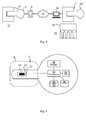
- Fig 2 is a schematic diagram illustrating an environment in which embodiments presented herein can be applied.
- Access to a physical space 7 is restricted by a physical barrier 8 which is selectively unlockable.
- the barrier 8 can be a door, gate, window, etc.
- a reader 81 is provided in order to unlock the barrier 8.
- the reader 81 has a physical interface for interacting with a physical interface of a physical key 82 to allow electronic communication between the reader 81 and the physical key 82. In this way, authentication can be performed and the reader can unlock the barrier 8 when access should be granted.
- the reader 81 and the physical key 82 are at different sites; the reader 81 is at a local site 17 and the physical key 82 is at a central site 18. This prevents the reader 81 from physically interacting with the physical key 82; instead, the reader physically interacts with a proxy key 2.
- the reader 81 is powered by the proxy key 2.
- the proxy key 2 in turn comprises a remote communication interface 63 for electronic communication with the physical key 82 via a communication network 9 and a proxy reader 1.
- the physical key 82 can be located remotely from the reader 81 and still communicate.
- the communication network 9 is of any suitable type that allows electronic communication between the proxy key 2 and the proxy reader 1 between the different sites 17, 18.
- the communication network 9 can e.g. be a wide area network such as the Internet, a cellular communication network or a combination of the two, optionally also using local area networks (wired or wireless) as needed.
- the proxy key 2 comprises a relay module 5 which is configured to relay electronic communication between the reader 81 and the remote physical key 82.
- the proxy key 2 emulates the remote physical key 82 in communication with the reader 81.
- the reader 81 is under the impression that it communicates with the remote physical key 82.
- the relay module 5 can comprise software stored in a memory of the proxy key 2 to be executed by a processor of the proxy key 2.
- the relay module 5 comprises hardware, such as an application specific integrated circuit (ASIC), field programmable gate array (FPGA), and/or discrete (digital and/or analogue) components, to perform its relay function.
- ASIC application specific integrated circuit
- FPGA field programmable gate array
- discrete digital and/or analogue
- the proxy reader 1 comprises its own relay module 15 which is configured to relay electronic communication between the physical key 82 and the remote reader 81.
- the proxy reader 1 emulates the remote reader 81 in communication with the physical key 82.
- the physical key 82 is under the impression that it communicates with the remote reader 81.
- the relay module 15 can comprise software stored in a memory of the proxy reader 1 to be executed by a processor of the proxy reader 1.
- the relay module 15 comprises hardware, such as an application specific integrated circuit (ASIC), field programmable gate array (FPGA), and/or discrete (digital and/or analogue) components, to perform its relay function.
- ASIC application specific integrated circuit
- FPGA field programmable gate array
- discrete digital and/or analogue
- Communication between the reader 81 and the physical key is here bidirectional.
- access can be remotely granted using the physical key 82.
- a security guard may need access to the physical locked space 7.
- the guard would then contact the central site 18 and request access.
- an operator can then take an appropriate physical key from a secure storage 30 (such as a safe, or a key storage within an otherwise secured area) and insert the appropriate physical key 82 into the proxy reader 1.
- the guard at the local site 17 can insert the proxy key 2 in the reader 81.
- the reader 81 then communicates with the physical key 82 as if the reader 81 and physical key 82 were in direct physical contact.
- the reader 81 can then send a challenge to the physical key 82 which calculates and sends a response to the reader 81 to verify its identity.
- the key 82 can send a challenge to the reader 81 which calculates and sends a response to the physical key 82 to verify its identity. In this way, the barrier is unlocked (under the assumption that the correct physical key 82 is inserted in the proxy reader).
- the intermediate nodes such as the proxy key 2, the proxy reader 1 and any nodes in the communication network 9 are not able to sniff and store the communication between the reader 81 and the physical key 82 to later gain access without the presence of the physical key 82 in the proxy reader 1.
- the central location can hold all keys to all buildings required for the security company. This is logistically efficient where the guard in the field never needs to retrieve a physical key. Instead, the central operator would insert the required key on demand in the proxy reader for the guard. Moreover, the risk of losing keys for the customer is essentially eliminated since all keys can be kept in central secure storage.
- Another use case is if a handyman needs access to a house when the owner is at work.
- the local site is then the house and the central site 18 is work.
- the owner could then insert the physical key 82 for the house in the proxy reader which is in communication with the proxy key 2 of the handyman. In this way, the owner can selectively give access to the house to the handyman as necessary.
- Fig 3 is a schematic diagram illustrating an alternative environment in which embodiments presented herein can be applied.
- the proxy key 2 communicates with a mobile phone 6 (or tablet computer or laptop computer) at the local site 17, which in turn communicates with an electronic device 16, such as a computer, a mobile phone, a tablet computer, etc., at the central site 18.
- the electronic device 16, in turn, communicates with the proxy reader 1.
- the proxy key 2 thus comprises an interface for communicating with an intermediary mobile phone to communicate with the remote physical key via a cellular network.
- the communication between the proxy key 2 and the mobile phone 6, as well as the communication between the proxy reader 1 and the electronic device 15, can occur using any suitable current or future communication protocol.
- the communication can be wire-based (e.g. using Universal Serial Bus, USB) to reduce or even remove the need for any battery in the proxy key.
- the communication can be wireless (e.g. using Bluetooth, WiFi, NFC (Near Field Communication), etc.).
- Fig 4 is a schematic diagram illustrating an embodiment of a proxy key 2 of Figs 2-3 .
- a processor 60 is provided using any combination of one or more of a suitable central processing unit (CPU), multiprocessor, microcontroller, digital signal processor (DSP), application specific integrated circuit etc., capable of executing software instructions stored in a memory 65, which can thus be a computer program product.
- CPU central processing unit
- DSP digital signal processor
- the processor 60 can be configured to execute the method described with reference to Fig 6 below.
- the memory 65 can be any combination of read and write memory (RAM) and read only memory (ROM).
- the memory 65 comprises persistent storage, which, for example, can be any single one or combination of magnetic memory, optical memory, solid state memory or even remotely mounted memory.
- a data memory 66 is also provided for reading and/or storing data during execution of software instructions in the processor 60.
- the data memory 66 can be any combination of read and write memory (RAM) and read only memory (ROM).
- a power supply 68 provides power to the components of the proxy key 2.
- the power supply can be implemented using a battery (rechargeable and/or disposable) or using a wired connection to a mobile phone (or tablet computer or laptop computer).
- the remote communication interface 63 is provided for communicating with remote external entities, such as the proxy reader.
- the proxy key 2 comprises physical interface 4 for interacting with a reader.
- the physical interface 4 comprises a connector 22 and optionally a mechanical interface 23 (such as a blade), which are electrically insulated from each other by an insulator 24.
- a mechanical interface 23 such as a blade
- two (or more) dedicated connectors can be provided for communication with the reader.
- the physical interface 4 provides a dual terminal connection between the proxy key 2 and a reader 81 when the proxy key 2 is inserted in the socket of the reader 81.
- the dual terminal connection is used for electronic communication between the proxy key 2 and the reader 81 and optionally for powering the reader 82 by transferring electric power from the power supply 68 of the proxy key 2 to the reader 81.
- connection using the connectors 22, 23 can be galvanic or inductive.
- the connectors do not need to physically connect to the reader but be physically positioned to allow communication over the inductive interface.
- Figs 5A-B are schematic diagrams illustrating embodiments of a proxy reader of Figs 2-3 . Looking first to Fig 5A , it is illustrated an embodiment where the proxy reader 1 relies on the electronic device 16 for software functions.
- the electronic device 16 comprises a processor 70' of any combination of one or more of a suitable central processing unit (CPU), multiprocessor, microcontroller, digital signal processor (DSP), application specific integrated circuit etc., capable of executing software instructions stored in a memory 75', which can thus be a computer program product.
- a suitable central processing unit CPU
- multiprocessor microcontroller
- DSP digital signal processor
- application specific integrated circuit etc.
- the memory 75' can be any combination of read and write memory (RAM) and read only memory (ROM).
- the memory 75' comprises persistent storage, which, for example, can be any single one or combination of magnetic memory, optical memory, solid state memory or even remotely mounted memory.
- a data memory 76' is also provided for reading and/or storing data during execution of software instructions in the processor 70'.
- the data memory 76' can be any combination of read and write memory (RAM) and read only memory (ROM).
- the remote communication interface 73 is provided for communicating with remote external entities, such as the proxy key (via the electronic device 16 and communication network).
- the remote communication interface 73 comprises the relay module 15, relaying communication between the proxy reader 1 and the proxy key.
- the proxy reader 1 comprises physical interface 14 for interacting with a physical key.
- the physical interface 14 comprises a first connector 32 and a second connector 33, which are electrically insulated from each other.
- the physical interface 14 thus provides a dual terminal connection between the proxy reader 1 and a physical key when the physical key is inserted in the socket of the proxy reader 1.
- the dual terminal connection is used for electronic communication between the proxy reader 1 and the physical key and optionally for powering the proxy reader 1 by receiving electric power from the physical key.
- connection using the connectors 32, 33 can be galvanic or inductive.
- the connectors do not need to physically connect with the physical key, but be physically positioned to allow communication over the inductive interface.
- the proxy reader 1 can be made very simple, making it cost-effective and robust.
- the proxy reader 1 comprises its own processor 70, memory 75 and data memory 76.
- the relay module 15 comprises software elements, a part of or all of the relay module 15 is implemented as software instructions stored in the memory 75.
- the processor 70 can be configured to execute the method described with reference to Fig 7 below.
- the remote communication interface 73 optionally includes all components necessary to connect to the communication network, e.g. using a cellular network connection or a WiFi connection.
- the proxy reader can be made self reliant, whereby the electronic device 16 is made redundant.
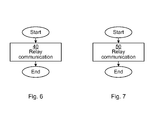
- Fig 6 is a flow chart illustrating a method for providing access to a locked physical space when a physical key and a reader are located at different sites. The method is performed in the proxy key 2 of Figs 2-3 according to one embodiment.
- a relay communication step 40 the proxy key 2 relays electronic communication between the reader and the remote physical key.
- the relaying of communication occurs via the physical interface and the remote communication interface, to thereby emulate the remote physical key in communication with the reader.
- Fig 7 is a flow chart illustrating a method for providing access to a locked physical space when a physical key and a reader are located at different sites. The method is performed in the proxy reader 1 of Figs 2-3 according to one embodiment.
- a relay communication step 50 the proxy reader 1 relays electronic communication between the physical key and the remote reader.
- the relaying of communication occurs via a physical interface and the remote communication interface, to thereby emulate the remote reader in communication with the physical key.
Landscapes
- Physics & Mathematics (AREA)
- General Physics & Mathematics (AREA)
- Lock And Its Accessories (AREA)
Abstract
It is presented a proxy key for providing access to a locked physical space when a physical key and a reader are located at different sites. The proxy key comprises: a physical interface for interacting with the reader; a remote communication interface for electronic communication with a remote physical key; and a relay module configured to relay electronic communication between the reader and the remote physical key to thereby emulate the remote physical key in communication with the reader. A corresponding proxy reader is also presented.
Description
- The invention relates to a proxy key, a proxy reader and associated methods for providing access to a locked physical space when a physical key and a reader are located at different sites.
- Access control systems based on electronic access are provided today using a variety of different topologies. One such solution is shown in
Fig 1 . - Access to a
physical space 7 is restricted by a physical barrier 8 (e.g. a door or gate) which is selectively unlockable. In order to unlock the barrier 8, areader 81 is provided. Thereader 81 has aphysical interface 14 with a correspondingphysical interface 4 of aphysical key 82 to allow electronic communication between thereader 81 and thephysical key 82. In this way, authentication can be performed and thereader 81 can unlock the barrier 8 when access should be granted. - However, in some instances, the system of
Fig 1 becomes overwhelmingly complex due to the need for thephysical key 82 to unlock the physical barrier 8. For instance, security companies need to have physical keys to access all buildings they are expected to guard. One way to solve this is that all physical keys are stored in a central location, and if a patrolling guard has to respond to an alarm the guard first has to drive to fetch the physical key, then drive to the location and afterwards return the physical key at the central location. This is a very time consuming process which prolongs the response times and is inefficient. Moreover, there is a significant logistic problem of fetching and returning all relevant physical keys, with the associated risk of losing physical keys. - It is an object to provide a convenient way and to provide access to physical spaces using physical keys.
- According to a first aspect, it is presented a proxy key for providing access to a locked physical space when a physical key and a reader are located at different sites. The proxy key comprises: a physical interface for interacting with the reader; a remote communication interface for electronic communication with a remote physical key; and a relay module configured to relay electronic communication between the reader and the remote physical key to thereby emulate the remote physical key in communication with the reader. Using the proxy key, access can be granted using the remote physical key without requiring the physical key to be at the site of the reader. Using this solution, the reader can communicate with the remote physical key as if the reader and physical key were in direct physical contact.
- The physical interface may comprise connectors for galvanic connection with the reader.
- The remote communication interface may comprise an interface for communicating with an intermediary mobile phone to communicate with the remote physical key via a cellular network.
- The physical interface may comprise a mechanical interface to open a lock associated with the reader when access to the locked physical space is granted.
- The relay module may be configured to relay challenge and response communication between the reader and the remote physical key.
- The remote communication interface may be configured to communicate with the remote physical key via a remote proxy reader.
- According to a second aspect, it is presented a method for providing access to a locked physical space when a physical key and a reader are located at different sites. The method is performed in a proxy key and comprises the step of: relaying electronic communication between the reader via a physical interface, and the remote physical key, via a remote communication interface, to thereby emulate the remote physical key in communication with the reader.
- The step of relaying electronic communication may comprise relaying challenge and response communication between the reader and the remote physical key.
- According to a third aspect, it is presented a proxy reader for providing access to a locked physical space when a physical key and a reader are located at different sites. The proxy reader comprises: a physical interface for electronic communication with a physical key; a remote communication interface for electronic communication with the remote reader; and a relay module configured to relay electronic communication between the physical key and the remote reader to thereby emulate the remote reader in communication with the physical key.
- The physical interface may comprise connectors for galvanic connection with the physical key.
- The relay module may be configured to relay challenge and response communication between the physical key and the remote reader.
- The remote communication interface may be configured to communicate with the remote physical reader via a remote proxy key.
- According to a fourth aspect, it is presented a method for providing access to a locked physical space when a physical key and a reader are located at different sites. The method is performed in a proxy reader and comprises the step of: relaying electronic communication between the physical key, via a physical interface, and the remote reader, via a remote communication interface, to thereby emulate the remote reader in communication with the physical key.
- The step of relaying electronic communication may comprise relaying challenge and response communication between the physical key and the remote reader.
- Generally, all terms used in the claims are to be interpreted according to their ordinary meaning in the technical field, unless explicitly defined otherwise herein. All references to "a/an/the element, apparatus, component, means, step, etc." are to be interpreted openly as referring to at least one instance of the element, apparatus, component, means, step, etc., unless explicitly stated otherwise. The steps of any method disclosed herein do not have to be performed in the exact order disclosed, unless explicitly stated.
- The invention is now described, by way of example, with reference to the accompanying drawings, in which:
-
Fig 1 is a schematic diagram illustrating an environment according to the prior art; -
Fig 2 is a schematic diagram illustrating an environment in which embodiments presented herein can be applied; -
Fig 3 is a schematic diagram illustrating an alternative environment in which embodiments presented herein can be applied; -
Fig 4 is a schematic diagram illustrating an embodiment of a proxy key ofFigs 2-3 ; -
Figs 5A-B are schematic diagrams illustrating embodiments of a proxy reader ofFigs 2-3 ; -
Fig 6 is a flow chart illustrating a method performed in the proxy key ofFigs 2-3 according to one embodiment; and -
Fig 7 is a flow chart illustrating a method performed in the proxy reader ofFigs 2-3 according to one embodiment. - The invention will now be described more fully hereinafter with reference to the accompanying drawings, in which certain embodiments of the invention are shown. This invention may, however, be embodied in many different forms and should not be construed as limited to the embodiments set forth herein; rather, these embodiments are provided by way of example so that this disclosure will be thorough and complete, and will fully convey the scope of the invention to those skilled in the art. Like numbers refer to like elements throughout the description.
-
Fig 2 is a schematic diagram illustrating an environment in which embodiments presented herein can be applied. Access to aphysical space 7 is restricted by a physical barrier 8 which is selectively unlockable. For instance, the barrier 8 can be a door, gate, window, etc. In order to unlock the barrier 8, areader 81 is provided. Thereader 81 has a physical interface for interacting with a physical interface of aphysical key 82 to allow electronic communication between thereader 81 and thephysical key 82. In this way, authentication can be performed and the reader can unlock the barrier 8 when access should be granted. - However, here the
reader 81 and thephysical key 82 are at different sites; thereader 81 is at alocal site 17 and thephysical key 82 is at acentral site 18. This prevents thereader 81 from physically interacting with thephysical key 82; instead, the reader physically interacts with aproxy key 2. Optionally, thereader 81 is powered by theproxy key 2. Theproxy key 2 in turn comprises aremote communication interface 63 for electronic communication with thephysical key 82 via acommunication network 9 and aproxy reader 1. In this way, thephysical key 82 can be located remotely from thereader 81 and still communicate. Thecommunication network 9 is of any suitable type that allows electronic communication between theproxy key 2 and theproxy reader 1 between thedifferent sites communication network 9 can e.g. be a wide area network such as the Internet, a cellular communication network or a combination of the two, optionally also using local area networks (wired or wireless) as needed. - The
proxy key 2 comprises arelay module 5 which is configured to relay electronic communication between thereader 81 and the remotephysical key 82. In this way, theproxy key 2 emulates the remote physical key 82 in communication with thereader 81. In other words, thereader 81 is under the impression that it communicates with the remotephysical key 82. In order to perform its relay function, therelay module 5 can comprise software stored in a memory of theproxy key 2 to be executed by a processor of theproxy key 2. Alternatively or additionally, therelay module 5 comprises hardware, such as an application specific integrated circuit (ASIC), field programmable gate array (FPGA), and/or discrete (digital and/or analogue) components, to perform its relay function. - Analogously, the
proxy reader 1 comprises itsown relay module 15 which is configured to relay electronic communication between thephysical key 82 and theremote reader 81. In this way, theproxy reader 1 emulates theremote reader 81 in communication with thephysical key 82. In other words, thephysical key 82 is under the impression that it communicates with theremote reader 81. In order to perform its relay function, therelay module 15 can comprise software stored in a memory of theproxy reader 1 to be executed by a processor of theproxy reader 1. Alternatively or additionally, therelay module 15 comprises hardware, such as an application specific integrated circuit (ASIC), field programmable gate array (FPGA), and/or discrete (digital and/or analogue) components, to perform its relay function. - Communication between the
reader 81 and the physical key is here bidirectional. - Using the system shown in
Fig 2 , access can be remotely granted using thephysical key 82. For example, at thelocal site 17, a security guard may need access to the physical lockedspace 7. The guard would then contact thecentral site 18 and request access. At thecentral site 18, an operator can then take an appropriate physical key from a secure storage 30 (such as a safe, or a key storage within an otherwise secured area) and insert the appropriate physical key 82 into theproxy reader 1. Once theproxy reader 1 and theproxy key 2 are in communication over thecommunication network 9, the guard at thelocal site 17 can insert theproxy key 2 in thereader 81. Using the system, thereader 81 then communicates with the physical key 82 as if thereader 81 and physical key 82 were in direct physical contact. - The
reader 81 can then send a challenge to the physical key 82 which calculates and sends a response to thereader 81 to verify its identity. Analogously, the key 82 can send a challenge to thereader 81 which calculates and sends a response to the physical key 82 to verify its identity. In this way, the barrier is unlocked (under the assumption that the correctphysical key 82 is inserted in the proxy reader). - Using the challenge/response algorithm, the intermediate nodes, such as the
proxy key 2, theproxy reader 1 and any nodes in thecommunication network 9 are not able to sniff and store the communication between thereader 81 and the physical key 82 to later gain access without the presence of the physical key 82 in theproxy reader 1. - In this way, the central location can hold all keys to all buildings required for the security company. This is logistically efficient where the guard in the field never needs to retrieve a physical key. Instead, the central operator would insert the required key on demand in the proxy reader for the guard. Moreover, the risk of losing keys for the customer is essentially eliminated since all keys can be kept in central secure storage.
- Another use case is if a handyman needs access to a house when the owner is at work. The local site is then the house and the
central site 18 is work. The owner could then insert thephysical key 82 for the house in the proxy reader which is in communication with theproxy key 2 of the handyman. In this way, the owner can selectively give access to the house to the handyman as necessary. -
Fig 3 is a schematic diagram illustrating an alternative environment in which embodiments presented herein can be applied. In this embodiment, an example of a communication path between theproxy key 2 and the proxy reader 11 is shown in more detail. Specifically, theproxy key 2 communicates with a mobile phone 6 (or tablet computer or laptop computer) at thelocal site 17, which in turn communicates with anelectronic device 16, such as a computer, a mobile phone, a tablet computer, etc., at thecentral site 18. Theelectronic device 16, in turn, communicates with theproxy reader 1. Theproxy key 2 thus comprises an interface for communicating with an intermediary mobile phone to communicate with the remote physical key via a cellular network. - The communication between the
proxy key 2 and themobile phone 6, as well as the communication between theproxy reader 1 and theelectronic device 15, can occur using any suitable current or future communication protocol. For instance, the communication can be wire-based (e.g. using Universal Serial Bus, USB) to reduce or even remove the need for any battery in the proxy key. Alternatively or additionally, the communication can be wireless (e.g. using Bluetooth, WiFi, NFC (Near Field Communication), etc.). -
Fig 4 is a schematic diagram illustrating an embodiment of aproxy key 2 ofFigs 2-3 . Aprocessor 60 is provided using any combination of one or more of a suitable central processing unit (CPU), multiprocessor, microcontroller, digital signal processor (DSP), application specific integrated circuit etc., capable of executing software instructions stored in amemory 65, which can thus be a computer program product. For instance, when therelay module 5 comprises software elements, parts or all of therelay module 5 are implemented as software instructions stored in thememory 65. Theprocessor 60 can be configured to execute the method described with reference toFig 6 below. - The
memory 65 can be any combination of read and write memory (RAM) and read only memory (ROM). Thememory 65 comprises persistent storage, which, for example, can be any single one or combination of magnetic memory, optical memory, solid state memory or even remotely mounted memory. - A
data memory 66 is also provided for reading and/or storing data during execution of software instructions in theprocessor 60. Thedata memory 66 can be any combination of read and write memory (RAM) and read only memory (ROM). - A
power supply 68 provides power to the components of theproxy key 2. The power supply can be implemented using a battery (rechargeable and/or disposable) or using a wired connection to a mobile phone (or tablet computer or laptop computer). - The
remote communication interface 63 is provided for communicating with remote external entities, such as the proxy reader. - The
proxy key 2 comprisesphysical interface 4 for interacting with a reader. Thephysical interface 4 comprises aconnector 22 and optionally a mechanical interface 23 (such as a blade), which are electrically insulated from each other by aninsulator 24. Optionally, two (or more) dedicated connectors can be provided for communication with the reader. - The
physical interface 4 provides a dual terminal connection between theproxy key 2 and areader 81 when theproxy key 2 is inserted in the socket of thereader 81. The dual terminal connection is used for electronic communication between theproxy key 2 and thereader 81 and optionally for powering thereader 82 by transferring electric power from thepower supply 68 of theproxy key 2 to thereader 81. - The connection using the
connectors -
Figs 5A-B are schematic diagrams illustrating embodiments of a proxy reader ofFigs 2-3 . Looking first toFig 5A , it is illustrated an embodiment where theproxy reader 1 relies on theelectronic device 16 for software functions. - Here, the
electronic device 16 comprises a processor 70' of any combination of one or more of a suitable central processing unit (CPU), multiprocessor, microcontroller, digital signal processor (DSP), application specific integrated circuit etc., capable of executing software instructions stored in a memory 75', which can thus be a computer program product. - The memory 75' can be any combination of read and write memory (RAM) and read only memory (ROM). The memory 75' comprises persistent storage, which, for example, can be any single one or combination of magnetic memory, optical memory, solid state memory or even remotely mounted memory.
- A data memory 76' is also provided for reading and/or storing data during execution of software instructions in the processor 70'. The data memory 76' can be any combination of read and write memory (RAM) and read only memory (ROM).
- In the
proxy reader 1, theremote communication interface 73 is provided for communicating with remote external entities, such as the proxy key (via theelectronic device 16 and communication network). In this embodiment, theremote communication interface 73 comprises therelay module 15, relaying communication between theproxy reader 1 and the proxy key. - The
proxy reader 1 comprisesphysical interface 14 for interacting with a physical key. Thephysical interface 14 comprises afirst connector 32 and asecond connector 33, which are electrically insulated from each other. - The
physical interface 14 thus provides a dual terminal connection between theproxy reader 1 and a physical key when the physical key is inserted in the socket of theproxy reader 1. The dual terminal connection is used for electronic communication between theproxy reader 1 and the physical key and optionally for powering theproxy reader 1 by receiving electric power from the physical key. - The connection using the
connectors - Using the embodiment of
Fig 5A , theproxy reader 1 can be made very simple, making it cost-effective and robust. - In the embodiment shown in
Fig 5B , theproxy reader 1 comprises itsown processor 70,memory 75 anddata memory 76. Hence, when therelay module 15 comprises software elements, a part of or all of therelay module 15 is implemented as software instructions stored in thememory 75. Theprocessor 70 can be configured to execute the method described with reference toFig 7 below. Theremote communication interface 73 optionally includes all components necessary to connect to the communication network, e.g. using a cellular network connection or a WiFi connection. - Using the embodiment of
Fig 5B , the proxy reader can be made self reliant, whereby theelectronic device 16 is made redundant. -
Fig 6 is a flow chart illustrating a method for providing access to a locked physical space when a physical key and a reader are located at different sites. The method is performed in theproxy key 2 ofFigs 2-3 according to one embodiment. - In a
relay communication step 40, theproxy key 2 relays electronic communication between the reader and the remote physical key. The relaying of communication occurs via the physical interface and the remote communication interface, to thereby emulate the remote physical key in communication with the reader. -
Fig 7 is a flow chart illustrating a method for providing access to a locked physical space when a physical key and a reader are located at different sites. The method is performed in theproxy reader 1 ofFigs 2-3 according to one embodiment. - In a
relay communication step 50, theproxy reader 1 relays electronic communication between the physical key and the remote reader. The relaying of communication occurs via a physical interface and the remote communication interface, to thereby emulate the remote reader in communication with the physical key. - The invention has mainly been described above with reference to a few embodiments. However, as is readily appreciated by a person skilled in the art, other embodiments than the ones disclosed above are equally possible within the scope of the invention, as defined by the appended patent claims.
Claims (14)
- A proxy key (2) for providing access to a locked physical space (7) when a physical key (82) and a reader (81) are located at different sites (17, 18), the proxy key comprising:a physical interface (4) for interacting with the reader (81);a remote communication interface (63) for electronic communication with a remote physical key (82); anda relay module (5) configured to relay electronic communication between the reader (81) and the remote physical key (82) to thereby emulate the remote physical key (82) in communication with the reader (81).
- The proxy key (2) according to claim 1, wherein the physical interface (4) comprises connectors for galvanic connection with the reader (81).
- The proxy key (2) according to claim 1 or 2, wherein the remote communication interface (63) comprises an interface for communicating with an intermediary mobile phone to communicate with the remote physical key (82) via a cellular network.
- The proxy key (2) according to any one of the preceding claims, wherein the physical interface (4) comprises a mechanical interface to open a lock associated with the reader when access to the locked physical space (7) is granted.
- The proxy key (2) according to any one of the preceding claims, wherein the relay module (5) is configured to relay challenge and response communication between the reader (81) and the remote physical key (82).
- The proxy key (2) according to any one of the preceding claims, wherein the remote communication interface (63) is configured to communicate with the remote physical key (82) via a remote proxy reader (1).
- A method for providing access to a locked physical space (7) when a physical key (82) and a reader (81) are located at different sites (17, 18), the method being performed in a proxy key (2) and comprising the step of:relaying (40) electronic communication between the reader (81) via a physical interface (4), and the remote physical key (82), via a remote communication interface (63), to thereby emulate the remote physical key (82) in communication with the reader (81).
- The method according to claim 7, wherein the step of relaying (40) electronic communication comprises relaying challenge and response communication between the reader (81) and the remote physical key (82).
- A proxy reader (1) for providing access to a locked physical space (7) when a physical key (82) and a reader (81) are located at different sites (17, 18), the proxy reader comprising:a physical interface (14) for electronic communication with a physical key (82);a remote communication interface (73) for electronic communication with the remote reader (81); anda relay module (15) configured to relay electronic communication between the physical key (82) and the remote reader (81) to thereby emulate the remote reader (81) in communication with the physical key (82).
- The proxy reader (1) according to claim 9, wherein the physical interface (14) comprises connectors for galvanic connection with the physical key (82).
- The proxy reader (1) according to claim 9 or 10, wherein the relay module is configured to relay challenge and response communication between the physical key (82) and the remote reader (81).
- The proxy reader (1) according to any one of claims 9 to 11, wherein the remote communication interface (73) is configured to communicate with the remote physical reader (81) via a remote proxy key (2).
- A method for providing access to a locked physical space (7) when a physical key (82) and a reader (81) are located at different sites (17, 18), the method being performed in a proxy reader (1) and comprising the step of:relaying (50) electronic communication between the physical key (82), via a physical interface (14), and the remote reader (81), via a remote communication interface (73), to thereby emulate the remote reader (81) in communication with the physical key (82).
- The method according to claim 13, wherein the step of relaying (50) electronic communication comprises relaying challenge and response communication between the physical key (82) and the remote reader (81).
Priority Applications (1)
| Application Number | Priority Date | Filing Date | Title |
|---|---|---|---|
| EP14193065.1A EP3021292A1 (en) | 2014-11-13 | 2014-11-13 | Proxy key, proxy reader and associated methods |
Applications Claiming Priority (1)
| Application Number | Priority Date | Filing Date | Title |
|---|---|---|---|
| EP14193065.1A EP3021292A1 (en) | 2014-11-13 | 2014-11-13 | Proxy key, proxy reader and associated methods |
Publications (1)
| Publication Number | Publication Date |
|---|---|
| EP3021292A1 true EP3021292A1 (en) | 2016-05-18 |
Family
ID=51900759
Family Applications (1)
| Application Number | Title | Priority Date | Filing Date |
|---|---|---|---|
| EP14193065.1A Withdrawn EP3021292A1 (en) | 2014-11-13 | 2014-11-13 | Proxy key, proxy reader and associated methods |
Country Status (1)
| Country | Link |
|---|---|
| EP (1) | EP3021292A1 (en) |
Citations (5)
| Publication number | Priority date | Publication date | Assignee | Title |
|---|---|---|---|---|
| EP0282339A2 (en) * | 1987-03-12 | 1988-09-14 | Security Services Plc | Remote programming of a programmable key |
| DE19753401A1 (en) * | 1997-12-02 | 1999-06-10 | Marquardt Gmbh | Car with electronic lock, especially for ignition |
| GB2340642A (en) * | 1998-08-18 | 2000-02-23 | Rover Group | Security system |
| US20060082434A1 (en) * | 2004-10-20 | 2006-04-20 | Brey Thomas A | Security for vehicle starting |
| EP2573738A1 (en) * | 2011-09-21 | 2013-03-27 | Delphi Technologies, Inc. | System and method to operate an extended range keyless entry system to recognize a keyless entry transmitter. |
-
2014
- 2014-11-13 EP EP14193065.1A patent/EP3021292A1/en not_active Withdrawn
Patent Citations (5)
| Publication number | Priority date | Publication date | Assignee | Title |
|---|---|---|---|---|
| EP0282339A2 (en) * | 1987-03-12 | 1988-09-14 | Security Services Plc | Remote programming of a programmable key |
| DE19753401A1 (en) * | 1997-12-02 | 1999-06-10 | Marquardt Gmbh | Car with electronic lock, especially for ignition |
| GB2340642A (en) * | 1998-08-18 | 2000-02-23 | Rover Group | Security system |
| US20060082434A1 (en) * | 2004-10-20 | 2006-04-20 | Brey Thomas A | Security for vehicle starting |
| EP2573738A1 (en) * | 2011-09-21 | 2013-03-27 | Delphi Technologies, Inc. | System and method to operate an extended range keyless entry system to recognize a keyless entry transmitter. |
Similar Documents
| Publication | Publication Date | Title |
|---|---|---|
| EP2821970B1 (en) | Access control communication device, method, computer program and computer program product | |
| US9704321B1 (en) | Key device and associated method, computer program and computer program product | |
| US10417848B2 (en) | Portable access control communication device, method, computer program and computer program product | |
| CN105989644A (en) | Electronic lock, electronic key and electronic lock system |
Legal Events
| Date | Code | Title | Description |
|---|---|---|---|
| PUAI | Public reference made under article 153(3) epc to a published international application that has entered the european phase |
Free format text: ORIGINAL CODE: 0009012 |
|
| AK | Designated contracting states |
Kind code of ref document: A1 Designated state(s): AL AT BE BG CH CY CZ DE DK EE ES FI FR GB GR HR HU IE IS IT LI LT LU LV MC MK MT NL NO PL PT RO RS SE SI SK SM TR |
|
| AX | Request for extension of the european patent |
Extension state: BA ME |
|
| STAA | Information on the status of an ep patent application or granted ep patent |
Free format text: STATUS: THE APPLICATION IS DEEMED TO BE WITHDRAWN |
|
| 18D | Application deemed to be withdrawn |
Effective date: 20161119 |