EP3021259B1 - Banknote recognition and classification method and system - Google Patents
Banknote recognition and classification method and system Download PDFInfo
- Publication number
- EP3021259B1 EP3021259B1 EP14822674.9A EP14822674A EP3021259B1 EP 3021259 B1 EP3021259 B1 EP 3021259B1 EP 14822674 A EP14822674 A EP 14822674A EP 3021259 B1 EP3021259 B1 EP 3021259B1
- Authority
- EP
- European Patent Office
- Prior art keywords
- banknote
- region
- model
- sample information
- degeneration
- Prior art date
- Legal status (The legal status is an assumption and is not a legal conclusion. Google has not performed a legal analysis and makes no representation as to the accuracy of the status listed.)
- Revoked
Links
Images




Classifications
-
- B—PERFORMING OPERATIONS; TRANSPORTING
- B07—SEPARATING SOLIDS FROM SOLIDS; SORTING
- B07C—POSTAL SORTING; SORTING INDIVIDUAL ARTICLES, OR BULK MATERIAL FIT TO BE SORTED PIECE-MEAL, e.g. BY PICKING
- B07C5/00—Sorting according to a characteristic or feature of the articles or material being sorted, e.g. by control effected by devices which detect or measure such characteristic or feature; Sorting by manually actuated devices, e.g. switches
- B07C5/34—Sorting according to other particular properties
- B07C5/344—Sorting according to other particular properties according to electric or electromagnetic properties
-
- G—PHYSICS
- G07—CHECKING-DEVICES
- G07D—HANDLING OF COINS OR VALUABLE PAPERS, e.g. TESTING, SORTING BY DENOMINATIONS, COUNTING, DISPENSING, CHANGING OR DEPOSITING
- G07D7/00—Testing specially adapted to determine the identity or genuineness of valuable papers or for segregating those which are unacceptable, e.g. banknotes that are alien to a currency
- G07D7/06—Testing specially adapted to determine the identity or genuineness of valuable papers or for segregating those which are unacceptable, e.g. banknotes that are alien to a currency using wave or particle radiation
- G07D7/12—Visible light, infrared or ultraviolet radiation
-
- G—PHYSICS
- G07—CHECKING-DEVICES
- G07D—HANDLING OF COINS OR VALUABLE PAPERS, e.g. TESTING, SORTING BY DENOMINATIONS, COUNTING, DISPENSING, CHANGING OR DEPOSITING
- G07D7/00—Testing specially adapted to determine the identity or genuineness of valuable papers or for segregating those which are unacceptable, e.g. banknotes that are alien to a currency
- G07D7/181—Testing mechanical properties or condition, e.g. wear or tear
- G07D7/187—Detecting defacement or contamination, e.g. dirt
Definitions
- the disclosure relates to the technical field of banknote recognition systems, and particularly to a method for recognizing and classifying banknotes and a system thereof.
- a banknote recognition system has two main parts: a banknote classification learning system and a banknote recognition system, of which schematic structural diagrams are shown in Figure 1 and Figure 2 .
- a banknote classification learning system banknote sample images to be learned are input, and a banknote classification model is output.
- a banknote sample image to be recognized is input, classification decision is performed on the sample through feature extraction and using the classification model acquired in the banknote classification learning system, and a final classification result is output.
- the banknote samples to be learned mainly include the following types for selection: brand new condition, 80%-90% new condition, 70%-80% new condition, 0-70% new condition, contamination in varying degrees, incompletion in varying degrees, crack in varying degrees, and fold in a certain region, and if 30 banknotes are to be selected as samples for one type, 240 actually circulating banknotes satisfying the conditions are totally needed. If all needed types of banknotes may be completely collected to design a classifier, precision of the classifier may be ensured, and if the types of the samples are inadequate, it is possible that the precision of the classifier does not satisfy application requirement.
- WO 2007/068867 A1 describes a method of creating a classifier for banknote validation. Information from all of a set of training images from genuine banknotes is used to form a segmentation template which is then used to segment each of the training set images.
- EP 2 282 299 A2 describes a method of creating a dictionary for soil detection of a sheet which includes dividing a sensible area in first and second adjustment images into a plurality of areas, calculating a first characteristic amount of each divided area of the first adjustment image, calculating a second characteristic amount of each divided area of the second adjustment image, calculating a mean and a variance of the first and second characteristic amounts of each area, setting weight data for each area based on the calculated mean and variance, and storing the weight data together with threshold values for soil detection of a sheet.
- EP 2 557 523 A1 describes a method for the classification of banknotes, based on a computational processing of the banknote scan formed in the device during scanning.
- the banknote digital image is separated into areas and for each area a function is calculated and a feature vector is composed with further calculation of the distance to the known classes represented by the parameters available beforehand.
- a method for recognizing and classifying banknotes and a system thereof are provided according to the disclosure to conquer a conventional problem that extra cost may not be reduced while ensuring classifier precision due to the case that adequate variety of needed samples can not be ensured when actual samples are collected.
- a method and for recognizing and classifying banknotes includes:
- the banknote sample signal degeneration model includes: a banknote condition degeneration model established based on linear change of image brightness and a banknote image degeneration model established based on randomness of a statistic model, wherein the banknote condition degeneration model comprises signal degeneration models for banknote contamination, the banknote incompletion, banknote crack, and banknote fold or deflection.
- the banknote image degeneration model includes signal degeneration models for banknote contamination, banknote incompletion, banknote crack, and banknote fold or deflection.
- the banknote condition degeneration model may include degeneration models for banknotes in brand new condition, banknotes in 80%-90% new condition, banknotes in 70%-80% new condition, and banknotes in 0-70% new condition.
- the establishing a banknote condition degeneration model according to a preset rule includes:
- the establishing a banknote contamination degeneration model according to a preset rule includes:
- the establishing a banknote incompletion degeneration model according to a preset rule includes:
- the establishing a banknote folding or deflection degeneration model includes:
- the establishing a banknote crack degeneration model according to a preset rule includes:
- a system for recognizing and classifying banknotes is disclosed according to the disclosure.
- the system includes:
- a method for recognizing and classifying banknotes and a system thereof includes: acquiring sample information of brand new banknotes to be learned and banknote sample information to be recognized; establishing, according to a preset rule, a banknote sample signal degeneration model; inputting the sample information into the banknote sample signal degeneration model to acquire various banknote sample information corresponding to the brand new banknotes to be learned; inputting the various banknote sample information to perform classifier learning, and outputting a banknote classification model; performing sample signal preprocessing and feature extraction on the sample information to be recognized, performing classification decision on the banknote to be recognized by using the classification model, and outputting a final classification result.
- a method for recognizing and classifying banknotes and a system thereof are disclosed according to claim 1.
- large amount of existing samples which are reliable and easily accessible are used to statistically establish a sample signal degeneration model which satisfies application requirement, to simulate the states of banknotes such as brand new condition, 80%-90% new condition, 70%-80% new condition, 0-70% new condition, contamination in varying degrees, incompletion in varying degrees, crack in varying degrees and folds in some regions, then classifier learning is performed, and classification recognition is performed on the sample to be recognized, thereby accurately acquiring a classification result, and decreasing cost and efficiency for developing banknote recognition product while ensuring improvement of classifier precision.
- Figure 3 is a flow chart of a method for recognizing and classifying banknotes disclosed according to the disclosure.
- a method for recognizing and classifying banknotes is disclosed according to the disclosure. The method includes following steps.
- Step 101 includes: acquiring sample information of brand new banknotes to be learned and banknote sample information to be recognized.
- banknote samples to be learned may be roughly selected from following types: brand new condition, 80%-90% new condition, 70%-80% new condition, 0-70% new condition, contamination in varying degrees, incompletion in varying degrees, crack in varying degrees, and fold in a certain region.
- Step 102 includes: establishing a banknote sample signal degeneration model according to a preset rule.
- the banknote sample signal degeneration model is established according to the preset rule.
- the establishment of the degeneration model includes establishing a banknote condition degeneration model based on linear change of image brightness, and establishing a banknote image degeneration model based on randomness of a statistic model.
- the banknote image degeneration model includes signal degeneration models for banknote contamination, banknote incompletion, banknote crack, and banknote fold or deflection
- the banknote condition degeneration model includes degeneration models for banknotes in brand new condition, banknotes in 80%-90% new condition, banknotes in 70%-80% new condition, and banknotes in 0-70% new condition.
- Step 103 includes: inputting the sample information into the banknote sample signal degeneration model, to acquire various banknote sample information corresponding to the brand new banknotes to be learned.
- Step 104 includes inputting the various banknote sample information to perform classifier learning, and outputting a banknote classification model.
- Step 105 includes: performing sample signal preprocessing and feature extraction on the sample information to be recognized, performing classification decision on the banknote to be recognized by using the classification model, and outputting a final classification result.
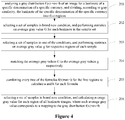
- Figure 4 is a flow chart of establishing a banknote condition degeneration model according to a preset rule.
- the establishing a banknote condition degeneration model according to a preset rule includes following steps.
- Step 203 selecting a set of samples in one of the conditions, and performing statistics on average gray value g for respective regions of each sample.
- Step 204 matching the average gray values G to the average gray values g respectively.
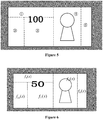
- the average gray values are G 1 , G 2 , G 3 , G 4 and G 5 , of which mappings are G 1 - f 1 ( x ), G 2 -f 2 ( x ), G 3 - f 3 ( x ), G 4 -f 4 ( x ) and G 5 -f 5 ( x ) .
- 0-255 gray levels may be divided into 16 gray segments each corresponding to a degeneration mapping, i.e., (0x00-0x0F)- f 1 ( x ), (0x10-0x1F)- f 2 ( x ), (0x20-0x2F)- f 3 ( x ), (0x30-0x3F)- f 4 ( x ), (0x40-0x4F)- f 5 ( x ), (0x50-0x5F)- f 6 ( x ), (0x60-0x6F)- f 7 ( x ), (0x70-0x7F)- f 8 ( x ), (0x80-0x8F)- f 9 ( x ), (0x90-0x9F)- f 10 ( x ), (0xA0-0xAF)- f 11 ( x ), (0xB0-0xBF)- f
- steps of simulating condition of banknote images with insufficient samples are as follows. It is assumed that the banknote image to be processed is in brand new condition.
- a first step includes: dividing, according to a gray distribution of a banknote image, the image into a plurality of regions, and calculating average gray value for each region.
- a second step includes: determining a corresponding degeneration function according to the average gray value for each region acquired in the first step. For example, as shown in Figure 6 , for the image on which the degeneration is to be simulated, the five divided regions correspond to five mappings f 8 ( x ), f 14 ( x ), f 7 ( x ), f 6 ( x ) and f 8 ( x ) respectively.
- a third step includes: performing corresponding degeneration mappings on gray vales for respective pixel points in each region in turn to acquire gray values for the respective pixel points after degeneration until all pixel points of the image are mapped.
- Contamination, incompletion, crack and fold may be seen as special image noise for establishing relevant models, which are different from traditional noise;
- the noise generated from the traditional noise model is in the form of singular random points, and the noise generated from the noise model proposed in these embodiments is in the form of points in a random region, which have a special feature as well as a certain randomness.
- Figure 7 is a flow chart for establishing a banknote contamination degeneration model according to a preset rule.
- the establishing a banknote contamination degeneration model according to a preset rule includes following steps.
- the contamination noise mainly has features of shape, size and position of a contamination region, density of stains in the region, and shape, size and gray value for each stain.
- Step 301 includes: presetting that the banknote contamination region is circular and the stain is circular, and each banknote only have one contamination region.
- Step 302 includes: determining, according to statistics analysis, that probability density curves for the position of the contamination region and a position of the stain in the contamination region are constants, i.e., the probability density curves are in uniform distribution X ⁇ U ( a,b ), and a probability density curve for a size of the contamination region and probability density curves for size, density and gray value of the stain are in normal distribution X ⁇ N ( ⁇ , ⁇ 2 ).
- the probability density curve for the position of the contamination region is a constant, i.e., the contamination region may appear, with equal probability, at any position of the banknote.
- the size (radius) of the contamination region is in normal distribution with an average value of ⁇ 11 and a variance of ⁇ 11
- the density of the stains is irrelevant to the size of the contamination region
- the probability density of the stains satisfies an independent normal distribution with an average value of ⁇ 12 and a variance of ⁇ 12 .
- the probability density curve of the position of the stain in the region is a constant, i.e., the stain appears, with equal probability, at any position of the region.
- Probability density curves for the size of the stain and the gray value of the stain are in independent normal distribution respectively; the size of the stain has an average value of ⁇ 13 and a variances of ⁇ 13 , the gray value of the stain has an average value of ⁇ 14 and a variance of ⁇ 14 .
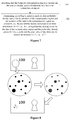
- Figure 8 is a schematic diagram showing steps of banknote image degeneration based on a contamination noise model.
- a first step includes: randomly generating a special position in a banknote region according to a probability density curve of a position of a contamination region.
- a second step includes: randomly generating, according to a probability density curve of a size of the contamination region, a radius value, and determining the contamination region and the size thereof by using the position of the point generated in the first step as a center of a circle.
- a third step includes: randomly generating a density value according to a probability density function of density of stains in the contamination region, and determining a quantity of the stains in the region.
- a fourth step includes: determining position, size and gray value for each stain in the region, marking each stain in the region sequentially, and randomly determining corresponding values according to probability density curves respectively.
- the fourth step includes following sub-steps:
- the fifth step includes fusing the generated noise with the original image.
- Figure 9 is a flow chart of establishing a banknote incompletion degeneration model according to a preset rule.
- the establishing a banknote incompletion degeneration model according to a preset rule includes following steps.
- Step 401 includes: determining, according to statistics analysis, a position, a size and a shape of an incompletion, where a probability density curve of the position of the incompletion is a constant, i.e., the incompletion appears, with equal probability, at any position of the banknote.
- Step 402 includes: determining that a probability density curve of the size of the incompletion is in normal distribution with an average value of ⁇ 21 , and a variance of ⁇ 21 .
- Step 403 includes: determining that the shape of the incompletion is polygon which is any one of trigon to octagon, convex polygon or concave polygon, and a probability density curve of the shape of the incompletion is a constant, i.e., the incompletion is in any shape with equal probability.
- Figure 10 is a schematic diagram showing steps of banknote image degeneration based on an incompletion noise model.
- a first step includes: randomly determining a special position in the banknote region according to the probability density curve of a position of an incompletion region.
- a second step includes: randomly generating a radius of the incompletion region according to the probability density curve of a size of the incompletion, and using the coordinates of the position acquired in the first step as a circle center of the region.
- a third step includes: determining a shape of the incompletion region. Specially, the third step are implemented as following steps:
- a fourth step includes: filling the region within the closed polygon with background color (black) and using the region as a banknote incompletion.
- Figure 11 is a flow chart of establishing a banknote folding or deflection degeneration model based on a preset rule.
- the establishing a banknote folding or deflection degeneration model includes following steps.
- the banknote is normally deflected at the edge portion, and the deflected portion of the banknote is generally small.
- the folding (deflection) noise model may be established according to following steps.
- Step 501 includes: dividing the banknote into two columns and two rows to form four uniform rectangular regions each having a long side and a short side which belong to edges of the banknote.
- Step 502 includes: randomly selecting one of the regions, randomly selecting one point of the short side of the region, and randomly selecting another point of the long side of the region.
- Step 503 includes: determining whether a distance between the two points. i.e., the distances x (a distance on the long side) and y (a distance on the short side) from the two points to the vertex, satisfy a constraint condition of x 2 + y 2 ⁇ k , x ⁇ m , y ⁇ n ; if the distance between the two points satisfies the constraint condition, proceeding to a next step; and if the distance between the points does not satisfy the constraint condition, returning to the previous step.
- Step 504 includes: filing a deflection region, which has an edge being a straight line determined by the two points and has a point beyond the edge, with background color.
- Figure 12 is a schematic diagram showing steps of banknote image degeneration based on a folding or deflection noise model.
- Figure 13 is a flow chart of establishing a banknote crack degeneration model according to a preset rule.
- the establishing a banknote crack degeneration model according to a preset rule includes following steps.
- Step 601 includes: randomly acquiring a line segment s with a length of L on the boundary of the banknote, where L is in uniform distribution, L ⁇ (0, MaxL ), and MaxL is a maximum length of the boundary of the banknote.
- Step 602 includes: determining a position of another point N, wherein a distance between the point N and a midpoint M of the line segment s is 1, and an angle between the line segment MN and the line segment s is ⁇ , wherein l ⁇ (0, Maxl ), the angle ⁇ ⁇ ( ⁇ /3,2 ⁇ /3), and ⁇ and 1 are in normal distribution.
- Step 603 includes: determining a triangle region bounded by the point N and the segment line s as the crack region, and filling the crack region with the background color.
- Figure 14 is a schematic diagram showing steps of banknote image degeneration based on a crack noise model.
- FIG. 15 is a schematic structural diagram of a system for recognizing and classifying banknotes according to the embodiment of the disclosure.
- the system for recognizing and classifying banknotes disclosed according to the disclosure includes following structures: an acquiring unit 701 configured to acquire sample information of brand new banknotes to be learned and banknote sample information to be recognized, a model establishing unit 702 configured to establish a banknote sample signal degeneration model according to a preset rule, an inputting unit 703 configured to input the sample information into the banknote sample signal degeneration model to acquire various banknote sample information corresponding to the brand new banknote to be learned, a classifier learning unit 704 configured to input the various banknote sample information to perform classifier learning, and output a banknote classification model, and a classification result outputting unit 705 configured to perform sample signal preprocessing and feature extraction on the sample information to be recognized, perform classification decision on the banknote to be recognized by using the classification model
- a method and for recognizing and classifying banknotes and a system thereof are disclosed according to the disclosure.
- the method includes: acquiring sample information of brand new banknotes to be learned and banknote sample information to be recognized; establishing, according to a preset rule, a banknote sample signal degeneration model; inputting the sample information into the banknote sample signal degeneration model to acquire various banknote sample information corresponding to the brand new banknote to be learned; inputting the various banknote sample information to perform classifier learning, and outputting a banknote classification model; performing sample signal preprocessing and feature extraction on the sample information to be recognized, performing classification decision on the banknote to be recognized by using the classification model, and outputting a final classification result.
Landscapes
- Physics & Mathematics (AREA)
- General Physics & Mathematics (AREA)
- Health & Medical Sciences (AREA)
- General Health & Medical Sciences (AREA)
- Toxicology (AREA)
- Image Analysis (AREA)
- Inspection Of Paper Currency And Valuable Securities (AREA)
- Character Discrimination (AREA)
Description
- The present application claims the priority to Chinese Patent Application No.
201310292056.4 - The disclosure relates to the technical field of banknote recognition systems, and particularly to a method for recognizing and classifying banknotes and a system thereof.
- At present, in banknote processing devices for the financial field such as cash circulator, banknote sorter, etc, a banknote recognition system has two main parts: a banknote classification learning system and a banknote recognition system, of which schematic structural diagrams are shown in
Figure 1 and Figure 2 . In the banknote classification learning system, banknote sample images to be learned are input, and a banknote classification model is output. In the banknote recognition system, a banknote sample image to be recognized is input, classification decision is performed on the sample through feature extraction and using the classification model acquired in the banknote classification learning system, and a final classification result is output. - For higher robustness of the banknote recognition system, i.e., to eliminate interference exerted by the quality of samples to be recognized on the recognition result as far as possible, abundant and diversified samples to be learned are normally input in the learning of the banknote classifier. When selecting samples, besides considering banknote samples in brand new condition, banknote samples in various conditions and banknote samples with contamination, incompletion, crack and folds in varying degrees need to be considered. Thus there is a large number of samples to be selected. Difficulty of the sample selection lies in the difficulty in collecting all types of banknotes in circulation, and particularly, for developing an algorithm with respect to foreign banknotes, it is almost impossible to collect a complete set of banknote samples. Generally speaking, the banknote samples to be learned mainly include the following types for selection: brand new condition, 80%-90% new condition, 70%-80% new condition, 0-70% new condition, contamination in varying degrees, incompletion in varying degrees, crack in varying degrees, and fold in a certain region, and if 30 banknotes are to be selected as samples for one type, 240 actually circulating banknotes satisfying the conditions are totally needed. If all needed types of banknotes may be completely collected to design a classifier, precision of the classifier may be ensured, and if the types of the samples are inadequate, it is possible that the precision of the classifier does not satisfy application requirement. However, to completely collect the various needed types of banknote samples in circulation, a large number of human resources and material resources may be needed, thereby affecting cost and efficiency for developing banknote recognition product; in other words, without extra cost spent to collect and screen the samples, the designed classifier may have decreased precision.
- Hence, under the situation of limited number of selectable banknote samples, it is urgent for those skilled in the art to provide a method for recognizing and classifying banknotes and a system thereof to reduce extra cost while ensuring an improved classifier precision.
-
WO 2007/068867 A1 describes a method of creating a classifier for banknote validation. Information from all of a set of training images from genuine banknotes is used to form a segmentation template which is then used to segment each of the training set images. -
EP 2 282 299 A2 -
EP 2 557 523 A1 - In view of this, a method for recognizing and classifying banknotes and a system thereof are provided according to the disclosure to conquer a conventional problem that extra cost may not be reduced while ensuring classifier precision due to the case that adequate variety of needed samples can not be ensured when actual samples are collected.
- To achieve the above purpose, the technical solutions provided according to the invention, and as defined in appended claims, are as follows.
- A method and for recognizing and classifying banknotes includes:
- acquiring sample information of brand new banknotes to be learned and banknote sample information to be recognized;
- establishing, according to a preset rule, a banknote sample signal degeneration model;
- inputting the sample information into the banknote sample signal degeneration model to acquire various banknote sample information corresponding to the brand new banknotes to be learned, wherein the various banknote sample information corresponding to the brand new banknotes to be learned comprises simulation data, the simulation data is calculated by using parameters of the banknote sample signal degeneration model and the inputted sample information and the simulation data comprises at least one of gray values for pixel points after degeneration, contamination in varying degrees, incompletion in varying degrees, crack in varying degrees, and fold in a certain region;
- inputting the various banknote sample information to perform classifier learning, and outputting a banknote classification model; and
- performing sample signal preprocessing and feature extraction on the sample information to be recognized, performing classification decision on the banknote to be recognized by using the classification model, and outputting a final classification result.
- According to the invention, the banknote sample signal degeneration model includes: a banknote condition degeneration model established based on linear change of image brightness and a banknote image degeneration model established based on randomness of a statistic model, wherein the banknote condition degeneration model comprises signal degeneration models for banknote contamination, the banknote incompletion, banknote crack, and banknote fold or deflection.
- The banknote image degeneration model according to the invention includes signal degeneration models for banknote contamination, banknote incompletion, banknote crack, and banknote fold or deflection. The banknote condition degeneration model may include degeneration models for banknotes in brand new condition, banknotes in 80%-90% new condition, banknotes in 70%-80% new condition, and banknotes in 0-70% new condition.
- The establishing a banknote condition degeneration model according to a preset rule includes:
- analyzing a gray distribution f(x) =ax+b of an image for a banknote of a specific denomination of a specific currency, and dividing, according to gray similarity, the banknote of the specific denomination of the currency into five regions;
- selecting a set of samples in brand new condition, and performing statistics on average gray value G for each banknote in the sample set;
- selecting a set of samples in one of the conditions, and performing statistics on average gray value g for respective regions of each sample;
- matching the average gray values G to the average gray values g respectively;
- combining every two of the formulas f(x)=ax+b for the five regions to calculate a and b for each formula; and
- selecting a set of samples in brand new condition, and calculating average gray value for each region of all banknote images, where each average gray value corresponds to a mapping to the gray distribution f(x)=ax+b.
- The establishing a banknote contamination degeneration model according to a preset rule includes:
- presetting that a banknote contamination region is circular and a stain is circular, and each banknote only have one contamination region; and
- determining, according to statistics analysis, that probability density curves for a position of the contamination region and a position of the stain in the contamination region are constants, i.e., the probability density curves are in uniform distribution X ∼ U(a,b), and probability density curve for a size of the contamination region and probability density curves for size, density and gray value of the stain are in normal distribution X ∼ N(µ,σ2).
- The establishing a banknote incompletion degeneration model according to a preset rule includes:
- determining, according to statistics analysis, a position, a size and a shape of an incompletion, where a probability density curve of the position of the incompletion is a constant;
- a probability density curve of the size of the incompletion is in normal distribution; and
- the shape of the incompletion is polygon which is any one of trigon to octagon, convex polygon or concave polygon, and a probability density curve of the shape of the incompletion is a constant.
- The establishing a banknote folding or deflection degeneration model includes:
- dividing the banknote into two columns and two rows to form four uniform rectangular regions each having a long side and a short side which belong to edges of the banknote;
- randomly selecting one of the regions, randomly selecting one point of the short side of the region, and randomly selecting another point of the long side of the region;
- determining whether a distance between the two points, i.e., the distances x (a distance on the long side) and y (a distance on the short side) from the two points to the vertex, satisfy a constraint condition of

- filing a deflection region, which has an edge being a straight line determined by the two points and has a point beyond the edge, with background color.
- The establishing a banknote crack degeneration model according to a preset rule includes:
- randomly acquiring a line segment s with a length of L on the boundary of the banknote, where L is in uniform distribution, L ∈ (0, MaxL), and MaxL is a maximum length of the boundary of the banknote;
- determining a position of another point N, where a distance between the point N and a midpoint M of the line segment s is 1, and an angle between the line segment MN and the line segment s is, where l ∈ (0, Maxl), the angle α ∈ (π/3,2π/3), and α and l are in normal distribution; and
- determining a triangle region bounded by the point N and the segment line s as the crack region, and filling the crack region with the background color.
- A system for recognizing and classifying banknotes is disclosed according to the disclosure. The system includes:
- an acquiring unit configured to acquire sample information of brand new banknotes to be learned and banknote sample information to be recognized;
- a model establishing unit configured to establish a banknote sample signal degeneration model according to a preset rule, wherein the banknote sample signal degeneration model comprises: i) a banknote condition degeneration model established based on linear change of image brightness and ii) a banknote image degeneration model established based on randomness of a statistic model, wherein the banknote image degeneration model comprises signal degeneration models for banknote contamination, banknote incompletion, banknote crack, and banknote fold or deflection;
- an inputting unit configured to input the sample information into the banknote sample signal degeneration model to acquire various banknote sample information corresponding to the brand new banknote to be learned, wherein the various banknote sample information corresponding to the brand new banknotes to be learned comprises simulation data, the simulation data is calculated by using parameters of the banknote sample signal degeneration model and the inputted sample information, and the simulation data comprises at least one of gray values for pixel points after degeneration, contamination in varying degrees, incompletion in varying degrees, crack in varying degrees, and fold in a certain region;
- a classifier learning unit configured to input the various banknote sample information to perform classifier learning, and output a banknote classification model; and
- a classification result outputting unit configured to perform sample signal preprocessing and feature extraction on the sample information to be recognized, perform classification decision on the banknote to be recognized by using the classification model, and output a final classification result.
- It can be known from above technical solutions that compared with conventional technology, a method for recognizing and classifying banknotes and a system thereof are disclosed according to the disclosure, and the method includes: acquiring sample information of brand new banknotes to be learned and banknote sample information to be recognized; establishing, according to a preset rule, a banknote sample signal degeneration model; inputting the sample information into the banknote sample signal degeneration model to acquire various banknote sample information corresponding to the brand new banknotes to be learned; inputting the various banknote sample information to perform classifier learning, and outputting a banknote classification model; performing sample signal preprocessing and feature extraction on the sample information to be recognized, performing classification decision on the banknote to be recognized by using the classification model, and outputting a final classification result. In the method, large amount of existing samples which are reliable and easily accessible are used to statistically establish a sample signal degeneration model which satisfies application requirement, to simulate the states of banknotes such as brand new condition, 80%-90% new condition, 70%-80% new condition, 0-70% new condition, contamination in varying degrees, incompletion in varying degrees, crack in varying degrees and folds in some regions, then classifier learning is performed, and classification recognition is performed on the sample to be recognized, thereby accurately acquiring a classification result, and decreasing cost and efficiency for developing banknote recognition product while ensuring improvement of classifier precision.
- To illustrate the technical solutions according to the embodiments of the present disclosure or technical solutions in conventional technology more clearly, the drawings involved in the embodiments of the present disclosure or in the conventional technology are introduced briefly in the following. Apparently, the drawings described below are only embodiments of the disclosure, and persons of ordinary skills in the art can derive other drawings according to the drawings without any creative effort.
-
Figure 1 is a schematic structural diagram of a banknote classification learning system in conventional technology; -
Figure 2 is a schematic structural diagram of a banknote recognition system in conventional technology; -
Figure 3 is a flow chart of a method for recognizing and classifying banknotes disclosed according to an embodiment of the disclosure; -
Figure 4 is a flow chart of establishing a banknote condition degeneration model according to a preset rule; -
Figure 5 is a diagram for gray scale-based region division in a banknote condition degeneration model; -
Figure 6 is a diagram for gray scale-based region division for an image on which degeneration is to be simulated; -
Figure 7 is a flow chart for establishing a banknote contamination degeneration model according to a preset rule; -
Figure 8 is a schematic diagram showing steps of banknote image degeneration based on a contamination noise model; -
Figure 9 is a flow chart of establishing a banknote incompletion degeneration model according to a preset rule; -
Figure 10 is a schematic diagram showing steps of banknote image degeneration based on an incompletion noise model; -
Figure 11 is a flow chart of establishing a banknote folding or deflection degeneration model based on a preset rule; -
Figure 12 is a schematic diagram showing steps of banknote image degeneration based on a folding or deflection noise model; -
Figure 13 is a flow chart of establishing a banknote crack degeneration model according to a preset rule; -
Figure 14 is a schematic diagram showing steps of banknote image degeneration based on a crack noise model; and -
Figure 15 is a schematic structural diagram of a system for recognizing and classifying banknotes disclosed according to an embodiment of the disclosure. - Technical solutions of the embodiments of the present disclosure are illustrated completely and clearly with the following drawings of the embodiments of the disclosure. Apparently, the described embodiments are merely a few rather than all of the embodiments of the present disclosure.
- A method for recognizing and classifying banknotes and a system thereof are disclosed according to
claim 1. In the method, large amount of existing samples which are reliable and easily accessible are used to statistically establish a sample signal degeneration model which satisfies application requirement, to simulate the states of banknotes such as brand new condition, 80%-90% new condition, 70%-80% new condition, 0-70% new condition, contamination in varying degrees, incompletion in varying degrees, crack in varying degrees and folds in some regions, then classifier learning is performed, and classification recognition is performed on the sample to be recognized, thereby accurately acquiring a classification result, and decreasing cost and efficiency for developing banknote recognition product while ensuring improvement of classifier precision. -
Figure 3 is a flow chart of a method for recognizing and classifying banknotes disclosed according to the disclosure. A method for recognizing and classifying banknotes is disclosed according to the disclosure. The method includes following steps. - Step 101 includes: acquiring sample information of brand new banknotes to be learned and banknote sample information to be recognized.
- For higher robustness of the recognition system, abundant and diversified samples need to be input to design a classifier. However, in the field of circulation, in particular to design an algorithm for recognizing foreign banknotes, it is almost impossible to completely collect all needed types of banknote samples to be learned. Hence, in this solution, since brand new banknote samples are easily accessible, it is designed to acquire the sample information of brand new banknotes to be learned. According to these brand new banknotes, various banknotes are simulated. Generally speaking, banknote samples to be learned may be roughly selected from following types: brand new condition, 80%-90% new condition, 70%-80% new condition, 0-70% new condition, contamination in varying degrees, incompletion in varying degrees, crack in varying degrees, and fold in a certain region.
- Step 102 includes: establishing a banknote sample signal degeneration model according to a preset rule.
- Based on the acquired sample information of brand new banknotes to be learned, the banknote sample signal degeneration model is established according to the preset rule. The establishment of the degeneration model includes establishing a banknote condition degeneration model based on linear change of image brightness, and establishing a banknote image degeneration model based on randomness of a statistic model.
- The banknote image degeneration model includes signal degeneration models for banknote contamination, banknote incompletion, banknote crack, and banknote fold or deflection, and the banknote condition degeneration model includes degeneration models for banknotes in brand new condition, banknotes in 80%-90% new condition, banknotes in 70%-80% new condition, and banknotes in 0-70% new condition.
- Step 103 includes: inputting the sample information into the banknote sample signal degeneration model, to acquire various banknote sample information corresponding to the brand new banknotes to be learned.
- Step 104 includes inputting the various banknote sample information to perform classifier learning, and outputting a banknote classification model.
- Step 105 includes: performing sample signal preprocessing and feature extraction on the sample information to be recognized, performing classification decision on the banknote to be recognized by using the classification model, and outputting a final classification result.
- After a banknote is used for a period, due to characteristics of paper, paper fiber suffers a certain degree of wear or a certain accumulation of dirt, thus the banknote image has a decreased overall gray value. Through statistical analysis, gray value for each pixel point of the image changes linearly, i.e., y = f(x), theoretically f(x) may be fitted through a certain amount of sample data, but the form of f(x) is hard to be determined, and through lots of sample experiments, an intuitive method adaptive to engineering implementation is provided.
- A sample set with abundant and diversified banknotes is used to establish parameters for a condition degeneration model. It is assumed that f(x) = ax + b. However, the mapping may not be applicable to each point in the banknote image. Through analysis, in a region with originally high gray value, change in gray value is relatively more significant, and in a region with originally low gray value, change in gray value is relatively less significant, that is, f(x) is different in different gray regions.
-
Figure 4 is a flow chart of establishing a banknote condition degeneration model according to a preset rule. The establishing a banknote condition degeneration model according to a preset rule includes following steps. - Step 201: analyzing a gray distribution f(x) =ax+b of an image for a banknote of a specific denomination of a specific currency, and dividing, according to gray similarity, the banknote of the specific denomination of the specific currency into five regions.
- As shown in
Figure 5 , the five regions correspond to f 1(x) = a 1 x + b 1, f 2(x) = a 2 x+b 2, f3 (x) = a3 x+b 3, f 4(x) = a 4 x+b 4 and f 5(x) = a 5 x+b 5 respectively. - Step 202: selecting a set of samples in brand new condition, and performing statistics on average gray value G for each banknote in the sample set,
i.e., G1i , G2i , G3i , G4i and G5i , where i=1, 2, 3,..., n, and the sample set has n samples. - Step 203: selecting a set of samples in one of the conditions, and performing statistics on average gray value g for respective regions of each sample.
- For example, taking banknotes in 80%-90% new condition as an example, statistics is performed on average gray values g11i , g12i , g13i , g14i and g15i for regions of respective samples, where i=1, 2, 3,..., n, and the sample set has n samples.
- Step 204: matching the average gray values G to the average gray values g respectively.
- (1) f 1(x) in
region 1 is fitted, the average gray values acquired instep 2 andstep 3 are respectively matched, {G1i, g11i }, where i=1, 2, 3,..., n, and there are total n groups of data. - (2) At least two groups of data are needed to calculate a 1 and b 1, every two groups of data which are acquired in step (1) are combined, and respective values of a 1m and b 1m are calculated, i.e., {G 11, g 111} and {G 12, g 112} are combined to acquire {a 11, b 11}, {G 11, g 111} and {G 12, g 112} are combined to acquire {a 12, b 12}, by that analogy, {a 11, b 11},{a 12, b 12},...,{a 1m , b 1m } are acquired, where m = n/2.
- (3) A data distribution of the set of {a 1m, b 1m } is analyzed, abnormal data is removed, a median of data in the set (or an average value, or a value determined by another rule) is used as (a 1, b 1).
- (4) Similarly, steps (1)-(3) are repeated, thus values in other regions, i.e., (a 2, b 2), (a 3, b3 ), (a 4, b 4) and (a 5, b 5) are calculated.
- Step 205: combining every two of the formulas f(x)=ax+b for the five regions to calculate a and b for each formula.
- Step 206: selecting a set of samples in brand new condition, and calculating average gray value for each region of all banknote images, where each average gray value corresponds to a mapping to the gray distribution f(x)=ax+b.
- That is, the average gray values are G1 , G2 , G3, G4 and G5 , of which mappings are G 1-f 1(x), G 2 -f 2(x), G 3-f 3(x), G 4 -f 4(x) and G 5 -f 5(x).
- According to the established banknote condition degeneration model, through statistics and fitting for a large number of data, for banknote images with similar textures, 0-255 gray levels may be divided into 16 gray segments each corresponding to a degeneration mapping, i.e., (0x00-0x0F)- f 1(x), (0x10-0x1F)- f 2(x), (0x20-0x2F)- f 3(x), (0x30-0x3F)- f 4(x), (0x40-0x4F)- f 5(x), (0x50-0x5F)- f 6(x), (0x60-0x6F)- f 7(x), (0x70-0x7F)- f 8(x), (0x80-0x8F)- f 9(x), (0x90-0x9F)- f 10(x), (0xA0-0xAF)- f 11(x), (0xB0-0xBF)- f 12(x), (0xC0-0xCF)- f 13(x), (0xD0-0xDF)- f 14(x), (0xE0-0xEF)- f 15(x) and (0xF0-0xFF)- f 16(x).
- After the banknote condition degeneration model is established, steps of simulating condition of banknote images with insufficient samples are as follows. It is assumed that the banknote image to be processed is in brand new condition.
- A first step includes: dividing, according to a gray distribution of a banknote image, the image into a plurality of regions, and calculating average gray value for each region.
- A second step includes: determining a corresponding degeneration function according to the average gray value for each region acquired in the first step. For example, as shown in
Figure 6 , for the image on which the degeneration is to be simulated, the five divided regions correspond to five mappings f 8(x), f 14(x), f 7(x), f 6(x) and f 8(x) respectively. - A third step includes: performing corresponding degeneration mappings on gray vales for respective pixel points in each region in turn to acquire gray values for the respective pixel points after degeneration until all pixel points of the image are mapped.
- Contamination, incompletion, crack and fold may be seen as special image noise for establishing relevant models, which are different from traditional noise; the noise generated from the traditional noise model is in the form of singular random points, and the noise generated from the noise model proposed in these embodiments is in the form of points in a random region, which have a special feature as well as a certain randomness.
-
Figure 7 is a flow chart for establishing a banknote contamination degeneration model according to a preset rule. The establishing a banknote contamination degeneration model according to a preset rule includes following steps. - The contamination noise mainly has features of shape, size and position of a contamination region, density of stains in the region, and shape, size and gray value for each stain.
- Step 301 includes: presetting that the banknote contamination region is circular and the stain is circular, and each banknote only have one contamination region.
- Step 302 includes: determining, according to statistics analysis, that probability density curves for the position of the contamination region and a position of the stain in the contamination region are constants, i.e., the probability density curves are in uniform distribution X∼U(a,b), and a probability density curve for a size of the contamination region and probability density curves for size, density and gray value of the stain are in normal distribution X ∼ N(µ,σ2).
- The probability density curve for the position of the contamination region is a constant, i.e., the contamination region may appear, with equal probability, at any position of the banknote.
- Through statistics analysis on the size of the contamination region and the density of the stains in the region, the size (radius) of the contamination region is in normal distribution with an average value of µ 11 and a variance of σ11, the density of the stains is irrelevant to the size of the contamination region, and the probability density of the stains satisfies an independent normal distribution with an average value of µ 12 and a variance of σ12.
- The probability density curve of the position of the stain in the region is a constant, i.e., the stain appears, with equal probability, at any position of the region.
- Probability density curves for the size of the stain and the gray value of the stain are in independent normal distribution respectively; the size of the stain has an average value of µ 13 and a variances of σ13, the gray value of the stain has an average value of µ 14 and a variance of σ14.
-
Figure 8 is a schematic diagram showing steps of banknote image degeneration based on a contamination noise model. - A first step includes: randomly generating a special position in a banknote region according to a probability density curve of a position of a contamination region.
- A second step includes: randomly generating, according to a probability density curve of a size of the contamination region, a radius value, and determining the contamination region and the size thereof by using the position of the point generated in the first step as a center of a circle.
- A third step includes: randomly generating a density value according to a probability density function of density of stains in the contamination region, and determining a quantity of the stains in the region.
- A fourth step includes: determining position, size and gray value for each stain in the region, marking each stain in the region sequentially, and randomly determining corresponding values according to probability density curves respectively.
- The fourth step includes following sub-steps:
- (1) randomly generating coordinate values for a stain in the region according to the probability density curve of the position of the stain in the region;
- (2) randomly generating a radius of the stain according to the probability density curve of the size of the stain, and determining the position and the size of the stain by using the coordinate point in step (1) as the center of the stain;
- (3) randomly generating the gray value of the stain according to the probability density curve of the gray value of the stain; and
- (4) determining whether the stain is the last point in the contamination region; if the stain is the last point in the contamination region, proceeding to a fifth step; and if the stain is not the last point in the contamination region, returning to step (1) and continually generating a stain.
- The fifth step includes fusing the generated noise with the original image.
-
Figure 9 is a flow chart of establishing a banknote incompletion degeneration model according to a preset rule. The establishing a banknote incompletion degeneration model according to a preset rule includes following steps. - Step 401 includes: determining, according to statistics analysis, a position, a size and a shape of an incompletion, where a probability density curve of the position of the incompletion is a constant,
i.e., the incompletion appears, with equal probability, at any position of the banknote. - Step 402 includes: determining that a probability density curve of the size of the incompletion is in normal distribution with an average value of µ 21, and a variance of σ21.
- Step 403 includes: determining that the shape of the incompletion is polygon which is any one of trigon to octagon, convex polygon or concave polygon, and a probability density curve of the shape of the incompletion is a constant, i.e., the incompletion is in any shape with equal probability.
-
Figure 10 is a schematic diagram showing steps of banknote image degeneration based on an incompletion noise model. - A first step includes: randomly determining a special position in the banknote region according to the probability density curve of a position of an incompletion region.
- A second step includes: randomly generating a radius of the incompletion region according to the probability density curve of a size of the incompletion, and using the coordinates of the position acquired in the first step as a circle center of the region.
- A third step includes: determining a shape of the incompletion region. Specially, the third step are implemented as following steps:
- (1) determining a circle region with the circle center generated in the first step and the radius generated in the second step;
- (2) randomly generating n, where the incompletion is a polygon with n edges, and n is in uniform distribution, where n∈[3,8], n∈Z;
- (3) evenly dividing the circle region acquired in step (1) into n fan regions by using the circle center as a center;
- (4) acquiring one random point from each fan region, where the point locates, with equal probability, at any position of the fan region; and
- (5) jointing, through straight lines, the n points to form a closed polygon.
- A fourth step includes: filling the region within the closed polygon with background color (black) and using the region as a banknote incompletion.
-
Figure 11 is a flow chart of establishing a banknote folding or deflection degeneration model based on a preset rule. The establishing a banknote folding or deflection degeneration model includes following steps. - The banknote is normally deflected at the edge portion, and the deflected portion of the banknote is generally small. According to this character, the folding (deflection) noise model may be established according to following steps.
- Step 501 includes: dividing the banknote into two columns and two rows to form four uniform rectangular regions each having a long side and a short side which belong to edges of the banknote.
- Step 502 includes: randomly selecting one of the regions, randomly selecting one point of the short side of the region, and randomly selecting another point of the long side of the region.
- Step 503 includes: determining whether a distance between the two points. i.e., the distances x (a distance on the long side) and y (a distance on the short side) from the two points to the vertex, satisfy a constraint condition of

- Step 504 includes: filing a deflection region, which has an edge being a straight line determined by the two points and has a point beyond the edge, with background color.
-
Figure 12 is a schematic diagram showing steps of banknote image degeneration based on a folding or deflection noise model. -
Figure 13 is a flow chart of establishing a banknote crack degeneration model according to a preset rule. The establishing a banknote crack degeneration model according to a preset rule includes following steps. - Step 601 includes: randomly acquiring a line segment s with a length of L on the boundary of the banknote, where L is in uniform distribution, L ∈ (0,MaxL), and MaxL is a maximum length of the boundary of the banknote.
- Step 602 includes: determining a position of another point N, wherein a distance between the point N and a midpoint M of the line segment s is 1, and an angle between the line segment MN and the line segment s is α, wherein l ∈ (0,Maxl), the angle α ∈ (π/3,2π/3), and α and 1 are in normal distribution.
- Step 603 includes: determining a triangle region bounded by the point N and the segment line s as the crack region, and filling the crack region with the background color.
-
Figure 14 is a schematic diagram showing steps of banknote image degeneration based on a crack noise model. - Based on the foregoing embodiments disclosed according to the disclosure, a system for recognizing and classifying banknotes is disclosed according to the disclosure.
Figure 15 is a schematic structural diagram of a system for recognizing and classifying banknotes according to the embodiment of the disclosure. The system for recognizing and classifying banknotes disclosed according to the disclosure includes following structures: an acquiringunit 701 configured to acquire sample information of brand new banknotes to be learned and banknote sample information to be recognized, amodel establishing unit 702 configured to establish a banknote sample signal degeneration model according to a preset rule, aninputting unit 703 configured to input the sample information into the banknote sample signal degeneration model to acquire various banknote sample information corresponding to the brand new banknote to be learned, aclassifier learning unit 704 configured to input the various banknote sample information to perform classifier learning, and output a banknote classification model, and a classificationresult outputting unit 705 configured to perform sample signal preprocessing and feature extraction on the sample information to be recognized, perform classification decision on the banknote to be recognized by using the classification model, and output a final classification result. - In conclusion, a method and for recognizing and classifying banknotes and a system thereof are disclosed according to the disclosure. The method includes: acquiring sample information of brand new banknotes to be learned and banknote sample information to be recognized; establishing, according to a preset rule, a banknote sample signal degeneration model; inputting the sample information into the banknote sample signal degeneration model to acquire various banknote sample information corresponding to the brand new banknote to be learned; inputting the various banknote sample information to perform classifier learning, and outputting a banknote classification model; performing sample signal preprocessing and feature extraction on the sample information to be recognized, performing classification decision on the banknote to be recognized by using the classification model, and outputting a final classification result. In the method, large amount of existing samples which are reliable and easily accessible are used to statistically establish a sample signal degeneration model which satisfies application requirement, to simulate the states of banknotes such as brand new condition, 80%-90% new condition, 70%-80% new condition, 0-70% new condition, contamination in varying degrees, incompletion in varying degrees, crack in varying degrees and folds in some regions, then classifier learning is performed, and classification recognition is performed on the sample to be recognized, thereby accurately acquiring a classification result, and decreasing cost and efficiency for developing banknote recognition product while ensuring improvement of classifier precision.
Claims (7)
- A method for recognizing and classifying banknotes in a banknote processing device, comprising:acquiring (101) sample information of brand new banknotes to be learned and banknote sample information to be recognized;establishing (102), according to a preset rule, a banknote sample signal degeneration model, wherein the banknote sample signal degeneration model comprises: i) a banknote condition degeneration model established based on linear change of image brightness, and ii) a banknote image degeneration model based on randomness of a statistic model, wherein the banknote condition degeneration model comprises signal degeneration models for banknote contamination, banknote incompletion, banknote crack, and banknote fold or deflection;inputting (103) the sample information into the banknote sample signal degeneration model to acquire various banknote sample information corresponding to the brand new banknotes to be learned, whereinthe various banknote sample information corresponding to the brand new banknotes to be learned comprises simulation data,the simulation data is calculated by using parameters of the banknote sample signal degeneration model and the inputted sample information,and the simulation data comprises at least one of gray values for pixel points after degeneration, contamination in varying degrees, incompletion in varying degrees, crack in varying degrees, and fold in a certain region;inputting (104) the various banknote sample information to perform classifier learning, and outputting a banknote classification model; andperforming (105) sample signal preprocessing and feature extraction on the sample information to be recognized, performing classification decision on the banknote to be recognized by using the classification model, and outputting a final classification result.
- The method according to claim 1, wherein the establishing of the banknote condition degeneration model according to the preset rule comprises:analyzing (201) a gray distribution f(x) =ax+b of an image for a banknote of a specific denomination of a specific currency, and dividing, according to gray similarity, the banknote of the specific denomination of the specific currency into five regions;selecting (202) a set of samples in brand new condition, and performing statistics on average gray value G for each banknote in the set;selecting (203) a set of samples in one of the conditions, and performing statistics on average gray value g for respective regions of each sample;matching (204) the average gray values G to the average gray values g respectively;combining (205) every two of the formulas f(x)=ax+b for the five regions to calculate a and b for each formula; andselecting (206)a set of samples in brand new condition, and calculating average gray value for each region of all banknote images, where each average gray value corresponds to a mapping to the gray distribution f(x)=ax+b.
- The method according to claim 1, wherein the establishing of the signal degeneration model for banknote contamination according to the preset rule comprises:presetting (301) that a banknote contamination region is circular and a stain is circular, and each banknote only have one contamination region; anddetermining (302), according to statistics analysis, that probability density curves for a position of the contamination region and a position of the stain in the contamination region are constants, i.e., the probability density curves are in uniform distribution X∼U(a,b), and a probability density curve for a size of the contamination region and probability density curves for size, density and gray value of the stain are in normal distribution X∼N(µ,σ2).
- The method according to claim 1, wherein the establishing of the signal degeneration model for banknote incompletion according to the preset rule comprises:
determining (401), according to statistics analysis, a position, a size and a shape of an incompletion, wherein:a probability density curve of the position of the incompletion is a constant;a probability density curve of the size of the incompletion is in normal distribution; andthe shape of the incompletion is polygon which is any one of trigon to octagon, convex polygon or concave polygon, and a probability density curve of the shape of the incompletion is a constant. - The method according to claim 1, wherein the establishing of the signal degeneration model for banknote folding or deflection according to the preset rule comprises:dividing (501) the banknote into two columns and two rows to form four uniform rectangular regions each having a long side and a short side which belong to edges of the banknote;randomly (502) selecting one of the regions, randomly selecting one point of the short side of the region, and randomly selecting another point of the long side of the region;determining (503) whether a distance between the two points, i.e., the distances x (a distance on the long side) and y (a distance on the short side) from the two points to the vertex, satisfy a constraint condition of
 filing (504) a deflection region, which has an edge being a straight line determined by the two points and has a point beyond the edge, with background color.
 - The method according to claim 1, wherein the establishing of the signal degeneration model for banknote crack according to the preset rule comprises:randomly acquiring (601) a line segment s with a length of L on the boundary of the banknote, wherein L is in uniform distribution, L ∈ (0,MaxL), and MaxL is a maximum length of the boundary of the banknote;determining (602) a position of another point N, wherein a distance between the point N and a midpoint M of the line segment s is 1, and an angle between the line segment MN and the line segment s is, wherein l ∈ (0,Maxl), the angle α ∈ (π/3,2π/3), and α and 1 are in normal distribution; anddetermining (603) a triangle region bounded by the point N and the segment line s as the crack region, and filling the crack region with background color.
- A system for recognizing and classifying banknotes in a banknote processing device, comprising:an acquiring unit (701) configured to acquire sample information of brand new banknotes to be learned and banknote sample information to be recognized;a model establishing unit (702) configured to establish a banknote sample signal degeneration model according to a preset rule, wherein the banknote sample signal degeneration model comprises: i) a banknote condition degeneration model established based on linear change of image brightness and ii) a banknote image degeneration model established based on randomness of a statistic model, wherein the banknote condition degeneration model comprises signal degeneration models for banknote contamination, banknote incompletion, banknote crack, and banknote fold or deflection;an inputting unit (703) configured to input the sample information into the banknote sample signal degeneration model to acquire various banknote sample information corresponding to the brand new banknote to be learned, whereinthe various banknote sample information corresponding to the brand new banknotes to be learned comprises simulation data,the simulation data is calculated by using parameters of the banknote sample signal degeneration model and the inputted sample information, andthe simulation data comprises at least one of gray values for pixel points after degeneration, contamination in varying degrees, incompletion in varying degrees, crack in varying degrees, and fold in a certain region;a classifier learning unit (704) configured to input the various banknote sample information to perform classifier learning, and output a banknote classification model; anda classification result outputting unit (705) configured to perform sample signal preprocessing and feature extraction on the sample information to be recognized, perform classification decision on the banknote to be recognized by using the classification model, and output a final classification result.
Applications Claiming Priority (2)
| Application Number | Priority Date | Filing Date | Title |
|---|---|---|---|
| CN201310292056.4A CN103324946B (en) | 2013-07-11 | 2013-07-11 | A kind of method and system of paper money recognition classification |
| PCT/CN2014/071202 WO2015003486A1 (en) | 2013-07-11 | 2014-01-23 | Banknote recognition and classification method and system |
Publications (3)
| Publication Number | Publication Date |
|---|---|
| EP3021259A1 EP3021259A1 (en) | 2016-05-18 |
| EP3021259A4 EP3021259A4 (en) | 2016-08-10 |
| EP3021259B1 true EP3021259B1 (en) | 2019-03-20 |
Family
ID=49193674
Family Applications (1)
| Application Number | Title | Priority Date | Filing Date |
|---|---|---|---|
| EP14822674.9A Revoked EP3021259B1 (en) | 2013-07-11 | 2014-01-23 | Banknote recognition and classification method and system |
Country Status (8)
| Country | Link |
|---|---|
| US (1) | US9827599B2 (en) |
| EP (1) | EP3021259B1 (en) |
| CN (1) | CN103324946B (en) |
| AU (1) | AU2014289869B2 (en) |
| CL (1) | CL2015003469A1 (en) |
| TR (1) | TR201904618T4 (en) |
| WO (1) | WO2015003486A1 (en) |
| ZA (1) | ZA201600879B (en) |
Families Citing this family (26)
| Publication number | Priority date | Publication date | Assignee | Title |
|---|---|---|---|---|
| CN103324946B (en) | 2013-07-11 | 2016-08-17 | 广州广电运通金融电子股份有限公司 | A kind of method and system of paper money recognition classification |
| CN104361672B (en) * | 2014-10-14 | 2017-03-15 | 深圳怡化电脑股份有限公司 | A kind of method detected by bank note knuckle |
| CN104484674B (en) * | 2014-12-05 | 2019-04-26 | 深圳怡化电脑股份有限公司 | A kind of method of the vertical folding line position of hundred yuan note of determination |
| CN104504727B (en) | 2015-01-26 | 2018-01-12 | 广州广电运通金融电子股份有限公司 | banknote crack detection method and device |
| CN105184950A (en) * | 2015-06-03 | 2015-12-23 | 深圳怡化电脑股份有限公司 | Method and device for analyzing banknote to be old or new |
| TWI797699B (en) * | 2015-12-22 | 2023-04-01 | 以色列商應用材料以色列公司 | Method of deep learning - based examination of a semiconductor specimen and system thereof |
| FR3047688B1 (en) * | 2016-02-11 | 2018-02-16 | Morpho | METHOD OF SECURING AND VERIFYING A DOCUMENT |
| CN106251507A (en) * | 2016-07-20 | 2016-12-21 | 深圳怡化电脑股份有限公司 | The performance test methods of the diverter of financial self-service equipment and device |
| CN106898081B (en) * | 2017-02-28 | 2019-11-15 | 深圳怡化电脑股份有限公司 | A kind of extracting method and device of dog-ear bank note |
| CN108629886B (en) * | 2017-03-17 | 2020-06-09 | 深圳怡化电脑股份有限公司 | Method and device for detecting stain grade of paper money |
| CN107067000B (en) * | 2017-03-31 | 2019-09-20 | 深圳怡化电脑股份有限公司 | A kind of recognition methods of bank note degree and device |
| CN108806058A (en) * | 2017-05-05 | 2018-11-13 | 深圳怡化电脑股份有限公司 | A kind of paper currency detecting method and device |
| CN107274543B (en) * | 2017-06-23 | 2019-07-09 | 深圳怡化电脑股份有限公司 | A kind of recognition methods of bank note, device, terminal device and computer storage medium |
| CN107705415A (en) * | 2017-10-25 | 2018-02-16 | 深圳怡化电脑股份有限公司 | The detection method and detection device that a kind of bank note writing is stained |
| CN108171868B (en) * | 2017-12-26 | 2019-12-10 | 深圳怡化电脑股份有限公司 | Port currency classification method and device |
| CN108597149A (en) * | 2018-04-04 | 2018-09-28 | 深圳怡化电脑股份有限公司 | A kind of new coin withdrawal system and its withdrawal method based on ATM |
| CN111126420B (en) * | 2018-10-30 | 2023-04-25 | 杭州海康威视数字技术股份有限公司 | Method and device for establishing identification model |
| CN111860475B (en) * | 2019-04-28 | 2023-12-19 | 北京市商汤科技开发有限公司 | Image processing method and device, electronic equipment and storage medium |
| CN111310628B (en) * | 2020-02-10 | 2023-05-30 | 武汉科技大学 | A banknote formation method inspection and identification method based on banknote printing pattern features |
| CN111553430B (en) * | 2020-04-30 | 2023-08-18 | 中国银行股份有限公司 | Foreign currency identification method and device |
| CN111599081A (en) * | 2020-05-15 | 2020-08-28 | 上海应用技术大学 | Method and system for collecting and dividing RMB banknotes |
| TWI747334B (en) * | 2020-06-17 | 2021-11-21 | 王其宏 | Fraud measurement detection device, method, program product and computer readable medium |
| CN113538809B (en) * | 2021-06-11 | 2023-08-04 | 深圳怡化电脑科技有限公司 | Data processing method and device based on self-service equipment |
| CN113688645B (en) * | 2021-08-11 | 2023-11-03 | 广州爱格尔智能科技有限公司 | Identification method, system and equipment |
| JP7653574B2 (en) * | 2022-02-22 | 2025-03-28 | 富士通フロンテック株式会社 | Banknote image processing device and banknote image processing method |
| CN115631383A (en) * | 2022-11-09 | 2023-01-20 | 中国银行股份有限公司 | Currency identification method and device |
Citations (5)
| Publication number | Priority date | Publication date | Assignee | Title |
|---|---|---|---|---|
| EP1531432A2 (en) | 2003-11-12 | 2005-05-18 | Hitachi, Ltd. | Automatic teller machine |
| EP1575002A1 (en) | 2004-03-11 | 2005-09-14 | De La Rue International Limited | Bank note simulation |
| WO2007068867A1 (en) | 2005-12-16 | 2007-06-21 | Ncr Corporation | Banknote validation |
| EP2282299A2 (en) | 2009-07-24 | 2011-02-09 | Kabushiki Kaisha Toshiba | Method of creating dictionary for soil detection of a sheet, sheet processing apparatus, and sheet processing method |
| EP2557523A1 (en) | 2010-04-08 | 2013-02-13 | Obshhestvo S Ogranichennoj Otvetstvennost'ju "Konstruktorskoe Bjuro "Dors" (OOO "KB "Dors") | Method for the classification of banknotes (embodiments) |
Family Cites Families (30)
| Publication number | Priority date | Publication date | Assignee | Title |
|---|---|---|---|---|
| DE2824849C2 (en) * | 1978-06-06 | 1982-12-16 | GAO Gesellschaft für Automation und Organisation mbH, 8000 München | Method and device for determining the condition and / or the authenticity of sheet material |
| JP3213307B2 (en) * | 1989-09-18 | 2001-10-02 | ミネソタ マイニング アンド マニユフアクチユアリング カンパニー | A method for predicting the properties of biological materials by near-infrared spectral analysis |
| DE69331041T2 (en) * | 1993-01-01 | 2002-06-06 | Canon Kk | Image processing device and method and image reading device |
| DE69721913T2 (en) * | 1996-03-13 | 2004-05-13 | Koninklijke Philips Electronics N.V. | FILTERING METHOD AND RELATED FILTERING SYSTEM |
| JP3436473B2 (en) * | 1997-06-20 | 2003-08-11 | シャープ株式会社 | Image processing device |
| US6370216B1 (en) * | 1999-03-30 | 2002-04-09 | Spectra Science Corporation | Thickness sensor suitable for detecting a presence of a plurality of items, such as currency |
| IT1309271B1 (en) * | 1999-05-27 | 2002-01-16 | Gd Spa | BANKNOTE CHECK METHOD |
| DE10005514A1 (en) * | 2000-02-07 | 2001-08-09 | Giesecke & Devrient Gmbh | Method and device for checking banknotes and the state of their use possibly impairing their usefulness through dirt and stains includes graded lenses in front of sensors to map a 1:1 image on the sensors of banknotes to be checked |
| WO2001059685A2 (en) * | 2000-02-08 | 2001-08-16 | Cummins-Allison Corp. | Method and apparatus for detecting doubled bills in a currency handling device |
| JP4210466B2 (en) * | 2002-04-22 | 2009-01-21 | 日立オムロンターミナルソリューションズ株式会社 | Discriminator |
| US7113185B2 (en) * | 2002-11-14 | 2006-09-26 | Microsoft Corporation | System and method for automatically learning flexible sprites in video layers |
| EP1434176A1 (en) * | 2002-12-27 | 2004-06-30 | Mars, Incorporated | Banknote validator |
| RU2271576C2 (en) * | 2003-08-01 | 2006-03-10 | Закрытое акционерное общество "ГИЗЕКЕ & ДЕВРИЕНТ-ЛОМО, ЗАО" | Method for determining authenticity of bank notes and device for realization of said method |
| KR101081000B1 (en) * | 2003-10-23 | 2011-11-09 | 소니 가부시키가이샤 | Image processing apparatus and image processing method, and recording medium |
| JP4319173B2 (en) * | 2005-07-25 | 2009-08-26 | 富士通株式会社 | Paper sheet processing equipment |
| US8606013B2 (en) * | 2006-08-31 | 2013-12-10 | Glory Ltd. | Paper sheet identification device and paper sheet identification method |
| US7765515B2 (en) * | 2007-02-03 | 2010-07-27 | Anchor Semiconductor, Inc. | Pattern match based optical proximity correction and verification of integrated circuit layout |
| US8682056B2 (en) * | 2008-06-30 | 2014-03-25 | Ncr Corporation | Media identification |
| WO2010023420A1 (en) * | 2008-08-28 | 2010-03-04 | De La Rue International Limited | Document of value and method for detecting soil level |
| GB0820882D0 (en) * | 2008-11-14 | 2008-12-24 | Rue De Int Ltd | Document of value and method for detecting soil level |
| US8249388B2 (en) * | 2008-11-24 | 2012-08-21 | Microsoft Corporation | Identifying portions of an image for cropping |
| CN102034108B (en) | 2010-12-06 | 2012-06-27 | 哈尔滨工业大学 | Multi-resolution network characteristic registration-based method for sorting face values and face directions of notes in sorter |
| CN102136166B (en) * | 2011-01-14 | 2012-10-03 | 哈尔滨工业大学 | Method and device for distinguishing false money by imaging paper money through multimodal information fusion |
| CN102110323B (en) * | 2011-01-14 | 2012-11-21 | 深圳市怡化电脑有限公司 | Method and device for examining money |
| US20120246048A1 (en) * | 2011-03-25 | 2012-09-27 | Michael Cohen | Cross-Sectional Economic Modeling and Forward Looking Odds |
| CN102236897A (en) * | 2011-05-09 | 2011-11-09 | 哈尔滨工业大学 | Method for detecting old and new as well as deformity of paper currency by sorting machine based on paper currency degeneration energy function |
| CN102722708B (en) * | 2012-05-16 | 2015-04-15 | 广州广电运通金融电子股份有限公司 | Method and device for classifying sheet media |
| CN102682514B (en) * | 2012-05-17 | 2014-07-02 | 广州广电运通金融电子股份有限公司 | Paper identification method and relative device |
| CN103034840B (en) * | 2012-12-05 | 2016-05-04 | 山东神思电子技术股份有限公司 | A kind of gender identification method |
| CN103324946B (en) * | 2013-07-11 | 2016-08-17 | 广州广电运通金融电子股份有限公司 | A kind of method and system of paper money recognition classification |
-
2013
- 2013-07-11 CN CN201310292056.4A patent/CN103324946B/en active Active
-
2014
- 2014-01-23 AU AU2014289869A patent/AU2014289869B2/en not_active Ceased
- 2014-01-23 US US14/889,425 patent/US9827599B2/en not_active Expired - Fee Related
- 2014-01-23 TR TR2019/04618T patent/TR201904618T4/en unknown
- 2014-01-23 WO PCT/CN2014/071202 patent/WO2015003486A1/en not_active Ceased
- 2014-01-23 EP EP14822674.9A patent/EP3021259B1/en not_active Revoked
-
2015
- 2015-11-27 CL CL2015003469A patent/CL2015003469A1/en unknown
-
2016
- 2016-02-09 ZA ZA2016/00879A patent/ZA201600879B/en unknown
Patent Citations (5)
| Publication number | Priority date | Publication date | Assignee | Title |
|---|---|---|---|---|
| EP1531432A2 (en) | 2003-11-12 | 2005-05-18 | Hitachi, Ltd. | Automatic teller machine |
| EP1575002A1 (en) | 2004-03-11 | 2005-09-14 | De La Rue International Limited | Bank note simulation |
| WO2007068867A1 (en) | 2005-12-16 | 2007-06-21 | Ncr Corporation | Banknote validation |
| EP2282299A2 (en) | 2009-07-24 | 2011-02-09 | Kabushiki Kaisha Toshiba | Method of creating dictionary for soil detection of a sheet, sheet processing apparatus, and sheet processing method |
| EP2557523A1 (en) | 2010-04-08 | 2013-02-13 | Obshhestvo S Ogranichennoj Otvetstvennost'ju "Konstruktorskoe Bjuro "Dors" (OOO "KB "Dors") | Method for the classification of banknotes (embodiments) |
Also Published As
| Publication number | Publication date |
|---|---|
| AU2014289869A1 (en) | 2015-11-26 |
| US9827599B2 (en) | 2017-11-28 |
| EP3021259A4 (en) | 2016-08-10 |
| TR201904618T4 (en) | 2019-05-21 |
| EP3021259A1 (en) | 2016-05-18 |
| CN103324946A (en) | 2013-09-25 |
| WO2015003486A1 (en) | 2015-01-15 |
| US20160121370A1 (en) | 2016-05-05 |
| CN103324946B (en) | 2016-08-17 |
| CL2015003469A1 (en) | 2016-08-05 |
| ZA201600879B (en) | 2017-05-31 |
| AU2014289869B2 (en) | 2017-03-16 |
Similar Documents
| Publication | Publication Date | Title |
|---|---|---|
| EP3021259B1 (en) | Banknote recognition and classification method and system | |
| CN103279735B (en) | Dust stratification detection method and system in a kind of financial document identification module | |
| CN104992496A (en) | Paper money face identification method and apparatus | |
| RU2421818C1 (en) | Method for classification of banknotes (versions) | |
| CN102034108B (en) | Multi-resolution network characteristic registration-based method for sorting face values and face directions of notes in sorter | |
| CN104809715A (en) | Banknote image inclination correction and region extraction method | |
| US20070253040A1 (en) | Color scanning to enhance bitonal image | |
| CN105894656A (en) | Banknote image recognition method | |
| CN101226655A (en) | Validation template for valuable media of multiple classes | |
| CN105447492B (en) | A kind of Image Description Methods based on two-dimentional local binary patterns | |
| CN106952393B (en) | Paper money identification method and device, electronic equipment and storage medium | |
| CN107103683B (en) | Paper money identification method and device, electronic equipment and storage medium | |
| CN112396050B (en) | Image processing method, device and storage medium | |
| US11250249B2 (en) | Human body gender automatic recognition method and apparatus | |
| CN103034848A (en) | Identification method of form type | |
| Kruthi et al. | Offline signature verification using support vector machine | |
| CN108734846B (en) | Method and device for denoising paper money image, terminal and storage medium | |
| CN113792780A (en) | Container number recognition method based on deep learning and image post-processing | |
| CN106898078B (en) | Port currency version identification method and device | |
| CN107134047B (en) | White watermark detection method and device | |
| CN106780966B (en) | A kind of paper money discrimination method and device | |
| CN112530079A (en) | Method and device for detecting bill factors, terminal equipment and storage medium | |
| KR102094234B1 (en) | Serial number recognition Apparatus and method for paper money | |
| CN107680246B (en) | Method and equipment for positioning curve boundary in paper money pattern | |
| CN111563845A (en) | Bill surface scratch detection method, device, equipment and storage medium |
Legal Events
| Date | Code | Title | Description |
|---|---|---|---|
| PUAI | Public reference made under article 153(3) epc to a published international application that has entered the european phase |
Free format text: ORIGINAL CODE: 0009012 |
|
| 17P | Request for examination filed |
Effective date: 20151028 |
|
| AK | Designated contracting states |
Kind code of ref document: A1 Designated state(s): AL AT BE BG CH CY CZ DE DK EE ES FI FR GB GR HR HU IE IS IT LI LT LU LV MC MK MT NL NO PL PT RO RS SE SI SK SM TR |
|
| AX | Request for extension of the european patent |
Extension state: BA ME |
|
| A4 | Supplementary search report drawn up and despatched |
Effective date: 20160711 |
|
| RIC1 | Information provided on ipc code assigned before grant |
Ipc: G07D 7/20 20160101ALN20160705BHEP Ipc: G06K 9/62 20060101AFI20160705BHEP Ipc: G07D 7/00 20160101ALI20160705BHEP Ipc: G07D 7/12 20160101ALN20160705BHEP |
|
| DAX | Request for extension of the european patent (deleted) | ||
| STAA | Information on the status of an ep patent application or granted ep patent |
Free format text: STATUS: EXAMINATION IS IN PROGRESS |
|
| 17Q | First examination report despatched |
Effective date: 20170704 |
|
| RIC1 | Information provided on ipc code assigned before grant |
Ipc: G07D 7/12 20160101ALN20180831BHEP Ipc: G07D 7/20 20160101ALN20180831BHEP Ipc: G06K 9/62 20060101AFI20180831BHEP Ipc: G07D 7/00 20160101ALI20180831BHEP Ipc: G07D 7/187 20160101ALI20180831BHEP |
|
| GRAP | Despatch of communication of intention to grant a patent |
Free format text: ORIGINAL CODE: EPIDOSNIGR1 |
|
| STAA | Information on the status of an ep patent application or granted ep patent |
Free format text: STATUS: GRANT OF PATENT IS INTENDED |
|
| INTG | Intention to grant announced |
Effective date: 20181012 |
|
| GRAS | Grant fee paid |
Free format text: ORIGINAL CODE: EPIDOSNIGR3 |
|
| GRAA | (expected) grant |
Free format text: ORIGINAL CODE: 0009210 |
|
| STAA | Information on the status of an ep patent application or granted ep patent |
Free format text: STATUS: THE PATENT HAS BEEN GRANTED |
|
| AK | Designated contracting states |
Kind code of ref document: B1 Designated state(s): AL AT BE BG CH CY CZ DE DK EE ES FI FR GB GR HR HU IE IS IT LI LT LU LV MC MK MT NL NO PL PT RO RS SE SI SK SM TR |
|
| REG | Reference to a national code |
Ref country code: GB Ref legal event code: FG4D |
|
| REG | Reference to a national code |
Ref country code: CH Ref legal event code: EP |
|
| REG | Reference to a national code |
Ref country code: DE Ref legal event code: R096 Ref document number: 602014043349 Country of ref document: DE |
|
| REG | Reference to a national code |
Ref country code: AT Ref legal event code: REF Ref document number: 1111268 Country of ref document: AT Kind code of ref document: T Effective date: 20190415 |
|
| REG | Reference to a national code |
Ref country code: IE Ref legal event code: FG4D |
|
| REG | Reference to a national code |
Ref country code: NL Ref legal event code: MP Effective date: 20190320 |
|
| PG25 | Lapsed in a contracting state [announced via postgrant information from national office to epo] |
Ref country code: NO Free format text: LAPSE BECAUSE OF FAILURE TO SUBMIT A TRANSLATION OF THE DESCRIPTION OR TO PAY THE FEE WITHIN THE PRESCRIBED TIME-LIMIT Effective date: 20190620 Ref country code: FI Free format text: LAPSE BECAUSE OF FAILURE TO SUBMIT A TRANSLATION OF THE DESCRIPTION OR TO PAY THE FEE WITHIN THE PRESCRIBED TIME-LIMIT Effective date: 20190320 Ref country code: SE Free format text: LAPSE BECAUSE OF FAILURE TO SUBMIT A TRANSLATION OF THE DESCRIPTION OR TO PAY THE FEE WITHIN THE PRESCRIBED TIME-LIMIT Effective date: 20190320 Ref country code: LT Free format text: LAPSE BECAUSE OF FAILURE TO SUBMIT A TRANSLATION OF THE DESCRIPTION OR TO PAY THE FEE WITHIN THE PRESCRIBED TIME-LIMIT Effective date: 20190320 |
|
| REG | Reference to a national code |
Ref country code: LT Ref legal event code: MG4D |
|
| PG25 | Lapsed in a contracting state [announced via postgrant information from national office to epo] |
Ref country code: HR Free format text: LAPSE BECAUSE OF FAILURE TO SUBMIT A TRANSLATION OF THE DESCRIPTION OR TO PAY THE FEE WITHIN THE PRESCRIBED TIME-LIMIT Effective date: 20190320 Ref country code: NL Free format text: LAPSE BECAUSE OF FAILURE TO SUBMIT A TRANSLATION OF THE DESCRIPTION OR TO PAY THE FEE WITHIN THE PRESCRIBED TIME-LIMIT Effective date: 20190320 Ref country code: LV Free format text: LAPSE BECAUSE OF FAILURE TO SUBMIT A TRANSLATION OF THE DESCRIPTION OR TO PAY THE FEE WITHIN THE PRESCRIBED TIME-LIMIT Effective date: 20190320 Ref country code: GR Free format text: LAPSE BECAUSE OF FAILURE TO SUBMIT A TRANSLATION OF THE DESCRIPTION OR TO PAY THE FEE WITHIN THE PRESCRIBED TIME-LIMIT Effective date: 20190621 Ref country code: BG Free format text: LAPSE BECAUSE OF FAILURE TO SUBMIT A TRANSLATION OF THE DESCRIPTION OR TO PAY THE FEE WITHIN THE PRESCRIBED TIME-LIMIT Effective date: 20190620 Ref country code: RS Free format text: LAPSE BECAUSE OF FAILURE TO SUBMIT A TRANSLATION OF THE DESCRIPTION OR TO PAY THE FEE WITHIN THE PRESCRIBED TIME-LIMIT Effective date: 20190320 |
|
| PG25 | Lapsed in a contracting state [announced via postgrant information from national office to epo] |
Ref country code: EE Free format text: LAPSE BECAUSE OF FAILURE TO SUBMIT A TRANSLATION OF THE DESCRIPTION OR TO PAY THE FEE WITHIN THE PRESCRIBED TIME-LIMIT Effective date: 20190320 Ref country code: RO Free format text: LAPSE BECAUSE OF FAILURE TO SUBMIT A TRANSLATION OF THE DESCRIPTION OR TO PAY THE FEE WITHIN THE PRESCRIBED TIME-LIMIT Effective date: 20190320 Ref country code: CZ Free format text: LAPSE BECAUSE OF FAILURE TO SUBMIT A TRANSLATION OF THE DESCRIPTION OR TO PAY THE FEE WITHIN THE PRESCRIBED TIME-LIMIT Effective date: 20190320 Ref country code: AL Free format text: LAPSE BECAUSE OF FAILURE TO SUBMIT A TRANSLATION OF THE DESCRIPTION OR TO PAY THE FEE WITHIN THE PRESCRIBED TIME-LIMIT Effective date: 20190320 Ref country code: ES Free format text: LAPSE BECAUSE OF FAILURE TO SUBMIT A TRANSLATION OF THE DESCRIPTION OR TO PAY THE FEE WITHIN THE PRESCRIBED TIME-LIMIT Effective date: 20190320 Ref country code: SK Free format text: LAPSE BECAUSE OF FAILURE TO SUBMIT A TRANSLATION OF THE DESCRIPTION OR TO PAY THE FEE WITHIN THE PRESCRIBED TIME-LIMIT Effective date: 20190320 Ref country code: PT Free format text: LAPSE BECAUSE OF FAILURE TO SUBMIT A TRANSLATION OF THE DESCRIPTION OR TO PAY THE FEE WITHIN THE PRESCRIBED TIME-LIMIT Effective date: 20190720 |
|
| PG25 | Lapsed in a contracting state [announced via postgrant information from national office to epo] |
Ref country code: PL Free format text: LAPSE BECAUSE OF FAILURE TO SUBMIT A TRANSLATION OF THE DESCRIPTION OR TO PAY THE FEE WITHIN THE PRESCRIBED TIME-LIMIT Effective date: 20190320 Ref country code: SM Free format text: LAPSE BECAUSE OF FAILURE TO SUBMIT A TRANSLATION OF THE DESCRIPTION OR TO PAY THE FEE WITHIN THE PRESCRIBED TIME-LIMIT Effective date: 20190320 |
|
| REG | Reference to a national code |
Ref country code: DE Ref legal event code: R026 Ref document number: 602014043349 Country of ref document: DE |
|
| PG25 | Lapsed in a contracting state [announced via postgrant information from national office to epo] |
Ref country code: IS Free format text: LAPSE BECAUSE OF FAILURE TO SUBMIT A TRANSLATION OF THE DESCRIPTION OR TO PAY THE FEE WITHIN THE PRESCRIBED TIME-LIMIT Effective date: 20190720 |
|
| PLBI | Opposition filed |
Free format text: ORIGINAL CODE: 0009260 |
|
| PLAX | Notice of opposition and request to file observation + time limit sent |
Free format text: ORIGINAL CODE: EPIDOSNOBS2 |
|
| PG25 | Lapsed in a contracting state [announced via postgrant information from national office to epo] |
Ref country code: DK Free format text: LAPSE BECAUSE OF FAILURE TO SUBMIT A TRANSLATION OF THE DESCRIPTION OR TO PAY THE FEE WITHIN THE PRESCRIBED TIME-LIMIT Effective date: 20190320 |
|
| 26 | Opposition filed |
Opponent name: GIESECKE+DEVRIENT MOBILE SECURITY GMBH Effective date: 20191220 |
|
| PG25 | Lapsed in a contracting state [announced via postgrant information from national office to epo] |
Ref country code: SI Free format text: LAPSE BECAUSE OF FAILURE TO SUBMIT A TRANSLATION OF THE DESCRIPTION OR TO PAY THE FEE WITHIN THE PRESCRIBED TIME-LIMIT Effective date: 20190320 |
|
| PG25 | Lapsed in a contracting state [announced via postgrant information from national office to epo] |
Ref country code: MC Free format text: LAPSE BECAUSE OF FAILURE TO SUBMIT A TRANSLATION OF THE DESCRIPTION OR TO PAY THE FEE WITHIN THE PRESCRIBED TIME-LIMIT Effective date: 20190320 |
|
| REG | Reference to a national code |
Ref country code: CH Ref legal event code: PL |
|
| GBPC | Gb: european patent ceased through non-payment of renewal fee |
Effective date: 20200123 |
|
| PLAB | Opposition data, opponent's data or that of the opponent's representative modified |
Free format text: ORIGINAL CODE: 0009299OPPO |
|
| REG | Reference to a national code |
Ref country code: BE Ref legal event code: MM Effective date: 20200131 |
|
| R26 | Opposition filed (corrected) |
Opponent name: GIESECKE+DEVRIENT CURRENCY TECHNOLOGY GMBH Effective date: 20191220 |
|
| PG25 | Lapsed in a contracting state [announced via postgrant information from national office to epo] |
Ref country code: FR Free format text: LAPSE BECAUSE OF NON-PAYMENT OF DUE FEES Effective date: 20200131 Ref country code: GB Free format text: LAPSE BECAUSE OF NON-PAYMENT OF DUE FEES Effective date: 20200123 Ref country code: LU Free format text: LAPSE BECAUSE OF NON-PAYMENT OF DUE FEES Effective date: 20200123 |
|
| PG25 | Lapsed in a contracting state [announced via postgrant information from national office to epo] |
Ref country code: BE Free format text: LAPSE BECAUSE OF NON-PAYMENT OF DUE FEES Effective date: 20200131 Ref country code: LI Free format text: LAPSE BECAUSE OF NON-PAYMENT OF DUE FEES Effective date: 20200131 Ref country code: CH Free format text: LAPSE BECAUSE OF NON-PAYMENT OF DUE FEES Effective date: 20200131 |
|
| PG25 | Lapsed in a contracting state [announced via postgrant information from national office to epo] |
Ref country code: IE Free format text: LAPSE BECAUSE OF NON-PAYMENT OF DUE FEES Effective date: 20200123 |
|
| REG | Reference to a national code |
Ref country code: AT Ref legal event code: UEP Ref document number: 1111268 Country of ref document: AT Kind code of ref document: T Effective date: 20190320 |
|
| RDAF | Communication despatched that patent is revoked |
Free format text: ORIGINAL CODE: EPIDOSNREV1 |
|
| REG | Reference to a national code |
Ref country code: AT Ref legal event code: MM01 Ref document number: 1111268 Country of ref document: AT Kind code of ref document: T Effective date: 20200123 |
|
| REG | Reference to a national code |
Ref country code: DE Ref legal event code: R064 Ref document number: 602014043349 Country of ref document: DE Ref country code: DE Ref legal event code: R103 Ref document number: 602014043349 Country of ref document: DE |
|
| PGFP | Annual fee paid to national office [announced via postgrant information from national office to epo] |
Ref country code: IT Payment date: 20210329 Year of fee payment: 8 |
|
| PG25 | Lapsed in a contracting state [announced via postgrant information from national office to epo] |
Ref country code: AT Free format text: LAPSE BECAUSE OF NON-PAYMENT OF DUE FEES Effective date: 20200123 |
|
| PGFP | Annual fee paid to national office [announced via postgrant information from national office to epo] |
Ref country code: DE Payment date: 20210319 Year of fee payment: 8 Ref country code: TR Payment date: 20210312 Year of fee payment: 8 |
|
| RDAG | Patent revoked |
Free format text: ORIGINAL CODE: 0009271 |
|
| STAA | Information on the status of an ep patent application or granted ep patent |
Free format text: STATUS: PATENT REVOKED |
|
| REG | Reference to a national code |
Ref country code: FI Ref legal event code: MGE |
|
| 27W | Patent revoked |
Effective date: 20210325 |
|
| REG | Reference to a national code |
Ref country code: AT Ref legal event code: MA03 Ref document number: 1111268 Country of ref document: AT Kind code of ref document: T Effective date: 20210325 |
|
| PG25 | Lapsed in a contracting state [announced via postgrant information from national office to epo] |
Ref country code: MT Free format text: LAPSE BECAUSE OF FAILURE TO SUBMIT A TRANSLATION OF THE DESCRIPTION OR TO PAY THE FEE WITHIN THE PRESCRIBED TIME-LIMIT Effective date: 20190320 Ref country code: CY Free format text: LAPSE BECAUSE OF FAILURE TO SUBMIT A TRANSLATION OF THE DESCRIPTION OR TO PAY THE FEE WITHIN THE PRESCRIBED TIME-LIMIT Effective date: 20190320 |