EP3020042B1 - Processing of time-varying metadata for lossless resampling - Google Patents
Processing of time-varying metadata for lossless resampling Download PDFInfo
- Publication number
- EP3020042B1 EP3020042B1 EP14741766.1A EP14741766A EP3020042B1 EP 3020042 B1 EP3020042 B1 EP 3020042B1 EP 14741766 A EP14741766 A EP 14741766A EP 3020042 B1 EP3020042 B1 EP 3020042B1
- Authority
- EP
- European Patent Office
- Prior art keywords
- metadata
- rendering
- audio
- interpolation
- time
- Prior art date
- Legal status (The legal status is an assumption and is not a legal conclusion. Google has not performed a legal analysis and makes no representation as to the accuracy of the status listed.)
- Active
Links
Images



Classifications
-
- G—PHYSICS
- G10—MUSICAL INSTRUMENTS; ACOUSTICS
- G10L—SPEECH ANALYSIS TECHNIQUES OR SPEECH SYNTHESIS; SPEECH RECOGNITION; SPEECH OR VOICE PROCESSING TECHNIQUES; SPEECH OR AUDIO CODING OR DECODING
- G10L19/00—Speech or audio signals analysis-synthesis techniques for redundancy reduction, e.g. in vocoders; Coding or decoding of speech or audio signals, using source filter models or psychoacoustic analysis
- G10L19/0017—Lossless audio signal coding; Perfect reconstruction of coded audio signal by transmission of coding error
-
- G—PHYSICS
- G10—MUSICAL INSTRUMENTS; ACOUSTICS
- G10L—SPEECH ANALYSIS TECHNIQUES OR SPEECH SYNTHESIS; SPEECH RECOGNITION; SPEECH OR VOICE PROCESSING TECHNIQUES; SPEECH OR AUDIO CODING OR DECODING
- G10L19/00—Speech or audio signals analysis-synthesis techniques for redundancy reduction, e.g. in vocoders; Coding or decoding of speech or audio signals, using source filter models or psychoacoustic analysis
- G10L19/005—Correction of errors induced by the transmission channel, if related to the coding algorithm
-
- G—PHYSICS
- G10—MUSICAL INSTRUMENTS; ACOUSTICS
- G10L—SPEECH ANALYSIS TECHNIQUES OR SPEECH SYNTHESIS; SPEECH RECOGNITION; SPEECH OR VOICE PROCESSING TECHNIQUES; SPEECH OR AUDIO CODING OR DECODING
- G10L19/00—Speech or audio signals analysis-synthesis techniques for redundancy reduction, e.g. in vocoders; Coding or decoding of speech or audio signals, using source filter models or psychoacoustic analysis
- G10L19/008—Multichannel audio signal coding or decoding using interchannel correlation to reduce redundancy, e.g. joint-stereo, intensity-coding or matrixing
-
- G—PHYSICS
- G10—MUSICAL INSTRUMENTS; ACOUSTICS
- G10L—SPEECH ANALYSIS TECHNIQUES OR SPEECH SYNTHESIS; SPEECH RECOGNITION; SPEECH OR VOICE PROCESSING TECHNIQUES; SPEECH OR AUDIO CODING OR DECODING
- G10L19/00—Speech or audio signals analysis-synthesis techniques for redundancy reduction, e.g. in vocoders; Coding or decoding of speech or audio signals, using source filter models or psychoacoustic analysis
- G10L19/04—Speech or audio signals analysis-synthesis techniques for redundancy reduction, e.g. in vocoders; Coding or decoding of speech or audio signals, using source filter models or psychoacoustic analysis using predictive techniques
- G10L19/16—Vocoder architecture
- G10L19/167—Audio streaming, i.e. formatting and decoding of an encoded audio signal representation into a data stream for transmission or storage purposes
-
- G—PHYSICS
- G10—MUSICAL INSTRUMENTS; ACOUSTICS
- G10L—SPEECH ANALYSIS TECHNIQUES OR SPEECH SYNTHESIS; SPEECH RECOGNITION; SPEECH OR VOICE PROCESSING TECHNIQUES; SPEECH OR AUDIO CODING OR DECODING
- G10L19/00—Speech or audio signals analysis-synthesis techniques for redundancy reduction, e.g. in vocoders; Coding or decoding of speech or audio signals, using source filter models or psychoacoustic analysis
- G10L19/04—Speech or audio signals analysis-synthesis techniques for redundancy reduction, e.g. in vocoders; Coding or decoding of speech or audio signals, using source filter models or psychoacoustic analysis using predictive techniques
- G10L19/16—Vocoder architecture
- G10L19/18—Vocoders using multiple modes
- G10L19/24—Variable rate codecs, e.g. for generating different qualities using a scalable representation such as hierarchical encoding or layered encoding
Definitions
- One or more implementations relate generally to audio signal processing, and more specifically to lossless resampling schemes for processing and rendering of audio objects based on spatial rendering metadata.
- object-based audio has significantly increased the amount of audio data and the complexity of rendering this data within high-end playback systems.
- cinema sound tracks may comprise many different sound elements corresponding to images on the screen, dialog, noises, and sound effects that emanate from different places on the screen and combine with background music and ambient effects to create the overall auditory experience.
- Accurate playback requires that sounds be reproduced in a way that corresponds as closely as possible to what is shown on screen with respect to sound source position, intensity, movement, and depth.
- Object-based audio represents a significant improvement over traditional channel-based audio systems that send audio content in the form of speaker feeds to individual speakers in a listening environment, and are thus relatively limited with respect to spatial playback of specific audio objects.
- 3D three-dimensional
- the spatial presentation of sound utilizes audio objects, which are audio signals with associated parametric source descriptions of apparent source position (e.g., 3D coordinates), apparent source width, and other parameters.
- Further advancements include a next generation spatial audio (also referred to as "adaptive audio") format that comprises a mix of audio objects and traditional channel-based speaker feeds (beds) along with positional metadata for the audio objects.
- Audio beds refer to audio channels that are meant to be reproduced in predefined, fixed speaker locations
- audio objects refer to individual audio elements that may exist for a defined duration in time but also have spatial information describing the position, velocity, and size (as examples) of each object.
- transmission beds and objects can be sent separately and then used by a spatial reproduction system to recreate the artistic intent using a variable number of speakers in known physical locations.
- FIG. 1A illustrates the combination of channel and object-based data to produce an adaptive audio mix, under an embodiment.
- the channel-based data 102 which, for example, may be 5.1 or 7.1 surround sound data provided in the form of pulse-code modulated (PCM) data is combined with audio object data 104 to produce an adaptive audio mix 108.
- the audio object data 104 is produced by combining the elements of the original channel-based data with associated metadata that specifies certain parameters pertaining to the location of the audio objects.
- the authoring tools provide the ability to create audio programs that contain a combination of speaker channel groups and object channels simultaneously.
- an audio program could contain one or more speaker channels optionally organized into groups (or tracks, e.g., a stereo or 5.1 track), descriptive metadata for one or more speaker channels, one or more object channels, and descriptive metadata for one or more object channels.
- each object requires a rendering process, which determines how the object signal should be distributed over the available reproduction channels.
- a rendering process which determines how the object signal should be distributed over the available reproduction channels.
- an object may be reproduced by any subset of these loudspeakers, depending on their spatial information.
- the (relative) level of each loudspeaker greatly influences the perceived position by the listener.
- a panning law or panning system is used to determine the so-called panning gains or relative level of each loudspeaker to result in a perceived object location that closely resembles the intended object location as indicated by its spatial information or metadata.
- the process of panning can be represented by a panning or rendering matrix, which determines the gain (or signal proportion) of each object to each loudspeaker.
- rendering matrix will be time varying to allow for variable object positions.
- a speaker mask may be included in an object's metadata, which indicates a subset of loudspeakers that should be used for rendering.
- certain loudspeakers may be excluded for rendering an object.
- an object may be associated with a speaker mask that excludes the surround channels or ceiling channels for rendering that object.
- an object may have metadata that signal the rendering of an object by a speaker array rather than a single speaker or pair of loudspeakers.
- metadata are often of binary nature (e.g., a certain loudspeaker is, or is not used to render a certain object). In practical systems, the use of such advanced metadata influences the coefficients present in the rendering matrix.
- object metadata is typically updated relatively infrequently (sparsely) in time to limit the associated data rate.
- Typical update intervals for object positions can range between 10 and 500 milliseconds, depending on the speed of the object, the required position accuracy, the available bandwidth to store or transmit metadata, and so on.
- Such sparse, or even irregular metadata updates require interpolation of metadata and/or rendering matrices for audio samples in-between two subsequent metadata instances. Without interpolation, the consequential step-wise changes in the rendering matrix may cause undesirable switching artifacts, clicking sounds, zipper noises, or other undesirable artifacts as a result of spectral splatter introduced by step-wise matrix updates.
- FIG. 1B illustrates a typical known process to compute a rendering matrix for a set of metadata instances.
- a set of metadata instances (m1 to m4) 120 correspond to a set of time instances (t1 to t4) which are indicated by their position along the time axis 124.
- each metadata instance is converted to a respective rendering matrix (c1 to c4) 122, or a complete rendering matrix that is valid at that same time instance.
- metadata instance m1 creates rendering matrix c1 at time t1
- metadata instance m2 creates rendering matrix c2 at time t2, and so on.
- FIG. 1B shows only one rendering matrix for each metadata instance m1 to m4.
- x i ( t ) represents the signal of object i
- y j ( t ) represents output signal with index j.
- the rendering matrices generally comprise coefficients that represent gain values at different instances in time. Metadata instances are defined at certain discrete times, and for audio samples in-between the metadata time stamps, the rendering matrix is interpolated, as indicated by the dashed line 126 connecting the rendering matrices 122. Such interpolation can be performed linearly, but also other interpolation methods can be used (such as bandlimited interpolation, sine/cosine interpolation, and so on).
- the time interval between the metadata instances (and corresponding rendering matrices) is referred to as an "interpolation duration," and such intervals may be uniform or they may be different, such as the longer interpolation duration between times t3 and t4 as compared to the interpolation duration between times t2 and t3.
- present metadata update and interpolation systems are sufficient for relatively simple objects in which the metadata definitions dictate object position and/or gain values for speakers.
- the change of such values can usually be adequately be interpolated in present systems by interpolation of metadata instances.
- present interpolation methods operating on metadata directly are typically unsatisfactory. For example, if a metadata instance is limited to one of two values (binary metadata), standard interpolation techniques would derive the incorrect value about half the time.
- the calculation of rendering matrix coefficients from metadata instances is well defined, but the reverse process of calculating metadata instances given a (interpolated) rendering matrix, is often difficult, or even impossible.
- the process of generating a rendering matrix from metadata can sometimes be regarded as a cryptographic one-way function.
- the process of calculating new metadata instances between existing metadata instances is referred to as "resampling" of the metadata. Resampling of metadata is often required during certain audio processing tasks. For example, when audio content is edited, by cutting/merging/mixing and so on, such edits may occur in between metadata instances. In this case, resampling of the metadata is required. Another such case is when audio and associated metadata are encoded with a frame-based audio coder.
- interpolation of metadata is also ineffective for certain types of metadata, such as binary-valued metadata. For example, if binary flags such as zone exclusion masks are used, it is virtually impossible to estimate a valid set of metadata from the rendering matrix coefficients or from neighboring instances of metadata. This is shown in FIG. 1B as a failed attempt to extrapolate or derive a metadata instance m3a from the rendering matrix coefficients in the interpolation duration between times t3 and t4.
- any metadata resampling or upsampling process by means of interpolation is practically impossible without introducing inaccuracies in the resulting rendering matrix coefficients, and hence a loss in spatial audio quality.
- a device includes a video display, first row audio transducers and second row transducers.
- the first and second rows can be vertically disposed above and below the video display.
- An audio transducer of the first row and an audio transducer of the second row form a column to produce, in concert, an audible signal.
- Some embodiments are directed to a method for representing time-varying rendering metadata in an object-based audio system, as recited in claim 1.
- Embodiments are further directed to a method for determining a sequence of rendering states, as recited in claim 12.
- audio streams (generally including channels and objects) are transmitted along with metadata that describes the content creator's or sound mixer's intent, including desired position of the audio stream.
- the position can be expressed as a named channel (from within the predefined channel configuration) or as three-dimensional (3D) spatial position information.
- Systems and methods are described for an improved metadata resampling scheme for object-based audio data and processing systems.
- Aspects of the one or more embodiments described herein may be implemented in an audio or audio-visual (AV) system that processes source audio information in a mixing, rendering and playback system that includes one or more computers or processing devices executing software instructions.
- AV audio or audio-visual
- Any of the described embodiments may be used alone or together with one another in any combination.
- channel or “bed” means an audio signal plus metadata in which the position is coded as a channel identifier, e.g., left-front or right-top surround
- channel-based audio is audio formatted for playback through a pre-defined set of speaker zones with associated nominal locations, e.g., 5.1, 7.1, and so on
- object or “object-based audio” means one or more audio channels with a parametric source description, such as apparent source position (e.g., 3D coordinates), apparent source width, etc.
- adaptive audio means channel-based and/or object-based audio signals plus metadata that renders the audio signals based on the playback environment using an audio stream plus metadata in which the position is coded as a 3D position in space
- “rendering” means conversion to, and possible storage of, digital signals that may eventually be converted to electrical signals used as speaker feeds.
- Embodiments described herein apply to beds and objects, as well as other scene-based audio content, such as Ambisonics-based content and systems; thus, such embodiments may apply to situations where object-based audio is combined with other non-object and non-channel based content, such as Ambisonics audio, or other similar scene-based audio.
- the spatial metadata resampling scheme is implemented as part of an audio system that is configured to work with a sound format and processing system that may be referred to as a "spatial audio system" or "adaptive audio system.”
- a system is based on an audio format and rendering technology to allow enhanced audience immersion, greater artistic control, and system flexibility and scalability.
- An overall adaptive audio system generally comprises an audio encoding, distribution, and decoding system configured to generate one or more bitstreams containing both conventional channel-based audio elements and audio object coding elements. Such a combined approach provides greater coding efficiency and rendering flexibility compared to either channel-based or object-based approaches taken separately.
- An example of an adaptive audio system that may be used in conjunction with present embodiments is described in PCT application publication WO2013/006338 published on January 10, 2013 and entitled “System and Method for Adaptive Audio Signal Generation, Coding and Rendering," which is attached hereto as Appendix 1.
- An example implementation of an adaptive audio system and associated audio format is the Dolby® AtmosTM platform. Such a system incorporates a height (up/down) dimension that may be implemented as a 9.1 surround system, or similar surround sound configuration.
- Audio objects can be considered individual or collections of sound elements that may be perceived to emanate from a particular physical location or locations in the listening environment. Such objects can be static (that is, stationary) or dynamic (that is, moving). Audio objects are controlled by metadata that defines the position of the sound at a given point in time, along with other functions. When objects are played back, they are rendered according to the positional metadata using the speakers that are present, rather than necessarily being output to a predefined physical channel.
- a track in a session can be an audio object, and standard panning data is analogous to positional metadata. In this way, content placed on the screen might pan in effectively the same way as with channel-based content, but content placed in the surrounds can be rendered to individual speakers, if desired.
- An adaptive audio system extends beyond speaker feeds as a means for distributing spatial audio and uses advanced model-based audio descriptions to tailor playback configurations that suit individual needs and system constraints so that audio can be rendered specifically for individual configurations.
- the spatial effects of audio signals are critical in providing an immersive experience for the listener. Sounds that are meant to emanate from a specific region of a viewing screen or room should be played through speaker(s) located at that same relative location.
- the primary audio metadatum of a sound event in a model-based description is position, though other parameters such as size, orientation, velocity and acoustic dispersion can also be described.
- FIG. 2A is a table that illustrates example metadata definitions for defining metadata instances, under an embodiment.
- the metadata definitions include metadata types such as: object position, object width, audio content type, loudness, rendering modes, control signals, among other possible metadata types.
- the metadata definitions include elements that define certain values associated with each metadata type.
- Example metadata elements for each metadata type are listed in column 204 of table 200.
- an object may have various different metadata elements that comprise a metadata instance m x for a particular time t x . Not all metadata elements may be represented in a particular metadata instance, but a metadata instance typically includes two or more metadata elements specifying particular spatial characteristics of the object.
- Each metadata instance is used to derive a respective set of matrix coefficients c x , also referred to as a rendering matrix, as shown in FIG. 1B .
- Table 200 of FIG. 2A is intended to list only certain example metadata elements, and it should be understood that other or different metadata definitions and elements are also possible.
- FIG. 2B illustrates the derivation of a matrix coefficient curve of gain values from metadata instances, under an embodiment.
- a set of metadata instances m x generated at different times t x are converted by converter 222 into corresponding sets of matrix coefficient values c x .
- These sets of coefficients represent the gain values for the various speakers and drivers in the system.
- An interpolator 224 then interpolates the gain factors to produce a coefficient curve between the discrete times t x .
- the time stamps t x associated with each metadata instance may be random time values, synchronous time values generated by a clock circuit, time events related to the audio content, such as frame boundaries, or any other appropriate timed event.
- metadata instances m x are only definitely defined at certain discrete times t x , which in turn produces the associated set of matrix coefficients c x .
- the sets of matrix coefficients must be interpolated based on past or future metadata instances.
- present metadata interpolation schemes suffer from loss of spatial audio quality due to unavoidable inaccuracies in metadata interpolation processes.
- FIG. 3 illustrates a metadata instance resampling method, under an embodiment.
- the method of FIG. 3 addresses at least some of the interpolation problems associated with present methods as described above by defining a time stamp as the start time of an interpolation duration, and augmenting each metadata instance with a parameter that represents the interpolation duration (also referred to as "ramp size").
- a set of metadata instances m2 to m4 (302) describes a set of rendering matrices c2 to c4 (304).
- Each metadata instance is generated at a particular time t x , and each metadata instance is defined with respect to its time stamp, m2 to t2, m3 to t3, and so on.
- the associated rendering matrices 304 are generated after processing respective time spans d2, d3, d4 (306), from the associated time stamp (t1 to t4) of each metadata instance 302.
- the metadata essentially provides a schematic of how to proceed from a current state (e.g., the current rendering matrix resulting from previous metadata) to a new state (e.g., the new rendering matrix resulting from the current metadata.
- Each metadata instance is meant to take effect at a specified point in time in the future relative to the moment the metadata instance was received and the coefficient curve is derived from the previous state of the coefficient.
- m2 generates c2 after a period d2
- m3 generates c3 after a period d3
- m4 generates c4 after a period d4.
- the previous metadata need not be known, only the previous rendering matrix state is required.
- the interpolation may be linear or non-linear depending on system constraints and configurations.
- FIG. 4 illustrates a first example of lossless processing of metadata, under an embodiment.
- FIG. 4 shows metadata instances m2 to m4 that refer to the future rendering matrices c2 to c4, respectively, including interpolation durations d2 to d4.
- the time stamps of the metadata instances m2 to m4 are given as t2 to t4.
- a new set of metadata m4a at time t4a is added.
- Such metadata may be added for several reasons, such as to improve error resilience of the system or to synchronize metadata instances with the start/end of an audio frame.
- time t4a may represent the time that the codec starts a new frame.
- the metadata values of m4a are identical to those of m4 (as they both describe a target rendering matrix c4), but the time to reach that point has reduced d4-d4a.
- metadata instance m4a is identical to that of the previous m4 instance so that the interpolation curve between c3 and c4 is not changed.
- the interpolation duration d4a is shorter than the original duration d4. This effectively increases the data rate of the metadata instances, which can be beneficial in certain circumstances, such as error correction.
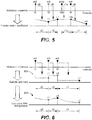
- FIG. 5 A second example of lossless metadata interpolation is shown in FIG. 5 .
- the goal is to include a new set of metadata m3a in between m3 and m4.
- FIG. 5 illustrates a case where the rendering matrix remains unchanged for a period of time. Therefore, in this situation, the values of the metadata m3a are identical to those of the prior m3 metadata, except for the interpolation duration d3a.
- the value of d3a should be set to the value corresponding to t4-t3a.
- the case of FIG. 5 may occur when an object is static and an authoring tool stops sending new metadata for the object due to this static nature. In such a case, it may be desirable to insert metadata instances such as m3a to synchronize with codec frames, or other similar reasons.
- FIGS. 4 and 5 the interpolation from a current to a desired rendering matrix state was performed by linear interpolation. In other embodiments, different interpolation schemes may also be used.
- One such alternative interpolation method uses a sample-and-hold circuit combined with a subsequent low-pass filter.
- FIG. 6 illustrates an interpolation method using a sample-and-hold circuit with a low-pass filter, under an embodiment. As shown in FIG. 6 , the metadata instances m2 to m4 are converted to sample-and-hold rendering matrix coefficients. The sample-and-hold process causes the coefficient states to jump immediately to the desired state, which results in a step-wise curve 601, as shown.
- the interpolation filter parameters e.g., cut-off frequency or time constant
- the interpolation filter parameters can be signaled as part of the metadata, similarly to the case with linear interpolation. Different parameters may be used depending on the requirements of the system and the characteristics of the audio signal.
- the interpolation duration or ramp size can have any practical value, including a value of or substantially close to zero.
- Such a small interpolation duration is especially helpful for cases such as initialization in order to enable setting the rendering matrix immediately at the first sample of a file, or allowing for edits, splicing, or concatenation of streams.
- having the possibility to instantaneously change the rendering matrix can be beneficial to maintain the spatial properties of the content after editing.
- the interpolation scheme described herein is compatible with the removal of metadata instances, such as in a decimation scheme that reduces metadata bitrates.
- Removal of metadata instances allows the system to resample at a frame rate that is lower than an initial frame rate.
- metadata instances and their associated interpolation duration data that are added by an encoder may be removed based on certain characteristics. For example, an analysis component may analyze the audio signal to determine if there is a period of significant stasis of the signal, and in such a case remove certain metadata instances to reduce bandwidth requirements.
- the removal of metadata instances may also be performed in a separate component, such as a decoder or transcoder that is separate from the encoder.
- the transcoder removes metadata instances that are defined or added by the encoder.
- Such as system may be used in a data rate converter that re-samples an audio signal from a first rate to a second rate, where the second rate may or may not be an integer multiple of the first rate.
- FIG. 7 is a flowchart that illustrates a method of representing spatial metadata that allows for lossless interpolation and/or re-sampling of the metadata, under an embodiment.
- Metadata elements generated by an authoring tool are associated with respective time stamps to create metadata instances (702).
- Each metadata instance represents a rendering state for playback of audio objects through a playback system.
- the process encodes each metadata instance with an interpolation duration that indicates the time that the new rendering state is to take effect relative to the time stamp of the respective metadata instance (704).
- the metadata instances are then converted to gain values, such as in the form of rendering matrix coefficients or spatial rendering vector values that are applied in the playback system upon the end of the interpolation duration (706).
- the gain values are interpolated to create a coefficient curve for rendering (708).
- the coefficient curve can be appropriately modified based on the insertion or removal of metadata instances (710).
- time stamp indicates the start of the transition from a current rendering matrix coefficient to a desired rendering matrix coefficient
- the described scheme will work equally well with a different definition of the time stamp, for example by specifying the point in time that the desired rendering matrix coefficient should have been reached.
- the adaptive audio system employing aspects of the metadata resampling process may comprise a playback system that is configured render and playback audio content that is generated through one or more capture, pre-processing, authoring and coding components.
- An adaptive audio pre-processor may include source separation and content type detection functionality that automatically generates appropriate metadata through analysis of input audio. For example, positional metadata may be derived from a multi-channel recording through an analysis of the relative levels of correlated input between channel pairs. Detection of content type, such as speech or music, may be achieved, for example, by feature extraction and classification.
- Certain authoring tools allow the authoring of audio programs by optimizing the input and codification of the sound engineer's creative intent allowing him to create the final audio mix once that is optimized for playback in practically any playback environment.
- the adaptive audio system provides this control by allowing the sound engineer to change how the audio content is designed and mixed through the use of audio objects and positional data.
- the playback system may be any professional or consumer audio system, which may include home theater (e.g., A/V receiver, soundbar, and Blu-ray), E-media (e.g., PC, Tablet, Mobile including headphone playback), broadcast (e.g., TV and set-top box), music, gaming, live sound, user generated content, and so on.
- the adaptive audio content provides enhanced immersion for the consumer audience for all end-point devices, expanded artistic control for audio content creators, improved content dependent (descriptive) metadata for improved rendering, expanded flexibility and scalability for consumer playback systems, timbre preservation and matching, and the opportunity for dynamic rendering of content based on user position and interaction.
- the system includes several components including new mixing tools for content creators, updated and new packaging and coding tools for distribution and playback, in-home dynamic mixing and rendering (appropriate for different consumer configurations), additional speaker locations and designs.
- Embodiments are directed to a method of representing spatial rendering metadata that allows for lossless re-sampling of the metadata.
- the method comprises time stamping the metadata to create metadata instances, and encoding an interpolation duration with each metadata instance that specifies the time to reach a desired rendering state for the respective metadata instance.
- the re-sampling of metadata is generally important for re-clocking metadata to an audio coder and for the editing audio content.
- Such embodiments may be embodied as software, hardware, or firmware that includes implementation of aspects as either hardware or software.
- Embodiments further include non-transitory media that stores instructions capable of causing the software to be executed in a processing system to perform at least some of the aspects of the disclosed method.
- aspects of the audio environment described herein represents the playback of the audio or audio/visual content through appropriate speakers and playback devices, and may represent any environment in which a listener is experiencing playback of the captured content, such as a cinema, concert hall, outdoor theater, a home or room, listening booth, car, game console, headphone or headset system, public address (PA) system, or any other playback environment.
- the spatial audio content comprising object-based audio and channel-based audio may be used in conjunction with any related content (associated audio, video, graphic, etc.), or it may constitute standalone audio content.
- the playback environment may be any appropriate listening environment from headphones or near field monitors to small or large rooms, cars, open-air arenas, concert halls, and so on.
- Portions of the adaptive audio system may include one or more networks that comprise any desired number of individual machines, including one or more routers (not shown) that serve to buffer and route the data transmitted among the computers.
- Such a network may be built on various different network protocols, and may be the Internet, a Wide Area Network (WAN), a Local Area Network (LAN), or any combination thereof.
- the network comprises the Internet
- one or more machines may be configured to access the Internet through web browser programs.
- One or more of the components, blocks, processes or other functional components may be implemented through a computer program that controls execution of a processor-based computing device of the system. It should also be noted that the various functions disclosed herein may be described using any number of combinations of hardware, firmware, and/or as data and/or instructions embodied in various machine-readable or computer-readable media, in terms of their behavioral, register transfer, logic component, and/or other characteristics.
- Computer-readable media in which such formatted data and/or instructions may be embodied include, but are not limited to, physical (non-transitory), non-volatile storage media in various forms, such as optical, magnetic or semiconductor storage media.
Landscapes
- Engineering & Computer Science (AREA)
- Physics & Mathematics (AREA)
- Computational Linguistics (AREA)
- Signal Processing (AREA)
- Health & Medical Sciences (AREA)
- Audiology, Speech & Language Pathology (AREA)
- Human Computer Interaction (AREA)
- Acoustics & Sound (AREA)
- Multimedia (AREA)
- Mathematical Physics (AREA)
- Quality & Reliability (AREA)
- Stereophonic System (AREA)
Description
- This application claims the benefit of priority to Spanish Patent Application No.
P201331022 filed 8 July 2013 61/875,467 filed 9 September 2013 - One or more implementations relate generally to audio signal processing, and more specifically to lossless resampling schemes for processing and rendering of audio objects based on spatial rendering metadata.
- The advent of object-based audio has significantly increased the amount of audio data and the complexity of rendering this data within high-end playback systems. For example, cinema sound tracks may comprise many different sound elements corresponding to images on the screen, dialog, noises, and sound effects that emanate from different places on the screen and combine with background music and ambient effects to create the overall auditory experience. Accurate playback requires that sounds be reproduced in a way that corresponds as closely as possible to what is shown on screen with respect to sound source position, intensity, movement, and depth. Object-based audio represents a significant improvement over traditional channel-based audio systems that send audio content in the form of speaker feeds to individual speakers in a listening environment, and are thus relatively limited with respect to spatial playback of specific audio objects.
- The introduction of digital cinema and the development of three-dimensional ("3D") content has created new standards for sound, such as the incorporation of multiple channels of audio to allow for greater creativity for content creators, and a more enveloping and realistic auditory experience for audiences. Expanding beyond traditional speaker feeds and channel-based audio as a means for distributing spatial audio is critical, and there has been considerable interest in a model-based audio description that allows the listener to select a desired playback configuration with the audio rendered specifically for their chosen configuration. The spatial presentation of sound utilizes audio objects, which are audio signals with associated parametric source descriptions of apparent source position (e.g., 3D coordinates), apparent source width, and other parameters. Further advancements include a next generation spatial audio (also referred to as "adaptive audio") format that comprises a mix of audio objects and traditional channel-based speaker feeds (beds) along with positional metadata for the audio objects.
- New professional and consumer-level cinema systems (such as the Dolby® Atmos™ system) have been developed to further the concept of hybrid audio authoring, which is a distribution and playback format that includes both audio beds (channels) and audio objects. Audio beds refer to audio channels that are meant to be reproduced in predefined, fixed speaker locations while audio objects refer to individual audio elements that may exist for a defined duration in time but also have spatial information describing the position, velocity, and size (as examples) of each object. During transmission beds and objects can be sent separately and then used by a spatial reproduction system to recreate the artistic intent using a variable number of speakers in known physical locations. In some soundtracks, there may be up to 7, 9 or even 11 bed channels containing audio. Additionally, based on the capabilities of an authoring system there may be tens or even hundreds of individual audio objects that are combined during rendering to create a spatially diverse and immersive audio experience.
-
FIG. 1A illustrates the combination of channel and object-based data to produce an adaptive audio mix, under an embodiment. As shown inprocess 100, the channel-baseddata 102, which, for example, may be 5.1 or 7.1 surround sound data provided in the form of pulse-code modulated (PCM) data is combined withaudio object data 104 to produce anadaptive audio mix 108. Theaudio object data 104 is produced by combining the elements of the original channel-based data with associated metadata that specifies certain parameters pertaining to the location of the audio objects. As shown conceptually inFIG. 1A , the authoring tools provide the ability to create audio programs that contain a combination of speaker channel groups and object channels simultaneously. For example, an audio program could contain one or more speaker channels optionally organized into groups (or tracks, e.g., a stereo or 5.1 track), descriptive metadata for one or more speaker channels, one or more object channels, and descriptive metadata for one or more object channels. - The large number of audio signals present in object-based content poses new challenges for the rendering of such content. Each object requires a rendering process, which determines how the object signal should be distributed over the available reproduction channels. For example, in a loudspeaker reproduction system consisting of a 5.1 setup with left front, right front, center, low-frequency effects, left surround, right surround channels, an object may be reproduced by any subset of these loudspeakers, depending on their spatial information. The (relative) level of each loudspeaker greatly influences the perceived position by the listener. In practical systems, a panning law or panning system is used to determine the so-called panning gains or relative level of each loudspeaker to result in a perceived object location that closely resembles the intended object location as indicated by its spatial information or metadata. If multiple objects are to be distributed over several loudspeakers, the process of panning can be represented by a panning or rendering matrix, which determines the gain (or signal proportion) of each object to each loudspeaker. In practical cases, such rendering matrix will be time varying to allow for variable object positions.
- Besides position metadata, other, more advanced metadata may be associated with objects as well. For example, a speaker mask may be included in an object's metadata, which indicates a subset of loudspeakers that should be used for rendering. Alternatively, certain loudspeakers may be excluded for rendering an object. For example, an object may be associated with a speaker mask that excludes the surround channels or ceiling channels for rendering that object. Alternatively, or additionally, an object may have metadata that signal the rendering of an object by a speaker array rather than a single speaker or pair of loudspeakers. For practical and efficiency reasons, such metadata are often of binary nature (e.g., a certain loudspeaker is, or is not used to render a certain object). In practical systems, the use of such advanced metadata influences the coefficients present in the rendering matrix.
- In object-based audio systems, object metadata is typically updated relatively infrequently (sparsely) in time to limit the associated data rate. Typical update intervals for object positions can range between 10 and 500 milliseconds, depending on the speed of the object, the required position accuracy, the available bandwidth to store or transmit metadata, and so on. Such sparse, or even irregular metadata updates require interpolation of metadata and/or rendering matrices for audio samples in-between two subsequent metadata instances. Without interpolation, the consequential step-wise changes in the rendering matrix may cause undesirable switching artifacts, clicking sounds, zipper noises, or other undesirable artifacts as a result of spectral splatter introduced by step-wise matrix updates.
-
FIG. 1B illustrates a typical known process to compute a rendering matrix for a set of metadata instances. As shown inFIG. 1B , a set of metadata instances (m1 to m4) 120 correspond to a set of time instances (t1 to t4) which are indicated by their position along thetime axis 124. Subsequently, each metadata instance is converted to a respective rendering matrix (c1 to c4) 122, or a complete rendering matrix that is valid at that same time instance. Thus, as shown, metadata instance m1 creates rendering matrix c1 at time t1, metadata instance m2 creates rendering matrix c2 at time t2, and so on. For simplicity,FIG. 1B shows only one rendering matrix for each metadata instance m1 to m4. In practical systems, however, a rendering matrix may comprise a set of rendering matrix coefficients or gain coefficients c 1,i,j to be applied to object signal with index j to create output signal with index i:
- The rendering matrices generally comprise coefficients that represent gain values at different instances in time. Metadata instances are defined at certain discrete times, and for audio samples in-between the metadata time stamps, the rendering matrix is interpolated, as indicated by the dashed line 126 connecting the
rendering matrices 122. Such interpolation can be performed linearly, but also other interpolation methods can be used (such as bandlimited interpolation, sine/cosine interpolation, and so on). The time interval between the metadata instances (and corresponding rendering matrices) is referred to as an "interpolation duration," and such intervals may be uniform or they may be different, such as the longer interpolation duration between times t3 and t4 as compared to the interpolation duration between times t2 and t3. - In general, present metadata update and interpolation systems are sufficient for relatively simple objects in which the metadata definitions dictate object position and/or gain values for speakers. The change of such values can usually be adequately be interpolated in present systems by interpolation of metadata instances. For complex objects and cases in which the metadata instances are limited to certain possible values, present interpolation methods operating on metadata directly are typically unsatisfactory. For example, if a metadata instance is limited to one of two values (binary metadata), standard interpolation techniques would derive the incorrect value about half the time.
- In many cases, the calculation of rendering matrix coefficients from metadata instances is well defined, but the reverse process of calculating metadata instances given a (interpolated) rendering matrix, is often difficult, or even impossible. In this respect, the process of generating a rendering matrix from metadata can sometimes be regarded as a cryptographic one-way function. The process of calculating new metadata instances between existing metadata instances is referred to as "resampling" of the metadata. Resampling of metadata is often required during certain audio processing tasks. For example, when audio content is edited, by cutting/merging/mixing and so on, such edits may occur in between metadata instances. In this case, resampling of the metadata is required. Another such case is when audio and associated metadata are encoded with a frame-based audio coder. In this case, it is desirable to have at least one metadata instance for each audio codec frame, preferably with a time stamp at the start of that codec frame, to improve resilience of frame losses during transmission. As stated above, interpolation of metadata is also ineffective for certain types of metadata, such as binary-valued metadata. For example, if binary flags such as zone exclusion masks are used, it is virtually impossible to estimate a valid set of metadata from the rendering matrix coefficients or from neighboring instances of metadata. This is shown in
FIG. 1B as a failed attempt to extrapolate or derive a metadata instance m3a from the rendering matrix coefficients in the interpolation duration between times t3 and t4. - Thus, in present metadata processing for adaptive audio, any metadata resampling or upsampling process by means of interpolation is practically impossible without introducing inaccuracies in the resulting rendering matrix coefficients, and hence a loss in spatial audio quality.
- International Patent Application Publication Number
WO 2011/119401 A2 concerns audio perception in local proximity to visual cues. Therein, a device includes a video display, first row audio transducers and second row transducers. The first and second rows can be vertically disposed above and below the video display. An audio transducer of the first row and an audio transducer of the second row form a column to produce, in concert, an audible signal. - The subject matter discussed in the background section should not be assumed to be prior art merely as a result of its mention in the background section. Similarly, a problem mentioned in the background section or associated with the subject matter of the background section should not be assumed to have been previously recognized in the prior art. The subject matter in the background section merely represents different approaches, which in and of themselves may also be inventions.
- Some embodiments are directed to a method for representing time-varying rendering metadata in an object-based audio system, as recited in
claim 1. - Embodiments are further directed to a method for determining a sequence of rendering states, as recited in
claim 12. - Some further embodiments are described for systems that implement the embodiments for the methods described above, and to products of manufacture that store instructions that execute the described methods in a processor-based computing system.
- The methods and systems described herein may be implemented in an audio format and system that includes updated content creation tools, distribution methods and an enhanced user experience based on an adaptive audio system that includes new speaker and channel configurations, as well as a new spatial description format made possible by a suite of advanced content creation tools. In such a system, audio streams (generally including channels and objects) are transmitted along with metadata that describes the content creator's or sound mixer's intent, including desired position of the audio stream. The position can be expressed as a named channel (from within the predefined channel configuration) or as three-dimensional (3D) spatial position information.
- In the following drawings like reference numbers are used to refer to like elements. Although the following figures depict various examples, the one or more implementations are not limited to the examples depicted in the figures.
-
FIG. 1A illustrates the combination of channel and object-based data to produce an adaptive audio mix, under an embodiment. -
FIG. 1B illustrates a typical known process to compute a rendering matrix for a set of metadata instances. -
FIG. 2A is a table that illustrates example metadata definitions for defining metadata instances, under an embodiment. -
FIG. 2B illustrates the derivation of a matrix coefficient curve of gain values from metadata instances, under an embodiment. -
FIG. 3 illustrates a metadata instance interpolation method, under an embodiment. -
FIG. 4 illustrates a first example of lossless interpolation of metadata, under an embodiment. -
FIG. 5 illustrates a second example of lossless interpolation of metadata, under an embodiment. -
FIG. 6 illustrates an interpolation method using a sample-and-hold circuit with a low-pass filter, under an embodiment. -
FIG. 7 is a flowchart that illustrates a method of representing spatial metadata that allows for lossless interpolation and/or re-sampling of the metadata, under an embodiment. - Systems and methods are described for an improved metadata resampling scheme for object-based audio data and processing systems. Aspects of the one or more embodiments described herein may be implemented in an audio or audio-visual (AV) system that processes source audio information in a mixing, rendering and playback system that includes one or more computers or processing devices executing software instructions. Any of the described embodiments may be used alone or together with one another in any combination. Although various embodiments may have been motivated by various deficiencies with the prior art, which may be discussed or alluded to in one or more places in the specification, the embodiments do not necessarily address any of these deficiencies. In other words, different embodiments may address different deficiencies that may be discussed in the specification. Some embodiments may only partially address some deficiencies or just one deficiency that may be discussed in the specification, and some embodiments may not address any of these deficiencies.
- For purposes of the present description, the following terms have the associated meanings: the term "channel" or "bed" means an audio signal plus metadata in which the position is coded as a channel identifier, e.g., left-front or right-top surround; "channel-based audio" is audio formatted for playback through a pre-defined set of speaker zones with associated nominal locations, e.g., 5.1, 7.1, and so on; the term "object" or "object-based audio" means one or more audio channels with a parametric source description, such as apparent source position (e.g., 3D coordinates), apparent source width, etc.; "adaptive audio" means channel-based and/or object-based audio signals plus metadata that renders the audio signals based on the playback environment using an audio stream plus metadata in which the position is coded as a 3D position in space; and "rendering" means conversion to, and possible storage of, digital signals that may eventually be converted to electrical signals used as speaker feeds. Embodiments described herein apply to beds and objects, as well as other scene-based audio content, such as Ambisonics-based content and systems; thus, such embodiments may apply to situations where object-based audio is combined with other non-object and non-channel based content, such as Ambisonics audio, or other similar scene-based audio.
- In an embodiment, the spatial metadata resampling scheme is implemented as part of an audio system that is configured to work with a sound format and processing system that may be referred to as a "spatial audio system" or "adaptive audio system." Such a system is based on an audio format and rendering technology to allow enhanced audience immersion, greater artistic control, and system flexibility and scalability. An overall adaptive audio system generally comprises an audio encoding, distribution, and decoding system configured to generate one or more bitstreams containing both conventional channel-based audio elements and audio object coding elements. Such a combined approach provides greater coding efficiency and rendering flexibility compared to either channel-based or object-based approaches taken separately. An example of an adaptive audio system that may be used in conjunction with present embodiments is described in
PCT application publication WO2013/006338 published on January 10, 2013 and entitled "System and Method for Adaptive Audio Signal Generation, Coding and Rendering," which is attached hereto asAppendix 1. An example implementation of an adaptive audio system and associated audio format is the Dolby® Atmos™ platform. Such a system incorporates a height (up/down) dimension that may be implemented as a 9.1 surround system, or similar surround sound configuration. - Audio objects can be considered individual or collections of sound elements that may be perceived to emanate from a particular physical location or locations in the listening environment. Such objects can be static (that is, stationary) or dynamic (that is, moving). Audio objects are controlled by metadata that defines the position of the sound at a given point in time, along with other functions. When objects are played back, they are rendered according to the positional metadata using the speakers that are present, rather than necessarily being output to a predefined physical channel. A track in a session can be an audio object, and standard panning data is analogous to positional metadata. In this way, content placed on the screen might pan in effectively the same way as with channel-based content, but content placed in the surrounds can be rendered to individual speakers, if desired. While the use of audio objects provides control over discrete effects, other aspects of a soundtrack may work more effectively in a channel-based environment. For example, many ambient effects or reverberation actually benefit from being fed to arrays of speakers rather than individual drivers. Although these could be treated as objects with sufficient width to fill an array, it is beneficial to retain some channel-based functionality.
- An adaptive audio system extends beyond speaker feeds as a means for distributing spatial audio and uses advanced model-based audio descriptions to tailor playback configurations that suit individual needs and system constraints so that audio can be rendered specifically for individual configurations. The spatial effects of audio signals are critical in providing an immersive experience for the listener. Sounds that are meant to emanate from a specific region of a viewing screen or room should be played through speaker(s) located at that same relative location. Thus, the primary audio metadatum of a sound event in a model-based description is position, though other parameters such as size, orientation, velocity and acoustic dispersion can also be described.
-
FIG. 2A is a table that illustrates example metadata definitions for defining metadata instances, under an embodiment. As shown incolumn 202 of table 200, the metadata definitions include metadata types such as: object position, object width, audio content type, loudness, rendering modes, control signals, among other possible metadata types. The metadata definitions include elements that define certain values associated with each metadata type. Example metadata elements for each metadata type are listed incolumn 204 of table 200. At any given time, an object may have various different metadata elements that comprise a metadata instance mx for a particular time tx. Not all metadata elements may be represented in a particular metadata instance, but a metadata instance typically includes two or more metadata elements specifying particular spatial characteristics of the object. Each metadata instance is used to derive a respective set of matrix coefficients cx, also referred to as a rendering matrix, as shown inFIG. 1B . - Table 200 of
FIG. 2A is intended to list only certain example metadata elements, and it should be understood that other or different metadata definitions and elements are also possible. -
FIG. 2B illustrates the derivation of a matrix coefficient curve of gain values from metadata instances, under an embodiment. As shown inFIG. 2B , a set of metadata instances mx generated at different times tx are converted byconverter 222 into corresponding sets of matrix coefficient values cx. These sets of coefficients represent the gain values for the various speakers and drivers in the system. Aninterpolator 224 then interpolates the gain factors to produce a coefficient curve between the discrete times tx. In an embodiment, the time stamps tx associated with each metadata instance may be random time values, synchronous time values generated by a clock circuit, time events related to the audio content, such as frame boundaries, or any other appropriate timed event. - As shown in
FIG. 1B , metadata instances mx are only definitely defined at certain discrete times tx, which in turn produces the associated set of matrix coefficients cx. In between these discrete times tx, the sets of matrix coefficients must be interpolated based on past or future metadata instances. However, as described above, present metadata interpolation schemes suffer from loss of spatial audio quality due to unavoidable inaccuracies in metadata interpolation processes. -
FIG. 3 illustrates a metadata instance resampling method, under an embodiment. The method ofFIG. 3 addresses at least some of the interpolation problems associated with present methods as described above by defining a time stamp as the start time of an interpolation duration, and augmenting each metadata instance with a parameter that represents the interpolation duration (also referred to as "ramp size"). As shown inFIG. 3 , a set of metadata instances m2 to m4 (302) describes a set of rendering matrices c2 to c4 (304). Each metadata instance is generated at a particular time tx, and each metadata instance is defined with respect to its time stamp, m2 to t2, m3 to t3, and so on. The associatedrendering matrices 304 are generated after processing respective time spans d2, d3, d4 (306), from the associated time stamp (t1 to t4) of eachmetadata instance 302. The time span (or ramp size) is included with each metadata instance, i.e., metadata instance m2 includes d2, m3 includes d3, and so on. Schematically this can be represented as follows: mx = (metadata(tx ), dx ) → cx. - In this manner, the metadata essentially provides a schematic of how to proceed from a current state (e.g., the current rendering matrix resulting from previous metadata) to a new state (e.g., the new rendering matrix resulting from the current metadata. Each metadata instance is meant to take effect at a specified point in time in the future relative to the moment the metadata instance was received and the coefficient curve is derived from the previous state of the coefficient. Thus, in
FIG. 3 , m2 generates c2 after a period d2, m3 generates c3 after a period d3 and m4 generates c4 after a period d4. In this scheme, for interpolation, the previous metadata need not be known, only the previous rendering matrix state is required. The interpolation may be linear or non-linear depending on system constraints and configurations. - The metadata resampling method of
FIG. 3 allows for lossless upsampling and downsampling of metadata as shown inFIG. 4. FIG. 4 illustrates a first example of lossless processing of metadata, under an embodiment.FIG. 4 shows metadata instances m2 to m4 that refer to the future rendering matrices c2 to c4, respectively, including interpolation durations d2 to d4. The time stamps of the metadata instances m2 to m4 are given as t2 to t4. In the example ofFIG. 4 , a new set of metadata m4a at time t4a is added. Such metadata may be added for several reasons, such as to improve error resilience of the system or to synchronize metadata instances with the start/end of an audio frame. For example, time t4a may represent the time that the codec starts a new frame. For lossless operation, the metadata values of m4a are identical to those of m4 (as they both describe a target rendering matrix c4), but the time to reach that point has reduced d4-d4a. In other words, metadata instance m4a is identical to that of the previous m4 instance so that the interpolation curve between c3 and c4 is not changed. However, the interpolation duration d4a, is shorter than the original duration d4. This effectively increases the data rate of the metadata instances, which can be beneficial in certain circumstances, such as error correction. - A second example of lossless metadata interpolation is shown in
FIG. 5 . In this example, the goal is to include a new set of metadata m3a in between m3 and m4.FIG. 5 illustrates a case where the rendering matrix remains unchanged for a period of time. Therefore, in this situation, the values of the metadata m3a are identical to those of the prior m3 metadata, except for the interpolation duration d3a. The value of d3a should be set to the value corresponding to t4-t3a. The case ofFIG. 5 may occur when an object is static and an authoring tool stops sending new metadata for the object due to this static nature. In such a case, it may be desirable to insert metadata instances such as m3a to synchronize with codec frames, or other similar reasons. - In the examples of
FIGS. 4 and5 , the interpolation from a current to a desired rendering matrix state was performed by linear interpolation. In other embodiments, different interpolation schemes may also be used. One such alternative interpolation method uses a sample-and-hold circuit combined with a subsequent low-pass filter.FIG. 6 illustrates an interpolation method using a sample-and-hold circuit with a low-pass filter, under an embodiment. As shown inFIG. 6 , the metadata instances m2 to m4 are converted to sample-and-hold rendering matrix coefficients. The sample-and-hold process causes the coefficient states to jump immediately to the desired state, which results in astep-wise curve 601, as shown. This curve is then subsequently low-pass filtered to obtain a smooth, interpolatedcurve 603. The interpolation filter parameters (e.g., cut-off frequency or time constant) can be signaled as part of the metadata, similarly to the case with linear interpolation. Different parameters may be used depending on the requirements of the system and the characteristics of the audio signal. - In an embodiment, the interpolation duration or ramp size can have any practical value, including a value of or substantially close to zero. Such a small interpolation duration is especially helpful for cases such as initialization in order to enable setting the rendering matrix immediately at the first sample of a file, or allowing for edits, splicing, or concatenation of streams. With this type of destructive edits, having the possibility to instantaneously change the rendering matrix can be beneficial to maintain the spatial properties of the content after editing.
- In an embodiment, the interpolation scheme described herein is compatible with the removal of metadata instances, such as in a decimation scheme that reduces metadata bitrates. Removal of metadata instances allows the system to resample at a frame rate that is lower than an initial frame rate. In this case, metadata instances and their associated interpolation duration data that are added by an encoder may be removed based on certain characteristics. For example, an analysis component may analyze the audio signal to determine if there is a period of significant stasis of the signal, and in such a case remove certain metadata instances to reduce bandwidth requirements. The removal of metadata instances may also be performed in a separate component, such as a decoder or transcoder that is separate from the encoder. In this case, the transcoder removes metadata instances that are defined or added by the encoder. Such as system may be used in a data rate converter that re-samples an audio signal from a first rate to a second rate, where the second rate may or may not be an integer multiple of the first rate.
-
FIG. 7 is a flowchart that illustrates a method of representing spatial metadata that allows for lossless interpolation and/or re-sampling of the metadata, under an embodiment. Metadata elements generated by an authoring tool are associated with respective time stamps to create metadata instances (702). Each metadata instance represents a rendering state for playback of audio objects through a playback system. The process encodes each metadata instance with an interpolation duration that indicates the time that the new rendering state is to take effect relative to the time stamp of the respective metadata instance (704). The metadata instances are then converted to gain values, such as in the form of rendering matrix coefficients or spatial rendering vector values that are applied in the playback system upon the end of the interpolation duration (706). The gain values are interpolated to create a coefficient curve for rendering (708). The coefficient curve can be appropriately modified based on the insertion or removal of metadata instances (710). - Although in the previous examples, the time stamp indicates the start of the transition from a current rendering matrix coefficient to a desired rendering matrix coefficient, the described scheme will work equally well with a different definition of the time stamp, for example by specifying the point in time that the desired rendering matrix coefficient should have been reached.
- The adaptive audio system employing aspects of the metadata resampling process may comprise a playback system that is configured render and playback audio content that is generated through one or more capture, pre-processing, authoring and coding components. An adaptive audio pre-processor may include source separation and content type detection functionality that automatically generates appropriate metadata through analysis of input audio. For example, positional metadata may be derived from a multi-channel recording through an analysis of the relative levels of correlated input between channel pairs. Detection of content type, such as speech or music, may be achieved, for example, by feature extraction and classification. Certain authoring tools allow the authoring of audio programs by optimizing the input and codification of the sound engineer's creative intent allowing him to create the final audio mix once that is optimized for playback in practically any playback environment. This can be accomplished through the use of audio objects and positional data that is associated and encoded with the original audio content. In order to accurately place sounds around an auditorium, the sound engineer needs control over how the sound will ultimately be rendered based on the actual constraints and features of the playback environment. The adaptive audio system provides this control by allowing the sound engineer to change how the audio content is designed and mixed through the use of audio objects and positional data. Once the adaptive audio content has been authored and coded in the appropriate codec devices, it is decoded and rendered in the various components of the playback system.
- In general, the playback system may be any professional or consumer audio system, which may include home theater (e.g., A/V receiver, soundbar, and Blu-ray), E-media (e.g., PC, Tablet, Mobile including headphone playback), broadcast (e.g., TV and set-top box), music, gaming, live sound, user generated content, and so on. The adaptive audio content provides enhanced immersion for the consumer audience for all end-point devices, expanded artistic control for audio content creators, improved content dependent (descriptive) metadata for improved rendering, expanded flexibility and scalability for consumer playback systems, timbre preservation and matching, and the opportunity for dynamic rendering of content based on user position and interaction. The system includes several components including new mixing tools for content creators, updated and new packaging and coding tools for distribution and playback, in-home dynamic mixing and rendering (appropriate for different consumer configurations), additional speaker locations and designs.
- Embodiments are directed to a method of representing spatial rendering metadata that allows for lossless re-sampling of the metadata. The method comprises time stamping the metadata to create metadata instances, and encoding an interpolation duration with each metadata instance that specifies the time to reach a desired rendering state for the respective metadata instance. The re-sampling of metadata is generally important for re-clocking metadata to an audio coder and for the editing audio content. Such embodiments may be embodied as software, hardware, or firmware that includes implementation of aspects as either hardware or software. Embodiments further include non-transitory media that stores instructions capable of causing the software to be executed in a processing system to perform at least some of the aspects of the disclosed method.
- Aspects of the audio environment described herein represents the playback of the audio or audio/visual content through appropriate speakers and playback devices, and may represent any environment in which a listener is experiencing playback of the captured content, such as a cinema, concert hall, outdoor theater, a home or room, listening booth, car, game console, headphone or headset system, public address (PA) system, or any other playback environment. The spatial audio content comprising object-based audio and channel-based audio may be used in conjunction with any related content (associated audio, video, graphic, etc.), or it may constitute standalone audio content. The playback environment may be any appropriate listening environment from headphones or near field monitors to small or large rooms, cars, open-air arenas, concert halls, and so on.
- Aspects of the systems described herein may be implemented in an appropriate computer-based sound processing network environment for processing digital or digitized audio files. Portions of the adaptive audio system may include one or more networks that comprise any desired number of individual machines, including one or more routers (not shown) that serve to buffer and route the data transmitted among the computers. Such a network may be built on various different network protocols, and may be the Internet, a Wide Area Network (WAN), a Local Area Network (LAN), or any combination thereof. In an embodiment in which the network comprises the Internet, one or more machines may be configured to access the Internet through web browser programs.
- One or more of the components, blocks, processes or other functional components may be implemented through a computer program that controls execution of a processor-based computing device of the system. It should also be noted that the various functions disclosed herein may be described using any number of combinations of hardware, firmware, and/or as data and/or instructions embodied in various machine-readable or computer-readable media, in terms of their behavioral, register transfer, logic component, and/or other characteristics. Computer-readable media in which such formatted data and/or instructions may be embodied include, but are not limited to, physical (non-transitory), non-volatile storage media in various forms, such as optical, magnetic or semiconductor storage media.
- Unless the context clearly requires otherwise, throughout the description and the claims, the words "comprise," "comprising," and the like are to be construed in an inclusive sense as opposed to an exclusive or exhaustive sense; that is to say, in a sense of "including, but not limited to." Words using the singular or plural number also include the plural or singular number respectively. Additionally, the words "herein," "hereunder," "above," "below," and words of similar import refer to this application as a whole and not to any particular portions of this application. When the word "or" is used in reference to a list of two or more items, that word covers all of the following interpretations of the word: any of the items in the list, all of the items in the list and any combination of the items in the list.
- While one or more implementations have been described by way of example and in terms of the specific embodiments, it is to be understood that one or more implementations are not limited to the disclosed embodiments. To the contrary, it is intended to cover various modifications and similar arrangements as would be apparent to those skilled in the art. Therefore, the scope of the appended claims should be accorded the broadest interpretation so as to encompass all such modifications and similar arrangements.
Claims (14)
- A method for representing time-varying rendering metadata in an object-based audio system as a sequence of metadata instances, each metadata instance specifying a desired rendering state, the method comprising:associating (702) each metadata instance with a time stamp, the time stamp indicating a point in time to begin a transition from a current rendering state to the desired rendering state;including (704), in each metadata instance, an interpolation duration parameter indicating the required time to reach the desired rendering state, andgenerating one or more additional metadata instances between existing metadata instances that are identical to a previous or subsequent metadata instance across time, with the exception of the interpolation duration parameter.
- The method of claim 1 wherein the desired rendering state represents one of: a spatial rendering vector or rendering matrix.
- The method of claim 2 wherein the metadata describes spatial rendering data of one or more audio objects.
- The method of claim 3 wherein the metadata comprises a plurality of metadata instances that are converted to respective rendering states specifying gain factors for playback of the audio content through audio drivers in a playback system.
- The method of claim 4 wherein the metadata describes how an object should be rendered through the playback system.
- The method of claim 3 wherein the metadata include one or more of the object attributes selected from the group consisting of: object position, object size, and object zone exclusion.
- The method of claim 2, in which the spatial rendering vector or rendering matrix is interpolated across time, and optionally
further comprising utilizing an interpolation method that is one of a linear interpolation and a non-linear interpolation, or
performing a sample-and-hold operation to generate a step-wise interpolation curve; and
applying a low-pass filter process to the step-wise interpolation curve to generate a smooth interpolation curve. - The method of claim 1 wherein the time stamp is defined relative to a reference point in audio content processed by the object-based audio system.
- The method of claim 1 further comprising:determining if the current state does not significantly deviate from the desired state; andremoving one or more metadata instances in between the current state and the desired state if the change does not significantly deviate.
- A system for representing time-varying rendering metadata in an object-based audio system as a sequence of metadata instances, each metadata instance specifying a desired rendering state, the system comprising a processing system configured to perform the method of any one of the preceding claims.
- A storage medium on which is stored software capable of causing a processing system to perform the method of any one of claims 1 to 9.
- A method for determining a sequence of rendering states, comprising:receiving a sequence of metadata instances, wherein each instance is synchronized with the start/end of a respective audio frame, representing time-varying rendering metadata of an object-based audio system, wherein:each metadata instance is associated with a time stamp, the time stamp indicating a point in time to begin a transition from a current rendering state to a desired rendering state;each metadata instance includes an interpolation duration parameter indicating the required time to reach the desired rendering state; andone or more consecutive metadata instances are identical to a previous metadata instance, with the exception of the interpolation duration parameter;determining, for each metadata instance, a respective desired rendering state; anddetermining the sequence of rendering states by interpolating, for each metadata instance, from the current rendering state to the respective desired rendering state, in response to the interpolation duration parameter.
- A system for determining a sequence of rendering states, the system comprising a processing system configured to perform the method of claim 12.
- A storage medium on which is stored software capable of causing a processing system to perform the method of claim 12.
Applications Claiming Priority (3)
| Application Number | Priority Date | Filing Date | Title |
|---|---|---|---|
| ES201331022 | 2013-07-08 | ||
| US201361875467P | 2013-09-09 | 2013-09-09 | |
| PCT/US2014/045156 WO2015006112A1 (en) | 2013-07-08 | 2014-07-01 | Processing of time-varying metadata for lossless resampling |
Publications (2)
| Publication Number | Publication Date |
|---|---|
| EP3020042A1 EP3020042A1 (en) | 2016-05-18 |
| EP3020042B1 true EP3020042B1 (en) | 2018-03-21 |
Family
ID=52280466
Family Applications (1)
| Application Number | Title | Priority Date | Filing Date |
|---|---|---|---|
| EP14741766.1A Active EP3020042B1 (en) | 2013-07-08 | 2014-07-01 | Processing of time-varying metadata for lossless resampling |
Country Status (3)
| Country | Link |
|---|---|
| US (1) | US9858932B2 (en) |
| EP (1) | EP3020042B1 (en) |
| WO (1) | WO2015006112A1 (en) |
Families Citing this family (12)
| Publication number | Priority date | Publication date | Assignee | Title |
|---|---|---|---|---|
| CN106157978B (en) * | 2015-04-15 | 2020-04-07 | 宏碁股份有限公司 | Speech signal processing apparatus and speech signal processing method |
| US9934790B2 (en) * | 2015-07-31 | 2018-04-03 | Apple Inc. | Encoded audio metadata-based equalization |
| US10341770B2 (en) | 2015-09-30 | 2019-07-02 | Apple Inc. | Encoded audio metadata-based loudness equalization and dynamic equalization during DRC |
| CN116709161A (en) | 2016-06-01 | 2023-09-05 | 杜比国际公司 | Method for converting multichannel audio content into object-based audio content and method for processing audio content having spatial locations |
| US10572659B2 (en) * | 2016-09-20 | 2020-02-25 | Ut-Battelle, Llc | Cyber physical attack detection |
| JP2018110362A (en) * | 2017-01-06 | 2018-07-12 | ローム株式会社 | Audio signal processing circuit, on-vehicle audio system using the same, audio component apparatus, electronic apparatus and audio signal processing method |
| US11303689B2 (en) | 2017-06-06 | 2022-04-12 | Nokia Technologies Oy | Method and apparatus for updating streamed content |
| JP7504091B2 (en) | 2018-11-02 | 2024-06-21 | ドルビー・インターナショナル・アーベー | Audio Encoders and Decoders |
| BR112022010737A2 (en) * | 2019-12-02 | 2022-08-23 | Dolby Laboratories Licensing Corp | SYSTEMS, METHODS AND DEVICE FOR CONVERSION FROM AUDIO BASED ON CHANNEL TO AUDIO BASED ON OBJECT |
| US12177646B2 (en) * | 2020-05-26 | 2024-12-24 | Dolby International Ab | Main-associated audio experience with efficient ducking gain application |
| US11317137B2 (en) * | 2020-06-18 | 2022-04-26 | Disney Enterprises, Inc. | Supplementing entertainment content with ambient lighting |
| CN115497485B (en) * | 2021-06-18 | 2024-10-18 | 华为技术有限公司 | Three-dimensional audio signal encoding method, device, encoder and system |
Family Cites Families (25)
| Publication number | Priority date | Publication date | Assignee | Title |
|---|---|---|---|---|
| US7424117B2 (en) | 2003-08-25 | 2008-09-09 | Magix Ag | System and method for generating sound transitions in a surround environment |
| US8638946B1 (en) | 2004-03-16 | 2014-01-28 | Genaudio, Inc. | Method and apparatus for creating spatialized sound |
| US7601121B2 (en) * | 2004-07-12 | 2009-10-13 | Siemens Medical Solutions Usa, Inc. | Volume rendering quality adaptations for ultrasound imaging |
| KR100953644B1 (en) * | 2006-01-19 | 2010-04-20 | 엘지전자 주식회사 | Method and apparatus for processing media signal |
| US7647229B2 (en) * | 2006-10-18 | 2010-01-12 | Nokia Corporation | Time scaling of multi-channel audio signals |
| EP2595148A3 (en) * | 2006-12-27 | 2013-11-13 | Electronics and Telecommunications Research Institute | Apparatus for coding multi-object audio signals |
| US9197977B2 (en) | 2007-03-01 | 2015-11-24 | Genaudio, Inc. | Audio spatialization and environment simulation |
| US20100215195A1 (en) | 2007-05-22 | 2010-08-26 | Koninklijke Philips Electronics N.V. | Device for and a method of processing audio data |
| BRPI0902887A2 (en) | 2008-01-17 | 2015-09-22 | Panasonic Corp | recording medium in which a 3d video is recorded, recording medium for recording a 3d video and then playback and method for playing a 3d video |
| EP2144230A1 (en) | 2008-07-11 | 2010-01-13 | Fraunhofer-Gesellschaft zur Förderung der angewandten Forschung e.V. | Low bitrate audio encoding/decoding scheme having cascaded switches |
| US7848511B2 (en) * | 2008-09-30 | 2010-12-07 | Avaya Inc. | Telecommunications-terminal mute detection |
| US8798776B2 (en) * | 2008-09-30 | 2014-08-05 | Dolby International Ab | Transcoding of audio metadata |
| RU2493618C2 (en) * | 2009-01-28 | 2013-09-20 | Долби Интернешнл Аб | Improved harmonic conversion |
| US8380333B2 (en) | 2009-12-21 | 2013-02-19 | Nokia Corporation | Methods, apparatuses and computer program products for facilitating efficient browsing and selection of media content and lowering computational load for processing audio data |
| WO2011095913A1 (en) | 2010-02-02 | 2011-08-11 | Koninklijke Philips Electronics N.V. | Spatial sound reproduction |
| CN116390017A (en) * | 2010-03-23 | 2023-07-04 | 杜比实验室特许公司 | Audio reproduction method and sound reproduction system |
| TWI517028B (en) | 2010-12-22 | 2016-01-11 | 傑奧笛爾公司 | Audio spatialization and environment simulation |
| WO2012094338A1 (en) | 2011-01-04 | 2012-07-12 | Srs Labs, Inc. | Immersive audio rendering system |
| WO2012122397A1 (en) | 2011-03-09 | 2012-09-13 | Srs Labs, Inc. | System for dynamically creating and rendering audio objects |
| CA3157717A1 (en) | 2011-07-01 | 2013-01-10 | Dolby Laboratories Licensing Corporation | System and method for adaptive audio signal generation, coding and rendering |
| GB2524682B (en) * | 2011-10-24 | 2016-04-27 | Graham Craven Peter | Lossless buried data |
| US9607624B2 (en) * | 2013-03-29 | 2017-03-28 | Apple Inc. | Metadata driven dynamic range control |
| RS1332U (en) | 2013-04-24 | 2013-08-30 | Tomislav Stanojević | FULL SOUND ENVIRONMENT SYSTEM WITH FLOOR SPEAKERS |
| EP2973551B1 (en) * | 2013-05-24 | 2017-05-03 | Dolby International AB | Reconstruction of audio scenes from a downmix |
| RU2745832C2 (en) * | 2013-05-24 | 2021-04-01 | Долби Интернешнл Аб | Efficient encoding of audio scenes containing audio objects |
-
2014
- 2014-07-01 WO PCT/US2014/045156 patent/WO2015006112A1/en not_active Ceased
- 2014-07-01 EP EP14741766.1A patent/EP3020042B1/en active Active
- 2014-07-01 US US14/903,508 patent/US9858932B2/en active Active
Also Published As
| Publication number | Publication date |
|---|---|
| US9858932B2 (en) | 2018-01-02 |
| EP3020042A1 (en) | 2016-05-18 |
| WO2015006112A1 (en) | 2015-01-15 |
| US20160163321A1 (en) | 2016-06-09 |
Similar Documents
| Publication | Publication Date | Title |
|---|---|---|
| US9858932B2 (en) | Processing of time-varying metadata for lossless resampling | |
| RU2741738C1 (en) | System, method and permanent machine-readable data medium for generation, coding and presentation of adaptive audio signal data | |
| EP3145220A1 (en) | Rendering virtual audio sources using loudspeaker map deformation | |
| KR102033304B1 (en) | Efficient coding of audio scenes comprising audio objects | |
| AU2012279357A1 (en) | System and method for adaptive audio signal generation, coding and rendering | |
| RU2820838C2 (en) | System, method and persistent machine-readable data medium for generating, encoding and presenting adaptive audio signal data | |
| Geier et al. | The Future of Audio Reproduction: Technology–Formats–Applications | |
| HK1226887A1 (en) | System and method for adaptive audio signal generation, coding and rendering |
Legal Events
| Date | Code | Title | Description |
|---|---|---|---|
| PUAI | Public reference made under article 153(3) epc to a published international application that has entered the european phase |
Free format text: ORIGINAL CODE: 0009012 |
|
| 17P | Request for examination filed |
Effective date: 20160208 |
|
| AK | Designated contracting states |
Kind code of ref document: A1 Designated state(s): AL AT BE BG CH CY CZ DE DK EE ES FI FR GB GR HR HU IE IS IT LI LT LU LV MC MK MT NL NO PL PT RO RS SE SI SK SM TR |
|
| AX | Request for extension of the european patent |
Extension state: BA ME |
|
| DAX | Request for extension of the european patent (deleted) | ||
| RAP1 | Party data changed (applicant data changed or rights of an application transferred) |
Owner name: DOLBY LABORATORIES LICENSING CORPORATION Owner name: DOLBY INTERNATIONAL AB |
|
| STAA | Information on the status of an ep patent application or granted ep patent |
Free format text: STATUS: EXAMINATION IS IN PROGRESS |
|
| 17Q | First examination report despatched |
Effective date: 20170420 |
|
| GRAP | Despatch of communication of intention to grant a patent |
Free format text: ORIGINAL CODE: EPIDOSNIGR1 |
|
| STAA | Information on the status of an ep patent application or granted ep patent |
Free format text: STATUS: GRANT OF PATENT IS INTENDED |
|
| INTG | Intention to grant announced |
Effective date: 20171027 |
|
| RIN1 | Information on inventor provided before grant (corrected) |
Inventor name: ARNOTT, BRIAN GEORGE Inventor name: MATEOS SOLE, ANTONIO Inventor name: MCGRATH, DAVID S. Inventor name: TSINGOS, NICOLAS R. Inventor name: BREEBAART, DIRK JEROEN Inventor name: SANCHEZ, FREDDIE Inventor name: PURNHAGEN, HEIKO |
|
| GRAS | Grant fee paid |
Free format text: ORIGINAL CODE: EPIDOSNIGR3 |
|
| GRAA | (expected) grant |
Free format text: ORIGINAL CODE: 0009210 |
|
| STAA | Information on the status of an ep patent application or granted ep patent |
Free format text: STATUS: THE PATENT HAS BEEN GRANTED |
|
| REG | Reference to a national code |
Ref country code: DE Ref legal event code: R081 Ref document number: 602014022644 Country of ref document: DE Owner name: DOLBY LABORATORIES LICENSING CORP., SAN FRANCI, US Free format text: FORMER OWNER: DOLBY INTERNATIONAL AB, AMSTERDAM, NL Ref country code: DE Ref legal event code: R081 Ref document number: 602014022644 Country of ref document: DE Owner name: DOLBY INTERNATIONAL AB, NL Free format text: FORMER OWNER: DOLBY INTERNATIONAL AB, AMSTERDAM, NL |
|
| AK | Designated contracting states |
Kind code of ref document: B1 Designated state(s): AL AT BE BG CH CY CZ DE DK EE ES FI FR GB GR HR HU IE IS IT LI LT LU LV MC MK MT NL NO PL PT RO RS SE SI SK SM TR |
|
| REG | Reference to a national code |
Ref country code: GB Ref legal event code: FG4D |
|
| REG | Reference to a national code |
Ref country code: CH Ref legal event code: EP |
|
| REG | Reference to a national code |
Ref country code: AT Ref legal event code: REF Ref document number: 981896 Country of ref document: AT Kind code of ref document: T Effective date: 20180415 |
|
| REG | Reference to a national code |
Ref country code: IE Ref legal event code: FG4D |
|
| REG | Reference to a national code |
Ref country code: DE Ref legal event code: R096 Ref document number: 602014022644 Country of ref document: DE |
|
| REG | Reference to a national code |
Ref country code: NL Ref legal event code: MP Effective date: 20180321 |
|
| REG | Reference to a national code |
Ref country code: FR Ref legal event code: PLFP Year of fee payment: 5 |
|
| PG25 | Lapsed in a contracting state [announced via postgrant information from national office to epo] |
Ref country code: HR Free format text: LAPSE BECAUSE OF FAILURE TO SUBMIT A TRANSLATION OF THE DESCRIPTION OR TO PAY THE FEE WITHIN THE PRESCRIBED TIME-LIMIT Effective date: 20180321 Ref country code: CY Free format text: LAPSE BECAUSE OF FAILURE TO SUBMIT A TRANSLATION OF THE DESCRIPTION OR TO PAY THE FEE WITHIN THE PRESCRIBED TIME-LIMIT Effective date: 20180321 Ref country code: LT Free format text: LAPSE BECAUSE OF FAILURE TO SUBMIT A TRANSLATION OF THE DESCRIPTION OR TO PAY THE FEE WITHIN THE PRESCRIBED TIME-LIMIT Effective date: 20180321 Ref country code: NO Free format text: LAPSE BECAUSE OF FAILURE TO SUBMIT A TRANSLATION OF THE DESCRIPTION OR TO PAY THE FEE WITHIN THE PRESCRIBED TIME-LIMIT Effective date: 20180621 Ref country code: FI Free format text: LAPSE BECAUSE OF FAILURE TO SUBMIT A TRANSLATION OF THE DESCRIPTION OR TO PAY THE FEE WITHIN THE PRESCRIBED TIME-LIMIT Effective date: 20180321 |
|
| REG | Reference to a national code |
Ref country code: LT Ref legal event code: MG4D |
|
| REG | Reference to a national code |
Ref country code: AT Ref legal event code: MK05 Ref document number: 981896 Country of ref document: AT Kind code of ref document: T Effective date: 20180321 |
|
| PG25 | Lapsed in a contracting state [announced via postgrant information from national office to epo] |
Ref country code: SE Free format text: LAPSE BECAUSE OF FAILURE TO SUBMIT A TRANSLATION OF THE DESCRIPTION OR TO PAY THE FEE WITHIN THE PRESCRIBED TIME-LIMIT Effective date: 20180321 Ref country code: LV Free format text: LAPSE BECAUSE OF FAILURE TO SUBMIT A TRANSLATION OF THE DESCRIPTION OR TO PAY THE FEE WITHIN THE PRESCRIBED TIME-LIMIT Effective date: 20180321 Ref country code: BG Free format text: LAPSE BECAUSE OF FAILURE TO SUBMIT A TRANSLATION OF THE DESCRIPTION OR TO PAY THE FEE WITHIN THE PRESCRIBED TIME-LIMIT Effective date: 20180621 Ref country code: GR Free format text: LAPSE BECAUSE OF FAILURE TO SUBMIT A TRANSLATION OF THE DESCRIPTION OR TO PAY THE FEE WITHIN THE PRESCRIBED TIME-LIMIT Effective date: 20180622 Ref country code: RS Free format text: LAPSE BECAUSE OF FAILURE TO SUBMIT A TRANSLATION OF THE DESCRIPTION OR TO PAY THE FEE WITHIN THE PRESCRIBED TIME-LIMIT Effective date: 20180321 |
|
| PG25 | Lapsed in a contracting state [announced via postgrant information from national office to epo] |
Ref country code: ES Free format text: LAPSE BECAUSE OF FAILURE TO SUBMIT A TRANSLATION OF THE DESCRIPTION OR TO PAY THE FEE WITHIN THE PRESCRIBED TIME-LIMIT Effective date: 20180321 Ref country code: AL Free format text: LAPSE BECAUSE OF FAILURE TO SUBMIT A TRANSLATION OF THE DESCRIPTION OR TO PAY THE FEE WITHIN THE PRESCRIBED TIME-LIMIT Effective date: 20180321 Ref country code: PL Free format text: LAPSE BECAUSE OF FAILURE TO SUBMIT A TRANSLATION OF THE DESCRIPTION OR TO PAY THE FEE WITHIN THE PRESCRIBED TIME-LIMIT Effective date: 20180321 Ref country code: EE Free format text: LAPSE BECAUSE OF FAILURE TO SUBMIT A TRANSLATION OF THE DESCRIPTION OR TO PAY THE FEE WITHIN THE PRESCRIBED TIME-LIMIT Effective date: 20180321 Ref country code: NL Free format text: LAPSE BECAUSE OF FAILURE TO SUBMIT A TRANSLATION OF THE DESCRIPTION OR TO PAY THE FEE WITHIN THE PRESCRIBED TIME-LIMIT Effective date: 20180321 Ref country code: IT Free format text: LAPSE BECAUSE OF FAILURE TO SUBMIT A TRANSLATION OF THE DESCRIPTION OR TO PAY THE FEE WITHIN THE PRESCRIBED TIME-LIMIT Effective date: 20180321 Ref country code: RO Free format text: LAPSE BECAUSE OF FAILURE TO SUBMIT A TRANSLATION OF THE DESCRIPTION OR TO PAY THE FEE WITHIN THE PRESCRIBED TIME-LIMIT Effective date: 20180321 |
|
| PG25 | Lapsed in a contracting state [announced via postgrant information from national office to epo] |
Ref country code: SM Free format text: LAPSE BECAUSE OF FAILURE TO SUBMIT A TRANSLATION OF THE DESCRIPTION OR TO PAY THE FEE WITHIN THE PRESCRIBED TIME-LIMIT Effective date: 20180321 Ref country code: AT Free format text: LAPSE BECAUSE OF FAILURE TO SUBMIT A TRANSLATION OF THE DESCRIPTION OR TO PAY THE FEE WITHIN THE PRESCRIBED TIME-LIMIT Effective date: 20180321 Ref country code: CZ Free format text: LAPSE BECAUSE OF FAILURE TO SUBMIT A TRANSLATION OF THE DESCRIPTION OR TO PAY THE FEE WITHIN THE PRESCRIBED TIME-LIMIT Effective date: 20180321 Ref country code: SK Free format text: LAPSE BECAUSE OF FAILURE TO SUBMIT A TRANSLATION OF THE DESCRIPTION OR TO PAY THE FEE WITHIN THE PRESCRIBED TIME-LIMIT Effective date: 20180321 |
|
| PG25 | Lapsed in a contracting state [announced via postgrant information from national office to epo] |
Ref country code: PT Free format text: LAPSE BECAUSE OF FAILURE TO SUBMIT A TRANSLATION OF THE DESCRIPTION OR TO PAY THE FEE WITHIN THE PRESCRIBED TIME-LIMIT Effective date: 20180723 |
|
| REG | Reference to a national code |
Ref country code: DE Ref legal event code: R097 Ref document number: 602014022644 Country of ref document: DE |
|
| PLBE | No opposition filed within time limit |
Free format text: ORIGINAL CODE: 0009261 |
|
| STAA | Information on the status of an ep patent application or granted ep patent |
Free format text: STATUS: NO OPPOSITION FILED WITHIN TIME LIMIT |
|
| PG25 | Lapsed in a contracting state [announced via postgrant information from national office to epo] |
Ref country code: DK Free format text: LAPSE BECAUSE OF FAILURE TO SUBMIT A TRANSLATION OF THE DESCRIPTION OR TO PAY THE FEE WITHIN THE PRESCRIBED TIME-LIMIT Effective date: 20180321 |
|
| 26N | No opposition filed |
Effective date: 20190102 |
|
| REG | Reference to a national code |
Ref country code: CH Ref legal event code: PL |
|
| PG25 | Lapsed in a contracting state [announced via postgrant information from national office to epo] |
Ref country code: LU Free format text: LAPSE BECAUSE OF NON-PAYMENT OF DUE FEES Effective date: 20180701 Ref country code: MC Free format text: LAPSE BECAUSE OF FAILURE TO SUBMIT A TRANSLATION OF THE DESCRIPTION OR TO PAY THE FEE WITHIN THE PRESCRIBED TIME-LIMIT Effective date: 20180321 |
|
| REG | Reference to a national code |
Ref country code: BE Ref legal event code: MM Effective date: 20180731 |
|
| REG | Reference to a national code |
Ref country code: IE Ref legal event code: MM4A |
|
| PG25 | Lapsed in a contracting state [announced via postgrant information from national office to epo] |
Ref country code: CH Free format text: LAPSE BECAUSE OF NON-PAYMENT OF DUE FEES Effective date: 20180731 Ref country code: LI Free format text: LAPSE BECAUSE OF NON-PAYMENT OF DUE FEES Effective date: 20180731 Ref country code: IE Free format text: LAPSE BECAUSE OF NON-PAYMENT OF DUE FEES Effective date: 20180701 |
|
| PG25 | Lapsed in a contracting state [announced via postgrant information from national office to epo] |
Ref country code: BE Free format text: LAPSE BECAUSE OF NON-PAYMENT OF DUE FEES Effective date: 20180731 Ref country code: SI Free format text: LAPSE BECAUSE OF FAILURE TO SUBMIT A TRANSLATION OF THE DESCRIPTION OR TO PAY THE FEE WITHIN THE PRESCRIBED TIME-LIMIT Effective date: 20180321 |
|
| PG25 | Lapsed in a contracting state [announced via postgrant information from national office to epo] |
Ref country code: MT Free format text: LAPSE BECAUSE OF NON-PAYMENT OF DUE FEES Effective date: 20180701 |
|
| PG25 | Lapsed in a contracting state [announced via postgrant information from national office to epo] |
Ref country code: TR Free format text: LAPSE BECAUSE OF FAILURE TO SUBMIT A TRANSLATION OF THE DESCRIPTION OR TO PAY THE FEE WITHIN THE PRESCRIBED TIME-LIMIT Effective date: 20180321 |
|
| PG25 | Lapsed in a contracting state [announced via postgrant information from national office to epo] |
Ref country code: HU Free format text: LAPSE BECAUSE OF FAILURE TO SUBMIT A TRANSLATION OF THE DESCRIPTION OR TO PAY THE FEE WITHIN THE PRESCRIBED TIME-LIMIT; INVALID AB INITIO Effective date: 20140701 Ref country code: MK Free format text: LAPSE BECAUSE OF NON-PAYMENT OF DUE FEES Effective date: 20180321 |
|
| PG25 | Lapsed in a contracting state [announced via postgrant information from national office to epo] |
Ref country code: IS Free format text: LAPSE BECAUSE OF FAILURE TO SUBMIT A TRANSLATION OF THE DESCRIPTION OR TO PAY THE FEE WITHIN THE PRESCRIBED TIME-LIMIT Effective date: 20180721 |
|
| REG | Reference to a national code |
Ref country code: FR Ref legal event code: PLFP Year of fee payment: 9 |
|
| REG | Reference to a national code |
Ref country code: DE Ref legal event code: R081 Ref document number: 602014022644 Country of ref document: DE Owner name: DOLBY INTERNATIONAL AB, IE Free format text: FORMER OWNERS: DOLBY INTERNATIONAL AB, AMSTERDAM, NL; DOLBY LABORATORIES LICENSING CORP., SAN FRANCISCO, CALIF., US Ref country code: DE Ref legal event code: R081 Ref document number: 602014022644 Country of ref document: DE Owner name: DOLBY LABORATORIES LICENSING CORP., SAN FRANCI, US Free format text: FORMER OWNERS: DOLBY INTERNATIONAL AB, AMSTERDAM, NL; DOLBY LABORATORIES LICENSING CORP., SAN FRANCISCO, CALIF., US Ref country code: DE Ref legal event code: R081 Ref document number: 602014022644 Country of ref document: DE Owner name: DOLBY INTERNATIONAL AB, NL Free format text: FORMER OWNERS: DOLBY INTERNATIONAL AB, AMSTERDAM, NL; DOLBY LABORATORIES LICENSING CORP., SAN FRANCISCO, CALIF., US |
|
| REG | Reference to a national code |
Ref country code: DE Ref legal event code: R081 Ref document number: 602014022644 Country of ref document: DE Owner name: DOLBY LABORATORIES LICENSING CORP., SAN FRANCI, US Free format text: FORMER OWNERS: DOLBY INTERNATIONAL AB, DP AMSTERDAM, NL; DOLBY LABORATORIES LICENSING CORP., SAN FRANCISCO, CA, US Ref country code: DE Ref legal event code: R081 Ref document number: 602014022644 Country of ref document: DE Owner name: DOLBY INTERNATIONAL AB, IE Free format text: FORMER OWNERS: DOLBY INTERNATIONAL AB, DP AMSTERDAM, NL; DOLBY LABORATORIES LICENSING CORP., SAN FRANCISCO, CA, US |
|
| P01 | Opt-out of the competence of the unified patent court (upc) registered |
Effective date: 20230517 |
|
| PGFP | Annual fee paid to national office [announced via postgrant information from national office to epo] |
Ref country code: GB Payment date: 20250619 Year of fee payment: 12 |
|
| PGFP | Annual fee paid to national office [announced via postgrant information from national office to epo] |
Ref country code: FR Payment date: 20250620 Year of fee payment: 12 |
|
| PGFP | Annual fee paid to national office [announced via postgrant information from national office to epo] |
Ref country code: DE Payment date: 20250620 Year of fee payment: 12 |