EP3019608B1 - Methods for increasing molecular diversity of polyketides and non-ribosomal proteins - Google Patents
Methods for increasing molecular diversity of polyketides and non-ribosomal proteins Download PDFInfo
- Publication number
- EP3019608B1 EP3019608B1 EP14747696.4A EP14747696A EP3019608B1 EP 3019608 B1 EP3019608 B1 EP 3019608B1 EP 14747696 A EP14747696 A EP 14747696A EP 3019608 B1 EP3019608 B1 EP 3019608B1
- Authority
- EP
- European Patent Office
- Prior art keywords
- strain
- pks
- cells
- streptomyces
- polyketide
- Prior art date
- Legal status (The legal status is an assumption and is not a legal conclusion. Google has not performed a legal analysis and makes no representation as to the accuracy of the status listed.)
- Active
Links
- DGWUXIHPPFQIAG-XFILDPFKSA-N C[C@H](C[C@H](CC1)CC[C@@H]1O)C(C/C=C(\C)/[C@H](CC([C@H](C)C[C@H](C)/C=C/C=C/C=C(\C)/[C@H](C[C@H](CC[C@H]1C)O[C@]1(C(C(N1[C@H]2CCCC1)=O)=O)O)O)=O)O)OC2=O Chemical compound C[C@H](C[C@H](CC1)CC[C@@H]1O)C(C/C=C(\C)/[C@H](CC([C@H](C)C[C@H](C)/C=C/C=C/C=C(\C)/[C@H](C[C@H](CC[C@H]1C)O[C@]1(C(C(N1[C@H]2CCCC1)=O)=O)O)O)=O)O)OC2=O DGWUXIHPPFQIAG-XFILDPFKSA-N 0.000 description 1
Images




Classifications
-
- C—CHEMISTRY; METALLURGY
- C12—BIOCHEMISTRY; BEER; SPIRITS; WINE; VINEGAR; MICROBIOLOGY; ENZYMOLOGY; MUTATION OR GENETIC ENGINEERING
- C12P—FERMENTATION OR ENZYME-USING PROCESSES TO SYNTHESISE A DESIRED CHEMICAL COMPOUND OR COMPOSITION OR TO SEPARATE OPTICAL ISOMERS FROM A RACEMIC MIXTURE
- C12P21/00—Preparation of peptides or proteins
- C12P21/02—Preparation of peptides or proteins having a known sequence of two or more amino acids, e.g. glutathione
-
- A—HUMAN NECESSITIES
- A01—AGRICULTURE; FORESTRY; ANIMAL HUSBANDRY; HUNTING; TRAPPING; FISHING
- A01N—PRESERVATION OF BODIES OF HUMANS OR ANIMALS OR PLANTS OR PARTS THEREOF; BIOCIDES, e.g. AS DISINFECTANTS, AS PESTICIDES OR AS HERBICIDES; PEST REPELLANTS OR ATTRACTANTS; PLANT GROWTH REGULATORS
- A01N43/00—Biocides, pest repellants or attractants, or plant growth regulators containing heterocyclic compounds
- A01N43/34—Biocides, pest repellants or attractants, or plant growth regulators containing heterocyclic compounds having rings with one nitrogen atom as the only ring hetero atom
- A01N43/40—Biocides, pest repellants or attractants, or plant growth regulators containing heterocyclic compounds having rings with one nitrogen atom as the only ring hetero atom six-membered rings
-
- A—HUMAN NECESSITIES
- A01—AGRICULTURE; FORESTRY; ANIMAL HUSBANDRY; HUNTING; TRAPPING; FISHING
- A01N—PRESERVATION OF BODIES OF HUMANS OR ANIMALS OR PLANTS OR PARTS THEREOF; BIOCIDES, e.g. AS DISINFECTANTS, AS PESTICIDES OR AS HERBICIDES; PEST REPELLANTS OR ATTRACTANTS; PLANT GROWTH REGULATORS
- A01N43/00—Biocides, pest repellants or attractants, or plant growth regulators containing heterocyclic compounds
- A01N43/90—Biocides, pest repellants or attractants, or plant growth regulators containing heterocyclic compounds having two or more relevant hetero rings, condensed among themselves or with a common carbocyclic ring system
-
- A—HUMAN NECESSITIES
- A61—MEDICAL OR VETERINARY SCIENCE; HYGIENE
- A61K—PREPARATIONS FOR MEDICAL, DENTAL OR TOILETRY PURPOSES
- A61K31/00—Medicinal preparations containing organic active ingredients
- A61K31/33—Heterocyclic compounds
- A61K31/395—Heterocyclic compounds having nitrogen as a ring hetero atom, e.g. guanethidine or rifamycins
- A61K31/435—Heterocyclic compounds having nitrogen as a ring hetero atom, e.g. guanethidine or rifamycins having six-membered rings with one nitrogen as the only ring hetero atom
- A61K31/4353—Heterocyclic compounds having nitrogen as a ring hetero atom, e.g. guanethidine or rifamycins having six-membered rings with one nitrogen as the only ring hetero atom ortho- or peri-condensed with heterocyclic ring systems
- A61K31/436—Heterocyclic compounds having nitrogen as a ring hetero atom, e.g. guanethidine or rifamycins having six-membered rings with one nitrogen as the only ring hetero atom ortho- or peri-condensed with heterocyclic ring systems the heterocyclic ring system containing a six-membered ring having oxygen as a ring hetero atom, e.g. rapamycin
-
- A—HUMAN NECESSITIES
- A61—MEDICAL OR VETERINARY SCIENCE; HYGIENE
- A61K—PREPARATIONS FOR MEDICAL, DENTAL OR TOILETRY PURPOSES
- A61K31/00—Medicinal preparations containing organic active ingredients
- A61K31/33—Heterocyclic compounds
- A61K31/395—Heterocyclic compounds having nitrogen as a ring hetero atom, e.g. guanethidine or rifamycins
- A61K31/435—Heterocyclic compounds having nitrogen as a ring hetero atom, e.g. guanethidine or rifamycins having six-membered rings with one nitrogen as the only ring hetero atom
- A61K31/44—Non condensed pyridines; Hydrogenated derivatives thereof
- A61K31/445—Non condensed piperidines, e.g. piperocaine
- A61K31/4523—Non condensed piperidines, e.g. piperocaine containing further heterocyclic ring systems
- A61K31/453—Non condensed piperidines, e.g. piperocaine containing further heterocyclic ring systems containing a six-membered ring with oxygen as a ring hetero atom
-
- A—HUMAN NECESSITIES
- A61—MEDICAL OR VETERINARY SCIENCE; HYGIENE
- A61K—PREPARATIONS FOR MEDICAL, DENTAL OR TOILETRY PURPOSES
- A61K45/00—Medicinal preparations containing active ingredients not provided for in groups A61K31/00 - A61K41/00
- A61K45/06—Mixtures of active ingredients without chemical characterisation, e.g. antiphlogistics and cardiaca
-
- A—HUMAN NECESSITIES
- A61—MEDICAL OR VETERINARY SCIENCE; HYGIENE
- A61P—SPECIFIC THERAPEUTIC ACTIVITY OF CHEMICAL COMPOUNDS OR MEDICINAL PREPARATIONS
- A61P31/00—Antiinfectives, i.e. antibiotics, antiseptics, chemotherapeutics
-
- C—CHEMISTRY; METALLURGY
- C07—ORGANIC CHEMISTRY
- C07D—HETEROCYCLIC COMPOUNDS
- C07D405/00—Heterocyclic compounds containing both one or more hetero rings having oxygen atoms as the only ring hetero atoms, and one or more rings having nitrogen as the only ring hetero atom
- C07D405/02—Heterocyclic compounds containing both one or more hetero rings having oxygen atoms as the only ring hetero atoms, and one or more rings having nitrogen as the only ring hetero atom containing two hetero rings
- C07D405/06—Heterocyclic compounds containing both one or more hetero rings having oxygen atoms as the only ring hetero atoms, and one or more rings having nitrogen as the only ring hetero atom containing two hetero rings linked by a carbon chain containing only aliphatic carbon atoms
-
- C—CHEMISTRY; METALLURGY
- C07—ORGANIC CHEMISTRY
- C07D—HETEROCYCLIC COMPOUNDS
- C07D491/00—Heterocyclic compounds containing in the condensed ring system both one or more rings having oxygen atoms as the only ring hetero atoms and one or more rings having nitrogen atoms as the only ring hetero atoms, not provided for by groups C07D451/00 - C07D459/00, C07D463/00, C07D477/00 or C07D489/00
- C07D491/02—Heterocyclic compounds containing in the condensed ring system both one or more rings having oxygen atoms as the only ring hetero atoms and one or more rings having nitrogen atoms as the only ring hetero atoms, not provided for by groups C07D451/00 - C07D459/00, C07D463/00, C07D477/00 or C07D489/00 in which the condensed system contains two hetero rings
- C07D491/04—Ortho-condensed systems
- C07D491/044—Ortho-condensed systems with only one oxygen atom as ring hetero atom in the oxygen-containing ring
- C07D491/052—Ortho-condensed systems with only one oxygen atom as ring hetero atom in the oxygen-containing ring the oxygen-containing ring being six-membered
-
- C—CHEMISTRY; METALLURGY
- C07—ORGANIC CHEMISTRY
- C07D—HETEROCYCLIC COMPOUNDS
- C07D498/00—Heterocyclic compounds containing in the condensed system at least one hetero ring having nitrogen and oxygen atoms as the only ring hetero atoms
- C07D498/12—Heterocyclic compounds containing in the condensed system at least one hetero ring having nitrogen and oxygen atoms as the only ring hetero atoms in which the condensed system contains three hetero rings
- C07D498/18—Bridged systems
-
- C—CHEMISTRY; METALLURGY
- C12—BIOCHEMISTRY; BEER; SPIRITS; WINE; VINEGAR; MICROBIOLOGY; ENZYMOLOGY; MUTATION OR GENETIC ENGINEERING
- C12N—MICROORGANISMS OR ENZYMES; COMPOSITIONS THEREOF; PROPAGATING, PRESERVING, OR MAINTAINING MICROORGANISMS; MUTATION OR GENETIC ENGINEERING; CULTURE MEDIA
- C12N15/00—Mutation or genetic engineering; DNA or RNA concerning genetic engineering, vectors, e.g. plasmids, or their isolation, preparation or purification; Use of hosts therefor
- C12N15/09—Recombinant DNA-technology
- C12N15/10—Processes for the isolation, preparation or purification of DNA or RNA
- C12N15/1034—Isolating an individual clone by screening libraries
- C12N15/1082—Preparation or screening gene libraries by chromosomal integration of polynucleotide sequences, HR-, site-specific-recombination, transposons, viral vectors
-
- C—CHEMISTRY; METALLURGY
- C12—BIOCHEMISTRY; BEER; SPIRITS; WINE; VINEGAR; MICROBIOLOGY; ENZYMOLOGY; MUTATION OR GENETIC ENGINEERING
- C12N—MICROORGANISMS OR ENZYMES; COMPOSITIONS THEREOF; PROPAGATING, PRESERVING, OR MAINTAINING MICROORGANISMS; MUTATION OR GENETIC ENGINEERING; CULTURE MEDIA
- C12N9/00—Enzymes; Proenzymes; Compositions thereof; Processes for preparing, activating, inhibiting, separating or purifying enzymes
- C12N9/10—Transferases (2.)
- C12N9/1025—Acyltransferases (2.3)
- C12N9/1029—Acyltransferases (2.3) transferring groups other than amino-acyl groups (2.3.1)
-
- C—CHEMISTRY; METALLURGY
- C12—BIOCHEMISTRY; BEER; SPIRITS; WINE; VINEGAR; MICROBIOLOGY; ENZYMOLOGY; MUTATION OR GENETIC ENGINEERING
- C12P—FERMENTATION OR ENZYME-USING PROCESSES TO SYNTHESISE A DESIRED CHEMICAL COMPOUND OR COMPOSITION OR TO SEPARATE OPTICAL ISOMERS FROM A RACEMIC MIXTURE
- C12P17/00—Preparation of heterocyclic carbon compounds with only O, N, S, Se or Te as ring hetero atoms
- C12P17/02—Oxygen as only ring hetero atoms
- C12P17/06—Oxygen as only ring hetero atoms containing a six-membered hetero ring, e.g. fluorescein
-
- C—CHEMISTRY; METALLURGY
- C12—BIOCHEMISTRY; BEER; SPIRITS; WINE; VINEGAR; MICROBIOLOGY; ENZYMOLOGY; MUTATION OR GENETIC ENGINEERING
- C12P—FERMENTATION OR ENZYME-USING PROCESSES TO SYNTHESISE A DESIRED CHEMICAL COMPOUND OR COMPOSITION OR TO SEPARATE OPTICAL ISOMERS FROM A RACEMIC MIXTURE
- C12P17/00—Preparation of heterocyclic carbon compounds with only O, N, S, Se or Te as ring hetero atoms
- C12P17/02—Oxygen as only ring hetero atoms
- C12P17/08—Oxygen as only ring hetero atoms containing a hetero ring of at least seven ring members, e.g. zearalenone, macrolide aglycons
-
- C—CHEMISTRY; METALLURGY
- C12—BIOCHEMISTRY; BEER; SPIRITS; WINE; VINEGAR; MICROBIOLOGY; ENZYMOLOGY; MUTATION OR GENETIC ENGINEERING
- C12P—FERMENTATION OR ENZYME-USING PROCESSES TO SYNTHESISE A DESIRED CHEMICAL COMPOUND OR COMPOSITION OR TO SEPARATE OPTICAL ISOMERS FROM A RACEMIC MIXTURE
- C12P17/00—Preparation of heterocyclic carbon compounds with only O, N, S, Se or Te as ring hetero atoms
- C12P17/10—Nitrogen as only ring hetero atom
-
- C—CHEMISTRY; METALLURGY
- C12—BIOCHEMISTRY; BEER; SPIRITS; WINE; VINEGAR; MICROBIOLOGY; ENZYMOLOGY; MUTATION OR GENETIC ENGINEERING
- C12P—FERMENTATION OR ENZYME-USING PROCESSES TO SYNTHESISE A DESIRED CHEMICAL COMPOUND OR COMPOSITION OR TO SEPARATE OPTICAL ISOMERS FROM A RACEMIC MIXTURE
- C12P17/00—Preparation of heterocyclic carbon compounds with only O, N, S, Se or Te as ring hetero atoms
- C12P17/10—Nitrogen as only ring hetero atom
- C12P17/12—Nitrogen as only ring hetero atom containing a six-membered hetero ring
-
- C—CHEMISTRY; METALLURGY
- C12—BIOCHEMISTRY; BEER; SPIRITS; WINE; VINEGAR; MICROBIOLOGY; ENZYMOLOGY; MUTATION OR GENETIC ENGINEERING
- C12P—FERMENTATION OR ENZYME-USING PROCESSES TO SYNTHESISE A DESIRED CHEMICAL COMPOUND OR COMPOSITION OR TO SEPARATE OPTICAL ISOMERS FROM A RACEMIC MIXTURE
- C12P17/00—Preparation of heterocyclic carbon compounds with only O, N, S, Se or Te as ring hetero atoms
- C12P17/16—Preparation of heterocyclic carbon compounds with only O, N, S, Se or Te as ring hetero atoms containing two or more hetero rings
-
- C—CHEMISTRY; METALLURGY
- C12—BIOCHEMISTRY; BEER; SPIRITS; WINE; VINEGAR; MICROBIOLOGY; ENZYMOLOGY; MUTATION OR GENETIC ENGINEERING
- C12P—FERMENTATION OR ENZYME-USING PROCESSES TO SYNTHESISE A DESIRED CHEMICAL COMPOUND OR COMPOSITION OR TO SEPARATE OPTICAL ISOMERS FROM A RACEMIC MIXTURE
- C12P17/00—Preparation of heterocyclic carbon compounds with only O, N, S, Se or Te as ring hetero atoms
- C12P17/16—Preparation of heterocyclic carbon compounds with only O, N, S, Se or Te as ring hetero atoms containing two or more hetero rings
- C12P17/162—Heterorings having oxygen atoms as the only ring heteroatoms, e.g. Lasalocid
-
- C—CHEMISTRY; METALLURGY
- C12—BIOCHEMISTRY; BEER; SPIRITS; WINE; VINEGAR; MICROBIOLOGY; ENZYMOLOGY; MUTATION OR GENETIC ENGINEERING
- C12P—FERMENTATION OR ENZYME-USING PROCESSES TO SYNTHESISE A DESIRED CHEMICAL COMPOUND OR COMPOSITION OR TO SEPARATE OPTICAL ISOMERS FROM A RACEMIC MIXTURE
- C12P17/00—Preparation of heterocyclic carbon compounds with only O, N, S, Se or Te as ring hetero atoms
- C12P17/18—Preparation of heterocyclic carbon compounds with only O, N, S, Se or Te as ring hetero atoms containing at least two hetero rings condensed among themselves or condensed with a common carbocyclic ring system, e.g. rifamycin
- C12P17/181—Heterocyclic compounds containing oxygen atoms as the only ring heteroatoms in the condensed system, e.g. Salinomycin, Septamycin
-
- C—CHEMISTRY; METALLURGY
- C12—BIOCHEMISTRY; BEER; SPIRITS; WINE; VINEGAR; MICROBIOLOGY; ENZYMOLOGY; MUTATION OR GENETIC ENGINEERING
- C12P—FERMENTATION OR ENZYME-USING PROCESSES TO SYNTHESISE A DESIRED CHEMICAL COMPOUND OR COMPOSITION OR TO SEPARATE OPTICAL ISOMERS FROM A RACEMIC MIXTURE
- C12P17/00—Preparation of heterocyclic carbon compounds with only O, N, S, Se or Te as ring hetero atoms
- C12P17/18—Preparation of heterocyclic carbon compounds with only O, N, S, Se or Te as ring hetero atoms containing at least two hetero rings condensed among themselves or condensed with a common carbocyclic ring system, e.g. rifamycin
- C12P17/182—Heterocyclic compounds containing nitrogen atoms as the only ring heteroatoms in the condensed system
-
- C—CHEMISTRY; METALLURGY
- C12—BIOCHEMISTRY; BEER; SPIRITS; WINE; VINEGAR; MICROBIOLOGY; ENZYMOLOGY; MUTATION OR GENETIC ENGINEERING
- C12P—FERMENTATION OR ENZYME-USING PROCESSES TO SYNTHESISE A DESIRED CHEMICAL COMPOUND OR COMPOSITION OR TO SEPARATE OPTICAL ISOMERS FROM A RACEMIC MIXTURE
- C12P17/00—Preparation of heterocyclic carbon compounds with only O, N, S, Se or Te as ring hetero atoms
- C12P17/18—Preparation of heterocyclic carbon compounds with only O, N, S, Se or Te as ring hetero atoms containing at least two hetero rings condensed among themselves or condensed with a common carbocyclic ring system, e.g. rifamycin
- C12P17/188—Heterocyclic compound containing in the condensed system at least one hetero ring having nitrogen atoms and oxygen atoms as the only ring heteroatoms
-
- C—CHEMISTRY; METALLURGY
- C12—BIOCHEMISTRY; BEER; SPIRITS; WINE; VINEGAR; MICROBIOLOGY; ENZYMOLOGY; MUTATION OR GENETIC ENGINEERING
- C12P—FERMENTATION OR ENZYME-USING PROCESSES TO SYNTHESISE A DESIRED CHEMICAL COMPOUND OR COMPOSITION OR TO SEPARATE OPTICAL ISOMERS FROM A RACEMIC MIXTURE
- C12P17/00—Preparation of heterocyclic carbon compounds with only O, N, S, Se or Te as ring hetero atoms
- C12P17/18—Preparation of heterocyclic carbon compounds with only O, N, S, Se or Te as ring hetero atoms containing at least two hetero rings condensed among themselves or condensed with a common carbocyclic ring system, e.g. rifamycin
- C12P17/188—Heterocyclic compound containing in the condensed system at least one hetero ring having nitrogen atoms and oxygen atoms as the only ring heteroatoms
- C12P17/189—Heterocyclic compound containing in the condensed system at least one hetero ring having nitrogen atoms and oxygen atoms as the only ring heteroatoms containing the rifamycin nucleus
-
- C—CHEMISTRY; METALLURGY
- C12—BIOCHEMISTRY; BEER; SPIRITS; WINE; VINEGAR; MICROBIOLOGY; ENZYMOLOGY; MUTATION OR GENETIC ENGINEERING
- C12P—FERMENTATION OR ENZYME-USING PROCESSES TO SYNTHESISE A DESIRED CHEMICAL COMPOUND OR COMPOSITION OR TO SEPARATE OPTICAL ISOMERS FROM A RACEMIC MIXTURE
- C12P19/00—Preparation of compounds containing saccharide radicals
- C12P19/44—Preparation of O-glycosides, e.g. glucosides
- C12P19/60—Preparation of O-glycosides, e.g. glucosides having an oxygen of the saccharide radical directly bound to a non-saccharide heterocyclic ring or a condensed ring system containing a non-saccharide heterocyclic ring, e.g. coumermycin, novobiocin
-
- C—CHEMISTRY; METALLURGY
- C12—BIOCHEMISTRY; BEER; SPIRITS; WINE; VINEGAR; MICROBIOLOGY; ENZYMOLOGY; MUTATION OR GENETIC ENGINEERING
- C12P—FERMENTATION OR ENZYME-USING PROCESSES TO SYNTHESISE A DESIRED CHEMICAL COMPOUND OR COMPOSITION OR TO SEPARATE OPTICAL ISOMERS FROM A RACEMIC MIXTURE
- C12P19/00—Preparation of compounds containing saccharide radicals
- C12P19/44—Preparation of O-glycosides, e.g. glucosides
- C12P19/60—Preparation of O-glycosides, e.g. glucosides having an oxygen of the saccharide radical directly bound to a non-saccharide heterocyclic ring or a condensed ring system containing a non-saccharide heterocyclic ring, e.g. coumermycin, novobiocin
- C12P19/62—Preparation of O-glycosides, e.g. glucosides having an oxygen of the saccharide radical directly bound to a non-saccharide heterocyclic ring or a condensed ring system containing a non-saccharide heterocyclic ring, e.g. coumermycin, novobiocin the hetero ring having eight or more ring members and only oxygen as ring hetero atoms, e.g. erythromycin, spiramycin, nystatin
-
- C—CHEMISTRY; METALLURGY
- C12—BIOCHEMISTRY; BEER; SPIRITS; WINE; VINEGAR; MICROBIOLOGY; ENZYMOLOGY; MUTATION OR GENETIC ENGINEERING
- C12Y—ENZYMES
- C12Y203/00—Acyltransferases (2.3)
- C12Y203/01—Acyltransferases (2.3) transferring groups other than amino-acyl groups (2.3.1)
-
- Y—GENERAL TAGGING OF NEW TECHNOLOGICAL DEVELOPMENTS; GENERAL TAGGING OF CROSS-SECTIONAL TECHNOLOGIES SPANNING OVER SEVERAL SECTIONS OF THE IPC; TECHNICAL SUBJECTS COVERED BY FORMER USPC CROSS-REFERENCE ART COLLECTIONS [XRACs] AND DIGESTS
- Y02—TECHNOLOGIES OR APPLICATIONS FOR MITIGATION OR ADAPTATION AGAINST CLIMATE CHANGE
- Y02A—TECHNOLOGIES FOR ADAPTATION TO CLIMATE CHANGE
- Y02A50/00—TECHNOLOGIES FOR ADAPTATION TO CLIMATE CHANGE in human health protection, e.g. against extreme weather
- Y02A50/30—Against vector-borne diseases, e.g. mosquito-borne, fly-borne, tick-borne or waterborne diseases whose impact is exacerbated by climate change
Definitions
- Polyketides and other related natural products cover a region of chemical space that interacts very effectively with targets in biological systems, leading to very high hit rates on HTS and phenotypic screens (Koehn et al., 2005, Koehn, 2008, Carter, 2011). They have also been very successful commercially, with around 50 approved products with peak sales of the six most successful totalling $15 billion.
- the molecular diversity of polyketides is very high, with macrocyclic, linear, mixed polyketide and glycosylated examples. For example, just over 7000 known polyketide structures have led to >20 commercial drugs. This 0.3% 'hit rate' compares very favourably with the ⁇ 0.001 % hit rate for synthetic compound libraries (Li and Vederas 2009). However, it is getting increasingly difficult to discover new natural product chemotypes from natural sources and new methods for increasing this 'naturally available' diversity are required.
- polyketides are structurally diverse, they are produced by a common biosynthetic pathway. These pathways involve large enzymes, containing multiple modules each involved in one (or more) rounds of chain extension with Ketosynthase (KS), Acyl Transferase (AT) and Acyl Carrier Protein (ACP) domains with optional Dehydratase (DH), Enoyl Reductase (ER) and Ketoreductase (KR) (and sometimes other, such as methylase) domains.
- KS Ketosynthase
- AT Acyl Transferase
- ACP Acyl Carrier Protein
- DH Dehydratase
- ER Enoyl Reductase
- KR Ketoreductase
- the polyketides are assembled in the producer organism by stepwise condensation of carboxylic acids (see Staunton et al., 2001 for review) followed by potential cyclisation and further processing of the beta-ketone function in a manner analogous to fatty acid biosynthesis, and generally exhibit a direct one to one correspondence between the genes encoding the polyketide synthase (PKS), the active sites of the biosynthetic proteins, the chemical reactions performed and the structure of the product molecule.
- PKS polyketide synthase
- Bioengineering techniques have been used to alter the genetic architecture coding for production of the PKS that generates the polyketide. However, the majority of previously described bioengineering techniques are only effective at making simple structural changes to the molecular structure of the parent polyketide (see Reeves et al., 2009 for review).
- a single genetic alteration leads to a specific chemical change in the polyketide produced. This is useful for lead optimisation and improvement of properties to make the polyketide of interest more drug-like, but has not been very successful at increasing the chemical space that naturally available polyketides cover, especially for generating new chemotypes.
- the present invention provides a process for producing a library of two or more mutant modular polyketide synthase encoding cells which express mutant functional polyketide synthases having an increased or reduced number of domains and which have been formed by recombination events which process comprises the steps of:
- the present invention provides a process for producing a polyketide which comprises:
- method for increasing or reducing the number of modules in a modular polyketide synthase produced by a cell, comprising recombining in a cell population DNA encoding a first polyketide synthase with DNA encoding at least part of a second polyketide synthase thereby to generate a mixture of two or more cells expressing two or more polyketide synthases, each different from the first polyketide synthase in respect of having an increased or reduced number of modules.
- the present disclosure provides a method for increasing the molecular diversity of polyketides produced by polyketide synthase expressing cells, comprising recombining in a cell population DNA encoding a first polyketide synthase with DNA encoding at least part of a second polyketide synthase thereby to generate a mixture of two or more cells expressing two or more polyketide synthases, each different from the first polyketide synthase in respect of having an increased or reduced number of modules, and isolating said two or more cells.
- Said isolated cells may be cultured to produce polyketides which are different from the polyketide produced by the first polyketide synthase.
- the present disclosure provides a method for producing a library of two or more polyketide synthase expressing cells comprising recombining in a cell population DNA encoding a first polyketide synthase with DNA encoding at least part of a second polyketide synthase thereby to generate a mixture of two or more cells expressing two or more polyketide synthases, each different from the first polyketide synthase in respect of having an increased or reduced number of modules, and generating a library by isolating said two or more cells.
- Said isolated cells may be cultured to produce polyketides which are different from the polyketide produced by the first polyketide synthase.
- a mixture of three or four or five or six or more cells may be generated.
- a mixture of three or four or five or six or more cells may be isolated.
- a library of three or four or five or six or more cells may be generated.
- the first polyketide synthase may be the same as the second polyketide synthase. In the first, second and third aspects, the first polyketide synthase may be different from the second polyketide synthase (this is less favoured).
- the number of modules may be reduced. Alternatively, the number of modules may be increased.
- the disclosure provides methods for selecting and identifying strains containing polyketide synthase genes which have undergone recombination to increase or reduce the number of modules.
- methods are described for manipulating the rapamycin polyketide synthase, and other polyketide synthases containing co-linear modules.
- heterologous DNA containing modules or part modules from other PKS-encoding clusters can be included on the vector.
- analogue means one analogue or more than one analogue.
- analogue(s) refers to chemical compounds that are structurally similar to another but which differ slightly in composition (as in the replacement of one atom by another or in the presence or absence of a particular functional group).
- strain(s) refers to bacterial strains including, but not limited to, Streptomyces rapamycinicus NRRL 5491 and other strains such as Streptomyces lasaliensis, Actinosynnema pretiosum, Streptomyces bikiniensis, Streptomyces graminofaciens, Streptomyces sp., Streptomyces virginiae , Sorangium cellulosum , Micromonospora megalomicea, Streptomyces halstedii, Streptomyces spiroverticillatus, Streptomyces avermitilis, Streptomyces aureofaciens, Streptomyces hygroscopicus, Streptomyces geldanamycininus, Streptomyces sahachiroi, Xanthomonas albilineans, Amycolatopsis balhimycina, Streptomyces verticillus, Acine
- Streptomyces piomogenus Streptomyces venezuelae , Saccharopolyspora erythraea, Streptomyces natalensis , Streptomyces platensis , Pseudomonas fluorescens , Streptomyces sp. SN-593, Amycolatopsis mediterranei , Streptomyces achromogenes , Streptomyces albus, Streptomyces sp. CK4412, Streptomyces spiroverticillatus, Streptomyces sp.
- Streptomyces lavendulae Streptomyces triostinicus
- Bacillus amyloliquefaciens Actinomadura kijaniata, Streptomyces rochei, Bacillus amyloliquefaciens , Pseudomonas fluorescens , Micromonospora griseorubida, Streptomyces cyaneogriseus , Streptomyces antibioticus, Streptomyces platensis, Stigmatella aurantiaca , Streptomyces lasaliensis, , Streptomyces sp.
- MK498-98 F14 Streptomyces fungicidicus, Streptomyces pristinaespiralis, Streptomyces lividans, Streptomyces coelicolor, Streptomyces roseosporus, Streptomyces actuosus, Streptoverticillium sp.
- PKS polyketide synthase
- module refers to a section of a polyketide synthase protein containing one or more domains, involved in at least one round (typically one round) of chain extension or chain transfer (more commonly chain extension), including but not limited to a ketosynthase, ketoreductase, dehydratase, enoyl reductase, acyl carrier protein, acyl transferase, thioesterase, condensation, thiolation, peptidyl carrier protein, methylation or adenylation domain. See Figure 1 for the organisation of a typical PKS module and Figure 6 for organisation of modules within a typical PKS.
- domain refers to a section of a polyketide synthase protein containing a single enzymatic activity, including but not limited to a ketosynthase, ketoreductase, dehydratase, enoyl reductase, acyl carrier protein, acyl transferase, thioesterase, condensation, thiolation, peptidyl carrier protein, methylation or adenylation domain. See Figure 1 for the organisation of domains within a typical module and Figures 6 for organisation of domains within a typical PKS.
- Percentage identity determinations can be performed for nucleic acids using BLASTN or stabndard nucleotide BLAST using default settings (Match/Mismatch scores 1, -2) Gap costs linear, Expect threshold 10, Word size 28 and match matches in a query range 0) and for proteins using BLAST using default settings (Expect threshold 10, Word size 3, Max matches in a query range 0, Matrix Blosum62, Gap costs Existence 11, extension 1 and conditional compositional score matrix adjustment).
- co-linear refers to open reading frames coding for one or more modules of PKS which are transcribed in the same direction.
- heterologous host refers to an organism, usually a bacterial strain, which can express one or more genes from a PKS gene cluster from another organism and has the potential to produce PKS when cultured under the correct conditions.
- homologous host refers to an organism, usually a bacterial strain, which can express one or more genes from a PKS gene cluster from an identical organism and has the potential to produce a PKS when cultured under the correct conditions.
- post PKS genes refers to open reading frames coding for one or more gene products which act on the product of a PKS after chain assembly. Examples include genes encoding methylases, hydroxylases and glycosyltransferases.
- Examples include genes encoding methylases, hydroxylases and glycosyltransferases.
- temperature sensitive plasmid refers to a plasmid with an origin of replication that can be active or inactive depending on the temperature the strain containing the plasmid is grown at.
- the example used in most references is pKC1139, which is based on the pSG5 temperature sensitive origin (Bierman et al., 1992).
- Other examples are pE194 and related plasmids in Bacillus sp. (Hofemeister et al., 1983), pBD95 and related plasmids in Bacillus sp. (Youngman et al., 1983), pB264 and related plasmids in Rhodococcus sp.
- gene cluster refers to a collection of genes within an organism coding for gene products, such as PKS, required for production of a particular secondary metabolite, such as a polyketide.
- polyketide refers to a secondary metabolite which which is biosynthesised by a modular enzyme which has exclusively or mostly PKS domains, for example rapamycin or tylosin.
- the present disclosure provides a process for specifically inducing recombination between DNA encoding PKS modules and then identifying polyketide synthase genes which have undergone recombination to increase or reduce the number of modules.
- a process for preparing a strain containing a novel PKS gene cluster and optionally isolating the polyketide which comprises:
- the modularity observed in PKS systems is an important aspect and cause of this invention.
- the modular nature of functional protein domains in a type I polyketide synthase (including but not limited to KS, AT, ACP plus optional reductive functions KR, DH and ER) (see Figure 1 ) arranged in a repetitive manner (module1-module2-module3..7) leads to repeating segments of DNA on the genome.
- a type I polyketide synthase including but not limited to KS, AT, ACP plus optional reductive functions KR, DH and ER
- the methodology may be used on non-co-linear PKSs, either by generating co-linear versions of the PKS encoding DNA via synthetic DNA or using recombination or other targeted methods to re-organise the PKS into a co-linear form.
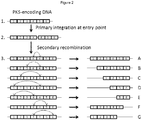
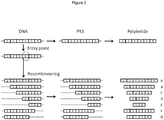
- the Examples describe the targeted insertion of vector to an area of a PKS followed by the removal of vector through secondary recombination. Because of the extensive repeating homologies observed in the PKS we observe removal of the vector through recombination events between homologous regions in a series of downstream modules. This results in the removal of the individual PKS modules of a co-linear PKS and production of a series of functional modified PKS. The repetitive, modular nature of the PKS ensure that in-frame joining of modules is achieved.
- a vector is placed into the polyketide cluster of interest (primary recombination event).
- the secondary recombination event that follows involves the removal of the vector and in some resulting strains the recombination provides a strain containing a PKS that has one or more module deleted or duplicated. Therefore the site of the recombination should preferably include the region into which the vector was originally integrated. Therefore in this process one cluster within the strain is targeted and the analysis is then directed towards identification of analogues of that polyketide containing metabolite - in this first case, the polyketide-containing metabolite is rapamycin. This allows the analytical techniques used to be appropriate for the target molecule.
- the resulting molecule may contain significant different features to the parent, obviously much of the molecule remains the same so that analysis can be carried out by identifying specific features that are retained in the products eg a UV chromophore, or a specific molecular ion and its daughters as observed by mass spectrometry.
- the stress causing the recombination event could be expression of a recombinase, heat shock, exposure to UV or chemical mutagens.
- a recombinase heat shock
- exposure to UV or chemical mutagens it is an advantage to carry out integration of a vector into a known region of a polyketide-coding biosynthetic gene cluster followed by secondary recombination during which one or more modules may be deleted or duplicated.
- the expression of a recombinase or the exposure to a mutagen either UV or chemical is incorporated during or following the subculturing steps.
- One aspect of this disclosure is the analysis of the strains isolated from the recombination event. Once the vector is lost, and the stress is removed (whether that stress is associated with an element on the vector, or an external influence such as sucrose, streptomycin, a chemical mutagen, UV or a co-expressed recombinase) the isolates are screened for loss of the vector. Those isolates that have lost the vector could fall into 4 separate classes:
- the wild type revertants are readily de-selected by production of the expected product of the parent strain under appropriate conditions.
- the resulting PKS may be functional to give a compound of the correct predicted structure.
- the isolates may either be un-productive in which case they are discarded, or produce new compounds of different PKS size to the parent. While this is a more complicated analysis, once the motivation exists to screen for them there are a number of approaches that can be used.
- a polyketide may be biosynthesised by a modular enzyme which contains regions containing PKS domains (for example pederin and rapamycin).
- PKS domains for example pederin and rapamycin.
- the recombineering methods discosed herein for generation of a mutant PKS may be performed in respect of biosynthetic gene clusters that contain only PKS
- polyketide gene clusters may be expressed in heterologous hosts (Pfeifer and Khosla, 2001). Accordingly, the present disclosure includes the transfer of the biosynthetic gene cluster, with or without resistance and regulatory genes, either otherwise complete or containing additional deletions, into a heterologous host. Alternatively, the biosynthetic gene cluster could be generated with synthetic DNA and transferred to a strain. Methods and vectors for the transfer as defined above of such large pieces of DNA are well known in the art (Rawlings, 2001; Staunton and Weissman, 2001) or are provided herein in the methods disclosed.
- a preferred host cell strain is a eukaryote or prokaryote, more preferably an actinomycete or Escherichia coli, still more preferably include, but are not limited to Actinosynnema mirum (A. mirum), Actinosynnema pretiosum subsp. pretiosum (A. pretiosum), Streptomyces hygroscopicus, Streptomyces hygroscopicus sp., Streptomyces hygroscopicus var.
- the entire biosynthetic cluster is transferred into a heterologous host.
- the strain of cells is a heterologous host for the polyketide synthase.
- the entire PKS is transferred without any of the associated post-PKS genes (such as methylases, hydroxylases and glycosyltransferases) .
- this can be carried out step-wise.
- some of the post-PKS genes can be introduced appropriately.
- additional genes from other biosynthetic gene clusters can be introduced appropriately.
- the strain could be a strain containing a rapamycin PKS.
- An example strain is Streptomyces rapamycinicus NRRL 5491. More generally, any strain containing one or more genes encoding a modular (type I) polyketide synthase could be used with the methodology described herein.
- PKS include, but are not limited to: Actinopyrone, Anguinomycin, Ansatrienin, Antibiotic L 681,217, Antibiotic RK-682, Antibiotic TAN 420, Antibiotic TPU-0037, Antibiotic UCN-01, Antibiotic UCN-02, Apoptolidin, Aureothin, Avermectin, Bafilomycin, Blasticidin, Chlorothricin, Concanamycin, Conglobatin, Ellaiophylin, Fostriecin, Herbimycin, Isoapoptolidin, Kazusamycin, Kendomycin, Leptomycin, Luteoreticulin, Lydicamycin, Milbemycin, Nemadectin, Neoaureothin, Oligomycin, Pestalotin, Piericidin, Reveromycin, Saccharocarcin, Sultriecin, Tetromycin, Trichostatin, Venturicidin, Ikarugamycin, Nigericin, Pimaricin, Pseudom
- the strain of cells may be a heterologous host for the polyketide synthase and said host may optionally express one or more PKS genes.
- the strain of cells is a heterologous host for the polyketide synthase.
- the strain of cells is a homologous host for the polyketide synthase .
- Said process may be a process for producing a library of three or four or five or six or more mutant modular polyketide synthase encoding cells and wherein step (iii) consists of screening for or selecting three or four or five or six or more cells that lack the selectable marker and which express mutant functional polyketide synthases having an increased or reduced number of domains.
- the portion of DNA in the vector of the aforementioned processes homologous to a portion of DNA within the polyketide synthase has length >250bg e.g. >500bp e.g. >1000bp > 2000bp.
- the homology is >90% sequence identity e.g. >98% sequence identity e.g. 100% sequence identity.
- the vector of the aforementioned processes includes an origin of replication for the organism containing the PKS DNA.
- the origin of replication is a controllable origin of replication and the selective pressure comprises inducing the origin of replication.
- the inducible origin of replication is a temperature sensitive origin of replication.
- the vector may include a dominant sensitivity marker which is lethal if expressed by the strain and the selective pressure is the lethality of the expressed dominant sensitivity marker.
- Exemplary dominant sensitivity markers are selected from rpsL and sacB.
- the vector includes an origin of replication which is an inducible origin of replication and the selective pressure comprises inducing the origin of replication.
- the strain of cells is an actinomycete strain, for example, Streptomyces hygroscopicus.
- an actinomycete strain for example, Streptomyces hygroscopicus.
- Alternative suitable strains are mentioned elsewhere in this document.
- the polyketide synthase is a polyketide synthase capable of producing rapamycin, tylosin, concanamycin, clethramycin, monensin or an analogue thereof.
- the polyketide synthase is a polyketide synthase capable of producing rapamycin or an analogue thereof.
- the vector includes a portion of DNA homologous to a portion of DNA within the polyketide synthase such that the vector integrates into the strain within a linker region between modules.
- the vector includes a portion of DNA homologous to a portion of DNA within the polyketide synthase such that the vector integrates into the strain within a module.
- the vector includes a portion of DNA homologous to a portion of DNA within the polyketide synthase such that the vector integrates into the strain within the KS or ACP domain of a module.
- the KS domain of a module is an advantageous choice because a relatively long sequence (>1000bp) of DNA may be chosen from a given KS domain which has high homology to a corresponding sequence in the KS domain of other modules. All modules of a typical modular polyketide synthase also have a KS domain. Thus all or part of the KS or ACP domains may be used as the portion of DNA homologous to a portion of DNA within the polyketide synthase. Alternatively, all or part of another domain repeated within the PKS can be used, such as an AT, KR, ER or DH domain.
- the vector is a plasmid.
- the selectable marker is an antibiotic resistance gene, such as the apramycin resistance gene, the thiostrepton resistance gene, the hygromycin resistance gene or the kanamycin resistance gene.
- the disclosure provides a process for producing a library of two or more mutant modular polyketide synthase encoding cells which express mutant functional polyketide synthases having a reduced number of domains, alternatively, the cells express mutant functional polyketide synthases having an increased number of domains.
- a process according to the invention may further comprise the step of isolating at least one cell that lacks the selectable marker and which expresses a mutant functional polyketide synthase having an increased or reduced number of domains and culturing that at last one cell to obtain a strain.
- the polyketide synthase is a rapamycin synthase, a tylosin synthase, a concanamycin synthase, a clethramycin synthase, or a monensin synthase.
- the disclosure provides a strain obtained or obtainable according to the process of the disclosure as described herein.
- a process for producing a polyketide which comprises culturing a polyketide synthase expressing strain according to the disclosure in the presence of one or more starter acids and other necessary feed materials (e.g. carbon and nitrogen sources and sources of other trace elements; see e.g. production media components as described in General Methods) and optionally isolating the polyketide.
- a polyketide obtained or obtainable by means of a process according to the disclosure which has an increased or reduced number of modules than the polyketide(s) naturally produced by the strain prior to the one or more recombination events following selective pressure.
- the polyketide has a reduced number of modules.
- it has an increased number of modules.
- the polyketide is a rapamycin analogue.
- the polyketide is a tylosin analogue.
- novel polyketide synthase enzymes described herein may be used to synthesis new and useful compounds e.g. compounds useful in therapy.
- the gene cluster for recombineering is chosen from the following list of PKS clusters: 9-Methylstreptimidone, A-74528, abyssomicin, Actinomycin, Actinopyrone, Aculeximycin, Acutiphycin, Aflastatin, , Albocycline, Aldgamycin, Aldgamycin, Alpha-lipomycin, Altamycin, Ammocidin, Amphotericin, Amycomycin, Angolamycin, Anguinomycin, Ansamitocin, Ansatrienin, Antascomicin, Antibiotic3874H1, Antibiotic67-121A, AntibioticA82548A, AntibioticA83016F, AntibioticA130C, AntibioticA59770A, AntibioticA73A, AntibioticAB023A, AntibioticAH758, AntibioticCP91243, AntibioticHA-1-92, AntibioticIB96212, AntibioticL681, AntibioticNFAT68, AntibioticRS22A,
- a suitable host for expression of a mutant rapamycin PKS is Streptomyces hydroscopicus.
- a suitable host for expression of a mutant tylosin PKS is S. fradiae.
- a suitable host for expression of a mutant lasalocid PKS is Streptomyces lasaliensis.
- a suitable host for expression of a mutant ansamitosin PKS is Actinosynnema pretiosum (e.g. ATCC 31565).
- a suitable host for expression of a mutant chalcomycin PKS is Streptomyces bikiniensis (e.g. NRRL 2737).
- a suitable host for expression of a mutant FD-891 PKS is Streptomyces graminofaciens (e.g. A-8890).
- a suitable host for expression of a mutant FR-008 PKS is Streptomyces sp. FR-008.
- a suitable host for expression of a mutant virginiamycin M PKS is Streptomyces virginiae (e.g. MAFF 116014).
- a suitable host for expression of a mutant soraphen PKS is Sorangium cellulosum (e.g. So ce26).
- a suitable host for expression of a mutant megalomycin PKS is Micromonospora megalomicea (e.g. subsp. nigra).
- a suitable host for expression of a mutant viceniastatin PKS is Streptomyces halstedii (e.g. HC34).
- a suitable host for expression of a mutant tautomycin PKS is Streptomyces spiroverticillatus.
- a suitable host for expression of a mutant avermectin PKS is Streptomyces avermitilis (e.g. ATCC 31267).
- a suitable host for expression of a mutant alpha-lipomycin PKS is Streptomyces aureofaciens (e.g. Tü117).
- a suitable host for expression of a mutant ascomycin/FK520 PKS is Streptomyces hygroscopicus (e.g. subsp. Ascomyceticus ATCC14891).
- a suitable host for expression of a mutant geldanamycin PKS is Streptomyces geldanamycinnus (e.g.NRRL 3602).
- a suitable host for expression of a mutant halstoctacosanolide PKS is Streptomyces halstedii (e.g. HC34).
- a suitable host for expression of a mutant borrelidin PKS is Streptomyces parvulus (e.g. Tu4055).
- a suitable host for expression of a mutant bafilomycin PKS is Streptomyces lohii (e.g. strain ATCC BAA-1276).
- a suitable host for expression of a mutant herbimycin A PKS is Streptomyces hygroscopicus (e.g. strain AM 3672).
- a suitable host for expression of a mutant nanchangmycin PKS is Streptomyces nanchangensis (e.g. NS3226).
- a suitable host for expression of a mutant meilingmycin PKS is Streptomyces nanchangensis (e.g. strain NS3226).
- a suitable host for expression of a mutant niddamycin PKS is Streptomyces caelestis.
- a suitable host for expression of a mutant nigericin PKS is Streptomyces violaceusniger (e.g. DSM 4137).
- a suitable host for expression of a mutant nystatin PKS is Streptomyces noursei (e.g. ATCC 11455).
- a suitable host for expression of a mutant oligomycin PKS is Streptomyces avermitilis (e.g. ATCC 31267).
- a suitable host for expression of a mutant phoslactomycin PKS is Streptomyces sp. HK803.
- a suitable host for expression of a mutant piericidin PKS is Streptomyces piomogenus (e.g. var. Hangzhouwanensis).
- a suitable host for expression of a mutant pikromycin PKS is Streptomyces venezuelae (e.g. ATCC 15439).
- a suitable host for expression of a mutant erythromycin PKS is Saccharopolyspora erythraea (e.g. NRRL 2338).
- a suitable host for expression of a mutant pimaracin PKS is Streptomyces natalensis (e.g. ATCC 27448).
- a suitable host for expression of a mutant pladienolide PKS is Streptomyces platensis (e.g. Mer-11107).
- a suitable host for expression of a mutant pyoluteorin PKS is Pseudomonas fluorescens (e.g. Pf-5).
- a suitable host for expression of a mutant reveromycin PKS is Streptomyces sp. SN-593.
- a suitable host for expression of a mutant rifamycin PKS is Amycolatopsis mediterranei (e.g. S699).
- a suitable host for expression of a mutant rubradirin PKS is Streptomyces achromogenes var. rubradiris (e.g. NRRL3061).
- a suitable host for expression of a mutant salinomycin PKS is Streptomyces albus (e.g. DSM 41398).
- a suitable host for expression of a mutant tautomycetin PKS is Streptomyces sp. CK4412.
- a suitable host for expression of a mutant tautomycin PKS is Streptomyces spiroverticillatus.
- a suitable host for expression of a mutant tetronomycin PKS is Streptomyces sp. NRRL 11266.
- a suitable host for expression of a mutant vicenistatin PKS is Streptomyces halstedii (e.g. HC34).
- a suitable host for expression of a mutant monensin PKS is Streptomyces cinnamonensis (e.g. ATCC 15413).
- a suitable host for expression of a mutant spiramycin PKS is Streptomyces ambofaciens.
- a suitable host for expression of a mutant spinosyn PKS is Saccharopolyspora spinosa (e.g. NRRL 18538).
- a suitable host for expression of a mutant amphotericin B PKS is Streptomyces nodosus (e.g. ATCC 14899).
- a suitable host for expression of a mutant mycotrienin PKS is Streptomyces flaveolus (e.g. DSM40061).
- a suitable host for expression of a mutant apoptolidin PKS is Nocardiopsis sp. FU40.
- a suitable host for expression of a mutant kendomycin PKS is Streptomyces violaceoruber.
- a suitable host for expression of a mutant angolamycin PKS is Streptomyces eurythermus (e.g. ATCC 23956).
- a suitable host for expression of a mutant meridamycin PKS is Streptomyces violaceusniger (e.g. DSM 4137).
- a suitable host for expression of a mutant concanamcyin A PKS is Streptomyces neyagawaensis (e.g. ATCC 27449).
- a suitable host for expression of a mutant ambruticin PKS is Sorangium cellulosum (e.g. So ce10).
- a suitable host for expression of a mutant difficidin PKS is Bacillus amyloliquefaciens (e.g. strain FZB42).
- a suitable host for expression of a mutant filipin PKS is Streptomyces avermitilis.
- a suitable host for expression of a mutant kijanimicin PKS is Actinomadura kijaniata.
- a suitable host for expression of a mutant lankamycin PKS is Streptomyces rochei.
- a suitable host for expression of a mutant macrolactin PKS is Bacillus amyloliquefaciens (e.g strain FZB42).
- a suitable host for expression of a mutant mupirocin PKS is Pseudomonas fluorescens (e.g. NCIMB 10586).
- a suitable host for expression of a mutant mycinamicin PKS is Micromonospora griseorubida.
- a suitable host for expression of a mutant macbecin PKS is Actinosynnema pretiosum (e.g. ATCC 31280).
- a suitable host for expression of a mutant nemadectin PKS is Streptomyces cyaneogriseus (e.g. subsp. Noncyanogenus).
- a suitable host for expression of a mutant oleandomycin PKS is Streptomyces antibioticus.
- a suitable host for expression of a mutant iso-migrastatin PKS is Streptomyces platensis (e.g. NRRL 18993).
- a suitable host for expression of a mutant chlorothricin PKS is Streptomyces antibioticus (e.g. DSM 40725). Further aspects of the disclosure include:
- Plates are poured ( ⁇ 30mL) and dried extensively in a laminar flow hood before use
- Oatmeal is cooked/steamed in the water for 20 min, strained through a muslin and more water added to replace lost volume. Trace elements solution is added and pH adjusted to 7.2 with NaOH. Agar is added before autoclaving at 121°C, 15 minutes.
- MMAM Agar MAM agar
- Corn steep solids 4.0 g/L Nutrisoy 5.0 g/l Dextrin 35 g/L Ammonium sulphate 2.0 g/L, Lactic acid 1.6 mL/L, Calcium carbonate 7.0 g/L
- Escherichia coli DH10B (GibcoBRL) was grown in 2xTY medium or 2xTY agar media as described by Sambrook et al. (1989) and E. coli ET12567(pUZ8002) as described in Paget et al. (1999) in 2xTY medium with kanamycin (25 ⁇ g/ml) and chloramphenicol (10 ⁇ g/ml).
- the vector pUC19 was obtained from New England Biolabs.
- Vector pKC1139 is described in (Bierman et al., 1992).
- coli transformants were typically selected for with either 100 ⁇ g/mL ampicillin or 50 ⁇ g/mL apramycin depending on resistance marker Streptomyces rapamycinicus Biot-4010 ( Streptomyces rapamycinicus NRRL5491 in which the rapK gene has been deleted using methodology as described in WO2004/00709 and as described in Kendrew et al., 2013) and its derivatives were maintained on ISP3 agar plates or MAM agar plates at 28°C. Where necessary for selection apramycin was used at 50 ⁇ g/mL. Spore stocks of these strains were prepared by growth on ISP3 agar medium for approximately 14-21 days and preserved in 20% w/v glycerol in distilled water at -80°C .
- Phenotype A - produces metabolites including one with molecular formula C 51 H 79 NO 12
- Phenotype B - produces metabolites including one with molecular formula C 46 H 71 NO 10
- Phenotype C - produces metabolites including one with molecular formula C 43 H 67 NO 10
- Phenotype D - produces metabolites including one with molecular formula C 41 H 65 NO 8
- Phenotype E - produces metabolites including one with molecular formula C 37 H 59 NO 7
- Phenotype F - produces metabolites including one with molecular formula C 36 H 53 NO 8
- Phenotype G - produces metabolites including one with molecular formula C 33 H 53 NO 7 BIOT-4827, a mixture of strains, has been submitted to the NCIMB strain collection and has deposit number NCIMB 42152.
- a method for splitting the constituent strains, should it be required, is taught as follows:
- the spore suspension is streaked out on ISP3 agar at 28 °C for 7-14 days to reveal single colonies. Single colonies are then patched onto fresh ISP3 agar at 28 °C for 7-14 days to achieve good sporulation.
- step 1 Take a number of individual colonies, prepared as in step 1 and use the fresh spores to inoculate 7 ml seed medium RapV7 (50 mL polypropylene centrifuge tubes (falcon tubes) (cat no.227261, purchased from Greiner Bio-One Ltd, Stonehouse, Gloucestershire, UK)) closed with foam plugs by transferring an agar plug (5 mm diameter).
- the inoculated seed medium is incubated with shaking at 300 rpm, 2.5 cm throw at 28 °C for 48 hours.
- This seed culture (0.5 ml) is transferred to the fermentation medium MD6 (7mL in falcon tube as before) using a wide bore tip and incubated with shaking at 300 rpm, 2.5 cm throw at 26 °C.
- feed A1 (0.05 ml of stock solution, prepared as described below) is added to the growing cultures.
- the cultures are incubated with shaking at 300 rpm, 2.5 cm throw at 26 °C for a further 5 days (i.e. a total of 6 days).
- the broth is then extracted by aliquoting 0.9 ml into a 2 ml eppendorf tube and adding methanol (0.9 ml).
- the eppendorf is then shaken on a vibrax bed for 30 minutes before the cell debris is removed by centrifugation (13,200 rpm, 10 minutes). An aliquot of the supernatant is then transferred to an LC-vial for LC-MS analysis by the methods described below.
- strain extracts may be analysed by HPLC or LC-MS.
- the HPLC system comprises an Agilent HP1100 equipped with a Hyperclone 3 micron BDS C18 130A column 150 mm x 4.6 mm (Phenomenex) heated to 50 °C.
- the gradient elution is from 55% mobile phase B to 95% mobile phase B over 10 minutes followed by an isocratic hold at 95% mobile phase B for 2 minutes with a flow rate of 1 mL/min.
- Mobile phase A is 10% acetonitrile:90% water, containing 10 mM ammonium acetate and 0.1% trifluoroacetic acid
- mobile phase B is 90% acetonitrile:10% water, containing 10 mM ammonium acetate and 0.1% trifluoroacetic acid.
- LC-MS system comprised an Agilent HP1100 equipped with a Hyperclone 3 micron BDS C18 130A column 150 mm x 4.6 mm (Phenomenex) heated to 50 °C coupled to a Bruker Daltonics Esquire 3000 electrospray mass spectrometer.
- the gradient elution was from 50% mobile phase B to 100% mobile phase B over 10 minutes followed by an isocratic hold at 100% mobile phase B for 3 minutes with a flow rate of 1 mL/min.
- Mobile phase A was water containing 0.1% formic acid
- mobile phase B was acetonitrile containing 0.1% formic acid..
- Positive negative switching was used over a scan range of 500 to 1000 Dalton.
- Isolatable strains may be annotated as follows:
- Escherichia coli ET12567 harbouring the plasmid pUZ8002 was transformed with the desired plasmid by electroporation to generate the E. coli donor strain for conjugation.
- This strain was used to transform Streptomyces rapamycinicus by spore conjugation as described below. Fresh spores were harvested in water or 20% glycerol from plates of Streptomyces rapamycinicus. Alternatively frozen spore stocks were used. These spores were washed in 2TY and then resuspended in 0.25ml 2TxY and were heat-shocked at 50 °C for 10 minutes in a water bath. These were then mixed with the E.
- coli donor strain which had been grown (with appropriate antibiotics) to an optical density of approximately 0.4 and washed twice with 2TY before resuspending in 0.25ml 2TxY.
- the mixture of strains was plated onto R6 medium and incubated at 37°C (for plasmids with pKC1139 background). After 2-3 hours the plates were overlaid with nalidixic acid (final in- plate concentration 25 ⁇ g/mL) and after a further 18 hours with apramycin sulphate (final in- plate concentration 50 ⁇ g/mL).
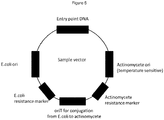
- Conjugation is a process of a direct cell-to-cell transfer of a plasmid, usually carrying an oriT sequence from an E. coli donor strain (such as E.coli ET12567 pUZ8002 (Kieser et al 2000), E.coli Et12567 pUB307 or E.coli S17-1 (Flett et al., 1997)) to the recipient strain (containing the biosynthetic gene cluster).
- E. coli donor strain such as E.coli ET12567 pUZ8002 (Kieser et al 2000), E.coli Et12567 pUB307 or E.coli S17-1 (Flett et al., 1997)
- the donor strain is transformed with the plasmid of choice and grown in liquid medium with antibiotic selection.
- the donor strain is combined with the recipient strain spores (freshly harvested or thawed) pre-conditioned with heat-shock at 50 °C.
- the recipient strain is grown in liquid culture, the mycelium is collected by centrifugation, washed with 10% glycerol, and then mixed with the donor strain cells as above.
- the strains are plated on a non-selective medium, and after a given time of growth (e.g. -24 hours) the antibiotic selection is imposed to remove the donor strain (e.g. with nalidixic acid) and the recipient cells that have not accepted the plasmid (e.g. Apramycin for pKC1139).
- Resulting antibiotic-resistant exconjugants are usually observed within a few days.
- Antibiotic resistant exconjugants are transferred to a medium with antibiotics and nalidixic acid to retain the transformed plasmid, and are maintained in 'patches' for use in further work. Further details are discussed in Kieser et al. 2000.
- electroporation can be used to transfer plasmids into bacterial strains. Examples of this are known to those skilled in the art and include electroporation of Rhodococcus sp. (Desomer et al., 1990), Bacillus sp. (Stephenson and Jarrett 1991), Mycobacteria sp. (Goude and Parish 2009), Sorangium sp. (Kopp et al., 2005).
- the vector for InFusion cloning (BioTechniques 43:354-359 (September 2007)) is linearised using restriction enzymes as directed by enzymes supplier. After digestion, the vector is purified by a PCR purification kit of choice.
- InFusion cloning primers should contain at least 15 base pairs at the 5' end that are homologous to the bases at one end of the vector and the 3' end complementary to the target gene. SnapGene software (from GSL Biotech; available at snapgene.com) can be used to help automate the design process. PCR is then performed using the designed primers on genomic DNA. The fragment is then excised from the gel, purified and mixed with the linearized vector in 1:5-1:1 ratio and the 5x InFusion HD Enzyme Premix up to 10 uL volume. The reaction is performed for 15 minutes at 50 °C, and then placed on ice. Afterwards, the E. coli cells are transformed with 2.5 uL of the reaction mixture.
- the secondary recombination event often occurs via the change in temperature (e.g. 37 °C for primary recombination and 28 °C for secondary recombination or initial plasmid replication) when using a temperature sensitive plasmid, such as the pSG5 based conjugative plasmid pKC1139.
- a temperature sensitive plasmid such as the pSG5 based conjugative plasmid pKC1139.
- Other temperature sensitive plasmids are known to those skilled in the art, such as pGM1190, pMT660 (Birch and Cullum 1985) and others described in Kieser et el. 2000.
- Biosynthetic PKS gene clusters may be heterologously expressed in Saccharopolyspora and Streptomyces sp. and other strains which are easier to manipulate. Methods for this are known to this skilled in the art and are discussed in Wenzel et al. 2005 and Pfeifer and Khosla 2001.
- the assay was conducted at 10°C in 50mM Tris buffer at pH8.0, 50 ⁇ M DTT, 100 mM NaCl, 0.005% NP40 with 6 nM FKBP12 and 60 ⁇ M substrate (SUC-ALPF-pNA, diluted from 20mg/ml stock in 0.5M LiCI/TFE).
- the K m for the substrate was determined to be approximately 188 ⁇ M.
- the first order rate equation was fitted to the absorbance data to obtain a rate constant.
- a catalytic rate (K enz ) was calculated from the enzymatic rate minus the background rate.
- K enz v inhibitor concentration was plotted to obtain the Ki value.
- Activity of mTOR inhibitors was measured in two different antigen-specific murine T cell proliferation assays (as described in Young et al., 2000).
- lymph nodes obtained from SJL/J mice immunized with PLP 139-151 encephalitogenic peptide are re-stimulated in culture and assayed for a secondary proliferation response to the same peptide.
- lymph nodes obtained from PLP TCR transgenic mice are simulated with PLP peptide in culture in a primary stimulation assay.
- Table 1 Starting materials Feed code Name structure
- Source A cyclohexanecarboxylic acid Sigma (10,183-4)
- B cyclohex-1-enecarboxylic acid Alfa Aesar (A10741)
- C cyclohex-3-enecarboxylic acid Alfa Aesar (A15229)
- D 3-methoxycyclohexanecarboxylic acid Sigma (332836)
- E Ethyl 5-hydroxycyclohex-3-enecarboxylic acid Synthesised as described below
- the title compound was prepared, in racemic form, by generating (1 R *, 3 R *, 4 R *)-4-iodocyclohexane-1,3-carbolactone from cyclohex-3-ene carboxylic acid, which was then treated with the base DBU (1,8-diazabicyclo[5.4.0]undec-7-ene) to eliminate HI.
- the resultant (1 R *, 5 S *)-cyclohex-3-ene-1,5-carbolactone was then treated with potassium hydroxide dissolved in ethanol to yield the title compound (Marshall, J. A., and Shiping, X., 1995) 4-hydroxy-3,3-dimethylcyclohexanecarboxylic acid - feed Q
- n-BuLi was added to a solution of diisopropyl amine in tetrahydrofuran at -78 °C over a period of 15 minutes and stirred for1 h at same temperature and at 0 °C for 30 minutes.
- the reaction mixture was cooled to -78 °C, 3-methyl-3-butene-2-one in 25 mL of THF was added and stirring continued at -78 °C for 30 minutes.
- HMPA followed by TBDMSCI were added and stirring continued at same temperature for 2 h.
- Racemic 3- cis ,4- trans -dihydroxycyclohexane carboxylic acid was readily attainable from commercially available racemic 3-cyclohexene carboxylic acid.
- This acid was epoxidised through treatment with meta -chloroperbenzoic acid and converted to the lactone in situ by the addition of base (triethylamine), thus setting up the relative stereochemistries.
- This lactone was then hydrolysed by the action of aqueous potassium hydroxide, and the final product purified over ion exchange resin (see PAS Lowden Thesis 1997, Corey, E. J. and Huang, H., 1989 ).
- B1-1 was purified by column chromatography using 60-120 mesh silica (eluent: 15% DCM-petroleum ether).
- Reaction time 1 min
- reaction mixture was quenched by the addition of a saturated solution of sodium sulfite and the pH of the resulting mixture was adjusted to 3 with cold dilute HCI to dissolve the colloidal MnO 2 .
- the reaction mixture was extracted with ethyl acetate, washed with water, dried over anhydrous Na 2 SO 4 and concentrated under reduced pressure to yield crude B1. Purification The crude B1 was purified by column chromatography using 100-200 mesh silica (eluent: 3% EtOAc-petroleum ether).
- reaction mixture was partitioned between water and ethyl acetate. Organic layer separated, washed with NaHCO 3 followed by brine and dried over sodium sulfate. Solvent was removed under reduced pressure to get crude desired product.
- F1-4 was dissolved in EtOH and sodium borohydride was added at 0 °C. The mixture was stirred for 30 min at same temperature.
- rapamycin analogs and contracted rapamycins was carried out by fermentation of Streptomyces rapamycinicus. Typically strains were grown on ISP3 agar at 28 °C for 10-14 days to achieve good sporulation and used to inoculate 7 ml seed medium RapV7 (50 mL polypropylene centrifuge tubes (falcon tubes) (cat no.227261, purchased from Greiner Bio-One Ltd, Stonehouse, Gloucestershire, UK)) closed with foam plugs by transferring an agar plug (5 mm diameter). Alternatively 35 ⁇ L of a thawed spore stock was used for the inoculation.
- RapV7 50 mL polypropylene centrifuge tubes (falcon tubes) (cat no.227261, purchased from Greiner Bio-One Ltd, Stonehouse, Gloucestershire, UK)
- the inoculated seed medium was incubated with shaking at 300 rpm, 2.5 cm throw at 28 °C for 48 hours.
- MD6 (7mL in falcon tube as before) was inoculated with 0.5 mL of the seed culture using a wide bore tip and incubated with shaking at 300 rpm, 2.5 cm throw at 26 °C for six days.
- the culture was then harvested for extraction.
- a selected starter unit feed (corresponding to the desired starting unit for biosynthesis of the target compound) was fed to the production medium 24 hours post inoculation. Typically feed was dissolved in methanol (0.05 mL) and added to culture to give final concentration of 2mM.
- the broth was extracted by aliquoting 0.9 ml into an eppendorf tube (2 ml) and adding methanol (0.9 ml). The eppendorf was then shaken on a vibrax bed for 30 minutes before the cell debris was removed by centrifugation (13,200 rpm, 10 minutes). An aliquot of the supernatant was then transferred to an LC-vial for analysis by the methods described below.
- Spore stocks of the strains for fermentation were prepared after growth on ISP3 agar medium and preserved in 20% w/v glycerol in distilled water and stored at -80 °C. Spore stocks were recovered onto plates of MAM or ISP3 medium and incubated for 10-11 days at 28°C. Vegetative cultures (seed cultures) were prepared using working spore stocks of at 0.05% inoculum and inoculating into 400 ml medium RapV7 in 2 litre Erlenmeyer flasks with foam plugs. Cultivation was carried out for 48 hours at 28°C, 250 rpm (2.5 cm throw).
- the entire seed culture in one flask was transferred into 15 litres of medium MD6/5-1 pre-adjusted at pH 6.0-7.0 in a V7 Braun 22 L fermenter.
- the fermentation was carried out for 6 days at 26°C, with starting agitation at 200 rpm, aeration rate at 0.5 V/V/M and dissolved oxygen (DO) level controlled with the agitation cascade at 30% air saturation.
- the starting agitation was set at 200 rpm.
- the selected precursor to feed starting unit for biosynthesis of target compound
- Feed was dissolved in 3 mL to 5 mL methanol and added to the culture to give final concentration of 2 mM of the feed compound. The amount of methanol does not exceed 1 % of the total volume. Fermentation was continued for further five days post-feeding, before harvesting.
- Any target compound in the clarified broth can be recovered by adding an equal volume of ethyl acetate and stirring for 1 hour in a glass duran using an overhead electric paddle stirrer at 600 rpm. The organic solvent was then separated by centrifugation at 3500rpm (RCF 3300g) for 15 mins.
- the crude extract was dissolved in methanol, and silica gel added (approximately equal amount to the extract by weight) and the solvent removed in vacuo to a free-flowing powder.
- the impregnated silica is loaded on to a silica gel column (20 x 5 cm) and eluted with 100 % CHCl 3 , and gradually increases polarity by adding MeOH (to a maximum 5% MeOH).
- MeOH to a maximum 5% MeOH.
- Approximately 20 x 250 ml fractions were collected and monitored by TLC and analytical HPLC.
- the fractions containing the rapatractins were loaded onto a second silica gel column (15 x 2 cm) and eluted with a mixture of hexane and ethyl acetate (1:1).
- NMR spectra were recorded on a Bruker Advance 500 spectrometer at 298 K operating at 500 MHz and 125 MHz for 1 H and 13 C respectively. Standard Bruker pulse sequences were used to acquire 1 H- 1 H COSY, APT, HMBC and HMQC spectra. NMR spectra were referenced to the residual proton or standard carbon resonances of the solvents in which they were run.
- LCMS method 2 chromatography was achieved over a Phenomenex HyperClone C 18 -BDS column (4.6 x 150 mm, 3 micron particle size) eluting with a gradient of water + 0.1% formic acid:acetonitrile + 0.1% formic acid, (90:10) to (0:100), at 1 mL/min over 20 min. Purity was assessed by MS and at multiple wavelengths (210, 254 & 276 nm). All compounds were >95% pure at all wavelengths. Purity was finally confirmed by inspection of the 1 H and 13 C NMR spectra.
- HPLC system comprised an Agilent HP1100 equipped with a Hyperclone 3 micron BDS C18 130A column 150 mm x 4.6 mm (Phenomenex) heated to 50 °C.
- the gradient elution was from 55% mobile phase B to 95% mobile phase B over 10 minutes followed by an isocratic hold at 95% mobile phase B for 2 minutes with a flow rate of 1 mL/min.
- Mobile phase A was 10% acetonitrile:90% water, containing 10 mM ammonium acetate and 0.1% trifluoroacetic acid
- mobile phase B was 90% acetonitrile:10% water, containing 10 mM ammonium acetate and 0.1% trifluoroacetic acid.
- LC-MS - method 1 (fermentation broths) -
- the HPLC system described above was coupled to a Bruker Daltonics Esquire3000 electrospray mass spectrometer. The gradient elution was from 50% mobile phase B to 100% mobile phase B over 10 minutes followed by an isocratic hold at 100% mobile phase B for 3 minutes with a flow rate of 1 mL/min.
- Mobile phase A was water containing 0.1% formic acid
- mobile phase B was acetonitrile containing 0.1% formic acid.
- Positive negative switching was used over a scan range of 500 to 1000 Dalton.
- Example 1 Generation of constructs able to induce deletion or expansion of the rapamycin PKS modules and transfer to S . rapamycinicus
- intermediate plasmid 1 The region of downstream homology from intermediate plasmid 1 was excised using Eco RI and Xba I.
- the region of upstream homology from intermediate plasmid 2 was excised using Xba I and Hin dIII. These two fragments were ligated together with pUC19 that had been digested with Eco RI and Hin dIII.
- the resulting vector was then digested with Nhe I and Bgl II to insert the desired reductive loop. Two loops were used, the reductive loop from module 13 of the rapamycin cluster and the reductive loop from module 11 of the rapamycin cluster. Nhe I/ Bgl II sites were utilised.
- the reductive loop of module 13 of the rapamycin cluster was excised from plasmid pPF137 (Gaisser et al., 2003) using Nhe I and Bgl II.
- the reductive loop of module 11 of the rapamycin cluster was excised from plasmid pWV165 (a plasmid containing the rapamycin PKS module 11 reductive loop engineered to have Nhe I and Bgl II sites surrounding the reductive loop encoding DNA.
- the resulting constructs were transferred to the conjugative vector pKC1139 (Bierman et al 1992) by digesting with Eco RI and Hin dIII and ligating with pKC1139 that had been digested with the same enzymes.
- the resulting plasmids were named pSGK210 (containing rapamycin PKS module 13 loop) and pSGK212 (containing rapamycin PKS module 11 loop).
- Plasmids pSGK210 and pSGK212 were transferred to S. rapamycinicus BIOT-4010 (Kendrew et al., 2013) by conjugation using standard methods. Briefly, plasmid was electroporated into ET12567:pUZ8002 and selected on 2TY agar medium containing apramycin (50 ⁇ g/mL), kanamycin (25 ⁇ g/mL), and chloramphenicol (25 ⁇ g/mL). Single colonies were grown overnight in 3ml 2TY liquid medium containing apramycin (50 ⁇ g/mL), kanamycin (25 ⁇ g/mL) and chloramphenicol (25 ⁇ g/ml).
- 0.7ml of this culture was used to inoculate 10ml liquid medium containing apramycin (50 ⁇ g/ml), kanamycin (25 ⁇ g/ml) and chloramphenicol (25 ⁇ g/mL) and grown at 37 C to reach an OD of approximately 0.5.
- Cells were pelleted at 4000rpm for 10minutes and washed twice with 10ml 2xTY before resuspending in 0.25 mL 2 TY.
- Spores of S. rapamycinicus BIOT-4010 grown on ISP3 for 2-3 weeks were harvested using 20% glycerol and stored at -80°C (1 plate gives about 1 mL spore stock).
- the plate was overlaid with 2 mL water containing 15 ⁇ L naladixic acid (stock 50 mg/mL) after 2-3 hours and with 2 mL water containing 15 ⁇ L apramycin (stock 100 mg/mL) after an overnight incubation.
- Example 2 Generation of an alternative construct able to induce deletion of the rapamycin PKS modules and transfer to S. rapamycinicus
- the excised fragments were ligated together with pUC19 that had been digested with EcoRI and Hin dIII.
- the resulting vector was then digested with Nhe I and Bgl II to insert the desired rapamycin PKS module 11 reductive loop as outlined previously (see Example 1).
- the resulting construct was transferred to the conjugative replacement vector pKC1139 (Bierman et al., 1992) by digesting with Eco RI and Hin dIII and ligating with pKC1139 that had been digested with the same enzymes.
- Plasmid pSGK234 was transferred to S. rapamycinicus BIOT-4010 by conjugation using standard methods. Briefly, plasmid was electroporated into ET12567:pUZ8002 and selected on 2TY agar medium containing apramycin (50 ⁇ g/mL), kanamycin (25 ⁇ g/mL), and chloramphenicol (25 ⁇ g/mL). Single colonies were grown overnight in 3 mL 2xTY liquid medium containing apramycin (50 ⁇ g/mL), kanamycin (25 ⁇ g/mL) and chloroamphenicol (25 ⁇ g/mL).
- 0.7 mL of this culture was used to inoculate 10 mL liquid medium containing apramycin (50 ⁇ g/mL), kanamycin (25 ⁇ g/mL) and chloramphenicol (25 ⁇ g/mL) and grown at 37 C to reach an OD of approximately 0.5.
- Cells were pelleted at 4000rpm for 10minutes and washed twice with 10 mL 2xTY before resuspending in 0.25 mL 2xTY.
- Spores of S. rapamycinicus BIOT-4010 grown on ISP3 for 2-3 weeks were harvested using 20% glycerol and stored at -80°C (1 plate gives about 1 mL spore stock).
- the plate was overlaid with 2ml water containing 15 ⁇ L naladixic acid (stock 50mg/ml) after 2-3 hours and with 2 mL water containing 15 ⁇ L apramycin (stock 100 mg/mL) after an overnight incubation.
- 0.5 mL of this seed culture was used to inoculate 7 mL MD6 media and incubated at 26°C and 300 rpm for 6 days; 24 hours into this time each culture was supplemented with 50 ⁇ l of 0.32M cyclohexane carboxylic acid (CHCA) in methanol (final concentration in media 2mM).
- CHCA cyclohexane carboxylic acid
- Example 4 Diversifying compounds produced from module deleted strains by mutasynthetic experiments
- the isolated strain with phenotype B was grown on ISP3 media for approximately 2-3 weeks to allow significant mycelial growth and sporulation. Spores were harvested in 20% glycerol and aliquoted to produce a working stock of spores that was frozen at 80C. 0.25ml of the spore stock was used to inoculate 50 mL RapV7 in a 250 mL flask and incubated at 28°C at 250 rpm? for 48 hours.
- the isolated strain with phenotype C was grown on ISP3 media for approximately 2-3 weeks to allow significant mycelial growth and sporulation. Spores were harvested in 20% glycerol and aliquoted to produce a working stock of spores that was frozen at 80C. 0.25ml of the spore stock was used to inoculate 50 mL RapV7 in a 250 mL flask and incubated at 28°C at 250rpm for 48 hours.
- 0.5 mL of this seed culture was used to inoculate 7 mL MD6 media in a falcon tube and incubated at 26°C and 300 rpm for 6 days, 24 hours into this time each culture was supplemented with 50 ⁇ L of 0.32 M novel starter unit (see Table 1) dissolved in methanol (final concentration in media 2 mM). Each starter acid was tested in duplicate for each strain. After the 6 days of production 0.9 mL of culture was tranferred into a 2 mL eppendorf tube and 0.9 mL methanol was added and mixed for -30 minutes.
- the isolated strain with phenotype D was grown on ISP3 media for approximately 2-3 weeks to allow significant mycelial growth and sporulation. Spores were harvested in 20% glycerol and aliquoted to produce a working stock of spores that was frozen at 80°C. 0.25 mL of the spore stock was used to inoculate 50 mL RapV7 in a 250ml flask and incubated at 28°C at 250 rpm for 48 hours.
- the isolated strain with phenotype E was grown on ISP3 media for approximately 2-3 weeks to allow significant mycelial growth and sporulation. Spores were harvested in 20% glycerol and aliquoted to produce a working stock of spores that was frozen at 80C. 0.25 mL of the spore stock was used to inoculate 50ml RapV7 in a 250 mL flask and incubated at 28°C at 250 rpm for 48 hours.
- the isolated strain with phenotype F was grown on ISP3 media for approximately 2-3 weeks to allow significant mycelial growth and sporulation. Spores were harvested in 20% glycerol and aliquoted to produce a working stock of spores that was frozen at 80C. 0.25 mL of the spore stock was used to inoculate 50ml RapV7 in a 250ml flask and incubated at 28°C at 250 rpm for 48 hours.
- the isolated strain with phenotype A was grown on ISP3 media for approximately 2-3 weeks to allow significant mycelial growth and sporulation. Spores were harvested in 20% glycerol and aliquoted to produce a working stock of spores that was frozen at 80C. 0.25 mL of the spore stock was used to inoculate 50ml RapV7 in a 250ml flask and incubated at 28°C at 250 rpm for 48 hours.
- Phenotype G from BIOT-4827 Feed 4- trans -hydroxylcyclohexanecarboxylic acid (final concentration 2 mM) 1 x 15 litre fermentation
- the fermentation was as described above except that the vegetative cultures (seed cultures) were prepared using 12 x 5mm plugs from an agar plate and inoculating into 400 ml medium RapV7 in 2 litre Erlenmeyer flasks with foam plugs. Cultivation was carried out for 48 hours at 28°C, 250 rpm (2.5 cm throw).
- DSP was as described in the general section, both the cell mass and clarified broth were extracted and the crude extracts combined.
- Compound 2 was then purified by dissolving the 6.0 g enriched extract in methanol (5 ml) and separating the mixture by size-exclusion chromatography over sephadex LH-20 (column dimensions 1000 mm x 30 mm diameter) eluted with methanol. Fractions containing compound 2 were combined and taken to dryness (210 mg), before the being adsorbed onto C18 reverse-phase silica (dissolved in 20 ml methanol, add 2 g C18 silica and remove the solvent in vacuo). This was then added to a C18 silica column (100 mm x 30 mm diameter) and eluted with 3:2 acetonitrile/water. The fractions containing compound 2 were combined and taken to dryness to yield compound 2 as a white, amorphous solid.
- Phenotype C from BIOT-4827 Feed 4-trans-hydroxylcyclohexanecarboxylic acid (final concentration 2 mM) 80 x 7 ml fermentation (in falcon tubes)
- the broths from the individual falcons were combined and the cell mass separated by centrifugation.
- the DSP was carried out as described above, with only the cell mass extracted.
- the crude extract (1.2 g) was dissolved in ethyl acetate and silica gel added (10 g). the solvent was removed in vacuo and the adsorbed silica was applied to a flash silica column (180 mm x 55 mm diameter).
- Phenotype B from BIOT-4827 Feed 4-trans-hydroxylcyclohexanecarboxylic acid (final concentration 2 mM) 1 x 15 litre fermentation The fermentation was as described above.
- the fermentation broth at the end of the fermentation was separated by centrifugation and the cell paste processed as described above.
- the crude extract was dissolved in ethyl acetate and silica gel added (7.5 g). The solvent was removed in vacuo and the adsorbed silica was applied to a flash silica column (200 mm x 55 mm diameter). The column was eluted with 4:5 ethyl acetate / hexanes (1.8 litres), 1:1 ethyl acetate / hexanes (3.0 litres), 3:2 ethyl acetate / hexanes (1.5 litres) and then 2:1 ethyl acetate / hexanes (0.9 litres). The fractions containing compound 5 were combined and reduced in vacuo (44 mg).
- Phenotype D from BIOT-4827 Feed 4-trans-hydroxylcyclohexanecarboxylic acid (final concentration 2 mM) 1 x 15 litre fermentation The fermentation was as described above.
- the fermentation broth at the end of the fermentation was separated by centrifugation and the cell paste processed as described above.
- the crude extract (8 g) was dissolved in ethyl acetate and silica gel added (15 g). The solvent was removed in vacuo and the adsorbed silica was applied to a flash silica column (200 mm x 55 mm diameter).
- the column was eluted with 1:2 ethyl acetate / hexanes (0.9 litres), 4:5 ethyl acetate / hexanes (1.8 litres), 1:1 ethyl acetate / hexanes (3.0 litres), 3:2 ethyl acetate / hexanes (1.0 litres), 2:1 ethyl acetate / hexanes (1.8 litres) and then 100 % ethyl acetate (0.4 litres).
- the fractions containing compound 6 were combined and reduced in vacuo. This material was dissolved in 2:3 acetonitrile/water and applied to a C18 SPE cartridge (20 g).
- Phenotype E from BIOT-4827 Feed 4-trans-hydroxylcyclohexanecarboxylic acid (final concentration 2 mM) 1 x 15 litre fermentation The fermentation was as described above.
- the fermentation broth at the end of the fermentation was separated by centrifugation and the cell paste processed as described above.
- the crude extract (9.8 g) was dissolved in 1:1 methanol/acetonitrile and C18 reverse-phase silica gel added.
- the solvent was removed in vacuo and the adsorbed silica was applied to a flash reverse-phase C18 silica column (70 mm x 55 mm diameter).
- the column was eluted with 6:4 water / acetonitrile (0.8 litres), 1:1 water / acetonitrile (0.2 litres), 4:6 water / acetonitrile (0.8 litres), and then 3:7 water / acetonitrile (0.2 litres).
- the fractions containing compound 7 were combined and reduced in vacuo (404 mg).
- Fractions containing compound 7 were combined and taken to dryness in vacuo.
- This material was by size-exclusion chromatography over sephadex LH-20 (column dimensions 1000 mm x 30 mm diameter) eluted with methanol. Fractions containing compound 7 were combined and taken to dryness to yield the target compound as a white amorphous solid (47 mg).
- the fermentation broth at the end of the fermentation was separated by centrifugation and the cell paste processed as described above.
- the crude extract (8.5 g) was dissolved in 80% aqueous methanol (250 ml) and washed with hexanes (2 x 250 ml). The aqueous methanol was reduced in vacuo to yield an enriched extract (6.8 g). The crude extract was dissolved in methanol and silica added. The solvent was removed in vacuo and the adsorbed silica added added to a flash silica column (20 cm x 5 cm diameter) and eluted with 100 % chloroform, and the polarity gradually increased by adding MeOH (to a maximum 5% MeOH). Fractions contain compound 8 were combined and taken to dryness (3.1 g). Fractions contain compound 9 were combined and taken to dryness (196 mg). Fractions contain compound 10 were combined and taken to dryness (480 mg). Fractions contain compound 11 were combined and taken to dryness (304 mg).
- the extract containing compound 8 was then purified further by flash silica column chromatography eluted with ethyl acetate/hexane. Fractions contain compound 8 were combined and taken to dryness to yield the target compound as a white amorphous solid (65 mg).
- the fermentation broth at the end of the fermentation was separated by centrifugation and the cell paste processed as described above.
- the crude extract (6.7 g) was dissolved in methanol and silica added. The solvent was removed in vacuo and the adsorbed silica added added to a flash silica column (20 cm x 5 cm diameter) and eluted with 100 % chloroform. Fractions containing the target compound were combined and dried in vacuo (2.14 g). This enriched extract was loaded onto a second silica column, pre-conditioned in 1:1 ethyl acetate/hexanes. The column was eluted with the same solvent mixture and fractions containing the target compound were combined and dried in vacuo (0.42 g).
- the fermentation broth at the end of the fermentation was separated by centrifugation and the cell paste processed as described above.
- the crude extract (5.3 g) was dissolved in methanol and silica added.
- the solvent was removed in vacuo and the adsorbed silica added added to a flash silica column (20 cm x 5 cm diameter) and eluted with 100 % chloroform, 1% methanol/chloroform, 2% methanol/chloroform, 3% methanol/chloroform, 4% methanol/chloroform and 5% methanol/chloroform.
- Fractions containing the target compound were combined and dried in vacuo (1.99 g). This enriched extract was loaded onto a second silica column, pre-conditioned in 1:1 ethyl acetate/hexanes.
- Phenotype A from BIOT-4827 Feed 4-trans-hydroxycyclohexanecarboxylic acid (final concentration 2 mM) 1 x 15 litre fermentation The fermentation was as described above.
- the fermentation broth at the end of the fermentation was separated by centrifugation and the cell paste processed as described above.
- the crude extract (5.3 g) was dissolved in methanol and silica added. The solvent was removed in vacuo and the adsorbed silica added added to a flash silica column (20 cm x 5 cm diameter) and eluted with the 50:50 ethyl acetate/hexanes and then 60:40, 70:30, 80:20, 90:10 mixtures followed by 100% ethyl acetate. Fractions containing the target compound were combined and dried in vacuo to yield an enriched extract of 0.05 g. This material was loaded onto a second silica column (10 cm x 2 cm) and eluted with 45% ethyl acetate / 55% hexanes.
- Phenotype F from BIOT-4827 Feed 4-trans-hydroxycyclohexanecarboxylic acid (final concentration 2 mM) 1 x 15 litre fermentation The fermentation was as described above.
- the fermentation broth at the end of the fermentation was separated by centrifugation and the cell paste and clarified broth processed as described above.
- the crude extract (20.7 g) was dissolved in methanol and silica added.
- the solvent was removed in vacuo and the adsorbed silica added added to a flash silica column (20 cm x 5 cm diameter) and eluted with the 40:60 ethyl acetate/hexanes and then 50:50, 60:40, 70:30, 80:20, 90:10 mixtures followed by 100% ethyl acetate.
- Fractions containing the target compounds X+14 and X+15 were combined and dried in vacuo to yield an enriched extract of 0.96 g.
- Fractions containing the target compounds 17 were combined and dried in vacuo to yield an enriched extract of 3.1 g.
- Example 18 isolation of compounds 18, 19, 20, 21 & 22
- Phenotype B from BIOT-4827 Feed 4-trans-hydroxylcyclohexanecarboxylic acid (final concentration 2 mM) 2 x 60 litre fermentation The fermentation was as described above.
- Example 19 Biological data: Inhibition of FKBP12 PPIase activity
- rapamycin analogues were tested for their ability to inhibit FKBP12, using a peptidyl-prolyl isomerase (PPIase) assay. All compounds were assayed at 6 concentrations in duplicate and the data fitted to a Ki curve to afford a Ki value with standard error (SE). Compound no.
- Example 20 Biological data: Inhibition of the PLP T-cell proliferation assay (PLP assay)
- the immunosuppressive potency of rapamycin analogues can be tested using a PLP T-cell proliferation assay.
- mTOR is known to regulate the expression of Proteo Lipo Protein (Tyler et al. 2009), and activity of rapamycin analogues in this assay is driven by mTOR inhibition, so for rapamycin analogues where the aim is to inhibit FKBPs, this is an off-target activity. Therefore we also calculated the ratio of the FKBP12 IC50 to the PLP assay IC50, with a comparison to rapamycin. Larger ratios therefore relate to compounds with an improved window of activity.
- Example 21 Generation of constructs able to induce deletion or expansion of the tylosin PKS modules and transfer to S. fradiae.
- Primers MG101 ggccagtgccaagctgcggcttcctccacgacgcg and MG102 acatgattacgaattccggctcgcccggctgctctcc were used to amplify a 2154 kb region of homology from S. fradiae genomic DNA to yield product PCR101.
- the first 15 bp of MG101 and MG102 contain homology to pKC1139 digested with Hin dIII and Eco RI. Plasmid pKC1139 was digested with Hin dIII and Eco RI and used as a vector for Infusion cloning.
- PCR product PCR101 was ligated with pKC1139 digested with Hin dIII and Eco RI using Infusion Cloning technology to generate plasmid pISOM01.
- the insert in plasmid pISOM01 was sequenced to confirm it contained the correct DNA sequence.
- Plasmid pISOM01 was transferred to S. fradiae NRRL2702by conjugation using standard methods. Briefly, plasmid was electroporated into ET12567:pUZ8002 and selected on 2TY agar medium containing apramycin (50 ⁇ g/mL), kanamycin (25 ⁇ g/mL), and chloramphenicol (25 ⁇ g/mL).
- fradiae NRRL2702 grown on MAM medium for 2-3 weeks were harvested using 20% glycerol and stored at -80°C (1 plate gives about 1 mL spore stock). For the conjugation approximately 0.3-0.5 mL of these spores are needed for each conjugation. Spores were pelleted by centrifugation (4000rpm, 10 minutes) before washing with 2xTY. The spores were then repelleted and resuspended in 0.25 mL 2xTY and heat shocked in a water bath at 50°C for 10 minutes before cooling immediately on ice. The conjugation was performed by adding 0.25ml of washed E.
- the plate was overlaid with 2ml water containing 15 ⁇ L naladixic acid (stock 50mg/ml) after 2-3 hours and with 2 mL water containing 15 ⁇ L apramycin (stock 100 mg/mL) after an overnight incubation.
- Example 22 Generation of constructs able to induce deletion or expansion of the tylosin PKS modules and transfer to S. fradiae.
- Primers MG103 ggccagtgccaagctacctcaccaccctcccacctaccc and MG104 acatgattacgaattgccgtccggctcctccg were used to amplify a 1995 bp region of homology from S. fradiae genomic DNA to yield product PCR102.
- the first 15 bp of MG103 and MG104 contain homology to pKC1139 digested with Hin dIII and Eco RI . Plasmid pKC1139 was digested with Hin dIII and Eco RI and used as a vector for Infusion cloning.
- PCR product PCR102 was ligated with pKC1139 digested with Hin dIII and Eco RI using Infusion Cloning technology to generate plasmid plSOM02.
- the insert in plasmid plSOM02 was sequenced to confirm it contained the correct DNA sequence.
- Plasmid plSOM02 was transferred to S. fradiae NRRL2702 by conjugation using standard methods. Briefly, plasmid was electroporated into ET12567:pUZ8002 and selected on 2TY agar medium containing apramycin (50 ⁇ g/mL), kanamycin (25 ⁇ g/mL), and chloramphenicol (25 ⁇ g/mL). Single colonies were grown overnight in 3 mL 2xTY liquid medium containing apramycin (50 ⁇ g/mL), kanamycin (25 ⁇ g/mL) and chloroamphenicol (25 ⁇ g/mL).
- 0.7 mL of this culture was used to inoculate 10 mL liquid medium containing apramycin (50 ⁇ g/mL), kanamycin (25 ⁇ g/mL) and chloramphenicol (25 ⁇ g/mL) and grown at 37 C to reach an OD of approximately 0.5.
- Cells were pelleted at 4000rpm for 10minutes and washed twice with 10 mL 2xTY before resuspending in 0.25 mL 2xTY.
- Spores of S. fradiae NRRL2702 grown on MAM medium for 2-3 weeks were harvested using 20% glycerol and stored at -80°C (1 plate gives about 1 mL spore stock).
- the plate was overlaid with 2ml water containing 15 ⁇ L naladixic acid (stock 50mg/ml) after 2-3 hours and with 2 mL water containing 15 ⁇ L apramycin (stock 100 mg/mL) after an overnight incubation. Plates were incubated at 37°C until single exconjugant colonies were visible. Colonies (approximately 10-20) were patched to MAM agar containing apramycin and naladixic acid and reincubated at 37°C. Colonies were repatched to the same media (containing apramycin and nalidixic acid) to ensure there was no E. coli contamination.
- Example 23 Generation of constructs able to induce deletion and/or expansion of the lasalocid PKS modules and transfer to Streptomyces lasaliensis ATCC35851.
- Primers IR014.FOR ggccagtgccaagctacccccacagcagcacccccg and IR014.REV acatgattacgaattgtaggcggccaggtcggtgc are used to amplify a region of homology from Streptomyces lasaliensis ATCC35851 genomic DNA (prepared using standard techniques) to yield 2627bp PCR product, IR014.
- the first 15 bp of primers IR014.FORand IR014.REV contain homology to pKC1139 digested with Hin dIII and Eco RI .
- Plasmid pKC1139 (or other temperature sensitive plasmid containing the same polylinker) is digested with Hin dIII and Eco RI and used as a vector for Infusion cloning.
- PCR IR014 is ligated with pKC1139 digested with Hin dIII and Eco RI using Infusion Cloning technology to generate plasmid plR014.
- Plasmid plR014 is transferred to Streptomyces lasaliensis ATCC35851 by conjugation or other standard transformation method (as described in general methods).
- Plates are incubated until single transformant colonies are visible. Colonies are patched to agar (such as MAM agar) containing apramycin and incubated at a temperature which allows plasmid replication (for example 28 °C for pKC1139) until good growth is seen. Once stabilised, strains are transferred to solid agar containing apramycin and incubated at a higher temperature (for example 37 °C for pKC1139), at which the plasmid is unable to replicate and the primary integration is selected, before a selection of colonies are transferred again to fresh agar containing apramycin and incubating until good growth is seen. Samples are grown for production of lasalocid as described in Sherman 1986.
- Example 24 Generation of constructs able to induce deletion and/or expansion of the ansamitocin PKS modules and transfer to Actinosynnema pretiosum ATCC 31565.
- Primers IR015.FOR ggccagtgccaagcttccggccacgcaggcc and IR015.REV acatgattacgaattccaagctcgccgacctggagt are used to amplify a region of homology from Actinosynnema pretiosum ATCC 31565 genomic DNA (prepared using standard techniques) to yield 1907bp PCR product, IR015.
- the first 15 bp of primers IR015.FORand IR015.REV contain homology to pKC1139 digested with Hin dIII and Eco RI.
- Plasmid pKC1139 (or other temperature sensitive plasmid containing the same polylinker) is digested with Hin dIII and Eco RI and used as a vector for Infusion cloning.
- PCR IR015 is ligated with pKC1139 digested with Hin dIII and Eco RI using Infusion Cloning technology to generate plasmid pIR015.
- Plasmid plR015 is transferred to Actinosynnema pretiosum ATCC 31565 by conjugation or other standard transformation method (as described in general methods).
- Plates are incubated until single transformant colonies are visible. Colonies are patched to agar (such as MAM agar) containing apramycin and incubated at a temperature which allows plasmid replication (for example 28 °C for pKC1139) until good growth is seen. Once stabilised, strains are transferred to solid agar containing apramycin and incubated at a higher temperature (for example 37 °C for pKC1139), at which the plasmid is unable to replicate and the primary integration is selected, before a selection of colonies are transferred again to fresh agar containing apramycin and incubating until good growth is seen. Samples are grown for production of ansamitocin as described in Jia 2011.
- Samples of culture broth are mixed with methanol, centrifuged for 5 minutes and samples of the supernatant analysed by HPLC-UV and LCMS for production of ansamitocin.
- Those patches showing no production of ansamitocin(due to primary recombination into the ansamitocin PKS) are then inoculated into liquid media with no antibiotics (such as TSB) and incubated at a lower temperature (for example 28 °C for pKC1139) to force the secondary recombination event with shaking until well grown.
- a sample is then used to inoculate a second batch of liquid media and incubated with shaking at the lower temperature until well grown.
- Example 25 Generation of constructs able to induce deletion and/or expansion of the chalcomycin PKS modules and transfer to Streptomyces bikiniensis NRRL 2737.
- Primers IR016.FOR ggccagtgccaagcttcggcggaggaaccgag and IR016.REV acatgattacgaattccagctcacggcgat are used to amplify a region of homology from Streptomyces bikiniensis NRRL 2737 genomic DNA (prepared using standard techniques) to yield 1989bp PCR product, IR016.
- the first 15 bp of primers IR016.FORand IR016.REV contain homology to pKC1139 digested with Hin dIII and Eco RI.
- Plasmid pKC1139 (or other temperature sensitive plasmid containing the same polylinker) is digested with Hin dIII and Eco RI and used as a vector for Infusion cloning.
- PCR IR016 is ligated with pKC1139 digested with Hin dIII and Eco RI using Infusion Cloning technology to generate plasmid plR016.
- Plasmid plR016 is transferred to Streptomyces bikiniensis NRRL 2737 by conjugation or other standard transformation method (as described in general methods).
- Plates are incubated until single transformant colonies are visible. Colonies are patched to agar (such as MAM agar) containing apramycin and incubated at a temperature which allows plasmid replication (for example 28 °C for pKC1139) until good growth is seen. Once stabilised, strains are transferred to solid agar containing apramycin and incubated at a higher temperature (for example 37 °C for pKC1139), at which the plasmid is unable to replicate and the primary integration is selected, before a selection of colonies are transferred again to fresh agar containing apramycin and incubating until good growth is seen. Samples are grown for production of chalcomycin as described in US3065137 .
- Samples of culture broth are mixed with methanol, centrifuged for 5 minutes and samples of the supernatant analysed by HPLC-UV and LCMS for production of chalcomycin.
- Those patches showing no production of chalcomycin(due to primary recombination into the chalcomycin PKS) are then inoculated into liquid media with no antibiotics (such as TSB) and incubated at a lower temperature (for example 28 °C for pKC1139) to force the secondary recombination event with shaking until well grown.
- a sample is then used to inoculate a second batch of liquid media and incubated with shaking at the lower temperature until well grown.
- Example 26 Generation of constructs able to induce deletion and/or expansion of the FD-891 PKS modules and transfer to Streptomyces graminofaciens A-8890.
- Primers IR017.FOR ggccagtgccaagctttcgcatggacaacgaagagaagctcg and IR017.REV acatgattacgaattcccgaatgcccggccacca are used to amplify a region of homology from Streptomyces graminofaciens A-8890 genomic DNA (prepared using standard techniques) to yield 1985bp PCR product, IR017.
- the first 15 bp of primers IR017.FORand IR017.REV contain homology to pKC1139 digested with Hin dIII and Eco RI.
- Plasmid pKC1139 (or other temperature sensitive plasmid containing the same polylinker) is digested with Hin dIII and Eco RI and used as a vector for Infusion cloning.
- PCR IR017 is ligated with pKC1139 digested with Hin dIII and Eco RI using Infusion Cloning technology to generate plasmid plR017.
- Plasmid plR017 is transferred to Streptomyces graminofaciens A-8890 by conjugation or other standard transformation method (as described in general methods).
- Plates are incubated until single transformant colonies are visible. Colonies are patched to agar (such as MAM agar) containing apramycin and incubated at a temperature which allows plasmid replication (for example 28 °C for pKC1139) until good growth is seen. Once stabilised, strains are transferred to solid agar containing apramycin and incubated at a higher temperature (for example 37 °C for pKC1139), at which the plasmid is unable to replicate and the primary integration is selected, before a selection of colonies are transferred again to fresh agar containing apramycin and incubating until good growth is seen. Samples are grown for production of FD-891 as described in Kudo 2010.
- Samples of culture broth are mixed with methanol, centrifuged for 5 minutes and samples of the supernatant analysed by HPLC-UV and LCMS for production of FD-891.
- Those patches showing no production of FD-891 are then inoculated into liquid media with no antibiotics (such as TSB) and incubated at a lower temperature (for example 28 °C for pKC1139) to force the secondary recombination event with shaking until well grown.
- a sample is then used to inoculate a second batch of liquid media and incubated with shaking at the lower temperature until well grown.
- Example 27 Generation of constructs able to induce deletion and/or expansion of the FR-008 PKS modules and transfer to Streptomyces sp. FR-008.
- Primers IR018.FOR ggccagtgccaagcttacgagccggtggagg and IR018.REV acatgattacgaattcctcacctcggcccagc are used to amplify a region of homology from Streptomyces sp. FR-008 genomic DNA (prepared using standard techniques) to yield 1846bp PCR product, IR018.
- the first 15 bp of primers IR018.FORand IR018.REV contain homology to pKC1139 digested with Hin dIII and Eco RI.
- Plasmid pKC1139 (or other temperature sensitive plasmid containing the same polylinker) is digested with Hin dIII and Eco RI and used as a vector for Infusion cloning.
- PCR IR018 is ligated with pKC1139 digested with Hin dIII and Eco RI using Infusion Cloning technology to generate plasmid plR018.
- Plasmid plR018 is transferred to Streptomyces sp. FR-008 by conjugation or other standard transformation method (as described in general methods).
- Plates are incubated until single transformant colonies are visible. Colonies are patched to agar (such as MAM agar) containing apramycin and incubated at a temperature which allows plasmid replication (for example 28 °C for pKC1139) until good growth is seen. Once stabilised, strains are transferred to solid agar containing apramycin and incubated at a higher temperature (for example 37 °C for pKC1139), at which the plasmid is unable to replicate and the primary integration is selected, before a selection of colonies are transferred again to fresh agar containing apramycin and incubating until good growth is seen. Samples are grown for production of FR-008 as described in Chen 2003.
- Example 28 Generation of constructs able to induce deletion and/or expansion of the virginiamycin M PKS modules and transfer to Streptomyces virginiae MAFF 116014.
- Primers IR019.FOR ggccagtgccaagcttgcgcagttgctccg and IR019.REV acatgattacgaattctcaccacccccgagctgg are used to amplify a region of homology from Streptomyces virginiae MAFF 116014 genomic DNA (prepared using standard techniques) to yield 2101bp PCR product, IR019.
- the first 15 bp of primers IR019.FORand IR019.REV contain homology to pKC1139 digested with Hin dIII and Eco RI.
- Plasmid pKC1139 (or other temperature sensitive plasmid containing the same polylinker) is digested with Hin dIII and Eco RI and used as a vector for Infusion cloning.
- PCR IR019 is ligated with pKC1139 digested with Hin dIII and Eco RI using Infusion Cloning technology to generate plasmid plR019.
- Plasmid plR019 is transferred to Streptomyces virginiae MAFF 116014 by conjugation or other standard transformation method (as described in general methods).
- Plates are incubated until single transformant colonies are visible. Colonies are patched to agar (such as MAM agar) containing apramycin and incubated at a temperature which allows plasmid replication (for example 28 °C for pKC1139) until good growth is seen. Once stabilised, strains are transferred to solid agar containing apramycin and incubated at a higher temperature (for example 37 °C for pKC1139), at which the plasmid is unable to replicate and the primary integration is selected, before a selection of colonies are transferred again to fresh agar containing apramycin and incubating until good growth is seen. Samples are grown for production of virginiamycin M as described in Yang 1996.
- Example 29 Generation of constructs able to induce deletion and/or expansion of the soraphen PKS modules and transfer to Sorangium cellulosum So ce26.
- Primers IR021.FOR ggccagtgccaagcttgcttcgacgtgaacgcgctc and IR021.REV acatgattacgaattcgcgcccgcgtcgt are used to amplify a region of homology from Sorangium cellulosum So ce26 genomic DNA (prepared using standard techniques) to yield 1934bp PCR product, IR021.
- the first 15 bp of primers IR021.FORand IR021.REV contain homology to pKC1139 digested with Hin dIII and Eco RI.
- Plasmid pKC1139 (or other temperature sensitive plasmid containing the same polylinker) is digested with Hin dIII and Eco RI and used as a vector for Infusion cloning.
- PCR IR021 is ligated with pKC1139 digested with Hin dIII and Eco RI using Infusion Cloning technology to generate plasmid plR021.
- Plasmid plR021 is transferred to Sorangium cellulosum So ce26 by conjugation or other standard transformation method (as described in general methods). Plates are incubated until single transformant colonies are visible.
- Colonies are patched to agar (such as MAM agar) containing apramycin and incubated at a temperature which allows plasmid replication (for example 28 °C for pKC1139) until good growth is seen.
- agar such as MAM agar
- strains are transferred to solid agar containing apramycin and incubated at a higher temperature (for example 37 °C for pKC1139), at which the plasmid is unable to replicate and the primary integration is selected, before a selection of colonies are transferred again to fresh agar containing apramycin and incubating until good growth is seen.
- Samples are grown for production of soraphen as described in Hill 2003.
- Samples of culture broth are mixed with methanol, centrifuged for 5 minutes and samples of the supernatant analysed by HPLC-UV and LCMS for production of soraphen.
- Those patches showing no production of soraphen(due to primary recombination into the soraphen PKS) are then inoculated into liquid media with no antibiotics (such as TSB) and incubated at a lower temperature (for example 28 °C for pKC1139) to force the secondary recombination event with shaking until well grown.
- a sample is then used to inoculate a second batch of liquid media and incubated with shaking at the lower temperature until well grown.
- another sample is then used to inoculate a third sample of liquid media and incubated with shaking until well grown.
- Samples of this third growth are then diluted and spread onto agar plates to generate single colonies when incubated at this lower temperature. These colonies are patched onto solid agar plates and incubated until good growth is seen. Patches are tested by growing as described in Hill 2003 to assess whether they still produce soraphen (i.e. have reverted to original strain). Among the strains that no longer produce soraphen, strains that produce novel compounds are identified by LCMS and HPLC-UV.
- Example 30 Generation of constructs able to induce deletion and/or expansion of the megalomycin PKS modules and transfer to Micromonospora megalomicea subsp. nigra.
- Primers IR022.FOR acatgattacgaattcgcccccgcaccgc and IR022.REV ggccagtgccaagcttacaccggtctgcgtctgcgg are used to amplify a region of homology from Micromonospora megalomicea subsp. nigra genomic DNA (prepared using standard techniques) to yield 2006bp PCR product, IR022.
- the first 15 bp of primers IR022.FORand IR022.REV contain homology to pKC1139 digested with Hin dIII and Eco RI.
- Plasmid pKC1139 (or other temperature sensitive plasmid containing the same polylinker) is digested with Hin dIII and Eco RI and used as a vector for Infusion cloning.
- PCR IR022 is ligated with pKC1139 digested with Hin dIII and Eco RI using Infusion Cloning technology to generate plasmid plR022.
- Plasmid plR022 is transferred to Micromonospora megalomicea subsp. nigra by conjugation or other standard transformation method (as described in general methods).
- Plates are incubated until single transformant colonies are visible. Colonies are patched to agar (such as MAM agar) containing apramycin and incubated at a temperature which allows plasmid replication (for example 28 °C for pKC1139) until good growth is seen. Once stabilised, strains are transferred to solid agar containing apramycin and incubated at a higher temperature (for example 37 °C for pKC1139), at which the plasmid is unable to replicate and the primary integration is selected, before a selection of colonies are transferred again to fresh agar containing apramycin and incubating until good growth is seen. Samples are grown for production of megalomycin as described in Peiru 2007.
- Example 31 Generation of constructs able to induce deletion and/or expansion of the viceniastatin PKS modules and transfer to Streptomyces halstedii HC34.
- Primers IR023.FOR ggccagtgccaagcttggtgtcccgcaccgatg and IR023.REV acatgattacgaattcaacgccaccacccgc are used to amplify a region of homology from Streptomyces halstedii HC34 genomic DNA (prepared using standard techniques) to yield 1994bp PCR product, IR023.
- the first 15 bp of primers IR023.FORand IR023.REV contain homology to pKC1139 digested with Hin dIII and Eco RI.
- Plasmid pKC1139 (or other temperature sensitive plasmid containing the same polylinker) is digested with Hin dIII and Eco RI and used as a vector for Infusion cloning.
- PCR IR023 is ligated with pKC1139 digested with Hin dIII and Eco RI using Infusion Cloning technology to generate plasmid plR023.
- Plasmid plR023 is transferred to Streptomyces halstedii HC34 by conjugation or other standard transformation method (as described in general methods).
- Plates are incubated until single transformant colonies are visible. Colonies are patched to agar (such as MAM agar) containing apramycin and incubated at a temperature which allows plasmid replication (for example 28 °C for pKC1139) until good growth is seen. Once stabilised, strains are transferred to solid agar containing apramycin and incubated at a higher temperature (for example 37 °C for pKC1139), at which the plasmid is unable to replicate and the primary integration is selected, before a selection of colonies are transferred again to fresh agar containing apramycin and incubating until good growth is seen. Samples are grown for production of viceniastatin as described in Otsuka 2000.
- Samples of culture broth are mixed with methanol, centrifuged for 5 minutes and samples of the supernatant analysed by HPLC-UV and LCMS for production of viceniastatin.
- Those patches showing no production of viceniastatin(due to primary recombination into the viceniastatin PKS) are then inoculated into liquid media with no antibiotics (such as TSB) and incubated at a lower temperature (for example 28 °C for pKC1139) to force the secondary recombination event with shaking until well grown.
- a sample is then used to inoculate a second batch of liquid media and incubated with shaking at the lower temperature until well grown.
- Example 32 Generation of constructs able to induce deletion and/or expansion of the tautomycin PKS modules and transfer to Streptomyces spiroverticillatus.
- Primers IR024.FOR ggccagtgccaagcttccccgcccgaaggca and IR024.REV acatgattacgaattctcgtcctcgtcgggatggc are used to amplify a region of homology from Streptomyces spiroverticillatus genomic DNA
- PCR IR024 is ligated with pKC1139 digested with Hin dIII and Eco RI using Infusion Cloning technology to generate plasmid plR024.
- Plasmid plR024 is transferred to Streptomyces spiroverticillatus by conjugation or other standard transformation method (as described in general methods). Plates are incubated until single transformant colonies are visible. Colonies are patched to agar (such as MAM agar) containing apramycin and incubated at a temperature which allows plasmid replication (for example 28 °C for pKC1139) until good growth is seen.
- agar such as MAM agar
- apramycin containing apramycin
- strains are transferred to solid agar containing apramycin and incubated at a higher temperature (for example 37 °C for pKC1139), at which the plasmid is unable to replicate and the primary integration is selected, before a selection of colonies are transferred again to fresh agar containing apramycin and incubating until good growth is seen.
- Samples are grown for production of tautomycin as described in Chen 2010. Samples of culture broth are mixed with methanol, centrifuged for 5 minutes and samples of the supernatant analysed by HPLC-UV and LCMS for production of tautomycin.
- Those patches showing no production of tautomycin(due to primary recombination into the tautomycin PKS) are then inoculated into liquid media with no antibiotics (such as TSB) and incubated at a lower temperature (for example 28 °C for pKC1139) to force the secondary recombination event with shaking until well grown.
- a sample is then used to inoculate a second batch of liquid media and incubated with shaking at the lower temperature until well grown.
- another sample is then used to inoculate a third sample of liquid media and incubated with shaking until well grown. Samples of this third growth are then diluted and spread onto agar plates to generate single colonies when incubated at this lower temperature.
- Example 33 Generation of constructs able to induce deletion and/or expansion of the avermectin PKS modules and transfer to Streptomyces avermitilis ATCC 31267.
- Primers IR025.FOR ggccagtgccaagcttcgcacccatgcggc and IR025.REV acatgattacgaattccagtgcggccgcttcttc are used to amplify a region of homology from Streptomyces avermitilis ATCC 31267 genomic DNA (prepared using standard techniques) to yield 2204bp PCR product, IR025.
- the first 15 bp of primers IR025.FORand IR025.REV contain homology to pKC1139 digested with Hin dIII and Eco RI.
- Plasmid pKC1139 (or other temperature sensitive plasmid containing the same polylinker) is digested with Hin dIII and Eco RI and used as a vector for Infusion cloning.
- PCR IR025 is ligated with pKC1139 digested with Hin dIII and Eco RI using Infusion Cloning technology to generate plasmid plR025.
- Plasmid plR025 is transferred to Streptomyces avermitilis ATCC 31267 by conjugation or other standard transformation method (as described in general methods).
- Plates are incubated until single transformant colonies are visible. Colonies are patched to agar (such as MAM agar) containing apramycin and incubated at a temperature which allows plasmid replication (for example 28 °C for pKC1139) until good growth is seen. Once stabilised, strains are transferred to solid agar containing apramycin and incubated at a higher temperature (for example 37 °C for pKC1139), at which the plasmid is unable to replicate and the primary integration is selected, before a selection of colonies are transferred again to fresh agar containing apramycin and incubating until good growth is seen. Samples are grown for production of avermectin as described in Ikeda 1988.
- Samples of culture broth are mixed with methanol, centrifuged for 5 minutes and samples of the supernatant analysed by HPLC-UV and LCMS for production of avermectin.
- Those patches showing no production of avermectin(due to primary recombination into the avermectin PKS) are then inoculated into liquid media with no antibiotics (such as TSB) and incubated at a lower temperature (for example 28 °C for pKC1139) to force the secondary recombination event with shaking until well grown.
- a sample is then used to inoculate a second batch of liquid media and incubated with shaking at the lower temperature until well grown.
- Example 34 Generation of constructs able to induce deletion and/or expansion of the alpha-lipomycin PKS modules and transfer to Streptomyces aureofaciens Tü117.
- Primers IR026.FOR ggccagtgccaagcttcgggcgagccgcgt and IR026.REV acatgattacgaattccggttgcacgacgtcga are used to amplify a region of homology from Streptomyces aureofaciens Tü117 genomic DNA (prepared using standard techniques) to yield 2022bp PCR product, IR026.
- the first 15 bp of primers IR026.FORand IR026.REV contain homology to pKC1139 digested with Hin dIII and Eco RI. Plasmid pKC1139 (or other temperature sensitive plasmid containing the same polylinker) is digested with Hin dIII and Eco RI and used as a vector for Infusion cloning. PCR IR026 is ligated with pKC1139 digested with Hin dIII and Eco RI using Infusion Cloning technology to generate plasmid plR026. Plasmid plR026 is transferred to Streptomyces aureofaciens Tü117 by conjugation or other standard transformation method (as described in general methods).
- Plates are incubated until single transformant colonies are visible. Colonies are patched to agar (such as MAM agar) containing apramycin and incubated at a temperature which allows plasmid replication (for example 28 °C for pKC1139) until good growth is seen. Once stabilised, strains are transferred to solid agar containing apramycin and incubated at a higher temperature (for example 37 °C for pKC1139), at which the plasmid is unable to replicate and the primary integration is selected, before a selection of colonies are transferred again to fresh agar containing apramycin and incubating until good growth is seen. Samples are grown for production of alpha-lipomycin as described in Horbal 2010.
- Samples of culture broth are mixed with methanol, centrifuged for 5 minutes and samples of the supernatant analysed by HPLC-UV and LCMS for production of alpha-lipomycin.
- Those patches showing no production of alpha-lipomycin(due to primary recombination into the alpha-lipomycin PKS) are then inoculated into liquid media with no antibiotics (such as TSB) and incubated at a lower temperature (for example 28 °C for pKC1139) to force the secondary recombination event with shaking until well grown.
- a sample is then used to inoculate a second batch of liquid media and incubated with shaking at the lower temperature until well grown.
- Example 35 Generation of constructs able to induce deletion and/or expansion of the ascomycin/FK520 PKS modules and transfer to Streptomyces hygroscopicus subsp.
- Primers IR027.FOR ggccagtgccaagcttgcgcacgtccgcac and IR027.REV acatgattacgaattcccagctcgccgatcgaat are used to amplify a region of homology from Streptomyces hygroscopicus subsp.
- Ascomyceticus ATCC 14891 genomic DNA (prepared using standard techniques) to yield 2092bp PCR product, IR027.
- the first 15 bp of primers IR027.FORand IR027.REV contain homology to pKC1139 digested with Hin dIII and Eco RI.
- Plasmid pKC1139 (or other temperature sensitive plasmid containing the same polylinker) is digested with Hin dIII and Eco RI and used as a vector for Infusion cloning.
- PCR IR027 is ligated with pKC1139 digested with Hin dIII and Eco RI using Infusion Cloning technology to generate plasmid plR027.
- Plasmid plR027 is transferred to Streptomyces hygroscopicus subsp.
- Ascomyceticus ATCC 14891 by conjugation or other standard transformation method (as described in general methods). Plates are incubated until single transformant colonies are visible. Colonies are patched to agar (such as MAM agar) containing apramycin and incubated at a temperature which allows plasmid replication (for example 28 °C for pKC1139) until good growth is seen. Once stabilised, strains are transferred to solid agar containing apramycin and incubated at a higher temperature (for example 37 °C for pKC1139), at which the plasmid is unable to replicate and the primary integration is selected, before a selection of colonies are transferred again to fresh agar containing apramycin and incubating until good growth is seen.
- agar such as MAM agar
- apramycin containing apramycin
- a higher temperature for example 37 °C for pKC1139
- Samples are grown for production of ascomycin/FK520 as described in US3244592 .
- Samples of culture broth are mixed with methanol, centrifuged for 5 minutes and samples of the supernatant analysed by HPLC-UV and LCMS for production of ascomycin/FK520.
- Those patches showing no production of ascomycin/FK520(due to primary recombination into the ascomycin/FK520 PKS) are then inoculated into liquid media with no antibiotics (such as TSB) and incubated at a lower temperature (for example 28 °C for pKC1139) to force the secondary recombination event with shaking until well grown.
- a sample is then used to inoculate a second batch of liquid media and incubated with shaking at the lower temperature until well grown.
- another sample is then used to inoculate a third sample of liquid media and incubated with shaking until well grown. Samples of this third growth are then diluted and spread onto agar plates to generate single colonies when incubated at this lower temperature. These colonies are patched onto solid agar plates and incubated until good growth is seen. Patches are tested by growing as described in US3244592 to assess whether they still produce ascomycin/FK520 (i.e. have reverted to original strain). Among the strains that no longer produce ascomycin/FK520, strains that produce novel compounds are identified by LCMS and HPLC-UV.
- Example 36 Generation of constructs able to induce deletion and/or expansion of the geldanamycin PKS modules and transfer to Streptomyces geldanamycininus NRRL 3602.
- Primers IR028.FOR ggccagtgccaagcttggagttcctgctcaacctggt and IR028.REV acatgattacgaattctcttgccgtgggtggtgg are used to amplify a region of homology from Streptomyces geldanamycininus NRRL 3602 genomic DNA (prepared using standard techniques) to yield 1945bp PCR product, IR028.
- the first 15 bp of primers IR028.FORand IR028.REV contain homology to pKC1139 digested with Hin dIII and Eco RI.
- Plasmid pKC1139 (or other temperature sensitive plasmid containing the same polylinker) is digested with Hin dIII and Eco RI and used as a vector for Infusion cloning.
- PCR IR028 is ligated with pKC1139 digested with Hin dIII and Eco RI using Infusion Cloning technology to generate plasmid plR028.
- Plasmid plR028 is transferred to Streptomyces geldanamycininus NRRL 3602 by conjugation or other standard transformation method (as described in general methods).
- Plates are incubated until single transformant colonies are visible. Colonies are patched to agar (such as MAM agar) containing apramycin and incubated at a temperature which allows plasmid replication (for example 28 °C for pKC1139) until good growth is seen. Once stabilised, strains are transferred to solid agar containing apramycin and incubated at a higher temperature (for example 37 °C for pKC1139), at which the plasmid is unable to replicate and the primary integration is selected, before a selection of colonies are transferred again to fresh agar containing apramycin and incubating until good growth is seen. Samples are grown for production of geldanamycin as described in CA2449601 .
- Samples of culture broth are mixed with methanol, centrifuged for 5 minutes and samples of the supernatant analysed by HPLC-UV and LCMS for production of geldanamycin.
- Those patches showing no production of geldanamycin(due to primary recombination into the geldanamycin PKS) are then inoculated into liquid media with no antibiotics (such as TSB) and incubated at a lower temperature (for example 28 °C for pKC1139) to force the secondary recombination event with shaking until well grown.
- a sample is then used to inoculate a second batch of liquid media and incubated with shaking at the lower temperature until well grown.
- Example 37 Generation of constructs able to induce deletion and/or expansion of the halstoctacosanolide PKS modules and transfer to Streptomyces halstedii HC34.
- Primers IR029.FOR ggccagtgccaagcttattcgactacccgacaccgct and IR029.REV acatgattacgaattctcccagacagccgccagc are used to amplify a region of homology from Streptomyces halstedii HC34 genomic DNA (prepared using standard techniques) to yield 1982bp PCR product, IR029.
- the first 15 bp of primers IR029.FORand IR029.REV contain homology to pKC1139 digested with Hin dIII and Eco RI.
- Plasmid pKC1139 (or other temperature sensitive plasmid containing the same polylinker) is digested with Hin dIII and Eco RI and used as a vector for Infusion cloning.
- PCR IR029 is ligated with pKC1139 digested with Hin dIII and Eco RI using Infusion Cloning technology to generate plasmid plR029.
- Plasmid pIR029 is transferred to Streptomyces halstedii HC34 by conjugation or other standard transformation method (as described in general methods).
- Plates are incubated until single transformant colonies are visible. Colonies are patched to agar (such as MAM agar) containing apramycin and incubated at a temperature which allows plasmid replication (for example 28 °C for pKC1139) until good growth is seen. Once stabilised, strains are transferred to solid agar containing apramycin and incubated at a higher temperature (for example 37 °C for pKC1139), at which the plasmid is unable to replicate and the primary integration is selected, before a selection of colonies are transferred again to fresh agar containing apramycin and incubating until good growth is seen. Samples are grown for production of halstoctacosanolide as described in Tohyama 2006.
- Example 38 Generation of constructs able to induce deletion and/or expansion of the borrelidin PKS modules and transfer to Streptomyces parvulus Tu4055.
- Primers IR034.FOR ggccagtgccaagcttccgcccacaacgcagg and IR034.REV acatgattacgaattccacctggatctcaccgc are used to amplify a region of homology from Streptomyces parvulus Tu4055 genomic DNA (prepared using standard techniques) to yield 2547bp PCR product, IR034.
- the first 15 bp of primers IR034.FORggccagtgccaagcttccgcccacaacgcaggand IR034.REV contain homology to pKC1139 digested with Hin dIII and Eco RI. Plasmid pKC1139 (or other temperature sensitive plasmid containing the same polylinker) is digested with Hin dIII and Eco RI and used as a vector for Infusion cloning. PCR IR034 is ligated with pKC1139 digested with Hin dIII and Eco RI using Infusion Cloning technology to generate plasmid pIR034.
- Plasmid pIR034 is transferred to Streptomyces parvulus Tu4055 by conjugation or other standard transformation method (as described in general methods). Plates are incubated until single transformant colonies are visible. Colonies are patched to agar (such as MAM agar) containing apramycin and incubated at a temperature which allows plasmid replication (for example 28 °C for pKC1139) until good growth is seen.
- agar such as MAM agar
- apramycin containing apramycin
- strains are transferred to solid agar containing apramycin and incubated at a higher temperature (for example 37 °C for pKC1139), at which the plasmid is unable to replicate and the primary integration is selected, before a selection of colonies are transferred again to fresh agar containing apramycin and incubating until good growth is seen.
- Samples are grown for production of borrelidin as described in Olano 2004. Samples of culture broth are mixed with methanol, centrifuged for 5 minutes and samples of the supernatant analysed by HPLC-UV and LCMS for production of borrelidin.
- Those patches showing no production of borrelidin(due to primary recombination into the borrelidin PKS) are then inoculated into liquid media with no antibiotics (such as TSB) and incubated at a lower temperature (for example 28 °C for pKC1139) to force the secondary recombination event with shaking until well grown.
- a sample is then used to inoculate a second batch of liquid media and incubated with shaking at the lower temperature until well grown.
- another sample is then used to inoculate a third sample of liquid media and incubated with shaking until well grown. Samples of this third growth are then diluted and spread onto agar plates to generate single colonies when incubated at this lower temperature.
- Example 39 Generation of constructs able to induce deletion and/or expansion of the bafilomycin PKS modules and transfer to Streptomyces lohii strain ATCC BAA-1276.
- Primers IR037.FOR ggccagtgccaagcttttcaccgagttgaacggaacggaac and IR037.REV acatgattacgaattccggtcccgtacggtgt are used to amplify a region of homology from Streptomyces lohii strain ATCC BAA-1276 genomic DNA (prepared using standard techniques) to yield 1864bp PCR product, IR037.
- the first 15 bp of primers IR037.FORand IR037.REV contain homology to pKC1139 digested with Hin dIII and Eco RI.
- Plasmid pKC1139 (or other temperature sensitive plasmid containing the same polylinker) is digested with Hin dIII and Eco RI and used as a vector for Infusion cloning.
- PCR IR037 is ligated with pKC1139 digested with Hin dIII and Eco RI using Infusion Cloning technology to generate plasmid pIR037.
- Plasmid pIR037 is transferred to Streptomyces lohii strain ATCC BAA-1276 by conjugation or other standard transformation method (as described in general methods).
- Plates are incubated until single transformant colonies are visible. Colonies are patched to agar (such as MAM agar) containing apramycin and incubated at a temperature which allows plasmid replication (for example 28 °C for pKC1139) until good growth is seen. Once stabilised, strains are transferred to solid agar containing apramycin and incubated at a higher temperature (for example 37 °C for pKC1139), at which the plasmid is unable to replicate and the primary integration is selected, before a selection of colonies are transferred again to fresh agar containing apramycin and incubating until good growth is seen. Samples are grown for production of bafilomycin as described in Zhang 2013.
- Example 40 Generation of constructs able to induce deletion and/or expansion of the herbimycin A PKS modules and transfer to Streptomyces hygroscopicus strain AM 3672.
- Primers IR038.FOR ggccagtgccaagcttttcggcgtggactgattccc and IR038.REV acatgattacgaattcgaggagttgtgcccccatg are used to amplify a region of homology from Streptomyces hygroscopicus strain AM 3672 genomic DNA (prepared using standard techniques) to yield 1877bp PCR product, IR038.
- the first 15 bp of primers IR038.FORand IR038.REV contain homology to pKC1139 digested with Hin dIII and Eco RI.
- Plasmid pKC1139 (or other temperature sensitive plasmid containing the same polylinker) is digested with Hin dIII and Eco RI and used as a vector for Infusion cloning.
- PCR IR038 is ligated with pKC1139 digested with Hin dIII and Eco RI using Infusion Cloning technology to generate plasmid pIR038.
- Plasmid pIR038 is transferred to Streptomyces hygroscopicus strain AM 3672 by conjugation or other standard transformation method (as described in general methods).
- Plates are incubated until single transformant colonies are visible. Colonies are patched to agar (such as MAM agar) containing apramycin and incubated at a temperature which allows plasmid replication (for example 28 °C for pKC1139) until good growth is seen. Once stabilised, strains are transferred to solid agar containing apramycin and incubated at a higher temperature (for example 37 °C for pKC1139), at which the plasmid is unable to replicate and the primary integration is selected, before a selection of colonies are transferred again to fresh agar containing apramycin and incubating until good growth is seen. Samples are grown for production of herbimycin A as described in Omura 1979.
- Example 41 Generation of constructs able to induce deletion and/or expansion of the nanchangmycin PKS modules and transfer to Streptomyces nanchangensis NS3226.
- Primers IR039.FOR ggccagtgccaagcttggtcacggcggaactgc and IR039.REV acatgattacgaattccgcccgacaacacccg are used to amplify a region of homology from Streptomyces nanchangensis NS3226 genomic DNA (prepared using standard techniques) to yield 2066bp PCR product, IR039.
- the first 15 bp of primers IR039.FORand IR039.REV contain homology to pKC1139 digested with Hin dIII and Eco RI.
- Plasmid pKC1139 (or other temperature sensitive plasmid containing the same polylinker) is digested with Hin dIII and Eco RI and used as a vector for Infusion cloning.
- PCR IR039 is ligated with pKC1139 digested with Hin dIII and Eco RI using Infusion Cloning technology to generate plasmid pIR039.
- Plasmid pIR039 is transferred to Streptomyces nanchangensis NS3226 by conjugation or other standard transformation method (as described in general methods).
- Plates are incubated until single transformant colonies are visible. Colonies are patched to agar (such as MAM agar) containing apramycin and incubated at a temperature which allows plasmid replication (for example 28 °C for pKC1139) until good growth is seen. Once stabilised, strains are transferred to solid agar containing apramycin and incubated at a higher temperature (for example 37 °C for pKC1139), at which the plasmid is unable to replicate and the primary integration is selected, before a selection of colonies are transferred again to fresh agar containing apramycin and incubating until good growth is seen. Samples are grown for production of nanchangmycin as described in Sun 2002.
- Example 42 Generation of constructs able to induce deletion and/or expansion of the meilingmycin PKS modules and transfer to Streptomyces nanchangensis strain NS3226.
- Primers IR040.FOR ggccagtgccaagcttcgaccccggtttcttcggg and IR040.REV acatgattacgaattccagccggtccggccat are used to amplify a region of homology from Streptomyces nanchangensis strain NS3226 genomic DNA (prepared using standard techniques) to yield 1920bp PCR product, IR040.
- the first 15 bp of primers IR040.FORand IR040.REV contain homology to pKC1139 digested with Hin dIII and Eco RI.
- Plasmid pKC1139 (or other temperature sensitive plasmid containing the same polylinker) is digested with Hin dIII and Eco RI and used as a vector for Infusion cloning.
- PCR IR040 is ligated with pKC1139 digested with Hin dIII and Eco RI using Infusion Cloning technology to generate plasmid pIR040.
- Plasmid plR040 is transferred to Streptomyces nanchangensis strain NS3226 by conjugation or other standard transformation method (as described in general methods).
- Plates are incubated until single transformant colonies are visible. Colonies are patched to agar (such as MAM agar) containing apramycin and incubated at a temperature which allows plasmid replication (for example 28 °C for pKC1139) until good growth is seen. Once stabilised, strains are transferred to solid agar containing apramycin and incubated at a higher temperature (for example 37 °C for pKC1139), at which the plasmid is unable to replicate and the primary integration is selected, before a selection of colonies are transferred again to fresh agar containing apramycin and incubating until good growth is seen. Samples are grown for production of meilingmycin as described in Zhuang 2006.
- Samples of culture broth are mixed with methanol, centrifuged for 5 minutes and samples of the supernatant analysed by HPLC-UV and LCMS for production of meilingmycin.
- Those patches showing no production of meilingmycin(due to primary recombination into the meilingmycin PKS) are then inoculated into liquid media with no antibiotics (such as TSB) and incubated at a lower temperature (for example 28 °C for pKC1139) to force the secondary recombination event with shaking until well grown.
- a sample is then used to inoculate a second batch of liquid media and incubated with shaking at the lower temperature until well grown.
- Example 43 Generation of constructs able to induce deletion and/or expansion of the niddamycin PKS modules and transfer to Streptomyces caelestis.
- Primers IR041.FOR ggccagtgccaagcttgatcgaccagatggctcgagcga and IR041.REV acatgattacgaattcccatgccggggtgctg are used to amplify a region of homology from Streptomyces caelestis genomic DNA (prepared using standard techniques) to yield 2072bp PCR product, IR041.
- the first 15 bp of primers IR041.FORand IR041.REV contain homology to pKC1139 digested with Hin dIII and Eco RI.
- Plasmid pKC1139 (or other temperature sensitive plasmid containing the same polylinker) is digested with Hin dIII and Eco RI and used as a vector for Infusion cloning.
- PCR IR041 is ligated with pKC1139 digested with Hin dIII and Eco RI using Infusion Cloning technology to generate plasmid pIR041.
- Plasmid pIR041 is transferred to Streptomyces caelestis by conjugation or other standard transformation method (as described in general methods). Plates are incubated until single transformant colonies are visible.
- Colonies are patched to agar (such as MAM agar) containing apramycin and incubated at a temperature which allows plasmid replication (for example 28 °C for pKC1139) until good growth is seen.
- agar such as MAM agar
- strains are transferred to solid agar containing apramycin and incubated at a higher temperature (for example 37 °C for pKC1139), at which the plasmid is unable to replicate and the primary integration is selected, before a selection of colonies are transferred again to fresh agar containing apramycin and incubating until good growth is seen.
- Samples are grown for production of niddamycin as described in Kakavas 1997.
- Example 44 Generation of constructs able to induce deletion and/or expansion of the nigericin PKS modules and transfer to Streptomyces violaceusniger DSM 4137.
- Primers IR042.FOR ggccagtgccaagcttcccggccggcacga and IR042.REV acatgattacgaattccgacaccatcaccgcccacaa are used to amplify a region of homology from Streptomyces violaceusniger DSM 4137 genomic DNA (prepared using standard techniques) to yield 2032bp PCR product, IR042.
- the first 15 bp of primers IR042.FORggccagtgccaagcttcccggccggcacgaand IR042.REV contain homology to pKC1139 digested with Hin dIII and Eco RI. Plasmid pKC1139 (or other temperature sensitive plasmid containing the same polylinker) is digested with Hin dIII and Eco RI and used as a vector for Infusion cloning. PCR IR042 is ligated with pKC1139 digested with Hin dIII and Eco RI using Infusion Cloning technology to generate plasmid pIR042.
- Plasmid pIR042 is transferred to Streptomyces violaceusniger DSM 4137 by conjugation or other standard transformation method (as described in general methods). Plates are incubated until single transformant colonies are visible. Colonies are patched to agar (such as MAM agar) containing apramycin and incubated at a temperature which allows plasmid replication (for example 28 °C for pKC1139) until good growth is seen.
- agar such as MAM agar
- apramycin containing apramycin
- strains are transferred to solid agar containing apramycin and incubated at a higher temperature (for example 37 °C for pKC1139), at which the plasmid is unable to replicate and the primary integration is selected, before a selection of colonies are transferred again to fresh agar containing apramycin and incubating until good growth is seen.
- Samples are grown for production of nigericin as described in Harvey 2007. Samples of culture broth are mixed with methanol, centrifuged for 5 minutes and samples of the supernatant analysed by HPLC-UV and LCMS for production of nigericin.
- Those patches showing no production of nigericin(due to primary recombination into the nigericin PKS) are then inoculated into liquid media with no antibiotics (such as TSB) and incubated at a lower temperature (for example 28 °C for pKC1139) to force the secondary recombination event with shaking until well grown.
- a sample is then used to inoculate a second batch of liquid media and incubated with shaking at the lower temperature until well grown.
- another sample is then used to inoculate a third sample of liquid media and incubated with shaking until well grown. Samples of this third growth are then diluted and spread onto agar plates to generate single colonies when incubated at this lower temperature.
- Example 45 Generation of constructs able to induce deletion and/or expansion of the nystatin PKS modules and transfer to Streptomyces noursei ATCC 11455.
- Primers IR043.FOR ggccagtgccaagcttcgccctcagccggg and IR043.REV acatgattacgaattcggaggtggtgttcggcggt are used to amplify a region of homology from Streptomyces noursei ATCC 11455 genomic DNA (prepared using standard techniques) to yield 2092bp PCR product, IR043.
- the first 15 bp of primers IR043.FORand IR043.REV contain homology to pKC1139 digested with Hin dIII and Eco RI.
- Plasmid pKC1139 (or other temperature sensitive plasmid containing the same polylinker) is digested with Hin dIII and Eco RI and used as a vector for Infusion cloning.
- PCR IR043 is ligated with pKC1139 digested with Hin dIII and Eco RI using Infusion Cloning technology to generate plasmid pIR043.
- Plasmid pIR043 is transferred to Streptomyces noursei ATCC 11455 by conjugation or other standard transformation method (as described in general methods).
- Plates are incubated until single transformant colonies are visible. Colonies are patched to agar (such as MAM agar) containing apramycin and incubated at a temperature which allows plasmid replication (for example 28 °C for pKC1139) until good growth is seen. Once stabilised, strains are transferred to solid agar containing apramycin and incubated at a higher temperature (for example 37 °C for pKC1139), at which the plasmid is unable to replicate and the primary integration is selected, before a selection of colonies are transferred again to fresh agar containing apramycin and incubating until good growth is seen. Samples are grown for production of nystatin as described in Jonsbu 2002.
- nystatin nystatin(due to primary recombination into the nystatin PKS) are then inoculated into liquid media with no antibiotics (such as TSB) and incubated at a lower temperature (for example 28 °C for pKC1139) to force the secondary recombination event with shaking until well grown.
- a sample is then used to inoculate a second batch of liquid media and incubated with shaking at the lower temperature until well grown.
- Example 46 Generation of constructs able to induce deletion and/or expansion of the oligomycin PKS modules and transfer to Streptomyces avermitilis ATCC 31267 .
- Primers IR044.FOR ggccagtgccaagcttcaccgccacctccgtg and IR044.REV acatgattacgaattccggcactcgcaccct are used to amplify a region of homology from Streptomyces avermitilis ATCC 31267 genomic DNA (prepared using standard techniques) to yield 2167bp PCR product, IR044.
- the first 15 bp of primers IR044.FORand IR044.REV contain homology to pKC1139 digested with Hin dIII and Eco RI. Plasmid pKC1139 (or other temperature sensitive plasmid containing the same polylinker) is digested with Hin dIII and Eco RI and used as a vector for Infusion cloning. PCR IR044 is ligated with pKC1139 digested with Hin dIII and Eco RI using Infusion Cloning technology to generate plasmid pIR044. Plasmid pIR044 is transferred to Streptomyces avermitilis ATCC 31267 by conjugation or other standard transformation method (as described in general methods).
- Plates are incubated until single transformant colonies are visible. Colonies are patched to agar (such as MAM agar) containing apramycin and incubated at a temperature which allows plasmid replication (for example 28 °C for pKC1139) until good growth is seen. Once stabilised, strains are transferred to solid agar containing apramycin and incubated at a higher temperature (for example 37 °C for pKC1139), at which the plasmid is unable to replicate and the primary integration is selected, before a selection of colonies are transferred again to fresh agar containing apramycin and incubating until good growth is seen. Samples are grown for production of oligomycin as described in Visser 1960.
- Samples of culture broth are mixed with methanol, centrifuged for 5 minutes and samples of the supernatant analysed by HPLC-UV and LCMS for production of oligomycin.
- Those patches showing no production of oligomycin(due to primary recombination into the oligomycin PKS) are then inoculated into liquid media with no antibiotics (such as TSB) and incubated at a lower temperature (for example 28 °C for pKC1139) to force the secondary recombination event with shaking until well grown.
- a sample is then used to inoculate a second batch of liquid media and incubated with shaking at the lower temperature until well grown.
- Example 47 Generation of constructs able to induce deletion and/or expansion of the phoslactomycin PKS modules and transfer to Streptomyces sp. HK803.
- Primers IR045.FOR ggccagtgccaagcttccggttccagcaggtca and IR045.REV acatgattacgaattcgctgcgcgccct are used to amplify a region of homology from Streptomyces sp. HK803 genomic DNA (prepared using standard techniques) to yield 2281bp PCR product, IR045.
- the first 15 bp of primers IR045.FORand IR045.REV contain homology to pKC1139 digested with Hin dIII and Eco RI.
- Plasmid pKC1139 (or other temperature sensitive plasmid containing the same polylinker) is digested with Hin dIII and Eco RI and used as a vector for Infusion cloning.
- PCR IR045 is ligated with pKC1139 digested with Hin dIII and Eco RI using Infusion Cloning technology to generate plasmid pIR045.
- Plasmid pIR045 is transferred to Streptomyces sp. HK803 by conjugation or other standard transformation method (as described in general methods).
- Plates are incubated until single transformant colonies are visible. Colonies are patched to agar (such as MAM agar) containing apramycin and incubated at a temperature which allows plasmid replication (for example 28 °C for pKC1139) until good growth is seen. Once stabilised, strains are transferred to solid agar containing apramycin and incubated at a higher temperature (for example 37 °C for pKC1139), at which the plasmid is unable to replicate and the primary integration is selected, before a selection of colonies are transferred again to fresh agar containing apramycin and incubating until good growth is seen. Samples are grown for production of phoslactomycin as described in Ghatge 2006.
- Example 48 Generation of constructs able to induce deletion and/or expansion of the piericidin PKS modules and transfer to Streptomyces piomogenus var. Hangzhouwanensis.
- Primers IR046.FOR ggccagtgccaagcttcgacatcgtcgacggcgaa and IR046.REV acatgattacgaattcccggaccgggcctc are used to amplify a region of homology from Streptomyces piomogenus var.
- Hangzhouwanensis genomic DNA (prepared using standard techniques) to yield 1806bp PCR product, IR046.
- the first 15 bp of primers IR046.FORand IR046.REV contain homology to pKC1139 digested with Hin dIII and Eco RI.
- Plasmid pKC1139 (or other temperature sensitive plasmid containing the same polylinker) is digested with Hin dIII and Eco RI and used as a vector for Infusion cloning.
- PCR IR046 is ligated with pKC1139 digested with Hin dIII and Eco RI using Infusion Cloning technology to generate plasmid pIR046.
- Plasmid pIR046 is transferred to Streptomyces piomogenus var. Hangzhouwanensis by conjugation or other standard transformation method (as described in general methods).
- Plates are incubated until single transformant colonies are visible. Colonies are patched to agar (such as MAM agar) containing apramycin and incubated at a temperature which allows plasmid replication (for example 28 °C for pKC1139) until good growth is seen. Once stabilised, strains are transferred to solid agar containing apramycin and incubated at a higher temperature (for example 37 °C for pKC1139), at which the plasmid is unable to replicate and the primary integration is selected, before a selection of colonies are transferred again to fresh agar containing apramycin and incubating until good growth is seen. Samples are grown for production of piericidin as described in Liu 2012.
- Samples of culture broth are mixed with methanol, centrifuged for 5 minutes and samples of the supernatant analysed by HPLC-UV and LCMS for production of piericidin.
- Those patches showing no production of piericidin(due to primary recombination into the piericidin PKS) are then inoculated into liquid media with no antibiotics (such as TSB) and incubated at a lower temperature (for example 28 °C for pKC1139) to force the secondary recombination event with shaking until well grown.
- a sample is then used to inoculate a second batch of liquid media and incubated with shaking at the lower temperature until well grown.
- Example 49 Generation of constructs able to induce deletion and/or expansion of the pikromycin PKS modules and transfer to Streptomyces venezuelae ATCC 15439.
- Primers IR047.FOR ggccagtgccaagcttccgacaccaccggcacca and IR047.REV acatgattacgaattccagaccttcgccagcg are used to amplify a region of homology from Streptomyces venezuelae ATCC 15439 genomic DNA (prepared using standard techniques) to yield 2032bp PCR product, IR047.
- the first 15 bp of primers IR047.FORand IR047.REV contain homology to pKC1139 digested with Hin dIII and Eco RI.
- Plasmid pKC1139 (or other temperature sensitive plasmid containing the same polylinker) is digested with Hin dIII and Eco RI and used as a vector for Infusion cloning.
- PCR IR047 is ligated with pKC1139 digested with Hin dIII and Eco RI using Infusion Cloning technology to generate plasmid pIR047.
- Plasmid pIR047 is transferred to Streptomyces venezuelae ATCC 15439 by conjugation or other standard transformation method (as described in general methods).
- Plates are incubated until single transformant colonies are visible. Colonies are patched to agar (such as MAM agar) containing apramycin and incubated at a temperature which allows plasmid replication (for example 28 °C for pKC1139) until good growth is seen. Once stabilised, strains are transferred to solid agar containing apramycin and incubated at a higher temperature (for example 37 °C for pKC1139), at which the plasmid is unable to replicate and the primary integration is selected, before a selection of colonies are transferred again to fresh agar containing apramycin and incubating until good growth is seen. Samples are grown for production of pikromycin as described in Xue 1998.
- Samples of culture broth are mixed with methanol, centrifuged for 5 minutes and samples of the supernatant analysed by HPLC-UV and LCMS for production of pikromycin.
- Those patches showing no production of pikromycin(due to primary recombination into the pikromycin PKS) are then inoculated into liquid media with no antibiotics (such as TSB) and incubated at a lower temperature (for example 28 °C for pKC1139) to force the secondary recombination event with shaking until well grown.
- a sample is then used to inoculate a second batch of liquid media and incubated with shaking at the lower temperature until well grown.
- another sample is then used to inoculate a third sample of liquid media and incubated with shaking until well grown.
- Samples of this third growth are then diluted and spread onto agar plates to generate single colonies when incubated at this lower temperature. These colonies are patched onto solid agar plates and incubated until good growth is seen. Patches are tested by growing as described in Xue 1998 to assess whether they still produce pikromycin (i.e. have reverted to original strain). Among the strains that no longer produce pikromycin, strains that produce novel compounds are identified by LCMS and HPLC-UV.
- Example 50 Generation of constructs able to induce deletion and/or expansion of the erythromycin PKS modules and transfer to Saccharopolyspora erythraea NRRL 2338.
- Primers IR048.FOR ggccagtgccaagcttgcccaactgggccgc and IR048.REV acatgattacgaattcgaccttccagtcctgcatcgg are used to amplify a region of homology from Saccharopolyspora erythraea NRRL 2338 genomic DNA (prepared using standard techniques) to yield 2020bp PCR product, IR048.
- the first 15 bp of primers IR048.FORand IR048.REV contain homology to pKC1139 digested with Hin dIII and Eco RI.
- Plasmid pKC1139 (or other temperature sensitive plasmid containing the same polylinker) is digested with Hin dIII and Eco RI and used as a vector for Infusion cloning.
- PCR IR048 is ligated with pKC1139 digested with Hin dIII and Eco RI using Infusion Cloning technology to generate plasmid pIR048.
- Plasmid pIR048 is transferred to Saccharopolyspora erythraea NRRL 2338 by conjugation or other standard transformation method (as described in general methods).
- Plates are incubated until single transformant colonies are visible. Colonies are patched to agar (such as MAM agar) containing apramycin and incubated at a temperature which allows plasmid replication (for example 28 °C for pKC1139) until good growth is seen. Once stabilised, strains are transferred to solid agar containing apramycin and incubated at a higher temperature (for example 37 °C for pKC1139), at which the plasmid is unable to replicate and the primary integration is selected, before a selection of colonies are transferred again to fresh agar containing apramycin and incubating until good growth is seen. Samples are grown for production of erythromycin as described in WO98/01546 .
- Samples of culture broth are mixed with methanol, centrifuged for 5 minutes and samples of the supernatant analysed by HPLC-UV and LCMS for production of erythromycin.
- Those patches showing no production of erythromycin(due to primary recombination into the erythromycin PKS) are then inoculated into liquid media with no antibiotics (such as TSB) and incubated at a lower temperature (for example 28 °C for pKC1139) to force the secondary recombination event with shaking until well grown.
- a sample is then used to inoculate a second batch of liquid media and incubated with shaking at the lower temperature until well grown.
- Example 51 Generation of constructs able to induce deletion and/or expansion of the pimaracin PKS modules and transfer to Streptomyces natalensis ATCC 27448.
- Primers IR049.FOR ggccagtgccaagcttcggtatcgacccggagtcc and IR049.REV acatgattacgaattcagacgctcgcggatct are used to amplify a region of homology from Streptomyces natalensis ATCC 27448 genomic DNA (prepared using standard techniques) to yield 1748bp PCR product, IR049.
- the first 15 bp of primers IR049.FORand IR049.REV contain homology to pKC1139 digested with Hin dIII and Eco RI.
- Plasmid pKC1139 (or other temperature sensitive plasmid containing the same polylinker) is digested with Hin dIII and Eco RI and used as a vector for Infusion cloning.
- PCR IR049 is ligated with pKC1139 digested with Hin dIII and Eco RI using Infusion Cloning technology to generate plasmid pIR049.
- Plasmid pIR049 is transferred to Streptomyces natalensis ATCC 27448 by conjugation or other standard transformation method (as described in general methods).
- Plates are incubated until single transformant colonies are visible. Colonies are patched to agar (such as MAM agar) containing apramycin and incubated at a temperature which allows plasmid replication (for example 28 °C for pKC1139) until good growth is seen. Once stabilised, strains are transferred to solid agar containing apramycin and incubated at a higher temperature (for example 37 °C for pKC1139), at which the plasmid is unable to replicate and the primary integration is selected, before a selection of colonies are transferred again to fresh agar containing apramycin and incubating until good growth is seen. Samples are grown for production of pimaracin as described in Aparicio 1999.
- Samples of culture broth are mixed with methanol, centrifuged for 5 minutes and samples of the supernatant analysed by HPLC-UV and LCMS for production of pimaracin.
- Those patches showing no production of pimaracin(due to primary recombination into the pimaracin PKS) are then inoculated into liquid media with no antibiotics (such as TSB) and incubated at a lower temperature (for example 28 °C for pKC1139) to force the secondary recombination event with shaking until well grown.
- a sample is then used to inoculate a second batch of liquid media and incubated with shaking at the lower temperature until well grown.
- Example 52 Generation of constructs able to induce deletion and/or expansion of the pladienolide PKS modules and transfer to Streptomyces platensis Mer-11107.
- Primers IR050.FOR ggccagtgccaagcttgccggagagcgccaa and IR050.REV acatgattacgaattcggtgccgctgacccc are used to amplify a region of homology from Streptomyces platensis Mer-11107 genomic DNA (prepared using standard techniques) to yield 2003bp PCR product, IR050.
- the first 15 bp of primers IR050.FOR and IR050.REV contain homology to pKC1139 digested with Hin dIII and Eco RI.
- Plasmid pKC1139 (or other temperature sensitive plasmid containing the same polylinker) is digested with Hin dIII and Eco RI and used as a vector for Infusion cloning.
- PCR IR050 is ligated with pKC1139 digested with Hin dIII and Eco RI using Infusion Cloning technology to generate plasmid pIR050.
- Plasmid pIR050 is transferred to Streptomyces platensis Mer-11107 by conjugation or other standard transformation method (as described in general methods).
- Plates are incubated until single transformant colonies are visible. Colonies are patched to agar (such as MAM agar) containing apramycin and incubated at a temperature which allows plasmid replication (for example 28 °C for pKC1139) until good growth is seen. Once stabilised, strains are transferred to solid agar containing apramycin and incubated at a higher temperature (for example 37 °C for pKC1139), at which the plasmid is unable to replicate and the primary integration is selected, before a selection of colonies are transferred again to fresh agar containing apramycin and incubating until good growth is seen. Samples are grown for production of pladienolide as described in Machida 2008.
- Example 53 Generation of constructs able to induce deletion and/or expansion of the pyoluteorin PKS modules and transfer to Pseudomonas fluorescens Pf-5.
- Primers IR051.FOR ggccagtgccaagcttagctccttcgtgctggg and IR051.REV acatgattacgaattcgttgcgggttgttcgccaga are used to amplify a region of homology from Pseudomonas fluorescens Pf-5 genomic DNA (prepared using standard techniques) to yield 1985bp PCR product, IR051.
- the first 15 bp of primers IR051.FORand IR051.REV contain homology to pKC1139 digested with Hin dIII and Eco RI.
- Plasmid pKC1139 (or other temperature sensitive plasmid containing the same polylinker) is digested with Hin dIII and Eco RI and used as a vector for Infusion cloning.
- PCR IR051 is ligated with pKC1139 digested with Hin dIII and Eco RI using Infusion Cloning technology to generate plasmid pIR051.
- Plasmid pIR051 is transferred to Pseudomonas fluorescens Pf-5 by conjugation or other standard transformation method (as described in general methods).
- Plates are incubated until single transformant colonies are visible. Colonies are patched to agar (such as MAM agar) containing apramycin and incubated at a temperature which allows plasmid replication (for example 28 °C for pKC1139) until good growth is seen. Once stabilised, strains are transferred to solid agar containing apramycin and incubated at a higher temperature (for example 37 °C for pKC1139), at which the plasmid is unable to replicate and the primary integration is selected, before a selection of colonies are transferred again to fresh agar containing apramycin and incubating until good growth is seen. Samples are grown for production of pyoluteorin as described in Nowak-Thompson 1997.
- Samples of culture broth are mixed with methanol, centrifuged for 5 minutes and samples of the supernatant analysed by HPLC-UV and LCMS for production of pyoluteorin.
- Those patches showing no production of pyoluteorin(due to primary recombination into the pyoluteorin PKS) are then inoculated into liquid media with no antibiotics (such as TSB) and incubated at a lower temperature (for example 28 °C for pKC1139) to force the secondary recombination event with shaking until well grown.
- a sample is then used to inoculate a second batch of liquid media and incubated with shaking at the lower temperature until well grown.
- Example 54 Generation of constructs able to induce deletion and/or expansion of the reveromycin PKS modules and transfer to Streptomyces sp. SN-593.
- Primers IR052.FOR ggccagtgccaagcttcgccatcgtgggcatgg and IR052.REV acatgattacgaattctccgcctgtgccaccg are used to amplify a region of homology from Streptomyces sp. SN-593 genomic DNA (prepared using standard techniques) to yield 2141bp PCR product, IR052.
- the first 15 bp of primers IR052.FORand IR052.REV contain homology to pKC1139 digested with Hin dIII and Eco RI.
- Plasmid pKC1139 (or other temperature sensitive plasmid containing the same polylinker) is digested with Hin dIII and Eco RI and used as a vector for Infusion cloning.
- PCR IR052 is ligated with pKC1139 digested with Hin dIII and Eco RI using Infusion Cloning technology to generate plasmid pIR052.
- Plasmid pIR052 is transferred to Streptomyces sp. SN-593 by conjugation or other standard transformation method (as described in general methods).
- Plates are incubated until single transformant colonies are visible. Colonies are patched to agar (such as MAM agar) containing apramycin and incubated at a temperature which allows plasmid replication (for example 28 °C for pKC1139) until good growth is seen. Once stabilised, strains are transferred to solid agar containing apramycin and incubated at a higher temperature (for example 37 °C for pKC1139), at which the plasmid is unable to replicate and the primary integration is selected, before a selection of colonies are transferred again to fresh agar containing apramycin and incubating until good growth is seen. Samples are grown for production of reveromycin as described in Takahashi 2011.
- Example 55 Generation of constructs able to induce deletion and/or expansion of the rifamycin PKS modules and transfer to Amycolatopsis mediterranei S699.
- Primers IR053.FOR ggccagtgccaagcttcacctgaccccggttcgaga and IR053.REV acatgattacgaattccgtgcttggccgaac are used to amplify a region of homology from Amycolatopsis mediterranei S699 genomic DNA (prepared using standard techniques) to yield 1737bp PCR product, IR053.
- the first 15 bp of primers IR053.FOR and IR053.REV contain homology to pKC1139 digested with Hin dIII and Eco RI.
- Plasmid pKC1139 (or other temperature sensitive plasmid containing the same polylinker) is digested with Hin dIII and Eco RI and used as a vector for Infusion cloning.
- PCR IR053 is ligated with pKC1139 digested with Hin dIII and Eco RI using Infusion Cloning technology to generate plasmid pIR053.
- Plasmid plR053 is transferred to Amycolatopsis mediterranei S699 by conjugation or other standard transformation method (as described in general methods).
- Plates are incubated until single transformant colonies are visible. Colonies are patched to agar (such as MAM agar) containing apramycin and incubated at a temperature which allows plasmid replication (for example 28 °C for pKC1139) until good growth is seen. Once stabilised, strains are transferred to solid agar containing apramycin and incubated at a higher temperature (for example 37 °C for pKC1139), at which the plasmid is unable to replicate and the primary integration is selected, before a selection of colonies are transferred again to fresh agar containing apramycin and incubating until good growth is seen. Samples are grown for production of rifamycin as described in August 1998.
- Samples of culture broth are mixed with methanol, centrifuged for 5 minutes and samples of the supernatant analysed by HPLC-UV and LCMS for production of rifamycin.
- Those patches showing no production of rifamycin(due to primary recombination into the rifamycin PKS) are then inoculated into liquid media with no antibiotics (such as TSB) and incubated at a lower temperature (for example 28 °C for pKC1139) to force the secondary recombination event with shaking until well grown.
- a sample is then used to inoculate a second batch of liquid media and incubated with shaking at the lower temperature until well grown.
- Example 56 Generation of constructs able to induce deletion and/or expansion of the rubradirin PKS modules and transfer to Streptomyces achromogenes var. rubradiris NRRL3061.
- Primers IR054.FOR ggccagtgccaagcttggcggaaccgggacatcggcatgg and IR054.REV acatgattacgaattcagcattggtcccgccgata are used to amplify a region of homology from Streptomyces achromogenes var. rubradiris NRRL3061 genomic DNA (prepared using standard techniques) to yield 1879bp PCR product, IR054.
- the first 15 bp of primers IR054.FORand IR054.REV contain homology to pKC1139 digested with Hin dIII and Eco RI.
- Plasmid pKC1139 (or other temperature sensitive plasmid containing the same polylinker) is digested with Hin dIII and Eco RI and used as a vector for Infusion cloning.
- PCR IR054 is ligated with pKC1139 digested with Hin dIII and Eco RI using Infusion Cloning technology to generate plasmid pIR054.
- Plasmid pIR054 is transferred to Streptomyces achromogenes var. rubradiris NRRL3061 by conjugation or other standard transformation method (as described in general methods).
- Plates are incubated until single transformant colonies are visible. Colonies are patched to agar (such as MAM agar) containing apramycin and incubated at a temperature which allows plasmid replication (for example 28 °C for pKC1139) until good growth is seen. Once stabilised, strains are transferred to solid agar containing apramycin and incubated at a higher temperature (for example 37 °C for pKC1139), at which the plasmid is unable to replicate and the primary integration is selected, before a selection of colonies are transferred again to fresh agar containing apramycin and incubating until good growth is seen. Samples are grown for production of rubradirin as described in Sohng 1997.
- Example 57 Generation of constructs able to induce deletion and/or expansion of the salinomycin PKS modules and transfer to Streptomyces albus DSM 41398.
- Primers IR055.FOR ggccagtgccaagcttcagcgaggggcgcgagaaggccgtcaa and IR055.REV acatgattacgaattctgagccgccgccaactccc are used to amplify a region of homology from Streptomyces albus DSM 41398 genomic DNA (prepared using standard techniques) to yield 2226bp PCR product, IR055.
- the first 15 bp of primers IR055.FORand IR055.REV contain homology to pKC1139 digested with Hin dIII and Eco RI.
- Plasmid pKC1139 (or other temperature sensitive plasmid containing the same polylinker) is digested with Hin dIII and Eco RI and used as a vector for Infusion cloning.
- PCR IR055 is ligated with pKC1139 digested with Hin dIII and Eco RI using Infusion Cloning technology to generate plasmid pIR055.
- Plasmid pIR055 is transferred to Streptomyces albus DSM 41398 by conjugation or other standard transformation method (as described in general methods).
- Plates are incubated until single transformant colonies are visible. Colonies are patched to agar (such as MAM agar) containing apramycin and incubated at a temperature which allows plasmid replication (for example 28 °C for pKC1139) until good growth is seen. Once stabilised, strains are transferred to solid agar containing apramycin and incubated at a higher temperature (for example 37 °C for pKC1139), at which the plasmid is unable to replicate and the primary integration is selected, before a selection of colonies are transferred again to fresh agar containing apramycin and incubating until good growth is seen. Samples are grown for production of salinomycin as described in US 4212942 .
- Samples of culture broth are mixed with methanol, centrifuged for 5 minutes and samples of the supernatant analysed by HPLC-UV and LCMS for production of salinomycin.
- Those patches showing no production of salinomycin(due to primary recombination into the salinomycin PKS) are then inoculated into liquid media with no antibiotics (such as TSB) and incubated at a lower temperature (for example 28 °C for pKC1139) to force the secondary recombination event with shaking until well grown.
- a sample is then used to inoculate a second batch of liquid media and incubated with shaking at the lower temperature until well grown.
- Example 58 Generation of constructs able to induce deletion and/or expansion of the tautomycetin PKS modules and transfer to Streptomyces sp. CK4412.
- Primers IR056.FOR ggccagtgccaagcttggactgggcccggttcgccc and IR056.REV acatgattacgaattccgcaccactccgggcg are used to amplify a region of homology from Streptomyces sp. CK4412 genomic DNA (prepared using standard techniques) to yield 2039bp PCR product, IR056.
- the first 15 bp of primers IR056.FORand IR056.REV contain homology to pKC1139 digested with Hin dIII and Eco RI.
- Plasmid pKC1139 (or other temperature sensitive plasmid containing the same polylinker) is digested with Hin dIII and Eco RI and used as a vector for Infusion cloning.
- PCR IR056 is ligated with pKC1139 digested with Hin dIII and Eco RI using Infusion Cloning technology to generate plasmid pIR056.
- Plasmid pIR056 is transferred to Streptomyces sp. CK4412 by conjugation or other standard transformation method (as described in general methods).
- Plates are incubated until single transformant colonies are visible. Colonies are patched to agar (such as MAM agar) containing apramycin and incubated at a temperature which allows plasmid replication (for example 28 °C for pKC1139) until good growth is seen. Once stabilised, strains are transferred to solid agar containing apramycin and incubated at a higher temperature (for example 37 °C for pKC1139), at which the plasmid is unable to replicate and the primary integration is selected, before a selection of colonies are transferred again to fresh agar containing apramycin and incubating until good growth is seen. Samples are grown for production of tautomycetin as described in Park 2009.
- Samples of culture broth are mixed with methanol, centrifuged for 5 minutes and samples of the supernatant analysed by HPLC-UV and LCMS for production of tautomycetin.
- Those patches showing no production of tautomycetin(due to primary recombination into the tautomycetin PKS) are then inoculated into liquid media with no antibiotics (such as TSB) and incubated at a lower temperature (for example 28 °C for pKC1139) to force the secondary recombination event with shaking until well grown.
- a sample is then used to inoculate a second batch of liquid media and incubated with shaking at the lower temperature until well grown.
- Example 59 Generation of constructs able to induce deletion and/or expansion of the tautomycin PKS modules and transfer to Streptomyces spiroverticillatus.
- Primers IR057.FOR ggccagtgccaagcttcgctggcccgccaccg and IR057.REV acatgattacgaattcgacgaactccagtagtcgct are used to amplify a region of homology from Streptomyces spiroverticillatus genomic DNA (prepared using standard techniques) to yield 2089bp PCR product, IR057.
- the first 15 bp of primers IR057.FORand IR057.REV contain homology to pKC1139 digested with Hin dIII and Eco RI.
- Plasmid pKC1139 (or other temperature sensitive plasmid containing the same polylinker) is digested with Hin dIII and Eco RI and used as a vector for Infusion cloning.
- PCR IR057 is ligated with pKC1139 digested with Hin dIII and Eco RI using Infusion Cloning technology to generate plasmid pIR057.
- Plasmid pIR057 is transferred to Streptomyces spiroverticillatus by conjugation or other standard transformation method (as described in general methods).
- Plates are incubated until single transformant colonies are visible. Colonies are patched to agar (such as MAM agar) containing apramycin and incubated at a temperature which allows plasmid replication (for example 28 °C for pKC1139) until good growth is seen. Once stabilised, strains are transferred to solid agar containing apramycin and incubated at a higher temperature (for example 37 °C for pKC1139), at which the plasmid is unable to replicate and the primary integration is selected, before a selection of colonies are transferred again to fresh agar containing apramycin and incubating until good growth is seen. Samples are grown for production of tautomycin as described in Li 2008.
- Samples of culture broth are mixed with methanol, centrifuged for 5 minutes and samples of the supernatant analysed by HPLC-UV and LCMS for production of tautomycin.
- Those patches showing no production of tautomycin(due to primary recombination into the tautomycin PKS) are then inoculated into liquid media with no antibiotics (such as TSB) and incubated at a lower temperature (for example 28 °C for pKC1139) to force the secondary recombination event with shaking until well grown.
- a sample is then used to inoculate a second batch of liquid media and incubated with shaking at the lower temperature until well grown.
- Example 60 Generation of constructs able to induce deletion and/or expansion of the tetronomycin PKS modules and transfer to Streptomyces sp.
- NRRL 11266 Primers IR058.FOR ggccagtgccaagcttcagacccggcagcggct and IR058.REV acatgattacgaattcgcgtgatggccgccag are used to amplify a region of homology from Streptomyces sp.
- NRRL 11266 genomic DNA (prepared using standard techniques) to yield 2319bp PCR product, IR058.
- the first 15 bp of primers IR058.FORand IR058.REV contain homology to pKC1139 digested with Hin dIII and Eco RI.
- Plasmid pKC1139 (or other temperature sensitive plasmid containing the same polylinker) is digested with Hin dIII and Eco RI and used as a vector for Infusion cloning.
- PCR IR058 is ligated with pKC1139 digested with Hin dIII and Eco RI using Infusion Cloning technology to generate plasmid pIR058.
- Plasmid pIR058 is transferred to Streptomyces sp. NRRL 11266 by conjugation or other standard transformation method (as described in general methods).
- Plates are incubated until single transformant colonies are visible. Colonies are patched to agar (such as MAM agar) containing apramycin and incubated at a temperature which allows plasmid replication (for example 28 °C for pKC1139) until good growth is seen. Once stabilised, strains are transferred to solid agar containing apramycin and incubated at a higher temperature (for example 37 °C for pKC1139), at which the plasmid is unable to replicate and the primary integration is selected, before a selection of colonies are transferred again to fresh agar containing apramycin and incubating until good growth is seen. Samples are grown for production of tetronomycin as described in Demydchuk 2008.
- Samples of culture broth are mixed with methanol, centrifuged for 5 minutes and samples of the supernatant analysed by HPLC-UV and LCMS for production of tetronomycin.
- Those patches showing no production of tetronomycin(due to primary recombination into the tetronomycin PKS) are then inoculated into liquid media with no antibiotics (such as TSB) and incubated at a lower temperature (for example 28 °C for pKC1139) to force the secondary recombination event with shaking until well grown.
- a sample is then used to inoculate a second batch of liquid media and incubated with shaking at the lower temperature until well grown.
- Example 61 Generation of constructs able to induce deletion and/or expansion of the vicenistatin PKS modules and transfer to Streptomyces halstedii HC34.
- Primers IR059.FOR ggccagtgccaagcttcgacgggcatgggcag and IR059.REV acatgattacgaattcactgcgaaccctgccc are used to amplify a region of homology from Streptomyces halstedii HC34 genomic DNA (prepared using standard techniques) to yield 2240bp PCR product, IR059.
- the first 15 bp of primers IR059.FORand IR059.REV contain homology to pKC1139 digested with Hin dIII and Eco RI.
- Plasmid pKC1139 (or other temperature sensitive plasmid containing the same polylinker) is digested with Hin dIII and Eco RI and used as a vector for Infusion cloning.
- PCR IR059 is ligated with pKC1139 digested with Hin dIII and Eco RI using Infusion Cloning technology to generate plasmid pIR059.
- Plasmid pIR059 is transferred to Streptomyces halstedii HC34 by conjugation or other standard transformation method (as described in general methods).
- Plates are incubated until single transformant colonies are visible. Colonies are patched to agar (such as MAM agar) containing apramycin and incubated at a temperature which allows plasmid replication (for example 28 °C for pKC1139) until good growth is seen. Once stabilised, strains are transferred to solid agar containing apramycin and incubated at a higher temperature (for example 37 °C for pKC1139), at which the plasmid is unable to replicate and the primary integration is selected, before a selection of colonies are transferred again to fresh agar containing apramycin and incubating until good growth is seen. Samples are grown for production of vicenistatin as described in Ogasawara 2005.
- Example 62 Generation of constructs able to induce deletion and/or expansion of the monensin PKS modules and transfer to Streptomyces cinnamonensis ATCC 15413.
- Primers IR060.FOR ggccagtgccaagcttcgcaaccgcctctccac and IR060.REV acatgattacgaattccctccggcggctcctc are used to amplify a region of homology from Streptomyces cinnamonensis ATCC 15413 genomic DNA (prepared using standard techniques) to yield 1509bp PCR product, IR060.
- the first 15 bp of primers IR060.FOR and IR060.REV contain homology to pKC1139 digested with Hin dIII and Eco RI.
- Plasmid pKC1139 (or other temperature sensitive plasmid containing the same polylinker) is digested with Hin dIII and Eco RI and used as a vector for Infusion cloning.
- PCR IR060 is ligated with pKC1139 digested with Hin dIII and Eco RI using Infusion Cloning technology to generate plasmid pIR060.
- Plasmid pIR060 is transferred to Streptomyces cinnamonensis ATCC 15413 by conjugation or other standard transformation method (as described in general methods).
- Plates are incubated until single transformant colonies are visible. Colonies are patched to agar (such as MAM agar) containing apramycin and incubated at a temperature which allows plasmid replication (for example 28 °C for pKC1139) until good growth is seen. Once stabilised, strains are transferred to solid agar containing apramycin and incubated at a higher temperature (for example 37 °C for pKC1139), at which the plasmid is unable to replicate and the primary integration is selected, before a selection of colonies are transferred again to fresh agar containing apramycin and incubating until good growth is seen. Samples are grown for production of monensin as described in Oliynyk 2003.
- Example 63 Generation of constructs able to induce deletion and/or expansion of the spiramycin PKS modules and transfer to Streptomyces ambofaciens.
- Primers IR061.FOR ggccagtgccaagcttCTCGACCCCGACCAGGC and IR061.REV acatgattacgaattcGGCTGCGCAGGGCGAC are used to amplify a region of homology from Streptomyces ambofaciens genomic DNA (prepared using standard techniques) to yield 2562bp PCR product, IR061.
- the first 15 bp of primers IR061.FORand IR061.REV contain homology to pKC1139 digested with Hin dIII and Eco RI.
- Plasmid pKC1139 (or other temperature sensitive plasmid containing the same polylinker) is digested with Hin dIII and Eco RI and used as a vector for Infusion cloning.
- PCR IR061 is ligated with pKC1139 digested with Hin dIII and Eco RI using Infusion Cloning technology to generate plasmid pIR061.
- Plasmid pIR061 is transferred to Streptomyces ambofaciens by conjugation or other standard transformation method (as described in general methods). Plates are incubated until single transformant colonies are visible.
- Colonies are patched to agar (such as MAM agar) containing apramycin and incubated at a temperature which allows plasmid replication (for example 28 °C for pKC1139) until good growth is seen.
- agar such as MAM agar
- strains are transferred to solid agar containing apramycin and incubated at a higher temperature (for example 37 °C for pKC1139), at which the plasmid is unable to replicate and the primary integration is selected, before a selection of colonies are transferred again to fresh agar containing apramycin and incubating until good growth is seen.
- Samples are grown for production of spiramycin as described in Lounes 1995.
- Samples of culture broth are mixed with methanol, centrifuged for 5 minutes and samples of the supernatant analysed by HPLC-UV and LCMS for production of spiramycin.
- Those patches showing no production of spiramycin(due to primary recombination into the spiramycin PKS) are then inoculated into liquid media with no antibiotics (such as TSB) and incubated at a lower temperature (for example 28 °C for pKC1139) to force the secondary recombination event with shaking until well grown.
- a sample is then used to inoculate a second batch of liquid media and incubated with shaking at the lower temperature until well grown.
- Example 64 Generation of constructs able to induce deletion and/or expansion of the spinosyn PKS modules and transfer to Saccharopolyspora spinosa NRRL 18538.
- Primers IR062.FOR ggccagtgccaagctttgtcgaggcactgcgagc and IR062.REV acatgattacgaattctccggtcaaggtcgacacgat are used to amplify a region of homology from Saccharopolyspora spinosa NRRL 18538 genomic DNA (prepared using standard techniques) to yield 2400bp PCR product, IR062.
- the first 15 bp of primers IR062.FORand IR062.REV contain homology to pKC1139 digested with Hin dIII and Eco RI.
- Plasmid pKC1139 (or other temperature sensitive plasmid containing the same polylinker) is digested with Hin dIII and Eco RI and used as a vector for Infusion cloning.
- PCR IR062 is ligated with pKC1139 digested with Hin dIII and Eco RI using Infusion Cloning technology to generate plasmid pIR062.
- Plasmid pIR062 is transferred to Saccharopolyspora spinosa NRRL 18538 by conjugation or other standard transformation method (as described in general methods).
- Plates are incubated until single transformant colonies are visible. Colonies are patched to agar (such as MAM agar) containing apramycin and incubated at a temperature which allows plasmid replication (for example 28 °C for pKC1139) until good growth is seen. Once stabilised, strains are transferred to solid agar containing apramycin and incubated at a higher temperature (for example 37 °C for pKC1139), at which the plasmid is unable to replicate and the primary integration is selected, before a selection of colonies are transferred again to fresh agar containing apramycin and incubating until good growth is seen. Samples are grown for production of spinosyn as described in Waldron 2001.
- Example 65 Generation of constructs able to induce deletion and/or expansion of the amphotericin B PKS modules and transfer to Streptomyces nodosus ATCC 14899.
- Primers IR063.FOR ggccagtgccaagcttcaccgatggagtgaccggccac and IR063.REV acatgattacgaattcacccgatcgtgatcgtcgg are used to amplify a region of homology from Streptomyces nodosus ATCC 14899 genomic DNA (prepared using standard techniques) to yield 1898bp PCR product, IR063.
- the first 15 bp of primers IR063.FORand IR063.REV contain homology to pKC1139 digested with Hin dIII and Eco RI.
- Plasmid pKC1139 (or other temperature sensitive plasmid containing the same polylinker) is digested with Hin dIII and Eco RI and used as a vector for Infusion cloning.
- PCR IR063 is ligated with pKC1139 digested with Hin dIII and Eco RI using Infusion Cloning technology to generate plasmid pIR063.
- Plasmid pIR063 is transferred to Streptomyces nodosus ATCC 14899 by conjugation or other standard transformation method (as described in general methods).
- Plates are incubated until single transformant colonies are visible. Colonies are patched to agar (such as MAM agar) containing apramycin and incubated at a temperature which allows plasmid replication (for example 28 °C for pKC1139) until good growth is seen. Once stabilised, strains are transferred to solid agar containing apramycin and incubated at a higher temperature (for example 37 °C for pKC1139), at which the plasmid is unable to replicate and the primary integration is selected, before a selection of colonies are transferred again to fresh agar containing apramycin and incubating until good growth is seen. Samples are grown for production of amphotericin B as described in Caffrey 2001.
- Example 66 Generation of constructs able to induce deletion and/or expansion of the mycotrienin PKS modules and transfer to Streptomyces flaveolus DSM40061.
- Primers IR064.FOR ggccagtgccaagcttactgcggctcccgc and IR064.REV acatgattacgaattccgtggcgggttccc are used to amplify a region of homology from Streptomyces flaveolus DSM40061 genomic DNA (prepared using standard techniques) to yield 1509bp PCR product, IR064.
- the first 15 bp of primers IR064.FORand IR064.REV contain homology to pKC1139 digested with Hin dIII and Eco RI.
- Plasmid pKC1139 (or other temperature sensitive plasmid containing the same polylinker) is digested with Hin dIII and Eco RI and used as a vector for Infusion cloning.
- PCR IR064 is ligated with pKC1139 digested with Hin dIII and Eco RI using Infusion Cloning technology to generate plasmid pIR064.
- Plasmid pIR064 is transferred to Streptomyces flaveolus DSM40061 by conjugation or other standard transformation method (as described in general methods).
- Plates are incubated until single transformant colonies are visible. Colonies are patched to agar (such as MAM agar) containing apramycin and incubated at a temperature which allows plasmid replication (for example 28 °C for pKC1139) until good growth is seen. Once stabilised, strains are transferred to solid agar containing apramycin and incubated at a higher temperature (for example 37 °C for pKC1139), at which the plasmid is unable to replicate and the primary integration is selected, before a selection of colonies are transferred again to fresh agar containing apramycin and incubating until good growth is seen. Samples are grown for production of mycotrienin as described in Qu et al., 2001.
- Example 67 Generation of constructs able to induce deletion and/or expansion of the apoptolidin PKS modules and transfer to Nocardiopsis sp.
- FU40 Primers IR065.FOR ggccagtgccaagcttggattcgagcaaccgggac and IR065.REV acatgattacgaattcctggctgacctgcccgaa are used to amplify a region of homology from Nocardiopsis sp.
- FU40 genomic DNA (prepared using standard techniques) to yield 2216bp PCR product, IR065.
- the first 15 bp of primers IR065.FORand IR065.REV contain homology to pKC1139 digested with Hin dIII and Eco RI.
- Plasmid pKC1139 (or other temperature sensitive plasmid containing the same polylinker) is digested with Hin dIII and Eco RI and used as a vector for Infusion cloning.
- PCR IR065 is ligated with pKC1139 digested with Hin dIII and Eco RI using Infusion Cloning technology to generate plasmid pIR065.
- Plasmid pIR065 is transferred to Nocardiopsis sp. FU40 by conjugation or other standard transformation method (as described in general methods).
- Plates are incubated until single transformant colonies are visible. Colonies are patched to agar (such as MAM agar) containing apramycin and incubated at a temperature which allows plasmid replication (for example 28 °C for pKC1139) until good growth is seen. Once stabilised, strains are transferred to solid agar containing apramycin and incubated at a higher temperature (for example 37 °C for pKC1139), at which the plasmid is unable to replicate and the primary integration is selected, before a selection of colonies are transferred again to fresh agar containing apramycin and incubating until good growth is seen. Samples are grown for production of apoptolidin as described in Du et al., 2011.
- Samples of culture broth are mixed with methanol, centrifuged for 5 minutes and samples of the supernatant analysed by HPLC-UV and LCMS for production of apoptolidin.
- Those patches showing no production of apoptolidin(due to primary recombination into the apoptolidin PKS) are then inoculated into liquid media with no antibiotics (such as TSB) and incubated at a lower temperature (for example 28 °C for pKC1139) to force the secondary recombination event with shaking until well grown.
- a sample is then used to inoculate a second batch of liquid media and incubated with shaking at the lower temperature until well grown.
- Example 68 Generation of constructs able to induce deletion and/or expansion of the kendomycin PKS modules and transfer to Streptomyces violaceoruber.
- Primers IR066.FOR ggccagtgccaagcttgaagtggcgtccgaccggc and IR066.REV acatgattacgaattcgacgccattgacgtcgg are used to amplify a region of homology from Streptomyces violaceoruber genomic DNA (prepared using standard techniques) to yield 1835bp PCR product, IR066.
- the first 15 bp of primers IR066.FORand IR066.REV contain homology to pKC1139 digested with Hin dIII and Eco RI.
- Plasmid pKC1139 (or other temperature sensitive plasmid containing the same polylinker) is digested with Hin dIII and Eco RI and used as a vector for Infusion cloning.
- PCR IR066 is ligated with pKC1139 digested with Hin dIII and Eco RI using Infusion Cloning technology to generate plasmid pIR066.
- Plasmid pIR066 is transferred to Streptomyces violaceoruber by conjugation or other standard transformation method (as described in general methods).
- Plates are incubated until single transformant colonies are visible. Colonies are patched to agar (such as MAM agar) containing apramycin and incubated at a temperature which allows plasmid replication (for example 28 °C for pKC1139) until good growth is seen. Once stabilised, strains are transferred to solid agar containing apramycin and incubated at a higher temperature (for example 37 °C for pKC1139), at which the plasmid is unable to replicate and the primary integration is selected, before a selection of colonies are transferred again to fresh agar containing apramycin and incubating until good growth is seen. Samples are grown for production of kendomycin as described in Wenzel et al., 2008.
- Example 69 Generation of constructs able to induce deletion and/or expansion of the angolamycin PKS modules and transfer to Streptomyces eurythermus ATCC 23956.
- Primers IR067.FOR ggccagtgccaagcttgtgcacagtgctgcgg and IR067.REV acatgattacgaattcaggcggccagacgcc are used to amplify a region of homology from Streptomyces eurythermus ATCC 23956 genomic DNA (prepared using standard techniques) to yield 1701bp PCR product, IR067.
- the first 15 bp of primers IR067.FORand IR067.Rev contain homology to pKC1139 digested with Hin dIII and Eco RI.
- Plasmid pKC1139 (or other temperature sensitive plasmid containing the same polylinker) is digested with Hin dIII and Eco RI and used as a vector for Infusion cloning.
- PCR IR067 is ligated with pKC1139 digested with Hin dIII and Eco RI using Infusion Cloning technology to generate plasmid pIR067.
- Plasmid pIR067 is transferred to Streptomyces eurythermus ATCC 23956 by conjugation or other standard transformation method (as described in general methods).
- Plates are incubated until single transformant colonies are visible. Colonies are patched to agar (such as MAM agar) containing apramycin and incubated at a temperature which allows plasmid replication (for example 28 °C for pKC1139) until good growth is seen. Once stabilised, strains are transferred to solid agar containing apramycin and incubated at a higher temperature (for example 37 °C for pKC1139), at which the plasmid is unable to replicate and the primary integration is selected, before a selection of colonies are transferred again to fresh agar containing apramycin and incubating until good growth is seen. Samples are grown for production of angolamycin as described in US3131127 .
- Example 70 Generation of constructs able to induce deletion and/or expansion of the meridamycin PKS modules and transfer to Streptomyces violaceusniger DSM 4137.
- Primers IR068.FOR ggccagtgccaagcttggctcccgtccgcagg and IR068.REV acatgattacgaattcccttcggaggcggcca are used to amplify a region of homology from Streptomyces violaceusniger DSM 4137 genomic DNA (prepared using standard techniques) to yield 2378bp PCR product, IR068.
- the first 15 bp of primers IR068.FORand IR068.Rev contain homology to pKC1139 digested with Hin dIII and Eco RI.
- Plasmid pKC1139 (or other temperature sensitive plasmid containing the same polylinker) is digested with Hin dIII and Eco RI and used as a vector for Infusion cloning.
- PCR IR068 is ligated with pKC1139 digested with Hin dIII and Eco RI using Infusion Cloning technology to generate plasmid pIR068.
- Plasmid pIR068 is transferred to Streptomyces violaceusniger DSM 4137 by conjugation or other standard transformation method (as described in general methods).
- Plates are incubated until single transformant colonies are visible. Colonies are patched to agar (such as MAM agar) containing apramycin and incubated at a temperature which allows plasmid replication (for example 28 °C for pKC1139) until good growth is seen. Once stabilised, strains are transferred to solid agar containing apramycin and incubated at a higher temperature (for example 37 °C for pKC1139), at which the plasmid is unable to replicate and the primary integration is selected, before a selection of colonies are transferred again to fresh agar containing apramycin and incubating until good growth is seen. Samples are grown for production of meridamycin as described in Sun 2006.
- Samples of culture broth are mixed with methanol, centrifuged for 5 minutes and samples of the supernatant analysed by HPLC-UV and LCMS for production of meridamycin.
- Those patches showing no production of meridamycin(due to primary recombination into the meridamycin PKS) are then inoculated into liquid media with no antibiotics (such as TSB) and incubated at a lower temperature (for example 28 °C for pKC1139) to force the secondary recombination event with shaking until well grown.
- a sample is then used to inoculate a second batch of liquid media and incubated with shaking at the lower temperature until well grown.
- Example 71 Generation of constructs able to induce deletion and/or expansion of the concanamcyin A PKS modules and transfer to Streptomyces neyagawaensis ATCC 27449 .
- Primers IR069.FOR ggccagtgccaagcttcatggacccgcagcagc and IR069.REV acatgattacgaattcagacccgaccccatcc are used to amplify a region of homology from Streptomyces neyagawaensis ATCC 27449 genomic DNA (prepared using standard techniques) to yield 1451bp PCR product, IR069.
- the first 15 bp of primers IR069.FORand IR069.REV contain homology to pKC1139 digested with Hin dIII and Eco RI.
- Plasmid pKC1139 (or other temperature sensitive plasmid containing the same polylinker) is digested with Hin dIII and Eco RI and used as a vector for Infusion cloning.
- PCR IR069 is ligated with pKC1139 digested with Hin dIII and Eco RI using Infusion Cloning technology to generate plasmid pIR069.
- Plasmid pIR069 is transferred to Streptomyces neyagawaensis ATCC 27449 by conjugation or other standard transformation method (as described in general methods).
- Plates are incubated until single transformant colonies are visible. Colonies are patched to agar (such as MAM agar) containing apramycin and incubated at a temperature which allows plasmid replication (for example 28 °C for pKC1139) until good growth is seen. Once stabilised, strains are transferred to solid agar containing apramycin and incubated at a higher temperature (for example 37 °C for pKC1139), at which the plasmid is unable to replicate and the primary integration is selected, before a selection of colonies are transferred again to fresh agar containing apramycin and incubating until good growth is seen. Samples are grown for production of concanamcyin A as described in Haydock 2005.
- Example 72 Generation of constructs able to induce deletion and/or expansion of the ambruticin PKS modules and transfer to Sorangium cellulosum So ce10.
- Primers IR072.FOR ggccagtgccaagcttGCGGTCACGCACGG and IR072.REV acatgattacgaattcTCCGTGCGCGGCCAC are used to amplify a region of homology from Sorangium cellulosum So ce10 genomic DNA (prepared using standard techniques) to yield 2055bp PCR product, IR072.
- the first 15 bp of primers IR072.FORand IR072.REV contain homology to pKC1139 digested with Hin dIII and Eco RI.
- Plasmid pKC1139 (or other temperature sensitive plasmid containing the same polylinker) is digested with Hin dIII and Eco RI and used as a vector for Infusion cloning.
- PCR IR072 is ligated with pKC1139 digested with Hin dIII and EcoRI using Infusion Cloning technology to generate plasmid pIR072.
- Plasmid pIR072 is transferred to Sorangium cellulosum So ce10 by conjugation or other standard transformation method (as described in general methods). Plates are incubated until single transformant colonies are visible.
- Colonies are patched to agar (such as MAM agar) containing apramycin and incubated at a temperature which allows plasmid replication (for example 28 °C for pKC1139) until good growth is seen.
- agar such as MAM agar
- strains are transferred to solid agar containing apramycin and incubated at a higher temperature (for example 37 °C for pKC1139), at which the plasmid is unable to replicate and the primary integration is selected, before a selection of colonies are transferred again to fresh agar containing apramycin and incubating until good growth is seen.
- Samples are grown for production of ambruticin as described in Hopf 1990.
- Samples of culture broth are mixed with methanol, centrifuged for 5 minutes and samples of the supernatant analysed by HPLC-UV and LCMS for production of ambruticin.
- Those patches showing no production of ambruticin(due to primary recombination into the ambruticin PKS) are then inoculated into liquid media with no antibiotics (such as TSB) and incubated at a lower temperature (for example 28 °C for pKC1139) to force the secondary recombination event with shaking until well grown.
- a sample is then used to inoculate a second batch of liquid media and incubated with shaking at the lower temperature until well grown.
- Example 73 Generation of constructs able to induce deletion and/or expansion of the difficidin PKS modules and transfer to Bacillus amyloliquefaciens strain FZB42.
- Primers IR073.FOR ggccagtgccaagcttATTTATGGATGTTTATGCAGCCCGCCGGA and IR073.REV acatgattacgaattcCCGGCTTTTTGATAAGCGCTTTTCA are used to amplify a region of homology from Bacillus amyloliquefaciens strain FZB42 genomic DNA (prepared using standard techniques) to yield 1613bp PCR product, IR073.
- the first 15 bp of primers IR073.FORand IR073.REV contain homology to pKC1139 digested with Hin dIII and Eco RI.
- Plasmid pKC1139 (or other temperature sensitive plasmid containing the same polylinker) is digested with Hin dIII and Eco RI and used as a vector for Infusion cloning.
- PCR IR073 is ligated with pKC1139 digested with Hin dIII and Eco RI using Infusion Cloning technology to generate plasmid pIR073.
- Plasmid pIR073 is transferred to Bacillus amyloliquefaciens strain FZB42 by conjugation or other standard transformation method (as described in general methods).
- Plates are incubated until single transformant colonies are visible. Colonies are patched to agar (such as MAM agar) containing apramycin and incubated at a temperature which allows plasmid replication (for example 28 °C for pKC1139) until good growth is seen. Once stabilised, strains are transferred to solid agar containing apramycin and incubated at a higher temperature (for example 37 °C for pKC1139), at which the plasmid is unable to replicate and the primary integration is selected, before a selection of colonies are transferred again to fresh agar containing apramycin and incubating until good growth is seen. Samples are grown for production of difficidin as described in Arguelles-Arias 2009.
- Samples of culture broth are mixed with methanol, centrifuged for 5 minutes and samples of the supernatant analysed by HPLC-UV and LCMS for production of difficidin.
- Those patches showing no production of difficidin(due to primary recombination into the difficidin PKS) are then inoculated into liquid media with no antibiotics (such as TSB) and incubated at a lower temperature (for example 28 °C for pKC1139) to force the secondary recombination event with shaking until well grown.
- a sample is then used to inoculate a second batch of liquid media and incubated with shaking at the lower temperature until well grown.
- another sample is then used to inoculate a third sample of liquid media and incubated with shaking until well grown.
- Samples of this third growth are then diluted and spread onto agar plates to generate single colonies when incubated at this lower temperature. These colonies are patched onto solid agar plates and incubated until good growth is seen. Patches are tested by growing as described in Arguelles-Arias 2009 to assess whether they still produce difficidin (i.e. have reverted to original strain). Among the strains that no longer produce difficidin, strains that produce novel compounds are identified by LCMS and HPLC-UV.
- Example 74 Generation of constructs able to induce deletion and/or expansion of the filipin PKS modules and transfer to Streptomyces avermitilis.
- Primers IR074.FOR ggccagtgccaagcttcggcaccatgaccgagg and IR074.REV acatgattacgaattcgccagcgcttcgaggat are used to amplify a region of homology from Streptomyces avermitilis genomic DNA (prepared using standard techniques) to yield 1822bp PCR product, IR074.
- the first 15 bp of primers IR074.FORand IR074.REV contain homology to pKC1139 digested with Hin dIII and Eco RI.
- Plasmid pKC1139 (or other temperature sensitive plasmid containing the same polylinker) is digested with Hin dIII and Eco RI and used as a vector for Infusion cloning.
- PCR IR074 is ligated with pKC1139 digested with Hin dIII and Eco RI using Infusion Cloning technology to generate plasmid pIR074.
- Plasmid pIR074 is transferred to Streptomyces avermitilis by conjugation or other standard transformation method (as described in general methods). Plates are incubated until single transformant colonies are visible.
- Colonies are patched to agar (such as MAM agar) containing apramycin and incubated at a temperature which allows plasmid replication (for example 28 °C for pKC1139) until good growth is seen.
- agar such as MAM agar
- strains are transferred to solid agar containing apramycin and incubated at a higher temperature (for example 37 °C for pKC1139), at which the plasmid is unable to replicate and the primary integration is selected, before a selection of colonies are transferred again to fresh agar containing apramycin and incubating until good growth is seen.
- Samples are grown for production of filipin as described in Miyamoto 2011.
- Samples of this third growth are then diluted and spread onto agar plates to generate single colonies when incubated at this lower temperature. These colonies are patched onto solid agar plates and incubated until good growth is seen. Patches are tested by growing as described in Miyamoto 2011 to assess whether they still produce filipin (i.e. have reverted to original strain). Among the strains that no longer produce filipin, strains that produce novel compounds are identified by LCMS and HPLC-UV.
- Example 75 Generation of constructs able to induce deletion and/or expansion of the kijanimicin PKS modules and transfer to Actinomadura kijaniata.
- Primers IR075.FOR ggccagtgccaagcttGCCCTGCACCTGGCGATC and IR075.REV acatgattacgaattcGCCGTTGCTGGTGGGGA are used to amplify a region of homology from Actinomadura kijaniata genomic DNA (prepared using standard techniques) to yield 1502bp PCR product, IR075.
- the first 15 bp of primers IR075.FORand IR075.REV contain homology to pKC1139 digested with Hin dIII and Eco RI.
- Plasmid pKC1139 (or other temperature sensitive plasmid containing the same polylinker) is digested with Hin dIII and Eco RI and used as a vector for Infusion cloning.
- PCR IR075 is ligated with pKC1139 digested with Hin dIII and Eco RI using Infusion Cloning technology to generate plasmid pIR075.
- Plasmid pIR075 is transferred to Actinomadura kijaniata by conjugation or other standard transformation method (as described in general methods). Plates are incubated until single transformant colonies are visible.
- Colonies are patched to agar (such as MAM agar) containing apramycin and incubated at a temperature which allows plasmid replication (for example 28 °C for pKC1139) until good growth is seen.
- agar such as MAM agar
- strains are transferred to solid agar containing apramycin and incubated at a higher temperature (for example 37 °C for pKC1139), at which the plasmid is unable to replicate and the primary integration is selected, before a selection of colonies are transferred again to fresh agar containing apramycin and incubating until good growth is seen.
- Samples are grown for production of kijanimicin as described in Waitz 1981.
- Example 76 Generation of constructs able to induce deletion and/or expansion of the lankamycin PKS modules and transfer to Streptomyces rochei plasmid pSLA2-L.
- Primers IR076.FOR ggccagtgccaagcttGCGCACGGCGCAC and IR076.REV acatgattacgaattcGGACTGGGCGGCCAG are used to amplify a region of homology from Streptomyces rochei plasmid pSLA2-L genomic DNA (prepared using standard techniques) to yield 1781bp PCR product, IR076.
- the first 15 bp of primers IR076.FORand IR076.REV contain homology to pKC1139 digested with Hin dIII and Eco RI.
- Plasmid pKC1139 (or other temperature sensitive plasmid containing the same polylinker) is digested with Hin dIII and Eco RI and used as a vector for Infusion cloning.
- PCR IR076 is ligated with pKC1139 digested with Hin dIII and Eco RI using Infusion Cloning technology to generate plasmid pIR076.
- Plasmid pIR076 is transferred to Streptomyces rochei plasmid pSLA2-L by conjugation or other standard transformation method (as described in general methods).
- Plates are incubated until single transformant colonies are visible. Colonies are patched to agar (such as MAM agar) containing apramycin and incubated at a temperature which allows plasmid replication (for example 28 °C for pKC1139) until good growth is seen. Once stabilised, strains are transferred to solid agar containing apramycin and incubated at a higher temperature (for example 37 °C for pKC1139), at which the plasmid is unable to replicate and the primary integration is selected, before a selection of colonies are transferred again to fresh agar containing apramycin and incubating until good growth is seen. Samples are grown for production of lankamycin as described in Arakawa 2007.
- Samples of culture broth are mixed with methanol, centrifuged for 5 minutes and samples of the supernatant analysed by HPLC-UV and LCMS for production of lankamycin.
- Those patches showing no production of lankamycin(due to primary recombination into the lankamycin PKS) are then inoculated into liquid media with no antibiotics (such as TSB) and incubated at a lower temperature (for example 28 °C for pKC1139) to force the secondary recombination event with shaking until well grown.
- a sample is then used to inoculate a second batch of liquid media and incubated with shaking at the lower temperature until well grown.
- Example 77 Generation of constructs able to induce deletion and/or expansion of the macrolactin PKS modules and transfer to Bacillus amyloliquefaciens strain FZB42.
- Primers IR077.FOR ggccagtgccaagcttTTCGGAATCAACTCACTTATGATCATGTCACT and IR077.REV acatgattacgaattcAAAGTTCTCAGTTTCTCCTTTAGTTCCG are used to amplify a region of homology from Bacillus amyloliquefaciens strain FZB42 genomic DNA (prepared using standard techniques) to yield 1807bp PCR product, IR077.
- the first 15 bp of primers IR077.FORand IR077.REV contain homology to pKC1139 digested with Hin dIII and Eco RI.
- Plasmid pKC1139 (or other temperature sensitive plasmid containing the same polylinker) is digested with Hin dIII and Eco RI and used as a vector for Infusion cloning.
- PCR IR077 is ligated with pKC1139 digested with Hin dIII and Eco RI using Infusion Cloning technology to generate plasmid pIR077.
- Plasmid pIR077 is transferred to Bacillus amyloliquefaciens strain FZB42 by conjugation or other standard transformation method (as described in general methods).
- Plates are incubated until single transformant colonies are visible. Colonies are patched to agar (such as MAM agar) containing apramycin and incubated at a temperature which allows plasmid replication (for example 28 °C for pKC1139) until good growth is seen. Once stabilised, strains are transferred to solid agar containing apramycin and incubated at a higher temperature (for example 37 °C for pKC1139), at which the plasmid is unable to replicate and the primary integration is selected, before a selection of colonies are transferred again to fresh agar containing apramycin and incubating until good growth is seen. Samples are grown for production of macrolactin as described in Schneider 2007.
- Samples of culture broth are mixed with methanol, centrifuged for 5 minutes and samples of the supernatant analysed by HPLC-UV and LCMS for production of macrolactin.
- Those patches showing no production of macrolactin(due to primary recombination into the macrolactin PKS) are then inoculated into liquid media with no antibiotics (such as TSB) and incubated at a lower temperature (for example 28 °C for pKC1139) to force the secondary recombination event with shaking until well grown.
- a sample is then used to inoculate a second batch of liquid media and incubated with shaking at the lower temperature until well grown.
- Example 78 Generation of constructs able to induce deletion and/or expansion of the mupirocin PKS modules and transfer to Pseudomonas fluorescens NCIMB 10586.
- Primers IR078.FOR ggccagtgccaagcttCTCGAGCAGTGGCTGCT and IR078.REV acatgattacgaattcGCCTCGACATAGCCCACAT are used to amplify a region of homology from Pseudomonas fluorescens NCIMB 10586 genomic DNA (prepared using standard techniques) to yield 1573bp PCR product, IR078.
- the first 15 bp of primers IR078.FORand IR078.REV contain homology to pKC1139 digested with Hin dIII and Eco RI.
- Plasmid pKC1139 (or other temperature sensitive plasmid containing the same polylinker) is digested with Hin dIII and Eco RI and used as a vector for Infusion cloning.
- PCR IR078 is ligated with pKC1139 digested with Hin dIII and Eco RI using Infusion Cloning technology to generate plasmid pIR078.
- Plasmid pIR078 is transferred to Pseudomonas fluorescens NCIMB 10586 by conjugation or other standard transformation method (as described in general methods).
- Plates are incubated until single transformant colonies are visible. Colonies are patched to agar (such as MAM agar) containing apramycin and incubated at a temperature which allows plasmid replication (for example 28 °C for pKC1139) until good growth is seen. Once stabilised, strains are transferred to solid agar containing apramycin and incubated at a higher temperature (for example 37 °C for pKC1139), at which the plasmid is unable to replicate and the primary integration is selected, before a selection of colonies are transferred again to fresh agar containing apramycin and incubating until good growth is seen. Samples are grown for production of mupirocin as described in Kassem EI-Sayed 2003.
- Samples of culture broth are mixed with methanol, centrifuged for 5 minutes and samples of the supernatant analysed by HPLC-UV and LCMS for production of mupirocin.
- Those patches showing no production of mupirocin(due to primary recombination into the mupirocin PKS) are then inoculated into liquid media with no antibiotics (such as TSB) and incubated at a lower temperature (for example 28 °C for pKC1139) to force the secondary recombination event with shaking until well grown.
- a sample is then used to inoculate a second batch of liquid media and incubated with shaking at the lower temperature until well grown.
- Example 79 Generation of constructs able to induce deletion and/or expansion of the mycinamicin PKS modules and transfer to Micromonospora griseorubida.
- Primers IR079.FOR ggccagtgccaagcttAGCCGCTCGCTGATCG and IR079.REV acatgattacgaattcGCCTCCAAACGACCCG are used to amplify a region of homology from Micromonospora griseorubida genomic DNA (prepared using standard techniques) to yield 1753bp PCR product, IR079.
- the first 15 bp of primers IR079.FORand IR079.REV contain homology to pKC1139 digested with Hin dIII and Eco RI.
- Plasmid pKC1139 (or other temperature sensitive plasmid containing the same polylinker) is digested with Hin dIII and Eco RI and used as a vector for Infusion cloning.
- PCR IR079 is ligated with pKC1139 digested with Hin dIII and Eco RI using Infusion Cloning technology to generate plasmid pIR079.
- Plasmid pIR079 is transferred to Micromonospora griseorubida by conjugation or other standard transformation method (as described in general methods). Plates are incubated until single transformant colonies are visible.
- Colonies are patched to agar (such as MAM agar) containing apramycin and incubated at a temperature which allows plasmid replication (for example 28 °C for pKC1139) until good growth is seen.
- agar such as MAM agar
- strains are transferred to solid agar containing apramycin and incubated at a higher temperature (for example 37 °C for pKC1139), at which the plasmid is unable to replicate and the primary integration is selected, before a selection of colonies are transferred again to fresh agar containing apramycin and incubating until good growth is seen.
- Samples are grown for production of mycinamicin as described in Takenaka 1998.
- Example 80 Generation of constructs able to induce deletion and/or expansion of the macbecin PKS modules and transfer to Actinosynnema pretiosum subsp.
- Primers IR080.FOR ggccagtgccaagcttCCGACCCCGCTGGACGCGGC and IR080.REV acatgattacgaattcCCACGACCACGGCCC are used to amplify a region of homology from Actinosynnema pretiosum subsp.
- Pretiosum ATCC 31280 genomic DNA (prepared using standard techniques) to yield 1644bp PCR product, IR080.
- the first 15 bp of primers IR080.FORand IR080.REV contain homology to pKC1139 digested with Hin dIII and Eco RI.
- Plasmid pKC1139 (or other temperature sensitive plasmid containing the same polylinker) is digested with Hin dIII and Eco RI and used as a vector for Infusion cloning.
- PCR IR080 is ligated with pKC1139 digested with Hin dIII and Eco RI using Infusion Cloning technology to generate plasmid pIR080.
- Plasmid plR080 is transferred to Actinosynnema pretiosum subsp.
- Pretiosum ATCC 31280 by conjugation or other standard transformation method (as described in general methods). Plates are incubated until single transformant colonies are visible. Colonies are patched to agar (such as MAM agar) containing apramycin and incubated at a temperature which allows plasmid replication (for example 28 °C for pKC1139) until good growth is seen. Once stabilised, strains are transferred to solid agar containing apramycin and incubated at a higher temperature (for example 37 °C for pKC1139), at which the plasmid is unable to replicate and the primary integration is selected, before a selection of colonies are transferred again to fresh agar containing apramycin and incubating until good growth is seen.
- agar such as MAM agar
- apramycin containing apramycin
- a higher temperature for example 37 °C for pKC1139
- Samples are grown for production of macbecin as described in Zhang 2008. Samples of culture broth are mixed with methanol, centrifuged for 5 minutes and samples of the supernatant analysed by HPLC-UV and LCMS for production of macbecin. Those patches showing no production of macbecin(due to primary recombination into the macbecin PKS) are then inoculated into liquid media with no antibiotics (such as TSB) and incubated at a lower temperature (for example 28 °C for pKC1139) to force the secondary recombination event with shaking until well grown. A sample is then used to inoculate a second batch of liquid media and incubated with shaking at the lower temperature until well grown.
- a lower temperature for example 28 °C for pKC113
- Example 81 Generation of constructs able to induce deletion and/or expansion of the nemadectin PKS modules and transfer to Streptomyces cyaneogriseus subsp.
- Noncyanogenus Primers IR081.FOR ggccagtgccaagcttGCACGGTAGCCTCCAGGAACTT and IR081.REV acatgattacgaattcGGTTCGGTGGGGGGTGT are used to amplify a region of homology from Streptomyces cyaneogriseus subsp.
- Noncyanogenus genomic DNA (prepared using standard techniques) to yield 1988bp PCR product, IR081.
- the first 15 bp of primers IR081.FORand IR081.REV contain homology to pKC1139 digested with Hin dIII and Eco RI.
- Plasmid pKC1139 (or other temperature sensitive plasmid containing the same polylinker) is digested with Hin dIII and Eco RI and used as a vector for Infusion cloning.
- PCR IR081 is ligated with pKC1139 digested with Hin dIII and Eco RI using Infusion Cloning technology to generate plasmid pIR081.
- Plasmid pIR081 is transferred to Streptomyces cyaneogriseus subsp. Noncyanogenus by conjugation or other standard transformation method (as described in general methods).
- Plates are incubated until single transformant colonies are visible. Colonies are patched to agar (such as MAM agar) containing apramycin and incubated at a temperature which allows plasmid replication (for example 28 °C for pKC1139) until good growth is seen. Once stabilised, strains are transferred to solid agar containing apramycin and incubated at a higher temperature (for example 37 °C for pKC1139), at which the plasmid is unable to replicate and the primary integration is selected, before a selection of colonies are transferred again to fresh agar containing apramycin and incubating until good growth is seen. Samples are grown for production of nemadectin as described in US20060234353 A1 .
- Example 82 Generation of constructs able to induce deletion and/or expansion of the oleandomycin PKS modules and transfer to Streptomyces antibioticus.
- Primers IR082.FOR ggccagtgccaagcttaccggctcgacaccgcac and IR082.REVacatgattacgaattcgaccatcaccgcccg are used to amplify a region of homology from Streptomyces antibioticus genomic DNA (prepared using standard techniques) to yield 1651bp PCR product, IR082.
- the first 15 bp of primers IR082.FORand IR082.REV contain homology to pKC1139 digested with Hin dIII and Eco RI.
- Plasmid pKC1139 (or other temperature sensitive plasmid containing the same polylinker) is digested with Hin dIII and Eco RI and used as a vector for Infusion cloning.
- PCR IR082 is ligated with pKC1139 digested with Hin dIII and Eco RI using Infusion Cloning technology to generate plasmid pIR082.
- Plasmid pIR082 is transferred to Streptomyces antibioticus by conjugation or other standard transformation method (as described in general methods). Plates are incubated until single transformant colonies are visible.
- Colonies are patched to agar (such as MAM agar) containing apramycin and incubated at a temperature which allows plasmid replication (for example 28 °C for pKC1139) until good growth is seen.
- agar such as MAM agar
- strains are transferred to solid agar containing apramycin and incubated at a higher temperature (for example 37 °C for pKC1139), at which the plasmid is unable to replicate and the primary integration is selected, before a selection of colonies are transferred again to fresh agar containing apramycin and incubating until good growth is seen.
- Samples are grown for production of oleandomycin as described in Kim 2005.
- Samples of culture broth are mixed with methanol, centrifuged for 5 minutes and samples of the supernatant analysed by HPLC-UV and LCMS for production of oleandomycin.
- Those patches showing no production of oleandomycin(due to primary recombination into the oleandomycin PKS) are then inoculated into liquid media with no antibiotics (such as TSB) and incubated at a lower temperature (for example 28 °C for pKC1139) to force the secondary recombination event with shaking until well grown.
- a sample is then used to inoculate a second batch of liquid media and incubated with shaking at the lower temperature until well grown.
- Example 83 Generation of constructs able to induce deletion and/or expansion of the iso-migrastatin PKS modules and transfer to Streptomyces platensis NRRL 18993.
- Primers IR083.FOR ggccagtgccaagcttCTCGACGGCTTCGGCATCGA and IR083.REV acatgattacgaattcTGAACGGGGTGGCCGC are used to amplify a region of homology from Streptomyces platensis NRRL 18993 genomic DNA (prepared using standard techniques) to yield 1467bp PCR product, IR083.
- the first 15 bp of primers IR083.FORand IR083.REV contain homology to pKC1139 digested with Hin dIII and Eco RI.
- Plasmid pKC1139 (or other temperature sensitive plasmid containing the same polylinker) is digested with Hin dIII and Eco RI and used as a vector for Infusion cloning.
- PCR IR083 is ligated with pKC1139 digested with Hin dIII and Eco RI using Infusion Cloning technology to generate plasmid pIR083.
- Plasmid pIR083 is transferred to Streptomyces platensis NRRL 18993 by conjugation or other standard transformation method (as described in general methods).
- Plates are incubated until single transformant colonies are visible. Colonies are patched to agar (such as MAM agar) containing apramycin and incubated at a temperature which allows plasmid replication (for example 28 °C for pKC1139) until good growth is seen. Once stabilised, strains are transferred to solid agar containing apramycin and incubated at a higher temperature (for example 37 °C for pKC1139), at which the plasmid is unable to replicate and the primary integration is selected, before a selection of colonies are transferred again to fresh agar containing apramycin and incubating until good growth is seen. Samples are grown for production of iso-migrastatin as described in Lim 2009.
- Samples of culture broth are mixed with methanol, centrifuged for 5 minutes and samples of the supernatant analysed by HPLC-UV and LCMS for production of iso-migrastatin.
- Those patches showing no production of iso-migrastatin(due to primary recombination into the iso-migrastatin PKS) are then inoculated into liquid media with no antibiotics (such as TSB) and incubated at a lower temperature (for example 28 °C for pKC1139) to force the secondary recombination event with shaking until well grown.
- a sample is then used to inoculate a second batch of liquid media and incubated with shaking at the lower temperature until well grown.
- Example 84 Generation of constructs able to induce deletion and/or expansion of the chlorothricin PKS modules and transfer to Streptomyces antibioticus DSM 40725.
- Primers IR084.FOR ggccagtgccaagcttggacctggacgccctctac and IR084.REV acatgattacgaattccttcggcttcggtggtggcttggagg are used to amplify a region of homology from Streptomyces antibioticus DSM 40725 genomic DNA (prepared using standard techniques) to yield 1918bp PCR product, IR084.
- the first 15 bp of primers IR084.FORand IR084.REV contain homology to pKC1139 digested with Hin dIII and Eco RI. Plasmid pKC1139 (or other temperature sensitive plasmid containing the same polylinker) is digested with Hin dIII and Eco RI and used as a vector for Infusion cloning. PCR IR084 is ligated with pKC1139 digested with Hin dIII and Eco RI using Infusion Cloning technology to generate plasmid pIR084. Plasmid pIR084 is transferred to Streptomyces antibioticus DSM 40725 by conjugation or other standard transformation method (as described in general methods).
- Plates are incubated until single transformant colonies are visible. Colonies are patched to agar (such as MAM agar) containing apramycin and incubated at a temperature which allows plasmid replication (for example 28 °C for pKC1139) until good growth is seen. Once stabilised, strains are transferred to solid agar containing apramycin and incubated at a higher temperature (for example 37 °C for pKC1139), at which the plasmid is unable to replicate and the primary integration is selected, before a selection of colonies are transferred again to fresh agar containing apramycin and incubating until good growth is seen. Samples are grown for production of chlorothricin as described in Jia 2006.
- Samples of culture broth are mixed with methanol, centrifuged for 5 minutes and samples of the supernatant analysed by HPLC-UV and LCMS for production of chlorothricin.
- Those patches showing no production of chlorothricin(due to primary recombination into the chlorothricin PKS) are then inoculated into liquid media with no antibiotics (such as TSB) and incubated at a lower temperature (for example 28 °C for pKC1139) to force the secondary recombination event with shaking until well grown.
- a sample is then used to inoculate a second batch of liquid media and incubated with shaking at the lower temperature until well grown.
Landscapes
- Chemical & Material Sciences (AREA)
- Organic Chemistry (AREA)
- Life Sciences & Earth Sciences (AREA)
- Health & Medical Sciences (AREA)
- Engineering & Computer Science (AREA)
- Zoology (AREA)
- Wood Science & Technology (AREA)
- General Health & Medical Sciences (AREA)
- Genetics & Genomics (AREA)
- Bioinformatics & Cheminformatics (AREA)
- General Engineering & Computer Science (AREA)
- Biochemistry (AREA)
- Biotechnology (AREA)
- Microbiology (AREA)
- General Chemical & Material Sciences (AREA)
- Chemical Kinetics & Catalysis (AREA)
- Medicinal Chemistry (AREA)
- Veterinary Medicine (AREA)
- Public Health (AREA)
- Animal Behavior & Ethology (AREA)
- Pharmacology & Pharmacy (AREA)
- Epidemiology (AREA)
- Plant Pathology (AREA)
- Molecular Biology (AREA)
- Biomedical Technology (AREA)
- Environmental Sciences (AREA)
- Pest Control & Pesticides (AREA)
- Agronomy & Crop Science (AREA)
- Dentistry (AREA)
- Crystallography & Structural Chemistry (AREA)
- Proteomics, Peptides & Aminoacids (AREA)
- Biophysics (AREA)
- Physics & Mathematics (AREA)
- Bioinformatics & Computational Biology (AREA)
- Virology (AREA)
- Communicable Diseases (AREA)
- Nuclear Medicine, Radiotherapy & Molecular Imaging (AREA)
- Oncology (AREA)
- Micro-Organisms Or Cultivation Processes Thereof (AREA)
- Preparation Of Compounds By Using Micro-Organisms (AREA)
Description
- Polyketides and other related natural products cover a region of chemical space that interacts very effectively with targets in biological systems, leading to very high hit rates on HTS and phenotypic screens (Koehn et al., 2005, Koehn, 2008, Carter, 2011). They have also been very successful commercially, with around 50 approved products with peak sales of the six most successful totalling $15 billion. The molecular diversity of polyketides is very high, with macrocyclic, linear, mixed polyketide and glycosylated examples. For example, just over 7000 known polyketide structures have led to >20 commercial drugs. This 0.3% 'hit rate' compares very favourably with the <0.001 % hit rate for synthetic compound libraries (Li and Vederas 2009). However, it is getting increasingly difficult to discover new natural product chemotypes from natural sources and new methods for increasing this 'naturally available' diversity are required.
- Although polyketides are structurally diverse, they are produced by a common biosynthetic pathway. These pathways involve large enzymes, containing multiple modules each involved in one (or more) rounds of chain extension with Ketosynthase (KS), Acyl Transferase (AT) and Acyl Carrier Protein (ACP) domains with optional Dehydratase (DH), Enoyl Reductase (ER) and Ketoreductase (KR) (and sometimes other, such as methylase) domains. The polyketides are assembled in the producer organism by stepwise condensation of carboxylic acids (see Staunton et al., 2001 for review) followed by potential cyclisation and further processing of the beta-ketone function in a manner analogous to fatty acid biosynthesis, and generally exhibit a direct one to one correspondence between the genes encoding the polyketide synthase (PKS), the active sites of the biosynthetic proteins, the chemical reactions performed and the structure of the product molecule. Bioengineering techniques have been used to alter the genetic architecture coding for production of the PKS that generates the polyketide. However, the majority of previously described bioengineering techniques are only effective at making simple structural changes to the molecular structure of the parent polyketide (see Reeves et al., 2009 for review). A single genetic alteration leads to a specific chemical change in the polyketide produced. This is useful for lead optimisation and improvement of properties to make the polyketide of interest more drug-like, but has not been very successful at increasing the chemical space that naturally available polyketides cover, especially for generating new chemotypes.
- Thus, there remains a need to discover methods for more efficiently accessing novel analogues of natural products, in particular with significant alterations in gross structure.
- We describe herein an efficient process for vastly increasing the molecular diversity available from polyketides and related natural products, by using a recombineering method to add or remove modules from the PKS, following a single initial integration event. The presence of a selective pressure, such as an controllable origin of replication, on the integrated vector can substantially increase the frequency of the secondary recombination event between homologous regions on the DNA coding for the PKS, which leads to a mixture of strains with increased and reduced numbers of modules on the PKS. Surprisingly, the secondary recombination event leads to a very high ratio of productive strains (those producing isolatable quantities) to non-productive strains. With this knowledge, this mixture of strains can then be easily separated into multiple individual strains each producing specific new products. The productivity of the strains following this event are also usually similar to the parent strain, and the production titre of an average isolated strain following recombineering is much higher than the production titre of average strain isolated following a typical biosynthetic engineering technique leading to a hybrid PKS. As the position of the initial integration event can be selected, it gives a controllable way to generate clusters coding for and producing polyketides with expanded and/or contracted macrocyclic ring sizes and or linear chain lengths (see
Figure 2 ). A single recombineering experiment therefore efficiently leads to generation of multiple novel polyketides or peptides with vastly divergent structures (seeFigure 3 for example). This methodology can therefore be used to significantly expand the available diversity in an efficient and predictable way. In the described case study on rapamycin (Examples andFigure 4 ), a single plasmid and integration event led to isolation of 7 strains with altered genetic architecture, all producing multiple novel polyketides. Following combination with feeding of precursors as described in Examples 4, 5.1-5.5, 6 and 17, over 300 novel polyketides were observed analytically. In another case study using the tylosin gene cluster, a series of analogues were generated and analysed. Numerous other recombineering examples of PKS gene clusters are also described. These types of processes, along with the discussion in the general methods, can be used to design studies to recombineer any type I modular PKS system. - In a first aspect, the present invention provides a process for producing a library of two or more mutant modular polyketide synthase encoding cells which express mutant functional polyketide synthases having an increased or reduced number of domains and which have been formed by recombination events which process comprises the steps of:
- (i) contacting a modular polyketide synthase encoding strain of cells with a vector which includes a selectable marker and a portion of DNA homologous to a portion of DNA within the polyketide synthase such that the vector integrates into cells of the strain via a single crossover event;
- (ii) applying selective pressure to the cells into which the vector has been integrated so that the cells eliminate the selectable marker through one or more recombination events; and
- (iii) screening for or selecting two or more cells that lack the selectable marker and which express mutant functional polyketide synthases having an increased or reduced number of domains
- In a second aspect, the present invention provides a process for producing a polyketide which comprises:
- (a) producing a library of two or more mutant modular polyketide synthase encoding cells which express mutant functional polyketide synthases having an increased or reduced number of domains and which have been formed by recombination events which process comprises the steps of:
- (i) contacting a modular polyketide synthase encoding strain of cells with a vector which includes a selectable marker and a portion of DNA homologous to a portion of DNA within the polyketide synthase such that the vector integrates into cells of the strain via a single crossover event;
- (ii) applying selective pressure to the cells into which the vector has been integrated so that the cells eliminate the selectable marker through one or more recombination events; and
- (iii) screening for or selecting two or more cells that lack the selectable marker and which express mutant functional polyketide synthases having an increased or reduced number of domains
- (b) isolating at least one cell that lacks the selectable marker and which expresses a mutant functional polyketide synthase having an increased or reduced number of domains and culturing that at least one cell to obtain a strain; and
- (c) culturing the said strain in the presence of one or more starter acids and other necessary feed materials and optionally isolating the polyketide.
- In one aspect of the present disclosure, method is provided for increasing or reducing the number of modules in a modular polyketide synthase produced by a cell, comprising recombining in a cell population DNA encoding a first polyketide synthase with DNA encoding at least part of a second polyketide synthase thereby to generate a mixture of two or more cells expressing two or more polyketide synthases, each different from the first polyketide synthase in respect of having an increased or reduced number of modules.
- In a second aspect, the present disclosure provides a method for increasing the molecular diversity of polyketides produced by polyketide synthase expressing cells, comprising recombining in a cell population DNA encoding a first polyketide synthase with DNA encoding at least part of a second polyketide synthase thereby to generate a mixture of two or more cells expressing two or more polyketide synthases, each different from the first polyketide synthase in respect of having an increased or reduced number of modules, and isolating said two or more cells. Said isolated cells may be cultured to produce polyketides which are different from the polyketide produced by the first polyketide synthase.
- In a third aspect, the present disclosure provides a method for producing a library of two or more polyketide synthase expressing cells comprising recombining in a cell population DNA encoding a first polyketide synthase with DNA encoding at least part of a second polyketide synthase thereby to generate a mixture of two or more cells expressing two or more polyketide synthases, each different from the first polyketide synthase in respect of having an increased or reduced number of modules, and generating a library by isolating said two or more cells. Said isolated cells may be cultured to produce polyketides which are different from the polyketide produced by the first polyketide synthase.
- In the first, second and third aspects of the disclosure, a mixture of three or four or five or six or more cells may be generated. In the second aspect, a mixture of three or four or five or six or more cells may be isolated. In the third aspect, a library of three or four or five or six or more cells may be generated.
- In the first, second and third aspects of the disclosure, the first polyketide synthase may be the same as the second polyketide synthase. In the first, second and third aspects, the first polyketide synthase may be different from the second polyketide synthase (this is less favoured).
- In the first, second and third aspects of the disclosure, the number of modules may be reduced. Alternatively, the number of modules may be increased.
- In another aspect, the disclosure provides methods for selecting and identifying strains containing polyketide synthase genes which have undergone recombination to increase or reduce the number of modules. In particular, methods are described for manipulating the rapamycin polyketide synthase, and other polyketide synthases containing co-linear modules.
- In another embodiment, heterologous DNA, containing modules or part modules from other PKS-encoding clusters can be included on the vector.
- The articles "a" and "an" are used herein to refer to one or to more than one (i.e. at least one) of the grammatical objects of the article. By way of example "an analogue" means one analogue or more than one analogue.
- As used herein the term "analogue(s)" refers to chemical compounds that are structurally similar to another but which differ slightly in composition (as in the replacement of one atom by another or in the presence or absence of a particular functional group).
- As used herein the term "strain(s)" refers to bacterial strains including, but not limited to, Streptomyces rapamycinicus NRRL 5491 and other strains such as Streptomyces lasaliensis, Actinosynnema pretiosum, Streptomyces bikiniensis, Streptomyces graminofaciens, Streptomyces sp., Streptomyces virginiae , Sorangium cellulosum , Micromonospora megalomicea, Streptomyces halstedii, Streptomyces spiroverticillatus, Streptomyces avermitilis, Streptomyces aureofaciens, Streptomyces hygroscopicus, Streptomyces geldanamycininus, Streptomyces sahachiroi, Xanthomonas albilineans, Amycolatopsis balhimycina, Streptomyces verticillus, Acinetobacter baumannii, Bacillus amyloliquefaciens, Bacillus licheniformis, Streptomyces lohii, Streptomyces nanchangensis, Streptomyces caelestis, Streptomyces violaceusniger, Streptomyces noursei, Streptomyces sp. HK803, Streptomyces piomogenus, Streptomyces venezuelae, Saccharopolyspora erythraea, Streptomyces natalensis, Streptomyces platensis, Pseudomonas fluorescens, Streptomyces sp. SN-593, Amycolatopsis mediterranei, Streptomyces achromogenes, Streptomyces albus, Streptomyces sp. CK4412, Streptomyces spiroverticillatus, Streptomyces sp. NRRL 11266, Streptomyces griseus, Streptomyces ambofaciens, Saccharopolyspora spinosa, Streptomyces flaveolus, Nocardiopsis sp. FU40, Streptomyces violaceoruber, Streptomyces sp. ATCC 39366, Streptomyces bottropensis , Streptomyces sp. CS40, Streptomyces lavendulae, Streptomyces triostinicus, Bacillus amyloliquefaciens , Actinomadura kijaniata, Streptomyces rochei, Bacillus amyloliquefaciens, Pseudomonas fluorescens, Micromonospora griseorubida, Streptomyces cyaneogriseus , Streptomyces antibioticus, Streptomyces platensis, Stigmatella aurantiaca, Streptomyces lasaliensis,, Streptomyces sp. MK498-98 F14, Streptomyces fungicidicus, Streptomyces pristinaespiralis, Streptomyces lividans, Streptomyces coelicolor, Streptomyces roseosporus, Streptomyces actuosus, Streptoverticillium sp. ATCC33160, Streptomyces fradiae, Streptomyces mycarofaciens, Streptomyces longisporoflavus, Streptomyces parvulus, Streptomyces antibioticus, Streptomyces incarnates, Streptomyces tsukubaensis, Streptomyces rimosus, Streptomyces cinnamonensis, Streptomyces parvulus, Micromonospora megalomicea, Streptomyces diastatochromogenes, Streptomyces nodosus, Streptomyces varsoviensis, Streptomyces setae and their derivatives,.
- As used herein the term "polyketide synthase" or "PKS" refers to a protein with modular enzymatic activities which can lead to production of a polyketide under certain conditions.
- As used herein the term "module" refers to a section of a polyketide synthase protein containing one or more domains, involved in at least one round (typically one round) of chain extension or chain transfer (more commonly chain extension), including but not limited to a ketosynthase, ketoreductase, dehydratase, enoyl reductase, acyl carrier protein, acyl transferase, thioesterase, condensation, thiolation, peptidyl carrier protein, methylation or adenylation domain. See
Figure 1 for the organisation of a typical PKS module andFigure 6 for organisation of modules within a typical PKS. - As used herein the term "domain" refers to a section of a polyketide synthase protein containing a single enzymatic activity, including but not limited to a ketosynthase, ketoreductase, dehydratase, enoyl reductase, acyl carrier protein, acyl transferase, thioesterase, condensation, thiolation, peptidyl carrier protein, methylation or adenylation domain. See
Figure 1 for the organisation of domains within a typical module andFigures 6 for organisation of domains within a typical PKS. - Percentage identity determinations can be performed for nucleic acids using BLASTN or stabndard nucleotide BLAST using default settings (Match/
Mismatch scores 1, -2) Gap costs linear, Expectthreshold 10, Word size 28 and match matches in a query range 0) and for proteins using BLAST using default settings (Expectthreshold 10,Word size 3, Max matches in aquery range 0, Matrix Blosum62, Gap costsExistence 11,extension 1 and conditional compositional score matrix adjustment). - As used herein the term "co-linear" refers to open reading frames coding for one or more modules of PKS which are transcribed in the same direction.
- As used herein the term "heterologous host" refers to an organism, usually a bacterial strain, which can express one or more genes from a PKS gene cluster from another organism and has the potential to produce PKS when cultured under the correct conditions.
- As used herein the term "homologous host" refers to an organism, usually a bacterial strain, which can express one or more genes from a PKS gene cluster from an identical organism and has the potential to produce a PKS when cultured under the correct conditions.
- As used herein the term "post PKS genes" refers to open reading frames coding for one or more gene products which act on the product of a PKS after chain assembly. Examples include genes encoding methylases, hydroxylases and glycosyltransferases.
- Examples include genes encoding methylases, hydroxylases and glycosyltransferases.
- As used herein the term "temperature sensitive plasmid" refers to a plasmid with an origin of replication that can be active or inactive depending on the temperature the strain containing the plasmid is grown at. The example used in most references is pKC1139, which is based on the pSG5 temperature sensitive origin (Bierman et al., 1992). Other examples are pE194 and related plasmids in Bacillus sp. (Hofemeister et al., 1983), pBD95 and related plasmids in Bacillus sp. (Youngman et al., 1983), pB264 and related plasmids in Rhodococcus sp. (Lessard et al., 2004), pMM101 and derivatives in Pseudomonas sp. (Chen et al., 2010), pMQ113, pVE6002 and pWV101 and related temperature sensitive plasmids in Lactococcus sp., Streptococcus sp., Bacillus sp., and other gram positive and gram negative strains (Shanks et al., 2009, Maguin et al., 1992).
- As used herein the term "gene cluster" refers to a collection of genes within an organism coding for gene products, such as PKS, required for production of a particular secondary metabolite, such as a polyketide.
- As used herein the term "polyketide" refers to a secondary metabolite which which is biosynthesised by a modular enzyme which has exclusively or mostly PKS domains, for example rapamycin or tylosin.
-
- Figure 1:
- A: Pictorial representation of a typical PKS module with core Ketosynthase (KS), Acyl Transferase (AT), Acyl Carrier Protein (ACP) domains and optional Ketoreductase (KR), Enoyl Transferase (ER) and Dehydratase (DH) domains.
- Figure 2:
- Pictorial representation of recombineering process with primary integration using entry point DNA (1) in
DNA encoding module 4 of the PKS, followed by representation of a series of different potential secondary recombination outputs: wild type (a) and removal of 1 (B, F) 2 (C, G), 3 (D) and 4 (E) modules. - Figure 3:
- Pictorial representation of recombineering process and one to one correspondence of DNA, PKS modules and the final polyketide, following a series of different potential secondary recombination outputs: wild type (a) and removal of 1 (B, F) 2 (C, G), 3 (D) and 4 (E) modules.
- Figure 4:
- Representation of the outputs from recombineering on the rapamycin PKS following initial recombination into
DNA encoding module 3 of the rapamycin PKS. - Figure 5:
- Representation of a sample vector to carry out recombineering in an actinomycete host containing a PKS cluster, with conjugation from E.coli to the actinomycete.
- Figure 6:
- Representation of the rapamycin PKS, showing modular arrangement of KS, AT, ACP, DH, ER, KR and Thioesterase (TE) domains, together with the structure of rapamycin
- Figure 7 :
- Representation of the outputs from recombineering on the tylosin PKS following initial recombination into
DNA encoding module 3 of the rapamycin PKS. -
Seq ID No PRIMER NAME Seq ID No PRIMER NAME Seq ID No PRIMER NAME 11 MG101 66 IR037.REV 121 IR065.FOR 12 MG102 67 IR038.FOR 122 IR065.REV 13 MG103 68 IR038.REV 123 IR066.FOR 14 MG104 69 IR039.FOR 124 IR066.REV 70 IR039.REV 125 IR067.FOR 71 IR040.FOR 126 IR067.Rev 72 IR040.REV 127 IR068.FOR 73 IR041.FOR 128 IR068.Rev 19 IR014.FOR 74 IR041.REV 129 IR069.FOR 20 IR014.REV 75 IR042.FOR 130 IR069.REV 21 IR015.FOR 76 IR042.REV 22 IR015.REV 77 IR043.FOR 23 IR016.FOR 78 IR043.REV 24 IR016.REV 79 IR044.FOR 25 IR017.FOR 80 IR044.REV 135 IR072.FOR 26 IR017.REV 81 IR045.FOR 136 IR072.REV 27 IR018.FOR 82 IR045.REV 137 IR073.FOR 28 IR018.REV 83 IR046.FOR 138 IR073.REV 29 IR019.FOR 84 IR046.REV 139 IR074.FOR 30 IR019.REV 85 IR047.FOR 140 IR074.REV 86 IR047.REV 141 IR075.FOR 87 IR048.FOR 142 IR075.REV 33 IR021.FOR 88 IR048.REV 143 IR076.FOR 34 IR021.REV 89 IR049.FOR 144 IR076.REV 35 IR022.FOR 90 IR049.REV 145 IR077.FOR 36 IR022.REV 91 IR050.FOR 146 IR077.REV 37 IR023.FOR 92 IR050.REV 147 IR078.FOR 38 IR023.REV 93 IR051.FOR 148 IR078.REV 39 IR024.FOR 94 IR051.REV 149 IR079.FOR 40 IR024.REV 95 IR052.FOR 150 IR079.REV 41 IR025.FOR 96 IR052.REV 151 IR080.FOR 42 IR025.REV 97 IR053.FOR 152 IR080.REV 43 IR026.FOR 98 IR053.REV 153 IR081.FOR 44 IR026.REV 99 IR054.FOR 154 IR081.REV 45 IR027.FOR 100 IR054.REV 155 IR082.FOR 46 IR027.REV 101 IR055.FOR 156 IR082.REV 47 IR028.FOR 102 IR055.REV 157 IR083.FOR 48 IR028.REV 103 IR056.FOR 158 IR083.REV 49 IR029.FOR 104 IR056.REV 159 IR084.FOR 50 IR029.REV 105 IR057.FOR 160 IR084.REV 106 IR057.REV 107 IR058.FOR 108 IR058.REV 109 IR059.FOR 110 IR059.REV 111 IR060.FOR 112 IR060.REV 113 IR061.FOR 59 IR034.FOR 114 IR061.REV 60 IR034.REV 115 IR062.FOR 116 IR062.REV 117 IR063.FOR 118 IR063.REV 119 IR064.FOR 65 IR037.FOR 120 IR064.REV - The present disclosure provides a process for specifically inducing recombination between DNA encoding PKS modules and then identifying polyketide synthase genes which have undergone recombination to increase or reduce the number of modules.
- Surprisingly, the inventors have found that by carrying out their process, strains containing PKS gene clusters where recombination events increasing or reducing the number of PKS modules can be obtained, and these strains grown to allow production and isolation of novel polyketides. Thus, according to the disclosure there is provided a process for preparing a strain containing a novel PKS gene cluster and optionally isolating the polyketide which comprises:
- a) Selecting or synthesising (by DNA synthesis) an appropriate PKS
- a. This cluster contains more than one PKS module, and within the cluster at least 2 modules are preferably co-linear, preferably with ≥1 stretches of >100 bases of homologous DNA. This co-linearity can be generated synthetically (using synthetic DNA) with expression of the encoding DNA in a homologous or heterologous system, by recombination within an existing system or by other methods appreciated by those skilled in the art. Homologous DNA is preferably >80% identical e.g. >85% or >90% or >95 or >98 or >99% identical. For example it may be 100% identical.
- b) Selecting for the occurrence of a recombination event by:
- a. Integrating into the desired region of the PKS a vector including a selectable marker [and optionally an origin of replication, that may be inducible], via a single crossover.
- b. Isolating strains containing the integrated vector
- c. Screening or selecting for loss of the vector
- c) Analysis of recombinants
- a. Analysing the products from strains which have now lost the selectable marker
- b. Isolating strains which produce compounds from expanded or contracted PKS and are derived from recombination events which remove the selectable marker [and origin of replication if present].
- c. Optionally isolating the polyketide produced
- d. Optionally obtaining all or part of the sequence of the resulting polyketide synthase.
- The modularity observed in PKS systems is an important aspect and cause of this invention. The modular nature of functional protein domains in a type I polyketide synthase (including but not limited to KS, AT, ACP plus optional reductive functions KR, DH and ER) (see
Figure 1 ) arranged in a repetitive manner (module1-module2-module3.....) leads to repeating segments of DNA on the genome. Thus there is a high homology in the encoding DNA of different modules of a PKS. Within PKS systems there are areas of DNA encoding different modules that display very high homology over 100s and sometimes ∼1000bp stretches. It is this degree of similarity that allows the observed recombination events to occur. - Our experiments have shown that, when forced, this recombination surprisingly frequently results in functional PKS being produced. That a novel in-frame module is produced by the recombinations observed relies on the modularity of the system.
- In conventional PKS biosynthetic engineering, the sites are typically chosen at or close to the domain boundaries or at linkers between the modules. However, this process of genetic engineering coupled with (in some cases) limited replacement domain compatibility is thought to result in some cases in poor productivity from the resultant strains. The process described here removes the need to artificially determine domain boundaries but instead allows the process of recombination to occur and only productive events are screened for.
- Furthermore, as illustrated by the Examples such as with the rapamycin and tylosin systems, because a strain can undergo a whole series of recombinations with different pieces of DNA encoding parts of domains and inserting into a range of equivalent homologous regions of DNA in downstream modules, multiple stable strains that have one or more module deleted or inserted are produced from a single experiment. This results in a range of stable strains and multiple novel compounds from a single genetic engineering experiment. In rational PKS engineering a single designed DNA construct results in the production of a single strain that produces the desired compound and sometimes intermediates or shunt metabolites of the desired compound which are closely related in structure and often predictable.
- In another embodiment, it may be possible for the methodology to be used on non-co-linear PKSs, either by generating co-linear versions of the PKS encoding DNA via synthetic DNA or using recombination or other targeted methods to re-organise the PKS into a co-linear form.
- The Examples describe the targeted insertion of vector to an area of a PKS followed by the removal of vector through secondary recombination. Because of the extensive repeating homologies observed in the PKS we observe removal of the vector through recombination events between homologous regions in a series of downstream modules. This results in the removal of the individual PKS modules of a co-linear PKS and production of a series of functional modified PKS. The repetitive, modular nature of the PKS ensure that in-frame joining of modules is achieved.
- In this process a vector is placed into the polyketide cluster of interest (primary recombination event). The secondary recombination event that follows involves the removal of the vector and in some resulting strains the recombination provides a strain containing a PKS that has one or more module deleted or duplicated. Therefore the site of the recombination should preferably include the region into which the vector was originally integrated. Therefore in this process one cluster within the strain is targeted and the analysis is then directed towards identification of analogues of that polyketide containing metabolite - in this first case, the polyketide-containing metabolite is rapamycin. This allows the analytical techniques used to be appropriate for the target molecule. Although the resulting molecule may contain significant different features to the parent, obviously much of the molecule remains the same so that analysis can be carried out by identifying specific features that are retained in the products eg a UV chromophore, or a specific molecular ion and its daughters as observed by mass spectrometry.
- In further embodiments the stress causing the recombination event could be expression of a recombinase, heat shock, exposure to UV or chemical mutagens. In order to guide analysis it is an advantage to carry out integration of a vector into a known region of a polyketide-coding biosynthetic gene cluster followed by secondary recombination during which one or more modules may be deleted or duplicated. The expression of a recombinase or the exposure to a mutagen either UV or chemical is incorporated during or following the subculturing steps.
- One aspect of this disclosure is the analysis of the strains isolated from the recombination event. Once the vector is lost, and the stress is removed (whether that stress is associated with an element on the vector, or an external influence such as sucrose, streptomycin, a chemical mutagen, UV or a co-expressed recombinase) the isolates are screened for loss of the vector. Those isolates that have lost the vector could fall into 4 separate classes:
- 1. Reverting to wild type
- 2. Having undergone a recombination event that leaves the same number of PKS modules but if the integration vector carried more than one region of homology and was designed appropriately this could result in a different sequence to the wild type, eg the desired result of a domain swap experiment.
- 3. Having undergone a recombination event that leaves a larger or smaller number or modules by recombination to delete or expand the PKS by one or more module.
- 4. Some other event causing 'damage' may occur in the genome during the genetic engineering.
- In the first case, the wild type revertants are readily de-selected by production of the expected product of the parent strain under appropriate conditions. In the second case the resulting PKS may be functional to give a compound of the correct predicted structure. There may be a number of possible related compounds produced, particularly if there are post-PKS steps involved in the biosynthetic pathway that may be rate-limiting or have substrate specificity issues with the new PKS product, however these are generally predictable. In the third case the isolates may either be un-productive in which case they are discarded, or produce new compounds of different PKS size to the parent. While this is a more complicated analysis, once the motivation exists to screen for them there are a number of approaches that can be used. For example in the case of the rapamycin analogues in the Examples described herein they all retain a triene functionality and were identified by their recognizable UV chromophore. In the fourth case the strains are discarded as unproductive and therefore under this analysis approach indistinguishable from other unproductive strains made.
- A person of skill in the art will appreciate that there are a number of ways to generate a strain that contains the biosynthetic gene cluster expressing the PKS prior to carrying out the described recombineering methodology.
- A person of skill in the art will appreciate that a polyketide may be biosynthesised by a modular enzyme which contains regions containing PKS domains (for example pederin and rapamycin). The recombineering methods discosed herein for generation of a mutant PKS may be performed in respect of biosynthetic gene clusters that contain only PKS
- It is well known to those skilled in the art that polyketide gene clusters may be expressed in heterologous hosts (Pfeifer and Khosla, 2001). Accordingly, the present disclosure includes the transfer of the biosynthetic gene cluster, with or without resistance and regulatory genes, either otherwise complete or containing additional deletions, into a heterologous host. Alternatively, the biosynthetic gene cluster could be generated with synthetic DNA and transferred to a strain. Methods and vectors for the transfer as defined above of such large pieces of DNA are well known in the art (Rawlings, 2001; Staunton and Weissman, 2001) or are provided herein in the methods disclosed. In this context a preferred host cell strain is a eukaryote or prokaryote, more preferably an actinomycete or Escherichia coli, still more preferably include, but are not limited to Actinosynnema mirum (A. mirum), Actinosynnema pretiosum subsp. pretiosum (A. pretiosum), Streptomyces hygroscopicus, Streptomyces hygroscopicus sp., Streptomyces hygroscopicus var. ascomyceticus, Streptomyces tsukubaensis, Streptomyces coelicolor, Streptomyces lividans, Streptomyces rapamycinicus, Saccharopolyspora erythraea, Streptomyces fradiae, Streptomyces avermitilis, Streptomyces cinnamonensis, Streptomyces rimosus, Streptomyces albus, Streptomyces griseofuscus, Streptomyces longisporoflavus, Streptomyces venezuelae, Streptomyces albus, Micromonospora sp., Micromonospora griseorubida, Amycolatopsis mediterranei or Actinoplanes sp. N902-109. Further examples include Streptomyces hygroscopicus subsp. geldanus and Streptomyces violaceusniger. Thus in one embodiment, the strain of cells is an actinomycete strain.
- In one embodiment the entire biosynthetic cluster is transferred into a heterologous host. In one embodiment, the strain of cells is a heterologous host for the polyketide synthase. In an alternative embodiment the entire PKS is transferred without any of the associated post-PKS genes (such as methylases, hydroxylases and glycosyltransferases) . Optionally this can be carried out step-wise. Optionally some of the post-PKS genes can be introduced appropriately. Optionally additional genes from other biosynthetic gene clusters can be introduced appropriately.
- This is a description of a sample methodology taught by this disclosure which can be used on any strain containing a suitable PKS:
- 1. Generate (for example by DNA synthesis or excision from cloned DNA or PCR) a section of DNA homologous ((preferably >90% identity, more preferably >98% identity, most preferably 100% identity)) to the desired entry point on the DNA coding for the PKS. The entry point should be a section of the PKS from which the contraction or expansion of modules is desired. Preferably this DNA should include >500bp of homologous DNA, more preferably >1000bp of DNA or >2000bp of DNA. Preferably this DNA should include at least all or part of a KS or ACP module. In another embodiment it includes all or part of another domain which is repeated within the PKS, such as an AT, KR, ER or DH domain. Optionally, this DNA can also include heterologous DNA from the same or other PKS-encoding gene clusters. This is the ENTRY POINT DNA.
- 2. This DNA should be joined with a vector DNA (using standard techniques for example by PCR cloning, ligation or Gateway cloning). This vector DNA should preferably include one or more selective markers for the parent hosts (such as E.coli) and PKS CONTAINING HOST such as the actinomycete host, such as apramycin resistance, and sequence coding for an E.coli origin of replication. Most preferably this vector should also include a controllable origin of replication for the PKS CONTAINING HOST, such as a temperature sensitive replicon, such as the pSG5 origin. An example vector sequence is pKC1139 (Bierman et al., 1992). THIS IS THE VECTOR DNA.
- 3. The combined ENTRY POINT DNA and the VECTOR DNA should be introduced into the PKS CONTAINING HOST by standard methods (for example conjugation, protoplast transformation or electroporation).
- 4. The primary recombinant should be selected for using the selective marker.
- 5. Once strains have been isolated containing the combined ENTRY POINT DNA and the VECTOR DNA integrated into the PKS CONTAINING HOST, the secondary selection should be initiated. This is most preferably a temperature sensitive replicon, by altering the temperature from a non-replicative temperature to a replicative temperature. This induces the recombination event.
- 6. The mixture of strains/cells generated by this recombination should then be separated into clonal populations by standard methods, e.g. single spore isolation.
- 7. Each of the isolated strains should then be tested for production of polyketides. In particular strains producing polyketides coded for by PKS with one or more modules added or removed should be analysed for.
- The strain could be a strain containing a rapamycin PKS. An example strain is Streptomyces rapamycinicus NRRL 5491. More generally, any strain containing one or more genes encoding a modular (type I) polyketide synthase could be used with the methodology described herein. Examples of suitable PKS include, but are not limited to: Actinopyrone, Anguinomycin, Ansatrienin, Antibiotic L 681,217, Antibiotic RK-682, Antibiotic TAN 420, Antibiotic TPU-0037, Antibiotic UCN-01, Antibiotic UCN-02, Apoptolidin, Aureothin, Avermectin, Bafilomycin, Blasticidin, Chlorothricin, Concanamycin, Conglobatin, Ellaiophylin, Fostriecin, Herbimycin, Isoapoptolidin, Kazusamycin, Kendomycin, Leptomycin, Luteoreticulin, Lydicamycin, Milbemycin, Nemadectin, Neoaureothin, Oligomycin, Pestalotin, Piericidin, Reveromycin, Saccharocarcin, Sultriecin, Tetromycin, Trichostatin, Venturicidin, Ikarugamycin, Nigericin, Pimaricin, Pseudomonic acid, Amphotericin, Aurodox, Batumin, lonomycin, Josamycin, Naphthomycin, Nargenicin, Virustomycin, X-206, Borrelidin, Sanglifehrin, Tylosin, FK506, FK520, Macbecin, Versipelostatin, Kijinamycin, Spinosyn, Epothilone, Monensin, Nystatin, Factumycin, Rosamicin, Lonomycin, Methymycin, Phenelfamycin, Angolamycin, Antascomicin, Rifamycin, Kanchanamycin, Yokonolide, Partricin, Niphimycin, Ammocidin, Erythromycin, Irumamycin, Heinicomycin, Calyculin, Albatansine, Malolactomycin, Clethramycin, Notonesomycin, Cymbimicin, Magnamycin, Narbomycin, Megalomycin, Pladienolide, Bongkrekic acid, Mathemycin, Pironetin, Meridamycin, Ebelactone, Copiamycin, Hygrolydin, Lankamycin, Desertomycin, CP-60993, Vancoresmycin, Perimycin, Halomycin, Aculeximycin, Albocycline, Cytovaricin, Ossamycin, Antibiotic A59770A, Antibiotic A 82548A, Antibiotic SS49, Dunaimycin, Ushkulide, Antibiotic IB 96212, Maclafungin, Antibiotic S 541, UK86956, VM 54339, Meilingmycin, Picromycin, Narbomycin and Methymycin.
- As noted above, the strain of cells may be a heterologous host for the polyketide synthase and said host may optionally express one or more PKS genes. Thus in one embodiment, the strain of cells is a heterologous host for the polyketide synthase. Alternatively, the strain of cells is a homologous host for the polyketide synthase .
- Further aspects of the disclosure are defined as follows:
There is provided a process for producing a library of two or more mutant modular polyketide synthase encoding cells which express mutant functional polyketide synthases having an increased or reduced number of domains and which have been formed by recombination events which process comprises the steps of: - (i) contacting a modular polyketide synthase encoding strain of cells with a vector which includes a selectable marker and a portion of DNA homologous (preferably >90% identity, more preferably >98% identity, most preferably 100% identity) to a portion of DNA within the polyketide synthase such that the vector integrates into cells of the strain via a single crossover event;
- (ii) applying selective pressure to the cells into which the vector has been integrated so that the cells eliminate the selectable marker through one or more recombination events; and
- Said process may be a process for producing a library of three or four or five or six or more mutant modular polyketide synthase encoding cells and wherein step (iii) consists of screening for or selecting three or four or five or six or more cells that lack the selectable marker and which express mutant functional polyketide synthases having an increased or reduced number of domains.
- Suitably the portion of DNA in the vector of the aforementioned processes homologous to a portion of DNA within the polyketide synthase has length >250bg e.g. >500bp e.g. >1000bp > 2000bp. Suitably the homology is >90% sequence identity e.g. >98% sequence identity e.g. 100% sequence identity.
- Suitably the vector of the aforementioned processes includes an origin of replication for the organism containing the PKS DNA. Suitably the origin of replication is a controllable origin of replication and the selective pressure comprises inducing the origin of replication. For example, the inducible origin of replication is a temperature sensitive origin of replication. Alternatively, the vector may include a dominant sensitivity marker which is lethal if expressed by the strain and the selective pressure is the lethality of the expressed dominant sensitivity marker. Exemplary dominant sensitivity markers are selected from rpsL and sacB. Thus in an embodiment, the vector includes an origin of replication which is an inducible origin of replication and the selective pressure comprises inducing the origin of replication.
- Suitably the strain of cells is an actinomycete strain, for example, Streptomyces hygroscopicus. Alternative suitable strains are mentioned elsewhere in this document.
- In an embodiment, the polyketide synthase is a polyketide synthase capable of producing rapamycin, tylosin, concanamycin, clethramycin, monensin or an analogue thereof. Thus, in an embodiment, the polyketide synthase is a polyketide synthase capable of producing rapamycin or an analogue thereof.
- In an embodiment, the vector includes a portion of DNA homologous to a portion of DNA within the polyketide synthase such that the vector integrates into the strain within a linker region between modules. Alternatively, the vector includes a portion of DNA homologous to a portion of DNA within the polyketide synthase such that the vector integrates into the strain within a module.
Suitably the vector includes a portion of DNA homologous to a portion of DNA within the polyketide synthase such that the vector integrates into the strain within the KS or ACP domain of a module. The KS domain of a module is an advantageous choice because a relatively long sequence (>1000bp) of DNA may be chosen from a given KS domain which has high homology to a corresponding sequence in the KS domain of other modules. All modules of a typical modular polyketide synthase also have a KS domain. Thus all or part of the KS or ACP domains may be used as the portion of DNA homologous to a portion of DNA within the polyketide synthase. Alternatively, all or part of another domain repeated within the PKS can be used, such as an AT, KR, ER or DH domain. - Suitably the vector is a plasmid. Suitably the selectable marker is an antibiotic resistance gene, such as the apramycin resistance gene, the thiostrepton resistance gene, the hygromycin resistance gene or the kanamycin resistance gene.
- The disclosure provides a process for producing a library of two or more mutant modular polyketide synthase encoding cells which express mutant functional polyketide synthases having a reduced number of domains, alternatively, the cells express mutant functional polyketide synthases having an increased number of domains.
- A process according to the invention may further comprise the step of isolating at least one cell that lacks the selectable marker and which expresses a mutant functional polyketide synthase having an increased or reduced number of domains and culturing that at last one cell to obtain a strain.
- In an embodiment, the polyketide synthase is a rapamycin synthase, a tylosin synthase, a concanamycin synthase, a clethramycin synthase, or a monensin synthase.
- The disclosure provides a strain obtained or obtainable according to the process of the disclosure as described herein. Thus there is provided a process for producing a polyketide which comprises culturing a polyketide synthase expressing strain according to the disclosure in the presence of one or more starter acids and other necessary feed materials (e.g. carbon and nitrogen sources and sources of other trace elements; see e.g. production media components as described in General Methods) and optionally isolating the polyketide. Thus there is provided a polyketide obtained or obtainable by means of a process according to the disclosure which has an increased or reduced number of modules than the polyketide(s) naturally produced by the strain prior to the one or more recombination events following selective pressure. In one embodiment the polyketide has a reduced number of modules. Alternatively it has an increased number of modules. For example the polyketide is a rapamycin analogue. In another example, the polyketide is a tylosin analogue.
- The novel polyketide synthase enzymes described herein may be used to synthesis new and useful compounds e.g. compounds useful in therapy.
- In one aspect, the gene cluster for recombineering is chosen from the following list of PKS clusters: 9-Methylstreptimidone, A-74528, abyssomicin, Actinomycin, Actinopyrone, Aculeximycin, Acutiphycin, Aflastatin, , Albocycline, Aldgamycin, Aldgamycin, Alpha-lipomycin, Altamycin, Ammocidin, Amphotericin, Amycomycin, Angolamycin, Anguinomycin, Ansamitocin, Ansatrienin, Antascomicin, Antibiotic3874H1, Antibiotic67-121A, AntibioticA82548A, AntibioticA83016F, AntibioticA130C, AntibioticA59770A, AntibioticA73A, AntibioticAB023A, AntibioticAH758, AntibioticCP91243, AntibioticHA-1-92, AntibioticIB96212, AntibioticL681, AntibioticNFAT68, AntibioticRS22A, AntibioticS541, AntibioticTAN1323, AntibioticTAN420, AntibioticTPU-0037, AntibioticTS 155-2, AntibioticVM54168, AntibioticX14952B, AntibioticX206, Apoptolidin, Ascomycin, Aurodox, Avermectin, Azalomycin, Bacillaene, Bafilomycin, Barbamide, Batumin, BE-14106, Blasticidin A, Bongkrekic acid, Boromycin, Borrelidin, Bryostatin, Bundlin, Butyrolactol, C-1027, Calicheamicin, Calyculin, Candicidin, Carbomycin, Carriomycin, Cationomycin, Chalcomycin, Chivosazol, Chondramide, Chondrochlorens, Chrolactomycin, Clethramycin, Concanamycin, Conglobatin, Copiamycin, Corallopyronin, Coronatine, Crocacin, Cryptophycin, Cryptophycin, CSG104-175L, Curacin, Curromycin, Cymbimicin, Cytovaricin, Decatromycin, Dermostatin, Desertomycin, Dhanyabadomycin, Diastovaricin, Difficidin, Disorazole, Dorrigocin, Dunaimycin, Ebelactone, Elansolid, Ellaiophylin, Enacyloxin, Endusamycin, Epothilone, Equisetin, Erythromycin, Esperamicin, Etheromycin, Etnangien, FactumycinFD-891, Fidaxomicin, FK506, FK520, Flavofungin, Fluvirucin, Fostriecin, FR-008, FR901464, Fusarin, Geldanamycin, Gephyronic Acid, Grisorixin, Guadinomine, Halomicin, Halochondrine, Halstoctacosanolide, Heinicomycin, Herbimycin, Herboxidiene, Heronamide, Hygrolydin, Ikarugamycin, Indanomycin, lonomycin, Irumamycin, Isoapoptolidin, Iso-migrastatin, Jamaicamide, Jerangolid, Josamycin, Kaimonolide, Kalimantacin, Kanchanamycin, Kazusamycin, Kedarcidin, Kendomycin, Kijinamycin, Kirromycin, Kirrothricin, Labilomycin, Lactimidomycin, Laidlomycin, Lajollamycin, Langkolide, Lankacidin, Lankamycin, Lasalocid, Lavendofuseomycin, Leinamycin, Leptomycin, Leucomycin, Leustroducsin, Lienomycin, Lipomycin, Lonomycin, Luteoreticulin, Lydicamycin, MA2664-I, Macbecin, Maclafungin, Macrolactin, Maduropeptin, Magnamycin, Malolactomycin, Manumycin, Mathemycin, Mediomycin, Megalomicin, Meilingmycin, Mepartricin, Meridamycin, Methymycin, Micromonospolide, Midecamycin, Milbemycin, ML-449, Monensin, Mupirocin, Mutalomycin, Mycinamycin, Mycolactone, Myxalamid, Myxothiazol, Nanchangmycin, Naphthomycin, Napthomycin, Narbomycin, Nargenicin, Nemadectin, Neoaureothin, Neomethymycin, Niddamycin, Nigericin, Niphimycin, Notonesomycin, Nystatin, Okadaic acid, Okilactomycin, Oleandomycin, Oleficin, Oligomycin, Onnamide, Orevactaene, Ossamycin, Oxazolomycin, Oxyhygrolidin, Partricin, Pederin, Pellasoren, Perimycin, Phenelfamycin, Phoslactomycin, Picromycin, Piericidin, Pikromycin, Pimaricin, Pironetin, Pladienolide, Platenomycin, Primycin, Pristinamycin, Pseudomonic acid, Psymberin, Pyoluteorin, Pyrrolomycin, Quartromicin, Rapamycin, Reveromycin, Rhizopodin, Rhizoxin, Rifamycin, Rimocidin, Roflamycoin, Rosamicin, Roseofungin, Roxaticin, Rubradirin, Rubradirin, Saccharocarcin, Salinilactam, Sanglifehrin, Semduramycin, Septamycin, Simocyclinone, Sorangicin, Soraphen, Spinosad, Spinosyn, Spiramycin, Spirangien, Sporaviridin, Stambomycin, Streptolydigin, Sultriecin, Tautomycetin, Tautomycetin., Tautomycin, Tetromycin, Tetronasin, Tetronomycin, Thailandamide, Thailanstatin, Thiazinotrienomycin, TMC135A, TrichostatinC, Triedimycin, Tylactone, Tylosin, UK86956, Ushkulide, Vacidin, Vancoresmycin, Venturicidin, Versipelostatin, Vicenistatin, Vicenistatin, Viranamycin, Virustomycin, X-206, Yokonolide, and Ambruticin.
- A suitable host for expression of a mutant rapamycin PKS is Streptomyces hydroscopicus. A suitable host for expression of a mutant tylosin PKS is S. fradiae. A suitable host for expression of a mutant lasalocid PKS is Streptomyces lasaliensis. A suitable host for expression of a mutant ansamitosin PKS is Actinosynnema pretiosum (e.g. ATCC 31565). A suitable host for expression of a mutant chalcomycin PKS is Streptomyces bikiniensis (e.g. NRRL 2737). A suitable host for expression of a mutant FD-891 PKS is Streptomyces graminofaciens (e.g. A-8890). A suitable host for expression of a mutant FR-008 PKS is Streptomyces sp. FR-008. A suitable host for expression of a mutant virginiamycin M PKS is Streptomyces virginiae (e.g. MAFF 116014). A suitable host for expression of a mutant soraphen PKS is Sorangium cellulosum (e.g. So ce26). A suitable host for expression of a mutant megalomycin PKS is Micromonospora megalomicea (e.g. subsp. nigra). A suitable host for expression of a mutant viceniastatin PKS is Streptomyces halstedii (e.g. HC34). A suitable host for expression of a mutant tautomycin PKS is Streptomyces spiroverticillatus. A suitable host for expression of a mutant avermectin PKS is Streptomyces avermitilis (e.g. ATCC 31267). A suitable host for expression of a mutant alpha-lipomycin PKS is Streptomyces aureofaciens (e.g. Tü117). A suitable host for expression of a mutant ascomycin/FK520 PKS is Streptomyces hygroscopicus (e.g. subsp. Ascomyceticus ATCC14891). A suitable host for expression of a mutant geldanamycin PKS is Streptomyces geldanamycinnus (e.g.NRRL 3602). A suitable host for expression of a mutant halstoctacosanolide PKS is Streptomyces halstedii (e.g. HC34). A suitable host for expression of a mutant borrelidin PKS is Streptomyces parvulus (e.g. Tu4055). A suitable host for expression of a mutant bafilomycin PKS is Streptomyces lohii (e.g. strain ATCC BAA-1276). A suitable host for expression of a mutant herbimycin A PKS is Streptomyces hygroscopicus (e.g. strain AM 3672). A suitable host for expression of a mutant nanchangmycin PKS is Streptomyces nanchangensis (e.g. NS3226). A suitable host for expression of a mutant meilingmycin PKS is Streptomyces nanchangensis (e.g. strain NS3226). A suitable host for expression of a mutant niddamycin PKS is Streptomyces caelestis. A suitable host for expression of a mutant nigericin PKS is Streptomyces violaceusniger (e.g. DSM 4137). A suitable host for expression of a mutant nystatin PKS is Streptomyces noursei (e.g. ATCC 11455). A suitable host for expression of a mutant oligomycin PKS is Streptomyces avermitilis (e.g. ATCC 31267). A suitable host for expression of a mutant phoslactomycin PKS is Streptomyces sp. HK803. A suitable host for expression of a mutant piericidin PKS is Streptomyces piomogenus (e.g. var. Hangzhouwanensis). A suitable host for expression of a mutant pikromycin PKS is Streptomyces venezuelae (e.g. ATCC 15439). A suitable host for expression of a mutant erythromycin PKS is Saccharopolyspora erythraea (e.g. NRRL 2338). A suitable host for expression of a mutant pimaracin PKS is Streptomyces natalensis (e.g. ATCC 27448). A suitable host for expression of a mutant pladienolide PKS is Streptomyces platensis (e.g. Mer-11107). A suitable host for expression of a mutant pyoluteorin PKS is Pseudomonas fluorescens (e.g. Pf-5). A suitable host for expression of a mutant reveromycin PKS is Streptomyces sp. SN-593. A suitable host for expression of a mutant rifamycin PKS is Amycolatopsis mediterranei (e.g. S699). A suitable host for expression of a mutant rubradirin PKS is Streptomyces achromogenes var. rubradiris (e.g. NRRL3061). A suitable host for expression of a mutant salinomycin PKS is Streptomyces albus (e.g. DSM 41398). A suitable host for expression of a mutant tautomycetin PKS is Streptomyces sp. CK4412. A suitable host for expression of a mutant tautomycin PKS is Streptomyces spiroverticillatus. A suitable host for expression of a mutant tetronomycin PKS is Streptomyces sp. NRRL 11266. A suitable host for expression of a mutant vicenistatin PKS is Streptomyces halstedii (e.g. HC34). A suitable host for expression of a mutant monensin PKS is Streptomyces cinnamonensis (e.g. ATCC 15413). A suitable host for expression of a mutant spiramycin PKS is Streptomyces ambofaciens. A suitable host for expression of a mutant spinosyn PKS is Saccharopolyspora spinosa (e.g. NRRL 18538). A suitable host for expression of a mutant amphotericin B PKS is Streptomyces nodosus (e.g. ATCC 14899). A suitable host for expression of a mutant mycotrienin PKS is Streptomyces flaveolus (e.g. DSM40061). A suitable host for expression of a mutant apoptolidin PKS is Nocardiopsis sp. FU40. A suitable host for expression of a mutant kendomycin PKS is Streptomyces violaceoruber. A suitable host for expression of a mutant angolamycin PKS is Streptomyces eurythermus (e.g. ATCC 23956). A suitable host for expression of a mutant meridamycin PKS is Streptomyces violaceusniger (e.g. DSM 4137). A suitable host for expression of a mutant concanamcyin A PKS is Streptomyces neyagawaensis (e.g. ATCC 27449). A suitable host for expression of a mutant ambruticin PKS is Sorangium cellulosum (e.g. So ce10). A suitable host for expression of a mutant difficidin PKS is Bacillus amyloliquefaciens (e.g. strain FZB42). A suitable host for expression of a mutant filipin PKS is Streptomyces avermitilis. A suitable host for expression of a mutant kijanimicin PKS is Actinomadura kijaniata. A suitable host for expression of a mutant lankamycin PKS is Streptomyces rochei. A suitable host for expression of a mutant macrolactin PKS is Bacillus amyloliquefaciens (e.g strain FZB42). A suitable host for expression of a mutant mupirocin PKS is Pseudomonas fluorescens (e.g. NCIMB 10586). A suitable host for expression of a mutant mycinamicin PKS is Micromonospora griseorubida. A suitable host for expression of a mutant macbecin PKS is Actinosynnema pretiosum (e.g. ATCC 31280). A suitable host for expression of a mutant nemadectin PKS is Streptomyces cyaneogriseus (e.g. subsp. Noncyanogenus). A suitable host for expression of a mutant oleandomycin PKS is Streptomyces antibioticus. A suitable host for expression of a mutant iso-migrastatin PKS is Streptomyces platensis (e.g. NRRL 18993). A suitable host for expression of a mutant chlorothricin PKS is Streptomyces antibioticus (e.g. DSM 40725). Further aspects of the disclosure include:
- 1) Strain BIOT-2437 having deposit number NCIMB 42152.
- 2) A process for preparing a polyketide which comprises culturing such a strain in the presence of one or more starter acids and other necessary feed materials (including carbon and nitrogen sources and sources of other trace elements; see e.g. production media components as described in General Methods) and optionally isolating the polyketide. Example starter acids are listed in Table 1.
- 3) A polyketide obtained or obtainable by means of said process. Such a polyketide will have an increased or reduced number of modules as compared with rapamycin.
- 4) A strain having a mutant polyketide synthase which is obtained or obtainable according to the recombineering process described herein.
- 5) A process for preparing a polyketide which comprises culturing such a strain in the presence of one or more starter acids and other necessary feed materials and optionally isolating the polyketide.
- 6) A polyketide obtained or obtainable by means of a process comprising the steps of such a process.
- Water used for preparing media was prepared using Millipore Elix Analytical Grade Water purification System
-
Yeast extract 10 g/L Tryptone 16 g/L Sodium Chloride 5 g/L -
For 700ml Sucrose 200 g Dextrin 10 g Casamino acids 1 g MgSO4.7H2O 0.05 g K2SO4 0.1 g Trace Elements 1 mL (1g/L each of FeSO4.7H2O, MnCl2.4H2O, ZnSO4.7H2O, sterilized by filter and stored at room temperature). Agar 20 g - Autoclaved at 121 C, 20 minutes.
- Sterile additions (added to 700mL of well-tempered mixture prepared as above)
0.65 M L-glutamic acid, mono sodium salt 100 mL (filter sterilised) 0.48 M CaCl2.2H2O 100 mL 0.1 M MOPS pH7.2 100 mL - Plates are poured (∼30mL) and dried extensively in a laminar flow hood before use
-
Oatmeal 20 g/L Bacto Agar 18 g/L Trace element solution 1 mL/L (1 g/L each of FeSO4.7H2O, MnCl2.4H2O, ZnSO4.7H2O, sterilized by filter and stored at room temperature). - Oatmeal is cooked/steamed in the water for 20 min, strained through a muslin and more
water added to replace lost volume. Trace elements solution is added and pH adjusted to 7.2 with NaOH. Agar is added before autoclaving at 121°C, 15 minutes. -
Wheat Starch 10 g/L Corn steep powder 2.5 g/L Yeast extract 3 g/L CaCO3 3 g/L FeSO4 0.3 g/L - Adjust to pH 5.8 if needed before sterilisation
Agar 20g/L -
Corn steep solids 4.0 g/L Nutrisoy 5.0 g/l Dextrin 35 g/L Ammonium sulphate 2.0 g/L, Lactic acid 1.6 mL/L, Calcium carbonate 7.0 g/L - Adjust to pH7.5 and Autoclave 121 °C, 1 bar, 20 minutes
Add 25 mL/L 40%w/v sterile glucose post sterilisation -
Nutrisoy 30 g/L Corn starch 30 g/L Dextrin 19 g/L Yeast (whole Allinson) 3 g/L Corn steep powder 1 g/L KH2PO4 2.5 g/L K2HPO4 2.5 g/L Ammonium sulphate 10 g/L Sodium chloride 5 g/L Calcium carbonate 10 g/L MnCl2.4H2O 10 mg/L MgSO4.7H2O 2.5 mg/L FeSO4.7H2O 120 mg/L ZnSO4.7H2O 50 mg/L MES 21.2 g/L - Adjust to pH6.0 and add α-amylase 0.4mL/L prior to sterilisation (121 °C, 1 bar, 20 minutes).
- Add 50 ml/L 40%w/v sterile fructose and 14 mL/
L 14% L-lysine (filter sterilised) -
Nutrisoy 15 g/L Dextrin 50 g/L Yeast (whole Allinson) 3 g/L Corn steep powder 1 g/L KH2PO4 2.5 g/L K2HPO4 2.5 g/L Ammonium sulphate 10 g/L Sodium chloride 13 g/L Calcium carbonate 10 g/L MnCl2.4H2O 3.5 mg/L MgSO4.7H2O 15 mg/L FeSO4.7H2O 150 mg/L ZnSO4.7H2O 60 mg/L SAG471 0.5 ml/L - Add 15 g/L (28.1 %w/v sterile) fructose and 0.5 ml/L sterile 3.75% L-lysine after sterilisation
- All molecular biology enzymes and reagents were from commercial sources.
- Escherichia coli DH10B (GibcoBRL) was grown in 2xTY medium or 2xTY agar media as described by Sambrook et al. (1989) and E. coli ET12567(pUZ8002) as described in Paget et al. (1999) in 2xTY medium with kanamycin (25 µg/ml) and chloramphenicol (10 µg/ml). The vector pUC19 was obtained from New England Biolabs. Vector pKC1139 is described in (Bierman et al., 1992). E. coli transformants were typically selected for with either 100 µg/mL ampicillin or 50 µg/mL apramycin depending on resistance marker
Streptomyces rapamycinicus Biot-4010 (Streptomyces rapamycinicus NRRL5491 in which the rapK gene has been deleted using methodology as described inWO2004/00709 - The following phenotypes are for when grown as described below with the addition of feed A1. Phenotype A - produces metabolites including one with molecular formula C51H79NO12 Phenotype B - produces metabolites including one with molecular formula C46H71NO10 Phenotype C - produces metabolites including one with molecular formula C43H67NO10 Phenotype D - produces metabolites including one with molecular formula C41H65NO8 Phenotype E - produces metabolites including one with molecular formula C37H59NO7 Phenotype F - produces metabolites including one with molecular formula C36H53NO8 Phenotype G - produces metabolites including one with molecular formula C33H53NO7 BIOT-4827, a mixture of strains, has been submitted to the NCIMB strain collection and has deposit number NCIMB 42152. A method for splitting the constituent strains, should it be required, is taught as follows:
- The spore suspension is streaked out on ISP3 agar at 28 °C for 7-14 days to reveal single colonies. Single colonies are then patched onto fresh ISP3 agar at 28 °C for 7-14 days to achieve good sporulation.
- Take a number of individual colonies, prepared as in
step 1 and use the fresh spores to inoculate 7 ml seed medium RapV7 (50 mL polypropylene centrifuge tubes (falcon tubes) (cat no.227261, purchased from Greiner Bio-One Ltd, Stonehouse, Gloucestershire, UK)) closed with foam plugs by transferring an agar plug (5 mm diameter). The inoculated seed medium is incubated with shaking at 300 rpm, 2.5 cm throw at 28 °C for 48 hours. This seed culture (0.5 ml) is transferred to the fermentation medium MD6 (7mL in falcon tube as before) using a wide bore tip and incubated with shaking at 300 rpm, 2.5 cm throw at 26 °C. After 24 hours feed A1 (0.05 ml of stock solution, prepared as described below) is added to the growing cultures. The cultures are incubated with shaking at 300 rpm, 2.5 cm throw at 26 °C for a further 5 days (i.e. a total of 6 days). The broth is then extracted by aliquoting 0.9 ml into a 2 ml eppendorf tube and adding methanol (0.9 ml). The eppendorf is then shaken on a vibrax bed for 30 minutes before the cell debris is removed by centrifugation (13,200 rpm, 10 minutes). An aliquot of the supernatant is then transferred to an LC-vial for LC-MS analysis by the methods described below. - The strain extracts may be analysed by HPLC or LC-MS.
- The HPLC system comprises an Agilent HP1100 equipped with a
Hyperclone 3 micron BDS C18 130A column 150 mm x 4.6 mm (Phenomenex) heated to 50 °C. The gradient elution is from 55% mobile phase B to 95% mobile phase B over 10 minutes followed by an isocratic hold at 95% mobile phase B for 2 minutes with a flow rate of 1 mL/min. - Mobile phase A is 10% acetonitrile:90% water, containing 10 mM ammonium acetate and 0.1% trifluoroacetic acid, mobile phase B is 90% acetonitrile:10% water, containing 10 mM ammonium acetate and 0.1% trifluoroacetic acid.
- LC-MS system comprised an Agilent HP1100 equipped with a
Hyperclone 3 micron BDS C18 130A column 150 mm x 4.6 mm (Phenomenex) heated to 50 °C coupled to a Bruker Daltonics Esquire 3000 electrospray mass spectrometer. The gradient elution was from 50% mobile phase B to 100% mobile phase B over 10 minutes followed by an isocratic hold at 100% mobile phase B for 3 minutes with a flow rate of 1 mL/min. Mobile phase A was water containing 0.1% formic acid, mobile phase B was acetonitrile containing 0.1% formic acid.. Positive negative switching was used over a scan range of 500 to 1000 Dalton. - Isolatable strains may be annotated as follows:
- Phenotype A - produces metabolites including one with molecular formula C51H79NO12
- Phenotype B - produces metabolites including one with molecular formula C46H71NO10
- Phenotype C - produces metabolites including one with molecular formula C43H67NO10
- Phenotype D - produces metabolites including one with molecular formula C41H65NO8
- Phenotype E - produces metabolites including one with molecular formula C37H59NO7
- Phenotype F - produces metabolites including one with molecular formula C36H53NO8
- Phenotype G - produces metabolites including one with molecular formula C33H53NO7
- DNA manipulations, PCR and electroporation procedures were carried out as described in Sambrook et al. (1989). Automated DNA sequencing was carried out at a contract service provider.
- Escherichia coli ET12567, harbouring the plasmid pUZ8002 was transformed with the desired plasmid by electroporation to generate the E. coli donor strain for conjugation. This strain was used to transform Streptomyces rapamycinicus by spore conjugation as described below. Fresh spores were harvested in water or 20% glycerol from plates of Streptomyces rapamycinicus. Alternatively frozen spore stocks were used. These spores were washed in 2TY and then resuspended in 0.25ml 2TxY and were heat-shocked at 50 °C for 10 minutes in a water bath. These were then mixed with the E. coli donor strain which had been grown (with appropriate antibiotics) to an optical density of approximately 0.4 and washed twice with 2TY before resuspending in 0.25ml 2TxY. The mixture of strains was plated onto R6 medium and incubated at 37°C (for plasmids with pKC1139 background). After 2-3 hours the plates were overlaid with nalidixic acid (final in- plate concentration 25 µg/mL) and after a further 18 hours with apramycin sulphate (final in- plate concentration 50 µg/mL). For conjugation of plasmids to an attachment site conjugation plates were incubated at 28 °C overnight before and overlaying sequentially with first nalidixic acid (final in- plate concentration 25 µg/mL) and apramycin sulphate (final in- plate concentration 50 µg/mL).
- Conjugation is a process of a direct cell-to-cell transfer of a plasmid, usually carrying an oriT sequence from an E. coli donor strain (such as E.coli ET12567 pUZ8002 (Kieser et al 2000), E.coli Et12567 pUB307 or E.coli S17-1 (Flett et al., 1997)) to the recipient strain (containing the biosynthetic gene cluster).
- It can be performed through conjugation with either spores or mycelia. In both cases, the donor strain is transformed with the plasmid of choice and grown in liquid medium with antibiotic selection. In case of the spore conjugation route, the donor strain is combined with the recipient strain spores (freshly harvested or thawed) pre-conditioned with heat-shock at 50 °C. In case of mycelial conjugation route, the recipient strain is grown in liquid culture, the mycelium is collected by centrifugation, washed with 10% glycerol, and then mixed with the donor strain cells as above.
- In both cases, after mixing, the strains are plated on a non-selective medium, and after a given time of growth (e.g. -24 hours) the antibiotic selection is imposed to remove the donor strain (e.g. with nalidixic acid) and the recipient cells that have not accepted the plasmid (e.g. Apramycin for pKC1139). Resulting antibiotic-resistant exconjugants are usually observed within a few days. Antibiotic resistant exconjugants are transferred to a medium with antibiotics and nalidixic acid to retain the transformed plasmid, and are maintained in 'patches' for use in further work. Further details are discussed in Kieser et al. 2000.
- Conjugation, or transformation of other strains is also known to those skilled in the art. For example transformation of Bacillus (Lotareva and Prosorov 2005), Mycobacteria (Garbe et al., 1994), Myxobacteria (Wenzel et al., 2005), Xanthomonas (Atkins et al., 1987), Acetinobacter (Aranda et al., 2010), Amycolatopsis (Dhingra et al., 2003), Pseudomonas (Choi et al., 2006), Micromonospora (Love et al., 1992), Actinosynemma (Goh et al., 2007), Nocardia (Vasant Kumar et al., 1994) and Nocardiopsis (Du et al., 2011).
- In addition to conjugation, electroporation can be used to transfer plasmids into bacterial strains. Examples of this are known to those skilled in the art and include electroporation of Rhodococcus sp. (Desomer et al., 1990), Bacillus sp. (Stephenson and Jarrett 1991), Mycobacteria sp. (Goude and Parish 2009), Sorangium sp. (Kopp et al., 2005).
- The vector for InFusion cloning (BioTechniques 43:354-359 (September 2007)) is linearised using restriction enzymes as directed by enzymes supplier. After digestion, the vector is purified by a PCR purification kit of choice.
- InFusion cloning primers should contain at least 15 base pairs at the 5' end that are homologous to the bases at one end of the vector and the 3' end complementary to the target gene. SnapGene software (from GSL Biotech; available at snapgene.com) can be used to help automate the design process. PCR is then performed using the designed primers on genomic DNA. The fragment is then excised from the gel, purified and mixed with the linearized vector in 1:5-1:1 ratio and the 5x InFusion HD Enzyme Premix up to 10 uL volume. The reaction is performed for 15 minutes at 50 °C, and then placed on ice. Afterwards, the E. coli cells are transformed with 2.5 uL of the reaction mixture.
- The secondary recombination event often occurs via the change in temperature (e.g. 37 °C for primary recombination and 28 °C for secondary recombination or initial plasmid replication) when using a temperature sensitive plasmid, such as the pSG5 based conjugative plasmid pKC1139. Other temperature sensitive plasmids are known to those skilled in the art, such as pGM1190, pMT660 (Birch and Cullum 1985) and others described in Kieser et el. 2000.
- Biosynthetic PKS gene clusters may be heterologously expressed in Saccharopolyspora and Streptomyces sp. and other strains which are easier to manipulate. Methods for this are known to this skilled in the art and are discussed in Wenzel et al. 2005 and Pfeifer and Khosla 2001.
- The assay was conducted at 10°C in 50mM Tris buffer at pH8.0, 50 µM DTT, 100 mM NaCl, 0.005% NP40 with 6 nM FKBP12 and 60 µM substrate (SUC-ALPF-pNA, diluted from 20mg/ml stock in 0.5M LiCI/TFE). The Km for the substrate was determined to be approximately 188 µM. The first order rate equation was fitted to the absorbance data to obtain a rate constant. A catalytic rate (Kenz) was calculated from the enzymatic rate minus the background rate. Kenz v inhibitor concentration was plotted to obtain the Ki value.
- Activity of mTOR inhibitors was measured in two different antigen-specific murine T cell proliferation assays (as described in Young et al., 2000). In the first assay, lymph nodes obtained from SJL/J mice immunized with PLP 139-151 encephalitogenic peptide, are re-stimulated in culture and assayed for a secondary proliferation response to the same peptide. In a second type of assay, lymph nodes obtained from PLP TCR transgenic mice are simulated with PLP peptide in culture in a primary stimulation assay.
-
Table 1: Starting materials Feed code Name structure Source A cyclohexanecarboxylic acid 
Sigma (10,183-4) B cyclohex-1-enecarboxylic acid 
Alfa Aesar (A10741) C cyclohex-3-enecarboxylic acid 
Alfa Aesar (A15229) D 3-methoxycyclohexanecarboxylic acid 
Sigma (332836) E Ethyl 5-hydroxycyclohex-3-enecarboxylic acid 
Synthesised as described below F (1S*,3S*,4R*)-4-fluoro-3-hydroxycyclohexanecarboxylic acid 
Synthesised as per Goss et al. 2010 G 4-methylcyclohexanecarboxylic acid 
Sigma (330620) H cyclopentanecarboxylic acid 
Sigma (328324) I cycloheptanecarboxylic acid 
Sigma (C98500) J (1 R*,2S*,4S*)-bicyclo[2.2.1]heptane-2-carboxylic acid 
Alfa Aesar (32482) K (1S*,2R*,5R*,6S*)-2-hydroxybicyclo[3.2.1 ]octane-6-carboxylic acid 
Fisher (BTBG00035DA) L tetrahydro-2H-pyran-4-carboxylic acid 
Parkway Scientific (BX-103) M tetrahydro-2H-thiopyran-4-carboxylic acid 
Synthesis as per Strässler et al. 1997 N 3-hydroxybenzoic acid 
Sigma (H20008) O 4-methylthiophene-2-carboxylic acid 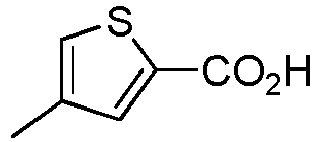
Sigma (633550) P 3-amino-5-hydroxybenzoic acid 
Synthesised as per Becker and Rickards, 1984 Q 4-hydroxy-3,3-dimethylcyclohexanecarboxylic acid 
Synthesised as described below R 4-methylenecyclohexanecarboxylic acid 
Synthesised as described below S 4-methylcyclohex-3-enecarboxylic acid 
Synthesised as described below T (1S*,4S*)-4-methylcyclohexanecarboxylic acid 
Synthesised as described below U (1S*,3S*,4S*)-3,4-dihydroxycyclohexanecarboxylic acid 
Synthesised as described below V 3-methylcyclohexanecarboxylic acid 
Sigma (330612) W isonicotinic acid 
Sigma (117508) X 5-methylthiophene-2-carboxylic acid 
Sigma (M84429) A1 (1R*,4R*)-4-hydroxycyclohexanecarboxylic acid 
TCI (UK) Ltd (H1175) B1 (2S*)-bicyclo[2.2.1]heptane-2-carboxylic acid 
Synthesised as described below C1 (1S*,3S*)-3-hydroxycyclohexanecarboxylic acid 
Synthesised as described below D1 (1S*,3R*,4S*)-methyl 3-fluoro-4-hydroxycyclohexanecarboxylate 
Synthesised as described below E1 (1S*,3R*,4S*)-3-ethyl-4-hydroxycyclohexanecarboxylic acid 
Synthesised as described below F1 methyl 3,3-difluoro-4-hydroxycyclohexanecarboxylate 
Synthesised as described below G1 (1S*,3R*)-3-hydroxycyclohexanecarboxylic acid 
Synthesised as described below -

- The title compound was prepared, in racemic form, by generating (1R*, 3R*, 4R*)-4-iodocyclohexane-1,3-carbolactone from cyclohex-3-ene carboxylic acid, which was then treated with the base DBU (1,8-diazabicyclo[5.4.0]undec-7-ene) to eliminate HI. The resultant (1R*, 5S*)-cyclohex-3-ene-1,5-carbolactone was then treated with potassium hydroxide dissolved in ethanol to yield the title compound (Marshall, J. A., and Shiping, X., 1995) 4-hydroxy-3,3-dimethylcyclohexanecarboxylic acid - feed Q

-

Chemicals/Reagents & Solvents moles Eq. Qty. 3-Methyl-3-butene-2-one 0.0595 1.0 5.00 g n-Butyl Lithium 0.0654 1.1 40.5 mL, 4.1 g Diisopropyl amine 0.0654 1.1 9.25 mL,6.66 g HMPA 0.0119 0.2 2.13 mL TBDMSCI 0.0654 9.85 g THF (50+25) mL - Brief procedure: n-BuLi was added to a solution of diisopropyl amine in tetrahydrofuran at -78 °C over a period of 15 minutes and stirred for1 h at same temperature and at 0 °C for 30 minutes. The reaction mixture was cooled to -78 °C, 3-methyl-3-butene-2-one in 25 mL of THF was added and stirring continued at -78 °C for 30 minutes. HMPA followed by TBDMSCI were added and stirring continued at same temperature for 2 h.
- Work up: Reaction mixture was quenched with 100 mL of water and extracted with ethyl acetate, dried over Na2SO4, concentrated under reduced pressure to give crude product Purification: This compound was purified by distillation (87 °C -90 °C)
TLC system: 10% ethyl acetate in Hexane
Nature of the compound: Yellowish Brown solid, Yield: 3.99 g -

Chemicals/Reagents & Solvents moles Eq. Qty. Q-2 0.040 1.0 8.0 g Methyl acryl ate 0.032 0.8 2.752 g Toluene 240 mL - Brief procedure: A mixture of Q-2 and methyl acrylate in toluene was heated (120 °C) with stirring in a sealed tube for 48-72 h.
- Work up: Reaction mixture was extract with ethyl acetate, washed with 100 mL of water and dried over sodium sulfate. Solvent evaporation under reduced pressure afforded crude product. Purification: The crude compound was purified by column chromatography using ethyl acetate in hexane to give pure product.
- TLC system: 10% ethyl acetate in Hexane, Rf Value: 0.8
Nature of the compound: Yellowish Brown solid, Yield: 3.19 g -
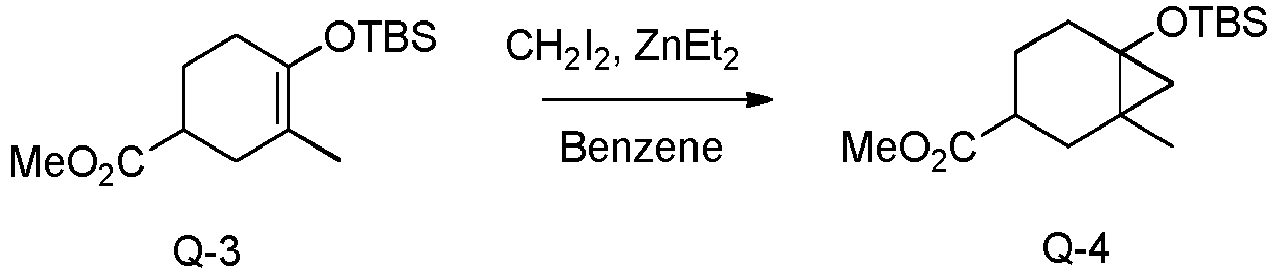
Chemicals/Reagents & Solvents Moles Eq. Qty. Q-3 0.7 mmol 1.0 0.2 g ZnEt2 10.5 mmol 15 1.29 g CH2I2 10.5 mmol 15 2.81 g dry Benzene 20.0 mL - Brief procedure: Q-3 was taken in dry benzene and to which were added diethyl zinc and diiodomethane simultaneously. The reaction mixture was stirred at 65 °C for 16 h under nitrogen atmosphere.
- Work up: The reaction mixture was quenched with NH4Cl (aqueous) and extracted into ethyl acetate. Solvent evaporated under reduced pressure afforded desired product as yellowish brown solid.
- Purification: This crude was directly used for next step without further purification.
TLC system: 10% ethyl acetate in Hexane, Rf value: 0.8
Nature of the compound: Yellowish Brown solid, Yield: 0.31 g (crude) -

Chemicals/Reagents & Solvents moles Eq. Qty. Q-4 0.0026 1.0 0.8 g methanol - 8 mL HCl in ether - 8 mL - Brief procedure: HCI in ether (saturated) was added to a solution of Q-4 in dry methanol and the reaction mixture was stirred at room temperature for 30 min.
- Work up: Reaction mixture was neutralised with NaHCO3 (to pH 7) and extracted with ethyl acetate (three times). Combined organic layer was washed with brine and dried over Na2SO4. Solvent evaporated under reduced pressure afforded crude product.
- Purification: The crude compound was purified by column chromatography over silica gel using ethyl acetate in hexane as solvent to yield pure desired product.
TLC system: 20% ethyl acetate in Hexane Rf value: 0.5 Nature of the compound: Yellowish Brown solid Yield: 0.27 g -

Chemicals/Reagents & Solvents mmol Eq. Qty. Q-5 0.5 1.0 0.1 g NaBH4 0.5 0.0189 g Methanol 1.0 mL - Brief procedure: Q-5 was taken in methanol and was added sodium borohydride. The reaction mixture was stirred at -15 °C for 30 min.
- Work up: Reaction mixture was quenched with 0.1 mL Acetic acid and extracted into ethyl acetate. Organic layer was washed with brine, dried over Na2SO4 and concentrated under reduced pressure to give crude product.
- Purification: The compound was purified by column chromatography over silica gel using ethyl acetate in hexane as eluent to give desired product.
TLC system: 20% ethyl acetate in Hexane Rf value: 0.3 Nature of the compound: Yellowish Brown solid Yield: 0.072 g -

-

Chemicals/Reagents & Solvents Wt./Vol. mmol Eq. ethyl 4-oxocyclohexane carboxylate 5 g 29.37 1 methyltriphenylphosphonium bromide 16.8 g 47.02 1.6 potassium tert-butoxide 4.95 g 44.08 1.5 THF 90 mL -- -- - Brief procedure: KO-tBu was added to a solution of methyltriphenylphosponium bromide at 0 °C under nitrogen atmosphere and stirred for 30 min. To the above yellow colored reaction, a solution of ethyl 4-oxocyclohexane carboxylate in THF was added dropwise and the resulting mixture was stirred at the same temperature for 16 h.
- Work up: The reaction mixture was quenched with water and extracted with diethyl ether. The combined ethereal extract was dried and concentrated under reduced pressure. Purification: The crude residue was purified by silica gel (100-200 mesh) column chromatography by gradual elution from 5% to 10% EtOAc-petroleum ether.
- TLC system: 20% Ethyl acetate-petroleum ether, Rf value: 0.6
Nature of the compound: Colorless liquid, Yield: 3.5 g -

Chemicals/Reagents & Solvents Wt./Vol. mmol Eq. R-2 6.7 g 39.88 1 LiOH.H2O 3.35 g 79.76 2 H2O 100 mL -- -- THF 100 mL -- -- - Brief procedure: An aqueous solution of LiOH was added to R-2 in THF at room temperature and resulting mixture stirred at room temperature for 12 h.
- Work up: The reaction mixture was diluted with pentane. The phases were separated and the aqueous layer was acidified with 4 N HCI at ice bath temperature and extracted with diethyl ether. The combined organic extract was dried and concentrated under reduced pressure to furnish the compound R as a solid.
- Purification: No purification done.
- TLC system: 30% Ethyl acetate-petroleum ether, Rf value: 0.3
Nature of the compound: White solid, Yield: 3.9 g -

Chemicals/Reagents & Solvents Wt. mmol. Eq. Isoprene 6 g 88.07 1.0 Acrylic acid 6.3 g 88.07 1.0 - Brief procedure: A mixture of isoprene and acrylic acid was taken in a 50 mL sealed tube and heated to 110 °C for 15 h.
- Work up: The reaction mass was dissolved in ether and basified with saturated NaHCO3 solution. The organic layer was discarded and the aqueous layer was washed with diethyl ether (3 x 50 mL) to remove polymeric material. The aqueous layer was then acidified with 20% HCI and extracted with DCM. The combined organic extract was dried over NaSO4 and concentrated.
- Purification: The product was repeatedly recrystallized from hexane at 0 °C.
- TLC system: 20% EtOAc in pet ether, Rf value: 0.51
Nature of the compound: White solid, Yield: 1.1 g -

Chemicals/Reagents & Solvents Wt mol Eq. p-Toluic acid 10 g 0.0734 1 Platinum oxide 3.31 g 0.014 0.2 Diethyl ether 100 mL -- -- - Brief procedure: A mixture of p-Toluic acid and PtO2 in ether was placed in a 250mL Parr hydrogenation apparatus overnight under 60 psi hydrogen pressure at room temperature. Work-up: The reaction mixture was then filtered and concentrated under reduced pressure. Purification: WG-433 was obtained as cis & trans isomers (84%&15% respectively),the mixture was purified by column chromatography.
- TLC system: 50% Diethyl ether/Hexane, Rf value: 0.54
Nature of the compound: Light yellow color liquid, Yield: 5.0 g -

- Racemic 3-cis,4-trans-dihydroxycyclohexane carboxylic acid was readily attainable from commercially available racemic 3-cyclohexene carboxylic acid. This acid was epoxidised through treatment with meta-chloroperbenzoic acid and converted to the lactone in situ by the addition of base (triethylamine), thus setting up the relative stereochemistries. This lactone was then hydrolysed by the action of aqueous potassium hydroxide, and the final product purified over ion exchange resin (see PAS Lowden Thesis 1997, Corey, E. J. and Huang, H., 1989).
-

-

Chemicals/Reagents & Solvents Wt./Vol. mmol Eq. Norbornene 50.0 g 531.06 1.0 Carbonyltris(triphenyl phosphine)-rhodium(I) hydride 0.49 g 0.531 0.001 Toluene 625.0 mL -- -- - Procedure: Norbornene was placed in a 2L stainless steel autoclave together with toluene and carbonyl tris (triphenyl phosphine)-rhodium (I) hydride. The reactor was pressurized to 1250 Psi with synthesis gas (CO/H2 =1:1) and heated to 100°C.
- Work up: The reactor was cooled to room temperature; the residual gases removed by purging N2 gas for 15-20 min and the solvent was concentrated under reduced pressure to give the crude B1-1.
- Purification: B1-1 was purified by column chromatography using 60-120 mesh silica (eluent: 15% DCM-petroleum ether).
- Nature of the compound: Pale yellow liquid Yield: 25 g (37.9%)
-

Chemicals/Reagents & Solvents Wt./Vol. mmol Eq. B1-1 125.0 g 1006.6 1.0 Potassium permanganate 154.0 g 1006.6 1.0 t-Butanol 125.0 mL -- -- Water 125.0 mL -- -- - Reaction time: 1 min Reaction temperature: rt
Brief procedure: To a solution of B1-1 in t-butanol was added water. To the resulting mixture an aq KMnO4 solution was added with vigorous stirring at room temperature. - Work up: The reaction mixture was quenched by the addition of a saturated solution of sodium sulfite and the pH of the resulting mixture was adjusted to 3 with cold dilute HCI to dissolve the colloidal MnO2. The reaction mixture was extracted with ethyl acetate, washed with water, dried over anhydrous Na2SO4 and concentrated under reduced pressure to yield crude B1. Purification The crude B1 was purified by column chromatography using 100-200 mesh silica (eluent: 3% EtOAc-petroleum ether).
- TLC system: 10% EtOAc-petroleum ether, Rf value: 0.1
Nature of the compound: White crystalline solid, Yield: 100 g -

-
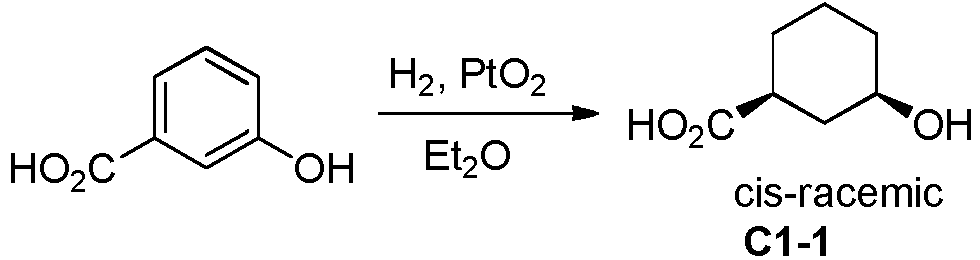
Chemicals/Reagents & Solvents Wt./Vol. mol Eq. 3-Hydroxybenzoic acid 100 g 0.724 1 Platinum oxide 10 g - 10 Diethyl ether 500 mL -- - Brief procedure: A solution of 3-hydroxybenzoic acid in diethyl ether was hydrogenated at 60 Psi with platinum oxide for 10 days.
- Work up: After completion of the reaction, the catalyst was removed by filtration and washed with methanol under nitrogen; the organic layer was distilled under reduced pressure.
- Purification: The residue was washed with petroleum ether (3 x 100 mL), the mixture on recrystallization four times with ethyl acetate gave pure compound.
- TLC system: 10% MeOH/DCM, Rf value: 0.12
Nature of the compound: Off white solid, Yield: 26 g -

Chemicals/Reagents & Solvents Wt./Vol. mol Eq. C1-1 26 g 0.18 1 Quinine trihydrate 35 g 1.08 0.6 Methanol 500 mL -- - Brief procedure: Quinine trihydrate was dissolved in warm methanol, to this solution C1-1 in methanol was added portion wise. The combined solution was placed in a water bath at 50°C and allowed to cool slowly to room temperature and then placed in ice bath for 3h.The resulting mixture was filtered.
- Purification: Recrystallisation from ethanol.
- Nature of the compound: Off white solid, Yield: 40 g
-

Chemicals/Reagents & Solvents Wt./Vol. mol Eq. C1-2 40 g 0.085 1 NaOH 3.4 g 0.085 1 water 200 mL -- - Brief procedure: Quinine salt was suspended in a stirred solution of NaOH in water. The mixture was stirred at 80°C for 2 h.
- Work up: Water was added and washed with chloroform. The aq layer was acidified with H2SO4 and extracted with ethyl acetate. Combined ethyl acetate layer was dried and concentrated.
- Purification: Recrystallization from ethyl acetate.
TLC system: 10% MeOH/DCM Rf value: 0.12 Nature of the compound: Off white solid. Yield: 9.1 g -

Chemicals/Reagents & Solvents Wt./Vol. mol Eq. C1-3 1.2 g 0.0083 1 Methanolic HCl 30 mL -- -- - Brief procedure: A solution of C1-3 in methanolic HCI was heated under refluxed overnight. Work up: After completion of the reaction, organic layer was removed under reduced pressure. Purification: The residue was extracted with ethyl acetate, washed with water, brine, dried over Na2SO4 and concentrated to yield light yellow oil.
- TLC system: 10% MeOH/DCM, Rf value: 0.4
Nature of the compound: Light yellow oil, Yield: 1.2 g -

Chemicals/Reagents & Solvents Wt./Vol. mol Eq. C1-4 1.2 g 0.0076 1 4-Nitrobenzoic acid 1.39 g 0.0083 1.1 DIAD 3.07 g 0.0152 2 TPP 3.98 g 0.0152 2 Toluene 12 mL -- - Reaction time: 2 days Temperature conditions: r.t
Brief procedure: A solution of C1-4, 4-nitrobenzoic acid, TPP in Toluene was cooled to -78°C then DIAD was added at 50°C and stirred at r.t for 2 days. - Work up: After completion of the reaction, the reaction mixture was concentrated.
- Purification: The residue on purification by column chromatography using hexane/ethyl acetate (10% to 40% ethyl acetate gradient) gave off white solid.
- TLC system: 30% ethyl acetate/petroleum ether, Rf value: 0.7
Nature of the compound: Off white solid, Yield: 700 mg -

Chemicals/Reagents & Solvents Wt./Vol. mol Eq. C1-5 1 g 0.0032 1 Li2CO3 0.84 g 0.0128 4 MeOH 10 mL - - Reaction time: Overnight Temperature conditions: r.t
Brief procedure: A solution of C1-5 and Li2CO3 in MeOH was stirred overnight at r.t. Work up: After completion of the reaction, organic layer was distilled under reduced pressure, extracted with ethyl acetate, washed with water, brine, dried over Na2SO4.and concentrated to yield light yellow oil. - Purification: The residue was washed with petroleum ether (3x100 mL), recrystallized four times with ethyl acetate to obtain pure compound.
- TLC system: 30% ethyl acetate / petroleum ether, Rf value: 0.3
Nature of the compound: Light yellow oil, Yield: 330 mg -
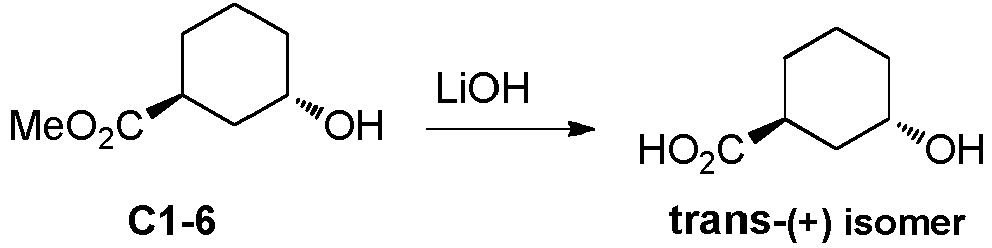
Chemicals/Reagents & Solvents Wt./Vol. mol Eq. Compd 6350 g 0.0022 1 LiOH 0.16g 0.0066 3 THF: Water (4:1) 20 mL - - - Brief procedure: A solution of C1-6 and LiOH in THF: Water (4:1) was stirred for overnight.
- Work up: After completion of the reaction, the organic layer was distilled under reduced pressure, extracted with ethyl acetate, washed with water, brine, dried over Na2SO4 and concentrated to afford light yellow oil.
- Purification: Crude on Recrystallisation with ethyl acetate afforded pure compound.
- TLC system: 10% MeOH/DCM, Rf value: 0.25
Nature of the compound: Off white solid, Yield: 300 mg -

-
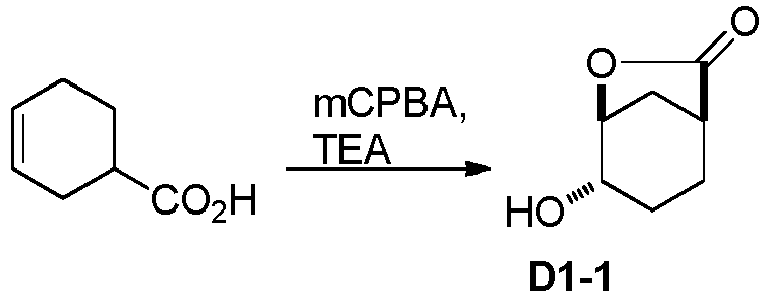
Chemicals/Reagents & Solvents Wt. Mol Eq. Cyclohex-3-enecarboxylic acid 5 g 0.0396 1 m-CPBA 10.4 g 0.059 1.5 TEA 16.5 g -- 4.13 CCl4 131.5 mL -- - Procedure: m-CPBA was added to a solution of cyclohex-3-enecarboxylic acid in CCl4 and the reaction mixture was stirred for 4 h. Triethyl amine was added and the resulting reaction mixture was stirred at 65 °C for 4 h.
- Work up: The reaction mixture was concentrated under reduced pressure to get crude residue. Purification: The crude product was purified by flash column chromatography using ethyl acetate and petroleum ether as eluents.
- TLC system: 50% Ethyl acetate in pet ether, Rf value: 0.3
Nature of the compound: Light brown color solid, Yield: 50% -

Chemicals/Reagents & Solvents Wt. Mol Eq. D1-1 3.5 g 0.024 1 DHP 5.57 g 0.066 2.69 Pyridinium p-toluene sulfonate 0.123 g 0.0004 0.02 DCM 42 mL -- - Reaction time: 2 h Reaction temperature: RT
- Procedure: To a solution of D1-1 in DCM, was added dihydropyran followed by pyridinium p-toluene sulfonate. The resulting reaction mixture was stirred for 2 h at room temperature.
- Work up: The reaction mixture was cooled to 0 °C, quenched with aqueous 5% NaHCO3 solution. Organic layer separated, aqueous layer re-extracted with dichloromethane and combined organic layer was washed with brine. Finally, organic layer was dried over sodium sulfate and concentrated under reduced pressure to give crude product.
- Purification: The compound was directly taken for next step without further purification.
- TLC system: 50% Ethyl acetate in pet ether, Rf value: 0.8
Nature of the compound: Brown color liquid, Yield: 77% -

Chemicals/Reagents & Solvents Wt. Mol Eq. D1-2 6.3 g 0.176 1 KOH in methanol 0.012 g+ 0.315 mL 0.0002 0.0012 Methanol 12.6 mL -- - Reaction time: 1 h Reaction temperature: RT
- Procedure: KOH in methanol was added to a solution of D1-2 in methanol and the resulting reaction mixture stirred at room temperature over a period of 1 h.
- Work up: The reaction mixture was diluted with chloroform and water, organic layer separated and aqueous layer was re-extracted with chloroform. The combined organic layer was washed with saturated NH4Cl solution and brine, dried over sodium sulfate and solvent evaporated under reduced pressure.
- Purification: The crude product was directly used in next step without further purification.
- TLC system: 50% Ethyl acetate in pet ether, Rf value: 0.4
Nature of the compound: Yellow color liquid, Yield: 70% -

Chemicals/Reagents & Solvents Wt. Mol Eq. D1-3 1 g 0.0038 1 Perfluorobutane sulfonylfluoride 2.341 g 0.0077 2 Triethylamine tri hydrofluoride 1.24 g 0.0077 2 TEA 3.28 mL 0.023 6 THF 6.2 mL -- - Reaction time: 12 h, Reaction temperature: RT
- Procedure: D1-3 was dissolved in THF and were added perfluorobutanesulfonylfluoride, triethyl amine and triethylamine-trihydrofluoride. The resulting reaction mixture was stirred overnight under nitrogen atmosphere.
- Work up: The reaction mixture was filtered, solid washed with ethyl acetate-hexane (1:3) and solvent evaporated under reduced pressure.
- Purification: The crude product was purified by flash column chromatography using ethyl acetate and petroleum ether as eluents.
- TLC system: 50% Ethyl acetate in petroleum ether, Rf value: 0.8
Nature of the compound: Brown color liquid , Yield: 69 %. -

Chemicals/Reagents & Solvents Wt. Mol Eq. D1-4 0.050 g 0.192 mmol 1 Polymerbound PTSA 0.002 g+ 0.001 g 2 mmol/1g -- Methanol 0.1 mL -- - Reaction time: 3 h, Reaction temperature: 50 °C
- Procedure: Polymerbound PTSA was added to a solution of D1-4 in methanol and the resulting suspension was stirred at 50 °C over a period of 2 h. Another portion of polymerbound PTSA was added and stirring continued for another 1 h at same temperature.
- Work up: The reaction mixture was filtered through a sintered funnel and solvent removed under reduced pressure.
- Purification: The crude product was purified by flash column chromatography using ethyl acetate and petroleum ether as eluents.
- TLC system: 50% Ethyl acetate in pet ether, Rf value: 0.3
Nature of the compound: Yellow color liquid, Yield: 60% -

-

Chemicals/Reagents & Solvents Wt. mol Eq. pentane-1,3,5-tricarboxylic acid 100 g 490 1.0 H2SO4 20 mL 245 0.5 Methanol 1500 mL -- 15 V - Reaction time: 12 h, Reaction temperature: reflux
- Brief procedure: A mixture of pentane-1,3,5-tricarboxylic acid in dry methanol and sulfuric acid was heated under refluxed for 12 h.
- Work up: The reaction mixture was concentrated in vacuo, diluted with ethyl acetate and washed repeatedly with water followed by 10% NaHCO3. The combined organic extract was dried, filtered and concentrated under reduced pressure to give a residue. Purification: The crude residue was purified by silica gel (60-100 mesh) column chromatography using 15% ethyl acetate-petroleum ether as eluent.
- TLC system: 30% Ethyl acetate-petroleum ether, Rf value: 0.8
Nature of the compound: Colorless sticky liquid, Yield: 110 g (95%) -

Chemicals/Reagents & Solvents Wt. mol Eq. E1-1 110.0 g 447.1 1.0 Potassium t-butoxide 150.28 g 1341 3.0 ethyl iodide 288 mL 3577 8.0 t-Butyl alcohol 770 mL -- 10% sulfuric acid 288 mL -- -- - Brief procedure: To a solution of potassium t-butoxide in dry t-butyl alcohol, under argon atmosphere was added in one portion a solution of E1-1 to afford a viscous orange solution. The reaction mixture was heated at reflux for 3 h, then cooled to RT and ethyl iodide was added with stirring. The reaction mixture was stirred at reflux for 10 h, and then t-butyl alcohol was removed in vacuo. To the residue was mixed with 10% sulfuric acid and the mixture was refluxed for further 48 h.
- Work up: The reaction mixture extracted with three portions of diethyl ether, the combined extract was washed successively with water and saturated ammonium sulfate, dried over Na2SO4, filtered and concentrated in vacuo to give the crude product.
- Purification: The crude residue was purified by silica gel (100-200 mesh) column chromatography using 30% ethyl acetate-petroleum ether as eluent.
- TLC system: 30% Ethyl acetate-petroleum ether, Rf value: 0.14
Nature of the compound: Colorless sticky liquid, Yield: 50 g -
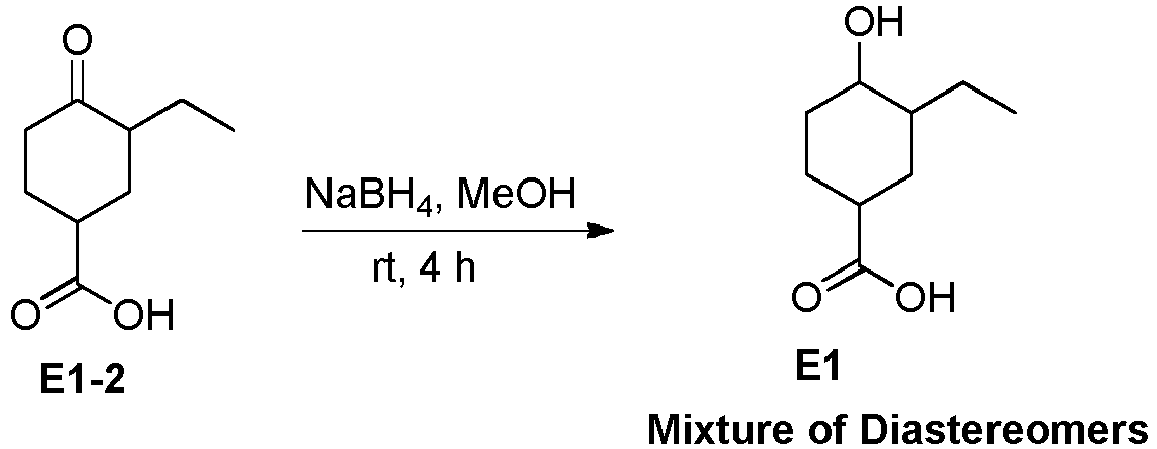
Chemicals/Reagents & Solvents Wt. M. Mol Eq. E1-2 30 g 176.47 1.0 NaBH4 10.1g 264.7 1.5 Methanol 300 mL -- - Brief procedure: NaBH4 was added portion-wise to a stirred solution of E1-2 in methanol at 0 °C and further stirred at room temperature for 4 h.
- Work up: The reaction mixture was concentrated in vacuo to give the crude product. Purification: The crude residue was purified by silica gel (100-200 mesh) column chromatography using 28% ethyl acetate-petroleum ether as eluent.
- TLC system: 90% Ethyl acetate-petroleum ether, Rf value: 0.6
Nature of the compound: Light yellow viscous liquid, Yield: 15 g -

-

Chemicals/Reagents & Solvents Wt. Mol Eq. Ethyl-4-oxocyclohexane carboxylate 25 g 0.146 1 LiHMDS 29.73 g 0.177 1.21 TMS-Cl 24.1 g 0.22 1.51 THF 567+567 mL -- -- - Ethyl-4-oxocyclohexane carboxylate in THF was added dropwise at -78 °C to a stirred solution of lithium hexamethyldisilazide in THF. The reaction mixture was stirred for 1 h at same temperature and TMS-Cl was added. It was stirred for 10 minutes at same temperature and then for 1 hour at room temperature. The reaction was monitored by TLC. The reaction mixture was concentrated under reduced pressure, added hexane and filtered off. Filtrate was concentrated under reduced pressure to get crude product. The crude product was purified by column chromatography over silica gel using diethyl ether in hexane.
- TLC system: 30% Ethyl acetate in petroleum ether, Rf value: 0.8
Nature of the compound: Yellow liquid, Yield: 19.5 g -
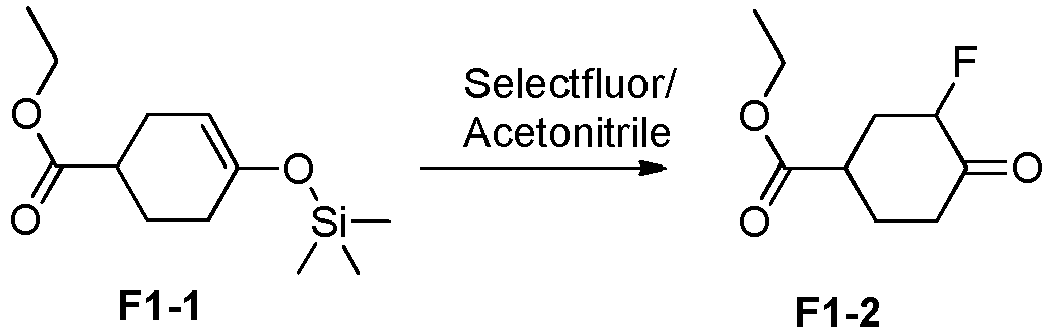
Chemicals/Reagents & Solvents Wt. Mol Eq. F1-1 19 g 0.0785 1 Selectfluor 40.4g 0.0942 1.19 Acetonitrile 337.5 mL -- -- - Selectfluor was added to a solution of F1-1 in acetonitrile at 0 °C under nitrogen atmosphere and stirred for 1.5 hours. The reaction mixture was partitioned between water and ethyl acetate. Organic layer separated, washed with NaHCO3 followed by brine and dried over sodium sulfate. Solvent was removed under reduced pressure to get crude product. The crude product was purified by column chromatography over silica gel using diethyl ether in hexane.
- TLC system: 30% Ethyl acetate in petroleum ether, Rf value: 0.3
Nature of the compound: Light Yellow Liquid, Yield: 6.7 g -

Chemicals/Reagents & Solvents Wt. Mol Eq. F1-2 6.02 g 0.0320 1 LiHMDS 6.48 g 0.038 1.21 TMS-Cl 5.25 g 0.483 1.51 THF 136.6+136.6 mL -- -- - F1-2 in THF was added dropwise at -78 °C to a stirred solution of lithium hexamethyldisilazide in THF. The reaction mixture was stirred for 1 hour at same temperature and TMS-Cl was added. It was stirred for 10 min at same temperature and 1 h at room temperature. Work up: The reaction mixture was concentrated under reduced pressure, added hexane and filtered off. Filtrated was concentrated under reduced pressure to get crude desired product. Purification: The crude product was purified by column chromatography over silica gel using diethyl ether in hexane.
- TLC system: 30% Ethyl acetate in petroleum ether, Rf value: 0.8
Nature of the compound: Yellow liquid, Yield: 2.8 g -

Chemicals/Reagents & Solvents Wt. Mol Eq. F1-3 2.5 g 0.00962 1 Selectfluor 4.05 g 11.442 1.19 Acetonitrile 30 mL -- -- - Selectfluor was added to a solution of F1-3 in acetonitrile at 0 °C under nitrogen atmosphere and stirred for 1.5 h.
- Work up: The reaction mixture was partitioned between water and ethyl acetate. Organic layer separated, washed with NaHCO3 followed by brine and dried over sodium sulfate. Solvent was removed under reduced pressure to get crude desired product.
- Purification: The crude product was purified by column chromatography over silica gel using diethyl ether in hexane.
- TLC system: 30% Ethyl acetate in petroleum ether, Rf value: 0.3
Nature of the compound: Light Yellow Liquid, Yield: .0.5 g -

Chemicals/Reagents & Solvents Wt. Mol Eq. F1-4 0.45 g 0.00218 1.0 Sodium Borohydride 0.0908 g 0.0024 1.1 Ethanol 4.5 mL -- -- - F1-4 was dissolved in EtOH and sodium borohydride was added at 0 °C. The mixture was stirred for 30 min at same temperature.
- Work up: The reaction was quenched with water, extracted with dichloromethane, dried over sodium sulfate and solvent evaporated under reduced pressure to get crude product. Purification: The crude product was purified by column chromatography over silica gel using diethyl ether in petroleum ether as eluent
- TLC system: 30% Ethyl acetate in petroleum ether, Rf value: 0.5
Nature of the compound: Light Yellow Liquid, Yield: 0.170g -

Chemicals/Reagents & Solvents Wt./Vol. Mol Eq. 3-Hydroxybenzoic acid 10 g 0.072 1 Platinum oxide 1 g 0.004 0.6 Diethyl ether 250 mL -- 25 V - Brief procedure: A solution of 3-hydroxybenzoic acid in diethyl ether was hydrogenated with platinum oxide at 60 psi for 10 days.
- Work up: After completion of the reaction, the catalyst was removed by filtration and washed with methanol under nitrogen; the organic layer was distilled under reduced pressure. Purification: The residue was washed with petroleum ether (3 x 100 mL), the mixture was recrystallized four times with ethyl acetate to afford pure compound.
- TLC system: 10% MeOH/DCM, Rf value: 0.25
Nature of the compound: Off white solid, Yield: 2.6 g (25%) - Production of rapamycin analogs and contracted rapamycins was carried out by fermentation of Streptomyces rapamycinicus. Typically strains were grown on ISP3 agar at 28 °C for 10-14 days to achieve good sporulation and used to inoculate 7 ml seed medium RapV7 (50 mL polypropylene centrifuge tubes (falcon tubes) (cat no.227261, purchased from Greiner Bio-One Ltd, Stonehouse, Gloucestershire, UK)) closed with foam plugs by transferring an agar plug (5 mm diameter). Alternatively 35 µL of a thawed spore stock was used for the inoculation. The inoculated seed medium was incubated with shaking at 300 rpm, 2.5 cm throw at 28 °C for 48 hours. For production the fermentation medium MD6 (7mL in falcon tube as before) was inoculated with 0.5 mL of the seed culture using a wide bore tip and incubated with shaking at 300 rpm, 2.5 cm throw at 26 °C for six days. The culture was then harvested for extraction. A selected starter unit feed (corresponding to the desired starting unit for biosynthesis of the target compound) was fed to the production medium 24 hours post inoculation. Typically feed was dissolved in methanol (0.05 mL) and added to culture to give final concentration of 2mM. The broth was extracted by aliquoting 0.9 ml into an eppendorf tube (2 ml) and adding methanol (0.9 ml). The eppendorf was then shaken on a vibrax bed for 30 minutes before the cell debris was removed by centrifugation (13,200 rpm, 10 minutes). An aliquot of the supernatant was then transferred to an LC-vial for analysis by the methods described below.
- Spore stocks of the strains for fermentation were prepared after growth on ISP3 agar medium and preserved in 20% w/v glycerol in distilled water and stored at -80 °C. Spore stocks were recovered onto plates of MAM or ISP3 medium and incubated for 10-11 days at 28°C. Vegetative cultures (seed cultures) were prepared using working spore stocks of at 0.05% inoculum and inoculating into 400 ml medium RapV7 in 2 litre Erlenmeyer flasks with foam plugs. Cultivation was carried out for 48 hours at 28°C, 250 rpm (2.5 cm throw). The entire seed culture in one flask was transferred into 15 litres of medium MD6/5-1 pre-adjusted at pH 6.0-7.0 in a V7 Braun 22 L fermenter. The fermentation was carried out for 6 days at 26°C, with starting agitation at 200 rpm, aeration rate at 0.5 V/V/M and dissolved oxygen (DO) level controlled with the agitation cascade at 30% air saturation. The starting agitation was set at 200 rpm. For production of compound, the selected precursor to feed (starting unit for biosynthesis of target compound) was fed to the production medium 24 hours post inoculation. Feed was dissolved in 3 mL to 5 mL methanol and added to the culture to give final concentration of 2 mM of the feed compound. The amount of methanol does not exceed 1 % of the total volume. Fermentation was continued for further five days post-feeding, before harvesting.
- Harvested whole broth was centrifuged at 3500rpm (RCF 3300g) for 25mins. The clarified broth was assayed and discarded if less than 5% target compound detected. The cell pellet was removed from the centrifuge pots with acetonitrile and decanted into a 10L glass duran. Further acetonitrile is added to give a ratio of 2 volumes of solvent to 1 volume of cells. The mixture was then stirred for 1 hour using an overhead electric paddle stirrer at 600rpm.
- After 1 hour the stirring was stopped and the mixture left to settle under gravity for 15mins. The solvent layer was removed as extract _1 and a further 2 volumes of acetonitrile added to the remaining cells. This was stirred again as above to obtain extract_2. Any remaining rapatractins in the cell pellet can be removed by a third extraction if required.
- Any target compound in the clarified broth can be recovered by adding an equal volume of ethyl acetate and stirring for 1 hour in a glass duran using an overhead electric paddle stirrer at 600 rpm. The organic solvent was then separated by centrifugation at 3500rpm (RCF 3300g) for 15 mins.
- The combined extracts from both the cell pellet and, if required clarified broth, were concentrated in vacuo to a residual aqueous extract which was then extracted into an equal volume of ethyl acetate. A second ethyl acetate extraction can be performed as necessary. The ethyl acetate extract containing the target rapatractin is then concentrated in vacuo to yield a final often oily crude.
- The crude extract was dissolved in methanol, and silica gel added (approximately equal amount to the extract by weight) and the solvent removed in vacuo to a free-flowing powder. The impregnated silica is loaded on to a silica gel column (20 x 5 cm) and eluted with 100 % CHCl3, and gradually increases polarity by adding MeOH (to a maximum 5% MeOH). Approximately 20 x 250 ml fractions were collected and monitored by TLC and analytical HPLC. The fractions containing the rapatractins were loaded onto a second silica gel column (15 x 2 cm) and eluted with a mixture of hexane and ethyl acetate (1:1). First 1L of (1:1) mixture was passed through, then 1L of (40:60), and continued to 100% of EtOAc. Approximately 20 x 250 mL fractions were collected and individually checked by tlc and analytical HPLC. Fractions found to contain rapatractins were combined and the solvents were removed in vacuo. This bulk was then dissolved in acetonitrile and multiple injections (about 100 mg crude per injection) made to preparative HPLC using a water acetonitrile gradient mixture for 30 minutes (actual methods depend on compound polarity). The solvent from the resulting pure rapatractin containing fractions was removed in vacuo and the compound analysed by LC-MS and NMR for characterisation.
- NMR spectra were recorded on a Bruker Advance 500 spectrometer at 298 K operating at 500 MHz and 125 MHz for 1H and 13C respectively. Standard Bruker pulse sequences were used to acquire 1H-1H COSY, APT, HMBC and HMQC spectra. NMR spectra were referenced to the residual proton or standard carbon resonances of the solvents in which they were run.
- Purified compounds were analysed using
LCMS method 2 described. LCMS method 2: chromatography was achieved over a Phenomenex HyperClone C18-BDS column (4.6 x 150 mm, 3 micron particle size) eluting with a gradient of water + 0.1% formic acid:acetonitrile + 0.1% formic acid, (90:10) to (0:100), at 1 mL/min over 20 min. Purity was assessed by MS and at multiple wavelengths (210, 254 & 276 nm). All compounds were >95% pure at all wavelengths. Purity was finally confirmed by inspection of the 1H and 13C NMR spectra. - An aliquot of whole culture broth (0.9 mL) was added to methanol (0.9 mL) in a 2 mL eppendorf, and then shaken for 30 minutes. The sample was centrifuged (10 minutes, 13000 rpm) and the supernatant (0.15 ml) was transferred to a HPLC vial for analysis by HPLC with diode array detection. The HPLC system comprised an Agilent HP1100 equipped with a
Hyperclone 3 micron BDS C18 130A column 150 mm x 4.6 mm (Phenomenex) heated to 50 °C. The gradient elution was from 55% mobile phase B to 95% mobile phase B over 10 minutes followed by an isocratic hold at 95% mobile phase B for 2 minutes with a flow rate of 1 mL/min. Mobile phase A was 10% acetonitrile:90% water, containing 10 mM ammonium acetate and 0.1% trifluoroacetic acid, mobile phase B was 90% acetonitrile:10% water, containing 10 mM ammonium acetate and 0.1% trifluoroacetic acid. Rapamycin analogues were identified by the presence of the characteristic rapamycin triene, centred on λ = 278 nm or by LC-MS. - LC-MS - method 1 (fermentation broths) - The HPLC system described above was coupled to a Bruker Daltonics Esquire3000 electrospray mass spectrometer. The gradient elution was from 50% mobile phase B to 100% mobile phase B over 10 minutes followed by an isocratic hold at 100% mobile phase B for 3 minutes with a flow rate of 1 mL/min. Mobile phase A was water containing 0.1% formic acid, mobile phase B was acetonitrile containing 0.1% formic acid.. Positive negative switching was used over a scan range of 500 to 1000 Dalton.
- LC-MS - method 2 (purified samples) - LC-MS - method 1 (fermentation broths) - The HPLC system described above was coupled to a Bruker Daltonics Esquire3000 electrospray mass spectrometer. Chromatography was achieved over a Phenomenex HyperClone C18-BDS column (4.6 x 150 mm, 3 micron particle size) eluting with a gradient of water + 0.1% formic acid:acetonitrile + 0.1% formic acid, (90:10) to (0:100), at 1 mL/min over 20 min. Purity was assessed by MS and at multiple wavelengths (210, 254 & 276 nm). All compounds were >95% pure at all wavelengths
- To construct a downstream region of homology two PCR products were ligated together. The first of these two PCR products was obtained using two oligonucleotides
- (CGACGAATTCCATCGCGCCCCGGCCCGCCAGG (SEQ ID NO: 1) and
- TTGTCCGGCCGGGTGTCGTACGTCTTCGG (SEQ ID NO: 2)
- (CCAGGGACGAGGAGCACGCCGTGTCCATCG (SEQ ID NO: 3) and
- GGGGTGTAGAGGCTAGCCGCCCTGGCACCGGCCGAGC (SEQ ID NO: 4))
- Similarly, to construct the upstream region of homology a further two PCR products were ligated together The first of these two PCR products was obtained using two oligonucleotides
- (GTATCTAGAAAGATCTAGTACCCGGGTTGTGGCGGTGCCGAGG (SEQ ID NO: 5) and
- TCAGGCCGCCTCGGGCGTGTCGGTTGTCATCAAGATGG (SEQ ID NO: 6))
- (GACGGCTCATCCACGTGCAGGGTGCGGGGAACC (SEQ ID NO: 7) and
- GTCTAAGCTTTCCCCACCGACCGTGGCTGGGACGTCG (SEQ ID NO: 8))
- The region of downstream homology from
intermediate plasmid 1 was excised using EcoRI and XbaI. The region of upstream homology fromintermediate plasmid 2 was excised using XbaI and HindIII. These two fragments were ligated together with pUC19 that had been digested with EcoRI and HindIII. The resulting vector was then digested with NheI and BglII to insert the desired reductive loop. Two loops were used, the reductive loop frommodule 13 of the rapamycin cluster and the reductive loop frommodule 11 of the rapamycin cluster. NheI/BglII sites were utilised. The reductive loop ofmodule 13 of the rapamycin cluster was excised from plasmid pPF137 (Gaisser et al., 2003) using NheI and BglII. The reductive loop ofmodule 11 of the rapamycin cluster was excised from plasmid pWV165 (a plasmid containing therapamycin PKS module 11 reductive loop engineered to have NheI and BglII sites surrounding the reductive loop encoding DNA. - The resulting constructs were transferred to the conjugative vector pKC1139 (Bierman et al 1992) by digesting with EcoRI and HindIII and ligating with pKC1139 that had been digested with the same enzymes. The resulting plasmids were named pSGK210 (containing
rapamycin PKS module 13 loop) and pSGK212 (containingrapamycin PKS module 11 loop). - Plasmids pSGK210 and pSGK212 were transferred to S. rapamycinicus BIOT-4010 (Kendrew et al., 2013) by conjugation using standard methods. Briefly, plasmid was electroporated into ET12567:pUZ8002 and selected on 2TY agar medium containing apramycin (50 µg/mL), kanamycin (25 µg/mL), and chloramphenicol (25 µg/mL). Single colonies were grown overnight in 3ml 2TY liquid medium containing apramycin (50 µg/mL), kanamycin (25 µg/mL) and chloramphenicol (25µg/ml). 0.7ml of this culture was used to inoculate 10ml liquid medium containing apramycin (50µg/ml), kanamycin (25µg/ml) and chloramphenicol (25 µg/mL) and grown at 37 C to reach an OD of approximately 0.5. Cells were pelleted at 4000rpm for 10minutes and washed twice with 10ml 2xTY before resuspending in 0.25
mL 2 TY. Spores of S. rapamycinicus BIOT-4010 grown on ISP3 for 2-3 weeks were harvested using 20% glycerol and stored at -80°C (1 plate gives about 1 mL spore stock). For the conjugation approximately 0.3-0.5 mL of these spores are needed for each conjugation. Spores were unfrozen and pelleted by centrifugation (4000rpm, 10 minutes) before washing with 2xTY. The spores were then repelleted and resuspended in 0.25 mL 2xTY and heat shocked in a water bath at 50°C for 10 minutes before cooling immediately on ice. The conjugation was performed by adding 0.25 mL of washed E. coli cells to the heat shocked spores, mixing and spreading the mixture onto a R6 plate and transferring to 37°C. The plate was overlaid with 2 mL water containing 15 µL naladixic acid (stock 50 mg/mL) after 2-3 hours and with 2 mL water containing 15 µL apramycin (stock 100 mg/mL) after an overnight incubation. - Plates were incubated at 37°C until single exconjugant colonies were visible. Colonies (approximately 15-20) were patched to MAM containing apramycin and naladixic acid and reincubated at 37°C. Usually this colony was then repatched to the same media (containing apramycin and nalidixic acid) to ensure there was no E. coli contamination. Once stabilised approximately 10-15 of the strains were patched to solid ISP3 media lacking antibiotics and incubated at 37°C for approximately 3 days before repatching to ISP3 media and growing for a further 3 or 4 days. A final round of subculture at 37°C on ISP3 was performed before plating to ISP3 and leaving at 28°C for to allow the strain to sporulate (-10-14 days). Spores were harvested in 20% glycerol and a dilution series prepared in water and spread onto ISP3 media before incubating at 28°C. Once individual sporulating colonies were visible they were patched to ISP3 media plus and minus apramycin to assess for loss of plasmid. The vast majority of strains had lost the apramycin marker. Strains that had lost the marker were tested by growing in production media to assess whether they still produced 39-desmethoxy rapamycin (i.e. had reverted to original strain). Among the strains that no longer produced the original compound 39-desmethoxy rapamycin strains that produced novel compounds were identified (see Example 3).
- A series of alternative constructs were prepared to assess the effect of smaller regions (∼1kb) of homology for recombination.
- Two oligonucleotides
- CGCGAATTCGGAGAAACCGGCACCGTCCGCACTGTCCGC (SEQ ID NO: 9) and
- GGGGTGTAGAGGCTAGCCGCCCTGGCACCGGCCGAGC (SEQ ID NO: 4)
- CGTAAAGCTTGGAGACGACACCGTCACCGGCACCGCTGTG (SEQ ID NO: 10) and
- GTATCTAGAAAGATCTAGTACCCGGGTTGTGGCGGTGCCGAGG (SEQ ID NO: 5)
- The excised fragments were ligated together with pUC19 that had been digested with EcoRI and HindIII. The resulting vector was then digested with NheI and BglII to insert the desired
rapamycin PKS module 11 reductive loop as outlined previously (see Example 1). - The resulting construct was transferred to the conjugative replacement vector pKC1139 (Bierman et al., 1992) by digesting with EcoRI and HindIII and ligating with pKC1139 that had been digested with the same enzymes.
- Plasmid pSGK234 was transferred to S. rapamycinicus BIOT-4010 by conjugation using standard methods. Briefly, plasmid was electroporated into ET12567:pUZ8002 and selected on 2TY agar medium containing apramycin (50 µg/mL), kanamycin (25 µg/mL), and chloramphenicol (25 µg/mL). Single colonies were grown overnight in 3 mL 2xTY liquid medium containing apramycin (50 µg/mL), kanamycin (25 µg/mL) and chloroamphenicol (25 µg/mL). 0.7 mL of this culture was used to inoculate 10 mL liquid medium containing apramycin (50 µg/mL), kanamycin (25 µg/mL) and chloramphenicol (25 µg/mL) and grown at 37 C to reach an OD of approximately 0.5. Cells were pelleted at 4000rpm for 10minutes and washed twice with 10 mL 2xTY before resuspending in 0.25 mL 2xTY. Spores of S. rapamycinicus BIOT-4010 grown on ISP3 for 2-3 weeks were harvested using 20% glycerol and stored at -80°C (1 plate gives about 1 mL spore stock). For the conjugation approximately 0.3-0.5 mL of these spores are needed for each conjugation. Spores were unfrozen and pelleted by centrifugation (4000rpm, 10 minutes) before washing with 2xTY. The spores were then repelleted and resuspended in 0.25 mL 2xTY and heat shocked in a water bath at 50°C for 10 minutes before cooling immediately on ice. The conjugation was performed by adding 0.25ml of washed E. coli cells to the heat shocked spores, mixing and spreading the mixture onto a R6 plate and transferring to 37 C. The plate was overlaid with 2ml water containing 15 µL naladixic acid (stock 50mg/ml) after 2-3 hours and with 2 mL water containing 15 µL apramycin (stock 100 mg/mL) after an overnight incubation.
- Plates were incubated at 37°C until single exconjugant colonies were visible. Colonies (approximately 10-20) were patched to MAM containing apramycin and naladixic acid and reincubated at 37°C. Usually this colony was then repatched to the same media (containing apramycin and nalidixic acid) to ensure there was no E. coli contamination. Once stabilised approximately 10-15 of the strains were patched to solid ISP3 media lacking antibiotics and incubated at 37°C for approximately 3 days before repatching to ISP3 media and growing for a further 3 or 4 days. A final round of subculture at 37°C on ISP3 was performed before plating to ISP3 and leaving at 28°C for to allow the strain to sporulate (-10-14 days). Spores were harvested in 20% glycerol and a dilution series prepared in water and spread onto ISP3 media before incubating at 28°C. Once individual sporulating colonies were visible they were patched to ISP3 media plus and minus apramycin to assess for loss of plasmid. The vast majority of strains had lost the apramycin marker. Strains that had lost the marker were tested by growing in production media to assess whether they still produced 39-desmethoxy rapamycin (i.e. had reverted to original strain). Among the strains that no longer produced the original compound 39-desmethoxy rapamycin strains that produced novel compounds were identified (see Example 3).
- Typically 10-15 colonies displaying apramycin sensitivity and derived from each of the primaries were taken forward. Patches were typically grown for around 10-14 days to allow significant mycelial growth and sporulation. An agar plug (about 5mM in diameter) from each patch was used to inoculate a seed falcon tube containing 7ml RapV7 media (in a falcon tube) and incubated at 28°C, 300rpm (1 inch throw) for 48 hours. 0.5 mL of this seed culture was used to inoculate 7 mL MD6 media and incubated at 26°C and 300 rpm for 6 days; 24 hours into this time each culture was supplemented with 50µl of 0.32M cyclohexane carboxylic acid (CHCA) in methanol (final concentration in media 2mM).
- For harvest and product analysis 0.9ml of culture was aliquoted into a 2 mL eppendorf tube and 0.9 mL methanol was added and mixed for -30 minutes. Cell debris was pelleted by centrifugation and the liquid fraction analysed for the presence of novel rapalogs by LC (screening for presence of triene) and subsequently LCMS.
- As the strains were constructed in a S. rapamycinicus strain that had previously had the rapK gene deleted to interrupt starter unit provision we were able to use a mutasynthetic-feeding approach to further diversify the range of compounds from these strains and produce compounds that possessed the expected contracted polyketide skeleton but bore an altered starter unit. We could also often observe compounds with masses corresponding to different levels of post PKS processing.
- The isolated strain with phenotype B was grown on ISP3 media for approximately 2-3 weeks to allow significant mycelial growth and sporulation. Spores were harvested in 20% glycerol and aliquoted to produce a working stock of spores that was frozen at 80C. 0.25ml of the spore stock was used to inoculate 50 mL RapV7 in a 250 mL flask and incubated at 28°C at 250 rpm? for 48 hours. 0.5 mL of this seed culture was used to inoculate 7 mL MD6 media in a falcon tube and incubated at 26°C and 300rpm for 6 days, 24 hours into this time each culture was supplemented with 50 µl of 0.32M novel starter unit (see Table 1) dissolved in methanol (final concentration in
media 2 mM). Each starter acid was tested in duplicate for each strain. After the 6 days of production 0.9 mL of culture was transferred into a 2 mL eppendorf tube and 0.9 mL methanol was added and mixed for -30 minutes. Cell debris was pelleted by centrifugation and the liquid fraction analysed for the presence of novel rapalogs by LC (screening for presence of triene) and subsequently LCMS. Table 2 illustrates the amounts produced (mg/L using 39-desmethoxy rapamycin callibration curve) and range of compounds and masses observed in these mutasynthetic experiments. Where a mass was not recorded, NR replaces the number. - The isolated strain with phenotype C was grown on ISP3 media for approximately 2-3 weeks to allow significant mycelial growth and sporulation. Spores were harvested in 20% glycerol and aliquoted to produce a working stock of spores that was frozen at 80C. 0.25ml of the spore stock was used to inoculate 50 mL RapV7 in a 250 mL flask and incubated at 28°C at 250rpm for 48 hours. 0.5 mL of this seed culture was used to inoculate 7 mL MD6 media in a falcon tube and incubated at 26°C and 300 rpm for 6 days, 24 hours into this time each culture was supplemented with 50 µL of 0.32 M novel starter unit (see Table 1) dissolved in methanol (final concentration in
media 2 mM). Each starter acid was tested in duplicate for each strain. After the 6 days of production 0.9 mL of culture was tranferred into a 2 mL eppendorf tube and 0.9 mL methanol was added and mixed for -30 minutes. Cell debris was pelleted by centrifugation and the liquid fraction analysed for the presence of novel rapalogs by LC (screening for presence of triene) and subsequently LCMS. Table 3 illustrates the amounts produced (mg/L using 39-desmethoxy rapamycin callibration curve) and range of compounds and masses observed in these mutasynthetic experiments. Where a mass was not recorded, NR replaces the number. - The isolated strain with phenotype D was grown on ISP3 media for approximately 2-3 weeks to allow significant mycelial growth and sporulation. Spores were harvested in 20% glycerol and aliquoted to produce a working stock of spores that was frozen at 80°C. 0.25 mL of the spore stock was used to inoculate 50 mL RapV7 in a 250ml flask and incubated at 28°C at 250 rpm for 48 hours. 0.5ml of this seed culture was used to inoculate 7 mL MD6 media in a falcon tube and incubated at 26°C and 300 rpm for 6 days, 24 hours into this time each culture was supplemented with 50µl of 0.32M novel starter unit (see Table 1) dissolved in methanol (final concentration in media 2mM). Each starter acid was tested in duplicate for each strain. After the 6 days of production 0.9 mL of culture was transferred into a 2ml eppendorf tube and 0.9 mL methanol was added and mixed for -30 minutes. Cell debris was pelleted by centrifugation and the liquid fraction analysed for the presence of novel rapalogs by LC (screening for presence of triene) and subsequently LCMS. Table 4 illustrates the amounts produced (mg/L using 39-desmethoxy rapamycin callibration curve) and range of compounds and masses observed in these mutasynthetic experiments. Where a mass was not recorded, NR replaces the number.
- The isolated strain with phenotype E was grown on ISP3 media for approximately 2-3 weeks to allow significant mycelial growth and sporulation. Spores were harvested in 20% glycerol and aliquoted to produce a working stock of spores that was frozen at 80C. 0.25 mL of the spore stock was used to inoculate 50ml RapV7 in a 250 mL flask and incubated at 28°C at 250 rpm for 48 hours. 0.5ml of this seed culture was used to inoculate 7 mL MD6 media in a falcon tube and incubated at 26°C and 300 rpm for 6 days, 24 hours into this time each culture was supplemented with 50□l of 0.32M novel starter unit (see Table 1) dissolved in methanol (final concentration in
media 2 mM). Each starter acid was tested in duplicate for each strain. After the 6 days of production 0.9ml of culture was aliquoted into a 2 mL eppendorf tube and 0.9 mL methanol was added and mixed for -30 minutes. Cell debris was pelleted by centrifugation and the liquid fraction analysed for the presence of novel rapalogs by LC (screening for presence of triene) and subsequently LCMS. Table 5 illustrates the amounts produced (mg/L using 39-desmethoxy rapamycin callibration curve) and range of compounds and masses observed in these mutasynthetic experiments. Where a mass was not recorded, NR replaces the number. - The isolated strain with phenotype F was grown on ISP3 media for approximately 2-3 weeks to allow significant mycelial growth and sporulation. Spores were harvested in 20% glycerol and aliquoted to produce a working stock of spores that was frozen at 80C. 0.25 mL of the spore stock was used to inoculate 50ml RapV7 in a 250ml flask and incubated at 28°C at 250 rpm for 48 hours. 0.5 mL of this seed culture was used to inoculate 7 mL MD6 media in a falcon tube and incubated at 26°C and 300 rpm for 6 days, 24 hours into this time each culture was supplemented with 50µl of 0.32 M novel starter unit (see Table 1) dissolved in methanol (final concentration in
media 2 mM). Each starter acid was tested in duplicate for each strain. After the 6 days of production 0.9 mL of culture was transferred into a 2 mL eppendorf tube and 0.9 mL methanol was added and mixed for -30 minutes. Cell debris was pelleted by centrifugation and the liquid fraction analysed for the presence of novel rapalogs by LC (screening for presence of triene) and subsequently LCMS. Table 6 illustrates the amounts produced (mg/L using 39-desmethoxy rapamycin callibration curve) and range of compounds and masses observed in these mutasynthetic experiments. Where a mass was not recorded, NR replaces the number. - The isolated strain with phenotype A was grown on ISP3 media for approximately 2-3 weeks to allow significant mycelial growth and sporulation. Spores were harvested in 20% glycerol and aliquoted to produce a working stock of spores that was frozen at 80C. 0.25 mL of the spore stock was used to inoculate 50ml RapV7 in a 250ml flask and incubated at 28°C at 250 rpm for 48 hours. 0.5 mL of this seed culture was used to inoculate 7 mL MD6 media in a falcon tube and incubated at 26°C and 300 rpm for 6 days, 24 hours into this time each culture was supplemented with 50µl of 0.32 M novel starter unit (see Table 1) dissolved in methanol (final concentration in
media 2 mM). Each starter acid was tested in duplicate for each strain. After the 6 days of production 0.9 mL of culture was transferred into a 2 mL eppendorf tube and 0.9 mL methanol was added and mixed for -30 minutes. Cell debris was pelleted by centrifugation and the liquid fraction analysed for the presence of novel rapalogs by LC (screening for presence of triene) and subsequently LCMS. - Strain: Phenotype G from BIOT-4827
Feed: 4-trans-hydroxylcyclohexanecarboxylic acid (final concentration 2 mM)
1 x 15 litre fermentation
The fermentation was as described above except that the vegetative cultures (seed cultures) were prepared using 12 x 5mm plugs from an agar plate and inoculating into 400 ml medium RapV7 in 2 litre Erlenmeyer flasks with foam plugs. Cultivation was carried out for 48 hours at 28°C, 250 rpm (2.5 cm throw). - DSP was as described in the general section, both the cell mass and clarified broth were extracted and the crude extracts combined.
- The crude extract (13.8 g) was dissolved in 1:1 methanol/acetonitrile and C18 reverse-phase silica added (26 g). The solvent was removed in vacuo and the silica added to a C18 reverse-phase silica open column (70 mm x 50 mm diameter) and the column eluted with 3:2 water/acetonitrile (600 ml), 1:1 water/acetonitrile (400 ml), 2:3 water/acetonitrile (1000 ml).
Fractions combining compound 2 were pooled and taken to dryness (6.0 g) andfractions containing compound 3 were combined and taken to dryness (9.4 g). -
Compound 2 was then purified by dissolving the 6.0 g enriched extract in methanol (5 ml) and separating the mixture by size-exclusion chromatography over sephadex LH-20 (column dimensions 1000 mm x 30 mm diameter) eluted with methanol.Fractions containing compound 2 were combined and taken to dryness (210 mg), before the being adsorbed onto C18 reverse-phase silica (dissolved in 20 ml methanol, add 2 g C18 silica and remove the solvent in vacuo). This was then added to a C18 silica column (100 mm x 30 mm diameter) and eluted with 3:2 acetonitrile/water. Thefractions containing compound 2 were combined and taken to dryness to yieldcompound 2 as a white, amorphous solid. - QC data. RT = 10.7 minutes, m/z = 584.2 ([M+Na]+) and 560.2 ([M-H]-)
NMR was shown to be consistent with the structure shown:
-
Compound 3 was then purified by dissolving the 9.4 g enriched extract in methanol (5 ml) and separating the mixture by size-exclusion chromatography over sephadex LH-20 (column dimensions 1000 mm x 30 mm diameter) eluted with methanol.Fractions containing compound 3 were combined and taken to dryness.
QC data. RT 13.5 minutes, m/z = 598.2 ([M+Na]+) and 574.1 ([M-H]-) - NMR was shown to be consistent with the structure shown:

- Strain: Phenotype C from BIOT-4827
Feed: 4-trans-hydroxylcyclohexanecarboxylic acid (final concentration 2 mM)
80 x 7 ml fermentation (in falcon tubes)
The broths from the individual falcons were combined and the cell mass separated by centrifugation. The DSP was carried out as described above, with only the cell mass extracted. The crude extract (1.2 g) was dissolved in ethyl acetate and silica gel added (10 g). the solvent was removed in vacuo and the adsorbed silica was applied to a flash silica column (180 mm x 55 mm diameter). The column was eluted with 4:5 ethyl acetate / hexanes (1.3 litres) then 1:1 ethyl acetate / hexanes (3.4 litres). Thefractions containing compound 4 were combined and reduced in vacuo (65 mg). This material was further purified by reverse-phase HPLC (Phenomenex Xterra C18 column, 10 micron, 19 mm diameter x 250mm, mobile phase at 20 ml/min, A = water, B = acetonitrile, t = 0 min, B = 50%; t = 22 mins, B = 80%).Fractions containing compound 4 were combined and taken to dryness to yield the target compound as a white amorphous solid (47 mg).
QC data. RT = 15.5 minutes, m/z = 780.3 ([M+Na]+) and 756.2 ([M-H]-)
NMR was shown to be consistent with the structure shown:
- Strain: Phenotype B from BIOT-4827
Feed: 4-trans-hydroxylcyclohexanecarboxylic acid (final concentration 2 mM) 1 x 15 litre fermentation
The fermentation was as described above. - The fermentation broth at the end of the fermentation was separated by centrifugation and the cell paste processed as described above.
- The crude extract was dissolved in ethyl acetate and silica gel added (7.5 g). The solvent was removed in vacuo and the adsorbed silica was applied to a flash silica column (200 mm x 55 mm diameter). The column was eluted with 4:5 ethyl acetate / hexanes (1.8 litres), 1:1 ethyl acetate / hexanes (3.0 litres), 3:2 ethyl acetate / hexanes (1.5 litres) and then 2:1 ethyl acetate / hexanes (0.9 litres). The
fractions containing compound 5 were combined and reduced in vacuo (44 mg). This material was further purified by reverse-phase HPLC (Phenomenex Xterra C18 column, 10 micron, 19 mm diameter x 250mm, mobile phase at 20 ml/min, A = water, B = acetonitrile, t = 0 min, B = 50%; t = 22 mins, B = 80%).Fractions containing compound 5 were combined and taken to dryness to yield the target compound as a white amorphous solid (32.6 mg). - QC data. RT = 14.8 minutes, m/z = 820.7 ([M+Na]+) and 796.4 ([M-H]-)
NMR was shown to be consistent with the structure shown:
- Strain: Phenotype D from BIOT-4827
Feed: 4-trans-hydroxylcyclohexanecarboxylic acid (final concentration 2 mM)
1 x 15 litre fermentation
The fermentation was as described above. - The fermentation broth at the end of the fermentation was separated by centrifugation and the cell paste processed as described above.
- The crude extract (8 g) was dissolved in ethyl acetate and silica gel added (15 g). The solvent was removed in vacuo and the adsorbed silica was applied to a flash silica column (200 mm x 55 mm diameter). The column was eluted with 1:2 ethyl acetate / hexanes (0.9 litres), 4:5 ethyl acetate / hexanes (1.8 litres), 1:1 ethyl acetate / hexanes (3.0 litres), 3:2 ethyl acetate / hexanes (1.0 litres), 2:1 ethyl acetate / hexanes (1.8 litres) and then 100 % ethyl acetate (0.4 litres). The
fractions containing compound 6 were combined and reduced in vacuo. This material was dissolved in 2:3 acetonitrile/water and applied to a C18 SPE cartridge (20 g). This was eluted with 100 ml of each of 2:3, 1:1, 3:2, 7:3, 4:1 acetonitrile/water. Thefractions containing compound 6 were combined and reduced in vacuo (150 mg). This material was further purified by reverse-phase HPLC (Phenomenex Xterra C18 column, 10 micron, 19 mm diameter x 250mm, mobile phase at 20 ml/min, A = water, B = acetonitrile, t = 0 min, B = 50%; t = 22 mins, B = 80%).Fractions containing compound 6 were combined and taken to dryness to yield the target compound as a white amorphous solid (93 mg). - QC data. RT = 14.3 minutes, m/z = 722.6 ([M+Na]+) and 698.5 ([M-H]-)
NMR was shown to be consistent with the structure shown:
- Strain: Phenotype E from BIOT-4827
Feed: 4-trans-hydroxylcyclohexanecarboxylic acid (final concentration 2 mM)
1 x 15 litre fermentation
The fermentation was as described above. - The fermentation broth at the end of the fermentation was separated by centrifugation and the cell paste processed as described above.
- The crude extract (9.8 g) was dissolved in 1:1 methanol/acetonitrile and C18 reverse-phase silica gel added. The solvent was removed in vacuo and the adsorbed silica was applied to a flash reverse-phase C18 silica column (70 mm x 55 mm diameter). The column was eluted with 6:4 water / acetonitrile (0.8 litres), 1:1 water / acetonitrile (0.2 litres), 4:6 water / acetonitrile (0.8 litres), and then 3:7 water / acetonitrile (0.2 litres). The
fractions containing compound 7 were combined and reduced in vacuo (404 mg). This material was further purified by reverse-phase HPLC (Phenomenex Xterra C18 column, 10 micron, 19 mm diameter x 250mm, mobile phase at 20 ml/min, A = water, B = acetonitrile, t = 0 min, B = 30%; t = 30 mins, B = 80%).Fractions containing compound 7 were combined and taken to dryness in vacuo. This material was by size-exclusion chromatography over sephadex LH-20 (column dimensions 1000 mm x 30 mm diameter) eluted with methanol.Fractions containing compound 7 were combined and taken to dryness to yield the target compound as a white amorphous solid (47 mg). - QC data. RT = 12.7 minutes, m/z = 652.6 ([M+Na]+) and 628.5 ([M-H]-)
NMR was shown to be consistent with the structure shown:
- Strain: Phenotype B from BIOT-4827
Feed: 3,4-trans-dihydroxylcyclohexanecarboxylic acid (final concentration 2 mM)
1 x 15 litre fermentation
The fermentation was as described above. - The fermentation broth at the end of the fermentation was separated by centrifugation and the cell paste processed as described above.
- The crude extract (8.5 g) was dissolved in 80% aqueous methanol (250 ml) and washed with hexanes (2 x 250 ml). The aqueous methanol was reduced in vacuo to yield an enriched extract (6.8 g). The crude extract was dissolved in methanol and silica added. The solvent was removed in vacuo and the adsorbed silica added added to a flash silica column (20 cm x 5 cm diameter) and eluted with 100 % chloroform, and the polarity gradually increased by adding MeOH (to a maximum 5% MeOH). Fractions contain
compound 8 were combined and taken to dryness (3.1 g). Fractions containcompound 9 were combined and taken to dryness (196 mg). Fractions containcompound 10 were combined and taken to dryness (480 mg). Fractions containcompound 11 were combined and taken to dryness (304 mg). - The
extract containing compound 8 was then purified further by flash silica column chromatography eluted with ethyl acetate/hexane. Fractions containcompound 8 were combined and taken to dryness to yield the target compound as a white amorphous solid (65 mg). - QC data. RT = 15.9 minutes, m/z = 850.8 ([M+Na]+) and 826.5 ([M-H]-)
NMR was shown to be consistent with the structure shown:
- The
extract containing compound 9 was then purified further by reverse-phase HPLC (Phenomenex Xterra C18 column, 10 micron, 19 mm diameter x 250mm, mobile phase at 20 ml/min, A = water, B = acetonitrile) to yield the target compound as a white amorphous solid (55 mg). - QC data. RT = 14.7 minutes, m/z = 822.8 ([M+Na]+) and 798.6 ([M-H]-)
NMR was shown to be consistent with the structure shown:
- The
extract containing compound 10 was then purified further by reverse-phase HPLC (Phenomenex Xterra C18 column, 10 micron, 19 mm diameter x 250mm, mobile phase at 20 ml/min, A = water, B = acetonitrile) to yield the target compound as a white amorphous solid (211 mg). - QC data. RT = 14.2 minutes, m/z = 836.8 ([M+Na]+) and 812.5 ([M-H]-)
NMR was shown to be consistent with the structure shown:
- The
extract containing compound 11 was then purified further by reverse-phase HPLC (Phenomenex Xterra C18 column, 10 micron, 19 mm diameter x 250mm, mobile phase at 20 ml/min, A = water, B = acetonitrile) to yield thecompound 11 as a white amorphous solid (55 mg). - QC data. RT = 13.0 minutes and 14.2 minutes, m/z = 822.6 ([M+Na]+) and 798.5 ([M-H]-) NMR was shown to be consistent with the structure shown:

- Strain: Phenotype B from BIOT-4827
Feed: 5-methylthiophene-2-carboxylic acid (final concentration 2 mM)
1 x 15 litre fermentation
The fermentation was as described above. - The fermentation broth at the end of the fermentation was separated by centrifugation and the cell paste processed as described above.
- The crude extract (6.7 g) was dissolved in methanol and silica added. The solvent was removed in vacuo and the adsorbed silica added added to a flash silica column (20 cm x 5 cm diameter) and eluted with 100 % chloroform. Fractions containing the target compound were combined and dried in vacuo (2.14 g). This enriched extract was loaded onto a second silica column, pre-conditioned in 1:1 ethyl acetate/hexanes. The column was eluted with the same solvent mixture and fractions containing the target compound were combined and dried in vacuo (0.42 g). The
extract containing compound 12 was then purified further by reverse-phase HPLC (Phenomenex Xterra C18 column, 10 micron, 19 mm diameter x 250mm, mobile phase at 20 ml/min, A = water, B = acetonitrile, t = 0 minutes, B = 50%, t = 30 minutes, B = 100%) to yield thecompound 12 as a white amorphous solid (256 mg). - QC data. RT = 12.7 minutes, m/z = 834.4 ([M+Na]+) and 810.2 ([M-H]-)
NMR was shown to be consistent with the structure shown:
- Strain: Phenotype B from BIOT-4827
Feed: isonicotinic acid (final concentration 2 mM)
1 x 15 litre fermentation
The fermentation was as described above. - The fermentation broth at the end of the fermentation was separated by centrifugation and the cell paste processed as described above.
- The crude extract (5.3 g) was dissolved in methanol and silica added. The solvent was removed in vacuo and the adsorbed silica added added to a flash silica column (20 cm x 5 cm diameter) and eluted with 100 % chloroform, 1% methanol/chloroform, 2% methanol/chloroform, 3% methanol/chloroform, 4% methanol/chloroform and 5% methanol/chloroform. Fractions containing the target compound were combined and dried in vacuo (1.99 g). This enriched extract was loaded onto a second silica column, pre-conditioned in 1:1 ethyl acetate/hexanes. The column was eluted with the same solvent mixture and then 60:40, 70:30, 80:20, 90:10 mixtures followed by 100% ethyl acetate. Fractions containing the target compound were combined and dried in vacuo to yield the
compound 13 as an amorphous solid (0.124 g). - All analytics for
compound 13 were performed using an Agilent Zorbax, Eclipse XDB-C8 column (150 x 4.6 mm, 5 micron). All of the LC-timetables were the same as in the other Examples. - QC data. RT = 11.6 minutes, m/z = 777.7 ([M+H]+) and 775.4 ([M-H]-)
NMR was shown to be consistent with the structure shown: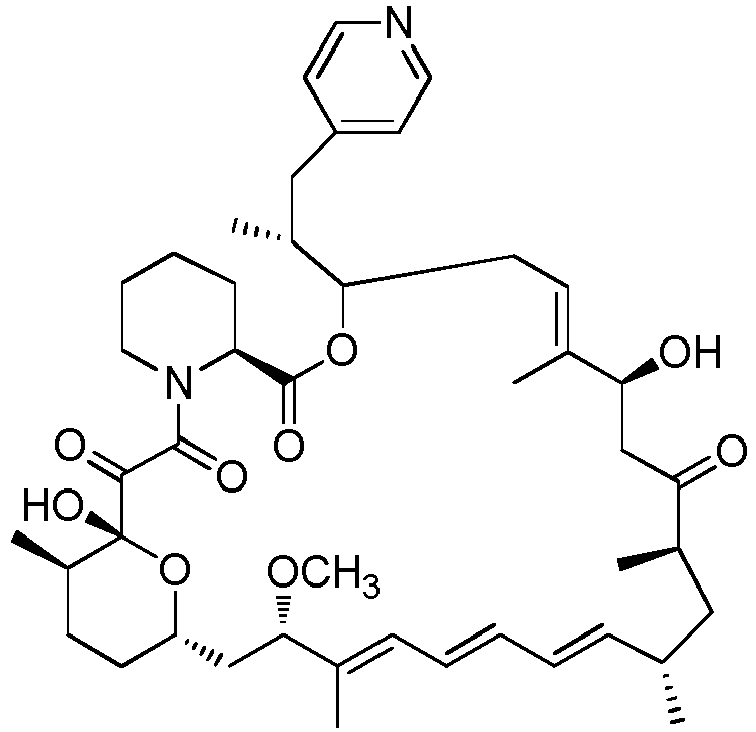
- Strain: Phenotype A from BIOT-4827
Feed: 4-trans-hydroxycyclohexanecarboxylic acid (final concentration 2 mM)
1 x 15 litre fermentation
The fermentation was as described above. - The fermentation broth at the end of the fermentation was separated by centrifugation and the cell paste processed as described above.
- The crude extract (5.3 g) was dissolved in methanol and silica added. The solvent was removed in vacuo and the adsorbed silica added added to a flash silica column (20 cm x 5 cm diameter) and eluted with the 50:50 ethyl acetate/hexanes and then 60:40, 70:30, 80:20, 90:10 mixtures followed by 100% ethyl acetate. Fractions containing the target compound were combined and dried in vacuo to yield an enriched extract of 0.05 g. This material was loaded onto a second silica column (10 cm x 2 cm) and eluted with 45% ethyl acetate / 55% hexanes. Fractions containing the target compound were combined and dried in vacuo (32 mg). This was then purified further by reverse-phase HPLC (Phenomenex Xterra C18 column, 10 micron, 19 mm diameter x 250mm, mobile phase at 20 ml/min, A = water, B = acetonitrile, t = 0 minutes, B = 50%, t = 30 minutes, B = 100%) and then by further reverse-phase HPLC (Phenomenex Gemini NX C18 column, 10 micron, 21 mm diameter x 150 mm, mobile phase at 20 ml/min, A = water, B = acetonitrile, t = 0 minutes, B = 50%, t = 30 minutes, B = 100%) to yield
compound 14 as a white amorphous solid (14.5 mg). - QC data. RT = 15.2 minutes, m/z = 920.6 ([M+Na]+) and 896.5 ([M-H]-)
NMR was shown to be consistent with the structure shown:
- Strain: Phenotype F from BIOT-4827
Feed: 4-trans-hydroxycyclohexanecarboxylic acid (final concentration 2 mM)
1 x 15 litre fermentation
The fermentation was as described above. - The fermentation broth at the end of the fermentation was separated by centrifugation and the cell paste and clarified broth processed as described above.
- The crude extract (20.7 g) was dissolved in methanol and silica added. The solvent was removed in vacuo and the adsorbed silica added added to a flash silica column (20 cm x 5 cm diameter) and eluted with the 40:60 ethyl acetate/hexanes and then 50:50, 60:40, 70:30, 80:20, 90:10 mixtures followed by 100% ethyl acetate. Fractions containing the target compounds X+14 and X+15 were combined and dried in vacuo to yield an enriched extract of 0.96 g. Fractions containing the target compounds 17 were combined and dried in vacuo to yield an enriched extract of 3.1 g.
- Compounds 15 and 16 were then purified by preparative HPLC (Phenomenex Gemini NX C18 column, 10 micron, 21 mm diameter x 150 mm, mobile phase at 20 ml/min, A = water, B = acetonitrile, t = 0 minutes, B = 60%, t = 30 minutes, B = 100%) to yield compound X+15 as a white amorphous solid (152 mg). Fractions containing compound 16 was defatted (dissolved in 80% aqueous methanol and extracted into hexanes, the solvent was then removed from the aqueous methanol layer to reveal the target compound) to yield a white amorphous solid (164 mg)
- QC data. RT = 16.3 minutes, m/z = 650.3 ([M+Na]+) and 626.2 ([M-H]-)
NMR was shown to be consistent with the structure shown: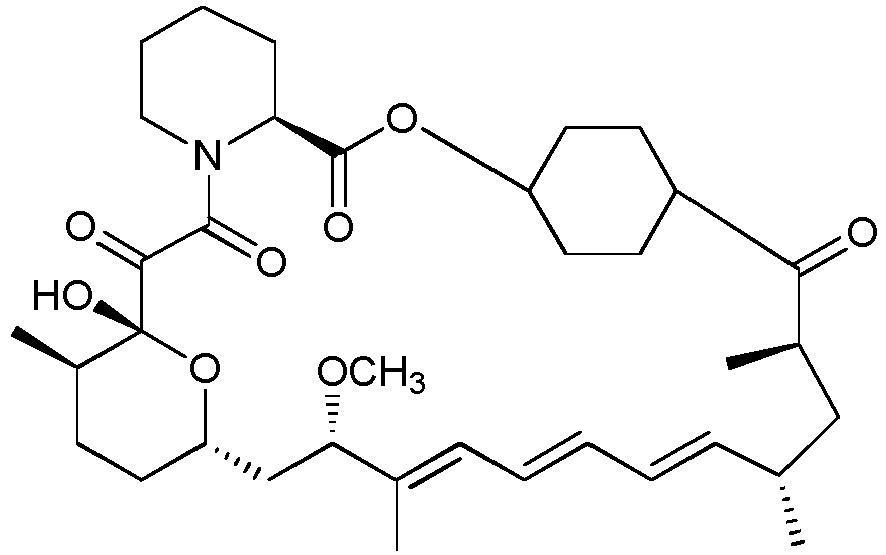
- QC data. RT = 14.9 minutes, m/z = 636.2 ([M+Na]+) and 612.2 ([M-H]-)
NMR was shown to be consistent with the structure shown:
- QC data. RT =13.5 minutes, m/z = 654.3 ([M+Na]+) and 630.1 ([M-H]-)

- Analytical biotransformations were conducted as described above in the general methods section and Example 5. In each case the strain being tested was fed each of the compounds above separately. After a total of 6 days growth the broths were extracted as described above and analysed for the production of rapamycin analogues as indicated by observing the rapamycin triplet at 278 nm and/or mass ions that derive from the predicted combination of starter unit and strain. Results are shown in Tables 2 to 6 below.
Results of mutasynthetic feeding to -1 PKS module strain Phenotype B Table 2 Feed major product peaks RT / mins molecular weight unfed 9.1 NR 10.4 791.5 A 9.4 NR 10.1 797.5 B 8.7 813.5 9.6 797.5 10.6 781.5 C 8.2 813.5 9.8 795.5 10.1 813.5 D 8.2 NR 8.7 NR 9.6 NR 10.6 797.5 10.8 813.5 11.3 797.5 E 8.3 811.6 10.2 795.5 F 9.7 831.6 G 8.9 843.5 9.5 827.5 10.1 811.5 10.7 811.5 H 10.1 783.5 10.4 791.6 I 7.7 NR 10.1 827.2 10.4 827.2 10.9 811.6 J 7.1 NR 9.2 NR 9.3 825.6 9.8 825.6 10.5 809.5 K 7.6 NR 8.2 NR 8.9 839.5 9.9 839.5 10.4 839.5 11.1 823.5 L 9.9 769.5 11.7 783.4 M 7.5 NR 8.2 NR 10.4 815.5 12.9 NR 13.8 NR N 10.4 791.5 O 9.9 811.5 P 5.2 NR 6.2 NR 6.8 NR 7.1 NR Q 10.4 827.5 10.9 811.5 11.6 825.5 R 10.5 827.5 11.2 825.5 11.7 809.5 S 8.5 NR 10.4 825.7 10.7 809.5 T 8.9 827.6 9.5 843.5 10.1 827.6 10.7 811.5 A1 8.3 NR 9.4 NR 10.1 797.9 11.5 784.1 B1 8.7 NR 9.7 NR 10.4 NR 11.9 796.2 C1 8.2 NR 10.7 814.9 11.3 726 12.6 NR D1 7.9 NR 9.7 816.9 10.8 802 F1 8.2 NR 9.9 833.9 10.9 819.9 G1 8.7 784.1 9.6 NR 10.5 NR 11.7 772.1 Results of mutasynthetic feeding to -2 PKS module strain Phenotype C Table 3 Feed major product peaks RT / mins molecular weight unfed 9.7 NR 9.9 NR A 7.5 NR 9.6 757.5 11.2 NR B 7.8 743.6 9.6 757.5 9.9 781.6 11.2 NR C 5.4 773.6 7.5 757.6 10.5 NR 11.2 NR D 7.9 743.5 9.9 756.7 11.2 NR 11.5 NR E 7.5 741.6 9.5 755.6 9.9 NR 11.2 NR F 7.0 NR 9.2 775.6 10.3 NR G 6,6 787.8 8.9 757.8 9.2 NR 10.2 771.6 11.3 771.6 H 9.8 751.5 9.9 NR I 7.9 751.6 9.8 NR 10.6 771.7 J 7.8 769.6 9.9 755.8 K 8.5 769.8 9.1 783.5 10.6 783.5 11.1 NR L 8.9 NR 10.1 685.7 M 7.5 751.6 2.9 NR 9.8 NR 9.9 NR N 7.3 NR 9.8 751.6 O 9.3 771.6 P 5.7 NR Q 9.7 757.4 10 751.6 10.5 771.7 11.4 NR R 9.7 NR 10.8 NR 11.6 769.6 S 5.8 NR 10.6 769.6 T 6.6 787.6 8.1 NR 8.9 NR 10.3 771.7 U 5.4 NR 7.2 759.7 7.5 773.7 9.2 NR V 5.7 NR 6.7 787.6 8.5 787.6 9 NR 10.6 771.7 W 4.7 NR 6.1 NR X 9.3 771.6 A1 6.7 NR 7.3 757.6 9.3 NR 10.3 NR 10.6 NR B1 6.3 NR 7.7 NR 8.1 NR 9.6 769.9 C1 7.7 NR 8.3 NR 10.9 757.9 11.2 757.9 11.8 NR D1 5.86 NR 6.8 NR 8.9 NR 8.9 776.1 9.4 NR 9.8 NR 10 NR F1 6.1 NR 7.3 NR 9.2 793.9 9.9 NR 10.1 NR G1 6.6 NR 7.1 NR 7.3 NR 7.7 NR 9.7 775.9 and 759.0 Results of mutasynthetic feeding to -3 PKS module strain Phenotype D Table 4 Feed major product peaks RT / mins molecular weight unfed 8.7 NR A 6 NR 7.4 NR 8.4 699.5 10.8 713.6 B 8.4 NR 8.8 699.6 C 5.4 NR 6.1 NR 7.7 NR 8.3 697.6 8.7 NR D 6.1 NR 8.4 NR 8.8 699.7 9.4 699.7 E 6.1 NR 8.3 697.6 8.8 NR 11.6 NR 11.9 NR F 6.1 NR 6.9 717.6 7.8 731.6 10.2 NR G 7.5 729.6 9.2 713.7 10.1 713.7 H 8.3 709.5 8.7 693.5 I 8.2 NR 8.5 NR 8.6 713.6 9.3 NR 9.7 NR J 8.9 711.6 K 7 741.6 9.6 725.5 10.2 725.5 L 7.3 NR 8.7 743.6 9.6 711.5 11.2 713.5 12 NR 12.4 NR M 6.1 717.6 7.2 693.6 8.7 NR N 8.6 693.6 11.8 693.6 O 6.5 713.5 8.1 NR 8.6 NR P 4.5 NR 4.8 NR 6 NR 8.7 NR Q 8.7 723.6 9.4 713.6 R 8.4 723.6 8.7 693.6 9.8 711.7 S 6.6 NR 8.7 NR 9.3 NR 9.5 711.5 12.2 725.5 T 6.6 NR 7.4 729.6 9.2 713.6 9.8 NR 11.5 NR U 5.4 731.9 6.1 717.5 7.1 729.7 7.7 NR 8.7 NR V 7 NR 8.4 729.5 9.5 713.7 9.9 743.6 W 4.8 693.5 8.7 NR X 6.4 NR 8.1 713.5 A1 7.4 NR 7.7 NR 8.4 699.8 10.8 713.7 12.1 NR B1 7.4 NR 8.8 711.9 12.5 NR C1 6.1 NR 8.2 NR 8.8 NR 9.4 699.9 12.9 NR D1 6.9 717.9 7.9 717.9 8.4 NR 8.9 NR 10.1 NR 11.5 NR E1 8.4 NR 10.4 NR 13.2 NR F1 7.33 735.8 7.7 NR 8.2 749.9 8.7 NR 10.3 735.8 10.8 NR G1 6.1 NR 8.8 699.9 9.3 699.9 12.3 NR Results of mutasynthetic feeding to -4 PKS module strain Phenotype E Table 5 Feed major product peaks RT / mins molecular weight unfed 5.1 NR A 4.6 629.7 8.8 671.9 B 5.3 629.7 C 8.4 655.8 D 5.4 NR E 4.8 NR 12 NR F 4.1 647.7 7.2 689.9 G 5.2 643.5 H 5.1 NR I 5.5 643.8 J 5.2 NR 9 NR K 6.02 655.5 9.9 NR L 6.3 NR M 5.1 NR N 5.1 623.5 O 11.2 NR Q 5.1 NR R 5.1 NR S 5.1 NR T 5.2 NR U 4.1 NR 4.8 NR 8.4 673.6 V 5.7 NR 9.8 687.7 10.1 703.7 10.5 703.7 W 3.8 608.8 X 3.2 NR 6.7 689.3 11.1 671.8 11.6 686.7 A1 4.6 NR 5.5 NR 7.6 NR 8.7 NR 9.3 NR 9.5 NR B1 5.1 NR 8.3 NR 8.8 NR 9.8 NR C1 5.4 NR 10 NR D1 4.1 NR 4.6 NR 5.7 NR 6.9 NR 7.1 NR 8.1 NR 8.5 NR E1 4.6 NR 7.7 647.7 10.7 NR 13.4 NR F1 4.3 697.6 4.4 NR 7.3 NR 8.7 NR G1 5.3 NR 6.7 NR 9.7 NR 12.5 NR Results of mutasynthetic feeding to -6 PKS module strain Phenotype G Table 6 Feed major product peaks RT / mins MW (difference from truncated pre- rap) unfed nd NR A 5.1 561.5 6.7 575.5 8.1 557.9 9.2 NR B 5.07 561.5 6.7 575.5 8.1 557.9 9.3 NR C 5,1 561.4 6.1 573.7 8.6 NR D 5 561.4 6 NR 6.7 575.5 7.8 NR 9.2 NR 10.3 NR E 4.5 NR 6.1 574 7.5 NR 8.6 NR F 4.4 NR 5.9 NR 7.2 NR 8.2 NR G 6.3 NR 7.6 NR 8.1 NR 10.2 NR 10.7 NR I 6.1 NR 7.8 590 9.3 NR 10.3 604.5 J 5.4 573.4 7.1 587.9 8.5 NR 9.7 602 K 6.1 NR 6.3 NR 7.8 601.8 8.2 NR L 6.2 547.4 8.1 561.9 9.7 NR 10.8 NR M 9 NR 10.9 NR N 4.8 622.7 6.4 569.9 O nd NR Q 7.6 612.9 8.01 NR 8.9 603.8 R 8.4 NR 7.6 NR S 12.2 557 T 7.6 589.9 U 3.9 591.9 4.2 NR 6.05 605.7 V 6.3 575.6 8.02 589.9 10.6 NR X 6.8 NR 9.05 NR 10.8 NR A1 4.4 NR 5.1 561.7 6.7 575.8 7.1 NR 7.5 557.8 7.7 NR B1 5.4 575.9 7.1 587.9 7.6 NR 9.6 569.8 C1 3.3 NR 4.7 NR 5 NR 5 NR 6 NR 6.7 NR 7.8 575.6 8.6 577.8 9 NR 10.2 589.1 10.8 NR D1 3.7 NR 4.5 579.8 5.1 NR 5.9 593.7 6.6 NR 7.1 NR 7.7 NR 8.2 575.6 8.8 NR E1 5.1 NR 6.7 NR 7.3 NR 8.6 603.7 F1 3.9 NR 4.7 597.6 5.5 NR 6.1 611.8 6.8 NR 7.3 NR 7.6 NR 8.4 593.8 8.9 NR G1 4.1 NR 5 561.7 5.9 NR 6.7 575.8 7.5 NR 7.7 NR 8.2 NR 8.4 NR 9.3 NR - Strain: Phenotype B from BIOT-4827
Feed: 4-trans-hydroxylcyclohexanecarboxylic acid (final concentration 2 mM)
2 x 60 litre fermentation
The fermentation was as described above. - The fermentation broth at the end of the fermentation was collected and standard techniques were used to isolate the following compounds:
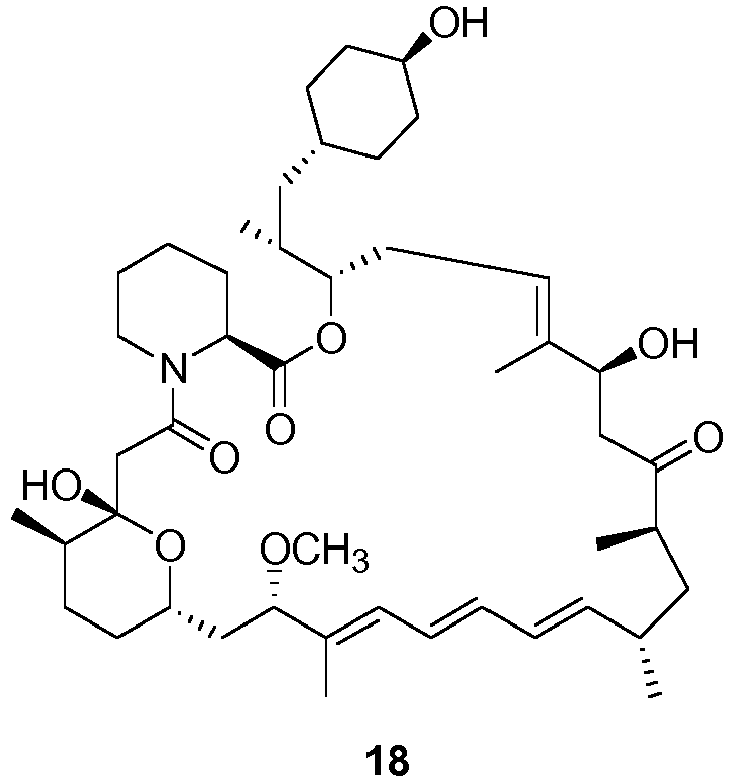


- The rapamycin analogues were tested for their ability to inhibit FKBP12, using a peptidyl-prolyl isomerase (PPIase) assay. All compounds were assayed at 6 concentrations in duplicate and the data fitted to a Ki curve to afford a Ki value with standard error (SE).
Compound no. MW Ki (nM) SE (nM) Rapamycin 914.17 5.4 0.35 FK506 804.02 10 1.1 Meridamycin 870.1193 10 1.1 2 561.7498 19% at 1uM 5 798.06 7.9 0.69 6 699.96 370 43 3 575.78 25% at 1 uM 8 828.08 5.9 0.66 9 800.0725 180 11 10 814.06 4.2 0.28 11 800.0725 430 32 12 812.06 9.5 0.73 13 777 13 1.4 14 898.17 6.5 0.66 15 627.81 31% at 1uM 16 613.78 460 34 18 784.07 45 4.1 19 784.03 7.7 0.74 20 814.06 18 1.3 21 798.06 95 7.2 22 814.06 12 0.97 - As can be seen, the majority of the rapamycin analogues tested show potent inhibition of FKBP12 (Ki <1µM) in this assay.
- The immunosuppressive potency of rapamycin analogues can be tested using a PLP T-cell proliferation assay. mTOR is known to regulate the expression of Proteo Lipo Protein (Tyler et al. 2009), and activity of rapamycin analogues in this assay is driven by mTOR inhibition, so for rapamycin analogues where the aim is to inhibit FKBPs, this is an off-target activity. Therefore we also calculated the ratio of the FKBP12 IC50 to the PLP assay IC50, with a comparison to rapamycin. Larger ratios therefore relate to compounds with an improved window of activity.
Compound number PLP IC50 (nM) Ratio (PLP/FKBP*) Rapamycin 0.024 0.004444 2 113.4 N/ A 4 4464 N/ A 6 2625 7.094595 3 1453 8 490 83.05085 10 14021 3338.333 11 4180 9.72093 12 2865 301.5789 13 6586 506.6154 *data from Example 19 (Ki values) - As can be seen, all of the rapamycin analogues tested show higher (and therefore improved) ratios of PLP IC50 to FKBP12 Ki as compared to rapamycin.
- Primers MG101 ggccagtgccaagctgcggcttcctccacgacgcg and MG102 acatgattacgaattccggctcgcccggctgctctcc were used to amplify a 2154 kb region of homology from S. fradiae genomic DNA to yield product PCR101. The first 15 bp of MG101 and MG102 contain homology to pKC1139 digested with HindIII and EcoRI. Plasmid pKC1139 was digested with HindIII and EcoRI and used as a vector for Infusion cloning. PCR product PCR101 was ligated with pKC1139 digested with HindIII and EcoRI using Infusion Cloning technology to generate plasmid pISOM01. The insert in plasmid pISOM01 was sequenced to confirm it contained the correct DNA sequence. Plasmid pISOM01 was transferred to S. fradiae NRRL2702by conjugation using standard methods. Briefly, plasmid was electroporated into ET12567:pUZ8002 and selected on 2TY agar medium containing apramycin (50 µg/mL), kanamycin (25 µg/mL), and chloramphenicol (25 µg/mL). Single colonies were grown overnight in 3 mL 2xTY liquid medium containing apramycin (50 µg/mL), kanamycin (25 µg/mL) and chloroamphenicol (25 µg/mL). 0.7 mL of this culture was used to inoculate 10 mL liquid medium containing apramycin (50 µg/mL), kanamycin (25 µg/mL) and chloramphenicol (25 µg/mL) and grown at 37 C to reach an OD of approximately 0.5. Cells were pelleted at 4000rpm for 10minutes and washed twice with 10 mL 2xTY before resuspending in 0.25 mL 2xTY. Spores of S. fradiae NRRL2702 grown on MAM medium for 2-3 weeks were harvested using 20% glycerol and stored at -80°C (1 plate gives about 1 mL spore stock). For the conjugation approximately 0.3-0.5 mL of these spores are needed for each conjugation. Spores were pelleted by centrifugation (4000rpm, 10 minutes) before washing with 2xTY. The spores were then repelleted and resuspended in 0.25 mL 2xTY and heat shocked in a water bath at 50°C for 10 minutes before cooling immediately on ice. The conjugation was performed by adding 0.25ml of washed E. coli cells to the heat shocked spores, mixing and spreading the mixture on to MAM agar and transferring to 37°C. The plate was overlaid with 2ml water containing 15 µL naladixic acid (stock 50mg/ml) after 2-3 hours and with 2 mL water containing 15 µL apramycin (stock 100 mg/mL) after an overnight incubation.
- Plates were incubated at 37°C until single exconjugant colonies were visible. Colonies (approximately 10-20) were patched to MAM agar containing apramycin and naladixic acid and reincubated at 37°C. Colonies were repatched to the same media (containing apramycin and nalidixic acid) to ensure there was no E. coli contamination. Once stabilised, approximately 10-15 of the strains were patched to solid MAM agar lacking antibiotics and incubated at 37°C for approximately 3 days before repatching to MAM agar and growing for a further 3 or 4 days at 37°C. Samples of patches were then inoculated into TylB media and incubated at 30°C for 7 days. 0.8 mL samples of culture broth were mixed with 0.8 mL of methanol, centrifuged for 5 minutes and samples of the supernatant analysed for production of tylosin.
- Those patches showing no production of tylosin (due to primary recombination into the tylosin PKS) were then inoculated into 7mL TSB media and incubated with shaking at 250 rpm for 48 hours. A 0.5 mL sample was then used to inoculate a second 7mL of TSB media and incubated with shaking at 250 rpm for a further 48 hours. Finally, another 0.5 mL sample was then used to inoculate a third 7mL of TSB media and incubated with shaking at 250 rpm for 48 hours. Samples of this third growth were then diluted with sterile water and spread onto MAM plates to generate single colonies when incubated at 28 °C for 5 days. These colonies were patched onto MAM agar and incubated at 28 °C for 5 days. Patches were tested by growing in TylB production media to assess whether they still produced tylosin (i.e. had reverted to original strain). Among the strains that no longer produced tylosin, strains that produced novel compounds were identified. Analysis suggested that these included molecules with structures presumed to be those shown in
Figure 7 . - Primers MG103 ggccagtgccaagctacctcaccaccctccccacctaccc and MG104 acatgattacgaattgccgtccggctcctcccg were used to amplify a 1995 bp region of homology from S. fradiae genomic DNA to yield product PCR102. The first 15 bp of MG103 and MG104 contain homology to pKC1139 digested with HindIII and EcoRI . Plasmid pKC1139 was digested with HindIII and EcoRI and used as a vector for Infusion cloning. PCR product PCR102 was ligated with pKC1139 digested with HindIII and EcoRI using Infusion Cloning technology to generate plasmid plSOM02. The insert in plasmid plSOM02 was sequenced to confirm it contained the correct DNA sequence.
- Plasmid plSOM02 was transferred to S. fradiae NRRL2702 by conjugation using standard methods. Briefly, plasmid was electroporated into ET12567:pUZ8002 and selected on 2TY agar medium containing apramycin (50 µg/mL), kanamycin (25 µg/mL), and chloramphenicol (25 µg/mL). Single colonies were grown overnight in 3 mL 2xTY liquid medium containing apramycin (50 µg/mL), kanamycin (25 µg/mL) and chloroamphenicol (25 µg/mL). 0.7 mL of this culture was used to inoculate 10 mL liquid medium containing apramycin (50 µg/mL), kanamycin (25 µg/mL) and chloramphenicol (25 µg/mL) and grown at 37 C to reach an OD of approximately 0.5. Cells were pelleted at 4000rpm for 10minutes and washed twice with 10 mL 2xTY before resuspending in 0.25 mL 2xTY. Spores of S. fradiae NRRL2702 grown on MAM medium for 2-3 weeks were harvested using 20% glycerol and stored at -80°C (1 plate gives about 1 mL spore stock). For the conjugation approximately 0.3-0.5 mL of these spores are needed for each conjugation. Spores were pelleted by centrifugation (4000rpm, 10 minutes) before washing with 2xTY. The spores were then repelleted and resuspended in 0.25 mL 2xTY and heat shocked in a water bath at 50°C for 10 minutes before cooling immediately on ice. The conjugation was performed by adding 0.25ml of washed E. coli cells to the heat shocked spores, mixing and spreading the mixture on to MAM agar and transferring to 37°C. The plate was overlaid with 2ml water containing 15 µL naladixic acid (stock 50mg/ml) after 2-3 hours and with 2 mL water containing 15 µL apramycin (stock 100 mg/mL) after an overnight incubation. Plates were incubated at 37°C until single exconjugant colonies were visible. Colonies (approximately 10-20) were patched to MAM agar containing apramycin and naladixic acid and reincubated at 37°C. Colonies were repatched to the same media (containing apramycin and nalidixic acid) to ensure there was no E. coli contamination. Once stabilised, approximately 10-15 of the strains were patched to solid MAM agar lacking antibiotics and incubated at 37°C for approximately 3 days before repatching to MAM agar and growing for a further 3 or 4 days at 37°C. Samples of patches were then inoculated into TylB media and incubated at 30°C for 7 days. 0.8 mL samples of culture broth were mixed with 0.8 mL of methanol, centrifuged for 5 minutes and samples of the supernatant analysed for production of tylosin.
- Those patches showing no production of tylosin (due to primary recombination into the tylosin PKS) were then inoculated into 7mL TSB media and incubated with shaking at 250 rpm for 48 hours. A 0.5 mL sample was then used to inoculate a second 7mL of TSB media and incubated with shaking at 250 rpm for a further 48 hours. Finally, another 0.5 mL sample was then used to inoculate a third 7mL of TSB media and incubated with shaking at 250 rpm for 48 hours. Samples of this third growth were then diluted with sterile water and spread onto MAM plates to generate single colonies when incubated at 28 °C for 5 days. These colonies were patched onto MAM agar and incubated at 28 °C for 5 days. Patches are tested by growing in TylB production media to assess whether they still produce tylosin (i.e. had reverted to original strain). Among the strains that no longer produced tylosin, strains that produce novel compounds are identified.
- Example 23: Generation of constructs able to induce deletion and/or expansion of the lasalocid PKS modules and transfer to Streptomyces lasaliensis ATCC35851. Primers IR014.FOR ggccagtgccaagctacccccacagcagcacccccg and IR014.REV acatgattacgaattgtaggcggccaggtcggtgc are used to amplify a region of homology from Streptomyces lasaliensis ATCC35851 genomic DNA (prepared using standard techniques) to yield 2627bp PCR product, IR014. The first 15 bp of primers IR014.FORand IR014.REV contain homology to pKC1139 digested with HindIII and EcoRI. Plasmid pKC1139 (or other temperature sensitive plasmid containing the same polylinker) is digested with HindIII and EcoRI and used as a vector for Infusion cloning. PCR IR014 is ligated with pKC1139 digested with HindIII and EcoRI using Infusion Cloning technology to generate plasmid plR014. Plasmid plR014 is transferred to Streptomyces lasaliensis ATCC35851 by conjugation or other standard transformation method (as described in general methods). Plates are incubated until single transformant colonies are visible. Colonies are patched to agar (such as MAM agar) containing apramycin and incubated at a temperature which allows plasmid replication (for example 28 °C for pKC1139) until good growth is seen. Once stabilised, strains are transferred to solid agar containing apramycin and incubated at a higher temperature (for example 37 °C for pKC1139), at which the plasmid is unable to replicate and the primary integration is selected, before a selection of colonies are transferred again to fresh agar containing apramycin and incubating until good growth is seen. Samples are grown for production of lasalocid as described in Sherman 1986. Samples of culture broth are mixed with methanol, centrifuged for 5 minutes and samples of the supernatant analysed by HPLC-UV and LCMS for production of lasalocid. Those patches showing no production of lasalocid(due to primary recombination into the lasalocid PKS) are then inoculated into liquid media with no antibiotics (such as TSB) and incubated at a lower temperature (for example 28 °C for pKC1139) to force the secondary recombination event with shaking until well grown. A sample is then used to inoculate a second batch of liquid media and incubated with shaking at the lower temperature until well grown. Finally, another sample is then used to inoculate a third sample of liquid media and incubated with shaking until well grown. Samples of this third growth are then diluted and spread onto agar plates to generate single colonies when incubated at this lower temperature. These colonies are patched onto solid agar plates and incubated until good growth is seen. Patches are tested by growing as described in Sherman 1986 to assess whether they still produce lasalocid (i.e. have reverted to original strain). Among the strains that no longer produce lasalocid, strains that produce novel compounds are identified by LCMS and HPLC-UV.
- Example 24: Generation of constructs able to induce deletion and/or expansion of the ansamitocin PKS modules and transfer to Actinosynnema pretiosum ATCC 31565. Primers IR015.FOR ggccagtgccaagcttccggccacgcaggcc and IR015.REV acatgattacgaattccaagctcgccgacctggagt are used to amplify a region of homology from Actinosynnema pretiosum ATCC 31565 genomic DNA (prepared using standard techniques) to yield 1907bp PCR product, IR015. The first 15 bp of primers IR015.FORand IR015.REV contain homology to pKC1139 digested with HindIII and EcoRI. Plasmid pKC1139 (or other temperature sensitive plasmid containing the same polylinker) is digested with HindIII and EcoRI and used as a vector for Infusion cloning. PCR IR015 is ligated with pKC1139 digested with HindIII and EcoRI using Infusion Cloning technology to generate plasmid pIR015. Plasmid plR015 is transferred to Actinosynnema pretiosum ATCC 31565 by conjugation or other standard transformation method (as described in general methods). Plates are incubated until single transformant colonies are visible. Colonies are patched to agar (such as MAM agar) containing apramycin and incubated at a temperature which allows plasmid replication (for example 28 °C for pKC1139) until good growth is seen. Once stabilised, strains are transferred to solid agar containing apramycin and incubated at a higher temperature (for example 37 °C for pKC1139), at which the plasmid is unable to replicate and the primary integration is selected, before a selection of colonies are transferred again to fresh agar containing apramycin and incubating until good growth is seen. Samples are grown for production of ansamitocin as described in Jia 2011. Samples of culture broth are mixed with methanol, centrifuged for 5 minutes and samples of the supernatant analysed by HPLC-UV and LCMS for production of ansamitocin. Those patches showing no production of ansamitocin(due to primary recombination into the ansamitocin PKS) are then inoculated into liquid media with no antibiotics (such as TSB) and incubated at a lower temperature (for example 28 °C for pKC1139) to force the secondary recombination event with shaking until well grown. A sample is then used to inoculate a second batch of liquid media and incubated with shaking at the lower temperature until well grown. Finally, another sample is then used to inoculate a third sample of liquid media and incubated with shaking until well grown. Samples of this third growth are then diluted and spread onto agar plates to generate single colonies when incubated at this lower temperature. These colonies are patched onto solid agar plates and incubated until good growth is seen. Patches are tested by growing as described in Jia 2011 to assess whether they still produce ansamitocin (i.e. have reverted to original strain). Among the strains that no longer produce ansamitocin, strains that produce novel compounds are identified by LCMS and HPLC-UV.
- Example 25: Generation of constructs able to induce deletion and/or expansion of the chalcomycin PKS modules and transfer to Streptomyces bikiniensis NRRL 2737. Primers IR016.FOR ggccagtgccaagcttcggcggaggaaccgag and IR016.REV acatgattacgaattccagctcacggccgat are used to amplify a region of homology from Streptomyces bikiniensis NRRL 2737 genomic DNA (prepared using standard techniques) to yield 1989bp PCR product, IR016. The first 15 bp of primers IR016.FORand IR016.REV contain homology to pKC1139 digested with HindIII and EcoRI. Plasmid pKC1139 (or other temperature sensitive plasmid containing the same polylinker) is digested with HindIII and EcoRI and used as a vector for Infusion cloning. PCR IR016 is ligated with pKC1139 digested with HindIII and EcoRI using Infusion Cloning technology to generate plasmid plR016. Plasmid plR016 is transferred to Streptomyces bikiniensis NRRL 2737 by conjugation or other standard transformation method (as described in general methods). Plates are incubated until single transformant colonies are visible. Colonies are patched to agar (such as MAM agar) containing apramycin and incubated at a temperature which allows plasmid replication (for example 28 °C for pKC1139) until good growth is seen. Once stabilised, strains are transferred to solid agar containing apramycin and incubated at a higher temperature (for example 37 °C for pKC1139), at which the plasmid is unable to replicate and the primary integration is selected, before a selection of colonies are transferred again to fresh agar containing apramycin and incubating until good growth is seen. Samples are grown for production of chalcomycin as described in
US3065137 . Samples of culture broth are mixed with methanol, centrifuged for 5 minutes and samples of the supernatant analysed by HPLC-UV and LCMS for production of chalcomycin. Those patches showing no production of chalcomycin(due to primary recombination into the chalcomycin PKS) are then inoculated into liquid media with no antibiotics (such as TSB) and incubated at a lower temperature (for example 28 °C for pKC1139) to force the secondary recombination event with shaking until well grown. A sample is then used to inoculate a second batch of liquid media and incubated with shaking at the lower temperature until well grown. Finally, another sample is then used to inoculate a third sample of liquid media and incubated with shaking until well grown. Samples of this third growth are then diluted and spread onto agar plates to generate single colonies when incubated at this lower temperature. These colonies are patched onto solid agar plates and incubated until good growth is seen. Patches are tested by growing as described inUS3065137 to assess whether they still produce chalcomycin (i.e. have reverted to original strain). Among the strains that no longer produce chalcomycin, strains that produce novel compounds are identified by LCMS and HPLC-UV. - Example 26: Generation of constructs able to induce deletion and/or expansion of the FD-891 PKS modules and transfer to Streptomyces graminofaciens A-8890. Primers IR017.FOR ggccagtgccaagctttcgcatggacaacgaagagaagctcg and IR017.REV acatgattacgaattcccgaatgcccggccacca are used to amplify a region of homology from Streptomyces graminofaciens A-8890 genomic DNA (prepared using standard techniques) to yield 1985bp PCR product, IR017. The first 15 bp of primers IR017.FORand IR017.REV contain homology to pKC1139 digested with HindIII and EcoRI. Plasmid pKC1139 (or other temperature sensitive plasmid containing the same polylinker) is digested with HindIII and EcoRI and used as a vector for Infusion cloning. PCR IR017 is ligated with pKC1139 digested with HindIII and EcoRI using Infusion Cloning technology to generate plasmid plR017. Plasmid plR017 is transferred to Streptomyces graminofaciens A-8890 by conjugation or other standard transformation method (as described in general methods). Plates are incubated until single transformant colonies are visible. Colonies are patched to agar (such as MAM agar) containing apramycin and incubated at a temperature which allows plasmid replication (for example 28 °C for pKC1139) until good growth is seen. Once stabilised, strains are transferred to solid agar containing apramycin and incubated at a higher temperature (for example 37 °C for pKC1139), at which the plasmid is unable to replicate and the primary integration is selected, before a selection of colonies are transferred again to fresh agar containing apramycin and incubating until good growth is seen. Samples are grown for production of FD-891 as described in Kudo 2010. Samples of culture broth are mixed with methanol, centrifuged for 5 minutes and samples of the supernatant analysed by HPLC-UV and LCMS for production of FD-891. Those patches showing no production of FD-891 (due to primary recombination into the FD-891 PKS) are then inoculated into liquid media with no antibiotics (such as TSB) and incubated at a lower temperature (for example 28 °C for pKC1139) to force the secondary recombination event with shaking until well grown. A sample is then used to inoculate a second batch of liquid media and incubated with shaking at the lower temperature until well grown. Finally, another sample is then used to inoculate a third sample of liquid media and incubated with shaking until well grown. Samples of this third growth are then diluted and spread onto agar plates to generate single colonies when incubated at this lower temperature. These colonies are patched onto solid agar plates and incubated until good growth is seen. Patches are tested by growing as described in Kudo 2010 to assess whether they still produce FD-891 (i.e. have reverted to original strain). Among the strains that no longer produce FD-891, strains that produce novel compounds are identified by LCMS and HPLC-UV.
- Example 27: Generation of constructs able to induce deletion and/or expansion of the FR-008 PKS modules and transfer to Streptomyces sp. FR-008. Primers IR018.FOR ggccagtgccaagcttacgagccggtggagg and IR018.REV acatgattacgaattcctcacctcggcccagc are used to amplify a region of homology from Streptomyces sp. FR-008 genomic DNA (prepared using standard techniques) to yield 1846bp PCR product, IR018. The first 15 bp of primers IR018.FORand IR018.REV contain homology to pKC1139 digested with HindIII and EcoRI. Plasmid pKC1139 (or other temperature sensitive plasmid containing the same polylinker) is digested with HindIII and EcoRI and used as a vector for Infusion cloning. PCR IR018 is ligated with pKC1139 digested with HindIII and EcoRI using Infusion Cloning technology to generate plasmid plR018. Plasmid plR018 is transferred to Streptomyces sp. FR-008 by conjugation or other standard transformation method (as described in general methods). Plates are incubated until single transformant colonies are visible. Colonies are patched to agar (such as MAM agar) containing apramycin and incubated at a temperature which allows plasmid replication (for example 28 °C for pKC1139) until good growth is seen. Once stabilised, strains are transferred to solid agar containing apramycin and incubated at a higher temperature (for example 37 °C for pKC1139), at which the plasmid is unable to replicate and the primary integration is selected, before a selection of colonies are transferred again to fresh agar containing apramycin and incubating until good growth is seen. Samples are grown for production of FR-008 as described in Chen 2003. Samples of culture broth are mixed with methanol, centrifuged for 5 minutes and samples of the supernatant analysed by HPLC-UV and LCMS for production of FR-008. Those patches showing no production of FR-008(due to primary recombination into the FR-008 PKS) are then inoculated into liquid media with no antibiotics (such as TSB) and incubated at a lower temperature (for example 28 °C for pKC1139) to force the secondary recombination event with shaking until well grown. A sample is then used to inoculate a second batch of liquid media and incubated with shaking at the lower temperature until well grown. Finally, another sample is then used to inoculate a third sample of liquid media and incubated with shaking until well grown. Samples of this third growth are then diluted and spread onto agar plates to generate single colonies when incubated at this lower temperature. These colonies are patched onto solid agar plates and incubated until good growth is seen. Patches are tested by growing as described in Chen 2003 to assess whether they still produce FR-008 (i.e. have reverted to original strain). Among the strains that no longer produce FR-008, strains that produce novel compounds are identified by LCMS and HPLC-UV.
- Example 28: Generation of constructs able to induce deletion and/or expansion of the virginiamycin M PKS modules and transfer to Streptomyces virginiae MAFF 116014. Primers IR019.FOR ggccagtgccaagcttgcgcagttgctccg and IR019.REV acatgattacgaattctcaccacccccgagctgg are used to amplify a region of homology from Streptomyces virginiae MAFF 116014 genomic DNA (prepared using standard techniques) to yield 2101bp PCR product, IR019. The first 15 bp of primers IR019.FORand IR019.REV contain homology to pKC1139 digested with HindIII and EcoRI. Plasmid pKC1139 (or other temperature sensitive plasmid containing the same polylinker) is digested with HindIII and EcoRI and used as a vector for Infusion cloning. PCR IR019 is ligated with pKC1139 digested with HindIII and EcoRI using Infusion Cloning technology to generate plasmid plR019. Plasmid plR019 is transferred to Streptomyces virginiae MAFF 116014 by conjugation or other standard transformation method (as described in general methods). Plates are incubated until single transformant colonies are visible. Colonies are patched to agar (such as MAM agar) containing apramycin and incubated at a temperature which allows plasmid replication (for example 28 °C for pKC1139) until good growth is seen. Once stabilised, strains are transferred to solid agar containing apramycin and incubated at a higher temperature (for example 37 °C for pKC1139), at which the plasmid is unable to replicate and the primary integration is selected, before a selection of colonies are transferred again to fresh agar containing apramycin and incubating until good growth is seen. Samples are grown for production of virginiamycin M as described in Yang 1996. Samples of culture broth are mixed with methanol, centrifuged for 5 minutes and samples of the supernatant analysed by HPLC-UV and LCMS for production of virginiamycin M. Those patches showing no production of virginiamycin M(due to primary recombination into the virginiamycin M PKS) are then inoculated into liquid media with no antibiotics (such as TSB) and incubated at a lower temperature (for example 28 °C for pKC1139) to force the secondary recombination event with shaking until well grown. A sample is then used to inoculate a second batch of liquid media and incubated with shaking at the lower temperature until well grown. Finally, another sample is then used to inoculate a third sample of liquid media and incubated with shaking until well grown. Samples of this third growth are then diluted and spread onto agar plates to generate single colonies when incubated at this lower temperature. These colonies are patched onto solid agar plates and incubated until good growth is seen. Patches are tested by growing as described in Yang 1996 to assess whether they still produce virginiamycin M (i.e. have reverted to original strain). Among the strains that no longer produce virginiamycin M, strains that produce novel compounds are identified by LCMS and HPLC-UV.
- Example 29: Generation of constructs able to induce deletion and/or expansion of the soraphen PKS modules and transfer to Sorangium cellulosum So ce26. Primers IR021.FOR ggccagtgccaagcttgcttcgacgtgaacgcgctc and IR021.REV acatgattacgaattcgcgcccgcgtcgt are used to amplify a region of homology from Sorangium cellulosum So ce26 genomic DNA (prepared using standard techniques) to yield 1934bp PCR product, IR021. The first 15 bp of primers IR021.FORand IR021.REV contain homology to pKC1139 digested with HindIII and EcoRI. Plasmid pKC1139 (or other temperature sensitive plasmid containing the same polylinker) is digested with HindIII and EcoRI and used as a vector for Infusion cloning. PCR IR021 is ligated with pKC1139 digested with HindIII and EcoRI using Infusion Cloning technology to generate plasmid plR021. Plasmid plR021 is transferred to Sorangium cellulosum So ce26 by conjugation or other standard transformation method (as described in general methods). Plates are incubated until single transformant colonies are visible. Colonies are patched to agar (such as MAM agar) containing apramycin and incubated at a temperature which allows plasmid replication (for example 28 °C for pKC1139) until good growth is seen. Once stabilised, strains are transferred to solid agar containing apramycin and incubated at a higher temperature (for example 37 °C for pKC1139), at which the plasmid is unable to replicate and the primary integration is selected, before a selection of colonies are transferred again to fresh agar containing apramycin and incubating until good growth is seen. Samples are grown for production of soraphen as described in Hill 2003. Samples of culture broth are mixed with methanol, centrifuged for 5 minutes and samples of the supernatant analysed by HPLC-UV and LCMS for production of soraphen. Those patches showing no production of soraphen(due to primary recombination into the soraphen PKS) are then inoculated into liquid media with no antibiotics (such as TSB) and incubated at a lower temperature (for example 28 °C for pKC1139) to force the secondary recombination event with shaking until well grown. A sample is then used to inoculate a second batch of liquid media and incubated with shaking at the lower temperature until well grown. Finally, another sample is then used to inoculate a third sample of liquid media and incubated with shaking until well grown. Samples of this third growth are then diluted and spread onto agar plates to generate single colonies when incubated at this lower temperature. These colonies are patched onto solid agar plates and incubated until good growth is seen. Patches are tested by growing as described in Hill 2003 to assess whether they still produce soraphen (i.e. have reverted to original strain). Among the strains that no longer produce soraphen, strains that produce novel compounds are identified by LCMS and HPLC-UV.
- Example 30: Generation of constructs able to induce deletion and/or expansion of the megalomycin PKS modules and transfer to Micromonospora megalomicea subsp. nigra. Primers IR022.FOR acatgattacgaattcgcccccgcaccgc and IR022.REV ggccagtgccaagcttacaccggtctgcgtctgccgg are used to amplify a region of homology from Micromonospora megalomicea subsp. nigra genomic DNA (prepared using standard techniques) to yield 2006bp PCR product, IR022. The first 15 bp of primers IR022.FORand IR022.REV contain homology to pKC1139 digested with HindIII and EcoRI. Plasmid pKC1139 (or other temperature sensitive plasmid containing the same polylinker) is digested with HindIII and EcoRI and used as a vector for Infusion cloning. PCR IR022 is ligated with pKC1139 digested with HindIII and EcoRI using Infusion Cloning technology to generate plasmid plR022. Plasmid plR022 is transferred to Micromonospora megalomicea subsp. nigra by conjugation or other standard transformation method (as described in general methods). Plates are incubated until single transformant colonies are visible. Colonies are patched to agar (such as MAM agar) containing apramycin and incubated at a temperature which allows plasmid replication (for example 28 °C for pKC1139) until good growth is seen. Once stabilised, strains are transferred to solid agar containing apramycin and incubated at a higher temperature (for example 37 °C for pKC1139), at which the plasmid is unable to replicate and the primary integration is selected, before a selection of colonies are transferred again to fresh agar containing apramycin and incubating until good growth is seen. Samples are grown for production of megalomycin as described in Peiru 2007. Samples of culture broth are mixed with methanol, centrifuged for 5 minutes and samples of the supernatant analysed by HPLC-UV and LCMS for production of megalomycin. Those patches showing no production of megalomycin(due to primary recombination into the megalomycin PKS) are then inoculated into liquid media with no antibiotics (such as TSB) and incubated at a lower temperature (for example 28 °C for pKC1139) to force the secondary recombination event with shaking until well grown. A sample is then used to inoculate a second batch of liquid media and incubated with shaking at the lower temperature until well grown. Finally, another sample is then used to inoculate a third sample of liquid media and incubated with shaking until well grown. Samples of this third growth are then diluted and spread onto agar plates to generate single colonies when incubated at this lower temperature. These colonies are patched onto solid agar plates and incubated until good growth is seen. Patches are tested by growing as described in Peiru 2007 to assess whether they still produce megalomycin (i.e. have reverted to original strain). Among the strains that no longer produce megalomycin, strains that produce novel compounds are identified by LCMS and HPLC-UV.
- Example 31: Generation of constructs able to induce deletion and/or expansion of the viceniastatin PKS modules and transfer to Streptomyces halstedii HC34. Primers IR023.FOR ggccagtgccaagcttggtgtcccgcaccgatg and IR023.REV acatgattacgaattcaacgccaccacccgc are used to amplify a region of homology from Streptomyces halstedii HC34 genomic DNA (prepared using standard techniques) to yield 1994bp PCR product, IR023. The first 15 bp of primers IR023.FORand IR023.REV contain homology to pKC1139 digested with HindIII and EcoRI. Plasmid pKC1139 (or other temperature sensitive plasmid containing the same polylinker) is digested with HindIII and EcoRI and used as a vector for Infusion cloning. PCR IR023 is ligated with pKC1139 digested with HindIII and EcoRI using Infusion Cloning technology to generate plasmid plR023. Plasmid plR023 is transferred to Streptomyces halstedii HC34 by conjugation or other standard transformation method (as described in general methods). Plates are incubated until single transformant colonies are visible. Colonies are patched to agar (such as MAM agar) containing apramycin and incubated at a temperature which allows plasmid replication (for example 28 °C for pKC1139) until good growth is seen. Once stabilised, strains are transferred to solid agar containing apramycin and incubated at a higher temperature (for example 37 °C for pKC1139), at which the plasmid is unable to replicate and the primary integration is selected, before a selection of colonies are transferred again to fresh agar containing apramycin and incubating until good growth is seen. Samples are grown for production of viceniastatin as described in Otsuka 2000. Samples of culture broth are mixed with methanol, centrifuged for 5 minutes and samples of the supernatant analysed by HPLC-UV and LCMS for production of viceniastatin. Those patches showing no production of viceniastatin(due to primary recombination into the viceniastatin PKS) are then inoculated into liquid media with no antibiotics (such as TSB) and incubated at a lower temperature (for example 28 °C for pKC1139) to force the secondary recombination event with shaking until well grown. A sample is then used to inoculate a second batch of liquid media and incubated with shaking at the lower temperature until well grown. Finally, another sample is then used to inoculate a third sample of liquid media and incubated with shaking until well grown. Samples of this third growth are then diluted and spread onto agar plates to generate single colonies when incubated at this lower temperature. These colonies are patched onto solid agar plates and incubated until good growth is seen. Patches are tested by growing as described in Otsuka 2000 to assess whether they still produce viceniastatin (i.e. have reverted to original strain). Among the strains that no longer produce viceniastatin, strains that produce novel compounds are identified by LCMS and HPLC-UV.
- Example 32: Generation of constructs able to induce deletion and/or expansion of the tautomycin PKS modules and transfer to Streptomyces spiroverticillatus. Primers IR024.FOR ggccagtgccaagcttccccgcccgaaggca and IR024.REV acatgattacgaattctcgtcctcgtcgggatggc are used to amplify a region of homology from Streptomyces spiroverticillatus genomic DNA
- (prepared using standard techniques) to yield 2012bp PCR product, IR024. The first 15 bp of primers IR024.FORand IR024.REV contain homology to pKC1139 digested with HindIII and EcoRI. Plasmid pKC1139 (or other temperature sensitive plasmid containing the same polylinker) is digested with HindIII and EcoRI and used as a vector for Infusion cloning. PCR IR024 is ligated with pKC1139 digested with HindIII and EcoRI using Infusion Cloning technology to generate plasmid plR024. Plasmid plR024 is transferred to Streptomyces spiroverticillatus by conjugation or other standard transformation method (as described in general methods). Plates are incubated until single transformant colonies are visible. Colonies are patched to agar (such as MAM agar) containing apramycin and incubated at a temperature which allows plasmid replication (for example 28 °C for pKC1139) until good growth is seen. Once stabilised, strains are transferred to solid agar containing apramycin and incubated at a higher temperature (for example 37 °C for pKC1139), at which the plasmid is unable to replicate and the primary integration is selected, before a selection of colonies are transferred again to fresh agar containing apramycin and incubating until good growth is seen. Samples are grown for production of tautomycin as described in Chen 2010. Samples of culture broth are mixed with methanol, centrifuged for 5 minutes and samples of the supernatant analysed by HPLC-UV and LCMS for production of tautomycin. Those patches showing no production of tautomycin(due to primary recombination into the tautomycin PKS) are then inoculated into liquid media with no antibiotics (such as TSB) and incubated at a lower temperature (for example 28 °C for pKC1139) to force the secondary recombination event with shaking until well grown. A sample is then used to inoculate a second batch of liquid media and incubated with shaking at the lower temperature until well grown. Finally, another sample is then used to inoculate a third sample of liquid media and incubated with shaking until well grown. Samples of this third growth are then diluted and spread onto agar plates to generate single colonies when incubated at this lower temperature. These colonies are patched onto solid agar plates and incubated until good growth is seen. Patches are tested by growing as described in Chen 2010 to assess whether they still produce tautomycin (i.e. have reverted to original strain). Among the strains that no longer produce tautomycin, strains that produce novel compounds are identified by LCMS and HPLC-UV.
- Example 33: Generation of constructs able to induce deletion and/or expansion of the avermectin PKS modules and transfer to Streptomyces avermitilis ATCC 31267. Primers IR025.FOR ggccagtgccaagcttcgcacccatgcggc and IR025.REV acatgattacgaattccagtgcggccgcttcttc are used to amplify a region of homology from Streptomyces avermitilis ATCC 31267 genomic DNA (prepared using standard techniques) to yield 2204bp PCR product, IR025. The first 15 bp of primers IR025.FORand IR025.REV contain homology to pKC1139 digested with HindIII and EcoRI. Plasmid pKC1139 (or other temperature sensitive plasmid containing the same polylinker) is digested with HindIII and EcoRI and used as a vector for Infusion cloning. PCR IR025 is ligated with pKC1139 digested with HindIII and EcoRI using Infusion Cloning technology to generate plasmid plR025. Plasmid plR025 is transferred to Streptomyces avermitilis ATCC 31267 by conjugation or other standard transformation method (as described in general methods). Plates are incubated until single transformant colonies are visible. Colonies are patched to agar (such as MAM agar) containing apramycin and incubated at a temperature which allows plasmid replication (for example 28 °C for pKC1139) until good growth is seen. Once stabilised, strains are transferred to solid agar containing apramycin and incubated at a higher temperature (for example 37 °C for pKC1139), at which the plasmid is unable to replicate and the primary integration is selected, before a selection of colonies are transferred again to fresh agar containing apramycin and incubating until good growth is seen. Samples are grown for production of avermectin as described in Ikeda 1988. Samples of culture broth are mixed with methanol, centrifuged for 5 minutes and samples of the supernatant analysed by HPLC-UV and LCMS for production of avermectin. Those patches showing no production of avermectin(due to primary recombination into the avermectin PKS) are then inoculated into liquid media with no antibiotics (such as TSB) and incubated at a lower temperature (for example 28 °C for pKC1139) to force the secondary recombination event with shaking until well grown. A sample is then used to inoculate a second batch of liquid media and incubated with shaking at the lower temperature until well grown. Finally, another sample is then used to inoculate a third sample of liquid media and incubated with shaking until well grown. Samples of this third growth are then diluted and spread onto agar plates to generate single colonies when incubated at this lower temperature. These colonies are patched onto solid agar plates and incubated until good growth is seen. Patches are tested by growing as described in Ikeda 1988 to assess whether they still produce avermectin (i.e. have reverted to original strain). Among the strains that no longer produce avermectin, strains that produce novel compounds are identified by LCMS and HPLC-UV.
- Example 34: Generation of constructs able to induce deletion and/or expansion of the alpha-lipomycin PKS modules and transfer to Streptomyces aureofaciens Tü117. Primers IR026.FOR ggccagtgccaagcttcgggcgagccgcgt and IR026.REV acatgattacgaattccggttgcacgacgtcga are used to amplify a region of homology from Streptomyces aureofaciens Tü117 genomic DNA (prepared using standard techniques) to yield 2022bp PCR product, IR026. The first 15 bp of primers IR026.FORand IR026.REV contain homology to pKC1139 digested with HindIII and EcoRI. Plasmid pKC1139 (or other temperature sensitive plasmid containing the same polylinker) is digested with HindIII and EcoRI and used as a vector for Infusion cloning. PCR IR026 is ligated with pKC1139 digested with HindIII and EcoRI using Infusion Cloning technology to generate plasmid plR026. Plasmid plR026 is transferred to Streptomyces aureofaciens Tü117 by conjugation or other standard transformation method (as described in general methods). Plates are incubated until single transformant colonies are visible. Colonies are patched to agar (such as MAM agar) containing apramycin and incubated at a temperature which allows plasmid replication (for example 28 °C for pKC1139) until good growth is seen. Once stabilised, strains are transferred to solid agar containing apramycin and incubated at a higher temperature (for example 37 °C for pKC1139), at which the plasmid is unable to replicate and the primary integration is selected, before a selection of colonies are transferred again to fresh agar containing apramycin and incubating until good growth is seen. Samples are grown for production of alpha-lipomycin as described in Horbal 2010. Samples of culture broth are mixed with methanol, centrifuged for 5 minutes and samples of the supernatant analysed by HPLC-UV and LCMS for production of alpha-lipomycin. Those patches showing no production of alpha-lipomycin(due to primary recombination into the alpha-lipomycin PKS) are then inoculated into liquid media with no antibiotics (such as TSB) and incubated at a lower temperature (for example 28 °C for pKC1139) to force the secondary recombination event with shaking until well grown. A sample is then used to inoculate a second batch of liquid media and incubated with shaking at the lower temperature until well grown. Finally, another sample is then used to inoculate a third sample of liquid media and incubated with shaking until well grown. Samples of this third growth are then diluted and spread onto agar plates to generate single colonies when incubated at this lower temperature. These colonies are patched onto solid agar plates and incubated until good growth is seen. Patches are tested by growing as described in Horbal 2010 to assess whether they still produce alpha-lipomycin (i.e. have reverted to original strain). Among the strains that no longer produce alpha-lipomycin, strains that produce novel compounds are identified by LCMS and HPLC-UV.
- Example 35: Generation of constructs able to induce deletion and/or expansion of the ascomycin/FK520 PKS modules and transfer to Streptomyces hygroscopicus subsp. Ascomyceticus ATCC 14891. Primers IR027.FOR ggccagtgccaagcttgcgcacgtccgcac and IR027.REV acatgattacgaattcccagctcgccgatcgaat are used to amplify a region of homology from Streptomyces hygroscopicus subsp. Ascomyceticus ATCC 14891 genomic DNA (prepared using standard techniques) to yield 2092bp PCR product, IR027. The first 15 bp of primers IR027.FORand IR027.REV contain homology to pKC1139 digested with HindIII and EcoRI. Plasmid pKC1139 (or other temperature sensitive plasmid containing the same polylinker) is digested with HindIII and EcoRI and used as a vector for Infusion cloning. PCR IR027 is ligated with pKC1139 digested with HindIII and EcoRI using Infusion Cloning technology to generate plasmid plR027. Plasmid plR027 is transferred to Streptomyces hygroscopicus subsp. Ascomyceticus ATCC 14891 by conjugation or other standard transformation method (as described in general methods). Plates are incubated until single transformant colonies are visible. Colonies are patched to agar (such as MAM agar) containing apramycin and incubated at a temperature which allows plasmid replication (for example 28 °C for pKC1139) until good growth is seen. Once stabilised, strains are transferred to solid agar containing apramycin and incubated at a higher temperature (for example 37 °C for pKC1139), at which the plasmid is unable to replicate and the primary integration is selected, before a selection of colonies are transferred again to fresh agar containing apramycin and incubating until good growth is seen. Samples are grown for production of ascomycin/FK520 as described in
US3244592 . Samples of culture broth are mixed with methanol, centrifuged for 5 minutes and samples of the supernatant analysed by HPLC-UV and LCMS for production of ascomycin/FK520. Those patches showing no production of ascomycin/FK520(due to primary recombination into the ascomycin/FK520 PKS) are then inoculated into liquid media with no antibiotics (such as TSB) and incubated at a lower temperature (for example 28 °C for pKC1139) to force the secondary recombination event with shaking until well grown. A sample is then used to inoculate a second batch of liquid media and incubated with shaking at the lower temperature until well grown. Finally, another sample is then used to inoculate a third sample of liquid media and incubated with shaking until well grown. Samples of this third growth are then diluted and spread onto agar plates to generate single colonies when incubated at this lower temperature. These colonies are patched onto solid agar plates and incubated until good growth is seen. Patches are tested by growing as described inUS3244592 to assess whether they still produce ascomycin/FK520 (i.e. have reverted to original strain). Among the strains that no longer produce ascomycin/FK520, strains that produce novel compounds are identified by LCMS and HPLC-UV. - Example 36: Generation of constructs able to induce deletion and/or expansion of the geldanamycin PKS modules and transfer to Streptomyces geldanamycininus NRRL 3602. Primers IR028.FOR ggccagtgccaagcttggagttcctgctcaacctggt and IR028.REV acatgattacgaattctcttgccgtgggtggtgg are used to amplify a region of homology from Streptomyces geldanamycininus NRRL 3602 genomic DNA (prepared using standard techniques) to yield 1945bp PCR product, IR028. The first 15 bp of primers IR028.FORand IR028.REV contain homology to pKC1139 digested with HindIII and EcoRI. Plasmid pKC1139 (or other temperature sensitive plasmid containing the same polylinker) is digested with HindIII and EcoRI and used as a vector for Infusion cloning. PCR IR028 is ligated with pKC1139 digested with HindIII and EcoRI using Infusion Cloning technology to generate plasmid plR028. Plasmid plR028 is transferred to Streptomyces geldanamycininus NRRL 3602 by conjugation or other standard transformation method (as described in general methods). Plates are incubated until single transformant colonies are visible. Colonies are patched to agar (such as MAM agar) containing apramycin and incubated at a temperature which allows plasmid replication (for example 28 °C for pKC1139) until good growth is seen. Once stabilised, strains are transferred to solid agar containing apramycin and incubated at a higher temperature (for example 37 °C for pKC1139), at which the plasmid is unable to replicate and the primary integration is selected, before a selection of colonies are transferred again to fresh agar containing apramycin and incubating until good growth is seen. Samples are grown for production of geldanamycin as described in
CA2449601 . Samples of culture broth are mixed with methanol, centrifuged for 5 minutes and samples of the supernatant analysed by HPLC-UV and LCMS for production of geldanamycin. Those patches showing no production of geldanamycin(due to primary recombination into the geldanamycin PKS) are then inoculated into liquid media with no antibiotics (such as TSB) and incubated at a lower temperature (for example 28 °C for pKC1139) to force the secondary recombination event with shaking until well grown. A sample is then used to inoculate a second batch of liquid media and incubated with shaking at the lower temperature until well grown. Finally, another sample is then used to inoculate a third sample of liquid media and incubated with shaking until well grown. Samples of this third growth are then diluted and spread onto agar plates to generate single colonies when incubated at this lower temperature. These colonies are patched onto solid agar plates and incubated until good growth is seen. Patches are tested by growing as described inCA2449601 to assess whether they still produce geldanamycin (i.e. have reverted to original strain). Among the strains that no longer produce geldanamycin, strains that produce novel compounds are identified by LCMS and HPLC-UV. - Example 37: Generation of constructs able to induce deletion and/or expansion of the halstoctacosanolide PKS modules and transfer to Streptomyces halstedii HC34. Primers IR029.FOR ggccagtgccaagcttattcgactacccgacaccgct and IR029.REV acatgattacgaattctcccagacagccgccagc are used to amplify a region of homology from Streptomyces halstedii HC34 genomic DNA (prepared using standard techniques) to yield 1982bp PCR product, IR029. The first 15 bp of primers IR029.FORand IR029.REV contain homology to pKC1139 digested with HindIII and EcoRI. Plasmid pKC1139 (or other temperature sensitive plasmid containing the same polylinker) is digested with HindIII and EcoRI and used as a vector for Infusion cloning. PCR IR029 is ligated with pKC1139 digested with HindIII and EcoRI using Infusion Cloning technology to generate plasmid plR029. Plasmid pIR029 is transferred to Streptomyces halstedii HC34 by conjugation or other standard transformation method (as described in general methods). Plates are incubated until single transformant colonies are visible. Colonies are patched to agar (such as MAM agar) containing apramycin and incubated at a temperature which allows plasmid replication (for example 28 °C for pKC1139) until good growth is seen. Once stabilised, strains are transferred to solid agar containing apramycin and incubated at a higher temperature (for example 37 °C for pKC1139), at which the plasmid is unable to replicate and the primary integration is selected, before a selection of colonies are transferred again to fresh agar containing apramycin and incubating until good growth is seen. Samples are grown for production of halstoctacosanolide as described in Tohyama 2006. Samples of culture broth are mixed with methanol, centrifuged for 5 minutes and samples of the supernatant analysed by HPLC-UV and LCMS for production of halstoctacosanolide. Those patches showing no production of halstoctacosanolide(due to primary recombination into the halstoctacosanolide PKS) are then inoculated into liquid media with no antibiotics (such as TSB) and incubated at a lower temperature (for example 28 °C for pKC1139) to force the secondary recombination event with shaking until well grown. A sample is then used to inoculate a second batch of liquid media and incubated with shaking at the lower temperature until well grown. Finally, another sample is then used to inoculate a third sample of liquid media and incubated with shaking until well grown. Samples of this third growth are then diluted and spread onto agar plates to generate single colonies when incubated at this lower temperature. These colonies are patched onto solid agar plates and incubated until good growth is seen. Patches are tested by growing as described in Tohyama 2006 to assess whether they still produce halstoctacosanolide (i.e. have reverted to original strain). Among the strains that no longer produce halstoctacosanolide, strains that produce novel compounds are identified by LCMS and HPLC-UV.
- Example 38: Generation of constructs able to induce deletion and/or expansion of the borrelidin PKS modules and transfer to Streptomyces parvulus Tu4055. Primers IR034.FOR ggccagtgccaagcttccgcccacaacgcagg and IR034.REV acatgattacgaattccacctggatctcaccgc are used to amplify a region of homology from Streptomyces parvulus Tu4055 genomic DNA (prepared using standard techniques) to yield 2547bp PCR product, IR034. The first 15 bp of primers IR034.FORggccagtgccaagcttccgcccacaacgcaggand IR034.REV contain homology to pKC1139 digested with HindIII and EcoRI. Plasmid pKC1139 (or other temperature sensitive plasmid containing the same polylinker) is digested with HindIII and EcoRI and used as a vector for Infusion cloning. PCR IR034 is ligated with pKC1139 digested with HindIII and EcoRI using Infusion Cloning technology to generate plasmid pIR034. Plasmid pIR034 is transferred to Streptomyces parvulus Tu4055 by conjugation or other standard transformation method (as described in general methods). Plates are incubated until single transformant colonies are visible. Colonies are patched to agar (such as MAM agar) containing apramycin and incubated at a temperature which allows plasmid replication (for example 28 °C for pKC1139) until good growth is seen. Once stabilised, strains are transferred to solid agar containing apramycin and incubated at a higher temperature (for example 37 °C for pKC1139), at which the plasmid is unable to replicate and the primary integration is selected, before a selection of colonies are transferred again to fresh agar containing apramycin and incubating until good growth is seen. Samples are grown for production of borrelidin as described in Olano 2004. Samples of culture broth are mixed with methanol, centrifuged for 5 minutes and samples of the supernatant analysed by HPLC-UV and LCMS for production of borrelidin. Those patches showing no production of borrelidin(due to primary recombination into the borrelidin PKS) are then inoculated into liquid media with no antibiotics (such as TSB) and incubated at a lower temperature (for example 28 °C for pKC1139) to force the secondary recombination event with shaking until well grown. A sample is then used to inoculate a second batch of liquid media and incubated with shaking at the lower temperature until well grown. Finally, another sample is then used to inoculate a third sample of liquid media and incubated with shaking until well grown. Samples of this third growth are then diluted and spread onto agar plates to generate single colonies when incubated at this lower temperature. These colonies are patched onto solid agar plates and incubated until good growth is seen. Patches are tested by growing as described in Olano 2004 to assess whether they still produce borrelidin (i.e. have reverted to original strain). Among the strains that no longer produce borrelidin, strains that produce novel compounds are identified by LCMS and HPLC-UV.
- Example 39: Generation of constructs able to induce deletion and/or expansion of the bafilomycin PKS modules and transfer to Streptomyces lohii strain ATCC BAA-1276. Primers IR037.FOR ggccagtgccaagcttttcaccgagttgaacggaacggaac and IR037.REV acatgattacgaattccggtcccgtacggtgt are used to amplify a region of homology from Streptomyces lohii strain ATCC BAA-1276 genomic DNA (prepared using standard techniques) to yield 1864bp PCR product, IR037. The first 15 bp of primers IR037.FORand IR037.REV contain homology to pKC1139 digested with HindIII and EcoRI. Plasmid pKC1139 (or other temperature sensitive plasmid containing the same polylinker) is digested with HindIII and EcoRI and used as a vector for Infusion cloning. PCR IR037 is ligated with pKC1139 digested with HindIII and EcoRI using Infusion Cloning technology to generate plasmid pIR037. Plasmid pIR037 is transferred to Streptomyces lohii strain ATCC BAA-1276 by conjugation or other standard transformation method (as described in general methods). Plates are incubated until single transformant colonies are visible. Colonies are patched to agar (such as MAM agar) containing apramycin and incubated at a temperature which allows plasmid replication (for example 28 °C for pKC1139) until good growth is seen. Once stabilised, strains are transferred to solid agar containing apramycin and incubated at a higher temperature (for example 37 °C for pKC1139), at which the plasmid is unable to replicate and the primary integration is selected, before a selection of colonies are transferred again to fresh agar containing apramycin and incubating until good growth is seen. Samples are grown for production of bafilomycin as described in Zhang 2013. Samples of culture broth are mixed with methanol, centrifuged for 5 minutes and samples of the supernatant analysed by HPLC-UV and LCMS for production of bafilomycin. Those patches showing no production of bafilomycin(due to primary recombination into the bafilomycin PKS) are then inoculated into liquid media with no antibiotics (such as TSB) and incubated at a lower temperature (for example 28 °C for pKC1139) to force the secondary recombination event with shaking until well grown. A sample is then used to inoculate a second batch of liquid media and incubated with shaking at the lower temperature until well grown. Finally, another sample is then used to inoculate a third sample of liquid media and incubated with shaking until well grown. Samples of this third growth are then diluted and spread onto agar plates to generate single colonies when incubated at this lower temperature. These colonies are patched onto solid agar plates and incubated until good growth is seen. Patches are tested by growing as described in Zhang 2013 to assess whether they still produce bafilomycin (i.e. have reverted to original strain). Among the strains that no longer produce bafilomycin, strains that produce novel compounds are identified by LCMS and HPLC-UV.
- Example 40: Generation of constructs able to induce deletion and/or expansion of the herbimycin A PKS modules and transfer to Streptomyces hygroscopicus strain AM 3672. Primers IR038.FOR ggccagtgccaagcttttcggcgtggactgattccc and IR038.REV acatgattacgaattcgaggagttgtgcccccatg are used to amplify a region of homology from Streptomyces hygroscopicus strain AM 3672 genomic DNA (prepared using standard techniques) to yield 1877bp PCR product, IR038. The first 15 bp of primers IR038.FORand IR038.REV contain homology to pKC1139 digested with HindIII and EcoRI. Plasmid pKC1139 (or other temperature sensitive plasmid containing the same polylinker) is digested with HindIII and EcoRI and used as a vector for Infusion cloning. PCR IR038 is ligated with pKC1139 digested with HindIII and EcoRI using Infusion Cloning technology to generate plasmid pIR038. Plasmid pIR038 is transferred to Streptomyces hygroscopicus strain AM 3672 by conjugation or other standard transformation method (as described in general methods). Plates are incubated until single transformant colonies are visible. Colonies are patched to agar (such as MAM agar) containing apramycin and incubated at a temperature which allows plasmid replication (for example 28 °C for pKC1139) until good growth is seen. Once stabilised, strains are transferred to solid agar containing apramycin and incubated at a higher temperature (for example 37 °C for pKC1139), at which the plasmid is unable to replicate and the primary integration is selected, before a selection of colonies are transferred again to fresh agar containing apramycin and incubating until good growth is seen. Samples are grown for production of herbimycin A as described in Omura 1979. Samples of culture broth are mixed with methanol, centrifuged for 5 minutes and samples of the supernatant analysed by HPLC-UV and LCMS for production of herbimycin A. Those patches showing no production of herbimycin A(due to primary recombination into the herbimycin A PKS) are then inoculated into liquid media with no antibiotics (such as TSB) and incubated at a lower temperature (for example 28 °C for pKC1139) to force the secondary recombination event with shaking until well grown. A sample is then used to inoculate a second batch of liquid media and incubated with shaking at the lower temperature until well grown. Finally, another sample is then used to inoculate a third sample of liquid media and incubated with shaking until well grown. Samples of this third growth are then diluted and spread onto agar plates to generate single colonies when incubated at this lower temperature. These colonies are patched onto solid agar plates and incubated until good growth is seen. Patches are tested by growing as described in Omura 1979 to assess whether they still produce herbimycin A (i.e. have reverted to original strain). Among the strains that no longer produce herbimycin A, strains that produce novel compounds are identified by LCMS and HPLC-UV.
- Example 41: Generation of constructs able to induce deletion and/or expansion of the nanchangmycin PKS modules and transfer to Streptomyces nanchangensis NS3226. Primers IR039.FOR ggccagtgccaagcttggtcacggcggaactgc and IR039.REV acatgattacgaattccgccccgacaacacccg are used to amplify a region of homology from Streptomyces nanchangensis NS3226 genomic DNA (prepared using standard techniques) to yield 2066bp PCR product, IR039. The first 15 bp of primers IR039.FORand IR039.REV contain homology to pKC1139 digested with HindIII and EcoRI. Plasmid pKC1139 (or other temperature sensitive plasmid containing the same polylinker) is digested with HindIII and EcoRI and used as a vector for Infusion cloning. PCR IR039 is ligated with pKC1139 digested with HindIII and EcoRI using Infusion Cloning technology to generate plasmid pIR039. Plasmid pIR039 is transferred to Streptomyces nanchangensis NS3226 by conjugation or other standard transformation method (as described in general methods). Plates are incubated until single transformant colonies are visible. Colonies are patched to agar (such as MAM agar) containing apramycin and incubated at a temperature which allows plasmid replication (for example 28 °C for pKC1139) until good growth is seen. Once stabilised, strains are transferred to solid agar containing apramycin and incubated at a higher temperature (for example 37 °C for pKC1139), at which the plasmid is unable to replicate and the primary integration is selected, before a selection of colonies are transferred again to fresh agar containing apramycin and incubating until good growth is seen. Samples are grown for production of nanchangmycin as described in Sun 2002. Samples of culture broth are mixed with methanol, centrifuged for 5 minutes and samples of the supernatant analysed by HPLC-UV and LCMS for production of nanchangmycin. Those patches showing no production of nanchangmycin(due to primary recombination into the nanchangmycin PKS) are then inoculated into liquid media with no antibiotics (such as TSB) and incubated at a lower temperature (for example 28 °C for pKC1139) to force the secondary recombination event with shaking until well grown. A sample is then used to inoculate a second batch of liquid media and incubated with shaking at the lower temperature until well grown. Finally, another sample is then used to inoculate a third sample of liquid media and incubated with shaking until well grown. Samples of this third growth are then diluted and spread onto agar plates to generate single colonies when incubated at this lower temperature. These colonies are patched onto solid agar plates and incubated until good growth is seen. Patches are tested by growing as described in Sun 2002 to assess whether they still produce nanchangmycin (i.e. have reverted to original strain). Among the strains that no longer produce nanchangmycin, strains that produce novel compounds are identified by LCMS and HPLC-UV.
- Example 42: Generation of constructs able to induce deletion and/or expansion of the meilingmycin PKS modules and transfer to Streptomyces nanchangensis strain NS3226. Primers IR040.FOR ggccagtgccaagcttcgaccccggtttcttcggg and IR040.REV acatgattacgaattccagccggtccggccat are used to amplify a region of homology from Streptomyces nanchangensis strain NS3226 genomic DNA (prepared using standard techniques) to yield 1920bp PCR product, IR040. The first 15 bp of primers IR040.FORand IR040.REV contain homology to pKC1139 digested with HindIII and EcoRI. Plasmid pKC1139 (or other temperature sensitive plasmid containing the same polylinker) is digested with HindIII and EcoRI and used as a vector for Infusion cloning. PCR IR040 is ligated with pKC1139 digested with HindIII and EcoRI using Infusion Cloning technology to generate plasmid pIR040. Plasmid plR040 is transferred to Streptomyces nanchangensis strain NS3226 by conjugation or other standard transformation method (as described in general methods). Plates are incubated until single transformant colonies are visible. Colonies are patched to agar (such as MAM agar) containing apramycin and incubated at a temperature which allows plasmid replication (for example 28 °C for pKC1139) until good growth is seen. Once stabilised, strains are transferred to solid agar containing apramycin and incubated at a higher temperature (for example 37 °C for pKC1139), at which the plasmid is unable to replicate and the primary integration is selected, before a selection of colonies are transferred again to fresh agar containing apramycin and incubating until good growth is seen. Samples are grown for production of meilingmycin as described in Zhuang 2006. Samples of culture broth are mixed with methanol, centrifuged for 5 minutes and samples of the supernatant analysed by HPLC-UV and LCMS for production of meilingmycin. Those patches showing no production of meilingmycin(due to primary recombination into the meilingmycin PKS) are then inoculated into liquid media with no antibiotics (such as TSB) and incubated at a lower temperature (for example 28 °C for pKC1139) to force the secondary recombination event with shaking until well grown. A sample is then used to inoculate a second batch of liquid media and incubated with shaking at the lower temperature until well grown. Finally, another sample is then used to inoculate a third sample of liquid media and incubated with shaking until well grown. Samples of this third growth are then diluted and spread onto agar plates to generate single colonies when incubated at this lower temperature. These colonies are patched onto solid agar plates and incubated until good growth is seen. Patches are tested by growing as described in Zhuang 2006 to assess whether they still produce meilingmycin (i.e. have reverted to original strain). Among the strains that no longer produce meilingmycin, strains that produce novel compounds are identified by LCMS and HPLC-UV.
- Example 43: Generation of constructs able to induce deletion and/or expansion of the niddamycin PKS modules and transfer to Streptomyces caelestis. Primers IR041.FOR ggccagtgccaagcttgatcgaccagatggctcgagcga and IR041.REV acatgattacgaattcccatgccggggtgctg are used to amplify a region of homology from Streptomyces caelestis genomic DNA (prepared using standard techniques) to yield 2072bp PCR product, IR041. The first 15 bp of primers IR041.FORand IR041.REV contain homology to pKC1139 digested with HindIII and EcoRI. Plasmid pKC1139 (or other temperature sensitive plasmid containing the same polylinker) is digested with HindIII and EcoRI and used as a vector for Infusion cloning. PCR IR041 is ligated with pKC1139 digested with HindIII and EcoRI using Infusion Cloning technology to generate plasmid pIR041. Plasmid pIR041 is transferred to Streptomyces caelestis by conjugation or other standard transformation method (as described in general methods). Plates are incubated until single transformant colonies are visible. Colonies are patched to agar (such as MAM agar) containing apramycin and incubated at a temperature which allows plasmid replication (for example 28 °C for pKC1139) until good growth is seen. Once stabilised, strains are transferred to solid agar containing apramycin and incubated at a higher temperature (for example 37 °C for pKC1139), at which the plasmid is unable to replicate and the primary integration is selected, before a selection of colonies are transferred again to fresh agar containing apramycin and incubating until good growth is seen. Samples are grown for production of niddamycin as described in Kakavas 1997. Samples of culture broth are mixed with methanol, centrifuged for 5 minutes and samples of the supernatant analysed by HPLC-UV and LCMS for production of niddamycin. Those patches showing no production of niddamycin(due to primary recombination into the niddamycin PKS) are then inoculated into liquid media with no antibiotics (such as TSB) and incubated at a lower temperature (for example 28 °C for pKC1139) to force the secondary recombination event with shaking until well grown. A sample is then used to inoculate a second batch of liquid media and incubated with shaking at the lower temperature until well grown. Finally, another sample is then used to inoculate a third sample of liquid media and incubated with shaking until well grown. Samples of this third growth are then diluted and spread onto agar plates to generate single colonies when incubated at this lower temperature. These colonies are patched onto solid agar plates and incubated until good growth is seen. Patches are tested by growing as described in Kakavas 1997 to assess whether they still produce niddamycin (i.e. have reverted to original strain). Among the strains that no longer produce niddamycin, strains that produce novel compounds are identified by LCMS and HPLC-UV.
- Example 44: Generation of constructs able to induce deletion and/or expansion of the nigericin PKS modules and transfer to Streptomyces violaceusniger DSM 4137. Primers IR042.FOR ggccagtgccaagcttcccggccggcacga and IR042.REV acatgattacgaattccgacaccatcaccgcccacaa are used to amplify a region of homology from Streptomyces violaceusniger DSM 4137 genomic DNA (prepared using standard techniques) to yield 2032bp PCR product, IR042. The first 15 bp of primers IR042.FORggccagtgccaagcttcccggccggcacgaand IR042.REV contain homology to pKC1139 digested with HindIII and EcoRI. Plasmid pKC1139 (or other temperature sensitive plasmid containing the same polylinker) is digested with HindIII and EcoRI and used as a vector for Infusion cloning. PCR IR042 is ligated with pKC1139 digested with HindIII and EcoRI using Infusion Cloning technology to generate plasmid pIR042. Plasmid pIR042 is transferred to Streptomyces violaceusniger DSM 4137 by conjugation or other standard transformation method (as described in general methods). Plates are incubated until single transformant colonies are visible. Colonies are patched to agar (such as MAM agar) containing apramycin and incubated at a temperature which allows plasmid replication (for example 28 °C for pKC1139) until good growth is seen. Once stabilised, strains are transferred to solid agar containing apramycin and incubated at a higher temperature (for example 37 °C for pKC1139), at which the plasmid is unable to replicate and the primary integration is selected, before a selection of colonies are transferred again to fresh agar containing apramycin and incubating until good growth is seen. Samples are grown for production of nigericin as described in Harvey 2007. Samples of culture broth are mixed with methanol, centrifuged for 5 minutes and samples of the supernatant analysed by HPLC-UV and LCMS for production of nigericin. Those patches showing no production of nigericin(due to primary recombination into the nigericin PKS) are then inoculated into liquid media with no antibiotics (such as TSB) and incubated at a lower temperature (for example 28 °C for pKC1139) to force the secondary recombination event with shaking until well grown. A sample is then used to inoculate a second batch of liquid media and incubated with shaking at the lower temperature until well grown. Finally, another sample is then used to inoculate a third sample of liquid media and incubated with shaking until well grown. Samples of this third growth are then diluted and spread onto agar plates to generate single colonies when incubated at this lower temperature. These colonies are patched onto solid agar plates and incubated until good growth is seen. Patches are tested by growing as described in Harvey 2007 to assess whether they still produce nigericin (i.e. have reverted to original strain). Among the strains that no longer produce nigericin, strains that produce novel compounds are identified by LCMS and HPLC-UV.
- Example 45: Generation of constructs able to induce deletion and/or expansion of the nystatin PKS modules and transfer to Streptomyces noursei ATCC 11455. Primers IR043.FOR ggccagtgccaagcttcgccctcagccggg and IR043.REV acatgattacgaattcggaggtggtgttcggcggt are used to amplify a region of homology from Streptomyces noursei ATCC 11455 genomic DNA (prepared using standard techniques) to yield 2092bp PCR product, IR043. The first 15 bp of primers IR043.FORand IR043.REV contain homology to pKC1139 digested with HindIII and EcoRI. Plasmid pKC1139 (or other temperature sensitive plasmid containing the same polylinker) is digested with HindIII and EcoRI and used as a vector for Infusion cloning. PCR IR043 is ligated with pKC1139 digested with HindIII and EcoRI using Infusion Cloning technology to generate plasmid pIR043. Plasmid pIR043 is transferred to Streptomyces noursei ATCC 11455 by conjugation or other standard transformation method (as described in general methods). Plates are incubated until single transformant colonies are visible. Colonies are patched to agar (such as MAM agar) containing apramycin and incubated at a temperature which allows plasmid replication (for example 28 °C for pKC1139) until good growth is seen. Once stabilised, strains are transferred to solid agar containing apramycin and incubated at a higher temperature (for example 37 °C for pKC1139), at which the plasmid is unable to replicate and the primary integration is selected, before a selection of colonies are transferred again to fresh agar containing apramycin and incubating until good growth is seen. Samples are grown for production of nystatin as described in Jonsbu 2002. Samples of culture broth are mixed with methanol, centrifuged for 5 minutes and samples of the supernatant analysed by HPLC-UV and LCMS for production of nystatin. Those patches showing no production of nystatin(due to primary recombination into the nystatin PKS) are then inoculated into liquid media with no antibiotics (such as TSB) and incubated at a lower temperature (for example 28 °C for pKC1139) to force the secondary recombination event with shaking until well grown. A sample is then used to inoculate a second batch of liquid media and incubated with shaking at the lower temperature until well grown. Finally, another sample is then used to inoculate a third sample of liquid media and incubated with shaking until well grown. Samples of this third growth are then diluted and spread onto agar plates to generate single colonies when incubated at this lower temperature. These colonies are patched onto solid agar plates and incubated until good growth is seen. Patches are tested by growing as described in Jonsbu 2002 to assess whether they still produce nystatin (i.e. have reverted to original strain). Among the strains that no longer produce nystatin, strains that produce novel compounds are identified by LCMS and HPLC-UV.
- Example 46: Generation of constructs able to induce deletion and/or expansion of the oligomycin PKS modules and transfer to Streptomyces avermitilis ATCC 31267. Primers IR044.FOR ggccagtgccaagcttcaccgccacctccgtg and IR044.REV acatgattacgaattccggcactcgcaccct are used to amplify a region of homology from Streptomyces avermitilis ATCC 31267 genomic DNA (prepared using standard techniques) to yield 2167bp PCR product, IR044. The first 15 bp of primers IR044.FORand IR044.REV contain homology to pKC1139 digested with HindIII and EcoRI. Plasmid pKC1139 (or other temperature sensitive plasmid containing the same polylinker) is digested with HindIII and EcoRI and used as a vector for Infusion cloning. PCR IR044 is ligated with pKC1139 digested with HindIII and EcoRI using Infusion Cloning technology to generate plasmid pIR044. Plasmid pIR044 is transferred to Streptomyces avermitilis ATCC 31267 by conjugation or other standard transformation method (as described in general methods). Plates are incubated until single transformant colonies are visible. Colonies are patched to agar (such as MAM agar) containing apramycin and incubated at a temperature which allows plasmid replication (for example 28 °C for pKC1139) until good growth is seen. Once stabilised, strains are transferred to solid agar containing apramycin and incubated at a higher temperature (for example 37 °C for pKC1139), at which the plasmid is unable to replicate and the primary integration is selected, before a selection of colonies are transferred again to fresh agar containing apramycin and incubating until good growth is seen. Samples are grown for production of oligomycin as described in Visser 1960. Samples of culture broth are mixed with methanol, centrifuged for 5 minutes and samples of the supernatant analysed by HPLC-UV and LCMS for production of oligomycin. Those patches showing no production of oligomycin(due to primary recombination into the oligomycin PKS) are then inoculated into liquid media with no antibiotics (such as TSB) and incubated at a lower temperature (for example 28 °C for pKC1139) to force the secondary recombination event with shaking until well grown. A sample is then used to inoculate a second batch of liquid media and incubated with shaking at the lower temperature until well grown. Finally, another sample is then used to inoculate a third sample of liquid media and incubated with shaking until well grown. Samples of this third growth are then diluted and spread onto agar plates to generate single colonies when incubated at this lower temperature. These colonies are patched onto solid agar plates and incubated until good growth is seen. Patches are tested by growing as described in Visser 1960 to assess whether they still produce oligomycin (i.e. have reverted to original strain). Among the strains that no longer produce oligomycin, strains that produce novel compounds are identified by LCMS and HPLC-UV.
- Example 47: Generation of constructs able to induce deletion and/or expansion of the phoslactomycin PKS modules and transfer to Streptomyces sp. HK803. Primers IR045.FOR ggccagtgccaagcttccggttccagcaggtca and IR045.REV acatgattacgaattcgctgcgcgccct are used to amplify a region of homology from Streptomyces sp. HK803 genomic DNA (prepared using standard techniques) to yield 2281bp PCR product, IR045. The first 15 bp of primers IR045.FORand IR045.REV contain homology to pKC1139 digested with HindIII and EcoRI. Plasmid pKC1139 (or other temperature sensitive plasmid containing the same polylinker) is digested with HindIII and EcoRI and used as a vector for Infusion cloning. PCR IR045 is ligated with pKC1139 digested with HindIII and EcoRI using Infusion Cloning technology to generate plasmid pIR045. Plasmid pIR045 is transferred to Streptomyces sp. HK803 by conjugation or other standard transformation method (as described in general methods). Plates are incubated until single transformant colonies are visible. Colonies are patched to agar (such as MAM agar) containing apramycin and incubated at a temperature which allows plasmid replication (for example 28 °C for pKC1139) until good growth is seen. Once stabilised, strains are transferred to solid agar containing apramycin and incubated at a higher temperature (for example 37 °C for pKC1139), at which the plasmid is unable to replicate and the primary integration is selected, before a selection of colonies are transferred again to fresh agar containing apramycin and incubating until good growth is seen. Samples are grown for production of phoslactomycin as described in Ghatge 2006. Samples of culture broth are mixed with methanol, centrifuged for 5 minutes and samples of the supernatant analysed by HPLC-UV and LCMS for production of phoslactomycin. Those patches showing no production of phoslactomycin(due to primary recombination into the phoslactomycin PKS) are then inoculated into liquid media with no antibiotics (such as TSB) and incubated at a lower temperature (for example 28 °C for pKC1139) to force the secondary recombination event with shaking until well grown. A sample is then used to inoculate a second batch of liquid media and incubated with shaking at the lower temperature until well grown. Finally, another sample is then used to inoculate a third sample of liquid media and incubated with shaking until well grown. Samples of this third growth are then diluted and spread onto agar plates to generate single colonies when incubated at this lower temperature. These colonies are patched onto solid agar plates and incubated until good growth is seen. Patches are tested by growing as described in Ghatge 2006 to assess whether they still produce phoslactomycin (i.e. have reverted to original strain). Among the strains that no longer produce phoslactomycin, strains that produce novel compounds are identified by LCMS and HPLC-UV.
- Example 48: Generation of constructs able to induce deletion and/or expansion of the piericidin PKS modules and transfer to Streptomyces piomogenus var. Hangzhouwanensis. Primers IR046.FOR ggccagtgccaagcttcgacatcgtcgacggcgaa and IR046.REV acatgattacgaattcccggaccgggcctc are used to amplify a region of homology from Streptomyces piomogenus var. Hangzhouwanensis genomic DNA (prepared using standard techniques) to yield 1806bp PCR product, IR046. The first 15 bp of primers IR046.FORand IR046.REV contain homology to pKC1139 digested with HindIII and EcoRI. Plasmid pKC1139 (or other temperature sensitive plasmid containing the same polylinker) is digested with HindIII and EcoRI and used as a vector for Infusion cloning. PCR IR046 is ligated with pKC1139 digested with HindIII and EcoRI using Infusion Cloning technology to generate plasmid pIR046. Plasmid pIR046 is transferred to Streptomyces piomogenus var. Hangzhouwanensis by conjugation or other standard transformation method (as described in general methods). Plates are incubated until single transformant colonies are visible. Colonies are patched to agar (such as MAM agar) containing apramycin and incubated at a temperature which allows plasmid replication (for example 28 °C for pKC1139) until good growth is seen. Once stabilised, strains are transferred to solid agar containing apramycin and incubated at a higher temperature (for example 37 °C for pKC1139), at which the plasmid is unable to replicate and the primary integration is selected, before a selection of colonies are transferred again to fresh agar containing apramycin and incubating until good growth is seen. Samples are grown for production of piericidin as described in Liu 2012. Samples of culture broth are mixed with methanol, centrifuged for 5 minutes and samples of the supernatant analysed by HPLC-UV and LCMS for production of piericidin. Those patches showing no production of piericidin(due to primary recombination into the piericidin PKS) are then inoculated into liquid media with no antibiotics (such as TSB) and incubated at a lower temperature (for example 28 °C for pKC1139) to force the secondary recombination event with shaking until well grown. A sample is then used to inoculate a second batch of liquid media and incubated with shaking at the lower temperature until well grown. Finally, another sample is then used to inoculate a third sample of liquid media and incubated with shaking until well grown. Samples of this third growth are then diluted and spread onto agar plates to generate single colonies when incubated at this lower temperature. These colonies are patched onto solid agar plates and incubated until good growth is seen. Patches are tested by growing as described in Liu 2012 to assess whether they still produce piericidin (i.e. have reverted to original strain). Among the strains that no longer produce piericidin, strains that produce novel compounds are identified by LCMS and HPLC-UV.
- Example 49: Generation of constructs able to induce deletion and/or expansion of the pikromycin PKS modules and transfer to Streptomyces venezuelae ATCC 15439. Primers IR047.FOR ggccagtgccaagcttccgacaccaccggcacca and IR047.REV acatgattacgaattccagaccttcgccagcg are used to amplify a region of homology from Streptomyces venezuelae ATCC 15439 genomic DNA (prepared using standard techniques) to yield 2032bp PCR product, IR047. The first 15 bp of primers IR047.FORand IR047.REV contain homology to pKC1139 digested with HindIII and EcoRI. Plasmid pKC1139 (or other temperature sensitive plasmid containing the same polylinker) is digested with HindIII and EcoRI and used as a vector for Infusion cloning. PCR IR047 is ligated with pKC1139 digested with HindIII and EcoRI using Infusion Cloning technology to generate plasmid pIR047. Plasmid pIR047 is transferred to Streptomyces venezuelae ATCC 15439 by conjugation or other standard transformation method (as described in general methods). Plates are incubated until single transformant colonies are visible. Colonies are patched to agar (such as MAM agar) containing apramycin and incubated at a temperature which allows plasmid replication (for example 28 °C for pKC1139) until good growth is seen. Once stabilised, strains are transferred to solid agar containing apramycin and incubated at a higher temperature (for example 37 °C for pKC1139), at which the plasmid is unable to replicate and the primary integration is selected, before a selection of colonies are transferred again to fresh agar containing apramycin and incubating until good growth is seen. Samples are grown for production of pikromycin as described in Xue 1998. Samples of culture broth are mixed with methanol, centrifuged for 5 minutes and samples of the supernatant analysed by HPLC-UV and LCMS for production of pikromycin. Those patches showing no production of pikromycin(due to primary recombination into the pikromycin PKS) are then inoculated into liquid media with no antibiotics (such as TSB) and incubated at a lower temperature (for example 28 °C for pKC1139) to force the secondary recombination event with shaking until well grown. A sample is then used to inoculate a second batch of liquid media and incubated with shaking at the lower temperature until well grown. Finally, another sample is then used to inoculate a third sample of liquid media and incubated with shaking until well grown. Samples of this third growth are then diluted and spread onto agar plates to generate single colonies when incubated at this lower temperature. These colonies are patched onto solid agar plates and incubated until good growth is seen. Patches are tested by growing as described in Xue 1998 to assess whether they still produce pikromycin (i.e. have reverted to original strain). Among the strains that no longer produce pikromycin, strains that produce novel compounds are identified by LCMS and HPLC-UV.
- Example 50: Generation of constructs able to induce deletion and/or expansion of the erythromycin PKS modules and transfer to Saccharopolyspora erythraea NRRL 2338. Primers IR048.FOR ggccagtgccaagcttgcccaactgggccgc and IR048.REV acatgattacgaattcgaccttccagtcctgcatcgg are used to amplify a region of homology from Saccharopolyspora erythraea NRRL 2338 genomic DNA (prepared using standard techniques) to yield 2020bp PCR product, IR048. The first 15 bp of primers IR048.FORand IR048.REV contain homology to pKC1139 digested with HindIII and EcoRI. Plasmid pKC1139 (or other temperature sensitive plasmid containing the same polylinker) is digested with HindIII and EcoRI and used as a vector for Infusion cloning. PCR IR048 is ligated with pKC1139 digested with HindIII and EcoRI using Infusion Cloning technology to generate plasmid pIR048. Plasmid pIR048 is transferred to Saccharopolyspora erythraea NRRL 2338 by conjugation or other standard transformation method (as described in general methods). Plates are incubated until single transformant colonies are visible. Colonies are patched to agar (such as MAM agar) containing apramycin and incubated at a temperature which allows plasmid replication (for example 28 °C for pKC1139) until good growth is seen. Once stabilised, strains are transferred to solid agar containing apramycin and incubated at a higher temperature (for example 37 °C for pKC1139), at which the plasmid is unable to replicate and the primary integration is selected, before a selection of colonies are transferred again to fresh agar containing apramycin and incubating until good growth is seen. Samples are grown for production of erythromycin as described in
WO98/01546 WO98/01546 - Example 51: Generation of constructs able to induce deletion and/or expansion of the pimaracin PKS modules and transfer to Streptomyces natalensis ATCC 27448. Primers IR049.FOR ggccagtgccaagcttcggtatcgacccggagtcc and IR049.REV acatgattacgaattcagacgctcgcggatct are used to amplify a region of homology from Streptomyces natalensis ATCC 27448 genomic DNA (prepared using standard techniques) to yield 1748bp PCR product, IR049. The first 15 bp of primers IR049.FORand IR049.REV contain homology to pKC1139 digested with HindIII and EcoRI. Plasmid pKC1139 (or other temperature sensitive plasmid containing the same polylinker) is digested with HindIII and EcoRI and used as a vector for Infusion cloning. PCR IR049 is ligated with pKC1139 digested with HindIII and EcoRI using Infusion Cloning technology to generate plasmid pIR049. Plasmid pIR049 is transferred to Streptomyces natalensis ATCC 27448 by conjugation or other standard transformation method (as described in general methods). Plates are incubated until single transformant colonies are visible. Colonies are patched to agar (such as MAM agar) containing apramycin and incubated at a temperature which allows plasmid replication (for example 28 °C for pKC1139) until good growth is seen. Once stabilised, strains are transferred to solid agar containing apramycin and incubated at a higher temperature (for example 37 °C for pKC1139), at which the plasmid is unable to replicate and the primary integration is selected, before a selection of colonies are transferred again to fresh agar containing apramycin and incubating until good growth is seen. Samples are grown for production of pimaracin as described in Aparicio 1999. Samples of culture broth are mixed with methanol, centrifuged for 5 minutes and samples of the supernatant analysed by HPLC-UV and LCMS for production of pimaracin. Those patches showing no production of pimaracin(due to primary recombination into the pimaracin PKS) are then inoculated into liquid media with no antibiotics (such as TSB) and incubated at a lower temperature (for example 28 °C for pKC1139) to force the secondary recombination event with shaking until well grown. A sample is then used to inoculate a second batch of liquid media and incubated with shaking at the lower temperature until well grown. Finally, another sample is then used to inoculate a third sample of liquid media and incubated with shaking until well grown. Samples of this third growth are then diluted and spread onto agar plates to generate single colonies when incubated at this lower temperature. These colonies are patched onto solid agar plates and incubated until good growth is seen. Patches are tested by growing as described in Aparicio 1999 to assess whether they still produce pimaracin (i.e. have reverted to original strain). Among the strains that no longer produce pimaracin, strains that produce novel compounds are identified by LCMS and HPLC-UV.
- Example 52: Generation of constructs able to induce deletion and/or expansion of the pladienolide PKS modules and transfer to Streptomyces platensis Mer-11107. Primers IR050.FOR ggccagtgccaagcttgccggagagcgccaa and IR050.REV acatgattacgaattcggtgccgctgacccc are used to amplify a region of homology from Streptomyces platensis Mer-11107 genomic DNA (prepared using standard techniques) to yield 2003bp PCR product, IR050. The first 15 bp of primers IR050.FOR and IR050.REV contain homology to pKC1139 digested with HindIII and EcoRI. Plasmid pKC1139 (or other temperature sensitive plasmid containing the same polylinker) is digested with HindIII and EcoRI and used as a vector for Infusion cloning. PCR IR050 is ligated with pKC1139 digested with HindIII and EcoRI using Infusion Cloning technology to generate plasmid pIR050. Plasmid pIR050 is transferred to Streptomyces platensis Mer-11107 by conjugation or other standard transformation method (as described in general methods). Plates are incubated until single transformant colonies are visible. Colonies are patched to agar (such as MAM agar) containing apramycin and incubated at a temperature which allows plasmid replication (for example 28 °C for pKC1139) until good growth is seen. Once stabilised, strains are transferred to solid agar containing apramycin and incubated at a higher temperature (for example 37 °C for pKC1139), at which the plasmid is unable to replicate and the primary integration is selected, before a selection of colonies are transferred again to fresh agar containing apramycin and incubating until good growth is seen. Samples are grown for production of pladienolide as described in Machida 2008. Samples of culture broth are mixed with methanol, centrifuged for 5 minutes and samples of the supernatant analysed by HPLC-UV and LCMS for production of pladienolide. Those patches showing no production of pladienolide(due to primary recombination into the pladienolide PKS) are then inoculated into liquid media with no antibiotics (such as TSB) and incubated at a lower temperature (for example 28 °C for pKC1139) to force the secondary recombination event with shaking until well grown. A sample is then used to inoculate a second batch of liquid media and incubated with shaking at the lower temperature until well grown. Finally, another sample is then used to inoculate a third sample of liquid media and incubated with shaking until well grown. Samples of this third growth are then diluted and spread onto agar plates to generate single colonies when incubated at this lower temperature. These colonies are patched onto solid agar plates and incubated until good growth is seen. Patches are tested by growing as described in Machida 2008 to assess whether they still produce pladienolide (i.e. have reverted to original strain). Among the strains that no longer produce pladienolide, strains that produce novel compounds are identified by LCMS and HPLC-UV.
- Example 53: Generation of constructs able to induce deletion and/or expansion of the pyoluteorin PKS modules and transfer to Pseudomonas fluorescens Pf-5. Primers IR051.FOR ggccagtgccaagcttagctccttcgtgctggg and IR051.REV acatgattacgaattcgttgcgggttgttcgccaga are used to amplify a region of homology from Pseudomonas fluorescens Pf-5 genomic DNA (prepared using standard techniques) to yield 1985bp PCR product, IR051. The first 15 bp of primers IR051.FORand IR051.REV contain homology to pKC1139 digested with HindIII and EcoRI. Plasmid pKC1139 (or other temperature sensitive plasmid containing the same polylinker) is digested with HindIII and EcoRI and used as a vector for Infusion cloning. PCR IR051 is ligated with pKC1139 digested with HindIII and EcoRI using Infusion Cloning technology to generate plasmid pIR051. Plasmid pIR051 is transferred to Pseudomonas fluorescens Pf-5 by conjugation or other standard transformation method (as described in general methods). Plates are incubated until single transformant colonies are visible. Colonies are patched to agar (such as MAM agar) containing apramycin and incubated at a temperature which allows plasmid replication (for example 28 °C for pKC1139) until good growth is seen. Once stabilised, strains are transferred to solid agar containing apramycin and incubated at a higher temperature (for example 37 °C for pKC1139), at which the plasmid is unable to replicate and the primary integration is selected, before a selection of colonies are transferred again to fresh agar containing apramycin and incubating until good growth is seen. Samples are grown for production of pyoluteorin as described in Nowak-Thompson 1997. Samples of culture broth are mixed with methanol, centrifuged for 5 minutes and samples of the supernatant analysed by HPLC-UV and LCMS for production of pyoluteorin. Those patches showing no production of pyoluteorin(due to primary recombination into the pyoluteorin PKS) are then inoculated into liquid media with no antibiotics (such as TSB) and incubated at a lower temperature (for example 28 °C for pKC1139) to force the secondary recombination event with shaking until well grown. A sample is then used to inoculate a second batch of liquid media and incubated with shaking at the lower temperature until well grown. Finally, another sample is then used to inoculate a third sample of liquid media and incubated with shaking until well grown. Samples of this third growth are then diluted and spread onto agar plates to generate single colonies when incubated at this lower temperature. These colonies are patched onto solid agar plates and incubated until good growth is seen. Patches are tested by growing as described in Nowak-Thompson 1997 to assess whether they still produce pyoluteorin (i.e. have reverted to original strain). Among the strains that no longer produce pyoluteorin, strains that produce novel compounds are identified by LCMS and HPLC-UV.
- Example 54: Generation of constructs able to induce deletion and/or expansion of the reveromycin PKS modules and transfer to Streptomyces sp. SN-593. Primers IR052.FOR ggccagtgccaagcttcgccatcgtgggcatgg and IR052.REV acatgattacgaattctccgcctgtgccaccg are used to amplify a region of homology from Streptomyces sp. SN-593 genomic DNA (prepared using standard techniques) to yield 2141bp PCR product, IR052. The first 15 bp of primers IR052.FORand IR052.REV contain homology to pKC1139 digested with HindIII and EcoRI. Plasmid pKC1139 (or other temperature sensitive plasmid containing the same polylinker) is digested with HindIII and EcoRI and used as a vector for Infusion cloning. PCR IR052 is ligated with pKC1139 digested with HindIII and EcoRI using Infusion Cloning technology to generate plasmid pIR052. Plasmid pIR052 is transferred to Streptomyces sp. SN-593 by conjugation or other standard transformation method (as described in general methods). Plates are incubated until single transformant colonies are visible. Colonies are patched to agar (such as MAM agar) containing apramycin and incubated at a temperature which allows plasmid replication (for example 28 °C for pKC1139) until good growth is seen. Once stabilised, strains are transferred to solid agar containing apramycin and incubated at a higher temperature (for example 37 °C for pKC1139), at which the plasmid is unable to replicate and the primary integration is selected, before a selection of colonies are transferred again to fresh agar containing apramycin and incubating until good growth is seen. Samples are grown for production of reveromycin as described in Takahashi 2011. Samples of culture broth are mixed with methanol, centrifuged for 5 minutes and samples of the supernatant analysed by HPLC-UV and LCMS for production of reveromycin. Those patches showing no production of reveromycin(due to primary recombination into the reveromycin PKS) are then inoculated into liquid media with no antibiotics (such as TSB) and incubated at a lower temperature (for example 28 °C for pKC1139) to force the secondary recombination event with shaking until well grown. A sample is then used to inoculate a second batch of liquid media and incubated with shaking at the lower temperature until well grown. Finally, another sample is then used to inoculate a third sample of liquid media and incubated with shaking until well grown. Samples of this third growth are then diluted and spread onto agar plates to generate single colonies when incubated at this lower temperature. These colonies are patched onto solid agar plates and incubated until good growth is seen. Patches are tested by growing as described in Takahashi 2011 to assess whether they still produce reveromycin (i.e. have reverted to original strain). Among the strains that no longer produce reveromycin, strains that produce novel compounds are identified by LCMS and HPLC-UV.
- Example 55: Generation of constructs able to induce deletion and/or expansion of the rifamycin PKS modules and transfer to Amycolatopsis mediterranei S699. Primers IR053.FOR ggccagtgccaagcttcacctgaccccggttcgaga and IR053.REV acatgattacgaattccgtgcttggccgaac are used to amplify a region of homology from Amycolatopsis mediterranei S699 genomic DNA (prepared using standard techniques) to yield 1737bp PCR product, IR053. The first 15 bp of primers IR053.FOR and IR053.REV contain homology to pKC1139 digested with HindIII and EcoRI. Plasmid pKC1139 (or other temperature sensitive plasmid containing the same polylinker) is digested with HindIII and EcoRI and used as a vector for Infusion cloning. PCR IR053 is ligated with pKC1139 digested with HindIII and EcoRI using Infusion Cloning technology to generate plasmid pIR053. Plasmid plR053 is transferred to Amycolatopsis mediterranei S699 by conjugation or other standard transformation method (as described in general methods). Plates are incubated until single transformant colonies are visible. Colonies are patched to agar (such as MAM agar) containing apramycin and incubated at a temperature which allows plasmid replication (for example 28 °C for pKC1139) until good growth is seen. Once stabilised, strains are transferred to solid agar containing apramycin and incubated at a higher temperature (for example 37 °C for pKC1139), at which the plasmid is unable to replicate and the primary integration is selected, before a selection of colonies are transferred again to fresh agar containing apramycin and incubating until good growth is seen. Samples are grown for production of rifamycin as described in August 1998. Samples of culture broth are mixed with methanol, centrifuged for 5 minutes and samples of the supernatant analysed by HPLC-UV and LCMS for production of rifamycin. Those patches showing no production of rifamycin(due to primary recombination into the rifamycin PKS) are then inoculated into liquid media with no antibiotics (such as TSB) and incubated at a lower temperature (for example 28 °C for pKC1139) to force the secondary recombination event with shaking until well grown. A sample is then used to inoculate a second batch of liquid media and incubated with shaking at the lower temperature until well grown. Finally, another sample is then used to inoculate a third sample of liquid media and incubated with shaking until well grown. Samples of this third growth are then diluted and spread onto agar plates to generate single colonies when incubated at this lower temperature. These colonies are patched onto solid agar plates and incubated until good growth is seen. Patches are tested by growing as described in August 1998 to assess whether they still produce rifamycin (i.e. have reverted to original strain). Among the strains that no longer produce rifamycin, strains that produce novel compounds are identified by LCMS and HPLC-UV.
- Example 56: Generation of constructs able to induce deletion and/or expansion of the rubradirin PKS modules and transfer to Streptomyces achromogenes var. rubradiris NRRL3061. Primers IR054.FOR ggccagtgccaagcttggcggaaccgggacatcggcatgg and IR054.REV acatgattacgaattcagcattggtcccgccgata are used to amplify a region of homology from Streptomyces achromogenes var. rubradiris NRRL3061 genomic DNA (prepared using standard techniques) to yield 1879bp PCR product, IR054. The first 15 bp of primers IR054.FORand IR054.REV contain homology to pKC1139 digested with HindIII and EcoRI. Plasmid pKC1139 (or other temperature sensitive plasmid containing the same polylinker) is digested with HindIII and EcoRI and used as a vector for Infusion cloning. PCR IR054 is ligated with pKC1139 digested with HindIII and EcoRI using Infusion Cloning technology to generate plasmid pIR054. Plasmid pIR054 is transferred to Streptomyces achromogenes var. rubradiris NRRL3061 by conjugation or other standard transformation method (as described in general methods). Plates are incubated until single transformant colonies are visible. Colonies are patched to agar (such as MAM agar) containing apramycin and incubated at a temperature which allows plasmid replication (for example 28 °C for pKC1139) until good growth is seen. Once stabilised, strains are transferred to solid agar containing apramycin and incubated at a higher temperature (for example 37 °C for pKC1139), at which the plasmid is unable to replicate and the primary integration is selected, before a selection of colonies are transferred again to fresh agar containing apramycin and incubating until good growth is seen. Samples are grown for production of rubradirin as described in Sohng 1997. Samples of culture broth are mixed with methanol, centrifuged for 5 minutes and samples of the supernatant analysed by HPLC-UV and LCMS for production of rubradirin. Those patches showing no production of rubradirin(due to primary recombination into the rubradirin PKS) are then inoculated into liquid media with no antibiotics (such as TSB) and incubated at a lower temperature (for example 28 °C for pKC1139) to force the secondary recombination event with shaking until well grown. A sample is then used to inoculate a second batch of liquid media and incubated with shaking at the lower temperature until well grown. Finally, another sample is then used to inoculate a third sample of liquid media and incubated with shaking until well grown. Samples of this third growth are then diluted and spread onto agar plates to generate single colonies when incubated at this lower temperature. These colonies are patched onto solid agar plates and incubated until good growth is seen. Patches are tested by growing as described in Sohng 1997 to assess whether they still produce rubradirin (i.e. have reverted to original strain). Among the strains that no longer produce rubradirin, strains that produce novel compounds are identified by LCMS and HPLC-UV.
- Example 57: Generation of constructs able to induce deletion and/or expansion of the salinomycin PKS modules and transfer to Streptomyces albus DSM 41398. Primers IR055.FOR ggccagtgccaagcttcagcgaggggcgcgagaaggccgtcaa and IR055.REV acatgattacgaattctgagccgccgccaactccc are used to amplify a region of homology from Streptomyces albus DSM 41398 genomic DNA (prepared using standard techniques) to yield 2226bp PCR product, IR055. The first 15 bp of primers IR055.FORand IR055.REV contain homology to pKC1139 digested with HindIII and EcoRI. Plasmid pKC1139 (or other temperature sensitive plasmid containing the same polylinker) is digested with HindIII and EcoRI and used as a vector for Infusion cloning. PCR IR055 is ligated with pKC1139 digested with HindIII and EcoRI using Infusion Cloning technology to generate plasmid pIR055. Plasmid pIR055 is transferred to Streptomyces albus DSM 41398 by conjugation or other standard transformation method (as described in general methods). Plates are incubated until single transformant colonies are visible. Colonies are patched to agar (such as MAM agar) containing apramycin and incubated at a temperature which allows plasmid replication (for example 28 °C for pKC1139) until good growth is seen. Once stabilised, strains are transferred to solid agar containing apramycin and incubated at a higher temperature (for example 37 °C for pKC1139), at which the plasmid is unable to replicate and the primary integration is selected, before a selection of colonies are transferred again to fresh agar containing apramycin and incubating until good growth is seen. Samples are grown for production of salinomycin as described in
US 4212942 . Samples of culture broth are mixed with methanol, centrifuged for 5 minutes and samples of the supernatant analysed by HPLC-UV and LCMS for production of salinomycin. Those patches showing no production of salinomycin(due to primary recombination into the salinomycin PKS) are then inoculated into liquid media with no antibiotics (such as TSB) and incubated at a lower temperature (for example 28 °C for pKC1139) to force the secondary recombination event with shaking until well grown. A sample is then used to inoculate a second batch of liquid media and incubated with shaking at the lower temperature until well grown. Finally, another sample is then used to inoculate a third sample of liquid media and incubated with shaking until well grown. Samples of this third growth are then diluted and spread onto agar plates to generate single colonies when incubated at this lower temperature. These colonies are patched onto solid agar plates and incubated until good growth is seen. Patches are tested by growing as described inUS 4212942 to assess whether they still produce salinomycin (i.e. have reverted to original strain). Among the strains that no longer produce salinomycin, strains that produce novel compounds are identified by LCMS and HPLC-UV. - Example 58: Generation of constructs able to induce deletion and/or expansion of the tautomycetin PKS modules and transfer to Streptomyces sp. CK4412. Primers IR056.FOR ggccagtgccaagcttggactgggcccggttcgcccc and IR056.REV acatgattacgaattccgcaccactccgggcg are used to amplify a region of homology from Streptomyces sp. CK4412 genomic DNA (prepared using standard techniques) to yield 2039bp PCR product, IR056. The first 15 bp of primers IR056.FORand IR056.REV contain homology to pKC1139 digested with HindIII and EcoRI. Plasmid pKC1139 (or other temperature sensitive plasmid containing the same polylinker) is digested with HindIII and EcoRI and used as a vector for Infusion cloning. PCR IR056 is ligated with pKC1139 digested with HindIII and EcoRI using Infusion Cloning technology to generate plasmid pIR056. Plasmid pIR056 is transferred to Streptomyces sp. CK4412 by conjugation or other standard transformation method (as described in general methods). Plates are incubated until single transformant colonies are visible. Colonies are patched to agar (such as MAM agar) containing apramycin and incubated at a temperature which allows plasmid replication (for example 28 °C for pKC1139) until good growth is seen. Once stabilised, strains are transferred to solid agar containing apramycin and incubated at a higher temperature (for example 37 °C for pKC1139), at which the plasmid is unable to replicate and the primary integration is selected, before a selection of colonies are transferred again to fresh agar containing apramycin and incubating until good growth is seen. Samples are grown for production of tautomycetin as described in Park 2009. Samples of culture broth are mixed with methanol, centrifuged for 5 minutes and samples of the supernatant analysed by HPLC-UV and LCMS for production of tautomycetin. Those patches showing no production of tautomycetin(due to primary recombination into the tautomycetin PKS) are then inoculated into liquid media with no antibiotics (such as TSB) and incubated at a lower temperature (for example 28 °C for pKC1139) to force the secondary recombination event with shaking until well grown. A sample is then used to inoculate a second batch of liquid media and incubated with shaking at the lower temperature until well grown. Finally, another sample is then used to inoculate a third sample of liquid media and incubated with shaking until well grown. Samples of this third growth are then diluted and spread onto agar plates to generate single colonies when incubated at this lower temperature. These colonies are patched onto solid agar plates and incubated until good growth is seen. Patches are tested by growing as described in Park 2009 to assess whether they still produce tautomycetin (i.e. have reverted to original strain). Among the strains that no longer produce tautomycetin, strains that produce novel compounds are identified by LCMS and HPLC-UV.
- Example 59: Generation of constructs able to induce deletion and/or expansion of the tautomycin PKS modules and transfer to Streptomyces spiroverticillatus. Primers IR057.FOR ggccagtgccaagcttcgctggcccgccaccg and IR057.REV acatgattacgaattcgacgaactccagtagtcgct are used to amplify a region of homology from Streptomyces spiroverticillatus genomic DNA (prepared using standard techniques) to yield 2089bp PCR product, IR057. The first 15 bp of primers IR057.FORand IR057.REV contain homology to pKC1139 digested with HindIII and EcoRI. Plasmid pKC1139 (or other temperature sensitive plasmid containing the same polylinker) is digested with HindIII and EcoRI and used as a vector for Infusion cloning. PCR IR057 is ligated with pKC1139 digested with HindIII and EcoRI using Infusion Cloning technology to generate plasmid pIR057. Plasmid pIR057 is transferred to Streptomyces spiroverticillatus by conjugation or other standard transformation method (as described in general methods). Plates are incubated until single transformant colonies are visible. Colonies are patched to agar (such as MAM agar) containing apramycin and incubated at a temperature which allows plasmid replication (for example 28 °C for pKC1139) until good growth is seen. Once stabilised, strains are transferred to solid agar containing apramycin and incubated at a higher temperature (for example 37 °C for pKC1139), at which the plasmid is unable to replicate and the primary integration is selected, before a selection of colonies are transferred again to fresh agar containing apramycin and incubating until good growth is seen. Samples are grown for production of tautomycin as described in Li 2008. Samples of culture broth are mixed with methanol, centrifuged for 5 minutes and samples of the supernatant analysed by HPLC-UV and LCMS for production of tautomycin. Those patches showing no production of tautomycin(due to primary recombination into the tautomycin PKS) are then inoculated into liquid media with no antibiotics (such as TSB) and incubated at a lower temperature (for example 28 °C for pKC1139) to force the secondary recombination event with shaking until well grown. A sample is then used to inoculate a second batch of liquid media and incubated with shaking at the lower temperature until well grown. Finally, another sample is then used to inoculate a third sample of liquid media and incubated with shaking until well grown. Samples of this third growth are then diluted and spread onto agar plates to generate single colonies when incubated at this lower temperature. These colonies are patched onto solid agar plates and incubated until good growth is seen. Patches are tested by growing as described in Li 2008 to assess whether they still produce tautomycin (i.e. have reverted to original strain). Among the strains that no longer produce tautomycin, strains that produce novel compounds are identified by LCMS and HPLC-UV.
- Example 60: Generation of constructs able to induce deletion and/or expansion of the tetronomycin PKS modules and transfer to Streptomyces sp. NRRL 11266. Primers IR058.FOR ggccagtgccaagcttcagacccggcagcggct and IR058.REV acatgattacgaattcgcgtgatggccgccag are used to amplify a region of homology from Streptomyces sp. NRRL 11266 genomic DNA (prepared using standard techniques) to yield 2319bp PCR product, IR058. The first 15 bp of primers IR058.FORand IR058.REV contain homology to pKC1139 digested with HindIII and EcoRI. Plasmid pKC1139 (or other temperature sensitive plasmid containing the same polylinker) is digested with HindIII and EcoRI and used as a vector for Infusion cloning. PCR IR058 is ligated with pKC1139 digested with HindIII and EcoRI using Infusion Cloning technology to generate plasmid pIR058. Plasmid pIR058 is transferred to Streptomyces sp. NRRL 11266 by conjugation or other standard transformation method (as described in general methods). Plates are incubated until single transformant colonies are visible. Colonies are patched to agar (such as MAM agar) containing apramycin and incubated at a temperature which allows plasmid replication (for example 28 °C for pKC1139) until good growth is seen. Once stabilised, strains are transferred to solid agar containing apramycin and incubated at a higher temperature (for example 37 °C for pKC1139), at which the plasmid is unable to replicate and the primary integration is selected, before a selection of colonies are transferred again to fresh agar containing apramycin and incubating until good growth is seen. Samples are grown for production of tetronomycin as described in Demydchuk 2008. Samples of culture broth are mixed with methanol, centrifuged for 5 minutes and samples of the supernatant analysed by HPLC-UV and LCMS for production of tetronomycin. Those patches showing no production of tetronomycin(due to primary recombination into the tetronomycin PKS) are then inoculated into liquid media with no antibiotics (such as TSB) and incubated at a lower temperature (for example 28 °C for pKC1139) to force the secondary recombination event with shaking until well grown. A sample is then used to inoculate a second batch of liquid media and incubated with shaking at the lower temperature until well grown. Finally, another sample is then used to inoculate a third sample of liquid media and incubated with shaking until well grown. Samples of this third growth are then diluted and spread onto agar plates to generate single colonies when incubated at this lower temperature. These colonies are patched onto solid agar plates and incubated until good growth is seen. Patches are tested by growing as described in Demydchuk 2008 to assess whether they still produce tetronomycin (i.e. have reverted to original strain). Among the strains that no longer produce tetronomycin, strains that produce novel compounds are identified by LCMS and HPLC-UV.
- Example 61: Generation of constructs able to induce deletion and/or expansion of the vicenistatin PKS modules and transfer to Streptomyces halstedii HC34. Primers IR059.FOR ggccagtgccaagcttcgacgggcatgggcag and IR059.REV acatgattacgaattcactgcgaaccctgccc are used to amplify a region of homology from Streptomyces halstedii HC34 genomic DNA (prepared using standard techniques) to yield 2240bp PCR product, IR059. The first 15 bp of primers IR059.FORand IR059.REV contain homology to pKC1139 digested with HindIII and EcoRI. Plasmid pKC1139 (or other temperature sensitive plasmid containing the same polylinker) is digested with HindIII and EcoRI and used as a vector for Infusion cloning. PCR IR059 is ligated with pKC1139 digested with HindIII and EcoRI using Infusion Cloning technology to generate plasmid pIR059. Plasmid pIR059 is transferred to Streptomyces halstedii HC34 by conjugation or other standard transformation method (as described in general methods). Plates are incubated until single transformant colonies are visible. Colonies are patched to agar (such as MAM agar) containing apramycin and incubated at a temperature which allows plasmid replication (for example 28 °C for pKC1139) until good growth is seen. Once stabilised, strains are transferred to solid agar containing apramycin and incubated at a higher temperature (for example 37 °C for pKC1139), at which the plasmid is unable to replicate and the primary integration is selected, before a selection of colonies are transferred again to fresh agar containing apramycin and incubating until good growth is seen. Samples are grown for production of vicenistatin as described in Ogasawara 2005. Samples of culture broth are mixed with methanol, centrifuged for 5 minutes and samples of the supernatant analysed by HPLC-UV and LCMS for production of vicenistatin. Those patches showing no production of vicenistatin(due to primary recombination into the vicenistatin PKS) are then inoculated into liquid media with no antibiotics (such as TSB) and incubated at a lower temperature (for example 28 °C for pKC1139) to force the secondary recombination event with shaking until well grown. A sample is then used to inoculate a second batch of liquid media and incubated with shaking at the lower temperature until well grown. Finally, another sample is then used to inoculate a third sample of liquid media and incubated with shaking until well grown. Samples of this third growth are then diluted and spread onto agar plates to generate single colonies when incubated at this lower temperature. These colonies are patched onto solid agar plates and incubated until good growth is seen. Patches are tested by growing as described in Ogasawara 2005 to assess whether they still produce vicenistatin (i.e. have reverted to original strain). Among the strains that no longer produce vicenistatin, strains that produce novel compounds are identified by LCMS and HPLC-UV.
- Example 62: Generation of constructs able to induce deletion and/or expansion of the monensin PKS modules and transfer to Streptomyces cinnamonensis ATCC 15413. Primers IR060.FOR ggccagtgccaagcttcgcaaccgcctctccac and IR060.REV acatgattacgaattccctccggcggctcctc are used to amplify a region of homology from Streptomyces cinnamonensis ATCC 15413 genomic DNA (prepared using standard techniques) to yield 1509bp PCR product, IR060. The first 15 bp of primers IR060.FOR and IR060.REV contain homology to pKC1139 digested with HindIII and EcoRI. Plasmid pKC1139 (or other temperature sensitive plasmid containing the same polylinker) is digested with HindIII and EcoRI and used as a vector for Infusion cloning. PCR IR060 is ligated with pKC1139 digested with HindIII and EcoRI using Infusion Cloning technology to generate plasmid pIR060. Plasmid pIR060 is transferred to Streptomyces cinnamonensis ATCC 15413 by conjugation or other standard transformation method (as described in general methods). Plates are incubated until single transformant colonies are visible. Colonies are patched to agar (such as MAM agar) containing apramycin and incubated at a temperature which allows plasmid replication (for example 28 °C for pKC1139) until good growth is seen. Once stabilised, strains are transferred to solid agar containing apramycin and incubated at a higher temperature (for example 37 °C for pKC1139), at which the plasmid is unable to replicate and the primary integration is selected, before a selection of colonies are transferred again to fresh agar containing apramycin and incubating until good growth is seen. Samples are grown for production of monensin as described in Oliynyk 2003. Samples of culture broth are mixed with methanol, centrifuged for 5 minutes and samples of the supernatant analysed by HPLC-UV and LCMS for production of monensin. Those patches showing no production of monensin(due to primary recombination into the monensin PKS) are then inoculated into liquid media with no antibiotics (such as TSB) and incubated at a lower temperature (for example 28 °C for pKC1139) to force the secondary recombination event with shaking until well grown. A sample is then used to inoculate a second batch of liquid media and incubated with shaking at the lower temperature until well grown. Finally, another sample is then used to inoculate a third sample of liquid media and incubated with shaking until well grown. Samples of this third growth are then diluted and spread onto agar plates to generate single colonies when incubated at this lower temperature. These colonies are patched onto solid agar plates and incubated until good growth is seen. Patches are tested by growing as described in Oliynyk 2003 to assess whether they still produce monensin (i.e. have reverted to original strain). Among the strains that no longer produce monensin, strains that produce novel compounds are identified by LCMS and HPLC-UV.
- Example 63: Generation of constructs able to induce deletion and/or expansion of the spiramycin PKS modules and transfer to Streptomyces ambofaciens. Primers IR061.FOR ggccagtgccaagcttCTCGACCCCGACCAGGC and IR061.REV acatgattacgaattcGGCTGCGCAGGGCGAC are used to amplify a region of homology from Streptomyces ambofaciens genomic DNA (prepared using standard techniques) to yield 2562bp PCR product, IR061. The first 15 bp of primers IR061.FORand IR061.REV contain homology to pKC1139 digested with HindIII and EcoRI. Plasmid pKC1139 (or other temperature sensitive plasmid containing the same polylinker) is digested with HindIII and EcoRI and used as a vector for Infusion cloning. PCR IR061 is ligated with pKC1139 digested with HindIII and EcoRI using Infusion Cloning technology to generate plasmid pIR061. Plasmid pIR061 is transferred to Streptomyces ambofaciens by conjugation or other standard transformation method (as described in general methods). Plates are incubated until single transformant colonies are visible. Colonies are patched to agar (such as MAM agar) containing apramycin and incubated at a temperature which allows plasmid replication (for example 28 °C for pKC1139) until good growth is seen. Once stabilised, strains are transferred to solid agar containing apramycin and incubated at a higher temperature (for example 37 °C for pKC1139), at which the plasmid is unable to replicate and the primary integration is selected, before a selection of colonies are transferred again to fresh agar containing apramycin and incubating until good growth is seen. Samples are grown for production of spiramycin as described in Lounes 1995. Samples of culture broth are mixed with methanol, centrifuged for 5 minutes and samples of the supernatant analysed by HPLC-UV and LCMS for production of spiramycin. Those patches showing no production of spiramycin(due to primary recombination into the spiramycin PKS) are then inoculated into liquid media with no antibiotics (such as TSB) and incubated at a lower temperature (for example 28 °C for pKC1139) to force the secondary recombination event with shaking until well grown. A sample is then used to inoculate a second batch of liquid media and incubated with shaking at the lower temperature until well grown. Finally, another sample is then used to inoculate a third sample of liquid media and incubated with shaking until well grown. Samples of this third growth are then diluted and spread onto agar plates to generate single colonies when incubated at this lower temperature. These colonies are patched onto solid agar plates and incubated until good growth is seen. Patches are tested by growing as described in Lounes 1995 to assess whether they still produce spiramycin (i.e. have reverted to original strain). Among the strains that no longer produce spiramycin, strains that produce novel compounds are identified by LCMS and HPLC-UV.
- Example 64: Generation of constructs able to induce deletion and/or expansion of the spinosyn PKS modules and transfer to Saccharopolyspora spinosa NRRL 18538. Primers IR062.FOR ggccagtgccaagctttgtcgaggcactgcgagc and IR062.REV acatgattacgaattctccggtcaaggtcgacacgat are used to amplify a region of homology from Saccharopolyspora spinosa NRRL 18538 genomic DNA (prepared using standard techniques) to yield 2400bp PCR product, IR062. The first 15 bp of primers IR062.FORand IR062.REV contain homology to pKC1139 digested with HindIII and EcoRI. Plasmid pKC1139 (or other temperature sensitive plasmid containing the same polylinker) is digested with HindIII and EcoRI and used as a vector for Infusion cloning. PCR IR062 is ligated with pKC1139 digested with HindIII and EcoRI using Infusion Cloning technology to generate plasmid pIR062. Plasmid pIR062 is transferred to Saccharopolyspora spinosa NRRL 18538 by conjugation or other standard transformation method (as described in general methods). Plates are incubated until single transformant colonies are visible. Colonies are patched to agar (such as MAM agar) containing apramycin and incubated at a temperature which allows plasmid replication (for example 28 °C for pKC1139) until good growth is seen. Once stabilised, strains are transferred to solid agar containing apramycin and incubated at a higher temperature (for example 37 °C for pKC1139), at which the plasmid is unable to replicate and the primary integration is selected, before a selection of colonies are transferred again to fresh agar containing apramycin and incubating until good growth is seen. Samples are grown for production of spinosyn as described in Waldron 2001. Samples of culture broth are mixed with methanol, centrifuged for 5 minutes and samples of the supernatant analysed by HPLC-UV and LCMS for production of spinosyn. Those patches showing no production of spinosyn(due to primary recombination into the spinosyn PKS) are then inoculated into liquid media with no antibiotics (such as TSB) and incubated at a lower temperature (for example 28 °C for pKC1139) to force the secondary recombination event with shaking until well grown. A sample is then used to inoculate a second batch of liquid media and incubated with shaking at the lower temperature until well grown. Finally, another sample is then used to inoculate a third sample of liquid media and incubated with shaking until well grown. Samples of this third growth are then diluted and spread onto agar plates to generate single colonies when incubated at this lower temperature. These colonies are patched onto solid agar plates and incubated until good growth is seen. Patches are tested by growing as described in Waldron 2001 to assess whether they still produce spinosyn (i.e. have reverted to original strain). Among the strains that no longer produce spinosyn, strains that produce novel compounds are identified by LCMS and HPLC-UV.
- Example 65: Generation of constructs able to induce deletion and/or expansion of the amphotericin B PKS modules and transfer to Streptomyces nodosus ATCC 14899. Primers IR063.FOR ggccagtgccaagcttcaccgatggagtgaccggccac and IR063.REV acatgattacgaattcacccgatcgtgatcgtcgg are used to amplify a region of homology from Streptomyces nodosus ATCC 14899 genomic DNA (prepared using standard techniques) to yield 1898bp PCR product, IR063. The first 15 bp of primers IR063.FORand IR063.REV contain homology to pKC1139 digested with HindIII and EcoRI. Plasmid pKC1139 (or other temperature sensitive plasmid containing the same polylinker) is digested with HindIII and EcoRI and used as a vector for Infusion cloning. PCR IR063 is ligated with pKC1139 digested with HindIII and EcoRI using Infusion Cloning technology to generate plasmid pIR063. Plasmid pIR063 is transferred to Streptomyces nodosus ATCC 14899 by conjugation or other standard transformation method (as described in general methods). Plates are incubated until single transformant colonies are visible. Colonies are patched to agar (such as MAM agar) containing apramycin and incubated at a temperature which allows plasmid replication (for example 28 °C for pKC1139) until good growth is seen. Once stabilised, strains are transferred to solid agar containing apramycin and incubated at a higher temperature (for example 37 °C for pKC1139), at which the plasmid is unable to replicate and the primary integration is selected, before a selection of colonies are transferred again to fresh agar containing apramycin and incubating until good growth is seen. Samples are grown for production of amphotericin B as described in Caffrey 2001. Samples of culture broth are mixed with methanol, centrifuged for 5 minutes and samples of the supernatant analysed by HPLC-UV and LCMS for production of amphotericin B. Those patches showing no production of amphotericin B(due to primary recombination into the amphotericin B PKS) are then inoculated into liquid media with no antibiotics (such as TSB) and incubated at a lower temperature (for example 28 °C for pKC1139) to force the secondary recombination event with shaking until well grown. A sample is then used to inoculate a second batch of liquid media and incubated with shaking at the lower temperature until well grown. Finally, another sample is then used to inoculate a third sample of liquid media and incubated with shaking until well grown. Samples of this third growth are then diluted and spread onto agar plates to generate single colonies when incubated at this lower temperature. These colonies are patched onto solid agar plates and incubated until good growth is seen. Patches are tested by growing as described in Caffrey 2001 to assess whether they still produce amphotericin B (i.e. have reverted to original strain). Among the strains that no longer produce amphotericin B, strains that produce novel compounds are identified by LCMS and HPLC-UV.
- Example 66: Generation of constructs able to induce deletion and/or expansion of the mycotrienin PKS modules and transfer to Streptomyces flaveolus DSM40061. Primers IR064.FOR ggccagtgccaagcttactgcggctccccgc and IR064.REV acatgattacgaattccgtggcgggttcccc are used to amplify a region of homology from Streptomyces flaveolus DSM40061 genomic DNA (prepared using standard techniques) to yield 1509bp PCR product, IR064. The first 15 bp of primers IR064.FORand IR064.REV contain homology to pKC1139 digested with HindIII and EcoRI. Plasmid pKC1139 (or other temperature sensitive plasmid containing the same polylinker) is digested with HindIII and EcoRI and used as a vector for Infusion cloning. PCR IR064 is ligated with pKC1139 digested with HindIII and EcoRI using Infusion Cloning technology to generate plasmid pIR064. Plasmid pIR064 is transferred to Streptomyces flaveolus DSM40061 by conjugation or other standard transformation method (as described in general methods). Plates are incubated until single transformant colonies are visible. Colonies are patched to agar (such as MAM agar) containing apramycin and incubated at a temperature which allows plasmid replication (for example 28 °C for pKC1139) until good growth is seen. Once stabilised, strains are transferred to solid agar containing apramycin and incubated at a higher temperature (for example 37 °C for pKC1139), at which the plasmid is unable to replicate and the primary integration is selected, before a selection of colonies are transferred again to fresh agar containing apramycin and incubating until good growth is seen. Samples are grown for production of mycotrienin as described in Qu et al., 2001. Samples of culture broth are mixed with methanol, centrifuged for 5 minutes and samples of the supernatant analysed by HPLC-UV and LCMS for production of mycotrienin. Those patches showing no production of mycotrienin(due to primary recombination into the mycotrienin PKS) are then inoculated into liquid media with no antibiotics (such as TSB) and incubated at a lower temperature (for example 28 °C for pKC1139) to force the secondary recombination event with shaking until well grown. A sample is then used to inoculate a second batch of liquid media and incubated with shaking at the lower temperature until well grown. Finally, another sample is then used to inoculate a third sample of liquid media and incubated with shaking until well grown. Samples of this third growth are then diluted and spread onto agar plates to generate single colonies when incubated at this lower temperature. These colonies are patched onto solid agar plates and incubated until good growth is seen. Patches are tested by growing as described in Qu et al., 2001 to assess whether they still produce mycotrienin (i.e. have reverted to original strain). Among the strains that no longer produce mycotrienin, strains that produce novel compounds are identified by LCMS and HPLC-UV.
- Example 67: Generation of constructs able to induce deletion and/or expansion of the apoptolidin PKS modules and transfer to Nocardiopsis sp. FU40. Primers IR065.FOR ggccagtgccaagcttggattcgagcaaccgggac and IR065.REV acatgattacgaattcctggctgacctgcccgaa are used to amplify a region of homology from Nocardiopsis sp. FU40 genomic DNA (prepared using standard techniques) to yield 2216bp PCR product, IR065. The first 15 bp of primers IR065.FORand IR065.REV contain homology to pKC1139 digested with HindIII and EcoRI. Plasmid pKC1139 (or other temperature sensitive plasmid containing the same polylinker) is digested with HindIII and EcoRI and used as a vector for Infusion cloning. PCR IR065 is ligated with pKC1139 digested with HindIII and EcoRI using Infusion Cloning technology to generate plasmid pIR065. Plasmid pIR065 is transferred to Nocardiopsis sp. FU40 by conjugation or other standard transformation method (as described in general methods). Plates are incubated until single transformant colonies are visible. Colonies are patched to agar (such as MAM agar) containing apramycin and incubated at a temperature which allows plasmid replication (for example 28 °C for pKC1139) until good growth is seen. Once stabilised, strains are transferred to solid agar containing apramycin and incubated at a higher temperature (for example 37 °C for pKC1139), at which the plasmid is unable to replicate and the primary integration is selected, before a selection of colonies are transferred again to fresh agar containing apramycin and incubating until good growth is seen. Samples are grown for production of apoptolidin as described in Du et al., 2011. Samples of culture broth are mixed with methanol, centrifuged for 5 minutes and samples of the supernatant analysed by HPLC-UV and LCMS for production of apoptolidin. Those patches showing no production of apoptolidin(due to primary recombination into the apoptolidin PKS) are then inoculated into liquid media with no antibiotics (such as TSB) and incubated at a lower temperature (for example 28 °C for pKC1139) to force the secondary recombination event with shaking until well grown. A sample is then used to inoculate a second batch of liquid media and incubated with shaking at the lower temperature until well grown. Finally, another sample is then used to inoculate a third sample of liquid media and incubated with shaking until well grown. Samples of this third growth are then diluted and spread onto agar plates to generate single colonies when incubated at this lower temperature. These colonies are patched onto solid agar plates and incubated until good growth is seen. Patches are tested by growing as described in Du et al., 2011 to assess whether they still produce apoptolidin (i.e. have reverted to original strain). Among the strains that no longer produce apoptolidin, strains that produce novel compounds are identified by LCMS and HPLC-UV.
- Example 68: Generation of constructs able to induce deletion and/or expansion of the kendomycin PKS modules and transfer to Streptomyces violaceoruber. Primers IR066.FOR ggccagtgccaagcttgaagtggcgtccgaccggc and IR066.REV acatgattacgaattcgacgccattgacgtcgg are used to amplify a region of homology from Streptomyces violaceoruber genomic DNA (prepared using standard techniques) to yield 1835bp PCR product, IR066. The first 15 bp of primers IR066.FORand IR066.REV contain homology to pKC1139 digested with HindIII and EcoRI. Plasmid pKC1139 (or other temperature sensitive plasmid containing the same polylinker) is digested with HindIII and EcoRI and used as a vector for Infusion cloning. PCR IR066 is ligated with pKC1139 digested with HindIII and EcoRI using Infusion Cloning technology to generate plasmid pIR066. Plasmid pIR066 is transferred to Streptomyces violaceoruber by conjugation or other standard transformation method (as described in general methods). Plates are incubated until single transformant colonies are visible. Colonies are patched to agar (such as MAM agar) containing apramycin and incubated at a temperature which allows plasmid replication (for example 28 °C for pKC1139) until good growth is seen. Once stabilised, strains are transferred to solid agar containing apramycin and incubated at a higher temperature (for example 37 °C for pKC1139), at which the plasmid is unable to replicate and the primary integration is selected, before a selection of colonies are transferred again to fresh agar containing apramycin and incubating until good growth is seen. Samples are grown for production of kendomycin as described in Wenzel et al., 2008. Samples of culture broth are mixed with methanol, centrifuged for 5 minutes and samples of the supernatant analysed by HPLC-UV and LCMS for production of kendomycin. Those patches showing no production of kendomycin(due to primary recombination into the kendomycin PKS) are then inoculated into liquid media with no antibiotics (such as TSB) and incubated at a lower temperature (for example 28 °C for pKC1139) to force the secondary recombination event with shaking until well grown. A sample is then used to inoculate a second batch of liquid media and incubated with shaking at the lower temperature until well grown. Finally, another sample is then used to inoculate a third sample of liquid media and incubated with shaking until well grown. Samples of this third growth are then diluted and spread onto agar plates to generate single colonies when incubated at this lower temperature. These colonies are patched onto solid agar plates and incubated until good growth is seen. Patches are tested by growing as described in Wenzel et al., 2008 to assess whether they still produce kendomycin (i.e. have reverted to original strain). Among the strains that no longer produce kendomycin, strains that produce novel compounds are identified by LCMS and HPLC-UV.
- Example 69: Generation of constructs able to induce deletion and/or expansion of the angolamycin PKS modules and transfer to Streptomyces eurythermus ATCC 23956. Primers IR067.FOR ggccagtgccaagcttgtgcacagtgctgcgg and IR067.REV acatgattacgaattcaggcggccagacgcc are used to amplify a region of homology from Streptomyces eurythermus ATCC 23956 genomic DNA (prepared using standard techniques) to yield 1701bp PCR product, IR067. The first 15 bp of primers IR067.FORand IR067.Rev contain homology to pKC1139 digested with HindIII and EcoRI. Plasmid pKC1139 (or other temperature sensitive plasmid containing the same polylinker) is digested with HindIII and EcoRI and used as a vector for Infusion cloning. PCR IR067 is ligated with pKC1139 digested with HindIII and EcoRI using Infusion Cloning technology to generate plasmid pIR067. Plasmid pIR067 is transferred to Streptomyces eurythermus ATCC 23956 by conjugation or other standard transformation method (as described in general methods). Plates are incubated until single transformant colonies are visible. Colonies are patched to agar (such as MAM agar) containing apramycin and incubated at a temperature which allows plasmid replication (for example 28 °C for pKC1139) until good growth is seen. Once stabilised, strains are transferred to solid agar containing apramycin and incubated at a higher temperature (for example 37 °C for pKC1139), at which the plasmid is unable to replicate and the primary integration is selected, before a selection of colonies are transferred again to fresh agar containing apramycin and incubating until good growth is seen. Samples are grown for production of angolamycin as described in
US3131127 . Samples of culture broth are mixed with methanol, centrifuged for 5 minutes and samples of the supernatant analysed by HPLC-UV and LCMS for production of angolamycin. Those patches showing no production of angolamycin(due to primary recombination into the angolamycin PKS) are then inoculated into liquid media with no antibiotics (such as TSB) and incubated at a lower temperature (for example 28 °C for pKC1139) to force the secondary recombination event with shaking until well grown. A sample is then used to inoculate a second batch of liquid media and incubated with shaking at the lower temperature until well grown. Finally, another sample is then used to inoculate a third sample of liquid media and incubated with shaking until well grown. Samples of this third growth are then diluted and spread onto agar plates to generate single colonies when incubated at this lower temperature. These colonies are patched onto solid agar plates and incubated until good growth is seen. Patches are tested by growing as described inUS3131127 to assess whether they still produce angolamycin (i.e. have reverted to original strain). Among the strains that no longer produce angolamycin, strains that produce novel compounds are identified by LCMS and HPLC-UV. - Example 70: Generation of constructs able to induce deletion and/or expansion of the meridamycin PKS modules and transfer to Streptomyces violaceusniger DSM 4137. Primers IR068.FOR ggccagtgccaagcttggctcccgtccgcagg and IR068.REV acatgattacgaattcccttcggaggcggcca are used to amplify a region of homology from Streptomyces violaceusniger DSM 4137 genomic DNA (prepared using standard techniques) to yield 2378bp PCR product, IR068. The first 15 bp of primers IR068.FORand IR068.Rev contain homology to pKC1139 digested with HindIII and EcoRI. Plasmid pKC1139 (or other temperature sensitive plasmid containing the same polylinker) is digested with HindIII and EcoRI and used as a vector for Infusion cloning. PCR IR068 is ligated with pKC1139 digested with HindIII and EcoRI using Infusion Cloning technology to generate plasmid pIR068. Plasmid pIR068 is transferred to Streptomyces violaceusniger DSM 4137
by conjugation or other standard transformation method (as described in general methods). Plates are incubated until single transformant colonies are visible. Colonies are patched to agar (such as MAM agar) containing apramycin and incubated at a temperature which allows plasmid replication (for example 28 °C for pKC1139) until good growth is seen. Once stabilised, strains are transferred to solid agar containing apramycin and incubated at a higher temperature (for example 37 °C for pKC1139), at which the plasmid is unable to replicate and the primary integration is selected, before a selection of colonies are transferred again to fresh agar containing apramycin and incubating until good growth is seen. Samples are grown for production of meridamycin as described in Sun 2006. Samples of culture broth are mixed with methanol, centrifuged for 5 minutes and samples of the supernatant analysed by HPLC-UV and LCMS for production of meridamycin. Those patches showing no production of meridamycin(due to primary recombination into the meridamycin PKS) are then inoculated into liquid media with no antibiotics (such as TSB) and incubated at a lower temperature (for example 28 °C for pKC1139) to force the secondary recombination event with shaking until well grown. A sample is then used to inoculate a second batch of liquid media and incubated with shaking at the lower temperature until well grown. Finally, another sample is then used to inoculate a third sample of liquid media and incubated with shaking until well grown. Samples of this third growth are then diluted and spread onto agar plates to generate single colonies when incubated at this lower temperature. These colonies are patched onto solid agar plates and incubated until good growth is seen. Patches are tested by growing as described in Sun 2006 to assess whether they still produce meridamycin (i.e. have reverted to original strain). Among the strains that no longer produce meridamycin, strains that produce novel compounds are identified by LCMS and HPLC-UV. - Example 71: Generation of constructs able to induce deletion and/or expansion of the concanamcyin A PKS modules and transfer to Streptomyces neyagawaensis ATCC 27449 . Primers IR069.FOR ggccagtgccaagcttcatggacccgcagcagc and IR069.REV acatgattacgaattcagacccgaccccatcc are used to amplify a region of homology from Streptomyces neyagawaensis ATCC 27449 genomic DNA (prepared using standard techniques) to yield 1451bp PCR product, IR069. The first 15 bp of primers IR069.FORand IR069.REV contain homology to pKC1139 digested with HindIII and EcoRI. Plasmid pKC1139 (or other temperature sensitive plasmid containing the same polylinker) is digested with HindIII and EcoRI and used as a vector for Infusion cloning. PCR IR069 is ligated with pKC1139 digested with HindIII and EcoRI using Infusion Cloning technology to generate plasmid pIR069. Plasmid pIR069 is transferred to Streptomyces neyagawaensis ATCC 27449 by conjugation or other standard transformation method (as described in general methods). Plates are incubated until single transformant colonies are visible. Colonies are patched to agar (such as MAM agar) containing apramycin and incubated at a temperature which allows plasmid replication (for example 28 °C for pKC1139) until good growth is seen. Once stabilised, strains are transferred to solid agar containing apramycin and incubated at a higher temperature (for example 37 °C for pKC1139), at which the plasmid is unable to replicate and the primary integration is selected, before a selection of colonies are transferred again to fresh agar containing apramycin and incubating until good growth is seen. Samples are grown for production of concanamcyin A as described in Haydock 2005. Samples of culture broth are mixed with methanol, centrifuged for 5 minutes and samples of the supernatant analysed by HPLC-UV and LCMS for production of concanamcyin A. Those patches showing no production of concanamcyin A(due to primary recombination into the concanamcyin A PKS) are then inoculated into liquid media with no antibiotics (such as TSB) and incubated at a lower temperature (for example 28 °C for pKC1139) to force the secondary recombination event with shaking until well grown. A sample is then used to inoculate a second batch of liquid media and incubated with shaking at the lower temperature until well grown. Finally, another sample is then used to inoculate a third sample of liquid media and incubated with shaking until well grown. Samples of this third growth are then diluted and spread onto agar plates to generate single colonies when incubated at this lower temperature. These colonies are patched onto solid agar plates and incubated until good growth is seen. Patches are tested by growing as described in Haydock 2005 to assess whether they still produce concanamcyin A (i.e. have reverted to original strain). Among the strains that no longer produce concanamcyin A, strains that produce novel compounds are identified by LCMS and HPLC-UV.
- Example 72: Generation of constructs able to induce deletion and/or expansion of the ambruticin PKS modules and transfer to Sorangium cellulosum So ce10. Primers IR072.FOR ggccagtgccaagcttGCGGTCACGCACGG and IR072.REV acatgattacgaattcTCCGTGCGCGGCCAC are used to amplify a region of homology from Sorangium cellulosum So ce10 genomic DNA (prepared using standard techniques) to yield 2055bp PCR product, IR072. The first 15 bp of primers IR072.FORand IR072.REV contain homology to pKC1139 digested with HindIII and EcoRI. Plasmid pKC1139 (or other temperature sensitive plasmid containing the same polylinker) is digested with HindIII and EcoRI and used as a vector for Infusion cloning. PCR IR072 is ligated with pKC1139 digested with HindIII and EcoRI using Infusion Cloning technology to generate plasmid pIR072. Plasmid pIR072 is transferred to Sorangium cellulosum So ce10 by conjugation or other standard transformation method (as described in general methods). Plates are incubated until single transformant colonies are visible. Colonies are patched to agar (such as MAM agar) containing apramycin and incubated at a temperature which allows plasmid replication (for example 28 °C for pKC1139) until good growth is seen. Once stabilised, strains are transferred to solid agar containing apramycin and incubated at a higher temperature (for example 37 °C for pKC1139), at which the plasmid is unable to replicate and the primary integration is selected, before a selection of colonies are transferred again to fresh agar containing apramycin and incubating until good growth is seen. Samples are grown for production of ambruticin as described in Hopf 1990. Samples of culture broth are mixed with methanol, centrifuged for 5 minutes and samples of the supernatant analysed by HPLC-UV and LCMS for production of ambruticin. Those patches showing no production of ambruticin(due to primary recombination into the ambruticin PKS) are then inoculated into liquid media with no antibiotics (such as TSB) and incubated at a lower temperature (for example 28 °C for pKC1139) to force the secondary recombination event with shaking until well grown. A sample is then used to inoculate a second batch of liquid media and incubated with shaking at the lower temperature until well grown. Finally, another sample is then used to inoculate a third sample of liquid media and incubated with shaking until well grown. Samples of this third growth are then diluted and spread onto agar plates to generate single colonies when incubated at this lower temperature. These colonies are patched onto solid agar plates and incubated until good growth is seen. Patches are tested by growing as described in Hopf 1990 to assess whether they still produce ambruticin (i.e. have reverted to original strain). Among the strains that no longer produce ambruticin, strains that produce novel compounds are identified by LCMS and HPLC-UV.
- Example 73: Generation of constructs able to induce deletion and/or expansion of the difficidin PKS modules and transfer to Bacillus amyloliquefaciens strain FZB42. Primers IR073.FOR ggccagtgccaagcttATTTATGGATGTTTATGCAGCCCGCCGGA and IR073.REV acatgattacgaattcCCGGCTTTTTGATAAGCGCTTTTCA are used to amplify a region of homology from Bacillus amyloliquefaciens strain FZB42 genomic DNA (prepared using standard techniques) to yield 1613bp PCR product, IR073. The first 15 bp of primers IR073.FORand IR073.REV contain homology to pKC1139 digested with HindIII and EcoRI. Plasmid pKC1139 (or other temperature sensitive plasmid containing the same polylinker) is digested with HindIII and EcoRI and used as a vector for Infusion cloning. PCR IR073 is ligated with pKC1139 digested with HindIII and EcoRI using Infusion Cloning technology to generate plasmid pIR073. Plasmid pIR073 is transferred to Bacillus amyloliquefaciens strain FZB42 by conjugation or other standard transformation method (as described in general methods). Plates are incubated until single transformant colonies are visible. Colonies are patched to agar (such as MAM agar) containing apramycin and incubated at a temperature which allows plasmid replication (for example 28 °C for pKC1139) until good growth is seen. Once stabilised, strains are transferred to solid agar containing apramycin and incubated at a higher temperature (for example 37 °C for pKC1139), at which the plasmid is unable to replicate and the primary integration is selected, before a selection of colonies are transferred again to fresh agar containing apramycin and incubating until good growth is seen. Samples are grown for production of difficidin as described in Arguelles-Arias 2009. Samples of culture broth are mixed with methanol, centrifuged for 5 minutes and samples of the supernatant analysed by HPLC-UV and LCMS for production of difficidin. Those patches showing no production of difficidin(due to primary recombination into the difficidin PKS) are then inoculated into liquid media with no antibiotics (such as TSB) and incubated at a lower temperature (for example 28 °C for pKC1139) to force the secondary recombination event with shaking until well grown. A sample is then used to inoculate a second batch of liquid media and incubated with shaking at the lower temperature until well grown. Finally, another sample is then used to inoculate a third sample of liquid media and incubated with shaking until well grown. Samples of this third growth are then diluted and spread onto agar plates to generate single colonies when incubated at this lower temperature. These colonies are patched onto solid agar plates and incubated until good growth is seen. Patches are tested by growing as described in Arguelles-Arias 2009 to assess whether they still produce difficidin (i.e. have reverted to original strain). Among the strains that no longer produce difficidin, strains that produce novel compounds are identified by LCMS and HPLC-UV.
- Example 74: Generation of constructs able to induce deletion and/or expansion of the filipin PKS modules and transfer to Streptomyces avermitilis. Primers IR074.FOR ggccagtgccaagcttcggcaccatgaccgagg and IR074.REV acatgattacgaattcgccagcgcttcgaggat are used to amplify a region of homology from Streptomyces avermitilis genomic DNA (prepared using standard techniques) to yield 1822bp PCR product, IR074. The first 15 bp of primers IR074.FORand IR074.REV contain homology to pKC1139 digested with HindIII and EcoRI. Plasmid pKC1139 (or other temperature sensitive plasmid containing the same polylinker) is digested with HindIII and EcoRI and used as a vector for Infusion cloning. PCR IR074 is ligated with pKC1139 digested with HindIII and EcoRI using Infusion Cloning technology to generate plasmid pIR074. Plasmid pIR074 is transferred to Streptomyces avermitilis by conjugation or other standard transformation method (as described in general methods). Plates are incubated until single transformant colonies are visible. Colonies are patched to agar (such as MAM agar) containing apramycin and incubated at a temperature which allows plasmid replication (for example 28 °C for pKC1139) until good growth is seen. Once stabilised, strains are transferred to solid agar containing apramycin and incubated at a higher temperature (for example 37 °C for pKC1139), at which the plasmid is unable to replicate and the primary integration is selected, before a selection of colonies are transferred again to fresh agar containing apramycin and incubating until good growth is seen. Samples are grown for production of filipin as described in Miyamoto 2011. Samples of culture broth are mixed with methanol, centrifuged for 5 minutes and samples of the supernatant analysed by HPLC-UV and LCMS for production of filipin. Those patches showing no production of filipin(due to primary recombination into the filipin PKS) are then inoculated into liquid media with no antibiotics (such as TSB) and incubated at a lower temperature (for example 28 °C for pKC1139) to force the secondary recombination event with shaking until well grown. A sample is then used to inoculate a second batch of liquid media and incubated with shaking at the lower temperature until well grown. Finally, another sample is then used to inoculate a third sample of liquid media and incubated with shaking until well grown. Samples of this third growth are then diluted and spread onto agar plates to generate single colonies when incubated at this lower temperature. These colonies are patched onto solid agar plates and incubated until good growth is seen. Patches are tested by growing as described in Miyamoto 2011 to assess whether they still produce filipin (i.e. have reverted to original strain). Among the strains that no longer produce filipin, strains that produce novel compounds are identified by LCMS and HPLC-UV.
- Example 75: Generation of constructs able to induce deletion and/or expansion of the kijanimicin PKS modules and transfer to Actinomadura kijaniata. Primers IR075.FOR ggccagtgccaagcttGCCCTGCACCTGGCGATC and IR075.REV acatgattacgaattcGCCGTTGCTGGTGGGGA are used to amplify a region of homology from Actinomadura kijaniata genomic DNA (prepared using standard techniques) to yield 1502bp PCR product, IR075. The first 15 bp of primers IR075.FORand IR075.REV contain homology to pKC1139 digested with HindIII and EcoRI. Plasmid pKC1139 (or other temperature sensitive plasmid containing the same polylinker) is digested with HindIII and EcoRI and used as a vector for Infusion cloning. PCR IR075 is ligated with pKC1139 digested with HindIII and EcoRI using Infusion Cloning technology to generate plasmid pIR075. Plasmid pIR075 is transferred to Actinomadura kijaniata by conjugation or other standard transformation method (as described in general methods). Plates are incubated until single transformant colonies are visible. Colonies are patched to agar (such as MAM agar) containing apramycin and incubated at a temperature which allows plasmid replication (for example 28 °C for pKC1139) until good growth is seen. Once stabilised, strains are transferred to solid agar containing apramycin and incubated at a higher temperature (for example 37 °C for pKC1139), at which the plasmid is unable to replicate and the primary integration is selected, before a selection of colonies are transferred again to fresh agar containing apramycin and incubating until good growth is seen. Samples are grown for production of kijanimicin as described in Waitz 1981. Samples of culture broth are mixed with methanol, centrifuged for 5 minutes and samples of the supernatant analysed by HPLC-UV and LCMS for production of kijanimicin. Those patches showing no production of kijanimicin(due to primary recombination into the kijanimicin PKS) are then inoculated into liquid media with no antibiotics (such as TSB) and incubated at a lower temperature (for example 28 °C for pKC1139) to force the secondary recombination event with shaking until well grown. A sample is then used to inoculate a second batch of liquid media and incubated with shaking at the lower temperature until well grown. Finally, another sample is then used to inoculate a third sample of liquid media and incubated with shaking until well grown. Samples of this third growth are then diluted and spread onto agar plates to generate single colonies when incubated at this lower temperature. These colonies are patched onto solid agar plates and incubated until good growth is seen. Patches are tested by growing as described in Waitz 1981 to assess whether they still produce kijanimicin (i.e. have reverted to original strain). Among the strains that no longer produce kijanimicin, strains that produce novel compounds are identified by LCMS and HPLC-UV.
- Example 76: Generation of constructs able to induce deletion and/or expansion of the lankamycin PKS modules and transfer to Streptomyces rochei plasmid pSLA2-L. Primers IR076.FOR ggccagtgccaagcttGCGCACGGCGCAC and IR076.REV acatgattacgaattcGGACTGGGCGGCCAG are used to amplify a region of homology from Streptomyces rochei plasmid pSLA2-L genomic DNA (prepared using standard techniques) to yield 1781bp PCR product, IR076. The first 15 bp of primers IR076.FORand IR076.REV contain homology to pKC1139 digested with HindIII and EcoRI. Plasmid pKC1139 (or other temperature sensitive plasmid containing the same polylinker) is digested with HindIII and EcoRI and used as a vector for Infusion cloning. PCR IR076 is ligated with pKC1139 digested with HindIII and EcoRI using Infusion Cloning technology to generate plasmid pIR076. Plasmid pIR076 is transferred to Streptomyces rochei plasmid pSLA2-L by conjugation or other standard transformation method (as described in general methods). Plates are incubated until single transformant colonies are visible. Colonies are patched to agar (such as MAM agar) containing apramycin and incubated at a temperature which allows plasmid replication (for example 28 °C for pKC1139) until good growth is seen. Once stabilised, strains are transferred to solid agar containing apramycin and incubated at a higher temperature (for example 37 °C for pKC1139), at which the plasmid is unable to replicate and the primary integration is selected, before a selection of colonies are transferred again to fresh agar containing apramycin and incubating until good growth is seen. Samples are grown for production of lankamycin as described in Arakawa 2007. Samples of culture broth are mixed with methanol, centrifuged for 5 minutes and samples of the supernatant analysed by HPLC-UV and LCMS for production of lankamycin. Those patches showing no production of lankamycin(due to primary recombination into the lankamycin PKS) are then inoculated into liquid media with no antibiotics (such as TSB) and incubated at a lower temperature (for example 28 °C for pKC1139) to force the secondary recombination event with shaking until well grown. A sample is then used to inoculate a second batch of liquid media and incubated with shaking at the lower temperature until well grown. Finally, another sample is then used to inoculate a third sample of liquid media and incubated with shaking until well grown. Samples of this third growth are then diluted and spread onto agar plates to generate single colonies when incubated at this lower temperature. These colonies are patched onto solid agar plates and incubated until good growth is seen. Patches are tested by growing as described in Arakawa 2007 to assess whether they still produce lankamycin (i.e. have reverted to original strain). Among the strains that no longer produce lankamycin, strains that produce novel compounds are identified by LCMS and HPLC-UV.
- Example 77: Generation of constructs able to induce deletion and/or expansion of the macrolactin PKS modules and transfer to Bacillus amyloliquefaciens strain FZB42. Primers IR077.FOR ggccagtgccaagcttTTCGGAATCAACTCACTTATGATCATGTCACT and IR077.REV acatgattacgaattcAAAGTTCTCAGTTTCTCCTTTAGTTCCG are used to amplify a region of homology from Bacillus amyloliquefaciens strain FZB42 genomic DNA (prepared using standard techniques) to yield 1807bp PCR product, IR077. The first 15 bp of primers IR077.FORand IR077.REV contain homology to pKC1139 digested with HindIII and EcoRI. Plasmid pKC1139 (or other temperature sensitive plasmid containing the same polylinker) is digested with HindIII and EcoRI and used as a vector for Infusion cloning. PCR IR077 is ligated with pKC1139 digested with HindIII and EcoRI using Infusion Cloning technology to generate plasmid pIR077. Plasmid pIR077 is transferred to Bacillus amyloliquefaciens strain FZB42 by conjugation or other standard transformation method (as described in general methods). Plates are incubated until single transformant colonies are visible. Colonies are patched to agar (such as MAM agar) containing apramycin and incubated at a temperature which allows plasmid replication (for example 28 °C for pKC1139) until good growth is seen. Once stabilised, strains are transferred to solid agar containing apramycin and incubated at a higher temperature (for example 37 °C for pKC1139), at which the plasmid is unable to replicate and the primary integration is selected, before a selection of colonies are transferred again to fresh agar containing apramycin and incubating until good growth is seen. Samples are grown for production of macrolactin as described in Schneider 2007. Samples of culture broth are mixed with methanol, centrifuged for 5 minutes and samples of the supernatant analysed by HPLC-UV and LCMS for production of macrolactin. Those patches showing no production of macrolactin(due to primary recombination into the macrolactin PKS) are then inoculated into liquid media with no antibiotics (such as TSB) and incubated at a lower temperature (for example 28 °C for pKC1139) to force the secondary recombination event with shaking until well grown. A sample is then used to inoculate a second batch of liquid media and incubated with shaking at the lower temperature until well grown. Finally, another sample is then used to inoculate a third sample of liquid media and incubated with shaking until well grown. Samples of this third growth are then diluted and spread onto agar plates to generate single colonies when incubated at this lower temperature. These colonies are patched onto solid agar plates and incubated until good growth is seen. Patches are tested by growing as described in Schneider 2007 to assess whether they still produce macrolactin (i.e. have reverted to original strain). Among the strains that no longer produce macrolactin, strains that produce novel compounds are identified by LCMS and HPLC-UV.
- Example 78: Generation of constructs able to induce deletion and/or expansion of the mupirocin PKS modules and transfer to Pseudomonas fluorescens NCIMB 10586. Primers IR078.FOR ggccagtgccaagcttCTCGAGCAGTGGCTGCT and IR078.REV acatgattacgaattcGCCTCGACATAGCCCACAT are used to amplify a region of homology from Pseudomonas fluorescens NCIMB 10586 genomic DNA (prepared using standard techniques) to yield 1573bp PCR product, IR078. The first 15 bp of primers IR078.FORand IR078.REV contain homology to pKC1139 digested with HindIII and EcoRI. Plasmid pKC1139 (or other temperature sensitive plasmid containing the same polylinker) is digested with HindIII and EcoRI and used as a vector for Infusion cloning. PCR IR078 is ligated with pKC1139 digested with HindIII and EcoRI using Infusion Cloning technology to generate plasmid pIR078. Plasmid pIR078 is transferred to Pseudomonas fluorescens NCIMB 10586 by conjugation or other standard transformation method (as described in general methods). Plates are incubated until single transformant colonies are visible. Colonies are patched to agar (such as MAM agar) containing apramycin and incubated at a temperature which allows plasmid replication (for example 28 °C for pKC1139) until good growth is seen. Once stabilised, strains are transferred to solid agar containing apramycin and incubated at a higher temperature (for example 37 °C for pKC1139), at which the plasmid is unable to replicate and the primary integration is selected, before a selection of colonies are transferred again to fresh agar containing apramycin and incubating until good growth is seen. Samples are grown for production of mupirocin as described in Kassem EI-Sayed 2003.
Samples of culture broth are mixed with methanol, centrifuged for 5 minutes and samples of the supernatant analysed by HPLC-UV and LCMS for production of mupirocin. Those patches showing no production of mupirocin(due to primary recombination into the mupirocin PKS) are then inoculated into liquid media with no antibiotics (such as TSB) and incubated at a lower temperature (for example 28 °C for pKC1139) to force the secondary recombination event with shaking until well grown. A sample is then used to inoculate a second batch of liquid media and incubated with shaking at the lower temperature until well grown. Finally, another sample is then used to inoculate a third sample of liquid media and incubated with shaking until well grown. Samples of this third growth are then diluted and spread onto agar plates to generate single colonies when incubated at this lower temperature. These colonies are patched onto solid agar plates and incubated until good growth is seen. Patches are tested by growing as described in Kassem EI-Sayed 2003 to assess whether they still produce mupirocin (i.e. have reverted to original strain). Among the strains that no longer produce mupirocin, strains that produce novel compounds are identified by LCMS and HPLC-UV. - Example 79: Generation of constructs able to induce deletion and/or expansion of the mycinamicin PKS modules and transfer to Micromonospora griseorubida. Primers IR079.FOR ggccagtgccaagcttAGCCGCTCGCTGATCG and IR079.REV acatgattacgaattcGCCTCCAAACGACCCG are used to amplify a region of homology from Micromonospora griseorubida genomic DNA (prepared using standard techniques) to yield 1753bp PCR product, IR079. The first 15 bp of primers IR079.FORand IR079.REV contain homology to pKC1139 digested with HindIII and EcoRI. Plasmid pKC1139 (or other temperature sensitive plasmid containing the same polylinker) is digested with HindIII and EcoRI and used as a vector for Infusion cloning. PCR IR079 is ligated with pKC1139 digested with HindIII and EcoRI using Infusion Cloning technology to generate plasmid pIR079. Plasmid pIR079 is transferred to Micromonospora griseorubida by conjugation or other standard transformation method (as described in general methods). Plates are incubated until single transformant colonies are visible. Colonies are patched to agar (such as MAM agar) containing apramycin and incubated at a temperature which allows plasmid replication (for example 28 °C for pKC1139) until good growth is seen. Once stabilised, strains are transferred to solid agar containing apramycin and incubated at a higher temperature (for example 37 °C for pKC1139), at which the plasmid is unable to replicate and the primary integration is selected, before a selection of colonies are transferred again to fresh agar containing apramycin and incubating until good growth is seen. Samples are grown for production of mycinamicin as described in Takenaka 1998. Samples of culture broth are mixed with methanol, centrifuged for 5 minutes and samples of the supernatant analysed by HPLC-UV and LCMS for production of mycinamicin. Those patches showing no production of mycinamicin(due to primary recombination into the mycinamicin PKS) are then inoculated into liquid media with no antibiotics (such as TSB) and incubated at a lower temperature (for example 28 °C for pKC1139) to force the secondary recombination event with shaking until well grown. A sample is then used to inoculate a second batch of liquid media and incubated with shaking at the lower temperature until well grown. Finally, another sample is then used to inoculate a third sample of liquid media and incubated with shaking until well grown. Samples of this third growth are then diluted and spread onto agar plates to generate single colonies when incubated at this lower temperature. These colonies are patched onto solid agar plates and incubated until good growth is seen. Patches are tested by growing as described in Takenaka 1998 to assess whether they still produce mycinamicin (i.e. have reverted to original strain). Among the strains that no longer produce mycinamicin, strains that produce novel compounds are identified by LCMS and HPLC-UV.
- Example 80: Generation of constructs able to induce deletion and/or expansion of the macbecin PKS modules and transfer to Actinosynnema pretiosum subsp. Pretiosum ATCC 31280. Primers IR080.FOR ggccagtgccaagcttCCGACCCCGCTGGACGCGGC and IR080.REV acatgattacgaattcCCACGACCACGGCCC are used to amplify a region of homology from Actinosynnema pretiosum subsp. Pretiosum ATCC 31280 genomic DNA (prepared using standard techniques) to yield 1644bp PCR product, IR080. The first 15 bp of primers IR080.FORand IR080.REV contain homology to pKC1139 digested with HindIII and EcoRI. Plasmid pKC1139 (or other temperature sensitive plasmid containing the same polylinker) is digested with HindIII and EcoRI and used as a vector for Infusion cloning. PCR IR080 is ligated with pKC1139 digested with HindIII and EcoRI using Infusion Cloning technology to generate plasmid pIR080. Plasmid plR080 is transferred to Actinosynnema pretiosum subsp. Pretiosum ATCC 31280 by conjugation or other standard transformation method (as described in general methods). Plates are incubated until single transformant colonies are visible. Colonies are patched to agar (such as MAM agar) containing apramycin and incubated at a temperature which allows plasmid replication (for example 28 °C for pKC1139) until good growth is seen. Once stabilised, strains are transferred to solid agar containing apramycin and incubated at a higher temperature (for example 37 °C for pKC1139), at which the plasmid is unable to replicate and the primary integration is selected, before a selection of colonies are transferred again to fresh agar containing apramycin and incubating until good growth is seen. Samples are grown for production of macbecin as described in Zhang 2008. Samples of culture broth are mixed with methanol, centrifuged for 5 minutes and samples of the supernatant analysed by HPLC-UV and LCMS for production of macbecin. Those patches showing no production of macbecin(due to primary recombination into the macbecin PKS) are then inoculated into liquid media with no antibiotics (such as TSB) and incubated at a lower temperature (for example 28 °C for pKC1139) to force the secondary recombination event with shaking until well grown. A sample is then used to inoculate a second batch of liquid media and incubated with shaking at the lower temperature until well grown. Finally, another sample is then used to inoculate a third sample of liquid media and incubated with shaking until well grown. Samples of this third growth are then diluted and spread onto agar plates to generate single colonies when incubated at this lower temperature. These colonies are patched onto solid agar plates and incubated until good growth is seen. Patches are tested by growing as described in Zhang 2008 to assess whether they still produce macbecin (i.e. have reverted to original strain). Among the strains that no longer produce macbecin, strains that produce novel compounds are identified by LCMS and HPLC-UV.
- Example 81: Generation of constructs able to induce deletion and/or expansion of the nemadectin PKS modules and transfer to Streptomyces cyaneogriseus subsp. Noncyanogenus. Primers IR081.FOR ggccagtgccaagcttGCACGGTAGCCTCCAGGAACTT and IR081.REV acatgattacgaattcGGTTCGGTGGGGGGTGT are used to amplify a region of homology from Streptomyces cyaneogriseus subsp. Noncyanogenus genomic DNA (prepared using standard techniques) to yield 1988bp PCR product, IR081. The first 15 bp of primers IR081.FORand IR081.REV contain homology to pKC1139 digested with HindIII and EcoRI. Plasmid pKC1139 (or other temperature sensitive plasmid containing the same polylinker) is digested with HindIII and EcoRI and used as a vector for Infusion cloning. PCR IR081 is ligated with pKC1139 digested with HindIII and EcoRI using Infusion Cloning technology to generate plasmid pIR081. Plasmid pIR081 is transferred to Streptomyces cyaneogriseus subsp. Noncyanogenus by conjugation or other standard transformation method (as described in general methods). Plates are incubated until single transformant colonies are visible. Colonies are patched to agar (such as MAM agar) containing apramycin and incubated at a temperature which allows plasmid replication (for example 28 °C for pKC1139) until good growth is seen. Once stabilised, strains are transferred to solid agar containing apramycin and incubated at a higher temperature (for example 37 °C for pKC1139), at which the plasmid is unable to replicate and the primary integration is selected, before a selection of colonies are transferred again to fresh agar containing apramycin and incubating until good growth is seen. Samples are grown for production of nemadectin as described in
US20060234353 A1 . Samples of culture broth are mixed with methanol, centrifuged for 5 minutes and samples of the supernatant analysed by HPLC-UV and LCMS for production of nemadectin. Those patches showing no production of nemadectin(due to primary recombination into the nemadectin PKS) are then inoculated into liquid media with no antibiotics (such as TSB) and incubated at a lower temperature (for example 28 °C for pKC1139) to force the secondary recombination event with shaking until well grown. A sample is then used to inoculate a second batch of liquid media and incubated with shaking at the lower temperature until well grown. Finally, another sample is then used to inoculate a third sample of liquid media and incubated with shaking until well grown. Samples of this third growth are then diluted and spread onto agar plates to generate single colonies when incubated at this lower temperature. These colonies are patched onto solid agar plates and incubated until good growth is seen. Patches are tested by growing as described inUS20060234353 A1 to assess whether they still produce nemadectin (i.e. have reverted to original strain). Among the strains that no longer produce nemadectin, strains that produce novel compounds are identified by LCMS and HPLC-UV. - Example 82: Generation of constructs able to induce deletion and/or expansion of the oleandomycin PKS modules and transfer to Streptomyces antibioticus. Primers IR082.FOR ggccagtgccaagcttaccggctcgacaccgcac and IR082.REVacatgattacgaattcgaccatcaccgcccg are used to amplify a region of homology from Streptomyces antibioticus genomic DNA (prepared using standard techniques) to yield 1651bp PCR product, IR082. The first 15 bp of primers IR082.FORand IR082.REV contain homology to pKC1139 digested with HindIII and EcoRI. Plasmid pKC1139 (or other temperature sensitive plasmid containing the same polylinker) is digested with HindIII and EcoRI and used as a vector for Infusion cloning. PCR IR082 is ligated with pKC1139 digested with HindIII and EcoRI using Infusion Cloning technology to generate plasmid pIR082. Plasmid pIR082 is transferred to Streptomyces antibioticus by conjugation or other standard transformation method (as described in general methods). Plates are incubated until single transformant colonies are visible. Colonies are patched to agar (such as MAM agar) containing apramycin and incubated at a temperature which allows plasmid replication (for example 28 °C for pKC1139) until good growth is seen. Once stabilised, strains are transferred to solid agar containing apramycin and incubated at a higher temperature (for example 37 °C for pKC1139), at which the plasmid is unable to replicate and the primary integration is selected, before a selection of colonies are transferred again to fresh agar containing apramycin and incubating until good growth is seen. Samples are grown for production of oleandomycin as described in Kim 2005. Samples of culture broth are mixed with methanol, centrifuged for 5 minutes and samples of the supernatant analysed by HPLC-UV and LCMS for production of oleandomycin. Those patches showing no production of oleandomycin(due to primary recombination into the oleandomycin PKS) are then inoculated into liquid media with no antibiotics (such as TSB) and incubated at a lower temperature (for example 28 °C for pKC1139) to force the secondary recombination event with shaking until well grown. A sample is then used to inoculate a second batch of liquid media and incubated with shaking at the lower temperature until well grown. Finally, another sample is then used to inoculate a third sample of liquid media and incubated with shaking until well grown. Samples of this third growth are then diluted and spread onto agar plates to generate single colonies when incubated at this lower temperature. These colonies are patched onto solid agar plates and incubated until good growth is seen. Patches are tested by growing as described in Kim 2005 to assess whether they still produce oleandomycin (i.e. have reverted to original strain). Among the strains that no longer produce oleandomycin, strains that produce novel compounds are identified by LCMS and HPLC-UV.
- Example 83: Generation of constructs able to induce deletion and/or expansion of the iso-migrastatin PKS modules and transfer to Streptomyces platensis NRRL 18993. Primers IR083.FOR ggccagtgccaagcttCTCGACGGCTTCGGCATCGA and IR083.REV acatgattacgaattcTGAACGGGGTGGCCGC are used to amplify a region of homology from Streptomyces platensis NRRL 18993 genomic DNA (prepared using standard techniques) to yield 1467bp PCR product, IR083. The first 15 bp of primers IR083.FORand IR083.REV contain homology to pKC1139 digested with HindIII and EcoRI. Plasmid pKC1139 (or other temperature sensitive plasmid containing the same polylinker) is digested with HindIII and EcoRI and used as a vector for Infusion cloning. PCR IR083 is ligated with pKC1139 digested with HindIII and EcoRI using Infusion Cloning technology to generate plasmid pIR083. Plasmid pIR083 is transferred to Streptomyces platensis NRRL 18993 by conjugation or other standard transformation method (as described in general methods). Plates are incubated until single transformant colonies are visible. Colonies are patched to agar (such as MAM agar) containing apramycin and incubated at a temperature which allows plasmid replication (for example 28 °C for pKC1139) until good growth is seen. Once stabilised, strains are transferred to solid agar containing apramycin and incubated at a higher temperature (for example 37 °C for pKC1139), at which the plasmid is unable to replicate and the primary integration is selected, before a selection of colonies are transferred again to fresh agar containing apramycin and incubating until good growth is seen. Samples are grown for production of iso-migrastatin as described in Lim 2009. Samples of culture broth are mixed with methanol, centrifuged for 5 minutes and samples of the supernatant analysed by HPLC-UV and LCMS for production of iso-migrastatin. Those patches showing no production of iso-migrastatin(due to primary recombination into the iso-migrastatin PKS) are then inoculated into liquid media with no antibiotics (such as TSB) and incubated at a lower temperature (for example 28 °C for pKC1139) to force the secondary recombination event with shaking until well grown. A sample is then used to inoculate a second batch of liquid media and incubated with shaking at the lower temperature until well grown. Finally, another sample is then used to inoculate a third sample of liquid media and incubated with shaking until well grown. Samples of this third growth are then diluted and spread onto agar plates to generate single colonies when incubated at this lower temperature. These colonies are patched onto solid agar plates and incubated until good growth is seen. Patches are tested by growing as described in Lim 2009 to assess whether they still produce iso-migrastatin (i.e. have reverted to original strain). Among the strains that no longer produce iso-migrastatin, strains that produce novel compounds are identified by LCMS and HPLC-UV.
- Example 84: Generation of constructs able to induce deletion and/or expansion of the chlorothricin PKS modules and transfer to Streptomyces antibioticus DSM 40725. Primers IR084.FOR ggccagtgccaagcttggacctggacgccctctac and IR084.REV acatgattacgaattccttcggcttcggtggcttggagg are used to amplify a region of homology from Streptomyces antibioticus DSM 40725 genomic DNA (prepared using standard techniques) to yield 1918bp PCR product, IR084. The first 15 bp of primers IR084.FORand IR084.REV contain homology to pKC1139 digested with HindIII and EcoRI. Plasmid pKC1139 (or other temperature sensitive plasmid containing the same polylinker) is digested with HindIII and EcoRI and used as a vector for Infusion cloning. PCR IR084 is ligated with pKC1139 digested with HindIII and EcoRI using Infusion Cloning technology to generate plasmid pIR084. Plasmid pIR084 is transferred to Streptomyces antibioticus DSM 40725 by conjugation or other standard transformation method (as described in general methods). Plates are incubated until single transformant colonies are visible. Colonies are patched to agar (such as MAM agar) containing apramycin and incubated at a temperature which allows plasmid replication (for example 28 °C for pKC1139) until good growth is seen. Once stabilised, strains are transferred to solid agar containing apramycin and incubated at a higher temperature (for example 37 °C for pKC1139), at which the plasmid is unable to replicate and the primary integration is selected, before a selection of colonies are transferred again to fresh agar containing apramycin and incubating until good growth is seen. Samples are grown for production of chlorothricin as described in Jia 2006. Samples of culture broth are mixed with methanol, centrifuged for 5 minutes and samples of the supernatant analysed by HPLC-UV and LCMS for production of chlorothricin. Those patches showing no production of chlorothricin(due to primary recombination into the chlorothricin PKS) are then inoculated into liquid media with no antibiotics (such as TSB) and incubated at a lower temperature (for example 28 °C for pKC1139) to force the secondary recombination event with shaking until well grown. A sample is then used to inoculate a second batch of liquid media and incubated with shaking at the lower temperature until well grown. Finally, another sample is then used to inoculate a third sample of liquid media and incubated with shaking until well grown. Samples of this third growth are then diluted and spread onto agar plates to generate single colonies when incubated at this lower temperature. These colonies are patched onto solid agar plates and incubated until good growth is seen. Patches are tested by growing as described in Jia 2006 to assess whether they still produce chlorothricin (i.e. have reverted to original strain). Among the strains that no longer produce chlorothricin, strains that produce novel compounds are identified by LCMS and HPLC-UV.
-
- Marshall, J. A., and Shiping, X. 1995 J. Org. Chem., 60, 7230 - 7237
- Strässler, C., Linden, A., and Heimgartner, H. 1997. Helv. Chim. Acta. 80: 1528-1554
- Becker and Rickards, Aust. J. Chem., 1984, 37, 2104
- Tyler WA, Gangoli N, Gokina P, Kim HA, Covey M, Levison SW, Wood TL. J Neurosci. 2009 May 13;29(19):6367-78. doi: 10.1523/JNEUROSCI.0234-09.2009.
- Reeves CD, Rodriguez E Methods Enzymol. 2009;459:295-318. doi: 10.1016/S0076-6879(09)04613-8.
- Staunton J, Weissman KJ. Nat Prod Rep. 2001 Aug;18(4):380-416.
- Koehn FE. Prog Drug Res. 2008;65:175, 177-210.
- Koehn FE, Carter GT. Discov Med. 2005 Apr;5(26):159-64.
- Giessen TW, Marahiel MA. FEBS Lett. 2012 Jul 16;586(15):2065-75. doi: 10.1016/j.febslet.2012.01.017. Epub 2012 Jan 21.
- Pfeifer BA, Khosla C. Microbiol Mol Biol Rev. 2001 Mar;65(1):106-18.
- Bierman M, Logan R, O'Brien K, Seno ET, Rao RN, Schoner BE. Gene. 1992 .
- Kendrew SG, Petkovic H, Gaisser S, Ready SJ, Gregory MA, Coates NJ, Nur-E-Alam M, Warneck T, Suthar D, Foster TA, McDonald L, Schlingman G, Koehn FE, Skotnicki JS, Carter GT, Moss SJ, Zhang MQ, Martin CJ, Sheridan RM, Wilkinson B. Metab Eng. 2013 Jan;15:167-73. doi: 10.1016/j.ymben.2012.11.001. Epub2012 Nov 17.
- Schwecke T, Aparicio JF, Molnár I, König A, Khaw LE, Haydock SF, Oliynyk M, Caffrey P, Cortés J, Lester JB, et al. Proc Natl Acad Sci U S A. 1995 Aug 15;92(17):7839-43.
- Gaisser S, Kellenberger L, Kaja AL, Weston AJ, Lill RE, Wirtz G, Kendrew SG, Low L, Sheridan RM, Wilkinson B, Galloway IS, Stutzman-Engwall K, McArthur HA, Staunton J, Leadlay PF. Org Biomol Chem. 2003 Aug 21;1(16):2840-7.
- Li JW-H, Vederas J C. Science 2009 325(161) DOI: 10.1126/science.1168243
- Cao W, Konsolaki M. J Biosci. 2011 Aug;36(3):493-8.
- Gerard M, Deleersnijder A, Demeulemeester J, Debyser Z, Baekelandt V. Mol Neurobiol. 2011 Aug;44(1):13-27. doi: 10.1007/s12035-011-8184-2. Epub 2011 May 7.
- Norville IH, Harmer NJ, Harding SV, Fischer G, Keith KE, Brown KA, Sarkar-Tyson M, Titball RW. Infect Immun. 2011 Nov;79(11):4299-307. doi: 10.1128/IAI.00134-11. Epub 2011 Aug 22.
- Leuzzi R, Serino L, Scarselli M, Savino S, Fontana MR, Monaci E, Taddei A, Fischer G, Rappuoli R, Pizza M. Mol Microbiol. 2005 Nov;58(3):669-81.
- Moro A, Ruiz-Cabello F, Fernández-Cano A, Stock RP, González A. EMBO J. 1995 .
- Hoerauf A, Rascher C, Bang R, Pahl A, Solbach W, Brune K, Röllinghoff M, Bang H. Mol Microbiol. 1997 Apr;24(2):421-9.
- Zang N, Tang DJ, Wei ML, He YQ, Chen B, Feng JX, Xu J, Gan YQ, Jiang BL, Tang JL. Mol Plant Microbe Interact. 2007 Jan;20(1):21-30.
- Kang CB, Hong Y, Dhe-Paganon S, Yoon HS. Neurosignals. 2008;16(4):318-25. doi: 10.1159/000123041. Epub 2008 Jul 18.
- Bové J, Martínez-Vicente M, Vila M. Nat Rev Neurosci. 2011 Jul 20;12(8):437-52. doi: 10.1038/nrn3068.
- Ruan B, Pong K, Jow F, Bowlby M, Crozier RA, Liu D, Liang S, Chen Y, Mercado ML, Feng X, Bennett F, von Schack D, McDonald L, Zaleska MM, Wood A, Reinhart PH, Magolda RL, Skotnicki J, Pangalos MN, Koehn FE, Carter GT, Abou-Gharbia M, Graziani El. Proc Natl Acad Sci U S A. 2008 . Epub 2007 Dec 27.
- Chambraud B, Sardin E, Giustiniani J, Dounane O, Schumacher M, Goedert M, Baulieu EE. Proc Natl Acad Sci U S A. 2010 . Epub 2010 Jan 25.
- Shim S, Yuan JP, Kim JY, Zeng W, Huang G, Milshteyn A, Kern D, Muallem S, Ming GL, Worley PF. Neuron. 2009 Nov 25;64(4):471-83. doi: 10.1016/j.neuron.2009.09.025.
- Labrande C, Velly L, Canolle B, Guillet B, Masmejean F, Nieoullon A, Pisano P. Neuroscience. 2006;137(1):231-9. Epub 2005
Nov 10. - Avramut M, Achim CL. Physiol Behav. 2002 Dec;77(4-5):463-8.
- Deleersnijder A, Van Rompuy AS, Desender L, Pottel H, Buée L, Debyser Z, Baekelandt V, Gerard M. J Biol Chem. 2011 Jul 29;286(30):26687-701. doi: 10.1074/jbc.M110.182303. Epub 2011
Jun 7. - Flett et al., 1997 FEMS Micro Lett 155:223-229
- Lotareva OV and Prosorov AA 2005 Doklady Biological Sciences 2006 405:226-228
- Desomer J et al., 1990 Appl Environ Microbiol 56(9):2818-2825
- Stephenson M and Jarrett P 1991 Biotech Tech 5(1):9-12
- Goude R and Parish T 2009 Methods Mol Biol 465:203-215
- Wenzel SC et al., 2005 Chem and Biol 12(3):349-356
- Pfeifer BA and Khosla C, 2001 Microbiol. Mol. Biol. Rev. 65(1):106-118
- Birch AW and Cullum J, 1985 J of Gen Micobiol.131:1299-1303
- Du et al., 2011 Tetrahedron. ; 67(35): 6568-6575
- Vasant Kumar et al., 1994 Appl Environ Microbiol.; 60(11): 4086-4093
- Goh et al., 2007 BMC Biotechnology, 7:72
- Garbe et al., 1994 Microbiology 140(1): 133-138
- Wenzel et al., 2005 Chemistry and
- Atkins et al., 1987 J Gen Microbiol. ;133(10):2727-31.
- Aranda et al., 2010 BMC Microbiology, 10:279
- Dhingra et al., 2003 Journal of Industrial Microbiology and Biotechnology, Volume 30,
- Choi et al., 2006 J Microbiol Methods. ;64(3):391-7.
- Love et al., 1992 Appl Environ Microbiol. ; 58(4): 1376-1378.
- Kopp et al., 2005 Chembiochem. ;6(7):1277-86.
- Hofemeister et al., 1983 Mol Gen Genet. 189:58-68
- Lessard et al., 2004
- Youngman et al., 1983 PNAS 80:2305-2309
- Chen et al., 2010 Plasmid 64(2):110-7. doi:10.1016/j.plasmid.2010.05.003
- Shanks et al., 2010 Plasmid 62(2): 88-97. doi:10.1016/j.plasmid.2009.05.002
- Maguin et al., 1992 J. Bacteriol. 1992, 174(17):5633.
- Sherman et al., 1986 Antibiot. Sep;39(9):1270-80.
- Jia et al., 2011 Bioresour Technol. Nov;102(21):10147-50
- Kudo et al., 2010 ChemBioChem,
- Chen et al., 2003 Chemistry & Biology, Vol. 10, 1065-1076
- Yang et al., 1996 Biotech Bioeng Volume 49,
- Hill et al., 2003 Chem. Commun., 1358-1359
- Peiru et al., 2007 Biochemistry. . Epub 2007 Jun 16.
- Otsuka et al., 2000 Tetrahedron 56 (2000) 8281±8286
- Chen et al., 2010 Biotechnology and Bioprocess Engineering 15: 969-974 (2010) Ikeda et al., 1998 Antimicrobial Agents and Chemotherapy, Feb. 1988, p. 282-284
- Horbal et al., 2010 Appl Microbiol Biotechnol. 2010 Jan;85(4):1069-79
- Tohyama et al., 2006 J. Antibiot. 59(1): 44-52
- Kelly et al., 2008 Bioorganic Chemistry 36(1):4-15
- Zhang et al., 2012 Electron. J. Biotechnol. vol.15 no.4
- Nadkami et al., 1994 J Antibiot (Tokyo). 47(3):334-41.
- Matsuo et al., 1997 FEMS Microbiology Letters 153(1): 83-88
- Olano et al., 2004 Chem Biol. 11: 87-97
- Yuan et al., 2012 J Agric Food Chem. 28;60(12):2976-81
- Haavik et al., 1978 Acta Pathologica Microbiologica Scandinavica Section B Microbiology, Volume 86B, Issue 1-6, pages 67-70
- Zhang et al., 2013 Chembiochem. 14(3): 301-306.
- Omura et al., 1979 J Antibiot (Tokyo). 32(4):255-61.
- Sun 2002 Microbiology vol. 148 no. 2 361-371
- Zhuang et al. 2006 Process Biochemistry Volume 41, Kavakas et al., 1997 J Bacteriol. Dec 1997; 179(23): 7515-7522
- Harvey et al., 2007 Chemistry & Jonsbu et al., 2002 J Biotechnol. 95(2):133-44
- Visser et al., 1960 Journal of Biochemical and Microbiological Technology and Engineering 2(1): 31-48
- Ghatge et al., 2006 J Ind Microbiol Biotechnol. 33: 589-99
- Liu et al., 2012 http://dx.doi.org/10.1016/j.chembiol.2011.12.018
- Xue et al., 1998 Proc Natl Acad Sci U S A. 95(21):12111-6.
- Aparicio et al., 1999 The Journal of Biological Chemistry, 274, 10133-10139.
- Machida et al., 2008 Biosci Biotechnol Biochem. 2008 Nov;72(11):2946-52
- Nowak-Thomson et al., 1997 Gene. 1997 Dec 19;204(1-2):17-24.
- Takahashi et al., 2011 Nat Chem Biol. 7(7):461-8
- August et al., 1998 Chem Biol. 5(2):69-79
- Sohng et al., 1997 Mol Cells. 7(5):674-81
- Park et al., 2009 J Ind Microbiol Biotechnol. 36(7):993-8
- Li et al., 2008 The Journal of Biological Chemistry, 283, 28607-28617
- Demydchuk et al., 2008 Chembiochem. 9(7):1136-45
- Ogasawara et al., 2005 J Antibiot (Tokyo). 58(7):468-72
- Olinyk et al., 2003 Mol Microbiol. 49(5):1179-90
- Lounes et al., 1995 Curr Microbiol. 31(5):304-11
- Waldron et al., 2001 Chem Biol. 8(5):487-99
- Caffrey et al., 2001 Chemistry & Biology 8: 713-723
- Qu X et al., 2001 Angewandte Chemie International Edition 50(41):9651-9654
- Du Y et al., 2011 Tetrahedron 67 (35), 6568-6575
- Wenzel et al., 2008 Chembiochem.
- Sun et al., 2006 Microbiology. 152(Pt 12):3507-15
- Haydock et al., 2005 Microbiology. 151(Pt 10):3161
- Kaneko et al., 1989 The Journal of Antibiotics. Vol. 42 No. 2 P 236-241
- Praseuth et al., 2008 Biotechnol Prog. 2008 Nov-Dec;24(6):1226-31. doi: 10.1002/btpr.34
- Hopf et al., 1990 Appl Microbiol Biotechnol. 32(5):499-504
- Arguelles-Arias et al., 2009 Microbial Cell Factories 8:63
- Miyamoto et al., 2011 Microbiology 157: 2266-2275
- Waitz et al., 1981 The Journal of Antibiotics. Vol. 34 No. 9 P 1101-1106
- Arawaka et al., 2007 Microbiology vol. 153 no. 6 1817-1827
- Schneider et al., 2007 J Nat Prod. 70(9):1417-23
- Kassem EI-Sayed et al., 2003 Chemistry &
- Takenaka et al., 1998
- Zhang et al., 2008 J Med Chem. 51(18):5494-7
- Kim et al., 2005 J Antibiot (Tokyo). 58(3):196-201
- Lim et al., 2009 The Journal of Biological Chemistry, 284, 29746-29756.
- Jia et al., 2006 Chemistry & Biology.
- Steinerova et al. 1987 Folia Microbiol (Praha). 1987;32(1):1-5.
- Du et al. 2014 BMC Microbiology 2014, 14:30 http://www.biomedcentral.com/1471-2180/14/30
- Higashide et al., 1968 J Antibiot 21, 126-137
- Throughout the specification and the claims which follow, unless the context requires otherwise, the word 'comprise', and variations such as 'comprises' and 'comprising', will be understood to imply the inclusion of a stated integer, step, group of integers or group of steps but not to the exclusion of any other integer, step, group of integers or group of steps.
- SEQUENCE LISTING
- <110> Isomerase Therapeutics Ltd.
- <120> NOVEL COMPOUNDS
- <130> ISO-P1742PCT
- <150>
GB 1312318.7
<151> 2013-07-09 - <160> 166
- <170> PatentIn version 3.3
- <210> 1
<211> 32
<212> DNA
<213> Primer - <400> 1
cgacgaattc catcgcgccc cggcccgcca gg 32 - <210> 2
<211> 29
<212> DNA
<213> Primer - <400> 2
ttgtccggcc gggtgtcgta cgtcttcgg 29 - <210> 3
<211> 30
<212> DNA
<213> Primer - <400> 3
ccagggacga ggagcacgcc gtgtccatcg 30 - <210> 4
<211> 37
<212> DNA
<213> Primer - <400> 4
ggggtgtaga ggctagccgc cctggcaccg gccgagc 37 - <210> 5
<211> 43
<212> DNA
<213> Primer - <400> 5
gtatctagaa agatctagta cccgggttgt ggcggtgccg agg 43 - <210> 6
<211> 38
<212> DNA
<213> Primer - <400> 6
tcaggccgcc tcgggcgtgt cggttgtcat caagatgg 38 - <210> 7
<211> 33
<212> DNA
<213> Primer - <400> 7
gacggctcat ccacgtgcag ggtgcgggga acc 33 - <210> 8
<211> 37
<212> DNA
<213> Primer - <400> 8
gtctaagctt tccccaccga ccgtggctgg gacgtcg 37 - <210> 9
<211> 39
<212> DNA
<213> Primer - <400> 9
cgcgaattcg gagaaaccgg caccgtccgc actgtccgc 39 - <210> 10
<211> 40
<212> DNA
<213> Primer - <400> 10
cgtaaagctt ggagacgaca ccgtcaccgg caccgctgtg 40 - <210> 11
<211> 35
<212> DNA
<213> Primer - <400> 11
ggccagtgcc aagctgcggc ttcctccacg acgcg 35 - <210> 12
<211> 37
<212> DNA
<213> Primer - <400> 12
acatgattac gaattccggc tcgcccggct gctctcc 37 - <210> 13
<211> 40
<212> DNA
<213> Primer - <400> 13
ggccagtgcc aagctacctc accaccctcc ccacctaccc 40 - <210> 14
<211> 33
<212> DNA
<213> Primer - <400> 14
acatgattac gaattgccgt ccggctcctc ccg 33 - <210> 15
<211> 36
<212> DNA
<213> Primer - <400> 15
ggccagtgcc aagctcgacc ctgccggcgt acatgg 36 - <210> 16
<211> 43
<212> DNA
<213> Primer - <400> 16
acatgattac gaattgtgta ccagatctgg aacagcgggt ggc 43 - <210> 17
<211> 36
<212> DNA
<213> Primer - <400> 17
ggccagtgcc aagctacccc cacagcagca cccccg 36 - <210> 18
<211> 35
<212> DNA
<213> Primer - <400> 18
acatgattac gaattgtagg cggccaggtc ggtgc 35 - <210> 19
<211> 36
<212> DNA
<213> Primer - <400> 19
ggccagtgcc aagctacccc cacagcagca cccccg 36 - <210> 20
<211> 35
<212> DNA
<213> Primer - <400> 20
acatgattac gaattgtagg cggccaggtc ggtgc 35 - <210> 21
<211> 31
<212> DNA
<213> Primer - <400> 21
ggccagtgcc aagcttccgg ccacgcaggc c 31 - <210> 22
<211> 36
<212> DNA
<213> Primer - <400> 22
acatgattac gaattccaag ctcgccgacc tggagt 36 - <210> 23
<211> 32
<212> DNA
<213> Primer - <400> 23
ggccagtgcc aagcttcggc ggaggaaccg ag 32 - <210> 24
<211> 31
<212> DNA
<213> Primer - <400> 24
acatgattac gaattccagc tcacggccga t 31 - <210> 25
<211> 42
<212> DNA
<213> Primer - <400> 25
ggccagtgcc aagctttcgc atggacaacg aagagaagct cg 42 - <210> 26
<211> 34
<212> DNA
<213> Primer - <400> 26
acatgattac gaattcccga atgcccggcc acca 34 - <210> 27
<211> 31
<212> DNA
<213> Primer - <400> 27
ggccagtgcc aagcttacga gccggtggag g 31 - <210> 28
<211> 32
<212> DNA
<213> Primer - <400> 28
acatgattac gaattcctca cctcggccca gc 32 - <210> 29
<211> 30
<212> DNA
<213> Primer - <400> 29
ggccagtgcc aagcttgcgc agttgctccg 30 - <210> 30
<211> 34
<212> DNA
<213> Primer - <400> 30
acatgattac gaattctcac cacccccgag ctgg 34 - <210> 31
<211> 39
<212> DNA
<213> Primer - <400> 31
ggccagtgcc aagcttcgca gcaggagatt ctggcgtcg 39 - <210> 32
<211> 32
<212> DNA
<213> Primer - <400> 32
acatgattac gaattccgag ggcctccacg gt 32 - <210> 33
<211> 36
<212> DNA
<213> Primer - <400> 33
ggccagtgcc aagcttgctt cgacgtgaac gcgctc 36 - <210> 34
<211> 29
<212> DNA
<213> Primer - <400> 34
acatgattac gaattcgcgc ccgcgtcgt 29 - <210> 35
<211> 37
<212> DNA
<213> Primer - <400> 35
ggccagtgcc aagcttacac cggtctgcgt ctgccgg 37 - <210> 36
<211> 29
<212> DNA
<213> Primer - <400> 36
acatgattac gaattcgccc ccgcaccgc 29 - <210> 37
<211> 33
<212> DNA
<213> Primer - <400> 37
ggccagtgcc aagcttggtg tcccgcaccg atg 33 - <210> 38
<211> 31
<212> DNA
<213> Primer - <400> 38
acatgattac gaattcaacg ccaccacccg c 31 - <210> 39
<211> 31
<212> DNA
<213> Primer - <400> 39
ggccagtgcc aagcttcccc gcccgaaggc a 31 - <210> 40
<211> 35
<212> DNA
<213> Primer - <400> 40
acatgattac gaattctcgt cctcgtcggg atggc 35 - <210> 41
<211> 30
<212> DNA
<213> Primer - <400> 41
ggccagtgcc aagcttcgca cccatgcggc 30 - <210> 42
<211> 34
<212> DNA
<213> Primer - <400> 42
acatgattac gaattccagt gcggccgctt cttc 34 - <210> 43
<211> 30
<212> DNA
<213> Primer - <400> 43
ggccagtgcc aagcttcggg cgagccgcgt 30 - <210> 44
<211> 33
<212> DNA
<213> Primer - <400> 44
acatgattac gaattccggt tgcacgacgt cga 33 - <210> 45
<211> 30
<212> DNA
<213> Primer - <400> 45
ggccagtgcc aagcttgcgc acgtccgcac 30 - <210> 46
<211> 34
<212> DNA
<213> Primer - <400> 46
acatgattac gaattcccag ctcgccgatc gaat 34 - <210> 47
<211> 37
<212> DNA
<213> Primer - <400> 47
ggccagtgcc aagcttggag ttcctgctca acctggt 37 - <210> 48
<211> 34
<212> DNA
<213> Primer - <400> 48
acatgattac gaattctctt gccgtgggtg gtgg 34 - <210> 49
<211> 37
<212> DNA
<213> Primer - <400> 49
ggccagtgcc aagcttattc gactacccga caccgct 37 - <210> 50
<211> 34
<212> DNA
<213> Primer - <400> 50
acatgattac gaattctccc agacagccgc cagc 34 - <210> 51
<211> 30
<212> DNA
<213> Primer - <400> 51
ggccagtgcc aagcttacgc gccggagcag 30 - <210> 52
<211> 32
<212> DNA
<213> Primer - <400> 52
acatgattac gaattcacgc tcctgctgga gg 32 - <210> 53
<211> 30
<212> DNA
<213> Primer - <400> 53
ggccagtgcc aagcttgcgc gtgggcgcga 30 - <210> 54
<211> 33
<212> DNA
<213> Primer - <400> 54
acatgattac gaattcggct tgctcgcgcc aac 33 - <210> 55
<211> 38
<212> DNA
<213> Primer - <400> 55
ggccagtgcc aagcttgggt tcaactacat gggccggt 38 - <210> 56
<211> 34
<212> DNA
<213> Primer - <400> 56
acatgattac gaattcaccc tggtcgatga gcca 34 - <210> 57
<211> 35
<212> DNA
<213> Primer - <400> 57
ggccagtgcc aagcttcacg agatcgacaa ggccc 35 - <210> 58
<211> 31
<212> DNA
<213> Primer - <400> 58
acatgattac gaattcagcg caggaacgcc g 31 - <210> 59
<211> 32
<212> DNA
<213> Primer - <400> 59
ggccagtgcc aagcttccgc ccacaacgca gg 32 - <210> 60
<211> 33
<212> DNA
<213> Plasmid - <400> 60
acatgattac gaattccacc tggatctcac cgc 33 - <210> 61
<211> 42
<212> DNA
<213> Primer - <400> 61
ggccagtgcc aagcttgatc agctttaact acctgggaca gt 42 - <210> 62
<211> 33
<212> DNA
<213> Primer - <400> 62
acatgattac gaattccgga acaatggcac cgc 33 - <210> 63
<211> 54
<212> DNA
<213> Primer - <400> 63
ggccagtgcc aagctttatc aaccattcat aaagaactga atgtcaagct gcct 54 - <210> 64
<211> 34
<212> DNA
<213> Primer - <400> 64
acatgattac gaattctcct gcggatacgc cgga 34 - <210> 65
<211> 41
<212> DNA
<213> Primer - <400> 65
ggccagtgcc aagcttttca ccgagttgaa cggaacggaa c 41 - <210> 66
<211> 32
<212> DNA
<213> Primer - <400> 66
acatgattac gaattccggt cccgtacggt gt 32 - <210> 67
<211> 36
<212> DNA
<213> Primer - <400> 67
ggccagtgcc aagcttttcg gcgtggactg attccc 36 - <210> 68
<211> 35
<212> DNA
<213> Primer - <400> 68
acatgattac gaattcgagg agttgtgccc ccatg 35 - <210> 69
<211> 33
<212> DNA
<213> Primer - <400> 69
ggccagtgcc aagcttggtc acggcggaac tgc 33 - <210> 70
<211> 33
<212> DNA
<213> Primer - <400> 70
acatgattac gaattccgcc ccgacaacac ccg 33 - <210> 71
<211> 35
<212> DNA
<213> Primer - <400> 71
ggccagtgcc aagcttcgac cccggtttct tcggg 35 - <210> 72
<211> 32
<212> DNA
<213> Primer - <400> 72
acatgattac gaattccagc cggtccggcc at 32 - <210> 73
<211> 39
<212> DNA
<213> Primer - <400> 73
ggccagtgcc aagcttgatc gaccagatgg ctcgagcga 39 - <210> 74
<211> 32
<212> DNA
<213> Primer - <400> 74
acatgattac gaattcccat gccggggtgc tg 32 - <210> 75
<211> 30
<212> DNA
<213> Primer - <400> 75
ggccagtgcc aagcttcccg gccggcacga 30 - <210> 76
<211> 37
<212> DNA
<213> Primer - <400> 76
acatgattac gaattccgac accatcaccg cccacaa 37 - <210> 77
<211> 30
<212> DNA
<213> Primer - <400> 77
ggccagtgcc aagcttcgcc ctcagccggg 30 - <210> 78
<211> 35
<212> DNA
<213> Primer - <400> 78
acatgattac gaattcggag gtggtgttcg gcggt 35 - <210> 79
<211> 32
<212> DNA
<213> Primer - <400> 79
ggccagtgcc aagcttcacc gccacctccg tg 32 - <210> 80
<211> 31
<212> DNA
<213> Primer - <400> 80
acatgattac gaattccggc actcgcaccc t 31 - <210> 81
<211> 33
<212> DNA
<213> Primer - <400> 81
ggccagtgcc aagcttccgg ttccagcagg tca 33 - <210> 82
<211> 28
<212> DNA
<213> Primer - <400> 82
acatgattac gaattcgctg cgcgccct 28 - <210> 83
<211> 35
<212> DNA
<213> Primer - <400> 83
ggccagtgcc aagcttcgac atcgtcgacg gcgaa 35 - <210> 84
<211> 30
<212> DNA
<213> Primer - <400> 84
acatgattac gaattcccgg accgggcctc 30 - <210> 85
<211> 34
<212> DNA
<213> Primer - <400> 85
ggccagtgcc aagcttccga caccaccggc acca 34 - <210> 86
<211> 32
<212> DNA
<213> Primer - <400> 86
acatgattac gaattccaga ccttcgccag cg 32 - <210> 87
<211> 31
<212> DNA
<213> Primer - <400> 87
ggccagtgcc aagcttgccc aactgggccg c 31 - <210> 88
<211> 37
<212> DNA
<213> Primer - <400> 88
acatgattac gaattcgacc ttccagtcct gcatcgg 37 - <210> 89
<211> 35
<212> DNA
<213> Primer - <400> 89
ggccagtgcc aagcttcggt atcgacccgg agtcc 35 - <210> 90
<211> 32
<212> DNA
<213> Primer - <400> 90
acatgattac gaattcagac gctcgcggat ct 32 - <210> 91
<211> 31
<212> DNA
<213> Primer - <400> 91
ggccagtgcc aagcttgccg gagagcgcca a 31 - <210> 92
<211> 31
<212> DNA
<213> Primer - <400> 92
acatgattac gaattcggtg ccgctgaccc c 31 - <210> 93
<211> 33
<212> DNA
<213> Primer - <400> 93
ggccagtgcc aagcttagct ccttcgtgct ggg 33 - <210> 94
<211> 36
<212> DNA
<213> Primer - <400> 94
acatgattac gaattcgttg cgggttgttc gccaga 36 - <210> 95
<211> 33
<212> DNA
<213> Primer - <400> 95
ggccagtgcc aagcttcgcc atcgtgggca tgg 33 - <210> 96
<211> 32
<212> DNA
<213> Primer - <400> 96
acatgattac gaattctccg cctgtgccac cg 32 - <210> 97
<211> 36
<212> DNA
<213> Primer - <400> 97
ggccagtgcc aagcttcacc tgaccccggt tcgaga 36 - <210> 98
<211> 31
<212> DNA
<213> Primer - <400> 98
acatgattac gaattccgtg cttggccgaa c 31 - <210> 99
<211> 40
<212> DNA
<213> Primer - <400> 99
ggccagtgcc aagcttggcg gaaccgggac atcggcatgg 40 - <210> 100
<211> 35
<212> DNA
<213> Primer - <400> 100
acatgattac gaattcagca ttggtcccgc cgata 35 - <210> 101
<211> 43
<212> DNA
<213> Primer - <400> 101
ggccagtgcc aagcttcagc gaggggcgcg agaaggccgt caa 43 - <210> 102
<211> 35
<212> DNA
<213> Primer - <400> 102
acatgattac gaattctgag ccgccgccaa ctccc 35 - <210> 103
<211> 37
<212> DNA
<213> Primer - <400> 103
ggccagtgcc aagcttggac tgggcccggt tcgcccc 37 - <210> 104
<211> 32
<212> DNA
<213> Primer - <400> 104
acatgattac gaattccgca ccactccggg cg 32 - <210> 105
<211> 32
<212> DNA
<213> Primer - <400> 105
ggccagtgcc aagcttcgct ggcccgccac cg 32 - <210> 106
<211> 36
<212> DNA
<213> Primer - <400> 106
acatgattac gaattcgacg aactccagta gtcgct 36 - <210> 107
<211> 33
<212> DNA
<213> Primer - <400> 107
ggccagtgcc aagcttcaga cccggcagcg gct 33 - <210> 108
<211> 32
<212> DNA
<213> Primer - <400> 108
acatgattac gaattcgcgt gatggccgcc ag 32 - <210> 109
<211> 32
<212> DNA
<213> Primer - <400> 109
ggccagtgcc aagcttcgac gggcatgggc ag 32 - <210> 110
<211> 32
<212> DNA
<213> Primer - <400> 110
acatgattac gaattcactg cgaaccctgc cc 32 - <210> 111
<211> 33
<212> DNA
<213> Primer - <400> 111
ggccagtgcc aagcttcgca accgcctctc cac 33 - <210> 112
<211> 32
<212> DNA
<213> Primer - <400> 112
acatgattac gaattccctc cggcggctcc tc 32 - <210> 113
<211> 33
<212> DNA
<213> Primer - <400> 113
ggccagtgcc aagcttctcg accccgacca ggc 33 - <210> 114
<211> 32
<212> DNA
<213> Primer - <400> 114
acatgattac gaattcggct gcgcagggcg ac 32 - <210> 115
<211> 34
<212> DNA
<213> Primer - <400> 115
ggccagtgcc aagctttgtc gaggcactgc gagc 34 - <210> 116
<211> 37
<212> DNA
<213> Primer - <400> 116
acatgattac gaattctccg gtcaaggtcg acacgat 37 - <210> 117
<211> 38
<212> DNA
<213> Primer - <400> 117
ggccagtgcc aagcttcacc gatggagtga ccggccac 38 - <210> 118
<211> 35
<212> DNA
<213> Primer - <400> 118
acatgattac gaattcaccc gatcgtgatc gtcgg 35 - <210> 119
<211> 31
<212> DNA
<213> Primer - <400> 119
ggccagtgcc aagcttactg cggctccccg c 31 - <210> 120
<211> 31
<212> DNA
<213> Primer - <400> 120
acatgattac gaattccgtg gcgggttccc c 31 - <210> 121
<211> 35
<212> DNA
<213> Primer - <400> 121
ggccagtgcc aagcttggat tcgagcaacc gggac 35 - <210> 122
<211> 34
<212> DNA
<213> Primer - <400> 122
acatgattac gaattcctgg ctgacctgcc cgaa 34 - <210> 123
<211> 35
<212> DNA
<213> Primer - <400> 123
ggccagtgcc aagcttgaag tggcgtccga ccggc 35 - <210> 124
<211> 33
<212> DNA
<213> Primer - <400> 124
acatgattac gaattcgacg ccattgacgt cgg 33 - <210> 125
<211> 32
<212> DNA
<213> Primer - <400> 125
ggccagtgcc aagcttgtgc acagtgctgc gg 32 - <210> 126
<211> 31
<212> DNA
<213> Primer - <400> 126
acatgattac gaattcaggc ggccagacgc c 31 - <210> 127
<211> 32
<212> DNA
<213> Primer - <400> 127
ggccagtgcc aagcttggct cccgtccgca gg 32 - <210> 128
<211> 32
<212> DNA
<213> Primer - <400> 128
acatgattac gaattccctt cggaggcggc ca 32 - <210> 129
<211> 33
<212> DNA
<213> Primer - <400> 129
ggccagtgcc aagcttcatg gacccgcagc agc 33 - <210> 130
<211> 32
<212> DNA
<213> Primer - <400> 130
acatgattac gaattcagac ccgaccccat cc 32 - <210> 131
<211> 33
<212> DNA
<213> Primer - <400> 131
ggccagtgcc aagcttccgc cttcgtcgtg ctc 33 - <210> 132
<211> 29
<212> DNA
<213> Primer - <400> 132
acatgattac gaattcgcga gcgcgatgc 29 - <210> 133
<211> 29
<212> DNA
<213> Primer - <400> 133
acatgattac gaattctcgc gcggtgcgg 29 - <210> 134
<211> 36
<212> DNA
<213> Primer - <400> 134
ggccagtgcc aagcttttcc cctctcttac gcgcag 36 - <210> 135
<211> 30
<212> DNA
<213> Primer - <400> 135
ggccagtgcc aagcttgcgg tcacgcacgg 30 - <210> 136
<211> 31
<212> DNA
<213> Primer - <400> 136
acatgattac gaattctccg tgcgcggcca c 31 - <210> 137
<211> 45
<212> DNA
<213> Primer - <400> 137
ggccagtgcc aagcttattt atggatgttt atgcagcccg ccgga 45 - <210> 138
<211> 41
<212> DNA
<213> Primer - <400> 138
acatgattac gaattcccgg ctttttgata agcgcttttc a 41 - <210> 139
<211> 33
<212> DNA
<213> Primer - <400> 139
ggccagtgcc aagcttcggc accatgaccg agg 33 - <210> 140
<211> 33
<212> DNA
<213> Primer - <400> 140
acatgattac gaattcgcca gcgcttcgag gat 33 - <210> 141
<211> 34
<212> DNA
<213> Primer - <400> 141
ggccagtgcc aagcttgccc tgcacctggc gatc 34 - <210> 142
<211> 33
<212> DNA
<213> Primer - <400> 142
acatgattac gaattcgccg ttgctggtgg gga 33 - <210> 143
<211> 29
<212> DNA
<213> Primer - <400> 143
ggccagtgcc aagcttgcgc acggcgcac 29 - <210> 144
<211> 31
<212> DNA
<213> Primer - <400> 144
acatgattac gaattcggac tgggcggcca g 31 - <210> 145
<211> 48
<212> DNA
<213> Primer - <400> 145
ggccagtgcc aagcttttcg gaatcaactc acttatgatc atgtcact 48 - <210> 146
<211> 44
<212> DNA
<213> Primer - <400> 146
acatgattac gaattcaaag ttctcagttt ctcctttagt tccg 44 - <210> 147
<211> 33
<212> DNA
<213> Primer - <400> 147
ggccagtgcc aagcttctcg agcagtggct get 33 - <210> 148
<211> 35
<212> DNA
<213> Primer - <400> 148
acatgattac gaattcgcct cgacatagcc cacat 35 - <210> 149
<211> 32
<212> DNA
<213> Primer - <400> 149
ggccagtgcc aagcttagcc gctcgctgat cg 32 - <210> 150
<211> 32
<212> DNA
<213> Primer - <400> 150
acatgattac gaattcgcct ccaaacgacc cg 32 - <210> 151
<211> 36
<212> DNA
<213> Primer - <400> 151
ggccagtgcc aagcttccga ccccgctgga cgcggc 36 - <210> 152
<211> 31
<212> DNA
<213> Primer - <400> 152
acatgattac gaattcccac gaccacggcc c 31 - <210> 153
<211> 38
<212> DNA
<213> Primer - <400> 153
ggccagtgcc aagcttgcac ggtagcctcc aggaactt 38 - <210> 154
<211> 33
<212> DNA
<213> Primer - <400> 154
acatgattac gaattcggtt cggtgggggg tgt 33 - <210> 155
<211> 34
<212> DNA
<213> Primer - <400> 155
ggccagtgcc aagcttaccg gctcgacacc gcac 34 - <210> 156
<211> 31
<212> DNA
<213> Primer - <400> 156
acatgattac gaattcgacc atcaccgccc g 31 - <210> 157
<211> 36
<212> DNA
<213> Primer - <400> 157
ggccagtgcc aagcttctcg acggcttcgg catcga 36 - <210> 158
<211> 32
<212> DNA
<213> Primer - <400> 158
acatgattac gaattctgaa cggggtggcc gc 32 - <210> 159
<211> 35
<212> DNA
<213> Primer - <400> 159
ggccagtgcc aagcttggac ctggacgccc tctac 35 - <210> 160
<211> 39
<212> DNA
<213> Primer - <400> 160
acatgattac gaattccttc ggcttcggtg gcttggagg 39 - <210> 161
<211> 37
<212> DNA
<213> Primer - <400> 161
ggccagtgcc aagcttaact tcttttccgt gggcgga 37 - <210> 162
<211> 32
<212> DNA
<213> Primer - <400> 162
acatgattac gaattcgacg cggttggacc ag 32 - <210> 163
<211> 37
<212> DNA
<213> Primer - <400> 163
ggccagtgcc aagcttaccg tgtaggagaa gcaccga 37 - <210> 164
<211> 32
<212> DNA
<213> Primer - <400> 164
acatgattac gaattcccag ttccggcacg gt 32 - <210> 165
<211> 33
<212> DNA
<213> Primer - <400> 165
ggccagtgcc aagcttcgtc cggtcagctc ggc 33 - <210> 166
<211> 34
<212> DNA
<213> Primer - <400> 166
acatgattac gaattcgccg gggcgcatcc ggaa 34
Claims (15)
- A process for producing a library of two or more mutant modular polyketide synthase encoding cells which express mutant functional polyketide synthases having an increased or reduced number of domains and which have been formed by recombination events which process comprises the steps of:(i) contacting a modular polyketide synthase encoding strain of cells with a vector which includes a selectable marker and a portion of DNA homologous to a portion of DNA within the polyketide synthase such that the vector integrates into cells of the strain via a single crossover event;(ii) applying selective pressure to the cells into which the vector has been integrated so that the cells eliminate the selectable marker through one or more recombination events; and(iii) screening for or selecting two or more cells that lack the selectable marker and which express mutant functional polyketide synthases having an increased or reduced number of domainswherein the mutant functional polyketide synthases have an increased or reduced number of modules.
- A process according to claim 1 which is a process for producing a library of three or four or five or six or more mutant modular polyketide synthase encoding cells and wherein step (iii) consists of screening for or selecting three or four or five or six or more cells that lack the selectable marker and which express mutant functional polyketide synthases having an increased or reduced number of domains.
- A process according to claim 1 wherein the vector includes an origin of replication which is an inducible origin of replication and the selective pressure comprises inducing the origin of replication.
- A process according to claim 3 wherein the inducible origin of replication is a temperature sensitive origin of replication.
- A process according to any one of claims 1 to 4 wherein the strain of cells is a heterologous host for the polyketide synthase.
- A process according to any one of claims 1 to 4 wherein the strain of cells is a homologous host for the polyketide synthase.
- A process according to any one of claims 1 to 6 wherein the strain of cells is an actinomycete strain.
- A process according to any one of claims 1 to 7 wherein the polyketide synthase is a polyketide synthase capable of producing rapamycin or an analogue thereof.
- A process according to any one of claims 1 to 8 wherein the vector includes a portion of DNA homologous to a portion of DNA within the polyketide synthase such that the vector integrates into the strain within a linker region between modules.
- A process according to any one of claims 1 to 8 wherein the vector includes a portion of DNA homologous to a portion of DNA within the polyketide synthase such that the vector integrates into the strain within a module.
- A process according to claim 10 wherein the vector includes a portion of DNA homologous to a portion of DNA within the polyketide synthase such that the vector integrates into the strain within the KS or ACP domains of a module.
- A process according to any one of claims 1 to 11 wherein the vector is a plasmid.
- A process according to any one of claims 1 to 12 wherein the selectable marker is an antibiotic resistance gene.
- A process according to any one of claims 1 to 13 further comprising the step of isolating at least one cell that lacks the selectable marker and which expresses a mutant functional polyketide synthase having an increased or reduced number of domains and culturing that at least one cell to obtain a strain.
- A process for producing a polyketide which comprises:(a) producing a library of two or more mutant modular polyketide synthase encoding cells which express mutant functional polyketide synthases having an increased or reduced number of domains and which have been formed by recombination events which process comprises the steps of:(i) contacting a modular polyketide synthase encoding strain of cells with a vector which includes a selectable marker and a portion of DNA homologous to a portion of DNA within the polyketide synthase such that the vector integrates into cells of the strain via a single crossover event;(ii) applying selective pressure to the cells into which the vector has been integrated so that the cells eliminate the selectable marker through one or more recombination events; and(iii) screening for or selecting two or more cells that lack the selectable marker and which express mutant functional polyketide synthases having an increased or reduced number of domainswherein the mutant functional polyketide synthases have an increased or reduced number of modules;(b) isolating at least one cell that lacks the selectable marker and which expresses a mutant functional polyketide synthase having an increased or reduced number of domains and culturing that at least one cell to obtain a strain; and(c) culturing the said strain in the presence of one or more starter acids and other necessary feed materials and optionally isolating the polyketide.
Applications Claiming Priority (2)
| Application Number | Priority Date | Filing Date | Title |
|---|---|---|---|
| GB201312318A GB201312318D0 (en) | 2013-07-09 | 2013-07-09 | Novel methods and compounds |
| PCT/GB2014/052094 WO2015004458A2 (en) | 2013-07-09 | 2014-07-09 | Novel methods and compounds |
Publications (2)
| Publication Number | Publication Date |
|---|---|
| EP3019608A2 EP3019608A2 (en) | 2016-05-18 |
| EP3019608B1 true EP3019608B1 (en) | 2019-03-06 |
Family
ID=49033566
Family Applications (2)
| Application Number | Title | Priority Date | Filing Date |
|---|---|---|---|
| EP14747695.6A Withdrawn EP3019504A2 (en) | 2013-07-09 | 2014-07-09 | Novel compounds |
| EP14747696.4A Active EP3019608B1 (en) | 2013-07-09 | 2014-07-09 | Methods for increasing molecular diversity of polyketides and non-ribosomal proteins |
Family Applications Before (1)
| Application Number | Title | Priority Date | Filing Date |
|---|---|---|---|
| EP14747695.6A Withdrawn EP3019504A2 (en) | 2013-07-09 | 2014-07-09 | Novel compounds |
Country Status (6)
| Country | Link |
|---|---|
| US (2) | US9505773B2 (en) |
| EP (2) | EP3019504A2 (en) |
| AU (1) | AU2014289029A1 (en) |
| CA (1) | CA2917076A1 (en) |
| GB (1) | GB201312318D0 (en) |
| WO (2) | WO2015004458A2 (en) |
Families Citing this family (13)
| Publication number | Priority date | Publication date | Assignee | Title |
|---|---|---|---|---|
| US9428845B1 (en) | 2010-12-28 | 2016-08-30 | Warp Drive Bio, Inc. | Identifying new therapeutic agents |
| GB201312318D0 (en) | 2013-07-09 | 2013-08-21 | Isomerase Therapeutics Ltd | Novel methods and compounds |
| EP4289950A3 (en) | 2015-01-09 | 2024-01-24 | Revolution Medicines, Inc. | Macrocyclic compounds that participate in cooperative binding and medical uses thereof |
| EP3960857A1 (en) * | 2016-07-29 | 2022-03-02 | Isomerase Therapeutics Limited | Novel methods |
| CN108456213B (en) * | 2017-02-22 | 2021-01-15 | 浙江九洲药业股份有限公司 | Preparation method of 3-fluoro-4-hydroxycyclohexane carboxylate |
| GB201717551D0 (en) | 2017-10-25 | 2017-12-06 | Univ Warwick | Antimicrobial agents |
| JP7350659B2 (en) | 2017-06-06 | 2023-09-26 | ザイマージェン インコーポレイテッド | High-throughput (HTP) genome manipulation platform for the improvement of Saccharopolyspora spinosa |
| CN107778168B (en) * | 2017-06-07 | 2020-10-27 | 南京药石科技股份有限公司 | Synthesis method of cis-3-hydroxy-cyclopentane carboxylate or cyclohexane carboxylate and derivatives thereof |
| WO2020076738A2 (en) * | 2018-10-12 | 2020-04-16 | Bellicum Pharmaceuticals, Inc | Protein-binding compounds |
| PE20211473A1 (en) | 2018-12-13 | 2021-08-05 | Eisai Randd Man Co Ltd | ANTIBODY-HERBOXIDIENE DRUG CONJUGATES AND METHODS OF USE |
| CN113150077B (en) * | 2021-05-21 | 2023-06-06 | 中国科学院南海海洋研究所 | Cyclohexapeptide compound desotamide A4 and application thereof in preparation of antibacterial drugs |
| KR102767453B1 (en) * | 2022-11-01 | 2025-02-13 | 한국화학연구원 | Composition for controlling plant diseases comprising a compound derived from streptomyces platensis strain and method for controlling plant diseases using same |
| GB202415232D0 (en) | 2024-10-16 | 2024-11-27 | Nacamed As | Composition |
Family Cites Families (9)
| Publication number | Priority date | Publication date | Assignee | Title |
|---|---|---|---|---|
| US5712146A (en) * | 1993-09-20 | 1998-01-27 | The Leland Stanford Junior University | Recombinant combinatorial genetic library for the production of novel polyketides |
| US6558942B1 (en) * | 1994-05-06 | 2003-05-06 | The Leland Stanford Junior University | Combinatorial polyketide libraries produced using a modular PKS gene cluster as scaffold |
| US6033883A (en) | 1996-12-18 | 2000-03-07 | Kosan Biosciences, Inc. | Production of polyketides in bacteria and yeast |
| IL132590A0 (en) * | 1997-04-30 | 2001-03-19 | Kosan Biosciences Inc | Combinatorial polyketide libraries produced using a modular pks gene cluster as scaffold |
| US6376517B1 (en) | 1998-08-14 | 2002-04-23 | Gpi Nil Holdings, Inc. | Pipecolic acid derivatives for vision and memory disorders |
| ATE356880T1 (en) | 1999-10-29 | 2007-04-15 | Kosan Biosciences Inc | RAPAMYCIN ANALOGUE |
| ES2296063T3 (en) | 2002-07-16 | 2008-04-16 | Biotica Technology Limited | PRODUCTION OF POLYCHETHYDES AND OTHER NATURAL PRODUCTS. |
| GB0417852D0 (en) | 2004-08-11 | 2004-09-15 | Biotica Tech Ltd | Production of polyketides and other natural products |
| GB201312318D0 (en) | 2013-07-09 | 2013-08-21 | Isomerase Therapeutics Ltd | Novel methods and compounds |
-
2013
- 2013-07-09 GB GB201312318A patent/GB201312318D0/en not_active Ceased
-
2014
- 2014-07-09 WO PCT/GB2014/052094 patent/WO2015004458A2/en not_active Ceased
- 2014-07-09 AU AU2014289029A patent/AU2014289029A1/en not_active Abandoned
- 2014-07-09 EP EP14747695.6A patent/EP3019504A2/en not_active Withdrawn
- 2014-07-09 US US14/902,998 patent/US9505773B2/en not_active Expired - Fee Related
- 2014-07-09 US US14/903,190 patent/US9976165B2/en active Active
- 2014-07-09 EP EP14747696.4A patent/EP3019608B1/en active Active
- 2014-07-09 CA CA2917076A patent/CA2917076A1/en not_active Abandoned
- 2014-07-09 WO PCT/GB2014/052091 patent/WO2015004455A2/en not_active Ceased
Non-Patent Citations (2)
| Title |
|---|
| D HILLEMANN ET AL: "Gene disruption and gene replacement in Streptomyces via single stranded DNA transformation of integration vectors", NUCLEIC ACIDS RESEARCH, 25 February 1991 (1991-02-25), ENGLAND, pages 727 - 731, XP055344166, Retrieved from the Internet <URL:https://oup.silverchair-cdn.com/oup/backfile/Content_public/Journal/nar/19/4/10.1093/nar/19.4.727/2/19-4-727.pdf?Expires=1486993636&Signature=GkkUVA3nDXr0eMBu2D9WpgH4BONtwGiq6oXXpukemLKA3oGOcO-PDKt~9UABMpDSosdJFULNSOx5rqRT8YrH6fTNnNzFzVwhqKrsgXu-eEr32xaV5WjPxCuK-vQv1XQvymgo6vq96zseN~NjE2PAUn8Fc2ov-4> * |
| S. HERRMANN ET AL: "Site-Specific Recombination Strategies for Engineering Actinomycete Genomes", APPLIED AND ENVIRONMENTAL MICROBIOLOGY, vol. 78, no. 6, 13 January 2012 (2012-01-13), US, pages 1804 - 1812, XP055344315, ISSN: 0099-2240, DOI: 10.1128/AEM.06054-11 * |
Also Published As
| Publication number | Publication date |
|---|---|
| AU2014289029A1 (en) | 2016-01-07 |
| WO2015004455A2 (en) | 2015-01-15 |
| CA2917076A1 (en) | 2015-01-15 |
| GB201312318D0 (en) | 2013-08-21 |
| WO2015004458A2 (en) | 2015-01-15 |
| US20160176893A1 (en) | 2016-06-23 |
| US20170101659A1 (en) | 2017-04-13 |
| US9505773B2 (en) | 2016-11-29 |
| EP3019504A2 (en) | 2016-05-18 |
| WO2015004458A3 (en) | 2015-04-16 |
| WO2015004455A3 (en) | 2015-03-12 |
| US9976165B2 (en) | 2018-05-22 |
| EP3019608A2 (en) | 2016-05-18 |
Similar Documents
| Publication | Publication Date | Title |
|---|---|---|
| US9976165B2 (en) | Methods for increasing molecular diversity of polyketides and non-ribosomal proteins | |
| US6670168B1 (en) | Recombinant Streptomyces hygroscopicus host cells that produce 17-desmethylrapamycin | |
| Rawlings | Type I polyketide biosynthesis in bacteria (Part B) | |
| US7067286B2 (en) | Cystobacterineae host cells containing heterologous PKS genes for the synthesis of polykedtides | |
| Patel et al. | Engineered biosynthesis of geldanamycin analogs for Hsp90 inhibition | |
| JP4662635B2 (en) | Recombinant methods and materials for producing epothilone and epothilone derivatives | |
| DE69930510T2 (en) | POLYCETIDE AND ITS PRODUCTION | |
| US20090286291A1 (en) | Borrelidin-producing polyketide synthase and its use | |
| EP1224317B1 (en) | Production of polyketides | |
| AU1125400A (en) | Recombinant oleandolide polyketide synthase | |
| EP2658855A2 (en) | Novel polyketide compounds and methods of making same | |
| US20060269528A1 (en) | Production detection and use of transformant cells | |
| US20090076289A1 (en) | Methods of Making Epothilones | |
| Li et al. | A new post-PKS modification process in the carbamoyltransferase gene inactivation strain of Streptomyces hygroscopicus 17997 | |
| EP3491132B1 (en) | Methods and constructs for producing hybrid polyketides (pks) of a type 1 modular pks or hybrid modular non ribosomal peptides (nrps) | |
| US20040087003A1 (en) | Methods and cells for improved production of polyketides | |
| Walesch | Expanding the scope of bioactive natural products from myxobacteria through alteration of cultivation conditions | |
| Hutchinson | Manipulating microbial metabolites for drug discovery and production | |
| Pait | Discovery of cryptic compounds from Streptomyces |
Legal Events
| Date | Code | Title | Description |
|---|---|---|---|
| PUAI | Public reference made under article 153(3) epc to a published international application that has entered the european phase |
Free format text: ORIGINAL CODE: 0009012 |
|
| 17P | Request for examination filed |
Effective date: 20151217 |
|
| AK | Designated contracting states |
Kind code of ref document: A2 Designated state(s): AL AT BE BG CH CY CZ DE DK EE ES FI FR GB GR HR HU IE IS IT LI LT LU LV MC MK MT NL NO PL PT RO RS SE SI SK SM TR |
|
| AX | Request for extension of the european patent |
Extension state: BA ME |
|
| DAX | Request for extension of the european patent (deleted) | ||
| STAA | Information on the status of an ep patent application or granted ep patent |
Free format text: STATUS: EXAMINATION IS IN PROGRESS |
|
| 17Q | First examination report despatched |
Effective date: 20170217 |
|
| GRAP | Despatch of communication of intention to grant a patent |
Free format text: ORIGINAL CODE: EPIDOSNIGR1 |
|
| STAA | Information on the status of an ep patent application or granted ep patent |
Free format text: STATUS: GRANT OF PATENT IS INTENDED |
|
| INTG | Intention to grant announced |
Effective date: 20181005 |
|
| GRAS | Grant fee paid |
Free format text: ORIGINAL CODE: EPIDOSNIGR3 |
|
| GRAA | (expected) grant |
Free format text: ORIGINAL CODE: 0009210 |
|
| STAA | Information on the status of an ep patent application or granted ep patent |
Free format text: STATUS: THE PATENT HAS BEEN GRANTED |
|
| AK | Designated contracting states |
Kind code of ref document: B1 Designated state(s): AL AT BE BG CH CY CZ DE DK EE ES FI FR GB GR HR HU IE IS IT LI LT LU LV MC MK MT NL NO PL PT RO RS SE SI SK SM TR |
|
| REG | Reference to a national code |
Ref country code: GB Ref legal event code: FG4D |
|
| REG | Reference to a national code |
Ref country code: CH Ref legal event code: EP Ref country code: AT Ref legal event code: REF Ref document number: 1104580 Country of ref document: AT Kind code of ref document: T Effective date: 20190315 |
|
| REG | Reference to a national code |
Ref country code: DE Ref legal event code: R096 Ref document number: 602014042357 Country of ref document: DE |
|
| REG | Reference to a national code |
Ref country code: IE Ref legal event code: FG4D |
|
| REG | Reference to a national code |
Ref country code: CH Ref legal event code: NV Representative=s name: ISLER AND PEDRAZZINI AG, CH |
|
| REG | Reference to a national code |
Ref country code: NL Ref legal event code: MP Effective date: 20190306 |
|
| REG | Reference to a national code |
Ref country code: LT Ref legal event code: MG4D |
|
| PG25 | Lapsed in a contracting state [announced via postgrant information from national office to epo] |
Ref country code: SE Free format text: LAPSE BECAUSE OF FAILURE TO SUBMIT A TRANSLATION OF THE DESCRIPTION OR TO PAY THE FEE WITHIN THE PRESCRIBED TIME-LIMIT Effective date: 20190306 Ref country code: LT Free format text: LAPSE BECAUSE OF FAILURE TO SUBMIT A TRANSLATION OF THE DESCRIPTION OR TO PAY THE FEE WITHIN THE PRESCRIBED TIME-LIMIT Effective date: 20190306 Ref country code: FI Free format text: LAPSE BECAUSE OF FAILURE TO SUBMIT A TRANSLATION OF THE DESCRIPTION OR TO PAY THE FEE WITHIN THE PRESCRIBED TIME-LIMIT Effective date: 20190306 Ref country code: NO Free format text: LAPSE BECAUSE OF FAILURE TO SUBMIT A TRANSLATION OF THE DESCRIPTION OR TO PAY THE FEE WITHIN THE PRESCRIBED TIME-LIMIT Effective date: 20190606 |
|
| PG25 | Lapsed in a contracting state [announced via postgrant information from national office to epo] |
Ref country code: BG Free format text: LAPSE BECAUSE OF FAILURE TO SUBMIT A TRANSLATION OF THE DESCRIPTION OR TO PAY THE FEE WITHIN THE PRESCRIBED TIME-LIMIT Effective date: 20190606 Ref country code: RS Free format text: LAPSE BECAUSE OF FAILURE TO SUBMIT A TRANSLATION OF THE DESCRIPTION OR TO PAY THE FEE WITHIN THE PRESCRIBED TIME-LIMIT Effective date: 20190306 Ref country code: LV Free format text: LAPSE BECAUSE OF FAILURE TO SUBMIT A TRANSLATION OF THE DESCRIPTION OR TO PAY THE FEE WITHIN THE PRESCRIBED TIME-LIMIT Effective date: 20190306 Ref country code: NL Free format text: LAPSE BECAUSE OF FAILURE TO SUBMIT A TRANSLATION OF THE DESCRIPTION OR TO PAY THE FEE WITHIN THE PRESCRIBED TIME-LIMIT Effective date: 20190306 Ref country code: GR Free format text: LAPSE BECAUSE OF FAILURE TO SUBMIT A TRANSLATION OF THE DESCRIPTION OR TO PAY THE FEE WITHIN THE PRESCRIBED TIME-LIMIT Effective date: 20190607 Ref country code: HR Free format text: LAPSE BECAUSE OF FAILURE TO SUBMIT A TRANSLATION OF THE DESCRIPTION OR TO PAY THE FEE WITHIN THE PRESCRIBED TIME-LIMIT Effective date: 20190306 |
|
| REG | Reference to a national code |
Ref country code: AT Ref legal event code: MK05 Ref document number: 1104580 Country of ref document: AT Kind code of ref document: T Effective date: 20190306 |
|
| PG25 | Lapsed in a contracting state [announced via postgrant information from national office to epo] |
Ref country code: IT Free format text: LAPSE BECAUSE OF FAILURE TO SUBMIT A TRANSLATION OF THE DESCRIPTION OR TO PAY THE FEE WITHIN THE PRESCRIBED TIME-LIMIT Effective date: 20190306 Ref country code: SK Free format text: LAPSE BECAUSE OF FAILURE TO SUBMIT A TRANSLATION OF THE DESCRIPTION OR TO PAY THE FEE WITHIN THE PRESCRIBED TIME-LIMIT Effective date: 20190306 Ref country code: AL Free format text: LAPSE BECAUSE OF FAILURE TO SUBMIT A TRANSLATION OF THE DESCRIPTION OR TO PAY THE FEE WITHIN THE PRESCRIBED TIME-LIMIT Effective date: 20190306 Ref country code: PT Free format text: LAPSE BECAUSE OF FAILURE TO SUBMIT A TRANSLATION OF THE DESCRIPTION OR TO PAY THE FEE WITHIN THE PRESCRIBED TIME-LIMIT Effective date: 20190706 Ref country code: EE Free format text: LAPSE BECAUSE OF FAILURE TO SUBMIT A TRANSLATION OF THE DESCRIPTION OR TO PAY THE FEE WITHIN THE PRESCRIBED TIME-LIMIT Effective date: 20190306 Ref country code: ES Free format text: LAPSE BECAUSE OF FAILURE TO SUBMIT A TRANSLATION OF THE DESCRIPTION OR TO PAY THE FEE WITHIN THE PRESCRIBED TIME-LIMIT Effective date: 20190306 Ref country code: CZ Free format text: LAPSE BECAUSE OF FAILURE TO SUBMIT A TRANSLATION OF THE DESCRIPTION OR TO PAY THE FEE WITHIN THE PRESCRIBED TIME-LIMIT Effective date: 20190306 Ref country code: RO Free format text: LAPSE BECAUSE OF FAILURE TO SUBMIT A TRANSLATION OF THE DESCRIPTION OR TO PAY THE FEE WITHIN THE PRESCRIBED TIME-LIMIT Effective date: 20190306 |
|
| PG25 | Lapsed in a contracting state [announced via postgrant information from national office to epo] |
Ref country code: SM Free format text: LAPSE BECAUSE OF FAILURE TO SUBMIT A TRANSLATION OF THE DESCRIPTION OR TO PAY THE FEE WITHIN THE PRESCRIBED TIME-LIMIT Effective date: 20190306 Ref country code: PL Free format text: LAPSE BECAUSE OF FAILURE TO SUBMIT A TRANSLATION OF THE DESCRIPTION OR TO PAY THE FEE WITHIN THE PRESCRIBED TIME-LIMIT Effective date: 20190306 |
|
| REG | Reference to a national code |
Ref country code: DE Ref legal event code: R097 Ref document number: 602014042357 Country of ref document: DE |
|
| PG25 | Lapsed in a contracting state [announced via postgrant information from national office to epo] |
Ref country code: IS Free format text: LAPSE BECAUSE OF FAILURE TO SUBMIT A TRANSLATION OF THE DESCRIPTION OR TO PAY THE FEE WITHIN THE PRESCRIBED TIME-LIMIT Effective date: 20190706 Ref country code: AT Free format text: LAPSE BECAUSE OF FAILURE TO SUBMIT A TRANSLATION OF THE DESCRIPTION OR TO PAY THE FEE WITHIN THE PRESCRIBED TIME-LIMIT Effective date: 20190306 |
|
| PLBE | No opposition filed within time limit |
Free format text: ORIGINAL CODE: 0009261 |
|
| STAA | Information on the status of an ep patent application or granted ep patent |
Free format text: STATUS: NO OPPOSITION FILED WITHIN TIME LIMIT |
|
| PG25 | Lapsed in a contracting state [announced via postgrant information from national office to epo] |
Ref country code: DK Free format text: LAPSE BECAUSE OF FAILURE TO SUBMIT A TRANSLATION OF THE DESCRIPTION OR TO PAY THE FEE WITHIN THE PRESCRIBED TIME-LIMIT Effective date: 20190306 |
|
| 26N | No opposition filed |
Effective date: 20191209 |
|
| PG25 | Lapsed in a contracting state [announced via postgrant information from national office to epo] |
Ref country code: MC Free format text: LAPSE BECAUSE OF FAILURE TO SUBMIT A TRANSLATION OF THE DESCRIPTION OR TO PAY THE FEE WITHIN THE PRESCRIBED TIME-LIMIT Effective date: 20190306 Ref country code: SI Free format text: LAPSE BECAUSE OF FAILURE TO SUBMIT A TRANSLATION OF THE DESCRIPTION OR TO PAY THE FEE WITHIN THE PRESCRIBED TIME-LIMIT Effective date: 20190306 |
|
| PG25 | Lapsed in a contracting state [announced via postgrant information from national office to epo] |
Ref country code: TR Free format text: LAPSE BECAUSE OF FAILURE TO SUBMIT A TRANSLATION OF THE DESCRIPTION OR TO PAY THE FEE WITHIN THE PRESCRIBED TIME-LIMIT Effective date: 20190306 |
|
| REG | Reference to a national code |
Ref country code: BE Ref legal event code: MM Effective date: 20190731 |
|
| PG25 | Lapsed in a contracting state [announced via postgrant information from national office to epo] |
Ref country code: LU Free format text: LAPSE BECAUSE OF NON-PAYMENT OF DUE FEES Effective date: 20190709 Ref country code: BE Free format text: LAPSE BECAUSE OF NON-PAYMENT OF DUE FEES Effective date: 20190731 |
|
| PG25 | Lapsed in a contracting state [announced via postgrant information from national office to epo] |
Ref country code: IE Free format text: LAPSE BECAUSE OF NON-PAYMENT OF DUE FEES Effective date: 20190709 |
|
| PG25 | Lapsed in a contracting state [announced via postgrant information from national office to epo] |
Ref country code: CY Free format text: LAPSE BECAUSE OF FAILURE TO SUBMIT A TRANSLATION OF THE DESCRIPTION OR TO PAY THE FEE WITHIN THE PRESCRIBED TIME-LIMIT Effective date: 20190306 |
|
| PG25 | Lapsed in a contracting state [announced via postgrant information from national office to epo] |
Ref country code: MT Free format text: LAPSE BECAUSE OF FAILURE TO SUBMIT A TRANSLATION OF THE DESCRIPTION OR TO PAY THE FEE WITHIN THE PRESCRIBED TIME-LIMIT Effective date: 20190306 Ref country code: HU Free format text: LAPSE BECAUSE OF FAILURE TO SUBMIT A TRANSLATION OF THE DESCRIPTION OR TO PAY THE FEE WITHIN THE PRESCRIBED TIME-LIMIT; INVALID AB INITIO Effective date: 20140709 |
|
| PG25 | Lapsed in a contracting state [announced via postgrant information from national office to epo] |
Ref country code: MK Free format text: LAPSE BECAUSE OF FAILURE TO SUBMIT A TRANSLATION OF THE DESCRIPTION OR TO PAY THE FEE WITHIN THE PRESCRIBED TIME-LIMIT Effective date: 20190306 |
|
| PGFP | Annual fee paid to national office [announced via postgrant information from national office to epo] |
Ref country code: FR Payment date: 20230724 Year of fee payment: 10 |
|
| PG25 | Lapsed in a contracting state [announced via postgrant information from national office to epo] |
Ref country code: FR Free format text: LAPSE BECAUSE OF NON-PAYMENT OF DUE FEES Effective date: 20240731 |
|
| PGFP | Annual fee paid to national office [announced via postgrant information from national office to epo] |
Ref country code: DE Payment date: 20250721 Year of fee payment: 12 |
|
| PGFP | Annual fee paid to national office [announced via postgrant information from national office to epo] |
Ref country code: GB Payment date: 20250721 Year of fee payment: 12 |
|
| PGFP | Annual fee paid to national office [announced via postgrant information from national office to epo] |
Ref country code: CH Payment date: 20250801 Year of fee payment: 12 |