EP3017740A1 - Thin-walled glass-lined blender jars - Google Patents
Thin-walled glass-lined blender jars Download PDFInfo
- Publication number
- EP3017740A1 EP3017740A1 EP15193080.7A EP15193080A EP3017740A1 EP 3017740 A1 EP3017740 A1 EP 3017740A1 EP 15193080 A EP15193080 A EP 15193080A EP 3017740 A1 EP3017740 A1 EP 3017740A1
- Authority
- EP
- European Patent Office
- Prior art keywords
- glass liner
- blender jar
- plastic shell
- glass
- blender
- Prior art date
- Legal status (The legal status is an assumption and is not a legal conclusion. Google has not performed a legal analysis and makes no representation as to the accuracy of the status listed.)
- Withdrawn
Links
- 239000011521 glass Substances 0.000 claims abstract description 80
- 238000005034 decoration Methods 0.000 claims abstract description 3
- 239000000463 material Substances 0.000 claims description 6
- 239000005388 borosilicate glass Substances 0.000 claims description 2
- 230000008878 coupling Effects 0.000 claims 1
- 238000010168 coupling process Methods 0.000 claims 1
- 238000005859 coupling reaction Methods 0.000 claims 1
- 235000019645 odor Nutrition 0.000 description 3
- 235000013305 food Nutrition 0.000 description 2
- 238000002955 isolation Methods 0.000 description 2
- 230000000717 retained effect Effects 0.000 description 2
- 230000003247 decreasing effect Effects 0.000 description 1
- 230000000694 effects Effects 0.000 description 1
- 235000013611 frozen food Nutrition 0.000 description 1
- 238000003780 insertion Methods 0.000 description 1
- 230000037431 insertion Effects 0.000 description 1
- 238000009413 insulation Methods 0.000 description 1
- 230000014759 maintenance of location Effects 0.000 description 1
- 238000004519 manufacturing process Methods 0.000 description 1
Images



Classifications
-
- A—HUMAN NECESSITIES
- A47—FURNITURE; DOMESTIC ARTICLES OR APPLIANCES; COFFEE MILLS; SPICE MILLS; SUCTION CLEANERS IN GENERAL
- A47J—KITCHEN EQUIPMENT; COFFEE MILLS; SPICE MILLS; APPARATUS FOR MAKING BEVERAGES
- A47J43/00—Implements for preparing or holding food, not provided for in other groups of this subclass
- A47J43/04—Machines for domestic use not covered elsewhere, e.g. for grinding, mixing, stirring, kneading, emulsifying, whipping or beating foodstuffs, e.g. power-driven
- A47J43/07—Parts or details, e.g. mixing tools, whipping tools
- A47J43/0716—Parts or details, e.g. mixing tools, whipping tools for machines with tools driven from the lower side
-
- A—HUMAN NECESSITIES
- A47—FURNITURE; DOMESTIC ARTICLES OR APPLIANCES; COFFEE MILLS; SPICE MILLS; SUCTION CLEANERS IN GENERAL
- A47J—KITCHEN EQUIPMENT; COFFEE MILLS; SPICE MILLS; APPARATUS FOR MAKING BEVERAGES
- A47J43/00—Implements for preparing or holding food, not provided for in other groups of this subclass
- A47J43/04—Machines for domestic use not covered elsewhere, e.g. for grinding, mixing, stirring, kneading, emulsifying, whipping or beating foodstuffs, e.g. power-driven
- A47J43/07—Parts or details, e.g. mixing tools, whipping tools
- A47J43/0716—Parts or details, e.g. mixing tools, whipping tools for machines with tools driven from the lower side
- A47J43/0722—Mixing, whipping or cutting tools
-
- A—HUMAN NECESSITIES
- A47—FURNITURE; DOMESTIC ARTICLES OR APPLIANCES; COFFEE MILLS; SPICE MILLS; SUCTION CLEANERS IN GENERAL
- A47J—KITCHEN EQUIPMENT; COFFEE MILLS; SPICE MILLS; APPARATUS FOR MAKING BEVERAGES
- A47J43/00—Implements for preparing or holding food, not provided for in other groups of this subclass
- A47J43/04—Machines for domestic use not covered elsewhere, e.g. for grinding, mixing, stirring, kneading, emulsifying, whipping or beating foodstuffs, e.g. power-driven
- A47J43/07—Parts or details, e.g. mixing tools, whipping tools
- A47J43/0727—Mixing bowls
-
- B—PERFORMING OPERATIONS; TRANSPORTING
- B01—PHYSICAL OR CHEMICAL PROCESSES OR APPARATUS IN GENERAL
- B01F—MIXING, e.g. DISSOLVING, EMULSIFYING OR DISPERSING
- B01F35/00—Accessories for mixers; Auxiliary operations or auxiliary devices; Parts or details of general application
- B01F35/50—Mixing receptacles
- B01F35/511—Mixing receptacles provided with liners, e.g. wear resistant or flexible liners
-
- B—PERFORMING OPERATIONS; TRANSPORTING
- B01—PHYSICAL OR CHEMICAL PROCESSES OR APPARATUS IN GENERAL
- B01F—MIXING, e.g. DISSOLVING, EMULSIFYING OR DISPERSING
- B01F35/00—Accessories for mixers; Auxiliary operations or auxiliary devices; Parts or details of general application
- B01F35/50—Mixing receptacles
- B01F35/53—Mixing receptacles characterised by the configuration of the interior, e.g. baffles for facilitating the mixing of components
- B01F35/531—Mixing receptacles characterised by the configuration of the interior, e.g. baffles for facilitating the mixing of components with baffles, plates or bars on the wall or the bottom
- B01F35/5312—Mixing receptacles characterised by the configuration of the interior, e.g. baffles for facilitating the mixing of components with baffles, plates or bars on the wall or the bottom with vertical baffles mounted on the walls
-
- A—HUMAN NECESSITIES
- A47—FURNITURE; DOMESTIC ARTICLES OR APPLIANCES; COFFEE MILLS; SPICE MILLS; SUCTION CLEANERS IN GENERAL
- A47J—KITCHEN EQUIPMENT; COFFEE MILLS; SPICE MILLS; APPARATUS FOR MAKING BEVERAGES
- A47J43/00—Implements for preparing or holding food, not provided for in other groups of this subclass
- A47J43/04—Machines for domestic use not covered elsewhere, e.g. for grinding, mixing, stirring, kneading, emulsifying, whipping or beating foodstuffs, e.g. power-driven
- A47J43/046—Machines for domestic use not covered elsewhere, e.g. for grinding, mixing, stirring, kneading, emulsifying, whipping or beating foodstuffs, e.g. power-driven with tools driven from the bottom side
-
- B—PERFORMING OPERATIONS; TRANSPORTING
- B01—PHYSICAL OR CHEMICAL PROCESSES OR APPARATUS IN GENERAL
- B01F—MIXING, e.g. DISSOLVING, EMULSIFYING OR DISPERSING
- B01F2101/00—Mixing characterised by the nature of the mixed materials or by the application field
- B01F2101/06—Mixing of food ingredients
Definitions
- This disclosure relates generally to blenders, and, more particularly, to thin-walled glass-lined blender jars.
- Blender jars are used with blenders to hold items, e.g., food items, that are to be processed by, for example, liquefying, chopping or pureeing.
- Blender jars include an integral rotating blade, or are removeably coupled to a collar assembly having a rotating blade. The blade is rotated by a motor to which a blender jar is coupled.
- a lid is placed on the blender jar to prevent, for example, spattering.
- Thin-walled glass-lined blender jars are disclosed.
- An example thin-walled glass-lined blender jar includes a thin-walled glass liner, and a plastic structural shell around the glass liner providing structural support for the glass liner.
- a rib of a side wall of the plastic shell is positioned in a rib of a side wall of the glass liner.
- side walls of the glass liner and plastic shell may taper inward from bottom to top retaining the glass liner within the plastic shell.
- the plastic shell comprises a non-structural member selected for at least one of ornamentation, decoration, and/or aesthetics.
- Conventional blender jars are made entirely from glass or entirely from plastic. While conventional glass blender jars do not retain odors and do not scratch easily, they can break and may be limited in size due to manufacturing processes and/or weight, especially for a large capacity blender jar. For example, a glass blender jar having a capacity of greater than 56 oz. may be too heavy for many consumers, which limits glass blender jar capacity. While conventional plastic blender jars can be molded to be lighter, more impact resistant and to provide larger capacities, they tend to retain odors and scratch easily, e.g., with hard items such as frozen food items. Sound is often a concern with conventional blender jars, as sound isolation is traditionally not contemplated for conventional blender jars.
- Thin-walled glass-lined blender jars are disclosed herein that overcome at least these problems.
- the examples disclosed herein have thin-walled glass liners that are, for example, press-fit or molded into a plastic outer structural shell, which provides structural support for the thin-walled glass liner.
- Example thin-walled glass liners have a thickness similar to that of a coffee maker carafe (e.g., 3 - 4 millimeters (mms)), and/or approximately half the thickness of a conventional glass blender jar (e.g., 6 - 10 mm), depending on, for example, glass material(s) used, and/or plastic shell design.
- the example blender jars disclosed herein can be approximately half or less than half of the weight of a conventional glass blender jar, which is significant as consumers increasingly desire larger blender jars.
- the thin-walled glass liner provides, among other things, reduced weight, clean-ability, and minimal odor retention
- the plastic outer shell provides structural support to at least partially compensate for the reduced thickness of the glass liner, and provide impact protection, sound isolation and/or additional decorative features.
- an air gap and/or insulation can be provided between the glass liner and the plastic outer shell to deaden sound.
- a vacuum could be provided between the glass liner and the plastic outer shell, which would further reduce noise as sound does not travel in a vacuum.
- FIG. 1 is a cross-sectional view of an example thin-walled glass-lined blender jar 100 constructed in accordance with the teachings of this disclosure.
- the example blender jar 100 of FIG. 1 includes a thin-walled glass liner 102 having an upper opening 104 and a molded-in spout 106.
- the example glass liner 102 includes a side wall 108 and a bottom wall 110 that at least partially define a cavity 112 into which items, such as food items, may be placed for processing (e.g., liquefying, chopping, pureeing, etc.).
- the bottom wall 110 includes an aperture 114 for receiving a blade assembly (not shown for ease of illustration) within the cavity 112 for processing items.
- the glass liner 102 is received or positioned within a plastic structural shell 116.
- the example plastic shell 116 of FIG. 1 provides structural support for the thin-walled glass liner 102. Because the glass liner 102 is thinner than conventional glass blender jars, it has decreased strength and/or rigidity. The structural support provided by the example plastic shell 116 counteracts, overcomes, etc. the structural effects of the glass liner 102 being thinner than is conventional.
- the blender jar 100 of FIG. 1 can be made noticeably lighter than a conventional glass blender jar (e.g., half the weight) while retaining strength and the benefits of glass, such as clean-ability, resistance to stains and scratches, etc.
- the plastic shell 116 includes a side wall 118 and a bottom wall 120 that define a cavity 122 in which the glass liner 102 is received, molded or placed.
- the bottom wall 120 of the plastic shell 116 includes an aperture 124 that opens into the aperture 114 of the glass liner 102 at an upper end, and further opens into a base portion 126 of the plastic shell 116.
- the base portion 126 is used to couple the blender jar 100 to a blender base for driving the blade assembly within the cavity 112 of the glass liner 102.
- the plastic shell 116 includes a handle 128 for engagement by a user.
- the side wall 108 of the glass liner 102 is tapered inward from the bottom wall 110, as shown.
- the side wall 118 of the plastic shell 116 is tapered inward from the bottom wall 120, as shown, such that the glass liner 102 is closely received within the cavity 122 of the plastic shell 116, and is retained therein due to the tapered shape of the side walls 108, 118.
- FIG. 2 another example thin-walled glass-lined blender jar 200 constructed in accordance with the teachings of this disclosure is shown.
- Identical elements in FIGS. 1 and 2 are designated with identical reference numerals. For brevity, description of identical elements will not be repeated here. Instead, the interested reader is referred to the discussion of the identical elements presented above in connection with FIG. 1 .
- the example blender jar 200 of FIG. 2 has a glass liner 202 having a straight side wall 208 and a plastic shell 216 having a straight side wall 218. Accordingly, cavities 212 and 222 of, respectively, the glass liner 202 and plastic shell 216 are straight, not tapered. Because the cavities 212, 228 are not tapered, the glass liner 202 is not configuratively retained in the plastic shell 216. Accordingly, in the example of FIG. 2 , the glass liner 202 may be configured to be removable by a person, and/or lightly pressed into the cavity 222 of the plastic shell 216 for use therein. In some examples, the side walls 208, 218 are outwardly tapered, which would also provide for user removability and/or insertion.
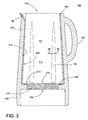
- FIG. 3 another example thin-walled glass-lined blender jar 300 constructed in accordance with the teachings of this disclosure is shown.
- Identical elements in FIGS. 1 , 2 and 3 are designated with identical reference numerals. For brevity, description of identical elements will not be repeated here. Instead, the interested reader is referred to the discussion of the identical elements presented above in connection with FIGS. 1 and 2 .
- a glass liner 302 is threaded into a plastic shell 316.
- bottom openings 314, 324 in, respectively, bottom walls 310, 320 of the glass liner 302 and plastic shell 316 have threads 340 that enable the glass liner 302 to be threaded into the plastic shell 316.
- the plastic shells 116, 216, 316 are made of a material capable of providing structural support for the glass liners 102, 202, 302.
- the plastic shells 116, 216, 316 are formed of rigid impact resistant plastic.
- the plastic may be at least partially transparent, at least partially transparent in some areas and opaque in others, etc.
- the plastic may be clear and/or colored.
- impact resistant plastic also serves to deaden reverberating sound when the blender jars 100, 200, 300 are in use.
- the plastic shell 116 is molded onto the glass liner 102.
- the glass liner 202 could be press-fit into the glass liner 216.
- the plastic shell 116, 216, 316 is bonded or sealed to the glass liner 102, 202, 302 to enhance, for example, washability. Additionally, the plastic shell 116, 216, 316 and the glass liner 102, 202, 302 may have an air gap or a vacuum between them to provide additional noise dampening when the blender jar 100, 200, 300 is in use because sound cannot travel through a vacuum.
- the glass liners 102, 202, 302 could be made of a borosilicate glass material. However, other materials are contemplated. It is also contemplated that the glass liners 102, 202, 302 may have a thickness between 3 to 4 mm. Of course, other thicknesses are contemplated depending on glass material properties and/or the extent of structural support provided by a plastic outer shell 116, 216, 316.
- the plastic shells 116, 216, 316 need not cover all the glass liners 102, 202, 302, but may instead have an arrangement of ribs, members, braces, etc. that provide needed structural support for the glass liners 102, 202, 302.
- the blender jar 100, 200, 300 may have ribs, one of which is designated at reference numeral 130.
- FIG. 4 which is a cross-sectional view of the rib 130 taken along line IV-IV of FIGS. 1 , 2 or 3 , the example rib 130 of the glass liner 102, 202, 302 extends inwardly into the cavity 112, 212, 312.
- the plastic shell 116, 216, 316 may include a rib 132 that extends inward, is dimensioned to generally match the rib 130, and fits into the rib 130 of the glass liner 102, 202, 302 when the glass liner 102, 202, 302 is within the plastic shell 116, 216, 316.
- Other plastic shell configurations are contemplated, including aspects other than structural support including, but not limited to, ornamental, decorative, aesthetic, etc. reasons.
Landscapes
- Engineering & Computer Science (AREA)
- Mechanical Engineering (AREA)
- Food Science & Technology (AREA)
- Chemical & Material Sciences (AREA)
- Chemical Kinetics & Catalysis (AREA)
- Food-Manufacturing Devices (AREA)
Abstract
Thin-walled glass-lined blender jars (100), (200), (300) are disclosed. An example thin-walled glass-lined blender jar (100), (200), (300) includes a thin-walled glass liner (102), and a plastic structural shell (116) around the glass liner (102) providing structural support for the glass liner (102). In some embodiments, a rib (132) of a side wall (118) of the plastic shell (116) is positioned in a rib (130) of a side wall (108) of the glass liner (102). In some embodiments, side walls (108), (118) of the glass liner (102) and plastic shell (116) may taper inward from bottom to top retaining the glass liner (102) within the plastic shell (116). In some embodiments, the plastic shell (116) comprises a non-structural member selected for at least one of ornamentation, decoration, and/or aesthetics.
Description
- This disclosure relates generally to blenders, and, more particularly, to thin-walled glass-lined blender jars.
- Blender jars are used with blenders to hold items, e.g., food items, that are to be processed by, for example, liquefying, chopping or pureeing. Blender jars include an integral rotating blade, or are removeably coupled to a collar assembly having a rotating blade. The blade is rotated by a motor to which a blender jar is coupled. Typically, a lid is placed on the blender jar to prevent, for example, spattering.
- Thin-walled glass-lined blender jars are disclosed. An example thin-walled glass-lined blender jar includes a thin-walled glass liner, and a plastic structural shell around the glass liner providing structural support for the glass liner. In some embodiments, a rib of a side wall of the plastic shell is positioned in a rib of a side wall of the glass liner. In some embodiments, side walls of the glass liner and plastic shell may taper inward from bottom to top retaining the glass liner within the plastic shell. In some embodiments, the plastic shell comprises a non-structural member selected for at least one of ornamentation, decoration, and/or aesthetics.
-
-
FIG. 1 is a cross-sectional view of an example blender jar implemented in accordance with the teachings of this disclosure. -
FIG. 2 is a cross-sectional view of another example blender jar implemented in accordance with the teachings of this disclosure. -
FIG. 3 is a cross-sectional view of yet another example blender jar implemented in accordance with the teachings of this disclosure. -
FIG. 4 is a cross-sectional view of an example rib of the example blender jars ofFIGS. 1 ,2 and3 . - Conventional blender jars are made entirely from glass or entirely from plastic. While conventional glass blender jars do not retain odors and do not scratch easily, they can break and may be limited in size due to manufacturing processes and/or weight, especially for a large capacity blender jar. For example, a glass blender jar having a capacity of greater than 56 oz. may be too heavy for many consumers, which limits glass blender jar capacity. While conventional plastic blender jars can be molded to be lighter, more impact resistant and to provide larger capacities, they tend to retain odors and scratch easily, e.g., with hard items such as frozen food items. Sound is often a concern with conventional blender jars, as sound isolation is traditionally not contemplated for conventional blender jars.
- Thin-walled glass-lined blender jars are disclosed herein that overcome at least these problems. The examples disclosed herein have thin-walled glass liners that are, for example, press-fit or molded into a plastic outer structural shell, which provides structural support for the thin-walled glass liner. Example thin-walled glass liners have a thickness similar to that of a coffee maker carafe (e.g., 3 - 4 millimeters (mms)), and/or approximately half the thickness of a conventional glass blender jar (e.g., 6 - 10 mm), depending on, for example, glass material(s) used, and/or plastic shell design. Accordingly, the example blender jars disclosed herein can be approximately half or less than half of the weight of a conventional glass blender jar, which is significant as consumers increasingly desire larger blender jars. In the examples disclosed herein, the thin-walled glass liner provides, among other things, reduced weight, clean-ability, and minimal odor retention, while the plastic outer shell provides structural support to at least partially compensate for the reduced thickness of the glass liner, and provide impact protection, sound isolation and/or additional decorative features. Additionally, an air gap and/or insulation can be provided between the glass liner and the plastic outer shell to deaden sound. Further still, a vacuum could be provided between the glass liner and the plastic outer shell, which would further reduce noise as sound does not travel in a vacuum.
-
FIG. 1 is a cross-sectional view of an example thin-walled glass-linedblender jar 100 constructed in accordance with the teachings of this disclosure. Theexample blender jar 100 ofFIG. 1 includes a thin-walled glass liner 102 having anupper opening 104 and a molded-inspout 106. Theexample glass liner 102 includes aside wall 108 and abottom wall 110 that at least partially define acavity 112 into which items, such as food items, may be placed for processing (e.g., liquefying, chopping, pureeing, etc.). Thebottom wall 110 includes anaperture 114 for receiving a blade assembly (not shown for ease of illustration) within thecavity 112 for processing items. - As shown in
FIG. 1 , theglass liner 102 is received or positioned within a plasticstructural shell 116. The exampleplastic shell 116 ofFIG. 1 provides structural support for the thin-walled glass liner 102. Because theglass liner 102 is thinner than conventional glass blender jars, it has decreased strength and/or rigidity. The structural support provided by the exampleplastic shell 116 counteracts, overcomes, etc. the structural effects of theglass liner 102 being thinner than is conventional. By providing structural support for theglass liner 102 with plastic, which is substantially lighter than glass, theblender jar 100 ofFIG. 1 can be made noticeably lighter than a conventional glass blender jar (e.g., half the weight) while retaining strength and the benefits of glass, such as clean-ability, resistance to stains and scratches, etc. - The
plastic shell 116 includes aside wall 118 and abottom wall 120 that define acavity 122 in which theglass liner 102 is received, molded or placed. Thebottom wall 120 of theplastic shell 116 includes anaperture 124 that opens into theaperture 114 of theglass liner 102 at an upper end, and further opens into abase portion 126 of theplastic shell 116. Thebase portion 126 is used to couple theblender jar 100 to a blender base for driving the blade assembly within thecavity 112 of theglass liner 102. As shown, theplastic shell 116 includes ahandle 128 for engagement by a user. - In the example of
FIG. 1 , theside wall 108 of theglass liner 102 is tapered inward from thebottom wall 110, as shown. Similarly, theside wall 118 of theplastic shell 116 is tapered inward from thebottom wall 120, as shown, such that theglass liner 102 is closely received within thecavity 122 of theplastic shell 116, and is retained therein due to the tapered shape of theside walls - Turning to
FIG. 2 , another example thin-walled glass-linedblender jar 200 constructed in accordance with the teachings of this disclosure is shown. Identical elements inFIGS. 1 and2 are designated with identical reference numerals. For brevity, description of identical elements will not be repeated here. Instead, the interested reader is referred to the discussion of the identical elements presented above in connection withFIG. 1 . - In contrast to
FIG. 1 , theexample blender jar 200 ofFIG. 2 has aglass liner 202 having astraight side wall 208 and aplastic shell 216 having astraight side wall 218. Accordingly,cavities glass liner 202 andplastic shell 216 are straight, not tapered. Because thecavities 212, 228 are not tapered, theglass liner 202 is not configuratively retained in theplastic shell 216. Accordingly, in the example ofFIG. 2 , theglass liner 202 may be configured to be removable by a person, and/or lightly pressed into thecavity 222 of theplastic shell 216 for use therein. In some examples, theside walls - Turning to
FIG. 3 , another example thin-walled glass-linedblender jar 300 constructed in accordance with the teachings of this disclosure is shown. Identical elements inFIGS. 1 ,2 and3 are designated with identical reference numerals. For brevity, description of identical elements will not be repeated here. Instead, the interested reader is referred to the discussion of the identical elements presented above in connection withFIGS. 1 and2 . - In the example of
FIG. 3 , aglass liner 302 is threaded into aplastic shell 316. As shown inFIG. 3 ,bottom openings bottom walls glass liner 302 andplastic shell 316 havethreads 340 that enable theglass liner 302 to be threaded into theplastic shell 316. - Turning to
FIGS. 1 ,2 and3 , in general, theplastic shells glass liners plastic shells blender jars FIG. 1 , it is contemplated that theplastic shell 116 is molded onto theglass liner 102. In the example ofFIG. 2 , it is contemplated that theglass liner 202 could be press-fit into theglass liner 216. - In some examples, the
plastic shell glass liner plastic shell glass liner blender jar - The
glass liners glass liners outer shell - Additionally or alternatively, the
plastic shells glass liners glass liners FIGS. 1 ,2 and3 , theblender jar reference numeral 130. As shown inFIG. 4 , which is a cross-sectional view of therib 130 taken along line IV-IV ofFIGS. 1 ,2 or3 , theexample rib 130 of theglass liner cavity plastic shell rib 132 that extends inward, is dimensioned to generally match therib 130, and fits into therib 130 of theglass liner glass liner plastic shell
Claims (15)
- A blender jar (100) comprising:a thin-walled glass liner (102); anda plastic structural shell (116) around the glass liner (102) providing structural support for the glass liner (102).
- A blender jar (100) as defined in claim 1, wherein the glass liner (102) has a first side wall (108) and a first bottom wall (110) at least partially defining a first cavity (112) configured to receive items for processing.
- A blender jar (100) as defined in claim 2, wherein the plastic shell (116) has a second side wall (118) and a second bottom wall (120) at least partially defining a second cavity (122) configured to receive the glass liner (102).
- A blender jar (100) as defined in claim 3, wherein the first side wall (108) has a first rib (130) at least partially extending into the first cavity (112), and the second side wall (118) has a second rib (132) dimensioned according to the first rib (130), the second rib (132) positioned in the first rib (130) when the glass liner (102) is positioned within the plastic shell (116).
- A blender jar (100) as defined in claim 3, further comprising:a first aperture (114) defined through the first bottom wall (110);a corresponding second aperture (124) defined through the second bottom wall (120); anda blade assembly mounted to the blender jar (100) through the first (114) and second apertures (124).
- A blender jar (100) as defined in claim 5, wherein the plastic shell (116) includes a base portion (126) for removeably coupling the blender jar (100) and the blade assembly to a blender base.
- A blender jar (100) as defined in claim 5, wherein the blade assembly is fixedly mounted to the blender jar (100).
- A blender jar (100) as defined in claim 2, wherein the first side wall (108) tapers inward from the first bottom wall (110), and the second side wall (118) tapers inward from the second bottom wall (120) corresponding to the first taper, the taper of the second side wall (118) retaining the glass liner (102) within the plastic shell (116).
- A blender jar (100) as defined in claim 1, wherein the glass liner (102) is press fit into the plastic shell (116).
- A blender jar (100) as defined in claim 1, wherein the plastic shell (116) is molded onto the glass liner (102) and comprises an impact resistant plastic.
- A blender jar (100) as defined in claim 1, wherein the plastic shell (116) is bonded to the glass liner (102).
- A blender jar (100) as defined in claim 1, further comprising at least one of an air gap and a vacuum between at least a portion of the glass liner (102) and the plastic shell (116).
- A blender jar (100) as defined in claim 1, wherein the plastic shell (116) is sealed to the glass liner (102); wherein the plastic shell (116) only partially covers the glass liner (102); and wherein plastic shell (116) comprises a non-structural member selected for at least one of ornamentation, decoration, and/or aesthetics .
- A blender jar (100) as defined in claim 1, wherein the glass liner (102) and the plastic shell (116) are removeably assembled such that the glass liner (102) has first threads (340), and the plastic shell (116) has second threads (340), the glass liner (102) threaded into the plastic shell (116) via the first and second threads (340).
- A blender jar (100) as defined in claim 1, wherein the glass liner (102) comprises a borosilicate glass material, and has a thickness in the range of 3 millimeters (mm) to 4 mm.
Applications Claiming Priority (1)
| Application Number | Priority Date | Filing Date | Title |
|---|---|---|---|
| US14/536,726 US20160129409A1 (en) | 2014-11-10 | 2014-11-10 | Thin-walled glass-lined blender jars |
Publications (1)
| Publication Number | Publication Date |
|---|---|
| EP3017740A1 true EP3017740A1 (en) | 2016-05-11 |
Family
ID=54477867
Family Applications (1)
| Application Number | Title | Priority Date | Filing Date |
|---|---|---|---|
| EP15193080.7A Withdrawn EP3017740A1 (en) | 2014-11-10 | 2015-11-04 | Thin-walled glass-lined blender jars |
Country Status (2)
| Country | Link |
|---|---|
| US (1) | US20160129409A1 (en) |
| EP (1) | EP3017740A1 (en) |
Cited By (2)
| Publication number | Priority date | Publication date | Assignee | Title |
|---|---|---|---|---|
| CN108309085A (en) * | 2017-01-16 | 2018-07-24 | 九阳股份有限公司 | A kind of food processor |
| CN110392540A (en) * | 2017-01-17 | 2019-10-29 | 伊迪亚实验室有限责任公司 | Mixing plant and method |
Families Citing this family (3)
| Publication number | Priority date | Publication date | Assignee | Title |
|---|---|---|---|---|
| DE102016009478B4 (en) * | 2016-08-05 | 2019-01-24 | Ika-Werke Gmbh & Co. Kg | Stirring or dispersing device and stirring or dispersing arrangement |
| US20180140137A1 (en) * | 2016-11-18 | 2018-05-24 | Vita-Mix Management Corporation | Blending system with a liner for blending container |
| AU2018448732B2 (en) * | 2018-11-05 | 2022-01-06 | Nakul NAKUL | An apparatus for agitation of fluids |
Citations (3)
| Publication number | Priority date | Publication date | Assignee | Title |
|---|---|---|---|---|
| WO1989002396A1 (en) * | 1987-09-14 | 1989-03-23 | Bloomfield Industries, Inc. | Glass container with safety coating |
| US6649891B1 (en) * | 2001-09-25 | 2003-11-18 | Anne Kitko | Microwavable food storage container |
| US20070095961A1 (en) * | 2005-10-28 | 2007-05-03 | Kou-I Lin | Container of a blender |
Family Cites Families (5)
| Publication number | Priority date | Publication date | Assignee | Title |
|---|---|---|---|---|
| US3221915A (en) * | 1962-08-08 | 1965-12-07 | Corning Fibre Box | Impact-resistant glass-lined containers |
| US3355045A (en) * | 1965-10-24 | 1967-11-28 | Douglas David | Insulated beverage server |
| US7384182B2 (en) * | 2004-12-14 | 2008-06-10 | Sun Coast Merchandise Corporation | Automatic stirring travel beverage container |
| US20110139169A1 (en) * | 2008-09-10 | 2011-06-16 | Rozalia Gerschman | Manicure soaking bowl and method |
| CN106457176B (en) * | 2014-03-14 | 2019-12-13 | 维他拌管理有限公司 | stirring container |
-
2014
- 2014-11-10 US US14/536,726 patent/US20160129409A1/en not_active Abandoned
-
2015
- 2015-11-04 EP EP15193080.7A patent/EP3017740A1/en not_active Withdrawn
Patent Citations (3)
| Publication number | Priority date | Publication date | Assignee | Title |
|---|---|---|---|---|
| WO1989002396A1 (en) * | 1987-09-14 | 1989-03-23 | Bloomfield Industries, Inc. | Glass container with safety coating |
| US6649891B1 (en) * | 2001-09-25 | 2003-11-18 | Anne Kitko | Microwavable food storage container |
| US20070095961A1 (en) * | 2005-10-28 | 2007-05-03 | Kou-I Lin | Container of a blender |
Cited By (3)
| Publication number | Priority date | Publication date | Assignee | Title |
|---|---|---|---|---|
| CN108309085A (en) * | 2017-01-16 | 2018-07-24 | 九阳股份有限公司 | A kind of food processor |
| CN108309085B (en) * | 2017-01-16 | 2021-12-03 | 九阳股份有限公司 | Food processing machine |
| CN110392540A (en) * | 2017-01-17 | 2019-10-29 | 伊迪亚实验室有限责任公司 | Mixing plant and method |
Also Published As
| Publication number | Publication date |
|---|---|
| US20160129409A1 (en) | 2016-05-12 |
Similar Documents
| Publication | Publication Date | Title |
|---|---|---|
| USD960706S1 (en) | Lid for a cup | |
| USD899854S1 (en) | Beverage system | |
| USD944600S1 (en) | Insulating short cup with lid | |
| USD1101552S1 (en) | Container for beverages or food | |
| USD849530S1 (en) | Packaging | |
| USD859919S1 (en) | Shaker cup | |
| USD899845S1 (en) | Beverage container lid | |
| USD897146S1 (en) | Lid for beverage container | |
| USD887210S1 (en) | Container for kitchen appliance | |
| USD817085S1 (en) | Lid for a beverage container | |
| USD799901S1 (en) | Beverage system | |
| USD869228S1 (en) | Rectangular lid with vent for food container | |
| USD820637S1 (en) | Lid for a beverage container | |
| USD820635S1 (en) | Lid for beverage container | |
| USD877560S1 (en) | Lid for beverage container | |
| US20160129409A1 (en) | Thin-walled glass-lined blender jars | |
| USD905505S1 (en) | Food and beverage container | |
| USD817683S1 (en) | Lid for a beverage container | |
| USD732343S1 (en) | Insulated beverage cup | |
| USD850260S1 (en) | Drink cup lid | |
| USD931036S1 (en) | Cookware pot with lid | |
| USD845128S1 (en) | Drink cup lid | |
| USD944083S1 (en) | Pour spout | |
| US20120285845A1 (en) | "Utility" comprising of a condiment container combination, having a enclosed kitchen utensil a cap or lid, a enclosed kitchen utensil housing | |
| USD997649S1 (en) | Insulating tall cup with lid |
Legal Events
| Date | Code | Title | Description |
|---|---|---|---|
| PUAI | Public reference made under article 153(3) epc to a published international application that has entered the european phase |
Free format text: ORIGINAL CODE: 0009012 |
|
| AK | Designated contracting states |
Kind code of ref document: A1 Designated state(s): AL AT BE BG CH CY CZ DE DK EE ES FI FR GB GR HR HU IE IS IT LI LT LU LV MC MK MT NL NO PL PT RO RS SE SI SK SM TR |
|
| AX | Request for extension of the european patent |
Extension state: BA ME |
|
| 18D | Application deemed to be withdrawn |
Effective date: 20161112 |
|
| STAA | Information on the status of an ep patent application or granted ep patent |
Free format text: STATUS: THE APPLICATION IS DEEMED TO BE WITHDRAWN |