EP3016948B1 - 2-acylaminothiazoles for the treatment of cancer - Google Patents
2-acylaminothiazoles for the treatment of cancer Download PDFInfo
- Publication number
- EP3016948B1 EP3016948B1 EP14741222.5A EP14741222A EP3016948B1 EP 3016948 B1 EP3016948 B1 EP 3016948B1 EP 14741222 A EP14741222 A EP 14741222A EP 3016948 B1 EP3016948 B1 EP 3016948B1
- Authority
- EP
- European Patent Office
- Prior art keywords
- phenyl
- thiazol
- methyl
- har
- benzamide
- Prior art date
- Legal status (The legal status is an assumption and is not a legal conclusion. Google has not performed a legal analysis and makes no representation as to the accuracy of the status listed.)
- Not-in-force
Links
- 206010028980 Neoplasm Diseases 0.000 title claims description 12
- 201000011510 cancer Diseases 0.000 title claims description 8
- 150000001875 compounds Chemical class 0.000 claims description 38
- 239000001257 hydrogen Substances 0.000 claims description 15
- 229910052739 hydrogen Inorganic materials 0.000 claims description 15
- 125000000217 alkyl group Chemical group 0.000 claims description 11
- 125000004435 hydrogen atom Chemical group [H]* 0.000 claims description 10
- 206010073478 Anaplastic large-cell lymphoma Diseases 0.000 claims description 9
- 208000032004 Large-Cell Anaplastic Lymphoma Diseases 0.000 claims description 9
- 208000002154 non-small cell lung carcinoma Diseases 0.000 claims description 9
- 208000029729 tumor suppressor gene on chromosome 11 Diseases 0.000 claims description 9
- 125000006273 (C1-C3) alkyl group Chemical group 0.000 claims description 8
- -1 -CH2-O-CPh3 Chemical group 0.000 claims description 6
- GHEJYIIXEPYQNK-UHFFFAOYSA-N 4-[(4-methylpiperazin-1-yl)methyl]-n-[4-[3-[2-tri(propan-2-yl)silylethynyl]phenyl]-1,3-thiazol-2-yl]benzamide Chemical compound CC(C)[Si](C(C)C)(C(C)C)C#CC1=CC=CC(C=2N=C(NC(=O)C=3C=CC(CN4CCN(C)CC4)=CC=3)SC=2)=C1 GHEJYIIXEPYQNK-UHFFFAOYSA-N 0.000 claims description 5
- AWKCZLDJLBMYDC-UHFFFAOYSA-N 4-[(4-prop-2-ynylpiperazin-1-yl)methyl]-n-[4-[3-[2-tri(propan-2-yl)silylethynyl]phenyl]-1,3-thiazol-2-yl]benzamide Chemical compound CC(C)[Si](C(C)C)(C(C)C)C#CC1=CC=CC(C=2N=C(NC(=O)C=3C=CC(CN4CCN(CC#C)CC4)=CC=3)SC=2)=C1 AWKCZLDJLBMYDC-UHFFFAOYSA-N 0.000 claims description 4
- 125000001153 fluoro group Chemical group F* 0.000 claims description 4
- KEMAVQQMYJPVPP-UHFFFAOYSA-N n-[4-[4-methyl-3-[2-(4-methylphenyl)ethynyl]phenyl]-1,3-thiazol-2-yl]-4-[(4-methylpiperazin-1-yl)methyl]benzamide Chemical compound C1CN(C)CCN1CC1=CC=C(C(=O)NC=2SC=C(N=2)C=2C=C(C(C)=CC=2)C#CC=2C=CC(C)=CC=2)C=C1 KEMAVQQMYJPVPP-UHFFFAOYSA-N 0.000 claims description 4
- 150000003839 salts Chemical class 0.000 claims description 4
- 125000001494 2-propynyl group Chemical group [H]C#CC([H])([H])* 0.000 claims description 3
- ADGMYSJBTXAOQX-UHFFFAOYSA-N 4-(imidazol-1-ylmethyl)-n-[4-[3-[2-tri(propan-2-yl)silylethynyl]phenyl]-1,3-thiazol-2-yl]benzamide Chemical compound CC(C)[Si](C(C)C)(C(C)C)C#CC1=CC=CC(C=2N=C(NC(=O)C=3C=CC(CN4C=NC=C4)=CC=3)SC=2)=C1 ADGMYSJBTXAOQX-UHFFFAOYSA-N 0.000 claims description 3
- SUDAOEYFJAPVFL-UHFFFAOYSA-N 4-(morpholin-4-ylmethyl)-n-[4-[3-[2-tri(propan-2-yl)silylethynyl]phenyl]-1,3-thiazol-2-yl]benzamide Chemical compound CC(C)[Si](C(C)C)(C(C)C)C#CC1=CC=CC(C=2N=C(NC(=O)C=3C=CC(CN4CCOCC4)=CC=3)SC=2)=C1 SUDAOEYFJAPVFL-UHFFFAOYSA-N 0.000 claims description 3
- OUDWRCDWHKEAGL-UHFFFAOYSA-N 4-(tetrazol-1-ylmethyl)-n-[4-[3-[2-tri(propan-2-yl)silylethynyl]phenyl]-1,3-thiazol-2-yl]benzamide Chemical compound CC(C)[Si](C(C)C)(C(C)C)C#CC1=CC=CC(C=2N=C(NC(=O)C=3C=CC(CN4N=NN=C4)=CC=3)SC=2)=C1 OUDWRCDWHKEAGL-UHFFFAOYSA-N 0.000 claims description 3
- YNUNEXVYXOJLQW-UHFFFAOYSA-N 4-[(4-methylpiperazin-1-yl)methyl]-n-[4-[3-(2-phenylethynyl)phenyl]-1,3-thiazol-2-yl]benzamide Chemical compound C1CN(C)CCN1CC1=CC=C(C(=O)NC=2SC=C(N=2)C=2C=C(C=CC=2)C#CC=2C=CC=CC=2)C=C1 YNUNEXVYXOJLQW-UHFFFAOYSA-N 0.000 claims description 3
- KBKUMSXHFKGMLG-UHFFFAOYSA-N 4-[(4-methylpiperazin-1-yl)methyl]-n-[4-[3-(2-triethylsilylethynyl)phenyl]-1,3-thiazol-2-yl]benzamide Chemical compound CC[Si](CC)(CC)C#CC1=CC=CC(C=2N=C(NC(=O)C=3C=CC(CN4CCN(C)CC4)=CC=3)SC=2)=C1 KBKUMSXHFKGMLG-UHFFFAOYSA-N 0.000 claims description 3
- GSGFFLQUSFLNCF-UHFFFAOYSA-N 4-[(4-methylpiperazin-1-yl)methyl]-n-[4-[3-(2-trimethylsilylethynyl)phenyl]-1,3-thiazol-2-yl]benzamide Chemical compound C1CN(C)CCN1CC1=CC=C(C(=O)NC=2SC=C(N=2)C=2C=C(C=CC=2)C#C[Si](C)(C)C)C=C1 GSGFFLQUSFLNCF-UHFFFAOYSA-N 0.000 claims description 3
- JMMRUSOOMVZBBV-UHFFFAOYSA-N 4-[(4-methylpiperazin-1-yl)methyl]-n-[4-[3-(3-trityloxyprop-1-ynyl)phenyl]-1,3-thiazol-2-yl]benzamide Chemical compound C1CN(C)CCN1CC1=CC=C(C(=O)NC=2SC=C(N=2)C=2C=C(C=CC=2)C#CCOC(C=2C=CC=CC=2)(C=2C=CC=CC=2)C=2C=CC=CC=2)C=C1 JMMRUSOOMVZBBV-UHFFFAOYSA-N 0.000 claims description 3
- PEAGJDKKWTXLQP-UHFFFAOYSA-N 4-[(4-methylpiperazin-1-yl)methyl]-n-[4-[3-[2-[2-(trifluoromethoxy)phenyl]ethynyl]phenyl]-1,3-thiazol-2-yl]benzamide Chemical compound C1CN(C)CCN1CC1=CC=C(C(=O)NC=2SC=C(N=2)C=2C=C(C=CC=2)C#CC=2C(=CC=CC=2)OC(F)(F)F)C=C1 PEAGJDKKWTXLQP-UHFFFAOYSA-N 0.000 claims description 3
- KWMQHGTXQDJADA-UHFFFAOYSA-N 4-[(4-methylpiperazin-1-yl)methyl]-n-[4-[3-[2-[2-(trifluoromethyl)phenyl]ethynyl]phenyl]-1,3-thiazol-2-yl]benzamide Chemical compound C1CN(C)CCN1CC1=CC=C(C(=O)NC=2SC=C(N=2)C=2C=C(C=CC=2)C#CC=2C(=CC=CC=2)C(F)(F)F)C=C1 KWMQHGTXQDJADA-UHFFFAOYSA-N 0.000 claims description 3
- WMLAABCWYXNDLP-UHFFFAOYSA-N 4-[(4-methylpiperazin-1-yl)methyl]-n-[4-[3-[3-tri(propan-2-yl)silyloxyprop-1-ynyl]phenyl]-1,3-thiazol-2-yl]benzamide Chemical compound CC(C)[Si](C(C)C)(C(C)C)OCC#CC1=CC=CC(C=2N=C(NC(=O)C=3C=CC(CN4CCN(C)CC4)=CC=3)SC=2)=C1 WMLAABCWYXNDLP-UHFFFAOYSA-N 0.000 claims description 3
- LZEODDXAPSFGMS-UHFFFAOYSA-N 4-[(4-methylpiperazin-1-yl)methyl]-n-[4-[3-methyl-4-[2-[2-(trifluoromethyl)phenyl]ethynyl]phenyl]-1,3-thiazol-2-yl]benzamide Chemical compound C1CN(C)CCN1CC1=CC=C(C(=O)NC=2SC=C(N=2)C=2C=C(C)C(C#CC=3C(=CC=CC=3)C(F)(F)F)=CC=2)C=C1 LZEODDXAPSFGMS-UHFFFAOYSA-N 0.000 claims description 3
- CDBWZTXMPQGFDK-UHFFFAOYSA-N 4-[(4-methylpiperazin-1-yl)methyl]-n-[4-[3-methyl-4-[2-tri(propan-2-yl)silylethynyl]phenyl]-1,3-thiazol-2-yl]benzamide Chemical compound C1=C(C)C(C#C[Si](C(C)C)(C(C)C)C(C)C)=CC=C1C1=CSC(NC(=O)C=2C=CC(CN3CCN(C)CC3)=CC=2)=N1 CDBWZTXMPQGFDK-UHFFFAOYSA-N 0.000 claims description 3
- YMLDBIARXHJGHJ-UHFFFAOYSA-N 4-[(4-methylpiperazin-1-yl)methyl]-n-[4-[4-[2-tri(propan-2-yl)silylethynyl]phenyl]-1,3-thiazol-2-yl]benzamide Chemical compound C1=CC(C#C[Si](C(C)C)(C(C)C)C(C)C)=CC=C1C1=CSC(NC(=O)C=2C=CC(CN3CCN(C)CC3)=CC=2)=N1 YMLDBIARXHJGHJ-UHFFFAOYSA-N 0.000 claims description 3
- NJJDYXCTFAEUEZ-UHFFFAOYSA-N 4-[(4-methylpiperazin-1-yl)methyl]-n-[4-[4-methyl-3-[2-[2-(trifluoromethyl)phenyl]ethynyl]phenyl]-1,3-thiazol-2-yl]benzamide Chemical compound C1CN(C)CCN1CC1=CC=C(C(=O)NC=2SC=C(N=2)C=2C=C(C(C)=CC=2)C#CC=2C(=CC=CC=2)C(F)(F)F)C=C1 NJJDYXCTFAEUEZ-UHFFFAOYSA-N 0.000 claims description 3
- ZPKFDKPOEKKGJL-UHFFFAOYSA-N 4-[(4-methylpiperazin-1-yl)methyl]-n-[4-[4-methyl-3-[2-tri(propan-2-yl)silylethynyl]phenyl]-1,3-thiazol-2-yl]benzamide Chemical compound C1=C(C)C(C#C[Si](C(C)C)(C(C)C)C(C)C)=CC(C=2N=C(NC(=O)C=3C=CC(CN4CCN(C)CC4)=CC=3)SC=2)=C1 ZPKFDKPOEKKGJL-UHFFFAOYSA-N 0.000 claims description 3
- VLLSSCWVFXFZSK-UHFFFAOYSA-N 4-[[2-(dimethylamino)ethylamino]methyl]-n-[4-[3-[2-tri(propan-2-yl)silylethynyl]phenyl]-1,3-thiazol-2-yl]benzamide Chemical compound CC(C)[Si](C(C)C)(C(C)C)C#CC1=CC=CC(C=2N=C(NC(=O)C=3C=CC(CNCCN(C)C)=CC=3)SC=2)=C1 VLLSSCWVFXFZSK-UHFFFAOYSA-N 0.000 claims description 3
- AFYPDUHGHXALFC-UHFFFAOYSA-N 5-[4-(4-methylpiperazine-1-carbonyl)phenyl]-n-[4-[3-[2-[2-(trifluoromethoxy)phenyl]ethynyl]phenyl]-1,3-thiazol-2-yl]furan-2-carboxamide Chemical compound C1CN(C)CCN1C(=O)C1=CC=C(C=2OC(=CC=2)C(=O)NC=2SC=C(N=2)C=2C=C(C=CC=2)C#CC=2C(=CC=CC=2)OC(F)(F)F)C=C1 AFYPDUHGHXALFC-UHFFFAOYSA-N 0.000 claims description 3
- QPRJDWHJUGYZHU-UHFFFAOYSA-N 5-[4-(4-methylpiperazine-1-carbonyl)phenyl]-n-[4-[3-[2-[2-(trifluoromethyl)phenyl]ethynyl]phenyl]-1,3-thiazol-2-yl]furan-2-carboxamide Chemical compound C1CN(C)CCN1C(=O)C1=CC=C(C=2OC(=CC=2)C(=O)NC=2SC=C(N=2)C=2C=C(C=CC=2)C#CC=2C(=CC=CC=2)C(F)(F)F)C=C1 QPRJDWHJUGYZHU-UHFFFAOYSA-N 0.000 claims description 3
- IGPGUIOFXAHCOQ-UHFFFAOYSA-N 5-[4-(4-methylpiperazine-1-carbonyl)phenyl]-n-[4-[3-[2-tri(propan-2-yl)silylethynyl]phenyl]-1,3-thiazol-2-yl]furan-2-carboxamide Chemical compound CC(C)[Si](C(C)C)(C(C)C)C#CC1=CC=CC(C=2N=C(NC(=O)C=3OC(=CC=3)C=3C=CC(=CC=3)C(=O)N3CCN(C)CC3)SC=2)=C1 IGPGUIOFXAHCOQ-UHFFFAOYSA-N 0.000 claims description 3
- YYCJRSKUCRYDDJ-UHFFFAOYSA-N 5-[4-(4-methylpiperazine-1-carbonyl)phenyl]-n-[4-[3-[3-tri(propan-2-yl)silyloxyprop-1-ynyl]phenyl]-1,3-thiazol-2-yl]furan-2-carboxamide Chemical compound CC(C)[Si](C(C)C)(C(C)C)OCC#CC1=CC=CC(C=2N=C(NC(=O)C=3OC(=CC=3)C=3C=CC(=CC=3)C(=O)N3CCN(C)CC3)SC=2)=C1 YYCJRSKUCRYDDJ-UHFFFAOYSA-N 0.000 claims description 3
- UFHFLCQGNIYNRP-UHFFFAOYSA-N Hydrogen Chemical compound [H][H] UFHFLCQGNIYNRP-UHFFFAOYSA-N 0.000 claims description 3
- QVGXLLKOCUKJST-UHFFFAOYSA-N atomic oxygen Chemical compound [O] QVGXLLKOCUKJST-UHFFFAOYSA-N 0.000 claims description 3
- SXGXKIUCCVWQFS-UHFFFAOYSA-N n-[4-(3-ethynylphenyl)-1,3-thiazol-2-yl]-4-[(4-methylpiperazin-1-yl)methyl]benzamide Chemical compound C1CN(C)CCN1CC1=CC=C(C(=O)NC=2SC=C(N=2)C=2C=C(C=CC=2)C#C)C=C1 SXGXKIUCCVWQFS-UHFFFAOYSA-N 0.000 claims description 3
- ULXXIWQPWWBLQD-UHFFFAOYSA-N n-[4-(3-hex-1-ynylphenyl)-1,3-thiazol-2-yl]-4-[(4-methylpiperazin-1-yl)methyl]benzamide Chemical compound CCCCC#CC1=CC=CC(C=2N=C(NC(=O)C=3C=CC(CN4CCN(C)CC4)=CC=3)SC=2)=C1 ULXXIWQPWWBLQD-UHFFFAOYSA-N 0.000 claims description 3
- FQBLBBGYPPNPJB-UHFFFAOYSA-N n-[4-[3,4-bis[2-[2-(trifluoromethyl)phenyl]ethynyl]phenyl]-1,3-thiazol-2-yl]-4-[(4-methylpiperazin-1-yl)methyl]benzamide Chemical compound C1CN(C)CCN1CC1=CC=C(C(=O)NC=2SC=C(N=2)C=2C=C(C(C#CC=3C(=CC=CC=3)C(F)(F)F)=CC=2)C#CC=2C(=CC=CC=2)C(F)(F)F)C=C1 FQBLBBGYPPNPJB-UHFFFAOYSA-N 0.000 claims description 3
- KSPJPXKJETWXFS-UHFFFAOYSA-N n-[4-[3,4-bis[2-tri(propan-2-yl)silylethynyl]phenyl]-1,3-thiazol-2-yl]-4-[(4-methylpiperazin-1-yl)methyl]benzamide Chemical compound C1=C(C#C[Si](C(C)C)(C(C)C)C(C)C)C(C#C[Si](C(C)C)(C(C)C)C(C)C)=CC=C1C1=CSC(NC(=O)C=2C=CC(CN3CCN(C)CC3)=CC=2)=N1 KSPJPXKJETWXFS-UHFFFAOYSA-N 0.000 claims description 3
- CTUPZQPBUUCNEF-UHFFFAOYSA-N n-[4-[3-[2-(2-fluorophenyl)ethynyl]phenyl]-1,3-thiazol-2-yl]-4-[(4-methylpiperazin-1-yl)methyl]benzamide Chemical compound C1CN(C)CCN1CC1=CC=C(C(=O)NC=2SC=C(N=2)C=2C=C(C=CC=2)C#CC=2C(=CC=CC=2)F)C=C1 CTUPZQPBUUCNEF-UHFFFAOYSA-N 0.000 claims description 3
- YINHZEMGJCBRDS-UHFFFAOYSA-N n-[4-[3-[2-(2-methoxyphenyl)ethynyl]-4-methylphenyl]-1,3-thiazol-2-yl]-4-[(4-methylpiperazin-1-yl)methyl]benzamide Chemical compound COC1=CC=CC=C1C#CC1=CC(C=2N=C(NC(=O)C=3C=CC(CN4CCN(C)CC4)=CC=3)SC=2)=CC=C1C YINHZEMGJCBRDS-UHFFFAOYSA-N 0.000 claims description 3
- RGIUHXYDEKBTCI-UHFFFAOYSA-N n-[4-[3-[2-(4-fluorophenyl)ethynyl]-4-methylphenyl]-1,3-thiazol-2-yl]-4-[(4-methylpiperazin-1-yl)methyl]benzamide Chemical compound C1CN(C)CCN1CC1=CC=C(C(=O)NC=2SC=C(N=2)C=2C=C(C(C)=CC=2)C#CC=2C=CC(F)=CC=2)C=C1 RGIUHXYDEKBTCI-UHFFFAOYSA-N 0.000 claims description 3
- KQNCBQWSEULGFD-UHFFFAOYSA-N n-[4-[3-[2-(4-fluorophenyl)ethynyl]phenyl]-1,3-thiazol-2-yl]-4-[(4-methylpiperazin-1-yl)methyl]benzamide Chemical compound C1CN(C)CCN1CC1=CC=C(C(=O)NC=2SC=C(N=2)C=2C=C(C=CC=2)C#CC=2C=CC(F)=CC=2)C=C1 KQNCBQWSEULGFD-UHFFFAOYSA-N 0.000 claims description 3
- BJYMABDEFWRPQS-UHFFFAOYSA-N n-[4-[3-[2-(4-methoxyphenyl)ethynyl]-4-methylphenyl]-1,3-thiazol-2-yl]-4-[(4-methylpiperazin-1-yl)methyl]benzamide Chemical compound C1=CC(OC)=CC=C1C#CC1=CC(C=2N=C(NC(=O)C=3C=CC(CN4CCN(C)CC4)=CC=3)SC=2)=CC=C1C BJYMABDEFWRPQS-UHFFFAOYSA-N 0.000 claims description 3
- UINQRABANGODSR-UHFFFAOYSA-N n-[4-[3-[2-(4-methoxyphenyl)ethynyl]phenyl]-1,3-thiazol-2-yl]-4-[(4-methylpiperazin-1-yl)methyl]benzamide Chemical compound C1=CC(OC)=CC=C1C#CC1=CC=CC(C=2N=C(NC(=O)C=3C=CC(CN4CCN(C)CC4)=CC=3)SC=2)=C1 UINQRABANGODSR-UHFFFAOYSA-N 0.000 claims description 3
- XQZVKXXYGGWRGH-UHFFFAOYSA-N n-[4-[3-[2-(4-methylphenyl)ethynyl]phenyl]-1,3-thiazol-2-yl]-4-[(4-methylpiperazin-1-yl)methyl]benzamide Chemical compound C1CN(C)CCN1CC1=CC=C(C(=O)NC=2SC=C(N=2)C=2C=C(C=CC=2)C#CC=2C=CC(C)=CC=2)C=C1 XQZVKXXYGGWRGH-UHFFFAOYSA-N 0.000 claims description 3
- CJVGCOFIPDFBKB-UHFFFAOYSA-N n-[4-[3-[2-(cyclohexen-1-yl)ethynyl]phenyl]-1,3-thiazol-2-yl]-4-[(4-methylpiperazin-1-yl)methyl]benzamide Chemical compound C1CN(C)CCN1CC1=CC=C(C(=O)NC=2SC=C(N=2)C=2C=C(C=CC=2)C#CC=2CCCCC=2)C=C1 CJVGCOFIPDFBKB-UHFFFAOYSA-N 0.000 claims description 3
- WMVPGEPORBGQPJ-UHFFFAOYSA-N n-[4-[3-[2-[3,5-bis(trifluoromethyl)phenyl]ethynyl]phenyl]-1,3-thiazol-2-yl]-4-(morpholin-4-ylmethyl)benzamide Chemical compound FC(F)(F)C1=CC(C(F)(F)F)=CC(C#CC=2C=C(C=CC=2)C=2N=C(NC(=O)C=3C=CC(CN4CCOCC4)=CC=3)SC=2)=C1 WMVPGEPORBGQPJ-UHFFFAOYSA-N 0.000 claims description 3
- DSUMXEWCBCZQGK-UHFFFAOYSA-N n-[4-[3-[2-[3,5-bis(trifluoromethyl)phenyl]ethynyl]phenyl]-1,3-thiazol-2-yl]-4-[(4-methylpiperazin-1-yl)methyl]benzamide Chemical compound C1CN(C)CCN1CC1=CC=C(C(=O)NC=2SC=C(N=2)C=2C=C(C=CC=2)C#CC=2C=C(C=C(C=2)C(F)(F)F)C(F)(F)F)C=C1 DSUMXEWCBCZQGK-UHFFFAOYSA-N 0.000 claims description 3
- JUYMOSAMZBUMKZ-UHFFFAOYSA-N n-[4-[3-[2-[3,5-bis(trifluoromethyl)phenyl]ethynyl]phenyl]-1,3-thiazol-2-yl]-5-[4-(4-methylpiperazine-1-carbonyl)phenyl]furan-2-carboxamide Chemical compound C1CN(C)CCN1C(=O)C1=CC=C(C=2OC(=CC=2)C(=O)NC=2SC=C(N=2)C=2C=C(C=CC=2)C#CC=2C=C(C=C(C=2)C(F)(F)F)C(F)(F)F)C=C1 JUYMOSAMZBUMKZ-UHFFFAOYSA-N 0.000 claims description 3
- QAXWBDUABCOHMB-UHFFFAOYSA-N n-[4-[3-[2-[tert-butyl(dimethyl)silyl]ethynyl]phenyl]-1,3-thiazol-2-yl]-4-(morpholin-4-ylmethyl)benzamide Chemical compound CC(C)(C)[Si](C)(C)C#CC1=CC=CC(C=2N=C(NC(=O)C=3C=CC(CN4CCOCC4)=CC=3)SC=2)=C1 QAXWBDUABCOHMB-UHFFFAOYSA-N 0.000 claims description 3
- ZLCAACNGCVUNGU-UHFFFAOYSA-N n-[4-[3-[2-[tert-butyl(dimethyl)silyl]ethynyl]phenyl]-1,3-thiazol-2-yl]-4-[(4-methylpiperazin-1-yl)methyl]benzamide Chemical compound C1CN(C)CCN1CC1=CC=C(C(=O)NC=2SC=C(N=2)C=2C=C(C=CC=2)C#C[Si](C)(C)C(C)(C)C)C=C1 ZLCAACNGCVUNGU-UHFFFAOYSA-N 0.000 claims description 3
- MPMLXLMOARUFPX-UHFFFAOYSA-N n-[4-[3-[2-[tert-butyl(dimethyl)silyl]ethynyl]phenyl]-1,3-thiazol-2-yl]-5-[4-(4-methylpiperazine-1-carbonyl)phenyl]furan-2-carboxamide Chemical compound C1CN(C)CCN1C(=O)C1=CC=C(C=2OC(=CC=2)C(=O)NC=2SC=C(N=2)C=2C=C(C=CC=2)C#C[Si](C)(C)C(C)(C)C)C=C1 MPMLXLMOARUFPX-UHFFFAOYSA-N 0.000 claims description 3
- CUUZHCPEQPFZCV-UHFFFAOYSA-N n-[4-[3-[2-[tert-butyl(diphenyl)silyl]ethynyl]phenyl]-1,3-thiazol-2-yl]-4-(morpholin-4-ylmethyl)benzamide Chemical compound C=1C=CC=CC=1[Si](C=1C=CC=CC=1)(C(C)(C)C)C#CC(C=1)=CC=CC=1C(N=1)=CSC=1NC(=O)C(C=C1)=CC=C1CN1CCOCC1 CUUZHCPEQPFZCV-UHFFFAOYSA-N 0.000 claims description 3
- FPNCZMUVAVKMID-UHFFFAOYSA-N n-[4-[3-[2-[tert-butyl(diphenyl)silyl]ethynyl]phenyl]-1,3-thiazol-2-yl]-4-[(4-methylpiperazin-1-yl)methyl]benzamide Chemical compound C1CN(C)CCN1CC1=CC=C(C(=O)NC=2SC=C(N=2)C=2C=C(C=CC=2)C#C[Si](C=2C=CC=CC=2)(C=2C=CC=CC=2)C(C)(C)C)C=C1 FPNCZMUVAVKMID-UHFFFAOYSA-N 0.000 claims description 3
- CZTRJADBYMKCIC-UHFFFAOYSA-N n-[4-[3-[3-[tert-butyl(dimethyl)silyl]oxyprop-1-ynyl]phenyl]-1,3-thiazol-2-yl]-4-[(4-methylpiperazin-1-yl)methyl]benzamide Chemical compound C1CN(C)CCN1CC1=CC=C(C(=O)NC=2SC=C(N=2)C=2C=C(C=CC=2)C#CCO[Si](C)(C)C(C)(C)C)C=C1 CZTRJADBYMKCIC-UHFFFAOYSA-N 0.000 claims description 3
- FOLGQZMNHGWWAJ-UHFFFAOYSA-N n-[4-[3-[3-[tert-butyl(diphenyl)silyl]oxyprop-1-ynyl]phenyl]-1,3-thiazol-2-yl]-4-[(4-methylpiperazin-1-yl)methyl]benzamide Chemical compound C1CN(C)CCN1CC1=CC=C(C(=O)NC=2SC=C(N=2)C=2C=C(C=CC=2)C#CCO[Si](C=2C=CC=CC=2)(C=2C=CC=CC=2)C(C)(C)C)C=C1 FOLGQZMNHGWWAJ-UHFFFAOYSA-N 0.000 claims description 3
- REXGGPIOUNHUFR-UHFFFAOYSA-N n-[4-[3-methyl-4-[2-(4-methylphenyl)ethynyl]phenyl]-1,3-thiazol-2-yl]-4-[(4-methylpiperazin-1-yl)methyl]benzamide Chemical compound C1CN(C)CCN1CC1=CC=C(C(=O)NC=2SC=C(N=2)C=2C=C(C)C(C#CC=3C=CC(C)=CC=3)=CC=2)C=C1 REXGGPIOUNHUFR-UHFFFAOYSA-N 0.000 claims description 3
- KMLKBAIWUANADU-UHFFFAOYSA-N n-[4-[4-[2-[3,5-bis(trifluoromethyl)phenyl]ethynyl]phenyl]-1,3-thiazol-2-yl]-4-[(4-methylpiperazin-1-yl)methyl]benzamide Chemical compound C1CN(C)CCN1CC1=CC=C(C(=O)NC=2SC=C(N=2)C=2C=CC(=CC=2)C#CC=2C=C(C=C(C=2)C(F)(F)F)C(F)(F)F)C=C1 KMLKBAIWUANADU-UHFFFAOYSA-N 0.000 claims description 3
- TUGBZRBAAFTUGF-UHFFFAOYSA-N n-[4-[4-[2-[tert-butyl(dimethyl)silyl]ethynyl]phenyl]-1,3-thiazol-2-yl]-4-[(4-methylpiperazin-1-yl)methyl]benzamide Chemical compound C1CN(C)CCN1CC1=CC=C(C(=O)NC=2SC=C(N=2)C=2C=CC(=CC=2)C#C[Si](C)(C)C(C)(C)C)C=C1 TUGBZRBAAFTUGF-UHFFFAOYSA-N 0.000 claims description 3
- VTPUDUSBBPZOMC-UHFFFAOYSA-N n-[4-[4-methyl-3-(2-phenylethynyl)phenyl]-1,3-thiazol-2-yl]-4-[(4-methylpiperazin-1-yl)methyl]benzamide Chemical compound C1CN(C)CCN1CC1=CC=C(C(=O)NC=2SC=C(N=2)C=2C=C(C(C)=CC=2)C#CC=2C=CC=CC=2)C=C1 VTPUDUSBBPZOMC-UHFFFAOYSA-N 0.000 claims description 3
- 239000001301 oxygen Substances 0.000 claims description 3
- 229910052760 oxygen Inorganic materials 0.000 claims description 3
- 125000001997 phenyl group Chemical group [H]C1=C([H])C([H])=C(*)C([H])=C1[H] 0.000 claims description 3
- FSKLVOXUVBKVGP-UHFFFAOYSA-N propan-2-yl 2-[[4-[[4-[3-[2-tri(propan-2-yl)silylethynyl]phenyl]-1,3-thiazol-2-yl]carbamoyl]phenyl]methylamino]acetate Chemical compound C1=CC(CNCC(=O)OC(C)C)=CC=C1C(=O)NC1=NC(C=2C=C(C=CC=2)C#C[Si](C(C)C)(C(C)C)C(C)C)=CS1 FSKLVOXUVBKVGP-UHFFFAOYSA-N 0.000 claims description 3
- 125000006274 (C1-C3)alkoxy group Chemical group 0.000 claims description 2
- 125000004178 (C1-C4) alkyl group Chemical group 0.000 claims description 2
- 206010006187 Breast cancer Diseases 0.000 claims description 2
- 208000026310 Breast neoplasm Diseases 0.000 claims description 2
- 206010009944 Colon cancer Diseases 0.000 claims description 2
- 208000001333 Colorectal Neoplasms Diseases 0.000 claims description 2
- 206010067917 Inflammatory myofibroblastic tumour Diseases 0.000 claims description 2
- 208000031671 Large B-Cell Diffuse Lymphoma Diseases 0.000 claims description 2
- 206010061872 Non-renal cell carcinoma of kidney Diseases 0.000 claims description 2
- 206010061534 Oesophageal squamous cell carcinoma Diseases 0.000 claims description 2
- 208000033889 Renal medullary carcinoma Diseases 0.000 claims description 2
- 201000010989 colorectal carcinoma Diseases 0.000 claims description 2
- 125000000596 cyclohexenyl group Chemical group C1(=CCCCC1)* 0.000 claims description 2
- 206010012818 diffuse large B-cell lymphoma Diseases 0.000 claims description 2
- 208000007276 esophageal squamous cell carcinoma Diseases 0.000 claims description 2
- 150000002431 hydrogen Chemical class 0.000 claims description 2
- 208000020319 kidney medullary carcinoma Diseases 0.000 claims description 2
- 208000025113 myeloid leukemia Diseases 0.000 claims description 2
- HEDRZPFGACZZDS-MICDWDOJSA-N Trichloro(2H)methane Chemical compound [2H]C(Cl)(Cl)Cl HEDRZPFGACZZDS-MICDWDOJSA-N 0.000 description 377
- YMWUJEATGCHHMB-UHFFFAOYSA-N Dichloromethane Chemical compound ClCCl YMWUJEATGCHHMB-UHFFFAOYSA-N 0.000 description 215
- OKKJLVBELUTLKV-UHFFFAOYSA-N Methanol Chemical compound OC OKKJLVBELUTLKV-UHFFFAOYSA-N 0.000 description 207
- 239000000243 solution Substances 0.000 description 121
- YXFVVABEGXRONW-UHFFFAOYSA-N Toluene Chemical compound CC1=CC=CC=C1 YXFVVABEGXRONW-UHFFFAOYSA-N 0.000 description 108
- VYPSYNLAJGMNEJ-UHFFFAOYSA-N Silicium dioxide Chemical compound O=[Si]=O VYPSYNLAJGMNEJ-UHFFFAOYSA-N 0.000 description 102
- 238000005160 1H NMR spectroscopy Methods 0.000 description 98
- 239000000047 product Substances 0.000 description 96
- 238000001644 13C nuclear magnetic resonance spectroscopy Methods 0.000 description 95
- XEKOWRVHYACXOJ-UHFFFAOYSA-N Ethyl acetate Chemical compound CCOC(C)=O XEKOWRVHYACXOJ-UHFFFAOYSA-N 0.000 description 86
- 239000000203 mixture Substances 0.000 description 81
- 238000000746 purification Methods 0.000 description 80
- 238000003818 flash chromatography Methods 0.000 description 79
- 239000000741 silica gel Substances 0.000 description 79
- 229910002027 silica gel Inorganic materials 0.000 description 79
- 238000000034 method Methods 0.000 description 59
- 239000012044 organic layer Substances 0.000 description 51
- 239000007832 Na2SO4 Substances 0.000 description 47
- PMZURENOXWZQFD-UHFFFAOYSA-L Sodium Sulfate Chemical compound [Na+].[Na+].[O-]S([O-])(=O)=O PMZURENOXWZQFD-UHFFFAOYSA-L 0.000 description 47
- 229910052938 sodium sulfate Inorganic materials 0.000 description 47
- 235000019439 ethyl acetate Nutrition 0.000 description 43
- HEMHJVSKTPXQMS-UHFFFAOYSA-M Sodium hydroxide Chemical compound [OH-].[Na+] HEMHJVSKTPXQMS-UHFFFAOYSA-M 0.000 description 42
- 102100033793 ALK tyrosine kinase receptor Human genes 0.000 description 36
- 238000010992 reflux Methods 0.000 description 36
- 101000779641 Homo sapiens ALK tyrosine kinase receptor Proteins 0.000 description 32
- 230000002829 reductive effect Effects 0.000 description 32
- 239000002904 solvent Substances 0.000 description 32
- 239000007787 solid Substances 0.000 description 28
- XLYOFNOQVPJJNP-UHFFFAOYSA-N water Substances O XLYOFNOQVPJJNP-UHFFFAOYSA-N 0.000 description 26
- QTMDXZNDVAMKGV-UHFFFAOYSA-L copper(ii) bromide Chemical compound [Cu+2].[Br-].[Br-] QTMDXZNDVAMKGV-UHFFFAOYSA-L 0.000 description 24
- UIIMBOGNXHQVGW-UHFFFAOYSA-M Sodium bicarbonate Chemical class [Na+].OC([O-])=O UIIMBOGNXHQVGW-UHFFFAOYSA-M 0.000 description 22
- 239000010410 layer Substances 0.000 description 22
- 150000002148 esters Chemical class 0.000 description 21
- XPCUQXVHVRIVCF-UHFFFAOYSA-N CN1CCN(Cc2ccc(cc2)C(=O)Nc2nc(cs2)-c2cccc(Br)c2)CC1 Chemical compound CN1CCN(Cc2ccc(cc2)C(=O)Nc2nc(cs2)-c2cccc(Br)c2)CC1 XPCUQXVHVRIVCF-UHFFFAOYSA-N 0.000 description 20
- 239000012300 argon atmosphere Substances 0.000 description 20
- BWHMMNNQKKPAPP-UHFFFAOYSA-L potassium carbonate Chemical compound [K+].[K+].[O-]C([O-])=O BWHMMNNQKKPAPP-UHFFFAOYSA-L 0.000 description 20
- WEVYAHXRMPXWCK-UHFFFAOYSA-N Acetonitrile Chemical compound CC#N WEVYAHXRMPXWCK-UHFFFAOYSA-N 0.000 description 18
- 210000004027 cell Anatomy 0.000 description 18
- 239000011541 reaction mixture Substances 0.000 description 17
- LFQSCWFLJHTTHZ-UHFFFAOYSA-N Ethanol Chemical compound CCO LFQSCWFLJHTTHZ-UHFFFAOYSA-N 0.000 description 16
- 230000015572 biosynthetic process Effects 0.000 description 16
- 239000000725 suspension Substances 0.000 description 16
- UMGDCJDMYOKAJW-UHFFFAOYSA-N thiourea Chemical compound NC(N)=S UMGDCJDMYOKAJW-UHFFFAOYSA-N 0.000 description 16
- ZMXDDKWLCZADIW-UHFFFAOYSA-N N,N-Dimethylformamide Chemical compound CN(C)C=O ZMXDDKWLCZADIW-UHFFFAOYSA-N 0.000 description 15
- JLTRXTDYQLMHGR-UHFFFAOYSA-N trimethylaluminium Chemical compound C[Al](C)C JLTRXTDYQLMHGR-UHFFFAOYSA-N 0.000 description 15
- 239000006260 foam Substances 0.000 description 14
- 108010025568 Nucleophosmin Proteins 0.000 description 13
- 102100022678 Nucleophosmin Human genes 0.000 description 13
- OKKJLVBELUTLKV-VMNATFBRSA-N methanol-d1 Chemical compound [2H]OC OKKJLVBELUTLKV-VMNATFBRSA-N 0.000 description 13
- 229910021590 Copper(II) bromide Inorganic materials 0.000 description 12
- IMNFDUFMRHMDMM-UHFFFAOYSA-N N-Heptane Chemical compound CCCCCCC IMNFDUFMRHMDMM-UHFFFAOYSA-N 0.000 description 12
- 238000003477 Sonogashira cross-coupling reaction Methods 0.000 description 12
- RAXXELZNTBOGNW-UHFFFAOYSA-N imidazole Natural products C1=CNC=N1 RAXXELZNTBOGNW-UHFFFAOYSA-N 0.000 description 12
- 238000001816 cooling Methods 0.000 description 11
- 238000003756 stirring Methods 0.000 description 11
- XKRFYHLGVUSROY-UHFFFAOYSA-N Argon Chemical compound [Ar] XKRFYHLGVUSROY-UHFFFAOYSA-N 0.000 description 10
- HEDRZPFGACZZDS-UHFFFAOYSA-N Chloroform Chemical compound ClC(Cl)Cl HEDRZPFGACZZDS-UHFFFAOYSA-N 0.000 description 10
- 125000002496 methyl group Chemical group [H]C([H])([H])* 0.000 description 10
- 229910000027 potassium carbonate Inorganic materials 0.000 description 10
- 238000006243 chemical reaction Methods 0.000 description 9
- 102000037865 fusion proteins Human genes 0.000 description 9
- 108020001507 fusion proteins Proteins 0.000 description 9
- NDALMABDZIAQTA-UHFFFAOYSA-N CN1CCN(Cc2ccc(cc2)C(=O)Nc2nc(cs2)-c2ccc(C)c(Br)c2)CC1 Chemical compound CN1CCN(Cc2ccc(cc2)C(=O)Nc2nc(cs2)-c2ccc(C)c(Br)c2)CC1 NDALMABDZIAQTA-UHFFFAOYSA-N 0.000 description 8
- RTZKZFJDLAIYFH-UHFFFAOYSA-N Diethyl ether Chemical compound CCOCC RTZKZFJDLAIYFH-UHFFFAOYSA-N 0.000 description 8
- CDBYLPFSWZWCQE-UHFFFAOYSA-L Sodium Carbonate Chemical compound [Na+].[Na+].[O-]C([O-])=O CDBYLPFSWZWCQE-UHFFFAOYSA-L 0.000 description 8
- XSQUKJJJFZCRTK-UHFFFAOYSA-N Urea Natural products NC(N)=O XSQUKJJJFZCRTK-UHFFFAOYSA-N 0.000 description 8
- RBYGDVHOECIAFC-UHFFFAOYSA-L acetonitrile;palladium(2+);dichloride Chemical compound [Cl-].[Cl-].[Pd+2].CC#N.CC#N RBYGDVHOECIAFC-UHFFFAOYSA-L 0.000 description 8
- FJDQFPXHSGXQBY-UHFFFAOYSA-L caesium carbonate Chemical compound [Cs+].[Cs+].[O-]C([O-])=O FJDQFPXHSGXQBY-UHFFFAOYSA-L 0.000 description 8
- PDNKBFMOKUBDDR-UHFFFAOYSA-N 4-(3-bromophenyl)-1,3-thiazol-2-amine Chemical compound S1C(N)=NC(C=2C=C(Br)C=CC=2)=C1 PDNKBFMOKUBDDR-UHFFFAOYSA-N 0.000 description 7
- QYMBFHDJJFCETQ-UHFFFAOYSA-N CN1CCN(CC1)C(=O)c1ccc(cc1)-c1ccc(o1)C(=O)Nc1nc(cs1)-c1cccc(Br)c1 Chemical compound CN1CCN(CC1)C(=O)c1ccc(cc1)-c1ccc(o1)C(=O)Nc1nc(cs1)-c1cccc(Br)c1 QYMBFHDJJFCETQ-UHFFFAOYSA-N 0.000 description 7
- 238000004090 dissolution Methods 0.000 description 7
- 239000003112 inhibitor Substances 0.000 description 7
- NLWBJPPMPLPZIE-UHFFFAOYSA-N methyl 4-(bromomethyl)benzoate Chemical compound COC(=O)C1=CC=C(CBr)C=C1 NLWBJPPMPLPZIE-UHFFFAOYSA-N 0.000 description 7
- 229920006395 saturated elastomer Polymers 0.000 description 7
- 229910000030 sodium bicarbonate Inorganic materials 0.000 description 7
- 101710168331 ALK tyrosine kinase receptor Proteins 0.000 description 6
- CSCPPACGZOOCGX-UHFFFAOYSA-N Acetone Chemical compound CC(C)=O CSCPPACGZOOCGX-UHFFFAOYSA-N 0.000 description 6
- JGFZNNIVVJXRND-UHFFFAOYSA-N N,N-Diisopropylethylamine (DIPEA) Chemical compound CCN(C(C)C)C(C)C JGFZNNIVVJXRND-UHFFFAOYSA-N 0.000 description 6
- 150000001345 alkine derivatives Chemical class 0.000 description 6
- 239000003795 chemical substances by application Substances 0.000 description 6
- 239000000706 filtrate Substances 0.000 description 6
- 238000009472 formulation Methods 0.000 description 6
- 108090000623 proteins and genes Proteins 0.000 description 6
- UFUYWMQJXSWOSP-UHFFFAOYSA-N BrC=1C=C(C=CC1)C=1N=C(SC1)NC(C1=CC=C(C=C1)CN1CCOCC1)=O Chemical compound BrC=1C=C(C=CC1)C=1N=C(SC1)NC(C1=CC=C(C=C1)CN1CCOCC1)=O UFUYWMQJXSWOSP-UHFFFAOYSA-N 0.000 description 5
- 238000002965 ELISA Methods 0.000 description 5
- CPELXLSAUQHCOX-UHFFFAOYSA-N Hydrogen bromide Chemical group Br CPELXLSAUQHCOX-UHFFFAOYSA-N 0.000 description 5
- 229910052786 argon Inorganic materials 0.000 description 5
- 239000012298 atmosphere Substances 0.000 description 5
- 201000010099 disease Diseases 0.000 description 5
- 208000037265 diseases, disorders, signs and symptoms Diseases 0.000 description 5
- 102220197961 rs1057519784 Human genes 0.000 description 5
- ZKHQWZAMYRWXGA-KQYNXXCUSA-N Adenosine triphosphate Chemical compound C1=NC=2C(N)=NC=NC=2N1[C@@H]1O[C@H](COP(O)(=O)OP(O)(=O)OP(O)(O)=O)[C@@H](O)[C@H]1O ZKHQWZAMYRWXGA-KQYNXXCUSA-N 0.000 description 4
- ZKHQWZAMYRWXGA-UHFFFAOYSA-N Adenosine triphosphate Natural products C1=NC=2C(N)=NC=NC=2N1C1OC(COP(O)(=O)OP(O)(=O)OP(O)(O)=O)C(O)C1O ZKHQWZAMYRWXGA-UHFFFAOYSA-N 0.000 description 4
- KQABNGUMRCZVGB-UHFFFAOYSA-N CN1CCN(Cc2ccc(cc2)C(=O)Nc2nc(cs2)-c2ccc(Br)c(C)c2)CC1 Chemical compound CN1CCN(Cc2ccc(cc2)C(=O)Nc2nc(cs2)-c2ccc(Br)c(C)c2)CC1 KQABNGUMRCZVGB-UHFFFAOYSA-N 0.000 description 4
- ZPJCOHRZKGTSKS-UHFFFAOYSA-N CN1CCN(Cc2ccc(cc2)C(=O)Nc2nc(cs2)-c2ccc(Br)cc2)CC1 Chemical compound CN1CCN(Cc2ccc(cc2)C(=O)Nc2nc(cs2)-c2ccc(Br)cc2)CC1 ZPJCOHRZKGTSKS-UHFFFAOYSA-N 0.000 description 4
- 239000002146 L01XE16 - Crizotinib Substances 0.000 description 4
- 102000001253 Protein Kinase Human genes 0.000 description 4
- DTQVDTLACAAQTR-UHFFFAOYSA-N Trifluoroacetic acid Chemical compound OC(=O)C(F)(F)F DTQVDTLACAAQTR-UHFFFAOYSA-N 0.000 description 4
- 229960001456 adenosine triphosphate Drugs 0.000 description 4
- 229910000024 caesium carbonate Inorganic materials 0.000 description 4
- KRKNYBCHXYNGOX-UHFFFAOYSA-N citric acid Chemical compound OC(=O)CC(O)(C(O)=O)CC(O)=O KRKNYBCHXYNGOX-UHFFFAOYSA-N 0.000 description 4
- KTEIFNKAUNYNJU-GFCCVEGCSA-N crizotinib Chemical compound O([C@H](C)C=1C(=C(F)C=CC=1Cl)Cl)C(C(=NC=1)N)=CC=1C(=C1)C=NN1C1CCNCC1 KTEIFNKAUNYNJU-GFCCVEGCSA-N 0.000 description 4
- 229960005061 crizotinib Drugs 0.000 description 4
- 230000004927 fusion Effects 0.000 description 4
- 125000000956 methoxy group Chemical group [H]C([H])([H])O* 0.000 description 4
- 231100000590 oncogenic Toxicity 0.000 description 4
- 230000002246 oncogenic effect Effects 0.000 description 4
- CTSLXHKWHWQRSH-UHFFFAOYSA-N oxalyl chloride Chemical compound ClC(=O)C(Cl)=O CTSLXHKWHWQRSH-UHFFFAOYSA-N 0.000 description 4
- 239000000651 prodrug Substances 0.000 description 4
- 229940002612 prodrug Drugs 0.000 description 4
- TVDSBUOJIPERQY-UHFFFAOYSA-N prop-2-yn-1-ol Chemical compound OCC#C TVDSBUOJIPERQY-UHFFFAOYSA-N 0.000 description 4
- 108060006633 protein kinase Proteins 0.000 description 4
- 102000004169 proteins and genes Human genes 0.000 description 4
- CWXPZXBSDSIRCS-UHFFFAOYSA-N tert-butyl piperazine-1-carboxylate Chemical compound CC(C)(C)OC(=O)N1CCNCC1 CWXPZXBSDSIRCS-UHFFFAOYSA-N 0.000 description 4
- MHYGQXWCZAYSLJ-UHFFFAOYSA-N tert-butyl-chloro-diphenylsilane Chemical compound C=1C=CC=CC=1[Si](Cl)(C(C)(C)C)C1=CC=CC=C1 MHYGQXWCZAYSLJ-UHFFFAOYSA-N 0.000 description 4
- GWCSATTUAOHJDK-UHFFFAOYSA-N 1-prop-2-ynylpiperazine Chemical compound C#CCN1CCNCC1 GWCSATTUAOHJDK-UHFFFAOYSA-N 0.000 description 3
- LMTAAKWPUXTRBP-UHFFFAOYSA-N 4-(4-bromo-3-chlorophenyl)-1,3-thiazol-2-amine Chemical compound Nc1nc(cs1)-c1ccc(Br)c(Cl)c1 LMTAAKWPUXTRBP-UHFFFAOYSA-N 0.000 description 3
- IXZYAGCLZRUIBM-UHFFFAOYSA-N 4-(4-bromo-3-methylphenyl)-1,3-thiazol-2-amine Chemical compound C1=C(Br)C(C)=CC(C=2N=C(N)SC=2)=C1 IXZYAGCLZRUIBM-UHFFFAOYSA-N 0.000 description 3
- ZBRNKOLWXWMLTA-UHFFFAOYSA-N 4-(4-bromophenyl)-1,3-thiazol-2-amine Chemical compound S1C(N)=NC(C=2C=CC(Br)=CC=2)=C1 ZBRNKOLWXWMLTA-UHFFFAOYSA-N 0.000 description 3
- YWPXCDAWXZJXJP-UHFFFAOYSA-N Brc1cccc(c1)-c1csc(NC(=O)c2ccc(Cn3cnnn3)cc2)n1 Chemical compound Brc1cccc(c1)-c1csc(NC(=O)c2ccc(Cn3cnnn3)cc2)n1 YWPXCDAWXZJXJP-UHFFFAOYSA-N 0.000 description 3
- NSSDSRIQNABKLR-UHFFFAOYSA-N CN1CCN(Cc2ccc(cc2)C(=O)Nc2nc(cs2)-c2ccc(Br)c(Cl)c2)CC1 Chemical compound CN1CCN(Cc2ccc(cc2)C(=O)Nc2nc(cs2)-c2ccc(Br)c(Cl)c2)CC1 NSSDSRIQNABKLR-UHFFFAOYSA-N 0.000 description 3
- IAZDPXIOMUYVGZ-UHFFFAOYSA-N Dimethylsulphoxide Chemical compound CS(C)=O IAZDPXIOMUYVGZ-UHFFFAOYSA-N 0.000 description 3
- NFHFRUOZVGFOOS-UHFFFAOYSA-N Pd(PPh3)4 Substances [Pd].C1=CC=CC=C1P(C=1C=CC=CC=1)C1=CC=CC=C1.C1=CC=CC=C1P(C=1C=CC=CC=1)C1=CC=CC=C1.C1=CC=CC=C1P(C=1C=CC=CC=1)C1=CC=CC=C1.C1=CC=CC=C1P(C=1C=CC=CC=1)C1=CC=CC=C1 NFHFRUOZVGFOOS-UHFFFAOYSA-N 0.000 description 3
- 239000012267 brine Substances 0.000 description 3
- 150000001732 carboxylic acid derivatives Chemical class 0.000 description 3
- 229910000117 dibromine monoxide Inorganic materials 0.000 description 3
- NPZTUJOABDZTLV-UHFFFAOYSA-N hydroxybenzotriazole Substances O=C1C=CC=C2NNN=C12 NPZTUJOABDZTLV-UHFFFAOYSA-N 0.000 description 3
- 238000000021 kinase assay Methods 0.000 description 3
- VLKZOEOYAKHREP-UHFFFAOYSA-N n-Hexane Chemical compound CCCCCC VLKZOEOYAKHREP-UHFFFAOYSA-N 0.000 description 3
- 230000026731 phosphorylation Effects 0.000 description 3
- 238000006366 phosphorylation reaction Methods 0.000 description 3
- 230000008569 process Effects 0.000 description 3
- UBKCIXXGQRZHRO-UHFFFAOYSA-N propan-2-yl 2-aminoacetate;hydrochloride Chemical compound Cl.CC(C)OC(=O)CN UBKCIXXGQRZHRO-UHFFFAOYSA-N 0.000 description 3
- 229910000029 sodium carbonate Inorganic materials 0.000 description 3
- HPALAKNZSZLMCH-UHFFFAOYSA-M sodium;chloride;hydrate Chemical compound O.[Na+].[Cl-] HPALAKNZSZLMCH-UHFFFAOYSA-M 0.000 description 3
- 230000004083 survival effect Effects 0.000 description 3
- OAXARSVKYJPDPA-UHFFFAOYSA-N tert-butyl 4-prop-2-ynylpiperazine-1-carboxylate Chemical compound CC(C)(C)OC(=O)N1CCN(CC#C)CC1 OAXARSVKYJPDPA-UHFFFAOYSA-N 0.000 description 3
- 229940104230 thymidine Drugs 0.000 description 3
- 125000002023 trifluoromethyl group Chemical group FC(F)(F)* 0.000 description 3
- 239000003981 vehicle Substances 0.000 description 3
- MAUMSNABMVEOGP-UHFFFAOYSA-N (methyl-$l^{2}-azanyl)methane Chemical compound C[N]C MAUMSNABMVEOGP-UHFFFAOYSA-N 0.000 description 2
- JYAQYXOVOHJRCS-UHFFFAOYSA-N 1-(3-bromophenyl)ethanone Chemical compound CC(=O)C1=CC=CC(Br)=C1 JYAQYXOVOHJRCS-UHFFFAOYSA-N 0.000 description 2
- PVOAHINGSUIXLS-UHFFFAOYSA-N 1-Methylpiperazine Chemical compound CN1CCNCC1 PVOAHINGSUIXLS-UHFFFAOYSA-N 0.000 description 2
- IQFYYKKMVGJFEH-OFKYTIFKSA-N 1-[(2r,4s,5r)-4-hydroxy-5-(tritiooxymethyl)oxolan-2-yl]-5-methylpyrimidine-2,4-dione Chemical compound C1[C@H](O)[C@@H](CO[3H])O[C@H]1N1C(=O)NC(=O)C(C)=C1 IQFYYKKMVGJFEH-OFKYTIFKSA-N 0.000 description 2
- PIEXCQIOSMOEOU-UHFFFAOYSA-N 1-bromo-3-chloro-5,5-dimethylimidazolidine-2,4-dione Chemical class CC1(C)N(Br)C(=O)N(Cl)C1=O PIEXCQIOSMOEOU-UHFFFAOYSA-N 0.000 description 2
- GITHOLLTLASYCK-UHFFFAOYSA-N 2-bromo-1-(3-bromo-4-methylphenyl)ethanone Chemical compound CC1=CC=C(C(=O)CBr)C=C1Br GITHOLLTLASYCK-UHFFFAOYSA-N 0.000 description 2
- MZBXSQBQPJWECM-UHFFFAOYSA-N 2-bromo-1-(3-bromophenyl)ethanone Chemical compound BrCC(=O)C1=CC=CC(Br)=C1 MZBXSQBQPJWECM-UHFFFAOYSA-N 0.000 description 2
- IBQWUOVRWLPTKR-UHFFFAOYSA-N 2-bromo-1-(4-bromo-3-chlorophenyl)ethanone Chemical compound ClC1=CC(C(=O)CBr)=CC=C1Br IBQWUOVRWLPTKR-UHFFFAOYSA-N 0.000 description 2
- KFXVSKIKSXJAJS-UHFFFAOYSA-N 2-bromo-1-(4-bromo-3-methylphenyl)ethanone Chemical compound CC1=CC(C(=O)CBr)=CC=C1Br KFXVSKIKSXJAJS-UHFFFAOYSA-N 0.000 description 2
- FKJSFKCZZIXQIP-UHFFFAOYSA-N 2-bromo-1-(4-bromophenyl)ethanone Chemical compound BrCC(=O)C1=CC=C(Br)C=C1 FKJSFKCZZIXQIP-UHFFFAOYSA-N 0.000 description 2
- OZBXRAVUJGCRFN-UHFFFAOYSA-N 2-bromo-1-(5-bromothiophen-2-yl)ethanone Chemical compound BrCC(=O)C1=CC=C(Br)S1 OZBXRAVUJGCRFN-UHFFFAOYSA-N 0.000 description 2
- UQHFTKXXDIXZDB-UHFFFAOYSA-N 2-bromo-1-[3-[2-tri(propan-2-yl)silylethynyl]phenyl]ethanone Chemical compound BrCC(=O)C1=CC(=CC=C1)C#C[Si](C(C)C)(C(C)C)C(C)C UQHFTKXXDIXZDB-UHFFFAOYSA-N 0.000 description 2
- SUDQMNALBGRDSC-UHFFFAOYSA-N 4-(3-bromo-4-methylphenyl)-1,3-thiazol-2-amine Chemical compound C1=C(Br)C(C)=CC=C1C1=CSC(N)=N1 SUDQMNALBGRDSC-UHFFFAOYSA-N 0.000 description 2
- MMZHPDCFNLBMBY-UHFFFAOYSA-N 4-(5-bromothiophen-2-yl)-1,3-thiazol-2-amine Chemical compound S1C(N)=NC(C=2SC(Br)=CC=2)=C1 MMZHPDCFNLBMBY-UHFFFAOYSA-N 0.000 description 2
- VHYFNPMBLIVWCW-UHFFFAOYSA-N 4-Dimethylaminopyridine Chemical compound CN(C)C1=CC=NC=C1 VHYFNPMBLIVWCW-UHFFFAOYSA-N 0.000 description 2
- NLXLAEXVIDQMFP-UHFFFAOYSA-N Ammonia chloride Chemical class [NH4+].[Cl-] NLXLAEXVIDQMFP-UHFFFAOYSA-N 0.000 description 2
- ORTAOMOUDPNTDT-UHFFFAOYSA-N BrCc1ccc(cc1)C(=O)Nc1nc(cs1)-c1cccc(Br)c1 Chemical compound BrCc1ccc(cc1)C(=O)Nc1nc(cs1)-c1cccc(Br)c1 ORTAOMOUDPNTDT-UHFFFAOYSA-N 0.000 description 2
- ZOXYIVCAXVHPFE-UHFFFAOYSA-N C(C)(C)[Si](C(C)C)(C(C)C)C#CC=1C=C(C=CC=1)C(C)=O Chemical compound C(C)(C)[Si](C(C)C)(C(C)C)C#CC=1C=C(C=CC=1)C(C)=O ZOXYIVCAXVHPFE-UHFFFAOYSA-N 0.000 description 2
- IVWKMQCUTGALDG-UHFFFAOYSA-N CC(C)OC(=O)CNCc1ccc(cc1)C(=O)Nc1nc(cs1)-c1cccc(Br)c1 Chemical compound CC(C)OC(=O)CNCc1ccc(cc1)C(=O)Nc1nc(cs1)-c1cccc(Br)c1 IVWKMQCUTGALDG-UHFFFAOYSA-N 0.000 description 2
- IMUCHGHFATZPPM-UHFFFAOYSA-N CC(C)[Si](C#Cc1cccc(c1)-c1csc(N)n1)(C(C)C)C(C)C Chemical compound CC(C)[Si](C#Cc1cccc(c1)-c1csc(N)n1)(C(C)C)C(C)C IMUCHGHFATZPPM-UHFFFAOYSA-N 0.000 description 2
- YPAVTRAPLBFSNJ-UHFFFAOYSA-N CN(C)CCNCc1ccc(cc1)C(=O)Nc1nc(cs1)-c1cccc(Br)c1 Chemical compound CN(C)CCNCc1ccc(cc1)C(=O)Nc1nc(cs1)-c1cccc(Br)c1 YPAVTRAPLBFSNJ-UHFFFAOYSA-N 0.000 description 2
- 0 Cc1ccc(*)cc1 Chemical compound Cc1ccc(*)cc1 0.000 description 2
- 102100027100 Echinoderm microtubule-associated protein-like 4 Human genes 0.000 description 2
- DHMQDGOQFOQNFH-UHFFFAOYSA-N Glycine Chemical compound NCC(O)=O DHMQDGOQFOQNFH-UHFFFAOYSA-N 0.000 description 2
- 101001057929 Homo sapiens Echinoderm microtubule-associated protein-like 4 Proteins 0.000 description 2
- KFZMGEQAYNKOFK-UHFFFAOYSA-N Isopropanol Chemical compound CC(C)O KFZMGEQAYNKOFK-UHFFFAOYSA-N 0.000 description 2
- TWRXJAOTZQYOKJ-UHFFFAOYSA-L Magnesium chloride Chemical compound [Mg+2].[Cl-].[Cl-] TWRXJAOTZQYOKJ-UHFFFAOYSA-L 0.000 description 2
- YNAVUWVOSKDBBP-UHFFFAOYSA-N Morpholine Chemical compound C1COCCN1 YNAVUWVOSKDBBP-UHFFFAOYSA-N 0.000 description 2
- GLUUGHFHXGJENI-UHFFFAOYSA-N Piperazine Chemical compound C1CNCCN1 GLUUGHFHXGJENI-UHFFFAOYSA-N 0.000 description 2
- JUJWROOIHBZHMG-UHFFFAOYSA-N Pyridine Chemical compound C1=CC=NC=C1 JUJWROOIHBZHMG-UHFFFAOYSA-N 0.000 description 2
- QAOWNCQODCNURD-UHFFFAOYSA-N Sulfuric acid Chemical compound OS(O)(=O)=O QAOWNCQODCNURD-UHFFFAOYSA-N 0.000 description 2
- 230000004913 activation Effects 0.000 description 2
- 238000003556 assay Methods 0.000 description 2
- 230000033228 biological regulation Effects 0.000 description 2
- 230000003197 catalytic effect Effects 0.000 description 2
- 230000004663 cell proliferation Effects 0.000 description 2
- 229910052801 chlorine Inorganic materials 0.000 description 2
- 125000001309 chloro group Chemical group Cl* 0.000 description 2
- 239000012043 crude product Substances 0.000 description 2
- 239000002552 dosage form Substances 0.000 description 2
- 230000000694 effects Effects 0.000 description 2
- 125000002534 ethynyl group Chemical group [H]C#C* 0.000 description 2
- RWSXRVCMGQZWBV-WDSKDSINSA-N glutathione Chemical compound OC(=O)[C@@H](N)CCC(=O)N[C@@H](CS)C(=O)NCC(O)=O RWSXRVCMGQZWBV-WDSKDSINSA-N 0.000 description 2
- 238000000338 in vitro Methods 0.000 description 2
- 238000011534 incubation Methods 0.000 description 2
- 230000002401 inhibitory effect Effects 0.000 description 2
- 239000000543 intermediate Substances 0.000 description 2
- NXPHGHWWQRMDIA-UHFFFAOYSA-M magnesium;carbanide;bromide Chemical compound [CH3-].[Mg+2].[Br-] NXPHGHWWQRMDIA-UHFFFAOYSA-M 0.000 description 2
- XJIVYTXCTMWGLR-UHFFFAOYSA-N methyl 4-(piperazin-1-ylmethyl)benzoate Chemical compound C1=CC(C(=O)OC)=CC=C1CN1CCNCC1 XJIVYTXCTMWGLR-UHFFFAOYSA-N 0.000 description 2
- FBPIDMAELBIRLE-UHFFFAOYSA-N methyl 5-bromofuran-2-carboxylate Chemical compound COC(=O)C1=CC=C(Br)O1 FBPIDMAELBIRLE-UHFFFAOYSA-N 0.000 description 2
- 230000004048 modification Effects 0.000 description 2
- 238000012986 modification Methods 0.000 description 2
- 230000035772 mutation Effects 0.000 description 2
- SFXCXNVBIMFHLF-UHFFFAOYSA-N n-[4-(3-bromophenyl)-1,3-thiazol-2-yl]-4-(imidazol-1-ylmethyl)benzamide Chemical compound BrC1=CC=CC(C=2N=C(NC(=O)C=3C=CC(CN4C=NC=C4)=CC=3)SC=2)=C1 SFXCXNVBIMFHLF-UHFFFAOYSA-N 0.000 description 2
- 239000002244 precipitate Substances 0.000 description 2
- 239000002243 precursor Substances 0.000 description 2
- YORCIIVHUBAYBQ-UHFFFAOYSA-N propargyl bromide Chemical compound BrCC#C YORCIIVHUBAYBQ-UHFFFAOYSA-N 0.000 description 2
- 230000001105 regulatory effect Effects 0.000 description 2
- VNFWTIYUKDMAOP-UHFFFAOYSA-N sphos Chemical group COC1=CC=CC(OC)=C1C1=CC=CC=C1P(C1CCCCC1)C1CCCCC1 VNFWTIYUKDMAOP-UHFFFAOYSA-N 0.000 description 2
- 239000000758 substrate Substances 0.000 description 2
- DYHSDKLCOJIUFX-UHFFFAOYSA-N tert-butoxycarbonyl anhydride Chemical compound CC(C)(C)OC(=O)OC(=O)OC(C)(C)C DYHSDKLCOJIUFX-UHFFFAOYSA-N 0.000 description 2
- FVMXNXMOUWFRMQ-UHFFFAOYSA-N tert-butyl 4-[(4-methoxycarbonylphenyl)methyl]piperazine-1-carboxylate Chemical compound C1=CC(C(=O)OC)=CC=C1CN1CCN(C(=O)OC(C)(C)C)CC1 FVMXNXMOUWFRMQ-UHFFFAOYSA-N 0.000 description 2
- FPGGTKZVZWFYPV-UHFFFAOYSA-M tetrabutylammonium fluoride Chemical compound [F-].CCCC[N+](CCCC)(CCCC)CCCC FPGGTKZVZWFYPV-UHFFFAOYSA-M 0.000 description 2
- FYSNRJHAOHDILO-UHFFFAOYSA-N thionyl chloride Chemical compound ClS(Cl)=O FYSNRJHAOHDILO-UHFFFAOYSA-N 0.000 description 2
- 125000000876 trifluoromethoxy group Chemical group FC(F)(F)O* 0.000 description 2
- RIOQSEWOXXDEQQ-UHFFFAOYSA-N triphenylphosphine Chemical compound C1=CC=CC=C1P(C=1C=CC=CC=1)C1=CC=CC=C1 RIOQSEWOXXDEQQ-UHFFFAOYSA-N 0.000 description 2
- 239000011534 wash buffer Substances 0.000 description 2
- UGOMMVLRQDMAQQ-UHFFFAOYSA-N xphos Chemical group CC(C)C1=CC(C(C)C)=CC(C(C)C)=C1C1=CC=CC=C1P(C1CCCCC1)C1CCCCC1 UGOMMVLRQDMAQQ-UHFFFAOYSA-N 0.000 description 2
- ZMEXKALCNBLFQM-UHFFFAOYSA-N (4-bromo-3-chlorophenyl)-phenylmethanone Chemical compound C1=C(Br)C(Cl)=CC(C(=O)C=2C=CC=CC=2)=C1 ZMEXKALCNBLFQM-UHFFFAOYSA-N 0.000 description 1
- RYHBNJHYFVUHQT-UHFFFAOYSA-N 1,4-Dioxane Chemical compound C1COCCO1 RYHBNJHYFVUHQT-UHFFFAOYSA-N 0.000 description 1
- IGBZCOWXSCWSHO-UHFFFAOYSA-N 1-(5-bromothiophen-2-yl)ethanone Chemical compound CC(=O)C1=CC=C(Br)S1 IGBZCOWXSCWSHO-UHFFFAOYSA-N 0.000 description 1
- ZNJRONVKWRHYBF-UHFFFAOYSA-N 2-[2-[2-(1-azatricyclo[7.3.1.05,13]trideca-5,7,9(13)-trien-7-yl)ethenyl]-6-methylpyran-4-ylidene]propanedinitrile Chemical compound O1C(C)=CC(=C(C#N)C#N)C=C1C=CC1=CC(CCCN2CCC3)=C2C3=C1 ZNJRONVKWRHYBF-UHFFFAOYSA-N 0.000 description 1
- UAIUNKRWKOVEES-UHFFFAOYSA-N 3,3',5,5'-tetramethylbenzidine Chemical compound CC1=C(N)C(C)=CC(C=2C=C(C)C(N)=C(C)C=2)=C1 UAIUNKRWKOVEES-UHFFFAOYSA-N 0.000 description 1
- FPQQSJJWHUJYPU-UHFFFAOYSA-N 3-(dimethylamino)propyliminomethylidene-ethylazanium;chloride Chemical compound Cl.CCN=C=NCCCN(C)C FPQQSJJWHUJYPU-UHFFFAOYSA-N 0.000 description 1
- COMFNFUGYMZWBD-UHFFFAOYSA-N 4-bromo-3-chloro-n-methoxy-n-methylbenzamide Chemical compound CON(C)C(=O)C1=CC=C(Br)C(Cl)=C1 COMFNFUGYMZWBD-UHFFFAOYSA-N 0.000 description 1
- PSKJIHDVFDVNBU-UHFFFAOYSA-N 4-bromo-3-chlorobenzoic acid Chemical compound OC(=O)C1=CC=C(Br)C(Cl)=C1 PSKJIHDVFDVNBU-UHFFFAOYSA-N 0.000 description 1
- SKXUZFJOLNNWIG-UHFFFAOYSA-N 4-bromo-3-methylbenzonitrile Chemical compound CC1=CC(C#N)=CC=C1Br SKXUZFJOLNNWIG-UHFFFAOYSA-N 0.000 description 1
- BPLLHXSVCZPIST-UHFFFAOYSA-N 4-bromo-n-methoxy-n,3-dimethylbenzamide Chemical compound CON(C)C(=O)C1=CC=C(Br)C(C)=C1 BPLLHXSVCZPIST-UHFFFAOYSA-N 0.000 description 1
- SIAVMDKGVRXFAX-UHFFFAOYSA-N 4-carboxyphenylboronic acid Chemical compound OB(O)C1=CC=C(C(O)=O)C=C1 SIAVMDKGVRXFAX-UHFFFAOYSA-N 0.000 description 1
- 229960000549 4-dimethylaminophenol Drugs 0.000 description 1
- YVTQHZDUDUCGRD-UHFFFAOYSA-N 5-bromofuran-2-carboxylic acid Chemical compound OC(=O)C1=CC=C(Br)O1 YVTQHZDUDUCGRD-UHFFFAOYSA-N 0.000 description 1
- 101150023956 ALK gene Proteins 0.000 description 1
- 208000001446 Anaplastic Thyroid Carcinoma Diseases 0.000 description 1
- 229940122531 Anaplastic lymphoma kinase inhibitor Drugs 0.000 description 1
- JYNPWOPMVMXMEO-UHFFFAOYSA-N CC(C)[Si+](C(C)C)(C(C)C)C#Cc1cccc(-c2c[s]c(NC(c3ccc(-c(cc4)ccc4C(N4CCN(C)CC4)=O)[o]3)=O)n2)c1 Chemical compound CC(C)[Si+](C(C)C)(C(C)C)C#Cc1cccc(-c2c[s]c(NC(c3ccc(-c(cc4)ccc4C(N4CCN(C)CC4)=O)[o]3)=O)n2)c1 JYNPWOPMVMXMEO-UHFFFAOYSA-N 0.000 description 1
- PHGPWQUFJYHUQZ-UHFFFAOYSA-N CC(C)[Si+](C(C)C)(C(C)C)OCC#Cc1cccc(-c2c[s]c(NC(c3ccc(-c(cc4)ccc4C(N4CCN(C)CC4)=O)[o]3)=O)n2)c1 Chemical compound CC(C)[Si+](C(C)C)(C(C)C)OCC#Cc1cccc(-c2c[s]c(NC(c3ccc(-c(cc4)ccc4C(N4CCN(C)CC4)=O)[o]3)=O)n2)c1 PHGPWQUFJYHUQZ-UHFFFAOYSA-N 0.000 description 1
- QRTFRIPKQPOIPI-UHFFFAOYSA-N CC(c(cc1C)ccc1Br)=O Chemical compound CC(c(cc1C)ccc1Br)=O QRTFRIPKQPOIPI-UHFFFAOYSA-N 0.000 description 1
- AUEKDSYZBHWQPG-UHFFFAOYSA-N CC1=C(Br)C=CC(=C1)C1=CSC(NC(=O)C2=CC=C(CN3CCN(CC#C)CC3)C=C2)=N1 Chemical compound CC1=C(Br)C=CC(=C1)C1=CSC(NC(=O)C2=CC=C(CN3CCN(CC#C)CC3)C=C2)=N1 AUEKDSYZBHWQPG-UHFFFAOYSA-N 0.000 description 1
- ARPWEGPXNQGXLH-UHFFFAOYSA-N CN1CCN(Cc2ccc(cc2)C(=O)Nc2nc(cs2)-c2ccc(Br)s2)CC1 Chemical compound CN1CCN(Cc2ccc(cc2)C(=O)Nc2nc(cs2)-c2ccc(Br)s2)CC1 ARPWEGPXNQGXLH-UHFFFAOYSA-N 0.000 description 1
- IICGXJASWOEYSD-UHFFFAOYSA-N COC(=O)c1ccc(CC(=O)OC(C)C)cc1 Chemical compound COC(=O)c1ccc(CC(=O)OC(C)C)cc1 IICGXJASWOEYSD-UHFFFAOYSA-N 0.000 description 1
- BEGUSNNVYSXAAA-UHFFFAOYSA-N COC(=O)c1ccc(CN2CCN(CC#C)CC2)cc1 Chemical compound COC(=O)c1ccc(CN2CCN(CC#C)CC2)cc1 BEGUSNNVYSXAAA-UHFFFAOYSA-N 0.000 description 1
- YWKXXBYZPYTRBY-UHFFFAOYSA-N COC(=O)c1ccc(o1)-c1ccc(cc1)C(=O)N1CCN(C)CC1 Chemical compound COC(=O)c1ccc(o1)-c1ccc(cc1)C(=O)N1CCN(C)CC1 YWKXXBYZPYTRBY-UHFFFAOYSA-N 0.000 description 1
- DYOUZUFAJFBCBL-UHFFFAOYSA-N COC(=O)c1ccc(o1)-c1ccc(cc1)C(=O)N1CCN(CC#C)CC1 Chemical compound COC(=O)c1ccc(o1)-c1ccc(cc1)C(=O)N1CCN(CC#C)CC1 DYOUZUFAJFBCBL-UHFFFAOYSA-N 0.000 description 1
- LCEZTTOFIHOPDL-UHFFFAOYSA-N COC(=O)c1ccc(o1)-c1ccc(cc1)C(O)=O Chemical compound COC(=O)c1ccc(o1)-c1ccc(cc1)C(O)=O LCEZTTOFIHOPDL-UHFFFAOYSA-N 0.000 description 1
- DQXGQHAFADWCKG-UHFFFAOYSA-N Cc1ccc(C[n]2cncc2)cc1 Chemical compound Cc1ccc(C[n]2cncc2)cc1 DQXGQHAFADWCKG-UHFFFAOYSA-N 0.000 description 1
- UQZAIEBAOLIUBX-UHFFFAOYSA-N Cc1ccc(C[n]2nnnc2)cc1 Chemical compound Cc1ccc(C[n]2nnnc2)cc1 UQZAIEBAOLIUBX-UHFFFAOYSA-N 0.000 description 1
- RYGMFSIKBFXOCR-UHFFFAOYSA-N Copper Chemical compound [Cu] RYGMFSIKBFXOCR-UHFFFAOYSA-N 0.000 description 1
- 102000004190 Enzymes Human genes 0.000 description 1
- 108090000790 Enzymes Proteins 0.000 description 1
- PIICEJLVQHRZGT-UHFFFAOYSA-N Ethylenediamine Chemical compound NCCN PIICEJLVQHRZGT-UHFFFAOYSA-N 0.000 description 1
- 208000034951 Genetic Translocation Diseases 0.000 description 1
- 108010024636 Glutathione Proteins 0.000 description 1
- 239000004471 Glycine Substances 0.000 description 1
- 241000238631 Hexapoda Species 0.000 description 1
- 101001109719 Homo sapiens Nucleophosmin Proteins 0.000 description 1
- 108010001336 Horseradish Peroxidase Proteins 0.000 description 1
- 108010002386 Interleukin-3 Proteins 0.000 description 1
- 206010025323 Lymphomas Diseases 0.000 description 1
- 229910021380 Manganese Chloride Inorganic materials 0.000 description 1
- GLFNIEUTAYBVOC-UHFFFAOYSA-L Manganese chloride Chemical compound Cl[Mn]Cl GLFNIEUTAYBVOC-UHFFFAOYSA-L 0.000 description 1
- 102000018697 Membrane Proteins Human genes 0.000 description 1
- 108010052285 Membrane Proteins Proteins 0.000 description 1
- 206010029260 Neuroblastoma Diseases 0.000 description 1
- 208000015914 Non-Hodgkin lymphomas Diseases 0.000 description 1
- 108700020796 Oncogene Proteins 0.000 description 1
- 241000283973 Oryctolagus cuniculus Species 0.000 description 1
- 229910019142 PO4 Inorganic materials 0.000 description 1
- 108091005804 Peptidases Proteins 0.000 description 1
- 108091000080 Phosphotransferase Proteins 0.000 description 1
- 239000004365 Protease Substances 0.000 description 1
- 102000004022 Protein-Tyrosine Kinases Human genes 0.000 description 1
- 108090000412 Protein-Tyrosine Kinases Proteins 0.000 description 1
- 102100037486 Reverse transcriptase/ribonuclease H Human genes 0.000 description 1
- 229910006124 SOCl2 Inorganic materials 0.000 description 1
- 229920002684 Sepharose Polymers 0.000 description 1
- ZMANZCXQSJIPKH-UHFFFAOYSA-N Triethylamine Chemical compound CCN(CC)CC ZMANZCXQSJIPKH-UHFFFAOYSA-N 0.000 description 1
- 239000007983 Tris buffer Substances 0.000 description 1
- 230000001594 aberrant effect Effects 0.000 description 1
- 230000002159 abnormal effect Effects 0.000 description 1
- 238000002835 absorbance Methods 0.000 description 1
- 230000003213 activating effect Effects 0.000 description 1
- 239000013543 active substance Substances 0.000 description 1
- HSFWRNGVRCDJHI-UHFFFAOYSA-N alpha-acetylene Natural products C#C HSFWRNGVRCDJHI-UHFFFAOYSA-N 0.000 description 1
- 230000004075 alteration Effects 0.000 description 1
- 150000001412 amines Chemical class 0.000 description 1
- 125000000539 amino acid group Chemical group 0.000 description 1
- 230000003321 amplification Effects 0.000 description 1
- 238000010171 animal model Methods 0.000 description 1
- 230000002547 anomalous effect Effects 0.000 description 1
- 230000006907 apoptotic process Effects 0.000 description 1
- 125000004429 atom Chemical group 0.000 description 1
- 239000011324 bead Substances 0.000 description 1
- 230000009286 beneficial effect Effects 0.000 description 1
- 230000008901 benefit Effects 0.000 description 1
- 238000010256 biochemical assay Methods 0.000 description 1
- 230000004071 biological effect Effects 0.000 description 1
- 238000012925 biological evaluation Methods 0.000 description 1
- 230000037396 body weight Effects 0.000 description 1
- 238000000423 cell based assay Methods 0.000 description 1
- 230000003915 cell function Effects 0.000 description 1
- 230000010261 cell growth Effects 0.000 description 1
- 238000001516 cell proliferation assay Methods 0.000 description 1
- 230000030570 cellular localization Effects 0.000 description 1
- 239000000460 chlorine Substances 0.000 description 1
- 230000008711 chromosomal rearrangement Effects 0.000 description 1
- 239000011248 coating agent Substances 0.000 description 1
- 238000000576 coating method Methods 0.000 description 1
- 230000002860 competitive effect Effects 0.000 description 1
- 230000006552 constitutive activation Effects 0.000 description 1
- 230000001276 controlling effect Effects 0.000 description 1
- 229910052802 copper Inorganic materials 0.000 description 1
- 239000010949 copper Substances 0.000 description 1
- 210000000805 cytoplasm Anatomy 0.000 description 1
- 230000001419 dependent effect Effects 0.000 description 1
- 238000010511 deprotection reaction Methods 0.000 description 1
- 230000004069 differentiation Effects 0.000 description 1
- 125000001028 difluoromethyl group Chemical group [H]C(F)(F)* 0.000 description 1
- KPUWHANPEXNPJT-UHFFFAOYSA-N disiloxane Chemical compound [SiH3]O[SiH3] KPUWHANPEXNPJT-UHFFFAOYSA-N 0.000 description 1
- 229940079593 drug Drugs 0.000 description 1
- 239000003814 drug Substances 0.000 description 1
- 239000003937 drug carrier Substances 0.000 description 1
- 230000009977 dual effect Effects 0.000 description 1
- 230000013020 embryo development Effects 0.000 description 1
- 230000032050 esterification Effects 0.000 description 1
- 238000005886 esterification reaction Methods 0.000 description 1
- 150000002170 ethers Chemical class 0.000 description 1
- 125000001495 ethyl group Chemical group [H]C([H])([H])C([H])([H])* 0.000 description 1
- 230000002349 favourable effect Effects 0.000 description 1
- 229960003180 glutathione Drugs 0.000 description 1
- 230000012010 growth Effects 0.000 description 1
- 150000004820 halides Chemical class 0.000 description 1
- 230000003463 hyperproliferative effect Effects 0.000 description 1
- 238000010348 incorporation Methods 0.000 description 1
- 230000005764 inhibitory process Effects 0.000 description 1
- 238000003780 insertion Methods 0.000 description 1
- 230000037431 insertion Effects 0.000 description 1
- 238000007918 intramuscular administration Methods 0.000 description 1
- 238000001990 intravenous administration Methods 0.000 description 1
- 125000001449 isopropyl group Chemical group [H]C([H])([H])C([H])(*)C([H])([H])[H] 0.000 description 1
- 239000003446 ligand Substances 0.000 description 1
- ARNWQMJQALNBBV-UHFFFAOYSA-N lithium carbide Chemical compound [Li+].[Li+].[C-]#[C-] ARNWQMJQALNBBV-UHFFFAOYSA-N 0.000 description 1
- 229910001629 magnesium chloride Inorganic materials 0.000 description 1
- 239000011565 manganese chloride Substances 0.000 description 1
- 230000007246 mechanism Effects 0.000 description 1
- 230000001404 mediated effect Effects 0.000 description 1
- HMWIIHIOSBESMH-UHFFFAOYSA-N methyl 4-(imidazol-1-ylmethyl)benzoate Chemical compound C1=CC(C(=O)OC)=CC=C1CN1C=NC=C1 HMWIIHIOSBESMH-UHFFFAOYSA-N 0.000 description 1
- JENXYLLXQAOUJO-UHFFFAOYSA-N methyl 4-(morpholin-4-ylmethyl)benzoate Chemical compound C1=CC(C(=O)OC)=CC=C1CN1CCOCC1 JENXYLLXQAOUJO-UHFFFAOYSA-N 0.000 description 1
- BYPHTIPALHMXLJ-UHFFFAOYSA-N methyl 4-(tetrazol-1-ylmethyl)benzoate Chemical compound C1=CC(C(=O)OC)=CC=C1CN1N=NN=C1 BYPHTIPALHMXLJ-UHFFFAOYSA-N 0.000 description 1
- MEYCYFIWDAQKQK-UHFFFAOYSA-N methyl 4-[(4-methylpiperazin-1-yl)methyl]benzoate Chemical compound C1=CC(C(=O)OC)=CC=C1CN1CCN(C)CC1 MEYCYFIWDAQKQK-UHFFFAOYSA-N 0.000 description 1
- WMXOJIRDURAZOB-UHFFFAOYSA-N methyl 4-[[2-(dimethylamino)ethylamino]methyl]benzoate Chemical compound COC(=O)C1=CC=C(CNCCN(C)C)C=C1 WMXOJIRDURAZOB-UHFFFAOYSA-N 0.000 description 1
- 239000012452 mother liquor Substances 0.000 description 1
- 230000004899 motility Effects 0.000 description 1
- DILRJUIACXKSQE-UHFFFAOYSA-N n',n'-dimethylethane-1,2-diamine Chemical compound CN(C)CCN DILRJUIACXKSQE-UHFFFAOYSA-N 0.000 description 1
- YEMKVBRHRNHHGE-UHFFFAOYSA-N n-methyl-1-(1-methylpyrrol-2-yl)methanamine Chemical compound CNCC1=CC=CN1C YEMKVBRHRNHHGE-UHFFFAOYSA-N 0.000 description 1
- 210000000653 nervous system Anatomy 0.000 description 1
- 238000003199 nucleic acid amplification method Methods 0.000 description 1
- 230000005853 oncogenic activation Effects 0.000 description 1
- 230000006548 oncogenic transformation Effects 0.000 description 1
- 239000008194 pharmaceutical composition Substances 0.000 description 1
- 239000000546 pharmaceutical excipient Substances 0.000 description 1
- NBIIXXVUZAFLBC-UHFFFAOYSA-K phosphate Chemical compound [O-]P([O-])([O-])=O NBIIXXVUZAFLBC-UHFFFAOYSA-K 0.000 description 1
- 239000010452 phosphate Substances 0.000 description 1
- 102000020233 phosphotransferase Human genes 0.000 description 1
- 229920000136 polysorbate Polymers 0.000 description 1
- 235000015320 potassium carbonate Nutrition 0.000 description 1
- 230000003389 potentiating effect Effects 0.000 description 1
- 230000003449 preventive effect Effects 0.000 description 1
- 108090000765 processed proteins & peptides Proteins 0.000 description 1
- 230000004850 protein–protein interaction Effects 0.000 description 1
- UMJSCPRVCHMLSP-UHFFFAOYSA-N pyridine Natural products COC1=CC=CN=C1 UMJSCPRVCHMLSP-UHFFFAOYSA-N 0.000 description 1
- 239000000376 reactant Substances 0.000 description 1
- 230000008707 rearrangement Effects 0.000 description 1
- 238000009877 rendering Methods 0.000 description 1
- 201000006845 reticulosarcoma Diseases 0.000 description 1
- 208000029922 reticulum cell sarcoma Diseases 0.000 description 1
- 238000013207 serial dilution Methods 0.000 description 1
- 230000019491 signal transduction Effects 0.000 description 1
- 235000017557 sodium bicarbonate Nutrition 0.000 description 1
- 235000017550 sodium carbonate Nutrition 0.000 description 1
- 235000011152 sodium sulphate Nutrition 0.000 description 1
- 229910000144 sodium(I) superoxide Inorganic materials 0.000 description 1
- 238000007920 subcutaneous administration Methods 0.000 description 1
- 238000006467 substitution reaction Methods 0.000 description 1
- 239000000829 suppository Substances 0.000 description 1
- 208000024891 symptom Diseases 0.000 description 1
- ZYDKYFIXEYSNPO-UHFFFAOYSA-N tert-butyl-dimethyl-prop-2-ynoxysilane Chemical compound CC(C)(C)[Si](C)(C)OCC#C ZYDKYFIXEYSNPO-UHFFFAOYSA-N 0.000 description 1
- FCIMVIXBNIWHMA-UHFFFAOYSA-N tert-butyl-diphenyl-prop-2-ynoxysilane Chemical compound C=1C=CC=CC=1[Si](OCC#C)(C(C)(C)C)C1=CC=CC=C1 FCIMVIXBNIWHMA-UHFFFAOYSA-N 0.000 description 1
- FTDWCMAWQPXKCB-UHFFFAOYSA-N tert-butyl-ethynyl-diphenylsilane Chemical compound C=1C=CC=CC=1[Si](C#C)(C(C)(C)C)C1=CC=CC=C1 FTDWCMAWQPXKCB-UHFFFAOYSA-N 0.000 description 1
- 238000012360 testing method Methods 0.000 description 1
- 150000003536 tetrazoles Chemical class 0.000 description 1
- 230000001225 therapeutic effect Effects 0.000 description 1
- 238000002560 therapeutic procedure Methods 0.000 description 1
- 201000008440 thyroid gland anaplastic carcinoma Diseases 0.000 description 1
- 208000019179 thyroid gland undifferentiated (anaplastic) carcinoma Diseases 0.000 description 1
- 210000001519 tissue Anatomy 0.000 description 1
- 238000012546 transfer Methods 0.000 description 1
- 230000001131 transforming effect Effects 0.000 description 1
- GDMMKNMZUUYBMK-UHFFFAOYSA-N tri(propan-2-yl)-prop-2-ynoxysilane Chemical compound CC(C)[Si](C(C)C)(C(C)C)OCC#C GDMMKNMZUUYBMK-UHFFFAOYSA-N 0.000 description 1
- JBWKIWSBJXDJDT-UHFFFAOYSA-N triphenylmethyl chloride Chemical compound C=1C=CC=CC=1C(C=1C=CC=CC=1)(Cl)C1=CC=CC=C1 JBWKIWSBJXDJDT-UHFFFAOYSA-N 0.000 description 1
- LWIHDJKSTIGBAC-UHFFFAOYSA-K tripotassium phosphate Chemical compound [K+].[K+].[K+].[O-]P([O-])([O-])=O LWIHDJKSTIGBAC-UHFFFAOYSA-K 0.000 description 1
- 229910000404 tripotassium phosphate Inorganic materials 0.000 description 1
- LENZDBCJOHFCAS-UHFFFAOYSA-N tris Chemical compound OCC(N)(CO)CO LENZDBCJOHFCAS-UHFFFAOYSA-N 0.000 description 1
- 230000000381 tumorigenic effect Effects 0.000 description 1
- 125000001493 tyrosinyl group Chemical group [H]OC1=C([H])C([H])=C(C([H])=C1[H])C([H])([H])C([H])(N([H])[H])C(*)=O 0.000 description 1
- 241000701447 unidentified baculovirus Species 0.000 description 1
- 238000010792 warming Methods 0.000 description 1
- 238000005406 washing Methods 0.000 description 1
Classifications
-
- C—CHEMISTRY; METALLURGY
- C07—ORGANIC CHEMISTRY
- C07D—HETEROCYCLIC COMPOUNDS
- C07D277/00—Heterocyclic compounds containing 1,3-thiazole or hydrogenated 1,3-thiazole rings
- C07D277/02—Heterocyclic compounds containing 1,3-thiazole or hydrogenated 1,3-thiazole rings not condensed with other rings
- C07D277/20—Heterocyclic compounds containing 1,3-thiazole or hydrogenated 1,3-thiazole rings not condensed with other rings having two or three double bonds between ring members or between ring members and non-ring members
- C07D277/32—Heterocyclic compounds containing 1,3-thiazole or hydrogenated 1,3-thiazole rings not condensed with other rings having two or three double bonds between ring members or between ring members and non-ring members with hetero atoms or with carbon atoms having three bonds to hetero atoms with at the most one bond to halogen, e.g. ester or nitrile radicals, directly attached to ring carbon atoms
- C07D277/38—Nitrogen atoms
- C07D277/44—Acylated amino or imino radicals
- C07D277/46—Acylated amino or imino radicals by carboxylic acids, or sulfur or nitrogen analogues thereof
-
- A—HUMAN NECESSITIES
- A61—MEDICAL OR VETERINARY SCIENCE; HYGIENE
- A61P—SPECIFIC THERAPEUTIC ACTIVITY OF CHEMICAL COMPOUNDS OR MEDICINAL PREPARATIONS
- A61P31/00—Antiinfectives, i.e. antibiotics, antiseptics, chemotherapeutics
-
- C—CHEMISTRY; METALLURGY
- C07—ORGANIC CHEMISTRY
- C07D—HETEROCYCLIC COMPOUNDS
- C07D417/00—Heterocyclic compounds containing two or more hetero rings, at least one ring having nitrogen and sulfur atoms as the only ring hetero atoms, not provided for by group C07D415/00
- C07D417/02—Heterocyclic compounds containing two or more hetero rings, at least one ring having nitrogen and sulfur atoms as the only ring hetero atoms, not provided for by group C07D415/00 containing two hetero rings
- C07D417/12—Heterocyclic compounds containing two or more hetero rings, at least one ring having nitrogen and sulfur atoms as the only ring hetero atoms, not provided for by group C07D415/00 containing two hetero rings linked by a chain containing hetero atoms as chain links
-
- C—CHEMISTRY; METALLURGY
- C07—ORGANIC CHEMISTRY
- C07D—HETEROCYCLIC COMPOUNDS
- C07D417/00—Heterocyclic compounds containing two or more hetero rings, at least one ring having nitrogen and sulfur atoms as the only ring hetero atoms, not provided for by group C07D415/00
- C07D417/14—Heterocyclic compounds containing two or more hetero rings, at least one ring having nitrogen and sulfur atoms as the only ring hetero atoms, not provided for by group C07D415/00 containing three or more hetero rings
-
- C—CHEMISTRY; METALLURGY
- C07—ORGANIC CHEMISTRY
- C07F—ACYCLIC, CARBOCYCLIC OR HETEROCYCLIC COMPOUNDS CONTAINING ELEMENTS OTHER THAN CARBON, HYDROGEN, HALOGEN, OXYGEN, NITROGEN, SULFUR, SELENIUM OR TELLURIUM
- C07F7/00—Compounds containing elements of Groups 4 or 14 of the Periodic Table
- C07F7/02—Silicon compounds
- C07F7/08—Compounds having one or more C—Si linkages
- C07F7/0803—Compounds with Si-C or Si-Si linkages
- C07F7/081—Compounds with Si-C or Si-Si linkages comprising at least one atom selected from the elements N, O, halogen, S, Se or Te
- C07F7/0812—Compounds with Si-C or Si-Si linkages comprising at least one atom selected from the elements N, O, halogen, S, Se or Te comprising a heterocyclic ring
-
- C—CHEMISTRY; METALLURGY
- C07—ORGANIC CHEMISTRY
- C07F—ACYCLIC, CARBOCYCLIC OR HETEROCYCLIC COMPOUNDS CONTAINING ELEMENTS OTHER THAN CARBON, HYDROGEN, HALOGEN, OXYGEN, NITROGEN, SULFUR, SELENIUM OR TELLURIUM
- C07F7/00—Compounds containing elements of Groups 4 or 14 of the Periodic Table
- C07F7/02—Silicon compounds
- C07F7/08—Compounds having one or more C—Si linkages
- C07F7/18—Compounds having one or more C—Si linkages as well as one or more C—O—Si linkages
- C07F7/1804—Compounds having Si-O-C linkages
Definitions
- the present invention relates to 2-acylaminothiazole derivatives having ALK kinase inhibitory activity and to their pharmaceutical uses.
- Such inhibitors can be used for the treatment of hyper-proliferative diseases such as cancer, in particular for the treatment of ALK fusion protein positive cancers, such as anaplastic large cell lymphoma (ALCL), diffuse large B cell lymphoma, inflammatory myofibroblastic tumours, non-small cell lung cancer (NSCLC), oesophageal squamous cell carcinoma, renal medullary carcinoma, myeloid leukaemia, breast cancer and colorectal carcinoma.
- ALK fusion protein positive cancers such as anaplastic large cell lymphoma (ALCL), diffuse large B cell lymphoma, inflammatory myofibroblastic tumours, non-small cell lung cancer (NSCLC), oesophageal squamous cell carcinoma, renal medullary carcinoma, myeloid leukaemia, breast cancer and colorectal carcinoma.
- Protein kinases are enzymes that catalyse the transfer of phosphate from adenosine-5'-triphosphate (ATP) to specific amino acid residues in many proteins. Generally, the phosphorylation of a protein changes its functionality, from inactive to active in some cases, and from active to inactive in others. Protein kinases are thus involved in the regulation of many aspects of cell function, as most of the signal transduction pathways controlling cell growth, survival, differentiation and motility are mediated by phosphorylation. Abnormal activity of protein kinases has been implicated in many cancers as well as in other diseases. The human genome encodes at least 518 kinases, of which approximately 90 specifically phosphorylate the phenolic hydroxyl of tyrosine residues. Tyrosine kinases are particularly involved in cell proliferation and survival processes, and their aberrant activation most often leads to oncogenic transformation.
- ATP adenosine-5'-triphosphate
- ALCL anaplastic large cell lymphoma
- NPM nucleophosmin
- the ALK kinase domain sequence is fused to an aminoterminal protein-protein interaction domain of a protein that is highly expressed in the target cell.
- the fusion partner provides constitutive expression (through its promoter) and activation (via oligomerisation).
- ALK fusion proteins show anomalous cellular localisation.
- NPM/ALK is mainly found in the cytoplasm and the nucleus.
- wild-type ALK is a tightly regulated, integral membrane protein that is only activated in the presence of a specific extracellular ligand.
- NSCLC patients carry the EML4/ALK fusion.
- the 5' fusion partner EML4 provides high expression and constitutive activation of the ALK kinase.
- the population of ALK+ NSCLC patients although representing a minority of all NSCLC patients, is estimated to be about 50-70,000 new cases worldwide each year.
- activating point mutants of ALK have been described and validated in familial (90% of cases) and sporadic ( ⁇ 10%) neuroblastoma and in anaplastic thyroid carcinoma (10% of patients).
- ALK is normally expressed in the nervous system during embryonic development and is strongly down-regulated at birth, resulting in barely detectable levels in adult tissues. It has been extensively demonstrated that constitutively active NPM/ALK is a potent oncogene with transforming and tumourigenic properties ( Morris et al., Science, 1994, 263,1281-1284 ).
- ALK kinase rearrangement of ALK kinase is a very early event in tumour formation and is necessary for survival of transformed cells.
- Crizotinib is a dual MET/ALK inhibitor recently approved for ALK+ NSCLC. It potently inhibits ALK phosphorylation and induces apoptosis in ALK+ cancer cells.
- Initial clinical trials showed excellent activity and tolerability in advanced NSCLC patients ( Shaw et al., Lancet Oncol 2011; 12: 1004-12 ).
- clinical resistance develops in a significant fraction of patients ( Choi et al., N Engl J Med 2010; 363: 1734-9 ). At least half of the patients show either amplification of ALK gene or acquisition of a secondary mutation that renders ALK insensitive to Crizotinib.
- the gatekeeper mutant L1196M showed high resistance to Crizotinib. Therefore, there is urgent need for second-generation compounds, with higher potency and selectivity, able to inhibit Crizotinib-resistant mutants and to circumvent clinical resistance. Moreover, it would be desirable to develop compounds which are non-ATP competitive.
- both -R 2 and -R 3 are -C ⁇ C-R 4 and R 1 ,R 4 ,Ra, Rb, Rc, Rt, Rt', Rx, Rx', Ry, Rz, X and i are as defined under formula (I).
- R 2 is hydrogen or linear or branched C 1 -C 3 alkyl
- R 3 is -C ⁇ C-R 4 and R 1 ,R 4 ,Ra, Rb, Rc, Rt, Rt', Rx, Rx', Ry, Rz, X and i are as defined under formula (I).
- R 2 is hydrogen or methyl.
- R 2 is hydrogen
- R 2 is methyl
- -R 2 is -C ⁇ C-R 4 ;
- R 3 is hydrogen or linear or branched C 1 -C 3 alkyl and R 1 ,R 4 ,Ra, Rb, Rc, Rt, Rt', Rx, Rx', Ry, Rz, X and i are as defined under formula (I).
- R 3 is hydrogen or methyl.
- R 3 is hydrogen
- R 3 is methyl
- i 1 and R 1 ,R 2 ,R 3 ,R 4 ,Ra, Rb, Rc, Rt, Rt', Rx, Rx', Ry, Rz and X are, as the case may be, as defined under formula (I) or embodiments A1, A2 or A3.
- Rt is methyl, methoxy, trifluoromethyl, difluoromethyl, trifluoromethoxy, difluoromethoxy or F.
- Rt is methyl, methoxy, trifluoromethyl, trifluoromethoxy or F.
- Rt is methyl, methoxy or F.
- -R4 is selected from the list of and R 1 ,R 2 ,R 3 , Ra, Rb, Rc" Rx, Rx', Ry, Rz, X and i are, as the case may be, as defined under formula (I) or embodiments A1, A2,A2a,A2b,A2c,A3,A3a,A3b,A3c or B1.
- Ra and Rb are the same and Rc is different from Ra and Rb.
- Ra and Rb are phenyl and Rc is a C 1 -C 4 linear or branched alkyl.
- Ra, Rb and Rc are a C 1 -C 4 linear or branched alkyl.
- -R 1 is and R 2 , R 3 , R 4 , Ra, Rb, Rc, Rt, Rt', Rx, Ry, and i are, as the case may be, as defined under formula (I) or embodiments A1, A2, A2a, A2b, A2c, A3, A3a, A3b, A3c, B1, C1, C2, C3, C4, C5, C6, C7,C8, D1, D2, D3, D4, D5, D6 or D7.
- Rx is methyl
- -R1 is and R 2 , R 3 , R 4 , Ra, Rb, Rc, Rt, Rt', Ry, X and i are, as the case may be, as defined under formula (I) or embodiments A1, A2, A2a, A2b, A2c, A3, A3a, A3b, A3c, B1, C1, C2, C3, C4, C5, C6, C7, C8, D1, D2, D3, D4, D5, D6 or D7.
- X is oxygen
- X is NRy.
- Ry is methyl or propargyl
- -R1 is selected from and R 2 , R 3 , R 4 , Ra, Rb, Rc, Rt, Rt' and i are, as the case may be, as defined under formula (I) or embodiments A1, A2, A2a, A2b, A2c, A3, A3a, A3b, A3c, B1, C1, C2, C3, C4, C5, C6, C7, C8, D1, D2, D3, D4, D5, D6 or D7.
- -R1 is and R 2 , R 3 , R 4 , Ra, Rb, Rc, Rt, Rt', Rx, Rx' and i are, as the case may be, as defined under formula (I) or embodiments A1, A2, A2a, A2b, A2c, A3, A3a, A3b, A3c, B1, C1, C2, C3, C4, C5, C6, C7, C8, D1, D2, D3, D4, D5, D6 or D7.
- Rx and Rx' are methyl.
- -R1 is and R 2 , R 3 , R 4 , Ra, Rb, Rc, Rt, Rt', Rz, and i are, as the case may be, as defined under formula (I) or embodiments A1, A2, A2a, A2b, A2c, A3, A3a, A3b, A3c, B1, C1, C2, C3, C4, C5, C6, C7,C8, D1, D2, D3, D4, D5, D6 or D7.
- Rz is C 1 -C 3 linear or branched alkyl.
- Such compounds in particular those where Rz is ethyl, may be used as prodrug forms of the corresponding carboxylic acid.
- Rx is isopropyl
- Rz is hydrogen
- R 2 and/or R 3 are ethynyl
- the compounds of the invention may be obtained by TBAF deprotection of their corresponding silyl ether, which can in turn be obtained as described below.
- Reactants and conditions (a) CuBr 2 , EtOAc, reflux; (b) thiourea, EtOH, reflux (c) AlMe 3 , toluene, reflux
- -R 1 is such compounds may be obtained by insertion of the R 2 or R 3 ethynyl derivative via a Sonogashira coupling as a first step, as depicted in scheme 2 below
- both -R 2 and -R 3 are -C ⁇ C-R 4 and they are not the same, such groups may be inserted sequentially into the above depicted di-halo precursor via a Sonogashira coupling, either by inserting the first group at the bromide-substituted carbon via a Sonogashira reaction under the Buchwald conditions using 1 equivalent of alkyne - which however may lead to the formation of a portion of unwanted disubstituted compound- and then performing a second Sonogashira coupling with the same conditions at the chlorine substituted atom, or by inserting the first group at the bromine-substituted carbon via a controlled copper and Pd(PPh 3 ) 4 -catalysed Sonogashira reaction and the second group via a Sonogashira reaction at the chlorine atom under the Buchwald conditions.
- the compounds of the invention may be tested in a relevant animal model or in the following assays.
- rALK recombinant wild-type or L1196M mutated ALK kinase
- Sf9 insect cells using the pBacPAK baculovirus vector system (Clontech) and purified using Glutathione Sepharose 4B affinity beads (GE Healthcare).
- Recombinant 3C protease was used to remove the GST tag.
- Purified ALK was used to screen inhibitors in the ELISA-based kinase assay, as follows: Nunc-Immuno 96-well plates were incubated overnight at 30°C with coating solution containing 2 ⁇ g of a specific ALK peptide substrate (ARDIYRASFFRKGGCAMLPVK) in PBS.
- Phosphorylated peptide was detected using 100 ⁇ L/well of a mouse monoclonal anti-phosphotyrosine antibody (clone 4G10 UpstateBiotech Ltd) diluted 1:2000 in PBS + 4% BSA. After 30 min incubation at room temperature the antibody was removed and wells were washed as described above. 100 ⁇ L of a secondary antibody (anti-mouse IgG, Horseradish Peroxidase linked whole antibody, Amersham Pharmacia Biotech) diluted 1:1000 in PBS + 4% BSA was added to each well and the plate was incubated again for 30 min at room temperature before washing as above.
- a secondary antibody anti-mouse IgG, Horseradish Peroxidase linked whole antibody, Amersham Pharmacia Biotech
- the plate was developed using 100 ⁇ L/well TMB Substrate Solution (Pierce) and the reaction was stopped by adding an equal volume of 1M H 2 SO 4 . Finally, the absorbance was read at 450 nm using an ELISA plate reader (Bio-Rad). The concentration of inhibitor showing 50% inhibition as compared with the control was expressed as IC 50 ( ⁇ M).
- the following procedure uses parental untransformed BaF3 cells, BaF3 cells transformed with the oncogenic fusion protein NPM/ALK, BaF3 cells transformed with the mutated oncogenic fusion protein NPM/ALK carrying the substitution L1196M, human NPM/ALK-positive SUDHL-1 and Karpas-299 cells, human ALK-negative U937 and HL-60 leukemic cells.
- the parent untransformed BaF3 cells and ALK-negative cells are used as controls. Cells are seeded in U-bottomed 96-well plates at 10 000 cells/well in a volume of 100 ⁇ L in supplemented medium. In the case of the parent untransformed BaF3 cells, the medium is supplemented with IL-3.
- IC 50 50% inhibitory concentration
- Compounds under formula I are formulated preferably in admixture with a pharmaceutically acceptable carrier, excipient or the like.
- a pharmaceutically acceptable carrier excipient or the like.
- it is preferable to administer the pharmaceutical composition in orally-administrable form but certain formulations may be administered via a parenteral, intravenous, intramuscular, transdermal, buccal, subcutaneous, suppository, nasal or other route.
- One of ordinary skill in the art may modify the formulations within the teachings of the specification to provide numerous formulations for a particular route of administration without rendering the compositions of the present invention unstable or compromising their therapeutic activity.
- the modification of the present compounds to render them more soluble in water or other vehicle may be easily accomplished by minor modifications (salt formulation, esterification, etc.) which are well within the ordinary skill in the art. It is also well within the routineer's skill to modify the route of administration and dosage regimen of a particular compound in order to manage the pharmacokinetics of the present compounds for maximum beneficial effect in patients.
- the pro-drug form of the compounds especially including ester and ether derivatives, as well as various salt forms of the present compounds, are preferred.
- One of ordinary skill in the art will recognize how to readily modify the present compounds to pro- drug forms to facilitate delivery of active compounds to a targeted site within the host organism or patient.
- the routineer also will take advantage of favourable pharmacokinetic parameters of the pro-drug forms, where applicable, in delivering the present compounds to a targeted site within the host organism or patient to maximize the intended effect of the compound.
- Actual methods of preparing such dosage forms are known, or will be apparent, to those skilled in this art; for example, see Remington's Pharmaceutical Sciences, Mack Publishing Company, Easton, Pennsylvania, 15th Edition, 1975 .
- the composition or formulation to be administered will, in any event, contain a quantity of the active compound in an amount effective to alleviate the symptoms of the subject being treated. While human dosage levels have yet to be optimized for the compounds of the invention, generally, a daily dose is from about 0.05 mg/kg to about 100 mg/kg of body weight.
- a prophylactically or preventive effective amount of the compositions according to the present invention i.e., an amount which substantially reduces the risk that a patient will either succumb to a disease state or condition or that the disease state or condition will worsen
- a prophylactically or preventive effective amount of the compositions according to the present invention falls within the same concentration range as set forth above for therapeutically effective amounts and is usually the same as a therapeutically effective amount.
- one or more compounds of formula (I) are administered in combination with one or more other pharmaceutically active agents.
- in combination refers to agents that are simultaneously administered to a subject. It will be appreciated that two or more agents are considered to be administered "in combination" whenever a subject is simultaneously exposed to both (or more) of the agents. Each of the two or more agents may be administered according to a different schedule; it is not required that individual doses of different agents be administered at the same time, or in the same composition. Rather, so long as both (or more) agents remain in the subject's body, they are considered to be administered "in combination".
- the bromide moiety (1 eq.) was placed in a Schlenk tube, followed by the addition of PdCl 2 (CH 3 CN) 2 (0.08 eq.), 2-dicyclohexylphosphino-2',4',6'-triisopropylbiphenyl (0.16 eq.) and Cs 2 CO 3 (2.6 eq.).
- the tube was evacuated and back-filled with argon (this was repeated three additional times).
- Acetonitrile (1 mL) was added and then the alkyne (2 eq.) was injected.
- the reaction mixture was allowed to stir at 90°C overnight. Then the reaction mixture was cooled to room temperature.
- the mixture was diluted with DCM, filtered through Celite and washed with DCM.
- the organic layer was evaporated under reduced pressure.
- the bromide moiety (1 eq.) was placed in a Schlenk tube, followed by the addition of PdCl 2 (CH 3 CN) 2 (0.16 eq.), 2-dicyclohexylphosphino-2',6'-dimethoxybiphenyl (0.32 eq.) and Cs 2 CO 3 (5.2 eq.).
- the tube was evacuated and back-filled with argon (this was repeated three additional times).
- Acetonitrile (1 mL) was added and then the alkyne (2 eq.) was injected.
- the reaction mixture was allowed to stir at 90°C overnight. Then the reaction mixture was cooled to room temperature.
- the mixture was diluted with DCM, filtered through Celite and washed with DCM.
- the organic layer was evaporated under reduced pressure.
- the bromide moiety (1 eq.) was placed in a Schlenk tube, followed by the addition of Pd(PPh 3 ) 4 (0.05 equiv.), CuI (0.1 equiv.) and K 3 PO 4 (1.1 equiv.).
- the tube was evacuated and back-filled with argon (this was repeated three additional times).
- THF (1 mL) was added and then the alkyne (2 equiv.) was injected.
- the reaction mixture was allowed to stir at 70°C overnight. Then the reaction mixture was cooled to room temperature.
- the mixture was diluted with DCM, filtered through Celite and washed with DCM.
- the organic layer was evaporated under reduced pressure.
- the bromide moiety (1 eq.) was placed in a Schlenk tube, followed by the addition of PdCl 2 (CH 3 CN) 2 (0.08 eq.), 2-dicyclohexylphosphino-2',4',6'-triisopropylbiphenyl (0.16 eq.) and K 2 CO 3 (2 eq.).
- the tube was evacuated and back-filled with argon (this was repeated three additional times).
- Acetonitrile (1 mL) was added and then the alkyne (2 eq.) was injected.
- the reaction mixture was allowed to stir at 90°C overnight. Then the reaction mixture was cooled to room temperature.
- the mixture was diluted with DCM, filtered through Celite and washed with DCM.
- the organic layer was evaporated under reduced pressure.
- the bromide moiety (1 eq.) was placed in a Schlenk tube, followed by the addition of PdCl 2 (CH 3 CN) 2 (0.16 eq.), 2-dicyclohexylphosphino-2',4',6'-dimethoxybiphenyl (0.32 eq.) and K 2 CO 3 (4 eq.).
- the tube was evacuated and back-filled with argon (this was repeated three additional times).
- Acetonitrile (1 mL) was added and then the alkyne (2 eq.) was injected.
- the reaction mixture was allowed to stir at 90°C overnight. Then the reaction mixture was cooled to room temperature.
- the mixture was diluted with DCM, filtered through Celite and washed with DCM.
- the organic layer was evaporated under reduced pressure.
- Example 12 4-((4-methylpiperazin-1-yl)methyl)-N-(4-(3-((2-(trifluoromethyl)phenyl)ethynyl)phenyl)thiazol-2-yl)benzamide
- Example 17 4-((4-methylpiperazin-1-yl)methyl)-N-(4-(3-((triethylsilyl)ethynyl)phenyl)thiazol-2-yl)benzamide
- Example 21 N-(4-(3-(3-(( tert -butyldiphenylsilyl)oxy)prop-1-yn-1-yl)phenyl)thiazol-2-yl)-4-((4-methylpiperazin-1-yl)methyl)benzamide
- Example 22 4-((4-methylpiperazin-1-yl)methyl)-N-(4-(3-(3-((triisopropylsilyl)oxy)prop-1-yn-1-yl)phenyl)thiazol-2-yl)benzamide
- Example 25 N-(4-(3-(( tert -butyldiphenylsilyl)ethynyl)phenyl)thiazol-2-yl)-4-((4-methylpiperazin-1-yl)methyl)benzamide
- Example 46 4-((1H-imidazol-1-yl)methyl)-N-(4-(3-((triisopropylsilyl)ethynyl)phenyl)thiazol-2-yl)benzamide
- Example 47 isopropyl 2-((4-((4-(3-((triisopropylsilyl)ethynyl)phenyl)thiazol-2-yl)carbamoyl)benzyl)amino)acetate
- Example 48 4-((4-methylpiperazin-1-yl)methyl)-N-(4-(3-((triisopropylsilyl)ethynyl)phenyl)thiazol-2-yl)benzamide
- Example 50 4-((4-(prop-2-yn-1-yl)piperazin-1-yl)methyl)-N-(4-(3-((triisopropylsilyl)ethynyl)phenyl)thiazol-2-yl)benzamide
- tert -Butyl 4-propargylpiperazine-1-carboxylate 300 mg, 1.34 mmol was dissolved in a mixture of trifluoroacetic acid (0.9 mL) and DCM (4 mL). The solution was stirred at room temperature overnight, and then was evaporated to dryness in vacuum. The residue was dissolved in water and then based with Na2CO3 (pH11), and extracted with EtOAc. The organic layer was dried over Na 2 SO 4 , filtered and evaporated to dryness to give N-propargylpiperazine as yellow oil. (73 mg, 44%).
- tert -butyl 4-(4-(methoxycarbonyl)benzyl)piperazine-1-carboxylate (1.5 g, 4.49 mmol) was dissolved in a mixture of trifluoroacetic acid (4.0 mL) and DCM (13.5 mL). The solution was stirred at room temperature overnight, and then was evaporated to dryness in vacuum to give the product as colourless oil. (1.0 g, quant.).
- the aqueous layer was based with a 1M NaOH solution (pH9-10). The mixture was extracted three times with DCM, and the organic layers were combined and dried over Na 2 SO 4 . The solvent was evaporated under reduced pressure. Purification by silica gel flash chromatography (DCM/MeOH 8:2) afforded the product (178 mg, 59%) as a yellow solid.
- 4-(4-bromophenyl)thiazol-2-amine (195 mg, 0.76 mmol) was diluted with toluene (2.5 mL) in a two necked round bottom flask equipped with a reflux condenser under an argon atmosphere. The solution was stirred and trimethylaluminium in heptane (360 ⁇ L, 2M) was slowly added. The solution was heated at 50°C during 20 min and the ester 2 (126 mg, 0.51 mmol) in toluene (500 ⁇ L) was added. The resulting solution was heated under reflux for one night, cooled to room temperature and slowly hydrolyzed with water to prevent foam formation.
- the aqueous layer was based with a 1M NaOH solution (pH9-10). The mixture was extracted three times with DCM, and the organic layers were combined and dried over Na 2 SO 4 . The solvent was evaporated under reduced pressure. Purification by silica gel flash chromatography (DCM/MeOH 85:15) afforded the product (206 mg, 86%) as a yellow viscous oil.
- 4-(4-bromo-3-chlorophenyl)thiazol-2-amine 200 mg, 0.69 mmol was diluted with toluene (2 mL) in a two necked round bottom flask equipped with a reflux condenser under an argon atmosphere. The solution was stirred and trimethylaluminium in heptane (327 ⁇ L, 2M) was slowly added. The solution was heated at 50°C during 20 min and the ester 2 (114 mg, 0.46 mmol) in toluene (700 ⁇ L) was added. The resulting solution was heated under reflux for one night, cooled to room temperature and slowly hydrolyzed with water to prevent foam formation.
- the aqueous layer was based with a 1M NaOH solution (pH9-10). The mixture was extracted three times with DCM, and the organic layers were combined and dried over Na 2 SO 4 . The solvent was evaporated under reduced pressure. Purification by silica gel flash chromatography (DCM/MeOH 85:15) afforded the product (224.3 mg, 64%) as a yellow viscous oil.
- 4-(3-bromo-4-methylphenyl)thiazol-2-amine (118 mg, 0.44 mmol) was diluted with toluene (1 mL) in a two necked round bottom flask equipped with a reflux condenser under an argon atmosphere. The solution was stirred and trimethylaluminium in heptane (210 ⁇ L, 2M) was slowly added. The solution was heated at 50°C during 20 min and the ester 2 (73 mg, 0.29 mmol) in toluene (700 ⁇ L) was added. The resulting solution was heated under reflux for one night, cooled to room temperature and slowly hydrolyzed with water to prevent foam formation.
- the aqueous layer was based with a 1M NaOH solution (pH9-10). The mixture was extracted three times with DCM, and the organic layers were combined and dried over Na 2 SO 4 . The solvent was evaporated under reduced pressure. Purification by silica gel flash chromatography (DCM/MeOH 85:15) afforded the product (127 mg, 60%) as a yellow viscous oil.
- the aqueous layer was based with a 1M NaOH solution (pH9-10).
- the mixture was extracted three times with DCM, and the organic layers were combined and dried over Na 2 SO 4 .
- the solvent was evaporated under reduced pressure. Purification by silica gel flash chromatography (DCM/MeOH 8:2) afforded the product (1.09 g, 91%) as a brown solid.
- 4-(3-bromophenyl)thiazol-2-amine (524 mg, 2.05 mmol) was diluted with toluene (2 mL) in a two necked round bottom flask equipped with a reflux condenser under an argon atmosphere. The solution was stirred and trimethylaluminium in toluene (1.03 mL, 2M) was slowly added. The solution was heated at 50°C during 20 min and the ester (450 mg, 1.37 mmol) in toluene (1 mL) was added. The resulting solution was heated under reflux for one night, cooled to room temperature and slowly hydrolyzed with water to prevent foam formation.
- the aqueous layer was based with a 1M NaOH solution (pH9-10).
- the mixture was extracted three times with DCM, and the organic layers were combined and dried over Na 2 SO 4 .
- the solvent was evaporated under reduced pressure. Purification by silica gel flash chromatography (DCM/MeOH 9:1) afforded the product (354 mg, 47%) as a brown viscous oil.
- 4-(4-bromophenyl)thiazol-2-amine (1 g, 3.9 mmol) was diluted with toluene (4 mL) in a two necked round bottom flask equipped with a reflux condenser under an argon atmosphere. The solution was stirred and trimethylaluminium in toluene (1.84 mL, 2M) was slowly added. The solution was heated at 50°C during 20 min and the ester (645 mg, 2.6 mmol) in toluene (2 mL) was added. The resulting solution was heated under reflux for one night, cooled to room temperature and slowly hydrolyzed with water to prevent foam formation.
- the aqueous layer was based with a 1M NaOH solution (pH9-10).
- the mixture was extracted three times with DCM, and the organic layers were combined and dried over Na 2 SO 4 .
- the solvent was evaporated under reduced pressure. Purification by silica gel flash chromatography (DCM/MeOH 9:1) afforded the product (584 mg, 48%) as a yellow solid.
- 4-(3-bromophenyl)thiazol-2-amine 600 mg, 2.35 mmol was diluted with toluene (2 mL) in a two necked round bottom flask equipped with a reflux condenser under an argon atmosphere. The solution was stirred and trimethylaluminium in toluene (1.1 mL, 2M) was slowly added. The solution was heated at 50°C during 20 min and the ester (370 mg, 1.56 mmol) in toluene (1.6 mL) was added. The resulting solution was heated under reflux for one night, cooled to room temperature and slowly hydrolyzed with water to prevent foam formation.
- the aqueous layer was based with a 1M NaOH solution (pH9-10).
- the mixture was extracted three times with DCM, and the organic layers were combined and dried over Na 2 SO 4 .
- the solvent was evaporated under reduced pressure. Purification by silica gel flash chromatography (DCM/MeOH 9:1) afforded the product (593 mg, 83%) as a yellow solid.
- 4-(3-bromophenyl)thiazol-2-amine (100 mg, 0.39 mmol) was diluted with toluene (400 ⁇ L) in a two necked round bottom flask equipped with a reflux condenser under an argon atmosphere. The solution was stirred and trimethylaluminium in toluene (185 ⁇ L, 2M) was slowly added. The solution was heated at 50°C during 20 min and the ester (57 mg, 0.26 mmol) in toluene (200 ⁇ L) was added. The resulting solution was heated under reflux for one night, cooled to room temperature and slowly hydrolyzed with water to prevent foam formation.
- the aqueous layer was based with a 1M NaOH solution (pH9-10).
- the mixture was extracted three times with DCM, and the organic layers were combined and dried over Na 2 SO 4 .
- the solvent was evaporated under reduced pressure. Purification by silica gel flash chromatography (DCM/Acetone 8:2) afforded the product (41.3 mg, 24%) as a yellow viscous oil. The crude product was used without further purifications.
- 4-(3-bromophenyl)thiazol-2-amine 160 mg, 0.63 mmol was diluted with toluene (700 ⁇ L) in a two necked round bottom flask equipped with a reflux condenser under an argon atmosphere. The solution was stirred and trimethylaluminium in toluene (298 ⁇ L, 2M) was slowly added. The solution was heated at 50°C during 20 min and the ester (100 mg, 0.42 mmol) in toluene (270 ⁇ L) was added. The resulting solution was heated under reflux for one night, cooled to room temperature and slowly hydrolyzed with water to prevent foam formation.
- the aqueous layer was based with a 1M NaOH solution (pH9-10).
- the mixture was extracted three times with DCM, and the organic layers were combined and dried over Na 2 SO 4 .
- the solvent was evaporated under reduced pressure. Purification by silica gel flash chromatography (DCM/MeOH/H 2 O 65:25:4) afforded the product (49.3 mg, 26%) as a yellow viscous oil.
- 4-(3-bromophenyl)thiazol-2-amine (100 mg, 0.39 mmol) was diluted with toluene (400 ⁇ L) in a two necked round bottom flask equipped with a reflux condenser under an argon atmosphere. The solution was stirred and trimethylaluminium in toluene (185 ⁇ L, 2M) was slowly added. The solution was heated at 50°C during 20 min and the ester (56 mg, 0.26 mmol) in toluene (200 ⁇ L) was added. The resulting solution was heated under reflux for one night, cooled to room temperature and slowly hydrolyzed with water to prevent foam formation.
- the aqueous layer was based with a 1M NaOH solution (pH9-10).
- the mixture was extracted three times with DCM, and the organic layers were combined and dried over Na 2 SO 4 .
- the solvent was evaporated under reduced pressure. Purification by silica gel flash chromatography (DCM/MeOH 9:1) afforded the product (57.2 mg, 50%) as a yellow viscous oil.
- 4-(3-bromophenyl)thiazol-2-amine 200 mg, 0.78 mmol was diluted with toluene (800 ⁇ L) in a two necked round bottom flask equipped with a reflux condenser under an argon atmosphere. The solution was stirred and trimethylaluminium in toluene (488 ⁇ L, 2M) was slowly added. The solution was heated at 50°C during 20 min and the ester (150 mg, 0.65 mmol) in toluene (400 ⁇ L) was added. The resulting solution was heated under reflux for one night, cooled to room temperature and slowly hydrolyzed with water to prevent foam formation.
Landscapes
- Chemical & Material Sciences (AREA)
- Organic Chemistry (AREA)
- Health & Medical Sciences (AREA)
- Chemical Kinetics & Catalysis (AREA)
- Life Sciences & Earth Sciences (AREA)
- General Chemical & Material Sciences (AREA)
- Medicinal Chemistry (AREA)
- Nuclear Medicine, Radiotherapy & Molecular Imaging (AREA)
- Communicable Diseases (AREA)
- Pharmacology & Pharmacy (AREA)
- Oncology (AREA)
- Animal Behavior & Ethology (AREA)
- General Health & Medical Sciences (AREA)
- Public Health (AREA)
- Veterinary Medicine (AREA)
- Pharmaceuticals Containing Other Organic And Inorganic Compounds (AREA)
- Plural Heterocyclic Compounds (AREA)
- Medicines Containing Plant Substances (AREA)
Description
- The present invention relates to 2-acylaminothiazole derivatives having ALK kinase inhibitory activity and to their pharmaceutical uses.
- Such inhibitors can be used for the treatment of hyper-proliferative diseases such as cancer, in particular for the treatment of ALK fusion protein positive cancers, such as anaplastic large cell lymphoma (ALCL), diffuse large B cell lymphoma, inflammatory myofibroblastic tumours, non-small cell lung cancer (NSCLC), oesophageal squamous cell carcinoma, renal medullary carcinoma, myeloid leukaemia, breast cancer and colorectal carcinoma.
- Cancer results from the subversion of processes that control the normal growth, location and mortality of cells. This loss of normal control mechanisms arises from the acquisition of mutations that lead to the oncogenic activation of proteins that are involved in the normal regulation of such processes.
- Protein kinases are enzymes that catalyse the transfer of phosphate from adenosine-5'-triphosphate (ATP) to specific amino acid residues in many proteins. Generally, the phosphorylation of a protein changes its functionality, from inactive to active in some cases, and from active to inactive in others. Protein kinases are thus involved in the regulation of many aspects of cell function, as most of the signal transduction pathways controlling cell growth, survival, differentiation and motility are mediated by phosphorylation. Abnormal activity of protein kinases has been implicated in many cancers as well as in other diseases. The human genome encodes at least 518 kinases, of which approximately 90 specifically phosphorylate the phenolic hydroxyl of tyrosine residues. Tyrosine kinases are particularly involved in cell proliferation and survival processes, and their aberrant activation most often leads to oncogenic transformation.
- For example, structural alterations in ALK produced by the chromosomal rearrangement t(2q23;5q35) generates the NPM/ALK oncogenic fusion protein associated with ALCL (Rabbitss, T.H. Nature, 1994,372, 143).
- Large cell lymphomas represent about 25% of all non-Hodgkin's lymphomas; about one-third of these tumors are anaplastic large cell lymphoma (ALCL). In turn, the majority of ALCL patients (60-80%) possess a chromosomal translocation that leads to the in-frame juxtaposition of the 5' portion of the nucleophosmin (NPM) gene with the sequence encoding for the catalytic domain of ALK kinase. The resulting chimaeric gene, under the control of the strong NPM promoter, drives the expression of the NPM/ALK oncogenic fusion protein. An additional 10% of ALCL patients carry other ALK fusion proteins. To date, 11 ALK fusions have been described. In all cases, the ALK kinase domain sequence is fused to an aminoterminal protein-protein interaction domain of a protein that is highly expressed in the target cell. Thus, the fusion partner provides constitutive expression (through its promoter) and activation (via oligomerisation). In addition, ALK fusion proteins show anomalous cellular localisation. For example, NPM/ALK is mainly found in the cytoplasm and the nucleus. By contrast, wild-type ALK is a tightly regulated, integral membrane protein that is only activated in the presence of a specific extracellular ligand.
- About 5-8% of NSCLC patients carry the EML4/ALK fusion. As with NPM/ALK, the 5' fusion partner EML4 provides high expression and constitutive activation of the ALK kinase. The population of ALK+ NSCLC patients, although representing a minority of all NSCLC patients, is estimated to be about 50-70,000 new cases worldwide each year. In addition to fusion proteins, activating point mutants of ALK have been described and validated in familial (90% of cases) and sporadic (∼10%) neuroblastoma and in anaplastic thyroid carcinoma (10% of patients).
- ALK is normally expressed in the nervous system during embryonic development and is strongly down-regulated at birth, resulting in barely detectable levels in adult tissues. It has been extensively demonstrated that constitutively active NPM/ALK is a potent oncogene with transforming and tumourigenic properties (Morris et al., Science, 1994, 263,1281-1284).
- Moreover, rearrangement of ALK kinase is a very early event in tumour formation and is necessary for survival of transformed cells. The high level of expression of NPM/ALK and other ALK fusion protein variants in lymphoma cells and their direct role in lymphomagenesis, combined with the fact that normal ALK is expressed at low levels in the human body, suggests that ALK could potentially be an ideal target for therapy.
- There is currently only one drug clinically available for the treatment of ALK-positive cancer. Crizotinib is a dual MET/ALK inhibitor recently approved for ALK+ NSCLC. It potently inhibits ALK phosphorylation and induces apoptosis in ALK+ cancer cells. Initial clinical trials showed excellent activity and tolerability in advanced NSCLC patients (Shaw et al., Lancet Oncol 2011; 12: 1004-12). However, clinical resistance develops in a significant fraction of patients (Choi et al., N Engl J Med 2010; 363: 1734-9). At least half of the patients show either amplification of ALK gene or acquisition of a secondary mutation that renders ALK insensitive to Crizotinib. In particular, the gatekeeper mutant L1196M showed high resistance to Crizotinib. Therefore, there is urgent need for second-generation compounds, with higher potency and selectivity, able to inhibit Crizotinib-resistant mutants and to circumvent clinical resistance. Moreover, it would be desirable to develop compounds which are non-ATP competitive.
- This invention provides compounds of formula (I)

- Wherein:
- R1 is


- i equals zero, 1 or 2
- Rx and Rx' can be the same or different and are a C1-C3 linear or branched alkyl;
- X is either oxygen or NRy;
- Ry is a C1-C3 linear or branched alkyl or propargyl;
- Rz is either hydrogen or C1-C3 linear or branched alkyl;
- R2 and -R3 can be the same or different and are hydrogen, linear or branched C1-C3 alkyl or -C≡C-R4, provided that at least one of -R2 and -R3 is -C≡C-R4;
- R4 is hydrogen, -CH2-O-CPh3, cyclohexenyl, C1-C4 alkyl,

- Rt and Rt' can be the same or different and are C1-C3 alkyl optionally substituted with one or more fluorine atoms, C1-C3 alkoxy optionally substituted with one or more fluorine atoms or F;
- Ra, Rb and Rc can be the same or different and can be phenyl or C1-C4 linear or branched alkyl;
- In one embodiment (embodiment A1), both -R2 and -R3 are -C≡C-R4 and R1,R4,Ra, Rb, Rc, Rt, Rt', Rx, Rx', Ry, Rz, X and i are as defined under formula (I).
- In another embodiment (embodiment A2), R2 is hydrogen or linear or branched C1-C3 alkyl; R3 is -C≡C-R4 and R1,R4,Ra, Rb, Rc, Rt, Rt', Rx, Rx', Ry, Rz, X and i are as defined under formula (I).
- In a particular aspect of embodiment A2 (embodiment A2a), R2 is hydrogen or methyl.
- In a particular aspect of embodiment A2 (embodiment A2b), R2 is hydrogen.
- In a particular aspect of embodiment A2 (embodiment A2c), R2 is methyl.
- In another embodiment (embodiment A3), -R2 is -C≡C-R4; R3 is hydrogen or linear or branched C1-C3 alkyl and R1,R4,Ra, Rb, Rc, Rt, Rt', Rx, Rx', Ry, Rz, X and i are as defined under formula (I).
- In a particular embodiment of embodiment A3 (embodiment A3a), R3 is hydrogen or methyl.
- In a particular embodiment of embodiment A3 (embodiment A3b), R3 is hydrogen.
- In a particular embodiment of embodiment A3 (embodiment A3c), R3 is methyl.
- In other embodiments (embodiments B1), i equals 1 and R1,R2,R3,R4,Ra, Rb, Rc, Rt, Rt', Rx, Rx', Ry, Rz and X are, as the case may be, as defined under formula (I) or embodiments A1, A2 or A3.
- In other embodiments (embodiments C1) -R4 is selected form the list of

- In particular aspects of embodiments C1 (embodiments C2), -R4 is selected from the list of

- In particular aspect of embodiments C1 or C2 (embodiments C3), Rt is methyl, methoxy, trifluoromethyl, difluoromethyl, trifluoromethoxy, difluoromethoxy or F.
- In more particular aspects of embodiments C1 or C2 (embodiments C4), Rt is methyl, methoxy, trifluoromethyl, trifluoromethoxy or F.
- In particular aspects of embodiments C3 and C4 (embodiments C5), -R4 is

- In other particular aspects of embodiments C3 and C4 (embodiments C6), -R4 is

- In particular aspects of embodiments C5 (embodiments C7), trifluoromethyl, trifluoromethoxy or F.
- In particular aspects of embodiments C6 (embodiments C8), Rt is methyl, methoxy or F.
- In other embodiments (embodiments D1), -R4 is selected from the list of

- In particular aspects of embodiments D1 (embodiments D2), Ra and Rb are the same and Rc is different from Ra and Rb.
- In other particular aspects of embodiments D1 or D2 (embodiments D3), Ra and Rb are phenyl and Rc is a C1-C4 linear or branched alkyl.
- In further particular aspects of embodiments D1 or D2 (embodiments D4), Ra, Rb and Rc are a C1-C4 linear or branched alkyl.
- In further particular aspect of embodiments D1, D2, D3 or D4 (embodiments D5), -R4 is

- In further particular aspects of embodiments D1, D2, D3 or D4 (embodiments D6), -R4 is

- In other embodiments (embodiments E1), -R1 is

- In particular aspects of embodiments E1 (Embodiments E1a), Rx is methyl.
- In other embodiments (Embodiments E2), -R1 is

- In particular aspects of embodiments E2 (Embodiments E2a), X is oxygen.
- In particular aspects of embodiments E2 (Embodiments E2b), X is NRy.
- In particular aspects of embodiments E2b, Ry is methyl or propargyl.
- In other embodiments (embodiments E3), -R1 is selected from

- In other embodiments (embodiments E4), -R1 is

- In particular aspects of embodiments E4 (embodiments E4a), Rx and Rx' are methyl.
- In other embodiments (embodiments E5), -R1 is

- In particular embodiments of embodiments E5 (embodiments E5a), Rz is C1-C3 linear or branched alkyl.
- Such compounds, in particular those where Rz is ethyl, may be used as prodrug forms of the corresponding carboxylic acid.
- In particular aspects of embodiments E5 and E5a (embodiments E5b), Rx is isopropyl
- In particular embodiments of embodiments E5 (embodiments E5b), Rz is hydrogen.
- In another embodiment, there is provided a compound selected from the list of
- 4-((4-methylpiperazin-1-yl)methyl)-N-(4-(3-(phenylethynyl)phenyl)thiazol-2-yl)benzamide;
- 4-((4-methylpiperazin-1-yl)methyl)-N-(4-(3-(p-tolylethynyl)phenyl)thiazol-2-yl)benzamide;
- N-(4-(3-((4-methoxyphenyl)ethynyl)phenyl)thiazol-2-yl)-4-((4-methylpiperazin-1-yl)methyl)benzamide;
- N-(4-(4-methyl-3-(phenylethynyl)phenyl)thiazol-2-yl)-4-((4-methylpiperazin-1-yl)methyl)benzamide
- N-(4-(4-methyl-3-(p-tolylethynyl)phenyl)thiazol-2-yl)-4-((4-methylpiperazin-1-yl)methyl)benzamide;
- N-(4-(3-((4-methoxyphenyl)ethynyl)-4-methylphenyl)thiazol-2-yl)-4-((4-methylpiperazin-1-yl)methyl)benzamide;
- N-(4-(4-methyl-3-((2-(trifluoromethyl)phenyl)ethynyl)phenyl)thiazol-2-yl)-4-((4-methylpiperazin-1-yl)methyl)benzamide;
- N-(4-(3-((2-methoxyphenyl)ethynyl)-4-methylphenyl)thiazol-2-yl)-4-((4-methylpiperazin-1-yl)methyl)benzamide;
- N-(4-(3-((4-fluorophenyl)ethynyl)-4-methylphenyl)thiazol-2-yl)-4-((4-methylpiperazin-1-yl)methyl)benzamide;
- N-(4-(3-methyl-4-(p-tolylethynyl)phenyl)thiazol-2-yl)-4-((4-methylpiperazin-1-yl)methyl)benzamide;
- N-(4-(3-methyl-4-((2-(trifluoromethyl)phenyl)ethynyl)phenyl)thiazol-2-yl)-4-((4-methylpiperazin-1-yl)methyl)benzamide;
- 4-((4-methylpiperazin-1-yl)methyl)-N-(4-(3-((2-(trifluoromethyl)phenyl)ethynyl)phenyl)thiazol-2-yl)benzamide;
- N-(4-(3,4-bis((2-(trifluoromethyl)phenyl)ethynyl)phenyl)thiazol-2-yl)-4-((4-methylpiperazin-1-yl)methyl)benzamide;
- N-(4-(4-methyl-3-((triisopropylsilyl)ethynyl)phenyl)thiazol-2-yl)-4-((4-methylpiperazin-1-yl)methyl)benzamide;
- N-(4-(3-methyl-4-((triisopropylsilyl)ethynyl)phenyl)thiazol-2-yl)-4-((4-methylpiperazin-1-yl)methyl)benzamide;
- N-(4-(3,4-bis((triisopropylsilyl)ethynyl)phenyl)thiazol-2-yl)-4-((4-methylpiperazin-1-yl)methyl)benzamide;
- 4-((4-methylpiperazin-1-yl)methyl)-N-(4-(3-((triethylsilyl)ethynyl)phenyl)thiazol-2-yl)benzamide;
- 4-((4-methylpiperazin-1-yl)methyl)-N-(4-(3-((trimethylsilyl)ethynyl)phenyl)thiazol-2-yl)benzamide;
- N-(4-(3-(cyclohex-1-en-1-ylethynyl)phenyl)thiazol-2-yl)-4-((4-methylpiperazin-1-yl)methyl)benzamide;
- N-(4-(3-(hex-1-yn-1-yl)phenyl)thiazol-2-yl)-4-((4-methylpiperazin-1-yl)methyl)benzamide;
- N-(4-(3-(3-((tert-butyldiphenylsilyl)oxy)prop-1-yn-1-yl)phenyl)thiazol-2-yl)-4-((4-methylpiperazin-1-yl)methyl)benzamide;
- 4-((4-methylpiperazin-1-yl)methyl)-N-(4-(3-(3-((triisopropylsilyl)oxy)prop-1-yn-1-yl)phenyl)thiazol-2-yl)benzamide;
- N-(4-(3-(3-((tert-butyldimethylsilyl)oxy)prop-1-yn-1-yl)phenyl)thiazol-2-yl)-4-((4-methylpiperazin-1-yl)methyl)benzamide;
- N-(4-(3-((tert-butyldimethylsilyl)ethynyl)phenyl)thiazol-2-yl)-4-((4-methylpiperazin-1-yl)methyl)benzamide;
- N-(4-(3-((tert-butyldiphenylsilyl)ethynyl)phenyl)thiazol-2-yl)-4-((4-methylpiperazin-1-yl)methyl)benzamide;
- 5-(4-(4-methylpiperazine-1-carbonyl)phenyl)-N-(4-(3-((triisopropylsilyl)ethynyl)phenyl)thiazol-2-yl)furan-2-carboxamide;
- N-(4-(3-((tert-butyldimethylsilyl)ethynyl)phenyl)thiazol-2-yl)-5-(4-(4-methylpiperazine-1-carbonyl)phenyl)furan-2-carboxamide;
- 5-(4-(4-methylpiperazine-1-carbonyl)phenyl)-N-(4-(3-(3-((triisopropylsilyl)oxy)prop-1-yn-1-yl)phenyl)thiazol-2-yl)furan-2-carboxamide;
- 5-(4-(4-methylpiperazine-1-carbonyl)phenyl)-N-(4-(3-((2-(trifluoromethyl)phenyl)ethynyl)phenyl)thiazol-2-yl)furan-2-carboxamide;
- 4-((4-methylpiperazin-1-yl)methyl)-N-(4-(3-(3-(trityloxy)prop-1-yn-1-yl)phenyl)thiazol-2-yl)benzamide;
- N-(4-(3-((2-fluorophenyl)ethynyl)phenyl)thiazol-2-yl)-4-((4-methylpiperazin-1-yl)methyl)benzamide;
- N-(4-(3-((4-fluorophenyl)ethynyl)phenyl)thiazol-2-yl)-4-((4-methylpiperazin-1-yl)methyl)benzamide;
- N-(4-(3-((3,5-bis(trifluoromethyl)phenyl)ethynyl)phenyl)thiazol-2-yl)-4-((4-methylpiperazin-1-yl)methyl)benzamide;
- N-(4-(3-((3,5-bis(trifluoromethyl)phenyl)ethynyl)phenyl)thiazol-2-yl)-5-(4-(4-methylpiperazine-1-carbonyl)phenyl)furan-2-carboxamide;
- 4-((4-methylpiperazin-1-yl)methyl)-N-(4-(4-((triisopropylsilyl)ethynyl)phenyl)thiazol-2-yl)benzamide;
- N-(4-(4-((3,5-bis(trifluoromethyl)phenyl)ethynyl)phenyl)thiazol-2-yl)-4-((4-methylpiperazin-1-yl)methyl)benzamide;
- N-(4-(4-((tert-butyldimethylsilyl)ethynyl)phenyl)thiazol-2-yl)-4-((4-methylpiperazin-1-yl)methyl)benzamide;
- 4-(morpholinomethyl)-N-(4-(3-((triisopropylsilyl)ethynyl)phenyl)thiazol-2-yl)benzamide;
- N-(4-(3-((3,5-bis(trifluoromethyl)phenyl)ethynyl)phenyl)thiazol-2-yl)-4-(morpholinomethyl)benzamide;
- N-(4-(3-((tert-butyldimethylsilyl)ethynyl)phenyl)thiazol-2-yl)-4-(morpholinomethyl)benzamide;
- N-(4-(3-((tert-butyldiphenylsilyl)ethynyl)phenyl)thiazol-2-yl)-4-(morpholinomethyl)benzamide;
- 4-((4-methylpiperazin-1-yl)methyl)-N-(4-(3-((2-(trifluoromethoxy)phenyl)ethynyl)phenyl)thiazol-2-yl)benzamide;
- 5-(4-(4-methylpiperazine-1-carbonyl)phenyl)-N-(4-(3-((2-(trifluoromethoxy)phenyl)ethynyl)phenyl)thiazol-2-yl)furan-2-carboxamide;
- 4-(((2-(dimethylamino)ethyl)amino)methyl)-N-(4-(3-((triisopropylsilyl)ethynyl)phenyl)thiazol-2-yl)benzamide;
- 4-((1H-tetrazol-1-yl)methyl)-N-(4-(3-((triisopropylsilyl)ethynyl)phenyl)thiazol-2-yl)benzamide;
- 4-((1H-imidazol-1-yl)methyl)-N-(4-(3-((triisopropylsilyl)ethynyl)phenyl)thiazol-2-yl)benzamide;
- isopropyl 2-((4-((4-(3-((triisopropylsilyl)ethynyl)phenyl)thiazol-2-yl)carbamoyl)benzyl)amino)acetate;
- 4-((4-methylpiperazin-1-yl)methyl)-N-(4-(3-((triisopropylsilyl)ethynyl)phenyl)thiazol-2-yl)benzamide;
- N-(4-(3-ethynylphenyl)thiazol-2-yl)-4-((4-methylpiperazin-1-yl)methyl)benzamide and
- 4-((4-(prop-2-yn-1-yl)piperazin-1-yl)methyl)-N-(4-(3-((triisopropylsilyl)ethynyl)phenyl)thiazol-2-yl)benzamide.
- All embodiments may be combined.
- When R2 and/or R3 are ethynyl, the compounds of the invention may be obtained by TBAF deprotection of their corresponding silyl ether, which can in turn be obtained as described below.
- When only one of -R2 and -R3 is -C≡C-R4, the compounds of the invention may be obtained as depicted in scheme 1 below

- Reactants and conditions: (a) CuBr2, EtOAc, reflux; (b) thiourea, EtOH, reflux (c) AlMe3, toluene, reflux
- Alternatively, and imperatively when -R1 is

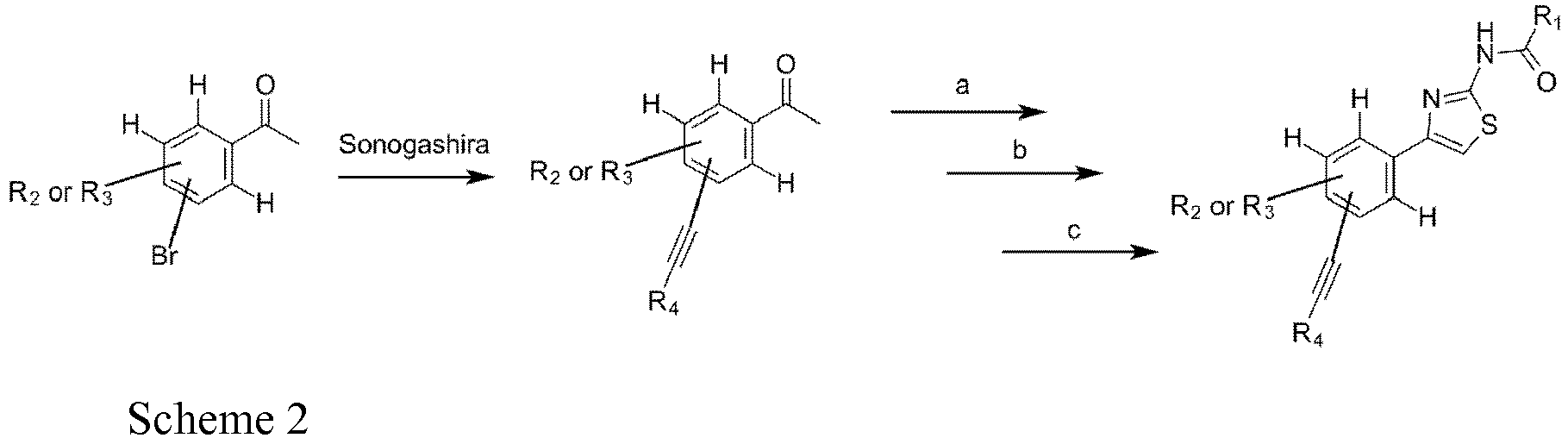
- When both -R2 and -R3 are -C≡C-R4 and -R2 and -R3 are the same, the compounds of this invention may be obtained similarly to those depicted in scheme 1 and 2 above, but starting from a di-halo derivative and by inserting both R2 and R3 via the Sonogashira reaction as depicted in schemes 3 and 4 below

- When both -R2 and -R3 are -C≡C-R4 and they are not the same, such groups may be inserted sequentially into the above depicted di-halo precursor via a Sonogashira coupling, either by inserting the first group at the bromide-substituted carbon via a Sonogashira reaction under the Buchwald conditions using 1 equivalent of alkyne - which however may lead to the formation of a portion of unwanted disubstituted compound- and then performing a second Sonogashira coupling with the same conditions at the chlorine substituted atom, or by inserting the first group at the bromine-substituted carbon via a controlled copper and Pd(PPh3)4-catalysed Sonogashira reaction and the second group via a Sonogashira reaction at the chlorine atom under the Buchwald conditions.
- The compounds of the invention may be tested in a relevant animal model or in the following assays.
- GST-tagged recombinant wild-type or L1196M mutated ALK kinase (rALK) was expressed in Sf9 insect cells using the pBacPAK baculovirus vector system (Clontech) and purified using Glutathione Sepharose 4B affinity beads (GE Healthcare). Recombinant 3C protease was used to remove the GST tag. Purified ALK was used to screen inhibitors in the ELISA-based kinase assay, as follows: Nunc-Immuno 96-well plates were incubated overnight at 30°C with coating solution containing 2 µg of a specific ALK peptide substrate (ARDIYRASFFRKGGCAMLPVK) in PBS. Wells were then washed with 200 µL of wash buffer (PBS-Tween 0.05%) and incubated with 4% BSA in PBS for at least 2 h at 30°C. The kinase reaction was performed in the presence of 50 mM Tris pH 7.5, 5 mM MnCl2, 5 mM MgCl2, 0.3 mM ATP and purified rALK in a total volume of 100 µL /well at 30°C for 15 min. For inhibitor testing the reaction mix was preincubated with inhibitor or vehicle for 10 min at room temperature before transferring to the ELISA plate. After the reaction, the wells were washed 5 times with 200 uL of wash buffer. Phosphorylated peptide was detected using 100 µL/well of a mouse monoclonal anti-phosphotyrosine antibody (clone 4G10 UpstateBiotech Ltd) diluted 1:2000 in PBS + 4% BSA. After 30 min incubation at room temperature the antibody was removed and wells were washed as described above. 100 µL of a secondary antibody (anti-mouse IgG, Horseradish Peroxidase linked whole antibody, Amersham Pharmacia Biotech) diluted 1:1000 in PBS + 4% BSA was added to each well and the plate was incubated again for 30 min at room temperature before washing as above. The plate was developed using 100 µL/well TMB Substrate Solution (Pierce) and the reaction was stopped by adding an equal volume of 1M H2SO4. Finally, the absorbance was read at 450 nm using an ELISA plate reader (Bio-Rad). The concentration of inhibitor showing 50% inhibition as compared with the control was expressed as IC50 (µM).
- The following procedure uses parental untransformed BaF3 cells, BaF3 cells transformed with the oncogenic fusion protein NPM/ALK, BaF3 cells transformed with the mutated oncogenic fusion protein NPM/ALK carrying the substitution L1196M, human NPM/ALK-positive SUDHL-1 and Karpas-299 cells, human ALK-negative U937 and HL-60 leukemic cells. The parent untransformed BaF3 cells and ALK-negative cells are used as controls. Cells are seeded in U-bottomed 96-well plates at 10 000 cells/well in a volume of 100 µL in supplemented medium. In the case of the parent untransformed BaF3 cells, the medium is supplemented with IL-3. Serial dilutions of inhibitors are added to the appropriate wells and volumes adjusted to 200 µL. Controls were treated with the equivalent volume of vehicle, DMSO, alone. Plates are incubated at 37°C for 72 h. 3[H]-thymidine (1 µCi/well) is added for the last 8 h of incubation. Cells are harvested on to paper filters and 3[H]-thymidine incorporation is measured using a β scintillation counter (1430 MicroBeta, Wallac, Turku, Finland). The 50% inhibitory concentration (IC50) is defined as the concentration of inhibitor, expressed in micromolar, that give a 50% decrease in 3[H]-thymidine uptake compared with controls.
- Compounds under formula I are formulated preferably in admixture with a pharmaceutically acceptable carrier, excipient or the like. In general, it is preferable to administer the pharmaceutical composition in orally-administrable form, but certain formulations may be administered via a parenteral, intravenous, intramuscular, transdermal, buccal, subcutaneous, suppository, nasal or other route. One of ordinary skill in the art may modify the formulations within the teachings of the specification to provide numerous formulations for a particular route of administration without rendering the compositions of the present invention unstable or compromising their therapeutic activity. In particular, the modification of the present compounds to render them more soluble in water or other vehicle, for example, may be easily accomplished by minor modifications (salt formulation, esterification, etc.) which are well within the ordinary skill in the art. It is also well within the routineer's skill to modify the route of administration and dosage regimen of a particular compound in order to manage the pharmacokinetics of the present compounds for maximum beneficial effect in patients. In certain pharmaceutical dosage forms, the pro-drug form of the compounds, especially including ester and ether derivatives, as well as various salt forms of the present compounds, are preferred. One of ordinary skill in the art will recognize how to readily modify the present compounds to pro- drug forms to facilitate delivery of active compounds to a targeted site within the host organism or patient. The routineer also will take advantage of favourable pharmacokinetic parameters of the pro-drug forms, where applicable, in delivering the present compounds to a targeted site within the host organism or patient to maximize the intended effect of the compound. Actual methods of preparing such dosage forms are known, or will be apparent, to those skilled in this art; for example, see Remington's Pharmaceutical Sciences, Mack Publishing Company, Easton, Pennsylvania, 15th Edition, 1975. The composition or formulation to be administered will, in any event, contain a quantity of the active compound in an amount effective to alleviate the symptoms of the subject being treated. While human dosage levels have yet to be optimized for the compounds of the invention, generally, a daily dose is from about 0.05 mg/kg to about 100 mg/kg of body weight. The amount of active compound administered will, of course, be dependent on the subject and disease state being treated, the severity of the affliction, the manner and schedule of administration and the judgment of the prescribing physician. For purposes of the present invention, a prophylactically or preventive effective amount of the compositions according to the present invention (i.e., an amount which substantially reduces the risk that a patient will either succumb to a disease state or condition or that the disease state or condition will worsen) falls within the same concentration range as set forth above for therapeutically effective amounts and is usually the same as a therapeutically effective amount. In some embodiments of the present invention, one or more compounds of formula (I) are administered in combination with one or more other pharmaceutically active agents. The phrase "in combination", as used herein, refers to agents that are simultaneously administered to a subject. It will be appreciated that two or more agents are considered to be administered "in combination" whenever a subject is simultaneously exposed to both (or more) of the agents. Each of the two or more agents may be administered according to a different schedule; it is not required that individual doses of different agents be administered at the same time, or in the same composition. Rather, so long as both (or more) agents remain in the subject's body, they are considered to be administered "in combination".
- Examples 1 to 50 below represent individual embodiments of this invention
- At room temperature and under an inert atmosphere, the bromide moiety (1 eq.) was placed in a Schlenk tube, followed by the addition of PdCl2(CH3CN)2 (0.08 eq.), 2-dicyclohexylphosphino-2',4',6'-triisopropylbiphenyl (0.16 eq.) and Cs2CO3 (2.6 eq.). The tube was evacuated and back-filled with argon (this was repeated three additional times). Acetonitrile (1 mL) was added and then the alkyne (2 eq.) was injected. The reaction mixture was allowed to stir at 90°C overnight. Then the reaction mixture was cooled to room temperature. The mixture was diluted with DCM, filtered through Celite and washed with DCM. The organic layer was evaporated under reduced pressure.
- At room temperature and under an inert atmosphere, the bromide moiety (1 eq.) was placed in a Schlenk tube, followed by the addition of PdCl2(CH3CN)2 (0.16 eq.), 2-dicyclohexylphosphino-2',6'-dimethoxybiphenyl (0.32 eq.) and Cs2CO3 (5.2 eq.). The tube was evacuated and back-filled with argon (this was repeated three additional times). Acetonitrile (1 mL) was added and then the alkyne (2 eq.) was injected. The reaction mixture was allowed to stir at 90°C overnight. Then the reaction mixture was cooled to room temperature. The mixture was diluted with DCM, filtered through Celite and washed with DCM. The organic layer was evaporated under reduced pressure.
- At room temperature and under an inert atmosphere, the bromide moiety (1 eq.) was placed in a Schlenk tube, followed by the addition of Pd(PPh3)4 (0.05 equiv.), CuI (0.1 equiv.) and K3PO4 (1.1 equiv.). The tube was evacuated and back-filled with argon (this was repeated three additional times). THF (1 mL) was added and then the alkyne (2 equiv.) was injected. The reaction mixture was allowed to stir at 70°C overnight. Then the reaction mixture was cooled to room temperature. The mixture was diluted with DCM, filtered through Celite and washed with DCM. The organic layer was evaporated under reduced pressure.
- At room temperature and under an inert atmosphere, the bromide moiety (1 eq.) was placed in a Schlenk tube, followed by the addition of PdCl2(CH3CN)2 (0.08 eq.), 2-dicyclohexylphosphino-2',4',6'-triisopropylbiphenyl (0.16 eq.) and K2CO3 (2 eq.). The tube was evacuated and back-filled with argon (this was repeated three additional times). Acetonitrile (1 mL) was added and then the alkyne (2 eq.) was injected. The reaction mixture was allowed to stir at 90°C overnight. Then the reaction mixture was cooled to room temperature. The mixture was diluted with DCM, filtered through Celite and washed with DCM. The organic layer was evaporated under reduced pressure.
- At room temperature and under an inert atmosphere, the bromide moiety (1 eq.) was placed in a Schlenk tube, followed by the addition of PdCl2(CH3CN)2 (0.16 eq.), 2-dicyclohexylphosphino-2',4',6'-dimethoxybiphenyl (0.32 eq.) and K2CO3 (4 eq.). The tube was evacuated and back-filled with argon (this was repeated three additional times). Acetonitrile (1 mL) was added and then the alkyne (2 eq.) was injected. The reaction mixture was allowed to stir at 90°C overnight. Then the reaction mixture was cooled to room temperature. The mixture was diluted with DCM, filtered through Celite and washed with DCM. The organic layer was evaporated under reduced pressure.
-

- According the general procedure D using N-(4-(3-bromophenyl)thiazol-2-yl)-4-((4-methylpiperazin-1-yl)methyl)benzamide (30 mg, 0.063 mmol). Purification by silica gel flash chromatography (DCM/MeOH 85:15) afforded the product (19.6 mg, 64%) as a yellow viscous oil. 1H NMR (400 MHz, CDCl3) δ 7.95 (dd, J = 1.5, 1.5 Hz, 1H, Har), 7.85 (d, J = 8.1 Hz, 2H, Har), 7.73 (dd, J = 7.8, 1.5 Hz, 1H, Har), 7.58 - 7.53 (m, 2H, Har), 7.46 - 7.31 (m, 8H, Har), 7.23 (s, 1H, Har), 3.54 (s, 2H, CH2), 2.48 (bs, 8H, 4xCH2), 2.30 (s, 3H, CH3). 13C NMR (101 MHz, CDCl3) δ 165.1 (C), 159.0 (C), 149.6 (C), 144.3 (C), 134.7 (C), 132.0 (CH), 131.3 (CH), 131.0 (C), 129.7 (CH), 129.6 (CH), 129.1 (CH), 128.7 (CH), 127.8 (CH), 126.2 (CH), 124.1 (C), 123.5 (C), 109.0 (CH), 90.0 (C), 89.5 (C), 62.7 (CH2), 55.3 (CH2), 53.2 (CH2), 46.2 (CH3). HRMS [M+H]+ C30H29N4OS: Calcd. 493.2057 found 493.2059. Purity: 97.6%.
-

- According the general procedure D using N-(4-(3-bromophenyl)thiazol-2-yl)-4-((4-methylpiperazin-1-yl)methyl)benzamide (30 mg, 0.063 mmol). Purification by silica gel flash chromatography (DCM/MeOH 85:15) afforded the product (13.2 mg, 42%) as a yellow viscous oil. 1H NMR (300 MHz, CDCl3) δ 7.95 (dd, J = 1.5,1.5 Hz, 1H, Har), 7.87 (d, J = 8.2 Hz, 2H, Har), 7.73 (ddd, J = 7.7, 2.8, 1.4 Hz, 1H), 7.47 - 7.40 (m, 6H, Har), 7.34 (dd, J = 7.7, 7.7 Hz, 1H, Har), 7.23 (s, 1H, Har), 7.17 (d, J = 8.0 Hz, 2H, Har), 3.56 (s, 2H, CH2), 2.51 (bs, 8H, 4xCH2), 2.38 (s, 3H, CH3), 2.33 (s, 3H, CH3). 13C NMR (75 MHz, CDCl3) δ 165.0 (C), 158.9 (C), 149.6 (C), 144.3 (C), 138.9 (C), 134.7 (C), 131.9 (CH), 131.3 (CH), 130.9 (C), 129.7 (CH), 129.5 (CH), 129.5 (CH), 129.1 (CH), 109.0 (CH), 90.2 (C), 88.9 (C), 62.7 (CH2), 55.3 (CH2), 53.1 (CH2), 46.1 (CH3), 21.9 (CH3). HRMS [M+H]+ C31H31N4OS: Calcd. 507.2213 found 507.2226. Purity: 96.6%.
-

- According the general procedure D using N-(4-(3-bromophenyl)thiazol-2-yl)-4-((4-methylpiperazin-1-yl)methyl)benzamide (30 mg, 0.063 mmol). Purification by silica gel flash chromatography (DCM/MeOH 85:15) afforded the product (15.2 mg, 47%) as a yellow viscous oil. 1H NMR (400 MHz, CDCl3) δ 7.90 (dd, J = 1.5, 1.5 Hz, 1H, Har), 7.83 (d, J = 8.2 Hz, 2H, Har), 7.69 (dd, J = 7.8, 2.8, 1.5 Hz, 1H), 7.48 (d, J = 8.8 Hz, 2H, Har), 7.41 - 7.36 (m, 3H, Har), 7.30 (dd, J = 7.7, 7.7 Hz, 1H, Har), 7.22 (s, 1H, Har), 6.89 (d, J = 8.8 Hz, 2H, Har), 3.83 (s, 3H, CH3), 3.53 (s, 2H, CH2), 2.49 (bs, 8H, 4xCH2), 2.31 (s, 3H, CH3). 13C NMR (101 MHz, CDCl3) δ 165.2 (C), 160.0 (C), 159.1 (C), 149.6 (C), 144.2 (C), 134.6 (C), 133.4 (CH), 131.1 (CH), 131.0 (C), 129.6 (CH), 129.4 (CH), 129.0 (CH), 127.8 (CH), 125.8 (CH), 124.3 (C), 115.6 (C), 114.4 (CH), 108.9 (CH), 90.1 (C), 88.2 (C), 62.7 (CH2), 55.6 (CH3), 55.3 (2xCH2), 53.1 (2xCH2), 46.1 (CH3). HRMS [M+H]+ C31H31N4O2S: Calcd. 523.2162 found 523.2157. Purity: 100%.
-

- According the general procedure D using N-(4-(3-bromo-4-methylphenyl)thiazol-2-yl)-4-((4-methylpiperazin-1-yl)methyl)benzamide (32 mg, 0.066 mmol). Purification by silica gel flash chromatography (DCM/MeOH 85:15) afforded the product (21.3 mg, 64%) as a yellow viscous oil. 1H NMR (400 MHz, CDCl3) δ 7.90 (d, J = 1.7 Hz, 1H, Har), 7.85 (d, J = 8.2 Hz, 2H, Har), 7.63 (dd, J = 8.0, 1.8 Hz, 1H, Har), 7.55 (dd, J = 7.2, 2.4 Hz, 2H, Har), 7.44 - 7.34 (m, 5H, Har), 7.21 (d, J = 8.1 Hz, 1H, Har), 7.17 (s, 1H, Har), 3.55 (s, 2H, CH2), 2.50 (s, 3H, CH3), 2.48 (bs, 8H, 4xCH2), 2.31 (s, 3H, CH3). 13C NMR (101 MHz, CDCl3) δ 165.0 (C), 158.9 (C), 149.7 (C), 144.3 (C), 140.2 (C), 132.2 (C), 131.9 (2xCH), 131.0 (C), 130.2 (CH), 129.9 (C), 129.8 (CH), 129.67 (CH), 129.26 (C), 128.73 (2xCH), 128.63 (CH), 127.78 (CH), 126.19 (CH), 123.8 (C), 108.2 (CH), 93.9 (C), 88.5 (C), 62.7 (CH2), 55.3 (2xCH2), 53.3 (2xCH2), 46.2 (CH3), 20.8 (CH3). HRMS [M+H]+ C31H30N4OS: Calcd. 507.2217 found 507.2213. Purity: 92.6%.
-

- According the general procedure D using N-(4-(3-bromo-4-methylphenyl)thiazol-2-yl)-4-((4-methylpiperazin-1-yl)methyl)benzamide (32 mg, 0.066 mmol). Purification by silica gel flash chromatography (DCM/MeOH 85:15) afforded the product (21.2 mg, 62%) as a yellow viscous oil. 1H NMR (300 MHz, CDCl3) δ 7.87 (d, J = 1.8 Hz, 1H, Har), 7.83 (d, J = 8.2 Hz, 2H, Har), 7.60 (dd, J = 7.9, 1.8 Hz, 1H, Har), 7.45 (d, J = 8.1 Hz, 2H, Har), 7.38 (d, J = 8.2 Hz, 3H), 7.20 - 7.15 (m, 4H, Har), 3.54 (s, 2H, CH2), 2.50 (s, 3H, CH3), 2.48 (bs, 8H, 4xCH2), 2.38 (s, 3H, CH3), 2.31 (s, 3H, CH3). 13C NMR (75 MHz, CDCl3) δ 165.1 (C), 159.0 (C), 149.7 (C), 144.2 (C), 140.1 (C), 138.8 (C), 132.1 (C), 131.7 (2xCH), 131.0 (C), 130.1 (CH), 129.7 (CH), 129.6 (2xCH), 129.5 (2xCH), 127.8 (2xCH), 126.0 (CH), 123.9 (C), 120.6 (C), 108.1 (CH), 94.1 (C), 87.8 (C), 62.7 (CH2), 55.3 (2xCH2), 53.2 (2xCH2), 46.2 (CH3), 21.9 (CH3), 20.8 (CH3). HRMS [M+H]+ C32H32N4OS: Calcd. 521.2370 found 521.2373. Purity: 95.0%.
-

- According the general procedure D using N-(4-(3-bromo-4-methylphenyl)thiazol-2-yl)-4-((4-methylpiperazin-1-yl)methyl)benzamide (30 mg, 0.062 mmol). Purification by silica gel flash chromatography (DCM/MeOH 85:15) afforded the product (12 mg, 36%) as a yellow viscous oil. 1H NMR (400 MHz, CDCl3) δ 7.91 (d, J = 1.7 Hz, 1H), 7.89 (d, J = 8.2 Hz, 2H, Har), 7.63 (dd, J = 7.9, 1.8 Hz, 1H, Har), 7.49 (d, J = 8.7 Hz, 2H, Har), 7.45 (d, J = 8.2 Hz, 2H, Har), 7.23 (d, J = 8.0 Hz, 1H, Har), 7.17 (s, 1H, Har), 6.90 (d, J = 8.8 Hz, 2H, Har), 3.84 (s, 3H, CH3), 3.57 (s, 2H, CH2), 2.53 (bs, 8H, 4xCH2), 2.51 (s, 3H, CH3), 2.34 (s, 3H, CH3). 13C NMR (101 MHz, CDCl3) δ 164.83 (C), 160.02 (C), 158.70 (C), 149.79 (C), 144.23 (C), 140.07 (C), 133.33 (2xCH), 132.21 (C), 131.03 (C), 130.17 (CH), 129.76 (2xCH), 129.62 (CH), 127.79 (2xCH), 125.88 (CH), 124.14 (C), 115.91 (C), 114.40 (2xCH), 108.14 (CH), 93.93 (C), 87.21 (C), 62.68 (CH2), 55.68 (CH3), 55.27 (2xCH2), 53.08 (2xCH2), 46.06 (CH3), 20.87 (CH3). HRMS [M+H]+ C32H32N4OS: Calcd. 537.2319 found 537.2324. Purity: 89.3%.
-

- According the general procedure D using N-(4-(3-bromo-4-methylphenyl)thiazol-2-yl)-4-((4-methylpiperazin-1-yl)methyl)benzamide (30 mg, 0.062 mmol). Purification by silica gel flash chromatography (DCM/MeOH 85:15) afforded the product (19.6 mg, 56%) as a yellow viscous oil. 1H NMR (400 MHz, CDCl3) δ 7.91 (d, J = 1.7 Hz, 1H, Har), 7.85 (d, J = 8.2 Hz, 2H, Har), 7.70 (dd, J = 7.7, 3.7 Hz, 1H, Har), 7.65 (dd, J = 8.0, 1.8 Hz, 1H, Har), 7.55 (dd, J = 7.6, 7.6 Hz, 1H, Har), 7.44 (d, J = 7.7 Hz, 1H, Har), 7.41 (d, J = 8.1 Hz, 2H, Har), 7.22 (d, J = 8.0 Hz, 1H, Har), 7.18 (s, 1H, Har), 3.54 (s, 2H, CH2), 2.50 (s, 3H, CH3), 2.48 (bs, 8H, 4xCH2), 2.31 (s, 3H, CH3). 13C NMR (101 MHz, CDCl3) δ 165.05 (C), 159.00 (C), 149.56 (C), 144.26 (C), 140.75 (C), 134.35 (CH), 132.25 (C), 131.81 (CH), 131.49 (q, J = 30.4 Hz, C), 131.00 (C), 130.29 (CH), 130.07 (CH), 129.67 (2xCH), 128.30 (CH), 127.80 (2xCH), 126.77 (CH), 126.24 (q, J = 5.6 Hz, CH), 123.98 (d, J = 273.4 Hz, C), 123.23 (C), 122.00 (C), 108.32 (CH), 94.10 (C), 89.60 (C), 62.70 (CH2), 55.28 (2xCH2), 53.21 (2xCH2), 46.13 (CH3), 20.67 (CH3). HRMS [M+H]+ C32H30F3N4OS: Calcd. 575.2087 found 575.2069. Purity: 92.9%.
-

- According the general procedure D using N-(4-(3-bromo-4-methylphenyl)thiazol-2-yl)-4-((4-methylpiperazin-1-yl)methyl)benzamide (30 mg, 0.062 mmol). Purification by silica gel flash chromatography (DCM/MeOH 85:15) afforded the product (17.1 mg, 52%) as a yellow viscous oil. 1H NMR (400 MHz, CDCl3) δ 7.93 (d, J = 1.6 Hz, 1H, Har), 7.87 (d, J = 8.1 Hz, 2H, Har), 7.63 (dd, J = 7.9, 1.7 Hz, 1H, Har), 7.51 (dd, J = 7.5, 1.4 Hz, 1H, Har), 7.42 (d, J = 8.1 Hz, 2H, Har), 7.35 - 7.29 (m, 1H, Har), 7.22 (d, J = 8.0 Hz, 1H, Har), 7.17 (s, 1H, Har), 6.96 (dd, J = 7.6, 7.6 Hz, 1H, Har), 6.92 (d, J = 8.4 Hz, 1H, Har), 3.93 (s, 3H, CH3), 3.56 (s, 2H, CH2), 2.53 (s, 3H, CH3), 2.50 (bs, 8H, 4xCH2), 2.32 (s, 3H, CH3). 13C NMR (101 MHz, CDCl3) δ 165.0 (C), 160.3 (C), 158.8 (C), 149.8 (C), 144.2 (C), 140.4 (C), 133.7 (CH), 132.1 (C), 131.0 (C), 130.1 (CH), 130.1 (CH), 129.7 (2xCH), 129.6 (CH), 127.8 (2xCH), 126.1 (CH), 120.8 (CH), 113.0 (C), 111.1 (CH), 108.1 (CH), 92.6 (C), 90.3 (C), 62.7 (CH2), 56.2 (CH3), 55.2 (2xCH2), 53.1 (2xCH2), 46.1 (CH3), 20.8 (CH3). HRMS [M+H]+ C33H33N4OS: Calcd. 537.2319 found 537.2303. Purity: 96.9%.
-

- According the general procedure D using N-(4-(3-bromo-4-methylphenyl)thiazol-2-yl)-4-((4-methylpiperazin-1-yl)methyl)benzamide (30 mg, 0.062 mmol). Purification by silica gel flash chromatography (DCM/MeOH 85:15) afforded the product (15.4 mg, 52%) as a yellow viscous oil. 1H NMR (300 MHz, CDCl3) δ 7.91 (d, J = 1.7 Hz, 1H, Har), 7.87 (d, J = 8.2 Hz, 2H, Har), 7.64 (dd, J = 7.9, 1.8 Hz, 1H, Har), 7.57 - 7.50 (m, 2H, Har), 7.43 (d, J = 8.2 Hz, 2H, Har), 7.23 (d, J = 8.1 Hz, 1H, Har), 7.17 (s, 1H, Har), 7.09 - 7.04 (m, 2H, Har), 3.56 (s, 2H, CH2), 2.54 (bs, 8H, 4xCH2), 2.50 (s, 3H, CH3), 2.32 (s, 3H, CH3). 13C NMR (101 MHz, CDCl3) δ 164.92 (C), 162.88 (d, J = 249.4 Hz, C), 158.88 (C), 149.65 (C), 144.26 (C), 140.20 (C), 133.74 (d, J = 8.3 Hz, 2xCH), 132.26 (C), 130.99 (C), 130.01 (d, J = 44.7 Hz, 2xCH), 129.73 (2xCH), 127.80 (2xCH), 126.27 (CH), 123.63 (C), 119.84 (C), 116.04 (d, J = 22.1 Hz, 2xCH), 108.24 (CH), 92.78 (C), 88.17 (C), 62.70 (CH2), 55.24 (2xCH2), 53.15 (2xCH2), 46.07 (CH3), 20.83 (CH3). HRMS [M+H]+ C31H30FN4OS: Calcd. 525.2119 found 525.2116. Purity: 96.1%.
-

- According the general procedure D using N-(4-(3-methyl-4-bromophenyl)thiazol-2-yl)-4-((4-methylpiperazin-1-yl)methyl)benzamide (23 mg, 0.047 mmol). Purification by silica gel flash chromatography (DCM/MeOH 85:15) afforded the product (14.2 mg, 58%) as a yellow viscous oil. 1H NMR (400 MHz, CDCl3) δ 10.37 (bs, 1H, Har), 7.83 (d, J = 8.2 Hz, 2H, Har), 7.64 (bs, 1H, Har), 7.56 (dd, J = 8.0, 1.4 Hz, 1H, Har), 7.48 - 7.37 (m, 5H, Har), 7.21 (s, 1H, Har), 7.16 (d, J = 8.1 Hz, 2H, Har), 3.53 (s, 2H, CH2), 2.51 (s, 3H, CH3), 2.47 (bs, 8H, 4xCH2), 2.37 (s, 3H, CH3), 2.29 (s, 3H, CH3). 13C NMR (101 MHz, CDCl3) δ 165.0 (C), 158.9 (C), 150.0 (C), 144.4 (C), 140.8 (C), 138.7 (C), 134.0 (C), 132.4 (CH), 131.7 (2xCH), 130.9 (C), 129.7 (2xCH), 129.5 (2xCH), 127.7 (2x CH), 127.2 (CH), 123.5 (CH), 123.2 (C), 120.7 (C), 108.9 (CH), 94.8 (C), 88.0 (C), 62.7 (CH2), 55.4 (2xCH2), 53.4 (2xCH2), 46.3 (CH3), 21.9 (CH3), 21.2 (CH3). HRMS [M+H]+ C32H33N4OS: Calcd. 521.2370 found 521.2373. Purity: 97.8%.
-

- According general procedure D using N-(4-(3-methyl-4-bromophenyl)thiazol-2-yl)-4-((4-methylpiperazin-1-yl)methyl)benzamide (23 mg, 0.047 mmol). Purification by silica gel flash chromatography (DCM/MeOH 85:15) afforded the product (16.1 mg, 60%) as a yellow viscous oil. 1H NMR (400 MHz, CDCl3) δ 10.36 (bs, 1H, NH), 7.83 (d, J = 8.1 Hz, 2H, Har), 7.73 - 7.64 (m, 1H, Har), 7.60 - 7.37 (m, 6H, Har), 7.23 (s, 1H, Har), 3.53 (s, 2H, CH2), 2.52 (s, 3H, CH3), 2.47 (bs, 8H, 4xCH2), 2.29 (s, 3H, CH3). 13C NMR (101 MHz, CDCl3) δ 165.1 (C), 158.9 (C), 149.8 (C), 144.4 (C), 141.3 (C), 134.8 (C), 134.2 (CH), 132.9 (CH), 131.8 (CH), 131.4 (q, J = 30.3 Hz, C), 130.8 (C), 129.7 (2xCH), 128.2 (CH), 127.7 (2xCH), 127.4 (CH), 126.2 (q, J = 5.3 Hz, CH), 124.0 (d, J = 273.2 Hz, C), 123.5 (CH), 122.4 (C), 122.0 (q, J = 2.0 Hz, C), 109.3 (CH), 94.3 (C), 90.2 (C), 62.7 (CH2), 55.4 (2xCH2), 53.5 (2xCH2), 46.3 (CH3), 21.0 (CH3). HRMS (ESI) [M+H]+ C32H30F3N4OS: Calcd. 575.2087 found 575.2085. Purity: 97.8%.
-

- According general procedure D using N-(4-(3-bromophenyl)thiazol-2-yl)-4-((4-methylpiperazin-1-yl)methyl)benzamide (28 mg, 0.059 mmol). Purification by silica gel flash chromatography (DCM/MeOH 85:15) afforded the product (4.8 mg, 15%) as a yellow viscous oil. 1H NMR (400 MHz, CDCl3) δ 9.88 (bs, 1H, NH), 8.01 (d, J = 1.5,1.5 Hz, 1H, Har), 7.91 (d, J = 8.2 Hz, 2H, Har), 7.81 (ddd, J = 7.8, 2.7, 1.3 Hz, 1H, Har), 7.70 (d, J = 8.1 Hz, 1H, Har), 7.69 (d, J = 7.3 Hz, 1H, Har), 7.57 - 7.45 (m, 5H, Har), 7.45 - 7.38 (m, 2H, Har), 7.25 (s, 1H, Har), 3.59 (s, 2H, CH2), 2.55 b(s, 8H, 4xCH2), 2.37 (s, 3H, CH3). 13C NMR (101 MHz, CDCl3) δ 164.7 (C), 158.6 (C), 149.5 (C), 144.3 (C), 134.9 (C), 134.1 (CH), 131.9 (q, J = 30.4 Hz, C), 131.8 (CH), 131.6 (CH), 131.0 (C), 129.8 (2xCH), 129.6 (CH), 129.2 (CH), 128.4 (CH), 127.8 (2xCH), 126.8 (CH), 126.3 (q, J = 5.2 Hz, CH), 124.0 (d, J = 273.3 Hz, C), 123.6 (C), 121.8 (d, J = 2.1 Hz, C), 109.1 (CH), 95.0 (C), 85.9 (C), 62.6 (CH2), 55.2 (2xCH2), 53.0 (2xCH2), 46.0 (CH3). HRMS (ESI) [M+H]+ C31H28F3N4OS: Calcd. 561.1903 found 561.1930. Purity: 97.0%.
-

- According general procedure E using N-(4-(4-bromo-3-chlorophenyl)thiazol-2-yl)-4-((4-methylpiperazin-1-yl)methyl)benzamide (30 mg, 0.059 mmol). Purification by silica gel flash chromatography (DCM/MeOH 85:15) afforded the product (17.4 mg, 41%) as a yellow viscous oil. 1H NMR (400 MHz, CDCl3) δ 7.99 (d, J = 1.6 Hz, 1H, Har), 7.85 (d, J = 8.2 Hz, 2H, Har), 7.78 - 7.67 (m, 5H, Har), 7.58 - 7.48 (m, 3H, Har), 7.47 - 7.38 (m, 4H, Har), 7.30 (s, 1H, Har), 3.54 (s, 2H, CH2), 2.48 (s, 8H, 4xCH2), 2.30 (s, 3H, CH3). 13C NMR (101 MHz, CDCl3) δ 165.2 (C), 159.1 (C), 148.8 (C), 144.5 (C), 134.7 (C), 134.5 (CH), 134.3 (CH), 133.3 (CH), 131.8 (q, J = 30.7 Hz, 2xC), 131.8 (d, J = 1.5 Hz, 2xCH), 130.9 (C), 130.2 (CH), 129.7 (2xCH), 128.5 (d, J = 7.0 Hz, 2xCH), 127.8 (2xCH), 126.3 (CH), 126.2 (q, J = 5.1 Hz, 2xCH), 125.7 (C), 124.6 (C), 123.9 (d, J = 273.4 Hz, 2xC), 121.8 - 121.6 (m, 2xC), 110.0 (CH), 93.7 (d, J = 0.7 Hz, C), 93.5 (C), 90.4 (C), 89.7 (C), 62.7 (CH2), 55.3 (2xCH2), 53.3 (2xCH2), 46.2 (CH3). HRMS [M+H]+ C40H31F6N4OS: Calcd. 729.2117 found 729.2094. Purity: 89.0%.
-

- According general procedure G using N-(4-(3-bromo-4-methylphenyl)thiazol-2-yl)-4-((4-methylpiperazin-1-yl)methyl)benzamide (30 mg, 0.062 mmol). Purification by silica gel flash chromatography (DCM/MeOH 9:1) afforded the product (27.3 mg, 75%) as a yellow viscous oil. 1H NMR (400 MHz, CDCl3) δ 7.82 (s, 1H, Har), 7.80 (d, J = 8.3 Hz, 2H, Har), 7.57 (dd, J = 7.9, 1.9 Hz, 1H, Har), 7.36 (d, J = 8.2 Hz, 2H, Har), 7.17 - 7.12 (m, 2H, Har), 3.52 (s, 2H, CH2), 2.47 (bs, 8H, 4xCH2), 2.43 (s, 3H, CH3), 2.32 (s, 3H, CH3), 1.14 (s, 21H, 3xCH(CH3)2). 13C NMR (101 MHz, CDCl3) δ 165.1 (C), 158.9 (C), 149.6 (C), 144.1 (C), 140.6 (C), 132.1 (C), 131.1 (C), 130.1 (CH), 130.0 (CH), 129.6 (2xCH), 127.8 (2xCH), 126.1 (CH), 124.0 (C), 108.2 (CH), 105.8 (C), 95.12 (C), 62.7 (CH2), 55.3 (2xCH2), 53.2 (2xCH2), 46.1 (CH3), 21.0 (CH3), 19.0 (6xCH3), 11.6 (3xCH). HRMS [M+H]+ C34H47N4OSSi: Calcd. 587.3234 found 587.3207. Purity: 98.8%.
-

- According general procedure G using N-(4-(4-bromo-3-methylphenyl)thiazol-2-yl)-4-((4-methylpiperazin-1-yl)methyl)benzamide (26 mg, 0.053 mmol). Purification by silica gel flash chromatography (DCM/MeOH 9:1) afforded the product (10.9 mg, 35%) as a yellow viscous oil. 1H NMR (400 MHz, CDC13) δ 7.86 (d, J = 8.3 Hz, 2H, Har), 7.63 (s, 1H, Har), 7.53 (dd, J = 8.0, 1.4 Hz, 1H, Har), 7.46 - 7.39 (m, 3H, Har), 7.19 (s, 1H, Har), 3.56 (s, 2H, CH2), 2.54 (bs, 8H, 4xCH2), 2.47 (s, 3H, CH3), 2.37 (s, 3H, CH3), 1.15 (s, 21H, 3xCH(CH3)2). 13C NMR (101 MHz, CDCl3) δ 164.8 (C), 158.7 (C), 150.0 (C), 144.2 (C), 141.3 (C), 134.2 (C), 133.0 (CH), 131.0 (C), 129.7 (2xCH), 127.7 (2xCH), 127.2 (CH), 123.4 (CH), 123.3 (C), 109.0 (CH), 106.0 (C), 95.9 (C), 62.6 (CH2), 55.2 (2xCH2), 52.9 (2xCH2), 46.0 (CH3), 21.4 (CH3), 19.0 (6xCH3), 11.7 (3xCH). HRMS [M+H]+ C34H47N4OSSi: Calcd. 587.3234 found 587.3211. Purity: 98.4%.
-

- According general procedure H using N-(4-(4-bromo-3-chlorophenyl)thiazol-2-yl)-4-((4-methylpiperazin-1-yl)methyl)benzamide (26 mg, 0.052 mmol). Purification by silica gel flash chromatography (DCM/MeOH 9:1) afforded the product (29.3 mg, 75%) as a yellow viscous oil. 1H NMR (400 MHz, CDCl3) δ 7.84 (d, J = 1.6 Hz, 1H, Har), 7.81 (d, J = 8.3 Hz, 2H, Har), 7.60 (dd, J = 8.1, 1.8 Hz, 1H, Har), 7.42 (d, J = 8.2 Hz, 1H, Har), 7.37 (d, J = 8.2 Hz, 2H, Har), 7.23 (s, 1H, Har), 3.52 (s, 2H, CH2), 2.46 (bs, 8H, 4xCH2), 2.30 (s, 3H, CH3), 1.14 (s, 42H, 6xCH(CH3)2). 13C NMR (101 MHz, CDCl3) δ 165.2 (C), 159.2 (C), 149.0 (C), 144.4 (C), 134.2 (CH), 134.0 (C), 131.0 (CH), 130.9 (C), 129.7 (2xCH), 127.8 (2xCH), 126.1 (C), 125.6 (CH), 125.2 (C), 109.6 (CH), 105.8 (C), 105.5 (C), 96.2 (C), 95.4 (C), 62.8 (CH2), 55.4 (2xCH2), 53.4 (2xCH2), 46.3 (CH3), 19.1 (6xCH3), 19.1 (6xCH3), 11.7 (3xCH), 11.7 (3xCH). HRMS [M+H]+ C44H65N4OSSi2: Calcd. 753.4412 found 753.4398. Purity: 87.3%.
-

- According general procedure F using N-(4-(3-bromophenyl)thiazol-2-yl)-4-((4-methylpiperazin-1-yl)methyl)benzamide (30 mg, 0.063 mmol). Purification by silica gel flash chromatography (DCM/MeOH 9:1) afforded the product (9.6 mg, 29%) as a yellow viscous oil. 1H NMR (400 MHz, CDCl3) δ 7.90 - 7.86 (m, 3H, Har), 7.72 (d, J = 7.7 Hz, 1H, Har), 7.44 (d, J = 8.1 Hz, 2H, Har), 7.39 (d, J = 7.7 Hz, 1H, Har), 7.30 (dd, J = 7.7, 7.7 Hz, 1H, Har), 7.20 (s, 1H, Har), 3.57 (s, 2H, CH2), 2.53 (bs, 8H, 4xCH2), 2.35 (s, 3H, CH3), 1.06 (t, J = 7.9 Hz, 9H, 3xCH 2 CH3), 0.69 (q, J = 7.9 Hz, 6H, 3xCH2 CH 3 ). 13C NMR (101 MHz, CDCl3) δ 164.9 (C), 158.8 (C), 149.5 (C), 144.3 (C), 134.6 (C), 131.9 (CH), 130.9 (C), 129.9 (CH), 129.8 (2xCH), 128.9 (CH), 127.8 (2xCH), 126.3 (CH), 124.1 (C), 109.0 (CH), 106.4 (C), 92.3 (C), 62.6 (CH2), 55.2 (2xCH2), 53.0 (2xCH2), 46.1 (CH3), 7.9 (3xCH2 CH 3 ), 4.8 (3xCH 2 CH3). HRMS [M+H]+ C30H39N4OSSi: Calcd. 531.2608 found 531.2600. Purity: 99.2%.
-

- According general procedure G using N-(4-(3-bromophenyl)thiazol-2-yl)-4-((4-methylpiperazin-1-yl)methyl)benzamide (51 mg, 0.109 mmol). Purification by silica gel flash chromatography (DCM/MeOH 9:1) afforded the product (8.6 mg, 16%) as a yellow viscous oil. 1H NMR (400 MHz, CDCl3) δ 7.89 (dd, J = 1.5, 1.5 Hz, 1H, Har), 7.86 (d, J = 8.3 Hz, 2H, Har), 7.73 (ddd, J = 7.8, 1.5, 1.5 Hz, 1H, Har), 7.43 (d, J = 8.2 Hz, 2H, Har), 7.38 (ddd, J = 7.6, 1.3, 1.3 Hz, 1H, Har), 7.30 (dd, J = 7.7, 7.7 Hz, 1H, Har), 7.21 (s, 1H, Har), 3.57 (s, 2H, CH2), 2.55 (bs, 8H, 4xCH2), 2.37 (s, 3H, CH3), 0.26 (s, 9H, 3xCH3Si). 13C NMR (101 MHz, CDCl3) δ 164.8 (C), 158.7 (C), 149.5 (C), 144.2 (C), 134.6 (C), 131.7 (CH), 131.0 (C), 129.9 (CH), 129.8 (2xCH), 129.0 (CH), 127.8 (2xCH), 126.4 (CH), 123.9 (C), 109.0 (CH), 105.1 (C), 94.8 (C), 62.6 (CH2), 55.2 (2xCH2), 52.9 (2xCH2), 46.0 (CH3), 0.3 (3xCH3Si). HRMS [M+H]+ C27H33N4OSSi: Calcd. 489.2132 found 489.2110. Purity: 97.7%.
-

- According general procedure G using N-(4-(3-bromophenyl)thiazol-2-yl)-4-((4-methylpiperazin-1-yl)methyl)benzamide (30 mg, 0.064 mmol). Purification by silica gel flash chromatography (DCM/MeOH 9:1) afforded the product (12.4 mg, 39%) as a yellow viscous oil. 1H NMR (400 MHz, CDCl3) δ 7.86 - 7.81 (m, 3H, Har), 7.67 (ddd, J = 7.4, 1.5, 1.5 Hz, 1H, Har), 7.40 (d, J = 8.2 Hz, 2H, Har), 7.32 (dd, J = 7.6, 1.4, 1.4 Hz, 1H, Har), 7.28 (d, J = 7.6 Hz, 1H, Har), 7.19 (s, 1H, Har), 6.25 - 6.21 (m, 1H, Har), 3.54 (s, 2H, CH2), 2.51 (bs, 8H, 4xCH2), 2.34 (s, 3H, CH3), 2.28 - 2.11 (m, 4H, Hcycl), 1.75 - 1.57 (m, 4H, Hcycl). 13C NMR (101 MHz, CDCl3) δ 165.0 (C), 158.9 (C), 149.7 (C), 144.2 (C), 135.8 (CH), 134.6 (C), 131.2 (CH), 131.0 (C), 129.7 (2xCH), 129.4 (CH), 129.0 (CH), 127.8 (2xCH), 125.6 (CH), 124.5 (C), 121.0 (C), 108.8 (CH), 91.9 (C), 86.9 (C), 62.7 (CH2), 55.3 (2xCH2), 53.1 (2xCH2), 46.1 (CH3), 29.6 (CHcycl), 26.1 (CHcycl), 22.7 (CHcycl), 21.8 (CHcycl). HRMS [M+H]+ C30H33N4OS: Calcd. 497.2370 found 497.2355. Purity: 95.2%.
-

- According general procedure G using N-(4-(3-bromophenyl)thiazol-2-yl)-4-((4-methylpiperazin-1-yl)methyl)benzamide (30 mg, 0.064 mmol). Purification by silica gel flash chromatography (DCM/MeOH 9:1) afforded the product (16.5 mg, 55%) as a yellow viscous oil. 1H NMR (400 MHz, CDCl3) δ 7.8 (d, J = 8.3 Hz, 2H, Har), 7.75 (dd, J = 1.7, 1.7 Hz,1H, Har), 7.61 (ddd, J = 7.1, 1.7, 1.7 Hz, 1H, Har), 7.36 (d, J = 8.2 Hz, 2H, Har), 7.26 - 7.20 (m, 2H, Har), 7.12 (s, 1H, Har), 3.51 (s, 2H, CH2), 2.49 (bs, 8H, 4xCH2), 2.36 (t, J = 7.0 Hz, 2H, CH2), 2.32 (s, 3H, CH3), 1.57 - 1.48 (m, 2H, CH2), 1.47 - 1.39 (m, 2H, CH2), 0.89 (t, J = 7.3 Hz, 3H, CH3). 13C NMR (101 MHz, CDCl3) δ 164.9 (C), 158.7 (C), 149.8 (C), 144.1 (C), 134.6 (C), 131.4 (CH), 131.0 (C), 129.7 (2xCH), 129.5 (CH), 128.9 (CH), 127.8 (2xCH), 125.5 (CH), 124.9 (C), 108.8 (CH), 91.1 (C), 80.7 (C), 62.6 (CH2), 55.2 (2xCH2), 52.8 (2xCH2), 45.9 (CH3), 31.2 (CH2), 22.4 (CH2), 19.5 (CH2), 14.0 (CH3). HRMS [M+H]+ C28H33N4OS: Calcd. 473.2370 found 473.2378. Purity: 85.1 %.
-

- According general procedure G using N-(4-(3-bromophenyl)thiazol-2-yl)-4-((4-methylpiperazin-1-yl)methyl)benzamide (30 mg, 0.064 mmol). Purification by silica gel flash chromatography (DCM/MeOH 9:1) afforded the product (21.5 mg, 50%) as a yellow viscous oil. 1H NMR (400 MHz, CDCl3) δ 7.85 (d, J = 8.2 Hz, 2H, Har), 7.80 - 7.74 (m, 5H, Har), 7.72 (dd, J = 7.2, 1.6 Hz, 1H, Har), 7.46 - 7.36 (m, 8H, Har), 7.31 - 7.26 (m, 2H, Har), 7.18 (s, 1H, Har), 4.56 (s, 2H, CH2), 3.55 (s, 2H, CH2), 2.52 (bs, 8H, 4xCH2), 2.35 (s, 3H, CH3), 1.09 (s, 9H, (CH3)3). 13C NMR (101 MHz, CDCl3) δ 165.0 (C), 158.8 (C), 149.6 (C), 144.2 (C), 136.0 (4xCH), 134.6 (C), 133.5 (C), 131.4 (CH), 131.0 (C), 130.1 (2xCH), 129.7 (2xCH), 129.5 (CH), 128.9 (CH), 128.1 (4xCH), 127.8 (2xCH), 126.1 (CH), 123.7 (C), 108.9 (CH), 88.2 (C), 85.2 (C), 62.6 (CH2), 55.2 (2xCH2), 53.5 (CH2), 53.0 (2xCH2), 46.0 (CH3), 27.1 (3xCH3), 19.6 (C). HRMS [M+H]+ C41H45N4O2SSi: Calcd. 685.3027 found 685.3044. Purity: 97.6%.
-

- According general procedure G using N-(4-(3-bromophenyl)thiazol-2-yl)-4-((4-methylpiperazin-1-yl)methyl)benzamide (30 mg, 0.064 mmol). Purification by silica gel flash chromatography (DCM/MeOH 9:1) afforded the product (15.8 mg, 42%) as a yellow viscous oil. 1H NMR (400 MHz, CDCl3) δ 7.86 - 7.83 (m, 3H, Har), 7.72 (ddd, J = 7.4, 1.6, 1.6 Hz, 1H, Har), 7.42 (d, J = 8.3 Hz, 2H, Har), 7.34 (ddd, J = 7.6, 1.5, 1.5 Hz, 1H, Har), 7.31 (d, J = 7.5 Hz, 1H, Har), 7.19 (s, 1H, Har), 4.62 (s, 2H, CH2), 3.56 (s, 2H, CH2), 2.53 (bs, 8H, 4xCH2), 2.35 (s, 3H, CH3), 1.12 (d, J = 5.8 Hz, 21H, ((CH3)2CH)3). 13C NMR (101 MHz, CDCl3) δ 164.9 (C), 158.8 (C), 149.6 (C), 144.2 (C), 134.7 (C), 131.4 (CH), 131.0 (C), 129.7 (2xCH), 129.5 (CH), 129.0 (CH), 127.7 (2xCH), 126.2 (CH), 123.8 (C), 108.9 (CH), 88.7 (C), 84.6 (C), 62.6 (CH2), 55.2 (2xCH2), 53.0 (CH2), 52.8 (2xCH2), 46.0 (CH3), 18.3 (6xCH3), 12.4 (3xCH). HRMS [M+H]+ C34H47N4O2SSi: Calcd. 603.3184 found 603.3192. Purity: 95.6%.
-
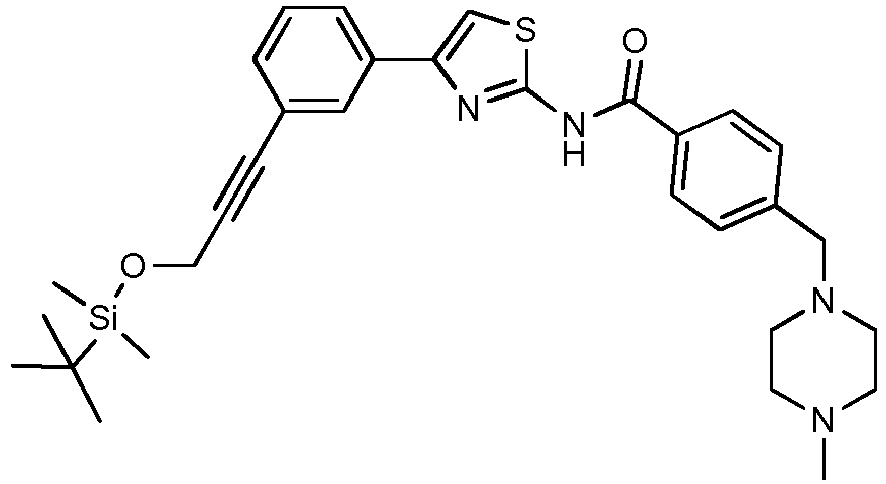
- According general procedure G using N-(4-(3-bromophenyl)thiazol-2-yl)-4-((4-methylpiperazin-1-yl)methyl)benzamide (30 mg, 0.064 mmol). Purification by silica gel flash chromatography (DCM/MeOH 9:1) afforded the product (14.1 mg, 40%) as a yellow viscous oil. 1H NMR (400 MHz, CDCl3) δ 7.87 - 7.84 (m, 3H, Har), 7.73 (ddd, J = 7.4, 1.6, 1.6 Hz, 1H, Har), 7.43 (d, J = 8.3 Hz, 2H, Har), 7.35 (ddd, J = 7.6, 1.4, 1.4 Hz, 1H, Har), 7.32 (d, J = 7.5 Hz, 1H, Ha), 7.19 (s, 1H, Har), 4.56 (s, 2H, CH2), 3.57 (s, 2H, CH2), 2.54 (bs, 8H, 4xCH2), 2.36 (s, 3H, CH3), 0.94 (s, 9H, (CH3)3), 0.18 (s, 6H, (CH3)2). 13C NMR (101 MHz, CDCl3) δ 164.9 (C), 158.7 (C), 149.6 (C), 144.2 (C), 134.7 (C), 131.4 (CH), 131.0 (C), 129.8 (2xCH), 129.5 (CH), 129.0 (CH), 127.8 (2xCH), 126.2 (CH), 123.8 (C), 108.9 (CH), 88.5 (C), 84.9 (C), 62.6 (CH2), 55.2 (2xCH2), 52.9 (CH2), 52.6 (2xCH2), 46.0 (CH3), 26.2 ((CH 3 ) 3 CSi), 18.7 ((CH3)3 CSi), -4.7 ((CH 3 ) 2 Si). HRMS [M+H]+ C31H41N4O2SSi: Calcd. 561.2714 found 561.2730. Purity: 97.5%.
-

- According general procedure G using N-(4-(3-bromophenyl)thiazol-2-yl)-4-((4-methylpiperazin-1-yl)methyl)benzamide (30 mg, 0.064 mmol). Purification by silica gel flash chromatography (DCM/MeOH 9:1) afforded the product (19.5 mg, 58%) as a yellow viscous oil. 1H NMR (400 MHz, CDCl3) δ 7.86 (dd, J = 1.5, 1.5 Hz, 1H, Har), 7.82 (d, J = 8.2 Hz, 2H, Har), 7.70 (ddd, J = 7.8, 1.5, 1.5 Hz, 1H, Har), 7.39 (d, J = 8.2 Hz, 2H, Har), 7.36 (ddd, J = 7.8, 1.4, 1.4 Hz, 1H, Har), 7.28 (d, J = 7.8 Hz, 1H, Har), 7.21 (s, 1H, Har), 3.54 (s, 2H, CH2), 2.50 (bs, 8H, 4xCH2), 2.33 (s, 3H, CH3), 1.00 (s, 9H, (CH3)3CSi), 0.19 (s, 6H, (CH3)2Si). 13C NMR (101 MHz, CDCl3) δ 165.0 (C), 158.9 (C), 149.5 (C), 144.3 (C), 134.6 (C), 131.7 (CH), 131.0 (C), 129.9 (CH), 129.7 (2xCH), 128.9 (CH), 127.7 (2xCH), 126.3 (CH), 124.0 (C), 109.0 (CH), 105.8 (C), 93.1 (C), 62.7 (CH2), 55.3 (2xCH2), 53.2 (2xCH2), 46.1 (CH3), 26.5 ((CH 3)3 CSi), 17.0 ((CH3)3 CSi), -4.23 ((CH 3 ) 2 Si). HRMS [M+H]+ C30H39N4O2SSi: Calcd. 531.2608 found 531.2612. Purity: 93.0%.
-

- According general procedure G using N-(4-(3-bromophenyl)thiazol-2-yl)-4-((4-methylpiperazin-1-yl)methyl)benzamide (30 mg, 0.064 mmol). Purification by silica gel flash chromatography (DCM/MeOH 9:1) afforded the product (20.6 mg, 50%) as a yellow viscous oil. 1H NMR (400 MHz, CDCl3) δ 7.95 (dd, J = 1.5, 1.5 Hz, 1H, Har), 7.82 - 7.78 (m, 6H, Har), 7.71 (ddd, J = 7.9, 1.5, 1.5 Hz, 1H, Har), 7.45 (ddd, J = 7.7, 1.4, 1.4 Hz, 1H, Har), 7.38 - 7.31 (m, 9H, Har), 7.17 (s, 1H, Har), 3.48 (s, 2H, CH2), 2.44 (bs, 8H, 4xCH2), 2.26 (s, 3H, CH3), 1.08 (s, 9H, (CH3)3). 13C NMR (101 MHz, CDCl3) δ 164.9 (C), 158.8 (C), 149.4 (C), 144.3 (C), 136.0 (4xCH), 134.8 (C), 133.6 (2xC), 132.0 (CH), 131.0 (C), 130.0 (CH), 129.9 (2xCH), 129.8 (2xCH), 129.1 (CH), 128.1 (4xCH), 127.8 (2xCH), 126.8 (CH), 123.8 (C), 109.1 (CH), 90.0 (C), 82.9 (C), 62.6 (CH2), 55.2 (2xCH2), 53.0 (2xCH2), 46.0 (CH3), 27.5 (3xCH3), 19.1 (C). HRMS [M+H]+ C30H39N4O2SSi: Calcd. 531.2608 found 531.2612. Purity: 100%.
-

- According general procedure G using N-(4-(3-bromophenyl)thiazol-2-yl)-5-(4-(4-methylpiperazine-1-carbonyl)phenyl)furan-2-carboxamide (30 mg, 0.054 mmol). Purification by silica gel flash chromatography (DCM/MeOH 9:1) afforded the product (11.1 mg, 32%) as a yellow viscous oil. 1H NMR (400 MHz, CDCl3) δ 7.84 (dd, J = 1.7, 1.7 Hz, 1H, Har), 7.74 (d, J = 8.3 Hz, 2H, Har), 7.70 (ddd, J = 7.8, 2.7, 1.4 Hz, 1H, Har), 7.50 (d, J = 8.3 Hz, 2H, Har), 7.42 (ddd, J = 7.8, 2.6, 1.4 Hz, 1H, Har), 7.41 (d, J = 3.6 Hz, 1H, Har), 7.31 (dd, J = 7.7, 7.7 Hz, 1H, Har), 7.18 (s, 1H, Har), 6.83 (d, J = 3.7 Hz, 1H, Har), 3.87 (bs, 2H, CH2), 3.56 (bs, 2H, CH2), 2.53 (bs, 4H, 2xCH2), 2.40 (s, 3H, CH3), 1.15 (s, 21H, 3x (CH3)2CH). 13C NMR (101 MHz, CDCl3) δ 169.8 (C), 157.8 (C), 156.3 (C), 155.5 (C), 149.9 (C), 145.6 (C), 136.3 (C), 134.6 (C), 132.1 (CH), 130.7 (C), 129.8 (CH), 128.9 (CH), 128.3 (2xCH), 126.3 (CH), 125.1 (2xCH), 124.4 (C), 119.7 (CH), 109.3 (CH), 107.0 (C), 91.2 (C), 55.2 (2xCH2), 55.0 (2xCH2), 46.1 (CH3), 19.0 (3x(CH 3 ) 2 CH), 11.7 (3x(CH3)2 CH). HRMS [M+H]+ C37H45N4O3SSi: Calcd. 653.2976 found 653.2959. Purity: 93.2%.
-

- According general procedure G using N-(4-(3-bromophenyl)thiazol-2-yl)-5-(4-(4-methylpiperazine-1-carbonyl)phenyl)furan-2-carboxamide (30 mg, 0.054 mmol). Purification by silica gel flash chromatography (DCM/MeOH 9:1) afforded the product (7.7 mg, 24%) as a yellow viscous oil. 1H NMR (400 MHz, CDCL3) δ 10.47 (s, 1H, NH), 7.81 (dd, J = 1.4, 1.4 Hz, 1H, Har), 7.70 (d, J = 8.3 Hz, 2H, Har), 7.67 (ddd, J = 7.8, 2.9, 1.4 Hz, 1H, Har), 7.48 (d, J = 8.4 Hz, 2H, Har), 7.39 (d, J = 3.6 Hz, 2H, Har), 7.38 (ddd, J = 7.8, 2.6, 1.3 Hz, 1H, Har), 7.29 (dd, J = 7.8, 7.8 Hz, 1H, Har), 7.16 (s, 1H, Har), 6.81 (d, J = 3.7 Hz, 1H, Har), 3.84 (bs, 2H, CH2), 3.52 (bs, 2H, CH2), 2.49 (bs, 4H, 2xCH2), 2.37 (s, 3H, CH3), 1.01 (s, 9H, 3xCH3), 0.20 (s, 6H, 2xCH3). 13C NMR (101 MHz, CDCl3) δ 169.8 (C), 157.9 (C), 156.2 (C), 155.5 (C), 149.8 (C), 145.6 (C), 136.4 (C), 134.6 (C), 131.9 (CH), 130.6 (C), 129.9 (CH), 128.9 (CH), 128.2 (2xCH), 126.4 (CH), 125.1 (2xCH), 124.0 (C), 119.7 (CH), 109.3 (CH), 109.2 (CH), 105.7 (C), 93.2 (C), 55.3 (2xCH2), 54.9 (2xCH2), 46.2 (CH3), 26.2 (3xCH3), 17.1 (C), -4.22 (2xCH3). HRMS [M+H]+ C34H39N4O3SSi: Calcd. 611.2507 found 611.2488. Purity: 95.7%.
-

- According general procedure G using N-(4-(3-bromophenyl)thiazol-2-yl)-5-(4-(4-methylpiperazine-1-carbonyl)phenyl)furan-2-carboxamide (30 mg, 0.054 mmol). Purification by silica gel flash chromatography (DCM/MeOH 9:1) afforded the product (3.5 mg, 10%) as a yellow viscous oil. 1H NMR (400 MHz, CDCl3) δ 10.14 (bs, 1H, NH), 7.80 - 7.66 (m, 4H, Har), 7.47 (d, J = 7.5 Hz, 2H, Har), 7.38 (d, J = 3.6 Hz, 2H, Har), 7.34 - 7.27 (m, 2H, Har), 7.12 (s, 1H, Har), 6.84 (d, J = 3.6 Hz, 1H, Har), 4.56 (s, 2H, CH2), 3.96 (bs, 4H, 2xCH2), 3.43 (bs, 4H, 2xCH2), 2.78 (s, 3H, CH3), 1.08 - 1.03 (m, 21H, 3x(CH3)2CH). 13C NMR (101 MHz, CDCl3) δ 170.1 (C), 164.6 (C), 157.7 (C), 155.8 (C), 155.3 (C), 145.9 (C), 134.3 (C), 131.7 (CH), 131.6 (C), 129.6 (CH), 129.1 (CH), 128.5 (2xCH), 126.3 (CH), 125.4 (2xCH), 123.9 (C), 119.7 (CH), 111.5 (C), 109.9 (CH), 109.2 (CH), 88.8 (C), 84.5 (C), 53.8 (2xCH2), 52.8 (2xCH2), 44.0 (CH3), 30.0 (CH2), 18.3 (3x(CH 3 ) 2 CH), 12.4 (3x(CH3)2 CH). HRMS [M+H]+ C38H47N4O4SSi: Calcd. 683.3082 found 638.3075. Purity: 61%.
-

- According general procedure G using N-(4-(3-bromophenyl)thiazol-2-yl)-5-(4-(4-methylpiperazine-1-carbonyl)phenyl)furan-2-carboxamide (30 mg, 0.054 mmol). Purification by silica gel flash chromatography (DCM/MeOH 9:1) afforded the product (13.8 mg, 40%) as a yellow viscous oil. 1H NMR (500 MHz, CDCl3) δ 10.33 (s, 1H, NH), 7.86 (s, 1H, Har), 7.69 (d, J = 8.0 Hz, 2H, Har), 7.62 (dd, J = 7.5, 4.3 Hz, 2H, Har), 7.50 - 7.27 (m, 8H, Har), 7.14 (s, 1H, Har), 6.78 (d, J = 3.6 Hz, 1H, Har), 3.88 (bs, 2H, CH2), 3.66 (bs, 2H, CH2), 2.69 (bs, 4H, 2xCH2), 2.47 (s, 3H, CH3). 13C NMR (101 MHz, CDCl3) δ 169.9 (C), 157.9 (C), 156.1 (C), 155.5 (C), 149.7 (C), 145.7 (C), 134.8 (C), 134.2 (CH), 131.9 (C), 131.8 (CH), 131.8 (q, J = 30.3 Hz, C), 131.6 (CH), 131.0 (C), 129.6 (CH), 129.2 (CH), 128.4 (CH), 128.3 (2xCH), 127.5 (CH), 126.8 (CH), 126.3 (q, J = 4.7 Hz, CH), 125.2 (2xCH), 123.9 (d, J = 273.6 Hz, C), 123.6 (C), 121.7 (d, J = 1.2 Hz, C), 119.7 (CH), 109.4 (d, J = 3.5 Hz, CH), 94.9 (C), 85.9 (C), 54.6 (2xCH2), 54.5 (2xCH2), 45.3 (CH3). HRMS [M+H]+ C35H28F3N4O3S: Calcd. 641.1829 found 641.1805. Purity: 91.1%.
-

- According general procedure G using N-(4-(3-bromophenyl)thiazol-2-yl)-4-((4-methylpiperazin-1-yl)methyl)benzamide (30 mg, 0.064 mmol). Purification by silica gel flash chromatography (DCM/MeOH 9:1) afforded the product (11.4 mg, 26%) as a yellow viscous oil. 1H NMR (300 MHz, CDCl3) δ 9.90 (bs, 1H, NH), 7.88 (dd, J = 1.5, 1.5 Hz, 1H, Har), 7.88 (d, J = 8.1 Hz, 2H, Har), 7.75 (ddd, J = 6.7, 2.0, 2.0 Hz, 1H, Har), 7.55 - 7.50 (m, 6H, Har), 7.46 (d, J = 8.2 Hz, 2H, Har), 7.37 - 7.30 (m, 9H, Har), 7.28 (dd, J = 1.3, 1.3 Hz, 1H, Har), 7.24 (ddd, J = 6.0, 1.2, 1.2 Hz, 1H, Har), 7.21 (s, 1H, Har), 4.01 (s, 2H, CH2), 3.57 (s, 2H, CH2), 2.51 (bs, 8H, 4xCH2), 2.33 (s, 3H, CH3). 13C NMR (101 MHz, CDCl3) δ 164.8 (C), 158.6 (C), 149.6 (C), 144.4 (C), 143.8 (4xC), 134.7 (C), 131.6 (CH), 130.9 (C), 129.8 (2xCH), 129.7 (CH), 129.0 (6xCH), 128.3 (6xCH), 127.7 (2xCH), 127.5 (4xCH), 126.2 (CH), 123.7 (C), 108.9 (CH), 87.9 (C), 86.5 (C), 85.4 (C), 62.7 (CH2), 55.3 (2xCH2), 54.0 (CH2), 53.2 (2xCH2), 46.2 (CH3). HRMS [M+H]+ C44H41N4O2S: Calcd. 689.2945 found 689.2911. Purity: 100.0%.
-

- According general procedure G using N-(4-(3-bromophenyl)thiazol-2-yl)-4-((4-methylpiperazin-1-yl)methyl)benzamide (30 mg, 0.064 mmol). Purification by silica gel flash chromatography (DCM/MeOH 9:1) afforded the product (12 mg, 37%) as a yellow viscous oil. 1H NMR (400 MHz, CDCl3) δ 10.59 (bs, 1H, NH), 7.86 (dd, J = 1.6, 1.6 Hz, 1H, Har), 7.74 (d, J = 8.2 Hz, 2H, Har), 7.65 (ddd, J = 7.9, 1.3, 1.3 Hz, 1H, Har), 7.47 (ddd, J = 7.3, 7.3, 1.7 Hz, 1H, Har), 7.36 (ddd, J = 7.7, 1.3, 1.3 Hz, 1H, Har), 7.30 (d, J = 8.3 Hz, 2H, Har), 7.28 - 7.21 (m, 2H, Har), 7.16 (s, 1H, Har), 7.10 - 7.06 (m, 1H, Har), 7.06 - 7.02 (m, 1H, Har), 3.46 (s, 2H, CH2), 2.41 (bs, 8H, 4xCH2), 2.24 (s, 3H, CH3). 13C NMR (101 MHz, CDCl3) δ 165.3 (C), 163.0 (d, J = 251.7 Hz, C), 159.3 (C), 149.6 (C), 144.3 (C), 134.8 (C), 133.9 (d, J = 0.9 Hz, CH), 131.5 (CH), 131.0 (C), 130.5 (d, J = 7.9 Hz, CH), 129.7 (3xCH), 129.1 (CH), 127.9 (2xCH), 126.6 (CH), 124.4 (d, J = 3.7 Hz, CH), 123.7 (C), 116.0 (d, J = 20.9 Hz, CH), 112.2 (d, J = 15.6 Hz, C), 109.1 (CH), 94.6 (d, J = 3.2 Hz, C), 83.4 (C), 62.7 (CH2), 55.3 (2xCH2), 53.2 (2xCH2), 46.2 (CH3). HRMS [M+H]+ C30H28FN4OS: Calcd. 511.1962 found 511.1948. Purity: 100.0%.
-

- According general procedure G using N-(4-(3-bromophenyl)thiazol-2-yl)-4-((4-methylpiperazin-1-yl)methyl)benzamide (30 mg, 0.064 mmol). Purification by silica gel flash chromatography (DCM/MeOH 9:1) afforded the product (14.2 mg, 44%) as a yellow viscous oil. 1H NMR (400 MHz, CDCl3) δ 10.49 (s, 1H, NH), 7.92 (dd, J = 1.3, 1.3 Hz, 1H, Har), 7.83 (dd, J = 8.1, 1.6 Hz, 2H, Har), 7.74 - 7.70 (m, 1H, Har), 7.56 - 7.49 (m, 2H, Har), 7.42 - 7.36 (m, 3H, Har), 7.32 (ddd, J = 7.7, 7.7, 1.8 Hz, 1H, Har), 7.23 (d, J = 1.8 Hz, 1H, Har), 7.06 (ddd, J = 8.6, 8.6, 1.8 Hz, 1H, Har), 3.54 (s, 2H, CH2), 2.50 (bs, 8H, 4xCH2), 2.33 (s, 3H, CH3). 13C NMR (101 MHz, CDCl3) δ 165.1 (C), 162.9 (d, J = 249.5 Hz, C), 159.1 (C), 149.5 (C), 144.2 (C), 134.7 (C), 133.9 (d, J = 8.3 Hz, 2xCH), 131.2 (CH), 130.9 (C), 129.7 (2xCH), 129.3 (d, J = 44.3 Hz, 2xCH), 127.8 (2xCH), 126.2 (CH), 123.8 (C), 119.5 (C), 116.0 (d, J = 22.1 Hz, 2xCH), 109.0 (CH), 89.1 (C), 88.9 (C), 62.6 (CH2), 55.2 (2xCH2), 53.1 (2xCH2), 46.0 (CH3). HRMS [M+H]+ C30H28FN4OS: Calcd. 511.1962 found 511.1969. Purity: 100.0%.
-

- According general procedure G using N-(4-(3-bromophenyl)thiazol-2-yl)-4-((4-methylpiperazin-1-yl)methyl)benzamide (60 mg, 0.127 mmol). Purification by silica gel flash chromatography (DCM/MeOH 9:1) afforded the product (63 mg, 79%) as a yellow viscous oil. 1H NMR (400 MHz, CDCl3) δ 11.04 (bs, 1H, NH), 7.97 (bs, 2H, Har), 7.92 (dd, J = 1.5, 1.5 Hz, 2H, Har), 7.82 (bs, 1H, Har), 7.78 (d, J = 8.2 Hz, 2H, Har), 7.71 (ddd, J = 7.8, 1.3, 1.3 Hz, 1H, Har), 7.37 (ddd, J = 7.7, 1.3, 1.3 Hz, 1H, Har), 7.31 (d, J = 8.1 Hz, 2H, Har), 7.29 (dd, J = 7.7, 7.7 Hz, 1H, Har), 7.24 (s, 1H, Har), 3.49 (s, 2H, CH2), 2.45 (bs, 8H, 4xCH2), 2.31 (s, 3H, CH3). 13C NMR (101 MHz, CDCl3) δ 165.4 (C), 159.6 (C), 149.2 (C), 144.2 (C), 134.8 (C), 132.4 (q, J = 33.8 Hz, 2xC), 131.8 (CH), 131.8 (CH), 131.2 (CH), 130.9 (C), 129.9 (CH), 129.5 (2xCH), 129.1 (CH), 127.8 (2xCH), 126.9 (CH), 125.8 (C), 123.3 (d, J = 267.3 Hz, 2xC), 122.6 (C), 122.1 - 121.8 (m, CH), 109.2 (CH), 92.8 (C), 86.9 (C), 62.6 (CH2), 55.3 (2xCH2), 53.1 (2xCH2), 46.1 (CH3). HRMS [M+H]+ C32H27F6N4OS: Calcd. 629.1804 found 629.1779. Purity: 100.0%.
-

- According general procedure G using N-(4-(3-bromophenyl)thiazol-2-yl)-5-(4-(4-methylpiperazine-1-carbonyl)phenyl)furan-2-carboxamide (30 mg, 0.054 mmol).. Purification by silica gel flash chromatography (DCM/MeOH 9:1) afforded the product (7.8 mg, 21%) as a yellow viscous oil. 1H NMR (400 MHz, CDCl3) δ 10.92 (bs, 1H, NH), 8.01 (bs, 2H, Har), 7.92 (bs, 1H, Har), 7.84 (bs, 1H, Har), 7.67 - 7.64 (m, 1H, Har), 7.62 (d, J = 8.0 Hz, 2H, Har), 7.46 (d, J = 8.3 Hz, 2H, Har), 7.43 - 7.38 (m, 2H, Har), 7.33 (dd, J = 7.7, 7.7 Hz, 1H, Har), 7.19 (s, 1H, Har), 6.77 (d, J = 3.6 Hz, 1H, Har), 3.84 (bs, 2H, CH2), 3.50 (bs, 2H, CH2), 2.53 (bs, 2H, CH2), 2.42 (bs, 2H, CH2), 2.36 (s, 3H, CH3). 13C NMR (101 MHz, CDCl3) δ 169.9 (C), 158.5 (C), 156.3 (C), 155.8 (C), 149.6 (C), 145.6 (C), 136.6 (C), 134.9 (C), 132.4 (q, J = 33.6 Hz, 2xC), 132.0 (CH), 131.9 (CH), 131.4 (CH), 130.6 (C), 130.1 (CH), 129.3 (CH), 128.2 (2xCH), 127.1 (CH), 125.9 (C), 125.1 (2xCH), 123.4 (d, J = 277.4 Hz, 2xC), 122.7 (C), 122.1 - 122.0 (m, CH), 119.9 (CH), 109.6 (CH), 109.2 (CH), 92.8 (C), 87.1 (C), 55.6 (2xCH2), 55.1 (2xCH2), 46.3 (CH3). HRMS [M+H]+ C36H27F6N4O3S: Calcd. 709.1703 found 709.1670. Purity: 96.3%.
-

- According general procedure G using N-(4-(4-bromophenyl)thiazol-2-yl)-4-((4-methylpiperazin-1-yl)methyl)benzamide (30 mg, 0.064 mmol). Purification by silica gel flash chromatography (DCM/MeOH 9:1) afforded the product (24 mg, 66%) as a yellow viscous oil. 1H NMR (400 MHz, CDCl3) δ 10.61 (bs, 1H, NH), 7.79 (d, J = 8.2 Hz, 2H, Har), 7.67 (d, J = 8.3 Hz, 2H, Har), 7.41 (d, J = 8.3 Hz, 2H, Har), 7.35 (d, J = 8.2 Hz, 2H, Har), 7.21 (s, 1H, Har), 3.51 (s, 2H, CH2), 2.46 (bs, 8H, 4xCH2), 2.33 (s, 3H, CH3), 1.13 (s, 21H, 3x(CH3)2CH). 13C NMR (101 MHz, CDCl3) δ 165.23 (C), 159.14 (C), 149.76 (C), 144.20 (C), 134.22 (C), 132.63 (2xCH), 130.92 (C), 129.62 (2xCH), 127.77 (2xCH), 126.00 (2xCH), 123.31 (C), 109.14 (CH), 107.19 (C), 91.91 (C), 62.68 (CH2), 55.31 (2xCH2), 53.17 (2xCH2), 46.14 (CH3), 19.02 (3x(CH 3 ) 2 CH), 11.64 (3x(CH3)2 CH). HRMS [M+H]+ C33H45N4OSSi: Calcd. 573.3078 found 573.3064. Purity: 100.0%.
-

- According general procedure G using N-(4-(4-bromophenyl)thiazol-2-yl)-4-((4-methylpiperazin-1-yl)methyl)benzamide (30 mg, 0.064 mmol). Purification by silica gel flash chromatography (DCM/MeOH 9:1) afforded the product (27 mg, 68%) as a yellow viscous oil. 1H NMR (400 MHz, CDCl3) δ 10.37 (bs, 1H, NH), 7.95 (bs, 2H, Har), 7.83 (d, J = 8.3 Hz, 2H, Har), 7.82 - 7.81 (m, 1H, Har), 7.79 (d, J = 8.4 Hz, 2H, Har), 7.53 (d, J = 8.4 Hz, 2H, Har), 7.40 (d, J = 8.2 Hz, 2H, Har), 7.27 (d, J = 2.1 Hz, 1H, Har), 3.54 (s, 2H, CH2), 2.50 (bs, 8H, 4xCH2), 2.33 (s, 3H, CH3). 13C NMR (101 MHz, CDCl3) δ 165.1 (C), 159.1 (C), 149.4 (C), 144.3 (C), 135.2 (C), 132.5 (2xCH), 132.3 (d, J = 33.8 Hz, 2xC), 131.7 (CH), 131.7 (CH), 130.9 (C), 129.7 (2xCH), 127.8 (2xCH), 126.3 (2xCH), 125.9 (C), 123.3 (d, J = 272.9 Hz, 2xC), 121.9 - 121.8 (m, CH), 121.5 (C), 109.7 (CH), 93.0 (C), 87.5 (C), 62.7 (CH2), 55.3 (2xCH2), 53.1 (2xCH2), 46.1 (CH3). HRMS [M+H]+ C32H27F6N4OS: Calcd. 629.1804 found 629.1791. Purity: 100.0%.
-

- According general procedure G using N-(4-(4-bromophenyl)thiazol-2-yl)-4-((4-methylpiperazin-1-yl)methyl)benzamide (30 mg, 0.064 mmol). Purification by silica gel flash chromatography (DCM/MeOH 9:1) afforded the product (20.7 mg, 62%) as a yellow viscous oil. 1H NMR (500 MHz, CDCl3) δ 10.76 (bs, 1H, NH), 7.71 (d, J = 8.3 Hz, 2H, Har), 7.60 (d, J = 8.5 Hz, 2H, Har), 7.33 (d, J = 8.5 Hz, 2H, Har), 7.26 (d, J = 8.2 Hz, 2H, Har), 7.16 (s, 1H, Har), 3.45 (s, 2H, CH2), 2.44 (bs, 8H, 4xCH2), 2.31 (s, 3H, CH3), 0.93 (s, 9H, (CH 3 ) 3 CSi), 0.12 (s, 6H, (CH 3 ) 2 Si). 13C NMR (126 MHz, CDCl3) δ 165.3 (C), 159.2 (C), 149.6 (C), 143.9 (C), 134.2 (C), 132.6 (2xCH), 130.9 (C), 129.6 (2xCH), 127.8 (2xCH), 125.9 (2xCH), 122.9 (C), 109.2 (CH), 105.7 (C), 93.8 (C), 62.5 (CH2), 55.1 (2xCH2), 52.8 (2xCH2), 45.9 (CH3), 26.5 ((CH 3 ) 3 CSi), 17.1 ((CH3)3 CSi), -4.3 ((CH 3 ) 2 Si). HRMS [M+H]+ C30H39N4OSSi: Calcd. 531.2608 found 531.2595. Purity: 94.5%.
-
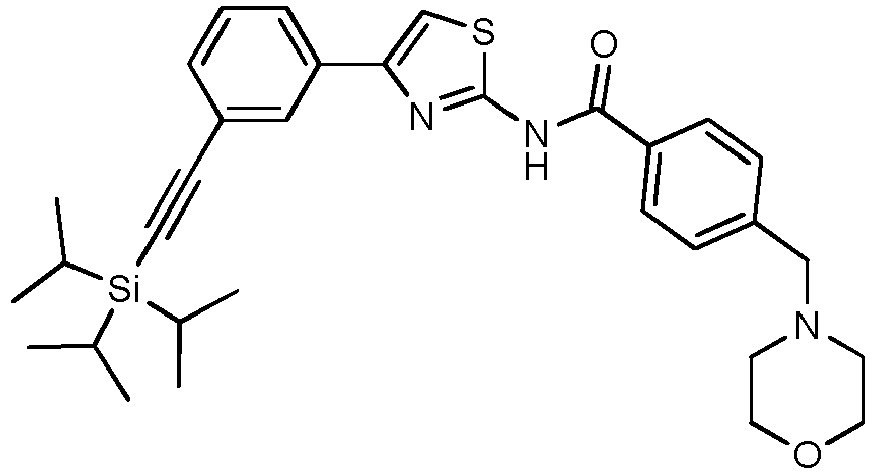
- According general procedure G using N-(4-(3-bromophenyl)thiazol-2-yl)-4-(morpholinomethyl)benzamide (32.5 mg, 0.071 mmol). Purification by silica gel flash chromatography (DCM/MeOH 9:1) afforded the product (39.7 mg, quanti.) as a yellow viscous oil. 1H NMR (400 MHz, CDCl3) δ 10.76 (bs, 1H, NH), 7.87 (dd, J = 1.5, 1.5 Hz, 1H, Har), 7.83 (d, J = 8.2 Hz, 2H, Har), 7.71 (ddd, J = 7.8, 1.4, 1.4 Hz, 1H, Har), 7.41 - 7.36 (m, 3H, Har), 7.30 (s, 1H, Har), 7.30 - 7.28 (m, 1H, Har), 3.75 (t, J = 4.5 Hz, 4H, 2xCH2), 3.54 (s, 2H, CH2), 2.45 (t, J = 4.3 Hz, 4H, 2xCH2), 1.17 (s, 21H, 3x(CH3)2CH). 13C NMR (101 MHz, CDCl3) δ 165.2 (C), 159.2 (C), 149.5 (C), 143.8 (C), 134.5 (C), 131.8 (CH), 131.0 (C), 129.7 (CH), 129.6 (2xCH), 128.8 (CH), 127.8 (2xCH), 126.1 (CH), 124.2 (C), 109.0 (CH), 107.0 (C), 91.2 (C), 67.2 (2xCH2), 63.1 (CH2), 53.9 (2xCH2), 19.0 (3x(CH 3 ) 2 CH), 11.6 (3x(CH3)2 CH). HRMS [M+H]+ C32H42N3O2SSi: Calcd. 560.2762 found 560.2741. Purity: 98.2%.
-
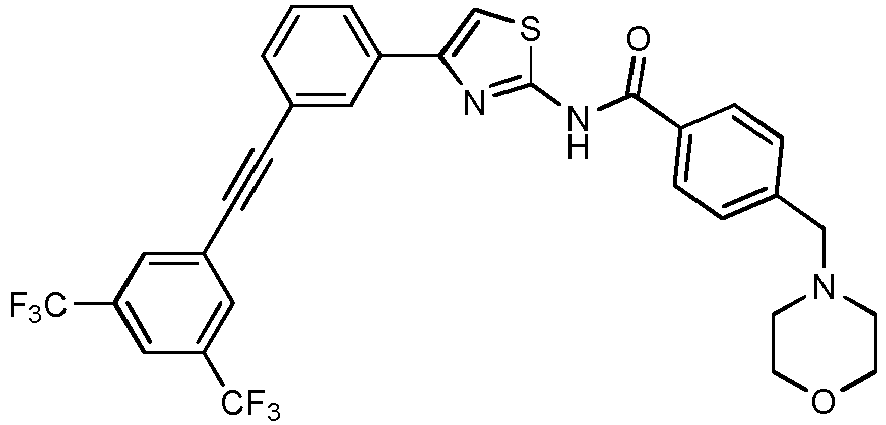
- According general procedure G using N-(4-(3-bromophenyl)thiazol-2-yl)-4-(morpholinomethyl)benzamide (30 mg, 0.065 mmol). Purification by silica gel flash chromatography (EA/MeOH 98:2) afforded the product (34.1 mg, 85%) as a yellow viscous oil. 1H NMR (400 MHz, CDCl3) δ 10.69 (bs, 1H, NH), 7.99 (bs, 2H, Har), 7.95 (dd, J = 1.5, 1.5 Hz, 1H, Har), 7.86 - 7.82 (m, 3H, Har), 7.76 (ddd, J = 7.8, 1.4, 1.4 Hz, 1H, Har), 7.43 - 7.38 (m, 3H, Har), 7.34 (dd, J = 7.7, 7.7 Hz, 1H, Har), 7.26 (s, 1H, Har), 3.74 (bs, 4H, 2xCH2), 3.55 (s, 2H, CH2), 2.45 (bs, 4H, 2xCH2). 13C NMR (101 MHz, CDCl3) δ 165.1 (C), 159.3 (C), 149.2 (C), 139.6 (C), 134.8 (C), 132.3 (q, J = 33.7 Hz, 2xC), 131.8 (CH), 131.8 (CH), 131.3 (CH), 129.9 (2xCH), 129.2 (2xCH), 127.9 (2xCH), 127.0 (CH), 125.8 (C), 123.3 (d, J = 272.8 Hz, 2xC), 122.6 (C), 122.1 - 122.0 (m, CH), 121.9 (C), 109.3 (CH), 92.8 (C), 87.0 (C), 67.1 (2xCH2), 63.1 (CH2), 53.8 (2xCH2). HRMS [M+H]+ C31H24F6N3O2S: Calcd. 616.1488 found 616.1469. Purity: 93.9%.
-

- According general procedure G using N-(4-(3-bromophenyl)thiazol-2-yl)-4-(morpholinomethyl)benzamide (30 mg, 0.065 mmol). Purification by silica gel flash chromatography (EA/MeOH 98:2) afforded the product (33.0 mg, 97%) as a yellow viscous oil. 1H NMR (400 MHz, CDCl3) δ 10.93 (bs, 1H, NH), 7.80 (dd, J = 1.5, 1.5 Hz, 1H, Har), 7.77 (d, J = 8.2 Hz, 2H, Har), 7.65 (ddd, J = 7.8, 1.3, 1.3 Hz, 1H, Har), 7.32 (d, J = 8.1 Hz, 2H, Har), 7.31 (ddd, J = 7.7, 1.3, 1.3 Hz, 1H, Har), 7.22 (s, 1H, Har), 7.21 (dd, J = 7.7, 7.7 Hz, 1H, Har), 3.72 (t, J = 4.3 Hz, 4H, 2xCH2), 3.50 (s, 2H, CH2), 2.41 (t, J = 4.3 Hz, 4H, 2xCH2), 1.00 (s, 9H, (CH 3 ) 3 CSi), 0.20 (s, 6H, (CH 3 ) 2 Si). 13C NMR (101 MHz, CDCl3) δ 165.4 (C), 159.4 (C), 149.5 (C), 143.7 (C), 134.4 (C), 131.7 (CH), 131.0 (C), 129.8 (CH), 129.6 (2xCH), 128.8 (CH), 127.8 (2xCH), 126.2 (CH), 123.9 (C), 109.0 (CH), 105.7 (C), 93.1 (C), 67.2 (2xCH2), 63.1 (CH2), 53.9 (2xCH2), 26.5 ((CH 3 ) 3 CSi), 17.0 ((CH3)3 CSi), -4.2 ((CH 3 ) 2 Si). HRMS [M+H]+ C29H36N3O2SSi: Calcd. 518.2292 found 518.2274. Purity: 100.0%.
-

- According general procedure G using N-(4-(3-bromophenyl)thiazol-2-yl)-4-(morpholinomethyl)benzamide (30 mg, 0.065 mmol). Purification by silica gel flash chromatography (EA/MeOH 98:2) afforded the product (38.5 mg, 92%) as a yellow viscous oil. 1H NMR (400 MHz, CDCl3) δ 10.76 (bs, 1H, NH), 7.96 (dd, J = 1.5, 1.5 Hz, 1H, Har), 7.90 - 7.86 (m, 4H, Har), 7.81 (d, J = 8.1 Hz, 2H, Har), 7.74 (ddd, J = 7.9, 1.5, 1.5 Hz, 1H, Har), 7.49 (ddd, J = 7.7, 1.4, 1.4 Hz, 1H, Har), 7.45 - 7.40 (m, 6H, Har), 7.37 (d, J = 8.1 Hz, 2H, Har), 7.31 (dd, J = 7.8, 7.8 Hz, 1H, Har), 7.25 (s, 1H, Har), 3.70 (t, J = 4.4 Hz, 4H, 2xCH2), 3.51 (s, 2H, CH2), 2.40 (t, J = 4.3 Hz, 4H, 2xCH2), 1.17 (s, 9H, (CH 3 ) 3 CSi). 13C NMR (101 MHz, CDCl3) δ 165.2 (C), 159.2 (C), 149.4 (C), 143.7 (C), 135.9 (CH), 134.7 (C), 133.5 (2xC), 132.0 (CH), 131.0 (C), 129.9 (CH), 129.7 (CH), 129.0 (CH), 128.1 (CH), 127.8 (CH), 126.7 (CH), 123.7 (C), 109.2 (CH), 109.0 (C), 90.0 (C), 67.2 (2xCH2), 63.1 (CH2), 53.8 (2xCH2), 27.5 (3xCH3), 19.1 ((CH3)3 CSi). HRMS [M+H]+ C39H40N3O2SSi: Calcd. 642.2605 found 642.2604. Purity: 100,0%.
-

- According general procedure G using N-(4-(3-bromophenyl)thiazol-2-yl)-4-((4-methylpiperazin-1-yl)methyl)benzamide (30 mg, 0.064 mmol). Purification by silica gel flash chromatography (DCM/MeOH 9:1) afforded the product (24.7 mg, 68%) as a yellow viscous oil. 1H NMR (400 MHz, CDCl3) δ 10.66 (bs, 1H, NH), 7.91 (dd, J = 1.5, 1.5 Hz, 1H, Har), 7.80 (d, J = 8.2 Hz, 2H, Har), 7.73 (ddd, J = 7.8, 1.4, 1.4 Hz, 1H, Har), 7.63 - 7.59 (m, 1H, Har), 7.42 (ddd, J = 7.7, 1.4, 1.4 Hz, 1H, Har), 7.39 - 7.34 (m, 3H, Har), 7.34 - 7.28 (m, 3H, Har), 7.24 (s, 1H, Har), 3.52 (s, 2H, CH2), 2.49 (bs, 8H, 2xCH2), 2.32 (s, 3H, CH3). 13C NMR (101 MHz, CDCl3) δ 165.3 (C), 159.2 (C), 149.6 (C), 149.4 (C), 144.2 (C), 134.7 (C), 133.9 (CH), 131.5 (CH), 130.9 (C), 129.9 (CH), 129.6 (2xCH), 129.5 (CH), 129.1 (CH), 127.8 (2xCH), 127.1 (CH), 126.6 (CH), 123.5 (C), 121.7 (CH), 120.9 (d, J = 258.3 Hz, C), 118.3 (C), 109.1 (CH), 94.7 (C), 84.1 (C), 62.6 (CH2), 55.2 (2xCH2), 53.0 (2xCH2), 46.0 (CH3). HRMS [M+H]+ C31H28F3N4O2S: Calcd. 577.1880 found 577.1871. Purity: 91.7%.
-

- According general procedure G using N-(4-(3-bromophenyl)thiazol-2-yl)-5-(4-(4-methylpiperazine-1-carbonyl)phenyl)furan-2-carboxamide (30 mg, 0.054 mmol). Purification by silica gel flash chromatography (DCM/MeOH 9:1) afforded the product (20.5 mg, 58%) as a yellow viscous oil. 1H NMR (400 MHz, CDCl3) δ 10.72 (bs, 1H, NH), 7.85 (dd, J = 1.5, 1.5 Hz, 1H, Har), 7.70 (ddd, J = 7.8, 1.4, 1.4 Hz, 1H, Har), 7.66 (d, J = 8.2 Hz, 2H, Har), 7.64 - 7.61 (m, 1H, Har), 7.47 (d, J = 8.4 Hz, 2H, Har), 7.44 (ddd, J = 7.5, 1.4, 1.4 Hz, 1H, Har), 7.41 - 7.36 (m, 3H, Har), 7.33 (d, J = 7.0 Hz, 2H, Har), 7.17 (s, 1H, Har), 6.78 (d, J = 3.7 Hz, 1H, Har), 3.84 (bs, 2H, CH2), 3.50 (bs, 2H, CH2), 2.53 (bs, 2H, CH2), 2.41 (bs, 2H, CH2), 2.35 (s, 3H, CH3). 13C NMR (101 MHz, CDCl3) δ 169.8 (C), 158.1 (C), 156.2 (C), 155.6 (C), 149.7 (C), 149.6 (C), 145.5 (C), 136.4 (C), 134.7 (C), 133.9 (CH), 131.5 (CH), 130.6 (C), 129.9 (CH), 129.6 (CH), 129.1 (CH), 128.8 (CH), 128.2 (CH), 127.4 (CH), 127.2 (CH), 126.6 (CH), 125.0 (CH), 123.5 (C), 121.7 (CH), 121.0 (d, J = 258.2 Hz, C), 119.7 (CH), 118.3 (C), 109.3 (CH), 109.1 (CH), 94.6 (C), 84.10 (C), 55.4 (2xCH2), 54.9 (2xCH2), 46.2 (CH3). HRMS [M+H]+ C35H28F3N4O4S: Calcd. 657.1778 found 657.1774. Purity: 100.0%.
-

- According general procedure G using N-(4-(3-bromophenyl)thiazol-2-yl)-4-(((2-(dimethylamino)ethyl)amino)methyl)benzamide (49.3 mg, 0.107 mmol). Purification by silica gel flash chromatography (DCM/MeOH 9:1) afforded the product (27.8 mg, 47%) as a yellow viscous oil. 1H NMR (400 MHz, CDCl3) δ 7.77 (d, J = 8.2 Hz, 2H, Har), 7.75 (dd, J = 1.5, 1.5 Hz, 1H, Har), 7.57 (ddd, J = 7.7, 1.4, 1.4 Hz, 1H, Har), 7.29 (d, J = 8.2 Hz, 2H, Har), 7.18 (ddd, J = 7.6, 1.3, 1.3 Hz, 1H, Har), 7.12 (dd, J = 7.7, 7.7 Hz, 1H, Har), 7.05 (s, 1H, Har), 3.68 (s, 2H, CH2), 2.59 (t, J = 5.6 Hz, 2H, CH2), 2.53 (t, J = 5.6 Hz, 2H, CH2), 2.21 (s, 3H, CH3), 0.90 (s, 21H, 3x(CH3)2CH). 13C NMR (101 MHz, CDCl3) δ 165.6 (C), 158.8 (C), 149.1 (C), 143.4 (C), 134.5 (C), 131.3 (C), 131.2 (CH), 129.5 (CH), 128.7 (2xCH), 128.6 (CH), 128.1 (2xCH), 125.8 (CH), 123.8 (C), 108.5 (CH), 106.9 (C), 90.4 (C), 57.4 (2xCH2), 52.6 (2xCH2), 44.6 (CH2), 44.2 (CH3), 18.4 (3x(CH 3 ) 2CH), 11.2 (3x(CH3)2 CH). HRMS [M+H]+ C32H45N4OSSi: Calcd. 561.3078 found 561.3063. Purity: 97.2%.
-

- According general procedure G using 4-((1H-tetrazol-1-yl)methyl)-N-(4-(3-bromophenyl)thiazol-2-yl)benzamide (91 mg, 0.206 mmol). Purification by silica gel flash chromatography (DCM/MeOH 9:1) afforded the product (9.6 mg, 7%) as a yellow viscous oil. 1H NMR (400 MHz, CDCL3) δ 8.61 (s, 1H, NH), 7.87 (d, J = 8.3 Hz, 2H, Har), 7.78 (dd, J = 1.4, 1.4 Hz, 1H, Har), 7.60 (ddd, J = 7.9, 1.5, 1.5 Hz, 1H, Har), 7.35 (ddd, J = 7.6, 1.2, 1.2 Hz, 1H, Har), 7.26 - 7.20 (m, 4H, Har), 5.63 (s, 2H, CH2), 1.13 (s, 21H, 3x(CH3)2CH). 13C NMR (101 MHz, CDCl3) δ 164.6 (C), 159.4 (C), 149.5 (C), 142.9 (CH), 137.8 (C), 134.4 (C), 133.2 (C), 132.0 (CH), 129.8 (CH), 129.0 (CH), 128.9 (2xCH), 128.6 (2xCH), 126.2 (CH), 124.3 (C), 109.3 (CH), 106.9 (C), 91.6 (C), 51.7 (CH2), 19.1 (3x(CH 3 ) 2CH), 11.6 (3x(CH3)2 CH). HRMS [M+H]+ C29H35N6OSSi: Calcd. 543.2357 found 543.2341. Purity: 100.0%.
-

- According general procedure G using 4-((1H-imidazol-1-yl)methyl)-N-(4-(3-bromophenyl)thiazol-2-yl)benzamide (57 mg, 0.13 mmol). Purification by silica gel flash chromatography (DCM/MeOH 9:1) afforded the product (29.5 mg, 42%) as a yellow viscous oil. 1H NMR (400 MHz, CDCl3) δ 11.95 (bs, 1H, NH), 7.85 (d, J = 8.3 Hz, 2H, Har), 7.81 (dd, J = 1.5, 1.5 Hz, 1H, Har), 7.63 (ddd, J = 7.8, 1.4, 1.4 Hz, 1H, Har), 7.59 (bs, 1H, Har), 7.34 (ddd, J = 7.7, 1.3, 1.3 Hz, 1H, Har), 7.21 (dd, J = 7.7, 7.7 Hz, 1H, Har), 7.21 (s, 1H, Har), 7.17 (bs, 1H, Har), 7.06 (d, J = 8.2 Hz, 2H, Har), 6.91 (dd, J = 1.2, 1.2 Hz, 1H, Har), 1.13 (s, 21H, 3x(CH3)2CH). 13C NMR (101 MHz, CDCl3) δ 165.3 (C), 159.5 (C), 149.5 (C), 141.2 (C), 137.9 (CH), 134.6 (C), 132.5 (C), 131.8 (CH), 130.3 (CH), 129.7 (CH), 128.9 (CH), 128.8 (2xCH), 127.4 (2xCH), 126.2 (CH), 124.1 (C), 119.8 (CH), 109.0 (CH), 107.1 (C), 91.3 (C), 50.6 (CH2), 19.0 (3x(CH 3 ) 2 CH), 11.6 (3x(CH3)2 CH). HRMS [M+H]+ C31H37N4OSSi: Calcd. 541.2440 found 541.2452. Purity: 97.3%.
-

- According general procedure G using isopropyl 2-((4-((4-(3-bromophenyl)thiazol-2-yl)carbamoyl)benzyl)amino)acetate (28 mg, 0.058 mmol). Purification by silica gel flash chromatography (DCM/Acetone 9:1) afforded the product (7.7 mg, 23%) as a yellow viscous oil. 1H NMR (400 MHz, CDCl3) δ 7.91 (d, J = 8.2 Hz, 2H, Har), 7.91 (dd, J = 1.9, 1.9 Hz, 1H, Har), 7.74 (ddd, J = 7.8, 1.5, 1.5 Hz, 1H, Har), 7.53 (d, J = 8.1 Hz, 2H, Har), 7.42 (ddd, J = 7.7, 1.3, 1.3 Hz, 1H, Har), 7.33 (dd, J = 7.7, 7.7 Hz, 1H, Har), 7.22 (s, 1H, Har), 3.99 (s, 2H, CH2), 3.46 (s, 2H, CH2), 1.27 (s, 3H, CH3), 1.25 (s, 3H, CH3), 1.16 - 1.12 (m, 21H, 3x(CH3)2CH). 13C NMR (101 MHz, CDCl3) δ 184.2 (C), 164.3 (C), 158.2 (C), 149.3 (C), 134.3 (C), 131.6 (CH), 129.5 (CH), 129.3 (2xCH), 128.6 (CH), 127.8 (2xCH), 125.9 (CH), 124.0 (C), 108.7 (CH), 106.8 (C), 90.9 (C), 69.2 ((CH3)2 CHO), 52.1 (CH2), 49.3 (CH2), 21.8 ((CH 3 ) 2CHO), 18.7 (3x(CH 3 ) 2CH), 11.3 ((3x(CH3)2 CH). HRMS [M+H]+ C33H44N3O3SSi: Calcd. 590.2848 found 590.2867.
-

- According general procedure G using N-(4-(3-bromophenyl)thiazol-2-yl)-4-((4-methylpiperazin-1-yl)methyl)benzamide (25 mg, 0.053 mmol). Purification by silica gel flash chromatography (DCM/MeOH 90:10) afforded the product (24.9 mg, 82%) as a yellow viscous oil. 1H NMR (300 MHz, CDCl3) δ 10.35 (bs, 1H, NH), 7.88 (dd, J = 1.5, 1.5 Hz, 1H, Har), 7.83 (d, J = 8.2 Hz, 2H, Har), 7.70 (ddd, J = 7.8, 1.4, 1.4 Hz, 1H, Har), 7.40 (d, J = 8.2 Hz, 2H, Har), 7.37 (ddd, J = 7.7, 1.3, 1.3 Hz, 1H, Har), 7.30 (dd, J = 7.7, 7.7 Hz, 1H, Har), 7.22 (s, 1H, Har), 3.54 (s, 2H, CH2), 2.48 (bs, 8H, 4xCH2), 2.31 (s, 3H, CH3), 1.14 (s, 21H, 3x(CH3)2CH). 13C NMR (75 MHz, CDCl3) δ 165.0 (C), 158.9 (C), 149.6 (C), 144.3 (C), 134.6 (C), 131.9 (CH), 130.9 (C), 129.8 (CH), 129.7 (2xCH), 128.9 (CH), 127.7 (2xCH), 126.2 (CH), 124.3 (C), 109.0 (CH), 107.1 (C), 91.1 (C), 62.7 (CH2), 55.3 (2xCH2), 53.3 (2xCH2), 46.2 (CH3), 19.0 (3x(CH 3 ) 2 CH), 11.6 (3x(CH3)2 CH). HRMS [M+H]+ C33H45N4OSSi: Calcd. 573.3078 found 573.3077. Purity: 100.0%.
-

- 4-((4-methylpiperazin-1 -yl)methyl)-N-(4-(3-((triisopropylsilyl)ethynyl)phenyl)thiazol-2-yl)benzamide (Example 48, 14 mg, 0.025 mmol) was dissolved in dry THF (1 mL) and TBAF (73 µL, 2M in THF) was added. The solution was stirred overnight at room temperature. The mixture was evaporated under reduced pressure and purified by silica gel flash chromatography (DCM/MeOH 7:3) to afford the product as a yellow viscous oil (13.2 mg, quant.). 1H NMR (400 MHz, CDCl3) δ 6.67 (dd, J = 1.5, 1.5 Hz, 1H, Har), 6.62 (d, J = 8.2 Hz, 2H, Har), 6.53 (ddd, J = 7.8, 1.5, 1.5 Hz, 1H, Har), 6.21 - 6.14 (m, 3H, Har), 6.08 (dd, J= 7.7, 7.7 Hz, 1H, Har), 5.96 (s, 1H, Har), 2.33 (s, 2H, CH2), 1.86 (s, 1H, CH), 1.33 (bs, 8H, 4xCH2), 1.15 (s, 3H, CH3). 13C NMR (101 MHz, CDCl3) δ 164.7 (C), 158.6 (C), 149.2 (C), 143.9 (C), 134.6 (C), 131.7 (CH), 130.8 (C), 129.9 (CH), 129.6 (2xCH), 128.9 (CH), 127.6 (2xCH), 126.5 (CH), 122.7 (C), 108.9 (CH), 83.5 (C), 77.6 (CH), 62.3 (CH2), 54.9 (2xCH2), 52.5 (2xCH2), 45.6 (CH3). HRMS [M+H]+ C24H25N4OS: Calcd. 417.1744 found 417.1735. Purity = 95.5%
-
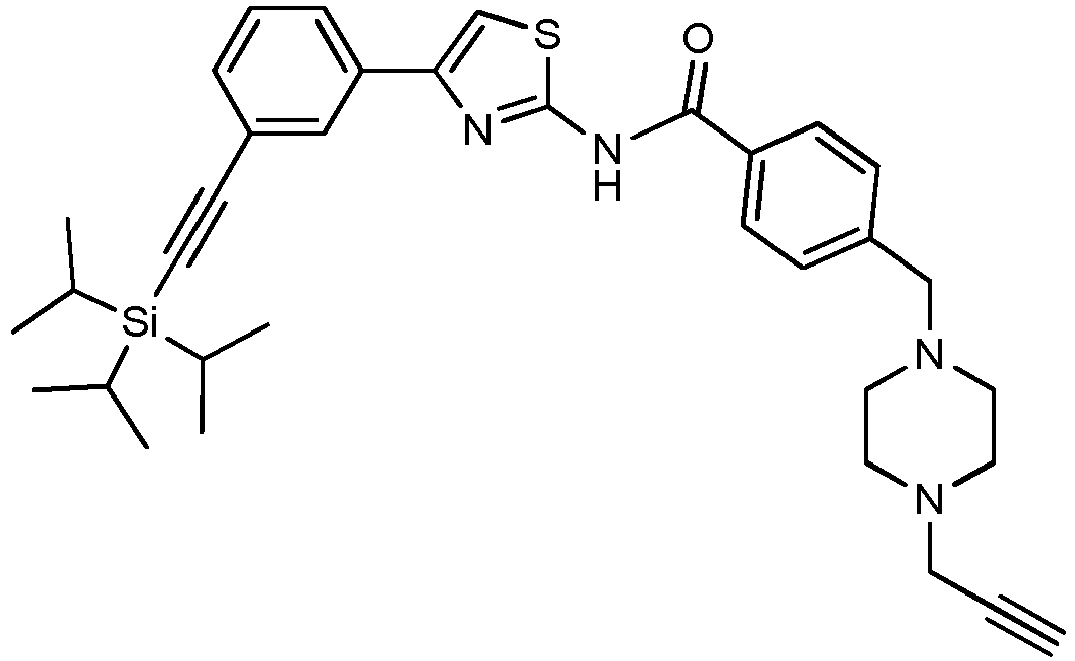
-

- According the general procedure D using 1-(3-bromophenyl)ethanone (50 mg, 0.25 mmol). Purification by silica gel flash chromatography (PE/DCM 3:1) afforded the product (75 mg, quanti.) as a yellow viscous oil. 1H NMR (300 MHz, CDCl3) δ 8.03 (dd, J = 1.4, 1.4 Hz, 1H, Har), 7.89 (ddd, J = 7.8, 1.5, 1.5 Hz, 1H, Har), 7.66 (ddd, J = 7.7, 1.3, 1.3 Hz, 1H, Har), 7.41 (dd, J = 7.7, 7.7 Hz, 1H, Har), 2.61 (s, 2H, CH2), 1.14 (s, 21H, 3x(CH3)2CH). 13C NMR (75 MHz, CDCl3) δ 197.78 (C), 137.44 (C), 136.73 (CH), 132.13 (CH), 128.88 (CH), 128.27 (CH), 124.51 (C), 92.37 (C), 91.50 (C), 27.01 (CH3), 19.00 (3x(CH 3 ) 2 CH), 11.62 (3x(CH3)2 CH). HRMS [M+H]+ C19H29OSi: Calcd. 301.1982 found 301.1970.
-

- To a solution of 1-(3-((triisopropylsilyl)ethynyl)phenyl)ethanone (184 mg, 0.61 mmol) in EA (900 µL) and CHCl3 (900µL) was added CuBr2 (271 mg, 1.22 mmol). The solution was refluxed overnight. After cooling, the mixture was evaporated to dryness under vacuum. The resulting solid was dissolved in AE, filtered through a Celite pad and washed with AE. The organic layer was then washed with a saturated NaHCO3 solution, dried over Na2SO4, filtered and evaporated under vacuum. The crude product (184 g, 85%) was used directly without further purification.
-

- To a stirred suspension of 2-bromo-1-(3-((triisopropylsilyl)ethynyl)phenyl)ethanone (184 mg, 0.48 mmol) in EtOH (5 mL) was added thiourea (37 mg, 0.484 mmol) and the mixture was heated at 70°C overnight. After cooling to room temperature, the solvent was evaporated to dryness. The resulting solid was stirred in a mixture of EtOAc/saturated aqueous NaHCO3 solution (2:1) until dissolution, and then extracted with EtOAc. The organic layer was dried over Na2SO4, filtrated and the solvent was removed under reduced pressure. Purification by silica gel flash chromatography (DCM/MeOH 99:1) afforded the product (128 mg, 75%) as a yellow viscous oil. 1H NMR (300 MHz, CDCl3) δ 7.87 (dd, J = 1.4, 1.4 Hz, 1H, Har), 7.69 (ddd, J = 7.8, 1.4, 1.4 Hz, 1H, Har), 7.41 (ddd, J = 7.6, 1.3, 1.3 Hz, 1H, Har), 7.31 (dd, J = 7.7, 7.7 Hz, 1H, Har), 6.72 (s, 1H, Har), 5.56 (bs, 2H, NH2), 1.15 (s, 21H, 3x(CH3)2CH). 13C NMR (75 MHz, CDCl3) δ 168.14 (C), 150.54 (C), 134.98 (C), 131.58 (CH), 129.81 (CH), 128.81 (CH), 126.20 (CH), 124.15 (C), 107.26 (C), 103.49 (CH), 90.89 (C), 19.00 (3x(CH 3 ) 2 CH), 11.63 (3x(CH3)2CH). HRMS [M+H]+ C20H29N2SSi: Calcd. 357.1815 found 357.1814.
-

- 4-(3-((triisopropylsilyl)ethynyl)phenyl)thiazol-2-amine (128 mg, 0.36 mmol) was diluted with toluene (1 mL) in a two necked round bottom flask equipped with a reflux condenser under an argon atmosphere. The solution was cooled down at 0°C and trimethylaluminium in toluene (176 µL, 2M) was slowly added. After 15 minutes, the ester (65 mg, 0.24 mmol) in toluene (300 µL) was added. The resulting solution was heated under reflux for two days, cooled to room temperature and slowly hydrolyzed with water to prevent foam formation. The aqueous layer was extracted four times with DCM, and the organic layers were combined and dried over Na2SO4. The solvent was evaporated under reduced pressure. Purification by silica gel flash chromatography (DCM/MeOH 9:1) afforded the product as a yellow viscous oil (120 mg, 84%). 1H NMR (300 MHz, CDCl3) δ 11.08 (bs, 1H, NH), 7.79 (bs, 1H, Har), 7.73 (d, J = 8.0 Hz, 2H, Har), 7.66 - 7.60 (m, 1H, Har), 7.31 - 7.22 (m, 4H, Har), 7.21 (s, 1H, Har), 3.48 (s, 2H, CH2), 3.30 (d, J = 2.1 Hz, 2H, CH2), 2.59 (bs, 4H, 2xCH2), 2.46 (bs, 4H, 2xCH2), 2.25 (s, J = 2.1 Hz, 1H, CH), 1.13 (s, 21H, 3x(CH3)2CH). 13C NMR (75 MHz, CDCl3) δ 165.5 (C), 159.4 (C), 149.4 (C), 143.9 (C), 134.4 (C), 131.7 (CH), 131.0 (C), 129.7 (CH), 129.4 (2xCH), 128.8 (CH), 127.8 (2xCH), 126.1 (CH), 124.1 (C), 108.9 (CH), 107.0 (C), 91.1 (C), 79.0 (C), 73.6 (CH), 62.6 (CH2), 53.2 (2xCH2), 52.1 (2xCH2), 47.0 (CH3), 19.0 (3x(CH 3 ) 2 CH), 11.6 (3x(CH3)3 CH). HRMS [M+H]+ C35H45N4OSSi: Calcd. 597.3078 found 597.3065.
- When not commercially available or readily obtainable by the skilled man in the art, the intermediates and precurors to the compounds of this invention were synthesised as follows:
-

- A solution of di-tert-butyl dicarbonate (6.32 g, 29 mmol) in MeOH (62mL) was slowly added to a stirring solution of piperazine (5 g, 58 mmol) in MeOH (62mL) at 0°C. The mixture was then stirred for 18 h at room temperature, and the solvent removed in vacuum. The crude solid was redissolved in diethyl ether with warming, and the white precipitate left was filtered off. The product was extracted from the mother liquor with 1M citric acid solution, and the aqueous layer was washed with Et2OAc, basified with Na2CO3 (pH 11), and extracted with Et2OAc. The organic layer was dried over Na2SO4 and evaporated in vacuum to give tert-butyl 1-piperazinecarboxylate as a waxy white solid (crude, 4 g, 37%). 1H NMR (300MHz, CDCl3) δ 1.46 (s, 9H, 3xCH3), δ 2.11 (s, 1H, NH), δ 2.83 (t, 4H, J = 5.1Hz, 2xCH2), δ 3.41 (t, 4H, J = 5.1 Hz, 2xCH2). 13C NMR (75MHz, CDCl3) δ 155.1 (C), δ 79.8 (C), δ 46.2 (4xCH2), δ 28.7 (3xCH3). MS (ESI) [M+H]+ 187. mp = 53-54°C.
-

- A solution of tert-butyl 1-piperazinecarboxylate (4 g, 21.5 mmol) and diisopropylethylamine (5.8 mL, 22.6 mmol) in CHCl3 (180 mL) was stirred at 0°C during 15 min. Propargyl bromide (2.3 mL, 21.5 mmol) was slowly added to the solution. The mixture was stirred for 24h at room temperature. CHCl3 (50mL) was then added and the solution obtained was washed with saturated NaHCO3 solution, brine, and then dried over Na2SO4. The solution was filtered and evaporated to dryness to give tert-butyl 4-propargylpiperazine-1-carboxylate (3.25 g, 68%). 1H RMN (300MHz, CDCl3) δ 3.46 (t, 4H, J = 5.1 Hz, 2xCH2), δ 3.29 (t, 2H, J = 2.4 Hz, CH2), 2.50 (t, 4H, J = 5.1Hz, 2xCH2), 2.25 (t, 1H, J = 2.4 Hz, CH), 1.45 (s, 9H, 3xCH3). 13C RMN (75 MHz, CDCl3) δ 155.0 (C), 80.0 (C), 78.7 (C), 73.8 (CH), 51.9 (CH2), 47.3 (2xCH2), 46.2 (2xCH2), 28.7 (3xCH3). MS (ESI) [M+H]+ 225. mp = 53-54°C.
-
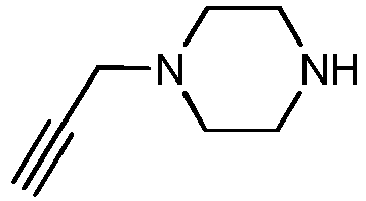
- tert-Butyl 4-propargylpiperazine-1-carboxylate (300 mg, 1.34 mmol) was dissolved in a mixture of trifluoroacetic acid (0.9 mL) and DCM (4 mL). The solution was stirred at room temperature overnight, and then was evaporated to dryness in vacuum. The residue was dissolved in water and then based with Na2CO3 (pH11), and extracted with EtOAc. The organic layer was dried over Na2SO4, filtered and evaporated to dryness to give N-propargylpiperazine as yellow oil. (73 mg, 44%). 1H RMN (300MHz, CDCl3) δ 3.27 (d, 2H, J = 2.5 Hz, CH2), δ 2.92 (t, 4H, J = 5.1 Hz, 2xCH2), δ 2.53 (t, 4H, J = 5.1Hz, 2xCH2), δ 2.23 (t, 1H, J = 2.5 Hz, CH). 13C RMN (75 MHz, CDCl3) δ 78.9 (C8), 73.6 (C9), 53.1 (CH2), 47.7 (2xCH2), 46.0 (2xCH2). HRMS [M+H]+ C7H12N2: Calcd. 125.1073 found 125.1072.

- To a solution of methyl 4-(bromomethyl)benzoate (1.55 g, 6.77 mmol), K2CO3 (1.77 g, 12.8 mmol) in CH3CN at 0°C was added the tert-butyl 1-piperazinecarboxylate (1.4 g, 7.53 mmol). The mixture was stirred 16h at room temperature. The mixture was filtered through Celite pad and evaporated to dryness to give the product as a yellow oil. (2.4 g, 95%). 1H RMN (300MHz, CDCl3) δ 7.97 (d, J = 8.3 Hz, 2H, Har), 7.38 (d, J = 8.3 Hz, 2H, Har), 3.89 (s, 3H, CH3), 3.40 (t, 4H, J = 5.1 Hz, 2xCH2), 2.37 (t, 4H, 2xCH2), 1.43 (s, 9H, 3xCH3). 13C RMN (75 MHz, CDCl3) δ 167.3 (C), 155.1 (C), 143.8 (C), 129.9 (2xCH), 129.4 (C), 129.2 (2xCH), 79.9 (C), 62.9 (CH2), 53.2 (4xCH2), 52.3 (CH3), 28.7 (3xCH3). HRMS [M+H]+ C18H27N2O4: Calcd. 335.1970 found 335.1965.
-

- tert-butyl 4-(4-(methoxycarbonyl)benzyl)piperazine-1-carboxylate (1.5 g, 4.49 mmol) was dissolved in a mixture of trifluoroacetic acid (4.0 mL) and DCM (13.5 mL). The solution was stirred at room temperature overnight, and then was evaporated to dryness in vacuum to give the product as colourless oil. (1.0 g, quant.).1H RMN (300MHz, CDCl3) δ 7.95 (d, J = 8.3 Hz, 2H, Har), 7.37 (d, J = 8.3 Hz, 2H, Har), 3.87 (s, 3H, CH3), 3.50 (s,2H, CH2), 2.86 (t, J = 5.0 Hz, 4H, 2xCH2), 2.38 (t, J = 5.0 Hz, 4H, 2xCH2), 1.89 (s, 1H, NH). 13C RMN (75 MHz, CDCl3) δ 167.3 (C), 144.0 (2xC), 129.8 (2xCH), 129.2 (2xCH), 63.5 (CH2), 54.7 (2xCH2), 52.3 (CH3), 46.3 (2xCH2).
-

- To a solution of methyl 4-(piperazin-1-ylmethyl)benzoate (1.0 g, 4.49 mmol), K2CO3 (7.25 g, 52.53 mmol) in CH3CN (38 mL) at 0°C was added the propargyl bromide (1.4 g, 7.53 mmol). The mixture was stirred 16h at room temperature. The mixture was filtered trough Celite pad and evaporated to dryness in vacuum. The residue was diluted in DCM and a saturated citric acid solution. The aqueous layer was extracted with DCM, then based with Na2CO3 (pH8-9), and extracted with DCM. The organic layer was dried over Na2SO4, filtered and evaporated to dryness to give the product. Purification by silica gel flash chromatography (EtOAc/MeOH 9:1) afforded the product (524 mg, 43%) as a yellow viscous oil. 1H NMR (300 MHz, CDCl3) δ 7.97 (d, J = 8.2 Hz, 2H, Har), 7.40 (d, J = 8.1 Hz, 2H, Har), 3.89 (s, 3H, CH3), 3.55 (s, 2H, CH2), 3.29 (d, J = 2.3 Hz, 2H, CH2), 2.60 (bs, 4H, 2xCH2), 2.51 (bs, 4H, 2xCH2), 2.25 (t, J = 2.3 Hz, 1H, CH). 13C RMN (75 MHz, CDCl3) δ 167.3 (C), 149.4 (C), 144.0 (C), 129.8 (2xCH), 129.2 (2xCH), 79.1 (C), 73.5 (CH2), 62.8 (CH2), 53.2 (2xCH2), 52.3 (CH3), 52.1 (2xCH2), 46.7 (CH2). HRMS [M+H]+ C16H21N2O2: Calcd. 273.1598 found 273.1605.
-

- A solution of 5-bromo-2-furoic acid (1.00 g, 5.2 mmol) in dichloromethane (50 mL) was treated at 0°C with oxalyl chloride (674 µL, 7.8 mmol) and a catalytic amount of N,N- dimethylformamide (125 µL). After 25 minutes, MeOH (2 mL) was added to the solution and stirred at ambient temperature for one night. The solvent and excess of oxalyl chloride were removed under reduced pressure and the solid was dissolved in EtOAc. The organic layer was washed with a 1M NaOH solution, dried over Na2SO4, filtered and evaporated to dryness to give a white solid (890 mg, 83%). 1H NMR (300 MHz, CDCl3) δ 7.12 (d, J = 3.6 Hz, 1H, Har), 6.45 (d, J = 3.6 Hz, 1H, Har), 3.88 (s, 3H, CH3). 13C RMN (75 MHz, CDCl3) δ 158.4 (C), 146.5 (C), 127.8 (C), 120.4 (CH), 114.3 (CH), 52.4 (CH3). MS [M+H]+ C6H5BrO3: Calcd. 203.9422 found 203.9414.
-

- To a solution of halide (933 mg, 4.5 mmol) in 1,4-dioxane (55 mL) was added Pd(PPh3)4 (264 mg, 0.22 mmol). The mixture was stirred at room temperature for 15 min, and 4-carboxyphenylboronic acid (793 mg, 4.78 mmol), dissolved in water (37 mL), and K2CO3 (1.25 g) were introduced. The mixture was stirred at 100°C for 16 h. The reaction was filtered through a Celite pad, and the solvent was removed under vacuum. The residue was diluted in EtOAc and washed with water. The aqueous layer was acidified to pH 6 and extracted with EtOAc. The organic layer was dried over Na2SO4, filtered, and concentrated to dryness to afford the product (464 mg, 41%) as a white solid. 1H NMR (300 MHz, MeOD) δ 8.13 (d, J = 8.9 Hz, 2H, Har), 7.94 (d, J = 8.9 Hz, 2H, Har), 7.37 (d, J = 3.6 Hz, 1H, Har), 7.13 (d, J = 3.8 Hz, 1H, Har), 3.95 (s, 3H, CH3). 13C RMN (75 MHz, CDCl3) δ 158.4 (C-6), 146.5 (C-1), 127.8 (C-4), 120.4 (C-2), 114.3 (C-3), 52.4 (C-10). HRMS [M+Na+] C13H11O5: Calcd. 247.0601 found 247.0607.
-

- A solution of the carboxylic acid (150 mg, 0.65 mmol), DCC (402 mg, 1.3 mmol) and HOBt (176 mg, 1.3 mmol) in DMF (940 µL) was stirred at room temperature during fifteen minutes. The 1-methyl piperazine (80 µL, 0.71 mmol) and NEt3 (94 µL) was added to the solution and the resulting mixture was stirred at room temperature during 20 hours. The precipitate was filtered off and the filtrate was diluted with EtOAc. The organic layer was extracted with a 0.1M HCl solution. The aqueous layer was washed with EtOAc and based with a saturated Na2CO3 solution (pH 10). The mixture was extracted with Et2O, and the combined organic layer was dried over Na2SO4, filtered and evaporated under vacuum. Purification by silica gel flash chromatography (DCM/MeOH 9:1) afforded the product (144 mg, 68%) as a yellow viscous oil. 1H NMR (300 MHz, CDCl3) δ 7.82 (d, J = 8.5 Hz, 2H, Har), 7.47 (d, J = 8.3 Hz, 2H, Har), 7.25 (d, J = 3.8 Hz, 1H, Har), 6.79 (d, J = 3.8 Hz, 1H, Har), 3.92 (s, 3H, CH3), 3.81 (bs, 4H, 2xCH2), 2.49 (bs, 4H, 2xCH2), 2.33 (s, 3H, CH3). 13C NMR (75 MHz, CDCl3) δ 170.6 (C16), 156.8 (C6), 144.4 (C), 136.2 (C), 130.0 (C), 128.8 (CH), 128.1 (CH), 127.4 (CH), 125.1 (CH), 120.3 (CH), 108.1 (CH), 52.3 (CH3), 46.4 (CH2), 42.5 (CH3). HRMS [M+H]+ C18H21N2O4: Calcd. 329.1496 found 329.1497.
-

- A solution of the carboxylic acid (130 mg, 0.46 mmol), DCC (285 mg, 1.38 mmol) and HOBt (124 mg, 0.92 mmol) in DMF (660 µL) was stirred at room temperature during fifteen minutes. The 1-propargyl piperazine (63 mg, 0.51 mmol) and DIPEA (1.19 mL, 4.6 mmol) was added to the solution and the resulting mixture was stirred at 80°C overnight. The mixture was evaporated under vacuum. The resulting solid was dissolved with EtOAc and filtered through a Celite pad. The filtrate was washed with a saturated Na2CO3 solution. The combined organic layer was dried over Na2SO4, filtered and evaporated under vacuum. Purification by silica gel flash chromatography (DCM/MeOH 9:1) afforded the product (115 mg, 75%) as a yellow viscous oil. 1H NMR (300 MHz, CDCl3) δ 7.97 (d, J = 8.2 Hz, 2H, Har), 7.40 (d, J = 8.1 Hz, 2H, Har), 3.89 (s, 3H, CH3), 3.29 (d, J = 2.3 Hz, 2H, CH2), 2.60 (bs, 4H, 2xCH2), 2.51 (bs, 4H, 2xCH2), 2.25 (t, J = 2.3 Hz, 1H, CH). 13C NMR (101 MHz, CDCl3) δ 170.0 (C), 159.4 (C), 156.8 (C), 144.4 (C), 136.1 (C), 131.1 (C), 128.1 (2xCH), 125.2 (2xCH), 120.3 (CH), 108.2 (CH), 77.6 (C), 74.3 (CH), 52.3 (CH3), 52.1 (2xCH2), 49.1 (2xCH2), 47.14 (CH2). HRMS [M+H]+ C20H21N2O4: Calcd. 353.1496 found 353.1507.
-

- To a solution of methyl 4-(bromomethyl)benzoate (5 g, 21.8 mmol), K2CO3 (5.1 g, 37.1 mmol) in CH3CN at 0°C was added the 1-methylpiperazine (2.66 mL, 24 mmol). The mixture was stirred 7 hours at room temperature. The mixture was filtered through Celite pad, washed with EtOAc and evaporated to dryness to give the product as a yellow oil. (5.02 g, 93%). 1H NMR (300 MHz, CDCl3) δ 7.98 (d, J = 8.3 Hz, 2H, Har), 7.39 (d, J = 8.4 Hz, 2H, Har), 3.90 (s, 3H, CH3), 3.55 (s, 2H, CH2), 2.47 (bs, 8H, 4xCH2), 2.29 (s, 3H, CH3). 13C NMR (75 MHz, CDCl3) δ 167.4 (C), 151.5 (C), 144.2 (C), 130.0 (2xCH), 129.3 (2xCH), 63.0 (CH2), 55.5 (2xCH2), 53.5 (2xCH2), 52.4 (CH3), 46.4 (CH3). HRMS [M+H]+ C14H21N2O2: Calcd. 249.1598 found 249.1598.
-

- 4-bromo-3-methylbenzonitrile (1g, 5.1 mmol) was dissolved in toluene (4 mL) under argon atmosphere. Methyl magnesium bromide (1.3 mL, 11.22 mmol) was added to the solution. The mixture was heated at 60-65°C overnight. The reaction mixture was hydrolyzed with a 5M H2SO4 solution during 1h30. The aqueous layer was extracted with EtOAc (5x100 mL). The combined organic layer was washed with 25 mL of water, dried over Na2SO4, filtered and evaporated under vacuum. Purification by silica gel flash chromatography (PE/EtOAc 5:1) afforded the product (630 mg, 58%) as a white oil. 1H NMR (300 MHz, CDCl3) δ 7.80 (bs, 1H, Har), 7.61 (bs, 2H, Har), 2.56 (s, 3H, CH3), 2.44 (s, 3H, CH3). 13C NMR (75 MHz, CDCl3) δ 197.7 (C), 138.7 (C), 136.4 (C), 133.0 (CH), 131.0 (C), 130.7 (CH), 127.4 (CH), 26.9 (CH3), 23.3 (CH3). HRMS (ESI) [M+Na]+ C9H9BrONa: Calcd. 234.9729 found 234.9737.
-

- In a two necked round bottom flask equipped with a reflux condenser under an argon atmosphere was added CuBr2 (700 mg, 3.14 mmol) and EtOAc (8 mL). The suspension was stirred during 20 minutes. The 4-bromo-3-methylacetophenonone (335 mg, 1.57 mmol) pre-dissolved in EtOAc (8 mL) was added to the mixture and heated at 80°C during one hour. A new equivalent of CuBr2 (330 mg, 1.57 mmol) was added and the reaction was stirred at 80°C overnight. The suspension was cooled down, filtered through a Celite pad and washed with EtOAc. The filtrate was washed with a saturated NaHCO3 solution. The organic layer was dried over Na2SO4, filtered and evaporated under vacuum. Purification by silica gel flash chromatography (PE/EtOAc 6:1) afforded the product (273 mg, 60%) as a white oil. 1H NMR (300 MHz, CDCl3) δ 7.85 - 7.80 (m, 1H, Har), 7.68 - 7.58 (m, 2H, Har), 4.40 (s, 2H, CH2), 2.46 (s, 3H, CH3). 13C NMR (75 MHz, CDCl3) δ 191.0 (C), 139.3 (C), 133.3 (CH), 133.2 (C), 132.0 (C), 131.2 (CH), 127.9 (CH), 30.9 (CH2), 23.3 (CH3). HRMS (ESI) [M+H]+ C9H9Br2O: Calcd. 312.8834 found 312.8838.
-

- To a stirred suspension of 2-bromo-1-(4-bromo-3-methylphenyl)ethanone (273 mg, 0.935 mmol) in EtOH (5 mL) was added thiourea (78 mg, 1 mmol) and the mixture was heated at 70°C overnight. After cooling to room temperature, the solvent was evaporated to dryness. The resulting solid was stirred in a mixture of EtOAc/saturated aqueous NaHCO3 solution (2:1) until dissolution, and then extracted with EtOAc. The organic layer was dried over Na2SO4, filtrated and the solvent was removed under reduced pressure. The product was crystallized in PE and filtered to afford a yellow oil (140 mg, 56%). 1H NMR (300 MHz, CDCl3) δ 7.64 (d, J = 1.8 Hz, 1H, Har), 7.51 (d, J = 8.3 Hz, 1H, Har), 7.41 (dd, J = 8.3, 2.0 Hz, 1H, Har), 6.69 (s, 1H, Har), 5.24 (s, 2H, NH2), 2.42 (s, 3H, CH3). 13C NMR (75 MHz, CDCl3) δ 167.8 (C), 150.6 (C), 138.3 (C), 134.1 (C), 132.8 (CH), 128.6 (CH), 125.1 (CH), 124.4 (C), 103.4 (CH), 23.3 (CH3). HRMS (ESI) [M+H]+ C10H10BrN2S: Calcd 268.9743 found 268.9749.
-

- In a two necked round bottom flask equipped with a reflux condenser under an argon atmosphere was added CuBr2 (2.24 mg, 10 mmol) and EtOAc (24 mL). The suspension was stirred during 20 minutes. The 4-bromo-3-methylacetophenonone (1 g, 5.02 mmol) pre-dissolved in EtOAc (24 mL) was added to the mixture and heated at 80°C during one hour. A new equivalent of CuBr2 (1.07 g, 5 mmol) was added and the reaction was stirred at 80°C overnight. The suspension was cooled down, filtered through a Celite pad and washed with EtOAc. The filtrate was washed with a saturated NaHCO3 solution. The organic layer was dried over Na2SO4, filtered and evaporated under vacuum. Purification by silica gel flash chromatography (PE/DCM 3:2) afforded the product (795 mg, 57%) as a white oil. 1H NMR (300 MHz, CDCl3) δ 8.09 (dd, J = 1.8, 1.8 Hz, 1H, Har), 7.88 (ddd, J = 7.8, 1.5, 1.1 Hz, 1H, Har), 7.71 (ddd, J = 8.0, 1.9, 1.0 Hz, 1H, Har), 7.36 (dd, J = 7.9, 7.9 Hz, 1H, Har), 4.41 (s, 2H, CH2). 13C NMR (75 MHz, CDCl3) δ 190.3 (C), 137.1 (CH), 135.9 (C), 132.1 (CH), 130.7 (CH), 127.7 (CH), 123.5 (C), 30.8 (CH2). HRMS (ESI) [M+H]+ C8H7Br2O: Calcd. 276.8860 found 276.8858.
-

- To a stirred suspension of 2-bromo-1-(3-bromophenyl)ethanone (2.13 g, 7.72 mmol) in EtOH (40 mL) was added thiourea (595 mg, 7.8 mmol) and the mixture was heated at 70°C overnight. After cooling to room temperature, the solvent was evaporated to dryness. The resulting solid was stirred in a mixture of EtOAc/saturated aqueous NaHCO3 solution (2:1) until dissolution, and then extracted with EtOAc. The organic layer was dried over Na2SO4, filtrated and the solvent was removed under reduced pressure. The product was crystallized in PE and filtered to afford a yellow solid (1.6 g, 82%). 1H NMR (300 MHz, MeOD) δ 7.97 (dd, J = 1.7, 1.7 Hz, 1H, Har), 7.74 (ddd, J = 7.9, 1.5, 1.1 Hz, 1H, Har), 7.44 (ddd, J = 7.9, 1.9, 1.0 Hz, 1H, Har), 7.29 (dd, J = 7.9, 7.9 Hz, 1H, Har), 6.93 (s, 1H, Har). 13C NMR (75 MHz, MeOD) δ 166.5 (C), 150.9 (C), 139.2 (C), 132.2 (CH), 132.2 (CH), 130.7 (C), 126.4 (CH), 124.5 (C), 105.0 (CH). HRMS (ESI) [M+H]+ C9H8BrN2S: Calcd. 254.9586 found 254.9590. mp = 127.2-127.8°C.
-

- To a solution of 4-bromo-3-chlorobenzoic acid (2 g, 8.53 mmol) in DMF (20 mL) was added EDCI.HCl (3.99 g, 25.6 mmol), HOBt (2.3 g, 17.1 mmol) and the DIPEA (2.65 mL, 10.23 mmol) at 0°C. After five minutes of stirring, the Weinreb amine (1 g, 10.23 mmol) was added to the solution and the solution was heated at 50°C overnight. The mixture was partitioned between EtOAc (200 mL) and water (50 mL). The organic layer was washed with 1M NaOH solution (60 mL), 2M HCl solution (60 mL) and brine (60 mL). The organic layer was dried over Na2SO4, filtered and evaporated under vacuum to afford the product (2.36 g, 94%) as a yellow viscous oil. 1H NMR (300 MHz, CDCl3) δ 7.77 (d, J = 1.8 Hz, 1H, Har), 7.62 (d, J = 8.3 Hz, 1H, Har), 7.43 (dd, J = 8.3, 1.8 Hz, 1H, Har), 3.51 (s, 3H, CH3), 3.32 (s, 3H, CH3). 13C NMR (75 MHz, CDCl3) δ 167.6 (C), 134.6 (C), 134.5 (C), 133.6 (CH), 130.5 (CH), 128.0 (CH), 125.4 (C), 61.6 (OCH3), 33.7 (CH3). HRMS (ESI) [M+H]+ C9H10BrClNO2: Calcd. 277.9578 found 277.9578.
-

- The 4-bromo-N-methoxy-N,3-dimethylbenzamide (108 mg, 0.368 mmol) was dissolved with THF (1 mL) at 0°C under an argon atmosphere. Methylmagnesium bromide (270 µL, 0.81 mmol) was added dropwise and the solution was stirred at room temperature overnight. The mixture was quenched with a saturated NH4Cl solution (30 mL) and then Et2O was added. The aqueous layer was extracted with Et2O (3x30 mL). The combined organic layer was washed with brine (30 mL), dried over Na2SO4, filtered and evaporated under vacuum to afford the product (66 mg, 77%) as a yellow solid. 1H NMR (300 MHz, CDCl3) δ 8.01 (d, J = 2.1 Hz, 1H, Har), 7.73 (d, J = 8.3 Hz, 1H, Har), 7.67 (dd, J = 8.4, 2.0 Hz, 1H, Har), 2.58 (s, 3H, CH3). 13C NMR (75 MHz, CDCl3) δ 196.2 (C), 137.6 (C), 134.4 (CH), 130.4 (CH), 128.5 (C), 128.0 (CH), 126.5 (C), 26.9 (CH3). HRMS (ESI) [M+H]+ C8H7BrClO: Calcd. 232.9363 found 232.9366. mp = 87.5-89.2°C.
-

- In a two necked round bottom flask equipped with a reflux condenser under an argon atmosphere was added CuBr2 (955 mg, 4.18 mmol) and EtOAc (10 mL). The suspension was stirred during 20 minutes. The 4-bromo-3-methylacetophenonone (500 mg, 2.14 mmol) pre-dissolved in EtOAc (10 mL) was added to the mixture and heated at 80°C during one hour. A new equivalent of CuBr2 (460 mg, 2.06 mmol) was added and the reaction was stirred at 80°C overnight. The suspension was cooled down, filtered through a Celite pad and washed with EtOAc. The filtrate was washed with a saturated NaHCO3 solution. The organic layer was dried over Na2SO4, filtered and evaporated under vacuum. Purification by silica gel flash chromatography (PE/EtOAc 4:1) afforded the product (582 mg, 87%) as a yellow viscous oil. 1H NMR (300 MHz, CDCl3) δ 8.06 (d, J = 2.1 Hz, 1H, Har), 7.77 (d, J = 8.5 Hz, 1H, Har), 7.71 (dd, J = 8.4, 2.0 Hz, 1H, Har), 4.38 (s, 2H, CH2). 13C NMR (75 MHz, CDCl3) δ 134.7 (CH), 131.0 (CH), 128.3 (CH), 30.4 (CH2). HRMS (ESI) [M+H]+ C8H6Br2ClO: Calcd. 310.8468 found 310.8455.
-

- To a stirred suspension of 2-bromo-1-(4-bromo-3-chlorophenyl)ethanone (273 mg, 0.935 mmol) in EtOH (5 mL) was added thiourea (78 mg, 1 mmol) and the mixture was heated at 70°C overnight. After cooling to room temperature, the solvent was evaporated to dryness. The resulting solid was stirred in a mixture of EtOAc/saturated aqueous NaHCO3 solution (2:1) until dissolution, and then extracted with EtOAc. The organic layer was dried over Na2SO4, filtrated and the solvent was removed under reduced pressure. The product was crystallized in PE and filtered to afford a yellow solid (140 mg, 56%). 1H NMR (300 MHz, CDCl3) δ 7.88 (d, J = 1.9 Hz, 1H, Har), 7.60 (d, J = 8.4 Hz, 1H, Har), 7.50 (dd, J = 8.4, 1.9 Hz, 1H, Har), 6.76 (s, 1H, Har), 5.13 (s, 2H, NH2). 13C NMR (75 MHz, CDCl3) δ 168.3 (C), 149.1 (C), 135.5 (C), 135.0 (C), 134.1 (CH), 128.0 (CH), 125.5 (CH), 121.6 (C), 104.4 (CH). HRMS (ESI) [M+H]+ C9H7BrClN2S: Calcd 288.9196 found 288.9191. mp = 142.5-143.0°C.
-

- In a two necked round bottom flask equipped with a reflux condenser under an argon atmosphere was added CuBr2 (2.1 g, 9.4 mmol) and EtOAc (22 mL). The suspension was stirred during 20 minutes. The 3-bromo-4-methylacetophenonone (1 g, 4.69 mmol) pre-dissolved in EtOAc (22 mL) was added to the mixture and heated at 80°C during one hour. A new equivalent of CuBr2 (1.0 g, 4.7 mmol) was added and the reaction was stirred at 80°C overnight. The suspension was cooled down, filtered through a Celite pad and washed with EtOAc. The filtrate was washed with a saturated NaHCO3 solution. The organic layer was dried over Na2SO4, filtered and evaporated under vacuum. Purification by silica gel flash chromatography (PE/DCM 4:1) afforded the product (1.075 g, 86%) as a white oil. 1H NMR (300 MHz, CDCl3) δ 8.12 (d, J = 1.7 Hz, 1H, Har), 7.79 (dd, J = 7.9, 1.9 Hz, 1H, Har), 7.33 (d, J = 7.9 Hz, 1H, Har), 4.39 (s, 2H, CH2), 2.45 (s, 3H, CH3). 13C NMR (75 MHz, CDCl3) δ 190.0 (C), 145.0 (C), 133.5 (C), 133.1 (CH), 131.4 (CH), 128.0 (CH), 125.8 (C), 30.9 (CH2), 23.6 (CH3). HRMS [M+Na]+ C9H8Br2NaO: Calcd. 312.8834 found 312.8835.
-

- To a stirred suspension of 2-bromo-1-(3-bromo-4-methylphenyl)ethanone (1.075 g, 3.99 mmol) in EtOH (21 mL) was added thiourea (343 mg, 4.03 mmol) and the mixture was heated at 70°C overnight. After cooling to room temperature, the solvent was evaporated to dryness. The resulting solid was stirred in a mixture of EtOAc/saturated aqueous NaHCO3 solution (2:1) until dissolution, and then extracted with EtOAc. The organic layer was dried over Na2SO4, filtrated and the solvent was removed under reduced pressure. The product was crystallized in PE and filtered to afford a yellow solid (828 mg, 77%). 1H NMR (300 MHz, MeOD) δ 7.90 (d, J = 1.7 Hz, 1H, Har), 7.53 (dd, J = 7.9, 1.7 Hz, 1H, Har), 7.18 (d, J = 7.9 Hz, 1H, Har), 6.72 (s, 1H, Har), 2.32 (s, 3H, CH3). 13C NMR (75 MHz, MeOD) δ 172.0 (C), 150.7 (C), 138.7 (C), 136.5 (C), 132.7 (CH), 131.4 (CH), 126.6 (CH), 104.1 (CH), 23.55 (CH3). HRMS [M+Na]+C10H10BrN2S: Calcd. 268.9746 found 268.9743.
-

- To a solution of 1-(5-bromothiophen-2-yl)ethanone (1.41 g, 6.91 mmol) in AE (10 mL) and CHCl3 (10 mL) was added CuBr2 (3.1 g, 13.82 mmol). The solution was refluxed overnight. After cooling, the mixture was evaporated to dryness under vacuum. The resulting solid was dissolved in AE, filtered through a Celite pad and washed with AE. The organic layer was then washed with a saturated NaHCO3 solution, dried over Na2SO4, filtered and evaporated under vacuum. Purification by silica gel flash chromatography (EP/DCM 2:3) afforded the product (1.72 g, 88%) as a yellow viscous oil. 1H NMR (300 MHz, CDCl3) δ 7.54 (d, J = 4.1 Hz, 1H, Har), 7.13 (d, J = 4.1 Hz, 1H, Har), 4.28 (s, 2H, CH2). 13C NMR (75 MHz, CDCl3) δ 183.71 (C), 142.4 (C), 134.1 (CH), 131.8 (CH), 124.8 (C), 30.0 (CH2). HRMS [M+H]+ C6H4Br2NaOS: Calcd. 304.8242 found 304.8242.
-

- To a stirred suspension of 2-bromo-1-(5-bromothiophen-2-yl)ethanone (1.65 g, 5.81 mmol) in EtOH (30 mL) was added thiourea (454 mg, 5.87 mmol) and the mixture was heated at 70°C overnight. After cooling to room temperature, the solvent was evaporated to dryness. The resulting solid was stirred in a mixture of EtOAc/saturated aqueous NaHCO3 solution (2:1) until dissolution, and then extracted with EtOAc. The organic layer was dried over Na2SO4, filtrated and the solvent was removed under reduced pressure. Purification by silica gel flash chromatography (DCM/MeOH 95:15) afforded the product (1.38 g, 91%) as a yellow solid. 1H NMR (300 MHz, MeOD) δ 7.09 (d, J = 3.9 Hz, 1H, Har), 6.99 (d, J = 3.9 Hz, 1H, Har), 6.67 (s, 1H, Har). 13C NMR (75 MHz, MeOD) δ 171.2 (C), 145.0 (C), 141.8 (C), 131.7 (CH), 124.4 (CH), 111.8 (C), 101.9 (CH). HRMS [M+H]+ C7H6BrN2S: Calcd. 260.9150 found 260.9156.
-
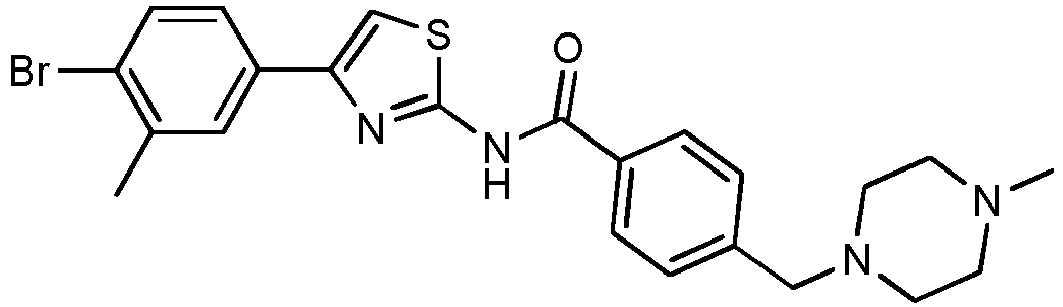
- 4-(4-bromo-3-methylphenyl)thiazol-2-amine (273 mg, 0.94 mmol) was diluted with toluene (1.5 mL) in a two necked round bottom flask equipped with a reflux condenser under an argon atmosphere. The solution was stirred and trimethylaluminium in heptane (443 µL, 2M) was slowly added. The solution was heated at 50°C during 20 min and the ester 2 (170 mg, 0.62 mmol) in toluene (500 µL) was added. The resulting solution was heated under reflux for one night, cooled to room temperature and slowly hydrolyzed with water to prevent foam formation. The aqueous layer was based with a 1M NaOH solution (pH9-10). The mixture was extracted three times with DCM, and the organic layers were combined and dried over Na2SO4.The solvent was evaporated under reduced pressure. Purification by silica gel flash chromatography (DCM/MeOH 8:2) afforded the product (178 mg, 59%) as a yellow solid. 1H NMR (300 MHz, CDCl3 δ 10.49 (bs, 1H, Har), 7.82 (d, J = 8.3 Hz, 2H, Har), 7.61 (d, J = 1.5 Hz, 1H, Har), 7.47 (d, J = 8.3 Hz, 1H, Har), 7.40 (dd, J = 8.1, 2.0 Hz, 1H, Har), 7.38 (d, J = 8.3 Hz, 2H, Har), 7.16 (s, 1H, Har), 3.53 (s, 2H, CH2), 2.48 (bs, 8H, 4xCH2), 2.38 (s, 3H, CH3), 2.31 (s, 3H, CH3). 13C NMR (75 MHz, CDCl3) δ 165.1 (C), 159.1 (C),149.5 (C), 144.3 (C), 138.4 (C), 133.7 (C), 132.9 (CH), 130.9 (C), 129.6 (2xCH), 128.6 (CH), 127.7 (2xCH), 125.2 (CH), 124.8 (C), 108.7 (CH), 62.7 (CH2), 55.4 (2xCH2), 53.3 (2xCH2), 46.2 (CH3), 23.3 (CH3). HRMS (ESI) [M+H]+ C23H26BrN4OS: Calcd. 485.1005 found 485.1009. mp = 181.4-182.4°C
-

- 4-(4-bromophenyl)thiazol-2-amine (195 mg, 0.76 mmol) was diluted with toluene (2.5 mL) in a two necked round bottom flask equipped with a reflux condenser under an argon atmosphere. The solution was stirred and trimethylaluminium in heptane (360 µL, 2M) was slowly added. The solution was heated at 50°C during 20 min and the ester 2 (126 mg, 0.51 mmol) in toluene (500 µL) was added. The resulting solution was heated under reflux for one night, cooled to room temperature and slowly hydrolyzed with water to prevent foam formation. The aqueous layer was based with a 1M NaOH solution (pH9-10). The mixture was extracted three times with DCM, and the organic layers were combined and dried over Na2SO4.The solvent was evaporated under reduced pressure. Purification by silica gel flash chromatography (DCM/MeOH 85:15) afforded the product (206 mg, 86%) as a yellow viscous oil. 1H NMR (300 MHz, CDCl3) δ 8.00 (dd, J = 1.7, 1.7 Hz, 1H, Har), 7.90 (d, J = 8.3 Hz, 2H, Har), 7.73 (ddd, J = 7.8, 2.6, 1.1 Hz, 1H, Har), 7.49 (d, J = 8.3 Hz, 2H, Har), 7.44 (ddd, J = 7.9, 1.9, 1.0 Hz, 1H, Har), 7.27 (dd, J = 7.9, 7.9 Hz, 1H, Har), 7.21 (s, 1H, Har), 3.59 (s, 2H, CH2), 2.55 (bs, 8H, 4xCH2), 2.35 (s, 3H, CH3). 13C NMR (75 MHz, CDCl3) δ 165.33 (C), 159.4 (C), 148.7 (C), 144.2 (C), 136.5 (C), 131.1 (CH), 130.9 (C), 130.4 (CH), 129.6 (CH), 129.4 (C), 127.8 (C), 124.8 (CH), 123.1 (C), 109.3 (CH), 62.7 (CH2), 55.3 (2xCH2), 53.3 (2xCH2), 46.2 (CH3). HRMS (ESI) [M+H]+ C22H24BrN4OS: Calcd. 471.0844 found 471.0849.
-

- 4-(4-bromo-3-chlorophenyl)thiazol-2-amine (200 mg, 0.69 mmol) was diluted with toluene (2 mL) in a two necked round bottom flask equipped with a reflux condenser under an argon atmosphere. The solution was stirred and trimethylaluminium in heptane (327 µL, 2M) was slowly added. The solution was heated at 50°C during 20 min and the ester 2 (114 mg, 0.46 mmol) in toluene (700 µL) was added. The resulting solution was heated under reflux for one night, cooled to room temperature and slowly hydrolyzed with water to prevent foam formation. The aqueous layer was based with a 1M NaOH solution (pH9-10). The mixture was extracted three times with DCM, and the organic layers were combined and dried over Na2SO4.The solvent was evaporated under reduced pressure. Purification by silica gel flash chromatography (DCM/MeOH 85:15) afforded the product (224.3 mg, 64%) as a yellow viscous oil. 1H NMR (300 MHz, CDCl3) δ 10.32 (bs, 1H, NH), 7.95 (d, J = 2.0 Hz, 1H, Har), 7.91 (d, J = 8.3 Hz, 2H, Har), 7.55 (d, J = 8.3 Hz, 1H, Har), 7.47 (dd, J = 8.4, 2.0 Hz, 1H, Har), 7.40 (d, J = 8.2 Hz, 2H, Har), 7.21 (s, 1H, Har), 3.54 (s, 2H, CH2), 2.50 (bs, 8H, 4xCH2), 2.33 (s, 3H, CH3). 13C NMR (75 MHz, CDCl3) δ 165.1 (C), 159.2 (C), 148.1 (C), 144.5 C), 135.2 (C), 135.1 (C), 134.1 (CH), 130.8 (C), 129.6 (2xCH), 128.1 (CH), 127.8 (2xCH), 125.6 (CH), 122.0 (C), 109.7 (CH), 62.7 (CH2), 55.3 (2xCH2), 53.2 (2xCH2), 46.2 (CH3). HRMS (ESI) [M+H]+ C22H23BrClN4OS: Calcd. 505.0459 found 505.0452.
-

- 4-(3-bromo-4-methylphenyl)thiazol-2-amine (118 mg, 0.44 mmol) was diluted with toluene (1 mL) in a two necked round bottom flask equipped with a reflux condenser under an argon atmosphere. The solution was stirred and trimethylaluminium in heptane (210 µL, 2M) was slowly added. The solution was heated at 50°C during 20 min and the ester 2 (73 mg, 0.29 mmol) in toluene (700 µL) was added. The resulting solution was heated under reflux for one night, cooled to room temperature and slowly hydrolyzed with water to prevent foam formation. The aqueous layer was based with a 1M NaOH solution (pH9-10). The mixture was extracted three times with DCM, and the organic layers were combined and dried over Na2SO4.The solvent was evaporated under reduced pressure. Purification by silica gel flash chromatography (DCM/MeOH 85:15) afforded the product (127 mg, 60%) as a yellow viscous oil. 1H NMR (400 MHz, CDCl3) δ 7.98 (d, J = 1.6 Hz, 1H, Har), 7.86 (d, J = 8.3 Hz, 2H, Har), 7.61 (dd, J = 7.9, 1.6 Hz, 1H, Har), 7.45 (d, J = 8.2 Hz, 2H, Har), 7.22 (d, J = 8.0 Hz, 1H, Har), 7.15 (s, 1H, Har), 3.56 (d, J = 5.2 Hz, 2H, CH2), 2.51 (bs, 8H, 4xCH2), 2.40 (s, 3H, CH3), 2.33 (s, 3H, CH3). 13C NMR (101 MHz, CDCl3) δ 164.8 (C), 158.7 (C), 148.9 (C), 144.4 (C), 137.8 (C), 134.1 (C), 131.3 (CH), 130.9 (C), 130.2 (CH), 129.8 (CH), 127.7 (CH), 125.6 (C), 125.1 (CH), 108.6 (CH), 62.72 (CH2), 55.34 (2xCH2), 53.25 (2xCH2), 46.19 (CH3), 23.02 (CH3). HRMS [M+H]+ C23H26BrN4OS: Calcd. 485.1005 found 485.1004.
-

- 4-(5-bromothiophen-2-yl)thiazol-2-amine (1 g, 3.82 mmol) was diluted with toluene (7 mL) in a two necked round bottom flask equipped with a reflux condenser under an argon atmosphere. The solution was stirred and trimethylaluminium in heptane (1.8 mL, 2M) was slowly added. The solution was heated at 50°C during 20 min and the ester 2 (630 mg, 2.54 mmol) in toluene (1 mL) was added. The resulting solution was heated under reflux for one night, cooled to room temperature and slowly hydrolyzed with water to prevent foam formation. The aqueous layer was based with a 1M NaOH solution (pH9-10). The mixture was extracted three times with DCM, and the organic layers were combined and dried over Na2SO4.The solvent was evaporated under reduced pressure. Purification by silica gel flash chromatography (DCM/MeOH 8:2) afforded the product (1.09 g, 91%) as a brown solid. 1H NMR (300 MHz, CDCl3) δ 7.75 (d, J = 8.2 Hz, 2H, Har), 7.33 (d, J = 8.2 Hz, 2H, Har), 6.98 (s, 1H, Har), 6.97 (d, J = 3.9 Hz, 1H, Har), 6.84 (d, J = 3.9 Hz, 1H, Har), 3.47 (s, 2H, CH2), 2.41 (bs, 8H, 4xCH2), 2.27 (s, 3H, CH3). 13C NMR (75 MHz, CDCl3) δ 165.6 (Cq), 159.3 (Cq), 144.2 (Cq), 143.9 (Cq), 139.9 (Cq), 131.0 (Cq), 130.7 (CH), 129.5 (2xCH), 127.8 (2xCH), 124.0 (CH), 112.1 (Cq), 107.3 (CH), 62.6 (CH2), 55.3 (2xCH2), 53.3 (2xCH2), 46.2 (CH3). HRMS [M+H]+ C20H22BrN4OS2: Calcd. 477.0413 found 477.0412.
-

- 4-(4-bromo-3-methylphenyl)thiazol-2-amine (80 mg, 0.3 mmol) was diluted with DCM (2.5 mL) in a two necked round bottom flask equipped with a reflux condenser under an argon atmosphere. The solution was cooled down at 0°C and trimethylaluminium in heptane (172 µL, 2M) was slowly added. After 15 minutes, the ester (73 mg, 0.27 mmol) in DCM (1 mL) was added. The resulting solution was heated under reflux for two days, cooled to room temperature and slowly hydrolyzed with water to prevent foam formation. The aqueous layer was extracted four times with DCM, and the organic layers were combined and dried over Na2SO4. The solvent was evaporated under reduced pressure. Purification by silica gel flash chromatography (DCM/MeOH 9:1) afforded the product which was crystallized in PE to afford a yellow viscous oil (41 mg, 29%). 1H NMR (300 MHz, CDCl3) δ 10.49 (s, 1H, NH), 7.81 (d, J = 8.2 Hz, 2H, Har), 7.60 (d, J = 1.4 Hz, 1H, Har), 7.46 (d, J = 8.2 Hz, 1H, Har), 7.42 - 7.37 (m, 3H, Har), 7.17 (s, 1H, Har), 3.56 (s, 2H, CH2), 3.32 (d, J = 2.3 Hz, 2H, CH2), 2.64 (bd, 4H, 2xCH2), 2.53 (bs, 4H, 2xCH2), 2.37 (s, 3H, CH3), 2.27 (t, J = 2.3 Hz, 1H, CH). 13C NMR (75 MHz, CDCl3) δ 165.0 (C), 159.1 (C), 151.7 (C), 149.5 (C), 138.4 (C), 133.7 (C), 132.8 (CH), 131.8 (C), 129.7 (2xCH), 128.6 (CH), 127.8 (2xCH), 125.2 (CH), 124.8 (C), 108.7 (CH), 77.6 (C), 73.8 (CH2), 62.6 (CH2), 53.2 (2xCH2), 52.0 (2xCH2), 47.1 (CH2), 23.3 (CH3). Purity: 90.4%.
-

- To a solution of 2-propynol (105 µL, 1.78 mmol) in CH2Cl2 (700 µL) was added tert-butyldiphenylsilyl chloride (490 µL, 1.87 mmol) and imidazole (242 mg, 3.56 mmol). After 16h stirring, the reaction mixture was washed with water, dried over Na2SO4, and was concentrated in vacuo to afford a colourless oil (520 mg, quant.). 1H NMR (300 MHz, CDCl3) δ 7.76 - 7.69 (m, 5H, Har), 7.42 (m, 5H, Har), 4.32 (d, J = 2.4 Hz, 2H, CH2), 2.39 (t, J = 2.4 Hz, 1H, CH), 1.08 (s, 9H, (CH3)3). 13C NMR (75 MHz, CDCl3) δ 135.9 (4xCH), 135.1 (C), 133.3 (C), 130.2 (2xCH), 128.1 (4xCH), 82.3 (C), 73.4 (CH), 52.8 (CH2), 27.0 ((CH 3 ) 3 CSi), 19.5 ((CH3)3 CSi).
-

- To a solution of 2-propynol (105 µL, 1.78 mmol) in CH2Cl2 (700 µL) was added tert-butyldiphenylsilyl chloride (396 µL, 1.87 mmol) and imidazole (242 mg, 3.56 mmol). After 16h stirring, the reaction mixture was washed with water, dried over Na2SO4, and was concentrated in vacuo to afford a colourless oil (378 mg, quant.). 1H NMR (300 MHz, CDCl3) δ 4.38 (d, J= 2.4 Hz, 2H, CH2), 2.39 (t, J = 2.4 Hz, 1H, CH), 1.08 (d, J= 4.6 Hz, 21H, (3x(CH3)2CH). 13C NMR (75 MHz, CDCl3) δ 82.8 (C), 72.9 (CH), 52.1 (CH2), 18.2 (3x(CH 3 ) 2 CH), 12.3 (3x(CH3)2 CH).
-

- To a cooled (-78°C) solution of lithium acetylide (ethylene diamine complex) (250 mg, 92 mmol) in dry THF (12 mL) was added dropwise tert-butyldiphenylsilyl chloride (590 µL, 2.26 mmol). After 1 h, the reaction was stirred at 0°C for 2 h and stirred overnight at room temperature. The reaction mixture was then quenched with saturated NH4Cl and extracted with Et2O. The combined organic layers were dried over Na2SO4, filtered and evaporated under vacuo to afford the product (594 mg, 99%). 1H NMR (300 MHz, CDCl3) δ 7.87 - 7.80 (m, 4H, Har), 7.48 - 7.36 (m, 6H, Har), 2.73 (s, 1H, CH), 1.14 (s, 9H, (CH3)3). 13C NMR (75 MHz, CDCl3) δ 135.7 (4xCH), 129.8 (2xC), 127.9 (6xCH), 97.4 (C), 85.5 (C), 27.1 ((CH 3 ) 3 CSi), 18.5 ((CH3)3 CSi).
-

- To a solution of 2-propynol (105 µL, 1.78 mmol) in CH2Cl2 (700 µL) was added tert-butyldiphenylsilyl chloride (282 mg, 1.87 mmol) and imidazole (242 mg, 3.56 mmol). After 16h stirring, the reaction mixture was washed with water, dried over Na2SO4, and was concentrated in vacuo to afford a colourless oil (302 mg, quant.). 1H NMR (300 MHz, CDCl3) δ 4.31 (d, J= 2.4 Hz, 2H, CH2), 2.39 (t, J = 2.4 Hz, 1H, CH), 0.91 (s, 9H, (CH3)3), 0.12 (s, 6H, (CH3)2). 13C NMR (75 MHz, CDCl3) δ 82.7 (C), 73.2 (CH), 51.9 (CH2), 26.1 ((CH 3 ) 3 CSi), 18.6 ((CH3)3 CSi), - 4.9 (2xCH3Si).
-

- 4-(3-bromophenyl)thiazol-2-amine (524 mg, 2.05 mmol) was diluted with toluene (2 mL) in a two necked round bottom flask equipped with a reflux condenser under an argon atmosphere. The solution was stirred and trimethylaluminium in toluene (1.03 mL, 2M) was slowly added. The solution was heated at 50°C during 20 min and the ester (450 mg, 1.37 mmol) in toluene (1 mL) was added. The resulting solution was heated under reflux for one night, cooled to room temperature and slowly hydrolyzed with water to prevent foam formation. The aqueous layer was based with a 1M NaOH solution (pH9-10). The mixture was extracted three times with DCM, and the organic layers were combined and dried over Na2SO4. The solvent was evaporated under reduced pressure. Purification by silica gel flash chromatography (DCM/MeOH 9:1) afforded the product (354 mg, 47%) as a brown viscous oil. 1H NMR (300 MHz, CDCl3) δ 11.38 (s, 1H, NH), 7.69 (dd, J = 1.7, 1.7 Hz, 1H, Har), 7.53 (d, J = 8.4 Hz, 2H, Har), 7.49 (ddd, J = 7.9, 2.4, 1.2 Hz, 1H, Har), 7.44 - 7.40 (m, J = 8.4 Hz, 2H, Har), 7.35 (d, J = 3.7 Hz, 1H, Har), 7.34 - 7.29 (m, 1H, Har), 7.11 (dd, J = 7.9, 7.9 Hz, 1H, Har), 7.07 (s, 1H, Har), 6.71 (d, J = 3.7 Hz, 1H, Har), 3.82 (bs, 2H, CH2), 3.48 (bs, 2H, CH2), 2.45 (bs, 4H, 2xCH2), 2.33 (s, 3H, CH3). 13C NMR (75 MHz, CDCl3) δ 169.8 (C), 158.6 (C), 156.1 (C), 155.9 (C), 150.0 (C), 149.1 (C), 145.5 (C), 136.3 (C), 131.1 (CH), 130.5 (Cq), 130.3 (CH), 129.4 (CH), 128.0 (2xCH), 124.9 (2xCH), 124.8 (CH), 123.0 (C), 119.7 (CH), 109.7 (CH), 108.9 (CH), 55.4 (2xCH2), 55.0 (2xCH2), 46.2 (CH3). HRMS [M+H]+ C26H24BrN4O3S: Calcd. 551.0747 found 551.0724. Purity: 100%.
-

- To a solution of triphenylmethyl chloride (500 mg, 1.79 mmol) in DCM (740 µL) was added DMAP (4.8 mg, 0.02 eq.), pyridine (140 µL, 1.8 mmol) and 2-propynol (740 µL, 1.79 mmol). After 16h stirring at room temperature, the reaction mixture was neutralized with water. The aqueous layer was extracted three time with EA. The combined organic layers were dried over Na2SO4, and concentrated in vacuo. Purification by silica gel flash chromatography (EA 100%) afforded a colourless oil (559 mg, quant.). 1H NMR (300 MHz, CDCl3) δ 7.57 - 7.53 (m, 6H, Har), 7.39 - 7.33 (m, 9H, Har), 3.83 (d, J= 2.4 Hz, 2H, CH2), 2.44 (t, J = 2.4 Hz, 1H, CH). 13C NMR (75 MHz, CDCl3) δ 143.7 (C), 128.9 (6xCH), 128.3 (6xCH), 127.5 (3xCH), 87.9 (C), 80.7 (C), 73.8 (CH), 53.2 (CH2).
-

- To a solution of 3'-bromoacetophenone (4 g, 20 mmol) in EA (30 mL) and CHCl3 (30 mL) was added CuBr2 (8.9 g, 40 mmol). The solution was refluxed overnight. After cooling, the mixture was evaporated to dryness under vacuum. The resulting solid was dissolved in AE, filtered through a Celite pad and washed with AE. The organic layer was then washed with a saturated NaHCO3 solution, dried over Na2SO4, filtered and evaporated under vacuum. Purification by silica gel flash chromatography (EP/DCM 4:1) afforded the product (4.66 g, 85%) as a colourless viscous oil. 1H NMR (300 MHz, CDCl3) δ 7.85 (d, J= 8.6 Hz, 2H, Har), 7.63 (d, J = 8.6 Hz, 2H, Har), 4.40 (s, 2H, CH2). 13C NMR (75 MHz, CDCl3) δ 190.7 (C), 133.0 (C), 132.5 (2xCH), 130.7 (2xCH), 129.6 (C), 30.7 (CH2). HRMS (ESI) [M+H]+ C8H7Br2O: Calcd. 276.8858 found 276.8854.
-

- To a stirred suspension of 2-bromo-1-(4-bromophenyl)ethanone (4.66 g, 16.9 mmol) in EtOH (105 mL) was added thiourea (1.53 g, 20 mmol) and the mixture was heated at 70°C overnight. After cooling to room temperature, the solvent was evaporated to dryness. The resulting solid was stirred in a mixture of EtOAc/saturated aqueous NaHCO3 solution (2:1) until dissolution, and then extracted with EtOAc. The organic layer was dried over Na2SO4, filtrated and the solvent was removed under reduced pressure. The product was crystallized in PE and filtered to afford a yellow solid (4.21 g, 98%). 1H NMR (300 MHz, MeOD) δ 7.66 (d, J= 8.6 Hz, 2H, Har), 7.49 (d, J= 8.6 Hz, 2H, Har), 6.85 (s, 1H, Har). 13C NMR (75 MHz, MeOD) δ 150.5 (C), 135.3 (C), 132.6 (2xCH), 128.7 (2xCH), 122.2 (C), 103.5 (CH). HRMS (ESI) [M+H]+ C9H8BrN2S: Calcd. 254.9586 found 254.9577.
-

- 4-(4-bromophenyl)thiazol-2-amine (1 g, 3.9 mmol) was diluted with toluene (4 mL) in a two necked round bottom flask equipped with a reflux condenser under an argon atmosphere. The solution was stirred and trimethylaluminium in toluene (1.84 mL, 2M) was slowly added. The solution was heated at 50°C during 20 min and the ester (645 mg, 2.6 mmol) in toluene (2 mL) was added. The resulting solution was heated under reflux for one night, cooled to room temperature and slowly hydrolyzed with water to prevent foam formation. The aqueous layer was based with a 1M NaOH solution (pH9-10). The mixture was extracted three times with DCM, and the organic layers were combined and dried over Na2SO4. The solvent was evaporated under reduced pressure. Purification by silica gel flash chromatography (DCM/MeOH 9:1) afforded the product (584 mg, 48%) as a yellow solid. 1H NMR (300 MHz, CDCl3) δ 10.35 (bs, 1H, NH), 7.81 (d, J = 7.8 Hz, 2H, Har), 7.62 (d, J = 8.2 Hz, 2H, Har), 7.45 (d, J = 8.2 Hz, 2H, Har), 7.39 (d, J= 7.7 Hz, 2H, Har), 7.18 (s, 1H, Har), 3.54 (s, 2H, CH2), 2.51 (bs, 8H, 2xCH2), 2.34 (s, 3H, CH3). 13C NMR (75 MHz, CDCl3) δ 165.1 (C), 159.1 (C), 149.3 (C), 144.3 (C), 133.5 (C), 132.1 (2xCH), 130.9 (C), 129.6 (2xCH), 127.9 (2xCH), 127.8 (2xCH), 122.3 (C), 108.8 (CH), 62.7 (CH2), 55.3 (2xCH2), 53.2 (2xCH2), 46.1 (CH3). HRMS [M+H]+ C22H24BrN4OS: Calcd. 471.0849 found 471.0841.
-

- To a solution of methyl 4-(bromomethyl)benzoate (1 g, 4.36 mmol), K2CO3 (1.02 g, 7.4 mmol) in CH3CN at 0°C was added the morpholine(418 µL, 4.8 mmol). The mixture was stirred 7 hours at room temperature. The mixture was filtered through Celite pad, washed with EtOAc and evaporated to dryness to give the product as a colourless oil. (1.02 g, quanti.). 1H NMR (300 MHz, CDCl3) δ 7.85 (d, J= 8.3 Hz, 2H, Har), 7.27 (d, J= 8.2 Hz, 2H, Har), 3.76 (s, 2H, Har), 3.56 (t, J= 4.7 Hz, 2H, 2xCH2), 3.39 (s, 2H, CH2), 2.29 (t, J= 4.6 Hz, 2H, 2xCH2). 13C NMR (75 MHz, CDCl3) δ 167.0 (C), 143.5 (C), 129.7 (2xCH), 129.1 (C), 129.0 (2xCH), 67.0 (CH2), 63.1 (CH2), 53.7 (2xCH2), 52.1 (CH3). HRMS [M+H]+ C13H18NO3: Calcd. 236.1281 found 236.1290.
-

- 4-(3-bromophenyl)thiazol-2-amine (600 mg, 2.35 mmol) was diluted with toluene (2 mL) in a two necked round bottom flask equipped with a reflux condenser under an argon atmosphere. The solution was stirred and trimethylaluminium in toluene (1.1 mL, 2M) was slowly added. The solution was heated at 50°C during 20 min and the ester (370 mg, 1.56 mmol) in toluene (1.6 mL) was added. The resulting solution was heated under reflux for one night, cooled to room temperature and slowly hydrolyzed with water to prevent foam formation. The aqueous layer was based with a 1M NaOH solution (pH9-10). The mixture was extracted three times with DCM, and the organic layers were combined and dried over Na2SO4. The solvent was evaporated under reduced pressure. Purification by silica gel flash chromatography (DCM/MeOH 9:1) afforded the product (593 mg, 83%) as a yellow solid. 1H NMR (300 MHz, CDCl3) δ 10.58 (bs, 1H, NH), 7.89 (dd, J= 1.5, 1.5 Hz, 1H, Har), 7.82 (d, J= 8.2 Hz, 2H, Har), 7.65 (ddd, J= 7.8, 1.4, 1.4 Hz, 1H, Har), 7.40 (d, J= 8.1 Hz, 2H, Har), 7.38 - 7.33 (m, 1H, Har), 7.20 (s, 1H, Har), 7.17 (dd, J = 7.9, 7.9 Hz, 1H, Har), 3.74 (t, J = 4.4 Hz, 4H, 2xCH2), 3.55 (s, 2H, CH2), 2.45 (t, J = 4.4 Hz, 4H, 2xCH2). 13C NMR (75 MHz, CDCl3) δ 164.9 (C), 158.9 (C), 148.6 (C), 136.3 (C), 130.9 (CH), 130.3 (CH), 129.6 (C), 129.6 (2xCH), 129.2 (CH), 127.6 (2xCH), 124.6 (CH), 122.9 (C), 109.2 (CH), 66.9 (2xCH2), 62.8 (CH2), 53.6 (2xCH2). HRMS [M+H]+ C21H21BrN3O2S: Calcd. 458.0532 found 458.0528.
-

- To a solution of methyl 4-(bromomethyl)benzoate (500 g, 2.18 mmol), Cs2CO3 (781 mg, 2.4 mmol) in DMF was added the tetrazole (143 mg, 2.04 mmol). The mixture was stirred overnight at room temperature. The mixture was filtered through Celite pad, washed with EtOAc and evaporated to dryness. The oil was partitioned between Et2O and water. The organic layer was dried over Na2SO4 and evaporated under reduced pressure to give a mixture of two tautomers. Purification by silica gel flash chromatography (PE/EA 3:7) afforded the tautomer 1 (212 mg, 48%) as a white solid. 1H NMR (300 MHz, CDCl3) δ 8.86 (s, 1H, Har), 7.89 (d, J = 7.9 Hz, 2H, Har), 7.28 (d, J = 7.9 Hz, 2H, Har), 5.66 (s, 2H, CH2), 3.79 (s, 3H, CH3). 13C NMR (75 MHz, CDCl3) δ 166.2 (C), 143.1 (CH), 138.0 (C), 130.7 (C), 130.3 (2xCH), 128.1 (2xCH), 52.3 (CH3), 51.4 (CH2). HRMS [M+Na]+ C10H10N4NaO2: Calcd. 241.0696 found 241.0689.
-
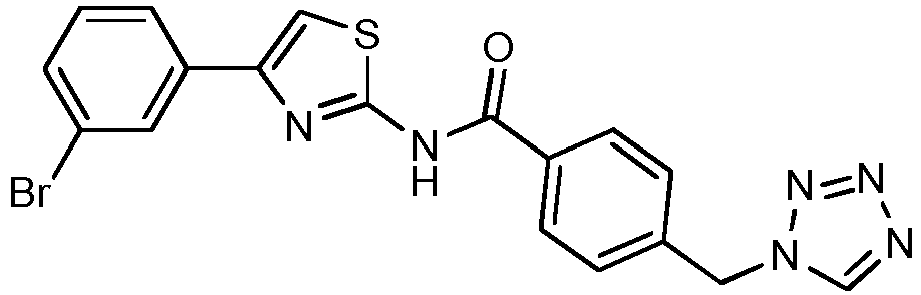
- 4-(3-bromophenyl)thiazol-2-amine (100 mg, 0.39 mmol) was diluted with toluene (400 µL) in a two necked round bottom flask equipped with a reflux condenser under an argon atmosphere. The solution was stirred and trimethylaluminium in toluene (185 µL, 2M) was slowly added. The solution was heated at 50°C during 20 min and the ester (57 mg, 0.26 mmol) in toluene (200 µL) was added. The resulting solution was heated under reflux for one night, cooled to room temperature and slowly hydrolyzed with water to prevent foam formation. The aqueous layer was based with a 1M NaOH solution (pH9-10). The mixture was extracted three times with DCM, and the organic layers were combined and dried over Na2SO4. The solvent was evaporated under reduced pressure. Purification by silica gel flash chromatography (DCM/Acetone 8:2) afforded the product (41.3 mg, 24%) as a yellow viscous oil. The crude product was used without further purifications.
-

- To a solution of methyl 4-(bromomethyl)benzoate (500 g, 2.18 mmol), K2CO3 (501 mg, 3.70 mmol) in DMF was added the N,N-Dimethylethylenediamine (262 µL, 2.4 mmol). The mixture was stirred overnight at 45°C. The mixture was filtered through Celite pad, washed with DCM. The organic layer was extracted with a 1M HCl solution. The aqueous layer was basified at pH 10 with a 1M NaOH solution and extracted three time with EA. The organic layer was dried over Na2SO4 and evaporated under reduced pressure to give the product (100 mg, 20%) as a white oil. 1H NMR (300 MHz, CDCl3) δ 7.92 (d, J = 8.3 Hz, 2H, Har), 7.33 (d, J = 8.4 Hz, 2H, Har), 3.82 (s, 3H, CH3), 3.79 (s, 2H, CH2), 2.60 (t, J= 6.0 Hz, 2H, CH2), 2.35 (t, J= 6.0 Hz, 2H, CH2), 2.12 (s, 6H, (CH3)2N). 13C NMR (75 MHz, CDCl3) δ 167.2 (C), 146.1 (C), 129.8 (2xCH), 128.8 (C), 128.1 (2xCH), 59.1 (CH2), 53.8 (CH2), 52.1 (CH3), 46.7 (CH2), 45.6 (2xCH3). HRMS [M+H]+ C13H21N2O2: Calcd. 237.1598 found 237.1600.
-

- 4-(3-bromophenyl)thiazol-2-amine (160 mg, 0.63 mmol) was diluted with toluene (700 µL) in a two necked round bottom flask equipped with a reflux condenser under an argon atmosphere. The solution was stirred and trimethylaluminium in toluene (298 µL, 2M) was slowly added. The solution was heated at 50°C during 20 min and the ester (100 mg, 0.42 mmol) in toluene (270 µL) was added. The resulting solution was heated under reflux for one night, cooled to room temperature and slowly hydrolyzed with water to prevent foam formation. The aqueous layer was based with a 1M NaOH solution (pH9-10). The mixture was extracted three times with DCM, and the organic layers were combined and dried over Na2SO4. The solvent was evaporated under reduced pressure. Purification by silica gel flash chromatography (DCM/MeOH/H2O 65:25:4) afforded the product (49.3 mg, 26%) as a yellow viscous oil. 1H NMR (300 MHz, CDCl3) δ 7.89 (bs, 1H, Har), 7.78 (d, J= 7.9 Hz, 2H, Har), 7.65 (d, J= 7.7 Hz, 1H, Har), 7.38 - 7.30 (m, 3H, Har), 7.21 - 7.14 (m, 2H, Har), 6.34 (bs, 1H, Har), 3.84 (s, 2H, CH2), 2.72 (t, J = 5.8 Hz, 2H, CH2), 2.46 (t, J = 5.8 Hz, 2H, CH2), 2.20 (s, 6H, (CH3)2N). 13C NMR (75 MHz, CDCl3) δ 165.5 (C), 159.4 (C), 148.8 (C), 145.9 (C), 136.6 (C), 131.0 (CH), 130.9 (C), 130.4 (CH), 129.4 (CH), 128.7 (2xCH), 128.0 (2xCH), 124.8 (CH), 123.1 (C), 109.3 (CH), 59.1 (CH2), 53.8 (CH2), 46.8 (CH2), 45.7 (2xCH3). HRMS [M+H]+ C21H24BrN4OS: Calcd. 459.0849 found 459.0827.
-

- To a solution of methyl 4-(bromomethyl)benzoate (500 g, 2.18 mmol), Cs2CO3 (781 mg, 2.4 mmol) in DMF (10 mL) was added the imidazole (163 mg, 2.4 mmol). The mixture was heated one hour in microwave at 150°C. The mixture was filtered through Celite pad, washed with DCM. The organic layer was washed twice with water, dried over Na2SO4 and evaporated under reduced pressure to give the product (381 mg, 81%) as a colourless oil. 1H NMR (300 MHz, CDCl3) δ 7.96 (d, J= 8.4 Hz, 2H, Har), 7.51 (s, 1H, Har), 7.14 (d, J = 8.6 Hz, 2H, Har), 7.05 (s, 1H, Har), 6.86 (s, 1H, Har), 5.14 (s, 2H, CH2), 3.86 (s, 3H, CH3). 13C NMR (75 MHz, CDCl3) δ 166.4 (C), 141.2 (C), 137.5 (CH), 130.2 (2xCH), 130.0 (C), 127.0 (2xCH), 119.3 (CH), 52.2 (CH3), 50.3 (CH2). HRMS [M+H]+ C12H13N2O2: Calcd. 217.0970 found 217.0972.
-
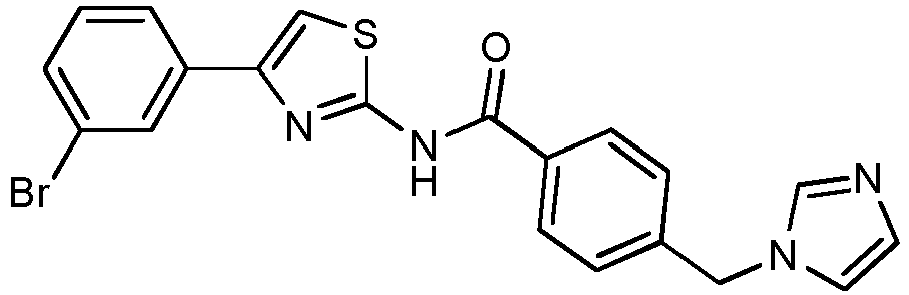
- 4-(3-bromophenyl)thiazol-2-amine (100 mg, 0.39 mmol) was diluted with toluene (400 µL) in a two necked round bottom flask equipped with a reflux condenser under an argon atmosphere. The solution was stirred and trimethylaluminium in toluene (185 µL, 2M) was slowly added. The solution was heated at 50°C during 20 min and the ester (56 mg, 0.26 mmol) in toluene (200 µL) was added. The resulting solution was heated under reflux for one night, cooled to room temperature and slowly hydrolyzed with water to prevent foam formation. The aqueous layer was based with a 1M NaOH solution (pH9-10). The mixture was extracted three times with DCM, and the organic layers were combined and dried over Na2SO4. The solvent was evaporated under reduced pressure. Purification by silica gel flash chromatography (DCM/MeOH 9:1) afforded the product (57.2 mg, 50%) as a yellow viscous oil. 1H NMR (300 MHz, MeOD) δ 7.85 - 7.80 (m, 3H, Har), 7.59 - 7.54 (m, 1H, Har), 7.44 (s, 1H, Har), 7.23 (ddd, J = 8.0, 1.9, 1.0 Hz, 1H, Har), 7.10 (d, J = 8.5 Hz, 2H, Har), 7.09 - 7.08 (m, 1H, Har), 7.07 (s, 1H, Har), 6.85 (s, 1H, Har), 6.80 (s, 1H, Har), 4.23 (s, 2H, CH2). 13C NMR (75 MHz, MeOD) δ 165.3 (C), 148.5 (C), 141.1 (C), 136.4 (C), 132.1 (C), 130.7 (CH), 130.2 (CH), 129.0 (CH), 129.0 (C), 128.5 (2xCH), 127.5 (2xCH), 124.5 (CH), 122.7 (C), 109.1 (CH), 50.3 (CH2). HRMS [M+H]+ C20H16BrN4OS: Calcd. 439.0223 found 439.0223.
-

- Glycine (1g, 13.3 mmol) was dissolved in isopropanol (10 mL) at 0°C. SOCl2 (1.93 mL, 26.6 mmol) was added dropwise. The mixture was stirred at reflux overnight. After cooling, the solvent was evaporated under reduced pressure and hexane was added at 0°C. The suspension was filtered to afford the product (1.76 g, 86%) as a white solid. 1H NMR (300 MHz, MeOD) δ 5.13 (hept, J = 6.3 Hz, 1H, (CH3)2 CHO), 3.81 (s, 2H, CH2), 1.32 (s, 3H, (CH 3 ) 2CHO), 1.30 (s, 3H, (CH 3 ) 2CHO). 13C NMR (75 MHz, MeOD) δ 168.0 (C), 71.7 ((CH3)2 CHO), 41.2 (CH2), 21.9 ((CH 3 ) 2 CHO). HRMS [M+H]+ C5H12NO2: Calcd. 118.0858 found 118.0863.
-

- To a solution of methyl 4-(bromomethyl)benzoate (500 g, 2.18 mmol), K2CO3 (854 mg, 6.33 mmol) in CH3CN at 0°C was added the 2-isopropoxy-2-oxoethanaminium chloride (368 mg, 2.4 mmol). The mixture was stirred two days at room temperature. The mixture was filtered through Celite pad, washed with EA and evaporated to dryness to give the product as a colourless oil. (318 mg, 55%). 1H NMR (300 MHz, CDCl3) δ 7.96 (d, J = 8.3 Hz, 2H, Har), 7.38 (d, J = 8.3 Hz, 2H, Har), 5.04 (hept, J= 6.3 Hz, 1H, (CH3)2 CHO), 3.87 (s, 3H, CH3), 3.83 (s, 2H, CH2), 3.34 (s, 2H, CH2), 2.39 (s, 1H, NH), 1.23 (s, 3H, (CH 3 ) 2CHO), 1.21 (s, 3H, (CH 3 ) 2CHO). 13C NMR (75 MHz, CDCl3) δ 172.0 (C), 167.2 (C), 145.1 (C), 130.0 (2xCH), 129.3 (C), 128.4 (2xCH), 68.7 ((CH3)2 CHO), 53.1 (CH2), 52.3 (CH3), 50.5 (CH2), 22.1 ((CH 3 ) 2 CHO). HRMS [M+H]+ C5H12NO2: Calcd. 118.0858 found 118.0863.
-

- 4-(3-bromophenyl)thiazol-2-amine (200 mg, 0.78 mmol) was diluted with toluene (800 µL) in a two necked round bottom flask equipped with a reflux condenser under an argon atmosphere. The solution was stirred and trimethylaluminium in toluene (488 µL, 2M) was slowly added. The solution was heated at 50°C during 20 min and the ester (150 mg, 0.65 mmol) in toluene (400 µL) was added. The resulting solution was heated under reflux for one night, cooled to room temperature and slowly hydrolyzed with water to prevent foam formation. The aqueous layer was extracted three times with DCM, and the organic layers were combined and dried over Na2SO4. The solvent was evaporated under reduced pressure. Purification by silica gel flash chromatography (PE/EE 1:1) afforded the product (189 mg, 65%) as a yellow viscous oil. 1H NMR (300 MHz, CDCl3) δ 11.61 (bs, 1H, NH), 7.79 - 7.69 (m, 3H, Har), 7.57 - 7.48 (m, 1H, Har), 7.33 - 7.23 (m, 3H, Har), 7.18 (s, 1H, Har), 7.10 (dd, J = 7.7, 7.7 Hz, 1H, Har), 4.44 (s, 2H, CH2). 13C NMR (75 MHz, CDCl3) δ 165.2 (C), 159.9 (C), 148.7 (C), 142.6 (C), 136.1 (C), 131.8 (C), 131.1 (CH), 130.4 (CH), 129.4 (2xCH), 129.3 (CH), 128.2 (2xCH), 124.8 (CH), 123.0 (C), 109.5 (CH), 32.3 (CH2). HRMS [M+H]+ C17H13Br2N2OS: Calcd. 450.9126 found 450.9110.
-

- To a solution of 4-(bromomethyl)-N-(4-(3-bromophenyl)thiazol-2-yl)benzamide (60 g, 0.13 mmol), K2CO3 (53 mg, 0.38 mmol) in CH3CN at 0°C was added the 2-isopropoxy-2-oxoethanaminium chloride (22.3 mg, 0.145 mmol). The mixture was stirred two days at room temperature. The mixture was filtered through Celite pad, washed with DCM and evaporated to dryness. Purification by silica gel flash chromatography (DCM/MeOH 95:5) afforded the product (28.5 mg, 45%) as a yellow viscous oil. 1H NMR (300 MHz, CDCl3) δ 7.88 (dd, J= 1.7, 1.7 Hz, 1H, Har), 7.80 (d, J= 8.3 Hz, 2H, Har), 7.65 (ddd, J= 7.8, 1.5, 1.1 Hz, 1H, Har), 7.37 (ddd, J = 8.0, 1.9, 1.0 Hz, 1H, Har), 7.34 (d, J = 8.2 Hz, 2H, Har), 7.19 (s, 1H, Har), 7.18 (dd, J = 7.9, 7.9 Hz, 1H, Har), 5.10 (Hept, J = 6.3 Hz, 1H, Har), 3.85 (s, 2H, CH2), 3.43 (s, 2H, CH2), 1.27 (s, 3H, (CH 3 ) 2CHO), 1.24 (s, 3H, (CH 3 ) 2CHO). 13C NMR (75 MHz, CDCl3) δ 171.87 (C), 165.30 (C), 159.33 (C), 148.83 (C), 144.67 (C), 136.54 (C), 131.17 (C), 131.12 (CH), 130.47 (CH), 129.43 (CH), 128.87 (2xCH), 128.07 (2xCH), 124.82 (CH), 123.15 (C), 109.39 (CH), 69.02 ((CH3)2 CHO), 52.97 (CH2), 50.57 (CH2), 22.17 ((CH 3 ) 2 CHO). HRMS [M+H]+ C22H23BrN3O3S: Calcd. 488.0624 found 488.0638.
- Compounds of the invention that have been tested in the above described ELISA-based in vitro kinase assay and in the Tritiated thymidine uptake cell proliferation in BAF3 cells assay tabulated in the table below.
Example number ALK WT IC50 (µM) ALK L1196M IC50 (µM) Parental IC50 (µM) NPM/ALK WT IC50 (µM) NPM/ALK L1196M IC50 (µM) Selectivity Index (WT) Selectivity Index (1196M) 1 71 5.6 4.7 1.4 0.69 3 7 2 82 5.8 5.5 0.85 2.6 6 2 3 45 4.8 2.3 0.67 1.4 3 2 4 50 6.4 5.3 2.4 2.3 2 2 5 83 2.7 5.3 1.9 2.3 3 2 6 >100 6.3 6.6 2.1 2.3 3 3 7 54 1.9 5.0 2.5 1.3 2 4 8 23 5.8 1.5 0.85 0.46 2 3 9 >100 8 4.0 2.3 0.90 2 4 10 15 2.6 3 1.1 0.29 3 10 11 20 2.4 3.2 2.4 0.16 1 20 12 12 1.7 1.8 2.1 0.14 1 13 13 3.3 0.3 3.1 5.6 0.57 1 5 14 1.3 0.71 7.8 2.2 6.2 4 1 15 0.64 0.60 14 1.2 7 12 2 16 0.54 0.54 >50 41 14 1 4 17 8.6 1.6 0.46 1.1 0.79 0 1 18 40 21 0.45 1.2 1.9 0 0 19 76 5.6 0.49 1.3 3.7 0 0 20 38 31 7.3 2.8 1.9 3 4 21 1.5 0.70 12 4.6 5.7 3 2 22 4.2 1.1 8.5 2.0 1.2 4 7 23 51 45 5.9 2.3 1.2 3 5 24 1.5 0.36 2.4 1.6 1.1 1 2 25 1.7 0.87 12 6.7 3.8 2 3 26 0.42 0.0446 11 8.7 9.4 1 1 27 0.4281 0.0331 2.3 1.6 1.4 1 2 28 2.127 0.0556 3.7 6.1 4.0 1 1 29 0.3854 0.0467 10.0 7.2 0.057 1 175 30 2.1 0.83 10 0.69 3.4 15 3 31 5.0 8.9 2.2 0.87 0.50 3 4 32 15 11 2.4 2.0 2.1 1 1 33 4.1 2.9 7.1 2.3 1.6 3 4 34 >100 >100 4.0 1.9 1.7 2 2 35 1.9 5.8 7.3 2.9 2.4 3 3 36 1.9 1.1 6.9 0.88 2.1 8 3 37 4.6 2.1 2.4 0.61 1.2 4 2 38 7.0 2.3 >50 10 2.3 >5 >22 39 >100 27 33 9.0 1.3 4 26 40 9.4 4.4 18 5.1 0.80 4 23 41 7.0 2.7 >50 22 0.83 >2 >60 42 53 3.7 2.6 2.9 0.96 1 3 43 >100 1.3 4.5 4.9 0.86 1 5 44 >100 65 7.8 5.1 5.4 2 1 45 50 30 8.0 5.1 3.2 2 2 46 52 39 11 6.9 3.9 2 3 47 46 >100 >25 >25 >25 1 1 48 0.20 0.91 13 1.6 3.1 8 4 49 26 99 4 1.7 1.9 2 2 50 2.8 3.6 >50 10 5.2 >5 >10 -
- <110> UNIVERSITA' DEGLI STUDI DI MILANO - BICOCCA
UNIVERSITE' DE GENEVE
UNIVERSITE' CLAUDE BERNARD LYON 1 - <120> 2-ACYLAMINOTHIAZOLES FOR THE TREATMENT OF CANCER
- <130> 3127EUR
- <160> 1
- <170> PatentIn version 3.5
- <210> 1
<211> 21
<212> PRT
<213> Artificial Sequence - <220>
<223> ALK peptide substrate - <400> 1

Claims (11)
- The compounds of formula (I)
 - R1 is
 i equals zero, 1 or 2Rx and Rx' can be the same or different and are a C1-C3 linear or branched alkyl;X is either oxygen or NRy;Ry is a C1-C3 linear or branched alkyl or propargyl;Rz is either hydrogen or C1-C3 linear or branched alkyl;- R2 and -R3 can be the same or different and are hydrogen, linear or branched C1-C3 alkyl or -C≡C-R4, provided that at least one of -R2 and -R3 is-C≡C-R4;- R4 is hydrogen, -CH2-O-CPh3, cyclohexenyl, C1-C4 alkyl,and pharmaceutically acceptable salts thereof.
 Rt and Rt' can be the same or different and are C1-C3 alkyl optionally substituted with one or more fluorine atoms, C1-C3 alkoxy optionally substituted with one or more fluorine atoms or F;Ra, Rb and Rc can be the same or different and can be phenyl or C1-C4 linear or branched alkyl;
 - The compounds of claim 1 wherein
R2 is hydrogen or linear or branched C1-C3 alkyl;
R3 is -C≡C-R4 ;
and wherein R1,R4,Ra, Rb, Rc, Rt, Rt', Rx, Rx', Ry , Rz, X and i are as defined in claim 1. - The compounds of claim 1 wherein
-R2 is -C≡C-R4 ;
R3 is hydrogen or linear or branched C1-C3 alkyl;
and wherein R1, R4, Ra, Rb, Rc, Rt, Rt', Rx, Rx', Ry ,Rz, X and i are as defined in claim 1. - The compounds of claims 2 or 3, wherein -R4 is selected from the list of
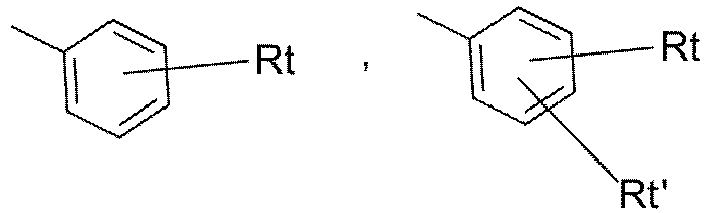
- The compounds of claims 2 or 3, wherein -R4 is selected from the list of

- The compounds of claims 4 or 5 wherein -R1 is

- The compounds of claims 4 or 5 wherein -R1 is

- The compounds of claims 4 or 5 wherein -R1 is selected from the list of

- The compounds of claim 1 selected from the list of4-((4-methylpiperazin-1-yl)methyl)-N-(4-(3-(phenylethynyl)phenyl)thiazol-2-yl)benzamide;4-((4-methylpiperazin-1-yl)methyl)-N-(4-(3-(p-tolylethynyl)phenyl)thiazol-2-yl)benzamide;N-(4-(3-((4-methoxyphenyl)ethynyl)phenyl)thiazol-2-yl)-4-((4-methylpiperazin-1-yl)methyl)benzamide;N-(4-(4-methyl-3-(phenylethynyl)phenyl)thiazol-2-yl)-4-((4-methylpiperazin-1-yl)methyl)benzamide;N-(4-(4-methyl-3-(p-tolylethynyl)phenyl)thiazol-2-yl)-4-((4-methylpiperazin-1-yl)methyl)benzamide;N-(4-(3-((4-methoxyphenyl)ethynyl)-4-methylphenyl)thiazol-2-yl)-4-((4-methylpiperazin-1-yl)methyl)benzamide;N-(4-(4-methyl-3-((2-(trifluoromethyl)phenyl)ethynyl)phenyl)thiazol-2-yl)-4-((4-methylpiperazin-1-yl)methyl)benzamide;N-(4-(3-((2-methoxyphenyl)ethynyl)-4-methylphenyl)thiazol-2-yl)-4-((4-methylpiperazin-1-yl)methyl)benzamide;N-(4-(3-((4-fluorophenyl)ethynyl)-4-methylphenyl)thiazol-2-yl)-4-((4-methylpiperazin-1-yl)methyl)benzamide;N-(4-(3-methyl-4-(p-tolylethynyl)phenyl)thiazol-2-yl)-4-((4-methylpiperazin-1-yl)methyl)benzamide;N-(4-(3-methyl-4-((2-(trifluoromethyl)phenyl)ethynyl)phenyl)thiazol-2-yl)-4-((4-methylpiperazin-1-yl)methyl)benzamide;4-((4-methylpiperazin-1-yl)methyl)-N-(4-(3-((2-(trifluoromethyl)phenyl)ethynyl)phenyl)thiazol-2-yl)benzamide;N-(4-(3,4-bis((2-(trifluoromethyl)phenyl)ethynyl)phenyl)thiazol-2-yl)-4-((4-methylpiperazin-1-yl)methyl)benzamide;N-(4-(4-methyl-3-((triisopropylsilyl)ethynyl)phenyl)thiazol-2-yl)-4-((4-methylpiperazin-1-yl)methyl)benzamide;N-(4-(3-methyl-4-((triisopropylsilyl)ethynyl)phenyl)thiazol-2-yl)-4-((4-methylpiperazin-1-yl)methyl)benzamide;N-(4-(3,4-bis((triisopropylsilyl)ethynyl)phenyl)thiazol-2-yl)-4-((4-methylpiperazin-1-yl)methyl)benzamide;4-((4-methylpiperazin-1-yl)methyl)-N-(4-(3-((triethylsilyl)ethynyl)phenyl)thiazol-2-yl)benzamide;4-((4-methylpiperazin-1-yl)methyl)-N-(4-(3-((trimethylsilyl)ethynyl)phenyl)thiazol-2-yl)benzamide;N-(4-(3-(cyclohex-1-en-1-ylethynyl)phenyl)thiazol-2-yl)-4-((4-methylpiperazin-1-yl)methyl)benzamide;N-(4-(3-(hex-1-yn-1-yl)phenyl)thiazol-2-yl)-4-((4-methylpiperazin-1-yl)methyl)benzamide;N-(4-(3-(3-((tert-butyldiphenylsilyl)oxy)prop-1-yn-1-yl)phenyl)thiazol-2-yl)-4-((4-methylpiperazin-1-yl)methyl)benzamide;4-((4-methylpiperazin-1-yl)methyl)-N-(4-(3-(3-((triisopropylsilyl)oxy)prop-1-yn-1-yl)phenyl)thiazol-2-yl)benzamide;N-(4-(3-(3-((tert-butyldimethylsilyl)oxy)prop-1-yn-1-yl)phenyl)thiazol-2-yl)-4-((4-methylpiperazin-1-yl)methyl)benzamide;N-(4-(3-((tert-butyldimethylsilyl)ethynyl)phenyl)thiazol-2-yl)-4-((4-methylpiperazin-1-yl)methyl)benzamide;N-(4-(3-((tert-butyldiphenylsilyl)ethynyl)phenyl)thiazol-2-yl)-4-((4-methylpiperazin-1-yl)methyl)benzamide;5-(4-(4-methylpiperazine-1-carbonyl)phenyl)-N-(4-(3-((triisopropylsilyl)ethynyl)phenyl)thiazol-2-yl)furan-2-carboxamide;N-(4-(3-((tert-butyldimethylsilyl)ethynyl)phenyl)thiazol-2-yl)-5-(4-(4-methylpiperazine-1-carbonyl)phenyl)furan-2-carboxamide;5-(4-(4-methylpiperazine-1-carbonyl)phenyl)-N-(4-(3-(3-((triisopropylsilyl)oxy)prop-1-yn-1-yl)phenyl)thiazol-2-yl)furan-2-carboxamide;5-(4-(4-methylpiperazine-1-carbonyl)phenyl)-N-(4-(3-((2-(trifluoromethyl)phenyl)ethynyl)phenyl)thiazol-2-yl)furan-2-carboxamide;4-((4-methylpiperazin-1-yl)methyl)-N-(4-(3-(3-(trityloxy)prop-1-yn-1-yl)phenyl)thiazol-2-yl)benzamide;N-(4-(3-((2-fluorophenyl)ethynyl)phenyl)thiazol-2-yl)-4-((4-methylpiperazin-1-yl)methyl)benzamide;N-(4-(3-((4-fluorophenyl)ethynyl)phenyl)thiazol-2-yl)-4-((4-methylpiperazin-1-yl)methyl)benzamide;N-(4-(3-((3,5-bis(trifluoromethyl)phenyl)ethynyl)phenyl)thiazol-2-yl)-4-((4-methylpiperazin-1-yl)methyl)benzamide;N-(4-(3-((3,5-bis(trifluoromethyl)phenyl)ethynyl)phenyl)thiazol-2-yl)-5-(4-(4-methylpiperazine-1-carbonyl)phenyl)furan-2-carboxamide;4-((4-methylpiperazin-1-yl)methyl)-N-(4-(4-((triisopropylsilyl)ethynyl)phenyl)thiazol-2-yl)benzamide;N-(4-(4-((3,5-bis(trifluoromethyl)phenyl)ethynyl)phenyl)thiazol-2-yl)-4-((4-methylpiperazin-1-yl)methyl)benzamide;N-(4-(4-((tert-butyldimethylsilyl)ethynyl)phenyl)thiazol-2-yl)-4-((4-methylpiperazin-1-yl)methyl)benzamide;4-(morpholinomethyl)-N-(4-(3-((triisopropylsilyl)ethynyl)phenyl)thiazol-2-yl)benzamide;N-(4-(3-((3,5-bis(trifluoromethyl)phenyl)ethynyl)phenyl)thiazol-2-yl)-4-(morpholinomethyl)benzamide;N-(4-(3-((tert-butyldimethylsilyl)ethynyl)phenyl)thiazol-2-yl)-4-(morpholinomethyl)benzamide;N-(4-(3-((tert-butyldiphenylsilyl)ethynyl)phenyl)thiazol-2-yl)-4-(morpholinomethyl)benzamide;4-((4-methylpiperazin-1-yl)methyl)-N-(4-(3-((2-(trifluoromethoxy)phenyl)ethynyl)phenyl)thiazol-2-yl)benzamide;5-(4-(4-methylpiperazine-1-carbonyl)phenyl)-N-(4-(3-((2-(trifluoromethoxy)phenyl)ethynyl)phenyl)thiazol-2-yl)furan-2-carboxamide;4-(((2-(dimethylamino)ethyl)amino)methyl)-N-(4-(3-((triisopropylsilyl)ethynyl)phenyl)thiazol-2-yl)benzamide;4-((1H-tetrazol-1-yl)methyl)-N-(4-(3-((triisopropylsilyl)ethynyl)phenyl)thiazol-2-yl)benzamide;4-((1H-imidazol-1-yl)methyl)-N-(4-(3-((triisopropylsilyl)ethynyl)phenyl)thiazol-2-yl)benzamide;isopropyl 2-((4-((4-(3-((triisopropylsilyl)ethynyl)phenyl)thiazol-2-yl)carbamoyl)benzyl)amino)acetate;4-((4-methylpiperazin-1-yl)methyl)-N-(4-(3-((triisopropylsilyl)ethynyl)phenyl)thiazol-2-yl)benzamide;N-(4-(3-ethynylphenyl)thiazol-2-yl)-4-((4-methylpiperazin-1-yl)methyl)benzamide and4-((4-(prop-2-yn-1-yl)piperazin-1-yl)methyl)-N-(4-(3-((triisopropylsilyl)ethynyl)phenyl)thiazol-2-yl)benzamide.
- The compounds of claims 1-9 for use in the treatment of cancer.
- The compounds of claims 1-9 for use in the treatment of a cancer selected from the list of anaplastic large cell lymphoma (ALCL), diffuse large B cell lymphoma, inflammatory myofibroblastic tumours, non-small cell lung cancer (NSCLC), oesophageal squamous cell carcinoma, renal medullary carcinoma, myeloid leukaemia, breast cancer and colorectal carcinoma.
Priority Applications (1)
| Application Number | Priority Date | Filing Date | Title |
|---|---|---|---|
| PL14741222T PL3016948T3 (en) | 2013-07-04 | 2014-07-03 | 2-acylaminothiazoles for the treatment of cancer |
Applications Claiming Priority (2)
| Application Number | Priority Date | Filing Date | Title |
|---|---|---|---|
| IT001124A ITMI20131124A1 (en) | 2013-07-04 | 2013-07-04 | 2-ACILAMINOTIAZOLI FOR CANCER TREATMENT |
| PCT/EP2014/064197 WO2015001024A1 (en) | 2013-07-04 | 2014-07-03 | 2-acylaminothiazoles for the treatment of cancer |
Publications (3)
| Publication Number | Publication Date |
|---|---|
| EP3016948A1 EP3016948A1 (en) | 2016-05-11 |
| EP3016948B1 true EP3016948B1 (en) | 2017-05-10 |
| EP3016948B8 EP3016948B8 (en) | 2017-07-19 |
Family
ID=48877393
Family Applications (1)
| Application Number | Title | Priority Date | Filing Date |
|---|---|---|---|
| EP14741222.5A Not-in-force EP3016948B8 (en) | 2013-07-04 | 2014-07-03 | 2-acylaminothiazoles for the treatment of cancer |
Country Status (7)
| Country | Link |
|---|---|
| US (1) | US9708279B2 (en) |
| EP (1) | EP3016948B8 (en) |
| CA (1) | CA2917114A1 (en) |
| ES (1) | ES2636245T3 (en) |
| IT (1) | ITMI20131124A1 (en) |
| PL (1) | PL3016948T3 (en) |
| WO (1) | WO2015001024A1 (en) |
Families Citing this family (1)
| Publication number | Priority date | Publication date | Assignee | Title |
|---|---|---|---|---|
| CN116120261B (en) * | 2022-11-30 | 2024-01-23 | 浙大宁波理工学院 | Preparation method of 3- [ (4-sulfadiazine-1-yl) methyl ] benzoic acid compound |
Family Cites Families (3)
| Publication number | Priority date | Publication date | Assignee | Title |
|---|---|---|---|---|
| EP2107054A1 (en) * | 2008-04-01 | 2009-10-07 | Università Degli Studi Di Milano - Bicocca | Antiproliferative compounds and therapeutic uses thereof |
| HUE025395T2 (en) * | 2011-02-02 | 2016-02-29 | Novartis Ag | Methods of using alk inhibitors |
| HK1198133A1 (en) * | 2011-08-02 | 2015-03-13 | 辉瑞公司 | Crizotinib for use in the treatment of cancer |
-
2013
- 2013-07-04 IT IT001124A patent/ITMI20131124A1/en unknown
-
2014
- 2014-07-03 EP EP14741222.5A patent/EP3016948B8/en not_active Not-in-force
- 2014-07-03 WO PCT/EP2014/064197 patent/WO2015001024A1/en not_active Ceased
- 2014-07-03 ES ES14741222.5T patent/ES2636245T3/en active Active
- 2014-07-03 PL PL14741222T patent/PL3016948T3/en unknown
- 2014-07-03 US US14/902,319 patent/US9708279B2/en not_active Expired - Fee Related
- 2014-07-03 CA CA2917114A patent/CA2917114A1/en not_active Abandoned
Non-Patent Citations (1)
| Title |
|---|
| None * |
Also Published As
| Publication number | Publication date |
|---|---|
| US20160257658A1 (en) | 2016-09-08 |
| EP3016948B8 (en) | 2017-07-19 |
| EP3016948A1 (en) | 2016-05-11 |
| PL3016948T3 (en) | 2017-10-31 |
| ES2636245T3 (en) | 2017-10-05 |
| ITMI20131124A1 (en) | 2015-01-05 |
| WO2015001024A1 (en) | 2015-01-08 |
| US9708279B2 (en) | 2017-07-18 |
| CA2917114A1 (en) | 2015-01-08 |
Similar Documents
| Publication | Publication Date | Title |
|---|---|---|
| EP3057969B1 (en) | Compositions useful for treating disorders related to kit | |
| US10550124B2 (en) | Atropisomerism for increased kinase inhibitor selectivity | |
| EP2909193B1 (en) | Phenyl linked quinolinyl modulators of ror-gamma-t | |
| EP3838898B1 (en) | Isoindolin-1-one derivative, method for preparing the same, and pharmaceutical composition comprising the same as an effective component for preventing or treating cancer | |
| JP6696670B2 (en) | Pyridinylaminopyrimidine derivative salt, process for producing the same and use thereof | |
| JP6896701B2 (en) | Imidazolylamide derivative | |
| EA018266B1 (en) | POLYSUBSTITUTED DERIVATIVES OF 2-ARYL-6-PHENYLIMIDAZO[1,2-a]PYRIDINES, PREPARATION AND THERAPEUTIC USE THEREOF | |
| WO2009121535A2 (en) | Antiproliferative compounds and therapeutic uses thereof | |
| KR102826937B1 (en) | Compounds having Axl and c-Met kinase inhibitory activity and their preparation and application | |
| EP3641776B1 (en) | Atropisomerism for enhanced kinase inhibitor selectivity | |
| JP6916562B2 (en) | Compounds, pharmaceutically acceptable salts thereof, solvates, stereoisomers and tautomers, and drug compositions, hyperproliferative disorder therapeutic agents, hyperproliferative disorder prophylaxis agents, drugs, cancer therapeutic agents, cancer Prophylactic agents and kinase signaling regulators | |
| JP2009227599A (en) | Imidazopyridazine derivative | |
| JPWO2005087749A1 (en) | 2-Aminoquinazoline derivatives | |
| EP2855475B1 (en) | Alpha-carbolines for the treatment of cancer | |
| CA2658285C (en) | Thieno[3,2-c]pyridine-7-carboxylic acid derivatives for use in treating solid tumors | |
| EA019122B1 (en) | Derivatives of 6-heterocyclic-imidazo[1,2-a]pyridine-2-carboxamides, preparation thereof and therapeutic application thereof | |
| US9708279B2 (en) | 2-acylaminothiazoles for the treatment of cancer | |
| KR102160841B1 (en) | 2-pyridone compound | |
| CN102827160A (en) | PI3K or PI3K/m-TOR pathway inhibitor and pharmaceutical applications thereof | |
| KR102578288B1 (en) | Pyrazolopyridazine derivatives, preparation method thereof and composition for preventing or treating cancer comprising the same | |
| JP2009073743A (en) | Novel fused cyclic pyrimidine compound or salt thereof and pharmaceutical composition thereof | |
| KR102655210B1 (en) | Adenosine A2A receptor antagonists and uses thereof | |
| Mishra et al. | Design, synthesis and characterization of 2-pyridone derivatives as C-Jun N-terminal Kinases (JNKs) signaling pathway inhibitors | |
| CA3153600C (en) | Compound having axl and c-met kinase inhibitory activity, preparation thereof and application thereof | |
| TWI394757B (en) | Anthraquinone derivative and antitumor agent using same |
Legal Events
| Date | Code | Title | Description |
|---|---|---|---|
| PUAI | Public reference made under article 153(3) epc to a published international application that has entered the european phase |
Free format text: ORIGINAL CODE: 0009012 |
|
| 17P | Request for examination filed |
Effective date: 20160105 |
|
| AK | Designated contracting states |
Kind code of ref document: A1 Designated state(s): AL AT BE BG CH CY CZ DE DK EE ES FI FR GB GR HR HU IE IS IT LI LT LU LV MC MK MT NL NO PL PT RO RS SE SI SK SM TR |
|
| AX | Request for extension of the european patent |
Extension state: BA ME |
|
| DAX | Request for extension of the european patent (deleted) | ||
| GRAP | Despatch of communication of intention to grant a patent |
Free format text: ORIGINAL CODE: EPIDOSNIGR1 |
|
| INTG | Intention to grant announced |
Effective date: 20161028 |
|
| GRAS | Grant fee paid |
Free format text: ORIGINAL CODE: EPIDOSNIGR3 |
|
| STAA | Information on the status of an ep patent application or granted ep patent |
Free format text: STATUS: GRANT OF PATENT IS INTENDED |
|
| GRAJ | Information related to disapproval of communication of intention to grant by the applicant or resumption of examination proceedings by the epo deleted |
Free format text: ORIGINAL CODE: EPIDOSDIGR1 |
|
| GRAL | Information related to payment of fee for publishing/printing deleted |
Free format text: ORIGINAL CODE: EPIDOSDIGR3 |
|
| STAA | Information on the status of an ep patent application or granted ep patent |
Free format text: STATUS: REQUEST FOR EXAMINATION WAS MADE |
|
| INTC | Intention to grant announced (deleted) | ||
| GRAR | Information related to intention to grant a patent recorded |
Free format text: ORIGINAL CODE: EPIDOSNIGR71 |
|
| STAA | Information on the status of an ep patent application or granted ep patent |
Free format text: STATUS: GRANT OF PATENT IS INTENDED |
|
| GRAA | (expected) grant |
Free format text: ORIGINAL CODE: 0009210 |
|
| STAA | Information on the status of an ep patent application or granted ep patent |
Free format text: STATUS: THE PATENT HAS BEEN GRANTED |
|
| AK | Designated contracting states |
Kind code of ref document: B1 Designated state(s): AL AT BE BG CH CY CZ DE DK EE ES FI FR GB GR HR HU IE IS IT LI LT LU LV MC MK MT NL NO PL PT RO RS SE SI SK SM TR |
|
| INTG | Intention to grant announced |
Effective date: 20170331 |
|
| REG | Reference to a national code |
Ref country code: GB Ref legal event code: FG4D |
|
| REG | Reference to a national code |
Ref country code: AT Ref legal event code: REF Ref document number: 892193 Country of ref document: AT Kind code of ref document: T Effective date: 20170515 Ref country code: CH Ref legal event code: EP |
|
| RAP2 | Party data changed (patent owner data changed or rights of a patent transferred) |
Owner name: UNIVERSITE CLAUDE BERNARD LYON 1 Owner name: UNIVERSITE DE GENEVE Owner name: UNIVERSITA DEGLI STUDI DI MILANO - BICOCCA |
|
| REG | Reference to a national code |
Ref country code: IE Ref legal event code: FG4D |
|
| REG | Reference to a national code |
Ref country code: DE Ref legal event code: R096 Ref document number: 602014009747 Country of ref document: DE |
|
| REG | Reference to a national code |
Ref country code: FR Ref legal event code: PLFP Year of fee payment: 4 |
|
| REG | Reference to a national code |
Ref country code: CH Ref legal event code: NV Representative=s name: ISLER AND PEDRAZZINI AG, CH |
|
| REG | Reference to a national code |
Ref country code: SE Ref legal event code: TRGR |
|
| REG | Reference to a national code |
Ref country code: NL Ref legal event code: FP |
|
| REG | Reference to a national code |
Ref country code: LT Ref legal event code: MG4D |
|
| REG | Reference to a national code |
Ref country code: ES Ref legal event code: FG2A Ref document number: 2636245 Country of ref document: ES Kind code of ref document: T3 Effective date: 20171005 |
|
| REG | Reference to a national code |
Ref country code: AT Ref legal event code: MK05 Ref document number: 892193 Country of ref document: AT Kind code of ref document: T Effective date: 20170510 |
|
| PG25 | Lapsed in a contracting state [announced via postgrant information from national office to epo] |
Ref country code: HR Free format text: LAPSE BECAUSE OF FAILURE TO SUBMIT A TRANSLATION OF THE DESCRIPTION OR TO PAY THE FEE WITHIN THE PRESCRIBED TIME-LIMIT Effective date: 20170510 Ref country code: LT Free format text: LAPSE BECAUSE OF FAILURE TO SUBMIT A TRANSLATION OF THE DESCRIPTION OR TO PAY THE FEE WITHIN THE PRESCRIBED TIME-LIMIT Effective date: 20170510 Ref country code: NO Free format text: LAPSE BECAUSE OF FAILURE TO SUBMIT A TRANSLATION OF THE DESCRIPTION OR TO PAY THE FEE WITHIN THE PRESCRIBED TIME-LIMIT Effective date: 20170810 Ref country code: AT Free format text: LAPSE BECAUSE OF FAILURE TO SUBMIT A TRANSLATION OF THE DESCRIPTION OR TO PAY THE FEE WITHIN THE PRESCRIBED TIME-LIMIT Effective date: 20170510 Ref country code: GR Free format text: LAPSE BECAUSE OF FAILURE TO SUBMIT A TRANSLATION OF THE DESCRIPTION OR TO PAY THE FEE WITHIN THE PRESCRIBED TIME-LIMIT Effective date: 20170811 |
|
| PG25 | Lapsed in a contracting state [announced via postgrant information from national office to epo] |
Ref country code: IS Free format text: LAPSE BECAUSE OF FAILURE TO SUBMIT A TRANSLATION OF THE DESCRIPTION OR TO PAY THE FEE WITHIN THE PRESCRIBED TIME-LIMIT Effective date: 20170910 Ref country code: BG Free format text: LAPSE BECAUSE OF FAILURE TO SUBMIT A TRANSLATION OF THE DESCRIPTION OR TO PAY THE FEE WITHIN THE PRESCRIBED TIME-LIMIT Effective date: 20170810 Ref country code: RS Free format text: LAPSE BECAUSE OF FAILURE TO SUBMIT A TRANSLATION OF THE DESCRIPTION OR TO PAY THE FEE WITHIN THE PRESCRIBED TIME-LIMIT Effective date: 20170510 Ref country code: LV Free format text: LAPSE BECAUSE OF FAILURE TO SUBMIT A TRANSLATION OF THE DESCRIPTION OR TO PAY THE FEE WITHIN THE PRESCRIBED TIME-LIMIT Effective date: 20170510 |
|
| PG25 | Lapsed in a contracting state [announced via postgrant information from national office to epo] |
Ref country code: DK Free format text: LAPSE BECAUSE OF FAILURE TO SUBMIT A TRANSLATION OF THE DESCRIPTION OR TO PAY THE FEE WITHIN THE PRESCRIBED TIME-LIMIT Effective date: 20170510 Ref country code: EE Free format text: LAPSE BECAUSE OF FAILURE TO SUBMIT A TRANSLATION OF THE DESCRIPTION OR TO PAY THE FEE WITHIN THE PRESCRIBED TIME-LIMIT Effective date: 20170510 Ref country code: CZ Free format text: LAPSE BECAUSE OF FAILURE TO SUBMIT A TRANSLATION OF THE DESCRIPTION OR TO PAY THE FEE WITHIN THE PRESCRIBED TIME-LIMIT Effective date: 20170510 Ref country code: RO Free format text: LAPSE BECAUSE OF FAILURE TO SUBMIT A TRANSLATION OF THE DESCRIPTION OR TO PAY THE FEE WITHIN THE PRESCRIBED TIME-LIMIT Effective date: 20170510 Ref country code: SK Free format text: LAPSE BECAUSE OF FAILURE TO SUBMIT A TRANSLATION OF THE DESCRIPTION OR TO PAY THE FEE WITHIN THE PRESCRIBED TIME-LIMIT Effective date: 20170510 |
|
| REG | Reference to a national code |
Ref country code: DE Ref legal event code: R097 Ref document number: 602014009747 Country of ref document: DE |
|
| PG25 | Lapsed in a contracting state [announced via postgrant information from national office to epo] |
Ref country code: SM Free format text: LAPSE BECAUSE OF FAILURE TO SUBMIT A TRANSLATION OF THE DESCRIPTION OR TO PAY THE FEE WITHIN THE PRESCRIBED TIME-LIMIT Effective date: 20170510 Ref country code: IT Free format text: LAPSE BECAUSE OF FAILURE TO SUBMIT A TRANSLATION OF THE DESCRIPTION OR TO PAY THE FEE WITHIN THE PRESCRIBED TIME-LIMIT Effective date: 20170510 |
|
| PLBE | No opposition filed within time limit |
Free format text: ORIGINAL CODE: 0009261 |
|
| STAA | Information on the status of an ep patent application or granted ep patent |
Free format text: STATUS: NO OPPOSITION FILED WITHIN TIME LIMIT |
|
| 26N | No opposition filed |
Effective date: 20180213 |
|
| PG25 | Lapsed in a contracting state [announced via postgrant information from national office to epo] |
Ref country code: SI Free format text: LAPSE BECAUSE OF FAILURE TO SUBMIT A TRANSLATION OF THE DESCRIPTION OR TO PAY THE FEE WITHIN THE PRESCRIBED TIME-LIMIT Effective date: 20170510 |
|
| PG25 | Lapsed in a contracting state [announced via postgrant information from national office to epo] |
Ref country code: LU Free format text: LAPSE BECAUSE OF NON-PAYMENT OF DUE FEES Effective date: 20170703 |
|
| REG | Reference to a national code |
Ref country code: FR Ref legal event code: PLFP Year of fee payment: 5 |
|
| PGFP | Annual fee paid to national office [announced via postgrant information from national office to epo] |
Ref country code: IE Payment date: 20180625 Year of fee payment: 5 Ref country code: NL Payment date: 20180629 Year of fee payment: 5 |
|
| PGFP | Annual fee paid to national office [announced via postgrant information from national office to epo] |
Ref country code: PL Payment date: 20180626 Year of fee payment: 5 |
|
| PG25 | Lapsed in a contracting state [announced via postgrant information from national office to epo] |
Ref country code: MT Free format text: LAPSE BECAUSE OF NON-PAYMENT OF DUE FEES Effective date: 20170703 |
|
| PGFP | Annual fee paid to national office [announced via postgrant information from national office to epo] |
Ref country code: ES Payment date: 20180801 Year of fee payment: 5 Ref country code: FR Payment date: 20180713 Year of fee payment: 5 Ref country code: DE Payment date: 20180730 Year of fee payment: 5 |
|
| PGFP | Annual fee paid to national office [announced via postgrant information from national office to epo] |
Ref country code: BE Payment date: 20180713 Year of fee payment: 5 Ref country code: TR Payment date: 20180702 Year of fee payment: 5 Ref country code: SE Payment date: 20180717 Year of fee payment: 5 Ref country code: CH Payment date: 20180711 Year of fee payment: 5 Ref country code: FI Payment date: 20180706 Year of fee payment: 5 Ref country code: GB Payment date: 20180720 Year of fee payment: 5 |
|
| PG25 | Lapsed in a contracting state [announced via postgrant information from national office to epo] |
Ref country code: HU Free format text: LAPSE BECAUSE OF FAILURE TO SUBMIT A TRANSLATION OF THE DESCRIPTION OR TO PAY THE FEE WITHIN THE PRESCRIBED TIME-LIMIT; INVALID AB INITIO Effective date: 20140703 Ref country code: MC Free format text: LAPSE BECAUSE OF FAILURE TO SUBMIT A TRANSLATION OF THE DESCRIPTION OR TO PAY THE FEE WITHIN THE PRESCRIBED TIME-LIMIT Effective date: 20170510 |
|
| PG25 | Lapsed in a contracting state [announced via postgrant information from national office to epo] |
Ref country code: CY Free format text: LAPSE BECAUSE OF FAILURE TO SUBMIT A TRANSLATION OF THE DESCRIPTION OR TO PAY THE FEE WITHIN THE PRESCRIBED TIME-LIMIT Effective date: 20170510 |
|
| PG25 | Lapsed in a contracting state [announced via postgrant information from national office to epo] |
Ref country code: MK Free format text: LAPSE BECAUSE OF FAILURE TO SUBMIT A TRANSLATION OF THE DESCRIPTION OR TO PAY THE FEE WITHIN THE PRESCRIBED TIME-LIMIT Effective date: 20170510 |
|
| REG | Reference to a national code |
Ref country code: DE Ref legal event code: R119 Ref document number: 602014009747 Country of ref document: DE |
|
| REG | Reference to a national code |
Ref country code: FI Ref legal event code: MAE |
|
| REG | Reference to a national code |
Ref country code: CH Ref legal event code: PL |
|
| REG | Reference to a national code |
Ref country code: SE Ref legal event code: EUG |
|
| GBPC | Gb: european patent ceased through non-payment of renewal fee |
Effective date: 20190703 |
|
| REG | Reference to a national code |
Ref country code: BE Ref legal event code: MM Effective date: 20190731 |
|
| PG25 | Lapsed in a contracting state [announced via postgrant information from national office to epo] |
Ref country code: FI Free format text: LAPSE BECAUSE OF NON-PAYMENT OF DUE FEES Effective date: 20190703 Ref country code: SE Free format text: LAPSE BECAUSE OF NON-PAYMENT OF DUE FEES Effective date: 20190704 Ref country code: GB Free format text: LAPSE BECAUSE OF NON-PAYMENT OF DUE FEES Effective date: 20190703 Ref country code: DE Free format text: LAPSE BECAUSE OF NON-PAYMENT OF DUE FEES Effective date: 20200201 Ref country code: NL Free format text: LAPSE BECAUSE OF NON-PAYMENT OF DUE FEES Effective date: 20190801 |
|
| REG | Reference to a national code |
Ref country code: NL Ref legal event code: MM Effective date: 20190801 |
|
| PG25 | Lapsed in a contracting state [announced via postgrant information from national office to epo] |
Ref country code: LI Free format text: LAPSE BECAUSE OF NON-PAYMENT OF DUE FEES Effective date: 20190731 Ref country code: CH Free format text: LAPSE BECAUSE OF NON-PAYMENT OF DUE FEES Effective date: 20190731 Ref country code: BE Free format text: LAPSE BECAUSE OF NON-PAYMENT OF DUE FEES Effective date: 20190731 Ref country code: PT Free format text: LAPSE BECAUSE OF FAILURE TO SUBMIT A TRANSLATION OF THE DESCRIPTION OR TO PAY THE FEE WITHIN THE PRESCRIBED TIME-LIMIT Effective date: 20170510 |
|
| PG25 | Lapsed in a contracting state [announced via postgrant information from national office to epo] |
Ref country code: FR Free format text: LAPSE BECAUSE OF NON-PAYMENT OF DUE FEES Effective date: 20190731 |
|
| PG25 | Lapsed in a contracting state [announced via postgrant information from national office to epo] |
Ref country code: IE Free format text: LAPSE BECAUSE OF NON-PAYMENT OF DUE FEES Effective date: 20190703 Ref country code: AL Free format text: LAPSE BECAUSE OF FAILURE TO SUBMIT A TRANSLATION OF THE DESCRIPTION OR TO PAY THE FEE WITHIN THE PRESCRIBED TIME-LIMIT Effective date: 20170510 |
|
| REG | Reference to a national code |
Ref country code: ES Ref legal event code: FD2A Effective date: 20201126 |
|
| PG25 | Lapsed in a contracting state [announced via postgrant information from national office to epo] |
Ref country code: ES Free format text: LAPSE BECAUSE OF NON-PAYMENT OF DUE FEES Effective date: 20190704 |
|
| PG25 | Lapsed in a contracting state [announced via postgrant information from national office to epo] |
Ref country code: PL Free format text: LAPSE BECAUSE OF NON-PAYMENT OF DUE FEES Effective date: 20190703 |
|
| PG25 | Lapsed in a contracting state [announced via postgrant information from national office to epo] |
Ref country code: TR Free format text: LAPSE BECAUSE OF NON-PAYMENT OF DUE FEES Effective date: 20190703 |