EP3015118A1 - Device for diffusing volatile substances - Google Patents
Device for diffusing volatile substances Download PDFInfo
- Publication number
- EP3015118A1 EP3015118A1 EP14818161.3A EP14818161A EP3015118A1 EP 3015118 A1 EP3015118 A1 EP 3015118A1 EP 14818161 A EP14818161 A EP 14818161A EP 3015118 A1 EP3015118 A1 EP 3015118A1
- Authority
- EP
- European Patent Office
- Prior art keywords
- volatile substances
- containers
- container
- diffusing
- casing
- Prior art date
- Legal status (The legal status is an assumption and is not a legal conclusion. Google has not performed a legal analysis and makes no representation as to the accuracy of the status listed.)
- Granted
Links
Images


Classifications
-
- A—HUMAN NECESSITIES
- A61—MEDICAL OR VETERINARY SCIENCE; HYGIENE
- A61L—METHODS OR APPARATUS FOR STERILISING MATERIALS OR OBJECTS IN GENERAL; DISINFECTION, STERILISATION OR DEODORISATION OF AIR; CHEMICAL ASPECTS OF BANDAGES, DRESSINGS, ABSORBENT PADS OR SURGICAL ARTICLES; MATERIALS FOR BANDAGES, DRESSINGS, ABSORBENT PADS OR SURGICAL ARTICLES
- A61L9/00—Disinfection, sterilisation or deodorisation of air
- A61L9/015—Disinfection, sterilisation or deodorisation of air using gaseous or vaporous substances, e.g. ozone
- A61L9/04—Disinfection, sterilisation or deodorisation of air using gaseous or vaporous substances, e.g. ozone using substances evaporated in the air without heating
- A61L9/12—Apparatus, e.g. holders, therefor
- A61L9/125—Apparatus, e.g. holders, therefor emanating multiple odours
-
- A—HUMAN NECESSITIES
- A61—MEDICAL OR VETERINARY SCIENCE; HYGIENE
- A61L—METHODS OR APPARATUS FOR STERILISING MATERIALS OR OBJECTS IN GENERAL; DISINFECTION, STERILISATION OR DEODORISATION OF AIR; CHEMICAL ASPECTS OF BANDAGES, DRESSINGS, ABSORBENT PADS OR SURGICAL ARTICLES; MATERIALS FOR BANDAGES, DRESSINGS, ABSORBENT PADS OR SURGICAL ARTICLES
- A61L2209/00—Aspects relating to disinfection, sterilisation or deodorisation of air
- A61L2209/10—Apparatus features
- A61L2209/13—Dispensing or storing means for active compounds
- A61L2209/134—Distributing means, e.g. baffles, valves, manifolds, nozzles
-
- A—HUMAN NECESSITIES
- A61—MEDICAL OR VETERINARY SCIENCE; HYGIENE
- A61L—METHODS OR APPARATUS FOR STERILISING MATERIALS OR OBJECTS IN GENERAL; DISINFECTION, STERILISATION OR DEODORISATION OF AIR; CHEMICAL ASPECTS OF BANDAGES, DRESSINGS, ABSORBENT PADS OR SURGICAL ARTICLES; MATERIALS FOR BANDAGES, DRESSINGS, ABSORBENT PADS OR SURGICAL ARTICLES
- A61L2209/00—Aspects relating to disinfection, sterilisation or deodorisation of air
- A61L2209/10—Apparatus features
- A61L2209/15—Supporting means, e.g. stands, hooks, holes for hanging
Definitions
- the present invention relates to a device for diffusing volatile substances, particularly to a device wherein two or more volatile substances are diffused by a passive diffusion system.
- Passive systems for diffusing volatile substances are known. Passive diffusers are devices for evaporating volatile substances in a closed environment, without using electric power, heating elements, or absorption wicks, for the purpose of simplifying and minimising the cost of the device, but maintaining at the same time its effectiveness, and allowing the user to adjust the evaporation rate of said product.
- Such devices are especially designed to be used in cooperation with an air stream at a suitable temperature, improving the evaporation and diffusion of the volatile substances.
- Some of these devices include semi-permeable membranes which allow the outlet of vapours but prevent the escape of liquid.
- These devices consist of a container comprising a formed portion and a membrane. When the membrane is flat, the formed portion is designed so that it includes a flat circumferential lip, wherein the formed portion and the membrane are welded together. The formed portion is designed so that it can contain a sufficient amount of liquid, gel or solid substance.
- this container is usually inside a plastic housing, which acts as protection and support.
- the housing also contributes to a better presentation of the product.
- An example of these housing devices is described in patent US-4,849,606 .
- Patent application US-2006153744 describes a device having a multiple fragrance solution, which comprises a cartridge for dispensing aromas in a room.
- the cartridge has a plurality of aromatic elements supported on a rotating disk, said disk being housed in a cavity of a housing, which forms an air inlet and an outlet port.
- Patent US-6,790,408 B2 describes a method and a device for preventing the habituation of a fragrance.
- the method and the device are adapted in order to provide a space with a continuous diffusion of a first fragrance and a periodic diffusion of a second fragrance. These fragrances can be vaporised by heating.
- Patent US-7,011,795 B2 describes a device for diffusing aromas in a room.
- the device comprises a cartridge having a plurality of aromatic elements mounted on a rotating disk, a motor, a blower and some sensors, the blower generating an air flow in order to spread the fragrance.
- the present invention aims to solve the problems of the prior devices by providing a device which improves performance, allows an enhancing effect and creates a noticeable effect among users working with a passive diffusion system for evaporating volatile substances.
- the device for diffusing volatile substances comprising a casing where at least two containers of respective volatile substances are housed, said containers being movable relative to said casing between at least one first position, where one of the containers remains exposed to the environment for diffusing its volatile substances, and a second position, where another container is exposed to the environment, and is characterised in that between said housing and the container or containers exposed to the environment a space is defined, which allows the diffusion of volatile substances from the unexposed container or containers, to a lesser degree than from the container exposed to the environment.
- the device for diffusing volatile substances also comprises a motor which drives the movement of said containers, said motor being drivable preferably by batteries.
- the device for diffusing volatile substances may comprise a position detector for detecting the position of said containers relative to the casing and/or a presence detector for detecting the presence of said containers inside the casing.
- said containers are arranged on a rotating disk, and advantageously the thickness of said rotating disk is lesser than the width of said space.
- said presence detector is preferably attached to a central projection of said rotating disk.
- said containers are arranged on a rotating support provided with a plurality of holes, and said rotating support comprises at least two vertical housings separated by a wall, one housing for every container, said wall having a lesser height than the height of said containers.
- the ratio between the surface defined by said space and the surface of the exposed container or containers, whereby the volatile substances evaporate is preferably comprised between 1% and 50%, particularly between 10% and 20%.
- this ratio is between the evaporation surface of volatile substances in the exposed container or containers and the evaporation surface of volatile substances in the unexposed container or containers.
- volatile substances evaporate through the surface defined by said space.
- performance is improved due to the fact that two or more fragrances in two or more containers contribute to the final performance and intensity.
- Hidden fragrances contribute to the final performance, remarkably reducing the overall size of the device.
- an enhancing effect can be generated due to the fact that, in addition to diffusing volatile substances from the exposed container, volatile substances from the rest of containers, which are unexposed to the environment, are also diffused, to a lesser extent.
- a noticeable effect for the user can be generated with the device of the present invention due to the change of fragrance, thus preventing the habituation of a fragrance, and with a passive diffusion system.
- Figures 1 to 5 show a first embodiment of the device for diffusing volatile substances, comprising a casing 1 wherein a disk 8 provided with a plurality of volatile substance containers 2 is inserted.
- Said disk 8 may include two or more containers 2, for example, three, as in the embodiment shown in the drawings.
- Each container 2 contains a different volatile substance, for example, an air freshener or insecticide substance with different aromas or attributes.
- Containers 2 have features that allow the diffusion of the volatile substances, the former being formed, for example, by membranes or a similar material.
- said disk 8 is manually housed inside a space 3, so that typically one of said containers 2 remains completely exposed to the environment.
- the other unexposed containers 2 do not remain hermetically sealed, but only partially enclosed by the casing wall 1 to reduce evaporation and diffusion of the volatile substances, since the thickness of said disk 8 is lesser than the width of said space 3, thus creating a space, as better seen in Figure 5 .
- This space 3 allows volatile substances from the unexposed containers 2 to also diffuse to the environment, although to a lesser extent than the volatile substances from the exposed container 2.
- volatile substances from said containers 2 can be accumulated and mixed in this space 3, as explained hereinafter.
- the ratio between the surface defined by said space 3 and the surface of the exposed container or containers, whereby the volatile substances evaporate, is comprised between 1% and 50%, particularly between 10% and 20%.
- the volume remaining in front of the evaporation surface of the unexposed container or containers 2 defines the space 3 wherein the vapours of the volatile substances are accumulated, and the surface defined by said space 3 corresponds to the exchange surface between the volume of this space 3 and the environment.
- Said disk 8 rotates relative to the casing 1, either manually or automatically, so that it is possible to vary the container 2 exposed to the outside of the casing 1.
- Said rotational movement of the rotating disk 8 is preferably automatically performed, and the device of the present invention comprises thereto a motor 4 powered by batteries 5 and a reduction gear system 14, 15 to reduce the motor speed 4 and increase the torque.
- the disk 8 comprises a position detector 6 in contact with a central projection 9 of the disk 8.
- Said position detector 6 is formed by a lever which can be placed in at least two positions.
- said central projection 9 is substantially triangular, with rounded vertices, so that the position detector 6 detects whether the lever is in a first position (corresponding to one of the vertices of said central projection 9) or in a second position (corresponding to the sides defined by the central triangular projection 9).
- the device of the present invention comprises a presence detector 7 which detects the presence of the rotating disk 8 inside said space 3.
- the device of the present invention comprises electronic control means, represented in Figure 3 , via a printed circuit board 16.
- the device works as follows: First, a user introduces the rotating disk 8 in the space 3 of the casing 1 and the presence detector 7 detects the presence of said rotating disk 8. Then, the electronic control means send drive signals to the motor for driving the rotation of the disk 8 at predetermined intervals. For example, the number of movements per day could be between 480 and 1.
- FIGS 6 to 8 show a second embodiment of the device according to the present invention.
- the same numerical references as in the first embodiment are used to indicate equivalent elements.
- the device also comprises a casing 1 wherein several containers 2 are inserted, two in case of the represented embodiment. These containers 2 are housed in vertical housings 12 of a rotating support 10 said rotating support 10 comprising holes 11 for diffusing volatile substances.
- the housing 1 defines in its interior a space 3 delimited by said rotating support 10, as shown, particularly, in Figure 6 .
- Said vertical housings 12 are separated by a vertical wall 13, the height of said vertical wall 13 being less than the height of said containers 2, so that there is a mixture of the volatile substances from both containers 2. That is, the volatile substances from the container 2 placed adjacent to said holes 11 will diffuse more than the volatile substances from the other container 2, which will accumulate in said space 3, in the rotating support 10 position represented in Figure 7 .
- the evaporation of volatile substances could also in this case be increased by the placement of a heating element.
Landscapes
- Health & Medical Sciences (AREA)
- Epidemiology (AREA)
- Life Sciences & Earth Sciences (AREA)
- Animal Behavior & Ethology (AREA)
- General Health & Medical Sciences (AREA)
- Public Health (AREA)
- Veterinary Medicine (AREA)
- Disinfection, Sterilisation Or Deodorisation Of Air (AREA)
Abstract
Description
- The present invention relates to a device for diffusing volatile substances, particularly to a device wherein two or more volatile substances are diffused by a passive diffusion system.
- Passive systems for diffusing volatile substances are known. Passive diffusers are devices for evaporating volatile substances in a closed environment, without using electric power, heating elements, or absorption wicks, for the purpose of simplifying and minimising the cost of the device, but maintaining at the same time its effectiveness, and allowing the user to adjust the evaporation rate of said product.
- Such devices are especially designed to be used in cooperation with an air stream at a suitable temperature, improving the evaporation and diffusion of the volatile substances.
- Some of these devices include semi-permeable membranes which allow the outlet of vapours but prevent the escape of liquid. These devices consist of a container comprising a formed portion and a membrane. When the membrane is flat, the formed portion is designed so that it includes a flat circumferential lip, wherein the formed portion and the membrane are welded together. The formed portion is designed so that it can contain a sufficient amount of liquid, gel or solid substance.
- These devices are inexpensive and clean, since they prevent the substance from spilling in the event of unsuitable handling, and in their simplest applications they do not include any extra housing, such as, for instance, in patents
US-4,157,787 andUS-5,518,790 . - In other cases, this container is usually inside a plastic housing, which acts as protection and support. The housing also contributes to a better presentation of the product. An example of these housing devices is described in patent
US-4,849,606 . - Patent application
US-2006153744 describes a device having a multiple fragrance solution, which comprises a cartridge for dispensing aromas in a room. The cartridge has a plurality of aromatic elements supported on a rotating disk, said disk being housed in a cavity of a housing, which forms an air inlet and an outlet port. - Patent
US-6,790,408 B2 describes a method and a device for preventing the habituation of a fragrance. The method and the device are adapted in order to provide a space with a continuous diffusion of a first fragrance and a periodic diffusion of a second fragrance. These fragrances can be vaporised by heating. - Patent
US-7,011,795 B2 describes a device for diffusing aromas in a room. The device comprises a cartridge having a plurality of aromatic elements mounted on a rotating disk, a motor, a blower and some sensors, the blower generating an air flow in order to spread the fragrance. - These devices, however, have a series of drawbacks, which are listed below.
- On the one hand, most of these are devices which need to be connected to the grid, with the disadvantage of very poor portability and a high cost.
On the other hand, the performance of the prior solutions is limited due to the total surface of the chemical compounds exposed to the air, and considering passive diffusion systems, they do not have any noticeable effect for the users or any enhancing effect. - Therefore, the present invention aims to solve the problems of the prior devices by providing a device which improves performance, allows an enhancing effect and creates a noticeable effect among users working with a passive diffusion system for evaporating volatile substances.
- The solution of the aforesaid disadvantages is achieved with the device of the invention, presenting other advantages described below.
- The device for diffusing volatile substances, comprising a casing where at least two containers of respective volatile substances are housed, said containers being movable relative to said casing between at least one first position, where one of the containers remains exposed to the environment for diffusing its volatile substances, and a second position, where another container is exposed to the environment, and is characterised in that between said housing and the container or containers exposed to the environment a space is defined, which allows the diffusion of volatile substances from the unexposed container or containers, to a lesser degree than from the container exposed to the environment.
- Advantageously, the device for diffusing volatile substances according to the present invention also comprises a motor which drives the movement of said containers, said motor being drivable preferably by batteries.
- If desired, the device for diffusing volatile substances according to the present invention may comprise a position detector for detecting the position of said containers relative to the casing and/or a presence detector for detecting the presence of said containers inside the casing.
- According to a first embodiment, said containers are arranged on a rotating disk, and advantageously the thickness of said rotating disk is lesser than the width of said space.
- Furthermore, said presence detector is preferably attached to a central projection of said rotating disk.
- According to a second embodiment, said containers are arranged on a rotating support provided with a plurality of holes, and said rotating support comprises at least two vertical housings separated by a wall, one housing for every container, said wall having a lesser height than the height of said containers.
- The ratio between the surface defined by said space and the surface of the exposed container or containers, whereby the volatile substances evaporate, is preferably comprised between 1% and 50%, particularly between 10% and 20%.
- That is, this ratio is between the evaporation surface of volatile substances in the exposed container or containers and the evaporation surface of volatile substances in the unexposed container or containers. In the case of the unexposed container or containers, volatile substances evaporate through the surface defined by said space.
- In the present invention, performance is improved due to the fact that two or more fragrances in two or more containers contribute to the final performance and intensity. Hidden fragrances contribute to the final performance, remarkably reducing the overall size of the device.
- With the device of the present invention an enhancing effect can be generated due to the fact that, in addition to diffusing volatile substances from the exposed container, volatile substances from the rest of containers, which are unexposed to the environment, are also diffused, to a lesser extent.
- Moreover, a noticeable effect for the user can be generated with the device of the present invention due to the change of fragrance, thus preventing the habituation of a fragrance, and with a passive diffusion system.
- For a better understanding of what has been disclosed, some drawings in which a practical case of embodiment is shown, schematically and solely by way of non-limiting example, are attached.
-
Figure 1 is a perspective view of the device for diffusing volatile substances according to a first embodiment; -
Figure 2 is a perspective view of the rotating disk from the device for diffusing volatile substances of the first embodiment, including the position and presence sensors and the gear which rotates said disk; -
Figure 3 is a perspective view of the rotating disk of the device for diffusing volatile substances of the first embodiment, including the motor, batteries and the printed circuit board; -
Figure 4 is a perspective view of the system which transmits the rotational movement to the disk; -
Figure 5 is a perspective view of the rotating disk inserted in the slot of the device of the present invention; -
Figure 6 is a perspective view of the device for diffusing volatile substances according to a second embodiment during the insertion of one of the volatile substance containers; -
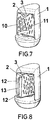
Figure 7 is a perspective view of the device of the present invention according to said second embodiment with the rotating support in a first position; and -
Figure 8 is a perspective view of the device of the present invention according to said second embodiment with the rotating support in a second position, turned 90° from the one shown inFigure 7 . -
Figures 1 to 5 show a first embodiment of the device for diffusing volatile substances, comprising acasing 1 wherein adisk 8 provided with a plurality ofvolatile substance containers 2 is inserted. - Said
disk 8 may include two ormore containers 2, for example, three, as in the embodiment shown in the drawings. Eachcontainer 2 contains a different volatile substance, for example, an air freshener or insecticide substance with different aromas or attributes. -
Containers 2 have features that allow the diffusion of the volatile substances, the former being formed, for example, by membranes or a similar material. - As can be seen particularly in
Figure 1 , saiddisk 8 is manually housed inside aspace 3, so that typically one of saidcontainers 2 remains completely exposed to the environment. However, the otherunexposed containers 2 do not remain hermetically sealed, but only partially enclosed by thecasing wall 1 to reduce evaporation and diffusion of the volatile substances, since the thickness of saiddisk 8 is lesser than the width ofsaid space 3, thus creating a space, as better seen inFigure 5 . - This
space 3 allows volatile substances from theunexposed containers 2 to also diffuse to the environment, although to a lesser extent than the volatile substances from the exposedcontainer 2. - Moreover, volatile substances from said
containers 2 can be accumulated and mixed in thisspace 3, as explained hereinafter. - The ratio between the surface defined by
said space 3 and the surface of the exposed container or containers, whereby the volatile substances evaporate, is comprised between 1% and 50%, particularly between 10% and 20%. - That is, the volume remaining in front of the evaporation surface of the unexposed container or
containers 2 defines thespace 3 wherein the vapours of the volatile substances are accumulated, and the surface defined bysaid space 3 corresponds to the exchange surface between the volume of thisspace 3 and the environment. - Said
disk 8 rotates relative to thecasing 1, either manually or automatically, so that it is possible to vary thecontainer 2 exposed to the outside of thecasing 1. - Said rotational movement of the rotating
disk 8 is preferably automatically performed, and the device of the present invention comprises thereto amotor 4 powered bybatteries 5 and areduction gear system motor speed 4 and increase the torque. - In order to know at all times the relative position of the rotating
disk 8 relative to thecasing 1, thedisk 8 comprises aposition detector 6 in contact with acentral projection 9 of thedisk 8. - Said
position detector 6 is formed by a lever which can be placed in at least two positions. - As can be better seen in
Figure 2 , saidcentral projection 9 is substantially triangular, with rounded vertices, so that theposition detector 6 detects whether the lever is in a first position (corresponding to one of the vertices of said central projection 9) or in a second position (corresponding to the sides defined by the central triangular projection 9). - Furthermore, the device of the present invention comprises a
presence detector 7 which detects the presence of therotating disk 8 inside saidspace 3. - In order to control the automatic movement of the
rotating disk 8, the device of the present invention comprises electronic control means, represented inFigure 3 , via a printedcircuit board 16. - The device works as follows: First, a user introduces the
rotating disk 8 in thespace 3 of thecasing 1 and thepresence detector 7 detects the presence of saidrotating disk 8. Then, the electronic control means send drive signals to the motor for driving the rotation of thedisk 8 at predetermined intervals. For example, the number of movements per day could be between 480 and 1. - When the
disk 8 rotates, the accumulation of said volatile substances from thecontainer 2 is diffused to the outside, generating an enhancing effect. - Furthermore, when the
disk 8 is stopped, not only volatile substances from thecontainer 2 exposed to the environment will be diffused to the outside, but also volatile substances fromother containers 2 unexposed to the environment. - It should be noted that, although not shown in the drawings, the evaporation of volatile substances can be accelerated by using heating elements.
-
Figures 6 to 8 show a second embodiment of the device according to the present invention. For the sake of simplicity, in this second embodiment the same numerical references as in the first embodiment are used to indicate equivalent elements. - In this second embodiment, the device also comprises a
casing 1 whereinseveral containers 2 are inserted, two in case of the represented embodiment. Thesecontainers 2 are housed invertical housings 12 of arotating support 10 said rotatingsupport 10 comprisingholes 11 for diffusing volatile substances. - In this embodiment, the
housing 1 defines in its interior aspace 3 delimited by said rotatingsupport 10, as shown, particularly, inFigure 6 . - Said
vertical housings 12 are separated by avertical wall 13, the height of saidvertical wall 13 being less than the height of saidcontainers 2, so that there is a mixture of the volatile substances from bothcontainers 2. That is, the volatile substances from thecontainer 2 placed adjacent to saidholes 11 will diffuse more than the volatile substances from theother container 2, which will accumulate in saidspace 3, in therotating support 10 position represented inFigure 7 . - As in the previous embodiment, when the rotation of said rotating support 10 (
Figure 8 ) occurs, the mixture of the volatile substances accumulated in thespace 3 will diffuse to the outside, generating an enhancing effect. - Although not shown in the drawings for the sake of simplicity, it must be noted that the rotation of said
support 10 can be performed automatically by a motor, a reduction gear system and control means similar to those described regarding the first embodiment. - Furthermore, the evaporation of volatile substances could also in this case be increased by the placement of a heating element.
- Although reference has been made to a specific embodiment of the invention, it is apparent to a person skilled in the art that the device described is susceptible to numerous variations and modifications, and that all the details mentioned can be replaced by others that are technically equivalent, without departing from the scope of protection defined by the appended claims.
Claims (12)
- A device for diffusing volatile substances, comprising a casing (1) wherein at least two respective volatile substance containers (2) are housed, said containers being moveable (2) relative to said casing (1) between at least one first position, where one of the containers (2) is exposed to the environment for diffusing its volatile substances, and a second position, where another container (2) is exposed to the environment, characterised in that between said casing (1) and container or containers (2) unexposed to the environment a space (3) is defined, which allows the diffusion of volatile substances of the unexposed container or containers (2) to a lesser extent than the container (2) exposed to the environment.
- The device for diffusing volatile substances according to claim 1, further comprising a motor (4) which drives the movement of said containers (2).
- The device for diffusing volatile substances according to claim 2, wherein said motor (4) is drivable by batteries (5).
- The device for diffusing volatile substances according to claim 1, comprising a position detector (6) which detects the position of said containers (2) relative to the casing (1).
- The device for diffusing volatile substances according to claim 1, comprising a presence detector (7) which detects the presence of said containers (2) inside the casing (1).
- The device for diffusing volatile substances according to claim 1, wherein said containers (2) are arranged on a rotating disk (8).
- The device for diffusing volatile substances according to claim 6, wherein the thickness of said rotating disc (8) is less than the width of said space (3) defined in said casing (1).
- The device for diffusing volatile substances according to claims 4 and 6, wherein said presence detector (7) is attached to a central projection (9) of said rotating disk (8).
- The device for diffusing volatile substances according to claim 1, wherein said containers (2) are arranged on a rotating support (10) provided with a plurality of holes (11).
- The device for diffusing volatile substances according to claim 9, wherein said rotating support (10) comprises at least two vertical housings (12) separated by a wall (13), a housing (12) for every container (2), said wall (13) being of a lesser height than the height of said containers (2).
- The device for diffusing volatile substances according to claim 1, wherein the ratio between the surface defined by said space (3) and the surface of the exposed container or containers (2) whereby the volatile substances evaporate is comprised between 1% and 50%.
- The device for diffusing volatile substances according to claim 11, wherein the ratio between the surface defined by said space (3) and the surface of the exposed container or containers (2) whereby the volatile substances evaporate is comprised between 10% and 20%.
Priority Applications (1)
| Application Number | Priority Date | Filing Date | Title |
|---|---|---|---|
| EP14818161.3A EP3015118B1 (en) | 2013-06-26 | 2014-03-31 | Device for diffusing volatile substances |
Applications Claiming Priority (3)
| Application Number | Priority Date | Filing Date | Title |
|---|---|---|---|
| EP13382245 | 2013-06-26 | ||
| PCT/ES2014/070243 WO2014207273A1 (en) | 2013-06-26 | 2014-03-31 | Device for diffusing volatile substances |
| EP14818161.3A EP3015118B1 (en) | 2013-06-26 | 2014-03-31 | Device for diffusing volatile substances |
Publications (3)
| Publication Number | Publication Date |
|---|---|
| EP3015118A1 true EP3015118A1 (en) | 2016-05-04 |
| EP3015118A4 EP3015118A4 (en) | 2017-03-08 |
| EP3015118B1 EP3015118B1 (en) | 2025-10-22 |
Family
ID=52141135
Family Applications (1)
| Application Number | Title | Priority Date | Filing Date |
|---|---|---|---|
| EP14818161.3A Active EP3015118B1 (en) | 2013-06-26 | 2014-03-31 | Device for diffusing volatile substances |
Country Status (5)
| Country | Link |
|---|---|
| US (1) | US11071802B2 (en) |
| EP (1) | EP3015118B1 (en) |
| CA (1) | CA2917053A1 (en) |
| ES (1) | ES3056530T3 (en) |
| WO (1) | WO2014207273A1 (en) |
Families Citing this family (4)
| Publication number | Priority date | Publication date | Assignee | Title |
|---|---|---|---|---|
| USD861846S1 (en) * | 2015-01-22 | 2019-10-01 | Rimports, Llc | Electrical plug-in fragrance dispenser with slot for receiving decorative sheaths |
| USD806220S1 (en) * | 2015-05-18 | 2017-12-26 | Zobele Holding S.P.A. | Air freshener |
| US9585982B1 (en) | 2015-12-29 | 2017-03-07 | The Dial Corporation | Systems for diffusing volatile compounds utilizing moveable pods |
| US10080815B2 (en) | 2015-12-29 | 2018-09-25 | Henkel IP & Holding GmbH | Systems for diffusing volatile compounds utilizing moveable pods |
Family Cites Families (23)
| Publication number | Priority date | Publication date | Assignee | Title |
|---|---|---|---|---|
| US4157787A (en) | 1977-08-23 | 1979-06-12 | Milpak Incorporated | Air freshener dispenser |
| US4849606A (en) | 1987-12-23 | 1989-07-18 | S. C. Johnson & Son, Inc. | Tamper-resistant container utilizing a flexible seal |
| US5050798A (en) | 1989-09-13 | 1991-09-24 | Ecolab Inc. | Static air freshener device and cartridge |
| US5178327A (en) * | 1991-08-02 | 1993-01-12 | Summit Products, Inc. | Air freshener |
| DE9219105U1 (en) | 1992-10-31 | 1998-03-05 | Klocke Verpackungs-Service GmbH, 76356 Weingarten | Containers for aromatic substances |
| DE4446413A1 (en) | 1994-12-23 | 1996-06-27 | Globol Gmbh | Containers for holding active substances such as fragrances, insecticides or the like |
| GB9501065D0 (en) * | 1995-01-18 | 1995-03-08 | Kennedy Eng Holding David | Air freshener unit and cartridge therefor and method of dispensing air freshening vapour |
| US5805768A (en) * | 1996-07-08 | 1998-09-08 | Bunny Moon Enterprises | Aroma therapy diffuser |
| GB9916755D0 (en) | 1999-07-17 | 1999-09-15 | Reckitt & Colmann Prod Ltd | Improvements in or relating to organic compositions |
| US6581915B2 (en) * | 2000-07-27 | 2003-06-24 | The Procter & Gamble Company | Dispensing device for dispensing scents |
| US20020068010A1 (en) * | 2000-12-04 | 2002-06-06 | The Procter & Gamble Company | Articles, systems, and methods for dispensing volatile materials into the environment |
| US20030164557A1 (en) * | 2002-01-22 | 2003-09-04 | Caleb Chung | Interactive, automated aroma diffuser with interface to external device |
| US7459168B2 (en) * | 2002-02-22 | 2008-12-02 | Dainihon Jochugiku Co., Ltd. | Insecticide transpiration apparatus |
| ES2275960T3 (en) * | 2002-04-12 | 2007-06-16 | Dainihon Jochugiku Co., Ltd. | INSECTICIDE DISSEMINATION DEVICE. |
| US7011795B2 (en) | 2003-05-29 | 2006-03-14 | Jcs/Thg, Llc | Apparatus for dispersing scents into the environment |
| WO2004105878A1 (en) | 2003-05-29 | 2004-12-09 | The Holmes Group, Inc. | Apparatus for dispersing volatile materials into the environment |
| US7350720B2 (en) * | 2004-02-03 | 2008-04-01 | S.C. Johnson & Son, Inc. | Active material emitting device |
| FR2880279A1 (en) * | 2005-01-05 | 2006-07-07 | Cvb Sarl Sarl | MULTI-ODOR DIFFUSION DEVICE |
| CA2647113C (en) | 2006-03-24 | 2011-05-10 | Zobele Holding S.P.A. | Adjustable volatile substance diffuser device with a container with a membrane |
| EP2023965A1 (en) * | 2006-05-05 | 2009-02-18 | Givaudan SA | Volatile liquid dispensing device |
| DE102006022661A1 (en) | 2006-05-12 | 2007-11-22 | Behr Gmbh & Co. Kg | Scenting system, in particular for a motor vehicle |
| US20090212124A1 (en) * | 2007-09-12 | 2009-08-27 | Kevin Brian Kenny | Apparatus and method for dispensing a volatile composition |
| US8899493B2 (en) * | 2008-10-14 | 2014-12-02 | Halla Climate Control Corp. | Air freshener generator for vehicle air conditioning apparatus |
-
2014
- 2014-03-31 ES ES14818161T patent/ES3056530T3/en active Active
- 2014-03-31 US US14/901,609 patent/US11071802B2/en active Active
- 2014-03-31 CA CA2917053A patent/CA2917053A1/en not_active Abandoned
- 2014-03-31 EP EP14818161.3A patent/EP3015118B1/en active Active
- 2014-03-31 WO PCT/ES2014/070243 patent/WO2014207273A1/en not_active Ceased
Non-Patent Citations (1)
| Title |
|---|
| See references of WO2014207273A1 * |
Also Published As
| Publication number | Publication date |
|---|---|
| CA2917053A1 (en) | 2014-12-31 |
| EP3015118A4 (en) | 2017-03-08 |
| WO2014207273A1 (en) | 2014-12-31 |
| ES3056530T3 (en) | 2026-02-23 |
| US11071802B2 (en) | 2021-07-27 |
| US20160129146A1 (en) | 2016-05-12 |
| EP3015118B1 (en) | 2025-10-22 |
Similar Documents
| Publication | Publication Date | Title |
|---|---|---|
| EP1698355B1 (en) | Device for evaporating volatile substances using a membrane | |
| US20170151362A1 (en) | Table top scent dispensing device and method | |
| EP2908869B1 (en) | Volatile material dispensing system having an adjustable diffusion apparatus | |
| KR101813776B1 (en) | Device for evaporating volatile compositions | |
| US5695692A (en) | Self-rotating air freshner cartridge and method of dispensing different air freshening vapors | |
| EP2858688B1 (en) | Centrifugal fan device | |
| US11071802B2 (en) | Device for diffusing volatile substances | |
| EP2896408B1 (en) | An apparatus for diffusing a chemical substance | |
| EP2138725A2 (en) | Device for distributing volatile fluids in air | |
| EP2903654B1 (en) | Dispensing system | |
| JP5891292B2 (en) | Scent diffusion device and system | |
| US9795703B2 (en) | Device for diffusing a compound | |
| EP1645294A2 (en) | Fragrance diffuser | |
| US20180185537A9 (en) | Device for evaporating volatile compositions | |
| HK1209064B (en) | An apparatus for diffusing a chemical substance |
Legal Events
| Date | Code | Title | Description |
|---|---|---|---|
| PUAI | Public reference made under article 153(3) epc to a published international application that has entered the european phase |
Free format text: ORIGINAL CODE: 0009012 |
|
| 17P | Request for examination filed |
Effective date: 20160125 |
|
| AK | Designated contracting states |
Kind code of ref document: A1 Designated state(s): AL AT BE BG CH CY CZ DE DK EE ES FI FR GB GR HR HU IE IS IT LI LT LU LV MC MK MT NL NO PL PT RO RS SE SI SK SM TR |
|
| AX | Request for extension of the european patent |
Extension state: BA ME |
|
| DAX | Request for extension of the european patent (deleted) | ||
| A4 | Supplementary search report drawn up and despatched |
Effective date: 20170202 |
|
| RIC1 | Information provided on ipc code assigned before grant |
Ipc: A61L 9/12 20060101AFI20170127BHEP |
|
| STAA | Information on the status of an ep patent application or granted ep patent |
Free format text: STATUS: REQUEST FOR EXAMINATION WAS MADE |
|
| STAA | Information on the status of an ep patent application or granted ep patent |
Free format text: STATUS: EXAMINATION IS IN PROGRESS |
|
| 17Q | First examination report despatched |
Effective date: 20200304 |
|
| GRAP | Despatch of communication of intention to grant a patent |
Free format text: ORIGINAL CODE: EPIDOSNIGR1 |
|
| STAA | Information on the status of an ep patent application or granted ep patent |
Free format text: STATUS: GRANT OF PATENT IS INTENDED |
|
| INTG | Intention to grant announced |
Effective date: 20250526 |
|
| GRAS | Grant fee paid |
Free format text: ORIGINAL CODE: EPIDOSNIGR3 |
|
| GRAA | (expected) grant |
Free format text: ORIGINAL CODE: 0009210 |
|
| STAA | Information on the status of an ep patent application or granted ep patent |
Free format text: STATUS: THE PATENT HAS BEEN GRANTED |
|
| AK | Designated contracting states |
Kind code of ref document: B1 Designated state(s): AL AT BE BG CH CY CZ DE DK EE ES FI FR GB GR HR HU IE IS IT LI LT LU LV MC MK MT NL NO PL PT RO RS SE SI SK SM TR |
|
| REG | Reference to a national code |
Ref country code: CH Ref legal event code: F10 Free format text: ST27 STATUS EVENT CODE: U-0-0-F10-F00 (AS PROVIDED BY THE NATIONAL OFFICE) Effective date: 20251022 Ref country code: GB Ref legal event code: FG4D |
|
| REG | Reference to a national code |
Ref country code: DE Ref legal event code: R096 Ref document number: 602014092494 Country of ref document: DE |
|
| REG | Reference to a national code |
Ref country code: IE Ref legal event code: FG4D |
|
| P01 | Opt-out of the competence of the unified patent court (upc) registered |
Free format text: CASE NUMBER: UPC_APP_0013849_3015118/2025 Effective date: 20251119 |
|
| REG | Reference to a national code |
Ref country code: ES Ref legal event code: FG2A Ref document number: 3056530 Country of ref document: ES Kind code of ref document: T3 Effective date: 20260223 |
|
| REG | Reference to a national code |
Ref country code: NL Ref legal event code: MP Effective date: 20251022 |
|
| PG25 | Lapsed in a contracting state [announced via postgrant information from national office to epo] |
Ref country code: NL Free format text: LAPSE BECAUSE OF FAILURE TO SUBMIT A TRANSLATION OF THE DESCRIPTION OR TO PAY THE FEE WITHIN THE PRESCRIBED TIME-LIMIT Effective date: 20251022 |
|
| REG | Reference to a national code |
Ref country code: LT Ref legal event code: MG9D |
|
| PG25 | Lapsed in a contracting state [announced via postgrant information from national office to epo] |
Ref country code: NO Free format text: LAPSE BECAUSE OF FAILURE TO SUBMIT A TRANSLATION OF THE DESCRIPTION OR TO PAY THE FEE WITHIN THE PRESCRIBED TIME-LIMIT Effective date: 20260122 |
|
| PG25 | Lapsed in a contracting state [announced via postgrant information from national office to epo] |
Ref country code: FI Free format text: LAPSE BECAUSE OF FAILURE TO SUBMIT A TRANSLATION OF THE DESCRIPTION OR TO PAY THE FEE WITHIN THE PRESCRIBED TIME-LIMIT Effective date: 20251022 Ref country code: HR Free format text: LAPSE BECAUSE OF FAILURE TO SUBMIT A TRANSLATION OF THE DESCRIPTION OR TO PAY THE FEE WITHIN THE PRESCRIBED TIME-LIMIT Effective date: 20251022 Ref country code: AT Free format text: LAPSE BECAUSE OF FAILURE TO SUBMIT A TRANSLATION OF THE DESCRIPTION OR TO PAY THE FEE WITHIN THE PRESCRIBED TIME-LIMIT Effective date: 20251022 |
|
| REG | Reference to a national code |
Ref country code: AT Ref legal event code: MK05 Ref document number: 1848605 Country of ref document: AT Kind code of ref document: T Effective date: 20251022 |
|
| PG25 | Lapsed in a contracting state [announced via postgrant information from national office to epo] |
Ref country code: RS Free format text: LAPSE BECAUSE OF FAILURE TO SUBMIT A TRANSLATION OF THE DESCRIPTION OR TO PAY THE FEE WITHIN THE PRESCRIBED TIME-LIMIT Effective date: 20260122 |
|
| PG25 | Lapsed in a contracting state [announced via postgrant information from national office to epo] |
Ref country code: IS Free format text: LAPSE BECAUSE OF FAILURE TO SUBMIT A TRANSLATION OF THE DESCRIPTION OR TO PAY THE FEE WITHIN THE PRESCRIBED TIME-LIMIT Effective date: 20260222 |
|
| PG25 | Lapsed in a contracting state [announced via postgrant information from national office to epo] |
Ref country code: PT Free format text: LAPSE BECAUSE OF FAILURE TO SUBMIT A TRANSLATION OF THE DESCRIPTION OR TO PAY THE FEE WITHIN THE PRESCRIBED TIME-LIMIT Effective date: 20260223 |
|
| PG25 | Lapsed in a contracting state [announced via postgrant information from national office to epo] |
Ref country code: PL Free format text: LAPSE BECAUSE OF FAILURE TO SUBMIT A TRANSLATION OF THE DESCRIPTION OR TO PAY THE FEE WITHIN THE PRESCRIBED TIME-LIMIT Effective date: 20251022 |
|
| PG25 | Lapsed in a contracting state [announced via postgrant information from national office to epo] |
Ref country code: LV Free format text: LAPSE BECAUSE OF FAILURE TO SUBMIT A TRANSLATION OF THE DESCRIPTION OR TO PAY THE FEE WITHIN THE PRESCRIBED TIME-LIMIT Effective date: 20251022 |
|
| PG25 | Lapsed in a contracting state [announced via postgrant information from national office to epo] |
Ref country code: BG Free format text: LAPSE BECAUSE OF FAILURE TO SUBMIT A TRANSLATION OF THE DESCRIPTION OR TO PAY THE FEE WITHIN THE PRESCRIBED TIME-LIMIT Effective date: 20251022 |
|
| PG25 | Lapsed in a contracting state [announced via postgrant information from national office to epo] |
Ref country code: LT Free format text: LAPSE BECAUSE OF FAILURE TO SUBMIT A TRANSLATION OF THE DESCRIPTION OR TO PAY THE FEE WITHIN THE PRESCRIBED TIME-LIMIT Effective date: 20251022 |
|
| PG25 | Lapsed in a contracting state [announced via postgrant information from national office to epo] |
Ref country code: SM Free format text: LAPSE BECAUSE OF FAILURE TO SUBMIT A TRANSLATION OF THE DESCRIPTION OR TO PAY THE FEE WITHIN THE PRESCRIBED TIME-LIMIT Effective date: 20251022 |
|
| PG25 | Lapsed in a contracting state [announced via postgrant information from national office to epo] |
Ref country code: DK Free format text: LAPSE BECAUSE OF FAILURE TO SUBMIT A TRANSLATION OF THE DESCRIPTION OR TO PAY THE FEE WITHIN THE PRESCRIBED TIME-LIMIT Effective date: 20251022 |
|
| PG25 | Lapsed in a contracting state [announced via postgrant information from national office to epo] |
Ref country code: EE Free format text: LAPSE BECAUSE OF FAILURE TO SUBMIT A TRANSLATION OF THE DESCRIPTION OR TO PAY THE FEE WITHIN THE PRESCRIBED TIME-LIMIT Effective date: 20251022 |
|
| PG25 | Lapsed in a contracting state [announced via postgrant information from national office to epo] |
Ref country code: CZ Free format text: LAPSE BECAUSE OF FAILURE TO SUBMIT A TRANSLATION OF THE DESCRIPTION OR TO PAY THE FEE WITHIN THE PRESCRIBED TIME-LIMIT Effective date: 20251022 |
|
| PG25 | Lapsed in a contracting state [announced via postgrant information from national office to epo] |
Ref country code: SK Free format text: LAPSE BECAUSE OF FAILURE TO SUBMIT A TRANSLATION OF THE DESCRIPTION OR TO PAY THE FEE WITHIN THE PRESCRIBED TIME-LIMIT Effective date: 20251022 |
|
| PG25 | Lapsed in a contracting state [announced via postgrant information from national office to epo] |
Ref country code: SE Free format text: LAPSE BECAUSE OF FAILURE TO SUBMIT A TRANSLATION OF THE DESCRIPTION OR TO PAY THE FEE WITHIN THE PRESCRIBED TIME-LIMIT Effective date: 20251022 |