EP3015095A1 - Absorbent product - Google Patents
Absorbent product Download PDFInfo
- Publication number
- EP3015095A1 EP3015095A1 EP14817276.0A EP14817276A EP3015095A1 EP 3015095 A1 EP3015095 A1 EP 3015095A1 EP 14817276 A EP14817276 A EP 14817276A EP 3015095 A1 EP3015095 A1 EP 3015095A1
- Authority
- EP
- European Patent Office
- Prior art keywords
- absorber
- body fluid
- superabsorbent resin
- longitudinal direction
- fluid inflow
- Prior art date
- Legal status (The legal status is an assumption and is not a legal conclusion. Google has not performed a legal analysis and makes no representation as to the accuracy of the status listed.)
- Granted
Links
Images





Classifications
-
- A—HUMAN NECESSITIES
- A61—MEDICAL OR VETERINARY SCIENCE; HYGIENE
- A61F—FILTERS IMPLANTABLE INTO BLOOD VESSELS; PROSTHESES; DEVICES PROVIDING PATENCY TO, OR PREVENTING COLLAPSING OF, TUBULAR STRUCTURES OF THE BODY, e.g. STENTS; ORTHOPAEDIC, NURSING OR CONTRACEPTIVE DEVICES; FOMENTATION; TREATMENT OR PROTECTION OF EYES OR EARS; BANDAGES, DRESSINGS OR ABSORBENT PADS; FIRST-AID KITS
- A61F13/00—Bandages or dressings; Absorbent pads
- A61F13/15—Absorbent pads, e.g. sanitary towels, swabs or tampons for external or internal application to the body; Supporting or fastening means therefor; Tampon applicators
- A61F13/53—Absorbent pads, e.g. sanitary towels, swabs or tampons for external or internal application to the body; Supporting or fastening means therefor; Tampon applicators characterised by the absorbing medium
- A61F13/531—Absorbent pads, e.g. sanitary towels, swabs or tampons for external or internal application to the body; Supporting or fastening means therefor; Tampon applicators characterised by the absorbing medium having a homogeneous composition through the thickness of the pad
- A61F13/532—Absorbent pads, e.g. sanitary towels, swabs or tampons for external or internal application to the body; Supporting or fastening means therefor; Tampon applicators characterised by the absorbing medium having a homogeneous composition through the thickness of the pad inhomogeneous in the plane of the pad
- A61F13/5323—Absorbent pads, e.g. sanitary towels, swabs or tampons for external or internal application to the body; Supporting or fastening means therefor; Tampon applicators characterised by the absorbing medium having a homogeneous composition through the thickness of the pad inhomogeneous in the plane of the pad having absorbent material located in discrete regions, e.g. pockets
-
- A—HUMAN NECESSITIES
- A61—MEDICAL OR VETERINARY SCIENCE; HYGIENE
- A61F—FILTERS IMPLANTABLE INTO BLOOD VESSELS; PROSTHESES; DEVICES PROVIDING PATENCY TO, OR PREVENTING COLLAPSING OF, TUBULAR STRUCTURES OF THE BODY, e.g. STENTS; ORTHOPAEDIC, NURSING OR CONTRACEPTIVE DEVICES; FOMENTATION; TREATMENT OR PROTECTION OF EYES OR EARS; BANDAGES, DRESSINGS OR ABSORBENT PADS; FIRST-AID KITS
- A61F13/00—Bandages or dressings; Absorbent pads
- A61F13/15—Absorbent pads, e.g. sanitary towels, swabs or tampons for external or internal application to the body; Supporting or fastening means therefor; Tampon applicators
- A61F13/45—Absorbent pads, e.g. sanitary towels, swabs or tampons for external or internal application to the body; Supporting or fastening means therefor; Tampon applicators characterised by the shape
- A61F13/49—Absorbent pads, e.g. sanitary towels, swabs or tampons for external or internal application to the body; Supporting or fastening means therefor; Tampon applicators characterised by the shape specially adapted to be worn around the waist, e.g. diapers or nappies
-
- A—HUMAN NECESSITIES
- A61—MEDICAL OR VETERINARY SCIENCE; HYGIENE
- A61F—FILTERS IMPLANTABLE INTO BLOOD VESSELS; PROSTHESES; DEVICES PROVIDING PATENCY TO, OR PREVENTING COLLAPSING OF, TUBULAR STRUCTURES OF THE BODY, e.g. STENTS; ORTHOPAEDIC, NURSING OR CONTRACEPTIVE DEVICES; FOMENTATION; TREATMENT OR PROTECTION OF EYES OR EARS; BANDAGES, DRESSINGS OR ABSORBENT PADS; FIRST-AID KITS
- A61F13/00—Bandages or dressings; Absorbent pads
- A61F13/15—Absorbent pads, e.g. sanitary towels, swabs or tampons for external or internal application to the body; Supporting or fastening means therefor; Tampon applicators
- A61F13/45—Absorbent pads, e.g. sanitary towels, swabs or tampons for external or internal application to the body; Supporting or fastening means therefor; Tampon applicators characterised by the shape
-
- A—HUMAN NECESSITIES
- A61—MEDICAL OR VETERINARY SCIENCE; HYGIENE
- A61F—FILTERS IMPLANTABLE INTO BLOOD VESSELS; PROSTHESES; DEVICES PROVIDING PATENCY TO, OR PREVENTING COLLAPSING OF, TUBULAR STRUCTURES OF THE BODY, e.g. STENTS; ORTHOPAEDIC, NURSING OR CONTRACEPTIVE DEVICES; FOMENTATION; TREATMENT OR PROTECTION OF EYES OR EARS; BANDAGES, DRESSINGS OR ABSORBENT PADS; FIRST-AID KITS
- A61F13/00—Bandages or dressings; Absorbent pads
- A61F13/15—Absorbent pads, e.g. sanitary towels, swabs or tampons for external or internal application to the body; Supporting or fastening means therefor; Tampon applicators
- A61F13/45—Absorbent pads, e.g. sanitary towels, swabs or tampons for external or internal application to the body; Supporting or fastening means therefor; Tampon applicators characterised by the shape
- A61F13/47—Sanitary towels, incontinence pads or napkins
- A61F13/472—Sanitary towels, incontinence pads or napkins specially adapted for female use
-
- A—HUMAN NECESSITIES
- A61—MEDICAL OR VETERINARY SCIENCE; HYGIENE
- A61F—FILTERS IMPLANTABLE INTO BLOOD VESSELS; PROSTHESES; DEVICES PROVIDING PATENCY TO, OR PREVENTING COLLAPSING OF, TUBULAR STRUCTURES OF THE BODY, e.g. STENTS; ORTHOPAEDIC, NURSING OR CONTRACEPTIVE DEVICES; FOMENTATION; TREATMENT OR PROTECTION OF EYES OR EARS; BANDAGES, DRESSINGS OR ABSORBENT PADS; FIRST-AID KITS
- A61F13/00—Bandages or dressings; Absorbent pads
- A61F13/15—Absorbent pads, e.g. sanitary towels, swabs or tampons for external or internal application to the body; Supporting or fastening means therefor; Tampon applicators
- A61F13/53—Absorbent pads, e.g. sanitary towels, swabs or tampons for external or internal application to the body; Supporting or fastening means therefor; Tampon applicators characterised by the absorbing medium
- A61F13/534—Absorbent pads, e.g. sanitary towels, swabs or tampons for external or internal application to the body; Supporting or fastening means therefor; Tampon applicators characterised by the absorbing medium having an inhomogeneous composition through the thickness of the pad
-
- A—HUMAN NECESSITIES
- A61—MEDICAL OR VETERINARY SCIENCE; HYGIENE
- A61F—FILTERS IMPLANTABLE INTO BLOOD VESSELS; PROSTHESES; DEVICES PROVIDING PATENCY TO, OR PREVENTING COLLAPSING OF, TUBULAR STRUCTURES OF THE BODY, e.g. STENTS; ORTHOPAEDIC, NURSING OR CONTRACEPTIVE DEVICES; FOMENTATION; TREATMENT OR PROTECTION OF EYES OR EARS; BANDAGES, DRESSINGS OR ABSORBENT PADS; FIRST-AID KITS
- A61F13/00—Bandages or dressings; Absorbent pads
- A61F13/15—Absorbent pads, e.g. sanitary towels, swabs or tampons for external or internal application to the body; Supporting or fastening means therefor; Tampon applicators
- A61F13/45—Absorbent pads, e.g. sanitary towels, swabs or tampons for external or internal application to the body; Supporting or fastening means therefor; Tampon applicators characterised by the shape
- A61F2013/4587—Absorbent pads, e.g. sanitary towels, swabs or tampons for external or internal application to the body; Supporting or fastening means therefor; Tampon applicators characterised by the shape with channels or deep spot depressions on the upper surface
-
- A—HUMAN NECESSITIES
- A61—MEDICAL OR VETERINARY SCIENCE; HYGIENE
- A61F—FILTERS IMPLANTABLE INTO BLOOD VESSELS; PROSTHESES; DEVICES PROVIDING PATENCY TO, OR PREVENTING COLLAPSING OF, TUBULAR STRUCTURES OF THE BODY, e.g. STENTS; ORTHOPAEDIC, NURSING OR CONTRACEPTIVE DEVICES; FOMENTATION; TREATMENT OR PROTECTION OF EYES OR EARS; BANDAGES, DRESSINGS OR ABSORBENT PADS; FIRST-AID KITS
- A61F13/00—Bandages or dressings; Absorbent pads
- A61F13/15—Absorbent pads, e.g. sanitary towels, swabs or tampons for external or internal application to the body; Supporting or fastening means therefor; Tampon applicators
- A61F13/53—Absorbent pads, e.g. sanitary towels, swabs or tampons for external or internal application to the body; Supporting or fastening means therefor; Tampon applicators characterised by the absorbing medium
- A61F2013/530131—Absorbent pads, e.g. sanitary towels, swabs or tampons for external or internal application to the body; Supporting or fastening means therefor; Tampon applicators characterised by the absorbing medium being made in fibre but being not pulp
- A61F2013/530226—Absorbent pads, e.g. sanitary towels, swabs or tampons for external or internal application to the body; Supporting or fastening means therefor; Tampon applicators characterised by the absorbing medium being made in fibre but being not pulp with polymeric fibres
-
- A—HUMAN NECESSITIES
- A61—MEDICAL OR VETERINARY SCIENCE; HYGIENE
- A61F—FILTERS IMPLANTABLE INTO BLOOD VESSELS; PROSTHESES; DEVICES PROVIDING PATENCY TO, OR PREVENTING COLLAPSING OF, TUBULAR STRUCTURES OF THE BODY, e.g. STENTS; ORTHOPAEDIC, NURSING OR CONTRACEPTIVE DEVICES; FOMENTATION; TREATMENT OR PROTECTION OF EYES OR EARS; BANDAGES, DRESSINGS OR ABSORBENT PADS; FIRST-AID KITS
- A61F13/00—Bandages or dressings; Absorbent pads
- A61F13/15—Absorbent pads, e.g. sanitary towels, swabs or tampons for external or internal application to the body; Supporting or fastening means therefor; Tampon applicators
- A61F13/53—Absorbent pads, e.g. sanitary towels, swabs or tampons for external or internal application to the body; Supporting or fastening means therefor; Tampon applicators characterised by the absorbing medium
- A61F2013/530131—Absorbent pads, e.g. sanitary towels, swabs or tampons for external or internal application to the body; Supporting or fastening means therefor; Tampon applicators characterised by the absorbing medium being made in fibre but being not pulp
- A61F2013/530226—Absorbent pads, e.g. sanitary towels, swabs or tampons for external or internal application to the body; Supporting or fastening means therefor; Tampon applicators characterised by the absorbing medium being made in fibre but being not pulp with polymeric fibres
- A61F2013/53024—Absorbent pads, e.g. sanitary towels, swabs or tampons for external or internal application to the body; Supporting or fastening means therefor; Tampon applicators characterised by the absorbing medium being made in fibre but being not pulp with polymeric fibres being bicomponent fibres
-
- A—HUMAN NECESSITIES
- A61—MEDICAL OR VETERINARY SCIENCE; HYGIENE
- A61F—FILTERS IMPLANTABLE INTO BLOOD VESSELS; PROSTHESES; DEVICES PROVIDING PATENCY TO, OR PREVENTING COLLAPSING OF, TUBULAR STRUCTURES OF THE BODY, e.g. STENTS; ORTHOPAEDIC, NURSING OR CONTRACEPTIVE DEVICES; FOMENTATION; TREATMENT OR PROTECTION OF EYES OR EARS; BANDAGES, DRESSINGS OR ABSORBENT PADS; FIRST-AID KITS
- A61F13/00—Bandages or dressings; Absorbent pads
- A61F13/15—Absorbent pads, e.g. sanitary towels, swabs or tampons for external or internal application to the body; Supporting or fastening means therefor; Tampon applicators
- A61F13/53—Absorbent pads, e.g. sanitary towels, swabs or tampons for external or internal application to the body; Supporting or fastening means therefor; Tampon applicators characterised by the absorbing medium
- A61F2013/530481—Absorbent pads, e.g. sanitary towels, swabs or tampons for external or internal application to the body; Supporting or fastening means therefor; Tampon applicators characterised by the absorbing medium having superabsorbent materials, i.e. highly absorbent polymer gel materials
- A61F2013/53051—Absorbent pads, e.g. sanitary towels, swabs or tampons for external or internal application to the body; Supporting or fastening means therefor; Tampon applicators characterised by the absorbing medium having superabsorbent materials, i.e. highly absorbent polymer gel materials being only in particular parts or specially arranged
-
- A—HUMAN NECESSITIES
- A61—MEDICAL OR VETERINARY SCIENCE; HYGIENE
- A61F—FILTERS IMPLANTABLE INTO BLOOD VESSELS; PROSTHESES; DEVICES PROVIDING PATENCY TO, OR PREVENTING COLLAPSING OF, TUBULAR STRUCTURES OF THE BODY, e.g. STENTS; ORTHOPAEDIC, NURSING OR CONTRACEPTIVE DEVICES; FOMENTATION; TREATMENT OR PROTECTION OF EYES OR EARS; BANDAGES, DRESSINGS OR ABSORBENT PADS; FIRST-AID KITS
- A61F13/00—Bandages or dressings; Absorbent pads
- A61F13/15—Absorbent pads, e.g. sanitary towels, swabs or tampons for external or internal application to the body; Supporting or fastening means therefor; Tampon applicators
- A61F13/53—Absorbent pads, e.g. sanitary towels, swabs or tampons for external or internal application to the body; Supporting or fastening means therefor; Tampon applicators characterised by the absorbing medium
- A61F2013/530481—Absorbent pads, e.g. sanitary towels, swabs or tampons for external or internal application to the body; Supporting or fastening means therefor; Tampon applicators characterised by the absorbing medium having superabsorbent materials, i.e. highly absorbent polymer gel materials
- A61F2013/53051—Absorbent pads, e.g. sanitary towels, swabs or tampons for external or internal application to the body; Supporting or fastening means therefor; Tampon applicators characterised by the absorbing medium having superabsorbent materials, i.e. highly absorbent polymer gel materials being only in particular parts or specially arranged
- A61F2013/53054—Absorbent pads, e.g. sanitary towels, swabs or tampons for external or internal application to the body; Supporting or fastening means therefor; Tampon applicators characterised by the absorbing medium having superabsorbent materials, i.e. highly absorbent polymer gel materials being only in particular parts or specially arranged the maximum being along the side edges
-
- A—HUMAN NECESSITIES
- A61—MEDICAL OR VETERINARY SCIENCE; HYGIENE
- A61F—FILTERS IMPLANTABLE INTO BLOOD VESSELS; PROSTHESES; DEVICES PROVIDING PATENCY TO, OR PREVENTING COLLAPSING OF, TUBULAR STRUCTURES OF THE BODY, e.g. STENTS; ORTHOPAEDIC, NURSING OR CONTRACEPTIVE DEVICES; FOMENTATION; TREATMENT OR PROTECTION OF EYES OR EARS; BANDAGES, DRESSINGS OR ABSORBENT PADS; FIRST-AID KITS
- A61F13/00—Bandages or dressings; Absorbent pads
- A61F13/15—Absorbent pads, e.g. sanitary towels, swabs or tampons for external or internal application to the body; Supporting or fastening means therefor; Tampon applicators
- A61F13/53—Absorbent pads, e.g. sanitary towels, swabs or tampons for external or internal application to the body; Supporting or fastening means therefor; Tampon applicators characterised by the absorbing medium
- A61F2013/530868—Absorbent pads, e.g. sanitary towels, swabs or tampons for external or internal application to the body; Supporting or fastening means therefor; Tampon applicators characterised by the absorbing medium characterized by the liquid distribution or transport means other than wicking layer
-
- A—HUMAN NECESSITIES
- A61—MEDICAL OR VETERINARY SCIENCE; HYGIENE
- A61F—FILTERS IMPLANTABLE INTO BLOOD VESSELS; PROSTHESES; DEVICES PROVIDING PATENCY TO, OR PREVENTING COLLAPSING OF, TUBULAR STRUCTURES OF THE BODY, e.g. STENTS; ORTHOPAEDIC, NURSING OR CONTRACEPTIVE DEVICES; FOMENTATION; TREATMENT OR PROTECTION OF EYES OR EARS; BANDAGES, DRESSINGS OR ABSORBENT PADS; FIRST-AID KITS
- A61F13/00—Bandages or dressings; Absorbent pads
- A61F13/15—Absorbent pads, e.g. sanitary towels, swabs or tampons for external or internal application to the body; Supporting or fastening means therefor; Tampon applicators
- A61F13/53—Absorbent pads, e.g. sanitary towels, swabs or tampons for external or internal application to the body; Supporting or fastening means therefor; Tampon applicators characterised by the absorbing medium
- A61F13/531—Absorbent pads, e.g. sanitary towels, swabs or tampons for external or internal application to the body; Supporting or fastening means therefor; Tampon applicators characterised by the absorbing medium having a homogeneous composition through the thickness of the pad
- A61F2013/5315—Absorbent pads, e.g. sanitary towels, swabs or tampons for external or internal application to the body; Supporting or fastening means therefor; Tampon applicators characterised by the absorbing medium having a homogeneous composition through the thickness of the pad with a tissue-wrapped core
Definitions
- the present invention relates to absorbent products, such as an incontinence pad, a sanitary napkin, a panty liner and a disposable diaper for absorbing urine, menstrual blood, vaginal discharge and the like, that include a concave groove-shaped body fluid inflow portion for receiving a large amount of body fluid with an absorber.
- absorbent products such as an incontinence pad, a sanitary napkin, a panty liner and a disposable diaper for absorbing urine, menstrual blood, vaginal discharge and the like, that include a concave groove-shaped body fluid inflow portion for receiving a large amount of body fluid with an absorber.
- an absorbent product such as an incontinence pad, a sanitary napkin, a panty liner or a disposable diaper
- an absorbent product in which an absorber formed of cotton-like pulp or the like is interposed between a liquid-impermeable back surface sheet such as a polyethylene sheet or a polyethylene sheet laminated non-woven fabric and a liquid-permeable front surface sheet such as a non-woven fabric or a liquid-permeable plastic sheet.
- the incontinence pad in the case of an incontinence pad for a large amount in which a setting value for the amount of moisture absorbed exceeds 100 cc, since the incontinence pad needs to receive, at a time, a large amount of urine in a small area of a crotch portion, the incontinence pad is developed in which a concave portion is provided in order to promote the temporary storage of urine in the surface of the absorber and the diffusion thereof.
- patent literature 1 described below discloses a disposable diaper which includes a liquid-permeable front surface sheet, a liquid-impermeable back surface sheet and an absorbent core interposed between both the sheets, in which the core is coated with an absorption diffusion sheet, in which at least one groove recessed in a direction extending from the surface sheet to the back sheet is formed in the core on the side of the surface sheet, in which the bottom portion and the side wall portion of the groove are covered with the surface sheet, in which the core contains a water-absorbent fiber and superabsorbent resin particles and in which the water-absorbent fiber and the superabsorbent resin particles are interposed between the surface sheet and the back surface sheet in the bottom portion of the groove.
- Patent literature 2 described below discloses a disposable diaper in which along an imaginary line extending in a direction from a front waist region through a crotch region to a back waist region, at least a part of a core is divided, in which the core is formed with one fiber layer mainly made of pulverized pulp and one particle layer mainly made of superabsorbent resin particles, which is a substantially laminate product where the fiber layer is located on the particle layer and in which the particle layer is exposed to the side surface of the core in the divided portion.
- patent literature 3 described below discloses a disposable diaper in which an absorbent core is interposed between a liquid-permeable front surface sheet and a liquid-impermeable back surface sheet, which is formed, in a forward and backward direction, with a front body, a back body and a crotch region located therebetween and which includes a concave portion capable of storing feces in the crotch region of the core.
- a main object of the present invention is to provide an absorbent product in which even when a concave groove-shaped absorber inflow portion is provided in an absorber, the decrease in the absorption speed of body fluid caused by gel blocking is prevented, and thus the absorbed amount in the entire absorbent product can be maintained.
- an absorbent product in which an absorber is interposed between a liquid-permeable front surface sheet and a back surface sheet, where the absorber includes a concave groove-shaped body fluid inflow portion along a longitudinal direction of the absorbent product and over a range in the longitudinal direction including a body fluid discharge portion, and a powder and granular superabsorbent resin is arranged at least on a side edge portion of the absorber and over the range in the longitudinal direction including the body fluid inflow portion.
- the absorber includes the concave groove-shaped body fluid inflow portion along the longitudinal direction of the absorbent product and over the range in the longitudinal direction including the body fluid discharge portion.
- the body fluid inflow portion is intended to temporarily store the body fluid and to diffuse it into the absorber when a large amount of body fluid such as urine is discharged at a time, and thus the body fluid inflow portion can receive a large amount of body fluid discharged at a time even when the area of the absorber is small.
- the body fluid flowing into the body fluid inflow portion is also absorbed by the absorber from the side surface of the body fluid inflow portion, with the result that as compared with a case where the body fluid is absorbed from the surface of an absorber formed in a planar shape, the absorption speed is increased.
- the body fluid inflow portion is provided in the absorber, the capacity of the absorber is reduced accordingly and thus the absorption capacity of the absorber is lowered.
- the absorbent product since the powder and granular superabsorbent resin is arranged at least on the side edge portion of the absorber and over the range in the longitudinal direction including the body fluid inflow portion, the body fluid flowing into the body fluid inflow portion is diffused within the absorber and is absorbed and held in the superabsorbent resin on the side edge portion of the absorber, with the result that it is possible to compensate for the absorbed amount in the absorber reduced by the provision of the body fluid inflow portion and it is possible to maintain the absorbed amount in the absorber.
- the superabsorbent resin is intensively provided on the side edge portion of the absorber, even when the superabsorbent resin absorbs water to become swollen, the body fluid inflow portion is prevented from being blocked, with the result that it is possible to prevent the absorption speed from being reduced.
- the absorbent product according to claim 1 is provided where a side non-woven fabric is arranged in each of both side portions on a skin side along the longitudinal direction, and the superabsorbent resin is arranged on a surface of the absorber on the skin side overlapping the side non-woven fabric and over the range in the longitudinal direction including the body fluid inflow portion.
- the superabsorbent resin is arranged on the side edge portion of the absorber and on the surface of the absorber on the skin side overlapping the side non-woven fabric and over the range in the longitudinal direction including the body fluid inflow portion. Specifically, the superabsorbent resin is not arranged on the skin side surface of the absorber in the center portion (the effective absorber width) in the width direction in which the side non-woven fabric is not interposed between the side non-woven fabrics on the left and right sides, and the superabsorbent resin is arranged on the skin side surface of the absorber overlapping the side non-woven fabric.
- the absorbent product according to claim 1 or 2 is provided where the superabsorbent resin is arranged on the surface of the absorber on a non-skin side and over the range in the longitudinal direction including the body fluid inflow portion.
- the superabsorbent resin is arranged on the surface of the absorber on the non-skin side and over the range in the longitudinal direction including the body fluid inflow portion, and thus it is possible to more increase the absorption capacity in the absorber.
- the absorbent product according to any one of claims 1 to 3 is provided where the absorber is surround by the wrapping sheet, and the superabsorbent resin is fixed either to both the absorber and the wrapping sheet or to one of the absorber and the wrapping sheet.
- the superabsorbent resin is fixed either to both the absorber and the wrapping sheet or to one of the absorber and the wrapping sheet, and thus it is possible to prevent the superabsorbent resin from being deviated and to arrange the superabsorbent resin along the absorber, with the result that the movement of the body fluid from the absorber to the superabsorbent resin can be smoothly performed.
- the absorbent product according to any one of claims 1 to 4 is provided where the body fluid inflow portion is formed either with an opening in which the absorber is penetrated from the skin side to the non-skin side or with a concave portion that is recessed from the skin side to the non-skin side and that has a bottom.
- a means for forming the body fluid inflow portion is specified, and the body fluid inflow portion may be formed with the opening in which the absorber is penetrated from the skin side to the non-skin side or may be formed with the concave portion that is recessed from the skin side to the non-skin side and that has a bottom such as with a lamination structure having a concave portion, a lamination structure of the absorber or the addition of an emboss.
- the present invention even when a concave groove-shaped absorber inflow portion is provided in an absorber, the decrease in the absorption speed of body fluid caused by gel blocking is prevented, and thus the absorbed amount in the entire absorbent product can be maintained.
- an incontinence pad 1 is mainly formed with: a liquid-impermeable back surface sheet 2 formed with a polyethylene sheet or the like; a liquid-permeable front surface sheet 3 that rapidly transmits urine; an absorber 4 that is interposed between both the sheets 2 and 3 and that is formed of cotton-like pulp, synthetic pulp or the like; a wrapping sheet 5 that surrounds the absorber 4 to hold the shape of the absorber and enhance the diffusivity; and side non-woven fabrics 7 that form a pair of left and right stereoscopic gathers BS which are provided to protrude to a skin side within a predetermined section in a longitudinal direction so as to use a substantial side edge portion of the absorber 4 as a standing base end and to contain at least a body fluid discharge portion.
- a liquid-impermeable back surface sheet 2 formed with a polyethylene sheet or the like
- a liquid-permeable front surface sheet 3 that rapidly transmits urine
- an absorber 4 that is interposed between both the sheets 2 and 3 and that is formed
- the outer edge portions of the liquid-impermeable back surface sheet 2 and the liquid-permeable front surface sheet 3 are joined with an adhesive such as a hot melt or an adhesive means such as a heat seal
- an adhesive such as a hot melt or an adhesive means such as a heat seal
- the incontinence pad 1 will be described in further detail below.
- a sheet material such as polyethylene or polypropylene, that has at least aqueous shielding is used; alternatively, a non-woven fabric in which a waterproof film is interposed to practically acquire liquid imperviousness (in this case, the waterproof film and the non-woven fabric constitute the liquid-impermeable back surface sheet) or the like can be used.
- a sheet having moisture permeability has tended to be used.
- a microporous sheet is preferably used that is obtained by melting and kneading an inorganic filler into an olefin resin such as polyethylene or polypropylene to form a sheet and thereafter stretching the sheet in a uniaxial or biaxial direction.
- a porous or non-porous non-woven fabric a porous plastic sheet or the like is preferably used.
- a synthetic fiber such as olefin such as polyethylene or polypropylene, polyester or polyamide, a regenerated fiber such as rayon and cupra or a natural fiber such as cotton
- a non-woven fabric obtained by an appropriate processing method such as a spun lace method, a spun bond method, a thermal bond method, a melt-blown method or a needle punching method can be used.
- the spun lace method is excellent in flexibility and draping and the thermal bond method is excellent in bulkiness and compression resilience.
- the absorber 4 is formed with, for example, an absorbent fiber such as cotton-like pulp and a superabsorbent resin 8, and in an example shown in the figure, its planar shape is formed substantially in the shape of an ellipse vertically long in the longitudinal direction of a pad.
- the superabsorbent resin 8 is, for example, a granular powder and is dispersed and mixed in the pulp forming the absorber 4. The configuration of the absorber 4 will be described in detail later.
- the pulp examples include a chemical pulp obtained by lumber, a cellulose fiber such as a dissolving pulp and an artificial cellulose fiber such as rayon and acetate; as compared with a hardwood pulp, a softwood pulp whose fibers are long is preferably used in terms of function and price.
- a chemical pulp obtained by lumber a cellulose fiber such as a dissolving pulp and an artificial cellulose fiber such as rayon and acetate; as compared with a hardwood pulp, a softwood pulp whose fibers are long is preferably used in terms of function and price.
- the superabsorbent resin 8 examples include a polyacrylate cross-linked product, a self-crosslinked polyacrylic acid salt, an acrylic acid ester-saponified vinyl acetate copolymer cross-linked product, an isobutylene-maleic anhydride copolymer cross-linked product, a polysulfone salt cross-linked product and a product obtained by partially cross-linking a water-swellable polymer such as polyethylene oxide or polyacrylamide.
- a polyacrylate cross-linked product examples include a polyacrylate cross-linked product, a self-crosslinked polyacrylic acid salt, an acrylic acid ester-saponified vinyl acetate copolymer cross-linked product, an isobutylene-maleic anhydride copolymer cross-linked product, a polysulfone salt cross-linked product and a product obtained by partially cross-linking a water-swellable polymer such as polyethylene oxide or polyacrylamide.
- the superabsorbent resin 8 having the absorption performance described above in its manufacturing process, a cross-linking density and a cross-linking density gradient are adjusted, and thus it is possible to adjust water absorption power (absorption scaling) and a water absorption speed.
- a synthetic fiber may be mixed with the absorber 4.
- the synthetic fiber for example, polyolefin such as polyethylene or polypropylene, polyester such as polyethylene terephthalate or polybutylene terephthalate, polyamide such as nylon, the copolymers thereof and the like can be used or two types thereof may be mixed and used.
- Composite fibers such as a sheath/core type fiber in which a high-melting point fiber is used as a core and a low-melting point fiber is used as a sheath, a side-by-side type fiber and a division type fiber can also be used.
- the synthetic fiber is a hydrophobic fiber, surface processing is preferably performed with a hydrophilizing agent such that an affinity is provided for body fluid.
- the absorber 4 is surrounded by the wrapping sheet 5.
- a paper material such as tissue or a liquid-permeable sheet material such as a non-woven fabric
- the fiber density thereof is preferably such a fiber density that the pulp and the superabsorbent resin contained in the absorber 4 are prevented from be removed.
- the side non-woven fabrics 7 are provided along the longitudinal direction and over the entire length of the incontinence pad 1, and an external part of the side non-woven fabrics 7 is extended laterally and the liquid-impermeable back surface sheet 2 is extended laterally, with the result that the part of the side non-woven fabrics 7 and the part of the liquid-impermeable back surface sheet 2 extended laterally are joined with a hot-melt adhesive or the like to form side flaps.
- a water repellent processing non-woven fabric or a hydrophilic processing non-woven fabric can be used in terms of the function on which importance is placed.
- a water-repellent processing non-woven fabric such as SSMS, SMS or SMMS, that is coated with a silicon-based water repellent agent, a paraffin-based water repellent agent or an alkyl chromic chloride-based water repellent agent is preferably used.
- a hydrophilic processing non-woven fabric is preferably used in which such as by a method of performing, in a step of manufacturing a synthetic fiber, polymerization in the presence of a compound having a hydrophilic group, for example, an oxidation product of polyethylene glycol or a method of performing processing with a metal salt such as stannic chloride to partially dissolve the surface to provide porosity and depositing a hydroxide of the metal, the synthetic fiber is swollen or is made porous and in which hydrophilicity is provided by the application of capillarity.
- a fabric can be used in which a natural fiber, a synthetic fiber or a regenerated fiber is used as a material and which can be formed with an appropriate processing method.
- the side non-woven fabrics 7 form the stereoscopic gathers BS of a double gather structure formed with a pair of left and right inner stereoscopic gathers 10 which are folded as necessary and which stand on the skin side with a position near a substantial side edge of the absorber 4 being the standing base end and a pair of left and right outer stereoscopic gathers 11 which are located externally with respect to the inner stereoscopic gathers 10, which are formed with the liquid-impermeable back surface sheet 2 and the side non-woven fabrics 7 extended laterally as compared with the absorber 4 and which stand on the skin side.
- the stereoscopic gathers BS may have a single gather structure formed with only any one of the inner stereoscopic gathers 10 and the outer stereoscopic gathers 11 or only the side non-woven fabrics 7 may be provided, that is, the stereoscopic gathers BS may not be formed in the shape of a stereoscopic gather standing on the skin side.
- both side ends in the width direction are folded back on the back surface side of the pad to respectively form double sheet portions 7a and 7b on the inner side and the outer side in the width direction; one or a plurality of filamentous resilient and elastic members, in the example shown in the figure, one filamentous resilient and elastic member 12 in which both ends or an appropriate portion in the longitudinal direction is fixed to the interior of the double sheet portion 7a on the inner side in the width direction is provided; one or a plurality of filamentous resilient and elastic members, in the example shown in the figure, two filamentous resilient and elastic members 13 in which both ends or an appropriate portion in the longitudinal direction is fixed to the interior of the double sheet portion 7b on the outer side in the width direction are provided; the base end portion of the double sheet portion 7a on the inner side in the width direction is adhered with a hot-melt adhesive or the like to the upper surface of
- the filamentous resilient and elastic members 12 and 13 are not provided, and the double sheet portion 7a on the inner side in the width direction is joined to the side of the absorber 4 with a hot-melt adhesive or the like.
- a center portion emboss 14 which is long from the surface side of the liquid-permeable front surface sheet 3 in the longitudinal direction of the pad and which is continuously closed as a whole in a circumferential direction, a front side emboss 15 which is located apart from the front side of the center portion emboss 14 and which is formed substantially in the shape of an umbrella and a back side emboss 16 which is located apart from the back side of the center portion emboss 14 and which is formed substantially in the shape of an umbrella are formed.
- the front portion is provided so as to surround a region corresponding to the urination opening portion of a wearer
- the back portion is provided so as to surround a region corresponding to the buttock groove of the wearer.
- a concave groove-shaped body fluid inflow portion 17 which is extended along the longitudinal direction of the pad and which is extended over a range in the longitudinal direction including the urination opening portion of the wearer is provided, and a powder and granular superabsorbent resin 18 is arranged at least on the side edge portion of the absorber 4 and over a range in the longitudinal direction including the reproduction processing portion 17.
- the body fluid inflow portion 17 is intended to temporarily store, when a large amount of urine is discharged at a time, the urine in the body fluid inflow portion 17 and to diffuse it into the absorber 4, and thus the body fluid inflow portion 17 can receive a large amount of urine discharged at a time even when the area of the absorber 4 is small.
- the body fluid inflow portion 17 is provided, and thus the urine flowing into the body fluid inflow portion 17 is also absorbed by the absorber 4 from the side surface (the cross section of the absorber 4) of the body fluid inflow portion 17, with the result that as compared with an absorber formed in a planar shape, the absorption speed is also advantageously increased.
- the body fluid inflow portion 17 is provided in the absorber 4, the capacity of the absorber 4 is reduced accordingly and thus the absorption capacity of the absorber 4 is lowered.
- the powder and granular superabsorbent resin 18 is arranged at least on the side edge portion of the absorber 4 and over the range in the longitudinal direction including the reproduction processing portion 17, the body fluid flowing into the body fluid inflow portion 17 is diffused within the absorber 4 and is absorbed and held in the superabsorbent resin 18, with the result that it is possible to compensate for the absorbed amount in the absorber 4 reduced by an amount corresponding to the body fluid inflow portion 17 and it is possible to maintain the absorbed amount in the absorber 4.
- the superabsorbent resin 18 is intensively provided on the side edge portion of the absorber 4, even when the superabsorbent resin absorbs water to become swollen, the body fluid inflow portion 17 is prevented from being blocked, with the result that it is possible to prevent the absorption speed from being reduced.
- the superabsorbent resin 18 is intensively provided on the side edge portion of the absorber 4, the skin surface side thereof is covered by the side non-woven fabrics 7, the stereoscopic gathers BS are formed and thus the superabsorbent resin 18 is prevented from making direct contact with the skin surface, with the result that it is possible to prevent the degradation of a fitting feel such as a grainy feel.
- a fitting feel such as a grainy feel
- the stereoscopic gathers BS are formed with the double gather consisting of the inner stereoscopic gathers 10 and the outer stereoscopic gathers 11, and in the intermediate portion of the gathers 8 and 9 in the width direction, the region where the superabsorbent resin 18 is arranged is provided, an opportunity for the region where the superabsorbent resin 18 is arranged to make a direct contact with the skin surface is remarkably lowered, with the result that it is possible to further prevent the degradation of a fitting feel.
- the body fluid inflow portion 17 is provided, at least on the center line in the longitudinal direction corresponding to the body fluid discharge portion of the wearer, and is formed so as to be equal to or longer than the length in the longitudinal direction corresponding to the body fluid discharge portion of the wearer.
- the body fluid inflow portion 17 is continuously provided from the body fluid discharge portion of the wearer to a portion corresponding to the buttock groove in the longitudinal direction of the pad, and is formed within the center portion emboss 14 closed as a whole in the circumferential direction.
- the superabsorbent resin 18 arranged on the side edge portion of the absorber 4 is continuously dispersed in the longitudinal direction, has at least a length in the longitudinal direction corresponding to the urination opening portion and is equal to or longer than the length in the longitudinal direction corresponding to the body fluid inflow portion 17. In this way, it is possible to reliably absorb urine flowing into the body fluid inflow portion 17 and diffused in the width direction.
- the superabsorbent resin 18 is prevented from being arranged at the end portions of the incontinence pad 1 in a forward and backward direction.
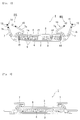
- the superabsorbent resin 18 can be the surface of the absorber 4 on the skin side overlaid on the side non-woven fabrics 7 and can be arranged over the range (range represented by reference numeral 19 in Fig. 5 ) including the body fluid inflow portion 17.
- the superabsorbent resin 18 is not arranged except when the superabsorbent resin 8 dispersed and mixed with the absorber 4 is present on the surface.
- the superabsorbent resin 18 arranged on the skin side surface (the range 19) of the absorber 4 is preferably in the same range as the range in the longitudinal direction of the superabsorbent resin 18 arranged on the side edge portion of the absorber 4, when the absorbed amount of water is increased locally such as in the vicinity of the urination opening portion, the superabsorbent resin 18 may be arranged in a different range such as only the range in the longitudinal direction corresponding to the urination opening portion.
- the superabsorbent resin 18 may be arranged over the range in the longitudinal direction which is the surface on the non-skin side of the absorber 4 and which includes the body fluid inflow portion 17.
- the superabsorbent resin 18 absorbs water to become swollen, since a grainy feel is not produced up to the skin side, it is possible to further increase the absorption capacity in the absorber 4 without a fitting feel being degraded.
- the liquid-impermeable back surface sheet 2 may be damage by the superabsorbent resin 18, a weight per unit area lower than the superabsorbent resin 18 arranged on the side edge portion of the absorber 4 is preferably arranged.
- the range (height) A of the superabsorbent resin 18 arranged on the side edge portion of the absorber 4 is substantially equal to the thickness of the absorber 4, and is set at 1 to 25 mm, is preferably set at 3 to 20 mm and is more preferably set at 7 to 15 mm.
- the width B of the superabsorbent resin 18 arranged on the skin side surface of the absorber 4 is substantially equal to the width in which the side non-woven fabric 7 overlaps the absorber 4, and is set at 5 to 35 mm and is preferably set at 10 to 30 mm.
- the width C of the superabsorbent resin 18 arranged on the non-skin side surface of the absorber 4 is substantially equal to the width of the absorber 4, and is set at 60 to 200 mm and is preferably set at 70 to 180 mm.
- one body fluid inflow portion 17 is provided along the longitudinal direction of the pad at least on the center line of the incontinence pad 1 substantially in the longitudinal direction in a range including the urination opening portion.
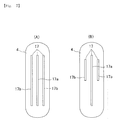
- a body fluid inflow portion 17a provided on the center line in the longitudinal direction of the pad, one or a plurality of body fluid inflow portions 17b, in the example shown in the figure, one body fluid inflow portion 17b is arranged, with the result that as a whole, a plurality of body fluid inflow portions 17, in the example shown in the figure, three body fluid inflow portions 17 may be provided.
- Fig. 7(A) on each of both sides of a body fluid inflow portion 17a provided on the center line in the longitudinal direction of the pad, one or a plurality of body fluid inflow portions 17b, in the example shown in the figure, one body fluid inflow portion 17b is arranged, with the result that as a whole, a plurality of body fluid inflow portions 17, in the example shown in the figure, three body fluid inflow portions 17 may
- the body fluid inflow portions 17b arranged on both sides in the width direction may be arranged only in the front side region of the pad including the urination opening portion of the wearer so as to receive a large amount of urine discharged, and in the back side region of the pad, the decrease in the absorption capacity may be reduced by providing the body fluid inflow portion 17.
- the body fluid inflow portion 17 may be formed with an opening in which the absorber 4 is penetrated from the skin side to the non-skin side and which has no bottom, and as shown in Fig. 8 , the body fluid inflow portion 17 may be formed with a concave portion in which the absorber 4 is recessed from the skin side to the non-skin side and which has a bottom.
- the body fluid inflow portion 17 is formed with the concave portion having the bottom, as shown in Fig. 8(A) , a structure having the concave portion can be provided at the time of lamination, as shown in Fig.
- an upper layer absorber 4b having an opening 17c can be laminated to form a multilayer structure and as shown in Fig. 8(C) , an emboss can be added to use a means such as compression.
- the wrapping sheet 5 and the liquid-permeable front surface sheet 3 arranged on the skin side surface of the absorber 4 may be provided under tension on the skin surface side of the body fluid inflow portion 17 while being prevented from entering the concave groove of the body fluid inflow portion 17. In this way, body fluid passing through the liquid-permeable front surface sheet 3 and the wrapping sheet 5 easily flow into the body fluid inflow portion 17.
- the depth is equal to or more than 50% of the thickness of the absorber 4 and is preferably equal to or more than 80%
- the length (the length of the pad in the longitudinal direction) is 20 to 90% of the length of the absorber 4 in the longitudinal direction and is preferably 50 to 80%.
- the width is 5 to 50 mm and is preferably 10 to 30 mm.
- the body fluid inflow portion 17 may be formed so as to have a substantially uniform width in the longitudinal direction of the pad or may be formed such that different width dimensions are provided in the longitudinal direction of the pad such as in which only in the urination opening portion, the width is relatively increased.
- the same one as the superabsorbent resin 8 mixed with the absorber 4 may be used or a superabsorbent resin having different physical properties may be used.
- a superabsorbent resin having different physical properties is used, with respect to the absorption speed of the superabsorbent resin, such a superabsorbent resin that the superabsorbent resin 8 mixed with the absorber 4 is higher in absorption speed than the superabsorbent resin 18 arranged around the periphery of the absorber 4 may be used so that the rate of the diffusion of body fluid diffused within the absorber 4 is prevented from being lowered.
- such a superabsorbent resin that the superabsorbent resin 18 arranged around the periphery of the absorber is higher in the normal pressure absorbed amount than the superabsorbent resin 8 mixed with the absorber 4 may be used so that body fluid is blocked by the side edge portion of the absorber 4.
- the weight per unit area of the pulp is 100 to 600 g/m 2 and is preferably 200 to 500 g/m 2
- the weight per unit area of the superabsorbent resin 8 mixed with the absorber 4 is 150 to 500 g/m 2 and is preferably 200 to 450 g/m 2
- the mass ratio of the entire amount of polymer including the superabsorbent resin 18 is 30 to 80% and is preferably 40 to 70%.
- the weight per unit area of the superabsorbent resin 18 arranged around the periphery of the absorber 4 is 150 to 450 g/m 2 and is preferably 200 to 400 g/m 2 and the mass ratio of the entire amount of polymer including the superabsorbent resin 8 is 20 to 70% and is preferably 30 to 60%.
- the thickness of the absorber 4 may be uniform as a whole, the end portions in the forward and backward direction with respect to the body fluid inflow portion 17 may be lower in thickness than the intermediate portion so that a fitting feel is enhanced.
- any one of the following structures or a combination thereof can be adopted so that the degradation of a fitting feel such as a grainy feel caused by the superabsorbent resin 18 arranged on the side edge portion of the absorber 4 is prevented.
- the stereoscopic gathers BS are designed to have the double gather structure described previously or a loop-shaped hollow structure, and thus it is possible to realize a structure in which the side edge portion of the absorber 4 is prevented from making direct contact with the skin.
- a non-woven fabric having a large weight per unit area is used, and thus even when the side edge portion of the absorber 4 hits the skin, an uncomfortable feeling is not provided.
- a non-woven fabric having about 15 to 25 g/m 2 is preferably used.
- the side end of the liquid-permeable front surface sheet 3 is extended externally as compared with the side end of the absorber 4, and is arranged so as to cover the superabsorbent resin 18.
- the side non-woven fabric 7 is formed in the shape of a double sheet or one having a large weight per unit area (having about 20 to 35 g/m 2 ) is used.
- Fig. 9(A) shows a case where the superabsorbent resin 18 is fixed to the wrapping sheet 5.
- a hot-melt adhesive 20 whose width is wider than that of the absorber 4 is applied to the upper surface side of the wrapping sheet 5, in the center portion in the width direction on the upper surface side, the absorber 4 is laminated, thereafter a predetermined amount of superabsorbent resin 18 is dispersed to the portions on both sides of the absorber 4 to which the hot-melt adhesive 20 is applied and thus the wrapping sheet 5 is fixed.
- both side ends of the wrapping sheet 5 are folded so as to wrap the side edges of the absorber 4 (see Fig. 4 ).
- Fig. 9(B) shows a case where the superabsorbent resin 18 is fixed to the absorber 4.
- the lower surface of the absorber 4 is fixed to an approximate center portion of the wrapping sheet 5 developed by the hot melt adhesive, and thereafter the hot-melt adhesive 20 is applied to the side edge portion of the absorber 4.
- a predetermined amount of superabsorbent resin 18 is dispersed to a predetermined range, and both side ends of the wrapping sheet 5 are folded so as to wrap the side edges of the absorber 4.
- the superabsorbent resin 18 can be fixed to both side edge portions of the wrapping sheet 5 and the absorber 4, and in this case, the hot-melt adhesive 20 is applied to both side edge portions of the wrapping sheet 5 and the absorber 4.
- the superabsorbent resin 18 is preferably dispersed to the wrapping sheet 5.
- a sample is cut from each material with a roll cutter so as to have a dimension of 20 mm x 40 mm ( ⁇ 2 mm), and its weight is measured and is converted to a weight per 1 m 2 and is used as the weight per unit area.
- the measurement is performed with a measurement force of 3.0 N in a state where the sample and the thickness measuring unit are set horizontal.
- a second sheet formed of hydrophilic non-woven fabric may be arranged between the liquid-permeable front surface sheet 3 and the absorber 4 so that the absorption speed of the body fluid is increased and that the return of body fluid is prevented.
- the second sheet may be obtained by previously laminating the hydrophilic non-woven fabric integrally on the back surface of the liquid-permeable front surface sheet 3.
- 1 incontinence pad
- 2 liquid-impermeable back surface sheet
- 3 liquid-permeable front surface sheet
- 4 absorber
- 5 wrapping sheet
- 7 side non-woven fabric
- 8 superabsorbent resin
- 10 inner stereoscopic gather
- 11 outer stereoscopic gather
- 12 filamentous resilient and elastic member
- 14 center portion emboss
- 17 body fluid inflow portion
- 18 superabsorbent resin
- BS stereoscopic gather
Landscapes
- Health & Medical Sciences (AREA)
- Epidemiology (AREA)
- Engineering & Computer Science (AREA)
- Biomedical Technology (AREA)
- Heart & Thoracic Surgery (AREA)
- Vascular Medicine (AREA)
- Life Sciences & Earth Sciences (AREA)
- Animal Behavior & Ethology (AREA)
- General Health & Medical Sciences (AREA)
- Public Health (AREA)
- Veterinary Medicine (AREA)
- Absorbent Articles And Supports Therefor (AREA)
- Orthopedics, Nursing, And Contraception (AREA)
Abstract
Description
- The present invention relates to absorbent products, such as an incontinence pad, a sanitary napkin, a panty liner and a disposable diaper for absorbing urine, menstrual blood, vaginal discharge and the like, that include a concave groove-shaped body fluid inflow portion for receiving a large amount of body fluid with an absorber.
- Conventionally, as an absorbent product such as an incontinence pad, a sanitary napkin, a panty liner or a disposable diaper, an absorbent product is known in which an absorber formed of cotton-like pulp or the like is interposed between a liquid-impermeable back surface sheet such as a polyethylene sheet or a polyethylene sheet laminated non-woven fabric and a liquid-permeable front surface sheet such as a non-woven fabric or a liquid-permeable plastic sheet.
- Among such absorbent products, in the case of an incontinence pad for a large amount in which a setting value for the amount of moisture absorbed exceeds 100 cc, since the incontinence pad needs to receive, at a time, a large amount of urine in a small area of a crotch portion, the incontinence pad is developed in which a concave portion is provided in order to promote the temporary storage of urine in the surface of the absorber and the diffusion thereof.
- For example,
patent literature 1 described below discloses a disposable diaper which includes a liquid-permeable front surface sheet, a liquid-impermeable back surface sheet and an absorbent core interposed between both the sheets, in which the core is coated with an absorption diffusion sheet, in which at least one groove recessed in a direction extending from the surface sheet to the back sheet is formed in the core on the side of the surface sheet, in which the bottom portion and the side wall portion of the groove are covered with the surface sheet, in which the core contains a water-absorbent fiber and superabsorbent resin particles and in which the water-absorbent fiber and the superabsorbent resin particles are interposed between the surface sheet and the back surface sheet in the bottom portion of the groove. -
Patent literature 2 described below discloses a disposable diaper in which along an imaginary line extending in a direction from a front waist region through a crotch region to a back waist region, at least a part of a core is divided, in which the core is formed with one fiber layer mainly made of pulverized pulp and one particle layer mainly made of superabsorbent resin particles, which is a substantially laminate product where the fiber layer is located on the particle layer and in which the particle layer is exposed to the side surface of the core in the divided portion. - Furthermore,
patent literature 3 described below discloses a disposable diaper in which an absorbent core is interposed between a liquid-permeable front surface sheet and a liquid-impermeable back surface sheet, which is formed, in a forward and backward direction, with a front body, a back body and a crotch region located therebetween and which includes a concave portion capable of storing feces in the crotch region of the core. -
- Patent Literature 1: Japanese Patent No.
3811000 - Patent Literature 2: Japanese Patent No.
3406214 - Patent Literature 3: Japanese Patent No.
3012472 - However, in the disposable diaper disclosed in
patent literature 1, since the superabsorbent resin particles are interposed in the bottom portion of the groove into which body fluid flows, so-called "gel blocking" occurs in which air gaps between the polymer particles swollen at the time of water absorption are extremely lowered, with the result that necessary absorption power may not be realized in the groove. There is a concern that the occurrence of the gel blocking prevents the diffusion from the groove to the surrounding area to lower the absorption speed. On the other hand, in the case of the disposable diaper disclosed inpatent literature 2, since the particle layer is exposed to the side surface of the absorbent core in the divided portion, when a large amount of urine is immersed in the divided portion, the particle layer is swollen to block the divided region, with the result that the absorption speed may be lowered. Furthermore, in the case of the disposable diaper disclosed inpatent literature 3, though a concave portion is provided in the absorbent core to reduce the body fluid absorption capacity of the absorbent core accordingly, since no means for compensating for it is provided, there is a concern that the absorbed amount in the absorbent core is lowered. - Hence, a main object of the present invention is to provide an absorbent product in which even when a concave groove-shaped absorber inflow portion is provided in an absorber, the decrease in the absorption speed of body fluid caused by gel blocking is prevented, and thus the absorbed amount in the entire absorbent product can be maintained.
- In order to solve the problem described above, according to
claim 1 of the present invention, there is provided an absorbent product in which an absorber is interposed between a liquid-permeable front surface sheet and a back surface sheet, where the absorber includes a concave groove-shaped body fluid inflow portion along a longitudinal direction of the absorbent product and over a range in the longitudinal direction including a body fluid discharge portion, and a powder and granular superabsorbent resin is arranged at least on a side edge portion of the absorber and over the range in the longitudinal direction including the body fluid inflow portion. - In the invention recited in
claim 1, the absorber includes the concave groove-shaped body fluid inflow portion along the longitudinal direction of the absorbent product and over the range in the longitudinal direction including the body fluid discharge portion. The body fluid inflow portion is intended to temporarily store the body fluid and to diffuse it into the absorber when a large amount of body fluid such as urine is discharged at a time, and thus the body fluid inflow portion can receive a large amount of body fluid discharged at a time even when the area of the absorber is small. The body fluid flowing into the body fluid inflow portion is also absorbed by the absorber from the side surface of the body fluid inflow portion, with the result that as compared with a case where the body fluid is absorbed from the surface of an absorber formed in a planar shape, the absorption speed is increased. - The body fluid inflow portion is provided in the absorber, the capacity of the absorber is reduced accordingly and thus the absorption capacity of the absorber is lowered. However, in the absorbent product, since the powder and granular superabsorbent resin is arranged at least on the side edge portion of the absorber and over the range in the longitudinal direction including the body fluid inflow portion, the body fluid flowing into the body fluid inflow portion is diffused within the absorber and is absorbed and held in the superabsorbent resin on the side edge portion of the absorber, with the result that it is possible to compensate for the absorbed amount in the absorber reduced by the provision of the body fluid inflow portion and it is possible to maintain the absorbed amount in the absorber. Moreover, since the superabsorbent resin is intensively provided on the side edge portion of the absorber, even when the superabsorbent resin absorbs water to become swollen, the body fluid inflow portion is prevented from being blocked, with the result that it is possible to prevent the absorption speed from being reduced.
- As the present invention according to
claim 2, the absorbent product according toclaim 1 is provided where a side non-woven fabric is arranged in each of both side portions on a skin side along the longitudinal direction, and the superabsorbent resin is arranged on a surface of the absorber on the skin side overlapping the side non-woven fabric and over the range in the longitudinal direction including the body fluid inflow portion. - In the invention according to
claim 2, the superabsorbent resin is arranged on the side edge portion of the absorber and on the surface of the absorber on the skin side overlapping the side non-woven fabric and over the range in the longitudinal direction including the body fluid inflow portion. Specifically, the superabsorbent resin is not arranged on the skin side surface of the absorber in the center portion (the effective absorber width) in the width direction in which the side non-woven fabric is not interposed between the side non-woven fabrics on the left and right sides, and the superabsorbent resin is arranged on the skin side surface of the absorber overlapping the side non-woven fabric. In this way, it is possible to further increase the amount of water absorbed by the entire absorber, and even when the superabsorbent resin arranged on the skin side surface of the absorber absorbs water to become swollen, since the side non-woven fabric is interposed on the front surface side, it is possible to prevent the degradation of a feel on the skin surface such as a grainy feel. - As the present invention according to
claim 3, the absorbent product according toclaim - In the invention according to
claim 3, the superabsorbent resin is arranged on the surface of the absorber on the non-skin side and over the range in the longitudinal direction including the body fluid inflow portion, and thus it is possible to more increase the absorption capacity in the absorber. - As the present invention according to
claim 4, the absorbent product according to any one ofclaims 1 to 3 is provided where the absorber is surround by the wrapping sheet, and the superabsorbent resin is fixed either to both the absorber and the wrapping sheet or to one of the absorber and the wrapping sheet. - In the invention according to
claim 4, the superabsorbent resin is fixed either to both the absorber and the wrapping sheet or to one of the absorber and the wrapping sheet, and thus it is possible to prevent the superabsorbent resin from being deviated and to arrange the superabsorbent resin along the absorber, with the result that the movement of the body fluid from the absorber to the superabsorbent resin can be smoothly performed. - As the present invention according to
claim 5, the absorbent product according to any one ofclaims 1 to 4 is provided where the body fluid inflow portion is formed either with an opening in which the absorber is penetrated from the skin side to the non-skin side or with a concave portion that is recessed from the skin side to the non-skin side and that has a bottom. - In the invention according to
claim 5, a means for forming the body fluid inflow portion is specified, and the body fluid inflow portion may be formed with the opening in which the absorber is penetrated from the skin side to the non-skin side or may be formed with the concave portion that is recessed from the skin side to the non-skin side and that has a bottom such as with a lamination structure having a concave portion, a lamination structure of the absorber or the addition of an emboss. - As described above in detail, in the present invention, even when a concave groove-shaped absorber inflow portion is provided in an absorber, the decrease in the absorption speed of body fluid caused by gel blocking is prevented, and thus the absorbed amount in the entire absorbent product can be maintained.
-
- [
Fig. 1 ] A partially broken development view of anincontinence pad 1 according to the present invention; - [
Fig. 2 ] An arrow view taken along line II-II ofFig. 1 ; - [
Fig. 3 ] An arrow view taken along line III-III ofFig. 1 ; - [
Fig. 4 ] A plan view showing a procedure for wrapping anabsorber 4 with awrapping sheet 5; - [
Fig. 5 ] A vertical cross-sectional view (arrow view taken along line II-II ofFig. 1 ) of theincontinence pad 1 showing another embodiment; - [
Fig. 6 ] A vertical cross-sectional view (arrow view taken along line II-II ofFig. 1 ) of theincontinence pad 1 showing another embodiment; - [
Fig. 7 ] A plan view of theabsorber 4 showing a bodyfluid inflow portion 17; - [
Figs. 8(A) to 8(C) ] Vertical cross-sectional views of theabsorber 4 showing a procedure for forming the bodyfluid inflow portion 17; and - [
Fig. 9 ] A vertical cross-sectional view showing a procedure for fixing asuperabsorbent resin 18. - An embodiment of the present invention will be described in detail below with reference to drawings.
- As shown in
Figs. 1 to 3 , anincontinence pad 1 according to the present invention is mainly formed with: a liquid-impermeableback surface sheet 2 formed with a polyethylene sheet or the like; a liquid-permeablefront surface sheet 3 that rapidly transmits urine; anabsorber 4 that is interposed between both thesheets wrapping sheet 5 that surrounds theabsorber 4 to hold the shape of the absorber and enhance the diffusivity; and side non-wovenfabrics 7 that form a pair of left and right stereoscopic gathers BS which are provided to protrude to a skin side within a predetermined section in a longitudinal direction so as to use a substantial side edge portion of theabsorber 4 as a standing base end and to contain at least a body fluid discharge portion. In the surrounding area of theabsorber 4, in the end edge portions in the longitudinal direction thereof, the outer edge portions of the liquid-impermeableback surface sheet 2 and the liquid-permeablefront surface sheet 3 are joined with an adhesive such as a hot melt or an adhesive means such as a heat seal, and in the both side edge portions, the liquid-impermeableback surface sheet 2 and the side non-wovenfabrics 7 extending out laterally as compared with theabsorber 4 are joined with an adhesive such as a hot melt or an adhesive means such as a heat seal. - The structure of the
incontinence pad 1 will be described in further detail below. As the liquid-impermeableback surface sheet 2, a sheet material, such as polyethylene or polypropylene, that has at least aqueous shielding is used; alternatively, a non-woven fabric in which a waterproof film is interposed to practically acquire liquid imperviousness (in this case, the waterproof film and the non-woven fabric constitute the liquid-impermeable back surface sheet) or the like can be used. In recent years, in terms of sweatiness prevention, a sheet having moisture permeability has tended to be used. As the aqueous shielding and moisture-permeable sheet material described above, a microporous sheet is preferably used that is obtained by melting and kneading an inorganic filler into an olefin resin such as polyethylene or polypropylene to form a sheet and thereafter stretching the sheet in a uniaxial or biaxial direction. - Then, as the liquid-permeable
front surface sheet 3, a porous or non-porous non-woven fabric, a porous plastic sheet or the like is preferably used. As the material fiber of the non-woven fabric, for example, a synthetic fiber such as olefin such as polyethylene or polypropylene, polyester or polyamide, a regenerated fiber such as rayon and cupra or a natural fiber such as cotton can be used; a non-woven fabric obtained by an appropriate processing method such as a spun lace method, a spun bond method, a thermal bond method, a melt-blown method or a needle punching method can be used. Among these processing methods, the spun lace method is excellent in flexibility and draping and the thermal bond method is excellent in bulkiness and compression resilience. - The
absorber 4 is formed with, for example, an absorbent fiber such as cotton-like pulp and asuperabsorbent resin 8, and in an example shown in the figure, its planar shape is formed substantially in the shape of an ellipse vertically long in the longitudinal direction of a pad. Thesuperabsorbent resin 8 is, for example, a granular powder and is dispersed and mixed in the pulp forming theabsorber 4. The configuration of theabsorber 4 will be described in detail later. - Examples of the pulp include a chemical pulp obtained by lumber, a cellulose fiber such as a dissolving pulp and an artificial cellulose fiber such as rayon and acetate; as compared with a hardwood pulp, a softwood pulp whose fibers are long is preferably used in terms of function and price. As in the example shown in the figure, when the
absorber 4 is surrounded by thewrapping sheet 5, as a result, thewrapping sheet 5 is interposed between the liquid-permeablefront surface sheet 3 and theabsorber 4, with the result that body fluid is rapidly diffused by thewrapping sheet 5 excellent in absorption and urine and the like thereof are prevented from being returned. - Examples of the
superabsorbent resin 8 include a polyacrylate cross-linked product, a self-crosslinked polyacrylic acid salt, an acrylic acid ester-saponified vinyl acetate copolymer cross-linked product, an isobutylene-maleic anhydride copolymer cross-linked product, a polysulfone salt cross-linked product and a product obtained by partially cross-linking a water-swellable polymer such as polyethylene oxide or polyacrylamide. Among them, an acrylic acid and an acrylic acid salt excellent in the absorbed amount of water and the absorption speed are preferable. In thesuperabsorbent resin 8 having the absorption performance described above, in its manufacturing process, a cross-linking density and a cross-linking density gradient are adjusted, and thus it is possible to adjust water absorption power (absorption scaling) and a water absorption speed. - A synthetic fiber may be mixed with the
absorber 4. As the synthetic fiber, for example, polyolefin such as polyethylene or polypropylene, polyester such as polyethylene terephthalate or polybutylene terephthalate, polyamide such as nylon, the copolymers thereof and the like can be used or two types thereof may be mixed and used. Composite fibers such as a sheath/core type fiber in which a high-melting point fiber is used as a core and a low-melting point fiber is used as a sheath, a side-by-side type fiber and a division type fiber can also be used. When the synthetic fiber is a hydrophobic fiber, surface processing is preferably performed with a hydrophilizing agent such that an affinity is provided for body fluid. - The
absorber 4 is surrounded by thewrapping sheet 5. Although as thewrapping sheet 5, a paper material such as tissue or a liquid-permeable sheet material such as a non-woven fabric can be used, the fiber density thereof is preferably such a fiber density that the pulp and the superabsorbent resin contained in theabsorber 4 are prevented from be removed. - In both side portions on the surface side of the
incontinence pad 1, theside non-woven fabrics 7 are provided along the longitudinal direction and over the entire length of theincontinence pad 1, and an external part of theside non-woven fabrics 7 is extended laterally and the liquid-impermeableback surface sheet 2 is extended laterally, with the result that the part of theside non-woven fabrics 7 and the part of the liquid-impermeableback surface sheet 2 extended laterally are joined with a hot-melt adhesive or the like to form side flaps. - As the side
non-woven fabric 7, a water repellent processing non-woven fabric or a hydrophilic processing non-woven fabric can be used in terms of the function on which importance is placed. For example, when importance is placed on, for example, a function of preventing the penetration of unrein or of enhancing a feel, a water-repellent processing non-woven fabric, such as SSMS, SMS or SMMS, that is coated with a silicon-based water repellent agent, a paraffin-based water repellent agent or an alkyl chromic chloride-based water repellent agent is preferably used. When importance is placed on the absorption of a body fluid, a hydrophilic processing non-woven fabric is preferably used in which such as by a method of performing, in a step of manufacturing a synthetic fiber, polymerization in the presence of a compound having a hydrophilic group, for example, an oxidation product of polyethylene glycol or a method of performing processing with a metal salt such as stannic chloride to partially dissolve the surface to provide porosity and depositing a hydroxide of the metal, the synthetic fiber is swollen or is made porous and in which hydrophilicity is provided by the application of capillarity. As the sidenon-woven fabric 7, a fabric can be used in which a natural fiber, a synthetic fiber or a regenerated fiber is used as a material and which can be formed with an appropriate processing method. - The
side non-woven fabrics 7 form the stereoscopic gathers BS of a double gather structure formed with a pair of left and right inner stereoscopic gathers 10 which are folded as necessary and which stand on the skin side with a position near a substantial side edge of theabsorber 4 being the standing base end and a pair of left and right outer stereoscopic gathers 11 which are located externally with respect to the inner stereoscopic gathers 10, which are formed with the liquid-impermeableback surface sheet 2 and theside non-woven fabrics 7 extended laterally as compared with theabsorber 4 and which stand on the skin side. Such a double gather structure is adopted, and thus an effect of preventing leakage is enhanced, and as will be described in detail later, even in a state where a superabsorbent resin 9 provided on the side portion of theabsorber 4 absorbs water to become swollen, it is possible to reduce the degradation of a feel on the skin surface such as a grainy feel. The stereoscopic gathers BS may have a single gather structure formed with only any one of the inner stereoscopic gathers 10 and the outer stereoscopic gathers 11 or only theside non-woven fabrics 7 may be provided, that is, the stereoscopic gathers BS may not be formed in the shape of a stereoscopic gather standing on the skin side. - The structure of the inner stereoscopic gathers 10 and the outer stereoscopic gathers 11 will be described in detail. In the side non-woven fabrics 7, as shown in
Fig. 2 , both side ends in the width direction are folded back on the back surface side of the pad to respectively form double sheet portions 7a and 7b on the inner side and the outer side in the width direction; one or a plurality of filamentous resilient and elastic members, in the example shown in the figure, one filamentous resilient and elastic member 12 in which both ends or an appropriate portion in the longitudinal direction is fixed to the interior of the double sheet portion 7a on the inner side in the width direction is provided; one or a plurality of filamentous resilient and elastic members, in the example shown in the figure, two filamentous resilient and elastic members 13 in which both ends or an appropriate portion in the longitudinal direction is fixed to the interior of the double sheet portion 7b on the outer side in the width direction are provided; the base end portion of the double sheet portion 7a on the inner side in the width direction is adhered with a hot-melt adhesive or the like to the upper surface of the liquid-permeable front surface sheet 3 provided on the side portion of the absorber 4; the base end portion of the double sheet portion 7b on the outer side in the width direction is adhered with a hot-melt adhesive or the like to the side end portion of the liquid-impermeable back surface sheet 2 extended out laterally as compared with the absorber 4; and thus the inner stereoscopic gathers 10 which stand on the skin side with the double sheet portion 7a on the inner side in the width direction are formed and the outer stereoscopic gathers 11 which stand on the skin side with the double sheet portion 7b on the outer side in the width direction are formed. In both end portions of theside non-woven fabrics 7 in the longitudinal direction of the pad, as shown inFig. 3 , the filamentous resilient andelastic members double sheet portion 7a on the inner side in the width direction is joined to the side of theabsorber 4 with a hot-melt adhesive or the like. - In the
incontinence pad 1, as shown inFig. 1 , a center portion emboss 14 which is long from the surface side of the liquid-permeablefront surface sheet 3 in the longitudinal direction of the pad and which is continuously closed as a whole in a circumferential direction, a front side emboss 15 which is located apart from the front side of the center portion emboss 14 and which is formed substantially in the shape of an umbrella and a back side emboss 16 which is located apart from the back side of the center portion emboss 14 and which is formed substantially in the shape of an umbrella are formed. In the center portion emboss 14, the front portion is provided so as to surround a region corresponding to the urination opening portion of a wearer, and the back portion is provided so as to surround a region corresponding to the buttock groove of the wearer. - The configuration of the
absorber 4 will then be described in detail. In theabsorber 4, as shown inFigs. 1 and2 , a concave groove-shaped bodyfluid inflow portion 17 which is extended along the longitudinal direction of the pad and which is extended over a range in the longitudinal direction including the urination opening portion of the wearer is provided, and a powder and granularsuperabsorbent resin 18 is arranged at least on the side edge portion of theabsorber 4 and over a range in the longitudinal direction including thereproduction processing portion 17. The bodyfluid inflow portion 17 is intended to temporarily store, when a large amount of urine is discharged at a time, the urine in the bodyfluid inflow portion 17 and to diffuse it into theabsorber 4, and thus the bodyfluid inflow portion 17 can receive a large amount of urine discharged at a time even when the area of theabsorber 4 is small. The bodyfluid inflow portion 17 is provided, and thus the urine flowing into the bodyfluid inflow portion 17 is also absorbed by theabsorber 4 from the side surface (the cross section of the absorber 4) of the bodyfluid inflow portion 17, with the result that as compared with an absorber formed in a planar shape, the absorption speed is also advantageously increased. - The body
fluid inflow portion 17 is provided in theabsorber 4, the capacity of theabsorber 4 is reduced accordingly and thus the absorption capacity of theabsorber 4 is lowered. However, in theincontinence pad 1, since the powder and granularsuperabsorbent resin 18 is arranged at least on the side edge portion of theabsorber 4 and over the range in the longitudinal direction including thereproduction processing portion 17, the body fluid flowing into the bodyfluid inflow portion 17 is diffused within theabsorber 4 and is absorbed and held in thesuperabsorbent resin 18, with the result that it is possible to compensate for the absorbed amount in theabsorber 4 reduced by an amount corresponding to the bodyfluid inflow portion 17 and it is possible to maintain the absorbed amount in theabsorber 4. Here, since thesuperabsorbent resin 18 is intensively provided on the side edge portion of theabsorber 4, even when the superabsorbent resin absorbs water to become swollen, the bodyfluid inflow portion 17 is prevented from being blocked, with the result that it is possible to prevent the absorption speed from being reduced. Thesuperabsorbent resin 18 is intensively provided on the side edge portion of theabsorber 4, the skin surface side thereof is covered by theside non-woven fabrics 7, the stereoscopic gathers BS are formed and thus thesuperabsorbent resin 18 is prevented from making direct contact with the skin surface, with the result that it is possible to prevent the degradation of a fitting feel such as a grainy feel. In particular, since in theincontinence pad 1, as shown inFig. 2 , the stereoscopic gathers BS are formed with the double gather consisting of the inner stereoscopic gathers 10 and the outer stereoscopic gathers 11, and in the intermediate portion of the gathers 8 and 9 in the width direction, the region where thesuperabsorbent resin 18 is arranged is provided, an opportunity for the region where thesuperabsorbent resin 18 is arranged to make a direct contact with the skin surface is remarkably lowered, with the result that it is possible to further prevent the degradation of a fitting feel. - The body
fluid inflow portion 17 is provided, at least on the center line in the longitudinal direction corresponding to the body fluid discharge portion of the wearer, and is formed so as to be equal to or longer than the length in the longitudinal direction corresponding to the body fluid discharge portion of the wearer. In the example shown inFig. 1 , the bodyfluid inflow portion 17 is continuously provided from the body fluid discharge portion of the wearer to a portion corresponding to the buttock groove in the longitudinal direction of the pad, and is formed within the center portion emboss 14 closed as a whole in the circumferential direction. - Preferably, as shown in
Fig. 4 , thesuperabsorbent resin 18 arranged on the side edge portion of theabsorber 4 is continuously dispersed in the longitudinal direction, has at least a length in the longitudinal direction corresponding to the urination opening portion and is equal to or longer than the length in the longitudinal direction corresponding to the bodyfluid inflow portion 17. In this way, it is possible to reliably absorb urine flowing into the bodyfluid inflow portion 17 and diffused in the width direction. However, in order to prevent the degradation of a product cutter when theincontinence pad 1 is cut, thesuperabsorbent resin 18 is prevented from being arranged at the end portions of theincontinence pad 1 in a forward and backward direction. - As shown in
Fig. 5 , thesuperabsorbent resin 18 can be the surface of theabsorber 4 on the skin side overlaid on theside non-woven fabrics 7 and can be arranged over the range (range represented byreference numeral 19 inFig. 5 ) including the bodyfluid inflow portion 17. In other words, on the skin side surface of theabsorber 4 in the center portion (the width in which the absorber can directly absorb urine: effective absorber width) in the width direction which is between theside non-woven fabrics 7 provided on the left and right sides and in which theside non-woven fabrics 7 are not interposed, thesuperabsorbent resin 18 is not arranged except when thesuperabsorbent resin 8 dispersed and mixed with theabsorber 4 is present on the surface. In this way, it is possible to increase the amount of water absorbed by theabsorber 4, and since in thisrange 19, theside non-woven fabrics 7 are interposed on the skin side of theabsorber 4, even when thesuperabsorbent resin 18 arranged in thisrange 19 absorbs water to become swollen, stickiness is unlikely to occur, with the result that in a dried state, it is possible to prevent the degradation of a feel such as a grainy feel on the skin surface. Although thesuperabsorbent resin 18 arranged on the skin side surface (the range 19) of theabsorber 4 is preferably in the same range as the range in the longitudinal direction of thesuperabsorbent resin 18 arranged on the side edge portion of theabsorber 4, when the absorbed amount of water is increased locally such as in the vicinity of the urination opening portion, thesuperabsorbent resin 18 may be arranged in a different range such as only the range in the longitudinal direction corresponding to the urination opening portion. - Furthermore, as shown in
Fig. 6 , thesuperabsorbent resin 18 may be arranged over the range in the longitudinal direction which is the surface on the non-skin side of theabsorber 4 and which includes the bodyfluid inflow portion 17. In the surface on the non-skin side of theabsorber 4, even when thesuperabsorbent resin 18 absorbs water to become swollen, since a grainy feel is not produced up to the skin side, it is possible to further increase the absorption capacity in theabsorber 4 without a fitting feel being degraded. However, since the liquid-impermeableback surface sheet 2 may be damage by thesuperabsorbent resin 18, a weight per unit area lower than thesuperabsorbent resin 18 arranged on the side edge portion of theabsorber 4 is preferably arranged. - Here, with respect to the range of the
superabsorbent resin 18 dispersed to each portion, as shown inFig. 6 , the range (height) A of thesuperabsorbent resin 18 arranged on the side edge portion of theabsorber 4 is substantially equal to the thickness of theabsorber 4, and is set at 1 to 25 mm, is preferably set at 3 to 20 mm and is more preferably set at 7 to 15 mm. Moreover, the width B of thesuperabsorbent resin 18 arranged on the skin side surface of theabsorber 4 is substantially equal to the width in which the sidenon-woven fabric 7 overlaps theabsorber 4, and is set at 5 to 35 mm and is preferably set at 10 to 30 mm. Furthermore, the width C of thesuperabsorbent resin 18 arranged on the non-skin side surface of theabsorber 4 is substantially equal to the width of theabsorber 4, and is set at 60 to 200 mm and is preferably set at 70 to 180 mm. - As shown in
Fig. 1 , one bodyfluid inflow portion 17 is provided along the longitudinal direction of the pad at least on the center line of theincontinence pad 1 substantially in the longitudinal direction in a range including the urination opening portion. As shown inFig. 7(A) , on each of both sides of a bodyfluid inflow portion 17a provided on the center line in the longitudinal direction of the pad, one or a plurality of bodyfluid inflow portions 17b, in the example shown in the figure, one bodyfluid inflow portion 17b is arranged, with the result that as a whole, a plurality of bodyfluid inflow portions 17, in the example shown in the figure, three bodyfluid inflow portions 17 may be provided. As shown inFig. 7(B) , the bodyfluid inflow portions 17b arranged on both sides in the width direction may be arranged only in the front side region of the pad including the urination opening portion of the wearer so as to receive a large amount of urine discharged, and in the back side region of the pad, the decrease in the absorption capacity may be reduced by providing the bodyfluid inflow portion 17. - As shown in
Fig. 2 , the bodyfluid inflow portion 17 may be formed with an opening in which theabsorber 4 is penetrated from the skin side to the non-skin side and which has no bottom, and as shown inFig. 8 , the bodyfluid inflow portion 17 may be formed with a concave portion in which theabsorber 4 is recessed from the skin side to the non-skin side and which has a bottom. When the bodyfluid inflow portion 17 is formed with the concave portion having the bottom, as shown inFig. 8(A) , a structure having the concave portion can be provided at the time of lamination, as shown inFig. 8(B) , on alower layer absorber 4a serving as a bottom portion, anupper layer absorber 4b having anopening 17c can be laminated to form a multilayer structure and as shown inFig. 8(C) , an emboss can be added to use a means such as compression. - As shown in
Fig. 2 , thewrapping sheet 5 and the liquid-permeablefront surface sheet 3 arranged on the skin side surface of theabsorber 4 may be provided under tension on the skin surface side of the bodyfluid inflow portion 17 while being prevented from entering the concave groove of the bodyfluid inflow portion 17. In this way, body fluid passing through the liquid-permeablefront surface sheet 3 and thewrapping sheet 5 easily flow into the bodyfluid inflow portion 17. - With respect to the dimensions of the body
fluid inflow portion 17, the depth is equal to or more than 50% of the thickness of theabsorber 4 and is preferably equal to or more than 80%, and the length (the length of the pad in the longitudinal direction) is 20 to 90% of the length of theabsorber 4 in the longitudinal direction and is preferably 50 to 80%. The width is 5 to 50 mm and is preferably 10 to 30 mm. The bodyfluid inflow portion 17 may be formed so as to have a substantially uniform width in the longitudinal direction of the pad or may be formed such that different width dimensions are provided in the longitudinal direction of the pad such as in which only in the urination opening portion, the width is relatively increased. - As the
superabsorbent resin 18 arranged around the periphery of theabsorber 4, the same one as thesuperabsorbent resin 8 mixed with theabsorber 4 may be used or a superabsorbent resin having different physical properties may be used. When a superabsorbent resin having different physical properties is used, with respect to the absorption speed of the superabsorbent resin, such a superabsorbent resin that thesuperabsorbent resin 8 mixed with theabsorber 4 is higher in absorption speed than thesuperabsorbent resin 18 arranged around the periphery of theabsorber 4 may be used so that the rate of the diffusion of body fluid diffused within theabsorber 4 is prevented from being lowered. With respect to the normal pressure absorbed amount in the superabsorbent resin, such a superabsorbent resin that thesuperabsorbent resin 18 arranged around the periphery of the absorber is higher in the normal pressure absorbed amount than thesuperabsorbent resin 8 mixed with theabsorber 4 may be used so that body fluid is blocked by the side edge portion of theabsorber 4. - With respect to the weight per unit area of the pulp, the
superabsorbent resin 8 and thesuperabsorbent resin 18, the weight per unit area of the pulp is 100 to 600 g/m2 and is preferably 200 to 500 g/m2, the weight per unit area of thesuperabsorbent resin 8 mixed with theabsorber 4 is 150 to 500 g/m2 and is preferably 200 to 450 g/m2 and the mass ratio of the entire amount of polymer including thesuperabsorbent resin 18 is 30 to 80% and is preferably 40 to 70%. The weight per unit area of thesuperabsorbent resin 18 arranged around the periphery of theabsorber 4 is 150 to 450 g/m2 and is preferably 200 to 400 g/m2 and the mass ratio of the entire amount of polymer including thesuperabsorbent resin 8 is 20 to 70% and is preferably 30 to 60%. - Although the thickness of the
absorber 4 may be uniform as a whole, the end portions in the forward and backward direction with respect to the bodyfluid inflow portion 17 may be lower in thickness than the intermediate portion so that a fitting feel is enhanced. - In the
incontinence pad 1, any one of the following structures or a combination thereof can be adopted so that the degradation of a fitting feel such as a grainy feel caused by thesuperabsorbent resin 18 arranged on the side edge portion of theabsorber 4 is prevented. Firstly, the stereoscopic gathers BS are designed to have the double gather structure described previously or a loop-shaped hollow structure, and thus it is possible to realize a structure in which the side edge portion of theabsorber 4 is prevented from making direct contact with the skin. Secondly, as thewrapping sheet 5, a non-woven fabric having a large weight per unit area is used, and thus even when the side edge portion of theabsorber 4 hits the skin, an uncomfortable feeling is not provided. Specifically, a non-woven fabric having about 15 to 25 g/m2 is preferably used. Thirdly, as shown inFig. 2 , the side end of the liquid-permeablefront surface sheet 3 is extended externally as compared with the side end of theabsorber 4, and is arranged so as to cover thesuperabsorbent resin 18. Fourthly, the sidenon-woven fabric 7 is formed in the shape of a double sheet or one having a large weight per unit area (having about 20 to 35 g/m2) is used. - A procedure for arranging the
superabsorbent resin 18 on the side edge portion of theabsorber 4 will then be described with reference toFig. 9. Fig. 9(A) shows a case where thesuperabsorbent resin 18 is fixed to thewrapping sheet 5. In this case, a hot-melt adhesive 20 whose width is wider than that of theabsorber 4 is applied to the upper surface side of thewrapping sheet 5, in the center portion in the width direction on the upper surface side, theabsorber 4 is laminated, thereafter a predetermined amount ofsuperabsorbent resin 18 is dispersed to the portions on both sides of theabsorber 4 to which the hot-melt adhesive 20 is applied and thus thewrapping sheet 5 is fixed. Thereafter, both side ends of thewrapping sheet 5 are folded so as to wrap the side edges of the absorber 4 (seeFig. 4 ). - On the other hand,
Fig. 9(B) shows a case where thesuperabsorbent resin 18 is fixed to theabsorber 4. In this case, the lower surface of theabsorber 4 is fixed to an approximate center portion of thewrapping sheet 5 developed by the hot melt adhesive, and thereafter the hot-melt adhesive 20 is applied to the side edge portion of theabsorber 4. A predetermined amount ofsuperabsorbent resin 18 is dispersed to a predetermined range, and both side ends of thewrapping sheet 5 are folded so as to wrap the side edges of theabsorber 4. - The
superabsorbent resin 18 can be fixed to both side edge portions of thewrapping sheet 5 and theabsorber 4, and in this case, the hot-melt adhesive 20 is applied to both side edge portions of thewrapping sheet 5 and theabsorber 4. - In the case of the arrangement on the surface on the non-skin side of the
absorber 4, before theabsorber 2 is laminated on thewrapping sheet 5, thesuperabsorbent resin 18 is preferably dispersed to thewrapping sheet 5. - In the measurement of the weight per unit area, a sample is cut from each material with a roll cutter so as to have a dimension of 20 mm x 40 mm (± 2 mm), and its weight is measured and is converted to a weight per 1 m2 and is used as the weight per unit area.
- In the measurement of the thickness, with a thickness measuring unit made by OZAKI MFG. Co., Ltd. (peacock, dial thickness gauge large type, model J-B (measurement range of 0 to 35mm) or model K-4 (measurement range of 0 to 50mm)), the measurement is performed with a measurement force of 3.0 N in a state where the sample and the thickness measuring unit are set horizontal.
- On the lower surface side (the absorber side) of the liquid-permeable
front surface sheet 3, a second sheet formed of hydrophilic non-woven fabric may be arranged between the liquid-permeablefront surface sheet 3 and theabsorber 4 so that the absorption speed of the body fluid is increased and that the return of body fluid is prevented. The second sheet may be obtained by previously laminating the hydrophilic non-woven fabric integrally on the back surface of the liquid-permeablefront surface sheet 3. - 1: incontinence pad, 2: liquid-impermeable back surface sheet, 3: liquid-permeable front surface sheet, 4: absorber, 5: wrapping sheet, 7: side non-woven fabric, 8: superabsorbent resin, 10: inner stereoscopic gather, 11: outer stereoscopic gather, 12, 13: filamentous resilient and elastic member, 14: center portion emboss, 17: body fluid inflow portion, 18: superabsorbent resin, BS: stereoscopic gather
Claims (5)
- An absorbent product in which an absorber is interposed between a liquid-permeable front surface sheet and a back surface sheet,
wherein the absorber includes a concave groove-shaped body fluid inflow portion along a longitudinal direction of the absorbent product and over a range in the longitudinal direction including a body fluid discharge portion, and a powder and granular superabsorbent resin is arranged at least on a side edge portion of the absorber and over the range in the longitudinal direction including the body fluid inflow portion. - The absorbent product according to claim 1,
wherein a side non-woven fabric is arranged in each of both side portions on a skin side along the longitudinal direction, and
the superabsorbent resin is arranged on a surface of the absorber on the skin side overlapping the side non-woven fabric and over the range in the longitudinal direction including the body fluid inflow portion. - The absorbent product according to claim 1 or 2,
wherein the superabsorbent resin is arranged on a surface of the absorber on a non-skin side and over the range in the longitudinal direction including the body fluid inflow portion. - The absorbent product according to any one of claims 1 to 3,
wherein the absorber is surround by a wrapping sheet, and
the superabsorbent resin is fixed either to both the absorber and the wrapping sheet or to one of the absorber and the wrapping sheet. - The absorbent product according to any one of claims 1 to 4,
wherein the body fluid inflow portion is formed either with an opening in which the absorber is penetrated from the skin side to the non-skin side or with a concave portion that is recessed from the skin side to the non-skin side and that has a bottom.
Applications Claiming Priority (2)
| Application Number | Priority Date | Filing Date | Title |
|---|---|---|---|
| JP2013137084 | 2013-06-28 | ||
| PCT/JP2014/067189 WO2014208729A1 (en) | 2013-06-28 | 2014-06-27 | Absorbent product |
Publications (3)
| Publication Number | Publication Date |
|---|---|
| EP3015095A1 true EP3015095A1 (en) | 2016-05-04 |
| EP3015095A4 EP3015095A4 (en) | 2016-12-07 |
| EP3015095B1 EP3015095B1 (en) | 2017-12-20 |
Family
ID=52142054
Family Applications (1)
| Application Number | Title | Priority Date | Filing Date |
|---|---|---|---|
| EP14817276.0A Not-in-force EP3015095B1 (en) | 2013-06-28 | 2014-06-27 | Absorbent product |
Country Status (8)
| Country | Link |
|---|---|
| US (1) | US10238554B2 (en) |
| EP (1) | EP3015095B1 (en) |
| JP (1) | JP5963961B2 (en) |
| KR (1) | KR102313864B1 (en) |
| CN (1) | CN105338937B (en) |
| BR (1) | BR112015031879B1 (en) |
| RU (1) | RU2660288C2 (en) |
| WO (1) | WO2014208729A1 (en) |
Cited By (2)
| Publication number | Priority date | Publication date | Assignee | Title |
|---|---|---|---|---|
| GB2555800A (en) * | 2016-11-09 | 2018-05-16 | Teknoweb Mat S R L | Absorbant mat with perimeter seal |
| EP3928754A1 (en) * | 2020-06-24 | 2021-12-29 | Associated Hygienic Products LLC | Absorbent articles with channeled absorbent cores |
Families Citing this family (29)
| Publication number | Priority date | Publication date | Assignee | Title |
|---|---|---|---|---|
| JP6166103B2 (en) * | 2013-06-04 | 2017-07-19 | ヤンマー株式会社 | Urea water injection nozzle |
| JP5931119B2 (en) * | 2014-05-07 | 2016-06-08 | ユニ・チャーム株式会社 | Absorbent articles |
| JP6207639B2 (en) * | 2016-01-26 | 2017-10-04 | 大王製紙株式会社 | Absorbent articles |
| JP6756427B2 (en) * | 2016-03-22 | 2020-09-16 | 日本製紙クレシア株式会社 | Absorbent article |
| JP6583107B2 (en) * | 2016-04-11 | 2019-10-02 | 王子ホールディングス株式会社 | Absorbent articles |
| JP6583108B2 (en) * | 2016-04-11 | 2019-10-02 | 王子ホールディングス株式会社 | Absorbent articles |
| JP6203906B1 (en) | 2016-06-14 | 2017-09-27 | 大王製紙株式会社 | Absorbent articles |
| JP6767222B2 (en) * | 2016-09-28 | 2020-10-14 | 大王製紙株式会社 | Disposable diapers |
| JP6360540B2 (en) * | 2016-11-29 | 2018-07-18 | 大王製紙株式会社 | Absorbent articles |
| WO2018100703A1 (en) * | 2016-11-30 | 2018-06-07 | ユニ・チャーム株式会社 | Absorbent article |
| JP6507193B2 (en) * | 2017-03-30 | 2019-04-24 | 大王製紙株式会社 | Absorbent articles |
| EP4740922A3 (en) | 2017-05-15 | 2026-07-08 | Drylock Technologies NV | Absorbent article with channels and method for manufacturing thereof |
| EP3403630B1 (en) | 2017-05-15 | 2019-08-28 | Drylock Technologies NV | Absorbent article with channels and method for manufacturing thereof |
| CN107411886B (en) * | 2017-08-12 | 2020-08-21 | 黄山富田精工制造有限公司 | System and method for manufacturing absorbent article |
| JP6941007B2 (en) * | 2017-08-30 | 2021-09-29 | 株式会社リブドゥコーポレーション | Absorbents and absorbent articles |
| PL3453368T3 (en) | 2017-09-11 | 2020-03-31 | Drylock Technologies Nv | Absorbent article with channels and method for manufacturing thereof |
| CA3074884A1 (en) | 2017-09-11 | 2019-03-14 | Drylock Technologies Nv | Absorbent article with channels and method for manufacturing thereof |
| JP6990108B2 (en) * | 2017-12-29 | 2022-01-12 | 花王株式会社 | Absorbent article |
| KR102475638B1 (en) * | 2018-03-20 | 2022-12-08 | 유니챰 가부시키가이샤 | absorbent article |
| JP7357440B2 (en) * | 2018-05-18 | 2023-10-06 | ユニ・チャーム株式会社 | absorbent articles |
| CN110179594A (en) * | 2019-05-31 | 2019-08-30 | 重庆百亚卫生用品股份有限公司 | A kind of absorption-type core |
| JP7411430B2 (en) * | 2019-12-23 | 2024-01-11 | 花王株式会社 | Absorbent bodies and absorbent articles |
| JP7402147B2 (en) * | 2019-12-23 | 2023-12-20 | 花王株式会社 | Absorbent body and its manufacturing method |
| JP7435050B2 (en) * | 2020-03-09 | 2024-02-21 | 王子ホールディングス株式会社 | absorbent articles |
| JP2021137455A (en) * | 2020-03-09 | 2021-09-16 | 王子ホールディングス株式会社 | Absorbent article |
| JP7526588B2 (en) * | 2020-05-18 | 2024-08-01 | 日本製紙クレシア株式会社 | Absorbent articles |
| CN115715229B (en) | 2020-05-29 | 2024-01-23 | 金伯利-克拉克环球有限公司 | Component comprising a volatile hydrophobic coating and method comprising said component |
| JP2024076908A (en) * | 2022-11-25 | 2024-06-06 | ユニ・チャーム株式会社 | Shorts-type napkin and packaging for shorts-type napkin |
| WO2026126484A1 (en) * | 2024-12-13 | 2026-06-18 | ユニ・チャーム株式会社 | Absorbent article |
Family Cites Families (26)
| Publication number | Priority date | Publication date | Assignee | Title |
|---|---|---|---|---|
| JPS6097121U (en) | 1983-12-10 | 1985-07-02 | ライオン株式会社 | absorbent articles |
| US4773905A (en) * | 1987-08-27 | 1988-09-27 | Personal Products Company | Winged napkin having cross-channeling |
| DE4130144C2 (en) | 1991-09-11 | 1993-11-04 | Pelz & Co Kg W | SUCTIONABLE PRODUCT FOR HUMAN BODY ELIMINATION |
| DE69421613T3 (en) * | 1994-08-01 | 2004-09-23 | The Procter & Gamble Company, Cincinnati | Absorbent structure with an upper layer and a lower layer of absorbent gel and method of manufacture |
| JP3012472B2 (en) | 1995-01-13 | 2000-02-21 | ユニ・チャーム株式会社 | Disposable diapers |
| JP3406214B2 (en) | 1998-01-30 | 2003-05-12 | ユニ・チャーム株式会社 | Disposable diapers |
| JP3406229B2 (en) | 1998-09-18 | 2003-05-12 | ユニ・チャーム株式会社 | Disposable diapers |
| US6459016B1 (en) * | 1999-12-23 | 2002-10-01 | Mcneil-Ppc, Inc. | Absorbent article with multiple high absorbency zones |
| JP3811000B2 (en) | 2000-11-30 | 2006-08-16 | ユニ・チャーム株式会社 | Disposable diapers |
| EP1579831A1 (en) * | 2004-03-23 | 2005-09-28 | The Procter & Gamble Company | An absorbent article comprising edge barriers comprising a liquid absorbent thermoplastic composition |
| WO2006017721A1 (en) | 2004-08-05 | 2006-02-16 | The Procter And Gamble Company | An absorbent article comprising improved edge barriers comprising a liquid absorbent thermoplastic composition |
| JP4092319B2 (en) * | 2004-09-06 | 2008-05-28 | 大王製紙株式会社 | Disposable diapers |
| US20080167634A1 (en) * | 2005-03-23 | 2008-07-10 | Takuya Kouta | Absorbent Article |
| JP4557914B2 (en) | 2005-03-23 | 2010-10-06 | 花王株式会社 | Disposable diapers |
| CN101547669A (en) * | 2006-12-07 | 2009-09-30 | 尤妮佳股份有限公司 | Absorbing article |
| JP2008284190A (en) * | 2007-05-18 | 2008-11-27 | Oji Nepia Kk | Absorbent articles |
| AU2009292460B2 (en) * | 2008-09-12 | 2015-04-02 | Unicharm Corporation | Absorbent article |
| JP5566666B2 (en) * | 2009-11-13 | 2014-08-06 | ユニ・チャーム株式会社 | Absorbent articles |
| JP5340903B2 (en) | 2009-12-10 | 2013-11-13 | 株式会社リブドゥコーポレーション | Absorbent articles |
| US8519122B2 (en) * | 2010-02-12 | 2013-08-27 | The Regents Of The University Of California | Compositions and methods for modification of biomolecules |
| JP2012143534A (en) * | 2010-12-24 | 2012-08-02 | Kao Corp | Absorber and absorbent article |
| WO2012086265A1 (en) * | 2010-12-24 | 2012-06-28 | 花王株式会社 | Absorbent and absorbent article |
| PH12013502575A1 (en) * | 2011-06-10 | 2014-02-10 | Procter & Gamble | Absorbent structure for absorbent articles |
| JP2014100201A (en) * | 2012-11-16 | 2014-06-05 | Kao Corp | Absorbent article |
| EP2740452B1 (en) * | 2012-12-10 | 2021-11-10 | The Procter & Gamble Company | Absorbent article with high absorbent material content |
| JP6033765B2 (en) | 2013-12-26 | 2016-11-30 | 大王製紙株式会社 | Method for manufacturing absorbent article |
-
2014
- 2014-06-27 BR BR112015031879-7A patent/BR112015031879B1/en not_active IP Right Cessation
- 2014-06-27 RU RU2016102621A patent/RU2660288C2/en active
- 2014-06-27 KR KR1020167001635A patent/KR102313864B1/en active Active
- 2014-06-27 CN CN201480037103.3A patent/CN105338937B/en not_active Expired - Fee Related
- 2014-06-27 WO PCT/JP2014/067189 patent/WO2014208729A1/en not_active Ceased
- 2014-06-27 JP JP2015524135A patent/JP5963961B2/en not_active Expired - Fee Related
- 2014-06-27 EP EP14817276.0A patent/EP3015095B1/en not_active Not-in-force
- 2014-06-27 US US14/901,673 patent/US10238554B2/en active Active
Cited By (3)
| Publication number | Priority date | Publication date | Assignee | Title |
|---|---|---|---|---|
| GB2555800A (en) * | 2016-11-09 | 2018-05-16 | Teknoweb Mat S R L | Absorbant mat with perimeter seal |
| EP3928754A1 (en) * | 2020-06-24 | 2021-12-29 | Associated Hygienic Products LLC | Absorbent articles with channeled absorbent cores |
| WO2021263052A1 (en) * | 2020-06-24 | 2021-12-30 | Associated Hygienic Products Llc | Absorbent articles with channeled absorbent cores |
Also Published As
| Publication number | Publication date |
|---|---|
| WO2014208729A1 (en) | 2014-12-31 |
| US10238554B2 (en) | 2019-03-26 |
| CN105338937B (en) | 2019-05-14 |
| JPWO2014208729A1 (en) | 2017-02-23 |
| RU2660288C2 (en) | 2018-07-05 |
| US20160143790A1 (en) | 2016-05-26 |
| EP3015095A4 (en) | 2016-12-07 |
| KR20160027008A (en) | 2016-03-09 |
| CN105338937A (en) | 2016-02-17 |
| KR102313864B1 (en) | 2021-10-15 |
| JP5963961B2 (en) | 2016-08-03 |
| EP3015095B1 (en) | 2017-12-20 |
| RU2016102621A (en) | 2017-08-03 |
| BR112015031879B1 (en) | 2021-10-26 |
| BR112015031879A2 (en) | 2017-07-25 |
Similar Documents
| Publication | Publication Date | Title |
|---|---|---|
| EP3015095B1 (en) | Absorbent product | |
| KR102298344B1 (en) | Sanitary towel | |
| JP6404393B1 (en) | Absorbent articles | |
| JP6360540B2 (en) | Absorbent articles | |
| JP6320785B2 (en) | Absorbent articles | |
| JP6320787B2 (en) | Absorbent articles | |
| KR20120104550A (en) | Absorbent article | |
| BR0215980B1 (en) | absorbent product with non-permeable surface sheet. | |
| WO2018180600A1 (en) | Absorbent article | |
| JP5912472B2 (en) | Absorber | |
| WO2017090542A1 (en) | Absorbent article | |
| JP6320786B2 (en) | Absorbent articles | |
| EP3156020B1 (en) | Absorbent product | |
| JP7018296B2 (en) | Absorbent laminates and absorbent articles | |
| JP2014100201A (en) | Absorbent article | |
| JP6604800B2 (en) | Absorbent articles | |
| JP2019208803A (en) | Absorbent article | |
| JP2020156754A (en) | Absorbent article | |
| JP2021083694A (en) | Underpants type absorbent article | |
| JP6604883B2 (en) | Absorbent articles | |
| JP2021029600A (en) | Underpants type absorbent article | |
| JP6599116B2 (en) | Absorbent articles | |
| CN113423372A (en) | Absorbent body and absorbent article provided with absorbent body | |
| JP2020089474A (en) | Absorbent article | |
| JP2022094459A (en) | Absorbent article |
Legal Events
| Date | Code | Title | Description |
|---|---|---|---|
| PUAI | Public reference made under article 153(3) epc to a published international application that has entered the european phase |
Free format text: ORIGINAL CODE: 0009012 |
|
| 17P | Request for examination filed |
Effective date: 20160128 |
|
| AK | Designated contracting states |
Kind code of ref document: A1 Designated state(s): AL AT BE BG CH CY CZ DE DK EE ES FI FR GB GR HR HU IE IS IT LI LT LU LV MC MK MT NL NO PL PT RO RS SE SI SK SM TR |
|
| AX | Request for extension of the european patent |
Extension state: BA ME |
|
| DAX | Request for extension of the european patent (deleted) | ||
| A4 | Supplementary search report drawn up and despatched |
Effective date: 20161104 |
|
| RIC1 | Information provided on ipc code assigned before grant |
Ipc: A61F 13/49 20060101AFI20161028BHEP Ipc: A61F 13/15 20060101ALI20161028BHEP Ipc: A61F 13/511 20060101ALI20161028BHEP Ipc: A61F 13/534 20060101ALI20161028BHEP Ipc: A61F 13/53 20060101ALI20161028BHEP |
|
| GRAP | Despatch of communication of intention to grant a patent |
Free format text: ORIGINAL CODE: EPIDOSNIGR1 |
|
| INTG | Intention to grant announced |
Effective date: 20170718 |
|
| GRAS | Grant fee paid |
Free format text: ORIGINAL CODE: EPIDOSNIGR3 |
|
| GRAA | (expected) grant |
Free format text: ORIGINAL CODE: 0009210 |
|
| AK | Designated contracting states |
Kind code of ref document: B1 Designated state(s): AL AT BE BG CH CY CZ DE DK EE ES FI FR GB GR HR HU IE IS IT LI LT LU LV MC MK MT NL NO PL PT RO RS SE SI SK SM TR |
|
| REG | Reference to a national code |
Ref country code: GB Ref legal event code: FG4D |
|
| REG | Reference to a national code |
Ref country code: CH Ref legal event code: EP |
|
| REG | Reference to a national code |
Ref country code: IE Ref legal event code: FG4D |
|
| REG | Reference to a national code |
Ref country code: AT Ref legal event code: REF Ref document number: 955688 Country of ref document: AT Kind code of ref document: T Effective date: 20180115 |
|
| REG | Reference to a national code |
Ref country code: DE Ref legal event code: R096 Ref document number: 602014018919 Country of ref document: DE |
|
| REG | Reference to a national code |
Ref country code: NL Ref legal event code: MP Effective date: 20171220 |
|
| PG25 | Lapsed in a contracting state [announced via postgrant information from national office to epo] |
Ref country code: LT Free format text: LAPSE BECAUSE OF FAILURE TO SUBMIT A TRANSLATION OF THE DESCRIPTION OR TO PAY THE FEE WITHIN THE PRESCRIBED TIME-LIMIT Effective date: 20171220 Ref country code: SE Free format text: LAPSE BECAUSE OF FAILURE TO SUBMIT A TRANSLATION OF THE DESCRIPTION OR TO PAY THE FEE WITHIN THE PRESCRIBED TIME-LIMIT Effective date: 20171220 Ref country code: FI Free format text: LAPSE BECAUSE OF FAILURE TO SUBMIT A TRANSLATION OF THE DESCRIPTION OR TO PAY THE FEE WITHIN THE PRESCRIBED TIME-LIMIT Effective date: 20171220 Ref country code: NO Free format text: LAPSE BECAUSE OF FAILURE TO SUBMIT A TRANSLATION OF THE DESCRIPTION OR TO PAY THE FEE WITHIN THE PRESCRIBED TIME-LIMIT Effective date: 20180320 |
|
| REG | Reference to a national code |
Ref country code: LT Ref legal event code: MG4D |
|
| REG | Reference to a national code |
Ref country code: FR Ref legal event code: PLFP Year of fee payment: 5 |
|
| REG | Reference to a national code |
Ref country code: AT Ref legal event code: MK05 Ref document number: 955688 Country of ref document: AT Kind code of ref document: T Effective date: 20171220 |
|
| PG25 | Lapsed in a contracting state [announced via postgrant information from national office to epo] |
Ref country code: GR Free format text: LAPSE BECAUSE OF FAILURE TO SUBMIT A TRANSLATION OF THE DESCRIPTION OR TO PAY THE FEE WITHIN THE PRESCRIBED TIME-LIMIT Effective date: 20180321 Ref country code: LV Free format text: LAPSE BECAUSE OF FAILURE TO SUBMIT A TRANSLATION OF THE DESCRIPTION OR TO PAY THE FEE WITHIN THE PRESCRIBED TIME-LIMIT Effective date: 20171220 Ref country code: RS Free format text: LAPSE BECAUSE OF FAILURE TO SUBMIT A TRANSLATION OF THE DESCRIPTION OR TO PAY THE FEE WITHIN THE PRESCRIBED TIME-LIMIT Effective date: 20171220 Ref country code: BG Free format text: LAPSE BECAUSE OF FAILURE TO SUBMIT A TRANSLATION OF THE DESCRIPTION OR TO PAY THE FEE WITHIN THE PRESCRIBED TIME-LIMIT Effective date: 20180320 Ref country code: HR Free format text: LAPSE BECAUSE OF FAILURE TO SUBMIT A TRANSLATION OF THE DESCRIPTION OR TO PAY THE FEE WITHIN THE PRESCRIBED TIME-LIMIT Effective date: 20171220 |
|
| PG25 | Lapsed in a contracting state [announced via postgrant information from national office to epo] |
Ref country code: NL Free format text: LAPSE BECAUSE OF FAILURE TO SUBMIT A TRANSLATION OF THE DESCRIPTION OR TO PAY THE FEE WITHIN THE PRESCRIBED TIME-LIMIT Effective date: 20171220 |
|
| PG25 | Lapsed in a contracting state [announced via postgrant information from national office to epo] |
Ref country code: ES Free format text: LAPSE BECAUSE OF FAILURE TO SUBMIT A TRANSLATION OF THE DESCRIPTION OR TO PAY THE FEE WITHIN THE PRESCRIBED TIME-LIMIT Effective date: 20171220 Ref country code: SK Free format text: LAPSE BECAUSE OF FAILURE TO SUBMIT A TRANSLATION OF THE DESCRIPTION OR TO PAY THE FEE WITHIN THE PRESCRIBED TIME-LIMIT Effective date: 20171220 Ref country code: EE Free format text: LAPSE BECAUSE OF FAILURE TO SUBMIT A TRANSLATION OF THE DESCRIPTION OR TO PAY THE FEE WITHIN THE PRESCRIBED TIME-LIMIT Effective date: 20171220 Ref country code: CZ Free format text: LAPSE BECAUSE OF FAILURE TO SUBMIT A TRANSLATION OF THE DESCRIPTION OR TO PAY THE FEE WITHIN THE PRESCRIBED TIME-LIMIT Effective date: 20171220 Ref country code: CY Free format text: LAPSE BECAUSE OF FAILURE TO SUBMIT A TRANSLATION OF THE DESCRIPTION OR TO PAY THE FEE WITHIN THE PRESCRIBED TIME-LIMIT Effective date: 20171220 Ref country code: PT Free format text: LAPSE BECAUSE OF FAILURE TO SUBMIT A TRANSLATION OF THE DESCRIPTION OR TO PAY THE FEE WITHIN THE PRESCRIBED TIME-LIMIT Effective date: 20180420 |
|
| PG25 | Lapsed in a contracting state [announced via postgrant information from national office to epo] |
Ref country code: IT Free format text: LAPSE BECAUSE OF FAILURE TO SUBMIT A TRANSLATION OF THE DESCRIPTION OR TO PAY THE FEE WITHIN THE PRESCRIBED TIME-LIMIT Effective date: 20171220 Ref country code: PL Free format text: LAPSE BECAUSE OF FAILURE TO SUBMIT A TRANSLATION OF THE DESCRIPTION OR TO PAY THE FEE WITHIN THE PRESCRIBED TIME-LIMIT Effective date: 20171220 Ref country code: SM Free format text: LAPSE BECAUSE OF FAILURE TO SUBMIT A TRANSLATION OF THE DESCRIPTION OR TO PAY THE FEE WITHIN THE PRESCRIBED TIME-LIMIT Effective date: 20171220 Ref country code: AT Free format text: LAPSE BECAUSE OF FAILURE TO SUBMIT A TRANSLATION OF THE DESCRIPTION OR TO PAY THE FEE WITHIN THE PRESCRIBED TIME-LIMIT Effective date: 20171220 Ref country code: IS Free format text: LAPSE BECAUSE OF FAILURE TO SUBMIT A TRANSLATION OF THE DESCRIPTION OR TO PAY THE FEE WITHIN THE PRESCRIBED TIME-LIMIT Effective date: 20180420 Ref country code: RO Free format text: LAPSE BECAUSE OF FAILURE TO SUBMIT A TRANSLATION OF THE DESCRIPTION OR TO PAY THE FEE WITHIN THE PRESCRIBED TIME-LIMIT Effective date: 20171220 |
|
| REG | Reference to a national code |
Ref country code: DE Ref legal event code: R097 Ref document number: 602014018919 Country of ref document: DE |
|
| PLBE | No opposition filed within time limit |
Free format text: ORIGINAL CODE: 0009261 |
|
| STAA | Information on the status of an ep patent application or granted ep patent |
Free format text: STATUS: NO OPPOSITION FILED WITHIN TIME LIMIT |
|
| PG25 | Lapsed in a contracting state [announced via postgrant information from national office to epo] |
Ref country code: DK Free format text: LAPSE BECAUSE OF FAILURE TO SUBMIT A TRANSLATION OF THE DESCRIPTION OR TO PAY THE FEE WITHIN THE PRESCRIBED TIME-LIMIT Effective date: 20171220 |
|
| 26N | No opposition filed |
Effective date: 20180921 |
|
| REG | Reference to a national code |
Ref country code: CH Ref legal event code: PL |
|
| PG25 | Lapsed in a contracting state [announced via postgrant information from national office to epo] |
Ref country code: SI Free format text: LAPSE BECAUSE OF FAILURE TO SUBMIT A TRANSLATION OF THE DESCRIPTION OR TO PAY THE FEE WITHIN THE PRESCRIBED TIME-LIMIT Effective date: 20171220 |
|
| REG | Reference to a national code |
Ref country code: BE Ref legal event code: MM Effective date: 20180630 |
|
| PG25 | Lapsed in a contracting state [announced via postgrant information from national office to epo] |
Ref country code: MC Free format text: LAPSE BECAUSE OF FAILURE TO SUBMIT A TRANSLATION OF THE DESCRIPTION OR TO PAY THE FEE WITHIN THE PRESCRIBED TIME-LIMIT Effective date: 20171220 Ref country code: LU Free format text: LAPSE BECAUSE OF NON-PAYMENT OF DUE FEES Effective date: 20180627 |
|
| REG | Reference to a national code |
Ref country code: IE Ref legal event code: MM4A |
|
| PG25 | Lapsed in a contracting state [announced via postgrant information from national office to epo] |
Ref country code: LI Free format text: LAPSE BECAUSE OF NON-PAYMENT OF DUE FEES Effective date: 20180630 Ref country code: IE Free format text: LAPSE BECAUSE OF NON-PAYMENT OF DUE FEES Effective date: 20180627 Ref country code: CH Free format text: LAPSE BECAUSE OF NON-PAYMENT OF DUE FEES Effective date: 20180630 |
|
| PG25 | Lapsed in a contracting state [announced via postgrant information from national office to epo] |
Ref country code: BE Free format text: LAPSE BECAUSE OF NON-PAYMENT OF DUE FEES Effective date: 20180630 |
|
| PG25 | Lapsed in a contracting state [announced via postgrant information from national office to epo] |
Ref country code: MT Free format text: LAPSE BECAUSE OF NON-PAYMENT OF DUE FEES Effective date: 20180627 |
|
| PG25 | Lapsed in a contracting state [announced via postgrant information from national office to epo] |
Ref country code: MK Free format text: LAPSE BECAUSE OF NON-PAYMENT OF DUE FEES Effective date: 20171220 Ref country code: HU Free format text: LAPSE BECAUSE OF FAILURE TO SUBMIT A TRANSLATION OF THE DESCRIPTION OR TO PAY THE FEE WITHIN THE PRESCRIBED TIME-LIMIT; INVALID AB INITIO Effective date: 20140627 |
|
| PG25 | Lapsed in a contracting state [announced via postgrant information from national office to epo] |
Ref country code: AL Free format text: LAPSE BECAUSE OF FAILURE TO SUBMIT A TRANSLATION OF THE DESCRIPTION OR TO PAY THE FEE WITHIN THE PRESCRIBED TIME-LIMIT Effective date: 20171220 |
|
| PGFP | Annual fee paid to national office [announced via postgrant information from national office to epo] |
Ref country code: GB Payment date: 20220506 Year of fee payment: 9 Ref country code: FR Payment date: 20220510 Year of fee payment: 9 Ref country code: DE Payment date: 20220505 Year of fee payment: 9 |
|
| PGFP | Annual fee paid to national office [announced via postgrant information from national office to epo] |
Ref country code: TR Payment date: 20220624 Year of fee payment: 9 |
|
| REG | Reference to a national code |
Ref country code: DE Ref legal event code: R119 Ref document number: 602014018919 Country of ref document: DE |
|
| GBPC | Gb: european patent ceased through non-payment of renewal fee |
Effective date: 20230627 |
|
| PG25 | Lapsed in a contracting state [announced via postgrant information from national office to epo] |
Ref country code: DE Free format text: LAPSE BECAUSE OF NON-PAYMENT OF DUE FEES Effective date: 20240103 Ref country code: GB Free format text: LAPSE BECAUSE OF NON-PAYMENT OF DUE FEES Effective date: 20230627 |
|
| PG25 | Lapsed in a contracting state [announced via postgrant information from national office to epo] |
Ref country code: FR Free format text: LAPSE BECAUSE OF NON-PAYMENT OF DUE FEES Effective date: 20230630 |
|
| PG25 | Lapsed in a contracting state [announced via postgrant information from national office to epo] |
Ref country code: TR Free format text: LAPSE BECAUSE OF NON-PAYMENT OF DUE FEES Effective date: 20230627 |