EP3012279A1 - Copolymer and organic solar cell comprising same - Google Patents
Copolymer and organic solar cell comprising same Download PDFInfo
- Publication number
- EP3012279A1 EP3012279A1 EP14832771.1A EP14832771A EP3012279A1 EP 3012279 A1 EP3012279 A1 EP 3012279A1 EP 14832771 A EP14832771 A EP 14832771A EP 3012279 A1 EP3012279 A1 EP 3012279A1
- Authority
- EP
- European Patent Office
- Prior art keywords
- group
- substituted
- unsubstituted
- copolymer
- same
- Prior art date
- Legal status (The legal status is an assumption and is not a legal conclusion. Google has not performed a legal analysis and makes no representation as to the accuracy of the status listed.)
- Granted
Links
- 0 C*(C)c1c(*)c(*)c(C(C)(C)C)c2nc(-c3ccccc3)c(-c3ccccc3)nc12 Chemical compound C*(C)c1c(*)c(*)c(C(C)(C)C)c2nc(-c3ccccc3)c(-c3ccccc3)nc12 0.000 description 7
Images




Classifications
-
- C—CHEMISTRY; METALLURGY
- C08—ORGANIC MACROMOLECULAR COMPOUNDS; THEIR PREPARATION OR CHEMICAL WORKING-UP; COMPOSITIONS BASED THEREON
- C08G—MACROMOLECULAR COMPOUNDS OBTAINED OTHERWISE THAN BY REACTIONS ONLY INVOLVING UNSATURATED CARBON-TO-CARBON BONDS
- C08G61/00—Macromolecular compounds obtained by reactions forming a carbon-to-carbon link in the main chain of the macromolecule
- C08G61/12—Macromolecular compounds containing atoms other than carbon in the main chain of the macromolecule
- C08G61/122—Macromolecular compounds containing atoms other than carbon in the main chain of the macromolecule derived from five- or six-membered heterocyclic compounds, other than imides
-
- C—CHEMISTRY; METALLURGY
- C08—ORGANIC MACROMOLECULAR COMPOUNDS; THEIR PREPARATION OR CHEMICAL WORKING-UP; COMPOSITIONS BASED THEREON
- C08G—MACROMOLECULAR COMPOUNDS OBTAINED OTHERWISE THAN BY REACTIONS ONLY INVOLVING UNSATURATED CARBON-TO-CARBON BONDS
- C08G61/00—Macromolecular compounds obtained by reactions forming a carbon-to-carbon link in the main chain of the macromolecule
- C08G61/12—Macromolecular compounds containing atoms other than carbon in the main chain of the macromolecule
- C08G61/122—Macromolecular compounds containing atoms other than carbon in the main chain of the macromolecule derived from five- or six-membered heterocyclic compounds, other than imides
- C08G61/123—Macromolecular compounds containing atoms other than carbon in the main chain of the macromolecule derived from five- or six-membered heterocyclic compounds, other than imides derived from five-membered heterocyclic compounds
- C08G61/126—Macromolecular compounds containing atoms other than carbon in the main chain of the macromolecule derived from five- or six-membered heterocyclic compounds, other than imides derived from five-membered heterocyclic compounds with a five-membered ring containing one sulfur atom in the ring
-
- C—CHEMISTRY; METALLURGY
- C08—ORGANIC MACROMOLECULAR COMPOUNDS; THEIR PREPARATION OR CHEMICAL WORKING-UP; COMPOSITIONS BASED THEREON
- C08G—MACROMOLECULAR COMPOUNDS OBTAINED OTHERWISE THAN BY REACTIONS ONLY INVOLVING UNSATURATED CARBON-TO-CARBON BONDS
- C08G73/00—Macromolecular compounds obtained by reactions forming a linkage containing nitrogen with or without oxygen or carbon in the main chain of the macromolecule, not provided for in groups C08G12/00 - C08G71/00
- C08G73/06—Polycondensates having nitrogen-containing heterocyclic rings in the main chain of the macromolecule
- C08G73/0683—Polycondensates containing six-membered rings, condensed with other rings, with nitrogen atoms as the only ring hetero atoms
- C08G73/0694—Polycondensates containing six-membered rings, condensed with other rings, with nitrogen atoms as the only ring hetero atoms with only two nitrogen atoms in the ring, e.g. polyquinoxalines
-
- C—CHEMISTRY; METALLURGY
- C08—ORGANIC MACROMOLECULAR COMPOUNDS; THEIR PREPARATION OR CHEMICAL WORKING-UP; COMPOSITIONS BASED THEREON
- C08G—MACROMOLECULAR COMPOUNDS OBTAINED OTHERWISE THAN BY REACTIONS ONLY INVOLVING UNSATURATED CARBON-TO-CARBON BONDS
- C08G75/00—Macromolecular compounds obtained by reactions forming a linkage containing sulfur with or without nitrogen, oxygen, or carbon in the main chain of the macromolecule
- C08G75/32—Polythiazoles; Polythiadiazoles
-
- H—ELECTRICITY
- H10—SEMICONDUCTOR DEVICES; ELECTRIC SOLID-STATE DEVICES NOT OTHERWISE PROVIDED FOR
- H10F—INORGANIC SEMICONDUCTOR DEVICES SENSITIVE TO INFRARED RADIATION, LIGHT, ELECTROMAGNETIC RADIATION OF SHORTER WAVELENGTH OR CORPUSCULAR RADIATION
- H10F19/00—Integrated devices, or assemblies of multiple devices, comprising at least one photovoltaic cell covered by group H10F10/00, e.g. photovoltaic modules
-
- H—ELECTRICITY
- H10—SEMICONDUCTOR DEVICES; ELECTRIC SOLID-STATE DEVICES NOT OTHERWISE PROVIDED FOR
- H10F—INORGANIC SEMICONDUCTOR DEVICES SENSITIVE TO INFRARED RADIATION, LIGHT, ELECTROMAGNETIC RADIATION OF SHORTER WAVELENGTH OR CORPUSCULAR RADIATION
- H10F77/00—Constructional details of devices covered by this subclass
- H10F77/10—Semiconductor bodies
- H10F77/12—Active materials
-
- H—ELECTRICITY
- H10—SEMICONDUCTOR DEVICES; ELECTRIC SOLID-STATE DEVICES NOT OTHERWISE PROVIDED FOR
- H10K—ORGANIC ELECTRIC SOLID-STATE DEVICES
- H10K85/00—Organic materials used in the body or electrodes of devices covered by this subclass
- H10K85/10—Organic polymers or oligomers
- H10K85/111—Organic polymers or oligomers comprising aromatic, heteroaromatic, or aryl chains, e.g. polyaniline, polyphenylene or polyphenylene vinylene
- H10K85/113—Heteroaromatic compounds comprising sulfur or selene, e.g. polythiophene
-
- H—ELECTRICITY
- H10—SEMICONDUCTOR DEVICES; ELECTRIC SOLID-STATE DEVICES NOT OTHERWISE PROVIDED FOR
- H10K—ORGANIC ELECTRIC SOLID-STATE DEVICES
- H10K85/00—Organic materials used in the body or electrodes of devices covered by this subclass
- H10K85/10—Organic polymers or oligomers
- H10K85/151—Copolymers
-
- C—CHEMISTRY; METALLURGY
- C08—ORGANIC MACROMOLECULAR COMPOUNDS; THEIR PREPARATION OR CHEMICAL WORKING-UP; COMPOSITIONS BASED THEREON
- C08G—MACROMOLECULAR COMPOUNDS OBTAINED OTHERWISE THAN BY REACTIONS ONLY INVOLVING UNSATURATED CARBON-TO-CARBON BONDS
- C08G2261/00—Macromolecular compounds obtained by reactions forming a carbon-to-carbon link in the main chain of the macromolecule
- C08G2261/10—Definition of the polymer structure
- C08G2261/14—Side-groups
- C08G2261/142—Side-chains containing oxygen
- C08G2261/1424—Side-chains containing oxygen containing ether groups, including alkoxy
-
- C—CHEMISTRY; METALLURGY
- C08—ORGANIC MACROMOLECULAR COMPOUNDS; THEIR PREPARATION OR CHEMICAL WORKING-UP; COMPOSITIONS BASED THEREON
- C08G—MACROMOLECULAR COMPOUNDS OBTAINED OTHERWISE THAN BY REACTIONS ONLY INVOLVING UNSATURATED CARBON-TO-CARBON BONDS
- C08G2261/00—Macromolecular compounds obtained by reactions forming a carbon-to-carbon link in the main chain of the macromolecule
- C08G2261/10—Definition of the polymer structure
- C08G2261/14—Side-groups
- C08G2261/142—Side-chains containing oxygen
- C08G2261/1428—Side-chains containing oxygen containing acyl groups
-
- C—CHEMISTRY; METALLURGY
- C08—ORGANIC MACROMOLECULAR COMPOUNDS; THEIR PREPARATION OR CHEMICAL WORKING-UP; COMPOSITIONS BASED THEREON
- C08G—MACROMOLECULAR COMPOUNDS OBTAINED OTHERWISE THAN BY REACTIONS ONLY INVOLVING UNSATURATED CARBON-TO-CARBON BONDS
- C08G2261/00—Macromolecular compounds obtained by reactions forming a carbon-to-carbon link in the main chain of the macromolecule
- C08G2261/10—Definition of the polymer structure
- C08G2261/14—Side-groups
- C08G2261/146—Side-chains containing halogens
-
- C—CHEMISTRY; METALLURGY
- C08—ORGANIC MACROMOLECULAR COMPOUNDS; THEIR PREPARATION OR CHEMICAL WORKING-UP; COMPOSITIONS BASED THEREON
- C08G—MACROMOLECULAR COMPOUNDS OBTAINED OTHERWISE THAN BY REACTIONS ONLY INVOLVING UNSATURATED CARBON-TO-CARBON BONDS
- C08G2261/00—Macromolecular compounds obtained by reactions forming a carbon-to-carbon link in the main chain of the macromolecule
- C08G2261/10—Definition of the polymer structure
- C08G2261/14—Side-groups
- C08G2261/148—Side-chains having aromatic units
-
- C—CHEMISTRY; METALLURGY
- C08—ORGANIC MACROMOLECULAR COMPOUNDS; THEIR PREPARATION OR CHEMICAL WORKING-UP; COMPOSITIONS BASED THEREON
- C08G—MACROMOLECULAR COMPOUNDS OBTAINED OTHERWISE THAN BY REACTIONS ONLY INVOLVING UNSATURATED CARBON-TO-CARBON BONDS
- C08G2261/00—Macromolecular compounds obtained by reactions forming a carbon-to-carbon link in the main chain of the macromolecule
- C08G2261/30—Monomer units or repeat units incorporating structural elements in the main chain
- C08G2261/32—Monomer units or repeat units incorporating structural elements in the main chain incorporating heteroaromatic structural elements in the main chain
- C08G2261/322—Monomer units or repeat units incorporating structural elements in the main chain incorporating heteroaromatic structural elements in the main chain non-condensed
- C08G2261/3223—Monomer units or repeat units incorporating structural elements in the main chain incorporating heteroaromatic structural elements in the main chain non-condensed containing one or more sulfur atoms as the only heteroatom, e.g. thiophene
-
- C—CHEMISTRY; METALLURGY
- C08—ORGANIC MACROMOLECULAR COMPOUNDS; THEIR PREPARATION OR CHEMICAL WORKING-UP; COMPOSITIONS BASED THEREON
- C08G—MACROMOLECULAR COMPOUNDS OBTAINED OTHERWISE THAN BY REACTIONS ONLY INVOLVING UNSATURATED CARBON-TO-CARBON BONDS
- C08G2261/00—Macromolecular compounds obtained by reactions forming a carbon-to-carbon link in the main chain of the macromolecule
- C08G2261/30—Monomer units or repeat units incorporating structural elements in the main chain
- C08G2261/32—Monomer units or repeat units incorporating structural elements in the main chain incorporating heteroaromatic structural elements in the main chain
- C08G2261/324—Monomer units or repeat units incorporating structural elements in the main chain incorporating heteroaromatic structural elements in the main chain condensed
- C08G2261/3241—Monomer units or repeat units incorporating structural elements in the main chain incorporating heteroaromatic structural elements in the main chain condensed containing one or more nitrogen atoms as the only heteroatom, e.g. carbazole
-
- C—CHEMISTRY; METALLURGY
- C08—ORGANIC MACROMOLECULAR COMPOUNDS; THEIR PREPARATION OR CHEMICAL WORKING-UP; COMPOSITIONS BASED THEREON
- C08G—MACROMOLECULAR COMPOUNDS OBTAINED OTHERWISE THAN BY REACTIONS ONLY INVOLVING UNSATURATED CARBON-TO-CARBON BONDS
- C08G2261/00—Macromolecular compounds obtained by reactions forming a carbon-to-carbon link in the main chain of the macromolecule
- C08G2261/30—Monomer units or repeat units incorporating structural elements in the main chain
- C08G2261/32—Monomer units or repeat units incorporating structural elements in the main chain incorporating heteroaromatic structural elements in the main chain
- C08G2261/324—Monomer units or repeat units incorporating structural elements in the main chain incorporating heteroaromatic structural elements in the main chain condensed
- C08G2261/3243—Monomer units or repeat units incorporating structural elements in the main chain incorporating heteroaromatic structural elements in the main chain condensed containing one or more sulfur atoms as the only heteroatom, e.g. benzothiophene
-
- C—CHEMISTRY; METALLURGY
- C08—ORGANIC MACROMOLECULAR COMPOUNDS; THEIR PREPARATION OR CHEMICAL WORKING-UP; COMPOSITIONS BASED THEREON
- C08G—MACROMOLECULAR COMPOUNDS OBTAINED OTHERWISE THAN BY REACTIONS ONLY INVOLVING UNSATURATED CARBON-TO-CARBON BONDS
- C08G2261/00—Macromolecular compounds obtained by reactions forming a carbon-to-carbon link in the main chain of the macromolecule
- C08G2261/30—Monomer units or repeat units incorporating structural elements in the main chain
- C08G2261/32—Monomer units or repeat units incorporating structural elements in the main chain incorporating heteroaromatic structural elements in the main chain
- C08G2261/324—Monomer units or repeat units incorporating structural elements in the main chain incorporating heteroaromatic structural elements in the main chain condensed
- C08G2261/3246—Monomer units or repeat units incorporating structural elements in the main chain incorporating heteroaromatic structural elements in the main chain condensed containing nitrogen and sulfur as heteroatoms
-
- C—CHEMISTRY; METALLURGY
- C08—ORGANIC MACROMOLECULAR COMPOUNDS; THEIR PREPARATION OR CHEMICAL WORKING-UP; COMPOSITIONS BASED THEREON
- C08G—MACROMOLECULAR COMPOUNDS OBTAINED OTHERWISE THAN BY REACTIONS ONLY INVOLVING UNSATURATED CARBON-TO-CARBON BONDS
- C08G2261/00—Macromolecular compounds obtained by reactions forming a carbon-to-carbon link in the main chain of the macromolecule
- C08G2261/30—Monomer units or repeat units incorporating structural elements in the main chain
- C08G2261/33—Monomer units or repeat units incorporating structural elements in the main chain incorporating non-aromatic structural elements in the main chain
- C08G2261/334—Monomer units or repeat units incorporating structural elements in the main chain incorporating non-aromatic structural elements in the main chain containing heteroatoms
-
- C—CHEMISTRY; METALLURGY
- C08—ORGANIC MACROMOLECULAR COMPOUNDS; THEIR PREPARATION OR CHEMICAL WORKING-UP; COMPOSITIONS BASED THEREON
- C08G—MACROMOLECULAR COMPOUNDS OBTAINED OTHERWISE THAN BY REACTIONS ONLY INVOLVING UNSATURATED CARBON-TO-CARBON BONDS
- C08G2261/00—Macromolecular compounds obtained by reactions forming a carbon-to-carbon link in the main chain of the macromolecule
- C08G2261/30—Monomer units or repeat units incorporating structural elements in the main chain
- C08G2261/34—Monomer units or repeat units incorporating structural elements in the main chain incorporating partially-aromatic structural elements in the main chain
- C08G2261/344—Monomer units or repeat units incorporating structural elements in the main chain incorporating partially-aromatic structural elements in the main chain containing heteroatoms
-
- C—CHEMISTRY; METALLURGY
- C08—ORGANIC MACROMOLECULAR COMPOUNDS; THEIR PREPARATION OR CHEMICAL WORKING-UP; COMPOSITIONS BASED THEREON
- C08G—MACROMOLECULAR COMPOUNDS OBTAINED OTHERWISE THAN BY REACTIONS ONLY INVOLVING UNSATURATED CARBON-TO-CARBON BONDS
- C08G2261/00—Macromolecular compounds obtained by reactions forming a carbon-to-carbon link in the main chain of the macromolecule
- C08G2261/40—Polymerisation processes
- C08G2261/41—Organometallic coupling reactions
- C08G2261/414—Stille reactions
-
- C—CHEMISTRY; METALLURGY
- C08—ORGANIC MACROMOLECULAR COMPOUNDS; THEIR PREPARATION OR CHEMICAL WORKING-UP; COMPOSITIONS BASED THEREON
- C08G—MACROMOLECULAR COMPOUNDS OBTAINED OTHERWISE THAN BY REACTIONS ONLY INVOLVING UNSATURATED CARBON-TO-CARBON BONDS
- C08G2261/00—Macromolecular compounds obtained by reactions forming a carbon-to-carbon link in the main chain of the macromolecule
- C08G2261/90—Applications
- C08G2261/91—Photovoltaic applications
-
- H—ELECTRICITY
- H10—SEMICONDUCTOR DEVICES; ELECTRIC SOLID-STATE DEVICES NOT OTHERWISE PROVIDED FOR
- H10K—ORGANIC ELECTRIC SOLID-STATE DEVICES
- H10K30/00—Organic devices sensitive to infrared radiation, light, electromagnetic radiation of shorter wavelength or corpuscular radiation
- H10K30/20—Organic devices sensitive to infrared radiation, light, electromagnetic radiation of shorter wavelength or corpuscular radiation comprising organic-organic junctions, e.g. donor-acceptor junctions
-
- H—ELECTRICITY
- H10—SEMICONDUCTOR DEVICES; ELECTRIC SOLID-STATE DEVICES NOT OTHERWISE PROVIDED FOR
- H10K—ORGANIC ELECTRIC SOLID-STATE DEVICES
- H10K30/00—Organic devices sensitive to infrared radiation, light, electromagnetic radiation of shorter wavelength or corpuscular radiation
- H10K30/30—Organic devices sensitive to infrared radiation, light, electromagnetic radiation of shorter wavelength or corpuscular radiation comprising bulk heterojunctions, e.g. interpenetrating networks of donor and acceptor material domains
-
- H—ELECTRICITY
- H10—SEMICONDUCTOR DEVICES; ELECTRIC SOLID-STATE DEVICES NOT OTHERWISE PROVIDED FOR
- H10K—ORGANIC ELECTRIC SOLID-STATE DEVICES
- H10K30/00—Organic devices sensitive to infrared radiation, light, electromagnetic radiation of shorter wavelength or corpuscular radiation
- H10K30/50—Photovoltaic [PV] devices
-
- H—ELECTRICITY
- H10—SEMICONDUCTOR DEVICES; ELECTRIC SOLID-STATE DEVICES NOT OTHERWISE PROVIDED FOR
- H10K—ORGANIC ELECTRIC SOLID-STATE DEVICES
- H10K85/00—Organic materials used in the body or electrodes of devices covered by this subclass
- H10K85/20—Carbon compounds, e.g. carbon nanotubes or fullerenes
- H10K85/211—Fullerenes, e.g. C60
- H10K85/215—Fullerenes, e.g. C60 comprising substituents, e.g. PCBM
-
- Y—GENERAL TAGGING OF NEW TECHNOLOGICAL DEVELOPMENTS; GENERAL TAGGING OF CROSS-SECTIONAL TECHNOLOGIES SPANNING OVER SEVERAL SECTIONS OF THE IPC; TECHNICAL SUBJECTS COVERED BY FORMER USPC CROSS-REFERENCE ART COLLECTIONS [XRACs] AND DIGESTS
- Y02—TECHNOLOGIES OR APPLICATIONS FOR MITIGATION OR ADAPTATION AGAINST CLIMATE CHANGE
- Y02E—REDUCTION OF GREENHOUSE GAS [GHG] EMISSIONS, RELATED TO ENERGY GENERATION, TRANSMISSION OR DISTRIBUTION
- Y02E10/00—Energy generation through renewable energy sources
- Y02E10/50—Photovoltaic [PV] energy
- Y02E10/549—Organic PV cells
-
- Y—GENERAL TAGGING OF NEW TECHNOLOGICAL DEVELOPMENTS; GENERAL TAGGING OF CROSS-SECTIONAL TECHNOLOGIES SPANNING OVER SEVERAL SECTIONS OF THE IPC; TECHNICAL SUBJECTS COVERED BY FORMER USPC CROSS-REFERENCE ART COLLECTIONS [XRACs] AND DIGESTS
- Y02—TECHNOLOGIES OR APPLICATIONS FOR MITIGATION OR ADAPTATION AGAINST CLIMATE CHANGE
- Y02P—CLIMATE CHANGE MITIGATION TECHNOLOGIES IN THE PRODUCTION OR PROCESSING OF GOODS
- Y02P70/00—Climate change mitigation technologies in the production process for final industrial or consumer products
- Y02P70/50—Manufacturing or production processes characterised by the final manufactured product
Definitions
- the present specification relates to a copolymer and an organic solar cell including the same.
- An organic solar cell is a device that may directly convert solar energy into electrical energy by applying a photovoltaic effect.
- a solar cell may be classified into an inorganic solar cell and an organic solar cell depending on a material constituting a thin film.
- a typical solar cell is manufactured with a p-n junction obtained by doping crystalline silicon (Si), which is an inorganic semiconductor. Electrons and holes generated due to absorption of light diffuse to a p-n junction point, and are accelerated by an electric field and moved to an electrode. Power conversion efficiency of this procedure is defined as a ratio of power given in an external circuit to solar power fed into the solar cell, and reaches up to 24% when measured under the virtual solar irradiation conditions currently standardized.
- the inorganic solar cell in the related art already has limits in economic feasibility and available materials, an organic semiconductor solar cell, which is easily processed and cheap and has various functionalities is in the spotlight as a long-term alternative energy source.
- An object of the present specification is to provide a copolymer and an organic solar cell including the same.
- An exemplary embodiment of the present specification provides a copolymer including: a first monomer represented by the following Formula 1; a second monomer that acts as an electron donor; and a third monomer that acts as an electron acceptor.
- an organic solar cell including: a first electrode; a second electrode provided opposite to the first electrode; and an organic material layer having one or more layers disposed between the first electrode and the second electrode and including a photoactive layer, in which one or more layers of the organic material layer include the copolymer.
- the copolymer of the present specification may be used as a material for an organic material layer of an organic solar cell, and the organic solar cell including the same may exhibit excellent characteristics in an increase in an open-circuit voltage and a short-circuit current and/or an increase in efficiency.
- the copolymer according to an exemplary embodiment of the present specification has a deep HOMO level, a small bandgap, and a high charge mobility, and thus may exhibit excellent characteristics.
- the polymer according to an exemplary embodiment of the present specification may be used alone or in a mixture with other materials, enhance efficiency of a device, and enhance life-span characteristics of the device by means of thermal stability of the compound.
- 'monomer' refers to a repeated structure which is included in a main chain of a copolymer, in which the monomer is bonded to the copolymer by means of polymerization.
- a copolymer according to an exemplary embodiment of the present specification includes: a first monomer represented by the following Formula 1; a second monomer that acts as an electron donor; and a third monomer that acts as an electron acceptor.
- the copolymer according to an exemplary embodiment of the present specification is prepared by three monomers. In this case, the synthesis scheme becomes simple, so that it is easy to synthesize the copolymer.
- the copolymer including the three monomers is a random copolymer.
- the degree of amorphousness is increased, so that long-term stability to heat may be secured, and the process of manufacturing a device and a module, which include the copolymer becomes facilitated.
- the ratio of copolymers in a random copolymer is controlled to easily control the solubility, it is easy to provide solubility that is suitable for the process of manufacturing an organic solar cell, thereby manufacturing an organic solar cell with high efficiency.
- R1 and R2 are the same as or different from each other, and are each independently a substituted or unsubstituted alkoxy group; or a substituted or unsubstituted alkyl group.
- R1 and R2 are the same as or different from each other, and are each independently a substituted or unsubstituted alkoxy group having 1 to 30 carbon atoms; or a substituted or unsubstituted alkyl group having 1 to 30 carbon atoms.
- a is 1.
- b is 1.
- R1 and R2 are each substituted in the meta position. In this case, there is an effect of increasing the solubility.
- the first monomer represented by Formula 1 is represented by the following Formula 2.
- R1 to R4 are the same as those defined in Formula 1.
- the second monomer that acts as an electron donor includes at least one of the following Formulae.
- the third monomer that acts as an electron acceptor includes at least one of the following Formulae.
- substituted or unsubstituted means being substituted with one or more substituents selected from the group consisting of deuterium; a halogen group; a carbonyl group; an alkyl group; an alkenyl group; an alkoxy group; a cycloalkyl group; a silyl group; an arylalkenyl group; an aryl group; an aryloxy group; an alkylthioxy group; an alkylsulfoxy group; an arylsulfoxy group; a boron group; an alkylamine group; an aralkylamine group; an arylamine group; a heteroaryl group; an arylamine group; an aryl group; a nitrile group; a nitro group; a hydroxyl group; and a heterocyclic group, or having no substituent.
- a substituent to which two or more substituents are linked may be a biphenyl group. That is, the biphenyl group may be an aryl group, and may be interpreted as a substituent to which two phenyl groups are linked.
- the term means being unsubstituted or substituted with a substituent to which two or more substituents are linked among the substituents exemplified above.
- a substituent to which two or more substituents are linked may be a biphenyl group. That is, the biphenyl group may be an aryl group, and may be interpreted as a substituent to which two phenyl groups are linked.
- substitution means that a hydrogen atom bonded to a carbon atom of a compound is changed into another substituent, and the position to be substituted is not limited as long as the position is a position where the hydrogen atom is substituted, that is, a position where the substituent may be substituted, and when two or more are substituted, the two or more substituents may be the same as or different from each other.
- the number of carbon atoms of the imide group is not particularly limited, but is preferably 1 to 25.
- the imide group may be one of the compounds having the following structures, but is not limited thereto.
- one or two nitrogen atoms of the amide group may be substituted with hydrogen, a straight-chain, branched-chain, or cyclic alkyl group having 1 to 25 carbon atoms, or an aryl group having 6 to 25 carbon atoms.
- the amide group may be one of the compounds having the following Structural Formulae, but is not limited thereto.
- the alkyl group may be a straight-chain or branched-chain, and the number of carbon atoms is not particularly limited, but is preferably 1 to 50. Specific examples thereof include methyl, ethyl, propyl, n-propyl, isopropyl, butyl, n-butyl, isobutyl, tert-butyl, sec-butyl, 1-methyl-butyl, 1-ethyl-butyl, pentyl, n-pentyl, isopentyl, neopentyl, tert-pentyl, hexyl, n-hexyl, 1-methylpentyl, 2-methylpentyl, 4-methyl-2-pentyl, 3,3-dimethylbutyl, 2-ethylbutyl, heptyl, n-heptyl, 1-methylhexyl, cyclopentylmethyl, cyclohexylmethyl, o
- the cycloalkyl group is not particularly limited, but is preferably a cycloalkyl group having 3 to 60 carbon atoms, and specific examples thereof include cyclopropyl, cyclobutyl, cyclopentyl, 3-methylcyclopentyl, 2,3-dimethylcyclopentyl, cyclohexyl, 3-methylcyclohexyl, 4-methylcyclohexyl, 2,3-dimethylcyclohexyl, 3,4,5-trimethylcyclohexyl, 4-tert-butylcyclohexyl, cycloheptyl, cyclooctyl, and the like, but are not limited thereto.
- the alkoxy group may be straight-chain, branched-chain, or cyclic.
- the number of carbon atoms of the alkoxy group is not particularly limited, but is preferably 1 to 20. Specific examples thereof include methoxy, ethoxy, n-propoxy, isopropoxy, i-propyloxy, n-butoxy, isobutoxy, tert-butoxy, sec-butoxy, n-pentyloxy, neopentyloxy, isopentyloxy, n-hexyloxy, 3,3-dimethylbutyloxy, 2-ethylbutyloxy, n-octyloxy, n-nonyloxy, n-decyloxy, benzyloxy, p-methylbenzyloxy, and the like, but are not limited thereto.
- the alkenyl group may be a straight chain or branched chain, and the number of carbon atoms is not particularly limited, but is preferably 2 to 40.
- Specific examples thereof include vinyl, 1-propenyl, isopropenyl, 1-butenyl, 2-butenyl, 3-butenyl, 1-pentenyl, 2-pentenyl, 3-pentenyl, 3-methyl-1-butenyl, 1,3-butadienyl, allyl, 1-phenylvinyl-1-yl, 2-phenylvinyl-1-yl, 2,2-diphenylvinyl-1-yl, 2-phenyl-2-(naphthyl-1-yl)vinyl-1-yl, 2,2-bis(diphenyl-1-yl)vinyl-1-yl, a stilbenyl group, a styrenyl group, and the like, but are not limited thereto.
- an aryl group may be a monocyclic aryl group or a polycyclic group, and includes the case where an alkyl group having 1 to 25 carbon atoms or an alkoxy group having 1 to 25 carbon atoms is substituted.
- the aryl group in the present specification may mean an aromatic ring.
- the aryl group is a monocyclic aryl group
- the number of carbon atoms is not particularly limited, but is preferably 6 to 25.
- Specific examples of the monocyclic aryl group include a phenyl group, a biphenyl group, a terphenyl group, and the like, but are not limited thereto.
- the aryl group is a polycyclic aryl group
- the number of carbon atoms is not particularly limited, but is preferably 10 to 24.
- polycyclic aryl group examples include a naphthyl group, an anthracenyl group, a phenanthryl group, a pyrenyl group, a perylenyl group, a chrysenyl group, a fluorenyl group, and the like, but are not limited thereto.
- the fluorenyl group may be substituted, and adjacent substituents may be combined with each other to form a ring.
- the fluorenyl group When the fluorenyl group is substituted, the fluorenyl group may be and the like. However, the constitution is not limited thereto.
- the silyl group examples include a trimethylsilyl group, a triethylsilyl group, a t-butyldimethylsilyl group, a vinyldimethylsilyl group, a propyldimethylsilyl group, a triphenylsilyl group, a diphenylsilyl group, a phenylsilyl group, and the like, but are not limited thereto.
- the number of carbon atoms of the amine group is not particularly limited, but is preferably 1 to 30.
- the amine group include a methylamine group, a dimethylamine group, an ethylamine group, a diethylamine group, a phenylamine group, a naphthylamine group, a biphenylamine group, an anthracenylamine group, a 9-methyl-anthracenylamine group, a diphenylamine group, a phenylnaphthylamine group, a ditolylamine group, a phenyltolylamine group, a triphenylamine group and the like, but are not limited thereto.
- examples of the arylamine group include a substituted or unsubstituted monoarylamine group, a substituted or unsubstituted diarylamine group, or a substituted or unsubstituted triarylamine group.
- An aryl group in the arylamine group may be a monocyclic aryl group, or a polycyclic aryl group.
- Two or more arylamine groups which the aryl group includes may include a monocyclic aryl group, a polycyclic aryl group, or both a monocyclic aryl group and a polycyclic aryl group.
- arylamine group examples include a phenylamine group, a naphthylamine group, a biphenylamine group, an anthracenylamine group, a 3-methyl-phenylamine group, a 4-methyl-naphthylamine group, a 2-methyl-biphenylamine group, a 9-methyl-anthracenylamine group, a diphenylamine group, a phenylnaphthylamine group, a ditolylamine group, a phenyltolylamine group, a carbazole group, a triphenylamine group, and the like, but are not limited thereto.
- the heterocyclic group includes one or more of an atom other than carbon and a heteroatom, and specifically, the hetero atom may include one or more atoms selected from the group consisting of O, N, Se, S, and the like.
- the number of carbon atoms of the heterocyclic group is not particularly limited, but is preferably 2 to 60.
- heterocyclic group examples include a thiophene group, a furan group, a pyrrole group, an imidazole group, a thiazole group, an oxazole group, an oxadiazole group, a triazole group, a pyridyl group, a bipyridyl group, a pyrimidyl group, a triazine group, a triazole group, an acridyl group, a pyridazine group, a pyrazinyl group, a quinolinyl group, a quinazoline group, a quinoxalinyl group, a phthalazinyl group, a pyrido-pyrimidinyl group, a pyrido-pyrazinyl group, a pyrazino pyrazinyl group, an isoquinoline group, an indole group, a carbazole group, a benzoxazole
- the aryl group in the aryloxy group, the arylthioxy group, the arylsulfoxy group, and the aralkylamine group is the same as the aforementioned examples of the aryl group.
- Specific examples of the aryloxy group include phenoxy, p-tolyloxy, m-tolyloxy, 3,5-dimethyl-phenoxy, 2,4,6-trimethylphenoxy, p-tert-butylphenoxy, 3-biphenyloxy, 4-biphenyloxy, 1-naphthyloxy, 2-naphthyloxy, 4-methyl-1-naphthyloxy, 5-methyl-2-naphthyloxy, 1-anthryloxy, 2-anthryloxy, 9-anthryloxy, 1-phenanthryloxy, 3-phenanthryloxy, 9-phenanthryloxy, and the like
- examples of the arylthioxy group include a phenylthioxy group, a 2-methylphenyl
- heteroaryl group in the heteroarylamine group may be selected from the aforementioned examples of the heterocyclic group.
- the alkyl group in the alkylthioxy group and the alkylsulfoxy group is the same as the aforementioned examples of the alkyl group.
- Specific examples of the alkylthioxy group include a methylthioxy group, an ethylthioxy group, a tert-butylthioxy group, a hexylthioxy group, an octylthioxy group, and the like, but examples of the alkylsulfoxy group include a methylsulfoxy group, an ethylsulfoxy group, a propylsulfoxy group, a butylsulfoxy group, and the like, but are not limited thereto.
- the copolymer includes a unit represented by the following Formula 1-1.
- the copolymer includes a unit represented by the following Formula 3.
- examples of the electron donor of D1 and D2 are the same as those described above.
- examples of the electron acceptor of A are the same as those described above.
- D1 includes
- D1 includes
- D2 includes
- D2 includes
- A includes
- A includes
- A includes
- the copolymer includes at least one of the units represented by the following Formulae 4 to 7.
- the 'structure in the parenthesis' as used herein means a structure included in the ( ).
- the term 'unit' as used herein means a repeated structure which is included in a monomer of a copolymer, in which the monomer is bonded to the copolymer by means of polymerization.
- h is 1.
- h is 2.
- i 1
- i 2
- X1 is S.
- X1' is S.
- X2 is S.
- X2' is S.
- X4 is S.
- X4 is NR.
- X4 is NR
- R is a substituted or unsubstituted alkyl group.
- X4 is NR
- R is a substituted or unsubstituted dodecanyl group.
- X4 is NR
- R is a dodecanyl group
- X5 is S.
- Y3 is N.
- Y4 is N.
- Y5 is CR.
- Y5 is CR
- R is a substituted or unsubstituted alkoxy group.
- Y5 is CR
- R is a substituted or unsubstituted octoxy group.
- Y5 is CR
- R is an octoxy group
- R10 is hydrogen
- R10' is hydrogen
- R11 is hydrogen
- R11' is hydrogen
- R12 is a substituted or unsubstituted alkoxy group.
- R12 is a substituted or unsubstituted octoxy group.
- R12 is an octoxy group.
- R13 is hydrogen
- R14 is a substituted or unsubstituted carbonyl group.
- R14 is a carbonyl group substituted with an alkyl group.
- R14 is 2-ethylhexan-1-one.
- a is 1.
- R1 is substituted at the meta position.
- R1 is a substituted or unsubstituted alkoxy group.
- R1 is a substituted or unsubstituted octoxy group.
- R1 is an octoxy group.
- b is 1.
- R2 is substituted at the meta position.
- R2 is a substituted or unsubstituted alkoxy group.
- R2 is a substituted or unsubstituted octoxy group.
- R2 is an octoxy group.
- R3 is hydrogen
- R3 is a halogen group.
- R3 is fluorine.
- R4 is hydrogen.
- R4 is a halogen group.
- R4 is fluorine
- the copolymer includes at least one unit of copolymers represented by the following Copolymers 1 to 6.
- Copolymers 1 to 6 l, m, and n are the same as those defined above.
- l is 0.5.
- m is 0.5.
- 1 is 0.675.
- m is 0.325.
- an end group of the copolymer is selected from the group consisting of hydrogen; deuterium; a halogen group; a nitrile group; a nitro group; an imide group; an amide group; a hydroxyl group; a substituted or unsubstituted alkyl group; a substituted or unsubstituted cycloalkyl group; a substituted or unsubstituted alkoxy group; a substituted or unsubstituted aryloxy group; a substituted or unsubstituted alkylthioxy group; a substituted or unsubstituted arylthioxy group; a substituted or unsubstituted alkylsulfoxy group; a substituted or unsubstituted arylsulfoxy group; a substituted or unsubstituted alkenyl group; a substituted or unsubstituted silyl group; a substituted or unsubstituted alkenyl group
- the end group of the copolymer is a heterocyclic group or an aryl group.
- the end group of the copolymer is a 4-(trifluoromethyl)phenyl group.
- the number average molecular weight of the copolymer is preferably 500 g/mol to 1,000,000 g/mol.
- the number average molecular weight of the copolymer is preferably 10,000 to 100,000.
- the number average molecular weight of the copolymer is 30,000 to 70,000.
- the copolymer may have a molecular weight distribution of 1 to 100.
- the copolymer has a molecular weight distribution of 1 to 3.
- the number average molecular weight is preferably 100,000 or less in order to have a predetermined solubility or more and thus advantageously allow application of a solution application method.
- the copolymer may be prepared based on Preparation Examples to be described below.
- the copolymer may be prepared by putting a catalyst and a solvent into three monomers and reacting the resulting mixture, precipitating an end capping and the mixture in methanol, and then extracting the solid. As described above, the three monomers may be changed to prepare a copolymer including a unit represented by Formula 3 and a first monomer of Formula 1 as well as Formulae 4 to 6 and Copolymers 1 to 4.
- the copolymer according to the present specification may be prepared by a multi-step chemical reaction.
- Monomers may be prepared by an alkylation reaction, a Grignard reaction, a Suzuki coupling reaction, a Stille coupling reaction, and the like, and then final copolymers may be prepared by a carbon-carbon coupling reaction such as a Stille coupling reaction.
- a substituent to be introduced is a boronic acid or boronic ester compound
- the copolymer may be prepared by a Suzuki coupling reaction
- a substituent to be introduced is a tributyltin compound
- the copolymer may be prepared by a Stille coupling reaction, but the preparation of the copolymer is not limited thereto.
- An exemplary embodiment of the present specification provides an organic solar cell including: a first electrode; a second electrode provided opposite to the first electrode; and an organic material layer having one or more layers disposed between the first electrode and the second electrode and including a photoactive layer, in which one or more layers of the organic material layer include the copolymer.
- the organic solar cell includes a first electrode, a photoactive layer, and a second electrode.
- the organic solar cell may further include a substrate, a hole transport layer, and/or an electron transport layer.
- an electron and a hole are generated between an electron donor and an electron acceptor.
- the generated hole is transported to an anode through an electron donor layer.
- the organic material layer includes a hole transport layer, a hole injection layer, or a layer which transports and injects holes simultaneously, and the hole transport layer, the hole injection layer, or the layer which transports and injects holes simultaneously includes the copolymer.
- the organic material layer includes an electron injection layer, an electron transport layer, or a layer which injects and transports electrons simultaneously, and the electron injection layer, the electron transport layer, or the layer which injects and transports electrons simultaneously includes the copolymer.
- an electron and a hole are generated between an electron donor and an electron acceptor.
- the generated hole is transported to an anode through an electron donor layer.
- the organic solar cell may further include an additional organic material layer.
- the organic solar cell may use an organic material simultaneously having various functions to decrease the number of organic material layers.
- the first electrode is an anode
- the second electrode is a cathode
- the first electrode is a cathode
- the second electrode is an anode
- a cathode, a photoactive layer, and an anode may be disposed in this order, or an anode, a photoactive layer, and a cathode may be disposed in this order, but the sequence is not limited thereto.
- an anode, a hole transport layer, a photoactive layer, an electron transport layer, and a cathode may be disposed in this order, or a cathode, an electron transport layer, a photoactive layer, a hole transport layer, and an anode may be disposed in this order, but the sequence is not limited thereto.
- the organic solar cell has a normal structure.
- the organic solar cell has an inverted structure.
- a buffer layer may be provided between the photoactive layer and the hole transport layer, or between the photoactive layer and the electron transport layer.
- the hole injection layer may be further provided between the anode and the hole transport layer.
- an electron injection layer may be further provided between the cathode and the electron transport layer.
- the photoactive layer includes one or two or more selected from the group consisting of an electron donor and an electron acceptor, and the electron donor material includes the copolymer.
- the electron acceptor material may be selected from the group consisting of fullerene, a fullerene derivative, bathocuproine, a semiconductor element, a semiconductor compound, and a combination thereof.
- the electron acceptor material is a compound of one or two or more selected from the group consisting of fullerene, a fullerene derivative (PCBM((6,6)-phenyl-C61-butyric acid-methylester) or PCBCR((6,6)-phenyl-C61-butyric acid-cholesteryl ester), perylene, polybenzimidazole (PBI), and 3,4,9,10-perylenetetracarboxylic bis-benzimidazole (PTCBI).
- PCBM polybenzimidazole
- PTCBI 3,4,9,10-perylenetetracarboxylic bis-benzimidazole
- the electron donor and the electron acceptor are a bulk heterojunction (BHJ).
- the electron donor material and the electron acceptor material are mixed in a ratio (w/w) of 1:10 to 10:1.
- the bulk heterojunction means that the electron donor material and the electron acceptor material are mixed with each other in the photoactive layer.
- the photoactive layer has a bilayer structure including an n-type organic material layer and a p-type organic material layer, and the p-type organic material layer includes the copolymer.
- the substrate in the present specification may be a glass substrate or a transparent plastic substrate, which has excellent transparency, surface smoothness, easiness in handling, and waterproof, but is not limited thereto, and there is no limitation as long as the substrate is a substrate typically used in the organic solar cell.
- Specific examples thereof include glass, polyethylene terephthalate (PET), polyethylene naphthalate (PEN), polypropylene (PP), polyimide (PI), triacetyl cellulose (TAC), and the like, but are not limited thereto.
- the anode electrode may be a material having transparency and excellent conductivity, but is not limited thereto.
- the anode electrode include metal such as vanadium, chromium, copper, zinc and gold, or alloys thereof; metal oxides such as zinc oxide, indium oxide, indium tin oxide (ITO) and indium zinc oxide (IZO); a combination of metal and oxide, such as ZnO:Al or SnO 2 :Sb; and electrically conductive polymers, such as poly(3-methylthiophene), poly[3,4-(ethylene-1,2-dioxy)thiophene](PEDT), polypyrrole and polyaniline, and the like, but are not limited thereto.
- a method for forming the anode electrode is not particularly limited, but the anode electrode may be formed by being applied on one surface of the substrate or coated in the form of a film by using, for example, sputtering, E-beam, thermal deposition, spin coating, screen printing, inkjet printing, doctor blade or a gravure printing method.
- the formation may be subjected to processes of washing, moisture removal and hydrophilic modification.
- a patterned ITO substrate is sequentially washed with a detergent, acetone, and isopropyl alcohol (IPA), dried on a heating plate at 100°C to 150°C for 1 to 30 minutes, preferably at 120°C for 10 minutes for moisture removal, and is completely washed, the surface of the substrate is hydrophilically modified.
- IPA isopropyl alcohol
- the junction surface potential may be maintained at a level suitable for the surface potential of the photoactive layer.
- a polymer thin film may be easily formed, and the quality of the thin film may also be enhanced.
- Examples of a pretreatment technology of the anode electrode include a) a surface oxidation method using a parallel plate discharge, b) a method of oxidizing the surface through ozone produced by using UV rays in a vacuum state, c) a method of oxidizing the anode electrode by using an oxygen radical produced by the plasma, and the like.
- One of the methods may be selected depending on the state of the anode electrode or the substrate. However, it is commonly preferred that oxygen on the surface of the anode electrode or the substrate is prevented from leaving, and moisture and organic materials are maximally suppressed from remaining even when any of the methods is used. In this case, a substantial effect of the pre-treatment may be maximized.
- the patterned ITO substrate is baked and well dried on a hot plate, and introduced into a chamber, and then may be cleaned by the ozone produced by actuating a UV lamp to react an oxygen gas with the UV rays.
- the method of modifying the surface of the patterned ITO substrate in the present specification need not be particularly limited, and any method may also be used as long as the method is a method of oxidizing the substrate.
- the cathode electrode may be a metal having a small work function, but is not limited thereto.
- metal such as magnesium, calcium, sodium, potassium, titanium, indium, yttrium, lithium, gadolinium, aluminum, silver, tin, and lead, or an alloy thereof; and a material having a multilayered structure, such as LiF/Al, LiO 2 /Al LiF/Fe, Al:Li, Al:BaF 2 , and Al:BaF 2 :Ba, but are not limited thereto.
- the cathode electrode may be deposited and formed inside a thermal deposition device allowing a degree of vacuum of 5 x 10 -7 torr or less, but is not limited to the method.
- the hole transport layer and/or electron transport layer materials serve to efficiently transfer electrons and holes separated from the photoactive layer to the electrode, and the material is not particularly limited.
- the hole transport layer material may be PEDOT:PSS (Poly(3,4-ethylenediocythiophene) doped with poly(styrenesulfonic acid)), molybdenum oxide (MoO x ); vanadium oxide (V 2 O 5 ); nickel oxide (NiO); and tungsten oxide (WO x ), and the like, but is not limited thereto.
- PEDOT:PSS Poly(3,4-ethylenediocythiophene) doped with poly(styrenesulfonic acid)), molybdenum oxide (MoO x ); vanadium oxide (V 2 O 5 ); nickel oxide (NiO); and tungsten oxide (WO x ), and the like, but is not limited thereto.
- the electron transport layer material may be electron-extracting metal oxides, and may be specifically a metal complex of 8-hydroxyquinoline; a complex including Alq 3 ; a metal complex including Liq; LiF; Ca; titanium oxide (TiO x ); zinc oxide (ZnO) ; cesium carbonate (Cs 2 CO 3 ), and the like, but is not limited thereto.
- the photoactive layer may be formed by dissolving a photoactive material such as an electron donor and/or an electron acceptor in an organic solvent, and then coating the resulting solution by a method such as spin coating, dip coating, screen printing, spray coating, doctor blade and brush painting, but the method is not limited thereto.
- a photoactive material such as an electron donor and/or an electron acceptor in an organic solvent
- FIG. 2 is a view illustrating a gel permeation chromatography (GPC) of Copolymer 1 prepared in Example 1.
- FIG. 3 is a view illustrating a gel permeation chromatography (GPC) of Copolymer 2 prepared in Example 2.
- FIG. 4 is a view illustrating a gel permeation chromatography (GPC) of Copolymer 3 prepared in Example 3.
- FIG. 5 is a view illustrating a gel permeation chromatography (GPC) of Copolymer 4 prepared in Example 4.
- FIG. 6 is a view illustrating a gel permeation chromatography (GPC) of Copolymer 6 prepared in Example 6.
- FIG. 7 is a view illustrating a gel permeation chromatography (GPC) of Copolymer 7 prepared in Example 7.
- Copolymer 1 prepared in Example 1 and PC71BM were dissolved in a ratio of 1:2 in chlorobenzene (CB) to prepare a composite solution.
- CB chlorobenzene
- the concentration was adjusted to 2.0 wt%, and the organic solar cell was made to have a structure of ITO/PEDOT:PSS/a photoactive layer/Al.
- the glass substrate on which the ITO was applied was ultrasonically cleaned by using distilled water, acetone, and 2-propanol, the ITO surface was treated with ozone for 10 min, PEDOT:PSS (baytrom P) was spin-coated to have a thickness of 45 nm, and heat treatment was performed at 120°C for 10 minutes.
- the copolymer 1-PC71BM composite solution was filtered with a 0.45 ⁇ m PP syringe filter and spin-coated, and Al was deposited thereon in a thickness of 200 nm by using a thermal evaporator under a vacuum of 3 x 10 -8 torr to manufacture an organic solar cell.
- Copolymer 2 prepared in Example 2 and PC71BM were dissolved at a ratio of 1:2 in chlorobenzene (CB) to prepare a composite solution.
- CB chlorobenzene
- the concentration was adjusted to 2.0 wt%, and the organic solar cell was made to have a structure of ITO/PEDOT:PSS/a photoactive layer/Al.
- the glass substrate on which the ITO was applied was ultrasonically cleaned by using distilled water, acetone, and 2-propanol, the ITO surface was treated with ozone for 10 min, PEDOT:PSS (baytrom P) was spin-coated to have a thickness of 45 nm, and heat treatment was performed at 120°C for 10 minutes.
- the copolymer 2-PC71BM composite solution was filtered with a 0.45 ⁇ m PP syringe filter and spin-coated, and Al was deposited thereon to have a thickness of 200 nm by using a thermal evaporator under a vacuum of 3 x 10 -8 torr to manufacture an organic solar cell.
- Copolymer 3 prepared in Example 3 and PC71BM were dissolved at a ratio of 1:2 in chlorobenzene (CB) to prepare a composite solution.
- CB chlorobenzene
- the concentration was adjusted to 2.0 wt%, and the organic solar cell was made to have a structure of ITO/PEDOT:PSS/a photoactive layer/Al.
- the glass substrate on which the ITO was applied was ultrasonically cleaned by using distilled water, acetone, and 2-propanol, the ITO surface was treated with ozone for 10 min, PEDOT:PSS (baytrom P) was spin-coated to have a thickness of 45 nm, and heat treatment was performed at 120°C for 10 minutes.
- the copolymer 3-PC71BM composite solution was filtered with a 0.45 ⁇ m PP syringe filter and spin-coated, and Al was deposited thereon to have a thickness of 200 nm by using a thermal evaporator under a vacuum of 3 x 10 -8 torr to manufacture an organic solar cell.
- Copolymer 4 prepared in Example 4 and PC71BM were dissolved in a ratio of 1:2 in chlorobenzene (CB) to prepare a composite solution.
- CB chlorobenzene
- the concentration was adjusted to 2.0 wt%, and the organic solar cell was made to have a structure of ITO/PEDOT:PSS/a photoactive layer/Al.
- the glass substrate on which the ITO was applied was ultrasonically cleaned by using distilled water, acetone, and 2-propanol, the ITO surface was treated with ozone for 10 min, PEDOT:PSS (baytrom P) was spin-coated to have a thickness of 45 nm, and heat treatment was performed at 120°C for 10 minutes.
- the copolymer 4-PC71BM composite solution was filtered with a 0.45 ⁇ m PP syringe filter and spin-coated, and Al was deposited thereon to have a thickness of 200 nm by using a thermal evaporator under a vacuum of 3 x 10 -8 torr to manufacture an organic solar cell.
- Copolymer 5 prepared in Example 5 and PC71BM were dissolved at a ratio of 1:2 in chlorobenzene (CB) to prepare a composite solution.
- CB chlorobenzene
- the concentration was adjusted to 2.0 wt%, and the organic solar cell was made to have a structure of ITO/PEDOT:PSS/a photoactive layer/Al.
- the glass substrate on which the ITO was applied was ultrasonically cleaned by using distilled water, acetone, and 2-propanol, the ITO surface was treated with ozone for 10 min, PEDOT:PSS (baytrom P) was spin-coated to have a thickness of 45 nm, and heat treatment was performed at 120°C for 10 minutes.
- the copolymer 5-PC71BM composite solution was filtered with a 0.45 ⁇ m PP syringe filter and spin-coated, and Al was deposited thereon to have a thickness of 200 nm by using a thermal evaporator under a vacuum of 3 x 10 -8 torr to manufacture an organic solar cell.
- Copolymer 6 prepared in Example 6 and PC71BM were dissolved at a ratio of 1:2 in chlorobenzene (CB) to prepare a composite solution.
- CB chlorobenzene
- the concentration was adjusted to 2.0 wt%, and the organic solar cell was made to have a structure of ITO/PEDOT:PSS/a photoactive layer/Al.
- the glass substrate on which the ITO was applied was ultrasonically cleaned by using distilled water, acetone, and 2-propanol, the ITO surface was treated with ozone for 10 min, PEDOT:PSS (baytrom P) was spin-coated to have a thickness of 45 nm, and heat treatment was performed at 120°C for 10 minutes.
- the copolymer 6-PC71BM composite solution was filtered with a 0.45 ⁇ m PP syringe filter and spin-coated, and Al was deposited thereon to have a thickness of 200 nm by using a thermal evaporator under a vacuum of 3 x 10 -8 torr to manufacture an organic solar cell.
- Copolymer 7 prepared in Example 7 and PC71BM were dissolved at a ratio of 1:2 in chlorobenzene (CB) to prepare a composite solution.
- CB chlorobenzene
- the concentration was adjusted to 2.0 wt%, and the organic solar cell was made to have a structure of ITO/PEDOT:PSS/a photoactive layer/Al.
- the glass substrate on which the ITO was applied was ultrasonically cleaned by using distilled water, acetone, and 2-propanol, the ITO surface was treated with ozone for 10 min, PEDOT:PSS (baytrom P) was spin-coated to have a thickness of 45 nm, and heat treatment was performed at 120°C for 10 minutes.
- the copolymer 7-PC71BM composite solution was filtered with a 0.45 ⁇ m PP syringe filter and spin-coated, and Al was deposited thereon to have a thickness of 200 nm by using a thermal evaporator under a vacuum of 3 x 10 -8 torr to manufacture an organic solar cell.
- the total thickness means the thickness of the active layer in the organic solar cell
- Voc means an open-circuit voltage
- Jsc means a short-circuit current
- FF means a fill factor
- PCE means an energy conversion efficiency.
- the open-circuit voltage and the short-circuit current are the intercept of the X-axis and the Y-axis in the fourth quadrant of the voltage-current density curve, respectively, and when the two values becomes high, the efficiency of the solar cell is desirably increased.
- the fill factor is a value obtained by dividing the area of a rectangle which may be drawn inside the curve by the product of the short-circuit current and the open-circuit voltage. When the three values are divided by the intensity of light irradiated, the energy conversion efficiency may be obtained, and the higher value is preferred.
- FIG. 8 is a view illustrating a current-voltage curve of organic solar cells of Preparation Examples 1 to 4 of the present specification.
- FIG. 9 is a view illustrating a current-voltage curve of an organic solar cell of Preparation Example 6 of the present specification.
Landscapes
- Chemical & Material Sciences (AREA)
- Health & Medical Sciences (AREA)
- Chemical Kinetics & Catalysis (AREA)
- Medicinal Chemistry (AREA)
- Polymers & Plastics (AREA)
- Organic Chemistry (AREA)
- Engineering & Computer Science (AREA)
- Materials Engineering (AREA)
- Photovoltaic Devices (AREA)
- Polyoxymethylene Polymers And Polymers With Carbon-To-Carbon Bonds (AREA)
Abstract
Description
- The present specification relates to a copolymer and an organic solar cell including the same.
- This application claims priority to and the benefit of Korean Patent Application No.
10-2013-0090613 - An organic solar cell is a device that may directly convert solar energy into electrical energy by applying a photovoltaic effect. A solar cell may be classified into an inorganic solar cell and an organic solar cell depending on a material constituting a thin film. A typical solar cell is manufactured with a p-n junction obtained by doping crystalline silicon (Si), which is an inorganic semiconductor. Electrons and holes generated due to absorption of light diffuse to a p-n junction point, and are accelerated by an electric field and moved to an electrode. Power conversion efficiency of this procedure is defined as a ratio of power given in an external circuit to solar power fed into the solar cell, and reaches up to 24% when measured under the virtual solar irradiation conditions currently standardized. However, since the inorganic solar cell in the related art already has limits in economic feasibility and available materials, an organic semiconductor solar cell, which is easily processed and cheap and has various functionalities is in the spotlight as a long-term alternative energy source.
- In the solar cell, it is important to increase the efficiency such that electrical energy as much as possible may be outputted from the solar energy. In order to increase the efficiency of the solar cell, it is also important to generate excitons as much as possible from inside the semiconductor, but it is also important to take out electric charges generated to the outside without being lost. One of the causes that electric charges are lost is that generated electrons and holes are annihilated by means of recombination. As a method of transferring generated electrons or holes to an electrode without being lost, various methods have been suggested, but most of the methods require additional processes, and as a result, manufacturing costs may be increased.
-
- Two-layer Organic Photovoltaic Cell (C.W. Tang, Appl. Phys. Lett., 48, 183.(1996))
- Efficiencies via Network of Internal Donor-Acceptor Heterojunctions (G. Yu, J. Gao, J. C. Hummelen, F. Wudl, A. J. Heeger, Science, 270, 1789. (1995))
- An object of the present specification is to provide a copolymer and an organic solar cell including the same.
- An exemplary embodiment of the present specification provides a copolymer including: a first monomer represented by the following
Formula 1; a second monomer that acts as an electron donor; and a third monomer that acts as an electron acceptor.
- In Formula 1,
- a and b are each an integer of 1 to 5,
- R1 is the same or different when a is an integer of 2 to 5,
- R2 is the same or different when b is an integer of 2 to 5, and
- R1 to R4 are the same as or different from each other, and are each independently selected from the group consisting of hydrogen; deuterium; a halogen group; a nitrile group; a nitro group; an imide group; an amide group; a hydroxyl group; a substituted or unsubstituted carbonyl group; a substituted or unsubstituted alkyl group; a substituted or unsubstituted cycloalkyl group; a substituted or unsubstituted alkoxy group; a substituted or unsubstituted aryloxy group; a substituted or unsubstituted alkylthioxy group; a substituted or unsubstituted arylthioxy group; a substituted or unsubstituted alkylsulfoxy group; a substituted or unsubstituted arylsulfoxy group; a substituted or unsubstituted alkenyl group; a substituted or unsubstituted silyl group; a substituted or unsubstituted boron group; a substituted or unsubstituted alkylamine group; a substituted or unsubstituted aralkylamine group; a substituted or unsubstituted arylamine group; a substituted or unsubstituted heteroarylamine group; a substituted or unsubstituted aryl group; and a substituted or unsubstituted heterocyclic group.
- Another exemplary embodiment of the present specification provides an organic solar cell including: a first electrode; a second electrode provided opposite to the first electrode; and an organic material layer having one or more layers disposed between the first electrode and the second electrode and including a photoactive layer, in which one or more layers of the organic material layer include the copolymer.
- The copolymer of the present specification may be used as a material for an organic material layer of an organic solar cell, and the organic solar cell including the same may exhibit excellent characteristics in an increase in an open-circuit voltage and a short-circuit current and/or an increase in efficiency.
- The copolymer according to an exemplary embodiment of the present specification has a deep HOMO level, a small bandgap, and a high charge mobility, and thus may exhibit excellent characteristics. The polymer according to an exemplary embodiment of the present specification may be used alone or in a mixture with other materials, enhance efficiency of a device, and enhance life-span characteristics of the device by means of thermal stability of the compound.
-
-
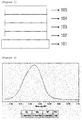
FIG. 1 is a view illustrating an organic solar cell according to an exemplary embodiment of the present specification. -
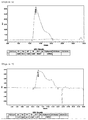
FIG. 2 is a view illustrating a gel permeation chromatography (GPC) ofCopolymer 1 prepared in Example 1. -
FIG. 3 is a view illustrating a gel permeation chromatography (GPC) ofCopolymer 2 prepared in Example 2. -
FIG. 4 is a view illustrating a gel permeation chromatography (GPC) ofCopolymer 3 prepared in Example 3. -
FIG. 5 is a view illustrating a gel permeation chromatography (GPC) ofCopolymer 4 prepared in Example 4. -
FIG. 6 is a view illustrating a gel permeation chromatography (GPC) ofCopolymer 6 prepared in Example 6. -
FIG. 7 is a view illustrating a gel permeation chromatography (GPC) of Copolymer 7 prepared in Example 7. -
FIG. 8 is a view illustrating the current-voltage curves of organic solar cells of Examples 1 to 4 of the present specification. -
FIG. 9 is a view illustrating a current-voltage curve of an organic solar cell of Preparation Example 6 of the present specification. -
- 101:
- Substrate
- 102:
- First electrode
- 103:
- Hole transport layer
- 104:
- Photoactive layer
- 105:
- Second electrode
- Hereinafter, the present specification will be described in detail.
- The term 'monomer' as used herein refers to a repeated structure which is included in a main chain of a copolymer, in which the monomer is bonded to the copolymer by means of polymerization.
- A copolymer according to an exemplary embodiment of the present specification includes: a first monomer represented by the following
Formula 1; a second monomer that acts as an electron donor; and a third monomer that acts as an electron acceptor. - The copolymer according to an exemplary embodiment of the present specification is prepared by three monomers. In this case, the synthesis scheme becomes simple, so that it is easy to synthesize the copolymer.
- The copolymer including the three monomers is a random copolymer. In the case of the random copolymer, as the crystallinity is reduced, the degree of amorphousness is increased, so that long-term stability to heat may be secured, and the process of manufacturing a device and a module, which include the copolymer becomes facilitated.
- Further, since the ratio of copolymers in a random copolymer is controlled to easily control the solubility, it is easy to provide solubility that is suitable for the process of manufacturing an organic solar cell, thereby manufacturing an organic solar cell with high efficiency.
- In an exemplary embodiment of the present invention, R1 and R2 are the same as or different from each other, and are each independently a substituted or unsubstituted alkoxy group; or a substituted or unsubstituted alkyl group.
- In an exemplary embodiment of the present invention, R1 and R2 are the same as or different from each other, and are each independently a substituted or unsubstituted alkoxy group having 1 to 30 carbon atoms; or a substituted or unsubstituted alkyl group having 1 to 30 carbon atoms.
- In an exemplary embodiment of the present specification, a is 1.
- In an exemplary embodiment of the present specification, b is 1.
- In an exemplary embodiment of the present specification, R1 and R2 are each substituted in the meta position. In this case, there is an effect of increasing the solubility.
- In an exemplary embodiment of the present specification, the first monomer represented by
Formula 1 is represented by the followingFormula 2.

- In
Formula 2,
R1 to R4 are the same as those defined inFormula 1. - In an exemplary embodiment of the present specification, the second monomer that acts as an electron donor includes at least one of the following Formulae.


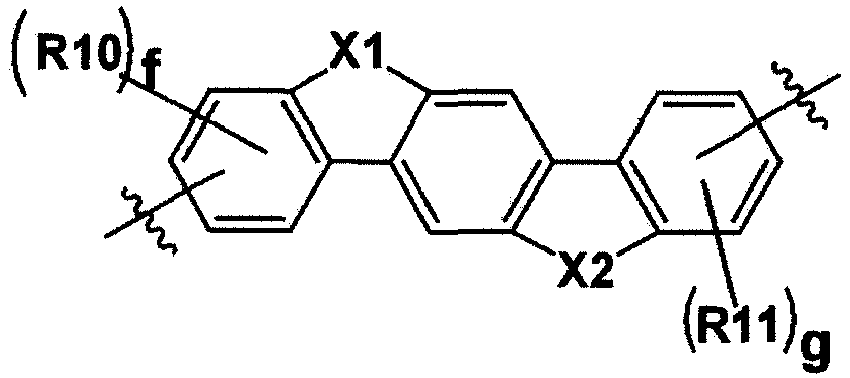
- In the Formulae,
- c is an integer of 1 to 4,
- d is an integer of 1 to 6,
- e is an integer in the range of 1 to 8,
- f and g are each an integer of 1 to 3,
- R10 is the same or different when c, d, e, and f are 2 or more,
- R11 is the same or different when g is 2 or more,
- polymerR10 and R11 are the same as or different from each other, and are each independently selected from the group consisting of hydrogen; deuterium; a halogen group; a nitrile group; a nitro group; an imide group; an amide group; a hydroxyl group; a substituted or unsubstituted carbonyl group; a substituted or unsubstituted alkyl group; a substituted or unsubstituted cycloalkyl group; a substituted or unsubstituted alkoxy group; a substituted or unsubstituted aryloxy group; a substituted or unsubstituted alkylthioxy group; a substituted or unsubstituted arylthioxy group; a substituted or unsubstituted alkylsulfoxy group; a substituted or unsubstituted arylsulfoxy group; a substituted or unsubstituted alkenyl group; a substituted or unsubstituted silyl group; a substituted or unsubstituted boron group; a substituted or unsubstituted alkylamine group; a substituted or unsubstituted aralkylamine group; a substituted or unsubstituted arylamine group; a substituted or unsubstituted heteroarylamine group; a substituted or unsubstituted aryl group; and a substituted or unsubstituted heterocyclic group,
- X1 to X3 are the same as or different from each other, and are each independently selected from the group consisting of CRR', NR, O, SiRR', PR, S, GeRR', Se, and Te,
- Z is selected from the group consisting of CRR', O, SiRR', PR, S, GeRR', Se, and Te,
- Y1 and Y2 are the same as or different from each other, and are each independently selected from the group consisting of CR, N, SiR, P, and GeR, and
- R and R' are the same as or different from each other, and are each independently selected from the group consisting of hydrogen; deuterium; a halogen group; a nitrile group; a nitro group; an imide group; an amide group; a hydroxyl group; a substituted or unsubstituted carbonyl group; a substituted or unsubstituted alkyl group; a substituted or unsubstituted cycloalkyl group; a substituted or unsubstituted alkoxy group; a substituted or unsubstituted aryloxy group; a substituted or unsubstituted alkylthioxy group; a substituted or unsubstituted arylthioxy group; a substituted or unsubstituted alkylsulfoxy group; a substituted or unsubstituted arylsulfoxy group; a substituted or unsubstituted alkenyl group; a substituted or unsubstituted silyl group; a substituted or unsubstituted boron group; a substituted or unsubstituted alkylamine group; a substituted or unsubstituted aralkylamine group; a substituted or unsubstituted arylamine group; a substituted or unsubstituted heteroarylamine group; a substituted or unsubstituted aryl group; and a substituted or unsubstituted heterocyclic group.
- In an exemplary embodiment of the present specification, the third monomer that acts as an electron acceptor includes at least one of the following Formulae.


- In the Formulae,
- R12 to R15 are the same as or different from each other, and are each independently selected from the group consisting of hydrogen; deuterium; a halogen group; a nitrile group; a nitro group; an imide group; an amide group; a hydroxyl group; a substituted or unsubstituted carbonyl group; a substituted or unsubstituted alkyl group; a substituted or unsubstituted cycloalkyl group; a substituted or unsubstituted alkoxy group; a substituted or unsubstituted aryloxy group; a substituted or unsubstituted alkylthioxy group; a substituted or unsubstituted arylthioxy group; a substituted or unsubstituted alkylsulfoxy group; a substituted or unsubstituted arylsulfoxy group; a substituted or unsubstituted alkenyl group; a substituted or unsubstituted silyl group; a substituted or unsubstituted boron group; a substituted or unsubstituted alkylamine group; a substituted or unsubstituted aralkylamine group; a substituted or unsubstituted arylamine group; a substituted or unsubstituted heteroarylamine group; a substituted or unsubstituted aryl group; and a substituted or unsubstituted heterocyclic group,
- X4 and X5 are the same as or different from each other, and are each independently selected from the group consisting of CRR', NR, O, SiRR', PR, S, GeRR', Se, and Te,
- Y3 to Y6 are the same as or different from each other, and are each independently selected from the group consisting of CR, N, SiR, P, and GeR, and
- R and R' are the same as or different from each other, and are each independently selected from the group consisting of hydrogen; deuterium; a halogen group; a nitrile group; a nitro group; an imide group; an amide group; a hydroxyl group; a substituted or unsubstituted carbonyl group; a substituted or unsubstituted alkyl group; a substituted or unsubstituted cycloalkyl group; a substituted or unsubstituted alkoxy group; a substituted or unsubstituted aryloxy group; a substituted or unsubstituted alkylthioxy group; a substituted or unsubstituted arylthioxy group; a substituted or unsubstituted alkylsulfoxy group; a substituted or unsubstituted arylsulfoxy group; a substituted or unsubstituted alkenyl group; a substituted or unsubstituted silyl group; a substituted or unsubstituted boron group; a substituted or unsubstituted alkylamine group; a substituted or unsubstituted aralkylamine group; a substituted or unsubstituted arylamine group; a substituted or unsubstituted heteroarylamine group; a substituted or unsubstituted aryl group; and a substituted or unsubstituted heterocyclic group.
- Examples of the substituents will be described below, but are not limited thereto.
- In the present specification,

- The term "substituted or unsubstituted" as used herein means being substituted with one or more substituents selected from the group consisting of deuterium; a halogen group; a carbonyl group; an alkyl group; an alkenyl group; an alkoxy group; a cycloalkyl group; a silyl group; an arylalkenyl group; an aryl group; an aryloxy group; an alkylthioxy group; an alkylsulfoxy group; an arylsulfoxy group; a boron group; an alkylamine group; an aralkylamine group; an arylamine group; a heteroaryl group; an arylamine group; an aryl group; a nitrile group; a nitro group; a hydroxyl group; and a heterocyclic group, or having no substituent. For example, "a substituent to which two or more substituents are linked" may be a biphenyl group. That is, the biphenyl group may be an aryl group, and may be interpreted as a substituent to which two phenyl groups are linked. The term means being unsubstituted or substituted with a substituent to which two or more substituents are linked among the substituents exemplified above. For example, "a substituent to which two or more substituents are linked" may be a biphenyl group. That is, the biphenyl group may be an aryl group, and may be interpreted as a substituent to which two phenyl groups are linked.
- As used herein, the term "substitution" means that a hydrogen atom bonded to a carbon atom of a compound is changed into another substituent, and the position to be substituted is not limited as long as the position is a position where the hydrogen atom is substituted, that is, a position where the substituent may be substituted, and when two or more are substituted, the two or more substituents may be the same as or different from each other.
- In the present specification, the number of carbon atoms of the imide group is not particularly limited, but is preferably 1 to 25. Specifically, the imide group may be one of the compounds having the following structures, but is not limited thereto.

- In the present specification, one or two nitrogen atoms of the amide group may be substituted with hydrogen, a straight-chain, branched-chain, or cyclic alkyl group having 1 to 25 carbon atoms, or an aryl group having 6 to 25 carbon atoms. Specifically, the amide group may be one of the compounds having the following Structural Formulae, but is not limited thereto.


- In the present specification, the alkyl group may be a straight-chain or branched-chain, and the number of carbon atoms is not particularly limited, but is preferably 1 to 50. Specific examples thereof include methyl, ethyl, propyl, n-propyl, isopropyl, butyl, n-butyl, isobutyl, tert-butyl, sec-butyl, 1-methyl-butyl, 1-ethyl-butyl, pentyl, n-pentyl, isopentyl, neopentyl, tert-pentyl, hexyl, n-hexyl, 1-methylpentyl, 2-methylpentyl, 4-methyl-2-pentyl, 3,3-dimethylbutyl, 2-ethylbutyl, heptyl, n-heptyl, 1-methylhexyl, cyclopentylmethyl, cyclohexylmethyl, octyl, n-octyl, tert-octyl, 1-methylheptyl, 2-ethylhexyl, 2-propylpentyl, n-nonyl, 2,2-dimethylheptyl, 1-ethyl-propyl, 1,1-dimethyl-propyl, isohexyl, 2-methylpentyl, 4-methylhexyl, 5-methylhexyl, and the like, but are not limited thereto.
- In the present specification, the cycloalkyl group is not particularly limited, but is preferably a cycloalkyl group having 3 to 60 carbon atoms, and specific examples thereof include cyclopropyl, cyclobutyl, cyclopentyl, 3-methylcyclopentyl, 2,3-dimethylcyclopentyl, cyclohexyl, 3-methylcyclohexyl, 4-methylcyclohexyl, 2,3-dimethylcyclohexyl, 3,4,5-trimethylcyclohexyl, 4-tert-butylcyclohexyl, cycloheptyl, cyclooctyl, and the like, but are not limited thereto.
- In the present specification, the alkoxy group may be straight-chain, branched-chain, or cyclic. The number of carbon atoms of the alkoxy group is not particularly limited, but is preferably 1 to 20. Specific examples thereof include methoxy, ethoxy, n-propoxy, isopropoxy, i-propyloxy, n-butoxy, isobutoxy, tert-butoxy, sec-butoxy, n-pentyloxy, neopentyloxy, isopentyloxy, n-hexyloxy, 3,3-dimethylbutyloxy, 2-ethylbutyloxy, n-octyloxy, n-nonyloxy, n-decyloxy, benzyloxy, p-methylbenzyloxy, and the like, but are not limited thereto.
- In the present specification, the alkenyl group may be a straight chain or branched chain, and the number of carbon atoms is not particularly limited, but is preferably 2 to 40. Specific examples thereof include vinyl, 1-propenyl, isopropenyl, 1-butenyl, 2-butenyl, 3-butenyl, 1-pentenyl, 2-pentenyl, 3-pentenyl, 3-methyl-1-butenyl, 1,3-butadienyl, allyl, 1-phenylvinyl-1-yl, 2-phenylvinyl-1-yl, 2,2-diphenylvinyl-1-yl, 2-phenyl-2-(naphthyl-1-yl)vinyl-1-yl, 2,2-bis(diphenyl-1-yl)vinyl-1-yl, a stilbenyl group, a styrenyl group, and the like, but are not limited thereto. In the present specification, an aryl group may be a monocyclic aryl group or a polycyclic group, and includes the case where an alkyl group having 1 to 25 carbon atoms or an alkoxy group having 1 to 25 carbon atoms is substituted. In addition, the aryl group in the present specification may mean an aromatic ring.
- When the aryl group is a monocyclic aryl group, the number of carbon atoms is not particularly limited, but is preferably 6 to 25. Specific examples of the monocyclic aryl group include a phenyl group, a biphenyl group, a terphenyl group, and the like, but are not limited thereto. When the aryl group is a polycyclic aryl group, the number of carbon atoms is not particularly limited, but is preferably 10 to 24. Specific examples of the polycyclic aryl group include a naphthyl group, an anthracenyl group, a phenanthryl group, a pyrenyl group, a perylenyl group, a chrysenyl group, a fluorenyl group, and the like, but are not limited thereto.
- In the present specification, the fluorenyl group may be substituted, and adjacent substituents may be combined with each other to form a ring.
- When the fluorenyl group is substituted, the fluorenyl group may be


- In the present specification, specific examples of the silyl group include a trimethylsilyl group, a triethylsilyl group, a t-butyldimethylsilyl group, a vinyldimethylsilyl group, a propyldimethylsilyl group, a triphenylsilyl group, a diphenylsilyl group, a phenylsilyl group, and the like, but are not limited thereto. In the present specification, the number of carbon atoms of the amine group is not particularly limited, but is preferably 1 to 30. Specific examples of the amine group include a methylamine group, a dimethylamine group, an ethylamine group, a diethylamine group, a phenylamine group, a naphthylamine group, a biphenylamine group, an anthracenylamine group, a 9-methyl-anthracenylamine group, a diphenylamine group, a phenylnaphthylamine group, a ditolylamine group, a phenyltolylamine group, a triphenylamine group and the like, but are not limited thereto.
- In the present specification, examples of the arylamine group include a substituted or unsubstituted monoarylamine group, a substituted or unsubstituted diarylamine group, or a substituted or unsubstituted triarylamine group. An aryl group in the arylamine group may be a monocyclic aryl group, or a polycyclic aryl group. Two or more arylamine groups which the aryl group includes may include a monocyclic aryl group, a polycyclic aryl group, or both a monocyclic aryl group and a polycyclic aryl group.
- Specific examples of the arylamine group include a phenylamine group, a naphthylamine group, a biphenylamine group, an anthracenylamine group, a 3-methyl-phenylamine group, a 4-methyl-naphthylamine group, a 2-methyl-biphenylamine group, a 9-methyl-anthracenylamine group, a diphenylamine group, a phenylnaphthylamine group, a ditolylamine group, a phenyltolylamine group, a carbazole group, a triphenylamine group, and the like, but are not limited thereto.
- In the present specification, the heterocyclic group includes one or more of an atom other than carbon and a heteroatom, and specifically, the hetero atom may include one or more atoms selected from the group consisting of O, N, Se, S, and the like. The number of carbon atoms of the heterocyclic group is not particularly limited, but is preferably 2 to 60. Examples of the heterocyclic group include a thiophene group, a furan group, a pyrrole group, an imidazole group, a thiazole group, an oxazole group, an oxadiazole group, a triazole group, a pyridyl group, a bipyridyl group, a pyrimidyl group, a triazine group, a triazole group, an acridyl group, a pyridazine group, a pyrazinyl group, a quinolinyl group, a quinazoline group, a quinoxalinyl group, a phthalazinyl group, a pyrido-pyrimidinyl group, a pyrido-pyrazinyl group, a pyrazino pyrazinyl group, an isoquinoline group, an indole group, a carbazole group, a benzoxazole group, a benzimidazole group, a benzothiazole group, a benzocarbazole group, a benzothiophene group, a dibenzothiophene group, a benzofuranyl group, a phenanthroline group, a thiazolyl group, an isoxazolyl group, an oxadiazolyl group, a thiadiazolyl group, a benzothiazolyl group, a phenothiazinyl group, a dibenzofuranyl group, and the like, but are not limited thereto.
- In the present application, the aryl group in the aryloxy group, the arylthioxy group, the arylsulfoxy group, and the aralkylamine group is the same as the aforementioned examples of the aryl group. Specific examples of the aryloxy group include phenoxy, p-tolyloxy, m-tolyloxy, 3,5-dimethyl-phenoxy, 2,4,6-trimethylphenoxy, p-tert-butylphenoxy, 3-biphenyloxy, 4-biphenyloxy, 1-naphthyloxy, 2-naphthyloxy, 4-methyl-1-naphthyloxy, 5-methyl-2-naphthyloxy, 1-anthryloxy, 2-anthryloxy, 9-anthryloxy, 1-phenanthryloxy, 3-phenanthryloxy, 9-phenanthryloxy, and the like, examples of the arylthioxy group include a phenylthioxy group, a 2-methylphenylthioxy group, a 4-tert-butylphenylthioxy group, and the like, and examples of the arylsulfoxy group include a benzenesulfoxy group, a p-toluenesulfoxy group, and the like, but are not limited thereto.
- In the present specification, the heteroaryl group in the heteroarylamine group may be selected from the aforementioned examples of the heterocyclic group.
- In the present specification, the alkyl group in the alkylthioxy group and the alkylsulfoxy group is the same as the aforementioned examples of the alkyl group. Specific examples of the alkylthioxy group include a methylthioxy group, an ethylthioxy group, a tert-butylthioxy group, a hexylthioxy group, an octylthioxy group, and the like, but examples of the alkylsulfoxy group include a methylsulfoxy group, an ethylsulfoxy group, a propylsulfoxy group, a butylsulfoxy group, and the like, but are not limited thereto.
- In an exemplary embodiment of the present specification, the copolymer includes a unit represented by the following Formula 1-1.


- In Formula 1-1,
- a, b, and R1 to R4 are the same as those defined in
Formula 1, and - D is a second unit that acts as an electron donor.
- In an exemplary embodiment of the present specification, the copolymer includes a unit represented by the following
Formula 3.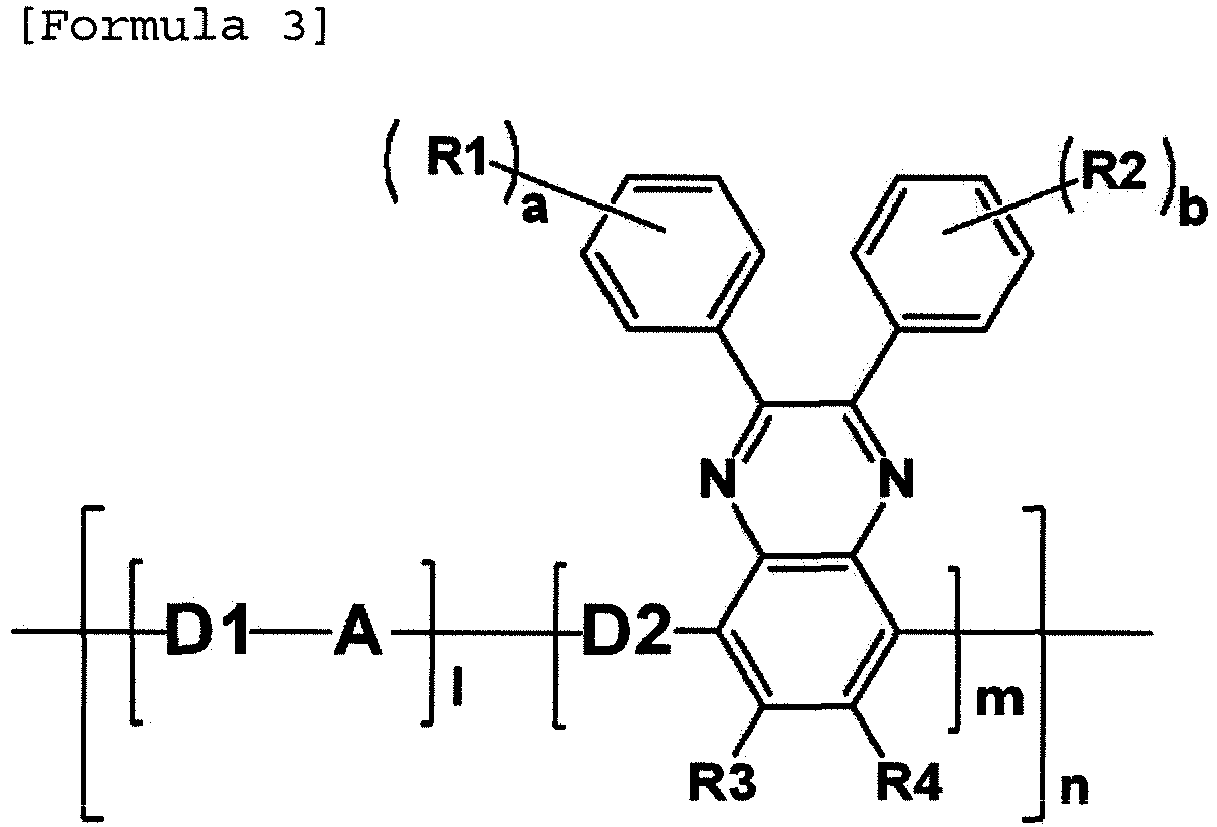
- In
Formula 3, - a, b, and R1 to R4 are the same as those defined in
Formula 1, - l is a real number, which is 0 < l ≤ 1 as a mole fraction,
- m is a real number, which is 0 < m ≤ 1 as a mole fraction, and
- l + m = 1,
- n is an integer of 1 to 10,000,
- D1 and D2 are the same as or different from each other, and are each independently a second unit that acts as an electron donor, and
- A is a third unit that acts as an electron acceptor.
- In an exemplary embodiment of the present specification, examples of the electron donor of D1 and D2 are the same as those described above.
- In an exemplary embodiment of the present specification, examples of the electron acceptor of A are the same as those described above.
- In an exemplary embodiment of the present specification, D1 includes

- In an exemplary embodiment of the present specification, D1 includes
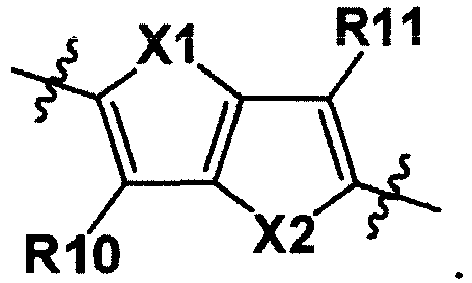
- In an exemplary embodiment of the present specification, D2 includes

- In an exemplary embodiment of the present specification, D2 includes

- In an exemplary embodiment of the present specification, A includes

- In an exemplary embodiment of the present specification, A includes

- In an exemplary embodiment of the present specification, A includes

- In an exemplary embodiment of the present specification, the copolymer includes at least one of the units represented by the following
Formulae 4 to 7.


- In
Formulae 4 to 7, - a, b, and R1 to R4 are the same as those defined in
Formula 1, - l is a real number, which is 0 < l ≤ 1 as a mole fraction,
- m is a real number, which is 0 < m ≤ 1 as a mole fraction, and
- l + m = 1,
- h and i are an integer of 1 to 3 as a repeating unit of a structure in the parenthesis,
- the structures in the parenthesis are the same as or different from each other when h and i are 2 or more,
- n is an integer of 1 to 10,000,
- R10 to R13, R10', and R11' are the same as or different from each other, and are each independently selected from the group consisting of hydrogen; deuterium; a halogen group; a nitrile group; a nitro group; an imide group; an amide group; a hydroxyl group; a substituted or unsubstituted carbonyl group; a substituted or unsubstituted alkyl group; a substituted or unsubstituted cycloalkyl group; a substituted or unsubstituted alkoxy group; a substituted or unsubstituted aryloxy group; a substituted or unsubstituted alkylthioxy group; a substituted or unsubstituted arylthioxy group; a substituted or unsubstituted alkylsulfoxy group; a substituted or unsubstituted arylsulfoxy group; a substituted or unsubstituted alkenyl group; a substituted or unsubstituted silyl group; a substituted or unsubstituted boron group; a substituted or unsubstituted alkylamine group; a substituted or unsubstituted aralkylamine group; a substituted or unsubstituted arylamine group; a substituted or unsubstituted heteroarylamine group; a substituted or unsubstituted aryl group; and a substituted or unsubstituted heterocyclic group,
- X1, X1', X2, X2', X4, and X5 are the same as or different from each other, and are each independently selected from the group consisting of CRR', NR, O, SiRR', PR, S, GeRR', Se, and Te,
- Y3 to Y5 are the same as or different from each other, and are each independently selected from the group consisting of CR, N, SiR, P, and GeR, and
- R and R' are the same as or different from each other, and are each independently selected from the group consisting of hydrogen; deuterium; a halogen group; a nitrile group; a nitro group; an imide group; an amide group; a hydroxyl group; a substituted or unsubstituted carbonyl group; a substituted or unsubstituted alkyl group; a substituted or unsubstituted cycloalkyl group; a substituted or unsubstituted alkoxy group; a substituted or unsubstituted aryloxy group; a substituted or unsubstituted alkylthioxy group; a substituted or unsubstituted arylthioxy group; a substituted or unsubstituted alkylsulfoxy group; a substituted or unsubstituted arylsulfoxy group; a substituted or unsubstituted alkenyl group; a substituted or unsubstituted silyl group; a substituted or unsubstituted boron group; a substituted or unsubstituted alkylamine group; a substituted or unsubstituted aralkylamine group; a substituted or unsubstituted arylamine group; a substituted or unsubstituted heteroarylamine group; a substituted or unsubstituted aryl group; and a substituted or unsubstituted heterocyclic group.
- The 'structure in the parenthesis' as used herein means a structure included in the ( ).
The term 'unit' as used herein means a repeated structure which is included in a monomer of a copolymer, in which the monomer is bonded to the copolymer by means of polymerization. - The term 'including a unit' as used herein means being included in a main chain in the copolymer.
- In an exemplary embodiment of the present specification, h is 1.
- In an exemplary embodiment of the present specification, h is 2.
- In an exemplary embodiment of the present specification, i is 1.
- In an exemplary embodiment of the present specification, i is 2.
- In an exemplary embodiment of the present specification, X1 is S.
- In an exemplary embodiment of the present specification, X1' is S.
- In an exemplary embodiment of the present specification, X2 is S.
- In an exemplary embodiment of the present specification, X2' is S.
- In an exemplary embodiment of the present specification, X4 is S.
- In an exemplary embodiment of the present specification, X4 is NR.
- In an exemplary embodiment of the present specification, X4 is NR, and R is a substituted or unsubstituted alkyl group.
- In an exemplary embodiment of the present specification, X4 is NR, and R is a substituted or unsubstituted dodecanyl group.
- In an exemplary embodiment of the present specification, X4 is NR, and R is a dodecanyl group.
- In an exemplary embodiment of the present specification, X5 is S.
- In an exemplary embodiment of the present specification, Y3 is N.
- In an exemplary embodiment of the present specification, Y4 is N.
- In an exemplary embodiment of the present specification, Y5 is CR.
- In an exemplary embodiment of the present specification, Y5 is CR, and R is a substituted or unsubstituted alkoxy group.
- In an exemplary embodiment of the present specification, Y5 is CR, and R is a substituted or unsubstituted octoxy group.
- In an exemplary embodiment of the present specification, Y5 is CR, and R is an octoxy group.
- In an exemplary embodiment of the present specification, R10 is hydrogen.
- In an exemplary embodiment of the present specification, R10' is hydrogen.
- In an exemplary embodiment of the present specification, R11 is hydrogen.
- In an exemplary embodiment of the present specification, R11' is hydrogen.
- In an exemplary embodiment of the present specification, R12 is a substituted or unsubstituted alkoxy group.
- In an exemplary embodiment of the present specification, R12 is a substituted or unsubstituted octoxy group.
- In an exemplary embodiment of the present specification, R12 is an octoxy group.
- In an exemplary embodiment of the present specification, R13 is hydrogen.
- In an exemplary embodiment of the present specification, R14 is a substituted or unsubstituted carbonyl group.
- In an exemplary embodiment of the present specification, R14 is a carbonyl group substituted with an alkyl group.
- In another exemplary embodiment, R14 is 2-ethylhexan-1-one.
- In an exemplary embodiment of the present specification, a is 1.
- In an exemplary embodiment of the present specification, R1 is substituted at the meta position.
- In an exemplary embodiment of the present specification, R1 is a substituted or unsubstituted alkoxy group.
- In an exemplary embodiment of the present specification, R1 is a substituted or unsubstituted octoxy group.
- In an exemplary embodiment of the present specification, R1 is an octoxy group.
- In an exemplary embodiment of the present specification, b is 1.
- In an exemplary embodiment of the present specification, R2 is substituted at the meta position.
- In an exemplary embodiment of the present specification, R2 is a substituted or unsubstituted alkoxy group.
- In an exemplary embodiment of the present specification, R2 is a substituted or unsubstituted octoxy group.
- In an exemplary embodiment of the present specification, R2 is an octoxy group.
- In an exemplary embodiment of the present specification, R3 is hydrogen.
- In another exemplary embodiment, R3 is a halogen group.
- In still another exemplary embodiment, R3 is fluorine. In an exemplary embodiment of the present specification, R4 is hydrogen.
- In another exemplary embodiment, R4 is a halogen group.
- In still another exemplary embodiment, R4 is fluorine.
- In an exemplary embodiment of the present specification, the copolymer includes at least one unit of copolymers represented by the following
Copolymers 1 to 6.




- In
Copolymers 1 to 6,
l, m, and n are the same as those defined above. - In an exemplary embodiment of the present specification, l is 0.5.
- In an exemplary embodiment of the present specification, m is 0.5.
- In another exemplary embodiment, 1 is 0.675.
- In still another exemplary embodiment, m is 0.325.
- In an exemplary embodiment of the present specification, an end group of the copolymer is selected from the group consisting of hydrogen; deuterium; a halogen group; a nitrile group; a nitro group; an imide group; an amide group; a hydroxyl group; a substituted or unsubstituted alkyl group; a substituted or unsubstituted cycloalkyl group; a substituted or unsubstituted alkoxy group; a substituted or unsubstituted aryloxy group; a substituted or unsubstituted alkylthioxy group; a substituted or unsubstituted arylthioxy group; a substituted or unsubstituted alkylsulfoxy group; a substituted or unsubstituted arylsulfoxy group; a substituted or unsubstituted alkenyl group; a substituted or unsubstituted silyl group; a substituted or unsubstituted boron group; a substituted or unsubstituted alkylamine group; a substituted or unsubstituted aralkylamine group; a substituted or unsubstituted arylamine group; a substituted or unsubstituted heteroarylamine group; a substituted or unsubstituted aryl group; and a substituted or unsubstituted heterocyclic group.
- In an exemplary embodiment of the present specification, the end group of the copolymer is a heterocyclic group or an aryl group.
- In an exemplary embodiment of the present specification, the end group of the copolymer is a 4-(trifluoromethyl)phenyl group.
- According to an exemplary embodiment of the present specification, the number average molecular weight of the copolymer is preferably 500 g/mol to 1,000,000 g/mol. Preferably, the number average molecular weight of the copolymer is preferably 10,000 to 100,000. In an exemplary embodiment of the present specification, the number average molecular weight of the copolymer is 30,000 to 70,000.
- According to an exemplary embodiment of the present specification, the copolymer may have a molecular weight distribution of 1 to 100. Preferably, the copolymer has a molecular weight distribution of 1 to 3.
- The lower the molecular weight distribution and the larger the number average molecular weight are, the better the electrical properties and the mechanical properties are. Furthermore, the number average molecular weight is preferably 100,000 or less in order to have a predetermined solubility or more and thus advantageously allow application of a solution application method.
- The copolymer may be prepared based on Preparation Examples to be described below.
- The copolymer may be prepared by putting a catalyst and a solvent into three monomers and reacting the resulting mixture, precipitating an end capping and the mixture in methanol, and then extracting the solid. As described above, the three monomers may be changed to prepare a copolymer including a unit represented by
Formula 3 and a first monomer ofFormula 1 as well asFormulae 4 to 6 andCopolymers 1 to 4. - The copolymer according to the present specification may be prepared by a multi-step chemical reaction. Monomers may be prepared by an alkylation reaction, a Grignard reaction, a Suzuki coupling reaction, a Stille coupling reaction, and the like, and then final copolymers may be prepared by a carbon-carbon coupling reaction such as a Stille coupling reaction. When a substituent to be introduced is a boronic acid or boronic ester compound, the copolymer may be prepared by a Suzuki coupling reaction, and when a substituent to be introduced is a tributyltin compound, the copolymer may be prepared by a Stille coupling reaction, but the preparation of the copolymer is not limited thereto.
- An exemplary embodiment of the present specification provides an organic solar cell including: a first electrode; a second electrode provided opposite to the first electrode; and an organic material layer having one or more layers disposed between the first electrode and the second electrode and including a photoactive layer, in which one or more layers of the organic material layer include the copolymer.
- The organic solar cell according to an exemplary embodiment of the present specification includes a first electrode, a photoactive layer, and a second electrode. The organic solar cell may further include a substrate, a hole transport layer, and/or an electron transport layer.
- In an exemplary embodiment of the present specification, when the organic solar cell receives a photon from an external light source, an electron and a hole are generated between an electron donor and an electron acceptor. The generated hole is transported to an anode through an electron donor layer.
- In an exemplary embodiment of the present specification, the organic material layer includes a hole transport layer, a hole injection layer, or a layer which transports and injects holes simultaneously, and the hole transport layer, the hole injection layer, or the layer which transports and injects holes simultaneously includes the copolymer.
- In another exemplary embodiment, the organic material layer includes an electron injection layer, an electron transport layer, or a layer which injects and transports electrons simultaneously, and the electron injection layer, the electron transport layer, or the layer which injects and transports electrons simultaneously includes the copolymer.
- In an exemplary embodiment of the present specification, when the organic solar cell receives a photon from an external light source, an electron and a hole are generated between an electron donor and an electron acceptor. The generated hole is transported to an anode through an electron donor layer.
- In an exemplary embodiment of the present specification, the organic solar cell may further include an additional organic material layer. The organic solar cell may use an organic material simultaneously having various functions to decrease the number of organic material layers.
- In an exemplary embodiment of the present specification, the first electrode is an anode, and the second electrode is a cathode. In another exemplary embodiment, the first electrode is a cathode, and the second electrode is an anode.
- In an exemplary embodiment of the present specification, in the organic solar cell, a cathode, a photoactive layer, and an anode may be disposed in this order, or an anode, a photoactive layer, and a cathode may be disposed in this order, but the sequence is not limited thereto.
- In another exemplary embodiment, in the organic solar cell, an anode, a hole transport layer, a photoactive layer, an electron transport layer, and a cathode may be disposed in this order, or a cathode, an electron transport layer, a photoactive layer, a hole transport layer, and an anode may be disposed in this order, but the sequence is not limited thereto.
- In an exemplary embodiment of the present specification, the organic solar cell has a normal structure.
- In an exemplary embodiment of the present specification, the organic solar cell has an inverted structure.
- In another exemplary embodiment, a buffer layer may be provided between the photoactive layer and the hole transport layer, or between the photoactive layer and the electron transport layer. In this case, the hole injection layer may be further provided between the anode and the hole transport layer. Further, an electron injection layer may be further provided between the cathode and the electron transport layer.
- In an exemplary embodiment of the present specification, the photoactive layer includes one or two or more selected from the group consisting of an electron donor and an electron acceptor, and the electron donor material includes the copolymer.
- In an exemplary embodiment of the present specification, the electron acceptor material may be selected from the group consisting of fullerene, a fullerene derivative, bathocuproine, a semiconductor element, a semiconductor compound, and a combination thereof. Specifically, the electron acceptor material is a compound of one or two or more selected from the group consisting of fullerene, a fullerene derivative (PCBM((6,6)-phenyl-C61-butyric acid-methylester) or PCBCR((6,6)-phenyl-C61-butyric acid-cholesteryl ester), perylene, polybenzimidazole (PBI), and 3,4,9,10-perylenetetracarboxylic bis-benzimidazole (PTCBI).
- In an exemplary embodiment of the present specification, the electron donor and the electron acceptor are a bulk heterojunction (BHJ). The electron donor material and the electron acceptor material are mixed in a ratio (w/w) of 1:10 to 10:1.
- The bulk heterojunction means that the electron donor material and the electron acceptor material are mixed with each other in the photoactive layer.
- In an exemplary embodiment of the present specification, the photoactive layer has a bilayer structure including an n-type organic material layer and a p-type organic material layer, and the p-type organic material layer includes the copolymer.
- The substrate in the present specification may be a glass substrate or a transparent plastic substrate, which has excellent transparency, surface smoothness, easiness in handling, and waterproof, but is not limited thereto, and there is no limitation as long as the substrate is a substrate typically used in the organic solar cell. Specific examples thereof include glass, polyethylene terephthalate (PET), polyethylene naphthalate (PEN), polypropylene (PP), polyimide (PI), triacetyl cellulose (TAC), and the like, but are not limited thereto.
- The anode electrode may be a material having transparency and excellent conductivity, but is not limited thereto. Examples of the anode electrode include metal such as vanadium, chromium, copper, zinc and gold, or alloys thereof; metal oxides such as zinc oxide, indium oxide, indium tin oxide (ITO) and indium zinc oxide (IZO); a combination of metal and oxide, such as ZnO:Al or SnO2:Sb; and electrically conductive polymers, such as poly(3-methylthiophene), poly[3,4-(ethylene-1,2-dioxy)thiophene](PEDT), polypyrrole and polyaniline, and the like, but are not limited thereto.
- A method for forming the anode electrode is not particularly limited, but the anode electrode may be formed by being applied on one surface of the substrate or coated in the form of a film by using, for example, sputtering, E-beam, thermal deposition, spin coating, screen printing, inkjet printing, doctor blade or a gravure printing method.
- When the anode electrode is formed on a substrate, the formation may be subjected to processes of washing, moisture removal and hydrophilic modification.
- For example, when a patterned ITO substrate is sequentially washed with a detergent, acetone, and isopropyl alcohol (IPA), dried on a heating plate at 100°C to 150°C for 1 to 30 minutes, preferably at 120°C for 10 minutes for moisture removal, and is completely washed, the surface of the substrate is hydrophilically modified.
- By the surface modification as described above, the junction surface potential may be maintained at a level suitable for the surface potential of the photoactive layer. In addition, during the modification, a polymer thin film may be easily formed, and the quality of the thin film may also be enhanced.
- Examples of a pretreatment technology of the anode electrode include a) a surface oxidation method using a parallel plate discharge, b) a method of oxidizing the surface through ozone produced by using UV rays in a vacuum state, c) a method of oxidizing the anode electrode by using an oxygen radical produced by the plasma, and the like.
- One of the methods may be selected depending on the state of the anode electrode or the substrate. However, it is commonly preferred that oxygen on the surface of the anode electrode or the substrate is prevented from leaving, and moisture and organic materials are maximally suppressed from remaining even when any of the methods is used. In this case, a substantial effect of the pre-treatment may be maximized.
- As a specific example, it is possible to use a method of oxidizing the surface from the ozone produced by using UV. In this case, after being ultrasonically cleaned, the patterned ITO substrate is baked and well dried on a hot plate, and introduced into a chamber, and then may be cleaned by the ozone produced by actuating a UV lamp to react an oxygen gas with the UV rays.
- However, the method of modifying the surface of the patterned ITO substrate in the present specification need not be particularly limited, and any method may also be used as long as the method is a method of oxidizing the substrate.
- The cathode electrode may be a metal having a small work function, but is not limited thereto. Specific examples thereof include metal such as magnesium, calcium, sodium, potassium, titanium, indium, yttrium, lithium, gadolinium, aluminum, silver, tin, and lead, or an alloy thereof; and a material having a multilayered structure, such as LiF/Al, LiO2/Al LiF/Fe, Al:Li, Al:BaF2, and Al:BaF2:Ba, but are not limited thereto.
- The cathode electrode may be deposited and formed inside a thermal deposition device allowing a degree of vacuum of 5 x 10⁻⁷ torr or less, but is not limited to the method.
- The hole transport layer and/or electron transport layer materials serve to efficiently transfer electrons and holes separated from the photoactive layer to the electrode, and the material is not particularly limited.
- The hole transport layer material may be PEDOT:PSS (Poly(3,4-ethylenediocythiophene) doped with poly(styrenesulfonic acid)), molybdenum oxide (MoOx); vanadium oxide (V2O5); nickel oxide (NiO); and tungsten oxide (WOx), and the like, but is not limited thereto.
- The electron transport layer material may be electron-extracting metal oxides, and may be specifically a metal complex of 8-hydroxyquinoline; a complex including Alq3; a metal complex including Liq; LiF; Ca; titanium oxide (TiOx); zinc oxide (ZnO) ; cesium carbonate (Cs2CO3), and the like, but is not limited thereto.
- The photoactive layer may be formed by dissolving a photoactive material such as an electron donor and/or an electron acceptor in an organic solvent, and then coating the resulting solution by a method such as spin coating, dip coating, screen printing, spray coating, doctor blade and brush painting, but the method is not limited thereto.
- The preparation method of the copolymer and the manufacture of an organic solar cell including the same will be specifically described in the following Preparation Examples and Examples. However, the following Examples are provided to illustrate the present specification, but the scope of the present specification is not limited thereby.
-

- 13 ml of chlorobenzene, 1.2 g (2.93 mmol) of 2,5-bis(trimethylstannyl)thiophene, 1.020 g (1.464 mmol) of 5,8-dibromo-2,3-bis(3-(octyloxy)phenyl)quinoxaline, 0.7018 g (1.464 mmol) of 1,3-dibromo-5-dodecylthieno[3,4-c]pyrrole-4,6-dione, 80 mg of Pd2(dba)3 (tris(dibenzylideneacetone)dipalladium(0)), and 106 mg of tri-(o-tolyl)phosphine were put into a microwave reactor vial, and reacted under the condition of 170°C for 1 hour. After the mixture was cooled to room temperature and poured into methanol, the solid was filtered and subjected to Soxhlet extraction in methanol, acetone, hexane, and chloroform, and then the chloroform portion was again precipitated in methanol to filter the solid.
- Yield: 46%
- Number average molecular weight: 24,600 g/mol
- Weight average molecular weight: 90,000 g/mol
-
FIG. 2 is a view illustrating a gel permeation chromatography (GPC) ofCopolymer 1 prepared in Example 1. -

- 15 ml of chlorobenzene, 1.0 g (2.440 mmol) of 2,5-bis(trimethylstannyl)thiophene, 0.6716 g (1.220 mmol) of 4,7-dibromo-5,6-bis (octyloxy)benzo[c]-1,2,5-thiadiazole, 0.8500 g (1.220 mmol) of 5,8-dibromo-2,3-bis(3-(octyloxy)phenyl)quinoxaline, 67 mg of Pd2(dba)3 (tris(dibenzylideneacetone)dipalladium(0)), and 89 mg of tri-(o-tolyl)phosphine were put into a microwave reactor vial, and reacted under the condition of 170°C for 1 hour. After the mixture was cooled to room temperature and poured into methanol, the solid was filtered and subjected to Soxhlet extraction in methanol, acetone, hexane, and chloroform, and then the chloroform portion was again precipitated in methanol to filter the solid.
- Yield: 46%
- Number average molecular weight: 18,800 g/mol
- Weight average molecular weight: 40,100 g/mol
-
FIG. 3 is a view illustrating a gel permeation chromatography (GPC) ofCopolymer 2 prepared in Example 2. -

- 15 ml of chlorobenzene, 0.9724 g (1.976 mmol) of 5,5'-bis(trimethylstannyl)-2,2'-bithiophene, 0.5440 g (0.988 mmol) of 4,7-dibromo-5,6-bis (octyloxy)benzo[c]-1,2,5-thiadiazole, 0.6885 g (0.988 mmol) of 5,8-dibromo-2,3-bis(3-(octyloxy)phenyl)quinoxaline, 54 mg of Pd2(dba)3 (tris(dibenzylideneacetone)dipalladium(0)), and 72 mg of tri-(o-tolyl)phosphine were put into a microwave reactor vial, and reacted under the condition of 170°C for 1 hour. After the mixture was cooled to room temperature and poured into methanol, the solid was filtered and subjected to Soxhlet extraction in methanol, acetone, hexane, and chloroform, and then the chloroform portion was again precipitated in methanol to filter the solid.
- Yield: 52%
- Number average molecular weight: 25,700 g/mol
- Weight average molecular weight: 120,000 g/mol
-
FIG. 4 is a view illustrating a gel permeation chromatography (GPC) ofCopolymer 3 prepared in Example 3. -
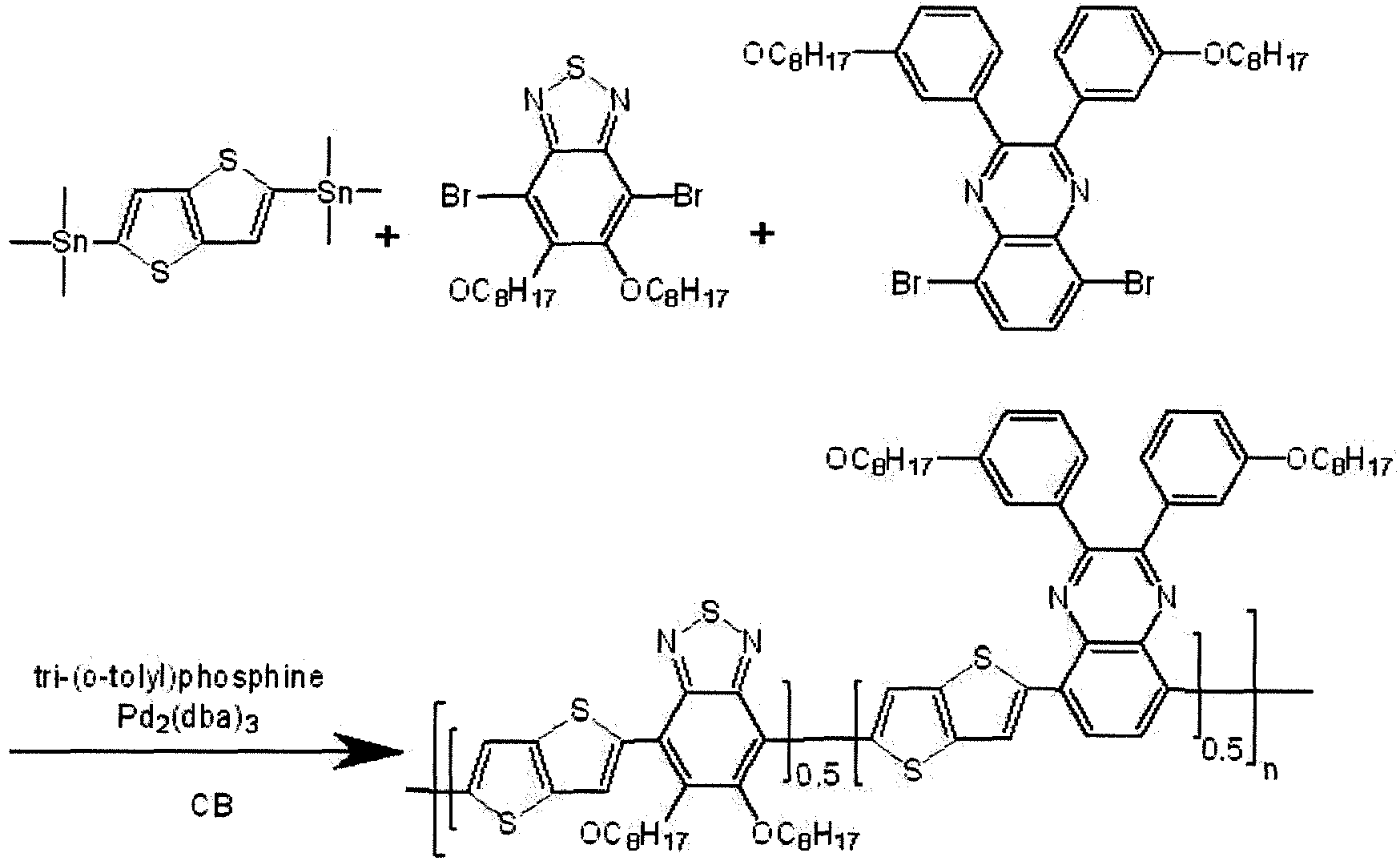
- 15 ml of chlorobenzene, 0.4768 g (1.0235 mmol) of 2,5-bis-trimethylstannyl-thieno[3,2-b]thiophene, 0.2817 g (0.512 mmol) of 4,7-dibromo-5,6-bis (octyloxy)benzo[c]-1,2,5-thiadiazole, 0.3565 g (0.512 mmol) of 5,8-bis(5bromothiophene-2-yl)-2,3-bis(3-(octyloxyphenyl)quinoxaline, and 35 mg of Pd2(PPh3)4 (tetrakis(triphenylphosphine)palladium (0)) were put into a microwave reactor vial, and reacted under the condition of 170°C for 1 hour. After the mixture was cooled to room temperature and poured into methanol, the solid was filtered and subjected to Soxhlet extraction in methanol, acetone, hexane, and chloroform, and then the chloroform portion was again precipitated in methanol to filter the solid.
- Yield: 48%
- Number average molecular weight: 11,600 g/mol
- Weight average molecular weight: 352,000 g/mol
-
FIG. 5 is a view illustrating a gel permeation chromatography (GPC) ofCopolymer 4 prepared in Example 4. -

- 13 ml of chlorobenzene, 1.2 g (2.93 mmol) of 2,5-bis(trimethylstannyl)thiophene, 1.0199 g (1.464 mmol) of 5,8-dibromo-2,3-bis(3-(octyloxy)phenyl)quinoxaiine, 0.6212 g (1.464 mmol) of 1-(4,6- dibromothieno[3,4-b]thiophen-2-yl)-2-ethylhexan-l-one, 80 mg of Pd2(dba)3 (tris(dibenzylideneacetone)dipalladium(0)), and 106 mg of tri-(o-tolyl)phosphine were put into a microwave reactor vial, and reacted under the condition of 170°C for 1 hour. After the mixture was cooled to room temperature and poured into methanol, the solid was filtered and subjected to Soxhlet extraction in methanol, acetone, hexane, and chloroform, and then the chloroform portion was again precipitated in methanol to filter the solid.
- Yield: 52%
- Number average molecular weight: 11,300 g/mol
- Weight average molecular weight: 36,200 g/mol
-

- 13 ml of chlorobenzene, 1.2 g (2.92 mmol) of 2,5-bis(trimethylstannyl)thiophene, 0.9905 g (1.46 mmol) of 5,8-dibromo-2,3-bis(3-(octyloxy)phenyl)quinoxaline, 0.7018 g (1.46 mmol) of 1,3-dibromo-5-dodecylthieno[3,4-c]pyrrole-4,6-dione, 80 mg of Pd2(dba)3 (tris(dibenzylideneacetone)dipalladium(0)), and 106 mg of tri-(o-tolyl)phosphine were put into a microwave reactor vial, and reacted under the condition of 170°C for 1 hour. After the mixture was cooled to room temperature and poured into methanol, the solid was filtered and subjected to Soxhlet extraction in methanol, acetone, hexane, and chloroform, and then the chloroform portion was again precipitated in methanol to filter the solid.
- Yield: 60%
- Number average molecular weight: 26,300 g/mol
- Weight average molecular weight: 78,300 g/mol
-
FIG. 6 is a view illustrating a gel permeation chromatography (GPC) ofCopolymer 6 prepared in Example 6. -

- 13 ml of chlorobenzene, 1.2 g (2.93 mmol) of 2,5-bis(trimethylstannyl)thiophene, 0.7650 g (1.10 mmol) of 5,8-dibromo-2,3-bis(3-(octyloxy)phenyl)quinoxaline, 0.8722 g (1.10 mmol) of 1,3-dibromo-5-dodecylthieno[3,4-c]pyrrole-4,6-dione, 80 mg of Pd2(dba)3 (tris(dibenzylideneacetone)dipalladium(0)), and 106 mg of tri-(o-tolyl)phosphine were put into a microwave reactor vial, and reacted under the condition of 170°C for 1 hour. After the mixture was cooled to room temperature and poured into methanol, the solid was filtered and subjected to Soxhlet extraction in methanol, acetone, hexane, and chloroform, and then the chloroform portion was again precipitated in methanol to filter the solid.
- Yield: 62%
- Number average molecular weight: 12,300 g/mol
- Weight average molecular weight: 46,700 g/mol
-
FIG. 7 is a view illustrating a gel permeation chromatography (GPC) of Copolymer 7 prepared in Example 7. -
Copolymer 1 prepared in Example 1 and PC71BM were dissolved in a ratio of 1:2 in chlorobenzene (CB) to prepare a composite solution. In this case, the concentration was adjusted to 2.0 wt%, and the organic solar cell was made to have a structure of ITO/PEDOT:PSS/a photoactive layer/Al. The glass substrate on which the ITO was applied was ultrasonically cleaned by using distilled water, acetone, and 2-propanol, the ITO surface was treated with ozone for 10 min, PEDOT:PSS (baytrom P) was spin-coated to have a thickness of 45 nm, and heat treatment was performed at 120°C for 10 minutes. For the coating of the photoactive layer, the copolymer 1-PC71BM composite solution was filtered with a 0.45 µm PP syringe filter and spin-coated, and Al was deposited thereon in a thickness of 200 nm by using a thermal evaporator under a vacuum of 3 x 10⁻⁸ torr to manufacture an organic solar cell. -
Copolymer 2 prepared in Example 2 and PC71BM were dissolved at a ratio of 1:2 in chlorobenzene (CB) to prepare a composite solution. In this case, the concentration was adjusted to 2.0 wt%, and the organic solar cell was made to have a structure of ITO/PEDOT:PSS/a photoactive layer/Al. The glass substrate on which the ITO was applied was ultrasonically cleaned by using distilled water, acetone, and 2-propanol, the ITO surface was treated with ozone for 10 min, PEDOT:PSS (baytrom P) was spin-coated to have a thickness of 45 nm, and heat treatment was performed at 120°C for 10 minutes. For the coating of the photoactive layer, the copolymer 2-PC71BM composite solution was filtered with a 0.45 µm PP syringe filter and spin-coated, and Al was deposited thereon to have a thickness of 200 nm by using a thermal evaporator under a vacuum of 3 x 10⁻⁸ torr to manufacture an organic solar cell. -
Copolymer 3 prepared in Example 3 and PC71BM were dissolved at a ratio of 1:2 in chlorobenzene (CB) to prepare a composite solution. In this case, the concentration was adjusted to 2.0 wt%, and the organic solar cell was made to have a structure of ITO/PEDOT:PSS/a photoactive layer/Al. The glass substrate on which the ITO was applied was ultrasonically cleaned by using distilled water, acetone, and 2-propanol, the ITO surface was treated with ozone for 10 min, PEDOT:PSS (baytrom P) was spin-coated to have a thickness of 45 nm, and heat treatment was performed at 120°C for 10 minutes. For the coating of the photoactive layer, the copolymer 3-PC71BM composite solution was filtered with a 0.45 µm PP syringe filter and spin-coated, and Al was deposited thereon to have a thickness of 200 nm by using a thermal evaporator under a vacuum of 3 x 10⁻⁸ torr to manufacture an organic solar cell. -
Copolymer 4 prepared in Example 4 and PC71BM were dissolved in a ratio of 1:2 in chlorobenzene (CB) to prepare a composite solution. In this case, the concentration was adjusted to 2.0 wt%, and the organic solar cell was made to have a structure of ITO/PEDOT:PSS/a photoactive layer/Al. The glass substrate on which the ITO was applied was ultrasonically cleaned by using distilled water, acetone, and 2-propanol, the ITO surface was treated with ozone for 10 min, PEDOT:PSS (baytrom P) was spin-coated to have a thickness of 45 nm, and heat treatment was performed at 120°C for 10 minutes. For the coating of the photoactive layer, the copolymer 4-PC71BM composite solution was filtered with a 0.45 µm PP syringe filter and spin-coated, and Al was deposited thereon to have a thickness of 200 nm by using a thermal evaporator under a vacuum of 3 x 10⁻⁸ torr to manufacture an organic solar cell. - Copolymer 5 prepared in Example 5 and PC71BM were dissolved at a ratio of 1:2 in chlorobenzene (CB) to prepare a composite solution. In this case, the concentration was adjusted to 2.0 wt%, and the organic solar cell was made to have a structure of ITO/PEDOT:PSS/a photoactive layer/Al. The glass substrate on which the ITO was applied was ultrasonically cleaned by using distilled water, acetone, and 2-propanol, the ITO surface was treated with ozone for 10 min, PEDOT:PSS (baytrom P) was spin-coated to have a thickness of 45 nm, and heat treatment was performed at 120°C for 10 minutes. For the coating of the photoactive layer, the copolymer 5-PC71BM composite solution was filtered with a 0.45 µm PP syringe filter and spin-coated, and Al was deposited thereon to have a thickness of 200 nm by using a thermal evaporator under a vacuum of 3 x 10⁻⁸ torr to manufacture an organic solar cell.
-
Copolymer 6 prepared in Example 6 and PC71BM were dissolved at a ratio of 1:2 in chlorobenzene (CB) to prepare a composite solution. In this case, the concentration was adjusted to 2.0 wt%, and the organic solar cell was made to have a structure of ITO/PEDOT:PSS/a photoactive layer/Al. The glass substrate on which the ITO was applied was ultrasonically cleaned by using distilled water, acetone, and 2-propanol, the ITO surface was treated with ozone for 10 min, PEDOT:PSS (baytrom P) was spin-coated to have a thickness of 45 nm, and heat treatment was performed at 120°C for 10 minutes. For the coating of the photoactive layer, the copolymer 6-PC71BM composite solution was filtered with a 0.45 µm PP syringe filter and spin-coated, and Al was deposited thereon to have a thickness of 200 nm by using a thermal evaporator under a vacuum of 3 x 10⁻⁸ torr to manufacture an organic solar cell. - Copolymer 7 prepared in Example 7 and PC71BM were dissolved at a ratio of 1:2 in chlorobenzene (CB) to prepare a composite solution. In this case, the concentration was adjusted to 2.0 wt%, and the organic solar cell was made to have a structure of ITO/PEDOT:PSS/a photoactive layer/Al. The glass substrate on which the ITO was applied was ultrasonically cleaned by using distilled water, acetone, and 2-propanol, the ITO surface was treated with ozone for 10 min, PEDOT:PSS (baytrom P) was spin-coated to have a thickness of 45 nm, and heat treatment was performed at 120°C for 10 minutes. For the coating of the photoactive layer, the copolymer 7-PC71BM composite solution was filtered with a 0.45 µm PP syringe filter and spin-coated, and Al was deposited thereon to have a thickness of 200 nm by using a thermal evaporator under a vacuum of 3 x 10⁻⁸ torr to manufacture an organic solar cell.
- The photoelectric transformation characteristics of the organic solar cells manufactured in Preparation Examples 1 to 4 and Comparative Example 1 were measured under the condition of 100 mW/cm2 (AM 1.5), and the results are shown in the following Table 1.
[Table 1] Active layer VOC(V) JSC (mA/ cm2) FF PCE (%) Preparation Example 1 Copolymer 1/PC71BM = 1:20.83 12.32 61.4 6.24 Preparation Example 2 Copolymer 2/PC71BM = 1:20.835 8.17 50.0 3.41 Preparation Example 3 Copolymer 3/PC71BM = 1:20.504 4.77 63.7 1.53 Preparation Example 4 Copolymer 4/PC71BM = 1:20.69 7.67 66.0 3.48 Preparation Example 5 Copolymer 5/PC71BM = 1:2 0.91 6.14 57.2 3.18 Preparation Example 6 Copolymer 6/PC71BM = 1:20.84 9.62 59.1 4.75 Preparation Example 7 Copolymer 7/PC71BM = 1:2 0.87 8.04 48.9 3.41 Comparative Example 1 P3HT/ PC71BM = 1:1 0.65 10.10 59.2 3.88 - In Table 1, the total thickness means the thickness of the active layer in the organic solar cell, Voc means an open-circuit voltage, Jsc means a short-circuit current, FF means a fill factor, and PCE means an energy conversion efficiency. The open-circuit voltage and the short-circuit current are the intercept of the X-axis and the Y-axis in the fourth quadrant of the voltage-current density curve, respectively, and when the two values becomes high, the efficiency of the solar cell is desirably increased. Furthermore, the fill factor is a value obtained by dividing the area of a rectangle which may be drawn inside the curve by the product of the short-circuit current and the open-circuit voltage. When the three values are divided by the intensity of light irradiated, the energy conversion efficiency may be obtained, and the higher value is preferred.
-
FIG. 8 is a view illustrating a current-voltage curve of organic solar cells of Preparation Examples 1 to 4 of the present specification. -
FIG. 9 is a view illustrating a current-voltage curve of an organic solar cell of Preparation Example 6 of the present specification.
Claims (17)
- A copolymer comprising:a first monomer represented by the following Formula 1;a second monomer that acts as an electron donor; anda third monomer that acts as an electron acceptor:
 a and b are each an integer of 1 to 5,R1 is the same or different when a is an integer of 2 to 5,R2 is the same or different when b is an integer of 2 to 5, andR1 to R4 are the same as or different from each other, and are each independently selected from the group consisting of hydrogen; deuterium; a halogen group; a nitrile group; a nitro group; an imide group; an amide group; a hydroxyl group; a substituted or unsubstituted carbonyl group; a substituted or unsubstituted alkyl group; a substituted or unsubstituted cycloalkyl group; a substituted or unsubstituted alkoxy group; a substituted or unsubstituted aryloxy group; a substituted or unsubstituted alkylthioxy group; a substituted or unsubstituted arylthioxy group; a substituted or unsubstituted alkylsulfoxy group; a substituted or unsubstituted arylsulfoxy group; a substituted or unsubstituted alkenyl group; a substituted or unsubstituted silyl group; a substituted or unsubstituted boron group; a substituted or unsubstituted alkylamine group; a substituted or unsubstituted aralkylamine group; a substituted or unsubstituted arylamine group; a substituted or unsubstituted heteroarylamine group; a substituted or unsubstituted aryl group; and a substituted or unsubstituted heterocyclic group.
 - The copolymer of claim 1, wherein R1 and R2 are the same as or different from each other, and are each independently a substituted or unsubstituted alkoxy group; or a substituted or unsubstituted alkyl group.
- The copolymer of claim 1, wherein the first monomer represented by Formula 1 is represented by the following Formula 2:

R1 to R4 are the same as those defined in Formula 1. - The copolymer of claim 1, wherein the second monomer that acts as an electron donor comprises at least one of the following Formulae:


 c is an integer of 1 to 4,d is an integer of 1 to 6,e is an integer in the range of 1 to 8,f and g are each an integer of 1 to 3,R10 is the same or different when c, d, e, and f are 2 or more,R11 is the same or different when g is 2 or more,R10 and R11 are the same as or different from each other, and are each independently selected from the group consisting of hydrogen; deuterium; a halogen group; a nitrile group; a nitro group; an imide group; an amide group; a hydroxyl group; a substituted or unsubstituted carbonyl group; a substituted or unsubstituted alkyl group; a substituted or unsubstituted cycloalkyl group; a substituted or unsubstituted alkoxy group; a substituted or unsubstituted aryloxy group; a substituted or unsubstituted alkylthioxy group; a substituted or unsubstituted arylthioxy group; a substituted or unsubstituted alkylsulfoxy group; a substituted or unsubstituted arylsulfoxy group; a substituted or unsubstituted alkenyl group; a substituted or unsubstituted silyl group; a substituted or unsubstituted boron group; a substituted or unsubstituted alkylamine group; a substituted or unsubstituted aralkylamine group; a substituted or unsubstituted arylamine group; a substituted or unsubstituted heteroarylamine group; a substituted or unsubstituted aryl group; and a substituted or unsubstituted heterocyclic group,X1 to X3 are the same as or different from each other, and are each independently selected from the group consisting of CRR', NR, O, SiRR', PR, S, GeRR', Se, and Te, Z is selected from the group consisting of CRR', O, SiRR', PR, S, GeRR', Se, and Te,Y1 and Y2 are the same as or different from each other, and are each independently selected from the group consisting of CR, N, SiR, P, and GeR, andR and R' are the same as or different from each other, and are each independently selected from the group consisting of hydrogen; deuterium; a halogen group; a nitrile group; a nitro group; an imide group; an amide group; a hydroxyl group; a substituted or unsubstituted carbonyl group; a substituted or unsubstituted alkyl group; a substituted or unsubstituted cycloalkyl group; a substituted or unsubstituted alkoxy group; a substituted or unsubstituted aryloxy group; a substituted or unsubstituted alkylthioxy group; a substituted or unsubstituted arylthioxy group; a substituted or unsubstituted alkylsulfoxy group; a substituted or unsubstituted arylsulfoxy group; a substituted or unsubstituted alkenyl group; a substituted or unsubstituted silyl group; a substituted or unsubstituted boron group; a substituted or unsubstituted alkylamine group; a substituted or unsubstituted aralkylamine group; a substituted or unsubstituted arylamine group; a substituted or unsubstituted heteroarylamine group; a substituted or unsubstituted aryl group; and a substituted or unsubstituted heterocyclic group.
 - The copolymer of claim 1, wherein the third monomer that acts as an electron acceptor comprises at least one of the following Formulae:


 R12 to R15 are the same as or different from each other, and are each independently selected from the group consisting of hydrogen; deuterium; a halogen group; a nitrile group; a nitro group; an imide group; an amide group; a hydroxyl group; a substituted or unsubstituted carbonyl group; a substituted or unsubstituted alkyl group; a substituted or unsubstituted cycloalkyl group; a substituted or unsubstituted alkoxy group; a substituted or unsubstituted aryloxy group; a substituted or unsubstituted alkylthioxy group; a substituted or unsubstituted arylthioxy group; a substituted or unsubstituted alkylsulfoxy group; a substituted or unsubstituted arylsulfoxy group; a substituted or unsubstituted alkenyl group; a substituted or unsubstituted silyl group; a substituted or unsubstituted boron group; a substituted or unsubstituted alkylamine group; a substituted or unsubstituted aralkylamine group; a substituted or unsubstituted arylamine group; a substituted or unsubstituted heteroarylamine group; a substituted or unsubstituted aryl group; and a substituted or unsubstituted heterocyclic group,X4 and X5 are the same as or different from each other, and are each independently selected from the group consisting of CRR', NR, O, SiRR', PR, S, GeRR', Se, and Te,Y3 to Y6 are the same as or different from each other, and are each independently selected from the group consisting of CR, N, SiR, P, and GeR, andR and R' are the same as or different from each other, and are each independently selected from the group consisting of hydrogen; deuterium; a halogen group; a nitrile group; a nitro group; an imide group; an amide group; a hydroxyl group; a substituted or unsubstituted carbonyl group; a substituted or unsubstituted alkyl group; a substituted or unsubstituted cycloalkyl group; a substituted or unsubstituted alkoxy group; a substituted or unsubstituted aryloxy group; a substituted or unsubstituted alkylthioxy group; a substituted or unsubstituted arylthioxy group; a substituted or unsubstituted alkylsulfoxy group; a substituted or unsubstituted arylsulfoxy group; a substituted or unsubstituted alkenyl group; a substituted or unsubstituted silyl group; a substituted or unsubstituted boron group; a substituted or unsubstituted alkylamine group; a substituted or unsubstituted aralkylamine group; a substituted or unsubstituted arylamine group; a substituted or unsubstituted heteroarylamine group; a substituted or unsubstituted aryl group; and a substituted or unsubstituted heterocyclic group.
 - The copolymer of claim 1, wherein the copolymer is a random copolymer.
- The copolymer of claim 1, wherein the copolymer comprises a unit represented by the following Formula 3:

 a, b, and R1 to R4 are the same as those defined in Formula 1,l is a real number, which is 0 < l ≤ 1 as a mole fraction,m is a real number, which is 0 < m ≤ 1 as a mole fraction, andl + m = 1,n is an integer of 1 to 10,000,D1 and D2 are the same as or different from each other, and are each independently a second unit that acts as an electron donor, andA is a third unit that acts as an electron acceptor.
 - The copolymer of claim 1, wherein the copolymer comprises at least one of units represented by the following Formulae 4 to 7:


 a, b, and R1 to R4 are the same as those defined in Formula 1,l is a real number, which is 0 < l ≤ 1 as a mole fraction,m is a real number, which is 0 < m ≤ 1 as a mole fraction, and1 + m = 1,h and i are an integer of 1 to 3 as a repeating unit of a structure in a parenthesis,the structures in the parenthesis are the same as or different from each other when h and i are 2 or more,n is an integer of 1 to 10,000,R10 to R13, R10', and R11' are the same as or different from each other, and are each independently selected from the group consisting of hydrogen; deuterium; a halogen group; a nitrile group; a nitro group; an imide group; an amide group; a hydroxyl group; a substituted or unsubstituted carbonyl group; a substituted or unsubstituted alkyl group; a substituted or unsubstituted cycloalkyl group; a substituted or unsubstituted alkoxy group; a substituted or unsubstituted aryloxy group; a substituted or unsubstituted alkylthioxy group; a substituted or unsubstituted arylthioxy group; a substituted or unsubstituted alkylsulfoxy group; a substituted or unsubstituted arylsulfoxy group; a substituted or unsubstituted alkenyl group; a substituted or unsubstituted silyl group; a substituted or unsubstituted boron group; a substituted or unsubstituted alkylamine group; a substituted or unsubstituted aralkylamine group; a substituted or unsubstituted arylamine group; a substituted or unsubstituted heteroarylamine group; a substituted or unsubstituted aryl group; and a substituted or unsubstituted heterocyclic group,X1, X1', X2, X2', X4, and X5 are the same as or different from each other, and are each independently selected from the group consisting of CRR', NR, O, SiRR', PR, S, GeRR', Se, and Te,Y3 to Y5 are the same as or different from each other, and are each independently selected from the group consisting of CR, N, SiR, P, and GeR, andR and R' are the same as or different from each other, and are each independently selected from the group consisting of hydrogen; deuterium; a halogen group; a nitrile group; a nitro group; an imide group; an amide group; a hydroxyl group; a substituted or unsubstituted carbonyl group; a substituted or unsubstituted alkyl group; a substituted or unsubstituted cycloalkyl group; a substituted or unsubstituted alkoxy group; a substituted or unsubstituted aryloxy group; a substituted or unsubstituted alkylthioxy group; a substituted or unsubstituted arylthioxy group; a substituted or unsubstituted alkylsulfoxy group; a substituted or unsubstituted arylsulfoxy group; a substituted or unsubstituted alkenyl group; a substituted or unsubstituted silyl group; a substituted or unsubstituted boron group; a substituted or unsubstituted alkylamine group; a substituted or unsubstituted aralkylamine group; a substituted or unsubstituted arylamine group; a substituted or unsubstituted heteroarylamine group; a substituted or unsubstituted aryl group; and a substituted or unsubstituted heterocyclic group.
 - The copolymer of any one of claims 1 to 8, wherein a number average molecular weight of the copolymer is 500 g/mol to 1,000,000 g/mol.
- The copolymer of any one of claims 1 to 8, wherein a molecular weight distribution of the copolymer is 1 to 100.
- An organic solar cell comprising:a first electrode;a second electrode provided opposite to the first electrode; andan organic material layer having one or more layers disposed between the first electrode and the second electrode and comprising a photoactive layer,wherein one or more layers of the organic material layer comprise the copolymer of any one of claims 1 to 8.
- The organic solar cell of claim 11, wherein the organic material layer comprises a hole transport layer, a hole injection layer, or a layer which transports and injects holes simultaneously, and the hole transport layer, the hole injection layer, or the layer which transports and injects holes simultaneously comprises the copolymer.
- The organic solar cell of claim 11, wherein the organic material layer comprises an electron transport layer, an electron injection layer, or a layer which transports and injects electrons simultaneously, and the electron transport layer, the electron injection layer, or the layer which transports and injects electrons simultaneously comprises the copolymer.
- The organic solar cell of claim 11, wherein the photoactive layer comprises one or two or more selected from the group consisting of an electron donor and an electron acceptor, and the electron donor comprises the copolymer.
- The organic solar cell of claim 14, wherein the electron acceptor is selected from the group consisting of fullerene, a fullerene derivative, carbon nanotube, a carbon nanotube derivative, bathocuproine, a semiconductor element, a semiconductor compound, and a combination thereof.
- The organic solar cell of claim 14, wherein the electron donor and the electron acceptor are a bulk heterojunction (BHJ).
- The organic solar cell of claim 11, wherein the photoactive layer has a bilayer structure comprising an n-type organic material layer and a p-type organic material layer, and the p-type organic material layer comprises the copolymer.
Applications Claiming Priority (2)
| Application Number | Priority Date | Filing Date | Title |
|---|---|---|---|
| KR20130090613 | 2013-07-31 | ||
| PCT/KR2014/007033 WO2015016626A1 (en) | 2013-07-31 | 2014-07-31 | Copolymer and organic solar cell comprising same |
Publications (3)
| Publication Number | Publication Date |
|---|---|
| EP3012279A1 true EP3012279A1 (en) | 2016-04-27 |
| EP3012279A4 EP3012279A4 (en) | 2017-01-04 |
| EP3012279B1 EP3012279B1 (en) | 2025-02-12 |
Family
ID=52432080
Family Applications (1)
| Application Number | Title | Priority Date | Filing Date |
|---|---|---|---|
| EP14832771.1A Active EP3012279B1 (en) | 2013-07-31 | 2014-07-31 | Copolymer and organic solar cell comprising same |
Country Status (7)
| Country | Link |
|---|---|
| US (1) | US9680101B2 (en) |
| EP (1) | EP3012279B1 (en) |
| JP (1) | JP6144837B2 (en) |
| KR (1) | KR101631757B1 (en) |
| CN (1) | CN105431467B (en) |
| TW (1) | TWI520983B (en) |
| WO (1) | WO2015016626A1 (en) |
Families Citing this family (8)
| Publication number | Priority date | Publication date | Assignee | Title |
|---|---|---|---|---|
| KR102159624B1 (en) * | 2017-05-11 | 2020-09-24 | 주식회사 엘지화학 | Photoactive layer and organic solar cell comprising the same |
| US11239437B2 (en) | 2017-05-11 | 2022-02-01 | Lg Chem, Ltd. | Photoactive layer and organic solar cell including same |
| KR102235223B1 (en) * | 2017-11-28 | 2021-04-02 | 주식회사 엘지화학 | Photoactive layer and organic solar cell comprising the same |
| TWI723753B (en) * | 2020-01-21 | 2021-04-01 | 位速科技股份有限公司 | Copolymer and organic photovoltaic element |
| KR102310582B1 (en) * | 2020-04-01 | 2021-10-08 | 한국화학연구원 | Organic semiconducting compounds, and organic electronic device ing the same |
| CN113061235B (en) * | 2021-03-22 | 2023-08-08 | 位速科技股份有限公司 | Copolymer and organic photovoltaic element |
| CN116622056B (en) * | 2023-04-28 | 2025-04-29 | 广州追光科技有限公司 | A polymer and its application in organic electronic devices |
| TWI855860B (en) * | 2023-09-11 | 2024-09-11 | 位速科技股份有限公司 | Random copolymer, preparation method thereof and application thereof in organic photovoltaic element |
Family Cites Families (14)
| Publication number | Priority date | Publication date | Assignee | Title |
|---|---|---|---|---|
| US8367798B2 (en) * | 2008-09-29 | 2013-02-05 | The Regents Of The University Of California | Active materials for photoelectric devices and devices that use the materials |
| CN101928382A (en) * | 2009-06-25 | 2010-12-29 | 中国科学院化学研究所 | A kind of block conjugated polymer and its preparation method and application |
| CN105315440A (en) | 2010-04-28 | 2016-02-10 | 住友化学株式会社 | Polymer compound |
| WO2011138885A1 (en) * | 2010-05-06 | 2011-11-10 | 住友化学株式会社 | Polymer compound and organic photoelectric conversion element using same |
| JP5691628B2 (en) * | 2010-05-25 | 2015-04-01 | 東レ株式会社 | Material for photovoltaic element and photovoltaic element |
| CN102329415B (en) * | 2010-07-13 | 2013-04-17 | 海洋王照明科技股份有限公司 | Porphyrin-quinoxaline copolymer containing carbazole, preparation method thereof and application thereof |
| WO2012029675A1 (en) * | 2010-09-03 | 2012-03-08 | 住友化学株式会社 | Method for producing polymer compound |
| CN103097431A (en) * | 2010-09-10 | 2013-05-08 | 住友化学株式会社 | Polymer compound and organic photoelectric conversion device |
| WO2012165128A1 (en) * | 2011-05-27 | 2012-12-06 | 住友化学株式会社 | High-molecular-weight compound and organic photoelectric conversion element |
| WO2013018951A1 (en) | 2011-08-03 | 2013-02-07 | 포항공과대학교 산학협력단 | Conductive polymer comprising 3,6-carbazole and organic solar cell using same |
| JP5900084B2 (en) | 2012-03-26 | 2016-04-06 | 東レ株式会社 | Electron donating organic material, photovoltaic device material using the same, and photovoltaic device |
| JP5591860B2 (en) | 2012-03-28 | 2014-09-17 | 株式会社東芝 | Organic semiconductor and solar cell using the same |
| KR101584851B1 (en) * | 2013-03-12 | 2016-01-14 | 주식회사 엘지화학 | Copolymer and organic solar cell comprising the same |
| DE102013206586A1 (en) * | 2013-04-12 | 2014-10-16 | Fraunhofer-Gesellschaft zur Förderung der angewandten Forschung e.V. | Semiconducting copolymer and process for its preparation, mixture, electrical or electronic component and process for its preparation |
-
2014
- 2014-07-31 CN CN201480043270.9A patent/CN105431467B/en active Active
- 2014-07-31 KR KR1020140097919A patent/KR101631757B1/en active Active
- 2014-07-31 TW TW103126206A patent/TWI520983B/en active
- 2014-07-31 JP JP2016531529A patent/JP6144837B2/en active Active
- 2014-07-31 EP EP14832771.1A patent/EP3012279B1/en active Active
- 2014-07-31 WO PCT/KR2014/007033 patent/WO2015016626A1/en not_active Ceased
- 2014-07-31 US US14/908,979 patent/US9680101B2/en active Active
Also Published As
| Publication number | Publication date |
|---|---|
| US20160181536A1 (en) | 2016-06-23 |
| KR101631757B1 (en) | 2016-06-20 |
| TWI520983B (en) | 2016-02-11 |
| CN105431467B (en) | 2018-07-03 |
| EP3012279A4 (en) | 2017-01-04 |
| WO2015016626A1 (en) | 2015-02-05 |
| CN105431467A (en) | 2016-03-23 |
| KR20150015413A (en) | 2015-02-10 |
| US9680101B2 (en) | 2017-06-13 |
| EP3012279B1 (en) | 2025-02-12 |
| JP2016525625A (en) | 2016-08-25 |
| JP6144837B2 (en) | 2017-06-07 |
| TW201522419A (en) | 2015-06-16 |
Similar Documents
| Publication | Publication Date | Title |
|---|---|---|
| EP3235847B1 (en) | Polymer and organic solar cell comprising same | |
| EP3009463B1 (en) | Copolymer and organic solar cell comprising same | |
| EP3135678B1 (en) | Heterocyclic compound and organic solar cell comprising same | |
| EP3121211B1 (en) | Polymer and organic solar cell comprising same | |
| US9680101B2 (en) | Copolymer and organic solar cell comprising same | |
| US10906922B2 (en) | Heterocyclic compound and organic solar cell comprising same | |
| US20180026200A1 (en) | Heterocyclic compound and organic solar cell comprising same | |
| EP3018160B1 (en) | Copolymer and organic solar cell comprising same | |
| JP6200096B2 (en) | Copolymer and organic solar cell including the same | |
| US20200002468A1 (en) | Compound and Organic Solar Cell Comprising Same | |
| EP3557642B1 (en) | Photoactive layer and organic solar cell including same | |
| KR102235223B1 (en) | Photoactive layer and organic solar cell comprising the same |
Legal Events
| Date | Code | Title | Description |
|---|---|---|---|
| PUAI | Public reference made under article 153(3) epc to a published international application that has entered the european phase |
Free format text: ORIGINAL CODE: 0009012 |
|
| 17P | Request for examination filed |
Effective date: 20160118 |
|
| AK | Designated contracting states |
Kind code of ref document: A1 Designated state(s): AL AT BE BG CH CY CZ DE DK EE ES FI FR GB GR HR HU IE IS IT LI LT LU LV MC MK MT NL NO PL PT RO RS SE SI SK SM TR |
|
| AX | Request for extension of the european patent |
Extension state: BA ME |
|
| DAX | Request for extension of the european patent (deleted) | ||
| A4 | Supplementary search report drawn up and despatched |
Effective date: 20161207 |
|
| RIC1 | Information provided on ipc code assigned before grant |
Ipc: H01B 1/12 20060101ALI20161128BHEP Ipc: C08K 3/04 20060101ALN20161128BHEP Ipc: C08G 73/06 20060101ALI20161128BHEP Ipc: C08G 61/12 20060101AFI20161128BHEP Ipc: H01L 51/42 20060101ALI20161128BHEP Ipc: H01L 51/30 20060101ALI20161128BHEP Ipc: C08L 65/00 20060101ALI20161128BHEP Ipc: H01L 31/042 20060101ALI20161128BHEP |
|
| STAA | Information on the status of an ep patent application or granted ep patent |
Free format text: STATUS: EXAMINATION IS IN PROGRESS |
|
| 17Q | First examination report despatched |
Effective date: 20191009 |
|
| GRAP | Despatch of communication of intention to grant a patent |
Free format text: ORIGINAL CODE: EPIDOSNIGR1 |
|
| STAA | Information on the status of an ep patent application or granted ep patent |
Free format text: STATUS: GRANT OF PATENT IS INTENDED |
|
| RIC1 | Information provided on ipc code assigned before grant |
Ipc: H01L 31/042 20140101ALI20240917BHEP Ipc: C08L 65/00 20060101ALI20240917BHEP Ipc: C08G 73/06 20060101ALI20240917BHEP Ipc: C08G 61/12 20060101AFI20240917BHEP |
|
| INTG | Intention to grant announced |
Effective date: 20241009 |
|
| GRAS | Grant fee paid |
Free format text: ORIGINAL CODE: EPIDOSNIGR3 |
|
| GRAA | (expected) grant |
Free format text: ORIGINAL CODE: 0009210 |
|
| STAA | Information on the status of an ep patent application or granted ep patent |
Free format text: STATUS: THE PATENT HAS BEEN GRANTED |
|
| AK | Designated contracting states |
Kind code of ref document: B1 Designated state(s): AL AT BE BG CH CY CZ DE DK EE ES FI FR GB GR HR HU IE IS IT LI LT LU LV MC MK MT NL NO PL PT RO RS SE SI SK SM TR |
|
| REG | Reference to a national code |
Ref country code: GB Ref legal event code: FG4D |
|
| REG | Reference to a national code |
Ref country code: CH Ref legal event code: EP |
|
| REG | Reference to a national code |
Ref country code: DE Ref legal event code: R096 Ref document number: 602014091542 Country of ref document: DE |
|
| REG | Reference to a national code |
Ref country code: IE Ref legal event code: FG4D |
|
| REG | Reference to a national code |
Ref country code: NL Ref legal event code: MP Effective date: 20250212 |
|
| PG25 | Lapsed in a contracting state [announced via postgrant information from national office to epo] |
Ref country code: RS Free format text: LAPSE BECAUSE OF FAILURE TO SUBMIT A TRANSLATION OF THE DESCRIPTION OR TO PAY THE FEE WITHIN THE PRESCRIBED TIME-LIMIT Effective date: 20250512 |
|
| PG25 | Lapsed in a contracting state [announced via postgrant information from national office to epo] |
Ref country code: FI Free format text: LAPSE BECAUSE OF FAILURE TO SUBMIT A TRANSLATION OF THE DESCRIPTION OR TO PAY THE FEE WITHIN THE PRESCRIBED TIME-LIMIT Effective date: 20250212 |
|
| PG25 | Lapsed in a contracting state [announced via postgrant information from national office to epo] |
Ref country code: PL Free format text: LAPSE BECAUSE OF FAILURE TO SUBMIT A TRANSLATION OF THE DESCRIPTION OR TO PAY THE FEE WITHIN THE PRESCRIBED TIME-LIMIT Effective date: 20250212 |
|
| PG25 | Lapsed in a contracting state [announced via postgrant information from national office to epo] |
Ref country code: ES Free format text: LAPSE BECAUSE OF FAILURE TO SUBMIT A TRANSLATION OF THE DESCRIPTION OR TO PAY THE FEE WITHIN THE PRESCRIBED TIME-LIMIT Effective date: 20250212 |
|
| PGFP | Annual fee paid to national office [announced via postgrant information from national office to epo] |
Ref country code: GB Payment date: 20250624 Year of fee payment: 12 |
|
| REG | Reference to a national code |
Ref country code: LT Ref legal event code: MG9D |
|
| PG25 | Lapsed in a contracting state [announced via postgrant information from national office to epo] |
Ref country code: IS Free format text: LAPSE BECAUSE OF FAILURE TO SUBMIT A TRANSLATION OF THE DESCRIPTION OR TO PAY THE FEE WITHIN THE PRESCRIBED TIME-LIMIT Effective date: 20250612 Ref country code: NO Free format text: LAPSE BECAUSE OF FAILURE TO SUBMIT A TRANSLATION OF THE DESCRIPTION OR TO PAY THE FEE WITHIN THE PRESCRIBED TIME-LIMIT Effective date: 20250512 |
|
| PG25 | Lapsed in a contracting state [announced via postgrant information from national office to epo] |
Ref country code: NL Free format text: LAPSE BECAUSE OF FAILURE TO SUBMIT A TRANSLATION OF THE DESCRIPTION OR TO PAY THE FEE WITHIN THE PRESCRIBED TIME-LIMIT Effective date: 20250212 |
|
| PG25 | Lapsed in a contracting state [announced via postgrant information from national office to epo] |
Ref country code: HR Free format text: LAPSE BECAUSE OF FAILURE TO SUBMIT A TRANSLATION OF THE DESCRIPTION OR TO PAY THE FEE WITHIN THE PRESCRIBED TIME-LIMIT Effective date: 20250212 |
|
| PG25 | Lapsed in a contracting state [announced via postgrant information from national office to epo] |
Ref country code: LV Free format text: LAPSE BECAUSE OF FAILURE TO SUBMIT A TRANSLATION OF THE DESCRIPTION OR TO PAY THE FEE WITHIN THE PRESCRIBED TIME-LIMIT Effective date: 20250212 Ref country code: PT Free format text: LAPSE BECAUSE OF FAILURE TO SUBMIT A TRANSLATION OF THE DESCRIPTION OR TO PAY THE FEE WITHIN THE PRESCRIBED TIME-LIMIT Effective date: 20250612 |
|
| PGFP | Annual fee paid to national office [announced via postgrant information from national office to epo] |
Ref country code: FR Payment date: 20250624 Year of fee payment: 12 |
|
| PG25 | Lapsed in a contracting state [announced via postgrant information from national office to epo] |
Ref country code: BG Free format text: LAPSE BECAUSE OF FAILURE TO SUBMIT A TRANSLATION OF THE DESCRIPTION OR TO PAY THE FEE WITHIN THE PRESCRIBED TIME-LIMIT Effective date: 20250212 Ref country code: GR Free format text: LAPSE BECAUSE OF FAILURE TO SUBMIT A TRANSLATION OF THE DESCRIPTION OR TO PAY THE FEE WITHIN THE PRESCRIBED TIME-LIMIT Effective date: 20250513 |
|
| REG | Reference to a national code |
Ref country code: AT Ref legal event code: MK05 Ref document number: 1766027 Country of ref document: AT Kind code of ref document: T Effective date: 20250212 |
|
| PG25 | Lapsed in a contracting state [announced via postgrant information from national office to epo] |
Ref country code: SE Free format text: LAPSE BECAUSE OF FAILURE TO SUBMIT A TRANSLATION OF THE DESCRIPTION OR TO PAY THE FEE WITHIN THE PRESCRIBED TIME-LIMIT Effective date: 20250212 |
|
| PG25 | Lapsed in a contracting state [announced via postgrant information from national office to epo] |
Ref country code: SM Free format text: LAPSE BECAUSE OF FAILURE TO SUBMIT A TRANSLATION OF THE DESCRIPTION OR TO PAY THE FEE WITHIN THE PRESCRIBED TIME-LIMIT Effective date: 20250212 |
|
| PG25 | Lapsed in a contracting state [announced via postgrant information from national office to epo] |
Ref country code: DK Free format text: LAPSE BECAUSE OF FAILURE TO SUBMIT A TRANSLATION OF THE DESCRIPTION OR TO PAY THE FEE WITHIN THE PRESCRIBED TIME-LIMIT Effective date: 20250212 |
|
| PGFP | Annual fee paid to national office [announced via postgrant information from national office to epo] |
Ref country code: DE Payment date: 20250624 Year of fee payment: 12 |
|
| PG25 | Lapsed in a contracting state [announced via postgrant information from national office to epo] |
Ref country code: IT Free format text: LAPSE BECAUSE OF FAILURE TO SUBMIT A TRANSLATION OF THE DESCRIPTION OR TO PAY THE FEE WITHIN THE PRESCRIBED TIME-LIMIT Effective date: 20250212 |
|
| PG25 | Lapsed in a contracting state [announced via postgrant information from national office to epo] |
Ref country code: AT Free format text: LAPSE BECAUSE OF FAILURE TO SUBMIT A TRANSLATION OF THE DESCRIPTION OR TO PAY THE FEE WITHIN THE PRESCRIBED TIME-LIMIT Effective date: 20250212 |
|
| PGFP | Annual fee paid to national office [announced via postgrant information from national office to epo] |
Ref country code: CH Payment date: 20250801 Year of fee payment: 12 |
|
| PG25 | Lapsed in a contracting state [announced via postgrant information from national office to epo] |
Ref country code: EE Free format text: LAPSE BECAUSE OF FAILURE TO SUBMIT A TRANSLATION OF THE DESCRIPTION OR TO PAY THE FEE WITHIN THE PRESCRIBED TIME-LIMIT Effective date: 20250212 Ref country code: CZ Free format text: LAPSE BECAUSE OF FAILURE TO SUBMIT A TRANSLATION OF THE DESCRIPTION OR TO PAY THE FEE WITHIN THE PRESCRIBED TIME-LIMIT Effective date: 20250212 |
|
| PG25 | Lapsed in a contracting state [announced via postgrant information from national office to epo] |
Ref country code: RO Free format text: LAPSE BECAUSE OF FAILURE TO SUBMIT A TRANSLATION OF THE DESCRIPTION OR TO PAY THE FEE WITHIN THE PRESCRIBED TIME-LIMIT Effective date: 20250212 |
|
| PG25 | Lapsed in a contracting state [announced via postgrant information from national office to epo] |
Ref country code: SK Free format text: LAPSE BECAUSE OF FAILURE TO SUBMIT A TRANSLATION OF THE DESCRIPTION OR TO PAY THE FEE WITHIN THE PRESCRIBED TIME-LIMIT Effective date: 20250212 |
|
| REG | Reference to a national code |
Ref country code: DE Ref legal event code: R097 Ref document number: 602014091542 Country of ref document: DE |
|
| PLBE | No opposition filed within time limit |
Free format text: ORIGINAL CODE: 0009261 |
|
| STAA | Information on the status of an ep patent application or granted ep patent |
Free format text: STATUS: NO OPPOSITION FILED WITHIN TIME LIMIT |
|
| 26N | No opposition filed |
Effective date: 20251113 |
|
| PG25 | Lapsed in a contracting state [announced via postgrant information from national office to epo] |
Ref country code: LU Free format text: LAPSE BECAUSE OF NON-PAYMENT OF DUE FEES Effective date: 20250731 |
|
| REG | Reference to a national code |
Ref country code: BE Ref legal event code: MM Effective date: 20250731 |
|
| PG25 | Lapsed in a contracting state [announced via postgrant information from national office to epo] |
Ref country code: BE Free format text: LAPSE BECAUSE OF NON-PAYMENT OF DUE FEES Effective date: 20250731 |