EP3012259A1 - Five-membered heterocyclic pyridine compounds and preparation method and use thereof - Google Patents
Five-membered heterocyclic pyridine compounds and preparation method and use thereof Download PDFInfo
- Publication number
- EP3012259A1 EP3012259A1 EP14813825.8A EP14813825A EP3012259A1 EP 3012259 A1 EP3012259 A1 EP 3012259A1 EP 14813825 A EP14813825 A EP 14813825A EP 3012259 A1 EP3012259 A1 EP 3012259A1
- Authority
- EP
- European Patent Office
- Prior art keywords
- pyridine
- substituted
- unsubstituted
- alkyl
- halogen
- Prior art date
- Legal status (The legal status is an assumption and is not a legal conclusion. Google has not performed a legal analysis and makes no representation as to the accuracy of the status listed.)
- Granted
Links
- 0 C[n]1ncc(-c2cnc(c*(-c3c4cccc3)[n]3S4(=O)=O)c3c2)c1 Chemical compound C[n]1ncc(-c2cnc(c*(-c3c4cccc3)[n]3S4(=O)=O)c3c2)c1 0.000 description 8
- ARFYHYYIHREQRN-UHFFFAOYSA-O C[n]1ncc(-c2cnc(C=N[NH2+]3)c3c2)c1 Chemical compound C[n]1ncc(-c2cnc(C=N[NH2+]3)c3c2)c1 ARFYHYYIHREQRN-UHFFFAOYSA-O 0.000 description 3
- XWOQGTYIHDTMJQ-UHFFFAOYSA-N O=S(c1cnc2[n]1cccc2)=O Chemical compound O=S(c1cnc2[n]1cccc2)=O XWOQGTYIHDTMJQ-UHFFFAOYSA-N 0.000 description 3
- QKYYEGNJLIDVPF-UHFFFAOYSA-N Oc(cc1)c[n]2c1ncc2S(=O)=O Chemical compound Oc(cc1)c[n]2c1ncc2S(=O)=O QKYYEGNJLIDVPF-UHFFFAOYSA-N 0.000 description 3
- COKZRNSDRBDUNV-UHFFFAOYSA-N CC(C)(C)OC(N(CC1)CC=C1c1cnc(cn[n]2S(c3cnc4[n]3cccc4)(=O)=O)c2c1)=O Chemical compound CC(C)(C)OC(N(CC1)CC=C1c1cnc(cn[n]2S(c3cnc4[n]3cccc4)(=O)=O)c2c1)=O COKZRNSDRBDUNV-UHFFFAOYSA-N 0.000 description 2
- CWKUXGYXHRDDEY-UHFFFAOYSA-O CCN(CC1)CCC1[n]1ncc(-c2cnc(C=N[NH2+]3)c3c2)c1 Chemical compound CCN(CC1)CCC1[n]1ncc(-c2cnc(C=N[NH2+]3)c3c2)c1 CWKUXGYXHRDDEY-UHFFFAOYSA-O 0.000 description 2
- LYTCHXZCQMWYDZ-UHFFFAOYSA-O COc(cc1)ccc1-c1cc([NH2+]N=C2)c2nc1 Chemical compound COc(cc1)ccc1-c1cc([NH2+]N=C2)c2nc1 LYTCHXZCQMWYDZ-UHFFFAOYSA-O 0.000 description 2
- PVGIKUSVXAGOBN-UHFFFAOYSA-N C[n]1ncc(-c2cnc(cn[n]3S(c4cnc(cc5)[n]4cc5-c(cc4OC)ccc4OC)(=O)=O)c3c2)c1 Chemical compound C[n]1ncc(-c2cnc(cn[n]3S(c4cnc(cc5)[n]4cc5-c(cc4OC)ccc4OC)(=O)=O)c3c2)c1 PVGIKUSVXAGOBN-UHFFFAOYSA-N 0.000 description 2
- BGLUAZMIXRDORZ-UHFFFAOYSA-N C[n]1ncc(-c2cnc(cn[n]3S(c4cnc5[n]4nccc5)(=O)=O)c3c2)c1 Chemical compound C[n]1ncc(-c2cnc(cn[n]3S(c4cnc5[n]4nccc5)(=O)=O)c3c2)c1 BGLUAZMIXRDORZ-UHFFFAOYSA-N 0.000 description 2
- BVDBXVWHMWXMHG-UHFFFAOYSA-N O=S(c1cnc2nccc[n]12)=O Chemical compound O=S(c1cnc2nccc[n]12)=O BVDBXVWHMWXMHG-UHFFFAOYSA-N 0.000 description 2
- FONNZZMIJPHSJP-UHFFFAOYSA-N Brc1cc([nH]nc2)c2nc1 Chemical compound Brc1cc([nH]nc2)c2nc1 FONNZZMIJPHSJP-UHFFFAOYSA-N 0.000 description 1
- OJFFFCVPCVATIV-UHFFFAOYSA-N Brc1cnc(cc[nH]2)c2c1 Chemical compound Brc1cnc(cc[nH]2)c2c1 OJFFFCVPCVATIV-UHFFFAOYSA-N 0.000 description 1
- FNZSPDNJQZMMDM-UHFFFAOYSA-O C(CNCC1)C1[n]1ncc(-c2cnc(C=N[NH2+]3)c3c2)c1 Chemical compound C(CNCC1)C1[n]1ncc(-c2cnc(C=N[NH2+]3)c3c2)c1 FNZSPDNJQZMMDM-UHFFFAOYSA-O 0.000 description 1
- GAOPHRZIJQBSGP-UHFFFAOYSA-O C1=N[NH2+]c2cc(-c3ccccc3)cnc12 Chemical compound C1=N[NH2+]c2cc(-c3ccccc3)cnc12 GAOPHRZIJQBSGP-UHFFFAOYSA-O 0.000 description 1
- ZSJZQJODWKZDQW-UHFFFAOYSA-O CC(C)(C)OC(N(CC1)CCC1[n]1ncc(-c2cnc(C=N[NH2+]3)c3c2)c1)=O Chemical compound CC(C)(C)OC(N(CC1)CCC1[n]1ncc(-c2cnc(C=N[NH2+]3)c3c2)c1)=O ZSJZQJODWKZDQW-UHFFFAOYSA-O 0.000 description 1
- ZSJZQJODWKZDQW-UHFFFAOYSA-N CC(C)(C)OC(N(CC1)CCC1[n]1ncc(-c2cnc(cn[nH]3)c3c2)c1)=O Chemical compound CC(C)(C)OC(N(CC1)CCC1[n]1ncc(-c2cnc(cn[nH]3)c3c2)c1)=O ZSJZQJODWKZDQW-UHFFFAOYSA-N 0.000 description 1
- ABFMLSSDRGSUAS-UHFFFAOYSA-O CC(C)N(CC1)CCC1[n]1ncc(-c2cnc(C=N[NH+]3S(c4cnc(cc5)[n]4cc5-c4c[n](C)nc4)(=O)=O)c3c2)c1 Chemical compound CC(C)N(CC1)CCC1[n]1ncc(-c2cnc(C=N[NH+]3S(c4cnc(cc5)[n]4cc5-c4c[n](C)nc4)(=O)=O)c3c2)c1 ABFMLSSDRGSUAS-UHFFFAOYSA-O 0.000 description 1
- QOAYOVBKQQFZJM-UHFFFAOYSA-N CC(C1)C(F)=CC(F)=C1S(=O)=O Chemical compound CC(C1)C(F)=CC(F)=C1S(=O)=O QOAYOVBKQQFZJM-UHFFFAOYSA-N 0.000 description 1
- JNIBZQQXEUUEEW-UHFFFAOYSA-N CCCCNc(cc1)c[n]2c1ncc2S(=O)=O Chemical compound CCCCNc(cc1)c[n]2c1ncc2S(=O)=O JNIBZQQXEUUEEW-UHFFFAOYSA-N 0.000 description 1
- YVVQZNYKJGDPKI-UHFFFAOYSA-N CCOc1cc(-c2cc([n](nc3)S(c4cnc(cc5)[n]4cc5[N+]([O-])=O)(=O)=O)c3nc2)ccc1 Chemical compound CCOc1cc(-c2cc([n](nc3)S(c4cnc(cc5)[n]4cc5[N+]([O-])=O)(=O)=O)c3nc2)ccc1 YVVQZNYKJGDPKI-UHFFFAOYSA-N 0.000 description 1
- TXQJEGDXCOILMQ-UHFFFAOYSA-N CN(C)c(cc1)ccc1-c1cnc(cn[n]2S(c3cnc4[n]3cccc4)(=O)=O)c2c1 Chemical compound CN(C)c(cc1)ccc1-c1cnc(cn[n]2S(c3cnc4[n]3cccc4)(=O)=O)c2c1 TXQJEGDXCOILMQ-UHFFFAOYSA-N 0.000 description 1
- VMJJTZRTXZTJMC-UHFFFAOYSA-N CN(CC1)CCN1C(c(cc1)ccc1-c1cnc(cn[n]2S(c3cnc4[n]3cccc4)(=O)=O)c2c1)=O Chemical compound CN(CC1)CCN1C(c(cc1)ccc1-c1cnc(cn[n]2S(c3cnc4[n]3cccc4)(=O)=O)c2c1)=O VMJJTZRTXZTJMC-UHFFFAOYSA-N 0.000 description 1
- BQHHEDIUESTFBQ-UHFFFAOYSA-N CN(Cc(c1c2)ncc2-c2c[n](C)nc2)N1S(c(cc1)cc(OC)c1OC)(=O)=O Chemical compound CN(Cc(c1c2)ncc2-c2c[n](C)nc2)N1S(c(cc1)cc(OC)c1OC)(=O)=O BQHHEDIUESTFBQ-UHFFFAOYSA-N 0.000 description 1
- KDRAOMRTNHNJEQ-UHFFFAOYSA-O CN1NCC(c2cnc(C=N[NH2+]3)c3c2)=C1 Chemical compound CN1NCC(c2cnc(C=N[NH2+]3)c3c2)=C1 KDRAOMRTNHNJEQ-UHFFFAOYSA-O 0.000 description 1
- JAXVFKDZBCIQMW-UHFFFAOYSA-N CNC(c(ccc(-c(cc1)c[n]2c1ncc2S([n](c1c2)ncc1ncc2-c1c[n](C)nc1)(=O)=O)c1)c1F)=O Chemical compound CNC(c(ccc(-c(cc1)c[n]2c1ncc2S([n](c1c2)ncc1ncc2-c1c[n](C)nc1)(=O)=O)c1)c1F)=O JAXVFKDZBCIQMW-UHFFFAOYSA-N 0.000 description 1
- SCMYOTMRYCOEMV-UHFFFAOYSA-N COc(cc1)c[n]2c1ncc2S(=O)=O Chemical compound COc(cc1)c[n]2c1ncc2S(=O)=O SCMYOTMRYCOEMV-UHFFFAOYSA-N 0.000 description 1
- FUJRVHKUVQJGTM-UHFFFAOYSA-N COc(cc1)cc(-c2cnc(cn[n]3S(c4cnc5[n]4cccc5)(=O)=O)c3c2)c1OC Chemical compound COc(cc1)cc(-c2cnc(cn[n]3S(c4cnc5[n]4cccc5)(=O)=O)c3c2)c1OC FUJRVHKUVQJGTM-UHFFFAOYSA-N 0.000 description 1
- PQOPPLCIQVGUCY-UHFFFAOYSA-O COc(cc1)cc(cc2)c1cc2-c1cnc(C=N[NH2+]2)c2c1 Chemical compound COc(cc1)cc(cc2)c1cc2-c1cnc(C=N[NH2+]2)c2c1 PQOPPLCIQVGUCY-UHFFFAOYSA-O 0.000 description 1
- ZRHNNVSQQSXRCH-UHFFFAOYSA-N C[n]1ncc(-c(cc2)c[n]3c2ncc3S(=O)=O)c1 Chemical compound C[n]1ncc(-c(cc2)c[n]3c2ncc3S(=O)=O)c1 ZRHNNVSQQSXRCH-UHFFFAOYSA-N 0.000 description 1
- RYBLECYFLJXEJX-UHFFFAOYSA-N C[n]1ncc(-c(cc2)c[n]3c2ncc3S([n](c2c3)ncc2ncc3-c2c[n](C)nc2)(=O)=O)c1 Chemical compound C[n]1ncc(-c(cc2)c[n]3c2ncc3S([n](c2c3)ncc2ncc3-c2c[n](C)nc2)(=O)=O)c1 RYBLECYFLJXEJX-UHFFFAOYSA-N 0.000 description 1
- ARFYHYYIHREQRN-UHFFFAOYSA-N C[n]1ncc(-c2cnc(cn[nH]3)c3c2)c1 Chemical compound C[n]1ncc(-c2cnc(cn[nH]3)c3c2)c1 ARFYHYYIHREQRN-UHFFFAOYSA-N 0.000 description 1
- HNUOKGMRDMQNBN-UHFFFAOYSA-N C[n]1ncc(-c2cnc(cn[n]3S(c(cccc4)c4F)(=O)=O)c3c2)c1 Chemical compound C[n]1ncc(-c2cnc(cn[n]3S(c(cccc4)c4F)(=O)=O)c3c2)c1 HNUOKGMRDMQNBN-UHFFFAOYSA-N 0.000 description 1
- INEGXIJJNYOPEH-UHFFFAOYSA-N C[n]1ncc(-c2cnc(cn[n]3S(c4ccccc4)(=O)=O)c3c2)c1 Chemical compound C[n]1ncc(-c2cnc(cn[n]3S(c4ccccc4)(=O)=O)c3c2)c1 INEGXIJJNYOPEH-UHFFFAOYSA-N 0.000 description 1
- RGGNCEBJLFZEKJ-UHFFFAOYSA-N C[n]1ncc(-c2cnc(cn[n]3S(c4cnc(cc5)[n]4cc5-c(cc4)ccc4Cl)(=O)=O)c3c2)c1 Chemical compound C[n]1ncc(-c2cnc(cn[n]3S(c4cnc(cc5)[n]4cc5-c(cc4)ccc4Cl)(=O)=O)c3c2)c1 RGGNCEBJLFZEKJ-UHFFFAOYSA-N 0.000 description 1
- LKSOCPXXWLODIU-UHFFFAOYSA-N C[n]1ncc(-c2cnc(cn[n]3S(c4cnc(cc5)[n]4cc5-c(cc4)cnc4F)(=O)=O)c3c2)c1 Chemical compound C[n]1ncc(-c2cnc(cn[n]3S(c4cnc(cc5)[n]4cc5-c(cc4)cnc4F)(=O)=O)c3c2)c1 LKSOCPXXWLODIU-UHFFFAOYSA-N 0.000 description 1
- RRDPFHXPRGHMOE-UHFFFAOYSA-N C[n]1ncc(-c2cnc(cn[n]3S(c4cnc(cc5)[n]4cc5-c4cc(F)ncc4)(=O)=O)c3c2)c1 Chemical compound C[n]1ncc(-c2cnc(cn[n]3S(c4cnc(cc5)[n]4cc5-c4cc(F)ncc4)(=O)=O)c3c2)c1 RRDPFHXPRGHMOE-UHFFFAOYSA-N 0.000 description 1
- FCFJHNHHSVVETP-UHFFFAOYSA-N C[n]1ncc(-c2cnc(cn[n]3S(c4cnc(cc5)[n]4cc5Cl)(=O)=O)c3c2)c1 Chemical compound C[n]1ncc(-c2cnc(cn[n]3S(c4cnc(cc5)[n]4cc5Cl)(=O)=O)c3c2)c1 FCFJHNHHSVVETP-UHFFFAOYSA-N 0.000 description 1
- ZFUXRQVOLQTYFO-UHFFFAOYSA-N C[n]1ncc(-c2cnc(cn[n]3S(c4cnc5[n]4cccc5)(=O)=O)c3c2)c1 Chemical compound C[n]1ncc(-c2cnc(cn[n]3S(c4cnc5[n]4cccc5)(=O)=O)c3c2)c1 ZFUXRQVOLQTYFO-UHFFFAOYSA-N 0.000 description 1
- IKUIFDDTFQEGQX-UHFFFAOYSA-N Cc(ccc(-c(cc1)c[n]2c1ncc2S([n](c1c2)ncc1ncc2-c1c[n](C)nc1)(=O)=O)c1)c1F Chemical compound Cc(ccc(-c(cc1)c[n]2c1ncc2S([n](c1c2)ncc1ncc2-c1c[n](C)nc1)(=O)=O)c1)c1F IKUIFDDTFQEGQX-UHFFFAOYSA-N 0.000 description 1
- IHQDEVWBUXDZQZ-UHFFFAOYSA-N O=S(c([n](cc[s]1)c1n1)c1Cl)([n]1c2cc(-c3c[n](C4CCNCC4)nc3)cnc2cc1)=O Chemical compound O=S(c([n](cc[s]1)c1n1)c1Cl)([n]1c2cc(-c3c[n](C4CCNCC4)nc3)cnc2cc1)=O IHQDEVWBUXDZQZ-UHFFFAOYSA-N 0.000 description 1
- SRKJMDIUSSKKHR-UHFFFAOYSA-N O=S(c1c2nccc[n]2nc1)=O Chemical compound O=S(c1c2nccc[n]2nc1)=O SRKJMDIUSSKKHR-UHFFFAOYSA-N 0.000 description 1
- YFJHFJHJCCBNGO-UHFFFAOYSA-N O=S(c1cccc2n[o]nc12)=O Chemical compound O=S(c1cccc2n[o]nc12)=O YFJHFJHJCCBNGO-UHFFFAOYSA-N 0.000 description 1
- NCXNQCJRYAHXPY-UHFFFAOYSA-N O=S(c1cnc(cc2)[n]1cc2-c1c[nH]nc1)(N(c1c2)NCc1ncc2-c1c[nH]nc1)=O Chemical compound O=S(c1cnc(cc2)[n]1cc2-c1c[nH]nc1)(N(c1c2)NCc1ncc2-c1c[nH]nc1)=O NCXNQCJRYAHXPY-UHFFFAOYSA-N 0.000 description 1
- WJJQVZNKAOXYCB-UHFFFAOYSA-N O=S(c1cnc2[n]1cc(C(F)(F)F)cc2)=O Chemical compound O=S(c1cnc2[n]1cc(C(F)(F)F)cc2)=O WJJQVZNKAOXYCB-UHFFFAOYSA-N 0.000 description 1
- YTOAJJSVLDOEDK-UHFFFAOYSA-N O=S(c1cnc2[n]1cccc2)([n](c1c2)ncc1ncc2-c(cc1)cc2c1OCCO2)=O Chemical compound O=S(c1cnc2[n]1cccc2)([n](c1c2)ncc1ncc2-c(cc1)cc2c1OCCO2)=O YTOAJJSVLDOEDK-UHFFFAOYSA-N 0.000 description 1
- DEKDFVSCMFJWHP-UHFFFAOYSA-N O=S(c1cnc2[n]1cccc2)([n](c1c2)ncc1ncc2-c(cc1)ccc1N1CCOCC1)=O Chemical compound O=S(c1cnc2[n]1cccc2)([n](c1c2)ncc1ncc2-c(cc1)ccc1N1CCOCC1)=O DEKDFVSCMFJWHP-UHFFFAOYSA-N 0.000 description 1
- HYNRUJHXPONCOC-UHFFFAOYSA-N O=S(c1cnc2[n]1cccc2)([n](c1c2)ncc1ncc2-c1c[n](C(CC2)CCN2C2CCCC2)nc1)=O Chemical compound O=S(c1cnc2[n]1cccc2)([n](c1c2)ncc1ncc2-c1c[n](C(CC2)CCN2C2CCCC2)nc1)=O HYNRUJHXPONCOC-UHFFFAOYSA-N 0.000 description 1
- FJUSDTHYRLFYST-UHFFFAOYSA-N O=S(c1cnc2[n]1cccc2)([n](c1c2)ncc1ncc2-c1ccc(CN2CCOCC2)cc1)=O Chemical compound O=S(c1cnc2[n]1cccc2)([n](c1c2)ncc1ncc2-c1ccc(CN2CCOCC2)cc1)=O FJUSDTHYRLFYST-UHFFFAOYSA-N 0.000 description 1
- HUWXIBSNGDUQCV-UHFFFAOYSA-N O=S(c1cnc2[n]1cccc2)([n](c1c2)ncc1ncc2-c1ccccc1)=O Chemical compound O=S(c1cnc2[n]1cccc2)([n](c1c2)ncc1ncc2-c1ccccc1)=O HUWXIBSNGDUQCV-UHFFFAOYSA-N 0.000 description 1
- QJPKXNUQLOVASG-UHFFFAOYSA-N O=S(c1cnc2[n]1cccc2)([n]1ncc(nc2)c1cc2Br)=O Chemical compound O=S(c1cnc2[n]1cccc2)([n]1ncc(nc2)c1cc2Br)=O QJPKXNUQLOVASG-UHFFFAOYSA-N 0.000 description 1
Images

Classifications
-
- C—CHEMISTRY; METALLURGY
- C07—ORGANIC CHEMISTRY
- C07D—HETEROCYCLIC COMPOUNDS
- C07D471/00—Heterocyclic compounds containing nitrogen atoms as the only ring hetero atoms in the condensed system, at least one ring being a six-membered ring with one nitrogen atom, not provided for by groups C07D451/00 - C07D463/00
- C07D471/02—Heterocyclic compounds containing nitrogen atoms as the only ring hetero atoms in the condensed system, at least one ring being a six-membered ring with one nitrogen atom, not provided for by groups C07D451/00 - C07D463/00 in which the condensed system contains two hetero rings
- C07D471/04—Ortho-condensed systems
-
- A—HUMAN NECESSITIES
- A61—MEDICAL OR VETERINARY SCIENCE; HYGIENE
- A61K—PREPARATIONS FOR MEDICAL, DENTAL OR TOILETRY PURPOSES
- A61K31/00—Medicinal preparations containing organic active ingredients
- A61K31/33—Heterocyclic compounds
- A61K31/395—Heterocyclic compounds having nitrogen as a ring hetero atom, e.g. guanethidine or rifamycins
- A61K31/435—Heterocyclic compounds having nitrogen as a ring hetero atom, e.g. guanethidine or rifamycins having six-membered rings with one nitrogen as the only ring hetero atom
- A61K31/4353—Heterocyclic compounds having nitrogen as a ring hetero atom, e.g. guanethidine or rifamycins having six-membered rings with one nitrogen as the only ring hetero atom ortho- or peri-condensed with heterocyclic ring systems
- A61K31/437—Heterocyclic compounds having nitrogen as a ring hetero atom, e.g. guanethidine or rifamycins having six-membered rings with one nitrogen as the only ring hetero atom ortho- or peri-condensed with heterocyclic ring systems the heterocyclic ring system containing a five-membered ring having nitrogen as a ring hetero atom, e.g. indolizine, beta-carboline
-
- A—HUMAN NECESSITIES
- A61—MEDICAL OR VETERINARY SCIENCE; HYGIENE
- A61K—PREPARATIONS FOR MEDICAL, DENTAL OR TOILETRY PURPOSES
- A61K31/00—Medicinal preparations containing organic active ingredients
- A61K31/33—Heterocyclic compounds
- A61K31/395—Heterocyclic compounds having nitrogen as a ring hetero atom, e.g. guanethidine or rifamycins
- A61K31/435—Heterocyclic compounds having nitrogen as a ring hetero atom, e.g. guanethidine or rifamycins having six-membered rings with one nitrogen as the only ring hetero atom
- A61K31/44—Non condensed pyridines; Hydrogenated derivatives thereof
- A61K31/4427—Non condensed pyridines; Hydrogenated derivatives thereof containing further heterocyclic ring systems
- A61K31/444—Non condensed pyridines; Hydrogenated derivatives thereof containing further heterocyclic ring systems containing a six-membered ring with nitrogen as a ring heteroatom, e.g. amrinone
-
- A—HUMAN NECESSITIES
- A61—MEDICAL OR VETERINARY SCIENCE; HYGIENE
- A61K—PREPARATIONS FOR MEDICAL, DENTAL OR TOILETRY PURPOSES
- A61K31/00—Medicinal preparations containing organic active ingredients
- A61K31/33—Heterocyclic compounds
- A61K31/395—Heterocyclic compounds having nitrogen as a ring hetero atom, e.g. guanethidine or rifamycins
- A61K31/435—Heterocyclic compounds having nitrogen as a ring hetero atom, e.g. guanethidine or rifamycins having six-membered rings with one nitrogen as the only ring hetero atom
- A61K31/44—Non condensed pyridines; Hydrogenated derivatives thereof
- A61K31/445—Non condensed piperidines, e.g. piperocaine
- A61K31/4523—Non condensed piperidines, e.g. piperocaine containing further heterocyclic ring systems
- A61K31/4545—Non condensed piperidines, e.g. piperocaine containing further heterocyclic ring systems containing a six-membered ring with nitrogen as a ring hetero atom, e.g. pipamperone, anabasine
-
- A—HUMAN NECESSITIES
- A61—MEDICAL OR VETERINARY SCIENCE; HYGIENE
- A61K—PREPARATIONS FOR MEDICAL, DENTAL OR TOILETRY PURPOSES
- A61K31/00—Medicinal preparations containing organic active ingredients
- A61K31/33—Heterocyclic compounds
- A61K31/395—Heterocyclic compounds having nitrogen as a ring hetero atom, e.g. guanethidine or rifamycins
- A61K31/495—Heterocyclic compounds having nitrogen as a ring hetero atom, e.g. guanethidine or rifamycins having six-membered rings with two or more nitrogen atoms as the only ring heteroatoms, e.g. piperazine or tetrazines
- A61K31/496—Non-condensed piperazines containing further heterocyclic rings, e.g. rifampin, thiothixene or sparfloxacin
-
- A—HUMAN NECESSITIES
- A61—MEDICAL OR VETERINARY SCIENCE; HYGIENE
- A61K—PREPARATIONS FOR MEDICAL, DENTAL OR TOILETRY PURPOSES
- A61K31/00—Medicinal preparations containing organic active ingredients
- A61K31/33—Heterocyclic compounds
- A61K31/395—Heterocyclic compounds having nitrogen as a ring hetero atom, e.g. guanethidine or rifamycins
- A61K31/495—Heterocyclic compounds having nitrogen as a ring hetero atom, e.g. guanethidine or rifamycins having six-membered rings with two or more nitrogen atoms as the only ring heteroatoms, e.g. piperazine or tetrazines
- A61K31/50—Pyridazines; Hydrogenated pyridazines
- A61K31/5025—Pyridazines; Hydrogenated pyridazines ortho- or peri-condensed with heterocyclic ring systems
-
- A—HUMAN NECESSITIES
- A61—MEDICAL OR VETERINARY SCIENCE; HYGIENE
- A61K—PREPARATIONS FOR MEDICAL, DENTAL OR TOILETRY PURPOSES
- A61K31/00—Medicinal preparations containing organic active ingredients
- A61K31/33—Heterocyclic compounds
- A61K31/395—Heterocyclic compounds having nitrogen as a ring hetero atom, e.g. guanethidine or rifamycins
- A61K31/495—Heterocyclic compounds having nitrogen as a ring hetero atom, e.g. guanethidine or rifamycins having six-membered rings with two or more nitrogen atoms as the only ring heteroatoms, e.g. piperazine or tetrazines
- A61K31/505—Pyrimidines; Hydrogenated pyrimidines, e.g. trimethoprim
- A61K31/519—Pyrimidines; Hydrogenated pyrimidines, e.g. trimethoprim ortho- or peri-condensed with heterocyclic rings
-
- A—HUMAN NECESSITIES
- A61—MEDICAL OR VETERINARY SCIENCE; HYGIENE
- A61K—PREPARATIONS FOR MEDICAL, DENTAL OR TOILETRY PURPOSES
- A61K31/00—Medicinal preparations containing organic active ingredients
- A61K31/33—Heterocyclic compounds
- A61K31/395—Heterocyclic compounds having nitrogen as a ring hetero atom, e.g. guanethidine or rifamycins
- A61K31/535—Heterocyclic compounds having nitrogen as a ring hetero atom, e.g. guanethidine or rifamycins having six-membered rings with at least one nitrogen and one oxygen as the ring hetero atoms, e.g. 1,2-oxazines
- A61K31/5375—1,4-Oxazines, e.g. morpholine
- A61K31/5377—1,4-Oxazines, e.g. morpholine not condensed and containing further heterocyclic rings, e.g. timolol
-
- A—HUMAN NECESSITIES
- A61—MEDICAL OR VETERINARY SCIENCE; HYGIENE
- A61K—PREPARATIONS FOR MEDICAL, DENTAL OR TOILETRY PURPOSES
- A61K31/00—Medicinal preparations containing organic active ingredients
- A61K31/63—Compounds containing para-N-benzenesulfonyl-N-groups, e.g. sulfanilamide, p-nitrobenzenesulfonyl hydrazide
- A61K31/635—Compounds containing para-N-benzenesulfonyl-N-groups, e.g. sulfanilamide, p-nitrobenzenesulfonyl hydrazide having a heterocyclic ring, e.g. sulfadiazine
-
- A—HUMAN NECESSITIES
- A61—MEDICAL OR VETERINARY SCIENCE; HYGIENE
- A61P—SPECIFIC THERAPEUTIC ACTIVITY OF CHEMICAL COMPOUNDS OR MEDICINAL PREPARATIONS
- A61P35/00—Antineoplastic agents
-
- A—HUMAN NECESSITIES
- A61—MEDICAL OR VETERINARY SCIENCE; HYGIENE
- A61P—SPECIFIC THERAPEUTIC ACTIVITY OF CHEMICAL COMPOUNDS OR MEDICINAL PREPARATIONS
- A61P35/00—Antineoplastic agents
- A61P35/04—Antineoplastic agents specific for metastasis
-
- C—CHEMISTRY; METALLURGY
- C07—ORGANIC CHEMISTRY
- C07D—HETEROCYCLIC COMPOUNDS
- C07D487/00—Heterocyclic compounds containing nitrogen atoms as the only ring hetero atoms in the condensed system, not provided for by groups C07D451/00 - C07D477/00
- C07D487/02—Heterocyclic compounds containing nitrogen atoms as the only ring hetero atoms in the condensed system, not provided for by groups C07D451/00 - C07D477/00 in which the condensed system contains two hetero rings
- C07D487/04—Ortho-condensed systems
-
- C—CHEMISTRY; METALLURGY
- C07—ORGANIC CHEMISTRY
- C07D—HETEROCYCLIC COMPOUNDS
- C07D495/00—Heterocyclic compounds containing in the condensed system at least one hetero ring having sulfur atoms as the only ring hetero atoms
- C07D495/02—Heterocyclic compounds containing in the condensed system at least one hetero ring having sulfur atoms as the only ring hetero atoms in which the condensed system contains two hetero rings
- C07D495/04—Ortho-condensed systems
-
- C—CHEMISTRY; METALLURGY
- C07—ORGANIC CHEMISTRY
- C07D—HETEROCYCLIC COMPOUNDS
- C07D519/00—Heterocyclic compounds containing more than one system of two or more relevant hetero rings condensed among themselves or condensed with a common carbocyclic ring system not provided for in groups C07D453/00 or C07D455/00
Definitions
- This invention relates to a class of five-membered heterocyclic fused pyridine compounds having inhibitory activity against protein tyrosine kinase, particularly c-Met, as well as pharmaceutically acceptable salts or pharmaceutically acceptable solvates of said compounds, process for producing the same, pharmaceutical compositions containing said compounds, and use of said compounds as inhibitors against protein tyrosine kinase, particularly as inhibitors against c-Met, as well as use of the same in preparation of medicament for preventing and/or treating protein diseases and tumors associated with abnormal protein tyrosine kinase.
- receptor tyrosine kinases which exhibit aberrant activation in cancer, has become an important target in the anticancer drug research and development because of the critical roles they play in tumorigenesis, invasion and metastasis, drug resistance, etc.
- Protein tyrosine kinases are closely related to tumor development and progression. Protein tyrosine kinase hyperactivity may cause activation of downstream signaling pathways, in turn, lead to cell differentiation, proliferation, migration, and inhibition of apoptosis, and eventually, result in tumor formation and metastasis [ Top Med Chem, 2007 (1): 83- 132 ]. Accordingly, protein tyrosine kinase inhibitor has become one of the fastest growing class of anticancer drugs, having a number of small molecule protein tyrosine kinase inhibitors including lapatinib, sunitinib, crizotinib and the like marketed by the end of 2012. Compared with conventional cytotoxic anticancer drugs, these drugs exhibit improved selectivity, higher efficacy, less side effects, and have become the hotspot in anticancer drug research.
- Hepatocyte Growth Factor (HGF) receptor c-Met is an important member of the receptor tyrosine kinase family. HGF is overexpressed and abnormally activated in most cancers and some sarcomas, closely associated with poor prognosis in patients having cancer, such as lung cancer, stomach cancer, liver cancer, breast cancer, colon cancer, prostate cancer, pancreatic cancer, esophageal cancer, ovarian cancer, kidney cancer, glioma, thyroid cancer, melanoma, etc. Upon activation through interaction with HGF or otherwise, c-Met induces tumor cell proliferation and resistance to apoptosis, promote tumor cell migration, invasion, and angiogenesis ( Nature Reviews Drug Discovery 2008, 7, 504-516 ; Nat Rev Cancer.
- HGF Hepatocyte Growth Factor
- c-Met a critical node in tumor signaling pathways, may interact with other tumor-associated molecules on cell surface to activate and magnify tumor-related effects through crosslinking, and promote tumor development and metastasis ( Nature Reviews Drug Discovery 2008, 7, 504-516 .).
- abnormal activation of HGF/c-Met is closely associated with resistance to inhibitors against EGFR, HER2, and B-Raf as well as some chemotherapeutic drugs ( Science 2007, 316, 1039-1043 ; Clinical Cancer Research 2011, 17, 2260-2269 ; Nature 2012 Jul 26; 487(7408): 500-4 ; British Journal of Cancer 2012, 107, 793-799 ). Accordingly, investigation targeting c-Met inhibitors has become one hot frontier in anticancer drug researches.
- HGF/c-Met As a receptor-type protein tyrosine kinase, c-Met is expressed in both normal cells and tumor cells.
- Normal HGF/c-Met signal transduction plays an important role in embryonic development, tissue repair, whereas abnormal HGF/c-Met signal transduction is closely associated with tumorigenesis, especially, with invasion and metastasis ( Gao GF, Vande Woude GF. HGF/SR-Met signaling in tumor progression, Cell Res, 2005, 15(1): 49-51 ).
- c-Met Overexpression of c-Met is found in human hepatocellular carcinoma, cholangiocarcinoma, pancreatic cancer, lung cancer, thyroid cancer, pleural mesothelioma, etc., especially in metastatic tumors. Its role may include impacting adhesion of tumor cells, promoting degradation of extracellular matrix, inducing angiogenesis and promoting cell proliferation. All these indicate that c-Met is an important target for cancer therapeutics.
- blocking HGF/c-Met signal transduction is an important strategy for antitumor therapy. Since c-Met inhibitors, especially small molecule inhibitors as anticancer drugs are mostly in clinical studies and yet to be marketed, and antibody drugs are often more expensive, a broad space is available for development of these inhibitors.
- c-Met kinase is a promising target for anticancer drug researches. Although many inhibitors are developed against this signaling pathway, their structures are rather confined. This application designs a new class of 5-member-heterocycle fused pyridine compounds and discover that they possess desirable c-Met inhibitory activity.
- One object of this application is to provide a class of 5-member-heterocycle fused pyridine compounds, or pharmaceutically acceptable salts or pharmaceutically acceptable solvates thereof. Having structures shown in the formulae below, said compounds are protein tyrosine kinase inhibitors, particularly effective in inhibiting c-Met.
- Another object of this application is to provide a process for producing compounds having structures shown in the formulae below, or pharmaceutically acceptable salts or pharmaceutically acceptable solvates thereof.
- Still another object of this application is to provide a use of compounds having structures shown in the formulae below, pharmaceutically acceptable salts or pharmaceutically acceptable solvates thereof, in preparation of medicaments serving as protein tyrosine inhibitors, particularly, c-Met inhibitors.
- Yet another object of this application is to provide a use of compounds having structures shown in the formulae below, pharmaceutically acceptable salts or pharmaceutically acceptable solvates thereof, in preparation of medicaments for preventing or treating diseases associated with abnormal cell proliferation, morphological change and hyperkinesis related to abnormal protein tyrosine kinase in vivo, or diseases associatd with angiogenesis or cancer metastasis, particularly, in preparation of medicaments for treating or preventing tumor growth and metastasis.
- Yet another object of this application is to provide a pharmaceutical composition
- a pharmaceutical composition comprising a compound having structures shown in formula I, pharmaceutically acceptable salts or pharmaceutically acceptable solvates thereof, as the active ingredient, said pharmaceutical composition may further comprise a pharmaceutically acceptable carrier.
- Yet another object of this application is to provide a use of above pharmaceutical composition in preparation of medicaments for preventing or treating diseases associated with abnormal cell proliferation, morphological change and hyperkinesis related to abnormal protein tyrosine kinase in vivo, or diseases associatd with angiogenesis or cancer metastasis, particularly, in preparation of medicaments for treating or preventing tumor growth and metastasis.
- Yet another object of this application is to provide a method of preventing or treating diseases associated with abnormal cell proliferation, morphological change and hyperkinesis related to abnormal protein tyrosine kinase in vivo, and diseases related to angiogenesis or cancer metastasis, in a subject in need thereof.
- Said method comprises administering therapeutic effective amount of a compound having a structure shown in the formulae below, a pharmaceutically acceptable salt or pharmaceutically acceptable solvate of the same, or a pharmaceutical composition comprising a compound having a structure shown in the formulae below, a pharmaceutically acceptable salt or pharmaceutically acceptable solvate of the same, or a mixture thereof, as the active ingredient.
- this application provides a 5-member-heterocycle fused pyridine compound having structure shown below in Formula (X), a pharmaceutically acceptable salt or pharmaceutically acceptable solvate of the same, wherein,
- alkyl refers to unsubstituted or substituted, saturated hydrocarbon group containing from 1 to 10 carbon atoms, preferably from 1 to 6 carbon atoms, more preferably 1 to 4 carbon atoms, unless otherwise stated.
- alkyl includes, but not limited to, substituted or unsubstituted methyl, ethyl, propyl, isopropyl and butyl.
- aryl used herein refers to aromatic carbon cyclic group.
- aryl includes, but not limited to, phenyl, tolyl, xylyl, cumenyl, naphthyl, biphenyl and fluorenyl.
- heteroaryl refers to aromatic heterocyclyl, which may be a monocyclic or bicyclic group.
- heteroaryl includes, but not limited to, thienyl, furanyl, pyrrolyl, pyridinyl, pyrazinyl, thiazolyl, pyrazolyl, pyrimidinyl, quinolinyl, isoquinolinyl, tetrazolyl, benzothiazolyl, benzofuranyl, indole indolyl, isoindolyl, and the likes.
- heterocyclyl refers to saturated or unsaturated cyclic group containing carbon atom(s) and 1 to 5 heteroatom(s).
- heterocyclyl in this invention includes, but not limited to, piperazinyl, morpholinyl, tetrahydrofuranyl, tetrahydropyranyl and piperidinyl.
- halogen refers to F, Cl, Br, or I.
- the halogen is F, Cl and Br, and more preferably, Cl and F.
- substituted means replacing one or more, such as 2 or 3, hydrogen atoms of a group with substituent(s), for instance, single substitution, double substitution, or triple substitution.
- W and V are each independently selected from H, halogen, unsubstituted or halogen-substituted C 1 -C 4 alkyl. More preferably, W is H, V is independently selected from H, halogen, unsubstituted or halogen-substituted C 1 -C 4 alkyl.
- X and Z are N, Y is C. In another preferred embodiment, X and Z are C, Y is N. In another preferred embodiment, X is C, Y and Z are N.
- R 1 is preferably substituted or unsubstituted C 6 -C 10 aryl; substituted or unsubstituted 5- to 10-membered heteroaryl comprising 1 to 5 heteroatom(s) selected from N, O, and S; or substituted or unsubstituted 5- to 10-membered heterocyclyl comprising 1 to 5 heteroatom(s) selected from N, O, and S.
- R 1 is selected from substituted or unsubstituted phenyl, naphthyl, isoxazolyl, 8- to 10-membered bicyclic heteroaryl comprising 2 to 3 heteroatoms selected from N, O, and S (such as imidazo[2,1-b]thiazolyl, imidazo[1,2-a]pyridinyl, benzo[1,2,5]oxadiazolyl, imidazo[1,2-b]pyridazinyl, pyrazolo[1,5-a]imidazolyl, imidazo[1,2-a]pyrimidinyl, and the likes).
- S such as imidazo[2,1-b]thiazolyl, imidazo[1,2-a]pyridinyl, benzo[1,2,5]oxadiazolyl, imidazo[1,2-b]pyridazinyl, pyrazolo[1,5-a]imidazolyl, imidazo[1,2-a]pyrimidinyl, and the
- Substituent(s) in R 1 is halogen, nitro, cyano, unsubstituted or halogen- or morpholinyl-substituted C 1 -C 5 alkyl, hydroxyl, C 1 -C 5 alkoxy, C 1 -C 5 alkylcarbonyl, C 1 -C 5 alkoxycarbonyl, -NR a R b , -C(O)(NR a R b ), -OC(O)-R f , unsubstituted phenyl or phenyl substituted by 1 to 3 of R 3 , or unsubstituted 5- to 7-membered heteroaryl comprising 1-3 heteroatom(s) selected from N, O, and S or 5- to 7-membered heteroaryl comprising 1-3 heteroatom(s) selected from N, O, and S substituted by 1 to 3 of R 4 ; wherein the heteroaryl is preferably furanyl, thienyl, pyrrol
- R 2 is preferably cyano; C 1 -C 4 alkoxycarbonyl; -NR c R d ; -NHC(O)-R e ; substituted or unsubstituted C 6 -C 10 aryl; substituted or unsubstituted 5-to 10-membered heteroaryl comprising 1-5 heteroatom(s) selected from N, O, and S; or substituted or unsubstituted 5- to 10-membered heterocyclyl comprising 1-5 heteroatom(s) selected from N, O, and S.
- R 2 is selected from substituted or unsubstituted phenyl, naphthyl, pyrrolyl, pyrazolyl, 2H-imidazolyl, 1,2,3-triazolyl, 1,2,4-triazolyl, isoxazolyl, oxazolyl, 1,2,4-oxadiazolyl, 2H-pyranyl, 4H-pyranyl, pyridinyl, pyridazinyl, pyrimidinyl, pyrazinyl, piperazinyl, cis(s)-triazinyl, 4H-1,2-oxazinyl, 2H-1,3-oxazinyl, 1,4-oxazinyl, morpholinyl, azepinyl, oxapinanyl, 4H-1,2-diazepinyl, indenyl, 2H-indenyl, benzofuranyl, isobenzofuranyl, indoly
- R 2 is selected from substituted or unsubstituted phenyl, naphthyl, pyrazolyl, pyrrolyl, thienyl, pyridinyl, furanyl, tetrahydropyridine, 1,4-benzodioxanyl, isoquinolinyl.
- the substituent within the substituted group is halogen, nitro, cyano, C 1 -C 4 alkylenedioxy, unsubstituted C 1 -C 5 alkyl or C 1 -C 5 alkyl substituted by halogen or -NR c R d , C 1 -C 5 alkoxy, C 1 -C 5 sulfamido, -NR a R b , -C(O)R', morpholinyl, or unsubstituted or R"-substituted piperidinyl (wherein R c , R d , R e , R', R" are as defined above in any of the above embodiments or preferred embodiments). Said substituent may substitute any hydrogen of R 2 group.
- R 3 is preferably halogen, nitro, cyano, C 1 -C 4 alkylenedioxy, unsubstituted C 1 -C 5 alkyl or C 1 -C 5 alkyl substituted by halogen or morpholinyl, C 1 -C 5 alkoxy, -NR a R b , -C(O)R', or morpholinyl.
- R 4 is halogen, nitro, cyano, unsubstituted or halogen-substituted C 1 -C 5 alkyl, C 1 -C 5 alkoxy, -NR a R b , -C(O)R', or unsubstituted or C 1 -C 5 alkoxycarbonyl-substituted piperidinyl.
- R' is C 1 -C 5 alkyl, C 1 -C 5 alkoxy, -NR a R b , or unsubstituted 5- to 6-membered heterocyclyl or 5- to 6-membered heterocyclyl substituted by halogen or C 1 -C 5 alkyl.
- R" is C 1 -C 5 alkyl, C 3 -C 6 cycloalkyl, C 1 -C 5 alkylcarbonyl, C 1 -C 5 alkoxycarbonyl, C 3 -C 6 cycloalkylcarbonyl, or unsubstituted benzoyl or benzoyl substituted by substituent(s) selected from halogen, C 1 -C 5 alkyl, and halogen-substituted C 1 -C 5 alkyl.
- R a and R b are each independently H or C 1 -C 5 alkyl; R c and R d are each independently H or C 1 -C 5 alkyl; alternatively, R c and R d , together with the N atom to which they are attached, form 3-7 membered heterocyclyl; R e is unsubstituted C 6 -C 20 aryl or C 6 -C 20 aryl substituted by C 1 -C 6 alkyl or halogen or C 1 -C 6 alkoxy, unsubstituted or halogen-substituted C 1 -C 6 alkyl, R f is C 1 -C 6 alkyl, or unsubstituted or halogen- or C 1 -C 6 alkyl-substituted 4-7 membered heteroaryl (for example, preferably furanyl, pyrrolyl, thienyl).
- heteroaryl for example, preferably furanyl, pyrrolyl,
- W and V are each independently selected from H, C 1 -C 4 alkyl, C 1 -C 4 alkoxy; X and Z are N, Y is C; R 1 is Wherein, R m is H, halogen, nitro, cyano, unsubstituted or halogen- or morpholinyl-substituted C 1 -C 4 alkyl, C 1 -C 4 alkoxy, C 1 -C 4 alkylcarbonyl, C 1 -C 4 alkoxycarbonyl, -NR a R b , -C(O)(NR a R b ), -OC(O)-R f , unsubstituted phenyl or phenyl substituted by 1-3 of R 3 , or unsubstituted 5-7 membered heteroaryl comprising 1-3 heteroatoms selected from N, O, and S or 5-7 membered heteroaryl comprising 1-3 heteroatoms selected from N,
- the 5-membered-heterocyle fused pyridine compound has a structure as shown below in formula I: wherein, R 1 is substituted or unsubstituted C 6 -C 20 aryl; substituted or unsubstituted 5-10 membered heteroaryl comprising 1-5 heteroatoms selected from N, O, and S; or substituted or unsubstituted 4-10 membered heterocyclyl comprising 1-5 heteroatoms selected from N, O, and S; wherein the substituent(s) in the substituted group is halogen, nitro, cyano, unsubstituted or halogen- or morpholinyl-substituted C 1 -C 6 alkyl, C 1 -C 6 alkoxy, C 1 -C 6 alkylcarbonyl, C 1 -C 6 alkoxycarbonyl, -NR a R b , -C(O)(NR a R b ), unsubstituted
- R 1 is substituted or unsubstituted C 6 -C 10 aryl; substituted or unsubstituted 5-10 membered heteroaryl comprising 1-5 heteroatoms selected from N, O, and S; or substituted or unsubstituted 5-10 membered heterocyclyl comprising 1-5 heteroatoms selected from N, O, and S; wherein, substituent(s) in the substituted group is halogen, nitro, cyano, unsubstituted or halogen- or morpholinyl-substituted C 1 -C 5 alkyl, C 1 -C 5 alkoxy, C 1 -C 5 alkylcarbonyl, C 1 -C 5 alkoxycarbonyl, -NR a R b ; -C(O)(NR a R b ), unsubstituted phenyl or phenyl substituted by 1-3 of R 3 , or unsubstit
- R 2 is substituted or unsubstituted C 6 -C 10 aryl; substituted or unsubstituted 5-10 membered heteroaryl comprising 1-5 heteroatoms selected from N, O, and S; or substituted or unsubstituted 5-10 membered heterocyclyl comprising 1-5 heteroatoms selected from N, O, and S; wherein, substituent in the substituted group is halogen, nitro, cyano, C 1 -C 4 alkylenedioxy, unsubstituted C 1 -C 5 alkyl or C 1 -C 5 alkyl substituted by halogen or -NR c R d , C 1 -C 5 alkoxy, C 1 -C 5 sulfamido, -NR a R b , -C(O)R', morpholinyl, or unsubstituted or R"-substituted piperidinyl.
- R 3 is halogen, nitro, cyano, C 1 -C 4 alkylenedioxy, unsubstituted or halogen- or morpholinyl-substituted C 1 -C 5 alkyl, C 1 -C 5 alkoxy, -NR a R b , -C(O)R', or morpholinyl.
- R 4 is halogen, nitro, cyano, unsubstituted or halogen-substituted C 1 -C 5 alkyl, C 1 -C 5 alkoxy, -NR a R b , -C(O)R', or unsubstituted or C 1 -C 5 alkoxycarbonyl-substituted piperidinyl.
- R' is C 1 -C 5 alkyl, C 1 -C 5 alkoxy, -NR a R b , or unsubstituted or halogen- or C 1 -C 5 alkyl-substituted 5-6 membered heterocyclyl.
- R" is C 1 -C 5 alkyl, C 3 -C 6 cycloalkyl, C 1 -C 5 alkylcarbonyl, C 1 -C 5 alkoxycarbonyl, C 3 -C 6 cycloalkylcarbonyl, or unsubstituted benzoyl or benzoyl substituted by substituent(s) selected from halogen, C 1 -C 5 alkyl and halogen-substituted C 1 -C 5 alkyl.
- R a and R b are independently H or C 1 -C 5 alkyl
- R c and R d are independently H or C 1 -C 5 alkyl; or, R c and R d , together with the N atom to which they are attached, form 3-7 membered heterocyclyl;
- X, Y and Z are independently N or C, and at least one of X, Y and Z is N, and X, Y and Z abide by valence bond theory. More preferably, said X and Z are N, said Y is C. In another preferred embodiment, said X and Z are C, said Y is N. In another preferred embodiment, said X is C, said Y and Z are N.
- R 1 is substituted or unsubstituted C 6 -C 10 aryl, or substituted or unsubstituted 5-10 membered heteroaryl comprising 1-3 heteroatoms selected from N, O, and S; wherein, the substituent in the substituted group is halogen, nitro, cyano, unsubstituted or halogen- or morpholinyl-substituted C 1 -C 4 alkyl, C 1 -C 4 alkoxy, C 1 -C 4 alkylcarbonyl, C 1 -C 4 alkoxycarbonyl, -NR a R b , -C(O)(NR a R b ), unsubstituted phenyl or phenyl substituted by 1-3 of R 3 ; or unsubstituted 5-7 membered heteroaryl comprising 1-3 heteroatoms selected from N, O, and S or 5-7 membered heteroaryl comprising 1-3 heteroatoms
- R 2 is substituted or unsubstituted C 6 -C 10 aryl, substituted or unsubstituted 5-10 membered heteroaryl comprising 1-3 heteroatoms selected from N, O, and S; or substituted or unsubstituted 5-10 membered heterocyclyl comprising 1-3 heteroatoms selected from N, O, and S; wherein, substituent in the substituted group is halogen, nitro, cyano, C 1 -C 2 alkylenedioxy, unsubstituted or halogen or -NR c R d substituted C 1 -C 4 alkyl, C 1 -C 4 alkoxy, C 1 -C 4 sulfamido, -NR a R b , -C(O)R', morpholinyl, or unsubstituted or R"-substituted piperidinyl.
- R 3 is halogen, nitro, cyano, C 1 -C 2 alkylenedioxy, unsubstituted or halogen- or morpholinyl-substituted C 1 -C 4 alkyl, C 1 -C 4 alkoxy, -NR a R b , -C(O)R', or morpholinyl.
- R 4 is halogen, nitro, cyano, unsubstituted or halogen-substituted C 1 -C 4 alkyl; C 1 -C 4 alkoxy; -NR a R b ; -C(O)R'; or unsubstituted or C 1 -C 4 alkoxycarbonyl-substituted piperidinyl.
- R' is C 1 -C 4 alkyl; C 1 -C 4 alkoxy; -NR a R b ; or 4-methylpiperazinyl.
- R" is C 1 -C 4 alkyl; C 3 -C 6 cycloalkyl; C 1 -C 4 alkylcarbonyl; C 1 -C 4 alkoxycarbonyl; C 3 -C 6 cycloalkylcarbonyl; or p-trifluoromethylbenzoyl.
- R a and R b are independently H or C 1 -C 4 alkyl
- R c and R d are independently H or C 1 -C 4 alkyl; or, R c and R d , together with the N atom to which they are attached, form 3-7 membered heterocyclyl;
- one or two of the above X, Y and Z are N, while the remaining is C, and X, Y and Z abidy by valence bond theory.
- R 1 is
- R 2 is wherein, the above R m is halogen, nitro, cyano, unsubstituted or halogen- or morpholinyl-substituted C 1 -C 4 alkyl, C 1 -C 4 alkoxy, C 1 -C 4 alkylcarbonyl, C 1 -C 4 alkoxycarbonyl, -NR a R b , -C(O)(NR a R b ), unsubstituted phenyl or phenyl substituted by 1-3 of R 3 , or unsubstituted 5-7 membered heteroaryl comprising 1-3 heteroatoms selected from N, O, and S or 5-7 membered heteroaryl comprising 1-3 heteroatoms selected from N, O, and S substituted by 1-3 of R 4 .
- R n is halogen; nitro; cyano; C 1 -C 2 alkylenedioxy; unsubstituted or halogen-, dimethylamino-, 4-morpholinyl-, 1-aziridinyl-, 1-azetidinyl-, 1-tetrahydropyrrolyl-, 1-piperidinyl- or 1-homopiperidinyl-substituted C 1 -C 4 alkyl; C 1 -C 4 alkoxy; C 1 -C 4 sulfamido; -NR a R b ; -C(O)R'; 4-morpholinyl; or unsubstituted or R"-substituted piperidinyl; wherein, the above R 3 is halogen, nitro, cyano, C 1 -C 2 alkylenedioxy, unsubstituted or halogen- or morpholinyl-substituted C 1 -C 4 alkyl, C
- R m refers to the corresponding substituent in R 1 group
- R n refers to the corresponding substituent in R 2 group.
- R 1 group there may be 1, 2, 3 or more identical or various R m substituents
- R 2 group there may be 1, 2, 3 or more identical or various R n substituents.
- R 1 is C 6 -C 20 aryl, 5-10 membered heteroaryl comprising 1-5 heteroatoms selected from N, O, and S, or 4-10 membered heterocyclyl comprising 1-5 heteroatoms selected from N, O, and S
- substituent R m therein in the 2-, 3-, 4-, 5-, 6-, 7-, 8-, 9-, or 10-position of said aryl, heteroaryl, heterocyclyl (with the provisio that there is hydrogen atom available for substitution in said position).
- R 2 is C 6 -C 20 aryl, 5-10 membered heteroaryl comprising 1-5 heteroatoms selected from N, O, and S, or 4-10 membered heterocyclyl comprising 1-5 heteroatoms selected from N, O, and S
- substituent R n therein in the 2-, 3-, 4-, 5-, 6-, 7-, 8-, 9-, or 10-position of said aryl, heteroaryl, heterocyclyl (with the provisio that there is hydrogen atom available for substitution in said position).
- R 1 and/or R 2 have polycyclic structure, R m and/or R n substituent attached to positions in the cyclic structure different from where the sulfonyl is attached.
- the 5-member-heterocycle fused pyridine compound of Formula I is following 5-member-heterocycle fused pyridine compounds as shown in Formulae (II), (III), and (IV), wherein, R 1 and R 2 are as defined above.
- said 5-member-heterocycle fused pyridine compound has a structure as shown above in Formula II, wherein:
- said 5-member-heterocycle fused pyridine compound has a structure as shown below in Formula (X), wherein, W and V are independently selected from hydrogen, C 1 -C 4 alkyl, C 1 -C 4 alkoxy; X and Z are N, Y is C; R 1 is or R 2 is wherein, R m is H, halogen, nitro, cyano, unsubstituted or halogen- or morpholinyl-substituted C 1 -C 4 alkyl; C 1 -C 4 alkoxy; C 1 -C 4 alkylcarbonyl; C 1 -C 4 alkoxycarbonyl; -NR a R b ; -C(O)(NR a R b ); -OC(O)-R f ; unsubstituted phenyl or phenyl substituted by 1-3 of R 3 ; or unsubstituted 5-7 membered heteroaryl comprising 1-3 hetero
- said 5-member-heterocycle fused pyridine compound has a structure as shown in Formula II, wherein:
- said 5-member-heterocycle fused pyridine compound has a structure as shown in Formula II, wherein:
- said 5-member-heterocycle fused pyridine compound has a structure as shown in Formula II, wherein:
- said 5-member-heterocycle fused pyridine compound is a compound selected from the following compound: No. Compound Structure 01 1-(2-nitrobenzenesulfonyl)-6-[(1-methyl)-4-pyra zolyl]-1-H-pyrrolo[3,2-b]pyridine 02 3-(2-nitrobenzenesulfonyl)-5-[(1-methyl)-4-pyra zolyl] -1 -H-pyrazolo[3,4-b]pyridine 03 1-(2-nitrobenzenesulfonyl)-6-[(1-methyl)-4-pyra zolyl]-1-H-pyrazolo[4,3-b]pyridine 04 1-benzenesulfonyl-6-[(1-methyl)-4-pyrazolyl]-1-H-pyrazolo[4,3-b]pyridine 05 1-(3-fluorobenzenesulfonyl)-6-[(1-methyl)-4-pyr azoly
- the pharmaceutical salt of said 5-member-heterocycle fused pyridine compound according to the present invention can be produced by reacting the compound of Formula (X) with inorganic acid or organic acid, wherein said inorganic acid includes hydrochloride, hydrobromide, phosphoric acid, sulphuric acid and others, said organic acid includes ascorbic acid, nicotinic acid, citric acid, tartaric acid, lactic acid, maleic acid, malonic acid, fumaric acid, oxalic acid, malic acid, glycolic acid, succinic acid, propionic acid, acetic acid, methanesulfonic acid, trifluoromethanesulfonic acid, benzenesulfonic acid, p-toluenesulfonic acid, and others.
- inorganic acid includes hydrochloride, hydrobromide, phosphoric acid, sulphuric acid and others
- said organic acid includes ascorbic acid, nicotinic acid, citric acid, tartaric
- the pharmaceutical salt of said 5-member-heterocycle fused pyridine compound according to the present invention can be produced by dissolving said compound into alcohol solution saturated by corresponding acid and carrying out the reaction, for instance, the 5-member-heterocycle fused pyridine compound of this invention may be dissolved by saturated HCl solution in dioxane, stirring for 30 minutes at room temperature, filtering to obtain the resultant hydrochloride salt.
- the compound of this invention may have one or more chiral centers.
- the compound of this invention also covers individual diastereomer, racemate, as well as individual R and S enantiomer.
- a racemate mixture when a racemate mixture is disclosed, two optical isomers (including diastereomer and enantiomer) or stereoisomers each substantially free of the other isomer are explicitly disclosed and claimed at the same time.
- Another goal of this invention is to provide a process for the production of said 5-member-heterocycle fused pyridine compound, said process produces the 5-member-heterocycle fused pyridine compound by reaction paths shown in the schemes below, which may comprise steps as following;
- step 1) described above the suitable reaction condition, for the sulfonamide condensation reaction between said corresponding sulfonyl chloride and the starting compound a, is a routine choice for a person skilled in the art.
- methanol, ethanol, dioxane, tetrahydrofuran, methylene chloride, chloroform and others may be chosen as the solvent.
- the base is well known to a person skilled in the art, non-limiting examples include triethylamine, sodium hydroxide, potassium hydroxide, sodium hydride, potassium t-butoxide, and others.
- step 2) described above the suitable condition for the coupling reaction involving the compound of Formula b is a routine choice for a person skilled in the art.
- the metal catalyst is well known to a person skilled in the art, non-limiting examples include 1,1'-Bis (diphenylphosphino) ferrocene palladium (II) dichloride, tetrakis (triphenylphosphine) palladium (0), bis (acetonitrile) palladium (II) chloride, and others.
- the base is a base well known to a person skilled in the art, non-limiting examples include CS 2 CO 3 , Na 2 CO 3 , K 2 CO 3 , K 3 PO 4 , NaHCO 3 and others.
- the suitable condition for the coupling reaction involving the compound of Formula a and corresponding boric acid or boric acid ester is a routine choice for a person skilled in the art.
- the metal catalyst is well known to a person skilled in the art, non-limiting examples include 1,1'-Bis (diphenylphosphino) ferrocene palladium (II) dichloride, tetrakis (triphenylphosphine) palladium (0), bis (acetonitrile) palladium (II) dichloride, and others.
- the base is a base well known to a person skilled in the art, non-limiting examples include Cs 2 CO 3 , Na 2 CO 3 , K 2 CO 3 , K 3 PO 4 , NaHCO 3 and others.
- the suitable reaction condition, for the sulfonamide condensation reaction between said corresponding sulfonyl chloride and the compound of Formula c is a routine choice for a person skilled in the art.
- methanol, ethanol, dioxane, tetrahydrofuran, methylene chloride, chloroform and others may be chosen as the solvent.
- the base is well known to a person skilled in the art, non-limiting examples include triethylamine, sodium hydroxide, potassium hydroxide, sodium hydride, potassium t-butoxide, and others.
- this invention provides a pharmaceutical composition
- a pharmaceutical composition comprising a prophylactically or therapeutically effective amount of any one of the 5-member-heterocycle fused pyridine compound described above, one or more of pharmaceutically acceptable salts or pharmaceutically acceptable solvates thereof, and a pharmaceutically acceptable excipient.
- prophylactically or therapeutically effective amount refers to an amount of the compound that is sufficient to induce the desired prophylactic or therapeutic effect, such as inhibiting protein lysine kinase and/or anti-tumor activity, while the particular amount will vary with factors known to a person skilled in the art, such as the physical and chemical properties of the compound, and characteristics of the vehicle, as well as the dosing regime to be applied.
- the pharmaceutical composition of this invention may further comprise other active agents, such as other lysine kinase inhibitor and/or antitumor substance, for an improved effect.
- compositions suitable for this invention include, for example, saccharides, such as lactose, glucose and sucrose; starches, such as corn starch and potato starch; cellulose and its derivatives such as sodium carboxymethyl cellulose, ethyl cellulose, and methyl cellulose; powdered tragacanth; malt; gelatin; talc; solid lubricants, such as stearic acid and magnesium stearate; calcium sulfate; vegetable oils, such as peanut oil, cottonseed oil, sesame oil, olive oil, corn oil, and cocoa bean oil; polyols, such as propylene glycol, glycerine, sorbitol, mannitol and polyethylene glycol; alginic acid; emulsifiers, such as Tween; wetting agents, such as sodium dodecyl sulfate; coloring agents; flavoring agents; tabletting agent; stabilizers; antioxidants; preservatives; pyrogen-free water; iso
- the pharmaceutical composition of this invention can be administrated in any conventional dosage and mode.
- the 5-member-heterocycle fused pyridine compound, pharmaceutical acceptable salts thereof, pharmaceutical acceptable solvates thereof, or pharmaceutical composition as described above can be used to prevent or treat disorders associated with abnormal cell proliferation, morphological change and hyperkinesis related to abnormal in vivo protein tyrosine kinase, or diseases associatd with angiogenesis or cancer metastasis, particularly, diseases associated with the over-expression or over-activation of receptor protein tyrosine kinase c-Met, such as liver cancer, bile duct cancer, pancreatic cancer, lung cancer, thyroid cancer, pleural mesothelioma, lung cancer, stomach cancer, breast cancer, colon cancer, prostate cancer, pancreatic cancer, esophageal cancer, ovarian cancer, renal cancer, glioma, melanoma, etc.
- diseases associated with the over-expression or over-activation of receptor protein tyrosine kinase c-Met such as liver cancer, bile duct cancer, pan
- this invention is further related to a method for preventing or treating disorders associated with abnormal cell proliferation, morphological change and hyperkinesis related to abnormal in vivo protein tyrosine kinase, and diseases related to angiogenesis or metastasis in an individual in need thereof, said method comprises administrating a prophylactically or therapeutically effective amount of the compound or pharmaceutical composition of this invention to said individual.
- the diseases are associated with the over-expression or over-activation of receptor protein tyrosine kinase c-Met.
- said disease is selected from cancers associated with the over-expression or over-activation of receptor protein tyrosine kinase c-Met, such as liver cancer, bile duct cancer, pancreatic cancer, lung cancer, thyroid cancer, pleural mesothelioma, lung cancer, stomach cancer, breast cancer, colon cancer, prostate cancer, pancreatic cancer, esophageal cancer, ovarian cancer, renal cancer, glioma, and melanoma.
- cancers associated with the over-expression or over-activation of receptor protein tyrosine kinase c-Met such as liver cancer, bile duct cancer, pancreatic cancer, lung cancer, thyroid cancer, pleural mesothelioma, lung cancer, stomach cancer, breast cancer, colon cancer, prostate cancer, pancreatic cancer, esophageal cancer, ovarian cancer, renal cancer, glioma, and melanoma.
- Step 4 Preparation of 3-(2-nitrobenzenesulfonyl)-5-[(1-methyl)-4-pyrazolyl]-1-H-pyrazolo[3,4-b]pyridine
- Step 2 Preparation of 1-(2-nitrobenzenesulfonyl)-6-[(1-methyl)-4-pyrazolyl]-1-H-pyrazolo[4,3-b]pyridine
- Step 1 Preparation of 1-(imidazo[1,2-a]pyridine-3-sulfonyl)-6-bromo-1-H-pyrazolo[4,3-b]pyridine
- Step 2 Preparation of 1-(imidazo[1,2-a]pyridine-3-sulfonyl)-6-phenyl-1-H-pyrazolo[4,3-b]pyridine
- Example 48 Preparation of 1-[(6-chloro-imidazo[2,1-b]thiazole)-5-sulfonyl)]-6- ⁇ [1-(4-piperidinyl)]-4-pyrazolyl ⁇ -1-H-pyrazolo[4,3-b]pyridine
- Example 45 Fifty milligrams compound of Example 45 was dissolved in 5 ml methanol, then 12.5 ⁇ l acetalaldehyde, 319 ⁇ l acetic acid and 17.5 mg sodium cyanoborohydride were sequentially added, stirred at room temperature for 5 hours, the reaction was completed.
- Example 54 Preparation of 1-(imidazo[1,2-a]pyridine-3-sulfonyl)-6- ⁇ 1-[(1-acetyl)-4-piperidinyl] ⁇ -4-pyrazolyl ⁇ -1-H-pyrazolo[4,3-b]pyridine
- Example 56 Preparation of 1-(imidazo[1,2-a]pyridine-3-sulfonyl) -6- ⁇ 1-[(1-cyclopentylcarbonyl)-4-piperidinyl]-4-pyrazolyl ⁇ -1-H-pyrazolo[4,3-b]pyridine
- Example 61 Preparation of 1-[(6-chloro-imidazo[1,2-b]pyridazine)-3-sulfonyl)]-6- ⁇ 1-[(1-t-butoxycarbonyl)-4-piperidinyl] ⁇ -4-pyrazolyl ⁇ -1-H-pyrazolo[4,3-b]pyri dine
- Example 62 Preparation of 1- ⁇ (6- ⁇ 1-[(1-t-butoxycarbonyl)-4-piperidinyl] ⁇ -4-pyrazolyl ⁇ -imidazo[1,2-b]pyridazine)-3-sulfonyl ⁇ -6- ⁇ 1-[(1-t-butoxycarbony 1)-4-piperidinyl]-4-pyrazolyl ⁇ -1-H-pyrazolo[4,3-b]pyridine
- Example 61 Into a microwave reaction tube were charged 141 mg compound of Example 61, 100 mg ⁇ 1-[(1-t-butoxycarbonyl)-4-piperidinyl] ⁇ -4- pyrazoloborate pinacol ester and 100 mg potassium carbonate, 5 ml dioxane, 2.5 ml ethanol and 2.5 ml water were added into the microwave reaction tube, air was displaced for three times, under a nitrogen atmosphere, 9.8 mg complex of 1,1'-bis(diphenylphosphino) ferrocene palladium (II) dichloride and dichloromethane was added into the microwave tube, then the microwave tube was sealed. The microwave tube was placed into a microwave reactor, reacted at 90 °C for 10 minutes, the reaction was completed.
- Example 63 Preparation of 1-[(6-trifluoromethyl-imidazo[1,2-a]pyridine) -3-sulfonyl)]-6- ⁇ 1-[(1-t-butoxycarbonyl)-4-piperidinyl]-4-pyrazolyl ⁇ -1-H-pyrazolo[4,3-b]p yridine
- Example 64 Preparation of 1-[(6-trifluoromethyl-imidazo[1,2-a]pyridine) -3-sulfonyl)]-6- ⁇ [1-(4-piperidinyl)]-4-pyrazolyl ⁇ -4-pyrazolyl ⁇ -1-H-pyrazolo[4,3-b]pyridine chloride
- Example 65 Preparation of 1-[(6-trifluoromethyl-imidazo[1,2-a]pyridine) -3-sulfonyl)]-6- ⁇ [1-(4-piperidinyl)]-4-pyrazolyl ⁇ -4-pyrazolyl ⁇ -1-H-pyrazolo[4,3-b]pyridine
- Example 68 Preparation of 1- ⁇ (6- ⁇ 1-[(1-t-butoxycarbonyl)-4-piperidinyl]-4-pyrazolyl ⁇ -imidazo[1,2-a]pyridine)-3-sulf onyl ⁇ -6- ⁇ 1-[(1-t-butoxycarbonyl)-4-piperidinyl] ⁇ -4-pyrazolyl ⁇ -1-H-pyrazolo[4,3-b]pyridine
- Example 69 1-[(6-trifluoromethyl-imidazo[1,2-a]pyridine)-3-sulfonyl)]-6- ⁇ 1-[(1-isopropyl)-4-piperidinyl] ⁇ -4-pyrazolyl ⁇ -1-H-pyrazolo[4,3-b]pyridine
- Example 72 Preparation of 1- ⁇ [6-(3-thiophene)-imidazo[1,2-a]pyridine] -3-sulfonyl ⁇ -6-[(1-methyl)-4-pyrazolyl]-1-H-pyrazolo[4,3-b]pyridine
- Example 74 Preparation of 1- ⁇ [6-(5-pyrimidine)-imidazo[1,2-a]pyridine]-3-sulfonyl ⁇ -6-[(1-methyl)-4-pyrazolyl]-1-H-py razolo[4,3-b]pyridine
- Example 75 Preparation of 1- ⁇ [6-(4-morpholinylphenyl)-imidazo[1,2-a] pyridine]-3-sulfonyl ⁇ -6-[(1-methyl)-4-pyrazolyl]-1-H-pyrazolo[4,3-b]pyridine
- Example 76 Preparation of 1- ⁇ (6- ⁇ 1-[(1-t-butoxycarbonyl)-4-piperidinyl] ⁇ -4-pyrazolyl ⁇ -imidazo[1,2-a]pyridine)-3-sulfonyl ⁇ -6-[(1-methyl)-4-pyrazolyl]-1-H-pyrazolo[ 4,3-b]pyridine
- Example 77 Preparation of 1- ⁇ [6-(4-trifluoromethylphenyl)-imidazo [1,2-a]pyridine]-3-sulfonyl ⁇ -6-[(1-methyl)-4-pyrazolyl]-1-H-pyrazolo[4,3-b] pyridine
- Example 78 Preparation of 1- ⁇ [6-(3-fluoro-4-methylphenyl)-imidazo [1,2-a]pyridine]-3-sulfonyl ⁇ -6-[(1-methyl)-4-pyrazolyl]-1-H-pyrazolo[4,3-b] pyridine
- Example 80 Preparation of 1- ⁇ [6-[4-(4-methylpiperazine-1-carbonyl) phenyl]-imidazo[1,2-a]pyridine]-3-sulfonyl ⁇ -6-[(1-methyl)-4-pyrazolyl]-1-H-pyrazolo[4,3-b]pyridine
- Example 81 Preparation of 1- ⁇ [6-(4-fluorophenyl)-imidazo[1,2-a] pyridine]-3-sulfonyl ⁇ -6-[(1-methyl)-4-pyrazolyl]-1-H-pyrazolo[4,3-b]pyridine
- Example 82 Preparation of 1- ⁇ [6-([1-(4-piperidinyl)]-4-pyrazolyl) -imidazo[1,2-a]pyridine]-3-sulfonyl ⁇ -6-[(1-methyl)-4-pyrazolyl]-1-H-pyrazolo[4,3-b]pyridin e chloride
- Example 84 Preparation of 1- ⁇ [6-(2-trifluoromethylphenyl)-imidazo [1,2-a]pyridine]-3-sulfonyl ⁇ -6-[(1-methyl)-4-pyrazolyl]-1-H-pyrazolo[4,3-b]pyridine
- Example 85 Preparation of 1- ⁇ [6-(4-dimethylaminophenyl)-imidazo[1,2-a] pyridine]-3-sulfonyl ⁇ -6-[(1-methyl)-4-pyrazolyl]-1-H-pyrazolo[4,3-b]pyridine
- Example 88 Preparation of 1- ⁇ [6-(3,4,5-trifluorophenyl)-imidazo[1,2-a] pyridine]-3-sulfonyl ⁇ -6-[(1-methyl)-4-pyrazolyl]-1-H-pyrazolo[4,3-b]pyridine
- Example 90 Preparation of 1- ⁇ [6-(4-methylphenyl)-imidazo[1,2-a] pyridine]-3-sulfonyl ⁇ -6-[(1-methyl)-4-pyrazolyl]-1-H-pyrazolo[4,3-b]pyridine
- Example 96 Preparation of 1- ⁇ [6-(3,4-dimethoxyphenyl)-imidazo[1,2-a] pyridine]-3-sulfonyl ⁇ -6-[(1-methyl)-4-pyrazolyl]-1-H-pyrazolo[4,3-b]pyridine
- Example 100 Preparation of 1- ⁇ [6-(3-cyanophenyl)-imidazo[1,2-a] pyridine]-3-sulfonyl ⁇ -6-[(1-methyl)-4-pyrazolyl]-1-H-pyrazolo[4,3-b]pyridine
- Example 102 Preparation of 1- ⁇ (6-(3-fluoro-4-methylaminocarbonylphenyl)-imidazo[1,2-a]pyridine)-3-sulfonyl ⁇ -6-[(2-di methylaminoethyl)-4-pyrazolyl]-1-H-pyrazolo[4,3-b]pyridine
- Example 103 Preparation of 1- ⁇ (6-[(1-methyl)-4-pyrazolyl]-imidazo [1,2-a]pyridine)-3-sulfonyl ⁇ -6-[(1-methyl)-4-pyrazolyl]-7-isopropyl-1-H-pyrazolo[4,3-b]pyridine
- Example 104 Preparation of 1- ⁇ [6-(4-pyrazolyl)-imidazo[1,2-a] pyridine]-3-sulfonyl ⁇ -6-(4-pyrazolyl)-1-H-pyrazolo[4,3-b]pyridine
- 6-bromoimidazo[1,2-a]pyridine-3-sulfonyl chloride was dissolved in 30 ml anhydrous tetrahydrofuran, then slowly and dropwisely added into the reactant liquid, stirred overnight at room temperature after the addition was done, the reaction was completed.
- the microwave tube was placed into a microwave reactor, reaction was conducted at a temperature of 120°C for 30 minutes, the reaction was completed.
- the aforementioned reactant liquid was poured into 15 ml water, extracted three times with dichloromethane, the organic layer was dried over anhydrous sodium sulfate then concentrated.
- Example 105 Preparation of 1- ⁇ [6-(4-pyrazolyl)-imidazo[1,2-a]pyridine] -3-sulfonyl ⁇ -6-[(1-methyl)-4-pyrazolyl]-1-H-pyrazolo[4,3-b]pyridine
- Example 106 Preparation of 1- ⁇ (6-[(1-methyl)-4-pyrazolyl]-imidazo [1,2-a]pyridine)-3-sulfonyl ⁇ -6-(4-pyrazolyl)-1-H-pyrazolo[4,3-b]pyridine
- the microwave tube was placed into a microwave reactor, reaction was conducted at a temperature of 120°C for 30 minutes, the reaction was completed.
- the aforementioned reactant liquid was poured into 15 ml water, extracted three times with dichloromethane, the organic layer was dried over anhydrous sodium sulfate then concentrated.
- the microwave tube was placed into a microwave reactor, reaction was conducted at a temperature of 120°C for 30 minutes, the reaction was completed.
- Example 108 Preparation of 1- ⁇ [6-[4-(4-methylpiperazine-1-carbonyl)phenyl]-1-H-pyrrolo[2,3-b]pyridine-3-sulfonyl ⁇ -6-[(1-methyl)-4-pyrazolyl]-1-H-pyrrolo[2,3-b]pyridine
- Example 109 Preparation of 1-[(3-chlorophenyl)-1-H-pyrrolo[2,3-b] pyridine-3-sulfonyl]-1-H-pyrazolo[3,4-b]pyridine
- Example 114 Preparation of 1-[(6-amino-imidazo[1,2-a] pyridine)-3-sulfonyl]-6-(3,5-dichlorophenyl)-1-H-pyrazolo[4,3-b]pyridine
- Example 120 Preparation of 1-[(6-acetylamino-imidazo[1,2-a] pyridine)-3-sulfonyl]-6-[(1-methyl)-4-pyrazolyl]-1-H-pyrazolo[4,3-b]pyridine
- Example 121 Preparation of 1-[(6-methoxy-imidazo[1,2-a] pyridine)-3-sulfonyl]-6-[(1-methyl)-4-pyrazolyl]-1-H-pyrazolo[4,3-b]pyridine
- Example 122 Preparation of 1-[(6-methoxy-imidazo[1,2-a] pyridine)-3-sulfonyl]-6-(4-isoquinolinyl)-1-H-pyrazolo[4,3-b]pyridine
- Example 123 Preparation of 1-[(6-methoxy-imidazo[1,2-a] pyridine)-3-sulfonyl]-6-(6-methoxy-2-naphthyl)-1-H-pyrazolo[4,3-b]pyridine
- Example 125 Preparation of 1-[(6-methoxy-imidazo[1,2-a]pyridine) -3-sulfonyl]-6-(3-trifluoromethylphenyl)-1-H-pyrazolo[4,3-b]pyridine
- Example 126 Preparation of 1-[(6-hydroxy-imidazo[1,2-a]pyridine) -3-sulfonyl]-6-(4-methoxyphenyl)-1-H-pyrazolo[4,3-b]pyridine
- Example 127 Preparation of 1-[(6-hydroxy-imidazo[1,2-a]pyridine) -3-sulfonyl]-6-phenyl-1-H-pyrazolo[4,3-b]pyridine
- Example 128 Preparation of 1-[(6-isobutyryloxy-imidazo[1,2-a]pyridine) -3-sulfonyl]-6-[(1-methyl)-4-pyrazolyl]-1-H-pyrazolo[4,3-b]pyridine
- Compound 121 was used in the same process as Example 126 to produce 1-[(6-hydroxy-imidazo[1,2-a]pyridine)-3-sulfonyl]-6-[(1-methyl)-4-pyrazolyl]-1-H-pyrazolo[ 4,3-b]pyridine.
- Example 129 Preparation of 1-[(6-furan-2-acyloxy-imidazo[1,2-a] pyridine)-3-sulfonyl]-6-[(1-methyl)-4-pyrazolyl]-1-H-pyrazolo[4,3-b]pyridine
- Example 130 Preparation of 1-[(6-bromo-imidazo[1,2-a]pyridine) -3-sulfonyl]-6-ethoxycarbonyl-1-H-pyrazolo[4,3-b]pyridine
- the aforementioned reactant liquid was poured into 15 ml water, extracted three times with dichloromethane, the organic layer was dried over anhydrous sodium sulfate then concentrated.
- Example 135 Preparation of 1- ⁇ (6-[(1-methyl)-4-pyrazolyl]-imidazo [1,2-a]pyridine)-3-sulfonyl ⁇ -6-[(1-cyclopentyl)-4-(1,2,3,6-tetrahydropyridinyl)]-1-H-pyrazol o[4,3-b]pyridine
- Example 136 Preparation of 1- ⁇ (6-[(1-methyl)-4-pyrazolyl]-imidazo[1,2-a]pyridine)-3-sulfonyl ⁇ -6- ⁇ 1-[(1-cyclopentyl)-4-piperidinyl] ⁇ -4-pyrazolyl ⁇ -1-H-pyrazolo[4, 3-b]pyridine
- Example 137 Preparation of 1- ⁇ (6-[(1-methyl)-4-pyrazolyl]-imidazo [1,2-a]pyridine)-3-sulfonyl ⁇ -6-[(1-isopropyl)-4-(1,2,3,6-tetrahydropyridinyl)]-1-H-pyrazolo[ 4,3-b]pyridine
- Example 138 Preparation of 1- ⁇ (6-[(1-methyl)-4-pyrazolyl]-imidazo [1,2-a]pyridine)-3-sulfonyl ⁇ -6- ⁇ 1-[(1-ethyl)-4-piperidinyl] ⁇ -4-pyrazolyl ⁇ -1-H-pyrazolo[4,3-b]pyridine
- Example 140 Preparation of 1- ⁇ (6-[(1-methyl)-4-pyrazolyl]-imidazo [1,2-a]pyridine)-3-sulfonyl ⁇ -6- ⁇ [1-(4-piperidinyl)]-4-pyrazolyl ⁇ -1-H-pyrazolo[4,3-b]pyridine
- Example 141 Preparation of 1- ⁇ (6-[(1-methyl)-4-pyrazolyl]-imidazo[1,2-a]pyridine)-3-sulfonyl ⁇ -6- ⁇ 1-[(1-t-butoxycarbonyl)-4-piperidinyl] ⁇ -4-pyrazolyl ⁇ -1-H-pyrazolo[4,3-b]pyridine
- Example 142 Preparation of 1- ⁇ (6-[(1-methyl)-4-pyrazolyl]-imidazo [1,2-a]pyridine)-3-sulfonyl ⁇ -6-[4-(4-methylpiperazine-l-carbonyl)phenyl]-1-H-pyrazolo[4,3-b]pyridine
- Example 145 Preparation of 1- ⁇ (6-[(1-methyl)-4-pyrazolyl]-imidazo [1,2-a]pyridine)-3-sulfonyl ⁇ -6- ⁇ 1-[(1-isopropyl)-4-piperidinyl] ⁇ -4-pyrazolyl ⁇ -1-H-pyrazolo [4,3-b]pyridine
- Enzymatic reaction substrate Poly(Glu,Tyr)4:1 was diluted to 20 ⁇ g/mL in potassium ion free PBS (10 mM sodium phosphate buffer, 150 mM NaCl, pH7.2-7.4), microplate was coated with this solution at 125 ⁇ L per well, and reacted at 37°C for 12-16 hours. Liquid in wells was discarded. Plate washing: the plate was washed 3 times for 5 minutes each with 200 ⁇ L per well of T-PBS (potassium ion free PBS containing 0.1% Tween-20). The microplate was dried in 37°C oven for 1-2 hours.
- potassium ion free PBS 10 mM sodium phosphate buffer, 150 mM NaCl, pH7.2-7.4
- reaction buffer 50 mM HEPES pH 7.4, 50 mM MgCl 2 , 0.5 mM MnCl 2 , 0.2 mM Na 3 VO 4 , 1 mM DTT
- 50 ⁇ L diluted solution of c-Met kinase domain recombinant protein in reaction buffer was added to initiate the reaction, each test was setup with two wells of ATP free control. Reaction was performed in a 37°C shaker (100 rpm) for 1 hour. Liquid in the wells was discarded, and the plate was washed three times with T-PBS.
- Antibody PY99 was added at 100 ⁇ L per well (the antibody was 1:500 diluted in T-PBS containing 5mg/mL BSA), incubated in a 37°C shaker for 0.5 hour. Liquid in the wells was discarded, and the plate was washed three times with T-PBS.
- Goat anti mouse secondary antibody labeled with horseradish peroxidase was added at 100 ⁇ L per well (the antibody was 1:2000 diluted in T-PBS containing 5mg/mL BSA), incubated in a 37°C shaker for 0.5 hour. Liquid in the wells was discarded, and the plate was washed three times with T-PBS.
- Reaction was terminated by adding 50 ⁇ L per well of 2M H 2 SO 4 , the plate was read at 490nm using a VERSAmax microplate reader with tunable wavelength.
- Enzymatic reaction substrate Poly(Glu,Tyr) 4:1 was diluted to 20 ⁇ g/mL in potassium ion free PBS (10 mM sodium phosphate buffer, 150 mM NaCl, pH7.2-7.4), microplate was coated with this solution at 125 ⁇ L per well, and reacted at 37°C for 12-16 hours. Liquid in wells was discarded, then the plate was washed 3 times for 5 minutes each with 200 ⁇ L per well of T-PBS (PBS containing 0.1% Tween-20). The microplate was dried in 37°C oven for 1-2 hours.
- reaction buffer 50 mM HEPES pH 7.4, 50 mM McCl 2 , 0.5 mM MnCl 2 , 0.2 mM Na 3 VO 4 , 1 mM DTT
- Test compound was diluted in DMSO to proper concentration, added at 1 ⁇ L per well or corresponding level of DMSO (negative control wells), then 49 ⁇ L diluted solution of c-Met kinase domain recombinant protein in reaction buffer was added to initiate the reaction, each test was setup with two wells of ATP free control. Reaction was performed in a 37°C shaker (100 rpm) for 1 hour.
- the plate was washed three times with T-PBS.
- Primary antibody PY99 diluted solution was added at 100 ⁇ L per well, incubated in a 37°C shaker for 0.5 hour.
- the plate was washed three times with T-PBS.
- Goat anti mouse secondary antibody labeled with horseradish peroxidase was added at 100 ⁇ L per well, incubated in a 37°C shaker for 0.5 hour.
- the plate was washed three times with T-PBS.
- IC 50 was calculated by fitting the data for a four parameter fit using inhibition curve. Test results are shown below in Table 2.
- inhibition rate (%) (OD of control well -OD of administered well)/ OD of control well x 100%.
- IC 50 value was calculated by fitting the data for a four parameter fit using inhibition curve, the results are shown below in Table 2.
- EBC-1 cells were implanted subcutaneously in the right axilla of nude mice at 5x10 6 cells per mouse, xenograft developed thereby was passaged in nude mice for 3 generations prior to use.
- Tumor tissue at rapid growth phase was taken, minced under sterile condition into pieces of about 1.5 mm 3 , then implanted subcutaneously in the right axilla of nude mice.
- Xenografted tumor diameters were determined by caliper measurements, when the tumor grew to give a tumor volume of 100-200 mm 3 , the animals were randomized into groups based on the tumor volume, 12 animals in the vehicle control group, and 6 animals in each test group.
- the test groups were administered orally with compound 142 or 145 (50mg/kg, 100mg/kg), the administration was made daily for 21 consecutive days, while the vehicle control group was administered with equivalent amout of solvent (0.5% sodium carboxymethyl cellulose).
- compound 142 When administration was completed (d21), compound 142 exhibited very significant dose dependent inhibition against the tumor growth of human lung cancer EBC-1 subcutaneous xenograft in nude mice, 100mg/kg and 50mg/kg dosage groups obtained T/C percentages of 1.05% and 16.91%, respectively, at day 21, in 100mg/kg dosage group, two mice exhibited complete tumor regression at day 11 and four mice exhibited complete tumor regression by the end of the trial.
- Compound 145 exhibited very significant dose dependent inhibition against the tumor growth of human lung cancer EBC-1 subcutaneous xenograft in nude mice, 100mg/kg and 50mg/kg dosage groups obtained T/C percentages of 0.40% and 2.36%, respectively, at day 21; in 100mg/kg dosage group, two mice exhibited complete tumor regression at day 11 and four mice exhibited complete tumor regression by the end of the trial; in 50mg/kg dosage group, two mice exhibited complete tumor regression at day 18 and three mice exhibited complete tumor regression by the end of the trial. During the administration period, mice in all treatment groups were in good state and were survived ( Fig. 1 ).
- U87-MG cells were expanded by in vitro culture, cells at log phase were harvested and resuspended in EMEM, adjusted to a cell density of 2.8x10 7 /mL, then implanted subcutaneously in the right axilla of nude mice. Animals and the growth status of the xenograft were monitored periodically, when tumor volume generally reached 100 ⁇ 300 mm 3 , animails bearing tumor in too big size, too small size, or in irregular shape were eliminated, and the remaining tumor bearing mice were randomized into 2 groups based on the tumor volume, one vehicle control group (5%DMAC containing 0.5% methylcellulose), and one test group receiving Sample 19 at 50mg/kg daily for 14 consecutive days.
- 5%DMAC containing 0.5% methylcellulose
- test group receiving compound 19 at 50mg/kg exhibited favorable antitumor activity, relative tumor proliferation rate (%T/C) at the end of the trial was 7.29% (P ⁇ 0.01), the test group exhibited a very significant difference in relative tumor volume when compared to the vehicle control group.
- all mice in treatment group were in good state and were survived ( Fig. 2 ). Table 4.
Landscapes
- Chemical & Material Sciences (AREA)
- Organic Chemistry (AREA)
- Health & Medical Sciences (AREA)
- Public Health (AREA)
- Veterinary Medicine (AREA)
- General Health & Medical Sciences (AREA)
- Medicinal Chemistry (AREA)
- Animal Behavior & Ethology (AREA)
- Pharmacology & Pharmacy (AREA)
- Life Sciences & Earth Sciences (AREA)
- Epidemiology (AREA)
- Nuclear Medicine, Radiotherapy & Molecular Imaging (AREA)
- General Chemical & Material Sciences (AREA)
- Chemical Kinetics & Catalysis (AREA)
- Oncology (AREA)
- Pharmaceuticals Containing Other Organic And Inorganic Compounds (AREA)
- Nitrogen Condensed Heterocyclic Rings (AREA)
- Nitrogen And Oxygen Or Sulfur-Condensed Heterocyclic Ring Systems (AREA)
- Plural Heterocyclic Compounds (AREA)
Abstract
Description
- This invention relates to a class of five-membered heterocyclic fused pyridine compounds having inhibitory activity against protein tyrosine kinase, particularly c-Met, as well as pharmaceutically acceptable salts or pharmaceutically acceptable solvates of said compounds, process for producing the same, pharmaceutical compositions containing said compounds, and use of said compounds as inhibitors against protein tyrosine kinase, particularly as inhibitors against c-Met, as well as use of the same in preparation of medicament for preventing and/or treating protein diseases and tumors associated with abnormal protein tyrosine kinase.
- Based on data published by Ministry of Health on major causes for death among Chinese urban and rural residents during 2007-2012, the top three causes for death among urban residents are malignant cancer, cerebrovascular disease and heart disease, while the top three causes for death among rural residents are malignant tumors, cerebrovascular disease and respiratory diseases, wherein mortality due to malignant cancer is steadily rising. Accordingly, malignant cancer has become the leading cause for death of Chinese residents, and its development is accelerating.
- In recent years, along with deepening life science research and the rapid progress, receptor tyrosine kinases, which exhibit aberrant activation in cancer, has become an important target in the anticancer drug research and development because of the critical roles they play in tumorigenesis, invasion and metastasis, drug resistance, etc.
- Protein tyrosine kinases (PTKs) are closely related to tumor development and progression. Protein tyrosine kinase hyperactivity may cause activation of downstream signaling pathways, in turn, lead to cell differentiation, proliferation, migration, and inhibition of apoptosis, and eventually, result in tumor formation and metastasis [Top Med Chem, 2007 (1): 83- 132]. Accordingly, protein tyrosine kinase inhibitor has become one of the fastest growing class of anticancer drugs, having a number of small molecule protein tyrosine kinase inhibitors including lapatinib, sunitinib, crizotinib and the like marketed by the end of 2012. Compared with conventional cytotoxic anticancer drugs, these drugs exhibit improved selectivity, higher efficacy, less side effects, and have become the hotspot in anticancer drug research.
- Hepatocyte Growth Factor (HGF) receptor c-Met is an important member of the receptor tyrosine kinase family. HGF is overexpressed and abnormally activated in most cancers and some sarcomas, closely associated with poor prognosis in patients having cancer, such as lung cancer, stomach cancer, liver cancer, breast cancer, colon cancer, prostate cancer, pancreatic cancer, esophageal cancer, ovarian cancer, kidney cancer, glioma, thyroid cancer, melanoma, etc. Upon activation through interaction with HGF or otherwise, c-Met induces tumor cell proliferation and resistance to apoptosis, promote tumor cell migration, invasion, and angiogenesis (Nature Reviews Drug Discovery 2008, 7, 504-516; Nat Rev Cancer. 2012; 12 (2): 89-103). Unlike other kinases, c-Met, a critical node in tumor signaling pathways, may interact with other tumor-associated molecules on cell surface to activate and magnify tumor-related effects through crosslinking, and promote tumor development and metastasis (Nature Reviews Drug Discovery 2008, 7, 504-516.). In addition, abnormal activation of HGF/c-Met is closely associated with resistance to inhibitors against EGFR, HER2, and B-Raf as well as some chemotherapeutic drugs (Science 2007, 316, 1039-1043; Clinical Cancer Research 2011, 17, 2260-2269; Nature 2012 Jul 26; 487(7408): 500-4; British Journal of Cancer 2012, 107, 793-799). Accordingly, investigation targeting c-Met inhibitors has become one hot frontier in anticancer drug researches.
- Therefore, there is an pressing need for development of novel protein tyrosine kinase inhibitor having new structure, high activity, and low toxic side effects. As a receptor-type protein tyrosine kinase, c-Met is expressed in both normal cells and tumor cells. Normal HGF/c-Met signal transduction plays an important role in embryonic development, tissue repair, whereas abnormal HGF/c-Met signal transduction is closely associated with tumorigenesis, especially, with invasion and metastasis (Gao GF, Vande Woude GF. HGF/SR-Met signaling in tumor progression, Cell Res, 2005, 15(1): 49-51). Overexpression of c-Met is found in human hepatocellular carcinoma, cholangiocarcinoma, pancreatic cancer, lung cancer, thyroid cancer, pleural mesothelioma, etc., especially in metastatic tumors. Its role may include impacting adhesion of tumor cells, promoting degradation of extracellular matrix, inducing angiogenesis and promoting cell proliferation. All these indicate that c-Met is an important target for cancer therapeutics. Currently, blocking HGF/c-Met signal transduction is an important strategy for antitumor therapy. Since c-Met inhibitors, especially small molecule inhibitors as anticancer drugs are mostly in clinical studies and yet to be marketed, and antibody drugs are often more expensive, a broad space is available for development of these inhibitors. Accordingly, c-Met kinase is a promising target for anticancer drug researches. Although many inhibitors are developed against this signaling pathway, their structures are rather confined. This application designs a new class of 5-member-heterocycle fused pyridine compounds and discover that they possess desirable c-Met inhibitory activity.
- One object of this application is to provide a class of 5-member-heterocycle fused pyridine compounds, or pharmaceutically acceptable salts or pharmaceutically acceptable solvates thereof. Having structures shown in the formulae below, said compounds are protein tyrosine kinase inhibitors, particularly effective in inhibiting c-Met.
- Another object of this application is to provide a process for producing compounds having structures shown in the formulae below, or pharmaceutically acceptable salts or pharmaceutically acceptable solvates thereof.
- Still another object of this application is to provide a use of compounds having structures shown in the formulae below, pharmaceutically acceptable salts or pharmaceutically acceptable solvates thereof, in preparation of medicaments serving as protein tyrosine inhibitors, particularly, c-Met inhibitors.
- Yet another object of this application is to provide a use of compounds having structures shown in the formulae below, pharmaceutically acceptable salts or pharmaceutically acceptable solvates thereof, in preparation of medicaments for preventing or treating diseases associated with abnormal cell proliferation, morphological change and hyperkinesis related to abnormal protein tyrosine kinase in vivo, or diseases associatd with angiogenesis or cancer metastasis, particularly, in preparation of medicaments for treating or preventing tumor growth and metastasis.
- Yet another object of this application is to provide a pharmaceutical composition comprising a compound having structures shown in formula I, pharmaceutically acceptable salts or pharmaceutically acceptable solvates thereof, as the active ingredient, said pharmaceutical composition may further comprise a pharmaceutically acceptable carrier.
- Yet another object of this application is to provide a use of above pharmaceutical composition in preparation of medicaments for preventing or treating diseases associated with abnormal cell proliferation, morphological change and hyperkinesis related to abnormal protein tyrosine kinase in vivo, or diseases associatd with angiogenesis or cancer metastasis, particularly, in preparation of medicaments for treating or preventing tumor growth and metastasis.
- Yet another object of this application is to provide a method of preventing or treating diseases associated with abnormal cell proliferation, morphological change and hyperkinesis related to abnormal protein tyrosine kinase in vivo, and diseases related to angiogenesis or cancer metastasis, in a subject in need thereof. Said method comprises administering therapeutic effective amount of a compound having a structure shown in the formulae below, a pharmaceutically acceptable salt or pharmaceutically acceptable solvate of the same, or a pharmaceutical composition comprising a compound having a structure shown in the formulae below, a pharmaceutically acceptable salt or pharmaceutically acceptable solvate of the same, or a mixture thereof, as the active ingredient.
-
-
Fig. 1 shows the effect of the compound according to this invention on growth of human lung cancer EBC-1 xenograft in nude mice. -
Fig. 2 shows the effect of the compound according to this invention on growth of human malignant glioblastoma cell U87MG xenograft in nude mice. - In first aspect, this application provides a 5-member-heterocycle fused pyridine compound having structure shown below in Formula (X), a pharmaceutically acceptable salt or pharmaceutically acceptable solvate of the same,

- X, Y and Z are each independently N or C, and at least one of X, Y and Z is N, provided that Z is N when X is N;
- W and V are each independently selected from H, halogen, unsubstituted or halogen substituted C1-C4 alkyl, unsubstituted or halogen substituted C1-C4 alkoxy, nitro, or cyano;
- R1 is substituted or unsubstituted C6-C20 aryl; substituted or unsubstituted 5 to 10-membered heteroaryl comprising 1 to 5 heteroatom(s) selected from N, O, and S; or substituted or unsubstituted 4 to 10-membered heterocyclyl comprising 1 to 5 heteroatom(s) selected from N, O, and S; wherein substituent(s) in the substituted group(s) is halogen, nitro, cyano, hydroxyl, unsubstituted or halogen- or morpholinyl-substituted C1-C6 alkyl, C1-C6 alkoxy, C1-C6 alkylcarbonyl, C1-C6 alkoxycarbonyl, -NRaRb, -C(O)(NRaRb), -OC(O)-Rf, unsubstituted phenyl or phenyl substituted by 1 to 4 of R3, or unsubstituted 4- to 7-membered heteroaryl comprising 1 to 5 heteroatom(s) selected from N, O, and S or 4- to 7-membered heteroaryl comprising 1 to 5 heteroatom(s) selected from N, O, and S substituted by 1 to 4 of R4;
- R2 is cyano; C1-C4 alkoxycarbonyl; -NRcRd; -NHC(O)-Re; substituted or unsubstituted C6-C20 aryl; substituted or unsubstituted 5- to 10-membered heteroaryl comprising 1 to 5 heteroatom(s) selected from N, O, and S; or substituted or unsubstituted 4- to 10-membered heterocyclyl comprising 1 to 5 heteroatom(s) selected from N, O, and S; wherein substituent(s) in the substituted group(s) is halogen, nitro, cyano, C1-C4 alkylenedioxy, unsubstituted or halogen- or -NRcRd-substituted C1-C6 alkyl or C3-C6 cycloalkyl, C1-C6 alkoxy, C1-C6 sulfamido, -NRaRb, -C(O)R', morpholinyl, morpholinyl methyl, or unsubstituted or R"-substituted piperidinyl;
- wherein R3 is halogen, nitro, cyano, C1-C4 alkylenedioxy, unsubstituted or halogen- or morpholinyl-substituted C1-C6 alkyl, C1-C6 alkoxy, -NRaRb, -C(O)R', or morpholinyl;
- R4 is halogen, nitro, cyano, unsubstituted or halogen-substituted C1-C6 alkyl, C1-C6 alkoxy, -NRaRb, -C(O)R', or unsubstituted or C1-C6 alkoxycarbonyl-substituted piperidinyl;
- R' is C1-C6 alkyl, C1-C6 alkoxy, -NRaRb, or unsubstituted or halogen- or C1-C6 alkyl-substituted 4- to 7-membered heterocyclyl;
- R" is C1-C6 alkyl, C3-C6 cycloalkyl, C1-C6 alkylcarbonyl, C1-C6 alkoxycarbonyl, C3-C6 cycloalkylcarbonyl, or unsubstituted or substituted benzoyl where substituent is selected from halogen, C1-C6 alkyl, and halogen-substituted C1-C6 alkyl;
- Ra and Rb are each independently H, C1-C6 alkyl or C1-C6 alkylcarbonyl;
- Rc and Rd are each independently H or C1-C6 alkyl; alternatively, Rc and Rd, together with the N atom to which they are attached, form 3- to 7-membered heterocyclyl;
- Re is unsubstituted or C1-C6 alkyl- or halogen- or C1-C6 alkoxy-substituted C6-C20 aryl, unsubstituted or halogen-substituted C1-C6 alkyl;
- Rf is C1-C6 alkyl or unsubstituted or halogen- or C1-C6 alkyl-substituted 4- to 7-membered heteroaryl.
- For the purpose of this invention, the term "alkyl" used herein refers to unsubstituted or substituted, saturated hydrocarbon group containing from 1 to 10 carbon atoms, preferably from 1 to 6 carbon atoms, more preferably 1 to 4 carbon atoms, unless otherwise stated. Preferably, alkyl includes, but not limited to, substituted or unsubstituted methyl, ethyl, propyl, isopropyl and butyl. The term "aryl" used herein refers to aromatic carbon cyclic group. Preferably, aryl includes, but not limited to, phenyl, tolyl, xylyl, cumenyl, naphthyl, biphenyl and fluorenyl. These groups can be substituted or unsubstituted. The term "heteroaryl" used herein refers to aromatic heterocyclyl, which may be a monocyclic or bicyclic group. Preferably, heteroaryl includes, but not limited to, thienyl, furanyl, pyrrolyl, pyridinyl, pyrazinyl, thiazolyl, pyrazolyl, pyrimidinyl, quinolinyl, isoquinolinyl, tetrazolyl, benzothiazolyl, benzofuranyl, indole indolyl, isoindolyl, and the likes. The term "heterocyclyl" refers to saturated or unsaturated cyclic group containing carbon atom(s) and 1 to 5 heteroatom(s). Preferably, heterocyclyl in this invention includes, but not limited to, piperazinyl, morpholinyl, tetrahydrofuranyl, tetrahydropyranyl and piperidinyl. The term "halogen" refers to F, Cl, Br, or I. Preferably, the halogen is F, Cl and Br, and more preferably, Cl and F. The term "substituted" means replacing one or more, such as 2 or 3, hydrogen atoms of a group with substituent(s), for instance, single substitution, double substitution, or triple substitution. A person skilled in the art will appreciate that, when this term is used herein, it means any specific means of substitutions are explicitly and specifically disclosed, unless otherwise stated.
---- represents single bond or double bond, and X, Y and Z abide by valence-bond theory. In this specification, substituents expressed with the same notation share the same definition, unless otherwise stated. - In one embodiment of this invention, W and V are each independently selected from H, halogen, unsubstituted or halogen-substituted C1-C4 alkyl. More preferably, W is H, V is independently selected from H, halogen, unsubstituted or halogen-substituted C1-C4 alkyl.
- In any of the above embodiments, X and Z are N, Y is C. In another preferred embodiment, X and Z are C, Y is N. In another preferred embodiment, X is C, Y and Z are N.
- In any of the above embodiments, R1 is preferably substituted or unsubstituted C6-C10 aryl; substituted or unsubstituted 5- to 10-membered heteroaryl comprising 1 to 5 heteroatom(s) selected from N, O, and S; or substituted or unsubstituted 5- to 10-membered heterocyclyl comprising 1 to 5 heteroatom(s) selected from N, O, and S. More preferably, R1 is selected from substituted or unsubstituted phenyl, naphthyl, isoxazolyl, 8- to 10-membered bicyclic heteroaryl comprising 2 to 3 heteroatoms selected from N, O, and S (such as imidazo[2,1-b]thiazolyl, imidazo[1,2-a]pyridinyl, benzo[1,2,5]oxadiazolyl, imidazo[1,2-b]pyridazinyl, pyrazolo[1,5-a]imidazolyl, imidazo[1,2-a]pyrimidinyl, and the likes). Substituent(s) in R1 is halogen, nitro, cyano, unsubstituted or halogen- or morpholinyl-substituted C1-C5 alkyl, hydroxyl, C1-C5 alkoxy, C1-C5 alkylcarbonyl, C1-C5 alkoxycarbonyl, -NRaRb, -C(O)(NRaRb), -OC(O)-Rf, unsubstituted phenyl or phenyl substituted by 1 to 3 of R3, or unsubstituted 5- to 7-membered heteroaryl comprising 1-3 heteroatom(s) selected from N, O, and S or 5- to 7-membered heteroaryl comprising 1-3 heteroatom(s) selected from N, O, and S substituted by 1 to 3 of R4; wherein the heteroaryl is preferably furanyl, thienyl, pyrrolyl, pyrazolyl, imidazolyl, oxazolyl, isoxazolyl, pyranyl, pyridinyl, morpholinyl, oxazinyl, pyrazinyl (wherein Ra, Rb, Rf, R3, R4 are defined as any of the above embodiments or the preferred embodiments). Said substituent(s) can replace any hydrogen in R1 group.
- In any of the above embodiments, R2 is preferably cyano; C1-C4 alkoxycarbonyl; -NRcRd; -NHC(O)-Re; substituted or unsubstituted C6-C10 aryl; substituted or unsubstituted 5-to 10-membered heteroaryl comprising 1-5 heteroatom(s) selected from N, O, and S; or substituted or unsubstituted 5- to 10-membered heterocyclyl comprising 1-5 heteroatom(s) selected from N, O, and S. Specifically, R2 is selected from substituted or unsubstituted phenyl, naphthyl, pyrrolyl, pyrazolyl, 2H-imidazolyl, 1,2,3-triazolyl, 1,2,4-triazolyl, isoxazolyl, oxazolyl, 1,2,4-oxadiazolyl, 2H-pyranyl, 4H-pyranyl, pyridinyl, pyridazinyl, pyrimidinyl, pyrazinyl, piperazinyl, cis(s)-triazinyl, 4H-1,2-oxazinyl, 2H-1,3-oxazinyl, 1,4-oxazinyl, morpholinyl, azepinyl, oxapinanyl, 4H-1,2-diazepinyl, indenyl, 2H-indenyl, benzofuranyl, isobenzofuranyl, indolyl, 3H-indolyl, 1H-indolyl, benzooxazolyl, 2H-1-benzopyranyl, quinolinyl, isoquinolinyl, quinazolinyl, 2H-1,4-benzooxazinyl, pyrrolidinyl, pyrrolinyl, quinoxalinyl, furanyl, thienyl, benzoimidazolyl. More preferably, R2 is selected from substituted or unsubstituted phenyl, naphthyl, pyrazolyl, pyrrolyl, thienyl, pyridinyl, furanyl, tetrahydropyridine, 1,4-benzodioxanyl, isoquinolinyl. The substituent within the substituted group is halogen, nitro, cyano, C1-C4 alkylenedioxy, unsubstituted C1-C5 alkyl or C1-C5 alkyl substituted by halogen or -NRcRd, C1-C5 alkoxy, C1-C5 sulfamido, -NRaRb, -C(O)R', morpholinyl, or unsubstituted or R"-substituted piperidinyl (wherein Rc, Rd, Re, R', R" are as defined above in any of the above embodiments or preferred embodiments). Said substituent may substitute any hydrogen of R2 group.
- In any of the above embodiments, R3 is preferably halogen, nitro, cyano, C1-C4 alkylenedioxy, unsubstituted C1-C5 alkyl or C1-C5 alkyl substituted by halogen or morpholinyl, C1-C5 alkoxy, -NRaRb, -C(O)R', or morpholinyl. R4 is halogen, nitro, cyano, unsubstituted or halogen-substituted C1-C5 alkyl, C1-C5 alkoxy, -NRaRb, -C(O)R', or unsubstituted or C1-C5 alkoxycarbonyl-substituted piperidinyl. R' is C1-C5 alkyl, C1-C5 alkoxy, -NRaRb, or unsubstituted 5- to 6-membered heterocyclyl or 5- to 6-membered heterocyclyl substituted by halogen or C1-C5 alkyl. R" is C1-C5 alkyl, C3-C6 cycloalkyl, C1-C5 alkylcarbonyl, C1-C5 alkoxycarbonyl, C3-C6 cycloalkylcarbonyl, or unsubstituted benzoyl or benzoyl substituted by substituent(s) selected from halogen, C1-C5 alkyl, and halogen-substituted C1-C5 alkyl. Ra and Rb are each independently H or C1-C5 alkyl; Rc and Rd are each independently H or C1-C5 alkyl; alternatively, Rc and Rd, together with the N atom to which they are attached, form 3-7 membered heterocyclyl; Re is unsubstituted C6-C20 aryl or C6-C20 aryl substituted by C1-C6 alkyl or halogen or C1-C6 alkoxy, unsubstituted or halogen-substituted C1-C6 alkyl, Rf is C1-C6 alkyl, or unsubstituted or halogen- or C1-C6 alkyl-substituted 4-7 membered heteroaryl (for example, preferably furanyl, pyrrolyl, thienyl).
- In a preferred embodiment of this invention, W and V are each independently selected from H, C1-C4 alkyl, C1-C4 alkoxy; X and Z are N, Y is C;
R1 is
R2 is cyano; C1-C4 alkoxycarbonyl; -NRcRd; -NHC(O)-Re; substituted or unsubstituted C6-C20 aryl; substituted or unsubstituted 5-10 membered heteroaryl comprising 1-5 heteroatoms selected from N, O, and S; or substituted or unsubstituted 4-10 membered heterocylyl comprising 1-5 heteroatoms selected from N, O, and S; wherein the substituent(s) in said substituted group is halogen, nitro, cyano, C1-C4 alkylenedioxy, unsubstituted C1-C6 alkyl or C3-C6cycloalkyl or C1-C6 alkyl or C3-C6cycloalkyl substituted by halogen or -NRcRd, C1-C6 alkoxy, C1-C6 sulfamido, -NRaRb, -C(O)R', morpholinyl, morpholinylmethyl, or unsubstituted or R"-substituted piperidinyl;
R3 is halogen, nitro, cyano, C1-C2 alkylenedioxy; unsubstituted or halogen- or morpholinyl-substituted C1-C4 alkyl, C1-C4 alkoxy, -NRaRb, -C(O)R', or 4-morpholinyl;
R4 is halogen, nitro, cyano, unsubstituted or halogen-substituted C1-C4 alkyl, C1-C4 alkoxy, -NRaRb, -C(O)R', 4-piperidinyl, or 1-t-butoxycarbonyl-4-piperidinyl;
R' is C1-C4 alkyl, C1-C4 alkoxy, -NRaRb, or 4-methylpiperazinyl;
R"is C1-C4 alkyl, C3-C6 cycloalkyl, C1-C4 alkylcarbonyl, C1-C4 alkoxycarbonyl, C3-C6 cycloalkylcarbonyl, or p-trifluoromethylbenzoyl;
Ra and Rb are each independently H, C1-C4 alkyl or C1-C4 alkylcarbonyl;
Re is unsubstituted C6-C20 aryl or C6-C20 aryl substituted by C1-C6 alkyl or halogen or C1-C6 alkoxy , unsubstituted or halogen-substituted C1-C6 alkyl;
Rf is C1-C6 alkyl or unsubstituted 4-7 membered heteroaryl or 4-7 membered heteroaryl subsituted by halogen or C1-C6 alkyl, said 4-7 membered heteroaryl is selected from furanyl, pyrrolyl, thienyl. - In another embodiment of this invention, the 5-membered-heterocyle fused pyridine compound has a structure as shown below in formula I:

wherein R3 is halogen, nitro, cyano, C1-C4 alkylenedioxy, unsubstituted or halogen- or morpholinyl-substituted C1-C6 alkyl, C1-C6 alkoxy, -NRaRb, -C(O)R', or morpholinyl;
R4 is halogen, nitro, cyano, unsubstituted or halogen-substituted C1-C6 alkyl, C1-C6 alkoxy, -NRaRb, -C(O)R', or unsubstituted or C1-C6 alkoxycarbonyl-substituted piperidinyl;
R' is C1-C6 alkyl; C1-C6 alkoxy; -NRaRb; or unsubstituted or halogen- or C1-C6 alkyl-substituted 4-7 membered heterocyclyl;
R" is C1-C6 alkyl; C3-C6cycloalkyl; C1-C6 alkylcarbonyl; C1-C6 alkoxycarbonyl; C3-C6 cycloalkylcarbonyl; or unsubstituted benzoyl or benzoyl substituted by substituent(s) selected from halogen, C1-C6 alkyl, or halogen-substituted C1-C6 alkyl;
Ra and Rb are independently H or C1-C6 alkyl;
Rc and Rd are independently H or C1-C6 alkyl; alternatively, Rc and Rd, together with the N atom to which they are attached, form 3-7 membered heterocyclyl;
X, Y and Z are independently N or C, and at least one of X, Y and Z is N;
---- represents single bond or double bond, while X, Y and Z abide by the valence bond theory. - In embodiments described above, preferably, in the compound of Formula I, R1 is substituted or unsubstituted C6-C10 aryl; substituted or unsubstituted 5-10 membered heteroaryl comprising 1-5 heteroatoms selected from N, O, and S; or substituted or unsubstituted 5-10 membered heterocyclyl comprising 1-5 heteroatoms selected from N, O, and S; wherein, substituent(s) in the substituted group is halogen, nitro, cyano, unsubstituted or halogen- or morpholinyl-substituted C1-C5 alkyl, C1-C5 alkoxy, C1-C5 alkylcarbonyl, C1-C5 alkoxycarbonyl, -NRaRb; -C(O)(NRaRb), unsubstituted phenyl or phenyl substituted by 1-3 of R3, or unsubstituted 5-7 membered heteroaryl comprising 1-3 heteroatoms selected from N, O, and S or 5-7 membered heteroaryl comprising 1-3 heteroatoms selected from N, O, and S substituted by 1-3 of R4.
- Preferably, in the compound of Formula I, R2 is substituted or unsubstituted C6-C10 aryl; substituted or unsubstituted 5-10 membered heteroaryl comprising 1-5 heteroatoms selected from N, O, and S; or substituted or unsubstituted 5-10 membered heterocyclyl comprising 1-5 heteroatoms selected from N, O, and S; wherein, substituent in the substituted group is halogen, nitro, cyano, C1-C4 alkylenedioxy, unsubstituted C1-C5 alkyl or C1-C5 alkyl substituted by halogen or -NRcRd, C1-C5 alkoxy, C1-C5 sulfamido, -NRaRb, -C(O)R', morpholinyl, or unsubstituted or R"-substituted piperidinyl.
- Preferably, R3 is halogen, nitro, cyano, C1-C4 alkylenedioxy, unsubstituted or halogen- or morpholinyl-substituted C1-C5 alkyl, C1-C5 alkoxy, -NRaRb, -C(O)R', or morpholinyl.
- Preferably, R4 is halogen, nitro, cyano, unsubstituted or halogen-substituted C1-C5 alkyl, C1-C5 alkoxy, -NRaRb, -C(O)R', or unsubstituted or C1-C5 alkoxycarbonyl-substituted piperidinyl.
- Preferably, R' is C1-C5 alkyl, C1-C5 alkoxy, -NRaRb, or unsubstituted or halogen- or C1-C5 alkyl-substituted 5-6 membered heterocyclyl.
- Preferably, R" is C1-C5 alkyl, C3-C6cycloalkyl, C1-C5 alkylcarbonyl, C1-C5 alkoxycarbonyl, C3-C6 cycloalkylcarbonyl, or unsubstituted benzoyl or benzoyl substituted by substituent(s) selected from halogen, C1-C5 alkyl and halogen-substituted C1-C5 alkyl.
- Preferably, Ra and Rb are independently H or C1-C5 alkyl;
- Preferably, Rc and Rd are independently H or C1-C5 alkyl; or, Rc and Rd, together with the N atom to which they are attached, form 3-7 membered heterocyclyl;
- Preferably, X, Y and Z are independently N or C, and at least one of X, Y and Z is N, and X, Y and Z abide by valence bond theory. More preferably, said X and Z are N, said Y is C. In another preferred embodiment, said X and Z are C, said Y is N. In another preferred embodiment, said X is C, said Y and Z are N.
- More preferably, in the compound of Formula I, R1 is substituted or unsubstituted C6-C10 aryl, or substituted or unsubstituted 5-10 membered heteroaryl comprising 1-3 heteroatoms selected from N, O, and S; wherein, the substituent in the substituted group is halogen, nitro, cyano, unsubstituted or halogen- or morpholinyl-substituted C1-C4 alkyl, C1-C4 alkoxy, C1-C4 alkylcarbonyl, C1-C4 alkoxycarbonyl, -NRaRb, -C(O)(NRaRb), unsubstituted phenyl or phenyl substituted by 1-3 of R3; or unsubstituted 5-7 membered heteroaryl comprising 1-3 heteroatoms selected from N, O, and S or 5-7 membered heteroaryl comprising 1-3 heteroatoms selected from N, O, and S substituted by 1-3 of R4.
- More preferably, in the compound of Formula I, R2 is substituted or unsubstituted C6-C10 aryl, substituted or unsubstituted 5-10 membered heteroaryl comprising 1-3 heteroatoms selected from N, O, and S; or substituted or unsubstituted 5-10 membered heterocyclyl comprising 1-3 heteroatoms selected from N, O, and S; wherein, substituent in the substituted group is halogen, nitro, cyano, C1-C2 alkylenedioxy, unsubstituted or halogen or -NRcRd substituted C1-C4 alkyl, C1-C4 alkoxy, C1-C4 sulfamido, -NRaRb, -C(O)R', morpholinyl, or unsubstituted or R"-substituted piperidinyl.
- More preferably, R3 is halogen, nitro, cyano, C1-C2 alkylenedioxy, unsubstituted or halogen- or morpholinyl-substituted C1-C4 alkyl, C1-C4 alkoxy, -NRaRb, -C(O)R', or morpholinyl.
- More preferably, R4 is halogen, nitro, cyano, unsubstituted or halogen-substituted C1-C4 alkyl; C1-C4 alkoxy; -NRaRb; -C(O)R'; or unsubstituted or C1-C4 alkoxycarbonyl-substituted piperidinyl.
- More preferably, the above R' is C1-C4 alkyl; C1-C4 alkoxy; -NRaRb; or 4-methylpiperazinyl.
- More preferably, the above R" is C1-C4 alkyl; C3-C6 cycloalkyl; C1-C4 alkylcarbonyl; C1-C4 alkoxycarbonyl; C3-C6 cycloalkylcarbonyl; or p-trifluoromethylbenzoyl.
- More preferably, the above Ra and Rb are independently H or C1-C4 alkyl;
- Preferably, Rc and Rd are independently H or C1-C4 alkyl; or, Rc and Rd, together with the N atom to which they are attached, form 3-7 membered heterocyclyl;
- More preferably, one or two of the above X, Y and Z are N, while the remaining is C, and X, Y and Z abidy by valence bond theory.
- Further preferably, in the compound of Formula I, R1 is
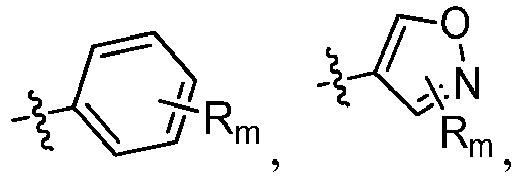

- Further preferably, in the compound of Formula I, R2 is


- The above Rn is halogen; nitro; cyano; C1-C2 alkylenedioxy; unsubstituted or halogen-, dimethylamino-, 4-morpholinyl-, 1-aziridinyl-, 1-azetidinyl-, 1-tetrahydropyrrolyl-, 1-piperidinyl- or 1-homopiperidinyl-substituted C1-C4 alkyl; C1-C4 alkoxy; C1-C4 sulfamido; -NRaRb; -C(O)R'; 4-morpholinyl; or unsubstituted or R"-substituted piperidinyl;
wherein, the above R3 is halogen, nitro, cyano, C1-C2 alkylenedioxy, unsubstituted or halogen- or morpholinyl-substituted C1-C4 alkyl, C1-C4 alkoxy, -NRaRb, -C(O)R', or 4-morpholinyl;
the above R4 is halogen, nitro, cyano, unsubstituted or halogen-substituted C1-C4 alkyl; C1-C4 alkoxy; -NRaRb; -C(O)R'; 4-piperidinyl; or 1-t-butoxy-4-piperidinyl;
the above R' is C1-C4 alkyl, C1-C4 alkoxy, -NRaRb, or 4-methylpiperazinyl;
the above R" is C1-C4 alkyl, C3-C6 cycloalkyl, C1-C4 alkylcarbonyl, C1-C4 alkoxycarbonyl, C3-C6 cycloalkylcarbonyl, or p-trifluoromethylbenzoyl;
the above Ra and Rb are independently H or C1-C4 alkyl . - In this specification, Rm refers to the corresponding substituent in R1 group, Rn refers to the corresponding substituent in R2 group. In R1 group, there may be 1, 2, 3 or more identical or various Rm substituents. In R2 group, there may be 1, 2, 3 or more identical or various Rn substituents. In one preferred embodiment, when R1 is C6-C20 aryl, 5-10 membered heteroaryl comprising 1-5 heteroatoms selected from N, O, and S, or 4-10 membered heterocyclyl comprising 1-5 heteroatoms selected from N, O, and S, it is desirable to have substituent Rm therein in the 2-, 3-, 4-, 5-, 6-, 7-, 8-, 9-, or 10-position of said aryl, heteroaryl, heterocyclyl (with the provisio that there is hydrogen atom available for substitution in said position). When R2 is C6-C20 aryl, 5-10 membered heteroaryl comprising 1-5 heteroatoms selected from N, O, and S, or 4-10 membered heterocyclyl comprising 1-5 heteroatoms selected from N, O, and S, it is desirable to have substituent Rn therein in the 2-, 3-, 4-, 5-, 6-, 7-, 8-, 9-, or 10-position of said aryl, heteroaryl, heterocyclyl (with the provisio that there is hydrogen atom available for substitution in said position). In a further preferred embodiment, R1 and/or R2 have polycyclic structure, Rm and/or Rn substituent attached to positions in the cyclic structure different from where the sulfonyl is attached.
- Preferably, the 5-member-heterocycle fused pyridine compound of Formula I is following 5-member-heterocycle fused pyridine compounds as shown in Formulae (II), (III), and (IV),

- Therefore, in any of the above embodiments, preferably, said 5-member-heterocycle fused pyridine compound has a structure as shown above in Formula II, wherein:
- R1 is selected from phenyl, naphthyl, isoxazolyl, 8-10 membered bicyclic heteroaryl comprising 2-3 heteroatoms selected from N, O, and S (such as imidazo[2,1-b]thiazolyl, imidazo[1,2-a]pyridinyl, benzo[1,2,5]oxadiazolyl, imidazo[1,2-b]pyridazinyl, pyrazolo[1,5-a]imidazolyl, imidazo[1,2-a]pyrimidinyl, etc.). Substituent in the substituted group is halogen; nitro; hydroxyl; cyano; unsubstituted or halogen- or morpholinyl-substituted C1-C5 alkyl; C1-C5 alkoxy; C1-C5 alkylcarbonyl; C1-C5 alkoxycarbonyl; -NRaRb; -C(O)(NRaRb); -OC(O)-Rf; unsubstituted phenyl or phenyl substituted by 1-3 of R3; or unsubstituted 5-7 membered heteroaryl comprising 1-3 heteroatoms selected from N, O, and S or 5-7 membered heteroaryl comprising 1-3 heteroatoms selected from N, O, and S substituted by 1-3 of R4, wherein said heteroaryl is preferably furanyl, thienyl, pyrrolyl, pyrazolyl, imidazolyl, oxazolyl, isoxazolyl, pyranyl, pyridinyl, morpholinyl, oxazinyl, pyrazinyl;
- R2 is cyano; C1-C4 alkoxycarbonyl; -NRcRd; -NHC(O)-Re; substituted or unsubstituted C6-C10 aryl; substituted or unsubstituted 5-10 membered heteroaryl comprising 1-5 heteroatoms selected from N, O, and S; or substituted or unsubstituted 5-10 membered heterocyclyl comprising 1-5 heteroatoms selected from N, O, and S; wherein, substituent in the substituted group is halogen, nitro, cyano, C1-C4 alkylenedioxy; unsubstituted C1-C5 alkyl or C1-C5 alkyl substituted by halogen or -NRcRd; C1-C5 alkoxy; C1-C5 sulfamido; -NRaRb; -C(O)R'; morpholinyl; or unsubstituted or R"-substituted piperidinyl;
- R3 is halogen; nitro; cyano; C1-C4 alkylenedioxy; unsubstituted or halogen- or morpholinyl-substituted C1-C5 alkyl; C1-C5 alkoxy; -NRaRb; -C(O)R'; or morpholinyl;
- R4 is halogen, nitro, cyano, unsubstituted or halogen-substituted C1-C5 alkyl; C1-C5 alkoxy; -NRaRb; -C(O)R'; or unsubstituted or C1-C5 alkoxycarbonyl-substituted piperidinyl;
- R' is C1-C5 alkyl; C1-C5 alkoxy; -NRaRb; or unsubstituted or halogen- or C1-C5 alkyl-substituted 5-6 membered heterocyclyl;
- R" is C1-C5 alkyl; C3-C6 cycloalkyl; C1-C5 alkylcarbonyl; C1-C5 alkoxycarbonyl; C3-C6 cycloalkylcarbonyl; or unsubstituted benzoyl or benzoyl substituted by substituent(s) selected from halogen, C1-C5 alkyl, halogen-substituted C1-C5 alkyl;
- Ra and Rb are independently H or C1-C5 alkyl;
- Rc and Rd are independently H or C1-C5 alkyl; or, Rc and Rd, together with the N atom to which they are attached, form 3-7 membered heterocyclyl.
- Re is unsubstituted or C1-C6 alkyl- or halogen- or C1-C6 alkoxy-substituted C6-C20 aryl, unsubstituted or halogen-substituted C1-C6 alkyl;
- Rf is C1-C6 alkyl, or unsubstituted or halogen- or C1-C6 alkyl-substituted 4-7 membered heteroaryl.
- In another embodiment of this invention, said 5-member-heterocycle fused pyridine compound has a structure as shown below in Formula (X),

X and Z are N, Y is C;
R1 is
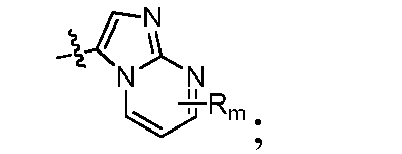

Rn is H, halogen, nitro, cyano, C1-C2 alkylenedioxy; unsubstituted or halogen-, dimethylamino-, 4-morpholinyl-, 1-aziridinyl-, 1-azetidinyl-, 1-tetrahydropyrrolyl-, 1-piperidinyl- or 1-homopiperidinyl-substituted C1-C4 alkyl; C1-C4 alkoxy; C1-C4 sulfamido; -NRaRb; -C(O)R'; 4-morpholinyl; or unsubstituted or R"-substituted piperidinyl;
R3 is halogen, nitro, cyano, C1-C2 alkylenedioxy; unsubstituted or halogen- or morpholinyl-substituted C1-C4 alkyl; C1-C4 alkoxy; -NRaRb; -C(O)R'; or 4-morpholinyl;
R4 is halogen, nitro, cyano, unsubstituted or halogen-substituted C1-C4 alkyl; C1-C4 alkoxy; -NRaRb; -C(O)R'; 4-piperidinyl; or 1-t-butoxycarbonyl-4-piperidinyl;
R' is C1-C4 alkyl; C1-C4 alkoxy; -NRaRb; or 4-methylpiperazinyl;
R" is C1-C4 alkyl; C3-C6 cycloalkyl; C1-C4 alkylcarbonyl; C1-C4 alkoxycarbonyl; C3-C6 cycloalkylcarbonyl; or p-trifluoromethylbenzoyl;
Ra and Rb are independently hydrogen, C1-C4 alkyl or C1-C4 alkylcarbonyl;
Rf is C1-C6 alkyl or unsubstituted or halogen- or C1-C6 alkyl-substituted 4-7 membered heteroaryl, said 4-7 membered heteroaryl is selected from furanyl, pyrrolyl, thienyl. - In another embodiment of this invention, said 5-member-heterocycle fused pyridine compound has a structure as shown in Formula II, wherein:
- R1 is

- R2 is

- Rn is H, halogen; nitro; cyano; C1-C2 alkylenedioxy; unsubstituted or halogen-, dimethylamino-, 4-morpholinyl-, 1-aziridinyl-, 1-azetidinyl-, 1-tetrahydropyrrolyl-, 1-piperidinyl- or 1-homopiperidinyl-substituted C1-C4 alkyl; C1-C4 alkoxy; C1-C4 sulfamido; -NRaRb; -C(O)R'; 4-morpholinyl; or unsubstituted or R"-substituted piperidinyl;
- R' is C1-C4 alkyl; C1-C4 alkoxy; -NRaRb; or 4-methylpiperazinyl;
- R" is C1-C4 alkyl; C3-C6cycloalkyl; C1-C4 alkylcarbonyl; C1-C4 alkoxycarbonyl; C3-C6 cycloalkylcarbonyl; or p-trifluoromethylbenzoyl;
- Ra and Rb are independently H, C1-C4 alkyl or C1-C4 alkylcarbonyl;
- Rf is C1-C6 alkyl, or unsubstituted or halogen- or C1-C6 alkyl-substituted 4-7 membered heteroaryl.
- In another embodiment of this invention, said 5-member-heterocycle fused pyridine compound has a structure as shown in Formula II, wherein:
- R1 is

- R2 is

- Rn is H, halogen, nitro, cyano unsubstituted or halogen-, dimethylamino-, 4-morpholinyl-, 1-aziridinyl-, 1-azetidinyl-, 1-tetrahydropyrrolyl-, 1-piperidinyl- or 1-homopiperidinyl-substituted C1-C4 alkyl; C1-C4 alkoxy; C1-C4 sulfamido; -NRaRb; -C(O)R'; 4-morpholinyl; or unsubstituted or R"-substituted piperidinyl;
- R' is C1-C4 alkyl; C1-C4 alkoxy; -NRaRb; or 4-methylpiperazinyl;
- R" is C1-C4 alkyl; C3-C6 cycloalkyl; C1-C4 alkylcarbonyl; C1-C4 alkoxycarbonyl; C3-C6 cycloalkylcarbonyl; or p-trifluoromethylbenzoyl;
- Ra and Rb are independently H, C1-C4 alkyl or C1-C4 alkylcarbonyl.
- In another embodiment of this invention, said 5-member-heterocycle fused pyridine compound has a structure as shown in Formula II, wherein:
- R1 is

- R2 is

- Rn is H, halogen; unsubstituted or halogen-, dimethylamino-, 4-morpholinyl-, 1-aziridinyl-, 1-azetidinyl-, 1-tetrahydropyrrolyl-, 1-piperidinyl- or 1-homopiperidinyl-substituted C1-C4 alkyl; C1-C4 alkoxy; C1-C4 sulfamido; -C(O)R'; 4-morpholinyl; or unsubstituted or R"-substituted piperidinyl;
- R3 is halogen, nitro, cyano, C1-C2 alkylenedioxy; unsubstituted or halogen- or morpholinyl-substituted C1-C4 alkyl; C1-C4 alkoxy; -NRaRb; -C(O)R'; or 4-morpholinyl;
- R4 is halogen, nitro, cyano, unsubstituted or halogen-substituted C1-C4 alkyl; C1-C4 alkoxy; -NRaRb; -C(O)R'; 4-piperidinyl; or 1-t-butoxycarbonyl-4-piperidinyl;
- R' is C1-C4 alkyl; C1-C4 alkoxy; -NRaRb; or 4-methylpiperazinyl;
- R" is C1-C4 alkyl; C3-C6cycloalkyl; C1-C4 alkylcarbonyl; C1-C4 alkoxycarbonyl; C3-C6 cycloalkylcarbonyl; or p-trifluoromethylbenzoyl;
- Ra and Rb are independently H, C1-C4 alkyl or C1-C4 alkylcarbonyl;
- Rf is C1-C6 alkyl, or unsubstituted or halogen- or C1-C6 alkyl-substituted 4-7 membered heteroaryl, said 4-7 membered heteroaryl is selected from furanyl, pyrrolyl, thienyl.
- A person skilled in the art will appreciate that, any of the embodiments described above, including any preferred embodiments or more preferred embodiment, may combine with each other in any way to form new technical solutions, such technical solutions shall be considered as within the scope of explicit description provided herein.
- In preferred embodiment of this invention, said 5-member-heterocycle fused pyridine compound is a compound selected from the following compound:
No. Compound Structure 01 1-(2-nitrobenzenesulfonyl)-6-[(1-methyl)-4-pyra zolyl]-1-H-pyrrolo[3,2-b]pyridine 
02 3-(2-nitrobenzenesulfonyl)-5-[(1-methyl)-4-pyra zolyl] -1 -H-pyrazolo[3,4-b]pyridine 
03 1-(2-nitrobenzenesulfonyl)-6-[(1-methyl)-4-pyra zolyl]-1-H-pyrazolo[4,3-b]pyridine 
04 1-benzenesulfonyl-6-[(1-methyl)-4-pyrazolyl]-1-H-pyrazolo[4,3-b]pyridine 
05 1-(3-fluorobenzenesulfonyl)-6-[(1-methyl)-4-pyr azolyl]-1-H-pyrazolo[4,3-b]pyridine 
06 1-(2-fluorobenzenesulfonyl)-6-[(1-methyl)-4-pyr azolyl]-1-H-pyrazolo[4,3-b]pyridine 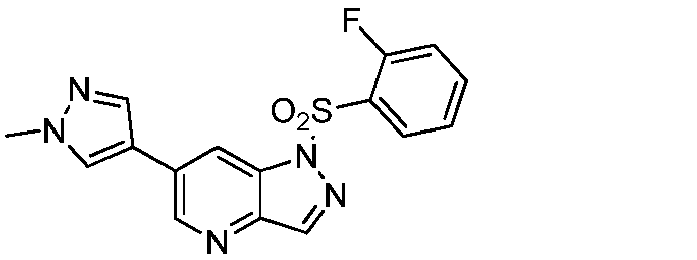
07 1-(4-fluorobenzenesulfonyl)-6-[(1-methyl)-4-pyr azolyl]-1-H-pyrazolo[4,3-b]pyridine 
08 1-(2-cyanobenzenesulfonyl)-6-[(1-methyl)-4-pyr azolyl]-1-H-pyrazolo[4,3-b]pyridine 
09 1-(4-nitrobenzenesulfonyl)-6-[(1-methyl)-4-pyra zolyl]-1-H-pyrazolo[4,3-b]pyridine 
10 1-(3,4-dimethoxybenzenesulfonyl)-6-[(1-methyl) -4-pyrazolyl]-1-H-pyrazolo[4,3-b]pyridine 
11 1-(3,5-dimethylisoxazolsulfonyl)-6-[(1-methyl)-4-pyrazolyl]-1-H-pyrazolo[4,3-b]pyridine 
12 1-(2,4-difluorobenzenesulfonyl)-6-[(1-methyl)-4 -pyrazolyl]-1-H-pyrazolo[4,3-b]pyridine 
13 1-(4-acetylbenzenesulfonyl)-6-[(1-methyl)-4-pyr azolyl]-1-H-pyrazolo[4,3-b]pyridine 
14 1-(2-trifluoromethylbenzenesulfonyl)-6-[(1-meth yl)-4-pyrazolyl]-1-H-pyrazolo[4,3-b]pyridine 
15 1-(4-trifluoromethylbenzenesulfonyl)-6-[(1-meth yl)-4-pyrazolyl]-1-H-pyrazolo[4,3-b]pyridine 
16 1-(3-trifluoromethylbenzenesulfonyl)-6-[(1-meth yl)-4-pyrazolyl]-1-H-pyrazolo[4,3-b]pyridine 
17 1-(4-methoxybenzenesulfonyl)-6-[(1-methyl)-4-pyrazolyl]-1-H-pyrazolo[4,3-b]pyridine 
18 1-[(6-chloro-imidazo[2,1-b]thiazole)-5-sulfonyl) ]-6-[(1-methyl)-4-pyrazolyl]-1-H-pyrazolo[4,3-b]p yridine 
19 1-(imidazo[1,2-a]pyridine-3-sulfonyl)-6-[(1-met hyl)-4-pyrazolyl]-1-H-pyrazolo[4,3-b]pyridine 
20 1-(benzo[1,2,5]oxadiazole-4-sulfonyl)-6-[(1-met hyl)-4-pyrazolyl]-1-H-pyrazolo[4,3-b]pyridine 
21 1-(imidazo[1,2-b]pyridazine-3-sulfonyl)-6-[(1-m ethyl)-4-pyrazolyl] -1 -H-pyrazolo[4,3-b]pyridine 
22 1-(pyrazolo[1,5-a]pyrimidine-3-sulfonyl)-6-[(1-methyl)-4-pyrazolyl]-1-H-pyrazolo[4,3-b]pyridi ne 
23 1-(imidazo[1,2-a]pyrimidine-3-sulfonyl)-6-[(1-m ethyl)-4-pyrazolyl]-1-H-pyrazolo[4,3-b]pyridine 
24 1-[(6-chloro-imidazo[1,2-a]pyridine)-3-sulfonyl) ]-6-[(1-methyl)-4-pyrazolyl]-1-H-pyrazolo[4,3-b ]pyridine 
25 1-[(6-chloro-imidazo[1,2-b]pyridazine)-3-sulfon yl)]-6-[(1-methyl)-4-pyrazolyl]-1-H-pyrazolo[4, 3-b]pyridine 
26 1-[(6-trifluoromethyl-imidazo[1,2-a]pyridine)-3-sulfonyl)]-6-[(1-methyl)-4-pyrazolyl]-1-H-pyraz olo[4,3-b]pyridine 
27 1-{(6-[(1-methyl)-4-pyrazolyl]-imidazo[1,2-a]py ridine)-3-sulfonyl-6-6-(1-methyl)-4-pyrazolyl]-1 -H-pyrazolo[4,3-b]pyridine 
28 1-(imidazo[1,2-a]pyridine-3-sulfonyl)-6-phenyl-1-H-pyrazolo[4,3-b]pyridine 
29 1-(imidazo[1,2-a]pyridine-3-sulfonyl)-6-(3-thien yl)-1-H-pyrazolo[4,3-b]pyridine 
30 1-(imidazo[1,2-a]pyridine-3-sulfonyl)-6-(3-pyrid inyl)-1-H-pyrazolo[4,3-b]pyridine 
31 1-(imidazo[1,2-a]pyridine-3-sulfonyl)-6-(3-furan yl)-1-H-pyrazolo[4,3-b]pyridine 
32 1-(imidazo[1,2-a]pyridine-3-sulfonyl)-6-(4-triflu oromethylphenyl]-1-H-pyrazolo[4,3-b]pyridine 
33 1-(imidazo[1,2-a]pyridine-3-sulfonyl)-6-(2-naph thyl)-1-H-pyrazolo[4,3-b]pyridine 
34 1-(imidazo[1,2-a]pyridine-3-sulfonyl)-6-(4-meth ylsulfamidophenyl)-1-H-pyrazolo[4,3-b]pyridine 
35 1-(imidazo[1,2-a]pyridine-3-sulfonyl)-6-[(1-t-bu toxycarbonyl)-4-(1,2,3,6-tetrahydropyridinyl)]-1 -H-pyrazolo[4,3-b]pyridine 
36 1-(imidazo[1,2-a]pyridine-3-sulfonyl)-6-[6-(1,4-benzodioxanyl)]-1-H-pyrazolo[4,3-b]pyridine 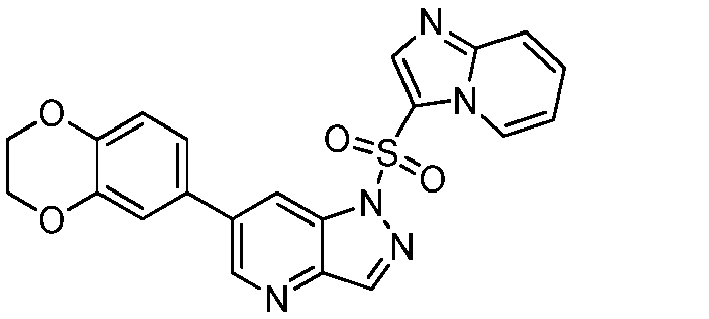
37 1-(imidazo[1,2-a]pyridine-3-sulfonyl)-6-[4-(4-m ethylpiperazine-1-carbonyl)phenyl]-1-H-pyrazol o[4,3-b]pyridine 
38 1-(imidazo[1,2-a]pyridine-3-sulfonyl)-6-(4-morp holinomethylphenyl)-1-H-pyrazolo[4,3-b]pyridin e 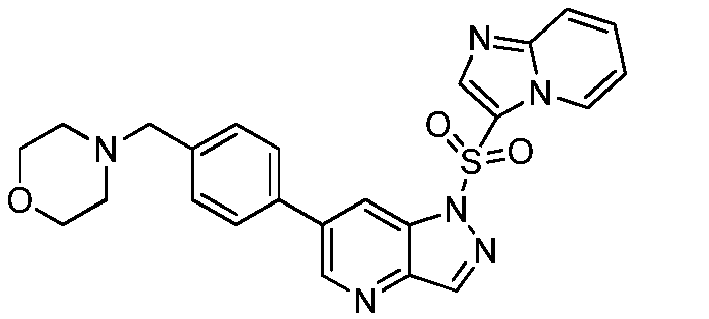
39 1-(imidazo[1,2-a]pyridine-3-sulfonyl)-6-(4-morp holinylphenyl)-1-H-pyrazolo[4,3-b]pyridine 
40 1-(imidazo[1,2-a]pyridine-3-sulfonyl)-6-(4-acety lphenyl)-1-H-pyrazolo[4,3-b]pyridine 
41 1-(imidazo[1,2-a]pyridine-3-sulfonyl)-6-(4-dime thylaminocarbonylphenyl)-1-H-pyrazolo[4,3-b]p yridine 
42 1-(imidazo[1,2-a]pyridine-3-sulfonyl)-6-(4-dime thylaminophenyl)-1-H-pyrazolo[4,3-b]pyridine 
43 1-(imidazo[1,2-a]pyridine-3-sulfonyl)-6-(2,5-di methoxyphenyl)-1-H-pyrazolo[4,3-b]pyridine 
44 1-(imidazo[1,2-a]pyridine-3-sulfonyl)-6-{1-[(1-t-butoxycarbonyl)-4-piperidinyl]}-4-pyrazolyl}-1-H-pyrazolo[4,3-b]pyridine 
45 1-(imidazo[1,2-a]pyridine-3-sulfonyl)-6-{[1-(4-p iperidinyl)]-4-pyrazolyl}-1-H-pyrazolo[4,3-b]py ridine 
46 1-(pyrazolo[1,5-a]pyrimidine-3-sulfonyl)-6-{{1-[(1-t-butoxycarbonyl)-4-piperidinyl] }-4-pyrazol yl}-1-H-pyrazolo[4,3-b]pyridine 
47 1-(imidazo[1,2-a]pyrimidine-3-sulfonyl)-6-{[1-( 4-piperidinyl)]-4-pyrazolyl}-1-H-pyrazolo[4,3-b ]pyridine 
48 1-[(6-chloro-imidazo[2,1-b]thiazole)-5-sulfonyl) ]-6-{[1-(4-piperidinyl)]-4-pyrazolyl}-1-H-pyrrol o[4,3-b]pyridine 
49 1-(imidazo[1,2-b]pyridazine-3-sulfonyl)-6-{{1-[ (1-t-butoxycarbonyl)-4-piperidinyl] -4-pyrazolyl }-1-H-pyrazolo[4,3-b]pyridine 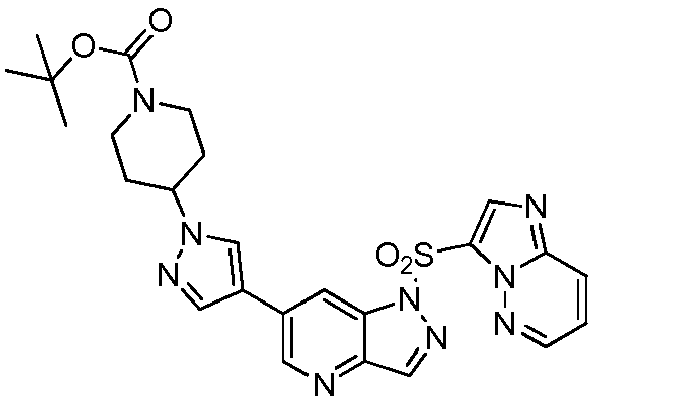
50 1-(imidazo[1,2-b]pyridazine-3-sulfonyl)-6-{[1-( 4-piperidinyl)]-4-pyrazolyl}-4-pyrazolyl}-1-H-p yrazolo[4,3-b]pyridine chloride 
51 1-(imidazo[1,2-b]pyridazine-3-sulfonyl)-6-{[1-( 4-piperidinyl)]-4-pyrazolyl}-4-pyrazolyl}-1-H-p yrazolo[4,3-b]pyridine 
52 1-(imidazo[1,2-a]pyrimidine-3-sulfonyl)-6-{{1-[ (1-t-butoxycarbonyl)-4-piperidinyl] -4-pyrazolyl }-1-H-pyrazolo[4,3-b]pyridine 
53 1-(imidazo[1,2-a]pyridine-3-sulfonyl)-6-{{1-[(1-ethyl)-4-piperidinyl]}-4-pyrazolyl}-1-H-pyrazol o[4,3-b]pyridine 
54 1-(imidazo[1,2-a]pyridine-3-sulfonyl)-6-{1-[(1-acetyl)-4-piperidinyl] }-4-pyrazolyl}-1-H-pyrazo lo[4,3-b]pyridine 
55 1-(imidazo[1,2-a]pyridine-3-sulfonyl)-6-{1-[(1-cyclopropylcarbonyl)-4-piperidinyl] }-4-pyrazoly 1}-1-H-pyrazolo[4,3-b]pyridine 
56 1-(imidazo[1,2-a]pyridine-3-sulfonyl)-6-{1-[(1-cyclopentylcarbonyl)-4-piperidinyl]}}-4-pyrazoly 1}-1-H-pyrazolo[4,3-b]pyridine 
57 1-(imidazo[1,2-a]pyridine-3-sulfonyl)-6-{1-[(1-cyclohexylcarbonyl)-4-piperidinyl]} -4-pyrazolyl }-1-H-pyrazolo[4,3-b]pyridine 
58 1-(imidazo[1,2-a]pyridine-3-sulfonyl)-6-{1-[(1-p-trifluoroformyl)-4-piperidinyl]}-4-pyrazolyl}-1-H-pyrazolo[4,3-b]pyridine 
59 1-(imidazo[1,2-a]pyridine-3-sulfonyl)-6-{1-[(1-isopropyl)-4-piperidinyl]}-4-pyrazolyl}-1-H-pyr azolo[4,3-b]pyridine 
60 1-(imidazo[1,2-a]pyridine-3-sulfonyl)-6-{1-[(1-cyclopentyl)-4-piperidinyl]}-4-pyrazolyl}-1-H-p yrazolo[4,3-b]pyridine 
61 1-[(6-chloro-imidazo[1,2-b]pyridazine)-3-sulfon yl)]-6-{{1-[(1-t-butoxycarbonyl)-4-piperidinyl]} -4-pyrazolyl-1-H-pyrazolo[4,3-b]pyridine 
62 1-{(6-{{1-[(1-t-butoxycarbonyl)-4-piperidinyl]}-4-pyrazolyl}-imidazo[1,2-b]pyridazine)-3-sulfon yl}-6-{{1-[(1-t-butoxycarbonyl)-4-piperidinyl]}-4-pyrazolyl}-1-H-pyrazolo[4,3-b]pyridine 
63 1-[(6-trifluoromethyl-imidazo[1,2-a]pyridine)-3-sulfonyl)]-6-{ {1-[(1-t-butoxycarbonyl)-4-piperid inyl]}-4-pyrazolyl}-1-H-pyrazolo[4,3-b]pyridine 
64 1-[(6-trifluoromethyl-imidazo[1,2-a]pyridine)-3-sulfonyl)]-6-{[1-(4-piperidinyl)]-4-pyrazolyl}-4-pyrazolyl}-1-H-pyrazolo[4,3-b]pyridine chloride 
65 1-[(6-trifluoromethyl-imidazo[1,2-a]pyridine)-3-sulfonyl)]-6-{[1-(4-piperidinyl)]-4-pyrazolyl}-4-pyrazolyl}-1-H-pyrazolo[4,3-b]pyridine 
66 1-(imidazo[1,2-a]pyridine-3-sulfonyl)-6-{[1-(4-p iperidinyl)]-4-pyrazolyl}-1-H-pyrazolo[4,3-b]py ridine chloride 
67 1-[(6-chloro-imidazo[1,2-a]pyridine)-3-sulfonyl) ]-6-{{1-[(1-t-butoxycarbonyl)-4-piperidinyl]}-4-pyrazolyl}-1-H-pyrazolo[4,3-b]pyridine 
68 1-{(6-{{1-[(1-t-butoxycarbonyl)-4-piperidinyl]}-4-pyrazolyl}-imidazo[1,2-a]pyridine)-3-sulfonyl }-6-{{1-[(1-t-butoxycarbonyl)-4-piperidinyl]}-4-pyrazolyl}-1-H-pyrazolo[4,3-b]pyridine 
69 1-[(6-trifluoromethyl-imidazo[1,2-a]pyridine)-3-sulfonyl)]-6-{{1-[(1-isopropyl)-4-piperidinyl]}-4-pyrazolyl}-1-H-pyrazolo[4,3-b]pyridine 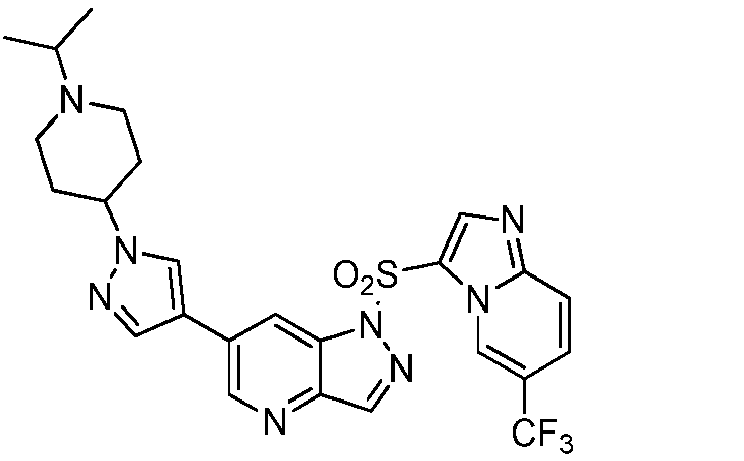
70 1-[(6-bromo-imidazo[1,2-a]pyridine)-3-sulfonyl] -6-[(1-methyl)-4-pyrazolyl]-1-H-pyrazolo[4,3-b] pyridine 
71 1-[(6-phenyl-imidazo[1,2-a]pyridine)-3-sulfonyl ]-6-[(1-methyl)-4-pyrazolyl]-1-H-pyrazolo[4,3-b ]pyridine 
72 1-{[6-(3-thiophene)-imidazo[1,2-a]pyridine]-3-s ulfonyl}-6-[(1-methyl)-4-pyrazolyl]-1-H-pyrazol o[4,3-b]pyridine 
73 1-{[6-(4-dimethylaminocarbonylphenyl)-imidaz o[1,2-a]pyridine]-3-sulfonyl}-6-[(1-methyl)-4-p yrazolyl]-1-H-pyrazolo[4,3-b]pyridine 
74 1-{[6-(5-pyrimidine)-imidazo[1,2-a]pyridine]-3-sulfonyl}-6-[(1-methyl)-4-pyrazolyl]-1-H-pyraz olo[4,3-b]pyridine 
75 1-{[6-(4-morpholinylphenyl)-imidazo[1,2-a]pyri dine]-3-sulfonyl}-6-[(1-methyl)-4-pyrazolyl]-1-H-pyrazolo[4,3-b]pyridine 
76 1-{(6-{{1-[(1-t-butoxycarbonyl)-4-piperidinyl]}-4-pyrazolyl}-imidazo[1,2-a]pyridine)-3-sulfonyl }-6-[(1-methyl)-4-pyrazolyl]-1-H-pyrazolo[4,3-b ]pyridine 
77 1-{[6-(4-trifluoromethylphenyl)-imidazo[1,2-a]p yridine]-3-sulfonyl}-6-[(1-methyl)-4-pyrazolyl]-1-H-pyrazolo[4,3-b]pyridine 
78 1-{[6-(3-fluoro-4-methylphenyl)-imidazo[1,2-a] pyridine]-3-sulfonyl}-6-[(1-methyl)-4-pyrazolyl] -1-H-pyrazolo[4,3-b]pyridine 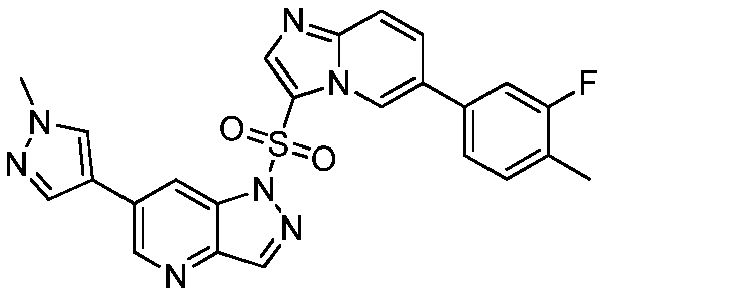
79 1-{[6-(4-isopropoxyl)phenyl)-imidazo[1,2-a]pyri dine]-3-sulfonyl}-6-[(1-methyl)-4-pyrazolyl]-1-H-pyrazolo[4,3-b]pyridine 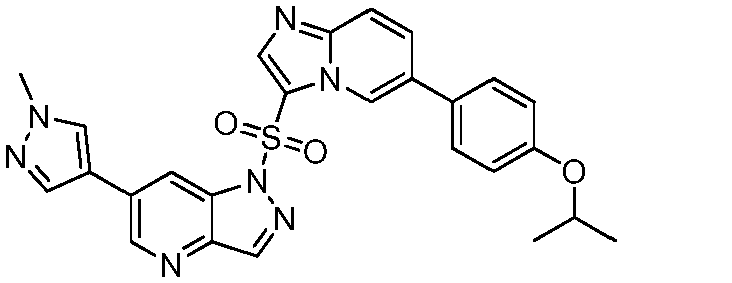
80 1-{[6-[4-(4-methylpiperazine-1-carbonyl)phenyl ]-imidazo[1,2-a]pyridine]-3-sulfonyl}-6-[(1-met hyl)-4-pyrazolyl]-1-H-pyrazolo[4,3-b]pyridine 
81 1-{[6-(4-fluorophenyl)-imidazo[1,2-a]pyridine]-3-sulfonyl}-6-[(1-methyl)-4-pyrazolyl]-1-H-pyra zolo[4,3-b]pyridine 
82 1-{[6-([1-(4-piperidinyl)]-4-pyrazolyl)-imidazo[ 1,2-a]pyridine]-3-sulfonyl}-6-[(1-methyl)-4-pyra zolyl]-1-H-pyrazolo[4,3-b]pyridine chloride 
83 1-{[6-(3-trifluoromethylphenyl)-imidazo[1,2-a]p yridine]-3-sulfonyl}-6-[(1-methyl)-4-pyrazolyl]-1-H-pyrazolo[4,3-b]pyridine 
84 1-{[6-(2-trifluoromethylphenyl)-imidazo[1,2-a]p yridine]-3-sulfonyl}-6-[(1-methyl)-4-pyrazolyl]-1-H-pyrazolo[4,3-b]pyridine 
85 1-{[6-(4-dimethylaminophenyl)-imidazo[1,2-a]p yridine]-3-sulfonyl}-6-[(1-methyl)-4-pyrazolyl]-1-H-pyrazolo[4,3-b]pyridine 
86 1-{[6-(3-fluorophenyl)-imidazo[1,2-a]pyridine]-3-sulfonyl}-6-[(1-methyl)-4-pyrazolyl]-1-H-pyra zolo[4,3-b]pyridine 
87 1-{[6-(2,4-difluorophenyl)-imidazo[1,2-a]pyridi ne]-3-sulfonyl}-6-[(1-methyl)-4-pyrazolyl]-1-H-pyrazolo[4,3-b]pyridine 
88 1-{[6-(3,4,5-trifluorophenyl)-imidazo[1,2-a]pyri dine]-3-sulfonyl}-6-[(1-methyl)-4-pyrazolyl]-1-H-pyrazolo[4,3-b]pyridine 
89 1-{[6-(4-methoxyphenyl)-imidazo[1,2-a]pyridin e]-3-sulfonyl}-6-[(1-methyl)-4-pyrazolyl]-1-H-p yrazolo[4,3-b]pyridine 
90 1-{[6-(4-methylphenyl)-imidazo[1,2-a]pyridine]-3-sulfonyl}-6-[(1-methyl)-4-pyrazolyl]-1-H-pyra zolo[4,3-b]pyridine 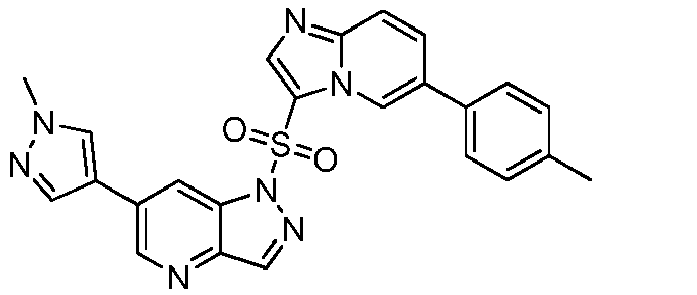
91 1-{[6-(4-morpholinomethylphenyl)-imidazo[1,2-a]pyridine]-3-sulfonyl}-6-[(1-methyl)-4-pyrazol yl]-1-H-pyrazolo[4,3-b]pyridine 
92 1-{[6-(4-cyanophenyl)-imidazo[1,2-a]pyridine]-3-sulfonyl}-6-[(1-methyl)-4-pyrazolyl]-1-H-pyra zolo[4,3-b]pyridine 
93 1-{[6-[6-(1,4-benzodioxanyl)]-imidazo[1,2-a]pyr idine]-3-sulfonyl}-6-[(1-methyl)-4-pyrazolyl]-1-H-pyrazolo[4,3-b]pyridine 
94 1-{[6-(4-chlorophenyl)-imidazo[1,2-a]pyridine]-3-sulfonyl}-6-[(1-methyl)-4-pyrazolyl]-1-H-pyra zolo[4,3-b]pyridine 
95 1-{[6-(3-fluoro-4-pyridinyl)-imidazo[1,2-a]pyrid ine]-3-sulfonyl}-6-[(1-methyl)-4-pyrazolyl]-1-H -pyrazolo[4,3-b]pyridine 
96 1-{[6-(3,4-dimethoxyphenyl)-imidazo[1,2-a]pyri dine]-3-sulfonyl}-6-[(1-methyl)-4-pyrazolyl]-1-H-pyrazolo[4,3-b]pyridine 
97 1-{[6-(2-methoxyphenyl)-imidazo[1,2-a]pyridin e]-3-sulfonyl}-6-[(1-methyl)-4-pyrazolyl]-1-H-p yrazolo[4,3-b]pyridine 
98 1-{[6-[5-(1,2-methylenedioxyphenyl)]-imidazo[ 1,2-a]pyridine]-3-sulfonyl}-6-[(1-methyl)-4-pyra zolyl]-1-H-pyrazolo[4,3-b]pyridine 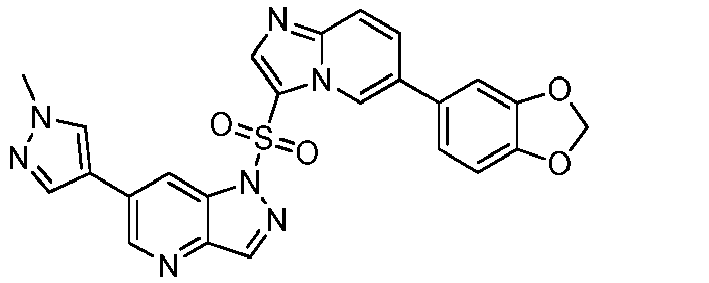
99 1-{[6-(2-fluoro-5-pyridinyl)-imidazo[1,2-a]pyrid ine]-3-sulfonyl}-6-[(1-methyl)-4-pyrazolyl]-1-H -pyrazolo[4,3-b]pyridine 
100 1-{[6-(3-cyanophenyl)-imidazo[1,2-a]pyridine]-3-sulfonyl}-6-[(1-methyl)-4-pyrazolyl]-1-H-pyra zolo[4,3-b]pyridine 
101 1-{(6-(3-fluoro-4-methylaminocarbonylphenyl)-i midazo[1,2-a]pyridine)-3-sulfonyl}-6-[(1-methyl )-4-pyrazolyl]-1-H-pyrazolo[4,3-b]pyridine 
102 1-{(6-(3-fluoro-4-methylaminocarbonylphenyl)-i midazo[1,2-a]pyridine)-3-sulfonyl}-6-[(2-dimeth ylaminoethyl)-4-pyrazolyl]-1-H-pyrazolo[4,3-b] pyridine 
118 1-[(6-amino-imidazo[1,2-a]pyridine)-3-sulfonyl] -6-(4-fluorophenyl)-1-H-pyrazolo[4,3-b]pyridine 
119 1-[(6-n-butylamino-imidazo[1,2-a]pyridine)-3-su lfonyl]-6-[(1-methyl)-4-pyrazolyl]-1-H-pyrazolo [4,3-b]pyridine 
120 1-[(6-acetylamino-imidazo[1,2-a]pyridine)-3-sul fonyl]-6-[(1-methyl)-4-pyrazolyl]-1-H-pyrazolo[ 4,3-b]pyridine 
121 1-[(6-methoxy-imidazo[1,2-a]pyridine)-3-sulfon yl]-6-[(1-methyl)-4-pyrazolyl]-1-H-pyrazolo[4,3 -b]pyridine 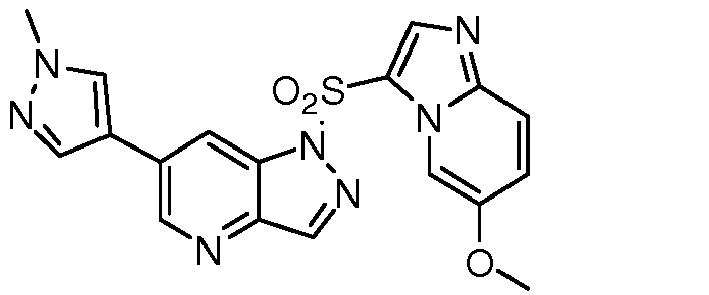
122 1-[(6-methoxy-imidazo[1,2-a]pyridine)-3-sulfon yl]-6-(4-isoquinolinyl)-1-H-pyrazolo[4,3-b]pyrid ine 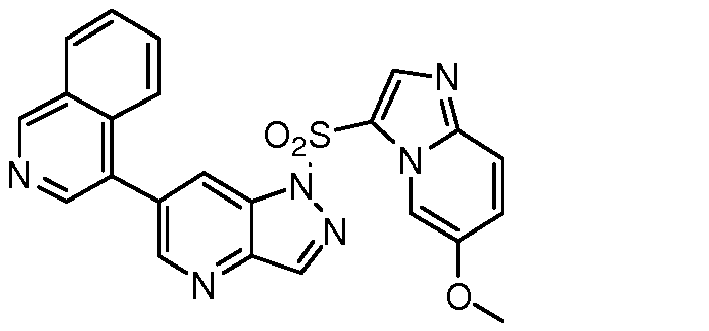
123 1-[(6-methoxy-imidazo[1,2-a]pyridine)-3-sulfon yl]-6-(6-methoxy-2-naphthyl)-1-H-pyrazolo[4,3-b]pyridine 
124 1-[(6-methoxy-imidazo[1,2-a]pyridine)-3-sulfon yl]-6-(4-morpholinylphenyl)-1-H-pyrazolo[4,3-b ]pyridine 
125 1-[(6-methoxy-imidazo[1,2-a]pyridine)-3-sulfon yl]-6-(3-trifluoromethylphenyl)-1-H-pyrazolo[4, 3-b]pyridine 
126 1-[(6-hydroxy-imidazo[1,2-a]pyridine)-3-sulfon yl]-6-(4-methoxyphenyl)-1-H-pyrazolo[4,3-b]py ridine 
127 1-[(6-hydroxy-imidazo[1,2-a]pyridine)-3-sulfon yl]-6-phenyl-1-H-pyrazolo[4,3-b]pyridine 
128 1-[(6-isobutyryloxy-imidazo[1,2-a]pyridine)-3-s ulfonyl]-6-[(1-methyl)-4-pyrazolyl]-1-H-pyrazol o[4,3-b]pyridine 
129 1-[(6-furan-2-acyloxy-imidazo[1,2-a]pyridine)-3 -sulfonyl]-6-[(1-methyl)-4-pyrazolyl]-1-H-pyraz olo[4,3-b]pyridine 
130 1-[(6-bromo-imidazo[1,2-a]pyridine)-3-sulfonyl] -6-ethoxycarbonyl-1-H-pyrazolo[4,3-b]pyridine 
131 1-[(6-bromo-imidazo[1,2-a]pyridine)-3-sulfonyl] -6-benzamido-1-H-pyrazolo[4,3-b]pyridine 
132 1-[(6-bromo-imidazo[1,2-a]pyridine)-3-sulfonyl] -6-propionamido-1-H-pyrazolo[4,3-b]pyridine 
133 1-{(6-[(1-methyl)-4-pyrazolyl]-imidazo[1,2-a]py ridine)-3-sulfonyl}-6-benzamido-1-H-pyrazolo[4 ,3-b]pyridine 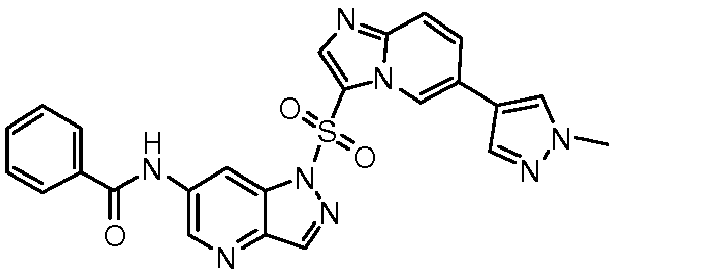
134 1-[(6-methoxy-imidazo[1,2-a]pyridine)-3-sulfon yl]-6-(3-methoxybenzamido)-1-H-pyrazolo[4,3-b]pyridine 
135 1-{(6-[(1-methyl)-4-pyrazolyl]-imidazo[1,2-a]py ridine)-3-sulfonyl}-6-[(1-cyclopentyl)-4-(1,2,3,6 -tetrahydropyridinyl)]-1-H-pyrazolo[4,3-b]pyridi ne 
136 1-{(6-[(1-methyl)-4-pyrazolyl]-imidazo[1,2-a]py ridine)-3-sulfonyl}-6-{{1-[(1-cyclopentyl)-4-pip eridinyl]-4-pyrazolyl}-1-H-pyrazolo[4,3-b]pyri dine 
137 1-{(6-[(1-methyl)-4-pyrazolyl]-imidazo[1,2-a]py ridine)-3-sulfonyl}-6-[(1-isopropyl)-4-(1,2,3,6-t etrahydropyridinyl)]-1-H-pyrazolo[4,3-b]pyridin e 
138 1-{(6-[(1-methyl)-4-pyrazolyl]-imidazo[1,2-a]py ridine)-3-sulfonyl}-6-{{1-[(1-ethyl)-4-piperidiny l]}-4-pyrazolyl}-1-H-pyrazolo[4,3-b]pyridine 
139 1-{(6-[(1-methyl)-4-pyrazolyl]-imidazo[1,2-a]py ridine)-3-sulfonyl}-6-[4-(1,2,3,6-tetrahydropyrid inyl)]-1-H-pyrazolo[4,3-b]pyridine 
140 1-{(6-[(1-methyl)-4-pyrazolyl]-imidazo[1,2-a]py ridine)-3-sulfonyl}-6-{[1-(4-piperidinyl)]-4-pyra zolyl}-1-H-pyrazolo[4,3-b]pyridine 
141 1-{(6-[(1-methyl)-4-pyrazolyl]-imidazo[1,2-a]py ridine)-3-sulfonyl}-6-{{1-[(1-t-butoxycarbonyl)-4-piperidinyl]}-4-pyrazolyl}-1-H-pyrazolo[4,3-b ]pyridine 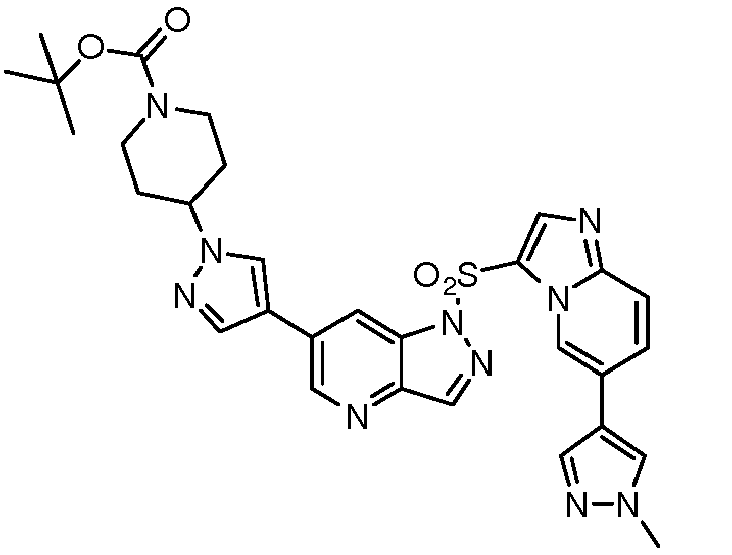
142 1-{(6-[(1-methyl)-4-pyrazolyl]-imidazo[1,2-a]py ridine)-3-sulfonyl}-6-[4-(4-methylpiperazine-1-c arbonyl)phenyl]-1-H-pyrazolo[4,3-b]pyridine 
143 1-{(6-[(1-methyl)-4-pyrazolyl]-imidazo[1,2-a]py ridine)-3-sulfonyl}-6-(4-morpholinomethylphen yl)-1-H-pyrazolo[4,3-b]pyridine 
144 1-{(6-[(1-methyl)-4-pyrazolyl]-imidazo[1,2-a]py ridine)-3-sulfonyl}-6-phenyl-1-H-pyrazolo[4,3-b ]pyridine 
145 1-{(6-[(1-methyl)-4-pyrazolyl]-imidazo[1,2-a]py ridine)-3-sulfonyl}-6-{{1-[(1-isopropyl)-4-piperi dinyl]-4-pyrazolyl}-1-H-pyrazolo[4,3-b]pyridin e 
- The pharmaceutical salt of said 5-member-heterocycle fused pyridine compound according to the present invention can be produced by reacting the compound of Formula (X) with inorganic acid or organic acid, wherein said inorganic acid includes hydrochloride, hydrobromide, phosphoric acid, sulphuric acid and others, said organic acid includes ascorbic acid, nicotinic acid, citric acid, tartaric acid, lactic acid, maleic acid, malonic acid, fumaric acid, oxalic acid, malic acid, glycolic acid, succinic acid, propionic acid, acetic acid, methanesulfonic acid, trifluoromethanesulfonic acid, benzenesulfonic acid, p-toluenesulfonic acid, and others.
- The pharmaceutical salt of said 5-member-heterocycle fused pyridine compound according to the present invention can be produced by dissolving said compound into alcohol solution saturated by corresponding acid and carrying out the reaction, for instance, the 5-member-heterocycle fused pyridine compound of this invention may be dissolved by saturated HCl solution in dioxane, stirring for 30 minutes at room temperature, filtering to obtain the resultant hydrochloride salt.
- Furthermore, the compound of this invention may have one or more chiral centers. In this circumstance, the compound of this invention also covers individual diastereomer, racemate, as well as individual R and S enantiomer. In this specification, when a racemate mixture is disclosed, two optical isomers (including diastereomer and enantiomer) or stereoisomers each substantially free of the other isomer are explicitly disclosed and claimed at the same time.
- Another goal of this invention is to provide a process for the production of said 5-member-heterocycle fused pyridine compound, said process produces the 5-member-heterocycle fused pyridine compound by reaction paths shown in the schemes below, which may comprise steps as following;
-

- 1) Reacting a starting compound a, synthesized referring to prior patent applications (
WO2012056372 ;WO2010056999 ;WO201208778 - 2) Reacting the compound of Formula b with corresponding boric acid or boric acid ester in a coupling reaction catalyzed by metal catalyst and under the action of a base, such that a compound of Formula II is produced.
- In step 1) described above, the suitable reaction condition, for the sulfonamide condensation reaction between said corresponding sulfonyl chloride and the starting compound a, is a routine choice for a person skilled in the art. Generally, methanol, ethanol, dioxane, tetrahydrofuran, methylene chloride, chloroform and others may be chosen as the solvent. The base is well known to a person skilled in the art, non-limiting examples include triethylamine, sodium hydroxide, potassium hydroxide, sodium hydride, potassium t-butoxide, and others. In step 2) described above, the suitable condition for the coupling reaction involving the compound of Formula b is a routine choice for a person skilled in the art. The metal catalyst is well known to a person skilled in the art, non-limiting examples include 1,1'-Bis (diphenylphosphino) ferrocene palladium (II) dichloride, tetrakis (triphenylphosphine) palladium (0), bis (acetonitrile) palladium (II) chloride, and others. The base is a base well known to a person skilled in the art, non-limiting examples include CS2CO3, Na2CO3, K2CO3, K3PO4, NaHCO3 and others.
-

- 1) Reacting a starting compound a, synthesized referring to prior patent applications (
WO2012056372 ;WO2010056999 ;WO201208778 - 2) Reacting the compound of Formula c with corresponding sulfonyl chloride under the action of a base to produce a compound of Formula II.
- In step 1) described above, the suitable condition for the coupling reaction involving the compound of Formula a and corresponding boric acid or boric acid ester is a routine choice for a person skilled in the art. The metal catalyst is well known to a person skilled in the art, non-limiting examples include 1,1'-Bis (diphenylphosphino) ferrocene palladium (II) dichloride, tetrakis (triphenylphosphine) palladium (0), bis (acetonitrile) palladium (II) dichloride, and others. The base is a base well known to a person skilled in the art, non-limiting examples include Cs2CO3, Na2CO3, K2CO3, K3PO4, NaHCO3 and others. In step 2) described above, the suitable reaction condition, for the sulfonamide condensation reaction between said corresponding sulfonyl chloride and the compound of Formula c, is a routine choice for a person skilled in the art. Generally, methanol, ethanol, dioxane, tetrahydrofuran, methylene chloride, chloroform and others may be chosen as the solvent. The base is well known to a person skilled in the art, non-limiting examples include triethylamine, sodium hydroxide, potassium hydroxide, sodium hydride, potassium t-butoxide, and others.
-

- 1) Subjecting starting compound d to halogenation reaction with iodine under the action of a base to produce a compound e;
- 2) Subjecting the compound e to a metal-catalyzed coupling reaction with corresponding thiol compound to produce the compound of Formula f;
- 3) Subjecting the compound of Formula f to oxidation under the action of an oxidizer to produce a compound of Formula g;
- 4) Subjecting the compound of Formula g to a metal-catalyzed coupling reaction with corresponding boric acid or boric acid ester to produce the compound of Formula III;
-

- 1) Reacting a starting compound h with corresponding sulfonyl chloride under the action of a base to produce a compound of Formula i.
- 2) Subjecting the compound of Formula i to a metal-catalyzed coupling reaction with corresponding boric acid or boric acid ester under the action of a base to produce a compound of Formula IV;
-

- 1) Subjecting a starting compound h to a metal-catalyzed coupling reaction with corresponding boric acid or boric acid ester under the action of a base to produce a compound of Formula p;
- 2) Reacting the compound of Formula p with corresponding sulfonyl chloride under the action of a base to produce a compound of Formula IV;
-

- 1) Reacting a starting compoumd q having a protection group R* with corresponding amine under the action of a base to produce compound r.
- 2) Subjecting the compound of Formula r to a metal-catalyzed coupling reaction with corresponding boric acid or boric acid ester under the action of a base to produce a compound of Formula s;
- 3) Removing the protection group from the compound of Formula s to produce a compound of Formula V.
- The scope of this invention covers any new intermediates disclosed herein as well.
- In a third aspect, this invention provides a pharmaceutical composition comprising a prophylactically or therapeutically effective amount of any one of the 5-member-heterocycle fused pyridine compound described above, one or more of pharmaceutically acceptable salts or pharmaceutically acceptable solvates thereof, and a pharmaceutically acceptable excipient. The term "prophylactically or therapeutically effective amount" refers to an amount of the compound that is sufficient to induce the desired prophylactic or therapeutic effect, such as inhibiting protein lysine kinase and/or anti-tumor activity, while the particular amount will vary with factors known to a person skilled in the art, such as the physical and chemical properties of the compound, and characteristics of the vehicle, as well as the dosing regime to be applied. Moreover, the pharmaceutical composition of this invention may further comprise other active agents, such as other lysine kinase inhibitor and/or antitumor substance, for an improved effect.
- Pharmaceutically acceptable excipients suitable for this invention include, for example, saccharides, such as lactose, glucose and sucrose; starches, such as corn starch and potato starch; cellulose and its derivatives such as sodium carboxymethyl cellulose, ethyl cellulose, and methyl cellulose; powdered tragacanth; malt; gelatin; talc; solid lubricants, such as stearic acid and magnesium stearate; calcium sulfate; vegetable oils, such as peanut oil, cottonseed oil, sesame oil, olive oil, corn oil, and cocoa bean oil; polyols, such as propylene glycol, glycerine, sorbitol, mannitol and polyethylene glycol; alginic acid; emulsifiers, such as Tween; wetting agents, such as sodium dodecyl sulfate; coloring agents; flavoring agents; tabletting agent; stabilizers; antioxidants; preservatives; pyrogen-free water; isotonic saline; and phosphate buffer solution.
- The pharmaceutical composition of this invention can be administrated in any conventional dosage and mode.
- The 5-member-heterocycle fused pyridine compound, pharmaceutical acceptable salts thereof, pharmaceutical acceptable solvates thereof, or pharmaceutical composition as described above can be used to prevent or treat disorders associated with abnormal cell proliferation, morphological change and hyperkinesis related to abnormal in vivo protein tyrosine kinase, or diseases associatd with angiogenesis or cancer metastasis, particularly, diseases associated with the over-expression or over-activation of receptor protein tyrosine kinase c-Met, such as liver cancer, bile duct cancer, pancreatic cancer, lung cancer, thyroid cancer, pleural mesothelioma, lung cancer, stomach cancer, breast cancer, colon cancer, prostate cancer, pancreatic cancer, esophageal cancer, ovarian cancer, renal cancer, glioma, melanoma, etc.
- Therefore, in another aspect, this invention is further related to a method for preventing or treating disorders associated with abnormal cell proliferation, morphological change and hyperkinesis related to abnormal in vivo protein tyrosine kinase, and diseases related to angiogenesis or metastasis in an individual in need thereof, said method comprises administrating a prophylactically or therapeutically effective amount of the compound or pharmaceutical composition of this invention to said individual. In a preferred embodiment, the diseases are associated with the over-expression or over-activation of receptor protein tyrosine kinase c-Met. More preferably, said disease is selected from cancers associated with the over-expression or over-activation of receptor protein tyrosine kinase c-Met, such as liver cancer, bile duct cancer, pancreatic cancer, lung cancer, thyroid cancer, pleural mesothelioma, lung cancer, stomach cancer, breast cancer, colon cancer, prostate cancer, pancreatic cancer, esophageal cancer, ovarian cancer, renal cancer, glioma, and melanoma.
- The following examples are provided to specifically describe the preparation of the compounds of this invention, and their biological activity as inhibitor against tyrosine kinase, particularly c-Met, but this invention is not limited to these examples.
- H-NMR measurements were made on Bruker AMX-300 or 400. Microwave irradiation was carried out using Biotage Initiator Microwave Reactor. All solvents for reactions are purified according to routine methods. Silica gel (200-300 mesh or 300-400 mesh) for column chromatography was manufactured by Branch of Qingdao Haiyang Chemical Co., Ltd. Flash preparative chromatography was performed on Parallel Frac FR-260 of YAMAZEN, Japan. Thin layer chromatography plate and preparative plate HSGF-254 is manufactured by Jiangyou Silica Development Co., Ltd. of Yantai. All solvents were of analytical grade solvents. All reagents were purchased from Sinopharm Chemical Reagent Co., Ltd. Color development was performed by means of iodine, ultraviolet fluorescence, and others. Removing organic solvent by evaporation under reduced pressure was performed in a rotary evaporator.
-

- Sixty five milligrams of sodium anhydride was dissolved into 15 ml anhydrous tetrahydrofuran, stirred for 5 minutes at room temperature. One hundred and sixty milligrams of compound h was dissolved into 15 ml anhydrous tetrahydrofuran, then slowly and dropwisely added into tetrahydrofuran solution of sodium hydride, stirred for 30 minutes at room temperature after the addition was completed. One hundred and ninty eight milligrams of 2-nitrophenylsulfonyl chloride was dissolved into 15 ml anhydrous tetrahydrofuran, then slowly and dropwisely added into reaction solution, stirred overnight at room temperature after the addition was completed, the reaction was then completed. Tetrahydrofuran was removed by evaporation, the remainder was dissolved into dichloromethane, washed three times with water, the organic layer was dried over anhydrous sodium sulfate then concentrated, and isolated by flash preparative chromatography to obtain the target compound j (m=256 mg, yield: 82%).
1H NMR (400 MHz, CDCl3) δ 8.64 (d, J=2.0 Hz, 1H), 8.34 (d, J=1.3 Hz, 1H), 7.92 (d, J=7.4 Hz, 1H), 7.86-7.79 (m, 3H), 7.79-7.73 (m, 1H), 6.93 (d, J=3.9 Hz, 1H). - Step 2: Preparation of 1-(2-nitrobenzenesulfonyl)-6-[(1-methyl)-4-pyrazolyl]-1-H-pyrrolo[3,2-b]pyridine
- Into a microwave reaction tube were disposed 80 mg compound j, 65 mg 1-methyl-1H-pyrazolo-4-borate pinacol ester and 87 mg potassium carbonate, into the microwave reaction tube were added 5 ml dioxane, 2.5 ml ethanol and 2.5 ml water, air was displaced for three times, under a nitrogen atmosphere, 8.5 mg complex of 1,1'-bis(diphenylphosphino) ferrocene palladium (II) dichloride and dichloromethane was added into said microwave tube, then the microwave tube was sealed and placed in microwave reactor, reaction was conducted at a temperature of 120°C for 30 minutes, till the reaction was completed. The reactant liquid was poured into 15 ml water, extreacted three times with dichloromethane, the organic layer was dried over anhydrous sodium sulfate then concentrated, and isolated by flash preparative chromatography to obtain the target compound 1 (m=62 mg, yield: 77%).
1H NMR (400 MHz, DMSO) δ 8.87 (d, J=1.5 Hz, 1H), 8.38 (s, 1H), 8.27 (d, J=8.4 Hz, 1H), 8.21 (d, J=1.8 Hz, 1H), 8.13 (d, J=7.8 Hz, 1H), 8.05 (s, 1H), 8.00 (d, J=3.7 Hz, 2H), 7.92 (t, J=7.9 Hz, 1H), 7.06 (d, J=3.5 Hz, 1H), 3.91 (s, 3H). -

- Four grams of compound d and 10.25 g of iodine were dissolved into 50 ml N,N-dimethylformamide, stirred for 5 minutes at room temperature. Slowly, 2.83 g of potassium hydroxide was added into the above solution, and further stirred at room temperature for 3 hours, the reaction was completed. The reactant liquid was poured into 1000 ml water, solid was precipitated, filtered, the filter cake was washed three times by water immersion, vacuum dried to obtain compound e (m=1.35 g, yield: 41.3%).
1H NMR (400 MHz, CDCl3) δ 8.47 (d, J=2.1 Hz, 1H), 7.93 (d, J=2.1 Hz, 1H). - Into 30 ml isopropanol, 1.5 g of compound e, 1.44 g of 2-nitrophenylsulfonyl chloride, 88 mg cuprous iodide and 516 ml glycol were dissolved, air was displaced for three times, heated at 140°C to react overnight under a nitrogen atmosphere. After the reaction was completed, the reactant liquid was cooled to room temperature, added 250ml of dichloromethane, and filtered. The filtrate was washed three times with water, the organic layer was dried over anhydrous sodium sulfate then concentrated, and isolated by flash preparative chromatography to obtain the target compound k (m=832 mg, yield: 51.2%).
1H NMR (400 MHz, CDCl3) δ 8.69 (d, J=2.2 Hz, 1H), 8.30 (d, J=9.7 Hz, 1H), 8.14 (d, J=2.1 Hz, 1H), 7.32 (t, J=8.6 Hz, 2H), 6.82 (d, J=7.9 Hz, 1H). - Into 20 ml trichloromethane, 612 mg compound k and 601 mg m-chloroperbenzoic acid was dissolved, stirred at room temperature for 3 hours, the reaction was completed. The reactant liquid was diluted by 30 ml dichloromethane, washed three times with water, the organic layer was dried over anhydrous sodium sulfate then concentrated, and isolated by flash preparative chromatography to obtain the target compound m (m=268 mg, yield: 40.1%).
1H NMR (400 MHz, DMSO) δ 8.82 (d, J=2.2 Hz, 1H), 8.53 (d, J=2.2 Hz, 1H), 8.46-8.42 (m, 1H), 8.10-8.06 (m, 1H), 8.05-7.99 (m, 2H). - Into a microwave reaction tube, 70 mg compound 15, 57 mg 1-methyl-1H-pyrazolo-4-borate pinacol ester and 76 mg potassium carbonate were disposed, 5 ml dioxane, 2.5 ml ethanol and 2.5 ml water were added into the microwave reaction tube, air was displaced for three times, under a nitrogen atmosphere, 7.5 mg complex of 1,1'-bis(diphenylphosphino) ferrocene palladium (II) dichloride and dichloromethane was added into the microwave tube, then the microwave tube was sealed. The microwave tube was placed into a microwave reactor, reaction was conducted at a temperature of 120°C for 30 minutes, till the reaction was completed. The aforementioned reactant liquid was poured into 15 ml water, extracted three times with dichloromethane, the organic layer was dried over anhydrous sodium sulfate then concentrated, and isolated by flash preparative chromatography to obtain the target compound 2 (m=58 mg, yield: 83%).
1H NMR (400 MHz, DMSO) δ 9.03 (d, J=2.0 Hz, 1H), 8.47 - 8.44 (m, 1H), 8.41 (s, 1H), 8.40 (d, J=2.1 Hz, 1H), 8.08 (s, 1H), 8.07 - 8.05 (m, 1H), 8.01 (m, 2H), 3.92 (s, 3H). -

- Into a microwave reaction tube, 300 mg compound a, 473 mg 1-methyl-1H-pyrazolo-4-borate pinacol ester and 628 mg potassium carbonate were disposed, 5 ml dioxane, 2.5 ml ethanol and 2.5 ml water were added into the microwave reaction tube, air was displaced for three times, under a nitrogen atmosphere, 62 mg complex of 1,1'-bis(diphenylphosphino) ferrocene palladium (II) dichloride and dichloromethane was added into the microwave tube, then the microwave tube was sealed, The microwave tube was placed into a microwave reactor, reaction was conducted at a temperature of 120°C for 30 minutes, till the reaction was completed. The aforementioned reactant liquid was poured into 15 ml water, extracted three times with dichloromethane, the organic layer was dried over anhydrous sodium sulfate then concentrated, isolated by flash preparative chromatography to obtain compound n (m=275 mg, yield: 91%).
1H NMR (300 MHz, DMSO-d6 ) δ 13.29 (s, 1H), 8.80 (s, 1H), 8.36 (s, 1H), 8.24 (s, 1H), 8.07 (s, 2H), 3.90 (s, 3H). - Sixty five mg sodium hydride was dissolved into 15 ml anhydrous DMF, stirred for 5 minutes at room temperature. One hundred and sixty mg compound n was dissolved in 15 ml anhydrous DMF, then slowly and dropwisely added into sodium hydride solution in DMF, and stirred for 30 minutes at room temperature after the addition was finished. One hundred and ninty eight mg 2-nitrophenylsulfonyl chloride was dissolved in 15 ml anhydrous DMF, slowly and dropwisely added into reaction solution, stirred overnight at room temperature after the addition was finished, till the reaction was completed. DMF was removed by evaporation, the remainder was dissolved into dichloromethane, washed three times with water, the organic layer was dried over anhydrous sodium sulfate then concentrated, and isolated by flash preparative chromatography to obtain the target compound 3 (m=256 mg, yield: 82%).
1H NMR (400 MHz, CDCl3) δ 8.90 (d, J=1.9 Hz, 1H), 8.47-8.42 (m, 1H), 8.41 (d, J=0.9 Hz, 1H), 8.38 (dd, J=1.9, 0.9 Hz, 1H), 7.96 (d, J=0.7 Hz, 1H), 7.88 (s, 1H), 7.87-7.82 (m, 2H), 7.80-7.72 (m, 1H), 4.03 (s, 3H). -

- Except for phenylsulfonyl chloride was used instead of 2-nitrophenylsulfonyl chloride, compound 1-benzenesulfonyl-6-[(1-methyl)-4-pyrazolyl]-1-H-pyrazolo[4,3-b]pyridine was prepared by the same process as Example 3.
1H NMR (400 MHz, CDCl3) δ 8.84 (d, J=1.7 Hz, 1H), 8.49 (s, 1H), 8.38 (s, 1H), 8.02 (d, J=7.4 Hz, 2H), 7.94 (s, 1H), 7.86 (s, 1H), 7.62 (t, J=7.4 Hz, 1H), 7.51 (t, J=7.8 Hz, 2H), 4.03 (s, 3H). -

- Except for 3-fluorophenylsulfonyl chloride was used instead of 2-nitrophenylsulfonyl chloride, compound 1-(3-fluorobenzenesulfonyl)-6-[(1-methyl)-4-pyrazolyl]-1-H-pyrazolo[4,3-b]pyridine was prepared by the same process as Example 3.
1H NMR (400 MHz, CDCl3) δ 8.86 (s, 1H), 8.46 (s, 1H), 8.40 (s, 1H), 7.94 (s, 1H), 7.91-7.78 (m, 2H), 7.72 (d, J=7.4 Hz, 1H), 7.54-7.41 (m, 1H), 7.32 (s, 1H), 4.03 (s, 3H). -

- Except for 2-fluorophenylsulfonyl chloride was used instead of 2-nitrophenylsulfonyl chloride, compound 1-(2-fluorobenzenesulfonyl)-6-[(1-methyl)-4-pyrazolyl]-1-H-pyrazolo[4,3-b]pyridine was prepared by the same process as Example 3.
1H NMR (400 MHz, CDCl3) δ 8.88 (d, J=1.9 Hz, 1H), 8.52 (s, 1H), 8.38 (d, J=0.8 Hz, 1H), 8.24 - 8.15 (m, 1H), 7.95 (d, J=0.7 Hz, 1H), 7.86 (s, 1H), 7.64 (dd, J=8.3, 3.2 Hz, 1H), 7.43 - 7.33 (m, 2H), 7.17 - 7.07 (m, 1H), 4.03 (s, 3H). -

- Except for 4-fluorophenylsulfonyl chloride was used instead of 2-nitrophenylsulfonyl chloride, compound 1-(4-fluorobenzenesulfonyl)-6-[(1-methyl)-4-pyrazolyl]-1-H-pyrazolo[4,3-b]pyridine was prepared by the same process as Example 3.
1H NMR (400 MHz, CDCl3) δ 8.85 (d, J=1.9 Hz, 1H), 8.47 (dd, J=1.9, 0.9 Hz, 1H), 8.38 (d, J=0.9 Hz, 1H), 8.09-8.01 (m, 2H), 7.94 (d, J=0.8 Hz, 1H), 7.85 (s, 1H), 7.23-7.14 (m, 2H), 4.03 (s, 3H). -

- Except for 2-cyanophenylsulfonyl chloride was used instead of 2-nitrophenylsulfonyl chloride, compound 1-(2-cyanobenzenesulfonyl)-6-[(1-methyl)-4-pyrazolyl]-1-H-pyrazolo[4,3-b]pyridine was prepared by the same process as Example 3.
1H NMR (400 MHz, CDCl3) δ 8.89 (d, J=1.9 Hz, 1H), 8.71 (dd, J=1.9, 0.9 Hz, 1H), 8.42 (dd, J=8.3, 1.1 Hz, 1H), 8.39 (d, J=0.9 Hz, 1H), 7.96 (d, J=0.7 Hz, 1H), 7.89 (s, 1H), 7.81 (m, 3H), 4.01 (s, 3H). -

- Except for 4-nitrophenylsulfonyl chloride was used instead of 2-nitrophenylsulfonyl chloride, compound 1-(4-nitrobenzenesulfonyl)-6-[(1-methyl)-4-pyrazolyl]-1-H-pyrazolo[4,3-b]pyridine was prepared by the same process as Example 3.
1H NMR (400 MHz, CDCl3) δ 8.87 (d, J=1.9 Hz, 1H), 8.49 - 8.38 (m, 2H), 8.38 - 8.31 (m, 2H), 8.26 - 8.18 (m, 2H), 7.95 (d, J=0.7 Hz, 1H), 7.86 (s, 1H), 4.04 (s, 3H). -

- Except for 3,4-dimethoxyphenylsulfonyl chloride was used instead of 2-nitrophenylsulfonyl chloride, compound 1-(3,4-dimethoxybenzenesulfonyl)-6-[(1-methyl)-4-pyrazolyl]-1-H-pyrazolo[4,3-b]pyridine was prepared by the same process as Example 3.
1H NMR (400 MHz, CDCl3) δ 8.84 (d, J=1.9 Hz, 1H), 8.48 (dd, J=1.9, 0.9 Hz, 1H), 8.37 (d, J=0.9 Hz, 1H), 7.94 (d, J=0.8 Hz, 1H), 7.86 (s, 1H), 7.63 (dd, J=8.6, 2.2 Hz, 1H), 7.46 (d, J=2.2 Hz, 1H), 6.89 (d, J=8.7 Hz, 1H), 4.03 (s, 3H), 3.90 (s, 3H), 3.89 (s, 3H). -

- Except for 3,5-dimethylisoxazolesulfonyl chloride was used instead of 2-nitrophenylsulfonyl chloride, compound 1-(3,5-dimethylisoxazolesulfonyl)-6-[(1-methyl)-4-pyrazolyl]-1-H-pyrazolo[4,3-b]pyridine was prepared by the same process as Example 3.
1H NMR (400 MHz, CDCl3) δ 8.88 (d, J=1.8 Hz, 1H), 8.46-8.38 (m, 2H), 7.92 (s, 1H), 7.84 (s, 1H), 4.03 (s, 3H). -

- Except for 2,4-difluorophenylsulfonyl chloride was used instead of 2-nitrophenylsulfonyl chloride, compound 1-(2,4-difluorobenzenesulfonyl)-6-[(1-methyl)-4-pyrazolyl]-1-H-pyrazolo[4,3-b]pyridine was prepared by the same process as Example 3.
1H NMR (400 MHz, CDCl3) δ 8.89 (d, J=1.6 Hz, 1H), 8.50 (s, 1H), 8.38 (s, 1H), 8.23 (dd, J=14.3, 8.4 Hz, 1H), 7.95 (s, 1H), 7.86 (s, 1H), 7.10 (t, J=8.4 Hz, 1H), 6.87 (t, J=9.2 Hz, 1H), 4.03 (s, 3H). -

- Except for 4-acetylphenylsulfonyl chloride, compound 1-(4-acetylbenzenesulfonyl)-6-[(1-methyl)-4-pyrazolyl]-1-H-pyrazolo[4,3-b]pyridine was prepared by the same process as Example 3.
1H NMR (400 MHz, CDCl3) δ 8.86 (d, J=1.9 Hz, 1H), 8.48 (dd, J=1.9, 0.9 Hz, 1H), 8.39 (d, J=0.8 Hz, 1H), 8.14-8.09 (m, 2H), 8.06-8.02 (m, 2H), 7.95 (s, 1H), 7.86 (s, 1H), 4.03 (s, 3H). -

- Except for 2-trifluoromethylphenylsulfonyl chloride was used instead of 2-nitrophenylsulfonyl chloride, compound 1-(2-trifluoromethylbenzenesulfonyl)-6-[(1-methyl)-4-pyrazolyl]-1-H-pyrazolo[4,3-b]pyridin e was prepared by the same process as Example 3.
1H NMR (400 MHz, CDCl3) δ 8.87 (d, J=1.9 Hz, 1H), 8.50-8.46 (m, 2H), 8.36 (d, J=0.8 Hz, 1H), 7.94 (s, 1H), 7.91-7.87 (m, 1H), 7.86-7.80 (m, 3H), 4.03 (s, 3H). -
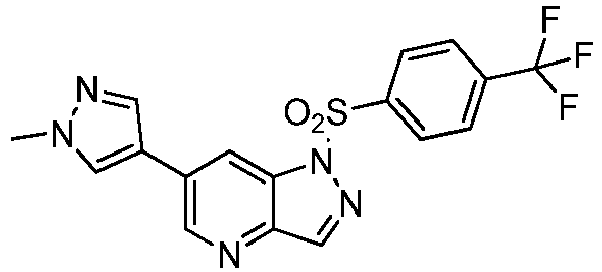
- Except for 4-trifluoromethylphenylsulfonyl chloride was used instead of 2-nitrophenylsulfonyl chloride, compound 1-(4-trifluoromethylbenzenesulfonyl)-6-[(1-methyl)-4-pyrazolyl]-1-H-pyrazolo[4,3-b]pyridin e was prepared by the same process as Example 3.
1H NMR (400 MHz, CDCl3) δ 8.86 (d, J=1.9 Hz, 1H), 8.47 (d, J=1.0 Hz, 1H), 8.40 (d, J=0.8 Hz, 1H), 8.15 (d, J=8.2 Hz, 2H), 7.94 (s, 1H), 7.86 (s, 1H), 7.77 (d, J=8.3 Hz, 2H), 4.03 (s, 3H). -

- Except for 3-trifluoromethylphenylsulfonyl chloride was used instead of 2-nitrophenylsulfonyl chloride, compound 1-(3-trifluoromethylbenzenesulfonyl)-6-[(1-methyl)-4-pyrazolyl]-1-H-pyrazolo[4,3-b]pyridin e was prepared by the same process as Example 3.
1H NMR (400 MHz, CDCl3) δ 8.87 (s, 1H), 8.47 (s, 1H), 8.41 (s, 1H), 8.31 (s, 1H), 8.22 (d, J=8.2 Hz, 1H), 7.95 (s, 1H), 7.93-7.83 (m, 2H), 7.68 (t, J=8.0 Hz, 1H), 4.03 (s, 3H). -

- Except for 4-methoxyphenylsulfonyl chloride was used instead of 2-nitrophenylsulfonyl chloride, compound 1-(4-methoxybenzenesulfonyl)-6-[(1-methyl)-4-pyrazolyl]-1-H-pyrazolo[4,3-b]pyridine was prepared by the same process as Example 3.
1H NMR (400 MHz, CDCl3) δ 8.84 (s, 1H), 8.49 (d, J=1.0 Hz, 1H), 8.36 (d, J=0.6 Hz, 1H), 7.96 (d, J=2.1 Hz, 1H), 7.94 (s, 2H), 7.85 (s, 1H), 6.94 (d, J=9.1 Hz, 2H), 4.03 (s, 3H), 3.83 (s, 3H). -

- Except for (6-chloro-imidazo[2,1-b]thiazole)-5-sulfonyl chloride was used instead of 2-nitrophenylsulfonyl chloride, compound 1-[(6-chloro-imidazo[2,1-b]thiazole)-5-sulfonyl)]-6-[(1-methyl)-4-pyrazolyl]-1-H-pyrazolo[4 ,3-b]pyridine was prepared by the same process as Example 3.
1H NMR (400 MHz, CDCl3) δ 8.88 (d, J=1.8 Hz, 1H), 8.54 (s, 1H), 8.35 (s, 1H), 8.21 (d, J=4.6 Hz, 1H), 7.93 (s, 1H), 7.84 (s, 1H), 7.17 (d, J=4.5 Hz, 1H), 4.03 (s, 3H). -

- Except for imidazo[1,2-a]pyridine-3-sulfonyl chloride was used instead of 2-nitrophenylsulfonyl chloride, compound 1-(imidazo[1,2-a]pyridine-3-sulfonyl)-6-[(1-methyl)-4-pyrazolyl]-1-H-pyrazolo[4,3-b]pyridin e was prepared by the same process as Example 3.
1H NMR (400 MHz, CDCl3) δ 9.13 (d, J=6.9 Hz, 1H), 8.85 (d, J=1.5 Hz, 1H), 8.46 (s, 1H), 8.32 (d, J=3.4 Hz, 2H), 7.94 (s, 1H), 7.86 (s, 1H), 7.74 (d, J=9.2 Hz, 1H), 7.61-7.46 (m, 1H), 7.17 (t, J=6.9 Hz, 1H), 4.03 (s, 3H). -

- Except for benzo[1,2,5]oxadiazole-4-sulfonyl chloride was used instead of 2-nitrophenylsulfonyl chloride, compound 1-(benzo[1,2,5]oxadiazole-4-sulfonyl)-6-[(1-methyl)-4-pyrazolyl]-1-H-pyrazolo[4,3-b]pyridi ne was prepared by the same process as Example 3.
1H NMR (400 MHz, CDCl3) δ 8.89 (d, J=1.9 Hz, 1H), 8.74 (dd, J=1.9, 0.8 Hz, 1H), 8.45 (dd, J=6.9, 0.7 Hz, 1H), 8.35 (d, J=0.8 Hz, 1H), 8.18 (dd, J=9.0, 0.7 Hz, 1H), 8.00 (s, 1H), 7.93 (s, 1H), 7.65 (dd, J=9.1, 6.9 Hz, 1H), 4.05 (s, 3H). -

- Except for imidazo[1,2-b]pyridazine-3-sulfonyl chloride was used instead of 2-nitrophenylsulfonyl chloride, compound 1-(imidazo[1,2-b]pyridazine-3-sulfonyl)-6-[(1-methyl)-4-pyrazolyl]-1-H-pyrazolo[4,3-b]pyri dine was prepared by the same process as Example 3.
1H NMR (400 MHz, CDCl3) δ 8.87 (d, J=1.9 Hz, 1H), 8.64 (dd, J=1.9, 0.9 Hz, 1H), 8.58 (s, 1H), 8.35 (d, J=0.9 Hz, 1H), 8.30 (dd, J=4.5, 1.6 Hz, 1H), 8.08 (dd, J=9.3, 1.6 Hz, 1H), 7.98 (d, J=0.8 Hz, 1H), 7.89 (s, 1H), 7.26-7.23 (m, 1H), 4.04 (s, 3H). -

- Except for pyrazolo[1,5-a]pyrimidine-3-sulfonyl chloride was used instead of 2-nitrophenylsulfonyl chloride, compound 1-(pyrazolo[1,5-a]pyrimidine-3-sulfonyl)-6-[(1-methyl)-4-pyrazolyl]-1-H-pyrazolo[4,3-b]pyr idine was prepared by the same process as Example 3.
1H NMR (400 MHz, CDCl3) δ 8.83 (d, J=1.8 Hz, 1H), 8.76 (dd, J=7.0, 1.7 Hz, 1H), 8.71 (d, J=4.1 Hz, 2H), 8.66 (s, 1H), 8.35 (s, 1H), 7.97 (s, 1H), 7.88 (s, 1H), 7.11 (dd, J=6.9, 4.3 Hz, 1H), 4.03 (s, 3H). -

- Except for imidazo[1,2-a]pyrimidine-3-sulfonyl chloride was used instead of 2-nitrophenylsulfonyl chloride, compound 1-(imidazo[1,2-a]pyrimidine-3-sulfonyl)-6-[(1-methyl)-4-pyrazolyl]-1-H-pyrazolo[4,3-b]pyri dine was prepared by the same process as Example 3.
1H NMR (400 MHz, CDCl3) δ 8.82 (d, J=1.8 Hz, 1H), 8.74 (dd, J=7.0, 1.8 Hz, 1H), 8.71 (d, J=4.2 Hz, 2H), 8.63 (s, 1H), 8.37 (s, 1H), 7.95 (s, 1H), 7.83 (s, 1H), 7.12 (dd, J=7.0, 4.3 Hz, 1H), 4.04 (s, 3H). -

- Except for (6-chloro-imidazo[1,2-a]pyridine)-3-sulfonyl chloride was used instead of 2-nitrophenylsulfonyl chloride, compound 1-[(6-chloro-imidazo[1,2-a]pyridine)-3-sulfonyl]-6-[(1-methyl)-4-pyrazolyl]-1-H-pyrazolo[4, 3-b]pyridine was prepared by the same process as Example 3.
1H NMR (400 MHz, CDCl3) δ 9.20 (d, J=1.1 Hz, 1H), 8.87 (d, J=1.9 Hz, 1H), 8.44 (d, J=1.0 Hz, 1H), 8.37 (d, J=0.8 Hz, 1H), 8.28 (s, 1H), 7.95 (s, 1H), 7.86 (s, 1H), 7.68 (d, J=8.8 Hz, 1H), 7.50 (dd, J=9.5, 2.0 Hz, 1H), 4.04 (s, 3H). -

- Except for (6-chloro-imidazo[1,2-b]pyridazine)-3-sulfonyl chloride was used instead of 2-nitrophenylsulfonyl chloride, compound 1-[(6-chloro-imidazo[1,2-b]pyridazine)-3-sulfonyl]-6-[(1-methyl)-4-pyrazolyl]-1-H-pyrazolo[ 4,3-b]pyridine was prepared by the same process as Example 3.
1H NMR (400 MHz, CDCl3) δ 8.89 (d, J=1.9 Hz, 1H), 8.72 (d, J=1.0 Hz, 1H), 8.54 (s, 1H), 8.37 (d, J=0.6 Hz, 1H), 8.04-7.96 (m, 2H), 7.92 (s, 1H), 7.21 (d, J=9.5 Hz, 1H), 4.04 (s, 3H). -

- Except for (6-trifluoromethyl-imidazo[1,2-a]pyridine)-3-sulfonyl chloride was used instead of 2-nitrophenylsulfonyl chloride, compound 1-[(6-trifluoromethyl-imidazo[1,2-a]pyridine)-3-sulfonyl]-6-[(1-methyl)-4-pyrazolyl]-1-H-py razolo[4,3-b]pyridine was prepared by the same process as Example 3.
1H NMR (400 MHz, CDCl3) δ 9.53 (s, 1H), 8.87 (d, J=1.9 Hz, 1H), 8.45 (s, 1H), 8.37 (d, J=6.4 Hz, 2H), 7.95 (s, 1H), 7.85 (d, J=8.4 Hz, 2H), 7.67 (d, J=8.1 Hz, 1H), 4.04 (s, 3H). -

- Into a microwave reaction tube were charged 120 mg Compound of Example 24, 64 mg 1-methyl-1H-pyrazolo-4-borate pinacol ester and 120 mg potassium carbonate, and 5 ml dioxane, 2.5 ml ethanol and 2.5 ml water were added into the microwave reaction tube, air was displaced for three times, under a nitrogen atmosphere, 11.8 mg complex of 1,1'-bis(diphenylphosphino) ferrocene palladium (II) dichloride and dichloromethane was added into the microwave tube, then the microwave tube was sealed. The microwave tube was placed into a microwave reactor, reacted at 90°C for 30 minutes, the reaction was completed. The aforementioned reactant liquid was poured into 15 ml water, extracted three times with dichloromethane, the organic layer was dried over anhydrous sodium sulfate then concentrated, and isolated by flash preparative chromatography to obtain the target compound (m=23 mg, yield: 17.3%).
1H NMR (400 MHz, CDCl3) δ 9.17 (dd, J=1.5, 0.9 Hz, 1H), 8.85 (d, J=1.9 Hz, 1H), 8.46 (dd, J=1.8, 0.8 Hz, 1H), 8.33 (d, J=0.8 Hz, 1H), 8.28 (s, 1H), 7.95 (d, J=0.4 Hz, 1H), 7.86 (s, 1H), 7.82 (d, J=0.6 Hz, 1H), 7.74 (s, 1H), 7.72 (dd, J=9.3, 0.8 Hz, 1H), 7.63 (dd, J=9.3, 1.7 Hz, 1H), 4.04 (s, 3H), 4.00 (s, 3H). -

- Forty six mg sodium hydride was dissolved in 15 ml anhydrous tetrahydrofuran, stirred for 5 minutes at room temperature. One hundred and sixty
mg compound 1 was dissolved in 15 ml anhydrous tetrahydrofuran, then slowly and dropwisely added into sodium hydride solution in tetrahydrofuran, stirred overnight at room temperature after the addition was finished. One hundred and sixty seven mg imidazo[1,2-a]pyridine-3-sulfonyl chloride was dissolved in 15 ml anhydrous tetrahydrofuran, slowly and dropwisely added into the reactant liquid, stirred overnight at room temperature after the addition was finished, the reaction was completed. Tetrahydrofuran was removed by evaporation, and the remainder was dissolved in dichloromethane, washed three times with water, the organic layer was dried over anhydrous sodium sulfate then concentrated, isolated by flash preparative chromatography to obtain compound 19 (m=231 mg, yield: 79%).
1H NMR (400 MHz, CDCl3) δ 9.10 (d, J=6.9 Hz, 1H), 8.74 (d, J=1.9 Hz, 1H), 8.68 (dd, J=1.9, 0.9 Hz, 1H), 8.34 (d, J=7.6 Hz, 2H), 7.76 (d, J=9.1 Hz, 1H), 7.60-7.50 (m, 1H), 7.19 (dd, J=7.5, 6.4 Hz, 1H). - Eighty mg 1-(imidazo[1,2-a]pyridine-3-sulfonyl)- 6-bromo-1-H-pyrazolo[4,3-b]pyridine, 31 mg phenylboronic acid and 88 mg potassium carbonate were charged into a microwave reaction tube, 5 ml dioxane, 2.5 ml ethanol and 2.5 ml water were added into the microwave reaction tube, air was displaced for three times, under a nitrogen atmosphere, 8.6 mg complex of 1,1'-bis(diphenylphosphino) ferrocene palladium (II) dichloride and dichloromethane was added into the microwave tube, then the microwave tube was sealed. The microwave tube was placed into a microwave reactor, reaction was conducted at a temperature of 120°C for 30 minutes, till the reaction was completed. The aforementioned reactant liquid was poured into 15 ml water, extracted three times with dichloromethane, the organic layer was dried over anhydrous sodium sulfate then concentrated, and isolated by flash preparative chromatography to obtain the target compound (m=54 mg, yield: 68%).
1H NMR (400 MHz, CDCl3) δ 9.14 (dd, J=5.8, 1.1 Hz, 1H), 8.95 (d, J=1.9 Hz, 1H), - 8.62 (dd, J=1.9, 0.9 Hz, 1H), 8.39 (d, J=0.8 Hz, 1H), 8.33 (s, 1H), 7.78-7.67 (m, 3H), 7.62-7.47 (m, 4H), 7.21-7.13 (m, 1H).
-

- Except for 3-thiopheneboronic acid was used instead of phenylboronic acid, compound 1-(imidazo[1,2-a]pyridine-3-sulfonyl)-6-(3-thienyl)-1-H- pyrazolo[4,3-b]pyridine was prepared by the same process as Example 28.
1H NMR (400 MHz, CDCl3) δ 9.13 (dt, J=6.9, 1.2 Hz, 1H), 8.87 (d, J=1.9 Hz, 1H), 8.48 (dd, J=1.9, 0.9 Hz, 1H), 8.35 (d, J=0.9 Hz, 1H), 8.33 (s, 1H), 7.99-7.94 (m, 1H), 7.75 (dt, J=9.1, 1.1 Hz, 1H), 7.64-7.58 (m, 1H), 7.54 (ddd, J=9.0, 7.0, 1.3 Hz, 1H), 7.18 (td, J=7.0, 1.2 Hz, 1H), 6.87 (dd, J=1.9, 0.9 Hz, 1H). -

- Except for 3-pyridineboronic acid was used instead of phenylboronic acid, compound 1-(imidazo[1,2-a]pyridine-3-sulfonyl)-6-(3-pyridinyl)-1-H-pyrazolo [4,3-b]pyridine was prepared by the same process as Example 28.
1H NMR (400 MHz, CDCl3) δ 9.15 (d, J=6.9 Hz, 1H), 9.03-8.91 (m, 2H), 8.77 (d, J=3.9 Hz, 1H), 8.64 (dd, J=1.8, 0.8 Hz, 1H), 8.43 (d, J=0.7 Hz, 1H), 8.34 (s, 1H), 8.06-7.97 (m, 1H), 7.76 (d, J=9.0 Hz, 1H), 7.60-7.46 (m, 2H), 7.20 (td, J=7.0, 1.0 Hz, 1H). -

- Except for 3-furanboronic acid was used instead of phenylboronic acid, compound 1-(imidazo[1,2-a]pyridine-3-sulfonyl)-6-(3-furanyl)-1-H-pyrazolo [4,3-b]pyridine was prepared by the same process as Example 28.
1H NMR (400 MHz, CDCl3) δ 9.13 (dt, J=6.9, 1.2 Hz, 1H), 8.98 (d, J=1.9 Hz, 1H), 8.60 (dd, J=1.9, 0.9 Hz, 1H), 8.36 (d, J=0.9 Hz, 1H), 8.33 (s, 1H), 7.78-7.69 (m, 2H), 7.58-7.49 (m, 3H), 7.17 (td, J=7.0, 1.2 Hz, 1H). -

- Except for 4-trifluoromethylphenylboronic acid was used instead of phenylboronic acid, compound 1-(imidazo[1,2-a]pyridine-3-sulfonyl)-6-(4-trifluoromethylphenyl)-1-H-pyrazolo[4,3-b]pyridine was prepared by the same process as Example 28.
1H NMR (400 MHz, CDCl3) δ 9.15 (d, J=6.9 Hz, 1H), 8.95 (d, J=1.8 Hz, 1H), 8.64 (s, 1H), 8.42 (s, 1H), 8.33 (s, 1H), 7.89-7.79 (m, 4H), 7.76 (d, J=9.1 Hz, 1H), 7.60-7.50 (m, 1H), 7.19 (t, J=7.0 Hz, 1H). -

- Except for 2-naphthylboronic acid was used instead of phenylboronic acid, compound 1-(imidazo[1,2-a]pyridine-3-sulfonyl)-6-(2-naphthyl)-1-H-pyrazolo [4,3-b]pyridine was prepared by the same process as Example 28.
1H NMR (400 MHz, CDCl3) δ 9.15 (dt, J=6.9, 1.2 Hz, 1H), 9.08 (d, J=1.9 Hz, 1H), 8.74 (dd, J=1.9, 0.9 Hz, 1H), 8.42 (d, J=0.9 Hz, 1H), 8.36 (s, 1H), 8.17 (s, 1H), 8.04 (d, J=8.7 Hz, 1H), 8.02-7.97 (m, 1H), 7.97-7.92 (m, 1H), 7.81 (dd, J=8.5, 1.9 Hz, 1H), 7.78-7.72 (m, 1H), 7.63-7.57 (m, 2H), 7.57-7.49 (m, 1H), 7.18 (td, J=7.0, 1.1 Hz, 1H). -

- Except for 4-methylsulfamidophenylboronic acid was used instead of phenylboronic acid, compound 1-(imidazo[1,2-a]pyridine-3-sulfonyl)-6-(4-methylsulfamidophenyl)-1-H-pyrazolo[4,3-b]pyridine was prepared by the same process as Example 28.
1H NMR (400 MHz, DMSO) δ 10.08 (s, 1H), 9.06 (d, J=1.9 Hz, 1H), 8.98 (d, J=6.8 Hz, 1H), 8.81 (d, J=0.8 Hz, 1H), 8.71 (s, 1H), 8.60 (d, J=1.1 Hz, 1H), 7.91 (d, J=8.7 Hz, 2H), 7.86 (d, J=9.0 Hz, 1H), 7.74-7.65 (m, 1H), 7.41 (dd, J=11.3, 4.5 Hz, 3H). -

- Except for (1-t-butoxycarbonyl)-4-1,2,3,6-tetrahydropyridineborate pinacol ester was used instead of phenylboronic acid, compound 1-(imidazo[1,2-a]pyridine-3-sulfonyl)-6-[(1-t-butoxycarbonyl)-4-(1,2,3,6-tetrahydropyridinyl )]-1-H-pyrazolo[4,3-b]pyridine was prepared by the same process as Example 28.
1H NMR (400 MHz, CDCl3) δ 9.12 (d, J=6.9 Hz, 1H), 8.77 (d, J=1.7 Hz, 1H), 8.33 (t, J=8.0 Hz, 3H), 7.74 (d, J=9.0 Hz, 1H), 7.58-7.49 (m, 1H), 7.17 (t, J=6.9 Hz, 1H), 6.40-6.21 (m, 1H), 4.25-4.13 (m, 2H), 3.74 (t, J=5.6 Hz, 2H), 2.72-2.56 (m, 2H), 1.52 (s, 9H). -

- Except for 6-(1,4-benzodioxanyl)boronic acid was used instead of phenylboronic acid, compound 1-(imidazo[1,2-a]pyridine-3-sulfonyl) -6-[6-(1,4-benzodioxanyl)]-1-H-pyrazolo[4,3-b]pyridine was prepared by the same process as Example 28.
1H NMR (400 MHz, CDCl3) δ 9.12 (d, J=6.9 Hz, 1H), 8.89 (d, J=1.9 Hz, 1H), 8.53 (dd, J=1.9, 0.9 Hz, 1H), 8.36 (d, J=0.9 Hz, 1H), 8.32 (s, 1H), 7.74 (d, J=9.0 Hz, 1H), 7.57-7.48 (m, 1H), 7.25-7.12 (m, 3H), 7.04 (d, J=8.3 Hz, 1H), 4.36 (s, 4H). -
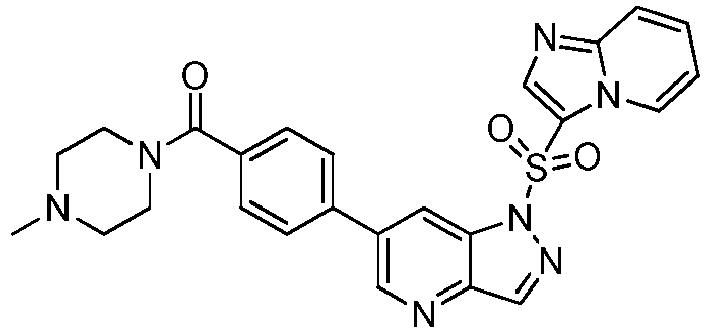
- Except for 4-(4-methylpiperazine-1-carbonyl)phenylboronic acid was used instead of phenylboronic acid, compound 1-(imidazo[1,2-a]pyridine-3-sulfonyl)-6-[4-(4-methylpiperazine-1-carbonyl)phenyl)]-1-H-pyrazolo[4,3-b]pyridine was prepared by the same process as Example 28.
1H NMR (400 MHz, CDCl3) δ 9.14 (d, J=6.9 Hz, 1H), 8.94 (d, J=1.9 Hz, 1H), 8.61 (d, J=1.1 Hz, 1H), 8.41 (d, J=0.8 Hz, 1H), 8.33 (s, 1H), 7.75 (d, J=8.3 Hz, 3H), 7.61 (d, J=8.3 Hz, 2H), 7.58-7.51 (m, 1H), 7.19 (t, J=6.4 Hz, 1H), 3.95-3.80 (m, 2H), 3.63-3.48 (m, 2H), 2.66-2.51 (m, 2H), 2.51-2.39 (m, 2H), 2.38 (s, 3H). -

- Except for 4-morpholinomethylphenylboronic acid was used instead of phenylboronic acid, compound 1-(imidazo[1,2-a]pyridine-3-sulfonyl) -6-(4-morpholinomethylphenyl)-1-H-pyrazolo[4,3-b]pyridine was prepared by the same process as Example 28.
1H NMR (400 MHz, CDCl3) δ 9.14 (dt, J=6.9, 1.1 Hz, 1H), 8.94 (d, J=1.9 Hz, 1H), 8.60 (dd, J=1.9, 0.9 Hz, 1H), 8.39 (d, J=0.9 Hz, 1H), 8.33 (s, 1H), 7.74 (dt, J=9.1, 1.1 Hz, 1H), 7.66 (d, J=8.2 Hz, 2H), 7.61-7.49 (m, 3H), 7.18 (td, J=6.9, 1.1 Hz, 1H), 3.83-3.72 (m, 4H), 3.61 (s, 2H), 2.61-2.45 (m, 4H). -

- Except for 4-morpholinylphenylboronic acid was used instead of phenylboronic acid, compound 1-(imidazo[1,2-a]pyridine-3-sulfonyl)-6-(4-morpholinylphenyl)-1-H-pyrazolo[4,3-b]pyridine was prepared by the same process as Example 28.
1H NMR (400 MHz, CDCl3) δ 9.18-9.11 (m, 1H), 8.94 (dd, J=1.9, 0.8 Hz, 1H), 8.57 (dt, J=1.7, 0.8 Hz, 1H), 8.38 (t, J=0.8 Hz, 1H), 8.34 (d, J=0.7 Hz, 1H), 7.75 (dd, J=9.0, 1.1 Hz, 1H), 7.70-7.62 (m, 2H), 7.59-7.50 (m, 1H), 7.18 (t, J=7.0 Hz, 1H), 7.09 (d, J=8.7 Hz, 2H), 4.05-3.85 (m, 4H), 3.30 (dd, J=5.9, 3.8 Hz, 4H). -

- Except for 4-acetylphenylboronic acid was used instead of phenylboronic acid, compound 1-(imidazo[1,2-a]pyridine-3-sulfonyl)-6-(4-acetylphenyl)-1-H-pyrazolo[4,3-b]pyridine was prepared by the same process as Example 28.
1H NMR (400 MHz, CDCl3) δ 9.15 (dt, J=6.9, 1.1 Hz, 1H), 8.97 (d, J=1.9 Hz, 1H), 8.66 (dd, J=1.9, 0.9 Hz, 1H), 8.41 (d, J=0.8 Hz, 1H), 8.33 (s, 1H), 8.19-8.12 (m, 2H), 7.83-7.79 (m, 2H), 7.75 (dt, J=9.1, 1.1 Hz, 1H), 7.55 (ddd, J=9.0, 7.0, 1.2 Hz, 1H), 7.19 (td, J=6.9, 1.0 Hz, 1H), 2.70 (s, 3H). -

- Except for 4-dimethylaminocarbonylphenylboronic acid was used instead of phenylboronic acid, compound 1-(imidazo[1,2-a]pyridine-3-sulfonyl)-6-(4-dimethylaminocarbonylphenyl)-1-H-pyrazolo[4,3-b]pyridine was prepared by the same process as Example 28.
1H NMR (400 MHz, CDCl3) δ 9.14 (d, J=6.9 Hz, 1H), 8.95 (d, J=1.9 Hz, 1H), 8.62 (d, J=1.8 Hz, 1H), 8.41 (s, 1H), 8.34 (s, 1H), 7.75 (dd, J=8.5, 2.0 Hz, 3H), 7.63 (d, J=8.1 Hz, 2H), 7.59-7.50 (m, 1H), 7.19 (t, J=6.6 Hz, 1H), 3.18 (s, 3H), 3.08 (s, 3H). -

- Except for 4-dimethylaminophenylboronic acid was used instead of phenylboronic acid, compound 1-(imidazo[1,2-a]pyridine-3-sulfonyl)-6-(4-dimethylaminophenyl)-1-H-pyrazolo[4,3-b]pyridine was prepared by the same process as Example 28.
1H NMR (400 MHz, CDCl3) δ 9.11 (d, J=6.9 Hz, 1H), 8.85 (d, J=1.8 Hz, 1H), 8.61 (dd, J=1.8, 0.9 Hz, 1H), 8.38 (d, J=0.9 Hz, 1H), 8.32 (s, 1H), 7.77-7.70 (m, 2H), 7.65-7.59 (m, 1H), 7.56-7.47 (m, 2H), 7.16 (td, J=6.9, 1.2 Hz, 2H), 3.86 (s, 3H), 3.82 (s, 3H). -
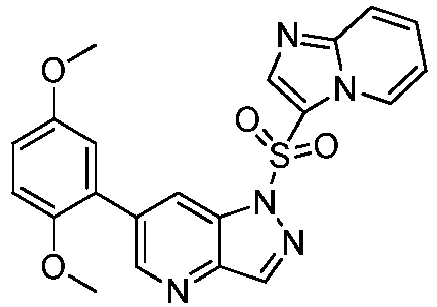
- Except for 2,5-dimethoxyphenylboronic acid was used instead of phenylboronic acid, compound 1-(imidazo[1,2-a]pyridine-3-sulfonyl)-6-(2,5-dimethoxyphenyl)-1-H-pyrazolo[4,3-b]pyridine was prepared by the same process as Example 28.
1H NMR (400 MHz, CDCl3) δ 9.11 (d, J=6.9 Hz, 1H), 8.85 (d, J=1.8 Hz, 1H), 8.61 (d, J=0.9 Hz, 1H), 8.38 (s, 1H), 8.32 (s, 1H), 7.74 (d, J=9.0 Hz, 1H), 7.57-7.46 (m, 1H), 7.20-7.10 (m, 1H), 7.02-6.89 (m, 3H), 3.86 (s, 3H), 3.82 (s, 3H). -

- Except for {1-[(1-t-butoxycarbonyl)-4-piperidinyl]}-4-pyrazoloborate pinacol ester was used instead of phenylboronic acid, compound 1-(imidazo[1,2-a]pyridine-3-sulfonyl)-6-{{1-[(1-t-butoxycarbonyl)-4-piperidinyl]-4-pyrazol yl}-1-H-pyrazolo[4,3-b]pyridine was prepared by the same process as Example 28.
1H NMR (400 MHz, CDCl3) δ 9.13 (d, J=7.0 Hz, 1H), 8.86 (d, J=1.9 Hz, 1H), 8.45 (dd, J=1.9, 0.9 Hz, 1H), 8.33 (d, J=0.9 Hz, 2H), 7.96 (d, J=0.7 Hz, 1H), 7.90 (s, 1H), 7.75 (d, J=9.1 Hz, 1H), 7.58-7.49 (m, 1H), 7.17 (dd, J=7.4, 6.5 Hz, 1H), 4.44-4.33 (m, 3H), 3.04-2.83 (m, 2H), 2.23 (d, J=10.9 Hz, 2H), 2.10-1.93 (m, 2H), 1.50 (s, 9H). -

- Fifty mg compound of Example 44 was dissolved in 5 ml dioxane saturated with hydrochloric acid, stirred for 30 minutes at room temperature. The reaction was completed, the pH was adjusted to 8∼9 using saturated sodium carbonate solution, and diluted by adding 20 ml dichloromethane, washed three times with water, the organic layer was dried over anhydrous sodium sulfate then concentrated, and isolated by flash preparative chromatography to obtain the target compound (m=37 mg, yield: 91%).
1H NMR (400 MHz, CDCl3) δ 9.14 (d, J=7.0 Hz, 1H), 8.87 (s, 1H), 8.51 (s, 1H), 8.35 (s, 1H), 8.34 (s, 1H), 8.16 (s, 1H), 7.99 (s, 1H), 7.75 (d, J=9.0 Hz, 1H), 7.60-7.54 (m, 1H), 7.21 (t, J=7.2 Hz, 1H), 3.75-3.58 (m, 3H), 3.33-3.18 (m, 2H), 2.50-2.45 (m, 2H), 2.08-2.03 (m, 2H). -
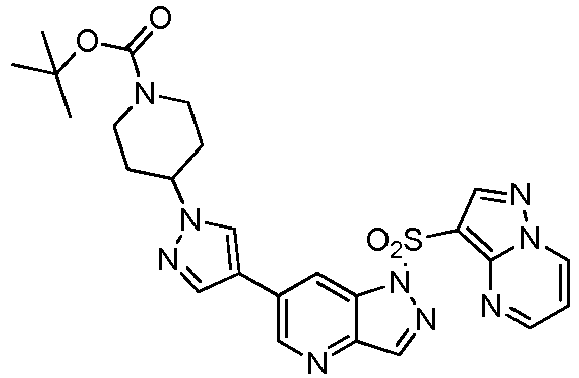
- Except for {1-[(1-t-butoxycarbonyl)-4-piperidinyl]}-4-pyrazoloborate pinacol ester was used instead of 1-methyl-1H-pyrazolo-4-boronic acid pinacol ester, compound 1-(pyrazolo[1,5-a]pyrimidine-3-sulfonyl)-6-{{1-[(1-t-butoxycarbonyl)-4-piperidinyl]}-4-pyrazolyl}-1-H-pyrazolo[4,3-b]pyridine was prepared by the same process as Example 22.
1H NMR (400 MHz, CDCl3) δ 8.84 (d, J=1.9 Hz, 1H), 8.76 (dd, J=7.0, 1.6 Hz, 1H), 8.72-8.68 (m, 2H), 8.67 (s, 1H), 8.34 (s, 1H), 7.99 (s, 1H), 7.92 (s, 1H), 7.11 (dd, J=7.0, 4.2 Hz, 1H), 4.44-4.23 (m, 3H), 3.03-2.86 (m, 2H), 2.28-2.18 (m, 2H), 2.12-1.93 (m, 2H), 1.50 (s, 9H). -

- Fifty mg compound of Example 46 was dissolved in 5 ml dioxane saturated with hydrochloric acid, stirred for 30 minutes at room temperature. The reaction was completed, and filtered to obtain filter cake, which was washed three times by ether immersion, dried at vacuum to produce the target compound (m=37 mg, yield: 91%).
1H NMR (400 MHz, CDCl3) δ 8.84 (d, J=1.9 Hz, 1H), 8.77 (dd, J=7.0, 1.6 Hz, 1H), 8.72-8.64 (m, 2H), 8.65 (s, 1H), 8.31 (s, 1H), 7.79 (s, 1H), 7.91 (s, 1H), 7.01 (dd, J=7.0, 4.2 Hz, 1H), 4.44-4.35 (m, 3H), 3.23-2.96 (m, 2H), 2.33-2.28 (m, 2H), 2.02-1.93 (m, 2H). -

- Except for {1-[(1-t-butoxycarbonyl)-4-piperidinyl]}-4-pyrazoloborate pinacol ester was used instead of 1-methyl-1H-pyrazolo-4-borate pinacol ester, compound 1-[(6-chloro-imidazo[2,1-b]thiazole)-5-sulfonyl)]-6-{{1-[(1-t-butoxycarbonyl)-4-piperidinyl]}-4-pyrazolyl}-1-H-pyrazolo[4,3-b]pyridine was prepared by the same process as Example 18. Eighty seven mg 1-[(6-chloro-imidazo[2,1-b]thiazole)-5-sulfonyl)]-6-{{1-[(1-t-butoxycarbonyl)-4-piperidinyl] }-4-pyrazolyl}-1-H-pyrazolo[4,3-b]pyridine was dissolved in 5 ml dioxane saturated with hydrochloric acid, stirred for 30 minutes at room temperature. The reaction was completed, and filtered to obtain filter cake, which was washed three times by ether immersion,dried at vacuum to produce the target compound (m=65 mg, yield: 90%).
1H NMR (400 MHz, CDCl3) δ 8.71 (d, J=1.9 Hz, 1H), 8.21 (dd, J=1.9, 0.7 Hz, 1H), 8.12 (d, J=4.5 Hz, 1H), 7.84 (d, J=3.8 Hz, 1H), 7.82 (s, 1H), 7.81 (s, 1H), 7.53 (d, J=4.5 Hz, 1H), 7.50 (t, J=2.0 Hz, 1H), 6.87 (dd, J=3.8, 0.7 Hz, 1H), 4.67-4.52 (m, 1H), 3.71-3.57 (m, 2H), 2.70-2.53 (m, 2H), 2.53-2.39 (m, 4H). -

- Except for {1-[(1-t-butoxycarbonyl)-4-piperidinyl]}-4-pyrazoloborate pinacol ester was used instead of 1-methyl-1H-pyrazolo-4-borate pinacol ester, compound 1-(imidazo[1,2-b]pyridazine-3-sulfonyl)-6-{{1-[(1-t-butoxycarbonyl)-4-piperidinyl]}-4-pyraz olyl}-1-H-pyrazolo[4,3-b]pyridine was prepared by the same process as Example 21.
1H NMR (400 MHz, CDCl3) δ 8.88 (d, J=1.9 Hz, 1H), 8.64 (dd, J=1.9, 0.8 Hz, 1H), 8.58 (s, 1H), 8.35 (d, J=0.8 Hz, 1H), 8.31 (dd, J=4.5, 1.6 Hz, 1H), 8.08 (dd, J=9.3, 1.6 Hz, 1H), 8.00 (d, J=0.6 Hz, 1H), 7.94 (s, 1H), 7.26 (dd, J=9.3, 4.5 Hz, 1H), 4.46-4.23 (m, 3H), 3.04-2.85 (m, 2H), 2.28-2.19 (m, 2H), 2.10-1.95 (m, 2H), 1.50 (s, 9H). -

- Fifty mg compound of Example 49 was dissolved in 5 ml dioxane saturated with hydrochloric acid, stirred for 30 minutes at room temperature. The reaction was completed, and filtered to obtain filter cake, which was washed three times by ether immersion,dried at vacuum to obtain the target compound (m=35 mg, yield: 89%).
1H NMR (400 MHz, CDCl3) δ 8.88 (d, J=1.8 Hz, 1H), 8.65 (s, 1H), 8.59 (s, 1H), 8.36 (s, 2H), 8.08 (dd, J=9.3, 1.4 Hz, 1H), 8.03 (s, 1H), 8.00 (s, 1H), 7.30-7.25 (m, 1H), 4.67-4.54 (m, 1H), 3.77-3.66 (m, 2H), 3.32-3.20 (m, 2H), 2.70-2.51 (m, 4H). -

- Fifty mg compound of Example 50 was dissolved in 10 ml saturated sodium bicarbonate solution, stirred for 5 minutes. The aqueous solution was extracted three times with dichloromethane, evaporated to dry, the organic layer was dried over anhydrous sodium sulfate then concentrated, dried at vacuum to obtain the target compound (m=45 mg, yield: 98%).
1H NMR (400 MHz, CDCl3) δ 8.88 (d, J=1.8 Hz, 1H), 8.65 (s, 1H), 8.59 (s, 1H), 8.36 (s, 2H), 8.08 (dd, J=9.3, 1.4 Hz, 1H), 8.03 (s, 1H), 8.00 (s, 1H), 7.30-7.25 (m, 1H), 4.67-4.54 (m, 1H), 3.77-3.66 (m, 2H), 3.32-3.20 (m, 2H), 2.70-2.51 (m, 4H). -

- Except for {1-[(1-t-butoxycarbonyl)-4-piperidinyl]}-4-pyrazoloborate pinacol ester was used instead of 1-methyl-1H-pyrazolo-4-boronic acid pinacol ester, compound 1-(imidazo[1,2-a]pyrimidine-3-sulfonyl)-6-{{1-[(1-t-butoxycarbonyl)-4-piperidinyl]}-4-pyrazolyl}-1-H-pyrazolo[4,3-b]pyridine was prepared by the same process as Example 23.
1H NMR (400 MHz, CDCl3) δ 8.87 (d, J=1.9 Hz, 1H), 8.68 (dd, J=4.0, 2.0 Hz, 1H), 8.65 (dd, J=1.8, 0.8 Hz, 1H), 8.54 (dd, J=6.9, 2.0 Hz, 1H), 8.37 (s, 1H), 8.37 (d, J=0.8 Hz, 1H), 7.97 (s, 1H), 7.94 (s, 1H), 7.06 (dd, J=6.9, 4.0 Hz, 1H), 4.44-4.28 (m, 3H), 3.02-2.83 (m, 2H), 2.27-2.16 (m, 2H), 2.10-1.94 (m, 2H). -

- Fifty milligrams compound of Example 45 was dissolved in 5 ml methanol, then 12.5 µl acetalaldehyde, 319 µl acetic acid and 17.5 mg sodium cyanoborohydride were sequentially added, stirred at room temperature for 5 hours, the reaction was completed. The reactant liquid was diluted with 20 ml dichloromethane, washed three times with water, the organic layer was dried over anhydrous sodium sulfate then concentrated, and isolated by flash preparative chromatography to obtain the target compound (m=47 mg, yield: 88%).
1H NMR (400 MHz, CDCl3) δ 9.02 (d, J=7.1 Hz, 1H), 8.78 (s, 1H), 8.42 (s, 1H), 8.29-8.22 (m, 3H), 7.87 (s, 1H), 7.63 (dt, J=9.0, 1.2 Hz, 1H), 7.48 (t, J=8.0 Hz, 1H), 7.13 (td, J=7.0, 1.2 Hz, 1H), 4.82 (d, J=13.6 Hz, 1H), 4.52 - 4.40 (m, 1H), 4.03 (d, J=13.6 Hz, 1H), 3.36 - 3.25 (m, 1H), 2.81 (dd, J=18.6, 7.3 Hz, 1H), 2.29 (dd, J=24.4, 12.2 Hz, 2H), 2.18 (m, 2H), 2.13 - 1.96 (m, 2H), 1.35 (t, J=6.6 Hz, 3H). -

- Fifty milligrams compound of Example 45 and 46.6 µl triethylamine were dissolved in 10 ml dichloromethane, then 8.7 µl acetyl chloride was added dropwise, stirred for 30 minutes at room temperature, the reaction was completed. The reactant liquid was washed three times with water, the organic layer was dried over anhydrous sodium sulfate then concentrated, and isolated by flash preparative chromatography to obtain the target compound (m=48 mg, yield: 88%).
1H NMR (400 MHz, CDCl3) δ 9.13 (d, J=6.9 Hz, 1H), 8.85 (d, J=1.8 Hz, 1H), 8.46 (d, J=1.0 Hz, 1H), 8.32 (d, J=4.7 Hz, 2H), 7.97 (s, 1H), 7.91 (s, 1H), 7.74 (d, J=9.0 Hz, 1H), 7.58 - 7.48 (m, 1H), 7.18 (t, J=6.9 Hz, 1H), 4.82 (d, J=13.6 Hz, 1H), 4.52 - 4.40 (m, 1H), 4.03 (d, J=13.6 Hz, 1H), 3.36 - 3.25 (m, 1H), 2.81 (dd, J=18.6, 7.3 Hz, 1H), 2.29 (dd, J=24.4, 12.2 Hz, 2H), 2.18 (s, 3H), 2.13 - 1.96 (m, 2H). -

- Except for cyclopropylcarbonyl chloride was used instead of acetyl chloride, compound 1-(imidazo[1,2-a]pyridine-3-sulfonyl)-6-{{1-[(1-cyclopropylcarbonyl)-4-piperidinyl]}-4-pyrazolyl}-1-H-pyrazolo[4,3-b]pyridine was prepared by the same process as Example 54.
1H NMR (400 MHz, CDCl3) δ 9.14 (d, J=6.8 Hz, 1H), 8.86 (s, 1H), 8.46 (s, 1H), 8.34 (s, 2H), 7.97 (s, 1H), 7.93 (s, 1H), 7.77 (d, J=9.1 Hz, 1H), 7.56 (t, J=7.7 Hz, 1H), 7.20 (t, J=6.9 Hz, 1H), 4.88-4.66 (m, 1H), 4.57-4.35 (m, 2H), 3.44-3.26 (m, 1H), 2.95-2.75 (m, 1H), 2.42-2.20 (m, 2H), 2.20-1.95 (m, 2H), 1.87-1.75 (m, 1H), 1.11-0.96 (m, 2H), 0.87-0.74 (m, 2H). -
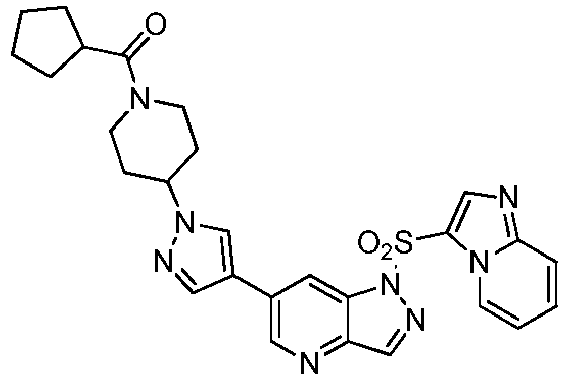
- Except for cyclopentylcarbonyl chloride was used instead of acetyl chloride, compound 1-(imidazo[1,2-a]pyridine-3-sulfonyl)-6-{{1 -[(1-cyclopentylcarbonyl)-4-piperidinyl]-4-pyrazolyl}-1-H-pyrazolo[4,3-b]pyridine was prepared by the same process as Example 54.
1H NMR (400 MHz, CDCl3) δ 9.16-9.08 (m, 1H), 8.85 (d, J=0.8 Hz, 1H), 8.45 (s, 1H), 8.32 (d, J=4.4 Hz, 2H), 7.97 (s, 1H), 7.91 (s, 1H), 7.80-7.67 (m, 1H), 7.54 (dd, J=8.5, 7.6 Hz, 1H), 7.18 (t, J=7.0 Hz, 1H), 4.85 (d, J=13.5 Hz, 1H), 4.56-4.38 (m, 1H), 4.14 (d, J=13.3 Hz, 1H), 3.25 (t, J=12.9 Hz, 1H), 2.78 (t, J=12.4 Hz, 1H), 2.64-2.46 (m, 1H), 2.36-2.24 (m, 2H), 2.07-1.96 (m, 2H), 1.81-1.72 (m, 3H), 1.61-1.50 (m, 2H), 1.32-1.24 (m, 3H). -

- Except for cyclohexylcarbonyl chloride was used instead of acetyl chloride, compound 1-(imidazo[1,2-a]pyridine-3-sulfonyl)-6-{{1-[(1-cyclohexylcarbonyl)-4-piperidinyl]}-4-pyrazolyl}-1-H-pyrazolo[4,3-b]pyridine was prepared by the same process as Example 54.
1H NMR (400 MHz, CDCl3) δ 9.13 (d, J=6.9 Hz, 1H), 8.85 (d, J=1.8 Hz, 1H), 8.46 (d, J=1.5 Hz, 1H), 8.32 (d, J=4.1 Hz, 2H), 7.97 (s, 1H), 7.91 (s, 1H), 7.75 (d, J=9.0 Hz, 1H), 7.58-7.50 (m, 1H), 7.18 (t, J=6.5 Hz, 1H), 4.85 (d, J=13.7 Hz, 1H), 4.54-4.41 (m, 1H), 4.20 (d, J=14.4 Hz, 1H), 3.26 (t, J=12.0 Hz, 1H), 2.96 (p, J=8.0 Hz, 1H), 2.81 (t, J=11.8 Hz, 1H), 2.38-2.21 (m, 2H), 2.08-1.98 (m, 2H), 1.95-1.81 (m, 5H), 1.79-1.73 (m, 2H), 1.69-1.51 (m, 3H). -

- Except for p-trifluoromethyl benzoyl chloride was used instead of acetyl chloride, compound 1-(imidazo[1,2-a]pyridine-3-sulfonyl)-6-{{1-[(1-p-trifluoromethylbenzoyl)-4-piperidinyl]}-4-pyrazolyl}-1-H-pyrazolo[4,3-b]pyridine was prepared by the same process as Example 54.
1H NMR (400 MHz, CDCl3) δ 9.16 (d, J=6.7 Hz, 1H), 8.87 (s, 1H), 8.47 (s, 1H), 8.34 (s, 2H), 7.98 (s, 1H), 7.95 (s, 1H), 7.79 (d, J=8.3 Hz, 1H), 7.72 (d, J=7.9 Hz, 2H), 7.60 (d, J=8.0 Hz, 3H), 7.22 (t, J=6.8 Hz, 1H), 5.01-4.82 (m, 1H), 4.59-4.44 (m, 1H), 4.01-3.81 (m, 1H), 3.35-3.18 (m, 1H), 3.17-2.99 (m, 1H), 2.44-2.01 (m, 4H). -

- Except for acetone was used instead of acetaldehyde, compound 1-(imidazo[1,2-a]pyridine-3-sulfonyl)-6-{{1-[(1-isopropyl)-4-piperidinyl]}-4-pyrazolyl}-1-H -pyrazolo[4,3-b]pyridine was prepared by the same process as Example 53.
1H NMR (400 MHz, CDCl3) δ 9.12 (dt, J=6.9, 1.1 Hz, 1H), 8.85 (d, J=1.9 Hz, 1H), 8.46 (dd, J=1.9, 0.9 Hz, 1H), 8.35-8.31 (m, 2H), 8.00 (s, 1H), 7.94 (d, J=0.6 Hz, 1H), 7.77-7.70 (m, 1H), 7.58-7.49 (m, 1H), 7.18 (td, J=7.0, 1.2 Hz, 1H), 4.57-4.44 (m, 1H), 3.53-3.41 (m, 2H), 3.38-3.23 (m, 1H), 2.99-2.84 (m, 2H), 2.70-2.53 (m, 2H), 2.53-2.37 (m, 2H), 1.35 (d, J=6.6 Hz, 6H). -

- Except for cyclopentanone was used instead of acetaldehyde, compound 1-(imidazo[1,2-a]pyridine-3-sulfonyl)-6-{{1-[(1-cyclopentyl)-4-piperidinyl]}-4-pyrazolyl}-1-H-pyrazolo[4,3-b]pyridine was prepared by the same process as Example 53.
1H NMR (400 MHz, CDCl3) δ 9.13 (dd, J=6.9, 1.1 Hz, 1H), 8.88-8.82 (m, 1H), 8.46 (s, 1H), 8.33 (s, 2H), 7.96 (d, J=15.3 Hz, 2H), 7.75 (dd, J=9.1, 1.0 Hz, 1H), 7.58-7.49 (m, 1H), 7.18 (t, J=7.0 Hz, 1H), 4.52-4.37 (m, 1H), 3.52-3.39 (m, 2H), 3.08-2.90 (m, 1H), 2.86-2.62 (m, 2H), 2.59-2.32 (m, 4H), 2.05-1.94 (m, 2H), 1.90-1.72 (m, 4H), 1.70-1.53 (m, 2H). -

- Except for {1-[(1-t-butoxycarbonyl)-4-piperidinyl]}-4-pyrazoloborate pinacol ester was used instead of 1-methyl-1H-pyrazolo-4-borate pinacol ester, compound 1-[(6-chloro-imidazo[1,2-b]pyridazine)-3-sulfonyl)]-6-{{1-[(1-t-butoxycarbonyl)-4-piperidinyl]-4-pyrazolyl}-1-H-pyrazolo[4,3-b]pyridine was prepared by the same process as Example 25.
1H NMR (400 MHz, CDCl3) δ 8.89 (d, J=1.8 Hz, 1H), 8.75-8.69 (m, 1H), 8.54 (s, 1H), 8.37 (d, J=0.6 Hz, 1H), 8.00 (dd, J=17.0, 7.4 Hz, 3H), 7.22 (d, J=9.5 Hz, 1H), 4.44-4.24 (m, 3H), 3.03-2.86 (m, 2H), 2.31-2.17 (m, 2H), 2.01 (qd, J=12.4, 4.4 Hz, 2H), 1.50 (s, 9H). -

- Into a microwave reaction tube were charged 141 mg compound of Example 61, 100 mg {1-[(1-t-butoxycarbonyl)-4-piperidinyl]}-4- pyrazoloborate pinacol ester and 100 mg potassium carbonate, 5 ml dioxane, 2.5 ml ethanol and 2.5 ml water were added into the microwave reaction tube, air was displaced for three times, under a nitrogen atmosphere, 9.8 mg complex of 1,1'-bis(diphenylphosphino) ferrocene palladium (II) dichloride and dichloromethane was added into the microwave tube, then the microwave tube was sealed. The microwave tube was placed into a microwave reactor, reacted at 90 °C for 10 minutes, the reaction was completed. The aforementioned reactant liquid was poured into 15 ml water, extracted three times with dichloromethane, the organic layer was dried over anhydrous sodium sulfate then concentrated, and isolated by flash preparative chromatography to obtain the target compound (m=154 mg, yield: 80%).
1H NMR (400 MHz, CDCl3) δ 8.94 (d, J=1.8 Hz, 1H), 8.68 (d, J=1.0 Hz, 1H), 8.55 (s, 1H), 8.35 (d, J=0.7 Hz, 1H), 8.02 (dd, J=6.8, 5.2 Hz, 3H), 7.57 (s, 1H), 7.40 (d, J=9.6 Hz, 1H), 7.22 (s, 1H), 4.47-4.11 (m, 5H), 4.04-3.87 (m, 1H), 3.02-2.86 (m, 2H), 2.84-2.66 (m, 2H), 2.22 (d, J=10.3 Hz, 2H), 2.03 (qd, J=12.3, 4.4 Hz, 2H), 1.92-1.73 (m, 4H), 1.50 (d, J=4.5 Hz, 18H). -
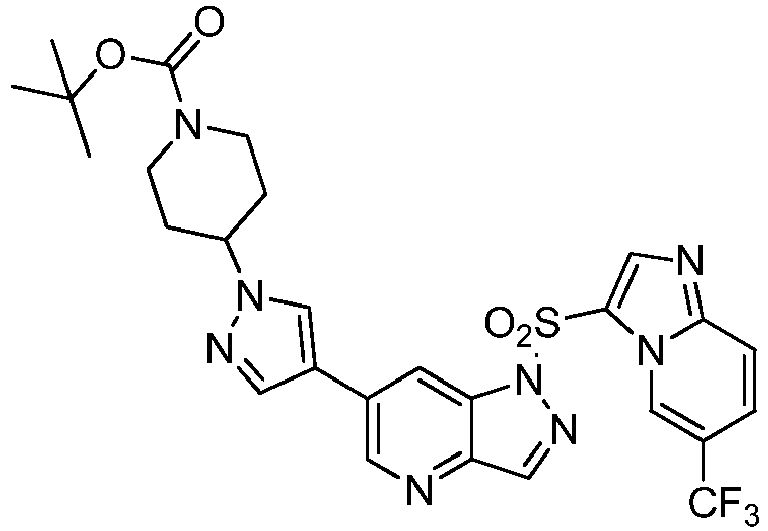
- Except for {1-[(1-t-butoxycarbonyl)-4-piperidinyl]}-4-pyrazoloborate pinacol ester was used instead of 1-methyl-1H-pyrazolo-4-borate pinacol ester, compound 1-[(6-trifluoromethyl-imidazo[1,2-a]pyridine)-3-sulfonyl)]-6-{{1-[(1-t-butoxycarbonyl)-4-piperidinyl]-4-pyrazolyl-1-H-pyrazolo[4,3-b]pyridine was prepared by the same process as Example 26.
1H NMR (400 MHz, CDCl3) δ 9.53 (dd, J=1.7, 1.1 Hz, 1H), 8.87 (d, J=1.9 Hz, 1H), 8.45 (dd, J=1.9, 0.9 Hz, 1H), 8.37 (s, 1H), 8.36 (d, J=0.9 Hz, 1H), 7.97 (d, J=0.7 Hz, 1H), 7.91 (d, J=0.6 Hz, 1H), 7.86 (d, J=9.5 Hz, 1H), 7.68 (dd, J=9.5, 1.8 Hz, 1H), 4.46-4.25 (m, 3H), 3.03-2.86 (m, 2H), 2.29-2.18 (m, 2H), 2.02 (tt, J=12.4, 6.2 Hz, 2H), 1.50 (s, 9H). -

- Fifty milligrams compound of Example 63 was dissolved in 5 ml dioxane saturated with hydrochloric acid, stirred for 30 minutes at room temperature. The reaction was completed, and filtered to obtain filter cake, which was washed three times by ether immersion, dried at vacuum to obtain the target compound (m=37 mg, yield: 83%).
1H NMR (400 MHz, CDCl3) δ 9.54 (s, 1H), 8.88 (s, 1H), 8.46 (s, 1H), 8.42 (s, 1H), 8.36 (s, 1H), 8.04 (s, 1H), 7.96 (s, 1H), 7.86 (d, J=9.4 Hz, 1H), 7.68 (d, J=9.5 Hz, 1H), 4.69-4.53 (m, 1H), 3.83-3.63 (m, 2H), 3.38-3.19 (m, 2H), 2.75-2.47 (m, 4H). -

- Fifty milligrams compound of Example 64 was added into 10 ml saturated sodium bicarbonate solution, stirred for 5 minutes. The aqueous solution was extracted three times with dichloromethane, evaporated to dry, the organic layer was dried over anhydrous sodium sulfate then concentrated,dried at vacuum to obtain the target compound (m=42 mg, yield: 97%).
1H NMR (400 MHz, CDCl3) δ 9.54 (s, 1H), 8.88 (s, 1H), 8.46 (s, 1H), 8.42 (s, 1H), 8.36 (s, 1H), 8.04 (s, 1H), 7.96 (s, 1H), 7.86 (d, J=9.4 Hz, 1H), 7.68 (d, J=9.5 Hz, 1H), 4.69-4.53 (m, 1H), 3.83-3.63 (m, 2H), 3.38-3.19 (m, 2H), 2.75-2.47 (m, 4H). -

- Fifty milligrams compound of Example 44 was dissolved in 5 ml dioxane saturated with hydrochloric acid, stirred for 30 minutes at room temperature. The reaction was completed, and filtered to obtain filter cake, which was washed three times by ether immersion, vacuum dried to obtain the target compound (m=36 mg, yield: 86%).
1H NMR (400 MHz, CDCl3) δ 9.14 (d, J=7.0 Hz, 1H), 8.87 (s, 1H), 8.51 (s, 1H), 8.35 (s, 1H), 8.34 (s, 1H), 8.16 (s, 1H), 7.99 (s, 1H), 7.75 (d, J=9.0 Hz, 1H), 7.60-7.54 (m, 1H), 7.21 (t, J=7.2 Hz, 1H), 3.75-3.58 (m, 3H), 3.33-3.18 (m, 2H), 2.50-2.45 (m, 2H), 2.08-2.03 (m, 2H). -

- Except for {1-[(1-t-butoxycarbonyl)-4-piperidinyl]}-4-pyrazoloborate pinacol ester was used instead of 1-methyl-1H-pyrazolo-4-borate pinacol ester, compound 1-[(6-chloro-imidazo[1,2-a]pyridine)-3-sulfonyl)]-6-{{1-[(1-t-butoxycarbonyl)-4-piperidinyl]}-4-pyrazolyl}-1-H-pyrazolo[4,3-b]pyridine was prepared by the same process as Example 24.
1H NMR (400 MHz, CDCl3) δ 9.19 (dd, J=5.3, 4.4 Hz, 1H), 8.89-8.76 (m, 1H), 8.43 (d, J=6.5 Hz, 1H), 8.36 (d, J=7.0 Hz, 1H), 8.30-8.21 (m, 1H), 7.96 (d, J=5.6 Hz, 1H), 7.91 (s, 1H), 7.72-7.58 (m, 1H), 7.54-7.39 (m, 1H), 4.46-4.16 (m, 3H), 3.06-2.79 (m, 2H), 2.31-2.13 (m, 2H), 2.09-1.90 (m, 2H), 1.49 (s, 9H). -

- Into a microwave reaction tube were charged 150 mg compound of Example 67, 103 mg {1-[(1-t-butoxycarbonyl)-4-piperidinyl]}-4-pyrazoloborate pinacol ester and 103 mg potassium carbonate, 5 ml dioxane, 2.5 ml ethanol and 2.5 ml water were added into the microwave reaction tube, air was displaced for three times, under a nitrogen atmosphere, 9.9 mg complex of 1,1'-bis(diphenylphosphino) ferrocene palladium (II) dichloride and dichloromethane was added into the microwave tube, then the microwave tube was sealed. The microwave tube was placed into a microwave reactor, reacted at 90°C for 10 minutes, the reaction was completed. The aforementioned reactant liquid was poured into 15 ml water, extracted three times with dichloromethane, the organic layer was dried over anhydrous sodium sulfate then concentrated, and isolated by flash preparative chromatography to obtain the target compound (m=159 mg, yield: 80%).
1H NMR (400 MHz, CDCl3) δ 9.19 (s, 1H), 8.86 (d, J=1.8 Hz, 1H), 8.46 (s, 1H), 8.33 (d, J=0.8 Hz, 1H), 8.28 (s, 1H), 7.96 (s, 1H), 7.90 (s, 1H), 7.85 (s, 1H), 7.79 (s, 1H), 7.75-7.71 (m, 1H), 7.64 (dd, J=9.3, 1.7 Hz, 1H), 4.44-4.21 (m, 6H), 3.01-2.83 (m, 4H), 2.28-2.16 (m, 4H), 2.09-1.94 (m, 4H), 1.50 (s, 18H). -

- Except for the compound of Example 65 was used instead of the compound of Example 45, compound 1-[(6-trifluoromethyl-imidazo[1,2-a] pyridine)-3-sulfonyl)]-6-{{1-[(1-isopropyl)-4-piperidinyl]}-4-pyrazolyl}-1-H-pyrazolo[4,3-b] pyridine was prepared by the same process as Example 59.
1H NMR (400 MHz, CDCl3) δ 9.53 (s, 1H), 8.87 (d, J=1.8 Hz, 1H), 8.46 (s, 1H), 8.40 (s, 1H), 8.37 (s, 1H), 8.03 (s, 1H), 7.95 (s, 1H), 7.86 (d, J=9.4 Hz, 1H), 7.68 (d, J=7.8 Hz, 1H), 4.72-4.55 (m, 1H), 3.71-3.57 (m, 2H), 3.57-3.42 (m, 1H), 3.06-2.79 (m, 2H), 2.31-2.13 (m, 2H), 2.09-1.90 (m, 2H), 1.49 (s, 3H), 1.48 (s, 3H). -

- Except for (6-bromo-imidazo[1,2-a]pyridine)-3-sulfonyl chloride was used instead of (6-chloro-imidazo[1,2-a]pyridine)-3-sulfonyl chloride, compound 1-[(6-bromo-imidazo[l,2-a]pyridine)-3-sulfonyl]-6-[(1-methyl)-4-pyrazolyl]-1-H-pyrazolo[4,3-b]pyridine was prepared by the same process as Example 24.
1H NMR (400 MHz, CDCl3) δ 9.28 (dd, J=1.7, 1.0 Hz, 1H), 8.86 (d, J=1.9 Hz, 1H), 8.44 (dd, J=1.8, 0.8 Hz, 1H), 8.37 (d, J=0.8 Hz, 1H), 8.26 (s, 1H), 7.95 (d, J=0.7 Hz, 1H), 7.86 (s, 1H), 7.63 (dd, J=9.5, 0.9 Hz, 1H), 7.59 (dd, J=9.5, 1.7 Hz, 1H), 4.03 (s, 1H). -

- Into a microwave reaction tube were charged 80 mg compound of Example 70, 25.7 mg phenylboronic acid and 87 mg potassium carbonate, 2 ml dioxane, 1 ml ethanol and 1 ml water were added into the microwave reaction tube, air was displaced for three times, under a nitrogen atmosphere, 8.6 mg complex of 1,1'-bis(diphenylphosphino) ferrocene palladium (II) dichloride and dichloromethane was added into the microwave tube, then the microwave tube was sealed. The microwave tube was placed into a microwave reactor, reacted at 90°C for 30 minutes, the reaction was completed. The aforementioned reactant liquid was poured into 15 ml water, extracted three times with dichloromethane, the organic layer was dried over anhydrous sodium sulfate then concentrated, and isolated by flash preparative chromatography to obtain the target compound (m=83 mg, yield: 86%).
1H NMR (400 MHz, CDCl3) δ 9.27 (t, J=1.3 Hz, 1H), 8.86 (d, J=1.9 Hz, 1H), 8.48 (dd, J=1.8, 0.8 Hz, 1H), 8.35 (m, 2H), 7.95 (d, J=0.7 Hz, 1H), 7.85 (s, 1H), 7.78 (m, 2H), 7.61 (m, 2H), 7.50 (m, 3H), 4.04 (s, 3H). -

1H NMR (400 MHz, CDCl3) δ 9.30 (s, 1H), 8.86 (d, J=1.8 Hz, 1H), 8.48 (dd, J=1.8, 0.8 Hz, 1H), 8.34 (d, J=0.7 Hz, 1H), 8.32 (s, 1H), 7.95 (d, J=0.6 Hz, 1H), 7.86 (s, 1H), 7.76 (d, J=1.6 Hz, 2H), 7.57 (dd, J=2.9, 1.4 Hz, 1H), 7.50 (dd, J=5.0, 2.9 Hz, 1H), 7.43 (dd, J=5.0, 1.4 Hz, 1H), 4.04 (s, 3H). -

- Except for 4-dimethylaminocarbonylphenylboronic acid was used instead of phenylboronic acid , compound 1-{[6-(4-dimethylaminocarbonylphenyl)-imidazo [1,2-a]pyridine]-3-sulfonyl}-6-[(1-methyl)-4-pyrazolyl]-1-H-pyrazolo[4,3-b] pyridine was prepared by the same process as Example 71.
1H NMR (400 MHz, CDCl3) δ 9.30 (dd, J=1.5, 1.0 Hz, 1H), 8.86 (d, J=1.9 Hz, 1H), 8.48 (dd, J=1.8, 0.8 Hz, 1H), 8.35 (m, 2H), 7.94 (d, J=0.6 Hz, 1H), 7.86 (s, 1H), 7.81 (dd, J=9.3, 0.9 Hz, 1H), 7.76 (dd, J=9.3, 1.7 Hz, 1H), 7.65 (d, J=8.4 Hz, 2H), 7.56 (d, J=8.4 Hz, 2H), 4.03 (s, 3H), 3.12 (d, J=40.7 Hz, 6H). -
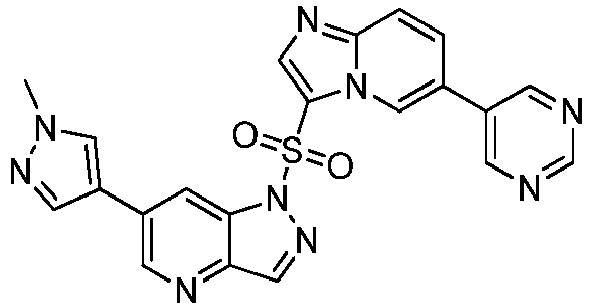
- Except for pyrimidine-5-boronic acid was used instead of phenylboronic acid, compound 1-{[6-(5-pyrimidine)-imidazo[1,2-a]pyridine]-3-sulfonyl}-6-[(1-methyl)-4-pyrazolyl]-1-H-pyrazolo[4,3-b]pyridine was prepared by the same process as Example 71.
1H NMR (400 MHz, CDCl3) δ 9.43 (dd, J=1.8, 1.1 Hz, 1H), 9.36 (s, 1H), 9.07 (s, 2H), 8.87 (d, J=1.9 Hz, 1H), 8.46 (dd, J=1.8, 0.8 Hz, 1H), 8.35 (m, 2H), 7.95 (d, J=0.8 Hz, 1H), 7.90 (dd, J=9.4, 0.9 Hz, 1H), 7.87 (s, 1H), 7.73 (dd, J=9.3, 1.9 Hz, 1H), 4.04 (s, 3H). -

- Except for 4-morpholinylphenylboronic acid was used instead of phenylboronic acid, compound 1-{[6-(4-morpholinylphenyl)-imidazo[1,2-a] pyridine]-3-sulfonyl}-6-[(1-methyl)-4-pyrazolyl]-1-H-pyrazolo[4,3-b]pyridine was prepared by the same process as Example 71.
1H NMR (400 MHz, CDCl3) δ 9.19 (t, J=1.2 Hz, 1H), 8.86 (d, J=1.9 Hz, 1H), 8.49 (dd, J=1.8, 0.7 Hz, 1H), 8.34 (d, J=0.7 Hz, 1H), 8.32 (s, 1H), 7.95 (s, 1H), 7.86 (s, 1H), 7.74 (d, J=1.3 Hz, 2H), 7.52 (d, J=8.7 Hz, 2H), 7.00 (d, J=8.8 Hz, 2H), 4.03 (s, 3H), 3.91 (m, 4H), 3.26 (m, 4H). -

- Except for 1-[(1-t-butoxycarbonyl)-4-piperidinyl]}-pyrazolo-4-pinacol ester was used instead of phenylboronic acid, compound 1-{(6-{{1-[(1-t-butoxycarbonyl)-4-piperidinyl]-4-pyrazolyl}-imidazo[1,2-a]pyridine)-3-sulf onyl}-6-[(1-methyl)-4-pyrazolyl]-1-H-pyrazolo[4,3-b]pyridine was prepared by the same process as Example 71.
1H NMR (400 MHz, CDCl3) δ 9.17 (s, 1H), 8.86 (d, J=1.9 Hz, 1H), 8.46 (m, 1H), 8.33 (s, 1H), 8.28 (s, 1H), 7.95 (s, 1H), 7.87 (s, 1H), 7.85 (s, 1H), 7.78 (s, 1H), 7.72 (d, J=9.4 Hz, 1H), 7.63 (dd, J=9.3, 1.7 Hz, 1H), 4.35 (m, 3H), 4.04 (s, 3H), 2.95 (m, 2H), 2.20 (m, 2H), 2.00 (m, 4.4 Hz, 2H), 1.50 (s, 9H). -

- Except for 4-trifluoromethylphenylboronic acid was used instead of phenylboronic acid, compound 1-{[6-(4-trifluoromethylphenyl)-imidazo[1,2-a] pyridine]-3-sulfonyl}-6-[(1-methyl)-4-pyrazolyl]-1-H-pyrazolo[4,3-b]pyridine was prepared by the same process as Example 71.
1H NMR (400 MHz, CDCl3) δ 9.34 (s, 1H), 8.87 (d, J=1.8 Hz, 1H), 8.48 (s, 1H), 8.35 (s, 2H), 7.96 (s, 1H), 7.85 (m, 2H), 7.76 (m, 5H), 4.04 (s, 3H). -

- Except for 3-fluoro-4-methylphenylboronic acid was used instead of phenylboronic acid, compound 1-{[6-(3-fluoro-4-methylphenyl)-imidazo[1,2-a] pyridine]-3-sulfonyl}-6-[(1-methyl)-4-pyrazolyl]-1-H-pyrazolo[4,3-b]pyridine was prepared by the same process as Example 71.
1H NMR (400 MHz, CDCl3) δ 9.25 (s, 1H), 8.86 (d, J=1.7 Hz, 1H), 8.47 (s, 1H), 8.34 (d, J=7.3 Hz, 2H), 7.94 (s, 1H), 7.86 (s, 1H), 7.78 (d, J=9.3 Hz, 1H), 7.72 (dd, J=9.4, 1.7 Hz, 1H), 7.29 (m, 3H), 4.04 (s, 3H), 2.36 (d, J=1.6 Hz, 3H). -

- Except for 4-isopropoxylphenylboronic acid was used instead of phenylboronic acid, compound 1-{[6-(4-isopropoxyl)phenyl)-imidazo[1,2-a] pyridine]-3-sulfonyl}-6-[(1-methyl)-4-pyrazolyl]-1-H-pyrazolo[4,3-b]pyridine was prepared by the same process as Example 71.
1H NMR (400 MHz, CDCl3) δ 9.27 (m, 1H), 8.85 (d, J=1.9 Hz, 1H), 8.47 (dd, J=1.8, 0.8 Hz, 1H), 8.34 (m, 2H), 7.94 (d, J=0.6 Hz, 1H), 7.85 (s, 1H), 7.76 (m, 2H), 7.39 (t, J=7.9 Hz, 1H), 7.14 (t, J=4.9 Hz, 2H), 6.98 (dd, J=8.0, 2.1 Hz, 1H), 4.66 (dt, J=12.1, 6.1 Hz, 1H), 4.03 (s, 3H), 1.41 (d, J=6.1 Hz, 6H). -

- Except for 4-(4-methylpiperazine-1-carbonyl)phenylboronic acid was used instead of phenylboronic acid, compound 1-{[6-[4-(4-methylpiperazine-1-carbonyl)phenyl]-imidazo[1,2-a]pyridine]-3-sulfonyl}-6-[(1-methyl)-4-pyrazolyl]-1-H-pyrazolo[4,3-b]pyridine was prepared by the same process as Example 71.
1H NMR (400 MHz, CDCl3) δ 9.31 (m, 1H), 8.86 (d, J=1.9 Hz, 1H), 8.47 (dd, J=1.8, 0.8 Hz, 1H), 8.36 (d, J=0.8 Hz, 1H), 8.34 (s, 1H), 7.95 (d, J=0.6 Hz, 1H), 7.87 (s, 1H), 7.81 (dd, J=9.3, 0.8 Hz, 1H), 7.76 (dd, J=9.3, 1.7 Hz, 1H), 7.67 (d, J=8.3 Hz, 2H), 7.56 (d, J=8.3 Hz, 2H), 4.04 (s, 3H), 3.86 (s, 2H), 3.54 (s, 2H), 2.50 (d, J=47.2 Hz, 4H), 2.38 (s, 3H). -

- Except for 4-fluorophenylboronic acid was used instead of phenylboronic acid, compound 1-{[6-(4-fluorophenyl)-imidazo[1,2-a] pyridine]-3-sulfonyl}-6-[(1-methyl)-4-pyrazolyl]-1-H-pyrazolo[4,3-b]pyridine was prepared by the same process as Example 71.
1H NMR (400 MHz, CDCl3) δ 9.24 (s, 1H), 8.86 (d, J=1.8 Hz, 0H), 8.48 (d, J=1.1 Hz, 1H), 8.34 (d, J=7.2 Hz, 2H), 7.95 (s, 1H), 7.86 (s, 1H), 7.79 (d, J=9.3 Hz, 1H), 7.72 (dd, J=9.3, 1.8 Hz, 1H), 7.58 (dd, J=8.7, 5.1 Hz, 2H), 7.21 (t, J=8.6 Hz, 2H), 4.04 (s, 3H). -

- Fifty milligrams compound of Example 76 was dissolved in 5 ml dioxane saturated with hydrochloric acid, stirred for 30 minutes at room temperature. The reaction was completed, and filtered to obtain filter cake, which was washed three times by ether immersion,vacuum dried to obtain the target compound (m=36 mg, yield: 86%).
1H NMR (400 MHz, CDCl3) δ 9.05 (d, J=1.8 Hz, 1H), 8.96 (s, 1H), 8.75 (s, 1H), 8.65 (s, 1H), 8.60 (s, 2H), 8.36 (s, 1H), 8.27 (s, 1H), 7.96 (d, J=13.6 Hz, 2H), 7.90 (d, J=8.9 Hz, 1H), 4.51 (m, 2H), 3.95 (s, 3H), 3.40 (m, 3H), 3.06 (m, 3H). -

- Except for 3-trifluoromethylphenylboronic acid was used instead of phenylboronic acid, compound 1-{[6-(3-trifluoromethylphenyl)-imidazo [1,2-a]pyridine]-3-sulfonyl}-6-[(1-methyl)-4-pyrazolyl]-1-H-pyrazolo[4,3-b]pyridine was prepared by the same process as Example 71.
1H NMR (400 MHz, CDCl3) δ 9.35 (s, 1H), 8.87 (d, J=1.9 Hz, 1H), 8.47 (d, J=1.0 Hz, 1H), 8.36 (s, 2H), 7.94 (s, 1H), 7.84 (m, 4H), 7.76 (m, 2H), 7.67 (t, J=7.8 Hz, 1H), 4.04 (s, 3H). -

- Except for 2-trifluoromethylphenylboronic acid was used instead of phenylboronic acid , compound 1-{[6-(2-trifluoromethylphenyl)-imidazo[1,2-a] pyridine]-3-sulfonyl}-6-[(1-methyl)-4-pyrazolyl]-1-H-pyrazolo[4,3-b]pyridine was prepared by the same process as Example 71.
1H NMR (400 MHz, CDCl3) δ 9.10 (s, 1H), 8.85 (d, J=1.9 Hz, 1H), 8.43 (dd, J=1.8, 0.8 Hz, 1H), 8.35 (s, 1H), 8.30 (d, J=0.7 Hz, 1H), 7.92 (d, J=0.7 Hz, 1H), 7.85 (m, 2H), 7.75 (dd, J=9.2, 0.8 Hz, 1H), 7.64 (m, 2H), 7.49 (m, 1H), 7.40 (d, J=7.2 Hz, 1H), 4.03 (s, 2H). -

- Except for 4-dimethylaminophenylboronic acid was used instead of phenylboronic acid , compound 1-{[6-(4-dimethylaminophenyl)-imidazo[1,2-a] pyridine]-3-sulfonyl}-6-[(1-methyl)-4-pyrazolyl]-1-H-pyrazolo[4,3-b]pyridine was prepared by the same process as Example 71.
1H NMR (400 MHz, CDCl3) δ 9.14 (t, J=1.3 Hz, 1H), 8.86 (d, J=1.9 Hz, 1H), 8.49 (dd, J=1.9, 0.8 Hz, 1H), 8.35 (d, J=0.8 Hz, 1H), 8.31 (s, 1H), 7.96 (d, J=0.6 Hz, 1H), 7.86 (s, 1H), 7.73 (dd, J=3.5, 2.0 Hz, 2H), 7.46 (d, J=8.9 Hz, 2H), 6.78 (d, J=8.9 Hz, 2H), 4.03 (s, 3H), 3.03 (s, 6H). -

- Except for 3-fluorophenylboronic acid was used instead of phenylboronic acid, compound 1-{[6-(3-fluorophenyl)-imidazo[1,2-a] pyridine]-3-sulfonyl}-6-[(1-methyl)-4-pyrazolyl]-1-H-pyrazolo[4,3-b]pyridine was prepared by the same process as Example 71.
1H NMR (400 MHz, CDCl3) δ 9.29 (dd, J=1.7, 1.0 Hz, 1H), 8.86 (d, J=1.9 Hz, 1H), 8.48 (dd, J=1.9, 0.9 Hz, 1H), 8.36 (d, J=0.8 Hz, 1H), 8.34 (s, 1H), 7.94 (d, J=0.7 Hz, 1H), 7.86 (s, 1H), 7.80 (dd, J=9.3, 1.0 Hz, 1H), 7.74 (dd, J=9.3, 1.8 Hz, 1H), 7.49 (m, 1H), 7.41 (m, 1H), 7.32 (m, 1H), 7.18 (tdd, J=8.5, 2.6, 1.0 Hz, 1H), 4.04 (s, 3H). -

- Except for 2,4-difluorophenylboronic acid was used instead of phenylboronic acid, compound 1-{[6-(2,4-difluorophenyl)-imidazo[1,2-a]pyridine]-3-sulfonyl}-6-[(1-methyl)-4-pyrazolyl]-1 -H-pyrazolo[4,3-b]pyridine was prepared by the same process as Example 71.
1H NMR (400 MHz, CDCl3) δ 9.24 (s, 1H), 8.86 (d, J=1.8 Hz, 1H), 8.46 (dd, J=1.8, 0.8 Hz, 1H), 8.35 (d, J=0.8 Hz, 2H), 7.94 (d, J=0.5 Hz, 1H), 7.86 (s, 1H), 7.79 (dd, J=9.3, 0.8 Hz, 1H), 7.67 (dt, J=9.3, 1.6 Hz, 1H), 7.48 (td, J=8.6, 6.2 Hz, 1H), 7.02 (m, 2H), 4.04 (s, 3H). -

- Except for 3,4,5-trifluorophenylboronic acid was used instead of phenylboronic acid, compound 1-{[6-(3,4,5-trifluorophenyl)-imidazo[1,2-a] pyridine]-3-sulfonyl}-6-[(1-methyl)-4-pyrazolyl]-1-H-pyrazolo[4,3-b]pyridine was prepared by the same process as Example 71.
1H NMR (400 MHz, CDCl3) δ 9.27 (s, 1H), 8.87 (d, J=1.8 Hz, 1H), 8.47 (s, 1H), 8.34 (d, J=6.4 Hz, 2H), 7.95 (s, 1H), 7.86 (s, 1H), 7.81 (d, J=9.3 Hz, 1H), 7.66 (dd, J=9.3, 1.8 Hz, 1H), 7.26 (m, 2H), 4.04 (s, 3H). -

- Except for 4-methoxyphenylboronic acid was used instead of phenylboronic acid, compound 1-{[6-(4-methoxyphenyl)-imidazo[1,2-a] pyridine]-3-sulfonyl}-6-[(1-methyl)-4-pyrazolyl]-1-H-pyrazolo[4,3-b]pyridine was prepared by the same process as Example 71.
1H NMR (400 MHz, CDCl3) δ 9.20 (t, J=1.3 Hz, 1H), 8.86 (d, J=1.9 Hz, 1H), 8.48 (m, 1H), 8.35 (s, 1H), 8.32 (s, 1H), 7.95 (s, 1H), 7.85 (s, 1H), 7.75 (m, 2H), 7.54 (d, J=8.8 Hz, 2H), 7.02 (d, J=8.8 Hz, 2H), 4.04 (s, 3H), 3.89 (s, 3H). -

- Except for 4-methylphenylboronic acid was used instead of phenylboronic acid, compound 1-{[6-(4-methylphenyl)-imidazo[1,2-a] pyridine]-3-sulfonyl}-6-[(1-methyl)-4-pyrazolyl]-1-H-pyrazolo[4,3-b]pyridine was prepared by the same process as Example 71.
1H NMR (400 MHz, CDCl3) δ 9.24 (t, J=1.3 Hz, 1H), 8.86 (d, J=1.9 Hz, 1H), 8.48 (m, 1H), 8.34 (d, J=7.4 Hz, 2H), 7.95 (s, 1H), 7.85 (s, 1H), 7.76 (d, J=1.3 Hz, 2H), 7.50 (d, J=8.1 Hz, 2H), 7.31 (d, J=8.0 Hz, 2H), 4.04 (s, 3H), 2.44 (s, 3H). -

- Except for 4-morpholinomethylphenylboronic acid was used instead of phenylboronic acid, compound 1-{[6-(4-morpholinomethylphenyl)-imidazo [1,2-a]pyridine]-3-sulfonyl}-6-[(1-methyl)-4-pyrazolyl]-1-H-pyrazolo[4,3-b] pyridine was prepared by the same process as Example 71.
1H NMR (400 MHz, CDCl3) δ 9.30 (s, 1H), 8.88 (d, J=1.6 Hz, 1H), 8.50 (d, J=1.8 Hz, 1H), 8.37 (s, 1H), 8.34 (s, 1H), 7.97 (s, 1H), 7.88 (s, 1H), 7.79 (t, J=1.5 Hz, 2H), 7.59 (d, J=8.1 Hz, 2H), 7.50 (d, J=8.1 Hz, 2H), 4.06 (s, 3H), 3.78 (m, 4H), 3.60 (s, 2H), 2.52 (m, 4H). -

- Except for 4-cyanophenylboronic acid was used instead of phenylboronic acid , compound 1-{[6-(4-cyanophenyl)-imidazo[1,2-a]pyridine] -3-sulfonyl}-6-[(1-methyl)-4-pyrazolyl]-1-H-pyrazolo[4,3-b]pyridine was prepared by the same process as Example 71.
1H NMR (400 MHz, CDCl3) δ 9.37 (s, 1H), 8.87 (d, J=1.9 Hz, 1H), 8.47 (dd, J=1.5, 0.5 Hz, 1H), 8.34 (s, 2H), 7.95 (s, 1H), 7.84 (m, 4H), 7.75 (m, 3H), 4.04 (s, 3H). -

- Except for (1,4-benzodioxanyl)-6-boronic acid was used instead of phenylboronic acid, compound 1-{[6-[6-(1,4-benzodioxanyl)]-imidazo[1,2-a] pyridine]-3-sulfonyl}-6-[(1-methyl)-4-pyrazolyl]-1-H-pyrazolo[4,3-b]pyridine was prepared by the same process as Example 71.
1H NMR (400 MHz, CDCl3) δ 9.18 (s, 1H), 8.85 (d, J=1.8 Hz, 1H), 8.47 (d, J=1.l Hz, 1H), 8.35 (s, 1H), 8.32 (s, 1H), 7.94 (s, 1H), 7.85 (s, 1H), 7.75 (d, J=9.4 Hz, 1H), 7.70 (dd, J=9.2, 1.6 Hz, 1H), 7.12 (d, J=2.1 Hz, 1H), 7.08 (dd, J=8.3, 2.3 Hz, 1H), 6.98 (d, J=8.3 Hz, 1H), 4.34 (s, 4H), 4.03 (s, 3H). -

- Except for 4-chlorophenylboronic acid was used instead of phenylboronic acid, compound 1-{[6-(4-chlorophenyl)-imidazo[1,2-a] pyridine]-3-sulfonyl}-6-[(1-methyl)-4-pyrazolyl]-1-H-pyrazolo[4,3-b]pyridine was prepared by the same process as Example 71.
1H NMR (400 MHz, CDCl3) δ 9.26 (m, 1H), 8.86 (d, J=1.8 Hz, 1H), 8.47 (m, 1H), 8.34 (d, J=5.4 Hz, 2H), 7.95 (s, 1H), 7.85 (s, 1H), 7.79 (dd, J=9.3 Hz, 0.9 Hz, 1H), 7.72 (dd, J=9.3, 1.7 Hz, 1H), 7.55 (m, 2H), 7.48 (m, 2H), 4.04 (s, 3H). -

- Except for 3-fluoro-pyridine-4-boronic acid was used instead of phenylboronic acid, compound 1-{[6-(3-fluoro-4-pyridinyl)-imidazo[1,2-a] pyridine]-3-sulfonyl}-6-[(1-methyl)-4-pyrazolyl]-1-H-pyrazolo[4,3-b]pyridine was prepared by the same process as Example 71.
1H NMR (400 MHz, CDCl3) δ 9.47 (dd, J=1.7, 1.0 Hz, 1H), 8.89 (d, J=1.9 Hz, 1H), 8.49 (dd, J=1.8, 0.9 Hz, 1H), 8.42 (d, J=5.4 Hz, 1H), 8.37 (s, 2H), 7.97 (d, J=0.4 Hz, 1H), 7.89 (m, 2H), 7.78 (dd, J=9.3, 1.8 Hz, 1H), 7.51 (dt, J=5.2, 1.4 Hz, 1H), 7.23 (t, J=1.7 Hz, 1H), 4.06 (s, 3H). -

- Except for 3,4-dimethoxyphenylboronic acid was used instead of phenylboronic acid, compound 1-{[6-(3,4-dimethoxyphenyl)-imidazo[1,2-a] pyridine]-3-sulfonyl}-6-[(1-methyl)-4-pyrazolyl]-1-H-pyrazolo[4,3-b]pyridine was prepared by the same process as Example 71.
1H NMR (400 MHz, CDCl3) δ 9.23 (t, J=1.2 Hz, 1H), 8.86 (d, J=1.9 Hz, 1H), 8.47 (dd, J=1.8, 0.6 Hz, 1H), 8.33 (s, 2H), 7.94 (s, 1H), 7.85 (s, 1H), 7.75 (m, 2H), 7.16 (dd, J=8.3, 2.1 Hz, 1H), 7.10 (d, J=2.1 Hz, 1H), 6.98 (d, J=8.4 Hz, 1H), 4.03 (s, 3H), 3.99 (s, 3H), 3.97 (s, 3H). -

- Except for 2-methoxyphenylboronic acid was used instead of phenylboronic acid, compound 1-{[6-(2-methoxyphenyl)-imidazo[1,2-a] pyridine]-3-sulfonyl}-6-[(1-methyl)-4-pyrazolyl]-1-H-pyrazolo[4,3-b]pyridine was prepared by the same process as Example 71.
1H NMR (400 MHz, CDCl3) δ 9.20 (t, J=1.3 Hz, 1H), 8.85 (d, J=1.9 Hz, 1H), 8.47 (dd, J=1.9, 0.8 Hz, 1H), 8.34 (m, 2H), 7.93 (d, J=0.7 Hz, 1H), 7.83 (s, 1H), 7.73 (dd, J=2.5, 1.3 Hz, 2H), 7.43 (m, 1H), 7.35 (dd, J=7.5, 1.7 Hz, 1H), 7.06 (m, 2H), 4.03 (s, 3H), 3.85 (s, 3H). -

- Except for 5-(1,2-methylenedioxyphenyl)boronic acid was used instead of phenylboronic acid , compound 1-{[6-[5-(1,2-methylenedioxyphenyl)]-imidazo [1,2-a]pyridine]-3-sulfonyl}-6-[(1-methyl)-4-pyrazolyl]-1-H-pyrazolo[4,3-b] pyridine was prepared by the same process as Example 71.
1H NMR (400 MHz, CDCl3) δ 9.18 (dd, J=1.6, 1.0 Hz, 1H), 8.86 (d, J=1.9 Hz, 1H), 8.47 (dd, J=1.8, 0.8 Hz, 1H), 8.35 (d, J=0.7 Hz, 1H), 8.32 (s, 1H), 7.94 (d, J=0.6 Hz, 1H), 7.85 (m, 1H), 7.75 (dd, J=9.3, 0.9 Hz, 1H), 7.69 (dd, J=9.4, 1.9 Hz, 1H), 7.07 (m, 2H), 6.93 (d, J=8.5 Hz, 1H), 6.07 (s, 2H), 4.04 (s, 3H). -

- Except for 2-fluoro-pyridine-5-boronic acid was used instead of phenylboronic acid, compound 1-{[6-(2-fluoro-5-pyridinyl)-imidazo[1,2-a] pyridine]-3-sulfonyl}-6-[(1-methyl)-4-pyrazolyl]-1-H-pyrazolo[4,3-b]pyridine was prepared by the same process as Example 71.
1H NMR (400 MHz, CDCl3) δ 9.34 (s, 1H), 8.89 (d, J=1.8 Hz, 1H), 8.53 (d, J=2.6 Hz, 1H), 8.48 (d, J=1.0 Hz, 1H), 8.36 (s, 2H), 8.08 (ddd, J=8.2, 7.5, 2.6 Hz, 1H), 7.97 (s, 1H), 7.87 (m, 2H), 7.72 (dd, J=9.3, 1.8 Hz, 1H), 7.15 (dd, J=8.7, 3.0 Hz, 1H), 4.06 (s, 3H). -

- Except for 3-cyanophenylboronic acid was used instead of phenylboronic acid, compound 1-{[6-(3-cyanophenyl)-imidazo[1,2-a] pyridine]-3-sulfonyl}-6-[(1-methyl)-4-pyrazolyl]-1-H-pyrazolo[4,3-b]pyridine was prepared by the same process as Example 71.
1H NMR (400 MHz, CDCl3) δ 9.33 (s, 1H), 8.87 (d, J=1.8 Hz, 1H), 8.47 (dd, J=1.8, 0.8 Hz, 1H), 8.35 (m, 2H), 7.95 (d, J=2.9 Hz, 1H), 7.87 (m, 4H), 7.78 (dt, J=7.8, 1.3 Hz, 1H), 7.72 (dd, J=9.4, 1.8 Hz, 1H), 7.67 (m, 1H), 4.04 (s, 3H). -

- Except for 3-fluoro-4-methylaminocarbonylphenylboronic acid was used instead of phenylboronic acid, compound 1-{(6-(3-fluoro-4-methylaminocarbonylphenyl)-imidazo [1,2-a]pyridine)-3-sulfonyl}-6-[(1-methyl)-4-pyrazolyl]-1-H-pyrazolo[4,3-b]pyridine was prepared by the same process as Example 71.
1H NMR (400 MHz, CDCl3) δ 9.34 (d, J=1.5 Hz, 1H), 8.86 (d, J=1.9 Hz, 1H), 8.47 (d, J=1.9 Hz, 1H), 8.35 (s, 1H), 8.34 (s, 1H), 8.25 (t, J=8.2 Hz, 1H), 7.93 (s, 1H), 7.86 (s, 1H), 7.83 (dd, J=9.3, 0.9 Hz, 1H), 7.75 (dd, J=9.4, 1.8 Hz, 1H), 7.53 (dd, J=8.2, 1.8 Hz, 1H), 7.41 (dd, J=12.6, 1.8 Hz, 1H), 6.84 (s, 1H), 4.04 (s, 3H), 3.10 (d, J=5.1 Hz, 3H). -

- Except for 2-dimethylaminoethyl-1H-pyrazolo-4-borrate pinacol ester was used instead of 1-methyl-1H-pyrazolo-4-boronic acid pinacol ester, compound 1-{(6-(3-fluoro-4-methylaminocarbonylphenyl)-imidazo[1,2-a]pyridine)-3-sulfonyl}-6-[(2-dimethylaminoethyl)-4-pyrazolyl]-1-H-pyrazolo[4,3-b]pyridine was prepared by the same process as Example 71.
1H NMR (400 MHz, CDCl3) δ 9.33 (d, J=1.5 Hz, 1H), 8.86 (d, J=1.9 Hz, 1H), 8.46 (d, J=1.9 Hz, 1H), 8.35 (s, 1H), 8.33 (s, 1H), 8.25 (t, J=8.1 Hz, 1H), 7.91 (s, 1H), 7.84 (s, 1H), 7.83 (dd, J=9.3, 0.9 Hz, 1H), 7.75 (dd, J=9.4, 1.8 Hz, 1H), 7.53 (dd, J=8.1, 1.8 Hz, 1H), 7.41 (dd, J=12.6, 1.8 Hz, 1H), 6.84 (s, 1H), 4.10 (t, J=6.5 Hz, 2H), 3.10 (d, J=5.1 Hz, 3H), 2.64 (t, J=6.5 Hz, 2H), 2.18 (s, 6H). -

- Fifty milligrams compound 27, 61 mg zinc bis(isopropyl)sulfinate were dissolved into 5 ml dimethyl sulfoxide, 32 µl t-butyl hydroperoxide was added with vigorous agitation, reaction was conducted at 50°C for 12 hours. After the reaction was completed, the reactant liquid was cooled to room temperature, 50 ml saturated sodium bicarbonate was added, extracted three times with 30 ml ethyl acetate. The organic layer was dried over anhydrous sodium sulfate then concentrated, and isolated by flash preparative chromatography to obtain the target compound 103 (m=15 mg, yield: 30%).
1H NMR (400 MHz, CDCl3) δ 9.44 (s, 1H), 8.89 (s, 1H), 8.48 (s, 1H), 8.38 (s, 1H), 7.90 (d, J=0.9 Hz, 1H), 7.82 (s, 1H), 7.79 (d, J=9.3 Hz, 1H), 7.72 (d, J=9.1 Hz, 1H), 7.52 (s, 1H), 7.44 (s, 1H), 4.04 (s, 3H), 4.00 (s, 3H), 3.38 (m, 1H), 1.27 (d, J=6.9 Hz, 6H). -

- Eighty milligrams sodium hydride was dissolved in 30 ml anhydrous tetrahydrofuran, stirred for 5 minutes at room temperature. Four hundred and forty milligrams 6-bromoindazole was dissolved in 30 ml anhydrous tetrahydrofuran, then slowly and dropwisely added into the tetrahydrofuran solution of sodium hydride, stirred for 30 minutes at room temperature after the addition was completed. Seven hundred and twenty-three milligrams 6-bromoimidazo[1,2-a]pyridine-3-sulfonyl chloride was dissolved in 30 ml anhydrous tetrahydrofuran, then slowly and dropwisely added into the reactant liquid, stirred overnight at room temperature after the addition was done, the reaction was completed. Tetrahydrofuran was removed by evaporation, and the remainder was dissolved in dichloromethane, washed three times with water, the organic layer was dried over anhydrous sodium sulfate then concentrated, isolated by flash preparative chromatography to obtain 1-[(6-bromo-imidazo[1,2-a]pyridine)-3-sulfonyl]-6-bromo-1-H-pyrazolo[4,3-b]pyridine (m=755 mg, yield: 74.3%). ESI (m/z): 458.0 [M+H]+.
- Into a microwave reaction tube were disposed 80 mg 1-[(6-bromo-imidazo[1,2-a]pyridine)-3-sulfonyl]-6-bromo-1-H-pyrazolo[4,3-b]pyridine, 113 mg 1-t-butoxycarbonyl-1H-pyrazolo-4-boronic acid pinacol ester and 97 mg potassium carbonate, 5 ml dioxane, 2.5 ml ethanol and 2.5 ml water were added into the microwave reaction tube, air was displaced for three times, under a nitrogen atmosphere, 7.2
mg 1,1'-bis(diphenylphosphino) ferrocene palladium (II)dichloromethane complex was added into the microwave tube, then the microwave tube was sealed. The microwave tube was placed into a microwave reactor, reaction was conducted at a temperature of 120°C for 30 minutes, the reaction was completed. The aforementioned reactant liquid was poured into 15 ml water, extracted three times with dichloromethane, the organic layer was dried over anhydrous sodium sulfate then concentrated. The concentrated solid was dissolved in 10 ml dioxane saturated with hydrochloric acid, stirred at room temperature for 3 hours, then evaporated to remove the organic phase, and isolated by flash preparative chromatography to obtain the target compound 104 (m=64 mg, yield: 85%). ESI (m/z): 432.0 [M+H]+.
1H NMR (400 MHz, CDCl3) δ 9.25 (s, 1H), 8.92 (s, 1H), 8.55 (s, 1H), 8.38 (s, 1H), 8.33 (s, 1H), 8.09 (s, 2H), 7.98 (s, 2H), 7.77 (d, J=9.1 Hz, 1H), 7.69 (d, J=9.5 Hz, 1H). -

- Except for pyrazolo-4-boronic acid was used instead of phenylboronic acid, compound 1-{[6-(4-pyrazolyl)-imidazo[1,2-a]pyridine)-3-sulfonyl}-6-[(1-methyl)-4-pyrazolyl]-1-H-pyrazolo[4,3-b]pyridine was prepared by the same process as Example 71.
1H NMR (400 MHz, DMSO-d 6) δ 9.05 (d, J=1.9 Hz, 1H), 8.97 (s, 1H), 8.76 (d, J=0.9 Hz, 1H), 8.64 (s, 1H), 8.61-8.58 (m, 1H), 8.57 (dd, J=1.9, 0.9 Hz, 1H), 8.34 (s, 1H), 8.24 (d, J=0.8 Hz, 1H), 7.96 (dd, J=9.3, 1.8 Hz, 1H), 7.93 (s, 1H), 7.88 (dd, J=9.3, 1.0 Hz, 1H), 3.94 (s, 3H). -

- One hundred milligrams sodium hydride was dissolved in 30 ml anhydrous tetrahydrofuran, stirred for 5 minutes at room temperature. Five hundred and fifty milligrams 6-bromoindazole was dissolved in 30 ml anhydrous tetrahydrofuran, then slowly and dropwisely added into the tetrahydrofuran solution of sodium hydride, stirred for 30 minutes at room temperature after the addition was completed. Nine hundred and seven milligrams 6-[(1-methyl)-4-pyrazolyl]-imidazo[1,2-a]pyridine-3-sulfonyl chloride was dissolved in 30 ml anhydrous tetrahydrofuran, slowly and dropwisely added into the reactant liquid, stirred overnight at room temperature after the addition was done, the reaction was completed. Tetrahydrofuran was removed by evaporation, the remainder was dissolved in dichloromethane, washed three times with water, the organic layer was dried over anhydrous sodium sulfate then concentrated, isolated by flash preparative chromatography to obtain compound 1-{(6-[(1-methyl)-4-pyrazolyl]-imidazo[1,2-a]pyridine)-3-sulfonyl}-6-bromo-1-H-pyrazolo[4 ,3-b]pyridine(m=968 mg, yield: 76%). ESI (m/z): 460.0, 458.0 [M+H]+.
- Into a microwave reaction tube were disposed 100 mg 1-{(6-[(1-methyl)-4-pyrazolyl]-imidazo[1,2-a]pyridine)-3-sulfonyl}-6-bromo-1-H-pyrazolo[4 ,3-b]pyridine, 77 mg 1-t-butoxycarbonyl-1H-pyrazolo-4-borate pinacol ester and 90 mg potassium carbonate, 5 ml dioxane, 2.5 ml ethanol and 2.5 ml water were added into the microwave reaction tube, air was displaced for three times, under a nitrogen atmosphere, 9 mg complex of 1,1'-bis(diphenylphosphino) ferrocene palladium (II) dichloride and dichloromethane was added into the microwave tube, then the microwave tube was sealed. The microwave tube was placed into a microwave reactor, reaction was conducted at a temperature of 120°C for 30 minutes, the reaction was completed. The aforementioned reactant liquid was poured into 15 ml water, extracted three times with dichloromethane, the organic layer was dried over anhydrous sodium sulfate then concentrated. The concentrated solid was dissolved into 10 ml dioxane saturated with hydrochloric acid, stirred at room temperature for 3 hours, evaporated to remove the organic phase, and isolated by flash preparative chromatography to obtain the target compound 106 (m=80 mg, yield: 82%).
1H NMR (400 MHz, CDCl3) δ 9.30 (s, 1H), 8.88 (dd, J=1.9, 1.0 Hz, 1H), 8.46 (d, J=1.6 Hz, 1H), 8.39 (s, 1H), 8.28 (s, 1H), 7.97 (s, 1H), 7.88 (s, 1H), 7.65 (d, J=9.3 Hz, 1H), 7.60 (d, J=9.7 Hz, 2H), 7.29 (s, 1H), 4.05 (s, 3H). -

- Eighty milligrams sodium hydride was dissolved in 30 ml anhydrous tetrahydrofuran, stirred for 5 minutes at room temperature. Two hundred and sixty-five milligrams 1-H-pyrazolo[3,4-b]pyridine was dissolved in 30 ml anhydrous tetrahydrofuran, then slowly and dropwisely added into the tetrahydrofuran solution of sodium hydride, stirred for 30 minutes at room temperature after the addition was completed. Nine hundred and seven milligrams 1-benzyl-5-bromo-1-H-pyrrolo[2,3-b]pyridine-3-sulfonyl chloride was dissolved in 30 ml anhydrous tetrahydrofuran, slowly and dropwisely added into the reactant liquid, stirred overnight at room temperature after the addition was done, the reaction was completed. Tetrahydrofuran was removed by evaporation, the remainder was dissolved in dichloromethane, washed three times with water, the organic layer was dried over anhydrous sodium sulfate then concentrated, isolated by flash preparative chromatography to obtain compound 1-[(1-benzyl-5-bromo-pyrrolo[2,3-b]pyridine)-3-sulfonyl]-1-H-pyrazolo[3,4-b]pyridine(m=697 mg, yield: 67%). ESI (m/z): 470.0, 468.0 [M+H]+.
- Into a microwave reaction tube were disposed 90 mg 1-[(1-benzyl-5-bromo-pyrrolo[2,3-b]pyridine)-3-sulfonyl]-1-H-pyrazolo[3,4-b]pyridine, 48 mg 1-methyl-1H-pyrazolo-4-borrate pinacol ester and 80 mg potassium carbonate, 5 ml dioxane, 2.5 ml ethanol and 2.5 ml water were added into the microwave reaction tube, air was displaced for three times, under a nitrogen atmosphere, 7.8
mg 1,1'-bis(diphenylphosphino) ferrocene palladium (II)dichloromethane complex was added into the microwave tube, then the microwave tube was sealed. The microwave tube was placed into a microwave reactor, reaction was conducted at a temperature of 120°C for 30 minutes, the reaction was completed. The aforementioned reactant liquid was poured into 15 ml water, extracted three times with dichloromethane, the organic layer was dried over anhydrous sodium sulfate then concentrated, isolated by flash preparative chromatography to obtain 1-{(5-[(1-methyl)-4-pyrazolyl])-1-benzyl-pyrrolo[2,3-b]pyridine-3-sulfonyl}-1-H-pyrazolo[3,4-b]pyridine(m=90 mg, yield: 85%). ESI (m/z): 549.4 [M+H]+. - Fifty milligrams 1-{(5-[(1-methyl)-4-pyrazolyl])-1-benzyl-pyrrolo[2,3-b]pyridine-3-sulfonyl}-1-H-pyrazolo[3, 4-b]pyridine and 17
mg 10% palladium on carbon was dissolved in 30 ml ethanol, reacted at 70°C under 20 pis hydrogen pressure, filtered to remove the palladium on carbon, the organic layer was dried over anhydrous sodium sulfate then concentrated, isolated by flash preparative chromatography to obtain compound 107 (m=38 mg, yield: 94%). ESI (m/z): 380.0 [M+H]+. -

- Except for 6-[(1-methyl)-4-pyrazolyl]-1-H-pyrrolo[2,3-b]pyridine was used instead of 1-H-pyrazolo[3,4-b]pyridine, and 4-(4-methylpiperazine-1-carbonyl)phenylboronic acid was used instead of 1-methyl-1H-pyrazolo-4-borate pinacol ester, compound 1-{[6-[4-(4-methylpiperazine-1-carbonyl)phenyl]-1-H-pyrrolo[2,3-b]pyridine-3-sulfonyl}-6-[ (1-methyl)-4-pyrazolyl]-1-H-pyrrolo[2,3-b]pyridine was prepared by the same process as Example 107. ESI (m/z): 581.5 [M+H]+.
-

- Except for 3-chlorophenylboronic acid was used instead of 1-methyl-1H-pyrazolo-4-borate pinacol ester, compound 1-[(3-chlorophenyl)-1-H-pyrrolo[2,3-b]pyridine-3-sulfonyl]-1-H-pyrazolo[3,4-b]pyridine was prepared by the same process as Example 107. ESI (m/z): 410.0 [M+H]+.
-

- Except for 4-morpholinylphenylboronic acid was used instead of 1-methyl-1H-pyrazolo-4-borate pinacol ester, compound 1-[(3-chlorophenyl)-1-H-pyrrolo[2,3-b]pyridine-3-sulfonyl]-1-H-pyrazolo[3,4-b]pyridine was prepared by the same process as Example 107. ESI (m/z): 461.1 [M+H]+.
-

- Except for naphthalene-1-sulfonyl chloride was used instead of 2-nitrophenylsulfonyl chloride, compound 1-(naphthalene-1-sulfonyl)-6-[(1-methyl)-4-pyrazolyl]-1-H-pyrazolo[4,3-b]pyridine was prepared by the same process as Example 3.
1H-NMR (400 MHz, CDCl3) δ 8.82 (t, J=4.7 Hz, 2H), 8.53 (dd, J=7.4, 1.0 Hz, 2H), 8.30 (s, 1H), 8.14 (d, J=8.3 Hz, 1H), 7.91 (m, 3H), 7.60 (m, 3H), 4.03 (s, 3H). -

- Except for naphthalene-2-sulfonyl chloride was used instead of 2-nitrophenylsulfonyl chloride, compound 1-(naphthalene-2-sulfonyl)-6-[(1-methyl)-4-pyrazolyl]-1-H-pyrazolo[4,3-b]pyridine was prepared by the same process as Example 3.
1H-NMR (400 MHz, CDCl3) δ 8.83 (d, J=1.7 Hz, 1H), 8.65 (s, 1H), 8.55 (s, 1H), 8.36 (s, 1H), 7.97 (m, 2H), 7.88 (m, 4H), 7.64 (m, 2H), 4.04 (s, 3H). -

- Except for 6-nitro-imidazo[1,2-a]pyridine-3-sulfonyl chloride was used instead of imidazo[1,2-a]pyridine-3-sulfonyl chloride, and 3-ethoxyphenylboronic acid was used instead of phenylboronic acid, compound 1-[(6-nitro-imidazo[1,2-a]pyridine)-3-sulfonyl]-6-(3-ethoxyphenyl)-1-H-pyrazolo[4,3-b]pyridine was prepared by the same process as Example 28.
1H NMR (400 MHz, DMSO-d 6) δ 9.83 (s, 1H), 9.11 (d, J=6.3 Hz, 2H), 8.89 (s, 1H), 8.59 (s, 1H), 8.12-8.05 (m, 1H), 7.77 (d, J=9.5 Hz, 1H), 7.56-7.48 (m, 2H), 7.40 (s, 1H), 7.13-7.07 (m, 1H), 4.22-4.10 (m, 2H), 1.39 (t, J=7.1 Hz, 3H). -

- Except for 3,5-dichlorophenylboronic acid was used instead of 3-ethoxyphenylboronic acid, compound 1-[(6-nitro-imidazo[1,2-a]pyridine) -3-sulfonyl]-6-(3,5-dichlorophenyl)-1-H-pyrazolo[4,3-b]pyridine was prepared by the same process as Example 113. Eighty milligrams 1-[(6-nitro-imidazo[1,2-a]pyridine)-3-sulfonyl]-6-(3,5-dichlorophenyl)-1-H-pyrazolo[4,3-b]p yridine, 58 mg reduced iron powder and 28 mg ammonium formate were dissolved in toluene, reacted at 90°C for 8 hours, filtered while still hot, evaporated to remove the organic phase, the solid obtained from evaporation was dissolved in dichloromethane, washed three times with water, the organic layer was dried over anhydrous sodium sulfate then concentrated, isolated by flash preparative chromatography to obtain compound 114 (m=42 mg, yield: 56%).
1H NMR (400 MHz, DMSO-d 6) δ 9.82 (s, 1H), 9.14 (d, J=2.1 Hz, 1H), 9.11 (s, 1H), 8.92 (s, 1H), 8.67 (s, 1H), 8.08 (dd, J=10.1, 2.5 Hz, 1H), 8.00 (d, J=1.8 Hz, 2H), 7.82-7.79 (m, 1H), 7.77 (d, J=9.9 Hz, 1H), 5.89 (br, 2H). -

- Except for 4-trifluoromethylphenylboronic acid was used instead of phenylboronic acid, compound 1-[(6-nitro-imidazo[1,2-a]pyridine) -3-sulfonyl]-6-(4-trifluoromethylphenyl)-1-H-pyrazolo[4,3-b]pyridine was prepared by the same process as Example 113.
1H NMR (400 MHz, DMSO-d 6) δ 9.82 (s, 1H), 9.18 (s, 1H), 9.10 (s, 1H), 8.92 (s, 1H), 8.69 (s, 1H), 8.25-8.17 (m, 2H), 8.07 (d, J=11.5 Hz, 1H), 7.92 (d, J=8.0 Hz, 1H), 7.86 (d, J=7.6 Hz, 1H), 7.76 (d, J=10.0 Hz, 1H). -

- Except for 3,4,5-trifluorophenylboronic acid was used instead of phenylboronic acid, compound 1-[(6-nitro-imidazo[1,2-a]pyridine)-3-sulfonyl] -6-(3,4,5-trifluorophenyl)-1-H-pyrazolo[4,3-b]pyridine was prepared by the same process as Example 113.
1H NMR (400 MHz, DMSO-d 6) δ 9.82 (s, 1H), 9.12 (d, J=6.0 Hz, 2H), 8.91 (s, 1H), 8.66 (s, 1H), 8.08 (d, J=8.6 Hz, 1H), 8.03-7.92 (m, 2H), 7.77 (d, J=12.2 Hz, 1H). -

- Except for phenylboronic acid was used instead of 3,5-dichlorophenylboronic acid, compound 1-[(6-amino-imidazo[1,2-a]pyridine) -3-sulfonyl]-6-phenyl-l-H-pyrazolo[4,3-b]pyridine was prepared by the same process as Example 114.
1H NMR (400 MHz, DMSO-d 6) δ 9.86 (s, 1H), 9.14 (s, 1H), 9.12 (d, J=2.0 Hz, 1H), 8.88 (s, 1H), 8.61 (s, 1H), 8.07 (dd, J=10.0, 2.3 Hz, 1H), 7.88 (d, J=7.1 Hz, 2H), 7.86-7.79 (m, 1H), 7.77 (d, J=10.3 Hz, 1H), 7.57-7.50 (m, 2H), 5.39 (br, 2H). -

- Except for 4-fluorophenylboronic acid was used instead of 3,5-dichlorophenylboronic acid, compound 1-[(6-amino-imidazo[1,2-a] pyridine)-3-sulfonyl]-6-(4-fluorophenyl)-1-H-pyrazolo[4,3-b]pyridine was prepared by the same process as Example 114.
1H NMR (400 MHz, CDCl3) δ 9.33 (s, 1H), 8.96 (d, J=1.9 Hz, 1H), 8.74 (s, 1H), 8.60 (s, 1H), 8.48 (s, 1H), 8.10 (dd, J=10.0, 2.2 Hz, 1H), 7.76-7.67 (m, 3H), 7.30 (m, 2H), 6.09 (br, 2H). -

- Except for 1-methyl-1H-pyrazolo-4-borate pinacol ester was used instead of 3,5-dichlorophenylboronic acid, compound 1-[(6-amino-imidazo [1,2-a]pyridine)-3-sulfonyl]-6-[(1-methyl)-4-pyrazolyl]-1-H-pyrazolo[4,3-b]pyridine was prepared by the same process as Example 114. Fifty milligrams 1-[(6-amino-imidazo[1,2-a]pyridine)-3-sulfonyl]-6-[(1-methyl)-4-pyrazolyl]-1-H-pyrazolo[4, 3-b]pyridine, 18 mg n-butylaldehyde, 32 mg sodium cyanoborohydride and 8 µl acetic acid were dissolved in 30 ml methanol, reacted at 50°C for 8 hours, evaporated to remove the organic phase, the solid obtaind by evaporation was dissolved in dichloromethane, washed three times with water, the organic layer was dried over anhydrous sodium sulfate then concentrated, isolated by flash preparative chromatography to obtain compound 119 (m=48 mg, yield: 85%).
1H NMR (400 MHz, CDCl3) δ 8.86 (d, J=1.9 Hz, 1H), 8.63 (dd, J=2.0, 1.0 Hz, 1H), 8.38 (d, J=1.0 Hz, 1H), 8.20 (s, 1H), 7.96 (d, J=0.9 Hz, 1H), 7.88 (s, 1H), 7.33 (d, J=9.7 Hz, 1H), 7.20 (d, J=2.1 Hz, 1H), 6.81 (dd, J=9.7, 2.2 Hz, 1H), 4.03 (s, 3H), 3.01 (t, J=7.0 Hz, 2H), 1.66 (p, J=7.2 Hz, 2H), 1.46 (h, J=7.4 Hz, 2H), 0.99 (t, J=7.3 Hz, 3H). -

- Except for 1-methyl-1H-pyrazolo-4-borate pinacol ester was used instead of 3,5-dichlorophenylboronic acid, compound 1-[(6-amino-imidazo [1,2-a]pyridine)-3-sulfonyl]-6-[(1-methyl)-4-pyrazolyl]-1-H-pyrazolo[4,3-b]pyridine was prepared by the same process as Example 114. Fifty milligrams 1-[(6-amino-imidazo[1,2-a]pyridine)-3-sulfonyl]-6-[(1-methyl)-4-pyrazolyl]-1-H-pyrazolo[4, 3-b]pyridine, 11 mg acetyl chloride and 18.5 mg 4-dimethylaminopyridine was dissolved in 30 ml dichloromethane, stirred at room temperature for 3 hours, the organic phase was washed three times with water, the organic layer was dried over anhydrous sodium sulfate then concentrated, isolated by flash preparative chromatography to obtain compound 120 (m=53 mg, yield: 95%).
1H NMR (400 MHz, DMSO-d 6) δ 10.24 (s, 1H), 9.34 (d, J=1.9 Hz, 1H), 9.06 (d, J=1.9 Hz, 1H), 9.03 (s, 1H), 8.71 (s, 1H), 8.54 (s, 1H), 8.48 (d, J=1.4 Hz, 1H), 8.17 (s, 1H), 7.55 (d, J=9.8 Hz, 1H), 7.28 (dd, J=9.9, 2.0 Hz, 1H), 3.93 (s, 3H), 2.08 (s, 3H). -

- Except for 6-methoxy-imidazo[1,2-a]pyridine-3-sulfonyl chloride was used instead of imidazo[1,2-a]pyridine-3-sulfonyl chloride, and 1-methyl-1H-pyrazolo-4-borate pinacol ester was used instead of phenylboronic acid, compound 1-[(6-methoxy-imidazo[1,2-a]pyridine)-3-sulfonyl]-6-[(1-methyl)-4-pyrazolyl]-1-H-pyrazolo[ 4,3-b]pyridine was prepared by the same process as Example 28.
1H NMR (400 MHz, CDCl3) δ 8.85 (d, J=1.9 Hz, 1H), 8.65-8.62 (m, 1H), 8.44 (dd, J=1.9, 0.9 Hz, 1H), 8.33 (d, J=0.9 Hz, 1H), 8.23 (s, 1H), 7.93 (d, J=0.9 Hz, 1H), 7.85 (s, 1H), 7.59 (dd, J=9.8, 0.7 Hz, 1H), 7.55 (d, J=0.8 Hz, 1H), 7.43 (s, 1H), 7.25 (d, J=2.4 Hz, 1H), 4.03 (s, 3H), 3.95 (s, 3H). -

- Except for isoquinoline-4-boronic acid was used instead of 1-methyl-1H-pyrazolo-4-borate pinacol ester, compound 1-[(6-methoxy-imidazo[1,2-a]pyridine)-3-sulfonyl]-6-(4-isoquinolinyl)-1-H-pyrazolo[4,3-b]p yridine was prepared by the same process as Example 121.
1H NMR (400 MHz, CDCl3) δ 9.40 (s, 1H), 8.87 (d, J=1.7 Hz, 1H), 8.68 (d, J=2.1 Hz, 1H), 8.64 (s, 1H), 8.57 (s, 1H), 8.49 (s, 1H), 8.23 (s, 1H), 8.14 (d, J=7.9 Hz, 1H), 7.78 (d, J=3.5 Hz, 2H), 7.77-7.70 (m, 1H), 7.61 (d, J=9.7 Hz, 1H), 7.33-7.28 (m, 1H), 3.97 (s, 3H). -

- Except for 6-methoxynaphthalene-2-boronic acid was used instead of 1-methyl-1H-pyrazolo-4-borate pinacol ester, compound 1-[(6-methoxy-imidazo[1,2-a]pyridine)-3-sulfonyl]-6-(6-methoxy-2-naphthyl)-1-H-pyrazolo[ 4,3-b]pyridine was prepared by the same process as Example 121.
1H NMR (400 MHz, CDCl3) δ 9.06 (d, J=1.9 Hz, 1H), 8.70 (dd, J=1.9, 0.8 Hz, 1H), 8.66 (d, J=2.0 Hz, 1H), 8.41 (d, J=0.8 Hz, 1H), 8.26 (s, 1H), 8.09 (d, J=1.6 Hz, 1H), 7.90 (dd, J=15.5, 8.8 Hz, 2H), 7.77 (dd, J=8.5, 1.9 Hz, 1H), 7.59 (dd, J=9.7, 0.6 Hz, 1H), 7.29-7.24 (m, 2H), 7.24-7.20 (m, 1H), 3.98 (s, 3H), 3.94 (s, 3H). -

- Except for 4-morpholinylphenylboronic acid was used instead of 1-methyl-1H-pyrazolo-4-borate pinacol ester, compound 1-[(6-methoxy-imidazo[1,2-a]pyridine)-3-sulfonyl]-6-(4-morpholinylphenyl)-1-H-pyrazolo[4, 3-b]pyridine was prepared by the same process as Example 121.
1H NMR (400 MHz, CDCl3) δ 8.92 (d, J=1.9 Hz, 1H), 8.64 (dd, J=2.5, 0.8 Hz, 1H), 8.54 (dd, J=2.0, 0.9 Hz, 1H), 8.36 (d, J=0.9 Hz, 1H), 8.23 (s, 1H), 7.66-7.61 (m, 2H), 7.58 (dd, J=9.8, 0.8 Hz, 1H), 7.25 (dd, J=9.8, 2.4 Hz, 1H), 7.09-7.02 (m, 2H), 3.94 (s, 3H), 3.93-3.88 (m, 4H), 3.31-3.25 (m, 4H). -

- Except for 3-trifluoromethylphenylboronic acid was used instead of 1-methyl-1H-pyrazolo-4-borate pinacol ester, compound 1-[(6-methoxy-imidazo[1,2-a]pyridine)-3-sulfonyl]-6-(3-trifluoromethylphenyl)-1-H-pyrazol o[4,3-b]pyridine was prepared by the same process as Example 121.
1H NMR (400 MHz, CDCl3) δ 8.94 (d, J=1.9 Hz, 1H), 8.67 (d, J=2.3 Hz, 1H), 8.64-8.60 (m, 1H), 8.43 (s, 1H), 8.25 (s, 1H), 7.92 (s, 1H), 7.88 (d, J=7.9 Hz, 1H), 7.76 (s, 1H), 7.71 (t, J=7.7 Hz, 1H), 7.60 (d, J=9.7 Hz, 1H), 7.28 (dd, J=9.7, 2.4 Hz, 1H), 3.97 (s, 3H). -

- Except for 4-methoxyphenylboronic acid was used instead of 1-methyl-1H-pyrazolo-4-borate pinacol ester, compound 1-[(6-methoxy-imidazo[1,2-a]pyridine)-3-sulfonyl]-6-(4-methoxyphenyl)-1-H-pyrazolo[4,3-b ]pyridine was prepared by the same process as Example 121. Fifty milligrams 1-[(6-methoxy-imidazo[1,2-a]pyridine)-3-sulfonyl]-6-(4-methoxyphenyl)-1-H-pyrazolo[4,3-b]pyridine was dissolved in 20 ml dichloromethane, at 0°C, 33 µl boron tribromide was slowly and dropwisely added into the reactant liquid, stirred at room tempararture for 3 hours after the addition was completed, the reactant liquid was cooled to 0°C again and 3 ml methanol was slowly added, then the organic phase was evaporated to dry, isolated by flash preparative chromatography to obtain compound 126 (m=16 mg, yield: 34%).
1H NMR (400 MHz, CDCl3) δ 8.91 (d, J=1.9 Hz, 1H), 8.64 (d, J=2.4 Hz, 1H), 8.57-8.53 (m, 1H), 8.37 (s, 1H), 8.24 (s, 1H), 7.63 (d, J=8.8 Hz, 2H), 7.58 (d, J=9.8 Hz, 1H), 7.26 (dd, J=9.7, 2.4 Hz, 1H), 7.08 (d, J=8.8 Hz, 2H), 3.94 (s, 3H). -

- Except for phenylboronic acid was used instead of 4-methoxyphenylboronic acid, compound 1-[(6-hydroxy-imidazo[1,2-a] pyridine)-3-sulfonyl]-6-phenyl-1-H-pyrazolo[4,3-b]pyridine was prepared by the same process as Example 126.
1H NMR (400 MHz, CDCl3) δ 8.95 (d, J=1.9 Hz, 1H), 8.65 (d, J=2.2 Hz, 1H), 8.60 (d, J=1.8 Hz, 1H), 8.40 (s, 1H), 8.24 (s, 1H), 7.69 (d, J=7.2 Hz, 2H), 7.62-7.47 (m, 4H), 7.27 (dd, J=9.7, 2.4 Hz, 1H). -

- Compound 121 was used in the same process as Example 126 to produce 1-[(6-hydroxy-imidazo[1,2-a]pyridine)-3-sulfonyl]-6-[(1-methyl)-4-pyrazolyl]-1-H-pyrazolo[ 4,3-b]pyridine. Fifty milligrams 1-[(6-hydroxy-imidazo[1,2-a]pyridine)-3-sulfonyl]-6-[(1-methyl)-4-pyrazolyl]-1-H-pyrazolo[ 4,3-b]pyridine, 15 mg isobutyryl chloride and 18.5 mg 4-dimethylaminopyridine were dissolved in 30 ml dichloromethane, stirred at room temperature for 3 hours, the organic phase was washed three times with water, the organic layer was dried over anhydrous sodium sulfate then concentrated, isolated by flash preparative chromatography to obtain compound 128 (m=54 mg, yield: 92%).
1H NMR (400 MHz, CDCl3) δ 9.15-9.05 (m, 1H), 8.87 (d, J=1.9 Hz, 1H), 8.46 (dd, J=2.1, 1.1 Hz, 1H), 8.40-8.35 (m, 1H), 8.32 (s, 1H), 7.95 (d, J=5.7 Hz, 1H), 7.88 (d, J=6.2 Hz, 1H), 7.72 (d, J=9.7 Hz, 1H), 7.41-7.32 (m, 1H), 4.04 (s, 3H), 2.90 (p, J=6.9 Hz, 1H), 1.37 (dd, J=7.1, 0.9 Hz, 6H). -

- Except for 6-furan-2-carbonyl chloride was used instead of isobutyryl chloride, compound 1-[(6-furan-2-acyloxy-imidazo[1,2-a]pyridine)-3-sulfonyl]-6-[(1-methyl)-4-pyrazolyl]-1-H-pyrazolo[4,3-b]pyridine was prepared by the same process as Example 128.
1H NMR (400 MHz, CDCl3) δ 9.31-9.20 (m, 1H), 8.94-8.83 (m, 1H), 8.52-8.45 (m, 1H), 8.41 (d, J=0.9 Hz, 1H), 8.39-8.35 (m, 1H), 7.97 (d, J=6.0 Hz, 1H), 7.90 (d, J=8.4 Hz, 1H), 7.82 (d, J=9.8 Hz, 1H), 7.78 (dt, J=1.7, 0.9 Hz, 1H), 7.66-7.63 (m, 1H), 7.56-7.50 (m, 2H), 4.06 (d, J=0.9 Hz, 3H). -

- Three grams 6-bromopyrazolopyridine was dissolved in 80 ml anhydrous tetrahydrofuran, 3.6 ml n-butyl lithium was added at -78°C, stirred for 5 minutes, 15 ml anhydrous tetrahydrofuran solution of ethyl chloroformate was added at -78°C, further stirred for 30 minutes. The reaction was terminated by saturated sodium bicarbonate solution, ethyl acetate was added for extraction, the organic layer was evaporated to dry, isolated by flash preparative chromatography to obtain compound 6-ethoxycarbonyl-1-H-pyrazolo[4,3-b]pyridine(m=200 mg, yield: 14%). ESI (m/z): 192.0 [M+H]+.
1H NMR (400 MHz, DMSO-d 6) δ 9.02 (s, 1H), 8.53 (s, 1H), 8.45 (s, 1H), 4.39 (q, J=7.1 Hz, 2H), 1.37 (t, J=7.1 Hz, 3H). - Eighty milligrams sodium hydride and 53 mg ethyl pyrazolopyridine-6-formate were dissolved in 10 ml anhydrous tetrahydrofuran, stirred for 30 minutes, 60 mg 6-bromoimidazo[1,2-a]pyridine-3-sulfonyl chloride was dissolved in 10 ml anhydrous tetrahydrofuran, then slowly and dropwisely added into the reactant liquid, stirred at room temperature for 4 hours after the addition was completed. Tetrahydrofuran was removed by evaporation, the remainder was dissolved in dichloromethane, washed three times with water, the organic layer was dried over anhydrous sodium sulfate then concentrated, isolated by flash preparative chromatography to obtain compound 130 (m=15 mg, yield: 12%). ESI (m/z): 450.0 [M+H]+.
1H NMR (400 MHz, CDCl3) δ 9.35 (d, J=1.6 Hz, 2H), 2 9.30 (s, 1H), 9.09 (s, 1H), 8.49 (s, 1H), 8.33 (s, 1H), 7.67 (d, J=9.6 Hz, 1H), 7.63 (t, J=5.6 Hz, 1H), 4.55 (q, J=7.1 Hz, 2H), 1.71 (s, 1H), 1.51 (t, J=7.1 Hz, 3H). -

- 6-bromo-1-H-pyrazolo[4,3-b]pyridine (1.07 g) was dissolved in 30 ml DMF, 0.72 g sodium hydride was added at 0°C, stirred for 30 minutes, 1.8 ml 2-(trisilyl)ethoxymethyl chloride was added, stirred at room temperature for 2 hours. Upon terminated with ice water, the reaction liquid was extracted with ethyl acetate, the organic phase was evaporated to dry, isolated by flash preparative chromatography to obtain compound 1-[2-(trimethylsilyl)ethoxymethyl]-6-bromopyrazolo[4,3-b]pyridine (m=1.3 g, yield: 73.3%).
1H NMR (400 MHz, Acetone-d) δ 8.62 (s, 1H), 8.46 (s, 1H), 8.25 (s, 1H), 5.82 (s, 2H), 3.60 (t, J=8.0 Hz, 2H), 0.86 (t, J=8.0 Hz, 2H), -0.06 (d, J=15.5 Hz, 9H). - Two hundred milligrams compound 1-[2-(trimethylsilyl)ethoxymethyl]-6-bromopyrazolo[4,3-b]pyridine and 30 mg copper sulfate pentahydrate were dissolved in 5 ml concentrated aqueous ammonia, reacted overnight at 150°C in sealed vessel. The reactant liquid was extracted with ethyl acetate, the organic phase was evaporated to dry, isolated by flash preparative chromatography to obtain compound 1-[2-(trimethylsilyl)ethoxymethyl]-6-aminopyrazolo[4,3-b]pyridine (m=56 mg, yield: 34.8%).
1H NMR (400 MHz, Acetone-d) δ 8.14 (d, J=2.3 Hz, 1H), 7.90 (s, 1H), 7.08 (d, J=2.2 Hz, 1H), 5.59 (s, 2H), 3.54 (t, J=8.0 Hz, 2H), 0.85 (t, J=8.0 Hz, 2H), -0.07 (s, 9H). - One hundred milligrams compound 1-[2-(trisilyl )ethoxymethyl]-6-aminopyrazolo[4,3-b]pyridine was dissolved in 6 ml dichloromethane, 44 µl benzoyl chloride was added, stirred overnight at room temperature. The reactant liquid was extracted with ethyl acetate, the organic phase was evaporated to dry, isolated by flash preparative chromatography to obtain compound 1-[2-(trisilyl)ethoxymethyl]-6-benzoylamidopyrazolo[4,3-b]pyridine(m=116 mg, yield: 96%).
1H NMR (400 MHz, CDCl3) δ 8.65 (d, J=16.1 Hz, 2H), 8.34 (s, 1H), 8.20 (s, 1H), 7.92 (d, J=8.1 Hz, 2H), 7.54 (m, 3H), 5.73 (s, 2H), 3.70-3.56 (m, 2H), 1.00-0.89 (m, 2H), -0.03 (s, 9H). - One hundred and thirty-five milligrams compound 1-[2-(trisilyl)ethoxymethyl]-6-benzoylamidopyrazolo[4,3-b]pyridine was added into 2 ml tetrahydrofuran solution of 1N TBAF, refluxed overnight. The reactant liquid was extracted with ethyl acetate, the organic layer was evaporated to dry, isolated by flash preparative chromatography to obtain compound 6-benzamido-1H-pyrazolo[4,3-b]pyridine (m=40 mg, yield: 45.8%). ESI (m/z): 239.0 [M+H]+.
- Fourteen milligrams sodium hydride was suspended in 5 ml anhydrous tetrahydrofuran, 5 ml tetrahydrofuran solution comprising 40 mg compound 6-benzamido-1H-pyrazolo[4,3-b]pyridine was added, stirred for 30 minutes, 5 ml tetrahydrofuran solution comprising 50 mg compound 6-bromoimidazo[1,2-a]pyridine-3-sulfonyl chloride was added, stirred at room temperature for 4 hours. Ethyl acetate was added for extraction, the organic layer was evaporated to dry, and purified by column chromatography, isolated by flash preparative chromatography to obtain compound 131 (m=50 mg, yield: 59.9%).
1H NMR (400 MHz, DMSO-d 6) δ 10.93 (s, 1H), 9.18 (s, 1H), 9.07 (s, 1H), 9.03 (s, 1H), 8.77 (s, 1H), 8.48 (s, 1H), 8.06 (d, J=7.7 Hz, 2H), 7.85 (s, 2H), 7.64 (m, 3H). -

- Except for propionyl chloride was used instead of benzoyl chloride, compound 1-[(6-bromo-imidazo[1,2-a]pyridine)-3-sulfonyl]-6-propionamido -1-H-pyrazolo[4,3-b]pyridine was prepared by the same process as Example 131.
1H NMR (400 MHz, DMSO-d 6) δ 10.64 (s, 1H), 9.05 (d, J=1.1 Hz, 1H), 9.00 (s, 1H), 8.75 (d, J=1.8 Hz, 1H), 8.72 (s, 1H), 8.44 (s, 1H), 7.84 (s, 2H), 2.49-2.42 (q, 2H), 1.14 (t, J=7.5 Hz, 3H). -

- Into a microwave reaction tube were disposed 40 mg compound 131, 20 mg 1-methyl-1H-pyrazolo-4-borate pinacol ester and 33 mg potassium carbonate, 5 ml dioxane, 2.5 ml ethanol and 2.5 ml water were added into the microwave reaction tube, air was displaced for three times, under a nitrogen atmosphere, 3.2 mg complex of 1,1'-bis(diphenylphosphino) ferrocene palladium (II) dichloride and dichloromethane was added into the microwave tube, then the microwave tube was sealed. The microwave tube was placed into a microwave reactor, reaction was conducted at a temperature of 120°C for 30 minutes, the reaction was completed. The aforementioned reactant liquid was poured into 15 ml water, extracted three times with dichloromethane, the organic layer was dried over anhydrous sodium sulfate then concentrated. The concentrated solid was dissolved into 10 ml dioxane saturated with hydrochloric acid, stirred at room temperature for 3 hours, evaporated to remove the organic phase, and isolated by flash preparative chromatography to obtain the target compound 133 (m=20 mg, yield: 50%).
1H NMR (400 MHz, DMSO-d 6) δ 11.03 (s, 1H), 9.29 (s, 1H), 9.07 (s, 1H), 8.90 (s, 1H), 8.74 (s, 1H), 8.47 (s, 1H), 8.25 (s, 1H), 8.09 (d, J=7.8 Hz, 2H), 7.90 (d, J=7.1 Hz, 2H), 7.73-7.54 (m, 3H), 3.86 (s, 3H). -

1H NMR (400 MHz, DMSO-d 6) δ 10.46 (s, 1H), 8.35 (dd, J=9.4, 1.9 Hz, 2H), 8.26 (d, J=1.9 Hz, 1H), 7.87 (s, 1H), 7.63-7.38 (m, 4H), 7.27-7.10 (m, 2H), 3.87 (s, 3H), 3.83 (s, 3H). -

- Except for 1-cyclopentyl-1,2,3,6-tetrahydropyridine-4-borate pinacol ester was used instead of 1-t-butoxycarbonyl-1H-pyrazolo-4-borate pinacol ester, compound 1-{(6-[(1-methyl)-4-pyrazolyl]-imidazo[1,2-a]pyridine) -3-sulfonyl}-6-[(1-cyclopentyl)-4-(1,2,3,6-tetrahydropyridinyl)]-1-H-pyrazolo[4,3-b]pyridine was prepared by the same process as Example 106.
1H NMR (400 MHz, CDCl3) δ 9.15 (s, 1H), 8.78 (d, J=1.6 Hz, 1H), 8.39 (s, 1H), 8.34 (s, 1H), 8.28 (s, 1H), 7.81 (s, 1H), 7.77 (s, 1H), 7.72 (d, J=9.2 Hz, 1H), 7.67-7.60 (m, 1H), 6.29 (m, 1H), 4.03 (s, 3H), 3.67 (m, 2H), 3.21 (m, 2H), 3.12 (m, 1H), 2.95 (m, 2H), 2.08 (m, 2H), 1.89 (m, 4H), 1.65 (m, 2H). -
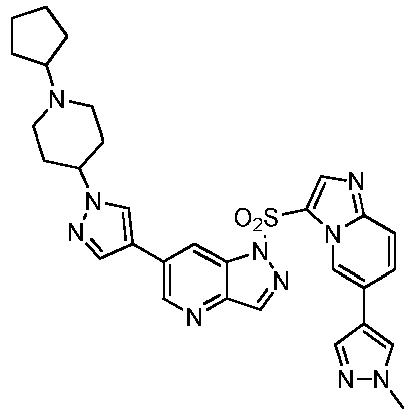
- Except for 1-[(1-cyclopentyl)-4-piperidinyl]pyrazolo-4-borate pinacol ester was used instead of 1-t-butoxycarbonyl-1H-pyrazolo-4-borate pinacol ester, compound 1-{(6-[(1-methyl)-4-pyrazolyl]-imidazo[1,2-a] pyridine)-3-sulfonyl}-6-{{1-[(1-cyclopentyl)-4-piperidinyl]}-4-pyrazolyl}-1-H-pyrazolo[4,3-b]pyridine was prepared by the same process as Example 106.
1H NMR (400 MHz, CDCl3) δ 9.16 (s, 1H), 8.85 (d, J=1.8 Hz, 1H), 8.50-8.44 (m, 1H), 8.34 (s, 1H), 8.30 (s, 1H), 8.00 (s, 1H), 7.94 (s, 1H), 7.80 (s, 1H), 7.76 (s, 1H), 7.72 (d, J=9.2 Hz, 1H), 7.63 (dd, J=9.3, 1.7 Hz, 1H), 4.59-4.46 (m, 1H), 4.01 (s, 3H), 3.55 (q, J=10.0 Hz, 2H), 3.14 (dd, J=21.5, 6.8 Hz, 1H), 2.53-2.42 (m, 2H), 2.06 (dt, J=13.3, 7.1 Hz, 3H), 2.00-1.81 (m, 6H), 1.64 (dd, J=12.8, 4.8 Hz, 3H). -

- Except for 1-isopropyl-1,2,3,6-tetrahydropyridine-4-borate pinacol ester was used instead of 1-t-butoxycarbonyl-1H-pyrazolo-4-borate pinacol ester, compound 1-{(6-[(1-methyl)-4-pyrazolyl]-imidazo[1,2-a]pyridine)-3-sulfonyl}-6-[(1-isopropyl)-4-(1,2,3,6-tetrahydropyridinyl)]-1-H-pyrazolo[4,3-b]pyridine was prepared by the same process as Example 106.
1H NMR (400 MHz, CDCl3) δ 9.14 (s, 1H), 8.77 (d, J=1.8 Hz, 1H), 8.40 (s, 1H), 8.34 (s, 1H), 8.30 (s, 1H), 7.80 (s, 1H), 7.77 (s, 1H), 7.72 (d, J=9.4 Hz, 1H), 7.63 (dd, J=9.3, 1.7 Hz, 1H), 6.30 (m, 1H), 4.02 (s, 3H), 3.75-3.68 (m, 2H), 3.37 (m, 1H), 3.25 (m,2H), 3.01 (m, 2H), 1.41 (d, J=6.6 Hz, 6H). -

- Except for 1-[(1-ethyl)-4-piperidinyl]pyrazolo-4-borate pinacol ester was used instead of 1-t-butoxycarbonyl-1H-pyrazolo-4-borate pinacol ester, compound 1-{(6-[(l-methyl)-4-pyrazolyl]-imidazo[1,2-a]pyridine)-3 sulfonyl}-6-{{1-[(1-ethyl)-4-piperidinyl]}-4-pyrazolyl}-1-H-pyrazolo[4,3-b] pyridine was prepared by the same process as Example 106.
1H-NMR (400 MHz, DMSO-d 6) δ 9.05 (d, J=1.8 Hz, 1H), 8.96 (s, 1H), 8.75 (s, 1H), 8.65 (s, 1H), 8.60 (s, 2H), 8.36 (s, 1H), 8.27 (s, 1H), 7.96 (d, J=13.6 Hz, 2H), 7.90 (d, J=8.9 Hz, 1H), 4.82 (d, J=13.6 Hz, 1H), 4.52 - 4.40 (m, 1H), 4.03 (d, J=13.6 Hz, 1H), 3.36 - 3.25 (m, 1H), 2.81 (dd, J=18.6, 7.3 Hz, 1H), 2.29 (dd, J=24.4, 12.2 Hz, 2H), 2.18 (m, 2H), 2.13 - 1.96 (m, 2H), 1.35 (t, J=6.6 Hz, 3H). -

- Except for 1,2,3,6-tetrahydropyridine-4-borate pinacol ester was used instead of 1-t-butoxycarbonyl-1H-pyrazolo-4-borate pinacol ester, compound 1-{(6-[(1-methyl)-4-pyrazolyl]-imidazo[1,2-a]pyridine)-3-sulfonyl}-6-[4-(1,2,3,6-tetrahydropyridinyl)]-1-H-pyrazolo[4,3-b]pyridine was prepared by the same process as Example 106.
1H NMR (400 MHz, CDCl3) δ 9.15 (s, 1H), 8.78 (s, 1H), 8.36 (s, 1H), 8.33 (s, 1H), 8.27 (s, 1H), 7.81 (s, 1H), 7.76 (s, 1H), 7.71 (d, J=9.3 Hz, 1H), 7.62 (d, J=9.6 Hz, 1H), 6.39 (m, 1H), 4.02 (s, 3H), 3.70-3.60 (m, 2H), 3.21 (t, J=5.6 Hz, 2H), 2.65-2.53 (m, 2H). -

1H-NMR (400 MHz, DMSO-d 6) δ 9.05 (d, J=1.8 Hz, 1H), 8.96 (s, 1H), 8.75 (s, 1H), 8.65 (s, 1H), 8.60 (s, 2H), 8.36 (s, 1H), 8.27 (s, 1H), 7.96 (d, J=13.6 Hz, 2H), 7.90 (d, J=8.9 Hz, 1H), 4.51 (m, 2H), 3.95 (s, 3H), 3.40 (m, 3H), 3.06 (m, 3H). -

- Except for 1-[(1-t-butoxycarbonyl)-4-piperidinyl]-pyrazolo-4-borate pinacol ester was used instead of 1-t-butoxycarbonyl-1H-pyrazolo-4-borate pinacol ester, compound 1-{(6-[(1-methyl)-4-pyrazolyl]-imidazo[1,2-a]pyridine)-3-sulfonyl}-6-{{1-[(1-t-butoxycarbo nyl)-4-piperidinyl]}-4-pyrazolyl}-1-H-pyrazolo[4,3-b]pyridine was prepared by the same process as Example 106.
1H-NMR (400 MHz, CDCl3) δ 9.17 (s, 1H), 8.86 (d, J=1.9 Hz, 1H), 8.46 (m, 1H), 8.33 (s, 1H), 8.28 (s, 1H), 7.95 (s, 1H), 7.87 (s, 1H), 7.85 (s, 1H), 7.78 (s, 1H), 7.72 (d, J=9.4 Hz, 1H), 7.63 (dd, J=9.3, 1.7 Hz, 1H), 4.35 (m, 3H), 4.04 (s, 3H), 2.95 (m, 2H), 2.20 (m, 2H), 2.00 (m, 4.4 Hz, 2H), 1.50 (s, 9H). -
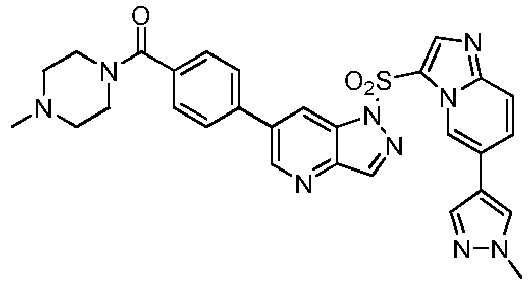
- Except for 4-(4-methylpiperazine-1-carbonyl)phenylborate was used instead of 1-t-butoxycarbonyl-1H-pyrazolo-4-borate pinacol ester, compound 1-{(6-[(1-methyl)-4-pyrazolyl]-imidazo[1,2-a]pyridine)-3-sulfonyl}-6-[4-(4-methylpiperazine-1-carbonyl)phenyl]-1-H-pyrazolo[4,3-b]pyridine was prepared by the same process as Example 106.
1H NMR (400 MHz, CDCl3) δ 9.19 (s, 1H), 8.94 (d, J=1.8 Hz, 1H), 8.65-8.59 (m, 1H), 8.41 (s, 1H), 8.29 (s, 1H), 7.83 (s, 1H), 7.77-7.70 (m, 4H), 7.67-7.58 (m, 3H), 4.01 (s, 3H), 3.94-3.80 (m, 2H), 3.61-3.45 (m, 2H), 2.62-2.50 (m, 2H), 2.48-2.39 (m, 2H), 2.36 (s, 3H). -

- Except for 4-morpholinomethylphenylboronic acid was used instead of 1-t-butoxycarbonyl-1H-pyrazolo-4-borate pinacol ester, compound 1-{(6-[(1-methyl)-4-pyrazolyl]-imidazo[1,2-a]pyridine)-3-sulfonyl}-6-(4-morpholinomethylp henyl)-1-H-pyrazolo[4,3-b]pyridine was prepared by the same process as Example 106.
1H NMR (400 MHz, CDCl3) δ 9.18 (s, 1H), 8.94 (s, 1H), 8.60 (s, 1H), 8.40 (s, 1H), 8.29 (s, 1H), 7.82 (s, 1H), 7.75 (s, 1H), 7.72 (d, J=9.3 Hz, 1H), 7.65 (d, J=7.5 Hz, 3H), 7.53 (d, J=7.9 Hz, 2H), 4.01 (s, 3H), 3.76 (t, J=4.6 Hz, 4H), 3.60 (s, 2H), 2.59-2.44 (m, 4H). -

- Except for phenylboronic acid was used instead of 1-t-butoxycarbonyl-1H-pyrazolo-4-borate pinacol ester, compound 1-{(6-[(1-methyl)-4-pyrazolyl]-imidazo[1,2-a]pyridine)-3-sulfonyl}-6-phenyl-1-H-pyrazolo[4 ,3-b]pyridine was prepared by the same process as Example 106.
1H NMR (400 MHz, CDCl3) δ 9.18 (s, 1H), 8.95 (s, 1H), 8.62 (s, 1H), 8.40 (s, 1H), 8.30 (s, 1H), 7.82 (s, 1H), 7.76-7.67 (m, 4H), 7.63 (d, J=9.3 Hz, 1H), 7.57 (t, J=7.4 Hz, 2H), 7.51 (t, J=7.2 Hz, 1H), 4.00 (s, 3H). -

- Except for 1-[(1-isopropyl)-4-piperidinyl]pyrazolo-4-borate pinacol ester was used instead of 1-t-butoxycarbonyl-1H-pyrazolo-4-borate pinacol ester, compound 1-{(6-[(1-methyl)-4-pyrazolyl]-imidazo[1,2-a]pyridine)-3-sulfonyl} -6-phenyl-1-H-pyrazolo[4,3-b]pyridine was prepared by the same process as Example 106.
1H NMR (400 MHz, CDCl3) δ 9.16 (s, 1H), 8.85 (s, 1H), 8.46 (s, 1H), 8.33 (s, 1H), 8.29 (s, 1H), 7.94 (d, J=6.8 Hz, 2H), 7.81 (s, 1H), 7.74 (s, 1H), 7.72 (d, J=9.3 Hz, 1H), 7.63 (d, J=9.4 Hz, 1H), 4.27 (td, J=10.9, 5.4 Hz, 1H), 4.00 (s, 3H), 3.12 (dd, J=9.7, 6.1 Hz, 2H), 2.91 (p, J=6.6 Hz, 1H), 2.46 (t, J=11.5 Hz, 2H), 2.40-2.28 (m, 2H), 2.23-2.01 (m, 2H), 1.14 (d, J=6.5 Hz, 6H). - Enzymatic reaction substrate Poly(Glu,Tyr)4:1 was diluted to 20 µg/mL in potassium ion free PBS (10 mM sodium phosphate buffer, 150 mM NaCl, pH7.2-7.4), microplate was coated with this solution at 125 µL per well, and reacted at 37°C for 12-16 hours. Liquid in wells was discarded. Plate washing: the plate was washed 3 times for 5 minutes each with 200 µL per well of T-PBS (potassium ion free PBS containing 0.1% Tween-20). The microplate was dried in 37°C oven for 1-2 hours.
- Into each well was added 49 µL diluted ATP solution in reaction buffer (50 mM HEPES pH 7.4, 50 mM MgCl2, 0.5 mM MnCl2, 0.2 mM Na3VO4, 1 mM DTT), and 1 µL per well of compound to be tested was added, then 50 µL diluted solution of c-Met kinase domain recombinant protein in reaction buffer was added to initiate the reaction, each test was setup with two wells of ATP free control. Reaction was performed in a 37°C shaker (100 rpm) for 1 hour. Liquid in the wells was discarded, and the plate was washed three times with T-PBS.
- Antibody PY99 was added at 100 µL per well (the antibody was 1:500 diluted in T-PBS containing 5mg/mL BSA), incubated in a 37°C shaker for 0.5 hour. Liquid in the wells was discarded, and the plate was washed three times with T-PBS.
- Goat anti mouse secondary antibody labeled with horseradish peroxidase was added at 100 µL per well (the antibody was 1:2000 diluted in T-PBS containing 5mg/mL BSA), incubated in a 37°C shaker for 0.5 hour. Liquid in the wells was discarded, and the plate was washed three times with T-PBS.
- OPD visualization solution (2 mg/ml) was added at 100 µL per well (diluted in 0.1 M citric acid-sodium citrate buffer containing 0.03% H2O2 (pH=5.4)), reacted in dark at 25°C for 1-10 minutes.
- Reaction was terminated by adding 50µL per well of 2M H2SO4, the plate was read at 490nm using a VERSAmax microplate reader with tunable wavelength.
- Inhibition rate of the sample was calculated using the following equation:

- The enzyme activity test at the molecular level (Table 1) suggests that the compounds of this invention can significantly inhibit c-Met tyrosine kinase activity, some of the compounds exhibited c-Met inhibition activity stronger than the comparative compound 1-(benzo[1,2,5]oxadiazole-4-sulfonyl) -6-[(1-methyl)-4-pyrazolyl]-1-H-pyrazolo[4,3-b]pyridine (an analogue reported in Bioorganic & Medicinal Chemistry Letters 19 (2009) 2780-2784), but weaker than the activity of the positive control PF2341066.
Table 1 Receptor tyrosin kinase c-Met inhibition rate by compounds at a concentration of 10 µM Compound No. Inhibition rate at 10 µM (%) Compound No. Inhibition rate at 10 µM (%) 1 88.1 2 92.8 3 84.6 4 44.1 5 57.5 6 34.4 7 40.7 8 72.4 9 22 10 37.9 11 48.6 12 37.5 13 52.6 14 74.3 15 40.6 16 73.2 17 49.9 18 64 19 59.3 20 85.7 21 77.9 22 69.5 23 65.1 24 70.5 25 86.2 26 65.2 27 70.6 28 70.6 29 65.7 30 71 31 69 32 64.2 33 53.7 34 61.3 35 62.5 36 66.3 37 73.3 38 87.1 39 68.8 40 66 41 68.7 42 67.5 43 58.4 44 87.5 45 89.6 46 81.3 47 79.8 48 87.3 49 76.7 50 93.9 51 72.3 52 54.5 53 65.7 54 70.7 55 74.1 56 62.1 57 60.8 58 58.9 59 60.3 60 57.4 61 59.8 62 62.6 63 83.2 64 80 65 79.3 66 63 67 66 68 69.8 69 79.9 70 68.2 71 62 72 80.9 73 59.6 74 >67.6 75 >77.3 76 >76.3 77 >76.9 78 >12.1 79 >83.1 80 >75.3 81 >68.7 82 >78.5 83 >79.8 84 >71.5 85 >71.2 86 >67.9 87 >76.8 88 >70.2 89 >71.7 90 >72.2 91 >69.4 92 >71.9 93 >64.5 94 >74.3 95 >72.1 96 >71.8 97 >63.8 98 >77.9 99 >73.3 100 >60.4 101 >64.5 102 >65.5 - Enzymatic reaction substrate Poly(Glu,Tyr)4:1 was diluted to 20 µg/mL in potassium ion free PBS (10 mM sodium phosphate buffer, 150 mM NaCl, pH7.2-7.4), microplate was coated with this solution at 125 µL per well, and reacted at 37°C for 12-16 hours. Liquid in wells was discarded, then the plate was washed 3 times for 5 minutes each with 200 µL per well of T-PBS (PBS containing 0.1% Tween-20). The microplate was dried in 37°C oven for 1-2 hours.
- Into each well was added 50 µL diluted ATP solution in reaction buffer (50 mM HEPES pH 7.4, 50 mM McCl2, 0.5 mM MnCl2, 0.2 mM Na3VO4, 1 mM DTT), the final concentration was 5 µM. Test compound was diluted in DMSO to proper concentration, added at 1 µL per well or corresponding level of DMSO (negative control wells), then 49 µL diluted solution of c-Met kinase domain recombinant protein in reaction buffer was added to initiate the reaction, each test was setup with two wells of ATP free control. Reaction was performed in a 37°C shaker (100 rpm) for 1 hour. The plate was washed three times with T-PBS. Primary antibody PY99 diluted solution was added at 100 µL per well, incubated in a 37°C shaker for 0.5 hour. The plate was washed three times with T-PBS. Goat anti mouse secondary antibody labeled with horseradish peroxidase was added at 100 µL per well, incubated in a 37°C shaker for 0.5 hour. The plate was washed three times with T-PBS. OPD visualization solution (2 mg/ml) was added at 100 µL per well (diluted in 0.1 M citric acid-sodium citrate buffer containing 0.03% H2O2 (pH=5.4)), reacted in dark at 25°C for 1-10 minutes (OPD dissolve was accomplished with ultrasound treatment, and the visualization solution was made immediately prior to use). Reaction was terminated by adding 50 µL per well of 2M H2SO4, the plate was read at 490 nm using a SPECTRA MAX 190 microplate reader with tunable wavelength.
- Inhibition rate of the sample was calculated using the following equation:

- IC50 was calculated by fitting the data for a four parameter fit using inhibition curve. Test results are shown below in Table 2.
- Assays on the growth inhibition of the compounds against gastric tumor cell MKN45, non-small cell carcinoma EBC-1 cell (both are MET persistent activated cell lines due to MET gene amplification, and are Met dependent tumor cell lines, MKN45 cell was purchased from JCRB, Japan, EBC-1 cell was purchased from ATCC, USA) were detected using sulforhodamine B (SRB) staining. A certain amount of MKN45 cells and EBC-1 cells at log phase were inoculated into 96-well culture plate at 90 µL per well, incubated overnight and then 10 µL compound at various concentrations or vehicle control (normal saline) was added, each concentration was tested in triplicate. After incubation with compound for 72 hours, the incubation was terminated, adherent cells were retained and medium was discarded, 10% (w/v) trichloroacetic acid (100 µL pre well) was added, the cells were fixed at 4°C for 1 hour, then rinsed with distilled water for 5 times, after dried at room temperature, SRB solution (4 mg/mL, dissolved in 1% glacial acetic acid) was added at 100 µL per well, incubated and stained at room temperature for 15 minutes, then rinshed with 1% glacial acetic acid for 5 times to remove any unbound SRB, dried at room temperature, then 10 mM Tris solution was added at 100 µL per well, the optical density (OD) value at 515 nm was measured using VERSMax microplate reader.
- The inhibition rate of tumor cell growth by the compound was calculated by the following equation: inhibition rate (%)=(OD of control well -OD of administered well)/ OD of control well x 100%. Experiments were conducted in duplicates. IC50 value was calculated by fitting the data for a four parameter fit using inhibition curve, the results are shown below in Table 2.
- Assays on the growth inhibition of the compounds against engineered BaF3/TPR-Met cell (engineered cell line having TPR-Met fusion protein stably expressed in cytoplasm, persistently activated, Met dependent sensitive cell line; BaF3 cell was purchased from DSMZ, German) were detected using microculture tetrozolium (MTT) staining. A certain amount of BaF3/TPR-Met cells at log phase were inoculated into 96-well culture plate at 90 µL per well, incubated overnight and then 10 µL compound at various concentrations or vehicle control (normal saline) was added, each concentration was tested in triplicate. After incubation with compound for 72 hours, the incubation was terminated, MTT solution (5 mg/mL) was added at 20 µL per well, incubated at 37°C for 4 hours, then 100 µL triplet solution (10% SDS - 5% isobutanol - 0.01 M HCl) was added, incubated overnight at 37°C, OD value was measured at 570 nm. The inhibition rate of tumor cell growth by the compound was calculated by the following equation: inhibition rate (%)=(OD of control well -OD of administered well)/ OD of control well x 100%. Experiments were conducted in duplicates. The results are shown below in Table 2.
Table 2 Compound Average inhibition rate at 10 µM (%) Average inhibition rate at 1 µM (%) Average inhibition rate at 0.1 µM (%) IC50 (nM) Cell proliferation inhibition rate at 1 µM(%) Cell proliferation inhibition rate at 200 nM (%) Cell line 01 88.1 02 92.8 7 03 84.6 04 44.1 05 57.5 33.8 2.1 06 34.4 07 40.7 08 72.4 51.6 9.2 09 22 10 37.9 11 48.6 12 37.5 13 52.6 45.3 28.5 14 74.3 54.7 39.9 15 40.6 16 73.2 56.1 25.2 17 49.9 18 64 60.5 52.2 4.2±0.6 94.4 1.8 BaF3/TPR-Met 19 59.3 53.5 59.2 7.8±0.8 95.6 91.8 BaF3/TPR-Met 20 85.7 72.6 54.9 316.2±141.5 2.9 3.2 BaF3/TPR-Met 21 77.9 59.7 59 42.7 BaF3/TPR-Met 22 69.5 58.7 24.9 39.7±6.3 23 65.1 52.7 26.9 3.7±1.4 24 70.5 67.8 62.9 2.5±1.2 90.9 65.9 BaF3/TPR-Met 25 86.2 78 71.7 21.3±2.3 88.4 36.3 BaF3/TPR-Met 26 65.2 63.8 60 33.9±6.9 BaF3/TPR-Met 27 70.6 59.6 56.9 0.5±0.1 EBC-1 28 70.6 70.3 64.6 6.7±0.5 66.1 BaF3/TPR-Met 29 65.7 63.8 55.7 4.6±1.0 92.6 BaF3/TPR-Met 30 71 59.7 48.3 31 69 64.1 59 32 64.2 52 52.9 33 53.7 47.3 39.9 34 61.3 49.3 31.3 35 62.5 53.2 51.1 36 66.3 60 45.6 37 73.3 63.8 60.1 6.4±2.2 96.2 59.5 BaF3/TPR-Met 38 87.1 63.9 63.2 39 68.8 65 58.2 2.6±0.3 96.3 74.4 BaF3/TPR-Met 40 66 57.4 45.7 41 68.7 54.6 45.1 42 67.5 58.4 45.5 43 68.7 47.6 23.1 44 87.5 78.6 74.6 6.9±1.9 95.8 95 BaF3/TPR-Met 45 89.6 76.5 3.7±1.4 2.9±0.6 95.9 27.9 BaF3/TPR-Met 46 81.3 65 55.9 68 33.7 BaF3/TPR-Met 47 79.8 56.1 35.1 48 87.3 77.6 65.6 49 76.7 74.5 71 90.5 28.4 BaF3/TPR-Met 50 93.9 67.4 66.8 30.5 32.7 BaF3/TPR-Met 51 72.3 66.7 64.6 7.7 15.3 BaF3/TPR-Met 52 54.5 50.3 24.5 53 74.1 68.4 67.5 90.9 BaF3/TPR-Met 54 62.1 57.9 55.9 89.6 88.3 BaF3/TPR-Met 55 60.8 58.3 58.8 1.3±0.1 89.8 89.3 BaF3/TPR-Met 56 58.9 56.3 53.3 90.6 79.1 BaF3/TPR-Met 57 60.3 54.5 52.4 89.5 86.8 BaF3/TPR-Met 58 57.4 55.7 52.8 BaF3/TPR-Met 59 59.8 51.9 51.6 89.8 70.6 BaF3/TPR-Met 60 62.6 53.4 50.1 89.4 84.8 BaF3/TPR-Met 61 83.2 76 73.7 91.7 83.1 BaF3/TPR-Met 62 80 73.2 73.2 BaF3/TPR-Met 63 63 60.4 59 66.5 BaF3/TPR-Met 64 66 60.4 59.1 76.4 BaF3/TPR-Met 65 69.8 65.1 60.8 BaF3/TPR-Met 66 79.9 75.8 73.3 92.7 BaF3/TPR-Met 67 68.2 64.6 63.1 91.6 90.3 BaF3/TPR-Met 68 62 55.8 50.2 BaF3/TPR-Met 69 59.6 57.7 52.3 70 79.3 44.7 71 83.8 73.4 68.5 0.1±0.01 MKN45 72 76.5 80.3 70.1 0.04±0.04 72.8 MKN45 73 76.9 72.8 78 14.4 MKN45 74 12.1 75 83.1 75.6 74.6 MKN45 76 78.3 75.5 78 14.9 MKN45 77 85.5 64.8 55.8 MKN45 78 89.3 69.3 64.5 MKN45 79 77.4 30.5 80 80.6 47.5 81 80.2 73.6 72.9 24.7 MKN45 82 77.7 63.8 54.4 MKN45 83 77.7 44.4 84 73.5 41.2 85 79.4 30.1 86 77.8 66.6 45 87 72.5 72.7 33.8 88 64.5 59.4 1.1 89 83.4 79.9 45.3 90 81.1 83 69 17.6 MKN45 91 74.1 85.5 77.3 72.9 MKN45 92 78.9 79.1 82.8 MKN45 93 77.9 76.8 76.1 MKN45 94 83.9 55.7 72.1 MKN45 95 63.4 57.1 62.7 65.5 42.3 MKN45 96 68.3 61.5 56.6 0.7±0.1 MKN45 97 65.5 62.7 51.7 0.5±0.1 67.8 MKN45 98 74.3 66.8 50.6 1.4±0.1 MKN45 99 71.8 66.2 55.5 67.9 48.5 MKN45 100 85.4 87.3 83.7 66.6 63.8 MKN45 101 100 100 0.3±0.1 102 95.4 85.3 73.7 67.9 63.8 MKN45 103 100.7 98.5 3.2±0.3 92.7 80.9 EBC-1 104 100.5 99.8 2.1±0.6 89.2 85.7 EBC-1 105 100.3 97.8 2.6±0.4 91.5 77.7 EBC-1 106 100.6 103.9 1.9±0.1 85.7 37.0 EBC-1 107 88.2 29.1 18.1 18.9 EBC-1 108 61.4 9.1 20.6 15.4 EBC-1 109 40 110 13.5 111 63.3 28.6 112 48.8 113 97.7 48.6 9 7.9 EBC-1 114 30.4 115 95.7 46.6 EBC-1 116 84.6 70.8 3.6±0.6 EBC-1 117 15.8 118 75.5 62.7 EBC-1 119 26.4 120 28.7 121 101.1 99 9.0±1.0 92.5 91.6 EBC-1 122 100.5 72.9 189.7±32.7 EBC-1 123 99.3 87 51.5±6.0 EBC-1 124 99.7 94.4 4.7±1.0 92.7 43.1 EBC-1 125 99.3 84.5 55.2±5.6 EBC-1 126 100.1 100 7.3±1.1 87 35.1 EBC-1 127 99 93.9 30.0±3.3 EBC-1 128 99.3 99.4 2.0±0.2 87 80.6 EBC-1 129 101.2 99.6 2.7±0.5 86.6 79 EBC-1 130 90.8 16.1 EBC-1 131 83.6 75.1 EBC-1 132 100 92.1 85.4 48.2 EBC-1 133 100 100 2.6±0.2 87.8 86.4 EBC-1 134 56.9 66.8 EBC-1 135 88.2 87.4 2.6±0.2 91.4 89.4 EBC-1 136 91.3 90.2 1.2±0.1 92.4 91.4 EBC-1 137 89.9 91.6 1.3±0.1 92.4 73 EBC-1 138 90.5 87.7 0.6±0.01 92.9 90.9 EBC-1 139 88.9 90.3 1.0±0.1 91.6 90.7 EBC-1 140 89.5 92.4 0.5±0.03 92 91.4 EBC-1 141 88.5 86.3 0.3±0.1 92.7 92.6 EBC-1 142 91.3 89.4 0.5±0.1 92.6 92.1 EBC-1 143 92.1 90 0.4±0.1 92.5 92.3 EBC-1 144 93.1 92.1 0.3±0.01 91.4 91.1 EBC-1 145 87.1 90.6 0.6±0.1 92.8 92.4 EBC-1 - EBC-1 cells were implanted subcutaneously in the right axilla of nude mice at 5x10⁶ cells per mouse, xenograft developed thereby was passaged in nude mice for 3 generations prior to use. Tumor tissue at rapid growth phase was taken, minced under sterile condition into pieces of about 1.5 mm3, then implanted subcutaneously in the right axilla of nude mice. Xenografted tumor diameters were determined by caliper measurements, when the tumor grew to give a tumor volume of 100-200 mm3, the animals were randomized into groups based on the tumor volume, 12 animals in the vehicle control group, and 6 animals in each test group. The test groups were administered orally with compound 142 or 145 (50mg/kg, 100mg/kg), the administration was made daily for 21 consecutive days, while the vehicle control group was administered with equivalent amout of solvent (0.5% sodium carboxymethyl cellulose).
- Xenografted tumor diameters were measured twice per week, and body weights of the mice were measured at the same time. Tumor Volume (TV) was calculated by the following equation: TV=1/2xaxb2, wherein a, b refers to the length and width, respectively. Based on the measurement, Relative Tumor Volume (RTV) was calculated by the following equation: RTV=Vt/Vo, wherein V0 is the tumor volume measured when divided for administration (i.e., do), Vt is the tumor volume measured at each timepoint. Antitumor activity is evaluated by the following indices: 1) relative tumor proliferation rate T/C(%), calculated by the following equation: T/C(%)= (TRTV/ CRTV)x100 %, TRTV: RTV of treatment group; CRTV: RTV of negative control group; 2) inhibition rate of tumor volume increase GI%, calculated by the following equation: GI%=[1-(TVt-TV0)/(CVt-CV0)]×100%, TVt is the tumor volume of the treatment group measured at each timepoint; TV0 is the tumor volume of the treatment group measured when divided for administration; CVt is the tumor volume of the contrl group measured at each timepoint; CV0 is the tumor volume of the contrl group measured when divided for administration.
- When administration was completed (d21), compound 142 exhibited very significant dose dependent inhibition against the tumor growth of human lung cancer EBC-1 subcutaneous xenograft in nude mice, 100mg/kg and 50mg/kg dosage groups obtained T/C percentages of 1.05% and 16.91%, respectively, at
day 21, in 100mg/kg dosage group, two mice exhibited complete tumor regression atday 11 and four mice exhibited complete tumor regression by the end of the trial.Compound 145 exhibited very significant dose dependent inhibition against the tumor growth of human lung cancer EBC-1 subcutaneous xenograft in nude mice, 100mg/kg and 50mg/kg dosage groups obtained T/C percentages of 0.40% and 2.36%, respectively, atday 21; in 100mg/kg dosage group, two mice exhibited complete tumor regression atday 11 and four mice exhibited complete tumor regression by the end of the trial; in 50mg/kg dosage group, two mice exhibited complete tumor regression atday 18 and three mice exhibited complete tumor regression by the end of the trial. During the administration period, mice in all treatment groups were in good state and were survived (Fig. 1 ).Table 3 Experimental therapeutic effect of compounds on human lung cancer EBC-1 xenograft in nude mice Group Dosage, mode of administration Animal number Weight (g) TV (mm3, mean±SD) RTV (mean±SD) T/C (%) GI (%) d0 d21 d0 d21 d0 d21 Vehicle control 0.2m1/animal, qd/21 po 12 12 17.9 22.8 126±31 1606±362 13.18±3.39 142 100mg/kg qd/21 po 6 6 17.8 20.9 120±30 21±34(4) 0.14±0.21*** 1.05 106.70 50mg/kg qd/21 po 6 6 17.7 21.0 120±25 259±421 2.23±3.89*** 16.91 90.65 145 100mg/kg qd/21 po 6 6 16.9 19.1 123±27 8±13(4) 0.05±0.09*** 0.40 107.77 50mg/kg qd/21 po 6 6 16.8 19.9 127±32 36±49(3) 0.31±0.50*** 2.36 106.14 t student's test vs vehicle control, ***, p<0.001 numbers in parenthesis are the numbers of mice exhibiting complete tumor regression - U87-MG cells were expanded by in vitro culture, cells at log phase were harvested and resuspended in EMEM, adjusted to a cell density of 2.8x10⁷/mL, then implanted subcutaneously in the right axilla of nude mice. Animals and the growth status of the xenograft were monitored periodically, when tumor volume generally reached 100∼300 mm3, animails bearing tumor in too big size, too small size, or in irregular shape were eliminated, and the remaining tumor bearing mice were randomized into 2 groups based on the tumor volume, one vehicle control group (5%DMAC containing 0.5% methylcellulose), and one test group receiving Sample 19 at 50mg/kg daily for 14 consecutive days.
- During the trial, tumor diameters and animal weights were measured twice a week. Tumor Volume (TV) was calculated by the following equation: TV=1/2xaxb2 wherein a, b represent length and width, respectively. Based on the measurement, Relative Tumor Volume (RTV) was calculated by the following equation: RTV=Vt/Vo, wherein V0 is the tumor volume measured when divided for administration (i.e., d0), Vt is the tumor volume measured at each timepoint. Antitumor activity is evaluated by the following indices: 1) relative tumor proliferation rate T/C(%), calculated by the following equation: T/C(%)= (TRTV/ CRTV)×100 %, TRTV: RTV of treatment group; CRTV: RTV of negative control group; 2) inhibition rate of tumor volume increase GI%, calculated by the following equation: GI%=[1-(TVt-TV0)/(CVt-CV0)]×100%, TVt is the tumor volume of the treatment group measured at each timepoint; TV0 is the tumor volume of the treatment group measured when divided for administration; CVt is the tumor volume of the contrl group measured at each timepoint; CV0 is the tumor volume of the contrl group measured when divided for administration.
- When administration was completed (d14), test group receiving compound 19 at 50mg/kg exhibited favorable antitumor activity, relative tumor proliferation rate (%T/C) at the end of the trial was 7.29% (P<0.01), the test group exhibited a very significant difference in relative tumor volume when compared to the vehicle control group. During the administration period, all mice in treatment group were in good state and were survived (
Fig. 2 ).Table 4. Experimental therapeutic effect of compound on U87MG xenograft in nude mice Group Dosage, mode of administration Animal number Weight (g) TV (mm3, mean±SE) RTV (mean ±SE) T/C (%) GI (%) d0 d14 d0 d21 d0 d21 Vehicle control 0.25ml/animal qd/14 po 12 12 23.5 24.6 182 ±22 1846 ±149 1056.3 ±92.2 19 50mg/kg qd/14 po 6 6 24.2 24.5 180 ±20 140 ±20 77.0 ±5.2** 7.29 102.41 t student's test vs vehicle control group, **, p<0.01 - Although the present invention is described referring to specific examples, it is obvious to a person skilled in the art that numerous modifications and variations may be made to this invention without departing from the spirit and scope of the present invention. Accordingly, the appended claims cover all these modifications within the scope of this invention. All publications, patents and patent applications cited herein are incorporated herein by reference.
Claims (10)
- A 5-member-heterocycle-fused pyridine compound having a structure of Formula (X), pharmaceutically acceptable salts or pharmaceutically acceptable solvates thereof,

W and V are each independently selected from H, halogen, unsubstituted or halogen-substituted C1-C4 alkyl, unsubstituted or halogen-substituted C1-C4 alkoxy, nitro, cyano;
R1 is substituted or unsubstituted C6-C20 aryl; substituted or unsubstituted 5- to 10-membered heteroaryl containing 1-5 heteroatoms selected from N, O, and S; or substituted or unsubstituted 4- to 10-membered heterocyclyl containing 1-5 heteroatoms selected from N, O, and S; wherein, substituent in the substituted group is halogen, nitro, cyano, hydroxyl; unsubstituted or halogen- or morpholinyl-substituted C1-C6 alkyl, C1-C6 alkoxy, C1-C6 alkylcarbonyl, C1-C6 alkoxycarbonyl, -NRaRb, -C(O)(NRaRb), -OC(O)-Rf, unsubstituted phenyl or phenyl substituted by 1-4 of R3, or unsubstituted 4- to 7-membered heteroaryl containing 1-5 heteroatoms selected from N, O, and S or 4- to 7-membered heteroaryl containing 1-5 heteroatoms selected from N, O, and S substituted by 1-4 of R4 ;
R2 is cyano; C1-C4 alkoxycarbonyl; -NRcRd; -NHC(O)-Re; substituted or unsubstituted C6-C20 aryl; substituted or unsubstituted 5- to 10-membered heteroaryl containing 1-5 heteroatoms selected from N, O, and S; or substituted or unsubstituted 4- to 10-membered heterocyclyl containing 1-5 heteroatoms selected from N, O, and S; wherein, substituent in the substituted group is halogen, nitro, cyano, C1-C4 alkylenedioxy, unsubstituted or halogen-or -NRcRd-substituted C1-C6 alkyl or C3-C6 cycloalkyl, C1-C6 alkoxy, C1-C6 sulfamido, -NRaRb, -C(O)R', morpholinyl, morpholinylmethyl, or unsubstituted or R"-substituted piperidinyl;
wherein, R3 is halogen, nitro, cyano, C1-C4 alkylenedioxy, unsubstituted or halogen- or morpholinyl-substituted C1-C6 alkyl, C1-C6 alkoxy, -NRaRb, -C(O)R', or morpholinyl;
R4 is halogen, nitro, cyano, unsubstituted or halogen-substituted C1-C6 alkyl, C1-C6 alkoxy, -NRaRb, -C(O)R', or unsubstituted or C1-C6 alkoxycarbonyl-substituted piperidinyl;
R' is C1-C6 alkyl, C1-C6 alkoxy, -NRaRb, or unsubstituted or halogen- or C1-C6 alkyl-substituted 4- to 7-membered heterocyclyl;
R" is C1-C6 alkyl; C3-C6 cycloalkyl; C1-C6 alkylcarbonyl; C1-C6 alkoxycarbonyl; C3-C6 cycloalkylcarbonyl; or unsubstituted benzoyl or benzoyl substituted by substituent(s) selected from halogen, C1-C6 alkyl, halogen-substituted C1-C6 alkyl ;
Ra and Rb are each independently H, C1-C6 alkyl or C1-C6 alkylcarbonyl;
Rc and Rd are each independently H or C1-C6 alkyl; or, Rc and Rd, together with the N atom to which they are attached, form 3- to 7-membered heterocyclyl;
Re is unsubstituted or C1-C6 alkyl- or halogen- or C1-C6 alkoxy-substituted C6-C20 aryl, unsubstituted or halogen-substituted C1-C6 alkyl;
Rf is C1-C6 alkyl or unsubstituted or halogen- or C1-C6 alkyl-substituted 4- to 7-membered heteroaryl. - The 5-member-heterocycle-fused pyridine compound, pharmaceutically acceptable salts or pharmaceutically acceptable solvates thereof, according to claim 1, wherein, the compound has a structure of Formula (I),

X, Y and Z are each independently N or C, and at least one of X, Y and X is N;- - - - represents single bond or double bond;
R1 is substituted or unsubstituted C6-C20 aryl; substituted or unsubstituted 5- to 10-membered heteroaryl containing 1-5 heteroatoms selected from N, O, and S; or substituted or unsubstituted 4- to 10-membered heterocyclyl containing 1-5 heteroatoms selected from N, O, and S; wherein, substituent in the substituted group is halogen, nitro, cyano, unsubstituted or halogen- or morpholinyl-substituted C1-C6 alkyl, C1-C6 alkoxy, C1-C6 alkylcarbonyl, C1-C6 alkoxycarbonyl, -NRaRb, -C(O)(NRaRb), unsubstituted phenyl or phenyl substituted by 1-4 of R3, or unsubstituted 4- to 7-membered heteroaryl containing 1-5 heteroatoms selected from N, O, and S or 4- to 7-membered heteroaryl containing 1-5 heteroatoms selected from N, O, and S substituted by 1-4 of R4;
R2 is substituted or unsubstituted C6-C20 aryl; substituted or unsubstituted 5- to 10-membered heteroaryl containing 1-5 heteroatoms selected from N, O, and S; or substituted or unsubstituted 4- to 10-membered heterocyclyl containing 1-5 heteroatoms selected from N, O, and S; wherein, substituent in the substituted group is halogen, nitro, cyano, C1-C4 alkylenedioxy, unsubstituted or halogen- or -NRcRd-substituted C1-C6 alkyl, C1-C6 alkoxy, C1-C6 sulfamido, -NRaRb, -C(O)R', morpholinyl, or unsubstituted or R"-substituted piperidinyl;
wherein, R3 is halogen, nitro, cyano, C1-C4 alkylenedioxy, unsubstituted or halogen- or morpholinyl-substituted C1-C6 alkyl, C1-C6 alkoxy, -NRaRb, -C(O)R', or morpholinyl;
R4 is halogen, nitro, cyano, unsubstituted or halogen-substituted C1-C6 alkyl, C1-C6 alkoxy, -NRaRb, -C(O)R', or unsubstituted or C1-C6 alkoxycarbonyl-substituted piperidinyl;
R' is C1-C6 alkyl, C1-C6 alkoxy, -NRaRb, or unsubstituted or halogen- or C1-C6 alkyl-substituted 4- to 7-membered heterocyclyl;
R" is C1-C6 alkyl; C3-C6 cycloalkyl; C1-C6 alkylcarbonyl; C1-C6 alkoxycarbonyl; C3-C6 cycloalkylcarbonyl; or unsubstituted benzoyl or benzoyl substituted by substituent(s) selected from halogen, C1-C6 alkyl, and halogen-substituted C1-C6 alkyl;
Ra and Rb are each independently H or C1-C6 alkyl;
Rc and Rd are each independently H or C1-C6 alkyl; or, Rc and Rd, together with the N atom to which they are attached, form 3- to 7-membered heterocyclyl. - The 5-member-heterocycle-fused pyridine compound, pharmaceutically acceptable salts or pharmaceutically acceptable solvates thereof, according to claim 1 or 2, wherein X and Z are N, Y is C.
- The 5-member-heterocycle-fused pyridine compound, pharmaceutically acceptable salts or pharmaceutically acceptable solvates thereof, according to any one of claims 1 to 3,
wherein, W and V are independently selected from H, C1-C4 alkyl, C1-C4 alkoxy;
X and Z are N, Y is C;
R1 is
R2 is cyano; C1-C4 alkoxycarbonyl; -NRcRd; -NHC(O)-Re; substituted or unsubstituted C6-C20 aryl; substituted or unsubstituted 5- to 10-membered heteroaryl containing 1-5 heteroatoms selected from N, O, and S; or substituted or unsubstituted 4- to 10-membered heterocyclyl containing 1-5 heteroatoms selected from N, O, and S; wherein, substituent in the substituted group is halogen, nitro, cyano, C1-C4 alkylenedioxy, unsubstituted or halogen-or -NRcRd-substituted C1-C6 alkyl or C3-C6 cycloalkyl, C1-C6 alkoxy, C1-C6 sulfamido, -NRaRb, -C(O)R', morpholinyl, morpholinylmethyl, or unsubstituted or R"-substituted piperidinyl;
R3 is halogen, nitro, cyano, C1-C2 alkylenedioxy, unsubstituted or halogen- or morpholinyl-substituted C1-C4 alkyl, C1-C4 alkoxy, -NRaRb, -C(O)R', or 4-morpholinyl;
R4 is halogen, nitro, cyano, unsubstituted or halogen-substituted C1-C4 alkyl, C1-C4 alkoxy, -NRaRb, -C(O)R', 4-piperidinyl, or 1-t-butoxycarbonyl-4-piperidinyl;
R' is C1-C4 alkyl, C1-C4 alkoxy, -NRaRb, or 4-methylpiperazinyl;
R" is C1-C4 alkyl, C3-C6 cycloalkyl, C1-C4 alkylcarbonyl, C1-C4 alkoxycarbonyl, C3-C6 cycloalkylcarbonyl, or p-trifluoromethylbenzoyl;
Ra and Rb are each independently H, C1-C4 alkyl or C1-C4 alkylcarbonyl;
Re is unsubstituted or C1-C6 alkyl or halogen- or C1-C6 alkoxy-substituted C6-C20 aryl, unsubstituted or halogen-substituted C1-C6 alkyl;
Rf is C1-C6 alkyl or unsubstituted or halogen- or C1-C6 alkyl-substituted 4- to 7-membered heteroaryl, said 4- to 7-membered heteroaryl is selected from furanyl, pyrrolyl, thienyl. - The 5-member-heterocycle-fused pyridine compound, pharmaceutically acceptable salts or pharmaceutically acceptable solvates thereof, according to any one of claims 1 to 4,
R1 is

Rn is H, halogen; nitro; cyano; unsubstituted or halogen-, dimethylamino-, 4-morpholinyl-, 1-aziridinyl-, 1-azetidinyl-, 1-tetrahydropyrrolyl-, 1-piperidinyl- or 1-homopiperidinyl-substituted C1-C4 alkyl; C1-C4 alkoxy; C1-C4 sulfamido; -NRaRb; -C(O)R'; 4-morpholinyl; or unsubstituted or R"-substituted piperidinyl;
R' is C1-C4 alkyl, C1-C4 alkoxy, -NRaRb, or 4-methylpiperazinyl;
R" is C1-C4 alkyl, C3-C6 cycloalkyl, C1-C4 alkylcarbonyl, C1-C4 alkoxycarbonyl, C3-C6 cycloalkylcarbonyl, or p-trifluoromethylbenzoyl;
Ra and Rb are independently H, C1-C4 alkyl or C1-C4 alkylcarbonyl. - The 5-member-heterocycle-fused pyridine compound, pharmaceutically acceptable salts or pharmaceutically acceptable solvates thereof, according to claim 1, wherein, the 5-member-heterocycle fused pyridine compound is selected from the following compounds:





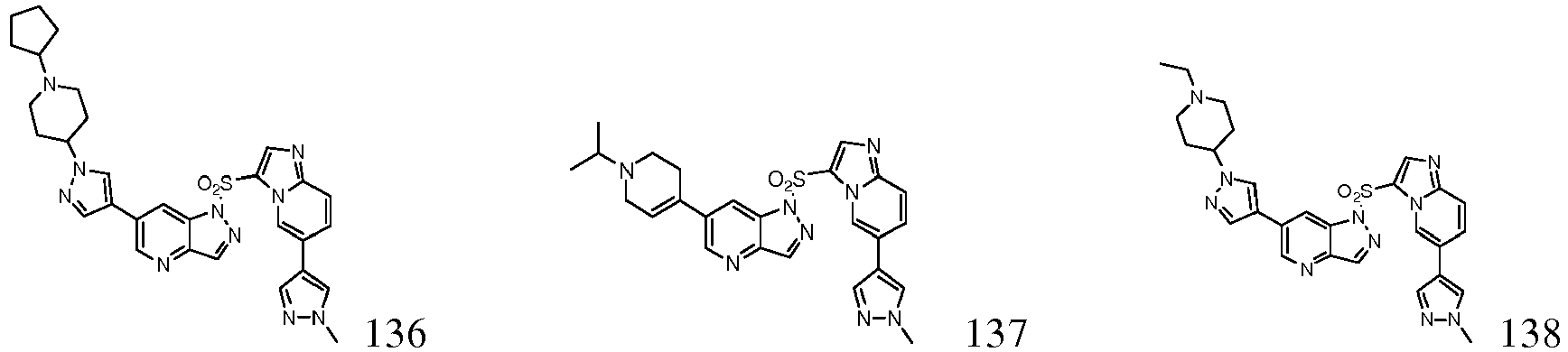



- Use of the 5-member-heterocycle-fused pyridine compound, pharmaceutically acceptable salts or pharmaceutically acceptable solvates thereof according to any one of claims 1 to 6 in preparation of a medicament for preventing or treating diseases associated with abnormal cell proliferation, morphological change and hyperkinesis related to abnormal protein tyrosine kinase, or diseases related to angiogenesis or metastasis.
- Use of the 5-member-heterocycle-fused pyridine compound, pharmaceutically acceptable salts or pharmaceutically acceptable solvates thereof according to any one of claims 1 to 6 in preparation of a medicament as protein tyrosine kinase inhibitor, particular in preparation of a medicament as c-Met inhibitor.
- A pharmaceutical composition compring a prophylactically or therapeutically effective amount of one or more 5-member-heterocycle-fused pyridine compound, pharmaceutically acceptable salts or pharmaceutically acceptable solvates thereof according to any one of claims 1 to 6, and a pharmaceutically acceptable excipient.
- A method of preventing or treating diseases associated with abnormal cell proliferation, morphological change and hyperkinesis related to abnormal protein tyrosine kinase, or diseases related to angiogenesis or metastasis, in a subject in need thereof, said method comprises administerating a prophylactically or therapeutically effective amount of the 5-member-heterocycle-fused pyridine compound, pharmaceutically acceptable salts or pharmaceutically acceptable solvates thereof according to any one of claims 1 to 6 or the pharmaceutical composition according to claim 9 to the subject.
Applications Claiming Priority (2)
| Application Number | Priority Date | Filing Date | Title |
|---|---|---|---|
| CN201310245354.8A CN104230922B (en) | 2013-06-19 | 2013-06-19 | One class five-ring heterocycles pyridine compounds and their and its production and use |
| PCT/CN2014/000600 WO2014201857A1 (en) | 2013-06-19 | 2014-06-18 | Five-membered heterocyclic pyridine compounds and preparation method and use thereof |
Publications (3)
| Publication Number | Publication Date |
|---|---|
| EP3012259A1 true EP3012259A1 (en) | 2016-04-27 |
| EP3012259A4 EP3012259A4 (en) | 2016-11-23 |
| EP3012259B1 EP3012259B1 (en) | 2020-06-03 |
Family
ID=52103891
Family Applications (1)
| Application Number | Title | Priority Date | Filing Date |
|---|---|---|---|
| EP14813825.8A Active EP3012259B1 (en) | 2013-06-19 | 2014-06-18 | Five-membered heterocyclic pyridine compounds and preparation method and use thereof |
Country Status (14)
| Country | Link |
|---|---|
| US (1) | US9988381B2 (en) |
| EP (1) | EP3012259B1 (en) |
| JP (1) | JP6594862B2 (en) |
| KR (1) | KR102289681B1 (en) |
| CN (1) | CN104230922B (en) |
| AU (1) | AU2014284013B2 (en) |
| BR (1) | BR112015030953B1 (en) |
| CA (1) | CA2908824C (en) |
| DK (1) | DK3012259T3 (en) |
| ES (1) | ES2802101T3 (en) |
| PT (1) | PT3012259T (en) |
| RU (1) | RU2668074C2 (en) |
| SG (1) | SG11201509511QA (en) |
| WO (1) | WO2014201857A1 (en) |
Families Citing this family (4)
| Publication number | Priority date | Publication date | Assignee | Title |
|---|---|---|---|---|
| CN108570053A (en) * | 2017-03-13 | 2018-09-25 | 中国科学院上海药物研究所 | Five yuan and 6-membered heterocyclic compound, preparation method, intermediate, combination and application |
| CN118139620A (en) | 2021-11-05 | 2024-06-04 | 上海海和药物研究开发股份有限公司 | A solid dispersion, a preparation method thereof and a solid preparation containing the same |
| WO2023078408A1 (en) * | 2021-11-05 | 2023-05-11 | 上海海和药物研究开发股份有限公司 | Pharmaceutical combination containing met receptor tyrosine kinase inhibitor and use thereof |
| EP4551226A1 (en) | 2022-07-08 | 2025-05-14 | Astrazeneca AB | Epidermal growth factor receptor tyrosine kinase inhibitors in combination with hgf-receptor inhibitors for the treatment of cancer |
Family Cites Families (12)
| Publication number | Priority date | Publication date | Assignee | Title |
|---|---|---|---|---|
| DE19834044A1 (en) * | 1998-07-29 | 2000-02-03 | Bayer Ag | New substituted pyrazole derivatives |
| CA2515571A1 (en) * | 2003-02-14 | 2004-09-02 | Wyeth | Heterocyclyl-3-sulfonylazaindole or -azaindazole derivatives as 5-hydroxytryptamine-6 ligands |
| NZ541836A (en) * | 2003-02-27 | 2008-12-24 | Palau Pharma Sa | Pyrazolopyridine derivatives |
| WO2007098418A1 (en) * | 2006-02-17 | 2007-08-30 | Memory Pharmaceuticals Corporation | Compounds having 5-ht6 receptor affinity |
| CN101918403A (en) | 2007-09-06 | 2010-12-15 | 阵列生物制药公司 | Pyrazolopyridines as Tyrosine Kinase Inhibitors |
| PL3050874T3 (en) | 2008-11-14 | 2019-07-31 | Merial Inc. | Enantiomerially enriched aryloazol-2-yl cyanoethylamino paraciticidal compounds |
| KR101023580B1 (en) | 2010-07-15 | 2011-03-21 | 전병수 | Elevator Wire Rope Tension Automatic Equalizer |
| HUE025078T2 (en) | 2010-10-29 | 2016-01-28 | Pfizer | N1/N2-LACTAM ACETYL-CoA CARBOXYLASE INHIBITORS |
| MX367341B (en) | 2012-05-08 | 2019-08-14 | Merck Sharp & Dohme | TETRAHYDRONAPHTHYRIDINE AND RELATED BICYCLIC COMPOUNDS FOR INHIBITION OF RORgamma ACTIVITY AND THE TREATMENT OF DISEASE. |
| US20140303121A1 (en) * | 2013-03-15 | 2014-10-09 | Plexxikon Inc. | Heterocyclic compounds and uses thereof |
| HRP20181392T1 (en) * | 2013-03-15 | 2018-10-19 | Plexxikon Inc. | HETEROCYCLIC COMPOUNDS AND THEIR USE |
| WO2015108861A1 (en) | 2014-01-14 | 2015-07-23 | Millennium Pharmaceuticals, Inc. | Heteroaryls and uses thereof |
-
2013
- 2013-06-19 CN CN201310245354.8A patent/CN104230922B/en active Active
-
2014
- 2014-06-18 SG SG11201509511QA patent/SG11201509511QA/en unknown
- 2014-06-18 AU AU2014284013A patent/AU2014284013B2/en active Active
- 2014-06-18 WO PCT/CN2014/000600 patent/WO2014201857A1/en not_active Ceased
- 2014-06-18 JP JP2016520243A patent/JP6594862B2/en active Active
- 2014-06-18 DK DK14813825.8T patent/DK3012259T3/en active
- 2014-06-18 PT PT148138258T patent/PT3012259T/en unknown
- 2014-06-18 EP EP14813825.8A patent/EP3012259B1/en active Active
- 2014-06-18 US US14/895,832 patent/US9988381B2/en active Active
- 2014-06-18 KR KR1020157032390A patent/KR102289681B1/en active Active
- 2014-06-18 BR BR112015030953-4A patent/BR112015030953B1/en active IP Right Grant
- 2014-06-18 CA CA2908824A patent/CA2908824C/en active Active
- 2014-06-18 ES ES14813825T patent/ES2802101T3/en active Active
- 2014-06-18 RU RU2016101983A patent/RU2668074C2/en active
Also Published As
| Publication number | Publication date |
|---|---|
| DK3012259T3 (en) | 2020-06-22 |
| BR112015030953B1 (en) | 2022-03-29 |
| JP2016521757A (en) | 2016-07-25 |
| EP3012259A4 (en) | 2016-11-23 |
| RU2668074C2 (en) | 2018-09-26 |
| CA2908824C (en) | 2021-05-25 |
| SG11201509511QA (en) | 2016-01-28 |
| EP3012259B1 (en) | 2020-06-03 |
| US20160137640A1 (en) | 2016-05-19 |
| JP6594862B2 (en) | 2019-10-23 |
| CN104230922A (en) | 2014-12-24 |
| KR20160032003A (en) | 2016-03-23 |
| BR112015030953A8 (en) | 2018-01-23 |
| AU2014284013A1 (en) | 2016-02-11 |
| CN104230922B (en) | 2016-12-28 |
| WO2014201857A1 (en) | 2014-12-24 |
| KR102289681B1 (en) | 2021-08-17 |
| CA2908824A1 (en) | 2014-12-24 |
| ES2802101T3 (en) | 2021-01-15 |
| RU2016101983A (en) | 2017-07-24 |
| AU2014284013B2 (en) | 2018-04-05 |
| US9988381B2 (en) | 2018-06-05 |
| PT3012259T (en) | 2020-07-03 |
Similar Documents
| Publication | Publication Date | Title |
|---|---|---|
| EP4691554A2 (en) | Glp-1r modulating compounds | |
| EP4406948A1 (en) | Pyridine derivative and use thereof | |
| CN104507931B (en) | Noval chemical compound | |
| JP6022588B2 (en) | New compounds | |
| EP3784671B1 (en) | Dual atm and dna-pk inhibitors for use in anti-tumor therapy | |
| JP6267231B2 (en) | Novel substituted imidazoles as casein kinase 1δ / ε inhibitors | |
| CN113316576A (en) | 2, 3-dihydro-1H-pyrrolo [3,4-c ] pyridin-1-one derivatives as HPK1 inhibitors for the treatment of cancer | |
| NZ568807A (en) | Triazolopyridazines as tyrosine kinase modulators | |
| KR20130044382A (en) | Compounds and Their Therapeutic Uses | |
| EP4567038A1 (en) | Novel prmt5 inhibitor and use thereof | |
| TWI601724B (en) | Imidazo quinoline derivatives and salts thereof, preparation process and pharmaceutical use thereof | |
| JP2024540921A (en) | Substituted triazoloheteroaryl compounds as USP1 inhibitors and their applications | |
| CN104837844A (en) | Pyrazole-substituted imidazopiperazines as casein kinase 1 D/E inhibitors | |
| US20230391769A1 (en) | Substituted heterocyclic compounds and therapeutic uses thereof | |
| CN113164481B (en) | Cycloalkane-1,3-diamine derivatives | |
| EP3012259B1 (en) | Five-membered heterocyclic pyridine compounds and preparation method and use thereof | |
| CN110407854A (en) | Novel tetracyclic compounds | |
| CN116848117B (en) | Fused-ring compounds as Wee-1 inhibitors | |
| EP4036086A1 (en) | Heterocyclic derivative and use thereof | |
| JP2022548055A (en) | Substituted imidazoquinoxaline compounds and their applications | |
| HK40053093A (en) | 2,3-dihydro-1h-pyrrolo[3,4-c]pyridin-1-one derivatives as hpk1 inhibitors for the treatment of cancer | |
| HK40047614B (en) | Dual atm and dna-pk inhibitors for use in anti-tumor therapy | |
| HK40047614A (en) | Dual atm and dna-pk inhibitors for use in anti-tumor therapy |
Legal Events
| Date | Code | Title | Description |
|---|---|---|---|
| PUAI | Public reference made under article 153(3) epc to a published international application that has entered the european phase |
Free format text: ORIGINAL CODE: 0009012 |
|
| 17P | Request for examination filed |
Effective date: 20160108 |
|
| AK | Designated contracting states |
Kind code of ref document: A1 Designated state(s): AL AT BE BG CH CY CZ DE DK EE ES FI FR GB GR HR HU IE IS IT LI LT LU LV MC MK MT NL NO PL PT RO RS SE SI SK SM TR |
|
| AX | Request for extension of the european patent |
Extension state: BA ME |
|
| DAX | Request for extension of the european patent (deleted) | ||
| REG | Reference to a national code |
Ref country code: DE Ref legal event code: R079 Ref document number: 602014066288 Country of ref document: DE Free format text: PREVIOUS MAIN CLASS: C07D0519000000 Ipc: C07D0471040000 |
|
| A4 | Supplementary search report drawn up and despatched |
Effective date: 20161025 |
|
| RIC1 | Information provided on ipc code assigned before grant |
Ipc: A61K 31/5377 20060101ALI20161019BHEP Ipc: A61K 31/519 20060101ALI20161019BHEP Ipc: A61K 31/635 20060101ALI20161019BHEP Ipc: A61K 31/437 20060101ALI20161019BHEP Ipc: C07D 487/04 20060101ALI20161019BHEP Ipc: A61P 35/04 20060101ALI20161019BHEP Ipc: C07D 519/00 20060101ALI20161019BHEP Ipc: A61K 31/4545 20060101ALI20161019BHEP Ipc: A61K 31/496 20060101ALI20161019BHEP Ipc: A61K 31/5025 20060101ALI20161019BHEP Ipc: A61P 35/00 20060101ALI20161019BHEP Ipc: A61K 31/444 20060101ALI20161019BHEP Ipc: C07D 471/04 20060101AFI20161019BHEP Ipc: C07D 495/04 20060101ALI20161019BHEP |
|
| RAP1 | Party data changed (applicant data changed or rights of an application transferred) |
Owner name: SHANGHAI INSTITUTE OF MATERIA MEDICA, CHINESE ACAD Owner name: SHANGHAI GREEN VALLEY PHARMACEUTICAL CO., LTD. |
|
| RAP1 | Party data changed (applicant data changed or rights of an application transferred) |
Owner name: SHANGHAI INSTITUTE OF MATERIA MEDICA, CHINESE ACAD Owner name: SHANGHAI GREEN VALLEY PHARMACEUTICAL CO., LTD. |
|
| RAP1 | Party data changed (applicant data changed or rights of an application transferred) |
Owner name: SHANGHAI HAIHE PHARMACEUTICAL CO., LTD. Owner name: SHANGHAI INSTITUTE OF MATERIA MEDICA, CHINESE ACAD |
|
| STAA | Information on the status of an ep patent application or granted ep patent |
Free format text: STATUS: EXAMINATION IS IN PROGRESS |
|
| 17Q | First examination report despatched |
Effective date: 20190531 |
|
| GRAP | Despatch of communication of intention to grant a patent |
Free format text: ORIGINAL CODE: EPIDOSNIGR1 |
|
| STAA | Information on the status of an ep patent application or granted ep patent |
Free format text: STATUS: GRANT OF PATENT IS INTENDED |
|
| INTG | Intention to grant announced |
Effective date: 20191111 |
|
| GRAS | Grant fee paid |
Free format text: ORIGINAL CODE: EPIDOSNIGR3 |
|
| GRAJ | Information related to disapproval of communication of intention to grant by the applicant or resumption of examination proceedings by the epo deleted |
Free format text: ORIGINAL CODE: EPIDOSDIGR1 |
|
| GRAL | Information related to payment of fee for publishing/printing deleted |
Free format text: ORIGINAL CODE: EPIDOSDIGR3 |
|
| STAA | Information on the status of an ep patent application or granted ep patent |
Free format text: STATUS: EXAMINATION IS IN PROGRESS |
|
| GRAR | Information related to intention to grant a patent recorded |
Free format text: ORIGINAL CODE: EPIDOSNIGR71 |
|
| STAA | Information on the status of an ep patent application or granted ep patent |
Free format text: STATUS: GRANT OF PATENT IS INTENDED |
|
| GRAA | (expected) grant |
Free format text: ORIGINAL CODE: 0009210 |
|
| STAA | Information on the status of an ep patent application or granted ep patent |
Free format text: STATUS: THE PATENT HAS BEEN GRANTED |
|
| INTC | Intention to grant announced (deleted) | ||
| AK | Designated contracting states |
Kind code of ref document: B1 Designated state(s): AL AT BE BG CH CY CZ DE DK EE ES FI FR GB GR HR HU IE IS IT LI LT LU LV MC MK MT NL NO PL PT RO RS SE SI SK SM TR |
|
| INTG | Intention to grant announced |
Effective date: 20200427 |
|
| REG | Reference to a national code |
Ref country code: GB Ref legal event code: FG4D |
|
| REG | Reference to a national code |
Ref country code: CH Ref legal event code: EP Ref country code: AT Ref legal event code: REF Ref document number: 1276899 Country of ref document: AT Kind code of ref document: T Effective date: 20200615 |
|
| REG | Reference to a national code |
Ref country code: DK Ref legal event code: T3 Effective date: 20200618 |
|
| REG | Reference to a national code |
Ref country code: DE Ref legal event code: R096 Ref document number: 602014066288 Country of ref document: DE |
|
| REG | Reference to a national code |
Ref country code: PT Ref legal event code: SC4A Ref document number: 3012259 Country of ref document: PT Date of ref document: 20200703 Kind code of ref document: T Free format text: AVAILABILITY OF NATIONAL TRANSLATION Effective date: 20200625 |
|
| REG | Reference to a national code |
Ref country code: SE Ref legal event code: TRGR |
|
| REG | Reference to a national code |
Ref country code: LT Ref legal event code: MG4D |
|
| PG25 | Lapsed in a contracting state [announced via postgrant information from national office to epo] |
Ref country code: FI Free format text: LAPSE BECAUSE OF FAILURE TO SUBMIT A TRANSLATION OF THE DESCRIPTION OR TO PAY THE FEE WITHIN THE PRESCRIBED TIME-LIMIT Effective date: 20200603 Ref country code: GR Free format text: LAPSE BECAUSE OF FAILURE TO SUBMIT A TRANSLATION OF THE DESCRIPTION OR TO PAY THE FEE WITHIN THE PRESCRIBED TIME-LIMIT Effective date: 20200904 Ref country code: NO Free format text: LAPSE BECAUSE OF FAILURE TO SUBMIT A TRANSLATION OF THE DESCRIPTION OR TO PAY THE FEE WITHIN THE PRESCRIBED TIME-LIMIT Effective date: 20200903 Ref country code: LT Free format text: LAPSE BECAUSE OF FAILURE TO SUBMIT A TRANSLATION OF THE DESCRIPTION OR TO PAY THE FEE WITHIN THE PRESCRIBED TIME-LIMIT Effective date: 20200603 |
|
| REG | Reference to a national code |
Ref country code: NL Ref legal event code: MP Effective date: 20200603 |
|
| PG25 | Lapsed in a contracting state [announced via postgrant information from national office to epo] |
Ref country code: LV Free format text: LAPSE BECAUSE OF FAILURE TO SUBMIT A TRANSLATION OF THE DESCRIPTION OR TO PAY THE FEE WITHIN THE PRESCRIBED TIME-LIMIT Effective date: 20200603 Ref country code: BG Free format text: LAPSE BECAUSE OF FAILURE TO SUBMIT A TRANSLATION OF THE DESCRIPTION OR TO PAY THE FEE WITHIN THE PRESCRIBED TIME-LIMIT Effective date: 20200903 Ref country code: RS Free format text: LAPSE BECAUSE OF FAILURE TO SUBMIT A TRANSLATION OF THE DESCRIPTION OR TO PAY THE FEE WITHIN THE PRESCRIBED TIME-LIMIT Effective date: 20200603 Ref country code: HR Free format text: LAPSE BECAUSE OF FAILURE TO SUBMIT A TRANSLATION OF THE DESCRIPTION OR TO PAY THE FEE WITHIN THE PRESCRIBED TIME-LIMIT Effective date: 20200603 |
|
| REG | Reference to a national code |
Ref country code: AT Ref legal event code: MK05 Ref document number: 1276899 Country of ref document: AT Kind code of ref document: T Effective date: 20200603 |
|
| PG25 | Lapsed in a contracting state [announced via postgrant information from national office to epo] |
Ref country code: NL Free format text: LAPSE BECAUSE OF FAILURE TO SUBMIT A TRANSLATION OF THE DESCRIPTION OR TO PAY THE FEE WITHIN THE PRESCRIBED TIME-LIMIT Effective date: 20200603 Ref country code: AL Free format text: LAPSE BECAUSE OF FAILURE TO SUBMIT A TRANSLATION OF THE DESCRIPTION OR TO PAY THE FEE WITHIN THE PRESCRIBED TIME-LIMIT Effective date: 20200603 |
|
| REG | Reference to a national code |
Ref country code: ES Ref legal event code: FG2A Ref document number: 2802101 Country of ref document: ES Kind code of ref document: T3 Effective date: 20210115 |
|
| PG25 | Lapsed in a contracting state [announced via postgrant information from national office to epo] |
Ref country code: RO Free format text: LAPSE BECAUSE OF FAILURE TO SUBMIT A TRANSLATION OF THE DESCRIPTION OR TO PAY THE FEE WITHIN THE PRESCRIBED TIME-LIMIT Effective date: 20200603 Ref country code: EE Free format text: LAPSE BECAUSE OF FAILURE TO SUBMIT A TRANSLATION OF THE DESCRIPTION OR TO PAY THE FEE WITHIN THE PRESCRIBED TIME-LIMIT Effective date: 20200603 Ref country code: AT Free format text: LAPSE BECAUSE OF FAILURE TO SUBMIT A TRANSLATION OF THE DESCRIPTION OR TO PAY THE FEE WITHIN THE PRESCRIBED TIME-LIMIT Effective date: 20200603 Ref country code: SM Free format text: LAPSE BECAUSE OF FAILURE TO SUBMIT A TRANSLATION OF THE DESCRIPTION OR TO PAY THE FEE WITHIN THE PRESCRIBED TIME-LIMIT Effective date: 20200603 Ref country code: CZ Free format text: LAPSE BECAUSE OF FAILURE TO SUBMIT A TRANSLATION OF THE DESCRIPTION OR TO PAY THE FEE WITHIN THE PRESCRIBED TIME-LIMIT Effective date: 20200603 |
|
| PG25 | Lapsed in a contracting state [announced via postgrant information from national office to epo] |
Ref country code: SK Free format text: LAPSE BECAUSE OF FAILURE TO SUBMIT A TRANSLATION OF THE DESCRIPTION OR TO PAY THE FEE WITHIN THE PRESCRIBED TIME-LIMIT Effective date: 20200603 Ref country code: PL Free format text: LAPSE BECAUSE OF FAILURE TO SUBMIT A TRANSLATION OF THE DESCRIPTION OR TO PAY THE FEE WITHIN THE PRESCRIBED TIME-LIMIT Effective date: 20200603 Ref country code: IS Free format text: LAPSE BECAUSE OF FAILURE TO SUBMIT A TRANSLATION OF THE DESCRIPTION OR TO PAY THE FEE WITHIN THE PRESCRIBED TIME-LIMIT Effective date: 20201003 |
|
| REG | Reference to a national code |
Ref country code: DE Ref legal event code: R097 Ref document number: 602014066288 Country of ref document: DE |
|
| PG25 | Lapsed in a contracting state [announced via postgrant information from national office to epo] |
Ref country code: LU Free format text: LAPSE BECAUSE OF NON-PAYMENT OF DUE FEES Effective date: 20200618 Ref country code: MC Free format text: LAPSE BECAUSE OF FAILURE TO SUBMIT A TRANSLATION OF THE DESCRIPTION OR TO PAY THE FEE WITHIN THE PRESCRIBED TIME-LIMIT Effective date: 20200603 |
|
| PLBE | No opposition filed within time limit |
Free format text: ORIGINAL CODE: 0009261 |
|
| STAA | Information on the status of an ep patent application or granted ep patent |
Free format text: STATUS: NO OPPOSITION FILED WITHIN TIME LIMIT |
|
| 26N | No opposition filed |
Effective date: 20210304 |
|
| PG25 | Lapsed in a contracting state [announced via postgrant information from national office to epo] |
Ref country code: SI Free format text: LAPSE BECAUSE OF FAILURE TO SUBMIT A TRANSLATION OF THE DESCRIPTION OR TO PAY THE FEE WITHIN THE PRESCRIBED TIME-LIMIT Effective date: 20200603 |
|
| PG25 | Lapsed in a contracting state [announced via postgrant information from national office to epo] |
Ref country code: MT Free format text: LAPSE BECAUSE OF FAILURE TO SUBMIT A TRANSLATION OF THE DESCRIPTION OR TO PAY THE FEE WITHIN THE PRESCRIBED TIME-LIMIT Effective date: 20200603 Ref country code: CY Free format text: LAPSE BECAUSE OF FAILURE TO SUBMIT A TRANSLATION OF THE DESCRIPTION OR TO PAY THE FEE WITHIN THE PRESCRIBED TIME-LIMIT Effective date: 20200603 |
|
| PG25 | Lapsed in a contracting state [announced via postgrant information from national office to epo] |
Ref country code: MK Free format text: LAPSE BECAUSE OF FAILURE TO SUBMIT A TRANSLATION OF THE DESCRIPTION OR TO PAY THE FEE WITHIN THE PRESCRIBED TIME-LIMIT Effective date: 20200603 |
|
| PGFP | Annual fee paid to national office [announced via postgrant information from national office to epo] |
Ref country code: DE Payment date: 20250617 Year of fee payment: 12 |
|
| PGFP | Annual fee paid to national office [announced via postgrant information from national office to epo] |
Ref country code: GB Payment date: 20250625 Year of fee payment: 12 Ref country code: DK Payment date: 20250527 Year of fee payment: 12 |
|
| PGFP | Annual fee paid to national office [announced via postgrant information from national office to epo] |
Ref country code: BE Payment date: 20250625 Year of fee payment: 12 |
|
| PGFP | Annual fee paid to national office [announced via postgrant information from national office to epo] |
Ref country code: PT Payment date: 20250523 Year of fee payment: 12 |
|
| PGFP | Annual fee paid to national office [announced via postgrant information from national office to epo] |
Ref country code: FR Payment date: 20250630 Year of fee payment: 12 |
|
| PGFP | Annual fee paid to national office [announced via postgrant information from national office to epo] |
Ref country code: TR Payment date: 20250604 Year of fee payment: 12 |
|
| PGFP | Annual fee paid to national office [announced via postgrant information from national office to epo] |
Ref country code: IE Payment date: 20250521 Year of fee payment: 12 |
|
| PGFP | Annual fee paid to national office [announced via postgrant information from national office to epo] |
Ref country code: SE Payment date: 20250619 Year of fee payment: 12 |
|
| PGFP | Annual fee paid to national office [announced via postgrant information from national office to epo] |
Ref country code: ES Payment date: 20250710 Year of fee payment: 12 |
|
| PGFP | Annual fee paid to national office [announced via postgrant information from national office to epo] |
Ref country code: IT Payment date: 20250609 Year of fee payment: 12 |
|
| PGFP | Annual fee paid to national office [announced via postgrant information from national office to epo] |
Ref country code: CH Payment date: 20250701 Year of fee payment: 12 |