EP3012256B1 - Benzimidazole-2-piperazine heterocyclic compound, pharmaceutical composition thereof, preparation method and use thereof - Google Patents
Benzimidazole-2-piperazine heterocyclic compound, pharmaceutical composition thereof, preparation method and use thereof Download PDFInfo
- Publication number
- EP3012256B1 EP3012256B1 EP14814343.1A EP14814343A EP3012256B1 EP 3012256 B1 EP3012256 B1 EP 3012256B1 EP 14814343 A EP14814343 A EP 14814343A EP 3012256 B1 EP3012256 B1 EP 3012256B1
- Authority
- EP
- European Patent Office
- Prior art keywords
- compound
- benzimidazole
- piperazin
- carboxamide
- preparation
- Prior art date
- Legal status (The legal status is an assumption and is not a legal conclusion. Google has not performed a legal analysis and makes no representation as to the accuracy of the status listed.)
- Active
Links
- 0 *c(c(C(O)=O)c1)ccc1F Chemical compound *c(c(C(O)=O)c1)ccc1F 0.000 description 7
- QXVQAERXLHUUQQ-UHFFFAOYSA-N CN(C)C(c(nc1)ncc1N(CC1)CCN1c([nH]c1cc(F)c2)nc1c2C(N)=O)=O Chemical compound CN(C)C(c(nc1)ncc1N(CC1)CCN1c([nH]c1cc(F)c2)nc1c2C(N)=O)=O QXVQAERXLHUUQQ-UHFFFAOYSA-N 0.000 description 2
- JTJPCUWAVUOIPD-AGHMALIZSA-N C/C1=C/N=C(/C(F)(F)F)\C=C/CCC1 Chemical compound C/C1=C/N=C(/C(F)(F)F)\C=C/CCC1 JTJPCUWAVUOIPD-AGHMALIZSA-N 0.000 description 1
- ADEDGAKMZOCLDK-UHFFFAOYSA-N COC(c(cc(cc1N)F)c1N)=O Chemical compound COC(c(cc(cc1N)F)c1N)=O ADEDGAKMZOCLDK-UHFFFAOYSA-N 0.000 description 1
- DQKJPBJOMJODBX-UHFFFAOYSA-N COC(c(cc(cc1[N+]([O-])=O)F)c1N)=O Chemical compound COC(c(cc(cc1[N+]([O-])=O)F)c1N)=O DQKJPBJOMJODBX-UHFFFAOYSA-N 0.000 description 1
- CHZXJJHMZDYKQR-UHFFFAOYSA-N COC(c(cc(cc1[nH]2)F)c1nc2Cl)=O Chemical compound COC(c(cc(cc1[nH]2)F)c1nc2Cl)=O CHZXJJHMZDYKQR-UHFFFAOYSA-N 0.000 description 1
- HSQNLCAWBKYXIO-UHFFFAOYSA-N COC(c1c2nc(NCCN)[nH]c2cc(F)c1)=O Chemical compound COC(c1c2nc(NCCN)[nH]c2cc(F)c1)=O HSQNLCAWBKYXIO-UHFFFAOYSA-N 0.000 description 1
- AJXLIXQSLUANCC-UHFFFAOYSA-N C[N]C(c1c(N(CC2)CCN2c([nH]c2cc(F)c3)nc2c3C(N)=O)nccc1)=O Chemical compound C[N]C(c1c(N(CC2)CCN2c([nH]c2cc(F)c3)nc2c3C(N)=O)nccc1)=O AJXLIXQSLUANCC-UHFFFAOYSA-N 0.000 description 1
- FSDPVSVZRIMJBE-UHFFFAOYSA-N NC(c(cc(cc1[nH]2)F)c1nc2N(CC1)CCN1c(nc1)cnc1C(N1CCOCC1)=O)=O Chemical compound NC(c(cc(cc1[nH]2)F)c1nc2N(CC1)CCN1c(nc1)cnc1C(N1CCOCC1)=O)=O FSDPVSVZRIMJBE-UHFFFAOYSA-N 0.000 description 1
- WEVVLIFIANWDRM-UHFFFAOYSA-N NC(c(cc(cc1[nH]2)F)c1nc2N(CC1)CCN1c(nc1)ncc1C#N)=O Chemical compound NC(c(cc(cc1[nH]2)F)c1nc2N(CC1)CCN1c(nc1)ncc1C#N)=O WEVVLIFIANWDRM-UHFFFAOYSA-N 0.000 description 1
- YPKDJDHBZDXLLQ-UHFFFAOYSA-N NC(c1c2nc(NCCNc3ncncc3)[nH]c2cc(F)c1)=O Chemical compound NC(c1c2nc(NCCNc3ncncc3)[nH]c2cc(F)c1)=O YPKDJDHBZDXLLQ-UHFFFAOYSA-N 0.000 description 1
- PKFCIAUUJDMFRJ-UHFFFAOYSA-N NCCNc([nH]c1cc(F)c2)nc1c2C(N)=O Chemical compound NCCNc([nH]c1cc(F)c2)nc1c2C(N)=O PKFCIAUUJDMFRJ-UHFFFAOYSA-N 0.000 description 1
- PJWWMVQRAZJKGT-UHFFFAOYSA-N Nc(c([N+]([O-])=O)cc(F)c1)c1C(O)=O Chemical compound Nc(c([N+]([O-])=O)cc(F)c1)c1C(O)=O PJWWMVQRAZJKGT-UHFFFAOYSA-N 0.000 description 1
Classifications
-
- C—CHEMISTRY; METALLURGY
- C07—ORGANIC CHEMISTRY
- C07D—HETEROCYCLIC COMPOUNDS
- C07D403/00—Heterocyclic compounds containing two or more hetero rings, having nitrogen atoms as the only ring hetero atoms, not provided for by group C07D401/00
- C07D403/02—Heterocyclic compounds containing two or more hetero rings, having nitrogen atoms as the only ring hetero atoms, not provided for by group C07D401/00 containing two hetero rings
- C07D403/12—Heterocyclic compounds containing two or more hetero rings, having nitrogen atoms as the only ring hetero atoms, not provided for by group C07D401/00 containing two hetero rings linked by a chain containing hetero atoms as chain links
-
- C—CHEMISTRY; METALLURGY
- C07—ORGANIC CHEMISTRY
- C07D—HETEROCYCLIC COMPOUNDS
- C07D403/00—Heterocyclic compounds containing two or more hetero rings, having nitrogen atoms as the only ring hetero atoms, not provided for by group C07D401/00
- C07D403/14—Heterocyclic compounds containing two or more hetero rings, having nitrogen atoms as the only ring hetero atoms, not provided for by group C07D401/00 containing three or more hetero rings
-
- A—HUMAN NECESSITIES
- A61—MEDICAL OR VETERINARY SCIENCE; HYGIENE
- A61K—PREPARATIONS FOR MEDICAL, DENTAL OR TOILETRY PURPOSES
- A61K31/00—Medicinal preparations containing organic active ingredients
- A61K31/33—Heterocyclic compounds
- A61K31/395—Heterocyclic compounds having nitrogen as a ring hetero atom, e.g. guanethidine or rifamycins
- A61K31/435—Heterocyclic compounds having nitrogen as a ring hetero atom, e.g. guanethidine or rifamycins having six-membered rings with one nitrogen as the only ring hetero atom
- A61K31/44—Non condensed pyridines; Hydrogenated derivatives thereof
- A61K31/4427—Non condensed pyridines; Hydrogenated derivatives thereof containing further heterocyclic ring systems
- A61K31/4439—Non condensed pyridines; Hydrogenated derivatives thereof containing further heterocyclic ring systems containing a five-membered ring with nitrogen as a ring hetero atom, e.g. omeprazole
-
- A—HUMAN NECESSITIES
- A61—MEDICAL OR VETERINARY SCIENCE; HYGIENE
- A61K—PREPARATIONS FOR MEDICAL, DENTAL OR TOILETRY PURPOSES
- A61K31/00—Medicinal preparations containing organic active ingredients
- A61K31/33—Heterocyclic compounds
- A61K31/395—Heterocyclic compounds having nitrogen as a ring hetero atom, e.g. guanethidine or rifamycins
- A61K31/495—Heterocyclic compounds having nitrogen as a ring hetero atom, e.g. guanethidine or rifamycins having six-membered rings with two or more nitrogen atoms as the only ring heteroatoms, e.g. piperazine or tetrazines
- A61K31/4965—Non-condensed pyrazines
- A61K31/497—Non-condensed pyrazines containing further heterocyclic rings
-
- A—HUMAN NECESSITIES
- A61—MEDICAL OR VETERINARY SCIENCE; HYGIENE
- A61K—PREPARATIONS FOR MEDICAL, DENTAL OR TOILETRY PURPOSES
- A61K31/00—Medicinal preparations containing organic active ingredients
- A61K31/33—Heterocyclic compounds
- A61K31/395—Heterocyclic compounds having nitrogen as a ring hetero atom, e.g. guanethidine or rifamycins
- A61K31/495—Heterocyclic compounds having nitrogen as a ring hetero atom, e.g. guanethidine or rifamycins having six-membered rings with two or more nitrogen atoms as the only ring heteroatoms, e.g. piperazine or tetrazines
- A61K31/50—Pyridazines; Hydrogenated pyridazines
- A61K31/501—Pyridazines; Hydrogenated pyridazines not condensed and containing further heterocyclic rings
-
- A—HUMAN NECESSITIES
- A61—MEDICAL OR VETERINARY SCIENCE; HYGIENE
- A61K—PREPARATIONS FOR MEDICAL, DENTAL OR TOILETRY PURPOSES
- A61K31/00—Medicinal preparations containing organic active ingredients
- A61K31/33—Heterocyclic compounds
- A61K31/395—Heterocyclic compounds having nitrogen as a ring hetero atom, e.g. guanethidine or rifamycins
- A61K31/495—Heterocyclic compounds having nitrogen as a ring hetero atom, e.g. guanethidine or rifamycins having six-membered rings with two or more nitrogen atoms as the only ring heteroatoms, e.g. piperazine or tetrazines
- A61K31/505—Pyrimidines; Hydrogenated pyrimidines, e.g. trimethoprim
- A61K31/506—Pyrimidines; Hydrogenated pyrimidines, e.g. trimethoprim not condensed and containing further heterocyclic rings
-
- A—HUMAN NECESSITIES
- A61—MEDICAL OR VETERINARY SCIENCE; HYGIENE
- A61K—PREPARATIONS FOR MEDICAL, DENTAL OR TOILETRY PURPOSES
- A61K31/00—Medicinal preparations containing organic active ingredients
- A61K31/33—Heterocyclic compounds
- A61K31/395—Heterocyclic compounds having nitrogen as a ring hetero atom, e.g. guanethidine or rifamycins
- A61K31/535—Heterocyclic compounds having nitrogen as a ring hetero atom, e.g. guanethidine or rifamycins having six-membered rings with at least one nitrogen and one oxygen as the ring hetero atoms, e.g. 1,2-oxazines
- A61K31/5375—1,4-Oxazines, e.g. morpholine
- A61K31/5377—1,4-Oxazines, e.g. morpholine not condensed and containing further heterocyclic rings, e.g. timolol
-
- A—HUMAN NECESSITIES
- A61—MEDICAL OR VETERINARY SCIENCE; HYGIENE
- A61P—SPECIFIC THERAPEUTIC ACTIVITY OF CHEMICAL COMPOUNDS OR MEDICINAL PREPARATIONS
- A61P25/00—Drugs for disorders of the nervous system
-
- A—HUMAN NECESSITIES
- A61—MEDICAL OR VETERINARY SCIENCE; HYGIENE
- A61P—SPECIFIC THERAPEUTIC ACTIVITY OF CHEMICAL COMPOUNDS OR MEDICINAL PREPARATIONS
- A61P25/00—Drugs for disorders of the nervous system
- A61P25/28—Drugs for disorders of the nervous system for treating neurodegenerative disorders of the central nervous system, e.g. nootropic agents, cognition enhancers, drugs for treating Alzheimer's disease or other forms of dementia
-
- A—HUMAN NECESSITIES
- A61—MEDICAL OR VETERINARY SCIENCE; HYGIENE
- A61P—SPECIFIC THERAPEUTIC ACTIVITY OF CHEMICAL COMPOUNDS OR MEDICINAL PREPARATIONS
- A61P29/00—Non-central analgesic, antipyretic or antiinflammatory agents, e.g. antirheumatic agents; Non-steroidal antiinflammatory drugs [NSAID]
-
- A—HUMAN NECESSITIES
- A61—MEDICAL OR VETERINARY SCIENCE; HYGIENE
- A61P—SPECIFIC THERAPEUTIC ACTIVITY OF CHEMICAL COMPOUNDS OR MEDICINAL PREPARATIONS
- A61P31/00—Antiinfectives, i.e. antibiotics, antiseptics, chemotherapeutics
-
- A—HUMAN NECESSITIES
- A61—MEDICAL OR VETERINARY SCIENCE; HYGIENE
- A61P—SPECIFIC THERAPEUTIC ACTIVITY OF CHEMICAL COMPOUNDS OR MEDICINAL PREPARATIONS
- A61P31/00—Antiinfectives, i.e. antibiotics, antiseptics, chemotherapeutics
- A61P31/04—Antibacterial agents
-
- A—HUMAN NECESSITIES
- A61—MEDICAL OR VETERINARY SCIENCE; HYGIENE
- A61P—SPECIFIC THERAPEUTIC ACTIVITY OF CHEMICAL COMPOUNDS OR MEDICINAL PREPARATIONS
- A61P35/00—Antineoplastic agents
-
- A—HUMAN NECESSITIES
- A61—MEDICAL OR VETERINARY SCIENCE; HYGIENE
- A61P—SPECIFIC THERAPEUTIC ACTIVITY OF CHEMICAL COMPOUNDS OR MEDICINAL PREPARATIONS
- A61P37/00—Drugs for immunological or allergic disorders
- A61P37/02—Immunomodulators
-
- A—HUMAN NECESSITIES
- A61—MEDICAL OR VETERINARY SCIENCE; HYGIENE
- A61P—SPECIFIC THERAPEUTIC ACTIVITY OF CHEMICAL COMPOUNDS OR MEDICINAL PREPARATIONS
- A61P43/00—Drugs for specific purposes, not provided for in groups A61P1/00-A61P41/00
-
- A—HUMAN NECESSITIES
- A61—MEDICAL OR VETERINARY SCIENCE; HYGIENE
- A61P—SPECIFIC THERAPEUTIC ACTIVITY OF CHEMICAL COMPOUNDS OR MEDICINAL PREPARATIONS
- A61P7/00—Drugs for disorders of the blood or the extracellular fluid
- A61P7/04—Antihaemorrhagics; Procoagulants; Haemostatic agents; Antifibrinolytic agents
-
- A—HUMAN NECESSITIES
- A61—MEDICAL OR VETERINARY SCIENCE; HYGIENE
- A61P—SPECIFIC THERAPEUTIC ACTIVITY OF CHEMICAL COMPOUNDS OR MEDICINAL PREPARATIONS
- A61P7/00—Drugs for disorders of the blood or the extracellular fluid
- A61P7/08—Plasma substitutes; Perfusion solutions; Dialytics or haemodialytics; Drugs for electrolytic or acid-base disorders, e.g. hypovolemic shock
-
- A—HUMAN NECESSITIES
- A61—MEDICAL OR VETERINARY SCIENCE; HYGIENE
- A61P—SPECIFIC THERAPEUTIC ACTIVITY OF CHEMICAL COMPOUNDS OR MEDICINAL PREPARATIONS
- A61P9/00—Drugs for disorders of the cardiovascular system
-
- A—HUMAN NECESSITIES
- A61—MEDICAL OR VETERINARY SCIENCE; HYGIENE
- A61P—SPECIFIC THERAPEUTIC ACTIVITY OF CHEMICAL COMPOUNDS OR MEDICINAL PREPARATIONS
- A61P9/00—Drugs for disorders of the cardiovascular system
- A61P9/10—Drugs for disorders of the cardiovascular system for treating ischaemic or atherosclerotic diseases, e.g. antianginal drugs, coronary vasodilators, drugs for myocardial infarction, retinopathy, cerebrovascula insufficiency, renal arteriosclerosis
-
- C—CHEMISTRY; METALLURGY
- C07—ORGANIC CHEMISTRY
- C07D—HETEROCYCLIC COMPOUNDS
- C07D401/00—Heterocyclic compounds containing two or more hetero rings, having nitrogen atoms as the only ring hetero atoms, at least one ring being a six-membered ring with only one nitrogen atom
- C07D401/02—Heterocyclic compounds containing two or more hetero rings, having nitrogen atoms as the only ring hetero atoms, at least one ring being a six-membered ring with only one nitrogen atom containing two hetero rings
- C07D401/12—Heterocyclic compounds containing two or more hetero rings, having nitrogen atoms as the only ring hetero atoms, at least one ring being a six-membered ring with only one nitrogen atom containing two hetero rings linked by a chain containing hetero atoms as chain links
-
- C—CHEMISTRY; METALLURGY
- C07—ORGANIC CHEMISTRY
- C07D—HETEROCYCLIC COMPOUNDS
- C07D401/00—Heterocyclic compounds containing two or more hetero rings, having nitrogen atoms as the only ring hetero atoms, at least one ring being a six-membered ring with only one nitrogen atom
- C07D401/14—Heterocyclic compounds containing two or more hetero rings, having nitrogen atoms as the only ring hetero atoms, at least one ring being a six-membered ring with only one nitrogen atom containing three or more hetero rings
Definitions
- the present invention relates to a benzimidazole-2-piperazine heterocyclic compound, a preparation method, a pharmaceutical composition containing the same, and use thereof as a therapeutic agent and a poly(ADP-ribose) polymerase (PARP) inhibitor.
- PARP poly(ADP-ribose) polymerase
- Chemotherapeutics and ionizing radiation are two ways commonly used in the treatment of cancers.
- the two therapies both cause DNA single strand and/or double strand break, and thus exert a cytotoxic effect, resulting in the death of target tumor cells due to chromosome damage.
- an important consequence is the activation of cell cycle checkpoint signaling for the purpose of protecting the cells against mitosis in case of DNA damage, thereby avoiding cell damage.
- the tumor cells have a high proliferation rate while exhibiting deficiency in cell cycle checkpoint signaling. Therefore, it can be inferred that a specific mechanism of DNA repair exists in the tumor cells, which may rapidly respond to and repair the chromosome damage associated with proliferation regulation, such that the tumor cells survive the cytotoxic effect of some therapeutic agent.
- the concentration of the chemotherapeutic agent or the intensity of the radiation is effective for counteracting the mechanism of DNA repair, to ensure the killing effect on target tumor cells.
- resistance to treatment may be developed in the tumor cells through a strengthened mechanism of DNA damage repair, such that the tumor cells survive the fatal DNA damage.
- the dose of the therapeutic agent or the intensity of the radiation is generally required to be enhanced. This has a detrimental effect on normal tissues around the lesion, whereby serious adverse effects are implicated during treatment, and the treatment risk is increased. Meanwhile, the therapeutic effect is decreased with increasing resistance. Therefore, it can be inferred that the cytotoxic effect of a DNA damaging agent may be improved in a tumor cell-specific manner by regulating the DNA damage signaling and repair mechanism.
- Poly(ADP-ribose)polymerases characterized by poly(ADP-ribosyl)ation activity constitute a super family of 18 intranuclear and cytoplasmic enzymes. Through this poly(ADP-ribosyl)ation, the catalytic activity of target proteins and the protein-protein interactions may be modulated, and some fundamental biological processes are regulated, including DNA repair, and cell death. Moreover, the genomic stability also correlates with the poly(ADP-ribosyl)ation.
- PARP-1 activity accounts for about 80% of the total PARP activity in the cells.
- PARP-1 and PARP-2 closest thereto are members in the PARP family that have an ability to repair the DNA damage.
- PARP-1 can quickly detect and directly bind to the site of DNA damage, followed by inducing the aggregation of numerous proteins required for DNA repair, such that the DNA damage is repaired.
- PARP-2 is able to repair the DNA damage in place of PARP-1.
- cancers e.g. breast and ovary cancer which are deficient in DNA repair-related genes (e.g.
- BRCA-1 or BRCA-2) are extremely sensitive to the PARP-1 inhibitor, indicating that the PARP inhibitor, as a single therapeutic agent, is potentially useful in the treatment of triple negative breast cancer.
- the mechanism of DNA damage repair is a principal mechanism through which resistance is developed in the tumor cells counteracting the chemotherapeutic agent and ionizing radiation. Accordingly, PARP-1 is considered to be a target of interest in seeking a new method for treating cancers.
- the PARP inhibitors that are developed and designed previously are analogues developed with nicotinamide of NAD that is a substrate for PARP as a template. These inhibitors are competitive inhibitors of NAD, which compete with NAD for the catalytic sites of PARP, thereby hindering the synthesis of poly(ADP-ribose) chain. Without the modification with poly(ADP-ribosyl)ation, PARP cannot be cleaved from the site of DNA damage, such that other proteins involved in repair cannot access the site of damage and thus the repair process cannot be performed. Therefore, under attack of cytotoxic agents or radiation, the presence of the PARP inhibitor ultimately leads to the death of tumor cells with impaired DNA.
- Inhibitors of PARP are known for instance from WO 03/106430 A1 and US 2007/265324 A1 .
- NAD consumed as a substrate for PARP, is essential to the synthesis of ATP in cells.
- the intracellular NAD level decreases dramatically, thus affecting the ATP level in cells.
- Due to the inadequate content of ATP in the cells the cells are failed in ATP-dependent programmed cell death, and have to turn to necrosis, a special apoptosis process.
- necrosis a large amount of inflammatory factors are released, causing a toxic effect to other organs and tissues.
- the PARP inhibitor may find use in the treatment of many diseases associated with such a mechanism, including neurodegenerative diseases (for example, senile dementia, Huntington's disease, and Parkinson's disease), diabetes, ischemia or complications during ischemic reperfusion, for example, myocardial infarction and acute renal failure, diseases of circulatory system, for example, septic shock, and inflammatory diseases such as chronic rheumatism.
- neurodegenerative diseases for example, senile dementia, Huntington's disease, and Parkinson's disease
- diabetes ischemia or complications during ischemic reperfusion, for example, myocardial infarction and acute renal failure
- diseases of circulatory system for example, septic shock
- inflammatory diseases such as chronic rheumatism.
- An objective of the present invention is to provide a new benzimidazole-2-piperazine heterocyclic compound as well as their tautomers, enantiomers, diastereomers, racemates, and pharmaceutically acceptable salts.
- Another objective of the present invention is to provide a pharmaceutical composition comprising the benzimidazole-2-piperazine heterocyclic compound as an active ingredient.
- a further objective of the present invention is to provide a method for preparing the benzimidazole-2-piperazine heterocyclic compound.
- a still further objective of the present invention is to provide the benzimidazole-2-piperazine heterocyclic compound for use in treating certain diseases.
- a benzimidazole-2-piperazine heterocyclic compound of general Formula (I) is provided: where in general Formula (I), R is fluoro; one of X, Y, and Z is nitrogen, and the others are CH or X, Y, and Z are all CH; R 1 is hydrogen, C 1 -C 6 alkyl, methoxy, trifluoromethyl, halo, nitro, cyano, CONR 2 R 3 , and NR 2 R 3 ; R 2 is hydrogen, or C 1 -C 6 alkyl; and R 3 is hydrogen, C 1 -C 6 alkyl, or C 3 -C 6 cycloalkyl, or NR 2 R 3 are cyclized to form morpholinyl, tetrahydropyrrolyl, and piperidinyl.
- the compound of general Formula (I) according to the present invention is Compounds (16)-(37) below:
- the compound of general Formula (I) is any one of an enantiomer, a diastereoisomer, and a conformer, or a mixture of two or more thereof.
- the compound of general Formula (I) according to the present invention may exist as a pharmaceutically acceptable salt.
- the pharmaceutically acceptable salt according to the present invention is a hydrochloride, a sulfate, a phosphate, an acetate, a trifluoroacetate, a methanesulfonate, a trifluoromethanesulfonate, a p-toluenesulfonate, a tartrate, a maleate, a fumarate, a succinate or a malate of the compound of general Formula (I).
- the benzimidazole-2-piperazine heterocyclic compound of general Formula (I) is a 2-(piperazin-1-yl)-1H-benzimidazole-4-carboxamide compound and a pharmaceutically acceptable salt thereof.
- a pharmaceutical composition which comprises a therapeutically effective amount of the compound of general Formula (I) as the active ingredient and one or more pharmaceutically acceptable carriers and/or diluents, or comprises a therapeutically effective amount of the compound of general Formula (I) as the active ingredient and a pharmaceutically acceptable carrier, excipient, or diluent.
- a pharmaceutical composition which comprises a therapeutically effective amount of a pharmaceutically acceptable salt of the compound of general Formula (I) as the active ingredient and one or more pharmaceutically acceptable carriers and/or diluents, or comprises a therapeutically effective amount of a pharmaceutically acceptable salt of the compound of general Formula (I) as the active ingredient and a pharmaceutically acceptable carrier, excipient or diluent.
- the pharmaceutical composition may be prepared into tablets, capsules, an aqueous suspension, an oily suspension, a dispersible powder, granules, lozenges, an emulsion, a syrup, a cream, an ointment, a suppository or an injection.
- the compound of general Formula (I) may exist in free form.
- the compound of general Formula (I) for use in treating diseases that are ameliorated through inhibition of the PARP activity is provided.
- a pharmaceutically acceptable salt of the compound of general Formula (I) for use in treating diseases that are ameliorated through inhibition of the PARP activity is provided.
- composition for use in treating diseases that are ameliorated through inhibition of the PARP activity is provided.
- the diseases that are ameliorated through inhibition of the PARP activity are vascular diseases, septic shock, ischemic damage, neurotoxic symptoms, hemorrhagic shock, inflammatory disease or multiple sclerosis.
- the compound of general Formula (I) as adjuvant drugs for treating tumors is provided.
- a pharmaceutically acceptable salt of the compound of general Formula (I) for use as adjuvant drugs for treating tumors is provided.
- the pharmaceutical composition for use as adjuvant drugs for treating tumors is provided.
- the compound of general Formula (I) for use as a drug for boosting tumor radiotherapy is provided.
- a pharmaceutically acceptable salt of the compound of general Formula (I) for use as a drug for boosting tumor radiotherapy is provided.
- the pharmaceutical composition for use as a drug for boosting tumor radiotherapy is provided.
- the compound of general Formula (I) for use as a chemotherapeutic agent for tumors is provided.
- a pharmaceutically acceptable salt of the compound of general Formula (I) for use as a of chemotherapeutic agent for tumors is provided.
- the pharmaceutical composition for use as a chemotherapeutic agent for tumors is provided.
- the compound of general Formula (I) or pharmaceutically acceptable salt thereof or pharmaceutical composition for use as a drug for treating an individual with a cancer which is deficient in Homologous Recombination (HR) dependent DNA double strand break (DSB) repair is provided.
- the cancer comprises one or more cancer cells having a reduced or abrogated ability to repair DNA DSB by HR relative to normal cells.
- the cancer has a BRCA-1 or BRCA-2 deficient mutant phenotype.
- the cancer is breast, ovary, pancreas or prostate cancer.
- the activity of the compounds of the present invention for PARP enzyme are determined through biological enzyme activity assay.
- PARP is an enzyme responsible for post-translational modification, which may be activated by means of DNA damage.
- the process catalyzed by PARP in vivo is mainly NAD-dependent poly(ADP-ribosyl)ation, in which the substrates are mainly some nuclear proteins including PARP, one example of which is histone.
- the PARP activity is assayed by determining the poly(ADP-ribosyl)ation degree of histone coated in a 96-well plate in the presence of NAD, and the PARP activity under the action of a PARP inhibitor is correspondingly assayed, thereby evaluating the degree of inhibition of the compounds on PARP activity.
- C 1 -C 6 alkyl refers to a saturated linear or branched monovalent hydrocarbyl group having 1 to 6 carbon atoms. Examples include, but are not limited to, methyl, ethyl, propyl, isopropyl, n-butyl, iso-butyl, and t-butyl.
- halogen and halo refer to F, Cl, Br, and I.
- “Pharmaceutically acceptable salt” refers to a salt that retains the biological effectiveness and properties of the parent compound.
- the salt includes:
- “Pharmaceutical composition” refers to a mixture of one or more of the compound according to the present invention or a pharmaceutically acceptable salt, solvate, hydrate or prodrug thereof with other chemical ingredients, for example, a pharmaceutically acceptable carrier.
- the pharmaceutical composition is provided for the purpose of promoting the administration of the drug to an animal.
- “Pharmaceutically acceptable carrier” refers to an inactive ingredient in the pharmaceutical composition that does not cause significant irritation to an organism and does not interfere with the biological activity and properties of the administered compound, for example, but not limited to: calcium carbonate, calcium phosphate, various carbohydrates (e.g. lactose, and mannitol), starch, cyclodextrin, magnesium stearate, cellulose, magnesium carbonate, acrylic polymers or methacrylic polymers, gel, water, polyethylene glycol, propylene glycol, ethylene glycol, castor oil, hydrogenated castor oil or polyethoxyhydrogenated castor oil, sesame oil, corn oil, and peanut oil.
- various carbohydrates e.g. lactose, and mannitol
- starch e.g. lactose, and mannitol
- cyclodextrin magnesium stearate
- cellulose magnesium carbonate
- acrylic polymers or methacrylic polymers gel, water, polyethylene glycol, propylene glyco
- the pharmaceutical composition may further comprises pharmaceutically acceptable adjuvants, for example antibacterial agents, antifungal agents, antimicrobial agents, preservatives, colorants, solubilizers, thickeners, surfactants, chelating agents, proteins, amino acids, lipids, carbohydrates, vitamins, minerals, trace elements, sweeteners, pigments, fragrances or a combination thereof.
- pharmaceutically acceptable adjuvants for example antibacterial agents, antifungal agents, antimicrobial agents, preservatives, colorants, solubilizers, thickeners, surfactants, chelating agents, proteins, amino acids, lipids, carbohydrates, vitamins, minerals, trace elements, sweeteners, pigments, fragrances or a combination thereof.
- a compound and use of the compound as a poly(ADP-ribose) polymerase inhibitor are provided.
- the process parameters may be appropriately adapted by those skilled in the art based on the disclosures herein. It should be particularly noted that all equivalent replacements and modifications are apparent to those skilled in the art, and contemplated by the present invention.
- the method and use of the present invention have been described with reference to preferred examples, and it is apparent that the invention may be implemented and applied by persons of skill in the art through modification, or appropriate alternation and combination made to the method and use of the present invention without departing from the disclosures, spirits and scope of the present invention.
- Step 5 Preparation of methyl 6-fluoro-2-oxo-2,3-dihydro-1H-benzimidazole-4-carboxylate
- Step 7 Preparation of methyl 6-fluoro-2-(piperazin-1-yl)-1H-benzimidazole-4-carboxylate
- Poly(ADP-ribosyl)ation of nuclear proteins is a post-translational modification occurred in response to DNA damage.
- PARP is the abbreviation of poly(ADP-ribose) polymerase, which catalyzes the attachment of poly(ADP-ribose) to an adjacent nuclear protein in the presence of NAD, thus eliciting a mechanism of DNA repair through base excision repair pathway.
- the level of biotin-labeled ADP-ribose binding to histone can be detected by using the HT Universal Chemiluminescent PARP Assay Kit commercially available from Trevigen Corp.
- the readout of each well is converted into the percent inhibition.
- the readout of the positive control well is designated as 100% enzyme activity; the readout of the negative control well is designated as 0% enzyme activity; and the activity X refers to the readout from respective concentration of each sample.
- Table 1 Inhibition of the compounds on PARP-1 enzyme Compound No Inhibition (%) at 100 nM Inhibition (%) at 30 nM IC 50 (1) 76 59 48nM (2) 69 42 49nM (3) 13 6 3579nM (4) 53 27 106nM (5) 60 32 74nM (6) 54 26 98nM (7) 85 73 17nM (8) 16 8 928nM (9) 31 16 217nM (10) 64 38 55nM (11) 78 59 25nM (12) 77 57 25nM (13) 69 43 49nM (14) 78 57 28nM (15) 70 44 54nM (16) 91 78 9nM (17) 78 56 26nM (18) 77 56 30nM (19) 93 77 9nM (20) 67 39 48nM (21) 60
- the IC 50 value of Compounds (1), (2), (5), (6), (7), (10), (11), (12), (13), (14), (15), (16), (17), (18), (19), (20), (21), (22), (23), (24), (25), (26), (27), (28), (29), (30), (31), (32), (33), (34), (35), (36), (37), (38), (39), (40), and (41) is not greater than 100 nM
- the IC 50 value of Compounds (16), (19), (25), (26), (30), (31), (33), (35), (36), (37), (38), (39), (40), and (41) is further not greater than 10 nM.
Landscapes
- Chemical & Material Sciences (AREA)
- Health & Medical Sciences (AREA)
- Organic Chemistry (AREA)
- General Health & Medical Sciences (AREA)
- Medicinal Chemistry (AREA)
- Pharmacology & Pharmacy (AREA)
- Life Sciences & Earth Sciences (AREA)
- Animal Behavior & Ethology (AREA)
- Public Health (AREA)
- Veterinary Medicine (AREA)
- Chemical Kinetics & Catalysis (AREA)
- General Chemical & Material Sciences (AREA)
- Nuclear Medicine, Radiotherapy & Molecular Imaging (AREA)
- Bioinformatics & Cheminformatics (AREA)
- Engineering & Computer Science (AREA)
- Epidemiology (AREA)
- Neurosurgery (AREA)
- Neurology (AREA)
- Biomedical Technology (AREA)
- Heart & Thoracic Surgery (AREA)
- Diabetes (AREA)
- Hematology (AREA)
- Immunology (AREA)
- Communicable Diseases (AREA)
- Oncology (AREA)
- Cardiology (AREA)
- Hospice & Palliative Care (AREA)
- Vascular Medicine (AREA)
- Psychiatry (AREA)
- Pain & Pain Management (AREA)
- Rheumatology (AREA)
- Urology & Nephrology (AREA)
- Pharmaceuticals Containing Other Organic And Inorganic Compounds (AREA)
- Plural Heterocyclic Compounds (AREA)
- Medicinal Preparation (AREA)
- Medicines That Contain Protein Lipid Enzymes And Other Medicines (AREA)
Description
- The present invention relates to a benzimidazole-2-piperazine heterocyclic compound, a preparation method, a pharmaceutical composition containing the same, and use thereof as a therapeutic agent and a poly(ADP-ribose) polymerase (PARP) inhibitor.
- Chemotherapeutics and ionizing radiation are two ways commonly used in the treatment of cancers. The two therapies both cause DNA single strand and/or double strand break, and thus exert a cytotoxic effect, resulting in the death of target tumor cells due to chromosome damage. In response to DNA damage, an important consequence is the activation of cell cycle checkpoint signaling for the purpose of protecting the cells against mitosis in case of DNA damage, thereby avoiding cell damage. In most cases, the tumor cells have a high proliferation rate while exhibiting deficiency in cell cycle checkpoint signaling. Therefore, it can be inferred that a specific mechanism of DNA repair exists in the tumor cells, which may rapidly respond to and repair the chromosome damage associated with proliferation regulation, such that the tumor cells survive the cytotoxic effect of some therapeutic agent.
- In clinical use, the concentration of the chemotherapeutic agent or the intensity of the radiation is effective for counteracting the mechanism of DNA repair, to ensure the killing effect on target tumor cells. However, resistance to treatment may be developed in the tumor cells through a strengthened mechanism of DNA damage repair, such that the tumor cells survive the fatal DNA damage. To overcome the resistance development, the dose of the therapeutic agent or the intensity of the radiation is generally required to be enhanced. This has a detrimental effect on normal tissues around the lesion, whereby serious adverse effects are implicated during treatment, and the treatment risk is increased. Meanwhile, the therapeutic effect is decreased with increasing resistance. Therefore, it can be inferred that the cytotoxic effect of a DNA damaging agent may be improved in a tumor cell-specific manner by regulating the DNA damage signaling and repair mechanism.
- Poly(ADP-ribose)polymerases (PARPs) characterized by poly(ADP-ribosyl)ation activity constitute a super family of 18 intranuclear and cytoplasmic enzymes. Through this poly(ADP-ribosyl)ation, the catalytic activity of target proteins and the protein-protein interactions may be modulated, and some fundamental biological processes are regulated, including DNA repair, and cell death. Moreover, the genomic stability also correlates with the poly(ADP-ribosyl)ation.
- PARP-1 activity accounts for about 80% of the total PARP activity in the cells. PARP-1 and PARP-2 closest thereto are members in the PARP family that have an ability to repair the DNA damage. As a sensor and signaling protein of DNA damage, PARP-1 can quickly detect and directly bind to the site of DNA damage, followed by inducing the aggregation of numerous proteins required for DNA repair, such that the DNA damage is repaired. When PARP-1 is deficient in the cells, PARP-2 is able to repair the DNA damage in place of PARP-1. Studies show that compared with normal cells, PARPs are expressed at a generally increased level in solid tumors. Furthermore, cancers (e.g. breast and ovary cancer) which are deficient in DNA repair-related genes (e.g. BRCA-1 or BRCA-2) are extremely sensitive to the PARP-1 inhibitor, indicating that the PARP inhibitor, as a single therapeutic agent, is potentially useful in the treatment of triple negative breast cancer. Moreover, since the mechanism of DNA damage repair is a principal mechanism through which resistance is developed in the tumor cells counteracting the chemotherapeutic agent and ionizing radiation. Accordingly, PARP-1 is considered to be a target of interest in seeking a new method for treating cancers.
- The PARP inhibitors that are developed and designed previously are analogues developed with nicotinamide of NAD that is a substrate for PARP as a template. These inhibitors are competitive inhibitors of NAD, which compete with NAD for the catalytic sites of PARP, thereby hindering the synthesis of poly(ADP-ribose) chain. Without the modification with poly(ADP-ribosyl)ation, PARP cannot be cleaved from the site of DNA damage, such that other proteins involved in repair cannot access the site of damage and thus the repair process cannot be performed. Therefore, under attack of cytotoxic agents or radiation, the presence of the PARP inhibitor ultimately leads to the death of tumor cells with impaired DNA. Inhibitors of PARP are known for instance from
WO 03/106430 A1 US 2007/265324 A1 . In addition, NAD, consumed as a substrate for PARP, is essential to the synthesis of ATP in cells. At a high level of PARP activity, the intracellular NAD level decreases dramatically, thus affecting the ATP level in cells. Due to the inadequate content of ATP in the cells, the cells are failed in ATP-dependent programmed cell death, and have to turn to necrosis, a special apoptosis process. During necrosis, a large amount of inflammatory factors are released, causing a toxic effect to other organs and tissues. Therefore, the PARP inhibitor may find use in the treatment of many diseases associated with such a mechanism, including neurodegenerative diseases (for example, senile dementia, Huntington's disease, and Parkinson's disease), diabetes, ischemia or complications during ischemic reperfusion, for example, myocardial infarction and acute renal failure, diseases of circulatory system, for example, septic shock, and inflammatory diseases such as chronic rheumatism. - An objective of the present invention is to provide a new benzimidazole-2-piperazine heterocyclic compound as well as their tautomers, enantiomers, diastereomers, racemates, and pharmaceutically acceptable salts. Another objective of the present invention is to provide a pharmaceutical composition comprising the benzimidazole-2-piperazine heterocyclic compound as an active ingredient.
- A further objective of the present invention is to provide a method for preparing the benzimidazole-2-piperazine heterocyclic compound.
- A still further objective of the present invention is to provide the benzimidazole-2-piperazine heterocyclic compound for use in treating certain diseases. In a first aspect of the present invention, a benzimidazole-2-piperazine heterocyclic compound of general Formula (I) is provided:

R1 is hydrogen, C1-C6 alkyl, methoxy, trifluoromethyl, halo, nitro, cyano, CONR2R3, and NR2R3;
R2 is hydrogen, or C1-C6 alkyl; and
R3 is hydrogen, C1-C6 alkyl, or C3-C6 cycloalkyl, or NR2R3 are cyclized to form morpholinyl, tetrahydropyrrolyl, and piperidinyl. - Most preferably, the compound of general Formula (I) according to the present invention is Compounds (16)-(37) below:
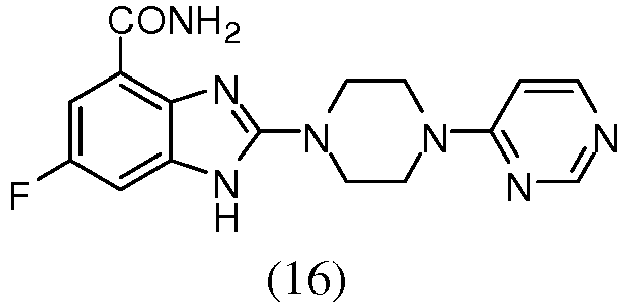


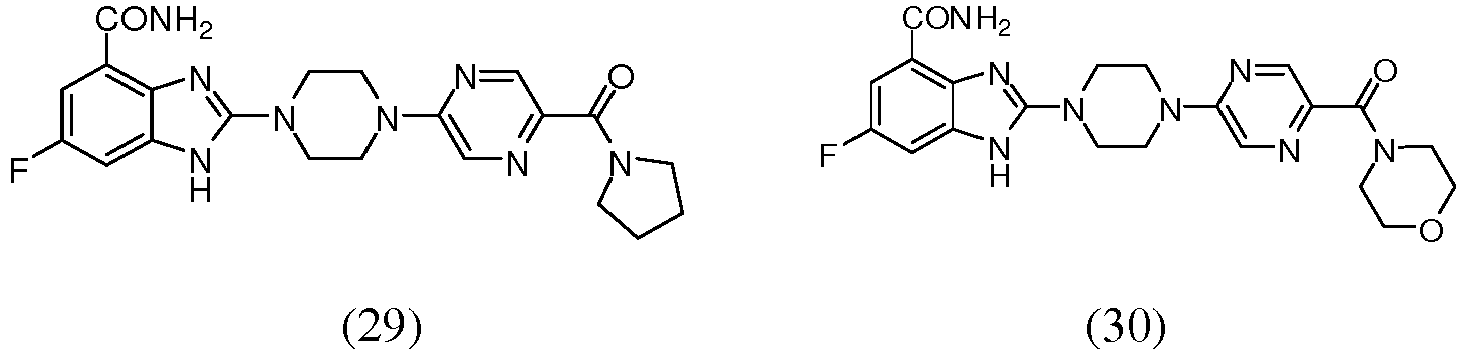


- The compound of general Formula (I) is any one of an enantiomer, a diastereoisomer, and a conformer, or a mixture of two or more thereof.
- The compound of general Formula (I) according to the present invention may exist as a pharmaceutically acceptable salt.
- The pharmaceutically acceptable salt according to the present invention is a hydrochloride, a sulfate, a phosphate, an acetate, a trifluoroacetate, a methanesulfonate, a trifluoromethanesulfonate, a p-toluenesulfonate, a tartrate, a maleate, a fumarate, a succinate or a malate of the compound of general Formula (I).
- In a preferred embodiment of the present invention, the benzimidazole-2-piperazine heterocyclic compound of general Formula (I) is a 2-(piperazin-1-yl)-1H-benzimidazole-4-carboxamide compound and a pharmaceutically acceptable salt thereof.
- In a second aspect of the present invention, a method for preparing the compound of general Formula (I) is provided. The reaction scheme is as follows:

- Step 1): cyclizing substituted methyl 2, 3-diaminobenzoate with carbonyldiimidazole, to obtain substituted methyl 2-oxo-2,3-dihydro-1H-benzimidazole-4-carboxylate (II);
- Step 2): chlorinating the substituted methyl 2-oxo-2,3-dihydro-1H-benzimidazole-4-carboxylate (II) obtained in Step 1) through reaction with phosphorus oxychloride, to obtain substituted methyl 2-chloro-1H-benzimidazole-4-carboxylate (III);
- Step 3): subjecting the substituted methyl 2-chloro-1H-benzimidazole-4-carboxylate (III) obtained in Step 2) to nucleophilic substitution with piperazine in the presence of a base, to obtain substituted methyl 2-(piperazin-1-yl)-1H-benzimidazole-4-carboxylate (IV);
- Step 4): aminolyzing the ester group of the substituted methyl 2-(piperazin-1-yl)-1H-benzimidazole-4-carboxylate (IV) obtained in Step 3) in a methanolic ammonia solution, to obtain substituted 2-(piperazin-1-yl)-IH-benzimidazole-4-carboxamide (V); and
- Step 5): coupling the substituted 2-(piperazin-1-yl)-1H-benzimidazole-4-carboxamide (V) obtained in Step 4) with an acid, or reductively aminating the substituted 2-(piperazin-1-yl)-1H-benzimidazole-4-carboxamide (V) obtained in Step 4) with an aldehyde, to generate the compound of general Formula (I).
- In a third aspect, a pharmaceutical composition is provided, which comprises a therapeutically effective amount of the compound of general Formula (I) as the active ingredient and one or more pharmaceutically acceptable carriers and/or diluents, or comprises a therapeutically effective amount of the compound of general Formula (I) as the active ingredient and a pharmaceutically acceptable carrier, excipient, or diluent.
- In the third aspect, a pharmaceutical composition is provided, which comprises a therapeutically effective amount of a pharmaceutically acceptable salt of the compound of general Formula (I) as the active ingredient and one or more pharmaceutically acceptable carriers and/or diluents, or comprises a therapeutically effective amount of a pharmaceutically acceptable salt of the compound of general Formula (I) as the active ingredient and a pharmaceutically acceptable carrier, excipient or diluent.
- The pharmaceutical composition may be prepared into tablets, capsules, an aqueous suspension, an oily suspension, a dispersible powder, granules, lozenges, an emulsion, a syrup, a cream, an ointment, a suppository or an injection.
- In the pharmaceutical composition, the compound of general Formula (I) may exist in free form.
- In a fourth aspect of the present invention, the compound of general Formula (I) for use in treating diseases that are ameliorated through inhibition of the PARP activity is provided.
- In the fourth aspect of the present invention, a pharmaceutically acceptable salt of the compound of general Formula (I) for use in treating diseases that are ameliorated through inhibition of the PARP activity is provided.
- In the fourth aspect of the present invention, pharmaceutical composition for use in treating diseases that are ameliorated through inhibition of the PARP activity is provided.
- The diseases that are ameliorated through inhibition of the PARP activity are vascular diseases, septic shock, ischemic damage, neurotoxic symptoms, hemorrhagic shock, inflammatory disease or multiple sclerosis.
- In the fourth aspect of the present invention, the compound of general Formula (I) as adjuvant drugs for treating tumors is provided.
- In the fourth aspect of the present invention, a pharmaceutically acceptable salt of the compound of general Formula (I) for use as adjuvant drugs for treating tumors is provided.
- In the fourth aspect of the present invention, the pharmaceutical composition for use as adjuvant drugs for treating tumors is provided.
- In the fourth aspect of the present invention, the compound of general Formula (I) for use as a drug for boosting tumor radiotherapy is provided.
- In the fourth aspect of the present invention, a pharmaceutically acceptable salt of the compound of general Formula (I) for use as a drug for boosting tumor radiotherapy is provided.
- In the fourth aspect of the present invention, the pharmaceutical composition for use as a drug for boosting tumor radiotherapy is provided.
- In the fourth aspect of the present invention, the compound of general Formula (I) for use as a chemotherapeutic agent for tumors is provided.
- In the fourth aspect of the present invention, a pharmaceutically acceptable salt of the compound of general Formula (I) for use as a of chemotherapeutic agent for tumors is provided.
- In the fourth aspect of the present invention, the pharmaceutical composition for use as a chemotherapeutic agent for tumors is provided.
- In the fourth aspect of the present invention, the compound of general Formula (I) or pharmaceutically acceptable salt thereof or pharmaceutical composition for use as a drug for treating an individual with a cancer which is deficient in Homologous Recombination (HR) dependent DNA double strand break (DSB) repair is provided.
- Preferably, the cancer comprises one or more cancer cells having a reduced or abrogated ability to repair DNA DSB by HR relative to normal cells.
- Preferably, the cancer has a BRCA-1 or BRCA-2 deficient mutant phenotype.
- Preferably, the cancer is breast, ovary, pancreas or prostate cancer.
- To examine the degree of inhibition of the compounds provided in the present invention on the PARP enzyme, the activity of the compounds of the present invention for PARP enzyme are determined through biological enzyme activity assay.
- PARP is an enzyme responsible for post-translational modification, which may be activated by means of DNA damage. The process catalyzed by PARP in vivo is mainly NAD-dependent poly(ADP-ribosyl)ation, in which the substrates are mainly some nuclear proteins including PARP, one example of which is histone. In the present invention, the PARP activity is assayed by determining the poly(ADP-ribosyl)ation degree of histone coated in a 96-well plate in the presence of NAD, and the PARP activity under the action of a PARP inhibitor is correspondingly assayed, thereby evaluating the degree of inhibition of the compounds on PARP activity.
- The terms used in the description and claims have the following meanings, unless stated otherwise.
- In the present invention, the term "C1-C6 alkyl" refers to a saturated linear or branched monovalent hydrocarbyl group having 1 to 6 carbon atoms. Examples include, but are not limited to, methyl, ethyl, propyl, isopropyl, n-butyl, iso-butyl, and t-butyl.
- The term "halogen" and "halo" refer to F, Cl, Br, and I.
- "Pharmaceutically acceptable salt" refers to a salt that retains the biological effectiveness and properties of the parent compound. The salt includes:
- (1) acid addition salts, obtainable through reaction of the parent compound as a free base with an inorganic acid including hydrochloric, hydrobromic, nitric, phosphoric, metaphosphoric, sulfuric, sulfurous, perchloric acid and the like; or an organic acid including acetic, propionic, acrylic, oxalic, (d) or (L)-malic, fumaric, maleic, hydroxybenzoic, γ-hydroxybutyric, methoxybenzoic, phthalic, methanesulfonic, ethanesulfonic, naphthalene-1-sulfonic, naphthalene-2-sulfonic, p-toluenesulfonic, salicylic, tartaric, citric, lactic, mandelic, succinic or malonic acid; or
- (2) salts formed by replacing the acidic proton present in the parent compound with a metal ion, for example, alkali metal ion, alkaline earth metal ion or aluminum ion; or through coordination with an organic base, for example, ethanolamine, diethanolamine, triethanolamine, tromethamine, N-methyl glucosamine, and the like.
- "Pharmaceutical composition" refers to a mixture of one or more of the compound according to the present invention or a pharmaceutically acceptable salt, solvate, hydrate or prodrug thereof with other chemical ingredients, for example, a pharmaceutically acceptable carrier. The pharmaceutical composition is provided for the purpose of promoting the administration of the drug to an animal.
- "Pharmaceutically acceptable carrier" refers to an inactive ingredient in the pharmaceutical composition that does not cause significant irritation to an organism and does not interfere with the biological activity and properties of the administered compound, for example, but not limited to: calcium carbonate, calcium phosphate, various carbohydrates (e.g. lactose, and mannitol), starch, cyclodextrin, magnesium stearate, cellulose, magnesium carbonate, acrylic polymers or methacrylic polymers, gel, water, polyethylene glycol, propylene glycol, ethylene glycol, castor oil, hydrogenated castor oil or polyethoxyhydrogenated castor oil, sesame oil, corn oil, and peanut oil.
- In addition to the pharmaceutically acceptable carrier, the pharmaceutical composition may further comprises pharmaceutically acceptable adjuvants, for example antibacterial agents, antifungal agents, antimicrobial agents, preservatives, colorants, solubilizers, thickeners, surfactants, chelating agents, proteins, amino acids, lipids, carbohydrates, vitamins, minerals, trace elements, sweeteners, pigments, fragrances or a combination thereof.
- In the present invention, a compound and use of the compound as a poly(ADP-ribose) polymerase inhibitor are provided. The process parameters may be appropriately adapted by those skilled in the art based on the disclosures herein. It should be particularly noted that all equivalent replacements and modifications are apparent to those skilled in the art, and contemplated by the present invention. The method and use of the present invention have been described with reference to preferred examples, and it is apparent that the invention may be implemented and applied by persons of skill in the art through modification, or appropriate alternation and combination made to the method and use of the present invention without departing from the disclosures, spirits and scope of the present invention.
- Hereinafter, the present invention is further described with reference to examples. The preparation examples 1 to 15, which are not comprised in the claims, are reference examples and do not form part of the invention.
-

- To a solution of methyl 2,3-diaminobenzoate (0.8 g, 4.8 mmol) dissolved in anhydrous tetrahydrofuran (20 mL), carbonyldiimidazole (1.56 g, 9.6 mmol) was added, warmed to reflux, and reacted for 8 hrs. After cooling, the solvent was removed under reduced pressure, and the residue was separated by flash column chromatography (petroleum ether: ethyl acetate=5: 1) to obtain Compound a: methyl 2-oxo-2,3-dihydro-1H-benzimidazole-4-carboxylate as a light solid (0.3 g, yield 33%). MS (ESI) m/z: [M+H]+=193.
- Compound a: methyl 2-oxo-2,3-dihydro-1H-benzimidazole-4-carboxylate (1.1 g, 5.7 mmol) was added to phosphorus oxychloride (8 mL), warmed to reflux, and reacted for 8 hrs. After cooling, the solvent was removed under reduced pressure, and the residue was separated by flash column chromatography (petroleum ether: ethyl acetate=5: 1) to obtain Compound b: methyl 2-chloro-1H-benzimidazole-4-carboxylate as a white solid (1.5 g, yield 100%). MS (ESI) m/z: [M+H]+=211.
- To Compound b: methyl 2-chloro-1H-benzimidazole-4-carboxylate (59 mg, 0.28 mmol) dissolved in dimethylformamide (5mL), piperazine (110 mg, 1.12 mmol) was added, warmed to 100°C, and reacted for 8 hrs. After cooling, the solvent was removed under reduced pressure, and the residue was separated by flash column chromatography (dichloromethane: methanol=10: 1) to obtain Compound c: methyl 2-(piperazin-1-yl)-1H-benzimidazole-4-carboxylate as a white solid (100 mg, yield 100%). MS (ESI) m/z: [M+H]+=261.
- To a solution of Compound c: methyl 2-(piperazin-1-yl)-1H-benzimidazole-4-carboxylate (100 mg, 0.28 mmol) dissolved in tetrahydrofuran (5mL), aqueous ammonia (5mL) was added, warmed to 70°C, sealed, and reacted for 8 hrs. After cooling, the solvent was removed under reduced pressure, and the residue was separated by flash column chromatography (dichloromethane: methanol=10: 1) to obtain Compound d: 2-(piperazin-1-yl)-1H-benzimidazole-4-carboxamide as a white solid (20 mg, yield 28%). MS (ESI) m/z: [M+H]+=246.
- To Compound d: 2-(piperazin-1-yl)-1H-benzimidazole-4-carboxamide (74 mg, 0.3 mmol) dissolved in dimethylformamide (5mL), 2-chloropyrimidine (34 mg, 0.3 mmol) and triethylamine (30 mg, 0.3 mmol) were added, warmed to 100°C, and reacted for 8 hrs. After cooling, the solvent was removed under reduced pressure, and the residue was separated by flash column chromatography (dichloromethane: methanol=10: 1) to obtain Compound (1): 2-(4-(pyrimidin-2-yl)piperazin-1-yl)-1H-benzimidazole-4-carboxamide (32mg, yield 33%). LC-MS (ESI): m/z 324 (M+1)+. 1H NMR (300MHz, DMSO-d6): δ 12.10 (br, 1H), 9.16 (br, 1H), 8.44-8.38 (m, 2H), 7.62-7.54 (m, 2H), 7.36-7.32 (m, 1H), 7.01-6.95 (m, 1H), 6.70-6.63 (m, 1H), 3.89 (br, 4H), 3.67 (br, 4H).
-

- Analogous to the process in Step 5 in Preparation of Compound (1) in Example 1, Compound d: 2-(piperazin-1-yl)-1H-benzimidazole-4-carboxamide was subjected to aromatic nucleophilic substitution with 2-chloro-5-fluoropyrimidine, to obtain Compound (2): 2-(4-(5-fluoropyrimidin-2-yl)piperazin-1-yl)-1H-benzimidazole-4-carboxamide (30 mg, yield 72%). LC-MS (ESI): m/z 342 (M+1)+. 1H NMR (300MHz, DMSO-d6): δ 11.92 (br, 1H), 9.13 (br, 1H), 8.50 (s, 2H), 7.60 (d, 1H, J=7.8Hz), 7.52 (br, 1H), 7.32 (d, 1H, J=7.8Hz), 6.98 (t, 1H, J=7.8Hz), 3.87-3.83 (m, 4H), 3.67-3.64 (m, 4H).
-

- Analogous to the process in Step 5 in Preparation of Compound (1) in Example 1, Compound d: 2-(piperazin-1-yl)-1H-benzimidazole-4-carboxamide was subjected to aromatic nucleophilic substitution with 2-chloro-5-ethylaminopyrimidine, to obtain Compound (3): 2-(4-(5-ethylaminopyrimidin-2-yl)piperazin-1-yl) -1H-benzimidazole-4-carboxamide (23 mg, yield 42%). LC-MS (ESI): m/z 367 (M+1)+.1H NMR (300MHz, DMSO-d6): δ9.08 (br, 1H), 7.92 (s, 2H), 7.78-7.72 (m, 2H), 7.66-7.60 (m, 2H), 7.22-7.16 (m, 1H), 4.71-4.67 (m, 2H), 4.19-4.15 (m, 2H), 3.73-3.70 (m, 4H), 2.65-2.60 (m, 2H), 1.37 (t, 3H, J=4.5Hz).
-

- Analogous to the process in Step 5 in Preparation of Compound (1) in Example 1, Compound d: 2-(piperazin-1-yl)-1H-benzimidazole-4-carboxamide was subjected to aromatic nucleophilic substitution with 2-chloro-5-acetamidopyrimidine, to obtain Compound (4): 2-(4-(5-acetamidopyrimidin-2-yl)piperazin-1-yl) -1H-benzimidazole-4-carboxamide (12 mg, yield 22%). LC-MS (ESI): m/z 381 (M+1)+. 1H NMR (300MHz, DMSO-d6): δ 11.85 (br, 1H), 9.89 (br, 1H), 9.14 (s, 1H), 8.54 (s, 2H), 7.60 (d, 1H, J=7.5Hz), 7.51 (br, 1H), 7.31 (d, 1H, J=7.5Hz), 6.98 (t, 1H, J=7.5Hz), 3.84-3.65 (m, 8H), 2.00 (s, 3H).
-
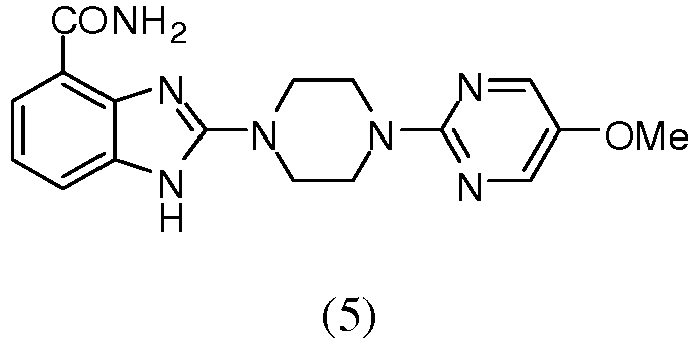
- Analogous to the process in Step 5 in Preparation of Compound (1) in Example 1, Compound d: 2-(piperazin-1-yl)-1H-benzimidazole-4-carboxamide was subjected to aromatic nucleophilic substitution with 2-chloro-5-methoxypyrimidine, to obtain Compound (5): 2-(4-(5-methoxypyrimidin-2-yl)piperazin-1-yl) -1H-benzimidazole-4-carboxamide (17 mg, yield 41%). LC-MS (ESI): m/z 354 (M+1)+. 1H NMR (300MHz, DMSO-d6): δ 11.86 (br, 1H), 9.15 (br, 1H), 8.25 (s, 2H), 7.60 (d, 1H, J=7.5Hz), 7.51 (br, 1H), 7.31 (d, 1H, J=7.5Hz), 6.98 (t, 1H, J=7.5Hz), 3.77 (br, 7H), 3.64 (br, 4H).
-

- Analogous to the process in Step 5 in Preparation of Compound (1) in Example 1, Compound d: 2-(piperazin-1-yl)-1H-benzimidazole-4-carboxamide was subjected to aromatic nucleophilic substitution with 2-chloro-5-aminopyrimidine, to obtain Compound (6): 2-(4-(5-aminopyrimidin-2-yl)piperazin-1-yl)-1H-benzimidazole-4-carboxamide (190 mg, yield 83%). LC-MS (ESI): m/z 339 (M+1)+. 1H NMR (300MHz, DMSO-d6): δ 9.12 (br, 1H), 7.60-7.25 (m, 7H), 7.00-6.95 (m, 1H), 3.67 (br, 8H).
-

- Analogous to the process in Step 5 in Preparation of Compound (1) in Example 1, Compound d: 2-(4-(pyrimidin-4-yl)piperazin-1-yl) -1H-benzimidazole-4-carboxamide was subjected to aromatic nucleophilic substitution with 4-chloropyrimidine, to obtain Compound (7): 2-(4-(pyrimidin-4-yl)piperazin-1-yl)-1H-benzimidazole-4-carboxamide (25 mg, yield 65%). LC-MS (ESI): m/z 324 (M+1)+. 1H NMR (300MHz, DMSO-d6): δ 11.85 (br, 1H), 9.09 (br, 1H), 8.53 (s, 1H), 8.22 (d, 1H, J=8.1Hz), 7.60 (d, 1H, J=7.5Hz), 7.50 (br, 1H), 7.33 (d, 1H, J=7.5Hz), 6.99 (t, 1H, J=7.5Hz), 6.91 (d, 1H, J=8.1Hz), 3.80-3.79 (m, 4H), 3.68-3.66 (m, 4H).
-
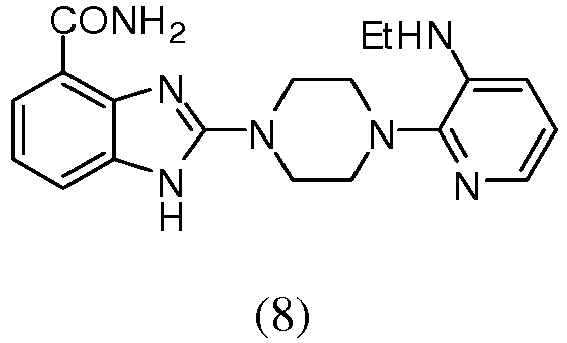
-

- Analogous to the process in Step 5 in Preparation of Compound (1) in Example 1, Compound d: 2-(4-(pyrimidin-4-yl)piperazin-1-yl) -1H-benzimidazole-4-carboxamide was subjected to aromatic nucleophilic substitution with 2-chloro-4-trifluoromethylpyrimidine, to obtain Compound (9): 2-(4-(4-trifluoromethylpyrimidin-2-yl)piperazin-1-yl) -1H-benzimidazole-4-carboxamide (36 mg, yield 55%). LC-MS (ESI): m/z 392 (M+1)+. 1H NMR (300MHz, DMSO-d6): δ 11.87 (br, 1H), 9.13 (br, 1H), 8.72 (d, 1H, J=4.8Hz), 7.61 (d, 1H, J=7.8Hz), 7.53 (br, 1H), 7.33 (d, 1H, J=7.8Hz), 7.07 (d, 1H, J=4.8Hz), 6.99 (t, 1H, J=7.8Hz), 3.94 (br, 4H), 3.69 (br, 4H).
-

- Analogous to the process in Step 5 in Preparation of Compound (1) in Example 1, Compound d: 2-(4-(pyrimidin-4-yl)piperazin-1-yl)-1H-benzimidazole-4-carboxamide was subjected to aromatic nucleophilic substitution with 6-chloro-4-trifluoromethylpyrimidine, to obtain Compound (10): 2-(4-(6-trifluoromethylpyrimidin-4-yl)piperazin-1-yl) -1H-benzimidazole-4-carboxamide (40 mg, yield 61%). LC-MS (ESI): m/z 392 (M+1)+. 1H NMR (300MHz, DMSO-d6): δ 11.88 (br, 1H), 9.12 (br, 1H), 8.66 (s, 1H), 7.61 (d, 1H, J=7.5Hz), 7.53 (br, 1H), 7.35 (s, 1H), 7.33 (d, 1H, J=7.5Hz), 6.99 (t, 1H, J=7.5Hz), 3.92 (br, 4H), 3.69 (br, 4H).
-

- Analogous to the process in Step 5 in Preparation of Compound (1) in Example 1, Compound d: 2-(4-(pyrimidin-4-yl)piperazin-1-yl)-1H-benzimidazole-4-carboxamide was subjected to aromatic nucleophilic substitution with 6-chloro-3-methylcarbamoylpyridine, to obtain Compound (11): 2-(4-(5-methylcarbamoylpyridin-2-yl)piperazin-1-yl) -1H-benzimidazole-4-carboxamide (15 mg, yield 24%). LC-MS (ESI): m/z 380 (M+1)+. 1H NMR (300MHz, DMSO-d6): δ 11.86 (br, 1H), 9.14 (br, 1H), 8.6 (s, 1H), 8.24 (br, 1H), 7.96 (d, 1H, J=9.6Hz), 7.61 (d, 1H, J=7.8Hz), 7.52 (br, 1H), 7.32 (d, 1H, J=7.8Hz), 7.01-6.92 (m, 2H), 3.77 (br, 4H), 3.67 (br, 4H), 2.74 (d, 3H, d=4.2Hz).
-

- Analogous to the process in Step 5 in Preparation of Compound (1) in Example 1, Compound d: 2-(4-(pyrimidin-4-yl)piperazin-1-yl)-1H-benzimidazole-4-carboxamide was subjected to aromatic nucleophilic substitution with 6-chloro-3-carbamoylpyridine, to obtain Compound (12): 2-(4-(5-carbamoylpyridin-2-yl)piperazin-1-yl) -1H-benzimidazole-4-carboxamide (25 mg, yield 41%). LC-MS (ESI): m/z 366 (M+1)+. 1H NMR (300MHz, DMSO-d6): δ 11.86 (br, 1H), 9.14 (br, 1H), 8.64 (s, 1H), 7.99 (d, 1H, J=7.8Hz), 7.79 (br, 1H), 7.60 (d, 1H, J=9.0Hz), 7.51 (br, 1H), 7.32 (d, 1H, J=7.8Hz), 7.17 (br, 1H), 7.01-6.91 (m, 2H), 3.78 (br, 4H), 3.67 (br, 4H).
-

- Analogous to the process in Step 5 in Preparation of Compound (1) in Example 1, Compound d: 2-(4-(pyrimidin-4-yl)piperazin-1-yl)-1H-benzimidazole-4-carboxamide was subjected to aromatic nucleophilic substitution with 4-chloro-2-trifluoromethylpyridine, to obtain Compound (13): 2-(4-(2-trifluoromethylpyridin-4-yl)piperazin-1-yl) -1H-benzimidazole-4-carboxamide (7 mg, yield 13%). LC-MS (ESI): m/z 391 (M+1)+. 1H NMR (300MHz, DMSO-d6): δ 11.88 (br, 1H), 9.13 (br, 1H), 8.34-8.29 (m, 1H), 7.63-7.60 (m, 1H), 7.53 (br, 1H), 7.35-7.30 (m, 2H), 7.12-7.09 (m, 1H), 7.03-6.97 (m, 1H), 3.70-3.64 (m, 8H).
-

- Analogous to the process in Step 5 in Preparation of Compound (1) in Example 1, Compound d: 2-(4-(pyrimidin-4-yl)piperazin-1-yl)-1H-benzimidazole-4-carboxamide was subjected to aromatic nucleophilic substitution with 2-chloro-5-cyanopyrimidine, to obtain Compound (14): 2-(4-(5-cyanopyrimidin-2-yl)piperazin-1-yl) -1H-benzimidazole-4-carboxamide (40 mg, yield 71%). LC-MS (ESI): m/z 349 (M+1)+. 1H NMR (300MHz, DMSO-d6): δ 11.88 (br, 1H), 9.09 (br, 1H), 8.80 (s, 2H), 7.60 (d, 1H, J=7.2Hz), 7.53 (br, 1H), 7.33 (d, 1H, J=7.2Hz), 6.99 (t, 1H, J=7.2Hz), 4.01 (br, 4H), 3.69 (br, 4H).
-

- Analogous to the process in Step 5 in Preparation of Compound (1) in Example 1, Compound d: 2-(4-(pyrimidin-4-yl)piperazin-1-yl)-1H-benzimidazole-4-carboxamide was subjected to aromatic nucleophilic substitution with 6-chloro-3-dimethylcarbamoylpyridine, to obtain Compound (15): 2-(4-(5-dimethylcarbamoylpyridin-2-yl)piperazin-1-yl) -1H-benzimidazole-4-carboxamide (35 mg, yield 44%). LC-MS (ESI): m/z 394 (M+1)+. 1H NMR (300MHz, DMSO-d6): δ 12.11 (br, 1H), 9.19 (br, 1H), 8.24 (s, 1H), 7.66-7.59 (m, 2H), 7.53 (br, 1H), 7.34-7.31 (m, 1H), 7.00-6.91 (m, 2H), 3.73-3.70 (m, 8H), 2.96 (s, 6H).
-

- 2-trifluoroacetamido-5-fluoro-benzoic acid (2.5 g, 10 mmol) was slowly added to fuming nitric acid (14 mL) while in an ice bath. The reaction was continued for 1 hr with stirring while in the ice bath, then poured into ice-water, and filtered, to obtain Compound e: 5-fluoro-3-nitro-2-(2,2,2-trifluoroacetamido)benzoic acid as a white solid (1.9 g, yield 65%). MS (ESI) m/z: [M-H]-=295.
- A 10% aqueous sodium hydroxide solution (20 mL) was added to a solution of Compound e: 5-fluoro-3-nitro-2-(2,2,2-trifluoroacetamido)benzoic acid (1.18 g, 4 mmol) dissolved in ethanol (20 mL). The reaction was warmed to 80°C and stirred for 3 hrs. Ethanol was removed under reduced pressure, and the residue was adjusted to pH 4 with hydrochloric acid and filtered, to obtain Compound f: 2-amino-5-fluoro-3-nitrobenzoic acid as a yellow solid (0.72 g, yield 90%). MS (ESI) m/z: [M-H]-=199.
- Thionyl chloride (2.38g) was slowly added dropwise into a solution of Compound f: 2-amino-5-fluoro-3-nitrobenzoic acid (0.8 g, 4 mmol) dissolved in methanol (20 mL) while in an ice bath, warmed to reflux, and reacted for 8 hrs. After cooling, the solvent was removed under reduced pressure, and the residue was separated by flash column chromatography (petroleum ether: ethyl acetate=5: 1) to obtain Compound g: methyl 2-amino-5-fluoro-3-nitrobenzoate as a yellow solid (0.5 g, yield 58%). MS (ESI) m/z: [M+H]+=215.
- 10% palladium on carbon (0.7 g) was added to a solution of Compound g: methyl 2-amino-5-fluoro-3-nitrobenzoate (7 g, 32.7 mmol) dissolved in methanol (50 mL), hydrogenated for 7 hrs at room temperature, and filtered. The residue was separated by flash column chromatography (petroleum ether: ethyl acetate=5: 1) to obtain Compound h: methyl 2,3-diamino-5-fluorobenzoate as a yellow solid (2.16 g, yield 36%). MS (ESI) m/z: [M+H]+=185.
- Analogous to the process in Step 1 in Preparation of Compound (1) in Example 1, Compound h: methyl 2,3-diamino-5-fluorobenzoate was cyclized with carbonyldiimidazole (CDI), to obtain Compound i: methyl 6-fluoro-2-oxo-2,3-dihydro-1H-benzimidazole-4-carboxylate (711 mg, yield 37%). MS (ESI) m/z: [M+H]+=211.
- Analogous to the process in Step 2 in Preparation of Compound (1) in Example 1, Compound i: methyl 6-fluoro-2-oxo-2,3-dihydro-1H-benzimidazole-4-carboxylate was chlorinated with phosphorus oxychloride, to obtain Compound j: methyl 2-chloro-6-fluoro-1H-benzimidazole-4-carboxylate (681 mg, yield 94%). MS (ESI) m/z: [M+H]+=229.
- Analogous to the process in Step 3 in Preparation of Compound (1) in Example 1, Compound j: methyl 2-chloro-6-fluoro-1H-benzimidazole-4-carboxylate was subjected to nucleophilic substitution with piperazine, to obtain Compound k: methyl 6-fluoro-2-(piperazin-1-yl)-1H-benzimidazole-4-carboxylate (430 mg, yield 65%). MS (ESI) m/z: [M+H]+=279.
- To a solution of Compound k: methyl 6-fluoro-2-(piperazin-1-yl)-1H-benzimidazole-4-carboxylate (100 mg, 0.28 mmol) dissolved in tetrahydrofuran (5 mL), aqueous ammonia (5 mL) was added, warmed to 70°C, sealed, and reacted for 8 hrs. After cooling, the solvent was removed under reduced pressure, and the residue was separated by flash column chromatography (dichloromethane: methanol=10: 1) to obtain Compound 1: 6-fluoro-2-(piperazin-1-yl)-1H-benzimidazole-4-carboxamide as a white solid (20 mg, yield 28%). MS (ESI) m/z: [M+H]+=246.
- Analogous to the process in Step 5 in Preparation of Compound (1) in Example 1, Compound 1: 6-fluoro-2-(piperazin-1-yl)-1H-benzimidazole-4-carboxamide was subjected to aromatic nucleophilic substitution with 4-chloropyrimidine, to obtain Compound (16): 6-fluoro-2-(4-(pyrimidin-4-yl)piperazin-1-yl)-1H-benzimidazole-4-carboxamide (21 mg, yield 48%). LC-MS (ESI): m/z 342 (M+1)+. 1H NMR (300MHz, DMSO-d6): δ 12.04 (br, 1H), 9.10 (br, 1H), 8.52 (s, 1H), 8.22 (d, 1H, J=7.2Hz), 7.71 (br, 1H), 7.33-7.2 (m, 1H), 7.19-7.17 (m, 1H), 6.90 (d, 1H, J=7.2Hz), 3.80 (br, 4H), 3.66 (br, 4H).
-

- Analogous to the process in Step 5 in Preparation of Compound (1) in Example 1, Compound 1: 6-fluoro-2-(piperazin-1-yl)-1H-benzimidazole-4-carboxamide was subjected to aromatic nucleophilic substitution with 2-chloro-5-fluoropyrimidine, to obtain Compound (17): 6-fluoro-2-(4-(5-fluoropyrimidin-2-yl)piperazin-1-yl)-1H-benzimidazole-4-carboxamide (27 mg, yield 87%).LC-MS (ESI): m/z 360 (M+1)+. 1H NMR (300MHz, DMSO-d6): δ 9.11 (br, 1H), 8.49 (s, 2H), 7.71-7.69 (m, 1H), 7.31-7.28 (m, 1H), 7.18-7.15 (m, 1H), 3.84-3.82 (m, 4H), 3.68-3.65 (m, 4H).
-

- Analogous to the process in Step 5 in Preparation of Compound (1) in Example 1, Compound 1: 6-fluoro-2-(piperazin-1-yl)-1H-benzimidazole-4-carboxamide was subjected to aromatic nucleophilic substitution with 6-chloro-3-dimethylcarbamoylpyridine, to obtain Compound (18): 2-(4-(5-(dimethylcarbamoyl)pyridin-2-yl)piperazin-1-yl)-6-fluoro-1H-benzimidazole-4-car boxamide (14 mg, yield 18%). LC-MS (ESI): m/z 412 (M+1)+. 1H NMR (300MHz, DMSO-d6): δ 12.57 (br, 1H), 9.12 (br, 1H), 8.23 (s, 1H), 7.70-7.63 (m, 2H), 7.31-7.27 (m, 1H), 7.18-7.14 (m, 1H), 6.94-6.91 (m, 1H), 3.72 (br, 8H), 2.95 (s, 6H).
-
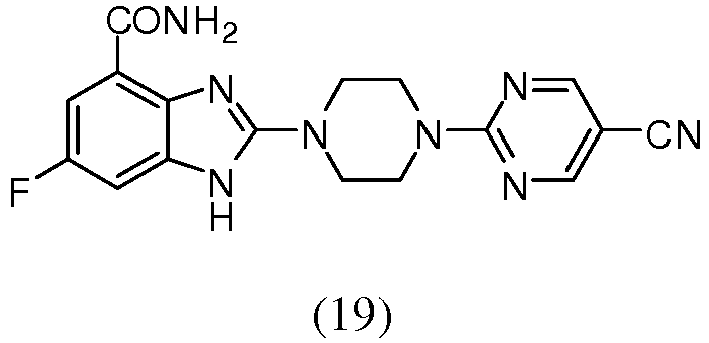
- Analogous to the process in Step 5 in Preparation of Compound (1) in Example 1, Compound 1: 6-fluoro-2-(piperazin-1-yl)-1H-benzimidazole-4-carboxamide was subjected to aromatic nucleophilic substitution with 2-chloro-5-cyanopyrimidine, to obtain Compound (19): 2-(4-(5-cyanopyrimidin-2-yl)piperazin-1-yl)-6-fluoro-1H-benzimidazole-4-carboxamide (43 mg, yield 77%). LC-MS (ESI): m/z 367 (M+1)+. 1H NMR (300MHz, DMSO-d6): δ 12.11 (br, 1H), 9.07 (br, 1H), 8.80 (s, 2H), 7.72 (br, 1H), 7.33-7.29 (m, 1H), 7.20-7.16 (m, 1H), 4.00 (br, 4H), 3.69 (br, 4H).
-

- Analogous to the process in Step 5 in Preparation of Compound (1) in Example 1, Compound 1: 6-fluoro-2-(piperazin-1-yl)-1H-benzimidazole-4-carboxamide was subjected to aromatic nucleophilic substitution with 2-chloro-N-methylnicotinamide, to obtain Compound (20): 6-fluoro-2-(4-(3-methylcarbamoylpyridin-2-yl)piperazin-1-yl)-1H-benzimidazole-4-carbox amide (28 mg, yield 52%). LC-MS (ESI): m/z 398 (M+1)+. 1H NMR (300MHz, DMSO-d6): δ 12.21 (br, 1H), 9.10 (br, 1H), 8.41 (br, 1H), 8.26-8.25 (m, 1H), 7.75-7.72 (m, 1H), 7.68 (br, 1H), 7.32-7.28 (m, 1H), 7.18-7.15 (m, 1H), 6.96-6.92 (m, 1H), 3.69 (br, 8H), 2.79 (s, 3H).
-

- Analogous to the process in Step 5 in Preparation of Compound (1) in Example 1, Compound 1: 6-fluoro-2-(piperazin-1-yl)-1H-benzimidazole-4-carboxamide was subjected to aromatic nucleophilic substitution with 2-chloro-5-trifluoromethylpyridine, to obtain Compound (21): 6-fluoro-2-(4-(5-trifluoromethylpyridin-2-yl)piperazin-1-yl)-1H-benzimidazole-4-carboxa mide (23 mg, yield 52%). LC-MS (ESI): m/z 409 (M+1)+. 1H NMR (300MHz, DMSO-d6): δ 12.32 (br, 1H), 9.10 (br, 1H), 8.44 (s, 1H), 7.85-7.81 (m, 1H), 7.70 (br, 1H), 7.32-7.28 (m, 1H), 7.19-7.15 (m, 1H), 7.06-7.02 (m, 1H), 3.81 (br, 4H), 3.70 (br, 4H).
-

- Analogous to the process in Step 5 in Preparation of Compound (1) in Example 1, Compound 1: 6-fluoro-2-(piperazin-1-yl)-1H-benzimidazole-4-carboxamide was subjected to aromatic nucleophilic substitution with 2-chloro-N-methylpyrimidine-5-carboxamide, to obtain Compound (22): 6-fluoro-2-(4-(5-methylcarbamoylpyrimidin-2-yl)piperazin-1-yl)-1H-benzimidazole-4-carb oxamide (17 mg, yield 29%).LC-MS (ESI): m/z 399 (M+1)+. 1H NMR (300MHz, DMSO-d6): δ 12.01 (br, 1H), 9.08 (br, 1H), 8.78 (s, 2H), 8.37 (br, 1H), 7.73 (br, 1H), 7.34-7.27 (m, 1H), 7.19-7.13 (m, 1H), 3.98 (br, 4H), 3.67 (br, 4H), 2.75 (s, 3H).
-

- Analogous to the process in Step 5 in Preparation of Compound (1) in Example 1, Compound 1: 6-fluoro-2-(piperazin-1-yl)-1H-benzimidazole-4-carboxamide was subjected to aromatic nucleophilic substitution with 6-chloro-N-methylpyridazin-3-carboxamide, to obtain Compound (23): 6-fluoro-2-(4-(6-methylcarbamoylpyridazin-3-yl)piperazin-1-yl)-1H-benzimidazole-4-carb oxamide (20 mg, yield 27%). LC-MS (ESI): m/z 399 (M+1)+. 1H NMR (300MHz, DMSO-d6): δ 12.05 (br, 1H), 9.11 (br, 1H), 8.84 (br, 1H), 7.87 (d, 1H, J=10.5Hz), 7.74 (br, 1H), 7.44-7.41 (m, 1H), 7.31 (d, 1H, J=10.5Hz), 7.20-7.17 (m, 1H), 3.90 (br, 4H), 3.72 (br, 4H), 2.80 (s, 3H).
-

- Analogous to the process in Step 5 in Preparation of Compound (1) in Example 1, Compound 1: 6-fluoro-2-(piperazin-1-yl)-1H-benzimidazole-4-carboxamide was subjected to aromatic nucleophilic substitution with 6-chloro-N-methylnicotinamide, to obtain Compound (24): 6-fluoro-2-(4-(5-methylcarbamoylpyridin-2-yl)piperazin-1-yl)-1H-benzimidazole-4-carbox amide (6 mg, yield 13%). LC-MS (ESI): m/z 398 (M+1)+. 1H NMR (300MHz, DMSO-d6): δ 12.58 (br, 1H), 9.12 (br, 1H), 8.62 (s, 1H), 8.04-7.98 (m, 1H), 7.72 (s, 1H), 7.32-7.26 (m, 2H), 7.17-7.15 (m, 1H), 6.98-6.92 (m, 1H), 3.75-3.69 (m, 8H), 2.73 (s, 3H).
-

- Analogous to the process in Step 5 in Preparation of Compound (1) in Example 1, Compound 1: 6-fluoro-2-(piperazin-1-yl)-1H-benzimidazole-4-carboxamide was subjected to aromatic nucleophilic substitution with 5-chloro-N-methylpyrazin-2-carboxamide, to obtain Compound (25): 6-fluoro-2-(4-(5-methylcarbamoylpyrazin-2-yl)piperazin-1-yl)-1H-benzimidazole-4-carbox amide (38 mg, yield 64%). LC-MS (ESI): m/z 399 (M+1)+.1H NMR (300MHz, DMSO-d6): δ 12.05 (br, 1H), 9.09 (br, 1H), 8.62 (s, 1H), 8.39 (br, 1H), 8.34 (s, 1H), 7.72 (br, 1H), 7.33-7.29 (m, 1H), 7.19-7.17 (m, 1H), 3.88 (br, 4H), 3.70 (br, 4H), 2.77 (s, 3H).
-

- Analogous to the process in Step 5 in Preparation of Compound (1) in Example 1, Compound 1: 6-fluoro-2-(piperazin-1-yl)-1H-benzimidazole-4-carboxamide was subjected to aromatic nucleophilic substitution with 5-chloro-N-ethylpyrazin-2-carboxamide, to obtain Compound (26): 2-(4-(5-ethylcarbamoylpyrazin-2-yl)piperazin-1-yl)-6-fluoro-1H-benzimidazole-4-carboxa mide (19 mg, yield 31%). LC-MS (ESI): m/z 413 (M+1)+. 1H NMR (300MHz, DMSO-d6): δ 12.09 (br, 1H), 9.11 (br, 1H), 8.63 (s, 1H), 8.44-8.42 (m, 1H), 8.34 (s, 1H), 7.73 (br, 1H), 7.33-7.29 (m, 1H), 7.20-7.17 (m, 1H), 3.87 (br, 4H), 3.71 (br, 4H), 3.28 (q, 2H, J=6.9Hz), 1.09 (t, 3H, J=6.9Hz).
-

- Analogous to the process in Step 5 in Preparation of Compound (1) in Example 1, Compound 1: 6-fluoro-2-(piperazin-1-yl)-1H-benzimidazole-4-carboxamide was subjected to aromatic nucleophilic substitution with 5-chloro-N-isopropylpyrazin-2-carboxamide, to obtain Compound (27): 6-fluoro-2-(4-(5-isopropylcarbamoylpyrazin-2-yl)piperazin-1-yl)-1H-benzimidazole-4-carb oxamide (22 mg, yield 28%). LC-MS (ESI): m/z 427 (M+1)+. 1H NMR (300MHz, DMSO-d6): δ 12.04 (br, 1H), 9.09 (br, 1H), 8.63 (s, 1H), 8.32 (s, 1H), 8.05-8.00 (m, 1H), 7.70 (br, 1H), 7.34-7.29 (m, 1H), 7.20-7.16 (m, 1H), 4.09 (sep, 1H, J=6.6Hz), 3.88 (br, 4H), 3.71 (br, 4H), 1.15 (d, 6H, J=6.6Hz).
-

- Analogous to the process in Step 5 in Preparation of Compound (1) in Example 1, Compound 1: 6-fluoro-2-(piperazin-1-yl)-1H-benzimidazole-4-carboxamide was subjected to aromatic nucleophilic substitution with 5-chloro-N-t-butylpyrazin-2-carboxamide, to obtain Compound (28): 2-(4-(5-t-butylcarbamoylpyrazin-2-yl)piperazin-1-yl)-6-fluoro-1H-benzimidazole-4-carbox amide (29 mg, yield 35%). LC-MS (ESI): m/z 441 (M+1)+. 1H NMR (300MHz, DMSO-d6): δ 12.04 (br, 1H), 9.09 (br, 1H), 8.62 (s, 1H), 8.31 (s, 1H), 7.71 (br, 1H), 7.53 (br, 1H), 7.33-7.29 (m, 1H), 7.20-7.16 (m, 1H), 3.86 (br, 4H), 3.71 (br, 4H), 1.37 (s, 9H).
-

- Analogous to the process in Step 5 in Preparation of Compound (1) in Example 1, Compound 1: 6-fluoro-2-(piperazin-1-yl)-1H-benzimidazole-4-carboxamide was subjected to aromatic nucleophilic substitution with (5-chloropyrazin-2-yl)(pyrrolin-1-yl)methanone, to obtain Compound (29): 6-fluoro-2-(4-(5-(pyrrolin-1-acyl)pyrazin-2-yl)piperazin-1-yl)-1H-benzimidazole-4-carboxa mide (14mg, yield 17%). LC-MS (ESI): m/z 441 (M+1)+. 1H NMR (300MHz, DMSO-d6): δ 12.04 (br, 1H), 9.08 (br, 1H), 8.51 (s, 1H), 8.34 (s, 1H), 7.71 (br, 1H), 7.33-7.29 (m, 1H), 7.19-7.16 (m, 1H), 3.86 (br, 4H), 3.70 (br, 4H), 3.47-3.45 (m, 4H), 1.86-1.83 (m, 4H).
-
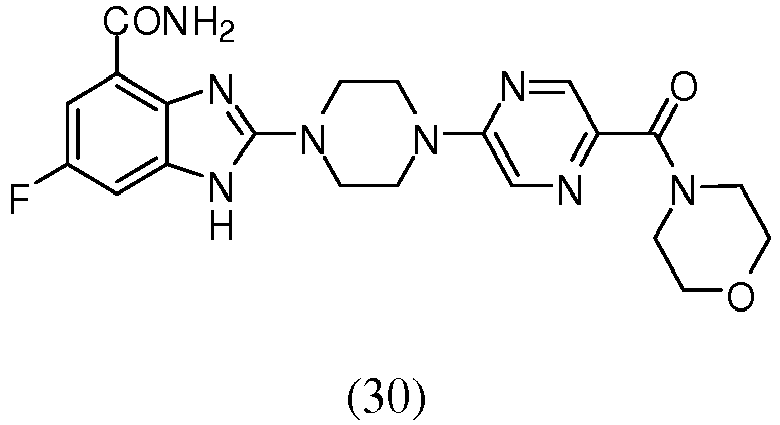
- Analogous to the process in Step 5 in Preparation of Compound (1) in Example 1, Compound 1: 6-fluoro-2-(piperazin-1-yl)-1H-benzimidazole-4-carboxamide was subjected to aromatic nucleophilic substitution with (5-chloropyrazin-2-yl)(morpholin-2-yl)methanone, to obtain Compound (30): 6-fluoro-2-(4-(5-(pyrrolin-1-acyl)pyrazin-2-yl)piperazin-1-yl)-1H-benzimidazole-4-carboxa mide (32 mg, yield 37%). LC-MS (ESI): m/z 455 (M+1)+. 1H NMR (300MHz, DMSO-d6): δ 12.04 (br, 1H), 9.09 (br, 1H), 8.41 (s, 1H), 8.35 (s, 1H), 7.71 (br, 1H), 7.34-7.30 (m, 1H), 7.20-7.16 (m, 1H), 3.85 (br, 6H), 3.70 (br, 4H), 3.62 (br, 6H).
-

- Analogous to the process in Step 5 in Preparation of Compound (1) in Example 1, Compound 1: 6-fluoro-2-(piperazin-1-yl)-1H-benzimidazole-4-carboxamide was subjected to aromatic nucleophilic substitution with 3-chloro-6-trifluoromethylpyridazine, to obtain Compound (31): 6-fluoro-2-(4-(6-trifluoromethylpyridazin-3-yl)piperazin-1-yl)-1H-benzimidazole-4-carbox amide (15 mg, yield 20%). LC-MS (ESI): m/z 410 (M+1)+. 1H NMR (300MHz, DMSO-d6): δ 12.05 (br, 1H), 9.10 (br, 1H), 7.94-7.85 (m, 1H), 7.71 (br, 1H), 7.51-7.47 (m, 1H), 7.34-7.30 (m, 1H), 7.21-7.17 (m, 1H), 3.93 (br, 4H), 3.72 (br, 4H).
-

- Analogous to the process in Step 5 in Preparation of Compound (1) in Example 1, Compound 1: 6-fluoro-2-(piperazin-1-yl)-1H-benzimidazole-4-carboxamide was subjected to aromatic nucleophilic substitution with 5-bromo-2-trifluoromethylpyridine, to obtain Compound (32): 6-fluoro-2-(4-(6-trifluoromethylpyridine-3-yl)piperazin-1-yl)-1H-benzimidazole-4-carboxa mide (23 mg, yield 19%). LC-MS (ESI): m/z 409 (M+1)+. 1H NMR (300MHz, DMSO-d6): δ 9.09 (br, 1H), 8.50 (s, 1H), 7.72-7.66 (m, 2H), 7.52-7.48 (m, 1H), 7.33-7.28 (m, 1H), 7.20-7.16 (m, 1H), 3.72 (br, 4H), 3.54 (br, 4H).
-

- Analogous to the process in Step 5 in Preparation of Compound (1) in Example 1, Compound 1: 6-fluoro-2-(piperazin-1-yl)-1H-benzimidazole-4-carboxamide was subjected to aromatic nucleophilic substitution with 5-bromo-2-trifluoromethylpyrimidine, to obtain Compound (33): 6-fluoro-2-(4-(2-trifluoromethylpyrimidin-5-yl)piperazin-1-yl)-1H-benzimidazole-4-carbox amide (12 mg, yield 16%). LC-MS (ESI): m/z 410 (M+1)+. 1H NMR (300MHz, DMSO-d6): δ 12.04 (br, 1H), 9.09 (br, 1H), 8.69 (s, 2H), 7.71 (br, 1H), 7.32-7.29 (m, 1H), 7.20-7.17 (m, 1H), 3.73 (br, 4H), 3.62 (br, 4H).
-

- Analogous to the process in Step 5 in Preparation of Compound (1) in Example 1, Compound 1: 6-fluoro-2-(piperazin-1-yl)-1H-benzimidazole-4-carboxamide was subjected to aromatic nucleophilic substitution with 2-chloro-5-trifluoromethylpyrimidine, to obtain Compound (34): 6-fluoro-2-(4-(5-trifluoromethylpyrimidin-2-yl)piperazin-1-yl)-1H-benzimidazole-4-carbox amide (8 mg, yield 14%). LC-MS (ESI): m/z 410 (M+1)+. 1H NMR (300MHz, DMSO-d6): δ 12.02 (br, 1H), 9.09 (br, 1H), 8.75 (s, 2H), 7.72 (br, 1H), 7.33-7.29 (m, 1H), 7.20-7.17 (m, 1H), 4.00 (br, 4H), 3.69 (br, 4H).
-

- Analogous to the process in Step 5 in Preparation of Compound (1) in Example 1, Compound 1: 6-fluoro-2-(piperazin-1-yl)-1H-benzimidazole-4-carboxamide was subjected to aromatic nucleophilic substitution with 2-chloro-5-trifluoromethylpyrazine, to obtain Compound (35): 6-fluoro-2-(4-(5-trifluoromethylpyrazin-2-yl)piperazin-1-yl)-1H-benzimidazole-4-carboxa mide (60 mg, yield 90%). LC-MS (ESI): m/z 410 (M+1)+. 1H NMR (300MHz, DMSO-d6): δ 12.04 (br, 1H), 9.09 (br, 1H), 8.51 (s, 1H), 8.50 (s, 1H), 7.71 (br, 1H), 7.33-7.30 (m, 1H), 7.20-7.17 (m, 1H), 3.89 (br, 4H), 3.71 (br, 4H).
-

- Analogous to the process in Step 5 in Preparation of Compound (1) in Example 1, Compound 1: 6-fluoro-2-(piperazin-1-yl)-1H-benzimidazole-4-carboxamide was subjected to aromatic nucleophilic substitution with 5-chloro-N,N-dimethylpyrazin-2-carboxamide, to obtain Compound (36): 2-(4-(5-dimethylcarbamoylpyrazin-2-yl)piperazin-1-yl)-6-fluoro-1H-benzimidazole-4-carb oxamide (29 mg, yield 37%). LC-MS (ESI): m/z 413 (M+1)+. 1H NMR (300MHz, DMSO-d6): δ 12.02 (br, 1H), 9.09 (br, 1H), 8.37 (s, 1H), 8.34 (s, 1H), 7.71 (br, 1H), 7.33-7.30 (m, 1H), 7.20-7.16 (m, 1H), 3.83 (br, 4H), 3.73 (br, 1H), 3.07 (s, 3H), 2.98 (s, 3H).
-

- Analogous to the process in Step 5 in Preparation of Compound (1) in Example 1, Compound 1: 6-fluoro-2-(piperazin-1-yl)-1H-benzimidazole-4-carboxamide was subjected to aromatic nucleophilic substitution with 5-chloro-2-cyanopyrazine, to obtain Compound (37): 2-(4-(5-cyanopyrazin-2-yl)piperazin-1-yl)-6-fluoro-1H-benzimidazole-4-carboxamide (40 mg, yield 58%). LC-MS (ESI): m/z 367 (M+1)+. 1H NMR (300MHz, DMSO-d6): δ 12.05 (br, 1H), 9.07 (br, 1H), 8.59 (s, 1H), 8.49 (s, 1H), 7.69 (s, 1H), 7.33-7.29 (m, 1H), 7.20-7.16 (m, 1H), 3.93 (br, 4H), 3.71 (br, 4H).
-

- Analogous to the process in Step 5 in Preparation of Compound (1) in Example 1, Compound 1: 6-fluoro-2-(piperazin-1-yl)-1H-benzimidazole-4-carboxamide was subjected to aromatic nucleophilic substitution with 5-bromo-2-cyanopyrimidine, to obtain Compound (38): 2-(4-(2-cyanopyrimidin-5-yl)piperazin-1-yl)-6-fluoro-1H-benzimidazole-4-carboxamide (18 mg, yield 26%). LC-MS (ESI): m/z 367 (M+1)+. 1H NMR (300MHz, DMSO-d6): δ 12.03 (br, 1H), 9.08 (br, 1H), 8.63 (s, 2H), 7.73-7.65 (m, 1H), 7.33-7.29 (m, 1H), 7.22-7.17 (m, 1H), 3.73-3.69 (m, 8H).
-

- Analogous to the process in Step 5 in Preparation of Compound (1) in Example 1, Compound 1: 6-fluoro-2-(piperazin-1-yl)-1H-benzimidazole-4-carboxamide was subjected to aromatic nucleophilic substitution with 5-bromo-N-methylpyrimidine-2-carboxamide, to obtain Compound (39): 6-fluoro-2-(4-(2-methylcarbamoylpyrimidin-2-yl)piperazine-5-yl)-1H-benzimidazole-4-car boxamide (16 mg, yield 29%). LC-MS (ESI): m/z 399 (M+1)+. 1H NMR (300MHz, DMSO-d6): δ 12.02 (br, 1H), 9.08 (br, 1H), 8.67 (s, 2H), 8.34 (br, 1H), 7.71 (br, 1H), 7.33-7.27 (m, 1H), 7.19-7.12 (m, 1H), 3.99 (br, 4H), 3.68 (br, 4H), 2.72 (s, 3H).
-

- Analogous to the process in Step 5 in Preparation of Compound (1) in Example 1, Compound 1: 6-fluoro-2-(piperazin-1-yl)-1H-benzimidazole-4-carboxamide was subjected to aromatic nucleophilic substitution with 5-bromo-N-ethylpyrimidine-2-carboxamide, to obtain Compound (40): 2-(4-(2-ethylcarbamoylpyrimidin-5-yl)piperazin-1-yl)-6-fluoro-1H-benzimidazole-4-carbox amide (17 mg, yield 23%). LC-MS (ESI): m/z 413 (M+1)+. 1H NMR (300MHz, DMSO-d6): δ 12.01 (br, 1H), 9.09 (br, 1H), 8.64 (s, 2H), 8.31 (br, 1H), 7.72 (br, 1H), 7.34-7.27 (m, 1H), 7.19-7.13 (m, 1H), 3.96 (br, 4H), 3.65 (br, 4H), 3.26 (q, 2H, J=6.9Hz), 1.07 (t, 3H, J=6.9Hz).
-

- Analogous to the process in Step 5 in Preparation of Compound (1) in Example 1, Compound 1: 6-fluoro-2-(piperazin-1-yl)-1H-benzimidazole-4-carboxamide was subjected to aromatic nucleophilic substitution with 5-bromo-N-dimethylpyrimidin-2-carboxamide, to obtain Compound (41): 2-(4-(2-dimethylcarbamoylpyrimidin-5-yl)piperazin-1-yl)-6-fluoro-1H-benzimidazole-4-ca rboxamide (19 mg, yield 26%). LC-MS (ESI): m/z 413 (M+1)+. 1H NMR (300MHz, DMSO-d6): δ 12.03 (br, 1H), 9.07 (br, 1H), 8.63 (s, 2H), 8.32 (br, 1H), 7.72 (br, 1H), 7.31-7.26 (m, 1H), 7.18-7.13 (m, 1H), 3.97 (br, 4H), 3.67 (br, 4H), 3.08 (s, 3H), 2.97 (s, 3H).
- Poly(ADP-ribosyl)ation of nuclear proteins is a post-translational modification occurred in response to DNA damage. PARP is the abbreviation of poly(ADP-ribose) polymerase, which catalyzes the attachment of poly(ADP-ribose) to an adjacent nuclear protein in the presence of NAD, thus eliciting a mechanism of DNA repair through base excision repair pathway. The level of biotin-labeled ADP-ribose binding to histone can be detected by using the HT Universal Chemiluminescent PARP Assay Kit commercially available from Trevigen Corp.
-
- 1. HT Universal Chemiluminescent PARP Assay Kit with Histone-coated Strip Wells, commercially available from Trevigen (US), Catalog #: 4676-096-K.
- 2. Plate reader: En Vision Multilabel Plate Reader available from Perkin Elmer (US).
-
- 1. Washing buffer: 0.1% Triton X-100 in PBS.
- 2. 20X PARP buffer - It was 1:20 diluted in deionized water to obtain a IX buffer, which was used for diluting the recombinant PARP enzyme, PARP Cocktails, and test compounds.
- 3. 10X PARP Cocktail was formulated into a IX PARP Cocktail by mixing 10X PARP Cocktail 2.5 µl/well, 10X activated DNA 2.5 µl/well, and IX PARP buffer 20 µl/well.
- 4. The PARP enzyme was carefully diluted with the IX PARP buffer just before use, the diluted enzyme solution should be used as quickly as possible and the remaining solution should be discarded.
- 5. Strep-HRP was 1:500 diluted with the IX Strep diluent just before use to obtain a IX solution.
- 6. The chemiluminescent substrate was prepared just before use, by uniformly mixing equal volume of PeroxyGlow A and B to obtain a substrate for horseradish peroxidase.
-
- 1. 10 mM stock solution of each test compound was diluted to 10 µM, and 1 µM in DMSO.
- 2. Just before experiment, the solution at various concentration gradients of each compound dissolved in DMSO was 1:20 diluted in the IX PARP buffer, to obtain a 5X compound solution for test. The positive and negative control wells contained the IX PARP buffer (containing 5% DMSO).
-
- 1. 50 µl of IX PARP buffer per well was added to infiltrate the histone, and the plate was incubated for 30 min at room temperature. Then the IX PARP buffer in each well was aspirated, and the remaining liquid was tapped dry on paper towels.
- 2. The diluted 5X solutions of Compounds (1) to (37) were added to respective wells (10 µl per well). The positive and negative control wells contained the IX PARP buffer (containing 5% DMSO).
- 3. The PARP enzyme was diluted in the IX PARP buffer to give a concentration of 0.5 Unit per 15 µl, and then 15 µl of the enzyme solution was added to each well except that the negative control well was added exclusively with the IX PARP buffer. The plate was incubated for 10 min at room temperature.
- 4. 25 µl of the IX PARP Cocktail was sequentially added to each well.
- 5. The plate was incubated for 60 min at 27°C.
- 6. After incubation, the reaction solution was aspirated from the wells, and the remaining liquid was tapped dry on paper towels. Then, the plate was washed 4 times with 0.1% Triton X-100 in PBS (200 µl per well per wash), and the remaining liquid was tapped dry on paper towels.
- 7. Subsequently, the diluted IX Strep-HRP solution was added to each well, and then the plate was incubated for 60 min at 27°C.
- 8. After incubation, the reaction solution was aspirated from the wells, and the remaining liquid was tapped dry on paper towels. Then, the plate was washed 4 times with 0.1% Triton X-100 in PBS (200 µl per well per wash), and the remaining liquid was tapped dry on paper towels.
- 9. After washing, equal volume of the PeroxyGlow A and B solutions were uniformly mixed, 100 µl of the solution was added to each well, and the chemiluminescent signals were recorded on a plate reader immediately.
- The readout of each well is converted into the percent inhibition. The percent inhibition of the compounds may be calculated by an equation below:

- Note: the readout of the positive control well is designated as 100% enzyme activity; the readout of the negative control well is designated as 0% enzyme activity; and the activity X refers to the readout from respective concentration of each sample.
Table 1. Inhibition of the compounds on PARP-1 enzyme Compound No Inhibition (%) at 100 nM Inhibition (%) at 30 nM IC50 (1) 76 59 48nM (2) 69 42 49nM (3) 13 6 3579nM (4) 53 27 106nM (5) 60 32 74nM (6) 54 26 98nM (7) 85 73 17nM (8) 16 8 928nM (9) 31 16 217nM (10) 64 38 55nM (11) 78 59 25nM (12) 77 57 25nM (13) 69 43 49nM (14) 78 57 28nM (15) 70 44 54nM (16) 91 78 9nM (17) 78 56 26nM (18) 77 56 30nM (19) 93 77 9nM (20) 67 39 48nM (21) 60 32 68nM (22) 93 71 10nM (23) 89 78 12nM (24) 65 45 45nM (25) 92 79 7nM (26) 94 80 7nM (27) 86 66 14nM (28) 78 53 25nM (29) 88 71 12nM (30) 92 78 9nM (31) 95 80 8nM (32) 84 66 15nM (33) 98 88 5nM (34) 60 36 56nM (35) 91 76 9nM (36) 92 83 8nM (37) 98 87 3nM (38) 95 84 6nM (39) 92 78 9nM (40) 93 77 9nM (41) 92 75 8nM - The data given in Table 1 fully suggests that the compounds of the present invention are all PARP-1 inhibitors. As indicated in the examples, the IC50 value of Compounds (1), (2), (5), (6), (7), (10), (11), (12), (13), (14), (15), (16), (17), (18), (19), (20), (21), (22), (23), (24), (25), (26), (27), (28), (29), (30), (31), (32), (33), (34), (35), (36), (37), (38), (39), (40), and (41) is not greater than 100 nM, and the IC50 value of Compounds (16), (19), (25), (26), (30), (31), (33), (35), (36), (37), (38), (39), (40), and (41) is further not greater than 10 nM.
Claims (13)
- A benzimidazole-2-piperazine heterocyclic compound of general Formula (I):
 R is fluoro; one of X, Y, and Z is nitrogen, and the others are CH;R1 is hydrogen, C1-C4 alkyl, methoxy, trifluoromethyl, halo, nitro, cyano, CONR2R3, or NR2R3;R2 is hydrogen, or C1-C4 alkyl; andR3 is hydrogen, C1-C4 alkyl, or C3-C6 cycloalkyl, or NR2R3 are cyclized to form morpholinyl, tetrahydropyrrolyl, or piperidinyl.
 - The benzimidazole-2-piperazine heterocyclic compound of general Formula (I) according to claim 1, which is one of the following compounds:


- The benzimidazole-2-piperazine heterocyclic compound according to claim 1, wherein the pharmaceutically acceptable salt is a hydrochloride, a sulfate, a phosphate, an acetate, a trifluoroacetate, a methanesulfonate, a trifluoromethanesulfonate, a p-toluenesulfonate , a tartrate, a maleate, a fumarate, a succinate or a malate of the compound of general Formula (I).
- A method for preparing the compound of general Formula (I) according to claim 1, by a reaction scheme below:
 Step I): cyclizing substituted methyl 2, 3-diaminobenzoate with carbonyldiimidazole, to obtain substituted methyl 2-oXo-2,3-dihydro-1H-benzimidazole-4-carboxylate (II);Step 2): chlorinating the substituted methyl 2-oXo-2,3-dihydro-1H-benzimidazole-4-carboxylate (II) obtained in Step I) through reaction with phosphorus oxychloride, to obtain substituted methyl 2-chloro-1H-benzimidazole-4-carboxylate (III);Step 3): subjecting the substituted methyl 2-chloro-1H-benzimidazole-4-carboxylate (III) obtained in Step 2) to nucleophilic substitution with piperazine in the presence of a base, to obtain substituted methyl 2-(piperazin-1-yl)-1H-benzimidazole-4-carboxylate (IV);Step 4): aminolyzing the ester group of the substituted methyl2-(piperaZin-1-yl)-1H-benzimidazole-4-carboxylate (IV) obtained in Step 3) in a methanolic ammonia solution, to obtain substituted 2-(piperazin-1-yl)-1H-benzimidazole-4-carboxamide (V); andStep 5): coupling the substituted 2-(piperazin-1-yl)-1H-benzimidazole-4-carboxamide (V) obtained in Step 4) with an acid, or reductively aminating the substituted 2-(piperazin-1-yl)-1H-benzimidazole-4-carboxamide (V) obtained in Step 4) with an aldehyde, to generate the compound of general Formula (I).
 - A pharmaceutical composition, comprising a therapeutically effective amount of the compound of general Formula (I) according to claim 1 or pharmaceutically acceptable salt thereof as the active ingredient and one or more pharmaceutically acceptable carriers and/or diluents.
- The pharmaceutical composition according to claim 5, which is prepared into tablets, capsules, an aqueous suspension, an oily suspension, a dispersible powder, granules, lozenges, an emulsion, a syrup, a cream, an ointment, a suppository, or an injection.
- A compound of general Formula (I) according to any one of claims 1 to 3, for use in treating diseases that are ameliorated through inhibition of the PARP activity, wherein said diseases are chosen in the group consisting of: vascular diseases, septic shock, ischemic damage, neurotoxic symptoms, hemorrhagic shock, inflammatory disease, and multiple sclerosis.
- A pharmaceutical composition according to any one of claims 5 to 6 for use in treating diseases that are ameliorated through inhibition of the PARP activity wherein said diseases are chosen in the group consisting of: vascular diseases, septic shock, ischemic damage, neurotoxic symptoms, hemorrhagic shock, inflammatory disease, and multiple sclerosis.
- A compound of general Formula (I) according to any one of claims 1 to 3, for use as an adjuvant drug for treating tumors, as a drug for boosting tumor radiotherapy, or as a chemotherapeutic agent for tumors.
- A compound of general Formula (I) according to any one of claims 1 to 3 or a pharmaceutical composition according to any one of claims 5 to 6 for use in treating an individual with a cancer which is deficient in Homologous Recombination (HR) dependent DNA double strand break (DSB) repair.
- The compound or the pharmaceutical composition fo use according to claim 10, wherein the cancer comprises one or more cancer cells having a reduced or abrogated ability to repair DNA DSB by HR relative to normal cells.
- The compound or the pharmaceutical composition for use according to claim 10, wherein the cancer has a BRCA-I or BRCA-2 deficient mutant phenotype.
- The compound or the pharmaceutical composition for use according to claim 10, wherein the cancer is breast, ovary, pancreas or prostate cancer.
Applications Claiming Priority (2)
| Application Number | Priority Date | Filing Date | Title |
|---|---|---|---|
| CN201310240069.7A CN104230896A (en) | 2013-06-17 | 2013-06-17 | Benzimidazole-2-piperazine heterocyclic compound, its pharmaceutical composition and its preparation method and application |
| PCT/CN2014/079827 WO2014201972A1 (en) | 2013-06-17 | 2014-06-13 | Benzimidazole-2-piperazine heterocyclic compound, pharmaceutical composition thereof, preparation method and use thereof |
Publications (3)
| Publication Number | Publication Date |
|---|---|
| EP3012256A1 EP3012256A1 (en) | 2016-04-27 |
| EP3012256A4 EP3012256A4 (en) | 2016-05-04 |
| EP3012256B1 true EP3012256B1 (en) | 2018-08-08 |
Family
ID=52103947
Family Applications (1)
| Application Number | Title | Priority Date | Filing Date |
|---|---|---|---|
| EP14814343.1A Active EP3012256B1 (en) | 2013-06-17 | 2014-06-13 | Benzimidazole-2-piperazine heterocyclic compound, pharmaceutical composition thereof, preparation method and use thereof |
Country Status (10)
| Country | Link |
|---|---|
| US (1) | US10196381B2 (en) |
| EP (1) | EP3012256B1 (en) |
| JP (1) | JP6263614B2 (en) |
| KR (2) | KR20160021845A (en) |
| CN (2) | CN104230896A (en) |
| AU (1) | AU2014283879B2 (en) |
| CA (1) | CA2915319C (en) |
| ES (1) | ES2688191T3 (en) |
| RU (1) | RU2649002C2 (en) |
| WO (1) | WO2014201972A1 (en) |
Families Citing this family (11)
| Publication number | Priority date | Publication date | Assignee | Title |
|---|---|---|---|---|
| ES2879434T3 (en) | 2015-07-23 | 2021-11-22 | Inst Curie | Use of a combination of Dbait molecule and PARP inhibitors for cancer treatment |
| EP3440052B1 (en) | 2016-04-06 | 2023-10-25 | University Of Oulu | Compounds for use in the treatment of cancer |
| WO2018162439A1 (en) | 2017-03-08 | 2018-09-13 | Onxeo | New predictive biomarker for the sensitivity to a treatment of cancer with a dbait molecule |
| CN109810100B (en) * | 2017-11-21 | 2022-03-11 | 中国药科大学 | Benzofuran-containing PARP-1 and PI3K dual-target inhibitors |
| WO2019101188A1 (en) | 2017-11-25 | 2019-05-31 | Beigene, Ltd. | Novel benzoimidazoles as selective inhibitors of indoleamine 2, 3-dioxygenases |
| KR20200130856A (en) | 2018-03-13 | 2020-11-20 | 옹쎄오 | Debate molecule for resistance acquired in cancer treatment |
| CN113891880A (en) * | 2019-05-22 | 2022-01-04 | 百济神州有限公司 | Amide substituted imidazo compounds as selective inhibitors of indoleamine 2, 3-dioxygenase |
| WO2021148581A1 (en) | 2020-01-22 | 2021-07-29 | Onxeo | Novel dbait molecule and its use |
| US20240238283A1 (en) * | 2021-05-18 | 2024-07-18 | Onconic Therapeutics Inc. | Parp inhibitor-resistant cancer therapeutic agent |
| CN117320723A (en) * | 2021-05-18 | 2023-12-29 | 安康尼克治疗有限公司 | Therapeutic agents for cancers resistant to PARP inhibitors |
| CN121398822A (en) | 2023-06-21 | 2026-01-23 | 四方生物科学有限公司 | Combination comprising deoxycytidine derivatives and PARP inhibitors for use in a method of treating cancer with normal HR function |
Family Cites Families (12)
| Publication number | Priority date | Publication date | Assignee | Title |
|---|---|---|---|---|
| PT841924E (en) * | 1995-08-02 | 2003-02-28 | Univ Newcastle Ventures Ltd | BENZIMIDAZOLE COMPOUNDS |
| DE19745692A1 (en) | 1997-07-24 | 1999-01-28 | Bayer Ag | Process for the preparation of 2-chloro-benzimidazole derivatives |
| AU755694B2 (en) * | 1998-11-17 | 2002-12-19 | Basf Aktiengesellschaft | 2-phenylbenzimidazoles and 2-phenylindoles, and production and use thereof |
| DE19920936A1 (en) * | 1999-05-07 | 2000-11-09 | Basf Ag | Heterocyclically substituted benzimidazoles, their preparation and use |
| HRP20030081A2 (en) * | 2000-08-08 | 2005-02-28 | Sanofi-Aventis | Benzimidazole derivatives, preparation and therapeutic use thereof |
| FR2833948B1 (en) * | 2001-12-21 | 2004-02-06 | Sod Conseils Rech Applic | NOVEL BENZIMIDAZOLE DERIVATIVES AND THEIR USE AS MEDICAMENTS |
| US20040034078A1 (en) * | 2002-06-14 | 2004-02-19 | Agouron Pharmaceuticals, Inc. | Benzimidazole inhibitors of poly(ADP-ribosyl) polymerase |
| CN1223590C (en) | 2002-09-30 | 2005-10-19 | 天津天士力集团有限公司 | Prepn process of pipecolinate |
| EP2329818A1 (en) * | 2006-01-17 | 2011-06-08 | Abbott Laboratories | Combination therapy with PARP inhibitors |
| US20070259937A1 (en) * | 2006-05-02 | 2007-11-08 | Giranda Vincent L | Substituted 1h-benzimidazole-4-carboxamides are potent parp inhibitors |
| US8067613B2 (en) * | 2007-07-16 | 2011-11-29 | Abbott Laboratories | Benzimidazole poly(ADP ribose)polymerase inhibitors |
| JP5902299B2 (en) * | 2011-07-26 | 2016-04-13 | ネルビアーノ・メデイカル・サイエンシーズ・エツセ・エルレ・エルレ | 3-oxo-2,3-dihydro-1H-indazole-4-carboxamide derivatives as PARP-1 inhibitors |
-
2013
- 2013-06-17 CN CN201310240069.7A patent/CN104230896A/en active Pending
-
2014
- 2014-06-13 EP EP14814343.1A patent/EP3012256B1/en active Active
- 2014-06-13 JP JP2016520260A patent/JP6263614B2/en active Active
- 2014-06-13 CA CA2915319A patent/CA2915319C/en active Active
- 2014-06-13 WO PCT/CN2014/079827 patent/WO2014201972A1/en not_active Ceased
- 2014-06-13 ES ES14814343.1T patent/ES2688191T3/en active Active
- 2014-06-13 KR KR1020167001349A patent/KR20160021845A/en not_active Ceased
- 2014-06-13 CN CN201480007034.1A patent/CN104981468B/en active Active
- 2014-06-13 KR KR1020217041080A patent/KR102443509B1/en active Active
- 2014-06-13 US US14/898,658 patent/US10196381B2/en active Active
- 2014-06-13 AU AU2014283879A patent/AU2014283879B2/en active Active
- 2014-06-13 RU RU2015153319A patent/RU2649002C2/en active
Non-Patent Citations (1)
| Title |
|---|
| None * |
Also Published As
| Publication number | Publication date |
|---|---|
| RU2649002C2 (en) | 2018-03-29 |
| US20160159776A1 (en) | 2016-06-09 |
| CN104230896A (en) | 2014-12-24 |
| AU2014283879B2 (en) | 2017-06-08 |
| CN104981468B (en) | 2018-01-05 |
| ES2688191T3 (en) | 2018-10-31 |
| US10196381B2 (en) | 2019-02-05 |
| KR20160021845A (en) | 2016-02-26 |
| EP3012256A4 (en) | 2016-05-04 |
| KR102443509B1 (en) | 2022-09-15 |
| AU2014283879A1 (en) | 2016-01-21 |
| CA2915319A1 (en) | 2014-12-24 |
| CN104981468A (en) | 2015-10-14 |
| EP3012256A1 (en) | 2016-04-27 |
| JP6263614B2 (en) | 2018-01-17 |
| CA2915319C (en) | 2017-10-03 |
| RU2015153319A (en) | 2017-07-24 |
| JP2016521758A (en) | 2016-07-25 |
| WO2014201972A1 (en) | 2014-12-24 |
| KR20210155826A (en) | 2021-12-23 |
Similar Documents
| Publication | Publication Date | Title |
|---|---|---|
| US10196381B2 (en) | Benzimidazole-2-piperazine heterocyclic compound, pharmaceutical composition containing the same, preparation method and use thereof | |
| US20100048561A1 (en) | Quinazolines for pdk1 inhibition | |
| CN104140426B (en) | Pyrimidoimidazole compound and pharmaceutical composition and preparation method and use thereof | |
| EP3284743B1 (en) | Heterocyclic-imidazole compounds, pharmaceutical compositions thereof, preparation method therefor and use thereof | |
| CN104003979B (en) | Benzimidazolyl-2 radicals-piperazine compounds, its pharmaceutical composition and its production and use | |
| EP3135667A1 (en) | Novel 2-amino-pyridine and 2-amino-pyrimidine derivatives and medicinal use thereof | |
| KR102456432B1 (en) | Medicinal salts of heterocyclic imidazole compounds for antitumor | |
| CN106146504B (en) | A kind of heterocycle and glyoxaline compound, its pharmaceutical composition and its preparation method and application | |
| CN103923088B (en) | 2,5-diazabicyclo [2.2.1] heptane class compound and preparation method, its Pharmaceutical composition and in application pharmaceutically | |
| CN104230897B (en) | Benzimidazolyl-2 radicals-piperazine heterocycle compound, its pharmaceutical composition and its production and use | |
| CN104230898B (en) | Benzimidazolyl-2 radicals-piperazine heterocycle compound, its pharmaceutical composition and its production and use |
Legal Events
| Date | Code | Title | Description |
|---|---|---|---|
| PUAI | Public reference made under article 153(3) epc to a published international application that has entered the european phase |
Free format text: ORIGINAL CODE: 0009012 |
|
| 17P | Request for examination filed |
Effective date: 20160113 |
|
| AK | Designated contracting states |
Kind code of ref document: A1 Designated state(s): AL AT BE BG CH CY CZ DE DK EE ES FI FR GB GR HR HU IE IS IT LI LT LU LV MC MK MT NL NO PL PT RO RS SE SI SK SM TR |
|
| AX | Request for extension of the european patent |
Extension state: BA ME |
|
| A4 | Supplementary search report drawn up and despatched |
Effective date: 20160406 |
|
| RIC1 | Information provided on ipc code assigned before grant |
Ipc: A61P 25/00 20060101ALI20160331BHEP Ipc: A61P 29/00 20060101ALI20160331BHEP Ipc: A61P 31/00 20060101ALI20160331BHEP Ipc: A61P 9/00 20060101ALI20160331BHEP Ipc: A61P 35/00 20060101ALI20160331BHEP Ipc: A61K 31/501 20060101ALI20160331BHEP Ipc: C07D 403/12 20060101AFI20160331BHEP Ipc: A61K 31/506 20060101ALI20160331BHEP Ipc: C07D 401/12 20060101ALI20160331BHEP Ipc: A61P 9/10 20060101ALI20160331BHEP Ipc: A61P 7/08 20060101ALI20160331BHEP Ipc: A61K 31/5377 20060101ALI20160331BHEP Ipc: A61K 31/497 20060101ALI20160331BHEP Ipc: A61K 31/4439 20060101ALI20160331BHEP Ipc: A61P 37/02 20060101ALI20160331BHEP |
|
| RIN1 | Information on inventor provided before grant (corrected) |
Inventor name: FAN, XING Inventor name: QIN, JIHONG |
|
| DAX | Request for extension of the european patent (deleted) | ||
| STAA | Information on the status of an ep patent application or granted ep patent |
Free format text: STATUS: EXAMINATION IS IN PROGRESS |
|
| 17Q | First examination report despatched |
Effective date: 20170410 |
|
| GRAP | Despatch of communication of intention to grant a patent |
Free format text: ORIGINAL CODE: EPIDOSNIGR1 |
|
| STAA | Information on the status of an ep patent application or granted ep patent |
Free format text: STATUS: GRANT OF PATENT IS INTENDED |
|
| INTG | Intention to grant announced |
Effective date: 20180302 |
|
| GRAS | Grant fee paid |
Free format text: ORIGINAL CODE: EPIDOSNIGR3 |
|
| GRAA | (expected) grant |
Free format text: ORIGINAL CODE: 0009210 |
|
| STAA | Information on the status of an ep patent application or granted ep patent |
Free format text: STATUS: THE PATENT HAS BEEN GRANTED |
|
| AK | Designated contracting states |
Kind code of ref document: B1 Designated state(s): AL AT BE BG CH CY CZ DE DK EE ES FI FR GB GR HR HU IE IS IT LI LT LU LV MC MK MT NL NO PL PT RO RS SE SI SK SM TR |
|
| REG | Reference to a national code |
Ref country code: GB Ref legal event code: FG4D |
|
| REG | Reference to a national code |
Ref country code: CH Ref legal event code: EP Ref country code: AT Ref legal event code: REF Ref document number: 1026831 Country of ref document: AT Kind code of ref document: T Effective date: 20180815 |
|
| REG | Reference to a national code |
Ref country code: IE Ref legal event code: FG4D |
|
| REG | Reference to a national code |
Ref country code: DE Ref legal event code: R096 Ref document number: 602014030129 Country of ref document: DE |
|
| REG | Reference to a national code |
Ref country code: ES Ref legal event code: FG2A Ref document number: 2688191 Country of ref document: ES Kind code of ref document: T3 Effective date: 20181031 |
|
| REG | Reference to a national code |
Ref country code: NL Ref legal event code: MP Effective date: 20180808 |
|
| REG | Reference to a national code |
Ref country code: LT Ref legal event code: MG4D |
|
| REG | Reference to a national code |
Ref country code: AT Ref legal event code: MK05 Ref document number: 1026831 Country of ref document: AT Kind code of ref document: T Effective date: 20180808 |
|
| PG25 | Lapsed in a contracting state [announced via postgrant information from national office to epo] |
Ref country code: RS Free format text: LAPSE BECAUSE OF FAILURE TO SUBMIT A TRANSLATION OF THE DESCRIPTION OR TO PAY THE FEE WITHIN THE PRESCRIBED TIME-LIMIT Effective date: 20180808 Ref country code: FI Free format text: LAPSE BECAUSE OF FAILURE TO SUBMIT A TRANSLATION OF THE DESCRIPTION OR TO PAY THE FEE WITHIN THE PRESCRIBED TIME-LIMIT Effective date: 20180808 Ref country code: NO Free format text: LAPSE BECAUSE OF FAILURE TO SUBMIT A TRANSLATION OF THE DESCRIPTION OR TO PAY THE FEE WITHIN THE PRESCRIBED TIME-LIMIT Effective date: 20181108 Ref country code: SE Free format text: LAPSE BECAUSE OF FAILURE TO SUBMIT A TRANSLATION OF THE DESCRIPTION OR TO PAY THE FEE WITHIN THE PRESCRIBED TIME-LIMIT Effective date: 20180808 Ref country code: GR Free format text: LAPSE BECAUSE OF FAILURE TO SUBMIT A TRANSLATION OF THE DESCRIPTION OR TO PAY THE FEE WITHIN THE PRESCRIBED TIME-LIMIT Effective date: 20181109 Ref country code: IS Free format text: LAPSE BECAUSE OF FAILURE TO SUBMIT A TRANSLATION OF THE DESCRIPTION OR TO PAY THE FEE WITHIN THE PRESCRIBED TIME-LIMIT Effective date: 20181208 Ref country code: AT Free format text: LAPSE BECAUSE OF FAILURE TO SUBMIT A TRANSLATION OF THE DESCRIPTION OR TO PAY THE FEE WITHIN THE PRESCRIBED TIME-LIMIT Effective date: 20180808 Ref country code: PL Free format text: LAPSE BECAUSE OF FAILURE TO SUBMIT A TRANSLATION OF THE DESCRIPTION OR TO PAY THE FEE WITHIN THE PRESCRIBED TIME-LIMIT Effective date: 20180808 Ref country code: LT Free format text: LAPSE BECAUSE OF FAILURE TO SUBMIT A TRANSLATION OF THE DESCRIPTION OR TO PAY THE FEE WITHIN THE PRESCRIBED TIME-LIMIT Effective date: 20180808 Ref country code: NL Free format text: LAPSE BECAUSE OF FAILURE TO SUBMIT A TRANSLATION OF THE DESCRIPTION OR TO PAY THE FEE WITHIN THE PRESCRIBED TIME-LIMIT Effective date: 20180808 Ref country code: BG Free format text: LAPSE BECAUSE OF FAILURE TO SUBMIT A TRANSLATION OF THE DESCRIPTION OR TO PAY THE FEE WITHIN THE PRESCRIBED TIME-LIMIT Effective date: 20181108 |
|
| PG25 | Lapsed in a contracting state [announced via postgrant information from national office to epo] |
Ref country code: HR Free format text: LAPSE BECAUSE OF FAILURE TO SUBMIT A TRANSLATION OF THE DESCRIPTION OR TO PAY THE FEE WITHIN THE PRESCRIBED TIME-LIMIT Effective date: 20180808 Ref country code: LV Free format text: LAPSE BECAUSE OF FAILURE TO SUBMIT A TRANSLATION OF THE DESCRIPTION OR TO PAY THE FEE WITHIN THE PRESCRIBED TIME-LIMIT Effective date: 20180808 Ref country code: AL Free format text: LAPSE BECAUSE OF FAILURE TO SUBMIT A TRANSLATION OF THE DESCRIPTION OR TO PAY THE FEE WITHIN THE PRESCRIBED TIME-LIMIT Effective date: 20180808 |
|
| PG25 | Lapsed in a contracting state [announced via postgrant information from national office to epo] |
Ref country code: CZ Free format text: LAPSE BECAUSE OF FAILURE TO SUBMIT A TRANSLATION OF THE DESCRIPTION OR TO PAY THE FEE WITHIN THE PRESCRIBED TIME-LIMIT Effective date: 20180808 Ref country code: RO Free format text: LAPSE BECAUSE OF FAILURE TO SUBMIT A TRANSLATION OF THE DESCRIPTION OR TO PAY THE FEE WITHIN THE PRESCRIBED TIME-LIMIT Effective date: 20180808 |
|
| REG | Reference to a national code |
Ref country code: DE Ref legal event code: R097 Ref document number: 602014030129 Country of ref document: DE |
|
| PG25 | Lapsed in a contracting state [announced via postgrant information from national office to epo] |
Ref country code: DK Free format text: LAPSE BECAUSE OF FAILURE TO SUBMIT A TRANSLATION OF THE DESCRIPTION OR TO PAY THE FEE WITHIN THE PRESCRIBED TIME-LIMIT Effective date: 20180808 Ref country code: SM Free format text: LAPSE BECAUSE OF FAILURE TO SUBMIT A TRANSLATION OF THE DESCRIPTION OR TO PAY THE FEE WITHIN THE PRESCRIBED TIME-LIMIT Effective date: 20180808 Ref country code: SK Free format text: LAPSE BECAUSE OF FAILURE TO SUBMIT A TRANSLATION OF THE DESCRIPTION OR TO PAY THE FEE WITHIN THE PRESCRIBED TIME-LIMIT Effective date: 20180808 |
|
| PLBE | No opposition filed within time limit |
Free format text: ORIGINAL CODE: 0009261 |
|
| STAA | Information on the status of an ep patent application or granted ep patent |
Free format text: STATUS: NO OPPOSITION FILED WITHIN TIME LIMIT |
|
| 26N | No opposition filed |
Effective date: 20190509 |
|
| PG25 | Lapsed in a contracting state [announced via postgrant information from national office to epo] |
Ref country code: SI Free format text: LAPSE BECAUSE OF FAILURE TO SUBMIT A TRANSLATION OF THE DESCRIPTION OR TO PAY THE FEE WITHIN THE PRESCRIBED TIME-LIMIT Effective date: 20180808 Ref country code: EE Free format text: LAPSE BECAUSE OF FAILURE TO SUBMIT A TRANSLATION OF THE DESCRIPTION OR TO PAY THE FEE WITHIN THE PRESCRIBED TIME-LIMIT Effective date: 20180808 |
|
| PG25 | Lapsed in a contracting state [announced via postgrant information from national office to epo] |
Ref country code: MC Free format text: LAPSE BECAUSE OF FAILURE TO SUBMIT A TRANSLATION OF THE DESCRIPTION OR TO PAY THE FEE WITHIN THE PRESCRIBED TIME-LIMIT Effective date: 20180808 |
|
| REG | Reference to a national code |
Ref country code: CH Ref legal event code: PL |
|
| REG | Reference to a national code |
Ref country code: BE Ref legal event code: MM Effective date: 20190630 |
|
| PG25 | Lapsed in a contracting state [announced via postgrant information from national office to epo] |
Ref country code: TR Free format text: LAPSE BECAUSE OF FAILURE TO SUBMIT A TRANSLATION OF THE DESCRIPTION OR TO PAY THE FEE WITHIN THE PRESCRIBED TIME-LIMIT Effective date: 20180808 |
|
| PG25 | Lapsed in a contracting state [announced via postgrant information from national office to epo] |
Ref country code: IE Free format text: LAPSE BECAUSE OF NON-PAYMENT OF DUE FEES Effective date: 20190613 |
|
| PG25 | Lapsed in a contracting state [announced via postgrant information from national office to epo] |
Ref country code: LI Free format text: LAPSE BECAUSE OF NON-PAYMENT OF DUE FEES Effective date: 20190630 Ref country code: LU Free format text: LAPSE BECAUSE OF NON-PAYMENT OF DUE FEES Effective date: 20190613 Ref country code: CH Free format text: LAPSE BECAUSE OF NON-PAYMENT OF DUE FEES Effective date: 20190630 Ref country code: BE Free format text: LAPSE BECAUSE OF NON-PAYMENT OF DUE FEES Effective date: 20190630 |
|
| PG25 | Lapsed in a contracting state [announced via postgrant information from national office to epo] |
Ref country code: PT Free format text: LAPSE BECAUSE OF FAILURE TO SUBMIT A TRANSLATION OF THE DESCRIPTION OR TO PAY THE FEE WITHIN THE PRESCRIBED TIME-LIMIT Effective date: 20181208 |
|
| PG25 | Lapsed in a contracting state [announced via postgrant information from national office to epo] |
Ref country code: CY Free format text: LAPSE BECAUSE OF FAILURE TO SUBMIT A TRANSLATION OF THE DESCRIPTION OR TO PAY THE FEE WITHIN THE PRESCRIBED TIME-LIMIT Effective date: 20180808 |
|
| PG25 | Lapsed in a contracting state [announced via postgrant information from national office to epo] |
Ref country code: HU Free format text: LAPSE BECAUSE OF FAILURE TO SUBMIT A TRANSLATION OF THE DESCRIPTION OR TO PAY THE FEE WITHIN THE PRESCRIBED TIME-LIMIT; INVALID AB INITIO Effective date: 20140613 Ref country code: MT Free format text: LAPSE BECAUSE OF FAILURE TO SUBMIT A TRANSLATION OF THE DESCRIPTION OR TO PAY THE FEE WITHIN THE PRESCRIBED TIME-LIMIT Effective date: 20180808 |
|
| PG25 | Lapsed in a contracting state [announced via postgrant information from national office to epo] |
Ref country code: MK Free format text: LAPSE BECAUSE OF FAILURE TO SUBMIT A TRANSLATION OF THE DESCRIPTION OR TO PAY THE FEE WITHIN THE PRESCRIBED TIME-LIMIT Effective date: 20180808 |
|
| PGFP | Annual fee paid to national office [announced via postgrant information from national office to epo] |
Ref country code: DE Payment date: 20250617 Year of fee payment: 12 |
|
| PGFP | Annual fee paid to national office [announced via postgrant information from national office to epo] |
Ref country code: GB Payment date: 20250625 Year of fee payment: 12 |
|
| PGFP | Annual fee paid to national office [announced via postgrant information from national office to epo] |
Ref country code: FR Payment date: 20250630 Year of fee payment: 12 |
|
| PGFP | Annual fee paid to national office [announced via postgrant information from national office to epo] |
Ref country code: ES Payment date: 20250710 Year of fee payment: 12 |
|
| PGFP | Annual fee paid to national office [announced via postgrant information from national office to epo] |
Ref country code: IT Payment date: 20250609 Year of fee payment: 12 |