EP3010914B1 - Indolin-2-one or pyrrolo-pyridin/pyrimidin-2-one derivatives - Google Patents
Indolin-2-one or pyrrolo-pyridin/pyrimidin-2-one derivatives Download PDFInfo
- Publication number
- EP3010914B1 EP3010914B1 EP14729920.0A EP14729920A EP3010914B1 EP 3010914 B1 EP3010914 B1 EP 3010914B1 EP 14729920 A EP14729920 A EP 14729920A EP 3010914 B1 EP3010914 B1 EP 3010914B1
- Authority
- EP
- European Patent Office
- Prior art keywords
- indolin
- dimethyl
- pyridin
- trimethyl
- cyclopropyl
- Prior art date
- Legal status (The legal status is an assumption and is not a legal conclusion. Google has not performed a legal analysis and makes no representation as to the accuracy of the status listed.)
- Active
Links
- 0 *c1ncc(C(*C(*2)(C2C(C2(CC2)C(N2*)=O)=C2I)N)=*)[o]1 Chemical compound *c1ncc(C(*C(*2)(C2C(C2(CC2)C(N2*)=O)=C2I)N)=*)[o]1 0.000 description 4
- YSCVMGHOQNVTGA-UHFFFAOYSA-N CC(C)(c(c(N1C)c2)ccc2-c2nc(C)n[o]2)C1=O Chemical compound CC(C)(c(c(N1C)c2)ccc2-c2nc(C)n[o]2)C1=O YSCVMGHOQNVTGA-UHFFFAOYSA-N 0.000 description 2
- GLQGMSYHQFNKBE-UHFFFAOYSA-N CC(C)(c(c(N1)c2)ccc2-[n]2cnc(C)c2)C1=O Chemical compound CC(C)(c(c(N1)c2)ccc2-[n]2cnc(C)c2)C1=O GLQGMSYHQFNKBE-UHFFFAOYSA-N 0.000 description 1
- PJDUBEYMPOSQER-UHFFFAOYSA-N CC(C)(c(c(N1)c2)ccc2-c2c(C)cncc2)C1=O Chemical compound CC(C)(c(c(N1)c2)ccc2-c2c(C)cncc2)C1=O PJDUBEYMPOSQER-UHFFFAOYSA-N 0.000 description 1
- RPQKIYFONDEQQL-UHFFFAOYSA-N CC(C)(c(c(N1)c2)ccc2-c2cncnc2)C1=O Chemical compound CC(C)(c(c(N1)c2)ccc2-c2cncnc2)C1=O RPQKIYFONDEQQL-UHFFFAOYSA-N 0.000 description 1
- FSMLPRRIXMXXKW-UHFFFAOYSA-N CC(C)(c(c(N1)c2)ccc2-c2nnc(C)[o]2)C1=O Chemical compound CC(C)(c(c(N1)c2)ccc2-c2nnc(C)[o]2)C1=O FSMLPRRIXMXXKW-UHFFFAOYSA-N 0.000 description 1
- BPXQVPVMPKFJHU-UHFFFAOYSA-N CC(C)(c(c(N1C)c2)ccc2-c2c(C)ccnc2C)C1=O Chemical compound CC(C)(c(c(N1C)c2)ccc2-c2c(C)ccnc2C)C1=O BPXQVPVMPKFJHU-UHFFFAOYSA-N 0.000 description 1
- POPUCCMYIYTEQS-UHFFFAOYSA-N CC(C)(c(c(N1C)c2)ccc2-c2c(C)cncc2C)C1=O Chemical compound CC(C)(c(c(N1C)c2)ccc2-c2c(C)cncc2C)C1=O POPUCCMYIYTEQS-UHFFFAOYSA-N 0.000 description 1
- KELLYIPPIBWJSY-UHFFFAOYSA-N CC(C)(c(c(N1C)c2)ccc2-c2c[n](C)nc2)C1=O Chemical compound CC(C)(c(c(N1C)c2)ccc2-c2c[n](C)nc2)C1=O KELLYIPPIBWJSY-UHFFFAOYSA-N 0.000 description 1
- QWHMNOZWOWEPIB-UHFFFAOYSA-N CC(C)(c(c(N1C)c2)ccc2-c2c[n](CC(F)(F)F)cn2)C1=O Chemical compound CC(C)(c(c(N1C)c2)ccc2-c2c[n](CC(F)(F)F)cn2)C1=O QWHMNOZWOWEPIB-UHFFFAOYSA-N 0.000 description 1
- NJQVJINSMVGDSX-UHFFFAOYSA-N CC(C)(c(c(N1C)c2)ccc2-c2c[o]cn2)C1=O Chemical compound CC(C)(c(c(N1C)c2)ccc2-c2c[o]cn2)C1=O NJQVJINSMVGDSX-UHFFFAOYSA-N 0.000 description 1
- LGSGXBDZDGAALM-UHFFFAOYSA-N CC(C)(c(c(N1C)c2)ccc2-c2cc(C)n[o]2)C1=O Chemical compound CC(C)(c(c(N1C)c2)ccc2-c2cc(C)n[o]2)C1=O LGSGXBDZDGAALM-UHFFFAOYSA-N 0.000 description 1
- FJSRCKQJKHUAPK-UHFFFAOYSA-N CC(C)(c(c(N1C)c2)ccc2-c2cc(CNC3)c3nc2)C1=O Chemical compound CC(C)(c(c(N1C)c2)ccc2-c2cc(CNC3)c3nc2)C1=O FJSRCKQJKHUAPK-UHFFFAOYSA-N 0.000 description 1
- UKZFUGSIYFSGJQ-UHFFFAOYSA-N CC(C)(c(c(N1C)c2)ccc2-c2cnc(CCC3)c3c2)C1=O Chemical compound CC(C)(c(c(N1C)c2)ccc2-c2cnc(CCC3)c3c2)C1=O UKZFUGSIYFSGJQ-UHFFFAOYSA-N 0.000 description 1
- HXUAAELWIQHBOM-UHFFFAOYSA-N CC(C)(c(c(N1C)c2)ccc2-c2cnc(N)nc2)C1=O Chemical compound CC(C)(c(c(N1C)c2)ccc2-c2cnc(N)nc2)C1=O HXUAAELWIQHBOM-UHFFFAOYSA-N 0.000 description 1
- OCJHSXBZZUXEKH-UHFFFAOYSA-N CC(C)(c(c(N1C)c2)ccc2-c2cnc(N3CCCC3)nc2)C1=O Chemical compound CC(C)(c(c(N1C)c2)ccc2-c2cnc(N3CCCC3)nc2)C1=O OCJHSXBZZUXEKH-UHFFFAOYSA-N 0.000 description 1
- UCWMTMMEUHGQMX-UHFFFAOYSA-N CC(C)(c(c(N1C)c2)ccc2-c2nnc[s]2)C1=O Chemical compound CC(C)(c(c(N1C)c2)ccc2-c2nnc[s]2)C1=O UCWMTMMEUHGQMX-UHFFFAOYSA-N 0.000 description 1
- FAMDPFBQWPBUKU-UHFFFAOYSA-N CC(C)(c(c(N1C)c2)cnc2-c2cc(C)ncc2)C1=O Chemical compound CC(C)(c(c(N1C)c2)cnc2-c2cc(C)ncc2)C1=O FAMDPFBQWPBUKU-UHFFFAOYSA-N 0.000 description 1
- DIPBUBJFDRPXDA-UHFFFAOYSA-N CC(C)(c(c(N1C2CC2)c2)ccc2-c2c[n](C)cn2)C1=O Chemical compound CC(C)(c(c(N1C2CC2)c2)ccc2-c2c[n](C)cn2)C1=O DIPBUBJFDRPXDA-UHFFFAOYSA-N 0.000 description 1
- OAPXGUUGXXZKQE-UHFFFAOYSA-N CC(C)(c(c(N1CC(C(F)(F)F)O)c2)ccc2-c2cnc(C)nc2)C1=O Chemical compound CC(C)(c(c(N1CC(C(F)(F)F)O)c2)ccc2-c2cnc(C)nc2)C1=O OAPXGUUGXXZKQE-UHFFFAOYSA-N 0.000 description 1
- CVPRQRSRBMYAOT-UHFFFAOYSA-N CC(C)(c(c(N1CCCO)c2)ccc2-c2cnc(C)nc2)C1=O Chemical compound CC(C)(c(c(N1CCCO)c2)ccc2-c2cnc(C)nc2)C1=O CVPRQRSRBMYAOT-UHFFFAOYSA-N 0.000 description 1
- BCUFLAZUWHAEET-UHFFFAOYSA-N CC(C)(c(c(N1CCOC(F)(F)F)c2)ccc2-c2cnc(C)nc2)C1=O Chemical compound CC(C)(c(c(N1CCOC(F)(F)F)c2)ccc2-c2cnc(C)nc2)C1=O BCUFLAZUWHAEET-UHFFFAOYSA-N 0.000 description 1
- ATIKHNGWEKPVJN-UHFFFAOYSA-N CC(C)(c(ccc(-[n]1cnc(C(C(F)(F)F)O)c1)c1)c1N1)C1=O Chemical compound CC(C)(c(ccc(-[n]1cnc(C(C(F)(F)F)O)c1)c1)c1N1)C1=O ATIKHNGWEKPVJN-UHFFFAOYSA-N 0.000 description 1
- KPPSWMLIIYLWBV-UHFFFAOYSA-N CC(C)(c(ccc(-c1cnc(C)nc1)c1)c1N1CCCOC2CC2)C1=O Chemical compound CC(C)(c(ccc(-c1cnc(C)nc1)c1)c1N1CCCOC2CC2)C1=O KPPSWMLIIYLWBV-UHFFFAOYSA-N 0.000 description 1
- TWQYDAGFTIBHPJ-UHFFFAOYSA-N CC(C)(c(ccc(-c1nnc(C2COC2)[o]1)c1)c1N1C)C1=O Chemical compound CC(C)(c(ccc(-c1nnc(C2COC2)[o]1)c1)c1N1C)C1=O TWQYDAGFTIBHPJ-UHFFFAOYSA-N 0.000 description 1
Images

Classifications
-
- A—HUMAN NECESSITIES
- A61—MEDICAL OR VETERINARY SCIENCE; HYGIENE
- A61K—PREPARATIONS FOR MEDICAL, DENTAL OR TOILETRY PURPOSES
- A61K31/00—Medicinal preparations containing organic active ingredients
- A61K31/33—Heterocyclic compounds
- A61K31/395—Heterocyclic compounds having nitrogen as a ring hetero atom, e.g. guanethidine or rifamycins
- A61K31/435—Heterocyclic compounds having nitrogen as a ring hetero atom, e.g. guanethidine or rifamycins having six-membered rings with one nitrogen as the only ring hetero atom
- A61K31/44—Non condensed pyridines; Hydrogenated derivatives thereof
- A61K31/4427—Non condensed pyridines; Hydrogenated derivatives thereof containing further heterocyclic ring systems
- A61K31/4439—Non condensed pyridines; Hydrogenated derivatives thereof containing further heterocyclic ring systems containing a five-membered ring with nitrogen as a ring hetero atom, e.g. omeprazole
-
- A—HUMAN NECESSITIES
- A61—MEDICAL OR VETERINARY SCIENCE; HYGIENE
- A61K—PREPARATIONS FOR MEDICAL, DENTAL OR TOILETRY PURPOSES
- A61K31/00—Medicinal preparations containing organic active ingredients
- A61K31/185—Acids; Anhydrides, halides or salts thereof, e.g. sulfur acids, imidic, hydrazonic or hydroximic acids
- A61K31/19—Carboxylic acids, e.g. valproic acid
-
- A—HUMAN NECESSITIES
- A61—MEDICAL OR VETERINARY SCIENCE; HYGIENE
- A61K—PREPARATIONS FOR MEDICAL, DENTAL OR TOILETRY PURPOSES
- A61K31/00—Medicinal preparations containing organic active ingredients
- A61K31/33—Heterocyclic compounds
- A61K31/395—Heterocyclic compounds having nitrogen as a ring hetero atom, e.g. guanethidine or rifamycins
- A61K31/41—Heterocyclic compounds having nitrogen as a ring hetero atom, e.g. guanethidine or rifamycins having five-membered rings with two or more ring hetero atoms, at least one of which being nitrogen, e.g. tetrazole
- A61K31/4164—1,3-Diazoles
- A61K31/4178—1,3-Diazoles not condensed 1,3-diazoles and containing further heterocyclic rings, e.g. pilocarpine, nitrofurantoin
-
- A—HUMAN NECESSITIES
- A61—MEDICAL OR VETERINARY SCIENCE; HYGIENE
- A61K—PREPARATIONS FOR MEDICAL, DENTAL OR TOILETRY PURPOSES
- A61K31/00—Medicinal preparations containing organic active ingredients
- A61K31/33—Heterocyclic compounds
- A61K31/395—Heterocyclic compounds having nitrogen as a ring hetero atom, e.g. guanethidine or rifamycins
- A61K31/41—Heterocyclic compounds having nitrogen as a ring hetero atom, e.g. guanethidine or rifamycins having five-membered rings with two or more ring hetero atoms, at least one of which being nitrogen, e.g. tetrazole
- A61K31/42—Oxazoles
- A61K31/422—Oxazoles not condensed and containing further heterocyclic rings
-
- A—HUMAN NECESSITIES
- A61—MEDICAL OR VETERINARY SCIENCE; HYGIENE
- A61K—PREPARATIONS FOR MEDICAL, DENTAL OR TOILETRY PURPOSES
- A61K31/00—Medicinal preparations containing organic active ingredients
- A61K31/33—Heterocyclic compounds
- A61K31/395—Heterocyclic compounds having nitrogen as a ring hetero atom, e.g. guanethidine or rifamycins
- A61K31/41—Heterocyclic compounds having nitrogen as a ring hetero atom, e.g. guanethidine or rifamycins having five-membered rings with two or more ring hetero atoms, at least one of which being nitrogen, e.g. tetrazole
- A61K31/4245—Oxadiazoles
-
- A—HUMAN NECESSITIES
- A61—MEDICAL OR VETERINARY SCIENCE; HYGIENE
- A61K—PREPARATIONS FOR MEDICAL, DENTAL OR TOILETRY PURPOSES
- A61K31/00—Medicinal preparations containing organic active ingredients
- A61K31/33—Heterocyclic compounds
- A61K31/395—Heterocyclic compounds having nitrogen as a ring hetero atom, e.g. guanethidine or rifamycins
- A61K31/41—Heterocyclic compounds having nitrogen as a ring hetero atom, e.g. guanethidine or rifamycins having five-membered rings with two or more ring hetero atoms, at least one of which being nitrogen, e.g. tetrazole
- A61K31/433—Thidiazoles
-
- A—HUMAN NECESSITIES
- A61—MEDICAL OR VETERINARY SCIENCE; HYGIENE
- A61K—PREPARATIONS FOR MEDICAL, DENTAL OR TOILETRY PURPOSES
- A61K31/00—Medicinal preparations containing organic active ingredients
- A61K31/33—Heterocyclic compounds
- A61K31/395—Heterocyclic compounds having nitrogen as a ring hetero atom, e.g. guanethidine or rifamycins
- A61K31/435—Heterocyclic compounds having nitrogen as a ring hetero atom, e.g. guanethidine or rifamycins having six-membered rings with one nitrogen as the only ring hetero atom
- A61K31/4353—Heterocyclic compounds having nitrogen as a ring hetero atom, e.g. guanethidine or rifamycins having six-membered rings with one nitrogen as the only ring hetero atom ortho- or peri-condensed with heterocyclic ring systems
- A61K31/437—Heterocyclic compounds having nitrogen as a ring hetero atom, e.g. guanethidine or rifamycins having six-membered rings with one nitrogen as the only ring hetero atom ortho- or peri-condensed with heterocyclic ring systems the heterocyclic ring system containing a five-membered ring having nitrogen as a ring hetero atom, e.g. indolizine, beta-carboline
-
- A—HUMAN NECESSITIES
- A61—MEDICAL OR VETERINARY SCIENCE; HYGIENE
- A61K—PREPARATIONS FOR MEDICAL, DENTAL OR TOILETRY PURPOSES
- A61K31/00—Medicinal preparations containing organic active ingredients
- A61K31/33—Heterocyclic compounds
- A61K31/395—Heterocyclic compounds having nitrogen as a ring hetero atom, e.g. guanethidine or rifamycins
- A61K31/435—Heterocyclic compounds having nitrogen as a ring hetero atom, e.g. guanethidine or rifamycins having six-membered rings with one nitrogen as the only ring hetero atom
- A61K31/438—The ring being spiro-condensed with carbocyclic or heterocyclic ring systems
-
- A—HUMAN NECESSITIES
- A61—MEDICAL OR VETERINARY SCIENCE; HYGIENE
- A61K—PREPARATIONS FOR MEDICAL, DENTAL OR TOILETRY PURPOSES
- A61K31/00—Medicinal preparations containing organic active ingredients
- A61K31/33—Heterocyclic compounds
- A61K31/395—Heterocyclic compounds having nitrogen as a ring hetero atom, e.g. guanethidine or rifamycins
- A61K31/435—Heterocyclic compounds having nitrogen as a ring hetero atom, e.g. guanethidine or rifamycins having six-membered rings with one nitrogen as the only ring hetero atom
- A61K31/44—Non condensed pyridines; Hydrogenated derivatives thereof
- A61K31/4402—Non condensed pyridines; Hydrogenated derivatives thereof only substituted in position 2, e.g. pheniramine, bisacodyl
-
- A—HUMAN NECESSITIES
- A61—MEDICAL OR VETERINARY SCIENCE; HYGIENE
- A61K—PREPARATIONS FOR MEDICAL, DENTAL OR TOILETRY PURPOSES
- A61K31/00—Medicinal preparations containing organic active ingredients
- A61K31/33—Heterocyclic compounds
- A61K31/395—Heterocyclic compounds having nitrogen as a ring hetero atom, e.g. guanethidine or rifamycins
- A61K31/435—Heterocyclic compounds having nitrogen as a ring hetero atom, e.g. guanethidine or rifamycins having six-membered rings with one nitrogen as the only ring hetero atom
- A61K31/44—Non condensed pyridines; Hydrogenated derivatives thereof
- A61K31/4406—Non condensed pyridines; Hydrogenated derivatives thereof only substituted in position 3, e.g. zimeldine
-
- A—HUMAN NECESSITIES
- A61—MEDICAL OR VETERINARY SCIENCE; HYGIENE
- A61K—PREPARATIONS FOR MEDICAL, DENTAL OR TOILETRY PURPOSES
- A61K31/00—Medicinal preparations containing organic active ingredients
- A61K31/33—Heterocyclic compounds
- A61K31/395—Heterocyclic compounds having nitrogen as a ring hetero atom, e.g. guanethidine or rifamycins
- A61K31/435—Heterocyclic compounds having nitrogen as a ring hetero atom, e.g. guanethidine or rifamycins having six-membered rings with one nitrogen as the only ring hetero atom
- A61K31/44—Non condensed pyridines; Hydrogenated derivatives thereof
- A61K31/4409—Non condensed pyridines; Hydrogenated derivatives thereof only substituted in position 4, e.g. isoniazid, iproniazid
-
- A—HUMAN NECESSITIES
- A61—MEDICAL OR VETERINARY SCIENCE; HYGIENE
- A61K—PREPARATIONS FOR MEDICAL, DENTAL OR TOILETRY PURPOSES
- A61K31/00—Medicinal preparations containing organic active ingredients
- A61K31/33—Heterocyclic compounds
- A61K31/395—Heterocyclic compounds having nitrogen as a ring hetero atom, e.g. guanethidine or rifamycins
- A61K31/495—Heterocyclic compounds having nitrogen as a ring hetero atom, e.g. guanethidine or rifamycins having six-membered rings with two or more nitrogen atoms as the only ring heteroatoms, e.g. piperazine or tetrazines
- A61K31/496—Non-condensed piperazines containing further heterocyclic rings, e.g. rifampin, thiothixene or sparfloxacin
-
- A—HUMAN NECESSITIES
- A61—MEDICAL OR VETERINARY SCIENCE; HYGIENE
- A61K—PREPARATIONS FOR MEDICAL, DENTAL OR TOILETRY PURPOSES
- A61K31/00—Medicinal preparations containing organic active ingredients
- A61K31/33—Heterocyclic compounds
- A61K31/395—Heterocyclic compounds having nitrogen as a ring hetero atom, e.g. guanethidine or rifamycins
- A61K31/495—Heterocyclic compounds having nitrogen as a ring hetero atom, e.g. guanethidine or rifamycins having six-membered rings with two or more nitrogen atoms as the only ring heteroatoms, e.g. piperazine or tetrazines
- A61K31/4965—Non-condensed pyrazines
- A61K31/497—Non-condensed pyrazines containing further heterocyclic rings
-
- A—HUMAN NECESSITIES
- A61—MEDICAL OR VETERINARY SCIENCE; HYGIENE
- A61K—PREPARATIONS FOR MEDICAL, DENTAL OR TOILETRY PURPOSES
- A61K31/00—Medicinal preparations containing organic active ingredients
- A61K31/33—Heterocyclic compounds
- A61K31/395—Heterocyclic compounds having nitrogen as a ring hetero atom, e.g. guanethidine or rifamycins
- A61K31/495—Heterocyclic compounds having nitrogen as a ring hetero atom, e.g. guanethidine or rifamycins having six-membered rings with two or more nitrogen atoms as the only ring heteroatoms, e.g. piperazine or tetrazines
- A61K31/50—Pyridazines; Hydrogenated pyridazines
- A61K31/501—Pyridazines; Hydrogenated pyridazines not condensed and containing further heterocyclic rings
-
- A—HUMAN NECESSITIES
- A61—MEDICAL OR VETERINARY SCIENCE; HYGIENE
- A61K—PREPARATIONS FOR MEDICAL, DENTAL OR TOILETRY PURPOSES
- A61K31/00—Medicinal preparations containing organic active ingredients
- A61K31/33—Heterocyclic compounds
- A61K31/395—Heterocyclic compounds having nitrogen as a ring hetero atom, e.g. guanethidine or rifamycins
- A61K31/495—Heterocyclic compounds having nitrogen as a ring hetero atom, e.g. guanethidine or rifamycins having six-membered rings with two or more nitrogen atoms as the only ring heteroatoms, e.g. piperazine or tetrazines
- A61K31/505—Pyrimidines; Hydrogenated pyrimidines, e.g. trimethoprim
- A61K31/506—Pyrimidines; Hydrogenated pyrimidines, e.g. trimethoprim not condensed and containing further heterocyclic rings
-
- A—HUMAN NECESSITIES
- A61—MEDICAL OR VETERINARY SCIENCE; HYGIENE
- A61K—PREPARATIONS FOR MEDICAL, DENTAL OR TOILETRY PURPOSES
- A61K31/00—Medicinal preparations containing organic active ingredients
- A61K31/33—Heterocyclic compounds
- A61K31/395—Heterocyclic compounds having nitrogen as a ring hetero atom, e.g. guanethidine or rifamycins
- A61K31/495—Heterocyclic compounds having nitrogen as a ring hetero atom, e.g. guanethidine or rifamycins having six-membered rings with two or more nitrogen atoms as the only ring heteroatoms, e.g. piperazine or tetrazines
- A61K31/505—Pyrimidines; Hydrogenated pyrimidines, e.g. trimethoprim
- A61K31/519—Pyrimidines; Hydrogenated pyrimidines, e.g. trimethoprim ortho- or peri-condensed with heterocyclic rings
-
- A—HUMAN NECESSITIES
- A61—MEDICAL OR VETERINARY SCIENCE; HYGIENE
- A61K—PREPARATIONS FOR MEDICAL, DENTAL OR TOILETRY PURPOSES
- A61K31/00—Medicinal preparations containing organic active ingredients
- A61K31/33—Heterocyclic compounds
- A61K31/395—Heterocyclic compounds having nitrogen as a ring hetero atom, e.g. guanethidine or rifamycins
- A61K31/535—Heterocyclic compounds having nitrogen as a ring hetero atom, e.g. guanethidine or rifamycins having six-membered rings with at least one nitrogen and one oxygen as the ring hetero atoms, e.g. 1,2-oxazines
- A61K31/5375—1,4-Oxazines, e.g. morpholine
- A61K31/5377—1,4-Oxazines, e.g. morpholine not condensed and containing further heterocyclic rings, e.g. timolol
-
- A—HUMAN NECESSITIES
- A61—MEDICAL OR VETERINARY SCIENCE; HYGIENE
- A61K—PREPARATIONS FOR MEDICAL, DENTAL OR TOILETRY PURPOSES
- A61K31/00—Medicinal preparations containing organic active ingredients
- A61K31/33—Heterocyclic compounds
- A61K31/395—Heterocyclic compounds having nitrogen as a ring hetero atom, e.g. guanethidine or rifamycins
- A61K31/535—Heterocyclic compounds having nitrogen as a ring hetero atom, e.g. guanethidine or rifamycins having six-membered rings with at least one nitrogen and one oxygen as the ring hetero atoms, e.g. 1,2-oxazines
- A61K31/5375—1,4-Oxazines, e.g. morpholine
- A61K31/5383—1,4-Oxazines, e.g. morpholine ortho- or peri-condensed with heterocyclic ring systems
-
- A—HUMAN NECESSITIES
- A61—MEDICAL OR VETERINARY SCIENCE; HYGIENE
- A61K—PREPARATIONS FOR MEDICAL, DENTAL OR TOILETRY PURPOSES
- A61K31/00—Medicinal preparations containing organic active ingredients
- A61K31/33—Heterocyclic compounds
- A61K31/395—Heterocyclic compounds having nitrogen as a ring hetero atom, e.g. guanethidine or rifamycins
- A61K31/55—Heterocyclic compounds having nitrogen as a ring hetero atom, e.g. guanethidine or rifamycins having seven-membered rings, e.g. azelastine, pentylenetetrazole
-
- A—HUMAN NECESSITIES
- A61—MEDICAL OR VETERINARY SCIENCE; HYGIENE
- A61K—PREPARATIONS FOR MEDICAL, DENTAL OR TOILETRY PURPOSES
- A61K31/00—Medicinal preparations containing organic active ingredients
- A61K31/70—Carbohydrates; Sugars; Derivatives thereof
- A61K31/7042—Compounds having saccharide radicals and heterocyclic rings
- A61K31/7052—Compounds having saccharide radicals and heterocyclic rings having nitrogen as a ring hetero atom, e.g. nucleosides, nucleotides
- A61K31/706—Compounds having saccharide radicals and heterocyclic rings having nitrogen as a ring hetero atom, e.g. nucleosides, nucleotides containing six-membered rings with nitrogen as a ring hetero atom
- A61K31/7064—Compounds having saccharide radicals and heterocyclic rings having nitrogen as a ring hetero atom, e.g. nucleosides, nucleotides containing six-membered rings with nitrogen as a ring hetero atom containing condensed or non-condensed pyrimidines
-
- A—HUMAN NECESSITIES
- A61—MEDICAL OR VETERINARY SCIENCE; HYGIENE
- A61K—PREPARATIONS FOR MEDICAL, DENTAL OR TOILETRY PURPOSES
- A61K45/00—Medicinal preparations containing active ingredients not provided for in groups A61K31/00 - A61K41/00
- A61K45/06—Mixtures of active ingredients without chemical characterisation, e.g. antiphlogistics and cardiaca
-
- A—HUMAN NECESSITIES
- A61—MEDICAL OR VETERINARY SCIENCE; HYGIENE
- A61P—SPECIFIC THERAPEUTIC ACTIVITY OF CHEMICAL COMPOUNDS OR MEDICINAL PREPARATIONS
- A61P1/00—Drugs for disorders of the alimentary tract or the digestive system
- A61P1/14—Prodigestives, e.g. acids, enzymes, appetite stimulants, antidyspeptics, tonics, antiflatulents
-
- A—HUMAN NECESSITIES
- A61—MEDICAL OR VETERINARY SCIENCE; HYGIENE
- A61P—SPECIFIC THERAPEUTIC ACTIVITY OF CHEMICAL COMPOUNDS OR MEDICINAL PREPARATIONS
- A61P19/00—Drugs for skeletal disorders
- A61P19/02—Drugs for skeletal disorders for joint disorders, e.g. arthritis, arthrosis
-
- A—HUMAN NECESSITIES
- A61—MEDICAL OR VETERINARY SCIENCE; HYGIENE
- A61P—SPECIFIC THERAPEUTIC ACTIVITY OF CHEMICAL COMPOUNDS OR MEDICINAL PREPARATIONS
- A61P21/00—Drugs for disorders of the muscular or neuromuscular system
-
- A—HUMAN NECESSITIES
- A61—MEDICAL OR VETERINARY SCIENCE; HYGIENE
- A61P—SPECIFIC THERAPEUTIC ACTIVITY OF CHEMICAL COMPOUNDS OR MEDICINAL PREPARATIONS
- A61P25/00—Drugs for disorders of the nervous system
-
- A—HUMAN NECESSITIES
- A61—MEDICAL OR VETERINARY SCIENCE; HYGIENE
- A61P—SPECIFIC THERAPEUTIC ACTIVITY OF CHEMICAL COMPOUNDS OR MEDICINAL PREPARATIONS
- A61P25/00—Drugs for disorders of the nervous system
- A61P25/04—Centrally acting analgesics, e.g. opioids
-
- A—HUMAN NECESSITIES
- A61—MEDICAL OR VETERINARY SCIENCE; HYGIENE
- A61P—SPECIFIC THERAPEUTIC ACTIVITY OF CHEMICAL COMPOUNDS OR MEDICINAL PREPARATIONS
- A61P25/00—Drugs for disorders of the nervous system
- A61P25/14—Drugs for disorders of the nervous system for treating abnormal movements, e.g. chorea, dyskinesia
- A61P25/16—Anti-Parkinson drugs
-
- A—HUMAN NECESSITIES
- A61—MEDICAL OR VETERINARY SCIENCE; HYGIENE
- A61P—SPECIFIC THERAPEUTIC ACTIVITY OF CHEMICAL COMPOUNDS OR MEDICINAL PREPARATIONS
- A61P25/00—Drugs for disorders of the nervous system
- A61P25/18—Antipsychotics, i.e. neuroleptics; Drugs for mania or schizophrenia
-
- A—HUMAN NECESSITIES
- A61—MEDICAL OR VETERINARY SCIENCE; HYGIENE
- A61P—SPECIFIC THERAPEUTIC ACTIVITY OF CHEMICAL COMPOUNDS OR MEDICINAL PREPARATIONS
- A61P25/00—Drugs for disorders of the nervous system
- A61P25/20—Hypnotics; Sedatives
-
- A—HUMAN NECESSITIES
- A61—MEDICAL OR VETERINARY SCIENCE; HYGIENE
- A61P—SPECIFIC THERAPEUTIC ACTIVITY OF CHEMICAL COMPOUNDS OR MEDICINAL PREPARATIONS
- A61P25/00—Drugs for disorders of the nervous system
- A61P25/22—Anxiolytics
-
- A—HUMAN NECESSITIES
- A61—MEDICAL OR VETERINARY SCIENCE; HYGIENE
- A61P—SPECIFIC THERAPEUTIC ACTIVITY OF CHEMICAL COMPOUNDS OR MEDICINAL PREPARATIONS
- A61P25/00—Drugs for disorders of the nervous system
- A61P25/24—Antidepressants
-
- A—HUMAN NECESSITIES
- A61—MEDICAL OR VETERINARY SCIENCE; HYGIENE
- A61P—SPECIFIC THERAPEUTIC ACTIVITY OF CHEMICAL COMPOUNDS OR MEDICINAL PREPARATIONS
- A61P25/00—Drugs for disorders of the nervous system
- A61P25/28—Drugs for disorders of the nervous system for treating neurodegenerative disorders of the central nervous system, e.g. nootropic agents, cognition enhancers, drugs for treating Alzheimer's disease or other forms of dementia
-
- A—HUMAN NECESSITIES
- A61—MEDICAL OR VETERINARY SCIENCE; HYGIENE
- A61P—SPECIFIC THERAPEUTIC ACTIVITY OF CHEMICAL COMPOUNDS OR MEDICINAL PREPARATIONS
- A61P25/00—Drugs for disorders of the nervous system
- A61P25/30—Drugs for disorders of the nervous system for treating abuse or dependence
-
- A—HUMAN NECESSITIES
- A61—MEDICAL OR VETERINARY SCIENCE; HYGIENE
- A61P—SPECIFIC THERAPEUTIC ACTIVITY OF CHEMICAL COMPOUNDS OR MEDICINAL PREPARATIONS
- A61P25/00—Drugs for disorders of the nervous system
- A61P25/30—Drugs for disorders of the nervous system for treating abuse or dependence
- A61P25/32—Alcohol-abuse
-
- A—HUMAN NECESSITIES
- A61—MEDICAL OR VETERINARY SCIENCE; HYGIENE
- A61P—SPECIFIC THERAPEUTIC ACTIVITY OF CHEMICAL COMPOUNDS OR MEDICINAL PREPARATIONS
- A61P29/00—Non-central analgesic, antipyretic or antiinflammatory agents, e.g. antirheumatic agents; Non-steroidal antiinflammatory drugs [NSAID]
-
- A—HUMAN NECESSITIES
- A61—MEDICAL OR VETERINARY SCIENCE; HYGIENE
- A61P—SPECIFIC THERAPEUTIC ACTIVITY OF CHEMICAL COMPOUNDS OR MEDICINAL PREPARATIONS
- A61P43/00—Drugs for specific purposes, not provided for in groups A61P1/00-A61P41/00
-
- C—CHEMISTRY; METALLURGY
- C07—ORGANIC CHEMISTRY
- C07C—ACYCLIC OR CARBOCYCLIC COMPOUNDS
- C07C53/00—Saturated compounds having only one carboxyl group bound to an acyclic carbon atom or hydrogen
- C07C53/02—Formic acid
- C07C53/06—Salts thereof
-
- C—CHEMISTRY; METALLURGY
- C07—ORGANIC CHEMISTRY
- C07D—HETEROCYCLIC COMPOUNDS
- C07D401/00—Heterocyclic compounds containing two or more hetero rings, having nitrogen atoms as the only ring hetero atoms, at least one ring being a six-membered ring with only one nitrogen atom
- C07D401/02—Heterocyclic compounds containing two or more hetero rings, having nitrogen atoms as the only ring hetero atoms, at least one ring being a six-membered ring with only one nitrogen atom containing two hetero rings
- C07D401/04—Heterocyclic compounds containing two or more hetero rings, having nitrogen atoms as the only ring hetero atoms, at least one ring being a six-membered ring with only one nitrogen atom containing two hetero rings directly linked by a ring-member-to-ring-member bond
-
- C—CHEMISTRY; METALLURGY
- C07—ORGANIC CHEMISTRY
- C07D—HETEROCYCLIC COMPOUNDS
- C07D403/00—Heterocyclic compounds containing two or more hetero rings, having nitrogen atoms as the only ring hetero atoms, not provided for by group C07D401/00
- C07D403/02—Heterocyclic compounds containing two or more hetero rings, having nitrogen atoms as the only ring hetero atoms, not provided for by group C07D401/00 containing two hetero rings
- C07D403/04—Heterocyclic compounds containing two or more hetero rings, having nitrogen atoms as the only ring hetero atoms, not provided for by group C07D401/00 containing two hetero rings directly linked by a ring-member-to-ring-member bond
-
- C—CHEMISTRY; METALLURGY
- C07—ORGANIC CHEMISTRY
- C07D—HETEROCYCLIC COMPOUNDS
- C07D403/00—Heterocyclic compounds containing two or more hetero rings, having nitrogen atoms as the only ring hetero atoms, not provided for by group C07D401/00
- C07D403/14—Heterocyclic compounds containing two or more hetero rings, having nitrogen atoms as the only ring hetero atoms, not provided for by group C07D401/00 containing three or more hetero rings
-
- C—CHEMISTRY; METALLURGY
- C07—ORGANIC CHEMISTRY
- C07D—HETEROCYCLIC COMPOUNDS
- C07D405/00—Heterocyclic compounds containing both one or more hetero rings having oxygen atoms as the only ring hetero atoms, and one or more rings having nitrogen as the only ring hetero atom
- C07D405/14—Heterocyclic compounds containing both one or more hetero rings having oxygen atoms as the only ring hetero atoms, and one or more rings having nitrogen as the only ring hetero atom containing three or more hetero rings
-
- C—CHEMISTRY; METALLURGY
- C07—ORGANIC CHEMISTRY
- C07D—HETEROCYCLIC COMPOUNDS
- C07D413/00—Heterocyclic compounds containing two or more hetero rings, at least one ring having nitrogen and oxygen atoms as the only ring hetero atoms
- C07D413/02—Heterocyclic compounds containing two or more hetero rings, at least one ring having nitrogen and oxygen atoms as the only ring hetero atoms containing two hetero rings
- C07D413/04—Heterocyclic compounds containing two or more hetero rings, at least one ring having nitrogen and oxygen atoms as the only ring hetero atoms containing two hetero rings directly linked by a ring-member-to-ring-member bond
-
- C—CHEMISTRY; METALLURGY
- C07—ORGANIC CHEMISTRY
- C07D—HETEROCYCLIC COMPOUNDS
- C07D413/00—Heterocyclic compounds containing two or more hetero rings, at least one ring having nitrogen and oxygen atoms as the only ring hetero atoms
- C07D413/14—Heterocyclic compounds containing two or more hetero rings, at least one ring having nitrogen and oxygen atoms as the only ring hetero atoms containing three or more hetero rings
-
- C—CHEMISTRY; METALLURGY
- C07—ORGANIC CHEMISTRY
- C07D—HETEROCYCLIC COMPOUNDS
- C07D417/00—Heterocyclic compounds containing two or more hetero rings, at least one ring having nitrogen and sulfur atoms as the only ring hetero atoms, not provided for by group C07D415/00
- C07D417/02—Heterocyclic compounds containing two or more hetero rings, at least one ring having nitrogen and sulfur atoms as the only ring hetero atoms, not provided for by group C07D415/00 containing two hetero rings
- C07D417/04—Heterocyclic compounds containing two or more hetero rings, at least one ring having nitrogen and sulfur atoms as the only ring hetero atoms, not provided for by group C07D415/00 containing two hetero rings directly linked by a ring-member-to-ring-member bond
-
- C—CHEMISTRY; METALLURGY
- C07—ORGANIC CHEMISTRY
- C07D—HETEROCYCLIC COMPOUNDS
- C07D471/00—Heterocyclic compounds containing nitrogen atoms as the only ring hetero atoms in the condensed system, at least one ring being a six-membered ring with one nitrogen atom, not provided for by groups C07D451/00 - C07D463/00
- C07D471/02—Heterocyclic compounds containing nitrogen atoms as the only ring hetero atoms in the condensed system, at least one ring being a six-membered ring with one nitrogen atom, not provided for by groups C07D451/00 - C07D463/00 in which the condensed system contains two hetero rings
- C07D471/04—Ortho-condensed systems
-
- C—CHEMISTRY; METALLURGY
- C07—ORGANIC CHEMISTRY
- C07D—HETEROCYCLIC COMPOUNDS
- C07D471/00—Heterocyclic compounds containing nitrogen atoms as the only ring hetero atoms in the condensed system, at least one ring being a six-membered ring with one nitrogen atom, not provided for by groups C07D451/00 - C07D463/00
- C07D471/02—Heterocyclic compounds containing nitrogen atoms as the only ring hetero atoms in the condensed system, at least one ring being a six-membered ring with one nitrogen atom, not provided for by groups C07D451/00 - C07D463/00 in which the condensed system contains two hetero rings
- C07D471/10—Spiro-condensed systems
-
- C—CHEMISTRY; METALLURGY
- C07—ORGANIC CHEMISTRY
- C07D—HETEROCYCLIC COMPOUNDS
- C07D487/00—Heterocyclic compounds containing nitrogen atoms as the only ring hetero atoms in the condensed system, not provided for by groups C07D451/00 - C07D477/00
- C07D487/02—Heterocyclic compounds containing nitrogen atoms as the only ring hetero atoms in the condensed system, not provided for by groups C07D451/00 - C07D477/00 in which the condensed system contains two hetero rings
- C07D487/04—Ortho-condensed systems
-
- C—CHEMISTRY; METALLURGY
- C07—ORGANIC CHEMISTRY
- C07D—HETEROCYCLIC COMPOUNDS
- C07D498/00—Heterocyclic compounds containing in the condensed system at least one hetero ring having nitrogen and oxygen atoms as the only ring hetero atoms
- C07D498/02—Heterocyclic compounds containing in the condensed system at least one hetero ring having nitrogen and oxygen atoms as the only ring hetero atoms in which the condensed system contains two hetero rings
- C07D498/04—Ortho-condensed systems
-
- C—CHEMISTRY; METALLURGY
- C07—ORGANIC CHEMISTRY
- C07H—SUGARS; DERIVATIVES THEREOF; NUCLEOSIDES; NUCLEOTIDES; NUCLEIC ACIDS
- C07H19/00—Compounds containing a hetero ring sharing one ring hetero atom with a saccharide radical; Nucleosides; Mononucleotides; Anhydro-derivatives thereof
- C07H19/02—Compounds containing a hetero ring sharing one ring hetero atom with a saccharide radical; Nucleosides; Mononucleotides; Anhydro-derivatives thereof sharing nitrogen
- C07H19/04—Heterocyclic radicals containing only nitrogen atoms as ring hetero atom
- C07H19/044—Pyrrole radicals
Definitions
- the present invention is concerned with indolin-2-one or pyrrolo-pyridin/pyrimidin-2-one derivatives of general formula wherein
- references WO2007/098214 , WO2012/143510 and WO2012/152629 describe compounds, which differ from the present invention due to their residue Ar, which is in the present invention a 5 or 6 membered heteroaryl instead of bicyclic heteroaryl in these references.
- the compounds of formula I may be used for the treatment of CNS diseases.
- the described compounds have been shown to reverse the L-687,414 ((3R,4R)-3 amino-1-hydroxy-4-methyl-pyrrolidin-2-one, a NMDA glycine site antagonist) induced hyperlocomotion, a behavioral pharmacodynamic mouse model for schizophrenia, described by D. Alberati et al. in Pharmacology, Biochemistry and Behavior, 97 (2010), 185 - 191 .
- the authors described that hyperlocomotion induced by L-687,414 was inhibited by a series of known antipsychotic drugs.
- the compounds of formula I demonstrate marked activity in this model.
- Schizophrenia is a complex mental disorder typically appearing in late adolescence or early adulthood with a world-wide prevalence of approximately 1 % of the adult population, which has enormous social and economic impact.
- the criteria of the Association of European Psychiatrists (ICD) and the American Psychiatric Association (DSM) for the diagnosis of schizophrenia require two or more characteristic symptoms to be present: delusions, hallucinations, disorganized speech, grossly disorganized or catatonic behavior (positive symptoms), or negative symptoms (alogia, affective flattening, lack of motivation, anhedonia).
- ICD European Psychiatrists
- DSM American Psychiatric Association
- Schizophrenia is also associated with a wide range of cognitive impairments, bipolar disorders, major depression and anxiety disorders, the severity of which limits the functioning of patients, even when psychotic symptoms are well controlled.
- the primary treatment of schizophrenia is antipsychotic medications.
- Antipsychotics for example risperidone, olanzapine, however, fail to significantly ameliorate the negative symptoms and cognitive dysfunction.
- Antipsychotic drugs have shown clinical efficacy for the treatment of the following diseases:
- Objects of the present invention are novel compounds of formula I and the use of compounds of formula I and their pharmaceutically acceptable salts for the treatment of CNS diseases related to positive (psychosis) and negative symptoms of schizophrenia, substance abuse, alcohol and drug addiction, obsessive-compulsive disorders, cognitive impairment, bipolar disorders, mood disorders, major depression, resistant depression, anxiety disorders, Alzheimer's disease, autism, Parkinson's disease, chronic pain, borderline personality disorder, sleep disturbances, chronic fatigue syndrome, stiffness, antiinflammatory effects in arthritis and balance problems.
- CNS diseases related to positive (psychosis) and negative symptoms of schizophrenia, substance abuse, alcohol and drug addiction, obsessive-compulsive disorders, cognitive impairment, bipolar disorders, mood disorders, major depression, resistant depression, anxiety disorders, Alzheimer's disease, autism, Parkinson's disease, chronic pain, borderline personality disorder, sleep disturbances, chronic fatigue syndrome, stiffness, antiinflammatory effects in arthritis and balance problems.
- Further objects of the present invention are medicaments containing such novel compounds as well as methods for preparation of compounds of formula I, a combination of compounds of formula I with marketed antipsychotics, antidepressants, anxiolytics or mood stabilizers, and methods for the treatment of CNS disorders as mentioned above.
- Olanzapine belongs to a drug class known as atypical antipsychotics. Other members of this class include for example clozapine (Clozaril), risperidone (Risperdal), aripiprazole (Abilify) and ziprasidone (Geodon).
- Olanzapine is approved for the treatment of psychotic disorders, long term treatment of bipolar disorders and in combination with fluoxetine for the treatment of depressive episodes associated with bipolar disorders and for the treatment of resistant depression.
- the compounds of the present invention may be combined with antipsychotic drugs like olanzapine (Zyprexa), clozapine (Clozaril), risperidone (Risperdal), aripiprazole (Abilify), amisulpride (Solian), asenapine (Saphris), blonanserin (Lonasen), clotiapine (Entumine), iloperidone (Fanapt), lurasidone (Latuda), mosapramine (Cremin), paliperidone (Invega), perospirone (Lullan), quetiapine (Seroquel), remoxipride (Roxiam), sertindole (Serdolect), sulpiride
- One preferred embodiment of the invention is a combination, wherein the marketed antipsychotic drug is olanzapine (Zyprexa), clozapine (Clozaril), risperidone (Risperdal), aripiprazole (Abilify) or ziprasidone.
- the marketed antipsychotic drug is olanzapine (Zyprexa), clozapine (Clozaril), risperidone (Risperdal), aripiprazole (Abilify) or ziprasidone.
- the compounds of the present invention can be combined with antidepressants such as selective serotonin reuptake inhibitors [Citalopram (Celexa), Escitalopram (Lexapro, Cipralex), Paroxetine (Paxil, Seroxat), Fluoxetine (Prozac), Fluvoxamine (Luvox), Sertraline (Zoloft, Lustral)], serotonin-norepinephrine reuptake inhibitors [Duloxetine (Cymbalta), Milnacipran (Ixel, Savella), Venlafaxine (Effexor), Desvenlafaxine (Pristiq), Tramadol (Tramal, Ultram), Sibutramine (Meridia, Reductil)], serotonin antagonist and reuptake inhibitors [Etoperidone (Axiomin, Etonin), Lubazodone (YM-992, YM-35,995), Nefazodone (Serzone, Nefa
- a preferred embodiment of this invention is a combination, wherein the marketed anti-depressive drug is citalopram (Celexa), escitalopram (Lexapro, Cipralex), paroxetine (Paxil, Seroxat), fluoxetine (Prozac), sertraline (Zoloft, Lustral) duloxetine (Cymbalta), milnacipran (Ixel, Savella), venlafaxine (Effexor), or mirtazapine (Remeron).
- the marketed anti-depressive drug is citalopram (Celexa), escitalopram (Lexapro, Cipralex), paroxetine (Paxil, Seroxat), fluoxetine (Prozac), sertraline (Zoloft, Lustral) duloxetine (Cymbalta), milnacipran (Ixel, Savella), venlafaxine (Effexor), or mirtazapine (Remeron).
- Compounds can also be combined with anxiolytics such as Alprazolam (Helex, Xanax, Xanor, Onax, Alprox, Restyl, Tafil, Paxal), Bretazenil, Bromazepam (Lectopam, Lexotanil, Lexotan, Bromam), Brotizolam (Lendormin, Dormex, Sintonal, Noctilan), Chlordiazepoxide (Librium, Risolid, Elenium), Cinolazepam (Gerodorm), Clonazepam (Rivotril, Klonopin, Iktorivil, Paxam), Clorazepate (Tranxene, Tranxilium), Clotiazepam (Veratran, Clozan, Rize), Cloxazolam (Sepazon, Olcadil), Delorazepam (Dadumir), Diazepam (Antenex, Apaurin, Apzepam,
- One preferred embodiment of the invention is a combination, wherein the marketed anxiolytic drug is alprazolam (Helex, Xanax, Xanor, Onax, Alprox, Restyl, Tafil, Paxal), chlordiazepoxide (Librium, Risolid, Elenium), clonazepam (Rivotril, Klonopin, Iktorivil, Paxam), diazepam (Antenex, Apaurin, Apzepam, Apozepam, Hexalid, Pax, Stesolid, Stedon, Valium, Vival, Valaxona), Estazolam (ProSom), eszopiclone (Lunesta), zaleplon (Sonata, Starnoc), zolpidem (Ambien, Nytamel, Stilnoct, Stilnox, Zoldem, Zolnod), pregabalin (Lyrica) or gabapentin (Fanatrex, Gabar
- a further object of the invention is a combination with mood stabilizers such as Carbamazepine (Tegretol), Lamotrigine (Lamictal), Lithium (Eskalith, Lithane, Lithobid), and Valproic Acid (Depakote).
- mood stabilizers such as Carbamazepine (Tegretol), Lamotrigine (Lamictal), Lithium (Eskalith, Lithane, Lithobid), and Valproic Acid (Depakote).
- procognitive compounds such as donepezil (Aricept), galantamine (Razadyne), rivastigmine (Exelon) and memantine (Namenda).
- the preferred indications using the compounds of the present invention are psychotic diseases like schizophrenia.
- lower alkyl denotes a saturated straight- or branched-chain group containing from 1 to 7 carbon atoms, for example, methyl, ethyl, propyl, isopropyl, n-butyl, i-butyl, 2-butyl, t-butyl and the like.
- Preferred alkyl groups are groups with 1 - 4 carbon atoms.
- lower alkoxy denotes an alkyl group as defined above, which alkyl group is bonded via an O atom.
- lower alkyl substituted by halogen denotes a group wherein the alkyl residue is as defined above, wherein at least one hydrogen atom is replaced by a halogen atom.
- lower alkoxy substituted by halogen denotes a group wherein the alkoxy residue is as defined above, wherein at least one hydrogen atom is replaced by a halogen atom.
- lower alkyl substituted by hydroxy denotes a group wherein the alkyl residue is as defined above, wherein at least one hydrogen atom is replaced by a hydroxy group.
- cycloalkyl denotes an alkyl ring with 3 - 6 carbon ring atoms.
- halogen denotes chlorine, iodine, fluorine and bromine.
- heteroaryl containing one, two or three heteroatoms, selected from N, S or O
- heteroaryl denotes a 6 membered heteroaryl group, containing one or two N-atoms, selected from the groups pyridinyl, pyrimidinyl, pyridazinyl, a bi-cyclic ring system, containing from 1 to 3 heteroatoms, selected from the groups of cyclopenta[b]pyridinyl, 2,3-dihydro-1H-pyrido[2,3-b][1,4]oxazinyl, 6,7-dihydro-5H-pyrrolo[3,4-b]pyridinyl, imidazole[1,2-a]pyridinyl, or a 5 membered heteroaryl group, containing from 1 to 3 heteroatoms, selected from N, S or O, which groups are imidazolyl, 1,2,4-oxadiazolyl, 1,3,4-oxadiazolyl, isoxazoly
- heterocycloalkyl denotes a saturated 4, 5 or 6 membered carbon ring, wherein at least one carbon atom is replaced by N or O, for example pyrrolidinyl, morpholinyl, thiomorpholinyl, piperidinyl, piperazinyl, tetrahydro-pyran-4-yl, tetrahydro-furan-3-yl or oxetanyl.
- pharmaceutically acceptable acid addition salts embraces salts with inorganic and organic acids, such as hydrochloric acid, nitric acid, sulfuric acid, phosphoric acid, citric acid, formic acid, fumaric acid, maleic acid, acetic acid, succinic acid, tartaric acid, methanesulfonic acid, p-toluenesulfonic acid and the like.
- One embodiment of the invention are compounds of formula I, wherein Ar is a 6 membered heteroaryl group, containing one or two N-atoms and R 2 is hydrogen, and the other substituents are as described above, for example the following compounds:
- One embodiment of the invention are further compounds of formula I, wherein Ar is a six membered heteroaryl group, containing one or two N-atoms and R 2 is lower alkyl and the other substituents are as described above, for example the following compounds:
- One embodiment of the invention are compounds of formula I, wherein Ar is a 6 membered heteroaryl group, containing one or two N-atoms and R 2 is (CH 2 ) o -cycloalkyl, (CH 2 ) o -O-cycloalkyl, (CH 2 ) o -lower alkoxy, CH 2 ) o -lower alkoxy substituted by halogen, (CH 2 ) o -heterocycloalkyl optionally substituted by lower alkyl, (CH 2 ) o -S(O) 2 -cycloalkyl, lower alkyl substituted by one or two hydroxy, lower alkyl substituted by one or two lower alkoxy, (CH 2 ) o -S(O) 2 -lower alkyl, lower alkyl substituted by halogen or CH 2 CH(OH)CF 3 and the other substituents are as described above, for example the following compounds: 1-Cyclopropyl-5-fluoro-3
- R 1 is a 5 membered heteroaryl group, containing from 1 to 3 heteroatoms, selected from N, S or O, and R 2 is hydrogen and the other substituents are as described above, for example the following compounds:
- One embodiment of the invention are compounds of formula I, wherein Ar is a 5 membered heteroaryl group, containing from 1 to 3 heteroatoms, selected from N, S or O, and R 2 is lower alkyl and the other substituents are as described above, for example the following compounds:
- Ar is a 5 membered heteroaryl group, containing from 1 to 3 heteroatoms, selected from N, S or O
- R 2 is (CH 2 ) o -cycloalkyl, (CH 2 ) o -O-cycloalkyl, (CH 2 ) o -lower alkoxy, CH 2 ) o -lower alkoxy substituted by halogen, (CH 2 ) o -heterocycloalkyl optionally substituted by lower alkyl, (CH 2 ) o -S(O) 2 -cycloalkyl, lower alkyl substituted by one or two hydroxy, lower alkyl substituted by one or two lower alkoxy, (CH 2 ) o -S(O) 2 -lower alkyl, lower alkyl substituted by halogen or CH 2 CH(OH)CF 3 , and the other substituents are as described above, for example the following compounds:
- One further embodiment of the invention are compounds of formula I, wherein X is N and X 1 is CH and the other substituents are as described above, for example the following compounds
- One further embodiment of the invention are compounds of formula I, wherein X is N and X 1 is N and the other substituents are as described above, for example the following compound 7-Cyclopropyl-5,5-dimethyl-2-(2-methylpyridin-4-yl)-5H-pyrrolo[2,3-d]pyrimidin-6(7H)-one.
- One further embodiment of the invention are compounds of formula I, wherein the dotted line is a bond and the other substituents are as described above, for example the following compounds 1'-Methyl-6'-(2-methylpyridin-4-yl)spiro[cyclopropane-1,3'-pyrrolo[3,2-c]pyridin]-2'(1'H)-one 1'-Methyl-6'-(pyridin-3-yl)spiro[cyclopropane-1,3'-pyrrolo[3,2-c]pyridin]-2'(1'H)-one 1'-Cyclopropyl-6'-(2-methylpyridin-4-yl)spiro[cyclopropane-1,3'-pyrrolo[3,2-c]pyridin]-2'(1'H)-one or 1'-Cyclopropyl-6'-(pyridin-3-yl)spiro[cyclopropane-1,3'-pyrrolo[3,2-c]pyridin]
- the compounds of formula I can be manufactured by the methods given below, by the methods given in the examples or by analogous methods.
- Appropriate reaction conditions for the individual reaction steps are known to a person skilled in the art.
- the reaction sequence is not limited to the one displayed in the schemes, however, depending on the starting materials and their respective reactivity the sequence of reaction steps can be freely altered.
- Starting materials are either commercially available or can be prepared by methods analogous to the methods given below, by methods described in the examples, or by methods known in the art.
- Y is halide (like e.g. bromine or iodine)
- R' is hydrogen or lower alkyl (-B(OR') 2 representing for example boronic acid or boronic acid pinacol ester)
- the present compounds of formula I and their pharmaceutically acceptable salts can be prepared by Suzuki coupling of the corresponding heteroaryl boronic acids or esters 3 with halides 2 or by Suzuki coupling of boronic acids or esters 6 with heteroaryl halides 5 (see Scheme 1).
- Heteroarylboronic acids and esters 3 are either commercially available or can be prepared from corresponding halides 5 by generally known procedures, e.g. treatment of halides 5 with bis(pinacolato)diboron in the presence of a palladium catalyst.
- Boronic acids and esters 6 can be prepared from corresponding halides 2 by generally known procedures, e.g. treatment with bis(pinacolato)diboron in the presence of a palladium catalyst.
- R 2 H
- R 2 may be modified by appropriate reactions, like a dihydroxylation with osmium tetroxide in the presence of 4-methylmorpholine n-oxide monohydrate and a reductive workup, which can be further alkylated with alkyl halides like MeI in the presence of an appropriate base like NaH.
- R 2 is a protecting group like for example 4-methoxybenzyl or 2-trimethylsilylethoxymethyl, it may be removed by generally known procedures leading to R 2 is hydrogen.
- Y is halide (like e.g. bromine or iodine)
- R' is lower alkyl (e.g. butyl).
- compounds of formula I can be prepared by a displacement reaction of a halide 2 (Y is halide, like e.g. bromine or iodine) with a heteroaryl compound 10 (like e.g. 1H-imidazoles) e.g. under catalytic conditions (like palladium or copper catalysis).
- Imidazoles of formula I c can be prepared by condensation of glyoxal, formaldehyde and ammonium acetate with anilines 12 (see Scheme 6).
- Imidazoles of formula I d can be prepared starting with substitution of halides 2 with cyanide e.g. with zinc cyanide in the presence of a palladium catalyst.
- I e can be further transferred to imidazoles of formula I m where R 1 is lower alkyl by for example using alky-halides in the presence of an appropriate base or a boronic acid and a copper (II) source under Chan Lam conditions, see Scheme 8.
- R 1 is a lower alkyl substituted by acetoxy it can be further modified by cleaving the present ester using generally known methods leading to R 1 being lower alkyl substituted by hydroxy, see Scheme 9.
- Oxazoles of formula I g can be prepared by conversion of carboxylic acids 11 into aldehydes 20 in a reduction (e.g. with borane tetrahydrofuran complex) - oxidation (e.g. with manganese dioxide) sequence. Reaction of the aldehyde with TOSMIC (tosylmethyl isocyanide) yields oxazoles I g. These compounds may be transferred to compounds of formula I e where R 1 is hydrogen or lower alkyl by reacting with amides like formamide and subsequently to compounds of formula I m like already described in Scheme 8, see Scheme 10.
- TOSMIC tosylmethyl isocyanide
- R 2 methyl compounds of general formula 2 can e.g. be prepared by trimethylation of 6-halo-oxindoles 21 with Me-LG with LG being a leaving group like iodide, bromide, chloride, tosylate in the presence of a base like sodium hydride (see Scheme 14), and wherein Y is halogen.
- R 2 ⁇ methyl compounds of general formula 2 can e.g. be prepared by dimethylation of 6-halo-oxindoles 21 with Me-LG (LG being a leaving group like iodide, bromide, chloride, tosylate) in the presence of a base like potassium tert-butoxide and in the presence of copper (I) bromide-dimethylsulfide complex.
- the dialkylated product 2a can then be converted to compounds 2 by alkylation with R 2 -LG in the presence of a base like sodium hydride or cesium carbonate or by coupling of boronic acids R 2 -B(OH) 2 or esters R 2 -B(OR') 2 (e.g.
- R 2 - 4,4,5,5-tetramethyl-[1,3,2]dioxaborolane) under metal catalysis like e.g. palladium(0) or copper(II) catalysis
- metal catalysis like e.g. palladium(0) or copper(II) catalysis
- a base like e.g. sodium bis(trimethylsilyl)amide or sodium carbonate.
- R 2 -LG can be prepared by reaction of 3-mercaptopropan-1-ol with bromocyclopropane in the presence of a base followed by conversion of the alcohol into the bromide with e.g. tetrabromo-methane and triphenyl phosphine.
- Compounds of general formula 21 can e.g. be prepared by reduction of isatin derivatives 25 with e.g. hydrazine, wherein Y is halogen (see Scheme 16).
- Ester hydrolysis and decarboxylation can e.g. be accomplished by heating in the presence hydrochloric acid to provide acid 28 .
- Nitro reduction with e.g. iron in acetic acid is followed by cyclization to lactam 21a .
- Intermediate hydrazides 29 can be prepared from ester 30 . Either via tranformation to the hydrazides 31 with hydrazine hydrate in methanol and then to the hydrazides 29 by reacting with R 1 -COOH by methods like a TBTU coupling. Or by saponification of compound 30 to the acids 11 and then by reacting with R 1 -hydrazides by methods like a HOBt/ EDCI coupling. Subsequently the intermediates 29 can be transformed to compounds of formula In by reacting for example with p-toluenesulfonyl chloride in the presence of a base like triethylamine, see Scheme 18.
- Compounds of formula 21b can be transformed to the spirocyclic intermediates 31 by reaction with ethylenedibromide in the presence of a strong base. These compounds may be further modified like described in Scheme 14 to get the intermediates 32 which can be used like compounds of formula 2 , see Scheme 19.
- Y is halide, like e.g. bromine or iodine.
- Compounds of formula I o and I p, where R 1 is lower alkyl, haloalkyl, hydroxyalkyl or a combination of these can be prepared by reacting intermediates of formula 2 with imidazoles of formula 33 under Ullmann conditions, where the position R 1 for example with TBMDS protected hydroxy groups may be deprotected thereafter to give R 1 .
- Silica gel chromatography was either performed using prepacked cartridges like for example SiliCycle® SiliaSepTM OT silica gel 40 - 63 ⁇ m or SiliCycle® SiliaSepTM OT Amine silica gel 40 - 63 ⁇ m on a system like Teledyne Isco CombiFlash® Rf 200 or self packed glass columns with silica gel 60 40 - 63 ⁇ m.
- MS were measured on a device like the Waters ACQUITY-SQD.
- NMR spectras were measured on a device like Bruker Avance I 300.
- reaction mixture was cooled to 10 °C and 100 ml saturated aqueous ammonium chloride solution was added.
- the reaction mixture was diluted with tert-butyl methyl ether, water and saturated aqueous ammonium chloride solution.
- the aqueous phase was extracted with tert-butyl methyl ether, the combined organic phases were washed with saturated aqueous ammonium chloride solution and brine and dried over sodium sulfate.
- the solvent was evaporated and the residue purified by silica gel chromatography using ethyl acetate/ heptane as eluent.
- the title compounds were obtained as yellow liquid (53.7 g) as a 2.6:1 mixture and used for the next reaction without further purification.
- the aqueous phase was extracted with TBME.
- the combined organic phases were washed with 1 M aqueous HCl and brine, dried with sodium sulfate, filtered and the obtained solution was concentrated in vacuo.
- the crude material was purified by silica gel chromatography using heptane/ ethyl acetate as eluent.
- the reaction mixture was stirred for 2 hours at room temperature and then quenched by adding water (5.65 ml, 314 mmol) and then 32 % aqueous NaOH solution (19.6 g, 14.5 ml, 157 mmol) very carefully.
- the resulting mixture was poured into 100 mL TBME, the layers were separated and the organic layer was extracted with water.
- the combined aqueous layers were acidified with 25 % aqueous HCl solution (20ml).
- the resulting suspension was filtered.
- the aqueous layer was back-extracted with dichloromethane, the combined organic layers were dried with sodium sulfate and concentrated in vacuo.
- the obtained solid was combined with the filtered solid to give the title compound as light red solid (17.7 g).
- a flask containing a suspension of 4-chloro-7-cyclopropyl-5,5-dimethyl-2-(2-methylpyridin-4-yl)-5H-pyrrolo[2,3-d]pyrimidin-6(7H)-one (0.073 g, 222 ⁇ mol) in methanol (2.22 ml) was evacuated 4 times (frothing) and flushed with argon. Then 10% Pd/C (23.6 mg, 22.2 ⁇ mol) was added and degassing was repeated. Then the apparatus was again 4 times evacuated (frothing) and flushed with hydrogen. The reaction mixture was stirred at room temperature und hydrogen atmosphere for 2 hours.
- a suspension of 6-chloro-1-cyclopropyl-3,3-dimethyl-1,3-dihydro-pyrrolo[3,2-c]pyridin-2-one (example 89a, 0.20 g, 0.845 mmol) and 2-methylpyridine-5-boronic acid (0.139 g, 1.014 mmol) and cesium carbonate (0.55 g, 1.69 mmol) in dioxane (4ml) was purged with argon for 15 minutes. Then Pd 2 (dba) 3 .CHCl 3 (0.085 g, 0.084 mmol) and xantphos (0.098 g, 0.17 mmol) were added and purging was continued for 15 minutes.
Landscapes
- Health & Medical Sciences (AREA)
- Chemical & Material Sciences (AREA)
- Organic Chemistry (AREA)
- Life Sciences & Earth Sciences (AREA)
- General Health & Medical Sciences (AREA)
- Medicinal Chemistry (AREA)
- Public Health (AREA)
- Veterinary Medicine (AREA)
- Pharmacology & Pharmacy (AREA)
- Animal Behavior & Ethology (AREA)
- Epidemiology (AREA)
- Engineering & Computer Science (AREA)
- Bioinformatics & Cheminformatics (AREA)
- Nuclear Medicine, Radiotherapy & Molecular Imaging (AREA)
- Chemical Kinetics & Catalysis (AREA)
- General Chemical & Material Sciences (AREA)
- Neurology (AREA)
- Biomedical Technology (AREA)
- Neurosurgery (AREA)
- Psychiatry (AREA)
- Molecular Biology (AREA)
- Pain & Pain Management (AREA)
- Addiction (AREA)
- Biochemistry (AREA)
- Biotechnology (AREA)
- Genetics & Genomics (AREA)
- Physical Education & Sports Medicine (AREA)
- Rheumatology (AREA)
- Orthopedic Medicine & Surgery (AREA)
- Hospice & Palliative Care (AREA)
- Nutrition Science (AREA)
- Immunology (AREA)
- Anesthesiology (AREA)
- Psychology (AREA)
- Pharmaceuticals Containing Other Organic And Inorganic Compounds (AREA)
- Nitrogen Condensed Heterocyclic Rings (AREA)
- Plural Heterocyclic Compounds (AREA)
- Acyclic And Carbocyclic Compounds In Medicinal Compositions (AREA)
- Nitrogen And Oxygen Or Sulfur-Condensed Heterocyclic Ring Systems (AREA)
- Medicines That Contain Protein Lipid Enzymes And Other Medicines (AREA)
Description
- The present invention is concerned with indolin-2-one or pyrrolo-pyridin/pyrimidin-2-one derivatives of general formula

- Ar
- is a 6 membered heteroaryl group, containing one or two N-atoms, which are the groups pyridinyl, pyrimidinyl, pyridazinyl, or a 5 membered heteroaryl group, containing from 1 to 3 heteroatoms, selected from N, S or O, which groups are imidazolyl, 1,2,4-oxadiazolyl, 1,3,4-oxadiazolyl, isoxazolyl, oxazolyl, 1,3,4-thiadiazolyl or pyrazolyl;
- R1
- is hydrogen, C1-7 alkyl, halogen, amino, dimethylamino, cyano, C1-7 alkyl substituted by halogen, C1-7 alkyl substituted by hydroxy, CH(OH)CF3, (CH2)o-C1-7 alkoxy, cycloalkyl optionally substituted by CF3, or heterocycloalkyl selected from pyrrolidinyl, morpholinyl, thiomorpholinyl, piperidinyl, piperazinyl, tetrahydro-pyran-4-yl, tetrahydrofuran-3-yl or oxetanyl, optionally substituted by C1-7 alkyl;
- R2
- is hydrogen, C1-7 alkyl, (CH2)o-cycloalkyl, (CH2)o-O-cycloalkyl, (CH2)o-C1-7 alkoxy, (CH2)o-C1-7 alkoxy substituted by halogen, (CH2)o-heterocycloalkyl selected from pyrrolidinyl, morpholinyl, thiomorpholinyl, piperidinyl, piperazinyl, tetrahydro-pyran-4-yl, tetrahydrofuran-3-yl or oxetanyl, optionally substituted by C1-7 alkyl, (CH2)o-S(O)2-cycloalkyl, C1-7 alkyl substituted by one or two hydroxy, C1-7 alkyl substituted by one or two C1-7 alkoxy, (CH2)oS(O)2-C1-7 alkyl, C1-7 alkyl substituted by halogen or CH2CH(OH)CF3;
- R3
- is halogen or C1-7 alkyl;
- X
- is CH or N;
- X1
- is CH or N;
- n
- is 1 or 2;
- o
- is 0, 1, 2 or 3;
- m
- is 0, 1 or 2;
- Furthermore, the references
WO2007/098214 ,WO2012/143510 andWO2012/152629 describe compounds, which differ from the present invention due to their residue Ar, which is in the present invention a 5 or 6 membered heteroaryl instead of bicyclic heteroaryl in these references. - Now it has been found that the compounds of formula I may be used for the treatment of CNS diseases. The described compounds have been shown to reverse the L-687,414 ((3R,4R)-3 amino-1-hydroxy-4-methyl-pyrrolidin-2-one, a NMDA glycine site antagonist) induced hyperlocomotion, a behavioral pharmacodynamic mouse model for schizophrenia, described by D. Alberati et al. in Pharmacology, Biochemistry and Behavior, 97 (2010), 185 - 191 . The authors described that hyperlocomotion induced by L-687,414 was inhibited by a series of known antipsychotic drugs. The compounds of formula I demonstrate marked activity in this model. These findings predict antipsychotic activity for the present compounds, making them useful for the treatment of positive (psychosis) and negative symptoms of schizophrenia, substance abuse, alcohol and drug addiction, obsessive-compulsive disorders, cognitive impairment, bipolar disorders, mood disorders, major depression, resistant depression, anxiety disorders, Alzheimer's disease, autism, Parkinson's disease, chronic pain, borderline personality disorder, sleep disturbances, chronic fatigue syndrome, stiffness, antiinflammatory effects in arthritis and balance problems.
- The results are shown in Table 1.
- In addition to the reversal of L-687,414 induced hyperlocomotion experiment as described above, some compounds of the present invention have been tested in SmartCube®, an automated system in which the behaviors of compound-treated mice in response to multiple challenges are captured by digital video and analyzed with computer algorithms (Roberds et al., Frontiers in Neuroscience, 2011, Vol. 5, Art. 103, 1-4). In this way, the neuro-pharmacological effects of a test compound can be predicted by similarity to major classes of compounds, such as antipsychotics, anxiolytics and antidepressants. Examples 13, 54, 58, 71 show similarity to atypical antipsychotics. The results are shown in Table 2.
- Schizophrenia is a complex mental disorder typically appearing in late adolescence or early adulthood with a world-wide prevalence of approximately 1 % of the adult population, which has enormous social and economic impact. The criteria of the Association of European Psychiatrists (ICD) and the American Psychiatric Association (DSM) for the diagnosis of schizophrenia require two or more characteristic symptoms to be present: delusions, hallucinations, disorganized speech, grossly disorganized or catatonic behavior (positive symptoms), or negative symptoms (alogia, affective flattening, lack of motivation, anhedonia). As a group, people with schizophrenia have functional impairments that may begin in childhood, continue throughout adult life and make most patients unable to maintain normal employment or otherwise have normal social function. They also have a shortened lifespan compared to the general population, and suffer from an increased prevalence of a wide variety of other neuropsychiatric syndromes, including substance abuse, obsessive-compulsive symptoms and abnormal involuntary movements prior to antipsychotic treatment. Schizophrenia is also associated with a wide range of cognitive impairments, bipolar disorders, major depression and anxiety disorders, the severity of which limits the functioning of patients, even when psychotic symptoms are well controlled. The primary treatment of schizophrenia is antipsychotic medications. Antipsychotics, for example risperidone, olanzapine, however, fail to significantly ameliorate the negative symptoms and cognitive dysfunction.
- Antipsychotic drugs have shown clinical efficacy for the treatment of the following diseases:
- Fibromyalgia, which is a syndrome characterized by chronic generalized pain associated with different somatic symptoms, such as sleep disturbances, fatigue, stiffness, balance problems, hypersensitivity to physical and psychological environmental stimuli, depression and anxiety ( CNS Drugs, 2012, 26(2): 135-53 ).
- Schizoaffective disorders: includes psychotic and affective symptoms, this disorder falls on a spectrum between bipolar disorders (with depressive and manic episodes, alcohol and drug addiction, substance abuse) and schizophrenia. J. Clin. Psychiatry, 2010, 71, Suppl. 2, 14-9 ,
- Pediatr. Drugs 2011, 13 (5), 291-302
- Major depression: BMC Psychiatry 2011, 11, 86
- Treatment resistent depression : Journal of Psychopharmacology, 0(0) 1-16
- Anxiety: European Neuropsychopharmacology, 2011, 21, 429-449
- Bipolar disorders: Encephale, International J. of Neuropsychopharmacology, 2011, 14, 1029-104 , International J. of Neuropsychopharmacology, 2012, pages 1-12 , J. of Neuropsychopharmacology, 2011, 0(0), 1-15
- Mood disorders: J. Psychopharmacol. 2012, Jan 11 , CNS Drugs, 2010, Feb. 24(2), 131-61
- Autism: Current opinion in pediatrics, 2011, 23:621 - 627 ; J. Clin. Psychiatry, 2011, 72(9), 1270-1276
- Alzheimer's disease: J. Clin. Psychiatry, 2012, 73(1), 121-128
- Parkinson's disease: Movement Disorders, Vol. 26, No. 6, 2011
- Chronic fatigue syndrome: European Neuropsychopharmacology, 2011, 21, 282-286 Borderline Personality disorder: J. Clin. Psychiatry, 2011, 72 (10), 1363-1365
- J. Clin. Psychiatry, 2011, 72 (10), 1353-1362
- Objects of the present invention are novel compounds of formula I and the use of compounds of formula I and their pharmaceutically acceptable salts for the treatment of CNS diseases related to positive (psychosis) and negative symptoms of schizophrenia, substance abuse, alcohol and drug addiction, obsessive-compulsive disorders, cognitive impairment, bipolar disorders, mood disorders, major depression, resistant depression, anxiety disorders, Alzheimer's disease, autism, Parkinson's disease, chronic pain, borderline personality disorder, sleep disturbances, chronic fatigue syndrome, stiffness, antiinflammatory effects in arthritis and balance problems. Further objects of the present invention are medicaments containing such novel compounds as well as methods for preparation of compounds of formula I, a combination of compounds of formula I with marketed antipsychotics, antidepressants, anxiolytics or mood stabilizers, and methods for the treatment of CNS disorders as mentioned above.
- A common antipsychotic drug for the treatment of schizophrenia is olanzapine. Olanzapine (Zyprexa) belongs to a drug class known as atypical antipsychotics. Other members of this class include for example clozapine (Clozaril), risperidone (Risperdal), aripiprazole (Abilify) and ziprasidone (Geodon).
- Olanzapine is approved for the treatment of psychotic disorders, long term treatment of bipolar disorders and in combination with fluoxetine for the treatment of depressive episodes associated with bipolar disorders and for the treatment of resistant depression.
The compounds of the present invention may be combined with antipsychotic drugs like olanzapine (Zyprexa), clozapine (Clozaril), risperidone (Risperdal), aripiprazole (Abilify), amisulpride (Solian), asenapine (Saphris), blonanserin (Lonasen), clotiapine (Entumine), iloperidone (Fanapt), lurasidone (Latuda), mosapramine (Cremin), paliperidone (Invega), perospirone (Lullan), quetiapine (Seroquel), remoxipride (Roxiam), sertindole (Serdolect), sulpiride (Sulpirid, Eglonyl), ziprasidone (Geodon, Zeldox), zotepine (Nipolept), haloperidol (Haldol, Serenace), droperidol (Droleptan), chlorpromazine (Thorazine, Largactil), fluphenazine (Prolixin), perphenazine (Trilafon), prochlorperazine (Compazine), thioridazine (Mellaril, Melleril), trifluoperazine (Stelazine), triflupromazine (Vesprin), levomepromazine (Nozinan), promethazine (Phenergan), pimozide (Orap) and cyamemazine (Tercian). - One preferred embodiment of the invention is a combination, wherein the marketed antipsychotic drug is olanzapine (Zyprexa), clozapine (Clozaril), risperidone (Risperdal), aripiprazole (Abilify) or ziprasidone.
- Furthermore, the compounds of the present invention can be combined with antidepressants such as selective serotonin reuptake inhibitors [Citalopram (Celexa), Escitalopram (Lexapro, Cipralex), Paroxetine (Paxil, Seroxat), Fluoxetine (Prozac), Fluvoxamine (Luvox), Sertraline (Zoloft, Lustral)], serotonin-norepinephrine reuptake inhibitors [Duloxetine (Cymbalta), Milnacipran (Ixel, Savella), Venlafaxine (Effexor), Desvenlafaxine (Pristiq), Tramadol (Tramal, Ultram), Sibutramine (Meridia, Reductil)], serotonin antagonist and reuptake inhibitors [Etoperidone (Axiomin, Etonin), Lubazodone (YM-992, YM-35,995), Nefazodone (Serzone, Nefadar), Trazodone (Desyrel)], norepinephrine reuptake inhibitors [Reboxetine (Edronax), Viloxazine (Vivalan), Atomoxetine (Strattera)], norepinephrine-dopamine reuptake inhibitors [Bupropion (Wellbutrin, Zyban), Dexmethylphenidate (Focalin), Methylphenidate (Ritalin, Concerta)], norepinephrine-dopamine releasing agents [Amphetamine (Adderall), Dextroamphetamine (Dexedrine), Dextromethamphetamine (Desoxyn), Lisdexamfetamine (Vyvanse)], tricyclic antidepressants [Amitriptyline (Elavil, Endep), Clomipramine (Anafranil), Desipramine (Norpramin, Pertofrane), Dosulepin [Dothiepin] (Prothiaden), Doxepin (Adapin, Sinequan), Imipramine (Tofranil), Lofepramine (Feprapax, Gamanil, Lomont), Nortriptyline (Pamelor), Protriptyline (Vivactil), Trimipramine (Surmontil)], tetracyclic antidepressants [Amoxapine (Asendin), Maprotiline (Ludiomil), Mianserin (Bolvidon, Norval, Tolvon), Mirtazapine (Remeron)], monoamine oxidase inhibitors [Isocarboxazid (Marplan), Moclobemide (Aurorix, Manerix), Phenelzine (Nardil), Selegiline [L-Deprenyl] (Eldepryl, Zelapar, Emsam), Tranylcypromine (Parnate), Pirlindole (Pirazidol)], 5-HT1A Receptor Agonists [Buspirone (Buspar), Tandospirone (Sediel), Vilazodone (Viibryd)], 5-HT2 Receptor Antagonists [Agomelatine (Valdoxan), Nefazodone (Nefadar, Serzone), selective Serotonin Reuptake Enhancers [Tianeptine].
- A preferred embodiment of this invention is a combination, wherein the marketed anti-depressive drug is citalopram (Celexa), escitalopram (Lexapro, Cipralex), paroxetine (Paxil, Seroxat), fluoxetine (Prozac), sertraline (Zoloft, Lustral) duloxetine (Cymbalta), milnacipran (Ixel, Savella), venlafaxine (Effexor), or mirtazapine (Remeron).
- Compounds can also be combined with anxiolytics such as Alprazolam (Helex, Xanax, Xanor, Onax, Alprox, Restyl, Tafil, Paxal), Bretazenil, Bromazepam (Lectopam, Lexotanil, Lexotan, Bromam), Brotizolam (Lendormin, Dormex, Sintonal, Noctilan), Chlordiazepoxide (Librium, Risolid, Elenium), Cinolazepam (Gerodorm), Clonazepam (Rivotril, Klonopin, Iktorivil, Paxam), Clorazepate (Tranxene, Tranxilium), Clotiazepam (Veratran, Clozan, Rize), Cloxazolam (Sepazon, Olcadil), Delorazepam (Dadumir), Diazepam (Antenex, Apaurin, Apzepam, Apozepam, Hexalid, Pax, Stesolid, Stedon, Valium, Vival, Valaxona), Estazolam (ProSom), Etizolam (Etilaam, Pasaden, Depas), Flunitrazepam (Rohypnol, Fluscand, Flunipam, Ronal, Rohydorm), Flurazepam (Dalmadorm, Dalmane), Flutoprazepam (Restas), Halazepam (Paxipam), Ketazolam (Anxon), Loprazolam (Dormonoct), Lorazepam (Ativan, Temesta, Tavor, Lorabenz), Lormetazepam (Loramet, Noctamid, Pronoctan), Medazepam (Nobrium), Midazolam (Dormicum, Versed, Hypnovel, Dormonid), Nimetazepam (Erimin), Nitrazepam (Mogadon, Alodorm, Pacisyn, Dumolid, Nitrazadon), Nordazepam (Madar, Stilny), Oxazepam (Seresta, Serax, Serenid, Serepax, Sobril, Oxabenz, Oxapax), Phenazepam (Phenazepam), Pinazepam (Domar), Prazepam (Lysanxia, Centrax), Premazepam, Quazepam (Doral), Temazepam (Restoril, Normison, Euhypnos, Temaze, Tenox), Tetrazepam (Mylostan), Triazolam (Halcion, Rilamir), Clobazam (Frisium, Urbanol), Eszopiclone (Lunesta), Zaleplon (Sonata, Starnoc), Zolpidem (Ambien, Nytamel, Stilnoct, Stilnox, Zoldem, Zolnod), Zopiclone (Imovane, Rhovane, Ximovan; Zileze; Zimoclone; Zimovane; Zopitan; Zorclone), Pregabalin (Lyrica) and Gabapentin (Fanatrex, Gabarone, Gralise, Neurontin, Nupentin).
- One preferred embodiment of the invention is a combination, wherein the marketed anxiolytic drug is alprazolam (Helex, Xanax, Xanor, Onax, Alprox, Restyl, Tafil, Paxal), chlordiazepoxide (Librium, Risolid, Elenium), clonazepam (Rivotril, Klonopin, Iktorivil, Paxam), diazepam (Antenex, Apaurin, Apzepam, Apozepam, Hexalid, Pax, Stesolid, Stedon, Valium, Vival, Valaxona), Estazolam (ProSom), eszopiclone (Lunesta), zaleplon (Sonata, Starnoc), zolpidem (Ambien, Nytamel, Stilnoct, Stilnox, Zoldem, Zolnod), pregabalin (Lyrica) or gabapentin (Fanatrex, Gabarone, Gralise, Neurontin, Nupentin).
- A further object of the invention is a combination with mood stabilizers such as Carbamazepine (Tegretol), Lamotrigine (Lamictal), Lithium (Eskalith, Lithane, Lithobid), and Valproic Acid (Depakote).
- Compounds can also be combined with procognitive compounds such as donepezil (Aricept), galantamine (Razadyne), rivastigmine (Exelon) and memantine (Namenda).
- The preferred indications using the compounds of the present invention are psychotic diseases like schizophrenia.
- As used herein, the term "lower alkyl" denotes a saturated straight- or branched-chain group containing from 1 to 7 carbon atoms, for example, methyl, ethyl, propyl, isopropyl, n-butyl, i-butyl, 2-butyl, t-butyl and the like. Preferred alkyl groups are groups with 1 - 4 carbon atoms.
- As used herein, the term "lower alkoxy" denotes an alkyl group as defined above, which alkyl group is bonded via an O atom.
- As used herein, the term "lower alkyl substituted by halogen" denotes a group wherein the alkyl residue is as defined above, wherein at least one hydrogen atom is replaced by a halogen atom.
- As used herein, the term "lower alkoxy substituted by halogen" denotes a group wherein the alkoxy residue is as defined above, wherein at least one hydrogen atom is replaced by a halogen atom.
- As used herein, the term "lower alkyl substituted by hydroxy" denotes a group wherein the alkyl residue is as defined above, wherein at least one hydrogen atom is replaced by a hydroxy group.
- The term "cycloalkyl" denotes an alkyl ring with 3 - 6 carbon ring atoms.
- The term "halogen" denotes chlorine, iodine, fluorine and bromine.
- The term "heteroaryl, containing one, two or three heteroatoms, selected from N, S or O" denotes a 6 membered heteroaryl group, containing one or two N-atoms, selected from the groups pyridinyl, pyrimidinyl, pyridazinyl, a bi-cyclic ring system, containing from 1 to 3 heteroatoms, selected from the groups of cyclopenta[b]pyridinyl, 2,3-dihydro-1H-pyrido[2,3-b][1,4]oxazinyl, 6,7-dihydro-5H-pyrrolo[3,4-b]pyridinyl, imidazole[1,2-a]pyridinyl, or a 5 membered heteroaryl group, containing from 1 to 3 heteroatoms, selected from N, S or O, which groups are imidazolyl, 1,2,4-oxadiazolyl, 1,3,4-oxadiazolyl, isoxazolyl, oxazolyl, 1,3,4-thiadiazolyl or pyrazolyl.
- The term "heterocycloalkyl" denotes a saturated 4, 5 or 6 membered carbon ring, wherein at least one carbon atom is replaced by N or O, for example pyrrolidinyl, morpholinyl, thiomorpholinyl, piperidinyl, piperazinyl, tetrahydro-pyran-4-yl, tetrahydro-furan-3-yl or oxetanyl.
- The term "pharmaceutically acceptable acid addition salts" embraces salts with inorganic and organic acids, such as hydrochloric acid, nitric acid, sulfuric acid, phosphoric acid, citric acid, formic acid, fumaric acid, maleic acid, acetic acid, succinic acid, tartaric acid, methanesulfonic acid, p-toluenesulfonic acid and the like.
- One embodiment of the invention are compounds of formula I, wherein Ar is a 6 membered heteroaryl group, containing one or two N-atoms and R2 is hydrogen, and the other substituents are as described above, for example the following compounds:
- 3,3-Dimethyl-6-(pyridin-3-yl)indolin-2-one
- 3,3-Dimethyl-6-(pyridin-4-yl)indolin-2-one
- 3,3-Dimethyl-6-(pyrimidin-5-yl)indolin-2-one
- 6-(2-Aminopyrimidin-5-yl)-3,3-dimethylindolin-2-one
- 3,3-Dimethyl-6-(pyridazin-4-yl)indolin-2-one
- 6-(6-Aminopyridin-3-yl)-3,3-dimethylindolin-2-one
- 3,3-Dimethyl-6-(2-methylpyridin-3-yl)indolin-2-one
- 3,3-Dimethyl-6-(3-methylpyridin-4-yl)indolin-2-one
- 3,3-Dimethyl-6-(2-methylpyrimidin-5-yl)indolin-2-one
- 3,3-Dimethyl-6-(2-methylpyridin-4-yl)indolin-2-one
- 5-(3,3-Dimethyl-2-oxoindolin-6-yl)nicotinonitrile
- 6-(2,4-Dimethyl-pyridin-3-yl)-3,3-dimethyl-1,3-dihydro-indol-2-one
- 3,3-Dimethyl-6-(2-methylpyrimidin-4-yl)indolin-2-one
- 6-(2-Cyclopropylpyrimidin-5-yl)-3,3-dimethyl-indolin-2-one
- 3,3-Dimethyl-6-(2-methylpyrimidin-5-yl)-1H-pyrrolo[3,2-c]pyridin-2-one
- 3,3-Dimethyl-6-(6-methylpyrimidin-4-yl)indolin-2-one
- 3,3-Dimethyl-6-(3-methylpyridin-4-yl)-1H-pyrrolo[3,2-c]pyridin-2(3H)-one
- 3,3-Dimethyl-6-(6-methyl-3-pyridyl)-1H-pyrrolo[3,2-c]pyridin-2-one
- 3,3-Dimethyl-6-(6-methylpyridin-3-yl)indolin-2-one
- 6-(4-Fluoropyridin-3-yl)-3,3-dimethylindolin-2-one
- 3,3-Dimethyl-6-(5-methylpyrazin-2-yl)indolin-2-one
- 6-(2,6-Dimethylpyrimidin-4-yl)-3,3-dimethylindolin-2-one or
- 3,3-Dimethyl-6-(6-methylpyridazin-3-yl)indolin-2-one.
- One embodiment of the invention are further compounds of formula I, wherein Ar is a six membered heteroaryl group, containing one or two N-atoms and R2 is lower alkyl and the other substituents are as described above, for example the following compounds:
- 1,3,3-Trimethyl-6-(pyridin-4-yl)indolin-2-one
- 1,3,3-Trimethyl-6-(2-methylpyridin-4-yl)indolin-2-one
- 1,3,3-Trimethyl-6-(pyridin-3-yl)indolin-2-one
- 1,3,3-Trimethyl-6-(pyrimidin-5-yl)indolin-2-one
- 1,3,3-Trimethyl-6-(pyridin-2-yl)indolin-2-one
- 1,3,3-Trimethyl-6-(2-(pyrrolidin-1-yl)pyrimidin-5-yl)indolin-2-one
- 6-(2-Aminopyrimidin-5-yl)-1,3,3-trimethylindolin-2-one
- 6-(2-(Dimethylamino)pyrimidin-5-yl)-1,3,3-trimethylindolin-2-one
- 1,3,3-Trimethyl-6-(2-methylpyrimidin-5-yl)indolin-2-one
- 1,3,3-Trimethyl-6-(pyridazin-3-yl)indolin-2-one
- 6-(4-Ethylpyrimidin-5-yl)-1,3,3-trimethylindolin-2-one
- 6-(6-Aminopyridin-3-yl)-1,3,3-trimethylindolin-2-one
- 1,3,3-Trimethyl-6-(6-methylpyridazin-3-yl)indolin-2-one
- 6-(5-Aminopyridin-3-yl)-1,3,3-trimethylindolin-2-one
- 6-(3,5-Dimethyl-pyridin-4-yl)-1,3,3-trimethyl-1,3-dihydro-indol-2-one
- 6-(4,6-Dimethyl-pyrimidin-5-yl)-1,3,3-trimethyl-1,3-dihydro-indol-2-one
- 6-(2,4-Dimethyl-pyridin-3-yl)-1,3,3-trimethyl-1,3-dihydro-indol-2-one
- 7-Fluoro-1,3,3-trimethyl-6-(pyridin-3-yl)indolin-2-one
- 1,3,3,7-Tetramethyl-6-(pyridin-3-yl)indolin-2-one
- 5-Fluoro-1,3,3-trimethyl-6-(pyridin-3-yl)indolin-2-one
- 5-Fluoro-1,3,3-trimethyl-6-(pyridin-4-yl)indolin-2-one
- 7-Fluoro-1,3,3-trimethyl-6-pyridin-4-yl-1,3-dihydro-indol-2-one
- 5-Fluoro-1,3,3-trimethyl-6-(2-methylpyridin-4-yl)indolin-2-one
- 1-Isopropyl-3,3-dimethyl-6-(2-methylpyrimidin-5-yl)indolin-2-one
- 5,7-Difluoro-1,3,3-trimethyl-6-pyridin-3-yl-1,3-dihydro-indol-2-one
- 5,7-Difluoro-1,3,3-trimethyl-6-pyrimidin-5-yl-1,3-dihydro-indol-2-one
- 1,3,3,5-Tetramethyl-6-(2-methyl-pyridin-4-yl)-1,3-dihydro-indol-2-one
- 5,7-Difluoro-1,3,3-trimethyl-6-(2-methyl-pyrimidin-5-yl)-1,3-dihydro-indol-2-one
- 6-(2-Cyclopropylpyrimidin-5-yl)-1,3,3-trimethyl-indolin-2-one
- 6-(6-Cyclopropylpyridazin-3-yl)-1,3,3-trimethyl-indolin-2-one
- 1,3,3-Trimethyl-6-(2-methyl-4-pyridyl)pyrrolo[3,2-c]pyridin-2-one
- 3,3-Dimethyl-6-(2-methyl-4-pyridyl)-1H-pyrrolo[3,2-c]pyridin-2-one
- 1,3,3-Trimethyl-6-(6-morpholinopyridin-3-yl)indolin-2-one
- 1,3,3-Trimethyl-6-(2-methylpyrimidin-5-yl)pyrrolo[3,2-c]pyridin-2-one
- 1-Ethyl-3,3-dimethyl-6-(2-methylpyrimidin-5-yl)indolin-2-one
- 1,3,3-Trimethyl-6-(3-methyl-4-pyridyl)pyrrolo[3,2-c]pyridin-2-one
- 1,3,3-Trimethyl-6-(6-methyl-3-pyridyl)pyrrolo[3,2-c]pyridin-2-one
- 6-(2-Fluoro-4-pyridyl)-1,3,3-trimethyl-pyrrolo[3,2-c]pyridin-2-one
- 1'-Methyl-6'-(2-methylpyridin-4-yl)spiro[cyclopropane-1,3'-pyrrolo[3,2-c]pyridin]-2'(1'H)-one
- 1'-Methyl-6'-(pyridin-3-yl)spiro[cyclopropane-1,3'-pyrrolo[3,2-c]pyridin]-2'(1'H)-one or
- 1,3,3-Trimethyl-6-pyridazin-4-yl-pyrrolo[3,2-c]pyridin-2-one.
- One embodiment of the invention are compounds of formula I, wherein Ar is a 6 membered heteroaryl group, containing one or two N-atoms and R2 is (CH2)o-cycloalkyl, (CH2)o-O-cycloalkyl, (CH2)o-lower alkoxy, CH2)o-lower alkoxy substituted by halogen, (CH2)o-heterocycloalkyl optionally substituted by lower alkyl, (CH2)o-S(O)2-cycloalkyl, lower alkyl substituted by one or two hydroxy, lower alkyl substituted by one or two lower alkoxy, (CH2)o-S(O)2-lower alkyl, lower alkyl substituted by halogen or CH2CH(OH)CF3 and the other substituents are as described above, for example the following compounds: 1-Cyclopropyl-5-fluoro-3,3-dimethyl-6-(2-methylpyrimidin-5-yl)indolin-2-one 1-(Cyclopropylmethyl)-3,3-dimethyl-6-(2-methylpyrimidin-5-yl)indolin-2-one 1-(Cyclobutylmethyl)-3,3-dimethyl-6-(2-methylpyrimidin-5-yl)indolin-2-one 3,3-Dimethyl-6-(2-methyl-pyrimidin-5-yl)-1-oxetan-3-yl-1,3-dihydro-indol-2-one 1-(3-Cyclopropoxypropyl)-3,3-dimethyl-6-(2-methylpyrimidin-5-yl)indolin-2-one 3,3-Dimethyl-6-(2-methylpyridin-4-yl)-1-(oxetan-3-yl)indolin-2-one 3,3-Dimethyl-1-(oxetan-3-yl)-6-(pyridin-3-yl)indolin-2-one 3,3-Dimethyl-6-(6-methyl-pyridazin-3-yl)-1-oxetan-3-yl-1,3-dihydro-indol-2-one 1-(3-(Cyclopropylsulfonyl)propyl)-3,3-dimethyl-6-(2-methylpyrimidin-5-yl)indolin-2-one 1-(2-Hydroxyethyl)-3,3-dimethyl-6-(2-methylpyrimidin-5-yl)indolin-2-one 1-(3-Hydroxypropyl)-3,3-dimethyl-6-(2-methylpyrimidin-5-yl)indolin-2-one 3,3-Dimethyl-6-(2-methylpyrimidin-5-yl)-1-(2-(methylsulfonyl)ethyl)indolin-2-one 1-Cyclopropyl-6-(2-cyclopropylpyrimidin-5-yl)-3,3-dimethyl-indolin-2-one 1-Cyclopropyl-6-(6-cyclopropylpyridazin-3-yl)-3,3-dimethyl-indolin-2-one 6-(6-Cyclopropylpyridazin-3-yl)-3,3-dimethyl-1-(oxetan-3-yl)indolin-2-one 1-Cyclopropyl-3,3-dimethyl-6-(2-methyl-4-pyridyl)pyrrolo[3,2-c]pyridin-2-one 7-Cyclopropyl-5,5-dimethyl-2-(2-methylpyridin-4-yl)-5H-pyrrolo[2,3-d]pyrimidin-6(7H)-one 1-Cyclopropyl-3,3-dimethyl-6-(6-methyl-3-pyridyl)pyrrolo[3,2-c]pyridin-2-one 1-Cyclopropyl-3,3-dimethyl-6-(3-methyl-4-pyridyl)pyrrolo[3,2-c]pyridin-2-one 1-Cyclopropyl-3,3-dimethyl-6-(2-methylpyrimidin-5-yl)-1H-pyrrolo[3,2-c]pyridin-2(3H)-one 1-(2-Methoxyethyl)-3,3-dimethyl-6-(2-methylpyrimidin-5-yl)indolin-2-one 3,3-Dimethyl-6-(2-methylpyrimidin-5-yl)-1-(2,2,2-trifluoroethyl)indolin-2-one 3,3-Dimethyl-6-(2-methylpyrimidin-5-yl)-1-(2-(trifluoromethoxy)ethyl)indolin-2-one 3,3-Dimethyl-6-(2-methylpyrimidin-5-yl)-1-(oxetan-3-ylmethyl)indolin-2-one 3,3-Dimethyl-6-(2-methylpyrimidin-5-yl)-1-(3,3,3-trifluoro-2-hydroxypropyl)indolin-2-one 1-(3-Fluoropropyl)-3,3-dimethyl-6-(2-methylpyrimidin-5-yl)indolin-2-one 1-(2-Fluoroethyl)-3,3-dimethyl-6-(2-methylpyrimidin-5-yl)indolin-2-one 1'-Cyclopropyl-6'-(2-methylpyridin-4-yl)spiro[cyclopropane-1,3'-pyrrolo[3,2-c]pyridin]-2'(1'H) one
1'-Cyclopropyl-6'-(pyridin-3-yl)spiro[cyclopropane-1,3'-pyrrolo[3,2-c]pyridin]-2'(1'H)-one 1-(2,3-Dihydroxypropyl)-3,3-dimethyl-6-(2-methylpyrimidin-5-yl)indolin-2-one 1-((4S,5R)-4-Hydroxy-5-(hydroxymethyl)tetrahydrofuran-2-yl)-3,3-dimethyl-6-(2-ethylpyrimidin-5-yl)indolin-2-one
1-(2,3-dimethoxypropyl)-3,3-dimethyl-6-(2-methylpyrimidin-5-yl)indolin-2-one or 3,3-dimethyl-6-(2-methylpyrimidin-5-yl)-1-(tetrahydrofuran-3-yl)indolin-2-one. Also described are compounds of formula I, wherein Ar is a bicyclic ring system, containing from 1 to 3 heteroatoms, and the other substituents are as described above, for example the following compounds: 6-(6,7-Dihydro-5H-cyclopenta[b]pyridin-3-yl)-1,3,3-trimethylindolin-2-one 6-(2,3-Dihydro-1H-pyrido[2,3-b][1,4]oxazin-7-yl)-1,3,3-trimethylindolin-2-one 6-(6,7-Dihydro-5H-pyrrolo[3,4-b]pyridin-3-yl)-1,3,3-trimethylindolin-2-one 6-(Imidazo[1,2-a]pyridin-7-yl)-1,3,3-trimethylindolin-2-one or 6-(Imidazo[1,2-a]pyridin-6-yl)-1,3,3-trimethylindolin-2-one. - One embodiment of the invention are compounds of formula I, wherein R1 is a 5 membered heteroaryl group, containing from 1 to 3 heteroatoms, selected from N, S or O, and R2 is hydrogen and the other substituents are as described above, for example the following compounds:
- 6-Imidazol-1-yl-3,3-dimethyl-1,3-dihydro-indol-2-one
- 3,3-Dimethyl-6-(3-methyl-1,2,4-oxadiazol-5-yl)indolin-2-one
- 3,3-Dimethyl-6-(4-methyl-1H-imidazol-1-yl)indolin-2-one
- 3,3-Dimethyl-6-(1-methyl-1H-pyrazol-4-yl)indolin-2-one
- 6-(5-Cyclopropyl-1,3,4-oxadiazol-2-yl)-3,3-dimethylindolin-2-one
- 6-(4-Cyclopropyl-1H-imidazol-1-yl)-3,3-dimethylindolin-2-one
- 3,3-Dimethyl-6-(5-methyl-1,3,4-oxadiazol-2-yl)indolin-2-one
- 6-(1-Cyclopropyl-1H-pyrazol-4-yl)-3,3-dimethylindolin-2-one
- 6-(1-Cyclopropyl-1H-imidazol-4-yl)-3,3-dimethylindolin-2-one
- 6-(4-Isopropyl-1H-imidazol-1-yl)-3,3-dimethylindolin-2-one
- 3,3-Dimethyl-6-[5-[1-(trifluoromethyl)cyclopropyl]-1,3,4-oxadiazol-2-yl]indolin-2-one
- 6-(5-Ethyl-1,3,4-oxadiazol-2-yl)-3,3-dimethyl-indolin-2-one
- 3,3-Dimethyl-6-(1-methyl-1H-imidazol-4-yl)indolin-2-one
- 3,3-Dimethyl-6-[5-(oxetan-3-yl)-1,3,4-oxadiazol-2-yl]indolin-2-one
- 3,3-Dimethyl-6-(2-methyloxazol-5-yl)indolin-2-one
- 6-(4-Ethylimidazol-1-yl)-3,3-dimethyl-indolin-2-one
- 6-(1,3-Dimethyl-1H-pyrazol-5-yl)-3,3-dimethylindolin-2-one
- 3,3-Dimethyl-6-(1-methyl-1H-pyrazol-3-yl)indolin-2-one
- 6-(5-(Hydroxymethyl)-1,3,4-oxadiazol-2-yl)-3,3-dimethylindolin-2-one
- 3,3-Dimethyl-6-[4-(trifluoromethyl)imidazol-1-yl]indolin-2-one
- 3,3-Dimethyl-6-[4-(2,2,2-trifluoro-1-hydroxy-ethyl)imidazol-1-yl]indolin-2-one or
- 6-[4-(1-Hydroxyethyl)imidazol-1-yl]-3,3-dimethyl-indolin-2-one.
- One embodiment of the invention are compounds of formula I, wherein Ar is a 5 membered heteroaryl group, containing from 1 to 3 heteroatoms, selected from N, S or O, and R2 is lower alkyl and the other substituents are as described above, for example the following compounds:
- 1,3,3-Trimethyl-6-(3-methyl-1,2,4-oxadiazol-5-yl)indolin-2-one
- 6-(1H-Imidazol-1-yl)-1,3,3-trimethylindolin-2-one
- 1,3,3-Trimethyl-6-(3-(trifluoromethyl)-1,2,4-oxadiazol-5-yl)indolin-2-one
- 1,3,3-Trimethyl-6-(4-methyl-1H-imidazol-1-yl)indolin-2-one
- 1,3,3-Trimethyl-6-(5-methyl-1H-imidazol-1-yl)indolin-2-one
- 6-(1,5-Dimethyl-1H-imidazol-2-yl)-1,3,3-trimethylindolin-2-one
- 1,3,3-Trimethyl-6-(2-methyl-1H-imidazol-5-yl)indolin-2-one
- 6-(1H-Imidazol-4-yl)-1,3,3-trimethylindolin-2-one
- 1,3,3-Trimethyl-6-(oxazol-5-yl)indolin-2-one
- 1,3,3-Trimethyl-6-(oxazol-4-yl)indolin-2-one
- 1,3,3-Trimethyl-6-(2-methyloxazol-5-yl)indolin-2-one
- 1,3,3-Trimethyl-6-(5-methyl-1,3,4-thiadiazol-2-yl)indolin-2-one
- 1,3,3-Trimethyl-6-(1,3,4-thiadiazol-2-yl)indolin-2-one
- 6-(2-Cyclopropyloxazol-5-yl)-1,3,3-trimethylindolin-2-one
- 1,3,3-Trimethyl-6-(2-(4-methylpiperazin-1-yl)oxazol-5-yl)indolin-2-one
- 1,3,3-Trimethyl-6-(2-methyloxazol-4-yl)indolin-2-one
- 1,3,3-Trimethyl-6-(1-methyl-1H-pyrazol-4-yl)indolin-2-one
- 1,3,3-Trimethyl-6-(5-methyl-1,3,4-oxadiazol-2-yl)indolin-2-one
- 6-(5-Cyclopropyl-1,3,4-oxadiazol-2-yl)-1,3,3-trimethylindolin-2-one
- 6-(4-Cyclopropyl-1H-imidazol-1-yl)-1,3,3-trimethylindolin-2-one
- 6-(5-Cyclopropyl-1H-imidazol-1-yl)-1,3,3-trimethylindolin-2-one
- 6-(1-Cyclopropyl-1H-pyrazol-4-yl)-1,3,3-trimethylindolin-2-one
- 6-(1-Cyclopropyl-1H-imidazol-4-yl)-1,3,3-trimethylindolin-2-one
- 1,3,3-Trimethyl-6-(1-methyl-1H-imidazol-4-yl)indolin-2-one
- 6-(4-Isopropyl-1H-imidazol-1-yl)-1,3,3-trimethylindolin-2-one
- 6-(1-Ethyl-1H-imidazol-4-yl)-1,3,3-trimethylindolin-2-one
- 1,3,3-Trimethyl-6-(1-(2,2,2-trifluoroethyl)-1H-imidazol-4-yl)indolin-2-one
- 6-(5-Ethyl-1,3,4-oxadiazol-2-yl)-1,3,3-trimethyl-indolin-2-one
- 6-(3-Cyclopropylisoxazol-5-yl)-1,3,3-trimethylindolin-2-one
- 1,3,3-Trimethyl-6-(3-methylisoxazol-5-yl)indolin-2-one
- 6-(3-(Methoxymethyl)isoxazol-5-yl)-1,3,3-trimethylindolin-2-one
- 1,3,3-Trimethyl-6-(2-(tetrahydro-2H-pyran-4-yl)oxazol-5-yl)indolin-2-one
- 1,3,3-Trimethyl-6-[5-(oxetan-3-yl)-1,3,4-oxadiazol-2-yl]indolin-2-one
- 1,3,3-Trimethyl-6-[4-(trifluoromethyl)imidazol-1-yl]indolin-2-one
- 6-(4-Ethyl-1H-imidazol-1-yl)-1,3,3-trimethylindolin-2-one
- 6-(2-(Hydroxymethyl)oxazol-5-yl)-1,3,3-trimethylindolin-2-one
- 6-[4-(1-Hydroxyethyl)imidazol-1-yl]-1,3,3-trimethyl-indolin-2-one
- One embodiment of the invention are compounds of formula I, wherein Ar is a 5 membered heteroaryl group, containing from 1 to 3 heteroatoms, selected from N, S or O, and R2 is (CH2)o-cycloalkyl, (CH2)o-O-cycloalkyl, (CH2)o-lower alkoxy, CH2)o-lower alkoxy substituted by halogen, (CH2)o-heterocycloalkyl optionally substituted by lower alkyl, (CH2)o-S(O)2-cycloalkyl, lower alkyl substituted by one or two hydroxy, lower alkyl substituted by one or two lower alkoxy, (CH2)o-S(O)2-lower alkyl, lower alkyl substituted by halogen or CH2CH(OH)CF3, and the other substituents are as described above, for example the following compounds:
- 1-Cyclopropyl-3,3-dimethyl-6-(1-methyl-1H-pyrazol-4-yl)indolin-2-one
- 1-Cyclopropyl-3,3-dimethyl-6-(4-methyl-1H-imidazol-1-yl)indolin-2-one
- 1-Cyclopropyl-3,3-dimethyl-6-(5-methyl-1H-imidazol-1-yl)indolin-2-one
- 1-Cyclopropyl-6-(4-cyclopropyl-1H-imidazol-1-yl)-3,3-dimethylindolin-2-one
- 1-Cyclopropyl-6-(5-cyclopropyl-1H-imidazol-1-yl)-3,3-dimethylindolin-2-one
- 1-Cyclopropyl-6-(5-cyclopropyl-1,3,4-oxadiazol-2-yl)-3,3-dimethylindolin-2-one
- 1-Cyclopropyl-3,3-dimethyl-6-(5-methyl-1,3,4-oxadiazol-2-yl)indolin-2-one
- 1-Cyclopropyl-6-(1-cyclopropyl-1H-pyrazol-4-yl)-3,3-dimethylindolin-2-one
- 1-Cyclopropyl-3,3-dimethyl-6-(1-methyl-1H-imidazol-4-yl)indolin-2-one
- 1-Cyclopropyl-6-(1H-imidazol-4-yl)-3,3-dimethyl-1H-pyrrolo[3,2-c]pyridin-2(3H)-one
- 1-Cyclopropyl-3,3-dimethyl-6-[5-(trifluoromethyl)-1,3,4-oxadiazol-2-yl]indolin-2-one
- 1-Cyclopropyl-3,3-dimethyl-6-[4-(trifluoromethyl)imidazol-1-yl]indolin-2-one
- 1-Cyclopropyl-3,3-dimethyl-6-[5-(oxetan-3-yl)-1,3,4-oxadiazol-2-yl]indolin-2-one
- 1-Cyclopropyl-6-[4-(1-hydroxyethyl)imidazol-1-yl]-3,3-dimethyl-indolin-2-one or
- 1-Cyclopropyl-3,3-dimethyl-6-[4-(2,2,2-trifluoro-1-hydroxy-ethyl)imidazol-1-yl]indolin-2-one.
- One further embodiment of the invention are compounds of formula I, wherein X is N and X1 is CH and the other substituents are as described above, for example the following compounds
- 1,3,3-Trimethyl-6-(2-methyl-4-pyridyl)pyrrolo[3,2-c]pyridin-2-one
- 3,3-Dimethyl-6-(2-methyl-4-pyridyl)-1H-pyrrolo[3,2-c]pyridin-2-one
- 1-Cyclopropyl-3,3-dimethyl-6-(2-methyl-4-pyridyl)pyrrolo[3,2-c]pyridin-2-one
- 3,3-Dimethyl-6-(2-methylpyrimidin-5-yl)-1H-pyrrolo[3,2-c]pyridin-2-one
- 1,3,3-Trimethyl-6-(2-methylpyrimidin-5-yl)pyrrolo[3,2-c]pyridin-2-one
- 1-Cyclopropyl-6-(1H-imidazol-4-yl)-3,3-dimethyl-1H-pyrrolo[3,2-c]pyridin-2(3H)-one
- 3,3-Dimethyl-6-(3-methylpyridin-4-yl)-1H-pyrrolo[3,2-c]pyridin-2(3H)-one
- 1-Cyclopropyl-3,3-dimethyl-6-(6-methyl-3-pyridyl)pyrrolo[3,2-c]pyridin-2-one
- 3,3-Dimethyl-6-(6-methyl-3-pyridyl)-1H-pyrrolo[3,2-c]pyridin-2-one
- 1-Cyclopropyl-3,3-dimethyl-6-(3-methyl-4-pyridyl)pyrrolo[3,2-c]pyridin-2-one
- 1,3,3-Trimethyl-6-(3-methyl-4-pyridyl)pyrrolo[3,2-c]pyridin-2-one
- 1,3,3-Trimethyl-6-(6-methyl-3-pyridyl)pyrrolo[3,2-c]pyridin-2-one
- 1-Cyclopropyl-3,3-dimethyl-6-(2-methylpyrimidin-5-yl)-1H-pyrrolo[3,2-c]pyridin-2(3H)-one
- 6-(2-Fluoro-4-pyridyl)-1,3,3-trimethyl-pyrrolo[3,2-c]pyridin-2-one
- 1'-Methyl-6'-(2-methylpyridin-4-yl)spiro[cyclopropane-1,3'-pyrrolo[3,2-c]pyridin]-2'(1'H)-one
- 1'-Methyl-6'-(pyridin-3-yl)spiro[cyclopropane-1,3'-pyrrolo[3,2-c]pyridin]-2'(1'H)-one
- 1'-Cyclopropyl-6'-(2-methylpyridin-4-yl)spiro[cyclopropane-1,3'-pyrrolo[3,2-c]pyridin]-2'(1'H)-one
- 1'-Cyclopropyl-6'-(pyridin-3-yl)spiro[cyclopropane-1,3'-pyrrolo[3,2-c]pyridin]-2'(1'H)-one or
- 1,3,3-Trimethyl-6-pyridazin-4-yl-pyrrolo[3,2-c]pyridin-2-one.
- One further embodiment of the invention are compounds of formula I, wherein X is N and X1 is N and the other substituents are as described above, for example the following compound
7-Cyclopropyl-5,5-dimethyl-2-(2-methylpyridin-4-yl)-5H-pyrrolo[2,3-d]pyrimidin-6(7H)-one. - One further embodiment of the invention are compounds of formula I, wherein the dotted line is a bond and the other substituents are as described above, for example the following compounds
1'-Methyl-6'-(2-methylpyridin-4-yl)spiro[cyclopropane-1,3'-pyrrolo[3,2-c]pyridin]-2'(1'H)-one
1'-Methyl-6'-(pyridin-3-yl)spiro[cyclopropane-1,3'-pyrrolo[3,2-c]pyridin]-2'(1'H)-one
1'-Cyclopropyl-6'-(2-methylpyridin-4-yl)spiro[cyclopropane-1,3'-pyrrolo[3,2-c]pyridin]-2'(1'H)-one or
1'-Cyclopropyl-6'-(pyridin-3-yl)spiro[cyclopropane-1,3'-pyrrolo[3,2-c]pyridin]-2'(1'H)-one. - The present compounds of formula I and their pharmaceutically acceptable salts can be prepared by methods known in the art, for example, by processes described below, which processes comprise
- a) reacting a compound of formula
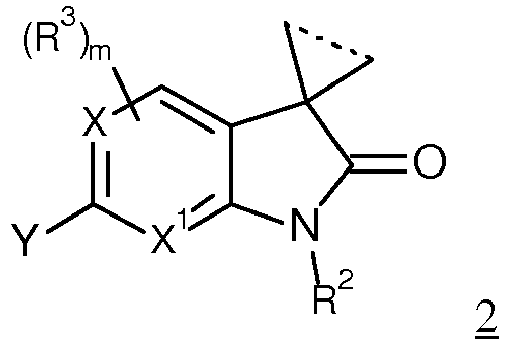


if desired, converting the compounds obtained into pharmaceutically acceptable acid addition salts;
or - b) converting a suitable precursor of formula


if desired, converting the compounds obtained into pharmaceutically acceptable acid addition salts. - The preparation of compounds of formula I of the present invention may be carried out in sequential or convergent synthetic routes. Syntheses of the compounds of the invention are shown in the following schemes. The skills required for carrying out the reaction and purification of the resulting products are known to those skilled in the art. The substituents and indices used in the following description of the processes have the significance given herein before unless indicated to the contrary.
- In more detail, the compounds of formula I can be manufactured by the methods given below, by the methods given in the examples or by analogous methods. Appropriate reaction conditions for the individual reaction steps are known to a person skilled in the art. The reaction sequence is not limited to the one displayed in the schemes, however, depending on the starting materials and their respective reactivity the sequence of reaction steps can be freely altered. Starting materials are either commercially available or can be prepared by methods analogous to the methods given below, by methods described in the examples, or by methods known in the art.

- The present compounds of formula I and their pharmaceutically acceptable salts can be prepared by Suzuki coupling of the corresponding heteroaryl boronic acids or esters 3 with halides 2 or by Suzuki coupling of boronic acids or esters 6 with heteroaryl halides 5 (see Scheme 1). Heteroarylboronic acids and esters 3 are either commercially available or can be prepared from corresponding halides 5 by generally known procedures, e.g. treatment of halides 5 with bis(pinacolato)diboron in the presence of a palladium catalyst. Boronic acids and esters 6 can be prepared from corresponding halides 2 by generally known procedures, e.g. treatment with bis(pinacolato)diboron in the presence of a palladium catalyst.
- In case R2 = H this position can be modified using for example alkyl halides or heterocycloalkyl halides in the presence of an appropriate base. R2 may be modified by appropriate reactions, like a dihydroxylation with osmium tetroxide in the presence of 4-methylmorpholine n-oxide monohydrate and a reductive workup, which can be further alkylated with alkyl halides like MeI in the presence of an appropriate base like NaH. Or, where R2 is a protecting group like for example 4-methoxybenzyl or 2-trimethylsilylethoxymethyl, it may be removed by generally known procedures leading to R2 is hydrogen.

- Alternatively compounds of formula I and their pharmaceutically acceptable salts can be prepared by palladium catalyzed Stille coupling of heteroaryl stannanes 7 with halides 2 (see Scheme 2).

- Compound of formula Ia (see Scheme 3) with R1 = pyrimidyl and substituted by R'R"N (R' and R" represent independent from each other hydrogen or lower alkyl) can be obtained from compounds 8 (prepared according to Scheme 1) by oxidation of the methyl thioether with e.g. mCPBA followed by substitution of the methyl sulfone with amines R'R"NH.

- Alternatively the present compounds of formula I and their pharmaceutically acceptable salts can be prepared from suitable precursors 4 (PC is -CO2R', -CO2H, -CHO, -CH2OH or -(CO)R' with R' = lower alkyl) by applying standard reaction sequences for the formation of the heteroaryl substituent (see Scheme 4) and as exemplified in the following schemes. Alternatively compounds of formula I can be prepared by a displacement reaction of a halide 2 (Y is halide, like e.g. bromine or iodine) with a heteroaryl compound 10 (like e.g. 1H-imidazoles) e.g. under catalytic conditions (like palladium or copper catalysis).

- 1,2,4-Oxadiazoles of formula Ib can be prepared by condensation of acids 11 with N-hydroxy amidines R1C(=NOH)NH2 e.g. in the presence of CDI (see Scheme 5).

- Imidazoles of formula Ic can be prepared by condensation of glyoxal, formaldehyde and ammonium acetate with anilines 12 (see Scheme 6).
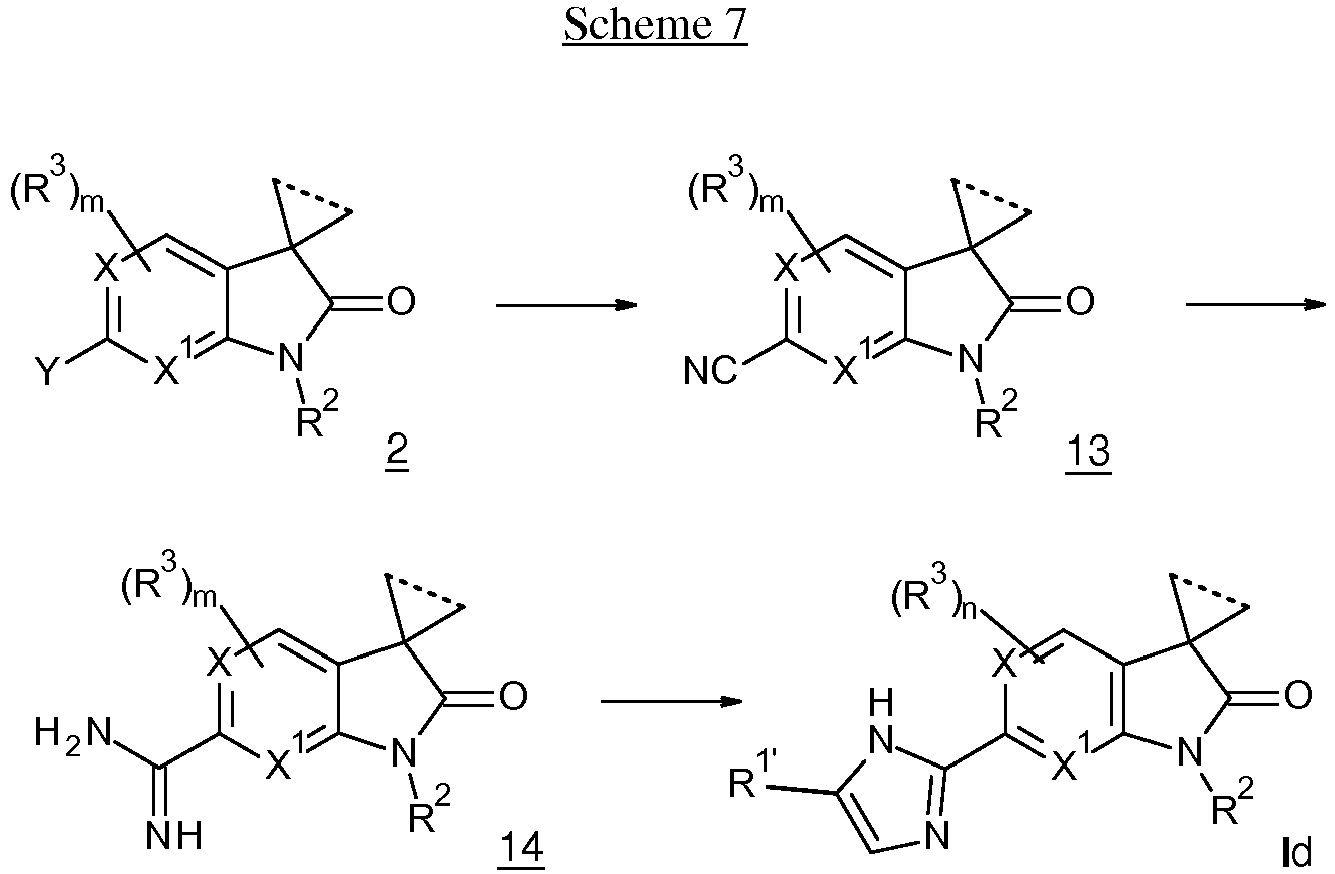
- Imidazoles of formula Id can be prepared starting with substitution of halides 2 with cyanide e.g. with zinc cyanide in the presence of a palladium catalyst. Addition of LiHMDS to the nitrile followed by acidic hydrolysis provides amidines 14, which can be condensed with α-halomethylketones R1'-C(=O)CH2Y (Y is halogen, like bromine, chlorine and R1' is lower alkyl, lower alkyl substituted by halogen, cycloalkyl or heterocycloalkyl) in the presence of a base to provide imidazoles Id (see Scheme 7).

- Imidazoles of formula Ie can be prepared starting from carboxylic acids 11. Conversion to Weinreb amides 15 and reaction with methyl Grignard reagent provides methyl ketones 16 which can be brominated with e.g. tetra-n-butylammonium tribromide. Condensation with amidines R1C(=NH)NH2 yields imidazoles Ie (R1 is lower alkyl, lower alkyl substituted by halogen, cycloalkyl or heterocycloalkyl), Compounds 17 can also be condensed with amides like formamide to give imidazoles where R1 is hydrogen or lower alkyl. Ie can be further transferred to imidazoles of formula Im where R1 is lower alkyl by for example using alky-halides in the presence of an appropriate base or a boronic acid and a copper (II) source under Chan Lam conditions, see Scheme 8.

- Oxazoles of formula If can be prepared by substitution of bromides 17 with sodium azide followed by reaction with acid chlorides R1C(=O)C1 in the presence of triphenylphosphine, (R1 is lower alkyl, lower alkyl substituted by halogen, cycloalkyl or heterocycloalkyl). In cases where R1 is a lower alkyl substituted by acetoxy it can be further modified by cleaving the present ester using generally known methods leading to R1 being lower alkyl substituted by hydroxy, see Scheme 9.

- Oxazoles of formula Ig can be prepared by conversion of carboxylic acids 11 into
aldehydes 20 in a reduction (e.g. with borane tetrahydrofuran complex) - oxidation (e.g. with manganese dioxide) sequence. Reaction of the aldehyde with TOSMIC (tosylmethyl isocyanide) yields oxazoles Ig. These compounds may be transferred to compounds of formula Ie where R1 is hydrogen or lower alkyl by reacting with amides like formamide and subsequently to compounds of formula Im like already described in Scheme 8, seeScheme 10.
- Reaction of methyl ketones 16 with thallic acetate and trifluoromethanesulfonic acid provides oxazoles of formula Ih (see Scheme11).

- Compounds of formula Ik with Ar = oxazolyl, substituted by R'R"N (R' and R" represent independent from each other hydrogen or lower alkyl) can be prepared by halogenation of oxazoles Ig (Y = halogen) with e.g. hexachloroethane after deprotonation with a base like LiHMDS, followed by substitution with amine R'R"NH with heating under conventional or microwave conditions (see Scheme 12).

- Oxazoles of formula I1 can be prepared by condensation of α-bromoketones 17 with amides R1C(=O)NH2 (R1 is lower alkyl, lower alkyl substituted by halogen, cycloalkyl or heterocycloalkyl), see
Scheme 13.
- For R2 = methyl compounds of general formula 2 can e.g. be prepared by trimethylation of 6-halo-oxindoles 21 with Me-LG with LG being a leaving group like iodide, bromide, chloride, tosylate in the presence of a base like sodium hydride (see Scheme 14), and wherein Y is halogen.
- For R2 ≠ methyl compounds of general formula 2 can e.g. be prepared by dimethylation of 6-halo-oxindoles 21 with Me-LG (LG being a leaving group like iodide, bromide, chloride, tosylate) in the presence of a base like potassium tert-butoxide and in the presence of copper (I) bromide-dimethylsulfide complex. The dialkylated product 2a can then be converted to compounds 2 by alkylation with R2-LG in the presence of a base like sodium hydride or cesium carbonate or by coupling of boronic acids R2-B(OH)2 or esters R2-B(OR')2 (e.g. R2- 4,4,5,5-tetramethyl-[1,3,2]dioxaborolane) under metal catalysis (like e.g. palladium(0) or copper(II) catalysis) in the presence of a base like e.g. sodium bis(trimethylsilyl)amide or sodium carbonate.
- For R2 = 3-(cyclopropylthio)propyl and LG = bromide R2-LG can be prepared by reaction of 3-mercaptopropan-1-ol with bromocyclopropane in the presence of a base followed by conversion of the alcohol into the bromide with e.g. tetrabromo-methane and triphenyl phosphine.

- For Y = I, R3' = H or F and R3" = F compounds of general formula 2b can e.g. be prepared by alkylation of
oxindole 22 in analogy to Scheme 14, followed by ortho silylation by treatment with LDA and trimethylsilyl chloride and then exchange of the silyl group with iodide with iodine monochloride (see Scheme 15).
- Compounds of general formula 21 can e.g. be prepared by reduction of
isatin derivatives 25 with e.g. hydrazine, wherein Y is halogen (see Scheme 16).
- Alternatively compounds of general formula 21a with Y = Br can e.g. be prepared starting from 4-bromo-1-fluoro-2-nitro-benzene derivatives 26 by nucleophilic substitution of the fluoride with malonate ester in the presence of a base like e.g. sodium hydride (see Scheme 17). Ester hydrolysis and decarboxylation can e.g. be accomplished by heating in the presence hydrochloric acid to provide acid 28. Nitro reduction with e.g. iron in acetic acid is followed by cyclization to lactam 21a.

- Intermediate hydrazides 29 can be prepared from
ester 30. Either via tranformation to the hydrazides 31 with hydrazine hydrate in methanol and then to the hydrazides 29 by reacting with R1-COOH by methods like a TBTU coupling. Or by saponification ofcompound 30 to the acids 11 and then by reacting with R1-hydrazides by methods like a HOBt/ EDCI coupling. Subsequently the intermediates 29 can be transformed to compounds of formula In by reacting for example with p-toluenesulfonyl chloride in the presence of a base like triethylamine, see Scheme 18.
- Compounds of formula 21b can be transformed to the spirocyclic intermediates 31 by reaction with ethylenedibromide in the presence of a strong base. These compounds may be further modified like described in Scheme 14 to get the intermediates 32 which can be used like compounds of formula 2, see Scheme 19. Y is halide, like e.g. bromine or iodine.

Scheme 20.
- Compounds of formula Iq where R1 = lower alkyl or alkoxyalkyl can be prepared by reacting ketones 16 with R1-esters in the presence of a strong base like sodium hydride to give the 1,3-diketones 34, which can subsequentially be cyclized with hydroxylamine hydrochloride, see Scheme 21.

- Compounds of formula Ig can alternatively to
Scheme 10 be prepared by reacting halides 2 with oxazole in the presence of palladium (II) acetate, 2-di-t-butylphosphino-3,4,5,6-tetramethyl-2',4',6'-tri-i-propylbiphenyl, pivalic acid and potassium carbonate. These can be further transformed to compounds with formula Ir, where R1 is lower alkyl, by reaction with alkyl halides in the presence of borane tetrahydrofuran complex and a strong base like n-butyl lithium, seeScheme 22.
- Compounds of formula Is can be prepared as follows. Reacting ethyl 2-(2,4,6-trichloropyrimidin-5-yl)acetate with R2-NH2 in the presence of a base like diisopropylethylamine to give intermediates of structure 35. These may be dimethylated and cyclized to compounds 36 by reaction with methyl iodide in the presence of a base like cesium carbonate. These compounds can be further functionalized to compounds 37 by means already described in
Schema 1. Finally compounds of formula Is are obtained by hydrogenating in the presence of palladium on charcoal, see Scheme 23. - The following examples are provided for illustration of the invention. They should not be considered as limiting the scope of the invention, but merely as being representative thereof.
-
- Brettphos, 2-(dicyclohexylphosphino)-3,6-dimethoxy-2'-4'-6'-tri-i-propyl-1,1'-biphenyl;
- CBr4, tetrabromomethane;
- CDCl3, deutero chloroform;
- CDI, 1,1'-carbonyldiimidazole;
- CH2Cl2, dichloromethane;
- CO, carbon monoxide;
- Cs2CO3, cesium carbonate;
- CuI, copper (I) iodide;
- DIPEA, diisopropyl ethyl amine;
- DMA, N,N-dimethylacetamide;
- DMAP, 4-dimethylaminopyridine;
- DMF, N,N-dimethylformamide;
- DMSO, dimethylsulfoxide;
- EDCI, N1-((ethylimino)methylene)-N3,N3-dimethylpropane-1,3-diamine hydrochloride; ESI , ion spray ionization;
- EtOAc, ethyl acetate;
- H2O, water;
- HATU, O-(7-azabenzotriazol-1-yl)-N,N,N',N'-tetramethyluronium hexafluorophosphate; HC1, hydrochloric acid;
- HOBt, 1H-benzo[d][1,2,3]triazol-1-ol;
- HPLC, high performance liquid chromatography;
- KOH, potassium hydroxide;
- LiBH4, lithium borohydride;
- LiHMDS, lithium hexamethyldisilazide;
- mCPBA, 3-chloroperbenzoic acid;
- MeI, methyl iodide;
- MeOH, methanol;
- MS, mass spectrum;
- Na2CO3, sodium carbonate;
- Na2SO4, sodium sulfate;
- NaH, sodium hydride;
- NaHCO3, sodium bicarbonate;
- NaOH, sodium hydroxide;
- NaOtBu, sodium tert.-butoxide;
- NH4Cl, ammonium chloride;
- NMP, 1-methyl-2-pyrrolidone;
- NMR, nuclear magnetic resonance spectrum;
- Pd(dppf)Cl2, [1,1'-bis(diphenylphosphino)ferrocene]dichloropalladium(II);
- Pd(PPh3)4, tetrakis(triphenylphosphine)palladium (0);
- Pd2dba3.CHCl3, tris(dibenzylideneacetone)dipalladium(0) chloroform complex;
- SFC, supercritical fluid chromatography;
- TBAF, tetrabutylammonium fluoride;
- TBDMS-Cl, tert-butyldimethylchlorosilane;
- TBME, tert.-butyl methyl ether;
- TBTU, 2-(1H-benzotriazole-1-yl)-1,1,3,3-tetramethyluronium tetrafluoroborate;
- t-BuOH, tert-butanol;
- TFA, trifluoroacetic acid;
- THF , tetrahydrofurane;
- TPPO, triphenylphosphine oxide;
- xantphos, 4,5-bis(diphenylphosphino)-9,9-dimethylxanthene;
- General: Silica gel chromatography was either performed using prepacked cartridges like for example SiliCycle® SiliaSep™ OT silica gel 40 - 63 µm or SiliCycle® SiliaSep™ OT Amine silica gel 40 - 63 µm on a system like Teledyne Isco CombiFlash® Rf 200 or self packed glass columns with
silica gel 60 40 - 63 µm. MS were measured on a device like the Waters ACQUITY-SQD. NMR spectras were measured on a device like Bruker Avance I 300. -

- Under an argon atmosphere NaH (60 % on mineral oil, 7.32 g, 183 mmol) was suspended in dry THF (45 ml). A suspension of 6-bromoindolin-2-one (10 g, 45.7 mmol) in dry THF (108 ml) was added in portions during 10 minutes while temperature was kept below 27 °C. The reaction mixture was warmed to 25 °C and MeI (11.4 ml, 183 mmol) was added dropwise during 1 hour while the internal temperature was carefully kept between 24 and 27 °C. The reaction mixture was stirred at room temperature for 18 hours. Saturated aqueous NH4Cl solution (20 ml) was carefully added at 10-15 °C. The mixture was diluted with EtOAc, H2O and saturated aqueous NaHCO3 solution. The aqueous phase was extracted with EtOAc, the organic layers were washed with saturated aqueous NaHCO3 solution, combined and dried with Na2SO4. The solvent was evaporated and the residue was purified by silica gel chromatography using heptane / ethyl acetate as eluent. The title compound was obtained as light red solid (7.0 g). Mixed fractions were purified again by preparative HPLC yielding further 3.1 g of the title compound.
MS ESI (m/z): 254.1, 256.2 [(M+H)+].
1H NMR (CDCl3, 300 MHz): δ = 7.19 (dd, J=1.5, 7.8 Hz, 1H), 7.06 (d, J=7.9 Hz, 1H), 6.99 (d, J=1.6 Hz, 1H), 3.19 (s, 3H), 1.35 (s, 6H). - To a solution of 6-bromo-1,3,3-trimethylindolin-2-one (250 mg, 984 µmol) and pyridine-4-boronic acid (121 mg, 984 µmol) in dioxane (3.17 ml) was added a 2M aqueous solution of Na2CO3 (1.06 ml). The reaction vessel was evacuated and flushed with argon four times and [1,1'-bis(diphenylphosphino)ferrocene]dichloropalladium(II) (36.0 mg, 49.2 µmol) was added. The reaction mixture was then heated to reflux for 24 hours. The reaction mixture was diluted with water and the aqueous phase was extracted with ethyl acetate. The combined organic layers were washed with 1M aqueous Na2CO3 solution and dried over Na2SO4. The solvent was evaporated and the residue was purified by flash chromatography on silica gel using EtOAc/ dichloromethane as eluent. The title compound was obtained as a yellow solid (138 mg).
MS ESI (m/z): 253.2 [(M+H)+].
1H NMR (DMSO-d6, 300 MHz) δ = 8.64 (d, J=6.1 Hz, 2H), 7.75 (d, J=5.9 Hz, 2H), 7.55 - 7.39 (m, 3H), 3.22 (s, 3H), 1.31 (s, 6H). -

- Prepared in analogy to example 1b from 6-bromo-1,3,3-trimethylindolin-2-one (example 1a) and 2-methylpyridine-4-boronic acid. The title compound was obtained as brown oil.
MS ESI (m/z): 267.2 [(M+H)+].
1H NMR (CDCl3, 300 MHz): δ = 8.56 (d, J=5.2 Hz, 1H), 7.41 - 7.28 (m, 4H), 7.05 (s, 1H), 3.36 - 3.23 (m, 3H), 2.64 (s, 3H), 1.42 (s, 6H). -

- Prepared in analogy to example 1b from 6-bromo-1,3,3-trimethylindolin-2-one (example 1a) and pyridine-3-boronic acid. The title compound was obtained as light yellow solid.
MS ESI (m/z): 253.1 [(M+H)+].
1H NMR (CDCl3, 300 MHz): δ = 8.86 (d, J=2.2 Hz, 1H), 8.62 (dd, J=1.4, 4.6 Hz, 1H), 7.88 (td, J=1.9, 7.9 Hz, 1H), 7.38 (dd, J=4.8, 7.9 Hz, 1H), 7.31 (d, J=7.5 Hz, 1H), 7.26 (dd, J=1.4, 7.5 Hz, 1H), 7.02 (d, J=1.2 Hz, 1H), 3.28 (s, 3H), 1.42 (s, 6H). -

- Prepared in analogy to example 1b from 6-bromo-1,3,3-trimethylindolin-2-one (example 1a) and pyrimidin-5-ylboronic acid. The title compound was obtained as light red solid.
MS ESI (m/z): 254.2 [(M+H)+].
1H NMR (CDCl3, 300 MHz): δ = 9.23 (s, 1H), 8.96 (s, 2H), 7.35 (d, J=7.7 Hz, 1H), 7.26 (dd, J=1.4, 7.5 Hz, 1H), 7.00 (d, J=1.2 Hz, 1H), 3.29 (s, 3H), 1.43 (s, 6H). -

- A solution of 6-bromo-1,3,3-trimethylindolin-2-one (example 1a, 150 mg, 590 µmol) in THF (3 ml) was evacuated 3 times and flushed with argon. 2-(Tributylstannyl)pyridine (266 mg, 231 µl, 649 µmol), bis(triphenylphosphine)palladium(II) dichloride (21.1 mg, 29.5 µmol) and copper(I) iodide (5.62 mg, 29.5 µmol) were added and the mixture heated to reflux. After 3 hours again 2-(tributylstannyl)pyridine (266 mg, 231 µl, 649 µmol), bis(triphenylphosphine)palladium(II) dichloride (21.1 mg, 29.5 µmol) und copper(I) iodide (5.62 mg, 29.5 µmol) were added and the mixture stirred 60 hours at reflux. The mixture was filtered through a pad of silica gel, washed with EtOAc and the obtained solution concentrated in vacuo. The crude material was purified by silica gel chromatography using heptane/ ethyl acetate as eluent. The title compound was obtained as light yellow solid (38 mg).
MS ESI (m/z): 253.1 [(M+H)+].
1H NMR (CDCl3, 300 MHz): δ = 8.70 (d, J=4.6 Hz, 1H), 7.83 - 7.70 (m, 2H), 7.62 (dd, J=1.4, 7.7 Hz, 1H), 7.57 (s, 1H), 7.32 - 7.22 (m, 2H), 3.31 (s, 3H), 1.41 (s, 6H). -
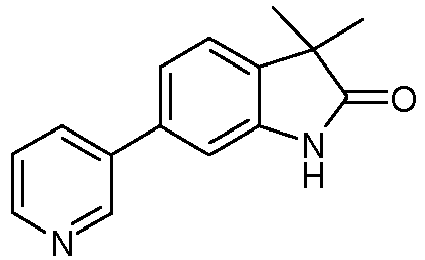
- Prepared in analogy to example 1b from 6-bromo-3,3-dimethyl-indolin-2-one (example 24a) and pyridine-3-boronic acid. The title compound was obtained as light brown solid.
MS ESI (m/z): 239.1 [(M+H)+].
1H NMR (CDCl3, 300 MHz): δ = 8.92 (br s, 1H), 8.84 (d, J=2.2 Hz, 1H), 8.61 (dd, J=1.4, 4.6 Hz, 1H), 7.86 (td, J=1.9, 7.9 Hz, 1H), 7.37 (dd, J=4.8, 7.9 Hz, 1H), 7.30 (d, J=7.7 Hz, 1H), 7.25 (dd, J=1.4, 8.1 Hz, 1H), 7.16 (d, J=1.2 Hz, 1H), 1.46 (s, 6H). -

- Prepared in analogy to example 1b from 6-bromo-3,3-dimethyl-indolin-2-one (example 24a) and pyridine-4-boronic acid. The title compound was obtained as light brown solid.
MS ESI (m/z): 239.1 [(M+H)+].
1H NMR (CDCl3, 300 MHz): δ = 8.72 - 8.63 (m, 2H), 8.41 (br. s., 1H), 7.53 - 7.44 (m, 2H), 7.36 - 7.28 (m, 2H), 7.18 (s, 1H), 1.46 (s, 6H). -

- Prepared in analogy to example 1b from 6-bromo-3,3-dimethyl-indolin-2-one (example 24a) and pyrimidin-5-ylboronic acid. The title compound was obtained as light brown solid.
MS ESI (m/z): 240.3 [(M+H)+].
1H NMR (CDCl3, 300 MHz): δ = 9.22 (s, 1H), 8.94 (s, 2H), 8.61 (br. s, 1H), 7.35 (d, J=7.7 Hz, 1H), 7.25 (dd, J=1.6, 7.7 Hz, 1H), 7.14 (d, J=1.4 Hz, 1H), 1.51 - 1.40 (s, 6H). -

- To a suspension of 6-bromo-1,3,3-trimethylindolin-2-one (example 1a, 0.15 g, 590 µmol) and 2-(methylthio)pyrimidine-5-boronic acid (155 mg, 885 µmol) in dioxane (1.9 ml) was added 2M aqueous Na2CO3 solution (633 µl). The reaction vessel was evacuated four times and purged with argon. [1,1'-Bis(diphenylphosphino)ferrocene]dichloropalladium(II) (21.6 mg, 29.5 µmol) was added, evacuation and purging was repeated and the mixture heated to reflux for 15 hours. The reaction mixture was diluted with EtOAc and MeOH, two spoons silicagel were added and the suspension was concentrated in vacuo. The crude material was purified by silica gel chromatography using heptane/ ethyl acetate as eluent. The title compound was isolated as light yellow solid (158 mg).
MS ESI (m/z): 300.4 [(M+H)+].
1H NMR (CDCl3, 300 MHz): δ = 8.80 (s, 2H), 7.32 (d, J=7.7 Hz, 1H), 7.21 (dd, J=1.6, 7.5 Hz, 1H), 6.95 (d, J=1.4 Hz, 1H), 3.28 (s, 3H), 2.63 (s, 3H), 1.41 (s, 6H). - To a solution of 1,3,3-trimethyl-6-(2-(methylthio)pyrimidin-5-yl)indolin-2-one (0.09 g, 301 µmol) in dichloromethane (3.01 ml) was added mCPBA (168 mg, 752 µmol) and the reaction mixture was stirred 4 hours at room temperature. The mixture was diluted with CH2Cl2, H2O and 1M aqueous Na2CO3 solution. The mixture was extracted with CH2Cl2 and the organic layer was washed with 1M aqueous Na2CO3 solution. The combined organic layers were dried with Na2SO4, filtered and concentrated in vacuo. The title compound was obtained as yellow solid (109 mg, 92% purity) and used for the next step without further purification.
MS ESI (m/z): 332.1 [(M+H)+].
1H NMR (CDCl3, 300 MHz): δ = 9.11 (s, 2H), 7.39 (d, J=7.7 Hz, 1H), 7.32 - 7.27 (m, 1H), 7.01 (d, J=1.0 Hz, 1H), 3.42 (s, 3H), 3.31 (s, 3H), 1.43 (s, 6H). - A suspension of 1,3,3-trimethyl-6-(2-(methylsulfonyl)pyrimidin-5-yl)indolin-2-one (0.107 g, 297 µmol, 92% purity) in pyrrolidine (860 mg, 1ml, 12.0 mmol) was heated to reflux. After 30 minutes the mixture was diluted with ethyl acetate and water. The aqueous layer was extracted with EtOAc and the organic layers were washed with 1M aqueous Na2CO3 solution. The combined organic layers were dried with Na2SO4, filtered and concentrated in vacuo. The crude material was purified by silica gel chromatography using heptane/ ethyl acetate as eluent. The title compound was obtained as yellow solid (81 mg).
MS ESI (m/z): 323.3 [(M+H)+].
1H NMR (CDCl3, 300 MHz): δ = 8.56 (s, 2H), 7.26 (d, J=7.5 Hz, 1H), 7.15 (dd, J=1.5, 7.6 Hz, 1H), 6.90 (d, J=1.4 Hz, 1H), 3.69 - 3.58 (m, 4H), 3.26 (s, 3H), 2.09 - 1.98 (m, 4H), 1.40 (s, 6H). -

- Prepared in analogy to example 9c from 1,3,3-trimethyl-6-(2-(methylsulfonyl)pyrimidin-5-yl)indolin-2-one (example 9b) and ammonium hydroxide. The title compound was obtained as white solid.
MS ESI (m/z): 269.4 [(M+H)+].
1H NMR (CDCl3, 300 MHz): δ = 8.54 (s, 2H), 7.28 (d, J=7.6 Hz, 1H), 7.16 (dd, J=1.5, 7.6 Hz, 1H), 6.91 (d, J=1.4 Hz, 1H), 5.12 (br s, 2H), 3.27 (s, 3H), 1.40 (s, 6H). -

- Prepared in analogy to example 9c from 1,3,3-trimethyl-6-(2-(methylsulfonyl)pyrimidin-5-yl)indolin-2-one (example 9b) and dimethylamine in ethanol. The title compound was obtained as light yellow solid.
MS ESI (m/z): 297.4 [(M+H)+].
1H NMR (CDCl3, 300 MHz): δ = 8.56 (s, 2H), 7.26 (d, J=7.5 Hz, 1H), 7.15 (dd, J=1.4, 7.3 Hz, 1H), 6.90 (d, J=1.2 Hz, 1H), 3.28 - 3.22 (m, 9H), 1.40 (s, 6H). -

- A suspension of 1,3,3-trimethyl-6-(2-(methylsulfonyl)pyrimidin-5-yl)indolin-2-one (example 9b, 0.15 g, 430 µmol) in dry tetrahydrofurane (2.2 ml) was cooled to 0 °C. A solution of methylmagnesium chloride in THF (3M, 287 µl, 860 µmol) was added dropwise, the cooling bath was removed and the reaction mixture stirred 15 hours at room temperature. The mixture was diluted with CH2Cl2, H2O and 1M aqueous Na2CO3 solution and the aqueous layer was extracted with CH2Cl2. The combined organic layers were washed with 1M aqueous Na2CO3 solution, dried with sodium sulfate, filtered and concentrated in vacuo. The crude material was purified by silica gel chromatography using dichlormethane/ ethyl acetate as eluent. The obtained material was purified by preparative HPLC through a Chiralpak AD column using heptane / ethanol as eluent. The title compound was obtained as light red solid (52 mg).
MS ESI (m/z): 268.3 [(M+H)+].
1H NMR (CDCl3, 300 MHz): δ = 8.85 (s, 2H), 7.33 (d, J=7.7 Hz, 1H), 7.23 (dd, J=1.4, 7.5 Hz, 1H), 6.98 (d, J=1.4 Hz, 1H), 3.29 (s, 3H), 2.81 (s, 3H), 1.42 (s, 6H). -

- A suspension of 1,3,3-trimethyl-6-(4,4,5,5-tetramethyl-1,3,2-dioxaborolan-2-yl)indolin-2-one (example 29a, 297 mg, 779 µmol), 3-bromo-pyridazine hydrobromide (286 mg, 1.17 mmol) in dioxane (3.9 ml) and 2M aqueous Na2CO3 solution (1.3 ml) was evacuated three times and flushed with argon. Then [1,1'-bis(diphenylphosphino)ferrocene]dichloropalladium(II) (28.5 mg, 39.0 µmol) was added, the mixture was heated to reflux for 15 hours. The reaction mixture was diluted with MeOH, silica gel was added and the mixture concentrated in vacuo. The crude material was purified by silica gel chromatography using dichloromethane/ methanol as eluent. The obtained material was again purified by preparative HPLC on a Gemini NX 3u C18 110A column using water/ formic acid/ methanol as eluent. The title compound was obtained as white solid (136 mg).
MS ESI (m/z): 254.2 [(M+H)+].
1H NMR (CDCl3, 300 MHz): δ = 9.18 (d, J=3.8 Hz, 1H), 7.89 (dd, J=1.4, 8.7 Hz, 1H), 7.79 (d, J=1.0 Hz, 1H), 7.63 (dd, J=1.3, 7.8 Hz, 1H), 7.56 (dd, J=4.8, 8.5 Hz, 1H), 7.34 (d, J=7.5 Hz, 1H), 3.32 (s, 3H), 1.43 (s, 6H). -

- Prepared in analogy to example 13 from 1,3,3-trimethyl-6-(4,4,5,5-tetramethyl-1,3,2-dioxaborolan-2-yl)indolin-2-one (example 29a) and 5-bromo-4-ethylpyrimidine. The title compound was obtained as colorless oil.
MS ESI (m/z): 282.2 [(M+H)+].
1H NMR (CDCl3, 300 MHz): δ = 9.14 (s, 1H), 8.54 (s, 1H), 7.29 (d, J=7.5 Hz, 1H), 6.99 (d, J=7.5 Hz, 1H), 6.76 (s, 1H), 3.24 (s, 3H), 2.81 (q, J=7.5 Hz, 2H), 1.43 (s, 6H), 1.27 (t, J=7.5 Hz, 3H). -

- Prepared in analogy to example 13 from 1,3,3-trimethyl-6-(4,4,5,5-tetramethyl-1,3,2-dioxaborolan-2-yl)indolin-2-one (example 29a) and 2-amino-5-bromopyridine. The title compound was obtained as light yellow solid.
MS ESI (m/z): 268.3 [(M+H)+].
1H NMR (CDCl3, 300 MHz): δ = 8.32 (d, J=2.4 Hz, 1H), 7.68 (dd, J=2.3, 8.6 Hz, 1H), 7.25 (d, J=7.4 Hz, 1H), 7.18 (dd, J=1.4, 7.7 Hz, 1H), 6.94 (d, J=1.4 Hz, 1H), 6.60 (d, J=8.5 Hz, 1H), 4.55 (br s, 2H), 3.27 (s, 3H), 1.40 (s, 6H). -

- Prepared in analogy to example 24b from 6-bromo-3,3-dimethyl-indolin-2-one (example 24a) and 2-aminopyrimidine-5-boronic acid, pinacol ester. The title compound was obtained as light brown solid.
MS ESI (m/z): 255.3 [(M+H)+].
1H NMR (DMSO-d6, 300 MHz) δ = 10.40 (s, 1H), 8.49 (s, 2H), 7.33 (d, J=7.9 Hz, 1H), 7.22 - 7.11 (m, 1H), 6.98 (s, 1H), 6.75 (s, 2H), 1.26 (s, 6H). -

- Prepared in analogy to example 29a from 6-bromo-3,3-dimethyl-indolin-2-one (example 24a). The title compound was obtained as light yellow solid.
MS ESI (m/z): 288.2 [(M+H)+].
1H NMR (CDCl3, 300 MHz): δ = 7.94 (br s, 1H), 7.53 (d, J=7.5 Hz, 1H), 7.35 (s, 1H), 7.21 (d, J=7.3 Hz, 1H), 1.40 (s, 6H), 1.34 (s, 12H) - Prepared in analogy to example 29b from 3,3-dimethyl-6-(4,4,5,5-tetramethyl-1,3,2-dioxaborolan-2-yl)indolin-2-one and 4-bromopyridazine hydrobromide. The title compound was obtained as brown solid.
MS ESI (m/z): 240.2 [(M+H)+].
1H NMR (CDCl3, 300 MHz): δ = 9.46 (d, J=1.2 Hz, 1H), 9.25 (d, J=5.4 Hz, 1H), 8.52 (br s, 1H), 7.64 (dd, J=2.4, 5.4 Hz, 1H), 7.36 (s, 2H), 7.23 (s, 1H), 1.47 (s, 6H) -

- Prepared in analogy to example 29b from 3,3-dimethyl-6-(4,4,5,5-tetramethyl-1,3,2-dioxaborolan-2-yl)indolin-2-one (example 17a) and 2-amino-5-bromopyridine. The title compound was obtained as light brown solid.
MS ESI (m/z): 254.2 [(M+H)+].
1H NMR (DMSO-d6, 300 MHz) δ = 10.35 (s, 1H), 8.16 (d, J=2.4 Hz, 1H), 7.62 (dd, J=2.5, 8.6 Hz, 1H), 7.30 (d, J=7.7 Hz, 1H), 7.12 (dd, J=1.2, 7.7 Hz, 1H), 6.94 (d, J=1.2 Hz, 1H), 6.51 (d, J=8.5 Hz, 1H), 6.05 (br. s, 2H), 1.26 (s, 6H) -

- Prepared in analogy to example 24b from 6-bromo-3,3-dimethyl-indolin-2-one (example 24a) and 2-methylpyridin-3-ylboronic acid. The title compound was obtained as off-white solid.
MS ESI (m/z): 253.2 [(M+H)+].
1H NMR (CDCl3, 300 MHz): δ = 8.51 (dd, J=1.7, 4.7 Hz, 1H), 7.94 (br s, 1H), 7.51 (dd, J=1.7, 7.6 Hz, 1H), 7.25 (d, J=7.6 Hz, 1H), 7.19 (dd, J=4.8, 7.7 Hz, 1H), 6.98 (dd, J=1.2, 7.7 Hz, 1H), 6.86 (d, J=1.2 Hz, 1H), 2.53 (s, 3H), 1.46 (s, 6H). -

- Prepared in analogy to example 24b from 6-bromo-3,3-dimethyl-indolin-2-one (example 24a) and 3-methylpyridin-4-ylboronic acid. The title compound was obtained as light brown solid.
MS ESI (m/z): 253.2 [(M+H)+].
1H NMR (CDCl3, 300 MHz): δ = 8.51 (s, 1H), 8.47 (d, J=5.0 Hz, 1H), 8.06 (br s, 1H), 7.26 (d, J=7.5 Hz, 1H), 7.14 (d, J=4.8 Hz, 1H), 6.99 (dd, J=1.4, 7.7 Hz, 1H), 6.86 (d, J=1.4 Hz, 1H), 2.30 (s, 3H), 1.46 (s, 6H). -

- Prepared in analogy to example 24b from 6-bromo-3,3-dimethyl-indolin-2-one (example 24a) and 2-methylpyrimidin-5-ylboronic acid. The title compound was obtained as brown solid.
MS ESI (m/z): 254.2 [(M+H)+].
1H NMR (CDCl3, 300 MHz): δ = 8.83 (s, 2H), 8.27 (br s, 1H), 7.32 (d, J=8.1 Hz, 1H), 7.23 (dd, J=1.4, 7.7 Hz, 1H), 7.10 (d, J=1.2 Hz, 1H), 2.80 (s, 3H), 1.45 (s, 6H). -

- Prepared in analogy to example 29b from 1,3,3-trimethyl-6-(4,4,5,5-tetramethyl-1,3,2-dioxaborolan-2-yl)indolin-2-one (example 29a) and 3-bromo-6-methylpyridazine. The title compound was obtained as brown solid.
MS ESI (m/z): 268.2 [(M+H)+].
1H NMR (CDCl3, 300 MHz): δ = 7.82 - 7.74 (m, 2H), 7.61 (dd, J=1.6, 7.9 Hz, 1H), 7.41 (d, J=8.7 Hz, 1H), 7.33 (d, J=7.7 Hz, 1H), 3.31 (s, 3H), 2.78 (s, 3H), 1.42 (s, 6H). -

- Prepared in analogy to example 29b from 1,3,3-trimethyl-6-(4,4,5,5-tetramethyl-1,3,2-dioxaborolan-2-yl)indolin-2-one (example 29a) and 3-bromo-6,7-dihydro-5H-cyclopenta[b]pyridine. The title compound was obtained as light red solid.
MS ESI (m/z): 293.1 [(M+H)+].
1H NMR (CDCl3, 300 MHz): δ = 8.57 (s, 1H), 7.69 (s, 1H), 7.31 - 7.20 (m, 2H), 6.99 (s, 1H), 3.28 (s, 3H), 3.13 - 2.96 (m, 4H), 2.20 (quin, J=7.6 Hz, 2H), 1.41 (s, 6H). -

- To a suspension of potassium tert-butylate (12.8 g, 114 mmol) in dry THF (80 ml) at 0°C under an argon atmosphere was added portionwise 6-bromoindolin-2-one (5.0 g, 22.9 mmol) followed by copper(I) bromide-dimethylsulfide complex (470 mg, 2.29 mmol). MeI (6.82 g, 3.00 ml, 48.0 mmol) was added dropwise within 45 minutes, keeping internal temperature below 8 °C. The reaction mixture was warmed to room temperature and kept at this temperature for 16 hours. The reaction mixture was cooled to 0 °C again and saturated aqueous ammonium chloride solution was cautiously added. The mixture was diluted with tert-butyl methyl ether and water. The aqueous phase was extracted with tert-butyl methyl ether, the combined organic phases were dried over sodium sulfate, the solvent was evaporated and the residue was purified by silica gel chromatography using ethyl acetate/ heptane as eluent. The title compound was obtained as light yellow solid (5.17 g).
MS ESI (m/z): 240.0/ 242.1 [(M+H)+].
1H NMR (CDCl3, 400 MHz): δ(ppm) = 8.12 (m, 1H), 7.20-7.16 (m, 1H), 7.09-7.08 (m, 1H), 7.06-7.04 (m, 1H), 1.39 (s, 6H). - To a suspension of 6-bromo-3,3-dimethylindolin-2-one (120 mg, 500 µmol) and 2-methylpyridin-4-ylboronic acid (105 mg, 750 µmol) in dioxane (2 ml) and an aqueous solution of sodium carbonate (2M, 667 µl) [1,1'-bis(diphenylphosphino)ferrocene] dichloropalladium(II) (18.3 mg, 25.0 µmol) was added under an argon atmosphere. The reaction mixture was heated to reflux and stirred at this temperature under an argon atmosphere for 12 hours.
- The mixture was diluted with ethyl acetate and 2M aqueous solution of sodium carbonate. The aqueous phase was extracted with ethyl acetate, the combined organic phases were washed with brine, dried over sodium sulfate, the solvent was evaporated and the residue was purified by silica gel chromatography using ethyl acetate/ heptane as eluent. The title compound was obtained as off-white foam (60 mg).
MS ESI (m/z): 253.1 [(M+H)+].
1H NMR (CDCl3, 400 MHz): δ (ppm) = 8.55 (d, J=5.2 Hz, 1H), 8.33 (br s, 1H), 7.40 - 7.27 (m, 4H), 7.20 - 7.13 (m, 1H), 2.63 (s, 3H), 1.45 (s, 6H). -

- Prepared in analogy to example 29b from 1,3,3-trimethyl-6-(4,4,5,5-tetramethyl-1,3,2-dioxaborolan-2-yl)indolin-2-one (example 29a) and 7-bromo-2,3-dihydro-1H-pyrido[2,3-b][1,4]oxazine. The title compound was obtained as light yellow solid.
MS ESI (m/z): 310.2 [(M+H)+].
1H NMR (CDCl3, 300 MHz): δ = 7.84 (d, J=2.0 Hz, 1H), 7.24 (d, J=8.1 Hz, 1H), 7.18 (dd, J=1.2, 7.7 Hz, 1H), 7.06 (d, J=2.2 Hz, 1H), 6.97 - 6.91 (m, 1H), 4.50 - 4.42 (m, 2H), 3.96 (br s, 1H), 3.52 - 3.42 (m, 2H), 3.26 (s, 3H), 1.40 (s, 6H). -

- Prepared in analogy to example 29b from 1,3,3-trimethyl-6-(4,4,5,5-tetramethyl-1,3,2-dioxaborolan-2-yl)indolin-2-one (example 29a) and 3-bromo-6,7-dihydro-5H-pyrrolo[3,4-b]pyridine. The title compound was obtained as light brown solid.
MS ESI (m/z): 294.2 [(M+H)+].
1H NMR (CDCl3, 300 MHz): δ = 8.65 (s, 1H), 7.73 (s, 1H), 7.34 - 7.20 (m, 2H), 7.00 (d, J=1.2 Hz, 1H), 4.44 - 4.30 (m, 4H), 3.28 (s, 3H), 2.56 (br s, 1H), 1.42 (s, 6H). -

- Prepared in analogy to example 29b from 1,3,3-trimethyl-6-(4,4,5,5-tetramethyl-1,3,2-dioxaborolan-2-yl)indolin-2-one (example 29a) and 5-bromopyridin-3-amine. The title compound was obtained as light yellow solid.
MS ESI (m/z): 268.2 [(M+H)+].
1H NMR (CDCl3, 300 MHz): δ = 8.26 (d, J=1.8 Hz, 1H), 8.10 (d, J=2.6 Hz, 1H), 7.28 (d, J=7.7 Hz, 1H), 7.23 (dd, J=1.6, 7.7 Hz, 1H), 7.17 - 7.13 (m, 1H), 6.99 (d, J=1.2 Hz, 1H), 3.79 (br s, 2H), 3.27 (s, 3H), 1.41 (s, 6H). -

- A solution of 4-bromo-3,5-dimethylpyridine (500 mg, 2.69 mmol) in dry THF (20 ml) was evacuated and purged with argon. Cesium carbonate (1051mg, 3.22 mmol) was added followed by 1,3,3-trimethyl-6-(4,4,5,5-tetramethyl-1,3,2-dioxaborolan-2-yl)indolin-2-one (example 29a, 972 mg, 3.22 mmol). After 15 minutes of purging with argon
tetrakis(triphenylphosphine)palladium(0) (249 mg, 0.21 mmol) was added. Again the vessel was purged for 15 minutes with argon and the reaction mixture was heated to reflux for 15 hours. The reaction mixture was diluted with ethyl acetate, filtered through a bed of celite, washed with more ethyl acetate and the obtained solution was concentrated in vacuo. The crude material was purified by silica gel chromatography. The obtained material was finally purified by preparative HPLC to get the title compound as an off white solid (344 mg).
MS ESI (m/z): 281 [(M+H)+]. -
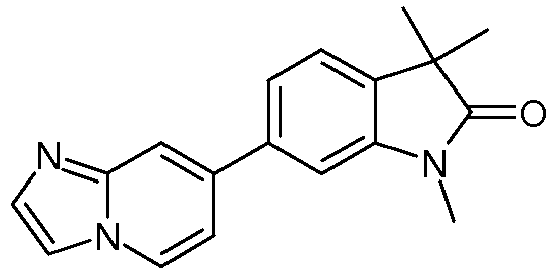
- Through a suspension of 6-bromo-1,3,3-trimethylindolin-2-one (example 1a, 500 mg, 1.97 mmol), bis(pinacolato)diboron (757 mg, 2.95 mmol) and potassium acetate (390 mg, 3.94 mmol) in DMSO (10 ml) was bubbled argon for 5 minutes. [1,1'-Bis(diphenylphosphino)ferrocene] dichloropalladium(II) (72 mg, 98.4 µmol) was added and argon was bubbled through again for 5 minutes. The reaction mixture was heated to 110 °C for 5 hours. Water was added and the aqueous phase was extracted with ethyl acetate. The combined organic layers were dried over sodium sulfate, the solvent was evaporated and the residue was purified by silica gel chromatography using ethyl acetate/ heptane as eluent. The title compound was obtained as white solid (607 mg).
MS ESI (m/z): 302.3 [(M+H)+].
1H NMR (CDCl3, 300 MHz): δ = 7.57 (dd, J=0.8, 7.3 Hz, 1H), 7.27 (s, 1H), 7.23 (d, J=7.3 Hz, 1H), 3.24 (s, 3H), 1.37 (s, 6H), 1.36 (s, 12H) - Through a suspension of 1,3,3-trimethyl-6-(4,4,5,5-tetramethyl-1,3,2-dioxaborolan-2-yl)indolin-2-one (300 mg, 896 µmol), 7-bromoimidazo[1,2-a]pyridine (
F.P. Marmsäter et al., WO2008/121687 ; 212 mg, 1.08 mmol) and Na2CO3 (2M, 896 µl, 1.79 mmol) in dioxane (4 ml) was bubbled argon for 5 minutes. [1,1'-Bis(diphenylphosphino)ferrocene] dichloropalladium(II) (32.8 mg, 44.8 µmol) was added and argon was bubbled through again for 5 minutes. The reaction mixture was heated to 110 °C for 12 hours. The solvent was evaporated and the residue was purified by silica gel chromatography using ethyl acetate/ heptane and dichloromethane/ methanol/ ammonia as eluent. The title compound was obtained as light red solid (244 mg).
MS ESI (m/z): 292.2 [(M+H)+].
1H NMR (CDCl3, 300 MHz): δ = 8.20 (dd, J=0.8, 7.1 Hz, 1H), 7.87 - 7.80 (m, 1H), 7.69 (d, J=1.2 Hz, 1H), 7.62 (s, 1H), 7.38 - 7.28 (m, 2H), 7.14 - 7.04 (m, 2H), 3.29 (s, 3H), 1.42 (s, 6H). -

- Prepared in analogy to example 29 from 6-bromoimidazo[1,2-a]pyridine (M. Yamanaka et al., Chem. Pharm. Bull. 1991, 39(6), 1556 - 1567). The title compound was obtained as light red solid.
MS ESI (m/z): 292.1 [(M+H)+].
1H NMR (CDCl3, 300 MHz): δ = 8.33 (dd, J=1.0, 1.8 Hz, 1H), 7.74 - 7.62 (m, 3H), 7.43 (dd, J=1.8, 9.5 Hz, 1H), 7.33 - 7.28 (m, 1H), 7.26 - 7.21 (m, 1H), 7.00 (d, J=1.2 Hz, 1H), 3.29 (s, 3H), 1.42 (s, 6H). -

- Prepared in analogy to example 29b from 1,3,3-trimethyl-6-(4,4,5,5-tetramethyl-1,3,2-dioxaborolan-2-yl)indolin-2-one (example 29a) and 5-bromo-4,6-dimethylpyrimidine. The title compound was obtained as off white solid.
MS ESI (m/z): 282 [(M+H)+]. -

- Prepared in analogy to example 29b from 1,3,3-trimethyl-6-(4,4,5,5-tetramethyl-1,3,2-dioxaborolan-2-yl)indolin-2-one (example 29a) and 3-bromo-2,4-dimethylpyrimidine. The title compound was obtained as off white solid.
MS ESI (m/z): 281 [(M+H)+]. -

- Prepared in analogy to example 29b from 3,3-dimethyl-6-(4,4,5,5-tetramethyl-1,3,2-dioxaborolan-2-yl)indolin-2-one (example 17a) and 5-bromonicotinonitrile. The title compound was obtained as white solid.
MS ESI (m/z): 264.1 [(M+H)+].
1H NMR (CDCl3, 300 MHz): δ = 9.02 (d, J=2.4 Hz, 1H), 8.87 (d, J=1.8 Hz, 1H), 8.53 (br. s, 1H), 8.11 (t, J=2.1 Hz, 1H), 7.35 (d, J=7.3 Hz, 1H), 7.24 (dd, J=1.6, 7.7 Hz, 1H), 7.13 (d, J=1.2 Hz, 1H), 1.46 (s, 6H). -

- To a suspension of NaH (8.79 g, 220 mmol) in tetrahydrofuran (100 ml) was added 7-fluoroindolin-2-one (8.30 g, 54.9 mmol) portionwise within 20 minutes. The reaction mixture was stirred for 30 minutes. MeI (31.2 g, 13.7 ml, 220 mmol) was added dropwise at 24-27 °C within 1.5 hours. The reaction mixture was stirred at room temperature for 3 hours. The reaction mixture was very carefully quenched with 20 ml saturated aqueous ammonium chloride solution at 10-15 °C, then diluted with tert-butyl methyl ether and water. The aqueous phase was extracted with tert-butyl methyl ether, the combined organic phases were washed with brine and dried over sodium sulfate. The solvent was evaporated and the residue purified by silica gel chromatography using ethyl acetate/ heptane as eluent. The title compound was obtained as orange crystals (9.91 g).
MS ESI (m/z): 194.3 [(M+H)+].
1H NMR (CDCl3, 400 MHz): δ(ppm) = 6.99-6.97 (m, 3H), 3.43 (d, J = 2.62 Hz, 3H), 1.37 (s, 6H). - A solution of diisopropylamine (5.4 g, 7.6 ml, 52.8 mmol) in dry tetrahydrofuran (23 ml) under an argon atmosphere was cooled to -40 °C and a solution of n-BuLi (1.6 M in hexane, 31.6 ml, 50.5 mmol) was added dropwise. The mixture was stirred at -40 °C for 30 minutes and then added to a solution of 7-fluoro-1,3,3-trimethylindolin-2-one (8.875 g, 45.9 mmol) and trimethylsilyl chloride (5.49 g, 6.46 ml, 50.5 mmol) in dry tetrahydrofuran (69 ml) at -75 °C. The reaction mixture was warmed to room temperature within 16 hours. The reaction mixture was carefully quenched with water (2 ml) and diluted with ethyl acetate and water. The aqueous phase was extracted with ethyl acetate, the combined organic layers were washed with brine and dried over sodium sulfate. The solvent was evaporated in vacuo and the residue purified by silica gel chromatography using ethyl acetate/ heptane as eluent. The title compound was obtained as light yellow oil (8.55 g).
MS ESI (m/z): 266.2 [(M+H)+].
1H NMR (CDCl3, 400 MHz): δ(ppm) = 7.06-7.02 (m, 1H), 6.99-6.96 (m, 1H), 3.44 (d, J = 3.03 Hz, 3H), 1.36 (s, 6H), 0.33 (s, 9H). - To a solution of 7-fluoro-1,3,3-trimethyl-6-(trimethylsilyl)indolin-2-one (9.9 g, 37.3 mmol) in dichloromethane (500 ml) at 0 °C was added iodine monochloride (1M in CH2Cl2, 37.3 ml, 37.3 mmol). The reaction mixture was warmed to room temperature and stirred for 16 hours. A saturated aqueous solution of sodium thiosulfate was added to the reaction mixture and the aqueous phase was extracted with dichloromethane. The combined organic layers were dried over sodium sulfate. The solvent was evaporated and the residue purified by silica gel chromatography using ethyl acetate/ heptane as eluent. The title compound was obtained as off-white crystals (9.82 g).
MS ESI (m/z): 320.0 [(M+H)+].
1H NMR (CDCl3, 400 MHz): δ(ppm) = 7.43-7.39 (m, 1H), 6.77-6.75 (m, 1H), 3.42 (d, J = 3.23 Hz, 3H), 1.36 (s, 6H). - Prepared in analogy to example 1b from 7-fluoro-6-iodo-1,3,3-trimethylindolin-2-one and pyridin-3-ylboronic acid. The title compound was obtained as yellow solid.
MS ESI (m/z): 271.2 [(M+H)+].
1H NMR (CDCl3, 300 MHz): δ = 8.81 - 8.74 (m, 1H), 8.63 (dd, J=1.6, 4.8 Hz, 1H), 7.85 (qd, J=2.0, 7.9 Hz, 1H), 7.39 (ddd, J=0.9, 4.9, 7.9 Hz, 1H), 7.12 - 7.03 (m, 2H), 3.48 (d, J=3.2 Hz, 3H), 1.42 (s, 6H). -

- Prepared in analogy to example 29b from 3,3-dimethyl-6-(4,4,5,5-tetramethyl-1,3,2-dioxaborolan-2-yl)indolin-2-one (example 17a) and 3-bromo-2,4-dimethylpyridine. The title compound was obtained as off white solid.
MS ESI (m/z): 267 [(M+H)+]. -

- A mixture of 6-bromo-7-methylindoline-2,3-dione (G.W. Rewcastle et al., J.Med.Chem. 1991, 34(1), 217-222; 7.65 g, 31.9 mmol) and hydrazine monohydrate (35.9 g, 35 ml, 718 mmol) was heated to 130 °C for 3 hours and then cooled to 10 °C. 37 % HCl (72.2 g, 60.2 ml, 733 mmol) was added slowly. The precipitate was filtered through sintered glass, washed excessively with water, then with little heptane and dried under high vacuum. The title compound was obtained as yellow crystals and used for the next reaction without further purification.
- Prepared in analogy to example 1a from 6-bromo-7-methyl-1,3-dihydro-indol-2-one. The title compound was obtained as light brown solid.
MS ESI (m/z): 268.1, 270.4 [(M+H)+].
1H NMR (CDCl3, 300 MHz): δ = 7.29 (d, J=7.9 Hz, 1H), 6.89 (d, J=8.0 Hz, 1H), 3.51 (s, 3H), 2.67 (s, 3H), 1.33 (s, 6H). - Prepared in analogy to example 29a from 6-bromo-1,3,3,7-tetramethylindolin-2-one. The title compound was obtained as white solid.
MS ESI (m/z): 316.2 [(M+H)+].
1H NMR (CDCl3, 300 MHz): δ = 7.49 (d, J=7.5 Hz, 1H), 7.04 (d, J=7.3 Hz, 1H), 3.53 (s, 3H), 2.78 (s, 3H), 1.35 (s, 12H), 1.33 (s, 6H). - Prepared in analogy to example 29b from 1,3,3,7-tetramethyl-6-(4,4,5,5-tetramethyl-1,3,2-dioxaborolan-2-yl)indolin-2-one and 3-bromopyridine. The title compound was obtained as viscous brown oil.
MS ESI (m/z): 267.2 [(M+H)+].
1H NMR (CDCl3, 300 MHz): δ = 8.61 (dd, J=1.6, 4.8 Hz, 1H), 8.57 (d, J=1.6 Hz, 1H), 7.66 - 7.59 (m, 1H), 7.36 (ddd, J=0.9, 4.8, 7.8 Hz, 1H), 7.11 (d, J=7.5 Hz, 1H), 6.92 (d, J=7.5 Hz, 1H), 3.56 (s, 3H), 2.44 (s, 3H), 1.40 (s, 6H) -

- A suspension of NaH (60 % in mineral oil, 20.2 g, 504 mmol) in dioxane (233 ml) was cooled to 11 °C. A solution of 1-bromo-2,4-difluoro-5-nitrobenzene (50 g, 26.5 ml, 210 mmol) and dimethyl malonate (33.3 g, 28.9 ml, 242 mmol) in dioxane (467 ml) was carefully added at 11 - 14 °C within 45 minutes (gas evolution). After completion of the addition the reaction mixture was kept at 12 °C for another hour and then warmed to room temperature. After 16 hours the reaction mixture was cooled to 10 °C and 100 ml saturated aqueous ammonium chloride solution was added. The reaction mixture was diluted with tert-butyl methyl ether, water and saturated aqueous ammonium chloride solution. The aqueous phase was extracted with tert-butyl methyl ether, the combined organic phases were washed with saturated aqueous ammonium chloride solution and brine and dried over sodium sulfate. The solvent was evaporated and the residue purified by silica gel chromatography using ethyl acetate/ heptane as eluent. The title compounds were obtained as yellow liquid (53.7 g) as a 2.6:1 mixture and used for the next reaction without further purification.
MS ESI (m/z): 348.1/ 350.3 [(M-H)-].
1H NMR (CDCl3, 400 MHz) of 2-(4-Bromo-5-fluoro-2-nitro-phenyl)-malonic acid dimethyl ester: δ(ppm) = 8.37-8.35 (m, 1H), 7.36-7.33 (m, 1H), 5.36 (s, 1H), 3.82 (s, 6H).
1H NMR (CDCl3, 400 MHz) of 2-(2-Bromo-5-fluoro-4-nitro-phenyl)-malonic acid dimethyl ester: δ(ppm) = 8.33-8.30 (m, 1H), 7.60-7.56 (m, 1H), 5.27 (s, 1H), 3.76 (s, 6H). - A mixture of 2-(4-bromo-5-fluoro-2-nitro-phenyl)-malonic acid dimethyl ester/ 2-(2-bromo-5-fluoro-4-nitro-phenyl)-malonic acid dimethyl ester (2.6:1 mixture, 53.7 g, 153 mmol) and 6 M aqueous hydrochloric acid (767 ml) was heated to reflux for 7 hours and then cooled to 5 °C. The precipitate was filtered, washed with water and with n-pentane and then coevaporated 3 times with toluene to give 25.9 g of a mixture of the title compounds as white solid. The mother liquor was extracted with ethyl acetate and the combined organic phases dried over sodium sulfate. The solvent was evaporated and the residue triturated with n-pentane and then coevaporated with toluene to give 11.42 g of a mixture of the title compounds as an off-white solid. This material was combined with the first crop to give a total of 37.32 g of the title compounds as a 2.6 :1 mixture which was used for the next reaction without further purification.
MS ESI (m/z): 232.0/ 233.9 [(M-CO2-H)-].
1H NMR (DMSO-D6, 400 MHz) of 2-(4-Bromo-5-fluoro-2-nitrophenyl)acetic acid: δ(ppm) = 8.50-8.47 (m, 1H), 7.70-7.67 (m, 1H), 4.00 (s, 2H).
1H NMR (DMSO-D6, 400 MHz) of (2-Bromo-5-fluoro-4-nitro-phenyl)-acetic acid: δ(ppm) = 8.40-8.37 (m, 1H), 7.78-7.74 (m, 1H), 3.87 (s, 2H). - A suspension of (4-bromo-5-fluoro-2-nitrophenyl)-acetic acid/ (2-bromo-5-fluoro-4-nitrophenyl)-acetic acid (2.6:1 mixture, 37.3 g, 134 mmol) and iron (30.0 g, 537 mmol) in acetic acid (671 ml) was heated to 100 °C for 7 hours and then cooled to room temperature. Remaining elemental iron was removed with a magnetic rod. Ice water (900 ml) was added to the reaction mixture. The precipitate was filtered off, washed four times with water and then suspended in an ice-cold aqueous solution of 25 % HCl (300 ml) and conc. HCl (50 ml). After stirring for 10 minutes the precipitate was filtered off and washed four times with water.
- The precipitate was suspended in a mixture of 1 M aqueous Na2CO3 (400 ml) solution and 0.1 M NaOH (100 ml) and stirred for 40 minutes. The precipitate was filtered off and washed four times with 0.1 M aqueous NaOH, three times with water and once with diisopropylether to give title compound as light grey solid (20.5 g).
MS ESI (m/z): 228.0/ 230.0 [(M-H)-].
1H NMR (DMSO-D6, 400 MHz): δ(ppm) = 10.47 (bs, 1H), 7.31-7.28 (m, 1H), 7.01-6.99 (m, 1H), 3.49 (s, 2H). - To a suspension of NaH (5.04 g, 126 mmol) in tetrahydrofuran (105 ml) 6-bromo-5-fluoroindolin-2-one (7.24 g, 31.5 mmol) was added portionwise under an argon atmosphere. After gas evolution had ceased methyl iodide (17.9 g, 7.88 ml, 126 mmol) was added dropwise within 50 minutes by means of a syringe pump (exothermic reaction), keeping the temperature of the reaction mixture between 24 °C and 26 °C. The reaction mixture was kept at room temperature for 4 hours and then carefully quenched with aqueous ammonium chloride solution. The reaction mixture was diluted with tert-butyl methyl ether, water and saturated aqueous ammonium chloride solution. The aqueous phase was extracted with tert-butyl methyl ether, the combined organic phases were washed with saturated aqueous ammonium chloride and dried over sodium sulfate. The solvent was evaporated and the residue was triturated with heptane to give the title compound as light brown solid (7.87 g).
MS ESI (m/z): 272.1, 274.1 [(M+H)+].
1H NMR (CDCl3, 400 MHz): δ(ppm) = 7.02-6.97 (m, 2H), 3.19 (s, 3H), 1.36 (s, 6H). - Prepared in analogy to example 1b from 6-bromo-5-fluoro-1,3,3-trimethylindolin-2-one and pyridin-3-ylboronic acid. The title compound was obtained as light brown solid.
MS ESI (m/z): 271.3 [(M+H)+].
1H NMR (CDCl3, 300 MHz): δ = 8.80 (s, 1H), 8.63 (d, J=3.6 Hz, 1H), 7.88 (qd, J=1.8, 7.9 Hz, 1H), 7.40 (dd, J=4.8, 7.9 Hz, 1H), 7.08 (d, J=9.5 Hz, 1H), 6.83 (d, J=5.9 Hz, 1H), 3.25 (s, 3H), 1.42 (s, 6H). -

- Prepared in analogy to example 1b from 6-bromo-5-fluoro-1,3,3-trimethylindolin-2-one (example 37d) and pyridin-4-ylboronic acid. The title compound was obtained as light brown foam.
MS ESI (m/z): 271.3 [(M+H)+].
1H NMR (CDCl3, 300 MHz): δ = 8.71 (d, J=5.0 Hz, 2H), 7.49 (d, J=5.0 Hz, 2H), 7.08 (d, J=9.7 Hz, 1H), 6.85 (d, J=5.9 Hz, 1H), 3.25 (s, 3H), 1.42 (s, 6H). -

- Prepared in analogy to example 1b from 7-fluoro-6-iodo-1,3,3-trimethylindolin-2-one (example 34c) and pyridin-4-ylboronic acid. The title compound was obtained as brown solid.
MS ESI (m/z): 271 [(M+H)+]. -

- Prepared in analogy to example 1b from 6-bromo-5-fluoro-1,3,3-trimethylindolin-2-one (example 37d) and 2-methylpyridin-4-ylboronic acid. The title compound was obtained as yellow solid.
MS ESI (m/z): 285.1 [(M+H)+].
1H NMR (CDCl3, 300 MHz): δ = 8.58 (d, J=5.2 Hz, 1H), 7.34 (s, 1H), 7.31 - 7.27 (m, 1H), 7.07 (d, J=9.5 Hz, 1H), 6.84 (d, J=5.9 Hz, 1H), 3.30 - 3.21 (m, 3H), 2.64 (s, 3H), 1.41 (s, 6H). -

- To a suspension of 6-bromo-3,3-dimethylindolin-2-one (example 24a, 1.0 g, 4.16 mmol) in DMF (18 ml) were added 2-bromopropane (1.28 g, 978 µl, 10.4 mmol) and cesium carbonate (2.99 g, 9.16 mmol). The reaction mixture was heated to 80 °C for 18 hours. The reaction mixture was treated with 1 M aqueous HCl solution and the aqueous phase was extracted with EtOAc. The combined organic layers were dried over Na2SO4 and the solvent was evaporated. The residue was purified by silica gel chromatography using ethyl acetate/ heptane as eluent. The title compound was obtained as orange solid (824 mg).
MS ESI (m/z): 281.1/ 282.9 [(M+H)+].
1H NMR (CDCl3, 300 MHz): δ = 7.20 - 7.11 (m, 2H), 7.09 - 7.02 (m, 1H), 4.60 (spt, J=7.1 Hz, 1H), 1.47 (d, J=7.1 Hz, 6H), 1.33 (s, 6H) - Through a suspension of 6-bromo-1-isopropyl-3,3-dimethylindolin-2-one (400 mg, 1.42 mmol), bis(pinacolato)diboron (720 mg, 2.84 mmol) and potassium acetate (348 mg, 3.54 mmol) in DMSO (6.5 ml) was bubbled argon for 5 minutes. [1,1'-Bis(diphenylphosphino)ferrocene]dichloropalladium(II), complex with dichloromethane (1:1) (57.9 mg, 70.9 µmol) was added and argon was bubbled through again for 5 minutes. The reaction mixture was heated to 110 °C for 22 hours. The reaction mixture was treated with water and the aqueous phase was extracted with EtOAc. The organic layers were combined, dried over Na2SO4, the solvent was evaporated and the residue was purified by silica gel chromatography using EtOAc/ heptane as eluent. The title compound was obtained as light yellow solid (660mg, 65% purity) which was used for the next step without further purfication.
MS ESI (m/z): 330.2 [(M+H)+].
1H NMR (CDCl3, 300 MHz): δ = 7.53 (dd, J=0.8, 7.3 Hz, 1H), 7.40 (s, 1H), 7.23 (d, J=7.3 Hz, 1H), 4.61 (spt, J=7.0 Hz, 1H), 1.51 (d, J=7.1 Hz, 6H), 1.35 (s, 12H), 1.34 (s, 6H). - Through a suspension of 1-isopropyl-3,3-dimethyl-6-(4,4,5,5-tetramethyl-1,3,2-dioxaborolan-2-yl)indolin-2-one (220 mg, 668 µmol), 5-bromo-2-methylpyrimidine (139 mg, 802 µmol) and 2M aqueous Na2CO3 solution (668 µl, 1.34 mmol) in dioxane (3.0 ml) was bubbled argon for 5 minutes. [1,1'-Bis(diphenylphosphino)ferrocene]dichloropalladium(II), complex with dichloromethane (1:1) (27.3 mg, 33.4 µmol) was added and argon was bubbled through again for 5 minutes. The reaction mixture was heated to 110 °C for 20 hous. The solvent was evaporated and the residue was purified by silica gel chromatography using EtOAc/ heptane as eluent followed by amino silica gel chromatography using EtOAc/ heptane as eluent. The title compound was obtained as off-white solid (115 mg).
MS ESI (m/z): 296.3 [(M+H)+].
1H NMR (CDCl3, 300 MHz): δ = 8.83 (s, 2H), 7.32 (d, J=7.7 Hz, 1H), 7.23 - 7.15 (m, 1H), 7.12 (d, J=1.4 Hz, 1H), 4.69 (spt, J=7.1 Hz, 1H), 2.81 (s, 3H), 1.52 (d, J=7.1 Hz, 6H), 1.39 (s, 6H). -

- Prepared in analogy to example 34a-c from 5,7-difluoro-1,3-dihydro-indol-2-one. The title compound was obtained as off white solid.
MS ESI (m/z): 338 [(M+H)+]. - Prepared in analogy to example 1b from 5,7-difluoro-6-iodo-1,3,3-trimethyl-1,3-dihydro-indol-2-one and pyridin-3-ylboronic acid. The title compound was obtained as brown solid.
MS ESI (m/z): 289.2 [(M+H)+]. -

- Prepared in analogy to example 1b from 5,7-difluoro-6-iodo-1,3,3-trimethyl-1,3-dihydro-indol-2-one (example 42a) and pyrimidine-5-yl boronic acid. The title compound was obtained as brown solid.
MS ESI (m/z): 290.0 [(M+H)+]. -

- Prepared in analogy to example 37a-e from 1-bromo-4-fluoro-2-methyl-5-nitrobenzene and 2-methylpyridin-4-yl boronic acid. The title compound was obtained as light yellow solid.
MS ESI (m/z): 289 [(M+H)+]. -

- Prepared in analogy to example 24a from 6-bromo-5-fluoroindolin-2-one (example 37c). The title compound was obtained as brown solid.
MS ESI (m/z): 258.0, 259.9 [(M+H)+].
1H NMR (CDCl3, 300 MHz): δ = 8.52 (br s, 1H), 7.11 (d, J=5.4 Hz, 1H), 6.99 (d, J=7.7 Hz, 1H), 1.40 (s, 6H). - To a suspension of 6-bromo-5-fluoro-3,3-dimethylindolin-2-one (10.5 g, 40.7 mmol), cyclopropylboronic acid (6.99 g, 81.4 mmol), DMAP (14.9 g, 122 mmol) and copper (II) acetate (11.1 g, 61.0 mmol) in tetrahydrofuran (810 ml) was added sodium bis(trimethylsilyl)amide (40% in THF, 21.3 ml, 42.7 mmol). While bubbling dry air through the mixture the reaction was heated to 60 °C for 15 hours. The reaction mixture was diluted with TBME and water, then 400 ml 1 M aqueous HCl were added. The aqueous phase was extracted with TBME. The combined organic phases were washed with 1 M aqueous HCl and brine, dried with sodium sulfate, filtered and the obtained solution was concentrated in vacuo. The crude material was purified by silica gel chromatography using heptane/ ethyl acetate as eluent.
- The title compound was isolated as yellow solid (8.84 g).
MS ESI (m/z): 298.1, 300.0 [(M+H)+].
1H NMR (CDCl3, 300 MHz): δ = 7.23 (d, J=5.7 Hz, 1H), 6.97 (d, J=7.7 Hz, 1H), 2.67 - 2.57 (m, 1H), 1.32 (s, 6H), 1.13 - 1.02 (m, 2H), 0.94 - 0.84 (m, 2H). - Prepared in analogy to example 29a from 6-bromo-1-cyclopropyl-5-fluoro-3,3-dimethylindolin-2-one. The title compound was obtained as light yellow solid.
1H NMR (CDCl3, 300 MHz): δ = 7.34 (d, J=4.4 Hz, 1H), 6.90 (d, J=8.3 Hz, 1H), 2.72 - 2.61 (m, 1H), 1.38 (s, 12H), 1.32 (s, 6H), 1.14 - 1.03 (m, 2H), 0.96 - 0.86 (m, 2H). - Prepared in analogy to example 29b from 1-cyclopropyl-5-fluoro-3,3-dimethyl-6-(4,4,5,5-tetramethyl-1,3,2-dioxaborolan-2-yl)indolin-2-one and 5-bromo-2-methylpyrimidine. The title compound was obtained as light yellow solid.
1H NMR (CDCl3, 300 MHz): δ = 8.84 (d, J=1.4 Hz, 2H), 7.07 (d, J=1.8 Hz, 1H), 7.05 (d, J=1.0 Hz, 1H), 2.82 (s, 3H), 2.74 - 2.62 (m, 1H), 1.38 (s, 6H), 1.14 - 1.04 (m, 2H), 0.96 - 0.87 (m, 2H). -

- To a solution of 5-bromo-2-methyl-pyrimidine (247 mg, 1.42 mmol) in dry DMSO (5 ml) was added bis(pinacolato)diborane (452 mg, 1.78 mmol) and potassium acetate (233 mg, 2.37 mmol). The reaction mixture was then stirred in the ultra sonic bath while bubbling argon through it for 1 hour. Then [1,1'-bis(diphenylphosphino) ferrocene] dichloropalladium (II) (44 mg, 0.059 mmol) was added, purged with argon for another 15 minutes and then 5,7-difluoro-6-iodo-1,3,3-trimethyl-1,3-dihydro-indol-2-one (example 42a, 400 mg, 1.18 mmol) was added and the reaction mixture stirred at 110 °C over night. The mixture was diluted with ethyl acetate, 0.1M aqueous hydrochloric acid solution and water, filtered through a bed of celite and washed with EtOAc. The organic layer was separated and washed with brine, dried over sodium sulfate and concentrated in vacuo. The obtained material was purified by amino silica gel chromatography. The title compound was obtained as yellow solid (72 mg).
MS ESI (m/z): 304.2 [(M+H)+]. -

- Prepared in analogy to example 48 employing (bromomethyl)cyclopropane. The title compound was obtained as white solid.
MS ESI (m/z): 308.5 [(M+H)+].
1H NMR (CDCl3, 300 MHz): δ = 8.85 (s, 2H), 7.33 (d, J=7.7 Hz, 1H), 7.22 (dd, J=1.5, 7.7 Hz, 1H), 7.06 (d, J=1.4 Hz, 1H), 3.67 (d, J=6.9 Hz, 2H), 2.81 (s, 3H), 1.42 (s, 6H), 1.23 - 1.07 (m, 1H), 0.61 - 0.32 (m, 4H). -

- To a solution of 6-bromo-3,3-dimethylindolin-2-one (example 24a, 500 mg, 2.08 mmol) in DMF (17 ml) was added (bromomethyl)cyclobutane (621 mg, 468 µl, 4.16 mmol) and cesium carbonate (1.36 g, 4.16 mmol). The reaction mixture was heated to 80 °C for 1 hour and then treated with 1 M aqueous HCl solution. The aqueous phase was extracted with EtOAc, the combined organic layers were dried over Na2SO4, the solvent was evaporated and the residue was purified by flash chromatography on silica gel using EtOAc/ heptane as eluent.
MS ESI (m/z): 308.4/ 310.4 [(M+H)+].
1H NMR (CDCl3, 300 MHz): δ = 7.16 (dd, J=1.6, 7.7 Hz, 1H), 7.04 (d, J=7.7 Hz, 1H), 6.98 (d, J=1.6 Hz, 1H), 3.71 (d, J=7.3 Hz, 2H), 2.74 (quin, J=7.7 Hz, 1H), 2.10 - 1.71 (m, 6H), 1.34 (s, 6H). - Through a solution of 6-bromo-1-(cyclobutylmethyl)-3,3-dimethylindolin-2-one (145 mg, 470 µmol), bis(pinacolato)diboron (239 mg, 941 µmol) and potassium acetate (115 mg, 1.18 mmol) in DMSO (4 ml) was bubbled argon for 5 minutes and [1,1'-bis(diphenylphosphino)ferrocene]dichloropalladium(II), complex with dichloromethane (19.2 mg, 23.5 µmol) was added. The reaction mixture was heated to 120 °C for 5 hours. Water was added, the aqueous phase was extracted with EtOAc and the combined organic layers were dried over Na2SO4. The solvent was evaporated and the residue was purified by silica gel chromatography using heptane/ ethyl acetate as eluent. The title compound was obtained as light yellow solid (200 mg, ∼80% purity) and was used for next reaction without further purification. MS ESI (m/z): 356.6 [(M+H)+].
- Through a mixture of 1-(cyclobutylmethyl)-3,3-dimethyl-6-(4,4,5,5-tetramethyl-1,3,2-dioxaborolan-2-yl)indolin-2-one (200 mg, 563 µmol), 5-bromo-2-methylpyrimidine (146 mg, 844 µmol), a 2M aqueous solution of Na2CO3 (563 µl, 1.13 mmol) and dioxane (5 ml) was bubbled argon for 5 minutes and [1,1'-bis(diphenylphosphino)ferrocene]dichloro palladium(II), complex with dichloromethane (1:1) (25.5 mg, 28.1 µmol) was added. The reaction mixture was heated to 120 °C for 4 hours and then treated with saturated aqueous NaHCO3 solution. The aqueous phase was extracted with EtOAc, the combined organic layers were dried over Na2SO4 and the solvent was evaporated. The residue was purified by silica gel chromatography using heptane/ ethyl acetate as eluent, followed by NH2-silica gel chromatography using heptane/ ethyl acetate as eluent. The title compound was obtained as light yellow solid (105 mg).
MS ESI (m/z): 322.5 [(M+H)+].
1H NMR (CDCl3, 300 MHz): δ = 8.83 (s, 2H), 7.35 - 7.28 (m, 1H), 7.23 - 7.15 (m, 1H), 6.96 (d, J=1.4 Hz, 1H), 3.81 (d, J=7.3 Hz, 2H), 2.87 - 2.70 (m, 1H), 2.80 (s, 3H), 2.13 - 1.78 (m, 6H), 1.40 (s, 6H). -

- To a solution of 6-bromo-3,3-dimethylindolin-2-one (example 24a, 500 mg, 2.08 mmol) in DMF (6.6 ml) under an argon atmosphere was added 3-bromooxetane (535 mg, 298 µl, 3.75 mmol) and cesium carbonate (1.36 g, 4.16 mmol). The reaction mixture was heated to 60 °C for 18 h and then treated with 1M aqueous ammonium chloride solution. The aqueous phase was extracted with EtOAc, the combined organic layers were dried over Na2SO4 and the solvent was evaporated. The residue was purified by silica gel chromatography using EtOAc/ heptane as eluent. The title compound was obtained as orange oil (545 mg).
MS ESI (m/z): 296.5/ 298.5 [(M+H)+].
1H NMR (CDCl3, 300 MHz): δ = 7.71 (d, J=1.6 Hz, 1H), 7.27 (dd, J=1.8, 7.9 Hz, 2H), 7.12 (d, J=7.9 Hz, 1H), 5.56 (tt, J=6.0, 7.8 Hz, 1H), 5.12 - 5.03 (m, 4H), 1.36 (s, 6H). - Prepared in analogy to example 48b-c from 6-bromo-3,3-dimethyl-1-(oxetan-3-yl)indolin-2-one. The title compound was obtained as white solid.
MS ESI (m/z): 310.5 [(M+H)+].
1H NMR (CDCl3, 300 MHz): δ = 8.87 (s, 2H), 7.75 (d, J=1.2 Hz, 1H), 7.39 (d, J=7.6 Hz, 1H), 7.30 (dd, J=1.4, 7.5 Hz, 1H), 5.63 (tt, J=5.8, 7.9 Hz, 1H), 5.20 - 5.03 (m, 4H), 2.81 (s, 3H), 1.42 (s, 6H). -

- To a suspension of 6-bromo-3,3-dimethylindolin-2-one (example 24a, 1.34 g, 5.58 mmol) and Cs2CO3 (3.64 g, 11.2 mmol) in DMF (10 ml) was added a solution of (3-bromopropoxy)cyclopropane (2.00 g, 11.2 mmol) in DMF (2.5 ml). The reaction mixture was heated to 70 °C and stirred at this temperature for 15 hours. The reaction mixture was filtered and the obtained solution concentrated in vacuo. The crude material was purified by silica gel chromatography using heptane/ ethyl acetate as eluent. The title compound was obtained as yellow oil (1.44 g).
MS ESI (m/z): 338.4, 340.4 [(M+H)+].
1H NMR (CDCl3, 300 MHz): δ = 7.17 (dd, J=1.8, 7.7 Hz, 1H), 7.08 - 7.02 (m, 2H), 3.75 (t, J=6.8 Hz, 2H), 3.49 (t, J=6.0 Hz, 2H), 3.29 - 3.20 (m, 1H), 1.92 (quin, J=6.4 Hz, 2H), 1.35 (s, 6H), 0.61 - 0.40 (m, 4H). - Prepared in analogy to example 29a from 6-bromo-1-(3-cyclopropoxypropyl)-3,3-dimethylindolin-2-one. The title compound was obtained as yellow viscous oil.
MS ESI (m/z): 386.6 [(M+H)+].
1H NMR (CDCl3, 300 MHz): δ = 7.54 (dd, J=0.8, 7.3 Hz, 1H), 7.31 (s, 1H), 7.22 (d, J=7.3 Hz, 1H), 3.81 (t, J=6.7 Hz, 2H), 3.50 (t, J=6.2 Hz, 2H), 3.30 - 3.22 (m, 1H), 1.96 (quin, J=6.5 Hz, 2H), 1.36 (s, 6H), 1.35 (s, 12H), 0.62 - 0.52 (m, 2H), 0.47 - 0.37 (m, 2H). - Prepared in analogy to example 29b from 1-(3-cyclopropoxypropyl)-3,3-dimethyl-6-(4,4,5,5-tetramethyl-1,3,2-dioxaborolan-2-yl)indolin-2-one and 5-bromo-2-methylpyrimidine. The title compound was obtained as light yellow oil.
MS ESI (m/z): 352.5 [(M+H)+].
1H NMR (CDCl3, 300 MHz): δ = 8.85 (s, 2H), 7.32 (d, J=7.5 Hz, 1H), 7.22 (dd, J=1.6, 7.7 Hz, 1H), 7.07 (d, J=1.2 Hz, 1H), 3.85 (t, J=6.9 Hz, 2H), 3.52 (t, J=6.0 Hz, 2H), 3.26 - 3.16 (m, 1H), 2.80 (s, 3H), 1.96 (quin, J=6.4 Hz, 2H), 1.41 (s, 6H), 0.58 - 0.36 (m, 4H). -

- Through a suspension of 6-bromo-3,3-dimethyl-1-(oxetan-3-yl)indolin-2-one (example 49a, 130 mg, 439 µmol) and 2-methyl-4-(4,4,5,5-tetramethyl-1,3,2-dioxaborolan-2-yl)pyridine (118 mg, 527 µmol) in dioxane (3.8 ml) and 2M aqueous solution of sodium carbonate (219 µl, 439 µmol) was bubbled argon for 5 minutes. [1,1'-Bis(diphenylphosphino)ferrocene]dichloropalladium(II), complex with dichloromethane (1:1) (17.9 mg, 21.9 µmol) was added and argon was bubbled through again for 5 minutes. The reaction mixture was heated to 110 °C for 2 hours. The solvent was evaporated and the residue was purified by silica gel chromatography using dichloromethane/ methanol with 1 % ammonia as eluent followed by preparative HPLC. The title compound was obtained as white solid (75 mg).
MS ESI (m/z): 309.5 [(M+H)+].
1H NMR (CDCl3, 300 MHz): δ = 8.56 (d, J=5.0 Hz, 1H), 7.83 (d, J=0.8 Hz, 1H), 7.43 - 7.31 (m, 4H), 5.65 (tt, J=5.9, 8.0 Hz, 1H), 5.24 - 5.05 (m, 4H), 2.64 (s, 3H), 1.42 (s, 6H). -

- Prepared in analogy to example 51 employing 3-(4,4,5,5-tetramethyl-1,3,2-dioxaborolan-2-yl)pyridine. The title compound was obtained as off-white solid.
MS ESI (m/z): 295.4 [(M+H)+].
1H NMR (CDCl3, 300 MHz): δ = 8.88 (d, J=2.0 Hz, 1H), 8.63 (dd, J=1.4, 4.8 Hz, 1H), 7.96 - 7.85 (m, 1H), 7.81 - 7.73 (m, 1H), 7.45 - 7.29 (m, 3H), 5.64 (tt, J=5.8, 8.0 Hz, 1H), 5.25 - 5.03 (m, 4H), 1.43 (s, 6H). -

- Prepared in analogy to example 49 employing 3-chloro-6-methylpyridazine. The title compound was obtained as white solid.
MS ESI (m/z): 310.5 [(M+H)+].
1H NMR (CDCl3, 300 MHz): δ = 8.16 (d, J=1.2 Hz, 1H), 7.82 (dd, J=1.4, 7.7 Hz, 1H), 7.78 (d, J=8.7 Hz, 1H), 7.44 - 7.37 (m, 2H), 5.60 (tt, J=6.1, 7.9 Hz, 1H), 5.28 - 5.02 (m, 4H), 2.78 (s, 3H), 1.43 (s, 6H). -

- A solution of 3-mercaptopropan-1-ol (1.15 g, 1.08 ml, 12.5 mmol), potassium tert-butoxide (1.4 g, 12.5 mmol) and bromocyclopropane (1.51 g, 1 ml, 12.5 mmol) in DMSO (30 ml) was heated to 80 °C for 15 hours. The reaction mixture was poured into 75 mL saturated aqueous NaHCO3 solution and extracted with diethyl ether and washed with water. The combined organic layers were dried with sodium sulfate, filtered and the obtained solution concentrated in vacuo. The title compound was obtained as red liquid (1.24 g) and was used whithout further purification.
1H NMR (CDCl3, 300 MHz): δ = 3.78 (q, J=5.9 Hz, 2H), 2.70 (t, J=7.1 Hz, 2H), 2.00 - 1.81 (m, 3H), 0.95 - 0.75 (m, 2H), 0.61 - 0.47 (m, 2H). - To a suspension of 3-(cyclopropylthio)propan-1-ol (1.68 g, 12.7 mmol) and CBr4 (5.06 g, 15.2 mmol) in pentane (13 ml) was added triphenylphosphine (4.00 g, 15.2 mmol) portionwise under icecooling. To the very thick suspension dichloromethane (7 ml) was added and the suspension was stirred 4 hours. The reaction mixture was filtered and washed with pentane. The obtained solution was concentrated in vacuo. The title compound was obtained as a mixture with TPPO as brown semisolid (6.66 g). The material was used without further purification.
- Prepared in analogy to example 50a from 6-bromo-3,3-dimethylindolin-2-one (example 24a) and (3-bromopropyl)(cyclopropyl)sulfane. The title compound was obtained as yellow viscous oil. MS ESI (m/z): 354.4, 356.4 [(M+H)+].
1H NMR (CDCl3, 300 MHz): δ = 7.18 (dd, J=1.8, 7.9 Hz, 1H), 7.10 - 7.01 (m, 2H), 3.79 (t, J=7.2 Hz, 2H), 2.61 (t, J=7.3 Hz, 2H), 2.09 - 1.95 (m, 2H), 1.95 - 1.83 (m, 1H), 1.35 (s, 6H), 0.93 - 0.78 (m, 2H), 0.59 - 0.50 (m, 2H). - Prepared in analogy to example 29a from 6-bromo-1-(3-(cyclopropylthio)propyl)-3,3-dimethylindolin-2-one. The title compound was obtained as light yellow viscous oil.
MS ESI (m/z): 402.6 [(M+H)+].
1H NMR (CDCl3, 300 MHz): δ = 7.55 (dd, J=0.9, 7.4 Hz, 1H), 7.30 (s, 1H), 7.23 (d, J=7.7 Hz, 1H), 3.85 (t, J=7.1 Hz, 2H), 2.62 (t, J=7.5 Hz, 2H), 2.05 (quin, J=7.3 Hz, 2H), 1.90 (tt, J=4.4, 7.4 Hz, 1H), 1.36 (s, 6H), 1.35 (s, 12H), 0.89 - 0.77 (m, 2H), 0.59 - 0.51 (m, 2H). - Prepared in analogy to example 29b from 1-(3-(cyclopropylthio)propyl)-3,3-dimethyl-6-(4,4,5,5-tetramethyl-1,3,2-dioxaborolan-2-yl)indolin-2-one and 5-bromo-2-methylpyrimidine. The title compound was obtained as red viscous oil.
MS ESI (m/z): 368.6 [(M+H)+].
1H NMR (CDCl3, 300 MHz): δ = 8.85 (s, 2H), 7.33 (d, J=7.5 Hz, 1H), 7.23 (d, J=7.7 Hz, 1H), 7.09 (s, 1H), 3.90 (t, J=7.0 Hz, 2H), 2.81 (s, 3H), 2.63 (t, J=7.0 Hz, 2H), 2.13 - 2.00 (m, 2H), 1.95 - 1.81 (m, 1H), 1.41 (s, 6H), 0.91 - 0.75 (m, 2H), 0.61 - 0.43 (m, 2H). - To a solution of 1-(3-(cyclopropylthio)propyl)-3,3-dimethyl-6-(2-methylpyrimidin-5-yl)indolin-2-one (147 mg, 340 µmol) in methanol (1.5 ml) was added a solution of oxone (314 mg, 510 µmol) in water (1.5 ml) and the mixture was stirred for 2 hours. The reaction mixture was poured into 20 mL 2M aqueous sodium carbonate solution and extracted with ethyl acetate. The organic layers were dried with sodium sulfate, filtered and the obtained solution was concentrated in vacuo. The crude material was purified by silica gel chromatography using ethyl acetate/ methanol as eluent. The title compound was obtained as light yellow solid (35 mg).
MS ESI (m/z): 400.6 [(M+H)+].
1H NMR (CDCl3, 300 MHz): δ = 8.86 (s, 2H), 7.34 (d, J=7.7 Hz, 1H), 7.26 - 7.23 (m, 1H), 7.11 (d, J=1.4 Hz, 1H), 3.98 (t, J=7.0 Hz, 2H), 3.18 - 3.07 (m, 2H), 2.80 (s, 3H), 2.46 - 2.25 (m, 3H), 1.42 (s, 6H), 1.29 - 1.22 (m, 2H), 1.12 - 0.99 (m, 2H). -

- Prepared in analogy to example 56 employing (2-bromoethoxy)(tert-butyl)dimethylsilane. The title compound was obtained as white solid.
MS ESI (m/z): 298.6 [(M+H)+].
1H NMR (CDCl3, 300 MHz): δ = 8.83 (s, 2H), 7.33 (d, J=7.5 Hz, 1H), 7.23 (dd, J=1.4, 7.7 Hz, 1H), 7.11 (d, J=1.4 Hz, 1H), 3.96 (s, 4H), 2.79 (s, 3H), 1.43 (s, 6H). -

- To a solution of 3,3-dimethyl-6-(2-methylpyrimidin-5-yl)indolin-2-one (example 21, 140 mg, 553 µmol) in DMF (2.5 ml) under an argon atmosphere was added (3-bromopropoxy)(tert-butyl)dimethylsilane (280 mg, 256 µl, 1.11 mmol) and cesium carbonate (360 mg, 1.11 mmol). The reaction mixture was heated to 80 °C for 3 hours. The reaction mixture was poured into water and the aqueous phase was extracted with EtOAc. The combined organic layers were dried over Na2SO4 and the solvent was evaporated. The residue was purified by flash chromatography on silica gel using EtOAc/ heptane as eluent. The title compound was obtained as light brown liquid (250 mg).
MS ESI (m/z): 426.6 [(M+H)+].
1H NMR (CDCl3, 300 MHz): δ = 8.82 (s, 2H), 7.31 (d, J=7.5 Hz, 1H), 7.19 (dd, J=1.6, 7.5 Hz, 1H), 7.06 (d, J=1.4 Hz, 1H), 3.87 (t, J=7.2 Hz, 2H), 3.68 (t, J=5.9 Hz, 2H), 2.80 (s, 3H), 1.97 - 1.83 (m, 2H), 1.40 (s, 6H), 0.88 (s, 9H), 0.04 (s, 6H). - A solution of 1-(3-(tert-butyldimethylsilyloxy)propyl)-3,3-dimethyl-6-(2-methylpyrimidin-5-yl)indolin-2-one (250 mg, 587 µmol) in THF (10 ml) was cooled to 0 °C and a solution of TBAF in THF (1M, 587 µl, 587 µmol) was added. The reaction mixture was warmed to room temperature and stirred for 3 hours. The reaction mixture was treated with water and the aqueous phase was extracted with ethyl acetate. The combined organic layers were dried over sodium sulfate and the solvent was evaporated. The residue was purified by flash chromatography on silica gel using dichloromethane/ methanol with 10 % concentrated aqueous ammonia as eluent. The title compound was obtained as off-white waxy solid (140 mg).
MS ESI (m/z): 312.5 [(M+H)+].
1H NMR (CDCl3, 300 MHz): δ = 8.84 (s, 2H), 7.35 (d, J=7.7 Hz, 1H), 7.26 - 7.23 (m, 1H), 7.04 (d, J=1.2 Hz, 1H), 4.00 - 3.90 (m, 2H), 3.62 - 3.51 (m, 2H), 3.02 (t, J=6.8 Hz, 1H), 2.80 (s, 3H), 1.96 - 1.85 (m, 2H), 1.44 (s, 6H). -

- To a solution of 3,3-dimethyl-6-(2-methylpyrimidin-5-yl)indolin-2-one (example 21, 100 mg, 395 µmol) in DMF (2 ml) was added methylsulfonylethene (50.3 mg, 44.9 µl, 474 µmol) and cesium carbonate (154 mg, 474 µmol) and the reaction mixture was stirred at room temperature for 12 hours. Water was added and the aqueous phase was extracted with ethyl acetate. The combined organic layers were dried over Na2SO4 and the solvent was evaporated. The residue was purified by flash chromatography on silica gel using dichloromethane/ methanol with 10 % ammonia as eluent. The title compound was obtained as white solid (126 mg).
MS ESI (m/z): 360.6 [(M+H)+].
1H NMR (CDCl3, 300 MHz): δ = 8.85 (s, 2H), 7.34 (d, J=7.9 Hz, 1H), 7.26 (dd, J=1.5, 7.6 Hz, 1H), 7.14 (d, J=1.2 Hz, 1H), 4.28 (t, J=6.8 Hz, 2H), 3.44 (t, J=6.7 Hz, 2H), 2.98 (s, 3H), 2.80 (s, 3H), 1.43 (s, 6H). -

- Prepared in analogy to example 63 employing 1H-imidazole. The title compound was obtained as off-white solid.
MS ESI (m/z): 228.2 [(M+H)+].
1H NMR (CDCl3, 300 MHz): δ = 8.46 (br s, 1H), 7.86 (s, 1H), 7.29-7.26 (m, 1H), 7.22 (s, 1H), 7.07 (dd, J=2.0, 7.9 Hz, 1H), 6.97 (d, J=1.8 Hz, 1H), 1.44 (s, 6H). -

- To a suspension of NaH (60 % on mineral oil, 12.6 g, 314 mmol) in dry THF (260 ml) was added methyl 2-oxoindoline-6-carboxylate (15 g, 78.5 mmol) portionwise during 30 minutes. After gas-evolution ceased MeI (44.5 g, 19.6 ml, 314 mmol) was added dropwise with a syringe-pump during 80 minutes while carefully keeping the temperature between 24 °C and 28 °C. The reaction mixture was stirred for 2 hours at room temperature and then quenched by adding water (5.65 ml, 314 mmol) and then 32 % aqueous NaOH solution (19.6 g, 14.5 ml, 157 mmol) very carefully. The resulting mixture was poured into 100 mL TBME, the layers were separated and the organic layer was extracted with water. The combined aqueous layers were acidified with 25 % aqueous HCl solution (20ml). The resulting suspension was filtered. The aqueous layer was back-extracted with dichloromethane, the combined organic layers were dried with sodium sulfate and concentrated in vacuo. The obtained solid was combined with the filtered solid to give the title compound as light red solid (17.7 g).
MS ESI (m/z): 220.2 [(M+H)+].
1H NMR (DMSO-d6, 300 MHz) δ = 12.98 (br. s, 1H), 7.69 (dd, J=1.0, 7.7 Hz, 1H), 7.55 - 7.41 (m, 2H), 3.18 (s, 3H), 1.29 (s, 6H). - A suspension of 1,3,3-trimethyl-2-oxoindoline-6-carboxylic acid (200 mg, 912 µmol) and CDI (229 mg, 1.37 mmol) in dry THF (9.03 ml) was heated to reflux under argon for 2 hours. The mixture was then cooled to room temperature, (Z)-N'-hydroxyacetimidamide (67.6 mg, 912 µmol) was added and the reaction was stirred for 24 hours at room temperature under argon. The mixture was concentrated in vacuo and the obtained residue was dissolved in acetic acid (13.4 g, 12.7 ml, 223 mmol). The reaction was then heated to reflux for 3 hours. The mixture was concentrated in vacuo and the resulting residue was dissolved in ethyl acetate and 1M aqueous sodium carbonate solution. The mixture was extracted with ethyl acetate and washed with 1M aqueous sodium carbonate solution. The combined organic layers were dried over sodium sulfate, filtered and the obtained solution was concentrated in vacuo. The obtained material was purified by silica gel chromatography using heptane/ ethyl acetate as eluent.
MS ESI (m/z): 258.2 [(M+H)+].
1H NMR (CDCl3, 300 MHz): δ = 7.86 (dd, J=1.4, 7.7 Hz, 1H), 7.55 (d, J=1.2 Hz, 1H), 7.35 (d, J=7.7 Hz, 1H), 3.29 (s, 3H), 2.49 (s, 3H), 1.42 (s, 6H). -

- To a solution of MeI (7.42 g, 3.27 ml, 52.3 mmol) in DMF (75.0 ml) was added methyl 2-oxoindoline-6-carboxylate (5 g, 26.2 mmol). Once everything was disolved NaH (60 % in mineral oil, 1.05 g, 26.2 mmol) was added and the reaction mixture was stirred for 30 minutes at room temperature. Then again NaH (60 % on mineral oil, 523 mg, 13.1 mmol) was added and stirring was continued for another hour. Again NaH (60 % on mineral oil, 523 mg, 13.1 mmol) was added and stirring was continued for 15 hours. The reaction was quenched with 1M aqueous HCl solution, the mixture was extracted with ethyl acetate and the organic layers were washed with water. The combined organic layers were dried with sodium sulfate, filtered and the obtained solution was concentrated in vacuo. The resulting solid was triturated with diisopropyl ether, filtered and the collected solid was dried. The title compound was obtained as red solid (4.61 g)
MS ESI (m/z): 220.3 [(M+H)+].
1H NMR (CDCl3, 300 MHz): δ = 7.98 (br s, 1H), 7.78 (dd, J=1.3, 7.8 Hz, 1H), 7.58 (d, J=1.0 Hz, 1H), 7.26 (d, J=7.7 Hz, 1H), 3.92 (s, 3H), 1.42 (s, 6H). - A suspension of methyl 3,3-dimethyl-2-oxoindoline-6-carboxylate (2 g, 9.12 mmol) in 25 % aqueous HCl solution (55.1 ml, 423 mmol) was heated to 100 °C for 18 hours. The mixture was cooled to room temperature and diluted with water. The resulting suspension was filtered, washed with water and heptane and the collected solid was dried. The title compound was obtained as red solid (1.51 g).
MS ESI (m/z): 204.1 [(M-H)+].
1H NMR (DMSO-d6, 300 MHz) δ = 12.90 (br s, 1H), 10.49 (s, 1H), 7.60 (dd, J=1.2, 7.7 Hz, 1H), 7.47 - 7.32 (m, 2H), 1.27 (s, 6H). - Prepared in analogy to example 59b using 3,3-dimethyl-2-oxoindoline-6-carboxylic acid. The title compound was obtained as purple solid.
MS ESI (m/z): 244.3 [(M+H)+].
1H NMR (CDCl3, 300 MHz): δ = 7.85 (d, J=7.9 Hz, 1H), 7.67 - 7.56 (m, 2H), 7.34 (d, J=7.7 Hz, 1H), 2.48 (s, 3H), 1.45 (s, 6H). -

- To a solution of glyoxal (40 % in water, 458 mg, 360 µl, 3.15 mmol) and formaldehyde (36 % in water, 658 mg, 603 µl, 7.88 mmol) in methanol (1.58 ml) were added a solution of 6-amino-1,3,3-trimethyl-2-oxoindoline (300 mg, 1.58 mmol) in methanol (1.58 ml) and ammonium acetate (248 mg, 3.15 mmol) and the reaction mixture was heated to reflux. After 3 hours the mixture was quenched with 10 ml saturated aqueous NaHCO3 solution. The mixture was extracted with TBME and the organic layers were washed with saturated aqueous NaHCO3 solution. The combined organic layers were dried with sodium sulfate, filtered and concentrated in vacuo. The obtained material was purified by silica gel chromatography using dichloromethane/ methanol as eluent. The obtained material was further purified by preparative reverse phase HPLC using a Gemini C18 5µ column and methanol/ water/ triethylamine as eluent. The title compound was obtained as white solid (169 mg).
MS ESI (m/z): 242.3 [(M+H)+].
1H NMR (CDCl3, 300 MHz): δ = 7.85 (s, 1H), 7.33 - 7.20 (m, 3H), 7.07 (dd, J=1.9, 7.8 Hz, 1H), 6.84 (d, J=1.8 Hz, 1H), 3.30 - 3.22 (m, 3H), 1.41 (s, 6H). -

- Prepared in analogy to example 59b using 1,3,3-trimethyl-2-oxoindoline-6-carboxylic acid (example 59a) and 2,2,2-trifluoro-N-hydroxy-acetamidine. The title compound was obtained as white solid.
MS ESI (m/z): 311 [M+]
1H NMR (CDCl3, 300 MHz): δ = 7.94 (dd, J=1.6, 7.7 Hz, 1H), 7.60 (d, J=1.4 Hz, 1H), 7.40 (d, J=7.7 Hz, 1H), 3.31 (s, 3H), 1.43 (s, 6H). -

- Through a suspension of 6-bromo-3,3-dimethylindolin-2-one (example 24a, 200 mg, 833 µmol), 4-methyl-1H-imidazole (342 mg, 4.16 mmol), potassium carbonate (121 mg, 875 µmol) and 2-acetylcyclohexanone (29.2 mg, 27.1 µl, 208 µmol) in NMP (1.6 ml) argon was bubbled for 5 minutes, copper(I) chloride (8.25 mg, 83.3 µmol) was added and argon was bubbled through the suspension again for 5 minutes. The reaction mixture was heated to 130 °C for 16 hours. To the reaction mixture 4-methyl-1H-imidazole (342 mg, 4.16 mmol), potassium carbonate (121 mg, 875 µmol), 2-acetylcyclohexanone (29.2 mg, 27.1 µl, 208 µmol) and copper(I) chloride (8.25 mg, 83.3 µmol) were added and heated to 130 °C for another 24 hours. The mixture was diluted with EtOAc and saturated aqueous NaHCO3 solution. The aqueous phase was extracted with EtOAc, the organic layers were combined and dried with Na2SO4. The solvent was evaporated and the residue was purified by silica gel chromatography using heptane/ ethyl acetate as eluent, followed by preparative HPLC and by NH2-silica gel chromatography using heptane/ ethyl acetate as eluent. The title compound was obtained as white solid (56 mg).
MS ESI (m/z): 242.3 [(M+H)+].
1H NMR (CDCl3, 300 MHz): δ = 7.72 (d, J=1.4 Hz, 1H), 7.70 (bs, 1H), 7.26 - 7.23 (m, 1H), 7.03 (dd, J=1.9, 8.0 Hz, 1H), 6.97 (t, J=1.2 Hz, 1H), 6.90 (d, J=1.8 Hz, 1H), 2.30 (s, 3H), 1.43 (s, 6H). -
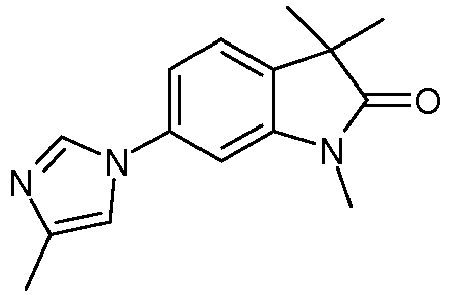
- Prepared in analogy to example 63 using 6-bromo-1,3,3-trimethylindolin-2-one (example 1a). The title compound was obtained as off-white solid.
MS ESI (m/z): 256.3 [(M+H)+].
1H NMR (CDCl3, 300 MHz): δ = 7.75 (d, J=1.4 Hz, 1H), 7.25 - 7.24 (m, 1H), 7.04 (dd, J=2.0, 7.9 Hz, 1H), 7.01 (t, J=1.2 Hz, 1H), 6.81 (d, J=1.8 Hz, 1H), 3.25 (s, 3H), 2.31 (d, J=0.8 Hz, 3H), 1.40 (s, 6H). -

- Formed as minor isomer in example 64. The title compound was obtained as orange oil.
MS ESI (m/z): 256.3 [(M+H)+].
1H NMR (CDCl3, 300 MHz): δ = 7.59 (s, 1H), 7.29 (d, J=7.9 Hz, 1H), 6.96 (dd, J=1.9, 7.8 Hz, 1H), 6.92 (s, 1H), 6.75 (d, J=1.8 Hz, 1H), 3.24 (s, 3H), 2.20 (d, J=1.0 Hz, 3H), 1.43 (s, 6H). -

- A suspension of 6-bromo-1,3,3-trimethylindolin-2-one (example 1a, 500 mg, 1.97 mmol), zinc cyanide (277 mg, 2.36 mmol) and tetrakis(triphenylphosphine)palladium(0) (227 mg, 197 µmol) in DMF (13.0 ml) was heated to 80 °C for 17 hours under an argon atmosphere. The reaction mixture was treated with water and the aqueous phase was extracted with EtOAc. The combined organic layers were dried over Na2SO4 and the solvent was evaporated. The crude material was purified by silica gel flash chromatography using heptane/ ethyl acetate as eluent. The title compound was obtained as white solid (371mg).
ESI (m/z): 201.2 [(M+H)+].
1H NMR (CDCl3, 300 MHz): δ = 7.40 (dd, J=1.4, 7.5 Hz, 1H), 7.29 (d, J=8.1 Hz, 1H), 7.07 (d, J=1.2 Hz, 1H), 3.24 (s, 3H), 1.39 (s, 6H) - To a solution of lithium bis(trimethylsilyl)amide (1M in THF) (3.21 ml, 3.21 mmol) in dry diethylether (6 ml) at 0 °C under an argon atmosphere was added 1,3,3-trimethyl-2-oxoindoline-6-carbonitrile (314 mg, 1.57 mmol) in three portions. After 5 minutes the cooling bath was removed and stirring was continued at room temperature for 12 hours. The reaction mixture was cooled to 0 °C and aqueous HCl (6M, 1.57 ml, 9.41 mmol) was added slowly. The reaction mixture was stirred at 0 °C for 1 hour, then warmed to room temperature and stirred for 12 hours. The reaction mixture was diluted with diethyl ether and water and carefully basified to pH 14 with solid NaOH. The aqueous phase was extracted with dichloromethane. The combined organic layers were dried over Na2SO4 and the solvent was evaporated. The title compound was obtained as white solid (325mg).
ESI (m/z): 218.3 [(M+H)+]. - To a solution of 1,3,3-trimethyl-2-oxoindoline-6-carboximidamide (550 mg, 2.53 mmol) in THF (10 ml) was added an aqueous solution of 1M sodium bicarbonate (5.06 ml, 5.06 mmol) followed by chloroacetone (234 mg, 202 µl, 2.53 mmol). The reaction mixture was heated to reflux and stirred for 5 hours. Further chloroacetone (20 µl) and aqueous sodium bicarbonate solution (500 µl) were added and stirring at reflux continued for further 3 hours. The reaction mixture was extracted with ethyl acetate and water, the combined organic layers were dried over Na2SO4 and the solvents were evaporated. The crude material was purified by silica gel chromatography using dichloromethane/ methanol (with 10 % concentrated ammonia solution), followed by preparative HPLC. The title compound was obtained as white solid (200 mg).
ESI (m/z): 256.3 [(M+H)+].
1H NMR (CDCl3, 300 MHz): δ = 7.46 (d, J=1.2 Hz, 1H), 7.39 (d, J=7.7 Hz, 1H), 7.20 (d, J=7.5 Hz, 1H), 6.86 (d, J=1.0 Hz, 1H), 3.19 (s, 3H), 2.33 (s, 3H), 1.37 (s, 6H). - To a suspension of 1,3,3-trimethyl-6-(5-methyl-1H-imidazol-2-yl)indolin-2-one (195 mg, 764 µmol) and cesium carbonate (249 mg, 764 µmol) in dry DMF (4 ml) was added slowly a solution of iodomethane (97.6 mg, 43.0 µl, 687 µmol) in dry DMF (4 ml) and stirred at room temperature for 16 hours. The reaction mixture was quenched with water and the aqueous phase was extracted with ethyl acetate. The combined organic layers were dried over Na2SO4 and the solvents were evaporated. The crude material was purified by SFC (supercritical fluid chromatography with CO2) to yield 60 mg 6-(1,4-dimethyl-1H-imidazol-2-yl)-1,3,3-trimethylindolin-2-one as light yellow solid. Mixed fractions were purified again by amino silicagel chromatography using dichloromethane/ methanol (with 10% concentrated aqueous ammonia) as eluent. The title compound was obtained as light yellow solid (33 mg).
ESI (m/z): 270.5 [(M+H)+].
1H NMR (CDCl3, 300 MHz): δ = 7.24 (d, J=0.8 Hz, 1H), 7.20 (d, J=1.4 Hz, 1H), 7.19 - 7.16 (m, 1H), 6.92 - 6.85 (m, J=1.0 Hz, 1H), 3.63 (s, 3H), 3.24 (s, 3H), 2.28 (d, J=1.0 Hz, 3H), 1.40 (s, 6H). -

- To a suspension of acetimidamide hydrochloride (757 mg, 7.77 mmol) in THF (324 ml) was added 1M aqueous sodium bicarbonate solution (14.0 ml, 14.0 mmol). After 20 minutes a solution of 6-(2-bromoacetyl)-1,3,3-trimethylindolin-2-one (example 70c , 460 mg, 1.55 mmol) in THF (23 ml) was added slowly. The reaction mixture was heated to 80 °C for 18 hours. The solvent was evaporated and water was added. The aqueous phase was extracted with EtOAc. The combined organic layers were dried over Na2SO4 and the solvent was evaporated. The crude material was purified by flash chromatography on NH2-silica gel using dichloromethane/ methanol (with 10 % concentrated aqueous ammonia) as eluent followed by preparative reversed phase HPLC. The title compound was obtained as white foam (143 mg).
ESI (m/z): 256.5 [(M+H)+].
1H NMR (CDCl3, 300 MHz): δ = 7.42 - 7.27 (m, 2H), 7.21 (s, 1H), 7.18 (d, J=7.7 Hz, 1H), 3.26 (s, 3H), 2.51 (s, 3H), 1.73 - 1.48 (m, 1H), 1.38 (s, 6H). -

- A solution of 1,3,3-trimethyl-6-(oxazol-5-yl)indolin-2-one (example 69c, 300 mg, 1.24 mmol) in formamide (11 ml) was heated to 180 °C in a sealed tube and stirred at this temperature for 3 hours. The reaction mixture was poured into water and extracted with ethyl acetate. The organic layers were dried with sodium sulfate, filtered and concentrated in vacuo. The crude material was purified by silica gel chromatography using dichloromethane/ methanol as eluent. The title compound was isolated as brown viscous oil (268 mg).
MS ESI (m/z): 242.5 [(M+H)+].
1H NMR (CDCl3, 300 MHz): δ = 7.73 (d, J=0.8 Hz, 1H), 7.46 - 7.31 (m, 3H), 7.20 (d, J=7.7 Hz, 1H), 3.27 (s, 3H), 1.39 (s, 6H). -

- To a suspension of 1,3,3-trimethyl-2-oxoindoline-6-carboxylic acid (example 59a, 150 mg, 684 µmol) in tetrahydrofuran (1 ml) was added dropwise borane tetrahydrofuran complex (1M in THF, 1 ml, 1.00 mmol) at 0 °C. The cooling bath was removed and the reaction mixture stirred 2 hours at room temperature. The mixture was poured into 10 mL saturated aqueous sodium bicarbonate solution and extracted with ethyl acetate. The organic layers were dried with sodium sulfate, filtered and concentrated in vacuo. The title compound was obtained as light yellow foam (140 mg) and was used without further purification.
MS ESI (m/z): 206.5 [(M+H)+].
1H NMR (CDCl3, 300 MHz): δ = 7.18 (d, J=7.5 Hz, 1H), 7.08 - 7.00 (m, 1H), 6.91 (d, J=0.8 Hz, 1H), 4.72 (s, 2H), 3.23 (s, 3H), 1.37 (s, 6H). - A suspension of 6-(hydroxymethyl)-1,3,3-trimethylindolin-2-one (140 mg, 682 µmol) and manganese dioxide (296 mg, 3.41 mmol) in dichloromethane (2 ml) was stirred at 30 °C for 15 hours. Again manganese dioxide (296 mg, 3.41 mmol) was added and the reaction mixture stirred 2 hours at reflux. The reaction mixture was filtered through a glass fiber filter, washed with dichloromethane and the obtained solution concentrated in vacuo. The title compound was obtained as light brown solid (110 mg) and was used whithout further purification.
MS ESI (m/z): 204.5 [(M+H)+].
1H NMR (CDCl3, 300 MHz): δ = 9.99 (s, 1H), 7.63 - 7.55 (m, 1H), 7.41 - 7.34 (m, 2H), 3.31-3.24 (m, 3H), 1.41 (s, 6H). - To a suspension of 1,3,3-trimethyl-2-oxoindoline-6-carbaldehyde (110 mg, 541 µmol) and potassium carbonate (97.2 mg, 704 µmol) in methanol (2 ml) was added tosylmethyl isocyanide (106 mg, 541 µmol) and the reaction mixture was heated to 80 °C for 1.5 hours. The reaction mixture was poured into water and extracted with dichloromethane. The organic layers were dried with sodium sulfate, filtered and concentrated in vacuo. The title compound was obtained as brown foam (123 mg).
MS ESI (m/z): 243.6 [(M+H)+].
1H NMR (CDCl3, 300 MHz): δ = 7.93 (s, 1H), 7.42 - 7.34 (m, 2H), 7.26 - 7.23 (m, 1H), 7.10 (d, J=1.4 Hz, 1H), 3.27 (s, 3H), 1.40 (s, 6H) -

- To a solution of 1,3,3-trimethyl-2-oxoindoline-6-carboxylic acid (example 59a, 0.2 g, 912 µmol) in dry N,N-dimethylformamide (4.56 ml) was added DIPEA (650 µl, 3.65 mmol) and the mixture stirred for 2 minutes. Then HATU (347 mg, 912 µmol) was added and stirring was continued for another 15 minutes. N,O-dimethylhydroxylamine hydrochloride (182 mg, 1.82 mmol) was added and stirring was continued for another 15 hours. The reaction mixture was diluted with ethyl acetate, water and 1M aqueous HCl solution. The mixture was extracted with ethyl acetate and the organic layers were washed with 1M aqueous HCl solution and 1M aqueous sodium carbonate solution. The combined organic layers were dried with sodium sulfate, filtered and concentrated in vacuo. The obtained material was purified by silica gel chromatography using heptane/ ethyl acetate as eluent. The title compound was obtained as light brown viscous oil (237 mg).
MS ESI (m/z): 263.1 [(M+H)+].
1H NMR (CDCl3, 300 MHz): δ = 7.40 (dd, J=1.4, 7.7 Hz, 1H), 7.22 (d, J=7.7 Hz, 1H), 7.16 (d, J=1.2 Hz, 1H), 3.60 (s, 3H), 3.38 (s, 3H), 3.23 (s, 3H), 1.38 (s, 6H). - A suspension of N-methoxy-N,1,3,3-tetramethyl-2-oxoindoline-6-carboxamide (5.8 g, 21.0 mmol) in tetrahydrofurane (23.5 ml) was cooled to 0 °C. Methylmagnesium bromide (3.2M in 2-methyltetrahydrofurane, 13.1 ml, 42.0 mmol) was added dropwise keeping temperature below 8 °C. The reaction mixture was stirred for 1 hour at 0 °C. The reaction was carefully quenched with 1.25M ethanolic HCl (47 ml) and diluted with ethyl acetate and water. The aqueous phase was extracted with ethyl acetate and the organic layers were washed with water. The combined organic layers were dried with sodium sulfate, filtered and concentrated in vacuo. The obtained solid was again treated with ethyl acetate and 1M aqueous HCl solution, extracted with ethyl acetate and washed with 1M aqueous HCl solution. The combined organic layers were dried with sodium sulfate, filtered and concentrated in vacuo. The title compound was obtained as red solid (2.85g).
MS ESI (m/z): 218.5 [(M+H)+].
1H NMR (CDCl3, 300 MHz): δ = 7.69 (dd, J=1.4, 7.7 Hz, 1H), 7.45 (d, J=1.2 Hz, 1H), 7.29 (d, J=7.7 Hz, 1H), 3.27 (s, 3H), 2.63 (s, 3H), 1.40 (s, 6H). - To a solution of 6-acetyl-1,3,3-trimethylindolin-2-one (1 g, 4.6 mmol) in THF (33.3 ml) and methanol (22.2 ml) was added tetra-N-butylammonium tribromide (2.26 g, 4.6 mmol) in THF (11.1 ml). The reaction mixture was heated to 50 °C for 3 hours and then concentrated in vacuo. The obtained material was purified by silica gel chromatography using heptane/ ethyl acetate as eluent. The title compound was obtained as off white solid (1.08 g).
MS ESI (m/z): 296.4, 298.4 [(M+H)+].
1H NMR (CDCl3, 300 MHz): δ = 7.71 (dd, J=1.4, 7.7 Hz, 1H), 7.46 (d, J=1.4 Hz, 1H), 7.31 (d, J=7.7 Hz, 1H), 4.45 (s, 2H), 3.27 (s, 3H), 1.40 (s, 6H). - In a pressure tube 6-(2-bromoacetyl)-1,3,3-trimethylindolin-2-one (1.05 g, 3.55 mmol) was treated with formamide (12.7 ml, 319 mmol), the tube was sealed and the reaction mixture was heated to 110 °C. After 2 hours the reaction mixture was diluted with ethyl acetate, water and saturated aqueous sodium bicarbonate solution. The mixture was extracted with ethyl acetate and the organic layers were washed with saturated aqueous sodium bicarbonate solution. The combined organic layers were dried with sodium sulfate, filtered and concentrated in vacuo. The obtained material was purified by silica gel chromatography using heptane/ ethyl acetate as eluent.
MS ESI (m/z): 243.6 [(M+H)+].
1H NMR (CDCl3, 300 MHz): δ = 7.97 (d, J=1.0 Hz, 1H), 7.96 (d, J=0.8 Hz, 1H), 7.42 (dd, J=1.4, 7.7 Hz, 1H), 7.28 (d, J=1.2 Hz, 1H), 7.23 (d, J=7.7 Hz, 1H), 3.27 (s, 3H), 1.39 (s, 6H). -

- A solution of thallic acetate (263 mg, 690 µmol) and trifluoromethanesulfonic acid (184 µl, 2.07 mmol) in acetonitrile (2 ml) was stirred for 10 minutes. Then 6-acetyl-1,3,3-trimethylindolin-2-one (example 70b, 100 mg, 460 µmol) was added and the reaction mixture heated to 90 °C for 4 hours. Again thallic acetate (263 mg, 690 µmol) and trifluoromethanesulfonic acid (184 µl, 2.07 mmol) were added and stirring at 90 °C was continued for 15 hours. The reaction mixture was poured into 2M aqueous sodium carbonate solution and extracted with ethyl acetate. The organic layers were dried with sodium sulfate, filtered and concentrated in vacuo. The obtained material was purified by silica gel chromatography using heptane/ ethyl acetate as eluent. The title compound was obtained as light brown solid (50 mg).
MS ESI (m/z): 257.6 [(M+H)+].
1H NMR (CDCl3, 300 MHz): δ = 7.32 (dd, J=1.6, 7.7 Hz, 1H), 7.25 - 7.19 (m, 2H), 7.05 (d, J=1.2 Hz, 1H), 3.27 (s, 3H), 2.55 (s, 3H), 1.39 (s, 6H). -

- In a
pressure tube 1,3,3-trimethyl-6-(4,4,5,5-tetramethyl-1,3,2-dioxaborolan-2-yl)indolin-2-one (example 29a, 0.1 g, 332 µmol) and 2-bromo-5-methyl-1,3,4-thiadiazole (71.3 mg, 398 µmol) were suspended in dioxane (2.66 ml) and a 2M aqueous sodium carbonate solution (664 µl) was added. Argon was bubbled through the mixture for 5 minutes, then bis(triphenylphosphine)palladium(II) chloride (23.8 mg, 33.2 µmol) was added, the tube was sealed and the reaction mixture was heated to 115 °C for 2.5 hours. The reaction mixture was diluted with ethyl acetate and methanol, 2 spoons silica gel were added and the mixture was concentrated in vacuo. The material was purified by silica gel chromatography using heptane/ ethyl acetate as eluent. The title compound was obtained as light brown solid (87 mg).
MS ESI (m/z): 247.5 [(M+H)+].
1H NMR (CDCl3, 300 MHz): δ = 7.56 (d, J=1.4 Hz, 1H), 7.50 (dd, J=1.6, 7.7 Hz, 1H), 7.29-7.26 (m, 1H), 3.29 (s, 3H), 2.83 (s, 3H), 1.41 (s, 6H). -

- Prepared in analogy to example 72 using 2-bromo-1,3,4-thiadiazole. The title compound was obtained as off white solid.
MS ESI (m/z): 260.5 [(M+H)+].
1H NMR (CDCl3, 300 MHz): δ = 9.12 (s, 1H), 7.65 - 7.56 (m, 2H), 7.30 (d, J=7.5 Hz, 1H), 3.30 (s, 3H), 1.42 (s, 6H). -

- A suspension of 6-(2-bromoacetyl)-1,3,3-trimethylindolin-2-one (example 70c, 200 mg, 675 µmol) and sodium azide (87.8 mg, 1.35 mmol) in acetone (2 ml) was stirred for 2 hours at room temperature. The reaction mixture was poured into 50 mL water and extracted with dichloromethane. The organic layers were dried with sodium sulfate and concentrated in vacuo. The title compound was obtained as light brown solid (169 mg) and was used whithout further purification.
MS ESI (m/z): 259.5 [(M+H)+].
1H NMR (CDCl3, 300 MHz): δ = 7.58 (dd, J=1.6, 7.7 Hz, 1H), 7.42 (d, J=1.2 Hz, 1H), 7.30 (d, J=7.7 Hz, 1H), 4.56 (s, 2H), 3.27 (s, 3H), 1.40 (s, 6H). - To a suspension of 6-(2-azidoacetyl)-1,3,3-trimethylindolin-2-one (165 mg, 639 µmol) and cyclopropanecarbonyl chloride (58.0 µl, 639 µmol) in toluene (2 ml) was added triphenylphosphine (285 mg, 1.09 mmol) and the mixture stirred for 5 hours at room temperature. The reaction mixture was filtered and washed with toluene. The obtained solution was concentrated in vacuo. The crude material was purified by silica gel chromatography using heptane/ ethyl acetate as eluent. The title compound was obtained as light yellow solid (57 mg).
MS ESI (m/z): 283.5 [(M+H)+].
1H NMR (CDCl3, 300 MHz): δ = 7.29 (dd, J=1.6, 7.9 Hz, 1H), 7.21 (d, J=7.7 Hz, 1H), 7.18 (s, 1H), 7.01 (d, J=1.2 Hz, 1H), 3.27 (s, 3H), 2.20 - 2.07 (m, 1H), 1.38 (s, 6H), 1.18 - 1.06 (m, 4H). -
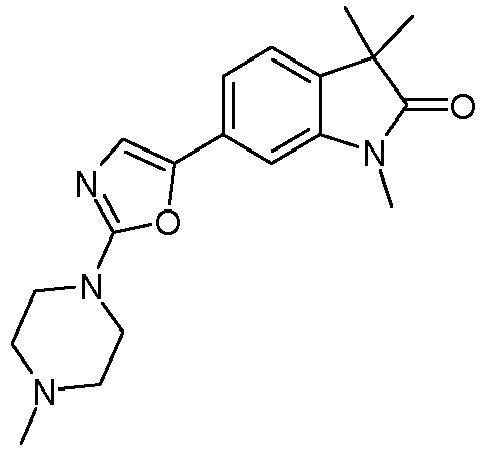
- To a suspension of 1,3,3-trimethyl-6-(oxazol-5-yl)indolin-2-one (example 69, 310 mg, 1.28 mmol) in tetrahydrofuran (4.5 ml) at -70 °C to -68 °C was added dropwise LiHMDS (1.54 ml, 1.54 mmol). After warming to 0 °C for 10 minutes the reaction mixture was cooled to -70 °C to - 64 °C and hexachloroethane (321 mg, 1.34 mmol) was added. The reaction mixture was warmed to room temperature and kept at this temperature for 5 hours. The reaction mixture was poured into 50 mL saturated aqueous NH4Cl solution. The aqueous phase was extracted with TBME. The combined organic layers were washed with H2O and dried over Na2SO4. The solvent was evaporated and the crude material was purified by flash chromatography on silica gel using heptane/ ethyl acetate as eluent. The title compound was obtained as light yellow crystals (271 mg).
MS ESI (m/z): 277.4/ 279.4 [(M+H)+].
1H NMR (CDCl3, 300 MHz): δ = 7.32 - 7.23 (m, 3H), 7.03 (d, J=1.2 Hz, 1H), 3.27 (s, 3H), 1.39 (s, 6H). - DMF (2.2 ml) were added 1-methylpiperazine (24.9 mg, 27.6 µl, 246 µmol) and DIPEA (57.9 mg, 78.3 µl, 448 µmol). The reaction mixture was heated to 150 °C for 30 minutes under microwave irradiation. The reaction mixture was concentrated and then diluted with EtOAc, H2O and 1M aqueous Na2CO3 solution. The aqueous phase was extracted with EtOAc, the combined organic layers were washed with brine, dried with Na2SO4 and the solvent was evaporated. The crude material was purified by silica gel chromatography using dichloromethane/ methanol as eluent. The title compound was obtained as off-white foam (67 mg).
MS ESI (m/z): 341.5 [(M+H)+].
1H NMR (CDCl3, 300 MHz): δ = 7.21 - 7.15 (m, 2H), 7.07 (s, 1H), 6.90 (s, 1H), 3.64 - 3.61 (m, 4H), 3.25 (s, 3H), 2.55 - 2.52 (m, 4H), 2.36 (s, 3H), 1.37 (s, 6H). -

- A mixture of 6-(2-bromoacetyl)-1,3,3-trimethylindolin-2-one (example 70c, 100 mg, 338 µmol) and acetamide (300 mg, 259 µl, 5.08 mmol) was heated to 174 °C in a sealed tube for 16 hours. The reaction mixture was poured into 20 mL H2O and the aqueous phase was extracted with EtOAc. The combined organic layers were washed with H2O, dried over Na2SO4 and the solvent was evaporated. The crude material was purified by flash chromatography on silica gel using heptane/ ethyl acetate as eluent. The title compound was obtained as white crystals (26 mg).
MS ESI (m/z): 257.1 [(M+H)+].
1H NMR (CDCl3, 600 MHz): δ = 7.83 (s, 1H), 7.37 (dd, J=1.5, 7.6 Hz, 1H), 7.24 (d, J=1.4 Hz, 1H), 7.21 (d, J=7.6 Hz, 1H), 3.26 (s, 3H), 2.54 (s, 3H), 1.38 (s, 6H). -

- Prepared in analogy to example 29b using 5-bromo-2-cyclopropyl-pyrimidine and a reaction time of 4 hours. The title compound was obtained as off white solid.
MS ESI (m/z): 294.2 [(M+H)+]. -

- a) 6-Bromo-1-cyclopropyl-3,3-dimethyl-indolin-2-one
To a suspension of 6-bromo-3,3-dimethylindolin-2-one (example 24a, 10 g, 41.6 mmol), cyclopropylboronic acid (7.16 g, 83.3 mmol), DMAP (15.6 g, 125 mmol) and copper (II) acetate (7.94 g, 43.7 mmol) in dry toluene (555 ml) was added 2 M sodium bis(trimethylsilyl)amide in THF (21.9 ml, 43.7 mmol). While bubbling dry air through the reaction mixture it was heated to 95°C for 15 hours. After cooling to room temperature the mixture was diluted with TBME, quenched with water and acidified with 2 M aqueous HCl solution (∼150ml). The mixture was extracted with TBME and the organic layers were washed with 1 M aqueous HCl solution and brine. The combined organic layers were dried with sodium sulfate, filtered and the obtained solution concentrated in vacuo. The crude material was purified by silica gel chromatography using heptane/ ethyl acetate as eluent. The title compound was obtained as light brown solid (10.322 g).
MS ESI (m/z): 280.3, 282.3 [(M+H)+].
1H NMR (300MHz, CHLOROFORM-d) δ = 7.24 (d, J=1.8 Hz, 1H), 7.19 (dd, J=1.6, 7.7 Hz, 1H), 7.03 (d, J=7.9 Hz, 1H), 2.67 - 2.57 (m, 1H), 1.32 (s, 6H), 1.13 - 0.98 (m, 2H), 0.98 - 0.84 (m, 2H) - b) 1-Cycloproyl-3,3-dimethyl-6-(4,4,5,5-tetramethyl-1,3,2-dioxaborolan-2-yl)indolin-2-one repared in analogy to example 29a using 6-bromo-1-cyclopropyl-3,3-dimethyl-indolin-2-one. The title compound was obtained as off white solid. MS ESI (m/z): 328.2 [(M+H)+].
- c) 1-Cyclopropyl-6-(2-cyclopropylpyrimidin-5-yl)-3,3-dimethyl-indolin-2-one
Prepared in analogy to example 29b using 1-cyclopropyl-3,3-dimethyl-6-(4,4,5,5-tetramethyl-1,3,2-dioxaborolan-2-yl)indolin-2-one and 5-bromo-2-cyclopropyl-pyrimidine and a reaction time of 4 hours. The title compound was obtained as colorless viscous oil.
MS ESI (m/z): 320.3 [(M+H)+]. -

- Prepared in analogy to example 29b using 3-bromo-6-cyclopropyl-pyridazine and a reaction time of 4 hours. The title compound was obtained as off white solid.
MS ESI (m/z): 294.0 [(M+H)+]. -

- Prepared in analogy to example 78c using 3-bromo-6-cyclopropyl-pyridazine and a reaction time of 4 hours. The title compound was obtained as light pink solid.
MS ESI (m/z): 320.0 [(M+H)+]. -
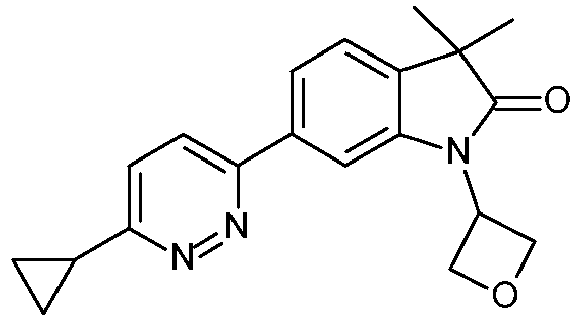
- To a solution of 6-bromo-3,3-dimethylindolin-2-one (example 24a, 1.5 g, 6.25 mmol) in DMF (20.0 ml) under argon were added 3-bromooxetane (1.6 g, 895 µl, 11.2 mmol) and cesium carbonate (4.07 g, 12.5 mmol) and the reaction mixture heated to 60°C for 17.5 hours. Again 3-bromooxetane (250 µl) and cesium carbonate (2 g) were added and stirring at 60°C continued for 3.5 hours. The reaction mixture was treated with 50 mL 1 M aqueous HCl solution and extracted with EtOAc. The combined organic layers were dried over sodium sulfate and concentrated in vacuo. The crude material purified by silica gel chromatography using heptane/ ethyl acetate as eluent. The title compound was obtained as white solid (1.49 g)
MS ESI (m/z): 296.3, 298.3 [(M+H)+].
1H NMR (300MHz, CHLOROFORM-d) δ = 7.71 (d, J=1.6 Hz, 1H), 7.30 - 7.23 (m, 1H), 7.12 (d, J=7.9 Hz, 1H), 5.63 - 5.50 (m, 1H), 5.16 - 4.98 (m, 4H), 1.36 (s, 6H) - Prepared in analogy to example 29a using 6-bromo-3,3-dimethyl-1-(oxetan-3-yl)indolin-2-one. The title compound was obtained as pale white solid.
MS ESI (m/z): 344.2 [(M+H)+]. - Prepared in analogy to example 29b using 3-bromo-6-cyclopropyl-pyridazine and a reaction time of 4 hours. The title compound was obtained off white solid.
MS ESI (m/z): 335.8 [(M+H)+]. -

- Prepared in analogy to example 29b using 3,3-dimethyl-6-(2-methylpyridin-4-yl)indolin-2-one (example 24a) and a reaction time of 2.5 hours. The title compound was obtained as white solid.
MS ESI (m/z): 254.1 [(M+H)+]. -

- To a stirred solution of 6-chloro-1,3-dihydro-pyrrolo[3,2-c]pyridin-2-one (2.0 g, 11.86 mmol) in THF (15 ml), was added NaH (60%, 1.9 g, 47.45 mmol) portion wise at 0°C. The reaction mixture was stirred at this temperature for 10 minutes then at 25°C for 20 minutes. Then MeI (3.0 ml, 47.45 mmol) was added slowly to the reaction mixture at 0°C and then stirred at 25°C for 2 hours. The reaction was quenched by the addition of saturated aqueous ammonium chloride solution (10ml) at 0°C. The mixture was extracted with ethyl acetate and washed with water. The combined organic layers were dried with sodium sulfate, filtered and the obtained solution concentrated in vacuo. The crude material was purified by silicagel chromatography using hexane/ ethyl acetate as eluent. The title compound was obtained as white solid (1.5 g) MS ESI (m/z): 210.9 [(M+H)+].
- In a pressure tube 6-chloro-1,3,3-trimethyl-1,3-dihydro-pyrrolo[3,2-c]pyridin-2-one (0.12 g, 0.57 mmol) and 2-methylpyridine-4-boronic acid (0.093 g, 0.68 mmol) were suspended in 2M aqueous sodium carbonate solution (0.5 ml) and dioxane (4 ml). The reaction mixture was purged with argon for 15 minutes. Then Pd(dppf)Cl2 (0.042 g, 0.057 mmol) was added and purging was continued for 15 minutes. The tube was sealed and the reaction mixture was heated to 110°C for 12 hours. The reaction mixture was diluted with ethyl acetate and water. The reaction mixture was extracted with ethyl acetate and washed with water and brine. The combined organic layers were dried with sodium sulfate, filtered and the obtained solution concentrated in vacuo. The crude material was purified by silica gel chromatography using hexane/ ethyl acetate as eluent. The title compound was obtained as off white solid (55mg).
MS ESI (m/z): 267.8 [(M+H)+]. -

- Prepared in analogy to example 24a from 6-chloro-1,3-dihydro-pyrrolo[3,2-c]pyridin-2-one. The title compound was obtained as yellow solid.
MS ESI (m/z): 197.0 [(M+H)+]. - This compound was prepared in analogy to 83b from 6-chloro-3,3-dimethyl-1,3-dihydro-pyrrolo[3,2-c]pyridin-2-one. The title compound was obtained as off white solid.
MS ESI (m/z): 253.8 [(M+H)+]. -

- To a solution of 6-bromo-1,3,3-trimethylindolin-2-one (example 1a, 75 mg, 295 µmol) and 1-methyl-4-(4,4,5,5-tetramethyl-1,3,2-dioxaborolan-2-yl)-1H-pyrazole (95.0 mg, 443 µmol) in 1,2-Dimethoxyethane (3.4 ml) in a pressure tube was added 2 M aqueous sodium carbonate solution (0.7 ml) and triphenylphosphine (18.6 mg, 70.8 µmol). Argon was bubbled through the mixture during 5 minutes. Then palladium(II)acetate (9.54 mg, 42.5 µmol) was added and again argon bubbled through the reaction mixture during 5 minutes. The tube was sealed and the reaction mixture stirred 16 hours at 90°C. The reaction mixture was concentrated in vacuo. The residue was diluted with dichloromethane, silica gel was added and the mixture again concentrated in vacuo. The crude material was purified by silica gel chromatography using heptane/ ethyl acetate as eluent. The obtained material was again purified by amine silica gel chromatography using heptane/ ethyl acetate as eluent. The title compound was obtained as white solid (43 mg)
MS ESI (m/z): 256.5 [(M+H)+]. -

- Prepared in analogy to example 85 using 6-bromo-1-cyclopropyl-3,3-dimethyl-indolin-2-one (example 78a). The title compound was obtained as light yellow foam.
MS ESI (m/z): 282.6 [(M+H)+]. -

- Prepared in analogy to example 85 using 6-bromo-3,3-dimethyl-1,3-dihydro-indol-2-one (example 24a). The title compound was obtained as white solid.
MS ESI (m/z): 242.6 [(M+H)+]. -

- Prepared in analogy to example 24b using 5-bromo-2-cyclopropyl-pyrimidine with a reaction time of 4 hours. The title compound was obtained as off white solid.
MS ESI (m/z): 280.3 [(M+H)+]. -

- Prepared in analogy to example 78a from 6-chloro-3,3-dimethyl-1,3-dihydro-pyrrolo[3,2-c]pyridin-2-one (example 84a). The title compound was obtained as white solid.
MS ESI (m/z): 237.1 [(M+H)+]. - Prepared in analogy to example 83b from 6-chloro-1-cyclopropyl-3,3-dimethyl-1,3-dihydro-pyrrolo[3,2-c]pyridin-2-one. The title compound was obtained as light brown solid.
MS ESI (m/z): 294.6 [(M+H)+]. -
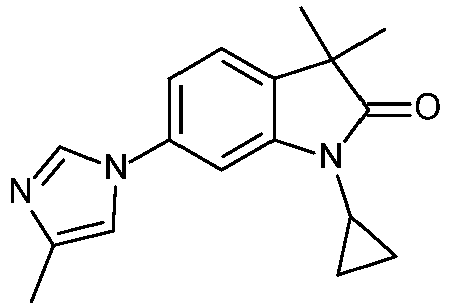
- Prepared in analogy to example 63 from 6-bromo-1-cyclopropyl-3,3-dimethyl-indolin-2-one (example 78a). The title compound was obtained as off white foam.
MS ESI (m/z): 282.1 [(M+H)+]. -

- The title compound was isolated as off white foam in the the reaction to example 90. MS ESI (m/z): 282.1 [(M+H)+].
-

- Prepared in analogy to example 84b using 2-methyl-pyrimidine-5-boronic acid and a reaction time of 6 hours. The title compound was obtained as off white solid.
MS ESI (m/z): 255.0 [(M+H)+]. -

- To a solution of 1,3,3-trimethyl-2-oxoindoline-6-carboxylic acid (example 59a, 120 mg, 547 µmol) in dichloromethane (6 ml) under argon were added 1H-benzo[d][1,2,3]triazol-1-ol (HOBt, 118 mg, 876 µmol), N1-((ethylimino)methylene)-N3,N3-dimethylpropane-1,3-diamine hydrochloride (EDCI, 168 mg, 876 µmol), triethylamine (138 mg, 191 µl, 1.37 mmol) and DMF (1 ml). Then acetohydrazide (40.5 mg, 547 µmol) was added. The reaction mixture was stirred in a sealed tube at room temperature for 16 hours. Then the reaction mixture was concentrated in vacuo. The residue was diluted with dichloromethane, silica gel was added and the mixture concentrated in vacuo. The crude material was purified by silica gel chromatography using dichloromethane/ methanol as eluent. The title compound was obtained as white foam (135 mg), still containing HOBt. This material was used whithout further purification.
MS ESI (m/z): 276.1 [(M+H)+]. - To a solution of N'-acetyl-1,3,3-trimethyl-2-oxoindoline-6-carbohydrazide (129.5 mg, 470 µmol) in acetonitrile (6 ml) were added triethylamine (143 mg, 197 µl, 1.41 mmol) and p-toluenesulfonyl chloride (137 mg, 706 µmol). The reaction mixture was stirred room temperature for 16 hours. The reaction mixture was treated with 15 ml saturated aqueous sodium bicarbonate solution and extracted ethylacetate. The organic layers were dried with sodium sulfate, filtered and the obtained solution concentrated in vacuo. The residue was diluted with dichloromethane, silica gel was added and the mixture concentrated in vacuo. The crude material was purified by silica gel chromatography using heptane/ ethyl acetate as eluent. The title compound was obtained as light yellow solid (88 mg).
MS ESI (m/z): 258.2 [(M+H)+]. -

- Prepared in analogy to example 93 using cyclopropanecarbohydrazide. The title compound was obtained as light yellow solid.
MS ESI (m/z): 284.2 [(M+H)+]. -

- Prepared in analogy to example 93 from 3,3-dimethyl-2-oxoindoline-6-carboxylic acid (example 60b) using cyclopropanecarbohydrazide. The title compound was obtained as light red solid.
MS ESI (m/z): 270.2 [(M+H)+]. -

- Prepared in analogy to example 63 from 6-bromo-1,3,3-trimethylindolin-2-one (example 1a) using 4-cyclopropyl-1H-imidazole. The title compound was obtained as yellow oil.
MS ESI (m/z): 282.2 [(M+H)+]. -

- The title compound was obtained as white foam in the reaction to example 96. MS ESI (m/z): 282.2 [(M+H)+].
-

- Prepared in analogy to example 96 from 6-bromo-1-cyclopropyl-3,3-dimethyl-indolin-2-one (example 78a). The title compound was obtained as light yellow viscous oil.
MS ESI (m/z): 308.3 [(M+H)+]. -

- The title compound was obtained as light yellow solid in the reaction to example 98.
MS ESI (m/z): 308.3 [(M+H)+]. -

- In a microwave vial 6-bromo-1,3,3-trimethylindolin-2-one (example 1a, 200 mg, 787 µmol) and tert-butyl 4-(4,4,5,5-tetramethyl-1,3,2-dioxaborolan-2-yl)-1H-pyrazole-1-carboxylate (232 mg, 787 µmol) were combined with dioxane (4.5 ml) and 2 M aqueous sodium carbonate solution (787 µl, 1.57 mmol). The mixture was sparged with argon for 5 minutes. Then [1,1'-bis(diphenylphosphino)ferrocene]dichloropalladium(II) (32.1 mg, 39.4 µmol) was added and and sparging with argon continued for another 5 minutes. The vial was then sealed and heated to 120°C for 30 minutes under microwave irradiation. The reaction mixture was diluted with ethyl acetate and saturated aqueous sodium bicarbonate solution. The resulting mixture was extracted with ethyl acetate, the combined organic layers dried with sodium sulfate, filtered, and the obtained solution concentrated in vacuo. The crude material was purified by silica gel chromatography using heptane/ ethyl acetate as eluent. The title compound was obtained as brown viscous oil (115 mg).
MS ESI (m/z): 242.5 [(M+H)+]. - Prepared in analogy to example 104 from 1,3,3-trimethyl-6-(1H-pyrazol-4-yl)indolin-2-one. The title compound was obtained as light yellow oil.
MS ESI (m/z): 282.2 [(M+H)+]. -

- Prepared in analogy to example 63 using 4-cyclopropyl-1H-imidazole. The title compound was obtained as off white solid.
MS ESI (m/z): 268.1 [(M+H)+]. -

- In a reactor were placed 6-bromo-1-cyclopropyl-3,3-dimethylindolin-2-one (example 78a, 4 g, 14.3 mmol) and triethylamine (4.00 ml, 28.6 mmol), then ethyl acetate (50 ml) and methanol (50 ml) were added and the reactor put under argon. Then 1,1'-bis(diphenylphosphino)ferrocene-palladium(II)dichloride dichlormethane adduct (1.17 g, 1.43 mmol) was added and the reactor flushed with CO and pressure adjusted to 50 bars. The reaction mixture was heated to 100°C and stirred at this temperature under CO for 48 hours. The reaction mixture was cooled to room temperature, diluted with methanol and concentrated in vacuo. The crude material was purified by silica gel chromatography using heptane/ ethyl acetate as eluent. The titel compound was obtained as off white solid (3.6 g).
MS ESI (m/z): 260.5 [(M+H)+].
1H NMR (300MHz, CHLOROFORM-d) δ = 7.79 (dd, J=1.5, 7.8 Hz, 1H), 7.73 (d, J=1.0 Hz, 1H), 7.24 (d, J=7.7 Hz, 1H), 3.94 (s, 3H), 2.74 - 2.64 (m, 1H), 1.35 (s, 6H), 1.17 - 1.02 (m, 2H), 1.00 - 0.88 (m, 2H) - To a suspension of methyl 1-cyclopropyl-3,3-dimethyl-2-oxoindoline-6-carboxylate (3.6 g, 13.9 mmol) in methanol (55.5 ml) was added 1 M aqueous NaOH solution (55.5 ml, 55.5 mmol) and the reaction mixture stirred at room temperature for 5 hours. The reaction mixture was diluted with TBME and water. The layers were separated and the organic layer extracted 0.1 M aqueous NaOH solution and the aqueous layers washed with TBME. The combined aqueous layers were acidified with 25% aqueous HCl solution. The mixture was extracted with dichloromethane and the organic layers washed with brine. The combined organic layers were dried with sodium sulfate, filtered and concentrated in vacuo. The title compound was obtained as light yellow solid (3.33 g)
MS ESI (m/z): 246.5 [(M+H)+].
1H NMR (300MHz, CHLOROFORM-d) δ = 7.89 (dd, J=1.4, 7.7 Hz, 1H), 7.81 (d, J=1.2 Hz, 1H), 7.29 (d, J=7.7 Hz, 1H), 2.78 - 2.62 (m, 1H), 1.38 (s, 6H), 1.19 - 1.03 (m, 2H), 1.03 - 0.88 (m, 2H) - Prepared in analogy to example 93 with 1-cyclopropyl-3,3-dimethyl-2-oxoindoline-6-carboxylic acid using cyclopropanecarbohydrazide. The title compound was obtained as light yellow solid.
MS ESI (m/z): 310.1 [(M+H)+]. -

- Prepared in analogy to example 1 using 6-morpholinopyridin-3-ylboronic acid and a reaction time of 3 hours. The title compound was obtained as light brown solid.
MS ESI (m/z): 338.2 [(M+H)+]
1H NMR (300MHz, CHLOROFORM-d) δ = 8.46 (d, J=2.6 Hz, 1H), 7.74 (dd, J=2.5, 8.8 Hz, 1H), 7.25 - 7.17 (m, 2H), 6.95 (s, 1H), 6.96 (s, 1H), 6.72 (d, J=8.7 Hz, 1H), 3.92 - 3.79 (m, 4H), 3.63 - 3.49 (m, 4H), 3.26 (s, 3H), 1.40 (s, 6H) -

- To a suspension of 6-(1H-imidazol-4-yl)-1,3,3-trimethylindolin-2-one (example 68, 120 mg, 497 µmol), cyclopropylboronic acid (107 mg, 1.24 mmol) and sodium carbonate (132 mg, 1.24 mmol) in 1,2-dichloroethane (6 ml) was added dropwise a solution of copper(II) acetate (111 mg, 597 µmol) and 2,2 dipyridyl (94.2 mg, 597 µmol) in 1,2-dichloroethane (9 ml) (which was prepared at 70°C) during 4 minutes. The reaction mixture was stirred 2.5 hours at 70°C, then 16 hours at room temperature. The reaction mixture was diluted with dichloromethane and washed with saturated aqueous ammonium chloride solution and with brine. The organic layer was dried with sodium sulfate, filtered and the obtained solution concentrated in vacuo. The residue was diluted with dichloromethane, amine silica gel was added and the mixture concentrated in vacuo. The crude material was purified by amine silica gel chromatography using heptane/ ethyl acetate as eluent. The title compound was obtained as white foam (97 mg).
MS ESI (m/z): 282.2 [(M+H)+]. -

- Prepared in analogy to example 93 from 1-cyclopropyl-3,3-dimethyl-2-oxoindoline-6-carboxylic acid (example 102b). The title compound was obtained as an off white solid.
MS ESI (m/z): 284.1 [(M+H)+]. -

- Prepared in analogy to example 93 from 3,3-dimethyl-2-oxoindoline-6-carboxylic acid (example 60b). The title compound was obtained as light red foam.
MS ESI (m/z): 262.1 [(M+H)+]. -

- Prepared in analogy to example 100 from 6-bromo-1-cyclopropyl-3,3-dimethyl-indolin-2-one (example 78a). The title compound was obtained as white solid.
MS ESI (m/z): 308.6 [(M+H)+]. -
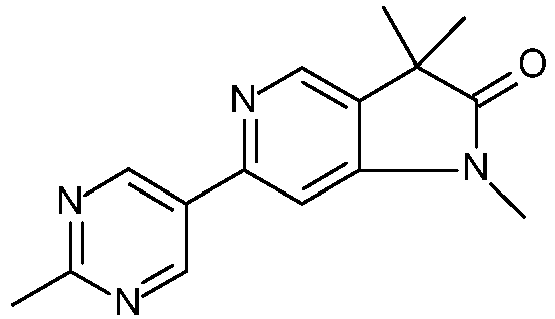
- A mixture of 6-chloro-1,3,3-trimethyl-1,3-dihydro-pyrrolo[3,2-c]pyridin-2-one (example 83a) (0.1 g, 0.475 mmol), 2-methylpyrimidine-5-boronic acid (0.078 g, 0.57 mmol) and NaOtBu (0.068 g, 0.712 mmol) in dioxane (2.0 ml) in a microwave vessel was sparged with argon for 15 minutes. Then Brettphos (0.019, 0.024 mmol) was added to the reaction mixture and sparging was continued for 15 minutes. The vial was sealed and the reaction mixture was irradiated to 110°C for 1 hour. The reaction mixture was filtered through celite and the filtrate was concentrated in vacuo. The crude material was purified by preparative reversed phase HPLC over a X Terra Prep RPC18 250 x 19
mm 10 µ column using acetonitrile/ 5 mM aqueous ammonium acetate solution as eluent. The title compound was obtained as off white solid (30 mg)
MS ESI (m/z): 268.8 [(M+H)+]. -
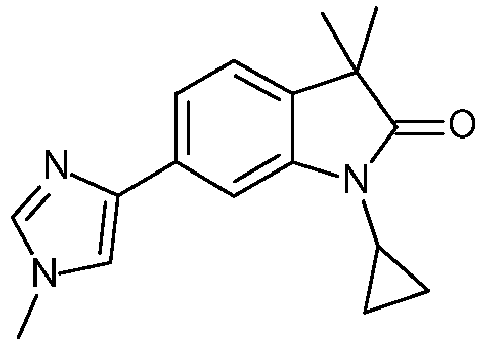
- Prepared in analogy to example 69 from 1-cyclopropyl-3,3-dimethyl-2-oxoindoline-6-carboxylic acid (example 102b). The title compound was obtained as brown viscous oil.
MS ESI (m/z): 269.5 [(M+H)+]. - Prepared in analogy to example 68 from 1-cyclopropyl-3,3-dimethyl-6-(oxazol-5-yl)indolin-2-one and a reaction time of 15 hours. The title compound was obtained as light brown foam.
MS ESI (m/z): 268.5 [(M+H)+]. - Prepared in analogy to example 110 from 1-cyclopropyl-6-(1H-imidazol-4-yl)-3,3-dimethylindolin-2-one. The title compound was obtained as white solid.
MS ESI (m/z): 282.16 [(M+H)+]. -

- To a solution of 6-(1H-imidazol-4-yl)-1,3,3-trimethylindolin-2-one (example 68, 100 mg, 414 µmol) in DMF (5 ml) at 0°C NaH (60% on mineral oil, 67.8 mg, 1.7 mmol) was added. After stirring for 15 minutes iodomethane (88.2 mg, 38.7 µl, 622 µmol) was added at 0°C. The reaction mixture was stirred 2 hours at 0°C. At 0°C water was added dropwise, then the mixture was diluted with brine and extracted with ethyl acetate. The organic layers were combined and dried with sodium sulfate, filtered and the obtained solution concentrated in vacuo. The obtained material was purified by preparative supercritical fluid chromatography over a AD-H 20 x 250 mm 5µm column using carbon dioxide/ methanol/ diethylamine as eluent. The title compound was obtained as off white solid (47 mg)
MS ESI (m/z): 256.2 [(M+H)+]. -

- Prepared in analogy to J. Med. Chem. 2008, vol 51, no 20, pp 6571-6580, supporting information page S24/25 from 6-chloro-1-cyclopropyl-3,3-dimethyl-1,3-dihydro-pyrrolo[3,2-c]pyridin-2-one (example 89a) using N,N-dimethyl-4-(tributylstannyl)-1H-imidazole-1-sulfonamide. The title compound was obtained as white foam.
MS ESI (m/z): 269.2 [(M+H)+]. -

- A solution of 6-bromo-3,3-dimethylindolin-2-one (example 24a, 250 mg, 1.04 mmol) in DMF (8 ml) in a pressure tube was sparged with argon for 5 minutes. Then 1-(bromomethyl)-4-methoxybenzene (209 mg, 1.04 mmol) and cesium carbonate (679 mg, 2.08 mmol) were added and sparging with argon continued for 5 minutes. The vial was sealed and the reaction mixture heated to 80°C. After 1 hour the reaction mixture was treated with water and extracted with ethyl acetate. The organic layers were combined, dried with sodium sulfate, filtered and the obtained solution concentrated in vacuo. The crude material was purified by silica gel chromatography using heptane/ ethyl acetate as eluent. The title compund was obtained as red liquid (340 mg).
MS ESI (m/z): 360.5, 362.5 [(M+H)+].
1H NMR (300MHz, CHLOROFORM-d) δ = 7.23 - 7.17 (m, 2H), 7.15 (dd, J=1.6, 7.9 Hz, 1H), 7.05 (d, J=7.9 Hz, 1H), 6.89 - 6.82 (m, 3H), 4.81 (s, 2H), 3.78 (s, 3H), 1.40 (s, 6H) - To a mixture of 6-bromo-1-(4-methoxybenzyl)-3,3-dimethylindolin-2-one (750 mg, 2.08 mmol) and tert-butyl 4-(4,4,5,5-tetramethyl-1,3,2-dioxaborolan-2-yl)-1H-pyrazole-1-carboxylate (947 mg, 3.12 mmol) in 1,2-dimethoxyethane (20 ml) and 2 M aqueous sodium carbonate solution (4 ml) in a pressure tube was added triphenylphosphine (135 mg, 500 µmol). The mixture was sparged with argon for 5 minutes, then palladium(II)acetate (67.3 mg, 300 µmol) was added and sparging with argon continued for another 5 minutes. The vial was sealed and the reaction heated to 100°C for 16 hours. To the reaction mixture silica gel was added and the mixture concentrated in vacuo. The crude material was purified by silica gel chromatography using heptane/ ethyl acetate as eluent. The title compound was obtained as light yellow foam (573 mg)
MS ESI (m/z): 348.2 [(M+H)+]. - Prepared in analogy to example 104 from 1-(4-methoxybenzyl)-3,3-dimethyl-6-(1H-pyrazol-4-yl)indolin-2-one. The title compound was obtained as light yellow viscous oil.
MS ESI (m/z): 388.3 [(M+H)+]. - A solution of 6-(1-cyclopropyl-1H-pyrazol-4-yl)-1-(4-methoxybenzyl)-3,3-dimethylindolin-2-one (117 mg, 302 µmol) in TFA (2 ml) in a sealed tube was stirred 17 hours at 110°C. Again TFA (0.5 ml) was added and the reaction mixture was stirred another 22 hours at 110°C. The reaction mixture was poured into 2 M aqueous sodium carbonate solution and extracted with ethyl acetate. The combined organic layers were dried over sodium sulfate, filtered and concentrated in vacuo. The residue was diluted with dichloromethane, amine silica gel was added and the mixture concentrated in vacuo. The crude material was purified by preparative silica gel chromatography using heptane/ ethyl acetate as eluent. The title compound was obtained as light yellow foam (75 mg).
MS ESI (m/z): 268.2 [(M+H)+]. -

- Prepared in analogy to example 102a using 6-bromo-1-(4-methoxybenzyl)-3,3-dimethylindolin-2-one (example 112a). The title compound was obtained as yellow viscous oil.
MS ESI (m/z): 340.5 [(M+H)+]. - Prepared in analogy to example 102b using methyl 1-(4-methoxybenzyl)-3,3-dimethyl-2-oxoindoline-6-carboxylate at 50°C for 16 hours. The title compound was obtained as white solid. MS ESI (m/z): 326.6 [(M+H)+].
- Prepared in analogy to example 70a using 1-(4-methoxybenzyl)-3,3-dimethyl-2-oxoindoline-6-carboxylic acid. The title compound was obtained as light yellow solid.
MS ESI (m/z): 369.5 [(M+H)+]. - Prepared in analogy to example 70b using N-methoxy-1-(4-methoxybenzyl)-N,3,3-trimethyl-2-oxoindoline-6-carboxamide. The title compound was obtained as orange solid.
MS ESI (m/z): 324.5 [(M+H)+]. - Prepared in analogy to example 70c using 6-acetyl-1-(4-methoxybenzyl)-3,3-dimethylindolin-2-one. The title compound was obtained as light yellow foam.
MS ESI (m/z): 402.2, 404.2 [(M+H)+]. - A suspension of 6-(2-bromoacetyl)-1-(4-methoxybenzyl)-3,3-dimethylindolin-2-one (718 mg, 1.78 mmol) in formamide (15 ml) in a sealed pressure tube was heated to 180°C for 3.5 hours. Heating was removed and the reaction mixture stirred at room temperature for 16 hours. Then the reaction mixture was concentrated in vacuo. The residue was diluted with dichloromethane, amine silica gel was added and the mixture concentrated in vacuo. The crude material was purified by silica gel chromatography using ethyl acetate as eluent. The title compound was obtained as brown viscous oil (613 mg) still containing formamide. The material was used without further purification.
MS ESI (m/z): 348.2 [(M+H)+]. - Prepared in analogy to example 104 using 6-(1H-imidazol-4-yl)-1-(4-methoxybenzyl)-3,3-dimethylindolin-2-one and a reaction time of 4.5 hours. The title compound was obtained as light red foam.
MS ESI (m/z): 388.3 [(M+H)+]. - Prepared in analogy to example 112d using 6-(1-cyclopropyl-1H-imidazol-4-yl)-1-(4-methoxybenzyl)-3,3-dimethylindolin-2-one. The title compound was obtained as orange solid.
MS ESI (m/z): 268.2 [(M+H)+]. -

- In a pressure tube ethyl 2-(2,4,6-trichloropyrimidin-5-yl)acetate (1.6 g, 5.94 mmol) was disolved in N,N-dimethylformamide (39.6 ml). Then cyclopropylamine (380 mg, 462 µl, 6.53 mmol) and DIPEA (921 mg, 1.24 ml, 7.12 mmol) were added, the tube sealed and the mixture heated to 50°C for 1.5 hours. The reaction mixture was diluted with ethyl acetate, water and brine. The mixture was extracted with ethyl acetate and the organic layers were washed with brine, with 1 M aqueous HCl solution and with brine. The combined organic layers were dried with sodium sulfate, filtered and the obtained solution concentrated in vacuo. The crude material was purified by silica gel chromatography using heptane/ ethyl acetate as eluent. The title compound was obtained as light brown solid (1.363g).
MS ESI (m/z): 290.0, 292.0, 294.0 [(M+H)+].
1H NMR (300MHz, CHLOROFORM-d) δ = 6.14 (br. s., 1H), 4.18 (q, J=7.2 Hz, 2H), 3.58 (s, 2H), 3.01 - 2.88 (m, 1H), 1.27 (t, J=7.1 Hz, 3H), 0.97 - 0.83 (m, 2H), 0.62 - 0.50 (m, 2H) - In a pressure tube MeI (1.24 g, 548 µl, 8.76 mmol) was added to a suspension of ethyl 2-(2,4-dichloro-6-(cyclopropylamino)pyrimidin-5-yl)acetate (1.24 g, 4.27 mmol) and cesium carbonate (6.96 g, 21.4 mmol) in dry DMF (42.7 ml). The tube was sealed and the reaction mixture heated to 60°C for 2 hours. Again MeI (121 mg, 53.4 µl, 855 µmol) was added and stirring at 60°C continued for another 1.5 hours. The reaction mixture was diluted with ethyl acetate, saturated aqueous sodium bicarbonate solution and brine. The mixture was extracted with ethyl acetate and the organic layers were washed with saturate aqueous sodium carbonate solution and with brine. The combined organic layers were dried with sodium sulfate, filtered and concentrated in vacuo. The crude material was purified by silica gel chromatography using heptane/ ethyl acetate as eluent. The title compound was obtained as white solid (725 mg)
MS ESI (m/z): 272.1, 274.1, 276.1 [(M+H)+]
1H NMR (300MHz, CHLOROFORM-d) δ = 2.90 - 2.77 (m, 1H), 1.48 (s, 6H), 1.13 - 1.02 (m, 4H) - Prepared in analogy to example 1b from 2,4-dichloro-7-cyclopropyl-5,5-dimethyl-5H-pyrrolo[2,3-d]pyrimidin-6(7H)-one using 2-methylpyridine-4-boronic acid and a reaction time of 2.5 hours. The title compound was obtained as white solid.
MS ESI (m/z): 329.2, 331.2 [(M+H)+]
1H NMR (300MHz, CHLOROFORM-d) δ = 8.66 (d, J=5.2 Hz, 1H), 8.12 (s, 1H), 8.07 (dd, J=1.1, 5.1 Hz, 1H), 3.03 - 2.91 (m, 1H), 2.68 (s, 3H), 1.53 (s, 6H), 1.21 - 1.10 (m, 4H) - A flask containing a suspension of 4-chloro-7-cyclopropyl-5,5-dimethyl-2-(2-methylpyridin-4-yl)-5H-pyrrolo[2,3-d]pyrimidin-6(7H)-one (0.073 g, 222 µmol) in methanol (2.22 ml) was evacuated 4 times (frothing) and flushed with argon. Then 10% Pd/C (23.6 mg, 22.2 µmol) was added and degassing was repeated. Then the apparatus was again 4 times evacuated (frothing) and flushed with hydrogen. The reaction mixture was stirred at room temperature und hydrogen atmosphere for 2 hours. Again methanol (2.22 ml) and 10% Pd/C (23.6 mg, 22.2 µmol) were added, degassing and flushing with hydrogen repeated and the reaction mixture stirred at room temperature for 16 hours. The reaction mixture was diluted with ethyl acetate, water and saturated aqueous sodium bicarbonate solution. The mixture was filtered through dicalite and washed with water and ethyl acetate. The obtained mixture was extracted with ethyl acetate and the organic layers were washed with brine. The combined organic layers were dried with sodium sulfate, filtered and concentrated in vacuo. The crude material was purified by silica gel chromatography using heptane/ ethyl acetate as eluent. The title compound was obtained as white solid (41 mg).
MS ESI (m/z): 295.2 [(M+H)+]
1H NMR (300MHz, CHLOROFORM-d) δ = 8.66 (dd, J=0.6, 5.2 Hz, 1H), 8.37 (s, 1H), 8.13 (s, 1H), 8.08 (dd, J=1.1, 5.1 Hz, 1H), 3.02 - 2.92 (m, 1H), 2.68 (s, 3H), 1.45 (s, 6H), 1.23 - 1.11 (m, 4H) -

- Prepared in analogy to example 17 using 4-bromo-6-methylpyrimidine. The title compound was obtained as brown solid.
MS ESI (m/z): 254.2 [(M+H)+] -

- Prepared in analogy to example 83b from 6-chloro-3,3-dimethyl-1,3-dihydro-pyrrolo[3,2-c]pyridin-2-one (example 84a) using 2-methyl-pyridine-4-boronic acid. The title compound was obtained as colorless oil.
MS ESI (m/z): 254.2 [(M+H)+]
1H NMR (300MHz, CHLOROFORM-d) δ = 8.55 (s, 1H), 8.53 (d, J=5.0 Hz, 1H), 8.44 (s, 1H), 7.60 (d, J=5.7 Hz, 1H), 7.29 (d, J=5.0 Hz, 1H), 6.97 (s, 1H), 2.39 (s, 3H), 1.52 (s, 6H) -

- In a pressure tube a suspension of 6-chloro-1-cyclopropyl-3,3-dimethyl-1,3-dihydro-pyrrolo[3,2-c]pyridin-2-one (example 89a, 0.20 g, 0.845 mmol) and 2-methylpyridine-5-boronic acid (0.139 g, 1.014 mmol) and cesium carbonate (0.55 g, 1.69 mmol) in dioxane (4ml) was purged with argon for 15 minutes. Then Pd2(dba)3.CHCl3 (0.085 g, 0.084 mmol) and xantphos (0.098 g, 0.17 mmol) were added and purging was continued for 15 minutes. The tube was sealed and the reaction mixture was heated to 110°C for 12 hours. The reaction mixture was diluted with ethyl acetate and water. The mixture was extracted with ethyl acetate and the organic layers were washed with water followed by brine. The combined organic layers were dried with sodium sulfate, filtered and concentrated in vacuo. The crude material was purified by silica gel chromatography using hexane/ ethyl aceteate as eluent. The title compound was obtained as yellow solid (40 mg).
MS ESI (m/z): 294.0 [(M+H)+] -

- Prepared in analogy to example 117 from 6-chloro-3,3-dimethyl-1,3-dihydro-pyrrolo[3,2-c]pyridin-2-one (example 84a). The title compound was obtained as white solid.
MS ESI (m/z): 253.8 [(M+H)+] -
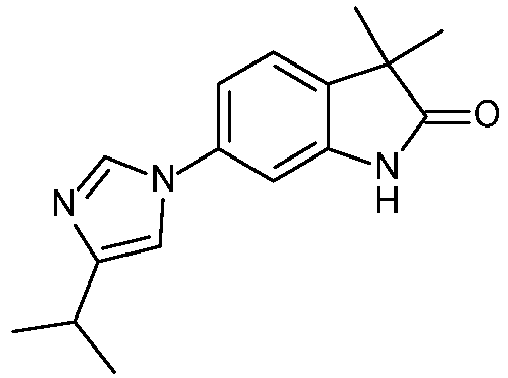
- Prepared in analogy to example 63 using 4-isopropyl-1H-imidazole. The title compound was obtained as off white solid.
MS ESI (m/z): 270.3 [(M+H)+] -
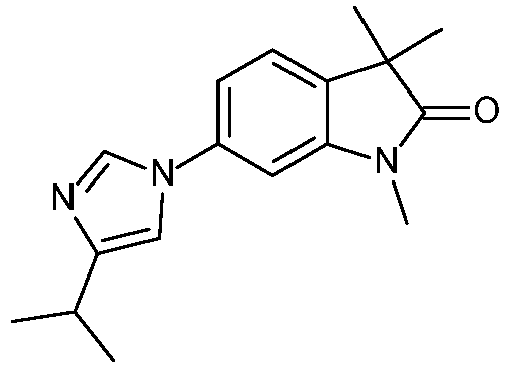
- Prepared in analogy to example 63 from 6-bromo-1,3,3-trimethylindolin-2-one (example 1a) using 4-isopropyl-1H-imidazole. The title compound was obtained as light brown oil.
MS ESI (m/z): 284.2 [(M+H)+] -
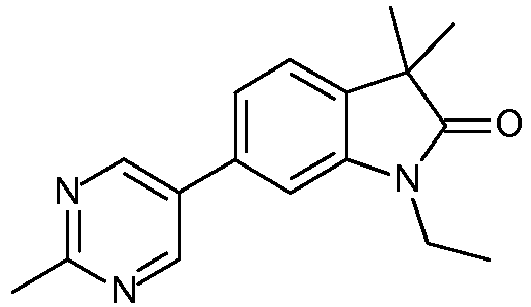
- A suspension of 3,3-dimethyl-6-(2-methylpyrimidin-5-yl)indolin-2-one (example 21, 100 mg, 395 µmol) and cesium carbonate (257 mg, 790 µmol) in DMF (1.5 ml) was treated with bromoethane (64.5 mg, 592 µmol) and the suspension was heated at 60 °C for 20 minutes. The reaction mixture was diluted with water and ethyl acetate. The mixture was extracted with ethyl acetate and the organic layers were washed with water. The combined organic layers were dried with sodium sulfate, filtered and concentrated in vacuo. The residue was crystallized from ethyl acetate/ heptane 1:5 at -20°C. The title compound was obtained as off white solid (88 mg).
MS ESI (m/z): 282.2 [(M+H)+] -

- Prepared in analogy to example 83b from 6-chloro-1-cyclopropyl-3,3-dimethyl-1,3-dihydro-pyrrolo[3,2-c]pyridin-2-one (example 89a) using 3-methylpyridine-4-boronic acid. The title compound was obtained as off white solid.
MS ESI (m/z): 294.0 [(M+H)+] -

- Prepared in analogy to example 83 using 3-methylpyridine-4-boronic acid. The title compound was obtained as off white solid.
MS ESI (m/z): 267.8 [(M+H)+] -

- Prepared in analogy to example 83 using 2-methylpyridine-5-boronic acid. The title compound was obtained as off white solid.
MS ESI (m/z): 267.8 [(M+H)+] -
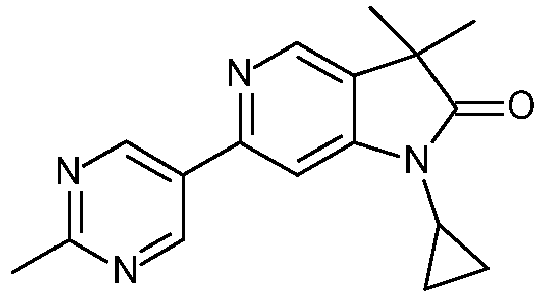
- In pressure tube 5-bromo-2-methylpyrimidine (500 mg, 2.89 mmol) and hexamethylditin (2.9 g, 1.85 ml, 8.67 mmol) were combined with dioxane (24 ml). The mixture was sparged with argon for 2 minutes, then bis(triphenylphosphine)palladium(II) dichloride (203 mg, 289 µmol) was added and the tube sealed. The reaction mixture was heated to 90°C for 5 hours. The reaction mixture was poured into 1 M aqueous potassium fluoride solution and extracted with ethyl acetate. The organic layers were washed with 1 M aqueous potassium fluoride solution, combined, dried with sodium sulfate and concentrated in vacuo. The crude material was purified by silica gel chromatography using heptane/ ethyl acetate as eluent. The title compound was obtained as yellow viscous oil (590 mg).
MS ESI (m/z): 259.0 [(M+H)+] (main peak, Sn specific isotopic pattern) - In a pressure tube 6-chloro-1-cyclopropyl-3,3-dimethyl-1H-pyrrolo[3,2-c]pyridin-2(3H)-one (example 89a, 100 mg, 422 µmol) and 2-methyl-5-(trimethylstannyl)pyrimidine (130 mg, 507 µmol) were combined with dry DMF (2 ml). The mixture was sparged 5 minutes with argon. Then tetrakis(triphenylphosphine)palladium (0) (48.8 mg, 42.2 µmol) was added, the tube sealed and the reaction mixture heated to 80°C for 16 hours. The reaction mixture was diluted with ethyl acetate, water and saturated aqueous sodium bicarbonate solution. The mixture was extracted with ethyl acetate and the organic layers were washed with saturated aqueous sodium bicarbonate solution. The combined organic layers were dried with sodium sulfate, filtered and concentrated in vacuo. The crude material was purified by silica gel chromatography using dichloromethane/ methanol as eluent. The obtained material was triturated with diisopropylether. The title compound was obtained as yellow solid (75 mg).
MS ESI (m/z): 295.2 [(M+H)+] -

- To a solution of 3,3-dimethyl-6-(2-methylpyrimidin-5-yl)indolin-2-one (example 21, 100 mg, 395 µmol) in DMF (3 ml) was added sodium hydride (55% on mineral oil, 20.7 mg, 474 µmol) at 0°C. The reaction was stirred at 0°C for 5 minutes and then room temperature. After 30 minutes at room temperature 1-bromo-2-methoxyethane (71.3 mg, 48.2 µl, 513 µmol) was added dropwise and the reaction was stirred at room temperature for further 3 hours. The mixture was partitioned between water and ethyl acetate. The mixture was extracted with ethyl acetate, the combined organic layers were dried with sodium sulfate, filtered and the obtained solution concentrated in vacuo. The crude material was purified by silica gel chromatography using heptane/ ethyl acetate as eluent. The obtained material was crystallized from Diethylether/ heptane 1:2 at -20°C). The title compound was obtained as white solid (58 mg).
MS ESI (m/z): 312.2 [(M+H)+]. -
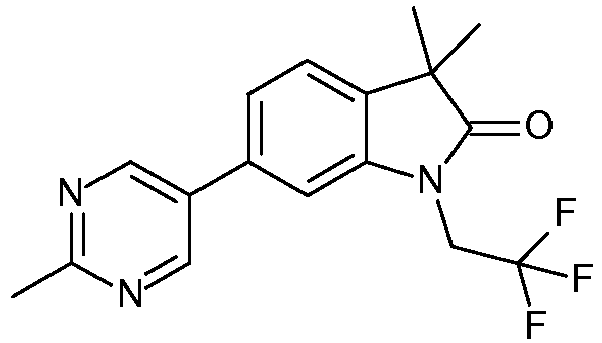
- Prepared in analogy to example 121 using 2-bromo-1,1,1-trifluoroethane and a reaction time of 4 hours. The title compound was obtained as off white solid.
MS ESI (m/z): 336.2 [(M+H)+]. -

- Prepared in analogy to example 121 using 1-bromo-2-(trifluoromethoxy)ethane with a reaction time of 3 hours at room temperature. The title compound was obtained as off white solid.
MS ESI (m/z): 366.2 [(M+H)+]. -

- Prepared in analogy to example 126 using 3-(bromomethyl)oxetane. The title compound was obtained as white solid.
MS ESI (m/z): 324.3 [(M+H)+]. -

- Prepared in analogy to example 121 using 3-bromo-1,1,1-trifluoropropan-2-ol with a reaction time of 2 hours at 100°C. The title compound was obtained as white solid.
MS ESI (m/z): 366.2 [(M+H)+]. -

- Prepared in analogy to example 126 using 1-bromo-3-fluoropropane. The title compound was obtained as white solid.
MS ESI (m/z): 314.2 [(M+H)+]. -

- Prepared in analogy to example 126 using 1-bromo-2-fluoroethane. The title compound was obtained as white solid.
MS ESI (m/z): 300.2 [(M+H)+]. -

- Prepared in analogy to example 126 from 6-(1H-imidazol-4-yl)-1,3,3-trimethylindolin-2-one (example 68) using ethyl bromide and a reaction time of 20 hours. The title compound was obtained as light brown oil.
MS ESI (m/z): 270.2 [(M+H)+]. -
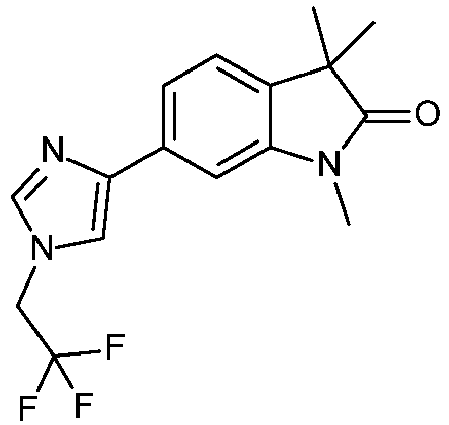
- Prepared in analogy to example 126 from 6-(1H-imidazol-4-yl)-1,3,3-trimethylindolin-2-one (example 68) using 2,2,2-trifluoroethyl trifluoromethanesulfonate. The title compound was obtained as light brown foam.
MS ESI (m/z): 324.2 [(M+H)+]. -

- To a solution of 6-chloro-1,3,3-trimethyl-1,3-dihydro-pyrrolo[3,2-c]pyridin-2-one (example 83a, 200 mg,0.950 mmol) in dioxane (10 ml) and water (2.5 ml) were added sodium carbonate (179.6 mg, 1.695 mmol) and 2-fluoro-4-(4,4,5,5-tetramethyl-[1,3,2]dioxaborolan-2-yl)-pyridine (318mg,1.429mmol). The apparatus was 3 times evacuated and flushed with nitrogen. The mixture was sparged with nitrogen for 10 minutes, then Pd(PPh3)4 (11.1mg, 0.01 mmol) was added and sparging with nitrogen continued for 10 minutes. The reaction mixture was heated to 110°C for 16 hours with vigorous stirring. The reaction mixture was diluted with ice- water and extracted with ethyl acetate, and the organic layers were washed with brine. The combined organic layers were dried with sodium sulfate, filtered and concentrated in vacuo. The crude material was purified by silica gel chromatography using ethyl acetate as eluent. The title compound was obtained as off white solid (50 mg).
MS ESI (m/z): 271.7 [(M+H)+]. -

- To a stirred solution of 6-chloro-1,3-dihydro-pyrrolo[3,2-c]pyridin-2-one (2.0 g, 11.905 mmol) and diisopropylamine (3.553 ml, 25.0 mmol) in THF (60.0 ml) was added n-BuLi (2.1 M in Toluene, 22.7 ml,47.619 mmol) at -30°C under argon. Then the reaction mixture was stirred for 30 minutes in which temperature reached 0°C. At this temperature was added ethylenedibromide (3.092 ml, 35.714) in THF (5.0 ml). After the addition the cooling bath was removed and the reaction mixture stirred at 25°C for 16 hours. The reaction mixture was quenched with 30 ml saturated aqueous ammonium chloride solution and extracted with ethyl acetate. The organic layers were dried with sodium sulfate, filtered and the obtained solution concentrated in vacuo. The crude material was triturated with hexane, filtered and dried. The title compound was obtained as brown solid (1.7 g) and was used without further purification.
MS ESI (m/z): 195.6 [(M+H)+]. - To a stirred solution of 6-chlorospiro[1H-pyrrolo[3,2-c]pyridine-3,1'-cyclopropane]-2-one (3.8g, 19.522mmol) in dry THF (120 ml) was added NaH (60%, 0.936g,23.427 mmol) portion wise at 0°C under argon. The reaction mixture was then stirred at 0°C for 10 minutes, then the temperature was increased to 25°C for 20 minutes. Then MeI (1.465 ml, 23.427mmol) was added slowly at 0°C to the reaction mixture and stirring was continued for another 4 hours at 25°C. Then the reaction was quenched with saturated aqueous ammonium chloride solution at 0°C, extracted with ethyl acetate and the organic layers were washed with water. The combined organic layers were dried with sodium sulfate, filtered and the obtained solution concentrated in vacuo. The crude material was purified by silica gel chromatography using hexane/ ethyl acetate as eluent. The title compound was obtained as light yellow solid (1.85g).
MS ESI (m/z): 209.6 [(M+H)+]. - Prepared in analogy to example 1b from 6'-chloro-1'-methyl-spiro[cyclopropane-1,3'-pyrrolo[3,2-c]pyridine]-2'-one using 2-methylpyridine-4-boronic acid. The title compound was obtained as off white solid.
MS ESI (m/z): 266.2 [(M+H)+]. -
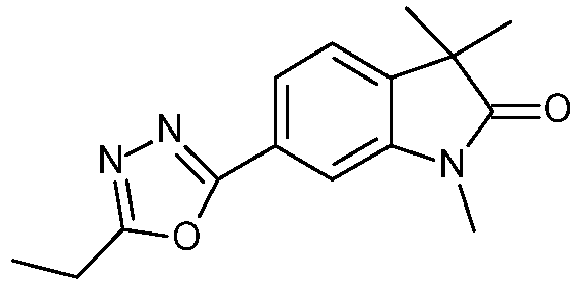
- Prepared in analogy to example 93 using propanehydrazide. The title compound was obtained as white solid.
MS ESI (m/z): 272.1 [(M+H)+]. -

- Prepared in analogy to example 1b from 6'-chloro-1'-methyl-spiro[cyclopropane-1,3'-pyrrolo[3,2-c]pyridine]-2'-one (example 136b) using pyridine-3-boronic acid. The title compound was obtained as off white solid.
MS ESI (m/z): 252.1 [(M+H)+]. -

- Prepared in analogy to example 78a from 6-chlorospiro[1H-pyrrolo[3,2-c]pyridine-3,1'-cyclopropane]-2-one (example 136a). The title compound was obtained as pale yellow solid. MS ESI (m/z): 234.7 [(M+H)+].
- Prepared in analogy to example 1b from 6'-chloro-1'-cyclopropyl-spiro[cyclopropane-1,3'-pyrrolo[3,2-c]pyridine]-2'-one) using 2-methylpyridine-4-boronic acid. The title compound was obtained as white solid.
MS ESI (m/z): 292.1 [(M+H)+]. -

- Prepared in analogy to example 1b from 6'-chloro-1'-cyclopropyl-spiro[cyclopropane-1,3'-pyrrolo[3,2-c]pyridine]-2'-one) (example 139a) using pyridine-3-boronic acid. The title compound was obtained as off white solid.
MS ESI (m/z): 278.1 [(M+H)+]. -

- A solution of compound 6-bromo-3,3-dimethyl-1,3-dihydro-indol-2-one (example 24a, 4 g, 16.66 mmol) in MeOH (40 ml) and DMF (4 ml) was sparged with argon for 10 minutes. Then DIPEA (29.5 ml, 166.6 mmol) and Pd(dppf)Cl2 (1.36 g, 1.67 mmol) were added and sparging was continued for another 15 minutes. The reaction mixture was then stirred at 100°C at 10.3 bar for 16 hours under CO gas. The reaction mixture was cooled to 25°C and concentrated in vacuo. The residue was dissolved in ethyl acetate and the organic phase was washed with water followed by brine. The organic layer was dried with sodium sulfate, filtered and concentrated in vacuo. The crude material was purified by silica gel chromatography using hexane/ ethyl acetate as eluent. The title compound was obtained as yellow solid (2.8 g).
MS ESI (m/z): 220.2 [(M+H)+]. - To a stirred solution of methyl 3,3-dimethyl-2-oxo-2,3-dihydro-1H-indole-6-carboxylate (0.5 g, 2.28 mmol) in methanol (7 ml) was added hydrazine hydrate (1.1 ml, 22.8 mmol) and the reaction mixture was stirred at room temperature for 16 hours. Then the mixture was concentrated in vacuo. Three times toluene was added and the mixture concentrated in vacuo. The title compound was obtained as brown solid (0.48 g) and was used without further purification.
MS ESI (m/z): 220.2 [(M+H)+]. - To a stirred solution of 1-(trifluoromethyl)cyclopropane-1-carboxylic acid (0.07g, 0.45mmol) in DMF (2 ml) was added TBTU (022g, 0.68mmol) followed by N-methyl morpholine (0.15 ml, 1.3mmol) and the reaction mixture was stirred at 25°C for 15 minutes.Then 3,3-dimethyl-2-oxo-2,3-dihydro-1H-indole-6-carbohydrazide (0.1g, 0.73mmol) was added and the reaction mixture stirred at 25°C for 16 hours. The reaction mixture was concentrated in vacuo. The residue was diluted with dichloromethane and washed with saturated aqueous sodium bicarbonate solution followed by water. The organic layer was dried with sodium sulfate and concentrated in vacuo. The crude material was purified by silica gel chromatography ethyl acetate as eluent. The title compound was obtained as off white solid (90 mg) and was used without further purification.
MS ESI (m/z): 356.2 [(M+H)+]. - Prepared in analogy to example 93b from N'-[(3,3-dimethyl-2-oxo-2,3-dihydro-1H-indol-6-yl)carbonyl]-1-(trifluoromethyl)cyclopropane-1-carbohydrazide. The title compound was obtained as pale yellow solid.
MS ESI (m/z): 337.8 [(M+H)+]. -

- To a solution of 6-acetyl-1,3,3-trimethylindolin-2-one (example 70b, 326 mg, 1.5 mmol) and methyl cyclopropanecarboxylate (150 mg, 153 µl, 1.5 mmol) in THF (8 ml) was added at 22°C under inert atmosphere sodium hydride (55% on mineral oil, 137 mg, 3.15 mmol) in one portion. The suspension was stirred at 22°C for 39 hours. The mixture was partitioned between 1 M aqueous HCl solution and ethyl acetate and the aqueous layer was extracted with ethyl acetate. The combined organic layers were dried with sodium sulfate, filtered and the obtained solution concentrated in vacuo. The crude material was purified by silica gel chromatography using heptane/ ethyl acetate as eluent. The title compound was obtained as colorless solid (243 mg). MS ESI (m/z): 286.1 [(M+H)+]
- To a solution of 1-cyclopropyl-3-(1,3,3-trimethyl-2-oxoindolin-6-yl)propane-1,3-dione (220 mg, 771 µmol) in ethanol (4.6 ml) in a pressure tube was added at 22 °C under argon hydroxylamine hydrochloride (53.6 mg, 771 µmol). The tube was sealed and the reaction mixture heated 85°C for 15 hours. The mixture was diluted with saturated aqueous sodium bicarbonate solution and ethyl acetate. The mixture was extracted with ethyl acetate, the combined organic layers were dried with sodium sulfate, filtered and the obtained solution concentrated in vacuo. The crude material was purified by preparative supercritical fluid chromatography over a AD-H 20 x 250 mm 5 µm column using carbon dioxide/ methanol as eluent. The title compound was obtained as light red oil (65 mg).
MS ESI (m/z): 283.1 [(M+H)+] -

- Prepared in analogy to example 142 using methyl acetate. The title compound was obtained as light yellow solid.
MS ESI (m/z): 257.1 [(M+H)+] -

- Prepared in analogy to example 142 using methyl 2-methoxyacetate. The title compound was obtained as colorless oil.
MS ESI (m/z): 290.1 [(M+H)+] -

- To a solution of 6-(2-bromoacetyl)-1,3,3-trimethylindolin-2-one (example 70c, 1.75 g, 5.9 mmol) in acetone (17.5 ml) was added at 22 °C under inert atmosphere sodium azide (767 mg, 11.8 mmol) and stirred at 22 °C for 6 hours. The reaction mixture was poured into water and extracted with dichloromethane, the combined organic layers were dried with sodium sulfate, filtered and the obtained solution concentrated in vacuo. The title compound was obtained as light yellow solid (1.51 g).
MS ESI (m/z): 259.1 [(M+H)+] - To a colorless solution of triphenylphosphine (345 mg, 1.32 mmol) in toluene (2.5 ml) was added at 22 °C under inert atmosphere 6-(2-azidoacetyl)-1,3,3-trimethylindolin-2-one (200 mg, 774 µmol) followed after 2 minutes by tetrahydro-2H-pyran-4-carbonyl chloride (115 mg, 774 µmol). The reaction mixture was stirred at 22 °C for 18 hours. Then the reaction mixture concentrated in vacuo and the residue was purified by silica gel chromatography using heptane/ ethyl acetate as eluent. The obtained material was again purified by preparative reversed phase HPLC over a YMC Actus Triart C18 100 x 30 mm 5 µm 12nm column using water/ acetonitrile/ formic acid as eluent. The title compound was obtained as colorless oil (45 mg).
MS ESI (m/z): 327.2 [(M+H)+] -

- To a solution of 6-chloro-1,3,3-trimethyl-1,3-dihydro-pyrrolo[3,2-c]pyridin-2-one (example 83a, 250 mg,1.19 mmol) in dioxane (12.5 ml) and water (3.1 ml) were added potassium carbonate (329 mg, 2.381 mmol) and 4-(4,4,5,5-tetramethyl-[1,3,2]dioxaborolan-2-yl)-pyridazine (367 mg,1.786 mmol). The apparatus was was evacuated and backfilled with nitrogen three times. Then the mixture was sparged with nitrogen for 10 minutes. Then Pd(dppf)Cl2 was added and the mixture again sparged with nitrogen for 10 minutes. The reaction mixture was heated to 110°C for 16 hours with vigorous stirring. The reaction mixture was diluted with ice- water, extracted with ethyl acetate and the organic layers washed with brine. The combined organic layer were dried with sodium sulfate, filtered and the obtained solution concentrated in vacuo. The crude materil was purified silica gel chromatography using ethyl acetate as eluent. The title compound was obtained as off white solid (30 mg).
MS ESI (m/z): 254.8 [(M+H)+] -
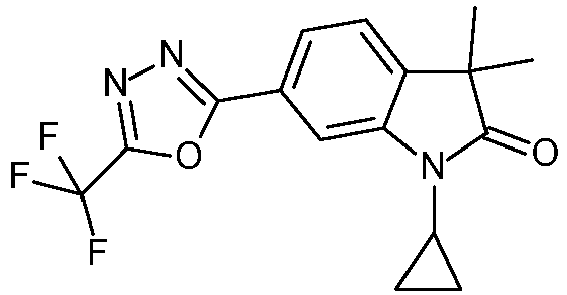
- Prepared in analogy to example 141a-b from 6-bromo-1-cyclopropyl-3,3-dimethyl-indolin-2-one (example 78a). The title compound was obtained as white solid.
MS ESI (m/z): 260.2 [(M+H)+] - To a stirred solution of 1-cyclopropyl-3,3-dimethyl-2-oxo-2,3-dihydro-1H-indole-6-carbohydrazide (0.2 g, 0.77 mmol) in THF (5 ml) was added trifluoroaceticanhydride (0.33 ml, 2.31 mmol) at 0°C. The reaction mixture was then stirred at 25°C for 2 hours. The reaction mixture was concentrated in vacuo. The title compound was obtained as white foam (0.22 g) which was used without further purification. LC-MS: 356.2 (M+H).
MS ESI (m/z): 356.2 [(M+H)+] - Prepared in analogy to example 93b from 1-cyclopropyl-3,3-dimethyl-2-oxo-N'-(trifluoroacetyl)-2,3-dihydro-1H-indole-6-carbohydrazide. The title compound was obtained as white solid.
MS ESI (m/z): 338.3 [(M+H)+] -
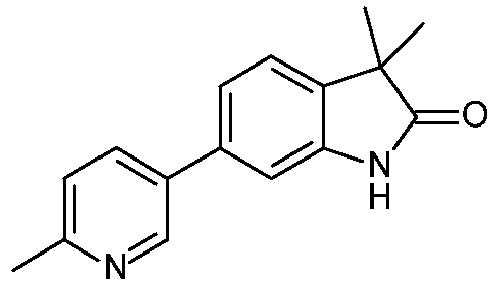
- Prepared in analogy to example 1b from 6-bromo-3,3-dimethyl-1,3-dihydro-indol-2-one (example 24a) using 6-methylpyridine-3-boronic acid. The title compound was obtained as off white solid.
MS ESI (m/z): 253.3 [(M+H)+] -

- Prepared in analogy to example 1b from 6-bromo-3,3-dimethyl-1,3-dihydro-indol-2-one (example 24a) using 4-fluoropyridine-3-boronic acid pinacol ester. The title compound was obtained as light brown solid.
MS ESI (m/z): 257.2 [(M+H)+] -

- To a stirred solution of 3,3-dimethyl-2-oxo-2,3-dihydro-1H-indole-6-carbohydrazide (example 141b, 0.3 g, 1.37 mmol) in DMF/ dichloromethane 1:3 (4 ml) was added triethyl amine (0.47 ml, 3.42 mmol) followed by propionyl chloride (0.15m1, 1.64mmol). The reaction mixture was stirred at 25°C for 2 hours. Then the reaction mixture was concentrated in vacuo. The residue was dissolved in ethyl acetate and the organic layer was washed with saturated aqueous sodium bicarbonate solution followed by water. The organic layer was dried with sodium sulfate, filtered and the obtained solution concentrated in vacuo. The title compound was obtained as light brown solid (195 mg) and was used without further purification.
MS ESI (m/z): 276.2 [(M+H)+] - Prepared in analogy to example 93b using acetonitrile/ DMF 4:1 as solvent. The title compound was obtained as white solid.
MS ESI (m/z): 258.2 [(M+H)+] -

- Prepared in analogy to example 17 using 4-bromo-1-methyl-1H-imidazole. The title compound was obtained as light brown solid.
MS ESI (m/z): 242.2 [(M+H)+] -

- Prepared in analogy to example 141a from 6-bromo-1,3,3-trimethylindolin-2-one (example 1a).
- The title compound was obtained as yellow solid.
MS ESI (m/z): 234.1 [(M+H)+] - Prepared in analogy to example 141 from
methyl 1,3,3-trimethyl-2-oxoindoline-6-carboxylate using oxetane-3-carboxylic acid. The title compound was obtained as white solid.
MS ESI (m/z): 300.2 [(M+H)+] -

- A suspension of 6-bromo-1,3,3-trimethylindolin-2-one (example 1a, 25.0 mg, 0.098 mmol), 4-(trifluoromethyl)-1H-imidazole (20.094 mg, 0.148 mmol) and potassium carbonate (40.8 mg, 0.295mmol) in acetonitrile (2.0ml) in a microwave tube was sparged with argon for 5 minutes. Then CuI (3.749 mg, 0.02 mmol) and N,N'-dimethylethane-1,2-diamine (0.0040 ml, 0.034 mmol) were added and degassing was repeated. The tube was sealed and the reaction mixture was heated to 90°C under microwave irradiation. The reaction mixture was concentrated in vacuo. The residue was diluted with ethyl acetate and washed with 1 M aqueous HCl solution. The organic layer was dried with sodium sulfate, filtered and the obtained solution concentrated in vacuo. The crude material was purified by silica gel chromatography using hexane/ ethyl acetate as eluent. The title compound was obtained as off-white solid (10 mg).
MS ESI (m/z): 310.2 [(M+H)+] -

- Prepared in analogy to example 153 from 6-bromo-1-cyclopropyl-3,3-dimethyl-indolin-2-one (example 78a). The title compound was obtained as off white solid.
MS ESI (m/z): 336.0 [(M+H)+] -

- Prepared in analogy to example 17 using 2-bromo-5-methylpyrazine. The title compound was obtained as light yellow solid.
MS ESI (m/z): 254.1 [(M+H)+] -

- Prepared in analogy to example 17 using 4-bromo-2,6-dimethylpyrimidine. The title compound was obtained as light yellow solid.
MS ESI (m/z): 268.2 [(M+H)+] -

- Prepared in analogy to example 17 using 3-bromo-6-methylpyridazine. The title compound was obtained as light yellow solid.
MS ESI (m/z): 254.1 [(M+H)+] -

- Prepared in analogy to example 141 from 1-cyclopropyl-3,3-dimethyl-2-oxo-2,3-dihydro-1H-indole-6-carbohydrazide (example 147a) using oxetane-3-carboxylic acid. The title compound was obtained as off white solid.
MS ESI (m/z): 326.3 [(M+H)+] -

- Prepared in analogy to example 63 from 6-bromo-1,3,3-trimethylindolin-2-one (example 1a) using 4-ethyl-1H-imidazole. The title compound was obtained as colorless oil.
MS ESI (m/z): 270.1 [(M+H)+] -

- Prepared in analogy to example 141 using oxetane-3-carboxylic acid. The title compound was obtained as white solid.
MS ESI (m/z): 286.2 [(M+H)+] -

- In a reaction tube were placed 6-bromo-1-(4-methoxybenzyl)-3,3-dimethylindolin-2-one (example 112a, 144 mg, 400 µmol), palladium (II) acetate (4.49 mg, 20.0 µmol), 2-di-t-butylphosphino-3,4,5,6-tetramethyl-2',4',6'-tri-i-propylbiphenyl (19.2 mg, 40.0 µmol), pivalic acid (16.3 mg, 18.6 µl, 160 µmol) and potassium carbonate (166 mg, 1.2 mmol). The vial was capped, evacuated and backfilled with nitrogen three times. Dry DMA (1.5 ml) was added by syringe followed by oxazole (55.2 mg, 800 µmol) and the reaction mixture heated to 110°C for 24 hours. After cooling to room temperature the reaction mixture was directly purified by silica gel chromatography using heptane/ ethyl acetate as eluent. The obtained material was dissolved in dichloromethane and washed with water. The organic layers were dried with sodium sulfate, filtered and the obtained solution concentrated in vacuo. The title compound was obtained as light yellow oil (57 mg).
MS ESI (m/z): 349.2 [(M+H)+] - To a solution of 1-(4-methoxybenzyl)-3,3-dimethyl-6-(oxazol-5-yl)indolin-2-one (200 mg, 574 µmol) in THF (4 ml) was added at 22 °C 1 M borane tetrahydrofuran complex in THF (689 µl, 689 µmol) while some gas evolution was remarked. After 30 minutes the solution was cooled to -78 °C followed by addition of 1.6 M n-butyllithium in hexane (431 µl, 689 µmol). After 15 minutes at -78 °C iodomethane (97.8 mg, 43.0 µl, 689 µmol) was added by syringe and the mixture was allowed to warm to -20 °C and stirred at this temperature for 4 hours. The mixture was quenched with 5% acetic acid in ethanol (v/v) (10.3 g, 9.86 ml, 8.61 mmol) and stirred at 22 °C for 16 hours. The mixture was poured into saturated aqueous sodium bicarbonate solution and extracted with ether. The organic layers were washed with brine, combined, dried with sodium sulfate, filtered and the obtained solution concentrated in vacuo. The residue was purified by silica gel chromatography using heptane/ ethyl acetate as eleuent. The title compound was obtained as light yellow oil (36 mg).
MS ESI (m/z): 363.2 [(M+H)+] - In a tube 1-(4-methoxybenzyl)-3,3-dimethyl-6-(2-methyloxazol-5-yl)indolin-2-one (35 mg, 96.6 µmol) was dissolved in trifluoroacetic acid (661 mg, 446 µl, 5.79 mmol). The tube was set under argon, sealed and the reaction mixture was heated to 140 °C for 1 hour under microwave irradiation. The mixture was concentrated in vacuo. The residue was purified by silica gel chromatography using heptane/ ethyl acetate as eluent. The title compound was obtained as light brown solid (15.9 mg).
MS ESI (m/z): 243.1 [(M+H)+] -

- To a suspension of NaH (60%, 0.18 g, 4.58 mmol) in THF (5 ml) was added a solution of 6-bromo-3,3-dimethyl-2,3-dihydro-1H-indol-2-one (example 24a, 1.0 g, 4.16 mmol) in THF (5 ml) at 0 °C and the reaction mixture was stirred at this temperature for 30 minutes. Then [2-(chloromethoxy)ethyl]trimethylsilane (0.82 ml, 4.58 mmol) was added to this mixture and stirring was continued at 25°C for 16 hours. The reaction mixture was concentrated in vacuo. The residue was dissolved in ethyl acetate (50 ml) and the organic layer was washed with water. The separated organic layer was dried with sodium sulfate, filtered and the obtained solution concentrated in vacuo. The crude material was purified by silica gel chromatography using hexane/ ethyl acetate as eluent. The title compound was obtained as red liquid (1.3 g).
MS ESI (m/z): 370.2 [(M+H)+] - Prepared in analogy to example 63 from 6-bromo-3,3-dimethyl-1-(2-trimethylsilylethoxymethyl)indolin-2-one using 4-ethyl-1H-imidazole. The title compound was obtained as yellow gum.
MS ESI (m/z): 385.9 [(M+H)+] - To a stirred solution of 6-(4-ethyl-1H-imidazol-1-yl)-3,3-dimethyl-1-{[2-(trimethylsilyl)ethoxy]methyl}-2,3-dihydro-1H-indol-2-one (0.16 g, 0.42 mmol) in dichloromethane (5 ml) was added TFA (2.8 ml, 37.34 mmol) at 0°C and the reaction mixture was stirred at 25°C for 4 hours. The reaction mixture was concentrated in vacuo and the residue was dissolved in a mixture of dichloromethane/ methanol 4:1 (5 ml). Then ethylene diamine (2.8 ml, 41.49 mmol) was added to the mixture and it was stirred at 25°C for 16 hours. The reaction mixture was concentrated in vacuo and the residue was dissolved in ethyl acetate. The organic layer was washed with water, separated, dried with sodium sulfate, filtered and the obtained solution concentrated in vacuo. The crude material was purified by silica gel chromatography using hexane/ ethyl acetate as eluent. The title compound was obtained as yellow sticky solid (30 mg).
MS ESI (m/z): 256.0 [(M+H)+] -

- Prepared in analogy to example 142a from 6-acetyl-1-(4-methoxybenzyl)-3,3-dimethylindolin-2-one (example 113d) using methyl acetate. The title compound was obtained as yellow oil. MS ESI (m/z): 366.2 [(M+H)+]
- In a reaction tube to a solution of 1-(1-(4-methoxybenzyl)-3,3-dimethyl-2-oxoindolin-6-yl)butane-1,3-dione (135 mg, 369 µmol) in THF (1.4 ml) was added at 22°C methylhydrazine (85.1 mg, 97.3 µl, 1.85 mmol) and p-toluenesulfonic acid monohydrate (3.51 mg, 18.5 µmol). The tube was flushed with argon, sealed and the reaction mixture was stirred at 80°C for 2 hours. The mixture was adsorbed on silica gel, evaporated and purified by silica gel chromatography using dichloromethane/ methanol as eluent. The obtained material was further purified by preparative normal phase HPLC using a Reprosil Chiral-NR column and heptane/ ethanol 60:40 as eluent. The title compound was obtained as colorless oil (73 mg).
MS ESI (m/z): 376.2 [(M+H)+] - Prepared in analogy to example 161c from 6-(1,3-dimethyl-1H-pyrazol-5-yl)-1-(4-methoxybenzyl)-3,3-dimethylindolin-2-one. The title compound was obtained as colorless solid. MS ESI (m/z): 256.1 [(M+H)+]
-

- Prepared in analogy to example 17 using 3-iodo-1-methyl-1H-pyrazole. The title compound was obtained as off white solid.
MS ESI (m/z): 242.1 [(M+H)+] -

- Prepared in analogy to example 145 using 2-chloro-2-oxoethyl acetate. The title compound was obtained as yellow oil.
MS ESI (m/z): 315.2 [(M+H)+] - To a solution of (5-(1,3,3-trimethyl-2-oxoindolin-6-yl)oxazol-2-yl)methyl acetate (34 mg, 108 µmol) in MeOH (0.7 ml) was added potassium carbonate (17.9 mg, 130 µmol) and mixture was stirred at 22 °C for 2 hours. The reaction mixture was concentrated in vacuo and the residue was purified by silica gel chromatography using heptane/ ethyl acetate as eluent. The obtained material was further purified by preparative reversed phase HPLC over a YMC Actus Triart C18 100 x 30 mm 5 µm 12nm column using water/ acetonitrile/ formic acid as eluent. The title compound was obtained as colorless oil (12 mg).
MS ESI (m/z): 273.1 [(M+H)+] -

- To a stirred solution of 3,3-dimethyl-2-oxo-2,3-dihydro-1H-indole-6-carbohydrazide (example 141b, 0.2 g, 0.91 mmol) in DMF:dichloromethane 1:3 (4 ml) was added triethyl amine (0.32 ml, 2.28 mmol) followed by ethyloxalyl chloride (0.12 ml, 1.09 mmol). The reaction mixture was stirred at 25°C for 12 hours. After completion mixture was concentrated in vacuo and the residue was dissolved in EtOAc. The organic layer was washed with saturated aqueous sodium bicarbonate solution followed by water, dried with sodium sulfate, filtered and the obtained solution concentrated in vacuo. The crude material was purified by silica gel chromatography using hexane/ ethyl acetate as eluent. The title compound was obtained as white solid (70 mg). MS ESI (m/z): 318.2 [(M+H)+]
- Prepared in analogy to example 93b from ethyl 2-[2-(3,3-dimethyl-2-oxo-indoline-6-carbonyl)hydrazino]-2-oxo-acetate using acetonitrilie/DMF 4:1 as solvent. The title compound was obtained as white solid.
MS ESI (m/z): 302.0 [(M+H)+] - To a stirred solution of ethyl 5-(3,3-dimethyl-2-oxo-indolin-6-yl)-1,3,4-oxadiazole-2-carboxylate (0.35g, 1.16 mmol) in THF (5 ml) was added LiBH4 (0.127g, 5.81mmol) at 25°C and the reaction mixture was stirred at this temperature for 30 minutes. The reaction was quenched with 20% aqueous KOH solution and the residue was filtered off and washed with dichloromethane/ methanol 9:1. The filtrate was concentrated in vacuo and the crude material was purified by silica gel chromatography using hexane/ ethyl acetate as eluent. The obtained material was futher purified by preparative reversed phase HPLC, using a Synergi 4µ Max-RP 80A° column and acetonitrile/ water/ formic acid as eluent. The title compound was obtained as colorless solid (29 mg).
MS ESI (m/z): 260.1 [(M+H)+] -

- Prepared in analogy to example 153 from 6-bromo-1-(4-methoxybenzyl)-3,3-dimethylindolin-2-one (example 112a) using 4-trifluoromethyl-1H-imidazole. The title compound was obtained as white solid.
MS ESI (m/z): 416.3 [(M+H)+] - In a sealed tube a mixture of 1-[(4-methoxyphenyl)methyl]-3,3-dimethyl-6-[4-(trifluoromethyl)imidazol-1-yl]indolin-2-one (0.15 g, 0.36 mmol) and TFA (5 ml) was heated to 120°C for 72 hours. The reaction mixture was concentrated in vacuo and the residue was dissolved in EtOAc. The mixture was washed with saturated aqueous sodium bicarbonate solution, the organic layer dried with sodium sulfate, filtered and the obtained solution concentrated in vacuo. The crude material was purified by silica gel chromatography using hexane/ ethyl acetate as eleuent. The title compound was obtained as brown solid (77mg).
MS ESI (m/z): 296.0 [(M+H)+] -

- A mixture of imidazole (4.0g, 58.75mmol) and trifluoroacetaldehyde methyl hemiacetal (3.82g, 29.37mmol) was heated to reflux under argon for 2 hours at 150°C, the mixture became homogeneous and the generated methanol refluxed. The reaction mixture was concentrated in vacuo. The crude material was purified by silica gel column chromatography using hexane/ ethyl acetate as eluent. The title compound was obtained as white semisolid (1.5 g).
MS ESI (m/z): 166.8 [(M+H)+] - To a solution of 2,2,2-trifluoro-1-(1H-imidazol-5-yl)ethanol (300.0mg, 1.807 mmol) in dichloromethane (6 ml) was added triethylamine (2.507 ml, 18.072mmol) drop wise at 0°C. The reaction mixture was stirred at 0°C for 15 minutes, then TBDMS-C (817.048mg, 5.422mmol) was added and stirring continued for 16 hours. The reaction mixture was diluted with water and the mixture extracted with dichloromethane. The combined organic layers were dried with sodium sulfate, filtered and the obtained solution concentrated in vacuo. The crude material was purified by silica gel chromatography using hexane/ ethyl acetate as eluent. The title compound was obtained as white semisolid (150.0mg).
MS ESI (m/z): 280.8 [(M+H)+] - Prepared in analogy to example 153 from 6-bromo-1-(4-methoxybenzyl)-3,3-dimethylindolin-2-one (example 112a) and tert-butyl-dimethyl-[2,2,2-trifluoro-1-(1H-imidazol-5-yl)ethoxy]silane. The title compound was obtained as off white solid.
MS ESI (m/z): 559.6 [(M+H)+] - Prepared in analogy to example 167b from 6-[4-[1-[tert-butyl(dimethyl)silyl]oxy-2,2,2-trifluoro-ethyl]imidazol-1-yl]-1-[(4-methoxyphenyl)methyl]-3,3-dimethyl-indolin-2-one. The title compound was obtained as off white solid.
MS ESI (m/z): 326.1 [(M+H)+] -
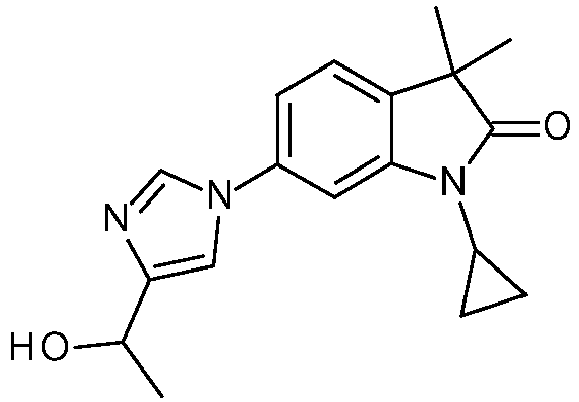
- Prepared in analogy to example 168b using 1-(3H-Imidazol-4-yl)-ethanol. The title compound was obtained as colourless liquid.
MS ESI (m/z): 227.0 [(M+H)+] - Prepared in analogy to example 153 from 6-bromo-1-cyclopropyl-3,3-dimethyl-indolin-2-one (example 78a) and tert-butyl-[1-(1H-imidazol-5-yl)ethoxy]-dimethyl-silane. The title compound was obtained as light brown semisolid.
MS ESI (m/z): 426.6 [(M+H)+] - To a solution of 6-[4-[1-[tert-butyl(dimethyl)silyl]oxyethyl]imidazol-1-yl]-1-cyclopropyl-3,3-dimethyl-indolin-2-one (0.09g, 0.212mmol) in methanol (8 ml) was added 12 M aqueous HCl solution (0.5 ml) at 0°C and the mixture stirred at 25°C for 24 hours. The reaction mixture was concentrated in vacuo. The residue was diluted with dichloromethane and washed with 10% aqueous sodium bicarbonate solution. The organic layers were dried with sodium sulfate, filtered and concentrated in vacuo. The crude material was purified by silica gel chromatography using hexane/ ethyl acetate as eluent. The title compound was obtained as off white semisolid (40 mg). MS ESI (m/z): 312.2 [(M+H)+]
-

- Prepared in analogy to example 169b -c using tert-butyl-dimethyl-[2,2,2-trifluoro-1-(1H-imidazol-5-yl)ethoxy]silane (example 168b). The title compund was obtained as off white solid. MS ESI (m/z): 366.0 [(M+H)+]
-

- Prepared in analogy to example 169 from 6-bromo-1,3,3-trimethylindolin-2-one (example 1a). The title compound was obtained as off white solid.
MS ESI (m/z): 286.2 [(M+H)+] -

- Prepared in analogy to example 153 from 6-bromo-3,3-dimethyl-1-(2-trimethylsilylethoxymethyl)indolin-2-one (example 162a) and tert-butyl-[1-(1H-imidazol-5-yl)ethoxy]-dimethyl-silane (example 169a). The title compound was obtained as yellow sticky solid.
MS ESI (m/z): 516.1 [(M+H)+] - Prepared in analogy to example 162c from 6-[4-[1-[tert-butyl(dimethyl)silyl]oxyethyl]imidazol-1-yl]-3,3-dimethyl-1-(2-trimethylsilylethoxymethyl)indolin-2-one. The title compound was obtained as light yellow solid.
MS ESI (m/z): 272.0 [(M+H)+] -

- Prepared in analogy to example 126 from 3,3-dimethyl-6-(2-methylpyrimidin-5-yl)indolin-2-one (example 21) using allyl bromide. The title compound was obtained as colorless viscous oil. MS ESI (m/z): 294.1 [(M+H)+]
- In a pressure tube 1-allyl-3,3-dimethyl-6-(2-methylpyrimidin-5-yl)indolin-2-one (110 mg, 375 µmol), 4-methylmorpholine n-oxide monohydrate (76.0 mg, 562 µmol) and osmium tetroxide (596 mg, 596 µl, 93.7 µmol) were combined with THF (2 ml) and t-BuOH (200 µl). The tube was sealed and the reaction mixture stirred at 60°C for 6 hours. The reaction mixture was poured into saturated aqueous sodium sulfite solution and extracted with ethyl acetate. The organic layers were washed with saturated aqueous sodium sulfite solution, dried with sodium sulfate, filtered and the obtained solution concentrated in vacuo. The crude material was purified by amine silica gel chromatography using dichloromethane/ methanol as eluent. The title compound was obtained as white foam (94 mg).
MS ESI (m/z): 328.2 [(M+H)+] -

- To a suspension of 3,3-dimethyl-6-(2-methylpyrimidin-5-yl)indolin-2-one (example 21, 0.1 g, 395 µmol) in acetonitrile (10.5 ml) under argon was added NaH on mineral oil (60%, 19.7 mg, 493 µmol) and the reaction mixture stirred 1 hour at room temperature. Then a suspension of 3,5-di-o-(p-toluyl)-2-deoxy-d-ribofuranosyl chloride (256 mg, 592 µmol) in dry THF (2.63 ml) was added and stirring at room temperature continued for 16 hours. Then 2 spoons silicagel were added to the reaction and the suspension concentrated in vacuo. The crude material purified by silica gel chromatography using heptane/ ethyl acetate as eluent. The title compound was obtained as yellow amorphous solid (132 mg).
MS ESI (m/z): 606.3 [(M+H)+] - To (2R,3S)-5-(3,3-dimethyl-6-(2-methylpyrimidin-5-yl)-2-oxoindolin-1-yl)-2-((4-methylbenzoyloxy)methyl)tetrahydrofuran-3-yl 4-methylbenzoate (0.13 g, 215 µmol) was added 7 M ammonia in methanol (1.3 ml, 9.1 mmol) and the reaction mixture stirred at room temperature for 19 hours. Again 7 M ammonia in methanol (1.3 ml, 9.1 mmol) was added and stirring at room temperature continued for another 22 hours. Then the reaction was heated to 40°C for 3 hours and then 50°C for 3 hours. Then heating was removed and the reaction mixture stirred at room temperature for 72 hours. The reaction mixture was concentrated in vacuo. The crude material was purified by silica gel chromatography using dichloromethane/ methanol as eluent. The title compound was obtained as white foam being a mixture of α and β form 2:1. MS ESI (m/z): 370.2 [(M+H)+]
-

- To a mixture of 1-(2,3-dihydroxypropyl)-3,3-dimethyl-6-(2-methylpyrimidin-5-yl)indolin-2-one (example 173, 72 mg, 220 µmol) in DMF (2.5 ml) was added NaH (60% on mineral oil, 19.4 mg, 484 µmol) and the mixture stirred 15 minutes at room temperature. Then MeI (78.0 mg, 34.4 µl, 550 µmol) was added and stirring at room temperature continued for 16 hours. Then again NaH (60% on mineral oil, 19.4 mg, 484 µmol) and MeI (78.0 mg, 34.4 µl, 550 µmol) were added and stirring continued for 1.5 hours. The reaction was quenched with water, extracted with ethyl acetate and the organic layers washed with water. The combined organic layers were dried with sodium sulfate, filtered and the obtained solution concentrated in vacuo. The crude material was purified by silica gel chromatography using dichloromethane/ methanol as eluent. The title compound was obtained as light yellow viscous oil (52 mg).
MS ESI (m/z): 356.2 [(M+H)+] -

- A suspension of 3,3-dimethyl-6-(2-methylpyrimidin-5-yl)indolin-2-one (example 21, 50 mg, 197 µmol), 3-chlorotetrahydrofuran (42.1 mg, 37.1 µl, 395 µmol) and cesium carbonate (129 mg, 395 µmol) in DMF (800 µl) was stirred at room temperature for 64 hours. Then the reaction mixture was cooled to 0°C and NaH (60% on mineral oil, 9.47 mg, 237 µmol) was added, cooling bath removed and stirred for 10 minutes. Then at room temperature again 3-chlorotetrahydrofuran (42.1 mg, 37.1 µl, 395 µmol) was added and stirring continued for 2 hours. Then the reaction was heated to 85°C and stirred at this temperature for 16 hours. Again NaH (60% on mineral oil, 9.47 mg, 237 µmol) and 3-chlorotetrahydrofuran (42.1 mg, 37.1 µl, 395 µmol) were added and stirring at 85°C continued for 24 hours. Again NaH (60% on mineral oil, 9.47 mg, 237 µmol) and 3-chlorotetrahydrofuran (42.1 mg, 37.1 µl, 395 µmol) were added and stirring continued for 24 hours. The reaction mixture was directly purified by silica gel chromatography using heptane/ ethyl acetate as eluent. The obtained material was further purified by preparative reversed phase HPLC over a Phenomenex Gemini NX 5µ C18 110A column using acetonitrile/ water/ formic acid as eluent. The title compound was obtained as white solid (22 mg).
MS ESI (m/z): 324.2 [(M+H)+] - Now it has been found that the compounds of formula I may be used for the treatment of CNS diseases.
The described compounds of formula I reduce L-687,414-induced hyperlocomotion. This was assessed by using a computerized Digiscan 16 Animal Activity Monitoring System (Omnitech Electronics, Columbus, Ohio) to quantify locomotor activity. Animals were kept under a 12 h light/dark cycle and experiments were performed during the light period. Each activity monitoring chamber consisted of a Plexiglas box (41×41×28 cm; W×L×H) with sawdust bedding on the floor surrounded by invisible horizontal and vertical infrared sensor beams. The test boxes were divided by a Plexiglas cross providing each mouse with 20x20 cm of moving space. Cages were connected to a Digiscan Analyzer linked to a computer that constantly collected the beam status information. Records of photocell beam interruptions for individual animals were taken every 5 min over the duration of the experimental session and the sum of the first 6 periods was used as the final parameter. Compounds were administered either p.o. 15 min before a s.c. injection of 50 mg/kg of L-687,414, or i.p. at the same time as a s.c. injection of 50 mg/kg of L-687,414. Mice were then transferred from their home cage to the recording chambers for a 15-min habituation phase allowing free exploration of the new environment. Horizontal activity was then recorded for a 30-min time period. The % inhibition of L-687,414-induced hyperlocomotion was calculated according to the equation:
- ID50 values, defined as doses of each compound producing 50% inhibition of L-687,414-induced hyperlocomotion, were calculated by linear regression analysis of a dose-response data using an Excel-based computer-fitting program.
As data was not presupposed to be normally distributed, groups treated with test compounds were statistically compared with the control (vehicle-treated) group using one-tailed Mann Whitney U tests. In statistics, the Mann-Whitney U test (also called the Mann-Whitney-Wilcoxon (MWW) or Wilcoxon rank-sum test) is a non-parametric statistical hypothesis test for assessing whether one of two samples of independent observations tends to have larger values than the other. It is one of the most well-known non-parametric significance tests. A p value gives the probability that two groups are significantly different from each other and the value of < 0.05 is generally accepted as a criterion, it implies that there is
> 95% chance that two groups are really different from each other. P values given in table 1 are one-tailed since only decreases in locomotion were expected and tested for (Mann, H. B., Whitney, D. R. (1947), "On a Test of Whether one of Two Random Variables is Stochastically Larger than the Other", Annals of Mathematical Statistics, 18 (1), 50-60).Table 1 Effects of compounds of formula I on L-687.414-induced hyperlocomotion Expl. structure Doses po [mg/kg] ID50 po [mg/kg] Lowest P value Dose ip [mg/kg] Inhibition, ip [%] P value 3 
30 53.4 0.0074 4 
30 74.6 0.032 7 
10-30-50 29.2 0.0059 8 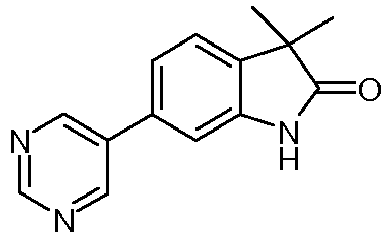
30 52.5 0.0052 10 
30 97.1 0.000078 11 
30 72.2 0.014 12 
30 93.7 0.000078 13 
30 76.9 0.025 14 
30 66.4 0.00093 16 
30 89.4 0.00054 17 
30 66.7 0.041 19 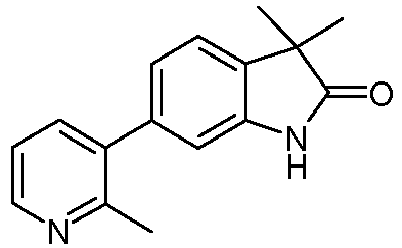
30 61.6 0.00054 20 
30 47.5 0.0074 21 
1-3-10 1.62 0.0075 23 
30 81.6 0.000078 25 
1-3-10 3.03 0.023 28 
30 68.4 0.032 30 
30 49.1 0.014 31 
30 81.2 0.00054 34 
30 56.9 0.0015 36 
30 79.3 0.00093 38 
30 57.3 0.0074 39 
30 77.6 0.00093 43 
30 60.5 0.0052 48 
30 68.6 0.0015 50 
30 86.3 0.000078 55 
1-3-10 0.88 0.021 56 
30 93.9 0.00016 57 
30 79.9 0.00031 59 
30 45.2 0.0015 60 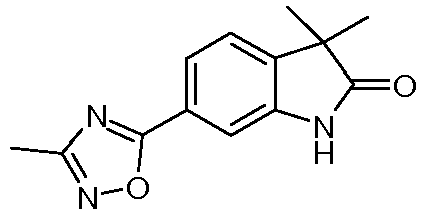
30 24 0.014 61 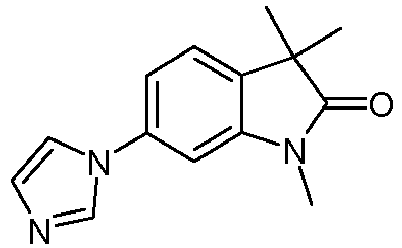
3-10-30 10.71 0.0016 63 
30 68.9 0.000078 67 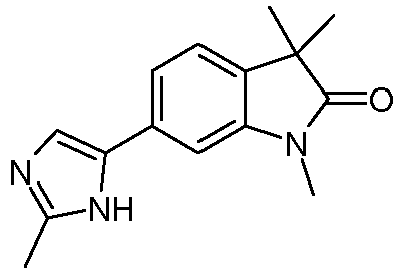
30 42.6 0.014 71 
30 68.5 0.000078 72 
30 67.4 0.000078 79 
20 62.5 0.00521 83 
30 53 0.01033 87 
30 82.8 0.00521 92 
30 80.9 0.00054 93 
30 68.6 0.0035 106 
30 75.7 0.00008 113 
30 83.9 0.00008 114 
20 42 0.0419 128 
30 66.1 0.03248 129 
30 95.5 0.00054 130 
30 89.4 0.0035 131 
30 95.3 0.00031 132 
30 95.3 0.00031 133 
30 44 0.03248 134 
30 79.8 0.00008 136 
30 89.7 0.00016 140 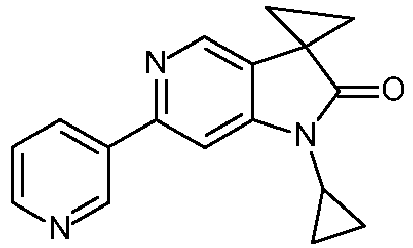
30 69.3 0.00093 143 
30 65.7 0.00093 168 
30 77 0.00031 175 
30 95.3 0.00008 - As mentioned above, some compounds have been tested in SmartCube®, an analytical system developed by PsychoGenics Inc.
- SmartCube® was used to compare the behavioral signature of a test compound to a database of behavioral signatures obtained from a large set of clinically approved reference drugs, grouped per indications. In this way, the neuro-pharmacological effects of a test compound can be predicted by similarity to major classes of compounds, such as antipsychotics, anxiolytics and antidepressants. This approach is ideally suited to screen collections of existing drugs or drug candidates with previously unknown neuropharmacology, which could expedite the development of new and unexpected treatments for psychiatric disorders.
- Some compounds of the present invention were injected i.p. at different doses 15 minutes before the test. At least 8 mice were used in each treatment group. Digital videos of the subjects were processed with computer vision algorithms to extract over 2000 dependent measures including frequency and duration of many different behavioral states. The results of the classifications are presented as bar charts for each compound and dose (mg/kg), the Y-axis indicates the relative probability that the test compound will show efficacy in the specific CNS indication.
- The bar charts of example compounds 13, 54, 58 and 71 at a dose of 25 mg/kg are shown in
Figure 1 . For comparison, the behavioral signatures of the atypical antipsychotics olanzapine and risperidone are shown inFigure 2 . Compounds of the present invention show similar signatures to those of atypical antipsychotics. An independent analysis was performed on the unclassified data to determine the similarity of the example compounds to active doses of known atypical antipsychotics. For this analysis, we use discrimination rate as the measure of separability between the two drugs, i.e. one drug's "distinguishability" from another. A rate equal to 50% (or 0.5) corresponds to zero distinguishability. Empirical data has shown that a threshold rate for reliable separation lies above 70% i.e., two drugs showing a discrimination rate of 70% or lower are considered similar, whereas a discrimination rate higher than 70% indicates that two drugs are dissimilar. The table below shows the similarity analysis of selected compounds of the present invention to several atypical antipsychotics. In most cases, the example compounds show a similarity to risperidone, clozapine and olanzapine with a discrimination rate of ≤ 0.70.Table 2: Similarity analysis of compounds of formula I (at 25 mg/kg) showing effects in SmartCube® Clozapine Olanzapine Risperidone Example 13 0.69 0.70 0.72 Example 54 0.69 0.61 0.63 Example 58 0.63 0.69 0.66 Example 71 0.79 0.66 0.63 -
Figure 1 : SmartCube® signatures ofcompounds -
Figure 2 : SmartCube® signatures of atypical antipsychotics olanzapine and risperidone (each at two doses). - The compounds of formula (I) and pharmaceutically acceptable salts thereof can be used as medicaments, e.g. in the form of pharmaceutical preparations. The pharmaceutical preparations can be administered orally, e.g. in the form of tablets, coated tablets, dragées, hard and soft gelatine capsules, solutions, emulsions or suspensions. However, the administration can also be effected rectally, e.g. in the form of suppositories, or parenterally, e.g. in the form of injection solutions.
- The compounds of formula (I) and pharmaceutically acceptable salts thereof can be processed with pharmaceutically inert, inorganic or organic carriers for the production of pharmaceutical preparations. Lactose, corn starch or derivatives thereof, talc, stearic acid or its salts and the like can be used, for example, as such carriers for tablets, coated tablets, dragées and hard gelatine capsules. Suitable carriers for soft gelatine capsules are, for example, vegetable oils, waxes, fats, semi-solid and liquid polyols and the like; depending on the nature of the active substance no carriers are, however, usually required in the case of soft gelatine capsules. Suitable carriers for the production of solutions and syrups are, for example, water, polyols, sucrose, invert sugar, glucose and the like. Adjuvants, such as alcohols, polyols, glycerol, vegetable oils and the like, can be used for aqueous injection solutions of water-soluble salts of compounds of formula (I), but as a rule are not necessary. Suitable carriers for suppositories are, for example, natural or hardened oils, waxes, fats, semi-liquid or liquid polyols and the like.
- In addition, the pharmaceutical preparations can contain preservatives, solubilizers, stabilizers, wetting agents, emulsifiers, sweeteners, colorants, flavorants, salts for varying the osmotic pressure, buffers, masking agents or antioxidants. They can also contain still other therapeutically valuable substances.
- As mentioned earlier, medicaments containing a compound of formula (I) or pharmaceutically acceptable salts thereof and a therapeutically inert excipient are also an object of the present invention, as is a process for the production of such medicaments which comprises bringing one or more compounds of formula I or pharmaceutically acceptable salts thereof and, if desired, one or more other therapeutically valuable substances into a galenical dosage form together with one or more therapeutically inert carriers. The active compounds may also be used in form of their prodrugs.
- As further mentioned earlier, the use of the compounds of formula (I) for the preparation of medicaments useful in the prevention and/or the treatment of the above recited diseases is also an object of the present invention.
- The dosage can vary within wide limits and will, of course, be fitted to the individual requirements in each particular case. In general, the effective dosage for oral or parenteral administration is between 0.01-20 mg/kg/day, with a dosage of 0.1-10 mg/ kg/day being preferred for all of the indications described. The daily dosage for an adult person weighing 70 kg accordingly lies between 0.7-1400 mg per day, preferably between 7 and 700 mg per day.
- Tablets of the following composition are manufactured in the usual manner:
ingredient mg/tablet 5 25 100 500 Compound of formula I 5 25 100 500 Lactose Anhydrous DTG 125 105 30 150 Sta-Rx 1500 6 6 6 60 Microcrystalline Cellulose 30 30 30 450 Magnesium Stearate 1 1 1 1 Total 167 167 167 831 -
- 1.
Mix ingredients 1, 2, 3 and 4 and granulate with purified water. - 2. Dry the granules at 50°C.
- 3. Pass the granules through suitable milling equipment.
- 4. Add ingredient 5 and mix for three minutes; compress on a suitable press.
- Capsules of the following composition are manufactured:
ingredient mg/capsule 5 25 100 500 Compound of formula I 5 25 100 500 Hydrous Lactose 159 123 148 - Corn Starch 25 35 40 70 Talk 10 15 10 25 Magnesium Stearate 1 2 2 5 Total 200 200 300 600 -
- 1.
Mix ingredients 1, 2 and 3 in a suitable mixer for 30 minutes. - 2. Add ingredients 4 and 5 and mix for 3 minutes.
- 3. Fill into a suitable capsule.
- A compound of formula I lactose and corn starch are firstly mixed in a mixer and then in a comminuting machine. The mixture is returned to the mixer; the talc is added thereto and mixed thoroughly. The mixture is filled by machine into suitable capsules, e.g. hard gelatin capsules.
- Injection solutions of the following composition are manufactured:
ingredient mg/injection solution. Compound of formula I 3 Polyethylene Glycol 400 150 acetic acid q.s. ad pH 5.0 water for injection solutions ad 1.0 ml - A compound of formula I is dissolved in a mixture of Polyethylene Glycol 400 and water for injection (part). The pH is adjusted to 5.0 by acetic acid. The volume is adjusted to 1.0 ml by addition of the residual amount of water. The solution is filtered, filled into vials using an appropriate overage and sterilized.
as well as with a pharmaceutically acceptable salts thereof, with a racemic mixture, or with its corresponding enantiomer and/or optical isomer and/or stereoisomer thereof
for Ar for prevention of clumping of both erythrocytes and thrombocytes.
Claims (29)
- A compound of formula
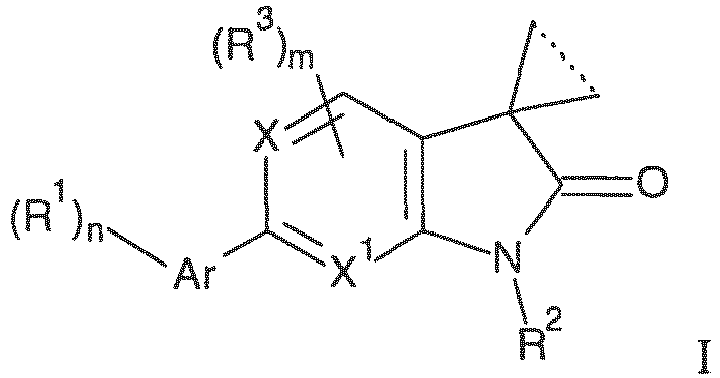 Ar is a 6 membered heteroaryl group, containing one or two N-atoms, which are the groups pyridinyl, pyrimidinyl, pyridazinyl, or a 5 membered heteroaryl group, containing from 1 to 3 heteroatoms, selected from N, S or O, which groups are imidazolyl, 1,2,4-oxadiazolyl, 1,3,4-oxadiazolyl, isoxazolyl, oxazolyl, 1,3,4-thiadiazolyl or pyrazolyl;R1 is hydrogen, C1-7-alkyl, halogen, amino, dimethylamino, cyano, C1-7-alkyl substituted by halogen, C1-7-alkyl substituted by hydroxy, CH(OH)CF3, (CH2)o-C1-7-alkoxy, cycloalkyl optionally substituted by CF3, or heterocycloalkyl selected from pyrrolidinyl, morpholinyl, thiomorpholinyl, piperidinyl, piperazinyl, tetrahydro-pyran-4-yl, tetrahydro-furan-3-yl or oxetanyl, optionally substituted by C1-7-alkyl;R2 is hydrogen, C1-7-alkyl, (CH2)o-cycloalkyl, (CH2)o-O-cycloalkyl, (CH2)o- C1-7-alkoxy, CH2)o-C1-7-alkoxy substituted by halogen, (CH2)o-heterocycloalkyl selected from pyrrolidinyl, morpholinyl, thiomorpholinyl, piperidinyl, piperazinyl, tetrahydro-pyran-4-yl, tetrahydro-furan-3-yl or oxetanyl, optionally substituted by C1-7-alkyl, (CH2)o-S(O)2-cycloalkyl, C1-7-alkyl substituted by one or two hydroxy, C1-7-alkyl substituted by one or two C1-7-alkoxy, (CH2)o-S(O)2- C1-7-alkyl, C1-7-alkyl substituted by halogen or CH2CH(OH)CF3;R3 is halogen or C1-7-alkyl;X is CH or N;X1 is CH or N;n is 1 or 2;o is 0, 1, 2 or 3;m is 0, 1 or 2;and the dotted line is a bond or not;
as well as with a pharmaceutically acceptable salts thereof, with a racemic mixture, or with its corresponding enantiomer and/or optical isomer and/or stereoisomer thereof - A compound of formula I according to claim 1, wherein Ar is a 6 membered heteroaryl group, containing one or two N-atoms and R2 is hydrogen, and the other substituents are as described in claim 1.
- A compound of formula I according to claim 2, which compounds are
3,3-Dimethyl-6-(pyridin-3-yl)indolin-2-one
3,3-Dimethyl-6-(pyridin-4-yl)indolin-2-one
3,3-Dimethyl-6-(pyrimidin-5-yl)indolin-2-one
6-(2-Aminopyrimidin-5-yl)-3,3-dimethylindolin-2-one
3,3-Dimethyl-6-(pyridazin-4-yl)indolin-2-one
6-(6-Aminopyridin-3-yl)-3,3-dimethylindolin-2-one
3,3-Dimethyl-6-(2-methylpyridin-3-yl)indolin-2-one
3,3-Dimethyl-6-(3-methylpyridin-4-yl)indolin-2-one
3,3-Dimethyl-6-(2-methylpyrimidin-5-yl)indolin-2-one
3,3-Dimethyl-6-(2-methylpyridin-4-yl)indolin-2-one
5-(3,3-Dimethyl-2-oxoindolin-6-yl)nicotinonitrile
6-(2,4-Dimethyl-pyridin-3-yl)-3,3-dimethyl-1,3-dihydro-indol-2-one
3,3-Dimethyl-6-(2-methylpyrimidin-4-yl)indolin-2-one
6-(2-Cyclopropylpyrimidin-5-yl)-3,3-dimethyl-indolin-2-one
3,3-Dimethyl-6-(2-methylpyrimidin-5-yl)-1H-pyrrolo[3,2-c]pyridin-2-one
3,3-Dimethyl-6-(6-methylpyrimidin-4-yl)indolin-2-one
3,3-Dimethyl-6-(3-methylpyridin-4-yl)-1H-pyrrolo[3,2-c]pyridin-2(3H)-one
3,3-Dimethyl-6-(6-methyl-3-pyridyl)-1H-pyrrolo[3,2-c]pyridin-2-one
3,3-Dimethyl-6-(6-methylpyridin-3-yl)indolin-2-one
6-(4-Fluoropyridin-3-yl)-3,3-dimethylindolin-2-one
3,3-Dimethyl-6-(5-methylpyrazin-2-yl)indolin-2-one
6-(2,6-Dimethylpyrimidin-4-yl)-3,3-dimethylindolin-2-one or
3,3-Dimethyl-6-(6-methylpyridazin-3-yl)indolin-2-one. - A compound of formula I according to claim 1, wherein Ar is a six membered heteroaryl group, containing one or two N-atoms and R2 is C1-7-alkyl and the other substituents are as described in claim 1.
- A compound of formula I according to claim 4, wherein the compounds are
1,3,3-Trimethyl-6-(pyridin-4-yl)indolin-2-one
1,3,3-Trimethyl-6-(2-methylpyridin-4-yl)indolin-2-one
1,3,3-Trimethyl-6-(pyridin-3-yl)indolin-2-one
1,3,3-Trimethyl-6-(pyrimidin-5-yl)indolin-2-one
1,3,3-Trimethyl-6-(pyridin-2-yl)indolin-2-one
1,3,3-Trimethyl-6-(2-(pyrrolidin-1-yl)pyrimidin-5-yl)indolin-2-one
6-(2-Aminopyrimidin-5-yl)-1,3,3-trimethylindolin-2-one
6-(2-(Dimethylamino)pyrimidin-5-yl)-1,3,3-trimethylindolin-2-one
1,3,3-Trimethyl-6-(2-methylpyrimidin-5-yl)indolin-2-one
1,3,3-Trimethyl-6-(pyridazin-3-yl)indolin-2-one
6-(4-Ethylpyrimidin-5-yl)-1,3,3-trimethylindolin-2-one
6-(6-Aminopyridin-3-yl)-1,3,3-trimethylindolin-2-one
1,3,3-Trimethyl-6-(6-methylpyridazin-3-yl)indolin-2-one
6-(5-Aminopyridin-3-yl)-1,3,3-trimethylindolin-2-one
6-(3,5-Dimethyl-pyridin-4-yl)-1,3,3-trimethyl-1,3-dihydro-indol-2-one
6-(4,6-Dimethyl-pyrimidin-5-yl)-1,3,3-trimethyl-1,3-dihydro-indol-2-one
6-(2,4-Dimethyl-pyridin-3-yl)-1,3,3-trimethyl-1,3-dihydro-indol-2-one
7-Fluoro-1,3,3-trimethyl-6-(pyridin-3-yl)indolin-2-one
1,3,3,7-Tetramethyl-6-(pyridin-3-yl)indolin-2-one
5-Fluoro-1,3,3-trimethyl-6-(pyridin-3-yl)indolin-2-one
5-Fluoro-1,3,3-trimethyl-6-(pyridin-4-yl)indolin-2-one
7-Fluoro-1,3,3-trimethyl-6-pyridin-4-yl-1,3-dihydro-indol-2-one
5-Fluoro-1,3,3-trimethyl-6-(2-methylpyridin-4-yl)indolin-2-one
1-Isopropyl-3,3-dimethyl-6-(2-methylpyrimidin-5-yl)indolin-2-one
5,7-Difluoro-1,3,3-trimethyl-6-pyridin-3-yl-1,3-dihydro-indol-2-one
5,7-Difluoro-1,3,3-trimethyl-6-pyrimidin-5-yl-1,3-dihydro-indol-2-one
1,3,3,5-Tetramethyl-6-(2-methyl-pyridin-4-yl)-1,3-dihydro-indol-2-one
5,7-Difluoro-1,3,3-trimethyl-6-(2-methyl-pyrimidin-5-yl)-1,3-dihydro-indol-2-one
6-(2-Cyclopropylpyrimidin-5-yl)-1,3,3-trimethyl-indolin-2-one
6-(6-Cyclopropylpyridazin-3-yl)-1,3,3-trimethyl-indolin-2-one
1,3,3-Trimethyl-6-(2-methyl-4-pyridyl)pyrrolo[3,2-c]pyridin-2-one
3,3-Dimethyl-6-(2-methyl-4-pyridyl)-1H-pyrrolo[3,2-c]pyridin-2-one
1,3,3-Trimethyl-6-(6-morpholinopyridin-3-yl)indolin-2-one
1,3,3-Trimethyl-6-(2-methylpyrimidin-5-yl)pyrrolo[3,2-c]pyridin-2-one
1-Ethyl-3,3-dimethyl-6-(2-methylpyrimidin-5-yl)indolin-2-one
1,3,3-Trimethyl-6-(3-methyl-4-pyridyl)pyrrolo[3,2-c]pyridin-2-one
1,3,3-Trimethyl-6-(6-methyl-3-pyridyl)pyrrolo[3,2-c]pyridin-2-one
6-(2-Fluoro-4-pyridyl)-1,3,3-trimethyl-pyrrolo[3,2-c]pyridin-2-one
1'-Methyl-6'-(2-methylpyridin-4-yl)spiro[cyclopropane-1,3'-pyrrolo[3,2-c]pyridin]-2'(1'H)-one
1'-Methyl-6'-(pyridin-3-yl)spiro[cyclopropane-1,3'-pyrrolo[3,2-c]pyridin]-2'(1'H)-one or
1,3,3-Trimethyl-6-pyridazin-4-yl-pyrrolo[3,2-c]pyridin-2-one. - A compound of formula I according to claim 1, wherein Ar is a 6 membered heteroaryl group, containing one or two N-atoms and R2 is (CH2)o-cycloalkyl, (CH2)o-O-cycloalkyl, (CH2)o-C1-7-alkoxy, CH2)o- C1-7-alkoxy substituted by halogen, (CH2)o-heterocycloalkyl selected from pyrrolidinyl, morpholinyl, thiomorpholinyl, piperidinyl, piperazinyl, tetrahydro-pyran-4-yl, tetrahydro-furan-3-yl or oxetanyl optionally substituted by C1-7-alkyl, (CH2)o-S(O)2-cycloalkyl, C1-7-alkyl substituted by one or two hydroxy, C1-7-alkyl substituted by one or two C1-7-alkoxy, (CH2)oS(O)2-C1-7-alkyl, C1-7-alkyl substituted by halogen or CH2CH(OH)CF3 and the other substituents are as described in claim 1.
- A compound of formula I according to claim 6, wherein the compounds are
1-Cyclopropyl-5-fluoro-3,3-dimethyl-6-(2-methylpyrimidin-5-yl)indolin-2-one
1-(Cyclopropylmethyl)-3,3-dimethyl-6-(2-methylpyrimidin-5-yl)indolin-2-one
1-(Cyclobutylmethyl)-3,3-dimethyl-6-(2-methylpyrimidin-5-yl)indolin-2-one
3,3-Dimethyl-6-(2-methyl-pyrimidin-5-yl)-1-oxetan-3-yl-1,3-dihydro-indol-2-one
1-(3-Cyclopropoxypropyl)-3,3-dimethyl-6-(2-methylpyrimidin-5-yl)indolin-2-one
3,3-Dimethyl-6-(2-methylpyridin-4-yl)-1-(oxetan-3-yl)indolin-2-one
3,3-Dimethyl-1-(oxetan-3-yl)-6-(pyridin-3-yl)indolin-2-one
3,3-Dimethyl-6-(6-methyl-pyridazin-3-yl)-1-oxetan-3-yl-1,3-dihydro-indol-2-one
1-(3-(Cyclopropylsulfonyl)propyl)-3,3-dimethyl-6-(2-methylpyrimidin-5-yl)indolin-2-one
1-(2-Hydroxyethyl)-3,3-dimethyl-6-(2-methylpyrimidin-5-yl)indolin-2-one
1-(3-Hydroxypropyl)-3,3-dimethyl-6-(2-methylpyrimidin-5-yl)indolin-2-one
3,3-Dimethyl-6-(2-methylpyrimidin-5-yl)-1-(2-(methylsulfonyl)ethyl)indolin-2-one
1-Cyclopropyl-6-(2-cyclopropylpyrimidin-5-yl)-3,3-dimethyl-indolin-2-one
1-Cyclopropyl-6-(6-cyclopropylpyridazin-3-yl)-3,3-dimethyl-indolin-2-one
6-(6-Cyclopropylpyridazin-3-yl)-3,3-dimethyl-1-(oxetan-3-yl)indolin-2-one
1-Cyclopropyl-3,3-dimethyl-6-(2-methyl-4-pyridyl)pyrrolo[3,2-c]pyridin-2-one
7-Cyclopropyl-5,5-dimethyl-2-(2-methylpyridin-4-yl)-5H-pyrrolo[2,3-d]pyrimidin-6(7H)-one
1-Cyclopropyl-3,3-dimethyl-6-(6-methyl-3-pyridyl)pyrrolo[3,2-c]pyridin-2-one
1-Cyclopropyl-3,3-dimethyl-6-(3-methyl-4-pyridyl)pyrrolo[3,2-c]pyridin-2-one
1-Cyclopropyl-3,3-dimethyl-6-(2-methylpyrimidin-5-yl)-1H-pyrrolo[3,2-c]pyridin-2(3H)-one
1-(2-Methoxyethyl)-3,3-dimethyl-6-(2-methylpyrimidin-5-yl)indolin-2-one
3,3-Dimethyl-6-(2-methylpyrimidin-5-yl)-1-(2,2,2-trifluoroethyl)indolin-2-one
3,3-Dimethyl-6-(2-methylpyrimidin-5-yl)-1-(2-(trifluoromethoxy)ethyl)indolin-2-one
3,3-Dimethyl-6-(2-methylpyrimidin-5-yl)-1-(oxetan-3-ylmethyl)indolin-2-one
3,3-Dimethyl-6-(2-methylpyrimidin-5-yl)-1-(3,3,3-trifluoro-2-hydroxypropyl)indolin-2-one
1-(3-Fluoropropyl)-3,3-dimethyl-6-(2-methylpyrimidin-5-yl)indolin-2-one
1-(2-Fluoroethyl)-3,3-dimethyl-6-(2-methylpyrimidin-5-yl)indolin-2-one
1'-Cyclopropyl-6'-(2-methylpyridin-4-yl)spiro[cyclopropane-1,3'-pyrrolo[3,2-c]pyridin] 2'(1'H)-one
1'-Cyclopropyl-6'-(pyridin-3-yl)spiro[cyclopropane-1,3'-pyrrolo[3,2-c]pyridin]-2'(1'H)-one
1-(2,3-Dihydroxypropyl)-3,3-dimethyl-6-(2-methylpyrimidin-5-yl)indolin-2-one
1-((4S,5R)-4-Hydroxy-5-(hydroxymethyl)tetrahydrofuran-2-yl)-3,3-dimethyl-6-(2-ethylpyrimidin-5-yl)indolin-2-one
1-(2,3-dimethoxypropyl)-3,3-dimethyl-6-(2-methylpyrimidin-5-yl)indolin-2-one or
3,3-dimethyl-6-(2-methylpyrimidin-5-yl)-1-(tetrahydrofuran-3-yl)indolin-2-one. - A compound of formula I according to claim 1, wherein Ar is a 5 membered heteroaryl group, containing from 1 to 3 heteroatoms, selected from N, S or O, and R2 is hydrogen and the other substituents are as described in claim 1.
- A compound of formula I according to claim 8 wherein the compounds are
6-Imidazol-1-yl-3,3-dimethyl-1,3-dihydro-indol-2-one
3,3-Dimethyl-6-(3-methyl-1,2,4-oxadiazol-5-yl)indolin-2-one
3,3-Dimethyl-6-(4-methyl-1H-imidazol-1-yl)indolin-2-one
3,3-Dimethyl-6-(1-methyl-1H-pyrazol-4-yl)indolin-2-one
6-(5-Cyclopropyl-1,3,4-oxadiazol-2-yl)-3,3-dimethylindolin-2-one
6-(4-Cyclopropyl-1H-imidazol-1-yl)-3,3-dimethylindolin-2-one
3,3-Dimethyl-6-(5-methyl-1,3,4-oxadiazol-2-yl)indolin-2-one
6-(1-Cyclopropyl-1H-pyrazol-4-yl)-3,3-dimethylindolin-2-one
6-(1-Cyclopropyl-1H-imidazol-4-yl)-3,3-dimethylindolin-2-one
6-(4-Isopropyl-1H-imidazol-1-yl)-3,3-dimethylindolin-2-one
3,3-Dimethyl-6-[5-[1-(trifluoromethyl)cyclopropyl]-1,3,4-oxadiazol-2-yl]indolin-2-one
6-(5-Ethyl-1,3,4-oxadiazol-2-yl)-3,3-dimethyl-indolin-2-one
3,3-Dimethyl-6-(1-methyl-1H-imidazol-4-yl)indolin-2-one
3,3-Dimethyl-6-[5-(oxetan-3-yl)-1,3,4-oxadiazol-2-yl]indolin-2-one
3,3-Dimethyl-6-(2-methyloxazol-5-yl)indolin-2-one
6-(4-Ethylimidazol-1-yl)-3,3-dimethyl-indolin-2-one
6-(1,3-Dimethyl-1H-pyrazol-5-yl)-3,3-dimethylindolin-2-one
3,3-Dimethyl-6-(1-methyl-1H-pyrazol-3-yl)indolin-2-one
6-(5-(Hydroxymethyl)-1,3,4-oxadiazol-2-yl)-3,3-dimethylindolin-2-one
3,3-Dimethyl-6-[4-(trifluoromethyl)imidazol-1-yl]indolin-2-one
3,3-Dimethyl-6-[4-(2,2,2-trifluoro-1-hydroxy-ethyl)imidazol-1-yl]indolin-2-one or
6-[4-(1-Hydroxyethyl)imidazol-1-yl]-3,3-dimethyl-indolin-2-one. - A compound of formula I according to claim 1, wherein Ar is a 5 membered heteroaryl group, containing from 1 to 3 heteroatoms, selected from N, S or O, and R2 is C1-7-alkyl and the other substituents are as described in claim 1.
- A compound of formula I according to claim 10 wherein the compounds are
1,3,3-Trimethyl-6-(3-methyl-1,2,4-oxadiazol-5-yl)indolin-2-one
6-(1H-Imidazol-1-yl)-1,3,3-trimethylindolin-2-one
1,3,3-Trimethyl-6-(3-(trifluoromethyl)-1,2,4-oxadiazol-5-yl)indolin-2-one
1,3,3-Trimethyl-6-(4-methyl-1H-imidazol-1-yl)indolin-2-one
1,3,3-Trimethyl-6-(5-methyl-1H-imidazol-1-yl)indolin-2-one
6-(1,5-Dimethyl-1H-imidazol-2-yl)-1,3,3-trimethylindolin-2-one
1,3,3-Trimethyl-6-(2-methyl-1H-imidazol-5-yl)indolin-2-one
6-(1H-Imidazol-4-yl)-1,3,3-trimethylindolin-2-one
1,3,3-Trimethyl-6-(oxazol-5-yl)indolin-2-one
1,3,3-Trimethyl-6-(oxazol-4-yl)indolin-2-one
1,3,3-Trimethyl-6-(2-methyloxazol-5-yl)indolin-2-one
1,3,3-Trimethyl-6-(5-methyl-1,3,4-thiadiazol-2-yl)indolin-2-one
1,3,3-Trimethyl-6-(1,3,4-thiadiazol-2-yl)indolin-2-one
6-(2-Cyclopropyloxazol-5-yl)-1,3,3-trimethylindolin-2-one
1,3,3-Trimethyl-6-(2-(4-methylpiperazin-1-yl)oxazol-5-yl)indolin-2-one
1,3,3-Trimethyl-6-(2-methyloxazol-4-yl)indolin-2-one
1,3,3-Trimethyl-6-(1-methyl-1H-pyrazol-4-yl)indolin-2-one
1,3,3-Trimethyl-6-(5-methyl-1,3,4-oxadiazol-2-yl)indolin-2-one
6-(5-Cyclopropyl-1,3,4-oxadiazol-2-yl)-1,3,3-trimethylindolin-2-one
6-(4-Cyclopropyl-1H-imidazol-1-yl)-1,3,3-trimethylindolin-2-one
6-(5-Cyclopropyl-1H-imidazol-1-yl)-1,3,3-trimethylindolin-2-one
6-(1-Cyclopropyl-1H-pyrazol-4-yl)-1,3,3-trimethylindolin-2-one
6-(1-Cyclopropyl-1H-imidazol-4-yl)-1,3,3-trimethylindolin-2-one
1,3,3-Trimethyl-6-(1-methyl-1H-imidazol-4-yl)indolin-2-one
6-(4-Isopropyl-1H-imidazol-1-yl)-1,3,3-trimethylindolin-2-one
6-(1-Ethyl-1H-imidazol-4-yl)-1,3,3-trimethylindolin-2-one
1,3,3-Trimethyl-6-(1-(2,2,2-trifluoroethyl)-1H-imidazol-4-yl)indolin-2-one
6-(5-Ethyl-1,3,4-oxadiazol-2-yl)-1,3,3-trimethyl-indolin-2-one
6-(3-Cyclopropylisoxazol-5-yl)-1,3,3-trimethylindolin-2-one
1,3,3-Trimethyl-6-(3-methylisoxazol-5-yl)indolin-2-one
6-(3-(Methoxymethyl)isoxazol-5-yl)-1,3,3-trimethylindolin-2-one
1,3,3-Trimethyl-6-(2-(tetrahydro-2H-pyran-4-yl)oxazol-5-yl)indolin-2-one
1,3,3-Trimethyl-6-[5-(oxetan-3-yl)-1,3,4-oxadiazol-2-yl]indolin-2-one
1,3,3-Trimethyl-6-[4-(trifluoromethyl)imidazol-1-yl]indolin-2-one
6-(4-Ethyl-1H-imidazol-1-yl)-1,3,3-trimethylindolin-2-one
6-(2-(Hydroxymethyl)oxazol-5-yl)-1,3,3-trimethylindolin-2-one
6-[4-(1-Hydroxyethyl)imidazol-1-yl]-1,3,3-trimethyl-indolin-2-one - A compound of formula I according to claim 1, wherein Ar is a 5 membered heteroaryl group, containing from 1 to 3 heteroatoms, selected from N, S or O, and R2 is (CH2)o-cycloalkyl, (CH2)o-O-cycloalkyl, (CH2)o- C1-7-alkoxy, CH2)o- C1-7-alkoxy substituted by halogen, (CH2)o-heterocycloalkyl selected from pyrrolidinyl, morpholinyl, thiomorpholinyl, piperidinyl, piperazinyl, tetrahydro-pyran-4-yl, tetrahydro-furan-3-yl or oxetanyl optionally substituted by C1-7-alkyl, (CH2)o-S(O)2-cycloalkyl, C1-7-alkyl substituted by one or two hydroxy, C1-7-alkyl substituted by one or two C1-7-alkoxy, (CH2)S(O)2- C1-7-alkyl, C1-7-alkyl substituted by halogen or CH2CH(OH)CF3, and the other substituents are as described in claim 1.
- A compound of formula I according to claim 12, wherein the compounds are
1-Cyclopropyl-3,3-dimethyl-6-(1-methyl-1H-pyrazol-4-yl)indolin-2-one
1-Cyclopropyl-3,3-dimethyl-6-(4-methyl-1H-imidazol-1-yl)indolin-2-one
1-Cyclopropyl-3,3-dimethyl-6-(5-methyl-1H-imidazol-1-yl)indolin-2-one
1-Cyclopropyl-6-(4-cyclopropyl-1H-imidazol-1-yl)-3,3-dimethylindolin-2-one
1-Cyclopropyl-6-(5-cyclopropyl-1H-imidazol-1-yl)-3,3-dimethylindolin-2-one
1-Cyclopropyl-6-(5-cyclopropyl-1,3,4-oxadiazol-2-yl)-3,3-dimethylindolin-2-one
1-Cyclcopropyl-3,3-dimethyl-6-(5-methyl-1,3,4-oxadiazol-2-yl)indolin-2-one
1-Cyclopropyl-6-(4-cyclopropyl-1H-pyrazol-4-yl)-3,3-dimethylindolin-2-one
1-Cyclopropyl-3,3-dimethyl-6-(1-methyl-1H-imidazol-4-yl)indolin-2-one
1-Cyclopropyl-6-(1H-imidazo)-4-yl)-3,3-dimethy-1H-pyrrolo[3,2-c]pyridin-2(3H)-one
1-Cyclopropyl-3,3-dimethyl-6-[5-(trifluoromethyl)-1,3,4-oxadiazol-2-yl]indolin-one
1-Cyclopropyl-3,3-dimethyl-6-[4-(trifluoromethyl)imidazol-1-yl]indolin-2-one
1-Cyclopropyl-3,3-dimethyl-6-[5-(oxetan-3-yl)-1,3,4-oxadiazol-2-yl]indolin-2-one
1-Cyclopropyl-6-[4-(1-hydroxyethyl)imidazol-1-yl]-3,3-dimethyl-indolin-2-one or
1-Cyclopropyl-3,3-dimethyl-6-[4-(2,2,2-trifluoro-1-hydroxy-ethyl)imidazol-1-yl]indolin-2-one. - A compound of formula I according to claim 1, wherein X is N and X1 is CH and the other substituents are as described in claim 1.
- A compound of formula I according to claim 14 wherein the compounds are
1,3,3-Trimethyl-6-(2-methyl-4-pyridyl)pyrrolo[3,2-c]pyridin-2-one
3,3-Dimethyl-6-(2-methyl-4-pyridyl)-1H-pyrrolo[3,2-c]pyridin-2-one
1-Cyclopropyl-3,3-dimethyl-6-(2-methyl-4-pyridyl)pyrrolo[3,2-c]pyridin-2-one
3,3-Dimethyl-6-(2-methylpyrimidin-5-yl)-1H-pyrrolo[3,2-c]pyridin-2-one
1,3,3-Trimethyl-6-(2-methylpyrimidin-5-yl)pyrrolo[3,2-c]pyridin-2-one
1-Cyclopropyl-6-(1H-imidazol-4-yl)-3,3-dimethyl-1H-pyrrolo[3,2-c]pyridin-2(3H)-one
3,3-Dimethyl-6-(3-methylpyridin-4-yl)-1H-pyrrolo[3,2-c]pyridin-2(3H)-one
1-Cyclopropyl-3,3-dimethyl-6-(6-methyl-3-pyridyl)pyrrolo[3,2-c]pyridin-2-one
3,3-Dimethyl-6-(6-methyl-3-pyridyl)-1H-pyrrolo[3,2-c]pyridin-2-one
1-Cyclopropyl-3,3-dimethyl-6-(3-methyl-4-pyridyl)pyrrolo[3,2-c]pyridin-2-one
1,3,3-Trimethyl-6-(3-methyl-4-pyridyl)pyrrolo[3,2-c]pyridin-2-one
1,3,3-Trimethyl-6-(6-methyl-3-pyridyl)pyrrolo[3,2-c]pyridin-2-one
1-Cyclopropyl-3,3-dimethyl-6-(2-methylpyrimidin-5-yl)-1H-pyrrolo[3,2-c]pyridin-2(3H)-one 6-(2-Fluoro-4-pyridyl)-1,3,3-trimethyl-pyrrolo[3,2-c]pyridin-2-one
1'-Methyl-6'-(2-methylpyridin-4-yl)spiro[cyclopropane-1,3'-pyrrolo[3,2-c]pyridin]-2'(1'H)-one
1'-Methyl-6'-(pyridin-3-yl)spiro[cyclopropane-1,3'-pyrrolo[3,2-c]pyridin]-2'(1'H)-one
1'-Cyclopropyl-6'-(2-methylpyridin-4-yl)spiro[cyclopropane-1,3'-pyrrolo[3,2-c]pyridin]-2'(1'H)-one
1'-Cyclopropyl-6'-(pyridin-3-yl)spiro[cyclopropane-1,3'-pyrrolo[3,2-c]pyridin]-2'(1'H)-one or
1,3,3-Trimethyl-6-pyridazin-4-yl-pyrrolo[3,2-c]pyridin-2-one. - A compound of formula I according to claim 1, wherein X is N and X1 is N and the other substituents are as described in claim 1.
- A compound of formula I according to claim 16 wherein the compound is 7-Cyclopropyl-5,5-dimethyl-2-(2-methylpyridin-4-yl)-5H-pyrrolo[2,3-d]pyrimidin-6(7H)-one.
- A compound of formula I according to claim 1, wherein the dotted line is a bond and the other substituents are as described in claim 1.
- A compound of formula I according to claim 18 wherein the compounds are
1'-Methyl-6'-(2-methylpyridin-4-yl)spiro[cyclopropane-1,3'-pyrrolo[3,2-c]pyridin]-2'(1'H)-one
1'-Methyl-6'-(pyridin-3-yl)spiro[cyclopropane-1,3'-pyrrolo[3,2-c]pyridin]-2'(1'H)-one
1'-Cyclopropyl-6'-(2-methylpyridin-4-yl)spiro[cyclopropane-1,3'-pyrrolo[3,2-c]pyridin]-2'(1'H)-one or
1'-Cyclopropyl-6-(pyridin-3-yl)spiro[cyclopropane-1,3'-pyrrolo[3,2-c]pyridin]-2'(1'H)-one. - A combination of a compound of formula I according to any one of claims 1 - 19 together with a known marketed antipsychotic, antidepressant, anxiolytic or mood stabilizer.
- A combination according to claim 20 wherein the marketed antipsychotic drug is olanzapine (Zyprexa), clozapine (Clozaril), risperidone (Risperdal), aripiprazole (Abilify) or ziprasidone.
- A combination according to claim 20 wherein the marketed anti-depressive drug is citalopram (Celexa), escitalopram (Lexapro, Cipralex), paroxetine (Paxil, Seroxat), fluoxetine (Prozac), sertraline (Zoloft, Lustral) duloxetine (Cymbalta), milnacipran (Ixel, Savella), venlafaxine (Effexor), or mirtazapine (Remeron)
- A combination according to claim 20 wherein the marketed anxiolytic drug is alprazolam (Helex, Xanax, Xanor, Onax, Alprox, Restyl, Tafil, Paxal), chlordiazepoxide (Librium, Risolid, Elenium), clonazepam (Rivotril, Klonopin, Iktorivil, Paxam), diazepam (Antenex, Apaurin, Apzepam, Apozepam, Hexalid, Pax, Stesolid, Stedon, Valium, Vival, Valaxona), Estazolam (ProSom), eszopiclone (Lunesta), zaleplon (Sonata, Starnoc), zolpidem (Ambien, Nytamel, Stilnoct, Stilnox, Zoldem, Zolnod), pregabalin (Lyrica) or gabapentin (Fanatrex, Gabarone, Gralise, Neurontin, Nupentin).
- A combination according to claim 20 wherein the marketed mood stabilizer is Carbamazepine (Tegretol), Lamotrigine (Lamictal), Lithium (Eskalith, Lithane, Lithobid), and Valproic Acid (Depakote).
- A process for preparation of a compound of formula I as described in any one of claims 1 to 19, comprisinga) reacting a compound of formula


if desired, converting the compounds obtained into pharmaceutically acceptable acid addition salts; orb) converting a suitable precursor of formula

if desired, converting the compounds obtained into pharmaceutically acceptable acid addition salts. - A compound according to any one of claims 1 - 19 for use as therapeutically active substance.
- A pharmaceutical composition comprising a compound in accordance with any one of claims 1 - 19 and a therapeutically active carrier for use in the treatment of certain central nervous system disorders which are positive (psychosis) and negative symptoms of schizophrenia, substance abuse, alcohol and drug addiction, obsessive-compulsive disorders, cognitive impairment, bipolar disorders, mood disorders, major depression, treatment resistant depression, anxiety disorders, Alzheimer's disease, autism, Parkinson's disease, chronic pain, borderline personality disorder, sleep disturbances, chronic fatigue syndrome, stiffness, antiinflammatory effects in arthritis and balance problems.
- A compound of formula
 Ar is a 6 membered heteroaryl group, containing one or two N-atoms, which are the groups pyridinyl, pyrimidinyl, pyridazinyl, or a 5 membered heteroaryl group, containing from 1 to 3 heteroatoms, selected from N, S or O, which groups are imidazolyl, 1,2,4-oxadiazolyl, 1,3,4-oxadiazolyl, isoxazolyl, oxazolyl, 1,3,4-thiadiazolyl or pyrazolyl;R1 is hydrogen, C1-7-alkyl, halogen, amino, dimethylamino, cyano, C1-7-alkyl substituted by halogen, C1-7-alkyl substituted by hydroxy, CH(OH)CF3, (CH2)o-C1-7-alkoxy, cycloalkyl optionally substituted by CF3, or heterocycloalkyl selected from pyrrolidinyl, morpholinyl, thiomorpholinyl, piperidinyl, piperazinyl, tetrahydro-pyran-4-yl, tetrahydro-furan-3-yl or oxetanyl, optionally substituted by C1-7-alkyl;R2 is hydrogen, C1-7-alkyl, (CH2)o-cycloalkyl, (CH2)o-O-cycloalkyl, (CH2)o-C1-7-alkoxy. CH2)o-C1-7-alkoxy substituted by halogen, (CH2)o-heterocycloalkyl selected from pyrrolidinyl, morpholinyl, thiomorpholinyl, piperidinyl, piperazinyl, tetrahydro-pyran-4-yl, tetrahydro-furan-3-yl or oxetanyl, optionally substituted by C1-7-alkyl, (CH2)o-S(O)2-cycloalkyl, C1-7-alkyl substituted by one or two hydroxy, C1-7-alkyl substituted by one or two C1-7-alkoxy, (CH2)o-S(O)2- C1-7-alkyl, C1-7-alkyl substituted by halogen or CH2CH(OH)CF3;R3 is halogen or C1-7-alkyl;X is CH or N;X1 is CH or N;n is 1 or 2;o is 0, 1, 2 or 3;m is 0, 1 or 2;and the dotted line is a bond or not;
as well as a pharmaceutically acceptable salts thereof, a racemic mixture, or its corresponding enantiomer and/or optical isomer and/or stereoisomer thereof for use in the treatment of certain central nervous system disorders which are positive (psychosis) and negative symptoms of schizophrenia, substance abuse, alcohol and drug addiction, obsessive compulsive disorders, cognitive impairment, bipolar disorders, mood disorders, major depression, resistant depression, anxiety disorders, Alzheimer's disease, autism, Parkinson's disease, chronic pain, borderline personality disorder, sleep disturbances, chronic fatigue syndrome, stiffness, antiinflammatory effects in arthritis and balance problems. - The use of a compound of formula I as claimed in any one of claims 1 - 19 for the manufacture of a medicament for the treatment of certain central nervous system disorders which are positive (psychosis) and negative symptoms of schizophrenia, substance abuse, alcohol and drug addiction, obsessive-compulsive disorders, cognitive impairment, bipolar disorders, mood disorders, major depression, treatment resistant depression, anxiety disorders, Alzheimer's disease, autism, Parkinson's disease, chronic pain, borderline personality disorder, sleep disturbances, chronic fatigue syndrome, stiffness, antiinflammatory effects in arthritis and balance problems.
Priority Applications (1)
| Application Number | Priority Date | Filing Date | Title |
|---|---|---|---|
| EP14729920.0A EP3010914B1 (en) | 2013-06-19 | 2014-06-16 | Indolin-2-one or pyrrolo-pyridin/pyrimidin-2-one derivatives |
Applications Claiming Priority (3)
| Application Number | Priority Date | Filing Date | Title |
|---|---|---|---|
| EP13172663 | 2013-06-19 | ||
| PCT/EP2014/062491 WO2014202493A1 (en) | 2013-06-19 | 2014-06-16 | Indolin-2-one or pyrrolo-pyridin/pyrimidin-2-one derivatives |
| EP14729920.0A EP3010914B1 (en) | 2013-06-19 | 2014-06-16 | Indolin-2-one or pyrrolo-pyridin/pyrimidin-2-one derivatives |
Publications (2)
| Publication Number | Publication Date |
|---|---|
| EP3010914A1 EP3010914A1 (en) | 2016-04-27 |
| EP3010914B1 true EP3010914B1 (en) | 2017-04-26 |
Family
ID=48628405
Family Applications (1)
| Application Number | Title | Priority Date | Filing Date |
|---|---|---|---|
| EP14729920.0A Active EP3010914B1 (en) | 2013-06-19 | 2014-06-16 | Indolin-2-one or pyrrolo-pyridin/pyrimidin-2-one derivatives |
Country Status (11)
| Country | Link |
|---|---|
| US (1) | US9616053B2 (en) |
| EP (1) | EP3010914B1 (en) |
| JP (1) | JP6130061B2 (en) |
| KR (1) | KR101811549B1 (en) |
| CN (1) | CN105308039B (en) |
| AR (1) | AR096640A1 (en) |
| CA (1) | CA2915536C (en) |
| MX (1) | MX370661B (en) |
| RU (1) | RU2666532C2 (en) |
| TW (1) | TWI507402B (en) |
| WO (1) | WO2014202493A1 (en) |
Cited By (1)
| Publication number | Priority date | Publication date | Assignee | Title |
|---|---|---|---|---|
| EP3804697A1 (en) | 2019-10-12 | 2021-04-14 | MEDITOP Gyógyszeripari Kft. | Combination pharmaceutical preparation for oral application comprising lamotrigine and sertraline, its preparation and use |
Families Citing this family (27)
| Publication number | Priority date | Publication date | Assignee | Title |
|---|---|---|---|---|
| BR112016007563B1 (en) | 2013-10-11 | 2022-12-20 | F. Hoffmann-La Roche Ag | THIAZOLOPYRIMIDINONES, THEIR USES, AND PHARMACEUTICAL COMPOSITION |
| CN106232600B (en) | 2014-05-22 | 2019-05-14 | 豪夫迈·罗氏有限公司 | Indolin-2-one and 1,3-dihydro-pyrrolo[3,2-c]pyridin-2-one derivatives |
| SG11201708294YA (en) * | 2015-04-15 | 2017-11-29 | Hoffmann La Roche | Pyridopyrimidinones and their use as nmda receptor modulators |
| WO2017076931A1 (en) | 2015-11-06 | 2017-05-11 | F. Hoffmann-La Roche Ag | Indolin-2-one derivatives for use in the treatment of cns and related disorders |
| EP3371170B1 (en) * | 2015-11-06 | 2019-07-31 | H. Hoffnabb-La Roche Ag | Indolin-2-one derivatives useful in the treatment of cns diseases |
| RU2727179C2 (en) * | 2015-11-06 | 2020-07-21 | Ф. Хоффманн-Ля Рош Аг | Indolin-2-one derivatives |
| CN108137561B (en) * | 2015-11-06 | 2021-03-26 | 豪夫迈·罗氏有限公司 | Indolin-2-one derivatives |
| PT3408260T (en) * | 2016-03-08 | 2021-07-23 | Theravance Biopharma R&D Ip Llc | Crystalline(2s,4r)-5-(5'-chloro-2'-fluoro-[1,1'-biphenyl]-4-yl)-2-(ethoxymethyl)-4-(3-hydroxyisoxazole-5-carboxamido)-2-methylpentanoic acid and uses thereof |
| EP3490985B1 (en) | 2016-07-26 | 2020-08-05 | Basf Se | Herbicidal pyrimidine compounds |
| BR112018077223A2 (en) | 2016-07-27 | 2019-04-09 | Basf Se | pyrimidine compounds, use of pyrimidine compounds, herbicidal compositions, method for controlling unwanted vegetation and use of herbicidal compositions |
| WO2018019767A1 (en) | 2016-07-27 | 2018-02-01 | Basf Se | Herbicidal pyridine compounds |
| CA3030217A1 (en) | 2016-07-28 | 2018-02-01 | Basf Se | Herbicidal pyrimidine compounds |
| US11066404B2 (en) | 2018-10-11 | 2021-07-20 | Incyte Corporation | Dihydropyrido[2,3-d]pyrimidinone compounds as CDK2 inhibitors |
| EP3870292A4 (en) | 2018-10-26 | 2022-11-09 | The Research Foundation for The State University of New York | COMBINATION OF A SPECIFIC SEROTONIN REUPSORPTION INHIBITOR AND A SEROTONIN 1A RECEPTOR PARTIAL AGONIST TO REDUCE L-DOPA-INDUCED DYSKINESIA |
| WO2020092528A1 (en) | 2018-10-31 | 2020-05-07 | Gilead Sciences, Inc. | Substituted 6-azabenzimidazole compounds having hpk1 inhibitory activity |
| PE20211655A1 (en) | 2018-10-31 | 2021-08-24 | Gilead Sciences Inc | 6-AZABENZIMIDAZOLE COMPOUNDS SUBSTITUTED AS HPK1 INHIBITORS |
| CN109467529A (en) * | 2018-11-30 | 2019-03-15 | 深圳大学 | A series of phenolic compounds with COX-2 inhibitory activity and preparation method thereof |
| US11384083B2 (en) | 2019-02-15 | 2022-07-12 | Incyte Corporation | Substituted spiro[cyclopropane-1,5′-pyrrolo[2,3-d]pyrimidin]-6′(7′h)-ones as CDK2 inhibitors |
| TW202100520A (en) | 2019-03-05 | 2021-01-01 | 美商英塞特公司 | Pyrazolyl pyrimidinylamine compounds as cdk2 inhibitors |
| WO2020205560A1 (en) | 2019-03-29 | 2020-10-08 | Incyte Corporation | Sulfonylamide compounds as cdk2 inhibitors |
| US11447494B2 (en) | 2019-05-01 | 2022-09-20 | Incyte Corporation | Tricyclic amine compounds as CDK2 inhibitors |
| US11440914B2 (en) | 2019-05-01 | 2022-09-13 | Incyte Corporation | Tricyclic amine compounds as CDK2 inhibitors |
| TWI826690B (en) | 2019-05-23 | 2023-12-21 | 美商基利科學股份有限公司 | Substituted eneoxindoles and uses thereof |
| CN116348458A (en) | 2019-08-14 | 2023-06-27 | 因赛特公司 | Imidazolylpyrimidinylamine compounds as CDK2 inhibitors |
| CN119930611A (en) | 2019-10-11 | 2025-05-06 | 因赛特公司 | Dicyclomine as a CDK2 inhibitor |
| US11981671B2 (en) | 2021-06-21 | 2024-05-14 | Incyte Corporation | Bicyclic pyrazolyl amines as CDK2 inhibitors |
| US11976073B2 (en) | 2021-12-10 | 2024-05-07 | Incyte Corporation | Bicyclic amines as CDK2 inhibitors |
Family Cites Families (10)
| Publication number | Priority date | Publication date | Assignee | Title |
|---|---|---|---|---|
| DE3932953A1 (en) * | 1989-10-03 | 1991-04-11 | Boehringer Mannheim Gmbh | NEW 2-BICYCLO-BENZIMIDAZOLES, METHOD FOR THEIR PRODUCTION AND MEDICINAL PRODUCTS CONTAINING THESE COMPOUNDS |
| DE3935514A1 (en) * | 1989-10-25 | 1991-05-02 | Boehringer Mannheim Gmbh | NEW BICYCLO IMIDAZOLES, METHOD FOR THEIR PRODUCTION AND MEDICINAL PRODUCTS CONTAINING THESE COMPOUNDS |
| AR053713A1 (en) * | 2005-04-20 | 2007-05-16 | Xenon Pharmaceuticals Inc | HETEROCICLICAL COMPOUNDS AND THEIR USES AS THERAPEUTIC AGENTS |
| JP2009527562A (en) * | 2006-02-21 | 2009-07-30 | アムゲン インコーポレイティッド | Cinnoline derivatives as phosphodiesterase 10 inhibitors |
| US20090221642A1 (en) * | 2008-03-03 | 2009-09-03 | Astrazeneca Ab | Muscarinic receptor agonists, compositions, methods of treatment thereof, and processes for preparation thereof-176 |
| EP2108641A1 (en) * | 2008-04-11 | 2009-10-14 | Laboratorios Almirall, S.A. | New substituted spiro[cycloalkyl-1,3'-indo]-2'(1'H)-one derivatives and their use as p38 mitogen-activated kinase inhibitors |
| EP2113503A1 (en) * | 2008-04-28 | 2009-11-04 | Laboratorios Almirall, S.A. | New substituted indolin-2-one derivatives and their use as p39 mitogen-activated kinase inhibitors |
| JP6005134B2 (en) * | 2011-04-21 | 2016-10-12 | バイエル・インテレクチュアル・プロパティ・ゲゼルシャフト・ミット・ベシュレンクテル・ハフツングBayer Intellectual Property GmbH | Fluoroalkyl-substituted pyrazolopyridines and uses thereof |
| CA2834901A1 (en) * | 2011-05-06 | 2012-11-15 | Bayer Intellectual Property Gmbh | Substituted imidazopyridines and imidazopyridazines and the use thereof |
| EP2895476B1 (en) * | 2012-09-13 | 2016-06-22 | F.Hoffmann-La Roche Ag | 2-oxo-2,3-dihydro-indoles for the treatment of cns disorders |
-
2014
- 2014-06-16 WO PCT/EP2014/062491 patent/WO2014202493A1/en not_active Ceased
- 2014-06-16 JP JP2016520396A patent/JP6130061B2/en active Active
- 2014-06-16 MX MX2015017491A patent/MX370661B/en active IP Right Grant
- 2014-06-16 KR KR1020167001441A patent/KR101811549B1/en not_active Expired - Fee Related
- 2014-06-16 EP EP14729920.0A patent/EP3010914B1/en active Active
- 2014-06-16 CN CN201480034356.5A patent/CN105308039B/en active Active
- 2014-06-16 RU RU2015152576A patent/RU2666532C2/en active
- 2014-06-16 CA CA2915536A patent/CA2915536C/en active Active
- 2014-06-18 TW TW103121108A patent/TWI507402B/en not_active IP Right Cessation
- 2014-06-18 AR ARP140102299A patent/AR096640A1/en unknown
-
2015
- 2015-12-16 US US14/971,120 patent/US9616053B2/en active Active
Non-Patent Citations (1)
| Title |
|---|
| None * |
Cited By (1)
| Publication number | Priority date | Publication date | Assignee | Title |
|---|---|---|---|---|
| EP3804697A1 (en) | 2019-10-12 | 2021-04-14 | MEDITOP Gyógyszeripari Kft. | Combination pharmaceutical preparation for oral application comprising lamotrigine and sertraline, its preparation and use |
Also Published As
| Publication number | Publication date |
|---|---|
| US9616053B2 (en) | 2017-04-11 |
| TWI507402B (en) | 2015-11-11 |
| KR101811549B1 (en) | 2017-12-26 |
| US20160095844A1 (en) | 2016-04-07 |
| CN105308039A (en) | 2016-02-03 |
| JP2016525073A (en) | 2016-08-22 |
| MX370661B (en) | 2019-12-19 |
| CN105308039B (en) | 2019-06-28 |
| KR20160021290A (en) | 2016-02-24 |
| EP3010914A1 (en) | 2016-04-27 |
| JP6130061B2 (en) | 2017-05-17 |
| CA2915536A1 (en) | 2014-12-24 |
| CA2915536C (en) | 2021-10-19 |
| WO2014202493A1 (en) | 2014-12-24 |
| MX2015017491A (en) | 2016-03-31 |
| RU2015152576A3 (en) | 2018-02-28 |
| HK1214246A1 (en) | 2016-07-22 |
| RU2015152576A (en) | 2017-07-20 |
| TW201504223A (en) | 2015-02-01 |
| AR096640A1 (en) | 2016-01-20 |
| RU2666532C2 (en) | 2018-09-11 |
Similar Documents
| Publication | Publication Date | Title |
|---|---|---|
| US9616053B2 (en) | Indolin-2-one or pyrrolo-pyridin/pyrimidin-2-one derivatives | |
| EP3160957B1 (en) | Indolin-2-one or pyrrolo-pyridin-2-one derivatives | |
| EP3371169B1 (en) | Indolin-2-one derivatives for use in the treatment of cns and related disorders | |
| EP3371174B1 (en) | Indolin-2-one derivatives | |
| EP3371168A1 (en) | Indolin-2-one derivatives | |
| US10385050B2 (en) | Indolin-2-one and 1,3-dihydro-pyrrolo[3,2-c]pyridin-2-one derivatives | |
| CN104337812B (en) | Substituted heteroaryl compound and its application method and purposes | |
| HK1214246B (en) | Indolin-2-one or pyrrolo-pyridin/pyrimidin-2-one derivatives | |
| HK1254785A1 (en) | Indolin-2-one derivatives | |
| HK1254785B (en) | Indolin-2-one derivatives | |
| HK1230199B (en) | Indolin-2-one or pyrrolo-pyridin-2-one derivatives | |
| HK1228378B (en) | Indolin-2-one and 1,3-dihydro-pyrrolo[3,2-c]pyridin-2-one derivatives |
Legal Events
| Date | Code | Title | Description |
|---|---|---|---|
| PUAI | Public reference made under article 153(3) epc to a published international application that has entered the european phase |
Free format text: ORIGINAL CODE: 0009012 |
|
| 17P | Request for examination filed |
Effective date: 20160119 |
|
| AK | Designated contracting states |
Kind code of ref document: A1 Designated state(s): AL AT BE BG CH CY CZ DE DK EE ES FI FR GB GR HR HU IE IS IT LI LT LU LV MC MK MT NL NO PL PT RO RS SE SI SK SM TR |
|
| AX | Request for extension of the european patent |
Extension state: BA ME |
|
| RIN1 | Information on inventor provided before grant (corrected) |
Inventor name: PRINSSEN, ERIC Inventor name: SHANKAR, BAVANI G. Inventor name: KOLCZEWSKI, SABINE Inventor name: LIMBERG, ANJA Inventor name: STOLL, THEODOR Inventor name: RIEMER, CLAUS Inventor name: MALBERG, JESSICA Inventor name: HILPERT, HANS Inventor name: BRUNNER, DANIELA |
|
| DAX | Request for extension of the european patent (deleted) | ||
| GRAP | Despatch of communication of intention to grant a patent |
Free format text: ORIGINAL CODE: EPIDOSNIGR1 |
|
| INTG | Intention to grant announced |
Effective date: 20170213 |
|
| GRAS | Grant fee paid |
Free format text: ORIGINAL CODE: EPIDOSNIGR3 |
|
| GRAA | (expected) grant |
Free format text: ORIGINAL CODE: 0009210 |
|
| AK | Designated contracting states |
Kind code of ref document: B1 Designated state(s): AL AT BE BG CH CY CZ DE DK EE ES FI FR GB GR HR HU IE IS IT LI LT LU LV MC MK MT NL NO PL PT RO RS SE SI SK SM TR |
|
| REG | Reference to a national code |
Ref country code: GB Ref legal event code: FG4D |
|
| REG | Reference to a national code |
Ref country code: CH Ref legal event code: EP |
|
| REG | Reference to a national code |
Ref country code: AT Ref legal event code: REF Ref document number: 887771 Country of ref document: AT Kind code of ref document: T Effective date: 20170515 |
|
| REG | Reference to a national code |
Ref country code: IE Ref legal event code: FG4D |
|
| REG | Reference to a national code |
Ref country code: FR Ref legal event code: PLFP Year of fee payment: 4 |
|
| REG | Reference to a national code |
Ref country code: DE Ref legal event code: R096 Ref document number: 602014009066 Country of ref document: DE |
|
| REG | Reference to a national code |
Ref country code: NL Ref legal event code: MP Effective date: 20170426 |
|
| REG | Reference to a national code |
Ref country code: LT Ref legal event code: MG4D |
|
| REG | Reference to a national code |
Ref country code: AT Ref legal event code: MK05 Ref document number: 887771 Country of ref document: AT Kind code of ref document: T Effective date: 20170426 |
|
| PG25 | Lapsed in a contracting state [announced via postgrant information from national office to epo] |
Ref country code: NL Free format text: LAPSE BECAUSE OF FAILURE TO SUBMIT A TRANSLATION OF THE DESCRIPTION OR TO PAY THE FEE WITHIN THE PRESCRIBED TIME-LIMIT Effective date: 20170426 |
|
| PG25 | Lapsed in a contracting state [announced via postgrant information from national office to epo] |
Ref country code: FI Free format text: LAPSE BECAUSE OF FAILURE TO SUBMIT A TRANSLATION OF THE DESCRIPTION OR TO PAY THE FEE WITHIN THE PRESCRIBED TIME-LIMIT Effective date: 20170426 Ref country code: ES Free format text: LAPSE BECAUSE OF FAILURE TO SUBMIT A TRANSLATION OF THE DESCRIPTION OR TO PAY THE FEE WITHIN THE PRESCRIBED TIME-LIMIT Effective date: 20170426 Ref country code: HR Free format text: LAPSE BECAUSE OF FAILURE TO SUBMIT A TRANSLATION OF THE DESCRIPTION OR TO PAY THE FEE WITHIN THE PRESCRIBED TIME-LIMIT Effective date: 20170426 Ref country code: AT Free format text: LAPSE BECAUSE OF FAILURE TO SUBMIT A TRANSLATION OF THE DESCRIPTION OR TO PAY THE FEE WITHIN THE PRESCRIBED TIME-LIMIT Effective date: 20170426 Ref country code: NO Free format text: LAPSE BECAUSE OF FAILURE TO SUBMIT A TRANSLATION OF THE DESCRIPTION OR TO PAY THE FEE WITHIN THE PRESCRIBED TIME-LIMIT Effective date: 20170726 Ref country code: GR Free format text: LAPSE BECAUSE OF FAILURE TO SUBMIT A TRANSLATION OF THE DESCRIPTION OR TO PAY THE FEE WITHIN THE PRESCRIBED TIME-LIMIT Effective date: 20170727 Ref country code: LT Free format text: LAPSE BECAUSE OF FAILURE TO SUBMIT A TRANSLATION OF THE DESCRIPTION OR TO PAY THE FEE WITHIN THE PRESCRIBED TIME-LIMIT Effective date: 20170426 |
|
| PG25 | Lapsed in a contracting state [announced via postgrant information from national office to epo] |
Ref country code: PL Free format text: LAPSE BECAUSE OF FAILURE TO SUBMIT A TRANSLATION OF THE DESCRIPTION OR TO PAY THE FEE WITHIN THE PRESCRIBED TIME-LIMIT Effective date: 20170426 Ref country code: IS Free format text: LAPSE BECAUSE OF FAILURE TO SUBMIT A TRANSLATION OF THE DESCRIPTION OR TO PAY THE FEE WITHIN THE PRESCRIBED TIME-LIMIT Effective date: 20170826 Ref country code: RS Free format text: LAPSE BECAUSE OF FAILURE TO SUBMIT A TRANSLATION OF THE DESCRIPTION OR TO PAY THE FEE WITHIN THE PRESCRIBED TIME-LIMIT Effective date: 20170426 Ref country code: SE Free format text: LAPSE BECAUSE OF FAILURE TO SUBMIT A TRANSLATION OF THE DESCRIPTION OR TO PAY THE FEE WITHIN THE PRESCRIBED TIME-LIMIT Effective date: 20170426 Ref country code: BG Free format text: LAPSE BECAUSE OF FAILURE TO SUBMIT A TRANSLATION OF THE DESCRIPTION OR TO PAY THE FEE WITHIN THE PRESCRIBED TIME-LIMIT Effective date: 20170726 Ref country code: LV Free format text: LAPSE BECAUSE OF FAILURE TO SUBMIT A TRANSLATION OF THE DESCRIPTION OR TO PAY THE FEE WITHIN THE PRESCRIBED TIME-LIMIT Effective date: 20170426 |
|
| REG | Reference to a national code |
Ref country code: DE Ref legal event code: R097 Ref document number: 602014009066 Country of ref document: DE |
|
| PG25 | Lapsed in a contracting state [announced via postgrant information from national office to epo] |
Ref country code: CZ Free format text: LAPSE BECAUSE OF FAILURE TO SUBMIT A TRANSLATION OF THE DESCRIPTION OR TO PAY THE FEE WITHIN THE PRESCRIBED TIME-LIMIT Effective date: 20170426 Ref country code: EE Free format text: LAPSE BECAUSE OF FAILURE TO SUBMIT A TRANSLATION OF THE DESCRIPTION OR TO PAY THE FEE WITHIN THE PRESCRIBED TIME-LIMIT Effective date: 20170426 Ref country code: DK Free format text: LAPSE BECAUSE OF FAILURE TO SUBMIT A TRANSLATION OF THE DESCRIPTION OR TO PAY THE FEE WITHIN THE PRESCRIBED TIME-LIMIT Effective date: 20170426 Ref country code: MC Free format text: LAPSE BECAUSE OF FAILURE TO SUBMIT A TRANSLATION OF THE DESCRIPTION OR TO PAY THE FEE WITHIN THE PRESCRIBED TIME-LIMIT Effective date: 20170426 Ref country code: SK Free format text: LAPSE BECAUSE OF FAILURE TO SUBMIT A TRANSLATION OF THE DESCRIPTION OR TO PAY THE FEE WITHIN THE PRESCRIBED TIME-LIMIT Effective date: 20170426 Ref country code: RO Free format text: LAPSE BECAUSE OF FAILURE TO SUBMIT A TRANSLATION OF THE DESCRIPTION OR TO PAY THE FEE WITHIN THE PRESCRIBED TIME-LIMIT Effective date: 20170426 |
|
| PG25 | Lapsed in a contracting state [announced via postgrant information from national office to epo] |
Ref country code: SM Free format text: LAPSE BECAUSE OF FAILURE TO SUBMIT A TRANSLATION OF THE DESCRIPTION OR TO PAY THE FEE WITHIN THE PRESCRIBED TIME-LIMIT Effective date: 20170426 Ref country code: IT Free format text: LAPSE BECAUSE OF FAILURE TO SUBMIT A TRANSLATION OF THE DESCRIPTION OR TO PAY THE FEE WITHIN THE PRESCRIBED TIME-LIMIT Effective date: 20170426 |
|
| PLBE | No opposition filed within time limit |
Free format text: ORIGINAL CODE: 0009261 |
|
| STAA | Information on the status of an ep patent application or granted ep patent |
Free format text: STATUS: NO OPPOSITION FILED WITHIN TIME LIMIT |
|
| REG | Reference to a national code |
Ref country code: IE Ref legal event code: MM4A |
|
| 26N | No opposition filed |
Effective date: 20180129 |
|
| PG25 | Lapsed in a contracting state [announced via postgrant information from national office to epo] |
Ref country code: LU Free format text: LAPSE BECAUSE OF NON-PAYMENT OF DUE FEES Effective date: 20170616 Ref country code: IE Free format text: LAPSE BECAUSE OF NON-PAYMENT OF DUE FEES Effective date: 20170616 |
|
| REG | Reference to a national code |
Ref country code: FR Ref legal event code: PLFP Year of fee payment: 5 |
|
| PG25 | Lapsed in a contracting state [announced via postgrant information from national office to epo] |
Ref country code: SI Free format text: LAPSE BECAUSE OF FAILURE TO SUBMIT A TRANSLATION OF THE DESCRIPTION OR TO PAY THE FEE WITHIN THE PRESCRIBED TIME-LIMIT Effective date: 20170426 |
|
| REG | Reference to a national code |
Ref country code: BE Ref legal event code: MM Effective date: 20170630 |
|
| PG25 | Lapsed in a contracting state [announced via postgrant information from national office to epo] |
Ref country code: BE Free format text: LAPSE BECAUSE OF NON-PAYMENT OF DUE FEES Effective date: 20170630 |
|
| PG25 | Lapsed in a contracting state [announced via postgrant information from national office to epo] |
Ref country code: MT Free format text: LAPSE BECAUSE OF NON-PAYMENT OF DUE FEES Effective date: 20170616 |
|
| PG25 | Lapsed in a contracting state [announced via postgrant information from national office to epo] |
Ref country code: HU Free format text: LAPSE BECAUSE OF FAILURE TO SUBMIT A TRANSLATION OF THE DESCRIPTION OR TO PAY THE FEE WITHIN THE PRESCRIBED TIME-LIMIT; INVALID AB INITIO Effective date: 20140616 |
|
| PG25 | Lapsed in a contracting state [announced via postgrant information from national office to epo] |
Ref country code: CY Free format text: LAPSE BECAUSE OF FAILURE TO SUBMIT A TRANSLATION OF THE DESCRIPTION OR TO PAY THE FEE WITHIN THE PRESCRIBED TIME-LIMIT Effective date: 20170426 |
|
| PG25 | Lapsed in a contracting state [announced via postgrant information from national office to epo] |
Ref country code: MK Free format text: LAPSE BECAUSE OF FAILURE TO SUBMIT A TRANSLATION OF THE DESCRIPTION OR TO PAY THE FEE WITHIN THE PRESCRIBED TIME-LIMIT Effective date: 20170426 |
|
| PG25 | Lapsed in a contracting state [announced via postgrant information from national office to epo] |
Ref country code: TR Free format text: LAPSE BECAUSE OF FAILURE TO SUBMIT A TRANSLATION OF THE DESCRIPTION OR TO PAY THE FEE WITHIN THE PRESCRIBED TIME-LIMIT Effective date: 20170426 |
|
| PG25 | Lapsed in a contracting state [announced via postgrant information from national office to epo] |
Ref country code: PT Free format text: LAPSE BECAUSE OF FAILURE TO SUBMIT A TRANSLATION OF THE DESCRIPTION OR TO PAY THE FEE WITHIN THE PRESCRIBED TIME-LIMIT Effective date: 20170426 |
|
| PG25 | Lapsed in a contracting state [announced via postgrant information from national office to epo] |
Ref country code: AL Free format text: LAPSE BECAUSE OF FAILURE TO SUBMIT A TRANSLATION OF THE DESCRIPTION OR TO PAY THE FEE WITHIN THE PRESCRIBED TIME-LIMIT Effective date: 20170426 |
|
| PGFP | Annual fee paid to national office [announced via postgrant information from national office to epo] |
Ref country code: DE Payment date: 20250520 Year of fee payment: 12 |
|
| PGFP | Annual fee paid to national office [announced via postgrant information from national office to epo] |
Ref country code: GB Payment date: 20250520 Year of fee payment: 12 |
|
| PGFP | Annual fee paid to national office [announced via postgrant information from national office to epo] |
Ref country code: FR Payment date: 20250520 Year of fee payment: 12 |
|
| PGFP | Annual fee paid to national office [announced via postgrant information from national office to epo] |
Ref country code: CH Payment date: 20250701 Year of fee payment: 12 |