EP3010185A1 - System and method for facilitating communication between gsm-r subscriber and tetra subscriber - Google Patents
System and method for facilitating communication between gsm-r subscriber and tetra subscriber Download PDFInfo
- Publication number
- EP3010185A1 EP3010185A1 EP15189314.6A EP15189314A EP3010185A1 EP 3010185 A1 EP3010185 A1 EP 3010185A1 EP 15189314 A EP15189314 A EP 15189314A EP 3010185 A1 EP3010185 A1 EP 3010185A1
- Authority
- EP
- European Patent Office
- Prior art keywords
- message
- isi
- subscriber
- isup
- network
- Prior art date
- Legal status (The legal status is an assumption and is not a legal conclusion. Google has not performed a legal analysis and makes no representation as to the accuracy of the status listed.)
- Granted
Links
Images



Classifications
-
- H—ELECTRICITY
- H04—ELECTRIC COMMUNICATION TECHNIQUE
- H04L—TRANSMISSION OF DIGITAL INFORMATION, e.g. TELEGRAPHIC COMMUNICATION
- H04L12/00—Data switching networks
- H04L12/64—Hybrid switching systems
- H04L12/6418—Hybrid transport
-
- H—ELECTRICITY
- H04—ELECTRIC COMMUNICATION TECHNIQUE
- H04L—TRANSMISSION OF DIGITAL INFORMATION, e.g. TELEGRAPHIC COMMUNICATION
- H04L12/00—Data switching networks
- H04L12/66—Arrangements for connecting between networks having differing types of switching systems, e.g. gateways
-
- H—ELECTRICITY
- H04—ELECTRIC COMMUNICATION TECHNIQUE
- H04W—WIRELESS COMMUNICATION NETWORKS
- H04W88/00—Devices specially adapted for wireless communication networks, e.g. terminals, base stations or access point devices
- H04W88/16—Gateway arrangements
-
- H—ELECTRICITY
- H04—ELECTRIC COMMUNICATION TECHNIQUE
- H04W—WIRELESS COMMUNICATION NETWORKS
- H04W92/00—Interfaces specially adapted for wireless communication networks
- H04W92/02—Inter-networking arrangements
-
- H—ELECTRICITY
- H04—ELECTRIC COMMUNICATION TECHNIQUE
- H04L—TRANSMISSION OF DIGITAL INFORMATION, e.g. TELEGRAPHIC COMMUNICATION
- H04L65/00—Network arrangements, protocols or services for supporting real-time applications in data packet communication
- H04L65/10—Architectures or entities
- H04L65/102—Gateways
- H04L65/1033—Signalling gateways
Definitions
- the present subject matter described herein in general, relates to a field of communication, and more particularly to system and method for facilitating the communication between a GSM-R subscriber and a TETRA subscriber.
- TETRA Terrestrial Trunked Radio
- GSM-R Global System for Mobile Communications Railway
- PMR Public Mobile Radio
- the PMR systems are majorly implemented in police department, Railway department, and Fire Brigade department.
- users of the respective technologies i.e. TETRA and GSM-R
- TETRA and GSM-R are capable to establish the communication amongst the same network
- establishing the communication between the users of the TETRA network and GSM-R network is a challenge in the radio communication domain.
- the GSM-R network uses Integrated Services Digital Network (ISDN) User Part (ISUP) or Mobile Application Part (MAP) standards and the TETRA network uses Inter System Interface (ISI) standards
- ISDN Integrated Services Digital Network
- MAP Mobile Application Part
- ISI Inter System Interface
- the interconnecting between the TETRA network and the GSM-R network is a challenge due to difference in respective standards.
- solutions present in the background art for facilitating the communication between the GSM-R network and the TETRA network but such solutions are dependent on respective vendors facilitating the communication between the users of the TETRA network and GSM-R network.
- an interworking gateway for facilitating to-and-fro communication between a first subscriber and a second subscriber.
- the first subscriber is on a Global System for Mobile Communications Railway (GSM-R) network and the second subscriber is on a Terrestrial Trunked Radio (TETRA) network.
- the interworking gateway comprising a processor and a memory, coupled to the processor, storing instructions that, when executed by the processor, cause the processor to receive a first Integrated Services Digital Network (ISDN) User Part (ISUP) message of a set of ISUP messages.
- the first ISUP message indicates a request for initiating a communication between an anchor Mobile Switching Centre (MSC-A) and a Switching and Management infrastructure (SwMI).
- MSC-A Anchor Mobile Switching Centre
- SwMI Switching and Management infrastructure
- the MSC-A serves the first subscriber in the GSM-R network and the SwMI serves the second subscriber in the TETRA network.
- the set of ISUP messages may be based on an ISUP protocol.
- a first ISI message may be selected from a set of ISI messages.
- the first ISI message is equivalent to the first ISUP message.
- the first ISI message may be selected based on a pre-defined mapping of the first ISUP message with the first ISI message.
- the set of ISI messages may be based on an ISI protocol. Subsequent to the selection the first ISI message, the first ISI message may be transmitted to the SwMI.
- a second ISI message may be received from the SwMI.
- the second ISI message indicates that the second subscriber accepts the request of the first subscriber for the communication.
- a second ISUP message equivalent to the second ISI message, may be selected from the set of ISUP messages.
- the second ISUP message may be selected based on the pre-defined mapping of the second ISI message with the second ISUP message.
- the second ISUP message may be transmitted to the MSC-A, thereby facilitating the to-and-fro communication between the first subscriber present in the GSM-R network and the second subscriber present in the TETRA network.
- a method for facilitating to-and-fro communication between a first subscriber and a second subscriber is on a Global System for Mobile Communications Railway (GSM-R) network and the second subscriber is on a Terrestrial Trunked Radio (TETRA) network.
- GSM-R Global System for Mobile Communications Railway
- TETRA Terrestrial Trunked Radio
- a first Integrated Services Digital Network (ISDN) User Part (ISUP) message of a set of ISUP messages may be received.
- the first ISUP message indicates a request for initiating a communication between an anchor Mobile Switching Centre (MSC-A) and a Switching and Management infrastructure (SwMI).
- the MSC-A serves the first subscriber in the GSM-R network and the SwMI serves the second subscriber in the TETRA network.
- the set of ISUP messages may be based on an ISUP protocol.
- a first ISI message may be selected from a set of ISI messages.
- the first ISI message is equivalent to the first ISUP message.
- the first ISI message may be selected based on a pre-defined mapping of the first ISUP message with the first ISI message.
- the set of ISI messages may be based on an ISI protocol.
- the first ISI message may be transmitted to the SwMI.
- a second ISI message may be received from the SwMI. The second ISI message indicates that the second subscriber accepts the request of the first subscriber for the communication.
- a second ISUP message equivalent to the second ISI message, may be selected from the set of ISUP messages.
- the second ISUP message may be selected based on the pre-defined mapping of the second ISI message with the second ISUP message.
- the second ISUP message may be transmitted to the MSC-A, thereby facilitating the to-and-fro communication between the first subscriber present in the GSM-R network and the second subscriber present in the TETRA network.
- the aforementioned method for facilitating the to-and-fro communication between the first subscriber and the second subscriber is performed by a processor using programmed instructions stored in a memory.
- a non-transitory computer readable medium embodying a program executable in a computing device for facilitating to-and-fro communication between a first subscriber and a second subscriber.
- the first subscriber is on a Global System for Mobile Communications Railway (GSM-R) network and the second subscriber is on a Terrestrial Trunked Radio (TETRA) network.
- the program may comprise a program code for receiving a first Integrated Services Digital Network (ISDN) User Part (ISUP) message of a set of ISUP messages.
- the first ISUP message indicates a request for initiating a communication between an anchor Mobile Switching Centre (MSC-A) and a Switching and Management infrastructure (SwMI).
- MSC-A Anchor Mobile Switching Centre
- SwMI Switching and Management infrastructure
- the MSC-A serves the first subscriber in the GSM-R network and the SwMI serves the second subscriber in the TETRA network.
- the set of ISUP messages may be based on an ISUP protocol.
- the program may further comprise a program code for selecting a first ISI message, from a set of ISI messages, equivalent to the first ISUP message.
- the first ISI message may be selected based on a pre-defined mapping of the first ISUP message with the first ISI message.
- the set of ISI messages may be based on an ISI protocol.
- the program may further comprise a program code for transmitting the first ISI message to the SwMI.
- the program may further comprise a program code for receiving a second ISI message from the SwMI.
- the second ISI message indicates that the second subscriber accepts the request of the first subscriber for the communication.
- the program may further comprise a program code for selecting a second ISUP message, of the set of ISUP messages, equivalent to the second ISI message.
- the second ISUP message may be selected based on the pre-defined mapping of the second ISI message with the second ISUP message.
- the program may further comprise a program code for transmitting the second ISUP message to the MSC-A, thereby facilitating the to-and-fro communication between the first subscriber present in the GSM-R network and the second subscriber present in the TETRA network.
- the communication between the GSM-R network and the TETRA network may be facilitated by means of an interworking gateway.
- the interworking gateway is located at a location of the GSM-R network or the location other then the location of GSM-R network.
- the present subject matter provides the method for facilitating to-and-fro communication between one or more GSM-R subscribers of the GSM-R network and a TETRA subscriber of the TETRA network.
- the to-and-fro communication may be facilitated by at least one of a Point-to-Point Call (PtP) system, a Voice Group Call Service (VGCS), and a Voice Broadcast Service (VBS).
- PtP Point-to-Point Call
- VGCS Voice Group Call Service
- VBS Voice Broadcast Service
- the GSM-R subscribers may be served by anchor Mobile Switching Centre (MSC-A).
- MSC-A Anchor Mobile Switching Centre
- the TETRA subscriber on the other hand, may be served by the Switching and Management infrastructure (SwMI).
- the GSM-R network is an international wireless communications standard for railway communication and applications.
- ERTMS European Rail Traffic Management System
- GSM Global System for Mobile
- MORANE EIRENE - Mobile Radio for Railways Networks in Europe
- the GSM-R further facilitates a plurality of features. Examples of the plurality of features may include, but not limited to, Point-to-Point (PtP) call, Voice Group Call System (VGCS), Voice Broadcast System (VBS), and Railways Emergency Call (REC).
- PtP Point-to-Point
- VGCS Voice Group Call System
- VBS Voice Broadcast System
- REC Railways Emergency Call
- the TETRA network is a standard for radio communication.
- the TETRA network is developed by European Telecommunications Standards Institute (ETSI) for private mobile radio (PMR). It may be understood that the TETRA network uses Time division multiple access (TDMA) technology for spectrum usage and trunked system for network usage.
- ETSI European Telecommunications Standards Institute
- PMR Time division multiple access
- the TETRA network facilitates one-to-one and one-to-many radio communication using voice and data services along with PMR services.
- the PMR services may include, but not limited to, push to talk service, Group Call, Security, and Direct Mode Operation (DMO).
- the interworking gateway receives an Integrated Services Digital Network (ISDN) User Part (ISUP) message from the GSM-R subscribers via an anchor Mobile Switching Centre (MSC-A).
- ISDN Integrated Services Digital Network
- MSC-A anchor Mobile Switching Centre
- ISI Inter System Interface
- the ISI message may be selected by the interworking gateway as the interworking gateway is capable of mapping the ISUP message with the ISI message or vice versa thereby facilitating the to-and-fro communication between the GSM-R subscribers and the TETRA subscriber.
- a GSM subscriber, of the 3 GSM-R subscribers, and a TETRA subscriber transmits one or more messages in their respective protocols (i.e. ISUP and ISI respectively) via the interworking gateway.
- the one or more messages may include a first ISUP message and a second ISUP message transmitted by the GSM-R subscriber.
- the one or more messages may further include a first ISI message and a second ISI message transmitted by the TETRA subscriber.
- the interworking gateway upon receiving respective messages from the GSM subscriber and the TETRA subscriber, maps the first ISUP message with the first ISI message.
- the first ISUP message is equivalent to the first ISI message.
- the interworking gateway maps the second ISI message with the second ISUP message corresponding to the second ISI message. Based on the mapping by the interworking gateway, the TETRA subscriber may be included in the group call and communication with 3 GSM-R subscribers irrespective of the dissimilarities in their respective protocols.
- the present subject matter provides a method for facilitating the to-and-fro communication between the GSM-R subscribers and the TETRA subscriber in a vendor independent approach by using the interworking gateway.
- interworking gateway and method for facilitating to-and-fro communication between a GSM-R subscriber and a TETRA subscriber and may be implemented in any number of different computing systems, environments, and/or configurations, the embodiments are described in the context of the following exemplary system.
- the interworking gateway 102 receives a first Integrated Services Digital Network (ISDN) User Part (ISUP) message of a set of ISUP messages.
- the first ISUP message indicates a request for initiating a communication between an anchor Mobile Switching Centre (MSC-A) and a Switching and Management infrastructure (SwMI).
- MSC-A serves the first subscriber in the GSM-R network
- SwMI serves the second subscriber in the TETRA network.
- the set of ISUP messages may be based on an ISUP protocol.
- the interworking gateway 102 selects a first ISI message from a set of ISI messages.
- the first ISI message is equivalent to the first ISUP message.
- the first ISI message may be selected based on a pre-defined mapping of the first ISUP message with the first ISI message.
- the set of ISI messages may be based on an ISI protocol.
- the interworking gateway 102 transmits the first ISI message to the SwMI.
- the interworking gateway 102 receives a second ISI message from the SwMI.
- the second ISI message indicates that the second subscriber accepts the request of the first subscriber for the communication.
- a second ISUP message equivalent to the second ISI message, may be selected from the set of ISUP messages.
- the second ISUP message may be selected based on the pre-defined mapping of the second ISI message with the second ISUP message.
- the interworking gateway 102 transmits the second ISUP message to the MSC-A, thereby facilitating the to-and-fro communication between the first subscriber present in the GSM-R network and the second subscriber present in the TETRA network.
- the interworking gateway 102 may also be implemented in a variety of computing systems, such as a network server. It will be understood that the interworking gateway 102 may be accessed by multiple users through one or more user devices 104-1, 104-2...104-N, collectively referred to as user devices 104.
- the user devices 104 are communicatively coupled to the interworking gateway 102 through a network 106. In one aspect, the user devices 104 are associated to GSM-R network and TETRA network.
- the network 106 may be a wireless network, a wired dedicated network or a combination thereof.
- the network 106 can be implemented as one of the different types of networks, such as intranet, local area network (LAN), wide area network (WAN), the internet, and the like.
- the network 106 may either be a dedicated network or a shared network.
- the shared network represents an association of the different types of networks that use a variety of protocols, for example, Hypertext Transfer Protocol (HTTP), Transmission Control Protocol/Internet Protocol (TCP/IP), Wireless Application Protocol (WAP), and the like, to communicate with one another.
- the network 106 may include a variety of network devices, including routers, bridges, servers, computing devices, storage devices, and the like.
- the interworking gateway 102 is illustrated in accordance with an embodiment of the present subject matter.
- the system 102 may include at least one processor 202, an input/output (I/O) interface 204, and a memory 206.
- the at least one processor 202 may be implemented as one or more microprocessors, microcomputers, microcontrollers, digital signal processors, central processing units, state machines, logic circuitries, and/or any devices that manipulate signals based on operational instructions.
- the at least one processor 202 is configured to fetch and execute computer-readable instructions stored in the memory 206.
- the I/O interface 204 may include a variety of software and hardware interfaces, for example, a graphical user interface, and the like.
- the I/O interface 204 may allow the interworking gateway 102 to interact with the user directly or through the client devices 104.
- the I/O interface 204 may include one or more ports for connecting a number of devices to one another or to another server.
- the memory 206 may include any computer-readable medium or computer program product known in the art including, for example, volatile memory, such as static random access memory (SRAM) and dynamic random access memory (DRAM), and/or non-volatile memory, such as read only memory (ROM), erasable programmable ROM, flash memories, hard disks, optical disks, and magnetic tapes.
- volatile memory such as static random access memory (SRAM) and dynamic random access memory (DRAM)
- non-volatile memory such as read only memory (ROM), erasable programmable ROM, flash memories, hard disks, optical disks, and magnetic tapes.
- ROM read only memory
- erasable programmable ROM erasable programmable ROM
- the modules 208 include routines, programs, objects, components, data structures, etc., which perform particular tasks or implement particular abstract data types.
- the modules 208 may include programs or coded instructions that supplement applications and functions of the interworking gateway 102.
- tasks associated to the modules 208 may include, but not limited, to trunk provisioning, message parsing, message mapping, OA&M and translations.
- the data 210 serves as a repository for storing data processed, received, and generated by one or more of the modules 208.
- the data 210 may also include a system database 212 and other data 214.
- the other data 214 may include data generated as a result of the execution of the modules 208.
- a user may use the client devices 104 to access the interworking gateway 102 via the I/O interface 204.
- the user may accesses the I/O interface 204 of the interworking gateway 102 for facilitating to-and-fro communication between a first subscriber and a second subscriber.
- the interworking gateway 102 may be employed. The detailed working of the interworking gateway 102 is described below.
- FIG 3 illustrates a block diagram indicating communication between the first subscriber 306-A and the second subscriber 308 via the interworking gateway 102.
- the interworking gateway 102 may also be implemented as a software enhancement on the GSM-R network.
- the interworking gateway 102 initially, receives a first Integrated Services Digital Network (ISDN) User Part (ISUP) message of a set of ISUP messages from the first subscriber 306-A.
- ISUP Integrated Services Digital Network
- ISUP Integrated Services Digital Network
- interworking gateway 102 may receive a Mobile Application Part (MAP) message, of a set of MAP messages, from the first subscriber 306-A. It may be understood that the first ISUP message and the MAP message are based on the ISUP protocol and MAP protocol respectively.
- ISDN Integrated Services Digital Network
- ISUP Integrated Services Digital Network
- MAP Mobile Application Part
- the set of ISUP messages may comprise IAM message, CPG message, ACM message, ANM message, and GSM message.
- the set of MAP messages may comprise a FORWARD GROUP CALL SIGNALLING message, a PROCESS GROUP CALL SIGNALLING message and a PREPARE_GROUP_CALL_SIGNALLING message.
- the first ISUP message indicates a request for initiating a communication between an anchor Mobile Switching Centre (MSC-A) 302 and a Switching and Management infrastructure (SwMI) 304.
- MSC-A Anchor Mobile Switching Centre
- SwMI Switching and Management infrastructure
- the set of ISUP messages are based on an ISUP protocol. Examples of the set of ISUP messages may include, but not limited to, IAM message, CPG message, ACM message, ANM message, and GSM message.
- the first subscriber 306-A is on a Global System for Mobile Communications Railway (GSM-R) network and the second subscriber 308 is on a Terrestrial Trunked Radio (TETRA) network.
- GSM-R Global System for Mobile Communications Railway
- TETRA Terrestrial Trunked Radio
- the MSC-A 302 serves the first subscriber 306-A of the GSM-R network.
- the SwMI 304 serves the second subscriber 308 of the TETRA network.
- the interworking gateway 102 Upon receiving the first ISUP message, the interworking gateway 102 selects a first Inter System Interface (ISI) message from a set of ISI messages. In one embodiment, the interworking gateway 102 may also select a Q-Signaling (QSIG) message from a set of QSIG messages. In one aspect, the set of ISI messages and the set of QSIG messages are based on an ISI protocol.
- ISI Inter System Interface
- QSIG Q-Signaling
- Examples of the set of ISI messages may include, but not limited to, an ISI-SETUP message, an ISI-PROGRESS message, an ISI-ALERTING message, an ISI-CONNECT message, an ISI-DISCONNECT message, an ISI TX-GRANTED message, an ISI TX-CEASED message and an ISI TX-DEMAND message.
- Examples of the set of QSIG messages may include, but not limited to, SETUP, CALL PROCEEDING, ALERTING, CONNECT, DISCONNECT, and FACILITY.
- the set of ISUP messages and the set of ISI messages resided in a table, are stored in a system database 212.
- the table comprises a first column that stores the set of ISUP messages and the set of MAP messages.
- the table further comprises a second column that stores the set of ISI messages and the set of QSIG messages.
- the table is configured in manner such that each ISUP message or each MAP message is mapped with an ISI message or a QSIG message from the set of ISI messages or the set of QSIG messages respectively.
- the ISUP message or the MAP message mapped with the ISI message or the QSIG are equivalent.
- mapping of each ISUP message or each MAP message with the ISI message or the QSIG message or vice versa as is shown below in the table: ISUP / MAP QSIG ISI PDU IAM SETUP ISI-SETUP CPG CALL PROCEEDING ISI-PROGRESS ACM ALERTING ISI-ALERTING ANM CONNECT ISI-CONNECT REL DISCONNECT ISI-DISCONNECT FORWARD_ GROUP_CA LL_SIGNAL LING FACILITY ISI- TX GRANTED PROCESS_G ROUP_CAL L_SIGNALL ING FACILITY ISI-TX DEMAND
- the interworking gateway 102 upon receiving the first ISUP message, selects a first ISI message from the set of ISI messages by referring the table. It may be understood upon referring to the table that the first ISI message is equivalent to the first ISUP message. Once the interworking gateway 102 determines the first ISUP message equivalent, the interworking gateway 102 transmits the first ISI message to the second subscriber 308 via the SwMI 304. It may be understood that if the second subscriber 308 is available to connect with the first subscriber 306-A, the second subscriber 308, in response to the first ISI message, transmits a second ISI message to the interworking gateway 102 via the SwMI 304.
- the interworking gateway 102 Upon receiving the second ISI message from the SwMI 304, the interworking gateway 102 again refer to the table in order to determine equivalent of the second ISI message. Upon referring the table, it may be understood that a second ISUP message is equivalent to the second ISI message, the interworking gateway 102 then transmits the second ISUP message to the first subscriber 306-A via the MSC-A 302. Thus, in this manner, the first subscriber 306-A and the second subscriber 308 may communicate each other despite of the dissimilarities in their respective protocols.
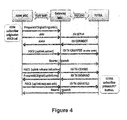
- FIG 4 In order to understand the working of the interworking gateway 102 for facilitating to-and-fro communication between the first subscriber 306-A and the second subscriber 308, consider an example illustrating a step by step process performed by the interworking gateway 102 facilitating the to-and-fro communication between the first subscriber 306-A and the second subscriber 308.
- the first subscriber 306-A and the second subscriber 308 are hereinafter referred to as a GSM-R subscriber and a TETRA subscriber in this embodiment.
- the GSM-R subscriber transmits a request to the MSC-A 302 for initiating a Voice Group Call System (VGCS) call between the GSM-R subscriber along with other GSM-R subscribers and the TETRA subscriber.
- VGCS Voice Group Call System
- the MSC-A 302 serves the GSM-R subscriber and the other GSM-R subscribers.
- the MSC-A 302 transmits a PREPARE_GROUP_CALL_SIGNALLING message, of the set of MAP messages, to the interworking gateway 102.
- the interworking gateway 102 Upon receiving the PREPARE_GROUP_CALL_SIGNALLING message, the interworking gateway 102 allocates a group call number to the request received from the MSC-A 302 in order to facilitate the VGCS call.
- the group call number is unique identification number for identifying a specific group call number amongst a plurality of VGCS call initiated by distinct GSM-R subscribers via distinct MSC-A.
- the MSC-A 302 then transmits an IAM message, of the set of ISUP messages, to the interworking gateway 102 in order to establish a communication channel between the GSM-R subscriber along with the other GSM-R and the TETRA subscriber served by the SwMI 304.
- the IAM message is based on an ISUP protocol.
- the interworking gateway 102 Upon receiving the IAM message, the interworking gateway 102 refers the table and thereby selects an ISI-SETUP message from the set of ISI messages. It may be understood that the ISI-SETUP message is based on an ISI protocol and further the ISI-SETUP message is equivalent to the IAM message. The interworking gateway 102 then transmits the ISI-SETUP message to the TETRA subscriber via the SwMI 304.
- the SwMI 304 Since the SwMI 304 is capable of understanding one or more messages based on the ISI protocol, the SwMI 304 establishes the communication channel with TETRA subscriber 308 through Air Interface (AIF signaling).
- the SwMI 304 establishes the communication channel with interworking gateway 102 by transmitting an ISI CONNECT message, of the set of ISI messages, to the interworking gateway 102.
- the interworking gateway 102 Upon receiving the ISI CONNECT message, the interworking gateway 102 selects an ANM message of the set of ISUP messages upon referring the table.
- the ANM message is based on the ISUP protocol.
- the ANM message is then transmitted by the interworking gateway 102 to the GSM-R subscriber via the MSC-A 302.
- the communication channel may be established between the GSM-R subscriber along with the other GSM-R and the TETRA subscriber.
- the GSM-R subscriber via the MSC-A 302 transmits a request for seizing an uplink.
- the uplink is seized by transmitting a FORWARD_GROUP_CALL_SIGNALLING SEIZE message to the interworking gateway 102.
- the FORWARD_GROUP _CALL_SIGNALLING SEIZE message has a flag indicating that the GSM-R subscriber seizes the uplink for transmitting voice data packets over the communication channel.
- the FORWARD_GROUP_CALL_SIGNALLING SEIZE message is based on the MAP protocol.
- the interworking gateway 102 then refers the table and thereby selects an ISI TX-GRANTED, from the set of ISI messages, equivalent to the FORWARD_GROUP_CALL_SIGNALLING SEIZE message.
- the ISI TX-GRANTED message is based on the ISI protocol.
- the ISI TX-GRANTED is then transmitted by the interworking gateway 102 to the TERTA subscriber via the SwMI 304.
- the ISI TX-GRANTED indicates that only the GSM-R subscriber is capable for transmitting the voice data packets whereas the TETRA subscriber is only capable to receive the voice data packets until the uplink is released by the GSM-R subscriber.
- the GSM-R subscriber transmits the voice data packets over the communication channel, wherein the voice data packets are received by the other GSM-R subscribers and the TETRA subscriber.
- the GSM-R subscriber transmits a FORWARD_GROUP_CALL_SIGNALLING RELEASE message, via the MSC-A 302, to the interworking gateway 102.
- the FORWARD_GROUP_CALL_SIGNALLING RELEASE message has a flag indicating that the GSM-R subscriber releases the uplink.
- the uplink may be seized by one of the other GSM-R subscriber or the TETRA subscriber.
- the FORWARD_GROUP_CALL_SIGNALLING RELEASE message is based on the MAP protocol.
- the interworking gateway 102 Upon receiving the FORWARD_GROUP_CALL_SIGNALLING RELEASE message, the interworking gateway 102 refers the table and thereby selects an ISI TX-CEASED message equivalent to the FORWARD_GROUP _CALL_SIGNALLING RELEASE message by referring the table. In one aspect, the ISI TX- CEASED message is based on the ISI protocol. The interworking gateway 102 then transmits the ISI TX-CEASED message to the TETRA subscriber via the SwMI 304.
- the TETRA subscriber transmits a request for seizing the uplink.
- the uplink is seized by transmitting an ISI-TX DEMAND message, of the set of ISI messages, to the interworking gateway 102.
- the ISI-TX DEMAND message indicates a flag indicating that the TETRA subscriber seizes the uplink for transmitting voice data packets over the communication channel.
- the ISI-TX DEMAND message is based on the ISI protocol.
- the TETRA subscriber via the SwMI 304, transmits the ISI-TX DEMAND to the interworking gateway 102.
- the interworking gateway 102 upon receiving the ISI-TX DEMAND message, refers the table and thereby selects a PROCESS_GROUP_CALL_SIGNALLING message, from the set of ISUP messages, equivalent to the ISI-TX DEMAND message.
- the PROCESS_GROUP_CALL_SIGNALLING message is based on the MAP protocol.
- the interworking gateway 102 then transmits the PROCESS_GROUP_CALL_SIGNALLING message to the GSM-R subscriber via the MSC-A 302.
- the GSM-R subscriber Upon receiving the PROCESS_GROUP_CALL_SIGNALLING message, the GSM-R subscriber transmits a FORWARD_GROUP_CALL_SIGNALLING message to the interworking gateway 102 via the MSC-A 302.
- the FORWARD_GROUP_CALL_SIGNALLING message has a flag indicating that the GSM-R subscriber acknowledges the uplink request and TETRA subscriber is granted the uplink for transmission.
- the interworking gateway 102 then refers the table and thereby selects an ISI TX-GRANTED message equivalent to a FORWARD_GROUP _CALL_SIGNALLING message.
- the ISI TX-GRANTED message is based on the ISI protocol.
- the interworking gateway 102 then transmits the ISI TX- GRANTED message to the TETRA subscriber via the SwMI 304.
- the ISI TX- GRANTED message indicates that the TETRA subscriber may transmit the voice data packets to the GSM-R subscriber and the other GSM-R subscribers over the communication channel.
- the voice data packets may be transmitted by encoding the voice data packets into a High level Data Link Control (HDLC) frame structure. Upon encoding, the voice data packets may then relayed over a 64 kbit/s slot on a 2 Mbit/s E1 link-B channel. It may be understood that the voice data packets are in Algebraic code-excited linear prediction (ACELP) speech frames.
- ACELP Algebraic code-excited linear prediction
- the transcoding software comprises an ACELP decoder and a G.711 decoder. The ACELP decoder decodes the ACELP speech frames into PCM signals.
- the G.711 decoder Upon decoding the ACELP speech frames, the G.711 decoder encodes the PCM signals into the voice signals. Thus, in this manner, the voice data packets are translated into the voice signals and thus transmitted to the GSM-R subscriber and the other the GSM-R subscribers over to the communication channel.
- the interworking gateway 102 facilitates the VGCS call between the GSM-R subscriber along with other GSM-R subscribers and the TETRA subscriber thereby facilitating the to-and-fro communication.
- Some embodiments enable a system and a method to facilitate a cost effective manner for facilitating two-and-fro communication between a GSM-R subscriber and a TETRA subscriber in a vendor independent approach.
- the to-and-fro communication between the GSM-R network and the TETRA network proved to be helpful in crisis situations (such as railway mishap or accident) rather than relying on disaster prone public networks.
- the communication between railway networks (using GSM-R network) and a fire brigade/security network (using TETRA network) aids in rescue operations.
- Some embodiments enable the system and the method to translate ISUP and MAP messages to ISI messages and vice-versa for interworking between a GSM-R network and a TETRA network.
- Some embodiments enable the system and the method that facilitates to extend a group/conference calls from the GSM-R subscriber to the TETRA subscriber.
- a method 500 for determining an expert of one or more subjects on a server-based platform is shown, in accordance with an embodiment of the present subject matter.
- the method 500 may be described in the general context of computer executable instructions.
- computer executable instructions can include routines, programs, objects, components, data structures, procedures, modules, functions, etc., that perform particular functions or implement particular abstract data types.
- the method 500 may also be practiced in a distributed computing environment where functions are performed by remote processing devices that are linked through a communications network.
- computer executable instructions may be located in both local and remote computer storage media, including memory storage devices.
- the order in which the method 500 is described is not intended to be construed as a limitation, and any number of the described method blocks can be combined in any order to implement the method 500 or alternate methods. Additionally, individual blocks may be deleted from the method 500 without departing from the spirit and scope of the subject matter described herein. Furthermore, the method can be implemented in any suitable hardware, software, firmware, or combination thereof. However, for ease of explanation, in the embodiments described below, the method 500 may be considered to be implemented as described in the interworking gateway 102.
- a first Integrated Services Digital Network (ISDN) User Part (ISUP) message of a set of ISUP messages may be received.
- the first ISUP message indicates a request for initiating a communication between an anchor Mobile Switching Centre (MSC-A) and a Switching and Management infrastructure (SwMI).
- MSC-A anchor Mobile Switching Centre
- SwMI Switching and Management infrastructure
- the MSC-A serves the first subscriber in the GSM-R network
- the SwMI serves the second subscriber in the TETRA network.
- the set of ISUP messages are based on an ISUP protocol.
- a first Inter System Interface (ISI) message may be selected from a set of ISI messages.
- the ISI message is equivalent to the first ISUP message.
- the first ISI message may be selected based on a pre-defined mapping of the first ISUP message with the first ISI message.
- the set of ISI messages are based on an ISI protocol.
- the first ISI message to the SwMI may be transmitted.
- a second ISI message from the SwMI may be received.
- the second ISI message indicates that the second subscriber accepts the request of the first subscriber for the communication.
- a second ISUP message of the set of ISUP messages may be selected.
- the second ISUP message is equivalent to the second ISI message.
- the second ISUP message may be selected based on the pre-defined mapping of the second ISI message with the second ISUP message.
- the second ISUP message may be transmitted to the MSC-A thereby facilitating to-and-fro communication between the first subscriber present in the GSM-R network and the second subscriber present in the TETRA network.
Landscapes
- Engineering & Computer Science (AREA)
- Computer Networks & Wireless Communication (AREA)
- Signal Processing (AREA)
- Mobile Radio Communication Systems (AREA)
Abstract
Description
- The present application claims priority to
Indian Patent Application No. 3285/MUM/2014, filed on October 15, 2014 - The present subject matter described herein, in general, relates to a field of communication, and more particularly to system and method for facilitating the communication between a GSM-R subscriber and a TETRA subscriber.
- In a radio communication domain, both Terrestrial Trunked Radio (TETRA) and Global System for Mobile Communications Railway (GSM-R) networks have been used to facilitate communication between users of Public Mobile Radio (PMR) systems and Railway systems respectively. The PMR systems are majorly implemented in Police department, Railway department, and Fire Brigade department. Though users of the respective technologies (i.e. TETRA and GSM-R) are capable to establish the communication amongst the same network, establishing the communication between the users of the TETRA network and GSM-R network is a challenge in the radio communication domain.
- Since the GSM-R network uses Integrated Services Digital Network (ISDN) User Part (ISUP) or Mobile Application Part (MAP) standards and the TETRA network uses Inter System Interface (ISI) standards, the interconnecting between the TETRA network and the GSM-R network is a challenge due to difference in respective standards. Though there are solutions present in the background art for facilitating the communication between the GSM-R network and the TETRA network but such solutions are dependent on respective vendors facilitating the communication between the users of the TETRA network and GSM-R network.
- Before the present systems and methods, are described, it is to be understood that this application is not limited to the particular systems, and methodologies described, as there can be multiple possible embodiments which are not expressly illustrated in the present disclosures. It is also to be understood that the terminology used in the description is for the purpose of describing the particular versions or embodiments only, and is not intended to limit the scope of the present application. This summary is provided to introduce concepts related to systems and methods for interworking of a GSM-Railway (GSM-R) network and a Terrestrial Trunked Radio (TETRA) network and the concepts are further described below in the detailed description. This summary is not intended to identify essential features of the claimed subject matter nor is it intended for use in determining or limiting the scope of the claimed subject matter.
- In one implementation, an interworking gateway for facilitating to-and-fro communication between a first subscriber and a second subscriber. The first subscriber is on a Global System for Mobile Communications Railway (GSM-R) network and the second subscriber is on a Terrestrial Trunked Radio (TETRA) network. The interworking gateway comprising a processor and a memory, coupled to the processor, storing instructions that, when executed by the processor, cause the processor to receive a first Integrated Services Digital Network (ISDN) User Part (ISUP) message of a set of ISUP messages. The first ISUP message indicates a request for initiating a communication between an anchor Mobile Switching Centre (MSC-A) and a Switching and Management infrastructure (SwMI). In one aspect, the MSC-A serves the first subscriber in the GSM-R network and the SwMI serves the second subscriber in the TETRA network. It may be understood that the set of ISUP messages may be based on an ISUP protocol. Upon receiving the ISUP message, a first ISI message may be selected from a set of ISI messages. In one aspect, the first ISI message is equivalent to the first ISUP message. The first ISI message may be selected based on a pre-defined mapping of the first ISUP message with the first ISI message. In one aspect, the set of ISI messages may be based on an ISI protocol. Subsequent to the selection the first ISI message, the first ISI message may be transmitted to the SwMI. Upon transmitting the first ISI message, a second ISI message may be received from the SwMI. The second ISI message indicates that the second subscriber accepts the request of the first subscriber for the communication. After receiving the second ISI message, a second ISUP message, equivalent to the second ISI message, may be selected from the set of ISUP messages. The second ISUP message may be selected based on the pre-defined mapping of the second ISI message with the second ISUP message. Based on the selection of the second ISUP message, the second ISUP message may be transmitted to the MSC-A, thereby facilitating the to-and-fro communication between the first subscriber present in the GSM-R network and the second subscriber present in the TETRA network.
- In another implementation, a method for facilitating to-and-fro communication between a first subscriber and a second subscriber. The first subscriber is on a Global System for Mobile Communications Railway (GSM-R) network and the second subscriber is on a Terrestrial Trunked Radio (TETRA) network. In one aspect a first Integrated Services Digital Network (ISDN) User Part (ISUP) message of a set of ISUP messages may be received. The first ISUP message indicates a request for initiating a communication between an anchor Mobile Switching Centre (MSC-A) and a Switching and Management infrastructure (SwMI). In one aspect, the MSC-A serves the first subscriber in the GSM-R network and the SwMI serves the second subscriber in the TETRA network. It may be understood that the set of ISUP messages may be based on an ISUP protocol. Upon receiving the ISUP message, a first ISI message may be selected from a set of ISI messages. In one aspect, the first ISI message is equivalent to the first ISUP message. The first ISI message may be selected based on a pre-defined mapping of the first ISUP message with the first ISI message. In one aspect, the set of ISI messages may be based on an ISI protocol. Subsequent to the selection the first ISI message, the first ISI message may be transmitted to the SwMI. Upon transmitting the first ISI message, a second ISI message may be received from the SwMI. The second ISI message indicates that the second subscriber accepts the request of the first subscriber for the communication. After receiving the second ISI message, a second ISUP message, equivalent to the second ISI message, may be selected from the set of ISUP messages. The second ISUP message may be selected based on the pre-defined mapping of the second ISI message with the second ISUP message. Based on the selection of the second ISUP message, the second ISUP message may be transmitted to the MSC-A, thereby facilitating the to-and-fro communication between the first subscriber present in the GSM-R network and the second subscriber present in the TETRA network. In one aspect, the aforementioned method for facilitating the to-and-fro communication between the first subscriber and the second subscriber is performed by a processor using programmed instructions stored in a memory.
- In yet another implementation, a non-transitory computer readable medium embodying a program executable in a computing device for facilitating to-and-fro communication between a first subscriber and a second subscriber. The first subscriber is on a Global System for Mobile Communications Railway (GSM-R) network and the second subscriber is on a Terrestrial Trunked Radio (TETRA) network. The program may comprise a program code for receiving a first Integrated Services Digital Network (ISDN) User Part (ISUP) message of a set of ISUP messages. The first ISUP message indicates a request for initiating a communication between an anchor Mobile Switching Centre (MSC-A) and a Switching and Management infrastructure (SwMI). In one aspect, the MSC-A serves the first subscriber in the GSM-R network and the SwMI serves the second subscriber in the TETRA network. It may be understood that the set of ISUP messages may be based on an ISUP protocol. The program may further comprise a program code for selecting a first ISI message, from a set of ISI messages, equivalent to the first ISUP message. The first ISI message may be selected based on a pre-defined mapping of the first ISUP message with the first ISI message. In one aspect, the set of ISI messages may be based on an ISI protocol. The program may further comprise a program code for transmitting the first ISI message to the SwMI. The program may further comprise a program code for receiving a second ISI message from the SwMI. The second ISI message indicates that the second subscriber accepts the request of the first subscriber for the communication. The program may further comprise a program code for selecting a second ISUP message, of the set of ISUP messages, equivalent to the second ISI message. The second ISUP message may be selected based on the pre-defined mapping of the second ISI message with the second ISUP message. The program may further comprise a program code for transmitting the second ISUP message to the MSC-A, thereby facilitating the to-and-fro communication between the first subscriber present in the GSM-R network and the second subscriber present in the TETRA network.
- The foregoing detailed description of embodiments is better understood when read in conjunction with the appended drawings. For the purpose of illustrating the disclosure, there is shown in the present document example constructions of the disclosure; however, the disclosure is not limited to the specific methods and apparatus disclosed in the document and the drawings.
- The detailed description is described with reference to the accompanying figures. In the figures, the left-most digit(s) of a reference number identifies the figure in which the reference number first appears. The same numbers are used throughout the drawings to refer like features and components.
-
Figure 1 illustrates a network implementation of an interworking gateway for facilitating to-and-fro communication between a first subscriber and a second subscriber, in accordance with an embodiment of the present subject matter. -
Figure 2 illustrates the interworking gateway, in accordance with an embodiment of the present subject matter. -
Figures 3 and4 are working examples of the interworking gateway, in accordance with an embodiment of the present subject matter. -
Figure 5 illustrates a method for facilitating the to-and-fro communication between the first subscriber and the second subscriber, in accordance with an embodiment of the present subject matter. - Some embodiments of this disclosure, illustrating all its features, will now be discussed in detail. The words "comprising," "having," "containing," and "including," and other forms thereof, are intended to be equivalent in meaning and be open ended in that an item or items following any one of these words is not meant to be an exhaustive listing of such item or items, or meant to be limited to only the listed item or items. It must also be noted that as used herein and in the appended claims, the singular forms "a," "an," and "the" include plural references unless the context clearly dictates otherwise. Although any systems and methods similar or equivalent to those described herein can be used in the practice or testing of embodiments of the present disclosure, the exemplary, systems and methods are now described. The disclosed embodiments are merely exemplary of the disclosure, which may be embodied in various forms.
- Various modifications to the embodiment will be readily apparent to those skilled in the art and the generic principles herein may be applied to other embodiments. However, one of ordinary skill in the art will readily recognize that the present disclosure is not intended to be limited to the embodiments illustrated, but is to be accorded the widest scope consistent with the principles and features described herein.
- In order to overcome a challenge of facilitating a communication between a Global System for Mobile Communications Railway (GSM-R) network and a Terrestrial Trunked Radio (TETRA) network due to dissimilarities in their respective standard, the communication between the GSM-R network and the TETRA network may be facilitated by means of an interworking gateway. In one aspect, the interworking gateway is located at a location of the GSM-R network or the location other then the location of GSM-R network. The present subject matter provides the method for facilitating to-and-fro communication between one or more GSM-R subscribers of the GSM-R network and a TETRA subscriber of the TETRA network. The to-and-fro communication may be facilitated by at least one of a Point-to-Point Call (PtP) system, a Voice Group Call Service (VGCS), and a Voice Broadcast Service (VBS). In one aspect, the GSM-R subscribers may be served by anchor Mobile Switching Centre (MSC-A). The TETRA subscriber, on the other hand, may be served by the Switching and Management infrastructure (SwMI).
- It may be understood that the GSM-R network is an international wireless communications standard for railway communication and applications. For example, a European Rail Traffic Management System (ERTMS) uses the GSM-R network for communication between train and railway regulation control centers. The ERTMS is based on Global System for Mobile (GSM) and EIRENE - Mobile Radio for Railways Networks in Europe (MORANE) specifications that facilitates performance at speeds up to 500 km/h (310 mph), without any communication loss. In addition, the GSM-R further facilitates a plurality of features. Examples of the plurality of features may include, but not limited to, Point-to-Point (PtP) call, Voice Group Call System (VGCS), Voice Broadcast System (VBS), and Railways Emergency Call (REC).
- The TETRA network, on the other hand, is a standard for radio communication. The TETRA network is developed by European Telecommunications Standards Institute (ETSI) for private mobile radio (PMR). It may be understood that the TETRA network uses Time division multiple access (TDMA) technology for spectrum usage and trunked system for network usage. In one aspect, the TETRA network facilitates one-to-one and one-to-many radio communication using voice and data services along with PMR services. The PMR services may include, but not limited to, push to talk service, Group Call, Security, and Direct Mode Operation (DMO).
- In order to facilitate the to-and-fro communication, the interworking gateway receives an Integrated Services Digital Network (ISDN) User Part (ISUP) message from the GSM-R subscribers via an anchor Mobile Switching Centre (MSC-A). Upon receiving the ISUP message, an Inter System Interface (ISI) message may be selected, from a set of ISI messages, equivalent to the first ISUP message. The ISI message may be selected by the interworking gateway as the interworking gateway is capable of mapping the ISUP message with the ISI message or vice versa thereby facilitating the to-and-fro communication between the GSM-R subscribers and the TETRA subscriber.
- For example, in a typical group call scenario, consider 3 GSM-R subscribers of the GSM-R network are involved in the group call served by the MSC-A. Now in order to extend the group call from the GSM-R network to the TETRA network, a GSM subscriber, of the 3 GSM-R subscribers, and a TETRA subscriber transmits one or more messages in their respective protocols (i.e. ISUP and ISI respectively) via the interworking gateway. The one or more messages may include a first ISUP message and a second ISUP message transmitted by the GSM-R subscriber. The one or more messages may further include a first ISI message and a second ISI message transmitted by the TETRA subscriber. The interworking gateway, upon receiving respective messages from the GSM subscriber and the TETRA subscriber, maps the first ISUP message with the first ISI message. In one aspect, the first ISUP message is equivalent to the first ISI message. Similarly the interworking gateway maps the second ISI message with the second ISUP message corresponding to the second ISI message. Based on the mapping by the interworking gateway, the TETRA subscriber may be included in the group call and communication with 3 GSM-R subscribers irrespective of the dissimilarities in their respective protocols.
- Therefore, in this manner, the present subject matter provides a method for facilitating the to-and-fro communication between the GSM-R subscribers and the TETRA subscriber in a vendor independent approach by using the interworking gateway.
- While aspects of described system hereinafter referred to as an interworking gateway and method for facilitating to-and-fro communication between a GSM-R subscriber and a TETRA subscriber and may be implemented in any number of different computing systems, environments, and/or configurations, the embodiments are described in the context of the following exemplary system.
- Referring now to
Figure 1 , anetwork implementation 100 of aninterworking gateway 102 for facilitating to-and-fro communication between a GSM-R subscriber and a TETRA subscriber is illustrated, in accordance with an embodiment of the present subject matter. In one embodiment, theinterworking gateway 102 receives a first Integrated Services Digital Network (ISDN) User Part (ISUP) message of a set of ISUP messages. The first ISUP message indicates a request for initiating a communication between an anchor Mobile Switching Centre (MSC-A) and a Switching and Management infrastructure (SwMI). In one aspect, the MSC-A serves the first subscriber in the GSM-R network and the SwMI serves the second subscriber in the TETRA network. It may be understood that the set of ISUP messages may be based on an ISUP protocol. Upon receiving the ISUP message, theinterworking gateway 102 selects a first ISI message from a set of ISI messages. In one aspect, the first ISI message is equivalent to the first ISUP message. The first ISI message may be selected based on a pre-defined mapping of the first ISUP message with the first ISI message. In one aspect, the set of ISI messages may be based on an ISI protocol. Subsequent to the selection the first ISI message, theinterworking gateway 102 transmits the first ISI message to the SwMI. Upon transmitting the first ISI message, theinterworking gateway 102 receives a second ISI message from the SwMI. The second ISI message indicates that the second subscriber accepts the request of the first subscriber for the communication. After receiving the second ISI message, a second ISUP message, equivalent to the second ISI message, may be selected from the set of ISUP messages. The second ISUP message may be selected based on the pre-defined mapping of the second ISI message with the second ISUP message. Based on the selection of the second ISUP message, theinterworking gateway 102 transmits the second ISUP message to the MSC-A, thereby facilitating the to-and-fro communication between the first subscriber present in the GSM-R network and the second subscriber present in the TETRA network. - Although the present subject matter is explained considering that the
interworking gateway 102 is implemented on a server, it may be understood that theinterworking gateway 102 may also be implemented in a variety of computing systems, such as a network server. It will be understood that theinterworking gateway 102 may be accessed by multiple users through one or more user devices 104-1, 104-2...104-N, collectively referred to asuser devices 104. Theuser devices 104 are communicatively coupled to theinterworking gateway 102 through anetwork 106. In one aspect, theuser devices 104 are associated to GSM-R network and TETRA network. - In one implementation, the
network 106 may be a wireless network, a wired dedicated network or a combination thereof. Thenetwork 106 can be implemented as one of the different types of networks, such as intranet, local area network (LAN), wide area network (WAN), the internet, and the like. Thenetwork 106 may either be a dedicated network or a shared network. The shared network represents an association of the different types of networks that use a variety of protocols, for example, Hypertext Transfer Protocol (HTTP), Transmission Control Protocol/Internet Protocol (TCP/IP), Wireless Application Protocol (WAP), and the like, to communicate with one another. Further thenetwork 106 may include a variety of network devices, including routers, bridges, servers, computing devices, storage devices, and the like. - Referring now to
Figure 2 , theinterworking gateway 102 is illustrated in accordance with an embodiment of the present subject matter. In one embodiment, thesystem 102 may include at least oneprocessor 202, an input/output (I/O)interface 204, and amemory 206. The at least oneprocessor 202 may be implemented as one or more microprocessors, microcomputers, microcontrollers, digital signal processors, central processing units, state machines, logic circuitries, and/or any devices that manipulate signals based on operational instructions. Among other capabilities, the at least oneprocessor 202 is configured to fetch and execute computer-readable instructions stored in thememory 206. - The I/
O interface 204 may include a variety of software and hardware interfaces, for example, a graphical user interface, and the like. The I/O interface 204 may allow theinterworking gateway 102 to interact with the user directly or through theclient devices 104. The I/O interface 204 may include one or more ports for connecting a number of devices to one another or to another server. - The
memory 206 may include any computer-readable medium or computer program product known in the art including, for example, volatile memory, such as static random access memory (SRAM) and dynamic random access memory (DRAM), and/or non-volatile memory, such as read only memory (ROM), erasable programmable ROM, flash memories, hard disks, optical disks, and magnetic tapes. Thememory 206 may includemodules 208 anddata 210. - The
modules 208 include routines, programs, objects, components, data structures, etc., which perform particular tasks or implement particular abstract data types. Themodules 208 may include programs or coded instructions that supplement applications and functions of theinterworking gateway 102. In one aspect, tasks associated to themodules 208 may include, but not limited, to trunk provisioning, message parsing, message mapping, OA&M and translations. - The
data 210, amongst other things, serves as a repository for storing data processed, received, and generated by one or more of themodules 208. Thedata 210 may also include asystem database 212 andother data 214. Theother data 214 may include data generated as a result of the execution of themodules 208. - In one implementation, at first, a user may use the
client devices 104 to access theinterworking gateway 102 via the I/O interface 204. In one aspect, the user may accesses the I/O interface 204 of theinterworking gateway 102 for facilitating to-and-fro communication between a first subscriber and a second subscriber. In order to facilitate the to-and-fro communication, theinterworking gateway 102 may be employed. The detailed working of theinterworking gateway 102 is described below. - Now referring to
figure 3 . Thefigure 3 illustrates a block diagram indicating communication between the first subscriber 306-A and thesecond subscriber 308 via theinterworking gateway 102. In one embodiment, theinterworking gateway 102 may also be implemented as a software enhancement on the GSM-R network. In one embodiment, theinterworking gateway 102, initially, receives a first Integrated Services Digital Network (ISDN) User Part (ISUP) message of a set of ISUP messages from the first subscriber 306-A. In another embodiment,interworking gateway 102 may receive a Mobile Application Part (MAP) message, of a set of MAP messages, from the first subscriber 306-A. It may be understood that the first ISUP message and the MAP message are based on the ISUP protocol and MAP protocol respectively. The set of ISUP messages may comprise IAM message, CPG message, ACM message, ANM message, and GSM message. The set of MAP messages may comprise a FORWARD GROUP CALL SIGNALLING message, a PROCESS GROUP CALL SIGNALLING message and a PREPARE_GROUP_CALL_SIGNALLING message. - In one aspect, the first ISUP message indicates a request for initiating a communication between an anchor Mobile Switching Centre (MSC-A) 302 and a Switching and Management infrastructure (SwMI) 304. It may be understood that the set of ISUP messages are based on an ISUP protocol. Examples of the set of ISUP messages may include, but not limited to, IAM message, CPG message, ACM message, ANM message, and GSM message. In one aspect, the first subscriber 306-A is on a Global System for Mobile Communications Railway (GSM-R) network and the
second subscriber 308 is on a Terrestrial Trunked Radio (TETRA) network. In one aspect, the MSC-A 302 serves the first subscriber 306-A of the GSM-R network. TheSwMI 304, on the other hand, serves thesecond subscriber 308 of the TETRA network. - Upon receiving the first ISUP message, the
interworking gateway 102 selects a first Inter System Interface (ISI) message from a set of ISI messages. In one embodiment, theinterworking gateway 102 may also select a Q-Signaling (QSIG) message from a set of QSIG messages. In one aspect, the set of ISI messages and the set of QSIG messages are based on an ISI protocol. Examples of the set of ISI messages may include, but not limited to, an ISI-SETUP message, an ISI-PROGRESS message, an ISI-ALERTING message, an ISI-CONNECT message, an ISI-DISCONNECT message, an ISI TX-GRANTED message, an ISI TX-CEASED message and an ISI TX-DEMAND message. Examples of the set of QSIG messages may include, but not limited to, SETUP, CALL PROCEEDING, ALERTING, CONNECT, DISCONNECT, and FACILITY. In one aspect, the set of ISUP messages and the set of ISI messages, resided in a table, are stored in asystem database 212. The table comprises a first column that stores the set of ISUP messages and the set of MAP messages. The table further comprises a second column that stores the set of ISI messages and the set of QSIG messages. In one embodiment, the table is configured in manner such that each ISUP message or each MAP message is mapped with an ISI message or a QSIG message from the set of ISI messages or the set of QSIG messages respectively. In other words, the ISUP message or the MAP message mapped with the ISI message or the QSIG are equivalent. - In one example, the mapping of each ISUP message or each MAP message with the ISI message or the QSIG message or vice versa as is shown below in the table:
ISUP / MAP QSIG ISI PDU IAM SETUP ISI-SETUP CPG CALL PROCEEDING ISI-PROGRESS ACM ALERTING ISI-ALERTING ANM CONNECT ISI-CONNECT REL DISCONNECT ISI-DISCONNECT FORWARD_ GROUP_CA LL_SIGNAL LING FACILITY ISI- TX GRANTED PROCESS_G ROUP_CAL L_SIGNALL ING FACILITY ISI-TX DEMAND - The
interworking gateway 102, upon receiving the first ISUP message, selects a first ISI message from the set of ISI messages by referring the table. It may be understood upon referring to the table that the first ISI message is equivalent to the first ISUP message. Once theinterworking gateway 102 determines the first ISUP message equivalent, theinterworking gateway 102 transmits the first ISI message to thesecond subscriber 308 via theSwMI 304. It may be understood that if thesecond subscriber 308 is available to connect with the first subscriber 306-A, thesecond subscriber 308, in response to the first ISI message, transmits a second ISI message to theinterworking gateway 102 via theSwMI 304. Upon receiving the second ISI message from theSwMI 304, theinterworking gateway 102 again refer to the table in order to determine equivalent of the second ISI message. Upon referring the table, it may be understood that a second ISUP message is equivalent to the second ISI message, theinterworking gateway 102 then transmits the second ISUP message to the first subscriber 306-A via the MSC-A 302. Thus, in this manner, the first subscriber 306-A and thesecond subscriber 308 may communicate each other despite of the dissimilarities in their respective protocols. - Now referring to
figure 4 . In order to understand the working of theinterworking gateway 102 for facilitating to-and-fro communication between the first subscriber 306-A and thesecond subscriber 308, consider an example illustrating a step by step process performed by theinterworking gateway 102 facilitating the to-and-fro communication between the first subscriber 306-A and thesecond subscriber 308. The first subscriber 306-A and thesecond subscriber 308 are hereinafter referred to as a GSM-R subscriber and a TETRA subscriber in this embodiment. - In order to facilitate the to-and-fro communication, at first step, the GSM-R subscriber transmits a request to the MSC-
A 302 for initiating a Voice Group Call System (VGCS) call between the GSM-R subscriber along with other GSM-R subscribers and the TETRA subscriber. It may be understood that the MSC-A 302 serves the GSM-R subscriber and the other GSM-R subscribers. Upon receiving the request, the MSC-A 302 transmits a PREPARE_GROUP_CALL_SIGNALLING message, of the set of MAP messages, to theinterworking gateway 102. Upon receiving the PREPARE_GROUP_CALL_SIGNALLING message, theinterworking gateway 102 allocates a group call number to the request received from the MSC-A 302 in order to facilitate the VGCS call. In one aspect, the group call number is unique identification number for identifying a specific group call number amongst a plurality of VGCS call initiated by distinct GSM-R subscribers via distinct MSC-A. - The MSC-
A 302 then transmits an IAM message, of the set of ISUP messages, to theinterworking gateway 102 in order to establish a communication channel between the GSM-R subscriber along with the other GSM-R and the TETRA subscriber served by theSwMI 304. In one aspect, the IAM message is based on an ISUP protocol. - Upon receiving the IAM message, the
interworking gateway 102 refers the table and thereby selects an ISI-SETUP message from the set of ISI messages. It may be understood that the ISI-SETUP message is based on an ISI protocol and further the ISI-SETUP message is equivalent to the IAM message. Theinterworking gateway 102 then transmits the ISI-SETUP message to the TETRA subscriber via theSwMI 304. - Since the
SwMI 304 is capable of understanding one or more messages based on the ISI protocol, theSwMI 304 establishes the communication channel withTETRA subscriber 308 through Air Interface (AIF signaling). TheSwMI 304 establishes the communication channel withinterworking gateway 102 by transmitting an ISI CONNECT message, of the set of ISI messages, to theinterworking gateway 102. Upon receiving the ISI CONNECT message, theinterworking gateway 102 selects an ANM message of the set of ISUP messages upon referring the table. The ANM message is based on the ISUP protocol. The ANM message is then transmitted by theinterworking gateway 102 to the GSM-R subscriber via the MSC-A 302. Thus, in this manner, the communication channel may be established between the GSM-R subscriber along with the other GSM-R and the TETRA subscriber. - Once the communication channel is established, the GSM-R subscriber via the MSC-
A 302 transmits a request for seizing an uplink. The uplink is seized by transmitting a FORWARD_GROUP_CALL_SIGNALLING SEIZE message to theinterworking gateway 102. The FORWARD_GROUP _CALL_SIGNALLING SEIZE message has a flag indicating that the GSM-R subscriber seizes the uplink for transmitting voice data packets over the communication channel. In one aspect, the FORWARD_GROUP_CALL_SIGNALLING SEIZE message is based on the MAP protocol. - The
interworking gateway 102 then refers the table and thereby selects an ISI TX-GRANTED, from the set of ISI messages, equivalent to the FORWARD_GROUP_CALL_SIGNALLING SEIZE message. In one aspect, the ISI TX-GRANTED message is based on the ISI protocol. The ISI TX-GRANTED is then transmitted by theinterworking gateway 102 to the TERTA subscriber via theSwMI 304. In one aspect, the ISI TX-GRANTED indicates that only the GSM-R subscriber is capable for transmitting the voice data packets whereas the TETRA subscriber is only capable to receive the voice data packets until the uplink is released by the GSM-R subscriber. - Once the uplink is seized, the GSM-R subscriber transmits the voice data packets over the communication channel, wherein the voice data packets are received by the other GSM-R subscribers and the TETRA subscriber. Once the GSM-R subscriber is done with the transmission of the voice data packets, the GSM-R subscriber transmits a FORWARD_GROUP_CALL_SIGNALLING RELEASE message, via the MSC-
A 302, to theinterworking gateway 102. The FORWARD_GROUP_CALL_SIGNALLING RELEASE message has a flag indicating that the GSM-R subscriber releases the uplink. It may be understood that once the uplink is released by the GSM-R subscriber, the uplink may be seized by one of the other GSM-R subscriber or the TETRA subscriber. In one aspect, the FORWARD_GROUP_CALL_SIGNALLING RELEASE message is based on the MAP protocol. - Upon receiving the FORWARD_GROUP_CALL_SIGNALLING RELEASE message, the
interworking gateway 102 refers the table and thereby selects an ISI TX-CEASED message equivalent to the FORWARD_GROUP _CALL_SIGNALLING RELEASE message by referring the table. In one aspect, the ISI TX- CEASED message is based on the ISI protocol. Theinterworking gateway 102 then transmits the ISI TX-CEASED message to the TETRA subscriber via theSwMI 304. - One the ISI TX-CEASED message is transmitted, the TETRA subscriber transmits a request for seizing the uplink. The uplink is seized by transmitting an ISI-TX DEMAND message, of the set of ISI messages, to the
interworking gateway 102. The ISI-TX DEMAND message indicates a flag indicating that the TETRA subscriber seizes the uplink for transmitting voice data packets over the communication channel. In one aspect, the ISI-TX DEMAND message is based on the ISI protocol. The TETRA subscriber, via theSwMI 304, transmits the ISI-TX DEMAND to theinterworking gateway 102. - The
interworking gateway 102, upon receiving the ISI-TX DEMAND message, refers the table and thereby selects a PROCESS_GROUP_CALL_SIGNALLING message, from the set of ISUP messages, equivalent to the ISI-TX DEMAND message. In one aspect, the PROCESS_GROUP_CALL_SIGNALLING message is based on the MAP protocol. Theinterworking gateway 102 then transmits the PROCESS_GROUP_CALL_SIGNALLING message to the GSM-R subscriber via the MSC-A 302. - Upon receiving the PROCESS_GROUP_CALL_SIGNALLING message, the GSM-R subscriber transmits a FORWARD_GROUP_CALL_SIGNALLING message to the
interworking gateway 102 via the MSC-A 302. The FORWARD_GROUP_CALL_SIGNALLING message has a flag indicating that the GSM-R subscriber acknowledges the uplink request and TETRA subscriber is granted the uplink for transmission. - The
interworking gateway 102 then refers the table and thereby selects an ISI TX-GRANTED message equivalent to a FORWARD_GROUP _CALL_SIGNALLING message. In one aspect, the ISI TX-GRANTED message is based on the ISI protocol. Theinterworking gateway 102 then transmits the ISI TX- GRANTED message to the TETRA subscriber via theSwMI 304. In one aspect, the ISI TX- GRANTED message indicates that the TETRA subscriber may transmit the voice data packets to the GSM-R subscriber and the other GSM-R subscribers over the communication channel. - In one embodiment, the voice data packets may be transmitted by encoding the voice data packets into a High level Data Link Control (HDLC) frame structure. Upon encoding, the voice data packets may then relayed over a 64 kbit/s slot on a 2 Mbit/s E1 link-B channel. It may be understood that the voice data packets are in Algebraic code-excited linear prediction (ACELP) speech frames. In order to translate transcoding software may be implemented to translate the ACELP speech frames into voice signals. In one aspect, the transcoding software comprises an ACELP decoder and a G.711 decoder. The ACELP decoder decodes the ACELP speech frames into PCM signals. Upon decoding the ACELP speech frames, the G.711 decoder encodes the PCM signals into the voice signals. Thus, in this manner, the voice data packets are translated into the voice signals and thus transmitted to the GSM-R subscriber and the other the GSM-R subscribers over to the communication channel.
- Based on the aforementioned description, the
interworking gateway 102 facilitates the VGCS call between the GSM-R subscriber along with other GSM-R subscribers and the TETRA subscriber thereby facilitating the to-and-fro communication. - Exemplary embodiments discussed above may provide certain advantages. Though not required to practice aspects of the disclosure, these advantages may include those provided by the following features.
- Some embodiments enable a system and a method to facilitate a cost effective manner for facilitating two-and-fro communication between a GSM-R subscriber and a TETRA subscriber in a vendor independent approach.
- The to-and-fro communication between the GSM-R network and the TETRA network proved to be helpful in crisis situations (such as railway mishap or accident) rather than relying on disaster prone public networks. In one aspect, the communication between railway networks (using GSM-R network) and a fire brigade/security network (using TETRA network) aids in rescue operations.
- Some embodiments enable the system and the method to translate ISUP and MAP messages to ISI messages and vice-versa for interworking between a GSM-R network and a TETRA network.
- Some embodiments enable the system and the method that facilitates to extend a group/conference calls from the GSM-R subscriber to the TETRA subscriber.
- Referring now to
Figure 5 , amethod 500 for determining an expert of one or more subjects on a server-based platform is shown, in accordance with an embodiment of the present subject matter. Themethod 500 may be described in the general context of computer executable instructions. Generally, computer executable instructions can include routines, programs, objects, components, data structures, procedures, modules, functions, etc., that perform particular functions or implement particular abstract data types. Themethod 500 may also be practiced in a distributed computing environment where functions are performed by remote processing devices that are linked through a communications network. In a distributed computing environment, computer executable instructions may be located in both local and remote computer storage media, including memory storage devices. - The order in which the
method 500 is described is not intended to be construed as a limitation, and any number of the described method blocks can be combined in any order to implement themethod 500 or alternate methods. Additionally, individual blocks may be deleted from themethod 500 without departing from the spirit and scope of the subject matter described herein. Furthermore, the method can be implemented in any suitable hardware, software, firmware, or combination thereof. However, for ease of explanation, in the embodiments described below, themethod 500 may be considered to be implemented as described in theinterworking gateway 102. - At
block 502, a first Integrated Services Digital Network (ISDN) User Part (ISUP) message of a set of ISUP messages may be received. In one aspect, the first ISUP message indicates a request for initiating a communication between an anchor Mobile Switching Centre (MSC-A) and a Switching and Management infrastructure (SwMI). It may be understood that the MSC-A serves the first subscriber in the GSM-R network and the SwMI serves the second subscriber in the TETRA network. In one aspect the set of ISUP messages are based on an ISUP protocol. - At
block 504, a first Inter System Interface (ISI) message may be selected from a set of ISI messages. In one aspect, the ISI message is equivalent to the first ISUP message. The first ISI message may be selected based on a pre-defined mapping of the first ISUP message with the first ISI message. In one aspect the set of ISI messages are based on an ISI protocol. - At
block 506, the first ISI message to the SwMI may be transmitted. - At
block 508, a second ISI message from the SwMI may be received. In one aspect, the second ISI message indicates that the second subscriber accepts the request of the first subscriber for the communication. - At
block 510, a second ISUP message of the set of ISUP messages may be selected. In one aspect, the second ISUP message is equivalent to the second ISI message. The second ISUP message may be selected based on the pre-defined mapping of the second ISI message with the second ISUP message. - At
block 512, the second ISUP message may be transmitted to the MSC-A thereby facilitating to-and-fro communication between the first subscriber present in the GSM-R network and the second subscriber present in the TETRA network. - Although implementations for methods and systems for determining the expert of the one or more subjects on the server-based platform have been described in language specific to structural features and/or methods, it is to be understood that the appended claims are not necessarily limited to the specific features or methods described. Rather, the specific features and methods are disclosed as examples of implementations for determining the expert of the one or more subjects.
Claims (10)
- A method for facilitating to-and-fro communication between a first subscriber and a second subscriber, wherein the first subscriber is on a Global System for Mobile Communications Railway (GSM-R) network and the second subscriber is on a Terrestrial Trunked Radio (TETRA) network, the method comprising:receiving, by an interworking gateway, a first Integrated Services Digital Network (ISDN) User Part (ISUP) message of a set of ISUP messages, wherein the first ISUP message indicates a request for initiating a communication between an anchor Mobile Switching Centre (MSC-A) and a Switching and Management infrastructure (SwMI), and wherein the MSC-A serves the first subscriber in the GSM-R network, and wherein the SwMI serves the second subscriber in the TETRA network, and wherein the set of ISUP messages are based on an ISUP protocol;selecting, by the interworking gateway, a first Inter System Interface (ISI) message, from a set of ISI messages, equivalent to the first ISUP message, wherein the first ISI message is selected based on a pre-defined mapping of the first ISUP message with the first ISI message, wherein the set of ISI messages are based on an ISI protocol;transmitting, by the interworking gateway, the first ISI message to the SwMI;receiving, by the interworking gateway, a second ISI message from the SwMI, wherein the second ISI message indicates that the second subscriber accepts the request of the first subscriber for the communication;selecting, by the interworking gateway, a second ISUP message, from the set of ISUP messages, equivalent to the second ISI message, wherein the second ISUP message is selected based on the pre-defined mapping of the second ISI message with the second ISUP message; andtransmitting, by the interworking gateway, the second ISUP message to the MSC-A, thereby facilitating the to-and-fro communication between the first subscriber present in the GSM-R network and the second subscriber present in the TETRA network.
- The method of claim 1, wherein the set of ISUP messages comprises IAM message, CPG message, ACM message, ANM message, and GSM message, and wherein the set of ISI messages comprises an ISI-SETUP message, an ISI-ALERTING message, an ISI-CONNECT message, an ISI-DISCONNECT message, an ISI TX-GRANTED message, an ISI TX-DEMAND message, an ISI TX-CEASED message and a set of MAP messages comprises a FORWARD GROUP CALL SIGNALLING message, a FORWARD_GROUP_CALL_SIGNALLING SEIZE message a PROCESS GROUP CALL SIGNALLING message and a PREPARE_GROUP_CALL_SIGNALLING message.
- The method of claim 2, wherein the IAM message and the ISI-SETUP message facilitates to establish a communication channel between the first subscriber and the subscriber.
- The method of claim 2, wherein the ISI-SETUP message, the ISI-ALERTING message, the ISI-CONNECT message are transmitted by the SwMI to the interworking gateway.
- The method of claim 2, wherein the ISI-SETUP message, the ISI-ALERTING message, and the ISI-CONNECT message are equivalent to the CPG message, the ACM message, and the ANM message respectively.
- The method of claim 5, wherein the to-and-fro communication is facilitated by at least one of a Point-to-Point (PtP) Call, a Voice Group Call Service (VGCS), and a Voice Broadcast Service (VBS).
- The method of claim 1, wherein the interworking gateway is located at a location of the GSM-R network or the location other then the location of GSM-R network.
- An interworking gateway for facilitating to-and-fro communication between a first subscriber and a second subscriber, wherein the first subscriber is on a Global System for Mobile Communications Railway (GSM-R) network and the second subscriber is on a Terrestrial Trunked Radio (TETRA) network, the interworking gateway comprising:a processor; anda memory, coupled to the processor, storing instructions that, when executed by the processor, cause the processor to
receive a first Integrated Services Digital Network (ISDN) User Part (ISUP) message of a set of ISUP messages, wherein the first ISUP message indicates a request for initiating a communication between an anchor Mobile Switching Centre (MSC-A) and a Switching and Management infrastructure (SwMI), and wherein the MSC-A serves the first subscriber in the GSM-R network, and wherein the SwMI serves the second subscriber in the TETRA network, and wherein the set of ISUP messages are based on an ISUP protocol;
select a first Inter System Interface (ISI) message, from a set of ISI messages, equivalent to the first ISUP message, wherein the first ISI message is selected based on a pre-defined mapping of the first ISUP message with the first ISI message, wherein the set of ISI messages are based on an ISI protocol;
transmit the first ISI message to the SwMI;
receive a second ISI message from the SwMI, wherein the second ISI message indicates that the second subscriber accepts the request of the first subscriber for the communication;
select a second ISUP message, from the set of ISUP messages, equivalent to the second ISI message, wherein the second ISUP message is selected based on the pre-defined mapping of the second ISI message with the second ISUP message; and
transmit the second ISUP message to the MSC-A, thereby facilitating the to-and-fro communication between the first subscriber present in the GSM-R network and the second subscriber present in the TETRA network. - The interworking gateway of claim 8 is located at a location of the GSM-R network or the location other then the location of the GSM-R network.
- A non-transitory computer readable medium embodying a program executable in a computing device for facilitating to-and-fro communication between a first subscriber and a second subscriber, wherein the first subscriber is on a Global System for Mobile Communications Railway (GSM-R) network and the second subscriber is on a Terrestrial Trunked Radio (TETRA) network, the program comprising a program code:a program code for receiving a first Integrated Services Digital Network (ISDN) User Part (ISUP) message of a set of ISUP messages, wherein the first ISUP message indicates a request for initiating a communication between an anchor Mobile Switching Centre (MSC-A) and a Switching and Management infrastructure (SwMI), and wherein the MSC-A serves the first subscriber in the GSM-R network, and wherein the SwMI serves the second subscriber in the TETRA network, and wherein the set of ISUP messages are based on an ISUP protocol;a program code for selecting a first Inter System Interface (ISI) message, from a set of ISI messages, equivalent to the first ISUP message, wherein the first ISI message is selected based on a pre-defined mapping of the first ISUP message with the first ISI message, wherein the set of ISI messages are based on an ISI protocol;a program code for transmitting the first ISI message to the SwMI;a program code for receiving a second ISI message from the SwMI, wherein the second ISI message indicates that the second subscriber accepts the request of the first subscriber for the communication;a program code for selecting a second ISUP message, from the set of ISUP messages, equivalent to the second ISI message, wherein the second ISUP message is selected based on the pre-defined mapping of the second ISI message with the second ISUP message; anda program code for transmitting the second ISUP message to the MSC-A, thereby facilitating the to-and-fro communication between the first subscriber present in the GSM-R network and the second subscriber present in the TETRA network.
Priority Applications (1)
| Application Number | Priority Date | Filing Date | Title |
|---|---|---|---|
| PL15189314T PL3010185T3 (en) | 2014-10-15 | 2015-10-12 | System and method for facilitating communication between gsm-r subscriber and tetra subscriber |
Applications Claiming Priority (1)
| Application Number | Priority Date | Filing Date | Title |
|---|---|---|---|
| IN3285MU2014 | 2014-10-15 |
Publications (2)
| Publication Number | Publication Date |
|---|---|
| EP3010185A1 true EP3010185A1 (en) | 2016-04-20 |
| EP3010185B1 EP3010185B1 (en) | 2018-08-29 |
Family
ID=54325358
Family Applications (1)
| Application Number | Title | Priority Date | Filing Date |
|---|---|---|---|
| EP15189314.6A Active EP3010185B1 (en) | 2014-10-15 | 2015-10-12 | System and method for facilitating communication between gsm-r subscriber and tetra subscriber |
Country Status (5)
| Country | Link |
|---|---|
| EP (1) | EP3010185B1 (en) |
| DK (1) | DK3010185T3 (en) |
| ES (1) | ES2699588T3 (en) |
| HU (1) | HUE040164T2 (en) |
| PL (1) | PL3010185T3 (en) |
Cited By (4)
| Publication number | Priority date | Publication date | Assignee | Title |
|---|---|---|---|---|
| CN105873144A (en) * | 2016-05-31 | 2016-08-17 | 天津七二通信广播有限公司 | Dual-mode locomotive station supporting GSM-R and MPT1327 functions and seamless switching method |
| CN110121156A (en) * | 2018-02-06 | 2019-08-13 | 成都鼎桥通信技术有限公司 | A kind of LTE and TETRA communication means based on E1 |
| EP3790357A1 (en) * | 2019-09-05 | 2021-03-10 | Sapura Secured Technologies Sdn Bhd | Terrestrial trunked radio gateway |
| WO2026031973A1 (en) * | 2024-08-06 | 2026-02-12 | 华为技术有限公司 | Communication method and apparatus |
Citations (4)
| Publication number | Priority date | Publication date | Assignee | Title |
|---|---|---|---|---|
| WO2001045335A1 (en) * | 1999-12-02 | 2001-06-21 | Nokia Corporation | Call routing in a telecommunication system |
| EP1121822A1 (en) * | 1999-08-16 | 2001-08-08 | EADS Secure Networks Oy | Authentication in a mobile communications system |
| US20030208628A1 (en) * | 1999-10-22 | 2003-11-06 | Juha Karjanlahti | Activating packet data protocol context for roaming subscriber |
| WO2007088247A1 (en) * | 2006-02-01 | 2007-08-09 | Teliasonera Ab | Inter-system communications in mobile communications system |
-
2015
- 2015-10-12 ES ES15189314T patent/ES2699588T3/en active Active
- 2015-10-12 HU HUE15189314A patent/HUE040164T2/en unknown
- 2015-10-12 PL PL15189314T patent/PL3010185T3/en unknown
- 2015-10-12 DK DK15189314.6T patent/DK3010185T3/en active
- 2015-10-12 EP EP15189314.6A patent/EP3010185B1/en active Active
Patent Citations (4)
| Publication number | Priority date | Publication date | Assignee | Title |
|---|---|---|---|---|
| EP1121822A1 (en) * | 1999-08-16 | 2001-08-08 | EADS Secure Networks Oy | Authentication in a mobile communications system |
| US20030208628A1 (en) * | 1999-10-22 | 2003-11-06 | Juha Karjanlahti | Activating packet data protocol context for roaming subscriber |
| WO2001045335A1 (en) * | 1999-12-02 | 2001-06-21 | Nokia Corporation | Call routing in a telecommunication system |
| WO2007088247A1 (en) * | 2006-02-01 | 2007-08-09 | Teliasonera Ab | Inter-system communications in mobile communications system |
Cited By (6)
| Publication number | Priority date | Publication date | Assignee | Title |
|---|---|---|---|---|
| CN105873144A (en) * | 2016-05-31 | 2016-08-17 | 天津七二通信广播有限公司 | Dual-mode locomotive station supporting GSM-R and MPT1327 functions and seamless switching method |
| CN110121156A (en) * | 2018-02-06 | 2019-08-13 | 成都鼎桥通信技术有限公司 | A kind of LTE and TETRA communication means based on E1 |
| CN110121156B (en) * | 2018-02-06 | 2021-08-06 | 成都鼎桥通信技术有限公司 | LTE and TETRA communication method based on E1 |
| EP3790357A1 (en) * | 2019-09-05 | 2021-03-10 | Sapura Secured Technologies Sdn Bhd | Terrestrial trunked radio gateway |
| GB2589946A (en) * | 2019-09-05 | 2021-06-16 | Sapura Secured Tech Sdn Bhd | Terrestrial trunked radio gateway |
| WO2026031973A1 (en) * | 2024-08-06 | 2026-02-12 | 华为技术有限公司 | Communication method and apparatus |
Also Published As
| Publication number | Publication date |
|---|---|
| EP3010185B1 (en) | 2018-08-29 |
| DK3010185T3 (en) | 2019-01-02 |
| HUE040164T2 (en) | 2019-02-28 |
| PL3010185T3 (en) | 2019-03-29 |
| ES2699588T3 (en) | 2019-02-11 |
Similar Documents
| Publication | Publication Date | Title |
|---|---|---|
| US9426304B2 (en) | Answering or releasing emergency calls from a map display for an emergency services platform | |
| US7221660B1 (en) | System and method for multicast communications using real time transport protocol (RTP) | |
| US8976730B2 (en) | Enhanced capabilities and efficient bandwidth utilization for ISSI-based push-to-talk over LTE | |
| KR102044847B1 (en) | Data transfer methods, devices and systems | |
| CN102348222B (en) | Fault weakening method and base station based on digital cluster system | |
| US9521240B1 (en) | System and method for delivering text messages to call centers | |
| US20090239527A1 (en) | Inter-System Communications in Mobile Communications System | |
| US8422418B2 (en) | Earthquake and tsunami warning system and a transmission method for a primary notification message thereof | |
| CN103634490A (en) | A gateway for the survivability of an enterprise network using SIP | |
| EP3041312A1 (en) | Communication establishment method, mobile station and transfer device based on transfer mode | |
| US11540347B2 (en) | Interworking between mobile railway networks and GSM networks | |
| EP3010185B1 (en) | System and method for facilitating communication between gsm-r subscriber and tetra subscriber | |
| CN109802950B (en) | A MCPTT cluster system | |
| US9204342B2 (en) | Method, apparatus, and system for processing eMPS in a CSFB mechanism | |
| US20210112437A1 (en) | User Plane QOS Bearer Control Method for 5G Fixed Access | |
| WO2017147772A1 (en) | Method of transmitting information and core network access apparatus | |
| WO2006055280A9 (en) | Method and apparatus for proving push-to-talk services to non-push-to-talk enabled networks | |
| CN106304378A (en) | Group calling method in a kind of trunked communication system and device | |
| US20100216489A1 (en) | Selective delivery of presence messages for wireless communication devices | |
| CN105282713A (en) | Group call service establishment method based on TD-LTE broadband cluster system | |
| EP3104633A1 (en) | Identification of wireless communication devices in local zones | |
| CN103686618B (en) | It is a kind of to trigger the method for setting up wideband multimedia cluster service | |
| CN108471600B (en) | Method for implementing call restriction, intelligent network system and terminal equipment | |
| WO2018001294A1 (en) | Communication method based on group communication system enabler (gcse), and server | |
| US12439477B2 (en) | System and method for communicating emergency information in an emergency call |
Legal Events
| Date | Code | Title | Description |
|---|---|---|---|
| PUAI | Public reference made under article 153(3) epc to a published international application that has entered the european phase |
Free format text: ORIGINAL CODE: 0009012 |
|
| AK | Designated contracting states |
Kind code of ref document: A1 Designated state(s): AL AT BE BG CH CY CZ DE DK EE ES FI FR GB GR HR HU IE IS IT LI LT LU LV MC MK MT NL NO PL PT RO RS SE SI SK SM TR |
|
| AX | Request for extension of the european patent |
Extension state: BA ME |
|
| 17P | Request for examination filed |
Effective date: 20161020 |
|
| RBV | Designated contracting states (corrected) |
Designated state(s): AL AT BE BG CH CY CZ DE DK EE ES FI FR GB GR HR HU IE IS IT LI LT LU LV MC MK MT NL NO PL PT RO RS SE SI SK SM TR |
|
| 17Q | First examination report despatched |
Effective date: 20170202 |
|
| REG | Reference to a national code |
Ref country code: DE Ref legal event code: R079 Ref document number: 602015015359 Country of ref document: DE Free format text: PREVIOUS MAIN CLASS: H04L0012660000 Ipc: H04L0012640000 |
|
| GRAP | Despatch of communication of intention to grant a patent |
Free format text: ORIGINAL CODE: EPIDOSNIGR1 |
|
| RIC1 | Information provided on ipc code assigned before grant |
Ipc: H04L 12/64 20060101AFI20180212BHEP |
|
| INTG | Intention to grant announced |
Effective date: 20180305 |
|
| GRAS | Grant fee paid |
Free format text: ORIGINAL CODE: EPIDOSNIGR3 |
|
| GRAA | (expected) grant |
Free format text: ORIGINAL CODE: 0009210 |
|
| RIN1 | Information on inventor provided before grant (corrected) |
Inventor name: THAKUR, MAYUR GAJANAN Inventor name: SAVE, ABHIJIT SHAILESH CHANDRA Inventor name: SAHA, SUBHADIP |
|
| AK | Designated contracting states |
Kind code of ref document: B1 Designated state(s): AL AT BE BG CH CY CZ DE DK EE ES FI FR GB GR HR HU IE IS IT LI LT LU LV MC MK MT NL NO PL PT RO RS SE SI SK SM TR |
|
| REG | Reference to a national code |
Ref country code: GB Ref legal event code: FG4D |
|
| REG | Reference to a national code |
Ref country code: CH Ref legal event code: EP |
|
| REG | Reference to a national code |
Ref country code: AT Ref legal event code: REF Ref document number: 1036471 Country of ref document: AT Kind code of ref document: T Effective date: 20180915 |
|
| REG | Reference to a national code |
Ref country code: IE Ref legal event code: FG4D |
|
| REG | Reference to a national code |
Ref country code: DE Ref legal event code: R096 Ref document number: 602015015359 Country of ref document: DE |
|
| REG | Reference to a national code |
Ref country code: CH Ref legal event code: NV Representative=s name: DENNEMEYER AG, CH |
|
| REG | Reference to a national code |
Ref country code: NL Ref legal event code: FP |
|
| REG | Reference to a national code |
Ref country code: SE Ref legal event code: TRGR |
|
| REG | Reference to a national code |
Ref country code: DK Ref legal event code: T3 Effective date: 20181217 |
|
| REG | Reference to a national code |
Ref country code: LT Ref legal event code: MG4D |
|
| REG | Reference to a national code |
Ref country code: NO Ref legal event code: T2 Effective date: 20180829 |
|
| PG25 | Lapsed in a contracting state [announced via postgrant information from national office to epo] |
Ref country code: IS Free format text: LAPSE BECAUSE OF FAILURE TO SUBMIT A TRANSLATION OF THE DESCRIPTION OR TO PAY THE FEE WITHIN THE PRESCRIBED TIME-LIMIT Effective date: 20181229 Ref country code: RS Free format text: LAPSE BECAUSE OF FAILURE TO SUBMIT A TRANSLATION OF THE DESCRIPTION OR TO PAY THE FEE WITHIN THE PRESCRIBED TIME-LIMIT Effective date: 20180829 Ref country code: BG Free format text: LAPSE BECAUSE OF FAILURE TO SUBMIT A TRANSLATION OF THE DESCRIPTION OR TO PAY THE FEE WITHIN THE PRESCRIBED TIME-LIMIT Effective date: 20181129 Ref country code: LT Free format text: LAPSE BECAUSE OF FAILURE TO SUBMIT A TRANSLATION OF THE DESCRIPTION OR TO PAY THE FEE WITHIN THE PRESCRIBED TIME-LIMIT Effective date: 20180829 |
|
| REG | Reference to a national code |
Ref country code: ES Ref legal event code: FG2A Ref document number: 2699588 Country of ref document: ES Kind code of ref document: T3 Effective date: 20190211 |
|
| PG25 | Lapsed in a contracting state [announced via postgrant information from national office to epo] |
Ref country code: AL Free format text: LAPSE BECAUSE OF FAILURE TO SUBMIT A TRANSLATION OF THE DESCRIPTION OR TO PAY THE FEE WITHIN THE PRESCRIBED TIME-LIMIT Effective date: 20180829 Ref country code: LV Free format text: LAPSE BECAUSE OF FAILURE TO SUBMIT A TRANSLATION OF THE DESCRIPTION OR TO PAY THE FEE WITHIN THE PRESCRIBED TIME-LIMIT Effective date: 20180829 Ref country code: HR Free format text: LAPSE BECAUSE OF FAILURE TO SUBMIT A TRANSLATION OF THE DESCRIPTION OR TO PAY THE FEE WITHIN THE PRESCRIBED TIME-LIMIT Effective date: 20180829 |
|
| REG | Reference to a national code |
Ref country code: HU Ref legal event code: AG4A Ref document number: E040164 Country of ref document: HU |
|
| REG | Reference to a national code |
Ref country code: GR Ref legal event code: EP Ref document number: 20180403438 Country of ref document: GR Effective date: 20190320 |
|
| PG25 | Lapsed in a contracting state [announced via postgrant information from national office to epo] |
Ref country code: EE Free format text: LAPSE BECAUSE OF FAILURE TO SUBMIT A TRANSLATION OF THE DESCRIPTION OR TO PAY THE FEE WITHIN THE PRESCRIBED TIME-LIMIT Effective date: 20180829 Ref country code: CZ Free format text: LAPSE BECAUSE OF FAILURE TO SUBMIT A TRANSLATION OF THE DESCRIPTION OR TO PAY THE FEE WITHIN THE PRESCRIBED TIME-LIMIT Effective date: 20180829 Ref country code: RO Free format text: LAPSE BECAUSE OF FAILURE TO SUBMIT A TRANSLATION OF THE DESCRIPTION OR TO PAY THE FEE WITHIN THE PRESCRIBED TIME-LIMIT Effective date: 20180829 |
|
| PG25 | Lapsed in a contracting state [announced via postgrant information from national office to epo] |
Ref country code: SK Free format text: LAPSE BECAUSE OF FAILURE TO SUBMIT A TRANSLATION OF THE DESCRIPTION OR TO PAY THE FEE WITHIN THE PRESCRIBED TIME-LIMIT Effective date: 20180829 Ref country code: SM Free format text: LAPSE BECAUSE OF FAILURE TO SUBMIT A TRANSLATION OF THE DESCRIPTION OR TO PAY THE FEE WITHIN THE PRESCRIBED TIME-LIMIT Effective date: 20180829 |
|
| REG | Reference to a national code |
Ref country code: DE Ref legal event code: R097 Ref document number: 602015015359 Country of ref document: DE |
|
| PG25 | Lapsed in a contracting state [announced via postgrant information from national office to epo] |
Ref country code: MC Free format text: LAPSE BECAUSE OF FAILURE TO SUBMIT A TRANSLATION OF THE DESCRIPTION OR TO PAY THE FEE WITHIN THE PRESCRIBED TIME-LIMIT Effective date: 20180829 |
|
| PLBE | No opposition filed within time limit |
Free format text: ORIGINAL CODE: 0009261 |
|
| STAA | Information on the status of an ep patent application or granted ep patent |
Free format text: STATUS: NO OPPOSITION FILED WITHIN TIME LIMIT |
|
| 26N | No opposition filed |
Effective date: 20190531 |
|
| PG25 | Lapsed in a contracting state [announced via postgrant information from national office to epo] |
Ref country code: SI Free format text: LAPSE BECAUSE OF FAILURE TO SUBMIT A TRANSLATION OF THE DESCRIPTION OR TO PAY THE FEE WITHIN THE PRESCRIBED TIME-LIMIT Effective date: 20180829 |
|
| PG25 | Lapsed in a contracting state [announced via postgrant information from national office to epo] |
Ref country code: MT Free format text: LAPSE BECAUSE OF NON-PAYMENT OF DUE FEES Effective date: 20181012 |
|
| PG25 | Lapsed in a contracting state [announced via postgrant information from national office to epo] |
Ref country code: TR Free format text: LAPSE BECAUSE OF FAILURE TO SUBMIT A TRANSLATION OF THE DESCRIPTION OR TO PAY THE FEE WITHIN THE PRESCRIBED TIME-LIMIT Effective date: 20180829 |
|
| PG25 | Lapsed in a contracting state [announced via postgrant information from national office to epo] |
Ref country code: PT Free format text: LAPSE BECAUSE OF FAILURE TO SUBMIT A TRANSLATION OF THE DESCRIPTION OR TO PAY THE FEE WITHIN THE PRESCRIBED TIME-LIMIT Effective date: 20180829 |
|
| PG25 | Lapsed in a contracting state [announced via postgrant information from national office to epo] |
Ref country code: CY Free format text: LAPSE BECAUSE OF FAILURE TO SUBMIT A TRANSLATION OF THE DESCRIPTION OR TO PAY THE FEE WITHIN THE PRESCRIBED TIME-LIMIT Effective date: 20180829 Ref country code: MK Free format text: LAPSE BECAUSE OF NON-PAYMENT OF DUE FEES Effective date: 20180829 |
|
| PGFP | Annual fee paid to national office [announced via postgrant information from national office to epo] |
Ref country code: HU Payment date: 20201020 Year of fee payment: 6 |
|
| PGFP | Annual fee paid to national office [announced via postgrant information from national office to epo] |
Ref country code: PL Payment date: 20210104 Year of fee payment: 6 |
|
| REG | Reference to a national code |
Ref country code: AT Ref legal event code: UEP Ref document number: 1036471 Country of ref document: AT Kind code of ref document: T Effective date: 20180829 |
|
| PG25 | Lapsed in a contracting state [announced via postgrant information from national office to epo] |
Ref country code: HU Free format text: LAPSE BECAUSE OF NON-PAYMENT OF DUE FEES Effective date: 20211013 |
|
| PG25 | Lapsed in a contracting state [announced via postgrant information from national office to epo] |
Ref country code: PL Free format text: LAPSE BECAUSE OF NON-PAYMENT OF DUE FEES Effective date: 20211012 |
|
| P01 | Opt-out of the competence of the unified patent court (upc) registered |
Effective date: 20230526 |
|
| REG | Reference to a national code |
Ref country code: CH Ref legal event code: U11 Free format text: ST27 STATUS EVENT CODE: U-0-0-U10-U11 (AS PROVIDED BY THE NATIONAL OFFICE) Effective date: 20260227 |
|
| PGFP | Annual fee paid to national office [announced via postgrant information from national office to epo] |
Ref country code: NL Payment date: 20260227 Year of fee payment: 11 |
|
| PGFP | Annual fee paid to national office [announced via postgrant information from national office to epo] |
Ref country code: SE Payment date: 20260227 Year of fee payment: 11 |
|
| PGFP | Annual fee paid to national office [announced via postgrant information from national office to epo] |
Ref country code: GB Payment date: 20260227 Year of fee payment: 11 |
|
| PGFP | Annual fee paid to national office [announced via postgrant information from national office to epo] |
Ref country code: ES Payment date: 20260304 Year of fee payment: 11 |
|
| PGFP | Annual fee paid to national office [announced via postgrant information from national office to epo] |
Ref country code: DE Payment date: 20260227 Year of fee payment: 11 Ref country code: NO Payment date: 20260303 Year of fee payment: 11 Ref country code: DK Payment date: 20260227 Year of fee payment: 11 Ref country code: IE Payment date: 20260227 Year of fee payment: 11 |
|
| PGFP | Annual fee paid to national office [announced via postgrant information from national office to epo] |
Ref country code: AT Payment date: 20260302 Year of fee payment: 11 |
|
| PGFP | Annual fee paid to national office [announced via postgrant information from national office to epo] |
Ref country code: FI Payment date: 20260227 Year of fee payment: 11 Ref country code: LU Payment date: 20260227 Year of fee payment: 11 Ref country code: BE Payment date: 20260227 Year of fee payment: 11 Ref country code: IT Payment date: 20260227 Year of fee payment: 11 |
|
| PGFP | Annual fee paid to national office [announced via postgrant information from national office to epo] |
Ref country code: FR Payment date: 20260227 Year of fee payment: 11 |
|
| PGFP | Annual fee paid to national office [announced via postgrant information from national office to epo] |
Ref country code: CH Payment date: 20260227 Year of fee payment: 11 |
|
| PGFP | Annual fee paid to national office [announced via postgrant information from national office to epo] |
Ref country code: GR Payment date: 20260302 Year of fee payment: 11 |