EP3010084A1 - A device with a receiving antenna and a related power transfer system - Google Patents
A device with a receiving antenna and a related power transfer system Download PDFInfo
- Publication number
- EP3010084A1 EP3010084A1 EP14189377.6A EP14189377A EP3010084A1 EP 3010084 A1 EP3010084 A1 EP 3010084A1 EP 14189377 A EP14189377 A EP 14189377A EP 3010084 A1 EP3010084 A1 EP 3010084A1
- Authority
- EP
- European Patent Office
- Prior art keywords
- receiving antenna
- coil
- encapsulation
- tertiary
- secondary coil
- Prior art date
- Legal status (The legal status is an assumption and is not a legal conclusion. Google has not performed a legal analysis and makes no representation as to the accuracy of the status listed.)
- Granted
Links
Images

Classifications
-
- H—ELECTRICITY
- H02—GENERATION; CONVERSION OR DISTRIBUTION OF ELECTRIC POWER
- H02J—ELECTRIC POWER NETWORKS; CIRCUIT ARRANGEMENTS OR SYSTEMS FOR SUPPLYING OR DISTRIBUTING ELECTRIC POWER; SYSTEMS FOR STORING ELECTRIC ENERGY
- H02J50/00—Circuit arrangements or systems for wireless supply or distribution of electric power
- H02J50/10—Circuit arrangements or systems for wireless supply or distribution of electric power using inductive coupling
- H02J50/12—Circuit arrangements or systems for wireless supply or distribution of electric power using inductive coupling of the resonant type
-
- A—HUMAN NECESSITIES
- A61—MEDICAL OR VETERINARY SCIENCE; HYGIENE
- A61B—DIAGNOSIS; SURGERY; IDENTIFICATION
- A61B17/00—Surgical instruments, devices or methods
- A61B17/56—Surgical instruments or methods for treatment of bones or joints; Devices specially adapted therefor
- A61B17/58—Surgical instruments or methods for treatment of bones or joints; Devices specially adapted therefor for osteosynthesis, e.g. bone plates, screws or setting implements
- A61B17/68—Internal fixation devices, including fasteners and spinal fixators, even if a part thereof projects from the skin
- A61B17/72—Intramedullary devices, e.g. pins or nails
- A61B17/7216—Intramedullary devices, e.g. pins or nails for bone lengthening or compression
-
- A—HUMAN NECESSITIES
- A61—MEDICAL OR VETERINARY SCIENCE; HYGIENE
- A61B—DIAGNOSIS; SURGERY; IDENTIFICATION
- A61B90/00—Instruments, implements or accessories specially adapted for surgery or diagnosis and not covered by any of the groups A61B1/00 - A61B50/00, e.g. for luxation treatment or for protecting wound edges
- A61B90/90—Identification means for patients or instruments, e.g. tags
- A61B90/98—Identification means for patients or instruments, e.g. tags using electromagnetic means, e.g. transponders
-
- H—ELECTRICITY
- H01—ELECTRIC ELEMENTS
- H01F—MAGNETS; INDUCTANCES; TRANSFORMERS; SELECTION OF MATERIALS FOR THEIR MAGNETIC PROPERTIES
- H01F38/00—Adaptations of transformers or inductances for specific applications or functions
- H01F38/14—Inductive couplings
-
- H—ELECTRICITY
- H01—ELECTRIC ELEMENTS
- H01Q—ANTENNAS, i.e. RADIO AERIALS
- H01Q1/00—Details of, or arrangements associated with, antennas
- H01Q1/12—Supports; Mounting means
- H01Q1/22—Supports; Mounting means by structural association with other equipment or articles
- H01Q1/24—Supports; Mounting means by structural association with other equipment or articles with receiving set
- H01Q1/248—Supports; Mounting means by structural association with other equipment or articles with receiving set provided with an AC/DC converting device, e.g. rectennas
-
- H—ELECTRICITY
- H01—ELECTRIC ELEMENTS
- H01Q—ANTENNAS, i.e. RADIO AERIALS
- H01Q7/00—Loop antennas with a substantially uniform current distribution around the loop and having a directional radiation pattern in a plane perpendicular to the plane of the loop
- H01Q7/06—Loop antennas with a substantially uniform current distribution around the loop and having a directional radiation pattern in a plane perpendicular to the plane of the loop with core of ferromagnetic material
- H01Q7/08—Ferrite rod or like elongated core
-
- H—ELECTRICITY
- H02—GENERATION; CONVERSION OR DISTRIBUTION OF ELECTRIC POWER
- H02J—ELECTRIC POWER NETWORKS; CIRCUIT ARRANGEMENTS OR SYSTEMS FOR SUPPLYING OR DISTRIBUTING ELECTRIC POWER; SYSTEMS FOR STORING ELECTRIC ENERGY
- H02J50/00—Circuit arrangements or systems for wireless supply or distribution of electric power
- H02J50/10—Circuit arrangements or systems for wireless supply or distribution of electric power using inductive coupling
-
- A—HUMAN NECESSITIES
- A61—MEDICAL OR VETERINARY SCIENCE; HYGIENE
- A61B—DIAGNOSIS; SURGERY; IDENTIFICATION
- A61B1/00—Instruments for performing medical examinations of the interior of cavities or tubes of the body by visual or photographical inspection, e.g. endoscopes; Illuminating arrangements therefor
- A61B1/00002—Operational features of endoscopes
- A61B1/00025—Operational features of endoscopes characterised by power management
- A61B1/00027—Operational features of endoscopes characterised by power management characterised by power supply
- A61B1/00029—Operational features of endoscopes characterised by power management characterised by power supply externally powered, e.g. wireless
-
- A—HUMAN NECESSITIES
- A61—MEDICAL OR VETERINARY SCIENCE; HYGIENE
- A61B—DIAGNOSIS; SURGERY; IDENTIFICATION
- A61B17/00—Surgical instruments, devices or methods
- A61B2017/00367—Details of actuation of instruments, e.g. relations between pushing buttons, or the like, and activation of the tool, working tip, or the like
- A61B2017/00411—Details of actuation of instruments, e.g. relations between pushing buttons, or the like, and activation of the tool, working tip, or the like actuated by application of energy from an energy source outside the body
-
- A—HUMAN NECESSITIES
- A61—MEDICAL OR VETERINARY SCIENCE; HYGIENE
- A61B—DIAGNOSIS; SURGERY; IDENTIFICATION
- A61B18/00—Surgical instruments, devices or methods for transferring non-mechanical forms of energy to or from the body
- A61B2018/00315—Surgical instruments, devices or methods for transferring non-mechanical forms of energy to or from the body for treatment of particular body parts
- A61B2018/00565—Bone
-
- A—HUMAN NECESSITIES
- A61—MEDICAL OR VETERINARY SCIENCE; HYGIENE
- A61N—ELECTROTHERAPY; MAGNETOTHERAPY; RADIATION THERAPY; ULTRASOUND THERAPY
- A61N1/00—Electrotherapy; Circuits therefor
- A61N1/18—Applying electric currents by contact electrodes
- A61N1/32—Applying electric currents by contact electrodes alternating or intermittent currents
- A61N1/36—Applying electric currents by contact electrodes alternating or intermittent currents for stimulation
- A61N1/372—Arrangements in connection with the implantation of stimulators
- A61N1/378—Electrical supply
- A61N1/3787—Electrical supply from an external energy source
-
- H—ELECTRICITY
- H02—GENERATION; CONVERSION OR DISTRIBUTION OF ELECTRIC POWER
- H02J—ELECTRIC POWER NETWORKS; CIRCUIT ARRANGEMENTS OR SYSTEMS FOR SUPPLYING OR DISTRIBUTING ELECTRIC POWER; SYSTEMS FOR STORING ELECTRIC ENERGY
- H02J2105/00—Networks for supplying or distributing electric power characterised by their spatial reach or by the load
- H02J2105/40—Networks for supplying or distributing electric power characterised by their spatial reach or by the load characterised by the loads connecting to the networks or being supplied by the networks
- H02J2105/46—Medical devices, medical implants or life supporting devices
Definitions
- the invention relates to a device with a receiving antenna. Especially, the invention relates to a device wherein the receiving antenna comprises a secondary coil, a tertiary coil and a load, and may be inductively connected to an external transmitting antenna. Further, the invention is especially for implantable devices.
- Implantable electronic devices have recently become an important tool for monitoring, measuring and triggering physiological responses in the human body. For the increasing survival rate as well as quality of life for the patient, it is essential to find embodiments which fulfill the strict requirements for the stability, miniaturization, functionality and lower energy consumption of implantable electronic devices.
- an implant is equipped with a connector for a receiver unit.
- the receiver unit can be contactless activated from an external transmitter unit.
- the inductive power transfer configuration in the application area is to use a subcutaneously implanted antenna. This kind of configuration allows for short transfer distance and good and efficient coupling.
- the implantation of the antenna is difficult, time consuming and increases the changes of possible complications.
- the miniaturization of the receiving part is essential.
- the receiving winding is restrained to much smaller dimensions than the sending one. This results in low magnetic coupling between coils.
- the receiving coil is assembled around ferromagnetic material, e.g. a ferrite rod. It is to be noted, that the Ferrite should not be brought into magnetic saturation. The saturation may cause unacceptable losses and temperature rise.
- the operation frequency should be as high as possible. With higher frequency of the power transfer the magnetic coupling is better and consequently, the required dimensions for the passive components are smaller.
- the geometry of the sending winding is fairly fixed as the application has limitations for transmitting coil, for gaining the desirable power transfer.
- the dimensions of the receiving winding will be about twenty times smaller, or even less, that the ones of the sending part.
- a typical way of prior art is to connect the receiving antenna directly to the resistive load, without any reactive power compensation. This enables a smaller receiving part and housing with limited volume can be used.
- the direct excitation of the sending windings requires a high-voltage power source together with a relatively high current. Only by this, the magnetization of the sending coils can be reached.
- the high-voltage and high-current puts serious limitations on the attainable frequency for the energy transfer, since the required power supply will be quite voluminous, compromising seriously the portability of the converter.
- a more effective approach towards miniaturization is to compensate the self-inductance of the windings by series-capacitors. Due to series resonance, the voltage of the windings terminals is high, but the necessary power supply voltage is quite low, which drastically reduces the volume of the converter. The value of the self-inductance of each winding is easily determined and does not change with the mutual coupling between the coils.
- the winding dimensions should somehow be changed. Reducing the number of turns causes reduction of the coupling, which further causes requirements of higher voltage and a larger value and volume of the associated compensating capacitor. On the other hand, by raising the number of winding turns, the ferrite material may be brought to saturation.
- problems of the preferable dimensioning there may be problems with finding commercially available components suitable for the usage.
- the real and reactive current components in the receiving part can be separated for a great deal.
- the current through the compensating capacitor is not the same as the current through the load, flexibility for designing the load winding is achieved. This multiplies the possibilities for choosing the proper number of turns and geometry as well as voltage rate of the compensating capacitor.
- the prior art embodiments have several problems. They are struggling with at least some of the problems such as bad efficiency, non-biocompatible components, inefficient coil arrangements for enabling the encapsulation, hermetic encapsulations and leakage into the implant through the wiring.
- a device with a receiving antenna wherein the receiving antenna comprises a secondary coil and a tertiary coil.
- the tertiary coil is arranged to have connection to a load in the device.
- the receiving antenna is arranged for inductively connecting to a transmitting antenna comprising a primary coil.
- the device of the invention is characterized in that the receiving antenna further comprises a capacitor to which the secondary coil is connected. Further, there is an encapsulation comprising a low liquid permeability and non-conductive material encapsulating at least a part of the receiving antenna.
- Another realization for the solution is a power transfer system including a transmitting antenna and a device with the above mentioned features located such that they are inductively connected.
- the device of the present invention is especially usable as an implantable device, but is also usable in corrosive circumstances as well as in other challenging environments, wherein the antenna is e.g. molded into the surrounding structure.
- capacitor should be understood to mean any electronic element with capacitive features.
- the secondary coil and the tertiary coil should not be perfectly coupled.
- the leakage flux of the tertiary and secondary coils is the way to transfer energy from the primary coil.
- the magnetization of the possible ferrite material in the tertiary and secondary coils is due to the effective magnetizing field as created by the two currents together. Therefore, the individual currents of the tertiary and secondary coils may be larger than the load current alone.
- the tertiary coil connected to the load would be the centermost coil of the implantable structure.
- the capacitor is located outside of the coil and the ferrite inside the coil.
- the usage of two separate hermetic packages is needed, one for the capacitor and one for the ferrite core.
- the whole receiving antenna would be encapsulated and the vias, especially hermetic vias, for connection to the implant should be introduced.
- the secondary coil is located under the tertiary coil and the construction.
- a single hermetic package for the secondary circuit can be used.
- the problems related to an antenna that has to be implanted separately can be solved by having an antenna that is integrated into the end of the intramedullary nail or such. This, however, leads into a long transfer distance and primary coil diameters of 200-250 mm are common. Also, the diameter of the integrated antenna is typically small, in the range of 7-9 mm due to the limited size of the intramedullary canal.
- the receiving antenna there may be an element including ferromagnetic material, for focusing the magnetic field of the transmitting antenna into the receiving antenna.
- the mentioned element including ferromagnetic material may typically be a ferrite core, but it is also possible to use any other materials or mixtures that may have similar effects on the magnetic field.
- the introduction of ferrite core helps with focusing the magnetic field.
- the secondary coil may be arranged to couple to the tertiary coil through the element including ferromagnetic material for creating a transformer between the secondary coil and the tertiary coil.
- transformer means any kind of formulation of mutual inductance between the elements.
- the secondary coil and the capacitor may constitute a secondary circuit and the encapsulation may be arranged to encapsulate substantially the complete secondary circuit with the element including ferromagnetic material constituting one package.
- the encapsulation may mainly and preferably substantially purely consist of the low liquid permeability and non-conductive material.
- the low liquid permeability material may typically be material capable of providing hermetic encapsulation.
- the encapsulation may be arranged to encapsulate substantially the complete receiving antenna and to have vias, especially hermetic vias, for the connection to the load.
- via means any kind of physical and/or electrical connection embodied through the encapsulation. In some connections, they may be called as feed throughs or such. For generating this kind of connection, there should be made some kind of hole or opening for the connection wires or leads on the encapsulation, wrapping, casing or packaging.
- the secondary coil and the tertiary coil are arranged concentric one upon the other such that they couple.
- the secondary coil and the tertiary coil may be arranged next to each other or side by side such that they couple.
- the device may be an intramedullary nail. In that case, the load is a distraction device.
- the device may also be a pacer or any other implantable device for medical treatment or such.
- the said low liquid permeability and non-conductive material of the encapsulation comprises one of ceramics and plastic.
- the typical preferred materials for the encapsulation may be e.g. PEEK, Parylene C, Polyurethane or glass.
- the receiving antenna is arranged to resonate substantially at the same frequency as the transmitting antenna.
- the Q-factor of the circuit has a known effect on the peak of the resonating circuit.
- the larger Q-factor causes the -3dB band to be narrower.
- the frequencies of the two circuits have to, of course, be closer to each other to resonate together.
- a circuit with normal frequency of 300 kHz may resonate with e.g. circuits of frequencies on the range of 250-350 kHz, 260-340 kHz, 275-325 kHz, 290-310 kHz, or even 299.5-300.5 kHz, depending on the Q-factor.
- the first step to improve the coupling between the antennas and their coils is to use a ferrite or such in the receiving antenna in order to focus the magnetic field of the transmitting antenna into the receiving antenna. This, however, does not increase the coupling factor to the levels required for feasible operations. By using a resonant coil and the primary coil of the transmitting antenna, the needed power for driving the primary coil is reduced.
- the electrical solution leaves further problems on the application.
- the embodiment now includes two non-biocompatible components, the ferrite, which typically is of MnZn, and a capacitor, which may be of various materials.
- the non-biocompatible materials of the antenna have to be somehow encapsulated.
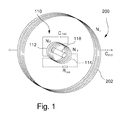
- Figure 1 shows the assembly of the three coils 112, 114 and 202.
- the primary coil 202 is connected in series with a compensating capacitor 210 which together form a transmitting antenna 200.
- Secondary coil 112 and tertiary coil 114 are around an element including ferromagnetic material e.g. a ferrite rod 118 and a capacitor 142 and a resistance 144 are connected to the terminals.
- the geometric dimensions of the primary coil 202 are determined by the needs of the application.
- the number of turns N 1 imposes the value of the coil windings self-inductance L 202 , and a trade-off has to be found between the required current through L 202 and the dissipated power in the coil windings resistance R 202 .
- the secondary and tertiary windings are tightly wounded around a small ferrite rod, with number of turns equal to N 2 and N 3 respectively. It is assumed that both windings have much smaller radii than the primary winding.
- the secondary winding, with self-inductance L 112 is connected at its terminals to a capacitor C 142 .
- the tertiary winding is connected to a resistance R 144 , in which power dissipation is expected to occur according to the needs of the application.
- ⁇ 2 ⁇ f in
- M 02 is the mutual inductance between the primary winding and secondary winding
- M 04 is the mutual inductance between the primary winding and tertiary winding
- M 24 is the mutual inductance between the secondary winding and tertiary winding.
- N 2 and N 3 impose the windings self- and mutual inductances L 112 , L 114 , M 24 and may be determined in such a way to avoid saturation of the ferrite rod and to limit the maximal voltage on C 142 at full load.
- the Fig. 3 shows one embodiment of the encapsulation 120 of the invention.
- the material of the encapsulation is chosen to be hermetic and non-conductive, which usually means ceramics.
- the material used to encapsulate electronics should possess a high resistivity and high dielectric strength.
- the proper encapsulation materials may comprise metals, such as titanium and its alloys, biograde stainless steel, cobalt based alloys, tantalum, niobium, titanium-niobium alloys, nitinol, MP35N, and some noble metals. They may also comprise glass, ceramics. Additionally, polymeric materials, such as epoxies, silicones, polyurethanes, polyimides, silicon-polyimides, parylenes, polycyclic-olefins, silicon-carbons, bentzocyclobutenes and liquid crystal polymeres, are applicable.
- metals such as titanium and its alloys, biograde stainless steel, cobalt based alloys, tantalum, niobium, titanium-niobium alloys, nitinol, MP35N, and some noble metals. They may also comprise glass, ceramics. Additionally, polymeric materials, such as epoxies, silicones, polyurethanes, polyimides, silicon-pol
- Ceramic encapsulation 120 of the ferrite 118 is straight forward. However, the encapsulation of the capacitor 142 turns to be problematic. The capacitor would require hermetic vias to it in order to connect it to the secondary coil 112. These are not economically feasible with high currents.
- the secondary coil 112 is on the top of the tertiary coil 114. This makes the encapsulation 120 into a single package difficult.
- the coil wires should be routed from the tertiary coil 114 to the driven load. However, by flipping the configuration such, that the secondary coil will be the centermost coil in the assembly, the problems of the wire routing can be solved.
- the windings of the tertiary coil 114 can now be set on the top of the encapsulation 120.
- Biocompatibility is defined as the ability of a material to perform with an appropriate host response in a specific application.
- a biocompatible material such as gold, platinum, silver or gold-platted silver
- the implant is nontoxic, noncarcinogenic and nonthrombogenic.
- the encapsulation should not cause any mechanical irritation in the surrounding tissues.
- the liquid leak inside the implant has to be prevented. Due to the need of connecting the windings of the tertiary coil 114 into the load some cables need to be routed. The introduction of body fluids has to be prevented. The fluids may reach the implant through capillary effect as the cables of the receiving antenna allow the direct path there.
- the physiological fluids contain several organic and inorganic materials and cellular components such as salts, enzymes, hormones, proteins and entire cells, which make the human body one of the most corrosive environments.
- a hermetic via connector may be used to connect to the receiving antenna 110.
- the receiving antenna 110 may be overmolded with a polymer to stop liquid from penetrating into the cables.
- the receiving antenna 110 may be encapsulated into a second hermetic packaging.
- the receiving antenna 110 may be encapsulated into a thermoplastic.
- an ultrasonically sealed encapsulation for the receiving antenna and a lipseal would be used. This ultrasonic welding of thermoplastic prevents the leakage from the interface of the antenna.
- the encapsulation 120 may include an ultrasonic or laser welding for preventing any leakage. There may also be a further casing enclosing the entire receiving antenna 110.
- the further casing is preferably plastic encapsulation and it may also include an ultrasonic welding for preventing any leakage.
Landscapes
- Health & Medical Sciences (AREA)
- Engineering & Computer Science (AREA)
- Life Sciences & Earth Sciences (AREA)
- Surgery (AREA)
- Orthopedic Medicine & Surgery (AREA)
- Power Engineering (AREA)
- General Health & Medical Sciences (AREA)
- Biomedical Technology (AREA)
- Heart & Thoracic Surgery (AREA)
- Animal Behavior & Ethology (AREA)
- Nuclear Medicine, Radiotherapy & Molecular Imaging (AREA)
- Public Health (AREA)
- Veterinary Medicine (AREA)
- Medical Informatics (AREA)
- Molecular Biology (AREA)
- Computer Networks & Wireless Communication (AREA)
- Neurology (AREA)
- Physics & Mathematics (AREA)
- Electromagnetism (AREA)
- Oral & Maxillofacial Surgery (AREA)
- Pathology (AREA)
- Electrotherapy Devices (AREA)
- Cardiology (AREA)
- Radiology & Medical Imaging (AREA)
- Prostheses (AREA)
- Charge And Discharge Circuits For Batteries Or The Like (AREA)
Abstract
Description
- The invention relates to a device with a receiving antenna. Especially, the invention relates to a device wherein the receiving antenna comprises a secondary coil, a tertiary coil and a load, and may be inductively connected to an external transmitting antenna. Further, the invention is especially for implantable devices.
- Implantable electronic devices have recently become an important tool for monitoring, measuring and triggering physiological responses in the human body. For the increasing survival rate as well as quality of life for the patient, it is essential to find embodiments which fulfill the strict requirements for the stability, miniaturization, functionality and lower energy consumption of implantable electronic devices.
- It is known from prior art that an implant is equipped with a connector for a receiver unit. The receiver unit can be contactless activated from an external transmitter unit.
- It is known a receiving antenna, which is used in the limb lengthening treatment of the lower legs. The inductive power transfer configuration in the application area is to use a subcutaneously implanted antenna. This kind of configuration allows for short transfer distance and good and efficient coupling. However, the implantation of the antenna is difficult, time consuming and increases the changes of possible complications.
- It is disclosed in the publication
US 20040023623 a device for controlling, regulating or putting an active implant into operation. In the publication a distraction device is implanted with a receiver unit to which data or power can be supplied from the outside via a transmitter unit. - For the concerning efficient, contactless electromagnetic energy transfer between windings, the miniaturization of the receiving part is essential. The receiving winding is restrained to much smaller dimensions than the sending one. This results in low magnetic coupling between coils. In a typical approach of prior art, the receiving coil is assembled around ferromagnetic material, e.g. a ferrite rod. It is to be noted, that the Ferrite should not be brought into magnetic saturation. The saturation may cause unacceptable losses and temperature rise.
- Further, to facilitate the energy transfer, the operation frequency should be as high as possible. With higher frequency of the power transfer the magnetic coupling is better and consequently, the required dimensions for the passive components are smaller.
- By considering a body implant, the geometry of the sending winding is fairly fixed as the application has limitations for transmitting coil, for gaining the desirable power transfer. The dimensions of the receiving winding will be about twenty times smaller, or even less, that the ones of the sending part.
- A typical way of prior art is to connect the receiving antenna directly to the resistive load, without any reactive power compensation. This enables a smaller receiving part and housing with limited volume can be used. The direct excitation of the sending windings requires a high-voltage power source together with a relatively high current. Only by this, the magnetization of the sending coils can be reached. However, the high-voltage and high-current puts serious limitations on the attainable frequency for the energy transfer, since the required power supply will be quite voluminous, compromising seriously the portability of the converter.
- A more effective approach towards miniaturization is to compensate the self-inductance of the windings by series-capacitors. Due to series resonance, the voltage of the windings terminals is high, but the necessary power supply voltage is quite low, which drastically reduces the volume of the converter. The value of the self-inductance of each winding is easily determined and does not change with the mutual coupling between the coils.
- For accommodating the capacitor for an available volume, the winding dimensions should somehow be changed. Reducing the number of turns causes reduction of the coupling, which further causes requirements of higher voltage and a larger value and volume of the associated compensating capacitor. On the other hand, by raising the number of winding turns, the ferrite material may be brought to saturation. Among the problems of the preferable dimensioning, there may be problems with finding commercially available components suitable for the usage.
- In order to facilitate contactless transfer of electrical energy between two windings with weak magnetic coupling, the addition of a third winding is suggested to allow the practical matching of component ratings.
- With the third winding, the real and reactive current components in the receiving part can be separated for a great deal. As now, the current through the compensating capacitor is not the same as the current through the load, flexibility for designing the load winding is achieved. This multiplies the possibilities for choosing the proper number of turns and geometry as well as voltage rate of the compensating capacitor.
- The prior art embodiments have several problems. They are struggling with at least some of the problems such as bad efficiency, non-biocompatible components, inefficient coil arrangements for enabling the encapsulation, hermetic encapsulations and leakage into the implant through the wiring.
- The prior art problems are solved by a device with a receiving antenna, wherein the receiving antenna comprises a secondary coil and a tertiary coil. The tertiary coil is arranged to have connection to a load in the device. The receiving antenna is arranged for inductively connecting to a transmitting antenna comprising a primary coil. The device of the invention is characterized in that the receiving antenna further comprises a capacitor to which the secondary coil is connected. Further, there is an encapsulation comprising a low liquid permeability and non-conductive material encapsulating at least a part of the receiving antenna.
- Another realization for the solution is a power transfer system including a transmitting antenna and a device with the above mentioned features located such that they are inductively connected.
- The device of the present invention is especially usable as an implantable device, but is also usable in corrosive circumstances as well as in other challenging environments, wherein the antenna is e.g. molded into the surrounding structure.
- Here, the term "capacitor" should be understood to mean any electronic element with capacitive features.
- To avoid the compensation of any common magnetic flux linkage and losing the connection to the primary coil, the secondary coil and the tertiary coil should not be perfectly coupled. The leakage flux of the tertiary and secondary coils is the way to transfer energy from the primary coil. However, the magnetization of the possible ferrite material in the tertiary and secondary coils is due to the effective magnetizing field as created by the two currents together. Therefore, the individual currents of the tertiary and secondary coils may be larger than the load current alone.
- The mutual coupling between the secondary and tertiary coils becomes an extra design parameter and the trade-off between the number of turns, winding losses, magnetic saturation, capacitor voltage stress and sending winding voltage can be reached on the basis of the three winding combination.
- As the introduction of the ferrite as well the improvement of the coupling cause more non-biocompatible components, e.g. capacitor and solder, there is need for hermetic sealing which encapsulates the non-biocompatible components.
- In one embodiment of the invention, the tertiary coil connected to the load would be the centermost coil of the implantable structure. In this case, however, the capacitor is located outside of the coil and the ferrite inside the coil. The usage of two separate hermetic packages is needed, one for the capacitor and one for the ferrite core. Alternatively, the whole receiving antenna would be encapsulated and the vias, especially hermetic vias, for connection to the implant should be introduced.
- It is another preferred embodiment of the invention, that the secondary coil is located under the tertiary coil and the construction. In this case, a single hermetic package for the secondary circuit can be used.
- In one embodiment of the invention, the problems related to an antenna that has to be implanted separately, can be solved by having an antenna that is integrated into the end of the intramedullary nail or such. This, however, leads into a long transfer distance and primary coil diameters of 200-250 mm are common. Also, the diameter of the integrated antenna is typically small, in the range of 7-9 mm due to the limited size of the intramedullary canal.
- Further, in the receiving antenna, there may be an element including ferromagnetic material, for focusing the magnetic field of the transmitting antenna into the receiving antenna.
- The mentioned element including ferromagnetic material may typically be a ferrite core, but it is also possible to use any other materials or mixtures that may have similar effects on the magnetic field. The introduction of ferrite core helps with focusing the magnetic field.
- Additionally, the secondary coil may be arranged to couple to the tertiary coil through the element including ferromagnetic material for creating a transformer between the secondary coil and the tertiary coil.
- Here, the term "transformer" means any kind of formulation of mutual inductance between the elements.
- Furthermore, the secondary coil and the capacitor may constitute a secondary circuit and the encapsulation may be arranged to encapsulate substantially the complete secondary circuit with the element including ferromagnetic material constituting one package.
- The encapsulation may mainly and preferably substantially purely consist of the low liquid permeability and non-conductive material. The low liquid permeability material may typically be material capable of providing hermetic encapsulation.
- Alternatively, the encapsulation may be arranged to encapsulate substantially the complete receiving antenna and to have vias, especially hermetic vias, for the connection to the load.
- Here, the term "via" means any kind of physical and/or electrical connection embodied through the encapsulation. In some connections, they may be called as feed throughs or such. For generating this kind of connection, there should be made some kind of hole or opening for the connection wires or leads on the encapsulation, wrapping, casing or packaging.
- In a preferred embodiment of the invention, the secondary coil and the tertiary coil are arranged concentric one upon the other such that they couple. Alternatively, the secondary coil and the tertiary coil may be arranged next to each other or side by side such that they couple.
- The device may be an intramedullary nail. In that case, the load is a distraction device. The device may also be a pacer or any other implantable device for medical treatment or such.
- It is another preferred embodiment of the invention, wherein the said low liquid permeability and non-conductive material of the encapsulation comprises one of ceramics and plastic.
- The typical preferred materials for the encapsulation may be e.g. PEEK, Parylene C, Polyurethane or glass.
- It is still another embodiment of the invention, wherein the receiving antenna is arranged to resonate substantially at the same frequency as the transmitting antenna.
- The Q-factor of the circuit has a known effect on the peak of the resonating circuit. When considering the width of the amplitude peak in frequency domain, the larger Q-factor causes the -3dB band to be narrower. With a very narrow band the frequencies of the two circuits have to, of course, be closer to each other to resonate together. For example, a circuit with normal frequency of 300 kHz may resonate with e.g. circuits of frequencies on the range of 250-350 kHz, 260-340 kHz, 275-325 kHz, 290-310 kHz, or even 299.5-300.5 kHz, depending on the Q-factor. Further, the closer the frequencies are, the stronger the circuits will resonate together.
- Due to the distance between the transmitting and receiving antennas the coupling factor between them is typically very weak. The first step to improve the coupling between the antennas and their coils, is to use a ferrite or such in the receiving antenna in order to focus the magnetic field of the transmitting antenna into the receiving antenna. This, however, does not increase the coupling factor to the levels required for feasible operations. By using a resonant coil and the primary coil of the transmitting antenna, the needed power for driving the primary coil is reduced.
- The electrical solution, however, leaves further problems on the application. The embodiment now includes two non-biocompatible components, the ferrite, which typically is of MnZn, and a capacitor, which may be of various materials.
- The non-biocompatible materials of the antenna have to be somehow encapsulated.
- In the following, the invention is described in more detail with reference to the attached drawings, wherein:
- Fig. 1
- shows the assembly of three coils
- Fig. 2
- shows an equivalent circuit of the assembly in
Fig. 1 - Fig. 3
- shows a cross-section view of the receiving antenna configuration with an encapsulation
-
Figure 1 shows the assembly of the threecoils primary coil 202 is connected in series with a compensatingcapacitor 210 which together form a transmittingantenna 200.Secondary coil 112 andtertiary coil 114 are around an element including ferromagnetic material e.g. aferrite rod 118 and acapacitor 142 and aresistance 144 are connected to the terminals. - The generation of mutual inductances is visible in equivalent circuit of
Fig. 2 . - The approach of the
figures 1 and2 is especially advantageous for applications where the dimensions of the primary andsecondary coils - The geometric dimensions of the
primary coil 202 are determined by the needs of the application. The number of turns N1 imposes the value of the coil windings self-inductance L202, and a trade-off has to be found between the required current through L202 and the dissipated power in the coil windings resistance R202. - In a practical implementation, it is convenient to drive the primary coil windings with a block-shaped voltage waveform as generated by half-bridge converters with constant dc bus voltage Vdc, and constant frequency fin. The rms fundamental component of the block shaped voltage Vin is given by the equation 1 as

- The primary winding is then connected in series with a capacitor C202, whose value should be chosen such that

- This means that the self-inductance of the primary winding is series-compensated, independent of the relative position of the other windings.
- The secondary and tertiary windings are tightly wounded around a small ferrite rod, with number of turns equal to N2 and N3 respectively. It is assumed that both windings have much smaller radii than the primary winding. The secondary winding, with self-inductance L112, is connected at its terminals to a capacitor C142. Finally, the tertiary winding is connected to a resistance R144, in which power dissipation is expected to occur according to the needs of the application.
- By considering fundamental harmonic components, the voltage/current phasor relationships for the three windings is found to be



where ω = 2πfin, and M02 is the mutual inductance between the primary winding and secondary winding, M04 is the mutual inductance between the primary winding and tertiary winding and M24 is the mutual inductance between the secondary winding and tertiary winding. - By connecting a capacitor to the secondary winding terminals, it follows from the notation on
Fig. 2 that
- The value of C142 should be chosen as

where k24 = M24 / √L112L114 represents the
coupling between secondary and tertiary windings. By this way the self-inductances L112 and L114 and the mutual inductance M24 are fully compensated by C142 when I1 = 0. - The values of N2 and N3 impose the windings self- and mutual inductances L112, L114, M24 and may be determined in such a way to avoid saturation of the ferrite rod and to limit the maximal voltage on C142 at full load.
- For example, if P144 is the desired power that should be dissipated in R144, the resistance connected at the tertiary winding, it implies the rms tertiary current

- From the conventions in
Fig. 2 follows that V3 = -R144I3 and V2 = - ZC142I2. Therefore, after some manipulations with the voltage/current phasor relationships above, the rms primary and secondary currents are found to be

where
- When all the rms currents are known, the rms value of the fundamental component of the input voltages is easily determined with


which yields the dc bus voltage level
necessary to create a block-shaped voltage waveform by means of a half-bridge converter. Further the peak flux density on the ferrite rod is given by

where A2 is the cross-sectional area of the ferrite core. All together, the power transfer efficiency is found to become
- The
Fig. 3 shows one embodiment of theencapsulation 120 of the invention. In this context, the material of the encapsulation is chosen to be hermetic and non-conductive, which usually means ceramics. The material used to encapsulate electronics should possess a high resistivity and high dielectric strength. - The proper encapsulation materials may comprise metals, such as titanium and its alloys, biograde stainless steel, cobalt based alloys, tantalum, niobium, titanium-niobium alloys, nitinol, MP35N, and some noble metals. They may also comprise glass, ceramics. Additionally, polymeric materials, such as epoxies, silicones, polyurethanes, polyimides, silicon-polyimides, parylenes, polycyclic-olefins, silicon-carbons, bentzocyclobutenes and liquid crystal polymeres, are applicable.
-
Ceramic encapsulation 120 of theferrite 118 is straight forward. However, the encapsulation of thecapacitor 142 turns to be problematic. The capacitor would require hermetic vias to it in order to connect it to thesecondary coil 112. These are not economically feasible with high currents. - The space limitations in implantable applications, especially in an intramedullary device, are evident. Therefore, it would be beneficial to limit the amount of different encapsulation layers. This can be realized by encapsulating the complete
secondary coil 112 and ferrite into same package. - Typically in the electrical configuration, the
secondary coil 112 is on the top of thetertiary coil 114. This makes theencapsulation 120 into a single package difficult. The coil wires should be routed from thetertiary coil 114 to the driven load. However, by flipping the configuration such, that the secondary coil will be the centermost coil in the assembly, the problems of the wire routing can be solved. The windings of thetertiary coil 114 can now be set on the top of theencapsulation 120. - Biocompatibility is defined as the ability of a material to perform with an appropriate host response in a specific application. When using a biocompatible material, such as gold, platinum, silver or gold-platted silver, for the windings of the
tertiary coil 114, a long-term biocompatible solution is reached. Further, in the case of encapsulated active implants it is generally desirable, that the implant is nontoxic, noncarcinogenic and nonthrombogenic. Furthermore, the encapsulation should not cause any mechanical irritation in the surrounding tissues. - Further, the liquid leak inside the implant has to be prevented. Due to the need of connecting the windings of the
tertiary coil 114 into the load some cables need to be routed. The introduction of body fluids has to be prevented. The fluids may reach the implant through capillary effect as the cables of the receiving antenna allow the direct path there. The physiological fluids contain several organic and inorganic materials and cellular components such as salts, enzymes, hormones, proteins and entire cells, which make the human body one of the most corrosive environments. - The prevention of the body fluids leakage may be achieved in several ways. In one embodiment of the invention, a hermetic via connector may be used to connect to the receiving
antenna 110. Alternatively, the receivingantenna 110 may be overmolded with a polymer to stop liquid from penetrating into the cables. Further, the receivingantenna 110 may be encapsulated into a second hermetic packaging. Alternatively, the receivingantenna 110 may be encapsulated into a thermoplastic. - In a preferred embodiment of the invention an ultrasonically sealed encapsulation for the receiving antenna and a lipseal would be used. This ultrasonic welding of thermoplastic prevents the leakage from the interface of the antenna.
- The
encapsulation 120 may include an ultrasonic or laser welding for preventing any leakage. There may also be a further casing enclosing theentire receiving antenna 110. The further casing is preferably plastic encapsulation and it may also include an ultrasonic welding for preventing any leakage. -
- 110
- receiving antenna
- 112
- secondary coil
- 114
- tertiary coil
- 118
- element including ferromagnetic material
- 120
- encapsulation
- 142
- capacitor
- 144
- resistance
- 200
- transmitting antenna
- 202
- primary coil
- 210
- compensating capacitor
- L202
- self-inductance of primary coil windings
- L112
- self-inductance of secondary coil windings
- L114
- self-inductance of the tertiary coil windings
- R202
- resistance of the primary coil windings
- R144
- resistance of the resistor in connection to the tertiary windings
- C210
- capacitance of the capacitor in connection to the primary coil windings
- C142
- capacitance of the capacitor in connection to the secondary coil windings
- M02
- mutual inductance between the primary winding and secondary winding
- M04
- mutual inductance between the primary winding and tertiary winding
- M24
- mutual inductance between the secondary winding and tertiary winding
- Vdc
- dc bus voltage
- fin
- constant frequency
- Vin
- block shaped voltage
- V1
- voltage of primary winding
- V2
- voltage of secondary winding
- V3
- voltage of tertiary winding
- VC
142 - voltage of capacitor in connection to the secondary coil windings
- VC202
- voltage of capacitor in connection to the primary coil windings
- P144
- power dissipated in a resistor
- N1
- number of turns in primary windings
- N2
- number of turns in secondary windings
- N3
- number of turns in tertiary windings
- k24
- coupling between secondary and tertiary windings
- I1
- current primary winding
- I2
- current secondary winding
- I3
- current tertiary winding
- ϑ
- power transfer efficiency
- Ψ2
- peak flux
- Bmax2
- peak flux density
- A2
- cross-sectional area of an element including ferromagnetic material
- Z11
- impedance factor
- Z12
- impedance factor
- Z13
- impedance factor
- Z22
- impedance factor
- Z23
- impedance factor
- Z33
- impedance factor
- ZC
142 - impedance factor
- ZC202
- impedance factor
Claims (12)
- A device with a receiving antenna (110), wherein the receiving antenna (110) comprises a secondary coil (112), and being arranged for inductively connecting to a transmitting antenna (200) comprising a primary coil (202);
characterized in that
the receiving antenna (110) further comprises:a tertiary coil (114) arranged to have connection to a load in the device; anda capacitor (142) to which the secondary coil (112) is connected; and there is an encapsulation (120) comprising a low liquid permeability and non-conductive material encapsulating at least a part of the receiving antenna (110). - The device of any one of the preceding claims, wherein in the receiving antenna (110), there is an element (118) including ferromagnetic material, for focusing the magnetic field of the transmitting antenna (200) into the receiving antenna (110).
- The device of the claim 2, wherein the secondary coil (112) is arranged to couple to the tertiary coil (114) through the element (118) for creating a transformer between the secondary coil (112) and the tertiary coil (114).
- The device of any one of the preceding claims, wherein the secondary coil (112) and the capacitor (142) constitute a secondary circuit and the encapsulation (120) is arranged to encapsulate substantially the complete secondary circuit with the element (118) constituting one package.
- The device of any one of the claims 1-3, wherein the encapsulation (120) is arranged to encapsulate substantially the complete receiving antenna and to have hermetic vias for the connection to the load.
- The device of any one of the preceding claims, wherein the secondary coil (112) and the tertiary coil (114) are arranged concentric one upon the other such that they couple.
- The device of any one of the claims 1-5, wherein the secondary coil (112) and the tertiary coil (114) are arranged next to each other such that they couple.
- The device of any one of the preceding claims, wherein the said low liquid permeability and non-conductive material of the encapsulation (120) comprises one of ceramics and plastic.
- The device of any one of the preceding claims, wherein the receiving antenna (110) is arranged to resonate substantially at the same frequency as the transmitting antenna (200).
- The device of any one of the preceding claims, wherein there is a further casing enclosing the entire receiving antenna (110).
- The device of any one of the preceding claims, wherein at least one of the encapsulation (120) and the casing includes an ultrasonic or laser welding for preventing any leakage.
- A power transfer system including a transmitting antenna (200) and a device of the claim 1 located such that they are inductively connected.
Priority Applications (7)
| Application Number | Priority Date | Filing Date | Title |
|---|---|---|---|
| ES14189377T ES2755650T3 (en) | 2014-10-17 | 2014-10-17 | Device with a receiving antenna and related power transfer system |
| PL14189377T PL3010084T3 (en) | 2014-10-17 | 2014-10-17 | A device with a receiving antenna and associated power transmission system |
| EP14189377.6A EP3010084B1 (en) | 2014-10-17 | 2014-10-17 | A device with a receiving antenna and a related power transfer system |
| CN201580049035.7A CN107072539B (en) | 2014-10-17 | 2015-09-30 | Devices with receive antennas and associated power transfer systems |
| JP2017540321A JP6578363B2 (en) | 2014-10-17 | 2015-09-30 | Device with receive antenna and associated power transfer system |
| PCT/FI2015/050648 WO2016059289A1 (en) | 2014-10-17 | 2015-09-30 | A device with a receiving antenna and a related power transfer system |
| US15/519,644 US10511193B2 (en) | 2014-10-17 | 2015-09-30 | Device with a receiving antenna and a related power transfer system |
Applications Claiming Priority (1)
| Application Number | Priority Date | Filing Date | Title |
|---|---|---|---|
| EP14189377.6A EP3010084B1 (en) | 2014-10-17 | 2014-10-17 | A device with a receiving antenna and a related power transfer system |
Publications (2)
| Publication Number | Publication Date |
|---|---|
| EP3010084A1 true EP3010084A1 (en) | 2016-04-20 |
| EP3010084B1 EP3010084B1 (en) | 2019-09-04 |
Family
ID=51743337
Family Applications (1)
| Application Number | Title | Priority Date | Filing Date |
|---|---|---|---|
| EP14189377.6A Active EP3010084B1 (en) | 2014-10-17 | 2014-10-17 | A device with a receiving antenna and a related power transfer system |
Country Status (7)
| Country | Link |
|---|---|
| US (1) | US10511193B2 (en) |
| EP (1) | EP3010084B1 (en) |
| JP (1) | JP6578363B2 (en) |
| CN (1) | CN107072539B (en) |
| ES (1) | ES2755650T3 (en) |
| PL (1) | PL3010084T3 (en) |
| WO (1) | WO2016059289A1 (en) |
Cited By (1)
| Publication number | Priority date | Publication date | Assignee | Title |
|---|---|---|---|---|
| WO2018068802A1 (en) * | 2016-10-13 | 2018-04-19 | Tarmin Eesti Trade Oü | Electromagnetic resonator |
Families Citing this family (4)
| Publication number | Priority date | Publication date | Assignee | Title |
|---|---|---|---|---|
| DE112018002195A5 (en) * | 2017-04-27 | 2020-05-14 | Weinmann Emergency Medical Technology Gmbh + Co. Kg | Defibrillation method and apparatus |
| EP3698435B1 (en) * | 2017-10-19 | 2023-11-22 | Wafer LLC | Polymer dispersed/shear aligned phase modulator device |
| CN108988502B (en) * | 2018-07-16 | 2020-11-13 | 国网冀北电力有限公司电力科学研究院 | A method and device for adjusting a wireless charging system |
| DE102019122354A1 (en) * | 2019-08-20 | 2021-02-25 | Orthofix Srl | Intramedullary nail for distraction of a long bone |
Citations (5)
| Publication number | Priority date | Publication date | Assignee | Title |
|---|---|---|---|---|
| US20040023623A1 (en) | 2000-11-09 | 2004-02-05 | Roman Stauch | Device for controlling, regulating and/or putting an active implant into operation |
| WO2006127355A2 (en) * | 2005-05-20 | 2006-11-30 | Dow Global Technologies Inc. | Oral drug compliance monitoring using radio frequency identification tags |
| US20110175456A1 (en) * | 2010-01-15 | 2011-07-21 | Sony Corporation | Wireless power supplying rack |
| WO2013098784A1 (en) * | 2011-12-28 | 2013-07-04 | Logomotion, S.R.O. | An antenna on a removable card |
| US20130241306A1 (en) * | 2010-12-10 | 2013-09-19 | Everheart Systems Inc. | Mobile wireless power system |
Family Cites Families (28)
| Publication number | Priority date | Publication date | Assignee | Title |
|---|---|---|---|---|
| US4071032A (en) * | 1976-01-29 | 1978-01-31 | Pacesetter Systems Inc. | Implantable living tissue stimulators |
| US7437193B2 (en) * | 2002-06-28 | 2008-10-14 | Boston Scientific Neuromodulation Corporation | Microstimulator employing improved recharging reporting and telemetry techniques |
| CN2600979Y (en) * | 2003-02-19 | 2004-01-21 | 李宏杰 | Anti-interference receiving antenna |
| US7239921B2 (en) * | 2003-06-23 | 2007-07-03 | Alfred E. Mann Foundation For Scientific Research | Housing for an implantable medical device |
| JP4472291B2 (en) * | 2003-08-04 | 2010-06-02 | オリンパス株式会社 | Wireless in-vivo information acquisition system |
| JP4414725B2 (en) * | 2003-10-28 | 2010-02-10 | オリンパス株式会社 | Capsule medical device |
| JP2006149685A (en) * | 2004-11-29 | 2006-06-15 | Olympus Corp | In-subject introduction device and in-subject introduction system |
| US8233985B2 (en) * | 2005-11-04 | 2012-07-31 | Kenergy, Inc. | MRI compatible implanted electronic medical device with power and data communication capability |
| US8050774B2 (en) * | 2005-12-22 | 2011-11-01 | Boston Scientific Scimed, Inc. | Electrode apparatus, systems and methods |
| JP5364263B2 (en) * | 2007-12-21 | 2013-12-11 | 学校法人東京理科大学 | Non-contact energy transmission system design equipment |
| US7917226B2 (en) * | 2008-04-23 | 2011-03-29 | Enteromedics Inc. | Antenna arrangements for implantable therapy device |
| US8421274B2 (en) * | 2008-09-12 | 2013-04-16 | University Of Pittsburgh-Of The Commonwealth System Of Higher Education | Wireless energy transfer system |
| US9105959B2 (en) * | 2008-09-27 | 2015-08-11 | Witricity Corporation | Resonator enclosure |
| WO2010066955A1 (en) * | 2008-12-11 | 2010-06-17 | Yves Eray | Rfid antenna circuit |
| US8996121B2 (en) | 2009-07-10 | 2015-03-31 | Cochlear Limited | Varying the effective coil area for an inductive transcutaneous power link |
| JP2011083078A (en) * | 2009-10-05 | 2011-04-21 | Sony Corp | Power transmission device, power receiving device, and power transmission system |
| US9496721B2 (en) * | 2009-10-14 | 2016-11-15 | Ud Trucks Corporation | Power storage apparatus |
| US11051744B2 (en) * | 2009-11-17 | 2021-07-06 | Setpoint Medical Corporation | Closed-loop vagus nerve stimulation |
| US8901775B2 (en) * | 2010-12-10 | 2014-12-02 | Everheart Systems, Inc. | Implantable wireless power system |
| JP5667019B2 (en) * | 2011-09-14 | 2015-02-12 | 株式会社東芝 | Wireless power transmission apparatus and method |
| CN103827997B (en) * | 2011-09-28 | 2016-08-17 | 丰田自动车株式会社 | Power receiving device, power transmitting device and power transmission system |
| JP2013078440A (en) * | 2011-10-03 | 2013-05-02 | Panasonic Corp | Capsule-type endoscope |
| EP2783891B1 (en) * | 2011-11-25 | 2019-12-25 | Toyota Jidosha Kabushiki Kaisha | Vehicle |
| JP5807685B2 (en) * | 2012-01-31 | 2015-11-10 | 富士通株式会社 | Power receiving device and power supply system |
| JPWO2014038148A1 (en) * | 2012-09-06 | 2016-08-08 | パナソニックIpマネジメント株式会社 | Contactless power supply system and contactless extension plug |
| JP5837254B2 (en) * | 2013-02-12 | 2015-12-24 | 三菱電機株式会社 | Power receiving device and non-contact power feeding device |
| JP2014176122A (en) * | 2013-03-06 | 2014-09-22 | Osaka City Univ | Magnetic resonance-type wireless power-feeding system |
| WO2014145664A1 (en) * | 2013-03-15 | 2014-09-18 | Thoratec Corporation | Integrated implantable tets housing including fins and coil loops |
-
2014
- 2014-10-17 PL PL14189377T patent/PL3010084T3/en unknown
- 2014-10-17 ES ES14189377T patent/ES2755650T3/en active Active
- 2014-10-17 EP EP14189377.6A patent/EP3010084B1/en active Active
-
2015
- 2015-09-30 CN CN201580049035.7A patent/CN107072539B/en active Active
- 2015-09-30 WO PCT/FI2015/050648 patent/WO2016059289A1/en not_active Ceased
- 2015-09-30 US US15/519,644 patent/US10511193B2/en active Active
- 2015-09-30 JP JP2017540321A patent/JP6578363B2/en active Active
Patent Citations (5)
| Publication number | Priority date | Publication date | Assignee | Title |
|---|---|---|---|---|
| US20040023623A1 (en) | 2000-11-09 | 2004-02-05 | Roman Stauch | Device for controlling, regulating and/or putting an active implant into operation |
| WO2006127355A2 (en) * | 2005-05-20 | 2006-11-30 | Dow Global Technologies Inc. | Oral drug compliance monitoring using radio frequency identification tags |
| US20110175456A1 (en) * | 2010-01-15 | 2011-07-21 | Sony Corporation | Wireless power supplying rack |
| US20130241306A1 (en) * | 2010-12-10 | 2013-09-19 | Everheart Systems Inc. | Mobile wireless power system |
| WO2013098784A1 (en) * | 2011-12-28 | 2013-07-04 | Logomotion, S.R.O. | An antenna on a removable card |
Cited By (1)
| Publication number | Priority date | Publication date | Assignee | Title |
|---|---|---|---|---|
| WO2018068802A1 (en) * | 2016-10-13 | 2018-04-19 | Tarmin Eesti Trade Oü | Electromagnetic resonator |
Also Published As
| Publication number | Publication date |
|---|---|
| CN107072539B (en) | 2020-04-21 |
| JP6578363B2 (en) | 2019-09-18 |
| ES2755650T3 (en) | 2020-04-23 |
| EP3010084B1 (en) | 2019-09-04 |
| US10511193B2 (en) | 2019-12-17 |
| PL3010084T3 (en) | 2020-01-31 |
| US20170244287A1 (en) | 2017-08-24 |
| WO2016059289A1 (en) | 2016-04-21 |
| JP2017535240A (en) | 2017-11-24 |
| CN107072539A (en) | 2017-08-18 |
Similar Documents
| Publication | Publication Date | Title |
|---|---|---|
| US10511193B2 (en) | Device with a receiving antenna and a related power transfer system | |
| US7239921B2 (en) | Housing for an implantable medical device | |
| US6864755B2 (en) | Switched reactance modulated E-class oscillator design | |
| US8200328B2 (en) | Tank filters placed in series with the lead wires or circuits of active medical devices to enhance MRI compatibility | |
| US8116862B2 (en) | Tank filters placed in series with the lead wires or circuits of active medical devices to enhance MRI compatibility | |
| US6542777B1 (en) | Spiral shield for a flexible high-Q implantable inductively coupled device | |
| US10080889B2 (en) | Low inductance and low resistance hermetically sealed filtered feedthrough for an AIMD | |
| US7853324B2 (en) | Tank filters utilizing very low K materials, in series with lead wires or circuits of active medical devices to enhance MRI compatibility | |
| EP1806756B1 (en) | Miniature coils on core with printed circuit | |
| US20080049376A1 (en) | Non-ferromagnetic tank filters in lead wires of active implantable medical devices to enhance mri compatibility | |
| EP2025361A1 (en) | Tank filters adaptable for placement with a guide wire, in series with the lead wires or circuits of active medical devices to enhance MRI compatibility | |
| US20110208030A1 (en) | Tank filters placed in series with the lead wires or circuits of active medical devices to enhance mri compatability | |
| US7005935B2 (en) | Switched reactance modulated E-class oscillator | |
| US11532422B2 (en) | Coil core in the form of a ferromagnetic rivet for spiral inductors on printed circuit boards | |
| US20220362561A1 (en) | Vivo-implantable medical device | |
| EP2392382A1 (en) | Tank filters placed in series with the lead wires or circuits of active medical devices to enhance MRI compatibility | |
| US20220088396A1 (en) | Implantable Medical Device Using Its Conductive Case to Receive Wireless Power and Having a Tank Capacitance in the Header | |
| CA3104883A1 (en) | Implantable neural stimulation device with two headers | |
| EP4440679B1 (en) | Systems and methods for conductivity coatings on wireless power resonators | |
| Zargham | Fully integrated wireless power transfer system for biomedical applications |
Legal Events
| Date | Code | Title | Description |
|---|---|---|---|
| PUAI | Public reference made under article 153(3) epc to a published international application that has entered the european phase |
Free format text: ORIGINAL CODE: 0009012 |
|
| AK | Designated contracting states |
Kind code of ref document: A1 Designated state(s): AL AT BE BG CH CY CZ DE DK EE ES FI FR GB GR HR HU IE IS IT LI LT LU LV MC MK MT NL NO PL PT RO RS SE SI SK SM TR |
|
| AX | Request for extension of the european patent |
Extension state: BA ME |
|
| 17P | Request for examination filed |
Effective date: 20161020 |
|
| RBV | Designated contracting states (corrected) |
Designated state(s): AL AT BE BG CH CY CZ DE DK EE ES FI FR GB GR HR HU IE IS IT LI LT LU LV MC MK MT NL NO PL PT RO RS SE SI SK SM TR |
|
| RIC1 | Information provided on ipc code assigned before grant |
Ipc: H02J 5/00 20160101ALI20181128BHEP Ipc: H01Q 7/08 20060101AFI20181128BHEP Ipc: A61B 18/00 20060101ALN20181128BHEP |
|
| GRAP | Despatch of communication of intention to grant a patent |
Free format text: ORIGINAL CODE: EPIDOSNIGR1 |
|
| STAA | Information on the status of an ep patent application or granted ep patent |
Free format text: STATUS: GRANT OF PATENT IS INTENDED |
|
| RIC1 | Information provided on ipc code assigned before grant |
Ipc: H02J 5/00 20160101ALI20181206BHEP Ipc: A61B 18/00 20060101ALN20181206BHEP Ipc: H01Q 7/08 20060101AFI20181206BHEP |
|
| INTG | Intention to grant announced |
Effective date: 20190107 |
|
| GRAJ | Information related to disapproval of communication of intention to grant by the applicant or resumption of examination proceedings by the epo deleted |
Free format text: ORIGINAL CODE: EPIDOSDIGR1 |
|
| STAA | Information on the status of an ep patent application or granted ep patent |
Free format text: STATUS: REQUEST FOR EXAMINATION WAS MADE |
|
| GRAP | Despatch of communication of intention to grant a patent |
Free format text: ORIGINAL CODE: EPIDOSNIGR1 |
|
| STAA | Information on the status of an ep patent application or granted ep patent |
Free format text: STATUS: GRANT OF PATENT IS INTENDED |
|
| INTC | Intention to grant announced (deleted) | ||
| RIN1 | Information on inventor provided before grant (corrected) |
Inventor name: HAAJA, JUHA Inventor name: SALDEN, KEVIN Inventor name: RITVANEN, ANTTI Inventor name: HALLILA, HARRI Inventor name: DUARTE, JORGE |
|
| RIC1 | Information provided on ipc code assigned before grant |
Ipc: H01Q 7/08 20060101AFI20190510BHEP Ipc: A61B 18/00 20060101ALN20190510BHEP Ipc: H02J 5/00 20160101ALI20190510BHEP |
|
| INTG | Intention to grant announced |
Effective date: 20190527 |
|
| GRAS | Grant fee paid |
Free format text: ORIGINAL CODE: EPIDOSNIGR3 |
|
| GRAA | (expected) grant |
Free format text: ORIGINAL CODE: 0009210 |
|
| STAA | Information on the status of an ep patent application or granted ep patent |
Free format text: STATUS: THE PATENT HAS BEEN GRANTED |
|
| AK | Designated contracting states |
Kind code of ref document: B1 Designated state(s): AL AT BE BG CH CY CZ DE DK EE ES FI FR GB GR HR HU IE IS IT LI LT LU LV MC MK MT NL NO PL PT RO RS SE SI SK SM TR |
|
| REG | Reference to a national code |
Ref country code: GB Ref legal event code: FG4D |
|
| REG | Reference to a national code |
Ref country code: CH Ref legal event code: EP |
|
| REG | Reference to a national code |
Ref country code: AT Ref legal event code: REF Ref document number: 1176678 Country of ref document: AT Kind code of ref document: T Effective date: 20190915 |
|
| REG | Reference to a national code |
Ref country code: DE Ref legal event code: R096 Ref document number: 602014052877 Country of ref document: DE |
|
| REG | Reference to a national code |
Ref country code: IE Ref legal event code: FG4D |
|
| REG | Reference to a national code |
Ref country code: SE Ref legal event code: TRGR |
|
| REG | Reference to a national code |
Ref country code: NL Ref legal event code: FP |
|
| REG | Reference to a national code |
Ref country code: CH Ref legal event code: NV Representative=s name: NOVAGRAAF INTERNATIONAL SA, CH |
|
| REG | Reference to a national code |
Ref country code: LT Ref legal event code: MG4D Ref country code: NO Ref legal event code: T2 Effective date: 20190904 |
|
| PG25 | Lapsed in a contracting state [announced via postgrant information from national office to epo] |
Ref country code: LT Free format text: LAPSE BECAUSE OF FAILURE TO SUBMIT A TRANSLATION OF THE DESCRIPTION OR TO PAY THE FEE WITHIN THE PRESCRIBED TIME-LIMIT Effective date: 20190904 Ref country code: HR Free format text: LAPSE BECAUSE OF FAILURE TO SUBMIT A TRANSLATION OF THE DESCRIPTION OR TO PAY THE FEE WITHIN THE PRESCRIBED TIME-LIMIT Effective date: 20190904 Ref country code: BG Free format text: LAPSE BECAUSE OF FAILURE TO SUBMIT A TRANSLATION OF THE DESCRIPTION OR TO PAY THE FEE WITHIN THE PRESCRIBED TIME-LIMIT Effective date: 20191204 |
|
| PGFP | Annual fee paid to national office [announced via postgrant information from national office to epo] |
Ref country code: CZ Payment date: 20191206 Year of fee payment: 6 Ref country code: IE Payment date: 20191121 Year of fee payment: 6 Ref country code: NO Payment date: 20191122 Year of fee payment: 6 Ref country code: FI Payment date: 20191101 Year of fee payment: 6 Ref country code: NL Payment date: 20191121 Year of fee payment: 6 Ref country code: SE Payment date: 20191104 Year of fee payment: 6 |
|
| PG25 | Lapsed in a contracting state [announced via postgrant information from national office to epo] |
Ref country code: AL Free format text: LAPSE BECAUSE OF FAILURE TO SUBMIT A TRANSLATION OF THE DESCRIPTION OR TO PAY THE FEE WITHIN THE PRESCRIBED TIME-LIMIT Effective date: 20190904 Ref country code: LV Free format text: LAPSE BECAUSE OF FAILURE TO SUBMIT A TRANSLATION OF THE DESCRIPTION OR TO PAY THE FEE WITHIN THE PRESCRIBED TIME-LIMIT Effective date: 20190904 Ref country code: GR Free format text: LAPSE BECAUSE OF FAILURE TO SUBMIT A TRANSLATION OF THE DESCRIPTION OR TO PAY THE FEE WITHIN THE PRESCRIBED TIME-LIMIT Effective date: 20191205 Ref country code: RS Free format text: LAPSE BECAUSE OF FAILURE TO SUBMIT A TRANSLATION OF THE DESCRIPTION OR TO PAY THE FEE WITHIN THE PRESCRIBED TIME-LIMIT Effective date: 20190904 |
|
| PGFP | Annual fee paid to national office [announced via postgrant information from national office to epo] |
Ref country code: PL Payment date: 20191122 Year of fee payment: 6 Ref country code: ES Payment date: 20191129 Year of fee payment: 6 Ref country code: BE Payment date: 20191121 Year of fee payment: 6 Ref country code: FR Payment date: 20191121 Year of fee payment: 6 |
|
| PGFP | Annual fee paid to national office [announced via postgrant information from national office to epo] |
Ref country code: CH Payment date: 20191128 Year of fee payment: 6 Ref country code: TR Payment date: 20191206 Year of fee payment: 6 Ref country code: AT Payment date: 20191122 Year of fee payment: 6 |
|
| REG | Reference to a national code |
Ref country code: ES Ref legal event code: FG2A Ref document number: 2755650 Country of ref document: ES Kind code of ref document: T3 Effective date: 20200423 |
|
| PG25 | Lapsed in a contracting state [announced via postgrant information from national office to epo] |
Ref country code: EE Free format text: LAPSE BECAUSE OF FAILURE TO SUBMIT A TRANSLATION OF THE DESCRIPTION OR TO PAY THE FEE WITHIN THE PRESCRIBED TIME-LIMIT Effective date: 20190904 Ref country code: RO Free format text: LAPSE BECAUSE OF FAILURE TO SUBMIT A TRANSLATION OF THE DESCRIPTION OR TO PAY THE FEE WITHIN THE PRESCRIBED TIME-LIMIT Effective date: 20190904 Ref country code: PT Free format text: LAPSE BECAUSE OF FAILURE TO SUBMIT A TRANSLATION OF THE DESCRIPTION OR TO PAY THE FEE WITHIN THE PRESCRIBED TIME-LIMIT Effective date: 20200106 |
|
| PGFP | Annual fee paid to national office [announced via postgrant information from national office to epo] |
Ref country code: IT Payment date: 20191227 Year of fee payment: 6 |
|
| PG25 | Lapsed in a contracting state [announced via postgrant information from national office to epo] |
Ref country code: SM Free format text: LAPSE BECAUSE OF FAILURE TO SUBMIT A TRANSLATION OF THE DESCRIPTION OR TO PAY THE FEE WITHIN THE PRESCRIBED TIME-LIMIT Effective date: 20190904 Ref country code: SK Free format text: LAPSE BECAUSE OF FAILURE TO SUBMIT A TRANSLATION OF THE DESCRIPTION OR TO PAY THE FEE WITHIN THE PRESCRIBED TIME-LIMIT Effective date: 20190904 Ref country code: IS Free format text: LAPSE BECAUSE OF FAILURE TO SUBMIT A TRANSLATION OF THE DESCRIPTION OR TO PAY THE FEE WITHIN THE PRESCRIBED TIME-LIMIT Effective date: 20200224 |
|
| REG | Reference to a national code |
Ref country code: DE Ref legal event code: R097 Ref document number: 602014052877 Country of ref document: DE |
|
| PLBE | No opposition filed within time limit |
Free format text: ORIGINAL CODE: 0009261 |
|
| STAA | Information on the status of an ep patent application or granted ep patent |
Free format text: STATUS: NO OPPOSITION FILED WITHIN TIME LIMIT |
|
| PG2D | Information on lapse in contracting state deleted |
Ref country code: IS |
|
| PG25 | Lapsed in a contracting state [announced via postgrant information from national office to epo] |
Ref country code: DK Free format text: LAPSE BECAUSE OF FAILURE TO SUBMIT A TRANSLATION OF THE DESCRIPTION OR TO PAY THE FEE WITHIN THE PRESCRIBED TIME-LIMIT Effective date: 20190904 Ref country code: LU Free format text: LAPSE BECAUSE OF NON-PAYMENT OF DUE FEES Effective date: 20191017 Ref country code: IS Free format text: LAPSE BECAUSE OF FAILURE TO SUBMIT A TRANSLATION OF THE DESCRIPTION OR TO PAY THE FEE WITHIN THE PRESCRIBED TIME-LIMIT Effective date: 20200105 |
|
| 26N | No opposition filed |
Effective date: 20200605 |
|
| PG25 | Lapsed in a contracting state [announced via postgrant information from national office to epo] |
Ref country code: SI Free format text: LAPSE BECAUSE OF FAILURE TO SUBMIT A TRANSLATION OF THE DESCRIPTION OR TO PAY THE FEE WITHIN THE PRESCRIBED TIME-LIMIT Effective date: 20190904 Ref country code: MC Free format text: LAPSE BECAUSE OF FAILURE TO SUBMIT A TRANSLATION OF THE DESCRIPTION OR TO PAY THE FEE WITHIN THE PRESCRIBED TIME-LIMIT Effective date: 20190904 |
|
| REG | Reference to a national code |
Ref country code: AT Ref legal event code: UEP Ref document number: 1176678 Country of ref document: AT Kind code of ref document: T Effective date: 20190904 |
|
| REG | Reference to a national code |
Ref country code: NO Ref legal event code: MMEP |
|
| PG25 | Lapsed in a contracting state [announced via postgrant information from national office to epo] |
Ref country code: CY Free format text: LAPSE BECAUSE OF FAILURE TO SUBMIT A TRANSLATION OF THE DESCRIPTION OR TO PAY THE FEE WITHIN THE PRESCRIBED TIME-LIMIT Effective date: 20190904 |
|
| REG | Reference to a national code |
Ref country code: CH Ref legal event code: PL Ref country code: FI Ref legal event code: MAE |
|
| REG | Reference to a national code |
Ref country code: SE Ref legal event code: EUG |
|
| REG | Reference to a national code |
Ref country code: NL Ref legal event code: MM Effective date: 20201101 |
|
| REG | Reference to a national code |
Ref country code: AT Ref legal event code: MM01 Ref document number: 1176678 Country of ref document: AT Kind code of ref document: T Effective date: 20201017 |
|
| REG | Reference to a national code |
Ref country code: BE Ref legal event code: MM Effective date: 20201031 |
|
| PG25 | Lapsed in a contracting state [announced via postgrant information from national office to epo] |
Ref country code: FR Free format text: LAPSE BECAUSE OF NON-PAYMENT OF DUE FEES Effective date: 20201031 Ref country code: FI Free format text: LAPSE BECAUSE OF NON-PAYMENT OF DUE FEES Effective date: 20201017 Ref country code: NL Free format text: LAPSE BECAUSE OF NON-PAYMENT OF DUE FEES Effective date: 20201101 Ref country code: MT Free format text: LAPSE BECAUSE OF FAILURE TO SUBMIT A TRANSLATION OF THE DESCRIPTION OR TO PAY THE FEE WITHIN THE PRESCRIBED TIME-LIMIT Effective date: 20190904 Ref country code: NO Free format text: LAPSE BECAUSE OF NON-PAYMENT OF DUE FEES Effective date: 20201031 Ref country code: HU Free format text: LAPSE BECAUSE OF FAILURE TO SUBMIT A TRANSLATION OF THE DESCRIPTION OR TO PAY THE FEE WITHIN THE PRESCRIBED TIME-LIMIT; INVALID AB INITIO Effective date: 20141017 Ref country code: CZ Free format text: LAPSE BECAUSE OF NON-PAYMENT OF DUE FEES Effective date: 20201017 |
|
| PG25 | Lapsed in a contracting state [announced via postgrant information from national office to epo] |
Ref country code: SE Free format text: LAPSE BECAUSE OF NON-PAYMENT OF DUE FEES Effective date: 20201018 Ref country code: LI Free format text: LAPSE BECAUSE OF NON-PAYMENT OF DUE FEES Effective date: 20201031 Ref country code: BE Free format text: LAPSE BECAUSE OF NON-PAYMENT OF DUE FEES Effective date: 20201031 Ref country code: AT Free format text: LAPSE BECAUSE OF NON-PAYMENT OF DUE FEES Effective date: 20201017 Ref country code: CH Free format text: LAPSE BECAUSE OF NON-PAYMENT OF DUE FEES Effective date: 20201031 |
|
| PG25 | Lapsed in a contracting state [announced via postgrant information from national office to epo] |
Ref country code: IT Free format text: LAPSE BECAUSE OF NON-PAYMENT OF DUE FEES Effective date: 20201017 Ref country code: IE Free format text: LAPSE BECAUSE OF NON-PAYMENT OF DUE FEES Effective date: 20201017 |
|
| REG | Reference to a national code |
Ref country code: ES Ref legal event code: FD2A Effective date: 20220121 |
|
| PG25 | Lapsed in a contracting state [announced via postgrant information from national office to epo] |
Ref country code: ES Free format text: LAPSE BECAUSE OF NON-PAYMENT OF DUE FEES Effective date: 20201018 |
|
| PG25 | Lapsed in a contracting state [announced via postgrant information from national office to epo] |
Ref country code: MK Free format text: LAPSE BECAUSE OF FAILURE TO SUBMIT A TRANSLATION OF THE DESCRIPTION OR TO PAY THE FEE WITHIN THE PRESCRIBED TIME-LIMIT Effective date: 20190904 Ref country code: TR Free format text: LAPSE BECAUSE OF NON-PAYMENT OF DUE FEES Effective date: 20201017 |
|
| PG25 | Lapsed in a contracting state [announced via postgrant information from national office to epo] |
Ref country code: PL Free format text: LAPSE BECAUSE OF NON-PAYMENT OF DUE FEES Effective date: 20201017 |
|
| PGFP | Annual fee paid to national office [announced via postgrant information from national office to epo] |
Ref country code: GB Payment date: 20250828 Year of fee payment: 12 |
|
| PGFP | Annual fee paid to national office [announced via postgrant information from national office to epo] |
Ref country code: DE Payment date: 20250819 Year of fee payment: 12 |