EP3009781A1 - Heat exchanger - Google Patents
Heat exchanger Download PDFInfo
- Publication number
- EP3009781A1 EP3009781A1 EP15187099.5A EP15187099A EP3009781A1 EP 3009781 A1 EP3009781 A1 EP 3009781A1 EP 15187099 A EP15187099 A EP 15187099A EP 3009781 A1 EP3009781 A1 EP 3009781A1
- Authority
- EP
- European Patent Office
- Prior art keywords
- heat exchanger
- manifold
- fluid
- exit
- hot
- Prior art date
- Legal status (The legal status is an assumption and is not a legal conclusion. Google has not performed a legal analysis and makes no representation as to the accuracy of the status listed.)
- Granted
Links
Images


Classifications
-
- F—MECHANICAL ENGINEERING; LIGHTING; HEATING; WEAPONS; BLASTING
- F02—COMBUSTION ENGINES; HOT-GAS OR COMBUSTION-PRODUCT ENGINE PLANTS
- F02C—GAS-TURBINE PLANTS; AIR INTAKES FOR JET-PROPULSION PLANTS; CONTROLLING FUEL SUPPLY IN AIR-BREATHING JET-PROPULSION PLANTS
- F02C1/00—Gas-turbine plants characterised by the use of hot gases or unheated pressurised gases, as the working fluid
- F02C1/04—Gas-turbine plants characterised by the use of hot gases or unheated pressurised gases, as the working fluid the working fluid being heated indirectly
- F02C1/05—Gas-turbine plants characterised by the use of hot gases or unheated pressurised gases, as the working fluid the working fluid being heated indirectly characterised by the type or source of heat, e.g. using nuclear or solar energy
-
- F—MECHANICAL ENGINEERING; LIGHTING; HEATING; WEAPONS; BLASTING
- F28—HEAT EXCHANGE IN GENERAL
- F28F—DETAILS OF HEAT-EXCHANGE AND HEAT-TRANSFER APPARATUS, OF GENERAL APPLICATION
- F28F3/00—Plate-like or laminated elements; Assemblies of plate-like or laminated elements
- F28F3/02—Elements or assemblies thereof with means for increasing heat-transfer area, e.g. with fins, with recesses, with corrugations
-
- F—MECHANICAL ENGINEERING; LIGHTING; HEATING; WEAPONS; BLASTING
- F28—HEAT EXCHANGE IN GENERAL
- F28D—HEAT-EXCHANGE APPARATUS, NOT PROVIDED FOR IN ANOTHER SUBCLASS, IN WHICH THE HEAT-EXCHANGE MEDIA DO NOT COME INTO DIRECT CONTACT
- F28D9/00—Heat-exchange apparatus having stationary plate-like or laminated conduit assemblies for both heat-exchange media, the media being in contact with different sides of a conduit wall
- F28D9/0031—Heat-exchange apparatus having stationary plate-like or laminated conduit assemblies for both heat-exchange media, the media being in contact with different sides of a conduit wall the conduits for one heat-exchange medium being formed by paired plates touching each other
- F28D9/0037—Heat-exchange apparatus having stationary plate-like or laminated conduit assemblies for both heat-exchange media, the media being in contact with different sides of a conduit wall the conduits for one heat-exchange medium being formed by paired plates touching each other the conduits for the other heat-exchange medium also being formed by paired plates touching each other
-
- F—MECHANICAL ENGINEERING; LIGHTING; HEATING; WEAPONS; BLASTING
- F28—HEAT EXCHANGE IN GENERAL
- F28F—DETAILS OF HEAT-EXCHANGE AND HEAT-TRANSFER APPARATUS, OF GENERAL APPLICATION
- F28F9/00—Casings; Header boxes; Auxiliary supports for elements; Auxiliary members within casings
- F28F9/02—Header boxes; End plates
-
- F—MECHANICAL ENGINEERING; LIGHTING; HEATING; WEAPONS; BLASTING
- F28—HEAT EXCHANGE IN GENERAL
- F28F—DETAILS OF HEAT-EXCHANGE AND HEAT-TRANSFER APPARATUS, OF GENERAL APPLICATION
- F28F9/00—Casings; Header boxes; Auxiliary supports for elements; Auxiliary members within casings
- F28F9/02—Header boxes; End plates
- F28F9/0243—Header boxes having a circular cross-section
-
- F—MECHANICAL ENGINEERING; LIGHTING; HEATING; WEAPONS; BLASTING
- F28—HEAT EXCHANGE IN GENERAL
- F28D—HEAT-EXCHANGE APPARATUS, NOT PROVIDED FOR IN ANOTHER SUBCLASS, IN WHICH THE HEAT-EXCHANGE MEDIA DO NOT COME INTO DIRECT CONTACT
- F28D21/00—Heat-exchange apparatus not covered by any of the groups F28D1/00 - F28D20/00
- F28D2021/0019—Other heat exchangers for particular applications; Heat exchange systems not otherwise provided for
- F28D2021/0054—Other heat exchangers for particular applications; Heat exchange systems not otherwise provided for for nuclear applications
Definitions
- the present invention relates to a heat exchanger, in particular but not exclusively a heat exchanger for a nuclear reactor plant.
- a nuclear power plant typically includes a nuclear core, a heat exchanger, a turbine and a condenser.
- a primary fluid is circulated to the core where the primary fluid cools the core and in the process is heated. The heated primary fluid is then directed to a hot side of the heat exchanger.
- a secondary fluid is directed to a cold side of the heat exchanger and heat is transferred from the primary fluid to the secondary fluid. Upon exiting the heat exchanger the secondary fluid is directed to the turbine.
- the turbine is generally connected to a generator to generate electricity.
- the heat exchanger is usually of the shell and tube type.
- the primary or the secondary fluid may be directed through the tubes and the secondary or primary fluid may be directed around the tubes within the shell.
- the walls of the tubes provide a barrier to reduce the risk of the primary fluid contaminating the secondary fluid.
- the shell and tube heat exchangers are generally extremely large; for example in some applications the height of the heat exchanger can be around 20m.
- a plate-fin type heat exchanger In non-nuclear applications, other types of heat exchangers are used.
- a plate-fin type heat exchanger An example of such a heat exchanger used in the oil and gas industry is described in WO92/15830 .
- a plate-fin type heat exchanger includes a plurality of stacked plates having fins that define a flow path for hot and cold fluid. Generally, the heat exchanger will be arranged so that the flow of hot fluid is adjacent (but separated by a plate) to the flow of cold fluid for optimal heat transfer.
- the present invention seeks to provide a more compact heat exchanger suitable for a nuclear power plant.
- a first aspect of the disclosure provides a plate-fin heat exchanger for transferring heat from a hot low pressure fluid to a cold high pressure fluid.
- the heat exchanger comprises a plurality of adjacent heat exchange modules, each heat exchange module comprising a plurality of plates and fins that define a plurality of hot fluid flow paths and a plurality of cold fluid flow paths.
- a first entry manifold is provided for delivering hot fluid to each of the plurality of the hot fluid flow paths and a second entry manifold is provided for delivering cold fluid to each of the plurality of cold fluid flow paths.
- a first exit manifold is provided for receiving hot fluid from each of the plurality of hot fluid flow paths and a second exit manifold is provided for receiving cold fluid from each of the plurality of cold fluid flow paths.
- the heat exchange modules are adjacently stacked and arranged such that the axial length of the heat exchanger is at least twice the height of the heat exchanger.
- the heat exchanger of the first aspect can be configured to have increased thermal duty compared to a plate-fin heat exchanger of the prior art having a similar volume.
- the heat exchanger of the first aspect can be configured to have a thermal duty suitable for a nuclear power plant.
- a hot fluid refers to a fluid that is relatively hotter than the cold fluid
- reference to a cold fluid refers to a fluid that is relatively colder than the hot fluid, as is conventional in the art.
- the hot fluid may be referred to as the primary fluid and the hot fluid flow path may be referred to as the primary fluid flow path.
- the cold fluid may be referred to as the secondary fluid and the cold fluid flow path may be referred to as the secondary fluid flow path.
- the hot fluid may be considered a first fluid and the cold fluid may be considered a second fluid, the first fluid being hotter than the second fluid.
- low pressure and high pressure refers to the relative pressure of the hot and cold fluids.
- the low pressure fluid may be at approximately atmospheric pressure and the high pressure fluid may be at a pressure greater than or equal to 100 bar, for example greater than or equal to 150 bar, for example between 150 bar and 200 bar.
- Each manifold may extend from one axial end of the heat exchanger to the opposite axial end of the heat exchanger so as to connect to each of the corresponding plurality of hot or cold fluid flow paths.
- the first entry manifold may comprise two inlets through which fluid can enter the entry manifold.
- the first exit manifold may comprise two outlets through which the hot fluid can exit the exit manifold.
- the provision of two inlets and two outlets has been found to improve the distribution of hot fluid in the heat exchanger which in turn can improve the thermal duty of the heat exchanger.
- the provision of two inlets and two outlets has been found to be particularly beneficial when the length of the heat exchanger is greater than or equal to two times the height of the heat exchanger.
- the entry and exit manifolds may include a plurality of openings along the length thereof and aligned with the corresponding plurality of hot or cold fluid flow paths.
- One inlet may be at an axial end of the first entry manifold and the other inlet may be at the opposite axial end of the first entry manifold.
- One outlet may be at an axial end of the first exit manifold and the other outlet may be at the opposite axial end of the first exit manifold.
- the second entry manifold may comprise a single inlet through which cold fluid can enter the second entry manifold.
- the second exit manifold may comprise a single outlet through which the cold fluid can exit the second exit manifold.
- the inlet of the second entry manifold and the outlet of the second exit manifold may be provided on the same axial end of the heat exchanger.
- the axial end of the second entry manifold opposite the inlet may be capped.
- the axial end of the second exit manifold opposite the outlet may be capped.
- the cross sectional area of the second inlet manifold may be larger than the cross sectional area of the first inlet manifold.
- the cross sectional area of the second outlet manifold may be larger than the cross sectional area of the first outlet manifold.
- the axial length of the heat exchanger may be at least four times the width of the heat exchanger.
- the axial length of the heat exchanger may be equal to or between two and four times the height of the heat exchanger.
- the axial length of the heat exchanger may be at least three times the width of the heat exchanger.
- the heat exchanger may comprise equal to or more than 10 modules, for example equal to or more than 15 modules or equal to or more than 18 modules. Each module may comprise 15 to 30 cold fluid flow paths and 15 to 30 hot fluid flow paths.
- Each entry and exit manifold may be accommodated partially within a region defined by the modules and extends partially outside a region defined by the modules.
- each manifold may comprise a recess in each corner that is shaped and dimensioned to accommodate a portion of the manifold.
- the entry manifolds may be positioned in an upper region of the heat exchanger and the exit manifold may be positioned in a lower region of the heat exchanger.
- the first entry manifold may be positioned in one corner of the modules and the first outlet manifold may be positioned in a corner diagonally opposite the first entry manifold.
- the second entry manifold may be positioned in one corner of the modules and the second outlet manifold may be positioned in a corner diagonally opposite the entry manifold.
- the entry and exit manifolds may define a cylindrical tube.
- a second aspect of the disclosure provides a plate-fin heat exchanger for transferring heat from a hot low pressure fluid to a cold high pressure fluid.
- the heat exchanger may comprise a plurality of adjacent heat exchange modules, each heat exchange module comprising a plurality of plates and fins that define a plurality of hot fluid flow paths and a plurality of cold fluid flow paths.
- a first entry manifold is provided for delivering hot fluid to each of the plurality of the hot fluid flow paths and a second entry manifold is provided for delivering cold fluid to each of the plurality of cold fluid flow paths.
- a first exit manifold is provided for receiving hot fluid from each of the plurality of hot fluid flow paths and a second exit manifold is provided for receiving cold fluid from each of the plurality of cold fluid flow paths.
- the first entry manifold comprises two inlets through which hot fluid can enter the heat exchanger and the first exit manifold comprises two outlets through which the hot fluid can exit the heat exchanger.
- the heat exchanger of the second aspect may have one or more optional features of the heat exchanger of the second aspect.
- a third aspect of the disclosure provides a plate-fin heat exchanger for transferring heat from a hot low pressure fluid to a cold high pressure fluid.
- the heat exchanger may comprise a plurality of adjacent heat exchange modules, each heat exchange module comprising a plurality of plates and fins that define a plurality of hot fluid flow paths and a plurality of cold fluid flow paths.
- a first entry manifold is provided for delivering hot fluid to each of the plurality of the hot fluid flow paths and a second entry manifold is provided for delivering cold fluid to each of the plurality of cold fluid flow paths.
- a first exit manifold is provided for receiving hot fluid from each of the plurality of hot fluid flow paths and a second exit manifold is provided for receiving cold fluid from each of the plurality of cold fluid flow paths.
- the modules comprise a recess in each corner thereof for partially accommodating one of the manifolds, such that a portion of each manifold is accommodated within a region defined by the modules and a portion of each manifold is outside a
- a fourth aspect of the disclosure provides a nuclear reactor fin-plate heat exchanger for use in a sodium fast reactor plant.
- the inventors have gone against the prejudice in the art and designed a fin-plate type heat exchanger of transferring heat from a hot (or primary) fluid to a cold (or secondary) fluid in a nuclear power plant.
- a fifth aspect of the disclosure provides a use of the heat exchanger according to the first and/or second aspect, wherein the hot low pressure fluid is liquid sodium and the cold high pressure fluid is nitrogen gas.
- a sixth aspect of the disclosure provides a nuclear reactor plant comprising the heat exchanger according to the first, second, third and/or fourth aspects.
- the nuclear reactor plant may be a sodium fast reactor plant.
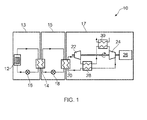
- a sodium fast reactor plant is indicated generally at 10.
- the reactor plant includes a first sodium circuit 13, a second sodium circuit 15 and a nitrogen gas cycle 17.
- the first sodium circuit 13 includes a reactor core where heat energy is generated.
- a first flow of liquid sodium is circulated to the core for cooling. In the cooling process the liquid sodium is heated.
- the first flow of liquid sodium is then circulated from the core to a first heat exchanger 14 before being circulated back to the core.
- the liquid sodium is circulated around the first sodium circuit by a pump 16.
- the second sodium circuit 15 includes a second flow of liquid sodium.
- the second flow of liquid sodium is circulated to the first heat exchanger 14 where heat is transferred from the first flow of liquid sodium to the second flow of liquid sodium.
- the second flow of liquid sodium then flows to a second or intermediate heat exchanger 20 before being circulated back to the first heat exchanger.
- the second flow of liquid sodium is circulated around the second sodium circuit by a pump 18.
- the nitrogen gas cycle 17 includes a flow of nitrogen gas.
- the nitrogen gas is circulated to the intermediate heat exchanger 20 where heat is transferred from the second flow of liquid sodium to the nitrogen. Nitrogen then flows from the heat exchanger to a turbine 22.
- the turbine 22 is connected to a compressor 24 and an electrical generator 26. Nitrogen gas flows from the turbine 22 to a recuperator 28, then to a heat sink 30, before being directed to the compressor 24.
- the nitrogen gas flows from the compressor to the recuperator where the nitrogen gas is pre-heated before being directed to the intermediate heat exchanger 20. In this way electricity can be generated from a nuclear core.
- the heat exchanger 20 will now be described in more detail with reference to Figures 2 to 9 .
- the heat exchanger 20 is a plate-fin heat exchanger.
- the heat exchanger includes a plurality of heat exchange modules 32.
- the heat exchange modules are linearly arranged adjacent each other.
- Each heat exchanger module is axially aligned with a neighbouring heat exchange module.
- each heat exchange module has a height H greater than the width W.
- the height H is 1.2 to 1.6 times the width W.
- the heat exchange modules are dimensioned and stacked such that the longitudinal length L of the heat exchanger 20 is 3 to 5 times the width W of the heat exchange modules.
- 18 modules are provided, but any suitable number may be provided.
- different ratios of height H, width W and length L may be provided than those described for the present embodiment.
- each heat exchange module defines a plurality of hot fluid flow paths 62 and a plurality of cold fluid flow paths 60.
- the liquid sodium (which may be referred to as the primary fluid) is circulated along the hot fluid flow paths and the nitrogen gas (which may be referred to as the secondary fluid) is circulated along the cold fluid flow paths.
- the fluid flow paths will be described in more detail later.
- each module 32 has a corner recess or cut-in 48, 50 so as to accommodate a portion of a manifold 34, 35, 36 or 37.
- the cross section of each manifold is circular so the recesses are a circular segment shape.
- two of the recesses 48 are larger than the other two recesses 50.
- manifolds 34, 35, 36, 37 are provided at each corner of the heat exchanger.
- Two entry manifolds 34, 36 and two exit manifolds 35, 37 are provided.
- the entry manifolds 34, 36 are, in use, positioned at an upper end of the heat exchanger and the exit manifolds 35, 37 are, in use, positioned at a lower end of the heat exchanger.
- the entry manifold for supplying the cold fluid to the cold fluid flow paths (referred to from here-on-in as the cold entry manifold 34) and the exit manifold for receiving the cold fluid from the cold fluid flow paths (referred to from here-on-in as the cold exit manifold 37) are at diagonally opposing corners.
- the entry manifold for supplying the hot fluid to the hot fluid flow paths (referred to from here-on-in as the hot entry manifold 36) and the exit manifold for receiving the hot fluid from the hot fluid flow paths (referred to from here-on-in as the hot exit manifold 35) are at diagonally opposing corners.
- the manifolds 34, 35, 36 and 37 are elongate and extend from one axial end of the heat exchanger 20 to the opposing axial end of the heat exchanger 20.
- the manifolds have a circular cross-section, e.g. they can be considered to be substantially cylindrical tubes.
- the manifolds may have any other suitable cross section, e.g. oval.
- the cold entry manifold 34 and the cold exit manifold 37 have a similar or equal diameter
- the hot entry manifold 36 and the hot exit manifold 35 have a similar or equal diameter.
- the cold entry and exit manifolds have a larger cross section (e.g. a greater diameter) than the hot entry and exit manifolds.
- the entry and exit manifolds 34, 35, 36 and 37 include a plurality of openings along the length thereof that are arranged to align with the corresponding fluid flow path so that the entry and exit manifolds are in fluid communication with the corresponding cold or hot fluid flow paths 60, 62.
- the cold entry manifold 34 includes a single inlet 38 and the cold exit manifold 35 includes a single outlet 40.
- the inlet 38 and the outlet 40 of the cold manifolds are provided at one axial end of the manifold and are provided on the same axial face of the heat exchanger.
- the opposite axial ends of the cold manifolds are closed off by a cap 42.
- the inlet and the outlet may be provided at opposite axial ends of the heat exchanger or provided at a position along the longitudinal length of the manifold.
- the hot entry manifold 36 includes two inlets 44 and the hot exit manifold 37 includes two outlets 46.
- the inlets 44 and the outlets 46 are provided at the axial ends of the manifold, e.g. on the axial end faces of the heat exchanger.
- the inlets and outlets 46 may be provided at any position along the axial length of the manifold, but improved results have been found when the inlets and outlets are provided at or near the axial ends of the manifolds.
- Each cold flow path 60 flows from one of the openings in the cold inlet manifold to one of the openings in the cold outlet manifold.
- Each hot flow path 62 flows from one of the openings in the hot inlet manifold to one of the openings in the hot outlet manifold.
- the fluid flow paths are arranged so that each fluid flow path is substantially the same length.
- the modules 32 include a plurality of plates 54 and fins 56.
- Various methods of forming fluid flow paths with plates and fins are known in the art, but one example is illustrated in Figure 7 .
- plates are stacked with fins separating the plates and forming channels 58.
- the channels 58 define the or at least part of the fluid flow paths.
- the fins are connected to the plates using diffusion bonding and the structure is formed using super plastic forming, similar to the diffusion bonding super plastic forming method described in WO92/15830 which is incorporated herein by reference.
- the inlets 44 of the hot entry manifold are connected to receive a flow of liquid sodium from the first heat exchanger 14 of the second sodium circuit 15, and the outlets 46 of the hot exit manifold are connected to deliver a flow of liquid sodium to the pump 18 to be circulated to the first heat exchanger 14.
- the inlet 38 of the cold entry manifold is connected to a flow of gaseous nitrogen from the recouperator 28 of the nitrogen gas cycle, and the outlet 40 of the cold exit manifold is connected to deliver a flow of gaseous nitrogen to the turbine 22 of the nitrogen gas cycle.
- the liquid sodium may enter the heat exchanger 20 at a temperature exceeding 520°C and at approximately atmospheric pressure.
- the liquid sodium may exit the heat exchanger 20 at a temperature below 400°C and at approximately atmospheric pressure.
- the gaseous nitrogen may enter the heat exchanger 20 at a temperature below 370°C and a pressure above 150 bar.
- the gaseous nitrogen may exit the heat exchanger 20 at a temperature above 500°C and at a pressure above 150 bar.
- the described heat exchanger has been found to provide an increased thermal duty compared to plate-fin heat exchangers of the prior art.
- the described heat exchanger occupies a smaller volume for a given thermal density than a U-tubed heat exchanger of the prior art.
- the pressure drop of the cold fluid flowing through the heat exchanger has been reduced by increasing the cross-sectional area of the cold fluid manifolds. It is particularly beneficial to reduce the pressure drop of the cold fluid because the cold fluid flows to the turbine.
- the pressure drop of the fluid flow in the heat exchanger and the thermal duty of the heat exchanger has been found to be optimised by accommodating part of the manifold in a region that would otherwise be occupied by the modules and part of the manifold outside of the modules. This is contrary to prior art arrangements where the manifold is provided entirely outside the, usually rectangular modules, (known in the art as an external manifold), or the manifold is accommodated entirely within a region that would be otherwise occupied by the modules (known in the art as an internal manifold).
- the flow through the heat exchanger has been described as a counter-flow arrangement, but in alternative embodiments a cross-flow or co-flow arrangement may be used.
- the heat exchanger has been described as being used in a sodium fast reactor, with sodium as the primary fluid and nitrogen as the secondary fluid.
- the heat exchanger may be used with an alternative reactor or in a non-nuclear application.
- the reactor may be a sodium fast reactor having sodium as the primary fluid and water as the secondary fluid.
- the reactor may be a pressurised water reactor, boiling water reactor, a molten salt reactor, a gas cooled reactor or an alternative type of liquid metal cooled reactor.
- the described heat exchanger may form the first heat exchanger 14 or the recuperator 28 of the sodium fast reactor plant shown in Figure 1 .
- the primary and secondary fluid may be selected depending on the reactor type or the relevant application, for example, the primary and secondary fluid may both be water.
Landscapes
- Engineering & Computer Science (AREA)
- Physics & Mathematics (AREA)
- Mechanical Engineering (AREA)
- General Engineering & Computer Science (AREA)
- Thermal Sciences (AREA)
- Life Sciences & Earth Sciences (AREA)
- High Energy & Nuclear Physics (AREA)
- Sustainable Development (AREA)
- Sustainable Energy (AREA)
- Chemical & Material Sciences (AREA)
- Combustion & Propulsion (AREA)
- Heat-Exchange Devices With Radiators And Conduit Assemblies (AREA)
Abstract
Description
- The present invention relates to a heat exchanger, in particular but not exclusively a heat exchanger for a nuclear reactor plant.
- Typically, a nuclear power plant includes a nuclear core, a heat exchanger, a turbine and a condenser. A primary fluid is circulated to the core where the primary fluid cools the core and in the process is heated. The heated primary fluid is then directed to a hot side of the heat exchanger. A secondary fluid is directed to a cold side of the heat exchanger and heat is transferred from the primary fluid to the secondary fluid. Upon exiting the heat exchanger the secondary fluid is directed to the turbine. The turbine is generally connected to a generator to generate electricity.
- Generally, to deal with the heat transfer requirements of a nuclear power plant, the heat exchanger is usually of the shell and tube type. The primary or the secondary fluid may be directed through the tubes and the secondary or primary fluid may be directed around the tubes within the shell. The walls of the tubes provide a barrier to reduce the risk of the primary fluid contaminating the secondary fluid. The shell and tube heat exchangers are generally extremely large; for example in some applications the height of the heat exchanger can be around 20m.
- In non-nuclear applications, other types of heat exchangers are used. For example a plate-fin type heat exchanger. An example of such a heat exchanger used in the oil and gas industry is described in
WO92/15830 - The present invention seeks to provide a more compact heat exchanger suitable for a nuclear power plant.
- A first aspect of the disclosure provides a plate-fin heat exchanger for transferring heat from a hot low pressure fluid to a cold high pressure fluid. The heat exchanger comprises a plurality of adjacent heat exchange modules, each heat exchange module comprising a plurality of plates and fins that define a plurality of hot fluid flow paths and a plurality of cold fluid flow paths. A first entry manifold is provided for delivering hot fluid to each of the plurality of the hot fluid flow paths and a second entry manifold is provided for delivering cold fluid to each of the plurality of cold fluid flow paths. A first exit manifold is provided for receiving hot fluid from each of the plurality of hot fluid flow paths and a second exit manifold is provided for receiving cold fluid from each of the plurality of cold fluid flow paths. The heat exchange modules are adjacently stacked and arranged such that the axial length of the heat exchanger is at least twice the height of the heat exchanger.
- The heat exchanger of the first aspect can be configured to have increased thermal duty compared to a plate-fin heat exchanger of the prior art having a similar volume.
- The heat exchanger of the first aspect can be configured to have a thermal duty suitable for a nuclear power plant.
- The person skilled in the art understands that reference to a hot fluid refers to a fluid that is relatively hotter than the cold fluid, and reference to a cold fluid refers to a fluid that is relatively colder than the hot fluid, as is conventional in the art. Alternatively, the hot fluid may be referred to as the primary fluid and the hot fluid flow path may be referred to as the primary fluid flow path. The cold fluid may be referred to as the secondary fluid and the cold fluid flow path may be referred to as the secondary fluid flow path. Further alternatively, the hot fluid may be considered a first fluid and the cold fluid may be considered a second fluid, the first fluid being hotter than the second fluid.
- Reference to low pressure and high pressure refers to the relative pressure of the hot and cold fluids. By way of example only, the low pressure fluid may be at approximately atmospheric pressure and the high pressure fluid may be at a pressure greater than or equal to 100 bar, for example greater than or equal to 150 bar, for example between 150 bar and 200 bar.
- Each manifold may extend from one axial end of the heat exchanger to the opposite axial end of the heat exchanger so as to connect to each of the corresponding plurality of hot or cold fluid flow paths.
- The first entry manifold may comprise two inlets through which fluid can enter the entry manifold. The first exit manifold may comprise two outlets through which the hot fluid can exit the exit manifold.
- The provision of two inlets and two outlets has been found to improve the distribution of hot fluid in the heat exchanger which in turn can improve the thermal duty of the heat exchanger. The provision of two inlets and two outlets has been found to be particularly beneficial when the length of the heat exchanger is greater than or equal to two times the height of the heat exchanger.
- The entry and exit manifolds may include a plurality of openings along the length thereof and aligned with the corresponding plurality of hot or cold fluid flow paths.
- One inlet may be at an axial end of the first entry manifold and the other inlet may be at the opposite axial end of the first entry manifold.
- One outlet may be at an axial end of the first exit manifold and the other outlet may be at the opposite axial end of the first exit manifold.
- The second entry manifold may comprise a single inlet through which cold fluid can enter the second entry manifold. The second exit manifold may comprise a single outlet through which the cold fluid can exit the second exit manifold.
- The inlet of the second entry manifold and the outlet of the second exit manifold may be provided on the same axial end of the heat exchanger.
- The axial end of the second entry manifold opposite the inlet may be capped. The axial end of the second exit manifold opposite the outlet may be capped.
- The cross sectional area of the second inlet manifold may be larger than the cross sectional area of the first inlet manifold. The cross sectional area of the second outlet manifold may be larger than the cross sectional area of the first outlet manifold.
- The axial length of the heat exchanger may be at least four times the width of the heat exchanger.
- The axial length of the heat exchanger may be equal to or between two and four times the height of the heat exchanger. The axial length of the heat exchanger may be at least three times the width of the heat exchanger.
- The heat exchanger may comprise equal to or more than 10 modules, for example equal to or more than 15 modules or equal to or more than 18 modules. Each module may comprise 15 to 30 cold fluid flow paths and 15 to 30 hot fluid flow paths.
- Each entry and exit manifold may be accommodated partially within a region defined by the modules and extends partially outside a region defined by the modules.
- For example, each manifold may comprise a recess in each corner that is shaped and dimensioned to accommodate a portion of the manifold.
- The entry manifolds may be positioned in an upper region of the heat exchanger and the exit manifold may be positioned in a lower region of the heat exchanger. The first entry manifold may be positioned in one corner of the modules and the first outlet manifold may be positioned in a corner diagonally opposite the first entry manifold. The second entry manifold may be positioned in one corner of the modules and the second outlet manifold may be positioned in a corner diagonally opposite the entry manifold.
- The entry and exit manifolds may define a cylindrical tube.
- A second aspect of the disclosure provides a plate-fin heat exchanger for transferring heat from a hot low pressure fluid to a cold high pressure fluid. The heat exchanger may comprise a plurality of adjacent heat exchange modules, each heat exchange module comprising a plurality of plates and fins that define a plurality of hot fluid flow paths and a plurality of cold fluid flow paths. A first entry manifold is provided for delivering hot fluid to each of the plurality of the hot fluid flow paths and a second entry manifold is provided for delivering cold fluid to each of the plurality of cold fluid flow paths. A first exit manifold is provided for receiving hot fluid from each of the plurality of hot fluid flow paths and a second exit manifold is provided for receiving cold fluid from each of the plurality of cold fluid flow paths. The first entry manifold comprises two inlets through which hot fluid can enter the heat exchanger and the first exit manifold comprises two outlets through which the hot fluid can exit the heat exchanger.
- As will be appreciated by the person skilled in the art in view of the disclosure of the present application, the heat exchanger of the second aspect may have one or more optional features of the heat exchanger of the second aspect.
- A third aspect of the disclosure provides a plate-fin heat exchanger for transferring heat from a hot low pressure fluid to a cold high pressure fluid. The heat exchanger may comprise a plurality of adjacent heat exchange modules, each heat exchange module comprising a plurality of plates and fins that define a plurality of hot fluid flow paths and a plurality of cold fluid flow paths. A first entry manifold is provided for delivering hot fluid to each of the plurality of the hot fluid flow paths and a second entry manifold is provided for delivering cold fluid to each of the plurality of cold fluid flow paths. A first exit manifold is provided for receiving hot fluid from each of the plurality of hot fluid flow paths and a second exit manifold is provided for receiving cold fluid from each of the plurality of cold fluid flow paths. The modules comprise a recess in each corner thereof for partially accommodating one of the manifolds, such that a portion of each manifold is accommodated within a region defined by the modules and a portion of each manifold is outside a region defined by the modules.
- A fourth aspect of the disclosure provides a nuclear reactor fin-plate heat exchanger for use in a sodium fast reactor plant.
- The inventors have gone against the prejudice in the art and designed a fin-plate type heat exchanger of transferring heat from a hot (or primary) fluid to a cold (or secondary) fluid in a nuclear power plant.
- A fifth aspect of the disclosure provides a use of the heat exchanger according to the first and/or second aspect, wherein the hot low pressure fluid is liquid sodium and the cold high pressure fluid is nitrogen gas.
- A sixth aspect of the disclosure provides a nuclear reactor plant comprising the heat exchanger according to the first, second, third and/or fourth aspects.
- The nuclear reactor plant may be a sodium fast reactor plant.
- The invention will now be described, by way of example only, with reference to the accompanying drawings in which:
-
Figure 1 illustrates a schematic of a sodium fast reactor nuclear power plant; -
Figure 2 illustrates a perspective view of a heat exchanger suitable for use in the nuclear power plant ofFigure 1 ; -
Figures 3 and4 illustrate end views of the heat exchanger ofFigure 2 ; -
Figure 5 illustrates a perspective view of two modules of the heat exchanger ofFigure 2 ; -
Figure 6 illustrates a perspective view of two modules and a manifold of the heat exchanger ofFigure 2 ; -
Figure 7 illustrates a cross sectional view through a plate-fin arrangement of a module ofFigure 6 ; -
Figures 8 illustrate a fluid flow path of hot fluid through a plate-fin arrangement ofFigure 7 ; and -
Figure 9 illustrates a fluid flow path of cold fluid through a plate-fin arrangement ofFigure 7 . - Referring to
Figure 1 , a sodium fast reactor plant is indicated generally at 10. The reactor plant includes afirst sodium circuit 13, asecond sodium circuit 15 and a nitrogen gas cycle 17. Thefirst sodium circuit 13 includes a reactor core where heat energy is generated. A first flow of liquid sodium is circulated to the core for cooling.
In the cooling process the liquid sodium is heated. The first flow of liquid sodium is then circulated from the core to afirst heat exchanger 14 before being circulated back to the core. The liquid sodium is circulated around the first sodium circuit by apump 16. - The
second sodium circuit 15 includes a second flow of liquid sodium. The second flow of liquid sodium is circulated to thefirst heat exchanger 14 where heat is transferred from the first flow of liquid sodium to the second flow of liquid sodium. The second flow of liquid sodium then flows to a second orintermediate heat exchanger 20 before being circulated back to the first heat exchanger. The second flow of liquid sodium is circulated around the second sodium circuit by apump 18. - The nitrogen gas cycle 17 includes a flow of nitrogen gas. The nitrogen gas is circulated to the
intermediate heat exchanger 20 where heat is transferred from the second flow of liquid sodium to the nitrogen. Nitrogen then flows from the heat exchanger to aturbine 22. Theturbine 22 is connected to acompressor 24 and anelectrical generator 26. Nitrogen gas flows from theturbine 22 to arecuperator 28, then to aheat sink 30, before being directed to thecompressor 24. The nitrogen gas flows from the compressor to the recuperator where the nitrogen gas is pre-heated before being directed to theintermediate heat exchanger 20. In this way electricity can be generated from a nuclear core. - The
heat exchanger 20 will now be described in more detail with reference toFigures 2 to 9 . - The
heat exchanger 20 is a plate-fin heat exchanger. The heat exchanger includes a plurality ofheat exchange modules 32. The heat exchange modules are linearly arranged adjacent each other. Each heat exchanger module is axially aligned with a neighbouring heat exchange module. - In the present embodiment, each heat exchange module has a height H greater than the width W. In the present embodiment the height H is 1.2 to 1.6 times the width W. The heat exchange modules are dimensioned and stacked such that the longitudinal length L of the
heat exchanger 20 is 3 to 5 times the width W of the heat exchange modules. In thepresent embodiment 18 modules are provided, but any suitable number may be provided. Furthermore, different ratios of height H, width W and length L may be provided than those described for the present embodiment. - As shown most clearly in
Figures 8 and9 , each heat exchange module defines a plurality of hotfluid flow paths 62 and a plurality of coldfluid flow paths 60. The liquid sodium (which may be referred to as the primary fluid) is circulated along the hot fluid flow paths and the nitrogen gas (which may be referred to as the secondary fluid) is circulated along the cold fluid flow paths. The fluid flow paths will be described in more detail later. - Referring in particular to
Figures 5 and 6 , eachmodule 32 has a corner recess or cut-in 48, 50 so as to accommodate a portion of a manifold 34, 35, 36 or 37. In the present embodiment the cross section of each manifold is circular so the recesses are a circular segment shape. As will be understood later with respect to the description of the manifolds, two of therecesses 48 are larger than the other tworecesses 50. - Referring now to
Figures 2 to 4 ,manifolds exit manifolds - The
manifolds heat exchanger 20 to the opposing axial end of theheat exchanger 20. In the present embodiment the manifolds have a circular cross-section, e.g. they can be considered to be substantially cylindrical tubes. However, in alternative embodiments the manifolds may have any other suitable cross section, e.g. oval. Thecold entry manifold 34 and thecold exit manifold 37 have a similar or equal diameter, and thehot entry manifold 36 and thehot exit manifold 35 have a similar or equal diameter. The cold entry and exit manifolds have a larger cross section (e.g. a greater diameter) than the hot entry and exit manifolds. - The entry and exit manifolds 34, 35, 36 and 37 include a plurality of openings along the length thereof that are arranged to align with the corresponding fluid flow path so that the entry and exit manifolds are in fluid communication with the corresponding cold or hot
fluid flow paths - The
cold entry manifold 34 includes asingle inlet 38 and thecold exit manifold 35 includes asingle outlet 40. Theinlet 38 and theoutlet 40 of the cold manifolds are provided at one axial end of the manifold and are provided on the same axial face of the heat exchanger. The opposite axial ends of the cold manifolds are closed off by acap 42. In alternative embodiments the inlet and the outlet may be provided at opposite axial ends of the heat exchanger or provided at a position along the longitudinal length of the manifold. - The
hot entry manifold 36 includes twoinlets 44 and thehot exit manifold 37 includes twooutlets 46. Theinlets 44 and theoutlets 46 are provided at the axial ends of the manifold, e.g. on the axial end faces of the heat exchanger. However, in alternative embodiments the inlets andoutlets 46 may be provided at any position along the axial length of the manifold, but improved results have been found when the inlets and outlets are provided at or near the axial ends of the manifolds. - The
fluid flow paths modules 32 are shown in more detail inFigures 7 to 9 . Eachcold flow path 60 flows from one of the openings in the cold inlet manifold to one of the openings in the cold outlet manifold. Eachhot flow path 62 flows from one of the openings in the hot inlet manifold to one of the openings in the hot outlet manifold. The fluid flow paths are arranged so that each fluid flow path is substantially the same length. - The
modules 32 include a plurality ofplates 54 andfins 56. Various methods of forming fluid flow paths with plates and fins are known in the art, but one example is illustrated inFigure 7 . As shown inFigure 7 , plates are stacked with fins separating the plates and formingchannels 58. Thechannels 58 define the or at least part of the fluid flow paths. In the presently described embodiment the fins are connected to the plates using diffusion bonding and the structure is formed using super plastic forming, similar to the diffusion bonding super plastic forming method described inWO92/15830 - In use, the
inlets 44 of the hot entry manifold are connected to receive a flow of liquid sodium from thefirst heat exchanger 14 of thesecond sodium circuit 15, and theoutlets 46 of the hot exit manifold are connected to deliver a flow of liquid sodium to thepump 18 to be circulated to thefirst heat exchanger 14. Theinlet 38 of the cold entry manifold is connected to a flow of gaseous nitrogen from therecouperator 28 of the nitrogen gas cycle, and theoutlet 40 of the cold exit manifold is connected to deliver a flow of gaseous nitrogen to theturbine 22 of the nitrogen gas cycle. By way of example only, the liquid sodium may enter theheat exchanger 20 at a temperature exceeding 520°C and at approximately atmospheric pressure. The liquid sodium may exit theheat exchanger 20 at a temperature below 400°C and at approximately atmospheric pressure. The gaseous nitrogen may enter theheat exchanger 20 at a temperature below 370°C and a pressure above 150 bar. The gaseous nitrogen may exit theheat exchanger 20 at a temperature above 500°C and at a pressure above 150 bar. - The described heat exchanger has been found to provide an increased thermal duty compared to plate-fin heat exchangers of the prior art. The described heat exchanger occupies a smaller volume for a given thermal density than a U-tubed heat exchanger of the prior art.
- Several arrangements of heat exchangers were tested to review the benefit of having two inlets and two outlets on the hot fluid manifolds. Firstly, a similar arrangement of heat exchanger as shown in
Figure 2 was used, but only one inlet was provided in the hot entry manifold and only one inlet was provided in the hot exit manifold, the inlets were positioned on the same axial end of the heat exchanger. In this arrangement there was a large flow rate at the axial end near the inlets, but this flow rate decreased towards the opposite axial end of the heat exchanger (i.e. the end without an inlet or outlet in the hot fluid manifolds). When a single inlet was provided at one axial end of the heat exchanger and a single outlet was provided at an opposite axial end of the heat exchanger, a low flow rate was seen in a region near the inlet and a high flow rate was seen in a region near the outlet. A further alternative arrangement tested was to position the inlet and the outlet mid-way between the axial ends of the heat exchanger. In this arrangement, the flow rate was high in a central region of the heat exchanger but much lower at axial ends of the heat exchanger. The described example heat exchanger with two inlets and two outlets was found to have reduced pressure losses and improved fluid distribution compared to the tested arrangements. Reduced pressure losses and improved fluid distribution can contribute to an increase in the thermal duty of the heat exchanger. - The pressure drop of the cold fluid flowing through the heat exchanger has been reduced by increasing the cross-sectional area of the cold fluid manifolds. It is particularly beneficial to reduce the pressure drop of the cold fluid because the cold fluid flows to the turbine.
- The pressure drop of the fluid flow in the heat exchanger and the thermal duty of the heat exchanger has been found to be optimised by accommodating part of the manifold in a region that would otherwise be occupied by the modules and part of the manifold outside of the modules. This is contrary to prior art arrangements where the manifold is provided entirely outside the, usually rectangular modules, (known in the art as an external manifold), or the manifold is accommodated entirely within a region that would be otherwise occupied by the modules (known in the art as an internal manifold).
- It will be appreciated by one skilled in the art that, where technical features have been described in association with one or more embodiments, this does not preclude the combination or replacement with features from other embodiments where this is appropriate. Furthermore, equivalent modifications and variations will be apparent to those skilled in the art from this disclosure. Accordingly, the exemplary embodiments of the invention set forth above are considered to be illustrative and not limiting.
- The flow through the heat exchanger has been described as a counter-flow arrangement, but in alternative embodiments a cross-flow or co-flow arrangement may be used.
- The heat exchanger has been described as being used in a sodium fast reactor, with sodium as the primary fluid and nitrogen as the secondary fluid. However, in alternative embodiments the heat exchanger may be used with an alternative reactor or in a non-nuclear application. For example, the reactor may be a sodium fast reactor having sodium as the primary fluid and water as the secondary fluid. Further alternatively, the reactor may be a pressurised water reactor, boiling water reactor, a molten salt reactor, a gas cooled reactor or an alternative type of liquid metal cooled reactor.
- In alternative embodiments, the described heat exchanger may form the
first heat exchanger 14 or therecuperator 28 of the sodium fast reactor plant shown inFigure 1 . - The primary and secondary fluid may be selected depending on the reactor type or the relevant application, for example, the primary and secondary fluid may both be water.
Claims (14)
- A plate-fin heat exchanger for transferring heat from a hot low pressure fluid to a cold high pressure fluid, the heat exchanger comprising:a plurality of adjacent heat exchange modules, each heat exchange module comprising a plurality of plates and fins that define a plurality of hot fluid flow paths and a plurality of cold fluid flow paths;a first entry manifold for delivering hot fluid to each of the plurality of the hot fluid flow paths and a second entry manifold for delivering cold fluid to each of the plurality of cold fluid flow paths;a first exit manifold for receiving hot fluid from each of the plurality of hot fluid flow paths and a second exit manifold for receiving cold fluid from each of the plurality of cold fluid flow paths;wherein the first entry manifold comprises two inlets through which hot fluid can enter the heat exchanger and the first exit manifold comprises two outlets through which the hot fluid can exit the heat exchanger.
- The heat exchanger according to claim 1, wherein the heat exchange modules are adjacently stacked and arranged such that the axial length of the heat exchanger is at least twice the height of the heat exchanger.
- The heat exchanger according to claim 1 or 2, wherein each manifold extends from one axial end of the heat exchanger to the opposite axial end of the each exchanger so as to connect to each of the corresponding plurality of hot or cold fluid flow paths.
- The heat exchanger according to any one of the previous claims, wherein one inlet is at an axial end of the first entry manifold and the other inlet is at the opposite axial end of the first entry manifold.
- The heat exchanger according to any one of the previous claims, wherein one outlet is at an axial end of the first exit manifold and the other outlet is at the opposite axial end of the first exit manifold.
- The heat exchanger according to any one of the previous claims, wherein the second entry manifold comprises a single inlet through which cold fluid can enter the second entry manifold and the second exit manifold comprises a single outlet through which the cold fluid can exit the second exit manifold.
- The heat exchanger according to claim 6, wherein the inlet of the second entry manifold and the outlet of the second exit manifold are provided on the same axial end of the heat exchanger.
- The heat exchanger according to any of the previous claims, wherein the cross sectional area of the second inlet manifold and/or the second outlet manifold is larger than the cross sectional area of the first inlet manifold and/or the first outlet manifold.
- The heat exchanger according to any one of the previous claims, wherein the axial length of the heat exchanger is at least four times the width of the heat exchanger.
- The heat exchanger according to any one of the previous claims, wherein each entry and exit manifold is accommodated partially within a region defined by the modules and extends partially outside a region defined by the modules.
- The heat exchanger according to any one of the previous claims, wherein the entry and exit manifolds define a cylindrical tube.
- The use of the heat exchanger according to any one of the previous claims, wherein the hot low pressure fluid is liquid sodium and the cold high pressure fluid is nitrogen gas.
- A nuclear reactor plant comprising the heat exchanger according to any one of claims 1 to 11.
- The nuclear reactor plant according to claim 13, wherein the nuclear reactor plant is a sodium fast reactor plant.
Applications Claiming Priority (2)
| Application Number | Priority Date | Filing Date | Title |
|---|---|---|---|
| GBGB1418403.0A GB201418403D0 (en) | 2014-10-17 | 2014-10-17 | Heat exchanger |
| GBGB1418404.8A GB201418404D0 (en) | 2014-10-17 | 2014-10-17 | Heat exchanger |
Publications (2)
| Publication Number | Publication Date |
|---|---|
| EP3009781A1 true EP3009781A1 (en) | 2016-04-20 |
| EP3009781B1 EP3009781B1 (en) | 2018-08-29 |
Family
ID=54207400
Family Applications (1)
| Application Number | Title | Priority Date | Filing Date |
|---|---|---|---|
| EP15187099.5A Active EP3009781B1 (en) | 2014-10-17 | 2015-09-28 | Heat exchanger |
Country Status (2)
| Country | Link |
|---|---|
| US (1) | US20160109189A1 (en) |
| EP (1) | EP3009781B1 (en) |
Cited By (1)
| Publication number | Priority date | Publication date | Assignee | Title |
|---|---|---|---|---|
| WO2018024765A1 (en) * | 2016-08-03 | 2018-02-08 | Commissariat A L'energie Atomique Et Aux Energies Alternatives | Plate heat exchanger module for which the channels integrate as input a uniform flow distribution zone and a fluid bifurcation zone |
Families Citing this family (6)
| Publication number | Priority date | Publication date | Assignee | Title |
|---|---|---|---|---|
| US11536521B2 (en) | 2018-02-23 | 2022-12-27 | Unison Industries, Llc | Heat exchanger assembly with a manifold additively manufactured onto a core and method of forming |
| EP3614087B1 (en) * | 2018-08-24 | 2020-12-16 | Alfa Laval Corporate AB | Heat transfer plate and cassette for plate heat exchanger |
| US11035626B2 (en) * | 2018-09-10 | 2021-06-15 | Hamilton Sunstrand Corporation | Heat exchanger with enhanced end sheet heat transfer |
| JP2023538046A (en) | 2020-08-17 | 2023-09-06 | テラパワー, エルエルシー | Heat exchanger configuration for nuclear reactor |
| GB202019056D0 (en) * | 2020-12-03 | 2021-01-20 | Bae Systems Plc | Heat exchanger |
| CN116182600B (en) * | 2022-12-26 | 2026-04-03 | 西安交通大学 | A Brayton cycle integrated heat exchanger and heat exchange method for a submersible |
Citations (4)
| Publication number | Priority date | Publication date | Assignee | Title |
|---|---|---|---|---|
| GB920251A (en) * | 1960-11-18 | 1963-03-06 | Parsons C A & Co Ltd | Improvements in and relating to plate type heat exchangers |
| US5069276A (en) * | 1990-02-08 | 1991-12-03 | Oran Heating Equipment Limited | Heat exchanger assembly and panel therefor |
| JPH07159076A (en) * | 1993-12-08 | 1995-06-20 | Nissan Motor Co Ltd | Stacked heat exchanger |
| US5775412A (en) * | 1996-01-11 | 1998-07-07 | Gidding Engineering, Inc. | High pressure dense heat transfer area heat exchanger |
Family Cites Families (8)
| Publication number | Priority date | Publication date | Assignee | Title |
|---|---|---|---|---|
| US2875986A (en) * | 1957-04-12 | 1959-03-03 | Ferrotherm Company | Heat exchanger |
| US3866674A (en) * | 1973-10-01 | 1975-02-18 | Gen Electric | Gas turbine regenerator |
| US4749032A (en) * | 1979-10-01 | 1988-06-07 | Rockwell International Corporation | Internally manifolded unibody plate for a plate/fin-type heat exchanger |
| US5469914A (en) * | 1993-06-14 | 1995-11-28 | Tranter, Inc. | All-welded plate heat exchanger |
| JP3530939B2 (en) * | 2001-08-09 | 2004-05-24 | 東京工業大学長 | Reactor plant |
| RU2276813C1 (en) * | 2005-05-25 | 2006-05-20 | Михаил Юрьевич Кудрявцев | Nuclear power plant and steam turbine |
| US8844610B2 (en) * | 2008-09-18 | 2014-09-30 | Multistack, LLC | Double inlet heat exchanger |
| FR2945612B1 (en) * | 2009-05-18 | 2011-07-22 | Alfa Laval Vicarb | METHOD FOR MANUFACTURING A PLATE BEAM FOR A THERMAL EXCHANGER |
-
2015
- 2015-09-28 EP EP15187099.5A patent/EP3009781B1/en active Active
- 2015-09-28 US US14/867,905 patent/US20160109189A1/en not_active Abandoned
Patent Citations (4)
| Publication number | Priority date | Publication date | Assignee | Title |
|---|---|---|---|---|
| GB920251A (en) * | 1960-11-18 | 1963-03-06 | Parsons C A & Co Ltd | Improvements in and relating to plate type heat exchangers |
| US5069276A (en) * | 1990-02-08 | 1991-12-03 | Oran Heating Equipment Limited | Heat exchanger assembly and panel therefor |
| JPH07159076A (en) * | 1993-12-08 | 1995-06-20 | Nissan Motor Co Ltd | Stacked heat exchanger |
| US5775412A (en) * | 1996-01-11 | 1998-07-07 | Gidding Engineering, Inc. | High pressure dense heat transfer area heat exchanger |
Cited By (5)
| Publication number | Priority date | Publication date | Assignee | Title |
|---|---|---|---|---|
| WO2018024765A1 (en) * | 2016-08-03 | 2018-02-08 | Commissariat A L'energie Atomique Et Aux Energies Alternatives | Plate heat exchanger module for which the channels integrate as input a uniform flow distribution zone and a fluid bifurcation zone |
| FR3054879A1 (en) * | 2016-08-03 | 2018-02-09 | Commissariat Energie Atomique | PLATE HEAT EXCHANGER MODULE HAVING CHANNELS INTEGRATING A UNIFORM FLOW DISTRIBUTION AREA AND A FLUID BIFURCATION AREA |
| CN109642779A (en) * | 2016-08-03 | 2019-04-16 | 原子能与替代能源委员会 | Channel by uniform flux distributed areas and fluid fork regional ensemble be entrance heat-exchangers of the plate type module |
| CN109642779B (en) * | 2016-08-03 | 2021-10-26 | 原子能与替代能源委员会 | Plate heat exchanger module with channels integrating uniform flow distribution area and fluid bifurcation area as inlet |
| US11340028B2 (en) | 2016-08-03 | 2022-05-24 | Commissariat A L'energie Atomique Et Aux Energies Alternatives | Plate heat exchanger module for which the channels integrate as input a uniform flow distribution zone and a fluid bifurcation zone |
Also Published As
| Publication number | Publication date |
|---|---|
| EP3009781B1 (en) | 2018-08-29 |
| US20160109189A1 (en) | 2016-04-21 |
Similar Documents
| Publication | Publication Date | Title |
|---|---|---|
| EP3009781B1 (en) | Heat exchanger | |
| CN105683696B (en) | For steam generator heat exchanger and include the steam generator of this heat exchanger | |
| EP3702712B1 (en) | Outer fin heat exchange tube and use method therefor | |
| US11340028B2 (en) | Plate heat exchanger module for which the channels integrate as input a uniform flow distribution zone and a fluid bifurcation zone | |
| KR101535478B1 (en) | Passive heat removal system and nuclear power plant having the same | |
| US10415888B2 (en) | Heat exchanger for exchanging heat between two fluids, use of the exchanger with liquid metal and gas, application to a fast neutron nuclear reactor cooled with liquid metal | |
| US11280554B2 (en) | Fractal heat exchanger with bypass | |
| EP3848664B1 (en) | Compact gas-gas heat exchange tube and manufacturing and use methods therefor | |
| KR102506094B1 (en) | Single pass cross-flow heat exchanger | |
| KR101529529B1 (en) | Passive containment cooling system and nuclear power plant having the same | |
| US12152840B2 (en) | Heat exchanger module of the type having plates comprising channels incorporating at least one fluid supply and distribution zone formed by studs | |
| US20070169924A1 (en) | Heat exchanger installation | |
| EP3196582A1 (en) | Heat exchanger with enhanced heat transfer | |
| US20170030660A1 (en) | Heat-exchanger module with improved heat exchange and compactness, use with liquid metal and gas | |
| KR20160129557A (en) | Heat exchanger | |
| JP2022526554A (en) | Cooling system | |
| KR101528222B1 (en) | Mixed type steam generator and nuclear power plant having the same | |
| EP3196581B1 (en) | Heat exchanger with center manifold and thermal separator | |
| KR101869339B1 (en) | Heat exchanger and nuclear reactor having the same | |
| JP4681528B2 (en) | Heat exchanger header structure | |
| US12130097B2 (en) | Crossflow heat exchanger with stacked distribution tubes | |
| RU2584081C1 (en) | Micro channel heat exchanger | |
| KR101700753B1 (en) | Steam generator and nuclear power plant having the same | |
| CN110914623A (en) | Heat exchanger including fluid tubes having first and second inner walls | |
| CN109883243B (en) | Support device for heat exchanger |
Legal Events
| Date | Code | Title | Description |
|---|---|---|---|
| PUAI | Public reference made under article 153(3) epc to a published international application that has entered the european phase |
Free format text: ORIGINAL CODE: 0009012 |
|
| AK | Designated contracting states |
Kind code of ref document: A1 Designated state(s): AL AT BE BG CH CY CZ DE DK EE ES FI FR GB GR HR HU IE IS IT LI LT LU LV MC MK MT NL NO PL PT RO RS SE SI SK SM TR |
|
| AX | Request for extension of the european patent |
Extension state: BA ME |
|
| 17P | Request for examination filed |
Effective date: 20160923 |
|
| RBV | Designated contracting states (corrected) |
Designated state(s): AL AT BE BG CH CY CZ DE DK EE ES FI FR GB GR HR HU IE IS IT LI LT LU LV MC MK MT NL NO PL PT RO RS SE SI SK SM TR |
|
| GRAP | Despatch of communication of intention to grant a patent |
Free format text: ORIGINAL CODE: EPIDOSNIGR1 |
|
| STAA | Information on the status of an ep patent application or granted ep patent |
Free format text: STATUS: GRANT OF PATENT IS INTENDED |
|
| GRAS | Grant fee paid |
Free format text: ORIGINAL CODE: EPIDOSNIGR3 |
|
| INTG | Intention to grant announced |
Effective date: 20180621 |
|
| GRAA | (expected) grant |
Free format text: ORIGINAL CODE: 0009210 |
|
| STAA | Information on the status of an ep patent application or granted ep patent |
Free format text: STATUS: THE PATENT HAS BEEN GRANTED |
|
| AK | Designated contracting states |
Kind code of ref document: B1 Designated state(s): AL AT BE BG CH CY CZ DE DK EE ES FI FR GB GR HR HU IE IS IT LI LT LU LV MC MK MT NL NO PL PT RO RS SE SI SK SM TR |
|
| REG | Reference to a national code |
Ref country code: GB Ref legal event code: FG4D |
|
| REG | Reference to a national code |
Ref country code: CH Ref legal event code: EP |
|
| REG | Reference to a national code |
Ref country code: AT Ref legal event code: REF Ref document number: 1035614 Country of ref document: AT Kind code of ref document: T Effective date: 20180915 |
|
| REG | Reference to a national code |
Ref country code: IE Ref legal event code: FG4D |
|
| REG | Reference to a national code |
Ref country code: FR Ref legal event code: PLFP Year of fee payment: 4 |
|
| REG | Reference to a national code |
Ref country code: DE Ref legal event code: R096 Ref document number: 602015015345 Country of ref document: DE |
|
| REG | Reference to a national code |
Ref country code: NL Ref legal event code: MP Effective date: 20180829 |
|
| REG | Reference to a national code |
Ref country code: LT Ref legal event code: MG4D |
|
| PG25 | Lapsed in a contracting state [announced via postgrant information from national office to epo] |
Ref country code: SE Free format text: LAPSE BECAUSE OF FAILURE TO SUBMIT A TRANSLATION OF THE DESCRIPTION OR TO PAY THE FEE WITHIN THE PRESCRIBED TIME-LIMIT Effective date: 20180829 Ref country code: NO Free format text: LAPSE BECAUSE OF FAILURE TO SUBMIT A TRANSLATION OF THE DESCRIPTION OR TO PAY THE FEE WITHIN THE PRESCRIBED TIME-LIMIT Effective date: 20181129 Ref country code: FI Free format text: LAPSE BECAUSE OF FAILURE TO SUBMIT A TRANSLATION OF THE DESCRIPTION OR TO PAY THE FEE WITHIN THE PRESCRIBED TIME-LIMIT Effective date: 20180829 Ref country code: RS Free format text: LAPSE BECAUSE OF FAILURE TO SUBMIT A TRANSLATION OF THE DESCRIPTION OR TO PAY THE FEE WITHIN THE PRESCRIBED TIME-LIMIT Effective date: 20180829 Ref country code: IS Free format text: LAPSE BECAUSE OF FAILURE TO SUBMIT A TRANSLATION OF THE DESCRIPTION OR TO PAY THE FEE WITHIN THE PRESCRIBED TIME-LIMIT Effective date: 20181229 Ref country code: NL Free format text: LAPSE BECAUSE OF FAILURE TO SUBMIT A TRANSLATION OF THE DESCRIPTION OR TO PAY THE FEE WITHIN THE PRESCRIBED TIME-LIMIT Effective date: 20180829 Ref country code: BG Free format text: LAPSE BECAUSE OF FAILURE TO SUBMIT A TRANSLATION OF THE DESCRIPTION OR TO PAY THE FEE WITHIN THE PRESCRIBED TIME-LIMIT Effective date: 20181129 Ref country code: GR Free format text: LAPSE BECAUSE OF FAILURE TO SUBMIT A TRANSLATION OF THE DESCRIPTION OR TO PAY THE FEE WITHIN THE PRESCRIBED TIME-LIMIT Effective date: 20181130 Ref country code: LT Free format text: LAPSE BECAUSE OF FAILURE TO SUBMIT A TRANSLATION OF THE DESCRIPTION OR TO PAY THE FEE WITHIN THE PRESCRIBED TIME-LIMIT Effective date: 20180829 |
|
| REG | Reference to a national code |
Ref country code: AT Ref legal event code: MK05 Ref document number: 1035614 Country of ref document: AT Kind code of ref document: T Effective date: 20180829 |
|
| PG25 | Lapsed in a contracting state [announced via postgrant information from national office to epo] |
Ref country code: AL Free format text: LAPSE BECAUSE OF FAILURE TO SUBMIT A TRANSLATION OF THE DESCRIPTION OR TO PAY THE FEE WITHIN THE PRESCRIBED TIME-LIMIT Effective date: 20180829 Ref country code: LV Free format text: LAPSE BECAUSE OF FAILURE TO SUBMIT A TRANSLATION OF THE DESCRIPTION OR TO PAY THE FEE WITHIN THE PRESCRIBED TIME-LIMIT Effective date: 20180829 Ref country code: HR Free format text: LAPSE BECAUSE OF FAILURE TO SUBMIT A TRANSLATION OF THE DESCRIPTION OR TO PAY THE FEE WITHIN THE PRESCRIBED TIME-LIMIT Effective date: 20180829 |
|
| PG25 | Lapsed in a contracting state [announced via postgrant information from national office to epo] |
Ref country code: PL Free format text: LAPSE BECAUSE OF FAILURE TO SUBMIT A TRANSLATION OF THE DESCRIPTION OR TO PAY THE FEE WITHIN THE PRESCRIBED TIME-LIMIT Effective date: 20180829 Ref country code: EE Free format text: LAPSE BECAUSE OF FAILURE TO SUBMIT A TRANSLATION OF THE DESCRIPTION OR TO PAY THE FEE WITHIN THE PRESCRIBED TIME-LIMIT Effective date: 20180829 Ref country code: AT Free format text: LAPSE BECAUSE OF FAILURE TO SUBMIT A TRANSLATION OF THE DESCRIPTION OR TO PAY THE FEE WITHIN THE PRESCRIBED TIME-LIMIT Effective date: 20180829 Ref country code: ES Free format text: LAPSE BECAUSE OF FAILURE TO SUBMIT A TRANSLATION OF THE DESCRIPTION OR TO PAY THE FEE WITHIN THE PRESCRIBED TIME-LIMIT Effective date: 20180829 Ref country code: CZ Free format text: LAPSE BECAUSE OF FAILURE TO SUBMIT A TRANSLATION OF THE DESCRIPTION OR TO PAY THE FEE WITHIN THE PRESCRIBED TIME-LIMIT Effective date: 20180829 Ref country code: RO Free format text: LAPSE BECAUSE OF FAILURE TO SUBMIT A TRANSLATION OF THE DESCRIPTION OR TO PAY THE FEE WITHIN THE PRESCRIBED TIME-LIMIT Effective date: 20180829 Ref country code: IT Free format text: LAPSE BECAUSE OF FAILURE TO SUBMIT A TRANSLATION OF THE DESCRIPTION OR TO PAY THE FEE WITHIN THE PRESCRIBED TIME-LIMIT Effective date: 20180829 |
|
| REG | Reference to a national code |
Ref country code: CH Ref legal event code: PL |
|
| PG25 | Lapsed in a contracting state [announced via postgrant information from national office to epo] |
Ref country code: SK Free format text: LAPSE BECAUSE OF FAILURE TO SUBMIT A TRANSLATION OF THE DESCRIPTION OR TO PAY THE FEE WITHIN THE PRESCRIBED TIME-LIMIT Effective date: 20180829 Ref country code: SM Free format text: LAPSE BECAUSE OF FAILURE TO SUBMIT A TRANSLATION OF THE DESCRIPTION OR TO PAY THE FEE WITHIN THE PRESCRIBED TIME-LIMIT Effective date: 20180829 Ref country code: DK Free format text: LAPSE BECAUSE OF FAILURE TO SUBMIT A TRANSLATION OF THE DESCRIPTION OR TO PAY THE FEE WITHIN THE PRESCRIBED TIME-LIMIT Effective date: 20180829 |
|
| REG | Reference to a national code |
Ref country code: DE Ref legal event code: R097 Ref document number: 602015015345 Country of ref document: DE |
|
| REG | Reference to a national code |
Ref country code: BE Ref legal event code: MM Effective date: 20180930 |
|
| REG | Reference to a national code |
Ref country code: IE Ref legal event code: MM4A |
|
| PG25 | Lapsed in a contracting state [announced via postgrant information from national office to epo] |
Ref country code: MC Free format text: LAPSE BECAUSE OF FAILURE TO SUBMIT A TRANSLATION OF THE DESCRIPTION OR TO PAY THE FEE WITHIN THE PRESCRIBED TIME-LIMIT Effective date: 20180829 Ref country code: LU Free format text: LAPSE BECAUSE OF NON-PAYMENT OF DUE FEES Effective date: 20180928 |
|
| PLBE | No opposition filed within time limit |
Free format text: ORIGINAL CODE: 0009261 |
|
| STAA | Information on the status of an ep patent application or granted ep patent |
Free format text: STATUS: NO OPPOSITION FILED WITHIN TIME LIMIT |
|
| PG25 | Lapsed in a contracting state [announced via postgrant information from national office to epo] |
Ref country code: IE Free format text: LAPSE BECAUSE OF NON-PAYMENT OF DUE FEES Effective date: 20180928 |
|
| 26N | No opposition filed |
Effective date: 20190531 |
|
| PG25 | Lapsed in a contracting state [announced via postgrant information from national office to epo] |
Ref country code: LI Free format text: LAPSE BECAUSE OF NON-PAYMENT OF DUE FEES Effective date: 20180930 Ref country code: SI Free format text: LAPSE BECAUSE OF FAILURE TO SUBMIT A TRANSLATION OF THE DESCRIPTION OR TO PAY THE FEE WITHIN THE PRESCRIBED TIME-LIMIT Effective date: 20180829 Ref country code: CH Free format text: LAPSE BECAUSE OF NON-PAYMENT OF DUE FEES Effective date: 20180930 Ref country code: BE Free format text: LAPSE BECAUSE OF NON-PAYMENT OF DUE FEES Effective date: 20180930 |
|
| PG25 | Lapsed in a contracting state [announced via postgrant information from national office to epo] |
Ref country code: MT Free format text: LAPSE BECAUSE OF NON-PAYMENT OF DUE FEES Effective date: 20180928 |
|
| PG25 | Lapsed in a contracting state [announced via postgrant information from national office to epo] |
Ref country code: TR Free format text: LAPSE BECAUSE OF FAILURE TO SUBMIT A TRANSLATION OF THE DESCRIPTION OR TO PAY THE FEE WITHIN THE PRESCRIBED TIME-LIMIT Effective date: 20180829 |
|
| PG25 | Lapsed in a contracting state [announced via postgrant information from national office to epo] |
Ref country code: PT Free format text: LAPSE BECAUSE OF FAILURE TO SUBMIT A TRANSLATION OF THE DESCRIPTION OR TO PAY THE FEE WITHIN THE PRESCRIBED TIME-LIMIT Effective date: 20180829 |
|
| PG25 | Lapsed in a contracting state [announced via postgrant information from national office to epo] |
Ref country code: CY Free format text: LAPSE BECAUSE OF FAILURE TO SUBMIT A TRANSLATION OF THE DESCRIPTION OR TO PAY THE FEE WITHIN THE PRESCRIBED TIME-LIMIT Effective date: 20180829 Ref country code: MK Free format text: LAPSE BECAUSE OF NON-PAYMENT OF DUE FEES Effective date: 20180829 Ref country code: HU Free format text: LAPSE BECAUSE OF FAILURE TO SUBMIT A TRANSLATION OF THE DESCRIPTION OR TO PAY THE FEE WITHIN THE PRESCRIBED TIME-LIMIT; INVALID AB INITIO Effective date: 20150928 |
|
| P01 | Opt-out of the competence of the unified patent court (upc) registered |
Effective date: 20230528 |
|
| PGFP | Annual fee paid to national office [announced via postgrant information from national office to epo] |
Ref country code: DE Payment date: 20250926 Year of fee payment: 11 |
|
| PGFP | Annual fee paid to national office [announced via postgrant information from national office to epo] |
Ref country code: GB Payment date: 20250923 Year of fee payment: 11 |
|
| PGFP | Annual fee paid to national office [announced via postgrant information from national office to epo] |
Ref country code: FR Payment date: 20250925 Year of fee payment: 11 |